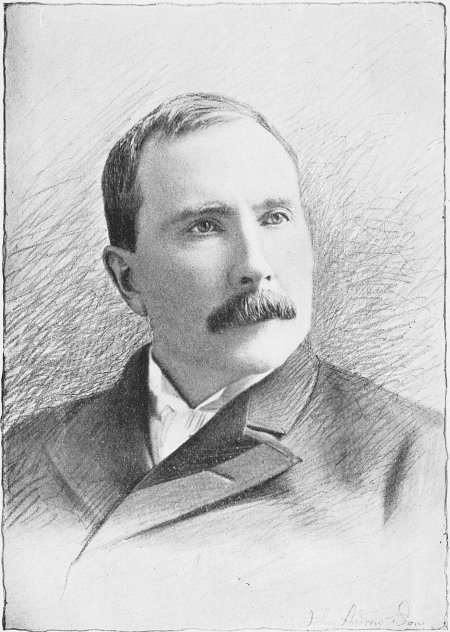
"The biographer of Leland Stanford will have to tell the fascinating
story of a career almost matchless in the splendor of its incidents. It
was partly due to the circumstances of his time, but chiefly due to the
largeness and boldness of his nature, that this plain, simple man
succeeded in cutting so broad a swath. He lived at the top of his
possibilities." Thus wrote Dr. Albert Shaw in the Review of Reviews,
August, 1893.
Leland Stanford, farmer-boy, lawyer, railroad builder, governor, United
States Senator, and munificent giver, was born at Watervliet, N.Y.,
eight miles from Albany, March 9, 1824. He was the fourth son in a
family of seven sons and one daughter, the latter dying in infancy.
His father, Josiah Stanford, was a native of Massachusetts, but moved
with his parents to the State of New York when he was a boy. He became a
successful farmer, calling his farm by the attractive name of Elm Grove.
He had the energy and industry which it seems Leland inherited. He built
roads and bridges in the neighborhood, and was an earnest advocate of
DeWitt Clinton's scheme of the Erie Canal, connecting the great lakes
with New York City by way of the Hudson River.
"Gouverneur Morris had first suggested the Erie Canal in 1777," says T.
W. Higginson, "and Washington had indeed proposed a system of such
waterways in 1774. But the first actual work of this kind in the United
States was that dug around Turner's Falls in Massachusetts soon after
1792. In 1803 DeWitt Clinton again proposed the Erie Canal. It was begun
in 1817, and opened July 4, 1825, being cut mainly through a wilderness.
The effect produced on public opinion was absolutely startling. When men
found that the time from Albany to Buffalo was reduced one-half, and
that the freight on a ton of merchandise was cut down from $100 to $10,
and ultimately to $3, similar enterprises sprang into being everywhere."
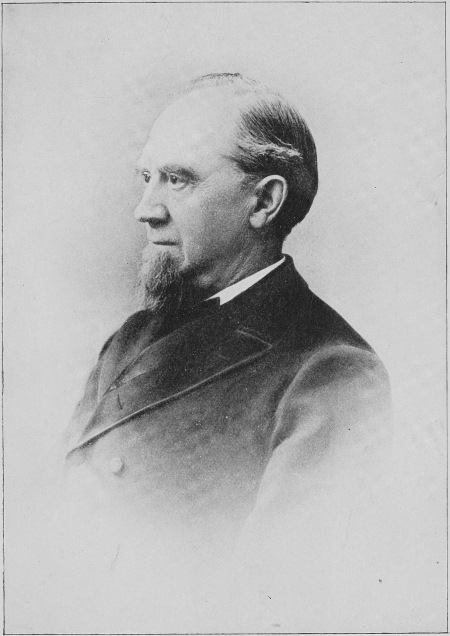
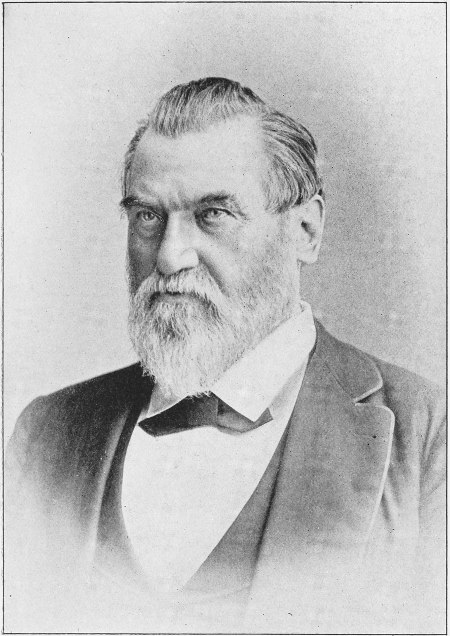
LELAND STANFORD.
People were not excited over canals only; everybody was interested about
the coming railroads. George Stephenson, in the midst of the greatest
opposition, landowners even driving the surveyors off their grounds, had
built a road from Liverpool to Manchester, England, which was opened
Sept. 15, 1830. The previous month, August, the Mohawk and Hudson River
Railroad from Albany to Schenectady, sixteen miles, was commenced, a
charter having been granted sometime before this. Josiah Stanford was
greatly interested in this enterprise, and took large contracts for
grading. Men at the Stanford home talked of the great future of
railroads in America, and even prophesied a road to Oregon. "Young as he
was when the question of a railroad to Oregon was first agitated," says
a writer, "Leland Stanford took a lively interest in the measure. Among
its chief advocates at that early day was Mr. Whitney, one of the
engineers in the construction of the Mohawk and Hudson River Railway.
On one occasion, when Whitney passed the night at Elm Grove, Leland
being then thirteen years of age, the conversation ran largely on this
overland railway project; and the effect upon the mind of such a boy may
be readily imagined. The remembrance of that night's discussion between
Whitney and his father never left him, but bore the grandest fruits."
The cheerful, big-hearted boy worked on his father's farm with his
brothers, rising at five o'clock, even on cold winter mornings, that he
might get his work done before school hours. He himself tells how he
earned his first dollar. "I was about six years old," he said. "Two of
my brothers and I gathered a lot of horseradish from the garden, washed
it clean, took it to Schenectady, and sold it. I got two of the six
shillings received. I was very proud of my money. My next financial
venture was two years later. Our hired man came from Albany, and told us
chestnuts were high. The boys had a lot of them on hand which we had
gathered in the fall. We hurried off to market with them, and sold them
for twenty-five dollars. That was a good deal of money when grown men
were getting only two shillings a day."
Perhaps the boy felt that he should not always like to work on the farm,
for he had made up his mind to get an education if possible. When he was
eighteen his father bought a piece of woodland, and told him if he would
cut off the timber he might have the money received for it. He
immediately hired several persons to help him, and together they cut and
piled 2,600 cords of wood, which Leland sold to the Mohawk and Hudson
River Railroad at a profit of $2,600.
After using some of this money to pay for his schooling at an academy
at Clinton, N.Y., he went to Albany, and for three years studied law
with the firm of Wheaton, Doolittle, & Hadley. He disliked Greek and
Latin, but was fond of science, particularly geology and chemistry, and
was a great reader, especially of the newspapers. He attended all the
lectures attainable, and was fond of discussion upon all progressive
topics. Later in life he studied sociological matters, and read John
Stuart Mill and Herbert Spencer.
Young Stanford determined to try his fortune in the West. He went as far
as Chicago, and found it low, marshy, and unattractive. This was in
1848, when he was twenty-four years old. The town had been organized but
fifteen years, and did not have much to boast of. There were only
twenty-eight voters in Chicago in 1833. In 1837 the entire population
was 4,470. Chicago had grown rapidly by 1848; but mosquitoes were
abundant, and towns farther up Lake Michigan gave better promise for the
future. Mr. Stanford finally settled at Port Washington, Wis., above
Milwaukee, which place it was thought would prove a rival of Chicago.
Forty years later, in 1890, Port Washington had a population of 1,659,
while Chicago had increased to 1,099,850.
Mr. Stanford did well the first year at Port Washington, earning $1,260.
He remained another year, and then, at twenty-six, went back to Albany
to marry Miss Jane Lathrop, daughter of Mr. Dyer Lathrop, a respected
merchant. They returned to Port Washington, but Mr. Stanford did not
find the work of a country lawyer congenial. He had chosen his
profession, however, and would have gone on to a measure of success in
it, probably, had not an accident opened up a new field.
He had been back from his wedding journey but a year or more, when a
fire swept away all his possessions, including a quite valuable law
library. The young couple were really bankrupt, but they determined not
to return to Albany for a home.
Several of Mr. Stanford's brothers had gone to California in 1849, after
the gold-fields were discovered, and had opened stores near the
mining-camps. If Leland were to join them, it would give him at least
more variety than the quiet life at Port Washington. The young wife went
back to Albany to care for three years for her invalid father, who died
in April, 1855. The husband sailed from New York, spending twelve days
in crossing the isthmus, and in thirty-eight days reached San Francisco,
July 12, 1852. For four years he had charge of a branch store at
Michigan Bluffs, Placer County, among the miners.
He engaged also in mining, and was not afraid of the labor and
privations of the camp. He said some years later, "The true history of
the Argonauts of the nineteenth century has to be written. They had no
Jason to lead them, no oracles to prophesy success nor enchantments to
avert dangers; but, like self-reliant Americans, they pressed forward to
the land of promise, and travelled thousands of miles, when the Greek
heroes travelled hundreds. They went by ship and by wagon, on horseback
and on foot; a mighty army, passing over mountains and deserts, enduring
privations and sickness; they were the creators of a commonwealth, the
builders of states."
Mr. Stanford had the energy of his father; he had learned how to work
while on the farm, and he had a pleasant and kindly manner to all. Said
a friend of his, after Mr. Stanford had become the governor of a great
State, and the possessor of many millions, "The man who held the
throttle of the locomotive, he who handled the train, worked the brake,
laid the rail, or shovelled the sand, was his comrade, friend, and
equal. His life was one of tender, thoughtful compassion for the man
less fortunate in life than himself."
The young lawyer was making money, and a good reputation as well, in the
mining-camps. Says an old associate, "Mr. Stanford in an unusual degree
commanded the respect of the heterogeneous lot of men who composed the
mining classes, and was frequently referred to by them as a sort of
arbitrator in settling their disputes for them. While at Michigan Bluffs
he was elected a justice of the peace, which office was the court before
which all disputes and contentions of the miners and their claims were
settled. It is a singular fact, with all the questions that came before
him for settlement, not one of them was appealed to a higher court.
"Leland Stanford was at this time just as gentle in his manner and as
cordial and respectful to all as in his later years. Yet he was
possessed of a courage which, when tested, as occasion sometimes
required, satisfied the rough element that he was not a man who could be
imposed upon. His principle seemed to be to stand up for the right at
all times. He never indulged in profanity or coarse words of any kind,
and was as considerate in his conduct when holding intercourse with the
rough element as though in the midst of the highest refinement."
Mr. Stanford had prospered so well that in 1855 he purchased the
business of his brothers in Sacramento, and went East to bring his wife
to the Pacific Coast. He studied his business carefully. He made himself
conversant with the statistics of trade, the tariff laws, the best
markets and means of transportation. He read and thought, while some
others idled away their hours. He was deeply interested in the new
Republican party, which was then in the minority in California. He
believed in it, and worked earnestly for it. When the party was
organized in the State in 1856, he was one of the founders of it. He
became a candidate for State treasurer, and was defeated. Three years
later he was nominated for governor; "but the party was too small to
have any chance, and the contest lay between opposing Democratic
factions." Mr. Stanford was to learn how to win success against fires
and political defeats.
A year later he was a delegate at large to the Republican National
Convention; and instead of supporting Mr. Seward, who was from his own
State of New York, he worked earnestly for Abraham Lincoln, with whom he
formed a lasting friendship. After Mr. Lincoln was inaugurated, Mr.
Stanford remained in Washington several weeks, at the request of the
president and Secretary Seward, to confer with them about the surest
means of keeping California loyal to the Union.
Mr. Blaine says of California and Oregon at this time: "Jefferson Davis
had expected, with a confidence amounting to certainty, and based, it is
believed, on personal pledges, that the Pacific Coast, if it did not
actually join the South, would be disloyal to the Union, and would, from
its remoteness and its superlative importance, require a large
contingent of the national forces to hold it in subjection.
"It was expected by the South that California and Oregon would give at
least as much trouble as Kentucky and Missouri, and would thus
indirectly, but powerfully, aid the Southern cause."
In the spring of 1861 Mr. Stanford was again nominated by the
Republicans for governor. Though he declined at first, after he had
consented, with his usual vigor, earnestness, and perseverance, with
faith in himself and his fellow-men as well, he and his friends made a
thorough and spirited canvass; and Mr. Stanford received 56,036 votes,
about six times as many as were given him two years before.
"The period," says the San Francisco Chronicle, "was one of unexampled
difficulty of administration; and to add to the embarrassments
occasioned by the Civil War, the city of Sacramento and a vast area of
the valley were inundated. On the day appointed for the inauguration the
streets of Sacramento were swept by a flood, and Mr. Stanford and his
friends were compelled to go and return to the Capitol in boats. The
messages of Governor Stanford, and indeed all his state papers,
indicated wide information, great common-sense, and a comprehensive
grasp of State and national affairs, remarkable in one who had never
before held office under either the State or national government. During
his administration he kept up constant and cordial intercourse with
Washington, and had the satisfaction of leaving the chair of state at
the close of his term of office feeling that no State in the Union was
more thoroughly loyal."
There was much disloyalty in California at first, but Mr. Stanford was
firm as well as conciliatory. The militia was organized, a State normal
school was established, and the indebtedness of the State reduced
one-half under his leadership as governor.
After the war was over, Governor Stanford cherished no animosities. When
Mr. Lamar's name was sent to the Senate as associate justice of the
Supreme Court, and many were opposed, Mr. Stanford said, "No man
sympathized more sincerely than myself with the cause of the Union, or
deprecated more the cause of the South. I would have given fortune and
life to have defeated that cause. But the war has terminated, and what
this country needs now is absolute and profound peace. Lamar was a
representative Southern man, and adhered to the convictions of his
boyhood and manhood. There never can be pacification in this country
until these war memories are obliterated by the action of the Executive
and of Congress."
Mr. Stanford declined a re-election to the governorship, because he
wished to give his time to the building of a railroad across the
continent. He had never forgotten the conversation in his father's home
about a railroad to Oregon. When he went back to Albany for Mrs.
Stanford, after being a storekeeper among the mines, and she was ill
from the tiresome journey, he cheered her with the promise, "Never mind;
a time will come when I will build a railroad for you to go home on."
Every one knew that a railroad was needed. Vessels had to go around
Cape Horn, and troops and produce had to be transported over the
mountains and across the plains at great expense and much hardship. Some
persons believed the building of a road over the snow-capped Sierra
Nevada Mountains was possible; but most laughed the project to scorn,
and denounced it as "a wild scheme of visionary cranks."
"The huge snow-clad chain of the Sierra Nevadas," says Mr. Perkins, the
senator from California who succeeded Mr. Stanford, "whose towering
steeps nowhere permitted a thoroughfare at an elevation less than seven
thousand feet above the sea, must be crossed; great deserts, waterless,
and roamed by savage tribes, must be made accessible; vast sums of money
must be raised, and national aid secured at a time in which the credit
of the central government had fallen so low that its bonds of guaranty
to the undertaking sold for barely one-third their face value."
In the presence of such obstacles no one seemed ready to undertake the
work of building the railroad. One of the persistent advocates of the
plan was Theodore J. Judah, the engineer of the Sacramento Valley and
other local railroads. He had convinced Mr. Stanford that the thing was
possible. The latter first talked with C. P. Huntington, a hardware
merchant of Sacramento; then with Mark Hopkins, Mr. Huntington's
partner, and later with Charles Crocker and others. A fund was raised to
enable Mr. Judah and his associates to perfect their surveys; and the
Central Pacific Railroad Company was formed, June 28, 1861, with Mr.
Stanford as president.
In Mr. Stanford's inaugural address as governor he had dwelt upon the
necessity of this railroad to unite the East and the West; and now that
he had retired from the gubernatorial office, he determined to push the
enterprise with all his power. Neither he nor his associates had any
great wealth at their command, but they had faith and force of
character. The aid of Congress was sought and obtained by a strictly
party vote, Republicans being in the majority; and the bill was signed
by President Lincoln, July 1, 1862.
The government agreed to give the company the alternate sections of 640
acres in a belt of land ten miles wide on each side of the railroad, and
$16,000 per mile in bonds for the easily constructed portion of the
road, and $32,000 and $48,000 per mile for the mountainous portions. The
company was to build forty miles before it received government aid.
It was so difficult to raise money during the Civil War that Congress
made a more liberal grant July 2, 1864, whereby the company received
alternate sections of land within a belt twenty miles on each side of
the road, or the large amount of 12,800 acres per mile, making for the
company nearly 9,000,000 acres of land. The government was to retain, to
apply on its debt, only half the money it owed the company for
transportation instead of the whole. The most important provision of the
new Act was the authority of the company to issue its own first-mortgage
bonds to an amount not exceeding those of the United States, and making
the latter take a second mortgage.
There is no question but the United States has given lavishly to
railroads, as the cities have given their streets free to street
railroads; but during the Civil War the need of communication between
East and West seemed to make it wise to build the road at almost any
sacrifice. Mr. Blaine says, "Many capitalists who afterwards indulged in
denunciations of Congress for the extravagance of the grants, were urged
at the time to take a share in the scheme, but declined because of the
great risk involved."
Mr. Stanford broke ground for the railroad by turning the first
shovelful of earth early in 1863. "At times failure seemed inevitable,"
says the New York Tribune, June 22, 1893. "Even the stout-hearted
Crocker declared that there were times when he would have been glad to
'lose all and quit;' but the iron will of Stanford triumphed over
everything. As president of the road he superintended its construction
over the mountains, building 530 miles in 293 days. On the last day,
Crocker laid the rails on more than ten miles of track. That the great
railroad builders survived the ordeal is a marvel. Crocker, indeed,
never recovered from the effects of the terrific strain. He died in
1888. Hopkins died twelve years before, in 1876."
With a silver hammer Governor Stanford drove a golden spike at
Promontory Point, Utah, May 10, 1869, which completed the line of the
Central Pacific, and joined it with the Union Pacific Railroad, and the
telegraph flashed the news from the Atlantic to the Pacific. The Union
Pacific was built from Omaha, Neb., to Promontory Point, though Ogden,
Utah, fifty-two miles east of Promontory Point, is now considered the
dividing line.
After this road was completed, Mr. Stanford turned to other labors. He
was made president or director of several railroads,—the Southern
Pacific, the California & Oregon, and other connecting lines. He was
also president of the Oriental and Occidental Steamship Company, which
plied between San Francisco and Chinese ports, and was interested in
street railroads, woollen mills, and the manufacture of sugar.
Foreseeing the great future of California, he purchased very large
tracts of land, including Vina with nearly 60,000 acres, the Gridley
Ranch with 22,000 acres, and his summer home, Palo Alto, thirty miles
from San Francisco, with 8,400 acres. He built a stately home in San
Francisco costing over $1,000,000, and in his journeys abroad collected
for it costly paintings and other works of art.
But his chief delight was in his Palo Alto estate. Here he sought to
plant every variety of tree, from the world over, that would grow in
California. Many thousands were set out each year. He was a great lover
of trees, and could tell the various kinds from the bark or leaf.
He loved animals, especially the horse, and had the largest horse farm
for raising horses in the world. Some of his remarkable thoroughbreds
and trotters were Electioneer, Arion, Palo Alto, Sunol, "the flying
filly," Racine, Piedmont that cost $30,000, and many others. He spent
$40,000, it is said, in experiments in instantaneous photography of the
horse; and a book resulted, "The Horse in Motion," which showed that the
ideas of painters about a horse at high speed were usually wrong. No one
was ever allowed to kick or whip a horse or destroy a bird on the
estate. Mr. George T. Angell of Boston tells of the remark made to
General Francis A. Walker by Mr. Stanford. The horses of the latter
were so gentle that they would put their noses on his shoulder, or come
up to visitors to be petted. "How do you contrive to have your horses so
gentle?" asked General Walker. "I never allow a man to speak unkindly
to one of my horses; and if a man swears at one of them, I discharge
him," was the reply. There were large greenhouses and vegetable gardens
at Palo Alto, and acres of wheat, rye, oats, and barley. But the most
interesting and beautiful and highly prized of all the charms at Palo
Alto was an only child, a lad named Leland Stanford, Jr. He was never a
rugged boy; but his sunny, generous nature and intellectual qualities
gave great promise of future usefulness. Mrs. Sallie Joy White, in the
January, 1892, Wide Awake, tells some interesting things about him.
She says, "His chosen playmate was a little lame boy, the son of people
in moderate circumstances, who lived near the Stanfords in San
Francisco. The two were together almost constantly, and each was at home
in the other's house. He was very considerate of his little playfellow,
and constituted himself his protector."
When Mrs. Sarah B. Cooper was making efforts to raise money for the free
kindergarten work in San Francisco suggested by Felix Adler in 1878, she
called on Mrs. Stanford, and the boy Leland heard the story of the needs
of poor children. Putting his hand in his mother's, he said, "Mamma, we
must help those children."
"Well, Leland," said his mother, "what do you wish me to do?"
"Give Mrs. Cooper $500 now, and let her start a school, then come to us
for more." And Leland's wish was gratified.
"Between this time, 1879, and 1892," says Miss M. V. Lewis in the Home
Maker for January, 1892, "Mrs. Leland Stanford has given $160,000,
including a permanent endowment fund of $100,000 for the San Francisco
kindergartens." She supports seven or more, five in San Francisco, and
two at Palo Alto.
A writer in the press says, "Her name is down for $8,000 a year for
these schools, and I am told she spends much more. I attended a
reception given her by the eight schools under her patronage; and it was
a very affecting sight to watch these four hundred children, all under
four years of age, marching into the hall and up to their benefactor,
each tiny hand grasping a fragrant rose which was deposited in Mrs.
Stanford's lap. These children are gathered from the slums of the city.
It is far wiser to establish schools for the training of such as these,
than to wait until sin and crime have done their work, and then make a
great show of trying to reclaim them through reformatory institutions."
Leland, Jr., was very fond of animals. Mrs. White tells this story: "One
day, when he was about ten years of age, he was standing looking out of
the window, and his mother heard a tumult outside, and saw Leland
suddenly dash out of the house, down the steps, into a crowd of boys in
front of the house. Presently he reappeared covered with dust, holding a
homely yellow dog in his arms. Quick as a flash he was up the steps and
into the house with the door shut behind him, while a perfect howl of
rage went up from the boys outside.
"Before his mother could reach him he had flown to the telephone, and
summoned the family doctor. Thinking from the agonized tones of the boy
that some of the family had been taken suddenly and violently ill, the
doctor hastened to the house.
"He was a stately old gentleman, who believed fully in the dignity of
his profession; and he was somewhat disconcerted and a good deal annoyed
at being confronted with a very dusty, excited boy, holding a
broken-legged dog that was evidently of the mongrel family. At first he
was about to be angry; but the earnest, pleading look on the little
face, and the perfect innocence of any intent of discourtesy, disarmed
the dignified doctor, and he explained to Leland that he did not
understand the case, not being accustomed to treating dogs, but that he
would take him and the dog to one who was. So they went, doctor, boy,
and dog, in the doctor's carriage to a veterinary surgeon, the leg was
set, and they returned home. Leland took the most faithful care of the
dog until it recovered, and it repaid him with a devotion that was
touching."
Leland, knowing that he was to be the heir of many millions, was already
thinking how some of the money should be used. He had begun to gather
materials for a museum, to which the parents devoted two rooms in their
San Francisco home. He was fitting himself for Yale College, was
excellent in French and German, and greatly interested in art and
archæology. Before entering upon the long course of study at college, he
travelled with his parents abroad. In Athens, in London, on the
Bosphorus, everywhere, with an open hand, his parents allowed him to
gather treasures for his museum, and for a larger institution which he
had in mind to establish sometime.
While staying for a while in Rome, symptoms of fever developed in young
Leland, and he was taken at once to Florence. The best medical skill was
of no avail; and he soon died, March 13, 1884, two months before his
sixteenth birthday. His parents telegraphed this sad message home, "Our
darling boy went to heaven this morning."
The story is told that while watching by the bedside of his son, worn
with care and anxiety, Governor Stanford fell asleep, and dreamed that
his son said to him, "Father, don't say you have nothing to live for;
you have a great deal to live for. Live for humanity, father," and that
this dream proved a comforter.
The almost prostrated parents brought home their beloved boy to bury him
at Palo Alto. On Thanksgiving Day, Thursday, Nov. 27, 1884, the doors of
the tomb which had been prepared near the house were opened at noon, and
Leland Stanford, Jr., was laid away for all time from the sight of those
who loved him. The bearers were sixteen of the oldest employees on the
Palo Alto farm. The sarcophagus in which Leland, Jr., sleeps is eight
feet four inches long, four feet wide, and three feet six inches high,
built of pressed bricks, with slabs of white Carrara marble one inch
thick firmly fastened to the bricks with cement. In the front slab of
this sarcophagus are cut these words:—
Born in Mortality
May 14, 1868,
LELAND STANFORD, JR.
Passed to Immortality
March 13, 1884.
Electric wires were placed in the walls of the tomb, in the doors of
iron, and even in the foundations, so that no sacrilegious hand should
disturb the repose of the sleeper without detection. Memorial services
for young Leland were held in Grace Church, San Francisco, on the
morning of Sunday, Nov. 30, 1884, the Rev. Dr. J. P. Newman of New York
preaching an eloquent sermon. The floral decorations were exquisite; one
bower fifteen feet high with four floral posts supporting floral arches,
a cross six feet high of white camellias, lilies, and tuberoses,
relieved by scarlet and crimson buds, and pillows and wreaths of great beauty.
"Nature had highly favored him for some noble purpose," said Dr. Newman.
"Although so young, he was tall and graceful as some Apollo Belvidere,
with classic features some master would have chosen to chisel in marble
or cast in bronze; with eyes soft and gentle as an angel's, yet dreamy
as the vision of a seer; with broad, white forehead, home of a radiant
soul.... He was more than a son to his parents,—he was their companion.
He was as an angel in his mother's sick room, wherein he would sit for
hours and talk of all he had seen, and would cheer her hope of returning
health by the assurance that he had prayed on his knees for her recovery
on each of the twenty-four steps of the Scala Santa in Rome, and that
when he was but eleven years old....
"He had selected, catalogued, and described for his projected museum
seventeen cases of antique glass vases, bronze work, and terra-cotta
statuettes, dating back far into the centuries, and which illustrate the
creative genius of those early ages of our race."
Such a youth wasted no time in foolish pleasures or useless companions.
Like his father he loved history, and sought out, says Dr. Newman, the
place where Pericles had spoken, and Socrates died; "reverently pausing
on Mars Hill where St. Paul had preached 'Jesus and the Resurrection;'
and lingering with strange delight in the temple of Eleusis wherein
death kissed his cheek into a consuming fire."
At the close of Dr. Newman's memorial address the favorite hymn of young
Leland was sung, "Tell Me the Old, Old Story." From this crushing blow
of his son's death Mr. Stanford never recovered. For years young
Leland's room in the San Francisco home was kept ready and in waiting,
the lamp dimly lighted at night, and the bedclothes turned back by
loving hands as if he were coming back again. The horses the boy used to
ride were kept unused in pasture at Palo Alto, and cared for, for the
sake of their fair young owner. The little yellow dog whose broken leg
was set was left at Palo Alto when the boy went to Europe with his
parents. When he was brought back a corpse, the dog knew all too well
the story of the bereavement. After the body was placed in the tomb, the
faithful creature took his place in front of the door. He could not be
coaxed away even for his food, and one morning he was found there dead.
He was buried near his devoted human friend.
"Toots," an old black and tan whom young Leland had brought from Albany,
was much beloved. "Mr. Stanford would not allow a dog in the house save
this one," says a writer in the San Francisco Chronicle. "'Toots' was
an exception, and he had full run of the house. He was the envy of all
the dogs, even of the noble old Great Dane. 'Toots' would climb upon the
sofa alongside of Mr. Stanford, and forgetting a well-known repugnance
he would pet him and say, 'There is always a place for you; always a
place for you.'"
The year following the death of young Leland, on Nov. 14, 1885, Mr.
Stanford and his wife founded and endowed their great University at Palo
Alto. In conveying the estates to the trustees, Mr. Stanford said,
"Since the idea of establishing an institution of this kind for the
benefit of mankind came directly and largely from our son and only
child, Leland, and in the belief that had he been spared to advise us as
to the disposition of our estate he would have desired the devotion of a
large portion thereof to this purpose, we will that for all time to come
the institution hereby founded shall bear his name, and shall be known
as the 'Leland Stanford, Jr., University.'"
Mr. Stanford and his wife visited various institutions of learning
throughout the country, and found consolation in raising this noble
monument to a noble son—infinitely to be preferred to shafts or statues
of marble and bronze.
This same year, 1885, Mr. Stanford's friends, fearing the effect of his
sorrow, and hoping to divert him somewhat from it, secured his election
by the California Legislature to the United States Senate. He took his
seat March 4, 1885, just a year after the death of his son. He did not
make many speeches, but he proved a very useful member from his good
sense and counsel and kindly leaning toward all helpful legislation for
the poor and the unfortunate. He was re-elected March 3, 1891, for a
second term of six years.
He will be most remembered in Congress for his Land-Loan Bill which he
originated and presented to the Senate. "The bill proposed that money
should be issued upon land to half the amount of its value, and for such
loan the government was to receive an annual interest of two per cent
per annum."
"Whatever may be thought by some of the practical utility of his
financial scheme," says Mr. Mitchell, a senator from Oregon, "which he
so earnestly and ably advocated, and which was approved by millions of
his countrymen, for the loaning of money by the United States direct to
the people at a low rate of interest, taking mortgages on farms as
security, all will now agree it indicated in unmistakable terms a
philanthropic spirit, an earnest desire to aid, through the
instrumentality of what he regarded as constitutional and proper
governmental influence, not the great moneyed institutions of the
country, not the vast corporations of the land, with several of which he
was prominently identified in a business way, but rather the great
masses of producers,—the farmers, the planters, and the wage-workers of
his country."
In this connection the suggestion of Professor Richard T. Ely in his
book on "Socialism and Social Reform," page 334, might well be heeded.
After showing that Germany and other countries have used government
credit to some extent in behalf of the farming community, and that New
York State has been making loans to farmers for a generation or more, he
says, "A sensible demand on the part of farmers' organizations would be
that Congress should appoint a commission of experts to investigate
thoroughly the use of government credit in various countries and at
different times, in behalf of the individual citizen, especially the
farmer, and to make a full and complete report, in order that anything
which is done should be based upon the lessons to be derived from actual
experience."
Mr. and Mrs. Stanford were much beloved in Washington for their
cordiality and generosity. They gave an annual dinner to the Senate
pages, with a gift for each boy of a gold scarf-pin, or something
attractive, and at Christmas a five-dollar gold-piece to each. Also a
luncheon each winter, and gifts of money, gloves, etc., to the telegraph
and messenger boys. Every orphan asylum and charity hospital in
Washington was remembered at Christmas. Mr. Sibley, representative for
Pennsylvania, relates this incident showing Mr. Stanford's habit of
giving. "My partner and myself had purchased a young colt of him, for
which we paid him $12,500. He took out his check-book, drew two checks
of $6,250 each, and sent them to two different city homes for friendless
children; and with a twinkle in his eye, and broadly beaming benevolence
in his features, said, 'Electric Bell ought to make a great horse; he
starts in making so many people happy in the very beginning of his
life.'"
Mr. Daniels of Virginia tells how Mr. Stanford was observed one day by a
friend to give $2,000 to an inventor who was trying to apply an electric
motor to the sewing-machine. Mr. Stanford remarked, "This is the
thirtieth man to whom I have given a like sum to develop that idea."
After Mr. Stanford had been in the Senate two years, on May 14, 1887,
he and Mrs. Stanford laid the corner-stone of their University at Palo
Alto, on the 19th anniversary of the birthday of Leland Stanford, Jr. In
less than four years, on October 1, 1891, the doors of the University
were opened to receive five hundred students, young men and women; for
Mr. Stanford had written in his grant of endowment "to afford equal
facilities and give equal advantages in the University to both sexes."
In his address to the trustees he said, "The rights of one sex,
political or otherwise, are the same as those of the other sex, and this
equality of rights ought to be fully recognized."
Mrs. Stanford said to Mrs. White as they sat in her library at Palo
Alto, "Whatever the boys have, the girls have as well. We mean that the
girls of our country shall have a fair chance. There shall be no
dividing line in the studies. If a girl desires to become an
electrician, she shall have the opportunity, and that opportunity shall
be the same as the young men's. If she wishes to study mechanics, she
may do it."
Mr. Stanford said in his address on the day of opening, "I speak for
Mrs. Stanford as well as for myself, for she has been my active and
sympathetic coadjutor, and is co-grantor with me in the endowment and
establishment of this University."
They had been urged to give their fortune in other directions, as some
persons believed that much education would unfit people for labor. "We
do not believe," said Mr. Stanford, and the world honors him for his
belief, "there can be superfluous education. As man cannot have too much
health and intelligence, so he cannot be too highly educated. Whether
in the discharge of responsible or humble duties he will ever find the
knowledge he has acquired through education, not only of practical
assistance to him, but a factor in his personal happiness, and a joy
forever."
Mr. Stanford desired that the students should "not only be scholars, but
have a sound practical idea of commonplace, every-day matters, a
self-reliance that will fit them, in case of emergency, to earn their
own livelihood in an humble as well as an exalted sphere." To this end
he provided, besides the usual studies in colleges, for "mechanical
institutes, laboratories, etc." There are departments of civil
engineering, mechanical engineering, electrical engineering, besides
shorthand and typewriting, agriculture, and other practical work.
He wished to have taught in the University "the right and advantages of
association and co-operation. ... Laws should be formed to protect and
develop co-operative associations. Laws with this object in view will
furnish to the poor man complete protection against the monopoly of the
rich; and such laws, properly administered and availed of, will insure
to the workers of the country the full fruits of their industry and
enterprise."
He gave directions that "no drinking saloons shall be opened upon any
part of the premises." He "prohibited sectarian instruction," but wished
"to have taught in the University the immortality of the soul, the
existence of an all-wise and benevolent Creator, and that obedience to
His laws is the highest duty of man." Mr. Stanford said, "It seems to us
that the welfare of man on earth depends on the belief in immortality,
and that the advantages of every good act and the disadvantages of
every evil one follow man from this life into the next, there attaching
to him as certainly as individuality is maintained."
The object of the University is, he said, "to qualify students for
personal success and direct usefulness in life." Again he said, "The
object is not alone to give the student a technical education, fitting
him for a successful business life, but it is also to instil into his
mind an appreciation of the blessings of this government, a reverence
for its institutions, and a love for God and humanity."
Mr. Stanford wished plain and substantial buildings, "built as needed
and no faster," urging the trustees to bear in mind "that extensive and
expensive buildings do not make a university; that it depends for its
success rather upon the character and attainments of its faculty."
Mr. Stanford chose for the president of his University David Starr
Jordan, well-known for his scientific work and his various books. Though
a comparatively young man, being forty years of age, Dr. Jordan had had
wide experience. He was graduated from Cornell University in 1872, and
for two years was professor at institutions in Illinois and Wisconsin.
In 1874 he was lecturer in marine botany at the Anderson School at
Penikese, and the following year at the Harvard Summer School at
Cumberland Gap. During the next four years, while holding the chair of
biology in Butler University, Indianapolis, he was the naturalist of two
geological surveys in Indiana and Ohio. For six years he was professor
of zoölogy in Indiana University, and for the six years following its
president. For fourteen years he had been assistant to the United States
Fish Commission, exploring many of our rivers, and part of that time
agent for the United States Census Bureau in investigating the marine
industries of the Pacific Coast. He had studied also in the large
museums abroad.
Dr. Albert Shaw tells this interesting incident. "President Jordan had
once met the young Stanford boy on the seashore, and won the lad's
gratitude by telling him of shells and submarine life. It was a singular
coincidence that the parents afterwards heard Dr. Jordan make allusions
in a public address which gave them the knowledge that this was the
interesting stranger who had taught their son so much, and had so
enkindled the boy's enthusiasm. His choice as president was an eminently
wise one."
Mr. Stanford wished ten acres to be set aside "as a place of burial and
of last rest on earth for the bodies of the grantors and of their son,
Leland Stanford, Jr., and, as the board may direct, for the bodies of
such other persons who may have been connected with the University."
Mr. Stanford lived to see his University opened and doing successful
work. The plan of its buildings, suggested by the old Spanish Missions
of California, was originally that of Richardson, the noted architect of
Boston; but as he died before it was completed, the work was done by his
successors, Shepley, Rutan, & Coolidge.
The plan contemplates a number of quadrangles in the midst of 8,400
acres. "The central group of buildings will constitute two quadrangles,
one entirely surrounding the other," says the University Register for
1894—1895. "Of these the inner quadrangle, with the exception of the
chapel, is now completed. Its twelve one-story buildings are connected
by a continuous open arcade, facing a paved court 586 feet long by 246
feet wide, or three and a quarter acres. The buildings are of a buff
sandstone, somewhat varied in color. The stone-work is of broken ashlar,
with rough rock face, and the roofs are covered with red tile." Within
the quadrangle are several circular beds of semi-tropical trees and
plants.
Miss Milicent W. Shinn, in the Overland Monthly for October, 1891,
says, "I should think it hard to say too much of the simple dignity, the
calm influence on mind and mood, of the great, bright court, the deep
arcade with its long vista of columns and arches, the heavy walls, the
unchanging stone surfaces. They seemed to me like the rock walls of
nature; they drew me back, and made me homesick for them when I had gone
away."
Behind the central quadrangle are the shops, foundry, and boiler-house.
On the east side is Encina Hall, a dormitory for 315 men, provided with
electric lights, steam heat, and bathrooms on each floor. It is four
stories high, and, like the quadrangle, of buff Almaden sandstone.
On the west side of the quadrangle is Roble Hall, for one hundred young
women, and is built of concrete. There are two gymnasiums, called Encina
and Roble gymnasiums.
Perhaps the most interesting of all the buildings, the especial gift of
Mrs. Stanford, is the Leland Stanford Junior Museum, of concrete, in
Greek style of architecture, 313 by 156 feet, including wings, situated
a quarter of a mile from the quadrangle, and between the University and
the Stanford residence. The collection made by young Leland is placed
here, and his own arrangement reproduced. The collection includes
Egyptian bronzes, Greek and Roman glass and statues. The Cesnola
collection contains five thousand pieces of Greek and Roman pottery and
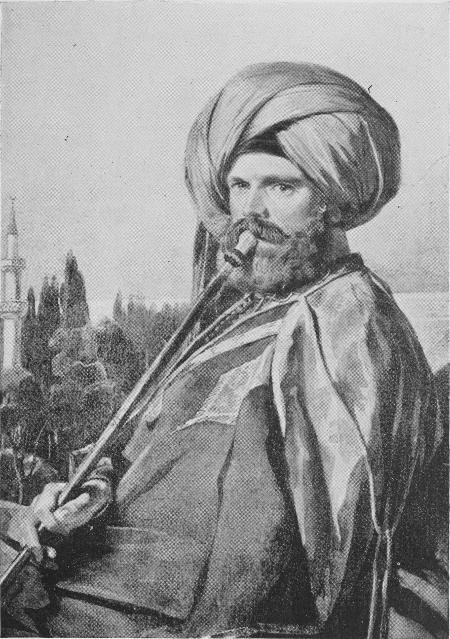
glass. The Egyptian collection, made by Brugsch Bey, Curator of the
Gizeh Museum, for Mrs. Stanford, comprises casts of statuary, mummies,
scarabees, etc. Mr. Timothy Hopkins of San Francisco, one of the
trustees, has given for the Egyptian collection embroideries dating from
the sixth to the twenty-first dynasty. He has also given a collection of
ancient and modern coins and costumes, household goods, etc., from
Corea. There are stone implements from Copenhagen, Denmark, and relics
from the mounds of America. Mrs. Stanford is making the collection of
fine arts, and a very large number of copies of great paintings is
intended. Much attention will be given to local history, Indian
antiquities, and Spanish settlements of early California.
The library has 23,000 volumes and 6,000 pamphlets. Mr. Hopkins has
given a valuable collection of railway books, unusually rich in the
early history of railways in Europe and America, with generous provision
for its increase. Mr. Hopkins has also founded the Hopkins Seaside
Laboratory at Pacific Grove, two miles west of Monterey, to provide for
investigations in marine biology, as a branch of the biological work of
the University.
Students are not received into the University under sixteen years of
age, and if special students, not under twenty, and must present
certificates of good moral character. If from other colleges they must
bring letters of honorable dismissal. They are offered a choice of
twenty-two subjects for entrance examination, and must pass in twelve
subjects. Tuition in all departments is free.
"The degree of Bachelor of Arts is granted to students who have
satisfactorily completed the equivalent of four years' work of 15 hours
of lecture or recitation weekly, or a total of 120 hours, and who have
also satisfied the requirements in major and minor subjects."
President Jordan says, in the Educational Review for June, 1892: "In
the arrangement of the courses of study two ideas are prominent: first,
that every student who shall complete a course in the University must be
thoroughly trained in some line of work. His education must have as its
central axis an accurate and full knowledge of something. The second is
that the degree to be received is wholly a subordinate matter, and that
no student should be compelled to turn out of his way in order to secure
it. The elective system is subjected to a single check. In order to
prevent undue scattering, the student is required to select the work in
general of some one professor as major subject or specialty, and to
pursue this subject or line of subjects as far as the professor in
charge may deem it wise or expedient. In order that all courses and all
departments may be placed on exactly the same level, the degree of
Bachelor of Arts is given in all alike for the equivalent of the four
years' course. Should his major subject, for instance, be Greek, then
the title is given that of Bachelor of Arts in Greek; should the major
subject be chemistry, Bachelor of Arts in chemistry, and so on."
In 1895 there were 1,100 students in the University, of whom 728 were
men, and 372 women. Several of the students are from the New England
States.
Mr. Stanford spent over a million dollars in the University buildings,
and gave as an endowment over 89,000 acres of land valued at more than
five million dollars. The Palo Alto estate has 8,400 acres; the Vina
estate, 59,000 acres, with over 4,000 acres planted to grapes which are
made into wine—those of us who are total abstainers regret such use;
and the Gridley estate 22,000 acres, one of California's great wheat
farms. In years to come it is hoped that these properties, which are
never to be sold, will so increase in value that they will be worth
several times five millions.
Mr. and Mrs. Stanford made their wills, giving to the University
"additional property," that the endowment, as Mr. Stanford said, "will
be ample to establish and maintain a university of the highest grade."
It has been stated, frequently, that the "full endowment" in land and
money will be $20,000,000 or more.
Senator Stanford's death came suddenly at the last, at Palo Alto,
Tuesday, June 20-21, 1893. He had not been well for some time; but
Tuesday he had driven about the estate, with his usual interest and good
cheer. He retired to rest about ten o'clock; and at midnight his wife,
who occupied an adjoining apartment, heard a movement as if Mr. Stanford
were making an effort to rise. She spoke to him, but received no answer.
His breathing was unnatural; and in a few minutes he passed away,
apparently without pain.
Mr. Stanford was buried at Palo Alto, Saturday, June 24. The body lay
in the library of his home, in a black cloth-covered casket, with these
words on the silver plate:—
LELAND STANFORD.
BORN TO MORTALITY MARCH 9, 1824.
PASSED TO IMMORTALITY, JUNE 21, 1893.
AGED 69 YRS., 3 MOS., 12 DAYS.
Flowers filled every part of the library. The Union League Club sent a
floral piece representing the Stars and Stripes worked in red and white
in "everlasting," with star lilies on a ground of violets. There was a
triple arch of white and pink flowers representing the central arch of
the main University building. There were wreaths and crosses and a
broken wheel of carnations, hollyhocks, violets, white peas, and ferns.
At half-past one, after all the employees had taken their last look of
the man who had always been their friend,—one, seventy-six years old,
who had worked with Mr. Stanford in the mine, broke down
completely,—the body was borne to the quadrangle of the University by
eight of the oldest engineers in point of service on the Southern
Pacific Railroad. The funeral cortège passed through a double line of
the two hundred or more employees at Palo Alto, several Chinese laborers
being at the end of the line. Senator Stanford was always opposed to any
legislation against the Chinese.
The body was placed on a platform at one end of the quadrangle, the
remaining space being filled with several thousand persons. About
sixteen hundred chairs were provided, but these could accommodate only a
small portion of those present. The platform was decorated with ferns,
smilax, white sweet peas, and thousands of St. Joseph's lilies. The
temporary chancel was flanked by two remarkable flower pieces: on the
left, a fac-simile of the first locomotive ever purchased and operated
on the Central Pacific Railroad, the "Governor Stanford," sent by the
employees of the company. The boiler and smoke-stack were of
mauve-colored sweet peas; the headlight and bell were of yellow pansies;
the cab of white sweet peas bordered by yellow pansies; the tender of
white sweet peas edged by pansies and lined with ivy; on the side of the
cab, in heliotrope, the name Governor Stanford. On the right of the bier
was the gift of the employees of the Palo Alto stock-farm, a
representation in sweet peas of the senator's favorite bay horse.
After the burial service of the Episcopal Church, a solo, "O sweet and
blessed country," and address by Dr. Horatio Stebbins of the First
Unitarian Church of San Francisco, the choir sang "Lead Kindly Light,"
and the body of Senator Stanford was conveyed through the cypress avenue
to the mausoleum in the ten acres adjoining the residence grounds. The
tomb is in the form of a Greek temple lined with white marble, guarded
by a sphinx on either side of the entrance.
Here beside the open doors stood another beautiful floral tribute, a
shield eight feet high, of roses, lilies, and other flowers sent by the
employees of the Sacramento Railroad shops. Worked in violets were the
words "The Laborers' Tribute to the Laborers' Friend." The choir sang,
"Abide with Me," the body was laid in the tomb, and the bronze doors
were closed. A few days later the body of Leland Stanford, Junior, the
boy whose death, as Dr. Stebbins said at the senator's funeral, "drew
the sunbeams out of the day," was laid beside that of his father. Some
time the mother will sleep here with her precious dead.
Mr. Stanford's heart was bound up in his University. He said, after his
son died, "The children of California shall be our children." Mr. Sibley
of Pennsylvania tells how, three years after Leland Junior died, he and
Mr. Stanford "went together to the tomb of the boy, and the father told
amid tears and sobs how, since the death of his son, he had adopted and
taken to his heart and love every friendless boy and girl in all the
land, and that, so far as his means afforded, they should go to make the
path of every such an one smoother and brighter."
Mr. Stanford told Dr. Stebbins, in speaking of the University: "We feel
[he always used the plural, thus including that womanly heart from whose
fountains his life had ever been refreshed] that we have good ground for
hope. We are very happy in our work. We do not feel that we are making
great sacrifices. We feel that we are working with and for the Almighty
Providence."
By the will of Mr. Stanford the University receives two and a half
million dollars, but this bequest is not yet available. He always felt,
and rightly, that his wife owned all their large fortune equally with
himself; therefore he placed no restrictions upon her disposal of it.
Inasmuch as she is a co-founder of the University, she will doubtless
add largely to its endowment. Should she do this, the power of Leland
Stanford Junior University for good will be almost unlimited.
Even granite mausoleums crumble away; but great deeds last forever, and
make their doers immortal.