A.D.
134
Thames frozen over for two months.
153
Very severe frost, lasting nearly three months.
English rivers frozen, including the Thames.
173
A frost lasted three months, and was followed by
a dearth.
220
A continuous frost of five months in Britain.
250
Thames frozen for nine weeks.
290-91
Severe frost lasted six weeks. English rivers
frozen.
359
The frost very severe in England and Scotland. It
lasted fourteen weeks in the latter country.
474
Four months’ frost, and great snow.
507-8
Frost lasted two months: rivers frozen.
525
Thames frozen for six weeks.
604
A frost lasting four months, followed by dearth in
Scotland: also very severe in England.
670
“A fatal frost.”—Short.
695
Thames frozen for six weeks, and booths erected on
the ice.
759-60
Frost from October 1st, 759, to February 26th, 760.
821
Great frost after two or three weeks’ rain.
827
Thames frozen for nine weeks.
908
The greater part of the English rivers frozen for two
months.
923
Thames frozen for thirteen weeks.
962
The frost this year was so great as to cause a famine.
975
Severe frost.
987
This year is notable for a frost lasting one hundred
and twenty days.
998
Thames frozen for five weeks.
1020
Very severe frost.
1035
Short says: “Frost on Midsummer day; all grass
and grain and fruit destroyed; a dearth.”
1059
Great frost, followed by a severe plague and famine.
1061
Thames frozen for seven weeks.
1063
Fourteen weeks’ frost: Thames frozen.
1076-7
Frost lasted from 1st November, 1076, to 15th
April, 1077. It is recorded in the “Harleian
Miscellany,” iii, page 167, that: “In the
tenth year of his [William the Conqueror] reign,
the cold of winter was exceeding memorable, both
for sharpness and for continuance; for the earth
remained hard from the beginning of November
until the midst of April then ensuing.”
1086
According to Walford’s “Insurance Cyclopædia,”
“The weather was so inclement that in the unusual
efforts made to warm the houses, nearly all
the chief cities of the kingdom were destroyed
by fire, including a great part of London and St.
Paul’s.”
1092
In this year occurred a famous frost, and it is stated,
in the quaint language of an old chronicler, that
“the great streams [of England] were congealed
in such a manner that they could draw two
hundred horsemen and carriages over them; whilst
at their thawing, many bridges, both of wood and
stone, were borne down, and divers water-mills
were broken up and carried away.”
1095-99
Very severe winters.
1114-15
The following is from an “Old Chronicle:” “Great
frost; timber bridges broken down by weight of
ice. This year was the winter so severe with
snow and frost, that no man who was then living
ever remembered one more severe; in consequence
of which there was great destruction of
cattle.”
1121-22
A severe frost killed the grain crops. A famine
followed.
1128
Very severe frost.
1149-50
Frost lasted from 10th December to 19th February.
1154
A great frost.
1176
A frost lasted from Christmas to Candlemas.
1205
In Stow’s “Chronicle,” it is recorded that on the 14th
day of January, 1205, “began a frost which continued
till the 20th day of March, so that no
ground could be tilled; whereof it came to passe
that, in the summer following, a quarter of wheat
was sold for a mark of silver in many places of
England, which for the most part, in the days of
King Henry II., was sold for twelve pence; a
quarter of oats for forty pence, that were wont to
be sold for fourpence. Also the money was so
sore clipped that there was no remedy but to have
it renewed.” Short states, “Frozen ale and wine
sold by weight.”
1207
Fifteen weeks’ frost.
1209
A long and hard winter followed by dearth.
1221
Severe frost.
1226
Severe frost and snow.
1233
Frost lasted until Candlemas.
1234-35
Penkethman gives the following particulars of
this frost: “18 Henry III. was a great frost at
Christmasse, which destroyed the corne in the
ground, and the roots and hearbs in the gardens,
continuing till Candlemasse without any snow, so
that no man could plough the ground, and all the
yeare after was unseasonable weather, so that
barrenesse of all things ensued, and many poor
folks died for the want of victualls, the rich being
so bewitched with avarice that they could yield
them no reliefe.”
1241
A great frost after a heavy fall of snow.
1250
Very severe frost.
1254
A severe frost from 1st January to 14th March.
1263
On St. Nicholas’s Day a month’s hard frost set in.
1269
A frost lasted from 30th November to the 2nd
February.
1281-2
“From Christmas to the Purification of Our
Lady, there was such a frost and snow as no
man living could remember the like: where,
through five arches of London Bridge, and all
Rochester Bridge, were borne downe and carried
away by the streame; and the like hapned to
many other bridges in England. And, not long
after, men passed over the Thames between Westminster
and Lambeth dryshod.”—Stow, edited by
Howes, 1631.
1288
Great frost and snow.
1337
Severe frost without snow.
1338
Twelve weeks’ frost, after rain.
1353
A frost from 6th December to 12th March.
1363-64
“Very terrible” frost from 16th September to 6th
April.
1407
A frost lasted fourteen weeks.
1410
It is recorded in the “Chronicles of the Grey Friars
of London,” as follows: “Thys yere was the
grete frost and ise, and most sharpest winter that
ever man sawe, and it duryd fourteen wekes, so
that men myght in dyvers places both goo and
ryde over the Temse.”
1434-35
Stow records that the Thames was frozen, from
below London Bridge to Gravesend, from December
25th to February 10th, when the merchandise
which came to the Thames mouth was carried to
London by land.
1438
A long frost.
1506
We find this entry in the “Chronicles of Grey Friars
of London”: “Such a sore snowe and a frost that
men myght goo with carttes over the Temse and
horses, and it lastyed tylle Candlemas.”
1515
The Thames frozen, and carts crossed on the ice to
and from Lambeth to Westminster.
1523
Very severe frost.
1564-65
Interesting particulars of this severe frost are
given in Stow’s “Annals,” and Holinshed’s
“Chronicle.” The latter historian says that the
frost continued to such an extremity that, on New
Year’s Eve, “People went over and alongst the
Thames on the ise, from London Bridge to Westminster.
Some plaied at the football as boldlie there,
as if it had been on the drie land; divers of the court
being then at Westminster, shot dailie at prickes set
upon the Thames; and the people, both men and
women, went on the Thames in greater numbers
than in anie street of the Citie of London. On
the third daie of January, at night, it began to
thaw, and on the fifth there was no ise to be seene
betweene London Bridge and Lambeth, which
sudden thaw caused great floods, and high
waters, that bare downe bridges and houses, and
drowned manie people in England, especiallie in
Yorkshire. Owes Bridge was borne awaie, with
others.” There is a tradition that Queen Elizabeth
walked upon the ice.
1607
An old tradition still lingers in Derbyshire, respecting
the famous Bess of Hardwick, to the
effect that a fortune teller told her that her
death would not happen as long as she continued
building. She caused to be erected
several noble structures, including Hardwick and
Chatsworth, two of the most stately homes of
old England. Her death occurred in the year 1607,
during a very severe frost, when the
workmen could not continue their labours,
although they tried to mix their mortar with
hot ale.
Malt liquor in the days of yore was believed
to add to the durability of mortar, and items
bearing on this subject occur in parish accounts.
The following entries are extracted from the
parish books of Ecclesfield, South Yorkshire:—
1619
| Itm. 7 metts [i.e. bushels] of lyme for poynting some
places in the church wall, and on the leades |
ijs. |
iiijd. |
| Itm. For 11 gallands of strong liquor for the blending of the lyme |
iijs. |
viijd. |
Two years later we find mention of “strong
liquor” for pointing and ale for drinking:—
1621
| For a secke of malt for pointing steeple |
viijs. |
|
| To Boy wyfe for Brewing itt |
|
vjd. |
| For xvij gallons of strong Lycker |
vijs. |
4d. |
| For sixe gallons of ale wch. we besttowed of the workmen
whilst they was pointing steeple |
ijs. |
|
| For egges for poynting church |
ijs. |
|
Many of the old parish accounts contain items
similar to the foregoing.
1607
The following is an abstract from Drake’s “Eboracum;
or, the History and Antiquities of York;”
“About Martinmass (1607) began an extream frost;
the river Ouze was wholly frozen up, so hard
that you might have passed with cart and carriage
as well as upon firm ground. Many
sports were practised upon the ice, as shooting at
eleven score, says my ancient authority, bowling,
playing at football, cudgels, &c. And a horse-race
was run from the tower at S. Mary[’s] Gate End
along and under the great arch of the bridge to the
Crain at Skeldergate postern.”
1608
This year a frost fair was held upon the Thames.
Edmund Howes, in his “Continuation of the
Abridgement of Stow’s English Chronicle,” 1611,
p. 481, gives the following curious account of it:
“The 8th of December began a hard frost, and
continued untill the 15th of the same, and then
thawed; the 22nd of December it began againe
to freeze violently, so as divers persons went
halfe way over the Thames upon the ice: and
the 30th of December, at every ebbe, for the flood
removed the ice, and forced the people daily to
tread new paths, except only betweene Lambeth
and the ferry at Westminster, the which, by
incessant treading, became very firm, and free
passage, untill the great thaw: and from Sunday,
the tenth of January, untill the fifteenth of the
same, the frost grew so extreme, as the ice became
firme, and removed not, and then all sorts of men,
women, and children, went boldly upon the ice in
most parts; some shot at prickes, others bowled and
danced, with other variable pastimes; by reason of
which concourse of people were many that set up
boothes and standings upon the ice, as fruit-sellers,
victuallers, that sold beere and wine, shoemakers,
and a barber’s tent, etc.” It is also stated that the
tents &c. had fires in them. The artichokes in the
gardens about London were killed by the frost. The
ice lasted until the afternoon of the 2nd of February.
Gough presented to the Bodleian Library, a rare
tract containing a wood-cut representation of the
Thames in its frozen state, with a view of London
Bridge in the distance. It is entitled: “Cold
Doings in London, except it be at the Lottery,
with Newes out of the Country. A familliar talk
between a Countryman and a Citizen, touching
this terrible Frost, and the Great Lottery, and
the effect of them.” London, 1608, quarto.
1609
Great frost commenced in October, and lasted four
months. The Thames frozen, and heavy carriages
driven over it.
1614
It is recorded in Drake’s “Eboracum” as follows:
“On the 16th of January the same year [1614] it
began to snow and freeze, and so by intervals
snowing without any thaw till the 7th of March
following; at which time was such a heavy snow
upon the earth as was not remembered by any
man then living. It pleased God that at the
thaw fell very little rain, nevertheless the flood
was so great, that the Ouze ran down North
Street and Skeldergate with such violence as to
force all the inhabitants of those streets to leave
their houses. This inundation chanced to happen
in the Assize week, John Armitage, Esquire,
being then High Sheriff of Yorkshire. Business
was hereby much obstructed; at Ouze bridge
end were four boats continually employed in carrying
people [a]cross the river; the like in Walmgate
[a]cross the Foss. Ten days this inundation
continued at the height, and many bridges were
driven down by it in the country, and much land
overflown. After this storm, says my manuscript,
followed such fair and dry weather, that in April
the ground was as dusty as in any time of summer.
This drought continued till the 20th of
August following without any rain at all; and
made such a scarcity of hay, beans, and barley,
that the former was sold at York for 30s. and 40s.
a wayne load, and at Leeds for four pounds.”
1615
A severe frost from the 17th January to 7th March.
In 1814 a tract was republished entitled “The
Cold Yeare: a Deep Snow in which Men and
Cattle perished; written in Dialogue between a
London Shopkeeper and a North-countryman.”
1615. 4to.
1620
“This year a frost enabled the Londoners to carry
on all manner of sports and trades upon the river.”
“Old and New London,” by E. Walford, M.A.,
v 3, p. 312.
1634
Says a contributor to “Notes and Queries” in the
Nottingham Guardian, the following is an extract
from Prynne’s “Divine Tragedie lately acted,”
1636:—“On January the 25th, 1634, being the
Lord’s Day, in the time of the last great frost,
fourteen young men, presuming to play at football
on the river Trent, near Gainsborough, coming
altogether in a scuffle, the ice suddenly broke, and
there were eight of them drowned.” The “Divine
Tragedie,” like several other works of that period,
was written to show how judgments were overtaking
the people because of the recent order
that the Book of Liberty should be read in
churches, which legalised sports on Sunday after
service.
1648-49
John Evelyn wrote in his “Diary;” “Now was
the Thames frozen over, and horrid tempests of
wind.”
1663
From the 28th January to 11th February, severe
frost. Samuel Pepys records in his “Diary,” “8th
February being very hard frost; 28th August,
cold all night and this morning, and a very great
frost they say, abroad; which is much, having
had no summer at all, almost.”
1664-65
Severe frost from 28th December to 7th February.
Pepys says, 6 February: “One of the
coldest days, they say, ever felt in England.”
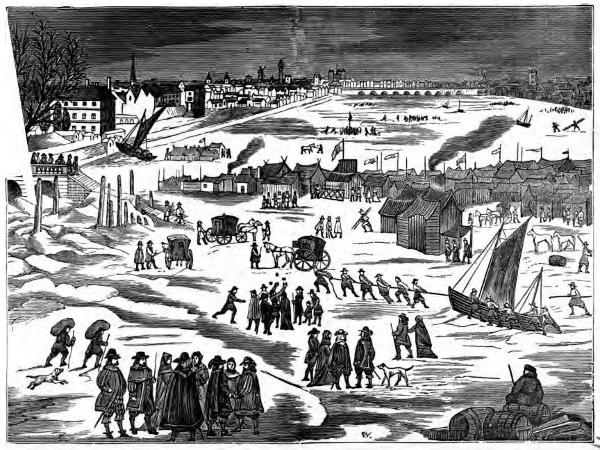
FROST FAIR ON THE THAMES IN THE REIGN OF CHARLES II.
1672
In the December of 1672 occurred in the West of
England, an uncommon kind of shower of freezing
rain, or raining ice. It is recorded that this rain,
as soon as it touched anything above ground, as
a bough or the like, immediately settled into ice;
and by multiplying and enlarging the icicles
broke down with its weight. The rain that fell
on the snow immediately froze into ice, without
sinking in the snow at all. It made an incredible
destruction of trees, beyond anything in all
history. “Had it concluded with some gust of
wind” says a gentleman on the spot, “it might
have been of terrible consequence. I weighed
the sprig of an ash tree, of just three quarters of
a pound, the ice of which weighed sixteen pounds.
Some were frighted with the noise of the air till
they discerned it was the clatter of icy boughs
dashed against each other.” Dr. Beale says, that
there was no considerable frost observed on the
ground during the whole time; whence he concludes
that a frost may be very intense and dangerous on
the tops of some hills and plains; while in other
places, it keeps at two, three or four feet distance
above the ground, rivers, lakes, &c. The frost
was followed by a forwardness of flowers and
fruits.
The foregoing appears to have escaped the
notice of the compiler of an interesting and informing
little book entitled “Odd Showers.”
London, 1870.
1683-84
From the beginning of December until the 5th
of February, to use the words of Maitland, frost
“congealed the river Thames to that degree, that
another city, as it were, was erected thereon;
where, by the great number of streets and shops,
with their rich furniture, it represented a great
fair, with a variety of carriages, and diversions of
all sorts; and near Whitehall a whole ox was
roasted on the ice.” Evelyn gives perhaps the
best account of this’ great frost. Writing in his
“Diary” under date of January 24th, 1684, he
observes, “the frost continuing more and more
severe, the Thames before London, was still
planted with boothes in formal streetes, all sorts
of trades and shops furnish’d and full of commodities,
even to a printing presse, where the
people and ladyes tooke a fancy to have their
names printed, and the day and yeare set down
when printed on the Thames: this humour tooke
so universally, that ’twas estimated the printer
gain’d £5 a day, for printing a line onely, at sixpence
a name, besides what he got by ballads,
etc. Coaches plied from Westminster to the
Temple, and from several other staires, to and
fro, as in the streetes, sleds, sliding with skeetes,
a bull-baiting, horse and coach races, puppet-plays,
and interludes, cookes, tipling, and other
lewd places, so that it seem’d to be a bacchanalian
triumph, or carnival on the water.” Evelyn
tells how the traffic and festivity were continued
until February the 5th, when he states
that “it began to thaw, but froze again. My
coach crossed from Lambeth to the horse-ferry,
at Milbank, Westminster. The boothes were
almost all taken downe, but there was just a map,
or landskip, cut in copper, representing all the
manner of the camp, and the several actions,
sports, pastimes, thereon, in memory of so signal
a frost.”
King Charles visited the sports on the Thames,
in company with members of his family and of
the royal household. They had their names
printed on a quarto sheet of Dutch paper,
measuring three and a half inches by four. The
following is a copy of the interesting document:—
| Charles, |
King. |
| James, |
Duke. |
| Katherine, |
Queen. |
| Mary, |
Dutchess. |
| Ann, |
Princesse. |
| George, |
Prince. |
| Hans in Kelder. |
London: Printed by G. Croom, on the ICE, on
the River Thames, January 31, 1684.
In the foregoing list of names we have Charles
the Second; his brother James, Duke of York,
afterwards James the Second; Queen Catherine,
Infanta of Portugal; Mary D’Este, sister of
Francis, Duke of Modena, James’s second duchess;
the Princess Anne, second daughter of the Duke
of York, afterwards Queen Anne; and her
husband Prince George of Denmark. It has been
suggested that the last name displays a touch of
the King’s humour, and signifies “Jack in the
Cellar,” alluding to the pregnant situation of
Anne of Denmark.
In some quaint lines, entitled “Thamasis’s
Advice to the Painter, from her frigid zone, etc.”
“printed by G. Croom, on the river of Thames,”
occurs:
“To the print-house go,
Where Men the art of Printing soon do know,
Where for a Teaster, you may have your name
Printed, hereafter for to show the same:
And sure, in former Ages, ne’er was found
A Press to print, where men so oft were droun’d!”
Landskip, mentioned by Evelyn, is entitled “An
exact and lively Mapp or Representation of
Boothes, and all the Varieties of Showes and
Humours upon the Ice, on the River of Thames
by London, during that memorable Frost, 35th
yeare of the Reign of his Sacred Majesty King
Charles the Second. Anno Dni MDCLXXXIII.
With an Alphabetical Explanation of the most
remarkable figures.” It consists of a whole-sheet
copper-plate engraving, the view extending from
the Temple-stairs and Bankside to London-bridge.
In an oval cartouche at the top within the frame
of the print, is the title; and below the frame are
the alphabetical references, with the words
“Printed and sold by William Warter, Stationer,
at the signe of the Talbott, under the Mitre
Tavern in Fleete street, London.” In the foreground
of this representation of Frost Fair appear
extensive circles of spectators surrounding a bull-baiting,
and the rapid revolution of a whirling-chair
or car, drawn by several men, by a long rope
fastened to a stake fixed in the ice. Large boats,
covered with tilts, capable of containing a considerable
number of passengers, and decorated
with flags and streamers, are represented as being
used for sledges, some being drawn by horses, and
others by watermen, lacking their usual employment.
Another sort of boat was mounted on
wheels; and one vessel, called “the drum boat,”
was distinguished by a drummer placed at the
prow. The pastimes of throwing at a cock,
sliding and skating, roasting an ox, football,
skittles, pigeon-holes, cups and balls, &c., are
represented as being carried on in various parts
of the river; whilst a sliding-hutch, propelled by a
stick; a chariot, moved by a screw; and stately
coaches filled with visitors, appear to be rapidly
moving in various directions, and sledges with
coals and wood are passing between London and
Southwark shores. An impression of this plate
will be found in the Royal Collection of Topographical
Prints and Drawings, given by George
the Fourth to the British Museum, vol. xxvii.,
art. 39. There is also a variation of the same
engraving in the City Library at Guildhall, divided
with common ink into compartments, as if intended
to be used as cards, and numbered in the
margin, in type with Roman numerals, in sets of
ten each, with two extra.
This famous frost gave rise to many pictures
and poems. In the British Museum is a broadside
as follows:
“A True Description of Blanket Fair upon
the River Thames, in the time of the
Great Frost in the Year of our Lord,
1683.”
How am I fill’d with wonder for to see
A flooding river now a road to be,
Where ships and barges used to frequent,
Now may you see a booth of fudling tent;
And those that us’d to ask where shall I land ye,
Now cry, what lack ye, sir, beer, ale, or brandy?
Here, here, walk in, and you shall surely find
Your entertainment good, my usage kind.
Booths they increased dayly, more and more,
People by thousands flocking from the shore;
And in such heaps they thither did repair,
As if they had been hasting to a fair.
And such a fair I never yet came near,
Where shop-rents were so cheap, and goods so dear.
Then might you have all kind of earthenware,
You can scarce name a thing but what was there.
There was to sell both French and Spanish wine,
And yet, perhaps, a dishclout for a signe;
In short, the like was never seen before,
Where coaches run as if upon the shore;
And men on horseback to and fro did ride,
Not minding either current, or the tide:
It was exceeding strange at first to see,
Both men and women so advent’rous be;
And yet at last it grew so very common,
’Twas not admir’d, it seemed strange to no man.
Then from the Temple there was built a street,
Made old and young, and all admire that see’t;
Which street to Southwark reached. There might you see
Wonders! if you did love variety,
There was roast beef, and gamon to be sold,
But at so dear a rate, I dare be bold
To say, ’twas never sold so on the shore,
Nor on the Thames, in haste, be any more.
There were Dutch whimsies turning swiftly round,
By which the owners cleared many a pound;
And coles and corn was there in sledges draw’d,
As if the Thames would never have been thaw’d.
All kinds of trades did to this market come,
Hoping to get more profit than at home:
And some whose purses were a little swel’d,
Would not have car’d how long the frost had held.
In several places there was nine-pins plaid,
And pidgeon holes for to beget a trade.
Dancing and fidling too there was great store,
As if they had not been from off the shore;
The art of printing there was to be seen,
Which in no former age had ever been;
And goldsmiths’ shops were furnished with plate,
But they must dearly pay for’t that would hav’t.
And coffee-houses in great numbers were,
Scattered about in this cold freezing fair,
There might you sit down by a char-cole fire,
And for your money have your heart’s desire,
A dish of coffee, chocalet or tea,
Could man desire more furnished to be?
No, no, if you the world should wander through,
No fair like this could pleasant seem to you.
There was the baiting of the ugly bear,
Which sport to see hundreds did repair,
And I believe since the world’s first creation,
The like was never seen in this our nation:
And football playing there was day by day,
Some broke their legs, and some their arms they say:
All striving to get credit, but some paid
Most dearly for it, I am half afraid.
Bull-baiting likewise there was known to be,
Which on the Thames before none ever see,
And never was poor dogs more bravely tost
Then they were, in this prodigious frost;
Th’ inraged bull perceiv’d his enemies,
And how to guard himself could not devise,
But with his horns did toss them too and fro,
As if their angry meaning he did know;
Besides all this a thing more strange and rare
Than all the things were seen in Freezland fair,
An ox was roasted whole, which thousands saw,
For ’twas not many dayes before the thaw;
The like by no man in this present age
Was ever seen upon this icy stage.
And this hard frost it did so long endure,
It pinch’d, and almost famish’d many poor.
But one thing more I needs to you must tell
The truth of which thousands do know full well,
There was fox-hunting on this frozen river
Which may a memorandum be for ever.
For I do think since Adam drew his breath
No Fox was hunted on the ice to death.
Thus have you heard what wonders there were seen,
How heaven and earth the people walk’d between.
And since the world at first had its creation,
The like was never seen in this our nation.
Yet was it hard and grievous to the poor,
Who many hungry bellies did endure.
Sad spectacles enough you might behold
Who felt th’ effect of this prodigious cold;
But God who is most righteous, good, and just,
Will them preserve who in him put their trust;
And when their dangers greatest seem to be,
Blest be his name, he then doth sit them free.
Then let us all, while we have time and breath,
Be still prepar’d to meet with pale-fac’d death.
That when he comes we need not be afraid,
Nor at his dart be frighted or dismaid;
If we on Jesus Christ wholly depend,
He’l prove to us an everlasting friend.
London: Printed by H. Brugis, in Green Arbor, Little Old
Bayly. 1684.
The following is a copy of a broadside preserved
in the British Museum:—
GREAT BRITAIN’S WONDER: OR, LONDON’S
ADMIRATION.
Being a true Representation of a prodigious Frost, which
began about the beginning of December, 1683, and continued
till the fourth day of February following, and held on with
such violence, that men and beasts, coaches and carts, went
as frequently thereon, as boats were wont to pass before.
There was also a street of booths built from the Temple to
Southwark, where were sold all sorts of goods imaginable,
namely, cloaths, plate, earthenware, meat, drink, brandy,
tobacco, and a hundred sorts of other commodities not here
inserted: it being the wonder of this present age, and a
great consternation to all the spectators.
Behold the wonder of this present age,
A famous river now become a stage.
Question not what I now declare to you,
The Thames is now both fair and market too;
And many thousands dayly do resort,
There to behold the pastime and the sport,
Early and late, used by young and old,
Who valu’d not the fierceness of the cold;
And did not think of that Almighty hand
Who made the waters bare, like to the land.
Thousands and thousands to the river flocks,
Where mighty flakes of ice do lye like rocks.
There may you see the coaches swiftly run,
As if beneath the ice were waters none;
And sholes of people every where there be,
Just like to herrings in the brackish sea;
And there the quaking water-men will stand ye,
Kind master, drink you beer, or ale, or brandy?
Walk in, kind sir, this booth it is the chief,
We’l entertain you with a slice of beef,
And what you please to eat or drink, ’tis here,
No booth, like mine, affords such dainty cheer.
Another crys, Here master, they but scoff ye,
Here is a dish of famous new made coffee.
And some do say a giddy senseless ass
May on the Thames be furnished with a lass;
But, to be short, such wonders there are seen,
That in this age before hath never been.
Before the Temple there a street is made,
And there is one almost of every trade:
There may you also this hard frosty winter,
See on the rocky ice a working printer,
Who hopes by his own heart to reap some gain,
Which he perchance does think he may obtain.
Here is also a lottery, and musick too,
Yea, a cheating, drunken, leud, and debauch’d crew.
Hot codlins, pancakes, duck, goose and sack,
Rabit, capon, hen, turkey, and a wooden jack.
In this same street before the Temple made,
There seems to be a brisk and lively trade:
Where ev’ry booth hath such a cunning sign,
As seldome hath been seen in former time;
[1]
And there, if you have money for to spend,
Each cunning snap will seem to be your friend.
There may you see small vessels under sail,
All’s one to them, with or against the gale,
And as they pass they little guns do fire,
Which feedeth some, and puffs them with desire
To sail therein, and when their money’s gone,
’Tis right, they cry, the Thames to come upon.
There on a sign you may most plainly see’t,
Here’s the first tavern built in Freezeland-street:
There is bull-baiting and bear-baiting too,
That no man living yet e’re found so true;
And foot-ball play is there so common grown,
That on the Thames before was never known;
Coals being dear, are carry’d on men’s backs,
And some on sledges these are drawn in sacks;
Men do on horse-back ride from shore to shore,
Which formerly in boats were wafted o’re:
Poor people hard shifts make for livelihoods,
And happy are if they can sell their goods;
What you can buy for three-pence on the shore,
Will cost you four-pence on the Thames or more.
Now let me come to things more strange, yet true,
And question not what I declare to you;
There rosted was a great and well-fed oxe,
And there, with dogs, hunted the cunning fox;
Dancing o’th’ ropes, and puppit plays likewise,
The like before ne’er seen beneath the skies;
All stand admir’d, and very well they may,
To see such pastimes, and such sort of play.
Besides the things I nam’d to you before,
There other toys and baubles are great store;
There you may feast your wandring eyes enough,
There you may buy a box to hold your snuff.
No fair no market underneath the skies
That can afford you more varieties;
There you may see some hundreds slide in skeets,
And beaten paths like to the city streets.
There were Dutch whimsies turned swiftly round
Faster then horses run on level ground.
The like to this I now to you do tell
No former age could ever parallel;
There’s all that can supply most curious minds,
With such varieties of cunning signs
That I do think no man doth understand;
Such merry fancies ne’r were on the land;
There is such whimsies on the frozen ice,
Make some believe the Thames a Paridice.
And though these sights be to our admiration
Yet our sins, our sins, do call for lamentation.
Though such unusual frosts to us are strange,
Perhaps it may predict some greater change;
And some do fear may a fore-runner be
Of an approaching sad mortality:
But why should we to such belief incline?
There’s none that knows but the blest Pow’r divine
And whatsoe’re is from Jehovah sent,
Poor sinners ought therewith to be content;
If dreadfull, then to fall upon the knee,
And beg remission of the Deity;
But if beyond our thoughts he sends us store,
With all our hearts let’s thankful be therefore.
Now let us all in great Jehovah trust
Who doth preserve the righteous and the just;
And eke conclude sin is the cause of all
The heavy judgments that on us do fall:
And call to mind, fond man, thy time mispent,
Fall on thy knees, and heartily repent;
Then will thy Saviour pity take on thee,
And thou shalt live to all eternity.
Printed by M. Haly and J. Miller, and sold by Robert Waltor, at the
Globe, on the north side of St. Paul’s Church, near that end towards
Ludgate, where you may have all sorts and sizes of maps, coppy-books,
and prints, not only in English, but Italian, French, and Dutch; and by
John Seller, on the west side of the Royal Exchange. 1684.
The foregoing is illustrated with a quaint
wood-cut, roughly executed. It is reproduced in
Mr. Mason Jackson’s “Pictorial Press,” (London,
1885), and by his courtesy we are able to include
it in this work.
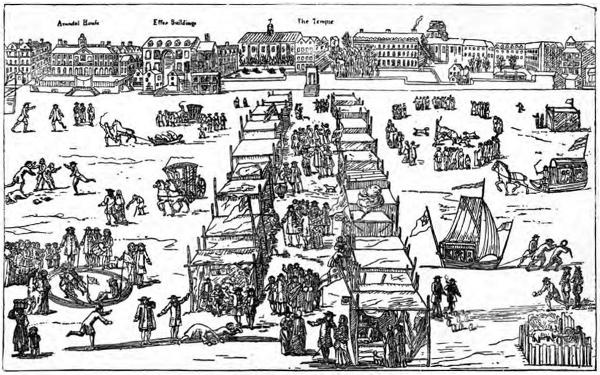
FROST FAIR ON THE THAMES.
Copy of an engraving from a broadside entitled: “Great Britain’s Wonder, London’s Admiration. Being a True Representation
of a prodigious Frost, which began about the beginning of December, 1683 and continued till the fourth day of February
following.” etc.
The following is a copy of a broadside preserved
in the Ashmolean Museum. It was
printed for J. Shad, London, in 1684.
A WINTER WONDER; OR THE THAMES FROZEN
OVER, WITH REMARKS ON THE RESORT THERE.
When Neptune saw a wondrous bridge built o’er
His silver Thames, that reach’d from shore to shore,
He shook his trident and with aweful frown,
Swore ’twas presumption in the haughty town,
Now laughs to see it standing useless o’re,
Whilst ice has made it one continued shore,
Under whose spreading roof he silent glides
And ebbs, and hews, unheard, unseen, his tides.
Greenland, Muscovy, sure their cold have lent,
And all their frigid blasts have hither sent,
Whilst Boreas with his keenest breath has blown,
To make our winter cold as is there own:
That if my inke was not congeal’d as it,
I’de on the subject shew a poet’s wit.
The fish lye closely in their watry bed,
And find an icy ceiling o’re their head.
They fear no anglers that do lye in wait,
Nor are deceived by the alluring bait.
The watermen with folded arms doe stand,
And grieve to see the water firm as land,
Their boats hal’d up, their oars laid useless by,
Nor oars, nor skuller, master, do they cry,
Wishing kind Zephyrus with a warmer gale
Would once more launch their boat and fill their sail;
Or that the sun would with his gentle flames
Again set free their best of friends, the Thames.
The shoars no longer sound with Westward hoe,
Nor need men boats where they can firmly goe.
See how the noble river in a trice
Is turned as it were one spacious street of ice.
And who’ld believe to see revived there,
In January, Bartholomew fair.
Where all the mobile in crowds resort,
As on firm land, to walk, and trade, and sport;
Now booths do stand where boats did lately row,
And on its surface up and down men go,
And Thames becomes a kind of raree-show.
Its upper rooms are let to mortal dweller,
And underneath it is god Neptune’s cellar;
Now Vulcan makes his fires on Neptune’s bed,
And sawcy cooks roast beef upon his head,
As many tuns of ale and brandy flow
Above the ice, as water do below;
And folk do tipple, without fear to sink,
More liquors then the fish beneath do drink.
Here you may see a crowd of people flock,
One’s heels fly up, and down he’s on his dock;
Another steps, ’tis strange but true, no matter,
And in he flounces up to th’ neck in water;
And third more sure his slipp’ry footsteps guides,
And safely o’er the ice away he slides;
Another upon skeats does swiftly pass,
Cutting the ice like diamonds upon glass.
Women, beware you come not here at all,
You are most like to slip and catch a fall,
This you may do, tho’ in your gallant’s hand,
And if you fall, he has no power to stand;
Tis ten to one you tumble in a trice,
For you are apt to fall where there’s no ice,
Oft on your back, but seldome on your face,
How can you stand then on such a slippery place?
Yet you will venture briskly to a booth,
To take a glass or two with youngster Smooth,
Then back again as briskly to the shore,
As wise and honest as you were before.
Here (like the great) on slip’ry place you stand,
They can nor fate, nor you your feet, command.
My muse to scribble further has no maw,
But for your good doe wish a speedy thaw,
And let it ne’r be said ’twixt you and I,
The winter’s cold, but move your charity.
Then let the poor meanwhile your bounty find,
And heav’n to you, as you to them prove kind.
The title of another broadside was the “Wonders
of the Deep,” illustrated with a rude wood-cut, representing
the Frost Fair. This intimated that it
was “an exact Representation of the River Thames,
as it appeared during the memorable Frost, which
began about the middle of December, and ended
on the 28th of February, anno 1683-4.” The lines
under the picture are as follow:—
THE WONDERS OF THE DEEP.
The various sports behold here in this piece,
Which for six weeks were seen upon the ice;
Upon the Thames the great variety
Of plays and booths is here brought to your eye.
Here coaches, as in Cheapside, run on wheels,
Here men (out-tipling of the fishes) reels:
Instead of waves that us’d to beat the shore,
Here bulls they bait, till loudly they do roar;
Here boats do slide, where boats were wont to row,
Where ships did sail, the sailors do them tow;
And passengers in boats the river crost,
For the same price as ’twas before the frost.
There is the printing booth of wonderous fame,
Because that each man there did print his name;
And sure, in former ages, ne’re was found,
A press to print, where men so oft were drown’d.
In blanket booths, that sit at no ground rent,
Much coin in beef and brandy there is spent.
The Dutchmen here in nimble cutting scates,
To please the crowd do shew their tricks and feats;
The rabble here in chariots run around,
Coffee, and tea, and mum, doth here abound,
The tinkers here doth march at sound of kettle,
And all men know that they are men of mettle:
Here roasted was an ox before the court,
Which to much folks afforded meat and sport;
At nine-pins here they play, as in Moorfields,
This place the pass-time us of foot-ball yields:
The common hunt here makes another show,
As he to hunt an hare is wont to go;
But though no woods are here or hares so fleet.
Yet men do often foxes catch and meet;
Into a hole here one by chance doth fall,
At which the watermen began to bawl,
What, will you rob our cellar of its drink?
When he, alas! poor man, no harm did think.
Here men well mounted do on horses ride
Here they do throw at cocks as at Shrovetide;
A chariot here so cunningly was made,
That it did move itself without the aid
Of horse or rope, by virtue of a spring
That Vulcan did contrive, who wrought therein.
The rocks at nine-holes here do flock together
As they are wont to do in summer weather.
Three ha’perth for a penny, here they cry,
Of gingerbread, come, who will of it buy?
This is the booth where men did money take,
For crape and ribbons that they there did make;
But in six hours, this great and rary show
Of booths and pastimes all away did go.
Printed in the year 1684.
1683-4
In the parish register of Holy-rood Church,
Southampton, is the following record of this
winter’s remarkable frost:
“1683-4 This yeare was a great Frost, which
began before Christmasse, soe that yᵉ 3rd and 4th
dayes of this month February yᵉ River of Southampton
was frossen all over and covered with ice
from Calshott Castle to Redbridge and Tho:
Martaine maʳ of a vessell went upon yᵉ ice from
Berry near Marchwood to Milbrook-point. And
yᵉ river at Ichen Ferry was so frossen over that
severall persons went from Beauvois-hill to Bittern
Farme, forwards and backwards.”
The following curious extract is from the Parochial
Register at Ubley, near Wrington: “In the
yeare 1683 was a mighty great frost, the like was
not seene in England for many ages. It came
upon a very deep snow, which fell imediately after
Christmas, and it continued untill a Lady-day.
The ground was not open nor the snow cleane
gone off the earth in thirteene weeks. Somm of
the snow remained at mindipe till midsummer. It
was soe deepe and driven with the winde a gainst
the hedges and stiles, that the next morning after
it fell men could not goe to their grounds to serve
their cattell without great danger of being buried,
for it was above head and shoulders in many places—sum
it did burie—did betooken the burieing of
many more which came to pass before the end of
the yeare; but in few days the frost came soe
fearce, that people did goe upon the top of it over
wals and stiles as on levell ground, not seeing
hardly where they was, and many men was forced
to keep their cattell untill the last, in the same
ground that they was in at first, because they
could not drive them to any other place, and did
hew the ice every day for water, by reason of the
sharpness of the frost and the deepness of the
snow. Som that was travelling on mindipe did
travell till they could travell no longer, and then
lye down and dye, but mortality did prevaill most
among them that could travell worst, the sharpness
of the season tooke off the most parte of them that
was aged and of them that was under infermities,
the people did die so fast, that it was the greatest
parte of their work (which was appointed to doe
that worke) to burie the dead; it being a day’s
work for two men, or two days’ work for one man,
to make a grave. It was almost as hard a work
to hew a grave out, in the earth, as in the rock,
the frost was a foot and halfe and two foot deepe
in the dry earth, and where there was moister and
watter did runn, the ice was a yard and fower foot
thick, in soe much that ye people did keepe
market on the River at London; ‘God doth
scatter his ice like morsels, man cannot abide his
cold.’—Psalme, 147, 17.”
The following are particulars of the chief publications
issued in connection with this frost:—
A large copper-plate, entitled “A Map of the River
Thames, merrily call’d Blanket Fair, as it was
frozen in the memorable year 1683-4, describing
the booths, footpaths, coaches, sledges, bull-baiting,
and other remarks upon that famous
river.” Dedicated to Sir Henry Hulse, Knt., and
Lord Mayor, by James Moxon, the engraver.
“A wonderfull Fair, or a Fair of Wonders; being
new and true illustration and description of the
several things acted and done on the river of
Thames in the time of the terrible frost, which
began about the beginning of Dec., 1683, and continued
till Feb. 4, and held on with such violence,
that men and beasts, coaches and sledges, went
common thereon. There was also a street of
booths from the Temple to Southwark, where was
sold all sorts of goods; likewise bull-baiting and
an ox roasted whole, and many other things, as
the map and description do plainly show.”
Engraved and printed on a sheet, 1684.
A small copper-plate representation of Frost Fair,
with the figure of Erra Pater in the foreground.
At the top, are the words, “Erra Pater’s Prophesy,
or Frost Faire in 1683,” and underneath, the
following lines:
“Old Erra Pater, or his rambling ghost,
Prognosticating of this long strong frost,
Some ages past, said yᵗ yᵉ ice-bound Thames,
Shou’d prove a theatre for sports and games;
Her watry green be turn’d into a bare,
For men a citty seem, for booths a faire;
And now the straggling sprite is once more come
To visit mortalls and foretel their doom.
When maids grow modest, yᵉ dissenting crew
Become all loyal, the falsehearted true,
Then you may probably, and not till then,
Expect in England such a frost again.”
Printed for James Norris, at the King’s Armes, without Temple
Barr.
1688-89
Timbs, in his “Curiosities of London,” records a
great frost, lasting from 20th December to 6th
February. Pools were frozen eighteen inches
thick, and the Thames ice was covered with streets
of shops, bull-baiting, shows and tricks; hackney
coaches plied on the ice-roads, and a coach with
six horses was driven from Whitehall almost to
London Bridge; yet in two days all the ice
disappeared.
1709
The Thames frozen over, and some persons crossed
it on the ice. In the Crowle Pennant is a coarse
bill, within a wood-cut border of rural subjects,
bearing the inscription, “Mr. John Heaton,
printed on the Thames at Westminster, January
7th, 1709.” The frost lasted three months. It is
somewhat remarkable to find that there was very
little frost this year in Scotland and Ireland.
1715-16
Thames again frozen over. At the time of this
frost an advertisement appeared as follows: “This
is to give notice to gentlemen and others that pass
upon the Thames during this frost, that over
against Whitehall-stairs they may have their
names printed, fit to paste in any book, to hand
down the memory of the season to future ages.
You that walk there, and do desyn to tell
Your children’s children what this year befell,
Go print your names, and take a dram within;
For such a year as this, has seldom been.”
The following account of this frost is drawn
from Dawks’s News-Letter of January 14th, 1716:
“The Thames seems now a solid rock of ice; and
booths for the sale of brandy, wine, ale, and other
exhilarating liquors, have been for some time fixed
thereon; but now it is in a manner like a town:
thousands of people cross it, and with wonder
view the mountainous heaps of water, that now
lie congealed into ice. On Thursday, a great
cook’s-shop was erected, and gentlemen went as
frequently to dine there, as at any ordinary.”
“Over against Westminster, Whitehall, and
Whitefriars, Printing-presses are kept upon the
ice, where many persons have their names printed,
to transmit the wonders of the season to posterity.”
It is further recorded of the Thames that
“coaches, waggons, carts, &c., were driven
on it, and an enthusiastic preacher held forth
to a motley congregation on the mighty
waters, with a zeal fiery enough to have thawed
himself through the ice, had it been susceptible to
religious warmth. This, with other pastimes and
diversions, attracted the attention of many of the
nobility, and even brought the Prince of Wales,
to visit Frost Fair. On that day, there was an
uncommonly high spring-tide, which overflowed
the cellars on the banks of the river, and raised
the ice full fourteen feet, without interrupting the
people from their pursuits. The Protestant Packet
of this period, observes that the theatres were
almost deserted. The News-letter of February 15,
announces the dissolution of the ice, and with it
the ‘baseless fabric’ on which Momus had held
his temporary reign; the above paper then proclaims
the good fare, and various articles to be
seen, and purchased.”
“Thou beauteous River Thames, whose standing tide
Equals the glory of thy flowing pride,
The city, nay the world’s transferr’d to thee
Fin’d as the land, and richer than the sea.
The various metals, Nature can produce,
Or Art improve, for ornament or use,
From the Earth’s deepest bowels brought are made
To shine in thee, and carry on thy trade.
Here Guilledum, fam’d for making silver pass
Through various forms; and Sparks as fam’d for brass,
There’s T⸺ ’tween God and gold who ne’er stood neater,
And trusty Nicholson, who lives by pewter,
Wrote o’er their doors, having affix’d their names,
We under-writ, remov’d are to the Thames.
There miles together for the common good
The Slippery Substance offers dainty food.
Here healing Port-wine, and there Rhenish flows,
Here Bohea Tea, and there Tobacco grows.
In one place you may meet good Cheshire cheese,
Another proffers, whitest Brentford peas:
Here is King George’s picture, there Queen Anne’s,
Now nut-brown ale in cups, and then in canns:
One sells an Oxford dram as good as can be,
Another offers General Peper’s brandy.
See! there’s the Mall, and in that little hut
The best Geneva’s sold, and live to boot,
See there, a sleek Venetian Envoy walks;
See here, an Alderman more proudly stalks.
Behold the French Ambassador, that’s he;
And this the honest Sire, and Captain Leigh.
Here is St. James’s street, yonder the Strand:
In this place Bowyer plies; that’s Lintot’s stand.”
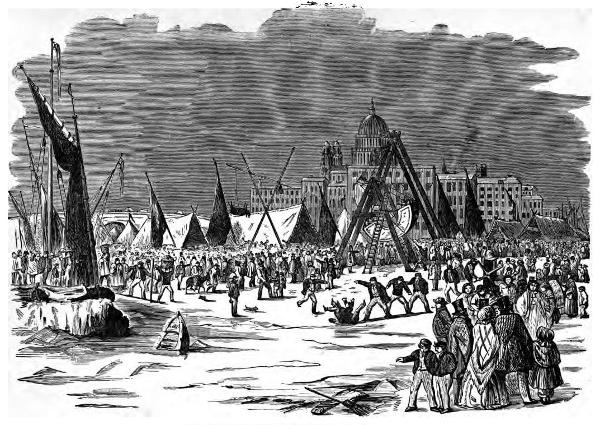
The chief illustrations of this frost are as
follows:—
A copper plate representing London Bridge on
the right hand, and a line of tents on the left,
leading from Temple Stairs. In front, another
line of tents, marked “Thames Street,” and the
various sports, &c., before them: below the print
are alphabetical references, with the words
“Printed on the Thames, 1715-16;” and above
it, “Frost Fair on the River Thames.”
A copper-plate of much larger dimensions,
representing London at St. Paul’s, with the tents,
&c., and with alphabetical references; “Printed
and sold by John Bowles, at the Black Horse, in
Cornhill.” In the right-hand corner above, the
arms and supporters of the City; and on the left
a cartouche, with the words “Frost Fayre, being
a True Prospect of the Great Varietie of Shops
and Booths for Tradesmen, with other Curiosities
and Humors, on the Frozen River of Thames, as
it appeared before the City of London, in that
memorable Frost in yᵉ year of the Reigne of Our
Sovereigne Lord King George, Anno Domini
1716.”
“An exact and lively View of the Booths, and
all the variety of Shows, &c., on the ice, with an
alphabetical explanation of the most remarkable
figures, 1716.” A copper-plate.
“Frost Fair; or a View of the Booths on the
Frozen Thames in the 2nd year of King George,
1716.” A wood-cut.
1739
The following is a list of the most important memorials
of this famous frost fair:—
A copper-plate, representing a view of the
Thames at Westminster, with the tents, sports,
&c., and alphabetical references, entitled “Ice
Fair.” Printed on yᵉ River Thames, now frozen
over. Jan. 31, 1739-40.
“Amidst yᵉ arts yᵗ on yᵉ Thames appear,
To tell yᵉ wonders of this frozen year.
Sculpture claims prior place, since yᵗ alone,
Preserves yᵉ image when yᵉ prospect’s gone.”
A coarse copper-plate, entitled “The view of
Frost Fair,”—scene taken from York-buildings
Water Works; twelve verses beneath.
A small copper-plate, representing an altar-piece
with ten commandments, engraven between
the figures of Moses and Aaron; and beneath, on
a cartouche, “Printed on the Ice, on the River
of Thames, Janʳʸ 15, 1739.”
A small copper-plate, representing an ornamental
border with a female head, crowned at the top; and
below two designs of the letter press and rolling
press. In the centre, in type, “Upon the Frost in
the year 1739-40,” six verses, and then, “Mr. John
Cross, aged 6. Printed on the ice upon the Thames,
at Queen-Hithe, January the 29th, 1739-40.”
“Behold the liquid Thames now frozen o’er,
That lately ships of mighty burden bore;
Here you may print your name, tho’ cannot write,
’Cause numb’d with cold; ’tis done with great delight.
And lay it by, that ages yet to come,
May see what things upon the ice were done.”
A coarse copper-plate engraving, looking down
the river, entitled “Frost Fair,” with eight lines
of verse beneath, and above, “Printed upon the
River Thames when frozen, Janu. the 28, 1739-40.”
“An Extract Draught of Frost Fair on the
River Thames, as it appears from Whitehall Stairs,
in the year 1740,” with twelve lines of verse underneath.
“Printed and sold by Geoᵉ Foster, Printseller,
in St. Paul’s Church-yard, London.”
“The English Chronicle, or Frosty Kalender;
a broadside containing a memorial of the principal
frosts, with a view of the fair from the Southwark
side of the river, opposite St. Paul’s.
Printed on the Thames, 1739-40.”
1739-40
The winter of 1739-40 was one of great severity.
The frost commenced on Christmas-day, and
lasted until the 17th February following. It
caused much distress amongst the poor, coals
could hardly be obtained for money, and water
was equally scarce. It is recorded that “the
watermen and fishermen, with a peterboat in
mourning, and the carpenters, bricklayers, &c.,
with their tools and utensils in mourning, walked
through the streets in large bodies, imploring
relief for their own and families’ necessities; and,
to the honour of the British character, this was
liberally bestowed. Subscriptions were also
made in the different parishes, and great benefactions
bestowed by the opulent, through which
the calamities of the season were much mitigated.
A few days after the frost had set in, great damage
was done among the shipping in the river Thames
by a high wind, which broke many vessels from
their moorings, and drove them foul of each other,
while the large sheets of ice that floated on the
stream, overwhelmed various boats and lighters,
and sunk several corn and coal vessels. By these
accidents many lives were lost; and many others
were also destroyed by the intensity of the cold,
both on land and water.
Above the Bridge, the Thames was completely
frozen over, and tents and numerous booths were
erected on it for selling liquors, &c., to the multitudes
that daily flocked thither for curiosity or
diversion. The scene here displayed was very
irregular, and had more the appearance of a fair
on land, than of a frail exhibition, the only basis
of which was congealed water.”
Sports were enjoyed on the ice, and shops
opened for the sale of fancy articles, food and
drink. A printing press was in active operation,
and amongst the papers printed was the following:
The noble Art and mystery of Printing, was
first invented by J. Faust, 1441, and publicly
practised by John Gottenburgh, a soldier of
Mentz, in High Germany, anno. 1450. King
Henry VI. (anno. 1457) sent two private messengers
with fifteen hundred marks, to procure
one of the workmen. These prevailed on
Frederick Corsellis to leave the Printing-house in
disguise; who immediately came over with them,
and first instructed the English in this most
famous Art, at Oxford, in the year 1459.
WILLIAM NOBLE, M.A.
Amidst the Arts which on the Thames appear
To tell the wonders of this icy year,
Printing claims prior place, which at one view
Erects a monument of That and You.
Printed upon the river Thames, Jan. 29th, in the thirteenth year of the
reign of King George the IId. Anno Dom. 1740.
“Some venturers in the Strand,” says Timbs,
“bought a large ox in Smithfield, to be roasted
whole on the ice; and one, Hodgeson, claimed the
privilege of felling or knocking down the beast as
a right inherent in his family, his father having
knocked down the one roasted on the river in the
Great Frost, 1684, near Hungerford Stairs:
Hodgeson to wear a laced cambric apron, a silver-handled
steel, and a hat and feathers.”
At the thaw a number of persons fell victims to
their rashness, amongst those who lost their lives
may be mentioned Doll, the noted pippin woman.
Gay, in his “Trivia,” book ii, thus alludes to her
death:—
“Doll every day had walk’d these treacherous roads;
Her neck grew warp’d beneath autumnal loads
Of various fruit; she now a basket bore;
That head, alas! shall basket bear no more.
Each booth she frequent past, in quest of gain;
And boys with pleasure heard her thrilling strain.
Ah, Doll! all mortals must resign their breath,
And industry itself submit to death!
The cracking crystal yields: she sinks, she dies,—
Her head chopt from her lost shoulders, flies;
Pippins, she cried, but death her voice confounds,
And pip, pip, pip, along the ice resounds.”
Many of the houses which, at this period, stood
on London Bridge, as well as the bridge itself,
sustained considerable damage.
Thomas Gent, the celebrated printer and
historian, in his Life, relates how he set up a
printing press on the river Ouse at York during
this frost. “In January, 1739,” [1740 n.s.] he
says, “the frost having been extremely intense,
the river became so frozen, that I printed names
upon the ice. It was a dangerous spot on the
south side of the bridge, where I first set up, as it
were, a kind of press—only a roller wrapped about
with blankets. Whilst reading the verses I had
made to follow the names—wherein King George
was most loyally inserted—some soldiers round
about made great acclamation, with other good
people; but the ice suddenly cracking, they
almost as quickly ran away, whilst I, who did not
hear well, neither guessed the meaning, fell to
work, and wondered at them as much for retiring
so precipitately as they did at me for staying; but,
taking courage, they shortly returned back, brought
company, and I took some pence amongst them.
After this I moved my shop to and fro, to the
great satisfaction of young gentlemen and ladies,
and others, who were very liberal on the occasion.”
It will not, we think, be without interest to reproduce
particulars of a palace which was built
solely of ice at this period. “In the year 1740,
the Empress Anne of Russia, caused a palace of
ice to be erected upon the banks of the Neva. This
extraordinary edifice was fifty-two feet in length,
sixteen in breadth, and twenty feet high, and constructed
of large pieces of ice cut in the manner
of freestone. The walls were three feet thick.
The several apartments were furnished with
tables, chairs, beds, and all kinds of household
furniture of ice. In front of this edifice, besides
pyramids and statues, stood six cannon, carrying
balls of six pounds weight, and two mortars,
entirely made of ice. As a trial from one of the
former, a cannon ball, with only a quarter of a
pound of powder, was fired off, the ball of which
went through a two-inch board, at sixty paces
from the mouth of the piece, which remained
completely uninjured by the explosion. The
illumination of this palace at night was astonishingly
grand.”
1741
“All frost or rain from 15th September to 1st
February.”
1742
A severe frost for some weeks. It is recorded in the
Gentleman’s Magazine, 18 December, 1742: “The
frost having continued near three weeks, the
streets in some parts of the city, though there had
been no snow, were rendered very incommodious,
and several accidents happened.”
1754
A very severe frost this year, especially at Bath and
in the south-west of England.
1763
The frost lasted ninety-four days. According to the
Gentleman’s Magazine it set in on Saturday, 25th
December, 1762. It is thus described: “A most
intense frost with easterly wind, which has since continued,
with very little intermission, until the end
of January. Some experiments have been tried
during the course of it, which prove that on some
days it was no less severe than that of 1740, though
upon the whole it has not been attended with the
same calamitous circumstances. On Friday, 31st
December, a glass of water placed upon the table
in the open air, in six minutes froze so hard as to
bear 5 shillings upon it; a glass of red port wine
placed upon the same table froze in two hours;
and a glass of brandy in six, both with hard ice.”
It is mentioned that in Cornwall, Wales, and Ireland,
this frost was felt but slightly.
1767-68
Both these years opened with severe frosts, which
caused provisions to increase greatly in price.
Navigation on the Thames was suspended, and
great damage done to the small craft by the ice.
It is chronicled that “many persons perished by
the severity of the weather, both on the water and
on the shore. During the latter frost, the price
of butchers’ meat grew so exorbitant that the Hon.
Thomas Harley, Lord Mayor, proposed that
bounties should be given for bringing fish to
Billingsgate market; and this plan having been
carried into effect, the distresses of the poor were
greatly alleviated, by the cheap rates at which
the markets were supplied.”
We read in White’s “Selborne,” under date of
January, 1768: “We have had very severe frost
and deep snow this month; my thermometer was
one day 14½ degrees below freezing point, within
doors. The tender evergreens were injured pretty
much. It was very providential that the air was
still, and the ground well covered with snow, else
vegetation in general must have suffered prodigiously.
There is reason to believe that some days
were more severe than any since the year 1739-40.”
The frost this year was very severe in Scotland.
1776
The following “Icy Epitaph” is said to be from the
graveyard of Bampton, Devonshire:—
In memory of the Clerk’s son,
Bless my i, i, i, i, i, i,
Here I lies
In a sad pickle
Killed by an icicle,
In the year of Anno Domini 1776.
1782
The Plymouth correspondent of the Gentleman’s
Magazine wrote under date of 16th February, 1782:
“The most intense frost ever known … The
grass, which on Friday was as green and
flourishing as if it had been midsummer, on
Sunday morning seemed to be entirely killed.
This is mentioned by our correspondent as very
unusual in that part of the country; and the snow
lay on the ground in many places.”
1783-84
The frost lasted eighty-nine days. It commenced
in December, continued through January and
February, and in March there was snow, and cold
cutting winds. We gather from the Gentleman’s
Magazine that it was general. In the February
number it is reported: “From different parts of
the country we have accounts of more persons
having been found dead in the roads, and others
dug out of the snow, than ever was known in any
one year in the memory of man.” On January
6th, “Thames not quite frozen over, but navigation
stopped by ice.” The frost from the 10th to
20th February was extremely severe. The Thames
frozen and traffic crossed in several places.
On the fifth bell of Tadcaster peal is recorded:
“It is remarkable that these bells were moulded
in the great frost, 1783. C. and R. Dalton,
Fownders, York.”
1784
In the Gentleman’s Magazine for February the following
appears: “From 10th December, 1783, to this
day it has been 63 days’ frost; of these it snowed
nineteen, and twelve days’ thaw, whereof it rained
nine. Had the frost continued at 13 degrees as
on the 31st December during the night, it would
have frozen over the Thames in twenty-four
hours.”
1788-89
On the 25th November, 1788, a frost set in which
lasted seven weeks. It is recorded that the thermometer
stood at eleven degrees below
freezing point in the very midst of the city. The
Thames was frozen below London Bridge, and
the ice on the river assumed all the appearance of
a frost fair. A variety of amusements were provided
for the visitors, including puppet-shows
and the exhibition of wild beasts. In the Gentleman’s
Magazine for 1789 the following diary of
remarkable events which transpired during this
frost, is given:—
“Saturday, January 10, 1789—Thirteen men
brought a waggon with a ton of coals from Loughborough
in Leicestershire, to Carlton House, as a
present to His Royal Highness the Prince of
Wales. As soon as they were emptied into the
cellars, Mr. Weltjie, clerk of the cellars, gave
them four guineas, and as soon as the Prince was
informed of it, his Highness sent them twenty
guineas, and ordered them a pot of beer each
man. They performed their journey, which is 111
miles, in 11 days, and drew it all the way without
any relief.
Monday 12.—A young bear was baited on the
ice, opposite to Redriff, which drew multitudes
together, and fortunately no accident happened
to interrupt their sport.
Tuesday 13.—The Prince of Wales transmitted
£1000 to the Chamberlain for the benefit of the
poor, during the severe frost.
Saturday 17.—The captain of a vessel lying off
Rotherhithe, the better to secure the ship’s cables,
made an agreement with a publican for fastening
a cable to his premises; in consequence, a small
anchor was carried on shore and deposited in the
cellar, while another cable was fastened round
a beam in another part of the house. In the
night the ship veered about, and the cables
holding fast, carried away the beam and levelled
the house with the ground; by which accident
five persons asleep in their beds were killed.”
In the Common Place Notes for February, 1789,
is the following:—“With the new year, new
entertainments commenced, or more properly
speaking, old sports were revived in the neighbourhood
of London. The river Thames, which
at this season usually exhibits a dreary scene of
languor and indolence, was this year the stage on
which there were all kinds of diversions, bear-baiting,
festivals, pigs and sheep roasted, booths,
turnabouts, and all the various amusements of
Bartholomew fair multiplied and improved; from
Putney-bridge in Middlesex, down to Redriff, was
one continued scene of merriment and jollity;
not a gloomy face to be seen, nor a countenance
expressive of want; but all cheerfulness, originating
apparently from business and bustle. From
this description the reader is not, however, to
conclude that all was as it seemed. The miserable
inhabitants that dwelt in houses on both sides the
river during these thoughtless exhibitions, were
many of them experiencing extreme misery;
destitute of employment, though industrious, they
were with families of helpless children, for want
of employment, pining for want of bread; and
though in no country in the world the rich are
more benevolent than in England, yet their benefactions
could bear no proportion to the wants of
numerous poor, who could not all partake of
the common bounty. It may, however, be
truly said, that in no great city or country on the
continent of Europe, the poor suffered less from
the rigour of the season, than the inhabitants of
Great Britain and London. Yet even in London,
the distresses of the poor were very great;
and though liberal subscriptions were raised for
their relief, many perished through want and cold.
On this occasion, the City of London subscribed
fifteen hundred pounds towards supporting those
persons who were not in the habit of receiving
alms.”
We cull from the Public Advertiser of January
15th, 1789, the following piece of drollery, in the
shape of an inscription on a temporary building
on the Thames: “This Booth to Let. The
present possessor of the Premises is Mr. Frost.
His affairs, however, not being on a permanent
footing, a dissolution, or bankruptcy may soon
be expected, and a final settlement of the whole
entrusted to Mr. Thaw.”
The printing-press was again at work on the ice,
and in Crowle’s “Illustrated Pennant,” there is a
bill, having a border of type flowers, containing
the following lines:—
“The silver Thames was frozen o’er,
No difference twixt the stream and shore;
The like no man hath seen before,
Except he lived in days of yore.”
“On the Ice, at the Thames Printing-Office,
opposite St. Catherine’s Stairs, in the severe Frost
January, 1789. Printed by me, William Bailey.”
In the same collection is a stippled engraving
entitled: “A View of the Thames from Rotherhithe
Stairs, during the frost in 1789. Painted by
G. Samuel, and engraved by W. Birch, enamel-painter.”
The end of the Fair we find thus described in
the London Chronicle of January 15th, 1789, “Perhaps
the breaking up of the fair upon the Thames
last Tuesday night below bridge, exceeded every
idea that could be formed of it, as it was not until
after the dusk of the evening that the busy crowd
was persuaded of the approach of a thaw. This,
however, with the crackling of some ice about
eight o’clock, made the whole a scene of the most
perfect confusion; as men, beasts, booths, turnabouts,
puppet-shows, &c., &c., were all in motion,
and pouring towards the shore on each side. The
confluence here was so sudden and impetuous,
that the watermen who had formed the toll-bars
over the sides of the river, where they had broken
the ice for that purpose, not being able to maintain
their standard from the crowd, &c., pulled up
the boards, by which a number of persons who
could not leap, or were borne down by the press,
were soused up to the middle.”
The next issue of the paper records that “on
Thursday, January 15th, the ice was so powerful
as to cut the cables of two vessels lying at the old
Rose Chair, and drive them through the great
arch of London bridge; when their masts becoming
entangled with the balustrades, both were broken
and many persons hurt.” The river remained
frozen for some time after this.
1795-96
The Antiquarian Society of Newcastle-on-Tyne
recorded that the ice on the river Tyne was
twenty inches thick. The Thames frozen.
1809
We find in “Frostiana” the following particulars
of the curious effect of cold on the feathered
tribe:—“In February, 1809, a boy, in the service
of Mr. W. Newman, miller, at Leybourne, near
Malling, went into a field, called the Forty Acres,
and saw a number of rooks on the ground very
close together. He made a noise to drive them
away, but they did not appear alarmed; he threw
snow-balls to make them rise, still they remained.
Surprised at this apparent indifference, he went
in among them, and actually picked up twenty-seven
rooks; and also in several parts of the
same field, ninety larks, a pheasant, and a buzzard
hawk. The cause of the inactivity of the
birds, was a thing of rare occurrence in this
climate; a heavy rain fell on Thursday afternoon,
which, freezing as it came down, so completely
glazed over the bodies of the birds, that they
were fettered in a coat of ice, and completely deprived
of the power of motion. Several of the
larks were dead, having perished from the intensity
of the cold. The buzzard hawk being
strong, struggled hard for his liberty, broke his
icy fetters and effected his escape.”
1811
In January this year the Thames frozen over.—Timbs.
1813-14
On the evening of the 27th of December, 1813,
a great fog commenced in London, and the greatest
frost of the century set in. We have taken
from a work compiled during the frost, the
following reliable account of it:—
“On the night of 27th the darkness was so dense
that the Prince Regent, who desired to pay a visit
to the Marquis of Salisbury at Hatfield House,
was obliged to return back to Carlton House, not,
however, until one of his outriders had fallen into
a ditch on the side of Kentish Town. The short
excursion occupied several hours. Mr. Croker, of
the Admiralty, intending to go northward,
wandered in the dark for some hours without
making more than three or four miles progress.”
On the night of the 28th of December, the
Maidenhead coach, on its return from town,
missed the road near Harford Bridge, and was
overturned. Amongst the injured passengers was
Lord Hawarden.
It took, on the 29th of December, the Birmingham
mail nearly seven hours in going a couple of miles
past Uxbridge, or a distance of about twenty miles.
On this and other evenings in London, a couple
of persons with links ran by each horse’s head;
yet with this and other precautions some serious
and many whimsical accidents occurred. Pedestrians
even carried links or lanterns, and a number
who were not provided with lights lost themselves
in the most frequented and at other times well-known
streets. Hackney coachmen mistook the
pathway for the road, and vice versa—the greatest
possible confusion took place.
The state of the Metropolis on the night of the
31st of December was in consequence truly alarming.
It required both great care and knowledge
of the public streets to enable anyone to proceed
any distance, and those obliged to venture out
carried torches. The usual lamps appeared
through the haze not larger than small candles.
Many of the hackney coachmen led their horses,
and others drove only at walking pace. Until the
3rd of January, 1814, lasted this tremendous fog,
or “darkness that might be felt.”
Immediately on the cessation of the fogs, a
heavy fall of snow commenced. A writer of the
time said, “There is nothing in the memory of
man to equal these falls.” With the exception of
a few short intervals, the snow continued incessantly
for forty-eight hours, and this, too, after
the ground was covered with a condensation,
the result of nearly four weeks’ continued frost.
Nearly the whole of the time the wind blew from
the north and north-east, and was intensely cold.
The state of the streets was rendered dangerous
by a thaw which lasted about a day. The mass
of snow and water became so thick, that it was
with difficulty that the carriages could progress
even with the aid of an additional horse each.
Nearly all trades and callings carried on out of
doors were stopped, which considerably increased
the distress of the lower orders. The frost continued
and skating occupied the chief attention
of the people. It will be interesting to furnish
an account of the state of the river Thames
at this period.
Sunday, January 30th: Immense masses of ice
that had floated from the upper parts of the river,
in consequence of the thaw on the two preceding
days, now blocked up the Thames between Blackfriars
and London Bridges, and afforded every
probability of its being frozen over in a day or
two. Some venturous persons even now walked
on different parts of the ice.
Monday, January 31st: This expectation was
realised. During the whole of the afternoon,
hundreds of people were assembled on Blackfriars
and London Bridges, to see several adventurous
men cross and recross the Thames
on the ice; at one time seventy persons were
counted walking from Queenhithe to the opposite
shore. The frost on Sunday night so
united the vast mass as to render it immovable
by the tide.
Tuesday, February 1st: The floating masses of
ice with which the Thames was covered, having
been stopped by London Bridge, now assumed
the shape of a solid surface over that part of
the river which entered from Blackfriars Bridge
to some distance below Three Crane Stairs, at
the bottom of Queen-street, Cheapside. The
watermen, taking advantage of the circumstance,
placed notices at the end of all the streets
leading to the city side of the river, announcing
safe footway over the river, which, as might be
expected, attracted immense crowds to witness so
novel a scene. Many were induced to venture on
the ice, and the example thus afforded soon led
thousands to perambulate the rugged plain, where
a variety of amusements were prepared for their
entertainment.
Among the more curious of these was the ceremony
of roasting a small sheep, which was toasted,
or rather burnt over a coal fire, placed in a large
iron pan. For a view of this extraordinary
spectacle, sixpence was demanded, and willingly
paid. The delicate meat when done was sold at a
shilling a slice, and termed Lapland mutton.
Of booths there was a great number, which
were ornamented with streamers, flags, and signs,
and in which there was a plentiful store of those
favourite luxuries, gin, beer and gingerbread.
Opposite Three Crane Stairs there was a
complete and well-frequented thoroughfare to
Bankside, which was strewed with ashes, and
apparently afforded a very safe, although a very
rough path.
Near Blackfriars Bridge, however, the path did
not appear to be equally safe, for one young man,
a plumber, named Davis, having imprudently
ventured to cross with some lead in his hands, he
sank between two masses of ice, to rise no more.
Two young women nearly shared a similar fate,
but were happily rescued from their perilous situation
by the prompt efforts of a waterman. Many
a fair nymph, indeed, was embraced in the very
arms of old Father Thames; three prim young
quakeresses had a sort of semi-bathing near
London Bridge, and when landed on terra firma,
made the best of their way through the Borough,
amid the shouts of an admiring populace, to their
residence at Newington. In consequence of the
impediments to the current of the river at London
Bridge, the tide did not ebb for some days more
than one half the usual mark.
Wednesday, February 2nd: The Thames presented
a complete Frost Fair. The grand mall or
walk was from Blackfriars Bridge; this was named
the City-road, and lined on each side with tradesmen
of all descriptions. Eight or ten printing
presses were erected, and numerous pieces
commemorative of the great frost were actually
printed on the ice. Some of these frosty typographers
displayed considerable taste in the
specimens.
At one press an orange-coloured standard was
hoisted, with the watch word “Orange Boven”
in large characters, and the following papers were
issued from it:—
Frost Fair.
“Amidst the arts which on the Thames appear,
To Tell the wonders of this icy year,
Printing claims a prior place, which at one view
Erects a monument of That and You.”
Another:—
“You that walk here, and do design to tell
Your children’s children what this year befell,
Come, buy this print, and it will then be seen
That such a year as this has seldom been.”
Another of these stainers of paper addressed the
spectators in the following terms:—
“Friends, now is your time to support the freedom
of the press. Can the press have greater
liberty? Here you find it working in the middle
of the Thames; and if you encourage us by buying
our impressions, we will keep it going in the true
spirit of liberty during the frost.”
One of the articles printed and sold contained
the following lines:—
“Behold the river Thames is frozen o’er,
Which lately ships of mighty burden bore;
Now different arts and pastimes here you see,
But printing claims the superiority.”
Besides the above the Lord’s Prayer and several
other pieces were issued from these ice bated
printing offices, and were bought with the greatest
avidity.
Thursday, February 3rd: The adventurers
were still more numerous. Swings, book-stalls,
dancing in a barge, suttling-booths,
playing at skittles, and almost every appendage of
a fair on land was now transferred to the Thames.
Thousands of people flocked to behold this singular
spectacle, and to partake of the various sports and
pastimes. The ice now became like a solid rock
of adamant, and presented a truly picturesque
appearance. The view of St. Paul’s and of the
city with its white foreground had a very singular
effect; in many parts mountains of ice were
upheaved, and these fragments bore a strong
resemblance to the rude interior of a stone quarry.
Friday, February, 4th: Every day brought a
fresh accession of “pedlars to sell their wares,”
and the greatest rubbish of all sorts was raked up
and sold at double and treble the original cost.
Books and toys labelled “bought on the Thames”
were seen in profusion. The waterman profited
exceedingly, for each person paid a toll of 2d. or
3d. before he was admitted to the Frost Fair.
Some douceur also was expected on your return.
These men were said to have taken £6 each in the
course of a day.
This afternoon, about five o’clock three persons,
an old man and two lads, having ventured on a
piece of ice above London Bridge, it suddenly
detached itself from the main body, and was
carried by the tide through one of the arches.
The persons on the ice, who laid themselves down
for safety, were observed by the boatmen at
Billingsgate, who with laudable activity, put off
to their assistance, and rescued them from their
danger.
One of them was able to walk, but the other
two were carried in a state of insensibility to a
public-house in the neighbourhood, where they
received every attention their situation required.
Many persons were seen on the ice till late at
night, and the effect by moonlight was singularly
picturesque and beautiful. With a little stretch
of imagination, we might have transported ourselves
to the frozen climes of the north—to Lapland,
Sweden or Holland.
Saturday, February 5th: The morning of this
day augured rather unfavourably for the continuance
of Frost Fair. The wind had shifted to the
south, and a light fall of snow took place. The
visitors of the Thames, however, were not to be
deterred by trifles. Thousands again returned,
and there was much life and bustle on the frozen
element.
The footpath in the centre of the river was
hard and secure, and among the pedestrians we
observed four donkeys which trotted at a nimble
pace and produced considerable merriment. At
every glance, the spectator met with some
pleasing novelty. Gaming in all its branches
threw out different allurements, while honesty was
out of the question. Many of the itinerant admirers
of the profit gained by E. O. Tables, wheel
of fortune, the garter, &c., were industrious in
their avocations, leaving their kind customers
without a penny to pay their passage over a plank
to the shore. Skittles was played by several
parties, and the drinking tents filled by females
and their companions, dancing reels to the sound
of fiddles, while others sat round large fires,
drinking rum, grog, and other spirits. Tea,
coffee, and eatables were provided in ample order,
while passengers were invited to eat by way of
recording their visit. Several respectable tradesmen
also attended with their wares, selling books,
toys, and trinkets of every description.
Towards evening the concourse became thinned;
rain fell in some quantity; Maister Ice gave some
loud cracks, and floated with the printing presses,
booths, &c., to the no small dismay of publicans,
typographers, &c. In short, this icy palace of
Momus, this fairy frost work, was soon to be
dissolved, and doomed to vanish like the baseless
fabric of a vision, but leaving some “wrecks
behind.”
A short time before the thaw, a gentleman
standing by one of the printing presses, and
supposed to be a limb of the law, handed the
following jeu d’esprit to its conductor, requesting
that it might be printed on the Thames. The
prophecy which it contains has been most remarkably
fulfilled:—
“To Madam Tabitha Thaw.
Dear dissolving dame,—
Father Frost and Sister Snow have
boneyed my borders, formed an idol of ice upon
my bosom, and all the Lords of London came to
make merry: now, as you love mischief, treat the
multitude with a few cracks by a sudden visit,
and obtain the prayers of the poor upon both
banks. Given at my press the 5th February,
1814. Thomas Thames.”
It was evident that a thaw was rapidly taking
place, yet such was the indiscretion and heedlessness
of some persons that one fatal accident
occurred.
Two genteel looking young men fell victims to
their temerity in venturing on the ice above Westminster
Bridge, notwithstanding the warnings of
the waterman. A large mass on which they stood,
and which had been loosened by the flood-tide,
gave way, and they floated down the stream. As
they passed under Westminster Bridge they cried
out most piteously for help. They had not gone
far before they sat down, but, going too near the
edge, they overbalanced the mass, and were precipitated
into the stream, sinking not to appear
again.
This morning, also, Mr. Lawrence, of the
Feathers, in High Timber street, Queenhithe,
erected a booth on the Thames opposite Brook’s
Wharf, for the accommodation of the curious.
At nine at night he left it to the care of two men,
taking away all liquors, except some gin, which
he gave them for their own use.
Sunday, February 6th: At two o’clock this
morning, the tide began to flow with great rapidity
at London Bridge; the thaw assisted the efforts
of the tide, and the booth just mentioned was
hurried along with the quickness of lightning
towards Blackfriars Bridge. There were nine
men in it, and in their alarm they neglected the
fire and candles, which, communicating with the
covering, set it in a flame. The men succeeded in
getting into a lighter which had broken from its
moorings, but it was dashed to pieces against
one of the piers of Blackfriars Bridge, on which
seven of them got, and were taken off safely; the
other two got into a barge while passing Puddle
Dock.
On this day, the Thames towards high tide
(about 3 p.m.) presented a very tolerable idea of
the frozen ocean; grand masses of ice floating
along, added to the great height of the water and
afforded a striking sight for contemplation.
Thousands of disappointed persons thronged the
banks; and many a ’prentice boy and servant
maid sighed unutterable things at the sudden and
unlooked-for destruction of Frost Fair.
Monday, February, 7th: Large masses of ice
are yet floating, and numerous lighters, broken
from their moorings, are seen in different parts of
the river, many of them complete wrecks. The
damage done to the craft and barges is supposed
to be very great. From London Bridge to Westminster,
twenty thousand pounds will scarcely
make good the losses that have been sustained.
An interesting account of an “Ice Festival”
is given in the pages of The Champion of February
6th, 1814. It is chronicled that “Saturday se’nnight
afforded to the inhabitants of Kelso a scene
to which there has been nothing similar for the last
73 years. The late severe weather having frozen
the Tweed completely over, a number of the respectable
inhabitants were desirous of dining on
the ice, and gave orders to Mr. Lander, of the
Queen’s Head Inn, to provide what was necessary
for the occasion. He accordingly erected an
enormous tent in the midst of the river, opposite
Ednam House, and served up an excellent and
hot dinner to a numerous and respectable company.
The tent, which was well heated by stoves,
was surmounted by an orange flag, and the union
flags of England and Holland were displayed on
tables. From forty to fifty sat down to dinner.
The following toasts were drunk with glee:—‘General
Frost, who so signally fought last
winter for the deliverance of Europe, and who
now supports the present company.’ ‘Both
sides of the Tweed, and God preserve us in the
middle.’ The company were much gratified by
seeing among them an old inhabitant of the town
who was present at the last entertainment given
under similar circumstances, in the winter of the
year 1740, when part of an ox was roasted on the
ice. No accident happened to disturb the pleasures
of the scene.”
From a scene of rejoicing let us turn to a
record of a painful death occurring at this period.
We find in the “Annals of Manchester,” edited
by W. E. A. Axon, (pub. 1886) a note as
follows, under the year 1814:—“Miss Lavinia
Robinson was found drowned in the Irwell, near
the Mode Wheel, February 8. This young lady,
who possessed superior mental accomplishments,
as well as personal beauty, was engaged to Mr.
Holroyd, a surgeon, but on the eve of her intended
marriage she disappeared from her home in
Bridge Street, December 6th, and owing to the
long frost, her body remained under the ice for a
long period. It appears most probable that the
rash act of the ‘Manchester Ophelia’ was due
to a quarrel in which her betrothed had repeated
some slanderous statements respecting her. There
was, however, a strong suspicion that she had
met with foul play. The slanders were shown to
be baseless, and the feeling against Mr. Holroyd
was so strong that he had to leave the town.
(Procter’s ‘Bygone Manchester,’ pages 268, 269.
‘City News Notes and Queries,’ vol. I., p. 265.)”
We extract from the Newcastle Weekly Chronicle
the following lines by an anonymous author:—
TYNE FAIR;
OR, THE GREAT FROST, JAN. 31, AND FEB. 1, 1814.
The frost here commemorated began about the
8th December, 1813, and continued in a gentle
manner until the morning of the 14th January,
1814, when a stronger frost covered the Tyne
below bridge with a smooth and perfect sheet of
ice, on which, the succeeding day, a number of
people ventured, and skaters, for three successive
days. A partial thaw came on which damped
the ardour of skaters, until the night of the 29th
of January, when again a severe frost considerably
strengthened the ice, and presented a glassy
surface above bridge. On Monday, 31st January,
no less than seven tents were erected on it for the
sale of spirits, and fires kindled on that and the
succeeding day. Parties dined in various of the
tents. The desire of recreation shone forth in
every face. Horse shoes, football, “toss or buy,”
rolly polly, fiddlers, pipers, razor grinders, recruiting
parties, and racers with and without
skates, were all alive to the moment. Hats,
breeches, shifts, stockings, ribbons, and even legs
of mutton, were the rewards of the racers, who
turned night into day; the brilliancy of the full
moon contributing to their diversions until late
beyond midnight. A horse and sledge above
bridge added to the novelty of the scene; and it
is worthy of remark that not one accident of
consequence happened, although thousands ventured
their persons upon the ice. Owing to the
severity of the season, the London Mail for
Friday, the 21st January, and three following
days, was brought to Newcastle on the fifth day,
in the Lord Wellington Coach, with eight horses;
a circumstance quite new to the inhabitants of
canny Newcastle.
The angry winter storms aloud,
In icy chains the floods are bound;
And on the Tyne the people crowd,
As if it were on level ground.
The keelmen now lay many a plank,
To make safe footing on the Tyne;
And old and young of every rank
Pay them a toll to pace the Tyne.
There’s next erected many a tent,
And blazing fires the fancy charm;
Where the shivering lookers-on soon went,
And dine and drink to keep them warm.
From Red Heugh down to Ouse Burn Quay,
The river’s crowded like a fair;
And many a group of people play
At horse shoes for a quart of beer.
Two asses on the ice were brought—
A smock displayed, for which a race
Upon the Tyne, who would have thought
To see such sport in such a place?
There’s “Bambro’ Jack,” and “Mutton Pies,”
With plump-fac’d Nell and hot black puddings,
“Come taste them, hinny,” oft she cries,
“Believe me, lad, they’re very goodens.”
There’s Jack the razor-grinder too,
Rolling his wheel o’er icy Tyne;
Tho’ he’s as “drunk as Davey’s sow,”
Yet he obtains some skates to grind.
Here Jim the fiddler screw’d his pegs,
While stripling wenches round him dance;
And bold recruits a party begs
To gather laurels e’en in France.
In Jemmy Nelson’s tent we see,
A toping party do combine,
To pass the afternoon with glee,
And drown their cares in rosy wine.
Now turn your eyes west of the bridge,
And you will view a sight that’s rare,
A horse there draws a Northern sledge,
Like unto Neptune’s stately car.
Peg Swinney, she to seek her mate,
Made her first passage o’er a ship,
But on the plank she slipp’d her feet,
Fell on the ice and lamed her hip.
A barber, bred in Thespis’ school,
With a new pair of skates well shod,
Display’d his anticks like a fool,
And through the arch he took his road.
But here the faithless ice soon broke,
Up to the shoulders sous’d was he,
Where he remain’d till with a rope,
Some sailors dragg’d him to the quay.
A gentle thaw took place at last,
The keels are all afloat we see;
And dingy Tyne, late bound so fast,
Now rolls its current to the sea.
1814
The winter very severe in Ireland.
1838
On the 7th January a very severe frost set in and
continued a month. This frost was predicted in
“Murphy’s Almanack,” and the fulfilment of the
prediction rendered the publication extremely
popular. A rhyme of the period was as follows—
Murphy hath a weather eye,
He can tell whatever he pleases,
Whether it will be wet or dry,
When it thaws and when it freezes.
It is recorded in January this year, that the thermometer
at Walton, near Claremont, fell to 14
deg. below zero; at Beckenham it was 13½ deg.
below zero; at Wallingford, 5 deg. below zero;
at Greenwich, 4 deg. below zero; and at Glasgow
1 deg. below zero.
The principal rivers of this country were
frozen over. This winter is frequently called
“Murphy’s winter.”
1855
On January 16th a very strong frost commenced,
and prevailed for about six weeks. Rivers
were frozen over, and inland navigation was
entirely suspended. The working classes were
subject to many privations on account of the
dearness of food and depression of trade. In
London 10,000 dock porters were out of work,
and such was their sufferings that bread-riots
occurred in the east end of the town. During
this frost traffic was established on the Ure in
Lincolnshire to the distance of thirty-five miles.
1860-61
Very severe frost from 20th December to 5th
January. Says the Northern Daily Telegraph, in a
recent article on “Old Fashioned Winters” “on
the 25th of December, 1860, the thermometer in
London fell to 15 degrees Fahrenheit, which is
17 degrees below freezing point. In the country
the same intensity of cold was felt, and a certain
meteorologist wrote to the Times stating that at
Boston, in Nottinghamshire, the temperature
four feet above the ground was 8 degrees below
zero, whilst on the grass it was 13 degrees, or 45
degrees of frost. Fortunately this extreme cold
only lasted three days, and the inconveniences
attending it—in themselves bad enough—were not
to be compared with the miseries which accompanied
the great Frost Fair.”
1879-1880
In the middle of January, 1880, it was expected
by many that a Frost Fair would once more
be held on the Thames. The last two months of
1879 and the opening month of 1880 were extremely
cold. The President of the Meteorological
Society in his report, 1880, says, “The
period through which we have been passing since
October, 1878, has been one of great cold, in
many respects without precedent during nearly
a quarter of a century. The harvest of 1879 is
recorded as the worst ever known. Shrubs, even
hollies, little short of 100 years old were killed.
Birds were destroyed, Robin Redbreasts took
shelter in our houses; all the rivers in England
were frozen over. It is stated that Major Slack of
the 63rd Regiment, at Oakamoor Station,
railway lamps were frozen out, and that rabbits
pushed for food had attacked the oil and grease
on the station crane.” At Chirmside Bridge a
temperature of 6° below zero was observed. Peach
trees 60 years old were killed to the roots. The
evergreens, laurels, rhododendrons, hollies in
many instances, Wellingtonias, and many others
were all killed, and many people frozen to
death. This frost began on the 22nd November,
1879, and on the 2nd February, 1880, a thaw
began.
1881
Severe frost from the 7th to the 27th January.
Snow fell daily from the 9th to the 27th of the
month.
1886-7
The concluding pages of this work are being
written and printed during a hard frost. The
closing days of the past year, and the early days
of the current year will long be remembered
amongst severe winters.
Perhaps we cannot more fitly close our account
of “Famous Frosts and Frost Fairs,” than by
quoting the following lines from the facile pen of
Edith May, culled from the pages of Hale’s
“Selections of Female Writers,” published in
1853.
FROST PICTURES.
When like a sullen exile driven forth,
Southward, December drags his icy chain,
He graves fair pictures of his native North
On the crisp window-pane.
So some pale captive blurs, with lips unshorn,
The latticed glass, and shapes rude outlines there,
With listless finger and a look forlorn,
Cheating his dull despair.
The fairy fragments of some Arctic scene
I see to-night; blank wastes of polar snow,
Ice-laden boughs, and feathery pines that lean
Over ravines below.
Black frozen lakes, and icy peaks blown bare,
Break the white surface of the crusted pane,
And spear-like leaves, long ferns, and blossoms fair
Linked in silvery chain.
Draw me, I pray thee, by this slender thread;
Fancy, thou sorceress, bending vision-wrought
O’er that dim well perpetually fed
By the clear springs of thought!
Northward I turn, and tread those dreary strands,—
Lakes where the wild fowl breed, the swan abides;
Shores where the white fox, burrowing in the sands,
Harks to the droning tides.
And seas, where, drifting on a raft of ice,
The she bear rears her young; and cliffs so high,
The dark-winged birds that emulate their rise
Melt through the pale blue sky.
There, all night long, with far diverging rays,
And stalking shades, the red Auroras glow;
From the keen heaven, meek suns with pallid blaze
Light up the Arctic snow.
Guide me, I pray, along those waves remote,
That deep unstartled from its primal rest;
Some errant sail, the fisher’s lone light boat
Borne waif-like on its breast!
Lead me, I pray, where never shallop’s keel
Brake the dull ripples throbbing to their caves:
Where the mailed glacier with his armed heel
Spurs the resisting waves!
Paint me, I pray, the phantom hosts that hold
Celestial tourneys when the midnight calls;
On airy steeds, with lances bright and bold,
Storming her ancient halls.
Yet, while I look, the magic picture fades;
Melts the bright tracery from the frosted pane;
Trees, vales, and cliffs, in sparkling snows arrayed,
Dissolve in silvery rain.
Without, the day’s pale glories sink and swell
Over the black rise of yon wooded height;
The moon’s thin crescent, like a stranded shell,
Left on the shores of night.
Hark how the north wind, with a hasty hand,
Rattling my casement, frames his mystic rhyme.
House thee, rude minstrel, chanting through the land,
Runes of the olden times.