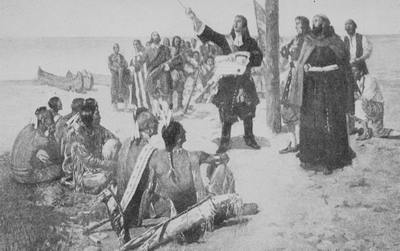
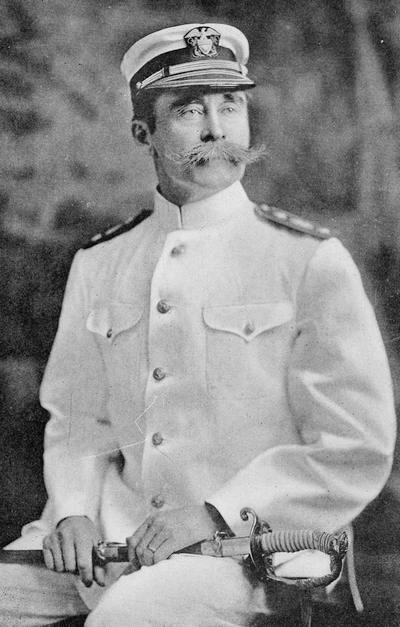
HERNANDO CORTÉS:
CONQUEROR OF MEXICO.
(1485-1547)
Lift high the golden goblets and quaff to our leader bold,
Who came from Cuba’s heated sands to gather Aztec gold,
His heart was big with courage; with his hands he seized the helm,
And he gathered the power and gained the dower of Montezuma’s realm.
The muffled war drums mocked him, from the top of the white stone wall,
And the maddened priests reviled him as they heard his trumpets call.
His Tlascalan allies trembled at the curse of the warriors red,
But the cry was ever “Onward!” to the city’s fountain head.
To the top of the teocalli where the eagle banner floats,
Where the evil gods are smiling and Huitzilopochtli gloats;
Up! Up! our leader clambered. Up! Up! and won the prize,
Hurrah! Hurrah! for Cortés! Come victors, drink as we rise!
Song of the Spanish Cavaliers, 1519.
CONQUEROR OF MEXICO.
(1485-1547)
TO the brave belong the spoils. To him, who ventures
much, sometimes comes a great reward.
Here is the story of a man who determined
to conquer an empire with but a handful of followers,—and
accomplished his purpose. Although it seems to
be a romance, it is a series of facts. Strange, wonderful,
almost unbelievable, yet true; for truth, they say,
is sometimes stranger than fiction. Listen, then, to
this tale of as valiant a soul as ever led fighting men on
to victory!
Long, long ago, when fat King Henry the Eighth
ruled over Merrie England, and Charles the Fifth was
King of Spain, there lived a young Spanish cavalier
called Hernando Cortés. He was a wild youth and did
not care for books or study. In fact, although his
parents wished him to be a lawyer and, when he was
fourteen years of age, sent him to an excellent school,
he would not learn his lessons and so was asked to leave
the institution. Returning home, he greatly annoyed
his good father and mother by cutting up and playing
all kinds of pranks, so that they were glad to learn he
had determined to join an expedition which was setting
out for that New World so lately discovered by Columbus.
Shortly after this decision he fell from the top of
a high wall, upon which he had been climbing after
wild grapes, and hurt himself so grievously that he
could not walk. It was therefore impossible for him
to join the adventurers who were heading for the New
World. The ship set sail without him.
For two years longer, young Cortés remained at
home, and then, finding that another expedition was
about to set sail, he obtained permission to join this
fleet, bound for the West Indies. He was now nineteen
years of age and was extremely agile and sinewy.
His face was pale, his eyes piercing, and his hair raven
black. He was looking for adventure and was determined
to bear himself right valiantly in whatever situation
he should find himself.
The fleet set sail, and arrived without accident at
Hispaniola. Cortés went immediately to see the Governor
of the island, whom he had known in Spain.
“You must remain here and become a good citizen,”
said the Spanish dignitary to him. “I will therefore
present you with a grant of land which I hope that you
will cultivate.”
“I came to get gold, not to till the ground like a
peasant,” said Cortés. “And I am anxious for adventure.”
The Governor laughed.
“You had better become a farmer,” said he.
“There is more money in crops than there is in searching
for gold.”
Six years passed, six rather monotonous years for
Cortés, although he occasionally joined some expeditions
against the natives, where he learned how to endure
toil and danger, and became familiar with the
tactics of Indian warfare. At length, in 1511, when
Diego Velasquez, the Governor’s Lieutenant, undertook
the conquest of Cuba, Cortés gladly became one of his
followers, and, throughout the expedition, conducted
himself right valiantly.
The Spaniards conquered the country; but when,
later on, there was distribution of lands and of offices,
great discontent arose. Those who believed that they
had been ill-used, chose Cortés to journey back to Hispaniola
and lay their grievances before the higher authorities.
This reached the ears of Velasquez. He ordered
that the youthful Cortés should be bound, loaded
with fetters, and thrown into prison. The act was
humiliating, but it was what those of Spanish blood
were accustomed to do to one another. Note, however,
how the young man conducted himself!
Cortés soon succeeded in escaping from the irons
which encircled him, and, letting himself down from the
window of the jail, took refuge in the nearest church,
where he claimed that he could not be touched, as he
was under the protection of the priests. Velasquez
heard of this, was very angry, and stationed a guard
near the sanctuary, with orders to seize the youthful
Spaniard, should he endeavor to get off. Cortés was
careless, wandered, one day, quite far from the church
door, and was immediately captured.
Velasquez determined to get rid of the young adventurer,
this time, so had him carried on board a ship
which was to sail, next day, for Hispaniola. But
Cortés was again too clever for him. By great exertion
he managed to drag his feet through the rings
which fettered him, and, dropping silently over the side
of the ship into a little boat, made off in the darkness.
As he neared the shore, the water became so rough
that the boat was useless, so he dove overboard and swam
the rest of the way. He was tossed up upon the beach
in a half-dazed condition; but finally arose, made his
way to the church, and hid himself in the sanctuary.
Velasquez had no idea where he had disappeared to.
Shortly after this the bold adventurer married a lady
named Catalina Xuarez whose family was friendly
with the hard-hearted Velasquez. Peace was therefore
made with the Governor, and Cortés received a large
estate near St. Iago, where he lived for some years
and even amassed a considerable sum of money.
Here he was quietly residing when news came of
an exploring expedition which had set out in 1518 to
find out what lay farther to the west. It had been led
by Grijalva, a nephew of Velasquez, and he had touched
at various places on the coast of Mexico. This was a
land inhabited by Indians called Aztecs who had named
their country after “Mexitili”: war god of their race.
These Aztecs, it seems, had originally come down
from the north, and, after many wanderings, had halted
on the western border of a great lake which lay in a
long valley, situated at a height of about 7,500 feet
above the sea, so that the air was cool even in the hottest
weather. The valley, sixty odd miles in width, was
surrounded by towering rocks which were a protection
from invasion.
The Aztecs were few in numbers when they first
came to the shores of the lake, but they increased rapidly
in population and in power. Nearby were other
Indian tribes, and, as there was much warfare between
them, the Aztecs united themselves with the King of
the Tezcucans in order to aid him against a tribe called
the Tepanics, who had invaded his territory. The allies
won, and, as a result, an agreement was made between
the states of Mexico, Tezcuco, and Tlacopan,
that they should support one another in the wars and
divide all the spoils between them. This alliance remained
unbroken for over a hundred years.
Although fond of warfare and cruel in their tortures
to prisoners, the Aztecs had many wise laws and
institutions, and were, in some respects, highly civilized.
They were governed by an Emperor, and, when he died,
another one was chosen by four nobles from among his
sons or nephews. The one preferred was obliged to
have distinguished himself in war, and he was not
crowned until he had waged a successful campaign,
had captured large numbers of the enemy, and thus
provided enough captives to grace his entry into the
capital.
The Aztecs worshiped thirteen principal gods, and
more than two hundred of less importance, whose temples
were everywhere to be seen. At the head of all
the gods was the great Huitzilopochtli, whose temples
were in every city of the empire, and whose image was
always loaded with costly ornaments.
They also had a legend that there had once dwelt upon
the earth the great god, Quetzalcoatl, god of the air,
under whose sway the Aztec people had flourished and
there had been peace and prosperity among all men.
He was said to have been tall in stature, with a white
skin, long, dark hair, and a flowing beard. He had,
in fact, quite resembled a Spaniard, and this led to the
success which Cortés had with the Mexicans, as you
will presently see.
Quetzalcoatl, it was said, had in some way incurred
the wrath of the principal gods, so that he had been
forced to leave the country. He had turned towards
the Gulf of Mexico, had stopped at the city of Cholula,
and had then departed in a magic boat, made of serpent’s
skins, to the fabled land of Tlapallan. Tradition
had it that as he was leaving, he had turned to
the faithful ones who had followed him saying: “Watch
and wait for me, I shall come again.” For this reason
the Aztecs were ever on the lookout for the great and
benevolent god of the white skin and flowing beard.
As horses were not known, communication was held
by means of couriers, who, trained from childhood to
run, traveled with amazing swiftness. There were relay
stations, or post houses, for these couriers, and they
would thus carry on their messages for a hundred to
two hundred miles in a day. In this manner the Emperor
of the Aztecs, as he sat in his palace in the City
of Mexico, would feast upon fresh fish, which, twenty-four
hours before, had been caught in the Gulf of
Mexico, over two hundred miles away. Thus the news
was transmitted when war was in progress, and, as the
messengers came along the highways, the people knew
whether the tidings were good or bad, by the dress which
they wore. If bad news, the runners were in black.
If good, in gay colors.
The one great object of all expeditions made by the
Aztecs was to capture victims to be sacrificed upon their
altars. They believed that the soldier who fell in battle
was transported at once to the blissful regions of
the sun, and consequently they fought with an utter
disregard for danger. The dress of the warriors was
magnificent. Their bodies were protected by a belt
of quilted cotton, impervious to all darts or arrows, and
over this the chiefs wore mantles of gorgeous feather-work.
Their helmets were made of wood, fashioned
so as to resemble the head of some wild animal, and
embellished with bits of gold and of silver. Their banners
were embroidered with gold and with feather-work.
After the prisoners had been brought from the battle
field they were sacrificed to the gods in a most brutal
and horrible manner. The poor victim was held by
five priests upon a huge, round, sacrificial stone; while
a sixth butcher, clothed in a scarlet mantle, plunged a
long knife into the breast of the writhing captive, and,
cutting out the heart, held it up first to the sun, which
they worshiped, and then cast it at the feet of the stone
god. The dagger used was as sharp as a razor and
made of “itztli,” a volcanic substance as hard as flint.
This was not all. The body of the captive thus sacrificed
was afterwards given to the warrior who had
taken him in battle, who thereupon gave a great banquet
and served him up among choice dishes and delicious
beverages, for the entertainment of his friends.
The Aztecs called their temples, teocallis, which
means, “Houses of God,” and there were several hundred
of them in each of the principal cities. They
looked like Egyptian pyramids, and were divided into
four or five stories, each one smaller than the one below
it. The ascent was by a flight of steps. At the
top was a broad space on which stood a tower, from
forty to fifty feet high, which contained the images of
the gods. Before such a tower was the stone of sacrifice
and two lofty altars on which the sacred fires
burned continually. The floor was dyed crimson
from the blood of the helpless victims of the Aztec
wars.
These people were unknown to the Spaniards, at this
time, since of them Grijalva sent back to Cuba only a
few vague reports. It was said, however, that the country
was full of gold and of treasure.
When this news reached the ears of Cortés he was
immediately fired with a resolve to penetrate into this
unknown land and to gain great renown for himself.
The Governor of Cuba, likewise, determined to send
out ships in order to follow up the discoveries of
Grijalva. Who should be put in command? Who was
better, indeed, than Hernando Cortés!
The Spanish adventurer, with the utmost energy,
at once began to purchase and to fit out ships. He used
all the money that he had saved and as much as he
could persuade his friends to lend him, so that it was
not long before he was in possession of six vessels,
while three hundred recruits had signified their intention
of sailing with him.
But now the Spanish nature began to assert itself,
for a jealousy and distrust of Cortés took possession
of the mind of Velasquez and he determined to entrust
the fleet to the hands of some one else. This would
have put an end to the aspirations of the youthful
leader, had it not been whispered to him that Velasquez
was about to have him removed from his place. He
took care to checkmate the plans of his former enemy.
Summoning his officers secretly, he set sail that very
night with what supplies he was able to put his hands
on, although his ships were neither ready for a voyage,
nor properly provisioned.
Morning dawned and Velasquez heard that the fleet
was under weigh. He rose hastily, galloped to the
ocean, and found Cortés in a small boat drifting near
the shore. The commander of the expedition rowed
back to within speaking distance.
“This is a courteous way of taking leave of me,
truly,” cried the angry Governor.
“Pardon me,” answered the young mariner. “Time
presses and there are some things which should be done
even before they are thought of. Good-bye, my friend;
may you live to see the day when I return a great
man.”
With that he paddled to the fleet and ordered all
hands to sail away. This was November the 18th.,
1518.
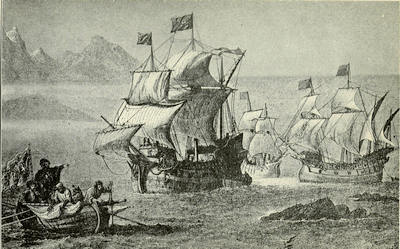
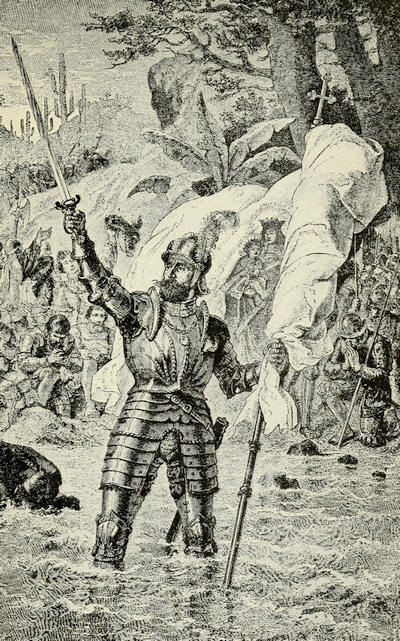
Shortly after this the vessels anchored off Trinidad,
a town on the southern coast of Cuba. Here Cortés
landed, set up his standard, and invited all, who wished
to join the expedition, to come on with him. He told
them that there was great wealth to be gained and attracted
many volunteers to his banner. Finally, in
February, he had sufficient reënforcements assembled,
so he set sail. He had eleven vessels, one hundred and
ten sailors, five hundred and fifty-three soldiers, and
two hundred Indians. He likewise had sixteen horses,
ten large guns, and four falconets, or light cannon.
The fleet set out, touched upon the coast in several
places, and then reached the mouth of the Rio de
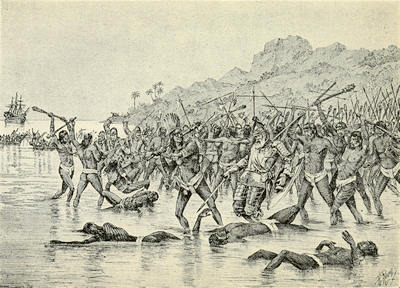
Tabasco. The Spaniards landed and found that the
Indians were hostile and were drawn up in great force
against them. But Cortés had his cannon put ashore,
ordered an attack, and soon had captured both the town
of Tabasco and also many of the Indians, who saw the
uselessness of further fighting, and consequently came
humbly to the Spaniards, bringing presents and slaves.
Among the latter was a beautiful Mexican girl called
Malinche who had fallen into the hands of the cacique
of Tabasco through some traders, to whom she had been
sold by her mother. The Spaniards always called her
Marina, and, as she quickly learned to speak their
language, she was soon of inestimable assistance to them
as an interpreter. Cortés made her his secretary and
always kept her near him in the exciting days which
followed.
By means of his interpreter, Cortés found that these
Indians were the subjects of the emperor Montezuma,
and were governed by Tenhtlile, one of the great nobles.
He determined to send word to the potentate who ruled
over this country and to let him know that he and his
followers wished to see him.
Upon the day following, Tenhtlile arrived at the
Spanish camp, accompanied by a numerous retinue.
The Indian chieftain asked about the country of the
strangers and the object of their visit.
“We are subjects of a powerful monarch beyond
the seas,” replied the leader of the adventurers, “who
has heard of the greatness of your Mexican Emperor
and has sent me with a present to be delivered to him
in person, as a token of his good will. I would be glad,
therefore, to go immediately to his capital and trust
that you can guide me there.”
This seemed to annoy the Aztec noble, for he replied
in a haughty manner:
“How is it that you have been here only two days,
and yet demand to see my Emperor? I am surprised
to learn that there lives another monarch as powerful
as Montezuma, but, if it is true that you are his representative,
I will communicate with my Emperor and
will forward to him the royal present sent by you.
Meanwhile, pray receive the gifts which I have brought
for you.”
As he spoke, a number of slaves came forward and
deposited ten loads of gorgeous feather-work, and a
wicker basket filled with golden ornaments.
Cortés was greatly pleased with this show of friendliness,
and ordered his own soldiers to bring forth the
presents for Montezuma. These were an armchair
richly carved and painted, a crimson cloth cap with a
gold medal, and a quantity of collars, bracelets and
other ornaments of cut glass, which much surprised
the Aztecs, as this was a country where there was no
glass, and hence these were more valuable than emeralds
or sapphires.
“I see over there a soldier with a shining thing upon
his head,” now said Tenhtlile. “I should much like
to send that to Montezuma, for it will remind him of
the one worn by the god Quetzalcoatl. Can I not have
it?”
“Certainly,” replied Cortes, “and I trust that you
will ask the Emperor to return it filled with the gold
dust of the country, so that I may compare it with that
which is in mine own. If you must know it, my kind
friend, we Spaniards are troubled with a disease of the
heart for which gold is the only sure remedy. I trust,
therefore, that you will send us all that you can.”
While he was speaking, Cortés observed that one of
the Indians was busy with a pencil, and, on looking at
his work, saw that he had made a sketch of the Spaniards,
their costumes, and weapons. This was the celebrated
picture writing, for which the Aztecs were famous.
“You see,” said Tenhtlile, “the Emperor can thus
get an excellent idea of you and your followers.”
“Bring out the cavalry,” cried Cortes, at this. “We
will show you our wonderful horses.”
The appearance of the snorting steeds filled the natives
with astonishment, and, when the General ordered
a cannon to be fired off, the natives ran away in alarm.
The painters, however, were very busy, and faithfully
recorded everything which the Spaniards possessed,
even putting in a picture of the ships as they swung
at anchor.
At length the Aztecs departed, with much bowing
and scraping. Their chief, Tenhtlile, seemed to be in
a good humor and left orders with his people to supply
the Spanish general with all that he might require until
further instructions from the Emperor Montezuma.
Meanwhile great excitement was taking place in the
Mexican capital, for many seemed to think that the
great god, Quetzalcoatl, had returned to earth and was
about to revisit the scenes of his former life. Montezuma,
himself, seemed to be undecided how to act.
When the picture writings, showing the Spanish invaders,
reached him, he summoned the Kings of Tezcuco
and Tlacopan in order to consult with them as to how
the strangers should be received. The three differed
in their ideas, but finally Montezuma resolved to send a
rich present to Cortés which would impress him with a
high idea of the Emperor’s wealth and his grandeur.
At the same time he determined to forbid him to approach
the capital.
Eight days passed away—eight long days for
Cortés and his men, as they were suffering greatly
from the intense heat—and then the embassy, accompanied
by the governor, Tenhtlile, arrived at the
camp, and presented Cortés with the magnificent presents
sent by Montezuma.
After the usual salute, the slaves unrolled some delicately
woven mats and displayed the gifts which the
Aztec Emperor had sent. There were shields, helmets,
and cuirasses embossed with plates and ornaments of
pure gold; with collars and bracelets of the same precious
metal. There were also sandals, fans, plumes,
and crests of variegated feathers, wrought with gold
and silver thread, and sprinkled with pearls and with
precious stones. There were golden birds and animals;
curtain coverlets and robes of cotton. There were more
than thirty loads of cotton cloth, and finally, the helmet
which Cortés had sent, loaded to the brim with
grains of pure gold.
This rich treasure fired the zeal and ardor of the
Spaniards; yet they controlled themselves, and expressed
admiration only for two circular plates of gold
and of silver as large as carriage wheels. One, representing
the sun, was richly carved with plants and with
animals, and was worth a fabulous sum of money.
When the voyageurs had received the presents, the
ambassadors courteously delivered their message, to the
effect that Montezuma had great pleasure in holding
communication with such a powerful monarch as the
King of Spain; but could grant no personal interview
to his soldiers. That the way to the capital was too
long and dangerous for the white men to attempt.
Therefore the strangers must return to the land from
which they had come.
Cortés received this message with coldness, and, turning
to his officers, said:
“This is, indeed, a rich and powerful Monarch, and
he does well to speak in this manner; but I am determined
to visit him in his capital.”
He then bade good-by to the Aztec ambassadors, who
shortly withdrew. That night every neighboring hut
was deserted by the natives, and the Spaniards were
left quite alone in the wilderness. They prepared for
an attack, but none came.
The soldiers now became mutinous, saying that it was
about time they returned with what treasure they had
already collected. Cortés had difficulty in keeping
them out of the boats, but now an event occurred which
aided him very materially in his design to march to
the City of Mexico, a design which he had long ago determined
upon.
Five Indians entered the camp who wore rings of
gold and bright blue gems in their ears and nostrils.
A gold leaf, delicately wrought, was attached to their
under lip. These were not Aztecs and explained that
they came from Cempoalla, the capital of a tribe called
the Totonacs, who had been lately conquered by the
Aztecs, and who greatly resented the oppressions of
these bloodthirsty tribesmen. The fame of the Spaniards,
said they, had reached their leader, who had sent
them to request the strangers to visit him, and to aid
him in throwing off the domination of the Aztecs.
It can be easily seen that Cortés was delighted to
hear this. He saw that discontent in the provinces
conquered by Montezuma could be turned to his own
advantage, and that, by allying himself to these Totonacs,
he might be able to conquer Montezuma himself.
He therefore dismissed the tribesmen with many
presents, promising that he would soon visit their city.
Not long afterwards, the army set out to march northward,
to a place where it had been decided to build a
town. The men crossed a river in rafts and broken
canoes, which they found on the bank, and soon came to
a very different kind of country than that which they
had left behind them. There were wide plains covered
with green grass and groves of palm trees, among which
were deer and flocks of pheasants and wild turkeys.
The trees were loaded with fruits and with beautiful
clusters of bowers, while gayly plumaged birds fluttered
in the branches. There were gardens and orchards
on either side of the road. As the Spanish soldiers
passed along, they were met by crowds of friendly
natives, who mingled fearlessly with the soldiers, and
hung garlands of flowers around the neck of the General’s
horse.
The cacique, or chief of the Totonacs, received
Cortés with great courtesy, and assigned his soldiers to
a neighboring temple, where they were well supplied
with provisions. Cortés, himself, was presented with
several vessels of gold and robes of fine cotton.
Upon the following day the General paid the cacique
a visit, and, with the aid of Marina, held a long talk
with him. He promised to aid the Totonacs against
Montezuma. This pleased the chief greatly, and he
promised to assist the Spaniards in every way that he
could. Cortés returned to his troops, ordered an advance,
and soon reached the town of Chiahuitztla, which
stood upon a crag overlooking the valley.
As the Spaniards were halted in the center of the
village, five men entered the market place where they
were standing. Their dark, glossy hair was tied in a
knot upon the top of their heads, and they carried
bunches of sweet-smelling flowers in their hands.
Their attendants bore wands, or fans, to sweep away
the flies and insects from their lordly masters, who, by
their disdainful looks, showed that they considered
themselves to be superior to all around them. They
brushed by the Spaniards, scarcely seeming to notice
them, and were immediately joined by the Totonac
chiefs, who seemed anxious to gain their favor. Cortés
was much astonished, and, turning to Marina,
asked what this meant.
“These are Aztec nobles,” the girl replied, “and
they are empowered to receive tribute for Montezuma.”
“What are they saying?” asked he.
“They bring word that Montezuma is very angry
with the Totonacs for entertaining you and your men
without his permission,” Marina replied. “And, as
a punishment, he has demanded twenty young men and
maidens to be sacrificed to the gods.”
Cortés was much irritated by this and told the Totonacs
that they should not only refuse this demand
but should seize the Aztec nobles and throw them into
prison. This was done, but Cortés had the true Spanish
character and now played a part of duplicity
which was characteristic of the men from Seville. He
had two of the captured Aztecs released, brought them
before him, and very cunningly led them to believe that
he was sorry to learn that they had been thrown into
jail. He told them that he would help them to escape,
and begged them to tell Montezuma that the great Emperor
was held in high regard by the Spaniards. The
two nobles were then hastily dispatched to the port
where lay the Spanish vessels. They were taken on
board, landed secretly upon the coast, and allowed to
depart for the court of Montezuma. The Totonacs were
very angry when they found that two of their prisoners
had escaped, and determined to sacrifice the remainder;
but Cortés interfered, had them taken to his vessels, and
soon allowed them to join their companions. In this
way he secured the friendship of Montezuma, while
still appearing as the friend of the Totonacs.
Messengers were sent to all the other Totonac cities,
telling the natives of the defiance that had been shown
the Emperor, and bidding them, also, to refuse to pay
tribute to Montezuma. The Indians soon came flocking
into the town in order to confer with the powerful
strangers, and thus Cortes managed to embroil them
with the Emperor. At the same time he made them all
swear allegiance to the Spanish King.
The Spaniards now busied themselves in building a
town, for they had to have some place to store their
belongings and also to retreat to in case of disaster.
The Indians helped them willingly, so they soon had an
excellent little village: the first one in new Spain.
When the Aztec nobles who had been set free reached
the city of Mexico, and told Montezuma of the treatment
which they had received, the Emperor of the Aztecs
felt rather kindly disposed towards the Spaniards,
and sent an embassy consisting of two young nephews
and four of his chief nobles. They bore a princely gift
of gold, richly embroidered cotton mantles, and robes
of feather work. On coming before Cortés, the envoys
presented Montezuma’s thanks to him for the courtesy
he had shown the captive nobles.
“We believe that you are the long-looked-for strangers
who are to return with the god Quetzalcoatl,” said
the ambassadors, “and are therefore of the same lineage
as ourselves. Therefore, out of deference to you,
we will spare the Totonacs; but our day of vengeance
against them will soon come.”
Nothing was said about not being allowed to journey
to the capital, so Cortés gave these Aztecs presents, as
usual, and told them that he intended to soon visit
Montezuma in the city of Mexico, when all misunderstanding
between them would be adjusted. The Totonacs
were amazed and awed by the influence which the
Spaniards seemed to exert upon the Aztecs, and felt
safe from further incursions by the terrible Emperor.
The bold and resolute Cortés was now determined to
march to Mexico City, itself, to oust Montezuma, and
to obtain possession of his country and his treasures.
But he knew that the Governor of Cuba was his enemy,
and also knew that, should he not send news of his
discoveries to the King of Spain, he would be seriously
interfered with by Velasquez. Consequently he prepared
a letter setting forth the extent and magnitude
of his discoveries, gave up all his own treasure which he
had obtained from the natives, and persuaded his soldiers
to do the same. This was placed in the hands
of some of his followers who were given a ship, were
bidden god-speed, and were told to sail to Spain.
Cortés besought the King to make him Governor over
all the new territory, so that he could add the great
Indian Empire to the possessions of the Spanish crown.
Very soon after the departure of the treasure ship,
Cortés discovered that there was a conspiracy among
his followers, who had seized one of the ships, had
stored provisions and water on board, and were just
about to set sail for Cuba. One of the traitors repented
of the part he had taken in the plot, betrayed it to
Cortés, and thus made evident the extent of the conspiracy.
In consequence, the ringleaders were hanged,
and the Spanish commander determined to take the
bold step of destroying the ships without the knowledge
of his army. Accordingly he marched his entire
force to Cempoalla, where he told his plan to a few of
his devoted adherents, who approved of it. Nine of
the ships were sunk; after the sails, masts, iron, and all
movable fittings had been brought ashore.
When this act became known, it caused the greatest
consternation among the Spaniards. They murmured
loudly, and mutiny was threatened. Cortés,
however, was equal to the emergency. He managed
to reassure them, to persuade them that he had only
done what was best for them, and so cleverly told them
of the fame and treasure which they were on the eve of
gaining, that not one of them accepted the chance of
returning to Cuba in the remaining ship.
August the sixteenth, 1519, was a day ushered in
by brilliant sunshine, as if the fates were friendly to
the daring Spanish adventurer. Cortés was now ready
to advance into the interior, for he had obtained from
the cacique of Cempoalla, thirteen hundred warriors
and a thousand porters to carry his baggage and drag
onward the guns. His own force amounted to four
hundred foot and fifteen horses, with seven pieces of
artillery. Surely a small and insignificant army with
which to attempt to conquer this vast and populous
land!
The army set out upon its mission of conquest, and,
at the close of the second day, reached Xalapa, a mountain
town, and from which they looked back upon one
of the grandest views which they had ever seen.
Around were towering mountains; below lay the flat
region, a gay confusion of meadows, streams, and
flowering forests, with now and again a tiny Indian
village dotting the brilliant landscape. Far, far away,
to the eastward, was a faint line of light upon the
horizon, which told them that there rolled the ocean
which they had lately crossed, and beyond which slumbered
their country, which many never expected to see
again. To the south a mighty mountain, called “Orizaba,”
poked its head into the air, covered with a mantle
of snow; while toward the southwest the Sierra
Madre, with a dark belt of pine trees waving in the
breeze, stretched with a long line of shadowy hills into
the distance.
Onward and upward crawled the little army, pushing
and jerking the guns over the rocks and crevices,
and finally, on the fourth day, arrived at the town of
Naulinco. The Indian inhabitants entertained the soldiers
with great hospitality, for they were friendly with
the Totonacs.
Cortés endeavored to persuade them to give up their
savage idol worship, and, through a priest, Father
Almedo, had them instructed in the teachings of
Christianity and had a cross erected for future worship.
The troops pressed onward, entered a narrow, ragged
valley, called “the Bishop’s Pass,” and, as they toiled
around a bare, volcanic mountain, a snow-storm descended
upon them with great violence. The Indians,
who were natives of the flat region, suffered dreadfully,
and several of them died by the way. The Spaniards,
however, were protected by their thick coats of cotton,
and thus bore up well beneath the change of climate.
For three days the little band pressed forward over
the rugged mountain trail,—then emerged into an open
country with a more genial climate. They had reached
the great table-land which spreads out for hundreds of
miles along the crests of the mountains, more than
seven thousand feet above the level of the sea. Carefully
cultivated fields of corn lay around them, and, as
they trudged forward, they came upon a populous city
made of substantial buildings of stone and of lime.
The army rested here for four or five days and then
went on through a broad valley shaded by lofty trees
and watered by a splendid river. An unbroken line of
Indian dwellings extended for several leagues, and, on
a knoll, stood a town of four to five thousand inhabitants,
commanded by a fortress with walls and trenches.
The army halted here and the troops were met with
friendly treatment.
As the soldiers refreshed themselves, Cortés made inquiries
concerning the route which he was to follow.
The Indians, who were traveling with him, told him to
go through Tlascala: a small republic which had always
managed to maintain its independence against Mexican
arms. The tribesmen had been friendly with the Totonac
allies of the Spaniards, and had the reputation of
being frank, fearless, and trustworthy.
Cortés decided to attempt to gain their good will, so
he dispatched four or five of his principal Cempoallan
allies to the Tlascalan capital with a cap of crimson
cloth and a sword and cross-bow, as gifts. They were
to ask permission to pass through the land and were to
express admiration for the valor and the courage of the
Tlascalans in resisting the Aztecs for such a long time.
Three days after the departure of these envoys, the
army resumed its march.
At last they reached the border of the Tlascalan territory,
and were much surprised to find a strong fortification
in their path. This was a stone wall nine feet
high and twenty feet thick, with a parapet a foot and
a half broad at the top, for the protection of those who
defended the causeway. It had only one opening in the
center, made by two semi-circular lines of wall which
overlapped each other. As it extended for more than
two miles and was built of natural blocks of stone, it
could be easily seen, that, had the Tlascalans cared to
dispute the passage of the Spanish invaders, not only
would they have inflicted great damage upon them, but
would undoubtedly have forced them to retire towards
the sea-coast.
Fortune favored the Spanish command. No Tlascalans
were there to hurl javelins and arrows into their
ranks, so they pressed onward towards the capital.
“Tlascala” means the land of bread. The Tlascalans
were an agricultural people and their country
was very fertile. They had previously lived upon the
western shore of Lake Tezcuco, a part of Mexico which
was not very productive; but their neighbors had driven
them from their original holdings and were now very
jealous of their prosperity: so jealous, in fact, that the
Tlascalans repeatedly had to defend themselves against
their attacks. Montezuma, himself, had endeavored to
conquer them, but they had defeated an army sent
against them and commanded by the Emperor’s favorite
son. This had highly enraged the great ruler and he
repeatedly harassed them with his troops, so that they
were certainly glad to see some one journey to their land
with whom they could ally themselves. They had
heard about the Spaniards and their victorious advance,
but they had not expected that they would venture their
way. They were therefore much embarrassed when
they saw the white-skinned strangers at their very gates,
and demanding a passage through the fertile agricultural
regions which they had so often defended with
their lives.
While the Tlascalan chiefs were in the council chamber,
trying to make up their minds what to do, Cortés
and his men were advancing through their country. As
they threaded their way through a steep gorge, they
saw before them a small party of Indians armed with
swords and bucklers. They fled as the Spaniards approached,
but the men from Castile spurred their
horses, and overtook them. As they were endeavoring
to parley with them, the Indians turned and furiously
assaulted those in armor. A stiff fight ensued
and the native force would soon have been cut to pieces
had not a body of several thousand Indians appeared,
who rushed to their rescue. Cortés hastily dispatched
a messenger to bring up his infantry and stood off the
overwhelming masses of the enemy as best he could.
The Indians fought like tigers, dragged to the ground
one cavalier, who afterwards died of his wounds, and
killed two horses by cutting through their necks with
great broadswords. This was a serious loss to the
Spaniards, as their steeds were very few, and they
needed them, not only for battle, but also for hauling
their possessions over the rough mountain trails.
Arrows were whizzing fast around the ears of the
horsemen in the advance, when the infantry approached.
Hastily falling into position, the soldiers delivered a
volley from their crossbows, which not only astonished
the enemy, but threw them into great confusion. The
natives soon beat a hasty retreat, and the road towards
the Tlascalan capital was left open to the adventurers.
This was not the only battle with the Tlascalans.
Several other bands of natives were defeated as the
Spanish pressed forward, so that, when the daring
Cortés sent an embassy to the Tlascalan capital, his
men received a most respectful hearing from the dejected
natives, A free passage through the Tlascalan
possessions was offered to these white gods and they
were furnished with food.
Meanwhile, what of Montezuma?
As the terrible strangers advanced towards his capital,
news of all of their doings had been faithfully reported
to him by his runners, or messengers. He
learned, with dismay, that these fair-skinned soldiers
were defeating all of the natives that were sent against
them. He saw that they were practically invincible,
and that, before very long, they would be knocking at
the very gates of his capital. With great satisfaction
he had heard of their taking the road through the land
of the Tlascalans, for he knew these Indians to be
fiercely warlike, and he hoped that the white gods (so
called) were only mortal men, and would prove to be
no match for the natives who had defeated his own best
troops. Alas! He now learned that even these gallant
warriors had succumbed to the prowess of the
strangers.
In his alarm and uncertainty, he dispatched five
great nobles of his court, attended by two hundred
slaves, to bear to Cortés a gift consisting of three
thousand ounces of gold and several hundred robes of
cotton and of feather-work.
The Spanish leader received the fawning natives with
respectful attention. They laid the gifts at his feet
and told him that they had come to offer him Montezuma’s
congratulations upon his many victories. They
also stated that they wished to express their regret
that the Emperor could not receive them at the capital,
for his own population was so unruly, that, should they
enter the city, he could not answer for their safety. He
therefore respectfully requested Cortés to retire to the
sea-coast.
“I wish to express my greatest respect for Montezuma,”
replied the artful Cortés, “and I wish that I
could do as he desires. But I have received commands
from my own sovereign to visit the City of Mexico, and
it would go ill with me should I disobey the desires of
the mighty Monarch of Spain. Tell the great and
powerful Montezuma that I will some day repay him
for his wonderful presents. And tell him, also, that I
will be soon at the gates of Mexico City, where I hope
to be received in a style befitting the Monarch whom I
represent.”
The Mexican ambassadors withdrew, but they were
sadly displeased with the turn which matters were
taking. They saw a firm friendship established between
the Tlascalans—their mortal enemies—and
the dreaded Spaniards. They also saw that nothing
could deter the white men from coming forward. So,
with gloomy faces and lowered eyes, they departed for
the City of Mexico.
The Spanish troops were well treated by the Tlascalans,
who feasted and entertained them in the four
quarters of their city. But amid all these friendly
demonstrations the General never relaxed, for a second,
the discipline of the camp, and no soldier was allowed
to leave his quarters without special permission.
Montezuma, meanwhile, had received the message
from the doughty Spanish invader and was more frightened
than even before. Had he exhibited a good fighting
spirit, and had he been determined to expel the
Spaniards, he could have raised a hundred thousand
fighting men to overwhelm them as they advanced upon
his capital. But he was lacking in resolution. Deep
in his soul he had a suspicion that Cortes was really
the god Quetzalcoatl, come back again to Mexico in
order to bring peace and prosperity with him. In his
heart he feared, that, should he kill the invader, he
would be sacrificing one of the gods. And thus he
vacillated, hesitated, and, at length, seeing that he
could not buy off the invader with money, or frighten
him by means of threats, determined to conciliate him.
So he sent word that he invited the Spaniards to visit
him in his capital, and requested them to take a route
through the friendly city of Cholula, where arrangements
were being made, by his orders, for their reception.
He also besought Cortés to make no alliance
with the Tlascalans; whom he called base, treacherous,
and barbarous.
But now came startling events, yet events which
pleased the daring Cortés greatly, for the conqueror
was never so happy as when in the thick of fighting.
After a short consultation among the officers, the
Spanish army moved forward on the road to Cholula.
It was an ancient and populous place, six leagues to the
south of Tlascala. Its inhabitants excelled in the art
of working in metals, and in manufacturing cotton
cloth and delicate pottery. They were not as bloodthirsty
as the surrounding tribes, but were distinguished
more for the skill in the arts than for their
warlike attainments. Here it is supposed that the god
Quetzalcoatl had paused on his way to the coast, many
years before, and to his honor a great pyramid had
been erected, upon which was a gorgeous temple and
a statue of the fair-skinned god, bedecked with gold
and with jewels.
Six thousand Tlascalan warriors allied themselves
with Cortés in his march towards the capital. As the
troops drew near the town of Cholula they were met by
swarms of men, women, and children, all eager to catch
a glimpse of these wonderful strangers. An immense
number of priests, swinging censers, mingled with the
crowd, and, as the Spaniards moved onward, they were
decorated with garlands of flowers; while musicians
filled the air with strange, melodious symphonies.
The strangers were given lodgings in the court of one
of the many teocallis and were well supplied with provisions.
All seemed to be going well, and the Spaniards were
highly pleased with their reception, but soon the scene
changed. Messengers arrived from Montezuma, who
told Cortés that his approach occasioned much disquietude
to their royal master. They hinted that he
would not be well received, and then had a separate conference
with the Cholulans. When they departed they
took one of them off with them. The Cholulans now
kept away from the Spanish camp, and, when pressed
for an explanation, made many excuses, saying that
they were ill. The supply of provisions ran short,
and, when asked to bring more corn, the Indians answered
that they were unable to do so, as it was very
scarce.
The doughty General of the Spanish forces became
alarmed at this sudden change. His allies, the Cempoallans,
now told him, that, in wandering about the
city, they had seen several streets barricaded, and, in
some places, they saw where holes had been dug and a
sharp stake planted upright in each. Branches had
been strewn over these pits in order to conceal them.
They also announced that the flat roofs of the houses
were being stored with stones and with other missiles.
Cortés prepared for an attack, particularly as his
Tlascalan allies announced, that, in a far distant quarter
of the town, a number of children had been sacrificed
to the war god: the mighty Huitzilopochtli. They
reported, too, that numbers of the people had taken
their wives and children out of the city, as if to get
away from the battle which was imminent.
Shortly after this, Marina made a discovery which
proved that the Spaniards were in a most precarious
position. The wife of one of the Cholulan caciques
had taken a great fancy to the Mexican girl, and had
continually urged her to visit her house; hinting, rather
carefully and very mysteriously, that she would, in this
way, escape a great danger which threatened the Spaniards.
Marina appeared to be delighted with this proposal,
and pretended to be glad to have a chance of
escaping from the white men. She, at length, won the
confidence of the Cholulan lady, who revealed the entire
plot to her, a plot which had originated with Montezuma,
and by which he hoped to get rid of these terrible
strangers.
A force of twenty thousand Mexicans, said the wife
of the cacique, were already near the city, and were to
fall upon the Spaniards and their allies as they left.
They were to be assisted by the Cholulans, who had
stored great quantities of rocks and arrows to hurl
upon the unsuspecting white men as they defiled along
the roadway leading to the City of Mexico. After the
fair-faced strangers had been captured, some were to
be left with the Cholulans for sacrificial victims to their
gods; the rest were to be sent in chains to Montezuma.
Marina rushed to the gallant Cortés with the news of
this impending disaster to his army. The General at
once ordered the cacique’s wife to be seized, and she
repeated to him the same story that she had told to
Marina. The Spanish leader was not slow to act.
Two native priests were immediately summoned into
his presence, one of whom was a person of much prominence.
By courteous treatment and many presents, he
secured from them a complete confirmation of the story
which Marina had told him. There was no time to be
lost and Cortés was a man of action.
Sending for the more prominent Cholulans, Cortés
asked them to supply him with two thousand porters,
next morning, as he had determined to move his army
away from the town, and would need this many additional
men, in order to transport his luggage and the
many presents which had been given to him. After
some consultation, the chiefs decided to give him this
number of men, as it would assist them in their own
plan of annihilating the invaders of their country. But
Cortés had made up his mind how to act, and intended
to annihilate the Cholulans when once he had them in
his power. Night fell upon the city and every Spanish
soldier lay down fully armed. The sentinels were
doubled, but all remained quiet.
When the first streak of dawn reddened the east,
next morning, Cortés was ahorse, and was directing the
movements of his little band of heroic Spaniards. He
placed the greater portion of his small force in the
large oblong court in the center of the town. These
were lined up in a hollow square, facing the center, all
fully armed, with pouches filled with bullets, and quite
ready for anything that might occur. A strong guard
was placed at each of the three gates leading from the
town, and a number of the best soldiers were stationed
in charge of the cannon, which were pointed so as to
command all the more prominent roads leading to the
center of the native stronghold.
Hardly had this disposition of the troops been made
than the Cholulan caciques arrived, bringing a much
larger body of porters than Cortés had demanded.
They were placed within the hollow square formed by
the Castilian infantry.
The Spanish leader now took the caciques aside and
said in a stern tone:
“Know, O Chiefs, that I have learned of your conspiracy
to destroy me and my followers. I am fully
aware that you intend to fall upon me and my men
when we leave town, and I am determined to deal a
just and summary vengeance upon you.”
The Cholulans were thunderstruck, and gazed with
awe upon these strangers, who seemed to have the power
of reading their inmost thoughts. They made no attempt
to deny the accusation, but tried to excuse themselves
by throwing the blame upon Montezuma.
“The great Emperor made us do it,” said they.
“I do not care whether he made you do it or not,”
answered the irritated leader of these Spanish conquerors.
“For daring to think that you could capture
and defeat me and my men, I will put you all to death,
so that it will teach any others who may have designs
upon my person, in the future, to leave me alone.
‘Fire!’”
As he spoke a cannon growled out an ominous roar.
It was the signal for which the Spanish soldiers had
been anxiously awaiting.
In an instant the muskets and crossbows were leveled
at the startled Cholulans, as they stood crowded together
in the center of the market place. A crash of firearms,—and
many of them lay groaning upon the pavement.
Then, with a fierce and vindictive yell, the
Spanish soldiers rushed at the natives with their swords,
and mowed them down as they stood. The Indians
had heard nothing of what was going on, and offered
but slight resistance to the armored men of Castile.
Wild shrieks and yells arose above the din of firearms,
as the massacre took place, and, attracted by the
noise, the Cholulans from outside began a furious
assault upon the Spanish soldiers. The heavy cannon
opened fire upon them as they approached, and, when
they advanced in close formation, many were swept off
their feet. The cavalrymen now charged into their
midst and hewed a passageway of blood in the lane of
human beings. The Tlascalan allies of the Spaniards
fell upon the rear of the battling Cholulans. Thus,
harassed upon every side, the Cholulan townsfolk could
no longer maintain their ground. They fled, some to
the buildings nearby, others to the temples of the gods.
Headed by several priests, one strong body of fugitives
ran to the largest of all the temples, the great
teocalli. As the Spaniards came storming up the steps,
these rained down stones, javelins, and burning arrows
upon them. In spite of this shower of missiles, the
soldiers pressed hard upon the heels of the fugitives, set
fire to the wooden tower, and cheered wildly when they
saw the natives throw themselves headlong from the
parapet.
All was confusion and slaughter in the city of Cholula.
The Spaniards and Tlascalans plundered and
burned wherever they went, and, as the Tlascalans
seemed only to want clothes and provisions, the adventurers
under Cortés secured all the gold and jewels that
they cared to have. Thus fire, plunder, and murder
went on for many hours, until the General yielded to
the entreaties of the Cholulan chiefs, who had been
saved from the massacre, and, calling off his men, put
an end to further violence. By degrees the tumult was
appeased. The terrible vengeance of the invaders
made a great impression upon the natives, but no one
trembled more than did Montezuma on his throne
within the mountains.
The Mexican Emperor, in fact, felt his empire melting
away from him. His former vassals, on every
hand, were sending envoys to the Spanish camp to tender
their allegiance to the crown of Castile, and to attempt
to secure the favor of the conqueror by rich gifts
of gold and of slaves. Montezuma made up his mind
to send another embassy to Cortés, the members of
which were to impress upon him the fact that the Emperor
had nothing to do with the conspiracy at Cholula.
The envoys carried splendid presents of golden vessels
and ornaments, including artificial birds made in imitation
of turkeys with their plumage worked in gold,
and also fifteen hundred robes of delicate cotton cloth.
When they spoke to Cortés they told him that Montezuma
had no knowledge of the plot to attack the Spaniards
after they had left the town of Cholula and that
the Aztec force had been sent there, not to assist in annihilating
the Spaniards, but to quell a disturbance in
the neighborhood.
Cortés, who was not fooled by this series of lies by
Montezuma, remained quietly in the confines of
Cholula. He restored the city again to order, seized
upon the great temple, or teocalli, of which all the woodwork
had been burned, and built a church out of the
stones which remained. He also opened the cages in
which hundreds of captives were kept until the day
should come when they were to be sacrificed. After
this had been done, he called up the chiefs of his Tlascalan
allies, told them that the armies would now march
toward the City of Mexico, and, upon the day following,
set his own troops in motion.
He moved slowly, and soon was met by another embassy
from the Emperor, consisting of several Aztec
noblemen who brought a rich gift, indeed, and also a
message from the trembling Montezuma to the effect
that he would give four loads of gold to the General,
each year, and one load to each of his Captains, if he
would turn back from the city and would leave him
alone. Cortés was surprised at this show of weakness
and also pleased that the Aztec sovereign did not attack
him. He replied that he could not return to the King
of Spain without first visiting the Emperor at his
capital.
“We Spaniards,” said he, “are advancing in a spirit
of peace, and wish to be courteously received. If, after
a short stay, you find our visit burdensome, it is very
easy for you to notify us that our presence in your
beautiful city is no longer desired.”
The ambassador reported this answer to Montezuma,
who called a council of his chief advisors to determine
what was now to be done. A great difference of opinion
arose. Cacama, the Emperor’s nephew, counseled
him to receive the Spaniards courteously, as the ambassadors
of a foreign prince; while his brother, Cuilahua,
urged him to muster all his fighting men and to
drive back the invaders, or die in the defense of his
capital.
Torn with doubt and distress, the Emperor did not
know which way to turn. It would not have been impossible
to strike the invaders with his warriors, but
Montezuma feared these white-skinned travelers as he
had never before feared any enemy.
“Of what avail is resistance,” said he, “when the
gods have declared themselves against us? I must
face the storm as best I may. I see my empire crumbling
to dust before these invaders, and I am prepared
to fight only when I see that I cannot rid myself of
them by peaceful means.”
Thus, trusting that he would eventually free himself
from this menacing band, Montezuma awaited the entry
of the Spaniards into the city.
The followers of Cortés, with their Tlascalan allies,
now marched along the southern shores of Lake Chalco,
through forests of strange-looking trees, such as they
had never seen before, and orchards growing with unknown
fruits. At length they came to a great
dike, or causeway, four or five miles in length, which
divided Lake Chalco, from Xochicalco, on the west.
It was sufficiently wide, in some parts, for eight horsemen
to ride abreast; and was solidly built of stone and
of lime. At its narrowest part it was only a lance’s
length in breadth.
From the causeway the army descended upon a narrow
point which lay between the two lakes, and, quickly
crossing over this, reached the royal residence at Iztapalapan,
a place governed by Montezuma’s brother.
Here Cortés was presented with gifts of gold and costly
stuffs, and then the Spaniards were led into the gorgeous
halls of the palace, the roof of which was of
odorous cedar wood, while the stone walls were hung
with brilliant tapestries. Here, also, the army rested
for an entire night, ready and prepared for the advance
upon the following morning into the sacred precincts
ruled over by Montezuma.
Day dawned. As the sharp tones of the bugle woke
the echoes in the quaint Aztec village, the Spanish adventurers
bestirred themselves, formed in line of
march, and followed by the dark horde of Tlascalan
warriors, advanced upon the capital. Cortés’ force
was not more than seven thousand in all, and of this
number less than four hundred were Spaniards. The
adventure seemed foolhardy indeed. How could four
hundred Spaniards hope to conquer an entire country?
At the distance of half a mile from the capital the
invaders encountered a solid fortification, like a great
curtain of stone, which was built across the dike. It
was twelve feet high, and had a tower on each end; in
the center was a battlement-gateway through which the
troops passed. This was the fort of Xoloc, and here
the Spaniards were met by several hundred Aztec chiefs.
After the usual salutations, the march was resumed, and
the army reached a wooden drawbridge which crossed
an opening in the dike. As the soldiers left it, they
realized that they were in the power of Montezuma,
for, had he so wished, he could cut them off from communication
with the country, and hold them prisoners
in his capital.
But now the Emperor Montezuma, himself, approached.
A crowd of Indian nobles surrounded him,
and he was preceded by his officers of state, bearing
golden wands. Reclining upon the royal palanquin,
blazing with burnished gold, he was borne aloft by four
attendants, who were barefooted, and who walked with a
slow, measured pace, their eyes bent upon the ground.
Montezuma wore a square cloak of the finest cotton, on
his feet were sandals with soles of gold, and both cloak
and sandals were sprinkled with pearls and with precious
stones. On his head was a plume of royal green
feathers, the badge of his military rank. He was at
this time about forty years of age, was tall and thin,
and lighter in color than most of his countrymen.
The Emperor received Cortés with princely courtesy,
and appointed his brother to conduct the Spaniards to
their quarters. The adventurers followed their guide,
and, with colors flying and with music playing, entered
the southern portion of the Aztec capital. As they
proceeded, they crossed many bridges which spanned
the canals, and at length halted in a wide, open space,
near the center of the city and close to the temple of
the war god. Here were a number of low, stone buildings,
once a palace belonging to the Emperor’s father,
but now to become the lodging of the Spaniards.
After a rapid survey the General assigned the troops to
their respective quarters. He planted his cannon so as
to command the approaches to the palace, stationed sentinels
along the walls, and ordered that no soldier should
leave his quarters under pain of death. When all these
precautions had been taken, he allowed his men to enjoy
the banquet prepared for them.
Not long after this, Montezuma came to visit the
fair-skinned strangers, and was received with great
courtesy by Cortés, who had the faithful Marina to
interpret for him. The Emperor made many inquiries
concerning the country of the Spaniards, and particularly
asked why Cortés and his men had visited Mexico.
“We have desired to see you,” answered the General,
“and to declare to you the true faith which we, as
Christians, believe. We think that your own worship
is most pernicious, and we do not approve of the many
human sacrifices which you are continually making to
your gods. We therefore pray that you give up the
worship of idols, adopt the faith of Jesus Christ, and
cease to tear out the hearts of poor human beings as a
sacrifice in your temples.”
The Emperor smiled at the reference to the ancient
customs of the Aztecs, and made many inquiries concerning
the rank of the cavaliers in their own country
and their positions in the army. He then commanded
a gift of cotton robes to be distributed among the Spaniards
and their Tlascalan allies, and returned to his
own palace. When he had departed, Cortés ordered a
general discharge of his artillery, so as to impress the
natives with his power. The noise of the guns and the
smoke filled the Aztecs with alarm and dismay, and put
them in great fear of these strangers from another
country.
Cortés had several other audiences with the Aztec
ruler, who seemed to wish to treat these adventurers
with kindness and consideration; but the Spanish general
was harassed by many doubts. He was in the heart
of a great capital, with dikes and drawbridges on every
side, which might be converted into serious obstacles
against him and his men, should the Aztecs determine
to crush the small Spanish army. At a nod from the
mighty Montezuma all communication with the rest of
the country would be cut off, and the whole population
would be immediately hurled upon him and his handful
of followers. Against such odds, of what avail would
be his armor, his muskets, and his cannon? Montezuma
had a thousand warriors to his one. His best
policy, therefore, seemed to be to keep up the superstitious
reverence in which he seemed to be held by
both the Emperor and his people, and to find out all that
he could about the city and its inhabitants. Then,
should the opportunity occur, he would seize the chief
power for himself.
Next day the General asked the Emperor’s permission
to visit the principal public buildings and received
a willing assent. Putting himself at the head of his
cavalry, and, followed by nearly all of his foot soldiers,
he set out, under the guidance of several caciques, to
view more closely what he had only seen at a distance.
He was led to the great teocalli of the god of war, Huitzilopochtli,
which stood in an open court surrounded by a
wall of stone and lime, about eight feet high, and ornamented
by raised figures of serpents, so that it was
called the “wall of serpents.” It was pierced by huge
gateways, opening upon the four principal streets of
the city, and over each gate was an arsenal filled with
arms and other warlike gear.
The Spanish visitors climbed up the flights of steps
and reached the great paved space at the summit, where
was a huge, round stone upon which the victims were
stretched before their hearts were cut out to propitiate
the feelings of the great god. At the other end of the
platform stood two towers, each three stories in height,
in which were the images of the gods.
Montezuma came forward to receive Cortés and conducted
him into the first tower, at the end of which, in a
huge recess, stood a colossal stone image of Huitzilopochtli,
the god of war. In his right hand he held
a bow: in his left a bunch of golden arrows. The
second sanctuary was dedicated to Tezcatlepoco, who
was believed to have created the earth and to watch
over it. He was represented as a young man,
although his image was made of polished, black stone,
garnished with gold plates and with ornaments. A
shield, burnished like a mirror, was upon one arm; and
in this was supposed to be reflected the doings of the
world.
On descending again to the courtyard, the cavaliers
took a careful look at the other buildings in the inclosure,
and saw, to their horror, a great mound with a
timber framework upon its summit, along which were
strung hundreds of thousands of skulls: those of the
many victims which had been sacrificed. The rest of
the space was filled with schools, granaries and gardens.
Several fountains, spouting crystal streams of water,
played gracefully in the clear air. It was a combination
of barbarism and civilization which was quite characteristic
of the Mexican people.
Upon the day following, the Spaniards asked permission
to convert one of the halls in their palace into a
chapel where they could hold the services of their
church, and Montezuma readily granted their request.
While the work was in progress, a young cavalier discovered
what seemed to be a door which had only
recently been plastered over. There was a rumor that
Montezuma kept the treasures of his father in this
place, so, to satisfy their eager curiosity, the plaster
was knocked away. Sure enough, a doorway was
beyond the plaster, and, pushing this aside, a great hall
was disclosed, filled with all manner of rich and beautiful
stuffs. There were also much gold and silver in
bars, and many jewels of inestimable value. Some
thought that all the riches in the world were in that
room. Afraid to touch it, then, by command of the
General, the wall was again built up, and strict orders
were given that the discovery must be kept a profound
secret.
Time was passing and Cortés grew somewhat worried
over his position. Some of his officers were for an
immediate retreat. Some, and these were in the majority,
were well satisfied with the plan which their
General now disclosed to them, which was: to march to
the royal palace, and by persuasion, or force, to induce
Montezuma to take up his abode in the Spanish
quarters. When they had taken possession of his person,
it would be easy to rule in his name, until they
had made their position secure. Then, too, reënforcements
might reach them at any time.
An excuse soon offered itself, for two of the Spaniards
were treacherously murdered by the Aztecs, when upon
a journey to Vera Cruz, and this was sufficient pretext
to seize the person of the Emperor. Having asked for
an audience with Montezuma, which was granted, the
Spanish adventurer immediately made the necessary
arrangements for this hazardous enterprise. The
principal part of his force was drawn up in the courtyard,
next day, but one detachment was stationed in
the avenue leading to the palace, so that no rescue could
be attempted by the citizens. Twenty-five or thirty
soldiers were ordered to drop into the palace by twos
and by threes, as if accidentally, and Cortés was accompanied
by five cavaliers upon whose courage and coolness
he could perfectly rely. All were in full mail
and were armed to the teeth.
Montezuma seemed to be in great good spirits when
the Spaniards arrived, and paid Cortés the compliment
of offering him one of his daughters in marriage; an
honor which the general most respectfully declined, because
of the fact that he already had one wife. Not
long after this he saw that all of his soldiers were ready,
and, turning to Montezuma, asked him why the Aztecs
had murdered his two soldiers at Vera Cruz. The
Emperor listened to him with great surprise, and said
that such an act had never been by his direction.
“I care not whether you ordered this massacre or
not,” replied Cortés, “this native chief, Quanhpopoca,
whose men killed my soldiers, must be sent for at once,
so that I may deal with him as he deserves.”
Montezuma agreed to this, and, taking his royal signet
ring from his finger, gave it to one of his nobles,
with orders to show it to the Aztec governor and require
his immediate presence in the capital. In case
he resisted, the bearer was to call in the aid of the
neighboring towns and their fighting men.
The messenger had soon disappeared, and Cortés assured
the smiling Montezuma that he was now perfectly
convinced of his innocence in the matter, but that it was
quite necessary that his own sovereign should be assured
of it. Nothing could therefore be better than that
Montezuma should transfer his residence to the palace
occupied by the Spaniards, as this would show a personal
regard for the Spanish monarch which would
free him from all suspicion.
To this proposal Montezuma listened with the
greatest amazement, and then exclaimed, with resentment
and offended dignity:
“When was it that a great prince like myself willingly
left his own palace to become a prisoner in the
hands of strangers?”
“You will not go as a prisoner,” replied the artful
Cortés, “but will simply be changing your residence.”
“If I should consent to such a degradation,” cried
Montezuma, wrathfully, “my subjects never would.”
But Cortés was obdurate and insisted that the Aztec
should go, in spite of the fact that the Emperor offered
him one of his sons and two of his daughters as hostages,
so that he might be spared this disgrace. Thus
two hours passed by in a fruitless discussion.
Finally Velasquez de Leon, one of the cavaliers, who
was impatient at the long delay, cried out in loud
tones:
“Why do we waste words on this barbarian? Let us
seize him, and, if he resists, let us plunge our swords
into his body!”
The fierce tones of the man in armor, coupled with
his menacing gesture, alarmed Montezuma, who asked
Marina what the angry Spaniard had remarked. The
Mexican girl explained, as gently as she could, what
had been said, then besought him to accompany the
white men, who would surely treat him with respect
and kindness.
“If you refuse,” she whispered, “you will, perhaps,
be killed.”
As she said this, the Emperor shuddered, and, looking
around for some sympathetic glance, saw only
the stern faces and mail-clad forms of the Spaniards.
He felt that, should he refuse, he would be immediately
dispatched.
“I will go with you, Malinche,” said he, in a scarcely
audible voice. “Bring forward the royal litter!”
As the Aztec retinue marched dejectedly down the
avenue to the Spanish quarters, the people crowded
together, crying out that Montezuma had been carried
off by force.
“Disperse, subjects!” cried the Emperor. “I am
visiting my friends of my own accord.”
The crowd remained quiet, and, on reaching the
Spanish quarters, Montezuma sent out his nobles to the
mob with similar assurances, and bade them all return
to their homes.
The Spaniards received him with great respect and
allowed him to choose his own apartments, which were
speedily furnished with tapestry, feather-work, and all
other Indian luxuries. Yet it was only too clear to the
Aztecs themselves that their honored Emperor was a
prisoner, as by day and night the palace was guarded
by sixty sentinels, both in the front and in the rear,
while yet another body was stationed in the royal antechamber.
In a day or two, the native chief, Quanhpopoca, arrived
from the coast. He was asked by Cortés why he
had made an attack upon his soldiers, and, as he could
make no satisfactory reply, was immediately condemned
to be burned to death. Montezuma made no
objection to this, so a funeral pile was erected in the
courtyard before the palace, and upon this the chief and
his attendants were burned. Just before the execution
took place, Cortés entered the Emperor’s apartment,
followed by a soldier bearing fetters in his hands.
The Spanish general accused Montezuma of having
been the instigator of this treacherous deed, and said
that a crime which merited death in a subject, must be
likewise atoned for by a king. With this, he ordered
the soldier to fasten the fetters upon Montezuma’s
ankles, and, after coolly waiting until this was done,
turned his back upon the outraged Aztec Emperor, and
quitted the room.
After the execution was over Cortés came in and
unclasped the irons with his own hands. Montezuma
thanked him as if he had received some great and
unmerited favor.
Not long after this the Spanish commander told
Montezuma that he could return to his own quarters.
But the Emperor declined to go back, for, realizing how
his conduct must be viewed by the great nobles of his
Empire, he decided that his life was safer with the
Spaniards than with them. Although he had thus resigned
himself, without a fight, to a life of captivity,
some of his kinsmen were determined to rescue their
Emperor from the clutches of these fair-skinned invaders.
His nephew, Cacama, lord of the Tezcuco,
was especially incensed at the method by which Montezuma
had been stolen, and tried to stir up the Aztecs
to make an attack upon the Spanish robbers. Actuated
by jealousy, the other nobles refused to join Cacama,
declaring themselves unwilling to do anything without
the Emperor’s sanction.
Cortés heard of this, and wished to march at once
upon Tezcuco, in order to stamp out the spark of rebellion,
but Montezuma persuaded him to get hold of
Cacama personally, and to make away with him.
Cacama was enticed into a villa overhanging the lake,
where he was overpowered, forced into a boat, and
speedily brought to Mexico City. Here he was fettered
and imprisoned. His kingdom was given to his
brother,—a mere boy,—to reign in his stead.
Now Cortés felt himself powerful enough to demand
that Montezuma and all his nobles should formally
swear allegiance to the King and Queen of Spain. He
accordingly requested the Emperor to call together his
principal caciques, and, when they were gathered together,
Montezuma addressed them as follows:
“You all know, O caciques, our ancient tradition,
how the Great Being who once ruled over the land, declared
that he would one day return and reign again.
That time has now arrived. The white men have
come from the land beyond the sea, sent by their master
to reclaim the obedience of his ancient subjects. I am
ready, for my part, to acknowledge his authority. You
have been faithful vassals of mine all through the years
that I have sat upon the throne of my father; I now expect
that you will show me a last act of obedience, by
acknowledging the great King beyond the waters to be
your lord also, and that you will pay him tribute as you
have hitherto done to me.”
As he spoke, the tears fell fast down his cheeks, and
his nobles were deeply affected by the sight of his distress.
Many of these fierce fighting-men had come
from a great distance, and had no idea of what was
going on in the capital. Hence they were filled with
astonishment at seeing the voluntary submission of their
master to this mere handful of Spanish soldiers. They
had always reverenced him as their all powerful lord,
and, therefore, were willing to obey him and to swear
allegiance to the white men’s sovereign. Accordingly
the oaths were administered, with due solemnity, and a
full record of these proceedings was drawn up by the
royal notary to be sent to Spain.
The Spanish explorer had now gained the greatest
object of the expedition, but in the conversion of the
natives to Christianity he seemed to have made little
progress, and the horrible sacrifices, where human
hearts were torn from the breasts of captives, were
occurring every day. What could be done? With the
blatant disregard for the sentiments of the natives that
had always characterized his actions, Cortés determined
to hold the services of the church in the temple
of the great god, Huitzilopochtli, and notified Montezuma
to this effect. The Emperor listened in great
consternation.
“Malinche,” said he, “why will you push matters
to an extremity that will surely bring down the vengeance
of our gods and stir up an insurrection amongst
my people? They will never endure this profanation
of their temple. Do not attempt to destroy their gods,
for, if you do so, you will be driven from the land by
the enfuriated populace.”
In spite of what the weak-minded ruler had said,
Cortés decided to hold the services of the church in one
of the sanctuaries of the famous temple, which was
dedicated to the fearful god of war. Consequently, the
whole army moved, one day, in a solemn procession up
the winding ascent to the pyramid, and mass was celebrated
by Father Almedo. The Aztecs crowded around
in order to view this ceremony, and looked on with repugnance
plainly showing in their dark faces.
As Montezuma had prophesied, the Mexican people
were greatly outraged by this profanation of their
temple, and many conferences now took place between
the Emperor and the nobles. After several weeks,
Cortés received a summons to appear before the Aztec
chief, who said, in rather apologetic tones:
“What I told you in connection with the insult to
our gods has come to pass. The gods are offended and
they threaten to forsake our city if you and your men
are not driven from it. If you regard your safety,
you will leave the country without delay. I have only
to lift my finger and every Aztec in the land will rise
against you.”
“I shall greatly regret to say good-bye to your capital,”
Cortés answered. “I cannot leave your country,
for I have no ships in which to sail. Besides, if I am
driven out, I shall have to take you with me.”
Montezuma, although troubled with this last suggestion,
offered to send workmen to the coast to assist the
Spaniards in building ships. In the interim he assured
the populace that the white men would leave
in a very few weeks. Cortés, meanwhile, sent word to
delay the construction of ships as long as possible, for
he hoped, in the meantime, to receive reënforcements
from Spain, so that he could hold his ground. The
Spaniards were now thoroughly frightened, for they
were surrounded by hundreds of thousands of the
enemy, and, should these break loose upon them, they
knew that they should have to fight for their lives.
This was the state of affairs, in May, 1520, after the
Spaniards had been six months in the country of Mexico.
Then came an unexpected thunderclap, for Cortés
received word from the coast that the jealous Governor
of Cuba, hearing of his great success, was forwarding
an expedition to attack him. Think of it! To attack
the one who had accomplished that which he had been
sent to accomplish!
The commander of this second expedition, Narváez,
sent several of his most trusted adherents to
Villa Rica, where Cortés had left a body of men under
one Sandoval, to demand his capitulation. But, Sandoval
would hear nothing of this, and, binding the
emissaries to the backs of several sturdy porters, like
bales of cotton, he sent them, under guard, to Mexico
City, where Cortés received them courteously. He
learned that the principal object of Narváez was the
finding of gold, and that the soldiers of this interloper
had no particular regard for their leader, as he was
arrogant and by no means liberal.
The General decided that the only thing to do was
to march against this man, to defeat him, and to unite
the new forces with his own. This he did. The newcomer
was captured, his troops willingly joined with
the followers of Cortés, and the bold Spaniard returned
to Mexico City, where he had left his Lieutenant Alvarado
in command. But he found that matters had
gone very ill since his departure, and that insurrection
and bloodshed were rampant in the once quiet capital.
The General eagerly inquired what had transpired
during his absence, and found that Alvarado had acted
in a manner that was not only undiplomatic but also
bloodthirsty. A few days after Cortés had marched
towards the coast, the Aztec festival of “The Incensing
of Huitzilopochtli” was celebrated, and, having asked
permission to use the teocalli, the Aztecs assembled to
the number of at least six hundred. The natives wore
their magnificent gala attire, with mantles of feather-work
sprinkled with precious stones, and collars, bracelets,
and ornaments of gold. Alvarado and his men,
fully armed, attended as spectators, and, as the natives
were engaged in one of their ceremonial dances, fell
upon them suddenly,—sword in hand. A great and
dreadful slaughter now followed, the Aztecs being
hewn down without resistance. Those who attempted
to escape by climbing the wall of serpents, were cut
down to a man, until not a single one remained alive.
The tidings of this awful massacre flew instantly
through the capital, and the city rose in arms against
these terrible invaders, who would do such a dastardly
deed.
The Spaniards made themselves secure in their citadel,
but they were attacked with the greatest fury.
The works were undermined, and some of the more
courageous assailants set fire to the walls. Montezuma
was entreated to interfere, and, mounting the battlement,
requested the howling mob of Aztecs to desist
from storming the fortress, out of regard for his own
safety. This they did, although a regular blockade
was begun, and high walls were thrown up around the
citadel in order to prevent the egress of the Spaniards.
The Aztec warriors chanted defiance at Alvarado and
his men, while sullenly awaiting the time when the
Spaniards would be starved into submission.
Cortés was angered and ashamed at the action which
his Lieutenant had taken, and, calling him to him,
roundly upbraided him for attacking the natives in this
brutal fashion. As an explanation for his atrocious
act, Alvarado declared that he had struck this blow in
order to intimidate the natives and crush an uprising
which he had learned was about to occur.
“You have done badly!” cried Cortés. “You have
been false to your trust and your conduct has been that
of a madman!”
The Spanish commander lost his self-control for the
first time, and allowed his disgust and irritation to be
plainly seen. He bitterly regretted that he had entrusted
so important a command to one who had such a
rash and cruel nature. But the deed was done. The
Aztecs were now in open revolt, and the Spaniards had
to battle for their very lives. The whole city was in
arms, the drawbridges were raised, and the enemy was
collecting from every quarter.
As Cortés directed the troops within the citadel, to
which he had had to fight his way after the destruction
of Narváez, he heard a long, hoarse, sullen roar
from the streets of the city. It became louder and
louder, until, as he stood upon the parapet and looked
into the distance, he could see dark masses of warriors
rolling towards the citadel in a confused tide, while the
flat roofs of the houses nearby were covered with
swarms of menacing figures, who brandished their
weapons, and cried out with shrill voices: “Death to
the invaders! Death to the enemies of our gods!
Death to the dogs from Spain!” The great war drum
upon the teocalli rolled out a mournful and doleful
sound of battle, while gay banners fluttered from the
serried ranks of the approaching army.
On, on, came the wild Aztecs, their shrill yells sounding
high above the rolling of their rude drums, and, as
they came within sight of the Spanish quarters, they
let loose a perfect tempest of stones, darts, and arrows.
At the same time those upon the roofs let drive a blinding
volley. The men under Cortés waited until the
enemy were within a hundred yards of the ancient
palace, in which they had barricaded themselves, and
then thundered a return volley from their cannon and
guns. The first few ranks of the Aztec warriors were
swept to the ground, but, leaping over the prostrate
bodies of the slain, the great horde of fighting men
came on. Soon some of the bolder warriors succeeded
in getting close enough to the wall to be sheltered by it
from the fire of the Spaniards, so they made a gallant
yet futile effort to scale the parapet. As soon as their
heads appeared above the ramparts, they were shot
down, one after another, and fell to the street below.
Great piles of the slain lay heaped before the ancient
palace of the Montezumas.
Burning arrows were now shot upon the buildings in
the courtyard, and several of them took fire. So severe
was the conflagration that a part of the wall had to be
thrown down, thus laying open a formidable breach,
which the Aztecs endeavored to storm. But cannon
were pointed at the spot, and a file of arquebusiers
kept up an incessant volley-fire through the opening, so
that those who attempted to get through were killed as
fast as they reached the portal. All day long the fight
raged with fury, and, when night came, the Spaniards
could get no sleep, for they were in hourly expectation
of a new attack.
Next morning the mournful war-drum again groaned
out its call to the battle, and again the serried
ranks of the enfuriated Aztec warriors came on to the
attack. Showers of burning arrows, darts, and heavy
stones fell against the Spanish battlement, and the
mass of warriors struggled with renewed fury to gain
possession of the breach. Cortés ordered a sortie, hoping
to drive this body of invaders away, but, when the
gates were thrown open and he dashed forward with
the cavalry, assisted by a large force of Tlascalans, the
natives retreated behind a barricade. Heavy guns
were ordered up, and the barriers were demolished;
but, as he pressed the Aztecs backwards, so many came
in upon the flanks that he was forced to retreat. As
the Spaniards reëntered their fortress, pursued by
a shower of darts and arrows, the Indians once
more closed around it, with menacing cries and insults.
“The gods have delivered you into our hands at
last!” they called. “Huitzilopochtli has long been
crying for his victims, and the stone of sacrifice is ever
ready. Our knives are sharpened. The wild beasts
in the palace are roaring for their feast.”
Yet they cried piteously for Montezuma and entreated
the Spaniards to deliver him up to them.
“Oh, give us back our Emperor!” said they.
“You have willfully and falsely detained and imprisoned
him!”
At this, Cortés determined to induce Montezuma to
exert his authority, in order to allay the tumult. So
he requested the captive Emperor to speak to the howling
mob. Montezuma had soon arrayed himself in his
finest robes, and with a guard of Spaniards around him,
and preceded by an Aztec carrying a golden wand (the
symbol of sovereignty) the Indian monarch ascended
the central turret of the palace.
A marvelous and magical change now came over the
scene. The fierce and vindictive war cries of the Aztec
warriors ceased. Great rows of Indians prostrated
themselves on the ground, while all eyes were turned
upon the monarch whom they had been taught to venerate
with slavish awe. The Spaniards were startled
at the homage which was given to the cowardly Emperor,
and Montezuma, himself, saw his advantage.
He felt himself once again a king, and addressed the
multitude with all of his former authority and confidence.
“Why do I see my people here in arms against the
palace of my father?” said he. “Is it that you think
your sovereign a prisoner and wish to release him?
If so, you have done well; but you are mistaken. I am
no prisoner. These strangers are my guests. I remain
with them only by choice and I can leave them
when I will. Have you come to drive them from the
city? That is unnecessary; they will depart of their
own accord, if you will open a way for them. Return
to your homes! Lay down your arms! Show your obedience
to me, whose right it is. The white men shall
go back to their land, and all shall be well again within
the walls of Mexico.”
A murmur of contempt ran through the multitude.
Rage and desire for revenge made the Aztec warriors
forget their reverence for their former beloved Emperor,
and they now turned against the very man
whose word had once been their law.
“Base Aztec!” they cried out in loud tones. “You
are a woman and a coward! The white men have made
you a female, fit only to weave and to spin! Begone!
Back to your needlework and to your Spanish
brothers!”
Immediately the Emperor was assailed by a cloud of
rocks and arrows. A stone struck the miserable man
in the head, with a sickening thud, and knocked him to
the ground. A chief of high rank hurled his javelin
at him, but it just missed him as he fell. The Mexicans
were shocked at their own act of sacrilege and set
up a dismal cry. They dispersed, panic-stricken, and
not one remained in the great square before the
palace.
With care and gentleness the Spaniards carried the
body of Montezuma to his own apartments. As soon as
he recovered from his insensibility, the full misery of
his situation broke upon him. He, the once great and
powerful Montezuma, had been reviled and rejected by
his own people. Utterly crushed in spirit, he refused
all food or assistance, even tearing off the bandages
which the Spaniards applied to his wounds. He sat
motionless, with eyes cast upon the ground, perpetually
brooding over his humiliation, and gradually grew so
weak that he could scarcely sit upright.
A body of Mexicans now took possession of the famous
temple to the war god, Huitzilopochtli, which was
opposite the Spanish palace, and rose to a height of
nearly a hundred and fifty feet. From this vantage
point the Aztecs discharged such a volley of arrows
upon the garrison, that it was impossible for any soldier
to show himself for an instant outside the wall of the
palace, without being immediately struck. The Mexicans,
meanwhile, were completely sheltered. As it was
absolutely necessary that they be driven from this point
of vantage, Cortés intrusted the task to his chamberlain,
Escobar, giving him a hundred men for the purpose.
Three desperate attempts were made, but being
repulsed with considerable loss, this officer returned,
and Cortés determined to lead the storming party himself.
A wound in his left hand had almost disabled it,
but he strapped his shield to the injured member and
thus sallied forth.
Several thousand of the Tlascalan allies were with
him, and, at the head of three hundred chosen cavaliers,
he now dashed from the palace. In the courtyard
of the temple, a body of Mexicans was drawn up to dispute
his passage, but he charged them briskly, and,
although the horses could not stand up and had to be
returned to the Spanish quarters, the Aztecs were dispersed.
The cavaliers and their Indian allies now
pressed up to the flight of stone steps which led into
the teocalli. The warriors were drawn up on every
terrace, as well as on the topmost platform, and
showered down heavy stones, beams, and burning rafters.
The Spaniards kept on, in spite of the fact that
many of them were badly wounded by the falling
beams and arrows, and, aided by a brisk fire from the
muskateers below, soon drove the Aztecs to the broad
summit of the teocalli. Here a desperate hand-to-hand
fight took place.
As the edge of the platform was unprotected by either
battlement or parapet, many of the combatants, as they
struggled together, rolled off, locked in a deadly deathgrip.
Two powerful Aztecs seized upon Cortés, at
one stage of the battle, and were dragging him violently
toward the side of the pyramid, when, by sheer
strength, he tore himself from their grasp and hurled
one of them over the edge.
At the beginning of the fight for the possession of
this temple, the priests ran to and fro among the contestants,
with their long hair streaming out behind them.
With wild gestures they encouraged and urged on the
Indians, until they were all either killed or captured
by the onrushing Spanish cavaliers.
One by one the Indian warriors fell dead upon the
blood-drenched pavement, or were hurled from the
dizzy height to the pavement below, until, at last, none
were left to oppose the white men. The Spaniards,
with yells of victory, now rushed into the sanctuaries.
In one was the hideous image of Huitzilopochtli
with an offering of human hearts before him. Possibly
these were those of their own countrymen! With
loud shouts of triumph the Spaniards tore the hideous
idol from its niche, and, as the Aztecs watched, hurled
it down the long steps of the teocalli. Then the sanctuaries
were set on fire, and, descending joyfully to the
courtyard, the soldiers set up a great song of thanksgiving
for their victory.
Cortés now hoped that the natives were sufficiently
subdued to be willing to come to terms with him, so
he invited them to a parley, and addressed the principal
chiefs. He talked to them from the turret previously
occupied by Montezuma, and, as usual, had Marina
to interpret for him.
“You have brought all this slaughter upon yourselves
by your rebellion,” he said. “Yet, for the sake
of the affection felt for you by the sovereign whom
you have treated so unworthily, I would willingly stay
my hand if you will lay down your arms and return
once more to obedience to me. If you do not do this,
I will make your city a heap of ruins, and will leave
not a single soul alive to mourn over it.”
The Aztecs replied in a manner which was quite
unexpected.
“It is quite true that you have destroyed our gods,
massacred our countrymen, and broken our temple to
pieces. But look out upon our streets and terraces.
You see them thronged with warriors as far as your eyes
can reach,” said the Indian who had been chosen
spokesman. “Our numbers are scarcely diminished
by our losses. Yours, on the contrary, are lessened
every hour. Your provisions and your water are failing;
you are perishing from hunger and from sickness;
you must soon fall into our hands. The bridges
are broken down and you cannot escape! There
will be few of you left to glut the vengeance of our
gods.”
With this tart reply, they discharged a volley of arrows,
which compelled the Spaniards to beat a speedy
retreat.
To retreat was hazardous, indeed, and it was mortifying
to abandon the city; but, with his men daily diminishing
in strength and in numbers, and with his
stock of provisions so nearly exhausted that one small
daily ration of bread was all that the soldiers had, there
was nothing else for Cortés to do. Montezuma had
lingered feebly along, after the day in which he had
been struck by a stone, and now passed to another world.
“The tidings of this,” says an old historian, “were received
with real grief by every cavalier and soldier in
the army who had access to his person, for we all loved
him as a father.” The Emperor’s death was a misfortune
for the Spaniards, because, while he lived,
there was a slight possibility of using his influence
with the natives. Now that hope had disappeared.
A council was called to decide as speedily as possible
the all-important question of the retreat. It was agreed
that they should leave at once, and at night, so that
darkness would cloak their movements. The safe conveyance
of the treasure was quite a problem, but the
soldiers had converted their share into gold chains, or
collars, which could be easily carried about their persons.
The royal fifth, however, was in bars and wedges
of solid gold. It could be carried only by horse, and a
special guard had to be provided for it. But much
treasure had to be abandoned, and it lay in shining
heaps upon the floor of the palace.
The soldiers who had come with Cortés, being old
campaigners, did not load themselves down with more
than they could safely transport. The soldiers of
Narváez, however, being keen for the accumulation of
treasure, loaded themselves down with all that they
could possibly carry off with them.
As the retreat was to be over the causeway and dykes,
a portable bridge was constructed which could be laid
across the open canals. This was entrusted to the care
of an officer named Magarino and forty men. Cortés
arranged the order of march. First was to go two hundred
Spanish foot soldiers, commanded by a Captain
Sandoval, with twenty other cavaliers. The rear guard
was formed of infantry under Alvarado and De Leon,
while the center was in charge of Cortés, himself, with
some heavy guns, the baggage and the treasure. There
were also the prisoners, among whom were a son and
two daughters of Montezuma, Cacama, and several
nobles. The Indian allies, the Tlascalans, were divided
up among the three divisions. There were several
thousand of these.
Midnight came and all was ready for the journey.
A solemn mass was celebrated by Father Almedo, and,
keeping as quiet as they possibly could, the Spaniards
sallied forth from the ancient palace of the Aztecs,
which had been the scene of so much suffering and
fighting. The night was a dark one, and a fine, misty
rain fell steadily upon the serried columns of Spanish
cavaliers and brown-skinned natives.
The vast square before the palace was deserted.
Through some superstitious dread, the natives had not
frequented the plaza since the death of their Emperor,
Montezuma, and the Spaniards crossed it as noiselessly
as possible, entering the great street of Tlacopan.
They peered anxiously into the gloom, expecting to be
attacked at any moment by a swarm of Aztecs, but all
went well with them until the first files of soldiers drew
near the spot where the street opened upon the causeway,
which led by the side of the lake. Here there
were Mexican sentinels at their posts, and, as the bridge
was being adjusted across the uncovered breach, the
Aztecs fled, crying out in loud tones that the hated
white men were leaving the city.
Immediately there was a commotion. The priests
heard the shouting from the summits of their teocalli
and beat upon the peculiar shells which were used for
rousing the people. The huge drum upon the temple
of the god of war was struck and gave forth a hollow,
moaning roar which vibrated through every corner of
the capital. The Spaniards were alarmed and worked
with desperate fury to place their bridge across the
causeway so that the army could escape. But, as the
soldiers labored valorously, a sound was heard like a
stormy wind as it rises in a forest. Nearer and nearer
it came, and, from the dark waters of the lake came the
splashing of many paddles. A few stones and arrows
fell among the hurrying troops. More and more followed
in rapid succession until they became a veritable
blinding storm. Yells and shrill war-cries rent the air,
and, before the Spaniards well realized their position,
they found themselves surrounded by myriads of the
enemy, who were swarming over land and lake.
The Aztecs ran their canoes along the sides of the
causeway, climbed up, and charged the ranks of the
Spaniards, with their Tlascalan allies. The soldiers
shook them off as best they could, rode over them with
their horses, and, with their pikes and their swords,
drove them headlong down the sides of the dike. They
halted and waited for the bridge to be brought up;
but a terrible calamity had occurred, for the bridge
had been so borne down by the weight of the artillery
passing over it, that it had jammed firmly into the sides
of the dike and was immovable.
The tidings spread rapidly from man to man and a
cry of despair arose, for all means of advance were
cut off, and the Spaniards were caught in a trap. Those
behind pressed forward, trampling the weak and the
wounded under foot, and forcing those in front over the
gulf. Some of the cavaliers succeeded in swimming
their horses across, but many rolled back into the lake
when attempting to ascend the opposite bank. The infantry
followed in a panic, and many of the men were
pierced by the Aztec arrows, or struck down by war
clubs. Some were dragged into the canoes to be later
sacrificed to the great and awful stone god. Fierce
battle cries rose above the tumult of war, and these
were mingled with the cries of despair of the drowning
Spaniards.
By degrees the opening in the causeway was filled
up by the wreck of the wagons, guns, rich bales of stuffs,
chests of solid ingots, and bodies of men and horses.
Walking on top of this dismal ruin, those in the rear
were able to reach the other side.
As the attention of the Aztec warriors now fell upon
the rich spoil that strewed the ground, the pursuit of
the Spaniards ceased. The troops pressed forward
through the village of Popotla, where Cortés dismounted
from his weary war-horse, and, sitting down upon the
steps of an Indian temple, looked mournfully at his
broken army, as the thin and disordered ranks filed
past. It was a heartrending spectacle. He knew,
however, that this was no time to give away to vain regrets,
so he speedily mounted, and led his men through
Tlacopan.
The broken army, disorganized and half starved,
moved slowly toward the sea coast. On the seventh day
it reached the mountain range which overlooks the
plains of Otumba, and the scouts, climbing the steep
hillside, reported that a mighty host of warriors was
in the valley, ready to dispute their passage. Every
chief of importance had taken the field, and, as far as
the eye could reach, extended a moving mass of glittering
shields and spears, mingled with the banners and
the bright feather-mail of the caciques.
Cortés disposed his army to the best advantage, and
prepared to cut his way through the enemy. He gave
his force as broad a front as possible, protecting it on
either flank by his cavalry, now reduced to but twenty
horsemen. His directions to his infantrymen was that
they were to thrust, not strike, with their swords, and
were to make for the leaders of the enemy, whom they
were to dispatch as soon as met with. After a few
brave words of encouragement, the little band began to
descend the hill. The enemy set up fierce war cries,
as they approached, and met the Spaniards with a storm
of stones and arrows.
Now occurred a bitter fight. The Spaniards, at first,
beat through the crowd of natives, but, as the battle
progressed, they were surrounded on every side by a
swarm of warriors. Cortés received a wound in the
head and his horse was killed beneath him, so that he
was obliged to mount one taken from the baggage train.
His men became exhausted beneath the fiery rays of
the sun and began to give way. The enemy, on the
other hand, was constantly being reënforced from the
rear, and pressed on with redoubled fury.
Matters were critical for the Spaniards, when Cortés
did a deed of daring which was quite worthy of the
Chevalier Bayard, or Murat, the famous Napoleonic
leader of horse. With his keen eye he discovered in
the distance a chief, who, from his dress and surroundings,
he knew to be the leader of the Aztec forces.
Turning to his favorite henchmen, the brave Spaniard
cried out, while pointing his finger at the chief:
“There is our mark! Follow and support me!”
Then, shouting his war cry, he plunged into the
thickest of the press and bore towards the noble Aztec.
The enemy was taken completely by surprise and
fell back. Many could not dodge aside and were
trampled down by the war-horse, or pierced by the
long lance which Cortés wielded with all the skill of
a trained fencer. The cavalier companions of the gallant
Spaniard followed him closely, and, in a few moments,
they had come within striking distance of the
Aztec chieftain. Cortés rode speedily at him, and,
thrusting with his lance, brought him to earth, where he
was stabbed to death by a young Spaniard called Juan
de Salamanca. Tearing his banner from his clinched
fist, the Castilian presented it to Cortés, who waved it
triumphantly above his head. The caciques’ guard,
surprised by this sudden onset, fled precipitously, while
the panic spread to the other Indians. The Spaniards
pursued them for several miles, then returned to
secure the rich booty which they had left behind them.
Truly the battle had been won by the daring and personal
initiative of the brave Spanish leader.
The adventurers were now safely out of their grave
peril. They reached Tlascala in a few days, and, with
the assistance of their native allies, at once prepared to
revenge themselves upon the Aztecs. Several Spaniards
were at Vera Cruz and these joined them. But
there was much need of gunpowder, and there was no
way of getting sulphur for its manufacture, unless it
was obtained from one of the many volcanoes in the
neighborhood. How was this to be done?
A cavalier, named Francio Montaño, was equal to
the emergency and suggested that he be allowed to descend
into the terrible volcano of Popocatepetl, where
sulphur, in a crude form, hung to the side of the crater.
Cortés was only too willing to allow him to make the
attempt, so accompanied by several others, he set out.
After great hardship, and, after passing through a region
of perpetual snow, the explorers reached the mouth
of the fierce volcano, and, crawling cautiously to the
very edge, they peered down into its gloomy depths.
At the bottom of the dark abyss a lurid flame was burning,
and, every now and again, arose a sulphurous
stream, which, cooling as it came upward, fell again in
showers upon the side of the cavity. It was necessary
to descend into this crater, with the boiling lava below,
in order to scrape some of the sulphur from the sides.
Montaño himself drew the longest stem of grass,
when the Spaniards had prepared lots to see who should
descend, and, clinging to a basket and rope, was soon
four hundred feet within the horrible chasm. As he
hung there, he scraped the sulphur from the sides of
the crater, descending again and again, until he had
procured enough for the wants of the army. Then,
with great elation, the adventurous sulphur hunters returned
to Tlascala, where their arrival was greeted with
shouts of joy.
Cortés was fully prepared to march again to the
Mexican capital and to wreak vengeance upon the
Aztecs, who were now governed by Guatemozin, a young
prince who had married one of Montezuma’s daughters.
The Spanish army consisted of about six hundred
men, of which forty were cavalry, and eighty were
arquebusiers and cross-bowmen. There were nine
cannon. The men were armed with swords and with
long copper-headed pikes, which had been specially constructed
under the direction of the General. There
were, also, the Tlascalan allies, who were still anxious
and willing to fight their hated enemies, the Aztecs.
Numerous other bands of Indians also flocked to the
Spanish standard.
Cortés determined to march to Tezcuco, establish his
headquarters upon the side of the great lake which was
near the Mexican capital, and to begin a blockade of
the city of the Aztecs, until some ships, which he was
having constructed, could be brought to him. Then he
could transport his troops to the edge of the city and
begin a direct assault.
Everything went well with both ships and men. The
vessels reached the lake in good order, were launched,
and were filled with soldiers. The plan of action
against the city was to send the cavalier, Sandoval, with
one division, to take possession of Iztapalapan at the
southern end of the lake, while Alvarado and Olid were
to secure Tlacopan and Chapultepec upon the western
shore, destroy the aqueduct, and thus cut off the city’s
supply of fresh water. This was successfully done and
soon the Spaniards had penetrated into the city as far
as the great teocalli. The natives were driven before
them, while the Tlascalans in the rear filled up the
gaps and brought up the cannon.
As you remember, it was at the great teocalli that
the most serious fighting occurred when the Spaniards
were previously driven from the city. Now still fiercer
battling took place and the Spaniards again captured
this temple of the war-god. Some of them rushed to
the top and there found a fresh image to Huitzilopochtli.
Tearing off the gold and jewels with which it was bedecked,
they hurled it, with its attendant priests, over
the side, with a mighty yell of defiance. Then they
hastened below to the assistance of their comrades, who
were being furiously assailed by the Aztecs.
Things were going ill with the Spaniards and they
were being driven down the great street of the city in
hopeless confusion and panic. Luck was with them,
however, for a small force of cavalry now arrived,
charged into the mass of yelping Indians, and drove
them back again to the teocalli. Here Cortés attacked
by the flank and the natives retired in confusion and
dismay. Evening was now coming on, so the Spanish
troops retreated in good order, their Tlascalan allies
pulling down many of the houses as they departed. The
palace of Montezuma was set afire, and this sight so
maddened the Aztecs, that they redoubled their efforts
to head off the disappearing white men. It was of
no avail. The attacking Spaniards soon reached Xoloc,
where they learned that many of the native tribes, seeing
the Mexicans unable to hold the city, would join
with the men from Castile.
After months of siege the Aztecs still defied the conquerors
and fiercely rejected all overtures of peace,
although the banner of Castile floated undisturbed from
the smoldering remains of the sanctuary on the teocalli
of the war-god. Hundreds of famishing wretches died
every day and lay where they fell, with no one to bury
them. In the midst of all this brutality and misery,
Guatemozin remained calm and courageous, and was
as firmly resolved as ever not to capitulate.
An assault was ordered, and, although the Mexicans
fought valiantly, they were weakened by starvation
and could not struggle as before. After a bloody battle,
the Spanish commander withdrew to his quarters,
leaving behind him forty thousand corpses and a smoldering
ruin. This blow seemed to utterly stun the Aztecs.
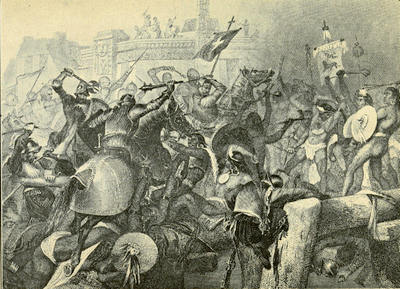
CAPTURE BY CORTÉS OF THE CITY OF MEXICO
Cortés now determined to secure the person of
Guatemozin, so, upon the following day, August 13th.,
1521, the Spaniards again advanced into the town and
were soon battling fiercely with the Aztecs. While this
was going on several canoes pushed off across the lake.
The Spanish ships gave chase and sunk most of them,
but a few succeeded in getting into open water. Two
or three large canoes, close together, attracted the attention
of a soldier, named Garci Holguin, who instantly
gave chase, and, with a favorable wind, soon
overtook the fugitives, although they rowed with great
energy. The Spaniards leveled their guns at the Indians,
when one rose, saying:
“I am Guatemozin. Lead me to Malinche. I am
his prisoner. But let no harm come to my wife and
to my followers.”
The Emperor was taken on board one of the ships
and was ordered to call upon his people to surrender.
“There is no need of this,” he answered sadly, “for
they will fight no longer when they see that their Emperor
has been captured.”
He had spoken correctly, for, when the news of his
capture reached the shore, the Mexicans at once ceased
to defend themselves. They had put up a hard battle
in order to give their Sovereign an opportunity to
escape.
Cortés had been watching the affair from the flat
roof of one of the houses and now sent word that
Guatemozin should be brought before him. He came,
escorted by Sandoval and Holguin, both of whom
claimed the honor of having captured him. The Spanish
conqueror came forward with dignified courtesy to
receive the noble prisoner.
“I have done all that I could to defend myself and
my people,” said Guatemozin. “I am now reduced
to this awful state. Deal with me, Malinche, as you
will.” Then, laying his hand upon a dagger which
hung from the belt of the Spanish invader, he added:
“Better dispatch me at once with this, and rid me of
life.”
Cortés smiled.
“Fear not,” said he. “You will be treated with
honor. You have defended your capital like a brave
warrior, and a Spaniard knows how to respect valor,
even in an enemy.”
In spite of these remarks he treated him with great
cruelty, for, when the city was entered and less treasure
was found there than had been expected, Cortés caused
poor Guatemozin to be tortured. Fire and cord could
not, however, wring the secret of the treasure from this
illustrious Prince. Later on he was hanged, upon the
pretense that he had conspired against the Spaniards.
The Aztec dead were now collected and burned in
huge bonfires. Those who were still alive were allowed
to leave the city, and for three days a mournful train
of men, women, and children straggled feebly across
the causeways, sick and wounded, wasted with famine
and with misery. Again and again they turned to
take one more look at the spot which had once been
their home. When they were gone, the Spanish conquerors
took possession of the place and purified it as
speedily as possible, burying those who were not burned
in the bonfires.
The treasures of gold and of jewels which were
found fell far short of the expectations of the conquerors,
for the Aztecs, no doubt, had buried their
hoards, or sunk them in the lake on purpose to disappoint
the avarice of their enemies.
Thus, after three months of continued fighting, the
renowned capital of the Aztecs fell before Cortés and
his men. The Mexicans had put up a courageous fight
and had suffered much, but they had been no match for
the soldiers from Cuba and from Spain.
The Aztecs would not have thus gone down to ruin,
had they not ruthlessly made war upon the neighboring
states, which caused them to be hated. Their human
sacrifices had angered their weaker neighbors, and
thus Cortés had secured the aid of the Tlascalans, without
whose assistance he could never have won the
fight.
Cortés and his Spaniards were now masters of Mexico.
A brave man with equally brave followers had conquered
an entire empire!
And what of the future days of this bold-hearted
explorer? Alas! These were similar to those which
came to Columbus, the Navigator. Poor, forsaken by
the King of Spain, surrounded by persons who were
jealous of his position and his fame, the once rich and
prosperous adventurer died miserably at Castilleja,
Spain, on December second, 1547, at the age of sixty-two.
With him was his devoted son, Martin, a youth
of fifteen.
Cortés was entombed in the land of his birth, but
this was not to be his last resting place, for his remains
were taken across the sea to the country which he had
conquered. He was buried for the second time in the
Franciscan monastery at Tezcuco; then, for a third time,
in the church of St. Francis in the City of Mexico. On
this occasion, which was sixty-seven years after the first
entombment, all the dignitaries of Mexico marched in
procession through the streets of the city. Still again,
in 1794, there was another removal of the General’s
moldering dust to the hospital of Jesus, where a monument
of bronze was erected to his fame and glory.
In 1823 there was yet another disturbance of what
remained of our hero. The previous removals of his
ashes had been inspired by regard, but now a revolutionary
mob of frenzied Mexicans, in order to show its
hatred and detestation of the Spanish conquerors, endeavored
to desecrate the tomb. To prevent this, the
casket, in the dead of night, was secretly carried away
by the Duke of Monteleone, a descendant of Cortés on
the female line, and for more than seventy years remained
in a place of safety. Monteleone, himself, was
killed in one of the many Mexican revolutions, and all
knowledge was lost of the spot where he had hidden the
ashes of the conqueror. Yet, within a few years, the
remains have been discovered and a movement has been
started to have them placed in the national pantheon,
a temple in the City of Mexico, erected to all those who
have made great names in the history of this turbulent
republic.
So at last, perhaps, the valiant Cortés will receive the
honor that is due him.