"It is! It is!" chattered the robins at half past
three on an early June morning in 1845. Jonathan
Wheeler sat up in bed with a start. This was the
morning he had been waiting for all the spring,
the morning he was to start for Boston with his
father, mother, and Uncle William, and ride for
the first time on a railway train.
"Is it really pleasant?" was his first thought.
"It is! It is!" chirped the robins again. And
Jonathan's eyes by this time were open enough
to see the red glow through the eastern window.
In a second he was out of bed, hurrying into his
best clothes that his mother had laid out for him
the night before.
Jonathan lived in a little town only thirty miles
from Boston; but traveling was not then the easy
and familiar experience of to-day. The nearest
railway station was at South Acton, fifteen miles
away. The Wheelers had planned to start from
home in the early morning, and after dining with
some friends in the railroad town, leave there for
Boston on the afternoon train.
But in those days the Fitchburg railroad had
not crossed the river, and had its terminal at
Charlestown. From there passengers were carried
by stage to the City Tavern in Brattle Street. It
would be six o'clock that night before Jonathan
could possibly see Boston.
But he lost no moment of his longed-for day.
The bothersome dressing and eating were soon over;
and Jonathan felt that his new experiences were
really beginning when, at seven o'clock, from the
front seat beside his father in the blue wagon, he
looked down on his eight less fortunate brothers
and sisters and several neighbors' children, who,
with the hired man, were waiting to see the travelers
depart.
"Good-bye! Good-bye, everybody!" called Jonathan,
proudly. "I shan't see you for three days,
and then I shall be wearing some store clothes!"
For the first few miles the conversation of his
elders did not interest him much. He was so busy
watching for the first signs of a railway train that
the smoke from every far-away chimney attracted
his attention; but after a while, when there was
nothing to see but the thick growths of birch and
maple each side the road, he heard his father saying:
"Well, Betsey, I think thee has earned this
holiday. Thee has had a busy spring."
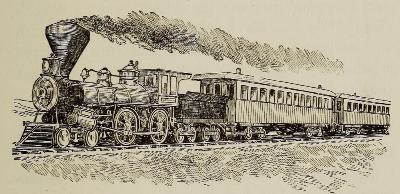
An Old-fashioned Train of Cars
"It has been a busy time," agreed Mrs. Wheeler.
"But all the house-cleaning is done and every
stitch of the spring sewing. Since April I've cut
and made sixteen dresses and six suits of clothes."
"Did thee read in the Worcester Spy last week,
Betsey," inquired Uncle William, "of a sewing
machine that bids fair to be a success?"
"A sewing machine!" echoed Mrs. Wheeler.
"Does thee mean a machine that actually sews as
a woman sews? That's too good to be true!"
"But it's bound to come, Betsey," said her husband
reassuringly. "We're keeping house to-day
much as the early settlers did. We've found better
ways of travel, and labor-saving inventions are the
next thing." Then, turning to his brother, he
added, "Tell us, William, what the Spy said."
"Well, it seems there's a young man in Boston
who has a good deal of ingenuity, and he actually
has a sewing machine on exhibition at a tailor's
there. For some days he's been sewing seams with
it, the paper said, at the rate of three hundred
stitches to the minute. Perhaps we shall find that
tailor's shop to-morrow."
"I should like nothing better," answered Mrs.
Wheeler. "Maybe we can buy Jonathan's trousers
there."
Jonathan had been an interested listener to this
conversation; but just then he caught sight of a
moving column of smoke, and for the rest of the
drive he thought of little else but the engine he
could scarcely wait to see. By ten o'clock came
South Acton; then the long hours while his elders
ate slowly and talked much; at last the wonderful,
puffing, noisy engine and the strange, flat-roofed
houses on wheels with their many little
windows. Jonathan's world had grown very large
indeed when he went to sleep that night at the
City Tavern in Brattle Street.
The next morning at the breakfast table, with
the aid of the Morning Advertiser and the Boston
Transcript of the night before, the Wheelers made
their plans for the day's shopping and sight-seeing.
"We'll do the shopping first," decided Mrs.
Wheeler. "Here's an advertisement of ready-made
clothing." And she read aloud what was, for those
days, a rather startling advertisement, beginning:
PERPETUAL FAIR
AT
QUINCY HALL
OVER QUINCY HALL MARKET
BOSTON
"Let's go there," advised Uncle William. "Quincy
Market isn't far from here." So the Wheelers'
first stopping place that morning was Mr. Simmons's
establishment at Quincy Market.
"Has thee any linen trousers for this little boy
to wear with the dark blue jacket he has on?"
inquired Mrs. Wheeler of the young man who came
forward to serve them.
"We have, madam, I am sure." And deftly the
polite young man picked out a pair of dark blue
and white striped linen trousers from the middle of
a neat pile of garments. Sure enough, the trousers
were of the right size; and, to the Wheelers' astonishment,
the price was less than they had expected
to pay.
"There must be some profit, madam, you see,"
explained the clerk; "but if we could make these
garments by machine, as a young man in the next
room says he can, we
could afford to sell them
for almost nothing."
"We have heard of
that young man and
his machine. Will it be
possible for us to watch
him sew with it?" replied
Mrs. Wheeler.
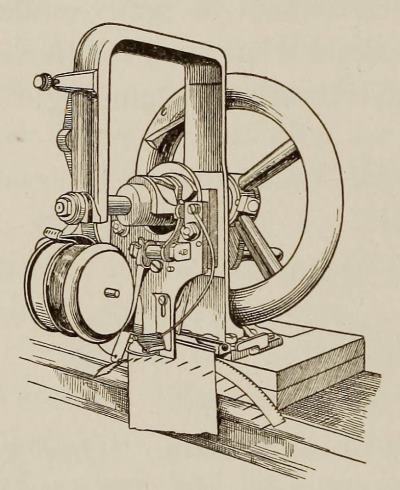
Howe's First Sewing Machine
"Certainly, madam.
Just step this way, if
you please." And he
ushered the Wheelers into
an adjoining workshop, well filled with men and
women, many of the men, as Jonathan found out
later, being dealers in ready-made clothing in the
larger towns near Boston.
"Oh, mother, there he is!" whispered Jonathan
excitedly, and he hurried forward to see better.
A kindly-faced young man, not more than twenty-five
years old, sat at a table before what seemed to
Jonathan a sort of little engine without wheels.
With one hand he was turning a crank and with the
other he was guiding a seam on a pair of overalls.
A bright needle flashed in and out of the blue
cloth till it reached the end of the seam. Then
the sewer stopped the machine, cut the thread,
and handed the garment about for inspection.
"That took just one minute, Mr. Howe," announced
a man who stood near, watch in hand.
"One minute!" echoed a woman standing beside
Jonathan. "I could not sew that seam in
fifteen minutes."
"How long would it take thee, mother?" whispered
Jonathan, aside.
"I'm not sure, little boy," his mother whispered
back. "I think I could do it in ten minutes."
"An experienced seamstress could not sew that
seam in less than five minutes," then spoke Mr.
Howe, as if in answer to a question.
"I don't quite believe that," objected one man.
"Well, why not have a race?" challenged Mr.
Howe. "Mr. Simmons," he continued, addressing
the proprietor, "will you let five of your best
sewers run a race with me? I'll take five seams to
sew while each of them does one. Are you
willing?"
"Agreed!" said Mr. Simmons. And it was but
the work of a moment to select an umpire and prepare
the seams. Then the umpire gave the command
to start and the race began.
It was an exciting contest. The girls sewed "as
fast as they could, much faster than they were in
the habit of sewing." Mr. Howe worked steadily
but carefully.
"If he wins, how many times as fast as each
girl is he sewing?" asked Jonathan's uncle suddenly,
of the little fellow. Jonathan was too bright
to be caught and answered quickly, "More than
five, isn't he?"
"That's right, Jonathan. And he really is sewing
more than five times as fast. Look!"
It was true. Mr. Howe held up his finished
seam. Every girl was still at work. "The machine
has beaten," announced the umpire. "And moreover,"
he added after careful inspection, "the work
on the machine is the neatest and strongest."
"Now, gentlemen," said Mr. Howe, "may I
not have your orders for a sewing machine? See
what a money-saver it will be! I can make you one
for seven hundred dollars. It will pay for itself
in a few months, and it will last for years."
Jonathan expected to hear many of the tailors
present order a machine at once. But he was witnessing,
although he did not know it till years
afterward, "the pain that usually accompanies a
new idea." The invention which was to make the
greatest change of the century in the manufacturing
world lay for several years unused and scorned
by the public. The short-sighted tailors over
Quincy Hall Market made one objection after another.
"It does not make the whole garment."
"My journeymen would be furious."
"Truly, it would beggar all handsewers."
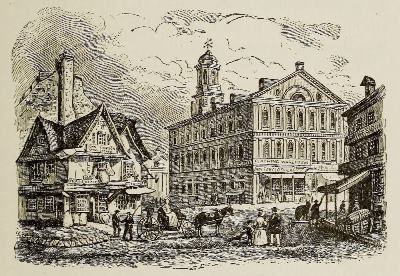
Faneuil Hall, Boston, Adjoining Quincy Market
"The Cradle of Liberty."
"We are doing well enough as we are."
"It costs too much."
"Why, Mr. Howe, I should need ten machines.
I should never get my money back."
Jonathan was sorry for Mr. Howe. "I'll buy a
machine some day," he announced.
"Thank you, little boy," answered Mr. Howe.
"I've no doubt you will."
But the tailors laughed and shook their heads.
Before they left the workshop, Jonathan's party
had a long talk with Mr. Howe.
"We are from the country," they said, "with
no money to buy a machine of this sort. But we
are interested in it, and we believe it has a future.
Will thee tell us more about it?"
"Gladly," said Mr. Howe. "I've been at work
on the machine most of the time for the last five
years—ever since I was twenty-one, in fact. I
was born up in Worcester County, in Spencer.
When I was eleven, I was bound out to a farmer,
but I liked machinery better. I went to Lowell
as soon as my parents were willing, and worked a
while in a cotton mill. But I did not like that very
well, it was so monotonous, and I came down here
to work for Mr. Davis in Cornhill. One day a
man who was trying to construct a knitting machine
came in to see if Mr. Davis could make him
a suggestion. But Davis really made the suggestion
to me. 'Why don't you make a sewing machine?'
he asked.
"'I wish I could,' the man answered, 'but it
can't be done.'
"'Oh, yes,' cried Davis, 'I could make one
myself.'
"'Well,' was the rejoinder, 'you do it, Davis,
and I'll insure you an independent fortune.'
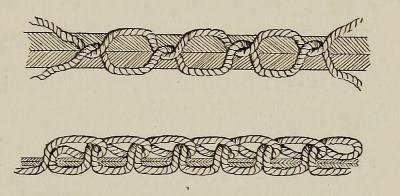
Lock Stitch (above) and Chain
Stitch (below)
The lock stitch is made with two threads, and
the chain stitch with one.
"Now I don't know that Davis or the other
man has thought of the matter since. As for me,
I've thought of little
else. A year ago last
October I had planned
out the chief parts of
the machine—the two
threads, the curved,
eye-pointed needle,
and the shuttle. A
rough model that I
made convinced me that such a machine would
work; and last December I prevailed upon my
friend, Mr. Fisher of Cambridgeport, to let me,
with my wife and children, live at his house and
construct my machine in his garret. He gave me
five hundred dollars besides for material. In return
for those favors, I've agreed to give Fisher
half my profits. But," he added rather gloomily,
"so far it's been a bad bargain for Fisher."
"Is the machine patented?" inquired Uncle
William.
"Not yet," answered Mr. Howe. "I need some
money first, for, you know, I shall have to make a
model to deposit at Washington."
The Wheelers thanked Mr. Howe for his kindness
in satisfying their curiosity and wished him all
good fortune.
"Sometime," added Jonathan's father, "I expect
thy machine will find its way into homes as
well as into shops."
"Indeed, Mr. Howe," added Mrs. Wheeler,
"it would be the greatest boon the farmer's wife
could ask."
"I prophesy, Betsey," said Uncle William,
"that before many years thee will make Jonathan
some overalls with a machine of thine own.
Meantime," turning to Mr. Howe, "I want to
buy him the pair thee sewed in the race. They
were boys' trousers, were they not?"
"Yes," answered Mr. Howe, "and I'm sure Mr.
Simmons will be glad to sell them to you. He
does not put too high a value on them, you know,"
he added soberly. "Anyway, I shall be glad to
know that my machine has sewed for so engaging
a little fellow," he finished, with a pleasant smile.
As for Jonathan, he was almost too excited to
speak. Two new pairs of "store" trousers in one
day, and one of these sewed by a machine! "Thank
you, Uncle William," he gasped. And he must say
something to Mr. Howe. "Thank you, too, Mr.
Howe. I shall surely buy a machine some day."
Jonathan returned to the country the next day,
a much traveled little boy for the year 1845. All
his experiences remained vividly in his memory:
the wonderful railway train, the stage coach clattering
over the city pavements, the waiter at the
hotel who stood politely near the table and anticipated
his wants—all these recollections made
his farm life happier and his farm tasks easier.
Of all his Boston memories, however, none were
more vivid or more persistent than the sight of
that marvelous sewing machine and its exciting
race with the skilled sewers.
"What has become of Mr. Howe?" thought
Jonathan more than once. "Has he given up trying
to persuade people that sewing by hand was
often a needless drudgery?" For a year and a half
Jonathan could only wonder. Then, one day in
February, 1847, Uncle William read in the Boston
Advertiser that Elias Howe and his brother had
taken passage in a packet for England to interest
Londoners in the curious machine that could work
faster and more skillfully than human fingers.
Three years later Uncle William took Jonathan
on another journey, this time to a small town west
of Worcester and about thirty miles from home.
The trip was made, so Uncle William said, to consult
with a county commissioner there about the
prospect of a much needed road; but Mrs. Wheeler,
when she remembered that Mr. Howe had mentioned
Spencer as his birthplace, remarked knowingly
to her husband:
"Not that I would question Brother William's
motive, but thee knows, Daniel, that he was the
most interested man in that room over the Quincy
Hall Market. He may need to see the commissioner,
but I think he's more interested in the fortunes
of young Howe."
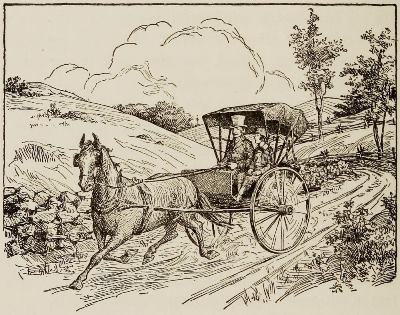
Jonathan and his Uncle William in the One-horse Chaise
"I believe thee's right," answered her husband.
"And I hope," he added, "that William will come
back with good news about that young fellow and
his machine."
There was no railway train this time for Jonathan.
It was an interesting journey, nevertheless,
through a beautiful hill country with varied scenery.
Jonathan and his uncle both enjoyed their
ride in the comfortable one-horse chaise and their
dinner at the Worcester inn. In the afternoon they
drove out to Spencer and put up at the tavern
there; and after supper they went to bed in the
very room where President Washington once had
slept.
"Now, if I could only see Mr. Howe on the street
to-morrow morning!" thought Jonathan as he
dropped asleep.
Mrs. Wheeler would not have been greatly surprised
at Uncle William's procedure the next morning.
The visit to the county commissioner was
made immediately after breakfast and the information
that Uncle William desired easily and
quickly obtained.
"By the way," inquired Uncle William when
the business interview was over, "do you know
anything of a young fellow named Elias Howe?"
"Elias Howe? Why, yes, I believe so. There are
so many Howes here I had to think a minute.
You mean Elias, Jr., I guess. They did live down
in the south part. The young fellow had some
scheme of sewing by machinery. Couldn't make
it work, I believe."
"Is his father living here?"
"No, not now. Another son invented a machine
for cutting palm leaf into strips for hats and Howe
moved to Cambridge to help the thing along. Don't
believe he'll ever come back."
"My nephew and I saw young Howe in Boston
four years ago with his sewing machine. We've
both been much interested to hear more about
his fortunes. Has he some relatives here who
could tell us?"
"Why, yes, his uncle Tyler lives here, his father's
brother. His house is right over there. Better
call on him. He's a pleasant fellow—every Howe
is—and he likes to talk."
"Shall we?" asked Uncle William of Jonathan.
Jonathan's feeling in the matter was not uncertain,
but all he said was, "I should like to, Uncle."
"Glad to see you both," was the hearty greeting
of Mr. Tyler Howe, upon hearing Uncle William's
introduction of himself and his nephew. "Well,
Elias is a smart boy and a good one, but he's pretty
well down on his luck just now. So you saw him
in Boston? Four years ago, wasn't it? Since then
he's had a discouraging time.
"After he exhibited his machine in the shop
where you saw him, he spent three or four months
in Fisher's garret, making another machine to deposit
in the patent office. The next year he and
Fisher went to Washington, where they had no
trouble in getting a patent, but no luck at all in
interesting people in the sewing machine. They
exhibited it once at a fair, but the crowd was
amused, that's all.
"By the time Fisher got back to Cambridge, he
washed his hands of the whole matter. I don't
much wonder. He'd spent all of two thousand
dollars and hadn't had a cent in return. Then
Elias had only his family to turn to. With his
wife and children he moved to his father's and began
to plan how to interest England in the invention
America had rejected.
"He made a third machine, and with that as a
sample, his brother Amasa sailed for England in
October, about a month after Elias came back from
Washington. For a time it seemed as if the trip
would be worth while. Amasa showed the machine
to a William Thomas, who had a shop in Cheapside,
where he manufactured corsets, umbrellas, carpet
bags, and shoes. You can see that the sewing of
such articles must be extremely difficult, and
Thomas was really interested in the machine.
"But Amasa, I'm afraid, hasn't proved himself
much of a business man. He sold Mr. Thomas outright
for two hundred fifty pounds sterling (that's
twelve hundred fifty dollars of our money, Jonathan)
the machine he had brought with him and the
right to use as many more as were necessary in the
business."
"Then the notice in the paper was a mistake.
So Elias didn't go to Europe?" inquired Uncle
William.
"Yes, the notice was true. You see, the man
Thomas did most of his trade in corsets, and the
machine was better adapted to sewing overalls
and shirts. So Thomas agreed to give Elias three
pounds a week if he would go over to London and
adapt the machine for use on corsets and other
stiff material. Thomas also agreed to pay the expenses
of workshop, tools, and material.
"Amasa came back to America with this news,
and then he and Elias, with the precious first machine,
started together for London in February,
just as the paper said. They had so little money
that they had to go in the steerage and cook their
own food. But in London things went well for a
time, and Thomas even advanced the money for
Elias's family to join him. However, the good
fortune was short-lived. In eight months Elias
had adapted his machine to Thomas's requirements,
and then Thomas ungratefully discharged him for
good and all.
"Things were pretty dark for Elias by this time.
Thomas had agreed, but only by word of mouth,
to patent the invention in England, and to pay
Elias three pounds on every machine that was
sold. There are scoundrels everywhere, I suppose;
but that Thomas has proved one of the meanest
men I ever heard of. Sewing machines are fairly
common in London now, and on every one of those
Thomas has realized about ten pounds, but Elias
hasn't had a shilling.
"Of course, when Thomas discharged him, he
had nothing to do but move his family into cheaper
quarters, borrow a few tools, and begin the construction
of a fourth machine. He could not finish
it without more money, so he moved his family
into one very small room and worked as fast as he
could. But even then he could not buy food for
his wife and children and material for his machine.
There was nothing to do but send his family
home and work at the machine till he could sell it
and get his own passage money.
"Elias has been in a good many straits for a
young fellow, but he has a marked gift for making
friends. At this time he grew to know pretty well
a coach maker, named Charles Inglis, who unfortunately
was a poor man too, but who often lent
him what money he could during those evil days,
and what was better, kept faith in him.
"The night that Mrs. Howe and the children
left England, it was so very wet and stormy that
Mrs. Howe, who was almost in consumption, could
not walk to the ship. Inglis lent Elias a few shillings
for the cab hire, and Elias promised him some
clothing in return. The clothing was what the
washerwoman had brought home that morning,
but had taken away again, because there was no
money to pay her.
"Then came days of pinching poverty for Elias;
but not quite such unhappy ones, I think, now that
the wife and children were soon to be with the relatives
in Cambridge. Elias knew that the Howes
were too proud to let his family starve; and as for
himself, he would borrow a shilling at a time of
Inglis and buy beans to cook in his own room.
"Finally he finished the machine. Instead of
getting the fifty pounds that it was worth, he had
to sell it for five pounds, and even then for a mere
promise to pay. Inglis soon managed to get four
pounds of the money in cash for him, but that
four pounds was by no means enough to pay
Elias's debts and buy his passage. There was
nothing to do but pawn
his precious first machine
and the letters-patent.
That done, he drew his
baggage on a hand cart
to a freight vessel, and
he and Inglis took passage
in the steerage of
another ship bound for
America.
"Elias reached New
York last April with half
a crown in his pocket, but
he found employment in a machine shop almost at
once. Then came the sad news that his wife, who
had been ill when she left England, was dying in
Cambridge.
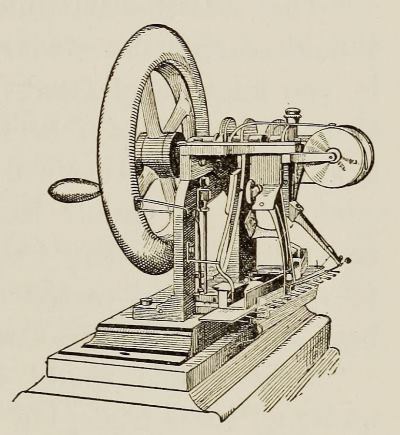
Howe's Improved Sewing
Machine
"Elias had no money for a railroad journey.
He had to wait friendless, except for Inglis, in a great
city, wholly despairing of ever seeing his wife again
and feeling that he had risked everything to gain
nothing. His father, however, as soon as he knew
of his destitution, sent him ten dollars, and Elias
reached Cambridge just in time to speak to his
wife before she died. He had no clothes, though,
but his shabby working suit, and could not have
gone to the funeral if his brother had not lent him
a coat.
"That was the last time I saw Elias, and then I
should scarcely have known him. By nature, he
is, you know, a pleasant-faced, happy fellow; but
then he looked as if he had had a long, painful
sickness. There wasn't a trace of his old self left.
And as if he hadn't had trouble enough, word
arrived before I left Cambridge that the vessel
to which he had carted his household goods had
been wrecked off Cape Cod.
"Most people would have given up, I think,
under all these trials, but Elias has a good deal of
the Howe perseverance. He immediately got a
position in Boston as a journeyman machinist at
weekly wages."
"And where is he now?" inquired Uncle William
sympathetically.
"I had a letter from him the other day. Should
you like to hear it?"
Taking the answer for granted, Mr. Howe opened
his desk and took out the letter. Then he read as
follows:—
Cambridge, Mass., June 20, 1849
My dear Uncle,
You will be interested, I know, in what I have
to write; and I think you will agree with me that
I shall yet retrieve all my ill-luck. Any advice
you may have for me I shall cheerfully receive.
First look at the enclosed hand bill.
And Mr. Howe interrupted the reading to pass
Uncle William and Jonathan a small hand bill
like this:—
A GREAT
CURIOSITY!!
THE
YANKEE SEWING MACHINE
IS NOW
EXHIBITING
AT THIS PLACE
FROM
8 A.M. TO 5 P.M.
He then went on with the reading:—
That was posted about in Ithaca, N. Y., just a
few weeks after I came back from England.
Some fellow made a machine from the description
he heard of mine, and he has been giving
exhibitions of its work in various places.
He says his machine can do the work of six
hands and make a pair of pantaloons in forty
minutes. And I have no doubt he tells the
truth.
Only, Uncle Tyler, don't you see it's my machine
and he is infringing on my patent? And
more than that, right here in Boston machines
have been built on my model and are in daily
use. Now I know that I am without resources
and that I have pretty well exhausted the patience
of my friends. But surely my claims are
valid.
Getting money to push them is the task I
dread. Still I have already raised a hundred
dollars to get my machine and letters patent
out of pawn in London; and I have every hope
that Mr. Anson Burlingame, who is soon to sail
for England, will deliver them safely to me in
the fall.
The next step is to see if the lawyers can find
any flaws in my claims. If they can't, the suit
I propose to bring is already in my favor; and
I am sanguine enough to believe that the Howe
sewing machine will yet be a household convenience.
Yours respectfully,
Elias Howe, Jr.
"Well," commented Mr. Howe, as he folded the
letter slowly, "I didn't know how to answer that.
He said he wanted advice. I know he wants money
more, but of course he hates to ask for it. I deliberated
a good while; but finally I wrote him that
if the lawyers gave him assurance that his claims
were valid, I would advance what money I could
spare to further his suit."
There was silence in the room for a little while.
Then Jonathan said earnestly:
"I wish I had some money to give Mr. Howe.
Would he take my five dollars, do you think?"
he asked of the inventor's uncle.
"See, I have it here; and I should be glad to give
it to him without waiting to hear what the lawyers
say. Do you think it would be all right to send it,
Mr. Howe?" he inquired.
"And may I, Uncle William?" he added quickly,
for he had almost taken his uncle's permission for
granted.
Uncle William nodded;
and Mr. Howe
said, "You may never
get it back, you know."
"I think I shall,"
answered Jonathan confidently.
"And anyway
I want to help Mr.
Howe."
"Do you want to
send it now?" inquired
Mr. Howe.
"If you please," replied
Jonathan.
"Then you may write your letter here, while
your uncle and I go for a walk."
Spencer, Mass.,
15th 9th mo., 1849.
Mr. Elias Howe, Jr.,
Cambridge, Mass.
My dear Mr. Howe:—
Perhaps thee remembers the boy who saw
thee run a race with thy sewing machine against
five seamstresses over Quincy Hall Market four
years ago. Thy uncle told me of the hard time
thee has had since. I am very sorry. I want
to buy a sewing machine and I want to help thee.
I am sending thee five dollars. It is all the
money I have. I hope thee will use it to win
thy suit. Sometime when thee sells sewing machines,
I hope thee will sell me one for my mother
five dollars less than the usual price. Thee can
see thee will not have to pay this back for a
long time, for it will be a good many years
before I shall have money enough to buy a
sewing machine.
Thy friend and well-wisher,
Jonathan Wheeler
There is little more to tell of Jonathan's visit to
Spencer. After dinner that day he started with
his uncle for Worcester, where they stayed all
night. The next morning, after an early breakfast,
they set out again, reaching home before the
forenoon grew very hot.
Not many days after Jonathan's return, the first
letter he ever received his father brought him from
the post office. It hardly needed the post mark,
Cambridge, to make Jonathan sure who had sent
it. Let us open it with him:—
Cambridge, August 26, 1849.
My dear friend Jonathan,
Your letter with its inclosure of five dollars
has been gratefully received. I remember you
and your uncle, your father and your mother,
with much pleasure. Ever since I ran that race
in Boston I have been sure that the machine
would work its way to success.
I am more confident now than ever. I have
found some one who will buy out Mr. Fisher's
interest; Mr. Burlingame will bring my old machine
and letters patent from London; and every
lawyer I have consulted says my claims are valid
and I shall win my suit.
When I have succeeded, and the manufacture
of sewing machines is under my control, I shall
send for you to pick out a machine for your
mother.
Again thanking you for your substantial interest,
I am
Very faithfully yours,
Elias Howe, Jr.
This was in 1849. Mr. Howe's darkest days
were over; but even then success came slowly and
in rather a strange way. Mr. Howe's chief enemy
was a Mr. Singer, who built machines and advertised
them with remarkable success.
"You are infringing my patent," wrote Howe
to Singer, upon hearing of the latter's activity.
"But you are not the inventor," replied Singer.
"The Chinese have had a sewing machine for ages;
an Englishman made one in 1790; a Frenchman
built one in 1830; and what is more to the point,
in 1832, a man named Walter Hunt, living in New
York, invented a sewing machine with a shuttle
stitch like yours. I can find Walter Hunt and
prove my statement."
Well, Mr. Singer did find Walter Hunt and the
fragments of his old machine. But "not all the
king's horses nor all the king's men" could put
those fragments together again so that the machine
would sew. For four years, however, the trial in
the courts continued. But at last, in 1854, when
Mr. Howe had waited nine years after completing
his first machine, the Wheelers and many others
read with great satisfaction in the Worcester Spy:
"Judge Sprague of Massachusetts has decided
that the plaintiff's patent is valid and that the defendant's
machine is an infringement. Further,
there is no evidence in this case that leaves a
shadow of a doubt that, for all the benefit conferred
upon the public by the introduction of a
sewing machine, the public are indebted to Mr.
Howe."
In 1855, Jonathan, now grown into a tall, manly
youth of twenty, started with Uncle William on
another journey, longer and more interesting than
either had ever taken before. This time they went
to New York, where they found Mr. Howe at the
head of a prosperous business; and when they returned,
they brought with them a Howe sewing
machine of the very latest model, "a present from
the inventor to Mrs. Wheeler, in gratitude for the
sympathy and encouragement of her family."


 but it did not take long to
learn to read the words that way to make sure
they were right.
but it did not take long to
learn to read the words that way to make sure
they were right.


