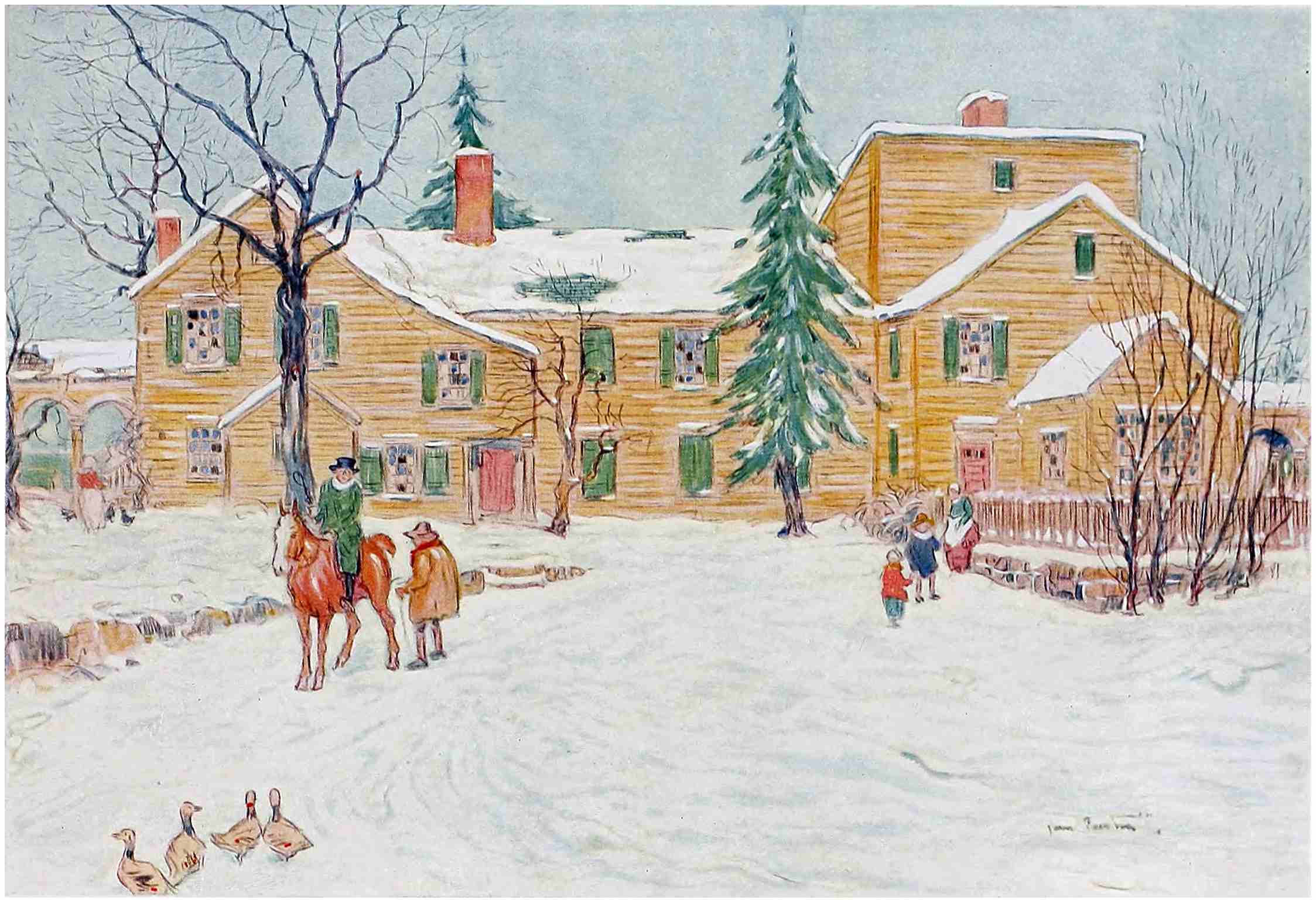
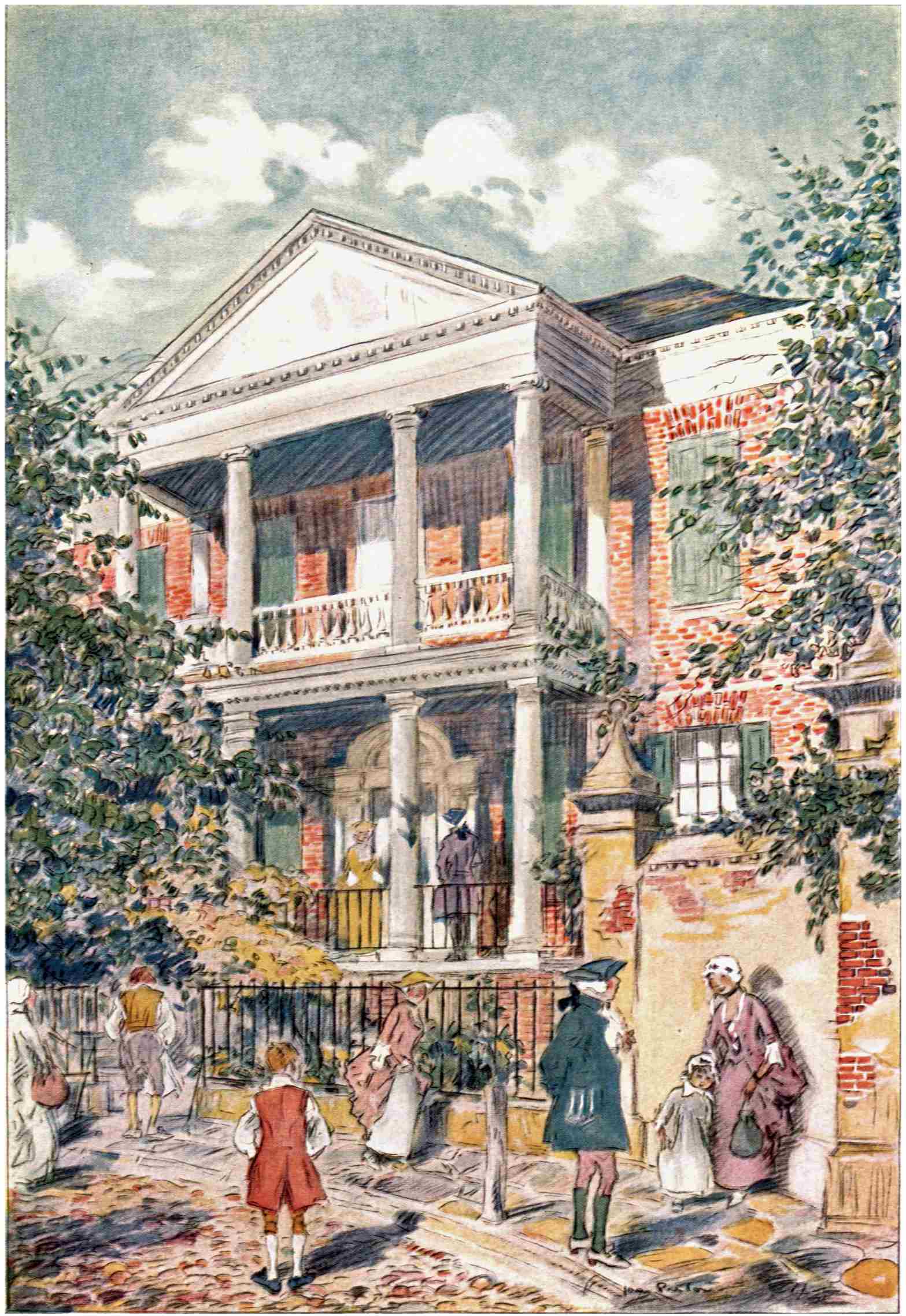
Larger versions of most illustrations may be seen by right-clicking them
and selecting an option to view them separately, or by double-tapping and/or
stretching them.
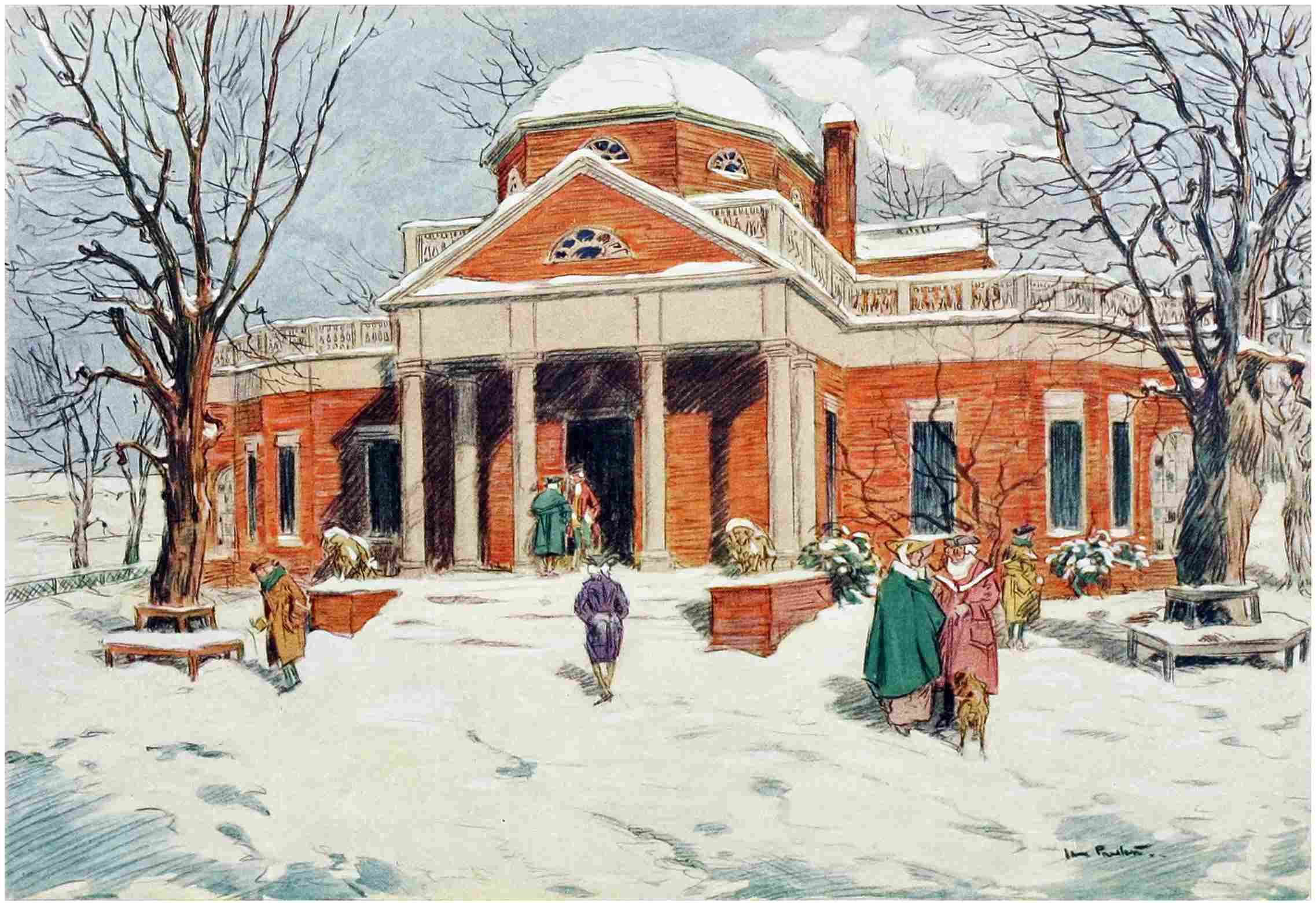
“Mr. Jefferson,” said one of Rochambeau’s aides, “is the first American who has consulted the fine arts to know how he should shelter himself from the weather.”
With no continental travel for background, with only the meager pictorial record of the period to draw upon, he somehow responded to the simplicity and useful
beauty of the classics, and translated it to his castle.
FAMOUS COLONIAL HOUSES
BY PAUL M. HOLLISTER
Illustrated by JAMES PRESTON
With an Introduction by JULIAN STREET
DAVID McKAY COMPANY, Publishers PHILADELPHIA, MCMXXI
Copyright, 1921, by David McKay Company
Illustrations especially engraved and printed by the Beck Engraving Company, Philadelphia
TO MARION
Foreword
There is no bibliography in this book. I confess freely
to a snapping-up of ill-considered trifles where I found
them. Those that rang true are here, those that proved
false upon closer examination are not. Some were gifts,
some purchases, some thefts—the latter are now shamelessly
confessed, on the plea that as a citizen I have the right
of eminent domain to the story of my country. I cannot put
the volume out to shift for itself without blanket acknowledgment
of the generosity of the people who put me in the
way of finding reliable information. Several of them are the
owners of the houses; some of them have even read this
manuscript.
—Boston, September, 1921.
Introduction
As I read in Mr. Hollister’s chapter on Mount Vernon of Washington’s
long absence from the home he loved and of the eagerness
with which he returned to it after the tumultuous years of the Revolutionary
War, I was caught by the fancy that lovers of books have
recently gone through a somewhat parallel experience. Dragged away
by the Great War from the books they cared for, plunged into continual
war reading, they now find, to their infinite relief, that they are
getting home again—back to Mount Vernon, as it were. And it seems
to me the change could not better be exemplified than in this charming,
gentle book of Famous Colonial Houses.
While we were fighting to preserve the heritage and the traditions
left us by Washington, Jefferson, Carroll of Carrollton, and other great
figures of their time, whom we find in these pages, we were too busily
engaged to give much thought to the origins of the things we fought to
save. Not that the forefathers of the nation were forgotten, but that
historic men were, in that time of stress, overshadowed by historic
principles laid down by them. We put them aside tenderly, as books
are put aside when the sword is taken up. Yet now that we have
vindicated in battle the freedom that they gave us, we find them more
than ever with us. For a just war fought through to victory sheds
glory not only upon the men who fought it and the nation for which
they fought, but also upon the nation’s ancient heroes, whose stature
is increased with that of their country. Wherefore this book, telling
tales of old houses in which early American history was made, and of
men who made the houses and the history, is even more welcome today
than it would have been before the Great War.
It is welcome, too, for another partially extrinsic reason.
In the face of mutterings of anarchy—that Russian importation
which is so much less satisfactory than the caviar—there is reassurance
in these sturdy calm old mansions which are the monuments of the
sturdy calm old patriots who raised them—men having a rare sense
of proportion which they exercised not only in building their houses
but in building the nation on lines equally clean, sound and beautiful.
Fancy a shaggy Bolshevik, his mouth full of broken English, his
head full of sophistry, and his heart full of greed for the possessions
of others, being led up Mount Vernon, Monticello or Doughoregan
Manor! Could any contrast make a picture more grotesque? Could
there be conceived a background more serenely sane, more perfectly
American, against which to display the distortion of this foreign madness?
Every stone and brick and timber of such houses preaches a
sermon on Americanism.
It is a sermon not only for aliens, but for all of us. We should
all see these houses, or if we cannot see them, we should know them
as some of them are made known to us in this book. Our land is
a better land for having them within its borders, and we will be better
citizens for an acquaintance with them.
The day on which I went to Monticello was beautiful, yet, save
my companion, no one else was there. I wonder how many of the
politicians who, with the vox humana stop pulled out, acclaim the name
of Jefferson as founder of the Democratic Party, have made the short
pilgrimage from Washington to Charlottesville to visit the house he
lived in and the grave where he is buried.
In curious contrast to the large investment of the nation in National
Parks, is its apparent indifference in the matter of the homes of its historic
figures. Not one of the houses dealt with by Mr. Hollister in
this book is the property of the nation. Two of them are, to be sure,
houses which, though their story is interesting, are not involved with
national history; and some of the others are not of sufficient importance,
from the purely historical point of view, to make them national
monuments of the first order. But two are, on the other hand,
the homes of early presidents, and neither of these is owned by the
nation. For all practical purposes Mount Vernon is as free to the
public as though the nation did own it, but the fact remains that the
title to it is vested in a society; while as for Monticello, it is owned by
a private individual, not a descendant of Jefferson, into whose hands
it came by inheritance from a forebear said to have secured it in a not
too creditable way. It is difficult to understand why the State of
Virginia or the Nation has not bought the place, which, I am told, the
owner has declared his willingness to part with—at a price.
The census of the twelve houses described and pictured in this
book is worth completing. One, Mount Vernon, is, as I have said,
owned by an organization of patriotic women; two are owned by their
municipalities and are cared for by patriotic organizations; one only is
the home of a lineal descendant and namesake of the builder—though
three others belong to persons having in their veins blood of the first
masters of their houses. And one—a most interesting, but not historic
house—is a poor battered tenement. Seven of the houses are
situated in Northern States, one in a Border State, and four are in the
South. The builders of two of the houses, the first and third Presidents
of the United States, are buried on the grounds nearby, and in
one case the builder is buried under the chancel of a private chapel, a
part of the house itself.
These historic houses may well be regarded as taking the place
with us of the crown jewels of an empire. I am thankful to have seen
eight of the twelve. For, like one of Goldsmith’s characters, “I love
everything that’s old—old friends, old times, old manors, old books,
old wine.”
Therefore I find myself particularly pleased at being associated
with this book, though in so slight a way. The two men who created
it—for in this case the author and the artist surely stand on equal
footing—are my old friends. Obviously, the book is one of old times
and old manors, and if that does not make it an old book, what could?
Only the old wine is lacking to complete the quintet. And even that
may some day be accessible again. Who knows?
In Thomas Jefferson’s boyhood imagination the hill had seemed to
climb like Jack’s beanstalk to the infinite clouds. The view from
his Father’s dooryard across the Rivanna registered each day through
the clear lenses of his eyes upon the sensitive plate of his memory, and
so upon his heart. As a lad he staged mental melodrama upon its
symmetrical slopes and built an air-castle upon its summit. Every
engagement of Caesar’s conquests, every adventure of the pious Aeneas
found on Monticello a proper setting. If his schoolbooks had not been
burned in the fire at Shadwell we might expect to find, on the margins
of his Horace, a sketch of the castle of his dream, for Jefferson drew
rather well and probably sketched just as well during study hour as any
other boy of his age.
He was nineteen when his dream promised to materialize. That
summer and the next, when he was at home for the long holiday, he
would cross the Rivanna in his canoe and climb the slope to see how
the workmen were getting on with the levelling for his castle. As the
boy had grown towards manhood the hill no longer towered into the
skies, but whatever the picture lost in size, it gained in rich associations.
It was still his mountain: Monticello—“little mountain”—he
called it. “Our own dear Monticello, where Nature has spread such
a rich mantle under the eye, mountains, forests, rocks, rivers. There
is a mountain there in the opposite direction of the afternoon’s sun,
the valley between which and Monticello is five hundred feet deep....
How sublime to look down upon the workhouse of Nature, to
see her clouds, hail, snow, rain, thunder, all fabricated at our feet.”
In all weathers, under all trials, his heart took refuge on the hill.
He was admitted to the bar in 1767, made headway in his profession,
and was sent to the House of Burgesses, honors which only quickened
his impatient accomplishment, and his desire for a home upon his
mountain. In 1769 its plans were ready, and work began. Thirty
years later it was finished. During those years he wrote his country’s
bill of divorce from her harsh proprietor, and was nearly captured at
Monticello by British raiders. Monticello saw him ride down the
winding road as a Burgess, to ride up again as a member of the Continental
Congress; honored him as Governor of Virginia, and waved
him Godspeed as he left to succeed Benjamin Franklin as envoy to
France; hailed him home as Washington’s secretary of state, and then
reluctantly surrendered him to eight years in a new White House that
stood in a sandy wilderness somewhere down on the banks of the
Potomac. But when his active life was done, after he had not only
written the Declaration of Independence but prosecuted it, added half
a continent to its jurisdiction, and administered the doctrine that all
men are created free and equal, he came back to the mountain of his
memory to gaze down upon the workhouse of Nature.
“While it is too much to say,” writes Julian Street, “that one would
recognize it as the house of the writer of the Declaration, it is not too
much to say, that once one does know it, one can trace a clear affinity
resulting from a common origin—an affinity much more apparent,
by the way, than can be traced between the work of Michelangelo on
St. Peter’s at Rome, on the ceiling of the Sistine Chapel, and in his
‘David.’
“The introductory paragraph to the Declaration ascends into the
body of the document as gracefully as the wide flights of easy steps
ascend to the doors of Monticello; the long and beautifully balanced
paragraph which follows, building word upon word and sentence upon
sentence into a central statement, has a form as definite and graceful
as that of the finely proportioned house; the numbered paragraphs
which follow, setting forth separate details, are like rooms within the
house, and—I have just come upon the coincidence with a pleasant
start such as might be felt by the discoverer of some complex and
important cipher—as there are twenty-seven of the numbered paragraphs
in the Declaration, so there are twenty-seven rooms in Monticello.
Last of all there are two little phrases in the Declaration (the
phrases stating that we shall hold our British brethren in future as
we hold the rest of mankind—‘enemies in war; in peace, friends’), which
I would liken to the small twin buildings, one of them Jefferson’s
office, the other that of the overseer, which stand on either side of the
lawn at Monticello, at some distance from the house.”
The house which inspired and witnessed the activities of so prominent
a figure could hardly lack distinction, and this, of course, Monticello
has. What is more, Monticello is a monument of technical
architecture which attracts the eager attention of every student of
American domestic building. The question they all ask, and the
question that cannot be answered, is: “Where could this farmer-lawyer
boy have got his expert training in architecture?” His library
might have given us a clue, but it was burned at Shadwell in 1770.
We know he felt this loss acutely, for, next to his house, Jefferson loved
his books. He asked anxiously of their fate. An old slave answered:
“All burnt, my young master, all burnt. But never mind, sir”—and
his wrinkled face broke into a broad smile—“we saved your old fiddle!”
The new house at Monticello was even then far enough along to take
in his mother’s family, evicted by the fire. The building continued.
It was slow work, on an extensive plan.
“Mr. Jefferson,” said one of Rochambeau’s aides later, “is the
first American who has consulted the fine arts to know how he should
shelter himself from the weather.” With no continental travel for
background, with only the meagre pictorial record of the period to
draw upon, he somehow responded instantly to the simplicity and
useful beauty of the classic, and translated it to his castle. By the
Greeks, for example, it was thought improper that a roof should indicate
anything but a glorification of the heavens; the idea that human
feet might be walking on the upper side of a ceiling was sacrilege. This
(and other more practical engineering reasons) dictated single-story
buildings. Jefferson’s eye for balance caught the pictorial advantages
of one-story construction, but he needed two stories for Monticello,
and by his shrewd planning both the pure classic tradition and pure
American comfort were reconciled.
At the end of a broad lawn, in full relief against the distant sky,
stands a red brick house with a clean, tall portico. The four gleaming
pillars stand guard like peace-time sentinels. A white balustrade
runs along the eaves of the building, tempering the irregularities in
the roof except where the smooth curve of a dome rises above the
center. The feeling is classic, and so suggests a single story, and the
length of the lofty windows flanking the portico seems to confirm the
impression that a single frame has been carried the full height of the
house. Closer examination, however, of the irregularities just remarked
in the roof reveals them as the gabled windows of an upper
story. In cold, unprofessional analysis, the compromise sounds
thoroughly impractical. Just the contrary is true, for Jefferson
took up every challenging problem with enthusiasm, and applied
to its solution a sure sense of balance and a hearty appetite for
detail.
Indoors the one-story tradition is quite as respectfully acknowledged,
and as cleverly evaded. The entrance hall is a lofty room of
great dignity, almost so good that a job-lot of Victorian furniture has
not damaged its appearance, and unquestionably so good that even
the most critical architectural eye will not take offense at a balcony
which travels three of its sides. There is the balcony, but where, inquires
your classic eye, are the stairs? Concealed in a passage, where
they cannot break the form of the hall from which visitors are to gain
their first impression of the interior.
If the visitor in Jefferson’s day went further, as his uniform hospitality
required, he may have noticed as he passed to the drawing-room
that the portal between the two rooms had two pairs of doors. There
was a definite reason for them: the wall must be heavy to support the
octagon in which the drawing-room was situated, and over which rose
the dome. A single pair of doors would have made an ugly recess in
either room. Two sets of doors finished both rooms correctly, but presented
just twice as many nice problems of treatment. So the first set
was made of heavily paneled wood, and might be folded back into an
invisible pocket in the passage; the second set was a pair of light casements,
and if the visitor were to press a spring on either one, both
would close by a mechanism concealed overhead.
Throughout the building there were ingenious touches which
disclosed beneath their first impression of simple luxurious comfort
the patient scheming of the builder. The drawing-room was octagonal
in order that five windows might frame clear vistas in as many
directions across the sweeping valleys to the horizon. The floor
there is of squares of cherry wood, each with a liberal border of contrasting
beech; both woods were laid only after Jefferson had made
painstaking experiment in the color and in the wearing and joining
qualities of various kinds of flooring. The same note of formality
which one feels in the Pringle house of Charleston as he passes from
room to room through heavily pedimented doorways is sounded at
Monticello; but where Miles Brewton, in his Charleston house, held
strictly to the “egg-and-dart” of the classic mode, Thomas Jefferson
embellished the friezes above the doors of his drawing-room with a
motive of tomahawks, scalping knives and rosettes! He feared that the
dining-room, with only two southerly windows for ventilation, might
become close toward the end of a long meal, so he gave a slight dome-like
concavity to the ceiling, and at its focal center concealed under
a grille the intake of a ventilator which leads up through the roof.
He built a recess for the sideboard with the double effect of preserving
the lines of the apartment and of displaying a handsome piece of furniture
to its best advantage. An exquisite Adam mantel, with Wedgwood
panels, stands between two of the windows, and you would never
guess that in one of its sides is a door, and behind that door a dumb-waiter
leading from the service rooms below. He wanted his body-servant’s
room conveniently near his own, so a staircase to the valet’s
quarters ascends through a spacious closet off the master’s chamber.
None of the liaison between art and artifice would be remarkable today,
perhaps. There are modern houses as honestly built as men of taste
can plan and men of wealth can buy, to match Touraine for splendor,
Italy for gilt, a highly organized railway terminal for convenience and
Sybaris for comfort. But given the workmanship, the materials and
the engineering of any period in our domestic architecture, Monticello
challenges them all to show a better plan.
Long balustraded walks reach out to right and left from the
house. Someone has likened them to two friendly outstretched arms,
holding in each hand not a jewel, but a dainty summer-house.
They are more than decorative promenades—each is the roof of a
subterranean arcade, passing from the main building to the servants’
quarters. All of the strictly domestic affairs were in the
cellar-story, made habitable by the fact that it was just a step down
the hillside, and made by no means the least interesting portion
of the building by further evidence of Jefferson’s genius. It is a
veritable catacomb. He built there a kitchen ventilated by long ducts
which carried cooking odors to distant outlets; he built cisterns, a
large carriage court, cold-rooms, bins for fruits, and wood, and cider;
servants’ quarters so placed that they were cool in summer and warm
in winter. Like Mount Vernon, and every other colonial estate of
any size, Monticello was a self-maintaining establishment, which supported
the labor of several trades. But the tailor-shop, the distillery,
the smithy, the dye-house, the cobblery, the weaver’s shop—all were
set apart from the main house and concealed from the general eye.
Later architects thought enough of the treatment of the arcade passages
to the servants’ quarters to copy them for the subterranean barracks
at Fortress Monroe.
One wonders where Thomas Jefferson found the time for all this
labor and supervision. The answer must be that his house was his one
consuming avocation. It is almost a truism that the men upon whom
are made the heaviest demands find time to invite the greatest number
of demands. As Roosevelt loved his natural history, and made affectionate
excursions into botany, so Jefferson knew every tree and shrub
on his estate, and watched over it. Each week during his presidency
a letter was despatched from the White House to Captain Bacon, his
overseer in charge, directing transplanting, grading, repairs, improvements.
Many of the workmen on the estate were men whom he himself
had trained in their crafts. Some were slaves, whom he later freed
to practise the trades he had given them. Before he had stone cut
and measured for the building he tested the stone; he weathered various
woods; he made experiments in brick-laying which in some cases
led him to strange conclusions, but which, like everything else he
undertook about the building, had practical reasoning behind them.
And yet, during all the patient hours he spent in drafting and directing,
the miles he walked in surveying and landscaping, he never let the
cloud of details eclipse the artist’s star.
Jefferson has been much idolized for his directness, his logic, his
practicality. He undoubtedly gave the country what today would be
termed “a good business administration.” It is tempting to leave
him to posterity with that reputation, and with the Louisiana Purchase
as its brightest testimonial, the shrewdest real estate deal in our
history. But Monticello is so obviously the product of an artist and a
scholar that we learn with no hint of damage to his commoner reputation
that the man who had spent his life upon this estate had also spent
much more money than he possessed; that his generosity approached
extravagance; that his library of some seven thousand volumes, the
best then in America, was sold after his death to the government (to
replace the library the British destroyed at Washington in 1814) because
it had to be sold to meet his debts; and that Monticello itself
finally passed out of the hands of his family. With Jefferson gone
Monticello could never be wholly itself again. It must stand always as
the finest exposition of the heart of the artist who conceived the plan
for the University of Virginia at Monticello’s skirts, who found when
he visited Nîmes a Roman Temple which so fascinated him that he
said the peasants thought him a mad Englishman contemplating suicide
in its ruins, who copied that same temple for the Capitol of Richmond,
and who wrote to a Paris acquaintance: “Here I am gazing
whole hours at the Maison Quarrée like a lover at his mistress.”
When Jefferson died he was buried on the estate. An army of
human rodents came to see to his grave and to nibble away most of the
memorial shaft, and it was only through the persistent efforts of his
grand-daughter, Miss Randolph, that the United States stepped in
and restored it. Meanwhile the estate had been sold under questionable
circumstances to a Captain Uriah Levy. In justice to him be it
said that he felt the responsibility of his charge, and bequeathed it at
his death to the people of the United States. But the Supreme Court
decreed that this definition was too vague, and after a prolonged
debate among Levy’s heirs, his nephew, Jefferson Levy, acquired for
$10,500 the title to the buildings and 218 acres of the little mountain.
Sporadic efforts have been made to buy the estate and rescue it
from the casual upkeep which is carrying Monticello steadily towards
the shadows of oblivion; one such movement, under the leadership of
Mrs. Martin W. Littleton, bade fair to succeed, and there were patriotic
women ready to assume its care as they have so admirably done at
Mount Vernon. The Governor of Virginia is silent on the subject,
and the Wilson government, which owed more perhaps to Jefferson than
to any other single preceptor, was otherwise engaged. With the return
of peace the renewal of the project is, to say the least, appropriate.
Whether it contains an appeal to the honor of citizenship in a nation
in which all men are free and equal, is for its citizens—and one of them
is the owner—to decide.
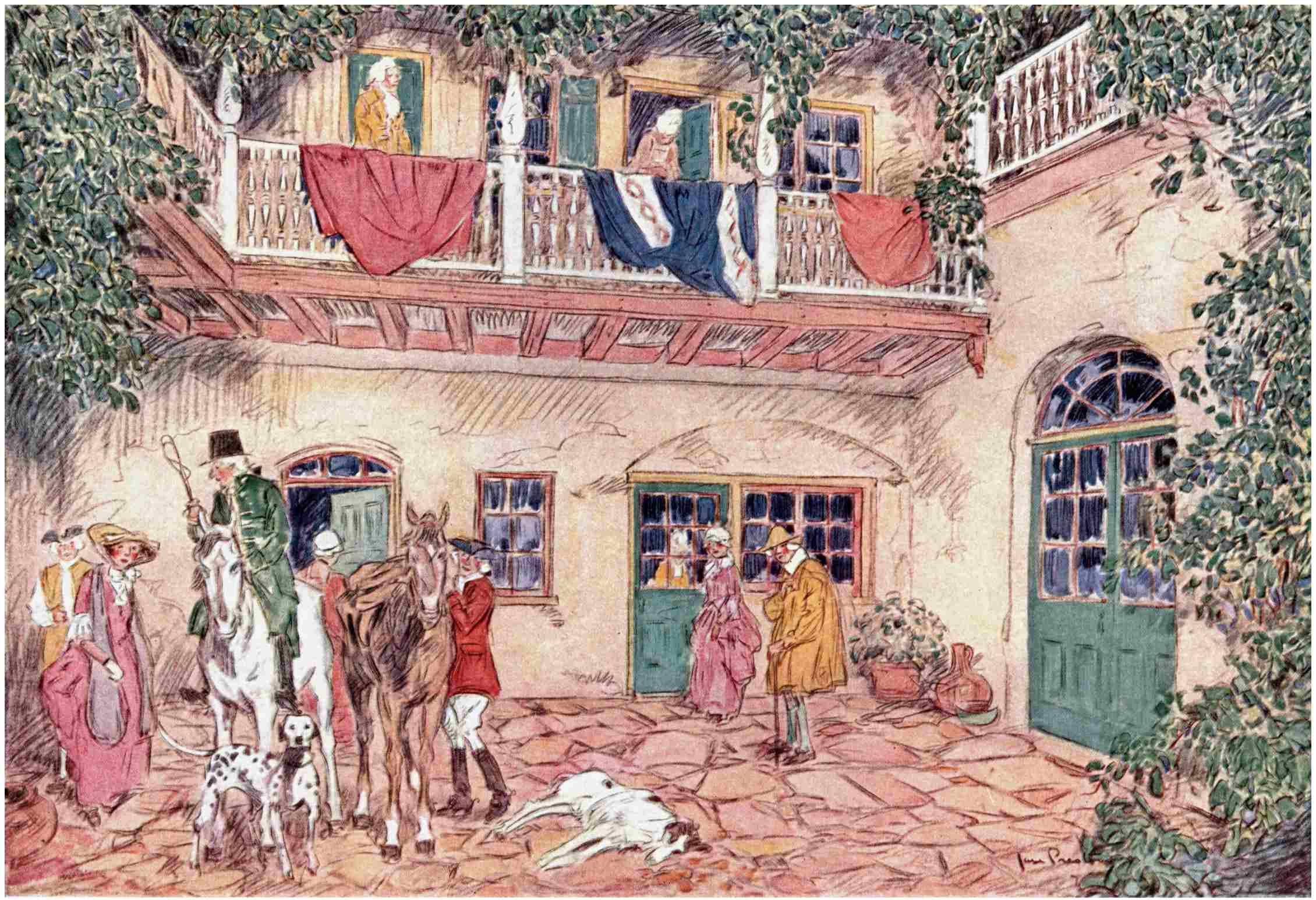
That April-day crowd returned to Hospital and Royal Streets and sacked the house from hall to belvedere, ripped down silk curtains, slashed paintings, wrenched out
chandeliers, dug up two skeletons from the courtyard, pitched Madame Lalaurie’s precious possessions out of windows and made bonfire of the wreckage in the street.
Nor when inside the stout old walls a new and finer residence was built in cheerful defiance of the ghost, could the spirit of tragedy be banished.
The Haunted House, New Orleans
Far down in the vieux carré, the old French quarter of New Orleans,
where Hospital Street meets Royal, the drone of the modern city
at work comes faintly through the morning air. Back yonder, above
Canal Street, there are motor trucks, profanity and clangor; here there is
hardly a street-car, and if you hear loud voices they are filtered through
the shutters of a shabby dwelling where a hopeful candidate for the
Opera is practising her topmost. The old French Opera House, the
scene of Patti’s debut, departed this life only last year—a gay life, marked
by amours and appointments, triumphs and disappointments, dances
and duels. Presently there will be gaps in the circle of musicians who
always settle about the focal point of an opera house, and you will hear
no more the manifold outpourings of their several souls, throats and
fiddles.
Their passing will deepen the twilight of an antiquity which New
Orleans has cherished with more sympathy than all the rest of our
American cities. Rigid modern buildings with Louis XVI fronts and
O’Shaughnessy backs will rear their ventilators, tanks and pent-houses
where, once upon a time, warm walls and climbing cupolas, odd contours
and vine-like wrought-iron railings melted into a strangely complex
and beautiful composition. Even now, as the fitful trolley-car
clanks past the corner of Hospital and Royal, a tremor shakes a few
more crumbling grains from the arches of the old Spanish Barracks.
Soon they will be returned to earth. You will forget that France gave
New Orleans to Spain to pay for her help in the English wars; that
Napoleon, sitting in his bath-tub and quarreling with his brothers,
maintained stoutly that since he had just forced Spain to give Louisiana
back to him, he had a perfect right to re-sell; that he splashed them
into agreement; and that he did re-sell the territory to the new United
States. But Napoleon’s legions have followed Andrew Jackson’s Kentucky
riflemen into the twilight.
The passing of the old order has a hundred conspicuous manifestations
in New Orleans, perhaps because there is a legend for every
old house, a tragedy for every shadow, a romantic blood-stain on every
pavement. The Absinthe House takes in lodgers. The Cabildo, the
ancient Spanish city hall, is a museum. An order of Catholic sisters
now occupies the building which once witnessed the quadroon balls.
There is African ragtime in New Orleans, as there is in every city and
town where squeals the talking-machine, but in Beauregard Square
you will not hear today the thumping of the voodoo chant, nor see the
bamboula danced, as you might have in the days when it was Congo
Square. Ashes unto ashes, dust to—reinforced concrete.
Nowhere, perhaps, is there more graphic evidence of the change
than right here at Hospital and Royal Streets. Inspect the house
before you. The days of its grandeur are past. The concièrge says a
hundred and eighty people live there now—surely it was not intended
for so many. But it is a lodging-house, and the task of cleaning up
after the lodgers must make them seem to the concièrge like a hundred
and eighty or more.
From the street corner diagonally opposite your eyes take in a
spacious square building, three stories high, of cement-colored stucco.
It has a flat roof, and its architecture suggests that the daughter of a
Florentine palace became the bride of a small but snappily dressed
United States Post Office. It stands flush with the banquette, and wears
a frill of balcony clear round its two street sides, under whose tempering
shade you may distinguish the faded red of the lower story, and the
entrance to a mysterious tunnel which is in reality a deeply arched
doorway.
Under its modern exterior you will detect hints of its great age.
There is, for example, a note of caprice in the red wrought-iron railings
of the balcony. They may have been made, as were many in the vieux
carré, at the very forge of Jean Lafitte, the pirate-blacksmith who
commanded the marauders of Barataria, and whose pirate four-pounders
helped out the rifles at the battle of New Orleans. Generations of
idlers have worn smooth and rusty brown the peacock tints on the iron
columns that support the balcony. There are touches of vermilion and
lavender in the sharp green of the shutters at the second-floor windows.
The architecture is Italo-American, and so are the urchins popping
from the doors to stare at you as you wait for admittance. Their
faces are soiled, and so is the black-and-white marble floor behind the
heavy spiked gates. Note, above you, the coffered and embossed
ceiling, appraise the graceful fan-light over the door, examine the
elaborate carving of the door itself, for these are relics which indicate
the grand manner in which this house once welcomed its guests. Forget
that the ceiling is blistered, that two panes are gone from the side
windows, and that night-blooming lodgers have kicked the haunches
off the carved steeds of Phoebus Apollo on the door. A century ago a
slave would have swung wide the portal with great ceremony, and you
would have mounted the winding stair to an upper hall which was
notable for its elegance; today you find it dingy, uninspiring and forlorn.
Not a ghost in sight anywhere.
Comes the concièrge and swears and deposes that in the year of
Our Lord 1919 she did see with her own eyes a headless man march up
these stairs, and that she has accordingly caused the house to be
sprinkled with holy water. Did he look like Louis Philippe? Well,
he looked something like him, and yet differed from him—the light
wasn’t good, and besides (and this was a happy thought) the figure
had no head, and resemblances are hard to establish under those
conditions. Louis Philippe is believed to have slept here, though
Mr. George W. Cable doubts this, on the ground that in 1798, the year
of the royal visit, no such high buildings were erected for fear they
would sink into the soft ground. No, the headless man was not
Louis Philippe, but some other character in the lurid history of the
building.
That history began in the first year or two of the century, when
the Baron de Pontalba, a stanch old Bonapartist who did as he pleased,
did it with exceptionally good taste and built this mansion. Soft
ground or no soft ground, the Pontalbas were a vigorous family, who,
when they wanted houses, built them. Gossip said the Baron and
his daughter-in-law never got on well together. There may have been
some truth in it, for years later they found the Baron dead in his room
at Mont l’Eveque, and daughter-in-law in her own room badly wounded
by pistol shots. True, however, to the tradition of hardihood which
ran in the family, she recovered, and lived through the Franco-Prussian
War, carrying the bullets in her body to her grave.
The Baron had earnestly advised Napoleon to sell Louisiana to
Jefferson. Oddly enough, the Purchase which he advocated brought
about a change in New Orleans which attacked the very identity of such
families as the Pontalbas. An invasion of uncultured Americans from
the north swept down the valley, settled in the city, and beat against
the social barriers of the French and Spanish circles in the vieux carré.
Hitherto they had dictated the life of the city, and it was disturbing
to those who dated from the “filles de la cassette” and the grandees of
the Spanish Main to contemplate this immigration of a new race,
unancestored and, from a Latin standpoint, uncivilized. It was more
than disturbing, it was electro-chemical, and although there was at
first little fraternity between the races, it produced shortly a lively
society.
The Duke of Saxe-Weimar is responsible for an interesting picture
of its customs and habits in 1825. During a visit to New Orleans he
was entertained at the home of a famous gambler, the Baron de Marigny
(he who had entertained the princes of Orleans in ’98), where he
admired, not without cause, a set of chinaware decorated with portraits
of the French royal family and its palaces. The winter was gay,
and he made the rounds of dances, masques and theatres. He frequented
coffee-houses, he danced with the ladies, whom he found
“very pretty, with a genteel French air,” and when “the gentlemen,
who were far behind the ladies in elegance, did not long remain, but
hastened away to other balls,” he was among those also-hastening, for
the naughty young gentlemen were on their way to a quadroon ball.
On another occasion he called upon the august lawyer Grymes, who
figured prominently in the notorious case of Salome Mueller, a white
slave-girl. Grymes was a “foremost citizen” in that society, so was
Miller, Salome’s claimant, who probably knew she was white and
therefore entitled to freedom. A foremost citizen, even in our own
enlightened and prohibited day, can do no wrong—if he has the right
lawyer. The Duke found the city magnificent in her unbridled emotion,
charming in her graces, attractive if perverse in her ethics, and
altogether capable of making a stranger’s head spin.
Thus, when there came to New Orleans in 1825 a benevolent middle-aged
gentleman of France, the Marquis de Lafayette, the city gave
him a superlative welcome. In the light of recent Franco-American
exchanges it is pleasant to think of him as the recipient of every token
of hospitality the city could offer, from triumphal arches to dinners
of state. It suits our specific purpose to watch him chatting in the
drawing-room of the Pontalba house, to peep through the shutters of
the great windows and see the street below filled with bobbing lanterns
of the crowd that has collected to see the great man step into his carriage,
to turn back again into the drawing-room and see that he has
no intention of leaving, for he is the center of a sparkle of wit that
matches the crystal chandelier for brilliance. Here he discoursed, up
yonder he passed the night. With his departure in the morning, the
chronicled glory of the house ends, and its tragedy begins.
Among the old court records there is an entry which establishes
the fact that at the height of the interesting social period marked by
Lafayette’s visit the Pontalba house changed hands. On August 30,
1831, it was bought by Madame McCarty-Lopez-Blanque-Lalaurie, a
woman of more than ordinary magnetism and the wife of Dr. Louis
Lalaurie. Her establishment was quite up to the standards of Créole
society. The touch of her expert hand was evident in the decoration
of the house, and the choice and disposition of the furniture and paintings
were a compliment to her taste. Her ten slaves were more than
enough to care for its needs. She drove out along the Bayou road of
an afternoon behind fine horses, her coachman was coveted as a correct
and desirable servant. What the world calls fine people came to
her house with as keen an appetite for the intellectual cocktails of the
hostess as for the creature hospitality they anticipated at her table.
Like most ladies of social pursuits she had pronounced likes and
dislikes, and she got herself talked about. Being a pure-blood Créole
she resented the nouveau-riche American invasion of the city. “Let
them come,” she said. “There are some things they cannot buy”—and
her good opinion was one, her invitations another. Some of
“them” resented the fact that they would never be bidden to enter the
deep-arched vestibule, nor see the ponderous door swing wide to them
as guests, nor ascend the graceful winding stair. So they railed, and
Madame Lalaurie tossed her head. They muttered unpleasant things,
and she sniffed. Then they cried scandal, to which she was deaf.
A susceptible young Créole attached to the office of the district
attorney was sent one day to call upon Madame Lalaurie and to bring
to her attention the annoying rumor that she had been unkind to her
slaves. He went away with his copy of Article XX of the Old Black
Code unrecited, and his addled young head full of impatience that
such slander could have been perpetrated against a person so obviously
kindly as Madame Lalaurie had just shown herself to be. He had
been, in fact, charmed, and he admitted it.
There is no telling how long the matter might have carried on if
it had not been for a chance glimpse through a window. The unsubstantiated
scandal persisted. But there happened to be a small staircase
window in a neighbor’s house which gave on Madame Lalaurie’s
courtyard, and which commanded not only the screened courtyard-galleries
of the house itself but those of the slave quarters, which stood
at right angles to the house.
The neighbor was going upstairs when she heard a piercing shriek.
From the window she saw a little negro girl fly screaming across the
courtyard, with Madame Lalaurie in close pursuit, the lady armed
with a whip. Into the shelter of the house fled the child, then out
again upon the lower latticed balcony. Although the neighbor could
not penetrate the lattice, she followed the progress of the chase by a
crescendo of terrified cries, as the child raced up the outside stairs to
the next gallery, then to the next. In a moment she emerged upon
the roof, her last frantic bid for sanctuary. There were seven different
angles of pitch to that roof, and it was covered with shiny tiles. The
child slipped, clutched, fell to the courtyard and was killed.
Madame Lalaurie buried her that night in a shallow grave in the
courtyard. The neighbor saw that, too. Then, and not until then,
she reported the whole episode. The authorities came and found the
grave, corroborated the story, and punished Madame Lalaurie by
selling all her slaves. The purchasers were her relatives, and she
promptly bought all her slaves right back.
“She starves them,” said Rumor, sitting on the eaves of a
house across the way. “She whips them, she beats them,” the story
ran, gaining momentum.
“But see how fat and cheerful is her coachman,” replied Reason.
“Does he look like the victim of cruelty?” “He is a spy upon the
others,” hissed Rumor. “Eh, bien,” said New Orleans, and yawned
lightly, “She serves such dinners!”
The slave who cooked those dinners was a radical. She tired of
practising her arts with a twenty-four-foot chain clamped to her ankle.
On the afternoon of April 10, 1834, after extraordinary provocation,
she became desperate and set fire to the house.
The townsfolk swarmed to the fire, and were greeted at the door
by the gracious Madame Lalaurie. She directed her friends in their
efforts to remove her costly furniture from the house. When someone
suggested seeing that there was no human life still endangered in the
building she said that it was quite empty, and that there was no necessity
of visiting the slave quarters. Judge Canonge took it upon himself
to investigate, but the smoke drove him back. There were some
in the crowd, however, who were neither her friends nor her well-wishers,
and who insisted that the slaves had not been removed. In
the face of swelling clouds of blinding smoke and the lady’s angry
remonstrances, a man finally groped his way into the slave wing
which stood at right angles to the house.
Within a few moments he was outside, shouting. Volunteers
ran back with him into the slave quarters. In the tiny cubicles which
served as living-space for those humble lives were seven negroes, some
locked in while the fire crept toward them, others chained to the walls.
Their emaciated bodies bore witness to famishing hunger, and cruel
sores told the story of their confinement. They were carried to the
street, and the crowd, having helped to put out the fire in the house,
took fire itself and charged the door. Madame Lalaurie deftly slammed
it in their faces.
Her resourcefulness rose to the situation. By subtle management
her carriage picked its way through the crowd a few hours later and
drew up at the entrance. Before the growing throng of people detected
the maneuver, she and her husband were inside the equipage and
rattling round the corner, “driven up Chartres Street in a close carriage
which I saw speeding at a furious rate” (so Henry C. Castellanos
wrote in 1895). The afternoon parade of society was idling along the
Bayou Road; her skilful driver wove his way through the stream of
carriages and gained fast on the pursuit which had risen, howling at
her flight. The Lalauries gained the shore of Lake Pontchartrain, put
off in a skiff, boarded a schooner for Mandeville—up sail, and safe
away!
The coachman began his return journey to town, and ended it
when he met the pack of pursuers, for they destroyed him. The chase
was deferred just long enough for the lady to effect her escape to Mobile,
and thence to Paris. There rumor followed, and she was avoided by
society. Three years later word came back in the ships that Madame
Lalaurie was dead of wounds received in a boar-hunt. She had probably
hunted as hard as she had lived.
We cannot surrender her to the savage credulity of the ages, however,
without suggesting that the story of her life, although generally regarded
as authentic, may have been gilded here and there by intervening
generations of highly-colored imagination. A New Orleans man writes:
“I happen to know one of the descendants of Madame Lalaurie
very well, and I have seen a marble bust of this self-same lady whose
alleged record as a slave murderer is indignantly repudiated by the
self-same descendants. As a matter of fact, those stories are pretty
much of a piece with those which were in vogue in regard to throwing
negro slaves into the furnaces of the Mississippi River steamboats and
feeding piccaninnies to alligators. This would be pretty much as if
you or I stood at the foot of the Battery and chucked all of our money,
diamonds, and worldly possessions into New York Bay.”
That April-day crowd in New Orleans had no such sober judgment.
After the coachman had been murdered they returned to
Hospital and Royal Streets and sacked the house from hall to belvedere,
ripped the silk curtains, slashed the paintings, tore out the
chandeliers, dug up two slave skeletons from the courtyard, pitched
Madame Lalaurie’s precious possessions out of the windows and
made bonfire of the wreckage in the street. They drank and looted
and terrorized the neighborhood until a detachment of regulars appeared
under the sheriff’s command and put an end to the orgy.
The shell of the house stood abject and battered for a number of
years, its broken windows telling its ugly story to all who came that
way. On a moonlight night an impressionable girl passing the house
could readily have seen the ghost of a woman’s form leaning imploringly
from the belvedere—one girl did see it, and not even her later confession
that the ghost was a fabric of moonbeams has been sufficient to rid the
building of its name—The Haunted House. Nor, when inside the
stout old walls a new and finer residence was built in cheerful defiance
of the ghost, could the spirit of tragedy be easily banished. We shall
hear one more story—a brief one—and then we may judge.
The war came and passed and left New Orleans dominated politically
by those who had been their slaves. The pendulum swung so far
to the extreme that a public school for both white and black children
was ordained and, by coincidence or cunning design, was established
in the Haunted House. It was of course an unfortunate move, and
served no purpose except to whet racial antagonism. There came,
finally, the breaking point. A white political organization which had
been recuperating in strength sent a delegation one afternoon to call
at the school. They were met by the teachers, to whom they issued
a command to muster the school for roll-call. One of the pupils, a
girl of exceptional beauty, heard the commotion from the upper hall,
and peering over the banisters realized the significance of the roll-call—that
the white pupils were to be segregated from the black. She leaned
far over, to catch every word, when a shell comb fell from her hair and
shattered on the marble floor below. She burst into tears and fled to
an upper room.
The roll-call ended. All pupils who had negro blood were ordered
from the house. When the slight flurry had subsided, and the delegation
had left, the principal and one of the teachers found Marguerite
upstairs in a paroxysm of grief. “The comb was my mother’s,” she
sobbed, and when the teacher tried to comfort her, became hysterical.
The principal drew the teacher outside. “It is not on account of the
comb,” she said. “Marguerite’s mother was an octoroon; she married
a white sea-captain. He loved her so much that in order to marry her
he opened his wrist and let a few drops of her blood into his own, so
that he might swear that he had African blood in his veins and get a
marriage license. Only Marguerite and I and one or two others knew
her story—and no one would have suspected, for she is so beautiful.
She is engaged to be married, and her fiancé didn’t know. But the
roll-call—now she will leave school, and he must learn of it.”
Which was the greater tragedy—the brutality of slave torture, or
the death of the exquisite school-girl’s romance? It may be you will
find the answer from the ghost, if ten years of children’s lessons, and
the arpeggios and trills of a conservatory of music, and subsequent
vapors of lodging-house cooking have not frightened the ghost herself
away. Go and see. Far and down in the old quarter of New
Orleans, where Hospital Street meets Royal, you will scarcely hear the
drone of the modern city at work. In the vieux carré one may converse
easily with ghosts. You will find no answer here.
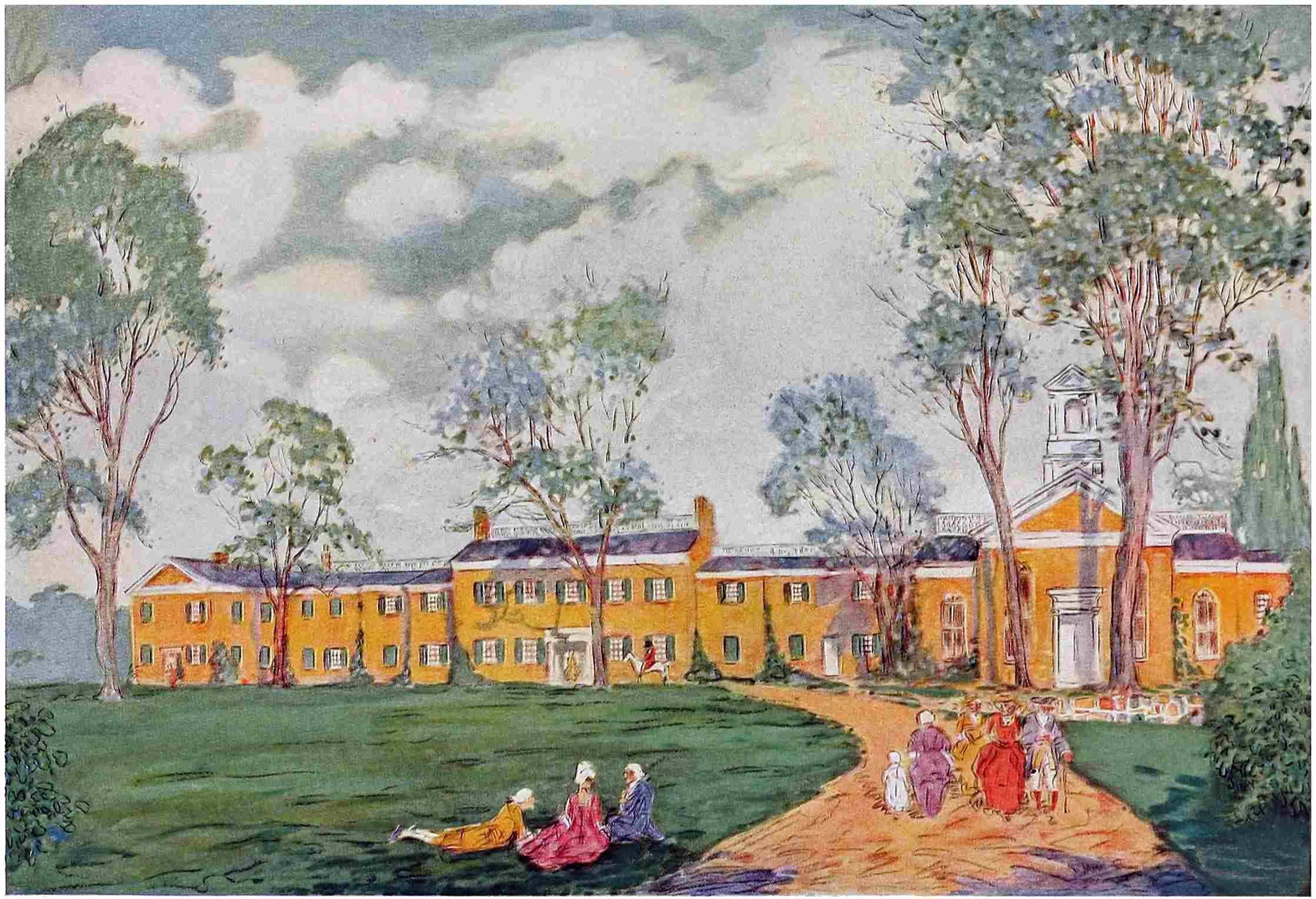
There are three ghosts at Doughoregan Manor. One is the shade of an ancient housekeeper, whose quiet tread may be heard in the corridors, and whose keys
tinkle faintly when the house is still. Another is the spectral coach—its wheels grind on the driveway when death rides to claim a member of the household....
The third is no gruesome phantom, but the warm lively pervading spirit of the Signer himself, Charles Carroll “of Carrollton.”
Doughoregan Manor
You may come up a long straight aisle of locust trees, or you may
wind through Gothic arches of elms along a skilfully engineered
road which picks its way through the estate for a half-mile or more.
Either course will bring you before a wide low house of yellow brick,
with green blinds and white woodwork and English ivy. Directly
ahead of you, across the circle of the driveway, the square main section
of the house, capped by a tower, rises above a bright portico. To left
and right the house throws out long extensions of even height, terminating
in wings set endwise to you, like double-faces in the game of
dominoes. Your first impression will be one of unusual size, your
next of flatly rectangular simplicity. Your eye will be caught momentarily
by a cross-tipped bell-tower of the right wing, where Charles
Carroll built the only private chapel in America because England would
not let him worship in peace. You will know that you have never seen
such a house in America, and you will probably not suspect that it is
a monument to several great Americans.
A lad of four or five is playing on the grass circle of the driveway
before the great house. The undulating Maryland countryside is not
half as absorbing as the game in hand, though his great-grandfather
was governor of all those miles. If you were to ask him the way to
Annapolis he would probably indicate the double file of venerable
trees which stand sentinel along the tapering avenue, smile courteously
if you thanked him, and then scurry off on an important engagement.
He wouldn’t tell you that in his grandfather’s great-grandfather’s
day Annapolis was the national capital, nor that that gentleman
was one of the bold spirits who made a national capital possible.
There is no reason why he should know of it, or be interested.
If, with your heavy wisdom, and your rhapsodies on the pride of race,
and your generally affable tourist behavior you succeed in alarming
the lad until he retreats to the shelter of the portico, know, stranger,
that you have aroused the suspicions of Charles Carroll, the Ninth in
America, and the seventh heir of that name to Doughoregan Manor.
Ancestors can be lived up to or lived down, and there is no particular
point or prowess in bragging about them. To me there is
glorious romance in the fact that this youngster of five is romping on
the ground that was granted to his ancestor by a King of England.
Perhaps it is glorious and romantic because it is fact, but I prefer to
believe that the real reason may be found in a verse in the book of Exodus,
which reads:
“Honor thy father and thy mother.”
They were worth honoring; they have been duly honored even unto the
eighth and ninth generations.
Charles Carroll the First, like many another Irishman since,
went west. He came to Baltimore in 1688 with the ink hardly sanded
on his commission as attorney-general of Maryland. As a Roman
Catholic he found the commission suddenly nullified by revolution in
England, and it was four years before a Royal government was set up
in the colony restoring and protecting its proprietary rights. His
wife had died childless during that period, and he married again.
Of ten children of his second wife, the eldest died on the voyage home
from school in Europe. Back at St. Omer’s in French Flanders he
left a younger brother, Charles Carroll the Second, and presently the
plodding ships bore back to him the news of Henry’s death and the
heritage of responsibility and affection which devolved upon him. In
1723 he came back to his own people, married in his turn, and in 1737
Mistress Elizabeth Brooke Carroll bore him a son. The precedent for
the name Charles was already strong, Charles was a good name, and
so was christened Charles Carroll the Third.
In the archives of the State Department at Washington you will
find his signature. It is hidden from the light, but reproductions of it
and the pledge to which it is attached have already made it familiar to
every American. The story runs that in the congress at Philadelphia
when the Declaration of Independence was presented, John Hancock
turned to Carroll and offering him a quill, asked “Will you sign?”
“Most willingly,” was the reply. And he signed, in an easy clear
hand, with less flourish, perhaps, than Franklin’s or Hancock’s, but
no less sincerity—and Carroll, the richest man in America, had more
to lose than either.
“There goes two millions with the dash of a pen!” a bystander
remarked. “Oh, Carroll, you will get off,” said another. “There are
so many Charles Carrolls.” At which Charles Carroll Third took the
pen and jabbed “of Carrollton” under his signature, that George
Third of England might make no mistake and punish any other of the
same name. There is some cherry-tree flavor in the story, and precious
historians maintain that he invariably signed his full title; but, if it
can accomplish by example what the cherry-tree fable has accomplished,
let it stand.
What circumstances carried this patriot, whom we left a moment
ago as a baby, to the front rank of his country’s champions? The
best of schooling then was to be had abroad. An ardent father and
mother put aside their fierce attachment to their only child in order
that he might become a proper heir to the estate which Charles Carroll
the Second was accumulating. Just as the young Pinckneys and
Rutledges and Middletons of Charleston in pre-Revolutionary days
went to the mother country for their cultural training, so the youths
of the middle states whose families could afford the excursion were dispatched
to France, or England, or Flanders. One day in 1748 saw
Charles Carroll, a boy of eleven, take ship with his cousin John for
Europe. What pangs his mother experienced at the loss of her only
chick are faintly reflected in a passage from the correspondence between
the two: “You are always at heart my dear Charley and I have never
tired of asking your papa questions about you. I daily pray to God
to grant you his grace above all things, and to take you under his protection.”
“With your mother,” his father wrote in 1753, “I shall
be glad to have your likeness in the compass of 15 inches by 12”—and
directed him to have the specified portrait done by a good painter.
But the mother was not well, and in 1761, when the baby who had
sailed away was a grown man, a student of Law in the Temple in London,
and nearly ready to return to the warmth of his mother’s adoration,
she died.
Such a beau as he would have made her! Heredity gave him an
active mind and bearing of real charm, and just as the Manor house
back in Maryland took on through the years extensions and embellishments
which multiply its effect of useful luxury, so each addition to
Charles Carroll’s intellect only seemed to make him more companionable
and genuinely attractive. Even during his student period his
sensitive spirit was not altogether proof against affairs of the heart,
and if it had not been for her meddlesome sister, Miss Louisa Baker
would have gone back to Maryland as his bride, as mistress over
68,000 acres. Instead, the catch of the commonwealth returned at
twenty-nine under a cloak of melancholy from the shelter of which he
wrote, dourly, “Matrimony is at present but little the subject of my
thoughts.”
Persons familiar with the laws of gravity and more particularly
with the physics of the rebounding heart will not be surprised to learn
that within a few months he was again engaged to be married, this
time to Miss Rachel Cooke. He wrote to London for her trousseau—such
intimate finery as he hardly dared describe, things to turn even
the Babylonian fiancée of today as green with envy as the Doughoregan
meadows. But the Brussels lace was not for her, for Rachel
Cooke fell ill of a fever, and died, and her miniature and a lock of her
tresses were hidden away in a secret partition of Charles Carroll’s
writing desk.
Undiscouraged, he found serious distraction in the fermenting
affairs of the colonies. From provincial grievances such as his father
had related from time to time in his letters dwelling on the oppression
of the rights of Catholics, the problems of the colonists had overflowed
greater areas. Like a flood swelling over the landscape, the minor
swirls of flow and eddy were merged into a common misfortune of
drab color and threatening proportions. It was Charles Carroll’s
first chance for constructive citizenship. At the writing-desk where
Rachel’s miniature lay hidden he wrote a program of letters which may
be said to constitute the brief for independence. And by the time his
heart had healed, and he had fallen in love with Miss Mary Darnell,
whom he preferred, he said, “to all the women I have ever seen, even to
Louisa,” and had married her, he was caught in the flood himself.
There was no turning back even if he wanted to—and he did not want
to turn back.
His town house at Annapolis and the manor of Doughoregan (it
is pronounced Dooráygan, and it means the house of the king, because
a thousand years or so ago the O’Carrolls were Irish kings) opened their
doors with special welcome to those who were prepared to resist the
oppression of a king. “A warm, firm, zealous supporter of the rights
of America, in whose cause he has hazarded his all,” wrote John Adams,
Carroll’s “all” at that time yielding an income of some ten thousand
pounds a year. When, in 1773, an outraged importer set fire to his
cargo of taxed tea in Annapolis, Charles Carroll was his chief legal
counsel. When the Continental Congress met in Philadelphia the
next year, he was a member. When the Congress sent a delegation to
Canada to enlist support for the Revolution, it seized upon his French
training as an asset in Charles Carroll, as it chose Benjamin Franklin
for his practical judgment, Father John Carroll (later the first Archbishop
of Baltimore) for his ecclesiastical influence, and Samuel Chase
for his legal ability. The mission failed; Canada would not help; we
must work alone. So to indicate that he welcomed the opportunity
Charles Carroll signed the Declaration of Independence.
Years later he wrote this summary of his career:
“On the breaking out of the Revolution I took a decided part in
the support of the rights of this country; was elected a member of the
Committee of Safety established by the Legislature; was a member of
the Convention which formed the Constitution of the State. The
Journals of Congress show how long I was a member of that body
during the Revolution. With Dr. Franklin and Mr. Samuel Chase I
was appointed a Commissioner to Canada. I was elected a member
of the Senate at the first session of Congress under the present Confederation....
The mode of choosing the Senate was suggested
by me....”
That was all he found to write. It ought to be enough to qualify
him for the emphasis which, in the eminent line of Charles Carrolls, we
have placed upon him. But if, after you have followed him through the
Revolution, you inquire just what connection the details of his career
have with Doughoregan Manor, listen to a short recital of what he
was too modest to write.
In 1780 his father, Charles the Second, was standing on the veranda
of his Annapolis house and peering through a spy-glass at a sail
in the Bay. He made a misstep, pitched heavily from the porch, and
was killed. Mary Darnell Carroll, his daughter-in-law, saw him fall.
Her health, already taxed by her devotion to Mrs. Carroll II during
her last illness, gave way at “Breakneck” Carroll’s tragic death, and
she died within a fortnight, leaving to her husband a son and two
daughters. The son, of course, was Charles Carroll the Fourth. The
Signer saw him go to Liége to school, return, as his father had returned
before him, the idol of a gay countryside, court Nellie Custis at Mount
Vernon, marry Harriet Chew of Cliveden, and rejoice with pride at the
advent in 1801 of Charles Carroll the Fifth.
Charles the Fourth, of Homewood, has been described by a contemporary
as follows: “Nothing in Greek art surpasses the perfect
symmetry of his figure.” No less a person than Washington had
asked Harriet Chew to remain in his presence while he sat for his portrait
to Gilbert Stuart in order that his own face might “wear its
most agreeable expression.” Therefore if the baby Charles the Fifth
was not handsome it was neither the fault of his parents nor of the
distinguished grandfather who immediately became his devoted slave.
The concerns of the estate, and the larger questions of the nation,
had the Signer’s first attention. His avocations were to ride his lanes
and woodland, to read Greek and Latin in the original—he was reading
Cicero’s “De Senectute” at ninety-three; to preside over a growing
flock of grandchildren at Homewood with his son, at Brooklandwood,
where Mary Carroll Caton was bringing up the three stunning daughters
whom society called the “American Graces”; and to spend much
time in the company of his daughter Kitty’s husband, Robert Goodloe
Harper. From time to time he was called upon to step into his earlier
character as Signer. In 1824 he was invited, with Jefferson and
Madison, the only survivors of that great company who fixed their
names to the Declaration, to attend the anniversary of the surrender
of Cornwallis at Yorktown. His age forced him to decline, but he
compromised by meeting Lafayette at Fort McHenry and lunching
with him in a tent which had been Washington’s, and by attending a
ball given in Lafayette’s honor at Colonel Howard’s “Belvedere.”
Few men of eighty-seven have shown such activity as was his;
most men of his years would have given way to the misfortunes which
now trooped out of the shadows. Charles Carroll the Fourth died;
General Harper, the beloved son-in-law, followed. In the next year
John Adams and Thomas Jefferson died on the same day, and it was
the sad duty of Charles the Third to mourn at their funeral. He was
now the last of the Signers. At eighty-nine he signed a copy of the
Declaration which is now held in the New York Public Library—and
signed it in a handwriting as firm as it had been fifty years before; at
ninety he laid the foundation stone of the Baltimore & Ohio Railroad;
at ninety-three the cornerstone of St. Charles’ College, near Doughoregan
Manor. And by this time the patriarch had seen born into his
grandson’s family a sixth Charles Carroll.
There are three ghosts at Doughoregan Manor. One is the shade
of an ancient housekeeper, whose quiet tread may be heard in the
corridors, and whose keys tinkle faintly when the house is still. Another
is the spectral coach—its wheels grind on the driveway when death
rides to claim a member of the household—the coach which swung up
to the door on a still November day in 1832 when the Signer went to
join his fathers. It is hardly dignified to call the third a ghost. A
warm, lively, pervading spirit it is—that of the Signer himself, smiling
down from his portrait on the walls. It beamed on Charles the Sixth
through a long and active life until it beckoned to him in 1895. To
the son of Charles Carroll VI, John Lee Carroll, it nodded: “Well
done, my boy,” when he became Governor of Maryland, and to the
seventh Charles it told again all that its cumulative history could
convey of the philosophical guidance and binding parental attachment
that has made Doughoregan Manor something more than a
home. Charles Bancroft Carroll, the Eighth, “carries on” and injects
typical enthusiasm into farming twenty-four hundred acres of the
grant you will see in the hall on a map the first Charles Carroll
drew.
You will feel the spirit strongly as you contemplate the Signer’s
place of burial in the chapel where the countryside gathers each Sunday
for services. You will sense the alliance between devotion to God and
to profoundly national ideals, and recall the sympathetic correspondence
between the Signer and his father, as you enter the Cardinal’s
room, a gorgeous chamber decorated in red, containing a great mahogany
bed where Cardinal Gibbons, Archbishop John Carroll, and the
Marquis de Lafayette have slept. In a mellow library are the books
he read. Trophies over the door of a panelled dining-room, cups won
at yachting, a friendly hound from the present master’s hunting pack
at your feet—remember that the Signer believed that a clear mind was
most likely to be found in a sound body. We may fairly conceive that
when the house was to be renovated, as it has been four times in its
history, the Signer laid a gentle hand upon the sleeve of the workmen
and cautioned them so: “Paint, if you like. Replace, where the old
has given all its service. But remember, sirs, this is and must be a
home.” And in the fullest connotation of the word, it is a home,
with old chairs to fit you, bright cretonnes at the windows, and friendly
things about you to rest your eyes upon—the sort of a home that a lad
like Charles Carroll the Ninth, who isn’t much interested in ancestors,
likes to take refuge in when strangers grow inquisitive.
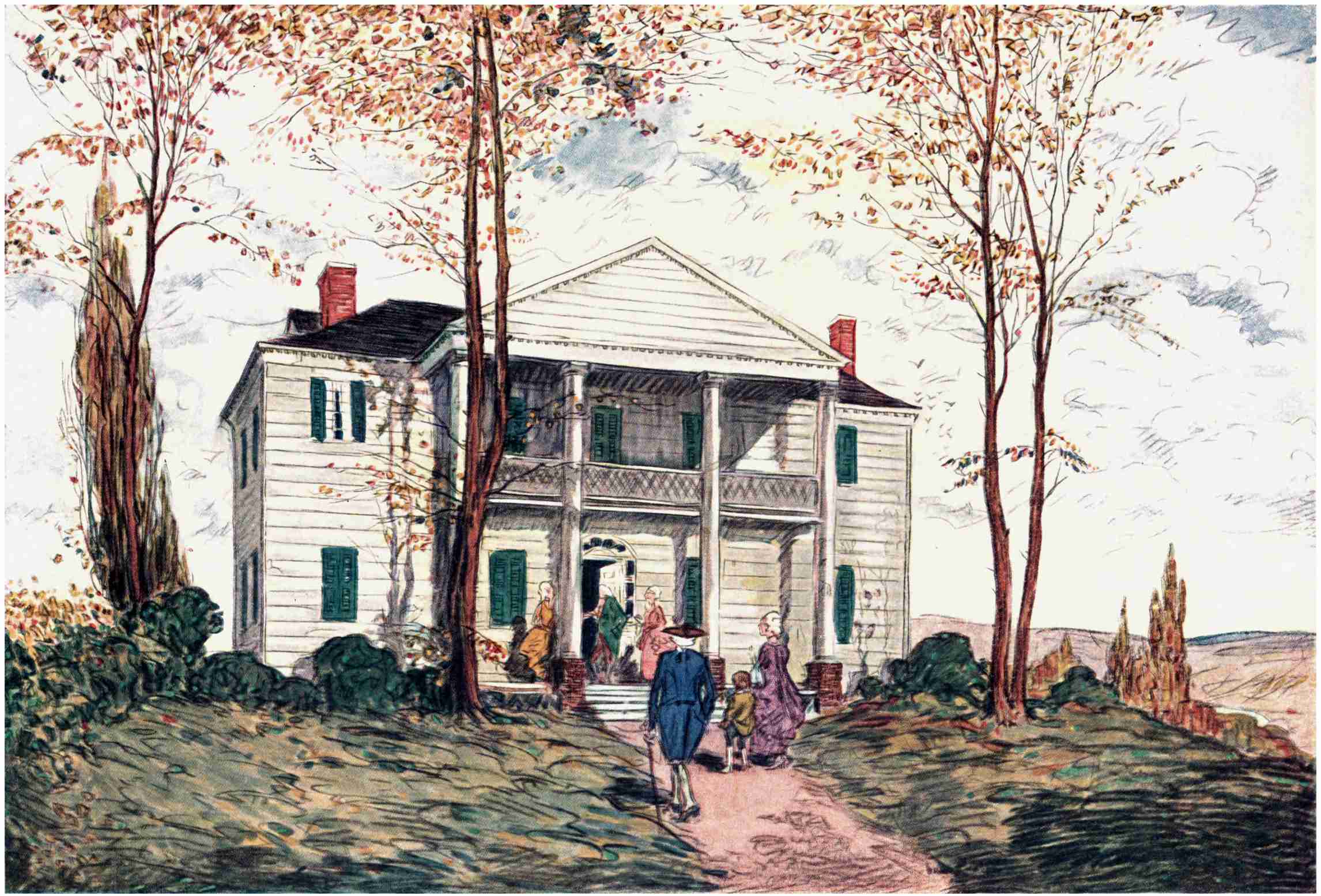
Alone in its brittle modern neighborhood, this lovely anachronism stands on the highest point of Manhattan, untroubled, unruffled, and undisturbed except by Sunday
idlers to whom its orchards are just another breathing spot. Though it was Heath’s headquarters, then housed Washington, later was captured by Howe, and was
one of the smartest suburban estates of Colonial New York, it will never be forgotten as the home of a person of no military or aristocratic consequence, yet of caprice,
beauty, ambition, impropriety, common sense and eccentricity—yes, a woman.
The Jumel Mansion
A little over a hundred years have passed. Much sea-water has
pressed up the Harlem on the incoming tide, boiled and eddied
in the narrow pass of Spuyten Duyvil, and slipped away again to the
Atlantic, diluted by the contribution of mountain streams in the
Catskills and Adirondacks, tainted by the factory waste of busy cities
up the Hudson and the Mohawk. Men threw giant bridges across
its ebb and flow, tunneled under its current, bit and blasted and
scratched at its Hell Gate channel. The placid, austere heights that
stood above the stream “nine miles from New York City” bear now
the unromantic name of Coogan’s Bluff, and are as many miles within
the city’s northern limits.
The camera had not been invented when Roger Morris built the
house for his young wife. To the westward, where his acreage touched
the Hudson, apartment houses have risen and cut off the Palisades;
to the south, where once he could see far down Staten Island, a
tangle of bridges and shipping is half screened by the battlements
of more apartment buildings; only to the east and north, over the sunny
throat of the Sound and the far blue profile of the Long Island hills,
has the prospect its former grand, pure simplicity. A fan of railway
tracks are at the Harlem where once was “Fishing, Oystering and
Clamming,” and from the very skirts of the estate rises each afternoon
the roar of fifteen or twenty thousand “busy Americans” who are
totally unoccupied except with the baseball game in process on the
Polo Grounds.
It is hard, without photographic record, to reconstruct the picture.
Alone in its brittle modern neighborhood this lovely anachronism
is the only fragment of the composition left to us. It stands on
the highest point of York Island, untroubled, unruffled, and for the
most part undisturbed, except by Sunday idlers to whom its orchards
are just another breathing spot.
It may be unjust to the Jumel Mansion to compare it with the
lady in one of Leonard Merrick’s stories who “had outgrown her sins,
but remembered them with pleasure,” but the spirit of Madame
Jumel haunts the air so persistently that the suggestion is not altogether
out of place. Despite the fact that when the British were
advancing across Long Island in 1776 it was General Heath’s headquarters,
that it housed Washington for six weeks, and that fifteen
minutes after he had left it on the day Fort Washington was taken
General Howe established his own headquarters there—despite its
standing as one of the smartest suburban estates of Colonial New York,
the house will never be forgotten as the home of a person of no military
or aristocratic consequence, yet a person of caprice and beauty, ambition
and impropriety, common sense and eccentricity. She was no
sort of person to talk about, and therefore talked about; a kaleidoscopic
contradiction—in short, a woman.
Though General Washington probably never heard of the lady,
the house which she occupied was strangely related to important
moments in his own career. When he was an athletic officer of
twenty-five, neither Betsy Bowen nor her mother, Phebe Kelly of
Providence, knew of him or cared about him, for they were both yet
unborn. Of his restrained sentimental interest for Polly Philipse, the
Yonkers heiress, they could not know, nor had they comment to offer
when Colonel Roger Morris, a gallant of the colonial forces, crowded
the young Virginian out of her affections and married her. In 1760
when Washington himself married Martha Custis, Phebe Kelly was
three years old; at the age of eighteen, in the same month when Washington
was appointed commander-in-chief of the American army and
rode to its head at Cambridge, Phebe Kelly Bowen of Providence gave
birth to her second daughter, and called her Betsy.
Ten years before, Roger Morris had built a lovely house for his
wife and their growing family on the topmost point of Manhattan;
the wailing baby in Providence in that turbulent July, 1775, scarcely
suspected that one day she would be the mistress of that house, or
that a month ago Roger Morris, a Tory, too peaceful to fight, had
fled to England for refuge. But there began the chain of events
which finally landed his estate in Betsy Bowen’s hands.
The city of Providence was so named because its founders had
supreme confidence in its namesake. With the advent of a pathetic
little atom of humanity called Betsy Bowen, Providence the power,
through the agency of Providence the city, undertook to show off.
“Her father was a seafaring man of no account; her mother of less,”
said the town. “It looks bad. It probably is. If not, it ought to
be. In any case, Providence shall be appeased.” Betsy’s mother was
presently arrested and thrown in jail, and Betsy, with her sister Polly,
then a child of fourteen, was first locked up in the workhouse and later
sent to live with a more respectable family. John Bowen, the father,
was knocked overboard by the boom of a sloop and drowned; his widow
and her second husband were allowed out of jail long enough to be
ordered out of town; they returned and were shortly expelled at the
expense of the town, to carry on a wretched existence in a hut on the
Old Warren Road. As the daughters matured they moved to a less
respectable family. In 1794 a son was born to Betsy Bowen, and its
father’s name being either unknown, undesirable or Jones, the baby
was christened George Washington Bowen. Three years later her
mother and her step-father, once more expelled from Providence, made
their way to the North Carolina mountains, got sufficiently acquainted
with their neighbors to start a lawsuit, and then were shot by a squirrel
rifle in the hands of one or more of the defendants. Providence the
town had forgotten them, Providence the power had accomplished a
tour de force.
The divine lightnings were apparently spent. Betsy Bowen left
her baby in the hands of a friend and fled from the mockery of her
native city. She began six obscure years of adventure as Betsy Bowen,
reappeared in New York for a fleeting glimpse as Madame De la
Croix, and emerged as Eliza Brown, the mistress of the wealthy Stephen
Jumel. From 1800 to 1804 she occupied this prosperous French merchant’s
house at the corner of Whitehall and Pearl Streets, near the
lower tip of Manhattan. He came home one day to find her apparently
on her death bed, explaining faintly, through the medium of her
physician, that she wanted nothing more than to leave a sorry world
as his wife. To Jumel, who was deeply touched, it was an irresistible
appeal, and the clergyman who had come to pray for her married the
pair. No hypodermic has since been discovered by a vaulting medical
science which ever had such magical powers of restoration, for
two days later Betsy Bowen-de la Croix-Brown-Jumel was riding out
behind Stephen Jumel’s smart horses as Stephen Jumel’s lawful, gleeful,
wedded wife. Her program, after a bad start, was fairly begun.
She craved social prominence. She wanted to hob-nob with such
folk as the Philipses, the rich Astors, the Van Cortlandts, the Lows,
and the Livingstons, none of whom would have much to do with her.
The leverage of owning one of the great estates evidently did not occur
to her just yet, though there was one to be had. In a letter from
Aaron Burr to his daughter Theodosia, then married and living in the
Pringle house in Charleston, he wrote: “Roger Morris’s place, the large
handsome house on the height beyond Mrs. Watkins, is for sale. I can
get it for Richmond Hill with four acres. Shall I exchange? R. M.’s
has one hundred and thirty acres. If I leave Richmond Hill, however,
had I not better buy in town, that you may have a resting place here?”
He evidently rejected the idea. He could not foresee that within
a few months he would retire from the vice-presidency of the United
States, bully Alexander Hamilton into a duel on the Palisades, kill
him; nor that he would then organize an invasion of Mexico and a
revolution in the new Louisiana Purchase only to be caught in the act
and be tried for treason; nor that the year 1810 would find him abroad,
disgraced, and still plotting to capture Mexico.
In that year Stephen Jumel, who had taken his wife’s trick-marriage
in good part, bought the Roger Morris house and transferred
his family to the heights, to install his wife in a style of living to which
she hoped to become accustomed. Nothing was nearer her heart than
the social prestige which her position as the chatelaine of a fine estate
would afford, nothing farther from her mind than a lonesome ex-vice-president
who had once speculated on buying this very house.
The God of Coincidence made a mental note of this, and laid his plans.
Although frequent changes of ownership and lack of care had
tarnished the house, it was intrinsically the same fine honest mansion
that Roger Morris built, with two-foot outer walls lined with English
brick, and supporting timbers of enduring oak. Madame Jumel
entered her new home through a lofty portico to a main hall which runs
through the center of the building from front to rear. This hall leads,
as at Monticello, to an octagonal annex which is the only departure
from a rather simple Georgian plan. To her left a reception room, to
her right the dining-room, ahead in the octagon, a drawing-room which
commanded nearly the full circle of that far-reaching panorama. Here
had been held the Revolutionary courts-martial. The room north
of the reception room had been the commander-in-chief’s office; the
southeast bedroom had been his, and from its window he could see the
smoking embers of the fire set by his troops when they evacuated the
city in ’76—the night Nathan Hale was caught there as a spy.
With Roger Morris a fugitive in London and the house in debatable
ground, Polly Philipse Morris had resorted to the Manor at
Yonkers for safety. When Washington was driven out, and the house
became British headquarters, the army paid rent, but when the Revolution
ended, the families of Morris and Philipse, their properties confiscated,
went back to England. The mansion was sold and resold,
but no one held it for long. It failed as a tavern, and was doubtless
expensive to run as a home.
Jumel was a great admirer of Washington, as well as a man of
taste, and he combined the two qualities to restore the house implicitly
to its earlier condition. It meant a lot to him that Washington, the
president, had dined a brilliant company there in 1790, when New
York was the national capital, and he equipped the room with fine
furniture brought from France in one of his packets. He had the wall-paper
in the octagon copied and rehung, respected the simplicity of the
mantels, and chose his decorative “remarks” with a nice eye. When
his work was done we may fancy that he rubbed his hands and said to
his pretty wife: “Voilá! A house worthy of its guests. Let them
come, my dear.”
They didn’t come. Everything domestic a woman could crave
Betsy Jumel had, even the company of her step-sister’s little daughter,
to take the part of the daughter she never had. It was not enough.
Five years of it made her despise the place. So the Jumels packed up
and sailed for France.
It was no expeditionary force against a new stronghold of society,
but an innocent visit to relatives, and perhaps that is why her luck
turned. Family tradition has it that in Bordeaux they met the
fleeing Napoleon, and offered him the Jumel ship. In return he gave
them his carriage, for which he had no further use, and they drove in
it to Paris.
Such credentials opened every door of the Bonapartist royalty.
Everything Madame Jumel would have wished to be in New York
she became in Paris—a turn of fortune which has come to many a
socially ambitious American woman since. New avenues of association
opened, and she tried to cajole Louis XVIII into giving Stephen a
title. What Stephen would have liked better was money for two
ships the French government stole from him, for the demands of his
expensive establishment in the Place Vendome and a few strokes of ill
luck in trading were reducing his funds. When his position grew embarrassing
his wife left him and returned to New York.
Two years later—in 1828—Stephen Jumel followed her. Dark
rumor says that it was very late when he drove out from town, and that
as he approached the mansion he passed Aaron Burr, who was leaving
it. He entered, and found that his wife, with the expert legal assistance
of Alexander Hamilton, Jr., had transferred the property from her
name to his. Four years later he fell from a hay-cart, and in a few
days died of his injuries, and whoever took the bandage off those injuries
and let him bleed to death will answer for that crime elsewhere,
for it is not known in this world.
On a midsummer night of 1833, presided over by the God of
Coincidence, Aaron Burr came to the mansion to play whist with the
widow. “Madame,” he said, “I offer you my hand; my heart has long
been yours.” If you will believe her own version of this proposal from
a veteran of seventy-eight, she made no reply. He came the next
night, with a priest. She fled upstairs. He overtook her at the landing,
“saying the priest was old, and it was nearly midnight, and I must
not detain him—and he was so handsome and brave and I allowed
him to keep my hand and I stood up there ... and like a fool
was married to him! The wretch, but he did not stay here long.”
A few days he stayed, and left her, after a wedding trip in the
course of which she sold some stock in Hartford and scornfully bade
the purchaser “pay the money to my husband.” Months later he
was persuaded to rejoin her, but it could not last. A divorce ensued,
and Aaron Burr died.
There really ends the career of Madame Jumel. But she lived
through the Mexican and the Civil wars. Here and there in the
city, now at Saratoga, once in Europe, she “lived around” with relatives
of sorts, but most of the time she spent in the great house. Its
corners grew less and less neat as age crept over her. Still, however,
the active physique her sea-faring father and her tomboy mother had
given little Betsy Bowen held on grimly to life and activity, and the
social mania which had consumed her thoughts lighted up her memory
with fantasies, as a sputtering lantern creates half-authentic figures
among the shadows of a dusty, neglected stage. Outside the house
she had no friends except those who wanted her money or stole her
firewood and livestock, indoors life was a perpetual pageant. For
twenty years a feast table, fully set, with dust in the crystal wine glasses,
and mould on the petrifying candies, stood in a closed room: this, she
related, was the table at which she had entertained Joseph Bonaparte
when he came over to marry her and her riches and had to climb over
the back wall to gain entrance. She took pity on him then, she said,
for it didn’t look just right to have the King of Spain in the kitchen.
The truth is that she never entertained Joseph Bonaparte (though she
offered him the estate in 1820); nor did the Duke of Palermo offer to
marry the “Vice-Queen of America” as she styled herself (although she
inspected the ducal palace in Palermo); she was in Paris when Lafayette
visited America in 1825, but she honestly believed that she had been
his hostess on the Heights. Some recollection of a name, a face, a
romantic anecdote out of her vivid past popped up, or she ran across
one of the dingy, pathetic dance favors or trinkets or ribbons of a dead
affair, and presto!—her feverish mind whirled away in a jumbled drama,
unlimited in its romantic action, and delicious in its inaccuracy.
If the public saw her it was under circumstances that magnified
all the erratic tales that were—and still are—current about her history.
One winter she took a group of penniless Frenchmen under her wing,
quartered them in the barn, which had once held American prisoners,
armed them from the arsenal she kept in the house, organized them
into a military outfit, and would ride proudly at their head over her
estate. From France she brought home green livery for her postilions—though
she had no postilions, and when taunting reached her ears
she dressed the gardener and his boy in the livery and rode to town with
them. Her face to the world was as haughty and as tinctured with
rouge as if she were Eliza Brown of Whitehall Street, her dress as
shabby-genteel as she fancied it was fashionable, her intellect as tragically
aflame with the mad dance of Might-Have-Been as it was fixed,
cold, and shrewd in financial matters. Grande dame she had set out
to be, grande dame she had become, and mercifully to the poor little
shrunken creature with the powdered cheeks and the soiled finery who
was finally carried upstairs to the Washington room to die, grande
dame in her mind she died.
It was a signal for the jackals. No less than twenty law-suits
sprang up to break the will and seize the property. Some of the
claims seem just, others less so, and all of them, in the course of fifty
years, have gone through the mill of the courts and been ground exceeding
fine. Of them all, the most interesting fragment is the attempt
made by George Washington Bowen, Betsy’s deserted baby in Providence,
to own his mother’s home. For thirteen years the old man
pursued his case, even to the Supreme Court, lost it, and died, though
the claim is still cherished by his own connections. The estate could
not hold out long against the march of the city, and parcel by parcel
it was split up, until in 1894 the house and its dooryard came into the
hands of General F. P. Earle.
The city owns it now, and four capable chapters of the Daughters
of the American Revolution have formed the Washington Headquarters
Association, and have brought the mansion out of neglect and oblivion.
They opened the windows Madame Jumel kept sealed and let in air
and sunlight; they consigned the Eastlake-and-gimcrack whatnottery
of its most recent tenants to the exceedingly efficient ash-removal department
of the City of New York, which is equipped to handle just
such situations, and from the four corners of our country they assembled
and installed in the house as much of its historic equipment as
they could find. There is much of it, of course, which has no special
significance, and there is so great a quantity of relics there that the
house is in no sense a home, but rather an interesting and valuable
museum. Next best of all, they opened the doors to the public in a
city where sorely-needed Americanization may well begin at home.
And best of all, they installed as curator William Henry Shelton, as
gracious a story-teller as the humble history-seeker may ply with
questions. It is to him largely that the excellent administration of
the house is due. It is he who can bid you close your eyes, make a few
passes, and translate you into the presence of Mary Philipse, or bring
you to attention before George Washington, or open a secret panel
that you may peep at Madame Jumel. In his book, “The Jumel
Mansion,” he has done just this, and it is from that source with his
permission that the greater part of this story is drawn, and so, gratefully
acknowledged.
Here on a hill in Fairfax County, Virginia, we may catch glimpses of the man George Washington liked to be.
Mount Vernon
The First President once wrote a letter to a Charleston gentleman
named Thomas Pinckney, who was then American ambassador
at the British court. His words were for Thomas Pinckney, not for
posterity, so posterity finds it refreshing to see a president writing a
specific letter to his envoy under the pitiless light of publicity. Its
chief interest here is not his report of the Senate’s action on a proposed
treaty with Great Britain, nor his anxiety over Lafayette’s imprisonment
in Olmutz, though both are subjects upon which he dwells at
some length. The note for us is the fact that after long diplomatic
instruction to his ambassador, Washington says:
“Before I close this letter permit me to request the
favour of you to embrace some favorable opportunity to
thank Lord Grenville in my behalf, for his politeness in
causing a special permit to be sent to Liverpool for the shipment
of two sacks of the field peas, and the like quantity of
winter vetches, which I had requested our Consul at that
place to send me for seed, but which it seems cannot be done
without a special order from Government. A circumstance
which did not occur to me, or I certainly should not have
given it the trouble of issuing one for such a trifle.
“With very great esteem and regard “I am, dear Sir, “Your obedt. Servant,
“G. Washington.”
A treaty with Great Britain, Lafayette to be got out of prison,
two sacks of field peas and some winter vetch—and there is George
Washington. Our national heroes march down the ages without time
to change costumes. While they live we call them everything under
the sun; they die, and we endow them with a certain type-quality
which they must wear forever to the exclusion of other and equally
interesting qualities which they possessed in equal quantity. Unless
some circumstance rescue those qualities from oblivion, a large part
of the inspiration of their lives has been unnecessarily sacrificed. We
have seen the first manifestation of such a process with the death of
Colonel Roosevelt, and we wonder how frequently our children’s children
will think of Roosevelt on the tennis-court, at Sagamore, in
Montana, in Rock Creek Park, or facing death in Brazil. The nation
loses a man, to mourn a saint. So in a lesser degree with our lesser
heroes: Hale becomes the lay-figure of Loyalty, Franklin, of Common
Sense, Grant, of Military Patience. Here, on a hill in Fairfax County,
Virginia, in and about a great white house, we may catch glimpses of
the man George Washington liked to be—glimpses denied us in the
popular Washington legend.
He was a boy of three when his father first brought him there.
He was seven when his father’s house burned, and the discouragement
and loneliness of the wilderness plantation on the Potomac sent the
young family to Fredericksburg to live. He was fifteen when he came
back to live on the Potomac estate, now the property of his brother
Lawrence. Lawrence was of no mean importance in his young brother’s
eye—a veteran of the West Indian naval exploits of Admiral Vernon,
and so full of them that he named the estate after his chief—altogether
a rare big brother. And there were rare neighbors to be cultivated:
like Lord Fairfax, an Oxford graduate and contributor to Mr.
Addison’s Spectator, who took a fellow riding, and now and then rode
after a fox.
As the boy broadened into self-reliance in such company as
Lawrence’s, and into a degree of education by association with Fairfax,
he fell heir to certain of their responsibilities. Fairfax sent
him to survey his vast holdings. Lawrence developed tuberculosis,
and his military duties devolved upon George. At twenty he
was master of Mount Vernon, at twenty-one a lieutenant-colonel
and fighting for the English against the French on the Ohio.
Thackeray has pointed, in this episode, the caprice of fate: “It was
strange that in a savage forest of Pennsylvania a young Virginian officer
should fire a shot and waken up a war which was to last for sixty years,
which was to cover his own country and pass into Europe, to cost
France her American colonies, to sever ours from us, and create the
great Western Republic; to rage over the Old World when extinguished
in the New; and, of all the myriads engaged in the vast contest, to
leave the prize of the greatest fame with him who struck the first blow!”
The next year he was a part of Braddock’s disastrous expedition,
and news went home that he had been killed. John Augustine Washington
made alarmed inquiries, to which George replied with a wit
equal to Mark Twain’s under similar circumstances: “As I have
heard, since my arrival at this place, a circumstantial account of my
death and dying speech, I take this early opportunity of contradicting
the first, and of assuring you that I have not as yet composed the
latter.” He became a member of the legislature, and then, when he
was twenty-six and a full colonel, he married Martha Dandridge
Custis, who was by all odds the most accomplished and probably the
wealthiest young widow in Williamsburg. It was time now to renew
his neglected acquaintance with Mount Vernon.
During the period of their engagement, while Washington was
absent at the frontier, and later, while he was attending the session of
the House of Burgesses at Williamsburg, Mount Vernon, which had
been so long neglected, was taking on a new dress. The activity on
the plantation was contagious. It spread down river, to Belvoir, to
Gunston Hall, and through the countryside to the other estates
where Washington was intimately known, and where his earlier and
generous attentions to attractive daughters did nothing to dampen
their interest in his bride. Their swift coach-ride homeward bound
from Williamsburg was like a triumphal entry. She added to his
holdings of twenty-five hundred acres at Mount Vernon, and as many
over the mountains, some fifteen thousand acres of her own. She found
the house rebuilt, its exterior strengthened by new brick burned on
the estate, new boarding and sheathing, new windows and a new roof;
inside was new plaster, new flooring, and plenty of new closet-room,
which probably touched her woman’s heart as inexpressibly thoughtful.
“I am now I believe fixd at this seat with an agreeable Consort
for Life,” he wrote to a friend in England. “And I hope to find more
happiness in retirement than I ever experienced amidst a wide and
bustling World.” Few realize how wide and bustling was the world
surveyed from Mount Vernon, nor to what extent he exerted himself
to make use of the talents he had been given. Remember that there
were no neighboring shops, no groceries, no service stations—not one,
in fact, of the multitude of helping hands which science reaches out
today to perform every conceivable task; and remember too that in
his custody were, and upon his wise management depended, not only
the happiness of his wife and her two children, but that of a company
of several hundred others on the estate.
Husband and wife shared in an informal copartnership not unlike
that of a manufacturer and a retail store-manager of today. It was
her duty to anticipate the living demands of the estate, his to supply
them. When she requisitioned cloth, he built a spinning-house and
hired labor which in one year spun fourteen hundred yards of textiles,
from broadcloth to bed-ticking. Convenient to the house, and flanking
the serpentine drive, were his little factories: a smokehouse for
meats, a laundry, a tailor-shop, a shoemaker’s shop, a carpenter’s, a
smithy; here he wrought his raw materials to the needs of his establishment.
And it was when he put on his “plain blue coat, white cassimer
waistcoat, black breeches and boots” to visit the fields and the
mill, his usual custom in the forenoon, that he was most truly the
producer, and most contented.
The estate he divided into five farms, each under an overseer
responsible to the manager of the estate, and each equipped with the
necessary complement of labor, buildings and stock. Through the
manager the reports of progress from the five farms were passed up to
the master in the big house every Saturday morning, and with scrupulous
precision he transcribed and classified them. Washington never
heard of a microbe, nor studied chemistry, yet in these reports and his
own conclusions will be found exhaustive experiments in inoculating
the soil and rotating crops. He balanced his cultivation so as to
produce sufficient food for his people and stock, and the utmost yield
of negotiable grains. “Our lands,” he wrote, “were originally very good;
but use and abuse have made them quite otherwise”—and so he sent
abroad for new seeds to try out. Selected quantities of his grains he
set aside for experiment upon the diet of his livestock. Although he
was a host of lavish hospitality within the house, every move he made
as a farmer was a lesson in conservation. His woodcutters got explicit
orders to select the timber they cut; his overseers were told not to try
to squeeze the land for high crop yield at the expense of upkeep; each
new herd of cattle must be better stock than the last; the mill was
re-engineered to grind more meal from each bushel of corn; a stone
deposit became a quarry; the waters of the Potomac gave up “a sufficiency
of fish for my own people” in the first catch, and beyond
that a great supply for salting and sale in the winter market; every
by-product of the estate was developed and applied. Jefferson sat at
Monticello above nature’s workshop as at a play; Washington took
off his plain blue coat and tinkered with the machinery to increase its
efficiency.
In his admirable work on Mount Vernon, Paul Wilstach has hit
upon the secret of its master’s enthusiasm:
“Mount Vernon was eventually brought to a state of high productiveness,
but the scale of life there was such that rarely did the
farms show a balance wholly on the right side of the ledger. Washington
had to look to his estate for other assets than appeared in the
physical valuation of its produce. He found its true and largest asset
in the fulfilled ideal of private life; in solving the interesting problems
of the planter; in mental health and physical strength; and in the
enjoyment of the easy and graceful social life of the colonial country
gentleman, of which Mount Vernon became a veritable example.”
A vigorous life is easy and natural to a man of Washington’s physical
power. He was six-feet-three-inches high, rose with the sun, and
went to bed at nine unless there were guests. His routine during the
sixteen years preceding the Revolution was varied on this day to ride
“Valiant” or “Ajax” after the hounds, on that to dine at Belvoir or
Gunston Hall, or Belle Aire; now up-river to a dance at Alexandria,
now down-river shooting ducks; this week to Annapolis and the races,
next to Williamsburg on affairs of the legislature. A never-ending
procession of guests arrived and departed, from parsons to British
naval officers, and found a uniformly perfect welcome—even extending
to the gentleman who “contrary to all expectation” held Washington
motionless for three sittings while he painted his first portrait, and
charged him slightly more than £57 for effigies of himself, Mrs. Washington,
Martha and Jack Custis.
To the refurnished home Mrs. Washington had brought many
objects of her own to add to its luxury, which was further enhanced
from time to time by orders upon his London agents for furniture and
ornaments. On one occasion he wrote for busts of Alexander, Caesar,
Charles XII of Sweden and the King of Prussia, fifteen inches high;
Prince Eugene and the Duke of Marlborough, somewhat smaller; and
“Wild Beasts, not to exceed twelve inches in height nor eighteen in
length.” He received instead:
“A Groupe of Aeneas carrying his Father out of Troy, with four statues, viz. his Father Anchises, his wife Creusa and his son Ascanius, neatly finisht and bronzed with copper
£3.3”
“Two Groupes, with two statues each of Bacchus & Flora, finisht neat & bronzed with copper
£4.4”
and “Two Lyons after the antique Lyons in Italy,” also “finisht
neat,” with the following apology:
“There is no busts of Alexander ye Great (none at all of Charles 12th of
Sweden), Julius Causar, King of Prussia, Prince Eugene, nor the Duke of Marlborough,
of the size desired; and to make models would be very expensive—at least
4 guineas each.”
With other orders the agents had better luck, for it was neither difficult
nor distasteful to satisfy a Virginia gentleman who merely described
the articles ordered (if he described them at all) as either “good” or
“neat” or “fashionable.” He bought the best, rarely specified price,
and paid in the best tobacco—a fair deal all round, and a very agreeably
furnished home Mount Vernon became.
There came a day when he was called to command the army in
the north. For eight years thereafter Mount Vernon saw him but
twice, and then for fleeting visits: once on his way southward from
Dobbs Ferry to Williamsburg, during the march on Yorktown; once
on his return to the north. Those years had seen his ascent to the
height of public veneration. On December 4 of 1783 his officers bade
him a frankly tearful good-bye at Fraunce’s Tavern in New York,
and the chief “walked in silence to Whitehall, followed by a vast procession
... and entered a barge ... on his way to lay
his commission at the feet of Congress at Annapolis.” His progress
to Mount Vernon was a succession of popular demonstrations. And
when on Christmas Eve he went up the hill and pandemonium broke
loose to see the master returned, in his mind were no thoughts of consulates
or dictatorships, empire or world-domination, but only profound
relief that he had come at last into sweet and voluntary exile
from affairs.
He had served without pay through the war, and his first concern
now was to put the estate on its feet. He took up the flags of
the eastern piazza, reinforced the foundations of the house, “removed
two pretty large and full-grown lilacs to the No. Garden gate,”
combed the neighboring forest for handsome trees to transplant, amplified
his orchards, stocked a deer park, and made his daily rounds
of the farms. The man who had lately dictated terms to the best soldiers
out of Europe got from his gardener a promise to stay sober most
of the time on consideration of “four dollars at Christmas, with which
he may be drunk four days and four nights; two dollars at Easter
to effect the same purpose; two dollars at Whitsuntide to be drunk
for two days; a dram in the morning and a drink of grog at dinner
at noon.”
If there had been visitors before the war, double their number
flocked to him now. One night he was routed out of bed to receive a
young French sculptor, sent by Jefferson and Franklin in Paris to make
his statue for the capitol at Richmond. A Mount Vernon tradition
says that a few days later Washington was called out to look at a pair
of horses offered for sale. He asked the price, and was told “a thousand
dollars.” He drew himself up in indignation, for a thousand
dollars was an outrageous price for a horse and was likewise a tenth
of his whole year’s living expense. Houdon, the sculptor, had been
dogging Washington’s footsteps for days, studying his subject. He
caught the general in the fine glow of dignified wrath, cried out, “I ’ave
him! I ’ave him!” and set to work at once to make the pose immortal.
With a life mask, sketches, and full measurements he returned to Paris,
and there, with Gouverneur Morris posing for the standing figure,
he made the composite statue which stands at Richmond today.
There came a youngster of twenty, very quiet and abashed at an
audience with the great general. This boy’s name was Robert Fulton,
he who later invented the steamboat. There came Noah Webster,
who was to write the great American dictionary; there came Jedediah
Morse, who wrote the first American geography. Lafayette, the
“French boy,” was always welcome, and he spent nineteen days there
in the autumn of 1784. Others were not so welcome: “My house may
be compared to a well-resorted tavern,” wrote Washington. He had
to summon young Laurence Washington to Mount Vernon to carry
its social burden after candle-light, when he withdrew to his study to
answer letters, or to taste the human pleasure of postponing answers
“until tomorrow evening,” as he confessed to his former secretary of
war. But, welcome or uninvited, they all came, for the country was
to have a new government, and Washington was not only to help
build it, but to run it. With the same modest misgivings of his own
capacity for the post that he had frankly confessed in 1775, he went
out again in 1789 to serve his country, and put aside again the labor
that was nearest to his heart.
For eight years more his sight of Mount Vernon was limited to
visits borrowed from public affairs, but he never lost his grip on its
minute arrangements, directing, advising, correcting in his letters to
his managers. In one downright homesick moment he said flatly
that he would rather be at home with a friend or two than to be attended
at the seat of government by the officers of state and the representatives
of every power in Europe. John Adams, after his inauguration
in 1797, wrote a letter to his wife, who had not been there
to enjoy the greatest moment of his life. “It was made more affecting
to me,” he said, “by the presence of the General, whose countenance
was as serene and unclouded as the day. He seemed to enjoy a triumph
over me. Methought I heard him say, ‘Ay, I am fairly out and you
fairly in! See which of us will be the happiest!’” Everything on that
bright March day in Philadelphia sang “Home!”
Presently he was there, admiring the new setting of the fine furniture
and silver and glassware and china brought down from the
Presidential Mansion in the Capital, some of which is in the house today.
Sixty-five years old, with the western world at his feet, and he
saw only the broad reaches of the Potomac down below the ha-ha
walls. Sixty-six, and to see a young lad named Charles Carroll from
Maryland courting his favorite grand-daughter made a man feel young
himself. Sixty-seven, forty years married, the favorite grand-daughter
to be married (though not to Charles Carroll), and life seemed perennial.
One December morning he caught cold riding the farms, and
two days later was dead.
Nothing short of the domestic enthusiasm of George Washington
could have kept Mount Vernon in order. For sixty years it yielded
gradually to the advance of time. Then, through the truly heroic
zeal of Miss Ann Pamela Cunningham of Laurens, S. C., and the eloquence
of Edward Everett, and the fine spirit of Miss Cunningham’s
Mount Vernon Ladies’ Association of the Union, the estate was purchased,
and with searching fidelity to the wishes of its master, restored
to the state in which he would have had it. Too fulsome praise can
hardly be expressed—certainly not here—for the good sense, discrimination
and good organization which combine to maintain the estate.
It is as if a hand had touched it lightly on a spring morning in the
brightest year of its occupancy, and had held it, fixed forever in the
pose, like the castle of the sleeping princess. No prince will come to
rouse the place. But better than that, after sixty years of care and a
century and a half of life, it re-creates each year to thousands of pilgrims
the crises and victories that wrote our creed as a nation. And
fortunately no landholder on this great farm of ours will leave Mount
Vernon without a deep sense of relief that it is first and last a perfect
monument to a country gentleman.
which sheltered, among other delicate ornaments, three successive Dorothy Quincys. There are ever so many things in the house today to call up a Quincy tradition, for
if you scratch almost any chapter of New England history you will find a Quincy tradition underneath. Take away its Hoars, Lowells, Holmeses, Adamses, Wendells,
Hancocks, Sewalls—to mention only a few of the Quincy connections—and what, indeed, becomes of New England?
The Quincy Homestead
It is perhaps impolite to compare a Massachusetts family tree to a
banyan instead of the conventional elm, but no prowler among her
old houses can come away without a feeling that almost everything in
New England is related to almost everything else. Chicago glances
over Boston’s shoulder and finds her reading the Monday Transcript’s
genealogy page; Chicago howls with laughter and turns to Vanity
Fair to see what is going on in New York. Boston is momentarily
interrupted, doesn’t know quite what Chicago is laughing at, returns
a well-bred smile of complete detachment, and plunges back into the
genealogy page.
This business of keeping track of marriages and deaths, cousinships
and children-by-the-second-wife is serious, though bred of no
spirit of arrogance, no desire to find a coat of arms for the door of the
new town-car. There is brisk mental exercise in chasing an obscure
ancestor to his lair and finding that he was what you thought he was
when you started out, and not his own grand-nephew-twice-removed.
Further, reasons Boston, unless you know to whom a person is related,
how can you know to whom that person is related? By this sound
process of logic a personal news item in a Boston newspaper worth
six agate lines of white paper is so interestingly overgrown with eighteen
or twenty lines of genealogical wistaria that the outsider has
some trouble peering through the vines to the item itself. He will
never understand the irrelevant matter until he understands that it
is not irrelevant, that the ever-present landmarks of tradition are
bristling with precedents, and that the respect for those precedents is
so congenital that they guide the footsteps of New Englanders more
than even New Englanders suspect.A
A I am told by Mr. George Stephenson, of the Transcript, that the bulk of special subscription
to the genealogical issues comes from the Middle West. Again brutal statistics
blunder in to shatter a pleasant theory. I repeat this to a Boston beldame; she says, “Why
of course—those subscribers are from families who migrated west to make money, and now, of
course—” and leaves me to fill out the sentence. My theory stands, and defies the lightnings.
If the foreigner from beyond the Hudson or the Delaware or the
Mississippi will do himself the favor of visiting the Quincy house, he
will sense the point, and be paid in full measure by the contemplation
of a house with a varied and engaging story.
It began life as a Puritan farmstead, by a brookside in the town
of Braintree. Sixteen years after the first settlement at Plymouth,
and therefore nearly three centuries ago, William Coddington built
three rooms on a kitchen. Bigoted public opinion soon broke up the
trio of liberals who used to sit and talk free worship before the great
fireplace in that kitchen—Coddington fled, Sir Harry Vane went other
ways, and Anne Hutchinson was banished from the colony. Edmund
Quincy, the new owner, came out from Boston, with a retinue of six
servants. Such a staff was a rare luxury in those ascetic days. It is
partially explained by the fact that in an age of large families Edmund
Quincy’s was no exception, and four children wanted a lot of looking
after. He enlarged the house to accommodate his growing tribe, and
about 1685 gave up the Coddington structure to his slaves, while he
built a new house a few rods away. (It was this Edmund’s sister who
married the master of the Mint, John Hull; he named Point Judith
after her, and their daughter Hannah was the maiden who was given
in marriage with a dowry of her weight in pine-tree shillings—one hundred
and twenty-five pounds avoirdupois and five hundred sterling.)
Another Edmund, the third of the American line and the second
in possession of the estate on Quincy Brook, fell heir to it when
his father died in 1698. Through his grandmother Edmund was
already related to the line which was presently to bring forth John
Adams. His thirteen brothers and sisters and numerous cousins
connected him by marriage with nearly all the families of the settlement,
and out of one of those ceremonies is left to us a glimpse
of tragedy: Judge Sewall records in his diary that just after “Cousin
Daniel” was being married to Mrs. Shepard, when the guests were
singing in the hall, one of them dropped dead. Her body was carried
to the room which was to have been the bride’s, “the Bridegroom and
Bride ... going away like Persons put to flight in Battel” to
spend their honeymoon at a neighbor’s house.
Edmund the Third was a man not only of fortune but of discrimination,
which he showed by marrying Dorothy Flynt—the first
“Dorothy Q.” In 1706 he invited the whole countryside to the estate
by the brook, and around and above the old Coddington house the
whole corps of neighbors, abetted by hard cider, raised the huge timbers
of a new mansion, the one which stands there today restored to
its full dignity. It was a suitable dwelling for a man of eminence in
the colony, a man big enough to quarrel with Benning Wentworth
over the boundary of New Hampshire. On the rear of the new home
he built an extension containing a bedroom and a study, where “Tutor”
Flynt, Mrs. Quincy’s brother, could find rest from his duties in Harvard
College, and there Tutor Flynt spent most of a crusty, tobacco-perfumed
bachelor life as a sort of paying guest, driving down to
Braintree from Cambridge in a calèche for week-ends and the longer
holidays. (Tutor Flynt, by the way, is the earliest recorded
user of the “If-you-are-going-to-Heaven-I-don’t-want-to-go-there” joke,
though genuine research would doubtless reveal that Shem made
the same remark to Japheth one afternoon when the Ark lay becalmed.)
The light of the household was Dorothy Q, and the source of her
radiance was her family of growing children. Three of them claim our
attention: Edmund (the Fourth), who inherited the Homestead;
Josiah (the first of a series of notable Josiahs); and a second Dorothy,
whom her grandson, Oliver Wendell Holmes, described in this way:
“O Damsel Dorothy! Dorothy Q!
Strange is the gift that I owe to you;
Such a gift as never a king
Save to daughter or son might bring,—
All my tenure of heart and hand,
All my title to house and land;
Mother and sister and child and wife
And joy and sorrow and death and life!
“What if a hundred years ago
Those close-shut lips had answered No,
When forth the tremulous question came
That cost the maiden her Norman name
Should I be I, or would it be
One-tenth another to nine-tenths me?”
Dorothy Q the Second was a dear child, carrying at fifteen the cares of
the household, and apparently pointed down the path of a winsome
spinsterhood. But within a few weeks, in the summer of 1737, her
grandmother, her mother, and then her father died, and she married
Edward Jackson and went to live in Boston, where her husband was
a ship-owner in partnership with her brother Josiah.
One of their vessels, the Bethell, with thirty-seven men and fourteen
guns, fell in with the Jesus Maria and Joseph, a Spaniard with 110 men
and twenty-six guns. The Bethell’s skipper gambled on the gathering
twilight, set up six wooden dummy guns, hung sailors’ caps and hats
in the rigging to suggest a numerous crew, and then demanded the
Spaniard’s surrender. Down came her ensign! The Spanish crew
was set ashore at Fayal, and the Bethell brought back to Josiah
and Dorothy one-hundred-and-sixty-one chests of silver, and two of
Spanish gold.
With the prize money safely banked, Josiah was able to retire
from business at the age of forty. He moved to Braintree, taking
up his residence in the Hancock parsonage, across the way from the
Homestead. Brother Edmund, the lantern-jawed parson, who had
been living in Boston and spending his summers in Braintree, moved
to the Homestead in his turn, lost most of his share of the prize
money in artless speculation, and turned to farming.
Life in the two families presented diversion aplenty—most of the
eligible young men of Boston and Braintree were courting Edmund’s five
daughters. A sober young man named John Adams was running perilously
close to the charms of Hannah, Josiah’s daughter. He was a
marked man when her cousins, Esther and Susan, suddenly “broke in
upon Hannah and me and interrupted a conversation that would have
terminated in a courtship that would have terminated in a marriage
which might have depressed me to absolute poverty and obscurity to the
end of my life.” He veered, took a deep breath, went away from there,
and two years later was married to Abigail Smith, who alone of American
women was the wife and the mother of an American president.
Important guests occasionally penetrated the swarm of suitors—such
men as Admiral Warren and Sir William Pepperrell, the heroes of
Louisburg; or Benjamin Franklin, who sent Squire Quincy cuttings
of Rhenish grapevines and a new stove which he had invented; or
Sir Harry Frankland, who gave the Squire a fine pear-sapling—the
same Sir Harry who married Agnes Surriage, whom he had first seen
barefoot, scrubbing floors in a tavern in Marblehead.
And the youngest of all was Dorothy Q the Third, with four big
brothers and three boy cousins to pay her court, and four elder sisters
to study. Through all the bitter period that followed the Boston
Massacre, when her cousin Josiah Junior and John Adams were defending
the British captain, and her cousin Samuel was appearing for
the Crown, Dorothy Q was on the fringe of the excitement, coquetting
with all of the earnest youths who were polishing their arms, but
engaging in entangling alliance with none. Not until she was twenty-seven
did she make her choice, and then it was John Hancock, the
chief figure of pre-revolutionary days in Boston, a vigorous patriot
who defied the Crown and became a member of the Committee of
Safety. Most of the winter of 1774–75 she spent with his aunt in
the Hancock mansion, where came Revere, and Warren, and Samuel
and John Adams. By March of ’75 she was back in Quincy, gathering
her trousseau, and superintending the application of a new French
wall-paper to the walls of the north parlor, where a company of conventional
blue Venuses and Cupids, garlanded with delicate flowers, was
to preside over the wedding ceremony. The untroubled Homestead
presented a strong contrast to the one she had left in Boston: a loyalist
rabble stormed the Hancock house, tore down the fence, broke the
windows and wrecked the coach-house, and the prospective bridegroom,
threatened with arrest, was obliged to escape with little dignity
and all possible speed.
He turned up at Concord for the meeting of the Provincial Congress
on April 15, and after its adjournment he was joined by Dorothy,
Madame Hancock and Samuel Adams at the Rev. Jonas Clark’s
house in Lexington. Quietly, in the evening of the eighteenth, British
troops assembled in Boston for a march to destroy the stores at Concord.
As quietly, Paul Revere rowed across the mouth of the river to
Charlestown, slipped by the guard, and rode hell-bent into the sleeping
country. He pulled up at the Clark parsonage and called for Adams
and Hancock. “Don’t make so much noise,” said a minute-man on
guard. “Noise!” shouted Revere, “You’ll have noise enough before
long—the regulars are coming!”—and he delivered Joseph Warren’s
warning to Adams and Hancock to get out of the neighborhood at
once. Against their will they fled to Woburn, while Dorothy slept
no more that night. At dawn she saw Pitcairn and his scarlet column
tramp to the Lexington common and set fire to the Revolution. Then
she joined her lover in Woburn, and when he tried to forbid her to
go back to Boston, the strain of a sleepless night and the horrors
of the day broke the bridle on her tongue and she tossed her head
and retorted: “Recollect, Mr. Hancock, I am not under your control
yet. I shall go to my father tomorrow!”
Having spoken her mind, she exercised a woman’s privilege in
changing it—and did almost as he had asked: set out at once for a
safe refuge at Fairfield in Connecticut.
She was still somewhat piqued. She found at Fairfield, in the person
of her host’s nephew, an eager listener to her narrative of the skirmish
at Lexington—a Princeton graduate who was studying law. He probably
gained her confidence at once by asking her just what she thought
he ought to do, and by offering to join the colors for her sake. Aaron
Burr was very accomplished at that sort of thing, and considered it
good exercise, for he was carrying on two other affairs and an anonymous
sentimental correspondence at the same time. To Hancock’s
affectionate letter from Philadelphia Dorothy made no reply. For the
peace offering of silk stockings he sent her she said not even “thank-you.”
Then either Madame Hancock or Dorothy’s own conscience
stepped in and settled the quarrel. Burr left for Cambridge to enlist,
and Hancock came to Fairfield and married the lady.
They took up their home in Boston on the heels of the British
evacuation, and until Hancock went back to Braintree to die in 1793
her life was a brilliant panorama of illustrious society. When Washington
came to Boston in 1789, Hancock, who was governor of the
Commonwealth, invited him to be a guest in the fine house on
Beacon Street opposite the Common. Washington declined and the
governor offered him an invitation to dinner. On the assumption
that within his own state a governor’s position was sovereign
to that of the President, he did not call upon Washington before
dinner. The hour came, but no President, and Hancock sent a messenger
to apologize to Washington for not having paid his respects,
and to plead that sudden illness prevented. Washington guessed
that the illness was sour-grape poisoning and ate his dinner at home.
Later in the evening the lieutenant-governor and two councilmen
appeared to repeat Hancock’s apology. “I informed them,” Washington
writes in his diary, “that I should not see the governor except
at my own lodgings.” The next day Hancock bent his stiff neck to
the president, apologized, and the two became friends again.
The Squire had long since sold his rights in the old Homestead,
though the family continued to occupy it until his death in 1788. It
passed successively through the families of Black, Greenleaf, and
Woodward, and then into the hands of the town of Quincy, which
was now formally detached from Braintree. For thirty years it was
held by the town as part of a trust fund Ebenezer Woodward left to
found a girl’s academy to match the boy’s school started by John
Adams.
Even before the Squire’s family had dispersed from the house, its
earlier liveliness was somewhat dimmed by the crescent line of able
Quincys in another Quincy house built by the first Josiah, and now
known as the “later Quincy Mansion.” From its windows he recorded
the sailing of the British from Boston in 1775; from those windows his
children saw the Constitution sail in victorious over the Guerriere.
There lived Josiah the Second, agent of the provincials at London, who
died off Marblehead as the firing at Lexington began, while his wife
and the third Josiah were fleeing from a threatened naval attack on
Braintree. Josiah the Third grew up to be mayor of Boston and president
of Harvard, and if no other distinction remained to him except
this passage from his speech in Congress on the embargo in 1808, it
would be a proud enough monument for any American:
“But I shall be told, ‘This may lead to war.’ I ask, ‘Are we now at peace?’
Certainly not, unless retiring from insult be peace—unless shrinking under the
lash be peace. The surest way to prevent war is not to fear it. The idea that
nothing on earth is so dreadful as war is inculcated too studiously among us.
Disgrace is worse. Abandonment of essential rights is worse.”
Is it any wonder that Daniel Webster, Lafayette, and the Adamses,
father and son, came often to the home of Josiah, or that, given his
heredity and achievement, he had such sons as Josiah the Fourth,
another mayor of Boston and an able economist, and Edmund, the
stanch abolitionist?
The older house by the brook was leading a humble and retired
old age when the Colonial Dames took over its custody. Their restoration
not only has made the utmost of the material they found,
but has brought to the house a collection of articles which are uniformly
good and are in some instances rare and beautiful. The long
hall has tall spotless wainscoting and hunting paper, a carven balustrade
and newel post; in a low-studded dining-room a set of 1770 Dutch
chairs surrounds an Empire table, in a corner stands a buffet whose
builder died a century and a half ago; at the fireplace are Delft tiles
nearly as aged as the fireplace itself, and there is an odd Chinese paper
on the walls. In the parlor is the Venus-and-Cupid paper hung for
Dorothy Q’s wedding, in the window frames is glass made by a Quincy
in the first glassworks in America. You may read in one of those panes
the initials “J H” as you may find the writer’s full name on the Declaration
of Independence, and in the pane below, in the same hand,
“You I love, and you alone.” You will be interested in Tutor Flynt’s
bed, built in a recess of the brookside bedroom. You may be mildly
thrilled by the Indian-proof shutters, mystified by the secret staircase
which follows the course of the chimney, and delighted with the
kitchen William Coddington built, with its eight-inch beams, Dutch
oven, churn, spinning-wheel, and a musket over the mantel for inviting
Indians to dinner.
There are ever so many things in the house today to call up a
Quincy tradition, for if you scratch almost any chapter of New England
history you will find a Quincy tradition underneath. Take away its
Hoars, Lowells, Holmeses, Adamses, Wendells, Hancocks, Sewalls—to
mention only a few of the Quincy connections—and you have left
hardly enough to make a Monday Transcript.
And yet their generic importance was the least of their concerns.
“Could I ever suppose,” wrote John Adams, “that family pride were in
any way excusable, I should think a descent from a line of vigorous
independent New England farmers for a hundred years was a better
foundation for it than a descent through royal or noble scoundrels
ever since the flood.”
Over in a corner of the garden stood an Indian chieftain, next to him William Pitt, and beyond the two the martial figure of General Morgan. The Goddess of Fame,
Louis XVI, John Jay, the King of Russia, Solomon, Venus, the Governor of New Hampshire—these were a few of the forty “immortals” in his garden of celebrities.
In a prominent position stood a portrait in pine of Lord Dexter himself, labeled “I am the greatest man in the EAST.”
The Timothy Dexter Mansion
Lord Dexter is a man of fame;
Most celebrated is his name;
More precious far than gold that’s pure,
Lord Dexter shine for evermore.
—Jonathan Plummer.
Yes, Jonathan Plummer wrote that jingle. It is from the only
survivor of a gross of eulogies he wrote of Lord Dexter. And
quite proper that he should. He was Lord Dexter’s poet laureate,
hired, clothed and fed to produce eulogies on demand. His poetry
was awful, and the tragedy is that he knew it. Said he didn’t like to
read too much good verse because it made his own look sorry. But
when a man has given up peddling fish and racy European pamphlets
in order to study for the ministry, and neither the ministry nor the
melodrama pays, he can’t be blamed, especially if he has the appetite
of an ox and the soul of a poet, for going to work for anyone as poet
laureate. Lord Dexter outfitted him in a long black cloak with gold
stars on the lapels, and fringe, and a black under dress, a huge cocked
hat, and a gold-headed cane. There was a great row about the fringe:
Jonathan refused to wear it, Lord Dexter pooh-poohed. Pooh-poohed
a poet laureate! Still, Maecenas was Maecenas: Jonathan wore the
fringe.
Timothy Dexter was a leather-dresser, born in Malden in 1743.
Treating leather to simulate “morocco” was a new art, which he
mastered, and which, on account of the demand for “morocco” for
women’s shoes, built him a nice fortune. He married a thrifty widow,
who had a little huckster business of her own. They emerged from the
period of the Revolution with a son and daughter, and a few thousand
dollars. Continental money had dropped to two-and-sixpence on the
pound, and the securities of Massachusetts issued to support the
money had tumbled to the same depths. John Hancock and Thomas
Russel, Bostonians of large fortunes, bought in many of these securities
to oblige their friends and to hearten the public’s morale, which
was as low as its money. Timothy Dexter heard of it, and risked
every loose dollar he had in the same investment. Then Hamilton’s
funding system went into operation and made him a wealthy man,
who need never dress another hide as long as he lived.
He had gambled that the United States Constitution was a
fixture, and he had won. He played more money on the same color,
and won again and again. Charlestown, still convalescing from a
severe fire, was not to the liking of this new-laid magnate. He moved
to Newburyport, after Salem and Boston the busiest port in the Commonwealth.
He bought two fine estates, occupied one for a short
time, and then moved to the other. As the property of a prominent
merchant it had been one of the fine houses of a community of steady,
prosperous people, whose philosophy was drawn from the Old Testament,
education from the Three R’s, and deportment from a rigid
Puritan ancestry. Into its complacent calm Timothy Dexter came
bellowing like a bull in a china shop, and proceeded to build the
china shop about him.
You may have wondered about the source of the iron-dog-and-Diana
tendency on the lawns of our captains of industry. It dates
from Lord Dexter, and in justice to him it should be said that he set
a mark that neither posterity nor Adolphus Busch nor Carl Hagenbeck
nor Ex-Senator Clark could begin to approach. They may have
paid more for their cupolas and summer-houses and plaster-of-Paris
bubchen, but Timothy Dexter, the self-made lord, leather-dresser,
landscape gardener and architect, finished the race with a permanent
world’s record before they were born. He took a square colonial
house of straight and dignified proportions, polished it with bright
paint, and set gilt balls and railings and minarets upon its roof, till
from the sea it looked like a Christmas tree gone mad. There was a
magnificent garden between the house and the highway, full of flowers
and fruit that were the envy of a community of husbandmen, but
mere nature was not allowed to go on unassisted.
“Hear me, good Lord,” he wrote. “I am agoing to let your children
know now, good Lord, what has been in the world a great ways
back—not old Plymouth, but stop to Adam and Eve.”
Accordingly there rose in the garden clusters of single columns,
and groups of wooden arches, about fifteen feet high, and presently
the astonished natives of Newburyport saw them capped with wooden
effigies. Before the main doorway was a Roman arch, and upon it,
reading from left to right, John Adams, George Washington, Thomas
Jefferson—all life size, with John Adams uncovered because Dexter
would not permit anyone to stand at Washington’s right with his
hat on. Jefferson he thought was a trifle obscure, so he engaged
an artist to paint “Declaration of Independence” upon the scroll
in its author’s wooden hand. The artist had lashed himself to the
column, had spaced the lettering, and had painted the letters “DEC-,”
when Lord Timothy, squinting up from below, remarked:
“That’s not the way to spell ‘Constitution’!”
“You don’t want the Constitution,” called the artist. “You
want ‘Declaration of Independence’!”
“I want ‘Constitution’!” roared Dexter, “and ‘Constitution’ I
will have!”
His recollection of the Declaration of Independence was foggy,
but he knew that he had made most of his money by the adhesive
properties of the Constitution, and he was not going back on his talisman
now. The artist refused to make the statue ridiculous, and
Dexter charged into the house, charged out with a loaded pistol, and
as the artist left across-country, fired, missed the artist—but hit the
house.
Over in a corner of the garden stood an Indian chieftain, next to
him William Pitt, and beyond the two the martial figure of General
Morgan. Morgan was not quite satisfactory, so a few coats of
paint made him over into Bonaparte. The Goddess of Fame, Louis
XVI, John Jay, the King of Russia, Solomon, Venus, the Governor
of New Hampshire—these were a few of the forty “immortals” in
his garden of celebrities. In a prominent position stood a portrait
in pine of Lord Dexter himself, labeled “I am the greatest man in the
EAST.” Four lions, two couchant, two passant, stood guard beside
him to prove it. This caption originally included the North, South
and West, and what sudden access of modesty caused him to censor
it is a buried secret. When the hurricane of 1815 toppled most of
the figures from their pinnacles, they were sold at auction. Pitt
brought one dollar, Fame five, the Traveling Preacher fifty cents,
the Indian chief was set up in a cornfield to scare crows, and Lord
Timothy, the greatest man in the East, found no bidders. That
is fame.
His gallery was the product of expert wood-carvers in Newburyport
and Salem, men who were turning out creditable work for the
figureheads of the vast merchant fleet that made Salem a port known
round the world. It cost him not a cent less than $15,000, twice the
price he paid for the estate. Upon the interior of the house he lavished
the same attention, and imported from France the last word in flamboyant
furniture, voluptuous draperies, and generally meretricious
objets d’art. His agents had more taste than he, to be sure, but if
a worthy piece found its way into the house, it was sure to be stained
and damaged in the next carouse. In his business dealings with
Hancock and Russel he had caught glimpses of their libraries, and it
occurred to him that the greatest man in the East should own fine
books, so he bought them by the linear yard in costly bindings. He
rarely read them, and guests relieved him of the finer engravings with
which they were illustrated. In the same way he filled the house with
paintings, which were so bad that not even his guests cared to steal
them. The dearest of all his hobbies was a collection of clocks and
watches. Once a week they were set running and regulated; each day
he visited them all, and gave a word of encouragement or censure to
each, from the great Dutch fellow who prophesied approaching rain,
to the daintiest enameled chronometer in the hilt of a French fan.
The fruits and blossoms of his garden were as keen a source of satisfaction
to him as they were to the maidens and urchins of the town.
After a few experimental visits had revealed the clumsy vulgarity of
his attentions to all women, nice girls never went to see Dexter’s
museum. To the small boy, however, he was the personification
of all that was grand and fantastic; furthermore, they could scent
his berries and plums and melons for a radius of five miles, no matter
which way the wind blew.
It is quite right to assume that even a successful speculation in
government paper could hardly finance the upkeep of such an outrageously
extravagant menâge. Where did the money come from?
Everyone in New England, as his notoriety spread, asked the same
question. The most picturesque reply is from his own pen—a chapter
from a tract called “Pickle for the Knowing Ones,” which he
wrote and published, and which, with a few italicized explanatory
notes, follows:
HOW DID TIMOTHY DEXTER GET HIS MONEY ye (he)
says: bying whale bone for staing (staying) for ships . in grosing
(gross) three hundred & 40 tons—bort all in boston, salum and all
in Noue york, under Cover . oppenly told them for my ships;
they all laffed. so I had at my oan pris. I had four Counning men
for Rounners; thay found the horne, as I told them to act the fool . I
was full of Cash . I had nine tun of silver on hand at that time—all
that time the Creaters (creatures) more or less laffing. it spread
very fast . here is the Rub—in fifty days thay smelt a Rat—found
where it was gone to Nouebry Port—spekkelaters swarming like
hell houns—to be short with it I made seventey five per sent—one
tun and a halfe of silver on hand and over—
one more spect—Drole a Nuf—I Dreamed of warming pans
three nites; that they would doue in the west inges (Indies) . (He
did not dream this, but was put up to it by the chaffing of a group of
mischievous ship-clerks about the Port. Warming pans were about
as necessary in the West Indies as coals in Newcastle.) I got no more
than fortey two thousand—put them in nine vessels for difrent ports.
that tuck good hold. (It did: to the astonishment of New England,
the warming pans were found to be excellent utensils in which to roast
coffee, and the lids equally useful in skimming hot sugar syrup.) I
cleared sevinty nine per sent . the pans thay made use of them for
Coucking—blessed good in Deade (indeed) missey (monsieur) got
nise handel—very good masser (“Massa”) for Coukey (cooking; he
here reproduces the dialect of the French and British West Indian
negroes.) Now burn my fase the best thing I Ever see in borne days.
I found I was very luckky in spekkelation.
I Dreamed that the good book was Run Down in this Countrey
nine years gone, so low as halfe prise and Dull at that—the bibel I
means. I had the Ready Cash. by holl sale I bort twelve per sent
under halfe pris: thay cost fortey one sents Each bibbel—twentey
one thousand—I put them into twenty one vessels for the west inges
and sent a text that all of them must have one bibel in every family,
or if not thay would goue to hell—and if thay had Dun wiked, flie
to the bibel and on thare Neas and kiss the bibel three times and
look up to heaven annest (and ask) for forgivnes, my Captteins all
had Compleat orders—here Coms the good luck: I made one hundred
per sent & littel over, then I found I had made money anuf. I hant
(haven’t) speckalated sence old time, by government secourities I
made forty seven thousands Dolors—that is the old afare. Now I
toald the all, the sekrett. Now be still, let me A lone; Dont wonder
Noe more houe I got my money, boaz (boys).
If there were space it could be devoted to his successful corner
of the opium market, to his land speculations, and to other sounder
investments, such as the Essex Merrimack bridge, which kept his
coffers full. But there is not, if we are to have a glimpse of the
motley crew who fawned about him and lived at his expense. Plummer,
the poet laureate and jingle-monger we have seen, Plummer,
who told Dexter that the Druids crowned their laureates with mistletoe,
and whom Dexter duly crowned, amidst great ceremony, with
parsley, there being no mistletoe in the garden. Then there was a
Newburyport schoolmaster who fell out of the graces of the town
because he took his pupils to walk in the fields and taught them the
names of the birds and flowers, used charts and globes in geography
lessons, performed simple chemical experiments which the parents
soundly suspected were tricks, and believed in the lecture system
more than in the birch rod. With a smattering of astronomy and
a fertile imagination this man attached himself to Dexter in the
capacity of astrologer and chief confidant. He was probably in
league with Madam Hooper and Moll Pitcher, two seeresses of rich
local reputation, for Dexter often called upon them to solve his future.
There was Burley, called Dwarf Billy, a giant wrestler who stood
six-feet-and-seven-inches in his socks when he wore them; Dexter hired
him as a sort of watchman, porter and body-guard, to do his fighting
for him. It was Dwarf Billy whom Dexter called upon to put a tipsy
sea-captain off the place, after he had wagered that no two men Dexter
had could put him out. Looking up to Burley’s summit, the sailor
put his guinea in his lordship’s hands, saying: “By Jupiter, if this
is your dwarf, how big are your giants?”
Hogarth never drew a stranger company. It was downright
Elizabethan in its romantic depravity. Barred from the company
of intelligent, modest people by the pride which would not permit
him to play the hypocrite, Dexter brought his society to him, and
cared very little about its ancestry, so long as it gave him adulation
and echoed his tipsy amiability. The house was infested with shady
adventurers and blowzy females from the ports, come to gather a
little money and pass on; no fine day went by but travelers came to
see this remarkable man at close hand, to flatter him, to hear him tell
the story of conferring upon himself the title of “Lord”; to carry some
souvenir of his tireless eccentricity back to the folks at home, and
you may believe that it lost nothing in the telling. The riff-raff of
the town attended a funeral which he advertised in his honor, and
which he watched from behind the curtains of an upper window while
a heavy mahogany coffin he had bought was borne to the summer
house where he expected some day to rest. He was annoyed that his
epileptic son, being drunk enough to weep lavishly, was the only one
who mourned, and that Plummer did not put enough genuine fire
into the funeral oration.
Once in a while a visitor crossed him, and he rushed to the house
for a pistol; one such adventure cost him a term in the Ipswich gaol,
though his aim was so poor that he never hit anyone. For a time he
held public office, that of “informer of deer,” which carried the duty
of arousing the town when deer were seen in the vicinity. Even the
beasts of the wilderness laughed at him—no deer ever ventured near
during his term. With books to read but no mind to read them with,
his wife long since fled from his home, his son half-mad and his
daughter wholly so, Dexter, feigning a feverish interest in affairs of
which he knew absolutely nothing, became an object of contemptuous
amusement even to the gypsies of Dogtown who passed his house to
peddle berries. Today the rankness and the nearness of him has
passed, and it is hard to find for Timothy Dexter any emotion beyond
that of profound pity.
He died in 1806 and was buried in a simple grave in a public
cemetery. A sensible, methodical will disposed of his property, and
the house passed into other hands, which cleared out his forest of
statuary, tore down the gilt balls, and took the masquerade costume
off the building whose dignity he had so unceremoniously insulted.
In the process Timothy Dexter, “Lord” by his own acclamation,
has been sunk without trace. The house today is quite the most imposing
in a town unusually blessed with Colonial homes, but it is not
Dexter’s. Dexter is wholly dead.
His greatest work, the “Pickle for the Knowing Ones,” must
never die. Superlatives can damn it here forever, and any attempt
to dissect its philosophy must await the collaboration of a specialist
in the psychology of insanity, a student of Chaucerian spelling, and
an apostle of tolerance. When those three meet, we shall understand
the man. Meanwhile, the “Pickle” is worth reading.
To his second edition he added this postscript:
fouder (further) mister Printer the Nowing ones complane of
my book the fust edition had no stops I put in A Nuf here and thay
may pepper and salt it as thay plese
Here Washington and Rochambeau planned the Yorktown campaign. From the upper windows you may look over the roofs of the town where André and Arnold plotted
to betray the United States. Across the Hudson you may see the faint outlines of the village of Tappan, where André was held prisoner, and where Washington shared
his breakfast with the convicted spy. At the foot of the hill below you is the landing where British dignitaries came to plead for André’s life.
The Kendall House
A white house with solid vertigris blinds stands comfortably
beside the Post road. There is a little old cannon on the lawn,
a sad bell-mouthed field piece with its jaw jutted fiercely out to bark
at any British man-o’-war that presumes to come back up the Hudson.
A green ridge rises behind the house, setting it off like Wedgwood
ware, and a gentle brook idles down the slope toward the river.
Set in a jog of the stone wall at the highway is a memorial tablet
which has evidently gone unnoticed by the gentlemen who write
histories for primary schools—who are supposed to watch the fires
on our national shrines, and to toss a bright epithet, an apt name,
or a bit of patriotic tinder on the coals. In missing this Dobbs Ferry
house they are clearly guilty of neglect of duty. It has a story that
goes clear down to the stuff every American believes he is made of.
If we borrow a stock phrase from the supply of the school historian
and call this house the “Birthplace of Victory” we shall not be far
from the fact, nor serving ill a spot which recalls with rich significance
the travail in which our nation was born.
In 1780 there were three invading British armies rooted on the
Atlantic coast: Clinton had driven Washington off Manhattan island
in 1776 and had already held the city for four years; Cornwallis made
Yorktown a base for expeditions into Virginia and the Carolinas,
and Tarleton held Charleston. For four years the enemy had hoped
to effect a junction between his forces in Canada and those in New
York, and the Hudson was to be his highway. For four years Washington
had hovered like an eagle over the river, wheeling now into
Westchester, now swooping upon Jersey. Inadequately equipped, he
dared not take the offensive. He had to be content to wait for the
time when Clinton might relax his vigilance upon the city, then to
strike, brilliantly and savagely, but the sum of these maneuvers was
only to harass the enemy, not to unseat him. Twice since Washington’s
time has his fortitude been matched in our history: once by Lincoln,
and once by Lee. Once, in our own lifetime, it has been equalled
by the French nation. It was from France, in 1780, that our relief
ultimately came.
After four years of war, with British patrols making frequent
raids through Yonkers and over the upper acres of the Philipse estate,
with British warships plying up and down the Hudson at will past
the silenced batteries of Forts Washington and Lee, with the Cowboys
and Skinners of both armies making life wretched throughout
the neutral ground in which Dobbs Ferry lay, the village was in ill
temper. It lies opposite the northern end of the Palisades, and while
the British held New York it was the most southerly ferry safe for
American despatch riders from Westchester County to Jersey and
the south—a vital link in the chain of communication between the
scattered states. So Dobbs Ferry saw plenty of skirmishing. Earthworks
were thrown up in the village; the remains of an ancient redoubt
may be discovered today after patient search near Broadway
and Livingston Avenue, and the Livingston mansion, the most pretentious
house in town, asked neither exemption nor privilege and
surrounded itself with trenches. No one knew when the enemy might
advance in force up the Albany Post Road, and in Dobbs Ferry’s
1780-temper, no one proposed to let him march without a fight.
Word had gone through the states that Lafayette, the gay
French lad who came over to fight with Washington, had gone
home. “He’s young,” men said. “It was only a lark for him. He’s
had enough. ‘Leave of absence’ was it! ‘French leave,’ more likely.”
Lafayette was young, but he had not had enough. How a youth
of twenty-two petitioned the court of France for an army, a fleet and
a generous loan for the states we need not inquire. He got everything
he asked and came back to tell General Washington so and to
confer upon him Louis Sixteenth’s commission as lieutenant-general
of the Armies of France and admiral of His Majesty’s Navy.
In 1918 the United States transport Leviathan, seven days out
of New York, made the harbor of Brest and set ten thousand fighting
men ashore. In the harbor of Newport, Rhode Island, on July
11, 1780 eleven French warships and thirty-two transports, three
months out of Brest, set six thousand fighting men of France upon
American soil. Ponder on those figures: six thousand men are the
complement of two modern regiments, the half of a bitter day’s
casualty list; six thousand men were the Army of France, the Army
of Deliverance. After they had thawed a cool reception, they were
welcomed as such, and while the Comte de Rochambeau, at their
head, was fêted by the dignitaries of Newport, his disciplined troops
pitched their tents in the Rhode Island orchards, and as their commander
proudly reported to their King, never even robbed the fruit-trees!
Cumulative bad luck camped down simultaneously on the
American cause. Scurvy among the French troops prevented their
moving to attack New York. Clinton made a demonstration against
them at Newport until Washington frightened him back indoors.
Rochambeau found difficulty in conveying his ideas of strategy to
American headquarters in Jersey, and it took all of Lafayette’s tact
to keep the forces in contented alliance. At last, when the summer
was nearly gone, Washington arranged a council of war at Hartford.
The operations of the allied armies planned at that conference
hinged upon the co-operation of a second French land force and the
French fleet. The land force was even then bottled up in Brest by
British warships, the French admiral was in the West Indies and
showed no signs of coming north. To make matters worse, there
was brewing over on the Hudson a plot which Washington later called
“one of the severest strokes that could have been meditated against
us.” It was so well known among the British that it now seems
incredible that no hint of warning had filtered through the Neutral
Ground to American headquarters. London gossip predicted openly
throughout the summer a coup which would shortly bring this upstart
rebellion to its knees.
One morning in late September four farmer boys from Westchester
undertook to watch the Albany post-road north of Tarrytown,
and to see that no Tory patrols drove stolen cattle southward. They
halted a well-dressed civilian and searched him. In his stockings
they found a plan of the fortifications at West Point, an inventory
of ammunition, full directions for attacking and taking the forts,
and a résumé of General Washington’s most recent statement of
the condition and prospects of the American cause. It was suspicious
enough to find these papers on an unknown civilian, but when he
proved to be Major John André, adjutant-general of the British Army,
and when inspection showed that the last two documents were in the
handwriting of Benedict Arnold, an American major-general in command
at West Point, the matter smelled rankly of treason.
Washington was returning from Hartford to headquarters when
he was diverted to West Point. An unexplainable bit of stupidity
had allowed Arnold to learn of André’s capture, and when Washington
arrived at Arnold’s headquarters opposite West Point he found
the traitor’s young wife in a state of collapse and Arnold himself fled
to the British frigate “Vulture,” which was already dropping downstream
out of range.
From the upper windows of the Livingston house, in Dobbs
Ferry, you may look northwest over the roofs of the town where André
and Arnold had secretly met and plotted to betray the United States.
Across the river you may see the faint outlines of the village of Tappan,
where André was held prisoner, and where George Washington shared
his breakfast with the convicted spy. At the foot of the hill in Dobbs
Ferry you may see the landing where a group of British dignitaries
came to plead with General Green for André’s life. If you had been
in Tappan the next morning you might have seen André walk to the
gibbet, adjust the noose firmly about his own neck, and heard him
say: “It will be but a momentary pang.” With a record that included
secret service during the siege of Charleston, André was
undoubtedly a spy, but if you had watched dry-eyed as this man met
death you would have been lonesome, for there were plenty of honest
tears from the American officers who stood by and saw him hang.
With the plot exploded, Arnold a turncoat, André dead, the
cause at least was safe. “Whom can we trust now?” asked Washington,
and proceeded to find out. In spite of a wide-spread feeling
of contempt for Arnold, his desertion made an impression upon the
faint-hearts in both armies. In an effort to stiffen the morale of his
men, and somewhat stung by the vengefulness of Arnold’s threat in
a letter presented at the Dobbs Ferry conference that he would make
reprisals if André was killed, Washington conceived the idea of kidnapping
Arnold in New York. The sergeant-major detailed for this
bold stroke had the worst possible luck, missed Arnold by a half-hour,
and landed on board a transport filled with a corps of deserters, bound
for Virginia, and commanded by the traitor himself.
By June of 1781 the French army was ready for action. They
marched across Connecticut, and pitched their tents upon the Westchester
hills. That lively, attractive young aide-de-camp who danced
with the girls of Westchester was a chap named Berthier, destined to
become field marshal under Napoleon and Prince of Wagram; the
tall, gallant Saxon aide was the Count de Fersen, later commander
of the Swiss body-guard of Louis XVI. Custine commanded the
Saintonge regiment—Custine who had served under Frederick the
Great; on the ridge east of the Nepperhan were the Viomênil brothers—Count
and Baron, soldiers both; over on the hill above White Plains
was the charming Lauzun—he was guillotined a few years later.
“Gentleman rankers out on a spree,” and leading as gay an army
of crimson- and white- and pink- and yellow- and blue- and green-clad
troops as Europe could put in the field. What shortcomings
they found with the entertainment their American allies offered, what
irritation they felt at being served beef, potatoes, lamb and chicken
on one plate, they forgot in the real comradeship that sprang up.
New days were coming. New York, the stronghold, was to be beaten
down by these keen French, and these dogged Americans, and Henry
Clinton might well beware.
Washington moved his headquarters into the Livingston house
at Dobbs Ferry. There on July 6, 1781 Rochambeau met and joined
him and for the first time the armies were formally allied. The two
commanders sat late over the plans for the effort which was presently
to make Henry Clinton shout to Cornwallis and Tarleton for help.
In the back of Washington’s mind was a shrewd manoeuvre, and he
kept it in the back of his mind, for if a plan was to be good enough to
fool the enemy, it should be good enough to deceive his own men.
Clinton was to be thoroughly scared by a demonstration by the combined
armies against New York. If he called for reinforcements from
the south, good; if they came, better yet. For it was not Clinton in
New York whom Washington wanted, nor Tarleton in Charleston,
but Cornwallis at Yorktown, the link between the two. And Washington
knew that this was to be his last gamble with fate.
On July 18 Rochambeau accompanied him on a reconnoissance
of the enemy’s positions north of New York. What they saw led
them to throw a protective cordon of troops across the peninsula of
Westchester, from the Sound to the Hudson, to keep the British
patrols from leaking out. Ten days later Washington heard that
three British regiments from South Carolina had been sent to
Clinton’s relief. Back of his calm eyes his brain was humming with
excitement. He wrote letters about his plans for attacking New
York and then saw to it that those letters fell into the enemy’s hands.
When the British approached the American lines they found them
preparing for battle. Washington allowed his engineers to survey
camp sites and build brick ovens within sight of the enemy’s scouts.
And then, on August 3, a travel-worn messenger arrived with a letter
from Lafayette.
“DeGrasse is sailing with the French fleet from Santo Domingo
for Chesapeake Bay” was its message. The moment had come.
To the Livingston house he summoned Robert Morris, who
had never failed before, and who must not fail now; and with him
Richard Peters, the acting Secretary of State. Washington demanded
men. Turning to Peters, he asked: “What can you do?”
“With money, everything. Without it, nothing,” replied the
Secretary of State, and looked questioningly toward Morris. The
banker produced a loan of $30,000. To Washington it was as good
at that moment as a million, for it meant pay and food for his men,
a promise of more men, and supplies for a forced march. And the
forced march was imminent. Rochambeau came down from his headquarters
up over the hill and the two laid their plans. On the eleventh
3000 Hessians from Cornwallis’ forces arrived to defend New York.
On August 25 all but 3000 men of the entire American army and the
whole French force crossed the Hudson and were half-way to Philadelphia
before Sir Henry Clinton knew that he had been tricked.
Two months later Cornwallis surrendered to the Allied armies,
and there was no more British army between New York and Charleston.
The plan which first saw daylight in the Livingston House at
Dobbs Ferry ended the Revolution.
It was poetic justice, therefore, that in this house eighteen months
later should occur the formal evacuation of the United States by
the British. On the afternoon of May 6, 1783, two barges landed
at the Ferry. In one was George Washington, Commander-in-Chief;
in the other Governor Clinton of New York State. Presently a sloop-of-war
appeared, and from it landed General Sir Guy Carleton,
Commander-in-Chief of the British Expeditionary Forces. The three
men met in the front room of the Livingston House, and at a sturdy
round walnut table which stands in the house today General Sir Guy
Carleton signed on the dotted line, renouncing a claim upon America
which was first staked out by Sir Walter Raleigh. Good Queen
Bess would have sworn like a lady at the spectacle; Guy Carleton,
instead, marched out between four companies of American infantry
at present-arms, saluted the flag, invited General Washington and
Governor Clinton to dine aboard his sloop, and after an exceedingly
good dinner fired a seventeen-gun salute for the guest who throughout
the war had been scornfully referred to by Parliament as “Geo.
Washington, Esqre.”
From Philip Livingston, its Revolutionary occupant, the house
passed into the hands of Peter Van Brugh Livingston, a rich, righteous
and rigid citizen who was a member of two legislatures, and
who acquired most of the real estate in Dobbs Ferry. A small parcel
of this real estate he gave to the Episcopal Church. When a local
tavern-keeper applied for admission to the church Van Brugh Livingston’s
influence and indignant protests almost kept the boniface
out of reach of salvation. The house was purchased from Livingston
by Stephen Archer, a gentle Quaker. His wife at her death-bed
promised him that if he would build a bay window in the house and
sit at that window on a Friday night, she would return to him. He
built the bay window and every Friday night for twenty years sat
peering out, straining his eyes to distinguish her ghostly form from
the shadows of the ancient horse-chestnut tree. This is a true story
of spiritualism: she never came back. Stephen Archer’s daughter
married a Dr. Hasbrouck and the house became his property upon
her death. His fourth wife succeeded in outliving him, and in the
light of Van Brugh Livingston’s prejudice against tavern-keepers, it
is interesting to recall the latest episode in the possession of the
ancient dwelling.
Messmore Kendall, a lawyer of New York, was driving down
Broadway one morning when he saw a sign in the dooryard of the
Hasbrouck house advertising it for sale. He stopped. Inquiry from
a woman who answered his knock brought out the information that
financial stress had forced the sale of the house to a brewer who proposed
to open a road house within its sacred walls. Mr. Kendall
went on to the city. He learned from the real-estate brokers that
the title was to be transferred to the brewer at 12 o’clock of the following
day. At 12 o’clock there was no brewer in sight. At 1 o’clock
Mr. Kendall had bought the house. At 5 o’clock of the same afternoon
the brewer appeared, but the house had been saved forever.
So, instead of the clash of weapons of a dance orchestra, the Livingston
House today hears the call of the birds from the garden.
Instead of a coat of scarlet paint, a swinging tavern-sign, and the
installation of new “service facilities” the house has undergone a
complete restoration to its early beauty.
Where a less knowing eye would have altered for the sake of altering,
he has directed changes only as they would preserve the feeling of
self-effacing Colonial occupancy. Where the austerity of the period
might easily have been made inelastic, he has made you sense the
vital nearness of the glorious immortals who were there. Where the
old frame of the building settled back after a century of service and
gave an informal tilt to the door-frames, instead of replacing them
with new he has tailored the old doors a trifle. He has left the old
floors, for flooring such as men laid in those days was not to be disciplined
for little irregularities. Between the drawing room and the
study hangs the original front door, with a lock three hands broad,
and the great key that turned on the invader’s last good-bye. Even
electricity came into the house in a quiet disguise. If it is candle-light,
and you should peer into the low-studded dining-room, with
its musket and pewter, and its great fireplace, you will be forgiven
if your fancy pictures a Continental cavalryman bolting his supper
at the end of the long table. Perfectly sane people have heard
Lafayette’s light step on the stair.
Given far less to work with than the Jumel Mansion a few miles
away, the restorer of the Livingston house has avoided the error of
formalizing the restoration. For years he had been collecting rare
furniture for just such an emergency. Out of the storage warehouse
and into the drawing room came a pair of sofas and a little table from
the shop of Duncan Phyfe; two of Thomas Chippendale’s mirrors;
a pair of girandoles of unusual grace; a very early and tinkly American
piano; and a dozen other things, each wearing a veil of antiquity over
her charms. Like a group of delightful reunited old ladies they fell
to chirruping and whispering, agreeing that this was so like home,
when one—and it was probably one of the mischievous girandoles,
who give back your reflection askew—suggested with a sparkle in her
eyes: “Let’s pretend we have always been here!” A whisper of assent
fled from one to another. The Dutch clock in the hallway chimed
agreement, the Queen Anne sofa on the landing heard and sighed
happily, and one of Washington’s own chairs in the study, which had
left Mount Vernon a century ago, remarked that he had always regarded
Dobbs Ferry as a comfortable asylum.
They will hush their chatter when you come in, and you cannot
surprise them at it. But on a June night you may sit outside and
watch the moon rise through the tracery of an old wistaria on the
south portico. Listen sharply: when a white parrokeet waddles in
from the blue shadows of the garden, and a voice is singing, and
there is the lightest feather of air moving, it will bring their whisper
through the window to you. The illusion is yours; they are at home,
among their own.
It has the requisite dignity of its poet and its general, the well-dressed air of its Tory merchant, the scholarly simplicity of its lexicographer, the open-armed hospitality
of its rich apothecary-general, and the grace of the lady who is its present chatelaine.
The Longfellow House
“The moonlight poet,” a clever Frenchman called him, “having
little passion, but a calmness of attitude which approaches
majesty.” In a single deft pass of verbal legerdemain he conjures
about the venerable head of Longfellow all the cool alluring mystery
that veils a far-away mountain peak at night. He waves the magic
word “moonlight” and the sun puffs out. In one stroke he has
drawn a caricature which is not a character. The brightness of
words tempted him into an error of drawing at which he would have
paused if he had visited the poet’s house.
For it is a yellow citadel stormed by sunlight from morning to
night—sunlight pouring down upon its southerly wall and dancing
off the terrace to ripple over the lawn, splashing in minor torrents
through the tall windows of Martha Washington’s room, and of the
poet’s red-curtained study opposite, slanting its mellow shafts at
acute angles into the rooms on the north side, and breaking up at
last into a carnival of color in the garden.
No such crisp epigram as the Frenchman’s will dismiss the
house. True, he would have found himself at home in the midst of
gay colorings and an orderly clutter of interesting and precious garnitures,
furniture, books and objets d’art. But as his critical faculties
were trained upon the interior, as he began to retrace the history
of this building, obviously so colonially American, and yet become
so definitely of another period without losing its colonial flavor, he
would have groped in vain for a bright phrase to polish off his impression.
The Longfellow house is “typical” of nothing, and we may thank
heaven for that. It borrows here and there from architectural convention,
improves vastly upon it here and there, accepts easily the
change in fortunes, in family and in comforts of its successive owners.
It has the requisite dignity of its poet and its general, the well-dressed
air of its Tory merchant, the scholarly simplicity of its lexicographer,
the open-armed hospitality of its rich apothecary-general, and the
grace of the lady who is its present occupant. The composite of
these qualities is a picture which is almost as familiar and as dear to
America as Mount Vernon.
Out of that picture troops a story more varied in human incident
than that of Washington’s own home. It begins in 1759, when
a Colonel Vassall built a splendid new house on Tory Row, the vulgar
name for the Via Sacra of Cambridge, now called Brattle Street.
Within a radius of a quarter-mile one might take tea with the Lees,
dine with the last of the King’s foresters, discuss politics with Richard
Lechmere, or theology with the Reverend East Apthorp, without canvassing
more than a small group of the sociable colony of royalists
whose residences gave the street its nickname. Administrations
change, the Tory “keynote” is perennial, and if your visit to Cambridge
had been timed in the early seventies of the Eighteenth Century,
the chances are that the prevailing topic of conversation in
Tory Row would have been politics, and the keynote would have
been—as today—“What are we coming to?”
At that particular season they came to an April forenoon of
’75. A line of red-coats marched out from Boston at the double, past
the college, and on into the country toward Lexington, where there was
trouble. A few hours later they returned, also at the double, because
there had been trouble in the country. On the tail of the British column
came the men of Acton and Billerica and Carlisle and Concord,
and of every village along the line of pursuit. Four civilians were
killed at the corner of Dunster and Winthrop Streets—perhaps because
they tried to oppose with well-aimed half-bricks the further retreat
of a much-irritated British soldiery. The air of Cambridge
became suddenly unhealthy for royalists, and darkness in the fine
houses on Tory Row told its own story of the hurried departure of
their owners.
The Vassalls fled to Halifax. Cambridge was becoming an
armed camp, with incoming militia quartered where they saw fit
to alight. The men of Marblehead made themselves very comfortable
on the Vassall estate. The battle of Bunker Hill on June 17th,
with heavy loss and no tangible advantage to either side, threw
the camp into utter confusion and swelled the number of volunteers
to fourteen thousand. They swarmed down in a great semi-circle
to sever the Boston peninsula from the mainland, while the
British retired into the city to await reinforcements. Congress met,
chose as commander of the army a young soldier-farmer from Virginia
who had shown great intelligence in discussing military plans, and
on July 3d he rode down Tory Row from Watertown, made one of the
shortest public speeches on record, and took command of his army.
After a fortnight in the residence on Harvard Square, now known
as Wadsworth House, he ordered the men of Marblehead out of the
Vassall house to make room for his staff and headquarters. For ten
months it was his base of operations, the longest period during which
he occupied any headquarters during the Revolution. He came there
the authorized commander of an undisciplined, inexperienced mob.
He left only after he had transformed that mob into an army, fed it,
clothed it, armed it, guarded it from small-pox, and finally, with its
valor and enthusiasm and skill, ejected the British from Boston for
a more hospitable battleground to the southward.
The southeast room was his office. One day in the early winter
of ’75–6 an out-rider came in with good news, and presently Martha
Washington “arrived in great ceremony, with a coach and four black
horses, with postilions and servants in scarlet livery.” She was
installed in the sunny room across the hallway, the room from whose
walls look down today the interesting faces of Sir William Pepperrell’s
children, and the same room in which you may find an exquisite
onyx and metal goblet from the studio of that delightful international
scamp, Benvenuto Cellini.
As chatelaine of headquarters she presided over a modest celebration
of their wedding anniversary, although, Miss Alice Longfellow
says, “the General had to be much persuaded by his aides.”
And there was a “Twelfth Night party” which is a tradition in the
Longfellow family. On rare occasions since it has been repeated,
once by a group of youngsters of all ages who impersonated in
costume the guests of Washington, and some of those latter-day
guests were direct descendants of the earlier dignitaries. On another
winter night the Longfellow children dressed in the characters of the
successive occupants of the house, and the sword of General Craigie
clanked about the boots of a certain Boston lawyer until, as he says
“I was no longer Dana; I felt like a regular profiteer!”
For the end of the Revolution was the beginning of a large period
of hospitality in the life of General Andrew Craigie. He had been
apothecary-general to the Continental army, and in the light of the
recent war, it must be evident that purveying to any victorious army
is profitable. The Vassall House, during the seventeen years after
Washington’s departure, had been occupied by two good patriots:
Nathaniel Tracy, who gave a hundred ships to the government during
the war, and Thomas Russel, the same who set Timothy Dexter
an example for making a fortune. Then Andrew Craigie (General,
if you like) bought the house, and it bears his name as commonly
today as that of the poet.
Hawthorne, the quiet, handsome young writer who used to visit
the house years later, should have known General Craigie. For all
his garden parties at Commencement time, with their distinguished
guests, like Talleyrand, and Admiral d’Estaing, and Prince Edward
(the father of Queen Victoria), for all the refinishing and painting he
did in the house, for all the splendor of the organ which he installed
in the northeast room between two fine Corinthian columns, and the
rare girandole in the study, and the Adam mantels—for all his creature
magnificence, he had a scenario or two concealed about his person.
Hark!
“I am the ghost of Madame Craigie. I loved an impetuous
youth from the south, then a student. We parted, for my family
forbade me. But we swore to write each other. He did not write;
I pined; then, desperate, obeyed my parents’ mandates, and married
General Craigie. And as we sat at table in his great house, a letter
came to me, in my maiden name—the name, ah me! now forfeit—saying
‘I have no word of you, no word since I went away. Why do
you not write?’ And then I knew that they had kept his letters from
me, and mine from him! And from that day I never spoke to my
husband save on matters of essential business.”
Hawthorne could have made something out of that.
Or this: the poet was surprised one morning as he came downstairs
to see lying on one of the lower treads a letter. It was a fervent
letter, with no clue to the addressee nor to its source. Inquiry disclosed
nothing from any member of the household. The next morning
another letter—also fervent. When it happened again and still
again, he set himself to solve the mystery. And it was no mystery,
for in the Craigie dynasty there had been an affair, which Andrew
was only too anxious not to pile on his wife’s already considerable
grievance. So he walled the letters up under the stairs, and thought
them safe. But as the sea gives up her dead, the gradual settling
of the staircase and the tapping of feet upon it slowly and inexorably
provoked a crack through which revenge fed the letters, one by
one, confiding the story piecemeal, to a poet.
Capricious investments sent Craigie to his grave in 1818 a poor
man. If Madam Craigie was in the slightest degree relieved at his
departure, her obligation to him was diluted by the fact that she
must now support herself. By “taking in boarders” she could
manage to live on in the old house, and make ends meet. For those
who could pass her rather rigid inspection it offered accommodation
far better than the average. Naturally such folk as Edward Everett
and his bride, and President Jared Sparks of Harvard and Josiah
Worcester, who wrote a dictionary, needed no references. With
strangers it was different. A gentle young fellow with light hair and
deep-set eyes, and a clean, aquiline profile, appeared one afternoon
in 1837 and asked for lodgings. She said she had none vacant. In
the temporizing dialogue which followed it developed that his name was
Longfellow and that he was the author of a book she had quite recently
been reading, and her manner thawed so readily that he got the room.
He was not much trouble, really—only a polite young man from
Maine who had lost his wife a year or two before, and who had just
been made professor of modern languages in the College. He was
usually up in his room writing at night, while Mrs. Craigie read Voltaire
or Madame de Sevigné down in the library, or played an old
song on an old pianoforte. Another paying guest was a Miss Sally
Lowell, whose talented nephew, James Russell Lowell, was beginning
to be heard from; a third was the lexicographer Worcester, who was
so taken with the house that he later bought it. For Longfellow’s
part, they were amiable neighbors, but not so exacting as to interrupt
the absorbing routine of a man of thirty embarking upon a full professorship.
For nearly twenty years he served the College in this capacity.
The College was thrifty, and anxious to get the most out of his teaching;
Longfellow’s health was not good, and the duties of his position
asked more of him than he could sometimes give. He had resolved
as a youth to become an eminent man of letters, just as determinedly
as any man in business ever set his face toward the height of power.
He kept a diary of progress, as scrupulous a record in its own line
as the balance sheets of an industry, and he never allowed himself to
be diverted by praise or ill-health from the pursuit of his ambition.
Steadily and smoothly there came from his pen an output toward
which the public looked with growing anticipation. Now it was
experimental, now political, now religious. The best of it came from
the warmest corner of a warm patriotic heart, where he kept a great
treasure of the legends of his own country.
When Hiawatha, Evangeline, and The Courtship of Miles
Standish had appeared, his fame had crossed boundaries and oceans.
Word-mongers say they are not his finest work, but they went straight,
from his heart to the heart of plain people everywhere. His enthusiasm
for the Indian tradition that is our only native folklore found
utterance in Hiawatha; the story of Evangeline he got from Hawthorne;
the romance of John Alden and Priscilla Mullins he picked
from his own family tree. As a poet he gave the lie to the precious
though fashionable complaint that nothing real in art need be expected
from America until she had had a century or two of sandpapering.
His enthusiasm of race drew occasional outbursts of a greater quality—the
thing that made him a great citizen as well as a great national
artist—the immortal spirit which went into such majestic songs as
The Building of the Ship. “In neither case,” observes Higginson,
“was this Americanism trivial, wasteful, or ignoble in its tone.” Will
the professional hucksters of 100-per-centism please copy?
Contrary to persistent tradition, a poet is not a sulky hermit
plucking ideas from empty air and full bottles. Longfellow had
about him a laboratory full of elixirs of association, to which his sensitive
spirit was a quick reagent. His second marriage gave him a
beloved wife, his wife’s father gave Mrs. Longfellow the Craigie house
to live in always, and Mrs. Longfellow gave her husband the children
who were the Alpha and Omega of his affection for children in general.
The familiar portrait of the children hangs in the dining-room; a pretty
picture, painted by Reed, the same who wrote “Sheridan’s Ride.”
Harvard activities supplied him with a circle of friends which
spread like ripples in a pond with every new literary production he
cast forth. Come into his study and meet the best of them. A fine
white room on the front of the house, high ceiling, tall windows, bright
turkey-red curtains falling from borders scalloped like a flounce from
Godey’s Ladies’ Book. An orange-tree flourishing in a tub at a
sunny window—as it was when he stood at his high desk and
wrote of Spain. Most of his writing was done at a round Duncan
Phyfe table, whose graces are hidden under a faded green felt
cover. On its dusty self-pattern of ivy leaves are the articles he
left there as he died: item, a miscellany of books; item, an ornate
ink-well of Coleridge which Longfellow treasured; item, a historic
ink-well which had been the successive property of Moore and
Crabbe, which Longfellow venerated; and, item, a little tupenny glass
ink-bottle which Longfellow himself used! Even the quill pens are
there with which he formed that calm, round graceful handwriting.
You came to see his friends. You shall. Here is a spare young
man with a sensitive, kindly smile about the eyes—from Concord he is,
and his name is Emerson. Over in that extraordinarily long armchair
by the hearth sits (on his shoulder-blades) a handsome chap, the only
man who fits the chair—six feet and more of Charles Summer. On the
walls are the crayon portraits customary as gifts before the days of
the camera: here is Felton, whom Dickens called “the heartiest of
Greek professors”; here that fascinating Agassiz, always shuttling
between Cambridge and some tropic or other; here Hawthorne’s grave
dark eyes.
Picture him later in life chatting before the fire with Lowell,
Holmes, John Lothrop Motley, or Whittier. Shift the scene to a
Boston tavern with the same company, and three or four more of
their stature, engaged in starting The Atlantic Monthly, and ask
yourself where a poet could seek more inspiration. Gossips who
knew this group only from outside called it the “Mutual Admiration
Society,” and you may find in the Boston Athenaeum a review
of Evangeline written by Felton on which some scoffing contemporary
has pencilled “Insured at the Mutual.” There is good authority
for picturing Longfellow and a pair of younger cronies returning under
the moon from a good dinner at Porter’s, singing in harmony—“I
am a Rajah!! Putterum!” And in the years when the Saturday
Club was flourishing, the poet was a regular attendant, and a modest,
dry-spoken commentator on discussions in which the Olympians
matched wits.
Every eminent visitor to Boston paid him court and even Oscar
Wilde paid him a patronizing call. Many came who were not eminent,
and the poet often invited aimless tourists in to see the house. To
one such couple he exhibited the Coleridge ink-well, explaining helpfully
that Coleridge had written The Ancient Mariner. “Oh,” said
the bridegroom, and nodded. Then, puzzled, he said: “Say! who
done the Old Oaken Bucket?” There were memorable evenings spent
in the Howe tavern at Sudbury with Ole Bull, the fiddler, and an
ingenious group of story-tellers whose yarns took shape in “The Tales
of a Wayside Inn.”
Longfellow in his later years was the chief figure of Cambridge.
Great men and women came to pay him tribute and to find his
modesty unimpeached. When the undergraduates started a mutiny
over in the College and riotous language was echoing from the red
brick of old “Mass.” hall, it was quieted when one youth cried: “Let’s
hear what Mr. Longfellow has to say about it—he’s fair, at any rate.”
And when the spreading chestnut tree over Dexter Pratt’s smithy
fell, the children of Cambridge gave their pennies to fashion him an
armchair of its wood, and used to traipse fearlessly into the Longfellow
house from time to time to call on the poet and see that the
chair gave him good service. Without question it is one of the homeliest
chairs in the world—and one of the finest.
One cannot leave the house without a glance at his other friends,
his closer intimates, nor enter the house without remarking them.
Books, books, books—heavy Italian walnut cases of them, white
shelves of them, heaps of them, in the study, the halls, the dining-room,
the drawing room, a vault full of the rarest of them in the east
entry. I have not visited the pantry, but I will make a small wager
that there are books on the cake-box. It is a judicious collection by
a man who was a hungry reader and a lover of beautiful volumes.
There are ranks of Italian folios, Tasso and Ariosto in white vellum—and
of apparently everything else in equally rich costume, for the
years of the poet’s great public appreciation built for him a formidable
library of handsomely bound presentation copies and he was no
mean purchaser himself.
They are where the poet left them, and so they will stay. When
the actual tenancy of the house by the Longfellow heirs comes to a
period, it will be held securely in trust just as it is, just as he left it one
March day in 1882. Those generous and tactful heirs have already
given the city of Cambridge the park which affords the house a clear
vista to the Charles, and have given Longfellow land across the Charles
to make up most of Soldiers Field, the great playground of Harvard.
Now they have wisely provided that the house shall not become a
museum, but that it shall remain the home of whose atmosphere
and influence they cherish so acute an appreciation.
Longfellow’s bust stands in Westminster Abbey, the first
American so to be honored. It is made of marble, and is a good likeness.
Longfellow’s soul lives in Cambridge, in his home. The house
is a better likeness than the bust, and of warmer stuff. His children’s
trust will perpetuate their generosity for our children’s children.
* * * * *
A dignified old clock stands on the stairs, and ticks:
One of Maxwell’s six-pounders spoke, and a ball passed in the front window of the Chew house, through four partitions and heaven knows how many British, and out a
rear window. The battery hammered at the steps, the windows and the door, while snipers fired at the flash of a rifle from the upper stories. Infantry charged across
the lawn and was beaten back, artillery punctured but did not dislodge. Reed was all for chasing the rest of the retreating British toward the city, but Knox said it was
against the rules to leave an enemy fort in the rear. “What!” Reed exclaimed, “Call this a fort and lose the happy moment?”
Cliveden
A daughter of the Quincy house saw the beginning of the
Revolution. Mount Vernon was the home of its chief figure.
From the Jumel Mansion he retreated to Westchester when the Continental
army suffered its first major reverse. In the Kendall house
at Dobbs Ferry he conceived the campaign which was to end the war,
and there finally he saw the British evacuate the United States. Five
houses in America punctuate the Revolutionary career of Washington,
and the fifth is the house where the cause of freedom entered the
dark hours, the period of terrible ordeal.
Cliveden was built in 1761 on “the worst road in America,” the
main street of Germantown. The village, whose houses dotted some
three miles of the street, was already becoming a fashionable summer
retreat for prominent Philadelphians, and William Chew, the attorney
general of the province, made Cliveden large enough for a family that
totalled fourteen children, with the appropriate retinue of servants
and household pets. The house is three stories high, as severely
rectangular as a mill, with a plain extension built to the rear, and a
further detached addition connected only by an underground passage.
It might easily have been commonplace, but the dapple-gray
native stone of which it is built is interesting, the doorway, to which
you ascend by a flight of six stone steps, is dignified and inviting, and
dormer windows, fat chimneys, and stone urns strike notes of real
character on an otherwise plain roof. It makes no great bid for
beauty, but its aspect of substance is as honest as a Philadelphia
lawyer—and that is what William Chew was.
Although he became chief justice of Pennsylvania under the
crown, he was no more of a loyalist than his position required. As
a model of astute straddling, where can you cite a statement which
quite compares with his decision, rendered in answer to the question:
What is to become of those who meet the mandates of the crown with
armed resistance?
“I have stated,” he answered, “that an opposition by force of
arms to the lawful authority of the King or his Ministry is high treason,
but in the moment when the King or his Ministers shall exceed
the authority vested in them by the Constitution submission to their
mandate becomes treason.” The same tolerance he showed toward
the uprising of the colonies he showed to their leaders in Philadelphia,
and you may take it from John Adams’ diary that he was a rare and
upright judge of food as well as of treason.
“Thursday. Dined with Mr. Chew, Chief Justice of the Province,
with all the gentlemen from Virginia ... and many others.
About four o’clock we were called down to dinner. The furniture
was all rich. Turtle and every other thing, flummery, jellies, sweet-meats,
of 20 sorts, trifles, whipped sillabubs, floating islands, fools,
etc., and then a dessert of fruits, raisens, almonds, pears, peaches,
wines most excellent & admirable. I drank Madeira at a great rate
& found no inconvenience in it.”
However much the members of the Continental Congress enjoyed
his hospitality in 1775, they could no longer endure his presence as
chief justice in Philadelphia in 1777, and in August of that year he
and Governor John Penn were arrested and escorted to Burlington,
New Jersey. Within a month Washington had met the British in
force at the Brandywine in a doubtful effort to check their march on
Philadelphia, and had been defeated. For a fortnight he played hide-and-seek
with Howe on the banks of the Schuylkill, and if the countryside
had been as communicative to him as it was to the enemy,
the enemy would not have marched, as he presently did, unmolested
into Philadelphia. Howe placed his major force at Germantown,
and Washington came in as near as he dared and sat down to watch
and wait. Strategically, the Revolution was a distinctly suburban
war. With Philadelphia, the national capital, in the hands of the
British, and winter coming on, American morale was quoted at .001,
with no sales.
On the night of October 2–3, the American forces marched quietly
down the main road toward Germantown, with flanks thrown out,
on the right to the Wissahickon ravine, on the left to the old York
pike. Dawn brought Sullivan of Maine into contact with the enemy.
The enemy retreated, gaining speed as he scampered down Mount
Airy into Germantown, with Sullivan, Conway and Reed at his heels.
Colonel Musgrave, of the Fortieth Regiment of the British, saw the
retreat coming, and with one hundred and twenty men swarmed into
Cliveden, closed the shutters on the lower floor, barred the doors,
and prepared to stand. Washington himself was in the pursuit,
and he ordered Maxwell and four cannon to the ground across the
street from Cliveden, where Upsala now stands. A thick fog had
gathered, making it nearly impossible to determine where the enemy
was, or in what strength. The utmost confusion prevailed. One
of Maxwell’s six-pounders spoke, and a ball passed in the front window
of the Chew house, through four partitions and heaven knows how
many British, and out a rear window. The battery hammered at the
steps, the windows and the door, while snipers fired at the flash of
rifles from the upper stories. Infantry charged across the lawn and
were beaten back, artillery punctured, but did not dislodge. Reed was
all for chasing the rest of the retreating British toward the city, but
Knox said it was against the rules to leave an enemy fort in the rear.
“What!” Reed exclaimed, “call this a fort and lose the happy moment?”
It was in effect a fort, but it was as truly the happy moment to
leave the fort to be cleaned out later and press the British retreat.
For the American wings had not driven the British back (the American
left wing failed because General Stephen was drunk), and the British,
unopposed, marched obliquely toward the center of the fighting at
Cliveden. Thus the battle became, instead of the conflict of bow-shaped
forces, the meeting of two great arrowheads, and the point
where the arrows met and the sparks were flying thickest was the
lawn of the Chew house. Smith of Virginia, a colonel, set out for the
house with a flag of truce to demand Musgrave’s surrender, and was
shot from a window. Major White, one of Sullivan’s aides, tried to
set fire to the house, and a shot from a cellar window killed him.
Musgrave hung on. Every minute that passed brought British
troops nearer, and increased the odds against the Americans.
Our army left five hundred dead and wounded in Germantown
and then retreated to Whitemarsh. The King’s forces, reduced by
five hundred dead and wounded, remained in the bloody fog of the
village. The townsfolk began to come out of their cellars and examine
the damage. A field hospital was set up at Wyck, a fine old house
down Germantown Road. At Johnson House you can see today
the hole in a window-frame through which a frantic pet squirrel, forgotten
in the flight to the cellar, gnawed his way to freedom. Stray
bullets pierced every house within a quarter-mile, and of all the houses
within that radius, Cliveden, its center, took the worst punishment.
Five carpenters worked all that fall and winter repairing the
damage. Holes gaped through the inner walls, hardly a pane of
glass was intact, statues were chipped, mirrors splintered, furniture
reduced to expensive kindling. What was not stained with blood
was streaked with smoke, and the second floor ceilings were sprayed
with bullets by Continentals who dashed into the shelter of the building
and fired through the upper windows.
Across the span of the years we can still hear the echo of an outraged
protest—the hymn of hate of the daughters of William Chew,
sung with all the cordial detestation that could be uttered by a group
of sisters who came out to Germantown under British escort and
found their lovely home in ruins at the hands of the army that had
already made their father a prisoner. None can blame them for the
gayety with which they entered into the social life of that winter in
the occupied city, with never a thought for Washington’s men shivering
in the snow at Valley Forge. Knyphausen, Cornwallis, and the
two Howes picked out comfortable quarters in the deserted houses
of the patriots who had fled, and Major André settled down with a
“rapacious crew” in the home of Benjamin Franklin. When Franklin’s
daughter returned after the British evacuation the next June she
reported to him in Paris: “They stole and carried off with them some
of your musical instruments, viz., a Welsh harp, ball harp, the set
of tuned bells which were in a box, viol-de-gamba, all the spare
harmonica glasses and one or two spare cases.” Tuneful was the life
of the army of occupation.
André was paying diligent court to Peggy Chew. He was her
champion in the fête of Mischianza, and her gallant protector when
a marauding force of ragged Continentals marched down from Valley
Forge and broke up the party. He wore her ribbon, with the legend
“No Rival,” presented her with an aquarelle of himself in costume,
wrote an account of the affair in verse, and filled in his spare hours by
inditing to her rhapsodies inspired in the orchard at Cliveden, in
apple-blossom time. Then came the parting; within a few short
years
“The youth who bids with stifled pain
His sad farewell tonight”
was dead with a rope around his neck, and although Peggy married
a soldier of the Republic, she remembered the enemy gallant. She
was never so impishly amused as when she could say a kind word
for André, for it guaranteed an explosive protest from her husband.
“Major André,” said Peggy, demurely, with a certain dangerous
sadness in her eyes, “was a most witty and cultivated gentleman,”
and Colonel Howard, seizing a visitor’s arm, exclaimed “He was a
damned spy, sir! Nothing but a damned spy!”
The house had been restored only two years when William Chew
sold it to Blair McClenahan, but in 1787 he bought it back. In
August of 1787 Washington, then president of the Constitutional
Convention, rode out to see the encampment at Whitemarsh to which
he had retreated ten years before, and dined with McClenahan in
the Chew house. Despite his Royalist relations, the close of the
Revolution restored Benjamin Chew to good standing in his community
and the judicial profession, and he served as justice of the
High Court of Errours and Appeals until its abolishment in 1808.
During the period when the Federal Congress sat in Philadelphia it
was no infrequent thing to see the Father of His Country in company
with the father of Peggy and of Harriet, who was soon to marry a
Carroll of Doughoregan.
It was at Germantown that Stephen’s drunkenness left his division
without a commander, and opened a vacancy for Lafayette’s
assumption of an active command as major-general. Naturally,
therefore, when Lafayette returned to America in 1825, he could not
ignore Germantown. He was received with a military escort and
drawn “in an open barouche” to Cliveden. Let Miss Ann Johnson,
of Upsala, across the way, carry on the story as she did in a letter to
her mother:
“Last 4th. day morn I had the honour of breakfasting with
Lafayette at Mr. Chew’s. I wish you had been here—the house both
up and down stairs was crowded with men, women and soldiers—and
around the house. Mrs. and two of the Miss Morris’s and myself
were the only invited ladies that sat down to Breakfast—about
16 sat down at first, and when they had finished others took their
place, and so on till I believe nearly all the soldiers had breakfast—those
that did not come in had something in the kitchen. I heard
that they eat everything they had till at last the cook had to lock the
doors.
“I was introduced to LaFayette twice and shook hands with him
three times. Ann Chew regretted M. was not there to enjoy the scene—it
was quite delightful to see anything so animated in G—pp.
There was so much noise that I could not hear a word the General
said; every person seemed so anxious to see him eat that a centinal
had to keep guard at the door with a drawn sword—it was very fine
indeed. When he departed the shouts of the multitude and the
roaring of the cannon was almost deafening. A. L. Logan said I could
give you a very fine description of it—but I told him I would have to
leave it to your imagination, it would be impossible for me to describe
everything.”
Mrs. Samuel Chew is the present owner of the estate, and an
appreciative custodian of its legend. Hers are the Washington letters;
the portraits of illustrious Chews who have been eminent in the law,
medicine, and public affairs since John Chew sailed into Jamestown
in the Charitie in 1621; the shot-holes, the stains of the powder-kegs
on the floor; the immaculately carved columns and stair rail of the
hallway, and the hundred other fragments of the Cliveden story.
Cliveden is hers—its story is the nation’s.
I like to think of the house as a family group of all the Wentworths, each little excrescence on the original nucleus being one of the useful but obscure members posed
kneeling or sitting on the outskirts of the family as it pyramids up to the bulk of the council-room Benning Wentworth built, the council-room being in my mind’s eye
none other than the formidable, homely, well-fed and hard-drinking Benning himself.
The Wentworth Mansion
“These tales you tell are one and all
Of the Old World,” the Poet said,
“Flowers gathered from a crumbling wall,
Dead leaves that rustle as they fall;
Let me present you in their stead
Something of our New England earth, ...”
—Lady Wentworth.
It was almost as original in Colonial New Hampshire to be a
Wentworth as it is today to be a Biddle in Philadelphia. The
descendants of Samuel Wentworth, the first of his name in the province,
were conspicuously numerous in the small population of their
community. As individuals they were energetic, persevering, and
not without a certain amount of dignity. To say that they were
politicians is to say that they were business men. Individually they
were better than average citizens, collectively they contributed enough
to the progress and the story of New Hampshire to invite a glimpse
into the house which is today the chief memorial to the family.
Except for its size you might pass it by in a countryside full of
rambling buildings silvered by the weather. It has neither the warm,
open-armed welcome of Doughoregan Manor, nor the smug comfort
of Cliveden, nor the exalted location of Monticello, nor the decorative
dignity of its rival, the Pepperrell House across the harbor.
A plain man built it somewhere back in the seventeenth century,
built it close by the bright water of Little Harbor because there were
codfish there as sacred to New Hampshire revenue as any goldfish
that ever inspired faith in Massachusetts. Built it out of big timber
to cut the northeasters whipping in over the Isles of Shoals, built
a sharp roof to shed snow. Built it to live in. Another generation,
with perhaps a larger family, wanted more room, and built on. When
Mark Hunking owned it he did the same. In the south our colonies’
increased demands upon the facilities of a growing estate were
met by outbuildings set well apart from the great house, but in
this sharp climate outbuildings raised the unpleasant prospect of
wading to and fro through shoulder-high drifts, and involved separate
heating-plants and no end of inconvenience. So gradually the house
sprouted a plain ell here and a humble jog there, a shed around the
corner, and enough additions to effect a total of nearly fifty rooms.
I like to think of the house as a family group of all the Wentworths,
of each little addition to the original nucleus as one of the useful but
obscure members posed kneeling or sitting on the outskirts of the
family as it pyramids up to the great bulk of the council-room Benning
Wentworth built, the council-room being in my mind’s eye none other
than the formidable, homely, well-fed and hard-drinking Benning
himself.
To paint for yourself the picture of the prime of the house you
must recall certain facts about the Portsmouth of the beginning of
the eighteenth century. Twenty miles inland Indians scalped white
men and women, and white men scalped Indians. As many miles
to the eastward, and more, the men of Portsmouth sailed in ships
for fish and returned with a catch to pay the storekeeper’s bill for
groceries and clothing—a bill which always seemed just out of reach,
and which kept these men sailing until they died, while the merchants
prospered. From the outer world came small-pox. Over on Great
Island, at the Walton place, there were genuine witches; if you don’t
believe this you may read it in a pamphlet published in London in
1698, whose title says it is
“an Exact and True Account of the various actions of infernal Spirits, or (Devils
Incarnate) Witches, or both; and the great Disturbance and Amazement they
gave to George Walton’s Family at a place called Great Island in the Province of
New Hampshire in New England, chiefly in throwing about (by an Invisible
hand) Stones, Bricks, and Brick-bats of all sizes, with several other things, as
Hammers, Mauls, Iron-Crows, Spits, and other domestick utensils, as came into
their Hellish Minds, and this for the space of a Quarter of a Year.”
The Province, though a royal property as distinguished from a
chartered colonial settlement, was not encouraging to the farmer,
not ready for the miller. Its governorship was for the king’s favorite
candidate, and in size and importance it was a homely stepsister of
the well-to-do colony of Massachusetts to the southward.
John Wentworth bought the lieutenant-governorship and made
it profitable until he died. From his widow, Mark Hunking’s daughter,
Benning Wentworth inherited the Mansion at Little Harbor.
As a young graduate of Harvard who had brought home a Boston
bride, and as the owner of a prosperous business and a fine house,
he was popular enough, and his path was paved into politics. The
Assembly applauded his protests against the Governor of Massachusetts
who also governed New Hampshire. As a member of the
council his youthful oratory soon moderated to the whisper of the
boss who is learning how to do things smoothly, for there was
much to be gained if London could be persuaded to appoint a
distinct governor for New Hampshire who would not be responsible
to Massachusetts. In 1744 the opportunity came to prove
his point.
Benning Wentworth sold a cargo of lumber to an agent of the
King of Spain. When it reached Cadiz the agent had resigned,
and his successor refused the cargo. On the return voyage the ship
foundered, and Wentworth and a handful of sailors counted themselves
lucky to be rescued. He went at once to London to beg the
government to enforce his claim on Spain. With similar complaints
from other British merchants a bill was presented at Madrid which
Spain honored but did not pay, and under economic pressure England
declared war upon her. At home, meanwhile, Governor Belcher had
fallen into every trap his enemies set for him, and was removed, but
not before the King had been prevailed upon to separate Massachusetts
and New Hampshire once and for all, re-survey their
boundaries, and set up a new governor not only in Boston but in
Portsmouth.
Theoretically, John Thomlinson, the agent of New Hampshire
in London, brought this about, but, as a matter of fact, it was Thomlinson’s
good aim and Benning Wentworth’s timely cartridges which
shot Governor Belcher’s support from under him. What more
natural, therefore, than that Benning Wentworth return to Portsmouth
as governor of New Hampshire. He was received with cheers,
and made a hearty address to his Assembly, suggesting that they
make him a guaranteed annual grant of salary. The Assembly
replied with fulsome cordiality and said they would grant him whatever
they found themselves able to pay. It proved to be £500 a year,
and to this Thomlinson presently managed to add the job of Surveyor
of the Woods, which he bought from the previous surveyor for two
thousand pounds and turned over to Wentworth for a consideration
not mentioned. In order to accept the post the Governor had to
surrender his claims for $56,000 against the Court of Spain, and the
prospects were so bright in his new position that he was glad enough
to do it in favor of additional income of £800, and to settle down to
a smooth program of political patronage.
It happened that he was not to be allowed to forget the Court
of Spain, nor to get rich without making enemies. England’s war
with Spain dragged France in, and Governor Shirley of Massachusetts,
full of enthusiasm for his new charge, looked on a map for the nearest
French stronghold, found it to be Louisburg, on Cape Breton Island,
and shouted for money, arms, and men for an expedition. Benning
Wentworth, who liked Shirley and often asked his advice, heard the
cry, and offered New Hampshire help. Shirley took the help, and
appointed a rival merchant in Portsmouth, William Pepperrell, as
general in command.
Here was a delicate situation. Shirley, having securely appointed
Pepperrell, wrote: “It would have been an infinite satisfaction to me,
and done great honor to the expedition if your limbs would have
permitted you to take the command.” Wentworth was so charmed
with the idea that he forgot his gout and volunteered! To this Shirley
replied, with more truth than tact, that “any alteration of the present
command would be attended with great risque, both with respect to
the Assembly and the soldiers being entirely disgusted.” “You was
made General,” wrote a friend to Pepperrell, “being a popular man,
most likely to raise soldiers soonest. The expedition was calculated
to ESTABLISH Shirley and make his creature Wentworth Governor
of Cape Breton, which is to be a place of refuge for him from his creditors.
Beware of snakes in the grass and mind their hissing.” About
four thousand men rallied, a fleet of a hundred vessels assembled,
and the voyage began, planned by a Governor, and commanded by
a merchant, to storm a citadel called the “Gibraltar of America.”
Contemporaries called it a “Cambridge commencement,” and
without a wild sort of undergraduate enthusiasm it must have failed.
An enthusiastic preacher gave Governor Shirley a plan for investing
the fortress which he had worked out himself. Another amateur gave
him a model of a flying bridge to be used in scaling the walls—it only
needed twelve hundred feet of rope to operate, and a thousand men
might pass over it in four minutes. Shirley took his own counsel,
drew his own beautifully-timed plans, and designed his own scaling
ladders and pikes. The men were growing restless when George
Whitefield, the eminent Newburyport counterpart of our own Billy
Sunday, devised a motto “nihil desperandum Christo duce,” and the
expedition sailed like fanatic crusaders out of Boston Harbor, unscathed
by a severe epidemic of small-pox in the port.
Every plan Shirley made went wrong. The fortress, instead of
being surprised by the fleet, woke up the morning of April 29 to
see it lying off the harbor. Yet on June 17 the well-scared commander
of the citadel hauled down the French flag. The Yankees
took the city, hauled the Tricolor up again, and lured several valuable
prizes into port in this way. Pepperrell was made a Baronet, Commodore
Warren an Admiral. England forced France to make peace,
and gave Louisburg back. Do you, perhaps, see now why they
called it a Cambridge commencement?
Governor Wentworth, though not a participant, shared vicariously
in the glory of the expedition, and kept busy at home directing
the fighting in the west against French Indians who raided the frontier
stockades from the New York lakes. Gradually and thoroughly
he installed his relatives in lucrative positions of the provincial government.
An occasional quarrel with his Assembly brought forth a
protest to the King to remove him and place Pepperrell in his stead.
Unruffled, he would call his council to the mansion at Little Harbor,
set out an enormous punch-bowl on the council-room sideboard, and
conduct the affairs of state as swiftly as a governor should who wants
to move on to the card-rooms for a friendly game.
From his office above he could keep a weather eye on the ships
out for the West Indies with lumber and livestock and fish and oil,
and could tick off those inward-bound with molasses and coffee and
rum. Toward town he could glimpse the stocks where more ships
were building to tie his wilderness province, with its twenty miles of
seacoast, to the outside world. If the Assembly lost its manners
and had to be attended to, he stepped to the landing at the council-room
door, and was royally wafted away to town in his official barge.
His aims were not all selfish by any means. He gave a grant of land
in the Connecticut valley on which to build Dartmouth College, he
drew from the Assembly a grant of 300 pounds to restore a part of
the burned library of Harvard. If his wife and his son had been
spared to him, his life would have been very happy. But they were
not spared, and thus innocently they contribute to the story of the
house its most entertaining episode.
The kindly poet in the Craigie House told it in the Tales of a
Wayside Inn. Shorn of its poetic embellishments, it is this: The
Governor grew lonely in the great house. He had lost his wife, his
boy, his figure. A maid of Portsmouth caught his eye, but she loved
a sailor, and would have none of the Governor and his city ways.
Accordingly, the sailor was caught by a press-gang and shipped to
sea. Benning Wentworth grew lonelier, until one day he summoned
to his house a number of guests, among them the Reverend Arthur
Brown. After a good dinner he fixed a firm eye upon the dominie;
and said: “You are here, sir, to marry me.” The company was
astounded, and asked for the bride, whereupon the Governor turned
and introduced as his blushing betrothed a maid-of-all-work in the
house, Martha Hilton. And so, as so often happens, they were
married.
“The rector read the service loud and clear:
‘Dearly beloved, we are gathered here,’
And so on to the end. At his command
On the fourth finger of her fair left hand
The Governor placed the ring; and that was all:
Martha was Lady Wentworth of the Hall!”
The son of the present owner of the house, Mr. J. Templeman
Coolidge, tells me that marrying Martha did not necessarily indicate
a loss of caste on the Governor’s part, for it was customary in those
days for girls of good families to work in the households of other good
families. Further, there are none of the poet’s “stacks of chimneys
rising high in air,” nor oaken panels and tapestries. Further still,
it is doubtful whether Martha, as a barefoot child about the streets
of Portsmouth, ever resolved that some day she would marry the
“... portly person with three-cornered hat,
A crimson velvet coat, head high in air,
Gold-headed cane, and nicely powdered hair
And diamond buckles sparkling at his knees,
Dignified, stately, florid, much at ease.”
But so many inaccurate legends have been edited to make dull facts
that it is a real pleasure to concede the Hall to Martha, and Martha
to her husband.
It was a fine house, there is no gainsaying that. Its fifty rooms
must have pleased her, for they outranked in number any house in
the whole countryside. There were queer proportions to them, and
unexpected turns, one went up two steps into this room, and down
three into that. A secret staircase led from the main portion of the
house down to the water, which may have been built so that the
Governor could escape an angry populace, or not, as you prefer.
There was a big pantry to warm any woman’s heart, and a still to
make rum to warm any man’s. It is a temptation to visualize the
interior as filled with an oriental profusion of decorative objects, but
the probability is that although Benning Wentworth had a florid
taste for the creature comforts, and the ships handy to import them,
he was still a native of New Hampshire and restrained in his notions
of decoration. A guess—and it must be a guess, for no record exists—is
that the house has much the same aspect today, with good portraits,
like Copley’s of Dorothy Quincy, good Windsor chairs, good
Sheraton, good china, good wall-paper—and not too much of any
ingredient to leave you surfeited. In the council-room we know that
there was a heavily carved mantel which was strong and handsome,
for it is so today; that the guns of the governor’s guard were racked
there, for they are there still; that there were paneled doors and wainscoating
fit for a room in which to entertain Washington, as Martha
Hilton Wentworth did entertain him here in 1789.
In 1766 Benning Wentworth resigned the governorship. He had
seen the Stamp Act committed and repealed, and although he had
treated with political daintiness the unpopular measures which were
breeding trouble, he had held office longer than any other provincial
governor, and had served his people in a way which encouraged their
commercial growth. The office passed to his nephew, John Wentworth.
In 1770 Benning Wentworth died, leaving Martha to marry
Colonel Michael Wentworth, and a daughter, Martha, whom Governor
John Wentworth married.
Five years later the storm broke at Lexington. The news sped
to Portsmouth and every man armed himself and began drilling.
Governor John was powerless to resist the tendency. He tried to
pack the Assembly with favorable delegates from new towns, and
the Assembly angrily threw them out. When one of them insulted
the Assembly, the Assembly chased him until, breathless, he slammed
the three-inch door of the Wentworth mansion in their faces. The
crowd brought a field-piece, pointed it at the door and demanded his
surrender. He gave himself up, and the Governor, outraged at the
affront, fled to the fort. His last official act was to prorogue the
Assembly. Royal government in New Hampshire came to an end,
and in John Wentworth the people lost a leader who had been energetic
in the extension of learning, in the building of good roads, and
in the development of agriculture. He lived on at Little Harbor
until Martha Hilton died in 1805, and then went to England, and
the house passed out of the family.
Its history for the past century has not been eventful. A critic
who has traveled over certain of New Hampshire’s roads may suggest
that Governor John Wentworth was the last man who improved
them, but that is neither here nor there, and such comment is only
likely to call down upon the scoffer’s head one of the ghosts without
which no American colonial mansion is properly furnished. Jack
Coolidge, as a boy, used to lie up in the loft and moan like a regulation
ghost when disagreeable tourists asked to be shown about the
house, and any one of them will tell you that the place is haunted.
Infrequent ships still pass the house like phantoms from the great
days, outward bound in lumber, and pass in with coffee and molasses.
But no rum, and if Benning Wentworth knows, he is where he cares
not. There is still some codfish—but it is dry, and salty.
When Washington came to Portsmouth he was of course entertained
and fully instructed on the resources of the section. A part
of the ceremonial of his reception was a fishing expedition. In his
diary he complains of his luck. A band was blaring in his honor,
and every fish in that portion of the Atlantic had retreated beyond
the Isles of Shoals. A rod and line was handed to the general, and
instantly he felt a tug. Up came twelve pounds of glittering cod.
Huzzas from the crowd, congratulations for the chief, uproar from
the band.
A canny fisherman, before yielding the rod to Washington, had
quietly attached the fish to the hook. Was there ever nicer hospitality?
Royal governors have visited here; invading generals have made the house headquarters in two wars; it was
twice besieged; a famous beauty left its doors and was lost at sea; and even Josiah Quincy was impressed by
its hospitality. But there are new roses every springtime on the garden wall....
The Pringle House
If tradition has any influence upon its own children, your true
Charlestonian should be a violently proud person, who votes
with a flourish, as a Signer would vote; who looks aloft—not at the
sun—but at the spires of St. Michael’s and St. Philip’s, and seeing
them in their proper places in Charleston’s profile, knows that
the world again revolves; who makes horrid faces regularly in the
direction of Fort Sumter; who cheers “Huzza!” at the lightest mention
of General Francis Marion; in short, who conducts himself generally
in an extremely historic manner.
He has none of these gestures. He dines at mid-afternoon, goes
amiably about his affairs, is aristocratic to a degree and in the same
degree is gracefully hospitable. In the center of one of our country’s
most fertile areas of dramatic action he is not theatrical. It bothers
you, for example, if he happens to be a Prioleau and you are passing
the Huguenot church which a Prioleau founded in 1685, that he has
no appropriate expression of Seventeenth Century piety.
If Charleston really knew what was expected of her in dramatic
ritual she would do all those things. Happily Charleston does not
know, or she might exploit and become odious. Instead she watches
the cloth-of-gold roses climb the courtyard wall and is much more concerned
with the forthcoming blossoms than with the ancestor who
planted the roots. She has a back-drop as glorious as an old tapestry,
but it is hung where it belongs—back. She attends St. Michael’s
and St. Philip’s for today’s devotions and tomorrow’s salvation, which
are the richer for yesterday’s haunting footsteps. And only Charleston
can truly appreciate—though the rest of the nation may admire
and cherish—the old square house in King Street whose red-brick
walls and shining white portico are framed by ancient trees at the
curbing; the house Miles Brewton built; the house Charleston knows
as the “Pringle House.”
Miles Brewton was not primarily a soldier. His father and
his grandfather had been for forty years custodians of gunpowder
in Charles Town, but the colony’s preliminary fighting had mostly
been done by that time. When the combined forces of the Kings
of France and Spain were driven out of the harbor forever in 1706,
the colonists settled back to a half-century of peaceful commerce.
The powder magazine on Cumberland Street was not often called
upon to repel the invader, and the powder receiver’s duties, though
honorable service, were not over-exacting.
So Miles came into the dual inheritance of a quiescent military
tradition and an active fortune. Naturally enough, since he had
just married Miss Mary Izard, his thoughts turned on building a
house; his taste suggested a beautiful house; his wealth permitted a
house which Josiah Quincy described as “superb, ... said to have
cost him 18,000 sterling.”
Josiah Quincy, though a Bostonian, believed in seeing America
first. He had a most illuminating journey. He had never realized
that Charles Town, in the Carolinas, was the richest city south of
Philadelphia, nor that here he was to find a spirit of resentment against
British injustice as acute as that of his own people. “This town,”
he wrote, “makes a beautiful appearance as you come up to it and
in many respects a magnificent one. I can only say in general that
in grandeur, splendor of building, decorations, equipages, numbers,
commerce, shipping, and indeed everything it far surpasses all I ever
saw or ever expect to see in America.” From a Quincy of Massachusetts
this was the perfect tribute.
What prompted it? In his diary of March 8, 1773 he writes:
“Dined with a large company at Miles Brewton’s, Esq., a gentleman
of very large fortune.... At Mr. Brewton’s sideboard was very
magnificent plate. A very fine bird kept familiarly playing about
the room under our chairs and the table, picking up the crumbs, and
perching on the window and sideboard.” The bird was evidently the
crowning touch to a panoply of culture and luxury such as he had
scarcely anticipated among the outlanders. You may picture him, if
you like, rising comfortably fortified with good cooking, at the end of
a whole afternoon at the five-yard table; identifying with shrewd appraisal
the excellent furniture which his host and hostess had picked
up in England five years before; running a furtive proving finger over
the carved woodwork which had also come across the Atlantic; knowing
that the portrait of Miles Brewton on the wall was good, and
knowing that another reason why it was good was because Sir Joshua
Reynolds had done it. Though there were slaves in Boston at that
time, you may conjecture that he tacitly disapproved of the substantial
slave quarters across the courtyard—for he was the ancestor
of a brilliant abolitionist. But for the architectural excellence of
the interior, its carved woodwork, and its furnishings, he could have
nothing but praise. And at the risk of invading the visitor’s privacy
you may follow him to the King Street gate as he departs, and you
may perhaps catch the emphatic wag of his head, and hear his conclusive
whisper: “These people know how! They have atmosphere! I am
amazed!” He carried back to Boston the warm friendship of Miles
Brewton and the firm conviction that Charles Town could be relied upon.
Miles Brewton had for ten years been a member of the Commons
House of the Colonial legislature. He had watched the smouldering
of a spirit which would break out in flame the next spring, had
given wise counsel to the hot-heads, yielded nothing to injustice from
London. Then Charles Town heard the shot fired round the world.
The Provincial Congress met, voted to raise three regiments and a
million dollars. Into the uproar sailed his Majesty’s Ship Scorpion,
bearing Lord William Campbell, to be the new colonial governor,
apparently for no special qualification except that he had married
Sarah Izard, of Charles Town. Miles Brewton made his wife’s cousin
and her governor-husband his guests at once, and when the Provincial
Congress promptly stuck its verbal bayonets under the uncomfortable
young Campbell’s nose, His Lordship stayed up half the night
wondering what he could do, and then called Miles Brewton out of
bed to help settle the question.
A Committee of Safety presently supplanted the Provincial Congress,
and Brewton became a member. We know of his value to the
colony in trying to preserve equilibrium. Of what his service in war
might have been we can never know. Josiah Quincy had been urging
upon his friend the courtesy of a return visit. With Mrs. Brewton
and the children he took ship to Philadelphia—and Miles Brewton
and his family were lost at sea. Josiah Quincy lost a friend and the
cause a level-headed patriot.
Although its builder was gone, and his direct line wiped out,
the Brewton house remained. It was left jointly to his sisters, Mrs.
Charles Pinckney and Mrs. Jacob Motte. It was Mrs. Motte’s
home while Parker and Clinton hammered at the city gates in 1776,
and it requires no documentary evidence to conceive how that “very
magnificent plate” on the Brewton sideboard shone at dinner the
night of August second—the night when the battered British fleet
had sailed away, and the night when Captain Barnard Elliott read
the Declaration of Independence to the soldiery and the cheering
townsfolk.
There came a day, however, four years later when Sir Henry
Clinton cut off the peninsula from the mainland, and forced the city
to surrender. A conqueror likes to be comfortable, and Sir Henry
and his staff camped down upon Mrs. Motte’s thoroughly comfortable
house. You will find, scratched into one of its white marble
mantels, a crude sketch of a British frigate, and a portrait of the conqueror
himself, done by a staff-officer. Mrs. Motte, at the commander’s
request, presided at table, but the lady was as wise as she
was tactful—her three attractive daughters were behind barred doors
in the garret—a knowing precaution against the notorious tendencies
of Lord Rawdon, who succeeded Sir Henry Clinton. Other homes
in the town fared less well: Mrs. C. C. Pinckney and her family were
turned out bodily, and the families upon whom were quartered certain
of the lesser invaders were made wretched indeed.
Charles Town endured and waited. In pleasant weather the
enemy staff lounged in the deep-walled garden which reaches back
of the Motte house to Legare Street; when winter forced them indoors
there were gay dinners in the high-panelled dining-room, dinners
attended by those of the citizenry who had “played safe” and England
to win. The patriots wore brave smiles and old dresses. If you had
been a sentry during those days you might have challenged a charming
young woman with a pass through the lines to visit her plantation.
If you had been a dutiful sentry you would have glanced into her carriage,
to make sure she carried no contraband. If you had been an
impertinent sentry you might have seen that she wore heavy boots—but
if she had smiled at you you would not have been impertinent.
And naturally when she returned through the lines two or three days
later and smiled graciously upon you as an old friend, how could you
know that those boots were men’s boots, and that they were now in
the stirrups of some cavalier serving under Marion, the Swamp Fox?
Or read behind her smile the secret that Marion’s men that night
would ride the harder, harass the British patrols outside more bitterly,
make foreign tenure of the city less and less comfortable? That was
the secret of the women of Charles Town.
A British officer caught Colonel Isaac Hayne after a brilliant
capture he had effected within five miles of the city. They brought
him in and condemned him to death as a spy, which he was not. The
drawing-room of the Motte house saw another phase of Charles Town’s
women: heard their pleading for Hayne’s life; saw Rawdon refuse.
Then imprisoned Charles Town saw Martyr Hayne hanged and bitterness
crystallized to hate. The same Mrs. Motte who had been an
unwilling hostess to the British in town went in 1780 to her plantation
“Mount Joseph,” on the Congaree. The British seized and
fortified it the next year and she was moved to a nearby farmhouse,
so that Marion and “Light Horse Harry” Lee could lay siege to the
property. When Lee suggested to her the destruction of her own
home by fire-bearing arrows, she agreed heartily, and herself brought
forth an East-Indian bow and arrows of great range. The good lady
then watched the marksmanship of Marion’s men set fire to her own
plantation house, applauded its surrender, and when the fire was out
presided over captor and captive at her own table!
A watchman’s cry put an end to the poverty and distress in
which the besieged city found itself slowly mired. Cutting through the
rain it brought candle-light to life in every house as the news spread:
“Half-past-twelve of a stormy night and Cornwallis has surrendered!”
It meant victory, an end to suffering, reunited families. In 1782
Moultrie led his troops into the city, past “the balconies, the doors
and windows crowded with the patriotic fair, the aged citizens and
others congratulating us on our return home, saying, ‘God bless you,
gentlemen! You are welcome home, gentlemen!’ Both citizens and
soldiers shed mutual tears of joy.”
For ten years the Motte house followed the city’s returning prosperity.
Of the three girls who had been hidden in the attic during
the wretched Rawdon’s incumbency, one, who married Thomas Pinckney,
died young; the second, whose first husband died, married Pinckney
and lived to see him the first American ambassador to England
and a candidate for president. The third, Mary Brewton Motte,
married William Alston, a colonel in Marion’s Brigade.
It was natural, therefore, when President Washington journeyed
to South Carolina in 1791, he should stop at Clifton, Colonel Alston’s
plantation, and marvel at the luxurious cultivation of the fields of
young rice. If Mary Motte Alston had her mother’s character and
charm—as she probably did—it is no wonder the President who was
also a good farmer told her the plantation “looked like fairyland.”
In his journal he wrote: “Went to a concert where were 400 ladies,
the number and appearance of which exceeded anything I had ever
seen.” And later this: “Was visited about two o’clock by a great
number of most respectable ladies in Charleston, the first honour
of the kind I had ever experienced, as flattering as singular.” Nor
can we omit the fact that Commodore Gillon solved the delicate problem
of where to seat the President at the state dinner by placing him
opposite the loveliest lady in Charleston, and next to the wittiest.
In 1791 Colonel Alston bought the Motte house. As the Alston
house it presided over the rise of an Alston to the governorship of the
state. Its gate swung wide at the arrival in Charleston of Joseph Alston’s
second wife, Theodosia Burr. Theodosia sailed for New York in
1813 in the swift privateer, Patriot, to join her lonely father Aaron.
Four weeks later Joseph Alston sat down at a French secretary in the
drawing-room and wrote Burr, “I have in vain endeavored to build
upon the hope of long passage. Thirty days are decisive. My wife is
either captured or lost. What a destiny is mine!” The ship was
never heard of again. Mrs. St. Julien Ravenel in her excellent volume,
“Charleston, the Place and Its People,” tells of the death-bed confession
of an old sailor thirty years later, who had been one of a crew
of pirates who had captured the ship and made the passengers walk
the plank, and some color is given to this solution by an anonymous
note found in a volume of Burr’s letters, saying “Some account
appeared in the New Orleans papers about 1848 of the deposition of
a coloured woman—‘in relation to the death of Mrs. Alston occasioned
by Pirates.’”
The eldest daughter of the Alston house, born to the purple,
justified her claim to it by marrying Robert Y. Hayne, some time
Governor of South Carolina, United States Senator, and proprietor
of the loser’s share of a magnificent debate with Daniel Webster.
That rare old gentleman, William Alston, lived until 1839. He was
a practical planter who believed “that in the management of slaves
the true interests of the planter were in exact accordance with the
dictates of an enlightened humanity.” He loved horses, maintained
a good stable on the King Street place, and raced them in lively competition;
this leads Mr. Huger Smith, in his neighborly story of the Alston
house, to “wonder whether Washington’s well known interest in
such things led to the presence, at Colonel Alston’s plantation in 1799,
of Great Plenipo, sired ‘by Royal Gift, a Jack Ass presented to the
late President Washington by the King of Spain.’—Georgetown Gazette,
April 17, 1799.” Certain it is that he owned Betsy Baker, who
defeated Colonel William Washington’s Rosetta in a stirring race,
and Gallattin, and Alborae—famous turf names all.
His children made him happy, and he endeared himself to an
army of friends, not the least of whom was Thomas Jefferson. It was
Jefferson, the founder of the political party which has since committed
prohibition, who wrote Colonel Alston in 1818:
“I have therefore made up a box of a couple of doz. bottles among which you
will find samples of the wines of White Hermitage, Ledanon, Rousillon (of
Riveralto). Bergasse, claret, all of France and of Nice, and Montepulciano, of
Italy.”
The visitor who penetrates to that cellar today will find it empty.
But on the drawing-room walls he will find another letter from Jefferson—as
he will find one from George Washington, both addressed
to John Julius Pringle, and asking him to be attorney-general of the
United States. Those letters hang there because John Julius Pringle, a
great lawyer, had a son, William Bull Pringle, and because fate married
him to Mary Motte Alston, and because she inherited the house—and
the letter—from the fine old Colonel in 1839. His brother, Robert
Pringle, was in Paris when the royal family abdicated, and had the
opportunity to buy the chairs from Louis Philippe’s palace which are
such an ornament to the house today. Those letters from two presidents
of the United States were cherished possessions of the family
when another Robert Pringle was killed at Battery Wagner on Morris
Island in the defense of his city against the United States. The teardrops
of the crystal chandelier in that same drawing-room tinkled
at the shock of two hundred and eighty days’ firing upon Fort Sumter,
while the harassed family lived through a bitter repetition of the siege
of eighty-odd years before, and when the Federal troops occupied the
city in 1865 history repeated itself as they made headquarters in the
Pringle house. Fifty thousand suns have not faded the Indian dyes
in the silk damask curtains Miles Brewton imported for his new house,
nor have the sea-fogs dulled the French secretary that was Rebecca
Motte’s. Her high-boy is there today, so is a graceful and inviting
old sofa. Time apparently cannot affect them—except as it makes
these possessions infinitely more precious to the present gracious owners,
Miss Susan Pringle Frost and her sisters. A seven-yard table cloth,
for example, would be an exploit in linen even if it were dated 1921;
dated, in scarlet cross-stitch, “Alston, 1797,” Miss Frost’s seven-yard
table cloth is beyond price.
I have no doubt that when, in 1918, there were rumors of an
enemy submarine base in the West Indies, and the possibility of raids
upon Charleston seemed more than mere fancy, the Spirit of the House
smiled, and whispered: “I recollect Miles Brewton’s father telling
of Blackbeard, the pirate. He was going to raid Charles Town, but
thought better of it. Then Stede Bonnet—we caught him. There
have been a lot of them, trouble-makers of one kind and another.
Admiral Cervera and the Spanish had some such notion. Submarines?
M-m-m, perhaps. Who knows? I’m going to take a little nap now,
but if you want me, Charleston, let me know. I’ll be about anyway
when they commence to shell the town.”
Appendix
Those who find in the stories of Mount Vernon and The Quincy
Homestead a stimulus for the preservation of other famous
American residences will naturally inquire into the successful methods
of the organizations of patriotic women who now carry on that work
in a manner so perfectly suited to the charge.
To answer those inquiries, and more particularly to record the
identity of those who are now “carrying on,” there follows a list of
the current officers of the Mount Vernon Ladies’ Association of the
Union.
Regent
Miss Harriet Clayton Comegys
On the Green, Dover, Delaware
Hon. Vice-Regent
Mrs. Elizabeth B. A. Rathbone
Michigan
Vice-Regents
Miss Alice M. Longfellow
Massachusetts
Mrs. Charles Custis Harrison
Pennsylvania
Mrs. Thomas S. Maxey
Texas
Mrs. Robert D. Johnston
Alabama
Mrs. Eugene Van Rensselaer
West Virginia
Mrs. John Julius Pringle
South Carolina
Mrs. William F. Barret
Kentucky
Mrs. Henry W. Rogers
Maryland
Miss Mary F. Failing
Oregon
Mrs. Eliza F. Leary
Washington
Mrs. J. Carter Brown
Rhode Island
Mrs. James Gore King Richards
Maine
Miss Mary Evarts
Vermont
Mrs. Antoine Lentilhon Foster
Delaware
Miss Annie Ragan King
Louisiana
Miss Jane A. Riggs
District of Columbia
Mrs. Horace Mann Towner
Iowa
Mrs. Thomas P. Denham
Florida
Miss Harriet L. Huntress
New Hampshire
Mrs. Charles Eliot Furness
Minnesota
Mrs. Benjamin D. Walcott
Indiana
Mrs. Lucien M. Hanks
Wisconsin
Miss Annie Burr Jennings
Connecticut
Mrs. Willard Hall Bradford
New Jersey
Mrs. Charles Nagel
Missouri
Mrs. George A. Carpenter
Illinois
Miss Mary Govan Billups
Mississippi
Mrs. John V. Abrahams
Kansas
Mrs. Margaret Busbee Shipp
North Carolina
Mrs. Horton Pope
Colorado
Mrs. Charles J. Livingood
Ohio
Mrs. Randolph Anderson
Georgia
Mrs. Celsus Price Perrie
Arkansas
Mrs. Horace Van Denenter
Tennessee
Mrs. Charles S. Wheeler
California
The restoration and custody of The Quincy Homestead is in the
hands of a committee of the Massachusetts Society of Colonial Dames.
The promoting and sustaining figure in the work is the present chief
executive of the Society, Mrs. Barrett Wendell, of Boston.
Transcriber’s Notes
Punctuation, hyphenation, and spelling were made
consistent when a predominant preference was found
in the original book; otherwise they were not changed.
Incorrect accent marks and archaic / dialect spellings were
not changed.
Simple typographical errors were corrected; unbalanced
quotation marks were remedied when the change was
obvious, and otherwise left unbalanced.
Page 100: Mid-sentence periods were printed that way.