In the year 1868 the city of St. Louis erected a
monument to the memory of one of her most distinguished
citizens, Thomas Hart Benton. Of the
forty thousand people who thronged the park on that
May afternoon set aside for its unveiling, but one was
of the great man's blood, the daughter most closely
associated with the accomplishment of his loftiest conception,
that dream of Western empire for his country.
Accompanied by her husband, General John C. Frémont,
she had accepted the invitation to unveil the
statue. As she pulled the cord that loosened its wrappings,
and the school children of the city threw their
offerings of roses at the feet of him who had befriended
their fathers, the huzzas of the vast multitude filled the
fragrant air. The outgoing train to San Francisco
halted to salute with flags and whistles as the bronze
hand, pointing to the west, came into view, and the
words graven on the pedestal: "There is the East.
There lies the road to India." To General Frémont,
quietly and reverently occupying a place of honor on
the platform, it was one of those supreme moments
when the landmarks of memory, those events that give
color to our lives, stand forth to the exclusion even of
that which is at the moment passing before the eye.
Neither the vivas of the people nor the flowers of their
children thrilled him as did the salute of that outbound
train, that thing of strength and power and
speed, bearing its message of progress and civilization.
He knew every mile of its route. He, the pathfinder,
by his indomitable energy had traversed the virgin
snows of its mountain ways, had penetrated the mysteries
of its wild valleys, and by his valor had given to
his country its golden terminus. And there, between
the effigy of the one in the radiance of the spring
sunshine and the living man, stood the woman
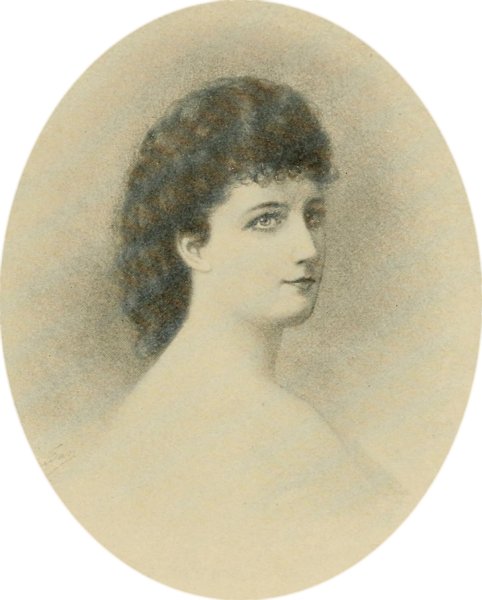
still radiant with that high type of beauty that emanates
from the soul, the link, she has said of herself,
between the conception and the execution of the great
scheme of Western aggrandizement. Cradled among
great ideas, she had grown up to be an inspiration to
the man with the prowess and daring necessary to give
them life and form. Some men, such as Abraham
Lincoln, have been great in spite of their wives, while
to others, as to Frémont, through their wives have come
not only the opportunity for greatness, but with them
that identity of purpose that in itself is a fortification
against all adverse circumstances.
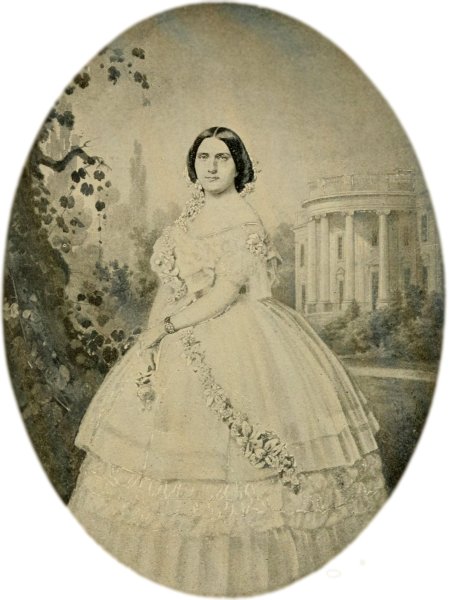
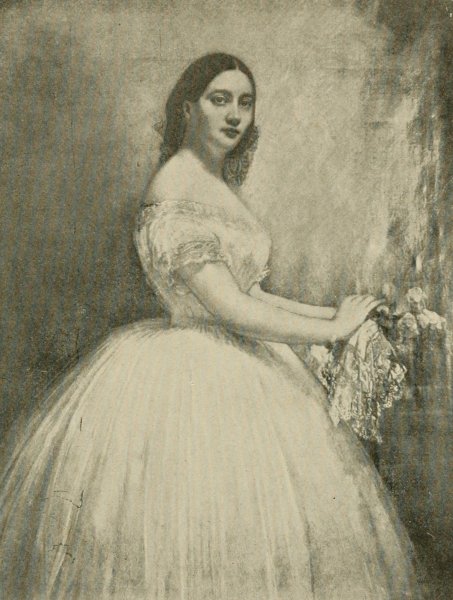
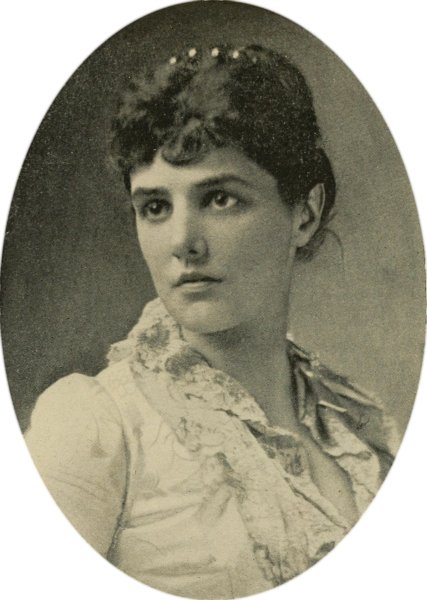
The story of Jessie Benton Frémont's life is closely
allied with that of the acquisition and development of
the vast territory west of St. Louis, which even in her
young womanhood was the outpost of habitation. Beyond
its confines stretched that wonderland of her
childhood, whence came the trappers and hunters with
their wild tales of adventure, and whither she was destined
to follow one day the princely pied piper of her
girlhood. The seed of the thought which bore its first
fruit when Frémont raised our flag on Wind River
Mountain, thirteen thousand feet above the Gulf of
Mexico, was sown in the mind of her father when, in
1812, he followed Andrew Jackson from Nashville to
New Orleans to defend the Mississippi. In the stirring
life on its broad bosom, together with a first realization
of the extent of our domain, he recognized the possibilities
of our future expansion and greatness. He
had already been admitted to the bar of Tennessee and
was a member of the Legislature of that State. With
the idea, however, that the government of the United
States should extend its protecting arm over the great
western wilderness, in which it evinced no interest and
whence it anticipated no benefit, he moved, in his thirtieth
year, to its border-land.
Its people recognized his friendly attitude, and when
Missouri rose to the dignity of a representation on the
floor of the United States Senate, Benton was the first
man to whom she delegated that honor. There, for
over thirty years, with a limited following, he fought
aggressively foot by foot for the development of the
West. He often wearied his hearers, who had but little
sympathy with projects that to the remote Eastern mind
seemed preposterous. It was not infrequently a signal,
when Benton mounted his hobby, for his fellow-Senators
to take up their letter-writing and for the galleries
to be deserted. It made little difference to them if
England's hand were outstretched and her fingers daily
tightening their clutch upon our northwestern territory.
The mouth of the Columbia River was about of as
much consequence to the welfare of the United States,
in the estimation of the people on the Atlantic seaboard,
as are the canals on the planet Mars.
Commercial relations with Asia and ports on the
Pacific, however Utopian they may have seemed to
others with less of a grasp on the world's history than
his scholarly mind possessed, were to Benton vital questions,
for which he fought with that vigor of utterance
that provoked John Randolph into saying that his
family motto, "Factus non verbis," should be "Factus
et verbis."
He was a powerful man, with a forcible way of
speaking, which he retained to the end of his life.
When he was stumping his State in the summer of
1856, being already in his seventieth year, he was cautiously
viewed one morning through the crack of an
open door by two anti-Bentonites. He was standing
at the moment and speaking in a vigorous way that appalled
his surreptitious visitors. "Good God," ejaculated
one, "we shall have to fight him these twenty years!"
He was a striking figure, with heavy black hair and
side whiskers, and during all the years that he was in
the Senate, like some of his illustrious successors, he
never changed the style of his dress. His vehemence
was expended in public. In his family life he was as
gentle as he was devoted.
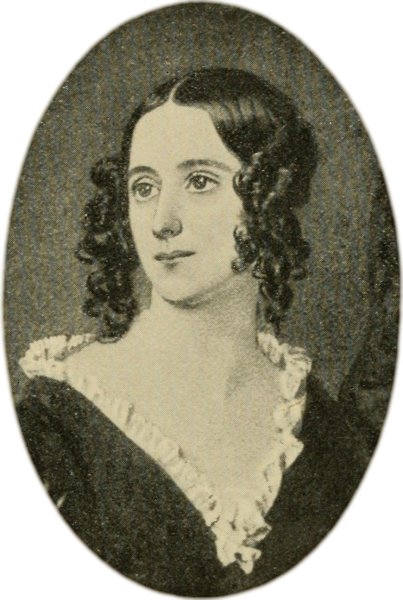
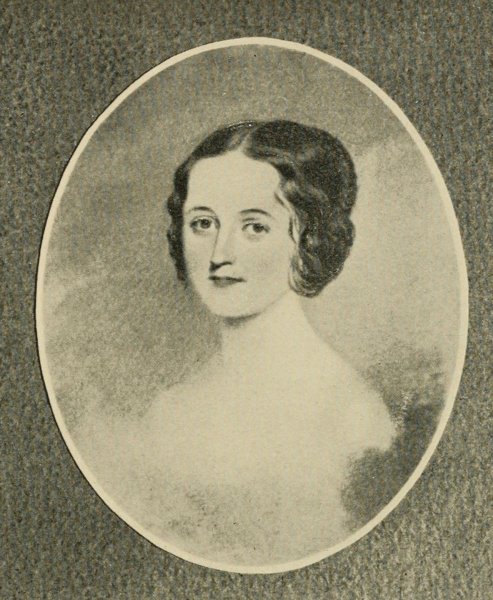
Jessie, the second of his four daughters, and the subject
of this sketch, was born at the home of her maternal
grandfather, Colonel James McDowell, near Lexington,
Virginia. She grew up partly in the picturesque
atmosphere of St. Louis, then almost wholly a French
settlement, and partly in Washington, where Benton's
home was considered one of the most interesting in the
city, owing to the cultivated wife and daughters who
gave it character and individuality. Intermingled with
her school-days she had her little day of belleship,
during which the two most notable events were a
dinner at the White House, given by President Van
Buren for his young son, and the wedding of Baron
Bodisco, the Russian minister, at which she appeared as
first bridesmaid. The bride, Miss Williams, was one
of her school-mates, and a girl of sixteen, while the
bridegroom was over sixty. The details of the ceremony,
however, were all harmoniously arranged by
him, and included eight bridesmaids between the ages
of thirteen and sixteen, and eight groomsmen of his
own period of life. With one of the most distinguished,
James Buchanan,—then in the United States
Senate, and but recently returned from the Russian mission,—walked
Jessie Benton, fourteen years of age, and
in her first long dress. Judged by his last will, this
Russian January seems to have been an unselfish husband,
for he therein expressed the wish that his still
young wife should marry again and be as happy herself
as she had made him.
The Van Buren dinner was a more or less memorable
event, though the White House was familiar
ground to Jessie Benton. During Jackson's administration
she used frequently to go there with her father,
for the old soldier-President was notably a lover of children.
He liked to run his long fingers through her
soft curls, while he talked with his old friend Benton,
unwittingly giving the curls many a twist as he warmed
to his subject, all of which the little girl bore heroically,
finding ample recompense in her father's praise, which
was sure to follow the ordeal.
She went to school both in St. Louis and Washington,
in the former city principally for the sake of learning
French by association with children to whom it
was the mother-tongue. She spent two years at Miss
English's boarding-school, in Georgetown, where she
was not regarded as a diligent student. Many hours
stolen from the class-rooms were not, perhaps, altogether
unprofitably spent up a mulberry-tree listening
to the fascinating accounts of a midshipman's life, as
told by one of his cousins, and hanging hungrily upon
every word, as if it in a measure foretold her own eventful
career.
At home her mental training was continuous, and
without conscious, or at least arduous, effort on her part.
Each of Benton's daughters had her place at his library
table, and there, stimulated by his studious habits, she
acquired readily her portion of that vast fund of knowledge
which he had gleaned first from his father's library
of unusual excellence and later from his contact with
men and measures of his day.
Of the measures there were many afoot when Benton's
daughters were young, whose stupendous proportions
we are scarcely able to gauge, knowing them only
in the perfection of their full realization. Benton was
the sympathetic friend of all progress, and beneath the
steady glow of his astral lamp or the soft flicker of
their mother's candles, in the nights before the advent
of gas, his daughters, sewing each her fine seam,
listened to the unfolding of the minds of the men who
have developed America. They learned also those
lessons of inexhaustible patience that must go hand
in hand with every great undertaking and of the frequent
subordination of the individual to the things his
own mind has conceived.
Thither came Morse with that sublime faith in his
conception of telegraphy that made him insensible or
at least indifferent to the ridicule of Congress, where a
member suggested, when he at length obtained his
twenty-five thousand dollars for an experimental line to
Baltimore, that a second appropriation should be made
for an experimental line to the moon.
An overland emigrant route, the surveys for a railroad
to the Pacific, and the Panama Railroad, Stevens
coming to them directly from Central America and
going later to the Isthmus, were some of the vast
projects with whose details they were early familiarized.
Later, when Jessie Benton, as Mrs. Frémont, crossed
the Isthmus herself and was detained there by the fever,
she saw Stevens every day, he coming, as he said, "to
take his chill with her." He died in Panama, as he
predicted that he would, one of the heroes in the vanguard
of progress.
Into Benton's home quite naturally there drifted, in
the year 1840, a young lieutenant of the corps of topographical
engineers, fresh from the survey of the upper
Mississippi. The son of a French father and a Virginia
mother, John C. Frémont was born in South
Carolina, in the year 1813. He was graduated, when
he was seventeen years old, from Charleston College,
where he remained to study civil engineering and teach
mathematics. He was so unusually talented that
Poinsett, the Secretary of War, recommended his services
to Nicollet when the latter was about to undertake
the survey of the Upper Mississippi. The two
years in the field were followed by two years spent in
Washington in preparing the scientific result of the
expedition, during which period Benton became interested
more perhaps in the work than in the individuality
of the young officer, whose genius was later to
open to us the western gates of our republic.
Accompanying Benton's eldest daughter to a concert
at Miss English's school, Frémont for the first time
met Jessie Benton. She produced on his mind at once
"the effect that a rose of rare color or a beautiful picture
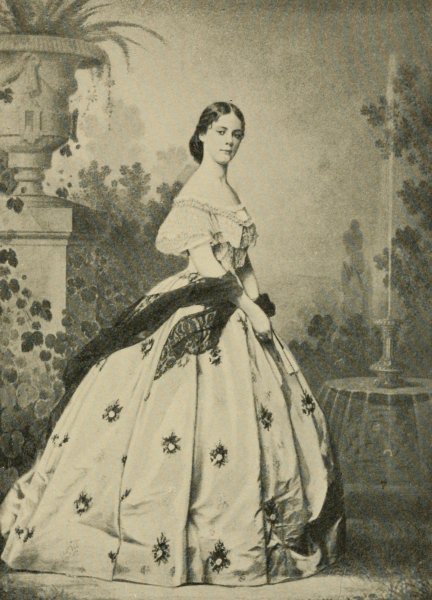
would have done." She was but sixteen years old
at the time, in the first bloom of girlish beauty, and
her bright mind exhilarated by the pleasure of seeing
her sister, poured itself forth in language as sparkling
as it was natural. "Her beauty," he wrote later, in
describing that first impression of her, "had come far
enough down from English ancestry to be now in her
that American kind which is made up largely of mind
expressed in the face, but it still showed its Saxon
descent. At that time of awakening mind, the qualities
that made hers could only be seen in flitting
shadows across the face or in the expression of incipient
thought or unused and untried feeling."
Coming home for the Easter holidays, she found that
the young lieutenant had become identified with her
father's "Oregon work." He was an almost daily visitor
at her home, and in his constant meetings with
her in its unreserved atmosphere he found confirmation
of the first impression he had formed of her. "There
are features," he wrote later, "that convey to us a soul
so white that they impress with instant pleasure, and
of this kind were hers. Her qualities were all womanly,
and education had curiously preserved the down of a
modesty which was innate. There had been no experience
of life to brush away the bloom."
Before the holidays were over this impression of her
had penetrated Frémont's entire being, and he loved
her no less profoundly than he admired her, rendering
her an absolute devotion that knew no subsequent diminution.
"Insensibly and imperceptibly," he said,
"there came a glow into my heart which changed the
current and color of daily life, and gave a beauty to
common things."
That April day in 1841, when, a month after it had
witnessed his inauguration, a mourning nation assembled
to pay its last tribute to William Henry Harrison, a
gray and gloomy day without, Frémont has recorded as
the "red letter day" of his life. The government had
leased quarters near the Capitol for the use of Nicollet,
where the work on the map of the Mississippi's sources
was going forward. From the windows of one of the
rooms Senator Benton and his family were invited to
view the funeral procession as it wound down Capitol
Hill. Frémont, on leave of absence for the day,
was the host of the occasion. Notwithstanding his
best uniform, in which he looked very handsome, he
personally tended the cheery log-fire, that gave a touch
of cosiness to the big office, which he had, moreover,
with somewhat reckless extravagance for a man on a
lieutenant's salary, decorated with plants and cut flowers.
From a daintily set table he served, with captivating
grace, coffee and ices. Though the nation mourned,
two hearts, at least, of all who looked upon the solemn
pageant of that day were in gala attire.
The next day, though he discreetly sent Mrs. Benton
the plants and flowers that had done decorative duty in
his office, it availed him nothing in her wise eyes. Jessie
was too young, and, besides, she did not wish her to
marry an army man; the life was too unsettled. Mrs.
Poinsett, the wife of the Secretary of War, was taken
into her confidence, and, as a result, Frémont was ordered
off to survey the Des Moines River. Jessie,
moreover, as a further diversion, was taken to the wedding
of one of her Virginia cousins, which meant in
those days weeks of festivity.
It was but another case, however, of the best laid
plans that "gang aglee," for in the autumn both Frémont
and Jessie Benton were back in Washington, and
on the 19th of October she was courageous enough, in
defiance of both father and mother, whom she not only
loved but truly revered, to become Frémont's wife.
She married too young, she says herself, ever to have
been a belle in the usual acceptation of that term, yet
so gifted has she been with those qualities that evoke
the chivalry of man that but few American women
have had a better right to that title. Though her life
has been one of much exposure, she herself has at all
times been singularly sheltered.
The year following his marriage, Frémont applied to
the Secretary of War for permission to explore the far
West and penetrate the Rockies. The plan was supported
by Benton, who believed that by making surveys
the government would be giving at least a semblance
of protection to its Western possessions. Congress gave
its sanction, and in May, 1842, with a handful of venturesome
spirits gathered on the Missouri frontier, Frémont
went forth to the exploration of the southern
pass. It was the first of numerous similar expeditions,
his scientific reports of which—going into astronomy,
botany, mineralogy, geology, and geography—were
translated into many tongues, and gave their author
world-wide fame.
During his absences, which were always of uncertain
duration, his wife sometimes remained in her parents'
home. Her father sent for her one morning, when she
had been married about a year, and, pointing out her
old place at his library table, he said, "I want you to
resume your place there; you are too young to fritter
away your life without some useful pursuit." So she
dropped back quite naturally into her old habits
of study, as if her honeymoon days had been but
another form of vacation.
She frequently accompanied Frémont, however, as
far as St. Louis, waiting there for his return, or going
out again to meet him after a fixed time. He was once
eight months overdue, during which period of awful
silence and suspense she had a supper-table set for
him every night with all the comforts and luxuries of
that civilization to which he had been so long a stranger.
He came at length, in the dead of the night, and, rather
than disturb a household, he went to a hotel, and for
the first time in eighteen months slept in a bed.
With whatever misgivings she may have seen him set
out for a field where he would encounter certainly many
dangers, and possibly even death, she never, even when
the opportunity came, of which many a weaker woman
would have availed herself, endeavored to withhold him
from his purpose. He would sometimes, after having
covered many miles of his route, come back to her for
another good-by, overtaking his party again by hard
riding or pressing forward while they were resting.
In the summer of 1843, while he was still on the
frontier gathering together men and animals for his
second expedition, his recall to Washington was ordered,
to explain there why, making a scientific expedition
under the protection of the government, he had
armed his men with the howitzer. The order, however,
never reached him, for he had already left St. Louis,
where it fell into the hands of his wife. Though she
still labored under the depression of their recent parting,
she yet, with all the spirit which the emergency demanded,
sent him a swift messenger, bidding him hurry
off and rest and fatten his animals at Bent's Ford, stating
that there was sufficient reason for the haste which could
not then be given.
When he was quite beyond the reach of recall, for
it was before the days of telegraphy, she wrote to the
colonel of the Topographical Bureau, and confessed
what she had done, at the same time giving ample
reason for her action. To have obeyed the order, she
explained, would have meant the ruin of the expedition.
Together with the time it would have required
to settle the party before he could leave it, the length
of the trip to Washington, and the inevitable delays
there, the early grass would be past its best, and the animals
thus would be thrown underfed into the mountains
for the winter. She then replied to the charge
made against Frémont in the order of his recall. The
expedition must cross the country of the Blackfeet and
other unfriendly tribes of Indians, with no reverence
whatever for the cause of science, but with a very wholesome
regard for any rights that were backed up with a
howitzer. Her father, who was absent from St. Louis
at the time, endorsed her action, and wrote to Washington,
assuming the responsibility for it, saying he
would call for a court-martial on the point charged
against Frémont. Nothing further was heard of it,
however, and the precious time, that meant so much
more to the scientific mind of the explorer than to his
government, to which all seasons are the same, was saved.
From an historical point of view this was the most
important of all Frémont's expeditions. With the
French territory which we had acquired by the Louisiana
purchase we inherited also France's old feud with
England, the underlying cause of which was the control
of the markets in the East. When we took up
the cudgels, their conflict, so far as the Western hemisphere
was involved, had narrowed down to the ultimate
possession of that portion of Mexico's territory
which included the harbor of San Francisco. England
had already made her survey of the ground, and her
eye coveted that matchless port. She was the power
we confronted in California when our war with Mexico
ushered in the moment for decisive action. Two courageous,
intensely American men, however, held the situation
in their grasp,—in the Senate, at the climax of his
powers, Benton, who had ever had a jealous eye upon
England's encroachments on our boundary; in the
field, Frémont, with all the gallantry and spirit that
final coup demanded.
The British admiral, moving with more deliberation
than the American colonel, with characteristic love of
sport and appreciation of success, gracefully accepted
his defeat, and tendered his felicitations to the intrepid
rival, whose flag he found already floating above the
coveted territory.
Frémont, after his gallant conquest, became the victim
of a quarrel between two officers commanding the
United States forces in that vicinity, and was brought
back a prisoner over the territory he had acquired for
his country. During the ninety days of his trial by
court-martial, which stripped him of his commission as
lieutenant-colonel of mounted riflemen, inspired by a
lofty enthusiasm, his nights were devoted to writing
the history of the expedition.
Though he was reinstated by the President, he returned
his commission, and in 1848 took out a private
expedition, opening the route from the Mississippi to
San Francisco. His mountaineers flocked to him,
ready to follow wherever he should lead. He had that
faith in himself and in his purpose that evoked a corresponding
confidence in them, and his presence was
light and warmth and refreshment to their daring
spirit. When it became necessary at times to divide
the party, those who were not with him suffered sorely.
The memorable winter of 1848, however, was one of
hardships for all, travelling days and weeks within sight
of eternal snows. Frémont wrote to his wife during a
brief respite from that agonizing period, when his men
were starving and freezing and wandering off in despair
to lie down alone and die: "We shall yet enjoy quiet
and happiness together; these are nearly one and the
same to me now. I make frequent pleasant pictures
of the happy home we are to have, and oftenest and
among the pleasantest of all I see our library with its
bright fire in the rainy, stormy days, and the large windows
looking out upon the sea in the bright weather.
I have it all planned in my mind."
Mrs. Frémont was, meanwhile, making ready for the
long journey towards the land of this picture-home.
It was the first break from the real home, her father's,
where she had passed the greater part of the eight years
of her married life, five of which her husband had spent
in the field. She started in March, 1849, going by
way of the Isthmus, where the man selected by Mr.
Aspinwall for her guide had many misgivings about
undertaking the charge. He had a wife, who had
prophesied that, coming from Washington, Mrs. Frémont
would be "a fine lady" and would make him no
end of trouble, especially concerning the scant attire
of the Indians.
In the sunshine of her presence, however, his misgivings
melted away. She was not a "fine lady" at all,
he said, that bugbear of his unconventional mind, but
a slender woman with a head so level and a heart so
stout as to render all the more forcible the appeal of
her delicate body.
She was stricken with the fever, and ill for many
weeks in Panama, where she was surrounded with that
warmth of friendship and sympathy which she ever
seemed to attract. In addition to many substantial
evidences of genuine interest in her recovery, one resident
of the city vowed in that event to supply the hospital
with limes for a year.
Gold was discovered in California in 1848. When
Mrs. Frémont arrived in San Francisco the people were
in that first frenzy of excitement that disturbed temporarily
the whole aspect of their daily existence. The
population of the towns was flocking to the mines, and
the comparatively few who remained at home had many
novel problems to face. The art of cooking without
eggs and butter had to be acquired, for there were
neither chickens nor cows, though one woman had as
many as thirty-seven satin dresses, "and no two off the
same piece," she averred.
A little Eastern bride, whom San Francisco society,
consisting of sixteen ladies, turned out in a body to
welcome, set up her first household belongings in a
modest frame structure two stories in height, that had
been put up at a cost, out of all proportion to its intrinsic
value, of ninety thousand dollars.
Yet nothing was so valuable as time, and though it
was estimated to be worth fifty dollars a minute, there
were busy men who paid Mrs. Frémont the compliment
of frequent day-time visits.
With every personal inducement to favor slave labor
in the new territory, both Frémont and his wife were
among its most strenuous opposers. Not only did they
pay their first house-maid two hundred and forty dollars
a month with perquisites, which included the housing
of her husband and children, yet even with a disposition
to retain her at that neat figure, they found themselves
obliged to do without her truly valuable assistance
when Mrs. Frémont refused the loan of her gowns
as patterns for the wardrobe she was having constructed
at the hands of a Chinese modiste. There were, moreover,
on the lands that Frémont owned, rich gold deposits,
which could be most profitably operated by slave
labor.
When the convention to draft the constitution under
which California should come into the Union met at
Monterey, where Frémont had established himself, his
home became the head-quarters for the anti-slavery party.
Its neatness, the smoothness of its internal workings,
and the evident contentment of his wife formed a text
for the friends of free soil, and many an incredulous
opponent was brought to behold, and, seeing, went
away believing in the possibility of domestic happiness
without slaves. Mrs. Frémont had, to be sure, a preference
for underclothing that had been ironed, and
she might have wished also that the two Indian men
who presided in her kitchen and pantry had not been
gifted with such facilities for terminating both the ornamental
and useful career of her china and glassware.
Yet these small clouds in no way overshadowed her
domestic horizon. Her prejudice to slavery she inherited
from both parents, belonging, as she said, "to the
aristocracy of emancipation," or to that class of people
who, owning slaves, quietly gave them their freedom at
infinite sacrifice to themselves, as opposed to the abolitionists
of the North, who, with nothing to lose and
much to gain, clamored noisily for that freedom.
Frémont was the hero of the hour, and could have
been governor of the new State or one of its first Senators.
He chose the latter, however, though it took
him away from those material interests which California
then held for him. Going into the Union as a free
State, it would need in Congress a defence such as no
man could give it with greater loyalty than Frémont.
There is an anecdote told and applied indiscriminately
to various political heroes, most frequently, perhaps,
to Lincoln, to whom, therefore, it may possibly
appertain, demonstrating delicately his deference for
the marital tie. On the night of his election to some
office, and while he was being inundated with the congratulations
of the friends who had assisted in the
achievement of his triumph, he further captivated their
fancy by remembering his wife. "Well, gentlemen,"
he said, quietly, "this is very nice, but there is a little
woman around the corner who will be interested in
hearing this news, and if you will just excuse me, I
think I'll step around and tell her."
One woman interested in the balloting of the delegates
at San José for California's first Senators was not
so conveniently situated. She was at Monterey, and
as a season of heavy rains was on, there was but little
prospect that her keen desire to know the result would
find immediate gratification. Before just such a merry
blazing fire as his imagination had once conjured up as
a central feature of their library sat Frémont's wife,
her fingers for the first time fashioning a dress for herself
on the trustworthy outlines of one that had been
ripped up for the purpose. Her little daughter had
been put to bed, and her companions for the evening
were the Australian woman who had replaced her two
Indian servitors, and whose accustomed fingers plied
the needle with a more rapid stroke than her own, and
the woman's baby, playing on the bear-skin rug near
the fire. Besides the voice of the woman and an occasional
chirrup from the baby, she heard nothing but the
storm without, till the door opened and a man, dripping
with rain, stood on the threshold and asked, in
consideration of his sorry plight, if he might enter.
It was Frémont. He had torn himself away from
his idolizing followers and ridden out into the darkness
and storm to tell his wife, seventy miles away, that he
had been elected to the United States Senate. Though
it was late in the night when he reached Monterey, he
was in the saddle again before dawn and on his way
back to San José, making in all a ride of one hundred
and forty miles.
The home-bound steamer, sailing from San Francisco
on the 1st of January, 1850, carried, among others,
the first two Senators from the new State, Frémont and
Givin. At Mazatlan a British man-of-war fired a
salute in honor of these two distinguished passengers.
They landed in New York the last of March, and
from the long mirror into which she looked, in her
hotel bedroom, there gazed back at Mrs. Frémont a
comely young woman clad in a riding habit that had
been abbreviated to a convenient walking length, a pair
of black satin slippers, a leghorn hat tied down with a
China crêpe scarf, and a Scotch plaid shawl that had
borne the brunt of her year's outing,—in a word, the
wife of a United States Senator from the golden West.
On another morning of the early spring two years
later, such were the contrasts which the events of her
life produced, she stood in the throne-room of Buckingham
Palace, awaiting presentation to the Queen of
England. To the British eyes that looked upon her
she was a graceful, distinguished woman, sharing in the
renown of her husband, the American explorer, and a
recent medallist of the Royal Geographical Society,
whose honors are only conferred upon those whose
expeditions are taken out at personal cost and sacrifice.
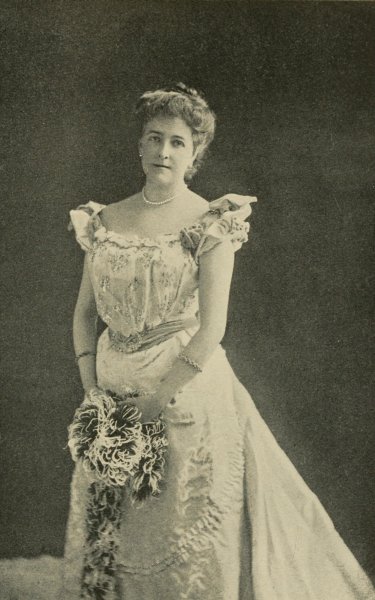
In the faultless details of her court dress she was a
gratification to the most critical taste. Its exquisite
design, shading in color from the faint pink that touches
the outer edge of a rose petal to the deeper tone it
assumes near the heart, with clusters of the fair flower
itself giving it an almost fragrant emphasis and bringing
out the delicate beauty of her fine face, seemed a
part of herself, so gracefully did she wear it, carrying its
sweep of train with a queenliness that was of her nature.
On the 17th of June, 1856, Frémont was unanimously
nominated for the Presidency by the National
Republican Convention at Philadelphia. He was the
first choice of the Free Soil, which became, later, the
Republican party, and he was also, probably, the only
man of whom Lincoln, the first successful candidate of
that party, was ever jealous. Fearing a military rival,
and recognizing in Frémont the qualities that gave him
a natural supremacy among men, he kept him in the
background. He foresaw correctly. The military hero
came, but he came in the person of the man to whom
opportunity had been a fairy godmother.
Though he polled the vote of all the Northern States
but five, the time was not ripe for a Republican President
when Frémont was a candidate for that high
honor. The men, like Benton, who still led the political
thought of that day, and who knew every aspect
of the country, realizing the peril that lay in countenancing
sectionalism, could not give their support to a
candidate who stood upon a sectional platform.
Whatever were his hopes or his disappointment, his
wife shared them. His accepting the nomination from
so radical a party had meant the breaking up of many
friendships for her, which in itself was a genuine grief
to a woman of her temperament. The anguish she
endured during the first months of the war between
the North and the South, which she spent in St. Louis
among familiar faces, whom the circumstances of her
position as the wife of a Northern general had estranged
from her, left its record in her beautiful hair,
which, from a warm brown, became quite white within
a few weeks. No matter with what heroism we endure,
we sometimes bear all the rest of our lives the scars
which our courage has cost us.
She has never outgrown, however, her early attachment
to the South, to which she is united by many ties
of blood. During the famine there that followed the
war she applied to Congress for relief, which was immediately
granted, with a ship to carry all the supplies the
Freedman's Bureau could furnish. With warm and
tender sympathies she has always taken up any cause
that appealed to her with an enthusiasm that communicated
itself to others. Relating to Mrs. Dix one evening
the case of one of Lieutenant Frémont's men, who
had been disabled by being wounded in both legs, and
to whom Congress had refused a pension on the ground
that he had not been regularly enlisted at the time the
wound was inflicted, she did not observe that a man
who was calling upon Senator Dix was attentively listening
to all the graphic details of her story. It was
Preston King, of New York, and at that time chairman
of the Committee on Appropriations. He took
Senator Dix to the door with him when he left, and
bade him tell her to write out the story as she had just
told it and send it to him, and he would see that the
man got his pension; and he did.
With what tender gratitude and reverence the man
himself, Alexis Ayot, a Canadian by birth, came to
thank her!
"I cannot kneel to thank you," he said, balancing
himself upon his crutches, "Je n'ai plus de jambes;
but you are my Sainte Madonne, et je vous fais ma
prière."
During her early California days she extended her
generous young hand to a youthful compositor who
was working on the Golden Era. He dined with
her every Sunday, and she gave him not only that
recognition and encouragement that were in themselves
a stimulus to his talent and ambition, but she used her
influence to obtain for him salaried offices that lifted
him above anxiety concerning his material condition,
and gave him the leisure necessary to the best development
of his genius. His name is Bret Harte, and so
entirely did he recognize his indebtedness to her that he
once wrote to her: "If I were to be cast away on a
desert island, I should expect a savage to come forward
with a three-cornered note from you to tell me that at
your request I had been appointed governor of the
island at a salary of two thousand four hundred dollars."
She has both the versatility and adaptiveness that are
characteristic of the genuine American woman, and
which have enabled her to make almost as many friends
in foreign lands as she has throughout her own country.
The Count de la Garde, a cousin of Eugene and Hortense
Beauharnais, whom she knew in Paris, and who
left her at his death a valuable collection of souvenirs
of the Bonaparte family, said of her that she was
the only American woman he had ever known. He
had known others of her countrywomen, but they were
but imitations of English or French women, while in her
he felt the originality and individuality of another people.
As a scientist and explorer, Frémont's reputation
had gone forth to the countries of Europe, from many
of which he received enviable honors and decorations.
He and his wife were presented at the courts of England,
France, and Denmark, attending at Copenhagen
the wedding-festivities of the Crown Prince and his
Swedish bride. As one of her friends has cleverly said
of Mrs. Frémont, "she has entertained and been entertained
through not only the gamut but the chromatic
scale of society."
After the war, while her younger children were still
growing up, and during her husband's lifetime, she lived
for some years in New York, on a picturesque old
property on the Hudson that still bore its Indian name,
Pocaho. Now, however, she lives again in the State
that once gave her health, wealth, and honors, near the
great sea, away from which she feels that she is never
fully alive.
Her life has been full of changes and events, to all
of which her alert intelligence and quick sympathies
have made her keenly susceptible, and which wrung
from her recently a plaintive, "We are tired, my heart
and I." That was all, for one who knew every phase
of her life has already borne testimony to that "sweet
and happy and forbearing temper which has remained
proof against the wearing of time."