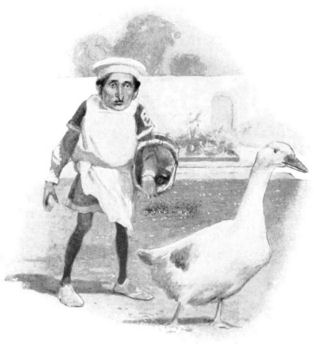
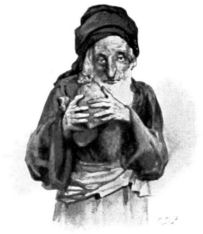
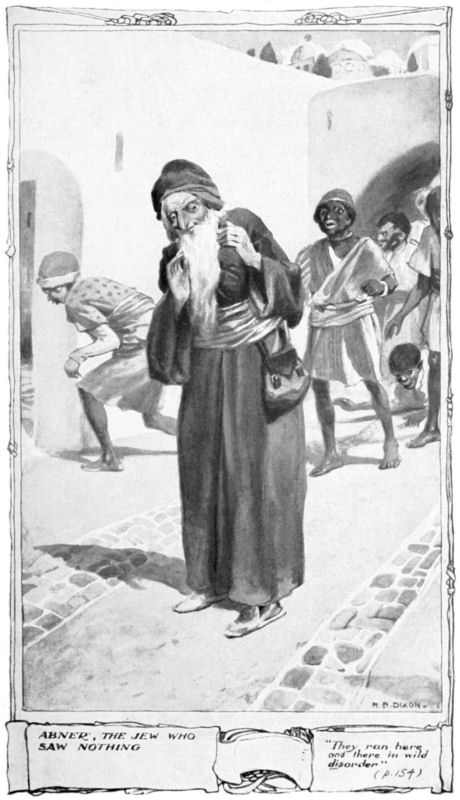
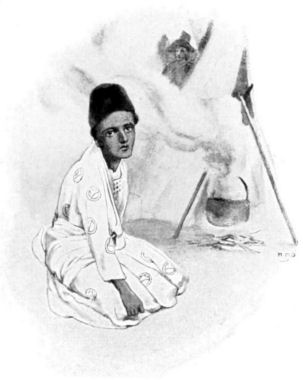
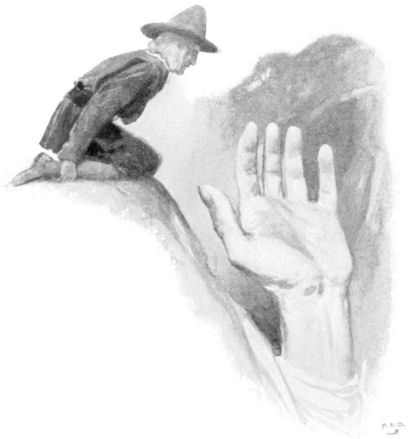
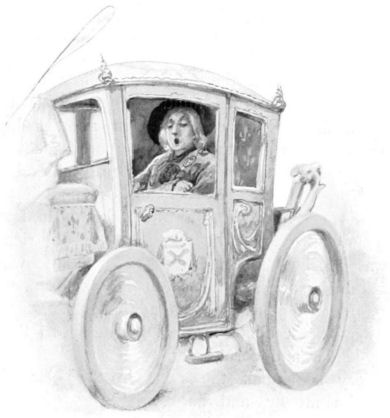
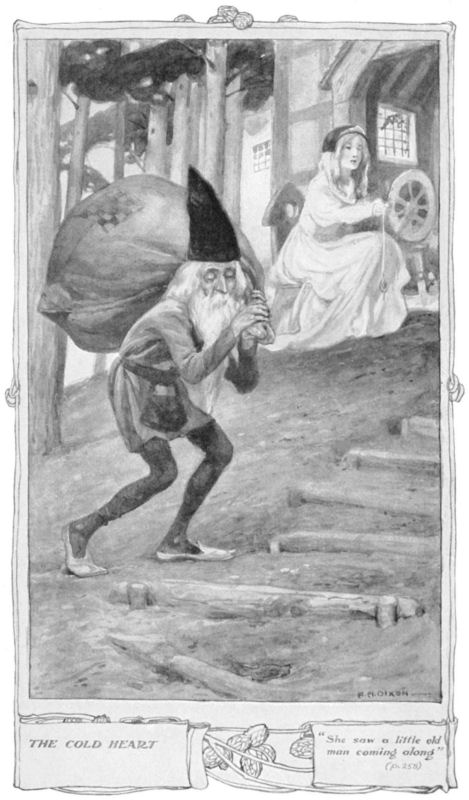
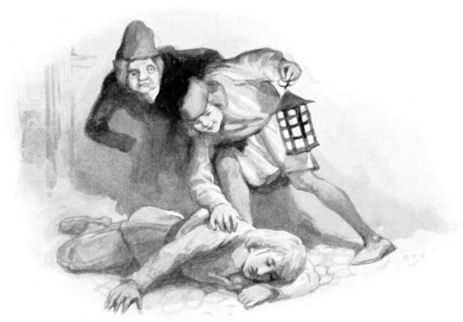
THE STORY OF CALIPH STORK. — CHAPTER I. — CHAPTER II. — CHAPTER III. — CHAPTER IV. — CHAPTER V.
9]
CHASID, Caliph of Bagdad,
was taking his
ease one beautiful afternoon,
stretched out upon
his couch. He had just
awakened from a little nap
and was in a pleasant
mood. From time to time
he drank from the cup of
coffee one of his slaves
handed to him, and took
long whiffs from a rosewood
pipe, stroking his
long beard the while, with
an air of extreme complacency. In short, it was evident
that the Caliph was in a very good humour.
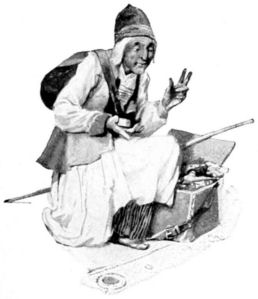
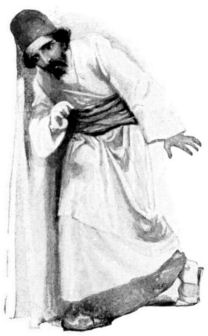
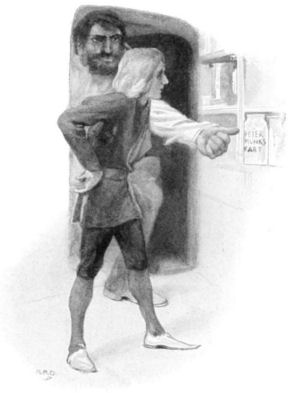
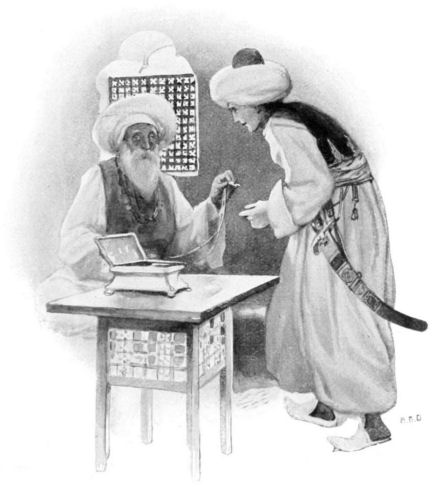
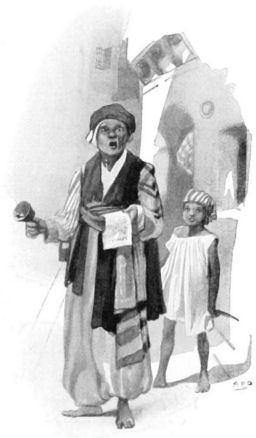
The Pedlar.
It was the best time in the day for any one
to approach him on business, for he was usually
inclined to grant any request one might ask, and
for this reason, his grand vizier Mansor was wont
to visit him at that hour. On this particular afternoon
he came as usual, but seemed unaccountably
10]
quiet and thoughtful. The Caliph removed his pipe
from his mouth and said: “Why do you look so serious,
Grand Vizier?”
The grand vizier crossed his arms on his breast,
bowed low before his master, and answered:
“Sire, it is no wonder I look disturbed, for below
the palace wall stands a pedlar, who has such beautiful
goods for sale that it angers me to think I have no
money to spare just now.”
The Caliph, who had long wished for an opportunity
to confer some gift upon his vizier, sent a black slave
to fetch the pedlar.
Very soon the slave returned, ushering the pedlar
into his master’s presence. He was a fat little man,
with a sunburnt face and dressed in rags. He carried
a pack in which all sorts of wares were huddled together,
pearls, rings, richly-chased pistols, goblets and combs.
The Caliph and his vizier took stock of everything,
and finally the Caliph purchased handsome pistols
for himself and his vizier Mansor, and a beautiful
comb for Mansor’s wife.
As the pedlar was about to close his pack, the
Caliph noticed a little drawer and asked if there was
anything in it for sale.
The man opened the drawer and took out a snuff-box
containing a dark coloured powder, and a paper
covered with very curious characters, which neither the
Caliph nor his vizier were able to read. “I had these
from a merchant, who picked them up in the streets
of Mecca,” said the pedlar. “I do not know what they
11]
contain and they are at your service for a very low
price, as I do not know what to do with them.”
The Caliph, who was always glad to purchase rare
manuscripts for his library, even if he could not read
them himself, bought both snuff-box and paper, and
dismissed the pedlar.
But the Caliph was curious to know what the
writing on the paper meant and asked the vizier if he
knew of any one who would possibly be able to
decipher it.
“Most gracious lord and master,” said the vizier,
“near the great Mosque dwells a man known as Selim
the Learned, who understands all languages; bid him
come hither and maybe he will understand these
mysterious characters.”
The learned Selim was soon sent for and the
Caliph addressed him thus: “Selim, it is said of you
that you are a very learned man; look well at this
writing, and see if you can read it. If you are able
to do so, I will give you a new robe for feast days,
but if you are unable to do so you will receive twelve
strokes upon the back and five-and-twenty upon the
soles of your feet, because you have masqueraded
under the name of Selim the Learned.”
Selim glanced at the writing intently and suddenly
cried out: “It is Latin, my Lord, most certainly it is
Latin.”
“Very well, then,” commanded the Caliph impatiently,
“if you know that it is Latin, tell me what it means.”
Selim began to translate: “Man, whoever you be,
who shall find this, praise Allah for his mercy. He
12]
who shall take a pinch of the powder in this snuff-box
and say the word ‘Mutabor’ shall be able to transform
himself into any kind of animal and understand the
creature’s language. When he wishes to return to his
original form he must bow three times towards the
East and repeat the same word. But let him beware,
when in the transformed state, never to laugh, otherwise
he will forget the magic word and will be condemned
to remain an animal.”
When Selim had finished reading, the Caliph was
beside himself with joy. He made Selim take an oath
that he would not reveal the secret, gave him a handsome
robe, and sent him away.
“I call that a first-rate purchase,” said he to
Mansor. “How I long to become an animal! Early
to-morrow morning you shall come with me, we will
go out into the fields, take a pinch of snuff from my
box, and then listen to all that is being said in the air
and in the water, in the field and in the woodland.”
The following morning the Caliph Chasid had
scarcely finished his breakfast, when the grand vizier
appeared in order to accompany his master upon
his morning walk. The Caliph tucked the snuff-box
containing the magic powder into his sash,
and having commanded his attendants to remain
13]
behind, he and his vizier set out alone upon
their way.
First they passed through the royal gardens,
but looked in vain for some living creature so that
they might test the
power of the powder.
Then the vizier
suggested they
should visit a pond
where he had frequently
seen a
number of storks
disporting themselves,
their dignified
ways and hoarse
cries having attracted his attention.
The Caliph
approved of his suggestion
and accordingly
they went to
the pond. On their
approach they noticed
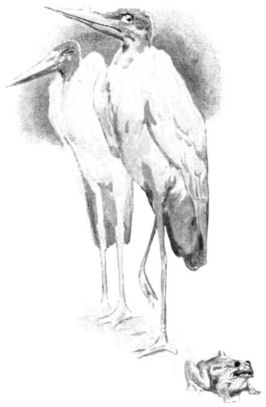
a stork walking gravely to and fro, searching
for frogs, and now and again uttering loud cries; at
the same time they saw, above them in the air, a
second stork floating gracefully towards them.
“I wager my beard, Sire,” said the vizier, “these
two long-legs will hold an amusing conversation
together. What do you say to our transforming ourselves
into storks?”
14]
“The very thing,” answered the Caliph, “but first
let us be very careful that we know the way to
become men again. Let me see—we must bow three
times towards the East, and say ‘Mutabor,’ and
immediately I shall be the Caliph, and you my vizier.
But for heaven’s sake do not laugh, otherwise all
will be lost.”
As the Caliph spoke he saw the second stork
slowly drop to earth, so he quickly drew his snuff-box
from his girdle, took a pinch, offered the box to his
vizier, who likewise snuffed the powder, whilst the pair
of them cried simultaneously, ‘Mutabor!’
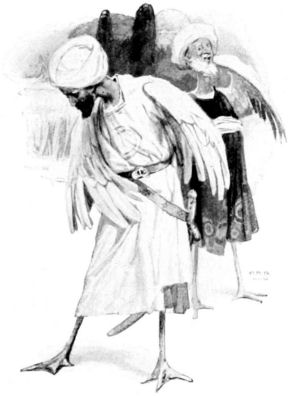
Immediately their legs began to shrink and to
become thin and red, their beautiful yellow slippers
turned into unshapely storks’ feet, their arms became
wings, their necks shot up from between their shoulders
to the length of an ell at least, their beards
disappeared, and their bodies were covered with soft
white feathers.
“You have a pretty beak, my lord vizier,” said
the Caliph, as he stared in astonishment at his companion.
“By the beard of the prophet, I have never
seen such a sight in my life.”
“Many thanks,” replied the vizier bowing. “If
I may be permitted to say so, you are almost better
looking as a stork than a Caliph. But come, let us
join our companions and find out if we really can
understand stork language.”
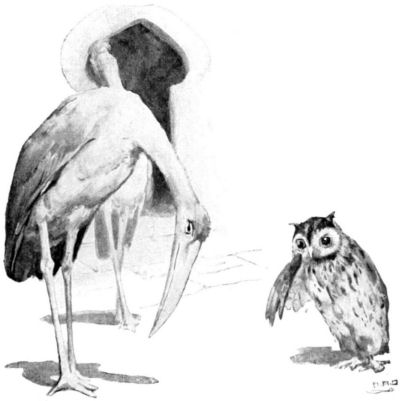
In the meantime the other stork, which had just
alighted, was pluming its feathers as it approached
the first stork, so the two newly-made birds hastened
15]
to come up to them, and to their astonishment overheard
the following extraordinary conversation.
“Good-morning, Mrs. Long-legs, how early you
are up.”
“Ah, my dear Clapperbill! I just came out to
get a snack; anything I can offer you, my dear, in
the shape of a bit of lizard or a tit-bit of frog?”
“Thanks all the same, but I’ve really no appetite—I
came here for quite a different reason—I have
to dance to-day before my father’s guests, and I came
here to practise a little by myself.”
With these words the young stork began to
twist and turn about in the most ridiculous attitudes
imaginable. The Caliph and Mansor stared at her in
surprise, but when she stood on one foot, stretched
out her wings and struck an attitude of supposed grace,
she looked so absurd that they could no longer contain
themselves, but burst out into hearty and prolonged
laughter. It was some time before they could control
themselves, but at length the Caliph stopped laughing,
and said: “Oh! what a joke that was—I would not
have missed it for any money. What a pity our
laughter frightened the silly things away; they might
otherwise have sung to us also.”
But suddenly the vizier remembered that they
had been forbidden to laugh during the time of their
transformation. He at once reminded the Caliph of
this. “Mecca and Medina,” cried he, “it would be a bad
joke indeed if we had to remain storks for the rest of
our lives. See if you can remember the magic word,
for upon my soul, I seem to have forgotten it.”
16]
“We must bow three times towards the east
and say ‘Mu-Mu-Mu—’”
No further could they get. They bowed and
bowed until their beaks touched the ground, but try
as they would they could not remember the magic
word, and the unfortunate Caliph and his vizier were
doomed to remain two storks.
The enchanted pair wandered sadly from field to
field, wondering what they could do to end their
misery. They could not rid themselves of their birds
forms, and it was equally impossible to return to the
town and declare themselves to be the Caliph and his
vizier, for who would have believed a couple of storks,
and was it to be supposed the inhabitants of Bagdad
would consent to be ruled by a stork?
And so they crept about for days, sustaining
themselves meagrely on wild fruits, which they were
scarcely able to eat on account of their long beaks,
but as yet they had no appetite for lizards and frogs,
and such-like delicacies. Their only relaxation was the
pleasure they found in the use of their wings, for they
were able to fly into Bagdad and watch, from the roofs
of the houses, what went on in the city.
At first they noticed great sorrow and unrest,
but within four days all this was changed and, watching
from the roof of the Caliph’s palace, they noticed a
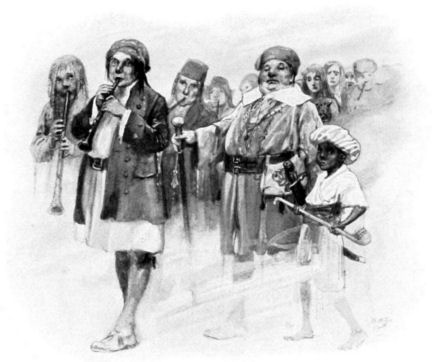
magnificent procession winding along in the street
below—drums and fifes sounded, and a man clothed
17]
in a scarlet robe, embroidered with gold, was seated
upon a finely-caparisoned horse, surrounded by a
glittering escort. Half the inhabitants of Bagdad
came out to watch the procession, and cried as it
passed—“Hail! Mizra, ruler of Bagdad.”
The two storks
looked at each other
and the Caliph said—“Can
you not guess
now why we have
been thus bewitched?
Mizra is the son of
my deadly enemy, the
powerful magician
Kaschnur, who once
in an evil moment
swore revenge against
me. But we will not
despair; come, my
faithful comrade, we
will seek the grave
of our great prophet,
and perchance in that
holy spot we shall be
freed from the enchantment.”
They had no appetite for lizards
and frogs. (P. 16.)
So they left the
palace roof and flew towards Medina.
But they had had so little practice in flying that
they soon grew weary. “Oh! sire!” groaned the
vizier, after a couple of hours, “with your
18]
permission I must rest for awhile, you fly too quickly
for me. It is already evening, and would it not be
as well to seek shelter for the night?”
Chasid agreed to his companion’s request, and
as he saw a ruin in the valley beneath, which promised
to afford a roof to cover them, they flew down
to it. The place seemed to have been at one time
a castle. Beautiful pillars raised themselves in the
dilapidated apartments, which still retained evidences
of their former splendour.
Chasid and Mansor wandered through the corridors,
seeking for a dry spot suitable for a resting
place, when suddenly Mansor stood still.
“My lord and master,” he whispered softly, “ridiculous
as it may appear for a vizier, not to mention a
stork, to be afraid of ghosts, there is no doubt I feel
an uncomfortable sensation of fright, for can you not
hear a weird groaning and sobbing noise close at hand?”
The Caliph listened and heard the unmistakable
sound of human weeping. Anxious to solve the
mystery he hastened towards the spot from which the
sound proceeded.
The vizier seized him by the wing and begged
him earnestly not to place himself in the way of fresh
danger, but the Caliph carried a brave heart beneath
his stork’s feathers and, disengaging himself from his
companion, though with the loss of some feathers, he
hurried along the dark corridor.
Presently he came to a door which was closed,
but not fastened, and from behind which he distinctly
heard the sound of sighing and weeping. He pushed
19]
the door open with his beak and stood astounded
upon the threshold. In a ruined chamber, lighted
only by the rays of the moon, which streamed through
a little casement window, he saw a large owl. Tears
streamed from her great brown eyes, and with hoarse
screeching voice she bemoaned her sorrows, but no
sooner did she perceive the Caliph and his vizier
than she uttered a cry of joy; daintily wiping the
tears from her eyes with her brown-tinted wings, she
spoke to them, to their utter astonishment, in excellent
Arabic—
20]
“Welcome, O ye storks,” she cried, “you come
to me as tokens of my deliverance, for it was once
prophesied to me that great good fortune would befall
me through the intervention of two storks.”
As soon as the Caliph had recovered from his
astonishment, he brought his thin feet together and
bowed his long neck in an elegant attitude.
“Owl,” said he, “after what you have said, may I
consider myself to be in the presence of a companion
in distress? But alas! your hopes that we may be
able to assist you are in vain. You will recognise
our helplessness when you have heard our story.”
The owl begged him to recount it, and the Caliph
made her acquainted with all that had befallen them.
When the Caliph had told his story the owl
thanked him and said: “Now you shall hear my story
and you will then see that I am no less unhappy than
you and your vizier. My father is the King of the
Indies, and I am his only and unfortunate daughter,
Lusa by name. The same wicked magician Kaschnur,
to whom you owe your misfortunes, bewitched me
also. One day he came to my father and demanded
that I should be given to his son Mizra for a wife,
but my father, who is a hasty man, ordered him to
be thrown down the steps. The miserable wretch knew,
however, how to transform himself and approach me
when I was walking in my garden. Disguised as a
slave, he offered me a refreshing drink, but one which
21]
changed me into this horrible form. Fainting with
horror, I was seized by him and carried here, and
before leaving me he shrieked these words in a terrible
voice—
“‘Here shall you remain, hideous and shunned
even by the beasts themselves, until your end comes,
or until some person shall be willing, in spite of your
dreadful appearance, to make you his wife. This is
my revenge upon you and your proud father.’
“All this took place many months ago. Lonely
and sad I have passed my miserable days, shunned
by all, even the beautiful face of Nature turned from
me, for by day I am blind, and it is only when the
moon’s faint rays pierce my prison window that the
veil falls from my eyes.”
As the owl ceased speaking, she once more wiped
her eyes with her wings, for the recital of her woes
had caused her tears to flow afresh.
The princess’s story had made the Caliph very
serious—“It seems to me,” he said, “that there is a
strong resemblance between your trouble and ours, but
where shall we find the key to unlock the mystery?”
The owl answered more hopefully, “My lord as
I told you, it was prophesied of me in my youth, by
a wise woman, that good fortune would come to me
by the help of a stork. Now, the magician who was
the cause of all our misfortunes comes once a month
to these ruins, and feasts and makes merry with his
companions in an apartment close by. Many a time
I have listened to their conversation and heard them
recount their wicked deeds; might it not happen that
22]
Kaschnur would perhaps let fall the magic word that
would release you, during one of these revels?”
“Oh! dearest princess,” cried the excited Caliph,
“tell me, I beseech you, the date of Kaschnur’s next
visit!”
The owl was silent for a short space of time,
then said she—“Do not be offended if I make a condition
with you before granting your wish.”
“What is it,” cried the Caliph, “whatever it is,
be sure I shall be willing to grant it you.”
“Well, it is this,” said the owl; “I am as anxious
as you are to regain my natural form, and this
can only happen if one of you will offer me his hand.”
The storks appeared somewhat taken aback, and
the Caliph beckoned his vizier aside.
“Grand vizier,” said he, “it is a great nuisance,
but you must just take her.”
“Indeed,” replied the vizier, “and when I reach
home my wife will scratch my eyes out for my pains.
Besides, I am an old man, whilst you are young and
unmarried, and are therefore a more suitable match
for a young and beautiful princess.”
“Well, that is the point,” the Caliph sighed sadly;
“who told you she was young and beautiful? I don’t
care to buy a cat in a bag like that.”
They argued together for some time, but when
the Caliph found his vizier would rather remain a stork
than marry the owl, he made up his mind to fulfil
the condition himself.
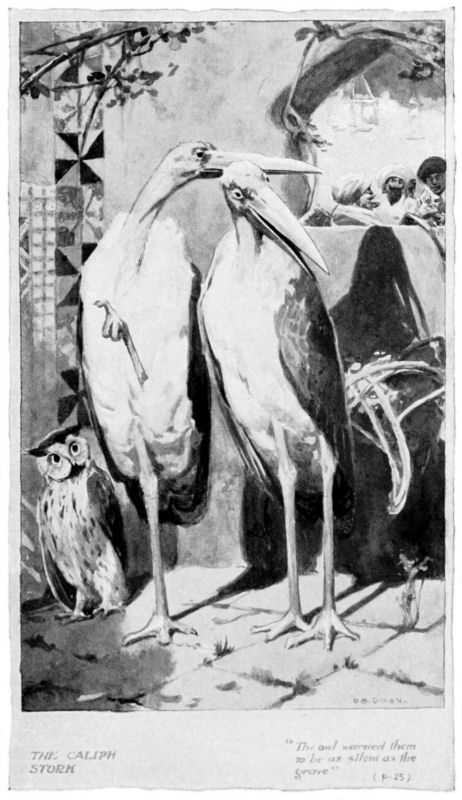
THE CALIPH STORK “The owl warned them to be as silent as the grave”
(p. 25.)
The owl was overjoyed, and assured the two
storks they could not have arrived at a more
25]
opportune moment, for the magicians were to meet
there that very night.
So she and the storks left the little room and
threaded their way along a dark narrow corridor until
they came to a broken-down wall, through the crevices
of which a bright light streamed. The owl warned
them to be as silent as the grave and pointed out a
hole through which they could peep into the great hall
beyond.
This hall was magnificently decorated, and lighted
up by many different coloured lamps. In the middle
of the apartment stood a round table set with a variety
of the choicest dishes. Round the table were couches,
upon which eight men reclined, and one of these men
the storks immediately recognised as the pedlar who
had sold them the magic powder. His neighbour invited
him to recount his latest doings, and amongst
other stories he recounted that of the Caliph and his
vizier.
“What was the magic word you gave them?”
asked one of the other magicians.
“A good difficult Latin one—it was ‘Mutabor.’”
As the storks heard this word they were fairly
beside themselves with joy. They ran so quickly to
the door of the ruin that the owl could scarcely
follow them. But when they reached the open air
the Caliph turned to the owl and said in moved
tones:—“Preserver of my life and of the life of my
26]
friend, accept not only my eternal gratitude, but myself
as your husband!”
He and the vizier then turned towards the East,
three times they bowed their long necks towards the
rising sun and cried “Mutabor,” and in a moment they
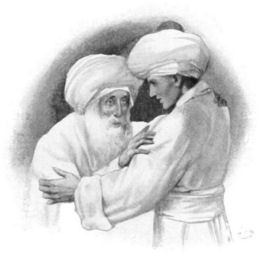
were restored to their former state, and Caliph and vizier
fell into each other’s arms and embraced, congratulating
each other upon the joy of their newly-found life.
But who shall describe their astonishment when
they looked round and saw a lovely lady, gorgeously
attired, standing before them. Smilingly she gave her
hand to the Caliph. “Do you not recognise your
wife, the brown owl?” said she.
The Caliph was so enraptured at the sight of her
beauty and grace that he declared the most fortunate
thing that had ever happened to him was to be turned
into a stork.
The three set out towards Bagdad together. As
the Caliph found in his pockets not only the magic
snuff-box, but his purse also, he was able to purchase
in the next village all the necessaries required for their
journey, and so they were able to push forward, and
soon reached the gates of Bagdad.
Arrived there, the greatest astonishment prevailed
at the sight of the Caliph and his companions. He
had been given up for dead, and the populace was
overjoyed to welcome back their beloved ruler, but
their hatred towards the usurper Mizra was as great
in proportion.
The people crowded into the palace and seized
upon the old magician and his son. The Caliph
27]
ordered the old man to be taken to the apartment
of the ruin the owl had inhabited, and there to be
hanged, but the son, who was ignorant of his father’s
magic arts, the Caliph gave the choice of death or
a pinch of snuff. He chose the latter, and the vizier
at once offered him the snuff-box. He took a mighty
pinch, and, the Caliph pronouncing the magic word,
he at once became transformed into a stork. The
Caliph had a large cage made for him which he
ordered to be placed in his gardens, and in which
Mizra was confined for the rest of his life.
Long and happily the Caliph lived with his wife,
the princess, the pleasantest hours of the day being
when the grand vizier paid his afternoon call, and they
talked together of their curious experiences as storks,
and when the Caliph was in a particularly good
humour he would condescend to imitate the vizier as
he looked when a stork: he would strut stiffly up and
down the room, flap his arms as if they were wings,
and bow towards the East, vainly striving to recollect
the forgotten word. This performance gave the Calipha
and her children the greatest delight, but when the
Caliph teased the vizier too sorely and croaked
“Mu-Mu-Mu-” for too great a length of time, the vizier
would threaten his master—“I will tell the Calipha
what took place outside the door of the owl princess’s
chamber!”
FATIMA’S RESCUE.
28]
THE Cadi of Acara
had two children
named Mustapha and
Fatima, who were the
joy and delight of their
infirm and ailing father,
and who loved each
other very dearly.
Mustapha was just two
years older than Fatima,
and it was his constant
effort to provide pleasure
and amusement
for his pretty little sister.
He knew a pirate ship had been
seen in the neighbourhood. (P. 29.)
On her sixteenth
birthday he gave a
little feast for her, to which he invited all her favourite
playfellows. The feast was set out in the garden, and
consisted of the daintiest dishes that could be procured.
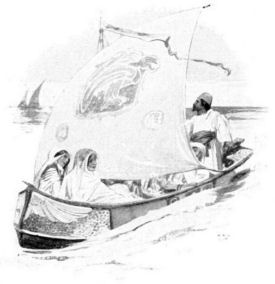
After they had partaken of the meal, and when it was
nearly evening, he suggested that he should take them
out for a sail upon the water.
Fatima and her friends were delighted, for it
was a beautiful evening, and the view of the town
29]
from the water was a particularly fine one. When
Mustapha had sailed the ship for a short time he
wished to return to land; but the girls begged and
entreated him to take them a little further out. He
was most unwilling to do this, as he knew a pirate
ship had been seen in the neighbourhood some few
days earlier. The girls, however, were set on sailing
out to a point of land that stretched far out into the
sea, for they were anxious to land there in order to
watch the sun set and see the great ball of fire sink
down into the sea.
Just as they reached the point of land, they
noticed a barque, manned with armed men, and Mustapha
fearing it might mean danger, ordered the boat to be
turned round and rowed towards land. But the barque
pursued the smaller boat, overtook it and got between
it and the land. By this time the girls began to
realise their danger, and so terrified were they that
they shrieked aloud and would not keep their seats in
the boat. In vain Mustapha begged them to sit still,
pointing out how impossible it was to make any way
whilst they impeded the movements of the rowers. As
the barque approached, with one accord they rushed
to the opposite side of the boat and their weight overturned
it, and in a moment they were all struggling
in the water.
The people on shore had seen what was happening
and several boats put off to assist Mustapha.
They were just in time to help rescue the frightened
girls, and at their approach the strange barque sailed
away. At first it was impossible to find out if
30]
everyone was safe; but when the girls were brought
ashore it was discovered, alas! that Fatima and one
of her companions were missing. In one of the boats
was a stranger, and on Mustapha questioning him as
to how he got there he owned that he had belonged
to the pirate ship. That he had jumped overboard to
come to the assistance of the sinking girls, and that
his comrades had left him in the lurch when they fled
from the approaching boats; but he had had time to
see that two of the girls had been seized by the pirates
and carried away in their ship.
The Cadi’s grief knew no bounds, and as for
Mustapha, he was beside himself with sorrow, for not
only did he blame himself for the loss of his beloved
sister, but her friend, who had also been taken captive,
had been for a long time past his promised bride, and
would have been his wife already had it not been that
her parents were poor and the Cadi did not think her
a suitable match for his son.
Mustapha’s father was a stern old man, and as
soon as his grief had sufficiently subsided he sent for
his son and said:
“Owing to your folly, I have been robbed of the
joy and consolation of my old age. Go, I banish you
from my sight for ever, and the curse of your old
father shall rest upon your head, unless by some
chance you should be able to rescue Fatima, when I
will forgive you and receive you once more as
my son.”
Mustapha had already fully determined to endeavour
to rescue his sister and her friend, but he had
31]
intended to seek his father’s blessing before setting out
upon his travels. However, the unjust treatment he
received did but steel his heart and made him the
more determined not to cease from his quest until he
had been successful.
He spoke to the man they had captured from
the pirate ship, and from him learned that the
vessel was a slaver, and that the human wares
were generally carried to Balsora and there disposed
of.
Mustapha decided to travel overland, as there
happened to be no ship sailing just then from his
native town, and he wished to reach Balsora soon
after the pirates. He had a good horse and little
baggage and so he reckoned he could do the journey
in six days’ time, but alas! upon the evening of the
fourth day, he was set upon quite suddenly by three
men. Seeing that resistance was useless, and supposing
the attacking party merely wanted his horse
and money, he decided to surrender, which he did.
The men then dismounted and, taking him in their
midst, rode off with him at great speed.
It seemed to the poor youth that his father’s
curse was already about to light upon him, for he
could not think how it would be possible for him
to rescue Fatima and Zoraida, deprived, as he
shortly expected to be, of all means. He and his
companions rode silently along for about an hour;
they then turned into a valley, skirted by gigantic
trees and carpeted with soft green turf. A brook
gurgled peacefully through the valley, and beside
32]
it some fifteen to twenty tents were pitched, whilst
a number of camels and horses were tethered to the
tent-pegs. The sound of a zither, accompanying two
fine manly voices, issued from one of the tents.
It seemed very improbable that people who had
selected such a charming little spot for their camping
place could have very evil intentions, and so Mustapha
took heart and followed his guides quite cheerfully
when, having unbound his feet and bidden him dismount,
they led him into a tent, larger and more
richly decorated than any of the others. The beautiful
cushions, embroidered with gold, woven carpets, and
golden dishes, in which sweet perfumes burnt, would
elsewhere merely have betokened wealth and luxury;
but in these lonely surroundings seemed to point to
robbery.
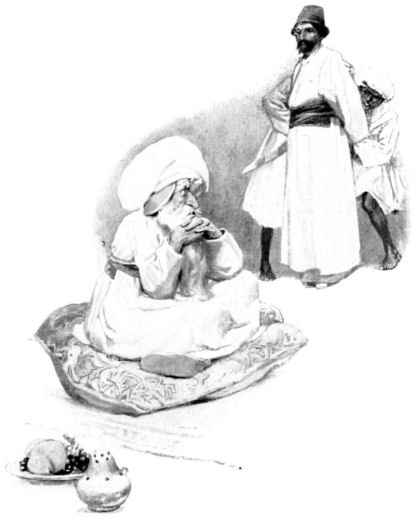
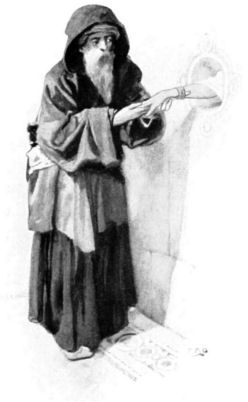
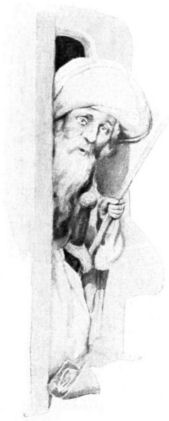
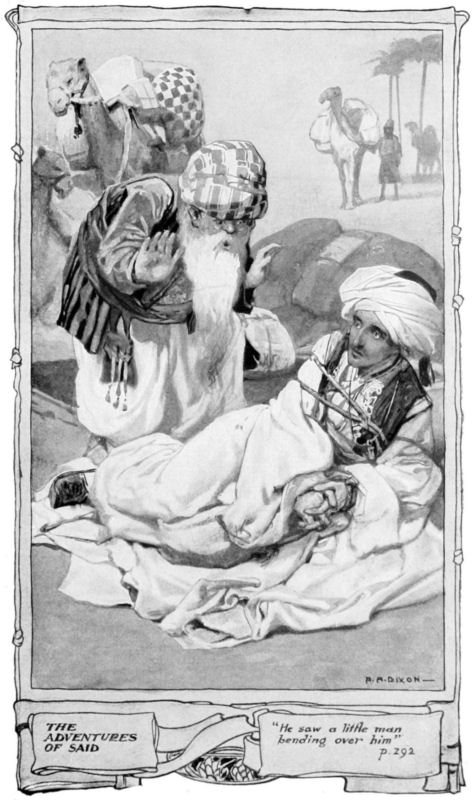
On one of the cushions sat a little old man.
His face was ugly, swarthy, and repulsive. A gleam
of savage cunning in his eyes and a cruel look
about his mouth gave him a hateful appearance.
Although he seemed to be a person of some importance,
Mustapha soon perceived that the tent had
not been so richly decorated on his account, and his
captors’ words confirmed this—“Where is the Chief?”
they asked the little man. “Away hunting,” he replied
“but he told me to take his place during his absence!”
“More the pity,” replied one of the brigands,
“for we must soon decide whether this dog is to
die or whether we are to obtain a ransom for him,
and that is a question for the Chief to decide, and
not for you to meddle with.”
33]
On one of the cushions sat a little old man. (P. 32.)
The little man raised himself in wrath and
attempted to box the ears of the man who had
annoyed him by this speech, but as he could not
reach to do this, he burst into a perfect volley of abuse,
and as the other brigands were not slow to reply, the
tent soon resounded with tones of angry voices.
34]
But the curtains at the entrance to the tent
were suddenly lifted and in came a tall handsome
young man, stately and dignified as a Persian prince.
His clothing and weapons were plain and unadorned,
with the exception of a dagger with a richly decorated
hilt and a gleaming sabre. His determined mien and
his whole appearance were such as commanded respect
without inspiring terror.
“Who dares to quarrel in my tent?” he demanded
of the startled men.
For a moment there was silence and then one
of the brigands recounted all that had happened. The
Chief’s face reddened with anger—“When have I ever
set you in my place, Hassan?” he cried, and the little
man seemed to shrink with fear, until he looked smaller
than ever. He got up and began to slink out of the
tent, when a good kick from the Chief sent him flying
out of the doorway.
As soon as the little man had disappeared, the
three men placed Mustapha before the master of the
tent, who had seated himself upon the cushions.
“We have brought you the man you bade us
bring,” they said. The Chief gazed earnestly at the
prisoner and said: “Pasha of Sulieika, your own
conscience will tell you why you are in the presence
of Orbasan.”
On hearing these words Mustapha flung himself
at Orbasan’s feet.
“You are in error, my lord,” he said, “I am
an unfortunate traveller, but not the Pasha of
Sulieika.”
35]
The brigands appeared to be surprised, but the
Chief said: “Dissimulation will not help you, I can
bring witnesses to prove your identity.” And he
thereupon commanded that one Zuleima should be
brought in.
An old woman appeared, and on being questioned
as to whether or no the man before her was the
Pasha of Sulieika, she answered immediately that
he was.
“Wretched man,” cried the Chief angrily, “you
see how impossible it is to deceive me. You are
not worthy that I should stain my good dagger
with your blood, but to-morrow morning I will have
you bound to the tail of my horse and will go a-hunting
with you, till the sun sets behind the hills of
Sulieika.”
Mustapha’s heart sank. “It is my father’s curse
that has driven me to this shameful death,” he cried;
“alas, sweet sister, and Zoraida, how can I ever hope
to rescue you now.”
“This pretence is useless,” said one of the brigands,
“see, the Chief bites his lips and feels for his
dagger; if you wish to live another night you had
best come with me quickly.” And binding Mustapha’s
hands behind his back he was about to lead him
from the tent, when three other brigands entered,
with a prisoner in their midst. “Here, as you commanded
us, we bring you the Pasha of Sulieika,” said
one of them, leading their prisoner before the Chief.
Mustapha glanced at the prisoner and could not
but own that there was a great resemblance between
36]
himself and the Pasha, only the other man was darker
in complexion and wore a dark beard.
The Chief was much surprised to see a second
prisoner: “Which of you really is the man I seek?”
he asked.
“If you seek the Pasha of Sulieika,” the prisoner
answered proudly, “I am he.”
The Chief regarded him with a stern and terrible
look and then made signs that he was to be led
away. This being done, he cut the cords that bound
Mustapha with his dagger and invited him to take a
seat by his side.
“I ask your pardon for the mistake that has
occurred,” he said, “but it was a strange interposition
of Providence that placed you in the hands of my
companions at the moment they were lying in wait
for that vile wretch you have just seen.”
Mustapha asked for one favour only as compensation,
namely, that he might be allowed to proceed
on his way without further delay, and on the
Chief questioning him as to the reason of his great
haste he told him all. The Chief then persuaded him
to remain with him one night at least, telling him
that both he and his horse needed rest, and promised
to show him the next morning a short way by which
he would be able to reach Balsora in a day and a
half. Mustapha agreed to this and after being most
hospitably entertained slept soundly all night long in
the robber’s tent.
When he awoke he found himself alone in the
tent, but through the hangings over the doorway he
37]
could hear voices, which seemed to belong to the
Robber Chief and the little dark dwarf. He listened
attentively, and to his horror heard the little man
advising the Chief to murder him, as if he were allowed
to go free he might betray the whole troop.
Mustapha could not but
perceive that the little man
owed him a grudge, because
he had been the cause of the
sharp treatment he had received
the previous day. But
the Robber Chief, after reflecting
a few moments, said:
“No, he is my guest, and as
such is sacred to me, besides
which he does not look like
a man to betray one.”
He then thrust aside the
tent curtains and entered—“Peace
be with thee, Mustapha,”
he said, “we will drain
a morning draught and then
you should prepare yourself
to start.”
He handed his guest a cup of sherbert, and
when they had each drunk, they saddled their horses
and Mustapha mounted and left the camp with a lighter
heart than when he had entered it.
As they left the tents behind them the Chief
told his new friend that the Pasha they had captured
the previous day, after having promised him and
38]
his men the free range of his territory, had captured
one of the best and bravest of them and, after torturing
him terribly, had hanged him, and that now he
should die himself.
Mustapha did not venture to remonstrate, being
only too glad to escape with a whole skin himself.
When they reached the limit of the forest the
Chief drew rein and offered his hand to Mustapha in
farewell:
“Mustapha,” said he, “you have been in somewhat
a strange fashion the guest of the Robber
Orbasan. I will not ask you not to betray me, but
trust to you that you will not do so. You have
suffered, without cause, all the pangs of the fear of
death, and you deserve some compensation. Take this
dagger and if ever you are in need of help send it to
me and I will hasten to your aid. This purse of gold
may also be of assistance to you on your journey.”
Mustapha thanked him for his generosity, accepted
the dagger, but refused the purse. But Orbasan,
having pressed his hand, let the purse fall to the ground
and then set spurs to his horse and rode off at such
speed that Mustapha, seeing it was useless to overtake
him, picked up the purse, and was astonished to find
what a quantity of money it contained. Having thanked
Allah for his goodness and recommended the robber
to his protection, he continued his journey in a much
more cheerful mood towards Balsora.
He reached that city on the seventh day of his
journey, and as soon as he had put up at an inn he
enquired when the next yearly slave market was to
39]
be held. To his horror and distress he heard that he
had arrived just two days too late for it.
The people sympathised with him over his delay
and told him how much he had lost, for on the very
last day of the market two young slaves had been
put up for sale who were so beautiful that there
had been great bidding amongst the people for them,
and they fetched such a high price that only their
present master, who was a very rich man, could afford
to buy them.
On making further enquiries as to their appearance
he could no longer doubt they were the two
unfortunate girls he was in search of. He also heard
that the man who had bought them was called Thiuli-Kos
and lived forty miles away from Balsora; he was
an elderly man who had amassed a large fortune, and
had retired from public affairs and settled down to
enjoy his possessions in peace and quietness.
At first Mustapha thought he would re-mount
and try and overtake Thiuli-Kos, but then he reflected
that he could do little, for he was but a single
man against the large retinue Thiuli-Kos would no
doubt have with him, and that it would be impossible
to wrest his prey from him; he therefore thought of
another plan. His resemblance to the Pasha of
Sulieika, which well-nigh proved fatal to him, might
stand him in good stead now, and he determined to
enter Thiuli-Kos’ house in that name in order to
attempt the rescue of the two girls. He therefore
engaged servants and horses and here Orbasan’s gift
of money assisted him. Having purchased magnificent
40]
clothing for himself and his servants, he set out for
Thiuli-Kos’ palace. He reached it in five days and
found it was built on a lovely plain and was so
surrounded by high walls that few of the buildings
could be seen from without. He took the precaution
to dye his hair and beard a darker tint, and coloured
his face with the juice of a certain plant he knew of,
so that no one could have supposed he was any other
than the real Pasha; then he sent one of his servants
to Thiuli’s palace to ask for a night’s lodging. The
servant returned accompanied by four beautifully
dressed slaves, who led Mustapha’s horse into the
courtyard. They assisted him to alight and led him
up a flight of marble steps to Thiuli.
Thiuli was a jolly old fellow and received
Mustapha kindly, and ordered the best dishes his
cook could prepare to be set before him. After
dinner Mustapha turned the conversation to slaves,
and the old man told him of the two beauties he
had just lately bought, praising their appearance
loudly, but regretting the fact that they appeared to
be so sad, so that Mustapha retired to bed in high
hopes of being soon able to effect a rescue.
He had been asleep about an hour when he
was awakened by the light of a lamp streaming down
upon his eyes. Raising himself on his elbow he at
first believed himself to be still sleeping and dreaming,
for before him stood the same swarthy little
dwarf he had seen in Orbasan’s tent. He carried a
lamp in his hand, and a horrid grin distended his
mouth from ear to ear. “What do you want?”
43]
asked Mustapha angrily, as soon as he had convinced
himself he was awake.
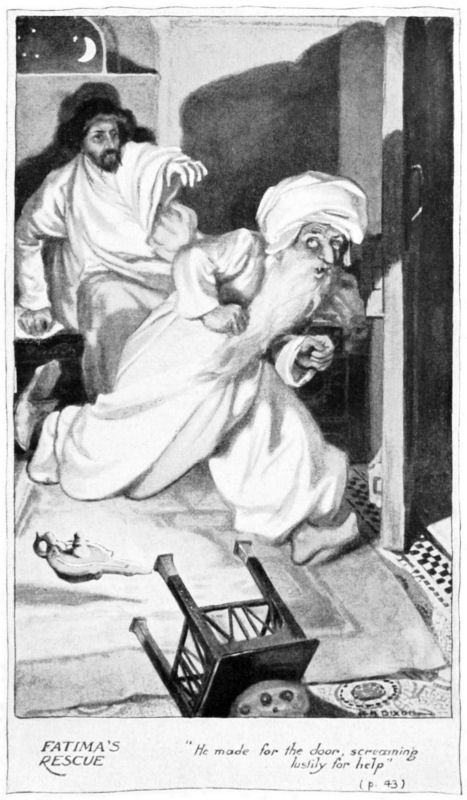
FATIMA’S RESCUE “He made for the door, screaming lustily for help”
(p. 43)
“Don’t disturb yourself,” replied the little man.
“I know quite well why you are here, your noble
countenance is not unknown to me, but, had I not
assisted at the hanging of the Pasha of Sulieika I
might have mistaken you for him. But I am here
to make a suggestion.”
“First of all tell me why you are here,” said
Mustapha.
“Well,” replied the little man. “I did not get
on very well with the Chief, and so I left him. Our
last particular quarrel was over you, and so, Mustapha,
it is but fair you should promise me your sister for
a wife, otherwise I will go straight to my new master
and tell him who the Pasha of Sulieika really is.”
Mustapha was beside himself with rage and fear;
just as he had thought himself about to accomplish
his design, this wretched little creature came to frustrate
it. There was only one thing to be done, he
must kill the little horror, and he sprang out of bed,
meaning to catch him. But the dwarf had guessed
what might happen and was prepared for him.
Dropping his lamp, he made for the door, screaming
lustily for help.
Mustapha was now in sad straits and all present
hope of rescuing the two girls was at an end; he
had to think only of his own safety. He looked
out of the window and found it was some distance
from the ground and that there was a high wall he
would have to scale as well. However, as he stood
44]
considering, he heard voices approaching, and just as
the door was about to be burst open he jumped from
the window, ran across the courtyard and, climbing
the wall nimbly, had soon left his enemies behind.
He never stopped running until he had reached the
shelter of a wood, and then he threw himself down
quite exhausted, to try and think what he should do
next. Of course he had lost his horses and his
servants, having left them behind him at Thiuli’s house,
but he still had a good sum of Orbasan’s money in
his girdle.
Very soon he had invented another plan to save
his sister. He continued his way through the wood
until he reached a village, where he purchased a horse
at a low price which speedily carried him to a town.
Here he sought out a physician and offered him
several pieces of gold on consideration that he would
concoct a draught which would give all the semblance
of death without harming the patient, and another
draught to counteract the effect of the first. Having
made his bargain, he bought a false beard, a black
gown, and all sorts of phials which a physician would
be likely to have. He strapped his baggage on the
back of an ass and retraced his steps to Thiuli’s house.
He was so changed in appearance that he scarcely
knew himself, and had little fear of being recognised by
Thiuli-Kos or anyone else. He arrived at the palace and
announced himself as the physician Chakamankabudibaba.
Everything happened as he wished it to do. The old
man was so taken by his high-sounding name that he
at once asked him to enter and take a seat at his table.
45]
After some conversation, in which Mustapha
managed to give the impression that he was a very
learned man, Thiuli said he would take this opportunity
of having all his slaves examined and ascertain
the state of their health. Mustapha was overjoyed
to think that he was so
soon to see his beloved
sister again, but in this
he was mistaken. Thiuli
conducted him to his
seraglio, it is true, but
when they reached a
splendidly-furnished room
there was no one in
it. “Chambaba, or whatever
your name may
be, dear doctor,” said
Thiuli, “behold this
opening in the wall.
Through this each of my
slaves shall pass her arm
and you can feel her
pulse, and ascertain the
state of her health.”
Mustapha made some objection
to this arrangement,
but Thiuli would
not consent to alter it, only he did consent to give a
few hints as to the previous state of their healths.
The slave slipped her hand
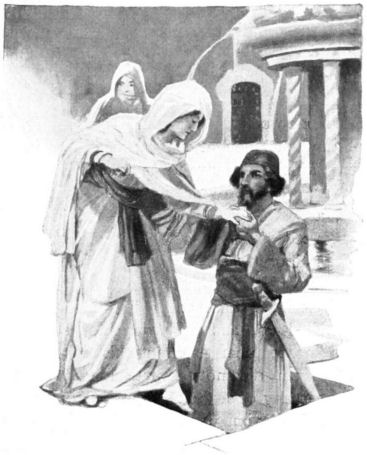
through the opening. (P. 46.)
Drawing a strip of paper from his girdle Thiuli
now began to call out the names of his slaves, and
46]
as he called the slave who answered to the name
slipped her hand through the opening.
Six times had Mustapha felt the pulses and
pronounced six slaves in good health, and then came
the name of Fatima.
Trembling with joy Mustapha grasped the little
white hand and then, with a grave air, pronounced
the patient to be very ill.
Thiuli was very much concerned and asked the
wise Chakamankabudibaba to prepare a medicine for
her which could not fail to cure her. Mustapha left
the room and wrote the following message: “Fatima,
I will save you if you will consent to the following
plan. I will give you a draught which will make you
appear dead for two days; I have another draught in
my possession which will restore you. If you consent,
pretend that the simple draught I will send you has been
of no avail; I shall know this is a sign that you agree and
will see that the more potent draught is given you next.”
He soon returned to the room, where Thiuli
awaited him, bringing with him a harmless draught
which he handed to Fatima. He felt her pulse once
more, and managed at the same time to slip the little
note under her bracelet; Thiuli was so distressed about
Fatima’s illness that he thought of no one else, and
put off the medical examination of the other slaves
until a more convenient season.
When he and Mustapha had left the room he
said to him sorrowfully: “Chadibaba, tell me frankly
what you think of Fatima’s state.”
“Alas!” answered the wise physician, heaving a
47]
deep sigh: “may the prophet give you consolation
for I cannot. Fatima is suffering from a malignant
fever from which I am afraid she will not recover.”
Far from appreciating the plain speaking he had
begged for, Thiuli flew into a great rage—“You
wretched quack,” cried he, “do you mean to say
that the slave for whom I paid two thousand gold
pieces is to die like an old cow? Take note, if you do
not manage to save her life I will have you beheaded.”
Mustapha saw that he had made a mistake and
tried to reassure Thiuli.
Just then a black slave came to tell the physician
that the medicine had done no good. “Exert
your whole skill, Chakamdababelda or whatever your
name may be, I will make it worth your while to
cure her,” shrieked Thiuli, almost weeping to think of
the possible loss of his two thousand gold pieces.
“I will give her a draught that is almost certain
to relieve her,” answered Mustapha.
“Yes, yes,” sobbed the old man, “by all means
give her another draught.”
Well pleased, Mustapha slipped away to fetch
the sleeping draught, which he gave to the black
slave to give to Fatima. Then, saying that he needed
to gather a few healing herbs which grew on the
banks of the lake, he hurried out of the palace.
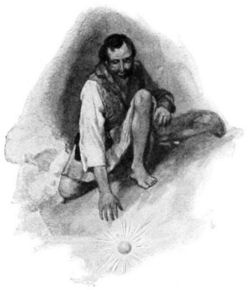
As soon as he reached the bank he took off his
disguise and cast it into the water, where it floated
gaily about, then he hid himself in some bushes and
waited for the approach of night, when he went and hid
himself in the burial place attached to Thiuli’s palace.
48]
Mustapha had scarcely been gone an hour when
the black slave came and informed Thiuli that Fatima
seemed at the point of death. The old man at once
sent his servants to fetch the doctor, but they returned
shortly, saying that he had undoubtedly fallen
into the water and been drowned, for his black robe
was floating upon the surface, and every now and
again they had seen his grey beard bobbing up and
down. Thiuli raved like a madman, tore his beard
and beat his head against the wall, but all to no purpose,
for shortly afterwards Fatima breathed her last.
As soon as Thiuli heard that she was really
dead he ordered her to be taken away to the burial
place, for he could not bear having a dead person
in the house. The servants who bore her there did
but place her on the ground and run away, for they
heard such dismal sighs and groans that they were
afraid. Of course it was Mustapha who had frightened
the servants, and as soon as they were out of the
way he came out from his hiding place and examined
the girl he supposed to be his sister. What was his
horror to find that the girl who lay in the death-like
trance bore no resemblance to Fatima whatever, but
was a complete stranger.
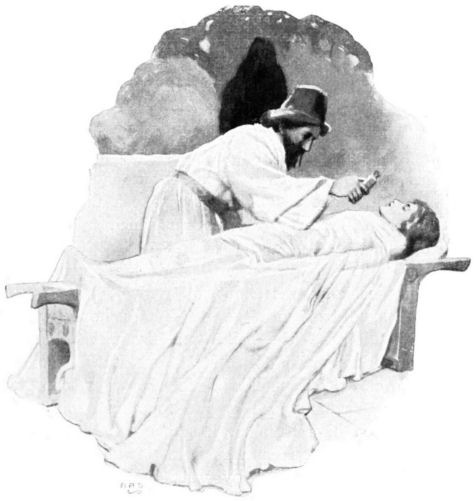
When he had a little recovered from his disappointment
he reflected it would be cruel to leave
the poor girl in the state she was in, and so he
uncorked the phial he had brought containing the
antidote and poured the medicine down her throat.
At once she opened her eyes and began to breathe
freely, but it was some little time before she could
49]
remember where she was and what had happened; but
when she did she flung herself at Mustapha’s feet and
thanked him for having rescued her from her horrible
captivity. Mustapha questioned her as to how it chanced
that he had saved her instead of his sister Fatima.
50]
“Now I begin to understand to what chance I
owe my deliverance,” she said at length. “Since I
have been in Thiuli’s house I have been called Fatima,
which I understand is your sister’s name.”
After some little conversation Mustapha discovered
that Fatima and Zoraida were in the palace, but that,
according to Thiuli’s custom, he had given them new
names when they became his property, and they were
now called Mirza and Nurmahal.
Fatima, the rescued slave, could not but see
how disappointed Mustapha was that he had failed
in his attempt to carry off his sister, and she did all
she could to encourage him to make a further effort,
telling him that she had a plan which might prove
successful.
So Mustapha took heart and questioned her as
to how he should set about his task.
“I have been a slave in Thiuli’s house for the
last five months,” she said, “and from the first day
thought out a means of escape, but it was too difficult
to carry out unaided. In the inner courtyard
you may have noticed a fine fountain, which casts
its water on high from no less than ten different jets.
Now there was a similar fountain in my father’s
garden, which was fed by water conducted to it by
an underground passage, and I wished to find out if
Thiuli’s fountain was supplied in a similar manner.
So one day I began to praise it to Thiuli and to
say what a clever builder he must have had to design
it. ‘I designed it myself,’ said he, well pleased, ‘and
what you see is not the most wonderful part about
51]
it, for the water has to be brought here from a distance
of a thousand feet at least. I had a lofty arched
underground passage built from my courtyard to a
brook and I had the waters of the brook turned into
this passage, through which it now flows and supplies
my fountain with water. I designed and superintended
the building of the whole thing myself.’
“After hearing this I longed for the strength of a
man that I might be able to raise one of the stones
in the courtyard, reach the underground passage, and
be free. I can show you the direction in which this
passage lies and by it you can one night obtain
entrance to the palace; but you will need one or
two men to assist you, for you will have to overpower
the black slaves who keep watch over the
quarters where the women slaves are kept.”
In spite of the fact that he had already had two
failures Mustapha once more took heart, trusting that
Allah would allow him to carry out successfully the
plan of Fatima the slave girl. He promised her that
he would arrange for her to reach her own home when
he had rescued the others, as a reward for lending
him her assistance in gaining an entrance to the palace.
His principal anxiety was how he should
obtain the assistance of two or three men. Suddenly
he remembered Orbasan’s dagger and the promise the
Robber Chief had made that he would come to his
aid if ever he were in need of help.
So he made haste to leave the burial place and,
taking Fatima with him, returned to the town in
which he had purchased his physician’s disguise, and
52]
placed the girl in the charge of a poor but respectable
woman.
Then, with the last of Orbasan’s money he bought
a horse, and set out once more for the robber’s
dwelling place. He reached it in three days’ time, and,
although an unexpected guest, was none the less a
welcome one.
He told Orbasan of his unsuccessful attempts to
rescue his sister, and in spite of the gravity of the
situation Orbasan could not refrain from laughing as
he pictured his friend decked out as the physician
Chakamankabudibaba. But he was enraged to hear
of the treachery of the dwarf, and vowed he would
hang him with his own hands, as soon as he could
catch him. He promised Mustapha that as soon as
he was rested and refreshed he would return with him
and help him to carry out his designs.
Accordingly on the following morning, Mustapha
and Orbasan, accompanied by three of the latter’s
bravest men, set out for the little town where Mustapha
had left the rescued Fatima. They rode so fast that
they reached it in two days’ time and, calling for
Fatima, who was to show them the way, rode on to
a little wood not far from Thiuli’s palace. Here they
hid themselves until nightfall and then Fatima led the
way to the brook which supplied the fountain. Very soon
they found the entrance to the underground passage
and prepared to descend. One of the men was left
in charge of Fatima and the horses, and the rescued
slave repeated her directions—They were to traverse
the passage until they came to the pipes which supplied
53]
the fountain; having raised one of the flag-stones they
would find themselves in the inner courtyard. They
would see two towers to right and left of them and,
passing through the sixth door from the right hand
tower, they would come into the room where the real
Fatima and Zoraida were shut up, watched by two
black slaves.
Mustapha and the rescued girls slipped through the opening.
(P. 55.)
So, well-armed and carrying crowbars with them,
Mustapha, Orbasan, and two other men climbed down
54]
into the underground passage. The water in the passage
reached to their middles, but they were nevertheless
able to move briskly forward. In half an hour’s time
they had reached the end of the passage, immediately
below the fountain, and then they began to use their crowbars.
The stone-work was thick and very strong, but the
efforts of the four men at length succeeded in forcing
an opening sufficiently large for a man to crawl through.
Orbasan crept through first and gave a hand to
the others, and when they all four stood in the courtyard
they gazed around them in order to determine
which of the doors was the one described to them.
But they were somewhat perplexed, for on counting
from the right hand tower they found that one door
had been walled up, and they were not sure whether
Fatima had meant them to count this door or not.
But Orbasan did not hesitate long. “My good
sword can open any door for me,” he said, and advanced
towards the one he imagined to be the right one.
On opening the door they discovered six black
slaves lying fast asleep. They would have retreated
silently, as they saw they had come to the wrong
door, but a figure in the corner raised itself, and a
well-known voice began to shriek for help. It was
the little dwarf from Orbasan’s camp.
But before the black slaves knew what was
happening Orbasan had seized the little man; tearing
his girdle into pieces he stuffed part of it down his
throat, and with the rest he tied his hands behind
his back, then he turned his attention to the slaves,
several of whom had been bound and gagged by
55]
Mustapha and the two robbers; in a few moments
they were completely overpowered, but were told their
lives would be spared on condition that they told
where Mirza and Nurmahal were to be found.
They confessed that they were in the adjoining
room, and on Mustapha hurrying in he found both Fatima
and Zoraida, who had been awakened by the noise.
Hurriedly snatching up their jewels and their
clothing they followed Mustapha out of the palace.
The robbers wished to take some plunder with them,
but Orbasan forbade it, declaring that it should never
be said of Orbasan that he broke into houses by
night like a common thief.
Mustapha and the rescued girls slipped through
the opening in the courtyard into the underground
passage, Orbasan promising to follow him immediately,
but before doing so he and one of the robbers took
the little dwarf and, leading him into the courtyard,
hanged him with a silken rope, which they had brought
expressly for the purpose, to the topmost point of the
fountain.
Having so punished the treachery of the wretched
little creature, they also got down into the watercourse
and followed Mustapha and the girls.
Fatima and Zoraida, with tears in their eyes,
would have thanked their noble rescuer for having
saved them from a miserable existence, but he bade
them waste no time on words, for it was quite likely
that Thiuli-Kos would, before long, discover his loss
and pursue them.
It was with a deep feeling of gratitude that, on
56]
the following day, Mustapha and the girls bade
Orbasan farewell, vowing that they would never forget
him. Fatima, the girl who had been first rescued,
was carefully disguised, and then sent to Balsora and
put on board a boat which would carry her to her
own home.
After a short and most successful voyage Mustapha
and the two girls arrived home, and the joy of the
old Cadi to see his dearly-loved daughter once again
was beyond all expression.
He gave a great feast to which he invited all
his relations and friends, to whom he made Mustapha
relate all his adventures.
When he had finished speaking the Cadi solemnly
revoked the curse he had put upon his son’s head,
and taking Zoraida’s hand he placed it in that of
Mustapha. “Take her,” he said, “as a reward for your
unwearied perseverance, and take also the blessing of
your aged father, whose earnest wish is that our city
may never lack men who, like you, combine tender
brotherly affection with wisdom and perseverance.”
THE STORY OF LITTLE MOUK.
57]
IN Nicea, which is my native
place, there once lived a little
man, named Mouk. I remember
him very well indeed, although I
was but a youngster at the time,
for I once received a good sound
thrashing from my father on his
account.
In spite of the fact that he
was already an old man, he was
but three or four feet in height,
and presented a most extraordinary
appearance, for although his
body was small and delicate he
carried a head upon his shoulders
that was larger than that of any
full-grown man.
Little Mouk.
He lived quite by himself
and did all his own work. Had
it not been for the fact that every
mid-day the smoke rose in thick volumes from his
chimney, folks would scarcely have known if he were
alive or dead, for he left his house but once in four
weeks. It is true that he walked up and down upon
58]
the flat roof of his house most evenings, but he was
so short that his body could not be seen, and so the
story got about that it was his head alone which
promenaded upon the house-top.
I am afraid that I and my playmates were bad boys
who loved to tease and worry anyone we could, and we
reckoned it rare fun when the time came round for little
Mouk to take his monthly walk abroad. We waited outside
his house for him, and as soon as his big head,
surmounted by an enormous turban, appeared, we threw
our caps in the air and shouted for joy. The head and
turban always came out first, and the tiny little body which
followed was clad in a shabby little cloak, wide trousers
and a broad girdle; attached to the latter was a long
dagger, so much out of proportion to the size of his body
that it was difficult to tell at a first glance whether
Mouk was fastened to the dagger or the dagger
to him.
In spite of the fact that we naughty boys danced
round him like young maniacs, Mouk always bowed
to us with great gravity, and walked down the street
with a dignified air, dragging his poor little feet, encased
in huge loose slippers, laboriously after him.
We had made up a little rhyme which we sang
as we danced around him. It was as follows:
“Little Mouk, we know you well,
In a great big house you dwell,
Only once a month you go
For a walk with footsteps slow.
Though you’re but a dwarf, ’tis said,
You’ve a mountain for a head,
Turn around and take a look,
Run and catch us, little Mouk.”
59]
I am ashamed to say I was one of the worst of the
tormentors of the poor little man. I would twitch
his cloak, and once I went behind him and trod on
his huge slipper, thus causing him to fall. This
seemed a fine joke to me; but I ceased to laugh,
when I saw him turn towards my father’s house.
He went in and remained there some time. I hid
myself behind the door and watched until he came
out again.
He was accompanied by my father, who held
his hand and bowed repeatedly and most respectfully
to him as he took his leave.
I must confess that I felt very uneasy upon
seeing this and remained a long time in my hiding
place, but at length hunger, which I disliked even
worse than a thrashing, forced me to come out, and
I stole into my father’s presence, shame-faced and with
bowed head.
“I hear you have been playing your pranks upon
the good little Mouk,” said my father in stern tones.
“I am now about to tell you his story, after which
I am quite sure you will never wish to mock and
annoy him again; but first I must punish you for the
offence you have committed, in the usual way.”
The usual way meant five-and-twenty strokes with
the stem of his long pipe. Having unscrewed the
amber mouth-piece, he used it to give me the sound
thrashing I so richly deserved.
He did not spare me a single stroke, but when
he had finished he ordered me to pay attention whilst
he related the story of Little Mouk.
60]
“The father of little Mouk, whose real name is
Mukrah, was a highly respected, though poor man, who
also lived here in Nicea.
“He was almost as much of a hermit as his son
is. Unfortunately he could not bring himself to love
his son, for he was ashamed of his dwarfish figure,
and consequently he would not have him educated.
“Little Mouk was still but a merry child when
he had reached the age of sixteen years, and his
father, who was a stern man, scolded him frequently
for being so foolish and full of tricks when he had
passed the age of childhood.
“But one day the old man had a bad fall and
hurt himself so much that he died, leaving poor
ignorant little Mouk to fight his way in the world as
best he could.
“His unkind relations, who had lent the dead man
money which he would now never be able to repay
them, turned the poor little fellow out of doors, advising
him to seek his fortune abroad.
“Little Mouk expressed himself as quite ready
for his travels; but begged that he might be allowed
to take his father’s clothes with him, and to this they
consented.
“Now his father had been a fine tall man, so
the clothes did not fit little Mouk, but this did not
worry him. He cut them down in length and put
them on, quite forgetting that they required taking in
in the width as well. This is the reason of his extraordinary
appearance, for the large turban, the broad
girdle, the wide trousers and the blue mantle are
61]
all heirlooms of his father, which he has always
worn.
“The dagger, too, was his father’s; this he stuck
in the girdle when he set out upon his way, with his
staff in hand.
“Happy and well content he wandered along.
If he spied a piece of broken glass glittering in the
sunshine, he put it in his pocket believing it was a
diamond.
“If he saw the distant cupolas of a mosque shining
like fire, or the sea stretched before him as smooth as
a mirror, he hurried along thinking for sure he was
coming to an enchanted country. But alas! the magic
pictures changed as he approached them, and all too
soon his weariness and empty stomach reminded him
that he was still in the land of mortals.
“Thus he wandered on for two whole days and
nights, hungry, weary, and dejected, in search of a
fortune he began to fear he would never find. The
wild fruits were his only food and the hard earth was
his bed. On the third morning, from the top of a
high hill, he saw a large town.
“He could see the glittering crescent and bright
coloured flags upon the roofs and it seemed to
little Mouk that they beckoned him nearer. He
stood a few moments watching the town and its
surroundings in surprise. ‘There will little Mouk
make his fortune if anywhere,’ he said, and in
spite of his fatigue he jumped for joy, then summoning
all his strength he began to walk towards
the city. But although it appeared so close he
62]
did not reach it until mid-day, for his poor little
legs almost refused their office, so that he was
obliged to rest frequently in the shade of a palm
tree. But at length he reached the city gate. He
shook out his mantle, re-arranged his turban, spread
out his girdle and set his dagger jauntily in it, then,
wiping the dust from his shoes, he strode bravely into
the city.
“He had wandered through several streets, but
nowhere had a door been opened to him, nowhere
had the folks called out to him as he had imagined
they would: ‘Come in, little Mouk, come in, eat drink,
and rest your weary little legs.’
“But as he glanced longingly at a fine large
house opposite him, a window opened and an old
woman popped her head out and began calling out
in sing-song tones:
“‘Come everyone,
The food is done,
Decked is the cloth,
Come taste the broth,
Ye neighbours all
Come to my call!’
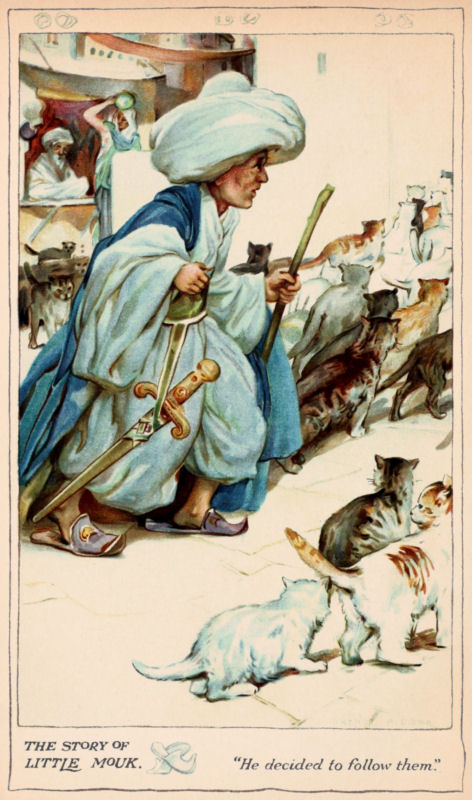
The house-door opened and little Mouk saw many cats
and dogs enter. He stood a moment in doubt as to
whether he should answer the invitation, but at length
he took courage and went in. A pair of young cats
trotted along before him and he decided to follow them,
guessing they knew the way to the kitchen better than
he did.
THE STORY OF LITTLE MOUK. “He decided to follow them.”
“When Mouk reached the top of the staircase
he saw the old woman who had looked out of the
63]
window. She looked at him sulkily and asked what
he wanted—‘I heard you inviting everyone to partake
of your food,’ answered little Mouk, ‘and came in too,
because I was so hungry.’
“The old woman laughed: ‘Where do you come
from, you queer little fellow?’ she asked. ‘Why,
everyone in the town knows that I only cook for my
beloved cats, and now and again I invite a few guests
to feast with them, as you saw just now.’ Little Mouk
told what a hard lot his had been since his father’s
death and begged her to let him partake of her cats’
food for once. The old woman seemed pleased with
the truthfulness of the little fellow and gave him a
plentiful supply of food and drink.
“When he had satisfied his hunger the old woman
looked at him for some time and then said: ‘Little
Mouk, would you like to enter my service? If you
would you shall have little trouble and be well paid
for your work.’
“Little Mouk, who had enjoyed the cats’ broth,
consented, and entered the service of Madam Ahavzi.
His work was light but very curious.
“Madam Ahavzi had in all six cats, and little
Mouk was expected to brush their fur and anoint them
with sweet-smelling essences. When their mistress was
out he had to take charge of them. When they took
their meals it was his task to set the dishes before
them, and at night he was expected to put them to
bed on silken cushions and cover them with velvet
coverlets.
“There were also several little dogs in the
64]
house for him to take care of; but there was not so
much fuss made over them as over the cats, which
Madam Ahavzi treated as her own children.
“On the whole Mouk’s life was as solitary as it
had been in his father’s house, for besides the old
woman he saw no living creature but the cats and dogs.
“For some time all went well and little Mouk
had plenty to eat and little to do, and the old woman
was quite pleased and contented with him, but by-and-by
the cats were naughty. When the old woman
went out they jumped about the room, upset all
manner of things and broke one or two valuable
ornaments which happened to be in their way. But
the moment they heard the old woman’s step on the
stairs they crept back to their cushions and waved
their tails to and fro as though nothing had
happened.
“Madam Ahavzi flew into a violent rage when
she saw what a state the room was in and laid the
blame on Mouk, and it was useless for him to excuse
himself; she believed her innocent-looking cats rather
than her servant.
“Little Mouk was very sad to think that his misfortunes
had overtaken him again and he determined
to quit his mistress’ service.
“But as he had discovered on his first journey
that it is very unpleasant to be without money, he
determined to try and help himself to wages, which
his mistress had always promised but never yet given
him. There was a room in the house which was
always kept locked and the interior of which he had
65]
never seen, but he had often heard the old woman
in it, and dearly wished to know what was hidden
there. As he now sat wondering where the money
for his journey was to come from, it occurred to him
that the closed room might contain the old woman’s
treasures, but alas! the door was locked and he was
unable to get in.
“One morning, when Madam Ahavzi had gone
out, one of the little dogs, which had never been
treated very kindly by her, but which little Mouk
had petted and paid great attention to, came and
pulled his wide trousers and made signs to Mouk to
follow him.
“Mouk, who had always been fond of playing
with the little dog, followed it, and it led him into
the bedroom of his mistress and showed him a little
door he had never seen before. The door was ajar,
and Mouk entering found himself in the room he had
so long wished to enter. He peered about in every
corner to see if he could find any money, but all in
vain. Nothing but old clothes and strangely-shaped
vases were lying about. One of these attracted his
attention, for it was of crystal and had a number of
beautiful figures engraved upon it. He took it up to
examine it, but alas, to his horror, it had a cover
which he had not noticed and which slipped off and
broke into a thousand pieces.
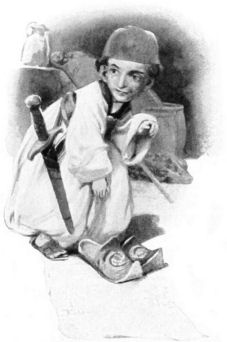
Seeing an enormous pair of
slippers, he made up his mind
to take them. (P. 66.)
“For some moments he was rooted to the
spot with terror. His fate was now decided, for
if he did not run away he was quite certain the
old woman would kill him. He took a glance
66]
around to see which of the old woman’s possessions
would be most useful to him upon his journey.
Seeing an enormous pair of slippers, he made up his
mind to take them, for his own shoes were worn out;
moreover it was quite certain that with the big slippers
on, no one could accuse him of still standing in his
childhood’s shoes, so he quickly exchanged shoes, took
a fine walking stick, which
had a handle carved in
the form of a lion’s head,
and going to his own
room donned the turban
and cloak that had been
his father’s, and left the
house and town as fast
as his legs could carry
him. Once outside the
town he still continued
running, for he was afraid
the old woman would
overtake and punish him;
but at length he grew
very weary, for his little
body had to support such
a large head that he
was soon overcome with
fatigue. But when he would have stopped he could
not, the big shoes kept urging him on, and he guessed
at length they must be magic shoes. He did not
know how to prevent them dragging him along, but,
driven to despair, he cried out, as though to a pair
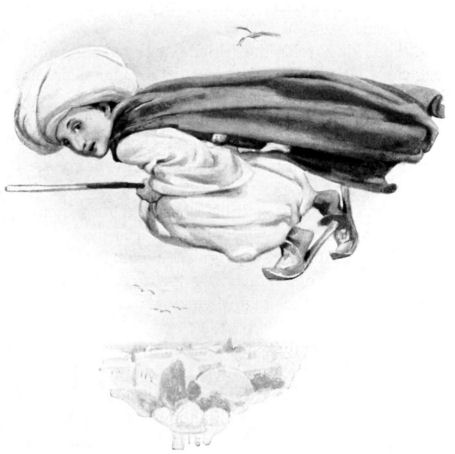
67]
of restive horses, ‘Stop, stop, oh! stop,’ and the slippers
immediately stopped and Mouk threw himself
upon the ground quite worn out.
“He was delighted with the slippers, for, after all,
he felt he had gained something for his work which
would probably assist him on in the world and help
him to make his fortune. But in spite of his pleasure
fatigue overcame him and he fell asleep and dreamt.
In his dream the little dog, which had assisted him in
obtaining the slippers, appeared to him and said,
‘Dear Mouk, you do not seem to quite understand
the use of the slippers. Turn round on the heel, when
you have them on, three times, and you will then be
able to fly wherever you please. With the little stick
you will be able to find treasure, for wherever gold is
buried it will strike the earth three times and where
silver is buried twice.’ Such was little Mouk’s dream,
and when he awoke he determined to make a trial in
order to discover if the dream had any truth in it.
He put on the slippers and, lifting one foot in the
air, turned round on the heel of the other. But it
was a difficult task and the poor little fellow’s enormous
head dragged him sometimes this way and sometimes
the other, so that he fell over two or three
times before he finally succeeded. But succeed he
did, and then, wishing himself to be transported to the
nearest town, he found himself raised in the air and
flying through the clouds like the wind, and before
he could grasp what was happening he was in a
market place, where many booths had been set up and
where innumerable people were running to and fro.
68]
“He went in and out among them, but presently
decided to seek a quieter street, for in the crowded
market folks constantly trod upon his big slippers and
nearly threw him down, or else his long dagger stuck
into the people and he then had some difficulty in
avoiding the blows rained upon him.
“Little Mouk now began to set his wits to work
as to how he was to earn a piece of money. It is
true that he had a staff which could discover hidden
treasure, but where could he find a place all in a
moment where gold and silver lay hidden?
“He might have exhibited himself in a booth and
received money for it, but was too proud to do so.
Then it struck him his swift running might be the
means of earning him a livelihood and decided to
offer his services as a courier.
“Thinking it likely that the king might pay the
highest sum for such service, he enquired the way to
the palace.
“By the palace gateway stood a guard, who
asked what he wanted. Upon replying that he wished
for work he was sent to the overseer of the
slaves. He repeated his request, adding that he
wished for a post amongst the royal messengers. The
overseer looked him all over from head to foot and said,
‘How is it possible that you with your tiny little limbs,
scarcely a span long, could become a courier? Away
with you, I am not here to waste my time with fools.’
“But little Mouk assured him he was not joking
and offered to run a race for a wager with their
swiftest runner.
69]
“The overseer was amused, and told him to hold
himself in readiness to run a race that very evening,
then, taking him into the kitchen, he ordered him to
be supplied with plenty to eat and drink.
He found himself flying through the clouds. (P. 67.)
“Then he went into the king’s presence and told
him about the funny little man and the request he
had made.
“The king was a merry gentleman and was therefore
70]
well pleased that little Mouk had been kept to
make a joke for him.
“He ordered stands to be set up in a large
meadow behind the palace, so that the racing could
be viewed in comfort by all the royal household, and
he also said that the greatest care was to be taken
of the dwarf.
“The king told the prince and princess of the
spectacle that was to be provided for their entertainment,
they told their servants, and so, as the
evening approached, everyone was in a state of
pleased expectancy and everyone that had a leg to
stand upon was hurrying to the meadow to see the
boastful dwarf run a race.
“When the king and his sons and daughters had
taken their seats, little Mouk appeared and made a
deep obeisance to the distinguished company.
“A shout of merriment greeted the uncouth
little figure, for the people had never seen such a
sight before.
“The little body, surmounted by the huge head,
and clothed in the mantle, the wide trousers, the
long dagger stuck in the broad girdle, and the tiny
feet in the big slippers, oh! altogether he looked too
funny for anything, and roar after roar of laughter
went up.
“But Mouk was not in the least put out by the
laughter. He stood leaning proudly upon his little
staff and waited for his adversary. The overseer of
the slaves, according to Monk’s request, had selected
the very best runner in the kingdom, and he now
71]
stepped forward and placed himself beside the little
man and both awaited the signal to start. Then the
Princess Amarza waved her veil, which was the signal
for the start agreed upon, and, like two arrows
aimed at the same target, the runners shot forward
across the meadow.
“Mouk’s adversary had the advantage to begin
with; but the little man, arrayed in the magic slippers,
soon overtook him, passed him, and reached the
winning post long before the other came in, gasping
for breath.
“The spectators were at first too much overcome
with surprise and admiration to give vent to
applause, but no sooner did the king commence to
clap his hands than the whole multitude followed his
example and shouted—‘Bravo, little Mouk, long life
to the winner of the race.’
“When little Mouk was brought before the king
he bowed to him and said: ‘Sire, I have given you
a small proof of what I am able to accomplish, I
pray you now grant me a position as courier to your
Majesty.’
“‘Your request is granted,’ replied the king.
‘Not only shall you be one of my couriers, but I
will grant you a place near my own person and you
shall receive a yearly wage of a hundred gold pieces.’
“Mouk now thought his fortune must surely be
made. From that time he was employed constantly
by the king to undertake all messages of importance
and secrecy, and as he performed his duties with
conscientiousness and speed he continued to gain the
72]
king’s favour. But the king’s courtiers were all
jealous of him, for they could not bear that their
master should prefer a dwarf to them, and they made
many plans to oust him from the royal favour, none
of which succeeded.
“It grieved little Mouk that he should be the
object of their anger and he made up his mind to
perform some act of kindness to them which would
reconcile them to him. It was then he remembered
his staff, and he thought to himself that if he could
discover a hidden treasure that would probably benefit
them all, he would surely endear himself to them.
“So whenever he went out he took his staff in
his hand, for he remembered to have heard that the
father of the present king had buried a great deal of
his treasure and had died before he could manage to
tell his son where it was hidden.
“One evening chance led him into a part of the
palace gardens that was but seldom used, and suddenly
he felt his staff strike the ground three times.
He knew well what that betokened and so, drawing
his dagger from his girdle, he cut signs in the neighbouring
trees, so that he might recognise the spot
again, returned to the castle, and, as soon as night fell,
went back to the spot carrying a spade with him.
“The little dwarf had set himself a weary task,
for his arms were weak and the spade was heavy,
and he dug for a couple of hours at least before he
felt the spade strike against some metal. Jumping
into the hole he had dug he found he had unearthed
a pot full of golden coins. He was not strong enough
75]
to lift the pot from the earth, but he filled his pockets
with as many coins as he could carry and the next
day, thinking to please his servants and companions,
he distributed the money liberally amongst them.
THE STORY OF
LITTLE MOUK “He had unearthed a pot full
of golden coins”
(p. 72)
“Alas! poor little Mouk, he had better have run
off with it and left the kingdom, for now he did but
rouse their envy.
“One declared he must be a magician, another
said he had helped himself from the king’s treasures,
for a sum of money had lately been missing, and
they one and all agreed that they would conspire
together and see if they could not deprive him of the
king’s favour.
“So one day the cup-bearer, who was a particular
enemy of Mouk’s entered the king’s presence
and begged to know how he had offended his royal
master.
“The king looked at him in astonishment. ‘You
have not offended me,’ said he, ‘I don’t understand
what you are talking about.’
“‘Oh pardon me, your Majesty,’ said the man,
‘but do you not load the dwarf Mouk with treasures,
whilst to me you have not given a single gold
piece?’
“The king was surprised, for he knew he had
given Mouk no money; but the treasurer who was
present, and who had cause to know that certain sums
were missing from the treasury, added his story to
that of the cup-bearer.
“They told the king that Mouk always had
more money than he knew how to spend, and the
76]
treasurer suggested that Mouk had stolen it from his
royal master.
“So the king ordered spies to be set to watch
the little man in order that they might try and catch
him in the act of stealing.
“The following night little Mouk, who had
generously given away all his money, stole out to
the garden with his staff and spade to find more
treasure.
“It was not long before he discovered another
pot of gold, and had just uncovered it and begun to
fill his mantle with coins, when his enemies fell upon
him, bound him hand and foot, and led him before
the king. They unearthed the pot of gold and carried
that with them too.
“The king was not in a very good temper, for
he had been awakened from his sleep, and so his
poor little courier got a very bad reception.
“The wicked men who had caught Mouk now
began to accuse him of having stolen the pot of
money, declaring they caught him in the act of burying
it in the earth. The king asked the accused
what he had to say for himself, and bade him tell
how he came by so much money.
“Little Mouk, knowing his own innocence, told
the king boldly that he had found the pot in the garden
and that he had been digging it out, not burying it.
“All present laughed loudly at the impudence
of the little dwarf in making such a foolish excuse.
But the king was furious. ‘You wretched little thief,’
he cried, ‘how dare you lie to me in this barefaced
77]
manner, after having robbed me, too.’ Then he
asked his treasurer if it were true that a sum such
as had been found with the dwarf really were missing
from the treasury.
“Of course the treasurer declared that not only
that sum, but more still had been missing, from time
to time, and that he was absolutely certain that it
had been stolen.
“The king commanded that little Mouk should
be heavily chained and shut up in a prison in the
tower, and the king bade the treasurer carry the pot
of gold away and count it carefully and put it back
into the treasury.
“The dishonest man carried the pot home and
counted out the gold, and when he came to the bottom
of the pot he found a paper on which was written:—
“‘An enemy has over-run my land and I am
forced to bury my treasures. Whoever finds this must
carry it to my son or else the curse of a king will
rest upon him—Signed, King Said.’
“This paper the treasurer did not show to his
master.
“Poor little Mouk was in sad straits and
wearied his brain trying to think of a way out of his
trouble.
“He knew that to rob the king was usually
punished by death, and yet he could not make up
his mind to tell the secret of his magic slippers and
staff, guessing rightly that they would probably be
taken from him. His slippers were of no use to him
now, for he was chained closely to the wall, and
78]
think as he would he could hit upon no plan by
means of which he could escape.
“The following day, however, he was informed
that sentence of death had been passed upon him,
and he made up his mind that as the magic staff
would certainly be of no benefit to him when he was
dead, he might as well sacrifice it to save his head.
So he asked to be allowed to speak in private to the
king and then told him the secret.
“The king had little faith in the story, but he
decided to put Mouk to the proof and, unknown to
the dwarf, a sum of money was buried in the earth.
Mouk was released and shortly afterwards had found
the money, for the staff struck the ground three times
just over the spot where it was buried. The king
knew now that his treasurer had deceived him, and
sent him a silken rope, as a hint that if he did not
hang himself, he would promptly be seized and led to
the gallows, for monarchs in the Eastern countries
show their erring servants scant mercy.
“Now the king had promised to spare Mouk’s life
if he could prove his innocence; but having discovered
the secret of the staff, he began to suspect that there
was some magic connected with the marvellous running
powers the little man possessed, and so he declared
that, unless Mouk instantly disclosed the secret, though
he would spare his life, as he had promised, Mouk
would be sent to perpetual imprisonment.
“Little Mouk, who had had enough of prison
life during the short time he had been shut up in
the tower, confessed that his speed had nothing to
79]
do with himself, but was given him by the magic
slippers. He did not, however, tell him the secret
of turning round on his heel three times.
The king slipped into the shoes and commenced running
round the garden. (P. 79.)
“The king slipped into the shoes and commenced
running round the garden like mad. He
ran and ran until he was exhausted, for little Mouk
could not deny himself this small revenge and did
not tell him how to make the shoes cease running,
80]
and so the king went on and on until he fell down
in a faint.
“As soon as the king regained consciousness he
commenced to abuse little Mouk in no measured
terms. ‘I promise you life and pardon,’ said he,
‘but unless you are out of my kingdom in less than
twelve hours, I will go back upon my word and have
you hanged.’
“He then walked off, carrying little Mouk’s magic
shoes and wand with him, and these he shut up at
once in his treasure chamber.
“As for the poor little fellow, he went out of the
country just as poor as he came into it, blaming his own
folly in having supposed he was suited to life at court.
“As the country he had been in was not of very
vast dimensions he found himself upon the borders of
it within a week, but after having been used to the
magic shoes he found it very troublesome to be
obliged to walk.
“Once across the border little Mouk sought out
the woods and took up his abode in the most solitary
and forsaken situation he could find, for he was tired
of the ways of men and wished to dwell alone.
“He threw himself down upon the soft green
grass beside a clear brooklet, in the waters of which
were reflected the green fig trees which grew in
abundance upon the bank. He made up his mind
that he would never taste any food again, for he
thought he was tired of life and wished to die. However,
he fell asleep, and when he awoke he felt so
terribly hungry that he decided that death by starvation
81]
would not be a pleasant one and got up to
search for something to eat.
“Delicious ripe figs hung upon the tree beneath
which he had fallen asleep and he climbed up it and
plucked some fruit. It tasted so good that he had
a fine feast, and then climbed down in order to take
a drink of water from the stream, but what was his
horror when he saw his reflection in the water, for
his head was adorned with two enormous ears, and
a huge, long, thick nose. He put up his hands to
his ears, they were a foot long at least.
“‘It is meet that I should wear asses’ ears,’ he
cried, ‘for like an ass have I trampled my good
fortune beneath my feet.’
“He wandered to and fro beneath the trees for
a long time, until he again felt so hungry that he had
no resource but to help himself to some more figs, for
there was no other kind of fruit to be had. He
plucked the fruit from a different tree, however.
“Having finished his meal, it occurred to him that
he might try and tuck his great unsightly ears beneath
his turban, but when he put up his hands to touch them
they had dwindled down again to their ordinary size.
“He ran to the brook and looked in, and to his
great joy discovered that both long ears and huge
nose had disappeared.
“He now came to the conclusion that it was the
fruit from the first tree which had caused his affliction,
and the fruit from the second tree had cured him, and
he recognised the fact with joy that he had once more
the means placed in his hands to bring him good
82]
fortune. He therefore plucked from both trees as
much fruit as he was able to carry and began to
retrace his steps towards the country he had so
shortly left.
“In the first town he came to he took care to
obtain a disguise, which he put on, and then made
his way towards the city where the king’s palace was.
It happened to be just the time of year when fruit
was scarce, and Mouk seated himself by the palace
gateway, where he knew the steward of the royal
kitchens came every day to buy delicacies from the
country people who went there to sell their wares.
“He had not sat long before he saw the steward
coming across the courtyard. He looked at the wares
spread out for his inspection and presently his eye
chanced to light upon Mouk’s basket of figs. ‘Ah!’
said he, ‘fruit is scarce just now, and his Majesty
is very fond of it! What will you take for the
basketful?’
“Little Mouk named a reasonable sum and the
bargain was soon completed. The steward gave the
basket to one of the slaves who accompanied him and
went on his way, and little Mouk lost no time in
making off, for he knew as soon as the figs he had
sold were eaten the king would discover the misfortune
that had overtaken him and would search for
and punish the dealer who had been the cause of it.
“The king was in great good humour that day,
for his dinner had pleased him particularly well and
he praised the steward for his excellent catering, but
the steward, who had kept the figs back as a
83]
surprise, smiled knowingly and quoted several wise
saws—‘All’s well that ends well,’ ‘A fine evening may
sometimes follow a dull day,’ and so on, until the
princesses, becoming curious, questioned him eagerly
as to what he had still to set before them.
“Good gracious, Father,” cried the Princess, “whatever
is the matter with you?” (P. 84.)
“Then with a smile of triumph he set the figs
upon the table.
“There was a general exclamation of ‘Oh!’ from
everyone seated round.
84]
“‘What delicious-looking fruit,’ cried the king.
‘How ripe, how luscious! Steward, you have indeed
proved yourself to be a first-rate fellow.’
“As he spoke he drew the dish of fruit towards
him and began dealing out the dainty with a sparing
hand, for he was inclined to be a little greedy.
“To the princes and princesses he gave two each,
but the ladies-in-waiting and the courtiers received but
one a-piece, and then the king set himself to finish
the fruit left over.
“‘Good gracious, father,’ cried the Princess
Amarza suddenly, ‘whatever is the matter with you?
You look most peculiar.’
“Everyone stared at the king in astonishment,
for he had a couple of enormous ears and a great big
nose that stretched far beyond his chin. Next they all
began to look at one another in horror and surprise for,
more or less, according to the quantity of fruit they had
eaten, were they adorned with large nose and ears.
“Imagine the consternation that took possession
of the whole court!
“From far and near doctors were sent for, and
they ordered all sorts of pills and draughts, but without
avail—they could not reduce the size of the noses
and ears of the victims, and even an operation upon
one of the princes failed, for no sooner were his nose
and ears cut off than they grew again.
“Mouk heard from his hiding place the news
of the great disaster that had overtaken the court,
and deemed that the time had come for him to
bargain. With the money he had obtained for the
85]
figs he had purchased a fresh disguise, and now,
clad in black robes and wearing a long white beard
of goat’s hairs, he approached the palace and introduced
himself as a foreign doctor of repute, and
offered his services to relieve the king and his court
of their strange encumbrances.
“At first no one paid much heed to him, but
one of the princes, having eaten one of the figs he
brought as an antidote, speedily felt his nose and ears
resume their original size, so then everyone came
thronging round him to be cured.
“Last of all came the king, and, taking him by
the hand, led him into his treasure-chamber and bade
him choose whatever he would if he would only free
him from the shameful calamity that had overtaken him.
“These words fell like tones of sweetest music
upon Mouk’s ears, for he had already spied his slippers
and little magic staff upon the floor of the treasure-chamber.
He walked about admiring the various
treasures until the king was off his guard, when Mouk
slipped his feet into the slippers and grasped the magic
staff. Then, tearing the false beard from his face, he
allowed the king’s gaze to rest upon the well-known
features of his little courier.
“‘Faithless king,’ cried Mouk, ‘you who repay
faithful service with ingratitude, take as a well-deserved
punishment the deformity that you bear.
Your long ears and nose will remind you daily of
little Mouk.’
“As he spoke he wheeled round quickly upon
his heel and at the third turn he wished himself far
86]
away, and before the king had time to call for help
Mouk had disappeared.
“Since then the little man has lived here in our
town, but he keeps himself aloof from his fellow-men,
because he has learnt to despise mankind. Experience
has made him a wise man, and his wisdom
calls for your respect and admiration, even though
his appearance may happen to be somewhat extraordinary.”
This is the story as my father told it to me.
I expressed my sorrow and repentance for having so
plagued the good little man, and my father gave me
another thrashing to keep me from forgetting my
manners in future.
I told my playmates the wonderful story of little
Mouk and they agreed with me that we would never
tease or annoy him any more. In time we came to
love and reverence him to such a degree that we
vied with each other in paying him every token of
respect.
THE STORY OF THE FALSE PRINCE.
87]
THERE was once a
worthy tailor’s apprentice
named Labakan, who
was learning his trade from
a clever master at Alexandria.
Labakan.
No one could accuse
the young man of being
awkward in plying his
needle, on the contrary he
worked very well indeed.
Neither was he at all lazy,
and yet there was certainly
something wrong with him, for though at times he
would sit and sew for hours at such a rate that his
needle became red-hot, yet another time, and this
occurred pretty frequently, too, he sat wrapped in
thought, staring before him with unseeing eyes, and
having altogether such a very singular appearance,
that his master and his fellow apprentices would nudge
each other and say: “Labakan is putting on his grand
airs again.”
On Friday, when other folk were returning
quietly homewards to their work after their prayers,
88]
Labakan strutted out from the mosque, decked in
fine clothes, which had cost him a good deal of trouble
to procure, and paraded himself through the streets
and squares of the city. When any of his companions
met him and saluted him with: “Peace be with thee,”
or “How is it with thee to-day, friend Labakan?” he
would merely reply by a wave of the hand, or a
dignified nod. Sometimes his master would say to
him in a joke: “What a fine prince you would make,
to be sure, Labakan.” Then, instead of seeing he was
being laughed at, he would be delighted and replied—“So
you have noticed that too, my master? I have
long thought so myself.”
And so the foolish apprentice would go on, but
his master put up with his nonsense because he was
not only a very clever workman, but a good fellow too.
But one day the Sultan’s brother Selim, who
happened to be travelling through Alexandria, sent a
robe to Labakan’s master to have some slight alteration
made. The work was given to Labakan, because his
work was finer than that of any of the other
apprentices.
In the evening, when the master and the men
had all gone home to enjoy a little well-earned rest
and amusement after the labours of the day, an
irresistible longing drew Labakan back to the workshop,
for he wished to feast his eyes upon the Prince
Selim’s robe.
For some time he stood before it admiring
the gold embroidery and the brilliant colours of the
silk and velvet, until at length he could resist no
89]
longer and put it on. It fitted him exactly as though
it had been made for him. “Do I not make as
fine a prince as Selim?” he asked himself, strutting
backwards and forwards across the room. “How often
has the master himself told me that I was born to be
a prince!”
With the royal robe Labakan seemed also to
have assumed a royal mood and he began really to
persuade himself that he must be a king’s son in
disguise, and he therefore decided to leave the place,
where the people all seemed too stupid to recognise
his worth. It seemed to him as though the splendid
robe had been sent to him by some good fairy and
to be too precious a gift to be despised, and so,
putting the little money he possessed into his pockets,
he slipped through the gates of Alexandria, his flight
being covered by the darkness of the night. The new
prince caused a good deal of surprise amongst the
people of the towns he passed through, for it was
not usual to see a man so handsomely arrayed
walking on foot, but on being questioned he would
reply in dignified tones that he had his own reasons
for so travelling. This, however, did not satisfy the
folks, and when he found he was making a laughing-stock
of himself, he spent part of his money in
purchasing a broken-down old horse, which he obtained
for a very small sum, and which suited him excellently,
because its quiet pace called for little display of
horsemanship and therefore did not betray the fact
that he was an unskilful rider.
One day, as he rode carefully along upon old
90]
Murva, as he had named his horse, he was joined by
another rider, who requested permission to travel in
his company, as converse made the time pass more
pleasantly and quickly.
This rider was a cheery young fellow, and very
good-looking. He questioned Labakan as to whence
he came and whither he was going, and it appeared
that he too was riding about at present merely for his
own pleasure. He told his new friend that his name
was Omar and that he was the nephew of Elfi Bey,
the unfortunate Pasha of Cairo, and that his uncle had
made a communication to him shortly before his death
which would presently necessitate his taking a journey
in a certain direction. Labakan was not quite so
communicative as his companion, but he intimated that
he came of very high parentage and was travelling for
his own pleasure.
The two young men seemed mutually pleased
with each other and on the second day Labakan
had become sufficiently familiar with him to ask
him what was the communication Elfi Bey had
made to him, and was much surprised to hear the
following: Elfi Bey had brought up Omar from his
earliest youth and he had never known his own
parents. But the Pasha, being defeated and mortally
wounded by his enemies, thought the right time
had now come to tell his adopted nephew that,
instead of being his nephew, he was really the son
of a mighty ruler, who had removed the young
prince from his court on account of a prophecy
the astrologers had made concerning him, and who
91]
had declared he would not see his son again until his
two-and-twentieth birthday.
Elfi Bey had not told him his father’s name, but
had given him minute instructions as to what he was
to do. Upon the fourth day of the coming month of
Ramadan, which was his birthday, he was to go to
the celebrated Pillar of El-Serujah, four day’s journey
east of Alexandria. He would there find some men
awaiting him, to whom he was to present a dagger,
with the words, “I am he whom ye seek.” The men
would answer, “Praised be the Prophet who has
preserved thee,” and he was to follow them, for they
would then lead him to his father. The tailor’s apprentice
was very much astonished to hear his companion’s
story and regarded him with envious eyes,
inwardly raging over the fate which had first allowed
Omar to pass for the nephew of a mighty pasha, and
yet heaped still further dignity upon him by proving
him to be a royal prince, whilst Labakan, though
possessing all the attributes of a prince, came from
humble origin and belonged to a common trade.
He was forced to confess that the young prince
was of a pleasing countenance and possessed gentle
and engaging manners, and yet in spite of that he
tried to persuade himself that the young man’s father
would have preferred him, Labakan, for his son.
All day long he dwelt upon this and dreamt
of its possibility at night, and when morning dawned
and he looked upon the face of the unconscious
youth, he determined to take by cunning what an
unkind fate had denied him. The dagger which
92]
was to establish the prince’s identity was stuck in
his girdle, and Labakan drew it out and placed it
in his own, then, mounting the prince’s fleeter steed,
he rode off and was many miles away before the
prince awoke and discovered the trick his perfidious
companion had played him.
It was the first day of the month of Ramadan,
and so Labakan had four days in which to reach
the Pillar of El-Serujah, which was well known to
him and which was only two days’ journey; but
he hurried on as fast as he could, because he
feared the real prince would overtake him.
At the end of the second day he came in sight
of the Pillar, which stood upon a little hill in the
midst of a wide plain, and could be seen for some
miles away.
Labakan’s heart beat wildly and his guilty conscience
made him afraid as to whether he might be
able to carry out his intentions, but he comforted himself
with the thought that he had been born to be a
prince and rode on.
The neighbourhood of the Pillar of El-Serujah was
uninhabited and desolate, and the new prince would
have been in sad straits had it not been for his forethought
in providing himself with food for several days,
so he encamped beneath a palm tree, with his horse
tethered beside him, and there awaited his fate.
Towards the middle of the following day he
saw a great company of horses and camels advancing
across the plain towards him. The company
halted at the foot of the hill and pitched
93]
magnificent tents, the whole giving the impression of being
the escort of some powerful pasha or sheik.
Labakan guessed these were the men who had
come to meet him, and would have liked to present
their future ruler to them
immediately, but suppressed
his eagerness to
take upon himself the
rôle of prince, as the
following day was to see
the accomplishment of all
his desires.
The morning sun
awakened the overjoyed
tailor to the most important
moment of his
life, for he was to be
raised from his lowly
position to the side of
a royal father.
At the end of the second day he
came in sight of the Pillar. (P. 92.)
It is true that, as he saddled his horse and prepared
to ride towards the Pillar, he could not but
remember what a dishonest step he was about to take,
and also what pain and grief he was bringing to the
real prince in blighting all the hopes he had in life,
but the die was cast and he could not undo what he
had already done, and his love of self whispered to
his heart that he was handsome and stately enough to
be the son of the mightiest of kings.
Encouraged by this thought he sprang upon his
horse and, summoning all the bravery he possessed,
94]
ventured to urge his steed to a gallop, and in less than
a quarter of an hour he was at the foot of the hill.
He dismounted and, drawing forth Prince Omar’s
dagger, began to climb the hill.
At the base of the Pillar stood six men, surrounding
a grey-headed old man of noble and majestic
appearance, who was glad in a magnificent caftan of
pure gold wrapped around with a white cashmere
shawl, a white turban glistening with diamonds, all of
which betokened him to be a man of high estate and
honour.
Labakan approached him, and, bowing before him,
presented the dagger, with these words: “I am he
whom you seek.”
“Blessed be the Prophet who hath preserved
thee,” answered the old man, whilst tears of joy
streamed down his face: “embrace thy father, my dear,
dear son!”
The tailor had the grace to feel both touched
and ashamed as the arms of the aged prince enfolded
him.
But not for long was he to be left in undisturbed
possession of his new position, for he soon
perceived a rider hurrying across the plain towards
them. Horse and rider presented a somewhat peculiar
appearance, for whilst the animal appeared to be either
unwilling or unable through fatigue to proceed further,
the rider urged him forward with both hands and feet.
Only too soon did Labakan recognise the pair as his
horse Murva and the rightful prince; but he was
desperate and determined to brazen it out.
95]
The rider had been seen beckoning and making
signs from a long way back, and now that, in spite
of the wretched pace of his horse, he had reached
the foot of the hill, he hastily dismounted and dashed
up the hill. “Wait,” he cried frantically, “wait, and
do not let yourselves be deceived by the basest of
impostors. I am Omar, and I will allow no one to
misuse my name.”
The spectators of this extraordinary scene were
astounded, particularly the aged prince, who turned
from one to the other of the two claimants in uncertainty.
But Labakan turned to him and said in a
voice of studied calmness—“Most gracious lord and
father, do not allow yourself to be deceived, this man
is but a mad tailor’s apprentice, who deserves our pity
rather than our anger.”
These words well-nigh drove the prince crazy.
Foaming with rage, he would have rushed upon Labakan
had not the bystanders prevented him.
“You have spoken truly, my dear son,” said the
aged prince. “The poor man must indeed be mad. He
shall be bound and placed upon one of the camels and
perhaps later we may be able to do something for him.”
The young man’s rage had exhausted itself and
he cried to the prince: “My heart tells me that you
are my father, and I pray you, by the memory of
my mother, to give me a hearing.”
But the prince only shook his head—“How
the poor fellow raves,” he said, then, leaning upon
the false prince’s arm, he began to descend the
hill. They then mounted beautifully caparisoned
96]
horses and rode at the head of the company across
the plains.
The unfortunate prince had his hands firmly
bound and was placed upon a camel whilst a guard
rode on either side of him to watch his every movement.
The aged prince was named Saaud, and he was
Sultan of the Wechabites.
For a long time he had been childless and then
one son had been born to him. But the astrologers
whom he had consulted as to the boy’s future told
him that until he had passed the age of twenty-two
he would be in constant danger of being supplanted
by an enemy, and therefore he had entrusted the care
of his child to his old and valued friend Elfi Bey, and
had passed two-and-twenty anxious years awaiting his
son’s coming.
The Sultan told his supposed son this story
and added how pleased and more than contented he
was with his appearance and bearing.
On reaching the Sultan’s own country they
were greeted with shouts of joy by the whole
populace, for the news of the prince’s coming had
spread like wildfire through all the villages and
towns. Arches of flowers and greenery spanned the
roads, and tapestries of gorgeous colours decked the
houses, and all the people shouted praise to the
Prophet for sending them such a handsome prince.
No wonder the tailor’s heart swelled with pride and
joy, whilst Prince Omar felt more unhappy than ever
at his sad state. The air resounded with cries of
“Omar,” but he who had the right to the name rode
97]
unnoticed through the throng, except when now and
then some one asked who it was that was bound and
guarded so securely. Then the answers his guards
made caused his heart to sink: “He is but a mad
tailor,” they said.
The procession at length reached the Sultan’s
capital, where everything had been prepared for
their reception with even greater splendour than in
the other towns. The Sultana, an elderly and dignified
lady, awaited them with her entire court in
the most magnificent room in the palace. The floor
of the apartment was covered with an enormous
carpet and the walls were hung with pale blue cloth,
draped with golden cords and tassels which hung from
silver hooks.
As it was already dark when the procession
reached the palace, the room was lighted with innumerable
many-coloured lamps, the light from
which turned night into day. Beneath the brightest
light the Sultana sat upon her throne, which was
raised upon four steps and was of pure gold set
with amethysts. The four most distinguished emirs
held a canopy of red silk over her head, and the Sheik
of Medina fanned her with a fan of peacock’s feathers.
Thus the Sultana awaited the coming of the son
she had not seen since his birth, although in her
dreams he had been frequently present with her, so
that she felt certain she would know him again in the
midst of thousands.
Presently the noise of the approaching procession
was heard, and before long the curtains were drawn
98]
aside and the Sultan approached his wife, leading his
supposed son by the hand.
“Here I bring you the son you have yearned
for so long,” he cried. But the Sultana would not
allow him to proceed—“That is not my son,” said
she. “Those are not the features the Prophet allowed
me to gaze on in my dreams.”
Just as the Sultan was about to reprove her for
her superstition, the door burst open and in dashed
the rightful prince, who had managed to escape from
his guards. Breathlessly he flung himself before the
throne and cried: “Slay me here if you will, O cruel
father, for this shame will I bear no longer.”
All present were astounded at his words, and
the guards would once more have seized the unfortunate
prince, but the Sultana stepped forward
and, gazing at him earnestly, cried: “Stay, this is my
rightful son, this is he whom my eyes have never
rested on since his birth, but whom my heart recognises
nevertheless.”
The guards drew back involuntarily; but the
Sultan cried to them in wrath to seize the madman.
“It is for me to decide,” he said angrily. “Of what
worth are the dreams of a woman beside the real
token which this, my son, brought me from my
friend Elfi Bey. He who brought the dagger is the
rightful heir.”
“It was stolen,” cried Omar furiously. “He
betrayed my confidence with treachery and stole the
dagger.”
But the Sultan would not listen to his son,
99]
for he was very obstinate when once he had formed
an opinion, and he ordered Omar to be taken away
by force, and he went to his own room violently enraged
with the Sultana, with whom he had lived in
peace and happiness for the last five-and-twenty years.
Of course Labakan accompanied him; but the Sultana
remained behind in great grief, for she was absolutely
certain that an impostor had gained the affection of the
Sultan and ousted their own son.
When her grief had somewhat subsided she set
herself to think of means wherewith she could convince
her husband of his error. This was a difficult
task, for the dagger had been the token decided
upon as a means of recognition, and moreover Omar
had related so much of his early life to Labakan
that the tailor was able to play his part without betraying
himself.
She called to her presence the men who had
been with the Sultan at the Pillar of El-Serujah,
in order to question them narrowly as to what had
taken place there, and then she took counsel with her
most confidential slaves.
Many suggestions were offered, but at length
an old Circassian woman asked: “Did not the bearer
of the dagger say that he whom you regard as your
son was in reality Labakan, a tailor’s apprentice?”
“Yes, that is so,” replied the Sultana, “but I do
not see what that has to do with the case.”
“May it not be that he gave his own name
and trade to your son?” said the slave. “If this
is so, then I know of a plan by which we can
100]
detect the impostor, and which I will tell you of in
secret.”
The slave whispered her plan in the Sultana’s
ear, and the mistress approved so well of it that
she prepared herself at once to go into the Sultan’s
presence.
The Sultana was a wise woman, well knowing the
Sultan’s weak points and how to take advantage of
them, and so she pretended to yield her opinion and
to be willing to accept the false son, merely making
one condition. The Sultan, who regretted the anger
he had shown towards his wife, readily agreed to let
her make her own condition.
“Well,” said she, “we will set the two claimants
a task. Anyone can manage a horse or throw a spear;
but I have hit upon something more difficult. We
will see which of them shall make the best caftan and
a pair of trousers.”
The Sultan laughed good-naturedly: “And so
my son is to compete with your crazy tailor,” he
said. “Well, be it as you will, but if the tailor
makes ever so fine a caftan I will not own him
as a son.”
The Sultan went to his son and begged him to
gratify the whim of his mother who wished for a
caftan made by the hands of her son. Labakan
laughed for joy. If it only depended on that, he
thought, then the Sultana would very speedily be well
pleased with him.
Two rooms had been prepared, one for the
prince, the other for the tailor, and there they were
101]
to give proof of their skill, and each was given a
piece of silk, scissors, needles and thread. The Sultan
was very curious as to what sort of a thing his son’s
caftan would look like.
The Sultana felt nervous and her heart beat
anxiously lest her plan should prove a failure.
Two days were
allowed the young men
in which to complete
their task, and on the
third day the Sultan sent
for his wife and as soon
as she had joined him
he ordered the two
young men to be
brought in and to bring
their caftans with them.
The slave whispered her plan in
the Sultana’s ear. (P. 100.)
Labakan strode
triumphantly into the
apartment and spread
out his garment proudly
before the eyes of
the astonished Sultan.
“See, father,” said he,
“see, most honoured mother, is this not a masterpiece?
I would lay a wager that even the court tailor himself
could not make a better one.”
The Sultana smiled and turned to Omar: “And
what have you accomplished, my son?” said she.
For reply Omar flung the roll of silk and
scissors upon the floor. “I was taught to manage
102]
a horse, to handle a sword, and to hurl a lance,” said
he, “but the art of needlework is unknown to me,
neither is it a fitting art for the adopted son of Elfi
Bey, the ruler of Cairo.”
“O thou true son of thy father,” cried the
Sultana, “oh! that I might embrace thee and claim
thee for my son. Pardon me, my lord and master,”
she said, turning to the Sultan, “that I have tricked
you in this way, in order to prove to you which is
the prince and which the tailor. Certainly the caftan
your son has made is a magnificent one, but I should
like to ask him who taught him his trade?”
The Sultan bit his lip and glanced suspiciously
first at his wife and then at Labakan, who had turned
crimson with embarrassment and vexation at having
betrayed himself.
“This test is not sufficient,” the Sultan decreed,
“but Allah be praised, I know of a way out of the
difficulty.”
He ordered his swiftest horse to be saddled,
mounted in haste, and rode off towards a wood,
which was not far from the city. In the midst of this
wood dwelt a fairy named Adolzaide, who was said
to have befriended previous Sultans of that country
and given them good advice when they were in any
difficulty, and so the Sultan turned to her in his present
trouble.
He reached the spot where she was supposed
to dwell, and having dismounted and tethered his
horse to a tree, he cried out in a loud voice:
“Adolzaide, if it be true that you have befriended
103]
my fathers in former times, help me now in my dire
need, I pray you.”
Scarcely had he spoken these words when the
trunk of a cedar tree parted and a veiled woman, clad
in long white garments, appeared.
“I know your errand, Sultan Saaud,” she said,
“and I am ready to help you, because your desire is
an honourable and just one. Take these two caskets,
show them to the two youths who claim to be your
son, and let them choose which casket they will have.
The true Omar will not fail to choose rightly, and
you will then be no longer in doubt as to which is
your heir.”
The veiled woman then handed him two caskets
of ivory, richly ornamented with gold and pearls.
Upon the lids of the caskets, which the Sultan was
unable to raise, were inscriptions in glittering diamonds;
one was “Honour and Glory” and the other “Happiness
and Riches.” The Sultan racked his brains to
try and discover how the caskets could possibly help
him to discover his real son. He tried again and
again to open the lids, but in vain.
As soon as the Sultan reached his palace he
sent for the Sultana and told her the result of his
visit to the fairy, and her heart leapt with joy,
for she was certain that now the truth would be
arrived at.
A table was placed before the Sultan’s throne
and upon it the Sultan himself placed the two
caskets, then he seated himself upon his throne
and made a sign to one of his slaves to open the
104]
doors of the apartment. A brilliant train of pashas
and emirs streamed in, for they had been ordered
to be in attendance when this further trial was made.
They seated themselves upon the cushions ranged
along the walls, and then the Sultan ordered Labakan
to be summoned.
Proudly he stepped into the room and, bowing
before the throne, asked: “What does my lord and
father command?”
“My son,” replied the Sultan, “as some doubt
has been cast upon your claim to bear the name you
call yourself, this test will decide the truth. Here are
two caskets; choose one, I doubt not you will choose
rightly.”
Labakan approached the caskets and read the
inscriptions; he pondered awhile and then said—“Honoured
father! what can be greater than the
happiness of being your son, and what more noble
than the riches of your favour? I choose the casket
with the inscriptions ‘Happiness and Riches.’”
“Later on we will see if you have chosen rightly,”
said the Sultan, and then he signed to his slaves to
bring Omar in.
His downcast looks and dejected mien roused the
pity of all who beheld him. He threw himself down
before the throne and enquired what the will of the
Sultan might be.
He was told he had to choose one of the caskets
upon the table. He read the inscriptions carefully and
then said: “The last few day have taught me how
uncertain happiness is and how fleeting are riches; but
107]
they have also taught me that honour dwells for ever
in the brave man’s heart, and the glory of a good
name is better than riches—therefore I choose ‘Honour
and Glory.’”
THE STORY OF THE FALSE PRINCE CHOOSING THE CASKETS
(p. 104)
Before the Sultan allowed either of the young men
to open their caskets he sent for a ewer of water from
the holy stream in Mecca, and, having washed his
hands, he turned his face towards the East and prayed
to the Prophet that he would allow this test to decide
beyond all doubt the identity of the rightful prince.
Then he arose and bade the young men open their
caskets, but although before it had been found impossible
to raise the lids they now flew open of their
own accord.
Inside Omar’s casket, upon a tiny velvet cushion,
lay a little golden crown and sceptre, but within
Labakan’s lay a needle and thread.
The Sultan commanded them to bring the caskets
to him. He took the little crown from its velvet bed
and immediately it began to increase in size until it
was large enough to set upon his son’s head,
which the Sultan did, bidding Omar sit down at his
right hand.
Then turning to Labakan, he said: “There is
an old proverb, ‘The shoemaker must stick to his
last,’ and it seems that you must stick to your
needle. Had it not been that someone, to whom
I can deny nothing, has pleaded for you, it would
have gone hardly with you, but as it is I will spare
your wretched life, but I warn you to hasten to leave
my country.”
108]
Ashamed and repentant, Labakan cast himself at
the feet of the prince.
“Can you ever forgive me my treachery?” he
cried, with tears in his eyes.
“‘Faithful to a friend, generous to an enemy,’ is
the motto of our race,” answered the prince—“therefore
I bid thee ‘go in peace.’”
“You are indeed my son,” cried the aged
Sultan, embracing him, and all the pashas and emirs
rose and shouted: “Hail to the king’s son, hail to our
noble prince.”
During the noise occasioned by these general
rejoicings, Labakan, his casket beneath his arm, slipped
unperceived from the room.
He hurried down to the stable, bridled his horse
Murva, and rode out of the gateway in the direction
of Alexandria.
His life as prince appeared to him now like a
brief but splendid dream, only the beautiful casket set
with pearls and diamonds remained to remind him that
he had not dreamt it all.
When at length he reached Alexandria, he rode
to the shop of his former master, dismounted, fastened
his horse to the door-post and went in.
His master, who did not recognise him at first,
bowed and asked what he might require, but when he
looked at the supposed customer more closely he saw
who he was and, calling his apprentices and pupils to
come to his assistance, they all set upon Labakan
and beat him soundly with whatever they happened to
have in their hands, flat irons, measures, shears, and so
109]
on, until at last the poor fellow fell at their feet as
limp as a heap of old clothes.
As he lay there his master gave him a sound
rating for having stolen the caftan; in vain Labakan
assured him he was there to restore it, no one would
believe him, and some of the apprentices picked him
up and threw him out of the door. He managed to
get upon Murva’s back and rode away to a little inn,
where he was glad to lay his weary head upon a
pillow, whilst he mused upon the uncertainty of happiness
and the vanity of earthly riches, and before he
fell asleep he had determined to renounce his dreams
of grandeur and set to work to earn his living as an
honest fellow.
The next day, being still of the same mind, he
sold his casket to a dealer in precious stones, bought
himself a house and set up a workshop. He hung
out a sign with “Labakan, Tailor,” painted upon it, and
then began to await his customers.
As his clothing had been most grievously torn
by the rough handling he had received from his master
and former companions, he took the needle and thread
he had found in the casket and began to repair his
clothing. He was called away and on his return, as
he was about to continue his work what was his surprise
to find his needle sewing busily away without
any hand to guide it and making the finest and
neatest stitches, quite surpassing the best work Labakan
had ever done.
Truly, even the smallest of fairy gifts is bound
to prove useful and valuable. Not the least value
110]
of this gift was the fact that the thread in the needle
was never used up, but sewed on and on, no matter
how much the needle sewed.
It was no wonder Labakan soon became famous
as a tailor. Orders flocked in from far and near, and
all he had to do was to start the needle sewing, and
it went straight on by itself until the garment was
finished.
Master Labakan worked so much better and
cheaper than any other tailor in Alexandria that everybody
wished to have their clothes made by him; only
one thing puzzled them, he employed no assistants
and he always worked with his door shut.
So after all the motto on his casket came true,
for happiness and riches came to him, though in a
different guise to what he had expected them. From
time to time he heard news of Prince Omar. It was
said that he was the bravest of the brave, the pride
and glory of his people, and the terror of his enemies.
At such times as he heard of him Labakan would
say to himself: “I am better off as a tailor, for to
win honour and glory one must risk one’s life.”
And so he lived happy and contented all the
days of his life, and as for the magic needle, for all I
know to the contrary, it may be sewing busily away
to this very day.
THE DWARF LONG-NOSE.
111]
MANY years ago, in a
certain city in Germany,
there lived an honest
cobbler and his wife. The
good man sat all day and
mended boots and shoes; he
made new ones too, if he
could get a customer to
trust him with the job, but
then he had first to buy
the leather, for he was too
poor to keep a stock in
hand. His wife sold fruit and
vegetables, which she grew
in a little plot of ground
outside the city gates. She
had many customers, for
she was clean and tidy, and
had a knack of setting out
her wares to the best advantage.
Jacob.
The cobbler and his
wife had a beautiful little boy, named Jacob. Although
he was but eight years of age he was tall and well
112]
grown, and so he sat by his mother’s side in the
market-place, and acted as errand boy to the housewives
and cooks who made large purchases from his
mother, carrying the fruit and vegetables home for
them. Very often he came back with a piece of
money in his pocket, or at least with a cake, or some
sweetmeats, for he was so pretty and obliging that
people liked to see him in their homes.
One morning the cobbler’s wife was sitting in
her accustomed place in the market. She had a
supply of cabbages and other vegetables, fresh herbs
and seeds, and a smaller basket of early pears and
apricots.
Little Jacob sat beside her and called out in his
shrill little voice: “Come buy, come buy, fine cabbages,
fresh herbs, early pears, fine ripe apples and
apricots. Come buy, buy, buy, my mother’s goods
are cheap to-day.”
An old woman came slowly across the market-place.
She was dressed in rags and tatters and had
a little, pointed face, all wrinkled and furrowed with
age, red-rimmed eyes, and a sharp hooked nose that
nearly met the pointed chin. She helped herself along
with a stick, and it is difficult to say how she moved,
for she stumbled and limped and rolled along almost
as though her legs were broken-down wheels which
would soon give way.
The cobbler’s wife stared hard at her, for although
she had been sitting in the market-place
every day for the last sixteen years she had never
noticed the queer old creature before. But she
113]
shuddered involuntarily when the old woman hobbled towards
her and stood still before the baskets.
THE DWARF LONG-NOSE. “An old woman came slowly
across the market-place.”
“Are you Hannah, the vegetable dealer?” she said
in a cracked unpleasant voice, her head shaking as
though with palsy.
“Yes, that is my name,” replied the cobbler’s
wife, “is there anything I can serve you with?”
“I must see, I must see,” she replied. “Let me
look at your herbs and see if you have anything I
require.”
She plunged her brown skinny fingers into the
basket of herbs which had been so neatly set out, and,
grasping handful after handful, put them to her long
hooked nose and smelt them.
The cobbler’s wife was much put out to see her
rare herbs handled in this way, but she did not like
to say anything, for it was the customer’s right to
examine the goods, and besides she was half afraid
of the old woman.
When the whole of the basket of herbs had been
handled and turned over the old woman muttered—“Rubbish,
rubbish, the whole lot of it. Fifty years
ago I could have bought what I wanted; this is good
for nothing.”
These words angered little Jacob. “You are
a rude old woman,” he said angrily; “first you
take up our beautiful fresh herbs in your nasty
brown fingers and crush them, then you put them
to your long, hooked nose, so that nobody else who
had seen you, would want to buy them, and then
you miscall our wares, as bad stuff and rubbish,
114]
when even the Duke’s cook does not disdain to buy
from us.”
The old woman looked fixedly at the spirited lad
and laughed in a repulsive manner. Then said she, in
a hoarse croaking voice, “Ah, my little man, do you
like my nose, my nice long nose? Then you shall
have a nice long nose too, one that shall reach from
the middle of your face right down below your chin.”
As she talked she shuffled along to the other basket
in which the cabbages were placed. She took the
finest creamy crisp heads and crushed them in her
hands until they creaked and cracked, then threw them
back into the basket anyhow. “Bad goods, bad cabbages,”
she said.
“Don’t shake your head to and fro like that,”
cried the little boy, beginning to feel frightened. “Your
neck is as thin as a cabbage stalk and looks as
though it might snap in two, and if your head
rolled off into our cabbage basket, who would buy
from us then?”
“So you don’t like thin necks, eh?” muttered the
old woman. “Very well, then, you shall have none
at all. Your head shall stick close down to your
shoulders so that there will be no danger of its falling
off your little body.”
“Come, come, don’t talk such rubbish to the
child,” said the cobbler’s wife, vexed at length, “if you
wish to buy anything make your choice for you
are frightening other customers away.”
“Very well,” answered the old woman grimly,
“I will buy these six cabbages. But you must let
115]
your little son carry them home for me, for I have
to support myself on my stick and can carry nothing
myself. I will reward him for his trouble.”
The little boy did not want to go and began to
cry, for he was afraid of the ugly old woman, but
his mother bade him go quite sternly, she would have
been ashamed to let the weakly old creature carry
such a heavy burden, so he put the cabbages in
a cloth and followed the old woman from the
market-place.
She walked so slowly that it was about three-quarters
of an hour before they reached her home,
which was in a very out-of-the-way part of the
town, and which was a miserable-looking little
house.
The old woman drew a rusty key from her
pocket and slipped it into the keyhole, and the door
sprang open.
But what was little Jacob’s astonishment on
entering the house to find it most beautiful. The walls
and ceiling were of marble, the furniture of ebony,
inlaid with gold and polished jewels, and the floor was
of glass and so slippery that the little boy fell down
several times.
The old woman drew a little silver whistle from
her pocket and blew it so shrilly that the tones
resounded all through the house.
A number of guinea-pigs at once came hurrying
down the stairs, and Jacob was astounded to
see that they were walking erect on their hind
legs and had their feet thrust into nut-shells
116]
instead of shoes. They wore men’s clothing and
had hats on their heads made in the newest fashion.
“Where have you put my slippers, you ragamuffins?”
asked the old woman, striking them with
her staff, so that they began to whine and jump about.
“How much longer do you expect to keep me
standing here?”
The guinea-pigs bounded up the stairs and soon
returned with a pair of cocoa-nut shells, lined and
bound with leather. These they put on the old
woman’s feet and at once she ceased to hobble and
limp, flung away her staff, and began to glide about
over the slippery floor with the greatest rapidity,
dragging Jacob after her.
She came at length to a room bearing some
resemblance to a kitchen, though the tables were
of mahogany, and the couches and chairs covered
with exquisite tapestries. “Sit down,” said the old
woman in friendly tones, pushing him as she spoke
into a corner of a sofa and then rolling a table
in front of him, so that he could not get out
again.
“You must be tired, walking so far, and carrying
such a heavy burden,” she said, “now I am going
to reward you for your trouble and make you some
soup such as you have never tasted before, and
will remember all your life long.” She again blew
her whistle and again a number of guinea-pigs
appeared, dressed in human attire. They wore
cook’s aprons, and had cooking spoons and carving
knives stuck in their waistbands. After them
117]
came a crowd of squirrels, clad in wide Turkish
trousers, with little green velvet caps on their heads.
They appeared to be the kitchen servants, for they
at once began to clamber up and down the walls
and brought pots and pans, eggs and butter, herbs
and flour, and carried them to the fireplace, where
the old woman seemed to be very busy with her
cookery.
The fire burned merrily and the contents of the
pans began to steam and hiss and send forth a very
pleasant smell.
At length the soup was cooked and the old
woman poured some into a silver dish and set it before
little Jacob.
“Eat, my little man,” said she, “and you will
have all that you have coveted in me. You shall
become a clever cook too, but you shall never, never
find the herb that was missing in your mother’s
basket.”
The boy did not understand what she was talking
about; but he went on eating his soup, which was
delicious. His mother often cooked tasty dishes for
him, but never anything like this. An odour of fine
herbs and vegetables arose from it, it was both sour
and sweet and very strong. As he finished the last
of it the guinea-pigs set light to some incense, which
rose in a blue cloud and was wafted through the
room. Thicker and thicker the incense rose and the
little boy began to feel stupefied.
He tried to rise, telling himself that he must
hasten back to his mother, but he only fell back
118]
again, and at length, quite overcome, he fell fast
asleep on the old woman’s sofa.
Then he began to dream, such strange dreams!
It seemed to him as though the old woman took
off all his clothes and dressed him up in a squirrel’s
skin and he was at once able to jump about like
the other squirrels in the house and began to take
his place with them and the guinea-pigs, and that, like
they, he too became one of the old woman’s servants.
At first he was the shoe-black and it was his
duty to polish the cocoa-nut shells the old woman
wore instead of shoes. He had learnt to polish
shoes in his own home, and as his father was a
cobbler he had been particularly well taught, so
that he was clever at his work. A year seemed
to pass and then he dreamt that he was given
more important duties. He and some other squirrels
were set to work to catch the sunbeam dust and
sift it through fine sieves. This dust was used
instead of flour to make the bread the old woman
ate, for she had no teeth, and sunbeam dust makes
the very softest and finest of bread. Another
dream year passed and then he was promoted to
be one of the water-carriers. You must not
imagine the old woman kept a water-cistern or
a water-butt handy. Oh! dear no! Jacob and the
squirrels had to draw the dew from the roses into
hazel-nut shells; this was the old woman’s drinking
water, and as she was always thirsty it was hard
work to keep her supplied with it. At the end
of another year he was appointed to do the indoor
119]
work. His particular duty was to keep the glass
floor in order. He had to sweep it over and then
wrap soft polishing cloths round his feet and slide
up and down the room until the glass shone brilliantly.
At the end
of the year he was
promoted to the
kitchen; this was
a place of honour,
only to be reached
after long training.
He began at the
beginning as a
scullion and advanced
rapidly
until he was head
cook. Sometimes
he could not but
wonder at his own
skill, for he could
cook the most
difficult dishes and
could make no less
than two hundred
different kinds of
pastries. Then he
was a first-rate
hand at soups, and could make every kind that had
ever been heard of, and knew the use of every kind
of vegetable that grew.
Jacob had to draw the dew from the roses.
(P. 118.)
Several years had now passed away in the
120]
service of the old woman and one day she put on
her cocoa-nut shoes, took her staff and basket in her
hand, and prepared to go out. Before leaving she
told Jacob to cook a chicken for her dinner on her
return and be sure to stuff it well with seasoning.
When he had prepared the chicken, he went to
the room where the herbs were kept to collect some
to stuff it with, and to his surprise saw a little cupboard
that he had not noticed before. The door was
ajar and he peeped curiously in and saw a number
of little baskets from which issued a strong and pleasant
odour. He opened one of them and saw that
it contained a very curious-looking plant. The leaves
and stalks were of a bluish-green colour and it bore
a flower of a deep red hue, flecked with yellow. He
looked closely at the flower, then smelt it and noticed
it had the same scent as the soup which the old
woman had once cooked for him. It was a very
strong scent, so strong indeed that it made him sneeze,
and he went on sneezing again and again until at
length—he awoke.
He lay on the old woman’s sofa and looked
around him in surprise. “How real dreams do
seem sometimes,” he said to himself. “I could
have been certain that I was a squirrel just now, and
had guinea-pigs and squirrels for my companions,
also that I had learnt to be a first-rate cook. How
Mother will laugh when I tell her all about it, but
she will scold me, too, for having fallen asleep in
a stranger’s house instead of helping her in the
market-place.”
121]
He jumped up in a hurry, but his limbs were
stiff from sleeping so long, especially his neck; he
could not turn it about very easily, and he seemed
so sleepy still that he kept striking his nose against
the walls and cupboards.
As he stood upon the threshold the guinea-pigs
and squirrels came whimpering round him as
though they would like to go with him and he
begged them to come, for they were dear little
creatures, but they went clattering back in their nut-shell
shoes and he could hear them squeaking away in
the house.
The old woman had brought him a long distance
from the market-place, and he had some difficulty
in finding his way back through the narrow
lanes, especially as there seemed to be a great crowd
of people. Somewhere near he thought there must be
a dwarf to be seen, for the people were pushing and
craning their necks and calling out to one another,
“Just look, what a hideous dwarf! Where can he
come from? What a long nose he has, and how his
head is sunk between his high shoulders; he has no
neck at all, and see what great brown hands he has.”
Jacob would have liked to have seen the dwarf
himself, for he always liked to see anything extraordinary,
but he could not wait, because he knew he
ought to hurry back to his mother.
He felt frightened and nervous when at length
he reached the market-place, for his mother looked
so altered. He felt sure he could not have slept
very long, for she had still a quantity of fruit and
122]
vegetables unsold, but she sat with her head leaning
on her hand, never calling out to the passers-by
to buy her wares. She was paler too, and looked
very sad.
He hesitated as to what he should do, but
at length he took heart and crept up behind her
and, laying his hand caressingly upon her arm,
said: “Mother dear, what ails you? Are you angry
with me?”
She turned to look at him, but started back
with a cry of horror. “What do you want with me,
you hideous dwarf,” she cried. “Such jokes are out
of place.”
“But, Mother,” said Jacob in alarm, “you cannot
be well. Why do you drive your son away?”
“Have I not told you to go away,” said Hannah
angrily, “you will get nothing from me by such jokes,
you ugly creature.”
“She must be out of her mind,” said the little
one, “however shall I get her back home? Mother
dear, look well at me, I am your own little son
Jacob.”
“Now you have gone too far with your impertinence,”
cried the woman. “Not content, you hideous
dwarf, with standing there and frightening my customers
away, you must needs make game of my grief and
sorrow. Neighbours, listen to this fellow, who dares
to say he is my son Jacob.”
Her neighbours all came crowding round her
and began to abuse poor Jacob in no measured
terms, telling him it was cruel to joke with a
123]
poor bereaved mother who had had her lovely boy
stolen away seven long years ago, and they threatened
to tear him limb from limb if he did not go away
at once.
Poor Jacob knew not what to make of it all.
He had gone that morning with his mother to
124]
the market-place, or so he believed, had helped her
set out her wares of fruit and vegetables, had carried
home the old woman’s cabbages, taken a little soup
and fallen asleep for a short time, and yet his mother
and the neighbours declared he had been absent seven
years.
And they called him a horrible dwarf! What
could have taken place? When he saw that his mother
would have nothing to do with him the tears came
into his eyes, and he turned sadly away and went up
the street towards the little shop where his father sat
and mended shoes during the daytime.
“I will see if he will recognise me,” he said to
himself. “I will just stand in the doorway and speak
to him.”
When he reached the cobbler’s shop he stood
in the doorway and looked in. The old man was
so busy that he did not notice him at first, but
presently, on looking up, he dropped the shoe he
was mending and cried out: “Good gracious me, what
is that?”
“Good evening, master,” said the little man, as
he entered the shop, “how is trade just now?”
“Bad, very bad, little gentleman,” said the cobbler,
“I cannot work as well as I did, I am getting old
and I have no one to help me, for I cannot afford
an assistant.”
Jacob was astounded that his father should
not have recognised him either, so he answered:
“Have you no son whom you could train to help
you?”
125]
“I had one, Jacob by name; he should be a
tall, well-grown youth by now, who would have been
able to be my right hand, for even as a little fellow
he was handy and clever at my trade. He was so
handsome too, and had such pleasant manners, that
he would no doubt have brought me more customers;
very likely by this time I might have given up
cobbling shoes and have made new ones instead. But
alas! such is life!”
“Where is your son then?” enquired Jacob with
trembling voice.
“No one can tell,” replied the old man, “for
seven years ago he was stolen from us.”
“Seven years ago,” cried Jacob in horrorstricken
tones.
“Yes, little gentleman, seven long years ago. I
remember it as though it were yesterday. My wife
came home from the market weeping and wringing
her hands, the child had been absent all day, and
though she had searched for him everywhere she had
not been able to find him. I had warned her many
a time to keep a careful eye upon our pretty boy,
telling her there were bad folks in the town who
might steal him for the sake of his good looks. But
she was proud of him, and often, when the gentry
bought fruit and vegetables of her, she sent him to
carry home their purchases.
“But one day an ugly old woman came into
the market and began to bargain with her. In
the end she bought more than she could carry,
and my wife, being a kind-hearted woman, let her
126]
take the boy with her, and—from that hour to this
he has never been seen again.”
“And that was seven years ago?” asked Jacob.
“Seven years, alas! We sought him high and
low, and our neighbours, who had all known and
loved the dear little fellow, helped in the search;
but without avail. Neither could we hear any news
of the old woman who had taken him away. No
one seemed to know anything about her except one
old woman who was over ninety years of age, and
she said she must be the wicked Fairy Herbina, who
visited the town once every fifty years to buy things
she required.”
Thus spoke Jacob’s father, as he hammered away
at his shoe and drew the thread backwards and forwards
busily, and the poor little fellow began to understand
at last what had happened to him. It had been
no dream, but, transformed into a squirrel, he had
really served the wicked fairy for seven years. His
heart was well-nigh ready to burst with rage and grief.
Seven years of his youth had been stolen from him
and what had he received in return? He had learnt to
polish cocoa-nut shoes and glass floors. Also he had
learnt all the secrets of the art of cookery from the old
woman’s guinea-pigs! He stood so long considering
what had been said, that his father asked him at length:
“Can I do anything for you, sir? Do you require a
pair of shoes, or,” he added with a smile, “perhaps a
covering for your nose would be useful to you.”
“What is the matter with my nose?” asked Jacob,
“why should I require a covering for it?”
127]
“Well,” replied the cobbler, “everyone to his taste.
But I must say if I had a nose like yours I would
make a case for it of bright red leather. See, I have
just such a piece by me. A good stout cover for
your nose would be most useful, for I am quite sure
you must be constantly knocking it against everything
that comes in your way.”
The little fellow’s heart sank with fear. He felt
his nose and found it was very thick and quite two
spans in length. And so the old woman had altered
his appearance too! That was why his mother had
not known him and why everyone called him “an
ugly dwarf.”
“Master,” he said to his father, “have you a mirror
you could lend me?”
“Young sir,” said the father earnestly, “your figure
is hardly such as to give you cause for conceit, and
you have no reason to look into a glass constantly.
Break yourself of the habit, in your case it is a foolish
one.”
“Believe me it is not out of conceit that I wish
to see myself,” said Jacob, “and I do beseech you to
lend me a glass for a moment.”
“I do not possess such a thing,” said the
cobbler. “My wife had one somewhere, but I
do not know where she has hidden it. If you
really do wish to see yourself, you had best go
across the road and ask Urban, the barber, to let
you take a look in his. He has one about twice
the size of your head, so go and admire yourself by
all means.”
128]
With these words his father took him by the
shoulders and pushed him gently from the shop,
locked the door upon him and went on with his
work.
Jacob, who had known the barber well in days
gone by, crossed the road and entered his shop.
“Good-morning, Urban,” he said, “I have come
to ask a favour of you. Will you be so good as to
allow me a glance into your looking-glass?”
“With pleasure, there it stands,” he said laughing
heartily, and the customer who was being shaved
laughed also. “You are a handsome little fellow,” the
barber went on, “tall and slim, a neck like a swan,
hands as dainty as a queen’s, and as pretty a little
nose as one could see anywhere. It is no wonder
that you are conceited, and wish to take a glance at
yourself. Well, you are welcome to the use of my
mirrors, for it shall never be said of me that I was
so jealous of your good looks I would not lend you
my mirror to admire them in.” Shrieks of laughter
greeted the barber’s words, but poor little Jacob, who
had seen himself reflected in the mirror, could not
keep the tears from his eyes. “No wonder you did
not recognise your son, Mother dear,” he said to himself,
“in the happy days when you were wont to parade
him proudly before the neighbours’ eyes, he bore little
resemblance to the thing he has now become.”
Poor fellow, his eyes were small and set like a
pig’s, his nose was enormous and reached beyond his
chin, his neck had disappeared altogether, and his
head had sunk down between his shoulders, so that it
129]
was painful to attempt to move it either to the right
or left. He was no taller than he had been seven
years before, but his back and his chest were bowed
out in such a manner that they resembled a well-tilled
sack supported upon two weak little legs. His
arms, however, had grown
so long that they hung
down almost to his feet,
and his coarse brown hands
were the size of those of a
full-grown man, with ugly
spider-like fingers. The
handsome, lively little Jacob
had been changed into an
ugly and repulsive-looking
dwarf.
Jacob, who had seen himself
reflected in the mirror, could
not keep the tears from his
eyes. (P. 128.)
He thought once more
of the morning on which
the old witch had fingered
his mother’s goods and when
he had twitted her with
her large nose and ugly
hands. Everything he had
found fault with in her she
had given him now, with the
exception of the thin neck, for he had no neck at all.
“Surely you have admired yourself sufficiently,”
said the barber laughingly. “Never in my dreams
have I seen such a comical fellow as you, and I have
a proposal to make to you. It is true I have a great
many customers, but not quite so many as I had at
130]
one time, for my rival, Barber Lather, has come across
a giant and has engaged him to stand at his door
and invite the people to enter. Now a giant is no
very great wonder, but you are, my little man. Enter
into my service, and I will give you board and lodging
and clothing free, and all you will have to do is to
stand at my door and ask folks to come in and be
shaved, and hand the towels, soap and so on to the
customers. I shall get more customers and you may be
sure you will receive a good many coins for yourself.”
The little fellow was inwardly very much hurt that
he should have been invited to act as a barber’s decoy;
but he answered quite politely that he did not wish for
such employment and walked out of the shop.
His one consolation was that, however much
the old witch had altered his body, she had had no
control over his spirit. He felt that his mind had
become enlarged and improved, and he knew himself
to be wiser and more intelligent than he had
been seven years previously. He wasted no time in
bewailing the loss of his good looks, but what did
grieve him was the thought that he had been driven
like a dog from his father’s door, and therefore he
determined to make one more effort to convince his
mother of his identity.
He returned to the market-place and begged her
to listen quietly to him. He reminded her of the
day on which the old woman had taken him away
and recalled to her many incidents of his childhood.
Then he told her how, transformed into a squirrel, he
had served the wicked fairy for seven years, and how
131]
his present hideous features had been given him because
he had found fault with the old woman’s features.
The cobbler’s wife knew not what to believe.
Every detail he had told her of his childhood was
correct, and yet she could not believe it possible
that he could have been changed into a squirrel,
besides which she did not believe in fairies, good or
evil. When she looked at the ugly little dwarf she
found it impossible to accept him as her son. She
thought the best thing that could be done was to
talk the matter over with her husband, and so she
collected her baskets and she and Jacob went back to
the cobbler’s shop.
“See here,” she said, “this fellow declares he is
our lost Jacob. He has described to me exactly how
he was stolen away seven years ago and how he has
been bewitched by a bad fairy.”
“Indeed,” cried the cobbler angrily, “he has told
you exactly what I told him an hour ago, and has
tried to take you in with his story. Bewitched was
he, well, I will disenchant this little son of mine.”
So saying, the cobbler took a bundle of leather
strappings and, seizing poor Jacob, whipped him unmercifully,
until the poor fellow, screaming with pain,
managed to make his escape.
It is strange how little sympathy is ever shown
to an unfortunate being who happens to have anything
ridiculous about his appearance. This was the
reason that poor Jacob was obliged to pass all that
day and night without tasting food and that he had
no better couch than the cold steps of a church.
But, notwithstanding, he slept until the morning
sun rose and wakened him, and then he set himself
earnestly to consider how he was to earn a livelihood
for himself, seeing that this father and mother
had cast him off.
He was too proud to serve as a barber’s signpost,
or to exhibit himself in a show for money.
But, remembering how excellently
he had learnt to
cook when he was in his
squirrel form, he thought
it possible that he might
make use of his art now;
at any rate he determined
to try. He remembered to
have heard that the Duke
who owned that country was
said to be very fond of good
living, and so, as soon as
the day was sufficiently
advanced, he made his way
to the palace.
The porter at the great
gateway laughed at him in scorn when he said he
wished to see the chief cook, but on his persisting he
led him across the courtyard; all the servants who
were about the place stared at him, and then followed
in his train, laughing and jeering at him.
They made such an uproar that the steward came
out to see what all the noise was about. He carried
a whip in his hand and with it he laid about him right
133]
and left. “You hounds,” said he, “how dare you
disturb your master’s slumbers? Don’t you know that
he is not awake yet?”
“But, sir,” cried the servants, “look what brings
us here. Is that not excuse enough? Look at the
queer little dwarf we are bringing you?”
As the steward saw poor Jacob he had hard work
to keep from laughing, too, but as he considered it
would be beneath his dignity to join in the mirth with
the other servants he managed to restrain himself, and
driving them off with his whip, led Jacob into his own
apartments and asked him what he wanted. Jacob
begged to be conducted to the head cook, but the
steward could scarcely believe him.
“Surely, my little man, it is to me you wish to apply
for a situation. Do you not wish to become the
Duke’s jester?”
“No, sir,” replied the dwarf. “I am a first-rate
cook and understand how to prepare all sorts of
delicacies. I thought the head cook might be willing
to make use of my art.”
“Every man to his own liking, little man; but
it seems to me you are rather a foolish fellow. As the
Duke’s jester you would have had no work to do, fine
clothes to wear, and plenty of good food to eat and
drink. Still, we will see what we can do for you,
though I doubt if your cookery is sufficiently good
to suit the Duke’s table, and you are too good to be
made a mere scullion of.”
The steward then led him to the head cook, to
whom Jacob hastened to offer his services.
134]
The head cook took a good look at him and
burst out laughing. “You a cook indeed!” he said
scornfully. “Why, you could not reach the top of
the stove to stir a pan. Someone has been making
game of you in sending you here.”
But Jacob was not to be put off in this way.
“Of what account are a few eggs, syrup and wine,
flour and spices in a house like this?” he said; “order
me to make any tasty dish you can think of and
allow me to have the ingredients I require and you
shall soon judge whether or no I am a good cook.”
“Well, so be it,” said the head cook, and, taking
the steward’s arm, he led the way to the kitchen. “Just
for the joke of the thing we will let the little man do
as he wishes.”
The kitchen was a magnificent place. Fires burned
in twenty huge stoves, a stream of clear water, which
served also for a fish-pond, flowed through the apartment,
the cupboards which contained the stores mostly
in use were of marble and costly wood, and there
were ten large pantries containing every kind of delicious
foods from both Eastern and Western countries.
Numbers of servants were running to and fro,
carrying kettles and pans and spoons and ladles. As
the head cook entered they all stood still and there
was not a sound to be heard but the crackling of the
fires and the rippling of the stream. “What has the
Duke ordered for his breakfast to-day?” the great man
asked of one of the inferior cooks.
“My lord has been pleased to order Danish soup
and red Hamburg patties,” replied the man.
135]
“Very well,” said the head cook, turning to Jacob,
“you hear what his Highness has ordered. Will you
undertake to prepare such difficult dishes? As to the
Hamburg patties, you will never be able to make them,
for the recipe is a secret.”
“There is nothing easier,” replied the dwarf, for
as a squirrel cook he had often been called upon to
prepare these dishes. “For the soup I shall require
herbs, spices, wild boar’s
head, certain roots, vegetables,
and eggs, and
for the patties (here he
lowered his voice so that
only the steward and the
head cook could hear
him) I require four kinds
of meat, ginger, and a
sprig of a herb that is
known by the name of
‘trencher-man’s mint.’”
“By my honour as
a cook, you must have
learnt your trade from a
magician,” said the head
cook. “You have hit upon the right ingredients, and
the mint is an addition I never thought of, but which
will certainly add to the flavour of the dish.”
“Well,” said the steward, “I would not have
believed it possible; but by all means let him have
the things he asks for, and see how he will manage
to prepare the breakfast.”
136]
As it was found that the dwarf could not reach
up to the table, a slab of marble was laid across two
chairs, and all the things he asked for were set upon
it. Steward, head cook and all the rest of the servants
stood around and watched in amazement the clever,
cleanly and brisk manner in which he prepared the
food. When he had mixed everything, he ordered
the pots to be placed upon the fire and allowed to
boil until he said they were to be taken off. Then he
began to count “One, two, three,” and so on right up
to five hundred, and then he cried, “Stop! off with
the pots!”
They were immediately taken off the fire, and the
dwarf begged the head cook to taste the contents.
A golden spoon was brought and the head cook
approached the stove, lifted the lid of one of the
pots, helped himself to a spoonful of soup, then,
closing his eyes, smacked his lips with pleasure and
enjoyment.
“Delicious,” he murmured, “by the Duke’s head,
it is delicious. Steward, will you not taste it?”
The Steward tasted both soup and patties, and
then stroked his waistcoat gently with delight. “Head
cook,” said he, “you are an experienced and first-rate
cook, but never have you made such soup or such
patties.”
The head cook tasted the food again, then he
reverently shook the dwarf by the hand. “Little one,”
said he, “you are a master of your craft. That pinch
of trencher-man’s herb has given the patties an extra
flavour that renders them quite perfect.”
137]
At this moment the Duke’s special attendant
came to say that his master was ready for his breakfast,
so the food was served up in silver dishes. The
head cook, however, took the little man into his room
and was about to have a talk with him, when a message
came from the Duke desiring his attendance.
He dressed himself in his best clothes and hastened
into his master’s presence.
The Duke was looking extremely pleased. He
had finished every morsel of the food set before
him and was wiping his beard as the head cook
entered.
“Cook,” said he, “I have always been well satisfied
with your cooking and with the work of those
under you; but tell me, who prepared my breakfast
this morning? I declare it has never been so well
served since I sat upon the throne of my fathers. I
wish to know the cook’s name, so that I may reward
him with a few ducats.”
“My lord, it is a most wonderful story,” answered
the head cook, and proceeded to tell his master about
the dwarf who had arrived that morning and who
had insisted upon being engaged as a cook. The
Duke was much surprised, and sent for Jacob and
questioned him closely as to his name, where he came
from, and so on.
Poor Jacob could not very well own that he had
been bewitched and changed into a squirrel, but he
was not far from the truth when he said he was now
without parents and that he had learnt cooking from
an old woman. The Duke did not urge him to say
138]
more, being much taken up with staring at the strange
figure and features of his new cook. “If you will
serve me,” he said, “I will pay you fifty ducats a
year, give you a fine robe and two pairs of breeches.
Your duties will be to cook my breakfast every morning,
order and superintend the preparation of my dinner,
and take over the entire management of the kitchen.
As I always prefer to name my servants myself, I shall
give you the name of Long-Nose, and your position
will be that of second head cook.”
Long-Nose fell at the feet of his new master, kissed
them, and vowed to serve him faithfully.
The little fellow was thus provided for, and he
certainly did honour to his position, for the Duke
was a different man from the time the dwarf entered
his service. Before that time he had been in the
habit of throwing the plates and dishes at the head
of the cook who did not manage to please him; indeed,
on one occasion he had flung a calf’s foot at
his head cook because it was not sufficiently tender,
and, catching the poor man on the forehead had hurt
him so much that for three days he had to keep his bed.
It is true the Duke always paid for his acts of temper
afterwards with a handful of ducats, but, nevertheless,
his cooks were wont to set the dishes before him in fear
and with trembling hands. But since the dwarf had
been in the house all had been changed. The master
took five meals a day instead of three, in order to
thoroughly appreciate the skill of his little servant,
and never had he been dissatisfied yet, but had found
everything served to him both novel and excellent.
139]
He was always in a good temper and grew fatter
day by day.
Sometimes as he sat at table he would send for
his head cook and Jacob and bid them share the delicious
food set before him, which was considered a
very great honour indeed.
The dwarf was the wonder of the whole city.
The head cook constantly received entreaties from
various personages to be allowed to witness the dwarf’s
cooking, and some of the most distinguished men in
the State asked and received permission from the
Duke to allow their cooks to take lessons from the
little man. They paid him well for the instructions
they received, but Long-Nose divided the money between
all the other cooks, for he did not wish them to
become jealous of him.
Two whole years the dwarf passed in the Duke’s
service and was well content with the treatment he
received. It was only the thought of his estrangement
from his parents that gave him the least unhappiness.
Nothing out of the common had happened to him
until the following occurrence took place.
He was a better hand at a bargain than most,
always seeing at a glance which were the best goods
on sale, and for this reason, whenever he had the
time, he used to go to market himself.
One morning he went to the goose fair to buy geese.
He was no longer greeted with scorn and laughter,
for everyone knew him to be the Duke’s favourite
cook, and every good wife with geese to sell thought
herself lucky if his long nose turned in her direction.
140]
He went up and down the market-place, and at
length purchased three live geese which were just the
size he required. He lifted the basket in which they
were placed upon his broad shoulders and turned
towards home.
It struck him as somewhat strange that only two
of the geese cackled and gabbled as geese are wont
to do; the third was silent, except when she heaved
a sigh that sounded almost human.
“The creature must be ill,” he said aloud. “I
had better cook her quickly before she gets worse.”
Then to his astonishment the goose answered
quite plainly—
“Long-Nose, look thee,
If thou cook me,
No good ’twill do,
The deed thou’lt rue.”
Frightened out of his wits, Long-Nose set down
the cage, and the goose looked at him with her
beautiful wise eyes and sighed.
“There, there,” said the dwarf, “have no fear, I
would not harm such a wonderful bird as yourself,
for it is not once in a lifetime that one meets a goose
that can talk. I wager you have not always worn
feathers; I myself have been bewitched, and turned into
a squirrel, and I expect it is the same with you.”
“You are right,” said the goose. “Alas! I did
not always bear this humble form, and at my birth
who would have dared prophecy that Mimi, the daughter
of the great magician Wetterbock, would end her days
in a Duke’s kitchen.”
141]
THE DWARF LONG-NOSE “They told each other their sad stories”
(p. 143)
143]
“Set your mind at rest, dear Miss Mimi,” said
the dwarf consolingly; “so sure as I am an honest
fellow and second cook to his Highness, no one shall
do you any harm. I will have a coop placed for you
in my own apartment and you shall have as much
food as you require and I will devote all my spare
time to you. The rest of the kitchen servants will be
told that I am fattening you on some particular herbs
to give you a specially good flavour, and I will take
the first opportunity of setting you at liberty.”
The goose thanked him with tears in her eyes,
and the dwarf took means to provide for her as he
had promised. She was placed in a wicker cage and
fed by Long-Nose alone, and he took care, instead of
giving her the ordinary food required by geese, to
serve her with dainty cakes and sweets. As often as
he could he sat and talked to her and tried to comfort
her. They told each other their sad stories, and in
this way Long-Nose learned that Mimi was the daughter
of the great magician Wetterbock, who lived on the
island of Gothland. He had quarrelled with a very
wicked fairy, who had managed to outwit him and,
in revenge, to change Mimi into a goose, and bring
her far away from her home.
The dwarf in return told her all his adventures,
and she said: “I am not altogether ignorant of magic
myself, having learnt some things from my father.
What you tell me about the quarrel over the herb
basket and your sudden transformation on smelling
a certain herb proves to me that the old woman
used some herb in her enchantment, and if you are
144]
able to find that herb you will probably regain your
natural form.” This was small comfort for Long-Nose,
for he had not the least idea where he could find such
a herb. Still, he thanked her, and tried to be a little
more hopeful too.
It was just at this time that the Duke had a
visit from a neighbouring Prince, a friend of his.
He sent for Long-Nose and said to him: “Now
is the time to prove if you serve me faithfully, and
are a true master of your art. This Prince, who is
now my guest, lives better than anyone I know, except
myself. He prides himself upon the first-rate
cooks he keeps and he is a very knowing man. Now
be careful that my table is served daily with such
dishes that may arouse his astonishment and envy.
Never let the same kind of food appear twice during
his visit. You may ask my treasurer for as much
money as you require to purchase materials for your
cooking. If you wanted to baste your roasts with
gold and diamonds you should have them. I would
sooner beggar myself than have to blush for the
quality of my viands.”
The dwarf bowed and promised the Duke that he
would so manage that the dainty palate of the Prince
could not fail to approve of the dishes set before him.
The little cook exerted all his skill and spared
neither his master’s treasures nor himself. All day
long he was enveloped in a cloud of steam, out of
which issued his voice giving orders to the other
cooks and scullions. It would take too long to recount
all the delicious foods he cooked, suffice it to
145]
say that for a whole fortnight the Duke and his guest
were served as they had never been served before, and
a smile of enjoyment was constantly to be seen upon
the face of the royal visitor.
At the end of that time the Duke sent for the
dwarf and presented him to the Prince, asking him,
at the same time, what he thought of him as a cook.
“You are indeed a wonderful cook,” said the
noble visitor to the little man. “During the whole
of my stay here I have not had the same kind of
dish twice. But I must own I have been surprised
that you have never tempted our appetites with the
queen of all dainties, a Souzeraine pasty.”
The dwarf was rather upset, for it chanced that
he had never heard of this before, but he managed to
hide his discomposure.
“Sir,” said he, “I had hoped you were to honour
this court with your presence for a long time yet,
and therefore did I delay setting this dish before you,
for with what better dish could a cook serve you,
as a parting greeting, than with that of a Souzeraine
pasty?”
“Oh! indeed,” said the Duke smiling, “so I
suppose you were waiting for me to leave the world
for ever before giving me the parting greeting, for I
have never so much as heard of this pasty, much less
tasted it. But we will wait for it no longer; to-morrow
morning we shall expect you to serve it up to us for
breakfast.”
“As my lord wills,” answered the dwarf, and
bowing low he left their presence. He was terribly
146]
upset, for he had not the least idea how to make
the pasty. He went to his room and there wept and
bemoaned his sad fate.
But the goose Mimi came to him and, after enquiring
the cause of his sorrow, said: “Dry your tears, for I think
I can help you in this matter. This dish was frequently
set upon my father’s table and I know pretty well how it
was concocted. Even if I cannot tell you every single
ingredient, you will no doubt flavour the pie so deliciously
that the Prince will not detect any omission.”
She then proceeded to name to the dwarf the
various ingredients required.
He was ready to jump for joy, and blessed the
day upon which he had purchased the goose, and then
set to work to make the pasty.
He made a little trial one to begin with and it
tasted delicious. He gave the head cook a piece to
taste and he could not say enough in praise of it.
The following morning he made a large one and
sent it to table decorated with wreaths of flowers. He
dressed himself in his state robes and entered the
dining hall just as the carver had served the Duke
and his guest with slices of the pasty.
The Duke took a large mouthful and then cast
his eyes up towards the ceiling. “Ah!” said he, as
soon as he could speak, “this has been truly called
the queen of pasties, and as for my cook, he is the
king of cooks. What say you, dear friend?”
The guest took one or two mouthfuls before answering,
and then, having well tasted the flavour, he
said rather scornfully as he pushed away his plate:
147]
“It is as I thought! It is an excellent pasty no doubt,
but not the Souzeraine.”
The Duke frowned and reddened with anger—“Dog
of a dwarf,” cried he, “how dare you treat me
so? I have a good mind to have your head chopped
off as a punishment for your bad cookery.”
“My lord, I assure you I have made the pasty
according to all the rules of the art of cookery,” replied
the dwarf trembling.
“It is false, you rascal,” replied the Duke, kicking
him away. “If it were right my guest would not
say it was wrong. I have a good mind to have you
made into mincemeat and baked in a pie yourself.”
“Have mercy,” cried the poor little man, prostrating
himself before the royal guest and clasping his
feet in his arms. “I pray you tell me what I have
left out of the pasty that it fails to suit your palate?
Do not condemn me to death for a handful of meat
and flour.”
“It will be of little assistance to you to know,
my dear Long-Nose,” answered the Prince with a
smile, “I was quite certain yesterday that you would
not be able to make this pasty as well as my cook
can, because the chief requisite is a herb which does
not grow in this country. It is known as ‘The Cook’s
Delight,’ and without this the pasty is practically
tasteless, and your master will never eat it with the
same pleasure that I can in my own country.”
Then the Duke flew into the most terrible rage—“I
vow by my honour that either you shall taste
this pasty to-morrow morning, exactly as you are
148]
accustomed to have it, or else the head of this fellow
shall pay for his blunder. Go, dog of a dwarf, I give
you four-and-twenty hours to accomplish it in.”
The poor dwarf went to his room and told this
fresh trouble to the goose.
“Come, take heart,” said she, “fortunately I know
every herb that grows and I am sure I can find
this one for you. It is a happy thing that it chances
to be a new moon to-night, for only at the time
of the new moon does this plant grow. But tell
me, are there any ancient chestnut trees near the
palace?”
“Oh! yes,” replied the dwarf, with a lighter heart.
“Two hundred paces from the palace, beside the lake,
there is quite a large group of chestnut trees; but
why do you ask?”
“Because the herb is only found at the root of
very old chestnut trees,” answered Mimi. “Let us lose
no time, but go and search for what you require.
Take me under your arm and put me down when we
have reached the spot, and I will help you search.”
He did as she bade him; but as he would have
passed out of the gateway of the palace, the sentry
barred the way with his lance. “My good Long-Nose,”
said he, “I have the strictest orders not to
let you out of the house. Your end has come, I
fear.”
“But surely I can go into the garden,” replied
the dwarf. “Be so good as to send one of your
comrades to enquire if I may go into the garden to
search for herbs.”
149]
The sentry did so and permission was given, for
the garden had such high walls surrounding it that it
seemed impossible for him to escape.
As soon as he was in the open he placed Mimi
carefully on the ground and she at once began to run
towards the lake on the banks of which the chestnut
trees grew. Long-Nose followed her with a sinking
heart, for he had already made up his mind that, if
the herb could not be found, he would drown himself in
the lake rather than allow his head to be cut off.
The goose sought in vain for the herb, she left
not a blade of grass unturned, and at length she
150]
began to cry from sympathy. She would not give
up the search until evening began to fall, and the
darkness made it difficult to distinguish any surrounding
objects. Just as they were about to abandon the
search the dwarf looked across the lake and then cried
out: “Look, at the other side of the lake is a huge
old chestnut tree. Let us go and search there, perhaps
good fortune blooms yonder.”
The goose waddled and flew and waddled and
flew, the dwarf hurrying after her as fast as his little
legs would let him, until at length they had reached
the other side of the lake. The chestnut tree cast a
vast shade and it was so dark all around that it was
difficult to distinguish anything, but suddenly the goose
gave a cry of joy and flapped her wings with delight.
She thrust her head into the long grass and
plucked something which she deftly offered in her
bill to Long-Nose. “This is the herb,” said she, “and
it grows here in such quantities you will always have
a plentiful supply.”
The dwarf looked at the herb thoughtfully. A
sweet scent assailed his nostrils and reminded him of
the scene of his transformation; the stalk, too, of the
plant was of a bluish-green colour and it bore a bright
red flower, flecked with yellow.
“Mimi,” said he, “by great good fortune I do
believe we have chanced upon the very herb that
changed me from a squirrel into the creature I am
now. Shall I make a trial of it?”
“Not yet,” replied the goose. “Take a handful
of the herbs with you and let us go back to your
151]
room. There you can collect your money and all that
you possess and then we will try the power of the herb.”
They returned to the dwarf’s room, he with a
heart beating loudly with excitement. He took between
fifty and sixty ducats he had saved, and tied
them up in a bundle with some of his clothes, then
saying: “May good fortune aid me to be rid of my
burden,” he thrust his nose into the bunch of herbs
and sniffed their fragrance. Then his limbs and joints
began to crack and stretch, he could feel his head
rising from between his shoulders, squinting down his
nose he could see it growing smaller and smaller, his
back and chest straightened themselves out, and his
legs became longer.
The goose looked on in astonishment. “Oh!
how tall and handsome you are,” she cried, “there
is not the faintest resemblance left to the dwarf
Long-Nose.”
As for Jacob, he was beside himself with joy;
but he did not forget the thanks he owed to Mimi.
His first impulse was to go to his parents, but gratitude
urged him to suppress this wish.
“But for you,” he said to Mimi, “I might have
retained my hideous form all the days of my life, or
I might even have lost my life. Now is the time to
repay my debt. I will take you straightway to your
father, whose magic powers will at once enable him
to disenchant you.” The goose wept tears of joy and
accepted his offer gratefully.
Jacob passed the sentries safely, for they had only
been ordered to bar the way to the dwarf Long-Nose.
152]
With Mimi beneath his arm he very soon reached
the sea-shore, and before long her home was in sight.
The great Wetterbock soon turned the goose into
a charming young lady, and, having loaded her rescuer
with valuable gifts, bade him farewell.
Jacob hastened home, and his parents were only
too delighted to accept the handsome young man as
their long-lost son.
With the presents he had received from Wetterbock
he was able to purchase a shop, and he became
a very rich man and lived happily all his days.
But his disappearance from the Duke’s palace
caused a great hubbub. When the morning came on
which the Duke was to fulfil his vow and behead
the dwarf if he had not found the herb, lo! the dwarf
himself was missing.
The Prince declared the Duke had allowed him
to escape to avoid losing such a splendid cook, and
said he had broken his word.
They quarrelled so violently that a war ensued,
which is known in all histories of those lands as “The
Herb War,” and when at length peace was declared
it was called “The Pasty Peace,” and at the reconciliation
feast the Prince’s cook served up a Souzeraine pasty,
to which the Duke did full justice.
ABNER, THE JEW WHO SAW NOTHING.
153]
THIS is the story of
Abner, the Jew, who
by reason of his great
powers of observation, instead
of benefiting himself
by his sagacity, brought
himself into dire straits and
well-nigh lost his life.
Abner, the Jew.
It is well known that
all Jews are observant and
crafty; Abner was no exception
to the rule.
He was strolling one evening beyond the gateway
of Morocco, glancing from right to left in case
by chance he could see anything likely to be used
to his advantage. He was feeling particularly well
pleased with himself, for he had done a very good day’s
business. He had managed to sell a sick slave for a
good sum of money, knowing he would prove of little
value to the purchaser, and he had bought a camel-load
of gum and spices for a very low price, and
expected to make a large profit, so he smiled and
stroked his beard and paced up and down in a very
happy frame of mind.
154]
Presently he heard the sound of people running
and shouting and a number of the Emperor’s grooms,
with the Master of the Horse at their head, came along.
They ran here and there in wild disorder, evidently
searching eagerly for something or someone who
was lost.
“Hullo, you dog of a Jew,” cried the Master of
the Horse, “have you seen anything of the Emperor’s
horse, a fine creature ready saddled and bridled? He
has run away and is lost.”
“Ah,” answered Abner thoughtfully, “he was one
of the swiftest horses you could meet, with a small,
delicately-shaped hoof, silver shoes, his mane shone like
gold, fifteen hands high, a tail three feet and a half in
length, and his bridle bit is of pure gold.”
“Yes, yes,” cried the Master of the Horse, “you
have described him exactly; tell me where we can find
the Emperor’s horse.”
“But I have seen no horse,” replied Abner, smiling
craftily, “how therefore can I tell you where he is?”
The Master of the Horse was about to insist
upon Abner explaining this apparent contradiction,
when by a strange coincidence another event occurred
which prevented him.
A troop of black slaves came running towards
them, crying aloud, “Hath any one seen the Empress’
lap-dog? Aline, Aline, where art thou?”
“Is it not a small spaniel with a long coat, a
feathery tail, and lame in the right foreleg?”
ABNER, THE JEW WHO SAW NOTHING “They ran here and there in wild disorder”
(p. 154)
“Yes, yes,” cried the slaves, “of a certainty thou
hast described the dog. The Empress is in a swoon
157]
on account of the loss of her favourite and will certainly
not recover until Aline is restored to her; tell
us, therefore, where thou hast seen the dog!”
“I have seen no dog,” replied Abner, “neither was
I so much as aware that our Empress possessed one.”
Then both the stable men and the slaves of the
harem fell to abusing Abner, the shameless Jew, who
did not scruple to make game of his Emperor and
Empress. They seized him and dragged him before
the Emperor and recounted all that had happened,
suggesting that most certainly the Jew had seen and
stolen the animals in question.
The Jew continued to protest his innocence, but
all in vain; by way of a beginning he was ordered
and received fifty strokes with the bastinado upon the
soles of his feet, and after that he was assured that
if the horse and the little dog were not recovered he
would pay for their loss with his life.
The palace was still in a high state of commotion,
when a black slave came running in, breathless and
exhausted, but bearing the good news that both horse
and dog had been found.
The horse, fed on the best corn and oats in the
Emperor’s stable, had yet preferred his freedom and a
bite of grass in a green meadow, where he had been
found quietly grazing.
As for the little dog, he had been found in the
company of a number of mongrels whose society was
quite unfit for such an aristocratic little animal as an
Empress’ pet.
The Emperor now demanded an explanation from
158]
Abner as to how he had been able to describe two
animals he had never seen.
The Jew bowed low before the Emperor and made
answer: “I was taking a walk in the cool of the evening
in a little wood, where the soil was sandy and loose;
presently I noticed the prints of small paws, the right
fore-paw print making a slighter impression in the sand
than the others, therefore I knew the little animal was
lame. One each side of the fore-paw prints there was
a slight trail in the sand which proved the animal’s
ears had been long and sweeping the ground, and it
was impossible to avoid knowing that the tail was long
and feathery, for, in an access of joy, probably at the
freedom he was enjoying, he had wagged his tail to
and fro, and brushed the sand aside. Therefore I knew
to a nicety the kind of dog that had passed that way.
“As far as the horse is concerned, as I was walking
upon another path in the wood I noticed the tracks
of a horse’s hoofs. I examined them and found them
small and delicate, such as only a highly-bred horse’s
hoofs would be; from the distance apart I judged that
the horse had been galloping at a great rate, and I
noticed a stone against which he had evidently struck
one hoof and left a small silver shaving, therefore I
knew he was shod with silver shoes. The path down
which I was walking was seven feet wide and the palms
on each side had had the dust brushed from their
leaves. ‘Ah!’ said I, ‘the horse swished his tail to and
fro and swept the palms with it on each side of him,
therefore the tail must have been at least three and a
half feet in length.’ The branches of the trees beneath
159]
which I was walking were some five feet from the
ground and I saw that leaves had freshly fallen from
them, no doubt brushed off by the horse in his flight,
therefore I guessed him to be fifteen hands high. On
the bushes I saw traces of golden-brown horse hair,
caught here and there, and I knew then the colour of
the horse that had passed that way.
“As I left the cover of the bushes I noticed a tiny
mark of gold on a rock, and guessed that the runaway
had had a golden bit between its teeth, which it had
rubbed against the stone as it bounded past.”
“Now, by the beard of the Prophet,” cried the
delighted Emperor, “that is what I call good eyesight,
and no mistake. I only wish my master of the Hounds
and the Chief of the Police had such eyes for a trail.
Now, Master Jew, it is but fair we should reward you
on account of what you have innocently suffered, and
for the sake of the sagacity you have shown. As you
should have paid me a hundred sequins, you shall be
pardoned fifty on account of the fifty strokes you
received. Now open your purse and pay me the other
fifty, but remember to beware in future of how you make
a laughing stock of your Emperor: if you wish to
ridicule anyone, the pain in your feet may serve to
remind you it would be best to make a butt of one
of lesser degree!”
THE STORY OF ALMANSOR.
160]
THERE was
once a Sheik
of Alexandria
named Ali Banu.
Although he was
good and generous,
rich and clever, he
was a very unhappy
man, for he had
the misfortune to
lose his only son
when he was but
ten years of age,
and the joy of his
father’s heart.
It was at the
time when the
Franks overran the
country like a pack
of hungry wolves.
They had conquered
Alexandria and had pushed their way further and
further, and attacked the Mamelukes.
The Sheik was a wise man and tried therefore to
keep the peace with them, but they grudged him his
161]
wealth and so made an excuse to quarrel with him.
They pretended that he had been supplying the Mamelukes
secretly with weapons, horses, and stores, and so
they seized his young son Kairam and carried him
away to their camp as a hostage.
The Sheik offered ransom money, but the Franks
would not part with the boy, because they believed
that if they kept him long enough the father would
be glad to pay even the most extortionate price for
his release.
But suddenly they were recalled to their own
land, and as they had not time to bargain with the
Sheik before embarking, they carried the boy Kairam
with them.
The boy’s mother died of a broken heart and the
poor old man never ceased to grieve for his son.
Every year, upon the anniversary of the day his son
was captured, he made a rule of setting at liberty
twelve slaves. In order to divert his mind from his
sorrow, the twelve who were about to be liberated each
had to recount to him a story, and when this had
been done they were released.
Upon one of these anniversaries some ten or
eleven years after Kairam’s abduction, the Sheik took
his seat on the floor, for his mourning for his son
forbade him to sit upon the carpet of joy, his friends
and acquaintance, who had come to comfort him, sat
near him, and close beside him was Mustapha, the
Dervish, who was his closest friend and had been his
son’s instructor.
The slaves who were about to be released were
162]
gathered before him; some were old and some young,
but the one who called for the most attention was a
tall and very handsome young man, whom the Sheik
had purchased for a large sum of money, only a few
days previously, of a slave trader from Tunis.
When several of the slaves had told their stories
and it came to this young man’s turn, he arose, bowed
to the Sheik, and said in a clear voice:
“My Lord, the stories that have already been
told are so much more interesting than any I could
tell relating to myself, that with your permission I
will recount to you the adventures of one of my friends.
“Upon the slave ship which brought me from
Algeria there was a young man of about my own age
who seemed to have been born to a better position
than that in which I found him.
“The rest of the unfortunate beings upon the ship
were either of a low class, so that I did not care to
mix with them, or else spoke a language I did not
understand, and so, whenever I had any spare time, I
spent it with this young man. His name was Almansor,
and, by the manner in which he spoke, I judged him
to be an Egyptian.
“We took great pleasure in each other’s society,
and one day we told each other our stories, and his
seemed certainly more interesting than mine.
“Almansor’s father held a distinguished position in
an Egyptian town. He spent the days of his childhood
surrounded by every comfort, although he was not
spoilt or allowed to become effeminate, for his father
was a wise man and trained him to be good and
163]
virtuous, and gave him for his instructor a very learned
man who taught him all that a youth should know.
Almansor was about ten years of age when the Franks
came from over the sea and made war upon his nation.
“The boy’s father evidently incurred the displeasure
of the Franks, for one day they came and demanded
his wife as a hostage and a guarantee of his good
intentions towards them, and upon his refusing to give
her up they tore his son from him by force, and
carried him away to their camp.”
As the young slave recounted this, the Sheik hid
his face in his hands and a murmur of displeasure
arose in the apartment.
“How could this young man be so foolish as to
tell such a story?” the Sheik’s friends asked one another.
“How can he be so cruel as to open Ali Banu’s wounds
afresh instead of attempting to heal them? How can
he renew his grief instead of trying to allay it?”
The overseer of the slaves was full of anger over
the young man’s effrontery, and bade him roughly hold
his peace, but the slave only showed surprise, and
asked the Sheik in what way his story had displeased
him. So the Sheik raised his head from his hands
and said: “Calm yourselves, my friends. This young
man has been but three days beneath my roof and
quite possibly does not know of my sorrowful history.
It is possible, considering the cruelties the Franks perpetrate,
there may be another story similar to mine,
or even this Almansor might be—” The Sheik did
not finish his sentence, but bade the slave continue
his story.
164]
“The young Almansor,” said he, “was, as I said,
carried away to the camp of the Franks, where he did
not fare so badly, for one of the generals took a fancy
to him, and was amused at the boy’s answers to his
questions, which were interpreted to him by a dragoman.
He saw that he was well cared for and had all the
food required, but that did not compensate the boy
for the loss of his father and mother.
“He wept bitterly, but his tears did not melt the
hard hearts of his captors. When the camp was broken
up Almansor hoped he would be sent home, but no,
the army moved on and on in pursuit of the Mamelukes,
and young Almansor was carried in its train.
“In vain he begged and implored the officers to
send him back to his father; they told him he was the
only security they had for his father’s good faith.
“But all of a sudden a great commotion took
place, all the soldiers began packing in great haste, and
Almansor heard that the army had been recalled. He
felt certain that if the Franks returned to their own
country he would be restored to his home, and was
happy in the thought of so soon seeing his parents
again. The retreat towards the sea-shore was a hurried
one, and Almansor very soon saw the great ships lying
at anchor. The soldiers began to embark at once, but
by nightfall only a small number were on board.
Almansor tried hard to remain awake, for he believed
he was to be set free immediately, but in spite of his
efforts he fell into a deep sleep. Afterwards he felt
sure that the Franks must have drugged him, for he
slept so soundly that when he awoke it was broad
165]
daylight, and he found himself in quite a different room
to the one in which he had gone to sleep.
“He sprang from his couch, but no sooner touched
the floor than he fell down, for the floor seemed to
sway up and down, and everything in the room went
round and round. He rose and steadied himself by
the wall, so that he might be able to get out of the
room.
“A most extraordinary splashing and roaring noise
was all around him, and he scarcely knew whether he
was awake or dreaming, for he had never heard anything
like it before. He managed to reach a little
staircase and climbed it. What was his horror to see
around him nothing but sea and sky, and he discovered
that he was on a ship. He wept bitterly and begged
to be taken back. He tried to fling himself into the
sea in order that he might swim ashore. But the
Franks held him fast, and one of the officers ordered
him to be brought to him and promised him that, if
he were good and obedient, he should be sent home,
but told him it had not been possible for them to
spare time to take him to his father, and had they
left him behind by himself he would have perished
miserably.
“But the Franks did not keep their promise, for
after many days, when the ship at length reached the
shore, it was not in Egypt they landed, but on the
coast of France, which was the name of the country
they came from. During the voyage and whilst he
had been in the camp, Almansor had learnt a good
deal of the Frankish language, and he found this very
166]
useful, now that he was in a country where no one
understood a word of his language.
“For many days he marched with the army into
the interior of the country, and crowds came flocking
to see him, for his companions gave out that he was
the King of Egypt’s son, who had been sent to France
to be educated. This they said in order that the
people might believe that they had conquered Egypt
and made peace with that country.
“At length they reached a very large town, which
was the end of the journey. He was handed over to
a doctor, who took him into his house and instructed
him in the manners and customs of the country.
“First of all he was made to put on different
clothing, which felt tight and uncomfortable, and was
not nearly so nice to look at as his Egyptian clothes.
He was no longer allowed to bow, with his arms
crossed upon his breast, when he wished to show his
respect to any one. Instead he was taught to raise
his large black felt hat with one hand, and make a
slight obeisance. He was not allowed to sit cross-legged
upon a cushion, as is the pleasant custom in
the East, but was made to sit upon a high-legged
chair and let his legs hang down. The mode of eating,
too, was most trying, for everything he put into his
mouth had to be conveyed there by means of a
steel fork.
“The doctor was a stern and cruel man who gave
the boy no peace. If he forgot and said to a visitor:
‘Salem aleicum,’ he had a good beating, for he had
been taught to say: ‘Votre serviteur.’ He was not
167]
allowed to speak or write in his own language, and he
might even have forgotten his native tongue had it
not been for a man who lived in that town, and who
was very kind to him.
“This man was very learned and understood a
great many Eastern languages, Arabic, Persian, Coptic,
and even Chinese, and made a great deal of money by
teaching them to other people. He invited Almansor
to visit him several times a week, gave him fruit and
cakes, and made him feel very much at home. He
was a most extraordinary old man, for he ordered
clothes for Almansor such as high-class people in
Egypt wear, and kept them in a certain room in his
house. When Almansor came to visit him he was
sent to this room, with a servant, who helped him to
dress himself in these garments, and then he was taken
into what was called ‘The Arabian Hall.’
“This hall was decorated with palms, cedars and
all sorts of flowers that grow in Eastern countries.
Persian carpets were laid on the floors, and cushions
were placed against the walls, but there was no sign
of a chair or table. The old professor was seated
upon one of the cushions, but he was dressed quite
differently to his usual attire. He wore a Turkish
turban on his head, a false grey beard that reached
to his waist. On his legs he had wide Turkish
trousers, and besides this he had a robe made from
a brocaded dressing gown, and yellow slippers.
“Although he was of a very peaceable nature,
he wore a Turkish sabre, and had a dagger, set
with imitation jewels, thrust into his girdle. He
168]
smoked a pipe with a stem at least four feet in length,
and was waited upon by servants clad in Eastern
attire, with hands and faces coloured dark brown.
“At first Almansor only thought how very curious
it all was, but after a while he began to think of what
great advantage to him the hours spent with the old
man might be. At the doctor’s he was forced to
converse in the French tongue, but at the old man’s
house he was encouraged to speak the Egyptian
language. On entering he was expected to give the
Eastern greeting, to which the old man solemnly
responded; then he was told to sit down, and the host
conversed with his guest in a mixture of Persian,
Arabic and Coptic. He had a servant beside him,
who on these occasions was called a slave, and this
slave held an enormous dictionary, and whenever the
old man was at a loss for a word, he beckoned to
the slave to turn over the leaves of the book until he
came to the word he wanted, and then he went on
talking again.
“The pretended slaves served sherbet and such-like
drinks in Turkish drinking-vessels, and if Almansor
wanted to please the old man very much he used to
tell him that everything looked as it did in his own
home in the East. Almansor could read Persian very
well, and this was of great use to the old man, for
he made the boy read aloud from Persian manuscripts,
and repeated the words carefully after him, and so
learnt the correct pronunciation.
THE STORY OF ALMANSOR The slave held an enormous dictionary
(p. 168.)
“These were happy days for poor Almansor, for
the professor never sent him away empty-handed, but
171]
gave him sometimes money, and sometimes underwear,
and other useful things with which the doctor would
not provide him. And so he lived for some years in
the capital of France, without his longing for home
ever growing less. When he was about fifteen years
of age something happened which had a great influence
upon his fortunes. The Franks, or the French as he was
taught to call them, chose for their Emperor the general
who had once made a pet of Almansor in Egypt.
“Although Almansor knew that one of the generals
had been proclaimed Emperor, he did not know it
was the one he had so frequently spoken to before
he left his native land.
“One day, when he was crossing one of the
bridges which span the wide river flowing through the
city, he saw a man, dressed in simple uniform, leaning
against the parapet, gazing down into the water.
“The man’s features seemed familiar to him and,
quickly reviewing the past, he remembered where he
had last seen him. He was the French general who
had been so kind to him in Egypt. He did not know
his right name, only the nickname by which the soldiers
spoke of him, but, taking courage, he advanced towards
him, crossed his arms upon his breast, and said
‘Salem aleicum, Little Corporal.’
“The man turned in astonishment, stared hard at
the youth for a few moments, and then said: ‘Is it
possible, you here, Almansor? How is your father, and
how are things going on in Egypt? How do you
come to be in France?’
“Almansor could not restrain his tears. Weeping
172]
bitterly, he made answer: ‘Then you did not know
that your dogs of countrymen had brought me here?
Alas! Little Corporal, it is many a long year since I
saw my native land.’
“‘I trust,’ said the man, with an angry frown,
‘that they did not bring you away from Egypt.’
“‘Indeed they did,’ replied Almansor; ‘an officer,
moved by compassion for me, paid for my board and
keep at the house of a doctor, who beats and ill-treats
me, and almost starves me to death. But oh! how
glad I am I have met you, for now I know that you
will help me.’
“‘How can I help you?’ asked the man smiling.
“‘Well,’ replied Almansor, ‘you may be sure that
I am not going to ask you for money, for I am
sure you have little to spare. I remember that,
although you were a general, when you were so kind
to me, you were poor, and were never able to afford
such fine clothes as the others, and I can see by your
shabby hat and coat that you are not much better
off now, but, as you know, your people have lately
chosen a new Emperor, and as he was one of your
generals it may chance that at least you know someone
who is acquainted with him.’
“‘And if I do, what then?’ replied the man.
“‘I want you to say a good word for me, Little
Corporal, and get the Emperor to grant me my liberty.
It would not cost very much money to send me home
across the sea; but whatever you do, you must promise
to keep this a secret from the doctor and the Arabian
professor.’
173]
“‘Who may the Arabian professor be?’ the soldier
asked.
“‘A most extraordinary man, but I will tell you
of him some other time.’ replied Almansor. ‘But if
these two were to hear of it they would most certainly
prevent my leaving France. And will you promise
then to find some one to speak for me to the Emperor?’
“‘Come with me and I may perhaps be able to
help you now,’ said his friend.
“‘Now?’ cried the youth, ‘that I cannot do, for
174]
I shall get a good beating from the doctor if I do
not hurry home.’
“‘What have you in that basket?’ asked the man,
laying his hand upon Almansor’s shoulder.
“The boy blushed with shame and hesitated, but
said finally: ‘Little Corporal, it is not here with me
as it was in my own home. I am forced now to
perform the duties assigned to the lowest of my father’s
slaves. The doctor is a miserly man, and every day
he sends me to a market which is at some distance
from our house, because I can get things cheaper
there than they are in our part of the town. Look
at these few herrings, this handful of salad, and this
little pat of butter: every day I have to tramp miles
in order to buy such things. Oh! if only my father
knew it.’
“The soldier appeared moved by the boy’s
distress—‘Come with me,’ he said, ‘and I promise
you the doctor shall not punish you, even if he has
to go without herrings or salad. So take courage
and come.’
“He took Almansor by the hand and led him
along with him, and although the boy’s heart beat
loudly when he thought of the doctor, yet he could
not but feel great confidence in the man beside him
and so he decided to do as he advised. So he trotted
along, his basket on his arm, sorely perplexed, however
to notice how everyone raised their hats to them, and
stood staring after them. He asked his companion
what it meant, but he only laughed and gave no answer.
“At length they reached a splendid palace, which
175]
the man entered: ‘Do you live here, Little Corporal?’
asked Almansor.
“‘This is my dwelling-place, certainly,’ replied the
soldier, ‘and I am going to introduce you to my wife.’
“‘Ah! but you have a splendid home,’ replied
Almansor. ‘I suppose the Emperor gives you your
quarters free?’
“‘It is true I owe these quarters to the Emperor,’
answered his companion. They mounted a wide staircase
and reached a magnificent anteroom, where he
was told to put down his basket, and then they went
into a most beautiful apartment, where a lady was
sitting upon a sofa. The soldier spoke to her in a
language the boy did not understand, and they both
laughed a good deal, and then the lady asked him,
in the French tongue, a number of questions about
Egypt, and then the Little Corporal said: ‘I have
come to the conclusion that the best thing we can do
is to take you straight to the Emperor, and for you
to tell him your story.’
“Almansor was frightened to face such a great
man; but he thought of his home and the misery he
now endured and took courage. ‘I will go,’ he said
bravely, ‘but tell me, Little Corporal, must I prostrate
myself before him, shall I place my forehead to the
ground? Tell me how I ought to behave.’
“The soldier and his wife laughed heartily and
assured him this was not necessary.
“‘Has he a very fierce and majestic appearance?’
he asked again, ‘has he a long beard? Will his eyes
flash fire? Tell me how I shall recognise him.’
176]
“‘I would rather not describe him to you,
Almansor,’ answered his companion, ‘but I will tell
you how you may recognise the Emperor. All who
are in the room will take off their hats respectfully,
the Emperor alone will remain covered.’
“He led Almansor towards the Emperor’s reception
room and the boy began to tremble all over as they
approached the door.
“A servant opened it and they were in the
presence of some thirty men, all of whom had ranged
themselves in a semi-circle. They wore magnificent
uniforms, and gold lace and glittering orders sparkled
upon their breasts. Almansor thought his plainly-dressed
companion must be lower in rank than anyone
present. They all stood bare-headed and Almansor
began to search for one who wore a hat. In vain, it
seemed to him that the Emperor could not be present,
for all carried their hats in their hands. Then his
glance fell upon his companion, and lo! he was wearing
his hat.
“The boy was astounded and put up his hand
to his own head to remove the hat he had forgotten
until then: ‘Salem aleicum, Little Corporal,’ he said.
‘I know that I am not Emperor of France, so it is
not becoming for me to remain covered. But now
you are the only person wearing a hat, can it be that
you are the Emperor?’
“‘You have guessed it at length,’ he replied,
‘and besides being the Emperor, I am your friend.
You must not blame me for your misfortunes, but
rather put them down to a succession of unfortunate
177]
circumstances, and rest assured I will send you home
in the first ship that is sailing to your country. Now
run away to my wife and tell her about the Arabian
professor or anything else you like. I will send the
herrings and the salad to the doctor, but you will
remain in the palace as my guest.’
“Thus spoke the man who was the Emperor.
Almansor fell upon his knees and kissed his hand,
begging his forgiveness for not having recognised him,
but assuring him that he did not in the least resemble
an Emperor.
“‘You are right,’ replied the Emperor laughingly,
‘but you see I have only been an Emperor for a few
days, so that I have not had time for imperial majesty
to stamp itself upon my features.’ Then he nodded
for the boy to go.
“From that time Almansor lived very happily.
He was allowed to visit the Arabian professor, but he
did not see the doctor again.
“After the lapse of a few weeks the Emperor
sent for him and told him that a ship was about to
sail for Egypt. He loaded him with presents and
money, and sent him to the coast; but not before
the boy had expressed his deep gratitude and affection
to the one who had shown him so much kindness.
“But alas! Almansor’s troubles were not yet
over, Allah would not yet permit him to see his
native shore. The French nation was then at war
with another Frankish people, the English. These
English captured every French ship they could, and
so it happened that on the sixth day the ship on
178]
which Almansor sailed was surrounded by a number
of English ships, and was obliged to surrender. All
the crew were transferred to another smaller vessel and,
as ill luck would have it, this small vessel became
detached from the rest of the fleet during a storm.
Now there are robbers upon the high seas just as
there are in the desert, and the small ship was seized
by a pirate ship from Tunis, and all the crew were
sent to Algiers and sold as slaves. Almansor was not
so badly off as the Christians, because he was a
Mussulman and a true Believer, but notwithstanding
he began to abandon all hope of ever seeing his
father’s house again. He had been purchased by a
rich man, and for five years he lived with him,
cultivating his garden and rearing his flowers. But
suddenly the rich man died and left no near heirs,
so that his property was divided up, his slaves were
shared out, and Almansor fell into the hands of a
slave-dealer who was just fitting out a ship to carry
his slaves to another port, in order to sell them for
a better price. I chanced to be one of this dealers
slaves and was taken upon the same ship with
Almansor. We soon made friends and he told me
his wonderful adventures. But, when we landed, I
was a witness of Allah’s goodness and merciful guidance,
for it was upon Almansor’s native shore that
we disembarked, and it was in the market place of
his native town that we were publicly sold, and oh!
my Lord, it was his own dear father who bought
him.”
The Sheik Ali Banu had listened thoughtfully to
179]
the slave’s story, but the conclusion did not quite
seem to satisfy him.
“The young man would be about one-and-twenty,
you say?” he enquired.
“Yes, my Lord, my own age,” answered the slave.
“And what do you say is the name of his native
town?”
“If I was not mistaken it was Alexandria,” was
the reply.
“Alexandria!” cried the Sheik. “Then it was my
son. Did he ever call himself Kairam? Had he dark
eyes and brown hair?”
“Yes, my lord,” said the slave, “and sometimes
he called himself Kairam and not Almansor.”
“But tell me,” said the old man, “are you sure
his own father bought him, did he assure you it was
so? Because if this is the case he cannot be my son.”
The slave answered: “I heard him thank Allah
for having brought him back to his own city, and
when an aged and distinguished-looking man approached
him and bought him he whispered to me: ‘My
misfortunes are at an end, for it is my own father
who has bought me.’”
“Alas! it was not my son,” cried the Sheik in
tones of deep grief.
Then the young man could contain himself no
longer. Tears of joy rushed to his eyes and he threw
himself at the Sheik’s feet and cried: “But it was
your son, Kairam, or Almansor, for it was you who
purchased him.”
The Sheik stood speechless, staring at the youth’s
180]
handsome face. “Mustapha,” said he to the old Dervish,
“my eyes are dimmed with a veil of tears so that I
can see nothing. Tell me, does this youth indeed
resemble my son Kairam?”
The aged Dervish approached and, laying his
hand upon the young man’s forehead, said: “Kairam,
what was the text I taught you the very day you
were taken away to the Frankish camp?”
“My dear master,” said the youth, pressing his
lips to the Dervish’s hand, “it was this: ‘He who loves
Allah and has a good conscience, though he were in
the desert of misery, is never alone, for he has two
companions who walk beside him and comfort him.’”
Then the Dervish placed the young man in the
Sheik’s arms. “Take him,” he said, “for so surely as
you have mourned your son as lost, so surely is he
found again.”
The Sheik was beside himself with joy, and all
present joined in his delight for they loved him dearly
and shared in his happiness as they had shared his grief.
Once more the house resounded with songs of
joy and mirth, as it had been wont to do. Again the
youth was pressed to tell his story with still more
minute details, and all united to praise the Arabian
professor and the Emperor and everyone who had
shown kindness towards the young man.
The gathering did not break up until quite late
at night, and before they left the Sheik presented each
of his friends with some rich gift, that he might always
have cause to remember the joyful day.
THE STORY OF THE FLORIN.
181]
IN Upper Suabia stands to
this very day the ruins of
a castle that was once the most
stately in the whole neighbourhood,
namely, that of Hohenzollern.
It is built upon the
summit of a steep hill, from
the rugged heights of which
the surrounding country can be
viewed far and wide. But,
further than the eye can travel,
throughout the most remote
parts of Germany, the race of Hohenzollern was ever
known, feared and respected.
Hundreds of years ago there lived in this solitary
stronghold one of the race who, it is true, was feared,
but also distrusted by all, although it could not be
actually said of him that he oppressed his subjects
or lived at open enmity with his neighbours.
Few besides the inhabitants of the castle had ever
heard him speak a civil word, for if he rode through
the valley and chanced to meet anyone who raised
182]
his cap and said: “Good evening, Count, what fine
weather we are having,” he would reply in surly tones,
“Rubbish!” or “I know that already.”
But if anyone neglected his work, or if perchance
the Count met a peasant driving his cart on a narrow
road so that he could not pass quickly, then a perfect
storm of fury burst from his lips. He did not
ill-treat the object of his wrath, but he would rage
and storm so wildly that folks had given him the
nickname of “Stormy Weather Zollern.”
Stormy Weather had a wife who was the direct
opposite of himself; for she was as mild and gentle
as a May day, and her kind words and pleasant smile
often went a good way towards healing the breach
between her husband and the neighbours he offended.
She was good to the poor and would climb down the
steep hill-side, summer and winter alike, to go to the
aid of anyone in distress. Sometimes she met the
Count when she was thus employed, and he would
glance at her and say: “Nonsense, nonsense, why
don’t you mind your own business?”
Many a less loving wife would have ceased to
love such a disagreeable, cross-grained fellow, but not
so the Lady Hedwig. She would try to coax the
Count into a better temper, or make excuses for him
when there were really none to be made.
They had one son, a sweet little baby whom the
Count professed to care very little about. He never
saw him but once a week, and that was on a Sunday
afternoon, when the nurse carried the baby in her
arms. When he said “Father” for the first time, the
183]
Count gave the Nurse a florin; but he took no further
notice of the child.
On the little one’s third birthday the Count
ordered him to wear his first pair of breeches, and
had him clothed in velvet and silk, and very pretty
he looked. Then he ordered his own and a second
very fine spirited horse to be brought to the gateway
and, taking the child on his arm, began to descend
the steep staircase, his spurs rattling and clanging as
he went. The Lady Hedwig made it a rule never to
enquire where he was going or when he was returning
when he rode out, but now her anxiety for her child
urged her to.
“Are you going riding?” The Count did not
answer, so she said: “Why are you taking the little
one with you? Cuno is going for a walk with me.”
“Rubbish,” said the Count, and went on down
the steps until he reached the courtyard. Then he
put the child upon the horse’s back and tied him
firmly on with a broad scarf, flung himself upon his
own steed and trotted out of the castle gates, taking
the reins of the little boy’s horse in his own hands.
At first the little one seemed to enjoy riding down
the hill with his father. He clapped his hands and
laughed and shook his horse’s mane to make it go
faster, and the Count was pleased and said once or
twice: “You will be a brave fellow some of these
fine days.”
But when the plain was reached and, instead of
a trot, the Count changed the horse’s pace to a gallop,
the child was nervous. First he begged his father
184]
to go slower, but instead of that the pace was increased.
The strong wind took poor Cuno’s breath
away and he began to cry softly. Faster and faster
they went, and then the boy screamed at the top of
his voice.
“Nonsense, nonsense, stop that screaming,” began
Stormy Weather Zollern; but at that moment his own
horse shied, and the reins of the child’s steed slipped
from his grasp. It took some moments to regain the
mastery of his horse, and when he had done this he
saw to his consternation that the boy’s horse was
riderless and was galloping back towards the castle.
Although such a hard surly man, his heart failed
him at this sight, for he believed nothing less than
that his child lay crushed upon the roadside. He tore
his beard and made great lament.
He rode back, but could see no trace of the boy,
and was beginning to think that the restive animal
had flung him into a ditch, when suddenly he heard
a child’s voice calling him. He turned quickly, and
there, not far from the roadside, an old woman sat
beneath a tree and rocked the little one upon her
knees.
“How do you come to have the boy, you old
witch?” cried Stormy Weather angrily. “Bring him
here to me immediately!”
“Not so fast, not so fast, my lord Count,” said
the old woman, “or you, too, may come to grief on
your fine horse. You ask me how I come to hold
the child in my arms! Well, his horse threw him
and he was hanging, bound by one little foot, his
187]
hair sweeping the dust, when I caught him in my
apron.”
THE STORY OF THE FLORIN “Faster and faster they went”
(p. 184.)
“Oh! Rubbish,” said the Count ill-humouredly.
“Give him to me, for I cannot dismount, the horse
is restive and might kick him.”
“Give me a florin then?” begged the old woman.
“Rubbish!” cried the Count and threw her a few
coppers.
“No, no,” said the old woman, “give me a
florin.”
“A florin indeed, you’re not worth one,” answered
the Count. “Give me the child quickly, or I will set
my dog on you.”
“Ah! so I’m not worth a florin?” she said with
a scornful smile. “Well, we shall see some day if
your inheritance will be worth so much as a florin.
Here, take your coppers, you can keep them.” As
she spoke she threw the coppers towards the Count,
and so straight was her aim that they fell, one by
one, into the leathern purse the Count still held in
his hand.
The Count was unable to speak for some minutes,
so astounded was he at the old woman’s dexterity.
Then his surprise changed to anger. He raised his
gun and levelled it at her, but she kissed and caressed
the little Count, holding him before her, so that the
bullet would have struck him first.
“You are a good honest little lad,” she said.
“Remain so all your life and you will have all you
wish for.” Then she released him and, shaking her
finger threateningly at the Count, cried—“Zollern,
188]
Zollern, you still owe me the florin.” Then she turned
away heedless of the Count’s angry words, and, leaning
on her staff, disappeared in the wood.
Conrad, the Count’s groom, dismounted, and,
taking the little boy in his arms, set him on his saddle
and then mounted behind him and rode after his
master up the steep hill to the castle.
This was the first and last time that Stormy
Weather Zollern took his little son riding, for he
considered him effeminate and faint-hearted because
he had cried when the horse galloped, and decided
that he would never be worth anything. He looked
at him with displeasure and whenever the little one
came to him and wished to sit upon his knee and be
caressed he would push him away and say harshly:
“Rubbish—get away!”
The Lady Hedwig had borne her husband’s ill-temper
without a murmur, but his harsh treatment
of his innocent child wounded her deeply. She fretted
and fretted, for whenever the boy committed some
trifling offence he was punished so severely that she
was afraid for him, and at length it preyed upon her
mind so much that she fell ill and died. She was
mourned by the whole household and by everyone in
the neighbourhood, though most deeply by her son.
From this time the Count took no further notice
of his son, but left him entirely to the care of his
nurse and the old chaplain. Shortly afterwards he
married again, a young and rich lady, and as she had
twin sons the Count consoled himself with them.
Cuno’s favourite walk was to visit the old woman
189]
who had once saved his life. She told him all about
his dead mother, and how much good she had done
in her lifetime. The maids and men-servants warned
him repeatedly not to go so often to see her, assuring
him that she was nothing more nor less than a witch.
But the boy was not afraid, for the chaplain had
taught him that there were no such people as witches
and that the stories about them riding on broomsticks
through the air were all nonsense.
It is true he saw at the old woman’s hut all
sorts of strange things which he could not understand,
and he still remembered the trick with the
copper coins which she had played on his father.
Then she knew how to mix all sorts of ointments
and draughts with which to heal both man and beast;
but it was certainly not true, as some folks declared,
that she had a weather-glass, and when she hung it
over the fire there was a fearful thunderstorm. She
taught the young Count a good deal that was useful
to him, for instance, all sorts of remedies for sick
horses and cattle, how to mix a bait to lure the fishes,
and many other useful things. The old woman was
almost his sole companion, for his nurse died and his
stepmother never troubled about him at all.
By-and-by, as his brothers grew up, his life was
even sadder than before, for the twins were so fortunate
as to keep their seats at their first ride, and
Stormy Weather Zollern thought them clever manly
fellows and loved them accordingly, and rode out
with them every day and taught them everything he
knew himself. But they did not learn much good;
190]
the Count could neither read nor write and he would
not allow his sons to waste time over such things.
By the time they were ten years old they were
as wild and quarrelsome as their father and led a cat-and-dog
life between themselves.
It was only when they wanted to play some unkind
trick on Cuno that they were united.
Their mother did not interfere, she thought it
manly for them to fight one another. One day an
old servant spoke to the Count about the way the
two boys fought and quarrelled, and although he only
said: “Rubbish!” he bore it in remembrance, and
thought out a means to prevent their killing one another
as they grew older and fiercer, for the witch’s warning
still rang in his ears: “We shall see if your inheritance
will be worth a florin.”
One day when he was out hunting he noticed
two hills which seemed to him to have been specially
formed as the site of two castles, and made up
his mind to build one on each. And so he did, and
named the castles one Schalksberg, and the other
Hirschberg. Stormy Weather Zollern intended leaving
the castle of Hohenzollern to his eldest son and
the other two castles to the two younger ones, but
his wife never rested until she made him alter his mind.
“Stupid Cuno,” this was what she always called
the poor boy, “stupid Cuno is rich enough as it is with
what he inherited from his mother, and yet you would
give him the beautiful castle of Hohenzollern, and
my sons are only to have a castle with nothing but
woods attached.”
191]
The old woman taught the Count a good deal that
was useful to him. (P. 189.)
In vain the Count pointed out to her that Cuno
could not be so easily deprived of his birthright; she
wept and scolded until even Stormy Weather, who
was generally so stubborn, gave in for the sake of
peace, and made a will leaving Schalksberg to Schalk,
the younger of the twins, and Hohenzollern to Wolf,
the elder, whilst Hirschberg, together with the little
town of Balingen, were given to Cuno.
Soon afterwards he fell very ill. The doctor
warned him of his approaching end and so did the
192]
chaplain, the latter bidding him prepare to face death,
but he only growled out:—“Rubbish!” and so died as
he had lived, a wild, fierce-tempered man.
Scarcely had he been laid in his grave than the
Countess brought the will to Cuno and told him
mockingly that, since he was so learned, he might
read it and see for himself that he had no longer any
interest in Hohenzollern, and she rejoiced with her two
sons over the fact that they had deprived Cuno of
his inheritance.
Cuno did not attempt to dispute the will, but
took leave of the castle with tears in his eyes, for not
only had he been born there, but his dear mother
lay buried there, and his good old friend the chaplain
lived there, whilst his only other friend lived close by.
The Castle of Hirschberg was a fine stately castle, but
very lonesome and desolate, and he suffered terribly
from home-sickness and for longing after his beautiful
birthplace.
The Countess and the twin brothers, who were
now eighteen years of age, were sitting one evening,
gazing down upon the road that led to the castle of
Hirschberg, when they saw a stately knight approaching
on horseback. He was followed by a litter, borne by
two mules and accompanied by many attendants. For
a long time they could not think who was coming to
visit them, but at length Schalk cried: “It is only our
brother from Hirschberg.”
“What! Stupid Cuno?” asked the Countess in
surprise. “He is evidently going to honour us with
an invitation to pay him a visit. The litter he has
193]
no doubt brought for me, to carry me up to the
Castle of Hirschberg. Well, I would not have credited
him with so much good feeling. One act of politeness
deserves another, so we will go down to the castle
gates and meet him. Now be sure you look pleasant
and receive him kindly; probably when we reach
Hirschberg he will make us a present each. He will
give you a horse possibly, you a suit of armour, and
as for me I have long wanted his mother’s jewels.”
“I will accept nothing from Stupid Cuno,” said
Wolf, “and I shall certainly not make him welcome:
as far as I am concerned, the sooner he follows my
father the better pleased I shall be; we shall then
inherit the Castle of Hirschberg, and Schalk and I
will sell you the jewels at a cheap rate.”
“Indeed, you rascal,” scolded his mother, “and so
I am to buy the jewels of you, eh? Is that your
thanks to me for having procured the Castle of Zollern
for you? Schalk, my son, you would give me the
jewels without payment, would you not?”
“Death is the only thing to be had without payment,”
joked her son, laughing, “and if it is true the
jewels are worth a king’s ransom we should be foolish
indeed to hang them round your neck for nothing.
As soon as Cuno dies we shall ride over to Hirschberg
and divide his property. The jewels we shall
sell, and if you give a higher price than anyone else
you can have them.”
As they talked they had approached the castle
gate, and the Countess was forced to suppress her
anger, for Cuno was now riding over the drawbridge.
194]
When he became aware of his stepmother and
his brothers he reined in his horse, dismounted, and
greeted them politely, for although they had done
him so much harm he would not allow himself to
forget that they were his brothers and she his father’s
widow.
“We are indeed pleased that you should visit
us, my son,” said the Countess in honied tones, and
with a caressing smile. “And how is everything at
Hirschberg? Do you grow more accustomed to the
place? I see you have brought a litter. What a
splendid one! An empress need not blush to ride in
it. I expect it will not be long before there is a
Mistress to ride about in it.”
“I have not yet thought of marriage, my gracious
lady mother,” replied Cuno, “and therefore I am here
to fetch someone to keep me company at home, and
I have brought the litter on that account.”
“You are very thoughtful and kind,” the lady
interrupted him.
“He cannot very well mount a horse now,” Cuno
continued quietly. “It is Father Joseph, the chaplain,
that I have come for. I am going to take him with
me, for he was my tutor, and we settled it should be
so before I left Hohenzollern. Then I intend taking
with me the old woman who lives at the foot of the
hill. She is very old now and it was she who saved
my life the first time I went out to ride with my
father. There are rooms to spare in Hirschberg, and
there she shall spend her last days.”
So saying, he passed through the courtyard and
195]
entered the castle to fetch the old chaplain. Wolf
bit his lips with anger, the Countess was white with
rage, but Schalk laughed out loud: “What will you
give me for the horse he was to present to me?”
he cried. “Brother Wolf, shall I exchange it for your
suit of armour? Ha! ha! ha! so he is going to take
the old chaplain and the witch to keep him company.
What a fine pair to be sure! In the morning he can
amuse himself by taking lessons in Greek, and in the
afternoon he can study witchcraft. Stupid Cuno is
without doubt a comical fellow.”
“He is a very low fellow,” said the Countess,
“and you should be ashamed to laugh at him. It is
a disgrace to the family, and we shall be shamed in
the eyes of the whole neighbourhood when it becomes
known that the Count has taken the old witch to
live with him, and carried her off in a magnificent
litter drawn by mules. He has inherited his tastes
from his mother, she was always mixing herself up
with sick folks and common people. What would his
father say?”
“His father would just say ‘Rubbish,’” said
Schalk, laughing.
“Here he comes,” said the Countess, “he is not
ashamed to give the old man his arm, just as though
he were his equal. I will not meet him again.”
So the mother and her two sons did not wait
to bid Cuno good-bye, but he just led his old friend
gently across the bridge and placed him in the litter.
When he came to the foot of the hill he stopped
in front of the old woman’s hut, and found her quite
196]
ready to accompany him. She had a large bundle
of little glass pots, and little bottles with medicine
in them, and she stood leaning upon her staff waiting
for Cuno.
Things did not turn out as the Countess had
supposed they would, for instead of laughing at him
everyone praised Cuno for his kindness in caring for
the last days of the poor old woman, and his pious
affection for the old priest, Father Joseph.
The only persons who found fault with him
were the Countess and his two brothers, and, as
everyone knew how disagreeable and quarrelsome they
were, no one paid any heed to the unkind things
they said.
They passed Cuno by as though he were a
stranger, and this treatment hurt the young man very
much, for he thought it wrong that three brothers
should be at enmity with one another, and so he hit
upon a plan which he thought might help to make
them all better friends.
Between the three estates of the three brothers
there was a fish-pond, plentifully stocked with fish.
This pond belonged to the estate of Hirschberg, and
Cuno, knowing how fond his brothers were of fishing,
invited them to meet him there for a day’s sport.
It was a beautiful spring morning, and the three
brothers arrived at the pond almost at the same
moment. “Now it is strange,” cried Schalk, “that
we should all arrive at the pond together. It was
just striking seven o’clock as I rode out from Schalksberg.”
THE STORY OF THE FLORIN. “She stood leaning upon her staff waiting for Cuno.”
197]
“I left Hohenzollern exactly at seven o’clock, also,”
said Wolf.
“And I started at seven from Hirschberg,” said
Cuno.
“Then,” said Schalk, “it is quite clear that the
pond must be exactly in the centre of the three
estates. It is a fine piece of water, too.”
“Yes,” replied Cuno, “and that is the reason
why I have invited you here this morning. I know
you are both fond of fishing, and although I also
like to cast a line now and again, there is fish enough
in the pond for all three of us, and room on the bank,
too, even if we all wished to fish here together. And
so, my brothers, I propose to make the pond common
property and give both of you the same right to fish
here as myself.”
“Indeed, our brother is mighty condescending,”
said Schalk, mockingly. “And what shall we be
expected to give in return, for, as everyone knows—death
is the only thing to be had without payment.”
“And yet I give you this without any wish
for payment,” replied Cuno. “All I want is to
meet you here from time to time and have a little
speech with you. Are we not all sons of the same
father?”
“Well,” said Schalk, ungraciously, “I think there
is nothing so stupid as to fish in company. One just
drives the fish away from the other. But let us take
it in turns; you, Cuno, fish Monday and Thursday,
Wolf on Tuesday and Friday, and I on Wednesday
and Saturday.”
198]
“I will not agree to it,” said the gloomy Wolf.
“I will accept nothing, neither will I share with any
one. It was only fair, Cuno, to offer to divide the
pond with us, for it really belongs to all three
equally; but let us cast the dice and see who shall
possess it in the future. If I am more fortunate than
you, you can always ask leave of me to fish here.”
“I never gamble with dice,” replied Cuno, saddened
by his brother’s ingratitude.
“Our brother is much too pious for that,” said
Schalk, sneeringly. “But I have another plan which
even the most pious hermit could not object to. Let
us cast our lines and fish here until the clock strikes
twelve, and whoever has caught the most fish by that
time shall have the pond for his own.”
“Well,” said Cuno, “I am a foolish fellow to try
for a prize that really belongs to myself, but just to
show you I was in earnest in offering to share the
pond I will accept the challenge.”
Cuno allowed his brothers to choose their own
positions and the three began to fish. Then it seemed
as though the fish knew who was the rightful owner,
for they swarmed to take Cuno’s bait. No sooner
did the line touch the water than twenty or thirty
fish swam up, pushing each other out of the way
in their anxiety to be caught. Before two hours had
passed the ground all around Cuno was strewn with
beautiful fish.
Then he ceased fishing and went to see what luck
his brothers had had. Schalk had but three little fish
and Wolf five, and both of them were looking very
199]
grim, for they could see from where they stood the
enormous quantity Cuno had caught.
As Cuno approached, Wolf broke up his rod in
a rage and flung the pieces into the pond—“It is
absurd,” said he, “to suppose that you, stupid Cuno,
can have beaten us fairly. How is it possible for
you to catch more fish in a couple of hours than I
could catch in a year? It is only by means of witchcraft
that you have succeeded.”
“You have hit the mark, brother,” said Schalk,
“the old witch he keeps at Hirschberg has taught
him how to enchant the creatures. We were foolish
to fish with him. Before long he will turn wizard
himself.”
“You wicked men,” answered Cuno angrily. “I
have had an opportunity this morning to judge of
your greed, your shamelessness, and your rude, rough
manners. Go your ways and never come here again.
It would be better for you if you were only half so
good and pious as the poor old woman you have
called a witch.”
“No, a real witch she is not,” said Schalk,
mockingly, “for if she were she would prophesy
more correctly than she has done. Did she not tell
my father that a great part of his inheritance would
be sold for a florin? Now at his death he owned all
the land within sight of Hohenzollern, and it is not
likely that it will ever dwindle away so that it will be
worth no more than a florin. She is a foolish old
woman and you are just stupid Cuno.”
Schalk made off as fast as he could when he had
200]
finished speaking, for he was afraid of his brother’s
strong arm, and Wolf followed him, in a worse temper
than his surly father had ever been.
Cuno took his brothers’ cruel behaviour so much
to heart that he fell ill, and had it not been for the
ministrations of Father Joseph and the healing drinks
the old woman prepared he must have died.
When his brothers heard that he lay at the point
of death they gave a banquet, and when they were
flushed with wine they made a compact that whoever
first heard of Cuno’s death should fire the cannons
from his castle to tell his brother the good news.
And the one who fired first was to have the best cask
of wine in Cuno’s cellar.
From this time Wolf kept a servant constantly in
the neighbourhood of Hirschberg, and Schalk bribed
one of Cuno’s servants to let him know the moment
his master was dead.
But this servant had more affection for his good,
kind master than for the wicked Schalk, and one day
he asked the old woman if there were indeed no
chance of his master’s recovery, and on her telling
him that Cuno was very much better he expressed
his joy and told her of the plan the brothers had
made.
The old woman was very angry, and told Cuno,
who, however, would not believe such unnatural conduct,
and so the old woman urged him to make a trial and
pretend he was dead, and then if the cannons were
fired they would, of course, hear them.
So Count Cuno sent for the servant his brother
201]
had bribed, and bade him ride in haste and tell
Schalk that he, Cuno, was at the point of death.
As the servant rode out of the gateway, Wolf’s
spy stopped him and enquired whither he rode in
such hot haste.
“Alas!” said
the man, “my
poor master is
at the point
of death. It is
said he cannot
live through
the night.”
“Indeed!”
cried the man
and ran to
saddle his
horse and in
a very short
space of time
he was riding
furiously towards
Hohenzollern. Such
was his speed
that, on reaching the gates, his horse fell and he had
only time to say—“Count Cuno is dying,” before he
became unconscious.
He told her of the plan the brothers
had made. (P. 200.)
Immediately afterwards the cannons of Hohenzollern
thundered forth and Wolf and his mother
made merry, and congratulated one another on the
202]
big cask of wine they would win from Cuno’s cellar.
They reckoned on the inheritance of the fine castle,
the fish pond, and the beautiful jewels. And all the
time the cannons sounded, each shot being followed
by a wonderful echo, or what at first they took to be
one, for they speedily discovered it was the sound of
shot being fired from Schalksberg.
“Schalk must have had a spy at Hirschberg too,”
Wolf said to his mother with a laugh. “Well, well,
we shall have to share the wine as well as the rest of
the inheritance.”
With that he mounted his horse, for he guessed
that Schalk would try to be before him and pocket
some of Cuno’s valuables before he arrived. But when
he reached the fish-pond the two brothers met, and
each blushed with shame, for each knew he had tried
to be before his brother, and cheat him of part of
the inheritance.
They rode along together and never mentioned
Cuno, but discussed how they should settle affairs in
the future, and how they should decide which of them
should own Hirschberg.
But when they had crossed the drawbridge and
entered the courtyard they saw their brother looking
out of the window, quite hale and hearty. But his
eyes flashed with wrath as he glanced at his two
brothers.
They were very much afraid at first, for they
thought it must be Cuno’s ghost; but as soon as they
discovered he was alive and well, Wolf said sheepishly,
“Why, I thought you were dead, brother!”
203]
Schalk said very little, but if looks could have
killed, Cuno would have had but a short time to live.
Then Cuno cried in a voice of thunder: “From
this time I renounce all relationship between us. I
heard the firing of cannons from your two castles and
understood very well how you were making merry over
my death. I have five field-pieces here at Hirschberg
and I have had them loaded, and unless you make
haste to get beyond range of the bullets you shall judge
what sort of marksmen we have here at Hirschberg.”
They did not need a second warning, for they
saw he meant what he said, and so they set spurs to
their horses and raced down the hill. Cuno fired a
cannon ball over their heads, not meaning to harm
them, but merely to give them a good fright.
On their way down they began to quarrel as to
who was to blame, both declaring he had fired his
cannon solely because he had heard his brother firing.
So bitter were they that when at length they parted
company each vowed he hated and detested his brother
worse even than Cuno.
Soon afterwards Cuno made his will, but he told
no one what was in it. The old woman plagued her
favourite sorely to tell her if he had left anything to
his brothers, but he would not, and in the end she
never knew, for she died the following year. All her
pills and potions could not help her then, for she was
ninety-eight years old, and the disease she died of
was “old age,” which the cleverest doctor in the world
cannot cure.
Count Cuno laid her to rest with every mark of
204]
respect and sorrow. It was not long before the old
chaplain also left him, and then he became a very
lonely man. But his loneliness was not for long, for
Cuno, the good, died in his twenty-eighth year. Some
said he was poisoned by his brothers, but whether it
were so or no, no one ever really knew.
Again the country resounded with the roar of
cannons, twenty-five rounds being fired from the castles
of Zollern and Schalksberg.
“Well, there is no mistake this time,” said Schalk,
as he met his brother Wolf on the road.
“No, indeed,” answered Wolf, “and if he were to
rise and glare at us from the window as he did before,
I have a pistol with me, ready charged, that will soon
teach him to hold his peace.”
As they rode up the castle hill a rider and
his retinue joined them. Neither of the brothers
knew him, but supposed he must be a friend of
Cuno’s who had come to his funeral, so they began
to praise the dead man, lamented his early death,
and Schalk even shed a few crocodile tears. But the
knight answered never a word, only rode silently up
the hill-side.
When the brothers dismounted, Wolf called for
wine—“and of the best, Master Cellarman,” he added—“for
now we are going to enjoy ourselves.”
He went up the stairs and entered the great hall,
followed closely by the silent knight, who, when the
twins had seated themselves at the table, drew a silver
coin from his vest pocket, and, flinging it on the
table between them, cried: “There is your inheritance,
205]
you will find it correct, the exact amount being a
florin.”
The brothers looked surprised, laughed uneasily,
and asked him what he meant.
The knight drew forth a parchment, with numerous
seals attached, and began to read out what Cuno had
set down there. Every act of enmity they had shown
him during his lifetime was chronicled there, and then
came an order that his estates and all that he possessed,
with the exception of his mother’s jewels, were to be
sold to the State of Würtemberg for the sum of one
florin. The jewels, however, were to be sold, and the
money be used to endow a house for the poor in the
little town of Balingen.
The brothers laughed no longer; but gnashed their
teeth with rage, for they knew they could not wrest
their inheritance from Würtemberg; they had lost for
ever the beautiful castle and all the estates belonging
to it, all they were to inherit was a paltry florin.
Wolf slipped it into his pocket and he and Schalk
stalked from the castle without so much as a word to
the Commissioner of Würtemberg. They rode home,
each to his own castle, but on the following morning
Wolf rode over to Schalksberg and suggested they
should go to the little town of Balingen which had
gone to Würtemberg with the rest of the estates, and,
just to show the folks they did not care, spend their
inheritance on a quart of wine in which to drink
each other’s healths. So they rode together to the inn
at Balingen, called for a quart of red wine, and drank
to each other.
206]
When it was finished they called for the landlord,
and Wolf flung the florin upon the table, but
the landlord shook his head and told them that early
that morning a messenger had come from Würtemberg
and had paraded the town, with beat of drum, and
proclaimed that the State had ordered all florin pieces
to be called in and the use of them discontinued—“and
therefore,” said the landlord, “I must ask you to
pay me in a different coin.”
The brothers looked at each other and turned
pale. Neither of them had any other money with
him and so they were obliged to owe the landlord for
the quart of wine.
They went on their way silently, for they did
not feel in the mood for conversation, but when they
came to the cross roads, where the way to the right
led to Hohenzollern and that to the left to Schalksberg,
Schalk said: “Well, our inheritance, it seems, was not
worth a florin, moreover, the wine we thought to purchase
with it was bad!”
“Yes,” replied Wolf thoughtfully, “and the old
woman’s prediction has come true, for did she not say
‘We shall see some day if your inheritance be worth
so much as a florin’? We have not been able to pay
for a quart of wine with ours.”
Then they parted company and rode back to
their castles, angry with themselves and the whole
world.
THE COLD HEART. — PART II.
207]
IF ever you should travel
through the country of
Suabia you should take a
peep at the Black Forest, not
only that you may admire
the magnificent pine-trees, but
that you may study the people
living there, for they are
quite unlike any of their
neighbours. The inhabitants
of the Black Forest near the
town of Baden are tall and
broad and it would almost
seem as though the invigorating scent of the pine-trees
had strengthened their bodies and their characters
too, for they are fearless, frank and honest. Their
principal industries are glass-making and clock-making.
The costume they wear, too, is different from the
ordinary run of peasants, and gives them a strange
and somewhat dignified appearance.
The Little Glass-man.
On the other side of the Forest, although of
the same race, the inhabitants are, on account of
208]
the different occupations they pursue, somewhat
different in their manners and customs. These people
work chiefly in the Forest as wood-cutters and timber-merchants.
They fell their pine-trees and then float
them down the Nagold to the Neckar, down the
Neckar to the Rhine, even travelling as far as Holland,
the rafts of the Black Forest being known upon
the sea-coast. They stop their rafts at every town
they come to, so that folks may buy their timber if
they have a mind to; but the broadest and tallest
beams and masts are sold to the Dutch ship-builders
for a good round sum of money. These men,
accustomed to a rough, wandering life, are as different
in character from the people living in the other part
of the Forest as their costumes differ.
The men living in the neighbourhood of Baden
wear black jackets, closely pleated trousers, red
stockings, and peaked hats; the woodmen, however,
wear jackets of dark coloured linen, broad green
braces, black leather breeches, from one of the
pockets of which a brass foot rule protrudes, but
their chief pride is in their boots, which reach
nearly to their middle, so that the raftsmen can
wade through fairly deep water without wetting
their feet.
At one time it was believed that two spirits
inhabited the Black Forest; the one, known as
“The Little Glass-man,” was a good little spirit,
and but three feet and a half in height, and was
always to be seen dressed in the same costume as
the glass-makers or clock-makers wore; but Dutch
209]
Michael, who haunted the further side of the Forest,
was a broad-shouldered giant and was dressed like
a raftsman. Some of the wood-cutters who had
seen him declared his boots were so big that an
ordinary full-grown man could have stood upright
in one of them and yet not have reached to the top
of it.
A young Black Forester, named Peter Munk,
is said to have had a very extraordinary adventure
with these two wood-spirits. Peter lived with his
mother, who was a widow, in the very heart of the
Forest. His father had been a charcoal burner and
after his death the mother trained her son to the
same employment.
At first Peter was content to follow his father’s
occupation and to sit by his sooty kiln, as black
as soot himself, and now and again to drive into
the towns and villages to sell his charcoal. But
he had plenty of time for reflection and it gradually
began to occur to him that his lot was not
a very happy one. He thought how smart the
glass-makers and clock-makers looked, decked out
in their best clothes on Sunday. “But,” said he to
himself, “if I were to put on my father’s jacket with
its silver buttons, and encase my legs in bright red
stockings and swagger down the street, folks would
say, ‘’Tis only Peter Munk, the charcoal burner,
after all.’”
The wood-cutters, raftsmen and timber-merchants
were also objects of his envy. Whenever these
forest giants came into the village in their splendid
210]
costumes, decked out with silver buttons and buckles
and chains, and stood with their great legs wide
apart, watching the dance perhaps, using strange
Dutch oaths, and smoking long pipes from Cologne,
he would say to himself—“Ah! what happiness to
be a man like that!” Sometimes one of these fortunate
beings would lunge a hand into his pocket
and bring out a handful of florins and commence
to gamble with them; six batzen at a time they
would risk at dice, and Peter had seen one of the
richest timber-merchants lose in a night more money
than he or his father had ever earned in a year,
and yet not seem greatly upset over the loss of the
money.
At these times Peter would feel half beside himself
and would steal away to his lonely hut consumed
with rage and jealousy.
There were three men in particular who excited
his admiration and envy. One was a tall stout
man, with a very red face, who was said to be the
richest man in the country. He was called “Fat
Ezekiel.”
Twice a year he journeyed to Amsterdam and
was always lucky in getting a better price for his
timber than anyone else, so that he could travel back
in state, whilst his neighbours had to get back as best
they could.
The second man was the tallest and thinnest man
in the whole Forest and was nicknamed the Long-legged
Lounger, and Peter Munk envied him his
extraordinary impudence, for he would flatly contradict
211]
the most important personages, and no matter how
crowded the inn might be he would take up four
times as much room as the fattest men; he would
plant his elbows on the table, or stretch his long
legs upon a bench, and no one ventured to expostulate,
because he was so immensely rich.
The third man, however, was young and handsome,
and was the best dancer in the district, so
that he was known far and wide as the King of the
Dancers. He had at one time been very poor and
acted as servant to one of the timber merchants, but
suddenly he had become enormously rich. Some
said he had found a pot of gold, others affirmed
he had fished up a parcel of gold pieces from the
bottom of the river, which had been part of the lost
Nibelungen treasure; but, no matter how he had
attained it, the fact remained that he had suddenly
become very rich indeed and was looked upon as
little short of a prince by his less lucky friends and
companions.
Peter Munk’s mind was often occupied by the
good fortune of these three men, as he sat alone in
the forest or by his fire!
It is true that all three of them were hated by
their neighbours on account of their unnatural avarice
and their want of feeling for those who owed them
money, or for the poor, but though they were hated
they were treated with respect on account of their
money, for they could afford to scatter it about as
the pine-trees scattered their needles.
“Alas!” sighed Peter one day, “I can stand my
212]
poverty no longer; would that I were as rich and
respected as Fat Ezekiel, or as impudent and powerful
as the Long-legged Lounger, or as fine a dancer
as the Dance King and be able to throw florins to
the fiddlers instead of pence. Where do these fellows
get their money from?”
In thinking of ways and means by which he
might amass money, he at length remembered the
stories the people used to tell of the little Glass-man
and Dutch Michael. In his father’s lifetime they had
frequently been visited by folks as poor as themselves,
and the conversation would turn to rich folks and
how they had acquired their money, and the little
Glass-man had not infrequently played a prominent
part in the conversation. He even thought he could
remember the little verse it was necessary to recite
in the Forest if one wished to summon the little man;
it began:
Owner of all in the pine woods green,
Many a hundred years thou hast seen,
Thine all the land where the pine-trees grow—
But there he stopped short, and strive as he would
he could not remember the rest of the verse.
He thought about asking some of the old men
who had been his father’s friends, but a certain
shyness prevented his mentioning the little Glass-man
and so betraying perhaps what was in his mind.
There were very few rich people in the Forest and
he wondered why some of them had not tried their
luck with the wood-spirits. At last he persuaded
his mother to talk about the little man; but she could
213]
tell him little more than he knew already. Moreover,
she could only remember the first line of the verse;
but finally she said the
spirit only showed himself
to folks born on a
Sunday between the
hours of eleven and two.
“Had you but
known the charm,” said
she, “you might have
summoned the Little
Man yourself, for you
were born at mid-day
on a Sunday.”
On hearing this
Peter Munk was nearly
beside himself with
impatience to set out
upon this adventure.
Surely the portion of
the verse he knew
would prove sufficient
to summon the little Glass-man to a Sunday’s child
like himself.
So one day when he had managed to sell all
his charcoal, instead of kindling a new fire he dressed
himself in his father’s best jacket and red stockings,
put the pointed hat upon his head and, taking his
five foot blackthorn staff in his hand, bade good-bye
to his mother. “It will soon be time to draw lots
and decide who is to go for a soldier, and I am
214]
going to the magistrate to remind him that as you
are a widow and I your only son I am exempt from
serving in the army,” said he.
His mother praised him for his thoughtfulness
and he set out towards a particular clump of black
pines.
This spot was the highest point in the Black
Forest and there was not a village nor a hut for some
miles around it, for the superstitious people thought
it was haunted. Although the trees there grew thick
and tall they were never felled, for it was said that
when anyone had attempted to do so terrible accidents
occurred. Sometimes the axe had sprung from the
haft and buried itself in the man’s foot, or a stubborn
tree trunk that seemed to defy the stroke of the axe
fell suddenly and crushed the wood-cutter, injuring
him severely and even killing him. Even the finest tree
could but be used for fuel, for the raftsmen would
not take a single log from this particular clump, for
it was said that it would bring them bad luck and
that raft and raftsmen would sink.
And so it chanced that the trees grew thicker
and taller, excluding every ray of sunshine, so that
even in the daytime it was dark as night there, and
Peter Munk’s courage began to fail him as he reached
the spot, for there was not a sound to be heard, no
voice, no footstep except his own, the stroke of no
axe resounded, and even the birds seemed to have
deserted the place.
THE COLD HEART “This” thought he “must surely be the abode of the Glass-man”
(p. 217)
Peter reached the highest point of the mountain
and stood before a pine-tree of tremendous girth, for
217]
which a Dutch ship-builder would have given many
a hundred florins. “This,” thought he, “must surely
be the abode of the Glass-man,” and so he drew his
hat from his head, bowed low, and said with a trembling
voice:—
“Good-evening, Master Glass-man,” but there was
not a sound in reply. “Perhaps I had better try
the little verse,” he thought, and began in flattering
tones:
“Owner of all in the pine woods green,
Many a hundred years thou hast seen,
Thine all the lands where the pine-trees grow—”
As he spoke he saw to his terror a strange little
figure peeping out from behind the big tree trunk.
It seemed to be dressed exactly as he had heard
in the black vest, red stockings, and pointed hat.
Even the pale, clever little face he seemed to see
for a moment; but it disappeared as quickly as it
had come.
“Master Glass-man,” cried Peter in trembling
tones, “I pray you do not make sport of me. If
you think I did not see you you are mistaken.” But
there was no reply, beyond a faint chuckle from
behind the tree.
At length his impatience overcame his fear—“Wait
awhile, my fine fellow,” he cried angrily, “I will
soon catch you.” He made a bound towards the tree
and darted round to the other side. But there was
no Glass-man there, only a dainty little squirrel that
scampered up the trunk of the tree.
Peter Munk shook his head. He perceived clearly
218]
that his failure was on account of his not knowing
the concluding line of the verse, but ponder as he
might he could not call it to memory. The squirrel
showed itself upon the lower branches of the pine-tree
and appeared to mock and make sport of him. It
dressed its fur, waved its bushy tail, gazed at him
with its bright clever eyes, but at length he was half
afraid of it, for one moment it seemed to have a
man’s head and to wear a pointed hat, the next moment
it was like any ordinary squirrel, then suddenly its
hind legs became clothed with red stockings and black
shoes. In short it was quite the strangest little creature
Peter Munk had ever seen and he was afraid of it,
and so he turned and left the spot quicker than he
had gone there.
It seemed to him that the woods grew darker
and thicker as he ran, until he became possessed of
an absolute terror, and it was not until he heard the
barking of dogs in the distance that he slackened his
pace, then, as a peasant’s hut burst on his astonished
gaze, he found that in his fright he had been running
in the opposite direction to that which he had intended,
and instead of arriving at the dwellings of the glass-makers
he had come out amongst the wood-cutters
and raftsmen.
The people who lived in this particular cottage
were wood-cutters, and the family consisted of an old
man, his son, the master of the house, and his family.
Peter Munk approached them and asked if they
could give him a night’s lodging, and they received
him kindly and hospitably, never so much as asking
219]
for his name or where he came from. They gave him
cider to drink and in the evening they roasted a large
woodcock for his supper, one of the daintiest morsels
to be had in the Black Forest.
When they had made a good meal the housewife
and her daughters seated themselves round a big
blaze of light, which the youths kindled from the
resinous pine-wood, and commenced plying their distaffs,
the old grandfather, the guest, and the master sat
smoking and watching the women at their work, but
the young men of the family busied themselves fashioning
wooden spoons and forks.
Out in the woods a storm raged and howled
amongst the pine-trees. Now and again there was the
sound of a falling tree or the cracking of branches
as they were torn from the parent stem. The fearless
youths would have run out into the wood in order
to watch the fearful but grand spectacle, but their
grandfather forbade them.
“No one wandering in the wood to-night would
ever return,” said he. “Without doubt Dutch Michael
is abroad and seeks a new raft-load in the forest.”
The boys had heard many a time of Dutch
Michael; but nevertheless they begged their grandfather
to tell them a story about him. Peter Munk, too,
who had only heard vague reports about him in his
own part of the country, joined his requests to that of
the boys and asked him to tell him who he really
was and where he lived.
“Why, to think you don’t know that now,” said
the old man. “You must have come from the other
220]
side of the forest then, if not further away. I will tell
you all I know of Dutch Michael.
“Some hundreds of years ago, so the story goes,
there were no more honest and respectable folks to
be found far and wide than the Black Foresters. It
is only since so much money came into the country
that folks have become dishonest and wicked. Nowadays
on a Sunday young men dance and smoke, and swear,
enough to make one’s hair stand on end, but in those
days it was different, and even though he stands at
the window and hears me say it, I maintain that
Dutch Michael is at the root of all the evil.
“More than a hundred years ago there lived a
rich timber merchant, who had many work-people and
whose business was carried on from here to far down
the Rhine. He was a good pious man and a blessing
rested on all his ventures.
“One evening there came to his door a man the
like of whom he had never seen before. He wore the
dress of a Black Forester, but he was a great
deal taller than the tallest man and one could scarcely
believe it possible for there to be such a giant.
“He asked for work and the merchant, seeing
that he looked so strong and likely to be able to
carry heavy burdens, asked what wages he required
and soon came to terms with him.
“Michael was the man’s name, and such a workman
his master had never had before. When it came
to hewing trees, he was worth three other men, and
when the timber had to be carried away, though there
were six men at the end of a trunk he would take
221]
the other end by himself and make no labour of it
at all.
“At the end of half a year he came to his master
and said he was tired of felling timber and would like
to go with the rafts and see the places the timber
went to.”
“‘Well,’ said his master, ‘I will not stand in your
way. It is true that you are more useful to me as
a wood-cutter, for strong men are needed for such
hard work, whereas one has need of skill and dexterity
rather than strength upon a raft. However, this once
you shall go.’
“And so it came to pass, and he was to set out
with a raft consisting of eight portions, all being
connected. But on the evening before they were to
start Michael brought down to the river’s edge eight
more huge trees, the biggest and longest that had
ever been seen, and each one he carried upon his
shoulder as easily as though it had been his raft-pole.
To this day no one knows where they had been felled.
“The timber merchant’s heart rejoiced, for he
reckoned this timber would fetch a vast sum; but
Michael only said—‘They are for a raft for myself.
I could not very well manage on the other little rafts.’
“His master offered him a pair of raftsmen’s
boots, in return for the service he had done him,
but Michael thrust them aside and produced a pair
such as never were seen before. My grandfather
assured me they must have weighed a hundred pounds
at least and were five or six feet high.
“The raft set out and, just as he had astonished
222]
the wood-cutters, now he made the raftsmen open
their eyes.
“They had believed, when they saw the huge
additional portion Michael had attached to the raft,
that it would travel much slower on that account.
But not so, as soon as it reached the Neckar it darted
ahead like an arrow. When they came to a sharp
bend in the river, whereas the raftsmen would formerly
have had some trouble to keep the raft in the middle
of the stream, and not to run it aground, now, Michael
just sprang into the water and with one mighty push
turned the raft either to left or right until the danger
was past.
“When they came to a straight stretch he would
run along the different portions of the raft until he
came to the front one, and then, bidding all the men
put by their poles he would stick his own enormous
pole into the gravelly river-bed and send the raft
rushing forward at such a pace that trees, country,
villages, all seemed flying past. And so it came about
that they reached Cologne in less than half the time
it usually took. Here the raftsmen had been wont to
sell all their timber; but Michael now dissuaded them
from doing this.
“‘You are fine merchants,’ said he, ‘you don’t
know how to protect your own interests. Do you
suppose the people of Cologne need all the wood they
purchase from the Black Forest for themselves? Not
they! They give you about half what it is really worth
and sell it again at a dearer rate in Holland. Let
us sell the smaller timber here and take the larger
223]
trees to Holland, and whatever we make over and
above the usual price will be our profit.’
Michael made the raftsmen open their eyes. (P. 222.)
“So spoke the crafty Michael, and his companions
224]
were only too ready to follow his advice, some because
they wanted to go to Holland to see the country and
some because they liked the idea of the extra money.
Only one man amongst them remained honest, and
he begged the rest not to endanger his master’s
property risking the troublesome journey to Holland,
or at least if they went there not to cheat the merchant
out of the better price that they sold the wood for.
But they would not listen to him and soon forgot his
words, that is to say, with the exception of Michael.
So they floated down the Rhine, Michael steering the
raft, and very soon they reached Rotterdam.
“Here they obtained four times the usual price
for the wood, the huge trunks Michael had added
fetching in particular a very high price. The Black
Foresters were delighted at the sight of so much gold.
Michael divided it, one portion for the master and
three portions to be divided between the raftsmen.
“The men at once began to waste their money
in the inns, drinking and gambling with sailors and
all sorts of rabble and dishonest folks. The one honest
man amongst them Dutch Michael sold to a press-gang
man and he was carried off and never heard of
again. From that time Holland became the Black
Foresters’ Paradise and Dutch Michael was their king.
It was some time before the timber merchants discovered
the truth of the matter, and so it gradually
came about that riches, oaths, bad habits, drinking
and gambling were introduced from Holland into the
Black Forest.
“When the whole story did come out, however,
225]
Dutch Michael was nowhere to be found. But he is
not dead, and for over a hundred years he has haunted
our forest, and it is said he has helped many a one
to become rich, but at the cost of his poor soul. I
will say no more about that, still it is very certain
that on stormy nights such as the present, he seeks
out the finest trees from the portion of the forest
where it is forbidden to fell timber; my own father
saw him break one that was full four feet thick as
though it had been a reed. This timber he gives to
those who have left the straight path of honesty and
gone to him for help. At midnight he helps them to
carry the wood to the river, and steers the rafts down
the streams for them until they reach Holland.
“But if I were King in Holland, I would have
them sunk with shot to the bottom of the stream, for
every ship that carries but a single board or beam
sold by Dutch Michael is bound to sink. That is why
one hears of so many shipwrecks. How else could it
be that a fine ship, as large as a church should go to
the bottom of the sea? Every time Dutch Michael fells
a tree in the forest, a plank in some ship bursts, the
water penetrates and the good ship is lost with all hands.
“That is the story of Dutch Michael, and it is
quite true that it was he who introduced everything
that is bad in the Black Forest. He can make one
as rich as a dream,” he added mysteriously, “but I
would rather be without his wealth, and not for the
whole world would I stand in the shoes of Fat Ezekiel
or the Long-legged Lounger, and it is said that the
Dance King had given up his soul to him also.”
226]
The storm had blown over during the old man’s
recital and now the maidens timidly lit their lamps
and crept away to bed, and the men placed a sack
of leaves for a pillow for Peter Munk upon the bench
in the chimney corner, and wishing him good-night,
left him to himself.
Charcoal Peter, as he was usually called, had
terrible dreams that night. He thought that the
grim gigantic form of Dutch Michael came to the
window and, forcing it open, stretched a long arm
through the space and shook a purse of gold pieces
at Peter. The money clinked musically in his ears.
The next moment however, who should appear but
the little Glass-man. He rode here and there in the
air upon a huge green glass bottle and Peter thought
he could hear the low chuckling he had heard in
the clump of black pines; then suddenly he caught
the sound of a hoarse voice booming in his left ear
these words:
“In Holland there’s gold to be had
For the asking, so wherefore be sad?
Dutch Michael has gold, glitt’ring gold,
Come to him, then, for riches untold.”
Then in his right ear he heard the three lines of
the little Glass-man’s verse recited and a soft voice
whispered, “Foolish Charcoal Peter, foolish Peter
Munk, can’t you think of a word to rhyme with
‘grow’ and you born at mid-day on a Sunday, too?
For shame, Peter, come try for a rhyme, try for a
rhyme.” Peter groaned and sighed in his sleep and
tried his hardest to make a rhyme, but as he had
227]
never made a single one when awake he did not
succeed any better in his dreams.
Peter tapped his forehead with his fingers. (P. 227.)
He awoke as the first streaks of dawn appeared
and sat up, placed his elbows on the table and
rested his head upon his hands. As he remembered
the whispering in his ears he said to himself: “Rhyme
foolish Charcoal Peter, for goodness sake make a
rhyme.” He tapped his forehead with his fingers,
but no rhyme would come, and as he sat there sad
and disturbed in his mind, trying hard to find a rhyme
to “grow,” the young fellows passed the cottage and
one of them was singing at the top of his voice:
“I stood beside a little hut,
Just where the pine-trees grow,
Peeped in for my beloved,
But her face she would not show.”
The words rushed through Peter’s ears like lightning;
but like lightning they were gone again. He jumped
228]
up, ran from the cottage, pursued the three men, and
seized the singer roughly by the arm. “Stop, friend,”
he cried, “what did you rhyme with ‘grow’? Be
good enough, please, to tell me what you were singing.”
“What’s that to you, fellow?” replied the Black
Forester. “I can sing what I like, I suppose? Let
go my arm, or——”
“No, no,” screamed Peter, clinging all the tighter
to him, “I will not let you go until you have told
me what you were singing.” But the singer’s two
companions fell upon Peter and gave him such a
drubbing he was forced to let go the singer’s clothing,
and fell fainting to his knees.
“Now you have your deserts,” they said, laughing,
“and perhaps you will know better another time than
to molest honest folk on an open road.”
“I will certainly remember not to do so any more,”
replied Charcoal Peter with a sigh, “but now that you
have given me a good beating be so good as to tell
me slowly and clearly the words of the song.”
They laughed at him and mocked him, but the
singer repeated the words to him and then, laughing
and singing, the three young men went on their way.
Peter raised himself painfully to his feet. “Ah,”
he said, “so ‘show’ rhymes with ‘grow.’ Very well,
Master Glass-man, we will have a word to say to each
other by-and-by.” He went back to the cottage, took
leave of his host, and with his staff in his hand set
out once more for the clump of black pine-trees.
He walked slowly, for he had to compose a last
line to the verse, and although he now had a word
229]
to rhyme he found it a difficult matter to make up
the whole line. But by the time he was close to the
place and the pines began to grow taller and thicker,
he had his line quite complete, and so overjoyed was
he that he made a bound forward and nearly bounded
up against a huge giant of a man, dressed as a
raftsman, and carrying a pole in his hand the size of
a ship’s mast, who stepped suddenly from out of the
clump of pine-trees.
Peter Munk’s knees shook with fright as he saw
the giant taking slow steps alongside of him, in order
to accommodate himself to Peter’s pace. “Without
doubt it is Dutch Michael,” thought he, but the huge
figure paced silently on.
Peter glanced sideways at him from time to time.
He was certainly taller than the tallest man he had
ever seen, his face was neither young nor old, but
was covered with lines and creases innumerable. He
wore a linen vest and the enormous boots which were
drawn up over his leather breeches Peter recognised
at once from the old man’s story.
“Peter Munk, what are you doing in this clump
of black pines?” he asked at length in deep threatening
tones.
“Good morning, sir,” answered Peter, trying to
appear unconcerned, although he was trembling violently.
“I am only on my way home.”
“Peter Munk,” replied the Forest King, glaring at
the unfortunate young man, “your way does not lie
through this clump of trees.”
“Well, not exactly,” said Peter, “but it is so
230]
hot to-day that I thought it would be cooler here
beneath the pine-trees.”
Peter nearly bounded up against a huge
giant. (P. 229.)
“Don’t lie to me, Charcoal Peter,” thundered the
giant, “or I will strike you to the earth with my pole.
Do you suppose I did not see you begging from
the little Glass-man?” Then in milder tones Dutch
Michael went on. “It
was a foolish thing to
do, Peter, and it was
lucky for you you
could not remember
the lines of the verse,
for the little fellow
is a terrible miser, and
only gives grudgingly;
moreover, whoever accepts
money from him
is never happy again
his whole life long.
You are a simpleton,
Peter, and I am sorry
for you from the bottom
of my heart. To
think that a fine handsome
fellow like you
should be nothing better than a charcoal burner!
When other folks jingle fat ducats in their pockets
you have only a few copper coins to show. It is a
wretched life to lead.”
“You are right there, it is a wretched life,”
said Peter.
231]
“Well, well,” proceeded Dutch Michael, “I have
helped many a poor fellow in distress and you would
not be the first. Just say how many hundred florins
you would like to have to begin with?”
As he spoke he jingled the money in his
enormous pockets and it sounded just as it had
done in Peter’s dream.
Peter’s heart beat fast with fear and he was hot
and cold by turns, for Dutch Michael had not the
appearance of one who gave money out of charity
alone. He remembered the mysterious words of the
old man regarding the men who had enriched themselves
at the Forest King’s expense, and overcome
with terror he cried out: “Many thanks, sir, for your
kind offer, but I would rather have nothing to do
with you,” and with that he took to his heels and ran
for his life.
But the terrible Michael was not to be shaken off.
By taking huge strides he kept pace with Peter—“You
will regret this,” he said, “mark my words you
will regret it. Do not run so fast, yonder is the
boundary of my domains and I can go no further.”
On hearing these words Peter hastened on more
than ever and as he reached the boundary he made
a spring for safety. Dutch Michael hurled his huge
pole after him. It missed him, but the force with
which it had been thrown caused it to break into
splinters. One splinter fell at his feet and Peter stopped
to pick it up to throw it back at Michael; but before
he could do so he felt the wood turn and twist in
232]
his hand, and to his horror he saw that it had turned
into a huge snake, which was about to spring at him.
He tried to shake it off, but it had fastened itself round
his arm and darted its horrible head towards his face,
when suddenly a woodcock flew down and seized the
snake’s head in its beak and flew off with it. Dutch
Michael raged and bellowed in vain, and Peter,
trembling in every limb, once more set out upon his
way. The path grew steeper and steeper until at
length he found himself before the big pine-tree in
the centre of the clump of black pines. As on the
previous day, he bowed to the invisible Glass-man
and began reciting the verse:
“Owner of all in the pine-woods green,
Many a hundred years thou hast seen,
Thine all the lands where the pine trees grow—
To the Sunday-born thy face now show!”
“Well, it’s not quite right yet, but as it is you
Charcoal Peter, I will let it pass,” said a fine soft voice
near him.
Peter turned in surprise and saw, seated beneath
a beautiful pine-tree, a little old man. He was wearing
a black vest, red stockings, and a large pointed hat.
He had a refined, delicate little face and a long white
beard as soft as a cobweb; but the most extraordinary
thing about him that Peter at first sight noticed was
that he was smoking a long pipe of blue glass; but
on approaching nearer Peter discovered that everything
the little man wore, coat, shoes, stockings, all were
made of coloured glass; but it was as flexible as
though it were still hot, and went into folds, as cloth
233]
would have done, with every movement of the little
man’s body.
THE COLD HEART. Charcoal Peter and the Glass-man.
“And so you met that rascal Dutch Michael,”
said the little man. “He would have done you an
injury had I not taken his magic wand from him.
Moreover, he will not easily get it again.”
“Yes, Master Glass-man,” replied Peter, bowing
low. “I had a terrible fright. And so you were
the woodcock that pecked the snake to death? Very
many thanks. But I have come to you for advice.
Things are not very flourishing with me. A charcoal-burner
does not get on in the world, and, as I am
young and strong, I should like to be in a better
position, especially when I see others like Fat Ezekiel
and the Dance King with as much money as they
can spend.”
“Peter,” said the little man sternly, as he blew
a cloud of smoke from his pipe, “Peter, don’t let
me hear you speak of these men. Just for a few
years’ happiness, or perhaps only the appearance of
happiness they will pay by an eternity of misery.
You should not be-little your trade. Your father
and grandfather before you pursued it. I trust it is
not the love of idleness that has led you to me.”
Peter was alarmed by the little man’s earnestness
and blushed. “No, no,” he faltered, “I know full
well that idleness is the root of all trouble; but
you cannot wonder that I should wish to better myself.
A charcoal-burner is thought so little of, the
glass-makers, clock-makers and raftsmen are all of
higher standing.”
234]
“Pride goes before a fall,” said the little man in
more friendly tones. “You men are a strange race!
It is seldom that any one of you is content with his
position. If you were a glass-worker you would no
doubt wish to be a timber merchant, and if you were
a timber merchant you would want to be the Keeper
of the Forest, or even a magistrate. I am accustomed
to grant three wishes to every Sunday-child that knows
how to find his way to me. The first two are free
to be granted; but I can refuse to grant the third
if I think it is a foolish one. So wish something for
yourself, Peter, but take care that it is something good
and useful.”
“Hurrah! you are without doubt a first-rate little
fellow, Master Glass-man. And so as I may wish what
I will, I wish that I may dance as well as the Dance
King, and when I am with Fat Ezekiel I may always
have as much money in my pockets as he has.”
“Fool!” cried the little man angrily, “what an
idiotic wish to make, to be able to dance and to have
a supply of money with which to gamble. You ought
to be ashamed of yourself, Peter, to cheat yourself of
your good fortune in such a manner. Of what use
will it be to your poor mother that you can dance
well? And of what use your money if you only spend
it in the ale house? When you are with Fat Ezekiel
and the Dance King your pockets will be as full as
theirs, but you will leave your money behind you, and
be as poor and hungry the rest of the week as you
were before. I will grant you one other wish, but see
that you make better use of it.”
235]
Peter scratched his head and spoke after some
deliberation. “Very well, I wish for the finest glass
factory in the Black Forest and sufficient money to
carry on my business.”
“Nothing else?” asked the little man earnestly.
“Nothing else, Peter?”
“Well,” said Peter, “whilst I am about it you
might as well add a horse and a little carriage.”
“Oh! you stupid, you stupid!” cried the little
man, and in his wrath he flung his glass pipe at the
nearest pine-tree and smashed it into a hundred pieces.
“A horse and carriage indeed! Why couldn’t you
wish for knowledge and common sense. But there,
there, no need to look so sad, the second wish was
not altogether so foolish as the first. A glass factory
is not a bad thing to possess and will certainly provide
its owner with a living, but had you wished for knowledge
and common sense with it, the horse and
carriage would have followed as a natural consequence.”
“But, Master Glass-man,” replied Peter, “I have
still one wish left and I will wish for knowledge and
common sense if you think it so necessary for me
to possess it.”
“No, no, mark my words you will find yourself
in such a dilemma one of these fine days that you will
be thankful to have a remaining wish to help you
out, and now go home. Here are two thousand
golden crowns, see that you use them to the best
advantage, and don’t come here asking for more
money or I will hang you from the top of the tallest
tree. Three days ago old Winkfritz died. He owned the
236]
largest glass factory in the forest. Go first thing to-morrow
morning and make a bid for the business.
See that you are industrious and behave yourself well,
and I will visit you from time to time and give you
good advice to make up for your not having wished
for common sense, but I must tell you seriously that
your first wish was an evil wish. Be careful how you
take to frequenting ale-houses, for never yet did they
do anyone anything but harm.”
Whilst speaking the little man had taken out another
pipe made of the very finest glass, filled it with dried
fir cones, and stuck it in his little toothless mouth.
He now drew forth an enormous burning glass and,
stepping out into the sunlight, lighted his pipe by
means of the glass.
When he had succeeded he offered his hand to
Peter in friendly fashion, gave him a little more good
advice, smoked faster and faster, and at length disappeared
in a cloud of smoke, which circled higher and
higher until it reached the tree tops, leaving a scent of
genuine Dutch tobacco behind it.
When Peter reached home he found his mother
in great trouble about him, for the good woman quite
supposed he had been made to enlist for a soldier.
He told her he had met a good friend in the
Forest who had given him enough money to start a
different business. Although his mother had lived
for thirty years in the charcoal-burner’s hut and had
become as accustomed to the sooty faces of her
men-folk as a miller’s wife to her husband’s floury
face, she had still sufficient vanity at once to despise
237]
their former position as soon as she saw a chance of
bettering it.
The little man disappeared in a cloud of smoke. (P. 236.)
“As the mother of a man who owns a glass
factory,” said she, “I shall be a degree above my
neighbours, and in future I shall take a foremost seat
in church amongst the well-to-do people.”
Peter soon made a bargain with Winkfritz’s heirs
for possession of the glass factory. He retained all
the workmen employed there and worked hard, making
238]
glass night and day. At first he liked his new trade.
He walked about the factory with his hands stuck in
his pockets, looking at this and that and making his
workmen laugh at his queer questions. His greatest
pleasure was to watch the glass-blowing; he liked to
take the soft material and fashion it into all sorts of
queer figures. But he soon tired of the work and by
degrees he came less often to the factory; first it fell
to passing only an hour a day there, then he would
come in every other day, finally only once a week, and
all this came of frequenting the ale-house. The Sunday
after he had met the little Glass-man, he went to
the inn and there he found the Dance King, already
dancing, and Fat Ezekiel, with a can of beer beside
him, playing pitch and toss for crown pieces. He
put his hand in his pocket to be sure the little Glass-man
kept good faith, and found his pockets bulging
with gold and silver. In his limbs he felt a strange
and unaccustomed twitching, as though he wanted to
dance, and as soon as the first dance was over he took
his partner out and placed himself close to the Dance
King. For every skip the Dance King made Peter
made two. If the Dance King bounded a foot into
the air Peter bounded twice as high, and no matter
what complicated steps the Dance King made, Peter’s
dancing was twice as complicated. He bounded, he
pranced, he twisted until all who beheld him were in
a whirl of wonder.
As soon as it became known that Peter had purchased
a glass factory, and when folks saw the careless
way in which he flung a handful of coppers at a time
239]
to the musicians, their astonishment knew no bounds.
Some said he must have found buried treasure
in the forest, others said he had inherited a
big sum of money, and everyone paid him great
respect and attention because it was apparent he was
a monied man. The same evening he lost twenty
crowns, but in spite of that his money still chinked
in his pockets as though he had plenty left.
When Peter saw how much he was looked up
to he scarcely knew how to contain himself for pride
and joy. He threw his money about with a free hand
and gave a goodly portion to the poor, remembering
the times when he had suffered for want of money.
The Dance King’s art having been quite supplanted
by that of Peter, the latter was nicknamed
“Dance Emperor,” but this nickname soon gave place
to another and a worse one. On Sundays in the inn
there was no worse gambler than he, for no one
could afford to lose as much as he could, but as he
always played with Fat Ezekiel, who won his money
easily, he had still, just as the little Glass-man
had promised, as much money in his pockets as his
opponent.
If he lost twenty or thirty crowns one minute,
no sooner had Fat Ezekiel slipped them into his
pocket than the same sum appeared in Peter’s. He
took to gambling every day in the week, and what
with drinking and playing he soon became one of the
worst characters in the Black Forest, and so he came
to be called “Gambling Peter” instead of “Dance
Emperor.”
240]
It was on account of this that his glass factory
soon began to show signs of decay. He ordered glass
to be made as before; but as he had no business
capacity he did not know how to dispose of it to
the best advantage, and soon had such an accumulation
of glass goods that he was obliged to sell to pedlars
or anyone who would buy it at half price, so that he
might have the money to pay his workmen.
One evening as he was going home from the inn
he could not help thinking of the terrible muddle he
had made of his affairs and worrying himself over
the loss of his fortune, when suddenly he became
aware that someone was walking beside him, and
behold it was the little Glass-man.
Peter flew into a terrible rage and accused the
little man of being the cause of all his misfortunes.
“Of what use to me is a horse and a carriage?” he
cried. “Of what use my factory and all my glass?
I was happier as a poverty-stricken charcoal-burner
than I am now, for I never know when the bailiffs
may come and seize my goods to pay my debts.”
“Oh!” replied the little Glass-man, “so it is my
fault, is it, that you are unhappy? Is this the thanks
you offer me for my generosity? Why did you wish
so foolishly? You wished to be a glass manufacturer
and yet knew nothing about the business. Did I not
warn you to be careful what you wished for? It was
knowledge and common sense you wanted.”
Peter grabbed the Glass-man by the collar. (P. 241.)
“Knowledge and common sense,” screamed Peter.
“I will show you that I have as much common sense
as you have,” and with these words he grabbed the
241]
Glass-man by the collar and cried—“Now I have
you, Master Glass-man, and I will not let you go
until you have granted me a third wish. Give me
now at this very moment, on this very spot, two
242]
hundred thousand crown pieces, a house and—oh!
oh!!” he shrieked aloud, for the Glass-man had turned
into a mass of hot molten glass and burnt his hand.
Of the little man himself there was nothing to be seen.
For several days he was reminded of his ingratitude
and foolishness by his burnt and swollen
hand, but he managed to stifle his conscience and
said to himself—“Well, well, even if my factory and
everything in it is sold, I have still got Fat Ezekiel
to provide me with as much money as I shall require.
As long as his pockets are full on a Sunday, I cannot
have mine empty.”
Just so, Peter, but how if a time should come
when they are empty? This was exactly what happened.
One Sunday he came driving up to the inn in his
carriage and the people looking out of the window
remarked: “Here comes Gambling Peter,” or “Here
comes the Dance Emperor,” or “Here comes the rich
glass manufacturer.”
“I’m not so sure about his riches,” said another,
“there are grave reports about him in the town and it
is said that the bailiffs are to seize his goods for debt.”
Peter nodded to the men at the window and
called pompously—“Master Innkeeper, is Fat Ezekiel
here yet?” “Yes, yes, here I am,” said Fat Ezekiel,
“we have kept your place, Peter, and we are at the
cards already.”
So Peter Munk went in and slipped his hand
into his pocket and found that Fat Ezekiel must have
plenty of money, for his own pockets were quite full.
He sat down to the table and began to play,
243]
losing and winning much as the others did. But as
the night began to fall most of the players rose and
went home, but not so Peter Munk. He challenged
Fat Ezekiel to remain and play on.
At first he was not willing, but presently he
consented. “Very well,” he said at length, “I will just
count my money and then we will throw the dice for
five crowns a point, for less than that it is mere
child’s play.” Ezekiel drew out his purse and counted
five hundred crowns, so Peter knew exactly how much
he had.
But though Ezekiel had won before, he now began
to lose his money and his temper too. So sure as
he threw double fives Peter threw double sixes; whatever
Ezekiel threw, Peter threw higher, until at length
he had won all Ezekiel’s money with the exception of
five crown pieces.
“If I lose this,” cried Ezekiel, “I will still go on
playing, and try to retrieve my luck; you shall lend
me some of your winnings, Peter, for one good comrade
always helps another.”
“As much as you please,” replied Peter, “a hundred
crowns if possible,” for he was merry over his winnings
and in a very good temper.
But again Ezekiel lost and Peter started as he
heard a harsh voice behind him say—“Oh! ho! there
goes the last coin!”
Peter looked round and saw Dutch Michael
standing behind him. In his terror he let fall his
money, but Fat Ezekiel saw nothing, but only asked
Peter to lend him some money that they might go
244]
on playing. Half in a dream Peter thrust his hand
into his pocket. It was empty, he tried the other—empty
too. He turned them inside out, but not the
smallest copper coin was to be seen, and now he
remembered for the first time what his wish had been—that
he might always have as much money as Fat
Ezekiel—well, Ezekiel had none and so Peter’s had all
disappeared like smoke.
At first the innkeeper and Fat Ezekiel would not
believe that he had no money, but when they saw
that his pockets really were empty they were very
angry, for they declared he must be a sorcerer and
that he had wished his money and his winnings away
at home so that he might not have to lend any.
Peter attempted to defend himself, but appearances
were against him. Ezekiel declared that the following
day he would publish the news all over the Black
Forest, and the innkeeper said he should go and
denounce Peter as a sorcerer to the magistrate and
that he would most assuredly be burnt. Then they
flew at him, beat him soundly, tore his jacket off his
back, and threw him out of the door of the inn.
No star shone in the sky as Peter crept miserably
home, but in spite of that he recognised a dark figure
that walked beside him and kept pace with him. At length
the figure spoke—“Well, Peter Munk, there is an end to
you and your splendour. I could have told you exactly
what would happen when you would not listen to me but
hurried off to that stupid Glass Dwarf. Now see what you
have come to through despising my advice. But try me once,
for I am really sorry for your pitiful fate. No one has ever
245]
repented of coming to me for assistance, and if you
are not afraid come to me to-morrow to the clump
of pine-trees; I will be there if you call me.”
But Peter shuddered and ran home as fast as his
legs could carry him.
When Peter entered his glass factory on the
Monday morning he found the bailiffs already in
possession. He was asked if he had any money with
which he could settle his debts, and on his replying
that he had not, his factory, house, stables, horse,
carriage and the stock in hand were all seized.
“Well,” said he, “since the little man has done
nothing for me I will see what the big one will do.”
And he set off running as fast as though the police
were at his heels.
He reached the clump of black pines, and as he
passed the spot where he had seen the little Glass-man
it seemed as though an invisible hand caught
him and held him back. But he tore himself loose
and dashed across the boundary line into Dutch
Michael’s domain. Breathlessly he called: “Dutch
Michael, Dutch Michael,” and immediately the gigantic
figure of the raftsman stood before him.
“So you have come,” he said, laughing. “And
did they wish to sell up you and your possessions?
Well, well, it was the fault of the little man, miser
that he is. If one makes a present it may as well be
one worth having. But follow me to my house and
I will see if we cannot drive a bargain.”
246]
“Make a bargain?” thought Peter, “what have
I to exchange with him? Have I got to serve him,
I wonder?”
Dutch Michael led him up a steep woodland
pathway until at length they came to a steep ravine,
with rugged rocky sides. Michael sprang down the
rugged rocks as though they had been a polished
marble staircase, but Peter almost fainted when he
saw that the giant grew taller and taller until he was
the height of a church tower. He stretched up an
arm as long as a weaver’s beam, with a hand the size
of a parlour table, and bade Peter seat himself upon
it and hold tight.
Peter trembled with fright but obeyed, took his
seat upon the giant’s hand, and held tight to his thumb.
They went down and down, ever deeper, but to
Peter’s surprise it was not at all dark, indeed it was
quite the contrary, for the sun shone so brightly in
his eyes that it dazzled him. The further Peter went
down, the smaller Michael became, until when they
reached the bottom of the ravine he was the same
size as he had been when Peter first saw him.
They were standing outside a house, such as a
well-to-do peasant might have inhabited, and the room
Peter was shown into was much the same as any
other room except that it seemed very dreary. A tall
clock in a wooden case stood by the wall, an enormous
china stove and the usual furniture were all there.
Michael invited him to take a seat at the table and,
going out, returned speedily with glasses and a flask
of wine. He poured it out and they began to talk,
247]
Dutch Michael telling Peter of all the joys there were
to be met with in foreign lands. He described the
beautiful towns and rivers until Peter conceived a great
longing to go and see them.
Michael stretched up
an arm, with a hand
the size of a parlour
table. (P. 246.)
“Ah!” said Michael craftily, “even if your whole
body and mind wanted to
undertake some great piece
of business your poor silly
heart would quake with fear.
I can’t think what a fine fellow like you wants with
a heart. When you were called a cheat and a rogue
where did you feel it most? Not in your head, I’ll
be bound! When the officers of the law came and
took possession of all your belongings did you have
a stomach-ache? Tell me, where did it hurt you most?”
248]
“My heart,” replied Peter, placing his hand upon
his heaving breast.
“Now forgive me,” said Michael, “if I remind
you that you have given away many hundred crown
pieces to beggars and other rabble. What good
has it done you? They blessed you and wished
you good health. Did that do you any good?
What was it prompted you to put your hand in
your pocket every time a beggar held out his ragged
hat to you? Your heart, I tell you. Neither your
eyes, nor your tongue, nor your arm, nor your leg,
but your heart. You took things to heart as the
saying is.”
“But how can I help it? I try my best to
suppress it; but my heart beats until it hurts me.”
“You poor fellow,” laughed Michael, “give me
that little palpitating thing and see how much better
you will feel without it!”
“Give you my heart!” screamed Peter in horror,
“why, I should die on the spot. No, that I will not!”
“Of course, you would die if an ordinary physician
were to cut out your heart. But with me it is quite
a different matter. Come with me, and I will convince
you.”
He rose and beckoned to Peter to follow him
into another room. Peter’s heart contracted painfully
as he crossed the threshold of this room; but he paid
no heed to it, such astonishing sights claimed his
attention. There were rows of shelves, and upon these
stood glass bottles filled with transparent fluid, and
in each of these bottles there was a heart. Every
249]
bottle was labelled and Peter read the names with
the greatest curiosity. There was the name of the
Chief Magistrate, Fat Ezekiel’s, the Dance King, in
fact all the principal people in the neighbourhood.
“Observe,” said Michael, “all these people have
rid themselves of fear and sorrow for life. Not one
of these hearts beats with fear or sorrow any more,
and their former possessors are very well off without
such unquiet guests to disturb them.”
“But what do they carry in their breasts in
place of them?” enquired Peter, who felt faint and
giddy.
“This,” replied Michael, and he showed him a
heart of stone he had taken from a drawer.
“Oh!” said Peter with a shudder, “a heart of
stone? But that must be very cold in one’s breast.”
“Yes, yes,” replied Michael, “quite pleasantly
cool. What do you want with a warm heart? Even
in winter a glass of good cherry brandy will warm
your body better than your heart could, and in
summer when it is hot and sultry it is nice and
cooling. Then, as I have said, neither grief, nor
foolish pity, nor sorrow of any sort can affect such
a heart.”
“And is that all you have to offer me?” asked
Peter ungraciously, “I had hoped for money and you
offer me a stone.”
“Come, I think a hundred thousand crown
pieces would be sufficient for you at first. If you
deal advantageously with it you will soon be a
millionaire.”
250]
“A hundred thousand!” exclaimed the poor
charcoal-burner, joyfully. “Come, come, my heart,
don’t beat so wildly, for we are about to part
company. Here, Michael, give me the money and
the stone and you may have this disturber of my
peace.”
“I thought you would prove a sensible fellow,”
said Michael, “come, we will have another glass of
wine and then I will count out the money.”
They seated themselves in the next room and
drank so much wine that Peter fell asleep.
When he awoke it was to the friendly sound
of a post horn, and see, there he was, seated in
a beautiful carriage. He put his head out of the
window and saw the Black Forest in the distance
behind him. At first he could not believe it was
himself that sat in the carriage, for his clothes were
not the same as those he had worn the day before;
but he remembered everything so clearly that he could
no longer doubt. “Charcoal Peter am I, and no mistake,”
he said.
He was surprised he felt no sadness at leaving
his home and the Forest where he had lived for
so long. Even the thought of his mother whom he
was leaving alone, helpless and in dire poverty, provoked
no feeling of remorse in him, and he could
not call up a tear nor even a sigh. He felt perfectly
indifferent.
“Of course,” said he, “tears and sighs, home-sickness,
and grief, come from the heart and, thanks
to Dutch Michael, mine is now of stone.”
251]
He put his hand to his breast, but nothing
moved there. “If he has kept his word as well
regarding the hundred thousand dollars as he has
kept it respecting my heart, I shall have nothing
to complain of;” with that he began to search the
carriage. He found everything he could possibly
require in the shape of clothing, but no money. But
at length he came across a pocket in the lining of
the carriage which was stuffed with gold and notes,
and letters of credit to all the principal cities.
“Now I have everything I can possibly want,”
he said, and settling himself comfortably in the corner
of his carriage drove away out into the world.
For two years he drove about the country,
peering right and left from the windows of his carriage
at the houses and villages he passed. When he came
into a town he put up at an inn, then went round
with a courier, who showed him all the beautiful and
interesting sights, not one of which afforded him the
least delight, for his heart of stone prevented him
taking pleasure in anything. Nothing, however beautiful,
appealed to his senses any longer. Nothing was left
to him but to eat and drink and sleep—and so he
lived without interest or aim in life; to amuse himself he
ate and drank, and to prevent his being bored he slept.
Now and again he thought of the days when
he had been happy and gay, although he had been
obliged to work hard for a livelihood. In those days
every beautiful view had delighted him, music and
singing had enchanted him, and the simple food
his mother cooked for him and brought to him as
252]
he sat beside his kiln had been more appetising
than all the dainty dishes he partook of now. As
he thought of the past it struck him as very singular
that he no longer desired to smile even, whereas
formerly the smallest joke had served as an excuse
for laughter. When other folks laughed he drew his
lips into the form of a grin out of politeness; but
his heart no longer laughed. It is true he was never
upset over anything, but then he was not really
satisfied.
It was not home-sickness or grief; but a sense
of blankness, weariness and friendlessness that at length
drove him back home.
As he drove out of Strassburg and saw again
the beautiful dark pine-trees of his native forest,
and looked upon the honest faces of his countrymen,
and heard the homely, well-remembered tones of their
speech, he placed his hand quickly to his heart, for
his blood was coursing wildly through his veins
and he felt as though he must both weep and
laugh together. But—how foolish! His heart was
of stone, and stones are dead and can neither laugh
nor weep.
His first visit was to Dutch Michael, who
received him with friendliness as he had formerly
done. “Michael,” said Peter, “I have travelled all
over the world and taken pleasure in nothing; I
was only bored. It is true that the stone thing
I carry in my breast shielded me from a great
deal of unpleasantness, I am never angry or sad,
but then I am never glad either and I feel only
253]
half alive. Could you not put a little life into
the stone heart, or even give me back my old
heart? I had it for five-and-twenty years and had
become accustomed to it, and even if it makes me
commit some foolishness occasionally, still it was a
merry, happy heart.”
For two years Peter drove about the country. (P. 251.)
The giant laughed a grim and bitter laugh.
“When you are dead, Peter Munk,” he replied,
“you shall have your soft, feeling heart back again,
and experience all the sensations you knew before.
254]
But as long as you are alive you cannot have it. It
would have been of little service to you either, in
the life of idleness you have been living lately. Why
don’t you settle down now, marry, build a house,
make money? All you require is work; because you
were idle you were bored and then you blame your
innocent stone heart.”
Peter saw that there was sense in what Michael
said and made up his mind to devote his time to
money-making. Michael gave him another hundred
thousand dollars and they parted good friends.
Very soon the news was spread abroad in the
Black Forest that Charcoal Peter, or Gambling Peter,
had returned, and that he was richer than formerly.
As usual, now that he had returned a rich man
he was received with open arms by those who had
turned their backs on him in his misfortunes. He
now pretended that he was a timber merchant, but
this was only a blind, his real business was that of a
money-lender and corn-dealer.
Very soon half the folks in the Black Forest
owed him money, and he charged ten per cent for
all he lent. Or again he sold corn to the poor, who
had not the money to pay immediately, for three times
its worth.
He was first-rate friends with the magistrate
now, and when it happened that Peter’s debtors
did not pay up to the very day the magistrate
would come with his officers and sell up their
homes and drive father, mother and children out
into the forest. At first it caused rich Peter some
255]
inconvenience, for the poor creatures besieged his
house, the men begged for some consideration, the
women tried to soften his heart of stone, and the
children cried for bread. But he bought a pair of
fierce dogs to stop the “caterwauling,” as he called
it, and so soon as a beggar appeared he set his dogs
on to him.
But what caused him the most trouble was
his poor old mother. She had fallen into extreme
poverty, and though her son had returned a rich
man he did not attempt to provide for her. She
came sometimes to his door, weak and ill, her
tottering steps supported by a stick, but she did
not venture into the house, for once she had been
driven out of it. It was a sore grief to her that
she should be dependent on the charity of others
when her own son could so well have afforded to
care for her in her old age. But his heart of stone
was never moved by the sight of the pale worn face
and the withered outstretched hand.
When she knocked at his door he drew some
coppers from his pocket and gave them to a servant
to hand to her. He could hear her trembling
voice as she thanked him and wished him well,
he heard her coughing pitifully as she crept away,
and then he thought no more about the matter,
except that he had spent some money with no hope
of its being returned.
At last Peter made up his mind to get married.
He knew quite well that every father in the Black
Forest would be only too glad to let him marry
256]
his daughter, but he was very difficult to please, for
he wanted everyone to praise the good sense he had
shown in making his choice and to be envious of
his good fortune.
So he went to every dance-room in the countryside,
but not one of the beautiful maidens he met
there did he think sufficiently beautiful. At length he
heard that a poor wood-cutter’s daughter was the most
beautiful and most virtuous maiden in the whole of
the Black Forest. She lived quietly, keeping her
father’s house in beautiful order, and never so much
as showed herself at the dance-rooms, not even at
holiday times. No sooner did Peter hear of this
marvel than he made up his mind to wed her, and
rode out to the cottage where she dwelt. The beautiful
Lisbeth’s father received this fine-looking gentleman
with surprise, and was still more astonished when he
heard that Peter wished to be his son-in-law. He
did not take long to make up his mind, for he
supposed that all his poverty and anxious striving
would now be at an end, and so he agreed to his
request without so much as asking Lisbeth’s consent,
but she was such an obedient child that she did not
venture to object, and so became Mrs. Peter Munk.
But the poor girl was not as happy as she
expected to be. She had thought herself an accomplished
housekeeper, but she could do nothing to
please Master Peter. She was pitiful towards the
poor, and, knowing her husband to be a man of means,
she thought it no wrong to give them a little money
or food. But when Peter happened to see her one
257]
day he told her with an angry glance and in harsh
tones that she was wasting his goods. “What did
you bring with you,” he cried, “that you think you
can spend so lavishly? Why, your beggar father’s
staff would scarcely serve to heat the soup, and yet
you throw money about as though you were a
princess. If I catch you doing it again you shall
feel the weight of my hand.”
The beautiful Lisbeth wept bitterly when she
was alone, and wished herself back again in her
father’s poor little cottage instead of living in the
grand house of the rich but miserly and hard-hearted
Peter Munk. Had she known that he had a heart
of stone in his breast and could love neither her
nor anyone else she would not have been so
surprised.
Sometimes, as she sat in her doorway, a beggar
would pass by and hold out his hand in entreaty.
Then Lisbeth closed her eyes tightly that she might
not see his misery, and clenched her hands so that
they should not involuntarily stray to her pocket for
a coin. And so it happened that Lisbeth came to be
ill-thought of throughout the whole of the Black Forest,
and it was said that she was even more miserly than
Peter himself.
But one day Lisbeth sat by the door of her
house and sang a little song as she twirled her
distaff, for she was merry because the weather was
fine and Peter had ridden out into the country.
She saw a little old man coming along, bent beneath
the weight of an enormous sack and panting
258]
painfully. She looked at him pityingly, thinking to herself
that it was not right that such an old man should be
so heavily laden.
Just as the old man reached Lisbeth he stumbled
and almost fell beneath the weight of his sack. “Have
pity, dear lady, and give me a drink of water,” he
gasped, “I can go no further, I am completely
exhausted.”
“You are too old to carry such a heavy weight,”
said Lisbeth.
“True,” replied the old man, “but it is on
account of my poverty that I am forced to go
round as a carrier, otherwise I should not be able
to earn a livelihood. But a rich lady like yourself
knows nothing of the pinch of poverty or how
good a cool draught of fresh water seems on such a
hot day.”
On hearing this Lisbeth hurried into the house,
took a pitcher from the shelf and filled it with
water, and when she turned to hand it to the old
man and saw how wretched and tired out he looked
as he sat upon his sack, she felt so much pity for
him, that she could not resist giving him more
substantial help. So she set the water aside and
filled a cup with red wine and gave it to him with a
large slice of rye bread.
“This will do you more good than water, seeing
that you are so old,” she said, “but be careful, do
not drink so hastily, take a morsel of bread with
the wine.”
THE COLD HEART “She saw a little old man coming along.”
(p. 258)
The old man looked at her with tears in his
261]
eyes—“I am very old,” he said, “but in all my life I
have seen few so pitiful as you or whose gifts were
given with such gracious kindness. But such a kind
heart will not go unrewarded.”
“No, indeed, and the reward she shall have
at once,” cried a terrible voice, and when they
turned, there stood Peter with a face purple with
rage.
“And so you give my best wine to beggars,
and serve it in my own cup, too. Now you shall
have your reward.”
Lisbeth threw herself at his feet and begged
for forgiveness, but his heart of stone knew no
pity; he turned the whip he was carrying round
and struck her forehead with the ebony handle
with so much force that she sank back lifeless
into the arms of the old man. Immediately he
began to regret what he had done and stooped
to see if she were yet alive. But the little old
man spoke in well-known tones: “Do not trouble,
Charcoal Peter, she was the sweetest and loveliest
flower in the whole of the Black Forest; now
that you have trodden it under foot it will never
bloom again.”
Every drop of blood forsook Peter’s cheeks—“So
it is you,” he said. “Well, what is done, is
done. I trust you will not give me up to the hand
of the law for this murder.”
“Miserable wretch!” replied the little Glass-man.
“What satisfaction should I have in giving
your mortal body to the hangman? It is no earthly
262]
court of justice you have to fear, but another and
a more awful one, for you have sold your soul to
the evil one.”
“And if I have sold my heart,” screamed
Peter, “who, but you, is to blame for it, you
and the deceitful tricks you played on me with
the treasures I was to gain through you? You
drove me to seek other help, that has been
my undoing, and so the responsibility lies with
you.”
But scarcely had he spoken before the little
Glass-man began to grow bigger. He grew and
he swelled until he became a huge giant, his eyes
were as big as saucers and his mouth was the size
of a baker’s oven out of which flames began to dart.
Peter threw himself on his knees, for his stone
heart did not prevent his limbs from shaking like an
aspen tree.
With hands like vulture’s claws the wood spirit
seized him by his neck, twisted him about as the
whirlwind does the dry leaves, and then dashed him
to the ground so that his ribs cracked.
“Earth-worm!” he cried, in a voice that rolled
like thunder, “I could shatter you to pieces if I
would, for you have offended the Lord of the Forest.
But for the sake of this dead woman, who fed me
and gave me drink, I will give you eight days’ grace.
If during that time you do not repent, I will come
and grind your bones to powder and you will depart
in the midst of your sins.”
It was evening when some passing men found
263]
Peter Munk lying unconscious on the ground; they
turned him over and sought for some sign of life,
but for some time in vain. At length one of them
went into the house and fetched some water and
sprinkled it on his face. Then he drew a deep
breath, groaned and opened his eyes, looked around
him anxiously, and asked for his wife, but no one
had seen her.
Some passing men found Peter Munk lying unconscious on the ground.
(P. 263.)
He thanked the men for their assistance, crept
into his house and searched from cellar to attic, but
in vain; what he had hoped might prove a bad dream
was bitter reality.
Now that he was left quite alone, strange
264]
thoughts came to him; he had no fear, for was
not his heart cold? But when he thought of the
death of his wife, it reminded him that his own
death would come one day. And how heavily laden
with sin he would be! His soul would be weighed
down by the tears of the needy, the curses of those
he had ruined, the groans of the wretched ones that
had been dragged down by his dogs, the quiet
despair of his own mother, and the innocent blood
of Lisbeth. How would he be able to answer her
old father when he came and demanded: “Where is
my daughter, your wife?”
He was tormented in his dreams, and repeatedly
awoke, hearing a sweet voice calling to him: “Peter,
Peter, see that you get a warmer heart.” Even when
he was awake it was the same, and he knew the
voice to be Lisbeth’s. He went down to the inn
to divert his thoughts, and there he met Fat Ezekiel.
He sat down opposite to him and they began
to talk of all sorts of things, the weather, the war,
the stars, and at last of death and how quickly some
had died off.
Then Peter asked the fat one what he thought
of death and the hereafter.
Ezekiel answered that the body died and was
buried, but the soul soared up to heaven or down
to the evil one.
“Is the heart buried with the body?” asked
Peter.
“Certainly that is buried too!”
“But if one had no heart?” queried Peter.
265]
Ezekiel looked at him in horror. “What do you
say? Are you trying to make game of me? Do you
mean to say that I have no heart?”
“Oh! yes, you have a heart right enough,” said
Peter, “but it is made of stone.”
Ezekiel stared at him in astonishment, looked
round to see that no one was listening, and then
said: “How do you know that? Has your own
ceased to beat also?”
“It beats no longer, at least not in my breast,”
answered Peter Munk. “But tell me, now you understand
how it is with me, what will happen to our
hearts?”
“Why worry about that, my friend,” laughed
Ezekiel. “You are alive at present and that is the
best of having a heart of stone, one is never afraid
of such thoughts.”
“Quite true, but one thinks about them all
the same,” said Peter, “and I can remember still
how they would have frightened me once upon a
time.”
“Of course, we can’t expect things to go very
well with us,” said Ezekiel. “Once upon a time
I asked a schoolmaster about it and he told me
that our hearts would be weighed; the light ones
went up on the scale and those heavy with sin
went down, so I expect our stone hearts will be
pretty heavy.”
“Sometimes I am a little uncomfortable to think
that my heart should be so indifferent to such things,”
said Peter.
266]
So they talked together. That night Peter
heard the voice whispering five or six times in
his ear: “Peter, Peter, see that you get a warmer
heart!” He felt no remorse for what he had done,
but when he told his servants that his wife had gone
on a journey he wondered to himself whither she
had journeyed.
Six whole days and nights passed and ever it
seemed to him there was a voice whispering in his
ear, and he could think of nothing but the little
Glass-man and his warning. And so, on the seventh
day, he sprang out of bed and said: “Well, I will
see if I cannot get a warm heart again, instead of
this unfeeling stone in my bosom, for it makes my
life both tedious and lonely.” So he dressed himself
in his best and rode off to the clump of black
pines. When he reached the outskirts he dismounted,
tied up his horse, and hurried to the summit of the
hill, and as he came to the big pine-tree he repeated
his verse:
“Owner of all in the pine-woods green,
Many a hundred years thou hast seen,
Thine all the lands where the pine-trees grow—
To the Sunday-born thy face now show!”
At once the little Glass-man appeared, but he
did not seem at all friendly; but looked gloomy and
sad. He wore a coat of black glass, and a long crape
veil floated from his hat, and Peter knew very well
for whom he wore mourning.
“What do you want with me, Peter Munk?” he
asked in deep tones.
267]
“There is still a wish due to me, Mr. Glass-man,”
answered Peter with downcast eyes.
“Is it possible for a heart of stone to wish for
anything?” said the little man. “You have everything
a man of your bad disposition requires, and I shall
not readily grant your request.”
That night Peter heard the voice whispering in his ear.
(P. 266.)
“But you promised me three wishes,” said Peter
“and one I have not yet made use of.”
“I have the right to withhold it if it is a foolish
wish,” said the little man, “but say on, what do
you want?”
“Take this cold stone out of my breast and
268]
give me back my warm living heart in place of it,”
Peter asked.
“Had I aught to do with the exchange?”
demanded the little man. “Am I Dutch Michael,
who gives fortunes and stone hearts away? You
must recover your heart from him.”
“But he will never give it back to me,” answered
Peter.
“Bad as you are, I am sorry for you,” said
the little man after a few moments’ consideration,
“and as your wish is not a foolish one I will promise
to assist you. Listen, you will never obtain your
heart by force and so you must employ cunning,
and it may not be a difficult task, for stupid Michael
always was and stupid he will remain, although
he prides himself upon being extremely clever.
So go straight to him and do exactly as I tell
you.” The Glass-man then gave Peter a little
cross of pure transparent glass, and proceeded to
give him minute instructions as to how he should
act. “He cannot take your life,” said the little
man, “and he will let you go free if you hold
this out to him and whisper a prayer. As soon
as you have obtained what you want come back
here to me.”
Peter Munk took the little cross, made sure
he remembered every word the little man had
told him, and went straight off to the spot where
Michael was wont to be found. He called him
three times by name and at once the giant appeared.
“And so you have killed your wife,” he said
269]
with a horrible laugh. “Well, I should have done
the same. Did she not waste your fortune on
beggars? But it would be best for you to leave
the country for a time, for there will be a fine
fuss when it is found out; and so I suppose you
want money and have come to fetch it from me?”
“You have guessed it exactly,” replied Peter,
“but I shall require a good big sum this time. It is
a long way to America.”
Michael went in advance and led the way to
his home. As soon as he reached it he went to
a chest and took out several packets of gold. Whilst
he was counting it Peter said: “You are a rascal,
Michael, for you deceived me, telling me that I had
a stone in my breast, and that you had my heart.”
“And is it not so?” asked the astonished Michael,
“can you feel your heart beat? Do you know what
fear or remorse is?”
“Ah! you have just made my heart stand still,
but I have it still in my breast and so has Ezekiel.
It was he who told me you had lied to us; you are
not the one to take one’s heart out without his feeling
it, that would be magic.”
“But I assure you I did,” said Michael angrily.
“You, and Ezekiel, and all the other rich people
who have had dealings with me have hearts of stone,
and your own original hearts I have here, shut up
in a room.”
“Now how easily the lies trip from your
tongue!” laughed Peter. “You must make some
one else believe that. I have seen dozens of similar
270]
tricks on my travels. The hearts you have in your
room there are merely waxen ones. You are a rich
fellow, I allow, but you do not understand magic.”
The giant became furious and tore open the door
of the room. “Come in and read all these labels;
look at this, look at that, do you see it is labelled
‘Peter Munk’s Heart!’ do you see how it throbs?
Could you make a waxen one do that?”
“All the same, it is wax,” said Peter. “A
real heart does not beat like that, I have mine
still in my breast. No, it is evident you do not
understand magic.”
“But I will prove it to you!” cried the angry
Michael; “you shall feel for yourself that it is your
own heart.”
He tore Peter’s vest open, took a stone from
his breast and showed it to him. Then he took the
real heart, breathed on it, and put it carefully in its
place, and immediately to his delight Peter felt it
begin to beat.
“Now what have you to say?” laughed Michael.
“Truly you were in the right,” answered Peter,
carefully drawing the little cross from his pocket.
“I would not have believed it possible for a man to
do such a thing.”
“Well, it was as I said,” answered Michael; “you
see I do understand magic, but come, now, I must
put the stone back in your breast.”
“Softly, softly, Michael!” cried Peter, and he
took a step backwards and held out the cross towards
him. “With a morsel of cheese the mouse
271]
is caught, and this time it is you who have been
caught.” And he at once began to murmur the first
prayer that came to his lips.
At once Michael began to dwindle away, fell down
on the ground
and writhed like
a worm, and
groaned and sighed,
and all the
hearts in the
glass bottles began
to throb and beat
until it sounded
like the clock-maker’s
workshop.
But Peter was
afraid, and his
courage began to
fail him, and he
turned and ran
out of the house
and, driven by fear,
he climbed the
steep face of the
rocky ravine, for
he could hear Michael raging and stamping and
uttering fearful oaths.
“Come in and read all these labels,” said the
giant. (P. 270.)
As soon as he reached the top he ran quickly
to the clump of black pines. A fearful thunderstorm
broke out suddenly, lightning flashed from
left to right of him, striking the trees about him,
272]
but he reached the domain of the little Glass-man
in safety.
His heart was beating with joy, simply because
it did beat. But suddenly he saw with horror that
his past life had been even as the terrible thunderstorm
that had dealt destruction right and left in the
beautiful forest. He thought of Lisbeth, his good
and beautiful wife, whom he had murdered on account
of his avarice, and he saw himself as an outcast of
humanity. When he reached the little hill where the
Glass-man dwelt he was weeping bitterly.
The Glass man sat beneath the pine-tree and
smoked a pipe, and he looked more cheerful than
previously. “Why do you weep, Charcoal Peter?”
he asked. “Did you not get your heart? Have you
still a stone in your breast?”
“Ah! sir!” sighed Peter, “when I had a heart
of stone I never wept, my eyes were as dry as
the land in July; but now my heart is breaking as
I think of all I have done. My debtors I drove out
to misery and want, and set my dogs upon the poor
and sick, and you know alas! how my whip fell upon
that snow-white brow!”
“Peter, you have been a great sinner!” said the
little man. “Money and idleness spoilt you; when
your heart became as a stone you could feel neither
joy, nor sorrow, neither remorse nor pity. But
repentance can make amends and if I knew for certain
that you were sorry for your past life I would still
do something for you.”
“I ask for nothing more,” answered Peter, and
273]
let his head sink mournfully upon his breast. “All
is over for me, never again can I rejoice, and what
can I do alone in the world? My mother will never
forgive me for what I have done; even now, maybe,
I have brought her to her grave, monster that I am.
And Lisbeth, my wife! It were a kindness to strike
me dead, Master Glass-man, so that my miserable life
were at an end.”
“Good,” replied the little man, “if you insist, well,
I have my axe near at hand.”
He took his pipe quietly from his mouth, tapped
it and put it back again. Then he rose slowly and
stepped behind the pine-tree. But Peter sat down
upon the grass weeping, his life had become worthless
to him, and patiently he awaited the stroke of death.
Shortly afterwards he heard light footsteps behind him
and thought, “He is coming now!”
“Look round, Peter Munk!” cried the little man.
Peter wiped the tears from his eyes and, looking
round, saw—his mother, and Lisbeth, his wife, smiling
at him. He sprang up joyfully, “Then you are not
dead, Lisbeth? And you are here also, Mother, and
have forgiven me?”
“They pardon you,” said the little Glass-man,
“because you are truly penitent, and everything
shall be forgotten. Go home now to your father’s
cottage and be a charcoal-burner as before; if you
are honest and industrious you will learn to respect
your work, and your neighbours will love and
esteem you more than if you had ten tons of
gold.”
274]
Thus spoke the little Glass-man, and then bade
him farewell.
The three happy people praised and blessed him
and turned towards home.
Peter’s splendid house was no longer standing.
It had been struck by lightning and burnt to the
ground, together with all his money and treasures,
but it was no great distance to the old hut, and so
they turned their steps towards it and were not in
the least troubled about the great loss.
But what was their surprise on reaching the little
hut to find it had become a fine farm-house, furnished
throughout with simplicity, but with everything that
was necessary and good.
“That is the work of the little Glass-man,”
cried Peter.
“How beautiful everything is,” said Lisbeth; “I
shall be far happier and more at home here than in
the great big house with its many servants.”
From that time Peter became an industrious
and honest fellow. He was contented with what he
had and plied his trade without grumbling; and so
it came to pass that through his own exertions he
became well off and respected and loved by everyone
in the Forest.
He never quarrelled with his wife, honoured
his mother, and gave to the poor who came knocking
at his door.
After a time a beautiful boy came to them,
to add to their happiness, and then Peter went
to the clump of pine-trees and again recited his
275]
little rhyme, but the Glass-man did not show
himself.
“Master Glass-man,” cried Peter loudly, “do listen
to me, for I only meant to ask you to be godfather
to my little son!”
But there was no reply, only a little breath of
wind sighed through the pine-trees and blew a few
cones to the ground.
“Well, I will take these as a remembrance, as
you will not show yourself to me,” said Peter, and
popped the cones into his pocket, and went home.
But when he took off his best coat and his mother
shook out the pockets before laying it away in the
chest, out tumbled four fine big rolls of gold pieces.
That was the good Glass-man’s christening present to
little Peter.
And so they lived happily ever after, and when
Peter Munk was an old man with grey hair he was
wont to say: “It is better to be content with little,
than to have money and possessions and a cold heart.”
THE ADVENTURES OF SAID.
276]
AT the time when
Harun Al-Raschid
was ruler of Bagdad
there lived in Balsora a
man named Benezar. He
had a sufficiently large
fortune to be able to
live comfortably and at
ease without working for
a livelihood.
Even when his son
was born he did not
change his mode of living,
for he said: “Wherefore
should I wear myself
out working at a trade,
just so that I may be able to leave Said, my son,
another thousand gold pieces if I am lucky, or a
thousand less if I am unlucky? What is enough for
two is enough for three, as the saying is, and if he
turns out well he shall want for nothing.”
And so he announced his intention of not allowing
his son to become a merchant, but took care to
277]
study learned books with him, and as, according to
his ideas, besides learning and reverence for age,
nothing became a young man more than a knowledge
of arms and a courageous disposition, he had
him carefully instructed in the skilful handling of
weapons and all modes of defence.
And so Said was able to compare favourably
not only with youths of his own age, but with his
elders, as an excellent fighter, and as for riding and
swimming none could compete with him.
When he was eighteen years of age his father
sent him to Mecca to worship at the grave of the
Prophet, as was customary.
Before he set out his father sent for him, praised
his good conduct, gave him some good advice, and
provided him with money for the journey. Then he
told him the following story. “I am,” said he, “a
man who is above sharing the superstitions of the
lower classes. It is true that I like to amuse myself
by listening to stories of fairies and enchanters, but
I certainly do not believe, as many of the uneducated
do, that there is any truth in the suggestion that
they are able to have an influence on the lives and
actions of men. Your mother, however, who died
twelve years ago, believed in them as firmly as she
believed in the Koran; indeed, she confided to me
once, after making me promise never to divulge her
words to anyone but her child, that she had been in
communication with a fairy from the day of her
birth. I tried to laugh her out of the idea, but I
must confess, Said, that at your birth such strange
278]
things occurred that even I was taken by surprise.
All day long there had been a thunderstorm and the
sky was so dark that it was impossible to read
without a light. About four o’clock in the afternoon
I was told a little son had been born to me. I hurried
to your mother’s apartments to see you and bless
you, but I found her door closed and all her attendants
standing outside it, and on my questioning them
they told me your mother had turned them all out
because she wished to be alone. I knocked at the
door, but in vain, it remained closed.
“As I stood unwillingly amongst the attendants
outside your mother’s door the thunderstorm suddenly
ceased, as though it had never been, and
the most surprising thing about it was that although
the sky was a beautiful deep blue above our dear
city of Balsora, all around it lay clouds as black
as night and lightning flashed and darted around the
circle of blue.
“Whilst I was observing this spectacle with great
curiosity, the door of my wife’s room flew open, but
I would not allow the maids to enter and went in
alone. As I entered my nostrils were assailed with
an overpowering scent of roses, carnations and
hyacinths. Your mother laid you in my arms and
pointed out a little silver whistle which hung suspended
from your neck by a gold chain, as fine as silk.
“‘The beneficent fairy of whom I told you once
has been here,’ said she, ‘and has given your son
this present.’
“‘Perhaps she was the witch who made the
279]
weather fine and left behind her this scent of roses
and carnations?’ I asked jokingly. ‘She might have
given him something better than a silver whistle, a
purse of gold or a fine horse would have been more
acceptable.’ Your mother begged me not to make
fun, as fairies are easily offended and their blessings
then turn to curses.
280]
“So to please her I said no more; but six
years later she mentioned it to me again, for in
spite of her youth she felt that she was at the
point of death. She gave me the whistle and told
me to give it to you when you were twenty years
of age, and on no account to let you out of my
sight before you were that age. There is your
gift,” proceeded Benezar, taking a silver whistle
attached to a long gold chain from a casket, “I
give it to you in your eighteenth year, instead of
your twentieth, as you are starting on your travels,
and before you return I may be gathered to my
fathers.”
“I do not see any reason for your remaining
another two years with me as your mother wished,
for you are a good, sensible young fellow, and
understand how to handle weapons as well as though
you were four-and-twenty years old at least, and
therefore there is no reason why you should not be
declared of age to-day as though you really were
twenty. And now depart in peace, and in happiness
or misfortune, from which Heaven defend you,
remember your father.”
Said took an affectionate and touching farewell
of his father, hung the chain around his neck, stuck
the whistle in his girdle, swung himself upon his horse,
and rode to the place from which the caravan for Mecca
started. In a short time eighty camels and a large number
of riders had assembled; the caravan was in motion,
and Said rode out of the gates of Balsora, his native
town, which he was not to see again for a long time.
281]
The novelty of the journey and the different
circumstances in which he found himself distracted
his thoughts at first, but when they approached the
desert and the surroundings became more desolate
and barren, he had time to think of many things,
especially his father’s last words to him.
He took out his whistle, looked at it and placed
it between his lips, to judge if it had a good tone.
But it gave forth no tones at all, although he blew
until he nearly cracked his cheeks. Annoyed at the
useless gift he had received, he tucked the whistle
carelessly away again. But presently his thoughts
turned to his mother’s mysterious words. He had
often heard of fairies, but he had never been able
to ascertain that any of their neighbours in Balsora
had any connection whatever with supernatural beings;
the stories he had heard had always had their foundation
in foreign lands and in olden times, and so
he thought that fairies and such-like apparitions had
ceased to visit mankind or to take an interest in their
destinies. But in spite of this he could not help
thinking that something very strange had happened
to his mother and he racked his brains to think what
it could all mean, and thus it happened that he was
so wrapped in his own thoughts that he rode all day
long without taking notice of the other travellers, who
sang and laughed as they journeyed on.
Said was a handsome young man with bright,
fearless eyes, a sweet, good-natured mouth, and,
although so young, he had a very dignified bearing.
The stately manner in which he rode his horse, fully
282]
equipped as he was in warlike attire, drew the attention
of many of the travellers upon him. One old man
who rode beside him was so well pleased with him
that he endeavoured by drawing him into conversation
to find out if his character fitted his appearance, and
Said, who had been brought up to reverence age,
answered politely and modestly, but withal so cleverly
and prudently, that the old man was delighted with
him. But as Said’s whole mind was concentrated on
one subject it was not long before he led up to it
in conversation, and he asked the old man if he
believed in fairies and such-like spirits and whether
he considered they were able to have any influence
over the lives of men.
The old man stroked his beard and shook his
head slowly. “I have frequently heard of such visions,”
he said, “but I cannot say that I have personally
encountered any supernatural creature whatever; at
the same time I have heard of numberless cases of
fairies and genii appearing to others.” He then began
to recount to Said a number of such extraordinary
stories that at last the young man’s head was in a
whirl, and he could not but believe that the strange
circumstances that were supposed to have taken place
at his birth were actually true, and that he was under
the protection of some powerful fairy who would
assist him if ever, finding himself in danger, he blew
the little silver whistle. He dreamt that night of
fairies, genii, castles in the air, and magic horses.
But unfortunately the next day he was disillusioned.
The caravan had travelled all day at a leisurely pace,
283]
when towards evening some dark objects were observed
at the most distant point in the desert; some thought
it was only another caravan approaching, but Said’s
old friend cried out to all to be prepared for an
attack, for without doubt a horde of wild Arabs was
approaching.
The men seized their weapons, the women and
merchandise were placed in the centre, and all was
prepared for an attack.
The dark mass moved slowly across the plain,
looking at the distance like a number of storks about
to wing their flight to foreign lands. But as they
approached nearer they increased their pace, and very
soon it was seen they were a body of men armed with
lances who dashed forward with incredible swiftness
upon the caravan. The men defended themselves
bravely; but the robber force consisted of four hundred
men, and they surrounded the caravan on every side,
attacking skilfully with their lances. At this terrible
moment Said, who had fought with the bravest,
remembered his whistle and, placing it to his lips,
blew with all his might. Alas! he let it fall again
quickly, for it emitted not a sound. Enraged over
this bitter disappointment he took aim at an Arab,
who, by reason of his magnificent apparel, was distinguished
from the rest. He shot him through the
heart and the man fell from his horse—dead.
“Allah! what have you done, young man,” cried
the old man. “Now we are lost indeed.”
And so it appeared, for when the robbers saw
this man fall they uttered horrible yells and renewed
284]
the attack so fiercely that the few men who were
still unwounded were soon dispersed. Said was surrounded
in a few moments by five or six, but he
wielded his lance so dexterously that no one could
approach him. At length one of them was about to
despatch him with an arrow when a comrade made
a sign to him to desist, and before Said could determine
what the new mode of attack was to be he felt
a lassoo flung over his head; he made frantic efforts
to free himself from it, but in vain, the cord only
drew tighter and tighter—he was a prisoner. The
caravan was now completely overcome, some of the
men killed, the rest captured and, as the Arabs did
not all belong to one company, they divided the
prisoners and booty between them, some of them
journeying to the South, others towards the East.
Four armed men rode beside Said and regarded
him with angry looks, and he felt sure that the man
he had killed must have been a person of importance,
probably a prince or chieftain. He felt thankful that
he had incurred their special wrath, for he quite
expected they were taking him to their camp to kill
him, and death was preferable to slavery, which was
the only other alternative. The armed men watched
his every movement and threatened him with their
spears if he attempted to turn round. However, he
managed to turn his head for a moment and was
delighted to see that the old man who had been his
companion, and whom he had believed to be dead,
was accompanying his party.
At length he saw trees and tents in the distance,
285]
and as they came nearer a number of women and
children came to meet them, and scarcely had these
exchanged a few words with the robbers than they
broke into fearful weeping and screaming and, raising
their arms towards Said, cursed him loudly.
Said made frantic efforts to free himself. (P. 284.)
“This is he,” they shrieked, “who has killed the
great and noble Almansor, the bravest of all men, this
is he, and he shall die and we will give his flesh to
the jackals to devour.”
They pelted him with pieces of wood, clods of
286]
earth, and anything they could lay hands on, so fiercely,
that one of Said’s guards was obliged to intervene.
“Back, unruly ones,” he cried, “give place, you women;
the man who slew the noble Almansor must die, it is
true, but by the hand of a brave man, not by the
hand of a woman.”
When they reached an open space amongst the
tents they stopped, the prisoners were fastened together
in couples, and the booty carried into the tents.
Said, however, was bound alone and was led into a
large tent where an old man sat. He was magnificently
clothed and his stately mien showed that he
was the chief of the robber band. The men who led
Said in approached him with sorrowful looks and
bent heads.
“The shrieks of the women have broken to me
the news of what has occurred,” he said majestically,
“and your attitudes confirm it; Almansor has fallen.”
“Almansor has fallen, indeed,” answered the men,
“but we bring here to you his murderer in order
that you may determine what manner of death he
shall die. Shall we shoot at him from a distance
with our arrows, or shall we chase him down a pathway
of spears, or shall we hang him, or have him
torn to pieces by horses?”
“Who are you?” asked Selim, the chief, glancing
gloomily at the captive, who stood before him waiting
courageously to meet his death.
Said answered briefly and with truth.
“Did you murder my son treacherously, attacking
him with arrow or spear from the rear?”
287]
“Not so,” replied Said, “I killed him in fair fight,
and because he had slain eight of my companions
before my eyes.”
“Is it as he says?” demanded Selim of Said’s
guard.
“Yes, it is true enough,” one of them made reply,
“Almansor was killed in fair fight.”
“Then he only did the same as we would have
done,” replied Selim; “he killed his enemy who would
have robbed him of life and liberty, therefore unbind
him at once.”
The men stared at him in surprise and began to
obey him most unwillingly—“Is the murderer of your
brave son to go unpunished?” one of them asked, “I
would we had killed him at once instead of bringing
him here.”
“He shall not die!” cried Selim: “I claim him as
my share of the booty; he shall be my servant and
I will have him in my own tent.”
Said could find no words with which to thank
the old man—the men left the tent grumbling. As
soon as they had communicated Selim’s decision to
the women and children who were waiting outside to
witness Said’s execution, there was a terrible outcry,
some of them vowing to avenge Almansor’s death, as
his own father would not.
The rest of the prisoners were divided amongst
their capturers, some were released in order that they
might go and treat for a ransom for some of their
wealthy prisoners, and some were kept as slaves and
sent to tend the herds of cattle; many who had formerly
288]
ten or twelve slaves to wait upon them were now set
to perform the most menial duties. But not so Said.
Was it his brave, heroic, appearance which prepossessed
Selim in his favour or was it the intervention of some
good fairy? There was no knowing which, but Said
was certainly treated more like a son than a servant.
But the strange affection of Selim for Said caused
jealousy amongst the others. Everywhere he encountered
hostile glances, and when he passed through
the camp he heard murmurings and angry words,
and sometimes an arrow would whizz past his breast,
and at such times he could not help thinking that
the little whistle he carried must in some way
protect him.
If he complained to Selim it was useless, for the
whole camp seemed banded together to shield the
would-be murderer and to take part against Said.
And so one day Selim said: “I had hoped
that you might have stood to me in place of my
son whom you slew, but the fault lies neither with
you nor me. They are all embittered against you,
and I find I am unable to protect you. Of what
good would it be to me after your death to punish
your murderer?
“As soon as the men return from their present
expedition I shall say I have received the ransom
money from your father and send you away in charge
of several trustworthy men.”
“But there is no one I can trust beside yourself,”
said Said. “They will murder me as soon as
we are well on the way.”
289]
“I will make them take an oath to protect you
that no one has ever yet broken.”
A few days later the men returned to camp
and Selim kept his promise. He gave the youth
weapons, a handsome robe, and a horse, summoned
the fighting men
and chose five
from them to
serve as Said’s
escort, forced
them to take a
solemn oath that
they would not
kill him, and bade
him farewell with
tears.
Sometimes an arrow would whizz past his
breast. (P. 288.)
The five men
rode in gloomy
silence through
the desert with
Said. The young
man could not
fail to see how
unwillingly they executed their commission, and what
troubled him also was that two of his escort had been
present at the fight in which he had killed Almansor.
They had ridden for about eight hours when Said
noticed they were whispering together and that they
looked at him more evilly than previously even. He
strained every effort to overhear what they said and
became aware that they were speaking in a mysterious
290]
language that they only used amongst themselves when
it was necessary to keep the matters in hand perfectly
secret. Selim had, however, taken care to instruct
Said in this language, so that he was now able to
understand what they were talking about, which was
not a very reassuring subject!
“Here is the spot where we attacked the caravan,”
said one, “and where one of the bravest of men fell
by the hand of a mere boy.”
“The wind has obliterated the tracks of his horses’
feet,” replied another, “but I have not forgotten where
they were.”
“And to our shame the one by whose hand he
fell still lives,” said a third. “Has ever such a thing
been heard of, that a father would not revenge the
death of his only son? Selim, without doubt, is
becoming old and childish.”
“But if the father neglects his duty,” spoke a
fourth, “then it is left to a friend to revenge his
fallen friend. Here on this spot ought we to strike
him down. That is as it should be according to
ancient custom.”
“But we swore to protect him,” cried the fifth.
“We may not kill him, for we must not break
our oath.”
“That is true,” said another, “and therefore the
assassin must not die by the hands of his enemies.”
“Wait!” cried the most forbidding-looking of them
all, “old Selim has a wise head, but not so wise as
he would have us believe. It is true we swore that
we would spare the man’s life, but if we leave him
291]
alive, but bound hand and foot, the burning sun and
the sharp teeth of the jackals will soon make an end
of him.”
Said had made up his mind to the worst, but
was determined to make an effort to regain his liberty.
Suddenly he turned his horse aside, and, setting spurs
to it, rode like the wind across the desert. But the
five robbers understood the desert better than he did.
In a moment they separated, urged their horses forward
at a furious pace, and speedily succeeded in
surrounding the unhappy youth. They would not
use their weapons on account of the oath they had
taken, but once more using a lassoo they threw it
over his head and brought him to the ground; then
they beat him unmercifully, bound his hands and feet
with ropes, and left him lying upon the burning sand.
Said begged for mercy, promising them a handsome
sum as ransom: but they laughed mockingly
and rode away. He listened to the sound of their
horses’ hoofs for a few moments and then gave himself
up for lost. He thought of the grief of his father
when his only son did not return to him, and he
thought of his own misery, in being left to die such
a terrible death in the flower of his youth. The sun
rose higher and higher and scorched his head and
face. With great difficulty he succeeded in rising to
his feet. But this gave him little relief. The little
whistle had fallen from his girdle and hung loosely
from his neck. He succeeded at length, after great
trouble, in taking it between his lips; but again it
failed him. Overcome with despair he sank down
292]
upon the sand once more and speedily became
unconscious.
Several hours later he awoke, hearing a voice
close to him and feeling himself seized by the shoulder.
He uttered a cry of horror, for he thought it was a
jackal that was about to devour him. Next he felt
a touch upon his legs, and became aware that it was
not the claws of a wild beast that were mauling him—but
the hands of a human being tending him carefully,
and then he heard a voice say, “He is alive,
but evidently takes us for enemies.”
At length Said opened his eyes and saw a little
man bending over him. He was very fat and had
small eyes and a very long beard. He spoke to the
young man in friendly tones, helped him to rise, gave
him food and drink, and told him as he refreshed
himself that he was a merchant from Bagdad, named
Kalum-Bek, and that he dealt in shawls and veils for
women. He had been on a business journey and was
on his way home when he found Said lying half dead
upon the sand. The young man’s brilliant apparel
and the glittering jewels in his dagger had attracted
his attention, and he had used every effort to revive
him, and at length he had succeeded.
The young man thanked him for saving his life,
for he saw that without this man’s intervention he
must have perished miserably, and as he had no
means of helping himself and did not take kindly to
the idea of trudging afoot through the desert, he
thankfully accepted a seat on one of the heavily-laden
camels and determined to go to Bagdad first,
295]
and then see if he could join himself to a party
travelling to Balsora.
THE ADVENTURES OF SAID “He saw a little man bending over him” p. 292
On the way the merchant discoursed on the
excellent qualities of the Ruler of the Faithful, Harun
Al-Raschid. He told him of his love of justice and
his shrewdness, and how he could unravel the deepest
mysteries of the law in the most remarkable manner.
“But he takes good care to keep himself informed as
to what is taking place among his subjects,” said
Kalum-Bek. “His chief Chamberlain Messour is my
cousin, and he tells me that he never goes to bed as
other folks do, but just contents himself with a few
hours’ sleep in the morning, but every night he disguises
himself as a merchant or sailor, or in some
everyday costume, and wanders about Bagdad to see
that everything is right and in order, as it should
be. That is the reason that folks are so polite to
everyone who speaks to them, for it may just as well
be the Caliph as some dirty Arab, and there is sufficient
timber around Bagdad to provide rods to whip
the whole populace.”
Listening to his stories Said could not help being
glad that he was to visit Bagdad and probably see
the celebrated Harun Al-Raschid in spite of the fact
that he was so anxious to see his father.
They reached Bagdad in ten days’ time and Said
was astounded at the magnificence of the city, which
was then at the height of its glory. The merchant
invited him to come to his house and Said accepted
willingly, for he had no money to pay for a lodging.
The day after his arrival he dressed himself carefully
296]
in the splendid clothing bestowed on him by the
robber chieftain and thought to himself that he need
not be ashamed to go out into the streets and show
himself. But at that moment the merchant entered
and looked at him with a cunning smile.
“It is all very well, young sir,” said he, “to have
a fine appearance; but have you money in your pockets
to suit your attire? What do you intend to do with
yourself? It seems to me you are a bit of a dreamer,
and do not consider the future at all.”
“Dear Kalum-Bek,” said the youth, blushing, for
he was much confused, “it is true I have no money,
but perhaps you will be kind enough to advance me
a little, so that I may journey home, and my father
will not fail to refund it to you.”
“Your father, fellow?” cried the merchant,
laughing loudly, “I verily believe the sun has injured
your brain. Do you suppose I believe a single word
of the fairy tales you told me in the desert, about
your father being a rich man in Balsora, you his
only son, and about the robbers attacking you and
so on? I know that all rich people in Balsora are
merchants and I have had dealings with most of them.
But I never heard of one named Benezar. Therefore,
it is quite certain that either you never came
from Balsora or else you are the son of a poor man,
and to a young vagabond like you I will certainly
advance no money.”
Said turned pale with rage; but nothing that he
could say would apparently convince the merchant
that he was speaking the truth. Said reminded him
297]
how he had been found lying bound in the desert,
but the merchant replied that it was quite likely he
was a robber himself and that the persons he had
attacked had overcome and bound him.
At length, as the merchant would advance him no
money, Said decided that there was nothing left for
him to do but to apply to the Caliph for assistance;
but Kalum-Bek reminded him that in order to approach
the Caliph he would have to apply to Messour the
Chamberlain, and that he would give his cousin a hint
of the sort of liar Said was. Presently the artful fellow
pretended to relent.
“I pity you on account of your youth,” he said,
“there is still hope that you may improve, and I am
willing to employ you in my shop in the Bazaar. You
shall serve me for a year and at the end of that time
if you are not satisfied to remain with me I will give
you your wages and let you go where you will. I
give you until mid-day to decide. If you consent, well
and good; if not I shall seize your robe and dagger
and all you have that is worth anything to repay
myself for the cost of your journey here, and the price
of the seat on the camel. After that I shall have you
turned out of my house and you may go and beg in
the bazaars or at the doors of the mosques.”
With these words the wicked little creature left
the poor young man, who gazed after him with contemptuous
eyes. He was disgusted to think of the
cunning way in which he had been entrapped. He
thought he would escape, but found the windows
were barred and the door locked and so, after some
298]
consideration, he came to the conclusion that for the
present he had better agree to the terms offered him
and serve in the shop. There seemed nothing else to
be done, for without money he could not hope to
reach Balsora; but he made up his mind to appeal to
the Caliph on the first opportunity.
The following day Kalum-Bek took his new
servant to his shop. He showed him the shawls and
veils and stuffs in which he dealt and instructed him
in his duties.
Dressed as a merchant’s assistant he was to stand
at the door of the shop and show off the wares. And
now Said understood why the bad little man wanted him.
Kalum-Bek, being short and very ugly, excited
the derision of the passers-by as he stood inviting
custom. The boys teased him, the women called him
a scarecrow, and everyone made fun of him, but everyone
looked with admiration at the tall, handsome
youth who handled the goods so cleverly and showed
them off to the best advantage.
When Kalum-Bek saw that his plan answered and
that Said attracted many more customers than he had
been able to, he treated the young man much better,
fed him well and saw that he had good clothes to
show off his fine face and figure; but these attentions
did not soften Said in the least and he made up his
mind to escape on the first opportunity.
One day they had done an unusually good trade
in the shop, so many things had been bought that
the porters were all away carrying home the goods
the customers had bought, but a lady entered the
299]
shop, bought some goods and asked for a man to
carry them home at once.
“In half an hour, I will send them with pleasure,”
said Kalum-Bek, “but just now all my men are out;
if you cannot wait so long, perhaps you would prefer
to engage an outside porter.”
“A fine merchant you are,” said the lady angrily,
“to advise me to engage
a strange man to
carry home my purchases.
He would
doubtless make off
with my goods and
who would repay me
then? No, according
to the custom of the
market, it is your duty
to provide a man to
carry home goods purchased,
and I insist
upon having one.”
“Certainly, certainly,”
said Kalum-Bek,
“if you will only
wait half an hour I
can oblige you.”
Said was to stand at the door of the
shop and show off the wares.
(P. 298.)
“This is a common
shop indeed,” replied
the enraged lady, “not to provide sufficient porters. But
there stands a great idle fellow, he shall carry home
my parcel and I will give him a coin for his pains.”
300]
“Oh! no!” screamed Kalum-Bek, “I cannot spare
my assistant, he is my signboard to attract folks in.
He is not allowed to leave the door.”
“Nonsense,” replied the old woman, and without
further parlance pushed her parcel into Said’s arms.
“You cannot sell very good wares if you need to lay
traps to catch your customers.”
“For goodness sake go, but be quick to return,”
said the merchant, “the old wretch will make her
complaints heard all over the Bazaar.”
Said followed the old lady, who walked a great
deal quicker than one would have thought possible
at her age. They reached a beautiful house, knocked,
and the wide doors flew open and they ascended a
flight of marble steps. As the old lady beckoned
Said to follow her, he went into a magnificent apartment
decorated in a superb style. The old lady
seated herself in an exhausted condition upon a sofa
and signed to the young man to put down his parcel,
handed him a small silver coin and bade him depart.
He had reached the door when a silvery voice
called him by name. He turned, astonished that anyone
in that place should know his name, and to his
surprise saw a beautiful lady, surrounded by numerous
slaves and women servants, sitting upon the sofa where
the old woman had been. Dumb with surprise he
folded his arms and made a deep obeisance.
“Said, dear youth,” said the lady, “although I am
sorry for the misfortunes that have befallen you, still
Bagdad is the place appointed by fate for your fortunes
to change, should it happen that you left your father’s
301]
house before the time appointed. Said, have you still
your little whistle?”
“Indeed I have,” he cried joyfully as he drew
forth the golden chain, “and are you the good fairy
who gave it to me at my birth?”
“I was your dear mother’s friend,” answered the
fairy, “and I will be yours as long as you remain
worthy. Oh! how foolish was your father to disregard
my instructions. You would have been saved much
suffering.”
“Well, it cannot be helped,” said Said. “But
dearest lady, could you not harness the North-East
wind to your cloud carriage and carry me away in a
few moments to my father’s house in Balsora? I will
promise to patiently await the remaining six months
before I am twenty years of age.”
The fairy smiled. “That is easier said than done,”
she said. “Unfortunately I am unable to do anything
for you at present, not even rescue you from Kalum-Bek,
who happens to be under the protection of your
most powerful enemy.”
“Then I have a bad fairy as well as a good one,
eh?” said Said; “but if you can do nothing else you
can surely help me with good advice. Shall I go to
the Caliph and complain to him? He is a wise man
and he will know how to protect me against Kalum-Bek.”
“Yes, Harun is very wise, but unfortunately he
is but human and trusts his Chamberlain implicitly,
and with justice, too, for he has tried him and proved
him to be trusted. But honest Messour in his turn
trusts Kalum-Bek, and there he is wrong, for Kalum
302]
is a bad man, although he is Messour’s cousin. He
has told Messour a number of lies about you and
these lies have been repeated to the Caliph, so that if
you went to them with your true story they would
not believe you; you must wait for a fitting opportunity
to go to Harun, for it is written in the stars that you
are to become the object of his especial favour.”
“Alas!” answered Said, “I suppose then I must
submit for the present to be the servant of Kalum-Bek.
But one favour you might be able to grant me.
I have been brought up to the use of arms, and my
greatest pleasure is to take part in tournaments where
there is fighting with lance and sword. Every week
the youths of this town meet together and engage in
such a tournament, but only the best-born are allowed
to compete, a shopman’s assistant would certainly not
be allowed to enter the lists. Could you manage to
let me have a horse, a suit of clothes and weapons, and
to alter my face so that I should not be recognised?”
“That is a wish such as does credit to a noble
youth,” replied the fairy. “Your mother’s father was
the bravest man in Syria and his spirit seems to have
descended on you. Take note of this house. Every
week you may come here and you will find awaiting
you a horse, two armed servants, robes and weapons,
also a wash for your face that will transform you
completely. And now, Said, farewell! Persevere in
your wise and virtuous conduct and you will find that
in six months’ time your whistle will sound when you
blow it, and Zuleima’s ear will not be deaf to it.”
The young man parted from his protectress with
303]
thanks, carefully noted the position of the house, and
went back to the Bazaar.
He arrived at the right moment to rescue his
master, Kalum-Bek. The shop was crowded with people,
the boys were dancing round Kalum and taunting him,
and the older people stood by and laughed. The
merchant was in a furious rage. He stood with a shawl
in one hand and a veil in the other. The uproar was
caused by Said’s absence, for scarcely had he left than
Kalum took his stand at the door and began to cry
his wares, but nobody would buy from the ugly old man.
Kalum had noticed two men walking up and
down the Bazaar, evidently looking out for something.
In reality they had come to buy presents for their
wives and had been commanded by them to purchase
only from the handsome young shopman.
At length Kalum called to them: “Here, my
masters, you will find everything you require by me.
Shawls and veils of the finest quality.”
“That may be, my good man,” they replied,
“but it has become the fashion amongst the women
to buy their goods from a certain handsome young
man named Said, and we are looking out for him.
If you can direct us to him we will come and buy
from you another time.”
“Allah is good,” said Kalum, grinning in friendly
fashion, “the prophet has led you to the right door.
You wish to buy veils from the handsome young shopman,
then step inside, this is his shop.”
One of the men laughed at his assertion that he
the ugly little creature, was the tall handsome shopman
304]
but the other man, who believed he was being made
fun of, lost his temper and rated him in no measured
terms. Kalum was beside himself and called his neighbours
to testify that his shop was the one known as
the shop of the handsome young assistant. But the
neighbours, who were jealous of the trade he drove,
pretended to know nothing about the matter and the
two men struck the “old liar,” as they called him.
Kalum protected himself more by shrieking and yelling
than by using his fists and so he attracted a crowd to
his shop. Everyone in the town knew him to be an
avaricious old cheat and so no one interfered, for they
thought he deserved all he was getting. One of the
men had seized him by the beard and was about to
further ill-treat him when he was seized and flung
violently to the ground, so that his turban and both
his shoes flew off.
The crowd, who would have enjoyed seeing Kalum
ill-used, began to murmur, the companion of the man
who had been knocked down advanced to his assistance,
but when he saw himself confronted by a tall, handsome
young fellow he thought it better not to strike him.
Kalum no sooner spied his assistant than he began
calling out, “There he is, there is the handsome young
shopman called Said.” The man who had been knocked
down got up again and limped away rather ashamed
of himself, without having bought either shawl or veil.
“Oh! prince of shop-assistants,” cried Kalum-Bek,
“you did indeed arrive at the very moment you were
wanted. How can I reward you for the service you
have done me?”
305]
Said had merely acted on the spur of the moment,
and now that the affair was over he half regretted
having interfered on the old man’s behalf, for he well
knew he deserved a good punishment. However, he
thought he might make use of the old fellow’s offer
of a reward. So he asked
to be given one evening
a week for his own
amusement, either to take
a walk or to spend it as
he wished, and Kalum-Bek,
who knew his
assistant had too much
good sense to attempt
to escape without money,
readily granted him the
favour.
The man was seized and flung violently
to the ground. (P. 304.)
The following Wednesday
was the day
upon which the young
men of high rank met
to hold their tournament,
and so Said asked
if he could have this
evening for himself.
Kalum being willing, the
young man went straight off to the street in which
the fairy lived and knocked at the door, which immediately
flew open. The servants appeared to be prepared
to receive him, for, without asking his business,
they took him upstairs to a fine apartment where they
306]
first gave him magic water to wash in. Having laved
his face he looked at himself in a mirror and found
that his face was tanned as by the sun and that he
had a fine black beard, so that he looked at least ten
years older than he had done previously.
After that they led him into another room where
a superb suit of clothes awaited him which might not
have disgraced the Caliph himself. In addition to a
turban of the finest materials, having a heron’s plume
fastened with a diamond clasp, there was a dress of
shimmering red silk embroidered with silver flowers,
a corselet of silver chain-work, so finely made that it
accommodated itself to every movement of his body,
and was yet so strong that neither lance nor sword
could pierce it. A Damascus sword with richly-jewelled
scabbard and hilt completed his warlike attire.
When he was completely equipped and about
to leave the house, one of the servants gave him
a silk handkerchief and told him that the mistress
of the house had sent it to him, so that when he
wished to become his usual self again he had but to
wipe his face with it and the tan colour and beard
would disappear.
In the courtyard of the house three beautiful
horses were standing. Said mounted the finest and
his servants the other two, and he then rode joyously
forth to the tournament.
All eyes were attracted by the splendour of his
dress and weapons and a murmur of surprise went
round the ring as he entered it.
It was indeed a glittering assembly of all the
307]
noblest and bravest young men in Bagdad, even the
brothers of the Caliph taking part in the fray. As
Said entered, the son of the Grand Vizier and some
of his friends approached him and asked his name
and birthplace.
Said replied that his name was Almansor and
that he came from Cairo, and was travelling about.
Having heard rumours of the valour and skill of the
young nobles of Bagdad, he had wished to witness
their feats and perhaps take part in them.
A young man, approving of Said’s bold appearance,
ordered a lance to be given to him and bade him
choose his parties, for the whole Company had divided
itself into two parties, so that they might encounter
each other in a mass and then singly.
But if Said’s appearance had attracted the general
attention his feats of arms did so still more. His
horse was faster than a bird, and his sword flashed
like lightning.
He threw his lance at the target as though it had
been an arrow from the bow of an expert archer. At
the conclusion of the tournament he had beaten all
his opponents, and the Caliph’s brother and the Grand
Vizier’s son, who had been on his side, begged him to
try a bout with them. He succeeded in vanquishing
the Caliph’s brother, but the contest with the Grand
Vizier’s son remained undecided, and it was thought
better to settle it at the next meeting.
The day after the tournament everyone in Bagdad
was speaking of the handsome and brave stranger.
Even those who had been beaten by him were loud
308]
in their praise of him, and Said heard folks discussing
him as he stood at the door of the shop and regretting
that no one knew where he lived.
When the time for the next tournament came he
found in the fairy’s house a still more beautiful suit
of clothes and more costly weapons. Half Bagdad had
assembled to witness the fray and the Caliph himself
looked down upon it from a balcony. He too was
astounded at Almansor’s dexterity, and at the end of
the day he hung a gold medal and chain around his
neck as a mark of his admiration.
But this second and still more brilliant victory
aroused the jealousy of some of the young people:
they did not like to feel that a stranger should come
and triumph over the flower of their young nobility,
and they determined amongst themselves that five or
six of them would attack him at once, as if by chance.
Said did not fail to notice the angry glances of
the young men, and speedily noted that with the
exception of the Caliph’s brother and the Grand Vizier’s
son not one of them had any friendly inclination
towards him. Strange to say, the young man who
seemed to be the most set against him was the young
man he had knocked down in Kalum’s shop, and he
looked at him so suspiciously that Said was half afraid
he had recognised him by his height or his voice.
Even the friendship of the Caliph’s brother and the
Grand Vizier’s son was somewhat embarrassing, for they
questioned him closely as to where he was to be found.
But the plan the envious young men made against
him was frustrated, for in addition to his own foresight
309]
and bravery the Caliph’s brother and the Grand Vizier’s
son came to his assistance as soon as they saw him
surrounded by half a dozen opponents, all of whom
were trying to unhorse him. Together they scattered
the whole troop and the Caliph’s brother threatened
to expel the treacherous young men from the lists.
For over four
months Said continued
thus to prove his
bravery to the
astonishment of all
Bagdad, when one
night as he was on
his way home from
the place of combat
he heard some voices
which sounded familiar.
Four men were in
front of him, walking
slowly and apparently
discussing something
of great moment.
Said approached
them quietly and then discovered that they were
speaking in the dialect spoken by Selim’s robber horde,
and he suspected that they were probably planning
a robbery.
His first impulse was to make off as fast as he
could, but on consideration he decided to listen to
what they were saying in the hope of preventing some
mischief.
310]
“The porter distinctly said the street on the right-hand
side of the Bazaar,” said one; “he will pass down
it to-night with the Grand Vizier.”
“Good,” replied the other, “I am not afraid of
the Grand Vizier, he is old and no particular hero;
but the Caliph will show fight, besides I do not trust
him. There will be a dozen or so bodyguards following
him, I’ll be bound.”
“Not one soul,” answered a third. “Whenever
he has been seen at night it was always either with
the Vizier or the Chamberlain alone. To-night he must
be ours; but he is not to be harmed.”
“I think the best we can do is to throw a lassoo
over his head. He must not be killed, for we should
not get much of a ransom for his corpse, if we had
anything at all.”
“Then one hour before midnight!” they all said
together, and parted, each in a different direction.
Said was not a little alarmed and at first started
off to warn the Caliph, but remembering what the
fairy had said about Kalum-Bek having poisoned his
mind against him he determined to rely upon his own
good sword to assist him.
So instead of returning to Kalum-Bek’s house
he sat down upon the steps of a mosque to await
the hour before midnight. Shortly before the time he
went and hid himself in the porch of a house in the
street the robbers had mentioned.
Presently two men came strolling down the street
whom he took at first to be the Caliph and his Vizier;
but when they came opposite to him they clapped
311]
their hands softly and two others came hurrying to
join them. They whispered awhile and parted, three
hiding themselves in another porch, not far from Said,
and one walking up and down the road. The night
was very dark, but
quiet, and so Said had
to trust to his sharp
ears alone.
The fourth, seeing what had happened,
fled. (P. 312.)
Half an hour passed
before he heard steps
coming from the direction
of the Bazaar. The
robber must have heard
them also, for he slunk
past Said towards the
Bazaar. The steps
came nearer and Said
could just recognise
some dark forms, when
the robber clapped his
hands softly and the
same moment the three
in the background
darted forward. Those
attacked must have
been armed, for he
could hear the clash of swords, so, unsheathing his
own Damascus steel, he threw himself into the thick
of the fray, shouting: “Down with the enemies of the
noble Harun.” He felled one robber at the first stroke
and then attacked two others who were about to disarm
312]
a man whom they had caught in a noose. He hewed
at the cord blindly, to sever it, but in so doing struck
one of the robbers so furiously across the arm that
he cut his hand off. But now the fourth robber, who
had been fighting another man, turned towards Said,
who was still engaged with the third, but the man
whose cords had been cut no sooner felt himself free
than he drew his dagger and struck one of the robbers
in the side. The fourth, seeing what had happened,
threw away his sword and fled.
Said was not left long in doubt as to whom he
had saved, for the taller of the two men approached
him and said: “I do not know which is the more
incomprehensible, the attack on my life or my freedom,
or the surprising manner in which you came to my
assistance. How did you know who I was, and did
you know of these men’s intentions?” “Ruler of the
Faithful,” answered Said, “for I do not doubt that you
are he, this evening I chanced to walk behind four men,
who were speaking a strange dialect that I once learnt.
They spoke of taking you prisoner and of killing your
Vizier. As it was too late to come and warn you, I
determined to hide myself near the spot they had
mentioned for the attack to take place, and to come
to your assistance.”
“I thank you heartily,” said Harun, “but I am
not anxious to remain here any longer than necessary
and so I give you this ring; bring it to the palace
to-morrow and I will think how best I can reward
you. Come, Vizier, we had best be going.”
As he spoke he placed a ring on the young man’s
313]
finger, and then attempted to draw the Vizier away,
but the latter begged him to excuse him a moment
and, turning to the astonished youth, he handed him
a heavy purse. “Young man,” said he, “my master,
the Caliph, can raise you to any height he pleases, even
to be my successor; I myself can do little, but the little
I can do is better done to-day. Therefore take this purse
and remember that I still count myself your debtor.”
Quite intoxicated with happiness Said hurried away
home. Here, however, he met with a very bad reception,
for Kalum-Bek was very angry with him for being so
late. He had been afraid lest he had lost his handsome
sign post, and so he raged and scolded like a madman.
But Said, who had given a glance into his purse and
seen that it was full of pieces of gold, thought to himself
that now he had sufficient money to take him home,
even without the assistance of the Caliph, which he
guessed would take no mean form, and so he gave
back Kalum-Bek word for word and told him plainly
that he would remain with him no longer.
“You rascally vagabond,” said Kalum-Bek, “where
will you obtain a dinner or a night’s lodging if I
withdraw my protection from you?” “That is no concern
of yours,” answered Said defiantly. “Good-bye to you,
for you will see me no more.”
So saying, he ran off, whilst Kalum-Bek stared
after him, dumb with surprise. The next morning,
when he had had time to consider matters, he sent
his porters out to spy out news of his assistant, and
after some time one of them returned with the news
that he had seen Said come out of a mosque and
314]
enter a caravanserai. He was wearing a handsome
dress, a dagger and sword and a magnificent turban.
When Kalum-Bek heard this he said: “He must
have robbed me and dressed himself up on my money.
Oh! what an unfortunate man I am.”
He hastened to the chief of the police, and as
it was known that he was a relative of Messour, the
Chamberlain, he had no difficulty in getting an order
for Said’s arrest.
Said was calmly sitting outside a caravanserai
conversing with a merchant whom he had met there,
about the journey to Balsora, his native town, when
suddenly several men fell upon him and bound his
hands behind him, in spite of his resistance.
He asked by what right they used such violence
and they replied that it was in the name of the law
and by the instigation of his master, Kalum-Bek. And
Kalum-Bek himself, appearing at that moment, mocked
and reviled Said and, plunging his hand into the
young man’s pocket, drew forth, to the surprise of the
surrounding people, a large purse full of gold.
“Do you see what he has stolen from me?” he
yelled in triumph. And the bystanders looked at Said
in disgust. “So young, so handsome, and yet so wicked,”
they said. “To prison with him that he may be flogged.”
So they dragged him away to prison, followed by
a crowd of people calling out, “Do you see the handsome
shop-assistant from the Bazaar? He robbed his
master of two hundred gold pieces and then ran away.”
Brought before the chief of the police, Said
would have defended himself; but the officer would
315]
not allow him to speak and only listened to Kalum-Bek,
who declared that the money and purse found upon
Said belonged to him. The judge therefore ordered
the money to be given to Kalum-Bek, but it did not
gain him possession of the handsome young assistant,
who was worth at least a thousand gold pieces to him.
“In accordance with the law passed by my
illustrious master, the Caliph, a few days ago,” said
the judge, “every thief who steals over a hundred
gold pieces is to be sent to perpetual banishment on
a desert island. This thief has fallen into my hands
exactly at the right time, for he completes the number
of twenty such fellows. To-morrow they will be packed
on board a ship and sent to sea.”
Said was in despair; he begged the officer to
listen to him and to allow him to speak one word to
the Caliph, but he found no mercy. Kalum-Bek, who
now regretted the false accusation, also spoke in his
favour, but the judge answered: “You have your
money and you can be content, go home and keep
quiet, otherwise I shall fine you ten gold pieces for
every word you utter in argument.” Kalum was silent
then, the judge motioned with his hand, and the unhappy
Said was led away.
He was taken to a dark, damp prison, where
nineteen other unfortunate creatures were lying about
on some mouldy straw. They received their new
companion with rude laughter and horrible expressions
of anger against the judge and the Caliph.
Terrible as it seemed to him to be doomed to
be cast upon a desert island, yet he comforted himself
316]
with the thought of leaving his loathsome prison,
thinking it could not be so bad when once they had
put to sea. But he was deceived, for the twenty
criminals were cast down into the hold, which was
pitch dark, very close, and so low that it was impossible
to stand upright.
The anchor was weighed and Said wept bitter
tears as the ship receded from his native land. Once
a day the prisoners received a little bread and fruit
and a drink of water. The atmosphere was so close
and unhealthy that almost every other day one of the
prisoners was found dead, but Said’s youth and splendid
health saved him.
They had been at sea about a fortnight when there
was an unaccustomed running to and fro upon deck,
and the roaring of the waves and pitching of the vessel
having increased, Said guessed that there was a storm
raging. As the rocking of the vessel grew worse and
worse, shrieks and lamentations resounded from below,
and when the prisoners found that the hold was filling
with water they knocked at the trap-door, and as no
one answered they threw themselves against it and
their united strength burst it open. As they came
upon deck they found that the crew had deserted them
and taken to the boats. Most of the prisoners were
in despair, for the violence of the storm seemed, if
anything, to increase. They took a last meal of the
provisions they found on the ship, when suddenly the
ship, which had been stuck fast upon a rock, was
washed off by an enormous wave and sank.
THE ADVENTURES OF SAID. “It had turned into an enormous dolphin.”
Said had managed to secure a floating spar, and
317]
by using his feet as oars he had kept himself afloat
for some time, when suddenly the little magic whistle
on the golden chain slipped from his vest and he
thought he would try it once more. This time it
gave forth a clear silvery tone, and in a moment the
storm had subsided as though oil had been poured
upon the waves. He was about to gaze around him
to see if land were in sight, when he noticed a peculiar
movement in the spar upon which he sat astride, and in
some alarm he saw that it had turned into an enormous
dolphin and was carrying him along as swiftly as an
arrow. He guessed he had his good fairy to thank
for this and called out his thanks to her.
His extraordinary steed went at such speed that
before evening fell he sighted land and became aware
that he was in a wide river. As they were going
against the stream the pace slowed down a little. By
this time Said was very hungry, so he blew his whistle
and wished for a meal. Immediately the huge fish
stopped, a table rose up from the water, as dry as
though it had been a week in the broad sunshine; it
was set out with the most delicious food and drink
imaginable, and Said set to and made a hearty meal,
for since his imprisonment his food had been scanty
and unappetising. When he had at length satisfied his
hunger he uttered his thanks and the table disappeared,
he dug his heels into the dolphin’s sides and it began
to swim on again.
As the sun began to sink Said saw a town in
the distance, the towers of which seemed to him to
resemble those of Bagdad. He had no great wish to
318]
land in Bagdad, but his faith in the good fairy was
so strong that he was sure she would not allow him
to fall into the hands of the wicked Kalum-Bek.
About a mile distant from the town Said noticed
a fine country mansion, and to his surprise the dolphin
began to steer towards it.
Upon the roof of the house were several well-dressed
men, and on the shore were a number of servants,
all of whom were staring at him in astonishment.
A flight of marble steps led from the water to the
mansion, and here the dolphin stopped, and Said had
scarcely set foot upon the steps when the fish disappeared.
At once some servants hurried towards him and
begged him, in their master’s name, to go up to him
after he had changed his wet clothing.
They brought a suit of clothes to him and, having
dressed hastily, he followed the servants to the roof,
where he found three men, the tallest and handsomest
of whom came towards him with a friendly smile.
“Who are you, wonderful stranger,” he asked,
“who can tame the fishes of the sea so that you can
guide them to the right or left as a good horseman
guides his charger? Are you a magician or a man
like ourselves?”
“Sir,” replied Said, “I have been a most unfortunate
man for some time past, but if you will give me
permission I will tell you all about it.” And he commenced
to tell his story from the moment he left his
father’s house until the time of his wonderful escape.
He was interrupted frequently by exclamations
of astonishment, but as he concluded the master of
319]
the house said: “I believe you implicitly, Said, but you
tell us that you won a gold chain at the tournament
and that the Caliph gave you his ring; can you
produce these?”
“I carry them next my heart,” said the youth,
“and would only part with them with my life, for I
consider the saving of the Caliph’s life to have been
the noblest action I could have performed.” With
that he handed the chain and ring to the men.
“By the beard of the prophet, it is my ring,”
cried the tall handsome man. “Grand Vizier, come
and let us embrace our deliverer.”
It seemed to Said that he must be dreaming when
the two embraced him, and immediately he flung himself
upon his face and said, “Pardon me, Ruler of the
Faithful, for having spoken as I did before you, for I
perceive now that you are none other than Harun
Al-Raschid, the Great Caliph of Bagdad.”
“I am your friend,” answered Harun, “and from
this time your troubles are all over. Come with me
to Bagdad and you shall be one of my most trusted
officials, for you proved your metal the night you
saved my life.”
Said thanked him and said how gladly he would
remain with him always if only he would allow him
first to go and visit his father, who must be in great
sorrow and trouble on his account. The Caliph assented
readily to this and so they mounted their horses and
rode into Bagdad, which they reached just as the sun
was setting.
The Caliph ordered a magnificent suite of apartments
320]
to be prepared for Said, and besides this promised to
build him a house of his own.
The Caliph’s brother and the Grand Vizier’s son,
Said’s old companions in arms, hastened to come to
him as soon as they heard what had occurred. They
embraced the gallant defender of their ruler and begged
him to be their friend. But they were speechless with
astonishment when he handed the gold chain to them
and said: “I have been your friend for a long time,
do you not remember this chain?”
They had only known him with a beard and a
dark brown complexion, and when he told them why
he had disguised himself, and when he had proved to
them by a bout of fencing that he really was Almansor,
they embraced him joyfully and said they reckoned
themselves fortunate in having such a friend.
The following day, as Said was sitting with the
Caliph and the Grand Vizier, the Chamberlain Messour
entered and said, “Ruler of the Faithful, I wish to ask
a favour.”
“Tell me first what it is!” answered the Caliph.
“Without stands my cousin, Kalum-Bek, a well-known
merchant of the Bazaar. He has a curious
affair with a man from Balsora, whose son was Kalum’s
servant, but who robbed him and ran off, no one
knows whither. And now the father demands his
son from Kalum, who cannot produce him. And
Kalum begs that you should, in virtue of your wisdom
and great learning, decide between him and the man
from Balsora.”
“I will judge between them,” replied Harun. “Let
321]
your cousin and his adversary appear in the Hall of
Justice in half an hour’s time.”
When Messour had thanked the Caliph and
withdrawn, Harun said: “It is your father, Said, and
as I fortunately know
the whole truth of the
case I will give judgment
like Solomon.
You shall conceal yourself
behind the curtains
of my throne until I
call you, and you,
Grand Vizier, send at
once for the wicked
and all too hasty police
officer. I shall need
him as a witness.” Both
did as they were requested.
Said’s heart
beat quickly when he
saw his father’s pale
and careworn face and
noticed the tottering
steps with which he
entered the Justice Hall
but Kalum-Bek’s confident
smile, as he whispered to his cousin the Chamberlain,
enraged him so that he could scarcely restrain himself
from rushing out and giving him a good beating, for
he owed the greater number of his sufferings to this
wicked man. The Hall was crowded with people who
322]
wished to hear the Caliph pronounce justice, and as
soon as the ruler of Bagdad had taken his seat on
the throne the Grand Vizier commanded silence and
then asked who it was that appeared as complainant.
Kalum-Bek stepped forward with a bold look
on his face and said: “Some days ago a crier
was going through the Bazaar offering a purse of
gold for news of Said of Balsora. As this Said
had been in my employ I said, ‘Here, friend, I
can earn your purse of gold.’ Then this man, who
is so hostile towards me now, came to me in a
friendly fashion and asked what I knew. I replied,
‘You are Benezar his father?’ and as he joyfully
agreed, I went on to tell him how I had found
Said in the desert, and saved him and taken care
of him and brought him to Bagdad. In the joy
of his heart he gave me the purse of gold, but
the foolish man, when I went on to tell him how
his son had served me and how he had run off
with my money, would not believe me and demanded
both his money and his son; neither could I give
him, for the money belonged to me in payment of
the news I had given him, and his worthless son I
cannot give him back.”
Next Benezar spoke, defending his son and saying
that he was incapable of stealing, being of a noble
and virtuous mind, and he begged the Caliph to
enquire deeply into the matter. “I hope you did
your duty and gave information of the theft, Kalum-Bek?”
said the Caliph. “Certainly!” he replied, smiling,
“I took him before the magistrate.”
323]
“Let the magistrate be called,” said the Caliph,
and to everyone’s surprise he appeared immediately.
The Caliph asked him if he remembered the affair,
and he assured him he did. “Did you examine
the young man and did he acknowledge the theft?”
asked Harun.
“No, he was most obstinate and would confess to
none but you!” replied the magistrate.
“But I do not remember having seen him,” said
the Caliph.
“No, indeed,” answered the magistrate. “I might
take up too much of your time if I sent you every
vagabond who wishes to speak with you.”
“You know that my ear is open to all,” answered
Harun. “But perhaps the proofs of the theft were so
clear that you did not think it necessary to bring him
to me. You had doubtless witnesses, Kalum, to prove
that the money really was yours?”
“Witnesses?” he asked, turning pale, “no I had
no witness, for you know, Ruler of the Faithful, that
one piece of gold is exactly like another, so how could
I bring witnesses to prove that these actual pieces
were missing from my money chest?”
“Then how did you know that that particular
sum of money belonged to you?” asked the Caliph.
“On account of the purse they were in,” said
Kalum.
“Have you got the purse here?” he enquired further.
“Here it is,” said the merchant, and taking out
a purse he handed it to the Grand Vizier that he might
give it to the Caliph.
324]
But the Vizier cried out in feigned astonishment,
“By the beard of the Prophet! The purse is yours?
You dog! The purse belonged to me and I gave it
filled with a hundred gold pieces to a brave young
man who rescued me from a great danger.”
“Can you swear to that?” asked the Caliph.
“I am perfectly certain,” replied the Vizier, “my
daughter worked it for me.”
“Ah, you have received false information, magistrate,”
said the Caliph. “Why did you believe the purse
belonged to Kalum?”
“He swore it was his,” said the magistrate
anxiously. “And so you swore falsely?” thundered
the Caliph to the merchant, who stood pale and
trembling before him.
“Allah! Allah!” cried he. “Of course I do not
wish to say anything against the Grand Vizier, but
the purse is really mine and the good-for-nothing Said
stole it. I would give a thousand gold pieces if he
were here on the spot.”
“What did you do with this Said then?” asked
the Caliph. “Where must we send to bring him here?”
“I sent him to a desert island,” said the magistrate.
“Oh! Said, my son, my son!” cried the unhappy
father.
“Then he confessed his crime?” asked the Caliph.
The magistrate turned pale, and said unsteadily,
“If I remember rightly he did in the end.”
“Then you are not quite certain?” the Caliph
went on in severe tones. “Very well, then we will ask
him himself. Said, stand forth, and you, Kalum-Bek,
325]
pay me at once a thousand gold pieces because he
is here on the spot.”
Kalum and the magistrate thought it must be
a ghost. They fell to their knees crying, “Mercy,
mercy.” Benezar was half fainting with joy and
fell into the arms of his lost son.
Then in firm, hard
tones the Caliph asked:
“Magistrate, here is
Said, now will you
affirm that he confessed
his crime?”
“No, no,” howled
the magistrate, “I only
listened to Kalum’s
evidence, because he
is looked upon as a
respectable man.”
Benezar fell into the arms of his lost son.
(P. 325.)
“Did I appoint
you judge that you
should only listen to rich people?” cried Harun with
contempt and anger. “I will banish you to a desert
island for ten years, so that you may have time
to think on justice. And you, miserable man, who
restored the dying, not for the sake of saving him,
but to make him your slave, you shall pay the
thousand gold pieces.”
Kalum rejoiced to be let off so cheaply and was
about to thank the Caliph, when he went on: “For
swearing falsely about the money you will receive a
hundred strokes on the soles of your feet. Further,
326]
it is for Said to decide whether he shall take the
whole of your shop and possessions with you as his
slave, or whether he will be satisfied with ten pieces
of gold for every day he served you.”
“Let the miserable old wretch go,” cried the
youth, “I wish for nothing that was his.”
“No,” replied Harun. “I intend you to be
compensated. I will choose for you the ten pieces of
gold for every day, and you must reckon how many
days you were in his clutches. And now away with
the miserable creatures!”
When they had been taken away the Caliph led
Benezar and Said into another room; there he told
the father of the brave manner in which his son had
saved his life, his recital being interrupted by the yells
of Kalum, whose hundred gold pieces were being
counted out on the soles of his feet.
The Caliph invited Benezar, together with Said,
to live with him in Bagdad. He agreed, but made
one journey home in order that he might fetch his
large fortune. Said took up his residence at once in
the palace built for him by the grateful Caliph, and
lived there like a prince. The Caliph’s brother and
the Grand Vizier’s son were his constant companions,
and it became a password in Bagdad: “I wish I were
as good and happy as Said, the son of Benezar.”
THE CAVERN OF STEENFOLL. A SCOTTISH LEGEND.
327]
MANY years ago
two fishermen
lived happily together
upon one of
the rocky islands off
the Scottish coast.
They were both unmarried
and had no
near relations, and
their united efforts,
although they were
of very different dispositions,
sufficed to
provide them with all
they needed. They
were much of an age, but in appearance and character
they resembled each other about as much as an eagle
resembles a calf.
One big wave washed up a ball of pure gold.
(P. 329.)
Caspar Stump was a short fat man with a broad
fat face like a full moon, and good-tempered twinkling
eyes, which seemed as though they were strangers to
trouble and care.
328]
Not only was he very fat, he was also rather
lazy, and so the household duties fell to his share;
he had to cook and bake, make the nets to catch fish
and to sell in the market, and help to cultivate their
little field.
His companion was the direct opposite, tall and
thin, with bold features, a hooked nose like a hawk’s,
and sharp eyes; he was the hardest-working and most
intrepid of fishermen, the most venturesome climber
after bird’s eggs, which were found in the rocky crevices
of the cliffs, and the most industrious field labourer on
the island, as well as being one of the keenest to drive
a bargain in the market of Kirkwall. But as his wares
were good and he always traded honestly, everyone
liked to deal with him, and Will Hawk, as his neighbours
nicknamed him, in spite of his fondness for
money, always shared his profits willingly with Caspar
Stump, so that the two of them not only made a very
good living, but were able to put by something for a
rainy day.
But Will Hawk was not content with that, he
wanted to be rich, very rich, and as he knew that
sheer hard work, such as his, rarely brought in extraordinary
wealth, he began to think that he must try
and find out some other means of making money, and
taking it for granted that he would succeed, he discussed
the matter freely with Caspar Stump. Caspar,
who accepted everything that Will said as Gospel
truth, told his neighbours of the fortune his companion
was about to make, and so a rumour went abroad
that Will Hawk had sold his soul to the evil one.
329]
At first Will laughed at these reports, but gradually
he began to wish that some spirit would appear and
tell him where he might discover buried treasure, and
he ceased to contradict the neighbours when they joked
him about it. It is true he still continued to carry
on his ordinary occupation, but with less zeal, and
often wasted the time when he should have been fishing
in idle wanderings after adventures which he hoped
would make him rich. Unfortunately for him as he
was one day standing on the sea-shore gazing out to
sea, as though he expected the waves rolling in to
bring a fortune to his feet, one big wave washed up a
quantity of shingle and lose sea-weed, and amongst
the sea-weed a yellow ball, a ball of pure gold.
Will stood as though enchanted; his hopes of
untold wealth had not been empty dreams, the sea
had given him gold, pure shining gold, which the action
of the sea had worn down, probably from a large bar,
to a ball the size of a bullet.
It seemed quite clear to him now that at some
time a richly-laden vessel must have gone to pieces on
the rocks, and that it was for him to find and raise
the buried treasures, hidden beneath the waves. From
this time he devoted all his energies to the task, carefully
hiding his find from all, even from his friend. He
neglected everything else and spent days and nights on
the sea-shore, not casting out fishing nets, but using a
drag which he had made on purpose to haul in treasure.
His only reward was poverty, for he had ceased
to make money himself and Caspar’s sleepy efforts did
not bring in enough to feed the two of them. In
330]
searching for riches all the little fortune they possessed
was lost. But just as easy-going Caspar had once
allowed Will Hawk to provide the money for his maintenance,
so he now accepted poverty without complaint,
and it was this silent endurance on the part of his
friend that spurred Will on to further efforts to amass
wealth.
But what made him still more intent on continuing
the search was that, whenever he lay down to sleep,
it seemed to him that someone whispered a word in
his ear. It was always the same, but he never could
remember it when he was awake. It is true that there
seemed no connection between this circumstance and
his present quest, but on a mind like Will’s everything
seemed to make an impression, and even this mysterious
whispering strengthened him in the belief that he was
destined for a great piece of good fortune and that
he would one day find a large heap of gold.
One day he was surprised by a storm whilst on
the shore where he had found the ball of gold, and
the violence of it caused him to take shelter in a
neighbouring cave. This cave, which the people called
the Cavern of Steenfoll, consisted of a long subterranean
passage with two openings to the sea, which afforded
the waves free passage to and fro, and there they
roared and foamed as they rushed along it.
The cave was only accessible in one spot from
the land, and that through a crevice in the roof, but
it was seldom that any but reckless boys ventured
there, for, in addition to the dangers of the place it
was supposed to be haunted.
331]
With great difficulty Will succeeded in letting
himself down and took his seat upon a jutting rock
about twelve feet from the surface. Here, with the
waves roaring beneath his feet and the storm raging
above his head, he fell into his
usual way of thinking about the
sunken ship and what sort of a
vessel it could have been, for, in
spite of having questioned all the
oldest inhabitants on the island, he
had been unable to obtain any
news of a wreck in that place.
How long he had sat there
he did not know himself, but when
he at length awoke from his dreams
he found that the storm had passed
over, and he was just about to
climb out of the cave when he
heard a voice from the depths which
pronounced the word “Carmil-han”
quite distinctly.
“Why,” cried he, “that is the
word I have heard so often in my
dreams. What can it mean?”
Terrified, he began to climb quickly upwards when,
just as he was creeping out of the crevice, he heard once
more, “Carmilhan,” softly whispered from the depths.
Then he fled like a frightened deer to his home.
Will was, however, no coward, he had merely
been taken unawares; besides that, his craze for gold
was too strong in him for the appearance of danger
332]
to frighten him from the path he had entered upon.
One moonlight night as he was using his drag in his
search for treasures near the Cavern of Steenfoll, it
caught fast in something. He pulled with all his
strength, but could not move it. In the meantime the
wind had risen, dark clouds drifted across the sky, the
boat rocked violently and threatened to overturn, but
Will would not give in, he tugged and pulled until at
length the resistance ceased, and as he felt no weight
he thought the cords of the net must have broken.
But just as the clouds were about to cover the moon
a round black mass rose to the surface and once more
he heard the word “Carmilhan” whispered. He would
have seized it, but as he was about to stretch out his
arm it disappeared in the darkness of the night and
the storm broke, forcing him to seek shelter beneath
the rocks. Here he fell asleep from sheer exhaustion,
but only to endure the same restless misery that he
endured by day, owing to his everlasting longing for
wealth.
The first rays of the rising sun illumined the
surface of the water when Will awoke. He was about
to set out upon his accustomed work when he saw
something approaching him from a distance; he recognised
it to be a boat with a man in it, but what
aroused his curiosity was that the boat was moving
along without the assistance of either sails or rudder
and the bows were turned to the shore.
THE CAVERN OF STEENFOLL. “I came to look for the Carmilhan,” he said p. 335.
The boat came nearer and nearer and stopped
at length beside Will’s boat, and Will could see that
the person in it was a little wizened old man, dressed
335]
in yellow linen with a red pointed night-cap on his
head, his eyes were closed and he looked as though
he were dead. Will called to him several times
without obtaining an answer, and was about to fasten
a cord to the boat in order to tow it along when the
man opened his eyes and writhed about in a fashion
that filled even the hardy fisherman with horror.
“Where am I?” he asked with a deep sigh,
speaking in Dutch, and Will, who had learnt a few
words of that language from the Dutch herring fishers,
told him the name of the island, and asked him who
he was and what had brought him there.
“I came to look for the Carmilhan,” he said.
“What is the Carmilhan?” cried the fisherman eagerly.
“The Carmilhan does not exist any longer,” the
man said, “but it was once a fine ship, heavily laden
with gold.”
“When was it wrecked, and where?”
“It happened more than a hundred years ago,
I am not quite certain where. I have come to find
the place and to fish up the lost gold; if you will
help me we will divide whatever we find.”
“I agree with all my heart, but what must I do?”
asked Will.
“What you have to do requires courage; you
must go to the wildest and most deserted portion of
the island at midnight, take a cow with you, kill it,
and get some one to wind you up in its skin. Your
companion must then lay you down on the ground and
leave you, and before the clock strikes one o’clock you
will know where the treasures of the Carmilhan lie.”
336]
“But that was how old Engrol was lost, soul and
body,” cried Will in terror; “you are without doubt
the evil one and I will have nothing to do with you,”
and he rowed hastily away.
The little man ground his teeth with rage and
abused him roundly, but the fisherman bent to his
oars and was soon out of hearing, and after he had
turned and rounded a rock he was out of sight also.
But the knowledge that the evil spirit had endeavoured
to make use of his avarice in order to lure him into
his toils with gold did not cure the infatuated fisherman;
on the contrary he intended to make use of the
information he had obtained from the little man, without
getting into his clutches, and so he continued to fish
all around that barren coast for gold, neglecting the
wealth of fish he might have obtained in other parts
of the sea, in the same way that he neglected all his
other work, so that day by day he and his companion
sank into deeper poverty, until at length they wanted
for the necessities of life.
But although this state of things was entirely
owing to Will Hawk’s obstinacy and greed and that
the support of both of them fell to Caspar Stump
alone, the latter never made him the slightest reproach,
but showed him the same deference, the same confidence
in his better judgment as in the days when all his
undertakings were successful. This increased Will’s
troubles considerably, but drove him still more to seek
for money, because he hoped to repay his friend for
his present deprivations.
The whispered word “Carmilhan” resounded ever
337]
in his slumbers. In short, want, disappointed expectations
and avarice at length drove him mad, so that
he decided to do what the little man had advised,
although he knew from hearsay that he was selling
himself to the powers of darkness.
All Caspar’s representations were in vain. Will
became more violent the more he was besought to
give up his intentions. The good-natured, weak-minded
fellow at last gave in and consented to assist him in
carrying out his plans.
Both their hearts were filled with grief as they led
out a beautiful cow, the last of their possessions. They
had brought her up from a calf and had forborne to
sell her because they could not bear to trust her in
strange hands. But the evil spirit that had taken
possession of William’s mind stifled all better feeling
in him, and Caspar could resist him in nothing.
It was September and the long nights of the
Scottish winter had began and the dark clouds were
racing along before the rough wind and seemed to lose
themselves in the waters of the Clyde, deep shadows
filled the mountain clefts, and the damp turfy marshes
and the sullen streams looked dark and forbidding.
Will Hawk went in advance and Caspar followed,
shuddering at his own audacity. Tears filled his dim
eyes as often as he looked at the poor cow which
went so trustfully to meet its death at the hand that
had hitherto tended it. They reached at length the
boggy pass, overgrown with moss and heather and
strewn with large stones, and surrounded by a wild chain
of mountains that lost themselves in mist and were
338]
seldom crossed by the foot of man. Over the boggy
ground they went until they reached a great stone in the
centre, from which a frightened eagle soared screaming.
The poor cow lowed mournfully as though she
recognised the horror of the place and the fate that
awaited her. Caspar turned away to hide his fast-flowing
tears. He looked down the rocky way they
had come up and from whence one could hear the
moaning of the sea, and then looked up towards the
mountain tops, hidden by a black cloud from which a
dull murmuring came. When he again looked at Will
he had already bound the poor cow to the stone and
stood with axe raised ready to strike.
This was too much for poor Caspar. Wringing
his hands, he fell upon his knees and entreated Will
to desist from tempting Providence and to spare the
life of the poor animal.
“Be it as you will,” replied the infatuated man; “but
if you have your way you may as well kill me instead
of the cow, for otherwise I shall surely die of hunger.”
It was in vain for Caspar to reason with him
and to protest that in future he would work hard in
order to provide a living for both of them, Will would
not listen; he threw away the axe, but seizing a knife
declared that as Caspar preferred the cow to him he
would put an end to his wretched life.
Poor Caspar seized his hand and, snatching the
knife, threw it away, then taking the axe he struck the
cow such a tremendous blow that it fell dead at its
master’s feet.
339]
Caspar, assisted by Will, then hurriedly removed
the hide, and Will allowed his friend to envelope him
in it, although he seemed suddenly to have been
stricken with terror at what he was doing.
The thunderstorm had increased in violence, and
by the time Will was firmly fastened into the cow’s
hide it was so dark that the two friends could no longer
see each other and bade
each other farewell in
total darkness.
Left to himself
Will endured an agony
of fear and suspense;
at length he would
gladly have disentangled
himself from the
hide and rushed after
Caspar, but he had
been too firmly tied
up to be able to free
himself.
The storm continued
to increase in fury until at length the waters
rose and almost covered him and he began to think
that he would be drowned, when a sort of waterspout
arose and, catching him up, dashed him to the
foot of the rocks with so much force that he became
unconscious.
When he regained his senses he felt bruised and
weak. He could hear a faint sound of singing, which
at first he took to be merely the sighing and moaning
340]
of the waves, but as it grew louder he began to
recognise the tune as a hymn which he had heard the
fishermen singing on board a Dutch herring smack.
Nearer and nearer came the sound of the music,
and presently to his surprise he saw a procession of
human figures approaching him. Grief and fear were
depicted on their countenances, and their clothes were
all dripping with water.
As they came close up to him the singing ceased;
the procession was led by several musicians, then came
a number of sailors, and behind them walked a big
fat man dressed in quaint, old-fashioned garments, which
were richly embroidered with gold threads. He had a
sword by his side and in his hand he carried a long
thick Spanish cane with a gold knob.
A negro boy walked beside him carrying the
long pipe from which his master drew a whiff from
time to time. A number of other richly-dressed men
accompanied him, all of them carrying pipes, though
not such handsome ones as that of the stout man.
Behind these came a number of women, all handsomely
attired in old-fashioned garments, some of them
carried little children in their arms, and some led
children by the hand.
A crowd of Dutch sailors closed the procession,
each of them having a quid of tobacco in his mouth
and a pipe between his teeth, which he smoked in
gloomy silence. As the whole assembly began to
close round Will, the smoke from their pipes grew
denser and denser and he felt as though he were about
to be smothered.
341]
He was by nature a courageous man, but a
nameless terror now seemed to seize him, which was
increased by the sight of the little yellow man, who
had suddenly appeared and was seated close beside him.
A negro boy walked beside him, carrying the long pipe. (P. 340.)
He looked exactly as he had done before, except
that now, as though to mock the assembled company,
he, too, had a pipe in his mouth.
In an agony of terror Will now turned to the
big stout man and cried, “In the name of him you
serve, who are you and what do you want with me?”
The big man took three whiffs from his pipe in
solemn silence, then he handed his pipe to his servant
and replied coldly:
342]
“I am Alfred Franz van der Swelder, captain of
the ship Carmilhan from Amsterdam, which was lost
with all hands on this rocky coast on the return journey
from Batavia. These are my officers and passengers,
and those are my brave sailors, all of whom were
drowned with me. Why have you called us from out
the depths of the sea? Why do you disturb our rest?”
“I wish to know where the treasures of the
Carmilhan lie hidden.”
“At the bottom of the sea.”
“Where?”
“In the Cavern of Steenfoll.”
“How can I reach them?”
“A goose will dive after a herring, are not the
treasures of the Carmilhan worth much more?”
“How much shall I succeed in obtaining?”
“More than you will ever be able to spend.”
The little yellow man grinned and the whole
assembly burst out laughing.
“Have you finished your questioning?” asked
the captain.
“I have, farewell!” replied Will.
“Farewell, until we meet again,” answered the
Dutchman, and turned to go.
The musicians again led the procession, and they
turned to depart in the same order in which they had
come, singing the same solemn chant, which faded
away in the distance until at length it became lost in
the sound of the waves beating upon the shore.
Will now exerted all his strength to free himself
from the hide that wrapped him round so tightly.
343]
He succeeded at last in freeing one arm and then commenced
to loosen the cords that fastened him into the
hide, until he had untied all the knots and rolled out
of the hide. Without losing a moment he hastened home,
where he found poor Caspar lying unconscious upon
the floor of the hut. Having
restored him to his senses
with some trouble the good
fellow wept tears of joy to
see once again the friend of
his youth, whom he believed
to have lost for ever. But
his joy was soon quenched
when Will told him of the
desperate undertaking he had
now on hand.
“I could no longer
endure the misery of this
wretched place,” he said,
“now that it is within my
power to attain riches for us
both. Follow me or not, as
you will.”
He brought to the surface an iron
chest full of gold pieces. (P. 344.)
With these words Will
took up a torch, a flint and steel, and a rope and
hastened away. Caspar followed as quickly as he could
and found his friend standing by the crevice in the rock
leading to the Cavern of Steenfoll. He was making ready
to lower himself by the rope into the black depths below.
Finding that all his entreaties to desist availed
nothing, Caspar prepared to descend with his friend,
344]
but Will bade him remain where he was and hold the
rope. With fearful exertions, which only the blindest
avarice could have driven him to make, he succeeded in
climbing down into the cavern until he reached a portion
of projecting rock beneath which the black waves dashed
to and fro, crested with white foam. He gazed eagerly
into the water and saw something gleaming in the depths.
Laying aside his torch, he dived beneath the waves and
seized a heavy object, which he brought up to the surface.
It was an iron chest full of gold pieces. He told
his companion what he had found, but paid no attention
to his entreaties to be content with what he had and to
re-ascend. Will thought he had but obtained the first fruits
of his labours and dived again. A mocking laugh arose
from the depths of the sea, and the diver rose no more.
Such was the end of Will Hawk. Caspar went
home a changed man. The terrible experiences he
had undergone were too much for his weak head and
sensitive heart and unsettled his mind. He allowed
everything belonging to him to go to rack and ruin,
and wandered about day and night, staring before him
with unseeing eyes, and pitied but avoided by all.
A fisherman is said to have seen and recognised
Will Hawk, one stormy night, amongst the crew of
the Carmilhan, close to the shore, and on the same
night Caspar Stump disappeared and was never seen
again, although he was sought for in every direction.
Folks aver, however, that from that time forward
the crew of the Carmilhan appear at certain times in
the Cavern of Steenfoll and that both Will Hawk and
Caspar Stump are seen with them.
Printed in Bavaria.
Transcriber’s Note
The presence or absence of page numbers in illustration captions are
all as printed.
Minor punctuation errors have been repaired.
Hyphenation has been made consistent.
Typographic errors have been corrected as follows:
Page 16—repeated ‘and’ deleted—... towards
the east and say ...
Page 63—Madame amended to Madam (for consistency with other
occurrences)—... and entered the service of Madam Ahavzi.
Page 84—end amended to and—... they could not reduce the size of the
noses and ears ...
Page 108—call amended to all—... they all set upon Labakan and beat
him soundly ...
Page 111—be amended to the—... and had a knack of setting out her
wares to the best advantage.
Page 128—und amended to and—... his nose was enormous and reached
beyond his chin, ...
Page 151—whith amended to with—... a heart beating loudly with
excitement.
Page 171—see amended to seen—... he remembered where he had last seen
him.
Page 220—belieuve amended to believe—... and one could scarcely
believe it possible for there to be such a giant.
Page 225—bream amended to beam—... but a single board or beam ...
Page 233—repeated ‘and’ deleted—Your father and grandfather
before you ...
Page 256—proverty amended to poverty—... for he supposed that all his
poverty and anxious striving ...
Page 257—be amended to he—“What did you bring with you,” he cried,
...
Page 261—low amended to law—I trust you will not give me up to the
hand of the law ...
Page 272—repeated ‘the’ deleted—... his past life had been even as
the terrible thunderstorm ...
Page 280—or amended to for—... as your mother wished, for you are a
good, sensible young fellow, ...
Page 283—gashed amended to dashed—... they were a body of men armed
with lances who dashed forward with incredible swiftness ...
Page 307—expect amended to expert—... had been an arrow from the bow
of an expert archer.
Page 329—wich amended to which—... but using a drag which he had made
on purpose ...
The frontispiece has been moved to follow the title page. Other
illustrations have been moved where necessary so that they are not in
the middle of a paragraph.