THERE was once a king who had
three sons, and he had also a golden
apple tree, that bore nothing but
golden apples, and this tree he loved as
though it had been his daughter. The king
was never able, however, to have any of the
fruit it bore, for no sooner were the apples
ripe than they would disappear in the night,
and this in spite of a guard being set around
the garden to watch it and see that no one
entered in.
One time the eldest prince came to the
king and asked to be allowed to keep watch
over the tree that night. “And if I do,”
said he, “I promise you that nothing shall
be allowed to approach it, not even the
smallest sparrow.”
The king consented to this, so that evening
the prince took his sword, and went out
into the garden to mount guard over the
tree. Scarcely had it become dark when he
heard a sound of wings beating through the
air, and this sound made him so drowsy
that his eyelids weighed like lead, and he
fell into a deep sleep. When he awoke it
was morning, and all the apples were gone
from the tree.
The prince returned to the palace, and was
obliged to confess to the king that he had
slept all the night through.
The king was very angry, but the second
son said, “My father, allow me to keep
watch over the tree the next time, and I
promise you I will do better than my brother,
for I will not so much as close my eyes until
daybreak.”
The king was willing, so when evening
came the second son took his sword and went
into the garden to watch the tree as his
brother had done before him.
Hardly was it dark before he heard the
sound of wings, and then in spite of himself
his eyes closed and he fell into a deep
sleep. He never stirred until daylight, and
when he sat up and looked about him every
apple was gone.
After this it was the turn of the third
son to watch the tree, but he was a very
wise prince. He had listened to all his
brothers had to say about the sound of
wings they had heard, and how the sound
had put them to sleep, and before he went
into the garden he stuffed his ears with cotton
so that he could hear nothing. Then he
placed himself near the tree and began his
watch.
As soon as it was dark the sound of beating
wings began, and the sound drew nearer
and nearer, but the prince did not hear it
because of the cotton in his ears. Then a
light appeared in the sky, and seven golden
peahens flew into the garden. They shone
so that all the place was lit up as though
by the light of day. Six of the peahens
settled on the branches of the apple tree and
began to shake down the apples, but the
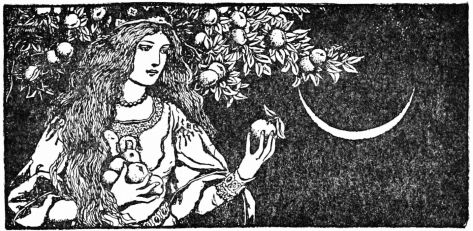
seventh changed into the most beautiful
princess the prince had ever seen in all his
life. Her hair was like a golden cloud about
her; her eyes were as blue as the sky, and
from head to foot she was dressed all in
cloth of gold. She began to gather up the
fruit that the others shook down to her,
and for awhile the prince could neither stir
nor speak for wonder of her beauty. Then
he took the cotton from his ears, and went
over to her, and began to talk to her and ask
her who she was.
At first when the princess saw him she was
frightened, but presently she told him that
she and the six peahens were the daughters
of a king who lived far away, and that they
had flown over seven mountains and over
seven seas, all for the love of the golden
apples. She also told him that by day she
and her sisters lived in a beautiful pleasure
palace their father had built for them, but
when night came they changed themselves
into peahens, and flew about the world
wherever they chose.
After a while the day began to break, and
then the princess changed herself into a peahen
again, and she and her sisters flew away,
but she left with the prince three of the
golden apples she had gathered.
The prince returned to the palace and
gave the apples to his father, and the king
was delighted at the sight of them. “And
did you find out who it is that steals them?”
he asked.
Instead of answering him, the prince
managed to put him off, and the next night
he said he would watch in the garden again.
Then the same thing happened. He stopped
his ears with cotton, the seven peahens
arrived and six alighted in the tree, but the
seventh became a beautiful princess, and
came across the garden to him. Then the
prince unstopped his ears and they talked
together until daybreak, when she flew away
with her sisters, and this time, as before, she
left three of the apples with him.
As soon as it was morning the prince
carried the apples to his father, and now,
whether or no, the king would have him say
who it was who came into the garden every
night to steal the fruit.
The prince was obliged to tell his story,
but when he said it was seven golden peahens
that stole the apples, and that they
were the daughters of a great king his father
would scarcely believe him. The brothers,
too, laughed him to scorn, for they were very
jealous of him. “This is a strange story,”
they cried, “and it certainly cannot be true.
Either you are trying to deceive us, or you
fell asleep and dreamed it all.”
“It is all certainly true,” answered the
youngest brother, “and there are the three
golden apples to prove it.”
“They are no proof,” answered the others.
“If you would have us believe you, keep
watch in the garden again to-night, and
when the princess comes cut a lock of her
golden hair and keep it to show to us.
When we see that then we will believe you.”
At first the prince would not consent to
do this, but they were so urgent that he
finally agreed, and when he went into the
garden he took a pair of sharp scissors with
him. After a time the golden peahens flew
into the garden, and after the youngest sister
had changed into a princess, she and the
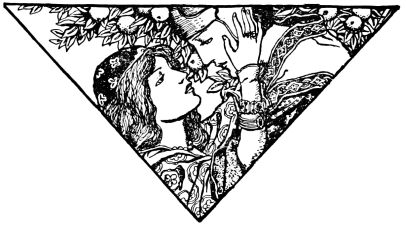
prince talked together all night. When she
was about to go the prince managed, without
being seen, to take hold of a lock of
her hair and cut it off.
No sooner had he done this, however, than
the princess gave a sorrowful cry. “Alas,
alas!” said she, “If you had only been
patient for a little while longer all would
have gone well. Now I must go away forever,
and you will never see me again unless
you journey over the seven seas and over the
seven mountains to seek me.” Then she
changed into a peahen, and flew away with
the others.
The prince was filled with despair at the
thought that he had lost her, for he loved
her so well that he did not know how he
could live without her.
In the morning his father and his brothers
came to seek him in the garden, and when
they saw the lock of golden hair they were
obliged to believe him, and they could not
wonder enough.
But the young prince saddled his horse
and set out in search of his princess. On
he went and on he went, and everywhere he
rode he asked those he met whether they
had seen seven golden peahens, but no one
could tell him anything about them.
At last after he had journeyed over seven
mountains, and over seven seas, he came to
a palace that stood beside a lake, and in this
palace lived an enchantress queen and her
daughter. He knocked at the door and
when the queen came to see who was there
he once more asked whether she could tell
him anything of the seven golden peahens
who were the daughters of a king.
“Oh, yes, that I can,” answered the queen,
“and if you are in search of them you have
not much further to go. Every morning
they come to bathe in this lake, and anyone
who watches them can see them.”
When the prince heard this he was filled
with joy and would have set out for the lake
at once, but the queen, seeing how young
and handsome he was, begged him to come in
and rest for awhile. “Why do you follow
after these seven princesses?” she asked.
“My daughter is a princess, too, and a beautiful
girl. If you can take a fancy to her
you shall marry her and live here and after
I die this palace and all that is in it shall
be yours.”
The prince, however, would not listen to
this, for he loved the golden peahen princess
with all his heart, and her alone would
he marry.
When the queen found that he was not
to be persuaded she pretended to fall in with
his wishes. “Very well,” said she, “it shall
be as you desire, but let me send someone
with you to show you the way to the
lake.”
The prince thanked her, and she called a
servant to go with him, but before they set
out she took the servant aside and gave him
privately a small pair of bellows. “When
you reach the lake,” said she, “take an opportunity
to get behind the prince and blow
upon the back of his neck with these bellows.
If you do this I will reward you
well.”
The servant promised to obey her and then
he and the prince set out together.
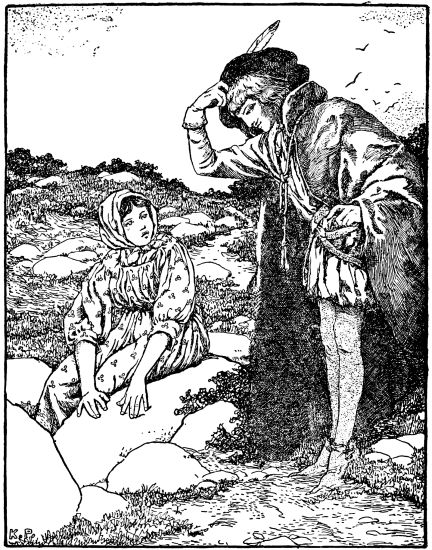
When they reached the shore the prince
sat down on some rocks to watch for the peahens,
but the servant got back of him and
blew upon his neck with the bellows and
immediately the prince fell asleep.
Presently there was a light in the sky and
the seven golden peahens came flying and
alighted upon the borders of the lake. Six
of them began to bathe themselves in its
waters but the seventh one changed into a
princess. She came over to the prince and
began to call to him and caress him, but she
could not awaken him from his sleep.
After a time the peahens came up from the
water, and the princess said to the servant,
“Tell your master when he awakens
twice more will I come but never again.”
Then she and the others all flew away
together.
When the prince awoke and found that
the princess had been there and had tried
in vain to awaken him, he was ready to die
with grief and disappointment. However,
she would return the next day, and he determined
he would be there watching for her
and that this time he would not by any
means allow himself to fall asleep.
So the next morning he hurried down to
the lake again, and the servant went with
him, but before they left the castle the queen
gave the servant the pair of bellows, and
bade him blow upon the back of the prince’s
neck when he was not aware of it.
They reached the lake, and the prince
would not sit down for he feared he might
fall asleep again, but the servant managed to
get back of him and blow upon his neck with
the bellows. Then, in spite of himself the
prince sank down in a deep sleep.
Presently the peahens came flying, and as
before the youngest sister came over to the
prince and began to call and caress him, but
he still slept on in spite of her. Then she
turned to the servant and said to him, “Tell
your master when he awakens that once more
will I come and never again, but unless he
cuts the head of the nail from the body he
will never see me.”
When the prince awoke and heard the message
the princess had left he understood that
the servant had deceived him, and that the
princess meant unless he destroyed the servant
he would never find her. So the next
day when they started out together the
prince took a sharp sword with him. He
waited until they were out of sight of the
castle, and then he turned and cut the servant’s
head from his shoulders and went on
down, alone, to the lake.
He had not been there long when he saw
a light, and heard the seven peahens coming.
No sooner had they alighted than the
seventh one changed into the beautiful
princess. When she saw that the prince was
awake and watching for her, she was overcome
with joy. “Now we shall never be
parted again,” she said, “but you shall go
to our palace with me and be my own dear
husband.”
Then she changed him into a golden peacock,
and the six peahens came up from the
water and they all flew away together. On
and on they went until they came to the
pleasure palace the king had built for his
daughters, and there the golden peacock was
changed back into a prince, and the peahens
became seven princesses. The prince was
married to the youngest one, amidst great
rejoicings and they all lived there happily
together.
Everything went joyfully for seven
months, and then the princess came to the
prince and said, “My dear husband, the time
has now come when my sisters and I must
go to pay a visit to the king our father. You
cannot go with us, but if you will obey what
I am about to tell you all will go well. We
will be away for three days, and during that
time the palace and all that is in it will be
yours. You may go where you please except
into the third cellar that is over beyond
the others. There you must not go, for if
you do some terrible misfortune will certainly
come upon both of us.”
The prince promised that all should be as
she wished, and then she and her sisters flew
away together leaving him alone.
For the first day the prince did not go
near the cellar and scarcely thought of it.
The second day he looked to see where it
was, and when he came to the door it was
so heavily chained and bolted that he could
not but wonder what was back of it, and the
third day he could think of nothing but the
cellar and what was in it. At last he felt
that come what might he must see what
treasure it was that was kept locked away
behind that door. He went down to it again
and began to unfasten the bolts and bars;
the last one fell and he opened the door and
stepped inside and looked about him. There
was nothing there to see but a great chest
with holes bored in the lid, and bound about
with nine bands of iron.
The prince stared and wondered, and
while he still stood there he heard a groaning
sound from within the chest, and a voice
cried, “Brother, for the love of mercy give
me some water to wet my poor mouth.”
The prince was always pitiful toward
those in trouble, and as soon as he heard this,
without stopping to inquire what was inside
of the chest he ran and fetched a cup of
water and poured it through one of the holes.
Scarcely had he done this before there was
a straining sound, and three of the iron
bands burst asunder.
“Brother, that was scarcely enough to wet
my mouth,” said the voice inside. “For the
love of mercy give me another cup of water
to cool my throat.”
The prince ran and fetched the water and
poured it through the hole in the lid, and
now three more of the iron bands burst
asunder.
“More water, brother; more, for the love
of mercy,” cried the voice. “That still is
not enough to quench my thirst.”
The prince fetched a third cup of water
and poured it into the chest, and now with
a sound like thunder the last of the iron
bands were broken, and out from the chest
flew a great green dragon. It flew up
through the cellars and out of the castle, and
the prince ran after it.
The seven princesses were just coming
home, and without even stopping for a moment
the dragon caught up the youngest one
in his claws and flew away with her, and
the prince still ran after them shouting like
one distracted. Even after the dragon had
disappeared over the mountains the prince
ran on, and when he could no longer run
he walked.
On and on he went, and after a while he
came to a stream, and in a hole near it lay
a small fish gasping for breath.
“Brother,” it cried, “for the love of mercy
put me back in the water; but first take one
of my scales, and if you are ever in need
rub it and call upon me, and I may be able
to help you.”
The prince stooped and took up the fish,
but before he put it back in the water he
took from it a tiny scale as it had bade him.
This scale he wrapped carefully in his handkerchief,
and journeyed on again, leaving
the fish happy at being again in the
stream.
Later on he came to a forest, and under
some bushes lay a fox whining to itself with
its paw caught in a trap. “Brother,” it
called to the prince as soon as it saw him,
“for the love of mercy open this trap and
let me go free. It may be that I may succor
you in a time of need.”
The prince was sorry for the poor animal,
and managed to pry open the trap.
The fox thanked him, and before it ran
away it told him to pull three hairs from its
tail. “If you are ever in need, rub those
hairs and call upon me,” it said, “and wherever
I am I will hear and come to help you.”
The prince thanked him and journeyed on,
and in the depths of the forest he came upon
a wolf which was caught by a rock that had
fallen on its paw.
“Help, brother, for the love of mercy,”
cried the wolf.
The prince managed to roll away the rock,
and when the wolf found it was free it gave
him three hairs from its tail. “If you are
ever in need, rub these hairs and call upon
me,” he said, “and wherever I am I will come
and help you.”
The prince thanked him and journeyed on,
and before long he came out of the forest
and saw before him a great castle that stood
upon a mountain. While he stood there
looking at it the gate opened and out rode
the dragon on a great coal-black horse.
Then the prince knew that this was the place
he was in search of. He waited until the
dragon had disappeared, and then he went
up to the castle and entered in, and the very
first person he saw was his own dear wife
sitting alone and weeping. As soon as she
saw him she jumped up and ran into his
arms, and after they had kissed and caressed
each other they began to plan how they
could escape.
Out in the stable was another horse, and
this the prince saddled. He mounted upon
it and took the princess up before him, and
then they rode down the mountain and away
as fast as they could go.
It was not until evening that the dragon
returned to the castle, but as soon as he came
in and found the princess was gone he knew
what had happened, and that she had ridden
away with the prince.
Then he took counsel with his coal-black
horse, and asked it, “Shall we ride after them
at once, or shall we eat and drink first?”
“Let us eat and drink first,” answered the
horse, “for even after that we can easily
catch up with them.”
So the dragon sat down and ate and drank,
and then he mounted his steed and rode after
the runaways. He soon caught up with
them, and took the princess from the prince,
and set her on his own horse in front of him.
“This one time I will spare you,” he said to
the prince, “because you had mercy upon me
when I was a prisoner in the cellar, but if
you ever come to my castle again I will certainly
destroy you.” Then he rode back
home again faster than the wind, carrying
the princess with him.
The prince waited until he was out of
sight, and then he turned the horse loose and
started back toward the castle, for even the
dragon’s threat could not keep him away
from his dear princess.
When he had come within sight of the
castle again he hid himself and waited until
the next day when the dragon had ridden
away. Then he went up to the castle and
hunted through the rooms until he found
the princess.
When she saw him she began to tremble
with fear and wring her hands. “Why have
you returned?” she cried. “Do you not remember
that if the dragon finds you here he
will tear you to pieces?”
“Listen, dear one,” said the prince. “I will
hide myself behind the curtains, and when
the dragon comes home you must find out
from him where he got his coal-black steed,
for I can easily see that unless we find a
match to it we will never be able to escape
from him.”
This the princess agreed to do, and they
talked together until they heard the dragon
returning, and then the prince hid himself
back of the curtains.
When the dragon came in the princess pretended
to be very glad to see him, and at
this he was delighted, for always before she
had met him with tears and reproaches.
After a time she said, “That is a very wonderful
horse that you have. Do you suppose
there is another one like it in all the world?”
“Yes,” said the dragon, “there is one and
only one, and that is the brother of my
steed.”
The princess asked him where this wonderful
steed was to be found, and the dragon
told her it belonged to the old gray woman
who had but one eye and lived at such and
such a place. “She has twelve beautiful
horses standing in her stable,” the dragon
went on, “but this steed is none of them. It
is the lean and sorry nag that is crowded
away in the furthest stall, and no one to look
at it would think it worth anything, but all
the same it is the brother of my horse, and to
the full as good as he is.”
“And would it be possible for anyone to
get that horse?” asked the princess.
“Possible but difficult. If anyone serves
the old gray woman for three days, and during
that time is able to fulfill her bidding he
will be able to ask his own reward and she
cannot refuse him; in that way can he
gain possession of that horse and in no
other.”
The prince heard all this behind the curtain
where he was hidden, and after a time,
when the dragon had gone to sleep he stole
out and set forth in search of the old gray
woman who had but one eye.
He went on and on, and after a while he
came to the house and there was the old gray
woman herself looking out of the window.
He knocked at the door, and when she
opened it he asked whether he might take
service with her.
“Yes, you may,” answered the old gray
woman, “for I am in need of a stout lad to
drive my black mare out to the pasture and
keep her from running away. If you can
do this for three days you may ask what reward
you choose and it shall be yours, but
if you are not able to bring her home every
evening your head shall be cut from your
shoulders and set upon a stake.”
The prince agreed to this bargain, and the
next morning, as soon as it was light, he
drove the black mare out to the pasture.
Before they started however the old woman
went to the black mare’s stall and whispered
in her ear, “To-day you must change yourself
into a fish and hide down in the stream
for there the lad will never be able to find
you.”
When the prince reached the pasture with
the mare he determined to sit upon her back
all day, for if he did that he was sure she
could never escape from him. He sat there
for a long time, but he grew drowsier and
drowsier, and at last he fell fast asleep.
When he awoke he was seated on a log of
wood with the halter still in his hand, and
the mare was gone.
The prince was in despair, but suddenly
he remembered the promise the little fish
had made him. He took out the scale which
he had been carrying all this time, and rubbing
it gently he cried:
“Little fish, if friend indeed,
Help me in my time of need.”
Immediately the little fish stuck its head
up from a stream near by. “What can I
do to help you, brother?” it asked.
“Can you tell me where the black mare has
gone?” asked the prince.
“Yes; she has changed herself into a fish
and is hiding down in the stream with us.
But do not trouble yourself about that.
Just strike the halter upon the ground and
call out, ‘Black mare, black mare, come out
from among the fishes for it is time to go
home.’”
The prince did as the fish bade him and
as soon as the black mare down in the stream
heard those words it was obliged to come out
and take its natural shape again. The
prince then mounted upon it and rode it
home.
When they reached the stable the old gray
woman was on the watch, and she could
scarcely hide her rage and disappointment
at finding the serving lad had managed to
bring the black mare home. However, she
bade him go to the kitchen and get his supper,
and she followed the black mare to the
stall. “You fool,” she cried, and she was
ready to beat it in her rage, “why did you
not hide among the fishes as I bade you?”
“Mistress, I did,” answered the mare, “but
the fishes are friends of the lad, and told
him where I was, so I was obliged to come
forth.”
“To-morrow, change yourself into a fox
and hide among the pack. There he will
certainly be unable to find you.”
After that she went into the kitchen where
the lad was eating his supper.
“Well,” she said, “you have done very
well so far, but to-morrow is still another
day, and we will see how things go
then.”
On the morrow the prince rode the black
mare out to pasture, and again he sat on
her back so that she should not escape him.
After awhile he fell asleep in spite of himself,
and when he awoke he was sitting
astride of a branch with the halter in his
hand.
At first the prince did not know what to
do; he was in despair. Then he remembered
the promise the fox had made him.
He took the hairs and rubbed them between
his fingers.
“Little fox, if friend indeed,
Help me in my time of need,”
he said.
Immediately the little red fox came running
out of the wood. “What would you
have of me, brother?” he asked.
“Can you tell me where the gray woman’s
black mare has gone?”
“That is easily answered. She has
changed herself into a fox and is hiding with
the pack. Strike the halter on the ground
and call out: ‘Black mare, black mare, come
from among the foxes; it is time to go
home.’”
The prince did as he was told and as soon
as the mare heard him calling to her in this
way she was obliged to come out from the
pack and take her real shape, and the prince
mounted upon her back and rode her
home.
When the witch saw him riding back to
the house she ground her teeth with rage.
As soon as she had sent him to the kitchen
she went out to the black mare’s stall to
beat it. “To the foxes! to the foxes! That
was what I told you,” she cried.
“Mistress, I did hide among them as you
bade me,” answered the mare, “but this lad
is a friend of the foxes too, and they told
him where I was.”
“Then to-morrow hide among the wolves,”
said the old woman. “He will certainly
never look for you there.”
The next day it was the same thing over
again. The prince sat on the mare’s back
so that she should not escape him. After
while he went to sleep, and the mare slipped
away from him, but this time it was into a
wolf she changed herself.
When the prince awoke he was in despair,
until he remembered that he had still one
friend to help him. He gently rubbed the
hairs the wolf had given him, and said,
“Kind gray wolf, if friend indeed,
Help me in my time of need.”
Immediately the wolf came galloping out
of the wood and asked the prince what he
could do for him.
The prince told him how he had been set
to watch the black mare and had gone to
sleep and lost her; “And now,” said he, “I
fear there is nothing for me but to lose my
head and have it set upon a post.”
“That will not happen yet,” answered the
wolf. “The mare has changed herself to a
wolf and is hiding with the pack. Strike
the halter on the ground and call to her and
she will be obliged to come.”
The prince did as he was told and called
to the mare to come, and she was obliged
to take her real shape and come out to him.
The prince slipped the halter over her
head, sprang upon her back and rode her
home.
When the old gray woman saw him coming
in this way instead of upon his feet, she
almost burst with rage. However, there was
no help for it. The lad had earned his
wages, and have them he must.
“And what is it you will choose?” asked
the old gray woman.
“Give me the poor nag that stands in the
furthest stall,” said the prince. “It is but a
sorry looking beast, but I will be content
with that,” answered the prince.
When the old woman heard that she
turned green in the face. She offered him
first one and then another of the handsome
horses in her stable, but the lad would have
none of them. The sorry nag was his choice
and it alone would he take, and in the end
the old woman was obliged to give it to
him. He rode away on it, and it was not the
old gray mother’s blessing that went with
him.
When they were well out of sight of the
house and in the depths of the forest, the
prince alighted and taking out a curry comb
he had brought with him he began to rub
and curry the horse, and when he had done
that it shone like burnished silver.
Then he mounted again and rode on until
he came to the dragon’s castle. As soon
as he drew near, the princess came running
down to meet him, for the dragon was
away, and she had been watching from a
high tower and had seen him coming.
He took her up on the saddle before him
and turned his horse’s head and rode away
from the castle even faster than he had
ridden toward it, and they had journeyed
far before the dragon returned home.
As soon as he reached there and found the
princess gone he knew what had happened.
Then he said to his horse, “Shall we follow
after them now, or shall we eat and drink
first?”
“We have no time for meat or drink now,”
answered the black horse, “and it will be all
I can do to overtake them, for now they ride
my own brother.”
Then the dragon leaped upon his horse,
and off they flew, faster than the wind, in
pursuit of the prince and princess. They
went on and on, and after a while the
dragon came within sight of them, for
though the white horse was swifter than the
wind, too, he carried double and so could not
go at his highest speed.
Nearer and nearer came the dragon and
his steed, and the prince began to beg and
plead with his steed to go faster, but it answered,
“There is no need of that, master;
only leave everything to me and all will go
well.”
Then the black horse came near enough to
speak, and he called after the other, “For
mercy’s sake go slower, brother. I shall kill
myself running after you.”
“There is no need of your doing that,” answered
the white horse. “Throw up your
heels and rid yourself of the monster that
sits upon your back. You have been his
servant too long as it is.”
When the black horse heard this he began
to plunge and kick up his heels so that the
dragon was thrown from his back and falling
upon a rock he was broken to
pieces.
But the black horse came up to his brother,
and the prince set the princess upon his
back, while he himself kept the white horse
to ride. So they all journeyed back to the
pleasure palace together, and when the six
sisters saw them there were great rejoicings,
and they all lived together happily in the
palace forever after.