In the early days, many strange things
happened. It was the mystical age of
romance in the Gold Land, and people
seemed to live years in months, or even
weeks. Thus a great deal has been forgotten.
In the old countries it was not so, and it
may be that some are living even now at
“dear Bingen on the Rhine,” who remember
tenderly the handsome young couple
who left their home to seek the alluring
treasures of the Gold Land in “the early
days.”
They were honest peasants in the Father
land, but over the waters had floated the
marvelous story, how, in the glorious El
Dorado, any one might become a lord of the
soil or a rich miner prince.
This it was that fired the heart of the
father; and as the mother looked upon
their boy, she too was ready to go out into
the great world, though her heart lay fondly
to the beloved Fatherland.
They had little money, but the thrifty
good-man managed to work for one and
another on the passage, till, when he arrived
at the young city of tents within the Golden
Gate, he had cash enough to make a beginning
in life.
They were soon domesticated in a little
shanty, and in a short time had prepared a
fine garden, which became the good-man’s
pride. Every morning dame Waltenburger
went to the market, where she had a stall,
and sold fruit and vegetables for gold dust,
for that was the currency of the country in
“the early days.”
The little son was ten years old, and a
real delight to the mother’s heart.
He was well formed, with fine features,
golden brown hair, and wonderfully expressive
eyes. When he was calm and
happy they were of a soft looming blue, but
if excited or angry, they grew dark and
fierce, flashing like balls of fire.
It pleased him above all things, to assist
the dear mother at the market, and very soon
he displayed great taste in the arrangements
of the fruits and vegetables.
With maternal pride, the mother often
told the neighbors “it would be impossible
to do without Paul,” for really he was the
greatest help to her.
When the flowers were in blossom, the
boy always made them into bouquets and
garlands, while his pretty ways brought
many a purchaser.
Sometimes he used to carry home parcels
for ladies who had made large purchases,
and very often he received presents from
them. With the regular customers the
handsome little fellow was a great favorite.
One day, as Paul and the mother sat in
the stall together, talking of the dear Fatherland
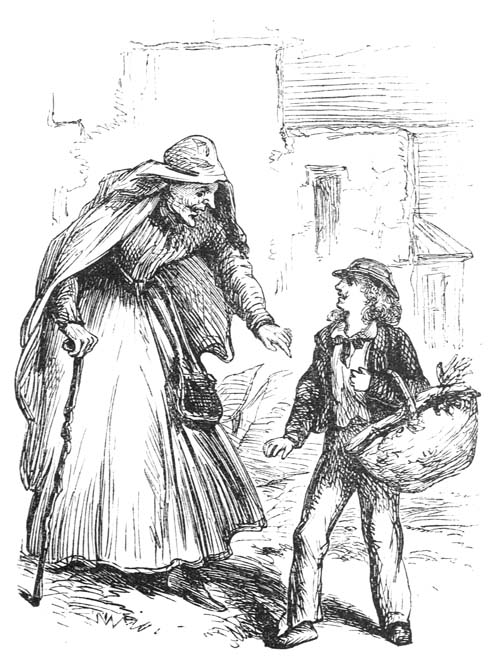
so far away, they saw a very queer-looking
Spanish woman approaching. She
seemed bowed down with age and infirmities,
and leaned heavily upon her staff as she
hobbled along with the greatest difficulty.
After the Spanish fashion her head was
covered with a shawl, from which peered
her thin sharp face, quite furrowed with
wrinkles. Her bleared eyes were red, and
her long hooked nose nearly met her pointed
chin. Altogether she was very unpleasant
in her appearance.
All the time she kept her toothless mouth
moving as she mumbled indistinctly to herself.
She came directly up to dame Waltenburger’s
stall, and entering it, threw herself
down upon the bench, exclaiming:
“This is what comes of growing old, nothing
but weariness, care, and aching of bones,”
and she began rubbing her knees and
muttering to herself.
Little Paul stood looking at her, his eyes
dilated with wonder, and the compassion
of his heart made them blue as the cloudless
sky.
“Ah!” exclaimed the old woman, looking
into his innocent face with a hideous
grimace, “what are you staring at, with
your great round owl-eyes? Do you think it
is a fine thing to be old, and lame, and poor?
You will have to come to it. Ah! yes, there
is a comfort in that.”
“Old Father Time will take care of you.
Yes! yes! yes!” And she shook her long
bony fingers, and chuckled in such a horrible
way, that the child retreated behind the
mother’s chair, and hid his face upon her
protecting shoulder.
“Go quickly, boy, and bring me some
fresh water,” said the old woman, “I am
very thirsty,” she added, looking at the
mother.
Little Paul took a glass and ran away to
the well and drew a bucket of water, so
clear and sparkling that it glistened in the
sunlight like the dew of the morning.
As he carried it along, he thought how
the professor had told him of shining nectar
that Hebe used to bear in the golden cup
to Jupiter and all the gods of Olympus.
“That was in the olden time,” he said,
“but no nectar could be more beautiful and
pure than the water the loving God in
heaven gives to us all.”
Offering it to the old woman, his open
rosy face beaming with smiles, he said “it
is nectar fit for the gods, and I am your cup-bearer.”
Then he bowed so prettily that the
mother laughed, saying, “did one ever see
such a child? oh! you mischief,” and she
shook her fingers in the cunning old way
that all mothers do.
The old woman took the glass, but
managed to spill half its contents over the
child’s clean clothes, then she chuckled with
delight at his discomfiture, saying “see
what it is to be old, my little cup-bearer.”
While the mother wiped off the water
with her handkerchief the woman began
picking over the vegetables and fruit with
her thin hooked fingers, and smelling every
bouquet of flowers, till little Paul’s eyes
grew dark and flashed like living flames.
“Just see her, mother,” he whispered,
“who will buy them after she has handled
every thing with her dirty hands, and snuffed
all the sweetness and beauty out of the
flowers with her ugly, crooked nose?”
“Oh, you little viper,” cried the old
woman, springing forward, “I’ll teach you
to mock at old age.”
Paul was too quick for her, and had it
not been for the mother she would have
fallen, in her eagerness to catch him.
“Never mind the child, my good woman,”
said dame Waltenburger, gently, “we were
all children once, now how can I serve you?”
“To be sure! we were all children once.
Ah! me!
“Oh, no! I don’t mind the child, my little
cup-bearer,” and the old woman drew her
wizen face into a hundred wrinkles, and
began selecting a large quantity of fruits,
vegetables and herbs, far more than she
could carry.
“Is it far you have to go?” said the
mother.
Crimson Tuft.
“No, no! not far,” replied the woman.
So the mother called Paul to help her.
He was very reluctant to go; but, when
the mother kissed him, and promised to
make him a beautiful ball, and cover it
with red morocco, he came forward and
took the basket readily.
“And I,” said the old woman, “will give
him a beautiful crimson tuft; he will be
gay as a lark, my little cup-bearer.”
This seemed delightful to Paul, and he
followed after the old woman, thinking—“I
can play soldier with the crimson tuft,
and the professor in the next house will
hear me, and call me Charlemagne. It will
be glorious to be the soldier with the crimson
tuft.”
Little Paul walked on in quite a lordly
way, with his great martial thoughts echoing
in all the chambers of his boyish heart,
“It will be glorious—the soldier of the
crimson tuft!”
On, on they went, far out into the sand
hills, in an opposite direction from his own
home.
Paul’s arm began to ache very much,
carrying the heavy basket, but he was
feeling so manly, that he did not like to
complain; but at last he became so tired,
that it was no use—he could not bear it
any longer, and great tears filled his eyes
and covered his rosy cheeks.
All the way the old woman had been
muttering to herself in Spanish, but Paul
could not understand that.
“I am so tired,” he said, resting the
basket upon the ground.
“Oh, it is not far! not far! and I will
give you the bright crimson tuft—think
of that,” replied the old woman.
So Paul took up the basket, and again
they went on a long, long way, and turned
so many corners, he feared he could never
find his way back, but still the thought of
the crimson tuft allured him.
“I must have it,” he said; “that would
be a real pleasure.”
At last, when he was just ready to fall
down with fatigue, they came to a great
iron-barred gate, and the old woman rung
the bell very loudly.
In a moment a great rough voice called,
in Spanish, as through a trumpet, “Who
rings at the gate?”
Very soon the gate was opened by a
curious-looking dwarf, who started and
grinned fearfully when he saw Paul.
The child offered him the basket, but he
only shook his head, pointing after the old
woman, who gave him her staff, and walked
along with as much ease as little Paul
himself.
Now the child was really frightened,
and would have run away, but he was
already within the gate, and, with a great
clang, it closed. The dwarf put up the
iron bars, and replaced the bolts. Nothing
could be more secure, for all around rose
an immense high fence, topped with sharp
spikes. It was impossible to escape—no
one could get in or out.
A long avenue led to a pleasant-looking
house, built in the Spanish fashion. It
was shaded with beautiful trees, that had
been brought from the southern country.
How they waved their long fan-like leaves
in the sunshine! It was a picture engraven
upon the child’s mind never to be
effaced.
Under the shadow of the trees walked
the old woman toward the house, and Paul
followed with the basket, trembling like
the light leaves of the tamarind. Just
behind him came the dwarf. He could
hear his heavy tread.
“It is no use! no use!” thought the
child; but he would gladly have given
the tempting crimson tuft, the red morocco
ball, all, all his pretty treasures, to have
been once more by the mother’s side, selling
vegetables in the market.
They entered a large, pleasant drawing-room,
with doors opening upon the front
piazza and upon the verandah of the inner
court, so that, though it was very warm, a
delicious breeze swept through the room,
and made it delightfully cool.
The old woman threw herself upon a
couch, and, pointing to a silver bell, told
Paul to ring it, adding, “My little cup-bearer,
you must be tired, and I will order
something to refresh you before you return
to your good mother.”
“I am not so very tired,” said Paul;
“let me go—the mother will need me;”
and he looked imploringly into the pitiless
face that he was beginning to fear above
all things.
“Ring the bell, boy,” was the only
answer.
So he rang the bell, and the dwarf,
who had left them on the piazza, entered.
The woman addressed him in Spanish,
which Paul did not understand, but, as he
went to and from a large closet, and began
spreading the table, he would turn his
curious squinting eyes upon the child with
looks of compassion.
In a short time all was ready; and what
a delicious lunch it might have been to
the child, but for the great fear that overshadowed
him! Delicate cakes and confections,
cold chicken, eggs, and all kinds of
fruits that children are so fond of, with
many nice-looking things that Paul had
never seen before.
There was a great pyramid of ice-cream.
“How I should like to eat it with the dear
mother!” thought Paul.
Oh! that was a delicious lunch, to be
sure!
“Come, let us sit down,” said the old
woman.
“I am not hungry,” answered Paul, timidly;
for he longed so greatly to be at
home, that even these unaccustomed delicacies,
and the promised crimson tuft, were
as nothing compared with the sweet comfort
at the dear mother’s side.
“You silly child! You have walked all
this distance, carrying that great basket,
and are not hungry? Well, you are thirsty,
and for your nectar of the gods, I will return
you the sherbet of an eastern prince.”
The woman filled a glass with a clear,
rosy liquid, that bubbled up and sparkled
so temptingly, that little Paul, who was
quite overcome with fatigue and thirst,
grasped it eagerly, and did not take the
glass from his lips till he had drained it to
the bottom.
Then he wished to start for home, but
he felt so drowsy that he could not move.
He thought of the mother, but felt no
emotion, and looked at the hideous old
woman, who was grinning horribly, without
fear. In a few moments he sunk down
upon the couch, in a heavy sleep.
The woman stood over him, chuckling in
great glee. “I have you now, my pretty
cup-bearer, and will make you of great use
to me. I will teach you a thousand things
you would be glad not to know! You
shall have a crimson tuft, ha! ha! ha!
I will teach you to be impertinent to me!
My hooked nose! to be sure. Ah! I am
old! old! and nothing can make me young
and fair. If I could only take for myself
your young beauty! But, no! one day I
must die, and that will be the end.”
The woman’s face grew convulsed—for
she was haunted by the grim specter, Death,
as with a dread terror. Her life had
been so filled with darkness, that she could
not look forward to the calm hereafter.
All the brightness and beauty of heaven,
the golden, was like the fleeting dreams
of childhood, that the rolling years, bearing
her to the portals of dim old age, had
swept away.
She had studied magic, and tried to find
the elixir of life, but in vain. She had
discovered many wonderful things, but not
the fountain of perpetual youth, nor the
precious elixir of life.
For a few moments she stood gazing at
the fresh face and rich curls of the child,
as he lay sleeping in his pure innocence.
Once the word “mother” passed his rosy
lips, and the woman waved a perfumed
fan over him, till even the mother was no
longer the companion of his dreamless
sleep.
“Now, it will do to begin,” said the old
woman, and she took from a secret drawer
in the closet several bottles containing
liquids, and placed them on a little table.
Taking a pair of sharp scissors, she sat
down by the child, and cut off all his
beautiful brown curls, leaving only a little
tuft. This she made quite stiff in some
way, and colored it bright red, tying it
upon the top of his head, so that it stood
up and looked very strangely.
“There is the crimson tuft, my little
cup-bearer,” she said, laughing heartily at
her wicked work.
Then she tinged his eyebrows red, and
his skin a dark mahogany color, until, instead
of the beautiful little Paul that everybody
had loved and admired, he appeared
the ugliest little wretch one could well
imagine.
She took off his neat, plain clothes,
dressing him in yellow leather breeches
and a fantastic red jacket. Upon his feet
she put shoes with long pointed toes, that
turned up and were tied with red ribbons.
When she had finished, she looked at him
with great satisfaction.
“Even the old dame herself would not
know her cub now. What an ugly little
goat he has become, to be sure!” And the
old woman, after her usual way, muttered
to herself.
At last she sat down, and, eating and
drinking, for, by this time, she was quite
hungry, every few moments she would
stop and rub her long bony hands together,
and laugh, as she looked at the
transformed child.
Paul slept all the afternoon, and awoke
in the dusky shadow of the twilight, confused
and bewildered, to find himself in a
strange room with the horrible woman,
sitting before a blazing fire, gazing steadily
into its fantastic pictures.
At first he could not tell where he was,
but in a moment he remembered all, and
jumped up in the greatest excitement, saying,
“How could I have slept, when the
dear mother was expecting me? She will
be so anxious. Oh, let me go to her!
Please, good lady, let me go!”
“What do you mean,” answered the old
woman. “You have no mother! you are
my little servant, Crimson Tuft. I gave
you that name, myself, on account of your
red hair, which stands up like a crest on
the top of your ugly head.”
Then the child began to cry, saying,
“My hair is not red, and my name is Paul,
and it was my dear mother who sold you
vegetables at the market this morning.
Let me go home, oh! please let me go home
to the dear mother.”
The child’s voice was broken with sobs,
but the hard-hearted woman only laughed,
“Ha! ha! it is a curious dream you have
had, or are you going crazy? your hair not
red! indeed! why, look in the glass yourself.”
She led him to a mirror, and there the
unhappy child saw reflected the ugly
wretch called Crimson Tuft, but never
again the handsome little Paul.
The child was more frightened and bewildered
than ever. He was sure he had
left the mother that morning, in company
with this horrible old woman. Every
thing in the rude little home rose in his
mind, yet he could not realize his own
identity. Paul surely he could not see in
the reflecting mirror, only the ugly little
Crimson Tuft.
He raised his hands and took hold of
the stiff shock of red hair that stood up·
right upon his head. Oh, no! it was not
Paul’s soft silken curls.
Yet there was a look about the eyes
that reminded him of Paul, but even
they were very different: they were the
red, swollen, terror-strained eyes of Crimson
Tuft.
“Are you satisfied now,” said the old woman.
“It was only a dream, a queer dream
that you have had, Crimson Tuft, and how
funny that you should think you were an
old vegetable-woman’s child. You, my
servant, who have never been out of this
place in your life.”
Still the child only cried the more, and
entreated, “Let me go home to the mother,
let me go home.”
Though he was faint from the effects of
the narcotic, and from fasting for a long
time, he refused food, and continued to sob,
begging the old woman to let him go home,
but she only answered, “you are dreaming
still, or crazy.” Then she told him how
sometimes people were bewitched, and did
not know themselves.
“Still, I am Paul, let me go.” At last
the woman, losing all patience, called the
dwarf to beat him, if he did not stop crying
and begin to eat. So terror and hunger
at last conquered, and the little boy,
choking down his sobs, sat upon a stool in
silence, to eat his supper, very desolate and
leaden hearted.
From that day a new era commenced
in the history of the child. An era of
servitude, sorrow, and tears, that washed
away so far into the past the memory
of his free and joyous childhood, that
he began to believe what the woman
so often told him, that his mind had
gone astray, that he had been bewitched.
Sometimes he would stand looking long
into the great mirror, at the stiff, red hairs
and brown skin of poor Crimson Tuft,
thinking what a beautiful myth it was,
about the happy little Paul, and the dear
mother. How it had stolen into his heart
like a real life, and still the señora, as all
about the house called her, said it was
only a bewildering dream.
Into his eyes he would often look, saying,
“Those are Paul’s eyes, but the red
brows give a different expression to their
sadness,” he would add, “No! no! they
are not Paul’s eyes.”
Always the red hair, brown skin and sorrowful
heart, “I must be only poor Crimson
Tuft.”
Very often his hungry heart would cry
out, “Oh, mother! mother!”
Too often the shrill voice of the old
woman would be the discordant answer,
sending him to some new task.
As months, then years, rolled by, the
child became more accustomed to his sorrowful
lot, and in many ways it grew pleasanter.
He learned to talk Spanish fluently,
and became very fond of the queer
looking dwarf, who had frightened him so
much at first. He often talked to him
about his mysterious change, but of these
things the dwarf would never speak, so at
last Crimson Tuft ceased to mention
them.
His kind-hearted friend taught him
many things in leisure hours—to read,
write, and solve difficult problems—so that
at twelve, he was as much advanced in his
studies as most boys of his age.
With the señora he had become quite a
favorite, although at first, for a long time,
he had only menial service to perform,
there came a change. One day she heard
him reading aloud to the dwarf, and was
so much delighted with his distinct enunciation,
and fine rendition of what happened
to be a favorite author, that she
called him to her private library, and
talked a long time in a way she had never
before addressed him.
“He is a boy of quick mind,” thought she,
“and may be more than an ordinary servant
to me. He is just what I shall need in
my troublesome Mexican affairs. I must
train him to his work.”
From that day he used to sit hours in the
library reading to her, and often she gave
him long papers to copy, which he was
soon able to do, to her entire satisfaction.
Very often she would talk to him as
though he were a man, in fact the training
he was receiving brought only the man’s
thoughts. He had left his happy boyhood
at the little stall in the market-place.
One day he found an old guitar in the
attic of an out-house, which was filled with
broken furniture, and many things disused
and forgotten. From that hour he enjoyed
a real pleasure. In a short time he picked
out the chords and wove them into delicious
harmonies, and then there came into
his mind a rich old melody of the fatherland.
It was like the memory of a happy
dream, and the tears filled his eyes. Again
he was happy, for every thing save the
spell of the divine melody was forgotten.
Two more years glided by, and the
young boy was advancing toward manhood.
He was tall, and finely developed;
and deep within his dreamy eyes slept the
wonderful magnetic charm. Still the
brown skin and stiff hair remained, and he
was only poor ugly Crimson Tuft.
In all this time he had never been outside
the massive gate which was always
strongly locked and barred; and though he
had often entreated the dwarf, the only
reply was a grave shake of the head, and
a sad, compassionate look, from the odd
squinting eyes of his companion, and if he
persisted the dwarf would go away and
leave him alone.
He had never ventured to speak to the
Señora but once, on the subject, in years,
and then her fury was so unbounded, that
he feared she would tear him in pieces with
her long bony fingers, which, when she was
enraged, possessed the power of a vice.
For a week after, she fed him on bread and
water, and kept him confined in a dark
room with too heavy tasks to allow him
to question the mysterious past, or speculate
on the uncertain future.
“Always a foolish dreamer,” she said. “I
will teach you something, you, the brown-skinned
Crimson Tuft.”
Yet it was all no use: the boy had his
thoughts, that could not be chained. He
was determined to escape.
“I will not excite suspicion; I will strive
to please; and a time will come, yes, the
time will come, when I shall know all.”
Thus in striving to lull the suspicions of
the Argus-eyed woman to sleep, he grew
into great favor, and became indispensable
to her.
“He can do so many things that no one
else can do,” she would say to herself, “but
those great luminous eyes torment me. If
they too could be changed. But that is
beyond my power. Would I could make
them dull leaden and red as his flaming
crimson tuft. He is useful, very useful,
but there are times, with all his quiet seeming,
when I think he suspects me. Dare I
trust him? that is the question.”
Here the old woman would fall into long
fits of musing, and gaze into the glowing
embers, till they faded into dead ashes.
One morning the old woman called Crimson
Tuft to her, saying: “I am going away,
to be gone for some days, and I want you to
copy these papers for me. They are the
deeds and other valuable papers of my
property in Mexico, which you will see is
very great. Let the copies be made with
great distinctness, for these duplicates may
be required. You see I am cautious, and
trust you very much, very much.”
A look of suspicion crossed her sharp
wizen face; but in the ugly brown countenance
she could detect nothing but truth
and sincerity.
“I can do no better,” she thought, but
aloud she added, “the dwarf knows all and
will see to the safety of these and every
thing. If one of them is lost it would bring
no end of trouble, and you would have
your share.” With an ominous shake of the
head, the old señora rose and left Crimson
Tuft bending over the yellowed parchment,
that was of the most inestimable value to
her.
About noon she left the house, with the
dwarf following her to the gate, which,
when she had passed he barred more securely
than ever.
For some days Crimson Tuft worked diligently
over the papers. There were deeds
of haciendas and mines, mortgages, and
grants of land, and many long, intricate
pages of law papers. Really to copy all
these was a task, and Crimson Tuft was
filled with amazement at the greatness of
the old señora’s possessions.
At last they were all finished, and locked
up by the dwarf in the iron-bound oaken
chest, and that again was locked in the
great closet, and the dwarf carried the key.
So it was very secure.
Still the old señora did not return!
“Now the time has come,” thought Crimson
Tuft, “I must escape.” But that was
easier planned than done. Everywhere the
dwarf followed him, and when Crimson
Tuft grew angry he laid his heavy hand
upon his arm, saying, “from the first I
have loved you, boy,—believe me it will all
be well—only wait a little longer.”
Then Crimson Tuft took his hard, honest
hand, saying, “you alone have loved me,
and for your sake I will wait, but not long,
I can not—do not ask it.”
One evening, about a week after this, the
bell rang, and the señora entered, followed
by a most beautiful little maiden about
twelve years of age.
She was dressed in mourning, with a
black shawl about her head; her long
glossy hair hung carelessly over her graceful
shoulders; her complexion was a clear
olive, and her skin soft and smooth as satin;
while her large, dark eyes had a depth as
of the mystic sea, and a pure clear look as
of heaven.
They were more beautiful than any thing
Crimson Tuft had ever seen, and some how
they startled him. It was not like the old
vision, yet it touched him more deeply—this
was of the present—that of the past.
“This is my only granddaughter,” said
the old woman to the dwarf and Crimson
Tuft. Both bowed very low to the pretty
señorita. They were such a queer-looking
pair, that she clapped her dainty little
hands together laughing in a pure ringing
tone, clear as the notes of a silver
bell.
Poor Crimson Tuft was very much confused,
for to him the young Donna Leota
was the first dream of beauty that had
kindled the dawning fire of manhood in his
heart, and he was ready to bow down and
kiss her foot-prints in the sand.
Strange to say, the little Leota swayed
the grandmother as absolutely as she had
ruled the dwarf and Crimson Tuft, but in
one respect the old woman was resolute,
the heavy gate was locked as securely upon
Leota as upon the other inmates of the
mansion, and no persuasion could induce
her to change in this regard.
Leota was passionately fond of music,
and played the harp very sweetly.
Once in the still hours of night, she was
awakened by the notes of her own harp
vibrating in the most exquisite harmony.
She was filled with delight though she
trembled with fear, for she was quite sure
there was no one in the house who knew
any thing of music but herself, yet the
chords were swept as by a master’s hand.
She lay motionless until the last note
died away, and it was long before she
fell asleep, for the spell of the rich melodies
still floated through the air around her.
In the morning she spoke of it, but no one
could explain the mystery. Again and
again, in the silent hours came the rich
melody, not old familiar airs, but the exquisite
improvisations of genius.
One night, when the golden moon was
casting its soft amber light over land and
sea, and the enchanted harp sending forth
its entrancing strains, Leota rose softly
from her couch, and summoning all her
courage, determined herself to solve the
mystery. She glided quietly along the
passage-way to the large glass door of the
parlor, and there she saw Crimson Tuft
bending fondly over the harp, and calling
out the bewildering melody that she had
thought could be born only of mystical
enchantment. The imagination of the
young girl was so vivid that she was easily
prepared for things supernatural, but to
see poor brown Crimson Tuft, the great
magician, he, the slave, of whom she thought
only to laugh at—this was stranger than
all.
The soft moonlight fell full upon his
face, and his large luminous eyes were
dewy with the spirit of the rich melody.
With the rare beauty that was all their
own, they almost redeemed the brown skin
and flaming hair from positive ugliness.
Leota stood entranced till the last note
died out of the thrilled chords of the
trembling harp, then, as she turned to go,
the rustling of her robe caused Crimson
Tuft to raise his eyes, and they fell full
upon her face, to him at least the most
beautiful face in the world. He was
covered with deep confusion. Over his
redeeming eyes fell the heavy red lashes,
and the ugly brows contracted.
She, his rare divinity, had seen him play,
and heard how the notes flowed from his
own heart, through the sympathizing
harp-strings that thrilled with his devotion
to her, which would last all his life
long.
Leota was greatly bewildered, and as
she stole away to her own room, strange
thoughts chased themselves through her
mind. Not one word had been spoken,
but every thing had changed. Crimson
Tuft was no longer only the ugly servant
of her grandmother, but he was Crimson
Tuft of the mystery.
There was something interesting in that;
besides, shut up in those high walls, with
only the old grandmother for company,
and little amusement, one must think a
great deal. So Leota had her thoughts.
Crimson Tuft had wonderful eyes. She
had found that out, and it was a great
deal there in that dull place.
She wished to be in Mexico again, where
the most beautiful flowers bloom, and the
delicious fruit grows ripe on the broad-leafed
trees. Yet she did not like to think
she would never see the beautiful eyes
again. “But one must not think too
much of a servant,” she would say to herself.
“She was of good blood, and that
would not do, yet one must treat inferiors
kindly.” Really it was difficult to tell
what one must do. So, all in a maze, she
fell asleep, and dreamed of the most radiant
eyes, which were Crimson Tuft’s, and the
handsomest face, which surely was not
Crimson Tuft’s.
The morning dawned clear and bright,
as Crimson Tuft arose and began the duties
of the day. Though he was advanced
to the post of private secretary,
the old señora had left him some tasks in
the early part of the day that would prevent
him from forgetting his position as a
servant.
First he swept and dusted the parlor
and halls. This had always been his work,
and no one else could please the señora so
well. As he dusted the señorita’s harp a
flash of indignation filled his heart. He
was only a servant, the ugly Crimson Tuft,
and she the most beautiful maiden, the
divinity of his soul. There was a great
difference, yet he felt himself a man, and
he would conquer fate in the end, even
with his ugly Crimson Tuft. This was
what he thought.
When Leota appeared she said nothing
of her discovery, but when she spoke to
him it was in a different tone from formerly.
The mystery of the enchanted harp
was over, but the greater mystery had
begun.
The wonderful eyes acted as a talisman
upon her heart, and though she strove
against it, she found herself forgetting
Crimson Tuft’s position, his ugly brown
skin and red hair.
One glance of his beaming eyes would
set her warm blood dancing through her
veins till her neck and brow were a soft
rose-tint, and this was in no way pleasant
to the proud little maiden.
The next night Crimson Tuft did not
touch the harp, and in the morning the
Donna Leota passed him at his work with a
haughty toss of her dainty head, but with a
quiver in her voice she said, “Crimson Tuft,
play when you like, the music pleases me.”
After that Crimson Tuft would always
play at twilight, and even the old grandmother
was touched by the magical spell of
his genius.
Every year the old woman grew more
infirm, till she could not even walk from
room to room without leaning upon her
staff. At times her temper was terrible,
and nothing but the soft touch of Leota’s
hand could calm her. She loved with all
her strong hard nature the young maiden
who daily was growing to womanhood
crowned with surpassing beauty.
She was getting very old. With an
iron will she resisted the pitiless hand of
time, but she could not stay it. Her long
hands became more bony and angular, her
eyes more red and bleared, and her voice
more cracked and shrill; yet she seemed to
be looking forward to a long life, and was
more hard and grasping than ever. It was
only Leota that she loved more than gold.
One night Crimson Tuft had a curious
dream. He thought, as he lay half sleeping
and half waking, dreaming delightful
but impossible things, that the old woman
came in softly and poured something upon
his head, and that when he started, she
held a sponge to his nose, until he sank
back powerless. He seemed to inhale
something sweet and fragrant. It was
very pleasant and soothing: that was all
he could remember. In the morning, he
felt heavy and drowsy, his head ached, but
he roused himself, rose and dressed as
usual. When he looked in the glass he
saw that his hair was redder, and his skin
a deeper brown than ever. Memories
and a strange suspicion flashed over his
mind.
Far back in the years he remembered
dimly a little boy, named Paul, a fair child,
whom he had been taught to believe a
dream. There was a mystery. Could she
have changed Paul to Crimson Tuft in a
night?
After this, Crimson Tuft became more
thoughtful than ever. There was a mystery
to solve, and he would devote all his
energies to it. He was eighteen years old,
a very intelligent young man, but entirely
unacquainted with the world. He had yet
much to learn.
One day the old woman called him to
her, and looked, in her curious way, at
him for a long time. “Crimson Tuft,” she
said, “you are my servant, but I have
given you great advantages, so that you
are as well educated as many a rich man’s
son. But that is not all; I wish to make
your fortune.”
Then the old woman fell into a deep
study, and Crimson Tuft stood waiting
and wondering what would come next.
At length he grew tired. “Señora,” he
said, “you wanted to speak with me.”
She gave a sudden start as he spoke.
“Oh! yes,” she replied, “but I had forgotten
you. You are my servant, and have
been so always.”
“Always?” asked Crimson Tuft.
A dark frown passed over the old woman’s
face, and Crimson Tuft regretted his
folly. He was very anxious to hear what
she had to say to him. There might be
some hope of relief. But again she was
silent; and, worse than all, she seemed
displeased.
The Donna Leota passed the open window,
singing lightly a pretty Spanish air,
and the shadows began to clear away from
the clouded brow.
“Excuse me, señora,” said Crimson Tuft,
softly. “If in some way I can serve you, I
shall be only too happy.” He, too, had
heard the soothing song.
“Crimson Tuft,” she replied, “I am not
now so strong as I was twenty good years
ago, and I want some one near me whom
I can trust, for I have affairs that must be
attended to now—some one who will not
cheat me out of my gold. I have looked
carefully about, and can see no one but
you—you, whom I have trained, educated,
and cared for so many years. The world is
so ungrateful and wicked! Even you, who
owe every thing to me, might rob me—me,
an old woman. It would be a wicked
thing—a great crime!”
The red, eager eyes of the old woman
were fastened upon the face of the young
man, and with all her shrewdness she tried
to read him. Her pinched features grew
sharper, and her voice shrill as the whistling
wind. She grasped her staff, and
hobbled across the room several times, in
an excited manner.
“You are such a curious, ugly fellow.
What have you to hope for in the world,
save from me? But, if you are faithful, I
will advance you. But I can as easily
punish as reward.”
The red blood flushed even the brown
cheek of the boy, for he was painfully
conscious of his extreme ugliness, and he
thought sadly of the Donna Leota.
“Listen, boy,” continued the old woman.
“There is a great world beyond these
walls. Can I trust you to go away over
the waters with me? Remember all I
promise you, and be faithful.”
She looked steadfastly into the luminous
eyes of Crimson Tuft, that dilated with
pleasurable exultation. She was evidently
satisfied with the truth and sincerity she
saw beaming there, for she proceeded:—
“I must go again to Mexico, but not
alone. The Donna Leota will accompany
me, for in the years to come I can not be
separated from her. And you must go, as
I shall need you. I am very rich, and
must trust you with a great secret; but I
have studied you well.”
“Señora,” said Crimson Tuft, eagerly,
“I will be true to you; you shall never
regret.”
“Swear it!” she said, fiercely.
So the young boy knelt, and pressed the
good book to his lips, repeating after her
a most solemn oath, to serve her faithfully,
and keep sacred the great secret, which was
to be revealed to Leota only, in case of the
grandmother’s death.
“Now,” she said, “I am weary. To-morrow
I will tell you all.” And she
leaned back in the arm-chair, and shaded
her eyes with her fan. Crimson Tuft went
out, with his heart beating wild in a tumult
of conflicting emotions.
On the morrow, again she called him to
the library, and locked the door.
“I have made my will,” she said, “and
you are handsomely provided for, in consideration
of your proving faithful to the
trust I repose in you. Besides this, while I
live, you shall never want for gold. Is it
all fully understood?”
Then Crimson Tuft said, “It is understood,
señora, fully.” And she took from
her desk a carefully sealed paper, which
she wrapped in sheep-skin, and, again sealing
it, gave it to the boy. “This paper,”
she said, “describes the exact spot where a
great treasure is hidden upon my hacienda,
near the City of Mexico. There is no
chance of your gaining this for yourself
for there are two other persons living who
have similar papers; indeed, precautions,
that I shall not tell you of, have been
taken, so that it must fall to the Donna
Leota at last, for she is the only true
heiress. You see I am cautious, very cautious,”
she added, the old look of suspicion
rising in her face.
From this day Crimson Tuft was her
chief adviser. He and the dwarf made
all preparations for the journey. In about
a week all was ready, and they went to
San Francisco in a carriage, which drove
immediately down to the steamer, and they
were soon comfortably settled on board.
“Now,” said Crimson Tuft, “there is
still time, and I can walk about the city
for half an hour.” But the señora grew
excited, and exclaimed, “No! no! you
might get lost; remember, you are a
stranger.” And the Donna Leota said,
softly, “Surely, you will not go away!”
So the dwarf performed all the commissions,
and for an hour the señora was absent;
but, before leaving, she had said to
Crimson Tuft, “I leave the Donna Leota in
your care.”
At length the ship sailed. Then came
the long, sluggish, dreamy days at sea.
Crimson Tuft and Leota were often together
upon the deck, for the old señora
would not allow her there alone. What golden
days they were to the poor Crimson Tuft.
More and more he was growing to love the
pretty young señorita, and she could not resist
the powerful spell of his luminous eyes.
One night she rushed wildly through
the saloon to his state-room. The grandmother
had been taken suddenly very ill,
and must see Crimson Tuft.
She breathed with great difficulty, and
her words came low and broken: “If I
live to reach Mexico, you will not need
this paper; but I am old,” she added, bitterly,
“and the old must die.”
With great pain she went on: “If I
should not live to reach the hacienda, you
will see the child has her own. Dig up
the treasure yourself, and do not defraud
her of one single gold piece, or the curse of
a dying woman will follow you, even from
the darkness of the grave.” Then again
Crimson Tuft promised, and, taking the
paper, left her alone with “the child,” as
she still fondly called the Donna Leota.
This attack passed away, but another
soon followed, and again Crimson Tuft was
summoned to her side. Her glazed eye
brightened as she saw him. “Remember,”
was all she could say, and again he made
the solemn promise. It was the third and
last time. With the old señora all was
now over.
Leota trembled with fear, and wept bitterly.
The grandmother had loved her, and
now there was no one left, only Crimson
Tuft, who sat by her side all through the
silent hours.
The next evening, at sunset, the old
señora was buried in the sea.
No one wept but the beautiful young
maiden, as the steamer went on, leaving in
its wake the cold, lifeless body, wrapped in
its shroud of sparkling waters.
At length the good ship arrived safely
in Mexico, and Crimson Tuft took the proud
young heiress to the hacienda, where a
crowd of friends and retainers awaited her.
The will was opened, and there was a
large legacy left to Crimson Tuft. But it was
as nothing to him. With so much ugliness,
what had he to hope for!
In the last paper the señora had handed
him, there was a still fuller description of
the spot where the treasure was hidden,
and a night appointed for him to seek it.
It was the eighteenth birthnight of the
Donna Leota. Till then, she was to be placed
in a convent, and Crimson Tuft was to have
the best tutors in the City of Mexico. This
would make a man of him.
So the young people were separated for
a time, but the two years soon rolled by,
and Crimson Tuft returned to the hacienda
with his papers.
What a change there was in him. His
brown, dark face had grown every day more
fair, and his stiff red hair more soft and
silky, and of a rich brown color. It was
really wonderful. The young man was
transformed, day by day, from the ugly
Crimson Tuft to the handsome Paul.
The Donna Leota had become the beautiful
woman that her childhood promised,
and when she met Paul after the two years
of separation, she felt that the great mystery
was solved, and knew that she could
never love any one else. So they were betrothed,
and she was to be made his wife on
her eighteenth birthday.
At the appointed time, Paul sought and
found the great treasure that had been hidden
for so long. There were immense iron
pots, full of shining gold pieces, that had
been hidden during one of the many Mexican
revolutions. Thus it was found that the
Donna Leota was the richest maiden in all
Mexico, and she had many suitors among the
wealthy Spanish hidalgoes; but she cared
only for Paul, for the spell of the wonderful
eyes, which had been Crimson Tuft’s, was
upon her.
At last, the joyous wedding-day came,
and every one said, “What a tall, handsome
señor is the bridegroom, and how very
lovely the bride. The sun shines upon them
and it will be a happy marriage.”
Soon after, they went to San Francisco,
and Paul felt the old dream returning.
One day, as he walked through the market-place,
he came to a vegetable stand.
Behind it sat a sorrowful woman, with a
sad, mild face, that woke the sleeping memories
of his heart. “Mother!” he exclaimed,
with a thrill of tenderness in his voice that
raised the bowed head of the lonely one.
She gave one look into the eyes that, once
seen, could never be forgotten, and cried,
“Paul! my son, my son!” and opening her
arms, received upon her bosom the head of
her long lost treasure.
How she wept, and smiled, and pressed
him to her heart; then held him off, that she
might gaze upon the dear handsome face.
Then they went home to the father, who
was old and sick. He had lost strength
and heart years ago, and they were very
poor. “He has never held up his head,”
so the mother said, “since our boy was
taken from us.”
But that was all over; the lost was
found; poverty, sorrow, and sickness fled
with his presence.
He took the old father and mother home
to Leota, who received them into her own
heart; for, were they not his parents and
hers?
At first the old vegetable woman stood
a little in awe of her high-born daughter,
but that soon melted away in the warmth of
the dainty little Señora’s affection; and the
father, mother, son, and daughter, lived all
their lives together, a happy family, united
in heart and mind by the silken bonds of
a true, earnest affection.