FAIRY TALES FROM BRAZIL — HOW AND WHY TALES FROM BRAZILIAN FOLK-LORE — BY
E-text prepared by
Sankar Viswanathan, Chris Curnow, Joseph Cooper,
and the
Project Gutenberg Online Distributed Proofreading Team
(http://www.pgdp.net)

Whole book · 24 sections
E-text prepared by
Sankar Viswanathan, Chris Curnow, Joseph Cooper,
and the
Project Gutenberg Online Distributed Proofreading Team
(http://www.pgdp.net)
Thanks are due to the publishers of Little Folks, Kindergarten-Primary Magazine, Everyland, Mayflower and Story Tellers' Magazine for the privilege of reprinting stories which they have published.
ELSIE SPICER EELLS

t is late afternoon in my Brazilian garden. The dazzling blue of sea and sky which characterises a tropical noonday has become subdued and already roseate tints are beginning to prepare the glory of the sunset hour. A lizard crawls lazily up the whitewashed wall. The song of the sabiá, that wonderful Brazilian thrush, sounds from the royal palm tree. The air is heavy with the perfume of the orange blossom. There is no long twilight in the tropics. Night will leap down suddenly upon my Brazilian garden from out of the glory of the sunset sky.
Theresa, the ama, stands before us on the terrace under the mango trees, and we, her yáyázinhas and yóyózinhos, know that the story hour has come. Theresa, daughter of the mud huts under the palm trees, ama in the sobrado of the foreign senhora, is a royal queen of story land. For her the beasts break silence and talk like humans. For her all the magic wonders of her tales stand forth as living truth. Her lithe body sways backwards and forwards to the rhythm of her words as she unfolds her tales to us. She is a picture to remember as she stands under the mango trees on our terrace. Her spotless white "camiza" is decorated with beautiful pillow lace, her own handiwork. Her skirt of stiffly starched cotton is red and purple in colour. A crimson flowered folded shawl hangs over her right shoulder and great strings of beads ornament the ebony of her neck and arms. To sit at the feet of Theresa, the ama, is to enter the gate of story land.
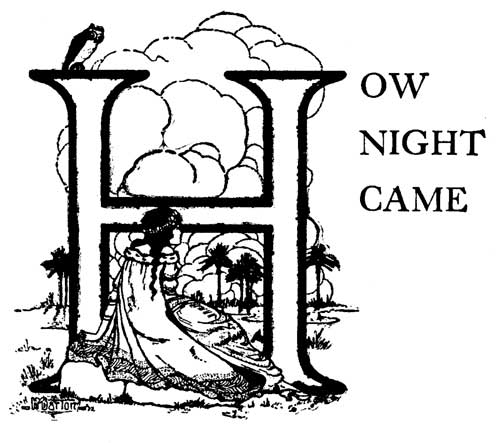

ears and years ago at the very beginning of time, when the world had just been made, there was no night. It was day all the time. No one had ever heard of sunrise or sunset, starlight or moonbeams. There were no night birds, nor night beasts, nor night flowers. There were no lengthening shadows, nor soft night air, heavy with perfume.
In those days the daughter of the Great Sea Serpent, who dwelt in the depths of the seas, married one of the sons of the great earth race known as Man. She left her home among the shades of the deep seas and came to dwell with her husband in the land of daylight. Her eyes grew weary of the bright sunlight and her beauty faded. Her husband watched her with sad eyes, but he did not know what to do to help her.
"O, if night would only come," she moaned as she tossed about wearily on her couch. "Here it is always day, but in my father's kingdom there are many shadows. O, for a little of the darkness of night!"
Her husband listened to her moanings. "What is night?" he asked her. "Tell me about it and perhaps I can get a little of it for you."
"Night," said the daughter of the Great Sea Serpent, "is the name we give to the heavy shadows which darken my father's kingdom in the depths of the seas. I love the sunlight of your earth land, but I grow very weary of it. If we could have only a little of the darkness of my father's kingdom to rest our eyes part of the time."
Her husband at once called his three most faithful slaves. "I am about to send you on a journey," he told them. "You are to go to the kingdom of the Great Sea Serpent who dwells in the depths of the seas and ask him to give you some of the darkness of night that his daughter may not die here amid the sunlight of our earth land."
The three slaves set forth for the kingdom of the Great Sea Serpent. After a long dangerous journey they arrived at his home in the depths of the seas and asked him to give them some of the shadows of night to carry back to the earth land. The Great Sea Serpent gave them a big bag full at once. It was securely fastened and the Great Sea Serpent warned them not to open it until they were once more in the presence of his daughter, their mistress.
The three slaves started out, bearing the big bag full of night upon their heads. Soon they heard strange sounds within the bag. It was the sound of the voices of all the night beasts, all the night birds, and all the night insects. If you have ever heard the night chorus from the jungles on the banks of the rivers you will know how it sounded. The three slaves had never heard sounds like those in all their lives. They were terribly frightened.
"Let us drop the bag full of night right here where we are and run away as fast as we can," said the first slave.
"We shall perish. We shall perish, anyway, whatever we do," cried the second slave.
"Whether we perish or not I am going to open the bag and see what makes all those terrible sounds," said the third slave.
Accordingly they laid the bag on the ground and opened it. Out rushed all the night beasts and all the night birds and all the night insects and out rushed the great black cloud of night. The slaves were more frightened than ever at the darkness and escaped to the jungle.
The daughter of the Great Sea Serpent was waiting anxiously for the return of the slaves with the bag full of night. Ever since they had started out on their journey she had looked for their return, shading her eyes with her hand and gazing away off at the horizon, hoping with all her heart that they would hasten to bring the night. In that position she was standing under a royal palm tree, when the three slaves opened the bag and let night escape. "Night comes. Night comes at last," she cried, as she saw the clouds of night upon the horizon. Then she closed her eyes and went to sleep there under the royal palm tree.
When she awoke she felt greatly refreshed. She was once more the happy princess who had left her father's kingdom in the depths of the great seas to come to the earth land. She was now ready to see the day again. She looked up at the bright star shining above the royal palm tree and said, "O, bright beautiful star, henceforth you shall be called the morning star and you shall herald the approach of day. You shall reign queen of the sky at this hour."
Then she called all the birds about her and said to them, "O, wonderful, sweet singing birds, henceforth I command you to sing your sweetest songs at this hour to herald the approach of day." The cock was standing by her side. "You," she said to him, "shall be appointed the watchman of the night. Your voice shall mark the watches of the night and shall warn the others that the madrugada comes." To this very day in Brazil we call the early morning the madrugada. The cock announces its approach to the waiting birds. The birds sing their sweetest songs at that hour and the morning star reigns in the sky as queen of the madrugada.
When it was daylight again the three slaves crept home through the forests and jungles with their empty bag.
"O, faithless slaves," said their master, "why did you not obey the voice of the Great Sea Serpent and open the bag only in the presence of his daughter, your mistress? Because of your disobedience I shall change you into monkeys. Henceforth you shall live in the trees. Your lips shall always bear the mark of the sealing wax which sealed the bag full of night."
To this very day one sees the mark upon the monkeys' lips, where they bit off the wax which sealed the bag; and in Brazil night leaps out quickly upon the earth just as it leapt quickly out of the bag in those days at the beginning of time. And all the night beasts and night birds and night insects give a sunset chorus in the jungles at nightfall.
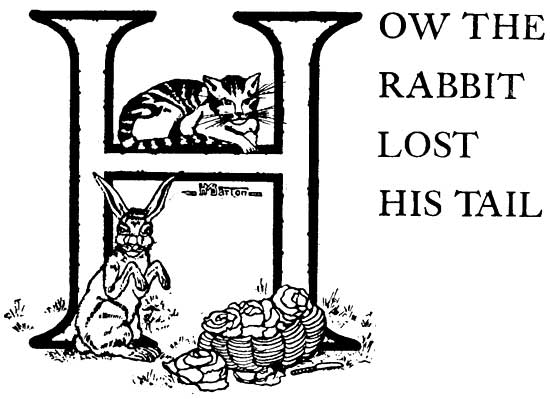

nce upon a time, ages and ages ago, the rabbit had a long tail, but the cat had none. She looked with envious eyes at the one which the rabbit had. It was exactly the sort of a tail she longed to have.
The rabbit was always a thoughtless careless little beast. One day he went to sleep with his beautiful long tail hanging straight out behind him. Along came Mistress Puss carrying a sharp knife, and with one blow she cut off Mr. Rabbit's tail. Mistress Puss was very spry and she had the tail nearly sewed on to her own body before Mr. Rabbit saw what she was doing.
"Don't you think it looks better on me than it did on you?" asked Mistress Puss.
"It surely is very becoming to you," replied the generous unselfish rabbit. "It was a little too long for me anyway and I'll tell you what I'll do. I'll let you keep it if you will give me that sharp knife in exchange for it."
The cat gave Mr. Rabbit the knife and he started out into the deep forest with it. "I've lost my tail but I've gained a knife," said he; "I'll get a new tail or something else just as good."
Mr. Rabbit hopped along through the forest for a long time and at last he came to a little old man who was busily engaged in making baskets. He was making the baskets out of rushes and he was biting them off with his teeth. He looked up and spied Mr. Rabbit with the knife in his mouth.
"O, please, Mr. Rabbit," said he, "will you not be so kind as to let me borrow that sharp knife you are carrying? It is very hard work to bite the rushes off with my teeth."
Mr. Rabbit let him take the knife. He started to cut off the rushes with it, when snap went the knife! It broke into halves.
"O, dear! O, dear!" cried Mr. Rabbit. "What shall I do! What shall I do! You have broken my nice new knife."
The little old man said that he was very sorry and that he did not mean to do it.
Then Mr. Rabbit said, "A broken knife is of no use to me but perhaps you can use it, even if it is broken. I'll tell you what I'll do. I'll let you keep the knife if you will give me one of your baskets in exchange for it."
The little old man gave Mr. Rabbit a basket and he started on through the deep forest with it. "I lost my tail but I gained a knife. I've lost my knife but I've gained a basket," said he. "I'll get a new tail or something else just as good."
Mr. Rabbit hopped along through the deep forest for a long time until at last he came to a clearing. Here there was an old woman busily engaged in picking lettuce. When she had gathered it she put it into her apron. She looked up and spied Mr. Rabbit hopping along with his basket.
"O, please, Mr. Rabbit," said she, "will you not be so kind as to let me borrow that nice basket you are carrying?"
Mr. Rabbit let her take the basket. She began to put her lettuce into it when out fell the bottom of the basket.
"O, dear! O, dear!" cried Mr. Rabbit. "What shall I do! What shall I do! You have broken the bottom out of my nice new basket."
The old woman said that she was very sorry and that she did not mean to do it.
Then said Mr. Rabbit, "I'll tell you what I'll do. I'll let you keep that broken basket if you will give me some of your lettuce."
The old woman gave Mr. Rabbit some lettuce and he hopped along with it, saying, "I lost my tail but I gained a knife. I lost my knife but I gained a basket. I lost my basket but I gained some lettuce."
The rabbit was getting very hungry and how nice the lettuce smelled! He took a bite. It was just the very best thing he had ever tasted in all his life. "I don't care if I did lose my tail," said he, "I've found something I like very much better."
From that day to this no rabbit has ever had a tail. Neither has there ever been a rabbit who cared because he had no tail. From that time to this there has never been a rabbit who did not like lettuce to eat and who was not perfectly happy and contented if there was plenty of it.
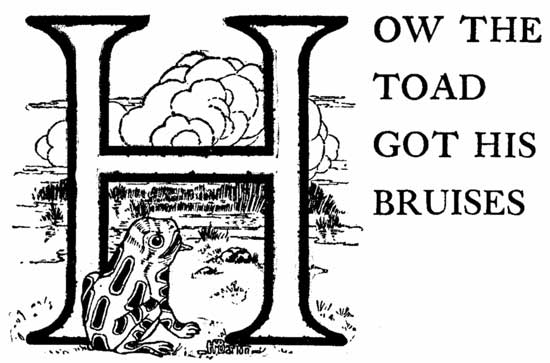
nce upon a time, ages and ages ago, the toad had a smooth skin. In those days he was a great gad about. He never could be found in his own house. If any one had a party he was sure to go, no matter how far away from home it was held, or how long it took to get there.
One day the toad received an invitation to attend a party in the sky. "You never can get to this party," said his friend, the armadillo. "You know how slowly you travel here upon earth."
"Wait and see whether or not I go to the party," said the toad.
Not far from the toad's house there lived a big black buzzard. No one liked the buzzard. He was very unpopular with all the birds and beasts. The toad hopped over to the buzzard's house. The buzzard was outside the door making music on his violin.
"Good morning, Friend Buzzard," said the toad. "Are you going to attend the party in the sky?"
The buzzard replied that he was planning to go.
"That is good," said the toad. "May I have the pleasure of your company for the trip?"
The buzzard was delighted to have the toad seek his company. It was a new experience.
"I'll be charmed to go to the party with you," replied the buzzard. "What time shall we start?"
"We'll start at four o'clock," said the toad. "Come to my house and we'll go on from there. Be sure to bring your violin with you."
Promptly at four o'clock the buzzard arrived at the toad's house. He had his violin with him, of course, because the toad had asked him to bring it.
"I'm not quite ready to go," the toad called out. "Just leave your violin there by the door and step inside. It will take me only a minute to finish my toilet."
The buzzard laid his violin carefully outside the door and went inside the toad's house. The toad jumped through the window and hid himself inside the violin.
The buzzard waited and waited for the toad to get ready but he did not hear a word from the toad. Finally he got tired of waiting. He picked up his violin and started.
When he arrived at the party he was a trifle late but he explained how he had waited for the toad.
"How foolish to wait a minute for the toad," said his hosts. "How could the toad ever get to a party in the sky? We just asked him as a joke because he is such a great gad about. Lay down your violin and come to the feast."
The buzzard laid down his violin. As soon as there was no one looking, out hopped the toad. He was laughing from ear to ear. "So they thought I would not come to the party! What a joke! How surprised they will be to see me here!" he said.
There was nobody at the feast who was as gay as the toad. When the buzzard asked how he arrived he said: "I'll tell you some other day." Then he went on eating and dancing.
The buzzard did not have a very good time at the party. He decided that he would go home early. He went away without saying good-bye to his hosts and without taking his violin with him.
At the end of the party the toad hopped inside the violin and waited and waited for the buzzard to take him home. Nobody picked up the violin and the toad began to be very much worried. He almost wished he had not come.
After a while the falcon noticed the violin. "That violin belongs to the buzzard. He must have forgotten to take it home. I'll carry it back for him," he said.
The falcon flew towards earth with the violin. The toad shook about terribly inside of the violin. He got very tired. The falcon got tired, too.
"I'm not going to carry this heavy old violin of the buzzard's another minute," said the falcon. "I was foolish to offer to carry it in the first place. The buzzard is no friend of mine."
He let the violin fall. Down, down toward earth it fell.
"O, little stones, O, little stones, get out of my way," called the toad as he fell. The little stones had deaf ears. They did not get out of the way.
When the toad crawled out of the wrecked violin he was so covered with bruises that he could hardly hop home.
The buzzard never knew what became of his violin or why the toad had lost his good looks. To this very day the toad shows his bruises. And he is entirely cured of being a gad about.
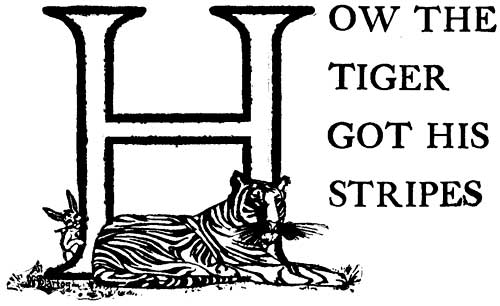
nce upon a time, ages and ages ago, so long ago that the tiger had no stripes upon his back and the rabbit still had his tail, there was a tiger who had a farm. The farm was very much overgrown with underbrush and the owner sought a workman to clear the ground for him to plant.
The tiger called all the beasts together and said to them when they had assembled, "I need a good workman at once to clear my farm of the underbrush. To the one of you who will do this work I offer an ox in payment."
The monkey was the first one to step forward and apply for the position. The tiger tried him for a little while but he was not a good workman at all. He did not work steadily enough to accomplish anything. The tiger discharged him very soon and he did not pay him.
Then the tiger hired the goat to do the work. The goat worked faithfully enough but he did not have the brains to do the work well. He would clear a little of the farm in one place and then he would go away and work on another part of it. He never finished anything neatly. The tiger discharged him very soon without paying him.
Next the tiger tried the armadillo. The armadillo was very strong and he did the work well. The trouble with him was that he had such an appetite. There were a great many ants about the place and the armadillo could never pass by a sweet tender juicy ant without stopping to eat it. It was lunch time all day long with him. The tiger discharged him and sent him away without paying him anything.
At last the rabbit applied for the position. The tiger laughed at him and said, "Why, little rabbit, you are too small to do the work. The monkey, the goat, and the armadillo have all failed to give satisfaction. Of course a little beast like you will fail too."
However, there were no other beasts who applied for the position so the tiger sent for the rabbit and told him that he would try him for a little while.
The rabbit worked faithfully and well, and soon he had cleared a large portion of the ground. The next day he worked just as well. The tiger thought that he had been very lucky to hire the rabbit. He got tired staying around to watch the rabbit work. The rabbit seemed to know just how to do the work anyway, without orders, so the tiger decided to go away on a hunting trip. He left his son to watch the rabbit.
After the tiger had gone away the rabbit said to the tiger's son, "The ox which your father is going to give me is marked with a white spot on his left ear and another on his right side, isn't he?"
"O, no," replied the tiger's son. "He is red all over with just a tiny white spot on his right ear."
The rabbit worked for a while longer and then he said, "The ox which your father is going to give me is kept by the river, isn't he?"
"Yes," replied the tiger's son.
The rabbit had made a plan to go and get the ox without waiting to finish his work. Just as he started off he saw the tiger returning. The tiger noticed that the rabbit had not worked so well when he was away. After that he stayed and watched the rabbit until the whole farm was cleared. Then the tiger gave the rabbit the ox as he had promised.
"You must kill this ox," he said to the rabbit, "in a place where there are neither flies nor mosquitoes."
The rabbit went away with the ox. After he had gone for some distance he thought he would kill him. He heard a cock, however, crowing in the distance and he knew that there must be a farm yard near. There would be flies of course. He went on farther and again he thought that he would kill the ox. The ground looked moist and damp and so did the leaves on the bushes. Since the rabbit thought there would be mosquitoes there he decided not to kill the ox. He went on and on and finally he came to a high place where there was a strong breeze blowing. "There are no mosquitoes here," he said to himself. "The place is so far removed from any habitation that there are no flies, either." He decided to kill the ox.
Just as he was ready to eat the ox, along came the tiger. "O, rabbit, you have been such a good friend of mine," said the tiger, "and now I am so very, very hungry that all my ribs show, as you yourself can see. Will you not be a good kind rabbit and give me a piece of your ox?"
The rabbit gave the tiger a piece of the ox. The tiger devoured it in the twinkling of an eye. Then he leaned back and said, "Is that all you are going to give me to eat?"
The tiger looked so big and savage that the rabbit did not dare refuse to give him any more of the ox. The tiger ate and ate and ate until he had devoured that entire ox. The rabbit had been able to get only a tiny morsel of it. He was very, very angry at the tiger.
One day not long after the rabbit went to a place not far from the tiger's house and began cutting down big staves of wood. The tiger soon happened along and asked him what he was doing.
"I'm getting ready to build a stockade around myself," replied the rabbit. "Haven't you heard the orders?" The tiger said that he hadn't heard any orders.
"That is very strange," said the rabbit. "The order has gone forth that every beast shall fortify himself by building a stockade around himself. All the beasts are doing it."
The tiger became very much alarmed. "O, dear! O, dear! What shall I do," he cried. "I don't know how to build a stockade. I never could do it in the world. O, good rabbit! O, kind rabbit! You are such, a very good friend of mine. Couldn't you, as a great favour, because of our long friendship, build a stockade about me before you build one around yourself?"
The rabbit replied that he could not think of risking his own life by building the tiger's fortifications first. Finally, however, he consented to do it.
The rabbit cut down great quantities of long sharp sticks. He set them firmly in the ground about the tiger. He fastened others securely over the top until the tiger was completely shut in by strong bars. Then he went away and left the tiger.
The tiger waited and waited for something to happen to show him the need of the fortifications. Nothing at all happened.
He got very hungry and thirsty. After a while the monkey passed that way.
The tiger called out, "O, monkey, has the danger passed?"
The monkey did not know what danger the tiger meant, but he replied, "Yes."
Then the tiger said, "O, monkey, O, good, kind monkey, will you not please be so kind as to help me out of my stockade?"
"Let the one who got you in there help you out," replied the monkey and he went on his way.
Along came the goat and the tiger called out, "O, goat, has the danger passed?"
The goat did not know anything about any danger, but he replied, "Yes."
Then the tiger said, "O, goat, O, good kind goat, please be so kind as to help me out of my stockade."
"Let the one who got you in there help you out," replied the goat as he went on his way.
Along came the armadillo and the tiger called out, "O, armadillo, has the danger passed?"
The armadillo had not heard of any danger, but he replied that it had passed.
Then the tiger said, "O, armadillo, O, good, kind armadillo, you have always been such a good friend and neighbour. Please help me now to get out of my stockade."
"Let the one who got you in there help you out," replied the armadillo as he went on his way.
The tiger jumped and jumped with all his force at the top of the stockade, but he could not break through. He jumped and jumped with all his might at the front side of the stockade, but he could not break through. He thought that never in the world would he be able to break out. He rested for a little while and as he rested he thought. He thought how bright the sun was shining outside. He thought what good hunting there was in the jungle. He thought how cool the water was at the spring. Once more he jumped and jumped with all his might at the back side of the stockade. At last he broke through. He did not get through, however, without getting bad cuts on both his sides from the sharp edges of the staves. Until this day the tiger has stripes on both his sides.
nce upon a time there was a little lamb frisking gaily about the pasture. The bright sunshine and the soft breezes made him very happy. He had just finished a hearty meal and that made him happy too. He was the very happiest little lamb in all the world and he thought that he was the most wonderful little lamb.
A big toad sat on the ground and watched him. After a while the toad said: "O, little lamb, how are you feeling today?"
The lamb replied that he had never felt better in all his life.
"Even though you are feeling very strong I can pull you into the sea," said the toad.
The little lamb laughed and laughed until he rolled over on the ground.
"Just take hold of this rope and I'll show you how easy it is to pull you into the sea," said the toad.
The lamb took hold of the rope. Then the toad said, "Please wait a minute while I get a good long distance away from you. I can pull better when I'm not too near you."
The lamb waited and the toad hopped down to the sea. He hopped up into a tree which hung over the water's edge and from there he hopped on to the whale's back. He fastened the end of the rope around the whale and then he called out to the lamb: "All ready. Now we'll see how hard you can pull."
When the whale felt the lamb pulling at the rope he swam away from the shore. No matter how hard the lamb pulled or how much force he exerted it did not do one bit of good. He was dragged down to the water's edge as easily as could be.
"I give up," said the lamb as he reached the water's edge.
After that, although the sunshine was just as bright as ever, any one who watched that little lamb could see that he was a little more meek.
One day not long afterwards the sunshine was again very bright and the little lamb was again feeling frisky. He was so happy and gay that he had forgotten all about how the toad had pulled him down to the water until the toad spoke to him. Then he remembered.
"O, little lamb, how are you feeling today?" asked the toad. The little lamb replied that he was very well.
"Let us run a race," said the toad, "I think I can beat you."
"You may be strong enough to pull me into the sea," said the lamb, "but surely I can run faster than you. I've watched you hopping about my pasture. You can't run fast at all. However, I'll gladly run a race with you to prove what I say."
The toad set a goal and told the lamb to call out every little while during the race so he could see how much farther ahead the lamb was. Then the toad and the lamb started.
The toad had assembled all his brothers and his sisters and his cousins and his uncles and his aunts before the race and had stationed them at various points along the path of the race. He had told them that whenever any of them should hear the lamb calling out, "Laculay, laculay, laculay," the toad which was nearest should answer, "Gulugubango, bango lay."
The lamb ran and ran as fast as he could. Then he remembered his promise and called out, "Laculay, laculay, laculay." He expected to hear the toad answer from a long, long distance behind him. He was much surprised to hear some one near him answer, "Gulugubango, bango lay." After that he ran faster than ever.
After running on for some distance farther the lamb again called out, "Laculay, laculay, laculay." Again he heard the answer at only a short distance away, "Gulugubango, bango lay." He ran and ran until his little heart was beating so fast that it seemed as if it would burst. At last he arrived at the goal of the race which the toad had set and there sat the toad's brother who looked so much like him that the lamb couldn't tell them apart. The lamb went back to his pasture very meekly and quietly. He acknowledged that he had been beaten in the race.
The next morning the toad said to him, "Even though you did not run fast enough to win the race, still you are a very fast runner. I have told the daughter of the king about you and I have said to her that some day she shall see me riding on your back with a bridle in your mouth as if you were my horse."
The lamb was very angry. "Perhaps you are strong enough to pull me into the sea, and perhaps you can beat me when we run a race," said the lamb, "but never, never in the world will I be your horse."
Time passed and the sunshine was very bright and the soft, gentle breezes were very sweet. The lamb was so happy again that he forgot all about how the toad had pulled him into the sea, and how the toad had beaten him at running the race. He was very sorry for the toad when he saw him all humped up in a disconsolate little heap one day. "O, poor toad, are you sick?" he asked. "Isn't there something I can do to help you?"
The toad told him how very sick he was. "There is something you could do to help me," he said, "but I don't believe that you are quite strong enough or can travel quite fast enough."
The lamb took a deep breath and blew out his chest. "I'll show you," he said. "Just tell me what it is."
The toad replied that he had promised to be at a party that afternoon at the house of the king's daughter and he did not see how he could possibly get there unless some one would carry him.
"Jump on my back," said the lamb. "I'll carry you."
The toad shook about on the lamb's back after they had started so that it seemed as if he would surely fall off. After a little he said, "I can not possibly stand riding like this. It jars all my sore spots. I'll have to get off." He tried it a little while longer and shook about worse than ever. Then he said, "Do you know, I think I could endure this painful ride a little better if only I had something to hold myself by? Do you mind if I take a piece of grass and put it in your mouth? I can hold on to that when I shake about and my sore spots will not hurt so much."
The lamb let the toad put a piece of grass in his mouth.
After a while the toad asked for a little stick. "The flies and mosquitoes annoy me terribly," he said. "If only I had a little stick I could wave it about over my head and frighten them away. It is very bad for any one in my weak, nervous condition to be bothered by flies and mosquitoes." The lamb let the toad have a little stick to wave over his head.
At last the lamb and the toad drew near to the palace of the king. The king's daughter was leaning out of the window watching for them. The toad dug his feet into the lamb's sides, pulled hard on the piece of the grass in the lamb's mouth and waved the little stick about over the lamb's head. "Go on, horse," he said and the king's daughter heard him. She laughed and laughed, and when all the rest of the people in the palace saw the toad arriving mounted on the lamb's back and driving him like a horse they laughed too. The lamb went meekly home to his pasture and from that day to this when one wishes to speak of meekness one says "as meek as a lamb."
nce upon a time there was a large handsome stag with great branching horns. One day he said to himself, "I am tired of having no home of my own, and of just living anywhere. I shall build me a house." He searched on every hill, in every valley, by every stream, and under all the trees for a suitable place. At last he found one that was just right. It was not too high, nor too low, not too near a stream and not too far away from one, not under too thick trees and not away from the trees out under the hot sun. "I am going to build my house here," he said, and he began to clear a place for it at once. He worked all day and did not go away until night.
Now in that same country there lived a large handsome tiger, with sharp, sharp teeth and bright, cruel eyes. One day the tiger said to himself, "I am tired of having no home of my own,—of just living around anywhere! I shall build me a house." Accordingly the tiger searched for a place to build his house. He searched on every hill, in every valley, by every stream, and under all the trees. At last he found a place which was just right. It was not too high nor too low, not too near a stream and not too far away from one, not under too thick trees and yet not away from the trees out in the hot sun. The tiger said to himself, "I am going to build my house here. The place is all ready for me for there isn't very much underbrush here." He began at once and finished clearing the place. Then it became daylight and he went away.
At daylight the stag came back to do more work on his new house. "H'm," he said when he looked at the clearing. "Somebody is helping me. The place is cleared and ready for me to build the foundation."
He began to work at once and worked all day. At night when the foundation was laid, he went away.
At night the tiger came to work at his new house. "H'm," he said when he looked at it. "Somebody is helping me. The foundations of my house are all laid." He began to work at once and built the sides of the house. He worked all night and went away at daybreak, leaving the house with the sides completed. There was a big door and a funny little window in the side.
At daybreak the stag came back to work on his house. When he saw it he rubbed his eyes for he thought that he must be dreaming. The sides of the house were completed with a big door and a funny little window. "Somebody must surely be helping me," he said to himself as he began to work to put on the roof. He worked hard all day and when the sun went down, there was a roof of dried grass on the house. "I can sleep in my own house to-night," he said. He made his bed in the corner and soon was sound asleep.
At night the tiger came back to work on his new house. When he saw it he rubbed his eyes for he thought that he must be dreaming. There was a roof of dried grass on the house.
"Somebody must surely be helping me," he said to himself as he entered the door. The first thing he saw when he entered the door was the stag sound asleep in his bed in the corner. "Who are you and what are you doing in my house?" he said in his deepest voice.
The stag woke up with a start. "Who are you and what are you doing in my house?" said the stag in his deepest voice.
"It is not your house. It is mine. I built it myself," said the tiger.
"It is my house," said the stag. "I built it myself."
"I made the clearing for the house," said the tiger, "I built the sides and made the door and window."
"I started the clearing," said the stag. "I laid the foundations and put on the roof of dried grass."
The stag and the tiger quarrelled all night about whose house it was. At daybreak they decided that they would live together there.
The next night the tiger said to the stag, "I'm going hunting. Get the water and have the wood ready for the fire. I shall be almost famished when I return."
The stag got the wood and water ready. After a while the tiger came back. He brought home for dinner a great handsome stag. The stag had no appetite at all and he didn't sleep a wink that night.
The next day the stag said that he was going hunting. He told the tiger to have the wood and water ready when he got back. The tiger got the wood and water ready. By and by the stag came back bringing with him the body of a great tiger.
"I am nearly famished," said the stag. "Let's have dinner right away." The tiger hadn't any appetite at all and he could not eat a mouthful.
That night neither the tiger nor the stag could sleep a wink. The tiger was afraid the stag would kill him if he shut his eyes for a minute, and the stag was afraid the tiger would kill him if he slept or even pretended to be asleep. Accordingly he kept wide awake too.
Toward morning the stag got very cramped from keeping in one position so long. He moved his head slightly. In doing this his horns struck against the roof of the house. It made a terrible noise. The tiger thought that the stag was about to spring upon him and kill him. He made a leap for the door and ran out of it as fast as he could. He ran and ran until he was far, far away from the house with the roof of dried grass.
The stag thought that the tiger was about to spring upon him and kill him. He, too, made a leap for the door and ran and ran until he was far, far away from the house with the roof of dried grass. The tiger and the stag are still running away from each other until this very day.
The house with the roof of dried grass waited and waited there in the place which was neither too high nor too low, too near the river nor too far away, not under too thick trees nor out in the hot sun. It waited and waited until it go so tired it fell down in a heap.
nce upon a time, ages and ages ago, there was a little white hen. One day she was busily engaged in scratching the soil to find worms and insects for her breakfast. As she worked she sang over and over again her little crooning song, "Quirrichi, quirrichi, quirrichi." Suddenly she noticed a tiny piece of paper lying on the ground. "Quirrichi, quirrichi, what luck!" she said to herself. "This must be a letter. One time when the king, the great ruler of our country, held his court in the meadow close by, many people brought him letters and laid them at his feet. Now I, too, even I, the little white hen, have a letter. I am going to carry my letter to the king."
The next morning the little white hen started bravely out on her long journey. She carried the letter very carefully in her little brown basket. It was a long distance to the royal palace where the king lived. The little white hen had never been so far from home in all her life.
After a while she met a friendly fox. Foxes and little white hens are not usually very good friends, you know, but this fox was a friend of the little white hen. Once upon a time she had helped the fox to escape from a trap and the fox had never forgotten her kindness to him.
"O, little white hen, where are you going?" asked the fox.
"Quirrichi, quirrichi," replied the little white hen, "I am going to the royal palace to carry a letter to the king."
"Indeed, little white hen," said the fox, "I should like to go with you. Give me your permission to accompany you on your journey."
"I shall be glad to have you go with me," said the little white hen. "It is a very long journey to the royal palace where the king lives. Wouldn't you like me to carry you in my little brown basket?"
The fox climbed into the little brown basket. After the little white hen had gone on for some distance farther she met a river. Once upon a time the little white hen had done the river a kindness. He had, with great difficulty, thrown some ugly worms upon the bank and he was afraid they would crawl back in again. The little white hen had eaten them for him. Always after that the river had been her friend.
"O, little white hen, where are you going?" the river called out as soon as he saw her.
"Quirrichi, quirrichi, I am going to the royal palace to carry a letter to the king," replied the little white hen.
"O, little white hen, may I go with you?" asked the river.
The little white hen told the river that he might go with her and asked him to ride in the little brown basket. So the river climbed into the little brown basket.
After the little white hen had journeyed along for a time she came to a fire. Once upon a time, when the fire had been dying the little white hen had brought some dried grass. The grass had given the fire new life and always after that he had been the friend of the little white hen.
"O, little white hen, where are you going?" the fire asked.
"Quirrichi, quirrichi, I am going to the royal palace to carry a letter to the king," replied the little white hen.
"O, little white hen, may I go with you?" asked the fire. "I have never been to the royal palace and I have never had even a peep at the king."
The little white hen told the fire that he might go with her and asked him to climb into the little brown basket. By this time the little brown basket was so full, that, try as they might, they couldn't make room for the fire. At last they thought of a plan. The fire changed himself into ashes and then there was room for him to get into the basket.
The little white hen journeyed on and on, and finally she arrived at the royal palace.
"Who are you and what are you carrying in your little brown basket?" asked the royal doorkeeper when he opened the door.
"I am the little white hen and I am carrying a letter to the king," replied the little white hen. She didn't say a word about the fox and the river and the fire which she had in her little brown basket. She was so frightened before the great royal doorkeeper of the palace that she could hardly find her voice at all.
The royal doorkeeper invited the little white hen to enter the palace and he led her to the royal throne where the king was sitting. The little white hen bowed very low before the king—so low, in fact, that it mussed up all her feathers.
"Who are you and what is your business?" asked the king in his big, deep, kingly voice.
"Quirrichi, quirrichi, I am the little white hen," replied the little white hen in her low, frightened, little voice. "I have come to bring my letter to your royal majesty." She handed the king the piece of paper which had remained all this time at the bottom of the little brown basket. There were marks of dirt upon it where the friendly fox's feet had rested. It was damp where the river had lain. It had tiny holes in it where the fire had sat after he had turned himself into hot ashes.
"What do you mean by bringing me this dirty piece of paper?" shouted the king in his biggest, deepest, gruffest voice. "I am highly offended. I always knew that hens were stupid little creatures but you are quite the stupidest little hen I ever saw in all my life."
"Here," and he turned to one of the attendants standing by the throne, "take this stupid, little white hen and throw her out into the royal poultry yard. I think we will have her for dinner to-morrow."
The little white hen was roughly seized by the tallest royal attendant and carried down the back stairs, through the back gate, out into the royal poultry yard. She still clung to the little brown basket which she had brought with her on her long journey to the royal palace and through all the sad experiences she had met there.
When the little white hen reached the royal poultry yard all the royal fowls flew at her. Some plucked at her rumpled white feathers. Others tried to pick out her eyes. One pulled off the cover of the little brown basket.
Out sprang the fox from the little brown basket and in the twinkling of an eye he fell upon the fowls of the royal poultry yard. Not a single fowl was left alive.
There was such a great commotion that the king, the queen, the royal attendants and all the royal servants of the palace came rushing out to see what was the matter. The fox had already taken to his heels and the little white hen lost no time in running away too. She did not, however, forget to take her little brown basket with her.
The royal household all ran after her in swift pursuit. They had almost caught her when the river suddenly sprang out of the little brown basket and flowed between the little white hen and her royal pursuers. They couldn't get across without canoes.
While they were getting the canoes and climbing into them the little white hen had time to run a long way. She had almost reached a thick forest where she could easily hide herself when the royal pursuers again drew near. Then the fire which had changed itself into hot ashes jumped out of the little brown basket. It immediately became dark, so dark that the royal household could not even see each other's faces and, of course, they could not see in which direction the little white hen was running. There was nothing for them to do but to return to the royal palace and live on beef and mutton.
The fire which had turned itself into ashes sprang out of the little brown basket so suddenly that it scattered ashes all over the little white hen. From that day she was always speckled where the ashes fell upon her. The chickens of the little white hen (who was now a little speckled hen) were all speckled too. So were their chickens and their chickens and their chickens' chickens, even down to this very day. Whenever you see a speckled hen you may know that she is descended from the little white hen who carried a letter to the king, and who, in her adventures, became the first speckled hen.
nce upon a time there was a beautiful garden in which grew all sorts of fruits. Many beasts lived in the garden and they were permitted to eat of the fruits whenever they wished. But they were asked to observe one rule. They must make a low, polite bow to the fruit tree, call it by its name, and say, "Please give me a taste of your fruit." They had to be very careful to remember the tree's correct name and not to forget to say "please." It was also very important that they should remember not to be greedy. They must always leave plenty of fruit for the other beasts who might pass that way, and plenty to adorn the tree itself and to furnish seed so that other trees might grow. If they wished to eat figs they had to say, "O, fig tree, O, fig tree, please give me a taste of your fruit;" or, if they wished to eat oranges they had to say, "O, orange tree, O, orange tree, please give me a taste of your fruit."
In one corner of the garden grew the most splendid tree of all. It was tall and beautiful and the rosy-cheeked fruit upon its wide spreading branches looked wonderfully tempting. No beast had ever tasted of that fruit, for no beast could ever remember its name.
In a tiny house near the edge of the garden dwelt a little old woman who knew the names of all the fruit trees which grew in the garden. The beasts often went to her and asked the name of the wonderful fruit tree, but the tree was so far distant from the tiny house of the little old woman that no beast could ever remember the long, hard name by the time he reached the fruit tree.
At last the monkey thought of a trick. Perhaps you do not know it, but the monkey can play the guitar. He always played when the beasts gathered together in the garden to dance. The monkey went to the tiny house of the little old woman, carrying his guitar under his arm. When she told him the long hard name of the wonderful fruit tree he made up a little tune to it, all his own, and sang it over and over again all the way from the tiny house of the little old woman to the corner of the garden where the wonderful fruit tree grew. When any of the other beasts met him and asked him what new song he was singing to his guitar, he said never a word. He marched straight on, playing his little tune over and over again on his guitar and singing softly the long hard name.
At last he reached the corner of the garden where the wonderful fruit tree grew. He had never seen it look so beautiful. The rosy-cheeked fruit glowed in the bright sunlight. The monkey could hardly wait to make his bow, say the long hard name over twice and ask for the fruit with a "please." What a beautiful colour and what a delicious odour that fruit had! The monkey had never in all his life been so near to anything which smelled so good. He took a big bite. What a face he made! That beautiful sweet smelling fruit was bitter and sour, and it had a nasty taste. He threw it away from him as far as he could.
The monkey never forgot the tree's long hard name and the little tune he had sung. Nor did he forget how the fruit tasted. He never took a bite of it again; but, after that, his favourite trick was to treat the other beasts to the wonderful fruit just to see them make faces when they tasted it.
nce upon a time the tiger sent an invitation to the goat asking the goat to accompany him on a visit. The goat promptly accepted the invitation and at the appointed day they started on their journey to the house of the tiger's friend. On the way there they came to a dangerous marsh. The tiger was afraid to cross it, but he pretended to be very brave. He said to the goat: "Friend Goat, how very pale you look when you think about crossing the marsh. Don't be afraid. Just go ahead."
The goat assured the tiger that he was no coward. He thrust out his chest and marched along toward the marsh like a brave soldier. As soon, however, as he stepped into the marsh, he fell into the mud and barely got through it alive. The tiger went around the marsh and walked on dry ground.
After the tiger and the goat had come together again they came to some banana trees. The tiger said to the goat: "Friend Goat, aren't you hungry? Let us stop here and eat some bananas. You climb up and pluck the bananas. Give me the ripe ones, and keep the green ones yourself." The goat climbed up and picked the bananas. He gave the ripe ones to the tiger and the tiger had a good meal. The goat went hungry.
The tiger and the goat walked along and after going for some distance they saw a cobra lying in the path. "Friend Goat," said the tiger, "here you have the opportunity to procure a beautiful necklace for your daughter, free of cost. Just pick it up and it is yours." The goat started forward to pick up the snake, but the tiger told him to let it alone if he did not want to be killed.
When the tiger and the goat arrived at the house of the tiger's friend it was very late. They soon went to bed in hammocks hung close together. At midnight the tiger rose quietly, walked on tip toe to the door, opened it, and went out. He hurried to the place where the sheep were kept, killed the fattest lamb of the flock, and had a feast. Then he went back to the hammock, wiped the blood on the goat, and went to sleep.
Early the next morning the host discovered that one of his lambs was missing. He hastened to the room where the tiger and the goat were sleeping and accused the tiger of having killed the lamb. The tiger looked up at him with an innocent expression and asked, "Do you see any blood on me?" There was no blood on the tiger, but the host looked into the next hammock and saw the goat all covered with blood. "I know now who killed my fattest lamb," he said, and he gave the goat such a beating that the poor goat barely escaped with his life. From that day to this when one speaks of a person who has been easily imposed upon he calls him "the goat."
Things happened very differently with the monkey. One day not long afterward the tiger invited the monkey to accompany him when he went to visit his friend. The monkey accepted, and the tiger and the monkey set out on the journey. When they came to the marsh the tiger said to the monkey, "Friend Monkey, how very pale you look when you think about crossing the marsh. Don't be afraid. Just go ahead."
"You go ahead yourself," replied the monkey. The tiger went through the marsh and fell into the mud so that he was barely able to get out again. The monkey went around the marsh and walked on dry ground.
After a while the tiger and the monkey came to the banana trees. "Friend Monkey," said the tiger, "aren't you hungry? Let us stop here and eat some bananas. You climb up and pluck the bananas. Give the ripe ones to me and you may keep the green ones for yourself." The monkey climbed up and picked the bananas but he ate all the ripe ones himself and threw the green ones down to the tiger. The tiger was forced to go hungry but the monkey had a good meal.
Finally the tiger and the monkey came to a cobra lying in the path. "Friend Monkey," said the tiger, "here you have the opportunity to procure a beautiful necklace for your daughter, free of cost. Pick it up and it is yours."
"Pick it up yourself," replied the monkey.
When the tiger and the monkey arrived at the house of the tiger's friend it was very late. They went to bed in hammocks hung up close together. The monkey had seen enough of the tiger that day to make him decide that he had better sleep with one eye open. Accordingly he pretended he was asleep, but he was really awake. At midnight he saw the tiger crawl quietly out of his hammock, walk on tip toe to the door, open it gently, and go out. The monkey decided to watch and see what happened when the tiger came back.
The tiger went to the place where the sheep were kept, killed the fattest lamb of the flock and had a feast. When he came back he tried to wipe the lamb's blood on the monkey. The monkey saw him and gave him a push so that he spilled the blood all over himself and his own hammock. Not a single drop went on the monkey.
Early the next morning when the host missed one of his lambs he came to the room where his guests were sleeping. He saw the tiger all covered with blood and he cried, "O ho, I have at last caught the one who kills my lambs." Then he gave the tiger such a beating that he barely escaped with his life. It was all he could do to crawl home again.
nce upon a time the monkey made the tiger very angry. This is how it happened. The monkey was seated high up among the leafy branches of a mango tree playing upon his guitar. The tiger passed that way and lay down under the tree to rest. Just to tease him the monkey played and sang this little song:
The tiger was very angry. "Just wait until I catch you, Mr. Monkey," he said. "Then I'll show you a trick or two with bones."
The monkey leaped from one tree to another keeping himself so well hid by the foliage that the tiger could not see him. Then he came down out of the trees and hid himself in a hole in the ground. When the tiger came near he again played and sang his little song:
The tiger put his paw into the hole and caught the monkey's leg. "Oh, ho, Mr. Tiger!" said the monkey. "You think that you have caught my leg but what you really have is just a little stick. Oh, ho! Oh, ho!" Then the tiger let go of the monkey's leg.
The monkey crawled farther back into the hole in the ground where the tiger's paw could not reach him. Then he said: "Thank you so much, Mr. Tiger, for letting go of my leg. It really was my leg, you know." Again he played and sang his little song:
The tiger was angrier than ever. He waited and waited for the monkey to come out of the hole in the ground but the monkey did not come. He had discovered another way out and once more from the high tree tops he sang down to the waiting tiger:
There had been a great drought in the land and there was only one watering place where the beasts could drink. The tiger knew that the monkey would have to go there when he was thirsty so he decided to wait for him and catch him when he came to drink.
When the monkey went to the watering place to get a drink he found the tiger there waiting for him. He ran away as fast as the wind for he was really very much afraid of the tiger.
He waited and waited until he thought he should die of thirst, but the tiger did not go away from the watering place for a single minute. At last the monkey thought of a trick by which he would be able to get a drink.
He lay down by the side of the pathway as if he were dead. After a while an old woman came along the path carrying a dish of honey in a basket upon her head. She saw the monkey lying there by the path and, thinking that he was dead, she picked him up and put him into the basket with the dish of honey. When the monkey saw that it was honey in the dish he was very happy. He opened the dish and covered himself all over with the soft sticky honey. Then as the old woman walked under the trees he lightly sprang out of the basket into the trees. The old woman did not miss him until she got home and found only part of her dish of honey in the basket. "Why, I thought I had brought home a dead monkey in my basket," she said to her children. "Now there is no monkey here and my dish is only half full of honey. The monkey must have been playing one of his tricks."
The monkey had, in the meantime, stuck leaves from the trees into the honey all over his body so that he was completely disguised. His own mother would never have recognised him. He looked something like a porcupine; but instead of sharp quills there were green leaves sticking out all over him. In this fashion he went to the drinking place and the tiger did not recognise him. He took a long, deep drink. He was so thirsty and the water tasted so good that he stayed in the drinking place too long. The leaves came out of the honey which had held them and the tiger saw that it was really the monkey. The monkey was barely able to escape.
He was so badly frightened that he waited and waited a long, long time before he again went to the drinking place. At last he got so thirsty that he couldn't wait any longer. He went to the resin tree and covered himself with resin. Then he stuck leaves into the resin and again went to the drinking place.
The tiger saw him, but as the tiger expected to see the leaves come off just as soon as the monkey got into the water, he thought he would wait and catch him in his bare skin. This time the leaves did not come off, for the resin held them fast and was not in the least affected by the water. The tiger thought that it was not the monkey and that he must have made a mistake. The monkey drank all he wished and then strolled away leisurely without the tiger's attacking him. He used the resin and leaves every time he wanted a drink after that. He kept up the trick until the rainy season arrived and he could find plenty of water in other places than the big drinking place.
nce upon a time the monkey was hungry. He wanted to make some porridge, but he did not have any money to buy meal to make the porridge. So he went to the house of the hen to borrow some meal. The hen gave him some meal.
"Come to my house to-morrow at one o'clock," he said to the hen, "I'll pay back the meal then."
Then the monkey went to the house of the fox and said, "O, friend fox, please lend me some meal. Come to my house to-morrow at two o'clock and I'll pay you then." The fox gave him some meal.
Then the monkey went to the house of the dog and said, "O, friend dog, please lend me some meal. Come to my house to-morrow at three o'clock and I'll pay you back then." The dog gave him some meal.
Then the monkey went to the house of the tiger and said, "O, friend tiger, please lend me some meal. Come to my house to-morrow at four o'clock and I'll pay you back then." The tiger gave the monkey some meal.
The monkey went home and made a great pot of porridge. He feasted and feasted until he couldn't eat any more, but there was still plenty of porridge left in the pot. Then the monkey made his bed and took care to fix it high up from the floor.
The next day, at midday, he ate some more of the porridge. Then he bound a cloth about his head and went to bed pretending that he was sick.
At one o'clock the hen came and knocked at the door. The monkey in a low, weak voice asked her to enter. He told her how very sick he was and the hen was very sorry for him.
At two o'clock the fox came and knocked at the door. The hen was frightened almost to death. "Never mind," said the monkey, "you can hide here under my bed."
The hen hid under the monkey's bed and the monkey in a weak, low voice invited the fox to enter. The monkey told the fox how very ill he was and the fox was very sorry for him.
At three o'clock the dog came and knocked at the door. The fox was frightened almost to death. "Never mind," said the monkey; "hide here under my bed and everything will be all right."
The fox hid under the monkey's bed and the monkey, in a low, weak voice, invited the dog to enter. The monkey told the dog how very sick he was and the dog was very sorry for him.
At four the tiger came and knocked at the door. The dog was frightened almost to death. "Never mind," said the monkey. "Hide here under my bed and everything will be all right."
The dog hid under the monkey's bed. Then the monkey invited the tiger to enter. He told, the tiger how very sick he was but the tiger was not at all sorry for him. He sprang at the bed, demanding in a loud, fierce voice that the monkey pay back the meal at once, as he had promised to do. The monkey escaped to the tree tops, but the bed broke down under the tiger's weight.
Then the fox ate up the hen and the dog ate up the fox and the tiger ate up the dog. The tiger is still trying to catch the monkey.

erhaps you do not know it, but the monkeys think that all the bananas belong to them. When Brazilian children eat bananas they say, "I am a monkey." I once knew a little boy in Brazil who was very, very fond of bananas. He always said, "I am very much of a monkey." If you are fond of bananas the Brazilian children would tell you that you are a monkey, too. This is the story they tell to show us how it all came about.
Once upon a time when the world had just been made and there was only one kind of banana, but very many kinds of monkeys, there was a little old woman who had a big garden full of banana trees. It was very difficult for the old woman to gather the bananas herself, so she made a bargain with the largest monkey. She told him that if he would gather the bunches of bananas for her she would give him half of them. The monkey gathered the bananas. When he took his half he gave the little old woman the bananas which grow at the bottom of the bunch and are small and wrinkled. The nice big fat ones he kept for himself and carried them home to let them ripen in the dark.
The little old woman was very angry. She lay awake all night trying to think of some way by which she could get even with the monkey. At last she thought of a trick.
The next morning she made an image of wax which looked just like a little black boy. Then she placed a large flat basket on the top of the image's head and in the basket she placed the best ripe bananas she could find. They certainly looked very tempting.
After a little while the biggest monkey passed that way. He saw the image of wax and thought that it was a boy peddling bananas. He had often pushed over boy banana peddlers, upset their baskets and then had run away with the bananas. This morning he was feeling very good-natured so he thought that he would first try asking politely for the bananas.
"O, peddler boy, peddler boy," he said to him, "please give me a banana." The image of wax answered never a word.
Again the monkey said, this time in a little louder voice, "O, peddler boy, peddler boy, please give me a banana, just one little, ripe little, sweet little banana." The image of wax answered never a word.
Then the monkey called out in his loudest voice, "O, peddler boy, peddler boy, if you don't give me a banana I'll give you such a push that it will upset all of your bananas." The image of wax was silent.
The monkey ran toward the image of wax and struck it hard with his hand. His hand remained firmly embedded in the wax.
"O, peddler boy, peddler boy, let go my hand," the monkey called out. "Let go my hand and give me a banana or else I'll give you a hard, hard blow with my other hand." The image of wax did not let go.
The monkey gave the image a hard, hard blow with his other hand. The other hand remained firmly embedded in the wax.
Then the monkey called out, "O, peddler boy, peddler boy, let go my two hands. Let go my two hands and give me a banana or else I will give you a kick with my foot." The image of wax did not let go.
The monkey gave the image a kick with his foot and his foot remained stuck fast in the wax.
"O, peddler boy, peddler boy," the monkey cried, "let go my foot. Let go my two hands and my foot and give me a banana or else I'll give you a kick with my other foot." The image of wax did not let go.
Then the monkey who was now very angry, gave the image of wax a kick with his foot and his foot remained stuck fast in the wax.
The monkey shouted, "O, peddler boy, peddler boy, let go my foot. Let go my two feet and my two hands and give me a banana or else I'll give you a push with my body." The image of wax did not let go.
The monkey gave the image of wax a push with his body. His body remained caught fast in the wax.
"O, peddler boy, peddler boy," the monkey shouted, "let go my body! Let go my body and my two feet and my two hands or I'll call all the other monkeys to help me!" The image of wax did not let go.
Then the monkey made such an uproar with his cries and shouts that very soon monkeys came running from all directions. There were big monkeys and little monkeys and middle-sized monkeys. A whole army of monkeys had come to the aid of the biggest monkey.
It was the very littlest monkey who thought of a plan to help the biggest monkey out of his plight. The monkeys were to climb up into the biggest tree and pile themselves one on top of another until they made a pyramid of monkeys. The monkey with the very loudest voice of all was to be on top and he was to shout his very loudest to the sun and ask the sun to come and help the biggest monkey out of his dreadful difficulty.
This is what all the big-sized, little-sized, middle-sized monkeys did. The monkey with the loudest voice on top of the pyramid made the sun hear. The sun came at once.
The sun poured his hottest rays down upon the wax. After a while the wax began to melt. The monkey was at last able to pull out one of his hands. The sun poured down more of his hottest rays and soon the monkey was able to pull out his two hands. Then he could pull out one foot, then another, and in a little while his body, too. At last he was free.
When the little old woman saw what had happened she was very much discouraged about raising bananas. She decided to move to another part of the world where she raised cabbages instead of bananas. The monkeys were left in possession of the big garden full of banana trees. From that day to this the monkeys have thought that they own all the bananas.
nce upon a time, ages and ages ago, people ate fruits and nuts. Then there came a time when the fruits and nuts became scarce. People had to eat meat. So they began killing the various beasts to see which ones were the best to eat. They skinned them and cut them in pieces and cooked them over the fire. Some of the beasts were good to eat and others were not good at all.
The ox was found to be very good, and so was the sheep, and the armadillo. Then one day a man thought that he would try to eat the monkey.
The monkey was playing his guitar. "Lee, lee, lee, lee, lee lay, lee lay, lee ray, lee ray." The man came close to him and said, "Come here, little monkey, and let me hear your music. I enjoy it very much." All the time the man was coming closer and closer to the monkey. Just as he was about to stretch out his hand and seize the monkey, the monkey gave a sudden leap to the tree and hurried away to the tree top.
After that every time the man heard the monkey play the guitar he would come near and try to catch him. The monkey grew afraid of the man, so afraid that he gave up playing his guitar at all. For a long, long time he did not play upon it. One day he felt that he just must have some music. He hid in a hole in the ground and there he played upon his guitar. He did not think that the man would hear him, but the man had very sharp ears. When he got through playing he started to come out of the hole in the ground. There was the man waiting for him! He crawled quickly back,—so far back that the man could not catch him. The monkey waited and waited for the man to go away, but the man did not go away.
After a while the man became thirsty and went to get a drink. He left his little boy in his place to watch for the monkey. After the man had gone away the monkey called out to the little boy, "O, little boy, O, little boy, don't you wish that you could see the monkey dance?"
The little boy replied that he wished he could.
"Just put your eyes down to the door of my little cave, and I'll let you see the monkey dance, little boy," said the monkey.
The little boy put his eyes down close to the hole in the ground. No sooner had he done so than the monkey threw dirt into the little boy's eyes. When the little boy was rubbing his eyes to get the dirt out of them the monkey made a sudden dash out of the cave and escaped to the tree tops. When the man returned the little boy did not dare to tell him that the monkey had escaped. The man waited and waited and waited there by the hole in the ground. At last he became tired of waiting and went away.
After that the man tried harder than ever to catch the monkey. If he had not had the good luck to catch the monkey napping one day there is no knowing when he would have got his hands upon him. One day, however, he caught the monkey napping. He shut him up in a box and carried him home to the children for supper.
The man put a big dish full of water over the fire ready to cook the monkey. Then he went away to collect more fuel for the fire. The monkey and his guitar were shut up in the box, and there, inside the box, the monkey played on his guitar. "Lee, lee, lee, lee, lee lay, lee lay, lee ray, lee ray." The children came crowding close to the box.
"O, children, O, children," said the monkey, "don't you wish that you could see the monkey dance?"
The children replied that they wished they could.
"This box is so small that there is not room enough for me to dance here," said the monkey. "Just let me out and I'll show you how well I can dance."
The children opened the box and let the monkey out into the room. The monkey played on his guitar, "Lee, lee, lee, lee, lee lay, lee lay, lee ray, lee ray," and he danced about the room. Then he said, "O, children! O, children! You have nothing at all cooking in that pot over the fire. Let us put something into the pot to cook."
The children thought that it would not be polite to tell the monkey what the pot of water was waiting for, so they let the monkey fill the pot as he liked. He put into it some little dry sticks and an empty cocoanut shell. Then he said, "O, children, O, children, I cannot dance any more. It is so hot here in this room."
The children begged him to dance some more.
"If you will open the door a little bit so that I can have more air to breathe I'll show you a new dance," said the monkey.
The children opened the door. The monkey danced over to the door and out of the door away to the tree top. That was the last they ever saw of him. He moved to another part of the country after that experience.
When the man came home with fuel for the fire the children did not dare to tell him that the monkey had escaped. They let him think that the sticks and the cocoanut shell in the pot was the monkey. He built a big roaring fire under the pot and soon it was boiling merrily. After the pot had boiled a while he called the children to come to supper with him. The children let him taste first. He fished a hard stick out of the pot and bit into it. "This is not the monkey's leg. It is just a dry stick," he said, as he made a wry face. Then he fished the empty cocoanut shell out of the pot. "That is not the monkey's head," he said as he tasted it, "That is just an empty cocoanut shell." He couldn't find a single trace of the monkey in that monkey stew. He never wished to make a monkey stew again.
nce upon a time the monkey and the rabbit made a contract. The monkey was to kill all the butterflies and the rabbit was to kill all the snakes.
One day the rabbit was taking a nap when the monkey passed that way. The monkey thought that he would play a trick on the rabbit so he pulled the rabbit's ears, pretending that he thought they were butterflies. The rabbit awoke very angry at the monkey and he plotted how he might revenge himself on the monkey.
The rabbit and the armadillo are very good friends. The armadillo is very, very strong, you know, so it was he whom the rabbit asked to help him.
One day the rabbit caught the monkey napping. He had watched and waited a long, long time to catch the monkey napping, but at last he succeeded. Even the monkey sometimes takes a nap. The rabbit called the armadillo at once and together they rolled a big stone upon the monkey's tail. The monkey pulled so hard to get his tail out from under the stone that it broke off. The cat, who at that time had no tail of her own, spied the tail and ran away with it. The monkey was very angry at the rabbit. "O, we thought it was just a snake lying there," said the rabbit. "When you pulled my ears, you know, you thought they were butterflies."
That did not help the monkey to feel any better. How was he to live without his tail! How could he climb without it! He simply had to have it back so he at once set out to find the cat.
At last he found the cat and said to her, "O, kind cat, please give me back my tail."
"I will give it to you," replied the cat, "if you will get me some milk."
"Where shall I get the milk?" asked the monkey.
"Go ask the cow for some," replied the cat.
The monkey went to the cow and said, "O, kind cow, please give me some milk that I may give the milk to the cat so that the cat will give back my tail to me."
"I will give you the milk," replied the cow, "if you will get me some grass."
"Where shall I get the grass?" asked the monkey.
"Go ask the farmer," responded the cow.
The monkey went to the farmer and said, "O, kind farmer, please give me some grass that I may give the grass to the cow so that the cow will give me some milk so that I may give the milk to the cat so that the cat will give back my tail to me."
The farmer said, "I will give you some grass if you will give me some rain."
"Where shall I get the rain?" asked the monkey.
"Go ask the clouds," responded the farmer.
The monkey went to the clouds and said, "O, kind clouds, please send me down some rain that I may give the rain to the farmer so that the farmer will give me some grass so that I may give the grass to the cow so that the cow will give me some milk so that I may give the milk to the cat so that the cat will give me back my tail."
"I will give you some rain," replied the clouds, "if you will get me some fog."
"Where shall I get the fog?" asked the monkey.
"Go ask the rivers," replied the clouds.
The monkey went to the river and said, "O, kind river, please give me a fog that I may give the fog to the clouds so that the clouds will give some rain so that I may give the rain to the farmer so that the farmer will give me some grass so that I may give the grass to the cow so that the cow will give me some milk so that I may give the milk to the cat so that the cat will give me back my tail."
"I will give you a fog," replied the river, "if you will find a new spring to feed me."
"Where shall I find a spring?" asked the monkey.
"Go search for one among the rocks upon the hillside," replied the river.
Then the monkey climbed up the steep hill and searched and searched among the rocks until at last he found a little spring to feed the river. He brought the spring to the river and the river gave him a fog. He took the fog to the clouds and the clouds gave him rain. He took the rain to the farmer and the farmer gave him grass. He took the grass to the cow and the cow gave him milk. He took the milk to the cat and the cat gave him back his tail. The monkey was so glad to have his tail again that he danced and danced with glee. Ever since that time the monkey has been very careful to guard his tail. He still has one and he is still happy because of it.
ne often hears the saying that one cannot make black white or white black. I said something about it once upon a time to my Brazilian ama and she stared at me in surprise. "O, yes, one can," she said. "It happened once and no one can ever tell but that it may happen again. Perhaps the Senhora has not heard the story?" I begged her to tell me the story and this is the tale:
Once upon a time there was a little old woman who lived all alone with her little black son who was just as black as black can be. The little old woman had not always lived alone with the little black boy. She had once been the mother of three beautiful daughters, the very loveliest maidens in all the country round. They were so handsome that they attracted the attention of the wicked fairy who lived in an enchanted castle nearby, and this fairy had been very jealous of them. By the aid of magic she tied them up in sacks which could be opened only by burning the sacks over a fire built from magic wood. The little old woman and her little black son searched long and diligently for magic wood, but they were never able to find any.
It was a terrible thing to have one's daughters shut up in magic sacks. The little old woman had grown bent and weak and cross in her search to find the magic wood. If it had not been for the little black boy she would have given up entirely. The little black boy was always gay and cheerful and always sure that some day they would succeed in finding the magic wood.
One day the little old woman took her big water jar upon her head and carried it down to the stream to fill. It was so very heavy when she had filled it with water that she could not lift it to her head even with the help of the little black boy. Three fine looking cavalheiros happened to be passing on horseback. She sent the little black boy to ask them if they would help her. They said they couldn't possibly stop. The little old woman was very angry. She did not know that they were on their way to the magic castle and couldn't stop. The same wicked fairy who had shut the little old woman's beautiful daughters up in the sacks, was leading them on.
If the little old woman had known all about the three cavalheiros she would not have been angry. She would have wanted to help them instead. The three cavalheiros were very good and very wise, so they managed to get along very well. As soon as they reached the enchanted castle the fairy showed them to their beds. She had marked each bed with a candle. No one before had ever been wise enough to blow out these candles. These cavalheiros blew out the candles and that took away the fairy's power over them. They were able to escape from the palace. When the wicked fairy came to put them in her magic sacks she found the beds empty.
The three cavalheiros took their horses and rode back by the same road by which they had come. They stopped at a little shop on a corner which was kept by a good fairy and bought one vintem's worth of ashes, one vintem's worth of salt and one vintem's worth of pins.
After a while the three cavalheiros approached the house of the little old woman and the little black boy. The little old woman was still angry because they had refused to stop and help her lift her water jar to her head. When she saw them coming she threw stones at them. Of course that was a very stupid thing to do.
When the three cavalheiros saw what was happening they were greatly surprised. They had forgotten all about the little black boy and the little old woman whom he had asked them to help. When they saw her coming with the stones they thought that she must be a wicked fairy in the form of a little old woman.
The cavalheiro who had one vintem's worth of ashes in his pocket threw the ashes at her. It became night. The little old woman came on with her stones just the same.
The cavalheiro who had one vintem's worth of salt in his pocket threw the salt at her. Immediately a sea of salt water appeared between the three cavalheiros and the little old woman. The little old woman came on with her stones just the same.
The cavalheiro who had one vintem's worth of pins in his pocket threw the pins at her. Immediately a high, thorny hedge sprang out of the ground between the little old woman and the three cavalheiros.
The little old woman was too angry to think clearly. If she had not been so angry she would have known at once that this must be magic wood. The little black boy, however, had his wits about him. He hastened to gather the branches even though the thorns tore his hands. Soon he had brought together a great pile of wood like the piles which they make in the streets to burn on a festa night.
The little old woman saw what he was doing and ran to get the magic sacks in which her daughters were imprisoned. They laid the sacks on top of the pile of magic wood and lighted the fire. There was a great noise like thunder. Out of the three magic sacks there sprang three beautiful maidens who had been preserved alive in the sacks by a miracle of Nossa Senhora.
The little old woman and her three beautiful daughters turned to thank the little black boy for what he had done. The little black boy was no longer black. He had been turned white.
The three cavalheiros married the three beautiful maidens and the little boy who was now white, grew up to be the greatest cavalheiro of them all.
nce upon a time there was a father with three sons who had reached the age when they must go out into the world to earn their own living. When the time for parting came he gave to each of them a large melon with the advice that they open the melons only at a place where there was water nearby.
The three brothers set out from their father's house, each taking a different path. As soon as the eldest son was out of sight of the house he opened his melon. A beautiful maiden sprang out of the melon saying, "Give me water or give me milk." There was no water nearby and neither did the young man have any milk to give her. She fell down dead.
The second son left his father's house by a path which led over a steep hill. The large melon was heavy to carry and in a little while he became very tired and thirsty. He saw no water nearby and feared that there was no possibility of finding any soon, so he thought he would open the melon and use it to quench his thirst. Accordingly he opened his melon. To his great surprise, a beautiful maiden sprang forth saying, "Give me water or give me milk." Of course he had neither to give her and she fell down dead.
The third son also travelled by a path which led over a steep hill. He, too, became very tired and thirsty and he often thought how much he would like to open his melon. However, he remembered his father's advice to open it only where there was water nearby. So he travelled on and on hoping to find a spring of water on the hillside. He did not have the good fortune to pass near a spring either going up the hill or coming down on the opposite side. At the foot of the hill there was a town and in the centre of the town there was a fountain. The young man hurried straight to the fountain and took a long refreshing drink. Then he opened his melon. A beautiful maiden sprang forth saying, "Give me water or give me milk." The young man gave her a drink of water. Then he helped her to a hiding place among the thick branches of the tree which grew beside the fountain and went away in search of food.
Soon a little black servant girl came to the fountain to fill a big water jar which she carried on her head. The maiden in the tree above the fountain peeped out through the branches. When the little black servant girl bent over the water to fill her jar she saw the reflection of a charming face in the water. "How beautiful I have become," she said to herself. "How ridiculous that any one as beautiful as I am should carry water on her head." She threw her water jar upon the ground in disdain and it broke into a thousand pieces.
When the little maid reached home with neither water nor water jar her mistress punished her severely and sent her again to the fountain with a new water jar to fill. This time the maiden in the tree gave a little silvery laugh when the black servant girl bent over the water. The little maid looked up and spied her in the tree. "O, it is you, is it, who are responsible for my beating?" she said. She pulled a pin out of her camisa and, reaching up, she stuck it savagely into the beautiful maiden in the tree. Then a strange thing happened. There was no longer any beautiful maiden in the tree. There was just a pigeon there.
At that moment the young man came back to the tree with the food he had procured. When the little black maid heard his footsteps she was frightened nearly to death. She hid herself quickly among the thick branches of the tree. The young man was very much surprised to find a little black maid in the tree in the place of the beautiful maiden he had left there. "What has happened to you during my absence" he asked in horror as soon as he saw her. "The sun has burned my complexion. That is all. It is nothing. I shall be myself again when I get away from this hot place," the little maid replied.
The young man married the little black maid and took her away out of sunny places hoping that she would soon be again the beautiful maiden she was when he left her by the fountain in search of food. But she always remained black.
Years passed and the young man became very rich. He lived in a beautiful mansion. All around the house there was a wonderful garden full of lovely flowers and splendid trees where birds loved to sing sweet songs and build their nests. In spite of his beautiful home the young man was not very happy. It was a great trial to have a wife who was so black. He often walked up and down the paths in his garden at the close of the day and thought about how beautiful his wife had been the first time he ever saw her. As he walked in the garden there was always a pigeon which followed him about. It flew about his head in a way that annoyed him, so one day when his wife was sick and asked for a pigeon to be roasted for her dinner he commanded that this particular pigeon should be killed.
When the cook was preparing the pigeon for her mistress to eat for dinner she noticed a black speck on the pigeon's breast. She thought that it was a speck of dirt and tried to brush it away. To her surprise she could not brush it off easily because it was a pin firmly embedded in the pigeon's breast. She pulled and pulled but could not pull it out so she sent for her master to come and see what he could do to remove it. He at once pulled out the pin and then a wonderful thing happened. The pigeon was transformed into a beautiful maiden. He at once recognised her as the same lovely maiden who had sprung forth from his melon by the fountain and whom he had left hidden in the tree.
When the young man's black wife learned that her husband had found the beautiful maiden again after all these years she confessed her deceit and soon died. The young man married the beautiful maiden who was still just as beautiful as she was the first time he saw her. They were very happy together but the wife never forgot about the time she had been a pigeon.
Up to that time pigeons had been wild birds who built their nests in the deep forest. The wife often wished that they would build their nests in her beautiful garden so she had little bird houses built and set up there.
One day a pigeon, bolder than the rest, flew through the garden and spied the little bird houses. He moved his family there at once and told the other pigeons that there were other houses there for them too. The other pigeons were timid and so they waited to see what terrible calamity might happen to the bold pigeon and his family, but not a single unpleasant thing occurred. They were just as happy as happy could be in their new home.
After a while other pigeon families moved into the garden and were happy too. Thus it came about that after years and years the pigeons no longer build their nests in the deep forest, but they always make their homes near the homes of men. The pigeons, themselves, do not know how it all came about, but the beautiful woman who was once a pigeon, when she had children of her own, told them about it, and they told their children. Thus it happens that the mothers in Brazil tell their children this story about the pigeon.
nce upon a time there was a little princess who lived in a magnificent royal palace. All around the palace there was a beautiful garden full of lovely flowers and rare shrubs and trees. The part of the garden which the princess liked most of all was a corner of it which ran down to the sea. She was a very lonely little princess and she loved to sit and watch the changing beauty of the sea. The name of the little princess was Dionysia and it often seemed to her that the sea said, as it rushed against the shore, "Di-o-ny-si-a, Di-o-ny-si-a."
One day when the little princess was sitting all alone by the sea she said to herself, "O! I am so lonely. I do so wish that I had somebody to play with. When I ride out in the royal chariot I see little girls who have other little boys and girls to play with them. Because I am the royal princess I never have anybody to play with me. If I have to be the royal princess and not play with other children I do think I might have some sort of live thing to play with me."
Then a most remarkable thing happened. The sea said very slowly and distinctly and over and over again so there couldn't be any mistake about it, "Di-o-ny-si-a, Di-o-ny-si-a."
The little princess walked up close to the sea, just as close as she dared to go without danger of getting her royal shoes and stockings wet. Straight out of the biggest wave of all there came a sea serpent to meet her. She knew that it was a sea serpent from the pictures in her royal story books even though she had never seen a sea serpent before, but somehow this sea serpent looked different than the pictures. Instead of being a fierce monster it looked kind and gentle and good. She held out her arms to it right away.
"Come play with me," said Dionysia.
"I am Labismena and I have come to play with you," replied the sea serpent.
After that the little princess was very much happier. The sea serpent came out of the sea to play with her every day when she was alone. If any one else came near Labismena would disappear into the sea so no one but Dionysia ever saw her.
The years passed rapidly and each year the little princess grew to be a larger and larger princess. At last she was sixteen years old and a very grown-up princess indeed. She still enjoyed her old playmate, Labismena, and they were often together on the seashore.
One day when they were walking up and down together beside the sea the sea serpent looked at Dionysia with sad eyes and said, "I too have been growing older all these years, dear Dionysia. Now the time has come that we can no longer play together. I shall never come out of the sea to play with you any more, but I shall never forget you and I shall always be your friend. I hope that you will never have any trouble, but if you ever should, call my name and I will come to help you." Then the sea serpent disappeared into the sea.
About this time the wife of a neighbouring king died and as she lay upon her death bed she gave the king a jewelled ring. "When the time comes when you wish to wed again," she said, "I ask you to marry a princess upon whose finger this ring shall be neither too tight nor too loose."
After a while the king began to look about for a princess to be his bride. He visited many royal palaces and tried the ring upon the finger of many royal princesses. Upon some the ring was too tight and upon others it was too loose. There was no princess whose finger it fitted perfectly.
At last in his search the king came to the royal palace where the princess Dionysia lived. The princess had dreams of her own of a young and charming prince who would some day come to wed her, so she was not pleased at all. The king was old and no longer handsome, and when he tried the ring upon Dionysia's finger she hoped with all her heart that it would not fit. It fitted perfectly.
The princess Dionysia was frightened nearly to death. "Will I really have to marry him?" she asked her royal father. Her father told her what a very wealthy king he was with a great kingdom and a wonderful royal palace ever so much more wonderful and grand than the palace the princess Dionysia had always had for her home. Her father had no patience at all with her for not being happy about it. "You ought to consider yourself the most fortunate princess in all the world," he said.
Dionysia spent her days and nights weeping. Her father was afraid that she would grow so thin that the ring would no longer fit her finger, so he hastened the plans for the wedding.
One day Dionysia walked up and down beside the sea, crying as if her heart would break. All at once she stopped crying. "How stupid I have been," she said. "My old playmate Labismena told me that if ever I was in trouble she would come back and help me. With all my silly crying I had forgotten about it."
Dionysia walked up close to the sea and called softly, "Labismena, Labismena." Out of the sea came the sea serpent just as she used to come. The princess told the sea serpent all about the dreadful trouble which was threatening to spoil her life.
"Have no fear," said Labismena, "tell your father that you will marry the king when the king presents you with a dress the colour of the fields and all their flowers and that you will not marry him until he gives it to you." Then the sea serpent disappeared again into the sea.
Dionysia sent word through her father to her royal suitor that she would wed him only when he procured her a dress the colour of the fields and all their flowers. The king was very much in love with Dionysia, so he was secretly filled with joy at this request. He searched everywhere for a dress the colour of the fields and all their flowers. It was a very difficult thing to find but at last he procured one. He sent it to Dionysia at once.
When Dionysia saw that the king had really found the dress for her she was filled with grief. She thought that there was no escape and that she would have to marry the king after all. As soon as she could get away from the palace without being noticed she ran down to the sea and again called, "Labismena, Labismena."
The sea serpent at once came out of the sea. "Do not fear," she said to Dionysia. "Go back and say that you will not wed the king until he gives you a dress the colour of the sea and all its fishes."
When the king heard this new request of Dionysia's he was rather discouraged. However he searched for the dress and, at last, after expending a great sum of money, he procured such a gown.
When Dionysia saw that a dress the colour of the sea and all its fishes had been found for her she again went to seek counsel from her old playmate. "Do not be afraid," Labismena again said to her. "This time you must ask the king to get you a dress the colour of the sky and all its stars. You may also tell him that this is the last present you will ask him to make you."
When the king heard about the demand for a dress the colour of the sky and all its stars he was completely disheartened, but when he heard that Dionysia had promised that this would be the last present she would ask he decided that it might be a good investment after all. He set out to procure the dress with all possible speed. At last he found one.
When Dionysia saw the dress the colour of the sky and all its stars she thought that this time there was no escape from marrying the king. She called the sea serpent with an anxious heart for she was afraid that now even Labismena could do nothing to help her.
Labismena came out of the sea in answer to her call.
"Go home to the palace and get your dress the colour of the field and all its flowers," said the sea serpent, "and your dress the colour of the sea and all its fishes, and your dress the colour of the sky and all its stars. Then hurry back here to the sea for I have been preparing a surprise for you."
All the time the king had been procuring the wonderful gowns for Dionysia the sea serpent had been building a ship for her. When Dionysia returned from the royal palace with her lovely dresses all carefully packed in a box there was a queer little boat awaiting her. It was not at all like any other boat she had ever seen and she was almost afraid to get into it when Labismena asked her to try it. "This little ship which I have built for you," said Labismena, "will carry you far away over the sea to the kingdom of a prince who is the most charming prince in all the world. When you see him you will want to marry him above all others."
"O, Labismena! How can I ever thank you for all you have done for me?" cried Dionysia.
"You can do the greatest thing in the world for me," said Labismena; "though I have never told you and I do not believe that you have ever suspected it, I am really an enchanted princess. I shall have to remain in the form of a sea serpent until the happiest maiden in all the world, at the hour of her greatest happiness, calls my name three times. You will be the very happiest girl in all the world on the day of your marriage, and if you will remember to call my name three times then you will break my enchantment and I shall once more be a lovely princess instead of a sea serpent."
Dionysia promised her friend that she would remember to do this. The sea serpent asked her to promise three times to make sure. When Dionysia had promised three times and again embraced her old playmate and thanked her for all that she had done she sailed away in the little ship. The sea serpent disappeared into the sea.
Dionysia sailed and sailed in the little ship and at last it bore her to a lovely island. She thought that she had reached her destination, so she stepped out of the boat not forgetting to take her box of dresses with her. As soon as she was out of the boat it sailed away. "Now what shall I ever do?" said Dionysia. "The ship has gone away and left me and how shall I ever earn my living? I have never done anything useful in all my life."
Dionysia surely had to do something to earn her living immediately, so she at once set out to see what she could find to do. She went from house to house asking for food and work. At last she came to the royal palace. Here at the royal palace they told her that they had great need of a maid to take care of the hens. Dionysia thought that this was something which she could do, so she accepted the position at once. It was, of course, very different work from being a princess in a royal palace but it provided her with food and shelter, and when Dionysia thought of having to marry the old king she was never sorry that she had left home.
Time passed and at last there was a great feast day celebrated in the city. Everybody in the palace went except the little maid who minded the hens. After everybody had gone away Dionysia decided that she would go to the festa too. She combed her hair and put on her gown which was the colour of the fields and all their flowers. In this wonderful gown she was sure nobody would ever guess that she was the little maid who had been left at home to mind the hens. She did want to go to the festa! She hurried there as fast as she could and arrived just in time for the dances.
Everybody at the festa noticed the beautiful maiden in her gown the colour of the fields and all their flowers. The prince fell madly in love with her. Nobody had ever seen her before and nobody could find out who the beautiful stranger was or where she came from. Before the festa was over Dionysia slipped away, and, when the rest of the royal household returned home there was the little maid minding the hens just as they had left her.
The second day of the festa everybody went early except the little maid who looked after the hens. When the others had gone she put on her dress the colour of the sea and all its fishes and went to the festa. She attracted even more attention than she had the day before.
When the festa was over and the royal household had returned to the royal palace, the prince remarked to his mother, "Don't you think that the beautiful stranger at the festa looks like the little maid who minds our hens?"
"What nonsense," replied his mother. "How could the little maid who minds our hens ever get such wonderful gowns to wear?" Just to make sure, however, the prince told the royal councillor to find out if the little maid who minds the royal hens had been to the festa. All the servants told about leaving her at home with the hens and coming back and finding her just as they had left her.
"Whoever the beautiful stranger at the festa may be," said the prince, "she is the one above all others whom I want for my wife. I shall find her some way."
The third day of the festa Dionysia went attired in her gown the colour of the sky and all its stars. The prince fell more madly in love with her than ever. He could not get her to tell him who she was or where she lived but he gave her a beautiful jewel.
When the prince returned home he would not eat any food. He grew thin and pale. Every one around the palace tried his best to invent some dish which would tempt the prince's appetite.
Finally the little maid who took care of the hens said that she thought she could prepare a dish which the prince would eat.
Accordingly she made a dish of broth for the prince and in the bottom of the dish she dropped the jewel which the prince had given her.
When the broth was set before the prince he was about to send it away untouched, just as he did everything else, but the sparkling jewel attracted his attention.
"Who made this dish of broth?" he asked as soon as he could speak.
"It was made by the little maid who minds the hens," replied his mother.
"Send for the little maid to come to me at once," cried the prince. "I knew that the beautiful stranger at the festa looked like our little maid who minds the hens."
The prince married Dionysia the very next day and Dionysia was the very happiest girl in all the world, for from the first moment that she had seen the prince, she had known that he was the one above all others whom she wished to marry.
Alas! In Dionysia's excitement she forgot all about calling the name of her old playmate, Labismena, at the hour of her marriage as she had promised to do. She thought of nothing but the prince.
There was no escape for Labismena. She had to remain in the form of a sea serpent because of Dionysia's neglect. She had lost her chance to come out of the sea and become a lovely princess herself and find a charming prince of her own. For this reason her sad moan is heard in the sea until this very day. Perhaps you have noticed it.
You will often hear the call come from the sea as it breaks against the shore, "Dionysia, Di-o-ny-si-a." No wonder that the sea moans. It is enough to make a sea serpent sad to be forgotten by the very person one has done most to help.
n Brazil the beetles have such beautifully coloured, hard-shelled coats upon their backs that they are often set in pins and necklaces like precious stones. Once upon a time, years and years ago, they had ordinary plain brown coats. This is how it happened that the Brazilian beetle earned a new coat.
One day a little brown beetle was crawling along a wall when a big grey rat ran out of a hole in the wall and looked down scornfully at the little beetle. "O ho!" he said to the beetle, "how slowly you crawl along. You'll never get anywhere in the world. Just look at me and see how fast I can run."
The big grey rat ran to the end of the wall, wheeled around, and came back to the place where the little beetle was slowly crawling along at only a tiny distance from where the rat had left her.
"Don't you wish that you could run like that?" said the big grey rat to the little brown beetle.
"You are surely a fast runner," replied the little brown beetle politely. Her mother had taught her always to be polite and had often said to her that a really polite beetle never boasts about her own accomplishments. The little brown beetle never boasted a single boast about the things she could do. She just went on slowly crawling along the wall.
A bright green and gold parrot in the mango tree over the wall had heard the conversation. "How would you like to race with the beetle?" he asked the big grey rat. "I live next door to the tailor bird," he added, "and just to make the race exciting I'll offer a bright coloured coat as a prize to the one who wins the race. You may choose for it any colour you like and I'll have it made to order."
"I'd like a yellow coat with stripes like the tiger's," said the big grey rat, looking over his shoulder at his gaunt grey sides as if he were already admiring his new coat.
"I'd like a beautiful, bright coloured new coat, too," said the little brown beetle.
The big grey rat laughed long and loud until his gaunt grey sides were shaking. "Why, you talk just as if you thought you had a chance to win the race," he said, when he could speak.
The bright green and gold parrot set the royal palm tree at the top of the cliff as the goal of the race. He gave the signal to start and then he flew away to the royal palm tree to watch for the end of the race.
The big grey rat ran as fast as he could. Then he thought how very tired he was getting. "What's the use of hurrying?" he said to himself. "The little brown beetle can not possibly win. If I were racing with somebody who could really run it would be very different." Then he started to run more slowly but every time his heart beat it said, "Hurry up! Hurry up!" The big grey rat decided that it was best to obey the little voice in his heart so he hurried just as fast as he could.
When he reached the royal palm tree at the top of the cliff he could hardly believe his eyes. He thought he must be having a bad dream. There was the little brown beetle sitting quietly beside the bright green and gold parrot. The big grey rat had never been so surprised in all his life. "How did you ever manage to run fast enough to get here so soon?" he asked the little brown beetle as soon as he could catch his breath.
The little brown beetle drew out the tiny wings from her sides. "Nobody said anything about having to run to win the race," she replied, "so I flew instead."
"I did not know that you could fly," said the big grey rat in a subdued little voice.
"After this," said the bright green and gold parrot, "never judge any one by his looks alone. You never can tell how often or where you may find concealed wings. You have lost the prize."
Until this day, even in Brazil where the flowers and birds and beasts and insects have such gorgeous colouring, the rat wears a plain dull grey coat.
Then the parrot turned to the little brown beetle who was waiting quietly at his side. "What colour do you want your new coat to be?" he asked.
The little brown beetle looked up at the bright green and gold parrot, at the green and gold palm trees above their heads, at the green mangoes with golden flushes on their cheeks lying on the ground under the mango trees, at the golden sunshine upon the distant green hills. "I choose a coat of green and gold," she said.
From that day to this the Brazilian beetle has worn a coat of green with golden lights upon it.
For years and years the Brazilian beetles were all very proud to wear green and gold coats like that of the beetle who raced with the rat.
Then, once upon a time, it happened that there was a little beetle who grew discontented with her coat of green and gold. She looked up at the blue sky and out at the blue sea and wished that she had a blue coat instead. She talked about it so much that finally her mother took her to the parrot who lived next to the tailor bird.
"You may change your coat for a blue one," said the parrot, "but if you change you'll have to give up something."
"Oh, I'll gladly give up anything if only I may have a blue coat instead of a green and gold one," said the discontented little beetle.
When she received her new coat she thought it was very beautiful. It was a lovely shade of blue and it had silvery white lights upon it like the light of the stars. When she put it on, however, she discovered that it was not hard like the green and gold one. From that day to this the blue beetles' coats have not been hard and firm. That is the reason why the jewellers have difficulty in using them in pins and necklaces like other beetles.
From the moment that the little beetle put on her new blue coat she never grew again. From that day to this the blue beetles have been much smaller than the green and gold ones.
When the Brazilians made their flag they took for it a square of green the colour of the green beetle's coat. Within this square they placed a diamond of gold like the golden lights which play upon the green beetle's back. Then, within the diamond, they drew a circle to represent the round earth and they coloured it blue like the coat of the blue beetle. Upon the blue circle they placed stars of silvery white like the silvery white lights on the back of the blue beetle. About the blue circle of the earth which they thus pictured they drew a band of white, and upon this band they wrote the motto of their country, "Ordem e Progresso, order and progress."