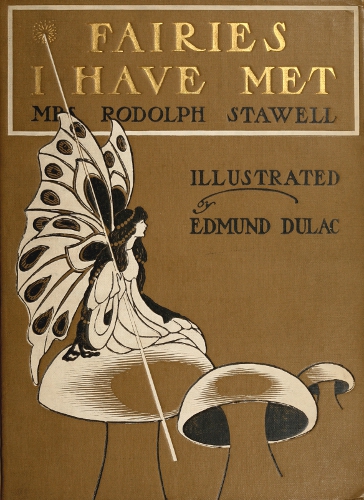
THE opal was the last of the precious stones to be
made. And this was how it happened.
Long, long ago—so long ago that no one
had ever seen a ruby or a sapphire or an
emerald—there was a Princess who had a great many friends
among the fairies. Because they loved her they called her
the Dear Princess, and the country in which she lived was
known as the Crystal Mountain. It was the delight of the
fairies to do her bidding, to fly and fly over hill and dale to
fetch her anything she wished to have. Sometimes she
wished to have very curious things, because all the ordinary
things that Princesses like to have had been brought to her
long ago by the fairies. If she wanted things that no one
had ever heard of before, the fairies would set to work to
make them for her. One day she said—
"Oh, Fairies dear, I am going to be married. I am
going to marry the Prince of the Far Land over the Hill,
and the wedding is to be the grandest ever seen. My dress
is lovely: it was cut out of a rainbow on purpose for me,
and trimmed with the edge of a sunset cloud. But what
am I to wear in my hair?"
Now, the Princess's hair hung over her in dark waves,
like a long cloak.
"Flowers!" cried the fairies. "Quick—quick—let us
fly for flowers to twist in the Dear Princess's hair!"
So they all flew away, some in one direction and some
in another, while the Dear Princess of the Crystal
Mountain
sat and waited, with her cloud of hair hanging
round her.
Very soon she saw them flying back, some from gardens
and some from orchards, and some from the hills where the
heather grew, and some from country lanes where the flowers
were very sweet, and some from hothouses where the flowers
were very rare. Wherever they came from they were all
laden with flowers. Some brought roses, red and white
and yellow; some brought heavy white lilies; some brought
long trails of honeysuckle. Some were carrying great
bundles of forget-me-nots; others had strange flowers from
distant countries; others had bunches of golden daffodils.
They crowded round the Dear Princess, and laid the flowers
in great heaps beside her.
"Wear my roses!" cried one. "See how the crimson
of them glows in your dark hair!"
"Wear my daffodils!" cried another. "See how they
shine like gold!"
"Wear my lilies!" cried a third, "for they match your
lily-face!"
Then they all held up the flowers against the Princess's
dark hair, to see which looked the best; red, or yellow, or
white. The Princess herself found it very hard to make
up her mind, because they were all so beautiful that she
would have liked to wear them all. First she chose one,
and then another, and then she thought that, after all, a third
would look the best.
This went on for so long that at last the flowers died.
"Ah, look," said the Princess, "the flowers are
dead!"
"Oh
dear, oh dear!" cried all the fairies together.
"The flowers are dead! What shall we do now?"
The Princess sat down among the dead flowers, and
thought.
"I must have something that will not die," she said at
last, "something stronger than flowers. In my dark hair I
must have something that will gleam and sparkle. I must
have colour that will not fade, a dewdrop that will not melt,
a spark of fire that will not go out."
"Dear me!" said the fairies; and they said no more
for some time, for they were thinking that the Dear Princess
wanted a good deal.
After a time three of them began talking together all at
once, as if a very good idea had suddenly come into their
heads.
Then these three spread their wings and flew away.
They flew far away from the Princess and her palace, far
from the other fairies, up and up to the heights of the
Crystal Mountain. Then each of them chipped off a little
piece of the rock at the top of the mountain, and each, as
he did it, laughed aloud gleefully. Then each little fairy
tucked his chip of rock under his arm; and they all nodded
to each other, still laughing, and spread their wings again,
and flew off in different directions.
The first of the three, with his chip of rock under his
arm, flew straight to the sea-shore. On the shore, close to
the shining blue sea, there lived a very nice mermaid who
was a great friend of the fairy's. So he flew to her with the
bit of crystal rock and said—
"Mermaid, mermaid, here is a chip from the Crystal
Mountain.
Take it for me, and dip it into the darkest and
deepest deep of the blue sea."
So the mermaid took the crystal chip and dived down
with it into the darkest and deepest deep of the blue sea.
Now, it is well known that whatever is touched by the
deepest deep of the sea is changed by it for ever, and
becomes itself a part of the sea. And so, when the mermaid
brought the chip of crystal back to the fairy it had become
like a chip of the sea—shining and gleaming and deep,
deep blue.
And that was the first sapphire.
And when the second fairy left the Crystal Mountain
with his little bit of rock under his arm, he flew to the great
forest where the wood-pixies lived.
"Pixies, pixies," he called to them, "here is a chip from
the Crystal Mountain. Take it for me into the darkest
and deepest deep of the green forest, and do not bring it
back to me till the green of the forest has sunk into its very
heart."
Of course you must have noticed that the wood-pixies
have the gift of making things green; for every one knows
that in the forest where they live everything is green—the
trees and the grass and the soft moss. And the shade
under the trees is dark, dark green, and here and there
where the sun peeps through, the green is very bright. So
the pixies took the chip of crystal away with them into the
darkest deep of the forest and laid it in the green moss
where the green shadows were darkest under the green
trees. And after a time the magic of the pixies began to
work, and the greenness of the forest sank into the very
heart
of the crystal. Then they carried it back to the
fairy, and he saw that the greenness of the deep shadows
had sunk into the heart of the crystal, and because the
sunshine had peeped through the trees there was a glint
of light in it.
And that was the first emerald.
When the third fairy left the Crystal Mountain with his
little bit of rock under his arm, he flew away to that other
mountain where the fire-gnomes worked underground. At
the top of the fire-mountain there was a great hole, and when
the fairy stood at the edge and looked in he could see the
gnomes at work, keeping the fire alight that warms the
world. So he called out to them—
"Fire-gnomes, fire-gnomes, here is a chip from the
Crystal Mountain. Take it for me into the hottest and
deepest deep of the fire, and keep it there until its heart
is glowing red."
So the fire-gnomes took the chip of crystal and carried
it down, down into the deepest deep of the fire that warms
the world. And the fire sparkled and glowed and wrapped
it round. And before very long the crystal began to glow
too as it lay in the fire, for of course a fire that is hot
enough to warm the world is hot enough to warm a chip
of rock. So the fire-gnomes picked it up again and
carried it back to the fairy who was waiting at the edge
of the great hole; and he saw that the heart of the crystal
chip was crimson and glowing like a fire.
And that was the first ruby.
Then he flew away from the fire-mountain with the ruby
safely tucked under his arm, and went back to the Dear
Princess.
At the same moment the fairy with the emerald
arrived from the forest, and the fairy with the sapphire
came back from the sea. They flew to the feet of the
Dear Princess, and held out the beautiful stones to her.
The Princess clapped her hands and cried—
"Oh, how splendid, how splendid they are! The blue is
like a bit of the dark sea, and the green is like the shade of
the forest with the sun peeping in, and the red is like the red
heart of the fire!"
Then the first fairy laid the sapphire against her
dark hair.
"You must wear it on your wedding-day," he said.
But the second fairy held up the emerald and said—
"No, no, this is what you must wear!"
And the third fairy laughed and cried—
"How silly they are! Any one can see that red is the
colour to wear in your dark hair!"
The Princess looked from one to the other and was
puzzled. She thought all the stones were so beautiful
that she would have liked to wear them all; but she did
not think they would look really nice all together.
"What am I to do?" she said, puckering up her
forehead. "How can I choose when they are all so
beautiful?"
Then there was a very long discussion about it. Each
of the three fairies wished his own stone to be worn, and
the Princess could not tell what to do.
"Each of them is quite beautiful," she said, "but,
dear fairies, I am obliged to say that I do not like the look
of them all together!"
All
this time a very small fairy had been sitting quietly
in the corner, saying nothing, but thinking a great deal.
He came forward now and spoke.
"Give the stones to me," he said, "and I will settle
the question."
So he took the three stones and flew away, far up into
the sky, above the Princess's dark head, above the houses
and the trees, above the Crystal Mountain even, into the
misty sunshine behind the clouds.
Then he called to the sun-fairies—
"Sun-fairies, sun-fairies, melt me these stones in your
furnace. Melt them, and mix them, and make them into
one stone. And soften their colours with mist of sunshine,
so that my Dear Princess may wear them all together in
her hair."
So the sun-fairies carried the three stones away, and
melted them all into one, and mixed them with mist of
sunshine, and it lay over the colours like a cloud. And
then there was only one stone, but it was a great big one,
and as beautiful as all the others put together. For, you
see, that was just what it was.
The small fairy took it carefully into his tiny arms and
flew down again through the clouds, past the Crystal
Mountain and past the tops of the trees, to the feet of the
Dear Princess.
He held up the great gleaming stone to her, and she
thought she had never seen anything so beautiful. For
the blue of the sea was in it, and the green shade of the
forest, and the red heart of fire. And over the colours the
mist of sunshine lay like a veil.
And
that was the first opal.
Of course the Dear Princess of the Crystal Mountain
wore the great opal on the day that she was married to the
Prince of the Far Land over the Hill. And when she was
an old, old Princess, with white hair instead of dark, she
often showed the opal to her grandchildren, and told them
how it was made of blue sea, and green shadows, and fire,
melted all together by the fairies and mixed with mist
of sunshine.
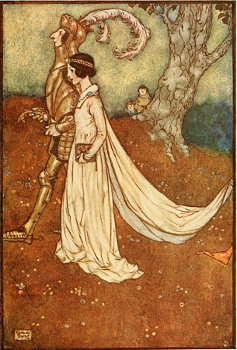
OF COURSE THE DEAR PRINCESS ... WORE THE GREAT OPAL ON THE
DAY THAT SHE WAS MARRIED
THE BIG SPIDER'S DIAMONDS
THE sun-fairies were hiding behind a black cloud;
but in the middle of the cloud there was a
hole, and through this hole the sun-fairies
peeped.
In this way they were able to see everything that went
on in the garden where the Big Spider lived. If the Big
Spider had looked up at the sky he could have seen the
sun-fairies peeping through the hole in the black cloud;
but he did not look up, because he was thinking of other
things. He was in an excited state of mind.
Quite lately the Big Spider had spun a most beautiful web
for himself, and had slung it between two tall blades of grass.
He was very proud of it, for it was the nicest web in all
the garden, being of a lovely and difficult pattern, and made
with great skill. And now something had happened in the
night to make it still more beautiful. While the Big Spider
was asleep the dew-fairies had crept up from the grass, and
had hung hundreds of sparkling diamonds on the strings of
his web. He knew it must have been done by the dew-fairies,
because they only keep the very best diamonds.
"Dear me, this is most kind of them," he said to himself.
"They must have noticed that my web was the best
in the garden; otherwise they would not have done it so
much honour."
As a matter of fact, the dew-fairies had been hanging
diamonds that night on the webs of all the spiders in the
garden; but the Big Spider was so much occupied in
admiring
his own web that he had no attention to spare for
the others.
"Good morning," he said pleasantly to a fly who was
passing. "Have you seen my diamonds? They look
very well there, don't they? They show off the pattern of
the web. Won't you come a little closer? You can hardly
see them properly at that distance. One really sees them
best when one is inside the web. Can't you come in this
morning?"
"No, thank you," said the fly firmly; for his mother
had told him that the Big Spider was not a nice friend for
little flies.
Then he flew away, and the Spider went on admiring
his diamonds. He looked at them first from the right,
and then from the left, and then he stepped backwards and
looked at them again. If you have ever seen a person who
paints pictures you will know exactly how he behaved.
All this time the sun-fairies had been peeping through
the hole in the black cloud and watching the Big Spider.
They could not help laughing at him.
"Ridiculous creature!" cried one. "Look at him
admiring his web, as if it were the only one that had ever
been hung with diamonds!"
"If he would look about him a little bit," said another,
"he would see that the whole garden is blazing with
diamonds this morning."
"The very grass is all twinkly and shiny with them,"
said a third, "but the grass-fairies are not behaving in that
absurd way."
"No fairy would be so silly," said a fourth.
Suddenly
a little sun-fairy began to clap his hands.
"I've got an idea," he cried.
As his ideas were generally full of mischief and very
interesting, all the other fairies stopped talking.
"It's a lovely idea," he went on, chuckling. "This is
what we'll do. We'll wait till that silly old Spider goes to
sleep or is busy, and then we'll rush down—quick as quick—and
steal his diamonds!"
Then all the sun-fairies laughed and clapped their hands
so loudly that the hole in the black cloud grew a good deal
larger. They thought it was a grand idea.
They had not long to wait. Presently the Spider
became rather tired of admiring his diamonds all by himself,
so he set to work to send out invitations for a fly-party.
He asked all the flies in the neighbourhood to come and
see how nice his web looked when it was hung with
diamonds. As soon as the sun-fairies saw that he was busy
they took each other's hands, and with a little run and a
big jump they all burst through the hole in the black
cloud. Then they flew softly down to the garden where
the Big Spider lived.
"How nice and warm it is getting!" thought the
Spider.
Presently he said to himself—
"My diamonds must be sparkling beautifully in this
sunshine. I'll just take a look at them."
He turned round, expecting to see the pattern of his
web delicately outlined in sparks of light. You will not be
surprised to hear that he saw nothing of the kind. He saw
his web, it is true, looking like filmy lace against the green
of
the grass; but there was not one single diamond hanging
upon it!
Then the rage of the Big Spider was terrible to see.
He stamped with all his legs, and he rolled himself
round and round, and he used all the most dreadful threats
in spider-language.
"I don't care who the thief is," he said; "I shall think
no more of eating him than if he were a fly!"
At that moment he heard the sweetest little laugh just
behind him. This made him so angry that he spent a long
time in looking for the person who laughed. While he was
still searching the sun-fairies flew up again to the black
clouds, carrying the diamonds with them.
"There," they said, as they threw the diamonds down
on the cloud, "he won't find them there!"
They had forgotten for the moment that, hidden in the
black cloud, there were a great number of rain-fairies.
Now the rain-fairies never enjoy themselves so much as
when they are annoying the sun-fairies: and in the same
way there is nothing that pleases the sun-fairies so much as
a good quarrel with the rain-fairies. This does not prevent
them from being very friendly when they are not
quarrelling.
The rain-fairies had seen all that had happened. They
pretended to think that the sun-fairies had behaved very
unkindly to the Big Spider.
"It's too bad," they said, "to steal the poor thing's
diamonds. It's not fair. Let's throw them down to him."
Then a great fight began between the sun-fairies and
the rain-fairies for the diamonds, and the fight lasted a long
time,
and all the time that it lasted the Big Spider was in
a rage.
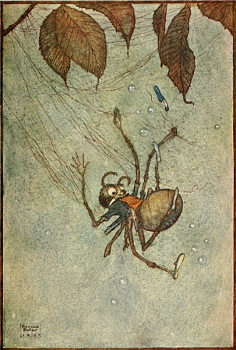
THE WEB AND THE DIAMONDS AND THE BIG SPIDER HIMSELF ALL FELL TO
THE GROUND
At last the rain-fairies won the fight, and went off with
the diamonds in their arms.
"Now we'll throw them to the Big Spider," they said,
"and we'll see how glad he is when his web is hung with
diamonds as it was before."
They forgot that the dew-fairies, when they had trimmed
the web with the diamonds, had crept up softly and touched
the strings with gentle fingers. But the rain-fairies are
rather rough.
They flung out their little arms and threw the diamonds
down out of the black cloud. Down dropped the diamonds,
and down, and down, till they reached the garden where the
Big Spider lived, and the web that the Big Spider had made.
But instead of hanging on the web in rows, like little lighted
lamps, they dropped into the middle of it with a crash and
a dash and a splash, and broke it into a great many pieces,
so that the web and the diamonds and the Big Spider himself
all fell to the ground.
And by the time the Big Spider was standing on all his
legs again the diamonds had disappeared into the grass.
The truth is that the dew-fairies had found them and
had taken them home. I expect they will keep them till
the Big Spider has made a new web.
A LITTLE GIRL IN A BOOK
CHRISTABEL was a little girl who read a great
many books. She noticed that the girls and
boys in the books were not altogether like the
girls and boys who played with her in the Square
and came to tea with her. The children in the books were
wonderfully brave and clever; and when they were having
their magnificent adventures they always did exactly the
right thing at the right moment. They never had a dull
minute, and they never said anything silly. The girls and
boys who came to tea with Christabel were not like this,
and Christabel knew that she herself was not like this. She
never had any adventures, and she knew that even if she
ever did have one she would not behave at all bravely or
cleverly. And she was often so dull that she drummed
with her fingers on the window and said—
"What on earth shall I do?"
Now, Christabel had a Big Sister who wrote books.
One day she said to her Big Sister—
"How I do wish I were a little girl in a book! Nothing
ever happens to little girls in real life. It is so dull!"
The Big Sister went on writing, and said nothing.
"It's no use talking to her," thought Christabel,
"because she always goes on writing."
A few days after this Christabel began to feel rather
strange. A kind of stiffness came into all her limbs, so that
they would not do what she told them. And sometimes
she found herself saying things that she had not intended to
say
at all. This puzzled her and made her very uncomfortable.
She wondered if other people noticed that there
was something wrong with her. She even thought of
speaking to her Big Sister about it, but the Big Sister was
so busy writing that it was no use to try and make her hear.
This went on for some time. Christabel grew stiffer
and stiffer, and more and more uncomfortable; and her Big
Sister went on writing busily.
At last one day Christabel understood what had
happened. She woke up and found that everything round
her had changed; the people and the place and everything.
She was frightened at first, and then the truth suddenly
flashed into her mind. A most remarkable and unusual
and unexpected thing had happened: her Big Sister had
put her into a book!
"So I really am a little girl in a book, after all!" she
said to herself.
She tried to say it aloud, but she found she couldn't.
The words were not in the book, you see.
"Now I am going to enjoy myself," she thought, "and
never be dull any more."
There was not much chance of her being dull, for the
book was full of adventures and narrow escapes, and other
delightful things.
First she was captured by pirates; and after having a
terrible time with them she was saved from them by a shipwreck.
The shipwreck did not do her much good, however,
for she at once fell into the hands of the most dreadful
savages. So you will understand that she was not at all
likely to be dull.
Christabel
was delighted to find that she behaved, like
other little girls in books, with the greatest courage and
cleverness. Whenever an adventure was going on she
always managed to get out of every difficulty, and she saved
the lives of several of the other people in the book by her
bravery. The strange thing was that she found it quite
easy to be brave; while she was a little girl in real life she
had not found it easy at all.
"I do hope the book has a happy ending," she thought
sometimes.
She wished very much that she could peep into the end
of the book, as she used to do when she was a little girl in
real life. Meantime every chapter was more exciting than
the last. Of course Christabel did not know whether she
would escape from the savages at all. Perhaps they were
going to eat her. That would not be a happy ending to the
book, she felt.
After a great many terrible dangers, she managed to
escape; for a ship sailed into the bay at the right moment,
and took her home to England. This was the end of the
book. The person who was reading it shut it up with a
bang—and Christabel went to sleep.
By-and-by, some one else took up the book and began
to read it. Then Christabel woke up and found herself at
the beginning of the story. After so many adventures she
was rather tired, and did not feel inclined to begin them all
over again. But that was just what she had to do. Being
captured by pirates is not nearly so exciting when you know
you can only escape from them by a cold, wet shipwreck;
and when you are shipwrecked you are not very anxious to
scramble
ashore when you know there are a large number of
fierce savages waiting for you!
"This is rather tiresome," thought Christabel.
She was very glad when the person who was reading the
book shut it up again, and she was allowed to go quietly to
sleep.
But her sleep was not long. Every time any one began
to read the book poor Christabel was obliged to wake up
and go through all her troubles again. She soon became
horribly tired of being shipwrecked.
"Have I got to spend the rest of my life with pirates
and savages?" she asked herself in despair.
It was especially annoying that they were always the
same pirates and savages, who said always exactly the same
things. Christabel soon knew the whole book by heart.
She wished sometimes she could be one of the pirates for a
change, instead of being always a little girl.
"I suppose I shall never even be grown up," she
thought sadly.
The most unpleasant thing of all was that she was never
able to say what she wished to say: she was always obliged
to say what was in the book. Sometimes she opened her
mouth to say what was in her mind, and then found herself
speaking words that had nothing to do with her thoughts.
"It is simply hateful not to be able to say and do what
one likes," she thought.
She made up her mind to try and be drowned at the
very next shipwreck. Of course it was useless for her to
try, for the book said she was saved by a big wave which
flung her up on a rock. It was uncomfortable for her to
be
saved in this way, but she could not avoid it. The
shipwreck happened in the usual way, in spite of her efforts
to be drowned; and then, as usual, she met the savages on
the Island, and soon afterwards came the end of the
book.
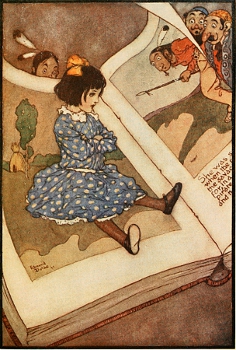
THE OTHER PEOPLE IN THE BOOK LOOKED AT HER IN SURPRISE
Now, it happened this time that the person who was
reading the book did not shut it up at all, but handed it
at once to some one else who wished to read it. This was
really too much for Christabel's temper. She had had no
sleep, and she was determined not to begin all over again
without a rest. It suddenly struck her that this was her
only chance—now, before the beginning of the first
chapter.
She lost no time. She knew she ought to be standing
up—the book said she was standing up. Finding to her
great joy that she was able to move of her own accord,
she calmly sat down and folded her arms. The other
people in the book looked at her in surprise.
"It's no use looking at me like that," she said; "I'm
tired of this. I'm not going on any more saying the same
things over and over again. If there's any pirate who
would like to change places with me I don't mind being
a pirate for a bit. But I'm not going on being the little
girl."
Then there was indeed an outcry. All the people in
the book began speaking at once. Just at that moment—before
the beginning of the first chapter—they were all
able to say what they chose.
"Make her stand up!" cried one.
"I never heard such nonsense!" said another.
"Why
can't she behave as we do?" asked a third
angrily.
"The idea of wanting a change!"
"She'll have to behave like other people in the end."
"So discontented!"
"So very odd!"
So they went on, while Christabel still sat calmly, with
her arms crossed.
"I'm not going to begin all over again," she repeated
firmly.
"But that poor boy is waiting to begin the book," said
some one; "and we can't go on while you are behaving in
this silly way."
"I can't help that," said Christabel; "I'm tired of
saying things I don't a bit mean."
Before she knew what was going to happen Christabel
found herself in the middle of a terrible turmoil. All the
people in the book seemed to be rushing at her.
Far away she heard a voice saying—
"There's something very queer about this book. It
seems all in a muddle, somehow!"
Then there was silence, and Christabel realized that the
people in the book had turned her out! She was no
longer a little girl in a book, but a little girl in real life.
She looked round and saw her Big Sister, still writing.
"I don't want to be in a book any more," said
Christabel. "Real life is nicer. In real life one can
at least say what one thinks one's self, instead of always
saying what other people think."
"Don't be too sure of that," said her Big Sister.
THE FAIRY WHO WAS LOOKING FOR A HOME
LITTLE Fairy Flitterwing had no home. Whenever
he settled down in a place something
happened to turn him out. If he found a
comfortable rosebud some one would come
and pick it, and then it died and he was homeless again.
If he chose a pink-edged daisy to live in, the gardener
would mow the lawn at once. He grew very tired of
wandering about the garden, and he determined at last to
go out into the world in search of a home.
It was quite a small garden, in the middle of a town.
Flitterwing felt rather afraid of venturing into the streets,
because he knew there would not be many fairies there, and
not many nice places for a fairy to live in. So he was a
little sad and anxious as he flew over the high brick wall of
the garden and looked about him. He found himself in a
queer little yard, not nearly as nice as the garden, with a
pavement of round stones and an ugly brick house at one
end of it. There never was a more unlikely place for a
fairy to find a comfortable home. Flitterwing was on the
point of flying back again over the garden wall, when he
caught sight of something green at the further end of the
courtyard. Some grass had grown up among the stones.
"The very place for me!" said Flitterwing to himself.
"No one is likely to disturb me here, and I can fly across
to the garden whenever I feel lonely."
So he found a cosy corner between two stones, where
the
grass was thick and soft, and there he made up his mind
to stay. It was not, of course, the very best kind of place
for a fairy, but, after all, it was quiet and near his friends,
and he was terribly tired of moving about from rose to rose
and from daisy to daisy. So he thought he would make
the best of it.
Very soon he felt quite at home in the grass-patch at
the end of the yard. Every morning, of course, he had to
attend to the grass and see that it was always fresh and
green, for it is the business of every fairy to take care of
the place he lives in. He does it instead of paying rent.
Then, after polishing his wings nicely and making them
shine like opals, he would fly across the brick wall and have
a chat with the grass-fairies and flower-fairies in the garden.
His life went on in this quiet and comfortable way for
some time.
But one morning poor Flitterwing received a great
shock. He was very busy cleaning the grass with a
dewdrop, and thinking how strong and tall the blades had
grown since he first began to take care of them. They
were a good deal taller than himself now, and he was not
able to see over them. So, when he heard a heavy footstep
clattering across the yard, he peered between the blades of
grass to see who was coming.
"Oh dear, oh dear," he cried, "here's that dreadful
gardener! I'm sure he's going to turn me out!"
He quickly dropped the crumpled cobweb soaked in
dewdrop with which he was rubbing the green blades, and
folding his wings closely round him he hid himself in the
grass, and waited to see what was going to happen.
The
gardener was carrying a basket in one hand, and
in the other a tool with dreadful prongs. He was going
to pull up the grass that had grown among the stones!
Poor Flitterwing's nice new home was going to be
spoilt!
One by one the tufts were dragged up by the roots,
while the sharp prongs clinked against the stones and the
gardener's fingers crumpled up the blades of grass that had
looked so green and fresh a few minutes before. Flitterwing
was terribly frightened.
"The sooner I get out of this the better," he said to
himself, skipping away from the gardener's big fingers.
Then he spread his wings and flew up and away, over the
wall and over the garden and on and on. He went on
flying, flying, till all his friends were left far behind and he
came to strange streets such as he had never seen before.
Still he went on flying, flying. You see he was extremely
anxious to be very far away from the gardener with the big
fingers and the terrible, sharp prongs.
At last he became dreadfully tired. It would be impossible,
he felt, to go on flying much longer, so he looked
about him for shelter. He saw an open window, and
beyond it a large cool room. Here was shelter at all
events, so he flew straight in. There were a number of
tables and chairs in the room, and at each table a man sat
writing; but Flitterwing was too much frightened to see
anything. He only wanted to find a place where he could
hide and rest. A large ink-pot stood on a table, and just
inside the ink-pot was a little ledge where a fairy might rest
comfortably. Flitterwing lost no time; he darted into the
ink-pot
and sat down on the ledge. In a few moments he
folded his tired wings about him and fell fast asleep.
Now, the room into which Flitterwing had flown was a
place where a great deal of business was done. Every day
a number of men sat there adding up figures and writing
letters about dull things that neither you nor I could
understand. If you have done many sums, you will agree
with me that no sensible man could really like spending all
his time in adding up pounds, shillings, and pence. Very
few of the men in this big room really liked it. Some of
them wanted to be playing cricket or golf, some would
rather have been reading books or listening to beautiful
music; and every one of them was longing to be in the
country among the flowers and the fairies. And there was
one among them—a little man with a pale face and a thin
coat—who wished above all things to be making poetry.
There were two good reasons against his doing this. In
the first place, he was obliged to earn money, and this is
more easily done by adding up figures than by making
poetry; and in the second place, he did not in the least
know how poetry ought to be made.
On the sunny morning when Flitterwing took refuge in
the ink-pot the Man in the Thin Coat was very busy. There
were rows and rows of figures waiting to be added up, so
that there seemed to be no end to them. A large sheet of
paper was before him on which he was doing these sums,
and the figures were arranged in terribly long columns—and
no doubt you know how unpleasant that is. Suddenly
something glittered in the air for a moment and then
disappeared. It was so bright that it caught his eye and
made
him lose his place. He thought it was some beautiful
kind of insect with the sunshine caught in its wings.
"It was like a messenger from the summer!" he said
to himself.
Then he dipped his pen in the ink-pot and went back
to his sums.
He had been working busily for some time when he
noticed something very curious. His pen was not writing
figures at all! He was thinking about figures, and he
wished to put figures on the paper, so it was a very strange
thing that his pen was writing words all the time. The
words were arranged in short lines with a capital letter at
the beginning of each line.
"Dear me, how annoying!" he said to himself. "What
can I have been thinking of? This will never do."
So he took a fresh sheet and began again.
He imagined that he was copying all the figures on to
the clean sheet of paper, for that was what he intended to
do. He wrote the figures very quickly, as he thought,
because he wanted to make up for lost time. Then he
glanced at what he had written—and threw down his pen
angrily.
There were no figures at all on the paper; nothing but
line after line of words. He began to think he must have
got a sunstroke.
"This is really terrible!" he muttered. "I must
pay more attention to what I am doing."
So he took another clean sheet of paper and began
again.
It was no use; the pen refused to make a single figure.
Then
the Man in the Thin Coat was in despair. He
pushed the paper away from him and threw himself back in
his chair.
"There is something very serious the matter with me,"
he said to himself. He did not notice that another man
had come up to the table and was gathering together the
sheets of paper that lay on it. This was the person who
paid the Man in the Thin Coat for doing his sums for him.
He had a round face and a big waistcoat.
"Come, come! what's this?" he said, looking at the
sheets of paper. "Poetry, I declare! So you're a poet,
are you? That's all very well, but I don't pay you to write
poetry."
The poor Man in the Thin Coat looked very much
disturbed. When you come to think of it, it is a disturbing
thing to find you are writing poetry when you imagine
you are doing sums.
"I couldn't help it," he said meekly.
"Yes, yes, that's the excuse they all make," said the
Man with the Big Waistcoat. Then he took up the
papers and began to read. There was silence in the room
while he was reading the poem that the Man in the Thin
Coat had written by mistake; every one left off working,
and watched with great interest to see what would happen.
The silence lasted for some time.
"Dear me!" said the Man with the Big Waistcoat at
last. "This is a very beautiful poem!"
Then he began to read aloud.
The poem was about the summer; about the sunshine
and the blue sky and the singing larks that were far away
from
that ugly room. It seemed as though the far-off
fields and the glory of the sun had been really brought
there, to the tired men who sat listening. And to each
man as he listened came a dream of the thing he loved best.
To one man the room seemed to have turned into a garden;
the scent of a thousand roses was in the air, and the colours
of a thousand flowers. Another man thought he was in a
field, lying under a tree and looking at the pattern of the
leaves against the sky. And another saw the sunshine
sparkling on the dear sea, and the little ripples running
races on the sand. But the Man in the Thin Coat saw
more things than any of them.
And while they were all listening to the beautiful poem
about the summer, little Fairy Flitterwing slipped out of
the ink-pot and flew off to play with a sunbeam on the
window-sill. The sunbeam showed him a very comfortable
scarlet geranium that was growing in a window not far off,
so Flitterwing went to live in it, and found a safe home
at last.
And the Man in the Thin Coat went back to his sums.
He was happier than he had ever been before, because he
had written a beautiful poem. He was never able to write
any more poetry, and he thought this was rather odd
until, years afterwards, his little daughter guessed the truth.
He had just finished reading to her his poem about the
summer.
"Why, Daddy," she said, "there must have been a fairy
in your ink-pot when you wrote that!"
THE BOX OF DREAMS
LONG ago there lived in a far country a little
girl called Gretel, whose mother was dying.
Before she died she said to Gretel—
"I am very poor, and I have no money
to leave for you after I am gone. I have nothing to give
you but this box. It was given to me when I was a child
by some one who was wise and good. You must be very
careful of it, for it is full of Dreams, and they are hard
to keep safely. You must never open the box except
when you are alone, or the Dreams will fly away. But
keep them safely till your hair is grey, and something
will happen to surprise you."
Gretel took the box and hid it safely, and said nothing
about it to any one. Her mother died a few days afterwards,
and then Gretel was sent away to be a little servant,
and to work very hard. She had to get up early, and
light the fire, and feed the pigs, and she had to wash the
dishes and scrub the floor, and do a great many other
things, so that there was very little time for anything but
work. All the time her box of Dreams was hidden away
upstairs in her little trunk, underneath her Sunday frock.
Often, when she was working in the kitchen, or in the
farmyard among the hens, she was thinking of her box
of Dreams; and sometimes when she was quite alone she
would open it and look inside. The first time she opened
the box she felt a little bit frightened, for she had never
seen any Dreams before, and she was not sure what they
were
like; but when she saw them, soft and pink and
downy, like lovely sleeping birds, she was not frightened
any more.
"Oh, but they are pretty things!" she said to herself.
"How I hope I shall be able to keep them safely till my
hair is grey! They look as if a breath would blow them
away, out of the window and over the hill!"
For a long time she was very careful not to let any
one see her pretty rosy Dreams. Indeed, she never spoke
of them; and the old farmer's wife, whose servant she
was, little guessed that anything so strange as a box of
Dreams was hidden upstairs in the garret, underneath
Gretel's Sunday frock.
The farmer and his wife had a son about the same age
as Gretel. His name was Eitel. He was a big, clumsy
sort of boy, and not very clever; but Gretel had very few
friends, so when Eitel was kind to her and talked to her
over the fire in the evenings she was very glad. Sometimes
he carried the big bucket for her when she went out to feed
the pigs, and sometimes in the summer they made hay
together in the field on the hillside. In this way they
became great friends. Gretel told Eitel everything that had
happened to her since she was a little child; and one day
she told him about her box of Dreams.
"Let me see them, Gretel dear," said Eitel.
"Oh, but I mustn't!" said Gretel. "No one must see
them till my hair is grey. If any one sees them they will
fly away, out of the window and over the hill."
"What are they like?" asked Eitel. "And what are
they for?"
"They
are lovely," said Gretel, "but I don't know yet
what they are for."
"Come, let me see them," said Eitel coaxingly. "I
believe I see a grey hair on your head, Gretel."
It was really a bit of white thread, but Gretel thought
her hair must be growing grey, so she ran upstairs and
fetched the box of Dreams down to the kitchen. She
opened the box very carefully, and Eitel peeped in.
Pouf! Pouf! Half-a-dozen soft rosy Dreams fluttered
out from under the lid, and hovered in the air for a moment
like wisps of pink mist. Gretel shut the box with a snap,
and tried to catch the floating Dreams with her fingers.
But it was too late. They floated higher and higher, farther
and farther, out of the window and over the hill.
"Oh, Eitel," cried Gretel, sobbing, "I have lost my
Dreams—so many of them—so many of them!"
"Well," said Eitel, "I don't see that there's much to
cry about. They were only pink fluff after all! I wouldn't
cry about pink fluff if I were you!"
So Eitel went out of the house whistling, and thinking
that girls were sometimes very silly; while Gretel carried
her box upstairs, crying, and thinking that boys were often
very unkind. As soon as she was in her room she opened
her box again, and found to her great joy that it was still
half full of beautiful Dreams.
She soon made friends with Eitel again, but she never
spoke to him any more about her box of Dreams.
As the years went by Gretel became first a big girl and
then a grown-up woman, and still she had to work for her
living. She lived in a good many different places, sometimes
with
nice people and sometimes with people who were
not kind to her; but wherever she lived she had to scrub
and sweep, and get up early and go to bed late. She still
kept her box of Dreams safely in her little trunk, hidden
under her Sunday frock. Since the time that she had lost
so many of her Dreams she had never opened the box
except when she was alone. She was afraid of losing some
more; and, besides, she did not like it when Eitel laughed
at her and called her pretty Dreams "nothing but pink
fluff." So she made up her mind to wait till her hair was
really grey.
It seemed to her sometimes that this would never
happen! Her hair was browner than other people's, she
thought, and was not going to turn grey at all. But
though the time seemed so long to her, she was as a matter
of fact still a young woman when she discovered that there
were two grey hairs growing among the brown ones. She
was combing her hair at the time, and the moment she saw
the grey hairs she dropped the comb, and clapping her
hands for joy ran quickly to get her box of Dreams out
of her little trunk. She was so much excited that her
trembling fingers could hardly undo the fastenings of
the box.
When the box was at last open she was still more
excited. Her mother had promised that she should be
surprised, but she had not expected such a strange and
delightful and altogether wonderful surprise as this! You
could never guess what had happened! Her pretty rosy
Dreams had all turned into jewels more splendid than any
you ever saw or heard about! Every kind of precious
stone
was there—emeralds and pearls and fiery opals,
glowing rubies and sea-blue sapphires, besides a great many
strange stones whose names you have never heard.
Gretel gasped.
She sat on the floor beside the box, and stared and
stared. She could hardly believe that the glittering things
were real, and she could not believe at all that they
belonged to her. At first she expected every minute that
they would disappear, and she was afraid to touch them;
but presently she took courage and lifted them out of the
box one by one. Then she took them to the light, and
they looked still more beautiful than before.
As Gretel sat on the floor near the window, with the
many-coloured jewels glimmering and shimmering in her
lap, she came gradually to understand that when her mother
gave her the box of Dreams she gave her great riches.
Gretel lived to be very old, but she never lost her
jewels. She was able now to show them to all the world
without any danger of their flying away, and as time went
on the people flocked to see her and her jewels. Eitel
admired them as much as any one, but he could never be
persuaded that the fluffy pink things he had once seen had
really turned into these shining and wonderful stones.
THE FAIRY WHO HAD ONLY ONE WING
I AM going to tell you now about a fairy who lost
one of his wings. His home was in a white
rosebud, which one would imagine to be a nice,
safe, comfortable home for a fairy to have. And
yet it was while he was in the white rosebud that the
terrible accident happened which left him with only one
wing.
All would have been well if he had stayed in the
country. But one day a man came with scissors and
snipped the white rosebud off the tree, and packed it in
cotton-wool, and sent it off to London. Of course the
fairy had to go too, and a very uncomfortable journey he
had. There were a number of other flowers packed in the
same box, and in each flower there was a fairy; so they
were all able to grumble together. But you can't grumble
with any real comfort when you are packed very tightly,
and have to talk through a good deal of cotton-wool.
At last the journey was over, and the rosebud was
taken out of the cotton-wool and put in water. Then the
fairy crept up from the heart of the rosebud, and put his
head over the edge of the petals and looked about him.
There were flowers all round him: flowers in pots,
flowers in glasses, flowers lying on the table, flowers in
baskets, and great bunches of flowers in the big window.
The truth was that the rosebud was in a flower-shop, but
he did not know this. He only knew that it was very
pleasant
to be again in a place that was full of flowers and
fairies.
He thought he was going to enjoy himself; but that
was because he did not know how cruelly fairies are sometimes
treated in flower-shops. The people who arrange
the flowers have a horrible way of trying to kill the fairies;
and this is what they do. They take a dreadful, sharp
piece of wire and poke it through the very heart of the
flower, and then fasten it tightly round the stem! You
will see at once that nothing is more likely to hurt a fairy
than this. Indeed, he would certainly be killed, if it were
not almost impossible to kill a fairy.
The little rosebud-fairy was lying comfortably curled
up, deep down among the white petals of the rose, when
suddenly he saw coming through the walls of his home a
sharp glittering point!
"Oh dear!" he cried, trying to scramble out of the
way.
But that was no use, the glittering point came nearer
and nearer.
"Oh dear—oh dear!" he cried again. "Where is it
coming to? Oh—it's coming this way—the horrible thing.
Oh—oh—oh!"
It was no wonder that he cried out. The dreadful
wire had caught one of his beautiful gossamer wings, and
dragged it, and torn it, till there was nothing left of it but
some little shreds of fluttering gauze.
"What shall I do?" he wailed. "How can I fly with
only one wing, and what is the use of a fairy that can't fly?
What shall I do?"
He
picked up the torn pieces of his wing and wondered
if he could mend them. But he soon saw that it was
impossible, so he folded them up carefully and laid them
inside the rose-petals; and ever afterwards there was a faint
tinge of pink deep down in the heart of the rosebud.
For a long time, long after the rosebud had been tied
up with a sprig of fern and put in the window, the poor
little fairy went on moaning and sighing over the loss of
his wing. He was still sighing when a little girl came into
the shop. If the fairy had not been hiding among the
petals of his rosebud he would have seen at once that she
was the kind of little girl that the fairies always love; a
little girl with bright eyes and a laughing face—altogether
a very nice little girl. She pointed to the white rosebud
and said—
"I want to buy that rosebud, please, for Granny's
birthday."
In another minute she was walking along the street
with the rosebud in her fat hand.
Then the fairy crept up from the heart of the rose and
looked over the edge of the petals. The little girl saw
him at once and was not at all surprised.
"There you are!" she said. "I wondered when you
would look out. Of course I knew there was a fairy in the
rosebud, or I wouldn't have bought it. It would have
been no use, you see."
"What a very nice little girl!" thought the fairy.
"She seems to have a great deal of sense."
The little girl went on: "Poor thing, I see your wing
has been torn off. That nearly always happens to the
fairies
that come from flower-shops. But I dare say Granny
won't mind. She sees very few fairies. I am going to
leave you at Granny's house because it is her birthday.
Now remember, you're to be very nice to Granny, because
she sees so few fairies."
By this time they had reached Granny's house. Granny
lived all alone in a very splendid house in a great square.
The house had a great many fine things in it: handsome
furniture and valuable china and grand silks and brocades.
But there was not a single fairy in it, and a house that has
no fairies in it is a very dull place.
Granny was sitting alone on her birthday. She looked
round the great drawing-room and thought there were
a number of empty chairs and sofas in it. That made her
feel very lonely. No one had been to see her on her
birthday; she had had no presents or letters; no one had
noticed her birthday at all. If there had been any fairies
in the house Granny would not have felt so lonely, because
the fairies are always good company. But poor Granny
had quite forgotten all about the fairies; it was so long
since she had seen any.
Then a footman brought the white rosebud into the
room, with a message from the little girl with the bright
eyes and the nice laughing face.
Granny sat for a long time with the white rosebud on
her knee. She felt happier than she had been all day.
She sat so still that the fairy thought he might safely peep
out and see what was going on. To his great surprise
Granny noticed him at once; he had not thought it at all
likely that she would see him, for she was not the kind of
person
who often sees fairies. Probably she would not
have seen him if she had not been so sad and lonely.
"Why," she said, "it's a fairy! It is years since I saw
a fairy. I thought I should never see one again."
When the fairy saw that Granny was glad to see him, he
crept out of the rosebud and sat on her wrinkled hand, and
talked to her.
"Poor little thing," said Granny, "you have lost one of
your wings. Well, it was not likely that any but a one-winged
fairy would find his way in here."
Then she sighed. So the fairy, to cheer her up, told
her all about the lovely garden he had left behind him in
the country—the garden where he had lived before the man
with the scissors came to cut the rosebud. He told her
about the other roses and the fairies that lived in them,
and the tall hollyhocks whose fairies were so prim and old-fashioned,
and the sweet, shy love-in-a-mist whose fairies
always wore veils when they went out, and the sunflower-fairies
who had never been taught that it was rude to stare,
and the dear unselfish verbena fairies who made the world
so sweet for other people and never thought of themselves.
Then Granny remembered all sorts of things that she had
forgotten for years—fairies she used to know when she was
a little girl, and the stories they used to tell her. She told
some of the stories to the rosebud fairy, and they talked
together for a long time. Granny was happier that evening
than she had been for a great many evenings. She said
to herself that her birthday had been a very nice one
after all.
"Won't you come and live with me?" she said.
The
fairy looked round the room.
"Well," he said, "I should like to stay very much, but
I really don't see any place here for me to live. My rosebud
will soon die and be thrown away."
"But if I were to keep the rosebud always, even when
it was dead? Would you stay then?"
The fairy thought for a moment.
"I tell you plainly," he said, "that I don't like the idea
of living in a dead rosebud. But I know it's done sometimes,
and one mustn't be too particular when one has only
one wing."
"I'll ask the little girl who brought you here to come
and see you often," said Granny, "and you and I will go
out to-morrow and buy some picture-books for her, and
some chocolates, and then we shall all three enjoy ourselves
together."
The fairy nodded happily.
"That settles it," he said. "I'll stay."
THE LITTLE BOY FROM TOWN
IF you spend all the year in a big town it is a fine
thing to have a summer holiday near the sea.
Otherwise you never have a chance of making
friends with the sea-fairies or the mermaids, who
are the most delightful playmates in the world. You may
know all kinds of other fairies, and be quite intimate with
them, but as long as you live nothing can ever make up to
you for not knowing the sea-fairies.
Little Michael was eight years old, and he had never
met a sea-fairy, for he lived in a great town. Then at last
his father and mother and he went off for a whole month to
the seaside. There were sands there, very hard and yellow
and good to make castles with; and there were lonely caves
with dripping walls; and there were heaps of slimy, green
seaweed, and shells, and rocks for climbing on. Best of
all, there were plenty of fairies. Michael made friends with
all the fairies of the sea and shore; but his greatest and
best friend was a Mermaid who lived in a cave.
The roof of the cave was wet and green, and its floor
was pebbly, with here and there a rock. Every day Michael
came and sat on one of the rocks and listened to the Mermaid's
stories, and to the soft, lapping sound of the little
waves. The Mermaid told him such stories as he had
never heard before, for she had not always been in that
cave, but had swum in deep seas and lived on many shores.
She told Michael of places where the sea was warm and
green, and the rocks were made of coral, and palm-trees
shaded
the mermaids when they played upon the sands.
She told him too of bitter seas that were made of ice, so
that no mermaid could swim in them; and of towering
icebergs shining in the sun; and of white mist-fairies, who
turned the hair of mermaids into a shower of icicles. Then
she told him of sailors who had been her friends, and how
some of them were sailing far away, and some of them were
drowned, and how all of them were good playmates.
While Michael listened to these stories his eyes were
very round and wide open, and often his mouth was open
too. He had never enjoyed anything so much before, and
he thought it would be dreadful when the day came for him
to leave the dancing sea-fairies and the Mermaid's cave, and
go back to the big town where he hardly ever saw any
fairies at all. One day he said—
"Mermaid dear, I want something to take back to
town with me; something to make me remember the sea-fairies
and you, and to make me think of the sea for ever
and ever."
"Tell me what you want," said the Mermaid, smiling;
"and if I can get it for you, I will."
"Well," said Michael, "it's rather a big thing I was
thinking of. Perhaps it's too big to ask for. But you see
the Bay is full of white-horses to-day. Do you think you
could possibly catch one for me? I think if I could take
home a white-horse from the Bay, I should remember the
sea for ever and ever."
The Mermaid slipped off her rock and dived into the
deep water. A few moments afterwards Michael saw her
far out in the Bay, with her hair floating in the wind, and
her
tail glittering under the waves. There were a great
many wind-fairies playing about that morning, and that was
the reason that the Bay was full of white-horses, for when
the wind-fairies are playing on the sea they always ride
white-horses.
Michael climbed a high rock and stood on the very top
of it, and watched the Mermaid. It was grand to see her
gliding through the water, chasing first one white-horse and
then another, diving and darting and dodging, and enjoying
herself all the time.
"Quick, quick!" cried Michael. "You nearly had
him that time!"
But she was not quick enough, for the white-horse was
far out of reach even as she threw out her white arms to
catch his mane.
The chase lasted a long time, for though mermaids can
swim better than most people, a white-horse on the sea
is one of the hardest things to catch. At last, however,
Michael clapped his hands and shouted—
"She's got him, she's got him! Hurrah—now I shall
have a white-horse to take home with me, and to make me
think of the sea for ever and ever!"
If it had been a fine sight to see the Mermaid chasing
the white-horse across the Bay, it was far finer to see them
come prancing back again. The Mermaid was not swimming
this time, but riding on the back of the angry white-horse,
who plunged and galloped across the Bay, tossing his
long mane. And the Mermaid tossed her golden hair and
laughed, because she was enjoying her ride. Michael
laughed aloud too, because when the white mane and the
golden
hair streamed up together upon the wind they were
very beautiful to see.
And now a very curious and unfortunate thing happened.
The wind-fairies suddenly grew tired and went to sleep,
every one of them. Now when the wind-fairies go to sleep,
the white-horses always dive down below the sea and go to
sleep too. Before the Mermaid had reached the shore she
was swimming again, for her white-horse had suddenly
disappeared and left her with nothing to ride. He had
gone to sleep below the sea until the next time the wind-fairies
wanted to play.
"Oh, Mermaid dear," cried Michael, "what have you
done with my nice new horse?"
"I am very sorry to tell you," said the Mermaid, lying
down on the sand to rest herself, "that he has gone below
the sea to sleep. It is really most unfortunate, but when a
white-horse wants to sleep you can't stop him."
"Oh dear, oh dear," said Michael piteously, for it was
a great disappointment. "I did so much want to have a
white-horse to make me think of the sea for ever and ever."
"Wouldn't anything else do instead?" asked the
Mermaid, who was very kind.
Then Michael noticed that every time a little wave
reached the shore it broke on the rocks in a shower of
coloured jewels. He pointed to them.
"Bring me some of those, please, Mermaid dear," he
said.
So the Mermaid took a large shell, shaped like a saucer,
and waited on a rock till a little wave came in and sprinkled
the rock with jewels. She held out her shell to catch the
jewels,
but as soon as they touched the shell they changed
into water.
"Look," she said to Michael, "the jewels have melted."
"Oh dear," said Michael, "what am I to do? I am
going back to town to-morrow, and I have nothing to
remind me of the sea!"
"Do you really and truly wish to think of the sea for
ever and ever?" asked the Mermaid.
"Of course I do," said Michael.
"Then I will sing you the Sea Song," said the Mermaid,
"and after that there will be nothing that can make
you forget the sea."
So while Michael sat on the rock and looked at the sea,
the Mermaid sang him the Sea Song, which mermaids have
sung to sailors ever since the first ship was built. It is a
song that no one ever forgets. It is like the voice of the
sea calling, calling; and there are many people who hear it
always, even in their dreams. If they are people who have
to live in towns, or in country places far from the sea, they
are not very happy.
When the Mermaid had finished singing, she said—
"Now I have given you something that will make you
think of the sea for ever and ever."
The next day Michael went back to town. He took
with him the sound of the Sea Song; and for ever afterwards
he heard the voice of the sea calling, calling, even in
his dreams.
That was why he became a sailor when he was old
enough.
The Gresham Press,
UNWIN BROTHERS, LIMITED,
WOKING AND LONDON.
TRANSCRIBER'S NOTE:
In the html version of this ebook blank pages have been removed
and full-page illustrations have been moved to the nearest paragraph break.
Some page numbers are missing as a result.
Two printer errors have been corrected:
1. On page 26 a missing hyphen was added in the phrase:
"Sweet-of-the-Mountain."
2. On page 48 a missing hyphen was added in the phrase:
"Then all the sunbeam-fairies shouted...."
In all other cases, the author's original spelling and
punctuation have been left intact.