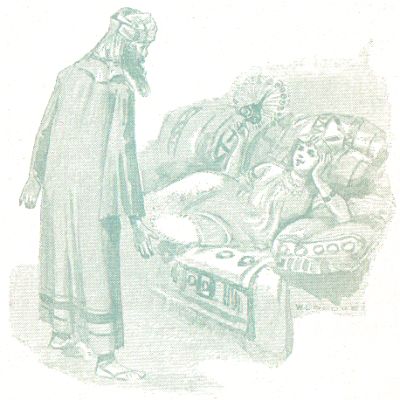
And Abraham said unto his servant, "Thou
shalt go unto my country and to my kindred,
and take a wife unto my son Isaac."
But the servant, who was evidently a student
of female character and knew
"That when a woman will, she will,
You may depend on it;
And when she won't, she won't,
And there's an end on it;"
said: "Peradventure, the woman will not be
willing to follow me unto this land."
Then Abraham, who was a connoisseur in
feminine ethics (as he naturally would be,
having had such able instructors as Sarah and
Hagar) and realized the utter futility of
attempting to persuade, bribe or induce a
woman to do anything she objected to doing,
said:
"And if the woman will not be willing to
follow thee, then thou shalt be clear from this
mine oath."
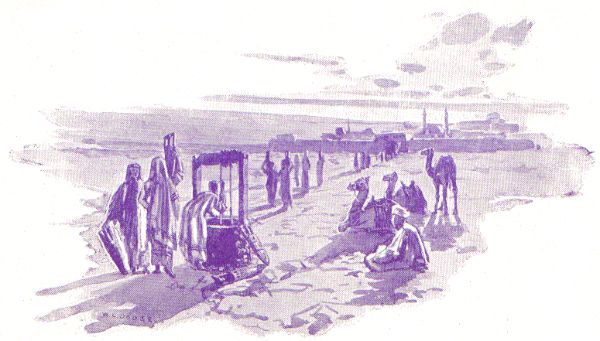
So the servant departed and "went to Mesopotamia
unto the city of Nahor."
Now it seems in those days the girls of
Nahor went outside the city gates every evening,
according to Oriental custom, to draw
water from a well, and the artful servant of
Abraham tarried at the well at sunset, for he
knew the girls would be along presently.
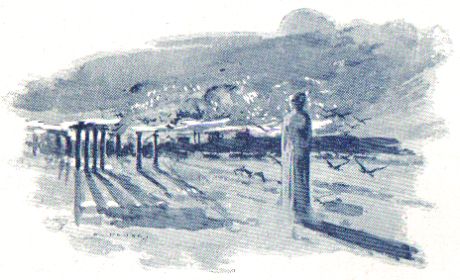
It was a lovely eventide. The wind touched
caressingly the few dainty flowers drooping
their heads in sleepy fragrance, the birds twittered
soft words of love to their nestling mates,
the departing god of day lavished in reckless
abandon his wealth of colors; piled crimson
mountains red as his ardent love in the western
sky, and robed high heaven in golden glory
that his sweetheart—the earth—reveling in and
remembering the grandeur of his passion and
the splendor of his departure, might not love
his silver-armored rival of the night.
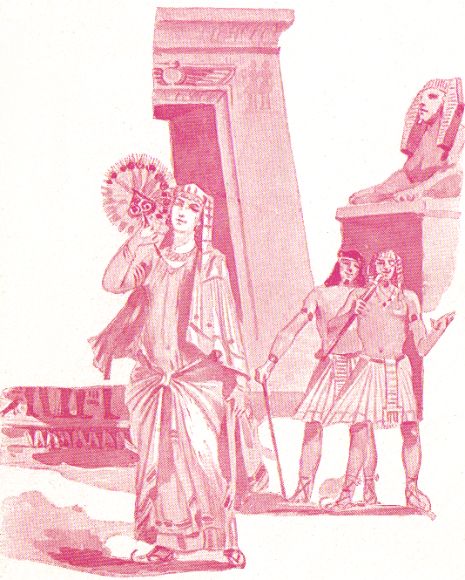
About this time the maidens tripped down
to the well, where the shrewd servant stood as
the "daughters of the men of the city came out
to draw water," and prayed:
"And let it come to pass that the damsel to
whom I shall say, 'Let down thy pitcher, I pray
thee, that I may drink;' and she shall say,
'Drink,' may be the one I am looking for;" or
words to that effect.
The words had hardly passed his lips ere
Rebekah, with the color snatched from the
roses in her cheeks and the grace of untrammeled
freedom in her step, skipped down to
the well.
And Rebekah "was very fair to look upon."
Of course. In relating the history of these
examples who have been held up since time
immemorial for us to follow, the writers of
"Holy Writ" never expatiate upon their virtue,
industry, domesticity, constancy or love, but
we are simply and briefly told they were "fair
to look upon," and the natural logical inference
is that we shall "go and do likewise."
Belonging to one of the wealthiest and
most influential families of Nahor, of course
Rebekah's practiced eye saw at a glance that
the handsome fellow waiting at the well and
looking the girls over was a person of rank and
importance; for it is only a logical conclusion
that coming from such a master and bound
upon such an errand, he was surrounded by all
the trappings and signs of wealth and luxury
that the times afforded.
And the maidens of Nahor went outside the
city gates partly for the same purpose, I suppose,
as that for which the girls of other places
go to the parks and matinées nowadays, for it
seems to have been a notorious fact that had
even spread to other countries, that the girls of
Nahor came down to the well in the blushing
sunset, and that too, without chaperon or
duenna. And I suppose the young men went
down too, to flirt with the charming damsels,
from the fact that the servant of Abraham
tarried there.
And Rebekah, stooping gracefully, filled her
pitcher, swung it lightly to her shoulder—and
as the woman sometimes takes the initiative in
an affair of this kind—smiled upon the willing
and ready-looking fellow; not exactly at him,
but as it were in his direction, you know; and
he caught the faint glint of sunshine on her lips,
and then—but in the witching hour when the
twilight and sunlight kiss and part, after the
smile and look of recognition everyone knows
what happens.
And he ran to her and said with the pleasing
courtesy of a man of the world:
"Let me, I pray thee, drink a little water of
thy pitcher."
Then with the tact of a finished coquette, in
three little words she conveyed to him the flattering
knowledge that she recognized in him
an embassador of power, wealth and luxury,
by saying:
"Drink, my Lord."
After that they became acquainted in the
most easy, off-hand manner, without an introduction,
and yet we are told to follow the example
of these pioneers of the race who were
always "fair to look upon."
I never in my life heard priest or people
condemning her for forming the acquaintance of
a stranger without an introduction; she was
called one of the "mothers in Israel," and even
St. Paul, who was a regular crank about the
girls, classed her with the "holy women of
old," which proves he didn't know anything
about her history or was playing upon the
ignorance of his hearers. She was a leader of
the ton in Israel, and if in those days they did
not banish her from good society, why should
we censure the same conduct when we are so
much more civilized, enlightened and liberal in
our views?
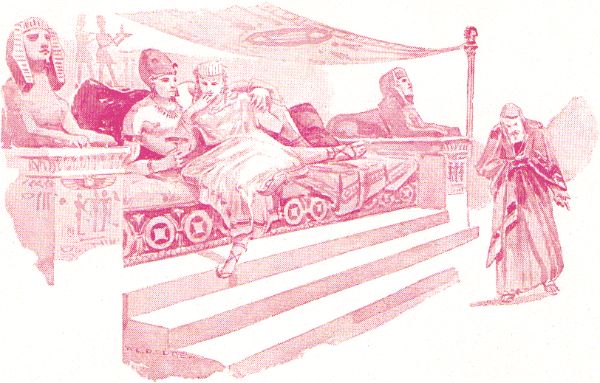
And in an incredibly short space of time
he adorned her with earrings and bracelets,
and she invited him home with her, and he
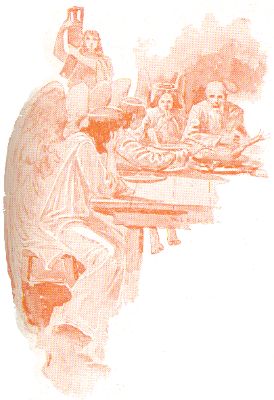
actually went and made it all right with her
mother and big brother by making a prepossessing
exhibition of piety, for you remember how
he told them "he bowed down his head and
worshipped the Lord."
He told them of Isaac, in whose name he
sued for Rebekah's fair hand. He didn't say
that Isaac was handsome, virtuous, talented or
ambitious, but he said, "the Lord hath blessed
my master and he is very great; and he hath
given him flocks and herds, and silver and
gold, and maid servants and men servants, and
camels and asses," and unto his son Isaac
"hath he given all that he hath," for this astute
man of the world seemed to know that the
surest and quickest way to win a woman was
to show her a golden pathway strewn with the
gems of power, luxury and ambition.
And the big brother did not pull out his
watch, look at it in a business-like way and say:
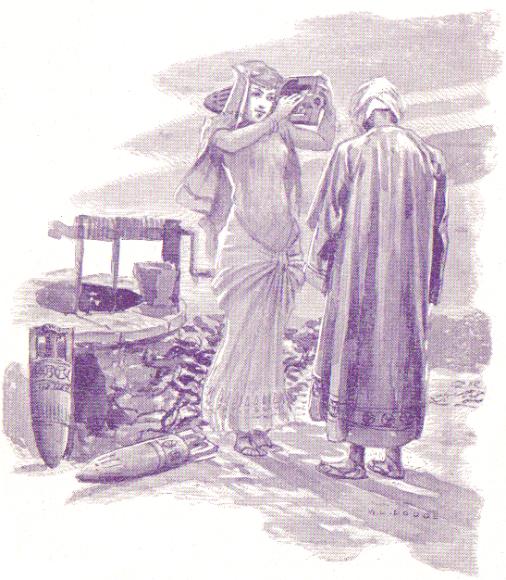 "LET ME, I PRAY THEE, DRINK A LITTLE WATER OF THY
PITCHER."
"LET ME, I PRAY THEE, DRINK A LITTLE WATER OF THY
PITCHER."
"Rebekah, pack your trunk and be ready
to take the 6:40 fast express." And her mother
did not smile and say, "we're so delighted and
honored, I'm sure. Of course she will go."
Not at all. They knew better even in those
days than to try and coerce or coax a woman
to do anything she didn't want to do, and so
they simply said:
"We will call the damsel and inquire at her
mouth."
Then the servant brought forth jewels of
silver and jewels of gold, and raiment, and
gave them to Rebekah; and he gave also to her
brother and to her mother precious things, and
then we are naively told that Rebekah said:
"I will go."
Rebekah was a woman of decision and knew
a good thing when she saw it, and so she did
not wait to prepare a stunning trousseau or get
out wedding cards and invitations fine enough
to make all the girls of Nahor sigh in envy
and admiration, but she departed at once. Now
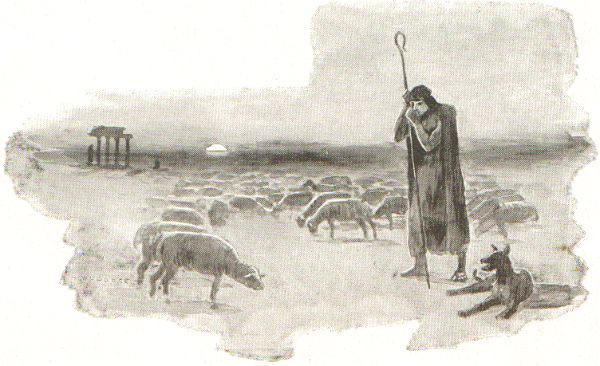
Isaac was of a poetical nature, and sought
the solitude of the fields at eventide to meditate.
Like most young men who have a love
affair on hand he wanted to be alone and dream
dreams and see visions.
And, as good luck would have it, just at this
sentimental and opportune moment, Rebekah
hove in sight.
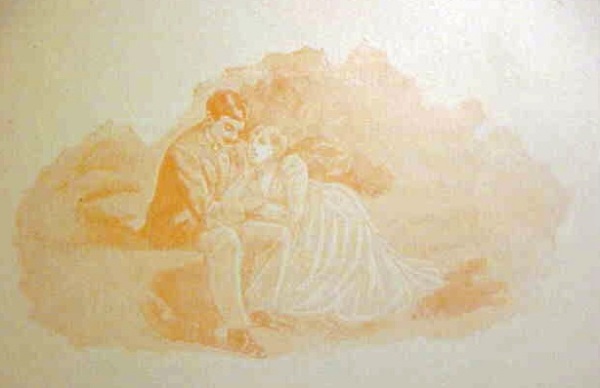
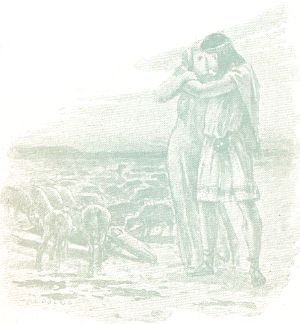
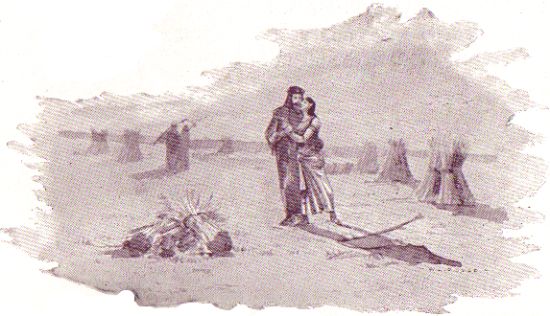
And Isaac lifted up his eyes and beheld
her; a woman with heaven in her eyes, a mouth
sweet enough to make a man forget everything
but the roses of life, and a form seductive
enough to tempt the very gods from on high.
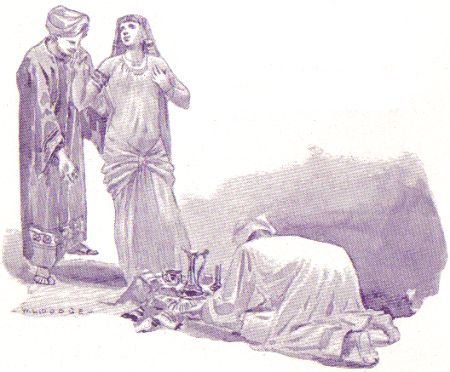
And she beheld a man, young
and strong and handsome,
the touch of whose hand
opened the gates of glory
to her soul, "and she
became his wife, and he loved her," thereby
putting himself on record as the first man in
the world we have any sacred official notification
of as having loved his wife.
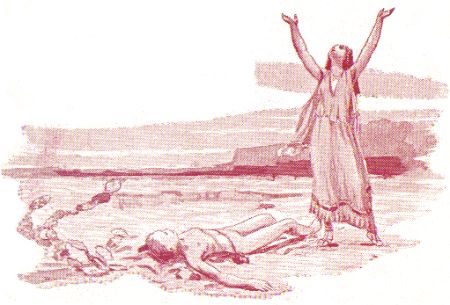
So the days and months, brightened by
smiles and tarnished by tears, dropped into the
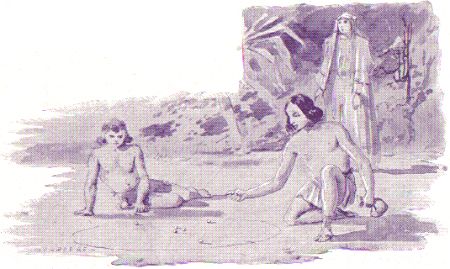
wreck-strewn, motionless
ocean of the past, and
in the course of human
events two little boys
played marbles in the tent of Isaac, and Rebekah
scored the rather doubtful distinction of going
on record as the first woman who ever doubled
expectations and presented her husband with
twins.
At this period the fair Rebekah begins to
get in her work as a disobedient wife, a deceitful,
intriguing woman and an-all-round-have-her-own-way
variety of her sex.
"Isaac loved Esau, but Rebekah loved
Jacob," and we conclude from that, as well as
from the actual facts in the case, that there
were domestic tornadoes, conjugal cyclones and
general unpleasantness all round. About this
time there was another famine in the land and
Isaac and Rebekah (and others) went into the
land of the Philistines to dwell, and of course
Rebekah's beauty attracted universal attention,
and the men of the place questioned Isaac
about her and he replied that she was his sister,
as he said, "lest the men of the place should
kill me for Rebekah," because she was fair to
look upon.
In that age it appears when a man fell in
love with a woman he killed her husband,
instead of hoodwinking and outwitting him as
they do in this progressive era, but I suppose
in spite of the awful chance of losing her
husband by some sudden and tragic death,
Rebekah slyly and seductively smiled upon
"the men of the place" from the fact that a
little farther on we read that the King issued a
mandate, saying:
"He that toucheth this man or his wife shall
surely be put to death."
The King knew that Isaac was favored of
the Lord, and he was afraid of some swift and
condign punishment if Isaac became offended
by the amorous attentions of any of his subjects
to Rebekah, so he gave the order to the men.
You will readily discern by that command
that he was a keen and intelligent student of
female character, and knew there was no use or
reason in appealing to her sense of justice, her
obedience to, or respect for law, or her regard
for the "eternal fitness of things" in a case of
the affections, and so he appealed to the fear and
obedience of the men, for he realized that no
man's pleading, no King's command, no threats
from heaven or fears of hell can stop a woman's
coquetry.
A little farther on Esau went the way of all
young men and married, and worse than that
he married Judith the daughter of a Hittite,
"which was a grief of mind unto Rebekah and
Isaac."
We know that one of Rebekah's strongest
points was putting herself on record for doing
something that no woman ever did before
that we have any authorized
statement of, and
she did it in this case by
being the first woman
who hated her daughter-in-law.
As we read on we find she was not the
meek, submissive and obedient wife we are
told women should be.
She systematically and continually had her
own way, in spite of husband, sons, kings, men,
God or angels.
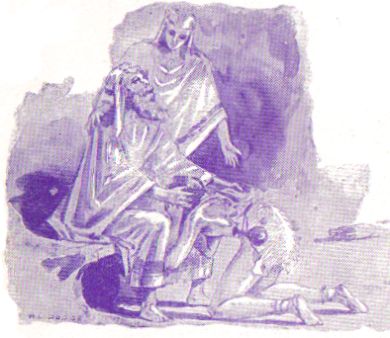
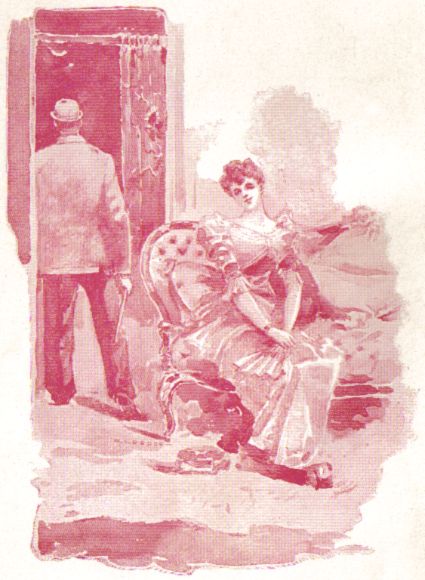
 "AND REBEKAH WAS—A WOMAN."
We discover that by a succession of deceptions,
tricks and chicanery she cheated Esau
out of his blessing, obtained it for Jacob, and
deceived and deluded her dying husband, all at
one fell swoop.
It is but just to Jacob to say that he objected
to putting himself in his brother's place, but
Rebekah said, "only obey my voice," and he
obeyed—of course.
The men were always obedient, as the Bible
proves conclusively. They obeyed everybody
and anybody—kings, mothers, wives, sweethearts
and courtesans.
But where can we find any evidence of the
vaunted obedience of woman?
Not among the prominent women of the
Bible at least.
Rebekah influenced her husband in all matters,
advanced one son's interests and balked
another's aims, prospects and ambitions. In
short she played her cards with such consummate
skill that she captured everything she
cared to take.
Jacob was obedient, complimentary, submissive
and loving and Rebekah was—a woman.
 "I HUMMED A GAY LITTLE TUNE FOR HIS BENEFIT."