Having in the preceding chapters endeavoured to trace
the origin of Playing Cards, and to show their progress
from the time of their first introduction into Europe, I
shall now proceed to give collectively some account of the
different kinds of cards, of the various marks that have been
employed to distinguish the suits, and of the changes that
they have undergone at different periods.
Most authors who have expressly written on the subject,
agree in distinguishing two kinds of cards, namely, those
which they call Tarocchi, or Tarots; and those, consisting
of four suits, which are in common use throughout Europe.
It is a subject of dispute, among the learned in these
matters, which of those two kinds are of the greatest antiquity;
Court de Gebelin considers that Tarocchi cards were known
to the ancient Egyptians;
[220]
and Mons. Duchesne is pleased
to assume that certain so-called Tarocchi Cards, preserved
in the Bibliothèque du Roi, belonged to one of the three
packs painted for Charles VI, by Jacquemin Gringonneur,
in 1393. Mons. Duchesne is also of opinion that these
cards were the same as those which were formerly called
Naibi in Italy; and in support of it, he alleges several
authorities, which seem to him to be decisive of the fact,
but which really prove nothing more than that Chartæ
and Naibi were synonymous.
[221]
He produces no evidence
to show that the series of painted and engraved figures,
now usually called Tarocchi, were originally known either
by that name, or by that of cards; while from a passage
cited by Mons. Leber, from Raphael Volaterranus, it would
appear that Tarocchi Cards, properly so called, were not
invented till towards the close of the fifteenth century; and
from the same author we learn that a pack of such cards
consisted of the four suits of common cards, together with
twenty-two symbolical figures, similar to those which are
assumed by Mons. Duchesne to have been the original
Tarocchi. Tarocchi cards—called Tarots by the French—are
still used in several parts of France, Germany, and
Italy; and an account of the manner of playing the game
is to be found in the edition of the 'Académie des Jeux,'
published by Corbet, Paris, 1814.
Mons. Duchesne calls this game Tarocchino, and distinguishes
it from that played with the old series of figures,
which he supposes to have been the original Tarocchi; but
so far from there being any evidence to show that these
figures were at their first introduction known either by the
name of Tarocchi or of Cards, there seems greater reason to
conclude that they have only obtained this name in comparatively
recent times, in consequence of some of them being
used in combination with common cards, at a game called
Tarocchi, which was also the name given to the cards with
which it was played. The earliest writers who mention
Tarocchi as a kind of cards, always speak of them as consisting
of four suits,—Swords, Cups, Batons, and Money,—together
with a certain number of other cards, representing
various characters and emblematical figures.
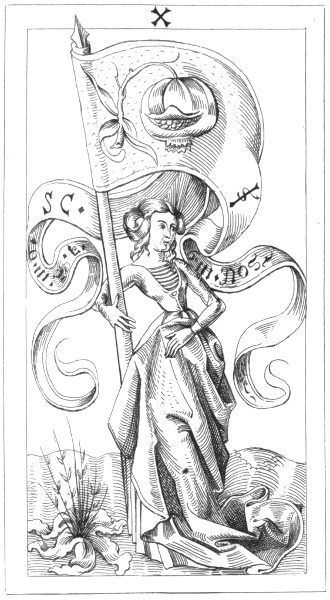
A pack of Tarots,
[222]
as at present used in France, corresponds
in every particular with those called Tarocchi by
writers of the sixteenth century. It consists of seventy-eight
cards; that is, of four suits of numeral cards, and twenty-two
emblematic cards, called Atous.
[223] The marks of the
suits are usually Swords, Cups, Batons, and Money; and
each suit consists of fourteen cards, ten of which are "pips"
or low cards, and the other four are coat cards,—namely,
King, Queen, Chevalier, and Valet. Of the Atous, twenty-one
are numbered consecutively from 1 to 21; that which
is not numbered is called the Fou,—the Clown or Buffoon,—and
in playing the game is usually designated "Mat."
The Fou has of itself no positive value, but augments that
of any of the other Atous to which it may be joined. The
other Atous are numbered and named as follows:
1. The Bateleur, or Juggler; called also Pagad. 2. Juno.
3. The Empress.
[224]
4. The Emperor. 5. Jupiter. 6. L'Amoureux.
7. The Chariot. 8. Justice. 9. The Capuchin, called also
the Hermit. 10. The Wheel of Fortune. 11. Fortitude.
12. Le Pendu—a man suspended, head downwards, by
one leg. 13. Death. 14. Temperance. 15. The Devil.
16. The Maison-Dieu, or Hospital—a tower struck by
lightning. 17. The Stars. 18. The Moon. 19. The Sun.
20. The Last Judgment. 21. The End of the World.—Of
these the first five are called petits atous, and the last five
grands atous. Seven cards are also especially distinguished
as Tarots, or Atous-tarots; these are the End of the World,
the Buffoon, the Bateleur, and the four Kings.
[225]
According to Cicognara,
[226]
the inventor of the game of
Tarocchino,—or Tarots, as above described,—was an Italian,
who resided at Bologna, prior to the year 1419; and the
account which he gives is to the following effect: "There
is preserved in the Fibbia family, one of the most ancient
and illustrious of that city, a portrait of Francis Fibbia,
Prince of Pisa,—who sought refuge at Bologna, about the
commencement of the fifteenth century,—in which he is
represented holding in his right hand a parcel of cards,
while others appear lying on the ground; among the latter
are seen the Queen of Batons, and the Queen of Money,
the one being ornamented with the arms of the Bentivoglio
family, and the other with the arms of the Fibbia. An
inscription at the bottom of the picture informs us that
Francis Fibbia, who died in 1419, had obtained, as the
inventor of Tarocchino, from the Reformers of the city, the
privilege of placing his own shield of arms on the Queen of
Batons, and that of his wife, who was of the Bentivoglio
family, on the Queen of Money; "a distinction," observes
Mons. Duchesne, "which nevertheless does not exclude the
supposition that Francis Fibbia, Commander-in-chief of the
Bolognese forces, had rendered more important services to
his countrymen than teaching them to play at Tarocchino."
Supposing Cicognara's account to be correct, it yet proves
nothing with respect to the comparative antiquity of the
two kinds of cards which compose the pack for the game of
Tarocchino, or Tarots. Mons. Duchesne, however, having
assumed that the old series of emblematic figures called
Tarocchi cards were the oldest, sees no difficulty in the
matter, but unhesitatingly concurs with Cicognara in
ascribing the invention of Tarocchino to Francis Fibbia,
without inquiring whether Fibbia had merely combined
into one pack two kinds of cards already well known, or
whether he was the first deviser of the four suits which constitute
the most important portion of the pack, and which
give to the game all its spirit. Seeing that Fibbia was
honoured for his invention by the Reforming magistracy
of Bologna,—where both card-playing and the manufacture
of cards appear to have been pretty extensively carried on
about 1423,—the most probable conclusion would be, that
he had deserved well in their opinion, not from having
converted by new combinations a previously innocent and
amusing game into a hazardous and exciting one, but in
consequence of his having shuffled a few moral Tarocchi
into the old pack of numeral cards of four suits, whether
of Swords, Cups, Batons, and Money, or of Bells, Hearts,
Leaves, and Acorns. In support of this conclusion, it may
further be observed, that though the manufacture of cards
was extensively carried on both in Italy and Germany,
before the year 1450, no so-called Tarocchi cards of that
period have been discovered which can fairly be supposed
to have been intended, either from their size or execution,
for the common purposes of play; while, on the contrary,
there are in existence several specimens of numeral cards
of four suits, either stencilled or engraved on wood, and
evidently of a cheap manufacture, for common use, of a date
not later than 1450.
The kind of game for which the emblematic figures
usually called Tarocchi cards were used, remains to be discovered.
Mons. Duchesne has, indeed, hazarded a conjecture
on the subject, which is equally incapable of refutation or
of proof. "The number of players," he says, "necessary to
form a party, would scarcely be limited to two, and probably
might vary from three to twelve, or rather from three to
eight; and the manner of playing might simply consist in
the appropriate laying down of such of the figures as, according
to an order agreed upon, might belong to the suit
of the card first played. The holder of certain privileged
cards would have doubtless some additional advantage;
and we may further suppose that each player being obliged,
in turn, to lay down a card drawn at random, striking contrasts
resulting from unexpected combinations would afford
a subject of amusement. This supposition would seem to
agree with the subject of a book entitled 'Les Cartes Parlantes,'
[227]
printed at Venice, in 1545; each card there has
conferred on it an interpretation or allusion, more or less
ingenious, applicable to the figure which it represents: thus
the Pope represents fidelity in the game and sincerity in
the player; the Emperor, the laws of the game; the Valets,
the service attached to the game; the Swords, the death
of despairing gamesters; the Batons, the punishment of
those who cheat; Money, the sustenance of play; and the
Cups, the drink over which the players settle their disputes."
Mons. Duchesne's conjecture can scarcely be said to be supported
by the conceits of Aretine; who, moreover, in the
whole course of his book, speaks of cards as a hazardous,
exciting game, at which both money and credit might be
lost; while Mons. Duchesne asserts that the game played
with Tarocchi was merely one of amusement, originally
devised to instruct children under the semblance of play.
The earliest known specimens of what are called Tarocchi
cards are those preserved in the Bibliothèque du Roi, at
Paris, and which are supposed by Mons. Duchesne to have
formed a portion of one of the three packs painted for the
amusement of Charles VI, in 1393.
[228]
They formerly belonged
to Mons. de Gaignières, who had been governor to the grandchildren
of Louis XIV, and who bequeathed them, together
with his entire collection of prints and drawings, to the
king, in 1711. Those cards appear to have been seen in the
possession of Mons. de Gaignières by the Abbé de Longuerue;
[229]
and also by Dr. Martin Lister, who thus mentions them in his
account of his journey to Paris, in 1698: "I waited upon
the Abbot Droine to visit Mons. Guanieres [de Gaignières]
at his lodgings in the Hostel de Guise. One toy I took
notice of, which was a collection of playing cards for 300
years. The oldest were three times bigger than what are
now used, extremely well limned and illuminated with gilt
borders, and the pasteboard thick and firm; but there was
not a complete set of them."
The following particulars respecting those cards are
chiefly derived from Mons. Duchesne's description of them
in his 'Observations sur les Cartes à jouer,' published in the
'Annuaire Historique' for the year 1837. There are seventeen
of them, and there can scarcely be a doubt of their having
formed part of a set of what are called Tarocchi cards,
which, when complete, consisted of fifty. They are painted
on paper, in the manner of illuminations in old manuscripts,
on a gold ground, which is in other parts marked with
ornamental lines, formed by means of points slightly pricked
into the composition upon which the gilding is laid. They
are surrounded by a border of silver gilding, in which there
is also seen an ornament, formed in the same manner, by
means of points, representing a kind of scroll or twisted
riband. Some parts of the embroidery on the vestments of
the different figures are heightened with gold, while the
weapons and armour are covered with silver, which, like
that on the borders, has for the most part become oxydized
through time. There is no inscription, letter, nor number,
to indicate the manner in which they were to be arranged.
Mons. Leber agrees with Mons. Duchesne in ascribing them
to a French artist of the time of Charles VI, and even seems
inclined to conclude that they might have been intended
for the amusement of that lunatic king. Looking at those
cards, however, as they appear in the fac-similes published
by the Society of Bibliophiles Français, I should rather take
them to be the work of an Italian artist, and be inclined
to conclude, as well from the general style of the drawing
as from the costume, that they were not of an earlier date
than 1425.
The following is Mons. Duchesne's enumeration of the
seventeen cards which he supposes to have been executed
by Gringonneur: the names in capitals are those which
occur in a series of so-called Italian Tarocchi cards, with
which he considers them to correspond.
1. Le Fou—the Buffoon. This figure is found in the
Tarots of the present day, and is perhaps the same character
as that which in the series of old Italian engraving—called
Tarocchi cards—is inscribed Misero I.
2. L'Ecuyer—the Squire. Chevalier VI.
3. L'Empereur—the Emperor. Imperator VIIII.
4. Le Pape—the Pope. Papa X.
5. Les Amoureux—the Lovers. Young men and women
courting, while two winged Cupids are discharging arrows
at them. Mons. Duchesne gravely queries whether this
subject does not represent Apollo and Diana killing the
children of Niobe, and whether it ought not to be considered
as corresponding with Apollo XX. It has, however, as
little relation to the story of Niobe as it has to Apollo, as
figured in the engraving referred to.
6. La Fortune—Fortune. This figure, standing on a
circle which represents the world, holds a globe in one
hand, and in the other a sceptre. Mons. Duchesne considers
that it corresponds with that named Astrologia, in
the series of Italian engravings, and there erroneously
numbered XXXVIIII, instead of
XXVIIII.—Bartsch, it seems
had not observed this error.
7. La Tempérance—Temperance. Temperancia XXXIIII.
8. La Force—Fortitude. Fortezza XXXVI.
9. La Justice—Justice. Justicia XXXVII.
10. La Lune—the Moon. Luna XXXXI.
11. Le Soleil—the Sun. Sol XXXXIIII.
12. Le Char—the Chariot. The subject here is a figure
in armour, standing on a kind of triumphal car, and having
in his right hand a battle-axe. Mons. Duchesne says that
this subject certainly corresponds with Marte XXXXV.
13. L'Ermite—the Hermit. This figure is supposed to
correspond with that named Saturno XXXXVII.
The four following subjects have no corresponding figures
in the series of old Italian engravings, supposed by Mons.
Duchesne and others to be Tarocchi cards: they are, however,
to be found among the "Atous" of the modern game
of Tarots.
14. Le Pendu—A man hanging from one leg, head
downwards. Court de Gebelin, speaking of this figure as
it is seen in a modern pack of Tarots, conjectures, with his
usual absurdity, that the card-maker had erroneously represented
it upside down. On turning it the contrary way,
he sees in it an emblem of Prudence,—to wit, a man standing
upon one foot, and sagely deliberating where he has to
place the other.—The figure of Le Pendu, even when thus
viewed, is much more like a capering opera-dancer, than a
prudent philosopher cautiously picking his steps; and bears
not the slightest resemblance to the figure of Prudence, in
the series of old engravings, called Tarocchi cards.
15. La Mort—Death.
16. La Maison-Dieu—The Hospital. A tower struck
by lightning.
17. Le Jugement dernier—The last Judgment.
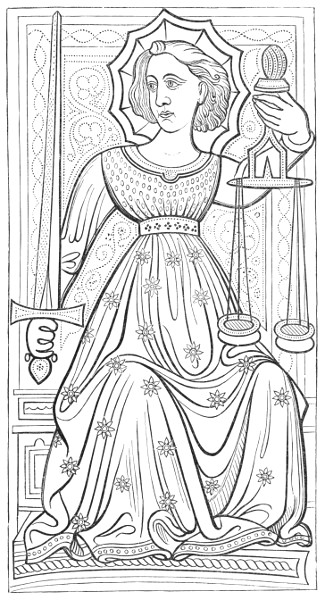
Old Painted Cards ascribed to Gringonneur.
—'La Justice.' (p. 198)
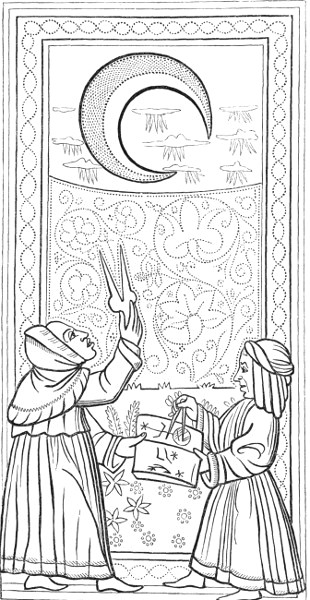
Old Painted Cards ascribed to Gringonneur.
—'La Lune.' (p. 198.)
These seventeen subjects, engraved in lithography, and
carefully coloured by hand after the original drawings, are
given in the 'Jeux de Cartes Tarots et de Cartes Numérales,'
published by the Society of Bibliophiles Français, 1844.
The two annexed cuts will afford some idea of the style of
the drawing, and of the manner in which the ornaments are
pricked into the gold ground. They are of the same size as
the originals; the one is that named Justice, No. 9, and the
other that named La Lune, No. 10, in the preceding enumeration.
It may be here observed that the latter is totally
different from that named Luna XXXXI,
in the series of old
Italian engravings, with which it is supposed by Mons.
Duchesne to correspond: the only figure common to both
is that of a crescent moon. The drawing indeed seems to
be an emblem of Astrology, which, in the Italian engravings,
is represented by a winged female figure, having on her
head a crown of stars, and holding in her left hand a book,
and in her right a divining rod.
The complete series of old Italian engravings, known to
collectors of prints by the name of Tarocchi cards, consists
of fifty pieces, divided into five classes distinguished by the
first five letters of the alphabet, A, B, C, D, E, but numbered
consecutively from 1 to 50, commencing with the class
marked E. At the foot of each subject is engraved its
name; together with the letter of its class, and its number,
which is given both in Roman and Arabic numerals,—the
Roman being placed immediately after the name, and the
Arabic on the extreme right. The distinctive letter of the
class is on the left. Zani
[230]
has conjectured that the letters
might have been intended for abbreviations of Atutto,
Battoni, Coppe, Denari, and Espadone,—Atous, Batons,
Cups, Money, and Swords. Spadone, however, and not
Espadone, is the proper Italian name for swords; but as
the names are in the Venetian dialect, Mons. Duchesne
appears inclined to allow that the form Espadone might
have been admitted into it at that period. That the letters,
however, had no such meaning, and that they were merely
used to mark the order of each class, seems to be proved
by the fact that in another set of the same subjects, executed
about the same period, the numeral 5 is substituted
for the letter E. Even if Zani's supposition were correct,
it would only strengthen the conclusion that those so-called
Tarocchi cards originated in an attempt to recombine,
under new emblems, the principles of an old game
which had acquired a disreputable character. Whatever
the game might have been, it has long become obsolete;
and the only reason for supposing it to have been cognate
with that of cards, is grounded on the fact that a certain
number of the characters of those so-called Tarocchi cards
occur as Atous in the pack of Tarocchi or Tarots, previously
described.
Of those old Italian engravings there are two series
known to amateurs, agreeing in the subjects, but differing in
their style of execution; though it is evident that the one
has been copied from the other.
[231]
In one of them, which is
considered by Bartsch to be the earliest, the date 1485 is
inscribed on a tablet in the hands of the figure named
Arithmeticha XXV.
[232]
In the other series, which is by much
the best engraved, and is certainly the earliest, there is no
date; and the figure which there represents Arithmetic,
appears to be counting money. This series Mons. Duchesne
thinks was executed about 1470; and some writers have
supposed that the subjects were engraved by Tomaso
Finiguerra. Zani, however, is inclined to believe that they
were engraved at Padua; while Otley ascribes them to a
Florentine artist. Seeing, however, that the names are in
the Venetian dialect, and that authorities on the subject of
old Italian engraving disagree with respect to them, I am
inclined to suppose, without any regard to their style of
execution, that they were either engraved by a Venetian
artist, or for the Venetian market. It has also been supposed,
but erroneously, that they were designed by Andrea
Mantegna, to whom a number of other things of a similar
kind have, with equal probability, been ascribed; and
amongst the dealers in old engravings, at Paris, they are
commonly known as Cartes de Baldini. Both the originals
and the copies are of great rarity; and though several single
subjects are to be found in the possession of amateurs, it is
questionable if there be more than four collections in Europe,
whether private or national, that have either the one series
or the other complete. In the British Museum there is a
complete series of the originals, and also forty-five of the
copies; the five pieces wanting in the latter are: Misero I,
Fameio II,
Imperador VIIII,
Primo Mobile XXXXVIIII,
and Prima Causa XXXXX.
There is also a complete series
of the originals, in the 'Bibliothèque du Roi;' and copies
of them are given in the 'Jeux de Cartes Tarots et de Cartes
Numérales,' published by the Society of Bibliophiles
Français. Fac-similes of two,—Papa X
and Rhetorica
XXIII,—are also given by Singer in his 'Researches into the
History of Playing Cards.' From their size—about nine
inches and three quarters high, by about four inches wide,—as
well as from other circumstances, Mr. Singer considers
that they were not intended for any game analogous to that
of cards, properly so called. Mons. Leber considers them
to have been merely "Cartes de Fantaisie," and observes
that subjects so delicately engraved on copper, when the
invention of the art was still recent, could scarcely have
been intended to receive the colouring required for the completion
of a pack of cards.
[233]
It, however, may be observed
that colour is not essential to a pack of playing cards; and
that several packs of cards of four suits, evidently intended
for play, without being coloured, were delicately engraved
on copper, before the end of the fifteenth century.
Even Mons. Duchesne, while contending that those fifty
old engravings were really Tarocchi cards, admits that they
bear no relation to any games played with numeral cards,
which, according to the number of players, and the regulations
of each game, always consist of a number which is
divisible by four; for instance, 20 for Bouillotte; 28 for
Brelan; 32 for Piquet, and several other games; 36 for
Trappola; 40 for Ombre; 48 for Reversis; 52 for Lansquenet,
and several other games; 96 for Comet; 104 for
Lottery; 312 for Trente-et-un; and 78 for Tarots. "The
ancient Tarocchi cards," he says, "have not then been
intended for games of calculation [jeux mathématiques], but
solely for an instructive game. In this game, consisting of
five classes, we find the seven planets, representing the
celestial system; the seven virtues which constitute the
basis of all morality; the sciences, which man alone is
capable of acquiring, and the knowledge of which raises
him above all other animals; the Muses, whose cultivation
yields so many charms to life; finally, several of the conditions
of life in which man may be placed, from misery,
the most painful of all, to that of the most elevated, the
Sovereign Pontificate."
[234]
A complete series of those old
engravings consists of fifty pieces, as has been previously
observed, named and numbered as follows:
[Class E.—The Conditions of Life.]
| E |
Misero I |
1 |
| E |
Fameio II |
2 |
| E |
Artixan III |
3 |
| E |
Merchadante IIII |
4 |
| E |
Zintilomo V |
5 |
| E |
Chavalier VI |
6 |
| E |
Doxe VII |
7 |
| E |
Re VIII |
8 |
| E |
Imperator VIIII |
9 |
| E |
Papa X |
10 |
[Class D.—The Muses.]
| D |
Caliope XI |
11 |
| D |
Urania XII |
12 |
| D |
Terpsicore XIII |
13 |
| D |
Erato XIIII |
14 |
| D |
Polimnia XV |
15 |
| D |
Talia XVI |
16 |
| D |
Melpomene XVII |
17 |
| D |
Euterpe XVIII |
18 |
| D |
Clio XVIIII |
19 |
| D |
Apollo XX |
20 |
[Class C.—The Sciences.]
| C |
Grammatica XXI |
21 |
| C |
Loica XXII |
22 |
| C |
Rhetorica XXIII |
23 |
| C |
Geometria XXIIII |
24 |
| C |
Arithmeticha XXV |
25 |
| C |
Musicha XXVI |
26 |
| C |
Poesia XXVII |
27 |
| C |
Philosofia XXVIII |
28 |
| C |
Astrologia XXXVIIII
[235] |
39 |
| C |
Theologia XXX |
30 |
[Class B.—The Virtues.]
| B |
Iliaco XXXI |
31 |
| B |
Chronico XXXII |
32 |
| B |
Cosmico XXXIII |
33 |
| B |
Temperancia XXXIIII |
34 |
| B |
Prvdencia XXXV |
35 |
| B |
Forteza XXXVI |
36 |
| B |
Justicia XXXVII |
37 |
| B |
Charita XXXVIII |
38 |
| B |
Speranza XXXVIIII |
39 |
| B |
Fede XXXX |
40 |
[Class A.—The Celestial System.]
| A |
Luna XXXXI |
41 |
| A |
Mercurio XXXXII |
42 |
| A |
Venus XXXXIII |
43 |
| A |
Sol XXXXIIII |
44 |
| A |
Marte XXXXV |
45 |
| A |
Jupiter XXXXVI |
46 |
| A |
Saturno XXXXVII |
47 |
| A |
Octava Spera XXXXVIII |
48 |
| A |
Primo Mobile XXXXVIIII |
49 |
| A |
Prima Causa XXXXX |
50 |
Having now given such an account of the so-called
Tarocchi cards, as may enable the reader to determine for
himself, both with respect to their original use, and their
relation to playing cards proper, I shall now proceed to
notice some of the principal varieties of numeral cards;
that is, of cards consisting of four suits, and each suit containing
a certain number of coat cards, together with eight
or ten lower cards, having their numeral value designated
by the marks of the suit to which they belong.
The oldest specimens of undoubted playing cards are
either stencilled, or engraved on wood; and of a date which,
looking at the style of their execution, the drawing, and the
costume of the figures, cannot fairly be supposed to be later
than 1440. Amongst the earliest are the stencilled cards
preserved in the print-room of the British Museum, and
previously described at page 89. In these the coat cards
appear to have been a King, a Chevalier, and a Fante,
Footman, or Knave; without any Queen. The marks of
three of the suits are Hearts, Bells, and Acorns; the mark
of the fourth suit does not occur,—as the specimens
preserved are far short of a complete pack,—but it is highly
probable that it was Leaves, called Grün by the Germans,
as in the old pack formerly belonging to Dr. Stukeley, and
described by Mr. Gough, in the eighth volume of the
'Archæologia.'
The cards formerly belonging to Dr. Stukeley were given
to him by Thomas Rawlinson, Esq.
[236] They were found in
the cover of an old book,—supposed to be an edition of
Claudian, printed before the year 1500,—and one or two
leaves of an edition of the Adagia of Erasmus were interspersed
between the layers of the cards, thus forming a
kind of pasteboard. The marks of the suits are Hearts,
Bells, Leaves, and Acorns; and the coat cards are the King,
Chevalier, and Knave. The numeral value of the lower
cards, from the Deuce to the Ten, is indicated by a repetition
of the marks of the suits, as in modern cards. As
there is no Ace, this pack, supposing it to be complete,
would consist of forty-eight cards. These cards are rudely
coloured, and of smaller size than those in the British
Museum. On the Deuce of every suit is a shield, displaying
what is supposed to be the card-maker's arms, namely, a
kind of pick-axe, with one of the ends blunt like a hammer,
and a mallet, in saltire. Fac-similes of Dr. Stukeley's
cards are given in Singer's Researches.
As the distinctive marks of the suits on the oldest cards
in existence are Hearts, Bells, Leaves, and Acorns, it may
reasonably be supposed that these marks were used at as
early a period as any of the others which occur on cards of
a later date, but yet executed before the close of the
fifteenth century. Next to these in point of antiquity,
and perhaps of as early a date, are Swords, Cups, Batons,
and Money, which would appear to have been the most
common marks on early Italian cards, and to have been
almost exclusively adopted in Spain. For the sake of
distinction, in future, cards with these marks will be
referred to as Spanish cards, as in Spain the suits are still
distinguished by Swords, Cups, Batons, and Money; while
cards having Hearts, Bells, Leaves, and Acorns, will be
referred to as German cards, as such appear to have been
the kind most generally used in Germany. Of the marks
on what were more particularly called "French cards,"
in the sixteenth century,—Cœur, Trèfle, Pique, and Carreau,
or as we call them, Hearts, Clubs, Spades, and Diamonds,—two
of them at least, the Cœur and the Pique, are evidently
derived from the Heart and the Leaf of the earlier
pack, while there is good reason to believe that the form of
the Trèfle was copied from that of the Acorn.
[237]
The mark now called the Trèfle, in France, was formerly
known as the Fleur. Peignot, referring to a poem entitled
"La Magdaleine au Désert de la Sainte-Baume en Provence,"
printed at Lyons, in 1668, says: "We learn from this
poem that, in 1668, the word Trèfle was not yet in use,
as the designation of one of the suits of cards; that suit
was then called Fleurs. The Valets were also then termed
Fous."
The type of the Carreau, or Diamond, is not to be found
in any of the marks of the other two packs above noticed.
In the time of Pietro Aretine, the suits of French cards
appear to have been known in Italy by the names of Cori,
Quadri, Fiori, and Cappari,
[238]
as we learn from his 'Carte
Parlanti,' first printed in 1545, in which a Paduan card-maker
holds a long dialogue, moral and entertaining, with
his cards:
"Paduan. As French cards are used in Italy, tell me, I
pray, what, amongst that people, may be the signification
of Capers? [Cappari.]
Cards. Their piquancy whets the appetite of tavern-haunters.
Paduan. And the Diamonds? [Quadri.]
Cards. The firmness of the player.
Paduan. And the Hearts? [Cori.]
Cards. Inclination to cheat in play.
Paduan. And the Flowers? [Fiori.]
Cards. The pleasure of saying a good thing."
[239]
The invention of cards with these marks, and having a
Queen for the second coat card, instead of a male figure, as
in the Spanish and German cards, has been claimed by the
French; and this substitution has been considered by some
French writers as peculiarly characteristic of the gallantry
of their nation. The French also appear to have been the
first who gave to their coat cards the names of historical
personages. From those names, and the marks of the suits,
Père Daniel has been enabled to discover the origin and
meaning of the game of Piquet, which he supposes to have
been devised about 1430, in the reign of Charles VII;
admitting, however, that Playing Cards of another kind
were of a much earlier date, but yet considering even these
to have been of French invention.
In the time of Père Daniel, the coat cards were named as
follows:
| SUIT. |
KINGS. |
QUEENS. |
VALETS. |
| CŒUR. |
CHARLEMAGNE. |
JUDITH. |
LA HIRE. |
| CARREAU. |
CÆSAR. |
RACHEL. |
HECTOR. |
| TREFLE. |
ALEXANDER. |
ARGINE. |
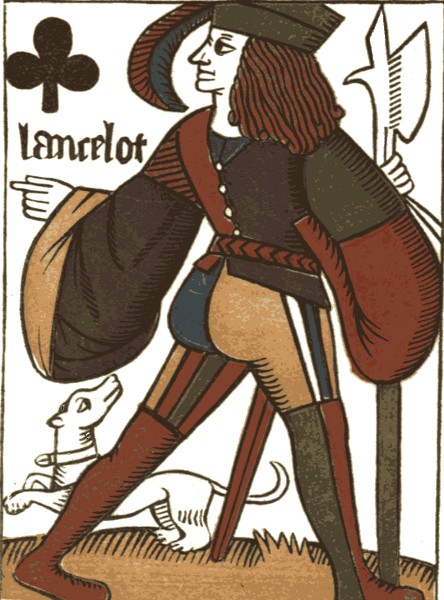
LANCELOT.
[240] |
| PIQUE. |
DAVID. |
PALLAS. |
HOGIER. |
These names, which appear to have been given to the
French coat cards, at an early period, were not uniformly
retained; in the time of Henry IV, the Kings were
Solomon, Augustus, Clovis, and Constantine; and the
Queens, Elizabeth, Dido, Clotilde, and "Pantalisea;" while
the Valets had no proper names, but were merely designated
from their office, and all the characters appeared in the
costume of the period. In the reign of Louis XIV, however,
the former names and an antique costume were
restored.
According to Père Daniel's reading of the cards, which
is of the same ingenious character as that of the soldier who
is said to have used his pack as a Manual of Devotions,
[241]
the Ace is the Latin As, a piece of money, which also signifies
wealth; and as money is the sinews of war, the Ace
has for this reason the precedence at Piquet. The Trèfle,
or clover plant, which abounds in the meadows of France,
denotes that a general ought always to encamp his army in
a place where he may obtain forage for his cavalry. Piques
and Carreaux signify magazines of arms, which ought always
to be well stored. The Carreaux were a kind of heavy
arrows which were shot from a crossbow, and which were
so called from their heads being squared [carré]. Cœurs,—Hearts,—signified
the courage of the commanders and the
soldiers.
David, Alexander, Cæsar, and Charlemagne are at the
head of the four suits at Piquet, because troops, however
brave and numerous, yet require prudent and experienced
leaders. The Queens are, Argine, for Trèfle; Rachel, for
Carreau; Pallas, for Pique; and Judith, for Cœur. In Argine,
Père Daniel finds the anagram of Regina, and having made
this capital discovery, he is enabled to determine that this
Queen was Mary of Anjou, wife of Charles VII. Rachel
represents the fair Agnes Sorel, mistress of Charles VII;
and the chaste and warlike Pallas is but an emblem of Joan
of Arc. Judith is not the Jewish heroine who cut off the
head of Holofernes, but the Empress Judith, wife of Louis
le Debonnaire; but even this Judith is merely a representative
of Isabel of Bavaria, wife of Charles VI. In David
he sees a typification of Charles VII, in consequence of a
conformity in their destinies: David, after having been long
persecuted by Saul, his father-in-law, at length obtained the
crown; but, in the midst of his prosperity, was troubled
with the revolt of his son Absalom: and Charles VII, after
having been disinherited and proscribed by his father
Charles VI,—or rather by Isabel of Bavaria,—gloriously
reconquered his kingdom; but the latter years of his life
were rendered unhappy by the restless spirit and wicked
character of his son, Louis XI.
In his account of the Valets, Père Daniel is not so imaginative
as in the explication of the double and triple
characters which he sees represented by the Kings and
Queens. La Hire is the famous Stephen de Vignoles,
surnamed La Hire, a devoted adherent of Charles VII;
while Hector is supposed to be intended for Hector de
Galard, another famous captain of the same period. Hogier
and Lancelot are allowed to pass simply in their own proper
characters, as heroes of romance.
[242]
It would appear to be the opinion of Mons. Duchesne,
that the oldest French Piquet cards that have been discovered,
are those formerly belonging to a Mons. Henin,
who found them in the cover of an old book. Mons. Henin
having disposed of them to Messrs. Colnaghi, the well-known
printsellers, of London, they were purchased of the
latter for the Bibliothèque du Roi. They are engraved on
wood, and coloured; and in the table of contents prefixed
to the 'Jeux de Tarots et de Cartes Numérales,' it is asserted
they were executed about 1425.
[243] But whatever may
be their date, they are not, in my opinion, of so early a
period as either the old uncoloured cards, preserved in the
British Museum, previously described at page 88; or as
those formerly belonging to Dr. Stukeley. I indeed question
much if they be really older than the coloured French
cards, the four Valets, now in the British Museum, and
of which some account will be found in a subsequent page.
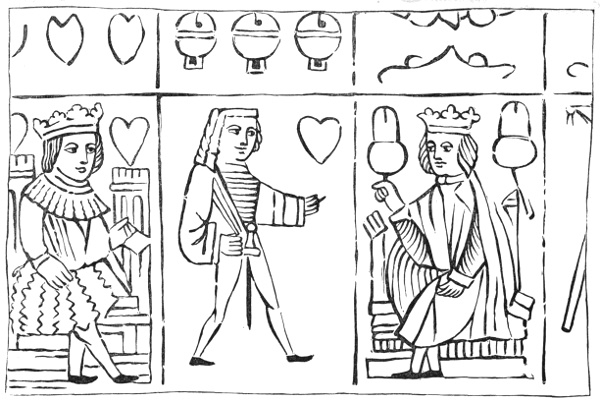
The old French cards in question have the outlines
printed in pale ink, and the colours appear to have been
applied by means of a stencil. There are ten of them, all
impressed on one piece of paper; and they are placed in
two rows, of five each, in the following order:
Valet, King and
Queen of Trèfle.
Valet, Queen and
King of Pique.
King and Queen
of Carreau.
Queen and King
of Cœur.
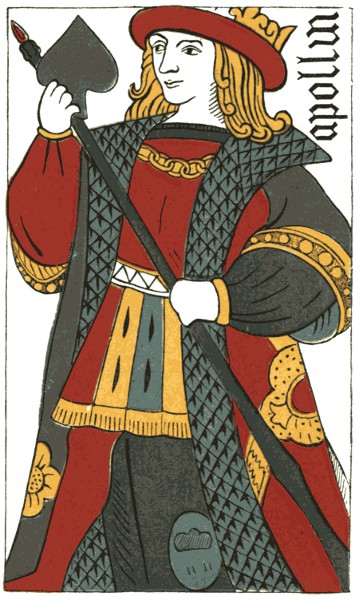
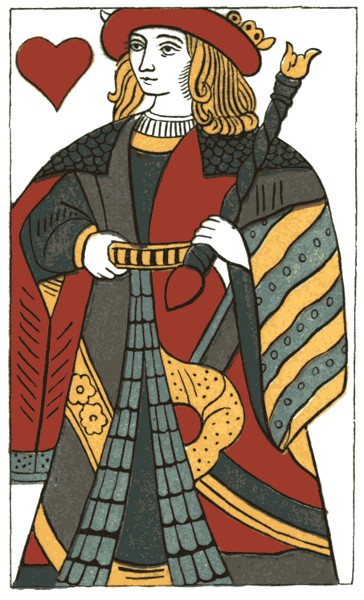
On each of those cards, except the King of Cœur, there
is an inscription in Gothic letters. On the Valet of Trèfle
is the name Rolan, while the King is named
Faut-sou,—Penniless;
and the Queen, Tromperie,—Deceit. The King
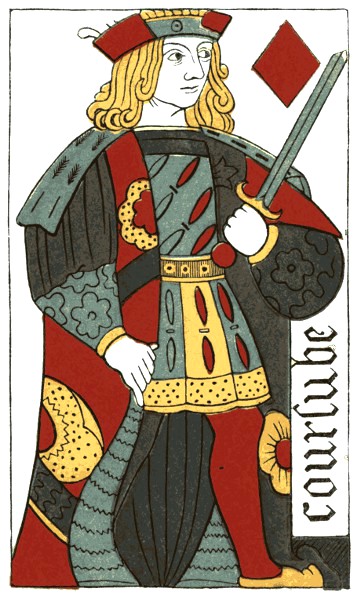
of Carreau bears the name Coursube, which in old romances
is the name given to a Saracen King; and on the Queen of
Carreau is the inscription En toi te fie,—Trust to thyself;
"that is," says Mons. Duchesne, "ne te fie qu'en toi,—trust
to thyself only. The Valet of Pique bears an inscription
which Mons. Duchesne reads ctarde, and of which he says
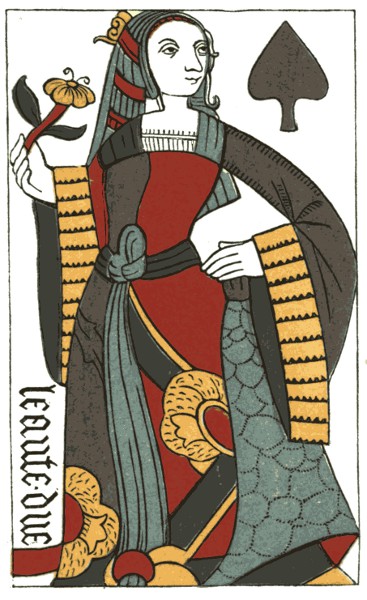
he can make nothing. On the Queen of Pique is an
inscription which appears to Mons. Duchesne to be te aut
dict, but the meaning of which he cannot divine. Mons.
Leber, however, reads it Léauté due,—leal homage; and
so gives it, in unmistakable characters, in the copy of this
card, in his 'Etudes Historiques.' The King of Pique bears
the name of Apollin, which is the name given to a Saracen
idol in old romances. The inscription on the Queen of
Cœur is la foy et pdu—la foi est perdue,—faith is lost.
It is supposed that there was also an inscription on the
King of Cœur, but that it has been cut off, as this card is
deficient in its due proportions.
[244] The annexed four cards,
executed in their proper colours, are copied from those
given by Mons. Leber in his 'Etudes Historiques.' The
whole ten are given in the 'Jeux de Tarots et de Jeux
Numérales,' published by the Society of Bibliophiles
Français.
Mons. Leber considers that the names Coursube and
Apollin, which occur on these cards, corroborate his opinion
that cards were of Eastern origin, and introduced into
Europe by the Saracens, or Arabs.
[245] Though agreeing with
Mons. Leber, in the opinion that cards are of Eastern origin,
I cannot yet see how this opinion is confirmed by two
names, which, as designating a Moorish king, and a Mahometan
idol, appear to have been merely the invention of a
French romance writer, and to have been capriciously
bestowed upon a King of Diamonds and a King of Hearts
by an old French card-maker. The supposition, indeed,
that figures with these names were to be found on old
Arabic cards is most preposterous; there is not a shadow
of evidence to show that any characters, whether real or
imaginary, were ever popularly known by these names,
amongst people of Arabic origin; and even if there were,
the painting them upon cards would have been considered
as a violation of the law of Mahomet, by whom all such
representations were strictly prohibited. With equal probability,
Mons. Leber might assert that cards were a Jewish
invention, because the names of David, Rachel, and Judith
are to be found on them; or that Piquet was invented in
the time of Charlemagne, in consequence of one of the
Kings bearing his name, and two of the Valets being named
after two of his Paladins,—Hogier and Roland. The long
note in the 'Précis Historique sur les Cartes à jouer,' pp.
13-17, on the subject of Coursube and Apollin, and Mons.
Leber's more lengthy comment on it, have much of the
character of that kind of discussion which was compared by
Demonax to one man milking a he-goat, and another holding
a sieve to catch the milk.
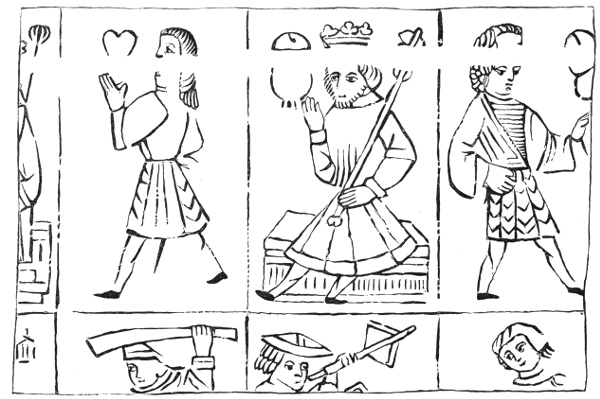
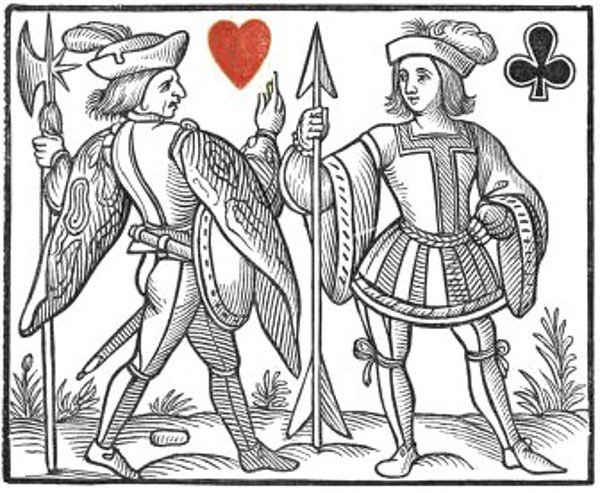
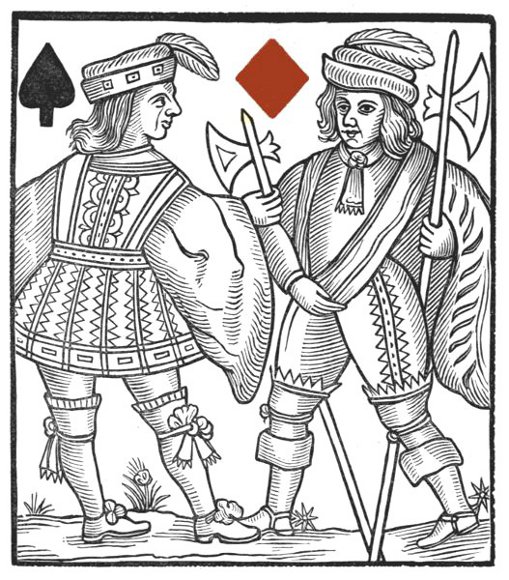
The originals of the annexed four cards, representing the
Valets, or Knaves, of the four suits known in England as
Hearts, Diamonds, Clubs, and Spades, are, in my opinion, of,
at least, as early a date as the cards containing the names
Coursube and Apollin. Mons. Duchesne and Mons. Leber,
judging from the costume of the last-named cards, agree in
supposing, or, rather, confidently asserting, that they were
executed about 1425, in the reign of Charles VII. Conclusions,
however, drawn from the costume displayed on
cards are not of much weight in the determination of a
date, seeing that persons supposed to be well acquainted
with the subject of costume have not been able to determine,
from that alone, the date of any old drawing, even
within fifty years. To whatever period the costume of the
"Coursube" cards may belong, that of the four Knaves
may be fairly presumed to be of as early a period; but yet,
looking at the costume of the latter, and the style of their
execution, I should not take them to be of an earlier date
than 1480. Supposing them to be of that date, I think
it will be generally admitted, by all acquainted with the
subject, that, in point of drawing, as expressive of action
and character, they may fairly rank with the best specimens
of wood-engraving executed previously to that
period.
Those four Knaves, which are now in the print-room of
the British Museum, were discovered by the writer, in the
covers of an old book, which he bought of Mr. Robert
Crozier, bookseller, 27, Bow Street, about the latter end
of December, 1841. The book, which is a small quarto,
had formerly belonged to the Cathedral Library of Peterborough,
[246]
and its subject is the Sermons of St. Vincent de
Ferrer, a Spanish friar, of great repute in his day, who died
in 1419: it wanted both the title-page and the last leaf,
and, consequently, had no date; but, looking at the character
of the type,—old Gothic—and the rude execution of
the initial letters, I should conclude that it was printed in
France, within the last ten years of the fifteenth century.
The other leaves forming, with the cards, the "boards" of
the cover, were portions of the gloss, or commentary, of
Nicholas de Lyra, on the Old Testament; which leaves,
apparently, are of a date somewhat older than the volume.
Seeing that old cards have so often been found in the
covers of old books, it might be conjectured that certain
pious persons had made it a point of conscience to thus
employ them, for useful purposes; this supposition is, however,
rendered untenable by the fact of those cards being
intermixed with the pious lucubrations of Nicholas de Lyra.
Besides the two squares of paper containing the four Knaves,
there were also two other squares, consisting of "pips"
of Diamonds and Hearts, which were so arranged that each
square of paper might be cut into four cards: the low cards
on one square were, the Nine, Four, Five, and Seven of
Diamonds; and those on the other, the Ten, Four, Five,
and Eight of Hearts. The "pips" on those low cards were
evidently impressed by means of a stencil.
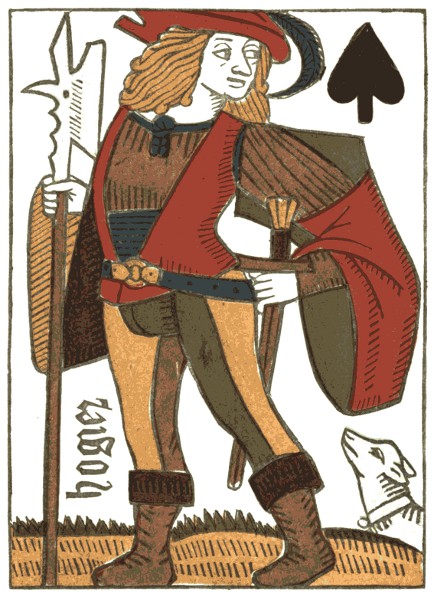
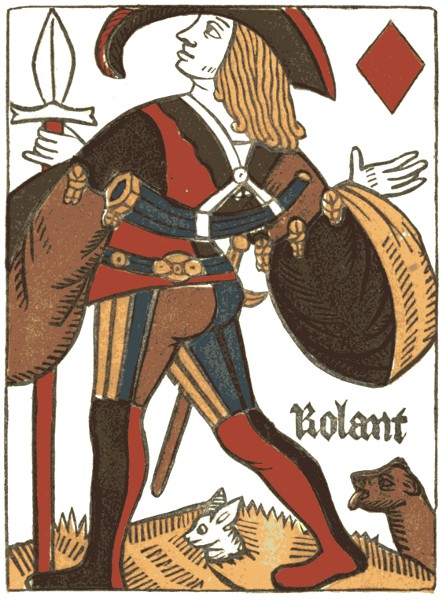
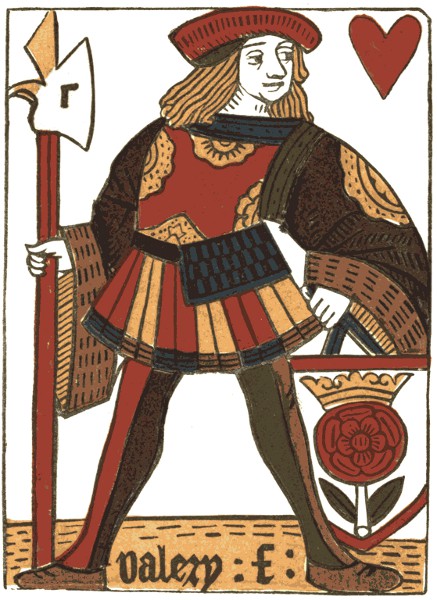
On one square of paper were the Valets of Clubs and
Spades,—Lancelot and Hogier; and on another, the
Valets of Diamonds and Hearts,—that of Diamonds
being named Rolant, and that of Hearts containing the
inscription, "Valery: f." Though each piece of paper
contained four cards, it yet displayed only two different
characters,—the Valet of each suit occurring on it being
repeated in the alternate compartments. The outlines of
the figures and the names have evidently been engraved on
wood, and are printed in a brownish colour,—something
like Indian ink mixed with bistre; and the colours have
been laid on by means of stencils. The names of these
Valets,—Rolant, "Valery: f," Lancelot, and Hogier,—compared
with those occurring on other French cards of an
early date, seem to prove that, originally, the French coat
cards received their names merely at the caprice of the
card-maker. Any argument, therefore, respecting the
origin of cards, or the invention of Piquet, as founded on
the names of the coat cards, must be utterly without
foundation.
With respect to the names of those Valets, it seems to
be generally agreed that Roland, spelled Rolant on the
cards, was the nephew of Charlemagne, so famed in
romance, and that Hogier, or Ogier, was the renowned
Hogier of Denmark. According to a modern author, this
hero was a grandson of Pepin of Heristal, the great-grandfather
of Charlemagne; and the appellation, "of
Denmark," was conferred on him, not from his being of
that kingdom, but from his being a native of Dane-marche,
that is, of the district now called Ardennes. The same
author also informs us, that Hogier was a descendant of
St. Hubert of Ardennes; and, for a confirmation of the
fact, refers to the dog seen in an old Valet of Spades,
of which he gives a copy in his work: in the irregular
line of the more distant ground, in the same card, he sees
an indication of the uneven surface of the district of
Ardennes.
[247]
An inspection of the four Valets in question
will enable any person to decide on the value of his speculations:
three of those Valets,—Rolant, Hogier, and Lancelot,—are
accompanied by dogs; and the line of the more
distant ground in two of the subjects is nearly level; while
the slight eminence in the third—Rolant—evidently indicates
a rabbit-burrow. If such stuff as Mons. Barrois
drivels forth on the subject of cards pass for antiquarian
knowledge in France, it would seem that an ass-load of
useless book-learning constituted the grand qualification
of a French antiquary.
With respect to Lancelot, the reader is left to determine
whether the name were intended for one of the Paladins of
the court of Charlemagne, or Lancelot du Lac, one of the
Knights of King Arthur's Round Table. The appearance
of this name on the Valet of Clubs proves that Daniel was
right in his conjecture, as has been previously observed;
though Mons. Leber seems to argue that he either was, or
ought to have been, wrong.
[248]
The name Valery, which occurs on the Knave of Hearts,
has not been found on any one of the other old cards
hitherto discovered; and from the circumstance of its having
the letter f after it, which might be intended to signify
"fecit" it might be supposed that it was the card-maker's
name. It is, however, to be observed that the word "fecit"
is of very rare occurrence, as signifying the work of the
artist whose name precedes it, on engravings, for whatever
purpose executed, of the fifteenth century. It may even be
asserted, with small hazard of contradiction, that f as an
abbreviation of "fecit," in its artistic application, is not
to be found on a single engraving, whether on wood or
copper, executed previous to the year 1500.
For whatever person the name of Valery may have been
intended, it seems certain that it is not to be found as that
of a distinguished character in any of the old French
romances. Mons. Paulin Paris, having been consulted on
this subject, thus gives his opinion, in a letter addressed to
his friend, Thomas Wright, Esq., so well known for his
numerous publications on Middle-Age Literature: "The
name of the Valet of Hearts seems to me extremely curious,
for it ought necessarily to bring to mind the name of
Erart de Valeri, the famous companion of Charles of Anjou,
King of Sicily, to whom his contemporaries chiefly ascribed
the gain of the battle of Tagliacozza, in which Manfred
[the opponent of Charles] was killed.
[249] It might, therefore,
be supposed that the pack [to which the four Valets in
question belonged] was either of Sicilian or Italian fabrication;
for the names Lancelot, Roland, Ogier, and Valeri
were equally familiar to the Sicilians of the fourteenth
century. I have said a few words about this Erard de
Valery in the article on Charles of Anjou, in my Romancero
François."
[250]
Though by no means agreeing with Mons. Paulin Paris,
that these cards were either of Italian devising, or manufacture,
I am yet inclined to think that his conjecture about
the name of Valery is correct, and that a corroboration of it
is to be found in the inscription on the Valet de Pique, in
the "Coursube" cards, previously noticed at page 211. This
inscription is read ctarde, by Mons. Duchesne; but, to my
eye, the letters, as they appear in the fac-simile given in the
specimens of cards published by the Society of Bibliophiles
François, appear much more like the name erarde; and if,
on a careful examination of the original, it should be
ascertained that this was the word intended, I should then
unhesitatingly conclude that the person represented by this
was Erard de Valery. The objection that one of
those cards is the Valet of Hearts, and the other the Valet
of Spades, is of no weight, for the old French card-makers
were by no means consistent in the practice of always giving
the same name to the same card. From the red rose which
appears on the shield held by Valery, an Englishman might
be justified in supposing that those cards, if not of English
manufacture, were more especially, if not exclusively, fabricated
for the English market, at a period shortly after the
accession of Henry VII,
[251]
when the Red Rose of Lancaster
had obtained the ascendency. By assuming, indeed, a small
portion of French license on this subject, it might even be
asserted that those cards were of English manufacture;
seeing that they were discovered in the covers of a book
which had formerly belonged to an English monastery, and
that the features, expression, and bodily proportions of the
Valets are rather characteristic of Englishmen than Frenchmen.
In support of this speculation, it may further be
observed that, in former times, monks were accustomed to
act as their own bookbinders, and that there is reason to
believe that playing cards were manufactured in England as
early as 1463.
[252]
In the latter quarter of the fifteenth century, several packs,
or sets, of cards were engraved on copper, having the suits
distinguished by figures evidently introduced according to
the fancy of the artist, and bearing no resemblance to those
which occur on cards of an earlier date. As the art of
engraving on copper was then of recent invention, and its
productions comparatively scarce and high priced, it may be
concluded that those cards were chiefly intended for the
amusement of the wealthier classes. Though Mons. Leber
is of opinion that such cards were not intended for the
purpose of play, it is yet certain that they might be so
employed; seeing that they consist of the same number of
suits as the common cards of the period, and have also in
each suit, like the latter, a certain number of coat cards, and a
certain number of others which have their value determined
by the number of marks impressed on them. One of Mons.
Leber's reasons for concluding that such cards were not
intended for the purposes of play, is, that being delicately
engraved on copper, it cannot be supposed that they were
meant to receive the colouring which, in his opinion, was
essential to a pack of cards.
[253]
It may, however, be observed
that people may play very well with uncoloured cards,
more especially when the suits are so strikingly distinguished
as in the cards alluded to.
Perhaps the earliest specimens of the cards in question
are those which have Hares, Parroquets, Pinks, and Columbines
as the marks of the suits, and of which a complete
pack, or set, of fifty-two pieces, is now in the Bibliothèque
du Roi.
[254]
They are not cut up, but appear just as they
came from the hands of the printer, and each separate piece of
paper contains either four or six cards. The four Aces form
one plate; the numeral cards from Four to Nine are contained
on four plates; and the Twos and Threes appear promiscuously
mixed with the coat cards on five plates more.
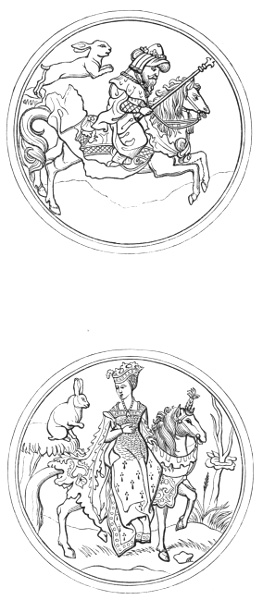
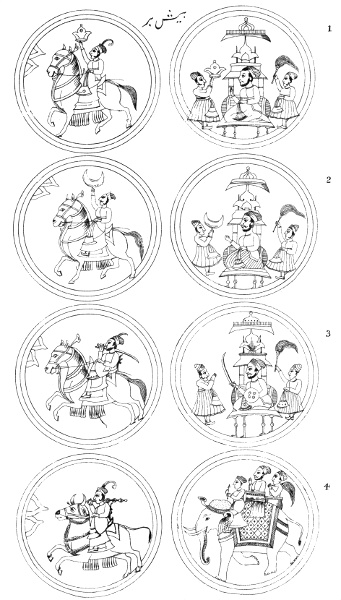
Circular Cards. XVth Century. (p. 222)
1
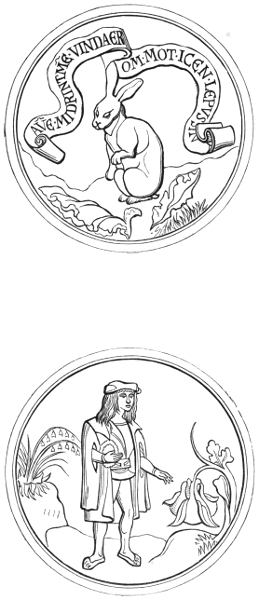
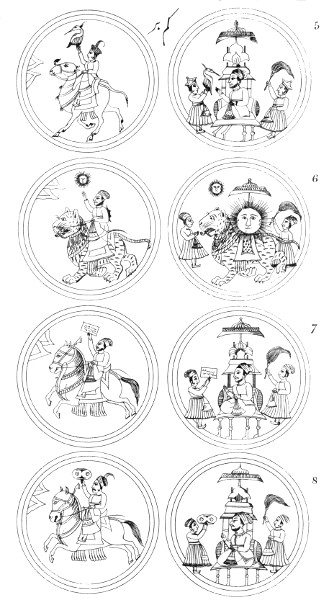
Circular Cards. XVth Century. (p. 222.)
2
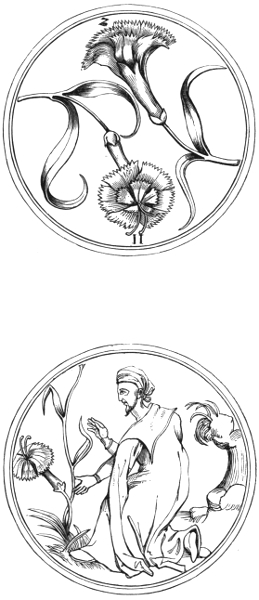
Circular Cards. XVth Century. (p. 222.)
3
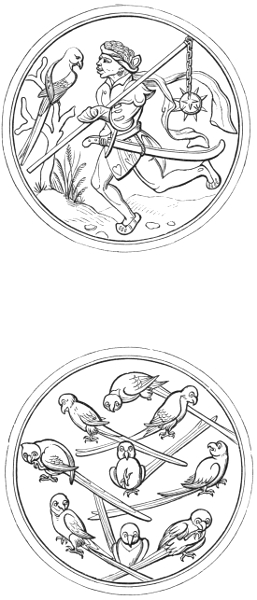
Circular Cards. XVth Century. (p. 222.)
4
The form of these cards is circular, and in each suit there
are four coat cards, namely, a King, a Queen, a Squire, and
a Knave.
[255]
The distinction between the two latter is not
indeed very clearly expressed in the costume; though there
cannot be a doubt that the lowest character is that which in
each suit is represented as running, and thus plainly corresponding
with the Italian Fante. The highest of the
numeral cards is the Nine, there being no Ten in this pack.
The respective number of each is marked at the top in
Arabic cyphers, and at the bottom in Roman numerals.
At the bottom also, within the outer circle of the border, are
the letters T. W., probably intended for the initials of the
engraver.
[256]
Whoever he might be, his name is unknown;
and only one other subject of his engraving is noticed by
Bartsch. In the annexed specimens are shown the King,
Queen, and Ace of Hares; the Squire of Columbines; the
Deuce and Squire of Pinks; and the Knave and Nine of
Parroquets. On each of the Aces there is an inscription
on a scroll, as on the Ace of Hares; on the latter, the
language is low German—"Platt Duitsch"—and the words
form a rhyming couplet:
Av͞e
mi drint mē vin,
Daerom mot ic en lepus sin.
The precise meaning of this it is not easy to make out;
but taking the contracted word Av͞e to have been intended
for Auwe, a meadow, the couplet may be thus "done into
English:"
Me o'er fields men keen pursue,
Therefore I'm the Hare you view.
But supposing the word Av͞e to
have been meant for Augen,
the eyes, and giving a slight turn to one or two other
words, the meaning would be that the hare was called
Lepus—quasi
Lippus—on account of its blear eyes.
Mons. Duchesne says that, on the plate containing the
Aces, there is a date written in an old hand, but he omits to
mention what it is. In the 'Jeux de Cartes Tarots et de
Cartes Numérales,' where all the fifty-two pieces are given,
they are said to have been engraved about 1477. These
cards, though of the same form, and having the same marks
of the suits as those described by Bartsch, and noticed by
Singer, are yet the work of a different engraver.
In the circular cards described by Bartsch and Singer,
the inscription on the Ace of Hares is in Latin, and the
initials of the engraver, T. W., are wanting. From a
wrapper, of which a fac-simile is given by Singer, it would
appear that those cards were engraved at Cologne; and it
has been supposed that they are of as early a date as 1470.
They are unquestionably the work of either a German or
a Flemish artist; and some amateurs of engraving have
erroneously ascribed them to Martin Schön, or Schöngauer.
Bartsch, in his description of them, includes a fifth suit,
namely, that of Roses; and says that each suit consisted of
thirteen cards, which would thus give sixty-five pieces for
the complete pack. Mr. Singer, also, in his account of
such of those cards as were formerly in the collection of
Mr. Douce, gives it as his opinion, that the complete pack
ought to consist of five suits of fourteen cards each,—in all,
seventy pieces.
[257]
Mons. Duchesne, however, thinks that
those authors are wrong, and that the complete pack consisted
of only four suits of thirteen cards each, as displayed
by those preserved in the Bibliothèque du Roi. But as he
entirely overlooks the difficulty of accounting for a suit of
Roses, engraved in the same style, he does not seem to be
justified in pronouncing so decisively that Bartsch and
Singer are wrong in supposing that a complete pack consisted
of five suits; for it is by no means unlikely that a
fifth suit might have been introduced by the artist, with a
view of giving variety to the game, but which might have
been subsequently discarded, as inconsistent with the old
established principles of the game, and as only making it
more interesting.
There is another pack, or set, of cards, also engraved on
copper, and of the same period as those last described,
which seems to require some notice here, not only on
account of the marks employed to distinguish the suits, but
also on account of the means by which those marks were
repeated on the different cards. The complete pack appears
to have consisted of fifty-two pieces; each of the four suits
containing four coat and nine numeral cards—the place of
the Ten, as in the other two packs, being supplied by a fourth
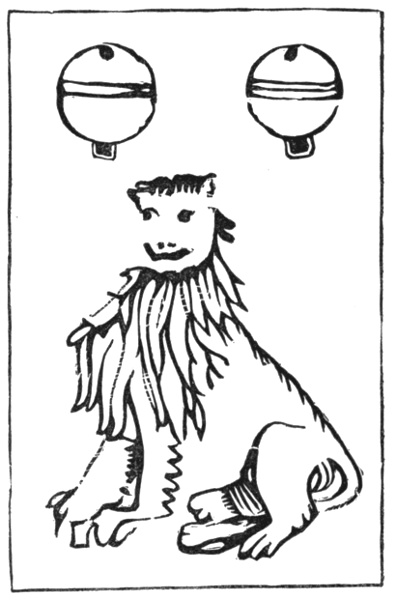
coat card. The marks of the suits are: 1, Human figures;
2, Bears and Lions; 3, Deer; and 4, Birds. These cards
are of large size, being about five inches and seven eighths
high, by about three and a half wide. The name of the
engraver is unknown; but they are believed to be the work
of the German artist usually known to amateurs as "The
Master of 1466." In the coat cards the mark of the suit
is impressed from a different plate; and as it sometimes
occurs surrounded by the work of the coat card, it has
been ascertained that in such instances a blank space had
been left for its subsequent impression. The marks on the
numeral cards were also printed in the same manner, by
means of impressions from separate plates.
In the collection of Thomas Wilson, Esq., there were
twenty-nine of those cards, together with fourteen drawings
of other cards of the same pack, and eleven animals on separate
plates, forming the marks of the suits.
[258] Those cards were
purchased of Mr. Wilson by Mr. Tiffin, printseller, West
Strand, who again sold them to the Bibliothèque du Roi,
where others of the same pack are also preserved. Fac-similes
of thirty-seven are given in the 'Jeux de Cartes
Tarots et de Cartes Numérales,' published by the Society
of Bibliophiles François. In the Table des Matières prefixed
to that work, it is indeed said that there are forty; but,
on looking at their plate, No. 91, it will be perceived that the
three coat cards there given do not properly belong to the
pack in question; for the mark on two of them is a kind of
flower something like a sweet-pea, and on the other it is a
rose.
[259]
Mons. Duchesne, who appears to have supplied the
Précis Historique prefixed to the work above named, should
have distinctly mentioned that the three coat cards in
question were not of the same pack or set, which has Human
figures, Bears and Lions, Deer, and Birds, as the marks of
the suits. If they really did belong to the same pack, it
must then have consisted of at least six suits.
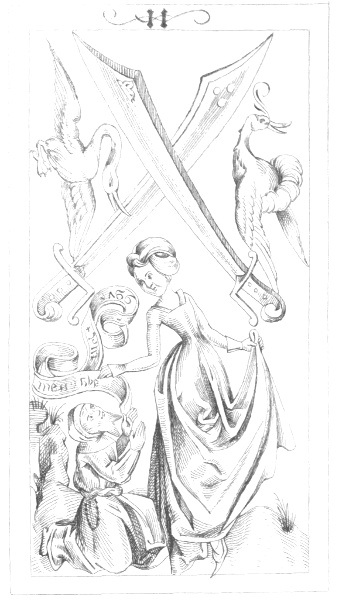
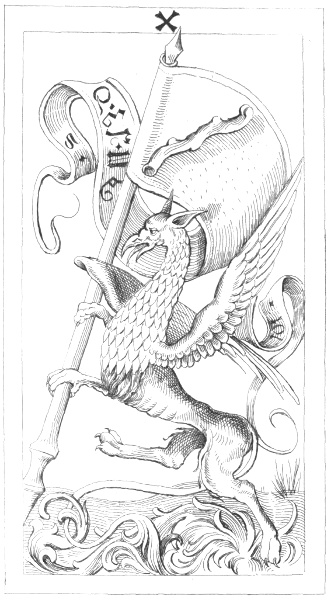
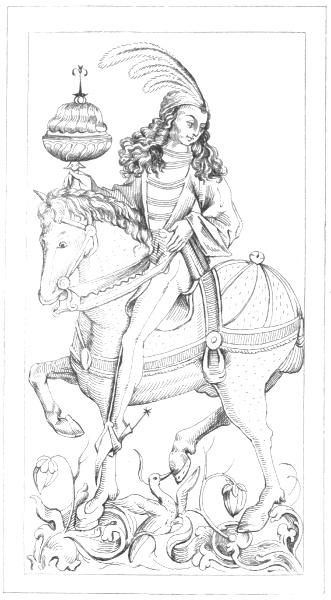
The annexed four cards, engraved on copper, are copied
from specimens given by Breitkopf, in his 'Enquiry into the
Origin of Playing Cards;' who there describes them as
"German Piquet cards of the fifteenth century with Trappola
characters."
[260]
The complete pack appears to have consisted
of fifty-two cards; each of the four suits containing a King,
Queen, and Valet, or Knave, as we term the character;
together with ten numeral cards. The marks of the suits
were Swords; Clubs (proper, not Trèfles); Cups; and
Pomegranates. The latter mark is substituted for that of
Money; and was perhaps intended by the artist to commemorate
the marriage of Philip the Fair, son of the
Emperor Maximilian, with Joanna, daughter of Ferdinand
and Isabella, King and Queen of Spain; who, on their subjugation
of the kingdom of Grenada, in 1497, appear to
have adopted the Granada, or Pomegranate, as one of their
badges.
[261]
The cards unquestionably belong to that period;
and in support of the speculation, it may be further observed
that they are generally ascribed to Israel van Mecken;
who, as a native of Bocholt, was a subject of Philip, who
inherited the Netherlands, in right of his mother, Mary of
Burgundy.
Von Murr, in the second volume of his Journal, gives a
description of a nearly complete pack of those cards, which
were then in the possession of a gentleman named Silberrad,
residing at Nuremberg, but which are now in the British
Museum.
[262] He calls them old Trappola cards, and says that
they are certainly of an earlier date than the time of Israel
van Mecken the younger; or rather, that they were
engraved by Israel the elder. "The suits," he says,
"are distinguished, after the Italian manner, by Spade;
Coppe; Danari
(represented by Pomegranates); and
Bastoni."
[263]
The cards displayed in the preceding specimens
are: the Deuce of Swords; the Valet of Cups; the Ten of
Pomegranates; and the Ten of Clubs. In the latter, the Club
seen on the banner is rough and knotty, and not an artificially-formed
Baton, as is sometimes seen on old Italian
cards: it has previously been observed that the Bastoni
were sometimes called Colonne, from their being something
like slender pillars.
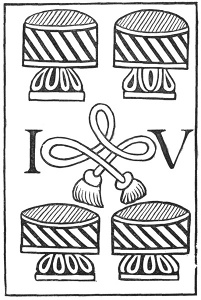
Swords. (p. 227.)
Cups. (p. 227.)
Batons. (p. 227.)
Money. (p. 227.)
It would appear, from the testimony of contemporary
authors, that the cards most commonly used in Italy in the
latter part of the fifteenth century, were those which had
Spade, Coppe,
Bastoni, and
Danari—Swords, Cups,
Batons, and Money,—as the marks of the suits. These
continued to be the common marks on Italian cards in the
sixteenth century, and even to a much later period; and
such also would appear to have been the marks of the cards
used in Spain, from the period of their first introduction
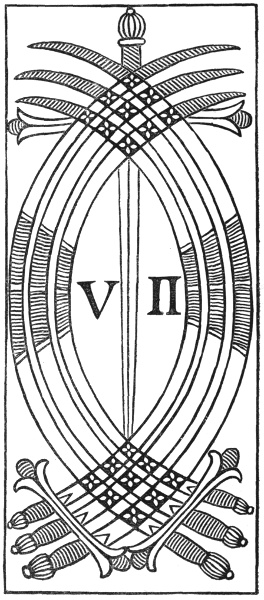
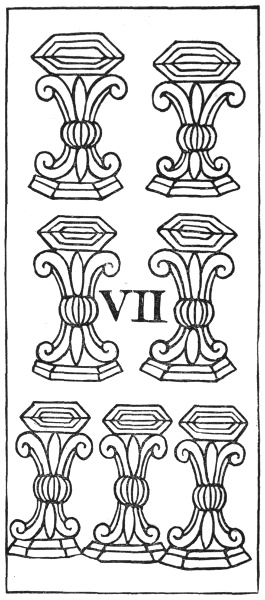
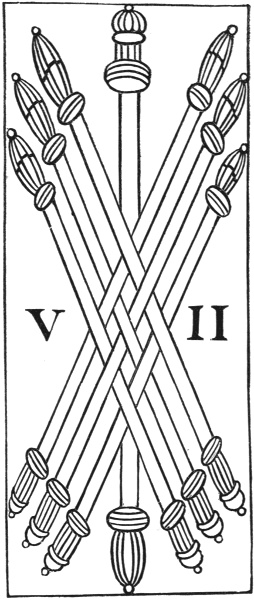
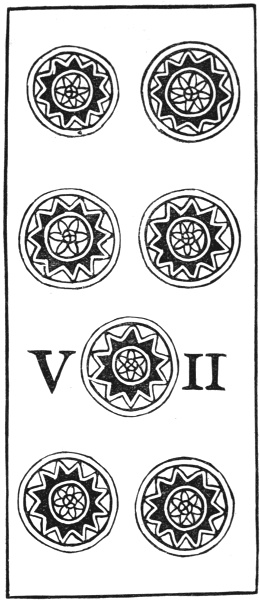
into that country, to the present day. The annexed woodcuts,
copied from a plate in Breitkopf,
[264] are the Sevens of each
of the four suits in a pack of Tarots. The marks are precisely
the same as in modern Tarots; and there is reason to believe
that they are nearly the same, with respect to form, as
those of the earliest Italian Tarocchi cards, properly so called.
The relation which the marks of the suits bear to each
other in the three varieties of cards most generally known
in Europe, will perhaps be best understood from the following
summary, which shows, at one view, the names given to
the suits of each variety in the country where such cards were
chiefly used.
GERMAN CARDS.
German Names of the Suits.
Herzen, oder
Roth.
(Hearts, or Red).
Grün.
(Green (Leaves).)
Eicheln.
(Acorns.)
Schellen.
(Bells.)
SPANISH AND ITALIAN CARDS.
Spanish Names.
Copas.Espadas.
Bastos. Oros.
Italian Names.
Coppe.
(Cups.)
Espadas.
(Swords.)
Bastoni.
(Clubs, or Batons.)
Danari.
(Money.)
FRENCH CARDS.
French Names.
Cœur.
(Hearts.)
Pique
(Spades.)
Trèfle.
(Clubs.)
Carreau.
(Diamonds.)
In the oldest cards of the German and Spanish type
there appears to have been no Queen. In the German
pack, the second coat card was a kind of superior officer,
distinguished as Ober,—Upper, Superior;
while the third,
corresponding with our Knave, was named
Unter,—Inferior.
[265]
The Spaniards called the second coat card
Caballo,—the
Horseman or Knight;—and the Knave they called
Sota,
a word which, in the Dictionary of the Spanish Academy,
is said to be derived from the Italian soto, signifying 'under.'
[266]
The Italians called their second coat card
Cavallo, and the
third Fante; in each of the
four suits the principal coat
card was the King. It would, however, appear that at an
early period, the Italians occasionally substituted a Queen
for the Cavallo; and if the cards formerly belonging to the
Marquis Girolamo be really of so early a date as is assigned
to them by Millin,
[267]
it would seem that the French have no
just title to the "honour" of being the first to introduce a
Queen as the second coat card, and that in having made
"Place aux Dames," in the pack, they had only followed
the example set them by the Italians.
Millin's notice of those cards is to the following effect:
"In the collection of the Marquis Girolamo, at Venice,
there are some cards of very early date,—about the beginning
of the fifteenth century. They are larger than the
ordinary cards of the present day; they are also very thick;
and the material of which they are formed resembles the
cotton paper of ancient manuscripts. The figures, which
are impressed—'imprimées'—on a gold ground, consist of
three Kings, two Queens, and two Valets, one of the last
being on horseback. Each figure has a Baton, a Sword, or
a piece of Money [as the mark of the suit]. The design is
very like that of Jacobello del Fiore; but the work has the
appearance of impression, and the colours seem to have
been applied by means of a stencil. They are the most
ancient specimens of their kind."
[268]
As the names, Clubs and Spades, given to two of the
suits in this country, by no means correspond with the
marks by which they are distinguished,—to wit, the French
Trèfle and Pique—I am inclined to consider them as the
old names for the suits of Bastoni and Spade; Clubs being
merely a translation of Bastoni, and Spades probably a
corruption of Spade, or Espadas,—Swords.
[269] From these
names, indeed, it may be fairly supposed that the cards
first known in England were those having Swords, Clubs,
Cups, and Money, as the marks of the suits; and that two
of those suits retained their names when the old cards of
Spanish or Italian type were superseded by those of more
recent French design. There are also other circumstances
which strengthen the conclusion, that cards, on their first
introduction into England, as a popular game, were brought
either from Spain or Italy; the character of the third coat
card, the Knave, or Jack, is more in accordance with the
Spanish Sota, or the Italian Fante, than with the French
Valet, which, in the earliest French cards, always bears the
name of some person of note, either in romance or history.
The term Valet, at the time when it was first bestowed on
the third coat card by the French, did not signify a
"Gentleman's Gentleman" or a menial servant; but was
more especially applied to young noblemen—the "Dilecti
Regis"—holding appointments at court. The term Knave
was never applied, like Valet, to signify a courtier, or person
of distinction; it was used to signify a serving-man of
low condition. It seems to be derived from the same
root as the German Knabe, the primary meaning of which
is a Boy, but which was also used, in the same way as the
Latin Puer, to signify a servant. Subsequently the term
Knave became obsolete in the sense of servant, and was
exclusively applied to designate a dishonest person. The
term Jack, another name for the Knave of cards, was in
former times very frequently applied to a "serving-man of
low degree," without any regard to the name which might
have been given to him by his godfathers and godmothers.
Though Dr. Johnson, and most other English lexicographers,
derive the term Jackanapes from Jack and Ape,
and though this derivation seems to be supported by the
meaning attached to the term by one of the earliest writers
who makes use of it, yet "Jack-a-Naipes," that is, Jack of
Cards, is at least as probable an etymology; and much more
so than that of "Jack Cnapa," suggested by Sharon Turner,
in his 'History of England,' from which the following passage
is extracted.
"In the British Museum, Vesp. B, 16, is a ballad written
at this time on the catastrophes of the Duke of Suffolk and
his friends. (Temp. Henr. VI, May, 1450.) It treats these
horrors with an exulting levity, which shows the barbarous
unfeelingness of political rancour; but it is curious for
giving the names of those friends of the government who
were most hated by the people. They are the clerical
statesmen who were employed either in the offices of government
or on its embassies, and it shows how much the
dominant church had, by these employments, become identified
with the crown. It designates the Duke of Suffolk
by the cant term of 'Jac Napes,' and is perhaps the earliest
instance we have of the abusive application of the word
Jackanapes. Our lexicographers derive this word from
Jack and Ape; but the ballad shows, that Napes was a term
of derision signifying a Knave; and must therefore be the
Saxon Cnapa, which bore also this meaning. This will explain
the reason why our third figured card is called Jack, and
also Knave. The word Jackanapes therefore seems to be
Jack Cnapa, and to mean Jack the Knave. In this sense
it is applied to Suffolk; and as the Knave is next in power
at cards to the King and Queen, the nickname may be
used in the ballad with an allusion to Suffolk's being the
prime minister of Henry and Margaret."
[270]
The following are two of the stanzas of the ballad in
which the term occurs:
"In the moneth of May, when grass grows grene,
Fragrant in her flowres with swete savour,
Jac Napes wold on the see, a maryner to ben,
With his clogi and his cheyn to seke more tresour.
"Swych a payn prikked him, he asked a confessour;
Nicholas said, I am redi the confessour to be;
He was holden so, that he ne passed that hour:
For Jac Napes saule, 'placebo et dirige.'"
Mr. Turner's remark, that "the ballad shows that Napes
was a term of derision, signifying a Knave, and must
therefore be the Saxon Cnapa," does not appear to be
well founded; for if it were derived from Cnapa, and
merely signified a Knave, or Cheat, it is difficult to conceive
why it should be written Napes, and not Knave, or Knape,
as required, according to Mr. Turner's etymology; besides,
it is evident from the context, that, in the mind of the
writer, the idea of a Jac Napes was associated with that of
a monkey, or an ape, with his clog and his chain. That
this was not the primary signification of the term, may
be confidently asserted; and no writer who has derived
it from Jack and Ape, has produced any authority to
show that it originally meant a man who travelled about
with apes or monkeys. In the following passage, from a
tract printed about 1540,
[271]
the term "Yack an napes"
evidently refers to a mummer or buffoon in a particoloured
dress, like that of a knave of cards. The writer, after
having noticed the assembling of the poor on holidays, at
the "personis barne,"
[272]
and there committing "ydolatre in
mayntenynge his ambision, pride, and bestly lyvinge,"
thus proceeds: "Nobyl statis were better to hunte the
bull, here, hert, or ony othere thynge lyke to suckure the
powre with the mette, then to here Sir Jhon Singyl Sowle
stombel a payer of mattens in laten, slynge holy water,
curse holy brede, and to play a caste lyke yack an napes
in a foles cotte." When John Bale, in his work entitled,
'Yet a Course at the Romish Foxe,' speaks of Jack-a-Naipes
"swearing by his ten bones," it would seem that he in
some manner or other associated the term with the Jack-a-Naipes,
or Jack of Cards; for his ten bones can only be
supposed to relate to the numerical value of the Jack of
Naipes, as a coat card. In Bale's time a "card of ten"
would appear to have been a general expression for a coat
card, as well as for a card distinguished by that number of
pips.
Fyrste pycke a quarell, and fall out with hym then,
And soo outface hym with a carde of ten.
Skelton's Bowghe of Court.
From the following passage in Pulci's 'Morgante Maggiore,'
it would seem that, in Italy, in the fifteenth century, the
King of cards was occasionally referred to as the type of a
presumptuous person:
"E com' e' giunse, gridava il gigante;
Tu se' quì, Re di Naibi, o di Scacchi,
Col mio bataglio convien ch'io t'ammachi."
"And when the two together came, the giant shouted out,
And here you are, my King of Cards, or e'en of Chess, pardie!
My club then with your shoulders must without delay make free."
In Scotland, about 1508, the Knave of cards was the
representative of a forward impertinent person,—a very
Jack-a-Naipes,—as is evident from the "Flyting of Dunbar
and Kennedy," where the latter, among other bad names,
calls the former "Valet of cards":
"Waik walidrag, and verlot of the cairtis."
[273]
Even in modern times the Knave of Hearts has been
referred to as the ideal of a presumptuous, thickset little
man, as appears from the following passage which occurs in
the second edition of Brockett's Glossary, 1829, under the
word Purdy.
"Purdy, a little thickset fellow.—I owe this word," says
Mr. Brockett, "to the communication of a clerical friend
in the county of Durham, who first heard it at Barnard
Castle. On ascertaining the meaning, the following dialogue
took place.
Q. What does Purdy mean?
A. A little throstan-up thing like a Jack at Warts.
[Jack o' 'Arts,—Jack of Hearts.]
Q. What's that?
A. Something like a lime-burner.
Q. What is a lime-burner?
A. Oh, nobbut a Kendal stockener.
Q. What is that?
A. A little thickset fellow."
If cards were actually known in Italy and Spain in the
latter part of the fourteenth century, it is not unlikely that
the game, as a common amusement, was introduced into
this country by some of the English soldiers who had served
under the banners of Hawkwood, and other Free Captains,
in the wars of Italy and Spain, about the period in question.
But, however this may be, it seems at least certain that the
earliest cards commonly used in this country, were of the
same kind, with respect to the marks of the suits, as those
used in Italy and Spain.
The German cards of the fifteenth century, and even of
a much later period, display more of fanciful embellishment
than the cards of other countries; more especially in the
numeral, or low cards; which, in addition to the "pips,"
or marks of the suits, frequently contain figures of men
and women, quadrupeds, birds, foliage, and such like,
introduced by way of ornament, at the caprice of the
designer. These ornamental appendages are frequently of
a grotesque character, and sometimes indecent. The two
annexed figures are the second coat cards of the suits of Grün
and Eicheln,—Leaves, and Acorns,—in a pack of German
cards engraved on wood, of the date 1511. The figures are
drawn with great freedom, and are much in the style of
Lucas Cranach. On the Two of Acorns are the letters F.C.Z.;
the F and the C being probably the initials of the designer,
and the Z signifying that he made the drawings,—zeichnet.
On the Two of Leaves are two shields suspended from a tree;
the one displays two strait swords, in saltire; and the other
the arms of the house of Saxony, the same as are frequently
seen in wood engravings designed by Lucas Cranach. In
a third shield at the bottom of the same card, are a
pic-kaxe and mallet, in saltire, the same as in Dr. Stukeley's
cards, and probably the mark of the card maker. Thirty-six
cards of this pack, which appears to have originally
consisted of fifty-two, are preserved in the Bibliothèque
du Roi; and fac-similes of them are given in the 'Jeux
de Cartes Tarots et de Cartes Numérales,' published by the
Society of Bibliophiles Français, planches 92-95.
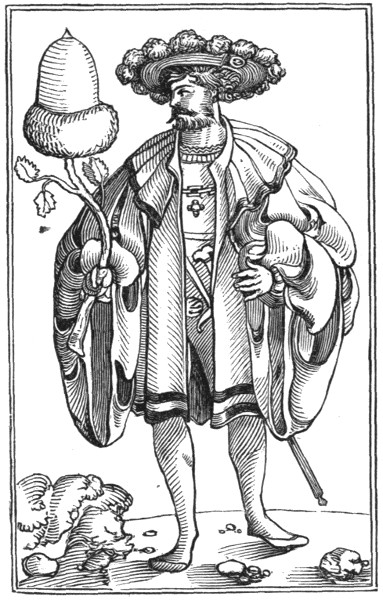
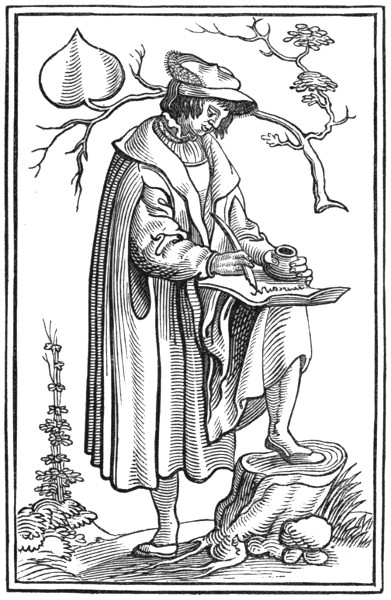
Specimens of a pack of cards designed by Erhard Schön,
and engraved on wood, are given by Singer in his Researches.
In this pack, the marks of the suits are Flowers, Pomegranates,
Leaves, and Roses.
[274]
These cards are very inferior,
both in design and execution, to those just described, of the
date 1511. Erhard Schön flourished about 1530. About
1550, Virgil Solis engraved a pack of cards on copper,
with Lions, Apes, Peacocks, and Parrots as the marks of
the suits: they are noticed by Bartsch, in his 'Peintre-Graveur';
and six of the pack were recently in the possession
of Messrs. Smith, of Lisle street.
The best of all the fanciful cards that appeared in
Germany during the sixteenth century, are those engraved
on wood from the designs of Jost Amman. They were
published at Nuremberg in 1588, in a quarto volume, with
illustrative verses, in Latin and German, composed by
J. H. Schroter, the imperial poet-laureate.
[275] From the following
verses,—'Liber de Seipso,'—it would seem that
those cards were not designed for the purposes of play:
"Charta mihi titulum tribuit Lusoria; lusus
Et chartæ in pretio munera vulgus habet.
Sed nec ego laudes moror aut convicia vulgi;
Sit mihi sat claris posse placere viris.
"Hos rogo, ut a rerum quondam graviore vacantes
Cura, si chartis ludere forte velint,
Colludent nostris: sine rixis, vulnere, morte,
Ludenti quoniam lucra benigna dabunt."
In this set of cards, the marks of the suits are Books;
Printers' inking balls; Wine-cups, of metal "formed by the
skill of the goldsmith;" and Goblets, with bosses of glass
or earthenware. Correct and beautifully executed specimens
of those cards are given in Singer's 'Researches,'
pp. 180-96.
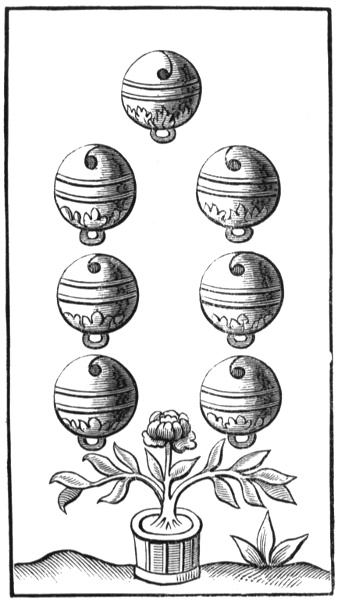
Bells. (p. 239.)
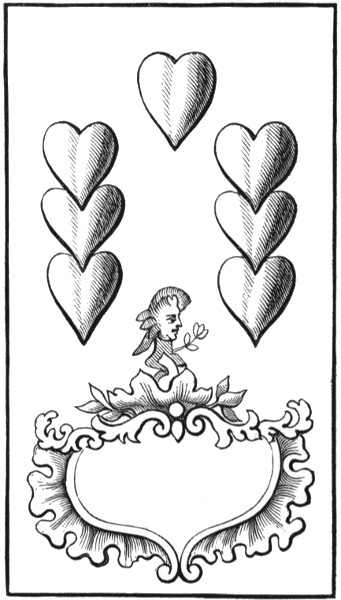
Hearts. (p. 239.)
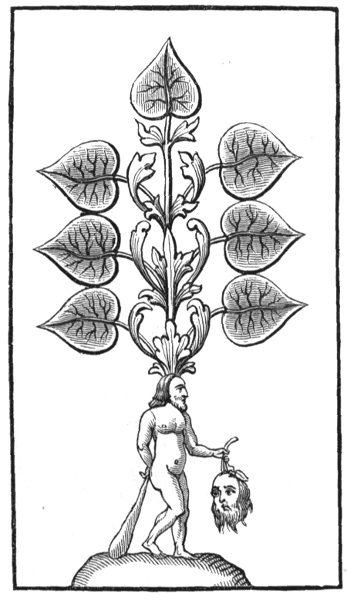
Leaves. (p. 239.)
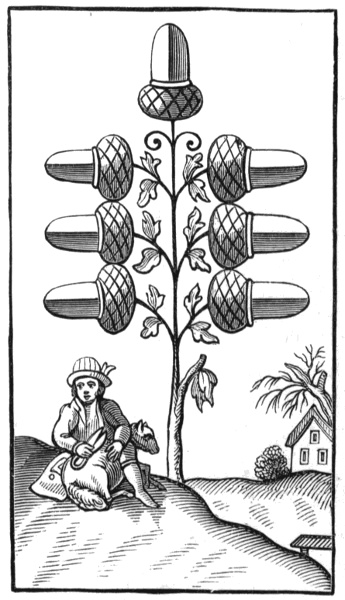
Acorns. (p. 239.)
The four annexed German cards, are the Sevens of the
four suits: Schellen; Herzen, oder Roth; Grün; Eicheln,—Bells;
Hearts, or Red; Green, or Leaves; and Acorns.
They are copied from Breitkopf, and are of the seventeenth
century. The four small ones given below are of the same
period, and were probably intended for the amusement
of children,—like the "pretty little cards for pretty little
fingers," manufactured at the present day. The subjects
are, the second Coat card and the Three of Leaves; the Four
of Acorns; and the Six of Hearts.
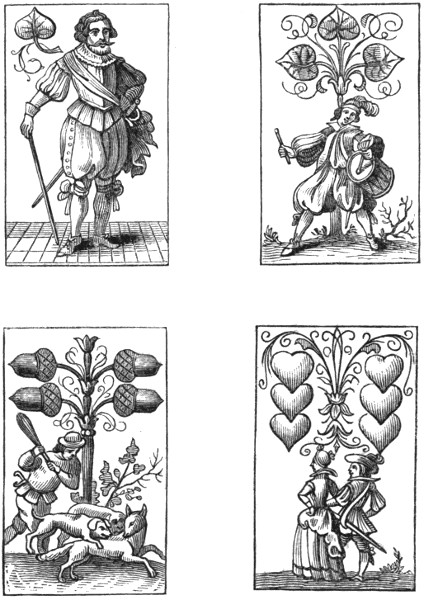
As small bells were worn as ornaments by the emperors
of Germany and the higher classes in the 12th and 13th
centuries, Breitkopf is inclined to think that bells might
have been introduced on cards as a distinctive mark of the
class of kings and nobles; and that cards might even
have been known in Germany at the period referred to. In
corroboration of his opinion, he gives a plate, entitled
"Alte Deutsche Furst Schellen-tracht,"—that is to say,
Ancient German Princely Bell-costume,—containing four
figures, all adorned with small bells. The first figure is
that of the Princess Wulphilde, who was living in 1138;
the second and third represent the Emperor Henry VI, who
died in 1197; and the fourth is that of the Emperor
Otho IV, who died in 1218.
[276]
—Breitkopf's conjecture
is undeserving of remark: had he asserted that his old
German emperors and princes were adorned with bells to
indicate their rank and precedence, in the manner of leading
packhorses, he would perhaps have been as near the truth.
The tinkle of the bell rouses the questing spirit of Mons.
Leber, who pursues the inquiry with singular ardour and
perseverance, though not with success. His researches,
however, on the subject of bells, though throwing not a
glimmer of light on the history of cards, are yet so
amusing, that they are here given entire, notes and all.
They also furnish an additional proof of the wide field
afforded for speculation by the history of cards.
"After the Fou of European Tarots, the Bells on Indian
cards are another proof of the Oriental origin of the game.
The use of bells in India, whether as a mark of distinction
and greatness, or as a means of diversion, is of remote
antiquity; while everything shows that they were not
known to the ancient nations of Europe. The Baladins
and female dancers of India have their legs decked with
small bells, which they shake when dancing; and certain
idols are decorated with the same ornament; girdles formed
of bells are also worn by infants, without any other clothing;
and sometimes a single bell supplies the place of the girdle.
Herbert relates that 'as this bell contains a viper's tongue,
it might be supposed to be annoying and disgraceful. It
is, however, neither the one nor the other, for it is made an
ornament, and it is esteemed one of their most superb,
when given by the king to a person whom he wishes to
honour.'
[277]
—We have already said that the use of bells for
various purposes is of great antiquity; and a proof of this
is furnished by the Pentateuch.
[278] Bells appear to have
passed from the Hebrews to the Arabs, and to have been
with these two nations the same as we see them to have
been in India, a sign of distinction and power, when not
prostituted to the use of the Baladins. An English author,
who has not been unmindful of the remarks of Calmet,
[279]
mentions, in the following terms, a kind of devotion paid
to the bell among the Arabians: 'The Arabian courtesans,
like the Indian women, have little golden bells fastened
round their legs, neck, and elbows, to the sound of which
they dance before the king.—The Arabian princesses wear
golden rings on their fingers, to which little bells are suspended,
as in the flowing tresses of their hair, that their
superior rank may be known, and they themselves receive
in passing the homage due to them.'
[280]—Such are bells in
the East: let us now see what they have been in Europe at
different periods.
"The Emperor Henry IV, who died in 1197, and
Wulphilde, the wife of Count Rodolph, living in 1138, are
represented in ancient monuments in habits ornamented
with bells similar to those which are seen on Tarots. It
would seem that this singular ornament, which subsequently
became the attribute of the buffoon, or professional jester,
was then a mark of dignity in the West as well as in the
East, and that it held a conspicuous place amongst the distinctive
ornaments of the princes and nobles of Germany,
from the eleventh to the thirteenth century.
[281] Some English
critics, however, have supposed that the bell indicated
falconry,
[282]
a sport which the high nobility only had the
privilege of indulging in; and it is certain that small bells
were attached to the feet of trained falcons.
[283] But the
question is, did the bells stand for the falcon, and was the
falcon, indeed, a mark of high nobility?
"What renders this conjecture probable is, that we find
the use of the small bell [grelot] established in the West
before the introduction of heraldic signs, and that we have
no evidence of its having been known to the ancient Greeks
and Romans.
[284]
As the bell was used in falconry by princes
and nobles of the first class, it might thus become the
emblem of the falcon, and, subsequently, that of the nobility
to whom it was confined. The falcon, and things pertaining
to falconry, were certainly among the marks of
grandeur with which the sovereigns and barons of the
middle ages loved to surround themselves in their formal
displays, and which alone were sufficient, in the same manner
as armorial bearings, to indicate the rank of the persons to
whom they belonged. In the tapestry ascribed to Queen
Matilda, Harold is seen travelling with his falcon on his
fist; and the Count Guy de Ponthieu, who conducts him
prisoner to Beaurain, carries also his bird in the same
manner, although he, doubtless, had no thought of the
chase.
[285]
Besides, sceptres are surmounted with three-branched
fleurons, like those which form the ornament on
the top of a falcon's hood.
[286]
We also see hawks and falcons
on ancient tombs; and it is not unlikely that they were
there placed as indications of rank before the introduction
of armorial bearings. The same conventional distinctions
were still in existence in much more recent times; for Anne
de Montmorency made his entry into London as ambassador
of Francis I, preceded by twenty-six gentlemen of
the best houses of France, each bearing a falcon on his fist;
[287]
and even our kings themselves, on occasions of grand display,
were preceded by their falconers fully equipped. Falconry
was not known to the ancients; but it is certain that it was
in use among the nations of the North before the conquest
of the Gauls by the Franks. Sidonius Apollinaris commemorates
the skill of a person named Vectius in the art of
training dogs, horses, and birds of prey: "In equis, canibus,
accipitribus instituendis, spectandis, circumferendis, nulli
secundus."
[288]
"The question, however, would still be, 'if bells were used
in falconry at so early a period?' and it may be presumed
that they were not so used until long afterwards.
German princes, as referred to by Breitkopf, are decorated
with them as marks of high birth, on monuments from the
eleventh to the thirteenth century. Now, it was just towards
the close of the eleventh century, that the intercourse
between Europeans and Orientals became more extended
by means of the crusades; and the invention of heraldry is
of the same period. Armorial bearings, which originated
in over-sea expeditions and in tournaments, are not of
higher antiquity than the eleventh century; their use became
more frequent in the twelfth; and, in the thirteenth,
we find them generally established.
[289] From the concurrence
of these circumstances, it may be concluded that bells of
this kind were brought into Europe from the East, towards
the end of the eleventh century; and, that on their first
introduction, the German nobility adopted them as marks
of distinction, either from the idea of grandeur attached to
them by the people from whom they had them, or on
account of the noble bird to whose use they had dedicated
them; and that this mark of nobility fell into disuse when
heraldry could supply its place by signs better adapted to
gratify the pride of the great, on account of their indicating,
at the same time, both rank and personal distinction. The
Bayeux tapestry, already referred to as the work of Queen
Matilda, seems to confirm this opinion. The conquest of
England by William Duke of Normandy was achieved in
1066; and the tapestry representing it is supposed to be
of the same century: and of this there could be no doubt,
if it were true that the work was executed by the wife of
William, and her attendants.
[290]
It may thus have been
worked about twenty or thirty years before the first crusade,
which was determined on at the council of Clermont, held
by Urban II, in 1095. Now, the birds of chase which
some of the persons in this tapestry carry on their fist, have
no bells at their feet. We perceive there only the jesses,
or leathern strings with tassels at the ends, which serve to
retain the bird.
[291]
These jesses, without any appearance of
bells, are easily to be distinguished in the compartment
which contains the inscription, Dux Willelm:
Cum
Haraldo: Venit:
Ad Palatin. If this be not evidence
that bells of this kind were not then common in Europe, it
is at least a proof that they were not then used in falconry,
although this sport had been practised for several
centuries."
[292]
Mons. Leber calls both Spanish and German cards
Tarots, even though they may contain no Atous; which yet
appear to have been the very pieces which were more
especially distinguished as Tarocchi or Tarots; and from
the use of which, in combination with other cards, a particular
kind of game was called Tarocchino, or Tarocchio. Thus,
in consequence of his not sufficiently distinguishing between
Spanish and German cards, he speaks of the marks which
occur on them indiscriminately; and explains Swords and
Money as if they belonged to the
same pack which has one
of its suits distinguished by Bells. His account of the
marks on the French cards is to the following effect. "The
Cœur explains itself; it is a symbol of the most noble and
generous sentiments, and more especially indicates courage,
valour, and intrepidity, qualities the most brilliant in princes.
The Trèfle has its name from its resemblance to the plant
so-called; though properly it is a Flower, or rather a Fleuron
with three branches, symbolical of the mysterious number
Three, which, in ancient times, was regarded with religious
veneration. This number being the first which contained
in itself the principal characteristics of numbers,—namely,
Unity and Plurality, Odd and Even,—became the symbol
of a union of the most excellent virtues, such as Power,
Wisdom, Love; and, by analogy, Sovereignty, Wisdom,
Justice. It is this three-branched Fleuron which appears
on the monuments of the French kings of the first and
second race; but, in consequence of its being badly designed
and worse understood, it became confounded with the
heraldic Fleur-de-Lis, and is in fact now displaced by it.
The Carreau seems to have been better understood by the
French than their neighbours, with whom this figure is a
jewel, a precious stone, an ornamental article. The English
take it for a diamond, and the Spaniards, for a jewel worn
by ladies, or for the decoration of the toilet. Their
error has doubtless arisen from the comparison which they
made between the Carreaux of cards and the figures of
precious stones which they had before their eyes.
[293] The
diamonds and precious stones forming the ornaments of
royal vestments, and of dresses of court ladies, have
usually the form of carreaux, and are painted in vermilion,
or in carmine in the manuscripts of the middle age; and
this conventional form, having been adopted by heralds,
was introduced into armorial bearings as the macle and
lozenge. The Carreaux of cards, however, have no connexion
with diamonds and precious stones, any more than
they have with the quarrells or square-headed arrows of a
crossbow. The Carreau, as well as each of the other marks
of the suits, is a symbol, and not a rebus. All iconographers
represent Fortune as standing, upon one foot, on
a wheel or a ball, to signify her instability. The contrary
idea was necessarily attached to the figure of a square or
a cube, considered as a firm and immoveable base. It was
for this reason that the ancients placed the figure of Wisdom
and Firmness on a cube; and Aristotle speaks in the same
sense when he informs us that a true philosopher ought to
be square,—carré—that is to say, immoveable in courage
and virtue. Heraldry has also admitted the square, placed
lozenge-wise, as an emblem of Constancy and Firmness;
and the Squares of cards, called Carreaux, can only be supposed
to have the same signification. As to the Pique,
there can be no doubt with respect to its meaning. It
represents the head of a lance, and is thus an emblem of
military force. The Germans, however, seem to have misconceived
the character of this figure, which they converted
into a Leaf,—Grün;
[294]
—but this mistake, or rather this
difference, may be ascribed to the imperfection of the painting
in ancient cards; and more especially to the coarseness
of the first essays of wood-engraving, in which it was almost
impossible to distinguish the figure of a leaf from that of a
pike-head. On comparing the earliest German cards with
shields of arms, of the same period, and with old wood-engravings
which contain trees, it will be immediately seen
how easy it was to confound the two forms. There is no
difference between the Piques of cards and the leaves of
the tree on the right of the woodcut of St. Christopher of
the date 1423; and the Crequier
[295] of heraldry is precisely
the same as the seven of Pique
[296] in German cards of the
fifteenth century. But whatever may have been the cause
of this anomaly, it is generally admitted that the Pique in
French cards is the figure of a weapon; and it can scarcely
be doubted that it was the equivalent of the Sword in the
Tarots. In this respect the Spanish and Italian nomenclature
is in perfect accordance with our own. In the
southern parts of Europe the French Pique is La Picca or
La Spada."
Thus, according to Mons. Leber, the four suits of French
cards have the following signification:
Cœur, valour, greatness
of soul; Trèfle, wisdom and justice united with
power; Carreau, firmness, stability,
constancy; Pique,
physical force, or the power of the military. The suits,
again, may be considered as representing four monarchies,
or political societies; namely, Cœurs, governed by a generous
and courageous prince; Trèfles, by a sovereign just, wise,
and powerful; Carreaux, by a king consistent in principle,
and decided in action; and Piques, by a warlike prince,
who owes his power to his arms.
Though Mons. Leber has freely censured Daniel for
writing on the subject of cards chiefly from books, without
referring to cards themselves, he is yet exceedingly prone to
follow Daniel's example; and though his explanation of the
symbolical meaning of cards be less extravagant than the
latter's account of the origin and signification of the game
of Piquet, it can scarcely be called more reasonable; since
both writers interpret the marks on the cards according to
their own conceit. The one informs us that the Trèfle
signifies that a general ought only to encamp in a place which
affords plenty of fodder for his cavalry; and the other says
that the Carreau, which, as it stands, in the cards, seems the
very emblem of instability, signifies firmness, stability,
constancy; an interpretation which seems to rest chiefly on
the ingenious hypothesis of the Carreau being an emblem
of the cube.
The variations which occur on cards from the commencement
of the sixteenth century, either as regards the
marks of the suits or the names of the coat cards, throw
no light on their origin; as such variations have evidently
been introduced merely at the caprice of the card-maker in
accordance with the prevalent taste of the period. In a
pack of French cards, engraved by Vincent Goyraud, in
the time of Henry IV, all the coat cards appear in the
costume of the period; though the Kings and Valets still
display in their dress that variety of colour which is to be
seen on cards of an earlier period, but which, at that time,
appears to have been out of fashion. Such cards would
appear to have been in common use in England in the
early part of the reign of James I. In Rowland's 'Knave
of Hearts,' first printed in 1612, the Knave, in his supplication
to the card-makers, complains of the pie-bald suits
which he and his fellows are compelled to wear.
[297] In the
pack referred to the names and designations of the Coat
cards are as follows:
| SUIT. |
Cœur. |
Carreau. |
Trèfle. |
Pique. |
| Kings. |
Salomon. |
Auguste. |
Clovis. |
Constantine. |
| Queens. |
Elizabeth. |
Dido. |
Clotilde. |
Pantalisee. |
| Valets. |
Valet de Court. |
Valet de Chasse. |
Valet d'Eté. |
Valet de Noblesse. |
The Valet de Court has his hat under his arm; the Valet
de Chasse holds a dog in a leash; the Valet d'Eté carries a
large flower; and the Valet de Noblesse bears a hawk on
his fist. The mark of the card-maker appears on two of
the Valets, namely, on the Valet of Cœur, and on the
Valet of Pique. A pack of those cards is preserved in the
Bibliothèque du Roi; and fac-similes of the Kings, Queens,
and Valets, in their proper colours, are given in the
'Jeux de Cartes Tarots et de Cartes Numérales,' published
by the Society of Bibliophiles Français. From those fac-similes
the outlines of the four Valets here given have been
copied.
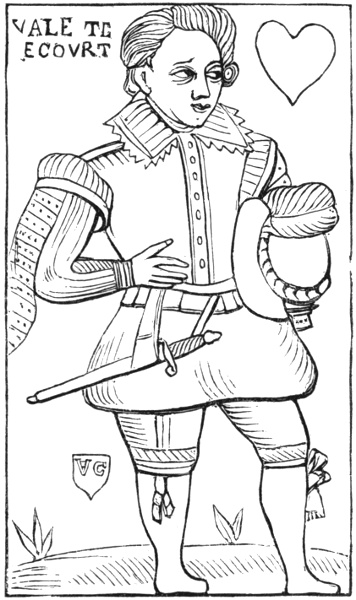
Valet de Cour. (p. 250.)
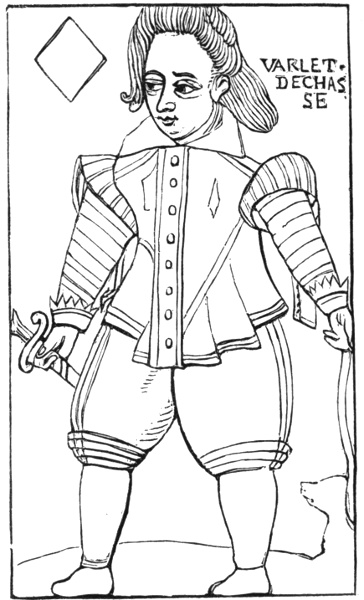
Valet de Chasse. (p. 250.)
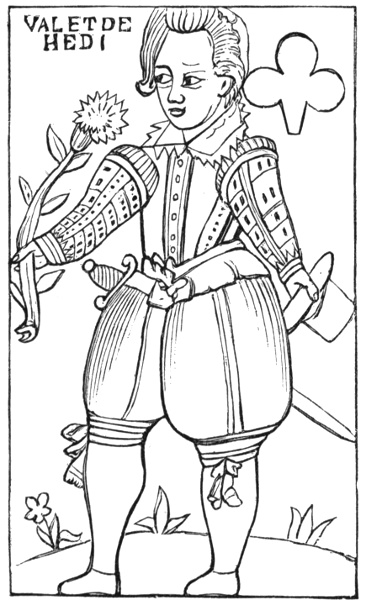
Valet de Été. (p. 250.)
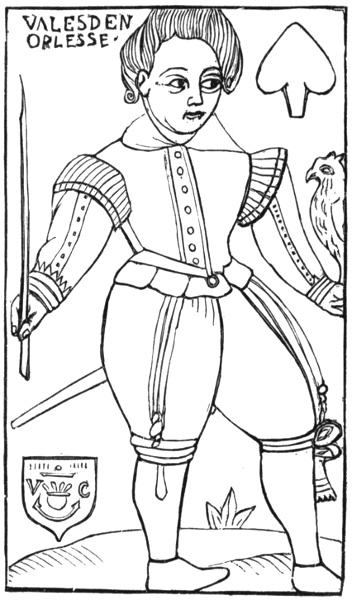
Valet de Noblesse. (p. 250.)
In the same work are given fac-similes of coat cards
executed in the reign of Louis XIII, and displaying the
costume of that period. The names given to the Kings,
Queens and Valets on those cards are: Cœur, Alexandre,
Pentasilee [Penthesilea], Roland. Carreau, Cirus Major,
Roxane, Renault. Trèfle, Ninus, Semiramis; the name of
the Valet wanting.
[298]
Pique, Jule Cæsar, Pompeia, Roger.
Each of the Aces is surrounded with an ornamental bordering;
and at the foot is an inscription, which, when read
consecutively, through all the four, is as follows: "Vive le
Roy | Vive la Reyne | J'ayme l'Amour | Et la Court."
Some of the specimens of Portuguese cards given in the
'Jeux de Cartes Tarots et de Cartes Numérales' have very
much the appearance of having been originally suggested
by, if not copied from, an Oriental type; more especially
in the suits of Danari and Bastoni,—Money and Clubs.
In those cards the circular figure, generally understood as
representing Danari, or Money, is certainly much more
like the Chakra, or quoit of Vichnou, as seen in Hindostanee
drawings, than a piece of coin; while on the top of
the Club there is a diamond proper, which is another of
the attributes of the same deity. The dragon seen on each
of the Aces is perfectly Oriental in character; and the
shields which appear on the Kings and Queens are very
much like those which are to be seen in Hindostanee
drawings. The coat cards in this pack are King, Queen,
and Horseman; and the suits are Coppe, Danari, Bastoni,
and Spade—Cups, Money, Clubs proper, and Swords. The
Queen, which here appears as the second coat card, is of
unusual occurrence in cards of this kind, and more especially
in such as are of Spanish or Portuguese manufacture.
[299] In
two of the suits,—Clubs and Swords,—the Queen appears
in the act of encountering a dragon. The coat cards and
aces have letters both at top and bottom, indicating the
suit, and the rank or name of the card. Specimens of
those cards, which appear to have been executed in 1693,
are preserved in the Bibliothèque du Roi. The four annexed
cuts show the outlines of the four Valets. The letters
CC, CD, CB, CS, signify respectively the Caballo, or Chevalier
of Coppe, Danari, Bastoni, and Spade.
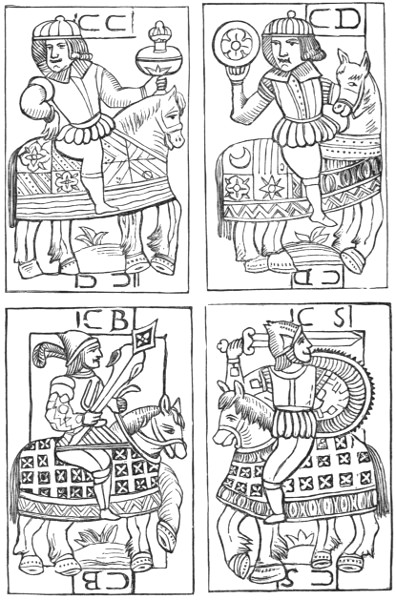
The most remarkable changes that cards have undergone,
with respect to the characters displayed on them, are to be
found in certain packs manufactured at Paris in the time
of the Revolution. Specimens of the coat cards of two of
those packs engraved by Chossonnerie and Gayant, in
1793-4, are given in the 'Jeux de Cartes Tarots et de
Cartes Numérales.' In one of them the places of the Kings
are occupied by four Philosophers, namely, Molière, La
Fontaine, Voltaire, and J. J. Rousseau; the Queens are
substituted by the four Virtues, Prudence, Justice, Temperance,
and Fortitude; while the Valets are superseded by
four Republicans, one of whom is a grim-looking ruffian, with
a red cap on, and his shirt-sleeves turned up, brandishing
a pike; the second is a soldier armed with a musket; the
third an artilleryman; and the fourth a young man, in
fancy costume, armed with a musket. In the other pack,
four Sages, Solon, M. P. Cato, J. J. Rousseau, and J. J.
Brutus, serve instead of Kings; four Virtues, as in the
other pack, represent the Queens; though with this difference,
that Temperance is displaced by Union; while
four "Braves,"—Annibal, Horatius, P. Decius Mus, and
M. Scævola, supply the place of Valets.
Another pack of Republican cards of the same period is
thus described by Peignot, in his 'Analyse de Recherches
sur les Cartes à jouer.'
"For Kings we have Genii; for Queens, Liberties;
and for Valets, Equalities. In place of the King
of Hearts there is the Genius of War,—'Génie de la
Guerre.' This Genius, which is winged, is seated on
the breech of a cannon; he holds in the right hand a
sword and a wreath of laurel, and in the left, a
shield, round which is the inscription, 'Pour la République
Française.' On the right, read vertically from the top,
is the word 'Force.' At the feet of the Genius are a
bomb, a lighted match, and a heap of bullets. At the
bottom of the card is the inscription, 'Par brevet d'invention.
Naume et Dugouec, au Génie de la Rép. franç.'
"For the Queen of Hearts: 'Liberté
des Cultes,'—Religious
Liberty. This is a female seated, very badly
draped, and with her legs bare. She holds a pike surmounted
with a red cap; and on a bannerol attached to
the pike are the words 'Dieu seul.' Towards her feet are
seen three volumes, inscribed 'Thalmud,' 'Coran,' and
'Evangile.' The vertical inscription is, 'Fraternité.'
"Knave of Hearts: 'Égalité des Devoirs,'—Equality
of Duties. This is a soldier seated on a drum, with his
musket between his knees. In his left hand he holds
a paper containing the words, 'Pour la patrie.' The
vertical inscription is 'Sécurité.'
"King of Spades: 'Génie des Arts,'—the Genius of
Arts. The figure of Apollo with a red cap on his head; in
one hand he holds the Belvedere statue of himself, and in
the other a lyre. The vertical inscription: 'Goût.' At
the bottom, emblems of painting, sculpture, and such like.
"Queen of Spades: 'Liberté de la Presse,'—Liberty
of the Press. A female figure with a pen in one hand, and
with the other sustaining a desk, on which lies a roll of
paper partly unfolded, and displaying the words 'Morale,
Religion, Philosophie, Physique, Politique, Histoire.' At
the bottom, masks, rolls of manuscript, and such like.
"Knave of Spades: 'Egalité de Rangs,'—Equality of
Ranks. The figure of a man whose costume accords rather
with that of a 'Septembriseur' than with that of a mere
'Sans-culotte' of the period. He wears sabots, and has a red
cap on his head. He has no coat on, and his shirt-sleeves
are tucked up to the elbows. His small-clothes are loose
at the knees, and his legs are bare. He is seated on a large
stone, on which is inscribed: 'Démolition de la Bastille.
10 Août, 1792.' Under his feet is a scroll inscribed
'Noblesse,' and displaying shields of arms. The vertical
inscription is 'Puissance.'
"King of Clubs: 'Génie de la Paix,'—Genius of
Peace. In his right hand he holds the 'Fasces' and an
olive branch, and in the left a scroll containing the word
'Lois.' The vertical inscription is 'Prospérité.'
"Queen of Clubs: 'Liberté du Mariage,'—Liberty of
Marriage. The figure of a female holding a pike surmounted
with the red cap; and on a scroll attached to the
pike is the word 'Divorce.' The vertical inscription is
'Pudeur.' On a pedestal is a statue of the crouching Venus
entirely naked,—without doubt intended for the emblem of
Modesty.
"Knave of Clubs: 'Egalité de Droits,'—Equality of
Rights. A judge in tricolor costume, holding in one hand
a pair of scales, and in the other a scroll containing the
inscription 'La loi pour tous.' He is trampling on a
serpent or dragon, the tortuous folds of which represent
legal chicanery. The vertical inscription is 'Justice.'
"King of Diamonds: 'Génie du Commerce,'—the
Genius of Commerce. He is seated on a large bale, which
contains the inscription 'P. B. d'inv. J. D. à Paris.'
In one hand he holds a purse, and in the other a caduceus
and an olive-branch. The vertical inscription is 'Richesse.'
At the bottom are an anchor, the prow of a ship, a portfolio,
and such like.
"Queen of Diamonds: 'Liberté des Professions,'—Liberty
of Professions and Trades. A female figure who,
in the same manner as the other three Liberties, holds a
pike surmounted with the red cap. With the other hand
she holds a cornucopiæ and a scroll containing the word
'Patentes.' The vertical inscription is 'Industrie.'
"Knave of Diamonds: 'Egalité de
Couleurs,'—Equality
of Colours. The figure of a Negro, seated, and leaning upon
a musket. Below is the word 'Café.' Near to him are
a sugar-loaf, a broken yoke, fetters, iron collars for the neck,
and such like. The vertical inscription is 'Courage.'
"Such are the coat cards of this Republican pack. The
numeral cards are the same as the old ones, with the
exception of the Aces, which are surrounded by four fasces
placed lozenge-wise, with these words: 'La Loi. Rép.
Franç.;' the whole coloured blue. It is scarcely necessary
to say that those ridiculous cards had not even a momentary
vogue."
[300]
The coat cards of a Republican pack, of recent American
manufacture, have been forwarded to me by a friend,
resident at New York. From the name of the maker,—R.
Sauzade,—which occurs on the Ace of Spades, I am
inclined to think that their invention is to be ascribed
rather to a Frenchman than to an American. For the
Kings we have: Hearts, Washington;
Diamonds, John
Adams, the second President of the United States; Clubs,
Franklin; Spades,
La Fayette. For the Queens: Hearts,
Venus,—modestly concealing her
charms with a mantle, in
accordance with American notions of delicacy. Diamonds,
Fortune; Clubs,
Ceres; Spades,
Minerva. The Knaves
are represented by Four Indian chiefs. The figures appear
to be engraved on copper, and are coloured. The marks
of the suits are the same as those on the cards in common
use in England. Those cards, I am informed, are held in
no estimation by the card-players of America, who continue
to prefer those of the old pattern.—The chief town in
America for the manufacture of cards is Boston; whose
discreet, meeting-going people seem to have no objection to
make a profit by supplying the profane with the instruments
of perdition.
No cards of an "instructive" character have ever obtained
popularity amongst regular card-players; for when people
sit down to play at cards they do not like to have their
attention withdrawn from the game by the historical or
biographical reminiscences suggested by Coat cards, either
containing portraits of distinguished characters, or commemorating
remarkable events; and least of all can they bear
that the heads of a sermon or moral lecture should be presented
to them in the shape of the four cardinal virtues;
which are just as appropriate in a pack of cards as they
would be on the proscenium of her Majesty's Theatre.
The best of the costume cards that I have seen are those
designed by Armand Houbigant, a French artist, who
named them "Cartes Royales," and obtained from Louis
XVIII, a license to manufacture them for general use, in
1818. They did not, however, acquire any vogue, and are
now seldom to be met with, except in the collections of
amateurs of prints. The coat cards, which are etched, and
delicately coloured by hand, display the costume of the
French Court at four different periods. The characters
represented are as follows.
Spades. King, Charlemagne, "Carolus Magnus;"
crowned, and seated on a throne, with a globe in the right
hand, and a long sceptre in the left.—Queen, Hildegarde,
second wife of Charlemagne; erect, crowned, and holding
a book in her hands.—Knave, Roland, described in
romances as the nephew of Charlemagne; and said to have
been killed at the battle of Roncevalles in 778; holding
a spear and shield, and clothed in armour, which appears
rather to belong to the sixteenth century than to the time
of Charlemagne.
Diamonds. King, Louis IX, "Sainct Loys;" crowned,
seated on a throne, wearing a blue robe powdered with
fleurs-de-lis, and having a sceptre in his left hand.—Queen,
Blanche de Castille, wife of Louis VIII, and mother of
St. Louis; erect, crowned, and holding a rosary in her
right hand.—Knave, Sire de Joinville, the biographer of
Louis IX, and one of the nobles of his court; clothed in
chain-mail, over which is a surcoat of arms.
Clubs. King, Francis I; seated, wearing the broad
bonnet in which he is usually represented, and holding a
sceptre.—Queen, Marguerite de Valois, Queen of
Navarre, sister of Francis I; erect, holding a rose in her
right hand.—Knave, Bayard; in plate-armour, leaning on
a kind of pedestal on which is inscribed "Sans peur, sans
reproche."
Hearts. King, Henry IV; seated, holding a sceptre,
and wearing the characteristic hat and feather which, in
modern times, are designated by his name.—Queen, Jeanne
d'Albret, mother of Henry IV; erect, holding a fan in her
right hand.—Knave, Sully; bald and bearded, as he is
usually represented in engravings, holding in his right hand
a paper inscribed "Economie Roy.
[301] ..."
A set of Picture Cards, published by Cotta, the bookseller
of Tubingen, in one of his Card Almanacs—'Karten
Almanach'—is noticed by Mons. Peignot. The
designer has chosen for the coat cards the principal characters
in Schiller's Joan of Arc, and has clothed them, as well
as he could, in the costume of the period. The King of
Hearts is Charles VII;
the Queen, Isabella of Bavaria;
the Knave, La Hire.—The King of
Clubs is the English
commander, Talbot, dying; the Queen,
Joan of Arc;
the Knave, Lionel, taking away the
sword of Joan of Arc.—The
King of Diamonds is Philip, Duke of Burgundy;
the Queen, Agnes Sorel; the Knave,
Raimond, a villager.—The
King of Clubs is Réné of Anjou, with the crown
of Sicily at his feet; the Queen, Louise, sister of Joan of
Arc; and the Knave, Montgomery, on his knees, and
weeping. The low cards from 1 to 10 also contain fanciful
designs; but with the subjects so arranged that the numbers
and marks of the suits can be readily distinguished. The
subject of the Four of Clubs is an illustration of Burger's
ballad of Leonore—Death armed, and mounted on horseback,
appears to be threatening with his dart a young
woman who rides behind him; the scene is laid in a churchyard,
and a skeleton appears crawling towards an open
grave. The mark of the suit is seen on four crosses in the
churchyard. Cotta's Card Almanack first appeared in
1806, and was continued for several years. It was published
as a small pocket volume of a square form; and the
illustrations consisted entirely of fanciful cards,—the mark
of the suit being always introduced into each subject,
either by hook or by crook. The designs for the cards in
the first four volumes, from 1806 to 1809 inclusive, are
said to have been made by a lady.—Numerous packs of
fancy cards have appeared in Germany since the commencement
of the present century; some displaying costume,
ancient and modern; some representing eminent characters,
and others devoted to the illustration of trades and professions.
In one of them, published at Frankfort-on-the-Maine,
in 1815, in memory of the principal military events
of 1813-14, the Duke of Wellington figures as the Knave
of Diamonds, and Marshal Blucher as the Knave of
Clubs.
In 1811 two different packs of caricature cards, imitated,
or rather adapted, from the picture-cards in Cotta's Almanack,
appeared in England. The one was published by S. and J.
Fuller, Rathbone place, London; and the other, by Jones,
at the Repository of Arts, Market hill, Cambridge. Neither
of those packs was intended for the purposes of play.
They have very much the appearance of having been designed
by the same artist. On the wrapper of both packs
the inscription is the same: "Metastasis. Transformation
of Playing-cards."—A set of costume cards was published
by Ackermann, in the 'Repository of Arts,' in 1806: a
particular description of them would be just as interesting
as a description of the plates in 'La Belle Assemblée' of the
same period.
A pack of cards published by Baker and Co., in 1813,
requires more particular notice. On the wrapper they are
entitled "Eclectic Cards;" and in a pamphlet giving an
account of them, they are announced as "Complete, Grand,
Historical, Eclectic Cards, for England, Ireland, Scotland,
and Wales; being a Selection or an Eclectic Company of
Twelve of the most eminent Personages, that ever distinguished
themselves in those respective Countries, for Heroic
deeds, Wisdom, &c. And the other Forty Cards descriptive
of the Local and National Emblems of the Four
Nations.
"Historian, Poet, Painter, all combine,
To charm the eye, the taste and mind refine;
Fancy and sentiment their aid impart,
To raise the genius, and to mend the heart."
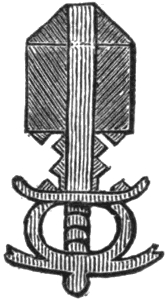
These cards, which are considerably larger than those in
common use, display considerable skill and fancy in the
designs, and are beautifully coloured. Hearts and Diamonds
are retained as marks of two of the suits; but Acorns are
substituted for Clubs; and instead of Spades there is a
"true representation of the real Spata, which is not a coal-heaver's
spade, but a two-edged heavy sword, without a
point, as used by the ancient Britons to fight with; cut,
hew, and slash down, either enemy or tree. So says our
ancient history." A fac-simile of this formidable
weapon is here subjoined, in order that the
reader may judge for himself of its peculiar
fitness for cutting, hewing, or slashing down.
It has very much the appearance of a heavy
cast-metal article, new from the Carron foundry,
and of modern Gothic design. In the descriptive
pamphlet, the coat cards are thus
explained:
"FOR ENGLAND.
King of Clubs.—Arthur, the Great and Victorious Hero,
King of Britain.
Queen of Clubs.—Elizabeth, the Wise and Virtuous Queen
of England.
Knight of Clubs.—Sir John Falstaff, the Facetious Knight,
and companion of Henry V, Knight of England.
FOR IRELAND.
King of Hearts.—Gathelus, the Grecian Prince, King of
Ireland.
Queen of Hearts.—Scotia, his Wife, the Egyptian Princess,
Queen of Ireland.
Knight of Hearts.—Ossian, the Warrior and Poet, Son
of Fingal, Knight of Ireland.
FOR SCOTLAND.
King of Diamonds.—Achaius, the fortunate Contemporary,
and in alliance with Charlemagne, King of Scots.
Queen of Diamonds.—Mary Stuart, the unfortunate
Dowager Queen of France, and Queen of Scots.
Knight of Diamonds.—Merlin, the Magic Prophet,
Cabinet Counsellor to Vortigern, Aurelius Ambrosius, Uter
Pendragon, the Father of King Arthur, and to King Arthur,
who was his Pupil, Knight of Scotland.
FOR WALES.
King of Spata.—Camber, the third Son of Brute, King
of Cambria.
Queen of Spata.—Elfrida, the beautiful Queen of Mona,
and of the Mountains.
Knight of Spata.—Thaliessin, the Welch Bard and Poet,
dressed like a Herald or King at Arms of the Divine and
Ancient Druids, as he sang to King Henry II of the great
deeds of Arthur, the justly termed hero of the British Isle,
Knight of Cambria."
"In the selection which we have made," say the proprietors,
"to form our set of court cards, we have chosen
them from among those characters who have rendered
themselves most conspicuous in the history of the United
Kingdom. In this particular, we have had recourse not
only to historical truth, which we have rigidly observed,
but we have taken care to fix upon personages, who lived
at different periods, and which are calculated in colour,
variety of dress, and characteristic features, to form an
agreeable and elegant contrast, and to avoid that unpleasant
monotony which must have taken place if they had all been
selected from the same period of time; and it will be a
peculiar gratification to us, in our attempts to form a set
of cards, should we contribute in the smallest degree, to
augment the elegant and rational amusements of taste and
fashion.
"Nor have we been inattentive to minor objects in our
anxiety to complete the plan. We believe it has never been
attempted to be explained why the coarse and vulgar appellation
of knave, was originally given to the card next in
degree to the queen. Perhaps the following demonstration
is the most plausible way in which it can be accounted for.
It was usual with kings in ancient times to choose some
ludicrous person, with whose ridiculous and comical tricks
they might be diverted in their hours of relaxation, from the
cares and formalities of royalty. This person was generally
chosen from among men of low condition, but not wholly
destitute of talent, particularly in that species of low cunning
and humour calculated to excite mirth and laughter, and the
tricks of knavery (in which he was allowed free indulgence
in the presence of the king), gave him the appellation of the
king's fool, or knave.
"Whether this explanation be really the origin from whence
the knave in the old cards is derived, may still remain undetermined,
but it appears to us the most rational way of
accounting for it. Nor is it indeed essential to our present
purpose; the name of knave in our opinion is vulgar, unmeaning,
and inconsistent, and being moreover absolutely
incompatible with the dignity of our characters, and the
uniformity of our plan, we have entirely rejected it, and substituted
a knight in its stead. This being a title of honour,
not only in immediate succession to that of king and queen,
but is ever considered as an honorable appendage to royalty
itself."
About 1819, a set of cleverly drawn satirical cards, with
the marks of the suits introduced in the same manner as
in Cotta's cards, appeared at Paris. Their satire is
directed against the political party then in the ascendant;
and in the Nine of Hearts, portraits of Chateaubriand and
other persons, both lay and clerical, are introduced as
advocates of the old order of things; in the background
are the ruins of the Bastille, and at the foot is the inscription,
"Les Immobiles." The coat cards of the suit of
Hearts consist of figures representing three popular
journals: King, "Constitutionnel,"—a figure in Roman
costume, with sword and shield, defending a column inscribed:
"Charte constitutionnel. Liberté de la Presse.
Liberté Individuelle. Loi des Elections. Tolérance." Queen,
"Minerve,"—Minerva putting to flight certain evil spirits
of the "Partie Prêtre."—Knave, "Figaro,"—the character
in proper costume. The coat cards of Spades are:
King, "Conservateur,"—a Jesuit with a sword in one
hand, and a torch in the other. Queen, "Quotidienne,"—an
old woman holding in her left hand a book inscribed,
"Pensée Chrétienne quotidienne;" and in her right an
extinguisher, which she is about to clap upon a figure of
Truth seen emerging from a well. Knave, "Bazile,"—figure
of Chateaubriand, in clerical costume, but concealing
a Jesuit's cap under his robe; beside him is a braying ass,
on its knees. Clubs: King, "Débats,"—the Editor
endeavouring to carry two large bags, the one inscribed,
"Débats" and the other "Empire:" in the distance, two
asses mutually caressing each other. Queen, "Gazette,"—a
hard-featured old lady, with a pen in her hand, at a writing
table: near to her a magpie in a cage. Knave, "Clopineau,"—the
figure of Talleyrand; towards the top are the signs
of the political zodiac which he had already passed through.
In the only pack which I have had an opportunity of examining,
the Queen of Diamonds is wanting. The representative
of the King is the "Moniteur,"—a brazen head
on a kind of pedestal, round which are stuck flags of various
colours, indicative of the different parties whose cause the
paper had advocated. Knave, "Don Quichotte,"—the
Don, with shield and lance, attacking a windmill: the person
intended by this figure I have not been able to discover.
[302]
With respect to the common names of the first three
numeral cards,—Ace, Deuce, and Tray,—it may be observed
that the term Ace or As is common in almost every country
in Europe as the designation of the One at cards;
[303] and that
the terms Deuce and Tray, signifying Two and Three, may
have been derived either from the Spanish Dos and Tres,
or from the French Deux and Trois. The Deuce of cards,
it may be observed, has no connexion with the term Deuce
as used in the familiar expression "to play the Deuce;" in
which it is synonymous with the Devil, or an evil spirit, and
is of Northern origin. In some parts of the country, the
Deuce, though lower in value, is considered to be a more
fortunate card than the Tray; and "There's luck in the
Deuce, but none in the Tray," is a frequent expression
amongst old card-players, who like to enliven the game
with an occasional remark as they lay down a card. In
Northumberland, the Four of Hearts at Whist is sometimes
called "Hob Collingwood,"
[304]
and is considered by old ladies
an unlucky card. As far as memory can trace, according
to Captain Chamier, in his novel entitled the 'Arethusa,'
the Four of Clubs has been called by sailors the "devil's
bedpost." In Northamptonshire, according to a writer in
the 'Gentleman's Magazine,' 1791 (p. 141), the Queen of
Clubs is called "Queen Bess," and the Four of Spades,
"Ned Stokes."
[305]
In various parts of Ireland, but more particularly in the
county of Kilkenny, the Six of Hearts is known by the
name of "Grace's card;" and it is said to have acquired
that name from the following circumstance. A gentleman
of the name of Grace, being solicited, with promises of
royal favour, to espouse the cause of William III, gave the
following answer, written on the back of the Six of Hearts,
to an emissary of Marshal Schomberg's, who had been
commissioned to make the proposal to him:—"Tell your
master I despise his offer; and that honour and conscience
are dearer to a gentleman than all the wealth and titles a
prince can bestow."
The Nine of Diamonds is frequently called the "Curse
of Scotland;" and the common tradition is that it obtained
this name in consequence of the Duke of Cumberland
having written his sanguinary orders for military execution,
after the battle of Culloden, on the back of a Nine of
Diamonds. This card, however, appears to have been
known in the North as the "Curse of Scotland" many
years before the battle of Culloden; for Dr. Houstoun,
speaking of the state of parties in Scotland shortly after
the rebellion of 1715, says that the Lord Justice-Clerk
Ormistone, who had been very zealous in suppressing the
rebellion, and oppressing the rebels, "became universally
hated in Scotland, where they called him the Curse of
Scotland; and when the ladies were at cards playing the
Nine of Diamonds, (commonly called the Curse of Scotland)
they called it the Justice Clerk."
[306]
In the 'Gentleman's Magazine' for 1786, a correspondent
offers the following heraldic conjecture on the subject.
"There is a common expression made use of at cards, which
I have never heard any explanation of. I mean the Nine
of Diamonds being called the Curse of Scotland. Looking
lately over a book of heraldry, I found nine diamonds, or
lozenges, conjoined,—or, in the heraldic language, Gules, a
cross of lozenges,—to be the arms of Packer. Colonel
Packer appears to have been one of the persons who was
on the scaffold when Charles the First was beheaded, and
afterwards commanded in Scotland, and is recorded to have
acted in his command with considerable severity. It is
possible that his arms might, by a very easy metonymy, be
called the Curse of Scotland; and the Nine of Diamonds, at
cards, being very similar, in figure, to them, might have
ever since retained the appellation." Another correspondent
says that he has always understood that the application of
the expression, "the Curse of Scotland," to the nine of
diamonds was not earlier than the year 1707; and that he
thinks it more probable that the nine lozenges in the arms
of the Earl of Stair, who made the Union, should have given
rise to the phrase, than the arms of Packer. In the same
Magazine, for 1788, we have "One more conjecture concerning
the Nine of Diamonds." It is syllogistic in form,
and appears to have been intended as a clinch to the
controversy.
[307]
"The Curse of Scotland must be something
which that nation hate and detest; but the Scots hold in
the utmost detestation the Pope; at the game of Pope Joan,
the Nine of Diamonds is Pope; therefore the Nine of
Diamonds is the Curse of Scotland. Q. E. D."
In the 'Oracle, or Resolver of Questions,' a duodecimo
volume, printed about 1770, the following solution is given,
which is perhaps as near the truth as any of the preceding
conjectures. "Q. Pray why is the Nine of Diamonds called
the Curse of Scotland? A. Because the crown of Scotland
had but nine diamonds in it, and they were never able to
get a tenth."
The word Trump, signifying a card of the suit which has
the superiority at certain games, such superiority being
determined by hazard, is derived either from the French
Triomphe, or the Spanish Triunfo: at cards, these words
have precisely the same meaning as the English Trump.
[308]
With the French, Triomphe is also the name of a game at
cards; and in England the old game of Ruff seems also to
have been called Trump or Triumph.
[309] At Gleek, the Ace
was called Tib; the Knave, Tom; and the Four, Tiddy.
The Five and Six appear to have been respectively called
Towser and Tumbler, and to have counted double when
turned up. At All-Fours, the Knave appears in his proper
character of Jack,—a serving-man, not a cheat, or rogue.
At certain games the Knave of Clubs is called Pam.
A few years ago the name was applied to the celebrated
public character whom Byron is supposed to have designated
as "a moral chimney-sweep," in one of the cantos of
Don Juan.
[310]
Most of the terms in the game of Ombre
are Spanish.
Formerly a pack of cards was usually called a "Pair of
cards;" and it appears deserving of remark, that the Italians
use the word Pajo, which properly signifies a pair, in precisely
the same sense when applied to a pack of cards,—Pajo
di carte. In the time of Queen Elizabeth a pack of
cards appears to have been sometimes called a bunch. In
the time of Charles II the term "Pair of Cards" fell into
disuse; and perhaps one of the latest instances of its employment,
is to be found in Poor Robin's Almanac for 1684,
under the month December, where the writer, in his introductory
verses, laments the decline of good housekeeping in
the houses of the rich:
"The kitchen that a-cold may be,
For little fire you in it may see.
Perhaps a pair of cards is going,
And that's the chiefest matter doing."
The French call a pack of cards "Un Jeu de cartes,"—a
game, or play of cards; and the German name, "Ein Spiel
Karten" has the same literal meaning as the French.
As the object of this work is not to teach people how to
play at cards, those who wish for information, with respect
to the different games, are referred to Cotton's 'Complete
Gamester,' Seymour, Hoyle, and the Académie des Jeux,—taking
with them this piece of advice:
"He who hopes at Cards to win,
Must never think that cheating's sin;
To make a trick whene'er he can,
No matter how, should be his plan.
No case of conscience must he make,
Except how he may save his stake;
The only object of his prayers,—
Not to be caught, and kicked down stairs."
[311]
With respect to the manufacture of cards, it would appear
to have been a regular business, both in Germany and Italy,
about 1420; but, though it has generally been asserted that
the earliest cards for common use were engraved on wood,
there is yet reason to believe that they were at first executed
by means of a stencil; and that the method of engraving the
outlines on wood was of subsequent introduction. However
this may be, it is certain that the art of wood-engraving was
at an early period applied to the manufacture of cards, and
that in Germany, in the latter quarter of the fifteenth century,
the term Briefdrucker, or Briefmaler,—card-printer,
or card-painter—was commonly used to signify a wood-engraver.
From the importation of playing cards into
England being prohibited by an act of parliament in 1463,
as injurious to the interests of native tradesmen and manufacturers,
it might be concluded that at that time the
manufacture of cards was established in this country. No
cards, however, of undoubted English manufacture of so early
a date have yet been discovered. In the sixteenth century,
there is reason to believe that most of the cards used in
England were imported either from France, or the Netherlands.
In the reign of Elizabeth the importation of cards
was a monopoly;
[312]
but from the time of her successor James I,
it would appear that most of the cards used in this country
were of home manufacture. From the reign of Charles II
to the present time, cards have, either directly or indirectly,
been subject to a duty.
In France, by an ordonnance dated 21st February,
1581, a tax of "un ecu sou" was ordered to be paid
upon each bale of cards of two hundred pounds weight
intended for exportation; and, by an ordonnance of the
22d May, 1583, a tax of "un sou parisis" was laid upon
each pack of cards intended for home use. By an ordonnance
of the 14th January, 1605, the exportation of cards
was prohibited; but, as a compensation to the manufacturers,
the duty on cards for home consumption was reduced.
As the collection of the duties was rendered difficult in consequence
of the manufacturers residing in so many different
places, it was, at the same time, determined that the only
places where the manufacture of cards might be carried on,
should be Paris, Rouen, Lyons, Toulouse, Troyes, Limoges,
and Thiers in Auvergne. Shortly afterwards, the same
privilege was accorded to Orleans, Angers, Romans, and
Marseilles; and, by way of recompense to other places, it
was determined that the tax should be expended in the
encouragement of manufactures. Louis XV, having established
the Ecole Militaire, in 1751, ordered that the money
raised by the tax on cards, should be applied to its support.
The company, or guild, of card-makers of Paris was suppressed
in 1776, but re-established a few months afterwards.
The period of their first establishment appears to
be unknown. In their statutes of the year 1594, they call
themselves Tarotiers.
[313]
In Russia, at the present day, the
manufacture of cards is a royal monopoly. A few months
ago a paragraph appeared in the Literary Gazette, stating
that though 14,400 packs were manufactured daily, yet the
supply was unequal to the demand, and that a petition had
been presented to the emperor praying for a more liberal
issue. In Mexico a considerable revenue was derived from
a tax on cards; and it would appear to be still productive,
notwithstanding the unsettled state of the country, as it is
one of those which have been appropriated, ad interim, by
the American commander-in-chief.
Most of the cards engraved on copper are merely "cartes
de fantaisie," designed rather for the entertainment of the
more wealthy classes, than for the ordinary purposes of play.
Until a comparatively recent period the coat cards, after
having been printed in outline from wood blocks, were
coloured by means of stencils; but at present, in this
country, the colours are all applied by means of the press.
The following account of the manner of making cards at the
manufactory of Messrs. De La Rue and Company, of
London, is extracted from Bradshaw's Journal, No. 24,
16th April, 1842.
"The first object that engages our attention, is the preparation
of the paper intended to be formed into cards.
It is found that ordinary paper, when submitted to pressure,
acquires a certain degree of polish, but not sufficient for
playing-cards of the finest quality. In order therefore that
it may admit of the high finish which is afterwards imparted,
the paper is prepared by a white enamel colour, consisting
of animal size and other compounds. This substance, which
renders the paper impermeable to the atmosphere, is laid on by
a large brush, and left to dry by exposure to the atmosphere.
"The paper being ready for use, we proceed to explain
the printing of the fronts of the cards, which are technically
distinguished as pips and têtes.
"To commence with the simpler, the pips (i.e. the hearts,
diamonds, spades, and clubs:)—sets of blocks are produced,
each containing forty engravings of one card; and as the
ordinary method of letterpress printing is employed, forty
impressions of one card are obtained at the same moment.
As the pips bear but one colour, black or red, they are
worked together at the hand-press, or at one of Cowper's
steam printing machines.
"For the têtes, however (i.e. the court cards), which, with
the outline, contain five colours—dark blue, light blue,
black, red, and yellow,—a somewhat different contrivance
is employed. The colours are printed separately, and are
made to fit into each other with great nicety, in the same
manner as in printing silks or paper-hangings. For this
purpose a series of blocks are provided, which, if united,
would form the figure intended to be produced. By printing
successively from these blocks, the different colours fall into
their proper places, until the whole process is completed.
Great care is of course necessary in causing each coloured
impression to fit in its proper place, so that it may neither
overlap another, nor leave any part imprinted upon; but as
the hand-press is employed, the workman is enabled to keep
each colour in register by means of points in the tympan of
the press or on the engraving.
"The whole operation of printing at the press being completed,
the sheets are next carried to drying-rooms, heated
to about 80° Fahrenheit, and are allowed to remain there
three or four days, in order to fix the colours.
"The successful printing of playing-cards greatly depends
upon the quality of the inks which are employed. The
common printing ink, even after the lapse of years, is liable
to slur or smutch. In the manufacture of playing-cards,
such inks only must be used as will bear the friction to
which the cards are subjected in the process of polishing, as
well as in passing between the fingers of the players. The
colours employed by the Messrs. De La Rue are prepared
from the best French lamp-black, or Chinese vermilion,
ground in oil;—this is effected by a machine, consisting of
cylinders revolving at regulated speeds, by which any defects
from the inattention of the workman, in grinding by hand,
are avoided. These colours are now brought to such perfection,
that the card itself is not more durable than the
impression on its surface.
"The paper intended for the backs, being previously prepared
with the colour desired, in the same manner as the
fronts, is printed in various devices at the hand-press or
steam-machine. The plaid or tartan backs are produced
from a block engraved with straight lines, and printed in
one colour, which is afterwards crossed with the same or
any other colour, by again laying the sheet on the block, so
that the first lines cross the second printing at any required
angle. A variety of other devices are obtained from
appropriate blocks; and some, like the court cards, and by
the same process, are printed in a number of colours.
"In printing gold backs, size is substituted for ink; the
face of the card is then powdered over with bronze dust,
and rubbed over with a soft cotton or woollen dabber, by
which the bronze is made to adhere to those parts only
which have received the size. The printing of gold backs
is usually executed after the card is pasted, but we have
described the process here for the sake of convenience.
"As connected with the printing of backs, we may mention
that the Messrs. De La Rue have lately taken out a patent
for printing from woven wire, from which some highly
beautiful patterns are obtained, bearing, of course, a perfect
resemblance to the woven fabric. The wire when prepared
for printing, is merely fastened at the ends by two pieces of
wood, and stretched over a cast-iron block, on which it is
fixed by means of screws passing through the wood into the
iron. The variety of these patterns is very great; the
printing is effected in the ordinary manner.
"Hitherto we have been referring to printed sheets of
paper, which are either the size of double or single foolscap;
the next object, therefore, is the conversion of these sheets
into card-boards of the usual thickness. In France the card
generally consists of two sheets of paper; but in England a
more substantial article is demanded; it is generally four
sheets thick, that is, the foreside and the back, and two
inside leaves of an inferior description.
"In order to make a firm and smooth card, it is first
necessary to obtain a paste of an equable well-mixed substance.
A paste of this quality is produced from flour and
water, mixed together, and heated to the boiling point, in
a forty-gallon copper, by steam; which is made to pass into
the interstices between the copper and an external casing
of cast-iron, of the same shape as the boiler. By employing
steam, instead of fire, the paste is not liable to burn, or
adhere to the sides of the copper, and thus become deteriorated
in its colour and quality.
"Previous to the commencement of pasting, it is necessary
that the sheets be arranged in the order in which they
are to be pasted. This operation is termed mingling. The
insides, which are merely two sheets of paper pasted together,
are placed between the foresides and backs, so that
the paste may take them up without the possibility of error.
A heap of paper so pasted will therefore uniformly consist
of the foreside and back, between which, the inside, pasted
on each side, is placed.
"The paste is laid on by means of a large brush, resembling
the head of a hair-broom, with which the workman,
by a series of systematic circular movements, distributes a
thin coat. And by way of illustration of the long practice
and manual dexterity which are necessary for perfection in
even the simplest departments of art or labour, it may be
worthy of notice that card-pasting is in itself a branch of
labour, and that three or four years' practice is necessary to
render the operator complete master of his business.
"These newly-pasted cards are then, in quantities of
four or five reams at a time, subjected to the gradual but
powerful pressure of a hydraulic press of one hundred tons,
worked by a steam-engine. By this means the water in
the paste exudes, and the air between the leaves is expelled,
which would otherwise remain, and give the card a blistered
appearance.
"After remaining a short time in the press, they are
hung up on lines to dry; and to prevent, as much as
possible, their warping while in this limpid state, small
pins or wires are passed through the corners, and are then
dexterously bent over the lines in the drying-room.
"The card-boards, after thus drying, are subjected to
the pressure and friction of a brush-cylinder,—the face of
which is covered with short thickset bristles, which not
merely polish the surface, but even penetrate into the interstices.
At this stage of the manufacture, cards of a superior
description are waterproofed on the back with a varnish
prepared for the purpose, so that they may not be marked
by the fingers in dealing. When so prepared, they will
keep perfectly clean, and may even be washed, without
injuring the impression or softening the card.
"In continuation of the process of polishing, the card-boards
are passed between revolving rollers of moderate
warmth, one being of iron, the other of paper cut edge-ways;
they are next subjected to two bright iron-faced
rollers; and finally, to the number of ten or fifteen at a
time, they are interleaved with thin sheets of copper, and
effectually milled by being passed about a dozen times
between two large and powerful cylinders. After being
thus thoroughly polished, for the purpose of being flattened
they are subjected to the pressure of a hydrostatic press of
eight hundred tons, worked by steam.
"It may appear surprising that so much labour and
machinery, and such circuitous means—requiring the operation
of four distinct cylindrical machines, as well as a
hydraulic press, all worked by steam,—should be required
for effecting an object apparently so simple as that of
polishing and flattening a card-board. It is, however,
found that this end cannot be attained in a more expeditious
manner, but that the means adopted must be gradual,
though increasingly powerful in their different stages.
"The boards being printed and pasted, polished and
flattened, are next cut up into single cards. The apparatus
by which this is effected, and by which perfect exactness
in the size of the cards is preserved, may be briefly described
as a pair of scissors from two to three feet long, one blade
of which is permanently fixed on the table. The card-board,
being placed upon the bench, is slipped between the
blades of the scissors, and pushed up to a screw-gauge
adjusted to the requisite width; the moveable blade, by
being then closed, cuts the card-board into eight narrow
slips, called traverses, each containing five cards. These
traverses then undergo a similar operation at a smaller pair
of gauge-scissors, where they are cut up into single cards,
to the amount of thirty thousand daily.
"All that now remains is the making-up into packs.
After assorting the cards, the workman begins by laying
out on a long table a given number (say two hundred) at
one time; he then covers these with another suit, and so on
consecutively until he has laid out all the cards that constitute
a pack; so that by this operation two hundred packs
are completed almost simultaneously. The best cards are
called Moguls, the others Harrys, and Highlanders,—the
inferior cards consist of those which have any imperfection
in the impression, or any marks or specks on the surface.
"It may be necessary to remark that the Aces of Spades
are printed at the Stamp Office, whether the cards be for
exportation or for the home market,—the paper for printing
being sent to the Stamp Office by the maker; and an
account of the number of aces furnished by the Stamp
Office is kept by the authorities. Before cards are delivered
by the manufacturer an officer is sent to seal them, and a
duty of a shilling per pack is paid monthly for those that
are sold for home consumption. But as they are not liable
to duty when intended for exportation, the card-maker
enters into a bond that they shall be duly shipped, and an
officer is sent to see them put into the case, and to seal
it up."