In the last lecture we have noticed the general
relations of agnostic speculations with
natural science, and have exposed their failure
to account for natural facts and laws. We
may now inquire into their mode of dealing
with the phenomena of life, with regard to the
supposed spontaneous evolution of which, and
its development up to man himself, so many
confident generalizations have been put forth
by the agnostic and monistic philosophy.
In the earlier history of modern natural science,
the tendency was to take nature as we
find it, without speculation as to the origin of
living things, which men were content to regard
as direct products of creative power. But at
a very early period—and especially after the
revelations of geology had disclosed a succession
of ascending dynasties of life—such
speculations, which, independently of science,
had commended themselves to the poetical and
philosophical minds of antiquity, were revived.
In France more particularly, the theories of Buffon,
Lamarck, and Geoffroy St. Hilaire opened
up these exciting themes, and they might even
then have attained to the importance they have
since acquired but for the great and judicial
intellect of Cuvier, which perceived their futility
and guided the researches of naturalists
into other and more profitable fields. The
next stimulus to such hypotheses was given
by the progress of physiology, and especially
by researches into the embryonic development
of animals and plants. Here it was seen that
there are homologies and likenesses of plan
linking organisms with each other, and that in
the course of their development the more complex
creatures pass through stages corresponding
to the adult condition of lower forms. The
questions raised by the geographical distribution
of animals, as ascertained by the numerous
expeditions and scientific travellers of modern
times, tended in the same direction. The way
was thus prepared for the broad generalizations
of Darwin, who, seizing on the idea of artificial
selection as practised by breeders of animals
and plants, and imagining that something similar
takes place in the natural struggle for
existence, saw in this a plausible solution for
the question of the progress and the variety
of organized beings.
The original Darwinian theory was soon
found to be altogether insufficient to account
for the observed facts, because of the tendency
of the bare struggle for existence to produce degradation
rather than elevation; because of the
testimony of geology to the fact that introduction
of new species takes place in times of expansion
rather than of struggle; because of the
manifest tendency of the breeds produced by
artificial selection to become infertile and die
out in proportion to their deviation from the
original types; and because of the difficulty
of preventing such breeds from reverting to
the original forms, which seem in all cases to
be perfectly equilibrated in their own parts and
adapted to external nature, so that varieties
tend, as if by gravitative law, to fall back
into the original moulds. A great variety of
other considerations—as those of sexual selection,
reproductive acceleration and retardation,
periods of more and less rapid evolution, innate
tendency to vary at particular times and in particular
circumstances—have been imported into
the original doctrine. Thus the original Darwinism
is a thing of the past, even in the mind
of its great author, though it has proved the
fruitful parent of a manifold progeny of allied
ideas which continue to bear its name. In this
respect Darwinism is itself amenable to the
law of evolution, and has been continually
changing its form under the influence of the controversial
struggles which have risen around it.
Darwinism was not necessarily atheistic or
agnostic. Its author was content to assume a
few living beings or independent forms to begin
with, and did not propose to obtain them by any
spontaneous action of dead matter, nor to account
for the primary origin of life, still less of
all material things. In this he was sufficiently
humble and honest; but the logical weakness
of his position was at once apparent. If creation
was needed to give a few initial types, it
might have produced others also. The followers
of Darwin, therefore, more especially in Germany,
at once pushed the doctrine back into
Agnosticism and Monism, giving to it a greater
logical consistency, but bringing it into violent
conflict with theism and with common sense.
Darwin himself early perceived that his doctrine,
if true, must apply to man—in so far, at
least, as his bodily frame is concerned. Man is
in this an animal, and closely related to other
animals. To have claimed for him a distinct
origin would have altogether discredited the
theory, though it might be admitted that, man
having appeared, his free volition and his moral
and social instincts would at once profoundly
modify the course of the evolution. On the
other hand, the gulf which separates the reason
and the conscience of man from instinct and
the animal intelligence of lower creatures opposed
an almost impassable barrier to the union
of man with lower animals; and the attempt to
bridge this gulf threatened to bring the theory
into a deadly struggle with the moral, social,
and religious instincts of mankind. In face of
this difficulty, Darwin and most of his followers
adopted the more daring course of maintaining
the evolution of the whole man from lower
forms, and thereby entered into a warfare,
which still rages, with psychology, ethics, philology,
and theology.
It is easy for shallow evolutionists unaware
of the tendencies of their doctrine, or for latitudinarian
churchmen careless as to the maintenance
of truth if only outward forms are preserved
and comprehension secured, to overlook
or make light of these antagonisms, but science
and common sense alike demand a severe adherence
to truth. It becomes, therefore, very
important to ascertain to what extent we are
justified in adopting the agnostic evolution in
its relation to life and man on scientific grounds.
Perhaps this may best be done by reviewing the
argument of Haeckel in his work on the evolution
of man—one of the ablest, and at the same
time most thorough, expositions of monistic evolution
as applied to lower animals and to men.
Ernst Haeckel is an eminent comparative
anatomist and physiologist, who has earned a
wide and deserved reputation by his able and
laborious studies of the calcareous sponges, the
radiolarians, and other low forms of life. In
his work on The Evolution of Man he applies
this knowledge to the solution of the problem
of the origin of humanity, and sets himself not
only to illustrate, but to "prove," the descent
of our species from the simplest animal types,
and even to overwhelm with scorn every other
explanation of the appearance of man except
that of spontaneous evolution. He is not
merely an evolutionist, but what he terms a
"monist," and the monistic philosophy, as defined
by him, includes certain negations and
certain positive principles of a most comprehensive
and important character. It implies
the denial of all spiritual or immaterial existence.
Man is to the monist merely a physiological
machine, and nature is only a greater
self-existing and spontaneously-moving aggregate
of forces. Monism can thus altogether
dispense with a Creative Will as originating
nature, and adopts the other alternative of self-existence
or causelessness for the universe and
all its phenomena. Again, the monistic doctrine
necessarily implies that man, the animal, the
plant, and the mineral are only successive stages
of the evolution of the same primordial matter,
constituting thus a connected chain of being, all
the parts of which sprang spontaneously from
each other. Lastly, as the admixture of primitive
matter and force would itself be a sort of
dualism, Haeckel regards these as ultimately
one, and apparently resolves the origin of the
universe into the operation of a self-existing
energy having in itself the potency of all things.
After all, this may be said to be an approximation
to the idea of a Creator, but not a living and
willing Creator. Monism is thus not identical
with pantheism, but is rather a sort of atheistic
monotheism, if such a thing is imaginable; and
vindicates the assertion attributed to a late lamented
physical philosopher—that he had found
no atheistic philosophy which had not a God
somewhere.
Haeckel's own statement of this aspect of
his philosophy is somewhat interesting. He
says: "The opponents of the doctrine of evolution
are very fond of branding the monistic
philosophy grounded upon it as 'materialism'
by comparing philosophical materialism with the
wholly different and censurable moral materialism.
Strictly, however, our 'monism' might as
accurately or as inaccurately be called spiritualism
as materialism. The real materialistic philosophy
asserts that the phenomena of vital
motion, like all other phenomena of motion,
are effects or products of matter. The other
opposite extreme, spiritualistic philosophy,
asserts, on the contrary, that matter is the
product of motive force, and that all material
forms are produced by free forces entirely independent
of the matter itself. Thus, according
to the materialistic conception of the universe,
matter precedes motion or active force; according
to the spiritualistic conception of the universe,
on the contrary, active force or motion
precedes matter. Both views are dualistic, and
we hold them both to be equally false. A contrast
to both is presented in the monistic philosophy,
which can as little believe in force without
matter as in matter without force."
It is evident that if Haeckel limits himself
and his opponents to matter and force as the
sole possible explanations of the universe, he
may truly say that matter is inconceivable without
force and force inconceivable without matter.
But the question arises, What is the
monistic power beyond these—the "power behind
nature"? and as to the true nature of this
the Jena philosopher gives us only vague generalities,
though it is quite plain that he cannot
admit a Spiritual Creator. Further, as to the
absence of any spiritual element from the
nature of man, he does not leave us in doubt
as to what he means; for immediately after the
above paragraph he informs us that "the 'spirit'
and the 'mind' of man are but forces which
are inseparably connected with the material
substance of our bodies. Just as the motive-power
of our flesh is involved in the muscular
form-element, so is the thinking force of our
spirit involved in the form-element of the
brain." In a note appended to the passage,
he says that monism "conceives nature as
one whole, and nowhere recognizes any but
mechanical causes." These assumptions as
to man and nature pervade the whole book,
and of course greatly simplify the task of the
writer, as he does not require to account for the
primary origin of nature, or for anything in man
except his physical frame; and even this he can
regard as a thing altogether mechanical.
It is plain that we might here enter our
dissent from Haeckel's method, for he requires
us, before we can proceed a single step in the
evolution of man, to assume many things
which he cannot prove. What evidence is
there, for example, of the possibility of the
development of the rational and moral nature
of man from the intelligence and the instinct
of the lower animals, or of the necessary
dependence of the phenomena of mind on
the structure of brain-cells? The evidence,
so far as it goes, seems to tend the other way.
What proof is there of the spontaneous evolution
of living forms from inorganic matter?
Experiment so far negatives the possibility
of this. Even if we give Haeckel, to begin
with, a single living cell or granule of protoplasm,
we know that this protoplasm must
have been produced by the agency of a living
vegetable cell previously existing; and we
have no proof that it can be produced in
any other way. Again, what particle of evidence
have we that the atoms or the energy of
an incandescent fire-mist have in them anything
of the power or potency of life? We
must grant the monist all these postulates as
pure matters of faith, before he can begin his
demonstration; and, as none of them are
axiomatic truths, it is evident that so far he is
simply a believer in the dogmas of a philosophic
creed, and in this respect weak as other
men whom he affects to despise.
We may here place over against his authority
that of another eminent physiologist, of more
philosophic mind, Dr. Carpenter, who has recently
said: "As a physiologist I must fully recognize
the fact that the physical force exerted
by the body of man is not generated de novo by
his will, but is derived directly from the oxidation
of the constituents of his food. But, holding
it as equally certain—because the fact is
capable of verification by every one as often as
he chooses to make the experiment—that in
the performance of every volitional movement
physical force is put in action, directed, and
controlled by the individual personality or ego,
I deem it as absurd and illogical to affirm that
there is no place for a God in nature, originating,
directing, and controlling its forces by his
will, as it would be to assert that there is no
place in man's body for his conscious mind."
Taking Haeckel on his own ground, as above
defined, we may next inquire as to the method
which he employs in working out his argument.
This may be referred to three leading modes
of treatment, which, as they are somewhat diverse
from those ordinarily familiar to logicians
and are extensively used by evolutionists, deserve
some illustration, more especially as
Haeckel is a master in their use.
An eminent French professor of the art of
sleight-of-hand has defined the leading principle
of jugglers to be that of "appearing and disappearing
things;" and this is the best definition
that occurs to me of one method of reasoning
largely used by Haeckel, and of which
we need to be on our guard when we find him
employing, as he does in almost every page,
such phrases as "it cannot be doubted," "we
may therefore assume," "we may readily suppose,"
"this afterward assumes or becomes,"
"we may confidently assert," "this developed
directly," and the like, which in his usage are
equivalent to the "Presto!" of the conjurer, and
which, while we are looking at one structure or
animal, enable him to persuade us that it has
been suddenly transformed into something else.
In tracing the genealogy of man he constantly
employs this kind of sleight-of-hand in the
most adroit manner. He is perhaps describing
to us the embryo of a fish or an amphibian, and,
as we become interested in the curious details,
it is suddenly by some clever phrase transformed
into a reptile or a bird; and yet, without
rubbing our eyes and reflecting on the differences
and difficulties which he neglects to
state, we can scarcely doubt that it is the same
animal, after all.
The little lancelet, or Amphioxus (see Fig. 1),
of the European seas—a creature which was at
one time thought to be a sea-snail, but is really
more akin to fishes—forms his link of connection
between our "fish-ancestors" and the invertebrate
animals. So important is it in this
respect that our author Waxes eloquent in exhorting
us to regard it "with special veneration"
as representing our "earliest Silurian
vertebrate ancestors," as being of "our own
flesh and blood," and as better worthy of being
an object of "devoutest reverence" than the
"worthless rabble of so-called 'saints.'" In describing
this animal he takes pains to inform us
that it is more different from an ordinary fish
than a fish is from a man. Yet, as he illustrates
its curious and unique structure, before we are
aware, the lancelet is gone and a fish is in its
place, and this fish with the potency to become
a man in due time. Thus a creature intermediate
in some respects between fishes and mollusks,
or between fishes and worms, but so far
apart from either that it seems but to mark the
width of the gap between them, becomes an
easy stepping-stone from one to the other.
 Fig. 1.
The Lancelet (Amphioxus), the supposed earliest
type of vertebrate animal, and, according to
Haeckel, the ancestor of man. The figure is a section
enlarged to twice the natural size.
a, mouth;
b, anus;
c, gill-opening;
d, gill;
e, stomach;
f, liver;
g, intestine;
h, gill-cavity;
i, notochord, or rudimentary back-bone;
k, l, m, n, o, arteries and veins.
In like manner, the ascidians, or sea-squirts—mollusks
of low grade, or, as Haeckel prefers
to regard them, allied to worms—are most remote
in almost every respect from the vertebrates.
But in the young state of some of
these creatures, and in the adult condition of
one animal referred to this group (Appendicularia),
they have a sort of swimming tail,
which is stiffened by a rod of cartilage to enable
it to perform its function, and which for a
time gives them a certain resemblance to the
lancelet or to embryo fishes; and this usually
temporary contrivance—curious as an imitative
adaptation, but of no other significance—becomes,
by the art of "appearing and disappearing,"
a rudimentary backbone, and enables us
at once to recognize in the young ascidian an
embryo man.
A second method characteristic of the book,
and furnishing, indeed, the main basis of its argument,
is that of considering analogous processes
as identical, without regard to the difference
of the conditions under which they may be
carried on. The great leading use of this argument
is in inducing us to regard the development
of the individual animal as the precise
equivalent of the series of changes by which
the species was developed in the course of geological
time. These two kinds of development
are distinguished by appropriate names.
Ontogenesis is the embryonic development of
the individual animal, and is, of course, a short
process, depending on the production of a germ
by a parent animal or parent pair, and the further
growth of this germ in connection more or
less with the parent or with provision made by
it. This is, of course, a fact open to observation
and study, though some of its processes
are mysterious and yet involved in doubt and
uncertainty. Phylogenesis is the supposed development
of a species in the course of geological
time and by the intervention of long
series of species, each in its time distinct and
composed of individuals each going regularly
through a genetic circle of its own.
The latter is a process not open to observation
within the time at our command—purely
hypothetical, therefore, and of which the possibility
remains to be proved; while the causes
on which it must depend are necessarily altogether
different from those at work in ontogenesis,
and the conditions of a long series of
different kinds of animals, each perfect in its
kind, are equally dissimilar from those of an
animal passing through the regular stages from
infancy to maturity. The similarity, in some
important respects, of ontogenesis to phylogenesis
was inevitable, provided that animals
were to be of different grades of complexity,
since the development of the individual must
necessarily be from a more simple to a more
complex condition. On any hypothesis, the
parallelism between embryological facts and
the history of animals in geological time affords
many interesting and important coincidences.
Yet it is perfectly obvious that the causes and
the conditions of these two successions cannot
have been the same. Further, when we consider
that the embryo-cell which develops into
one animal must necessarily be originally distinct
in its properties from that which develops
into another kind of animal, even though no
obvious difference appears to us, we have no
ground for supposing that the early stages of
all animals are alike; and when we rigorously
compare the development of any animal whatever
with the successive appearance of animals
of the same or similar groups in geological
time, we find many things which do not correspond—not
merely in the want of links
which we might expect to find, but in the more
significant appearance, prematurely or inopportunely,
of forms which we would not anticipate.
Yet the main argument of Haeckel's book is
the quiet assumption that anything found to
occur in ontogenetic development must also
have occurred in phylogenesis, while manifest
difficulties are got rid of by assuming atavisms
and abnormalities.
A third characteristic of the method of the
book is the use of certain terms in peculiar
senses, and as implying certain causes which
are taken for granted, though their efficacy and
their mode of operation are unknown. The
chief of the terms so employed are "heredity"
and "adaptation." "Heredity" is usually understood
as expressing the power of permanent
transmission of characters from parents to offspring,
and in this aspect it expresses the constancy
of specific forms; but, as used by
Haeckel, it means the transmission by a parent
of any exceptional characters which the individual
may have accidentally assumed. "Adaptation"
has usually been supposed to mean the
fitting of animals for their place in nature,
however that came about; as used by Haeckel,
it imports the power of the individual animal
to adapt itself to changed conditions and to
transmit these changes to its offspring. Thus
in this philosophy the rule is made the exception
and the exception the rule by a skilful use
of familiar terms in new senses; and heredity
and adaptation are constantly paraded as if
they were two potent divinities employed in
constantly changing and improving the face
of nature.
It is scarcely too much to say that the conclusions
of the book are reached almost solely by
the application of the above-mentioned peculiar
modes of reasoning to the vast store of facts
at command of the author, and that the reader
who would test these conclusions by the ordinary
methods of judgment must be constantly
on his guard. Still, it is not necessary to
believe that Haeckel is an intentional deceiver.
Such fallacies are those which are especially
fitted to mislead enthusiastic specialists, to be
identified by them with proved results of science,
and to be held in an intolerant and dogmatic
spirit.
Having thus noticed Haeckel's assumptions
and his methods, we may next shortly consider
the manner in which he proceeds to work out
the phylogeny of man. Here he pursues a
purely physiological method, only occasionally
and slightly referring to geological facts. He
takes as a first principle the law long ago formulated
by Hunter, Omne vivum ex ovo—a law
which modern research has amply confirmed,
showing that every animal, however complex,
can be traced back to an egg, which in its simplest
state is no more than a single cell, though
this cell requires to be fertilized by the addition
of the contents of another dissimilar cell, produced
either in another organ of the same individual
or in a distinct individual. This process
of fertilization Haeckel seems to regard as
unnecessary in the lowest forms of life; but,
though there are some simple animals in which
it has not been recognized, analogy would lead
us to believe that in some form it is necessary
in all. Haekel's monistic view, however, requires
that in the lowest forms it should be absent
and should have originated spontaneously,
though how does not seem to be very clear, as
the explanation given of it by him amounts to
little more than the statement that it must have
occurred. Still, as a "dualistic" process it is
very significant with reference to the monistic
theory.
Much space is, of course, devoted to the tracing
of the special development or ontogenesis
of man, and to the illustration of the fact that
in the earlier stages of this development the
human embryo is scarcely distinguishable from
that of lower animals. We may, indeed, affirm
that all animals start from cells which, in so far
as we can see, are similar to each other, yet
which must include potentially the various properties
of the animals which spring from them.
As we trace them onward in their development,
we see these differences manifesting themselves.
At first all pass, according to Haeckel, through a
stage which he calls the "gastrula," in which the
whole body is represented by a sort of sac, the
cavity of which is the stomach and the walls of
which consist of two layers of cells. It should
be stated, however, that many eminent naturalists
dissent from this view, and maintain that
even in the earliest stages material differences
can be observed. In this they are probably right,
as even Haeckel has to admit some degree of
divergence from this all-embracing "gastræa"
theory. Admitting, however, that such early
similarity exists within certain limits, we find
that, as the embryo advances, it speedily begins
to indicate whether it is to be a coral-animal, a
snail, a worm, or a fish. Consequently, the
physiologist who wishes to trace the resemblances
leading to mammals and to man has to
lop off one by one the several branches which
lead in other directions, and to follow that which
conducts by the most direct course to the type
which he has in view. In this way Haeckel can
show that the embryo Homo sapiens is in successive
stages so like to the young of the fish, the
reptile, the bird, and the ordinary quadruped
that he can produce for comparison figures
in which the cursory observer can detect scarcely
any difference.
All this has long been known, and has been
regarded as a wonderful evidence of the homology
or unity of plan which pervades nature,
and as constituting man the archetype of the
animal kingdom—the highest realization of a plan
previously sketched by the Creator in many
ruder and humbler forms. It also teaches
that it is not so much in the mere bodily
organism that we are to look for the distinguishing
characters of humanity as in the higher
rational and moral nature.
But Haeckel, like other evolutionists of the
monistic and agnostic schools, goes far beyond
this. The ontogeny, on the evidence of analogy,
as already explained, is nothing less than
a miniature representation of the phylogeny.
Man must in the long ages of geological time
have arisen from a monad, just as the individual
man has in his life-history arisen from an
embryo-cell, and the several stages through
which the individual passes must be parallel
to those in the history of the race. True, the
supposed monad must have been wanting in all
the conditions of origin, sexual fertilization, parental
influence, and surroundings. There is
no perceptible relation of cause and effect, any
more than between the rotation of a carriage-wheel
and that of the earth on its axis. The
analogy might prompt to inquiries as to common
laws and similarities of operation, but it
proves nothing as to causation.
In default of such proof, Haeckel favors us
with another analogy, derived from the science
of language. All the Indo-European languages
are believed to be descended from
a common ancestral tongue, and this is analogous
to the descent of all animals from one
primitive species. But unfortunately the languages
in question are the expressions of the
voice and the thought of one and the same
species. The individuals using them are known
historically to have descended by ordinary generation
from a common source, and the connecting-links
of the various dialects are unbroken.
The analogy fails altogether in the
case of species succeeding each other in geological
time, unless the very thing to be proved
is taken for granted in the outset.
The actual proof that a basis exists in nature
for the doctrine of evolution founded on these
analogies, might be threefold. First. There
might be changes of the nature of phylogenesis
going on under our own observation, and even
a very few of these would be sufficient to give
some show of probability. Elaborate attempts
have been made to show that variations, as
existing in the more variable of our domesticated
species, lead in the direction of such
changes; but the results have been unsatisfactory,
and our author scarcely condescends to
notice this line of proof. He evidently regards
the time over which human history has extended
as too short to admit of this kind of demonstration.
Secondly. There might be in the existing
system of nature such a close connection
or continuous chain of species as might at least
strengthen the argument from analogy; and
undoubtedly there are many groups of closely
allied species, or of races confounded with true
specific types, which it might not be unreasonable
to suppose of common origin. These are,
however, scattered widely apart; and the contrary
fact of extensive gaps in the series is so
frequent, that Haeckel is constantly under the
necessity of supposing that multitudes of
species, and even of larger groups, have
perished just where it is most important to
his conclusion that they should have remained.
This is, of course, unfortunate for the theory;
but then, as Haeckel often remarks, "we must
suppose" that the missing links once existed.
But, thirdly, these gaps which now unhappily
exist may be filled up by fossil animals; and
if in the successive geological periods we could
trace the actual phylogeny of even a few groups
of living creatures, we might have the demonstration
desired. But here again the gaps are
so frequent and so serious that Haeckel scarcely
attempts to use this argument further than by
giving a short and somewhat imperfect summary
of the geological succession in the beginning
of his second volume. In this he attempts
to give a continuous series of the ancestors of
man as developed in geological time; but,
of twenty-one groups which he arranges in
order from the beginning of the Laurentian
to the modern period, at least ten are not
known at all as fossils, and others do not
belong, so far as known, to the ages to which
he assigns them. This necessity of manufacturing
facts does not speak well for the testimony
of geology to the supposed phylogeny
of man.
In point of fact, it cannot be disguised that,
though it is possible to pick out some series
of animal forms, like the horses and camels
referred to by some palæontologists, which
simulate a genetic order, the general testimony
of palæontology is, on the whole, adverse to
the ordinary theories of evolution, whether
applied to the vegetable or to the animal
kingdom. This the writer has elsewhere endeavored
to show; but he may refer here to
the labors of Barrande, perhaps unrivalled in
extent and accuracy, which show that in the
leading forms of life in the older geological
formations the succession is not such as to
correspond with any of the received theories
of derivation.[2]
Even evolutionists, when
sufficiently candid, admit their case not proven
by geological evidence. Gaudry, one of the
best authorities on the Tertiary mammalia,
admits the impossibility of suggesting any
possible derivation for some of the leading
groups, and Saporta, Mivart, and Le Conte
fall back on periods of rapid or paroxysmal
evolution scarcely differing from the idea of
creation by law, or mediate creation, as it has
been termed.
Thus the utmost value which can be attached
to Haeckel's argument from analogy would be
that it suggests a possibility that the processes
which we see carried on in the evolution of the
individual may, in the laws which regulate them,
be connected in some way more or less close
with those creative processes which on the
wider field of geological time have been concerned
in the production of the multitudinous
forms of animal life. That Haeckel's philosophy
goes but a very little way toward any
understanding of such relations, and that our
present information, even within the more limited
scope of biological science, is too meagre
to permit of safe generalization, will appear
from the consideration of a few facts taken
here and there from the multitude employed
by him to illustrate the monistic theory.
When we are told that a moner or an embryo-cell
is the early stage of all animals alike, we
naturally ask, Is it meant that all these cells
are really similar, or is it only that they appear
similar to us, and may actually be as profoundly
unlike as the animals which they are destined
to produce? To make this question more
plain, let us take the case as formally stated:
"From the weighty fact that the egg of the human
being, like the egg of all other animals, is
a simple cell, it may be quite certainly inferred
that a one-celled parent-form once existed, from
which all the many-celled animals, man included,
developed."
Now, let us suppose that we have under our
microscope a one-celled animalcule quite as
simple in structure as our supposed ancestor.
Along with this we may have on the same slide
another cell, which is the embryo of a worm,
and a third, which is the embryo of a man. All
these, according to the hypothesis, are similar
in appearance; so that we can by no means
guess which is destined to continue always an
animalcule, or which will become a worm or
may develop into a poet or a philosopher. Is
it meant that the things are actually alike or
only apparently so? If they are really alike,
then their destinies must depend on external
circumstances. Put either of them into a pond,
and it will remain a monad. Put either of them
into the ovary of a complex animal, and it will
develop into the likeness of that animal. But
such similarity is altogether improbable, and it
would destroy the argument of the evolutionist.
In this case he would be hopelessly shut
up to the conclusion that "hens were before
eggs;" and Haeckel elsewhere informs us that
the exactly opposite view is necessarily that of
the monistic evolutionist. Thus, though it may
often be convenient to speak of these three
kinds of cells as if they were perfectly similar,
the method of "disappearance" has immediately
to be resorted to, and they are shown to be, in
fact, quite dissimilar. There is, indeed, the best
ground to suppose that the one-celled animals
and the embryo-cells referred to, have little in
common except their general form. We know
that the most minute cell must include a sufficient
number of molecules of protoplasm to
admit of great varieties of possible arrangement,
and that these may be connected with
most varied possibilities as to the action of
forces. Further, the embryo-cell which is produced
by a particular kind of animal, and whose
development results in the reproduction of a
similar animal, must contain potentially the
parts and structures which are evolved from
it; and fact shows that this may be affirmed of
both the embryo and the sperm-cells where
there are two sexes. Therefore it is in the
highest degree probable that the eggs of a
worm and those of man, though possibly alike
to our coarse methods of investigation, are as
dissimilar as the animals that result from them.
If so, the "egg may be before the hen;" but it
is as difficult to imagine the spontaneous production
of the egg which is potentially the hen
as of the hen itself. Thus the similarity of the
eggs and early embryos of animals of different
grades is apparent only; and this fact, which
embodies a great, and perhaps insoluble, mystery,
invalidates the whole of Haeckel's reasoning
on the alleged resemblances of different
kinds of animals in their early stages.
A second difficulty arises from the fact that
the simple embryo-cell of any of the higher
animals rapidly produces various kinds of specialized
cells different in structure and appearance
and capable of performing different functions,
whereas in the lower forms of life such
cells may remain simple or may merely produce
several similar cells little or not at all differentiated.
This objection, whenever it occurs,
Haeckel endeavors to turn by the assertion
that a complex animal is merely an aggregate
of independent cells, each of which is a sort of
individual. He thus tries to break up the integrity
of the complex organism and to reduce
it to a mere swarm of monads. He compares
the cells of an organism to the "individuals
of a savage community," who, at first separate
and all alike in their habits and occupations, at
length organize themselves into a community
and assume different avocations. Single cells,
he says, at first were alike, and each performed
the same simple offices of all the others. "At
a later period isolated cells gathered into communities;
groups of simple cells which had
arisen from the continued division of a single
cell remained together, and now began gradually
to perform different offices of life."
But this is a mere vague analogy. It does
not represent anything actually occurring in
nature, except in the case of an embryo produced
by some animal which already shows all
the tissues which its embryo is destined to reproduce.
Thus it establishes no probability
of the evolution of complex tissues from simple
cells, and leaves altogether unexplained that
wonderful process by which the embryo-cell
not only divides into many cells, but becomes
developed into all the variety of dissimilar tissues
evolved from the homogeneous egg; but
evolved from it, as we naturally suppose, because
of the fact that the egg represents potentially
all these tissues as existing previously
in the parent organism.
But if we are content to waive these objections
or to accept the solutions given of them
by the "appearance-and-disappearance" argument,
we still find that the phylogeny, unlike
the ontogenesis, is full of wide gaps only to be
passed per saltum or to be accounted for by the
disappearance of a vast number of connecting-links.
Of course, it is easy to suppose that
these intermediate forms have been lost through
time and accident, but why this has happened
to some rather than to others cannot be explained.
In the phylogeny of man, for example,
what a vast hiatus yawns between the ascidian
and the lancelet, and another between
the lancelet and the lamprey! It is true that
the missing links may have consisted of animals
little likely to be preserved as fossils; but why,
if they ever existed, do not some of them remain
in the modern seas? Again, when we
have so many species of apes and so many
races of men, why can we find no trace, recent
or fossil, of that "missing link" which we are
told must have existed, the "ape-like men,"
known to Haeckel as the "Alali," or speechless
men?
A further question which should receive consideration
from the monist school is that very
serious one, Why, if all is "mechanical" in the
development and actions of living beings, should
there be any progress whatever? Ordinary people
fail to understand why a world of mere dead
matter should not go on to all eternity obeying
physical and chemical laws without developing
life; or why, if some low form of life were introduced
capable of reproducing simple one-celled
organisms, it should not go on doing so.
Further, even if some chance deviations should
occur, we fail to perceive why these should go on
in a definite manner producing not only the most
complex machines, but many kinds of such machines—on
different plans, but each perfect in its
way. Haeckel is never weary of telling us that
to monists organisms are mere machines. Even
his own mental work is merely the grinding of
a cerebral machine. But he seems not to perceive
that to such a philosophy the homely argument
which Paley derived from the structure
of a watch would be fatal: "The question is
whether machines (which monists consider all
animals to be, including themselves) infinitely
more complicated than watches could come into
existence without design
somewhere"[3]
—that is,
by mere chance. Common sense is not likely
to admit that this is possible.
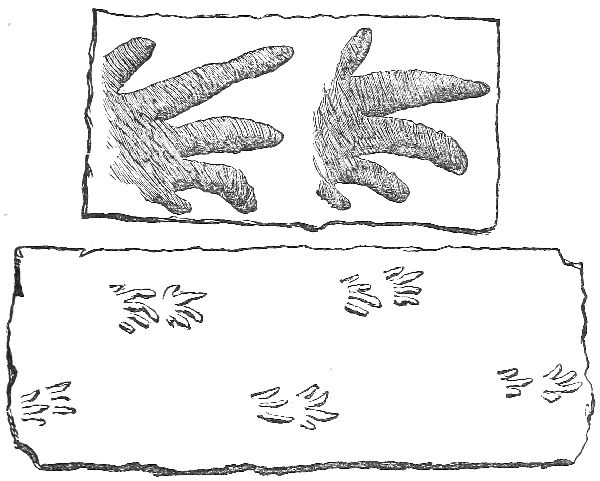 Fig. 2.
Impression of five fingers and five toes of an Amphibian of the
Lower Carboniferous Age, from the lowest Carboniferous beds in
Nova Scotia—an evidence of the fact that the number five was
already selected for the hands and feet of the earliest known land
vertebrates, and that the decimal system of notation, with all that
it involves to man, was determined in the Palæozoic Age. The upper
figure natural size, the lower reduced.
The difficulties above referred to relate to the
introduction of life and of new species on the
monistic view. Others might be referred to in
connection with the production of new organs.
An illustration is afforded, among others, by the
discussion of the introduction of the five fingers
and toes of man, which appear to descend to us
unchanged from the amphibians or batrachians
of the Carboniferous period. In this ancient
age of the earth's geological history, feet with
five toes appear in numerous species of reptilians
of various grades (Fig. 2). They are
preceded by no other vertebrates than fishes,
and these have numerous fin-rays instead of
toes. There are no properly transitional forms
either fossil or recent. How were the five-fingered
limbs acquired in this abrupt way? Why
were they five rather than any other number?
Why, when once introduced, have they continued
unchanged up to the present day? Haeckel's
answer is a curious example of his method:
"The great significance of the five digits depends
on the fact that this number has been
transmitted from the Amphibia to all higher
vertebrates. It would be impossible to discover
any reason why in the lowest Amphibia,
as well as in reptiles and in higher vertebrates
up to man, there should always originally be
five digits on each of the anterior and posterior
limbs, if we denied that heredity from a common
five-fingered parent-form is the efficient
cause of this phenomenon; heredity can alone
account for it. In many Amphibia certainly, as
well as in many higher vertebrates, we find less
than five digits. But in all these cases it can
be shown that separate digits have retrograded,
and have finally been completely lost. The
causes which affected the development of the
five-fingered foot of the higher vertebrates in
this amphibian form from the many-fingered
foot (or properly fin), must certainly be found
in the adaptation to the totally altered functions
which the limbs had to discharge during the
transition from an exclusively aquatic life to one
which was partially terrestrial. While the many-fingered
fins of the fish had previously served
almost exclusively to propel the body through
the water, they had now also to afford support
to the animal when creeping on the land. This
effected a modification both of the skeleton and
of the muscles of the limbs. The number of fin-rays
was gradually lessened, and was finally reduced
to five. These five remaining rays were,
however, developed more vigorously. The soft
cartilaginous rays became hard bones. The rest
of the skeleton also became considerably more
firm. The movements of the body became not
only more vigorous, but also more varied;" and
the paragraph proceeds to state other ameliorations
of muscular and nervous system supposed
to be related to or caused by the improvement
of the limbs.
It will be observed that in the above extract,
under the formula "the causes which affected
the development of the five-fingered foot ...
must certainly be found," all that other men
would regard as demanding proof is quietly
assumed, and the animal grows before our
eyes from a fish to a reptile as under the
wand of a conjurer. Further, the transmission
of the five toes is attributed to heredity or unchanged
reproduction, but this, of course, gives
no explanation of the original formation of the
structure, nor of the causes which prevented
heredity from applying to the fishes which
became amphibians and acquired five toes,
or to the amphibians which faithfully transmitted
their five toes, but not their other
characteristics.
It is perhaps scarcely profitable to follow
further the criticism of this extraordinary
book. It may be necessary, however, to repeat
that it contains clear, and in the main
accurate, sketches of the embryology of a
number of animals, only slightly colored by
the tendency to minimize differences. It may
also be necessary to say that in criticising
Haeckel we take him on his own ground—that
of a monist—and have no special reference
to those many phases which the philosophy
of evolution assumes in the minds of other
naturalists, many of whom accept it only partially
or as a form of mediate creation more or
less reconcilable with theism. To these more
moderate views no reference has been made,
though there can be no doubt that many of
them are quite as assailable as the position
of Haeckel in point of argument. It may
also be observed that Haeckel's argument is
almost exclusively biological and confined to
the animal kingdom, and to the special line
of descent attributed to man. The monistic
hypothesis becomes, as already stated, still
less tenable when tested by the facts of palæontology.
Hence most of the palæontologists
who favor evolution appear to shrink from
the extreme position of Haeckel. Gaudry,
one of the ablest of this school, in his recent
work on the development of the Mammalia,
candidly admits the multitude of facts for
which derivation will not account, and perceives
in the grand succession of animals in
time the evidence of a wise and far-reaching
creative plan, concluding with the words: "We
may still leave out of the question the processes
by which the Author of the world has
produced the changes of which palæontology
presents the picture." In like manner, the
Count de Saporta in his World of Plants
closes his summary of the periods of vegetation
with the words: "But if we ascend from
one phenomenon to another, beyond the sphere
of contingent and changeable appearance, we
find ourselves arrested by a Being unchangeable
and supreme, the first expression and
absolute cause of all existence, in whom diversity
unites with unity, an eternal problem, insoluble
to science, but ever present to the
human consciousness. Here we reach the
true source of the idea of religion, and there
presents itself distinctly to the mind that conception
to which we apply instinctively the
name of God."
Thus these evolutionists, like many others
in this country and in England, find a modus
vivendi between evolution and theism. They
have committed themselves to an interpretation
of nature which may prove fanciful and
evanescent, and which certainly up to this
time remains an hypothesis, ingenious and
captivating, but not fortified by the evidence
of facts. But in doing so they are not prepared
to accept the purely mechanical creed
of the monist, or to separate themselves from
those ideas of morality, of religion, and of
sonship to God which have hitherto been the
brightest gems in the crown of man as the
lord of this lower world. Whether they can
maintain this position against the monists, and
whether they will be able in the end to retain
any practical form of religion along with the
doctrine of the derivation of man from the
lower animals, remains to be seen. Possibly
before these questions come to a final issue
the philosophy of evolution may itself have
been "modified" or have given place to some
new phase of thought.
One curious point in this connection, to which
little attention has been given by evolutionists,
is that to which Herbert Spencer has given the
name of "direct equilibration," though he is sufficiently
wise not to invite too much attention
to it. This is the balance of parts and forces
within the organism itself. The organism is a
complex machine; and if its parts have been
put together by chance and are drifting onward
in the path of evolution, there must of necessity
be a continual struggle going on between
the different organs and functions, each tending
to swallow up the others and each struggling
for its own existence. This resolution of the
body of each animal into a house divided
against itself is at first sight so revolting to
common sense and right feeling that few like
to contemplate it. Roux and other recent
writers, however, especially in Germany, have
brought it into prominence, and it is no doubt
a necessary consequence of the evolutionary
idea, though altogether at variance with the
theory of intelligent design, which supposes
the animal machine put together with care
and for a purpose, and properly adjusted in
all its parts. On the hypothesis of evolution,
the animal thus ceases to be, in the proper
sense of the term, even a machine, and becomes
a mere mass of conflicting parts depending
for any constancy they may have on a
chance balancing of hostile forces, without any
compelling power to bring them together at
first, or any means to bind them to joint action
in the system. The more such a doctrine is
considered, the more difficult does it seem to
believe in the possibility of its truth. Evolution
has already reduced the cosmos into chaos,
the harmony of the universe into discord; but
it seems past belief to introduce this into the
microcosm itself, and to see nothing in its exquisite
adjustments except the momentary equilibrium
of a well-balanced fight. Geological
history also adds to the absurdity of such a
view by showing the marvellous permanence
of many forms of life which have continued to
perpetuate themselves through almost immeasurable
ages without material changes, thus
proving unanswerably the perfect adjustment
of their parts.
Viewed rightly, this direct equilibration of the
parts of the animal seems to throw the greatest
possible doubt on the capacity of any form of
evolution to produce new species. It is certain,
from the facts collected by Mr. Darwin
himself in his work on animals under domestication,
that when man disturbs the balance of
any organism by changing in any way the relations
of its parts, he introduces elements of
instability and weakness, which, despite the efforts
of nature to correct the evils resulting,
speedily lead to degeneracy, infertility, and extinction.
Mr. T. Warren O'Neil of Philadelphia
has recently argued this point with much
ability,[4]
and has shown, on the testimony of
Darwin's facts, that unless "natural selection"
is a much more skilful breeder than man, and
possesses some secrets not yet discovered by
us, the effects of this imaginary power would
lead, not to the production of new species, but
merely to the extinction of those already existing.
In short, all the evidence goes to show
that—so beautifully balanced are the parts of
the organism—any excess or deficiency in any
of them, when artificially or accidentally introduced,
brings in elements not only of instability,
but of decay and destruction. This subject
is deserving of a more full treatment than it
can receive here, but enough has been said to
show that in this evolutionists have unwittingly
furnished us with a new confirmation of the
theory of intelligent design.
In some places there are in Haeckel's book
touches of a grim humor which are not without
interest, as showing the subjective side of the
monistic theory and illustrating the attitude
of its professors to things held sacred by other
men. For example, the following is the introduction
to the chapter headed "From the Primitive
Worm to the Skulled Animal," and which
has for its motto the lines of Goethe beginning:
"Not like the gods am I! full well I know;
But like the worms which in the dust must go."
"Both in prose and poetry man is very often
compared to a worm; 'a miserable worm,' 'a
poor worm,' are common and almost compassionate
phrases. If we cannot detect any deep
phylogenetic reference in this zoological metaphor,
we might at least safely assert that it
contains an unconscious comparison with a
low condition of animal development which
is interesting in its bearing on the pedigree
of the human race."
If Haeckel were well read in Scripture, he
might have quoted here the melancholy confession
of the man of Uz: "I have said to the
worm, Thou art my mother and my sister."
But, though Job, like the German professor,
could humbly say to the worm, "Thou art my
mother," he could still hold fast his integrity
and believe in the fatherhood of God.
The moral bearing of monism is further
illustrated by the following extract, which
refers to a more advanced step of the evolution—that
from the ape to man—and which
shows the honest pride of the worthy professor
in his humble parentage: "Just as most
people prefer to trace their pedigree from a
decayed baron, or if possible from a celebrated
prince, rather than from an unknown humble
peasant, so they prefer seeing the progenitor
of the human race in an Adam degraded by
the fall, rather than in an ape capable of higher
development and progress. It is a matter of
taste, and such genealogical preferences do
not, therefore, admit of discussion. It is more
to my individual taste to be the more highly-developed
descendant of an ape, who in the
struggle for existence had developed progressively
from lower mammals as they from
still lower vertebrates, than the degraded descendant
of an Adam, Godlike but debased
by the fall, who was formed from a clod of
earth, and of an Eve created from a rib of
Adam. As regards the celebrated 'rib,' I must
here expressly add, as a supplement to the
history of the development of the skeleton,
that the number of ribs is the same in man
and in woman.[5]
In the latter as well as in
the former the ribs originate from the skin-fibrous
layer, and are to be regarded phylogenetically
as lower or ventral
vertebræ."[6]
There is no accounting for tastes, yet we
may be pardoned for retaining some preference
for the first link of the old Jewish genealogical
table: "Which was the son of Adam,
which was the son of God." As to the "debasement"
of the fall, it is to be feared that
the aboriginal ape would object to bearing the
blame of existing human iniquities as having
arisen from any improvement in his nature
and habits; and it is scarcely fair to speak of
Adam as "formed from a clod of earth," which
is not precisely in accordance with the record.
As to the "rib," which seems so offensive to
Haeckel, one would have thought that he
would, as an evolutionist, have had some fellow-feeling
in this with the writer of Genesis.
The origin of sexes is one of the acknowledged
difficulties of the hypothesis, and, using
his method, we might surely "assume," or even
"confidently assert," the possibility that, in some
early stage of the development, the unfinished
vertebral arches of the "skin-fibrous layer"
might have produced a new individual by a
process of budding or gemmation. Quite as
remarkable suppositions are contained in some
parts of his own volumes, without any special
divine power for rendering them practicable.
Further, if only an individual man originated
in the first instance, and if he were not provided
with a suitable spouse, he might have
intermarried with the unimproved anthropoids,
and the results of the evolution would have
been lost. Such considerations should have
weighed with Haeckel in inducing him to speak
more respectfully of Adam's rib, especially in
view of the fact that in dealing with the hard
question of human origin the author of Genesis
had not the benefit of the researches of Baer
and Haeckel. He had, no doubt, the advantage
of a firm faith in the reality of that Creative
Will which the monistic prophets of the nineteenth
century have banished from their calculations.
Were Haeckel not a monist, he might
also be reminded of that grand doctrine of the
lordship and superiority of man based on the
fact that there was no "help meet for him;"
and the foundation of the most sacred bond
of human society on the saying of the first
man: "This is now bone of my bones, and flesh
of my flesh." But monists probably attach
little value to such ideas.
It may be proper to add here that in his references
to Adam, Haeckel betrays a weakness
not unusual with his school, in putting a false
gloss on the old record of Genesis. The statement
that man was formed from the dust of
the ground implies no more than the production
of his body from the common materials
employed in the construction of other animals;
this also in contradistinction from the higher nature
derived from the inbreathing or inspiration
of God. The precise nature of the method by
which man was made or created is not stated by
the author of Genesis. Further, it would have
been as easy for Divine Power to create a pair
as an individual. If this was not done, and if
after the lesson of superiority taught by the inspection
of lower animals, and the lesson of
language taught by naming them, the first man
in his "deep sleep" is conscious of the removal
of a portion of his own flesh, and then on awaking
has the woman "brought" to him, all this is
to teach a lesson not to be otherwise learned.
The Mosaic record is thus perfectly consistent
with itself and with its own doctrine of creation
by Almighty Power.
I have quoted the above passages as examples
of the more jocose vein of the Jena physiologist;
but they constitute also a serious revelation
of the influence of his philosophy on his
own mind and heart, in lowering both to a cold,
mechanical, and unsympathetic view of man and
nature. This is especially serious when we remember
how earnestly in a recent address he
advocated the teaching of the methods and results
of this book, as those which, in the present
state of knowledge, should supersede the Bible
in our schools. We may well say, with his great
opponent on that occasion, that if such doctrines
should be proved to be true, the teaching of
them might become a necessity, but one that
would bring us face to face with the darkest and
most dangerous moral problem that has ever
beset humanity; and that so long as they remain
unproved it is both unwise and criminal
to propagate them among the mass of men
as conclusions which have been demonstrated
by science.
In conclusion, we may notice shortly a few
of the consequences of the monistic evolution
as held by Haeckel and others. Doctrines are
perhaps not to be judged by the consequences—at
least, by the immediate consequences—of
their acceptance. Yet if their logical consequences
are such as to introduce confusion into
our higher ideas and sentiments, we have reason
to hesitate as to their adoption—if on no
other ground, because we ourselves are a part
of nature and should be in harmony with any
true explanation of it.
We may affirm in this connection that agnostic
evolution reduces all our science to mere
evanescent anthropomorphic fancies; so that,
like a parasite, it first supports itself on the
strength and substance of science, and then
strangles it to death. Physical science is a
product of our thinking as to external things.
If, therefore, the thinking brain and the external
nature which it studies are both of them
the fortuitous products of blind tendencies in a
process of continuous flux and vicissitude, our
science can embody no elements of eternal
truth nor any conceptions as to the plans of
a higher creative reason. In that case it is absolutely
worthless, and a pure waste of time
and energy, except in so far as it may yield any
temporary material advantages.
Further, the agnostic evolution thus leaves
us as orphans in the midst of a cold and insensate
nature. We are no longer dwellers in our
Father's house, beautiful and fitted for us, but
are thrown into the midst of a hideous conflict
of dead forces, in which we must finally perish
and be annihilated. In a struggle so hopeless
it is a mere mockery to tell us that in millions
of years something better may come out of it,
for we know that this will be of no avail to us,
and we feel that it is impossible. Thus the
agnostic philosophy, if it be once accepted as
true, seriously raises the question whether life
is worth living.
But if worth living, then it must be for the
immediate and selfish gratification of our desires
and passions; and since we are deprived
of God and conscience, and right and wrong,
and future reward or punishment, and all men
are alike in this position, there can be nothing
left for us but to rend and fight with our fellows
for such share of good as may fall to us in the
deadly struggle, that we may reach such happiness
as may be possible for us in such an
existence, ere we drift into nonentity. Here,
again, we are told that the struggle will some
time lead to the survival of the fittest, and that
the fittest may inaugurate a new and better
reign of peace. But the world has already
lasted countless ages without arriving at this
result. It cannot concern me individually, any
more than what happens to-day concerns the
extinct ichthyosaur or the megatherium. All
that is left for me is to "eat and drink, for
to-morrow I die."
If any one thinks that this is an exaggerated
picture of the effects of agnostic evolution as
applied to man, I may refer him to the study
of Herbert Spencer's recent work The Data
of Ethics, which has contributed very much to
open the eyes of thoughtful men to the depth
of spiritual, moral, and even social and political,
ruin into which we shall drift under the guidance
of this philosophy. In this work the data
of ethics are reduced to the one consideration
of what is "pleasurable" to ourselves and
others, and it is admitted that our ideas of
conscience, duty, and even of social obligation,
are merely fictions of temporary use until
the time shall come when what is pleasurable
to ourselves shall coincide with what is pleasurable
to others; and this is to come, not out
of the love of God and the influence of his
Spirit, but out of the blind struggle of opposing
interests. It has been well said that this
system of morals—if it can be dignified with
such a name—is inferior, logically and practically,
not only to the "supernatural ethics"
which it boastfully professes to replace, but to
the ethics of Aristotle and Cicero, and that "it
will not supersede revelation, nor is it likely to
displace the old data of ethics, whether Greek,
Roman, or English." Independently of its antagonism
to theism and Christianity, it is foredoomed
by the common sense and the right
feeling of even imperfect human nature.