According to all the characters established in the last paragraph, the Prawn
that we traced from the Nauplius through states analogous to Zoëa and
Mysis to the form of a Macrurous Crustacean appears at present to be the
animal, which in the section of the higher Crustacea (Malacostraca) furnishes
the truest and most complete indications of its primitive history. That it is
the most complete is at once evident. That it is the truest must be assumed, in
the first place, because the mode of life of the various ages is less different
than in the majority of the other Podophthalma; for from the Nauplius to the
young Prawn they were found swimming freely in the sea, whilst Crabs,
Porcellanæ, the Tatuira, Squilla, and many Macrura, when adult
usually reside under stones, in the clefts of rocks, holes in the earth,
subterranean galleries, sand, etc., not to mention other deviations in habits
such as are presented by the Hermit Crabs, Pinnotheres, etc.,—and
secondly and especially because the peculiarities which distinguish the Zoëa of
this species particularly from other Zoëæ (the employment of the anterior limbs
for swimming, the furcate tail, the simple heart, the deficiency of the paired
eyes and abdomen at first, etc.) are neither to be deduced from a
retro-transfer of late-acquired advantages to this early period of life, nor to
be regarded at all as advantages over other Zoëæ which the larva might have
acquired in the struggle for existence.
A similar development must have been once passed through by the primitive
ancestor of all Malacostraca, probably differing from that of our Prawn,
especially in the circumstance that it would go on more uniformly without the
sudden change of form and mode of locomotion produced in the latter by the
simultaneous sprouting forth and entering into action in the Nauplius of four
and in the Zoëa of five pairs of limbs. It is to be supposed that, not only
originally but even still, in the larvæ of the first Malacostraca, the new
body-segments and pairs of limbs are formed singly,—first of all the
segments of the fore-body, then those of the abdomen, and finally those of the
middle-body,—and, moreover, that in each region of the body the anterior
segments were formed earlier than the posterior ones, and therefore last of all
the hindermost segment of the middle-body. Of this original mode more or less
distinct traces still remain, even in species in which, in other respects, the
course of development of their ancestors is already nearly effaced. Thus the
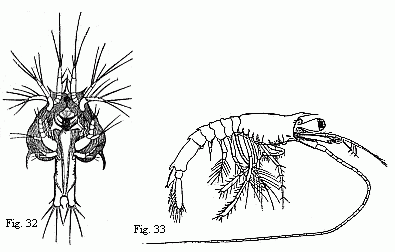
abdominal feet of the Prawn-larva represented in Fig. 33, are formed singly
from before backwards, and after these the last feet of the middle-body; thus,
in Palinurus, the last two pairs of feet of the middle-body are formed
later than the rest; thus in the young larvæ of the Stomapoda the last three
abdominal segments are destitute of limbs, which are still wanting on the last
of them in older larvæ; and thus, in the Isopoda, the historically newest pair
of feet is produced later than all the rest. In the Copepoda this formation of
new segments and limbs, gradually advancing from before backwards, is more
perfectly preserved than in any of the higher Crustacea.[1]
The original development of the Malacostraca starting from the Nauplius, or the
lowest free-living grade with which we are acquainted in the class of
Crustacea, is now-a-days nearly effaced in the majority of them. That this
extinction has actually taken place in the way already deduced as a direct
consequence from Darwin’s theory, will be the more easily demonstrated,
the more this process is still included in the course of life, and the less
completely it is already worn out. We may hope to obtain the most striking
examples in the still unknown developmental history of the various Schizopoda,
Peneïdæ, and, indeed, of the Macrura in general. At present the
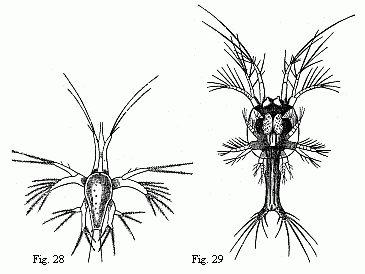
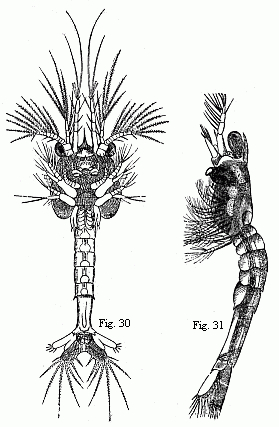
multifarious Zoëa-forms appear to be particularly instructive. Almost all the
peculiarities by which they depart from the primitive form of the Zoëa of
Penëus (Figs. 29, 30, 32), may in fact be conceived as transferred back
from a later period into this early period of life. This is the case with the
large compound eyes,—with the structure of the heart,—with the
raptorial feet in Squilla,—and with the powerful, muscular,
straightly-extended abdomen in Palæmon, Alpheus, Hippolyte, and the
Hermit Crabs. (In the latter, indeed, the abdomen of the adult animal is a
shapeless sac filled with the liver and generative organs, but it is still
tolerably powerful in the Glaucothoë-stage, and was certainly still more
powerful when this stage was still the permanent form of the animal.) It is
also the case with the abdomen of the Zoëæ of the Crabs, the Porcellanæ,
and the Tatuira, which is still powerful, although usually bent under the
breast; the two last swim tolerably by means of the abdomen, even when adult,
as do the true Crabs in the young state known as Megalops. It is the
case, lastly, with the conversion of the two anterior pairs of limbs into
antennæ. The second pair of antennæ, which, in the various Zoëæ always remains
a step behind that of the adult animal, is particularly remarkable. In the
Crabs the “scale” is entirely wanting; their Zoëæ have it indicated
in the form of a moveable appendage, which is often exceedingly minute. In the
Hermit Crabs a similar, usually moveable, spiniform process occurs as the
remains of the scale; their Zoëæ have a well-developed but inarticulate scale.
A precisely similar scale is possessed by the adult Prawns, in the Zoëæ of
which it exists still in a jointed form, like the outer branch of the second
pair of feet of the Nauplius or Penëus-Zoëa.
The long, spiniform processes on the carapace of the Zoëæ of the Crabs and
Porcellanæ are not to be explained in this way, but their advantage to
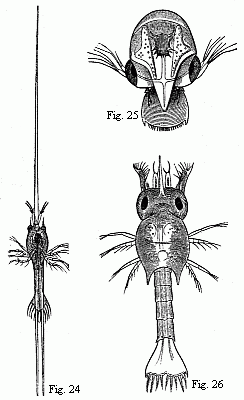
the larvæ is evident. Thus, for example, if the body of the Zoëa of
Porcellana stellicola (Fig. 24), without the processes of the carapace
and without the abdomen, which however is not rigidly extensible, is scarcely
half a line in length, whilst with the processes it is four lines long, a mouth
of eight times the width is necessary in order to swallow the little animal
when thus armed.[2] Consequently these processes of the carapace
may be regarded as acquired by the Zoëa itself in the struggle for existence.
The formation of new limbs beneath the skin of the larvæ is also to be referred
to an earlier occurrence of processes which originally took place at a later
period. The original course must have been that they sprouted forth in a free
form upon the ventral surface of the larva in the next stage after the change
of skin; whilst now they are developed before the change of skin, and thus only
come into action a stage earlier. In larvæ which, for other reasons, must be
regarded as more nearly approaching the primitive form, the original mode
usually prevails in this particular also. Thus the caudal feet (the
“lateral caudal lamellæ”) are formed freely on the ventral surface
in Euphausia and the Prawns with Nauplius-brood, and within the caudal
lamellæ in the Prawns with Zoëa-brood, in Pagurus and Porcellana.
A compression of several stages into one, and thereby an abridgement and
simplification of the course of development, is expressed in the simultaneous
appearance of several new pairs of limbs.
How earlier young states may gradually be completely lost, is shown by
Mysis and the Isopoda. In Mysis there is still a trace of the
Nauplius-stage; being transferred back to a period when it had not to provide
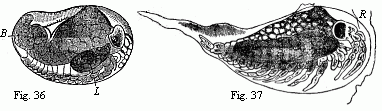
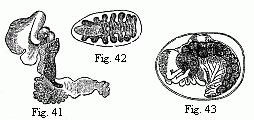
for itself, the Nauplius has become degraded into a mere skin; in Ligia
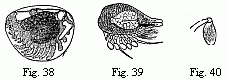
(Figs. 36, 37) this larva-skin has lost the last traces of limbs, and in
Philoscia (Fig. 38) it is scarcely demonstrable.
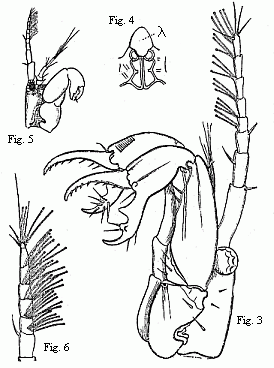
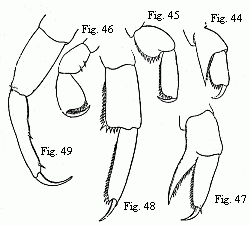
Like the spinous processes of the Zoëæ, the chelæ on the penultimate pair of
feet of the young Brachyscelus are to be regarded as acquired by the
larva itself. The adult animals swim admirably and are not confined to their
host; as soon as the specimens of Chrysaora Blossevillei, Less., or
Rhizostoma cruciatum, Less., on which they are seated, become the sport
of the waves in the neighbourhood of the shore, they escape from them, and are
only to be obtained from lively Acalephs. The young are helpless creatures and
bad swimmers; a special apparatus for adhesion must be of great service to
them.
To review the developmental history of the different Malacostraca in detail
would furnish no results at all correspondent to the time occupied by
it,—if our knowledge was more complete it would be more profitable. I
therefore abandon it, but will not omit to mention that in it many difficulties
which cannot at present be satisfactorily solved would present themselves. To
these isolated difficulties I ascribe the less importance, however, because
even a little while ago, before the discovery of the Prawn-Nauplius, this
entire domain of the development of the Malacostraca was almost inaccessible to
Darwin’s theory.
Nor will I dwell upon the contradictions which appear to result from the
application of the Darwinian theory to this department. I leave it to our
opponents to find them out. Most of them may easily be proved to be only
apparent. There are two of these objections, however, which lie so much on the
surface that they can hardly escape being brought forward, and these, I think,
I must get rid of.
“The peculiarities in which the Zoëæ of the Crabs, the Porcellanæ,
the Tatuira, the Hermit Crabs, and the Prawns with Zoëa-brood agree, and by
which they are in common distinguished from the larvæ of Penëus produced
from Nauplii, forces us (it might be said) to the supposition that the common
ancestor of these various Decapods quitted the egg in a similar Zoëa-form. But
then neither Penëus with its Nauplius-brood, nor even apparently the
Palinuri could be referred back to this ancestor. The mode of
development of Penëus and Palinurus, as also several peculiar
larvæ of unknown origin, but which are in all probability to be attributed to
Macrurous Crustacea, necessitate on the contrary the opposite supposition,
namely, that the different groups of the Macrura have passed from their
original to their present mode of development independently of each other and
also independently of the Crabs.” To this we may answer that the
occurrence of the Zoëa-form in all the above-mentioned Decapoda, its existence
in Penëus during the whole of that period of life which is richest in
progress and in which the wide gap between the Nauplius and the Decapod is
filled up, its recurrence even in the development of the Stomapoda, the
occurrence of a larval form closely approaching the youngest Zoëa of
Penëus in the Schizopod genus Euphausia,) and the reminiscence of
the structure of Zoëa, which even the adult Tanais has preserved in its
mode of respiration,—all indicate Zoëa as one of those steps in
development which persisted as a permanent form throughout a long period of
repose, perhaps through a whole series of geological formations, and thus has
also made a deeper impression upon the development of its descendants, and
formed a firmer nucleus in the midst of other and more readily effaced young
states. It cannot, therefore, surprise us that in transitions from the original
mode of metamorphosis to direct development, even when produced independently,
the larval life commences in the same way with this Zoëa-form in different
families, in which the earlier stages of development are effaced. But except
what is common to all Zoëæ, and what may easily be explained as being
transferred back from a later into this stage, the Zoëæ of the Crabs, for
example, agree with those of Pagurus and Palæmon in no single
peculiarity of structure which leads us to suppose a common inheritance.
Consequently we may apparently assume, without hesitation, that when the
Brachyura and Macrura separated, the primitive ancestors of each of these
groups passed through a more complete metamorphosis, and that the transition to
the present mode of development belongs to a later period. With regard to the
Brachyura, it may be added that in them this transition occurred only a little
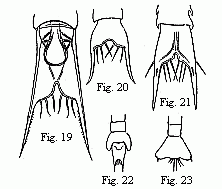
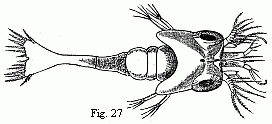
later and indeed before the existing families separated. The arrangement of the
processes of the carapace, and, still more, the similar number of the caudal
setæ in the most different Zoëæ of Crabs (Figs. 19–23) prove this. Such
an accordance in the number of organs apparently so unimportant is only
explicable by common inheritance. We may predict with certainty that amongst
the Brachyura no species will occur which, like Penëus, still produces
Nauplius-brood.[3]
As we have already seen, Mysis and the Isopoda depart from all other
Crustacea very remarkably by the fact that their embryos are curved upwards,
instead of, as elsewhere, downwards. Does not so isolated a phenomenon as this,
it might be asked, in the sense of Darwin’s theory, indicate a common
inheritance? Does it not necessitate that we should unite as the descendants of
the same primitive ancestors, Mysis with the Isopoda on the one hand,
and on the other the rest of the Podophthalma with the Amphipoda? I think not.
Such a necessity exists only for those who estimate a peculiarity at a higher
value because it makes its appearance at an earlier period of the egg-life.
Whoever regards species as not created independently and unchangeably, but as
having gradually become what they are, will say to himself that, when the
ancestors of our Mysides came (probably much later than those of the
Amphipoda and Isopoda) to develop numerous body-segments and limbs whilst still
embryos, as they could no longer find room in the egg when extended straight
out, and were therefore compelled to bend themselves, this could only take
place either upwards or downwards, and whatever conditions may have decided the
direction actually adopted, any near relationship to either of the two orders
of Edriophthalma could hardly have taken part in it.
It may, however, be remarked, that the different curvature of the embryo in the
Amphipoda and Isopoda is so far instructive, as it proves that their present
mode of development was adopted only after the separation of these orders, and
that, in the primitive stock of the Edriophthalma, the embryos were, if not
Nauplii, at least short enough in the body to find room in the egg in an
extended position, like the larvæ of Achtheres enclosed by the
Nauplius-skin. On the other hand the uniformity of development that prevails in
each of the two orders—which is expressed in the Amphipoda for example in
the formation of the “micropylar apparatus,” in the Isopoda in the
want of the last pair of ambulatory feet—testifies that the present mode
of development has come down from a very early period and extends back beyond
the separation of the present families. In these two orders also, as well as in
the Crabs, we can hardly hope to find traces of earlier young states, unless it
be in the family of the Tanaidæ.[4] If any one will furnish me with an Amphipod
or an Isopod with Nauplius-brood, the existence of which would not be more
remarkable in independently produced species than that of a Prawn with
Nauplius-brood, I will abandon the whole Darwinian theory.
With regard to the Crabs, and also to the Isopoda and Amphipoda, we were led to
the assumption that, about the period when these groups started from the common
stem, a simplification of their process of development took place. This also
seems to be intelligible from Darwin’s theory. When any circumstances
favourable to a group of animals caused its wider diffusion and divergence into
forms adapting themselves to new and various conditions of existence, this
greater variability, which betrays itself in the production of new forms, will
also favour the simplification of the development which is almost always
advantageous, and moreover, exactly at this period, during adaptation to new
circumstances, as has already been indicated with regard to fresh-water
animals, this simplification will be doubly beneficial, and therefore, in
connexion with this, a doubly strict selection will take place.
So much for the development of the higher Crustacea.
A closer examination of the developmental history of the lower Crustacea is
unnecessary after what has been said in general upon the historical
significance of the young states, and the application of this which has just
been made to the Malacostraca. We may see, without further discussion, how the
representation given by Claus of the development of the Copepoda may pass
almost word for word as the primitive history of those animals; we may find in
the Nauplius-skin of the larvæ of Achtheres and in the egg-like larva of
Cryptophialus, precisely similar traces of a transition towards direct
development, as were presented by the Nauplius-envelope of the embryos
of Mysis and the maggot-like larva of Ligia, etc.
It will be sufficient to indicate an essential difference in the process of
development in the higher and lower Crustacea. In the latter all new
body-segments and limbs which insert themselves between the two terminal
regions of the Nauplius, are formed in uninterrupted sequence from before
backwards; in the former there is further a new formation in the middle of the
body (the middle-body), which pushes itself in between the fore-body and the
abdomen in the same way, as these have done on their part between the head and
tail of the Nauplius. Thus, that which appears probable even from the
comparison of the limbs of the adult animal, finds fresh support in the
developmental history, namely, that the lower Crustacea, like the Insects, are
entirely destitute of the region of the body corresponding to the middle-body
of the Malacostraca. It seems probable that the swimming feet of the Copepoda,
as also of the pupæ of Cirripedia and Rhizocephala, represent the abdominal
feet of the Malacostraca, that is to say, are derived by inheritance from the
same source with them.
It would be easy to weave together the separate threads furnished by the young
forms of the various Crustacea, into a general picture of the primitive history
of this class. Such a picture, drawn with a little skill, and finished in
lively colours, would certainly be more attractive than the dry discussions
which I have tacked on to the developmental history of these animals. But the
mode of weaving in the loose threads would still in many cases be arbitrary,
and to be effected with equal justice in various ways; and many gaps would
still have to be filled up by means of more or less bold assumptions. Those who
have not wandered much in this region of research would then readily believe
that they were standing upon firm ground, where mere fancy had thrown an airy
bridge; those acquainted with the subject, on the other hand, would soon find
out these weak points in the structure, but would then be easily led to regard
even what was founded upon well considered facts, as merely floating in the
air. To obviate these misconceptions of its true contents from either side, it
would be necessary to accompany such a picture throughout with lengthy, dry
explanations. This has deterred me from further filling in the outline which I
had already sketched.
I will only give, as an example, the probable history of the production of a
single group of Crustacea, and indeed of the most abnormal of all, the
RHIZOCEPHALA, which in the sexually mature state differ so
enormously even from their nearest allies, the Cirripedia, and from their
peculiar mode of nourishment stand quite alone in the entire animal kingdom.
I must preface this with a few words upon the homology of the roots of the
Rhizocephala, i.e. the tubules which penetrate from its point of
adhesion into the body of the host, ramify amongst the viscera of the latter,
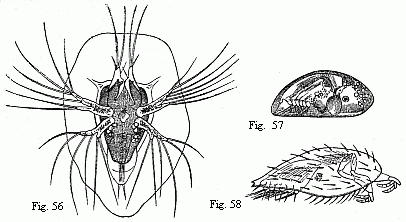
and terminate in cæcal branchlets. In the pupæ of the Rhizocephala (Fig. 58)
the foremost limbs (“prehensile antennæ”) bear, on each of the two
terminal joints, a tongue-like, thin-skinned appendage, in which we may
generally observe a few small strongly refractive granules, like those seen in
the roots of the adult animal. I have therefore supposed these appendages to be
the rudiments of the future roots. A perfectly similar appendage, “a most
delicate tube or ribbon,” was found by Darwin in free-swimming pupæ of
Lepas australis on the last joints of the “prehensile
antennæ.” From the perfect accordance in their entire structure shown by
the pupæ of the Rhizocephala and Cirripedia, there can be no doubt that the
appendages of Sacculina and Lepas, which are so like each other
and spring from the same spot, are homologous structures.
Now in three species of Lepas, in Dichelaspis Warwickii and in
Scalpellum Peronii, Darwin saw, on tearing recently-affixed animals from
their point or support, that a long narrow band issued from the same point of
the antennæ; its end was torn away, and in Dichelaspis, judging from its
ragged appearance, it had attached itself firmly to the support. From this it
follows that this appendage in Lepas australis can hardly be anything
but a young cement-duct. If, therefore, the supposition that the appendages on
the antennæ of the pupæ of Rhizocephala are young roots be correct, the roots
of the Rhizocephala are homologous with the cement-ducts of the Cirripedia. And
this, strange as it may appear at the first glance, seems to me scarcely
doubtful. It is true that the act of adhesion of the Rhizocephala has never yet
been observed, but it is more than probable that they attach themselves, just
like the Cirripedia, by means of the antennæ, and that therefore the points of
attachment in the two groups indicate homologous parts of the body. From the
point of attachment in the Rhizocephala the roots penetrate into the body of
the host, whilst in the Cirripedia, the cement-ducts issue from the same point.
The roots are blind tubes, ramified in different ways in different species. The
cement-ducts in the basis of the Balanidæ likewise constitute a generally
remarkably complicated system of ramified tubes, with regard to the mode of
termination of which nothing certain has yet been made out. Individual cæcal
branches are not unfrequently seen even in the vicinity of the carina; and, at
least in some species, in which the cement-ducts divide into extremely numerous
and fine branchlets, forming a network which gradually becomes denser towards
the circumference of the basis, these seem nowhere to possess an orifice.
Now as to the question: How were Cirripedia converted by natural selection into
Rhizocephala?
A considerable number of existing Cirripedia settle exclusively or chiefly upon
living animals;—on Sponges, Corals, Mollusks, Cetaceans, Turtles,
Sea-Snakes, Sharks, Crustaceans, Sea Urchins, and even on Acalephs.
Dichelaspis Darwinii was found by Filippi in the branchial cavity of
Palinurus vulgaris, and I have met with another species of the same
genus in the branchial cavity of Lupea diacantha.
The same thing may have taken place in primitive times. The supposition that
certain Cirripedes might once upon a time have selected the soft ventral
surface of a Crab, Porcellana or Pagurus, for its dwelling-place,
has certainly nothing improbable about it. If then the cement-ducts of such a
Cirripede instead of merely spreading on the surface, pierced or pushed before
them the soft ventral skin and penetrated into the interior of the host, this
must have been beneficial to the animal, because it would be thereby more
securely attached and protected from being thrown off during the moulting of
its host. Variations in this direction were preserved as advantageous.
But as soon as the cement-ducts penetrated into the body-cavity of the host and
were bathed by its fluids, an endosmotic interchange must necessarily have been
set up between the materials dissolved in these fluids and in the contents of
the cement-ducts, and this interchange could not be without influence upon the
nourishment of the parasite. The new source of nourishment opened up in this
manner was, as constantly flowing, more certain than that offered by the
nourishment accidentally whirled into the mouth of the sedentary animal. The
individuals favoured in the development of the cement-ducts now converted into
nutriferous roots, had more than others the prospect of abundant food, of
vigorous growth, and of producing a numerous progeny. With the further
development, assisted by natural selection, of the roots embracing the
intestine of the host and spreading amongst its hepatic tubes, the introduction
of nourishment through the mouth and all the parts implicated in it, such as
the whirling cirri, the buccal organs, and the intestine, gradually lost their
importance, became aborted by disuse, and finally disappeared without leaving a
trace of their existence. Protected by the abdomen of the Crab, or by the shell
inhabited by the Pagurus, the parasite also no longer required the
calcareous test, in which, no doubt, the first Cirripedes settling upon these
Decapods rejoiced. This protective covering, having become superfluous, also
disappeared, and there remained at last only a soft sack filled with eggs,
without limbs, without mouth or alimentary canal, and nourished, like a plant,
by means of roots, which it pushed into the body of its host. The Cirripede had
become a Rhizocephalon.
If it be desired to form a notion of what our parasite may have looked like
when half way in its progress from the one form to the other, we may consult
the figures given by Darwin, (Lepadidæ Pl. iv, figs. 1–7) of Anelasma
squalicola. This Lepadide, which lives upon Sharks in the North Sea, seems,
in fact, to be in the best way to lose its cirri and buccal organs in the same
manner. The widely-cleft, shell-less test is supported upon a thick peduncle,
which is immersed in the skin of the Shark. The surface of the peduncle is
beset with much-ramified, hollow filaments, which “penetrate the
Shark’s flesh like roots” (Darwin). Darwin looked in vain for
cement-glands and cement. It seems to me hardly doubtful, that the ramified
hollow filaments are themselves nothing but the cement-ducts converted into
nutritive roots, and that it is just in consequence of the development of this
new source of nourishment, that the cirri and buccal organs are in the highest
degree aborted. All the parts of the mouth are extremely minute; the palpi and
exterior maxillæ have almost disappeared; the cirri are thick, inarticulate,
and destitute of bristles; and the muscles both of the mouth and cirri are
without transverse striation. Darwin found the stomach perfectly empty in the
animal examined by him.
Having reached the Nauplius, the extreme outpost of the class, retiring
furthest into the gray mist of primitive time, we naturally look round us to
see whether ways may not be descried thence towards other bordering regions. By
the structure of the abdomen in Nauplius we might be reminded, like Oscar
Schmidt, of the moveable caudal fork of the Rotatoria, which many regard as
near allies of the Crustacea, or at any rate of the Arthropoda; in the six feet
surrounding the mouth we might imagine an originally radiate structure, and so
forth. But I can see nothing certain. Even towards the nearer provinces of the
Myriopoda and Arachnida I can find no bridge. For the Insecta alone, the
development of the Malacostraca may perhaps present a point of union. Like many
Zoëæ, the Insecta possess three pairs of limbs serving for the reception of
nourishment, and three pairs serving for locomotion; like the Zoëæ they have an
abdomen without appendages; as in all Zoëæ the mandibles in Insects are
destitute of palpi. Certainly but little in common, compared with the much
which distinguishes these two animal-forms. Nevertheless the supposition that
the Insecta had for their common ancestor a Zoëa which raised itself into a
life on land, may be recommended for further examination.
Much in what has been adduced above may be erroneous, many an interpretation
may have failed, and many a fact may not have been placed in its proper light.
But in one thing, I hope, I have succeeded,—in convincing
unprejudiced readers, that Darwin’s theory furnishes the key of
intelligibility for the developmental history of the Crustacea, as for so many
other facts inexplicable without it. The deficiencies of this attempt,
therefore, must not be laid to the charge of the plan drawn out by the sure
hand of the master, but solely to the clumsiness of the workman, who did not
know how to find the proper place for every portion of his material.