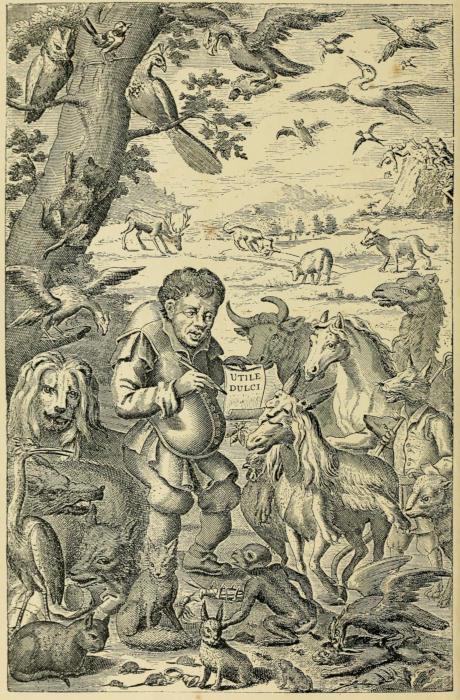
FABLES, OF ÆSOP And Other Eminent MYTHOLOGISTS: WITH Morals and Reflexions .
Transcriber’s Note: The period spelling and grammar of 1669 is retained
unchanged, including many inconsistencies. Some obvious typographical
errors have been corrected. The Roman numerals of the fables have been
checked and corrected where necessary, as have the reference numbers in
the alphabetical index (though some fables are missing from the index
entirely, and others appear twice).
By Sir Roger L’Estrange, Kt.
The Third Edition Corrected and Amended.
LONDON,
Printed for R. Sare, B. Took, M. Gillyflower,
A. & J. Churchil, G. Sawbridge, and H. Hindmarsh, 1669.
LONDON:
REPRINTED AND PUBLISHED BY JOHN GRAY AND CO., W. G. S. URQUHART, MANAGER,
5, GOLDSMITH’S ROW, EAST HARDING STREET, E.C.
AN Alphabetical Table, Referring to the NUMBER of the Respective FABLES
THE LIFE OF ÆSOP.
Chap. I. Of Æsop ’s Country, Condition, and Person .
Æsop (according to Planudes, Camerarius and
Others) was by birth, of Ammorius, a Town in the
Greater Phrygia; (though some will have him to
be a Thracian, others a Samian) of a mean Condition,
and in his person deformed, to the highest degree: Flat-Nos’d,
Hunch-Back’d, Blabber-Lipp’d; a Long Mishapen
Head; His Body Crooked all over, Big-Belly’d, Baker-Legg’d,
and his Complexion so swarthy, that he took his very Name
from’t; for Æsop is the same with Æthiop. And he was not
only Unhappy in the most scandalous Figure of a Man, that ever
was heard of; but he was in a manner Tongue-Ty’d too, by
such an Impediment in his speech, that People could very hardly
understand what he said. This Imperfection is said, to have been
the most sensible part of his Misfortune; for the Excellency of
his Mind might otherwise have Atton’d in some Measure, for
the Uncouth Appearance of his Person (at least if That Part of
History may pass for Current.) There goes a Tradition, that he
had the good Hap to Relieve certain Priests that were Hungry,
and out of their way, and to set them Right again; and that for
that good Office, he was upon their Prayers, brought to the Use
of his Tongue: But Camerarius, whom I shall Principally follow,
has no Faith in the Miracle, And so He begins his History
with the tracing of him to Samos, and from thence Prosecutes it
through the most Remarkable Passages of his Life, to the Last
Barbarous Violence upon him at Delphos. As to his Impediment
in his speech, whether there were any such thing or Not, or how
he came to be cur’d of it, the Reader is at Liberty what to Believe
and what Not. And so likewise for Twenty Other Passages
up and down this History; Some of them too Trivial,
and others too Gross to be taken Notice of, Upon this Argument
and Occasion: Let it suffice, that (according to the Common
Tradition) he had been Already Twice Bought and Sold;
and so we shall Date the Story of his Adventures; from his
Entrance into the Service of at least a Third Master.
As to the Age he liv’d in, it is Agreed upon among the Antients,
that it was when Crœsus Govern’d Lydia; as also that
Xanthus, a Samian, was his Master. Herodotus will have it to
be one Jadmon a Samian too; but still according to the Current
of most Writers, Xanthus was the Man.
Chap. II. Æsop and his Fellow-slaves Upon their Journey to Ephesus.
It was Æsop’s Fortune to be sent to Ephesus, in Company
with other Slaves to be sold. His Master had a great many
Burdens to Carry, and Æsop begg’d of his Companions not to
over Charge him. They found him a Weakling, and bad him
please himself. The Parcel that he Pitch’d upon was a Panier of
Bread; and twice as heavy as any of the rest. They called
him a thousand Fools for his pains, and so took up their Luggage,
and away they Trudg’d together. About Noon, they
had their Dinner deliver’d out of Æsop’s Basket, which made
his Burden Lighter by one half in the Afternoon, then it had
been in the Morning: And after the next Meal he had Nothing
left him to Carry, but an Empty Basket. His Fellow-Slaves
began Now to Understand, that Æsop was not so Arrant a Fool
as they took him for; and that they Themselves had not half
the Wit they Thought they had.
Chap. III. Æsop is accus’d by False Witnesses for Stealing his Master’s Figs; and brings himself off by his Wits, to the Confusion of his Accusers .
Æsop was not of a Make to do his Master much Credit
in the Quality of a Houshold Servant: So that he rather
sent him abroad into the Fields a Digging, and to take care of
his Husbandry. By the time he had been there a While, his
Master went out after him to see how he went on with his
Work; and found Every thing done much to his Satisfaction.
In this Interim comes a Countryman to him with a Present of
most Delicious Figs; which he was so Wonderfully delighted
with, that he gave them in Charge to his Boy Agathopus to see
them carefully laid up till he came back from the Bath, whither
he was then a going. Æsop, it seems, was now gone home
upon some Particular Business, and Agathopus laid hold of This
Occasion to tell One of his Companions, of a Design he had,
both upon the Figs, and upon their Fellow-Servant. What
have we more to do says he, than to Stuff our Guts with These
Figs our selves, and then lay the Roguery upon Æsop, who is
at This Instant in the House where they are? And then,
when our Master comes to Examine the Matter, we are Two
Witnesses to One against him, which will make it so clear a
Case, that the Silly Cur will not have the Face to Deny the
Fact. The Plot, in short, was agreed upon; and to work
they went, upon the Figs, making themselves Merry upon Every
Bit they Swallow’d, to Consider how Æsop’s Carcase
was to pay for All.
The Master, upon his coming from the Bath, call’d immediately
for his Figs, and hearing that Æsop had been before-hand
with him, he sent for him in a Rage, and Rattled him with
a Thousand Traytors and Villains, for Robbing his House,
and Devouring the Fruit that he had set apart for his own Palate.
This Miserable Wretch, heard, and understood All that was
said; but by Reason of an Imperfection in his Speech, he was
not able to speak one Word in his Own Defence. His Enemies
in the mean time Insulting over him, and calling for Justice
upon so Insolent a Cheat. They were now advancing from
Reproches to Blows, when Æsop cast himself at his Master’s
Feet, and begg’d his Patience only till he might go out, and
come in again. He went his way immediately, and fetch’d
a Vessel of Warm Water; took a Large Draught of it, in his
Masters Presence, and with his Finger in his Throat brought
it all clear up again without any Other Mixture. After This
Experiment upon Himself, he gave his Master to Understand,
that if he would be pleased to put his Accusers to the same
Test, he should quickly see what was become of his Figs.
The Proposal seem’d so Reasonable, that he Order’d Agathopus
and his Fellow to do the Like. They made some Difficulty
at first of following Æsops Example; but in the end,
upon taking a Soup of the same Liquor, their Stomachs Wambled,
and up came the Water, Figs and all. Upon this Evidence
of the Treachery and Falshood of Agathopus and his
Companion, the Master Order’d them to be Soundly Lash’d,
and made good the Old Saying, Harm Watch, Harm Catch.
Chap. IV. The Sale of Æsop to Xanthus.
Upon the Merchants Arrival at Ephesus, he made a
quick Riddance of All his Slaves but Three. That is
to say, a Musician, an Orator, and Æsop. He dress’d up
the Two Former in Habits answerable to their Profession, and
Carry’d them to Samos, as the Likeliest Place for a Chapman.
He shew’d them there in the open Market, with Æsop for a
Fool betwixt them; which some People took much offence at.
While they were attending upon the Place, there came among
other Samians, one Xanthus, an Eminent Philosopher of that
City, with a Train of his Disciples at his Heels. The Philosopher
was mightily pleased with the Two Youths, and ask’d
them one after another about their Profession, and what they
could do. The one told him he could do any thing; the other
that he could do ev’ry thing; this set Æsop a laughing at
’em. The Philosopher’s Pupils would needs know what it
was that made Æsop so merry. Why, says he, if the Question
had been put by your Master, I should have told him the
reason of it.
Xanthus in the mean time was beating the Price of the Two
other Slaves, but the Terms were so high, that he was just upon
turning about to go his way, Only the Pupils would needs have
him put the same Questions first to the Ill favour’d Fellow, that
he had done to the other Two; and so Xanthus, for the Humour
sake, Interrogated Æsop what He could do. Nothing
at all, says he. How comes That says the Philosopher? My
Companions, says the Other, Undertake every thing, and
there’s Nothing left for me to do. This gave them to Understand,
that the Man knew well enough what he said, and what
he Laugh’d at. Well! says Xanthus, but if I should give
Money for you Now, would you be Good and Honest? I’ll
be That, says Æsop, whether you Buy me or No. Ay, but
tell me again, says the Philosopher, Won’t you run away?
Pray says Æsop, did you ever hear of a Bird in a Cage that
told his Master he Intended to make his Escape? Xanthus
was well enough pleased with the Turn and Quickness of his
Wit; but, says he, That Unlucky Shape of yours will set
People a Hooting and Gaping at you wherever you go. A
Philosopher says Æsop should value a man for his Mind, Not
for his Body. This presence of Thought gave Xanthus a
High Opinion of the Wisdom of the Man; and so he bad the
Merchant set him his Lowest Price of That Miserable Creature.
Why says he, you had as good Cheapen a Dunghil;
but if you’ll bid me like a Chapman for either of the Other
Two, you shall have this Phantome into the Bargain. Very
good says the Philosopher; and without any more ado what’s
your selling Price? The Merchant speaks the Word, The
Philosopher pays the Money, and takes Æsop away with him.
Chap. V. Xanthus Presents Æsop to his Wife .
Xanthus had no sooner made his Purchase, and
carry’d his Jewel home with him, but, having a kind
of a Nice Froward Piece to his Wife, the Great Difficulty was
how to put her in Humour for the Entertainment of this
Monster, without throwing the House out at the Window.
My Dear, says he, You have been often complaining of Careless
Servants; And I have brought you one Now that I am
Confident will fit your Turn. He shall Go and Come, and
Wait, and do Every thing as you would have him; Oh, your
Servant Sweet heart says she, but what did he Cost you? Why
truly very Reasonable; but at Present He’s a Little Tann’d,
and out of case you must know, with his Journey, says the
Husband, and so he Order’d him to be call’d in. The Cunning
Gipsy smoak’d the Matter presently. Some Monster says
she, I’ll be Hanged else. Wife, Wife, says Xanthus, If you
are a good Woman, That that Pleases Me Must Please You
too. While These Words were between his Lips, up comes
Æsop toward them; she gave him a Fierce Look, and Immediately
discharg’d her Choler upon her Husband. Is this a
Man, or a Beast? says she, and what Clearer Proof in the
World Could You have given me Now, of an Insufferable
Hatred and Contempt? Æsop said not one Word all This
While; ’till Xanthus Rouz’d him with a Reproof. Oh Villain!
says he; to have a Tongue and Wit at Will upon All other
Occasions, and not one Diverting Syllable Now at a Pinch,
to Pacify your Mistress! Æsop, after a short Pause upon’t,
Bolted out an Old Greek Saying, which is in English to this
Effect, From Lying at the Mercy of Fire, Water, and a
Wicked Woman, Good Lord Deliver us. If the Wife was
heartily angry before, This Scomm made her Stark Mad,
and the Reproche was so Cutting too, that Xanthus himself
did not well know how to take it. But Æsop brought
himself off again from the Malice of any ill Intention, by a
Passage out of Euripides to this Purpose. The Raging of a
Tempestuous Sea; The Fury of a Devouring Fire, and the
Pinching Want of Necessaries for Life, are Three Dreadful
Things, and a Body might reckon up a Thousand more;
but all this is Nothing to the Terrible Violences of an Impetuous
Woman, and therefore, says he, Make yourself as
Glorious on the other side, in the Rank of Good Women.
Vavasor the Jesuite, in his De Ludicra Dictione, takes Notice
of a Blunder here in the Chronology of the Story. For
Æsop was Murder’d at least Fourscore Years before Euripides
was Born. But to follow the Thred of the Relation; Upon
this Oblique Admonition, the Woman came to herself again,
and took Æsop into her good Graces, who render’d his Master
and Mistress All the Offices of a Faithful Servant.
Chap. VI. Æsop’s Answer to a Gard’ner .
Some Two or Three Days after the Encounter above
mentioned, Xanthus took Æsop along with him to a Garden
to buy some Herbs, and the Gard’ner seeing him in a Habit
of a Philosopher, told him the Admiration he was in, to find how
much faster Those Plants shot up that Grow of their own accord,
than Those that he set Himself, though he took never so much
Care about them. Now you that are a Philosopher, Pray will
you tell me the meaning of This? Xanthus had no better answer
at hand, then to tell him, That Providence would have it
so: Whereupon Æsop brake out into a Loud Laughter. Why
how now Ye slave You, says Xanthus, what do you Laugh at?
Æsop took him aside and told him, Sir, I Laugh at your Master,
that Taught You no better: for what signifies a Gen’ral
Answer to a Particular Question? And ’tis no News Neither
that Providence orders All Things: But if you’ll turn him over
to me, You shall see I’ll give him another sort of Resolve. Xanthus
told the Gard’ner, that it was below a Philosopher to
busy his head about such Trifles; but says he, If you have a
Curiosity to be better Inform’d, you shall do well to ask my
Slave here, and see what he’ll say to you. Upon this, the
Gard’ner put the Question to Æsop, Who gave him this
Answer. The Earth is in the Nature of a Mother to what She
brings forth of her Self, out of her own Bowels; Whereas She is
only a kind of a Step-Dame, in The Production of Plants
that are Cultivated and Assisted by The Help and Industry of
Another: so that it’s Natural for her to Withdraw her Nourishment
from the One, towards The Relief of the Other. The
Gard’ner, upon this, was so well satisfied, That he would take
no Mony for his Herbs, and Desired Æsop to make Use of his
Garden for the future, as if it were his own.
There are several Stories in Planudes, that I shall pass over
in this Place (says Camerarius) as not worth the while: Particularly
The Fables of the Lentills, the Bath, the Sow’s Feet,
and several Little Tales and Jests that I take to be neither well
Laid, nor well put together; Neither is it any matter, in Relations
of this Nature, Whether they be True or False, but if
they be Proper and Ingenious; and so contriv’d, that the Reader
or the Hearer may be the better for them, That’s as much
as is required: Wherefore I shall now Commit to Writing
Two Fables or Stories, One about the bringing his Mistress
home again, when she had left her Husband; Which is drawn
from the Model of a Greek History set out by Pausanias in
his Description of Bœtia; The Other, upon the Subject of a
Treat of Neats Tongues, which was taken from Bias, as we
have it from Plutarch in his Convivium Septem Sapientum.
Chap. VII. Æsop’s Invention to bring his Mistress back again to her Husband, after she had Left him .
The wife of Xanthus was wellborn and wealthy, but
so Proud and Domineering withal, as if her Fortune
and her Extraction had Entituled her to the Breeches. She was
Horribly Bold, Meddling, and Expensive; (as that sort of
Women commonly are) Easily put off the Hooks, and Monstrous
hard to be pleased again: Perpetually chattering at
her Husband, and upon All occasions of controversy, Threatning
him to be gone. It came to this at Last, that Xanthus’s
stock of Patience being quite spent, he took up a Resolution
of going another way to Work with her, and of trying a Course
of Severity, since there was nothing to be done with her by
Kindness. But this Experiment, instead of mending The
Matter, made it worse; for upon harder Usage, The Woman
grew Desperate, and went away from him in Earnest. She
was as Bad ’tis true as Bad might well be, and yet Xanthus
had a kind of Hankering for her still: Beside that there was
matter of Interest in the Case: and a Pestilent Tongue she
had, that the Poor Husband Dreaded above all things Under
the Sun: but the man was willing however to make the Best
of a Bad Game, and so his Wits and his Friends were set at
Work, in the fairest Manner that Might be, to get her home
again. But there was No good to be done in’t it seems; and
Xanthus was so visibly out of Humour upon’t, that Æsop in
Pure Pity bethought himself Immediately how to Comfort him.
Come Master (says he) Pluck up a good heart; for I have a
Project in my Noddle that shall bring my Mistress to you back
again, with as good a Will as ever she went from you. What
does me Æsop, but away Immediately to the Market among
the Butchers, Poulterers, Fishmongers, Confectioners, &c.
for the Best of Every thing that was in Season. Nay he takes
private People in his way too, and Chops into the very house
of his Mistresses Relations, as by Mistake. This Way of Proceeding
set the whole Town a Gog to know the Meaning
of all this Bustle, and Æsop innocently told everybody
That his Master’s Wife was run away from him, and he had
Marry’d another: His Friends up and down were all Invited
to come and make Merry with him, and This was to be
the Wedding Feast. The News flew like Light’ning, and
happy were they could carry the First Tydings of it to the
Run-away-Lady: (for every body knew Æsop to be a Servant
in That Family.) It Gathered in the Rolling, as all
Other Stories do in the Telling: Especially where Womens
Tongues and Passions have the spreading of them. The
Wife, that was in her Nature Violent, and Unsteady, order’d
her Chariot to be made ready Immediately, and away she
Posts back to her Husband: falls upon him with Outrages
of Looks and Language; and after the Easing of her mind
a Little; No, Xanthus, says she, Do not you Flatter your
self with the hopes of Enjoying another Woman while I
am alive. Xanthus look’d upon this as one of Æsop’s
Master-pieces; and for that Bout All was well again betwixt
Master and Mistress.
Chap. VIII. An Entertainment of Neats Tongues.
Some few days after the Ratification of This Peace,
Xanthus Invited several Philosophers of his Acquaintance
to Supper with him; and Charges Æsop to make the
Best Provision he could think of, for their Entertainment.
Æsop had a Wit waggish Enough, and This General Commission
furnished him with Matter to work upon. So soon
as ever the Guests were set down at the Table, Xanthus
calls for Supper, and Expected no less than a very Splendid
Treat. The First Service was Neats Tongues sliced, which
the Philosophers took Occasion to Discourse and Quibble upon
in a Grave Formal way, as The Tongue (for the purpose) is
the Oracle of Wisdom, and the like. Xanthus, upon This,
calls for a Second Course, and after That for a Third, and so
for a Fourth, which were All Tongues, over and over again
still, only several ways Dressed: Some Boil’d, Others Fry’d,
and some again serv’d up in Soupe, which put Xanthus into
a Furious Passion. Thou Villain, says he, Is this according
to my Order, to have Nothing but Tongues upon Tongues?
Sir says Æsop, without any hesitation, Since it is my Ill fortune
to fall under this Accusation, I do Appeal to All These
Learned Persons, whether I have done Well, or Ill, and pay’d
that Respect to your Order which I ought to do.
Your order was, That I should make the Best Provision that
I could think of for the Entertainment of These Excellent
Persons, and if the Tongue be the Key that Leads Us into
All Knowledge, what could be more proper and suitable then
a Feast of Tongues for a Philosophical Banquet?
When Xanthus found the Sence of the Table to be on
Æsop’s side; Well my Friends says he; Pray will You Eat
with me to Morrow, and I’ll try if I can mend your Chear;
and Mr. Major Domo, says he to Æsop, let it be the Care of
your Gravity and Wisdom to provide us a Supper to Morrow,
of the very worst Things You can Think of.
Chap. IX. A Second Treat of Tongues.
Xanthus’s Guests met again The Next day according
to The Appointment; and Æsop had provided them
the very same Services of Tongues and Tongues over and over,
as they had the night before. Sirrah (says Xanthus to his Servant)
what’s the Meaning of This; That Tongues should be
the Best of Meats One Day, and the Worst the Other? Why
Sir says he, There is not any Wickedness under the Sun, That
the Tongue has not a part in. As Murders, Treasons, Violence,
Injustice, Frauds, and All Manner of Lewdness: for Counsels
must be first Agitated, The Matter in Question Debated, Resolv’d
upon, and Communicated by Words, before the Malice
comes to be executed in Fact. Tongue, Whither wilt Thou!
(says the Old Proverb) I go to Build (says the Tongue,) and
I go to pull down.
This Petulant Liberty of Æsop, Gall’d his Master to the very
Soul of him, and one of the Guests, to Help forward his Evil
Humour; Cry’d out, This Fellow is enough to make a Body
Mad. Sir (says Æsop) you have very Little Business to do of
your own I perceive, by the Leisure you have to Intermeddle
in Other Peoples Matters; You would find some other Employment
else, then to Irritate a Master against his Servant.
Chap. X. Æsop brings his Master a Guest That had no sort of Curiosity in him .
Xanthus laid hold of the Present Occasion, and
was willing enough to be furnished with a Staff to beat
a Dog. Well Sirrah, says he, since this Learned Gentleman is
too Curious; go you your ways and find me out a Man that
has no Curiosity at All, or I’ll Lace your Coat for ye. Æsop,
the next day, Walked the whole Town over on This Errand;
and at Last, found out a Slovenly Lazy Fellow, Lolling at his
Ease, as if he had Nothing to do, or to take care for; and so
up to him he went in a Familiar Way; and Invited him to his
Master’s to Supper. The Clown made no Ceremony of promising,
but fell Presently to asking what kind of Man his
Master was? And what, says he, are we going just now? (for
this Poor Devil look’d upon a Meal’s Meat Gratis, as a Blessing
Dropt into his Mouth out of the Skies) Come (says Æsop) we
are going this very Moment; and Wonderfully Glad he was
to find by the Booby’s discourse, That he had met with a Man
so fit for his Purpose. Away they went together, and so strait
into the Parlour, where the Blockhead throws Himself down
Dirty and Beastly as he was, upon a Rich Couch. After a very
little While, in comes Xanthus to Supper, and asks Æsop who
That Man was? Why This is the Man, says Æsop, that you
sent me for; that is to say, a Man that has no Curiosity in him
at All. Oh that’s very well, says Xanthus, and then told his
Wife in her ear, That if she would be but a Loving and Obedient
Wife to him, and do as he bad her, he would now save
her Longing, for, says he, I have been a Great while Seeking
for an Occasion to pick a Quarrel with Æsop, and I have found
it at last. After this Whisper, Xanthus takes a Turn in the
Parlour, and calls aloud to his Wife. Heark ye Sweet Heart,
says he, go fetch some Water, and Wash the Feet of my Guest
here. Away she goes, brings a Bason to the side of the Couch,
where the Clown was laid at his Length, and bad him put forth
his Feet for her to Wash them. Xanthus little thought she
would have done it. But the Clown, after a little Stumble
within himself, that ’twas fitter for the Maid to do’t, then the
Mistress; Well says he, If it be the Custom of the Family, ’tis
not for me to be against it: and so he stretch’d forth his Feet
to the Washing.
So soon as ever the Company had taken off the Edge of
their Stomachs; Xanthus calls for a Bumper, and puts it into
the hands of the Clown, making No doubt but he would have
allow’d his Host the Honor of being his Taster. The Fellow,
without any Scruple, Whips up the Drink, and gives Xanthus
the Pot again Empty, who was now the Second Time Disappointed
upon the matter of Curiosity, or No Curiosity at All.
He had a Mind still to be upon Poor Æsop’s Bones, and made
another Tryal of the Humour of his Guest. There was a particular
Dish that the Clown fed very Heartily upon: Xanthus
fell into a Rage against the Cook for the Ill-Dressing of it,
and Threat’ned to have him brought and Lash’d in the very
Parlour. The Bumpkin took no Notice of it at All, but without
speaking one Word on the Cooks Behalf; It was Nothing
to him he thought, what other People did with their Servants.
They were come Now to their Cakes and Pyes, and the
Clown Guttled upon them without Mercy. Xanthus Resolves
then upon Another Tryal; Calls for his Pastry-Cook
and tells him, Sirrah, says he, you spoil every thing that goes
through your hands. There’s neither Spice, nor any other
Seasoning here. The Cook told him, That if they were
either Over or Under-Bak’d, it was his Fault; But for the
Spice and Seasoning, it was his Mistresses, for it was All put
in that she Deliver’d. Nay Wife, says Xanthus, if it sticks
there, By All that’s Sacred, I’ll Treat you no better then if
you were a Slave bought with my Money. Wherefore Strip
Immediately and Prepare for a Dog-Whip. Xanthus thought
with himself; that If any thing in the World could move this
Barbarous Brute, he would have put in a Word at Least to save
a Woman of Honour from so Scandalous an Indignity. But
says this Loggerhead to himself; There’s an old saying; What
have We to do to Quench other Peoples Fires? And I’ll e’en
keep my self Clear of Other Peoples Matters; Only he took
Xanthus by the Hand indeed, and told him if he would but
Stay a Little, he’d go fetch his own Wife too, and so they
might take the lash by Turns. In one word, Xanthus missed
his Aim at last; and though he was troubled at the Miscarriage,
he could not but Laugh yet at the Simplicity of the Man,
and Confess, that Æsop was in the Right, in bringing a Person
to him that had no Curiosity at all.
Chap. XI. Æsop ’s Answer to a Magistrate .
It happened some few days after the Last Passage above,
that Xanthus, having some Business at the Publick Hall,
sent Æsop to see if there were any Great Throng of Men there;
a Magistrate meets him Upon the Way, and Asks him whither
he was going? Why truly, says Æsop, I am going I know not
whither. The Magistrate took it that he Banter’d him, and
bad an Officer take him into Custody and Carry him to Prison.
Well, says Æsop, to the Magistrate; Is it not true Now, that
I did not know Whither I was going? Can you Imagine,
that when I came out of the house this Morning, I had any
thoughts of going to Prison? The Magistrate was well enough
pleased at the fancy, and Discharg’d him Upon it, and so he
went forward to the Hall; Where among a world of People,
he saw one Man arrest another upon an Action of Debt. The
Debtor Pleaded Poverty; but if he would Compound for
half, it should go hard but he’d make a Shift to Pick it up,
he said. Well with all my Heart, says the Creditor, Lay down
the Mony upon the Nail, and the Business is done: for a man
had better Content himself with Half, then Lose All, And I
reckon that Mony as good as lost, that a Man must go to Law
for; Æsop upon this, went back and told his Master, that he
had been at the Hall, and saw but one Man there; This was
a Riddle to Xanthus; Insomuch that he went himself to
Learn the Truth of the Matter. When he came to the Place,
he found the Court extremely Thronged, and turning short
upon Æsop, in great Indignation, Sirrah, says he, are all these
People come since you told me there was but one Man here?
’Tis very true, says Æsop, There was a Huge Crowd, and
yet but one Man that I could see in That vast Multitude.
This seems to be taken out of the Life of Diogenes.
Chap. XII. Xanthus undertakes to Drink the Sea dry .
There happened not Long after This, to be a Merry
Meeting of Philosophers; and Xanthus, one of the Company.
Xanthus had already gotten a Cup too much; and Æsop,
finding they were like to set out his hand; Sir, says he, ’tis
the Humour of Bacchus, they say, first to make men Chearful,
and when they are past That, to make ’em Drunk, and in the
Conclusion, to make them Mad. Xanthus took Offence at
Æsop; and told him, That was a Lecture for Children.
(Laertius makes this to be the saying of Anacharsis.) The
Cups went round, and Xanthus by this time had taken his
Load, who was mightily given to talk in his Drink; and whatever
was uppermost, out it came, without either Fear or Wit.
One of the Company observing the weak side of the Man,
took the Opportunity of Pumping him with several Questions.
Xanthus (says he) I have read somewhere, that it is Possible for
a Man to Drink the Sea Dry; but I can hardly believe it.
Why says Xanthus, I’ll venture my House and Land upon’t,
that I do’t my self. They Agreed upon the Wager, and presently
off went their Rings to Seal the Conditions. But Early
the next Morning, Xanthus missing his Ring, thought it might
be slipt off his Finger, and asked Æsop about it. Why truly
says Æsop, I can say Nothing to the Losing of your Ring;
But I can tell you that you Lost your House and Land last
Night: and so Æsop told him the Story on’t, which his Master
it seems had utterly forgotten. Xanthus began now to Chew
upon the Matter, and it went to the Heart of him to consider,
That he could neither do the thing, nor yet get quit of his
Bonds. In this trouble of Thoughts he Consults Æsop, (whose
advice before he had rejected) what was to be done in the Case.
I shall never forget, says Xanthus, how much I owe you for
your Faithful Services; and so with fair Words Æsop was prevailed
upon to Undertake the bringing of him off. ’Tis
Impossible to do the thing, (says he) but if I can find a way
to Dissolve the Obligation, and to gain you Credit by it over
and Above, That’s the Point I suppose that will do your business.
The Time appointed, says Æsop, is now at hand,
Wherefore do you set a bold face upon it, and go to the Sea-side
with all your Servants and your Trinkets about you, and
put on a Countenance, that you are just Now about to make
good your Undertaking. You’ll have Thousands of Spectators
there, and When they are got together, let the Form of the
Agreement and the Conditions be read, Which runs to this
Effect. That you are to Drink up the Sea by such a Certain
Time, or to forfeit your House and Land, upon Such or Such
a Consideration. When This is done, call for a Great Glass,
and let it be filled with Sea-Water, in the Sight of the Whole
Multitude: Hold it up then in your Hand, and say as Follows.
You have heard Good People, what I have Undertaken to do,
and upon what Penalty if I do not go Through with it. I confess
the Agreement, and the Matter of Fact as you have
heard it; and I am now about to drink up the Sea; not the
Rivers that run into’t. And therefore let All the Inlets be
Stopt, that there be Nothing but pure Sea left me to drink.
And I am now ready to perform my part of the Agreement.
But for any drinking of the Rivers, There is nothing of that
in the Contract. The People found it so clear a Case, That
they did not only agree to the Reason and Justice of Xanthus’s
Cause, but hissed his Adversary out of the Field; Who in the
Conclusion made a Publique Acknowledgment, that Xanthus
was the Wiser and Better Man of the Two; But desired the
Contract might be made void, and offer’d to Submit Himself
further to such Arbitrators as Xanthus Himself should direct.
Xanthus was so well pleased with the Character his Adversary
had given him, of a Wise Man, That All was Passed over, And
a finall End made of the Dispute. Plutarch makes this to have
been the Invention of Bias.
Chap. XIII. Æsop Baffles the Superstition of Augury .
In the days of Æsop, The World was mightily addicted to
Augury; that is to say, to the Gathering of Omens from
The Cry and Flight of Birds. Upon this Account it was, that
Xanthus one Day sent Æsop into the Yard, and bad him
look well about him. If you see Two Crows (says he) you’ll
have good Luck after it, but if you should Chance to spy One
Crow Single, ’tis a Bad Omen, and some Ill will betide you.
Æsop stept out and came Immediately back again, and told
his Master that he had seen Two Crows. Hereupon Xanthus
went out himself, and finding but One (for the Other was
flown away) he fell Outragiously upon Æsop for making Sport
with him, And order’d him to be soundly Lash’d for’t, but
just as they were stripping him for the Execution, In comes
One to Invite Xanthus abroad to Supper. Well Master, says
Æsop, and where’s the Credit of your Augury Now? When
I, that saw Two Crows, am to be beaten like a Dog, and You,
that saw but One, are going to make merry with your Friends?
The Reason and Quickness of this Reflexion, Pacified the Master
for the Present, and sav’d the Poor Fellow a sound Whipping.
Chap. XIV. Æsop finds hidden Treasure .
As Xanthus was Walking once among certain Monuments,
with Æsop at his Heels; and Plodding upon
several Epitaphs, there was one Inscription in Greek Letters,
that Xanthus with all the Skill he had, could not tell what to
make of. Well, says Æsop, let me see a Little if I can Uncypher
it. And so after laying Things and Things together a
While, Master, says he, What will you give me, If I find you
out a Pot of Hidden Treasure now? One Half of it, says
Xanthus, and your Liberty. So Æsop fell to Digging, a Matter
of four Yards from the Stone that had the Inscription; and
there found a Pot of Gold which he took up and deliver’d to
his Master; and Claim’d his Promise. Well, says Xanthus,
I’ll be as good as my Word; but you must first shew me how
you came to know there was Treasure, by the Inscription: for
I had rather be Master of that Secret, than of the very Gold it
self. Æsop Innocently open’d the whole Matter to him. Look
you Sir, says he, Here are these Letters, α; β; δ; ο; ε; θ; χ;
which are to be thus Interpreted, α stands for ἀποβὰς; β for
βήματα; δ for δέσσαρα; ο for ὀρύξας; ε for εὑρήσεις; θ for θησαυρὸν;
χ for χρυσίου; In English, Dig four Paces from this Place, and
you shall find Gold. Now says Xanthus, if you are so good
at finding out Gold, you and I must not part yet. Come Sir,
says Æsop, (perceiving that his Master played fast and Loose
with him) To deal freely with you, This Treasure belongs
to King Dionysius. How do you know that? says Xanthus.
Why by the very Inscription, says Æsop: for in That Sence
α stands for ἀπόδος; β for βασιλεῖ; δ for Διονυσίῳ; o for ὅν; ε for
εὗρες; θ for θησαυρὸν; χ for χρυσίου. In English, Give Dionysius
the Gold you have found. Xanthus began to be afraid when
he heard it was The King’s Mony, and Charged Æsop to
make no Words on’t, and he should have the One Half. ’Tis
well, says Æsop; but This is not so much your own Bounty
yet, as The Intention of Him that Bury’d it; for the very same
Letters direct the Dividing of it. As for Example once again
Now, α stands for ἀνελόμενοι; β for βαδίσαντες; δ for διέλεσθε;
o for ὅν; ε for εὕρετε; θ for θησαυρὸν; χ for χρυσίου; In English,
Divide the Gold that you have found. Why then, says
Xanthus, let us go home and share it. No sooner were they
got Home, but Æsop was presently laid by the Heels, for fear
of Blabbing, crying out as Loud as he could, this comes of
trusting to the Faith of a Philosopher; The Reproche Nettled
his Master: But however he caused his Shackles to be taken
off upon’t, and Admonished Æsop to keep his Licentious
Tongue in a Little better Order for the future, if ever he hoped
to have his Liberty. For That, says Æsop, Prophetically, I
shall not Need to beg it of you as a favour, for in a very few
days I shall have my Freedom, whether you will or no.
Chap. XV. Æsop Expounds upon an Augury, and is made Free .
Æsop had thus far born All the Indignities of a Tedious
Slavery, with the Constancy of a Wise Man, and without
either Vanity or Abjection of Mind. He was not Ignorant
however of his own Value; Neither did he Neglect any honest
Way or Occasion of Advancing his Name and his Credit in the
World; as in One Particular Instance among the Samians,
on a Strange Thing that happen’d There upon a Very Solemn
Day. The Ring, it seems, that had the Town-Seal upon’t was
laid somewhere in Sight, Where an Eagle could come at it;
She took it up in the Air, and dropt it into the Bosom of a Slave.
The Samians took this for a Foreboding, that Threat’ned some
dismal Calamity to the State, and in a general Consternation
They presently called a Counsel of their Wise Men; and
Xanthus in the first Place, to give their Opinions upon This
Mysterious Accident. They were All at a Loss what to Think
on’t; only Xanthus desired some few Days time for further
Consideration. Upon This, he betook himself to his Study,
and the More he Beat his Brains about it, the further he found
himself from any hope of Expounding The Secret. This put
him into a deep Melancholly; which made Æsop very Importune,
and Impatient, to know the Cause of it; with Assurances,
That he would serve his Master in The Affair, Whatever
it was, to the Uttermost of his Power. Xanthus hereupon
laid the Whole Matter before him, and told him in Conclusion,
that he was not only lost in his Reputation, but in
Danger to be Torn to Pieces by the Rabble. When Æsop
found how the Case stood, Never trouble your Head any further,
says he, Do but follow my Advice, and I’ll bring you
off as well now as ever I did before. When you Appear to
Morrow to give in your Answer, I would have you Speak to
the People after this Manner.
I need not tell your Wisdoms, That so Many Heads so Many
Minds, and so many several Men, so many several Conceptions
of Things; Nay and further, that every several Art,
or Profession requires a Distinct Faculty or Disposition, that
is more or less Peculiar to it self. It is the Custom of the
World for People in All Cases where They are either Ignorant
or Doubtful, to Repair to Men that have the Reputation of
Philosophers, for Counsel and Satisfaction. But this, under
favour, is a Great Mistake; for it is with Philosophers, as
it is, I say, with other Arts and Professions that have their
Functions apart the One from the Other. Wisdom ’tis true,
may be call’d properly enough the Knowledge of Things Divine
and Humane, but will you therefore expect that a Philosopher
should do the Office of a Shoomaker or a Barber, because the
Trades are conversant about Humane Things? No No Gentlemen,
a Man may be a Great Philosopher without any Skill
at All in the Handling of the Awl, or the Razor. But if
the Question were concerning the Government of Life and
Manners, the Nature of Things Celestial or Terrestrial; The
Duties that we owe to God or Man; you could not do better
then repair to Philosophers for satisfaction. But for Reading
upon Prodigies; or Commenting upon the Flight of Birds, or
the Entrails of Beasts, These are Things quite Beside the
Philosophers Business. If there be any thing you doubt of that
falls under the Cognizance of Philosophy, I am ready to serve
you in’t; But your present Point being Augury, I shall take
leave to Acquaint you that a Servant I have at home, is as
likely to make a Right Judgement that way as any Man I
know. I should not presume to name a Servant; Neither
Perchance would you think fit to make use of one; If the Necessity
of your present distress, were not a very Competent and
Reasonable Excuse.
Here’s your Speech, says Æsop; and your Credit sav’d whether
They’ll hear me or Not. If they send for me, The Honour
will be yours, in case I Deliver my self to their Liking, and
the Disgrace will be Mine then if I Miscarry. His Master was
pleased beyond Measure with the Advice, but he did not as
yet Understand Whither it Tended.
Xanthus Presented himself Early the next Morning before
the Council, Where he Dilated Upon The Matter according
to his Instructions, and so referr’d Them to his Servant for
the Clearing of the Difficulty. The People with one Voice
cry’d out Where is he? Why does not he Appear? Why has
not his Master brought him along with him? In short, Æsop
was Immediately fetch’d into the Court, and at the very First
Sight of him, They All burst out a Laughing by Consent.
This Fellow, says one, may have Skill perhaps in Divining,
but he has Nothing that’s Humane about him. Another asked
Where he was Born, and whether or no Blocks had the Faculty
of Speech in his Country. Æsop, upon This, Address’d himself
to the Council.
You have here before ye, (says Æsop) an Ungracious Figure
of a Man, which in truth is not a Subject for your
Contempt, Nor is it a Reasonable Ground for your Despair,
upon the Matter in Question. One Wise Man values Another
for his Understanding, not for his Beauty; Beside that the
Deformity of my Person is no incapacity at All as to your
Business. Did you never taste Delicious drink out of an Ill
Look’d Vessel? or did you never drink Wine that was Vapid,
or Eager, out of a Vessel of Gold? ’Tis Sagacity and Strength
of Reason that you have Occasion for, not the force of Robust
Limbs, nor the Delicacies of Colour and Proportion. Wherefore
I must beseech you not to Judge of My Mind by My Body,
nor to Condemn me Unheard. Upon this, they All cry’d out
to him, If he had any thing to say for the Common Good,
That he would speak it. With your favour, says he, It is for
that End I presume, that ye have called me hither, and it is
with a Great Zeal for your Service, that I stand now before
ye: But when I consider the Weight of the Matter in hand,
and the Office That I am now to Perform, it will as little
stand with your Honors Perhaps, to take the Opinion of a
Slave into your Councils and Debates, as it will with my
Condition to offer it. Beside the Risque I run of my Master’s
Displeasure upon the Event. But All This yet may be Obviated,
my Fears secured, my Modesty gratifi’d, and your
own Dignity preserved, only by making me a Freeman before
hand, to Qualify me for the Function. They all said it was
a Most Reasonable Thing, and presently treated about the
Price of his Liberty, and order’d the Quæstors to pay down
the Money. When Xanthus saw that the thing must be done,
He could not Decently stand Higgling about the Price; But
making a Virtue of Necessity, he chose rather to Present Æsop
to the Common-Wealth, then to Sell him. The Samians took
it very kindly, And Æsop was Presently Manumiz’d and made
a Citizen in Form, Proclaim’d a Freeman; and after this
Ceremony, he Discoursed upon the Subject of the Portent as
follows.
I shall not need to tell so many Wise and knowing Men,
that the Eagle is a Royal Bird, and signifies a Great King;
that the Dropping of the Ring in the Bosome of a Slave that
has no Power over himself, portends the Loss of Your Liberties,
if you do not look to your selves in Time; And that some
Potent Prince has a Design upon ye. This put the Samians
all a-fire to hear the Issue of the Prediction. In some short
time after there came Ambassadors from Crœsus the King of
Lydia, to Demand a Tribute on Behalf of their Master, and
Threat’ned the Samians with a War in the Case of a Refusal.
This Affair came to be Debated in the Council, where the
Majority was rather for Peace with Slavery, then for running
the Risque of a Dispute; but they would not come to a Resolution
yet, without first Consulting Æsop What They had best
to do; Who gave Them his Thought upon’t in Words to
This Effect.
Every Man in this World has Two Ways before him, That
is to say, First, The Way of Liberty, that’s Narrow and
Rugged at the Entrance, but Plainer and Smoother still the
further you go. Secondly, The Way of Servitude or Slavery,
that seems to be Easie at first, but you’ll find it afterwards
to be full of Intolerable Difficulties. The Samians, upon
These Words, Declared themselves Unanimously for Liberty,
and that since they were at present Free, They would never
make Themselves Slaves by their own Consent: So The
Ambassadors Departed, and there was a War Denounced.
When Crœsus came to Understand the Resolution the Samians
had taken, and how Inclinable they were to a Compliance,
till Æsop, by the Power only of a few words, Diverted
them from it, he Resolv’d to send for and Discourse with Æsop.
So He made an offer to the Samians, upon their sending Æsop
to him, to put a Stop at present to the course of his Arms.
When Æsop came to hear of their Proposition, he told them
That he was not against their sending of him, Provided only
that he might tell them One Story before he Left them.
In Old Time, (says he) when some Beasts talked better
Sence then Many Men do now a days, there happen’d to be a
Fierce War betwixt the Wolves and the Sheep, And the Sheep,
by the help of the Dogs, had rather the Better on’t. The
Wolves, upon This, offer’d the Sheep a Peace, on Condition
only that they might have their Dogs for Hostages. The Silly,
credulous Sheep agreed to’t, and as soon as ever they had
parted with the Dogs, The Wolves break in upon them, and
Destroy’d them at pleasure.See Fab. 45.
The Samians quickly smelt out the Moral of this Fable, and
cry’d out, One and All, that they would not part with Æsop:
But this did not hinder Æsop however from putting himself
abord, and taking a Passage for Lydia with the Ambassadors.
Chap. XVI. Æsop Presents himself before the King of Lydia.
Immediately Upon Æsop’s Arrival in Lydia, he Presented
himself before the King, who looking upon him with
Contempt, Hatred, and Indignation; Is This a Man says he, to
hinder the King of Lydia from being Master of Samos? Æsop
then with a Reverence after the Lydian Fashion, deliver’d
what he had to say.
I am not here (says he,) Great King in the Quality of a
Man that’s Given up by his Country, or under the Compulsion
of any force; But it is of my own Accord that I am now
come to lay my self at your Majesty’s Feet, and with this only
Request, that you will vouchsafe me the Honour of your Royal
Ear, and Patience but for a few words.
‘There was a Boy hunting of Locusts, and he had the Fortune
to take a Grasshopper. She found he was about to kill
her, and Pleaded after this Manner for her Life. Alas (says
she) I never did any Body an Injury, and never had it either
in my Will or in My Power to do’t. All my Business is my
Song; and what will you be the Better for my Death? The
Youth’s Heart relented and he set the Simple Grasshopper at
Liberty.’
Your Majesty has now that Innocent Creature before you:
There’s Nothing that I can pretend to but my Voice, which
I have ever employ’d so far as in me Lay, to the Service of
Mankind. The King was so Tenderly moved with the Modesty
and Prudence of the Man, That he did not only give
him his Life, but bad him ask any thing further that he had
a Mind to, and it should be Granted him. Why then, says
Æsop, (with that Veneration, Gratitude and Respect that the
Case required) I do most humbly implore your Majesties
favour for my Country-Men the Samians. The King Granted
him his Request, and Confirmed it under his Seal; Beside
that the Piety of making that Petition his Choice, was a further
Recommendation of him to his Royal Kindness and
Esteem.
Æsop, soon after This, returned to Samos with the News
of the Peace, where he was Welcom’d with All the Instances
of Joy and Thankfulness Imaginable; Insomuch that they
Erected a Statue for him, with an Inscription upon it, in Honour
of his Memory. From Samos he return’d afterwards to
Crœsus, for whose sake he Composed several of Those Apologues
that pass in the World to This Day under his Name.
His Fancy lay extreamly to Travelling; but above All other
Places, he had the Greatest Mind to see Babylon: To which
End he got Letters of Recommendation from Crœsus to the
King there: who, according to Herodotus, was a Friend, and
an Ally of Crœsus’s, and his Name, Labynetus; not Lycerus,
and Planudes has Handed it down to us upon a Great Mistake.
But his Curiosity led him first to pass through Greece, for the
sake of the Seven Wise Men, whose Reputation was at That
Time Famous All over the World. He had the Good Hap in
his Travels to find them at Corinth, together with Anacharsis,
and several of their Followers and Disciples, Where they were
All Treated by Periander at a Villa of his not far from the
Town. This Encounter was to the Common Satisfaction of
the Whole Company; the Entertainment Philosophical, and
Agreeable, and among other Discourses, they had some Controversy
upon the Subject of Government; and which was the
most Excellent Form: Æsop being still for Monarchy, and
the Rest for a Common-wealth. He Travell’d thence, a while
after into Asia, and so to Babylon, according to his first
Intention.
Chap. XVII. Æsop Adopts Ennus. Ennus ’s Ingratitude and Falseness, and Æsop ’s Good Nature .
It was the Fashion in those Days for Princes to Exercise
Tryalls of Skill in the Putting and Resolving of Riddles,
and Intricate Questions; and He that was the Best at the Clearing
or Untying of Knotty Difficulties carry’d the Prize. Æsop’s
Faculty lay notably that way, and render’d him so serviceable
to the King, that it brought him both Reputation and
Reward. It was his Unhappiness to have No Children, for
the Comfort and Support of his Old Age; So that with the
King’s Consent, he Adopted a young Man, who was Well
Born, and Ingenuous enough, but Poor; His Name was Ennus.
Æsop took as much care of his Instruction as if he had been
his own Child, and Train’d him up in those Principles of Virtue
and Knowledge that might most probably render him Great
and Happy. But there’s no working upon a Flagitious and
Perverse Nature, by Kindness and Discipline, and ’tis Time
lost to think of Mastering so Incurable an Evil: So that Ennus,
after the Manner of other Wicked Men, heaping One Villany
upon another, Counterfeits his Fathers Name and Hand to
Certain Letters, wherein he Promises his Assistance to the
Neighbour Princes against Labynetus. These Letters Ennus
carry’s to the King, and Charges his Father with Treason,
though in Appearance, with All the trouble and unwillingness
that was possible, Only a Sense of his Duty to his King
and his Country, swallow’d up All other Respects of Reverence
and Modesty that a Son owes to a Father. The King
took All these Calumnies for Instances of Ennus’s Affections
to him, without the Least Suspicion of any Fraud in the Matter:
So that without any further Enquiry, he order’d Æsop
to be put to Death. The Persons to whom the Care of his
Execution was Committed, being well Assured of his Innocence
and of the Kings Ungovernable Passions, took him out
of the Way, and gave it out that he was Dead. Some few
Days after this, there came Letters to Labynetus from Amasis
the King of Ægypt, wherein Labynetus was Desired by
Amasis to send him a certain Architect that could raise a Tower
that should hang in the Air, and likewise Resolve All Questions.
Labynetus was at a Great Loss what Answer to return,
and the Fierceness of his Displeasure against Æsop being by
This time somewhat Abated, he began to Enquire after him
with Great Passion, and would often Profess, That if the Parting
with One half of his Kingdom could bring him to Life
again, he would Give it. Hermippus and Others that had
kept him out of the Way, told the King upon the Hearing
of This, That Æsop was yet Alive; so They were Commanded
to bring him forth; which they did, in All the Beastliness he
had Contracted in the Prison. He did no sooner Appear, but
he made his Innocence so manifest, that Labynetus in Extreme
Displeasure and Indignation, commanded the False Accuser
to be put to Death with most Exquisite Torments; But Æsop,
after all this, Interceded for him, and Obtained his Pardon,
upon a Charitable Presumption, that the Sence of so Great a
Goodness and Obligation would yet Work upon him. Herodotus
tells the story of Cambyses the Son of Cyrus, and
Crœsus, and with what Joy Cambyses received Crœsus again,
after he was supposed to be put to death by his own Order;
but Then it Vary’s in This, that he Caused Those to be put
to Death, that were to have seen the Execution done, for not
Observing his Commands.
Chap. XVIII. Æsop ’s Letters of Morality to his Son Ennus.
Upon Æsop’s coming again into Favour, he had the
King of Ægypt’s Letter given him to Consider of, and
Advised Labynetus to send him for Answer, That Early the
next Spring he should have the Satisfaction he Desired.
Things being in this State, Æsop took Ennus Home to him
again, and so order’d the Matter, that he wanted neither
Counsels nor Instructions, nor any other Helps or Lights that
might Dispose him to the Leading of a Virtuous Life, as will
Appear by the Following Precepts.
My Son (says he) Worship God with Care and Reverence,
and with a Sincerity of Heart void of All Hypocrisie or
Ostentation: Not as if that Divine Name and Power were
only an Invention, to Fright Women and Children, but know
That God is Omnipresent, True and Almighty.
Have a Care even of your Most Private Actions and
Thoughts, for God sees Thorough you, and your Conscience
will bear Witness against you.
It is according to Prudence, as well as Nature, to pay
that Honour to your Parents that you Expect your Children
should pay to you.
Do All the Good you can to All Men, but in the First
Place to your Nearest Relations, and do no Hurt however,
where you can do no Good.
Keep a Guard upon your Words as well as upon your
Actions, that there be no Impurity in Either.
Follow the Dictates of your Reason, and you are Safe;
and have a Care of Impotent Affections.
Apply your self to Learn More, so long as there’s any
Thing Left that you do not know, and Value Good Counsel
before Money.
Our Minds must be Cultivated as well as our Plants;
The Improvement of our Reason makes us like Angels, whereas
the Neglect of it turns us into Beasts.
There’s no Permanent and Inviolable Good, but Wisdom
and Virtue, though the Study of it Signifies Little without
the Practice.
Do not think it impossible to be a Wise Man, without looking
Sour upon it. Wisdom makes Men Severe, but not Inhumane.
It is Virtue not to be Vicious.
Keep Faith with All Men. Have a Care of a Lye, as
you would of Sacrilege. Great Bablers have No Regard either
to Honesty or Truth.
Take Delight in, and frequent the Company of Good Men,
for it will give you a Tincture of their Manners too.
Take heed of that Vulgar Error, of thinking that there
is any Good in Evil. It is a Mistake when Men talk of profitable
Knavery, or of Starving Honesty; for Virtue and
justice carry All that is Good and Profitable along with
them.
Let every Man mind his own Business, for Curiosity is
Restless.
Speak Ill of No body, and you are no more to Hear Calumnies
then to Report them: Beside that, they that Practice the
One, Commonly Love the Other.
Propose Honest Things, Follow Wholesome Counsels, and
Leave the Event to God.
Let no Man Despair in Adversity, nor Presume in Prosperity,
for All Things are Changeable.
Rise Early to your Business, Learn Good Things, and
Oblige Good Men; These are three Things you shall never
Repent of.
Have a Care of Luxury and Gluttony; but of Drunkenness
Especially; for Wine as well as Age makes a Man a
Child.
Watch for the Opportunities of doing things, for there’s
Nothing Well done but what’s done in Season.
Love and Honour Kings Princes and Magistrates, for
they are the Bands of Society, in Punishing of the Guilty,
and Protecting the Innocent.
These, or such as these, were the Lessons that Æsop read
daily to his Son; but so far was he from mending upon Them,
that he grew Every Day worse and worse, shewing that it is
not in the power of Art or Discipline to Rectify a Perverse
Nature, or (as Euripides says) to make a Man Wise that has
no Soul. But however, according to Neveletus, he came soon
after to be Touched in Conscience for his Barbarous Ingratitude,
and Dyed in a Raging Remorse for what he had done.
The Spring was now at Hand, and Æsop was preparing
for the Task he had Undertaken About the Building of a
Tower in the Air, and Resolving All Manner of Questions:
But I shall say no more of That Romantick part of the
History, then that he went into Ægypt, and Acquitted himself
of his Commission to Amasis with Great Reputation.
From thence back again to Labynetus, Laden with Honours
and Rewards; from whom he got leave to Return into
Greece; but upon Condition of Returning to Babylon by the
First Opportunity.
Chap. XIX. Æsop ’s Voyage to Delphos; his Barbarous Usage There, and his Death .
When Æsop had almost taken the whole Tour of
Greece, he went to Delphos, either for the Oracles
sake, or for the sake of the Wise Men that Frequented that
Place. But when he came thither, he found Matters to be
quite otherwise then he expected, and so far from deserving
the Reputation they had in the World for Piety and Wisdom,
that he found them Proud and Avaritious, and Hereupon
Deliver’d his Opinion of Them under this Fable.
I find (says he) the Curiosity that brought me Hither, to
be much the Case of People at the Sea side, that see something
come Hulling toward them a great way off at Sea, and take
it at first to be some Mighty Matter, but upon Driving Nearer
and Nearer the Shore, it proves at last to be only a heap
of Weeds and Rubbish. See Fab. 119.
The Magistrates of the Place took Infinite Offence at this
Liberty, and presently enter’d into a Conspiracy against him
to take away his Life, for fear he should Give them the same
Character elsewhere in his Travels, that he had done there
upon the Place. It was not so Safe they thought, nor so Effectual
a Revenge to make him away in private; but if they could
so contrive it, as to bring him to a shameful End, under a Form
of Justice, it would better answer their Business and Design.
To Which Purpose they caused a Golden Cup to be secretly
convey’d into his Baggage, when he was packing up to Depart.
He was no sooner out of the Town upon his Journey, But
Immediately pursu’d and taken upon the way by the Officers,
and Charged with Sacrilege. Æsop deny’d the Matter, and
Laughed at them All for a Company of Mad Men; But upon
the Searching of his Boxes, they took the Cup and shew’d it
to the People, Hurrying him away to Prison in the Middle of
his Defence. They brought him the Next Day into the Court,
Where Notwithstanding the Proof of his Innocence, as clear
as the Day, he was Condemn’d to Dye; and his Sentence was
to be Thrown Head-long from a Rock, Down a Deep Precipice.
After his Doom was past, he prevailed upon Them,
with much ado to be heard a few Words, and so told them
the Story of the Frog and the Mouse, as it stands in the Fable.
This wrought nothing upon the Hearts of the Delphians,
but as they were Bawling at the Executioner, to Dispatch and
do his Office, Æsop on a Sudden gave them the Slip, and Fled
to an Altar hard by there, in hopes the Religion of the Place
might have protected him, but the Delphians told him, that
the Altars of the Gods were not to be any Sanctuary to those
that Robbed their Temples; Whereupon he took Occasion to
tell them the Fable of the Eagle and the Beetle to this following
effect, As it stands in the Book, Num. 378.
Now says Æsop, (after the telling of this Fable) you are not
to Flatter your Selves that the Prophaners of Holy Altars,
and the Oppressors of the Innocent, shall ever escape Divine
Vengeance. This Enraged the Magistrates to such a Degree,
that they commanded the Officers Immediately to take Æsop
from the Altar, and Dispatch him away to his Execution.
When Æsop found that Neither the Holiness of the Place,
nor the Clearness of his Innocence was Sufficient to Protect
him, and that he was to fall a Sacrifice to Subornation and
Power, he gave them yet one Fable more as he was upon the
Way to Execution.
There was an Old Fellow (says he) that had spent his Whole
Life in the Country without ever seeing the Town. He found
himself Weak and Decaying, and Nothing would serve, but
his Friends must needs shew him the Town once before he Dyed.
Their Asses were very well Acquainted with the Way, and
so they caused them to be made Ready, and turned the Old
Man and the Asses Loose, without a Guide to try their Fortune.
They were overtaken Upon the Road by a Terrible
Tempest, so that what with the Darkness, and the Violence
of the Storm, the Asses were Beaten out of their Way, and
Tumbled with the Old Man into a Pit, where he had only
time to Deliver his Last Breath with this Exclamation.
Miserable Wretch that I am, to be Destroy’d, since Dye I
must, by the basest of Beasts; by Asses. And that’s my Fate
now in suffering by the Hands of a Barbarous, Sottish People,
that Understand Nothing either of Humanity or Honour:
and Act Contrary to the Tyes of Hospitality and Justice.
But the Gods will not suffer my Blood to lye Unrevenged,
and I doubt not but that in Time the Judgment of Heaven
will give you to Understand your Wickedness by your Punishment.
He was speaking on, but they Pushed him Off Head-long
from the Rock, and he was Dashed to Pieces with the
Fall.
The Delphians, soon after This, were visited with Famine
and Pestilence, to such a Degree, that they Went to Consult
the Oracle of Apollo to know what Wickedness it was had
brought these Calamities upon Them. The Oracle gave them
this Answer, That they were to Expiate for the Death of Æsop.
In the Conscience of their Barbarity, they Erected a Pyramid
to his Honour, and it is upon Tradition, that a Great Many
of the Most Eminent Men among the Greeks of that Season,
went afterwards to Delphos upon the News of the Tragical
End of Æsop, to Learn the Truth of the History, and found
upon Enquiry, That the Principal of the Conspirators had laid
Violent hands upon Themselves.
THE PREFACE.
We have had the History of Æsop so many times over
and over, and dress’d up so many several Ways;
that it would be but Labour-Lost to Multiply Unprofitable
Conjectures upon a Tradition of so Great Uncertainty.Writers are divided about him, almost to all manner
of purposes: And particularly concerning the Authority,
even of the greater part of Those Compositions that pass the
World in his Name: For, the Story is come down to us so Dark
and Doubtful, that it is Impossible to Distinguish the Original
from the Copy: And to say, which of the Fables are Æsops,
and which not; which are Genuine, and which Spurious: Beside,
that there are divers Inconsistencies upon the Point of
Chronology, in the Account of his Life, (as Maximus Planudes,
and Others have Deliver’d it) which the whole Earth can
never Reconcile. Vavasor the Jesuite, in a Tract of his, de Ludicra
Dictione, takes Notice of some four or five Gross Mistakes
of This Kind. [Planudes (says he) brings Æsop to Babylon,
in the Reign of Lycerus; where there never was such a Prince
heard of, from Nabonassar (the first King of Babylon) to Alexander
the Great. He tells us of his going into Ægypt in the
Days of King Nectenabo; which Nectenabo came not into the
World till well nigh Two Hundred Years after him. And so
he makes him Greet his Mistress upon his first Entrance into his
Master’s House, with a bitter Sentence against Women out of
Euripides; (as he pretends) when yet Æsop had been Dead,
a matter of Fourscore Years, before T’other was Born. And
once again, He brings him in, Talking of the Pyræan Port,
in his Fable of the Ape and the Dolphin: A Port, that the
very Name on’t was never thought of, till about the Seventy
Sixth Olympiad: And Æsop was Murder’d, in the Four and
fifti’th.] This is enough in All Conscience, to Excuse any Man
from laying over-much Stress upon the Historical Credit of a
Relation, that comes so Blindly, and so Variously Transmitted
to us: Over and above, that it is not one jot to our Bus’ness
(further then to Gratify an Idle Curiosity) whether the Fact
be True or False; whether the Man was Streight, or Crooked;
and his Name, Æsop, or (as some will have it) Lochman: In
all which Cases, the Reader is left at Liberty to Believe his
Pleasure. We are not here upon the Name, the Person, or the
Adventures of this Great Man; but upon the Subject of his
Apologues and Morals; And not of His alone, but of several
other Eminent Men that have Written after his Copy; and
abundantly Contributed in those Labours, to the Delight,
Benefit, and Instruction of Those that were to come after them.
There are, ’tis True, a Certain Set of Morose and Untractable
Spirits in the World, that look upon Precepts in Emblem,
as they do upon Gays and Pictures, that are only fit for Women
and Children, and look upon them to be no better than the
Fooleries of so many Old Wives Tales. These are a sort of People
that are Resolv’d to be pleas’d with nothing that is not Unsociably
Sour, Ill Natur’d, and Troublesome; Men that make it
the Mark as well as the Prerogative of a Philosopher, to be
Magisterial, and Churlish; As if a Man could not be Wise and
Honest, without being Inhumane; or, I might have said, without
putting an Affront upon Christian Charity, Civil Society,
Decency and Good Manners: But they are not aware All this
while, that the Foundations of Knowledge and Vertue are laid
in our Childhood; when Nothing goes Kindly down with us,
that is not Season’d and Adapted to the Palate and Capacity
of those Tender Years. ’Tis in the very Nature of us, first, to
be Inquisitive, and Hankering after New and New Sights and
Stories: And 2dly, No less Sollicitous to Learn and Understand
the Truth and Meaning of what we See and Hear: So
that betwixt the Indulging and Cultivating of This Disposition,
or Inclination, on the One hand, and the Aplying of a
Profitable Moral to the Figure, or the Fable, on the Other,
here’s the Sum of All that can be done upon the Point of a
Timely Discipline and Institution, toward the Forming of an
Honourable, and a Vertuous Life. Most Certain it is, that
without This Early Care and Attention, upon the Main, we
are as good as Lost in our very Cradles; for the Principles
that we Imbibe in our Youth, we carry commonly to our
Graves; and it is the Education, in short, that makes the
Man. To speak All, in a Few Words, Children are but Blank
Paper, ready Indifferently for any Impression, Good or Bad
(for they take All upon Credit) and it is much in the Power
of the first Comer, to Write Saint, or Devil upon’t, which of
the Two He Pleases. Wherefore let the Method of Communication
be never so Natural and Agreeable, the Better; the
Worse still, if the Matter be not Suited to the Prudence, the
Piety, and the Tenderness that is Requisite in the Exercise of
such a Function. Now this is a Nicety that Depends, in a
Great Measure, upon the Care, Providence, Sobriety, Conduct
and Good Example of Parents, Guardians, Tutors, &c. Nay
it Descends to the very Choice of such Nurses, Servants, and
Familier Companions, as will apply themselves Diligently to
the Discharge of This Office.
As it is beyond All Dispute, I suppose, that the Delight
and Genius of Children, lies much toward the Hearing,
Learning, and Telling of Little Stories; So this Consideration
holds forth to us a kind of Natural Direction to begin
our Approaches upon that Quarter, toward the Initiating of
them into some sort of Sense, and Understanding of their
Duty. And This may most properly be done in a way of
History and Moral; and in such a manner, that the Truth
and Reason of Things, may be Artificially and Effectually
Insinuated, under the Cover, either of a Real Fact, or of a
Supposed One: But then These very Lessons Themselves may
be Gilt and Sweeten’d, as we Order Pills and Potions; so as
to take off the Disgust of the Remedy; for it holds, both in
Vertue, and in Health, that we love to be Instructed, as well
as Physick’d, with Pleasure. This is an Article that would
both Bear and Require a Volume: But without Dwelling any
longer upon it, I shall content my self with some short General
Touches, and so Proceed.
It may be laid down in the First Place, for an Universal
Rule, never to suffer Children to learn any thing, (now Seeing
and Hearing, with Them, is Learning) but what they may be
the Better for All their Lives after. And it is not sufficient
neither, to keep them clear of any Thought, Word or Deed,
that’s Foul, Scandalous, and Dishonest; but there are Twenty
Insipid Twittle-Twattles, Frothy Jests, and Jingling Witticisms,
that look, as if they had no Hurt in them; and yet
the Wonting of us to the Use and Liking of These Levities,
Leads, and Innures us to a Mis-understanding of Things,
which is no less Dangerous than a Corruption of Manners.
Beside that there’s no need of Entertaining them with These
Fopperies, having so much Choice of Useful Matter at hand,
as Good and Cheap. Briefly, in the Case of This Method of
Instruction and Institution, let but the Fancy or the Figure
be Clear and Pertinent, and the Doctrine in the Direction
of it can never fail of being so too. But without this Guard
and Caution upon the Conduct of the Affair, This Humour
of Mythology may turn to a Poyson instead of Nourishment:
And under the Pretext of a Lecture of Good Government,
Degenerate into an Encouragement to Vanity and Debauch.
For while the Memory is Firm, and the Judgment Weak, it
is the Director’s Part to Judge for the Pupil, and it is the
Disciples to Remember for Himself; And we are also to take
This along with us, that when a Child has once Contracted
an Ill Train or Habit, it will Cost as much time to Blot out
what he is to Forget, as to Possess him of what he is to Retain
in his Memory.
Let it not be Understood now, as if the Thing it self were
Childish, because of the Application of it; or as if Boys and
Men were not Indifferently of the same Make, and Accountable
more or less for the same Faculties and Duties. So that
the Force and Dignity of This way of Operation, holds good
in all Cases alike; For there’s Nothing makes a Deeper Impression
upon the Minds of Men, or comes Lively to their
Understanding, than Those Instructive Notices that are Convey’d
to them by Glances, Insinuations, and Surprize; and
under the Cover of some Allegory or Riddle. But, what can
be said more to the Honour of this Symbolical Way of Moralizing
upon Tales and Fables, then that the Wisdom of the
Ancients has been still Wrapt up in Veils and Figures; and
their Precepts, Councels and Salutary Monitions for the
Ordering of our Lives and Manners, Handed down to us
from all Antiquity under Innuendo’s and Allusions? For
what are the Ægyptian Hierogliphicks, and the whole History
of the Pagan Gods; The Hints, and Fictions of the Wise
Men of Old, but in Effect, a kind of Philosophical Mythology:
Which is, in truth, no other, than a more Agreeable
Vehicle found out for Conveying to us the Truth and Reason
of Things, through the Medium of Images and Shadows. But
what needs any thing more be said for the Reputation and
Authority of This Practice and Invention, considering the
Frequent and the Edifying Use of Apologues in Holy Writ:
And that our Blessed Saviour Himself, has not only Recommended,
but inculcated, This way of Teaching by Parables,
both in his Doctrine and Example, as the Means that Divine
Providence made use of for Gaining the Idolaters and
Infidels over to the Christian Faith? What was it that
brought, even David himself to a Sight and Detestation of
his Sin in the Matter of Uriah and to a Sense of his Duty,
by the Prophet Nathan’s telling him a Story at a Distance
(and by God’s Own Direction too) of a Rich Man that had a
World of Sheep himself, and forc’d away a Poor Man’s Only
Lamb from him, that he Lov’d as his Own Soul? How did
David take Fire at this Iniquity in Another Man, till upon
second Thoughts his Conscience brought it home to his Own
Case, and forc’d him to pass Judgment upon Himself? Now
this is but according to the Natural Biass of Humane Frailty,
for every Man to be Partial to his own Blind-side, and to
Exclaim against the very Counter-part of his Own Daily
Practise. As what’s more Ordinary, for Example, than to
have the most Arbitrary of Tyrants, to set up for the Advocates
and Patrons of Common Liberty; or for the most Profligate
of Scoffers and Atheists, to Value themselves upon a
Zeal for the Power, and Purity of the Gospel? In two Words,
What’s more Familiar then to see Men Fighting the Lord’s
Battles (as they call it) against Blasphemy and Prophaneness,
with One hand; and at the same time offering Violence to
his Holy Altars, Church and Ministers with the Other! Now
These People are not to be dealt withal but by a Train of
Mystery and Circumlocution; a Downright Admonition looks
liker the Reproach of an Enemy, then the Advice of a Friend;
or at the Best, it is but the Good Office of a Man that has
an Ill Opinion of us: And we do not Naturally Love to be
Told of our Faults, by the Witnesses of our Failings. Some
People are too Proud, too Surly, too Impudent, too Incorrigible,
either to Bear, or to Mend upon the Liberty of Plain Dealing.
Others are too Big again, too Powerful, too Vindictive,
and Dangerous, for either Reproof or Councel, in Direct
Terms. They Hate any Man that’s but Conscious of their
Wickedness, and their Misery is like the Stone in the Bladder;
There are Many Things Good for’t, but there’s no coming at
it; and neither the Pulpit, the Stage, nor the Press, Dares
so much as Touch upon’t. How much are we Oblig’d then,
to those Wise, Good Men, that have furnish’d the World
with so sure, and so Pleasant an Expedient, for the Removing
of All These Difficulties! And to Æsop in the First
Place, as the Founder, and Original Author, or Inventer of
This Art of Schooling Mankind into Better Manners; by
Minding Men of their Errors without Twitting them for
what’s Amiss, and by that Means Flashing the Light of
their Own Consciences in their Own Faces. We are brought
Naturally enough, by the Judgment we pass upon the Vices
and Follies of our Neighbours, to the Sight and Sense of our
own; and Especially, when we are led to the Knowledge of
the Truth of Matters by Significant Types, and Proper Resemblances;
for we are much more Affected with the Images
of things, then with the True Reason of them. Men that
are Shot-free against All the Attaques of Honour, Conscience,
Shame, Good Faith, Humanity, or Common Justice,
have yet some Weak-side or other, like Achille’s Heel, that
was never dipt; and This Contrivance of Application, by
Hints and Glances, is the Only way under the Heavens to
Hit it. [Who shall say to a King, What dost thou?] comes
up to the very Stress of this Topique. There’s no Meddling
with Princes, either by Text, or Argument. Morality is not
the Province of a Cabinet Councel: And Ghostly Fathers
Signify no more then Spiritual Bug-bears, in the Case of an
Unaccountable Priviledge. Tell the House of Israel of
their Sins, and the House of Jacob of their Transgressions:
was a Guide, Undoubtedly, like an Old Almanack, for the
Year ’twas Writ in; but Change of Times and Humours,
calls for New Measures and Manners; and what cannot be
done by the Dint of Authority, or Perswasion, in the Chappel,
or in the Closet, must be brought about by the Side-Wind of
a Lecture from the Fields, and the Forrests. As the Fable
of the Raging Lion Preaches Caution, and Moderation to
the Extravagances of Cruel, and Ambitious Rulers, by shewing
them that Tyranny is a Scourge of Humane Nature, in
Opposition to All the Blessings of a Well-Order’d Government;
and that they do but Plague other People, to their
Own Infamy, and Ruin. The Old Lion in Disgrace, Reads
a Lesson to us of the Improvidence, and the Desperate Consequences
of a Riotous, and a Careless Youth. The Fox in
the Well, holds forth to us upon the Chapter of a Late Repentance.
The Frogs Petitioning for a King, bids People
have a care of Struggling with Heaven for they know not
what. It is Certainly True, that the most Innocent Illustrations
of this Quality may lie open to a Thousand Abuses and
Mistakes, by a Distorted Misapplication of them to Political,
or Personal Meanings; but Those Capricious Fault-Finders,
may as well pick a Quarrel with the Decalogue it self, upon
the same Pretence; if they shall come once to Apply to This
or That Particular Wicked Man, the General Rules that are
Deliver’d for the Government of Mankind, under such and
such Prohibitions; as if the Commandments that Require
Obedience, and Forbid Murder, Uncleaness, Theft, Calumny,
and the like, were to be Struck out of the Office, and Indicted,
for a Libellous Innuendo upon All the Great Men that come
to be Concern’d in the Pains and Forfeitures therein Contain’d.
In fine, ’tis the Conscience of the Guilty, in All
These Cases, that makes the Satyr. Here is enough said, as
to the Dignity, and Usefulness of This way of Informing the
Understanding what we Ought to do, and of Disposing the
Will to Act in a Conformity to that Preception of Things;
having so Clear an Evidence of Divine Authority, as well
as the Practice of the Best of Men, and of Times, together
with the Current of Common Consent, Agreeing all in
favour of it. I shall now Wind up what I have to say, as
to the Fables Themselves, the Choice, the Intent, and the
Order of them, in a very Few Words.
When I First put Pen to Paper upon This Design, I had
in my Eye only the Common School-Book, as it stands in the
Cambridge and Oxford Editions of it, under the Title of
[Æsopi Phrygis Fabulæ; una cum Nonnullis Variorum Autorum
Fabulis Adjectis:] Propounding to my self at that Time,
to follow the very Course and Series of that Collection; and
in One Word, to Try what might be done, by making the
Best of the Whole, and Adapting Proper and Useful Doctrines
to the several parts of it, toward the turning of an
Excellent Latin Manuel of Morals and Good Councels, into
a Tolerable English One. But upon Jumbling Matters and
Thoughts together, and laying One thing by Another; the
very State and Condition of the Case before me, together
with the Nature and the Reason of the Thing, gave me to
Understand, that this way of Proceeding would never Answer
my End. Insomuch, that upon this Consideration, I
Consulted other Versions of the same Fables, and made my
Best of the Choice. Some that were Twice or Thrice over,
and only the self same Thing in other Words; These I struck
out, and made One Specimen serve for the rest. To say Nothing
of here and there a Trivial, or a Loose Conceit in the
Medly, more than This; that such as they are, I was under
some sort of Obligation to take them in for Company; and
in short, Good, Bad, and Indifferent, One with Another, to
the Number in the Total, of 383 Fables. To these, I have
likewise subjoin’d a Considerable Addition of other Select
Apologues, out of the most Celebrated Authors that are Extant
upon that Subject, towards the Finishing of the Work.As Phædrus, Camerarius, Avienus, Neveletus, Apththonius,
Gabrias, or Babrias, Baudoin, La Fontaine, Æsope en Belle
Humeur, Audin, &c.
Another Man in my Place now, would perhaps take it
for a Notable Stroke of Art, Good Breeding, to Complement
the Reader with Twenty Fooleries of Apology, and Excuse,
for such an Undertaking; As if the Honestest, and the most
Necessary Part of a Man’s Life, and Bus’ness, were a thing
to be Asham’d of. Now All that I have to say upon this
Common Place, is in Three Words, that I meant well in
what I have done; and let the Performance be what it will,
I Comfort my self yet in the Conscience of a Good Intention.
I shall not Charge any of My Failings upon the Importunity
of my Friends, though I have not wanted Earnest and
Powerful Instances and Encouragements to proceed upon
This Work; over and above the Impulse of a Natural Curiosity
and Inclination that led me to’t. But these were
Temptations that I could Easily have Resisted, or put by,
in favour of a Carcass that’s in a manner, past Labour;
if it had not been for Another Motive, that I shall now tell
the Reader in Confidence, and so Conclude.
This Rhapsody of Fables is a Book Universally Read, and
Taught in All our Schools; but almost at such a Rate as we
Teach Pyes and Parrots, that Pronounce the Words without
so much as Guessing at the Meaning of them: Or to take it
Another way, the Boys break their Teeth upon the Shells
without ever coming near the Kernel. They Learn the
Fables by Lessons, and the Moral is the least part of our
Care in a Child’s Institution: so that take Both together,
and the One is stark Nonsence, without the Application of
the Other; beside that the Doctrine it self, as we have it,
even at the Best, falls Infinitely short of the Vigour and Spirit
of the Fable. To supply This Defect now, we have had several
English Paraphrases and Essays upon Æsop, and Divers
of his Followers, both in Prose and Verse: the Latter have
perchance Ventur’d a little too far from the Precise Scope
of the Author upon the Privilege of a Poetical License: And
for the Other of Ancient Date, the Morals are so Insipid
and Flat, and the Style and Diction of the Fables, so Coarse
and Uncouth, that they are rather Dangerous, then Profitable,
as to the Purpose they were Principally Intended for;
and likely to do Forty times more Mischief by the One then
Good by the Other. An Emblem without a Key to’t, is no
more then a Tale of a Tub; and that Tale sillily told too, is
but One Folly Grafted upon Another. Children are to be
Taught in the first Place, what they Ought to do. 2dly,
The Manner of Doing it: And in the third Place, they are
to be Innur’d by the Force of Instruction and Good Example,
to the Love and Practice of Doing their Duty; whereas on
the Contrary, One Step out of the way in the Institution,
is enough to Poyson the Peace, and the Reputation of a whole
Life. Whether I have, in this Attempt, Contributed or not,
to the Improvement of these Fables, either in the Wording,
or the Meaning of them, the Book must stand or Fall to it
self: But this I shall Adventure to Pronounce upon the whole
Matter, that the Text is English, and the Morals, in some
sort, Accommodate to the Allegory; which could hardly be
said of All the Translations, or Reflexions before-mention’d,
which have serv’d, in truth, (or at least some of them) rather
to teach us what we should Not do, then what we should.
So that in the Publishing of these Papers, I have done my
Best to Obviate a Common Inconvenience, or, to speak Plainly,
the Mortal Error of pretending to Erect a Building upon a
False Foundation: Leaving the whole World to take the
same Freedom with Me, that I have done with Others: Provided
that they do not Impute the Faults, and the Mis-Pointings
of the Press, to the Author.
THE FABLES OF ÆSOP, &c.
Fable I. A Cock and a Diamond . — The Moral . — REFLEXION.
As a Cock was turning up a Dunghill, he spy’d a Diamond.
Well (says he to himself) this sparkling Foolery
now to a Lapidary in my place, would have
been the Making of him; but as to any Use or Purpose
of mine, a Barley-Corn had been worth Forty on’t.
He that’s Industrious in an Honest Calling, shall never fail of a Blessing.
’Tis the part of a Wise Man to Prefer Things Necessary before Matters of
Curiosity, Ornament, or Pleasure.
The Moralists will have Wisdom and Virtue to be meant by the Diamond;
the World and the Pleasures of it, by the Dunghill; and by the Cock,
a Voluptuous Man, that Abandons himself to his Lusts, without any regard,
either to the Study, the Practice, or the Excellency of better Things.
Now, with favour of the Ancients, this Fable seems to me, rather to
hold forth an Emblem of Industry and Moderation. The Cock lives by his
honest Labour, and maintains his Family out of it; His Scraping upon the
Dunghill, is but Working in his Calling: The precious Stone is only a gawdy
Temptation that Fortune throws in his way to divert him from his Business
and his Duty. He would have been glad, he says, of a Barley Corn instead
on’t; and so casts it aside as a thing not worth the heeding. What
is all this now, but the passing of a true Estimate upon the Matter in question,
in preferring that which Providence has made and pronounc’d to be
the Staff of Life, before a glittering Gew-Gaw, that has no other Value,
than what Vanity, Pride and Luxury have set upon’t? The Price of the
Market to a Jeweller in his Trade, is one thing, but the intrinsick Worth of
a thing to a Man of Sense, and Judgment, is another. Nay, that very Lapidary
himself, with a coming Stomach, and in the Cock’s place, would have
made the Cock’s Choice. The Doctrin, in short, may be this; That we are
to prefer things necessary, before things superfluous; the Comforts and the
Blessing of Providence, before the dazling and the splendid Curiosities of
Mode and Imagination: And finally, that we are not to govern our Lives
by Fancy, but by Reason.
Fab. II. A Cat and a Cock .
It was the hard Fortune once of a Cock, to fall into the Clutches
of a Cat. Puss had a Months Mind to be upon the Bones
of him, but was not willing to pick a Quarrel however, without
some plausible Color for’t. Sirrah (says she) what do you keep
such a bawling, and screaming a Nights for, that no body can
sleep near you? Alas says the Cock, I never wake any body, but
when ’tis time for People to rise, and go about their Business.
Nay, says the Cat, and then there was never such a lycentuous
Rascal: Why, you make no more Conscience of Lying with
your own Mother, and your Sisters——In truth, says the Cock
again, that’s only to provide Eggs for my Master and Mistress.
Come come, says Puss, without any more ado, ’tis time for me to
go to Breakfast, and Cats don’t live upon Dialogues; at which
word she gave him a Pinch, and so made an end, both of the
Cock, and of the Story.
Fab. III. A Wolf and a Lamb . — The Moral of the Two Fables above. — REFLEXION.
As a Wolf was lapping at the Head of a Fountain, he
spy’d a Lamb, paddling at the same time, a good way
off down the Stream. The Wolf had no sooner the Prey in
his Eye, but away he runs open-mouth to’t. Villain (says he)
how dare you lye mudling the Water that I am a drinking?
Indeed, says the poor Lamb, I did not think that my drinking
there below, could have foul’d your Water so far above. Nay,
says t’other, you’ll never leave your chopping of Logick, till
your Skin’s turn’d over your Ears, as your Fathers was, a matter
of six Months ago, for prating at this sawcy rate; you remember
it full well, Sirrah. If you’ll believe me, Sir, (quoth
the innocent Lamb, with fear and trembling) I was not come
into the World then. Why thou Impudence, cries the Wolf,
hast thou neither Shame, nor Conscience? But it runs in the
Blood of your whole Race, Sirrah, to hate our Family; and
therefore since Fortune has brought us together so conveniently,
you shall e’en pay some of your Fore-Fathers Scores
before you and I part; and so without any more ado, he
leapt at the Throat of the miserable helpless Lamb, and tore
him immediately to pieces.
’Tis an easy Matter to find a Staff to beat a Dog. Innocence is no Protection
against the Arbitrary Cruelty of a Tyrannical Power: But Reason
and Conscience are yet so Sacred, that the Greatest Villanies are still Countenanc’d
under that Cloak and Colour.
Pride and Cruelty never want a Pretence to do Mischief. The Plea
of Not Guilty goes for Nothing against Power: For Accusing is Proving,
where Malice and Force are Joyn’d in the Prosecution.
When Innocence is to be oppress’d by Might, Arguments are foolish
things; nay the very Merits, Virtues, and good Offices of the Person accus’d,
are Emprov’d to his Condemnation: As the Industry and Watchfulness
of the Cock here, in the calling of People out of their Beds to work
when ’tis time to rise, is turn’d upon him as a Crime. Nay, such is the
Confidence of a spightful Cruelty, that People shall be charg’d (rather
then fail) with things utterly impossible, and wholly foreign to the Matter
in question. The Lamb it self shall be made malicious. And what is
this now, but the lively Image of a perverse Reason of State, set up in
opposition to Truth and Justice; but under the August Name and Pretence,
however of Both? As Loyalty, for the purpose, shall be call’d Rebellion,
and the Exercise of the most necessary Powers of Government, shall pass
for Tyranny and oppression. Decency of Religious Worship shall be made
Superstition; Tenderness of Conscience shall be call’d Phanaticism, Singularity
and Faction; and the very Articles of the Christian Faith shall be
condemn’d for Heresie. Villanies have not the same Countenance, when
there are Great Interests, Potent Meditations, Presents, Friends, Advocates,
Plausible Colours, and Flourishes of Wit, and Rhetorique, Interpos’d betwixt
the Sight and the Object. There are ways of Deceiving the Eyes,
as well as of Blinding them; so that the Cause of the Innocent must be Remitted
at last to that Great and Final Decision, where there is no longer
any Place for Passion, Partiality, Corruption, or Error. But as to the Business
of this World, when the Cocks and the Lambs lie at the Mercy of Cats
and Wolves, they must never expect better Quarter; especially where the
Hearts Blood of the One, is the Nourishment and Entertainment of the Other.
Fab. IV. A Frog and a Mouse .
There fell out a Bloody Quarrel once betwixt the Frogs
and the Mice, about the Sovereignty of the Fenns; and
whist Two of their Companions were Disputing it at Swords
Point, Down comes a Kite Powdering upon them in the Interim,
and Gobbles up both together, to Part the Fray.
Fab. V. A Lion and a Bear . — The Moral of the Two Fables above. — REFLEXION.
There was a Lion and Bear had gotten a Fawn betwixt
them, and there were they at it Tooth and Nail, which of
the Two should carry’t off. They Fought it out, till they were
e’n glad to lie down, and take Breath. In which instant, a Fox
passing that way, and finding how the case stood with the Two
Combatants, seiz’d upon the Fawn for his Own Use, and so very
fairly scamper’d away with him. The Lion, and the Bear
saw the Whole Action, but not being in condition to Rise and
Hinder it, they pass’d this Reflexion upon the whole matter;
Here have we been Worrying one another, who should have
the Booty, ’till this Cursed Fox has bobb’d us Both on’t.
’Tis the Fate of All Gotham Quarrels, when Fools go together by the Ears,
to have Knaves run away with the Stakes.
This is no more than what we see Dayly in Popular Factions, where
Pragmatical Fools commonly begin the Squabble, and Crafty Knaves reap
the Benefit of it. There is very rarely any Quarrel, either Publique, or
Private, whether betwixt Persons, or Parties, but a Third Watches, and
hopes to be the Better for’t.
And all is but according to the Old Proverb, While Two Dogs are Fighting
for a Bone, a Third runs away with it. Divide and Govern, is a Rule
of State, that we see Confirm’d and supported by Dayly Practice and
Experience: So that ’tis none of the Slightest Arguments for the Necessity
of a Common Peace, that the Litigants Tear one another to pieces for
the Benefit of some Third Interest, that makes Advantage of their Disagreement.
This is no more then what we find upon Experience through
the whole History of the World in All Notable Changes, and Revolutions;
that is to say, the Contendents have been still made a Prey to a Third Party.
And this has not been only the Fate and the Event of Popular Quarrels, but
the Punishment of them; for the Judgment still treads upon the Heel of
the Wickedness. People may talk of Liberty, Property, Conscience, Right
of Title, &c. but the main Business and Earnest of the World, is Money, Dominion,
and Power, and how to Compass Those Ends; and not a Rush
matter at last, whether it be by Force, or by Cunning. Might and Right
are Inseparable, in the Opinion of the World; and he that has the Longer
Sword, shall never want, either Lawyers, or Divines to Defend his Claim.
But then comes the Kite, or the Fox, in the Conclusion; that is to say,
some Third Party, that either by Strength, or by Craft, Masters both
Plaintiff and Defendant, and carries away the Booty.
Fab. VI. A Dog and a Shadow . — The Moral . — REFLEXION.
As a Dog was crossing a River, with a Morcel of Good
Flesh in his Mouth, he saw (as he thought) Another Dog
under the Water, upon the very same Adventure. He never
consider’d that the one was only the Image of the Other; but
out of a Greediness to get Both, he Chops at the Shadow, and
Loses the Substance.
All Covet, All Lose; which may serve for a Reproof to Those that Govern
their Lives by Fancy and Appetite, without consulting the Honour, and
the Justice of the Case.
This is the Case of unreasonable, and Insatiable Desires; as in Love,
Ambition, and the Like; where People are still reaching at More and More,
till they lose all in the Conclusion.
There are more Meanings of Substance and Shadow; of Mistaking One
for T’other; and Losing All by Chopping at More; then the bare Sense
and Letter of the Dog, the Flesh, and the Image here in the Fable. Under
these Heads are comprehended all Inordinate Desires, Vain Hopes, and
Miserable Disappointments. What shall we say of those that spend their
Days in Gaping after Court-Favours and Preferments; Servile Flatteries,
and Slavish Attendances? That Live and Entertain themselves upon Blessings
in Vision? (For Fair Words and Promises, are no more than Empty
Appearances) What is all This, but Sacrificing a Mans Honour, Integrity,
Liberty, Reason, Body, Soul, Fortune, and All, for Shadows? We place
our Trust in Things that have no Being; Disorder our Minds, Discompose
our Thoughts, Entangle our Estates, and Sell our selves, in One Word, for
Bubbles. How wretched is the Man that does not know when he’s Well,
but passes away the Peace and Comfort of his Life, for the Gratifying of a
Fantastical Appetite, or Humour! Nay, and he Misses his Aim, even in
That too, while he Squanders away his interest, and Forfeits his Discretion,
in the Pursuit of One Vanity after Another. Ambition is a Ladder
that reaches from Earth to Heaven; and the First Round is but so many
Inches in a Mans way towards the Mounting of All the Rest. He’s
never well till he’s at the Top, and when he can go no Higher, he must
either Hang in the Air, or Fall; For in This Case, he has nothing above
him to Aspire to, nor any Foot-Hold left him to come down by. Every
Man has what’s Sufficient, at Hand, and in Catching at more then he can
carry away, he loses what he Had. Now there’s Ingratitude, as well as Disappointment,
in all these Rambling and Extravagant Motions: Beside, that
Avarice is always Beggerly; for He that Wants, has as good as Nothing.
The Desire of More and More, rises by a Natural Gradation to Most, and after
that, to All; Till in the Conclusion we find our selves Sick and Weary
of All that’s possible to be had; sollicitous for something else, and then
when we have spent our Days in the Quest of the Meanest Things, and at
the Feet too of the Worst of Men, we find at the bottom of the Account,
that all the Enjoyments under the Sun, are not worth struggling for. What
can be more Vainer now, then to Lavish out our Lives and Fortunes in the
Search and Purchase of Trifles; and at the same time to lye Carking for the
Unprofitable Goods of this World, and in a restless Anxiety of Thought
for what’s to come. The Folly, in fine, of these Vexatious and Frivolous
Pursuits, shews it self in all the Transports of our Wild and Ungovern’d
Affections.
Here is further set forth in this Emblem, All the Fabulous Torments of
Hell, even Above-Ground. Men that are Tainted with this Appetite are
ready to dye of Thirst, with Tantalus, and the Water running at their very
Lips. They are Condemn’d with the Sisters, to the Filling of Tubs with
Holes in ’em; which is but a Lively Figure of so much Labor spent in Vain,
upon the Gratifying of Unreasonable Desires. What’s a Man’s Contending
with Insuperable Difficulties, but the Rolling of Sisiphus’s Stone up the
Hill, which is sure before hand, to Return upon him again? What’s an
Eternal Circulation of the same Things, as well as the same Steps, without
Advancing one Inch of Ground towards his Journey’s End, but Ixion in
the Wheel? And all this while, with Cares and Horrours at his Heart, like
the Vultur that’s Day and Night Quarrying upon Prometheus’s Liver.
But after all that’s said upon this Subject, of our Mistake, and Punishment,
the Great Nicety will lye in Rightly Distinguishing betwixt the Substance,
and the Shadow; and in what degree of Preference the one stands
to the other. Now this must be according to Epictetus’s Distribution of
Matters, into what we have in our own Power; and what not; and in Placing
things Honest and Necessary, before other Subordinate Satisfactions. Æsop’s
Dog here was in the Possession of a very Good Breakfast, and he knew very
well what he had in his Mouth; but still, either out of Levity, Curiosity,
or Greediness, he must be Chopping at something else, that he neither
wanted, nor Understood, till he lost All for a Shadow; that is to say, for
just nothing at All.
Fab. VII. A Lion , an Ass , &c. a Hunting. — The Moral . — REFLEXION.
A Lion, an Ass, and some other of their Fellow-Forresters,
went a Hunting one day; and every one to go share and
share-like in what they took. They pluck’d down a Stag, and
cut him up into so many Parts; but as they were entering upon
the Dividend, Hands off says the Lion: This Part is mine by
the Privilege of my Quality: This, because I’ll have it in spite of
your Teeth: This again, because I took most Pains for’t; and if
you Dispute the Fourth, we must e’en Pluck a Crow about it.
So the Confederates Mouths were all stopt, and they went
away as mute as Fishes.
There’s no Entring into Leagues or Partnerships, with those that are either
too Powerful, or too crafty for us. He that has the Staff in his Hand
will be his own carver. Bought Wit is Best.
Saving the Incongruity of making the Ass a Beast of Prey, we are
to learn from hence the danger of Unequal Alliances; where the Poor and
the Weak lye at the Mercy of the Rich and the Powerful; and no Remedy
but Patience and Resignation.
People should have a care how they Engage themselves in Partnerships
with Men that are too Mighty for them, whether it be in Mony, Pleasure,
or Bus’ness. Find out something, says a Court-Minion, and then upon the
Discovery, he lays hands on’t for himself. So Says, and so Does the Lion
here to the Ass and his Companions. Now this is only a State-way of
Fishing with Cormorants. Men in Power, Plunge their Clients into the
Mud, with a Ring about their Necks; So that let them bring up what
they will, nothing goes down with them that they shall be ever the Better
for. And when they come in Conclusion to Cast up the Profit and
Loss of the Purchase, or the Project; what betwixt Force, Interest, and
Good Manners, the Adventurer scapes well if he can but get off at last
with his Labour for his Pains.
Ambition, and the Insatiable Thirst of Mony, Greatness, and Glory,
know no other Bonds of Justice or Conscience, then the Measures of a
Corrupt Appetite. Services are paid with Smoak and Fair Words; and
there goes a World of Unprofitable Ceremony to the Mortifying of an
Honest Man. Promises and Protestations are only Passages of Course, and
meer Expletives; that in the Construction of Civility, and Good Breeding,
signifie no more then [Your Humble Servant Sir.] All, in short, that the
Lion says and does, in this Instance, is but according to the Practice of
Men in Power in a Thousand other Cases.
Fab. VIII. A Wolf and a Crane . — The Moral . — REFLEXION.
A Wolf had got a Bone in’s Throat, and could think of no
better Instrument to Ease him of it, than the Bill of a
Crane; so he went and Treated with a Crane to help him out
with it, upon Condition of a very considerable Reward for his
pains. The Crane did him the Good Office, and then claim’d
his Promise. Why how now Impudence! (says t’other) Do you
put your Head into the Mouth of a Wolf, and then, when y’ave
brought it out again safe and sound, do you talk of a Reward?
Why Sirrah, you have your Head again, and is not that a Sufficient
Recompence?
One Good Turn they say requires another: But yet He that has to do with
Wild Beasts (as some Men are No Better) and comes of with a Whol
Skin, let him Expect No Other Reward.
This Fable will bear Divers Morals; as First, That it is but Due Gratitude
to be Thankful to our Preservers. Secondly, The Crane’s Good
Fortune can hardly Excuse his Facility. And then the Crane did Ill again,
to Insist upon a Reward; for a Good Office pays it self; neither was he
reasonably to Expect that so Perfidious a Creature should keep Touch with
him. Thirdly, Though the Wolf was to blame for not making Good his
Promise, there is yet in Equity, a kind of Reward, in not Chopping off
his Head when he had it at Mercy.
The Case of the Crane here, is a Case of Conscience; for ’tis a Nice
Business to Determine, how far Wicked Men in their Distresses May be
Reliev’d; How far they Ought to be Reliev’d; and to what Degree of
Loss, Labor, and Difficulty, a Sober, a Wise, and a Good Man may Interpose
to their Redress. He may Give; he may Lend, he may Venture, so
far as Generosity and Good Nature shall prompt him; provided always
that he go no farther than the Conscience of the Cause, or of the Action
will Warrant him. A Man is at Liberty, ’tis true, to do many Kind and
Brave Offices, which he is not Bound to do: And if the Largeness of his
Heart shall carry him beyond the Line of Necessary Prudence, we may
only reckon upon it as a more Illustrious Weakness.
Here is a Fiction of One Crane that scap’d, that there might not want
One Instance of an Encouragement to a Dangerous Act of Charity: But
this One Instance is not yet sufficient to justifie the making a Common
Practice of it, upon the same Terms. ’Tis possible for One Blot not to
be Hit; or to be Over-seen perhaps. And so ’tis as possible for One Ill
Man, either not to think of the Mischief he could do, or to slip the Occasion
of it; but such a Deliverance however, is a Thing to Thank Providence
for, without standing upon a Reward for the Service. The Bone in
the Throat of the Wolf, may be Understood of any sort of Pinch, or Calamity
either in Body, Liberty, or Fortune. How many do we see Daily,
Gaping and Struggling with Bones in their Throats, that when they have
gotten them drawn out, have Attempted the Ruin of their Deliverers! The
World, in short, is full of Practices and Examples to Answer the Intent of
this Fable; and there are Thousands of Consciences that will be Touch’d
with the Reading of it, whose Names are not written in their Foreheads.
Fab. IX. A Countryman and a Snake . — The Moral . — REFLEXION.
A Countryman happen’d in a Hard Winter to spy a Snake
under a Hedge, that was half Frozen to Death. The Man
was Good Natur’d and Took it up, and kept it in his Bosom,
till Warmth brought it to Life again; and so soon as ever it
was in Condition to do Mischief, it bit the very Man that
sav’d the Life on’t. Ah thou Ungrateful Wretch! Says he, Is
that Venemous Ill Nature of thine to be Satisfi’d with nothing
less then the Ruine of thy Preserver?
There are Some Men like Some Snakes; ’Tis Natural to them to be doing
Mischief; and the Greater the Benefit on the One side, the More implacable
is the Malice on the other.
He that takes an Ungrateful Man into his Bosom, is well nigh sure to
be Betray’d; and it is no longer Charity, but Folly, to think of Obliging
the Common Enemies of Mankind. But ’tis no New thing for good
Natur’d Men to meet with Ungrateful Returns. Wherefore Friendships,
Charities, and Kindnesses, should be well Weigh’d and Examin’d, as to
the Circumstances of Time, Place, Manner, Person, and Proportion, before
we Sign and Seal. A Man had much better take a Tyger into his
Grounds, then a Snake into his Bosom. How many Examples have we
seen with our own Eyes, of Men that have been pick’d up, and Reliev’d
out of Starving Necessities, without either Spirit, or Strength to do Mischief,
who in requital have afterwards conspir’d against the Life, Honour,
and Fortune of their Patrons and Redeemers. Did ever any of these Human
Snakes lose their Venom for lying under some Temporary Incapacity
of Using it? Will they be ever the less Dangerous and Malicious, when
Warmth shall bring them to themselves again; because they were once
Frozen and Benumm’d with Cold? The very Credulity Encourages an
Abuse, where the Will to do Mischief only waits for the Power, and Opportunity
of putting it in Execution. Facility makes the Innocent a Prey
to the Crafty: The Snake, after his Recovery, is the very same Snake still,
that he was at first. How many People have we read of in Story, that
after a Pardon for One Rebellion, have been taken in Another with that
very Pardon in their Pockets, and the Ink scarce Dry upon the Parchment?
Now all this is no more then the Proverb in a Fable: Save a Thief
from the Gallows, and he’ll Cut your Throat.
Fab. X. A Lion and an Asse . — The Moral . — REFLEXION.
An Asse was so Hardy once, as to fall a Mopping and
Braying at a Lion. The Lion began at first to shew his
Teeth, and to Stomack the Affront; but upon Second
Thoughts; Well! (says he) Jeer on, and be anAsse still. Take
notice only by the way, that ’tis the Baseness of your Character
that has sav’d your Carcass.
It is below the Dignity of a Great Mind to Entertain Contests with People
that have neither Quality nor Courage: Beside the Folly of Contending
with a Miserable Wretch, where the very Competition is a Scandal.
Scoundrels are apt to be Insolent toward their Superiours; but it
does not yet become a Man of Honour and Wisdom, to Contest with
Mean Rascals; and to Answer Every Fool in his Folly. One Indignity is
not to be Reveng’d by Another.
The very Contest sets the Master and the Man upon the Same Level;
and the Lion was in the Right, not to Cast away his Displeasure upon an
Asse, where there was only Reputation to be Lost, and None to be Gotten.
The very Beasts of the Forrest will Rise up in Judgment against such
men. Contempt in such a Case as This, is the only Honorable Revenge.
Fab. XI. A City Mouse and a Country Mouse . — The Moral . — REFLEXION.
There goes an Old Story of a Country Mouse that Invited a
City-Sister of hers to a Country Collation, where she
spar’d for Nothing that the Place afforded; as Mouldy Crusts,
Cheese-Parings, Musty Oatmeal, Rusty Bacon, and the like.
Now the City-Dame was so well bred, as Seemingly to take All
in Good Part: But yet at last, Sister (says she, after the Civilest
Fashion) why will you be Miserable when you may be Happy?
Why will you lie Pining, and Pinching your self in such a Lonesome
Starving Course of Life as This is; when ’tis but going to
Town along with me; to Enjoy all the Pleasures, and Plenty that
your Heart can Wish? This was a Temptation the Country Mouse
was not able to Resist; so that away they Trudg’d together,
and about Midnight got to their Journeys End. The City Mouse
shew’d her Friend the Larder, the Pantry, the Kitchin, and
Other Offices where she laid her Stores; and after This, carry’d
her into the Parlour, where they found, yet upon the Table,
the Reliques of a Mighty Entertainment of That very Night.
The City-Mouse Carv’d her Companion of what she lik’d Best,
and so to’t they fell upon a Velvet Couch together: The Poor
Bumkin that had never seen, nor heard of such Doings before,
Bless’d her self at the Change of her Condition, when (as ill luck
would have it) all on a Sudden, the Doors flew open, and in
comes a Crew of Roaring Bullies, with their Wenches, their
Dogs and their Bottles, and put the Poor Mice to their Wits
End, how to save their Skins. The Stranger Especially, that had
never been at This Sport before; but she made a Shift however
for the present, to slink into a Corner, where she lay Trembling
and Panting ’till the Company went their Way. So soon as ever
the House was Quiet again, Well: My Court Sister, says she, If
This be the Way of Your Town-Gamboles, I’ll e’en back to my
Cottage, and my Mouldy Cheese again; for I had much rather
lie Knabbing of Crusts, without either Fear or Danger, in
my Own Little Hole, then be Mistress of the Whole World
with Perpetual Cares and Alarums.
The Difference betwixt a Court and a Country Life. The Delights, Innocence,
and Security of the One, Compar’d with the Anxiety, the Lewdness, and
the Hazards of the Other.
The Design of This Fable is to set forth the Advantages of a Private
Life, above those of a Publick; which are certainly very Great, if the Blessings
of Innocence, Security, Meditation, Good Air, Health, and Sound Sleeps,
without the Rages of Wine, and Lust, or the Contagion of Idle Examples,
can make them so: For every Thing there, is Natural and Gracious.
There’s the Diversion of All Healthful Exercises for the Body; The Entertainment
of the Place, and of the Rivers, without any base Interest to Corrupt,
either the Virtue, or the Peace of our Lives. He that’s a Slave in the
Town is a kind of a Petty Prince in the Country. He loves his Neighbours,
without Pride, and lives in Charity with the Whole World. All that
he sees is his Own, as to the Delight of it, without Envying the Prosperity.
His Doors are not troubled with either Dunns, or Fools, and he has the Sages
of All Times in his Cabinet for his Companions. He lives to Himself as
well as to the World, without Brawles or Quarrels, of any sort whatsoever.
He sees no Bloody Murders; He hears No Blasphemous Execrations;
He Lives Free from the Plagues of Jealousie and Envy: And This is the
Life in fine, that the Greatest, and the Wisest Men in the World, Have, or
would have made Choice of, if Cares and Business had not Hinder’d them
from so Great a Blessing.
’Tis against Common Justice to pass Sentence without hearing Both sides:
And the Only way to come to a True Estimate upon the Odds betwixt a
Publick and a Private Life, is to Try Both. Virtue is only Glorious in the
Native Simplicity of it, and while it holds no Communication with Interest,
Fancy, Sense, or Ornament: Wherefore Æsop has done Wisely to cast the
Issue of the Question upon the Experiment, Far from Jupiter (says the
Adage) far from the Thunder. What signifies the Splendor, and the Luxury
of Courts, considering the Slavish Attendances, the Invidious Competitions,
and the Mortal Disappointments that go along with it. The Frowns of Princes,
and the Envy of those that Judge by Hearsay, or Appearance; without
either Reason, or Truth! To say nothing of the Innumerable Temptations,
Vices, and Excesses, of a Life of Pomp, and Pleasure. Let a man but set the
Pleasing of his Palate against the Surfeits of Gluttony and Excess, The Starving
of his Mind against a Pamper’d Carcase; The Restless Importunities of
Tale-bearers and Back Friends, against Fair Words and Professions only from
the Teeth outward: Let him, I say, but set the One in Ballance against the
Other, and he shall find himself Miserable, even in the very Glutt of his Delights.
To say All in a Word; Let him but set the Comforts of a Life spent
in Noise, Formality, and Tumult, against the Blessings of a Retreat with
Competency and Freedom, and then Cast up his Account.
What Man then, that is not stark Mad, will Voluntarily Expose himself
to the Imperious Brow-beatings and Scorns of Great Men! to have a
Dagger struck to his Heart in an Embrace; To be torn to pieces by Calumny,
nay to be a Knave in his own Defence! for the Honester the Worse, in a Vicious
Age, and where ’tis a Crime not to be like the Company. Men of that
Character are not to be Read, and Understood by their Words, but by their
Interests; their Promises and Protestations are no longer Binding then
while they are Profitable. But Baudoin has done so well upon this Fable,
that there needs no more to be said to’t.
Fab. XII. A Crow and a Muscle . — The Moral . — REFLEXION.
There was one of Your Royston-Crows, that lay Battering
upon a Muscle, and could not for his Blood break the
Shell to come at the Fish. A Carrion-Crow, in this Interim,
comes up, and tells him, that what he could not do by Force, he
might do by Stratagem. Take this Muscle up in the Air, says the
Crow, as High as you can carry it, and then let him fall upon that
Rock there; His Own Weight, You shall see, shall break him.
The Roystoner took his Advice, and it succeeded accordingly;
but while the One was upon Wing, the Other stood Lurching
upon the Ground, and flew away with the Fish.
Charity begins at Home, they say; and most People are kind to their Neighbours
for their Own sakes.
It is no longer an Amity of Virtue, but of Design, when we seek our
Own Interest, under Colour of obliging Others; and men of Frankness
and Simplicity, are the most easily Impos’d upon, where they have Craft
and Treachery to deal withal. The Imposture, in Truth, can hardly Miscarry,
where there is a full Confidence on the One side, and a Plausible Address
and Disposition on the Other; wherefore ’tis good to be Wary, but so
as not to be Inexorable, where there is but any place for Charity it self to
hope for better Things; Not but that a Supine, Credulous Facility exposes a
man to be both a Prey, and a Laughing-stock, at once. ’Tis not for us to
judg of the good Faith of mens Intentions, but by the Light we receive from
their Works. We may set up this for a Rule however, that where the Adviser
is to be evidently the Better for the Council, and the Advised, in Manifest
Danger to be the worse for’t, there’s no Medling. The Crow’s Counsel
was good enough in it self; but it was given with a fraudulent Intention.
Fab. XIII. A Fox and a Raven . — The Moral . — REFLEXION.
A Certain Fox spy’d out a Raven upon a Tree with a Morsel
in his mouth, that set his Chops a watering; but how to
come at it was the Question. O thou Blessed Bird! (says he) the
Delight of Gods, and of Men! and so he lays himself forth upon
the Gracefulness of the Ravens Person, and the Beauty of his
Plumes; His Admiral Gift of Augury, &c. And now, says the
Fox, If thou hadst but a Voice answerable to the rest of thy Excellent
Qualities, the Sun in the Firmament could not shew the
World such Another Creature. This Nauseous Flattery sets the
Raven immediately a Gaping as Wide as ever he could stretch, to
give the Fox a taste of his Pipe; but upon the Opening of his
Mouth he drops his Breakfast, which the Fox presently Chopt
up, and then bad him remember, that whatever he had said of
his Beauty, he had spoken nothing yet of his Brains.
There’s hardly any Man living that may not be wrought upon more or less by
Flattery: For we do all of us Naturally Overween in our Own Favour: But
when it comes to be Apply’d once to a Vain Fool, it makes him forty times an
Arranter Sot than he was before.
This Fable shews us the Danger and the Nature of Flattery. It calls Good
Things by Ill Names, and Ill by Good; but it will never be out of Credit,
so long as there are Knaves to Give it, and Fools to Take it. It is never
more Pernicious then in the Courts of Great Princes, because a good deal of
it looks like Duty; as in private Cases, it carries a face of Friendship. The
way to Rise is to Please, and whatever is gotten by’t, comes by Treachery.
’Tis a Design that endangers both Body, Soul, and Estate; and not One man
of a Million that’s Proof against it. But Great and Good Men will rather
look for their Character in the Writings and Precepts of the Philosophers,
then in the Hyperboles of their Flatteries. For they know very well that Wise
Books are the Only True Friends.
There’s a Fawning, Crafty Knave, and a Vain Easie Fool, well met, in
this Fable of the Fox and the Raven; which is no more at last, then One
sort of Rascal Cajoling Another; And then to shew us, both that Impudence
will stick at nothing, and that a Self-Conceited Fop will swallow Any thing,
the Raven’s Beauty forsooth, and his Voice are the Topiques, that Reynard
has made choice of to Dilate upon. The two main Ends of Flattery, are Profit,
or Safety, though there are many others too that are less Principal; but in
some respect or other, Reducible to these Heads. The One is too Mercenary,
and the other too Servile, for a man of Worth. There are also several
sorts and degrees of it under this Division; and divers ways of Address and
Application. But Flattery is Flattery still, and the Moral extends to All.
’Tis in it self an Unmanly, Slavish Vice; but it is much Worse yet for the
Alliance it has to Hypocrisie: for while we make other people think Better
of themselves then they Deserve, we make them think Better of Us too then
We Deserve: For Self-love and Vanity on the One hand, Assists the Falseness
and Confidence on the Other, while it serves to confirm weak Minds in
the Opinion they had of Themselves before; and makes them Parties, effectually,
in a Conspiracy, to their Own Ruin. The Measures, and the Artifices
of it are Many, and in divers Cases so like Sincerity, that what betwixt Custom,
and the Nature of the Thing, it looks, in truth, like a Virtue, and a Duty;
that is to say, where it is so manag’d, as to be rather Instructive then puffing
up. As for Example, for a body to say, [This or That was Wisely foreseen,]
Or [You intend, I presume, to go This or That Way to Work:] and the like.
Such an Insinuation as this is, carries the Force in it of a Tacite, and a prudent
Advice; for it both serves to point out the Reason of the thing, and
it preserves the Decency of that Respect which ought to go along with it.
’Tis a good Hint, the very suggesting of such or such a Precaution, though
the consideration perhaps never came near the t’others Thoughts. But there
is a certain Habitual Meanness of Soul, which has so far prevail’d in the
World, that Common Civility is no less tainted by Course and Custom, then
Friendship and Conversation is by Corruption.
It is the Parasites Art to cast himself into all Shapes that may sort with
the Figure of his Patron, in what Post, Function, or Administration soever;
and to frame the Air and Countenance of his Words, Looks, and Actions
accordingly, with a respect to his Power, Wisdom, Conduct, Bravery, Generosity,
Justice, or what other Subject he thinks fit to treat upon. So that
let him be never so Perfidious, Shallow, Rash, Timorous, Envious, Malicious,
Proud, Covetous, &c. a Little Court Holy Water Washes off all
Stains. And what is this upon the Main now, but an Exchange of Air for
Substance, and parting with All that either is, or ought to be Dear to us,
for a Song? The Flatterer, first Counsels his Patron to his Loss; and then
betrays him into the making himself Ridiculous; as what can be more so,
then for a Raven to Value Himself upon his Croaking, or an Asse upon his
Braying? The only Benefit, or Good of Flattery is this; that by Hearing
what we are Not, we may be Instructed what we Ought to be.
Fab. XIV. An Old Lion . — The Moral . — REFLEXION.
A Lion that in the Days of his Youth and Strength, had
been very Outragious and Cruel, came in the end to be
Reduced by Old Age, and Infirmity, to the last Degree of Misery,
and Contempt: Insomuch that All the Beasts of the Forrest;
some out of Insolence, others in Revenge, some in fine, upon One
Pretence, some upon Another, fell upon him by Consent. He
was a Miserable Creature to all Intents and Purposes; but Nothing
went so near the Heart of him in his Distress, as to find
himself Batter’d by the Heel of an Asse.
A Prince that does not secure Friends to Himself while he is in Power and
Condition to oblige them, must never expect to find Friends, when he is
Old and Impotent, and no longer Able to do them any Good. If he Governs
Tyrannically in his Youth, he will be sure to be Treated Contemptuously in his
Age; and the Baser his Enemies are, the more Insolent, and Intollerable
will be the Affront.
This may serve for a Lesson to men in Power, that they Treasure up
Friends in their Prosperity, against a time of Need; for He that does not Secure
himself of a stock of Reputation in his Greatness, shall most Certainly
fall Unpity’d in his Adversity: And the Baser his Enemies are, the more
insupportable is the Insolence, and the forwarder will they be to Trample
upon him.
The Case of this Miserable Old Lion may serve to put Great Men in mind,
that the Wheel of Time, and of Fortune is still Rolling, and that they themselves
are to lie down at last in the Grave with Common Dust; And without
anything to support them in their Age, but the Reputation, Virtue and
Conscience of a well-spent Youth. Nay Age it self, is well-nigh sufficient to
Deface every Letter and Action in the History of a Meritorious Life. For
Old Services are Bury’d under the Ruins of an Old Carcass: but there are
None yet that fall so Unpitied; so Just, so Necessary, and so Grateful a Sacrifice
to the Rage and Scorn of common People, as those that have rais’d
themselves upon the Spoils of the Publick: Especially when that Oppression
is Aggravated with a Wanton Cruelty, and with Blood and Rapine, for the
very love of Wickedness. It is a kind of Arrogance, in such a case, to be
Honest, where ’tis both a Fashion, and a Credit to be the contrary.
The Lion is here upon his Death Bead; Not a Friend left him, nor so much
as an Enemy, with either Fangs or Claws, that does not stand Gaping and
Waiting for a Collop of him. Here he lies, Faint, Poor, and Defenceless, under
the Judgment of Divine Vengeance, and the Animadversion of Humane
Justice, both at once; stung in his own Thoughts with the guilty Remembrance
of the Pride and Riot of his Youth, Abandon’d and Despis’d, by the
Righteous Retaliation of Heaven it self: All his Sins, as well as all his Adversaries;
his Frauds, and Cruelties; Broken Vows, Promises and Contracts,
his Tyranny and Hypocrisie, and the Iniquity, in fine, of all his Councels,
and Practices, for the Ruine of the Guiltless flying in the Face of him.
Fab. XV. An Asse and a Whelp . — The Moral . — REFLEXION.
A Gentleman had got a Favourite Spaniel, that would be
still Toying and Leaping upon him, Licking his Cheeks,
and playing a Thousand pretty Gamboles, which the Master
was well enough pleas’d withall. This Wanton Humour succeeded
so well with the Puppy, that an Asse in the House would
needs go the same Gamesome Way to Work, to Curry favour
for Himself too; but he was quickly given to understand,
with a Good Cudgel, the Difference betwixt the One Play-Fellow
and the Other.
People that live by Example, should do well to look very Narrowly into the
Force and Authority of the President, without Saying, or Doing Things at
a Venture: for that may Become One Man, which would be Absolutely
Intolerable in Another, under Differing Circumstances.
Under the Allegory of the Asse, is Insinuated the Licence of a Buffon.
There’s Mischief and Scandal in the very Sport, and Humour of it. There
are some men that seem to have Brutal Minds wrapt up in Humane Shapes,
Their very Caresses are Rude and Importune, and with Æsop’s Asse here,
their very Complements deserve a Correction, rather then an Encouragement,
or a Reward.
All Creatures have somewhat in them peculiar to their Several Species;
and that Practice is still the Best which is most Consonant to the Nature of
them, by a Common Instinct. The Fawnings of an Asse are as Unnatural as
the Brayings would be of a Dog, and a man would as soon Chuse him for his
Bed-fellow as for his Play-fellow. He that follows Nature is never out of
his Way; and that which is Best for every Man is Fittest for him too. He
does it with Ease and Success, whereas all Imitation is Puti’d, and Servile.
Fab. XVI. A Lion and a Mouse . — The Moral . — REFLEXION.
Upon the Roaring of a Beast in the Wood, a Mouse ran
presently out to see what News: and what was it, but a
Lion Hamper’d in a Net! This Accident brought to her mind,
how that she her self, but some few Days before, had fall’n
under the Paw of a Certain Generous Lion, that let her go
again. Upon a Strict Enquiry into the Matter, she found This
to be that very Lion; and so set her self presently to Work
upon the Couplings of the Net; Gnaw’d the Threds to pieces,
and in Gratitude Deliver’d her Preserver.
Without Good Nature, and Gratitude, Men had as good live in a Wilderness,
as in a Society. There is no Subject so Inconsiderable, but his Prince, at
some time or Other, may have Occasion for him, and it holds through the
Whole Scale of the Creation, that the Great and the Little have Need one
of Another.
There is nothing so Little, but Greatness may come to Stand in need
on’t, and therefore Prudence and Discretion ought to have a place in Clemency,
as well as in Piety and Justice. ’Tis Doing as we would be done by;
and the Obligation is yet stronger, when there is Gratitude, as well as Honour
and Good Nature in the Case. The Generosity of the Lion, and the
Gratitude of the Mouse; The Power, the Dignity, and the Eminence of the
One, and the Meanness of the Other; do all Concur to the making of this
a very Instructive Fable. Who would have thought that Providence
should ever have laid the Life of a Lion at the Mercy of a Mouse? But the
Divine Wisdom that brings the greatest Ends to pass by the most Despicable
Means, Orders the Reward of Virtue, and the punishment of Vice, by
Ways only known to it self, in token of an Approbation of the One and a
Dislike of the Other.
Here’s a Recommendation of Clemency and Wisdom, Both in One; for
the Lion, in sparing the Life of the Mouse, sav’d his Own; and has left us in
this Fable, an Instance of a Grateful Beast, that will stand upon Record to
the Confusion of many an Ungrateful Man; that is to say, against those
that in their Prosperity forget their Friends, that to their Loss and Hazard,
stood by and succour’d them in their Adversity. This is a Sin of so odious
and Dangerous an Example, that it puts even Piety, and Gratitude it self
out of Countenance. And then the Tenderness on the other side, is Matter
of Interest, and ordinary Prudence, as well as of Virtue. If this Lion had
kill’d the Mouse, what would the other Mice have said or Done afterwards,
when they should have found the same Lion in the Toil? [Have a care
Good People; for this is he that killed our Sister, and we cannot save His
Life, without Hazarding our Own. If the Huntsman Kill Him, we are
sure he will never Kill Us; Beside that we shall have one Enemy the fewer
for’t, when he’s gone.] Now the Reason of Æsops Mouse here, works quite
Another way. This Lion, (says he) gave Me my Life, when he had it at
Mercy, and it is now My Turn, and Duty, to do what I can to preserve
His. No Flesh, in fine, can be so Great, as not to tremble under the
Force, and Consequences of this President.
Fab. XVII. A Sick Kite and her Mother . — The Moral . — REFLEXION.
Pray Mother, (says a Sick Kite) Give over these Idle Lamentations,
and let me rather have your Prayers. Alas!
my Child, (says the Dam) which of the Gods shall I go to,
for a Wretch that has Robb’d All their Altars?
Nothing but the Conscience of a Virtuous Life can make Death Easie to us;
Wherefore there’s No trusting to the Distraction of an Agonizing, and a
Death-bed Repentance.
The Kite’s Death-bed Devotion and Repentance works like the Charity
and Piety of a great many Penitents we meet with in the World; that
after the Robbing of Temples, the prophaning of Altars, and other Violences
of Rapine and Oppression, Build an Hospital perhaps, or some little
Alms-House, out of the Ruins of the Church, and the spoils of Widows
and Orphans; put up a Bill for the Prayers of the Congregation; Wipe
their Mouths, and All’s well again. But ’tis not for a Wicked Life to trust
to the Hazzards of an Uncertain State, and Disposition at the Point of
Death. When Men come to that Last Extremity once, by Languor,
Pain, or Sickness; and to lie Agonizing betwixt Heaven and Hell, under
the stroke either of a Divine Judgment, or of Human Frailty, they are not
commonly to sensible of their Wickedness, or so Effectually touch’d with the
remorse of a true Repentance, as they are Distracted with the terrors of
Death, and the Dark Visionary Apprehensions of what’s to come. People
in that Condition do but discharge themselves of Burdensom Reflexions, as
they do of the Cargo of a Ship at Sea that has sprung a Leak: Every thing
is done in a Hurry, and men only part with their Sins in the one Case, as
they do with their Goods in the other; to Fish them up again, so soon as
the Storm is over. Grace must be very strong in these Conflicts, wholly
to Vanquish the weaknesses of Distressed Nature. That certainly is none
of the time to make Choice of for the Great Work of reconciling our selves
to Heaven, when we are divided, and confounded betwixt an Anguish of
Body, and of Mind: And the Man is worse then Mad that Ventures his
Salvation upon that Desperate Issue. We have abundance of these Sick
Kites in the World, that after a Sacrilegious Life, spent in the Robbing of
the Church, would willingly be thought to Die in the Bosom of it.
Fab. XVIII. A Swallow and other Birds . — The Moral . — REFLEXION.
There was a country Fellow at work a Sowing his Grounds,
and a Swallow (being a Bird famous for Providence and
Foresight) call’d a company of Little Birds about her, and bad
’em take Good Notice what that Fellow was a doing. You must
know (says the Swallow) that all the Fowlers Nets and Snares
are made of Hemp, or Flax; and that’s the Seed that he is now
a Sowing. Pick it up in time for fear of what may come on’t.
In short, they put it off, till it took Root; and then again, till
it was sprung up into the Blade. Upon this, the Swallow told
’em once for All, that it was not yet too Late to prevent the
Mischief, if they would but bestir themselves, and set Heartily
about it; but finding that no heed was given to what she
said; She e’en bad adieu to her old Companions in the Woods,
and so betook her self to a City Life, and to the Conversation
of Men. This Flax and Hemp came in time to be gather’d,
and Wrought, and it was this Swallows Fortune to see Several
of the very same Birds that she had forewarn’d, taken in Nets,
made of the very Stuff she told them of. They came at last
to be Sensible of the folly of slipping their Opportunity; but
they were Lost beyond All Redemption first.
Wise Men read Effects in their Causes, but Fools will not Believe them till ’tis
too late to prevent the Mischief. Delay in these Cases is Mortal.
Many and Many a time has this been our own Case, both publick
and private, when we would not Believe the Danger of things ’till the
Evil was come upon us: But Good Counsel is cast away, upon the Arrogant,
and Self conceited, or the stupid, who are either too Proud to take it,
or too Heavy to Understand it.
The Sowing of Hemp-Seed, and of Plot-seed is much at one. The Design,
and the End are Destruction, Both Alike. The Swallow proposes the Preventing
of ill Consequences in their Causes, and Obviating the Mischief betimes:
But that Counsel is either thrown off with a Raillery, or not minded
at all: Governours would have enough to do, they Cry, to trouble their
Heads with the Politiques of every Medling Officious Impertinent. Well, It
takes Root; shews it self in the Blade, Advances, and Ripens: And still
the Swallow is but the same Fool over again, for continuing the same Advice.
The Hemp comes at last to be pluckt up, Pill’d, Dress’d, and Spun; The
Nets and Snares made and laid; and yet all this while the Birds could never
find a time to Bethink themselves, till they came to be Hamper’d, and
Ruined past Recovery.
What is all this but a perfect Emblem of the Method of Destroying Kingdoms
and States. Cautions, or the common Ways of Anticipating, or Defeating
Conspiracies, are below the Wisdom of men of Intrigue, and Cabal;
till at last, a Faction comes to be too hard for the Government. Now
whether this befals a Kingdom by Envy, Ignorance, Conspiracy, Treachery,
or Presumption, it comes all to a case, so long as it does the Work. It
is the Bane of Society, and in truth, even of particular Persons too, when
betwixt Laziness and Neglect, men slip all the Opportunities, with the
Birds here in the Fable, of a Safe, and of a Happy Life.
Fab. XIX. The Frogs Chuse a King . — The Moral . — REFLEXION.
In the days of Old, when the Frogs were All at liberty in
the Lakes, and grown quite Weary of living without Government,
they Petition’d Jupiter for a King, to the End that
there might be some Distinction of Good and Evil, by
Certain Equitable Rules and Methods of Rewards and Punishment.
Jupiter, that knew the Vanity of their Hearts, threw
them down a Log for their Governour; which upon the first
Dash, frighted the whole Mobile of them into the Mudd for
the very fear on’t. This Panick Terror kept them in Awe for
a while, till in good time one Frog, Bolder then the Rest, put
up his Head, and look’d about him, to see how squares went
with their New King. Upon This, he calls his Fellow-Subjects
together; Opens the truth of the Case; and Nothing
would serve them then, but Riding a-top of him; Insomuch
that the Dread they were in before, is now turn’d into Insolence,
and Tumult. This King, they said, was too Tame for them,
and Jupiter must needs be entreated to send ’em Another: He
did so, but, Authors are divided upon it, whether ’twas a Stork,
or a Serpent; though whether of the Two soever it was, he
left them neither Liberty, nor Property, but made a Prey of
his Subjects. Such was their Condition in fine, that they sent
Mercury to Jupiter yet once again for Another King, whose
Answer was This: They that will not be Contented when they
are Well, must be Patient when things are Amiss with them:
and People had better Rest where they are, than go farther,
and fare Worse.
The Mobile are uneasie without a Ruler: They are as Restless with one; and
the oftner they shift, the Worse they Are; So that Government, or No
Government; a King of God’s Making, or of the Peoples, or none at all;
the Multitude are never to be satisfied.
This Fable, under the Emblem of the Frogs, sets forth the Murmuring
and the Unsteadiness of the Common People; that in a State of Liberty
will have a King: They do not like him when they have him, and so
Change again, and grow Sicker of the Next, then they were of the Former.
Now the Bus’ness is only this: They are never satisfy’d with their present
Condition; but their Governours are still either too Dull, or too Rigid.
’Tis a Madness for Him that’s Free, to put himself into a state of Bondage,
and rather then bear a Less Misfortune to Hazzard a Greater.
This Allusion of the Frogs runs upon All Four (as they say) in the Resemblance
of the Multitude, both for the Humour, the Murmur, the Importunity,
and the subject matter of the Petition. Redress of Grievances
is the Question, and the Devil of it is, that the Petitioners are never to be
pleas’d. In one Fit they cannot be Without Government: In Another they
cannot bear the Yoke on’t. They find Absolute Freedom to be a Direct
State of War; for where there’s no Means of either preventing Strife, or
Ending it, the Weaker are still a Prey to the Stronger. One King is too
Soft, and Easie for them; Another too Fiery! And then a Third Change
would do better they think. Now ’tis Impossible to satisfie people that
would have they know not what. They Beg and Wrangle, and Appeal,
and their Answer is at last, that if they shift again, they shall be still Worse;
By which, the Frogs are given to Understand the very truth of the Matter,
as we find it in the World, both in the Nature, and Reason of the Thing,
and in Policy and Religion; which is, That Kings are from God, and that
it is a Sin, a Folly, and a Madness, to struggle with his Appointments.
Fab. XX. The Kite , Hawk , and Pigeons . — The Moral . — REFLEXION.
The Pigeons finding themselves Persecuted by the Kite,
made Choice of the Hawk for their Guardian. The
Hawk sets up for their Protector; but under Countenance
of That Authority, makes more Havock in the Dove-House in
Two Days, then the Kite could have done in Twice as many
Months.
’Tis a Dangerous Thing for People to call in a powerful and Ambitious man
for their Protector; and upon the Clamour of here and there a Private person,
to hazard the Whole Community.
It is Highly Dangerous, and Imprudent, for a People in War to call
in an Enemy-Prince to their Defence. There’s no Trusting a Perfidious
Man, nor any Enmity like the Pretended Protection of a Treacherous
Friend.
There is no Living in this World without Inconveniences, and therefore
People should have the Wit, or the Honesty, to take up with the Least,
and to bear the Lot, which is not to be Avoided, with Honour, and Patience.
How many Experiments have been made in the Memory of Man,
both in Religion, and in State, to mend Matters, upon pretence that they
were Uneasie, by making them Intolerable. And whence is This, but from
a Mistaken Opinion of the Present, and as False a Judgment of the Future!
And all for want of Rightly Understanding the Nature and the Condition
of Things, and for want of Foresight into Events. But we are Mad upon
Variety, and so Sick of the Present, (how much soever Without, or Against
Reason) that we Abandon the Wisdom, and the Providence of Heaven,
and Fly from the Grievances of God’s Appointment, to Blind Chance for
a Remedy. This Fable in One Word was never more Exactly Moralized
then in our Broils of Famous Memory.
The Kite was the Evil Councellor; The Free-Born People that Complain’d
of them were Pigeons; The Hawk was the Power or Authority that they
Appeal’d to for Protection. And what did all this come to at Last? The
very Guardians that took upon them to Rescue the Pigeons from the Kite,
destroy’d the Whole Dove-House, devour’d the Birds, and shar’d the Spoil
amongst Themselves.
Fab. XXI. A Dog and a Thief . — The Moral . — REFLEXION.
As a Gang of Thieves were at work to Rob a House, a Mastiff
took the Alarum, and fell a Baying: One of the
Company spoke him fair, and would have Stopt his Mouth
with a Crust: No, says the Dog, This will not do, for Several
Reasons. First, I’ll take no Bribes to betray my master.
Secondly, I am not such a fool neither, as to sell the Ease and
Liberty of my Whole Life to come, for a piece of Bread in
Hand: For when you have Rifled my Master; pray who
shall Maintain Me?
Fair Words, Presents, and Flatteries, are the Methods of Treachery in Courts,
as well as in Cottages, only the Dogs are Truer to their Masters then the
Men.
When Ill Men take up a Fit of Kindness all on a sudden, and appear
to be Better Natur’d then Usual, ’tis Good Discretion to suspect Fraud,
and to lay their Words, and their Practices together: The Greater the
Trust, the Greater is the Treachery, and the Baser is the Villany too. This
Moral reaches to All sorts of Trustees whatsoever.
It were well if All Two-Footed Servants were but as Faithful to their
Masters as This Four-Legg’d Animal. A Loaf of Bread was as much to
Him as a Bag of Guineas to a Great-Officer; And why should not the One
make as much Conscience of Betraying his Patron for Gold, as the Other
of doing it for a Crust? Beside the Right Reasoning of the Dog upon the
Consequence of Things. If I take Your Bread, (says he) You’ll Rob my Master.
But in the Other case it is not so much a Deliberation of what will
follow upon’t, as a kind of Tacit Composition, that does as good as say
[For so much Mony I’ll shut my Eyes, and let You Rob my Master.] Here’s an
Emblem now, of the Foresight, Fidelity, and Duty of a Trusty Servant,
on the One hand, and of the Flattery, Arts and Practices that are Employ’d
by Evil Men to Corrupt him, on the Other.
Under the figure of This Faithful Trusty Servant, is Couch’d a Lecture
to All men of Business; let them be Councellors, Confidents, Favourites,
Officers, Soldiers, Traders, or what you will. For there are Good and
Bad of All Kinds and Professions. So that Æsop’s Dog is a Reproche to
False Men. Publick Persons have their ways of Temptation, and Address,
as well as Private; And He that Suffers a Government to be Abus’d by
Carlesness, or Neglect, does the Same thing, with Him that Maliciously
and Corruptly sets himself to Couzen it. This holds as well too in the Private
Case, of being either Principal or Accessary to the Robbing of a House;
Only the Former, is a Treachery of a Deeper Dye. There are Loaves at the
Gates of Courts and Palaces, as well as at the Door of a Cottage; and to
Encourage the Abuse, there are a Thousand Quirks to avoid the Stroke of
the Law, though None to Avoid the Guilt of the Sin. There needs no
Contract Express; No Explicit Confederacy; for the Consent, and the Assistance
is Imply’d in receiving the Present; Or according to the Word in
Fashion, the [Acknowledgment:] which is only a softer Name for a Bribe.
Now this Acknowledgment is of the Nature of a Direct Bargain, where the
Sum, or the Reward is agreed upon before the Thing be done; though
there’s room yet for a Distinction, even in These Cases, betwixt what’s
done Openly and Barefac’d, and a Thing that’s done in Hugger mugger,
under a Seal of Secrecy and Concealment. But the Conscience at last is
the Best Judg of the Fraud. And without any more Words, the Dog in
the Fable perform’d All the Parts of a Trusty Servant.
Fab. XXII. A Wolf and a Sow . — The Moral . — REFLEXION.
A Wolf came to a Sow that was just lying down, and very
kindly offer’d to take care of her Litter. The Sow as Civilly
thank’d her for her Love, and desir’d she would be
pleas’d to stand off a little, and do her the Good Office at a Distance.
There are no Snares so Dangerous as those that are laid for us under the
Name of Good Offices.
All Men are to be Believ’d, or Trusted in All Cases; for People, Generally
Speaking, are kind to their Neighbours for their Own Sakes. [Timeo
Danaos, & Dona Ferentes] A Wise Man will keep himself upon his
Guard against the whole World, and more Especially, against a Known
Enemy; but most of All, against that Enemy in the Shape of a Friend. As
the Sow had more Wit then to Entertain a Wolf for her Nurse.
Fab. XXIII. A Mountain in Labour . — The Moral . — REFLEXION.
When Mountains cry out, people may well be Excus’d
the Apprehension of some Prodigious Birth. This
was the Case here in the Fable. The Neighbourhood were
All at their Wits end, to consider what would be the Issue of
That Labour, and instead of the Dreadful Monster that they
Expected, Out comes at last a Ridiculous Mouse.
Much ado about Nothing.
What are All the Extravagant Attempts and Enterprizes of Vain Men
in the World, but Morals, more or less of this Fable? What are Mighty
Pretences without Consideration, or Effect; but the Vapours of a Distemper,
that like Sickly Dreams, have neither Issue nor Connexion; And the
Disappointment is not all neither; for Men make themselves Ridiculous,
instead of Terrible, when this Tympany shall come to End in a Blast: and a
Mountain to bring forth a Mouse.
Fab. XXIV. An Asse and an Ungrateful Master .
A Poor Asse, that what with Age, Labour, and Hard Burdens,
was now worn out to the Stumps in the Service of
an Unmerciful Master, had the Ill Hap one day to make a False
Step, and to fall down under his Load. His Driver runs up to
him Immediately, and Beats him almost to Death for’t. This
(says the Asse to himself) is according to the Course of the Ungrateful
World. One Casual Slip is enough to Weigh down
the Faithful and Affectionate Service of a Long Life.
Fab. XXV. An Old Dog and his Master . — The Moral of the Two Fables above. — REFLEXION.
An Old Dog, that in his Youth had led his Master many a
Merry Chase, and done him all the Offices of a Trusty
Servant, came at last, upon falling from his Speed and Vigor,
to be Loaden at every turn with Blows and Reproches for’t.
Why Sir, (says the Dog) My Will is as Good as ever it was;
but my Strength and my Teeth are gone; and you might with
as good a Grace, and Every jot as much Justice, Hang me up
because I’m Old, as Beat me because I’m Impotent.
The Reward of Affection and Fidelity must be the Work of another World:
Not but that the Conscience of Well Doing is a Comfort that may pass
for a Recompence even in This; in Despite of Ingratitude and Injustice.
These Fables are a Reproof to the Ungrateful Cruelty of those, that
will neither forgive One Slip, nor Reward a Thousand Services, but take
more Notice of a Particular Unlucky Accident, then of a General Laudable
Practice. But One Stumble is enough to Deface the Character of an Honourable
Life. It is a Barbarous Inhumanity in Great Men to Old Servants,
to make the Failings of Age to be a Crime, without allowing the Past Services
of Their Strength and Youth, to have been a Virtue. And this is
found in Governments, as well as in Courts, and Private Families; with
Masters and Mistresses, as well as in States.
’Tis a miserable Thing, when Faithful Servants fall into the hands of
Insensible, and Unthankful Masters; Such as Value Services only by the
Profit they bring them, without any regard to the Zeal, Faith, and Affections,
of the Heart, and pay them with Blows, and Reproches in their
Age, for the Use, Strength and Industry of their Youth. Nay Humane
Frailty it self is Imputed to them for a Crime, and they are Treated Worse
then Beasts, for not being More then Men. Here’s an Old Drudging Curr
turn’d off to Shift for Himself, for want of the very Teeth and Heels that
he had lost in his Masters Service. Nay, if he can but come off for Starving
too, it passes for an Act of Mercy. Under These Circumstances, the
Bare Sense of a Calamity is call’d Grumbling, and if a man does but make
a Face upon the Boot, he’s presently a Male-Content. It may be a
Question now whether the Wickedness, or the Imprudence of this Iniquity
be the more Pernicious; for over and above the Inhumanity, ’tis a Doctrine
of Ill Consequence to the Master Himself, to shew the World how
Impossible a Thing it is for a Servant to Oblige and Please him: Nay, it
is some sort of Temptation also to Impiety and Injustice, when Virtue and
Duty came to be made Dangerous.
And yet it is not One Master perhaps of Twenty, all this while, that either
directs, or takes notice of These Indignities. It goes a Great Way,
’tis true, Barely to Permit them. One while perchance the Master is not
Aware of what is done, and then in Other Cases, it may fall out Effectually
to be his Own Act, even against his Own Will: That is to say, when
the Passions of Imperious, and Ill-Natur’d Servants are Cover’d with the
Name and Authority of their Patrons, in the Abuse of a trust that was
Plac’d in ’em for Honester, and for Nobler Ends. It is Congruous enough
yet to Apply the Moral of This Fiction, rather to the Driver of the Asse,
and to the Huntsman that Manag’d the Chase, then to the Master Himself:
But the Asse and the Dog were beaten however, for being Old, and
spent in Despite of All the Bonds and Instincts of Honour, Piety, and
Good Nature.
Fab. XXVI. An Asse , an Ape , and a Mole .
An Asse and an Ape were Conferring Grievances. The Asse
complain’d mightily for want of Horns, and the Ape was
as much troubled for want of a Tail. Hold your Tongues
Both of ye, says the Mole, and be Thankful for what you
have, for the Poor Moles are Stark Blind, and in a Worse Condition
then either of ye.
Fab. XXVII. The Hares and the Frogs . — The Moral of the Two Fables above. — REFLEXION.
Once upon a time the Hares found themselves mightily Unsatisfy’d
with a Miserable Condition they Liv’d in, and
call’d a Council to Advise upon’t. Here we live, says one of
’em at the Mercy of Men, Dogs, Eagles, and I know not how
many Other Creatures and Vermin, that Prey upon us at Pleasure;
Perpetually in Frights, Perpetually in Danger; And
therefore I am absolutely of Opinion that we had better Die
once for All, then live at This rate in a Continual Dread that’s
Worse then Death it self. The Motion was Seconded and Debated,
and a Resolution Immediately taken, One and All, to
Drown Themselves. The Vote was no sooner pass’d, but away
they Scudded with That Determination to the Next Lake. Upon
this Hurry, there leapt a Whole Shoal of Frogs from the Bank
into the Water, for fear of the Hares. Nay, then my Masters,
says one of the Gravest of the Company, pray let’s have a little
Patience. Our Condition I find is not altogether so bad as we
fancy’d it; for there are those you see that are as much afraid
of Us, as we are of Others.
There’s No Contending with the Orders and Decrees of Providence. He that
Made us knows what’s Fittest for us; and Every man’s Own Lot (well understood
and Manag’d) is Undoubtedly the Best.
’Tis the Intent of These Two Fables, to shew, that no People are so
Miserable but that at some Time or Other, in some Things or Other they
have Reason to Account themselves Happy. And if they would but duly
consider, how it is with many of their Neighbours, they would find it their
Duty to be Thankful, that it is no Worse with Themselves. It is some
Relief to the Miserable to shew them that there are Others yet more Miserable,
and there is not any thing so Timerous, but something else is
afraid of It. There are Those, ’tis True, that Die for the very Fear of
Death, and Plunge themselves into Certain Misery, upon the Bare Apprehension
of it: But this comes rather from the Spleen, then their Misfortune.
Since so it is, that Nature Provides for the Necessities of All Creatures,
and for the Well Being of Every One in it’s kind: And since it is
not in the Power of any Creature to make it self Other then what by Providence
it was Design’d to be; what a Madness is it to Wish our selves
Other then what we Are, and what we Must continue to Be: Since the
Thing is Bounded, and the whole Matter Pre-determin’d! Every Atome
of the Creation has its Place Assign’d: Every Creature has its proper Figure,
and there is no Disputing with him that made it so. Why have
not I This? and why have not I that? are Questions for a Philosopher of
Bedlam to ask; and we may as well Cavil at the Motions of the Heavens,
the Vicissitude of Day and Night, and the Succession of the Seasons, as
Expostulate with Providence upon any of the rest of Gods Works. The
Asse would have Horns, and the Tinker would fain be in Bed with my
Lady. The Ape would have a Tail; and why should not a Mountebank
Complain that he is not a Minister of State or Justice? But in short, the
Poor, Wretched, Blind Mole puts in with her Doctrine to take up the
Quarrel.
And what’s the Case of the Hares now, but an Instance to Fortifie us
against Panick Frights and Terrors, for Trivial Causes; where the Fears
are a great deal more Terrible then the Dangers? In All these Cases, we
fancy our selves much more Miserable then we Are, for want of taking
a True Estimate of Things. We fly into Transports without Reason, and
Judge of the Happiness, or Calamity, of Humane Life, by False Lights. A
Strict Enquiry into the Truth of Matters will Help us in the One, and
Comparison will set us Right in the Other. The Dogs and the Eagles Frighted
the Hares; The Hares Frighted the Frogs, and the Frogs, Twenty to
One, Frighted something else. This is according to the Course of the
World, One Fears Another, and some body else is afraid of Him.
It may seem to be a kind of a Malicious Satisfaction, that One Man
derives from the Misfortunes of Another. But the Philosophy of This
Reflexion stands upon Another Ground; for our Comfort does not Arise
from Other Peoples being Miserable, but from this Inference upon the
Ballance, That we suffer only the Lot of Humane Nature: And as we
are Happy or Miserable, compar’d with others, So Other People are Miserable
or Happy Compar’d with Us: By which Justice of Providence,
we come to be Convinc’d of the Sin, and the Mistake of our Ingratitude.
What would not a man give to be Eas’d of the Gout or the Stone? Or
supposing an Incurable Poverty on the One Hand, and an Incurable Malady
on the Other, Why should not the Poor Man think himself Happier
in his Rags, then the Other in his Purple? But the Rich Man Envies
the Poor Mans Health, without considering his Want; and the Poor
Man Envies the Others Treasure without considering his Diseases. What’s
an Ill Name in the World to a Good Conscience within Ones self? And
how much less Miserable upon the Wheel, is One man that is Innocent,
then Another under the Same Torture that’s Guilty? The Only Way
for Hares and Asses, is to be Thankful for what they Are, and what they
Have, and not to Grumble at the Lot that they must bear in spite of
their Teeth.
Fab. XXVIII. A Wolf , Kid , and Goat . — The Moral . — REFLEXION.
A Goat that was going out one Morning for a Mouthful of
Fresh Grass, Charg’d her Kid upon her Blessing, not
to Open the Door till she came back, to any Creature that had
not a Beard. The Goat was no sooner out of sight, but up
comes a Wolf to the Door, that had Over-hear’d the Charge;
and in a Small Pipe calls to the Kid to let her Mother come in.
The Kid smelt out the Roguery, and bad the Wolf shew his
Beard, and the Door should be open to him.
There never was any Hypocrite so Disguis’d but he had some Mark or Other
yet to be known by.
Here is Prudence, Caution, and Obedience, recommended to us in
the Kids refusal to Open the Door; and here is likewise set forth in the
Wolf, the Practice of a Fraudulent, and a Bloody Impostor. This Moral
runs through the Whole Business of Humane Life, for so much as the Plot
is carry’d on against the Simple and the Innocent, under False Colours, and
Feigned Pretences. There are Wolves, in Policy, as well as in Mythology;
and if the Kids Obedience had not been more then her Sagacity, she would
have found, to her Cost, the Teeth of a Wolf, in the mouth of a Goat; and
the malice of an Enemy cover’d under the Voice and Pretence of a
Parent.
Fab. XXIX. A Dog , a Sheep , and a Wolf . — The Moral . — REFLEXION.
A Dog brought an Action of the Case against a Sheep, for
some Certain Measures of Wheat, that he had lent him.
The Plaintiff prov’d the Debt by Three Positive Witnesses,
The Wolf, the Kite, and the Vultur. (Testes Probi & Legales.)
The Defendant was cast in Costs and Damages, and forc’d to sell
the Wool off his Back to Satisfie the Creditor.
’Tis not a Straw matter whether the Main Cause be Right or Wrong, or the
Charge True or False; Where the Bench, Jury and Witnesses are in a
Conspiracy against the Pris’ner.
No Innocence can be Safe, where Power and Malice are in Confederacy
against it. There’s No Fence against Subornation, and False Evidence.
What Greater Judgment can befall a Nation then for Sheep to be made
Trespassers, and WolvesKites, and Vultures to set up for Witnesses! This
is a large Field, if a body would Amplifie upon it: But the History of the
Age in Memory will be the Best Moral of This Fable. There’s No Living
however without Law: and there’s no Help for’t in many Cases, if
the Saving Equity be Over-rul’d by the Killing Letter of it. ’Tis the Verdict
that does the Business; but ’tis the Evidence, True or False that Governs
the Verdict. So that, (as it sometimes falls out) the Honour of the
Publick may come to be Concern’d in the Defence and Support of an Undetected
Perjury. The only Danger is the giving too much Credit to the
Oaths of Kites and Vultures. That is to say, of Witnesses so Profligate as to
bring a Scandal even upon Truth it self, where it is so Asserted.
Fab. XXX. A Countryman and a Snake . — The Moral . — REFLEXION.
There was a Snake that Bedded himself under the Threshold
of a Country-House: A Child of the Family happen’d
to set his Foot upon’t; The Snake bit him, and he Dy’d
on’t. The Father of the Child made a Blow at the Snake, but
Miss’d his Aim, and only left a Mark behind him upon the
Stone where he Struck. The Countryman Offer’d the Snake,
some time after This, to be Friends again. No, says the Snake,
so long as you have This Flaw upon the Stone in Your Eye,
and the Death of the Child in your Thought, there’s No Trusting
of ye.
In Matters of Friendship and Trust, we can never be too Tender; but yet
there’s a Great Difference betwixt Charity and Facility. We may Hope
Well in many Cases, but let it be without Venturing Neck, and All upon’t,
for New-Converts are Slippery.
’Tis Ill Trusting a Reconcil’d Enemy; but ’tis Worse yet, to Proceed at
One Step, from Clemency and Tenderness, to Confidence and Trust: Especially
where there are so many Memorials in Sight, for Hatred and Revenge
to work upon. ’Tis Generous however to Forgive an Enemy; though
Extremely Hazardous to Grace him in the doing of an Ill Thing, with the
Countenance of a Deference to his Merit. Nay, a Bare Easiness of Pardoning
has but too often the Force of a Temptation to Offend again. ’Tis a Nice
Business to Indulge on the Left hand, without Punishing on the Right, for
there must be No Sacrificing of a Faithful Friend to the Generosity of Obliging
a Mortal Enemy. But the Case is then most Deplorate when Reward
goes over to the Wrong side, and when Interest shall be made the Test and
the Measure of Virtue. Upon the whole Matter, the Countryman was too
Easie, in Proposing a Reconciliation; (the Circumstances duly Consider’d)
and the Snake was much in the Right on the Other hand, in not entertaining
it from a man that had so many Remembrances at Hand still, to Provoke
him to a Revenge. Wherefore it is highly Necessary, for the one to
know how far, and to Whom to Trust, and for the other to Understand
what he is to Trust to. ’Tis a great Error to take Facility, for Good Nature:
Tenderness, without Discretion is no better then a more Pardonable
Folly.
Fab. XXXI. A Fox and a Stork . — The Moral . — REFLEXION.
There was a Great Friendship once betwixt a Fox and a
Stork, and the Former would needs Invite the Other to
a Treat. They had Several Soups serv’d up in Broad Dishes
and Plates, and so the Fox fell to Lapping himself, and bad his
Guest Heartily Welcom to what was before him. The Stork
found he was Put upon, but set so good a Face however upon
his Entertainment; that his Friend by All means must take a
Supper with Him That night in Revenge. The Fox made
Several Excuses upon the Matter of Trouble and Expence, but
the Stork in fine, would not be said Nay; So that at last, he
promis’d him to come. The Collation was serv’d up in Glasses,
with Long Narrow Necks, and the Best of Every thing
that was to be had. Come (says the Stork to his Friend) Pray
be as Free as if you were at home, and so fell to’t very Savourly
Himself. The Fox quickly found This to be a Trick, though
he could not but Allow of the Contrivance as well as the Justice
of the Revenge. For such a Glass of Sweet-Meats to the One,
was just as much to the Purpose, as a Plate of Porridge to the
Other.
’Tis allowable in all the Liberties of Conversation to give a Man a Rowland
for his Oliver, and to pay him in his Own Coin, as we say; provided
always that we keep within the Compass of Honour, and Good Manners.
Æsop has here given us the Fiction of a Case, wherein it may not
be Amiss to repay an Abuse in its own Kind. The Mockery of the Fox
was a Reproche, as it Hit the Stork on the Weak side; but That which
was Rudeness, and Ill Nature in the Aggressor, was only a Monitory Justice,
and a Discreet Sharpness in the Other. But This is the Fate Commonly
of Drolls and Buffons, that while they think to make Sport with
Others, they serve only in the conclusion for a Laughing-Stock themselves.
There’s nothing looks Sillier then a Crafty Knave Out-witted, and Beaten
at his Own Play. The Foxes Frolick went too far, in regard it was
both upon an Invitation, and under his Own Roof. Now the Return
of the Stork was only a Quid pro Quo, and a Warrantable Revenge, even
according to the Rules of Civility, and Good Fellowship; for the Fox’s
leading the Humour gave the Other not only a Provocation, but a kind
of a Right to Requite him in his Own Way: Beside that it was the Cleverer
Mockery of the Two. This may serve to Reprove Those Liberties
in Conversation that pass the Bounds of Good Nature, Honour, Honesty,
and Respect. When they Exceed These Limits, they Degenerate into
Scurrility, Scandal and Ill-Manners. For in All Cases, an Eye must be
had to the Due Circumstances of Measure, Time, Place, Occasion, and
Person. The Laws of Humanity, and Hospitality must be kept Sacred
upon any Terms: for the Wounding of a Friend for the sake of a Jest, is
an Intemperance, and an Immorality, not to be Endur’d. There was
somewhat of This in the Foxes beginning the Frolick.
Fab. XXXII. A Fox and a Carv’d Head . — The Moral . — REFLEXION.
As a Fox was rumidging among a Great many Carv’d Figures,
there was One very Extraordinary Piece among
the Rest. He took it up, and when he had Consider’d it a
while, Well, (says he) What Pity ’tis, that so Exquisite an
Outside of a Head should not have one Grain of Sense in’t.
’Tis not the Barber or the Taylor that makes the Man; and ’tis No New
Thing to see a Fine Wrought Head without so much as One Grain of Salt
in’t.
Many a Fool has a Fair Out side, and Many a Man of Fortune, and
Title has not so much as a Common Sense. We have a Whole World of
Heads to Answer the Drift of This Emblem: But there is No Judging
however by the Senses, of Matters that the Senses can take no Cognizance
of; as Virtue, Wisdom, and the Like. The Excellency, in fine, of
the Soul is above the Beauty of the Body: Not but that the Graces of the
One, and the Endowments of the Other, may Encounter sometimes, (how
rarely soever) in One and the same Person. But Beauty and Judgment
are so far yet from being Inseperable, that they seem effectually to Require,
More or Less, a Diversity of Temperament: Beside that More Care is taken
to Cultivate the Advantages of the Body then those of the Mind. To
Wrap up all in a Word, the World it self is but a Great Shop of Carv’d
Heads; and the Foxes Conceit will hold as well in the Life, as in the Fiction.
Fab. XXXIII. A Daw and Borrow’d Feathers . — The Moral . — REFLEXION.
A Daw that had a mind to be Sparkish, Trick’d himself up
With all the Gay Feathers he could Muster together: And
upon the Credit of these Stoll’n, or Borrow’d Ornaments, he
Valu’d himself above All the Birds in the Air Beside. The
Pride of this Vanity got him the Envy of all his Companions,
who, upon a Discovery of the Truth of the Case, fell to Pluming
of him by Consent; and when Every Bird had taken his
Own Feather; the Silly Daw had nothing left him to Cover his
Nakedness.
We steal from one Another all manner of Ways, and to all manner of Purposes;
Wit, as well as Feathers; but where Pride and Beggery Meet,
People are sure to be made ridiculous in the Conclusion.
Every thing is Best, and Every Man Happiest, in the State and Condition
wherein Nature has Plac’d them; But if Daws will be setting up for
Peacocks, or Asses for Lions, they must Expect, and Content themselves to
be Laugh’d at for their Pains. The Allusion of the Daw here, and his Borrow’d
Feathers, Extends to All sorts of Impostors, Vain Pretenders, and
Romancers, in Feats of Arms, State, Love, or the Like. It Points
also at the Empty Affectation of Wit and Understanding; in which case,
it fares as it does with men that set up for Quality, Birth, and Bravery,
upon the Credit of a Gay Out-side; for Authors may be Cozen’d upon
the Tick, as well as Taylors: Nay we have seen some, even of our First-Rate-Writers,
that have been Better at Disguising other Peoples Works,
then Furnishing any thing of their Own; That is to say; upon the taking
of them to pieces, the Stuff and Trimming is found to be Wholly Stol’n,
and new-Fourbish’d; and nothing, in short that they can Assume to Themselves
but the Needle and Thred that Tackt the Composition together.
Now when these Plagiaries come to be Stript of their Borrow’d, or Pilfer’d
Ornaments, there’s the Daw in the Fable truly Moraliz’d.
Fab. XXXIV. An Ant and a Fly . — The Moral . — REFLEXION.
There happen’d a Warm Dispute betwixt an Ant and a Fly.
Why, Where’s the Honour, or the Pleasure in the World,
says the Fly, that I have not My Part in? Are not All Temples
and Palaces open to me? Am not I the Taster to Gods and
Princes, in All their Sacrifices and Entertainments? Am I not
serv’d in Gold and Silver? And is not my Meat and Drink still
of the Best? And all This, without either Mony or Pains? I
trample upon Crowns, and Kiss what Ladies Lips I please.
And what have you now to pretend to all this While? Why,
says the Ant, You Value Your self upon the Access you have
to the Altars of the Gods, the Cabinets of Princes, and to All
Publick Feasts and Collations: And what’s all This but the
Access of an Intruder, not of a Guest? For People are so far
from Liking Your Company, that they Kill ye as fast as they
can Catch ye. You are a Plague to ’em Wherever You come.
Your very Breath has Maggots in’t, and for the Kiss you Brag
of, what is it but the Perfume of the last Dunghil you Touch’d
upon, once Remov’d; For My Part, I live upon what’s my
Own, and Work Honestly in the Summer to Maintain my
self in the Winter; Whereas the whole Course of Your Scandalous
Life is only Cheating or Sharping, one Half of the
Year, and Starving the Other.
Here’s An Emblem of Industry, and Luxury, set forth at large; with the Sober
Advantages, and the Scandalous Excesses of the One and of the
Other.
This Fable Marks out to us the Difference betwixt the Empty Vanity
of Ostentation, and the Substantial Ornaments of Virtue. It shews
that the Happiness of Life does not lie so much in the Enjoying of small
Advantages, as in living free from Great Inconveniences, and that an Honest
Mediocrity is Best. The Fly stands up for the Pride, the Luxury,
and the Ambition of Courts, in the preference of Palaces, to Caves and
Private Retreats. The Ant contents her self with the Virtue of Sobriety,
Retirement, and Moderation: She lives upon her Own, Honestly Gotten
and Possess’d without either Envy or Violence; Whereas the Fly is an
Intruder, and a Common Smell-Feast, that Spunges upon Other Peoples
Trenchers.
A Man can hardly fancy to himself a Truer Image of a Plain, Honest,
Country Simplicity, then the Ant’s part of the Dialogue in this Fable. She
takes pains for What she Eats; Wrongs No body; and so Creates no Enemies;
She wants Nothing, and she Boasts of Nothing; Lives Contented
with her Own, and Enjoyes all with a Good Conscience. This Emblem
recommends to us the Blessings of a Virtuous Privacy, according to the just
Measures of Right Nature, and in Few Words, comprizes the Sum of a
Happy State.
The Fly, on the Contrary, leads a Lazy, Voluptuous, Scandalous,
Sharking Life; Hateful wherever she comes, and in Perpetual Fears and
Dangers. She Flutters, ’tis true, from place to place, from Feast to Feast,
Brags of her Interest at Court, and of Ladies Favours: And what’s This
Miserable Insect at last, but the very Picture of one of our Ordinary Trencher-Squires,
that spend their time in Hopping from One Great man’s
Table to Anothers, only to Pick up Scraps, and Intelligence, and to Spoil
Good Company! I cannot see one of These Officious, Humble Companions,
Skipping up and down from Levee to Levee, and making himself
Necessary, wherever he thinks fit to be Troublesome: I cannot hear a Finical
Fop Romancing, how the King took him aside at such a time; What
the Queen said to him at Another; How many Ladies fell out who should
have him to her self; What Discourse pass’d; Where he is to Eat to
morrow; What Company; What Dishes; What Wine; Who Loves
Who; and what Intrigues are afoot in Church and State, &c. Without
more Words I cannot Hear the Chat, or see the Vanity of these Pragmatical
Empty Busie-Bodies without thinking of the Fly in the Fable. And This
Application was the True End of Writing it.
Fab. XXXV. A Frog and an Oxe . — The Moral . — REFLEXION.
As a Huge Over-grown Oxe was Grazing in a Meadow,
an Old Envious Frog that stood Gaping at him hard by,
call’d out to her Little Ones, to take Notice of the Bulk of
That Monstrous Beast; and see, says she, if I don’t make my
self now the Bigger of the Two. So she Strain’d Once, and
Twice, and went still swelling on and on, till in the Conclusion
she Forc’d her self, and Burst.
Betwixt Pride, Envy, and Ambition, men fancy Themselves to be Bigger
then they are, and Other People to be Less: And This Tumour Swells it
self at last ’till it makes All Fly.
This Fancy is a Lash upon Those that set up to Live above their Quality
and Fortune, and pretend to spend Penny for Penny with men of
Twenty times their Estate, and therefore must needs Burst in the Conclusion!
But Pride and Ambition Pushes men forward, not only to Extravagances,
but Impossibilities, though to the Certain Undoing of the Weaker
and the Meaner: When they come to Vie Power and Expence with Those
that are too High and too many for them.
Men that would be Bigger then God has made them, must e’en Expect
to fall to Nothing. This Affectation strikes upon All the Weaknesses that
Pride, Envy, or Ambition can fancy to it self, provided always that we
do not take Emulation for Envy. In One Word, when men’s Hearts and
Thoughts are puff’d up into a Desire of Things Unnatural, the Tumour is
Incurable. But they are Weak Minds commonly that are Tainted with
This Evil. They take False Measures, both of themselves, and of Others,
without considering the Limits, Bulk, Fortune, Ability, Strength, &c.
or in truth, the very Nature of the Things, Matters, or Person in Question.
They set up Competitors for Learning, Power, Estate, Policy;
They Censure their Betters, Despise their Equals, and Admire Themselves:
But their Greatness all this while, is only in Imagination, and they make All
fly with the Frog at last, by Straining to be Bigger then they Are, and
Bigger then ’tis possible for them to Be.
Fab. XXXVI. An Asse and a Wolph .
An Asse had got a Thorn in’s Foot, and for want of a Better
Surgeon, who but a Wolf at last, to draw it out with
his Teeth! The Asse was no sooner Eas’d, but he gave his
Operator such a Kick under the Ear with his Sound Foot for
his Pains, that he Stunn’d him, and so went his way.
Fab. XXXVII. A Horse and a Lyon . — The Moral of the Two Fables above. — REFLEXION.
There was an Old Hungry Lion would fain have been
Dealing with a piece of Good Horse-Flesh that he had
in his Eye; but the Nag he thought would be too Fleet for him,
unless he could supply the want of Heels, by Artifice, and Address.
He puts himself into the Garb, and Habit of a Professor
of Physick, and according to the Humor of the World,
sets up for a Doctor of the College. Under this Pretext, he
lets fall a Word or two by way of Discourse, upon the Subject
of his Trade; but the Horse Smelt him out, and presently a
Crotchet came in his Head how he might Countermine him.
I got a Thorn in my Foot T’other day, says the Horse, as I was
Crossing a Thicket, and I am e’en quite Lame on’t. Oh, says
the New Physician, Do but hold up your Leg a little, and I’ll
Cure ye immediately. The Lion presently puts himself in
posture for the Office; but the Patient was too Nimble for his
Doctor, and so soon as ever he had him Fair for his Purpose,
gave him so Terrible a Rebuke upon the Forehead with his
Heel, that he laid him at his Length, and so got off
with a whole Skin, before the Other could Execute his Design.
Harm Watch, Harm Catch, is but according to the Common Rule of Equity
and Retaliation, and a very Warrantable Way of Deceiving the Deceiver.
There’s No trusting to the Fair Words of Those that have both an
Interest, and an Inclination to Destroy us; Especially when the Design is
carry’d on under the Masque of a Friendly Office. It is but reasonable to
Oppose Art to Art, and where we suspect False Play, to Encounter One
Trick with another: Provided always that it be Manag’d without breach
of Faith, and within the Compass of Honour, Honesty, and Good Manners.
The Wolf had the same Design upon the Asse, that the Lion had upon
the Horse; and the matter being brought to a Trial of Skill between
them, the Countermine was only an Act of Self-Preservation.
Fab. XXXVIII. A Horse and an Asse . — The Moral . — REFLEXION.
In the Days of Old, when Horses spoke Greek and Latin, and
Asses made Syllogisms, there happen’d an Encounter upon
the Road, betwixt a Proud Pamper’d Jade in the Full Course
of his Carriere, and a Poor Creeping Asse, under a Heavy
Burden, that had Chopt into the same Track with him. Why,
how now Sirrah, says he, D’ye not see by these Arms, and
Trappings, to what Master I belong? And D’ye not Understand
that when I have That Master of mine upon my Back, the
Whole Weight of the State rests upon My Shoulders? Out
of the way thou slavish Insolent Animal, or I’ll Tread thee to
Dirt. The Wretched Asse immediately Slunk aside, with
this Envious Reflexion betwixt his Teeth. [What would I give
to Change Conditions with That Happy Creature there.] This
Fancy would not out of the Head of Him, ’till it was his Hap some
Few Days after to see This very Horse doing Drudgery in a
Common Dung-Cart. Why how now Friend (says the Asse)
How comes This about? Only the Chance of the War, says
the Other: I was a Soldiers Horse, you must know; and my
Master carry’d me into a Battel, where I was Shot, Hack’d,
and Maim’d; and you have here before Your Eyes the Catastrophe
of My Fortune.
The Folly, and the Fate, of Pride and Arrogance. The Mistake of Placing
Happiness in any thing that may be taken away, and the Blessing of Freedom
in a Mean Estate.
We are to Gather from hence, that people would never Envy the Pomp
and Splendour of Greatness, if they did but consider, either the Cares and
Dangers that go along with it, or the Blessings of Peace, and Security in
a Middle Condition. No Man can be truly Happy, who is not every Hour
of his Life prepared for the worst that can befall him. Now this is a State
of Tranquility never to be attain’d, but by keeping perpetually in our
Thoughts the Certainty of Death, and the Lubricity of Fortune; and by
Delivering our selves from the Anxiety of Hopes and Fears.
It falls Naturally within the Prospect of this Fiction to Treat of the
Wickedness of a Presumptuous Arrogance, the Fate that Attends it; The
Rise of it; and the Means of either Preventing or Suppressing it; The Folly
of it; The Wretched and Ridiculous Estate of a Proud Man, and the
Weakness of That Envy that is Grounded upon the mistaken Happiness of
Human Life.
If a body may be Allow’d to Graft a Christian Moral upon a Pagan Fable,
what was it but Pride and Arrogance that first threw Lucifer out of
Heaven, and afterwards, Adam out of Paradise? [Ye shall be as Gods] was
the Temptation; an Impotent and a Presumptuous Affectation of Vain
Glory was the Sin; and a Malediction Temporal and Eternal was the Punishment.
Now if the Charms of an Unruly Ambition could so far prevail
upon the Angels Themselves in their Purity; and upon Mankind in a State
of Innocence, how Strict a Guard ought we then to keep upon our selves,
that are the Children of disobedience, and bring the seeds of This Deadly
Vanity into the World with us in our very Veins?
It is highly Remarkable, that as Pride, and Envy are the Two Passions
that above All Others give the Greatest Trouble to the Sons of Men, so
are they likewise the First Emotions of the Mind that we take Notice of
in our Approaches to the Exercise of our Reason. They begin with
us in the Arms of our Nurses, and at the very Breasts of our Mothers;
for what’s the meaning of all the Little Wrangles and Contentions else,
Which Child shall be made most of; or which Baby shall have the Gayer Coat?
So that These Affections are in truth Connatural to us, and as We our
selves grow up and Gather Strength, so do They; and pass Insensibly
from our Inclinations into our Manners. Now the Corruption must
needs be Strong, where Humane Frailty strikes in so Early with it, and
the Progress no less Mortal, where it is suffer’d to go on without Control:
For what are the Extravagances of the Lewdest Life, but the
more Consummated Follies and Disorders, of either a Mis-taught or a
Neglected Youth? Nay, what are All the Publick Outrages of a Destroying
Tyranny, and Oppression, but Childish Appetites let alone till they
are grown Ungovernable? Beside that it is Infinitely Easier to prevent Ill
Habits then to Master them; As the Choaking of the Fountain is the
surest Way to Cut off the Course of the River. It should be Consider’d
too that we have the Seeds of Virtue in us, as well as of Vice; and when
ever we take a Wrong Biass, ’tis not out of a Moral Incapacity to do Better,
but for want of a Careful Manage and Discipline, to let us Right at
First.
Wherefore Children should be moulded while their Tempers are yet
Pliant and Ductile. As Pride, for the Purpose, that arises from a False
Opinion of Things, should be Obviated by Informing their Understandings.
And so for Envy; the very Disposition to it is to be Sweeten’d, as
Flowing from a Certain Froward Tincture of Ill Nature. (I speak This
of the Malevolent, Canker’d Passion of Envy, which in Effect, is Little
or Nothing akin to the Silly Envy of the Asse here in the Fable.) In One
word, Children should be season’d betimes, and Lessen’d into such a Contempt,
and Detestation of This Vice, as neither to practice it Themselves,
nor to Approve it in Others. This is, in Little, the Foundation of a
Virtuous Life, and there goes no more then Judging, and Acting Aright,
to the Character of a Good Philosopher, a Good Christian, and a Good
Man: For to Know, and to Do, is the Compendium of our Duty.
It is not for Every Twatling Gossip yet, or some Empty Pedant, presently
to Undertake This Province; for it requires a Critical Nicety both
of Wit, and of Judgment, to find out the Genius, or the Propensions of a
Child, and to Distinguish betwixt the Impulses of Envy, and those of
Emulation: Betwixt the First Motions of a Churlish and Impetuous Insolence,
and those of a Serene Greatness, and Dignity of Mind. It is not, I
say, for Every Common Eye, or Hand to divide so Accurately betwixt the
Good, and the Evil, the Gracious and Perverse, as to hit the precise Medium
of Encouraging the One, without Discouraging the Other. And
This Faculty of Discerning is not enough neither, without a Watchful Assiduity
of Application. The Just Season of Doing Things must be Nick’d,
and All Accidents Observ’d and Improv’d; for Weak Minds are to be as
Narrowly Attended, as Sickly Bodies: To say nothing of the Infinite Curiosity
of the Operation, in the Forming of our Lives and Manners: And
that not One man of Ten Thousand is Competently Qualify’d for the Office.
Upon the Whole Matter there must be an Awe maintain’d on the One Hand,
and at the same time, a Love and Reverence Preserv’d on the Other. And
all this must be Order’d too with so Gentle a Softness of Address, that we
may not Hazzard, either the Stifling, or the Quenching of Generous Inclinations,
by bearing too Hard upon them, or the Licentiating of any
thing that is Course and Vulgar, out of a foolish Facility or a Mistaken Pity.
It is with our Passions, as it is with Fire and Water, they are Good Servants,
but Bad Masters, and Subminister to the Best, and Worst of Purposes,
at once, This is enough said, as to the Wickedness, and the Fate
of Pride; The Source and Danger of it, together with the only sure and
Effectual Means of Remedy.
The Moral leads me in the Next place, to Consider the Folly of both
the Horse and the Asse; The One, in Placing his Happiness upon any
thing that could be taken away; and the Other, in Envying that Mistaken
Happiness, under the Abuse of the same Splendid Illusion and Imposture.
What Signifies a Gay Furniture, and a Pamper’d Carcass; or any
other Outward Appearance, without an Intrinsick Value of Worth and
Virtue? What signifies Beauty, Strength, Youth, Fortune, Embroider’d
Furniture, Gawdy Bosses, or any of Those Temporary, and Uncertain
Satisfactions, that may be taken from us with the very next Breath
we draw? What Assurance can any Man have of a Possession that Every
Turn of State, Every Puff of Air, Change of Humour, and the least of a
Million of Common Casualties may Deprive him of? How many Huffing
Sparks have we seen in the World, that in the same day have been both the
Idols, and the Sport and Scorn of the same Slaves and Fools? Nay, how
many Emperours and Princes, that in the Ruff of all their Glory have been
taken down from the Head of a Conquering Army, to the Wheel of the
Victor’s Chariot? Where’s that Advantage under the Sun that any but
a Mad man would be Proud of? Or where’s That Pride it self that any
Mortal in his Right Wits, would not find Reason to be Asham’d of? Take
it singly, and what is there more in’t, then an Unnatural and Unmanly
Tympany, that Rises in a Bubble, and spends it self in a Blast? Take it
in Complication, and we find a Thousand Weaknesses, Iniquities, and
Vexatious Cutting Miseries wrapt up in’t. What can be more Imprudent
then to Affect Reputation by the Methods of Infamy? To Aspire to
Greatness by the ways of becoming Odious and Contemptible? And to
Propose the Erecting of a Mighty Fabrick, upon a Bottom that will Certainly
sink under the Weight?
The Disappointments of Those that Build their Hopes in this World
upon a False Basis, fall under These Three General Heads. The Advantages
we Value our selves upon, may either be taken from us; or
We from Them: Or, which is much at One, we may be brought by a
Thousand Accidents to lose the Use and Relish of them. As first for the
Purpose; they may be taken from Us, by Cheats, Robberies, Subornations,
False Oaths, Forgeries, Corrupt Judges; To say nothing of Fires,
Earthquakes, Tempests, Inundations, Insurrections, and Other Violences
without Number. Secondly, We may be taken from Them, by as many
Ways as there are out of This World. A Fly or a Hair shall do the
Office of a Rope. And then for the Third Branch, an Indisposition, a
Feaver, an Acute Pain, an Impetuous Passion, an Anxious Thought, Impotency,
and Old Age, shall do the Work of Taking away both the Guest,
and the Comfort of them. Nay, the very Loss of one Pleasure is enough
to Damp, if not to Destroy the Relish of Another.
But now to carry the Allusion One Step further yet; It may be literally
Asserted, that All Proud Men, over and above the Stroke of a
Divine Judgment, are Miserable, even in themselves, and that no Circumstances
in this World can ever make them Other. Their Appetites are
Insatiable, and their Hearts consequently never at Rest; Whether it be
Wealth, Power, Honour, Popular Esteem, or whatever else they pretend
to. They Envy, and they are Envy’d. ’Tis Impossible for them
to be at rest, without enjoying what it is Impossible for them to Attain.
They live Gaping after More, and in a perpetual Fear of Losing what
they have already. The Higher they are Rais’d, the Giddier they are;
the more Slippery is their Standing, and the Deeper the Fall. They are
never Well, so long as Any thing is above them: And their Ambition
carries them on to the Supplanting of their very Masters and Makers:
When yet by a most Ridiculous Contradiction, they lie Effectually, (in
the very same Instant) at the mercy of the men they most Despise. [The
Silver, being Ten Thousand Talents, is given to Thee, (says Ahasuerus to
Haman) The People also, to do with them, as it seemeth good unto Thee,
Esther, Cap. 3. V. 11.] Who would have Imagin’d now, that the Stiff
Crossness of a Poor Captive, should ever have had the Power to make
Haman’s Seat so Uneasie to him? Or that the want of a Cap, or a
Cringe, should so Mortally Discompose him, as we find afterwards it did!
If Large Possessions, Pompous Titles, Honourable Charges, and Profitable
Commissions; If a Plentiful Issue, Court Favours, or the Flowing Bounty
of a Gracious Prince, could have made This Proud Man Happy, there
would have been Nothing wanting to his Establishment. But All This
did not do his Work, it seems; neither, as big as he was, did there in
Truth need any Great matter to Unsettle him. But he was as sure to
sink under the Infirmity of his Own Mind, as if he had been Doom’d to
Sink in the Fate of a Common Ruine.
When Haman saw Mordecai in the King’s Gate, (says the Text) that
he stood not up, nor Moved for him, he was full of Indignation against Mordecai.
Nevertheless, Haman Refrained himself and when he came Home,
he sent and call’d for his Friends, and Teresh, his Wife; and told them of
the Glory of his Riches, and the Multitude of his Children, And All the Things
wherein the King had Promoted him, and how he had Advanced him above the
Princes and Servants of the King. Yea, Esther the Queen (says he) did let
no man come with the King unto the Banquet that she had prepar’d, but my self;
and tomorrow am I invited unto her also with the King. [Yet All This Availeth
Me Nothing, so long as I see Mordecai the Jew sitting at the King’s
Gate, Esther, Cap. 5. V. 9, 10, 11, 12, 13.]
This Instance of Haman’s Case may serve, in a Good Measure, for a
Moral to the Arrogance of the Horse here in the Fable; only Haman’s Pride
was the more Invidious and Malicious of the Two. To wind up the Story;
Mordecai was an Eye-sore to Haman, and a Gallows of Fifty Cubits High
was prepared for him by the Order of Haman, Cap. 5. V. 14. But the King,
upon Examination of the Matter, Order’d Haman himself to be Hanged.
[So they Hanged Haman upon the Gallows he had prepared for Mordecai,
Cap. 7. V. 10.] Haman’s Pride, in fine, was a Torment to him, and he
was not only Punish’d By it, and For it, but by a Righteous Judgment of
Retaliation, he suffer’d Death Himself upon the very Gibbet that he had
provided for Another.
How wretched a Creature was Haman now, even in the Caresses of
his Royal Master, and in the very Rapture of all his Glories! And how
Vain again were all the Marks and Ensigns of his Character and Power;
that were not able to Support him against one Slighting Look of a Sorry
Slave! He had the World at Will, we see; but All was as good as Nothing
to him, so long as he saw Mordecai the Jew sitting in the King’s Gate.
Where’s the Sober Man now, that would not rather chuse to be Mordecai
in the Gate, upon These Terms, then to be Haman in the Palace?
The One had the Blessing of a Conscience that Fears Nothing but God;
the Other was Haunted with a Fantastical Weakness of Mind, that makes
a man Dread Every thing, and stand in awe of his Own Shadow! A
Word, a Thought, an Imagination, a Countenance is enough to Break
his Sleep, and to Shake the very Foundations of the Babel that he has
Built. He fancies every Bolt that’s Levell’d at his Vices, to be Pointed
at his Person, and finds himself Wounded in the Morality of the
most Innocent Reproofs. He’s a Slave to All Passions, All Accidents,
and All sorts of Men. A Jest, a Banter, a Lampoon; Nay a Glance,
an Insinuation, or a Bare Casualty, with the Help of a Guilty Conscience,
and a Suspicious Gloss of Application, is enough to Murder him; for he
Conceits himself to be Struck at, when he is not so much as Thought
of: as I dare appeal to the Consciences of a Thousand Top Gallant
Sparks, that will fancy their Own Case to be the Key to This
Moral. He makes himself Odious to his Superiours, by his Haughtiness;
to his Equals, by a Restless Course of Factious Competitions;
and then he never fails of a Virulent Hatred and Envy, from those that
are below him; so that he’s beset with Enemies on All hands, the Meanest
of which is not without Many and Many a Way to the Wreaking of a
Malice, and to the Gratifying of a Revenge. As to the Wretchedness of
his Condition, ’tis all a Case to Him, whether he be Teiz’d out of his
Life by a Judgment of Flies and Lice, or Stung to Death by Fiery Serpents.
And he is not only Tormented by Others, but the very Tormenter
of Himself too. Nay, rather then want a Colourable Ground of
Trouble, he Creates it. His pride is a Continual Drought upon him,
and a Thirst never to be Quench’d. His Conscience, his Fancy, his Fears,
Jealousies, and Mistakes; Every thing helps on towards his Undoing.
And now to the Infinite Variety of Plagues that Wait upon Pride, there
is likewise as Great a Diversity of Imperious Humours, for This Misery to
Work upon. As for Example, There is a Pride of Stomach, a Pride of
Popularity, a Pride of Brow, Equipage, and Parade. There’s a Pride of
Tongue without either Brains, or Heart to Support it. There’s an Abject,
(in fine) and there’s a Surly Pride: But to Conclude, there is All
This, and a Thousand times more of the same Kind and Colour, that lies
Naturally Couch’d under This Allegory. And not One Instance at last,
that is not verify’d by Many and Many an Example.
Now as to the Envy of the Asse it was a Double Folly; for he Mistakes
both the Horses Condition, and his Own. ’Tis Madness to Envy any
Creature that may in a Moment become Miserable; Or for any
Advantage that may in a Moment be taken from him. The Asse
Envies the Horse to day; and in some Few Days more, the Horse comes
to Envy Him: Wherefore let no man Despair, so long as it is in the
Power, either of Death, or of Chance, to Remove the Burden. Nothing
but Moderation and Greatness of Mind can make, either a Prosperous,
or an Adverse Fortune Easie to us. The Only Way to be Happy
is to submit to our Lot; for No man can be properly said to be
Miserable that is not wanting to Himself. It is Certainly True, that
many a Jolly Cobler has a Merrier Heart in his Stall, than a Prince in
his Palace.
Fab. XXXIX. A Bat and a Weazle .
A Weazle had seiz’d upon a Bat, and the Bat begg’d for
Life. No, No, says the Weazle, I give No Quarter to
Birds. Ay (says the Bat) but I’m a Mouse you see; look on
my Body else: and so she got off for That Bout. The same
Bat had the Fortune to be Taken a While after by Another
Weazle; and there the Poor Bat was forc’d to beg for Mercy
once again. No, says the Weazle, No Mercy to a Mouse. Well
(says T’other,) but you may see by my Wings that I’m a Bird;
and so the Bat scap’d in Both Capacities, by Playing the
Trimmer.
Fab. XL. A Bat , Birds , and Beasts .
Upon a Desperate and a Double Battel betwixt the Birds
and the Beasts, the Bat stood Neuter, till she found that
the Beasts had the Better on’t, and then went over to the stronger
Side. But it came to pass afterward (as the Chance of War
is Various) that the Birds Rally’d their Broken Troops, and
carry’d the Day; and away she went then to T’other Party,
where she was Try’d by a Council of War as a Deserter;
Stript, Banish’d, and finally Condemn’d never to see Day-light
again.
Fab. XLI. An Estriche , Birds , and Beasts . — The Moral of the Three Fables above. — REFLEXION.
The Estrich is a Creature that passes in Common Reputation,
for Half-Bird, Half-Beast. This Amphibious
Wretch happen’d to be Taken Twice the same Day, in a Battel
betwixt the Birds and the Beasts, and as an Enemy to Both Parties.
The Birds would have him to be a Beast, and the Beasts
Concluded him to be a Bird; but upon shewing his Feet to
prove that he was No Bird, and upon shewing his Wings, and
his Beak, to prove that he was No Beast, they were Satisfy’d
upon the Whole Matter, that though he seem’d to be Both,
he was yet in Truth neither the One, nor the Other.
Trimming in some Cases, is Foul, and Dishonest; in others Laudable, and
in some again, not only Honest, but Necessary. The Nicety lies in the
skill of Distinguishing upon Cases, Times, and Degrees.
We are here taught in some Cases to Yield to Times and Occasions;
but with a Saving still, to Honour, and to Conscience. A Wise and an
Honest Man will always mean the same Thing; but he’s a Fool that always
says the same thing. Æsop however Condemns the Double Practices
of Trimmers, and All False, Shuffling, and Ambidextrous Dealings. He
gives also to understand, that Those that pretend at the same time to
serve Two Masters, are True to Neither.
The Three Fables next above have a Great Affinity One with Another,
and yet not without some Remarkable Diversities neither. From the
Emblem of the Bat and Weazle, we are to Gather, that there are Certain
Ways, Cases, and Occasions, wherein, Disguises, and Artificial Evasions
are in some Measure Allowable, provided only that there be No Scandalous,
or Malicious Departure from the Truth. This Shifting of the Bat
in the Paw of the Weazle, was but making the Best of what he had to
say, and to shew for Himself, toward the saving of his Life. There was
No Breach of Faith, or of Trust in’t; No Abandoning of a Duty, No
Thought of Treachery; Nor in Effect, any thing more in’t, then a Fair
Christian Way of putting out False Colours.
The Bat that stood Neuter, may serve for the Character of a Time-serving
Trimmer: He Betrays his Party, first in withdrawing his Assistance.
Secondly, In going over to the Stronger Side, and Declaring Himself an
Open Enemy when his Fellows had the Worst on’t. His Judgment, in
fine, was Just, and if All Double Dealers and Deserters were serv’d as This
Bat was, it would be an Example of Terrour to Renegades, and of Encouragement
to Honest men.
The Estriches Case seems to be Different from the Other Two. He
Fought, (though ’tis not said on which side) and he was Taken in the
Battel. He had the Shape, but not the Heart of a Trimmer, and it was
rather Nature then Fraud, that brought him off. Now there are Many
things in an Affair of This Quality that may be Warrantable, even upon
the Nicest Scruples of Honour, in him that suffers the Violence, which perchance
would not be so in the Aggressor.
Fab. XLII. A Wolfe and a Fox . — The Moral . — REFLEXION.
A Wolfe that had a mind to take his Ease, Stor’d himself Privately
with Provisions, and so kept Close awhile. Why,
how now Friend says a Fox to him, we han’t seen You abroad
at the Chase this many a day! Why truly says the Wolfe, I
have gotten an Indisposition that keeps me much at Home, and
I hope I shall have Your Prayers for my Recovery. The Fox
had a Fetch in’t, and when he saw it would not Fadge; Away
goes he presently to a Shepherd, and tells him where he might
surprise a Wolfe if he had a mind to’t. The Shepherd follow’d
his Directions, and Destroy’d him. The Fox immediately, as his
Next Heir, repairs to his Cell, and takes possession of his Stores;
but he had Little Joy of the Purchase, for in a very short time,
the same Shepherd did as much for the Fox, as he had done
before for the Wolfe.
’Tis with Sharpers as ’tis with Pikes, they Prey upon their own kind; And
’tis a Pleasant Scene enough, when Thieves fall out among themselves, to
see the Cutting of One Diamond with Another.
’Tis Impossible for an Envious Man to be Happy. He makes the World
his Enemies, and the Mischief that he does to Others, returns in a Judgment
upon his Own Head. There’s No Trusting of a Crafty Designing
Knave. I do not speak of the Trust of Privacy and Confidence only;
but a Wise Man would not so much as Venture himself in such Company,
nor let him come within distance of so much as knowing how to put a
Trick upon him. This Fable shews us the Danger of such Conversation.
And it shews us likewise the Just Fate that Attends the Treachery,
even of One Traitor to Another: The Wolfe had a Design upon the Fox:
The Fox had a Counter-Design upon the Wolfe: (which was no more then
a Couple of Crafty Knaves well Match’d) And the Shepherd did Justice
upon them both.
Fab. XLIII. A Stag Drinking. — The Moral . — REFLEXION.
As a Stag was Drinking upon the Bank of a Clear Stream,
he saw his Image in the Water, and Enter’d upon This
Contemplation upon’t. Well! says he, if These Pityful Shanks
of mine were but Answerable to this Branching Head, I can
but think how I should Defy all my Enemies. The Words
were hardly out of his Mouth, but he Discover’d a Pack of
Dogs coming full Cry towards him. Away he Scours cross the
Fields, Casts off the Dogs, and Gains a Wood; but Pressing
through a Thicket, the Bushes held him by the Horns, till the
Hounds came in, and Pluck’d him Down. The Last Thing he
said was This. What an Unhappy Fool was I, to Take my
Friends for my Enemies, and my Enemies for my Friends!
I Trusted to my Head, that has Betray’d me, and I found fault
with my Legs, that would otherwise have brought me off.
He that does not throughly know himself, may be well allowed to make a False
Judgment upon other Matters that most Nearly concern him.
This is to shew us how perversly we Judge of Many Things, and
take the Worse for the Better; and the Better for the Worse; upon a very
great Mistake, both in what we Despise, and in what we Admire. But
we are rather for that which is Fair, and Plausible in Appearance, then for
That which is Plain and Profitable in Effect; Even to the Degree of Preferring
Things Temporal to Eternal.
He that would Know Himself, must look into Himself. ’Tis only the
Resemblance, or the Shadow that he sees in the Glass, Not the Man. ’Tis
One Thing to Fancy Greatness of Mind; Another Thing to Practice it; for
a Body may Promise, nay and resolve upon many Things in Contemplation,
that he can never make good upon Tryal. How did the Stag despise the
Dogs here, at the sight of his Armed Head in the Fountain; but his Heart
went quite to another Tune, when the Hounds were at the Heels of him.
We are likewise taught here, how subject Vain Men are to Glory in that
which commonly Tends to their Loss, their Misfortune, their Shame, and
their very Destruction; and yet at the same time to take their Best Friends
for their Enemies. But there’s a Huge Difference betwixt a False Conception
of Things, and the True Nature and Reason of them. The Stag Prided
himself in his Horns, that afterwards Shackled, and were the Ruin of him;
but made slight of his Pityful Shanks, that, if it had not been for his Branching
Head, would have brought him off.
Fab. XLIV. A Snake and a File . — The Moral . — REFLEXION.
There was a Snake got into a Smith’s Shop, and fell to Licking
of a File. She Saw the File Bloody, and still the
Bloodier it was, the more Eagerly she Lick’d it; upon a Foolish
Fancy, that it was the File that Bled, and that She her self
had the Better on’t. In the Conclusion, when she could Lick
no Longer, she fell to Biting; but finding at last she could do
no more Good upon’t with her Teeth then with her Tongue,
she Fairly left it.
’Tis a Madness to stand Biting and Snapping at any thing to no manner of
purpose, more then the Gratifying of an Impotent Rage, in the fancy of
Hurting Another, when in truth, we only Wound our selves.
This Fable sets out the Malignity of some Spiteful People, that take
so much Pleasure in the Design of Hurting others, as not to Feel, and Understand
that they only Hurt themselves. This is the Case of those that will be
Trying Masteries with their Superiors, and Biting of that which is too
Hard for their Teeth. There’s no Contending with an Adversary that’s
either Insensible or Invincible: And the Rule holds, in Matters, not only
of Actual Force and Violence, but of Fortune and Good Name; for ’tis no
better then Downright Madness, to strike where we have No Power to
Hurt, and to Contend where we are sure to be Worsted. The Doctrine
is this, That Every Man should Consider his Own Strength and Act accordingly.
Fab. XLV. A League betwixt the Wolves and the Sheep . — The Moral . — REFLEXION.
There was a time when the Sheep were so Hardy as to Wage
War with the Wolves; and so long as they had the Dogs
for their Allies, they were upon all Encounters, at least a Match
for their Enemies. Upon This Consideration, the Wolves sent
their Embassadors to the Sheep, to Treat about a Peace, and in
the mean Time there were Hostages given on Both Sides; the
Dogs on the part of the Sheep, and the Wolves Whelps on the
Other Part, ’till Matters might be brought to an Issue. While
they were upon Treaty, the Whelps fell a Howling; The Wolves
cryed out Treason; and pretending an Infraction in the Abuse
of their Hostages, fell upon the Sheep immediately without their
Dogs, and made them pay for the Improvidence of leaving
themselves without a Guard.
’Tis senseless in the Highest Degree to think of Establishing an Alliance among
those that Nature her self has Divided, by an Inconciliable Disagreement.
Beside, that a Foolish Peace is much more Destructive then a Bloody
War.
To take This Fable in a Political Sense; a Peace that puts People out
of Condition of Defence, in Case of a War, must expect a War; and such
a State as leaves them at the Mercy of an Enemy, is Worse then War it
self. There’s no Trusting to the Articles and Formalities of an Out-side
Peace, upon the pretended Reconciliation of an Implacable Enemy. Christian
Religion bids us Forgive: But Christian Prudence bids us have a Care
too, whom we Trust. ’Tis just in the World as it is in the Apologue.
Truces, and Cessations, are both Made, and Broken, for Present Convenience;
and where the Allies find they may be the Better for’t, we may
lay down this for an undoubted Truth, that there can never want a Colour
for a Rupture, where there’s a Good Will to’t. ’Tis No New Thing
in the World for the Dogs that are to keep the Wolves from Worrying the
Sheep, to be deliver’d up to the Enemy for Hostages, for fear the Sheep
should Worry the Wolves. This was our very Case within the Memory of
Man, when Matters were brought to the same Issue in the Kingdom by’t,
that they are here in the Fable: Witness the several and several Treaties
and Proposals that were set on foot under the Countenance of a Good Will
to Peace: Where only such Conditions were insisted upon by the Designing
Party, as would be almost Equally Destructive to all Honest Men, whether
they were Granted or Refused. The One Way the Wolves were to
have the Sheep left at Mercy; and the Other Way, the Scandal was turn’d
upon the Refusers, as the Enemies of an Accommodation; Nay and the
very Dogs were turn’d into Wolves too; while Lawyers, and Divines, made
the Law and the Gospel Felons of themselves, and suborn’d the Scriptures
against the very Christ and his Apostles.
Fab. XLVI. An Axe and a Forrest .
A Carpenter that had got the Iron-Work of an Axe already,
went to the Next Forrest to beg only so much Wood
as would make a Handle to’t. The Matter seem’d so small,
that the Request was Easily Granted; but when the Timber-Trees
came to find that the Whole Wood was to be Cut down
by the Help of this Handle; There’s No Remedy, they cry’d,
but Patience, when People are undone by their own Folly.
Fab. XLVII. A Tree and a Wedge .
A Workman was Cutting down a Tree to make Wedges of
it. Well! says the Tree, I cannot but be extremely Troubled
at the Thought of what I am now a doing; And I do not
so much Complain neither, of the Axe that does the Execution,
as of the Man that Guides it; but it is My Misery that I
am to be Destroy’d by the Fruit of my own Body.
Fab. XLVIII. The Eagle and Arrow .
An Eagle that was Watching upon a Rock once for a Hare,
had the Ill Hap to be struck with an Arrow. This Arrow,
it seems was Feather’d from her own Wing, Which very Consideration
went nearer her Heart, she said, then Death it self.
Fab. XLIX. A Thrush taken with Birdlime . — The Moral of the Four Fables above. — REFLEXION.
It was the Fortune of a Poor Thrush, among other Birds, to
be taken with a Bush of Lime-Twigs, and the Miserable
Creature Reflecting upon it, that the Chief Ingredient in the
Birdlime came out of her own Guts: I am not half so much
Troubled, says the Thrush, at the Thought of Dying, as at
the Fatality of Contributing to my Own Ruine.
Nothing goes nearer a Man in his Misfortunes, then to find himself Undone by
his Own Folly, or but any way Accessary to his own Ruine.
The Fables of the Ax-Handle, and the Wedge, serve to precaution us
not to put our selves Needlessly upon an After Game, but to Weigh before
hand what we Say, and Do. We should have a Care how we Arm our
Enemies against our Selves; for there’s Nothing goes Nearer a Man then
to be Undone by his Own Improvidence; and Nothing afterward more Ridiculous,
then to Blame Fortune for our own Faults: Though we are so
Fram’d by Nature, in respect of our Souls and Bodies, that One Part of a
Man is still Wounded by the Other. Nothing so much Troubled the Eagle
and the Thrush, as the Thought of assisting to their own Destruction.
There’s No living in This World without an Exchange of Civil Offices,
and the Need we have One of Another, goes a Great Way towards the Making
of us Love One Another. How is this Amity, and Communication to
be entertain’d now, but by the Commerce of Giving and Receiving?
Reason, and Experience, are Sufficient to convince us of the Necessity of
such a Correspondence; And this Fiction of the Axe and the Forrest, and
so of the Tree and the Wedge, shews us the Danger of it too, if it be not
Manag’d with a Provident Respect to All the Niceties of Circumstance,
and Contingency in the Case. People have got a Custom, ’tis true, of
Computing upon the Present Need, and Value of things, without ever
heeding the Consequences of them: As if all our Askings, and our Grantings
were to be Governed by the Standard of the Market. ’Tis so pityful
a Bus’ness, says One, and it was so small a Thing, says Another; And yet
this Pityful Bus’ness, and this Small Thing, proves at last to be as much as
a Man’s Life, Honour, and Estate is Worth. Alas! What’s a Handle for an
Axe, out of a whole Forrest! What’s the Writing of a Man’s Name, or
the saying Ay, or No to a Question? And yet the very Safety and Honour
of our Prince and Country, and the Summ of our Well-being lies many a
time at Stake upon the Issue of doing either the One or the Other. Nay and
let the People we have to do withal be never so Just and Honest, it is yet
a Temerity, and a Folly Inexcusable, to deliver up our selves Needlesly
into Anothers Power: For He that does anything Rashly, must be taken
in Equity of Construction to do it willingly: for he was free to Deliberate
or not: ’Tis Good Advice to Consider, First, what the Thing is that
is Desired. 2. The Character of the Person that Asks. 3. What use
may be made on’t to the Detriment of him that Grants the Request, and
so to Resolve how far in Duty, Humanity, Prudence, Justice, and Respect,
we are to Comply with it. Wheresoever there is Moral Right on the
One Hand, No Secondary Interest can Discharge it on the Other. A
Pris’ner upon Parole must surrender himself upon Demand, though he
Die for’t. A Man may Contribute to his own Ruin Several Ways; but
in Cases not to be Foreseen, and so not to be Prevented, it may be his
Misfortune, and the Man not to blame. We are not to omit Precaution
however, for fear an Ill Use should be made of those Things that we do,
even with a Good Intention; but we are still to Distinguish betwixt what
may Possibly, and what will Probably be done, according to the Best Measures
we can take of the End of Asking; for there would be No Place left
for the Functions of Humane Society, if the Possibility of Abusing a Kindness,
should wholly Divert us from the Exercise of Charity and Good Nature.
There may be Great Mischief Wrought yet, without any thing of
a Previous Malice, and it may be Hazardous to Yield, even where the
Proposal is wholly Innocent. There may be other Propositions again, that
were Originally Design’d for Snares, to the Short-sighted and Credulous.
Now ’tis the Art of Life, Critically to Discern the One Case from the
Other.
There needs Little more to be said to the Emblems of the Eagle and
the Thrush, then to observe, that both by Chance, and by Nature, we are
made Accessary to our Own Ruins: and That’s enough to Trouble a Body,
though not to Condemn him.
Fab. L. The Belly and Members . — The Moral . — REFLEXION.
The Commoners of Rome were gone off once into a Direct
Faction against the Senate. They’d pay no Taxes, nor
be forc’d to bear Arms, they said, and ’twas against the Liberty
of the Subject to pretend to Compel them to’t. The Sedition, in
short, ran so High, that there was no Hope of Reclaiming
them, till Menenius Agrippa brought them to their Wits again
by This Apologue:
The Hands and the Feet were in a Desperate Mutiny once
against the Belly. They knew No Reason, they said, why the
One should be Lazing, and Pampering it self with the Fruit
of the Others Labour; and if the Body would not Work for
Company, they’d be no longer at the Charge of Maintaining it.
Upon This Mutiny, they kept the Body so long without Nourishment,
that All the Parts Suffer’d for’t: Insomuch that the
Hands and Feet came in the Conclusion to find their Mistake,
and would have been willing Then to have Done their Office;
but it was now too Late, for the Body was so Pin’d with Over-Fasting,
that it was wholly out of Condition to receive the Benefit
of a Relief: which gave them to understand, that Body and
Members are to Live and Die together.
The Publick is but One Body, and the Prince the Head on’t; so that what
Member soever withdraws his Service from the Head, is no Better then a
Negative Traitor to his Country.
This Allegory is a Political Reading upon the State and Condition
of Civil Communities, where the Members have their Several Offices,
and Every Part Contributes respectively to the Preservation and Service
of the Whole. ’Tis true, their Operations are More or Less Noble, but
the Mechanical Faculties can no more be Spar’d then the Intellectual, and
those that Serve in Council under an Appearance of Rest, are yet as Busie,
and as Necessary, in their Functions, as those that are Actually and Visibly
in Motion. Here’s a Caution in fine, to the Members, to have a care how
they withdraw themselves from their Duties, till it shall be too late for
their Superiours to make use of them.
There is so Near an Analogy betwixt the State of a Body Natural, and
Politique, that the Necessity of Government and Obedience, cannot be better
Represented. The Motions of a Popular Faction are so Violent, and
Unreasonable, that neither Philosophy, Prudence, Experience, nay, nor
the Holy Writ it self, has the Power (ordinarily speaking) to Work upon
them. If People would allow themselves Time for Thought and Consideration,
they would find that the Conservation of the Body depends upon
the Proper Use and Service of the Several Parts; and that the Interest
of Every Distinct Member of it, is wrapt up in the Support, and Maintenance
of the whole, which obliges them all to Labour in their Respective
Offices and Functions for the Common Good. There are Degrees of Dignity
(no doubt on’t) in Both Cases, and One Part is to be Subservient to
Another, in the Order of Civil Policy, as well as in the Frame of a Man’s
Body: so that they are mightily out of the way, that take Eating and
Drinking, and Un-Eating, and Un-Drinking, in a course of Vicissitude,
with other Offices of Nature that are common to Beasts with Men, to be
the Great Bus’ness of Mankind, without any further Regard to the Faculties,
and Duties of our Reasonable Being: For Every Member has its Proper,
and Respective Function Assign’d it, and not a Finger suffers but the
Whole Feels on’t.
Fab. LI. An Ape and a Fox . — The Moral . — REFLEXION.
An Ape that found Many Inconveniences by going Bare-Arse,
went to a Fox that had a Well-spread, Bushy Tayle,
and begg’d of him only a little piece on’t to Cover his Nakedness:
For (says he) you have enough for Both, and what
needs more then you have Occasion for? Well, John (says the
Fox) be it More, or be it Less, you get not one Single Hair
on’t; for I would have ye know, Sirrah, that the Tayle of a
Fox was never made for the Buttocks of an Ape.
Providence has Assign’d Every Creature its Station, Lot, Make and Figure;
and ’tis not for Us to stand Correcting the Works of an Incomprehensible
Wisdom, and an Almighty Power.
This is to Reprove the Impertinent, Useless, and Unreasonable Demands
of Those that first Ask what Another cannot Part with, unless he be
a Stark Fool, or a Mad-Man. And, 2. That which if they could obtain
would be of No Use, or Benefit to them at all. The Old Moral carries it
to Those also that will Part with Nothing to the Poor, even out of their
Superfluities: But it seems to be Abominably Wrested, for neither did the
One want, nor had the other Any Thing to spare.
There are Certain Rules to be observed, as well in Asking, as Denying.
Things against Nature are unreasonable on Both Sides. Things Impossible
are Ridiculous in the very Proposal; and Things which the One cannot
Spare, and the Other will be never the Better for, fall naturally within the
Compass of Exceptions. That is to say, Those Things that we know not
what to do withal if we Had them; and Those Things again, which Another
Cannot Part with but to his own Loss and Shame. These Points are
the very Conditions of This Fable. Here’s a General Caution against Extravagant
Desires, and yet let the Refusal be never so Just, it is Possible
however, that a Man may Oppose a most Unconscionable Request for an
Unjustifiable Reason; As in the Case for the Purpose, of an Ill Natur’d Denyal,
out of a Dislike of the Man, rather then of the Thing it self.
The Application of This Fable to Avarice, that will part with Nothing,
seems to be Wrested; for it strikes more properly upon the Folly of Peoples
not being satisfied with the Appointments of Nature. An Ape with a
Tayl, would be as scandalous, as a Fox without One. Why should not Any
One Creature Envy the Whole, as well as any One Part of Another: And
why should not an Ape be as much Troubled that he has no Wings, as that
he has no Tayl? This Grumbling Humour has Envy in it, Avarice and
Ingratitude, and sets up it self in fine against all the Works of the Creation.
Fab. LII. A Lark and her Young Ones .
There was a Brood of Young Larks in the Corn, and the
Dam, when she went abroad to Forrage for them, laid a
Strict Charge upon her Little Ones, to pick up what News they
could get against she came back again. They told her at her
Return, that the Owner of the Field had been there, and Order’d
his Neighbours to come and Reap the Corn. Well, says
the Old One, there’s no Danger yet then. They told her the
next Day that he had been there again, and Desir’d his Friends
to Do’t. Well, well, says she, there’s no Hurt in That neither,
and so she went out Progging for Provisions again as before.
But upon the Third Day, when they told their Mother, that
the Master and his Son appointed to come Next Morning and
do’t Themselves: Nay then, says she, ’tis time to look about
us: As for the Neighbours and the Friends, I fear ’em not;
but the Master I’m sure will be as good as his word; for ’tis
his own business.
Fab. LIII. The Stag and the Oxen . — The Moral of the Two Fables above. — REFLEXION.
A Stag that was hard set by the Huntsmen, betook himself
to a Stall for Sanctuary, and prevailed with the Oxen to
Conceal him the Best they could, so they cover’d him with
Straw, and by and by in comes the Keeper to Dress the Cattel,
and to Feed them; and when he had done his Work he went
his Way without any Discovery. The Stag reckon’d himself by
This Time to be out of all Danger; but one of the Oxen that
had more Brains then his Fellows, advis’d him not to be too
Confident neither; for the Servant, says he, is a Puzzling Fool,
that heeds Nothing; but when my Master comes, he’ll have an
Eye Here and There and Everywhere, and will most certainly
find ye out. Upon the very Speaking of the Word, in comes
the Master, and He spies out Twenty Faults, I warrant ye;
This was not Well, and That was not Well; till at last, as he
was Prying and Groping up and down, he felt the Horns of
the Stag under the Straw, and so made Prize of Him.
He that would be sure to have his Bus’ness Well Done, must either Do it Himself,
or see the Doing of it; Beside that many a Good Servant is Spoil’d by a
Careless Master.
Interest Does more in the World then Faith and Honesty; for Men
are more sensible in their own Case then in Anothers; which is all but according
to the Old Saying, Command your Man, and Do’t Your Self. Neither, in
Truth, is it Reasonable, that Another should be more Careful of Me, then I
am of myself. Every Man’s Bus’ness is Best Done when he looks after it
with his Own Eyes: And in short, when Every Man looks to One, the Care is
taken for All.
We are likewise given to understand, in the Misfortune, and Mistake of
the Stag, how Rare a Felicity it is for a Man in Distress, to find out such a
Patron as has the Will and the Resolution, the Skill, and the Power, to
Relieve him; and that it is not Every Man’s Talent neither to make the
Best of a Bad Game. The Morality of this Caution is as good a Lesson to
Governments, as to Private Families. For a Prince’s Leaving his Bus’ness
Wholly to his Ministers without a Strict Eye over them in their respective
Offices and Functions, is as Dangerous an Errour in Politiques, as a Master’s
Committing All to his Servants is in Oeconomicks. It is Effectually a Translation
of the Authority, when a Superiour trusts himself Implicitly to the
Faith, Care, Honesty and Discretion of an Inferiour. To say nothing of
the Temptation to Bribery and False Dealing, when so much may be Gotten
by’t with so Little Hazzard, either of Discovery, or Punishment. Beside
the Desperate Inconvenience of setting up a Wrong Interest, by drawing
Applications out of the Proper Channel; and Committing the Authority
and Duty of the Master to the Honesty and Discretion of the Servant. Men
will be True to themselves how Faithless soever to One Another.
Fab. LIV. A Fox and a Sick Lion . — The Moral . — REFLEXION.
A Certain Lion that had got a Politique Fit of Sickness,
made it his Observation, that of All the Beasts in the
Forest, the Fox never came at him: And so he wrote him Word
how Ill he was, and how Mighty Glad he should be of his
Company, upon the Score of Ancient Friendship and Acquaintance.
The Fox return’d the Complement with a Thousand
Prayers for his Recovery; but as for Waiting upon him,
he desir’d to be Excus’d; For (says he) I find the Traces of
abundance of Feet Going In to Your Majesty’s Palace, and not
One that comes Back again.
The Kindnesses of Ill Natur’d and Designing People, should be throughly
Consider’d, and Examin’d, before we give Credit to them.
There’s but a Hair’s Breadth here, betwixt an Office of Great Piety,
Humanity and Virtue, and an Action of Extreme Folly, Improvidence, and
Hazzard. But the Fox saw through the Complement, and that it was,
in Truth, but an Invitation of him to his own Funeral. We meet with
many of These Dangerous Civilities in the World, wherein ’tis a Hard
Matter for a Man to Save, both his Skin and his Credit.
’Tis a Difficult Point to Hit the True Medium, betwixt Trusting too
Much, and too Little, for fear of Incurring a Danger on the One Hand, or
giving a Scandal on the Other. Complements are only Words of Course,
and though One External Civility may be Current Payment for Another,
yet a Man would be loth to Venture his All upon a Figure of Speech,
where the Meaning is so Nicely Divided betwixt Jest and Earnest. ’Tis a
Base Thing to suspect a Friend, or an Honest Man, Nay ’tis a Base Thing
to suspect any Man, that but Looks like One; so as to Wound him;
That is, either in a Word, or in a Thought. But then ’tis Death perhaps
to be Impos’d upon by an Hypocrite under that Masque. So that the Character
of a Wise Man, lyes at Stake upon Matter of Judgment, One Way,
and of a Good Natur’d Man, the Other Way. The Middle Course is to
Hide our Distrust where we are doubtful, and to be Free, and Open,
where we may be Secure. There’s No Living without Trusting some
body or Other, in some Cases, or at some Time or Other: But then if People
be not Cautious, Whom, When, and Wherein, the Mistake may be
Mortal; for there must be somewhat of a Trust to make way for a Treachery;
since No Man can be Betray’d that does not either Believe, or seem
to Believe: So that the Fox did well to Weigh All Circumstances before
he came to a Resolution. The Lion’s Design was well enough Cover’d under
the Disguise of a Counterfeit Sickness, and a Dissembled Tenderness
and Respect, for the Drawing of the Fox into the Toyle. For there was
the Civility of an Invitation, on the One Hand, and some Colour of a Right
to a Visit, though but out of Compassion and Good Manners, on the Other:
But the Foxes Sagacity, and the Prints of the Feet Spoil’d All. This Fable
in One Word more, bids us be Careful how we Trust in Any Case without
looking Well about us: for ’tis Half the Bus’ness of One part of the
World to put Tricks upon T’other. The Heart of Man is like a Bog, it
looks Fair to the Eye; but when we come to lay any Weight upon’t, the
Ground is False under us. Nothing could be more Obliging and Respectful
then the Lyon’s Letter was, in Terms and Appearance; but there was
Death yet in the True Intent and Meaning on’t.
Fab. LV. A Fox and a Weazle . — The Moral . — REFLEXION.
A Slam, Thin-Gutted Fox made a Hard Shift to Wriggle
his Body into a Hen-Roost, and when he had stuff’d his
Guts well, he squeez’d hard to get out again; but the Hole
was too Little for him. There was a Weazle a pretty way off,
that stood Learing at him all This While. Brother Reynard;
(says he) Your Belly was Empty when you went In, and you
must e’en stay till Your Belly be Empty again, before you
come Out.
Temperance keeps the Whole Man in Order, and in a Good Disposition, either
for Thought or Action, but the Indulging of the Appetite brings a Clog,
both upon the Body and Mind.
In a Middle State, both of Body, and of Fortune, a Man is better Dispos’d
for the Offices of Humane Society, and the Functions of Reasonable
Nature; and the Heart is also freer from Cares and Troubles. There are
Unwieldy Minds as well as Unwieldy Bodies, and the Fumes of the One Obstruct
the Operations of the Other. The Head of a Philosopher will never
do well upon the Shoulders of an Epicure. The Body and the Soul are Inseparable
Companions, and it is against the Nature of This Reasonable
Union, for the One to be a Clog to the other. The Foxes here, is the
Case of many a Publick Minister, that comes Empty In, but when he has
Cram’d his Gutts well, he’s fain to squeeze hard before he can get off again;
and glad to Compound with his very Skin for his Carcase.
Fab. LVI. A Boar and a Horse .
A Boar happen’d to be Wallowing in the Water where a
Horse was going to Drink, and there grew a Quarrel upon’t.
The Horse went presently to a Man, to Assist him in his
Revenge. They agreed upon the Conditions, and the Man immediately
Arm’d himself, and mounted the Horse, who carry’d
him to the Boar, and had the satisfaction of seeing his Enemy
Kill’d before his Face. The Horse Thank’d the Cavalier for his
Kindness, but as he was just about to take leave, the Man say’d
he should have further Occasion for him, and so Order’d him
to be Ty’d up in the Stable. The Horse came by This Time,
to Understand, that his Liberty was gone, and No Help for’t,
and that he had paid Dear for his Revenge.
Fab. LVII. A Stag and a Horse . — The Moral of the Two Fables above. — REFLEXION.
Upon a Dispute betwixt a Stag and a Horse about a piece of
Pasture, the Stag got the Better on’t, and beat the Other
out of the Field. The Horse, upon This Affront, Advis’d with
a Man what Course to Take; who told him, that if he would
Submit to be Bridled, and Sadled, and take a Man upon his
Back with a Lance in his Hand, he would undertake to give
him the Satisfaction of a Revenge. The Horse came to his
Terms, and for the Gratifying of a Present Passion, made himself
a Slave all the days of his Life. Stesichorus made use of This
Fable to Divert the Himerenses from Chusing Phalaris the Tyrant
for their General. This Horses Case, says he, will be Yours,
if you go on with your Proposals. ’Tis true, You’l have your
Revenge, but you’l lose your Liberties; Upon which Words the
Motion fell.
Let every Man take a True Measure of Himself, what he is Able to do, and
what Not; before he comes to any Peremptory Resolution how to Proceed.
He is a Madman, that to Avoid a Present, and a Less Evil, runs Blindfold
into a Greater; and for the Gratifying of a Froward Humour, makes
himself a Slave All the Days of his Life.
These Fables lay Open to us the Folly of Those People that make themselves
Slaves to their Revenge; for no Man should be so Angry with Another,
as to Hurt Himself for’t. We should likewise Consider, that there’s
More Hazard in the succour of a New Powerful Friend, then in the Hostility
of an Old Dangerous Enemy; and that the Greatest Empires upon
the Face of the Earth, have had their Rise from the Pretence of Taking
up Quarrels, or Keeping the Peace.
These Fables tell us, that it is a Rule of Good Discretion in all Matters
of Quarrel, and Controversie, for Him that is Worsted to have a Great
Care Whom he calls to his Aid: Especially when there’s more of Passion
then Necessity in the Case. The Horse might have Quench’d his Thirst
with Troubled Water; or he might have stay’d the Clearing of it; Or
Chang’d his Wat’ring Place; Or when he was forc’d out of One Pasture he
might have taken up in Another, which would have Preserv’d his Liberty
upon the Main, though not as to this Particular: But his Stomach was too
Great, it seems, to Digest the Affront, without having his Enemy at his
Feet: so that he gives up his Freedom to Gain his Revenge. He has Fair
Words however, Rich Trappings, and Large Promises; but Works only
for his Master; and if at any time he does but Slacken his Pace, or abate,
either in his Zeal, or in his Mettle, the Spur is immediately in the Flank of
him: Or if he be Unruly, the Bit’s upon the Check to keep him to his
Duty. The Stag was too hard for the Horse; and the Horse flyes for Succour
to One that’s too Hard for Him, and Rides the One to Death, and
Outright Kills the Other. It were Well, if Possible, to keep All Potent
Enemies to the Behaviour in such a Case as This, Especially if they Appear
under the Shape of Friends: But if People will Venture Life, Liberty and
All, for the Clawing of an Itch, and lay Violent Hands upon Themselves,
there’s no Fence for’t.
That which Men are to Horses, in the Scale of Creatures, Men in
Power and Authority, are in some Proportion to the Poor and Weak:
That is to say in the Analogy of Servitude, and Drudgery; and in the
carrying of some sort of Burdens that are a Shame to the Bearer. They
Toyl and Moyl for the Interest of their Masters, that in requital, break
the very Hearts of them for their Pleasure; and the Freer they are of
their Flesh, the more Scandalous is the Bondage. When they have done
All that Horses can do, they are Lash’d, Spurr’d, Revil’d, and Ill Treated,
for not being able to do More: They are Hurry’d on without either Respite
or Reason; And after they have carry’d their Riders safe over All
Leaps, and through All Dangers, and by All Ways and Means Contributed
to the Ease, Credit, and Security of their Masters, what comes of
them in the End, but to be Strain’d, Founder’d, or Broken Winded; Old
Age Overtakes them, and they are e’en Glad to take up in a Mill at last
with Grains and Thistles, and there spend the Remainder of a Wretched
Life in a Circulation of Misery and Labour. If any Man of War, or State,
shall find this Case to be his Own, and Himself Touch’d in the Moral of
This Fable, let him keep his Own Councel, and learn to be Wiser hereafter.
And we may learn This Lesson of the Horse too, not to Sacrifice our Honour,
Liberty, and Conscience, to a Freak.
Fab. LVIII. Two Young Men and a Cook . — The Moral . — REFLEXION.
Two Young Fellows Slipt into a Cook’s Shop, and while the
Master was Busie at his Work, One of them Stole a piece
of Flesh, and Convey’d it to the Other. The Master Miss’d it
immediately, and Challeng’d them with the Theft. He that
Took it, Swore He had None on’t. And He that Had it, Swore
as Desperately that He did not Take it. The Cook Reflecting
upon the Conceit: Well, My Masters, (says he) These Frauds
and Fallacies may pass upon Men; but there’s an Eye Above
that sees through them.
There’s No Putting of Tricks upon an All-Seeing Power; as if He that Made
our Hearts, and knows Every Nook and Corner of them, could not see
thorough the Childish Fallacy of a Double-Meaning.
This Fable concerns those that think to Deceive God with Fallacies of
Words, Equivocations, Mental Reservations, and Double Meanings;
but though Frauds and Perjuries may pass upon Men for a Season, they
are as Open as the Light yet to Him that Searches the Heart. A Man
had better be a Downright Atheist, then in such a Case as This, an Equivocating
Hypocrite: For He that Denies a Providence, or Doubts whether
there be any God at all, is much more Pardonable, then Another
that Acknowledges, and Confesses an All-Seeing and an Almighty Power;
and yet at the Same Time, most Blasphemously Affronts it. ’Tis a Great
Unhappiness that Children should be so much Addicted (as we see they
are) to This Way and Humour of Shuffling: But it is a Greater Shame
and Mischief, for Parents, Governours, and Tutors, to Encourage, and
Allow them in’t, and so (Effectually) to Train them up to One of the
most Dangerous Corruptions they are Capable of, in Countenancing the
very Ground Work of a False and Treacherous Life. There must be no Paradoxing
or Playing Tricks with Things Sacred. Truth is the Great Lesson
of Reasonable Nature, both in Philosophy, and in Religion. Now there is a
Truth of Opinion; a Truth of Fact, and a Truth in Simplicity and Sincerity
of Thought, Word, and Deed. The Last of the Three is the Truth
that is here in question. The Knack of Fast and Loose passes with a world
of Foolish People for a Turn of Wit; but they are not aware all this
while, of the Desperate Consequences of an Ill Habit, and that the Practice
of Falsifying with Men, will lead us on Insensibly to a Double Dealing
even with God Himself.
Fab. LIX. A Dog and a Butcher . — The Moral . — REFLEXION.
As a Butcher was Busy about his Meat, a Dog runs away
with a Sheeps Heart. The Butcher saw him upon the
Gallop with a piece of flesh in’s Mouth, and call’d out after
him, Heark ye Friend (says he) you may e’en make the Best
of your Purchase, so long as Y’ave made me the Wiser for’t.
It may serve as a Comfort to us in All Our Calamities and Afflictions, that
He that Loses any thing and gets Wisdom by’t, is a Gainer by the
Loss.
No Man is to Account any thing a Loss, if he gets Wisdom by the
bargain: Beside, that Bought Wit is Best. It is in some Proportion, in
the Business of this World, as it is in that of the Next: In the Cases, (I
mean, of Losses, Miscarriages and Disappointments): We are in Both
Respects the Better for them (Provided they be not Mortal, that is) for
they are Monitory and Instructive. Affliction makes a Man Both Honest
and Wise; for the smart brings him to a sense of his Errour, and the Experiment
to the Knowledge of it. We have I know not how many Adages
to back the Reason of This Moral, Hang a Dog upon a Crab-Tree
(we say) and He’ll never love Verjuyce. And then we have it again in
That Common saying, The Burnt Child Dreads the Fire. ’Tis Wandring
Many times, whether it be in Opinion, or in Travelling, that sets a Man
Right in his Judgment, and brings him into the way. The Dogs running
away with the Flesh, Does as good as bid the Cook look Better to’t
Another time.
Fab. LX. A Wolfe , a Lamb , and a Goat . — The Moral . — REFLEXION.
As a Lamb was following a Goat, Up comes a Wolfe, wheedling,
to get him aside, and make a Breakfast of him: Why
what a Fool art thou, says the Wolfe; that may’st have thy Belly
full of Sweet Milk at Home, to leave thy Mother for a Nasty
Stinking Goat! Well, says the Lamb, but my Mother has
Plac’d me here for my Security; and you’d fain get me into
a Corner to Worry me. Pray’e, which of the Two am I to
Trust to Now?
Where there’s the Order of a Parent on the One side, and the Advice of an
Ill Man, and a Profess’d Enemy, on the Other, in Opposition to That
Command; Disobedience would be Undoubtedly the Ready Way to Destruction.
This Fable Preaches both Obedience and Caution; the One as a Matter
of Duty, the Other as a Point of Prudence. The Wolfe sings directly the
same Note here with the Common Seducers and Incendiaries, that we
Meet with in the world. And to the same End too; for they are both Agreed
upon’t, that so soon as ever they shall have withdrawn the Lambs, or the People,
from their Religion and Allegiance, and gotten them out of the Pale, and
Protection of their Parents and Governours, they’l make a Prey of ’em
Themselves. What’s the Wheedling of the Lamb out of the Station where
Authority had Plac’d him, to go home again for a Belly-full of Sweet Milk;
but a State-Trick of Inveigling the Multitude into a Fools-Paradise, without
Understanding One Word of the Matter in Question! But some Lambs
are Wiser and Honester then some Men: And this very Lamb’s Answer
might have become the Mouth of a Good Christian and a Good Subject.
For a Conclusion; The Wolves Preaching to the Sheep, and the Foxes
Preaching to the Geese, hold forth the same Moral.
Fab. LXI. A Cat and Venus . — The Moral . — REFLEXION.
A Young Fellow that was Passionately in Love with a Cat,
made it his Humble Suit to Venus to turn Puss into a Woman.
The Transformation was wrought in the Twinkling of an
Eye, and Out she comes, a very Bucksome Lass. The Doting Sot
took her home to his Bed; and bad Fair for a Litter of Kittens
by her That Night: But as the Loving Couple lay Snugging
together, a Toy took Venus in the Head, to try if the Cat
had chang’d her Manners with her Shape; and so for Experiment,
turn’d a Mouse loose into the Chamber. The Cat, upon
This Temptation, Started out of the Bed, and without any regard
to the Marriage-Joys, made a Leap at the Mouse, which
Venus took for so High an Affront, that she turn’d the Madam
into a Puss again.
The Extravagant Transports of Love, and the Wonderful Force of Nature,
are unaccountable; The One carries us Out of our Selves, and the Other
brings us Back again.
This is to lay before us the Charms and Extravagances of a Blind
Love. It Covers all Imperfections, and Considers neither Quality, nor
Merit. How many Noble Whores has it made, and how many Imperial
Slaves! And let the Defects be never so Gross, it either Palliates, or Excuses
them. The Womans Leaping at the Mouse, tells us also how Impossible
it is to make Nature Change her Biass, and that if we shut her out at
the Door, she’ll come in at the Window.
Here’s the Image of a Wild and Fantastical Love, under the Cover of
as Extravagant a Fable, and it is all but Fancy at last too; for Men do not
See, or Tast, or Find the Thing they Love, but they Create it. They
Fashion an Idol, in what Figure or Shape they please; Set it up, Worship
it, Dote upon it; Pursue it; and in fine, run Mad for’t. How many
Passions have we seen in the World, Ridiculous enough to Answer All
the Follies of this Imagination! It was much for Venus to turn a Cat into
a Woman, and for that Cully again to take That Cat for a Woman: What
is it Less now, for a Fop to Form an Idea of the Woman he Dyes for, Every
jot as Unlike That Woman, as the Cat is to the Mistress? Let This Suffice
for the Impostures, and Illusions of That Passion.
We are further given to Understand that No Counterfeit is so Steady,
and so Equally Drawn, but Nature by Starts will shew her self thorough
it; for Puss, even when she’s a Madam, will be a Mouser still. ’Tis the
Same Thing with a Hypocrite, which is only a Devil dress’d up with a
Ray about him, and Transform’d into an Angel of Light. Take him in
the very Raptures of his Devotion, and do but throw a parcel of Church-Lands
in his way, he shall Leap at the Sacrilege from the very Throne of
his Glory, as Puss did at the Mouse; and Pick your Pocket, as a French
Poet says of a Jesuit, in the Middle of his Paternoster.
Fab. LXII. A Father and his Sons . — The Moral . — REFLEXION.
It was the Hap of a very Honest Man to be the Father of a
Contentious Brood of Children. He call’d for a Rod, and
bad ’em Take it, and Try One after Another with All their
Force, if they could Break it. They Try’d, and could not.
Well (says he) Unbind it now, and take Every Twig of it
apart, and see what you can do That Way. They Did so, and
with Great Ease, by One and One, they snapt it all to pieces.
This (says he) is the True Emblem of Your Condition. Keep
Together and Y’are Safe, Divide, and Y’are Undone.
The Breach of Unity puts the World, and All that’s in’t, into a state of
War, and turns Every Man’s Hand against his Brother; but so long as
the Band holds, ’tis the Strength of All the Several Parts of it Gather’d
into One.
This is to Intimate the Force of Union, and the Danger of Division.
What has it been but Division that has Expos’d Christendom to the Enemies
of the Christian Faith? And it is as Ruinous in Private as ’tis in Publique.
A Divided Family can no more Stand, then a Divided Common-Wealth;
for every Individual Suffers in the Neglect of a Common Safety. ’Tis a
Strange Thing that Men should not do That under the Government of a Rational
Spirit and a Natural Prudence, which Wolves and Boares do by the
Impulse of an Animal Instinct. For they, we see, will make Head, One
and All against a Common Enemy; whereas the Generality of Mankind
lye Pecking at One Another, till One by One, they are all Torn to Pieces,
Never considering (with the Father here) the Necessity and Strength of
Union.
Fab. LXIII. A Laden Asse and a Horse . — The Moral . — REFLEXION.
As a Horse and an Asse were upon the way together, the
Asse cryed out to his Companion, to Ease him, of his
Burden, though never so little, he should fall down dead else.
The Horse would not; and so his Fellow-Servant sunk under his
Load. The Master, upon This, had the Asse Flay’d, and laid
his Whole Pack, Skin and All, upon the Horse. Well (says he)
This Judgment is befall’n me for my Ill Nature, in refusing to
help my Brother in the Depth of his Distress.
It is a Christian, a Natural, a Reasonable, and a Political Duty, for All
Members of the same Body to Assist One Another.
The Bus’ness of the World, is more or less, the Bus’ness of Every Man
that lives in’t; And if the Great and the Small do not Joyn in One Common
Assistance, where the Matter requires it, they are in Danger to be
Both Undone; So that it is for the Good of the Whole, that the Several
Parts take care One of Another.
We have here set before us the Mischiefs of Ill Nature, and Imprudence,
both in One; and the Folly of not Heeding the Duty, as well as the Common
Necessity of Helping One Another. [This is None of My Bus’ness]
we Cry: never considering, that in Things Requisite to be done, what One
Cannot, Another Must: Beside, that in the Case of a Fellow-Servant, or
an Honest Neighbour, I am as much bound to save him from Sinking under
a Heavy Burthen, as I am to give him a Cup of Drink, or a Morsel of Bread,
to keep him from Choaking or Starving: It makes a Breach in a Community,
when Particular Men shall take upon them to Divide from the Common
Service of the Body: And He that sets up a Private Interest, Separate
from the Publique, Discontinues the Connexion of the Government, by
Cutting off That Link of the Chain. But the Miseries and Calamities that
follow upon departing from the Known Rules and Measures of Political
Order, are sufficient to Enlighten us in the Reason of Political Methods, and
to Excite us to an Agreement in all Reciprocal Services, One with Another.
There’s the Duty of Charity in’t, and the Foundations of Governing Prudence;
Beside, that we are likewise Mov’d to’t, by a Sense of Tenderness,
Honour and Justice.
The Churlish Humour of this Horse, is too much the Humour of Mankind,
even in the Case of Subjects to the same Master; but such is the Vanity
that many People draw from their Titles, and their Trappings, that
they look down upon their Fellows, as if they were not All made of the
same Clay. To speak the Plain Truth of the Matter, ’Tis the Little People
that support the Great; and when the Foundation fails, the whole Fabrick
must either drop into Rubbish, or otherwise Rest upon the Shoulders of
their Superiours.
Fab. LXIV. A Collier and a Fuller .
A Fuller had a very kind Invitation from a Collier to come
and Live in the House with him. He gave him a Thousand
Thanks for his Civility; but told him that it would not
Stand with his Convenience; for (says he) as fast as I make
any thing Clean, You’ll be Smutting it again.
Fab. LXV. A Thrush and a Swallow . — The Moral of the Two Fables above. — REFLEXION.
Ah my Dear Mother! says the Thrush, Never had any Creature
such a Friend as I have, of this same Swallow. No,
says she, nor ever any Mother such a Fool to her Son as I have,
of this same Thrush: To talk of a Friendship betwixt People
that cannot so much as live together in the same Climate and
Season. One is for the Summer, T’other for the Winter; And
that which keeps You Alive, kills your Companion.
’Tis a Necessary Rule in Alliances, Matches, Societies, Fraternities, Friendships,
Partnerships, Commerce, and All Manner of Civil Dealings and Contracts,
to have a Strict Regard to the Humour, the Nature, and the Disposition
of those we have to do withall.
This is to bid us have a Care what Friendships we Contract, and
what Company we keep; for Contrary Humours and Manners will never
agree together. There can be no Thought of Uniting Those that Nature
it self has Divided. And this Caution holds good in all the Bus’ness of a
Sober Man’s Life; as Marriage, Studies, Pleasures, Society, Commerce,
and the like: ’Tis in some sort, with Friends (Pardon the Coursness of the
Illustration) as it is with Dogs in Couples. They should be of the Same Size,
and Humour; and That which pleases the One should Please the Other;
But if they Draw Several Ways, and if One be too Strong for T’other,
they’ll be ready to Hang themselves upon Every Gate, or Style they come
at. This is the Moral of the Friendship betwixt a Thrush and a Swallow,
that can never Live together.
Fab. LXVI. A Fowler and a Pigeon . — The Moral . — REFLEXION.
As a Country Fellow was making a Shoot at a Pigeon, he
trod upon a Snake that bit him by the Leg. The Surprize
Startled him, and away flew the Bird.
We are to Distinguish betwixt the Benefits of Good Will, and those of Providence:
For the Latter are immediately from Heaven, where no Humane
Intention Intervenes.
The Mischief that we Meditate to Others, falls commonly upon our
Own Heads, and Ends in a Judgment, as well as a Disappointment. Take
it Another Way, and it may serve to Mind us how Happily People are
Diverted Many Times from the Execution of a Malicious Design, by the
Grace and Goodness of a Preventing Providence. A Pistol’s not taking Fire
may save the Life of a Good Man; and the Innocent Pigeon had Dy’d, if
the Spiteful Snake had not Broken the Fowler’s Aim: That is to say; Good
may be drawn out of Evil, and a Body’s Life may be Sav’d without having
any Obligation to his Preserver.
Fab. LXVII. A Trumpeter taken Prisoner. — The Moral . — REFLEXION.
Upon the Rout of an Army there was a Trumpeter made a
Pris’ner, and as the Soldiers were about to Cut his
Throat; Gentlemen, (says he) Why should you Kill a Man that
Kills No Body? You shall Die the rather for That, cry’s one of
the Company, for being so mean a Rascal, as to set other People
together by the Ears without fighting your self.
He that Provokes and Incites Mischief is the Doer of it. ’Tis the Man
that Kills Me, the Bullet is only a Passive Instrument to serve his End
that directs it.
This is to Reprove Those (according to the old Moral) that Stir up
Men in Power to do Public Mischief; which is much Worse then any
Man’s Doing a Private One Himself: And only a Safer Way of Committing
greater Outrages.
The Trumpeter’s Plea is so Arrant a Shuffle here, that an Incendiary at
the Bar, or in the Pulpit, has as much to say for Himself. He that Countenances,
Encourages, or Abettes a Mischief, Does it. The Seditious Lawyer,
or Divine, Kills No Body with his own Hand, but by a False Gloss
perhaps, upon a Law, or a Text, he may Cause Ten Thousand Swords to
be Drawn, without Spilling One Drop of Blood immediately Himself.
Shall any Man now, that Wilfully, and Maliciously, procures the Cutting
of whole Armies to Pieces, set up for an Innocent? As if the lives that
were taken away by his Instigation, were not to be Charged upon his Account.
He that Covers Murder, Oppression, Sacrilege, Rebellion, with
a Cloak of Statute and Scripture, makes God and Government, Effectually
the Authors of the Wickedness: And those are the Basest, and Worst of
Bravo’s, that Employ Journeymen Mercenaries under them to do the Work.
What is This, but to Engage our Bibles, and our Law Books in a Conspiracy
against Themselves? Shall He that gives Fire to the Train, pretend
to Wash his Hands of the Hurt that’s done by the Playing of the Mine?
Humane Corruptions are as Catching as Powder; as Easily Enflam’d, and
the Fire afterwards as Hard to be Quench’d. That which a Man Causes to
be Done, he Does Himself, and ’tis all a case whether he does it by Practice,
Precept, or Example. In One Word, He that Kindles the Passions of the
Mobile, is Answerable for the Following Conflagration. When the Men of
the Long Robe have once Preach’d the People to Tinder, the Least Spark
sets them a Fire: so that they have no more to do then to Inculcate the
Doctrine of Disobedience, and then leave the Multitude to chew upon’t.
A Trumpeter in the Pulpit is the very Emblem of a Trumpeter in the Field;
and the same Charge holds Good against Both. Only the Spiritual Trumpeter
is the more Pernicious Instrument of the Two; for the Latter serves
only to Rouze the Courage of the Soldiers without any Doctrine of Application
upon the Text, whereas the other infuses Malice over and above,
and Preaches Death and Damnation, Both in One, and gives ye the very
Chapter and Verse for’t.
Fab. LXVIII. A Dog and a Wolfe . — The Moral . — REFLEXION.
There was a Hagged Carrion of a Wolfe, and a Jolly Sort of
a Gentile Dog, with Good Flesh upon’s Back, that fell into
Company together upon the King’s High-Way. The Wolfe was
wonderfully pleas’d with his Companion, and as Inquisitive to
Learn how he brought himself to That Blessed State of Body.
Why, says the Dog, I keep my Master’s House from Thieves,
and I have very Good Meat, Drink, and Lodging for my pains.
Now if you’ll go along with Me, and do as I do, you may fare
as I fare. The Wolfe Struck up the Bargain, and so away they
Trotted together: But as they were Jogging on, the Wolfe spy’d
a Bare Place about the Dog’s Neck, where the Hair was worn
off. Brother (says he) how comes this I prethee? Oh, That’s
Nothing, says the Dog, but the Fretting of my Collar a little.
Nay, says T’other, if there be a Collar in the Case, I know Better
Things then to sell my Liberty for a Crust.
We are so Dazzel’d with the Glare of a Splendid Appearance, that we can
hardly Discern the Inconveniences that Attend it. ’Tis a Comfort to have
Good Meat and Drink at Command, and Warm Lodging: But He that sells
his Freedom, for the Cramming of his Gutt, has but a hard Bargain of it.
In This Emblem is set forth the Blessing of Liberty, and the Sordid
Meanness of those Wretches that sacrifice their Freedom to their Lusts, and
their Palates. What Man in his Right Senses, that has wherewithal to
Live Free, would make himself a Slave for Superfluities! The Wolfe would
have been well enough Content to have Barter’d away a Ragged Coat, and
a Raw-Bon’d Carcass, for a Smooth and a Fat One; but when they came
to talk of a Collar once, away Marches He to his Old Trade in the Woods
again, and makes the Better Choice of the Two.
To speak to the First Point, we are lyable to be Impos’d upon by Outsides
and Appearances, for want of Searching things to the Bottom, and
Examining what Really they are, and what they Only seem to be. This
Fiction of the Wolfe, is a Reproof to Eager Appetites, and Over-Hasty
Judgments, that will not give themselves time to Ballance Accounts, and
Compute Beforehand, whether they are to get or Lose by the Bargain. It
holds as well against Intemperate Curiosities, and Rash Wishes, That is to
say, against the Folly of the One, and the Wickedness of the Other; for if
we come once to take Evil for Good, our very Prayers are turn’d into Sin: But
what with a Certain Itch of Prying into, and Meddling with Other Peoples
Matters, and a Natural Levity that puts us upon Shifting and Changing, we
fall Insensibly into a Thousand Inconveniences: and when it comes to That
once, that we find our selves Uneasie at Home, and no Resting-Place in
our Own Thoughts, (where Rest is Only to be had) we are e’en glad to
run away from our Selves, and Hunt abroad for’t where ’tis never to be
found. This is the Common Root of all our Wandrings and Errors. We
Spend our Time, and our Peace, in Pursuit of Things wholly Forreign to
our Business, and which will Certainly Deceive us at last.
Thus it Is, and Thus it must be, so long as we take Every thing by a
Wrong Handle, and only Calculate upon our Own Misfortunes, without
any Allowance for the Comforts that we Enjoy. And so we reckon upon
our Neighbours Enjoyments, on the Other hand, without any Consideration
for the Hardships that They Endure. Oh that I had but such a Palace!
Says One; Such an Estate; Such a Retinue; This Glorious Train; That
Lovely Woman, &c. Nay the Envious Freak Descends to the very Point,
and Petticoat. Now these Idle Curiosities may be Specious Enough in
the Contemplation; but what if This House, at the Foot of the Account,
should Prove to be Haunted, That Gay Furniture Borrow’d; T’other fine
Woman Clapt; The Curse of Sacrilege cleaving to such an Inheritance, and
all the rest of the Gawdy Fooleries perhaps unpay’d for? (as these Incumbrances
are no New Things in Nature) Who would not rather take up
with the Wolfe in the Woods again, then make such a Clutter in the World
upon These Scandalous Conditions.
For the Obviating of All Cases of this Quality, Children should be Early
Instructed, according to their Age and Capacity, in the True Estimate of
Things, by Opposing the Good to the Evil, and the Evil to the Good; and
Compensating, or Qualifying One Thing with Another. What’s Plenty
without Health? What’s Ease without Plenty? And what’s Title and
Greatness, with Carking Thoughts, and a Troubled Mind to Attend it?
What does That Man Want that has Enough? Or What’s He the better
for a Great deal, that can never be Satisfy’d? By This Method of Setting
what we Have against What we have Not, the Equity of Providence will
be made Manifest, and to All manner of purposes Justify’d; When it shall
appear upon the Ballance, that Every man has his Share in the Bounties of
Heaven to Mankind.
As to the Freedom here that Æsop is so Tender of, it is to be Understood
of the Freedom of the Mind: A Freedom to Attend the Motions of Right
Reason; and a Freedom, in fine, not to be parted with for All the Sensual
Satisfactions under the Sun. It is, I say, a Freedom under These Limits;
for there’s No such Thing as Absolute Liberty: Neither is it possible that
there should be any, without a Violence to the Order of the Universe, and
to the Dictates of Reasonable Nature: For All Men Living are in Some sort
or Other, and upon some Penalty or Other, Subjected to a Superior Power;
That is to say, the Laws of Morality are Above them: But the Case wherein
All Men are upon the Behaviour is not here the Question. To Wind up
the Moral, in short; Liberty is a Jewel, and a Blessing. The Wolfe was
well enough pleas’d here with the State of the Dog’s Body, but he had no
fancy to his Collar.
Fab. LXIX. A Farmer and his Dogs . — The Moral . — REFLEXION.
A Certain Farmer was put to such a Pinch in a Hard Winter
for Provisions, that he was forc’d to Feed Himself and his
Family upon the Main Stock. The Sheep went First to Pot;
the Goats Next; and after Them, the Oxen; and All Little
enough to keep Life and Soul together. The Dogs call’d a
Councel upon’t, and Resolv’d to shew their Master a Fair pair
of Heels for’t, before it came to be Their Turn; for, (said they)
after he has Cut the Throats of our Fellow Servants, that are
so Necessary for his Bus’ness, it cannot be Expected that he
will ever Spare us.
There’s No Contending with Necessity, and we should be very Tender how we
Censure Those that Submit to’t. ’Tis One thing to be at Liberty to do what
we Would do, and Another Thing to be Ty’d up to do what we Must.
’Tis a Common Thing for a Master to Sacrifice a Servant to his Own
Ease and Interest; but there’s No Meddling with Men of that Inhospitable
Humour, where the Domestiques, how Faithful soever, can never
be Secure.
This is according to the Old Moral; but not without some Force (in
My Opinion at least) to the Natural Biass of the Fable. The Farmer has
no Liberty of Choice before him, but either to do what he does, or to Perish:
And in so Doing, (with all respect to the Rules of Honesty) he does but
his Duty; without any way Incurring the Character of an ill Natur’d
Man, or a Cruel Master. But there may be also Another Doctrine Rais’d
from it; which is, That in Cases of Extreme Difficulty, the Laws of Conveniency,
and Ordinary Practice must give place to the Laws of Necessity.
This was the Naked Truth of the Farmer’s Case.
Fab. LXX. A Camel at First Sight.
Upon the First Sight of a Camel, All people ran away from’t,
in Amazement at so Monstrous a Bulk. Upon the Second
Sight, finding that it did them No Hurt, they took Heart
upon’t, went up to’t, and View’d it. But when they came,
upon Further Experience, to take notice, how Stupid a Beast it
was, they Ty’d it up, Bridled it, Loaded it with Packs and
Burdens; Set Boys upon the Back on’t, and Treated it with
the Last Degree of Contempt.
Fab. LXXI. A Fox and a Lyon . — The Moral of the Two Fables above. — REFLEXION.
A Fox had the hap to fall into the Walk of a Lyon; (the First
of the Kind that ever he saw) and he was ready to Drop
down at the very sight of him. He came a While after, to see
Another, and was Frighted still; but Nothing to What he was Before.
It was his Chance, after This, to Meet a Third Lyon;
and he had the Courage, Then, to Accost him, and to make a
kind of an Acquaintance with him.
Novelty Surprizes us, and we have Naturally a Horror for Uncouth Mis-shapen
Monsters; but ’tis Our Ignorance that Staggers us, for upon Custom
and Experience, All These Buggs grow Familiar, and Easy to us.
Things that at first seem Terrible, become Easy to us when we are
Wonted to them; says the Old Moral; which holds, I confess, in the Case
of the Camel, but not in That of the Lyon.
With leave of the Moralist, the Illustration does not come up to the
Force and Intent of the Two Last Fables: Neither, in truth, is the very
Design of them according to the True Reason of the Matter in Question.
Things that seem Terrible, and are Not so, become not only Familiar, but
Ridiculous to us, when we find that our Fears were Vain and Idle; as in the
case of the Camel: But things on the contrary, that only Seem Terrible,
but are found upon Experience to be more Dangerous then we took them
for: (as in the Strength, the Nimbleness, the Fierceness, and the Appetite
of a Lyon.) These are Things, I say, that the Better we Know them, the
More we Dread them: So that though we have Apprehensions, as well
where there is No Peril, as where there Is: Yet Time teaches us to Distinguish
the One from the Other. The Allusion would much better have
held in the case of a Battle, where the Soldier grows Every day less apprehensive
of the Hazzard, by seeing so many People Scape; and by Computing
upon the Disproportion of Those that Outlive it, to Those that
Fall in’t. We may however Learn from hence, that people may be Frighted
as well Without Reason as With it. Now, in Propriety of Speaking, and
in a Right Understanding of the Thing too, People were not so much
Frighted, as they were Surpriz’d at the Bigness, and Uncouth Deformity of
the Camel: But I could Wish, the Fox had been More and More affraid of
the Lyon, the Oftner he Saw him; and the Doctrine would then have been
to Govern our Passions by the Truth and Reason of Things, not by Appearances;
but it holds however, that Custom goes a Great Way in making
Matters Indifferent to us. ’Tis much the same Case too, betwixt the People,
and Bugg-Laws, and Acts of State, that it is here betwixt the Fox and the
Lyon. Men look, upon the First Opening of a Publique Fast, as if Heaven
and Earth were going together; Not a Shop Open; The Streets Quiet, and
so Dismal a Countenance Every where, as if it were to Rain Fire and
Brimstone the Next Moment. The Second Day is a Little Uneasy too, but
not half so Frightful as the Former: and so in Two or Three days more, the
Awe goes quite off, and the People come to their Wits, and fall to their
Trade again, without any further Heed to the Matter.
Fab. LXXII. An Eagle and a Fox . — The Moral . — REFLEXION.
There was a Bargain struck up betwixt an Eagle and a Fox,
to be Wonderful Good Neighbours and Friends. The
One Took Up in a Thicket of Brushwood, and the Other
Timber’d upon a Tree hard by. The Eagle, One Day when
the Fox was abroad a Forraging, fell into his Quarters and
Carry’d away a Whole Litter of Cubs at a Swoop. The Fox
came time enough back to see the Eagle upon Wing, with her
Prey in the Foot, and to send many a Heavy Curse after her;
but there was No overtaking her. It happen’d in a very Short
time after This, upon the Sacrificing of a Goat, that the same
Eagle made a Stoop at a piece of Flesh upon the Altar, and
she took it away to her Young: But some Live-Coales it seems,
that Stuck to’t, set the Nest a Fire. The Birds were not as
yet Fledge enough to Shift for Themselves, but upon Sprawling
and Struggling to get Clear of the Flame, down they Tumbled,
half Roasted, into the very Mouth of the Fox that stood
Gaping under the Tree to see the End on’t: So that the Fox
had the Satisfaction at last, of Devouring the Children of her
Enemy in the very Sight of the Dam.
God Referees to Himself the Punishment of Faithless, and Oppressing Governours,
and the Vindication of his Own Worship and Altars.
This is to give Great Men to Understand, that no Power upon
Earth can Protect them in the Exercise of Tyranny and Injustice; but that
Sooner, or Later, Vengeance will Overtake Oppressors. It does likewise
Condemn Treachery, and Breach of Faith, even toward the most Perfidious.
The Morality of This Fiction looks several Ways. Here’s first a League
betwixt an Eagle and a Fox; which would be a most Incongruous Advance,
if it were not in the case of That Princely Birds Departure from
the Dignity of her Character, and from the Obligation of Royal Justice:
so that Æsop has aptly enough Match’d a Faith-Breaking Prince; with a
Perfidious Subject, and Fancy’d a Knavish Favourite, as the Fittest Minister
for such a Governour. In the Eagles Destroying the Foxes Cubs, there’s
Power Exercis’d with Oppression, and the Curses of the Fox that Pursu’d
the Oppressor, were not sent in Vain neither, as appears by the Sequel.
We are likewise to take Notice that Justice is Sacred, and that No
Provocation, either of Insolent Language, or Behaviour, can Warrant the
Violation of it.
And it is further Suggested to us, that when People are in a Train of
Wickedness, One Sin Treads upon the Heel of Another. The Eagle begins
with an Invasion upon the Rights of Hospitality, and Common Faith;
and at the Next Step Advances to Sacrilege, in Robbing the Altar. And
what follows upon it now, but a Divine Judgment, that sets Fire to her
Nest, and Avenges the Cause of the very Fox, though One of the Falsest
of Creatures! From hence we are to Gather These Two Doctrines for our
Instruction. First, That the Misdemeanours of Temporal Sovereign
Powers are subjected only to the Animadversion of the supreme Lord of the
Universe. And secondly, That in the Case of Tyranny it self, it is not for
Private Men to pretend to any Other Appeal.
Fab. LXXIII. A Husbandman and a Stork . — The Moral . — REFLEXION.
A Poor Innocent Stork had the Ill Hap to be taken in a Net
that was layd for Geese and Cranes. The Storks Plea for
her self was Simplicity, and Piety: The Love she bare to Mankind,
and the Service she did in Picking up Venemous Creatures.
This is all True, says the Husbandman; But They that
Keep Ill Company, if they be Catch’d with Ill Company, must
Expect to suffer with Ill Company.
’Tis as much as a Man’s Life, Fortune, and Reputation, are Worth, to keep
Good Company (over and above the Contagion of Lewd Examples) for
as Birds of a Feather will Flock together, so if the Good and the Bad be
taken together, they must Expect to go the Way of All Flesh together.
This is to bid Men have a care What Company they keep; for when
the Good and the Bad are taken together, they must Go together. Not but
that a Man may lie under some Obligation of Duty and Respect, to Visit,
Eat and Correspond with Many People that he does not Like. And This
may be well enough Done too; provided it be out of Decency, Discretion,
or Good Manners, rather then upon Choice and Inclination. We
cannot Honestly let a Civil Enemy into a Town that’s Besieg’d, or hold
any sort of Intelligence with him (though but in a Bare Curiosity) about
the Affairs of the Garrison. Let a Man Consider now, how much more
Dangerous, and Unwarrantable it is to take an Enemy into our Souls,
then into our Forts. With all Honour yet to a Brave Adversary, apart
from his Cause.
’Tis the Fortune of many a Good Man to fall into Bad Company, and
to be Undone by’t, and yet no way Guilty all this while, of the Iniquity
of his Companions. The Letter of the Law Sweeps All in such a Case, without
Distinction of Persons: To say Nothing of the Shame and Dishonour
of being taken up with Rogues and Felons; over and above the Lash of
Publique Justice, and the Contagion of a Lewd Conversation. Shew me
the Company (says the Adage) and I’ll tell you the Man. What would a
body think now of a Prime Minister that should Conjobble Matters of
State with Tumblers and Buffoons; Confer Politiques with Tinkers and
Carr-men? would not any man Judge their Souls to be of the same Standard
and Allay? and that there were no more betwixt them then Cross or Pile,
which should be the Lord, and which the Scoundrel? Or, according to
the Fable, which the Stork, and which the Goose? For ’tis not the Purple,
but the Virtue, that makes a Man of Honour; truly so call’d.
Fab. LXXIV. A Boy and False Alarms . — The Moral . — REFLEXION.
A Shepherd’s Boy had gotten a Roguy Trick of crying [a
Wolfe, a Wolfe] when there was no such Matter, and
Fooling the Country People with False Alarms. He had been
at This Sport so many times in Jest, that they would not Believe
him at last when he was in Earnest: And so the Wolves Brake
in upon the Flock, and Worry’d the Sheep at Pleasure.
He must be a very Wise Man that knows the True Bounds, and Measures
of Fooling, with a respect to Time, Place, Matters, Persons, &c. But
Religion, Business and Cases of Consequence must be Excepted out of that
sort of Liberty.
A Common Lyar (says the Old Moral) shall not be Believ’d, even
when he speaks True: But there’s a Great deal more in’t, of which hereafter.
There’s not One Man of a Thousand that Understands the Just, the
Safe, Warrantable, Decent, and Precise Limits, of that which we call
Bantering, or Fooling: But it is either too Course, too Rude, too Churlish,
too Bitter, too Much on’t, too Pedantique, too fine, out of Measure, or out
of Season. Now the Least Errour or Mistake in the Manage of This
Humour, lays People Open to Great Censure and Reproche. It is not
Every Man’s Talent to know When and How to Cast out a Pleasant Word,
with such a Regard to Modesty and Respect, as not to Transgress the True,
and Fair Allowances of Wit, Good Nature, and Good Breeding. The Skill
and Faculty of Governing This Freedom within the Terms of Sobriety and
Discretion, Goes a Great Way in the Character of an Agreeable Conversation;
for That which we call Raillery, in This Sense, is the very Sawce
of Civil Entertainment: And without some such Tincture of Urbanity,
even in Matters the most Serious, the Good Humour Flattens, for want
of Refreshment and Relief: But there’s a Medium yet betwixt All-Fool,
and All-Philosopher. I mean, a Proper and a Discreet Mixture, that in
some sort Partakes of Both, and renders Wisdom it self so much the more
Grateful, and Effectual. The Gravity, in short, of the One, is Enliven’d
with the Spirit and Quickness of the Other; and the Gayety of a Diverting
Word serves as a Vehicle to Convey the Force of the Intent, and Meaning
of it. But the Main Drift at last of this Fable, is to shew us the Dangerous
Consequences of an Improper and an Unseasonable Fooling: With
All Respect however to the Ornament and Advantage of a Facetious Freedom
of Discourse, within the Compass of Sobriety and Honour. To
Conclude; The Shepherd’s Boy went too far upon the Topique that he did
not Understand.
Fab. LXXV. An Eagle and a Daw . — The Moral . — REFLEXION.
An Eagle made a Stoop at a Lamb; Truss’d it, and took it
Cleverly away with her. A Mimical Daw, that saw This
Exploit, would needs try the same Experiment upon a Ram:
But his Claws were so Shackled in the Fleece with Lugging
to get him up, that the Shepherd came in, and Caught him,
before he could Clear Himself; He Clipt his Wings, and carried
him Home to his Children to Play withal. They came
Gaping about him, and asked their Father what Strange Bird
that was? Why, says he, He’ll tell you Himself that he’s an Eagle;
but if you’ll take my Word for’t, I know him to be a Daw.
’Tis a High Degree of Vanity and Folly, for Men to take More upon them
then they are able to go through withall; And the End of Those Undertakings
is only Mockery and Disappointment in the Conclusion.
’Tis Vain and Dangerous to Enter into Competitions with our Superiours,
in what Kind soever, whether it be in Arms, Letters, Expence,
Strength of Body, Arts and Sciences, or the like. ’Tis Impossible for any
Man, in fine, to take a True Measure of Another, without an Exact Knowledge
and a True Judgment of Himself. Nay the Attempt of any thing above
our force, with Vanity, and Presumption, most certainly ends in a Miscarriage
that makes the Pretender Ridiculous. The Out-doing of a Great
Man in his Own Way, Savours in some degree of Ill Manners, as it is upon
the Main, a High Point of Indiscretion. One Man takes it for an Affront
to be Out-witted; Another to be Out-Fool’d, as Nero could not
Endure to be Out-Fiddled; But in short, be the Matter never so Great,
or never so Trivial, ’tis the same Case as to the Envy of the Competition.
Fab. LXXVI. A Dog in a Manger . — The Moral . — REFLEXION.
A Churlish Envious Cur was gotten into a Manger, and
there lay Growling and Snarling to keep the Horses from
their Provender. The Dog Eat None himself, and yet rather
Ventur’d the Starving his Own Carcase then he would suffer
any thing else to be the Better for’t.
Envy pretends to No Other Happiness then what it derives from the Misery
of Other People, and will rather Eat Nothing it self then not Starve Those
that Would.
We have but too many Men in the World of This Dog’s Humour;
that will rather Punish Themselves, then not be Troublesome and Vexatious
to Others. There’s an Envy of Good Things too, as well as of Good
Men; but this Fable is so well known that it is Moraliz’d in a Common
Proverb.
If some Men might have their Wills, the very Sun in the Firmament
should withdraw his Light, and they would submit to Live in Perpetual
Darkness Themselves, upon Condition that the rest of the World might
do so for Company. Whatsoever their Neighbour Gets, They Lose, and
the very Bread that One Eats, makes T’other Meager: which is the
Genuine Moral of the Fable. There is in this Malevolence, somewhat of
the Punishment, as well as of the Spite of the Damn’d: They take Delight
in Other Peoples Miseries, and at the same Time are their Own
Tormentors. This Diabolical Envy is Detestable even in Private Persons;
but whenever the Governing Part of a Nation comes to be Tainted
with it, there’s nothing so Sacred that a Corrupt, Supercilious, Ill Natur’d
Minister will not sacrifice to This Execrable Passion. No Man should
Eat, Live, or Breathe Common Air, if He could hinder it. ’Tis the
Bus’ness of his Life, and the Delight of his Soul, to Blast all Sorts of Honest
Men, and not only to Lessen their Characters, and their Services, but to
Range them in the Number of Publique Enemies: And he had Twenty
times rather see the Government Sink, then have it thought that any
hand but his Own should have a Part in the Honour of Saving it. Now
He that betrays his Master for Envy, will never fail of doing it for Money:
For the Gratifying of This Canker’d Malignity is but Another way of selling
him; Only the Spite is Antecedent and Subservient to the Corruption:
But this Court-Envy is not Altogether the Envy of the Dog in the Fable.
For there’s a Mixture of Avarice and Interest in the Former, whereas the
Other is a Spiteful Malignity purely for Mischief-sake. The Dog will rather
Starve himself then the Oxe shall Eat; but the Courtier will be sure to
Look to One whoever else goes to the Devil.
Fab. LXXVII. A Sheep and a Crow . — The Moral . — REFLEXION.
There was a Crow sat Chattering upon the Back of a
Sheep; Well! Sirrah says the Sheep, You durst not ha’
done This to a Dog. Why I know that, says the Crow, as well
as You can tell me, for I have the Wit to Consider Whom I
have to do withall. I can be as Quiet as any body with Those
that are Quarrelsome, and I can be as Troublesome as Another
too, when I Meet with Those that will Take it.
’Tis the Nature and Practice of Drolls and Buffons, to be Insolent toward
Those that will bear it, and as Slavish to Others that are more then their
Match.
’Tis No New Thing for an Innocent Simplicity to be made the Sport
of Bantering Drolls, and Buffons. This is to tell Modest and Well-Meaning
Men what they are to Expect in this World, and what they are
to Trust to where there is not a Power sufficient to Repel Force by Force:
And it serves further to keep This Check upon the Insolent, that there are
Others as much too Hard for Them, as They are for Those that they
Oppress. This Crow is much of the Humour of the Mobile. They are
Tongue-Valiant, ’tis True, and as Bold as Hercules where they know there’s
No Danger, but throw a Volly of Shot among them, and they have not
the Courage of so many Hares. And what is All This now, but according
to the Guise of the World, God Threatens Kings, (as Dr. Donne has it)
Kings Lords, as Lords do Us. He that’s a Tyrant over One Man is a Slave
to Another.
Fab. LXXVIII. A Camel Praying for Horns .
It stuck filthily in the Camel’s Stomach, that Bulls, Stags,
Lions, Bears, and the like, should be Armed with Horns,
Teeth, and Claws, and that a Creature of his Size should be left
Naked and Defenceless. Upon This Thought he fell down
upon his Marrow-bones, and begg’d of Jupiter to give him a
Pair of Horns, but the Request was so Ridiculous, that Jupiter,
instead of Horning him, Order’d him to be Cropt, and so Punish
him with the loss of his Ears which Nature had Allow’d
him, for being so Unreasonable as to Ask for Horns, that Providence
never intended him.
Fab. LXXIX. A Fox and a Hare to Jupiter .
A Fox and a Hare Presented a Petition to Jupiter. The Fox
pray’d for the Hare’s Swiftness of Foot, and the Hare for
the Fox’s Craft, and Wyliness of Address. Jupiter told them,
that since every Creature had some Advantage or Other Peculiar
to it self, it would not stand with Divine Justice, that had
provided so well for Every One in Particular, to Confer All
upon any One.
Fab. LXXX. A Peacock to Juno . — The Moral of the Three Fables above. — REFLEXION.
The Peacock, they say, laid it Extremely to Heart, that
being Juno’s Darling-Bird, he had not the Nightingale’s
Voice super-added to the Beauty of his own Plumes. Upon
This Subject he Petition’d his Patroness, who gave him for Answer,
that Providence had Assign’d Every Bird its Proportion,
and so bad him Content himself with his Lot.
The Bounties of Heaven are in such manner Distributed, that Every Living
Creature has its Share; beside, that to Desire Things against Nature, is
Effectually to Blame the very Author of Nature it self.
In These Three Fables is set forth the Vanity of Unnatural Wishes,
and Foolish Prayers; which are not only to be Rejected, but they deserve
also to be Punish’d. Providence has made an Equal Distribution of Natural
Gifts, whereof each Creature severally has a share; and it is not for
This or That Particular to pretend to All: So that Considering the Equality
of the Division, No Creature has Cause, either to Boast, or to Complain. We
are never Content with the Bountyes of Providence. One would have a
Voice; T’other Gay Cloaths; and while Every Man would have All, we
Charge Providence with Injustice for not giving to Every Man Alike. Socrates
was in the Right in Saying, That in Case a Man were to go where
he should have the Choice before him, of All the ill Things and All the
Good Things in Nature, he would come home again the same Man that
he went out.
It is to be Noted, upon the Distribution of the Matter of These Three
Fables, that the Camel prays for Weapons Offensive, and Defensive, either
for the Encount’ring of Dangers, or the Repelling of them. The Fox and
the Hare, for the Means of Avoiding them. And the Peacock for a Voice,
answerable to his Beauty. And All their Prayers are to No Purpose, but
to the Reproche of the Petitioners, and to the Confusion of Vain Desires.
What is All This but an Appeal from Heaven to Heaven itself; and Petitioning
Providence against Providence, in a Recourse from One Providence
to Another? The Determinations and Appointments of Heaven are no
more to be Disputed and Controll’d, then they are to be made Better, and
Improv’d; And we must not Presume to Judge of the Goodness and Justice
of Heaven, by the Frailties and Corruptions of Flesh and Blood. We were
not of Councel with the Almighty, either in the Making, or in the Regulating
of the World, and we have no more Right to Advise him in the Governing
of it. The Power, in fine, that Rules in the Nature of Things, is
no other then a Divine Influence.
Why should not the Nightingale Envy the Peacock’s Train as well as the
Peacock Envy the Nightingale’s Note? And why should not All the Work
of the Creation Expostulate at the same Rate, and upon the same Grounds?
Why has not Man the Wings of an Eagle to carry him from Danger, or to
satisfie his Curiosity what the World’s a doing? Why has he not the Sagacity
of a Dog, the Paw of a Lyon; The Teeth of a Leopard; The Heels
of a Courser, and the like? And have not Brute Animals the same Equity
of Complaint on the Other Hand, for want of the Faculties and Advantages,
Intellectual, and Moral of Mankind? So that here’s a Civil War that runs
through all the Parts of the Universe, where Nothing is pleased with it’s
Own Lot; and no Remedy at last; but by New Moulding the World
over again. This Inordinate Appetite has been the Overthrow of many a
Kingdom, Family and Commonwealth.
To Ask Impossibilities, in fine, is Ridiculous, and to Ask Things Unnatural
is Impious; for to take upon us to Blame, or Mend the Works of
Providence, is to suppose the Divine Wisdom lyable to Miscarriages and
Mistakes. These Mutterings are Foolish also, even to the Degree of Madness
it self; for there’s no Thought or Possibility of Relief in the Case. Such
as we are God has made Us: our Post and our Station is appointed us, and
the Decree is not to be Revers’d.
Fab. LXXXI. An Old Weazle and Mice . — The Moral . — REFLEXION.
An Old Weazle that was now almost past Mousing, try’d
what she could do by her Wits, when she found she
could live no longer upon the Square, and so Conveys her
self into a Meal-Tub for the Mice to come to Her, since she could
not go to Them. They came thick and threefold for a time, as
she expected they should, till at last, One Experienc’d Stager
that had Baffled Twenty Traps and Tricks Before, Discover’d
the Plot, and quite Spoyl’d the Jest.
The Want of Force, Strength, and other Abilities to Compass our Ends, must
be Supply’d by Industry and Invention.
Knaves live as Naturally upon Fools, as Spiders do upon Flyes, and
the Want of Downright Force must be Supply’d by Art. But Time that
Discovers the Truth of Things, lays open Frauds too and Double Dealings;
and after that Discovery, there’s No Passing the same Trick upon the
Mice and Rats here over again. A Body would think now that Reasonable
Creatures should at least have the Wit of Vermine, and not run their Necks
over and over into the same Noose; But in Despite of Claps and Surfeits,
Men we see will be Whoring and Fuddling on still. And the same Bait of
Liberty and Property will serve for the Common People in sæcula sæculorum,
Even after they have been Choak’d, Begger’d, and Poyson’d with it
five Hundred times before.
Fab. LXXXII. An Old Tree Transplanted. — The Moral . — REFLEXION.
A Certain Farmer had One Choice Apple-Tree in his Orchard,
that he Valu’d above all the rest, and made his
Landlord Every Year a Present of the Fruit on’t. He lik’d
the Apples so very well, that Nothing would serve Him but
Transplanting the Tree into his Own Grounds. It Wither’d presently
upon the Removal, and so there was an End of both
Fruit and Tree together. The News was no sooner brought
to the Landlord, but he brake out into This Reflexion upon
it: This comes, says he, of Transplanting an Old Tree, to
Gratifie an Extravagant Appetite: Whereas if I could have
Contented myself with the fruit, and left my Tenant the
Tree still, All had been Well.
Nature has her Certain Methods and Seasons for the Doing of Every Thing,
and there must be no Trying of Experiments to put her out of her
Course.
There’s No forcing Nature against her Biass, or Inverting the Methods
of Providence. Irregular Desires and Unreasonable Undertakings must
expect to meet with Disappointments. There’s a Proper Time for All
Things, and Nothing succeeds well, but what’s done in Season. And
This is not the Only Case, neither, where an Extravagant Appetite, or
Humour, makes People forget the Methods of Decency and Reason. As
in Unequal Matches for the Purpose: For Marrying is but a kind of Transplanting,
and an Old Fellow with a Young Wench, may very well pass for a
Counterpart of This Fable.
Fab. LXXXIII. A Fox and a Goat . — The Moral . — REFLEXION.
A Fox and a Goat went down by Consent into a Well to
Drink, and when they had Quench’d their Thirst, the
Goat fell to Hunting up and down which way to get back
again. Oh! says Reynard, Never Trouble your Head how
to get back, but leave That to Me. Do but You Raise your
self upon your Hinder Legs with your Fore-Feet Close to the
Wall, and then stretch out your Head: I can Easily Whip up
to your Horns, and so out of the Well, and Draw you after
me. The Goat puts himself in a Posture immediately as he was
directed, gives the Fox a Lift, and so Out he Springs; but
Reynard’s Bus’ness was now only to make Sport with his Companion,
instead of Helping Him. Some Hard Words the Goat
gave him, but the Fox puts off all with a Jest. If you had but
half so much Brain as Beard, says he, you would have bethought
your self how to get up again before you went down.
A Wise Man will Debate Every Thing Pro and Con before he comes to Fix upon
any Resolution. He leaves Nothing to Chance more then Needs must. There
must be No Bantering out of Season.
It is Wisdom to Consider the End of Things before we Embarque, and
to Forecast Consequences. It is also to be Expected that Men in Distress
will look to themselves in the First Place, and leave their Companions to
Shift as well as they can. When a Knave, and an Honest Man happen to
be Embarqu’d together in the same Common Interest, the Sharper will be
sure, if ever it comes to a Pinch, to shift for Himself; and leave T’other in
the Lurch. It is the way of the World for Men to Abandon their Benefactors,
and to make sport with Those that Rais’d them. This was the Trick, that
the Fox serv’d the Goat here in the Well; to shew us that He that Helps
Another out at a Plunge, runs the Risque of being left in the Mire himself.
No Matter for the Morality of the Thing, so long as it is the Fashion; And
that He that Advances himself upon the Ruine of Another gets the Reputation
of a Man of Art, and Address. The Facility, in fine, and the Simplicity
of the Goat, shews us what an Honest Man is to Trust to that keeps
a Knave company.
We find in This Fox, the Roguery, the Invention, and the Wilyness
of the Crafty People we meet with Abroad, and a Lively Image of the
Faith, Friendship, Good Nature, and Justice that we are to Expect from
them. We cannot therefore keep too strict an Eye upon the Life and Conversation
of Those we have to do withall. If they be Men of Fraud,
they’ll never stick at bringing their Friends and Companions into Dangers,
Losses, and Inconveniences; Scoure off themselves, and leave Those that
Trust them to pay the Reck’ning. But, in a Word, This Application extends
to Men of Trick and Design of All Sorts; let it be in Pleasure, Fortune,
Pride, Envy, Vain-Glory, Trade, Law, Marriages, Quarrels, Travels,
Ambition, &c. Wherefore it Behoves us to Look before we Leap, and
in Case of the Worst that can befall us, to secure an After-Game. The
Want of this Foresight was the Goats Ruine.
Fab. LXXXIV. Cocks and a Partridge . — The Moral . — REFLEXION.
A Cock-Master bought a Partridge, and turn’d it among his
Fighting Cocks, for them to Feed together. The Cocks
beat the Partridge away from their Meat, which she lay’d the
more to Heart, because it look’d like an Aversion to her purely
as a Stranger. But the Partridge finding These very Cocks
afterwards, Cutting one Another to pieces, she comforted
her self with This Thought, that she had no Reason to expect
they should be Kinder to Her, then they were to One
Another.
’Tis No Wonder to find Those People Troublesome to Strangers, that Cannot
Agree among Themselves. They Quarrel for the Love of Quarrelling;
and provided the Peace be broken, No matter upon What Ground, or with
Whom.
There’s no Peace to be Expected among those that are Naturally
Fierce and Quarrelsome. But we are to Distinguish however, betwixt Injuries
of Malice, and of Evil Nature, as we do betwixt Violences in Hot
Bloud, and Those of Deliberate Spite and Intention; which we find in the
Common Cases of Manslaughter, and Murder. The Doctrine may be briefly
This, that so far as Possible, we are to Avoid Ill Company: but where
we are forc’d upon’t, there’s No Remedy but Patience. The Cocks here
Did but according to their Kind; And it is the Same Thing with Wicked
Men too, (as Birds of the same Feather) to be Troublesome to Other People
as well as to One Another.
Fab. LXXXV. A Bragging Traveller . — The Moral . — REFLEXION.
A Vain Fellow that had been abroad in the World, would
still be Tiring All Peoples Ears at his Return, with Stories
of his Wonderful Actions and Adventures in his Travels;
and particularly, he told of a Leap he took at Rhodes, that No
Body there could come within Six Foot on’t. Now This (says
he) I am able to Prove by several Witnesses upon the Place. If
This be True (says one of the Company) there’s No Need of
going to Rhodes for Witnesses: Do but You fancy this to be
Rhodes, and then shew us the Leap.
Travellers have a kind of Privilege to Romance it; and to Tell Stories at
large. And for Those that Doubt the Truth of the Matter, they had e’en
better pass it over then go to Disprove it.
’Tis Foolish to Appeal to Witnesses for the Proof of any thing, when
’tis not a Pin Matter, whether the Fact in Question be True or False;
and so it is also to talk of Proofs that are not within Call: But Vain
Boasters are Naturally Impertinent; for they Talk at Random, without
any Regard to Truth and Judgment. There may be a Double Use made
of this Fable: First, as a Dissuasive to Those that spend their Time in Idle
Insipid Company. Secondly, As a Caution to Those that are Tainted with
this Levity, not to make Themselves Ridiculous any longer. Nature has
Written Fool upon the Tip of That Man’s Tongue that will be always telling
Stories with an [I did This,] and [I did That.] Travellers, they say,
may lie by Authority; and yet our Traveller’s Privilege here was not sufficient
to Protect him in his Vanity from making Sport to the Company.
Fab. LXXXVI. An Impostor to the Oracle . — The Moral . — REFLEXION.
There was a certain Bantering Droll that took a Journey
to Delphos, a purpose to try if he could put a Trick upon
Apollo. He carry’d a Sparrow in his Hand under his Coat, and
told the God, I have somewhat in my Hand, says he, Is it dead or
Living? If the Oracle should say ’twas Dead, he could shew it
Alive; If Living, ’twas but squeezing it, and then ’twas Dead.
Now He that saw the Malice of his Heart gave him this Answer:
It shall e’en be which of the Two you please; for ’tis in Your
Choice to have it either the One or the Other.
Presumption leads People to Infidelity in a Trice, and so by Insensible Degrees
to Atheism: for when Men have once cast off a Reverence for Religion, they
are come within One Step of Laughing at it.
This Points at the Folly and Wickedness of Those Men that think to
play Fast and Loose with God Almighty, who sees the very Thoughts of
our Hearts. This way of Fooling in Holy Things is much a Bolder sort of
Impiety, then it is commonly Taken for. He that pretends to Doubt of
an All-knowing Power, has as much Right to Doubt of an Almighty Power
too, and the bringing of One Attribute in Question, Opens the Way to a
Dissidence of all the Rest. It would prevent a great Deal of Wickedness in
the World, if Men would but Live and Act in Religious Matters, so as to
Own, and to Recognize the Force, and Awe of a Deity in their Practices,
as well as in their Words: But when they come to Querying and Riddling
upon’t, with an [If it be so and so;] The Scandal of the Supposition is
not to be Born; for such a way of Seeming to Affirm a Thing, is but one
Remove from a Flat Denyal of it. Such was the Impostors Question here
to the Oracle: which Implyes both the Doubt of a Divine Omniscience, and
a Curiosity to Discover the Truth of the Matter, with a Banter at the End
on’t; and so makes a Consummated Wickedness.
Fab. LXXXVII. A Woman and a Fat Hen . — The Moral . — REFLEXION.
A Good Woman had a Hen that laid her Every Day an Egg.
Now she fancy’d to her self, that upon a Larger Allowance
of Corn, This Hen might be brought in time to lay twice
a day. She Try’d the Experiment; but the Hen grew fat
upon’t, and gave quite over Laying.
He that has a Great Deal already, and would have More, will never think he
has enough till he has All; and That’s Impossible: wherefore we should set
Bounds to our Desires, and Content our Selves when we are Well, for fear
of Losing what we had.
Here’s a Figure of the Folly, and the Mischief of Vain Desires, and
an Immoderate Love of Riches. Covetousness is enough to make the
Master of the World as Poor as He that has just Nothing; for a Man may
be brought to a Morsel of Bread, by Griping, as well as by Profusion. ’Tis
a Madness for a Body that has enough already, to Hazzard All for the Getting
of More, and then upon the Miscarriage to leave himself Nothing.
This was the Woman’s Case and Fault here. In Few Words, there’s a
Just Medium betwixt Eating too much, and too Little; and this Dame had
Undoubtedly Hit upon’t, when the Matter was so Order’d, that the Hen
brought her Every Day an Egg. But when she came to Enlarge the Hens
Allowance for her own Profit, Upon an Opinion that more Corn would
Produce more Eggs, her Avarice Misled her into a Disappointment, which
was both a Judgment upon the Sin in the Loss of what she had before, and
an Error in the very Point of Manage, and Good Huswiv’ry; for Repletion
Obstructs the most Necessary Offices of Nature.
Fab. LXXXVIII. A Man Bit by a Dog . — The Moral . — REFLEXION.
One that was Bitten by a Dog, was Advis’d, as the Best
Remedy in the World, to Dip a Piece of Bread in the
Bloud of the Wound, and give it the Dog to Eat. Pray hold
Your Hand a little (says the Man) unless y’ave a mind to Draw
All the Dogs in the Town upon me; For that will Certainly
be the End on’t, when they shall find themselves Rewarded
instead of Punish’d.
Good Nature is a Great Misfortune, where it is not Manag’d with Prudence.
Christian Charity, ’tis true, bids us return Good for Evil; but it does
not Oblige us yet to Reward where we should Punish.
This is to Inform us, that Wicked and Ill Natur’d Men are not to be
Oblig’d by Kindnesses, Especially when they find they may be the better
for Insolence; for at that Rate, he that Rewards Past Affronts, Draws on
and Encourages New Ones. There are Churlish Curs in the Moral as well
as in the Fable, and we are here taught how to Behave our selves upon the
Biting of All Manner of Dogs. Under the Rule and Correction of This
Allegory, we may reckon Calumny, Slander, and Detraction in any Form
or Figure whatsoever, and all Manner of Affronts and Indignities upon
our Good Names, or our Persons. There may be Place in All These Cases
for a Generous Charity to Forgive Offences, even of the Highest Ingratitude
and Malice; But it is not Advisable to Reward where Men have the
Tenderness not to Punish. This way of Proceeding is Dangerous in All
the Affairs Publique, as well as Private, of Humane Life; for ’tis a Temptation
to Villany, when a Man fares the Better for Evil Doing. Ill Nature,
in fine, is not to be Cur’d with a Sop; but on the contrary, Quarrelsome Men
as well as Quarrelsome Curs are worse for fair Usage.
Fab. LXXXIX. A Hunted Bever . — The Moral . — REFLEXION.
The Bever is a kind of an Amphibious Creature, but he
lives Mostly in the Water. His Stones, they say, are
Medicinal; and it is principally for Their Sake, he knows
that People seek his Life; and therefore when he finds himself
Hard Pinch’d, he Bites ’em off, and by leaving Them to his
Pursuers, he Saves Himself.
When a greater Interest is at Stake, ’tis a Warrantable Point of Honour and
Discretion, to compound the Hazzard, by parting with the Less; provided,
that while we Quit the One, we may Save the Other.
We find this Doctrine and Practice to be Verify’d in State-Chaces, as
well as in those of the Woods; That is to say, where it is made a Crime to
be Rich, and where Men are forc’d to lay Violent Hands on Themselves,
to be Safe and Quiet; and with the Bever here to compound with their
Nutmegs to save their Lives.
Fab. XC. A Thunny and a Dolphin .
A Thunny gave Chace to a Dolphin; and when he was just
ready to seize him, the Thunny struck before he was aware,
and the Dolphin, in the Eagerness of his Pursuit, ran himself a
ground with him. They were both Lost; but the Thunny kept
his Eye still upon the Dolphin, and Observing him when he was
Just at Last Gasp: Well, says he, the Thought of Death is now
Easy to me, so long as I see my Enemy go for Company.
Fab. XCI. Two Enemies at Sea . — The Moral of the Two Fables above. — REFLEXION.
There were Two Enemies at Sea in the same Vessel, the One
at the Ships Head, the Other at the Stern. It Blew a
Dreadful Storm, and when the Vessel was just ready to be swallow’d
up, One of ’em Ask’d the Master, which part of the Ship
would be First under Water; so he told him the T’other
End would Sink first. Why then, says he, I shall have the
Comfort of seeing my Enemy go before me.
’Tis a Wretched Satisfaction, that a Revengeful Man takes, even in the
Losing of his own Life, provided that his Enemy may go for Company.
There is some Comfort in Company, even in a State of Adversity.
Society is so Necessary and Agreeable to Mankind in All Cases, that Death
is Certainly the More Uneasy for a Man’s going alone into Another World:
But the Consolation Pointed at in This Fable, is That which an Envious
Man takes in the Ruine of his Enemy. There is a Memorable Instance
to This Purpose, of a Gentleman that had an Estate for Lives, and Two
of his Tenants in the Lease: One of them Dyes, and the Other desires his
Landlord to lay Both Farms into One, and Accept of him for His Tenant.
The Gentleman fairly Excus’d Himself, and away goes the Man in a Rage
to his Wife; Told her how it was, and Swore a Great Oath, that he would
be Reveng’d of his Landlord. This was in Harvest Time, and he went out
next day to his Reapers, but stay’d so long, that his Wife sent up and down
to look after him. To shorten the Story, they found him at last in a Ditch,
Vomiting his Heart out. The Man, it seems, had Poyson’d himself, and
the Revenge upon his Landlord was the Defeating him of his Estate by Destroying
the Last Life in his Lease. In One Word, Revenge stops at Nothing
that’s Violent and Wicked. It Divides the Dearest Friends; Embroils
Governments, and Tears Families to pieces. But to say no more on’t, The
Histories of All Ages are full of the Tragical Outrages that have been Executed
by this Diabolical Passion: beside, that it hardens People into a Brutal
Contempt of Death, (as in the Fables above) where they may but see their
Enemies fall for Company.
Fab. XCII. A Fortune-Teller .
There was a kind of Petty Conjurer, that made it his Profession
to Resolve Questions, and tell Fortunes, and he
held forth in the Market-Place. Word was brought him, in
the very Middle of his Schemes and Calculations, that his
House was Robb’d; and so away he scours immediately to
learn the Truth on’t. As he was running home in All Haste, a
Droll takes him up by the Way, with this short Question.
Friend (says he) How come You to be so Good at telling Other
Peoples Fortunes, and know so little of your Own?
Fab. XCIII. A Cunning Woman .
A Certain Dame that pass’d in the World under the Name
of a Cunning Woman, took upon her to Avert Divine
Judgments, and to Foretell Strange Things to come. She
play’d the Counterfeit Witch so long, till in the Conclusion,
she was Taken up, Arraign’d, Try’d, Convicted, Condemned
to Dye, and at last Executed for a Witch indeed. D’ye hear,
Good Woman (says one to her, as she was upon the Way to
her Execution) Are the Gods so much Easyer then the Judges,
that you should be Able to make Them do any Thing for ye,
and yet could not Prevail with the Bench for the Saving of your
Own Life?
Fab. XCIV. An Astrologer and a Traveller . — The Moral of the Three Fables above. — REFLEXION.
A Certain Starr-Gazer had the Fortune, in the very Height
of his Celestial Observations, to stumble into a Ditch:
A sober Fellow passing by gave him a piece of Wholesome Counsel.
Friend, says he, Make a Right Use of Your Present Misfortune;
and pray, for the Future, let the Starrs go on quietly
in their Courses, and do you look Better to the Ditches.
There needs no more then Impudence and Ignorance, on the One Side, and a
Superstitious Credulity on the Other, to the Setting up of a Fortune-Teller.
This serves for a Reproof to the Ignorance and Confidence of Figure-Flingers,
Starr-Gazers, that pretend to foretell the Fortunes of Kingdoms
and States, and yet have no Foresight at all in what concerns Themselves.
The Moral of these Fables strikes upon the Vanity and Arrogance of
Empyricks and Impostors Themselves, and upon the Folly of the Fond Believers
of them. The Caution holds also against Unlawful Curiosities;
Sickly, and Superstitious Fancyes and Dreams; Fore-bodings of Ill Luck;
as the Crossing of a Hare, the Spilling of Salt, &c. This Humour, let it
look never so Little, and Silly, (as it passes many times only for Frolique
and Banter) is One yet of the most Pernicious Snares in Humane Life;
when it comes once to get Possession, and to Gain Credit, Especially among
Women and Children, where the Imagination is strong in the One,
and the Disposition as Plyant as Wax for an Impression, in the Other.
Wherefore, of All Things in This World, Care is to be Taken, that they
get not a Hankering after These Juggling Astrologers, Gypsies, Wizzards,
Fortune-Tellers, Conjurers, Quacks, Cunning Women, &c. To say Nothing
of the Fooleries of Fortune-Books, and a Hundred other Vulgar Wayes
of Enquiry into the Event of Amours, Marriages, Life and Death, Travel,
Play, or the like; which is all but a Tincture of the same Capital Infirmity.
If these Pretenders were not better Supported by the Simplicity,
and Devotion of the Inquisitive Fools that Consult Those Oracles,
then they are by any Congruity of Premisses and Conclusion; or by the
Ordinary Way of Tracing Causes into their Effects, the Trade would
not find ’em Bread; for there’s No Proportion at all betwixt the Means,
and the End. Not but that the Things they seem to Predict, come many
times to pass; Yet still the nearer the Mark in their Conjectures, the more
suspicious is the Profession on the One Hand, and the more Dangerous
is the Credulity on the Other: For Those People that take upon them to
Resolve such Doubts, Scruples, and Difficulties, as are not to be known
by any Natural Process of Reasoning; and those Men that will be Prying
Forbidden Ways, into the Secret Councels of Almighty God, are Both Justly
Punish’d: The One in Telling the Truth, and the Other in Hearing it:
for it Hardens the One in his Confidence, and Presumption, and the Other
in his Curiosity, and Superstition: Over and above the Feats that are done
by Confederacy and Intelligence; for how shall any man pretend to tell Me
my Fortune that knows nothing of his Own?
There are Mountebanks, and Smatterers also in State as well as in Science;
Nay and Perchance, the Vainer, the more Ignorant, and the more Mischievous
of the Two; for All These Fables are Moraliz’d in History, Practice,
and Conversation; and the Fiction, Match’d, at least, if not Outdone,
in matter of Fact. And These Ordinary Hocusses have been made
use of in All Ages too, as Tools of State; sometimes For the Government,
Other-while Against it, as the Occasion lay Fairest for the Game that was
then a Playing. It goes a great Way, when Natural Curiosity, Vulgar
Prejudice, and an Artificial Application of Actives to Passives, shall be Assisted
with the Shams of Astrological Judgments and Calculations over and
above: though with our Conjurers here, their Ignorance and Presumption
lay them Open in the Conclusion, to the Scorns and Contempt of the
Common People.
Fab. XCV. A Doctor and his Patient . — The Moral . — REFLEXION.
Pray Sir How d’ye Find your self? says the Dr. to his Patient.
Why truly, says the Patient; I have had a Violent
Sweat. Oh the best Sign in the World quoth the Dr. And then
a little while after he is at it again, with a Pray How d’ye find
your Body? Alas, says the T’other, I have just now such a Terrible
Fit of Horror and Shaking upon me! Why this is all as it should
be, says the Physician, It shews a Mighty Strength of Nature.
And then he comes over him a Third time with the same Question
again; Why I am all swell’d, says T’other, as if I had a Dropsy;
Best of all quoth the Doctor, and goes his Way. Soon after This,
comes one of the Sick Man’s Friends to him with the same Question,
how he felt himself; why truly so Well, says he, that I
am e’en ready to Dye, of I know not how many Good Signs
and Tokens.
A Death-bed Flattery is the worst of Treacheries.
This gives us to Understand the Practice of the World, and that Flattery
and Time-serving Enters into the most Solemn Offices of Mankind. To
Flatter Foolish Men into a Hope of Life where there is None at all, is much
the same Thing with Betraying People into an Opinion, that they are in a
Virtuous, and Happy State, when they are Over-run with Passion, and
Drown’d in their Lusts. The One has the same Pernicious Effect upon our
Minds, that the Other has upon our Bodies; for it makes us Careless of
Both. There are Certain Decencies of Form, and Civility, ’tis true,
that purely regard Matters of Conversation, and Good Manners; And
These Respects ought to be Preserv’d; But Ceremonies of Mode and Complement,
are mightily out of Season, when Life and Salvation come to be
at Stake.
It falls under the Prospect of the same Topique, to Consider, that Kingdoms
and Common-Wealths have their Distempers, Intermissions, and Paroxisms,
as well as Natural Bodies. And that a Glavering Council is as
Dangerous on the One hand, as a Wheedling Priest, or a Flattering Physician
is on the Other. There is hardly such Another Pest in a Community,
as a Consort of Parasites, that feed Governours with False Representations
and Reports of Men and of Things. They First Betray their Masters to
Dishonour and Ruine; and then when they find the Vessel Sinking, save
themselves in the Long Boat. So much the Better, quoth the Doctor: Ay,
Ay, (says the Emperical Statesman) That’s as we’d have it. When at the
same time the Distemper is as Mortal to the Government, on the One hand,
as to the Patient on the Other.
Fab. XCVI. A Fowler and a Black-Bird . — The Moral . — REFLEXION.
As a Fowler was Bending his Net, a Black-Bird call’d to
him at a distance, and Ask’d him what he was doing.
Why says he, I am laying the Foundations of a City; and so
the Bird-man drew out of Sight. The Black-Bird Mistrusting
Nothing, flew presently to the Bait in the Net, and was taken;
and as the Man came running to lay hold of her; Friend, says
the Poor Black-Bird, If this be Your Way of Building, You’ll
have but Few Inhabitants.
There is no Sham so Gross, but it will pass upon a Weak Man that is Pragmatical,
and Inquisitive.
This is to Intimate, that where Rulers lay Snares, deal Falsly, and
Exercise Cruelty, All goes to Wrack both Publique and Private. All Frauds
are Cover’d and Gilded over with Specious Pretences, and Men are Every
jot as Easily Impos’d upon, as Birds, Beasts or Fishes; while the Eagerness
of our Appetites Suspends the Exercise of our Reason. A Treat, a Woman,
or a Bottle, is the same Thing to Us, that a Worm, a Gudgeon, a Grain of
Corn, or a piece of Flesh is to Those Animals. We Snap at the Bait
without ever Dreaming of the Hook, the Trap, or the Snare that goes Along
with it. Now what’s the Difference betwixt Æsop’s Pretext here for
the Building of a City, and the Cheats that we have heard of, for the Saving
of a City. The Design was Destruction in Both, and that was the
Event on’t too. Religion, Liberty and Property were the Bait: Nay the
very Sound of the Words did the Bus’ness. The Common People will
Chop like Trouts at an Artificial Fly, and Dare like Larks under the Awe
of a Painted Hobby. ’Tis with Men just as it is with Birds and Fishes,
There’s not a Mortal of us, that will not Bite at some Bait or other, and
we are caught as Sillily too, as the Bird was here in the Net.
Fab. XCVII. Mercury and a Traveller . — The Moral . — REFLEXION.
One that was just Entring upon a Long Journey, took up
a Fancy of putting a Trick upon Mercury. He say’d him
a short Prayer for the Bon-Voyage, with a Promise, that the
God should go Half with him in whatever he found. Some
body had lost a Bag of Dates and Almonds, it seems, and it was
His Fortune to Find it. He fell to Work upon ’em Immediately,
and when he had Eaten up the Kernels, and all that was
Good of them, Himself, he lay’d the Stones, and the Shells, upon
an Altar; and desir’d Mercury to take Notice that he had
Perform’d his Vow. For, says he, Here are the Outsides of
the One, and the Insides of the Other, and there’s the Moiety
I Promis’d ye.
Men Talk as if they Believ’d in God, but they Live as if they thought there
were None; for their very Prayers are Mockeries, and their Vows and
Promises are no more then Words of Course, which they never Intended
to make Good.
This is to Reprehend the False and Covetous Humour of Those that
for Mony and Profit, will not Stick at putting Shams even upon God
Himself; Prophaning his Altars, and Ridiculing his very Omniscience and
Power. Here’s the Wickedness of a Libertine Naturally enough set forth,
only the Punishment is Wanting that should have Compleated the Moral.
What Opinion have These Religious Banterers, of the Divine Power, and
Justice? Or what have they to say for themselves in this Audacious Habit
of Mockery and Contempt; but that they Believe in their Hearts that
there is No God? Not but that more or less, we are all Jugglers in Secret
betwixt Heaven, and our Own Souls; Only to Cover and Meditate Abuses
under the Masque and Pretence of Conscience, and Religion; and
make God Almighty Privy to a Thousand False and Cozening Contrivances,
that we keep as the Greatest Privacies in the World, from the
Knowledge of our Neighbours. Nay, when we are Most in Earnest, our
Vows and Promises are more then Half Broken in the very making of
them; and if we can but secure our Selves a Retreat, by some Cleanly
Evasion, Distinction or Mental Reservation, it serves our Purpose e’en as
Well as if it were a Casuistical Resolution. In One Word we find the
Moral of Mercury and the Traveller in the very Secrets of our Hearts, betwixt
Heaven, and our own Souls.
Fab. XCVIII. A Boy and his Mother . — The Moral . — REFLEXION.
A School-Boy brought his Mother a Book that he had Stoll’n
from One of his Fellows. She was so far from Correcting
him for’t, that she rather Encourag’d him. As he grew
Bigger, he would be still keeping his hand in Use with somewhat
of Greater Value, till he came at last to be Taken in the
Manner, and brought to Justice for’t. His Mother went along
with him to the Place of Execution, Where he got leave of the
Officers, to have a Word or Two in Private with her. He put
his Mouth to her Ear, and under Pretext of a Whisper, Bit it
Clear off. This Impious Unnatural Villany turn’d Every Body’s
Heart against him More and More. [Well Good People (says
the Boy) Here You see Me an Example, both upon the Matter
of Shame and of Punishment; And it is This Mother of
mine that has brought me to’t; for if she had but Whipt me
soundly for the Book I stole when I was a Boy, I should never
have come to the Gallows for Pilfering now I’m a Man.]
We are either Made or Marr’d, in our Education; and Governments, as
well as Private Families, are Concern’d in the Consequences of it.
Wicked Dispositions should be Check’d betimes; for when they
come once to Habits, they grow Incurable. More People go to the Gibbet
for want of Timely Instruction, Discipline, and Correction, then upon
any Incurable Pravity of Nature; And it is mightily the Fault of Parents,
Guardians, Tutors and Governours, that so many men Miscarry.
They suffer ’em at first to Run-a-head, and when Perverse Inclinations are
Advanc’d once into Habits, there’s No Dealing with ’em. It may seem
somewhat a Hard Case for the Greater Thieves to Punish the Less, and to
see Publique Purloyners and Oppressors sit in Triumph upon the Lives
of the Little Ones that go to the Gallows: For the Tye of Morality is
the same upon Both; and they Stand Both Accountable to the Same Master.
But Time, Power, and Corruption, give a Reputation to the Worst
of Practices, and it is no longer Oppression when it comes Gilded with
the Name of Authority. This Unequal and Unreasonable Judgment of
Things, brings many a Great Man to the Stool of Repentance; for when
he has Swallow’d more then he can Digest, it sticks upon his Conscience,
and will neither Up, nor Down. Now in the Sight of Heaven, the Greater
the Temptation, the Less is the Sin; and yet in the Vogue of the World,
it passes for an Exploit of Honour, for Kings and States to run away with
Whole Countries that they have no Colour, or Pretence to; when many
a poor Devil stands Condemn’d to a Halter, or a Whipping-Post, for the
Pilfering of a Silver-Spoon perhaps, or the Robbing of a Hen-Roost:
Though the Former, all this While, has No Better Title to what he takes
then the Latter; and yet to see what a deal of Fulsome Flattery, and Panegyrick
we have upon the Glorious Atchievements of the One; and
only some Smithfield Ballad perchance, or a Sabbath-Breaking Speech, or
Confession, to Embalm the Memory of the Other. To be Short and Plain;
the Offence before God, is at least as Great in a Prince, as in a Begger,
and the Morality of a Careful Education holds alike in both. ’Twas the
Mother’s sparing the Rod at first, that brought the Child at the Long Run
to the Halter.
Fab. XCIX. A Shepherd turn’d Merchant. — The Moral . — REFLEXION.
A Countryman was Feeding his Flock by the Sea-side, and it
was so Delicate a Fine Day, that the Smoothness of the
Water Tempted him to leave his Shepherd’s Business, and set up
for a Merchant. So that in All Hast, he puts off his Stock; Buys
a Bargain of Figs; gets his Freight abord, and away presently
to Sea. It happened to be very Foul Weather: so that the Mariners
were fain to Cast their Whole Lading Over-board, to
save Themselves and the Vessel. Upon this Miscarriage, our
New Merchant-Adventurer betook himself to his Old Trade
again; and it happen’d One Day, as he was Tending his Sheep
upon the very same Coast, to be Just such a Flattering Tempting
Sea again, as That which Betray’d him Before. Yes, yes,
says he, When the Devil’s Blind! You’d ha’ some more Figs
with a Vengeance, Would ye?
Men may be happy in all Estates if they will but suit their Minds to their Condition.
A Shepherd may be as Easy in a Cottage, as a Prince in a Palace,
with a Mind Suited to his Station; but if they will be Launching out into
Trade, or Bus’ness that they do not understand, they have nothing left
them to trust to when they are once Bewilder’d, but the Hope of some Kind
Providence to put them in the Right Way Home again.
Affliction makes People Honest and Wise. Every Man Living
has his Weak Side, and no Mortal was ever yet so much at Ease, but his
Shoe Wrung him some where or Other, or he Fancy’d so at least, and Then
it did so. The Shepherd would needs be a Merchant; and the Merchant, if
he had succeeded, would still have been Hankering after something else. His
Levity was a Fault, and his Miscarriage was a Judgment upon him for’t.
The saving of his Person after the Loss of his Goods was a Providential
Mercy to him; and the bringing of Him home to Himself again, was to
Convince him of His Error, and to shew him, that he was well at First, if
he would have kept so. He was in a State of Ease, Peace, Innocence, and
Safety: And he that will Sacrifice all Those Blessings to a Restless Appetite,
deserves to be Miserable. Our Shepherd’s Case, in short here, is every
Man’s Case that Quits a Moral Certainty for an Uncertainty, and Leaps from
the Honest Bus’ness he was brought up to, into a Trade he has no Skill in.
Fab. C. An Old Man and a Lion. — The Moral . — REFLEXION.
A Person of Quality dream’d one Night that he saw a Lion
Kill his only Son: Who was, it seems, a Generous Cavalier,
and a Great Lover of the Chace. This Fancy ran in the
Father’s Head, to that Degree, that he Built his Son a House of
Pleasure, on purpose to keep him out of Harms Way; and
spar’d neither Art nor Cost to make it a Delicious Retreat. This
House, in short, was to be the Young Man’s Prison, and the
Father made himself his Keeper. There were a World of
Paintings Every where up and down, and among the Rest,
there was the Picture of a Lion; which stirred the Blood of the
Young Man for the Dream sake, and to think that he should
now be a Slave for the Fancy of such a Beast. In this Indignation
he made a Blow at the Picture; but Striking his Fist upon
the Point of a Nail in the Wall, His Hand Cancerated; he
fell into a Fever, and soon after Dy’d on’t: So that all the
Father’s Precaution could not Secure the Son from the Fatality
of Dying by a Lion.
A Body may as well lay too Little as too Much Stress upon a Dream; for
some Dreams are Monitory, as Others are only Complexional; but upon
the Main, the Less we Heed them the Better; for when that Freak has
once taken Possession of a Fantastical Head, the Distemper is Incurable.
’Tis to no Purpose to think of Preventing, or Diverting Fatalities:
Especially where the Event looks like the Punishment of a Superstition: as
it fares with Those that Govern their Lives by Forebodings and Dreams:
or the Signs of Ill Luck, as we use to say: They are still Anxious and Uneasie:
History is full of Examples to Illustrate the Doctrine of This Fable.
The Father was to blame for laying so much Stress upon a Foolish Dream,
and the Son was Little less to Blame, for being so much Transported at
the Impression of that Fancy upon the Father: But they were Both Justly
Punished however, The One for his Passion, and the Other for his Superstition.
Fab. CI. A Fox that lost his Tail. — The Moral . — REFLEXION.
There was a Fox taken in a Trap, that was glad to Compound
for his Neck by leaving his Tail behind him. It
was so Uncouth a Sight, for a Fox to appear without a Tail,
that the very Thought on’t made him e’en Weary of his Life;
for ’twas a Loss never to be Repair’d: But however for the Better
Countenance of the Scandal, he got the Master and Wardens
of the Foxes Company to call a Court of Assistants, where he
himself appear’d and made a Learned Discourse upon the
Trouble, the Uselessness, and the Indecency of Foxes Wearing
Tails. He had no sooner say’d out his Say, but up rises
a Cunning Snap, then at the Board, who desir’d to be Inform’d
whether the Worthy Member that Mov’d against the Wearing
of Tails, gave his Advice for the Advantage of those that Had
Tails, or to Palliate the Deformity and Disgrace of Those
that had None.
When a Man has any Notable Defect, or Infirmity, about him, whether by
Nature, or by Chance, ’tis the Best of his Play, to try the Humour, if he
can turn it into a Fashion.
’Tis the way of the World to give Other People Councel for their Own
Ends. Paradoxing is of Great Use and Service in many Encounters and
Accidents that we meet withal in the World; but the Faculty must be so
Tenderly Manag’d, as not to Grate upon the Truth, and Reason of Things:
And it is of Great Effect, if it can but give some Colour of Probability to the
Matter in Question. Nay there’s a Pleasure in the very Tryal of Wits;
but when This Talent is Employ’d upon the Topique of Convenience, and
Profit; It is a wonderful Force that it has upon the Affections of the Common
People. The Fox carry’d it as far as ’twould go; but he had too Hard
a Task on’t, to Over-rule a Multitude to their Own Pain and Loss.
We may Improve a Doctrine from This, that Every Man has his Weak
Side, either by Mischance, or by Nature; and that he makes it his Bus’ness
to Cover it too, the Best he can. In case of the Worst, it is some sort of
Ease to have Company in our Misfortunes. It puts a Body out of Countenance
to be in a Fashion by Himself, and therefore the Fox did well to
Try if he could bring his Fellow Foxes to put themselves into His Mode.
When we have Carry’d a Point as far as it will go, and can make no more
on’t, ’tis a Stroke of Art and Philosophy, to look as if we did not so much
as Wish for a Thing that is not to be Had. Every Man’s Present Condition
has somewhat to be Said for’t: If it be Uneasy, the Skill will be, either
how to Mend it, or how to Bear it; But then there must be no Clashing
with the Methods, the Decrees, and the Laws of Nature. A Man that
has Forfeited his Honour and his Conscience, seems to be much in the Condition
of the Fox here that had lost his Tail, and takes as much pains too,
to persuade All his Companions to follow his Fashion. He lays down his
Arguments, and gives his REASONS, Nay, and he endeavours to
Prove it by Scripture too, that Men, in such a Case, ought to go to Old Nick
for Company. We are to Consider here, that the Devils have their Traps
as well as the Woodmen, and that it is the Case of many a Lawyer and Divine,
when they come once to be Hamper’d, to rub off as well as they
can, though they Leave their Consciences behind them, as the Fox did his
Tail, and then Preach up the Blessed Doctrine and Convenience of No Consciences,
as well as No Tails.
Fab. CII. A Fox and a Bramble . — The Moral . — REFLEXION.
A Fox that was close Pursu’d, took a Hedge. The Bushes
gave way, and in Catching hold of a Bramble to break his
Fall, the Prickles ran into his Feet. Upon This, He laid himself
down, and fell to Licking his Paws, with Bitter Exclamations
against the Bramble. Good Words, Reynard, says the
Bramble, One would have thought you had known Better
Things, than to Expect a Kindness from a Common Enemy,
and to lay hold on That for Relief, that Catches at Every
Thing else for Mischief.
There are some Malicious Natures that Place all their Delight in doing Ill
Turns, and That Man is hard put to’t, that is first brought into a Distress,
and then forc’d to Fly to such People for Relief.
’Tis Great Folly to Fly for Protection to People that Naturally Delight
in Mischief. The Fox blames the Bramble here, but he may Thank Himself.
They that make themselves the Common Enemies of Mankind, by
Breaking All the Measures of Good Faith, Truth, and Peace, and by lying
in Wait for Innocent Blood, let them Turn their Heads which way they
will, they shall be sure of an Enemy in the Face of them: Nay they meet
with their Punishment, where they look for Safety, and which way soever
they go, Divine Justice either Meets them, or Pursues them. The Foxes
Charging his Misfortune here upon the Bramble, is the very Case and Practice
of Wicked Men, that Snarl at the Instrument, without so much as
Thinking of the Providence. But the Bramble did only according to its
Nature, and Consequently was not to Blame.
Fab. CIII. A Fox and a Crocodile. — The Moral . — REFLEXION.
There happen’d a Contest betwixt a Fox and a Crocodile,
upon the Point of Bloud and Extraction. The Crocodile
Amplify’d Wonderfully upon his Family, for the Credit of his
Ancestors. Friend (says the Fox, smiling upon’t) there will need
no Herald to Prove your Gentility; for you carry the Marks
of Your Original in Your very Skin.
Great Boasters and Lyars have the Fortune still some way or other to Disprove
themselves.
There are some Falsities so Bold and Notorious, that they carry their
Contradictions in the very Reason and Presumption of the Matter, without
any other Evidence.
Fab. CIV. A Fox and Huntsmen. — The Moral . — REFLEXION.
A Fox that had been Hard-run, begg’d of a Countryman
that he saw at Work in a Wood, to help him to some
Hiding-Place. The Man Directed him to his Cottage, and thither
he went. He was no sooner got in, but the Huntsmen were
presently at the Heels of him, and asked the Cottager if he did
not see a Fox That Way? No truly, says he, I saw None;
but Pointed at the same time with his Finger to the Place
where he lay. The Huntsmen did not take the Hint, it seems;
but the Fox spy’d him, however, through a Peeping-Hole he
had found out to see what News: so the Fox-Hunters went
their Way, and then Out steals the Fox, without One Word
speaking. Why how now, says the Man, Han’t ye the Manners
to take leave of your Host before you go? Yes, yes, says
the Fox; if you had been as Honest of your Fingers, as you
were of your Tongue, I should not have gone without bidding
ye Farewell.
A Man may tell a Lye by Signs, as well as in Words at length, and his Conscience
is as Answerable for his Fingers, as for his Tongue.
There’s No Trusting of Those that Say One Thing, and Do Another,
Especially if they follow Fair Words with Foul Deeds. Here’s a Case of
Honour, and of Conscience, Both in One, upon the Matter of Hospitality,
and of Trust. The Laws of Hospitality are Sacred on the One Side, and
so are the Duties we Owe to our Country on the Other. If we Consider
the Trust, Faith must not be Broken; If the Common Enemy, his Councel
is not to be kept. The Woodman did as good as Tacitely promise the Fox
a Sanctuary; but not being Sui Juris, he promis’d more than he could Warrantably
Perform; for a Subsequent Promise to Conceal the Fox, could not
Discharge him of a Prior Obligation to Destroy him. ’Tis true, it would
have been more Generous to have don’t at first, and while he had as yet
No Colour of any Tye of Honour upon him to Preserve him. The Fox
begg’d for Protection, which he had No Reason to Expect. First it was
upon Force, and Necessity, not Choice. Secondly, It was at his own Peril,
without any Conditions for his own Security. Thirdly, He Committed
himself to the Mercy of a Man that was bound to Kill him. Fourthly, The
very Address was scandalous; for he must needs have an Ill Opinion of the
Countryman, so much as to Imagine that he could be Wrought upon to Betray
his Country for the Sake of a Beast. But let the Rest be as it will, there’s
no Excuse for the Woodman’s Double Dealing.
Fab. CV. A Man and a Wooden God . — The Moral . — REFLEXION.
A Man that had a Great Veneration for an Image he had in
his House, found that the More he Pray’d to’t to Prosper
him in the World, the More he went down the Wind still.
This put him into such a Rage, to lie Dogging at his Prayers
so Much, and so Long, to so Little Purpose, that at last he Dasht
the Head on’t to pieces against the Wall; and Out comes a
Considerable Quantity of Gold. Why This ’tis, says he, to
Adore a Perverse and Insensible Deity, that will do More for
Blows then for Worship.
Most People, Clergy as well as Laity, Accommodate their Religion to their
Profit, and reckon that to be the best Church that there’s most to be got by.
This Fable runs better in the Humour, then it does in the Moral. It
lays before us the Unprofitable Vanity of False Worship, and gives us to
Understand, that the more zealous we are in a Wrong Way, the Worse.
An Idol is an Abomination in the sight both of God, and of Good Men; and
yet we are so to Govern our Selves, even in the Transports of That Abhorrence,
as still to preserve a Reverence for Religion it self, in the very Indignation
we Express for the Corruption of it. So that the License of this Buffoon
went a little too far perhaps, for there must be No Playing with Things Sacred,
nor Jesting, as we say with Edge Tools. We have the Moral of this
Abandon’d Libertine up and down in the World in a Thousand several Shapes.
All People that Worship for Fear, Profit, or some other By-End, Fall More
or Less within the Intendment of this Emblem. It is a kind of a Conditional
Devotion for Men to be Religious no longer then they can Save, or Get
by’t. Put forth thy Hand now (says the Devil to the Almighty in the Case
of Job) and Touch All that he hath, and he will Curse thee to thy Face. This
Good Man Lost All, and for an Example of Patience and indignation to
Future Ages. The Lord gave (says he) and the Lord hath Taken away,
Blessed be the Name of the Lord. Here was No Dashing of the Two Tables
one against the Other, for an Office, or an Egg at Easter, as the Fellow
serv’d his Idol here. The Whole Sum of the Moral is in short, Comprized
in the Old Saying: He that serves God for Mony, will serve the Devil for Better
Wages.
Fab. CVI. A Dog Invited to Supper. — The Moral . — REFLEXION.
A Gentleman Invited a Friend to Supper with him, and the
Gentleman’s Dog was so well Bred as to Invite the Friend’s
Dog to come for Company. The Dog came at his Hour, and
into the Kitchin he went, to see what Good Cheer was toward:
But as he was there, Wagging his Tayl, and Licking his Lips,
at the thought of what a Meal he was like to make on’t, the
Roguy Cook got Slyly behind him, and Spoil’d the Jest. He
took him up by the Tayl at Unawares, and after a Turn or
Two in the Air, flung him out of the Window. So soon as
ever the Poor Devil had Recover’d the Squelch, away he Scampers,
Bawling like Mad, with I know not how many Prick-Ear’d
Curs at the Heels of him, to know how he lik’d his
Welcome. Why truly, says he, they have given me as much
Drink as my Skin will hold; and it has made me so Light-Headed,
I could not find the Right Way out of the House again.
Love Me, Love my Dog, says the old Proverb, and there’s somewhat of
Good Manners, as well as of Good Nature in’t; for there are certain Decencies
of Respect due to the Servant for the Master’s sake.
It looks well among Friends, when Masters and Servants are all of a
piece. The Dog invites his Guest, and the Cook throws him out of the
Window, and in so doing, the Man shew’d himself the Arranter Cur of the
Two; for it was against Hospitality and Good Manners so to do. There
is a Duty of Tenderness and Good Nature, even towards Those Animals:
But when it came to the Worst at last, the Dog had the Wit, we see, to
make the Best of a Bad Game. Though ’twas an unmannerly, and an Ill-Natur’d
Frolick of the Cook all this while; for the Ill Usage of a Servant
is some sort of Affront to his Master.
Fab. CVII. An Eagle and a Man . — The Moral . — REFLEXION.
A Man took an Eagle, Pelted her Wings, and put her
among his Hens. Somebody came and bought This
and presently New Feather’d her. She made a Flight at a
Hare, Truss’d it, and brought it to her Benefactor. A Fox
perceiving this, came and gave the Man a piece of Good Counsel.
Have a care, says Reynard, of putting too much Confidence
in This Eagle; for she’ll go near, one time or other else,
to take You for a Hare. Upon this Advice, the Man Plum’d
the Eagle once again.
Persons and Humours may be Jumbled and Disguis’d, but Nature is like
Quicksilver, that will never be Kill’d.
Birds of Prey will be Birds of Prey still, at what Rate soever you Treat
’em. So that there’s no Trusting of them: For when they have no longer
a Power to do Mischief, the Will yet Remains. Here’s a Forc’d Moral
for a Forc’d Fable: For the Fancy of it is against Nature, and the Fiction
does not consist with it self. Now to My Thinking This Application of it
lies the Fairer of the Two, i.e. That the Gratitude of the Eagle, in bringing
the Hare to her Master, may serve to shew us, that the Wildest and
Fiercest of Creatures may be Sweetn’d, and Reclaim’d by Benefits.
Fab. CVIII. A Father and his Sons . — The Moral . — REFLEXION.
A Countryman that liv’d Handsomly in the World Himself
upon his Honest Labour and Industry, was desirous
his Sons should do so After Him; and being now upon his
Death-Bed: [My Dear Children (says he) I reckon my self
Bound to tell you before I depart, that there is a Considerable
Treasure Hid in my Vineyard. Wherefore pray be sure to Dig,
and search Narrowly for’t when I am gone.] The Father Dyes,
and the Sons fall immediately to Work upon the Vineyard.
They turn’d it up over and over, and not one Penny of Mony
to be found there; but the Profit of the Next Vintage Expounded
the Riddle.
Good Councel is the Best Legacy a Father can leave to a Child, and it is still
the Better, when it is so wrapt up, as to beget a Curiosity as well as an Inclination
to follow it.
There’s No Wealth like That which comes by the Blessing of God
upon Honest Labour and Warrantable Industry. Here’s an Incitement to
an Industrious Course of Life, by a Consideration of the Profit, the Innocence
and the Virtue of such an Application. There is one Great Comfort
in Hand, beside the Hope and Assurance of more to come. The very Exercise
procures us Health, and Consequently All the Pleasures and Satisfactions
that Attend it. We have the Delight of Seeing and Reaping the Fruit
of our own Labour, and the Inward Joy of Contemplating the Benedictions
of Another World, that shall be superadded to the Advantages of This.
Æsop very well understood, that Naked Lessons and Precepts, have Nothing
the Force that Images and Parables have, upon our Minds and Affections:
Beside, that the very Study to Unriddled a Mystery, furnishes the Memory
with more Tokens to Remember it by. A Tale in Emblem sinks Deeper,
where the Life and Spirit of it is Insinuated by a kind of Biass and Surprize.
It was a Touch of Art in the Father to Cover his Meaning in such a manner,
as to Create a Curiosity, and an Earnest Desire in his Sons to find it out. And
it was also a Treble Advantage to them besides; for there was, I say, Health
in the Exercise, Profit in the Discovery, and the Comfort of a Good Conscience
in Discharging the Duty of a Filial Obedience.
Fab. CIX. A Fisherman and his Pipe . — The Moral . — REFLEXION.
A Fisherman that understood Piping better then Netting,
set himself down upon the Side of a River, and Touch’d
his Flute, but not a Fish came near him. Upon This, he laid down
his Pipe and Cast his Net, which brought him up a very Great
Draught. The Fish fell a Frisking in the Net, and the Fisherman
observing it, What Sotts are These (says he) that would
not Dance when I play’d to ’em, and will be Dancing now
without Musick!
There are Certain Rules and Methods for the Doing of All Things in This
World; and therefore let Every Man stick to the Business he understands,
and was brought up to, without making One Profession Interfere with Another.
There is a Proper Time and Season for Every Thing; and Nothing can
be more Ridiculous than the Doing of Things without a Due Regard to the
Circumstances of Persons, Proportion, Time and Place.
Fab. CX. A Fisherman ’s Good Luck . — The Moral . — REFLEXION.
A Fisherman had been a Long while at work without Catching
any thing, and so in Great Trouble and Despair, he
resolv’d to take up his Tackle and be gone: But in That very
Instant a Great Fish Leapt into the Boat, and by Providence
made a Tolerable Day on’t.
Patience, Constancy, and Perseverance, in an Honest Cause and Duty, can
never fail of a Happy End, One way or Other.
That which we commonly call Good Fortune, is properly, Providence,
and when Matters succeed Better with us by Accident, then we could pretend
to, by Skill; We ought to Ascribe it to the Divine Goodness, as a
Blessing upon Industry. It is Every man’s Duty to Labour in his Calling,
and not to Despond, for any Miscarriages or Disappointments, that were
not in his own power to Prevent. Faith, Hope, and Patience, Overcome All
things, and Virtue can never fail of a Reward in the Conclusion. What
was it but This Constancy and Resignation, that kept the Hearts of the
Poor Cavaliers from Breaking, in the Tedious Interval of that Bloudy Revolution
from Forty to Sixty; ’till at last, the Banish’d, and Persecuted Son
of a Royal Martyr, was in God’s Good time brought back again and Plac’d
upon the Throne of his Ancestors, which Crown’d the Sufferings of All
his Loyal Subjects. The Fisherman’s waiting in his Calling, bids us Persevere
in our Duties, and the Lucky Hit he had in the Conclusion, tells us
that Honest Endeavours will not fail of a Reward.
Fab. CXI. Large Promises. — The Moral . — REFLEXION.
There was a Poor Sick Man, that according to the Course
of the World, when Physicians had given him over, betook
himself to his Prayers, and Vow’d a Sacrifice of a Thousand
Oxen ready down upon the Nail, to either Apollo, or Æsculapius,
which of the Two would deliver him from This Disease.
Ah my Dear (says his Wife) Have a care what You Promise;
for where would you have These Oxen if you should Recover?
Sweet Heart (says he) thou talk’st like a Fool. Have the Gods
Nothing else to do, dost think, than to leave their Bus’ness,
and come down to Sue me in an Action of Debt? They Restor’d
him however for that Bout, to make Tryal of his Honesty
and Good Faith. He was no sooner up, but for want of Living
Oxen, he made out his Number upon Paste, and Offer’d
them up in Form upon an Altar. For this Mockery, Divine
Vengeance pursu’d him, and he had an Apparition come to
him in a Dream, that bad him go and Search in such a Place
near the Coast, and he should find a Considerable Treasure;
Away he went, and as he was looking for the Mony fell into
the Hands of Pyrates. He begg’d hard for his Liberty, and
Offer’d a Thousand Talents of Gold for his Ransome; but
they would not Trust him, and so he was carried away, and
sold afterwards as a Slave for as many Groats.
The Dev’ll was Sick, the Dev’ll a Monk would be;
The Dev’ll was Well, the Dev’ll a Monk was He.
This Fable applies it self to Those that Promise more in their Adversity
than they either Intend, or are able to make good in their Prosperity; but
they must not think to bring themselves off at last with a Conceit; for in
the Sight of God, an Equivocating Juggling Sham, is as much as a Gross,
Downright Lye.
’Tis the Practice of the World for People in Distress to serve God and
Man in Several Respects, both Alike: That is to say, when they lie under
any Heavy Affliction, or Propose to themselves any Considerable Advantage,
and find they have Need of Anothers Help; how do they Beg, Vow,
Promise, Sollicite, Swear, Sign and Seal, and yet Conscious to Themselves
all this while, that they neither Intend, nor are able to make One Article
Good? Wickedness comes on by Degrees, as well as Virtue; and Sudden
Leaps from one Extream to Another, are Unnatural Motions in the Course
of our Lives and Humours. Here’s first a Rash and a Knavish Promise; for
the Promiser knew he was not able to make it Good. When he has broken
the Ice, he Advances, from Cozening of God, to make Sport with him, and
pays him with Paste for Flesh: But Vengeance Overtook him in the Conclusion,
and gave him to Understand, that God will not be Mocked. The
Moral of This Sick Man, is the Case of Every Soul of us in the Making
and the Breaking of our Vows.
Fab. CXII. Fishermen Disappointed. — The Moral . — REFLEXION.
Some Fishermen that had been out a whole Day with a Drag-Net,
and Caught Nothing, had a Draught toward the Evening,
that came home very heavy, which put ’em in hope of a
Sturgeon at least, but upon bringing the Net ashore, it prov’d
to be Only One Great Stone, and a few Little Fishes. Upon
this Disappointment they were Down in the Mouth again; but
says One of the Company that was a Little Graver then the
Rest, You are to Consider, my Masters, that Joy and Sorrow
are Two Sisters that follow One Another by Turns.
All Our Purchases in This World are but the Catching of a Tartar, as we
say, but it is some Comfort yet to Consider, that when Things are at the
Worst they’ll Mend.
Hopes and Disappointments are the Lot and Entertainment of Humane
Life; The One serves to keep us from Presumption, the other from Despair.
This Fable bids us wait the Seasons of Divine Providence, with Patience
and Perseverance, in the Duties of our Calling: What Difficulties, and
Temporary Discouragements soever we may Encounter in the Way; but
as we are not to Despond on the One hand, of reaping in God’s good time,
the Fruit of our Honest Endeavours: So neither are we, on the Other
hand, to lay more Stress upon the Event of Things, at Best, then the
Matter will bear: That is to say, we are to Compute, that upon Ballancing
the Account, the Profit at last, will hardly Countervail the Inconveniences
that go along with it.
The Fisherman’s Case in the Fable is many a man’s Case in the World;
as with a Wife for the Purpose, with an Office, with an Estate, with a Court-Commission:
He’s fain to Tug Hard for’t before he can Catch it, and Measures
the Blessing all the while by the Difficulty of Obtaining it. And
what’s the Purchase at last when he comes to Cast up his Account, but Great
Stones and Little Fishes? His only Comfort is, That this World will not Last
always; and that Good Luck, and Bad Luck take their Turns.
Fab. CXIII. Death and an Old Man . — The Moral . — REFLEXION.
An Old Man that had Travell’d a Great Way under a Huge
Burden of Sticks found himself so Weary, that he cast it
Down, and call’d upon Death to Deliver him from a more Miserable
Life. Death came presently at his Call, and Ask’d him
his Bus’ness. Pray Good Sir, says he, Do me but the favour to
Help me up with my Burden again.
Men call upon Death, as they do upon the Devil: When he comes they’re
afraid of him.
’Tis Matter of Custom, and in Passion, rather then in Earnest, that Men
in Pain and Misery are so ready to call for Death: For when he comes, they
wish him away again. It may be said to be the Motto of Humane Nature,
rather to Suffer then to Die, though ’tis Good however to be always ready
for That which Must come at Last. The Doctrine is This, That Skin,
and All that a man has, will he give for his Life. We are apt to Pick Quarrels
with the World for Every Little Foolery. Every Trivial Cross makes
us think we are Weary of the World; but our Tongues run quite to Another
Tune when we come once to parting with it in Earnest. Then, ’tis
Call the Doctor, Pothecary, Surgeon; Purge, Flux, Launce, Burn, Saw:
I’ll Endure Any Thing in This World, if you can but keep Life and Soul
together. When it comes to That once, ’tis not Help me Off with my
Burthen, but Help me Up with it.
Fab. CXIV. A Doctor and Patient with Sore Eyes . — The Moral . — REFLEXION.
A Physician Undertakes a Woman with Sore Eyes, upon
the Terms of No Cure No Mony. His Way was to Dawb
’em quite up with Oyntments, and while she was in that
Pickle, to carry off a Spoon or a Porringer, or Somewhat or
Other, at the End of his Visit. The Woman’s Eyes Mended,
and still as she came More and More to her self again, there
was Every Day less and less left in the House to be seen. The
Doctor came to her at last, and told her; Mistress, says he, I
have Discharg’d my Part, Your Eyes are perfectly Well again,
and pray let me be Paid now according to Our Agreement.
Alas, Sir, says she, I’m a Great deal Worse then I was the
First Minute you Undertook me; for I could see Plate, Hangings,
Paintings, and Other Goods of Value about my House,
’till You had the Ordering of me; but I am now brought to
such a Pass, that I can see nothing at all.
There are Few Good Offices done for Other People, which the Benefactor does
not hope to be the Better for Himself.
This Fancy is Half Knavery, Half Humour, and the Doctor’s Part in’t
is no more then according to the Common Practice of the World, in Law,
as well as in Physick, when People make the Remedy Worse then the
Disease; as when a Man spends the Fee Simple of an Estate in a Contest
for the Title. The Barber that Pick’d the Gentleman’s Pocket while he
was Washing of his Face, Wrote after this Copy. The Moral holds forth
This Matter of Advice to us, not to Contract any Obligations Rashly;
for Good Offices in course are rather Baits, and Snares, then Benefits; and
there are some Certain People, that a Sober Man would not Venture the
being Beholden to. The Poor Woman here, had her Jest for her Houshold-Stuff;
and the Vain Satisfaction of paying her Physician with a Conceit
for his Money. It Minds me of the Orator that was to Teach a Young
Man Rhetorick, on Condition of Double Pay upon the Perfecting of him
in his Profession, and not a Penny before; The Master follow’d his Scholar
Close, and came to him at last for his Money, according to the Bargain;
The Young Fellow begg’d him over and over to Forbear it a while, but
could not Prevail. He told him Then, that there was nothing Due to him;
for if Rhetorick be (as you say) the Art or Power of Persuasion; and if I
cannot prevail with you to forbear your Money, I am not Master of my
Trade yet. This was the Woman’s Way of Reasoning with the Physician.
The Doctor would have his Money for the Curing of her Eyes, and the
Woman shuffl’d it off that she was not Cur’d, for she could see nothing at
all, which was One Fallacy upon Another.
Fab. CXV. A Cat and Mice . — The Moral . — REFLEXION.
There was a House mightily troubl’d with Mice, and a Notable
Cat there was, that Time after Time had Pick’d up
so Many of ’em, that they agreed among themselves to keep above
in the Cieling; for they found that upon the Plain Floor
there was No Living for ’em. This spoil’d Puss’s Sport, unless
she could find a way to Trepan them Down again. So she Leapt
up to a Pin that was driven into the Wall, and there hung like
a Pole-Cat in a Warren, to Amuse them. The Mice took Notice
of it, and One Wiser then the rest Stretch’d out his Neck
to learn the Truth of the Matter, and so soon as ever he found
how ’twas. Ah, says he, You may Hang there till Your Heart
Akes; for if you were but a Dish-Clout, as you are a Counterfeiting-Devil
of a Cat, here’s not a Creature will come Near ye.
Let no Man lay himself at the Mercy of a known Enemy under any Shew, or
Pretence Whatsoever; for he forfeits his Discretion, even though he should
happen to Save his Carcass, and his Fortune.
What we cannot Compass by Force, must be brought about by Invention,
and Address, but then on the Other hand, in All Cases of Hazzard,
Things would be well Weigh’d and Examin’d before we Trust. This Fable
is the Fiction of a Case not Altogether Incredible. ’Tis a Common
Thing for an Old Jade to Counterfeit Lame, for fear of Hard Riding: For
a Duck to run Flapping and Fluttering away, as if she were Maim’d, to
carry People from her Young: as there’s a Story of a Fox that was Hard
Hunted, and Hung himself up by the Teeth in a Warren among the Vermin
to put the Dogs to a Loss. Without any more Words, Twenty Instances
might be given to shew how near That which we call Impulse, or Instinct,
comes to Reason: For the Cats Policy was no Other in truth, then That we
call Sleeping Dog-Sleep: And there was the very same Fore-thought, and
Design in’t too, which in a Construction of Law and Equity passes for
Malice Prepense.
Fab. CXVI. An Ape and a Fox . — The Moral . — REFLEXION.
Upon the Decease of a Lyon of Late Famous Memory, the
Beasts Met in Council to Chuse a King. There were
Several Put up; but One was not of a Make for a King, Another
Wanted either Brains, or Strength, or Stature, or Humour,
or something else; but in fine, the Buffoon-Ape with his
Grimaces and Gamboles, carry’d it from the Whole Field by
I know not how many Voices. The Fox (being one of the
Pretenders) Stomach’d it Extreamly to see the Choice go
against him, and presently Rounds the New-Elect in the Ear,
with a piece of Secret Service that he could do him. Sir, says
he, I have Discover’d some Hidden Treasure Yonder: But ’tis
a Royalty that belongs to Your Majesty, and I have nothing
to do with it. So he Carry’d the Ape to take Possession: And
what should This Treasure be, but a Bait in a Ditch. The
Ape layes his Hand upon’t, and the Trap springs and Catches
him by the Fingers. Ah Thou Perfidious Wretch, cries the
Ape! Or thou simple Prince, rather, replies the Fox. You a
Governour of Others, with a Vengeance, that han’t Wit enough
to look to your own Fingers.
Governours should be Men of Business rather then Pleasure. There’s One
Great Folly in Making an Ill Choice of a Ruler, and Another in the Acceptance
of it; for it Exposes Authority to Scorn.
Rashness, and Want of Consideration, is ever Unfortunate. Men
should not take a Charge upon them that they are not Fit for; as if Singing,
Dancing, and Shewing of Tricks, were Qualifications for a Governor.
Baudoin says, that this Fable, shews not only the Envy and Malignity of
the Fox; but the Imprudence of the Electors in the Choice of Ministers
and Officers, that are not made for Bus’ness. Here’s first an Ape made a
King, for shewing Tricks, and making Fools Faces: And the Fox is then
to put a Slur upon him, in Exposing him for Sport, to the Scorn of the
People.
Here’s an Ape chosen King, in Succession to a Lyon; which stands for
a Short, and a Plain Representation of the Best and the Worst of Governments
under the Dignity of the One, and the Indignity of the Other. It
sets forth the Case and Unhappiness of Elective Kingdoms, where Canvassing
and Faction has commonly too great a hand in the Election. Nor
is there any Wonder, to see Drolls and Tumblers Advanc’d to Charges of
Honor and Profit, where Ignorance and Popularity sways the Choice:
And nothing so fit as an Ape, for a Commission of State, where a Gambole,
or a Grimace, passes for a Qualifying Title to the Exercise of
Power.
It is no Wonder again, where People are so Mistaken in the Faculties
and Capacities of Government, that they depart also from the Veneration
that’s due to’t; and when the Main Ends of it shall come to be Disappointed.
For every Jack-Pudding with Æsop’s Fox here, will be Ridiculing
Palpable Weaknesses, and Exposing those (almost Sacred) Imperfections,
and Defects which they ought to Cover. What’s a Character
of Honor upon the Shoulders of a Man that has neither a Soul Answerable
to’t, nor a True Sense of the Dignity, but a Mark set up for every
Common Fool to shoot his Bolt at! When Apes are in Power, there will
never want Foxes to Play upon them.
Fab. CXVII. A Smith and his Dog . — The Moral . — REFLEXION.
A Blacksmith took Notice of a Cur he had, that would be
perpetually Sleeping, so long as his Master was at his
Hammer; but whenever he went to Dinner, the Dog would
be sure to make One. So he Ask’d the Dog the Reason on’t.
What’s the Meaning of it, says he, that so long as I’m at the
Forge, you are still taking your Nap; but so soon as my Chops
begin to Walk, yours must be Walking too for Company?
There’s a Time to Sleep (says the Dog) and a Time to Wake;
and Every thing is Well done that is done in Due Season.
All Creatures do Naturally look to the Main Chance; that is to say, the
Bus’ness of Food and Propagation.
That which Men do by Reason, Beasts do by Instinct. There’s No
Living without Food and Rest; and Nature appoints the Season, both
for the One, and for the Other. A Dog Wakes to his Dinner, as a Man
that’s to Travel next day, does for his Journey, and his Bus’ness. He lies
down to Sleep with the Hour in’s Head, and when the Time comes, he
needs neither Clock nor Cock to call him. Custom puts Nature into a
Method of Expecting, and Attending all the Offices of Life at such and such
Certain Hours and Seasons, as we are us’d to: And there needed no more
then This, to make the Master’s Dining Time, the Dog’s Waking Time.
Fab. CXVIII. A Boasting Mule . — The Moral . — REFLEXION.
There was a Favourite Mule, that was High Fed, and in the
Pride of Flesh and Mettle, would still be Bragging of his
Family, and his Ancestors. My Father (says he) was a Courser,
and though I say it that should not say’t, I my self take after
him. He had no sooner spoke the Words, but he was put to the
Tryal of his Heels, and did not only shew himself a Jade; but
in the very Heat of his Ostentation, his Father fell a Braying,
which Minded him of his Original, and the Whole Field made
Sport on’t, when they found him to be the Son of an Ass.
A Bragging Fool that’s Rais’d out of a Dunghill, and sets up for a Man of
Quality, is Ashamed of Nothing in This World but of his Own Father.
This touches the Case of Those Mean Upstarts, that when they come
once to be preferr’d, forget their Fathers, and have not the Wit to Consider,
how soon Fortune may set them Down again where she took ’em up;
but yet at last, when they come to be minded of their Original, it makes
many a Proud Fool sensible of a Scandalous Extraction, that has no Shame
at all for a Scandalous Life.
’Tis hardly safe to Descant upon a Boasting Mule, in a Fable, when there
are so many of his Brethren in the World, that will Take it to Themselves.
Nay, and Over and Above the Self-conceited Vanity of These Brutes,
there are none so forward neither, to Bespatter Men of Bloud and Quality,
as those that have most Reason to be Asham’d of their Descent. This Pride
of Pedigree is Easily run down, if there be not Power Joyn’d to the Ostentation:
But where there is Authority given to the Folly, as well as to the
Fool, the Indignation that it raises makes the Insolence Insupportable.
Nothing Dash’d the Confidence of the Mule like the Braying of the Ass
in the very Interim, while he was Dilating upon his Genealogy. As who
should say, Remember your Father, Sirrah. This comes to the Case of a
Spaniard, that was Wonderfully upon the Huff about his Extraction, and
would needs Prove himself of such a Family by the Spelling of his Name;
a Cavalier in the Company, with whom he had the Controversy, very Civilly
yielded him the Point; for (says he) I have Examin’d the Records
of a certain House of Correction, and I find your Grandfather was Whipt
there by That Name. We have in fine a World of Boasting Mules among
us, that don’t care for being Minded of their Braying Fathers: But ’tis the
Fate of These Vain-Glorious Fops to be Thus Met withal, and your
Counterfeit Men of Honor seldom Come off better; Wherefore let every
Man look well about him before he boasts of his Pedigree, to make sure
that there be not an Asse in the Family.
Fab. CXIX. A Dog and a Wolf . — The Moral . — REFLEXION.
A Wolf took a Dog napping at his Master’s Door, and when
he was Just about to Worry him, the Poor Creature
beg’d hard only for a Reprieve. Alas (says he) I’m as Lean at
present as Carrion; but we have a Wedding at our House
within these Two or Three Days, that will Plump me up
you shall see with Good Chear. Pray have but Patience till
Then, and when I’m in a Little Better Case, I’ll throw my
self in the very Mouth of ye. The Wolf took his Word, and
so let him go; but passing some Few Days after by the same
House again, he spy’d the Dog in the Hall, and bad him Remember
his Promise. Heark ye, my Friend, says the Dog;
Whenever you Catch me Asleep again, on the Wrong side of
the Door, never Trouble your Head to Wait for a Wedding.
Experience Works upon many Brutes more than upon Some Men. They are
not to be Gull’d twice with the same Trick; And at the Worst, a Bad Shift
is Better than None.
’Tis good to Provide against All Chances both Sleeping and Waking;
for a Man cannot be too Circumspect, upon Condition on the other hand,
that his Caution do not make him Over-sollicitous. Past Dangers make
us Wiser for the Future; As the Dog, after he had been snapt at the Door,
had the Wit to lie in the Hall; which tells us that a Wise Body is not to
be Caught Twice by the same Snare and Trick. His Promise to the Wolf
was a kind of a Dog-Case of Conscience, and the Wolf play’d the Fool in Taking
his Word, for That which he was not obliged to Perform.
Fab. CXX. A Lyon and a Bull . — The Moral . — REFLEXION.
In the Days of Yore, when Bulls liv’d upon Mutton, there
was a Lyon had a Design upon a Mighty Bull, and gave
him a very Civil Invitation to come and Sup with him; for,
says he, I have gotten a Sheep, and you must needs take Part
on’t. The Bull Promis’d, and Went; but so soon as ever
he saw what a Clutter there was with Huge, Over-grown
Pots, Pans, and Spits, away he scowr’d Immediately. The
Lyon presently call’d after him, and Ask’d him, Whither in
such Haste? Oh, says the Bull, ’tis High Time for me to be
Jogging, when I see such Preparation: for this Provision
looks as if you were to have a Bull for your Supper, rather
then a Mutton.
When a Man has both an Interest and an Inclination to Betray us, there’s
No Trusting him.
There’s No Trusting to the Fair Words and Countenances of Bloudy
Men: He’s sure to be Ruin’d that lays himself at the Mercy of those that
Live upon the Spoil. Their very Complements are Snares; as the Lyon’s
Invitation of the Bull to Sup with him, was but the Cover of a Design he
had to Sup upon the Bull himself.
Fab. CXXI. A Lyon in Love . — The Moral . — REFLEXION.
A Lyon in Love with a Country Lass, and desir’d her Father’s
Consent to have her in Marriage. The Answer he
gave was Churlish enough. He’d never Agree to’t he said, upon
any Terms, to marry his Daughter to a Beast. The Lyon gave
him a Sour Look upon’t, which brought the Bumkin, upon Second
Thoughts, to strike up a Bargain with him, upon these
Conditions: that his Teeth should be Drawn, and his Nails
Par’d; for Those were Things, he said, that the Foolish Girl
was Terribly afraid of. The Lyon sends for a Surgeon immediately
to do the Work; (as what will not Love make a Body
do?) And so soon as ever the Operation was Over, he goes
and Challenges the Father upon his Promise. The Countryman
seeing the Lyon Disarm’d, Pluck’d up a Good Heart, and
with a Swinging Cudgel so order’d the Matter, that he brake
off the Match.
An Extravagant Love, consults neither Life, Fortune, nor Reputation, but
Sacrifices All that can be Dear to a Man of Sense and Honour, to the
Transports of an Inconsiderate Passion.
This Fable will look well enough in the Moral, how Fantastical soever
it may appear at first Blush, in the Lines and Traces of it. Here’s a
Beast in Love with a Virgin; which is but a Reverse of the Preposterous
Passions we meet with Frequently in the World, when Reasonable Creatures
of Both Sexes fall in love with Those, that in the Allusion may (almost
without a Figure) pass for Beasts. There’s Nothing so Fierce, or so
Savage, but Love will Soften it; Nothing so Generous, but it will Debauch
it; Nothing so sharp-sighted in Other Matters, but it throws a Mist before
the Eyes on’t. It puts the Philosopher beside his Latin; and to sum up
All in a Little, where This Passion Domineers, neither Honour, nor Virtue,
is able to stand before it. The Lyons parting with his Teeth, and his
Clawes, in a Complement to his New Mistress, is no more then what we
see Every Day Exemplify’d in the Case of making over Estates and Joyntures,
with the Malice Prepense all this While of holding their Noses to the
Grindstone, and with the Girls Father here, of Jilting them at last.
Fab. CXXII. A Lyoness and a Fox . — The Moral . — REFLEXION.
A Numerous Issue passes in the World for a Blessing; and
This Consideration made a Fox cast it in the Teeth of
a Lyoness, that she brought forth but One Whelp at a time.
Very Right, says the Other, but then That One is a Lyon.
’Tis a Common Thing to value things more by the Number, then by the Excellency
of them.
There are more Fools in the World then Wise Men, and more Knaves
then Honest Men; so that it is not Number, but Excellency, that Inhances
the Value of Any thing. The most copious Writers are commonly
the Arrantest Scriblers; and in so much Talking, the Tongue is apt to run
before the Wit: In Many Words there is Folly, but a Word in Season is like
Apples of Gold in Pictures of Silver: Says the Oracle of Truth it self. And
we have it from the same Authority, that our very Prayers, when they are
Loud and Long, are in the Sight of Heaven no better then so much Babbling;
and that they have more in them of Hypocrisy and Ostentation, then
of Affection and Judgment. The Great Creator of the Universe, whose
single FIAT was sufficient to have made Ten Thousand Worlds in the
Twinkling of an Eye, Allowed himself Six Days yet for the Finishing of
his Purpose: Paus’d upon Every Days Work, Consider’d of it, Review’d
it, and Pronounc’d it Good, and so Proceeded. Right Reason Moves, in
some Proportion, by the same Steps and Degrees with This Inimitable
Example: It Deliberates, Projects, Executes, Weighs, and Approves.
Nature does Nothing in a Huddle, and Human Prudence should Govern
it self by the same Measures. A Plurality of Voices, ’tis true, carries the
Question in all our Debates, but rather as an Expedient for Peace, then
an Eviction of the Right; for there are Millions of Errors to one Reason,
and Truth; And a Point is not so Easy to be Hit: In a Word, the Old
Saying is a shrewd One; that Wise Men Propose, and Fools Determine.
Take the World to pieces, and there are a thousand Sots to one Philosopher:
and as many Swarms of Flyes to One Eagle. Lyons do not come
into the World in Litters.
Fab. CXXIII. Two Cocks Fighting. — The Moral . — REFLEXION.
Two Cocks fought a Duel for the Mastery of a Dunghil.
He that was Worsted, slunk away into a Corner, and
Hid himself; T’other takes his Flight up to the Top of the
House, and there with Crowing and Clapping of his Wings
makes Proclamation of his Victory. An Eagle made a Stoop at
him in the Middle of his Exultation, and carry’d him away.
By This Accident, the Other Cock had a Good Riddance of
his Rival; took Possession of the Province they Contended for,
and had all his Mistresses to Himself again.
A Wise, and a Generous Enemy will make a Modest Use of a Victory; for
Fortune is Variable.
This Combat of Two Cocks for a Dunghil, may be Moraliz’d by an
Application of it to the Competition of the Greatest Princes, for Empire
and Dominion. For what’s the World more than a Mass of Dirt on the
One hand, as to the Subject of the Quarrel; and there’s the same Thirst
of Blood too, betwixt the Combatants, on the other. We have again, the
Various Chance of War Exhibited on Both Sides; For ’tis with Kings, as
with These Cocks. He that’s a Victor This Moment, may be a Slave the
Next: And this Volubility of Human Affairs, what is it but either the
Sport, or the Judgment of Providence, in the Punishment of Arrogance
and Oppression! We are given finally to Understand, that as the Levity
of Fortune leaves us Nothing to Trust to, or to Presume upon, so at the
same Time there’s Nothing to Despair of. The Conquering Cock was Cut
off in the very Song of his Triumph: and the Conquer’d re-instated in the
Possession of his former Pretences.
Fab. CXXIV. A Fawn and a Stag . — The Moral . — REFLEXION.
A Fawn was Reasoning the Matter with a Stag, why he
should run away from the Dogs still; for, says he, you
are Bigger and Stronger then they. If you have a Mind to
stand, y’are better Arm’d; and then y’are Fleeter if you’ll Run
for’t. I can’t Imagine what should make you so Fearful of a
Company of Pityful Curs. Nay, says the Stag, ’tis All True
that you say, and ’tis no more then I say to my self Many
Times, and yet whatever the Matter is, let me take up what
Resolutions I please, when I hear the Hounds once, I cannot
but betake my self to my Heels.
’Tis One thing to know what we ought to do, and Another thing to Execute
it; and to bring up our Practice to our Philosophy: He that is naturally a
Coward is not to be made Valiant by Councel.
Natural Infirmities are well nigh Insuperable; and Men that are
Cowards by Complexion, are hardly ever to be made Valiant by Discourse.
But They are Conscious yet of the Scandal of that Weakness, and may
make a shift perhaps to Reason themselves now and then into a kind of
Temporary Resolution, which they have not the Power afterwards to go
Thorough with. We find it to be much the same Case in the Government
of our Affections and Appetites, that it is in These Bodily Frailties of
Temperament and Complexion. Providence has Arm’d us with Powers
and Faculties, sufficient for the Confounding all the Enemies we have to
Encounter. We have Life and Death before us: That is to say, Good
and Evil; And we know which is which too: Beside that it is at our
Choice to Take or to Refuse. So that we understand what we ought to
do; but when we come to Deliberate, we play Booty against our selves:
And while our Judgments and our Consciences direct us One Way, our
Corruptions Hurry us Another. This Stag, in fine, is a Thorough Emblem
of the State and Infirmity of Mankind. We are Both of us Arm’d
and Provided, either for the Combat, or for Flight. We see the Danger;
we Ponder upon it; and now and then by Fits, take up some Faint Resolutions
to Outbrave and break through it: But in the Conclusion, we
shrink upon the Trial; We betake our selves from our Heads to our Heels;
from Reason to Flesh and Blood; from our Strength to our Weaknesses,
and suffer under One Common Fate.
Fab. CXXV. Jupiter and a Bee . — The Moral . — REFLEXION.
A Bee made Jupiter a Present of a Pot of Honey, which
was so kindly Taken, that he bad her Ask what she
would, and it should be Granted her. The Bee desir’d, that
wherever she should set her Sting, it might be Mortal. Jupiter
was loth to leave Mankind at the Mercy of a Little Spiteful
Insect, and so bad her have a care how she Kill’d any Body;
for what Person soever she Attacqu’d, if she left her Sting behind
her, it should cost her Her Life.
Spiteful Prayers are no better then Curses in a Disguise, and the Granting
of them turns commonly to the Mischief of the Petitioner.
Cruelty and Revenge are directly contrary to the very Nature of
the Divine Goodness, and the Mischief that is Design’d for Other People
returns commonly upon the Head of the Author.
How many Men are there in the World, that put up as Malicious Prayers
in Christian Assemblies to the True God, as the Bee does to Jupiter here in
the Fable! And Prayers too against their very Patrons and Masters; their
Benefactors, that Entertain, Feed, and Protect them. Will Heaven Hear
These Prayers, shall we think, (or Curses rather) and not Punish them?
This Bee did not Pray for a Power to Kill, without a Previous Disposition
and Design to put that Venemous Power in Execution. She had Mischief
in her Heart already, and only Wanted some Destructive Faculty, answerable
to her Will: And so pray’d to Jupiter, as Men do in many Cases to
the Jehovah, for the Blessing of an Ability to Commit Murder.
Fab. CXXVI. Wasps in a Honey-Pot . — The Moral . — REFLEXION.
There was a Whole Swarm of Wasps got into a Honey-Pot,
and there they Cloy’d and Clamm’d themselves, till
there was no getting Out again; which brought them to Understand
in the Conclusion, that they had paid Dear for their
Sweet-Meats.
Loose Pleasures become Necessary to Us by the frequent Use of them, and
when they come once to be Habitual, there’s no getting Clear again.
These Wasps in a Honey-Pot, are so many Sensual Men that are Plung’d
in their Lusts and Pleasures; and when they are once Glu’d to them, ’tis a
very Hard Matter to Work themselves Out. We have an Emblem here
of those Foolish Voluptuous Men, that Sacrifice the Peace, the Honour,
the Comfort, and all other Substantial Satisfactions of Life, to the Temptation
of a Liquorish Palate. And so for the Liberties of Wine, Women,
Feasting, and Jolly Company; The Pomp and Splendor of Courts and
Parades, &c. It comes All to the same Point; for when Men are once
Dipt; what with the Engagements of Sense, Custom, Facility; Nay and I
might have said, with the very Shame of Departing from what they have
given themselves up to, they go on with Æsop’s Flyes, till they are Stifled
in their very Pleasures.
Fab. CXXVII. A Young Man and a Swallow . — The Moral . — REFLEXION.
A Prodigal Young Fellow that had sold his Cloths to his very
Shirt, upon the Sight of a Swallow that came before her
Time, made Account that Summer was now at Hand, and
away went That too. There happen’d after This, a Fit of
Bitter Cold Weather, that almost starv’d both the Bird, and
the Spendthrift. Well (says the Fellow to Himself) This Sot
of a Swallow has been the Ruin of us Both.
Extraordinary Cases are Excepted out of the General Rules of Life: So that
Irregular Accidents and Instances are not to be drawn into President.
Every Man Stands or Falls to his Own Reason; and it is No Excuse to
say that I was Misled by Example, or Conjecture, when I had the Means
before me of Informing my self Better. If This Prodigal had but Consulted
the Almanack, or his own Experience, it would have set him Right in the
Course of the Seasons, or the Old Proverb Methinks might have satisfy’d him,
that One Swallow makes no Summer, Unless the Fable perchance should fall
out to be the Ancienter of the Two, and the Occasion of that Proverb: But
there are Certain Extravagants among People of all Sizes and Professions, and
there must be no Drawing of General Rules from Particular Exceptions.
Fab. CXXVIII. Mercury and a Carpenter . — The Moral . — REFLEXION.
A Carpenter dropt his Ax into a River, and put up a Prayer
to Mercury to help him to’t again. Mercury Div’d for’t,
and brought him up a Golden One: but That was not it, the
Fellow said: And so he Plung’d a Second Time, and Fetch’d up
Another, of Silver. He said That was not it neither. He try’d once
again, and then Up comes an Ax with a Wooden Handle, which
the Carpenter said, was the very Tool that he had Lost. Well!
(says Mercury) thou art so Just a Poor Wretch, that I’ll give thee
All three now for thy Honesty. This Story was got into Every
body’s Mouth, and the Rumour being Spread, it came into a
Knave’s Head to Try the Same Experiment over again. And so
away goes, He, and Down he Sits, Sniv’ling and Yelping upon
the Bank of a River, that he had Dropt his Ax into the Water
there. Mercury that was at hand it seems, heard his Lamentation,
and Dipping once again for his Ax, as he had done for
the Other; up he brings him a Golden Ax, and Asks the Fellow
if That were it. Yes, Yes, says he, This is it. Oh thou
Impudent Sot, cries Mercury; to think of putting Tricks upon
Him that sees through the very Heart of thee.
The Great Searcher of our Hearts is not to be Impos’d upon, but he will take
his Own Time either to Reward or Punish.
Heaven Hates Dissemblers, and Hypocrites, as it Loves Men of Truth
and Integrity. He that fancies he can Impose upon Jupiter takes him for
a Cully.
Baudoin Moralizes the Matter thus; that Mercury’s called upon, and
Sent as the Patron of Artizans. The Practice of Truth and Justice can never
fail of a Reward in the Conclusion, and the bringing in of a God to the
Relief of a Poor Man, shews that it is from Heaven that the Needy are to
Expect Redress.
Here are Two Men at their Prayers; The One a Downright Plain
Dealer; and the Other a Trimming, Designing Hypocrite. The Former
has a Reverence in his Heart for the Power that he Invokes; He is not
to be Corrupted with Gold, or Silver. He stands in Awe of his Conscience,
and makes good his Profession, with his Practice; Receiving in the
End, the Blessing of a Reward for his Integrity. The Other Worships
with his Eyes, his Hands, and his Voice; but All This is only to Cover
the Cheat of a Rotten Heart. He acknowledges a Divine Power, but at the
Same Time he makes a Mock on’t, and Provokes it. He stands Convinc’d
that God knows All the Secrets of his Heart, and yet tells him a Lye to his
Face. There is No such Masque, in fine, for the Greatest of Impieties, as
a Veil of Religion. This Praying Carpenter here would have made Mercury
a Broker to his Knavery: and we have a world of Praying Christians too,
that write after his Copy.
Fab. CXXIX. A Fox and Grapes .
There was a Time, when a Fox would have Ventur’d as
far for a Bunch of Grapes, as for a Shoulder of Mutton,
and it was a Fox of Those days, and That Palate, that stood
Gaping under a Vine, and licking his Lips at a most Delicious
Cluster of Grapes that he had Spy’d out there; He fetch’d a
Hundred and a Hundred Leaps at it, till at last, when he was
as Weary as a Dog, and found that there was No Good to be
done; Hang ’em (says He) they are as Sour as Crabs; and so
away he went, turning off the Disappointment with a Jest.
Fab. CXXX. A Wolf and a Lyon . — The Moral of the Two Fables above. — REFLEXION.
As a Wolf and a Lyon were abroad upon Adventure together,
Heark, (says the Wolf) Don’t you hear the Bleating
of Sheep? My Life for Yours Sir, I’ll go fetch ye a Purchase.
Away he goes, and follows his Ear, till he came just under
the Sheepfold: But it was so well fortify’d, and the Dogs
asleep so Near it, that back he comes Sneaking to the Lyon again,
and tells him, There are Sheep Yonder (says he) ’tis true,
but they are as Lean as Carrion, and we had e’en as good let
’em alone till they have more Flesh on their Backs.
’Tis Matter of Skill and Address, when a man cannot Honestly Compass what
he would be at, to Appear Easy and Indifferent upon All Repulses and Disappointments.
’Tis a Point of Good Discretion to make a Virtue of Necessity, and to
Content our selves without what we cannot get, though we have never so
much a Mind to’t; for ’tis a Turn of Art to seem to Despise what we cannot
Compass, and to put off a Miscarriage with a Jest; Beside, that it is
Better to have People think a man could Gain Such or such a Point if he
Would, then that he Would, but cannot.
The Foxes Put-off in This Fable, is a most Instructive Point of Philosophy
towards the Government of our Lives; Provided that His Fooling
may be made Our Earnest; as it would be much for our Honour and
Quiet so to be. No man shall ever be Miserable, if he can but keep Clear
of the Snare of Hopes and Fears; and Antidote himself against the Flatteries
of the One, and the Alarms of the Other: It is a High Point of Christian,
as well as of Civil Prudence; for a Man to say Thus to Himself before-hand,
of a Thing that he has a Mind to [If I cannot get it, I shall be Better
without it.] Or if he can but say after the Missing of it, [It was better
Lost then found.] Now if we cannot Arrive at the Pitch of making This
Indifference a Virtue indeed, we may however so Disguise it yet, (though
in a case of Necessity) as to make it Look like one: Not but that it would
be much better if we could Attain to the Perfection it self, as well as we
may in Appearance Cover the Disgrace.
I knew a Fine Lady once, and she was a Woman of Sense, Quality, and
a very Generous Mind. She lay under Mortifications in abundance, and
yet was never Observ’d to be Peevish or Angry upon any Provocation
Whatsoever; and the Reason she gave for’t was This: [It Will make Me
Look Old,] So that it is not so much the want of Ability to master our
Affections, as the want of Resolution to go thorough with the Experiment.
This is a way to keep us Firm in All Tryals: or if He, that upon
a True Principle, lives without any Disquiet of Thought, may be said to
be Happy: It Emproves all our Disappointments into Providences, when
he can let fall the Vain Desire of any thing without feeling the Loss of it.
It comes All to a Case now, upon the force of the Moral, whether we
Quit, as the Fox did the Grapes, because he could not come at them, or as
the Wolf did the Sheep, because he durst not Venture upon ’em. But be
it either the One or the Other, there’s a Virtue, and a Blessing in’t, Both
ways, in getting the Better of our Passions: which might certainly be done,
if we had but half the Tenderness for our Minds and Consciences, that we
have for our Carcasses, and our Fortunes.
Fab. CXXXI. A Boy and a Snake . — The Moral . — REFLEXION.
A Boy was Groping for Eeles, and laid his hand upon a
Snake, but the Snake, finding it was Pure Simplicity, and
not Malice, Admonish’d him of his Mistake; Keep yourself
Well while you are Well, says the Snake; for if you Meddle
with Me, You’ll Repent your Bargain.
’Tis the Intention, Morally Speaking, that makes the Action Good or Bad; and
even Brutes themselves will put a Difference betwixt Harms of Ill Will
and Mischance.
’Tis Wisdom as well as Justice, to Distinguish betwixt Actions of
Misadventure, and of Design. Every Thing has at least Two Handles to’t,
and Both Parts should be well Examin’d, before a Man can make either a
Warrantable Judgment, or a Prudent Choice. The Boy’s Mistake here is
no more than what we have Every day before our Eyes in common Practice:
And That which the Snake says to the Boy, Every Man’s Reason
says to Himself. What is his taking a Snake for an Eele, but our taking
Vice for Virtue? He did it Unwarily: And so do We Many times too.
He took the One for the Other, because they were so much Alike, that
at first View he could not Distinguish them. And are not Virtue and
Vice as Like, in several Instances, as One Egg is to Another? How shall
a Man know, at first Blush, Hypocrisie from Piety; True Charity from
Ostentation? or the Devil Himself with a Glory about him, from an Angel
of Light? Time and Examination may do much, but the Boy was
Groping, and in the Dark, and so might Well be Mistaken. The Snake
Told him of his Error, and the Danger of it, but Pass’d it over, because
there was no Ill Will in’t. This is the very Case of Our Reason to us,
in all our Misdoings: It Checks us for what’s Past, and Advises us for the
Future, to have a care of False Appearances: Just as the Snake did to the
Child here.
Fab. CXXXII. A Fowler and a Partridge . — The Moral . — REFLEXION.
A Fowler had taken a Partridge, and the Bird offer’d her self
to Decoy as many of her Companions into the Snare as
she could, upon Condition that he would give her Quarter.
No, says he, You shall Dye the rather for that very Reason,
because you would be so Base as to Betray your Friends
to save your self.
Of all Scandalous and Lewd Offices, That of a Traytor is Certainly the
Basest; for it Undermines the very Foundations of Society.
Treachery is a Sin against Common Faith, Honour, and Human
Society, A Villany, in short, that’s never to be Approv’d, how Convenient
soever in some Cases to be made use of. The Fowler’s here, was
a Wise and a Generous Resolution, upon the Partridges Proposal; for
all Traytors are Mercenaries; and Whoever Betrays One Master for Advantage,
will Betray Another for a Better Price. But as all manner of
Treachery is Abominable in the Sight both of God and Man, and stands
Reprehended in this Fable: So there are Certain Kinds and Degrees of
it, that are yet more Execrable and Odious, One than Another. There
is first a Treachery by Complexion, which was the Partridges Case. Her
Heart Fail’d her, and she would fain have Compounded for her Own
Life, by the Betraying of her Fellows. This was an Unhappy Infirmity,
but the Weakness all this while, does not Excuse the Perfidy, though it
may seem in some Measure to Extenuate the Crime, by the Poor Creatures
lying under almost an Insuperable Frailty. The Fowler however
made an Example of her for a Terror to Others. Now if a Treachery
of this Quality be so Unpardonable, what shall we say to Those Judases
that Dip in the Dish with their Masters, and then for so many Pieces of
Silver, deliver them up to be Crucify’d? What shall we say to Those that
Sell their Country, their Souls and their Religion, for Mony, and Rate
Divinity at so much a Pound? And then to Consummate the Wickedness,
Finish the Work with Malice, that they began with Avarice.
Fab. CXXXIII. A Hare and a Tortoise . — The Moral . — REFLEXION.
What a Dull Heavy Creature (says a Hare) is This
same Tortoise! And yet (says the Tortoise) I’ll run
with you for a Wager. ’Twas Done and Done, and the Fox, by
Consent, was to be the Judg. They started together, and the
Tortoise kept Jogging on still, ’till he came to the End of the
Course. The Hare lay’d himself down about Midway, and
took a Nap; for, says he, I can fetch up the Tortoise when I
please: But he Over-slept himself it seems, for when he came
to wake, though he scudded away as fast as ’twas possible,
the Tortoise got to the Post before him, and Won the Wager.
Up and be Doing, is an Edifying Text; for Action is the Bus’ness of Life,
and there’s no Thought of ever coming to the End of our Journey in time,
if we Sleep by the Way.
Unnecessary Delays in all Pressing Affairs are but just so much
time Lost, beside the Hazard of Intervening Contingencies that may Endanger
a Total Disappointment. Let not the Work of to day be put off
’till to morrow; for the Future is Uncertain; and he that lyes down to
Sleep in the Middle of Bus’ness that requires Action, does not know
whether he shall live to ’wake again: Or with the Hare in the Fable here,
Out-sleep his Opportunity. A Plodding Diligence brings us sooner to our
Journey’s End, then a Fluttering Way of Advancing by Starts and by
Stops; for ’tis Perseverance Alone that can carry us Thorough-Stitch.
Fab. CXXXIV. Apples and Horse-Turds .
Upon a very great Fall of Rain, the Current carried Away
a Huge Heap of Apples, together with a Dunghill that
lay in the Water-Course. They Floated a good while together
like Brethren and Companions; and as they went thus Dancing
down in the Stream, the Horse-Turds would be every foot crying
out still, Alack a day! How We Apples Swim!
Fab. CXXXV. A Peach , an Apple , and a Blackberry . — The Moral of the Two Fables above. — REFLEXION.
There happen’d a Controversy once betwixt a Peach and
an Apple, which was the Fairer Fruit of the Two. They
were so Loud in their Discourse, that a Blackberry from the next
Hedg, Over-heard them. Come (says the Blackberry) We are
All Friends, and pray let’s have No Jangling among our selves.
Every Thing would be Thought Greater in the World then it is, and the
Root of it is This, that it first thinks it self so.
’Tis a Vanity Common in the World, for Every Pretending Coxcomb
to make himself One of the Party still with his Betters. They cry [We]
to Every thing, and make themselves Necessary upon all Occasions, and
to All Purposes and People, when upon the Truth of the Matter, they
are found to be good for Just Nothing at all.
[We] Apples cry the Horse-Turds. [We] the King’s Officers, crys the
Fellow that carrys Guts to the Bears. [We] crys the Scum of the Nation
to the Bench, to the Court, to the City, to the Church, to Parliaments,
and Councils. There’s Nothing so Great, but the Little People
cry [We] to’t still. [We’ll] do This, and [We’ll] do That, and [We’ll]
Undertake for This and T’other. This is in a Familiar Way, the Common
Style of the Licentious Multitude, to the Scandal of all Honorable
Commissions, and of Those that Manage them. And This Humour of
[Weing] holds as well in Matters of State, and of Understanding, as in
the Point of Honour and Quality. ’Twas [We] in the Persons of the
Fish-Wives and the Broom-Men. [We] again in the Resolutions of Billingsgate,
and Grub-street, that took upon them to Prescribe in Matters of Religion
and Government. [We] won’t lose our Religion, was the Cry of
Every Ignorant Atheist. [We’ll] stand up for our Properties was the Beggers
Song that liv’d upon the Alms Basket. And [We] for our Liberties,
cry the Slaves of All Times and Interests; Nay and None so streight Lac’d
as Common Cheats upon the Topique of Conscience. And so it was [We]
again in the name of the Multitude, that did Every thing that was thought
worth the Doing. Now if the Dregs of the People will be Opening, and
Crying [We] to Every thing; the Mobile has a Wide Mouth, and there’s No
Stopping it. But the Arrogance of the Rabbles Assuming at This Rate, is
Nothing to the Meanness of their Superiors, when they shall descend to
keep such Company; or to make use of such Tools or Engines. ’Tis
not half so bad for the Apples to cry [We] Horse-Turds, as it would be
for Men of State, and Caball, to cry [We] Tinkers and Carr-Men. But
this is a Supposition, not to enter so much as into the Thought of any Man
of Sense or Honour. This Fable will also bear as Edifying, and as Pertinent
a Moral, in the Inversion, as it does the Other Way. We Rogues,
on the One Hand, is Every jot as Emphatical, as We Princes on the Other.
Fab. CXXXVI. A Mole and her Dam . — The Moral . — REFLEXION.
Mother (says a Mole to her Dam) Here’s a Strange Smell
Methinks. And then she was at it again, There’s a
Mulberry-Tree I perceive. And so a Third Time, What a
Clattering of Hammers do I hear. Daughter says the Old
One, You have now quite Betray’d your self; for I thought
You had Wanted only One Sense, and now I find you want
Three; for you can neither Hear, nor Smell, any more then
you can See.
Men Labour under Many Imperfections that No Body would take Notice of,
if themselves were not Over sollicitous to Conceal them.
Boasters are Naturally Falsifyers, and the People of All Others that
put their Shams the Worst together. Their Imperfections would not
be Half so much taken Notice of, if their Own Vanity did not make
Proclamation of them; As a Blind Lady that I knew, was never Well,
but when she was Discoursing of Colours. ’Tis a Strange Thing, the Impudence
of some Women! Was a Word often in the Mouth of a Precise Dame,
who her self was as Common as the King’s High-Way. I knew Another
that was never without Limon-Pill in her Mouth, to Correct an Unsavoury
Vapour of her Own, and yet would be Perpetually Inveighing against
Foul Breaths. Now This way of Covering Defects, Scandals or
Inconveniences, is the Only Way of Exposing them.
Fab. CXXXVII. Wasps , Partridges , and a Husbandman . — The Moral . — REFLEXION.
A Flight of Wasps, and a Covy of Partridges that were
hard put to’t for Water, went to a Farmer, and begg’d a
Soup of him to Quench their Thirst. The Partridges offer’d
to Dig his Vineyard for’t, and the Wasps to secure him from
Thieves. Pray hold your Hand, says the Good Man; I have
Oxen and Dogs that do me These Offices already, without
standing upon Terms. And therefore it will become me to
Provide for them in the First Place.
Charity begins at Home, but the Necessary Duty of it in One Place, does
not Discharge the Christian Exercise of it in another.
Charity is a Humane, as well as a Christian Virtue, and there
is a place for it, even upon Brutes, under the Duty of Tenderness and
Good Nature, as well as upon Men; but still with a Distinction by way
of Preference, that it is to be Employ’d in the First Place upon those that
have the Fairest Right to’t: ’Tis One thing I must Confess, to Condition
for a Good Office, and Another thing to do it Gratis; so that the Husbandman
took the Proposal by the Right Handle in that Respect: But
his being provided of Servants already, to do his Work was no Excuse for
his Want of Charity to Relieve his Distressed Neighbor.
Fab. CXXXVIII. Jupiter and a Serpent . — The Moral . — REFLEXION.
Jupiter had Presents made him upon his Wedding-Day,
Greater, or Less, from All Living Creatures. A Serpent
brought him a Rose in his Mouth for an Offering. The Thing
was Acceptable enough, but not the Presenter; for (says
Jupiter) though Gifts are Welcome to me, of Themselves,
I must not yet receive any from a Serpent.
He that receives a Present, Contracts an Obligation; which a Body would
be Asham’d of in the Case of an Ill Man; for it looks toward making a
Friendship with him.
A Good Man would not Willingly lye under any Obligation to a Person
of a Lewd Character and Conversation; for beside the Danger he Incurs,
it would not be for his Credit neither, where Presents are Scandals,
and rather Snares than Benefits. ’Tis a kind of Incumbrance upon
the freedom of a Generous Mind, to be in debt to an Ill Man, even upon
any Score whatsoever, that does but carry the face of Good Will, or Respect;
for ’tis a Debt that a Man’s both Asham’d and Weary of, ’till ’tis
paid off. He lives uneasily under the Burden of it, and Consequently,
it is the Debt of All Others that ought first to be Answer’d. And there’s
no Cancelling the Bonds of Honor and Justice. Kindnesses are to be
paid in specie, as well as Money. That is to say, there must be Affection
in the Return, as well as Justice. Now as there can be No True
Friendship betwixt a Good Man and a Wicked Man, there should be no
Intercourse betwixt them that looks like Friendship, and therefore the
Less Commerce the Better. As Jupiter, we see, would have Nothing
to do with the Serpent.
Fab. CXXXIX. A Flea and a Man . — The Moral . — REFLEXION.
A Fellow finding somewhat Prick him, Popt his finger upon
the Place, and it prov’d to be a Flea. What art thou,
says he, for an Animal, to Suck thy Livelyhood out of my Carcass?
Why ’tis the Livelyhood, (says the Flea) that Nature
has Allotted me, and My Stinging is not Mortal neither. Well,
says the Man, but ’tis Troublesome however; and now I Have
ye, I’ll secure ye for ever Hurting me again, either Little or
Much.
Live and Let Live, is the Rule of Common Justice, but if People will be
Troublesome on the One hand, the Obligation is Discharg’d on the Other.
It is as Natural for a Man to Kill a Flea, as it is for a Flea to Bite
a Man. There’s a kind of self-Preservation on Both sides, and without
Any Malice on Either Hand. The Flea cannot Live without Nourishment,
nor the Man without Rest. So that here’s only a Present Dispatch
on the One Hand, to prevent a Lingring Death on the Other, (as a Restless
Life is in Truth no Better). There are in the World as many Illustrations
of This Fable, as there are Instances of Petulant, Pragmatical,
and Impertinent People that Break in upon Men of Government and Business.
Distractions have much in them of Flea-bitings; That is to say,
they keep us Waking, and Hinder our Repose. The Flea thought it hard
to suffer Death for an Importunity: But to a Man that knows how to Value
his Time and his Quiet, One Importunity upon the Neck of Another, is
the Killing of a Man Alive, and the very Worst of Deaths.
Fab. CXL. A Flea and Hercules . — The Moral . — REFLEXION.
There was a Fellow, that upon a Flea-Biting call’d out to
Hercules for Help. The Flea gets away, and the Man Expostulates
upon the Matter. Well! Hercules; (says he) You that
would not take My Part against a Sorry Flea, will never stand
by me in a Time of Need, against a more Powerful Enemy.
We Neglect God in Greater Matters, and Petition him for Trifles, nay and
Take Pet at last if we cannot have our Askings.
’Tis an Ill Habit to turn Offices and Duties of Piety into Matters and
Words only of Course; and to Squander away our Wishes and our Prayers
upon Paltry Fooleries, when the Great Concerns of Life and Death, Heaven
and Hell, lye all at stake. Who but a Mad man, that has so many
Necessary and Capital Duties of Christianity to think of, would ever
have made a Deliverance from a Flea-biting a part of his Litany? It makes
our Devotions Ridiculous, to be so Unfeeling on the One side, and so Oversensible,
and Sollicitous on the Other. By this Foolish and Impertinent
Way of our Proceeding toward the Almighty, Men Slide by little and little
into some sort of Doubt, if not a Direct Disbelief and Contempt of his
Power. And then with the Country Fellow here, if we cannot Obtain
Every Vain Thing we ask, our next Bus’ness is to take Pet at the Refusal,
nay and in Revenge to give over Praying for Good and All; and so to Renounce
Heaven for a Flea-biting.
Fab. CXLI. A Man and Two Wives . — The Moral . — REFLEXION.
It was now Cuckow-Time, and a Certain Middle-Ag’d Man,
that was Half-Gray, Half-Brown, took a Fancy to Marry
Two Wives, of an Age One under Another, and Happy was the
Woman that could please him Best. They took Mighty Care of
him to All manner of Purposes, and still as they were Combing
the Good Man’s Head, they’d be Picking out here and there a
Hair to make it all of a Colour. The Matronly Wife, she
Pluck’d out All the Brown Hairs, and the Younger the
White: So that they left the Man in the Conclusion no better
than a Bald Buzzard betwixt them.
’Tis a much Harder Thing to Please Two Wives then Two Masters; and
He’s a Bold Man that offers at it.
Marriages are Govern’d, rather by an Over-ruling Fatality, then by
any Solemnity of Choice and Judgment; though ’tis a Hard Matter to
find out a Woman, even at the Best, that’s of a Just Scantling for her
Age, Person, Humour, and Fortune to make a Wife of. This Fable presents
us with One single Disparity that is of it self Sufficient, without a
more then Ordinary Measure of Virtue and Prudence, to make a Man Miserable
and Ridiculous. I speak of a Disparity of Years, which, in the Moral,
takes in all Other Disproportions. The One’s too Young, T’other too
Old; to shew us that Marriage is out of Season if it does not Hit the very
Critical Point betwixt them. ’Tis much with Wedlock, as it is with our
Sovereign Cordials and Antidotes. There go a Thousand Ingredients to
the making of the Composition: But then it they be not Tim’d, Proportion’d,
and Prepar’d according to Art, ’tis a Clog to us rather then a Relief.
So that it would have been Well, if Nature had Prescrib’d the Dos of Woman’s
Flesh, as she has Determin’d the Necessity of it.
Fab. CXLII. Two Frogs that wanted Water. — The Moral . — REFLEXION.
Upon the Drying up of a Lake, Two Frogs were forc’d to
Quit, and to seek for Water elsewhere. As they were
upon the Search, they Discover’d a very deep Well. Come (says
One to T’other) Let us e’en go down here, without Looking
any further. You say well, says her Companion; but what if
the Water should fail us Here too? How shall we get Out
again?
’Tis Good Advice to Look before we Leap.
Hasty Resolutions are seldom fortunate, and it is a piece of Necessary
Prudence, for a Man, before he resolves any thing, to Consider what may
be the Consequences of it.
We are taught by the Providence of These Frogs, to Consider the End
of Things before we Resolve upon the Means; for when the Die is Cast,
’tis too late to Wish for Another Chance. In our Deliberations what
to do, we should Distinguish betwixt Lawful and Unlawful, Prudential
and Foolish, a Less Present Good, and a Consequence of greater Evils, that
we be not Betray’d by the Fair Appearances of Things Specious; Frauds
and Fallacies, Glittering Outsides, &c. into Inconveniencies and Mistakes.
When a Man wants any thing, let him look for’t in Time, and Consider
Well before-hand what Occasion he has for’t, and upon What Terms it is to
be Had; for there may be such Conditions that a Man would not Comply
with, even for the Saving, or Redeeming of his Life. There are Other Cases
where a Man must Part with More for the Getting of a Thing, then that
Thing is Worth. Some again, where a Body runs the Risque of an Absolute
Ruin, for the Gaining of a Present Supply: Wherefore there’s No Remedy
either Way, without a Strict Calculation of the Profit or Loss on Both Sides.
I want Money, but I will not make myself a Slave for’t. I want a Friend
at Court, but I will not Forfeit the Character of a Man of Honour, or the
Conscience of a Christian, and an Honest Man, to Purchase such a Friend:
I am in Prison; but I will not play the Knave to set my self at Liberty.
These are All Necessary Deliberations upon the Matter here in Question.
Let us see how we shall get Out again, says the Frog, before we go In.
Fab. CXLIII. A Dog and a Cock upon a Journey. — The Moral . — REFLEXION.
A Dog and a Cock took a Journey together. The Dog Kennell’d
in the Body of a Hollow Tree, and the Cock
Roosted at night upon the Boughs. The Cock crow’d about
Midnight; (at his Usual Hour) which brought a Fox that was
abroad upon the Hunt, immediately to the Tree; and there
he stood Licking of his Lips, at the Cock, and Wheedling him
to get him Down. He Protested he never heard so Angelical a
Voice since he was Born, and what would not He do now, to
Hug the Creature that had given him To Admirable a Serenade!
Pray, says the Cock, speak to the Porter below to open the
Door, and I’ll come Down to ye: The Fox did as he was directed,
and the Dog presently Seiz’d and Worry’d him.
The Main Bus’ness of the World is Nothing but Sharping, and putting Tricks
upon One Another by Turns.
’Tis Good Discretion, when a Body has to do with an Adversary, that
is either too Crafty, or too Strong for him, to turn him off to his Match;
but it would be a Cleverer Way yet, to Encounter the Stratagem, and to
Defeat One Sham with Another, as the Simplicity of the Cock here was too
hard for the Wiliness of the Fox. Experience makes many a Wise Man of
a Fool, and Security makes many a Fool of a Wise Man. We have an Instance
of the Former in the Cocks Over-reaching the Fox, and of the Other,
in the Foxes Supine Confidence, that made him so Intent upon his Prey, as
to neglect his Safety. Now the Cock, that upon Long Tryal and Observation,
knew the Fox to be the Common Enemy of all Poultrey; had likewise
a Dread and Suspicion of him by Instinct, which made him Naturally
Cautious upon the very Principle of Self-Preservation. Whereas the Fox,
that Trusted to his Address and Manage, without so much as Dreaming
of a Cross Bite from so silly an Animal, fell Himself into the Pit that he had
Digg’d for Another. It is much the same Case in the World when Providence
is pleas’d to Confound the False, the Mighty, and the Blood-Thirsty,
by Judgments of Lice and Frogs: That is to say, by the most Despicable
of Instruments. To put an End to This Moral, It is a wonderful
Thing how the very Force of Nature will Exert it self, in the Meanest and
the Weakest of Creatures, in Cases of Extream Necessity and Danger: As
it made the Cock here too hard for the Fox.
Fab. CXLIV. A Bat , Bramble , and Cormorant . — The Moral . — REFLEXION.
A Bat, a Bramble, and a Cormorant, Enter’d into Covenants
with Articles, to joyn Stocks, and Trade in Partnership
together. The Bat’s Adventure was Ready Money that he
took up at Interest; The Brambles, was in Cloaths; and the
Cormorants, in Brass. They Put to Sea, and so it fell out, that
Ship and Goods were Both Lost by Stress of Weather: But the
Three Merchants by Providence got safe to Land. Since the
Time of this Miscarriage, the Bat never Stirs abroad till Night
for fear of his Creditors. The Bramble lays hold of All the
Cloaths he can come at in hope to Light upon his Own again:
And the Cormorant is still Sauntering by the Sea side, to see if
he can find any of his Brass cast up.
The Impression of any Notable Misfortune will commonly stick by a Man as long
as he Lives.
Things that a Man has once set his Heart upon, will hardly be ever got
out of his Head, but Every Hint and Occasion will be putting him in mind
of ’em again. Ill Habits are not Easily Cur’d. ’Tis with almost All People
in cases of Fright or Distraction of Mind, as it was with our Merchant
Adventurers here. The Last Impression sticks Closest to us. There was
a Miserable Wretch in Bedlam that had lost his Wits upon the Firing of a
Ship at Sea, and His Head was still running upon Fire and Water; insomuch
that the very Sight of either of them would put him into an Outrageous
Fury. Another that was Mad for Love, would be Beating his Brains perpetually
upon Anagrams and Sonnets. Oliver’s Enthusiastick Porter, was
directly Bible-Mad, and up to the Ears still in the Dark Prophets, and the
Revelation. In the Year 1658, When the Original Contracters were met
in Council about Settling the Government, a very good Poor Woman carried
her Little Trunks and Boxes to Weld-House for Protection, for fear of the
Mobile. The House was Rifled, and her Trinkets went away with the Rest.
Upon this Loss she fell Idle-Headed; and to This very Day she stands like
the Bramble in the Fable, near the place still, (where the Innocent Creature
Lives) Catching of People by the Coats, and Asking them about her
Trunks and Boxes: Pray, says she, When shall I have my Things again?
My Trunks are not come home yet, &c. The Doctrine upon the Whole is no
more then This, That we are not to set our Hearts upon the Things of
This World; for All Emotions of the Mind have somewhat in them of
This Freak; and the only Way to be Happy and Quiet, is to make all
Contingencies Indifferent to us.
Fab. CXLV. A Lark in a Net. — The Moral . — REFLEXION.
A Poor Lark Enter’d into a Miserable Expostulation with
a Bird-Catcher, that had Taken her in his Net, and was
just about to put her to Death. Alas (says she) What am I to
Dye for now? I am no Thief; I have Stoln neither Gold, nor
Silver; but for Making Bold with One Pitiful Grain of Corn
am I now to Suffer.
’Tis to no Purpose to stand Reasoning, where the Adversary is both Party
and Judge.
’Tis a Folly, says the Old Moral, for People to run Great Hazards for
small Advantage. And why may it not as well Reflect upon the Cruelty
of taking away the Life of a Poor Innocent Creature for making bold with
One Miserable Grain of Corn, when she was Hungry. But This is All
Forc’d, and in Truth, it is a Dry Fable with Little or Nothing in’t.
Or to Turn it Another Way yet, Here’s the Life of a Poor Creature in
Question, and the Lark Expostulates, and Pleads Not Guilty, but the Belly
has No Ears, and the Bird-Catcher is so Intent upon his Interest, and Appetite,
that he gives no Heed at all to the Equity of the Plea, which is but
according to the Course of the World, when people Measure Right or
Wrong by the Rule of their Own Profit or Loss. ’Tis Passion and Partiality
that Govern in All These Cases.
Fab. CXLVI. A Miser Burying his Gold. — The Moral . — REFLEXION.
A Certain Covetous, Rich Churl Sold his Whole Estate, and
put it into Mony, and then Melted down That Mony again
into One Mass, which he Bury’d in the ground, with his very
Heart and Soul in the Pot for Company. He gave it a Visit Every
Morning, which it seems was taken Notice of, and Somebody
that Observ’d him, found out his Hoard one Night, and Carry’d
it away. The Next day he missed it, and ran almost out of his
Wits for the Loss of his Gold. Well, (says a Neighbour to him)
And what’s All This Rage for? Why you had no Gold at all,
and so you Lost None. You did but Fancy all this while that
you Had it, and you may e’en as well Fancy again that you have
it still. ’Tis but laying a Stone where you laid your Mony, and
Fancying That Stone to be your Treasure, and there’s your
Gold again. You did not Use it when you Had it; and you
do not Want it so long as you Resolve not to Use it.
Better no Estate at all, then the Cares and Vexations that attend the Possession
of it, without the Use on’t.
We are never the better for the Possession of any thing, Barely for the
Propriety sake, but ’tis the Use and Application of it towards the Conveniences
of Life, and the Comforts of Humane Society, that gives Every thing
its Value. The Divine Goodness we see is perpetually at Work; Nature
keeps on in her Course, and the Heavens shed their Influences without Intermission;
and what’s the Doctrine now of This Great Example, but that
the Blessings of Providence, which are Common and Diffusive, ought not
to lie Idle; and that Whoever Buries his Talent, either of Understanding,
or of Fortune, breaks a Sacred Trust, and Couzens Those that stand in
Need on’t. But we have a sort of Sordid Wretches among us, that had
rather Cast their Silver and Gold into the very Mine again from whence it
was Taken, or leave it at the Mercy of Thieves and Common Hazards,
then that any Man Living should be the Better for’t.
Fab. CXLVII. A Stag with One Eye. — The Moral . — REFLEXION.
A One-Eyed-Stag that was afraid of the Huntsmen at Land,
kept a Watch That Way with T’other Eye, and fed with
his Blind Side still toward an Arm of the Sea, where he thought
there was no Danger. In this Prospect of Security, he was Struck
with an Arrow from a Boat, and so Ended his Days with This
Lamentation: Here am I destroy’d, says he, where I reckon’d
my Self to be Safe on the One Hand; and No Evil has befall’n
me, where I most Dreaded it, on the Other.
We are lyable to Many Unlucky Accidents that no Care or Foresight can Prevent:
But we are to provide however the Best we can against them, and
leave the Rest to Providence.
We are many times Preserv’d or Destroy’d, by Those Accidents or
Counsels, that in All Probability should have had quite Contrary Effects.
But it is Our Part yet to Act according to Reason, and commit our selves to
Heaven for the rest. We have our Blind Sides in the World, as well as the
Stag had his by the Sea-side, and we have our Enemies too, that are still
Watching to make Advantage of that Weakness. One Man is Transported
out of his Reason, and his Honesty, by Sensual Pleasures: Another by
Money, perhaps, or by Ambition. Every Man, in short, by Somewhat or
other: And it is but striking him in the Right Vein, to do his Bus’ness. The
Wisest of Men have their Follies; The Justest, their Iniquities, and the
most Temperate of Men have now and then by Fits, their Excesses. Achilles
himself (after all that his Mother could do for him) was left Vulnerable
yet in the Heel, and Paris’s Arrow found him Out there. We are taught
further also to look to our selves on the Blind Side, as the Part that lyes
most Expos’d to an Attacque. And finally; That it is not in the Power of
Humane Wisdom to secure us against Plots and Practices upon Humane
Frailty: Nay, and when we have done our Best to Prevent Mischief, the
very Precaution it self serves many times to Contribute to our Ruin. The
Stag did All that was to be done here; but the Ways and Workings of Providence
are unsearchable; and it is not in the Power of Humane Prudence
to Obviate all the Accidents of Humane Life.
Fab. CXLVIII. A Stag and a Lyon . — The Moral . — REFLEXION.
A Stag that was close Pursu’d by Huntsmen, fled for Safety
into a Lyon’s Den; and as he was just Expiring under the
Paw of the Lyon: Miserable Creature that I am, says he, to fly
for Protection from Men, to the most Unmerciful of Beasts!
There are Harder and Gentler Ways, even of Ruin it self; as ’tis Common
we see for Men under a Capital Sentence to Petition even for the Change of
the Death.
’Tis a Common Case for People to be Reduc’d to This Miserable Choice;
That is to say, by what Hand or Means they’ll rather Perish; under the
Certainty of an Inevitable Destruction One Way or other. The Ancients
have Moraliz’d it This Way. But it seems to Me (under favour) that the
Stag’s was a Forc’d Put; and a Chance rather then a Choice, he did not fly
from the Huntsmen to the Lyon for Protection; but it so fell out, that while
he fled to Avoid a Less Danger, he ran into a Greater; We find This to be
the Case of many Men, as well as Beasts, that are Forc’d to fly for Refuge,
to Murderers and Oppressors, instead of Patrons and Protectors.
Fab. CXLIX. A Goat and a Vine . — The Moral . — REFLEXION.
A Goat that was hard Press’d by the Huntsmen, took Sanctuary
in a Vineyard, and there he lay Close, under the Covert
of a Vine. So soon as he thought the Danger was Over, he fell
presently to Browzing upon the Leaves; and whether it was
the Rusling, or the Motion of the Boughs, that gave the Huntsmen
an Occasion for a Stricter Search, is Uncertain: but a
Search there was, and in the End he was Discover’d, and shot.
He dy’d in fine, with this Conviction upon him, that his Punishment
was Just, for Offering Violence to his Protector.
Ingratitude Perverts all the Measures of Religion and Society, by making it
Dangerous to be Charitable and Good Natur’d.
Ingratitude is Abhorr’d both by God and Man, and there is a Certain
Vengeance Attends those that Repay Evil for Good, and seek the
Ruin of their Protectors. This Fable Exposes the Baseness of That Horrid
Vice, and it Preaches Thankfulness and Justice. The Obligations of Hospitality
and Protection are so Sacred, that Nothing can Absolve us from the
Discharge of Those Duties. ’Tis True, that This particular Instance
holds better in the Morality of the Application, then it does in the Reason
of the Thing: for the Question is not what the Beast does in his Kind;
but what Ought to be done, with a respect to such a Benefit receiv’d. If
a Man should Launch into the History and Practice of Humane Nature,
we should find Nothing more Common there, then one Rebellion Started
upon the Pardoning of Another; and the very Minions of Princes Link’d
in Conspiracies against their Master. But Those Things ever were, and
ever will be, so long as Men are Men, and carry their Corruptions about
them. There will be Goats, in fine, and there will be Vines, to answer This
Moral, in Sæcula Sæculorum.
Fab. CL. An Ass , a Lyon , and a Cock . — The Moral . — REFLEXION.
As a Cock and an Ass were Feeding together, up comes a
Lyon Open-mouth toward the Ass: The Cock presently
cries out; Away Scoures the Lyon, and the Ass after him: Now
’twas the Crowing of the Cock that Frighted the Lyon, not the
Braying of the Ass, as That Stupid Animal Vainly Fancy’d to
Himself, for so soon as ever they were gotten out of the Hearing
of the Cock, the Lyon turn’d short upon him, and tore him to
pieces, with These Words in his Mouth: Let never any Creature
hereafter that has not the Courage of a Hare, Provoke a Lyon.
The Force of Unaccountable Aversions, is Insuperable. The Fool that is Wise
and Brave Only in his Own Conceit, runs on without Fear or Wit, but
Noise does no Bus’ness.
Many a Bragging Coxcomb is Ruin’d by a Mistake of Fear in an Enemy,
and a Fancy of Courage in Himself. Baudoin Remarks upon the Lyon’s
Aversion to the Cock, that there’s Nothing so Great but it has its Failings,
and so he makes the Pursuit of the Lyon to be a Particular Mark of the Ass’s
Weakness. Meslier will have the Fear to be Counterfeited, with a Design
to Surprize the Pursuer; but This Fable seems still to look Another way.
It may appear a very Extravagant, Surprizing Encounter, that Æsop has
Exhibited to us in This Fable. Here’s a Lyon running away from a Cock,
and an Ass Pursuing a Lyon: That is to say, here are Two of the most Unlikely
Things in Nature brought together, in the Semblance of Fear in the
One, and of Resolution in the Other: But the Moral is never the Worse
yet for the Seeming Disproportions of the Figure; and the Characters in
the Fiction, are well enough Suited to the Truth, and Life of the Case.
The Flight of the Lyon must be Imputed here to the Natural Aversion that
he has to the Crowing of a Cock. This is the Tradition; but it shall break
No Squares whether it be so or not: For the Philosophy holds good in
Other Instances No less Wonderful, whether it be True or False in This.
How many Insuperable Disagreements do we Meet with, in the Bus’ness
of Meats, Drinks, and Medicines; in Plants, Minerals, and Living Creatures!
Now These Impulses are no more to be Controll’d, then the Primary,
and the Unchangeable Powers and Laws of Nature: And These
Instincts, after All, are no more to be Reason’d upon, then they are to
be Resisted; and therefore it is, that we call them Occult Qualities; which
is All One with Saying that we do not Understand How they Work, or
What they Are. Now ’tis One Thing to Submit to an Absolute Force,
Another Thing to Fly, and Yield to a Natural Infirmity: So that ’tis No
Departure from the Dignity of a Lyon to Fly, when Nature Drives him:
Neither is it at all to the Ass’s Reputation, to Pursue, when Vanity, Folly
and Rashness Transport him.
The Ass, we see, lies under Many Mistakes here, and the More, and
the Grosser they are, the more Suitable still to his Character. How many
such Asses are there in the World, that Huff, Look Big, Stare, Dress,
Cock, Swagger, at the same Noisy, Blustring Rate; and Nothing more
Familiar then for a Whiffling Fop, that has not so much as One Grain of the
Sense, or Soul of a Man of Honour in him, to play the part of a Hero.
Nay, there are Fanfarons in the Tryals of Wit too, as well as in Feats of
Arms, and none so forward to engage in Argument, or Discourse, as Those
that are least able to go through with it. In One Word for All, the whole
Race of Bawling, Fluttering Noddyes, by what Name or Title soever Dignify’d
or Distinguish’d, are a Kin to the Ass in This Fable.
Fab. CLI. A Gardiner and his Dog . — The Moral . — REFLEXION.
A Gardiner’s Dog dropt into a Well, and his Master let himself
down to Help him Out again. He reach’d forth his
Hand to take hold of the Dog, and the Cur Snapt him by the
Fingers: For he thought ’twas only to Duck him deeper. The
Master went his Way upon’t, and e’en Left him as he Found
him. Nay (says he) I’m well enough Served, to take so much
Pains for the Saving of One that is Resolv’d to make away
Himself.
Obligations and Benefits are Cast away upon Two sorts of People; Those that do
not Understand them, and those that are not sensible of them.
There’s No Fastening an Obligation upon Those that have neither Justice,
Gratitude, nor Good Faith; and it is the same Case in Effect, with
Those that do not Understand when they are Well-us’d: From whence we
may infer this Doctrine, that Fools and Knaves are not Company for Honest
Men. The Course and Violent Part of the Common People have much
in them of this Currs Humour. They Plunge themselves into Difficulties by
Mistaking their Way, and then fly in the Face of Those that would Set them
Right again. In This Opposition to Duty and Discretion, they Pursue their
Errors, ’till in the End, they are left to the Fate of their Own Madness and
Folly; and Consequently Perish without Any Hope, or Means of Pity or
Redress. The Gard’ner would have sav’d his Dog from Drowning, and the
Curr bit his Master by the Fingers for his Pains.
Fab. CLII. A Sow and a Dog . — The Moral . — REFLEXION.
There pass’d some Hard Words betwixt a Sow and a Dog,
and the Sow swore by Venus, that she’d tear his Guts
out, if he did not mend his Manners. Ay, says the Dog,
You do well to call upon her for your Patroness, that will not so
much as Endure any Creature about her that Eats Swines Flesh.
Well (says the Sow) and That’s a Token of her Love, to Hate
Any thing that hurts me; but for Dogs Flesh, ’tis good neither
Dead, nor Living.
Where the Matter in Controversie will not bear an Argument, ’tis a Turn of
Art to bring it off with a Paradox.
’Tis an Ordinary Thing for People to Boast of an Interest where they
have None, and then when they are Detected, ’tis a Stroak of Art to Divert
the Reproach, by Emproving a Spiteful Word, or Thing, to a Bodies
Own Advantage. This way of Dialogue, is a kind of Tick-Tack; Where
the One’s Bus’ness is to keep from making a Blot, and the Other’s is to Hit
it when ’tis made. It is a Happy Presence of Mind, to Anticipate Another
Man’s Thought, by Considering well beforehand what Construction, or
Allusion his own Words will bear; for Otherwise, the Casting out an Inconsiderate
Hint, is but the setting of a Trap to Catch Himself. As the Sow’s
Appealing to Venus here, was as good as an Answer thrown into the very
Mouth of the Dog, which she might Easily have foreseen would be turn’d
back upon her in the Bitterness of a Reproche: For the Reply lay so Open,
the Other could not Well Miss it: But when all is done, Both Parts are to
keep themselves upon their Guard; Or if either of ’em has Overshot himself,
it is some sort of Reputation still, to make the Best of a Bad Game: As
the Sow turn’d off the Scandal here with a jest.
Fab. CLIII. A Sow and a Bitch . — The Moral . — REFLEXION.
A Sow and a Bitch had a Dispute once, which was the
Fruitfuller of the Two. The Sow Yielded it at last to
the Bitch; but you are to take Notice at the Same time, says
she, that your Puppies are All Blind.
The Question among all sorts of Competitors is not Who does Most, but who
does Best.
We are not to put an Estimate upon Things by the Quantity, or the
Number of them, but by their Quality and Virtue: Taking for Granted,
that Æsop’s Bitch was Fruitfuller then our Sows. See the Moral of A Lyoness
and a Fox. Fab. 122.
Fab. CLIV. A Snake and a Crab . — The Moral . — REFLEXION.
There was a Familiarity Contracted betwixt a Snake and a
Crab. The Crab was a plain dealing Creature, that advis’d
his Companion to give over Shuffling and Doubling, and to
Practice Good Faith. The Snake went on in his Old Way: So
that the Crab finding that he would not mend his Manners, set
upon him in his Sleep, and Strangled him; and then looking
upon him as he lay Dead at his Length: This had never befall’n
ye, says he, if You had but Liv’d as Straight as You Dy’d.
There’s Nothing more Agreeable in Conversation, then a Franke Open way of
Dealing, and a Simplicity of Manners.
Good Councel is lost upon an Habitual Hardness of Ill Nature: And
in That Case it must be a Diamond that Cuts a Diamond: for One Fraud
is best Undermin’d and Disappointed by Another. This Fable is a Figure
upon a Figure, in Opposing the Straitness of the Body of the Snake after he
was Dead, to the Crookedness of his Manners when he was Living. But
the License of Mythology will bear out the Hardness of the Allusion.
Fab. CLV. A Shepherd and a Wolves Whelp . — The Moral . — REFLEXION.
A Shepherd took a Sucking Whelp of a Wolfe, and Train’d
it up with his Dogs. This Whelp fed with ’em; Grew up
with ’em, and whensoever they went out upon the Chace of a
Wolfe, the Whelp would be sure to make one. It fell out sometimes
that the Wolfe scap’d, and the Dogs were forc’d to go
Home again: But this Domestique Wolfe would be still Hunting
on, ’till he came up to his Brethren, where he took part of
the Prey with them; and so back again to his Master. It happen’d
now and then, that the Wolves abroad were pretty Quiet
for a Fit: So that this Whelp of a Wolfe was fain to make Bold
ever and anon with a Sheep in Private by the By; but in the
Conclusion, the Shepherd came to find out the Roguery, and
Hang’d him up for his Pains.
False Men are no more to be Reclaim’d then Wolves, and the Leven of the Predecessors
Sowers the Bloud, in the very Veins of the Whole Family.
Ill Dispositions may be Suppress’d, or Dissembled for a while, but
Nature is very hardly to be Alter’d, either by Councell, or by Education.
It may do well enough, for Curiosity, and Experiment, to try how far
Ill Natur’d Men and Other Creatures may be Wrought upon by Fair Usage,
and Good Breeding; But the Inclination and Cruelty of the Damm will
never out of the Whelp. It may Suspend peradventure, or intermit, for
want of Occasion to shew it self: but Nature is like Mercury, there’s No
Killing it Quite. The Wolfe in the House has a Kindness still for the Wolves
in the Woods, and continues in the Interest of the same Common Enemy.
Cat will to Kind, as they say, and Wicked Men will be True to their Principles,
how False soever to their Masters.
We may read in the Moral of This Fable, the common Practice of the
World, and a Doctrine that we find Every day Verify’d, as well in Men,
as in Beasts; for there are Wolfe-Whelps in Palaces, and Governments, as well
as in Cotages, and Forrests. Do we not find in History, and Experience, Instances
in abundance, even of Publick Ministers Themselves, that though
taken up out of the very Herds of the Common Enemy; Admitted into
Special Trusts; Fed by the Hand, and Treated with the Grace and Character
of Particular Favourites, have their Hearts in the Woods, yet all this
while among their Fellows. So that there’s No Reclaiming of them. They
go out however, as there is Occasion, and Hunt and Growle for Company;
but at the same time, they give the Sign out of their Master’s Hand, hold
Intelligence with the Enemy; and make use of their Power and Credit to
Worry Honester Men then Themselves. It wants Nothing after This, but
that they may live to have their Due; and with the Dog here in the Fable,
go to Heaven in a String, according to the True Intent of the Allegory.
Fab. CLVI. A Lyon , Fox , and a Wolfe . — The Moral . — REFLEXION.
The King of Beasts was now grown Old, and Sickly, and
All the Subjects of the Forrest, (saving only the Fox) were
to pay their Duties to him. The Wolfe, and the Fox like a Couple
of Sly Knaves, were still putting Tricks One upon Another,
and the Wolfe took this Occasion to do the Fox a Good
Office. I can Assure your Majesty, says the Wolfe, that ’tis
Nothing but Pride and Insolence that keeps the Fox from
shewing himself at Court as well as his Companions. Now
the Fox had the Good Luck to be within Hearing, and so Presented
himself before the Lyon, and finding him Extreamly Enrag’d,
begs his Majesties Patience, and a Little Time only for
his Defence. Sir (says he) I must presume to Value my self upon
my Respect and Loyalty to your Majesty, Equal at least to any
of your other Subjects; and I will be bold to say, that put
them all together, they have not taken Half the pains for your
Majesties Service now upon This very Occasion, that I have done.
I have been Hunting up and down far and near, since your
Unhappy Indisposition, to find out a Remedy for ye, which with
much ado I have now Compass’d at last, and it is that which I
Promised my self will prove an Infallible Cure. Tell me immediately
(says the Lyon) what it is then: Nothing in the World,
says the Fox, but to Flay a Wolfe Alive, and Wrap your Body
up in the Warm Skin. The Wolfe was by all This while; and
the Fox in a Snearing way advised him for the Future, not to
irritate a Prince against his Subjects, but rather to Sweeten
him with Peaceable and Healing Councells.
The Bus’ness of a Pickthank is the Basest of Offices, but yet Diverting enough
sometimes, when One Rascal happens to be Encounter’d with another.
There’s Nothing more Common in the World than these Wolvish Back-Friends,
in all our Pretensions; whether it be in Law, in Government, or
in a Hundred other sorts of Clayme and Competition; Especially for the
running down of a Man that’s Declining in his Credit already. Calumny
is Base at best; though Pleasant enough sometimes, where it falls out, that
One Rascal is Countermining Another. But let the Reproche be never so
True, it can hardly be Honest, Where the Office is done in Hugger-Mugger;
and where the Intention is not Guided by a Conscience of the Duty.
It is a way to Confound the Good and the Bad, where Knaves have Credit
enough to be Believ’d, to the Wrong of Honest Men, and the Innocent left
without Means of Defence.
He that would live Clear of the Envy and Hatred of Potent Calumniators,
must lay his Finger upon his Mouth, and Keep his Hand out of the Ink-Pot;
for to do a Good Office upon the Point of Opinion, Intelligence, Brains, or
Conscience, where this Wolvish Humour prevails, is little better then a Scandalum
Magnatum, or a Libel upon his Superiors: But where it happens that
there’s a Fox and a Wolfe in the Case; and One Sharper to Encounter Another,
the Scene is Diverting enough.
Fab. CLVII. A Wife and a Drunken Husband . — The Moral . — REFLEXION.
A Woman that lay under the Mortification of a Fudling Husband,
took him once when he was Dead Drunk; and had
his Body lay’d in a Charnel-House. By the time that she thought
he might be come to Himself again, away goes she, and Knocks
at the Door. Who’s There? (says the Toper) One, says the Woman,
that brings Meat for the Dead. Friend, says he, Bring me
Drink rather. I wonder any Body that Knows me, should bring
me One without T’other. Nay then, says she, the Humour I
perceive has taken Possession of him; He has gotten a Habit,
and his Case is Desperate.
Inveterate Ill Habits become Another Nature to us, and we may almost as well
be Taken to Pieces, and New put together again, as Mended.
The Intent of This Fable is to Work a Reformation of Manners, by
shewing that Evil Habits are very hard to be Cur’d; for they take Root by
Degrees, ’till they come in the End to be past both Remedy and Shame.
Habitual Debauches make Excess of Drink as Necessary to a Man as Common
Air, Especially when his Mind comes to be Wholly taken up with the
Contemplation of his Vice. There are Those that can never Sleep without
their Load, nor Enjoy One Easie Thought, till they have laid All their
Cares to Rest with a Bottle. ’Tis much the same Thing with Other Sensual
Pleasures, where Mens Bodies and Minds are given up to the Entertainment
of them. But the Extravagance is never so Desperate, as when the Understanding
is Taken up with the Study and Meditation of Those Pleasures,
which the Body is no longer in Condition to Practice, and that’s the most
Deplorate, Hopeless, and Incurable State of an Evil Disposition; when
Drink upon Drink is made Use of for a Remedy.
Fab. CLVIII. A Swan and a Goose . — The Moral . — REFLEXION.
The Master of a House brought up a Swan and a Goose
both together; The One for his Ear, the Other for his
Belly. He gave Orders for the Goose to be Taken up, and
Dress’d for Dinner. But the Place was so Dark, that the Cook
took One for T’other. This Mistake had Cost the Swan her
Life, if she had not Sung in That very Instant, and discover’d
her self; by which Means she both sav’d her Life, and Express’d
her Nature.
A Man cannot be too Careful of what he does, where the Life of any Creature
is in Question.
There’s a Providence attends Innocency and Virtue, the Power of
Musique apart. ’Tis a Rule that goes a Great way in the Government of a
Sober Man’s Life, not to put any thing to Hazard that may be Secur’d by
Industry, Consideration, or Circumspection. And this Caution reaches to
a Thousand Cases in the Ordinary Course of Life. Men should Look before
they Leap; Deliberate before they Resolve; Try, Weigh, Examine, and Bethink
themselves well of the Matter before they Execute. We fall into some
Inconveniencies out of Pure Lazyness, and for want of taking Pains to Enform
our selves Better: Into Others, out of Rashness; by doing Things in
a Hurry, and Hand over Head at a Venture. Now there’s no Excuse for a
Blunder upon any of these Topiques, where there was both Time and
Means to prevent it. What are we the better for the Faculty of Reason,
without the Exercise of it? If the Cook would but have been at the Trouble
of Carrying a Candle with him, he would have been in no Danger of taking
a Swan for a Goose.
Fab. CLIX. The Washing of a Blackmore .
A Man gave Money for a Black, upon an Opinion that his
Swarthy Colour was rather Sluttery then Nature, and
the Fault of his last Master, in a Great Measure, that he kept
him no Cleaner: He took him Home with him, and try’d All
manner of Washes to bring him to a Better Complexion: But
there was no Good to be Done upon him; besides, that the
very tampering Cast him into a Disease.
Fab. CLX. A Raven and a Swan . — The Moral of the Two Fables above. — REFLEXION.
A Raven had a Great Mind to be as White as a Swan, and
fancy’d to Himself that the Swan’s Beauty proceeded in
a High Degree, from his often Washing and Dyet. The Raven,
upon this, Quitted his Former Course of Life and Food, and
betook himself to the Lakes and Rivers: But as the Water did
him no Good at all for his Complexion, so the Experiment
Cost him his Life too for want of Sustenance.
Natural Inclinations may be Moulded and Wrought upon by Good Councel and
Discipline; but there are Certain specifick Properties and Impressions, that
are never to be Alter’d or Defac’d.
’Tis a Vain Thing to Attempt the Forcing of Nature; for What’s Bred
in the Bone will never out of the Flesh: And there can be no Thought of Altering
the Qualities, the Colour, or the Condition of Life, that Providence
has Allotted us.
’Tis Labour in Vain, to all manner of Purposes, to Endeavour the Mending
of any of the Works of Nature; for she never did Any thing Amiss. And
then ’tis as Great a Madness to Attempt any Alteration upon them, because
What Nature does, God does; whose Decrees are Unchangeable, and All his
Works are Perfection in the Kind; but next to the Force of Natural Impressions,
we may reckon That of Customs and Habits.
Fab. CLXI. A Swallow and a Crow . — The Moral . — REFLEXION.
Upon a Dispute betwixt a Swallow and a Crow, which was
the Greater Beauty of the Two: Yours, says the Crow,
is only a Spring-Beauty, but mine lasts all the Year round.
Of Two Things Equally Good, that’s the Best that lasts longest.
The Greatest of Temporal Blessings, are Health, and Long Life; and
the most Durable of Good Things must Consequently be the Best. The
Question here betwixt the Crow and the Swallow, has somewhat in it of the
Case betwixt Virtue and Sensual Pleasures, as (for the purpose) of Youth,
Wine, Women, and All other Entertainments whatsoever, that may serve
to Gratify a Carnal Appetite. Here’s Temporary Oppos’d to Eternal; Joys
that shall Endure for Ever, Fresh, and in Vigor; to Satisfactions that are attended
with Satiety and Surfeits, and Flatten in the very Tasting.
Fab. CLXII. A Nightingale and a Bat . — The Moral . — REFLEXION.
As a Nightingale was Singing in a Cage at a Window, up
comes a Bat to her, and Asks her why she did not Sing
in the Day, as well as in the Night. Why (says the Nightingale)
I was Catch’d Singing in the Day, and so I took it for a
Warning: You should have thought of This then, says T’other,
before you were Taken; for as the Case stands now, Y’are in
no Danger to be Snapt Singing again.
A Wrong Reason for the Doing of a Thing is worse then no Reason at all.
There’s No Recalling of what’s Gone and Past; so that After-Wit
comes too Late when the Mischief is Done. That is to say, it comes too late
for That Bout. But it is not Amiss, however, for a Man that has gone astray,
to call to Mind where he went out of his Way, and to look back Step by
Step into all his Miscarriages and Mistakes. The Glass of Life is Behind us,
and we must look into what’s Past, if we would take a View of what’s to
Come. A Fault Committed, or a Misfortune Incurr’d, cannot be Recall’d
’tis True; but yet the Meditating upon One False Step may help to Prevent
Another. Wherefore ’tis Good, upon the Point of Common Prudence, to
be Thoughtful, provided we be not more Sollicitous then the Thing is worth,
and that we make a Right Use of Those Reflexions; that is to say, an Use
of Repentance, where we did Morally Amiss; an Use of Rectifying our
Judgments, where we did Foolishly; and an Use of Caution in both Cases,
never to do the same Thing over again. This is no more then what in Conscience,
Equity, and Reason we are Bound to do. But we must have a care
all this while, not to run into False Consequences for want of laying Things
and Things together, and to Sham Fallacies upon the World for Current
Reason, as the Nightingale was taken Singing in the Day when she was at
Liberty. And what’s This to her Resolution of Singing only in the Night,
now she’s in the Cage.
Fab. CLXIII. A Boy and Cockles . — The Moral . — REFLEXION.
Some People were Roasting of Cockles, and they Hiss’d in the
Fire. Well (says a Blockheaded Boy) These are Villanous
Creatures sure, to Sing when their Houses are a-fire over their
Heads.
Nothing can be Well that’s out of Season.
There’s a Time for Jest, and a Time for Earnest, and it is a Dangerous
Mistake, not to Distinguish the One from the Other. The Fool’s Conceit
here, had both Clownery, and Ill Nature in’t, for there’s Nothing more
Brutal, or Barbarous, then the Humor of Insulting over the Miserable;
Nothing more Contrary to Humanity, and Common Sense, then this Scandalous
Way of Grinning and Jeering out of Season. But a Childish Conceit
does well enough out of the Mouth of a Foolish Boy; for it is but
Congruous, that Silly People should be pleas’d with Silly Words and
Things.
Fab. CLXIV. Two Travellers and a Bag of Money . — The Moral . — REFLEXION.
As Two Travellers were upon the Way together, One of
’em Stoops, and Takes up Something. Look ye here
(says he) I have found a Bag of Money: No, says T’other, When
Two Friends are together, You must not say [I] have found it,
but [WE] have found it. The Word was no sooner Out, but
immediately comes a Hue and Cry after a Gang of Thieves that
had taken a Purse upon the Road. Lord! Brother (says He that
had the Bag) We shall be Utterly Undone. Oh Phy, says T’other,
You must not say [WE] shall be undone, but [I] shall be undone;
for if I’m to have no Part in the Finding, sure I’ll never go Halves
in the Hanging.
They that will Enter into Leagues and Partnerships must take the Good and
the Bad One with Another.
The Doctrine of This Fable is according to Reason and Nature. People
that are not Allow’d to be Sharers with their Companions in Good Fortune,
will hardly ever agree to be Sharers in Bad. An Open, and an Honest
Candor of Mind carries a Body Safe and Dry through all Ways and
Weathers: Whereas in shifting and Shuffling, a Man puts himself off his
Guard; and the same Rule that serves him at One time, will not serve him
at Another; Men are willing enough to have Partners in Loss, but not in
Profit; and ’tis not the Traveller alone that cries [I] have found a Purse of
Gold, and then Changes his Note upon Hue and Cry, and says [WE] shall
be hang’d for’t; but ’tis the Course of All People of Intrigue, to give Every
thing two Faces, and to Deal with the World, as the Spark did with the
Oracle. The Bird shall be Dead or Living, which himself Pleases.
To Emprove the Moral yet a little farther, we have a Thousand Disappointments
in the Ordinary Course of Life, to Answer This in the Fable.
Many a Man finds this Purse of Gold in a Mistress, in a Bottle, in an Office,
and in All other the vain Satisfactions of this World: And what’s the
End on’t at last, but when he has Compass’d his Longing, Gratify’d his Appetite,
or, as he fancies, made his Fortune perhaps: He grows presently
Sick of his Purchase; His Conscience is the Hue and Cry That pursues him,
and when he reckons upon it that he has gotten a Booty, he has only caught
a Tartar. The Bag of Money burnt the Poor Fellow’s Fingers in the very
Taking of it up.
Fab. CLXV. Two Neighbour- Frogs . — The Moral . — REFLEXION.
There were Two Neighbour-Frogs; One of them Liv’d in
a Pond, and the Other in the High-way hard-by. The
Pond Frog finding the Water begin to fail upon the Road, would
fain have gotten T’other Frog over to her in the Pool; where she
might have been Safe; but she was wonted to the Place, she said,
and would not Remove. And what was the End on’t now,
but the Wheel of a Cart drove over her a while after, and Crush’d
her to pieces?
Some People are so Listless and Slothful, that they’ll rather lie still and Die
in a Ditch, then Stir one Finger to Help themselves out on’t.
Custom is Another Nature; and what betwixt Obstinacy, and Sloth,
let it be never so ill, and inconvenient, People are very Hard yet to Quit it.
He that does Nothing at all, does Worse then He, that upon the Account
of Humane Frailty, does Amiss; for nothing can be more contrary to God
Himself, who is a Pure Act, then the Sleeping and Drowsing away of our
Life and Reason, that was given us for so many Better Purposes. The
Frog in the High-way here, is the Lively Figure of such a Man; for a Life
of Sloth is the Life of a Log, rather then the Life of a Reasonable Creature.
’Tis as much as a Body can well do, even with the Uttermost of his Prudence
and Industry, to Rub through the Difficulties of the World, though
he should keep himself perpetually a Doing. There is not perchance a more
Insupportable Misery in Nature, then it would be, to put the Body into a
Frame, that should keep it always in the same Posture. What can be said
worse of Slothfulness now, when the very Vice is Equal to the most Exquisite
of Torments? It is Odious to God and Man, Useless to the World,
Irksom to it Self, Miserable in All Estates, and utterly Incapable either of
Tasting, or Enjoying any thing of Comfort. The Frog was used to the
Place, she said, and rather then Stir to help her Self, there she lay till her
Guts were Pash’d out.
Fab. CLXVI. A Bee-Master . — The Moral . — REFLEXION.
There came a Thief into a Bee-Garden in the Absence of
the Master, and Robb’d the Hives. The Owner discover’d
it upon his Return, and stood Pausing a while to Bethink himself
how This should come to pass. The Bees in this Interim,
came Laden home out of the Fields from Feeding, and Missing
their Combs, they fell Powdering down in Swarms upon their
Master. Well (says he) you are a Company of Senseless and
Ungrateful Wretches, to let a Stranger go away Quietly that has
Rifled ye, and to bend All your Spite against your Master, that
is at this Instant Beating his Brains how he may Repair and
Preserve ye.
’Tis the Course of the World for People to take their Friends for their Foes,
and to Use them accordingly.
The Mistake of a Friend for an Enemy, or of an Enemy for a Friend,
is one of the most Pernicious Errors of a Rash Man’s Life; for there’s
Judgment, good Nature, Generosity, Justice, common Prudence, and All
at Stake. Nothing can be more Disobliging to a Friend on the One hand,
or more Ruinous to my self on the Other. Charity however bids me Hope
and Think the Best, provided at the Same Time, that I Secure the main
Chance. Now this Caution holds as well in Politiques, as in Morals;
and in Publick Cases as well as in Private; for there is Nothing more Frequent,
then for People to take their Oppressors for their Protectors, and
their Protectors for their Oppressors: As the Bees here Spar’d the Thief, and
fell foul upon their Keeper. This is the very Humour of the Mobile, when
they mistake the Man.
Fab. CLXVII. A Kingfisher . — The Moral . — REFLEXION.
The Kingfisher is a Solitary Bird, that Wonts commonly
by the Water-side, and Nestles in Hollow Banks, to be
out of reach of the Fowlers. One of These Birds happen’d to
be forraging abroad for her Young Ones, and in This Interim,
comes a Raging Torrent, that washes away Nest, Birds and
all. Upon her Return, finding how ’twas with her, she brake
out into This Exclamation: Unhappy Creature that I am! to
fly from the bare Apprehension of One Enemy, into the Mouth
of Another.
’Tis many a wise Man’s hap, while he is Providing against One Danger,
to fall into Another: And for his very Providence to turn to his
Destruction.
Many People apprehend Danger Where there’s None, and fancy themselves
to be Out of Danger where there’s most of All. As the Fellow gave
God Thanks at Sea when the Ship struck upon a Sand, for bringing him
into Shallow Water again, where he could feel the Bottom. This is to mind
us, That there is No State of Life so Secure, as not to lie Open to a Thousand
Difficulties and Dangers; and that it is not possible for the Wit of
Man to Provide against All Contingencies. There’s No Fence against Inundations,
Earth-quakes, Hurricans, Pestilential Vapours and the like;
and therefore it is Our Part, and Duty, to Hope, and Endeavour the Best,
and at the Same Time to provide for the Worst that can Befal Us. That
which cannot be Helpt, must be Born.
Fab. CLXVIII. Fishing in Troubled Waters . — The Moral . — REFLEXION.
A Fisher Man had Order’d his Net, for a Draught, and still
as he was gathering it up, he Dash’d the Water, to Fright
the Fish into the Bag. Some of the Neighbourhood that look’d
on, told him he did ill to muddle the Water so, and Spoil their
Drink. Well (says he) But I must either Spoil your Drink,
or have Nothing to Eat my self.
There’s no Engaging the Mobile in a Sedition, till their Heads are so
muddled first with Frights and Visions, That they can neither See, Hear,
nor Understand.
This Allegory is frequently Applied to those that make Advantage to
Themselves by Embroyling the Publique; and set their Country A-fire for
the Roasting of their Own Eggs. ’Tis the Only Trade that many People have
to Live by, and the most Profitable Trade too, when the Occasion lies
Fair for their Purpose. ’Tis with the Common People in this Case, just
as ’tis with Fishes: Trouble the Waters, so that they cannot see their Way
before them, and you Have ’em Sure in the Bag before they know where
they are.
Fab. CLXIX. An Ape and a Dolphin . — The Moral . — REFLEXION.
People were us’d in the Days of Old, to carry Gamesome
Puppies and Apes with ’em to Sea, to pass away the Time
withal. Now there was One of these Apes, it seems, abord a
Vessel that was cast away in a very great Storm. As the Men
were Paddling for their Lives, and the Ape for Company, a
Certain Dolphin that took him for a Man, got him upon his
Back, and was making towards Land with him. He had him
into a Safe Road call’d the Pyræus, and took occasion to ask
the Ape, whether he was an Athenian or not? He told him Yes,
and of a very Ancient Family there. Why then (says the Dolphin)
You know Pyræus: Oh! exceedingly well says T’other,
(taking it for the Name of a Man) Why Pyræus is my very
Particular Good Friend. The Dolphin, upon This, had such an
Indignation for the Impudence of the Buffon-Ape, that he
gave him the Slip from between his Legs, and there was an
End of my very Good Friend, the Athenian.
Bragging, Lying, and Pretending, has Cost many a Man his Life and Estate.
This is the Humour of a great many Travelling Men, as well as Travelling
Apes: Men that will be Talking of Places that they never Saw, and
of Persons that they never Heard of. Their Whole Conversation is made
up of Councels and Intrigues, Reasons of State, Embassies, and Negotiations,
that they never were skill’d in at all. Neither Men, Books nor Sciences
come Amiss to ’em: And after All This Extravagant Bustle, a Gay Coat and
a Grimace is the Upshot of what they can Pretend to. These Phantomes
however are Sometimes taken for Men, and born up by the Wellmeaning Ignorant
Common People, as the Ape was here by the Dolphin; till in the
Conclusion, their Sillyness lays them Open, Their Supporters give them the
Slip, and down they Drop and Vanish. How many of these Empty Chattering
Fops have we daily put upon us, for Men of Sense and Bus’ness; that
with Balzack’s Prime Minister, shall spend ye Eight and Forty Hours together
Poring over a Map, to look for Aristocracy and Democracy, instead of Croatia
and Dalmatia, and take the Name of a Country for a Form of Government;
Without any more ado, we have Apes in History as well as in Fiction, and
not a Rush matter whether they go on Four Legs, or on Two.
Fab. CLXX. Mercury and a Statuary . — The Moral . — REFLEXION.
Mercury had a Great Mind once to Learn what Credit he
had in the World, and he knew no Better Way, then to
Put on the Shape of a Man, and take Occasion to Discourse the
Matter as by the By, with a Statuary: So away he went to the
House of a Great Master, where, among Other Curious Figures,
he saw several Excellent Pieces of the Gods. The first he Cheapen’d
was a Jupiter, which would have come at a very Easie Rate.
Well (says Mercury) and what’s the Price of that Juno there?
The Carver set That a little Higher. The next Figure was a
Mercury, with his Rod and his Wings, and all the Ensigns of his
Commission. Why, This is as it should be, says he, to Himself:
For here am I in the Quality of Jupiter’s Messenger, and
the Patron of Artizans, with all my Trade about me: And now
will this Fellow ask me Fifteen Times as much for This as he
did for T’other: And so he put it to him, what he Valu’d that
Piece at: Why truly, says the Statuary, you seem to be a Civil
Gentleman, give me but my Price for the Other Two, and you
shall e’en have That into the Bargain.
This is to put the Vanity of Those Men out of Countenance, that by Setting
too High a Value upon Themselves, appear by so much the more Despicable
to Others.
’Tis an Old Saying, That Listners never hear Well of Themselves; and
Mercury’s Curiosity Sped accordingly in this Fable. All Vain Men that Affect
Popularity, are apt to Fancy, that Other People have the same Opinion
of Them, that they have of themselves; but nothing goes Nearer the Heart
of ’em then to meet with Contempt, instead of Applause, Esteem, and Reputation.
They Muster up All their Commissions and Charters; as Mercury
Values himself here, upon the Relation he had to Jupiter; whose Pimp he is,
and That’s his Bus’ness. He gives to Understand also what a Friend the Artizans
had at Court, and All too Little, to gain him the Respect, but so
much as of a Common Messenger.
Fab. CLXXI. Mercury and Tiresias . — The Moral . — REFLEXION.
Mercury had a Great Mind to try if Tiresias was so Famous
a Diviner as the World took him for, or not. So he
went and Stole Tiresias’s Oxen; and Order’d the Matter, to be
in the Company with Tiresias, as upon Bus’ness by the By, when
the News should be brought him of the Loss of his Oxen.
Mercury went to Tiresias in the Shape of a Man, and the
Tidings came as Mercury had Contriv’d it: Upon this, he took
Mercury up to a High Tower, Hard by, and bad him look
Well about him, and tell him what Birds he saw. Why, says
Mercury, I see an Eagle upon Wing there, that takes her
Course from the Right-hand to the Left. That Eagle (says
Tiresias) is nothing to Our Purpose; wherefore Pray look again
once. Mercury stood Gazing a while, and then told Tiresias
of a Crow he had discover’d upon a Tree, that was One while
looking up into the Air, and Another while down towards
the Ground: That’s enough; (says Tiresias) for this Motion
of the Crow, is as much as to say, I do Appeal to Heaven,
and to Earth, that the Man that is now with Tiresias, can
help him to his Oxen again, if he pleases.
This Fable is of a General Application to All Bold and Crafty Thieves and Impostors.
It serves also to set forth the Vanity of Wizzards, Fortune-Tellers,
and the like.
Knaves Set up these Jugglers, and Fools Maintain them. There
must be Forms however, Characters, and Hard Words, Crabbed Looks,
and Canting Calculations, for the Colour of the Pretence; but People
should have a Care yet, not to take a Confederacy for a Science.
Fab. CLXXII. A Hound and a Mastiff . — The Moral . — REFLEXION.
There was a Man had Two Dogs; One for the Chase,
T’other to look to the House; and whatever the Hound
took Abroad, the House-Dog had his Part on’t at Home.
T’other Grumbled at it, that when he took all the Pains, the
Mastiff should Reap the Fruit of his Labours. Well, says
the House-Dog, That’s None of my Fault, but my Master’s,
that has not Train’d me up to Work for my self, but to Eat
what others have Provided for me.
Fathers and Masters have a Great deal to answer for, if their Children and
Servants do not Do as they should do.
More People are lost for want of good Education and Institution,
then for want of Honest and Honourable Inclinations; and these are Miscarriages
that Parents and Tutors are in a Great Measure to Answer for. We
are here given to Understand, that there are Offices of Trust also, as well
as Offices of Labour, and the one as Necessary to the Common Good as the
Other. The Mastiff Maintains the Hound, as well as the Hound the Mastiff;
and if the one did not keep the House from being Robb’d, the Other
would have nothing to eat in’t at all. So that This Fable, upon the Whole
Matter, will serve for a Political Reading to Princes and Governors, as well
as to Masters of Private Families, upon the Reciprocal Use, Benefit, and
Necessity of Industry and Protection betwixt Rulers and Subjects, for the
Preservation of a Common-wealth: The One Supplies us with what we Want,
and the Other Supports us in the Defence of what we Get, and neither
would Signifie any thing to us without the Other.
Fab. CLXXIII. An Unhappy Match . — The Moral . — REFLEXION.
There was a Man, a Long time ago, that had got a Shrew to
his Wife, and there could be No Quiet in the House for
her. The Husband was Willing however to make the Best of
a Bad Game, and so for Experiment Sake, he sent her away for
a While to her Father’s. When he came a little after to take her
Home again, Prithee Sweet-heart (says he) How go Matters
in the House where thou hast been? Introth, says she, they go
I know not How: But there’s None of the Family, you must
know, can Endure Me: No, not so much as the very Hinds and
Plough-men; I could Read it in the Faces of them. Ah Wife!
says the Husband, If People that Rise Early and come Home
Late, and are all Day out of your Sight, cannot be Quiet for
ye, what a Case is your Poor Husband in, that must Spend
his Whole Life in your Company.
When Man and Wife cannot Agree, Prudence will Oblige the One, and Modesty
the Other, to put all their Little Controversies into their Pockets,
and make the Best of a Bad Game.
There are more Ways to come to a Right Understanding of Things,
then by Question and Answer. There are Certain Contentious Humors
that are never to be Pleas’d, and he that Troubles his Head because he
cannot Please them, is worse then a Mad-man. Nay, it falls out many
times, that the very Desire and Endeavor to do it, makes it more Impossible,
Especially where People are Imperious and Insulting, as well as
Peevish. Now in the Case of this Fable, it may be a Question whether
the Wife or the Woman was the more Freakish of the Two: For she was
still the same Uneasie Fop where-ever she was; but the Poor Man however
had enough on’t, in Both Capacities; That is to say, as a Common
Incumbrance, and as a Particular Clog.
The Moral is a Piece of Good Councel to All Men that Labour under
that Unhappy Circumstance. First, in Prudence, to Try what Help for’t;
and then in Case of the Last Necessity, to come to some Peremptory Resolution
to Deliver Themselves.
Fab. CLXXIV. A Wolfe and a Kid . — The Moral . — REFLEXION.
A Wolfe spy’d out a Straggling Kid, and pursu’d him. The
Kid found that the Wolfe was too Nimble for him, and so
turn’d and told him: I perceive I am to be Eaten, and I would
gladly Die as Pleasantly as I could: Wherefore, Pray give me but
One Touch of your Pipe before I go to Pot. The Wolfe Play’d
and the Kid Danc’d, and the Noise of the Pipe brought the Dogs
in upon him. Well (says the Wolfe) This ’tis when People will be
Meddling out of their Profession. My Bus’ness was the Play the
Butcher, not the Piper.
When a Crafty Knave is Infatuated, any Silly Wretch may put Tricks upon
him.
Let Every Man stick to his Own Part, without Taking Another Man’s
Trade out of his Hand. This is the Old Moral, but we may Read upon’t
Another way too. ’Tis a very Unequal Encounter, when Malice, Craft,
and Power are United against the Weak, and the Innocent: Saving where
Providence Interposes to the Relief of the One, and to the Infatuation of
the Other: As the Wolfe here, that had a Plot upon the Kid, was Confounded
by a Counter-Plot of the Kid’s upon the Wolfe: And such a Counter-Plot
it was too, as the Wolfe with All his Sagacity, was not able to Smell
out. Wherefore let no Man Presume too much upon his Own Strength,
either of Body or of Mind; but Consider within himself, that Heaven takes
Part with the Oppressed; and that Tyrants Themselves are upon their Behavior
to a Superior Power.
Fab. CLXXV. A Fox and a Crab . — The Moral . — REFLEXION.
A Fox that was sharp-set, Surpriz’d a Crab, as he lay out of
the Sea upon the Sands, and Carry’d him away. The
Crab, when he found that he was to be Eaten, Well (says he)
This comes of Meddling where we have Nothing to do; for
My Bus’ness lay at Sea, not upon the Land.
No Body Pities a Man for any Misfortune that Befals him, in Matters out
of his Way, Bus’ness, or Calling.
Every Man has his Post Assign’d him, and in That Station he is Well,
if he can but Think himself so; and He that cannot keep himself Well, when
he is Well, may Thank Himself: But Men of Curiosity and Levity can never
be at Rest; for let their Present State be what it will, it never Pleases
them. They have a Sickly Uneasiness upon them, which Way soever they
lye, or in what Condition soever they are; no Place, no Posture, no State,
either of Life or of Fortune agrees with ’em, but they run on, Shifting, and
Changing, from One Error, and from One Qualm, to Another; Hankering
after Novelties, and Trying New Experiments. We are Naturally given to
be Peeping into Forbidden Secrets, and Groping in the Dark after we know
not what. We never think of the Main Bus’ness of Life, till a Vain Repentance
minds us of it at the Wrong End on’t, and then, with the Crab in
the Fable, we find that we have been Doing of One thing All this while,
when we should have been Doing Another; and Abandoned the Station
that God and Nature Allotted us, to our Irreparable Ruine.
Fab. CLXXVI. A Musician . — The Moral . — REFLEXION.
A Man that had a very Course Voice, but an Excellent Musique-Room,
would be still Practising in that Chamber,
for the Advantage of the Eccho. He took such a Conceit upon’t,
that he must needs be shewing his Parts upon a Publick
Theatre, where he Perform’d so very Ill, that the Auditory
Hiss’d him off the Stage, and threw Stones at him.
A Man may Like himself very Well in his Own Glass, and yet the World not
Fall in Love with him in Publick. But the Truth on’t is, We are Partial
in our own Case, and there’s no Reading of Our Selves but with Other
Mens Eyes.
There’s a Great Difference betwixt an Orator in the Schools, and a
Man of Bus’ness upon a Stage of Action. Many a Man that Passes for a Philosopher
in Private, behaves himself most Ridiculously in Publick; as what’s
more Uncouth (with Respect be it spoken) then a Pedant out of his Element?
There are Flattering Chambers, as well as Flattering Glasses, and the One
Helps out a Bad Voice, as the Other Countenances an ill-Favour’d Face;
That is to say, the One Drowns the Harshness of the Pipe, as the Other Covers,
or Disguises the Coursness of the Complexion. But Men must not
think to Walk upon These Stilts, if they come to set up in Publick once;
The One, for an Italian Capon, the Other, for an English Beauty: Wherefore
it will become All People to Weigh and Measure Themselves, before they
Venture upon any Undertaking that may bring their Lives, Honour, or
Fortune in Question. Some Songsters can no more Sing in any Chamber
but their Own; then some Clarks can Read in any Book but their Own;
Put them out of their Road once, and they are Meer Cat-Pipes and Dunces.
Fab. CLXXVII. Thieves that Stole a Cock . — The Moral . — REFLEXION.
A Band of Thieves Brake into a House once, and found Nothing
in’t to Carry away, but One Poor Cock. The Cock
said as much for Himself as a Cock could say; but Insisted
Chiefly upon the Services of his Calling People up to their
Work, when ’twas time to Rise. Sirrah (says one of the
Thieves) You had better have let That Argument Alone; for
Your Waking the Family Spoils our Trade, and We are to be
Hang’d forsooth for your Bawling.
That which is One Body’s Meat, is Another Body’s Poyson; as the Trussing
up of Thieves is the Security of Honest Men. One Foolish Word
is enough to Spoil a Good Cause, and ’tis many a Man’s Fortune to Cut
his Own Throat with his Own Argument.
’Tis a Hard Matter for a Man that Argues against the Truth, and the
Reason of a Thing, to Consist with Himself, for having no Rule to Walk
by, ’tis Forty to One but Some time or Other he will lose his Way: Especially
when he is to Accommodate his Story to the Various Circumstances
of Times, Persons, and Occasions. But it is One Thing to forget
Matter of Fact, and Another Thing to blunder upon the Reason of it.
It is however, well Worthy of a Sober Man’s Care, not to let anything
fall that may be turn’d upon him out of his Own Mouth. This Presence
of Mind, ’tis true, is not Every Bodies Talent; neither does this Consideration
Enter into Every Bodies Thought; but it were better if it Were
so, and so it Ought to be.
Fab. CLXXVIII. A Crow and a Raven . — The Moral . — REFLEXION.
Your Raven has a Reputation in the World for a Bird of
Omen, and a kind of small Prophet. A Crow that had
Observ’d the Raven’s Manner and Way of Delivering his Predictions,
sets up for a Foreboder too; and so gets upon a Tree,
and there stands Nodding and Croaking, just over the Head
of some People that were Passing by. They were a little Surpriz’d
at first; but so soon as they saw how ’twas, Come, my
Masters (says One of the Company) let’s e’en go forward, for
this is but the Chattering of a Foolish Crow, and it signifies
Nothing.
How are Superstitious Men Hagg’d out of their Wits and Senses, with the
Fancy of Omens, Forebodings, Old Wives Tales and Visions; and upon
a Final Examination of the Matter, Nothing at all in the Bottom on’t!
The Affectation of Powers and Faculties, that are Above us, is not only
Vain and Unprofitable, but Ridiculous; for the Matter, upon Examination,
will not abide the Test. Your Empyricks, Piss-Pot Prophets, Fortune-Tellers,
and Buffon-Pretenders to State and Government, Fall under the Lash
of this Moral. And so do All your little Smatterers in Arts and Sciences
of what Kind, or Quality soever: But there goes more to the Making of a
Prophet, then Nodding or Croaking. ’Tis not the Gown and the Cap that
makes the Doctor; Neither is it the Supercilious Gravity of Countenances
and Forms that presently Dubbs any Man a Philosopher. Not but that a
Fool may Put himself in the Garb, and so far imitate the Meen, and Motions
of a Wise Man, as at first Blush to Put a Body to a Stand what to
Make of him: But upon further Consideration, the Original is as Easily
known from the Copy, as the Ass in his borrow’d Skin was from the Lyon:
Or I might have said, as the Crow here from the Raven: Their Ears and
their Tongues Betray them.
Fab. CLXXIX. A Crow and a Dog . — The Moral . — REFLEXION.
A Crow Invited a Dog to Joyn in a Sacrifice to Minerva.
That will be to no Purpose (says the Dog) for the
Goddess has such an Aversion to ye, that you are Particularly
Excluded out of all Auguries. Ay, says the Crow, but
I’ll Sacrifice the rather to her for That, to try if I can make
her my Friend.
We find it in the Practice of the World, that Men take up Religion more
for Fear, Reputation, and Interest, then for True Affection.
This Pagan Fable will bear a Christian Moral, for more People Worship
for Fear, and for Interest, then for Love and Devotion. As the Indians do
the Devils, That they may not Hurt ’em. It teaches us farther, that
we are not to take Pet, or Despond, under any Cross or Calamity that the
Almighty is pleas’d to lay upon us. The Judgments of Heaven are Just,
let them fall never so Heavy, they are yet less then we deserve. The
Devil Himself, when he was let loose upon Job, could not Transport
That Patient, Good Man beyond his Temper, or make him Quit his Hold.
Resignation and Perseverance are All that a Man has to Trust to in This
Extremity. There’s no Good to be done by Struggling, nor any way left
us to make our Peace with, but to try by Faith, Prayer, and a New Life,
if we can make our Offended Master Once again our Friend. So that upon
the Upshot, Afflictions are but the Methods of a Merciful Providence, to
Force us upon the only Means of setting Matters Right, betwixt Divine Justice
and Humane Frailty.
Fab. CLXXX. A Raven and a Snake . — The Moral . — REFLEXION.
As a Snake lay Lazing at his Length, in the Gleam of the
Sun, a Raven Took him up, and Flew away with him.
The Snake kept a Twisting and a Turning, till he Bit the Raven,
and made him Curse himself for being such a Fool, as to
Meddle with a Purchase that cost him his Life.
Nature has made All the Necessaries of Life, Safe and Easie to us, but
if we will be Hankering after Things that we neither Want nor Understand,
we must take our Fortune, even if Death it Self should happen
to be in the Case.
If Men would but Ballance the Good and the Evil of Things, the Profit
and the Loss, they would not Venture Soul, Body, and Reputation,
for a Little Dirty Interest. ’Tis much the same Thing betwixt Us, and our
Sensual Acquisitions, that it is betwixt the Raven and the Snake here. Men
of Eager Appetites Chop at what comes next, and the Purchase seldom fails
of a Sting in the Tayl on’t. Nor is it to be Expected, that Passion without
Reason should Succeed better. Our Senses are Sharp-set upon All Fleshly
Pleasures, and if they be but fair to the Eye, Relishing to the Palate, Harmonious
to the Ear, Gentle to the Touch, and Fragrant to the Smell, ’tis
all we Look for, and all we Care for. ’Tis true, all this while, that our
very Nature Requires a Dose of These Enjoyments; nay, and that Providence
it self does not only Allow, but Prescribe it; for the Common Comfort
and Benefit of Humane Society, and of Mankind; for Life would be no
longer Life without it. But the Crime and the Danger lies in the Excess,
and in the Immoderate Love and Use of them. Was not the Apple in
Paradise Fair to the Eye, and Grateful to the Tast, and yet there was
Death in’t? What were the Poets Sirens, but Figures of our Seducers, that
Charm us by the Ear, and Tempt us to leap Over-board? That is to say, by
Debauching us into False Doctrines and Opinions, which do but Answer,
on the One side, the Moral of the Songs on the Other. And so for the
Touch, and the Smell, the Former, ’tis true, has made more Havock in the
World, but yet a Man may be Poyson’d with a Perfume, as well as with a
Nauseous Potion. To Conclude, we have Snakes in our Beds, in our Cups,
in our Dishes, and whoever dips too deep, will find Death in the Pot.
Fab. CLXXXI. A Daw and Pigeons . — The Moral . — REFLEXION.
A Daw took Particular Notice of the Pigeons in such a
Certain Dove-House, that they were very Well Fed,
and Provided for: So he Went and Painted himself of a Dove-Colour,
and took his Commons with the Pigeons. So long
as he kept his Own Counsel, he Pass’d for a Bird of the Same
Feather; but it was his Hap once at Unawares, to Cry [KAW,]
upon which Discovery, they Beat him out of the House, and
when he came to his Old Companions again, They’d have
None of him neither; so that he Lost himself Both Ways by
This Disguise.
He that Trims betwixt Two Interests, loses himself with Both, when he
comes to be Detected, for being True to Neither.
This is to Caution us against All Superfluous and Dangerous Desires.
Our Own Lot is Best, and by Aiming at what we have Not, and what is Impossible
to be had, we lose what we have already. No Man goes out of
Himself but to his Loss. Imitation is Servile, let it be Where, How, and
What it will. Nature Points out to us which way Every Man’s Talent, and
Genius lies; and He that keeps to his Own Province, or Biass, speeds Best.
The Painting of the Daw like a Pigeon, did not make him One, neither can
any Man do himself Right in Another Bodies Shape: Besides, that when he
is once out, ’tis Hard to find his Way Home again. The Hypocrite is never
so far from being a Good Christian, as when he looks Likest One. ’Tis
much a Case with a Faction in a Government, and a Daw in a Pigeon-House.
There’s a Fraud driven on, and they Assimilate themselves, as much as may
be, to the Interest they Propose to be the Better for. They put on all
Appearances in Matter of Opinion, Practice, and Pretence, Suitable to the
Humour they are to Joyn withal: But still Some Unlucky Accident or
Other happens to Discover them in the End; and then, when they would
go off again, the People of their Own Plume and Colour Beat ’em away,
and Refuse to Entertain them. This is no more then what we find to be
True in All Turns of State. Double-Dealers may Pass Muster for a While,
but All Parties Wash their Hands of them in the Conclusion.
Fab. CLXXXII. A Daw with a String at’s Foot . — The Moral . — REFLEXION.
A Country Fellow took a Daw, and ty’d a String to his Leg,
and so gave him to a Little Boy to Play withal. The Daw
did not much like his Companion, and upon the First Opportunity
gave him the Slip, and away into the Woods again where he
was Shackled and Starv’d. When he came to Die, he Reflected
upon the Folly of Exposing his Life in the Woods, rather then
Live in an Easie Servitude among Men.
’Tis Fancy, not the Reason of Things, that makes Life so Uneasie to us
as we Find it. ’Tis not the Place, nor the Condition; but the Mind
Alone that can make any Body Miserable or Happy.
Men that are Impatient under Imaginary Afflictions, change commonly
for Worse, as the Daw did here in the Fable, that Threw himself into a Starving
Necessity, rather then he would Submit to the Tolerable Inconvenience
of an Easie Restraint. This was a Republican Daw, that Kaw’d for Liberty,
not Understanding that he that Lives under the Bondage of Laws, is in a
State of Freedom: And that Popular Liberty, when it passes Those Bounds,
is the most Scandalous Sort of Slavery. Nothing would serve him, but he
must be at his Own Disposal, and so away he goes, carries his String along
with him, and Shackles Himself. This is just the Humour and the Fate of
Froward Subjects. They Fancy themselves Uneasie under the Errors of a
Male Administration of Government, when their Quarrel strikes, in truth,
at the very Root and Conditions of Government it self. It is as Impossible
for a Government to be without Faults, as for a Man to be so. But Faults
or No Faults, it comes yet much to a Case; for where they cannot Find ’em,
they can Create them; And there goes no more to’t neither, then the Calling
of Necessary Justice by the Name of Oppression. And what’s the End on’t,
more then this now? They Run away from their Masters into the Woods, and
there, with Æsop’s Daw, they either Starve, or Hang Themselves.
Fab. CLXXXIII. Jupiter and Fraud . — The Moral . — REFLEXION.
Jupiter appointed Mercury to make him a Composition of
Fraud and Hypocrisie, and to give every Artificer his Dose
on’t. The Medicine was Prepar’d according to the Bill, and
the Proportions duly Observ’d, and Divided: Only there was
a great deal too Much of it made, and the Overplus remain’d
still in the Mortar. Upon Examining the Whole Account,
there was a Mistake it seems, in the Reck’ning; for the Taylors
were forgott’n in the Catalogue: So that Mercury, for Brevity
sake, gave the Taylors the Whole Quantity that was Left; and
from hence comes the Old Saying; There’s Knavery in All
Trades, but Most in Taylors.
It is in some sort Natural to be a Knave. We are made so, in the very Composition
of our Flesh and Blood; Only Fraud is call’d Wit in one Case,
Good Husbandry in Another, &c. while ’tis the Whole Bus’ness of the
World for One Man to Couzen Another.
Lying and Couzening is a General Practice in the World, tho’ it
appears in some Men, and in some Trades, more then in other. Æsop is
still Introducing some or other of the Gods, to Countenance the Corruptions
of Flesh and Blood: And since Custom and Interest will have it so,
that all Tradesmen must use Fraud, more or less, even in their own Defence,
the Practice being in some sort so Necessary, ’tis not amiss to bring
in Jupiter to justifie it. But why is this False and Double Dealing apply’d
to Tradesmen only, when it is Common to Mankind? And why among
them, to Taylors above the Rest? when all the Bus’ness that passes in this
World betwixt Man and Man is Manag’d by Collusion and Deceit, in as
High a Measure: So that the Composition might have been as well Prepar’d
for Human Nature. Are we not False, in Our Pretended Civilities,
Formal Complements, and Respects; in our Confidences, and in our Professions?
Are we not False, in Promising, and Breaking? Is not He that
Robs me of my Good Name, a more Abominable Cheat, then he that
Couzens me of a Yard of Damask? Is not He that Betrays me in his Arms,
a more Detestable Wretch then He that Contents Himself in the Way of
his Trade, to Pick my Pocket? Without any more Words, we are All
Jugglers in some Kind, or in some Degree or Other. But there’s this to
be said for’t yet, that we Play Foul by Consent. We Couzen in our
Words, and in our Actions; only we are Agreed upon’t, that such and
such Forms of Civility, like some Adulterate Coins, shall pass Current for
so much. A Fashionable Imposture, or Hypocrisie, shall be call’d Good
Manners, and so we make a shift in some sort to Legitimate the Abuse. In
Jupiter’s appointing these Frauds, we read the Power of Humane Frailty that
Disposes us to Entertain them: For we are False enough by Nature without
any need of Prescription.
Fab. CLXXXIV. Jupiter and Modesty . — The Moral . — REFLEXION.
Man was made in such a Hurry (according to the Fable)
that Jupiter had forgotten to put Modesty into the
Composition, among his other Affections; and finding that there
was no Way of Introducing it afterwards, Man by Man, he Proposed
the turning of it Loose among the Multitude: Modesty
took her self at first to be a Little hardly Dealt withal, but in the
End, came over to Agree to’t, upon Condition that Carnal Love
might not be suffer’d to come into the same Company; for
where-ever that comes, says she, I’m Gone.
Sensual Love knows neither Bars nor Bounds. We are all Naturally Impudent;
only by Custom, and Fig leaves, we have been taught to Disguise
the Matter, and Look Demurely; and that’s it which we call Modesty.
The Extravagant Heats and Transports of Lovers, and Voluptuaries,
take away all Shame. This Fable Hints to us the Wild Extravagances of
an Unbridled Appetite, and that till that Devil be laid, there can be no
Thought of Lodging Carnal Love and Modesty under the same Roof. Jupiter’s
forgetting Modesty in the Composition of Man, Intimates the Difficulty
of Admitting it, till Flesh and Blood has done the Friendly Office towards
the Peopling of the World; for there’s hardly any Place for Councel, till
these Heats are in some Measure taken off; and it is no Wonder, that when
Love comes to be without Reason, it should be without Modesty too; for
when ’tis once past Government, it is consequently past Shame. When Our
Corruptions, in fine, are Strong, and our Understandings Weak, we are apter
to Hearken to the Motions of the Blood, and to the Vain Imaginations of a
Deprav’d Affection, then to the Dry Doctrines and Preceps of Authority and
Virtue.
This Difficulty of keeping Young and Hot Blood in Order, does mightily
Enforce the Necessity of an Early Care for the Training up of Children, and
giving them a Tincture, before it be too Late, of those Doctrines and Principles,
by which they are afterward to Govern the Whole Frame of their
Lives. For in their Tender Years they are more Susceptible of Profitable
and Vertuous Impressions, then afterward, when they come to be
Sollicited by the Impulse of Common, and Vulgar Inclinations. They
should in Truth, be kept out of Distance, of either Seeing or Hearing Ill
Examples: Especially in an Age that is Govern’d more by President then
by Reason.
Fab. CLXXXV. Jupiter ’s Wedding . — The Moral . — REFLEXION.
When the Toy had once taken Jupiter in the Head to
Enter into a State of Matrimony, he Resolv’d for the
Honour of his Celestial Lady, that the whole World should keep
a Festival upon the Day of his Marriage, and so Invited all Living
Creatures, Tag, Rag, and Bob-Tail, to the Solemnity of his
Wedding. They all came in very Good Time, saving only the
Tortoise. Jupiter told him ’twas Ill done to make the Company
Stay, and Ask’d him, Why so Late? Why truly says the Tortoise,
I was at Home, at my Own House, my Dearly Beloved
House, and [Home is Home, let it be never so Homely.] Jupiter
took it very Ill at his Hands, that he should think himself
Better in a Ditch, then in a Palace, and so he pass’d this Judgment
upon him; That since he would not be perswaded to
come out of his House upon that Occasion, he should never
Stir abroad again from that Day forward, without his House
upon his Head.
There’s a Retreat of Sloth and Affectation, as well as of Choice and Virtue;
and a Beggar may be as Proud, and as Happy too in a Cottage, as a
Prince in a Palace.
We are to Learn from hence (says the Old Moral) that there’s no Trifling,
Dallying, or Delaying with Men in Power: And that Contentment
in a Mean Condition at Home, is beyond all the Luxurious Treats in the
World, Abroad, with Pomp, and Envy. The Danger of Trifling with
Great Men does not come up methinks, to the Full Force, and Intent of this
Fable, which seems rather to set forth the Mistakes of Impotent Greatness,
in Mis-judging the Test and Standard of Humane Happiness. What’s a
Voluptuous Dinner, and the Frothy Vanity of Discourse that commonly attends
these Pompous Entertainments? What is it but a Mortification, to a
Man of Sense and Virtue, to spend his time among People that take Good
for Evil, and Punish where they should Reward, and Reward where they
should Punish? The Tortoise was Forbidden the Court; That is to say, he
was Banished from the sight of Vain, Wicked, and Unprofitable Examples.
Jupiter gave the Tortoise the Honour of an Invitation, but that Honour was
yet to the Poor Tortoise’s Loss; for He that’s Transported out of his Nature,
and out of his Element, let the Change be what it will, is a Loser by the
Bargain. A Plain, and a Homely Home, with Competency and Content, is
beyond all the Palaces under the Heavens; The Pomp, the Plenty, and the
Pleasures of them over and above. To say nothing of the Surfeits that are
gotten by Excesses of Eating and Drinking; The Restless Nights, Factious
Emulations, Fewds, and Disgusts that attend them: Besides the Slavery of
being Ty’d up to other Peoples Hours, Meals, and Fashions. He that has no
Ambition, is Happy in a Cell, or in a Cottage; whereas the Ambitious
Man is Miserable, even upon a Throne. He that thinks he has not Enough,
Wants, and He that Wants is a Beggar.
The Tortoise came Late, for he came Unwillingly, which is the Case of
many a Worthy Man that Sacrifices his Peace to Formalities of Complement,
and Good Manners. Jupiter took Snuff at the Contempt, and Punish’d
him for’t. And what was the Punishment? He sent him Home again. That
is to say, He Remanded him to his Lot, and to his Choice. Such, in Short,
is the Felicity of a Moderate, and a Steady Mind, that all Comforts are
Wrapt up in’t; for Providence turns the very Punishment of a Good Man,
into an Equivalence to a Reward, by Improving that to his Advantage, which
was intended for his Ruin; and making the Tortoise’s Banishment a Blessing
to him.
Fab. CLXXXVI. A Wolfe and a Sheep . — The Moral . — REFLEXION.
A Wolfe that lay Licking of his Wounds, and Extreamly
Faint and Ill, upon the Biting of a Dog, call’d out to a
Sheep that was passing by, Hark ye Friend (says he) if thou
wouldst but Help me to a Soup of Water out of that same
Brook there, I could make a Shift to get my self somewhat
to Eat. Yes, says the Sheep, I make no Doubt on’t; but when
I bring ye Drink, my Carcass shall serve ye for Meat to’t.
It is a Charitable and a Christian Office to Relieve the Poor and the Distressed;
but this Duty does not Extend to Sturdy Beggars, that while they are Receiving
Alms with One Hand, are ready to Beat out a Man’s Brains with
the Other.
That Sheep has a Blessed Time on’t that runs on a Wolfe’s Errand: But
Æsop’s Sheep have more Wit, I perceive, then many of our Domestique Innocence.
’Tis a Court-Master-Piece, to draw Chesnuts out of the Fire with
other Peoples Fingers; and to Complement a Man into a Post of Honour,
a-purpose to have him Knock’d o’th Head in’t: Now the Sheep’s Case in the
Fable, is but an Every-days Case in the World; when People are divided
betwixt Charity and Discretion, how far to go, and where to stop. In Offices
of This Doubtful Quality, We have only This General Rule to Walk
by, that when we have to do with Known Wolves, we Know likewise that
they are not to be Confided in. But this Wolfe (I must Confess) with a
Lambskin over his Shoulders, might have past Muster for a Gospeller in Sheeps
Cloathing; which would have made it a more Dangerous Imposture. We
are to Gather from hence, that there’s no Trusting to the Fair Words and
Appearances of a False and a Malicious Enemy; for their very Kindnesses
are no better then Snares. Treachery is a kind of a Lay Hypocrisie, and they
are Equally Odious both to God and Man: Over and above the Corrupting
of our Manners, the Hardening of our Hearts; the Dissolving of all the Bonds
of Faith, Confidence, and Society, and the Extinguishing of Good Nature it
self; And all This in our own Defence too.
Fab. CLXXXVII. Hares , Foxes , and Eagles . — The Moral . — REFLEXION.
There goes an Old Story of a Bloudy War betwixt the
Hares, and the Eagles; and the Hares would fain
have drawn the Foxes into their Alliance; but very Frankly
and Civilly they gave them this Answer, That they would
serve them with all their Hearts, if they did not Perfectly
Understand both the Hares themselves, and the Enemy they
were to Cope withal.
There’s no Ent’ring into any League, without well Examining the Faith, and
Strength of the Parties to’t.
’Tis a Folly, to the Highest Degree, for Men to run the Risque of their
Lives and Fortunes, by Entering into Leagues with the Weak, against an
Adversary that is Manifestly too Strong for them Both. ’Tis Hazardous to
Contract Unequal Friendships and Alliances, and there’s an Inequality of
Disposition and Humour, as well as of Power. The False are as Dangerous
as the Fearful: Only with this Difference, that the One will do a Man Hurt,
and the Other can do him no Good. The End of Leagues is Common Assistance
and Defence; And he that joyns Interest with those that cannot Help
him, stands as single as he did before; which destroys the End of a Common
Union; for where there’s no Hope of a Reciprocal Aid, there can be no
Reason for a Mutual Obligation: And it is the same Thing in Bus’ness,
Councel, and Commerce, that it is in Arms and Force. The Case of the
Hares and Foxes in a Confederacy against the Eagles, is a Common Case
betwixt Kingdoms and Common-wealths.
Fab. CLXXXVIII. An Ant formerly a Man . — The Moral . — REFLEXION.
The Ant, or Pismire, was formerly a Husband-man, that
secretly Filched away his Neighbour’s Goods and Corn,
and stor’d all up in his Own Barn. He drew a General Curse
upon his Head for’t, and Jupiter, as a Punishment, and for the
Credit of Mankind, turn’d him into a Pismire; but this
Change of Shape wrought no Alteration, either of Mind, or
of Manners; for he keeps the same Humour and Nature to
This very Day.
That which Some call Good Husbandry, Industry and Providence, Others
call Raking, Avarice, and Oppression: So that the Vertue and the Vice, in
Many Cases, are hardly Distinguishable but by the Name.
When Vicious Inclinations are brought once, by Custom, and Practice,
to be Habitual, the Evil is Desperate, for Nature will be still True to
her self, though all Forms and Disguises. And Custom is a Second Nature.
By the Poetical Fictions of Men turn’d into the Shape of Beasts, and Insects,
we are given to Understand that they do effectually Make themselves so,
when they Degenerate from the Dignity of their Kind: So that the Metamorphosis
is in their Manners, not in their Figure. When a Reasonable Soul
descends to keep Company in the Dirt with Ants, and Beetles, and to Abandon
the Whole Man to the Sensuality of Brutal Satisfactions he forfeits his
Peerage, and the very Privilege of his Character and Creation; for he’s no
longer a Man, that gives himself wholly up to the Works of a Beast. Only
one Word more now, upon the Judgment that Befel the Husband man, which
bids us have a Care of Avarice, Rapine and Oppression; for the Curse of
Heaven Attends them.
Fab. CLXXXIX. Travellers by the Sea side . — The Moral . — REFLEXION.
A Company of People that were walking upon the Shore,
saw somewhat come Hulling toward them a great Way
off at Sea. They took it at first for a Ship, and as it came
Nearer, for a Boat only; but it prov’d at last to be no more
then a Float of Weeds and Rushes: Whereupon they made
this Reflexion within Themselves, We have been Waiting
here for a Mighty Bus’ness, that comes at last to just Nothing.
We Fancy things to be Greater or Less at a Distance, according to Our Interest
or Inclination to have them either the One or the Other.
The Doctrine of this Fable is held forth to us in a Thousand Cases of
Curiosity, Novelty, &c. We make a Wonderful Matter of Things at a Distance,
that Signifie Little or Nothing at all, nearer hand. And we are as
much Impos’d upon in the Prospect of our Hopes and Fears: The Dangers,
and the Blessings that we either Dread, or Propose to our selves, look a great
Deal Bigger a far off, then in Effect they are. And what’s the Mystery of
All this now, but that we judge of Things by False Images and Appearances,
without Entering into the True State and Reason of them? So that at this
Rate, we divide our Lives, betwixt Flattering Illusions, and Restless Apprehensions:
Never at Ease, either on the One side, or on the Other. The
Mischief is, that we are Over-solicitous about Matters that are out of our
Power, and Star-gazing after Futurities; when in truth, our Bus’ness lies
just under our Noses; That is to say, in the Attending, and Emproving of
Present Opportunities. In few Words, a Wise Man Counts his very Minutes:
He lets no Time slip him; for Time is Life: which he makes Long,
by the Good Husbandry of a Right Use and Application of it, from One
Moment to Another. This is not yet to Exclude the Providence of Tracing
Premisses into Consequences, or Causes into their Effects; but to Caution us
not to look at the Wrong End of the Glass; and so Invert the Prospect. We
see Things at hand, as they really are, but at a Distance, only as they seem
to be: Patience and Consideration will set us Right in our Judgments and in
our Measures. It is much thereabouts with the Common People too, in the
Matter of Remote Grievances. They Represent, and Fancy to Themselves,
Hell, Slavery and Damnation at a Distance, in many a Case, which at hand
signifies not so much as a Flea biting.
Fab. CXC. A Wild Ass and a Tame . — The Moral . — REFLEXION.
As a Tame Ass was Airing himself in a Pleasant Meadow,
with a Coat and Carcass in very Good Plight, up comes
a Wild one to him from the next Wood, with this short Greeting.
Brother (says he) I Envy your Happiness; and so he left him.
It was his Hap some short time after this Encounter, to see his
Tame Brother, Groaning under an Unmerciful Pack, and a
Fellow at his Heels Goading him forward. He rounds him
in the Ear upon’t, and Whispers him, My Friend (says he)
your Condition is not I Perceive, what I took it to be, for a
Body may buy Gold too Dear: And I am not for Purchasing
Good Looks and Provender at this Rate.
Betwixt Envy and Ingratitude, we make Our Selves twice Miserable; out
of an Opinion, First, that our Neighbour has too Much; and Secondly,
that We our Selves have too Little.
This is to Caution us against running the Risque of Disappointments;
that are greater then the Present Inconveniences; and where the Misery,
and Hazzard, does more then Countervail the Benefit.
In the Fable of the Horse and the Ass (Num. 38,) The Ass finds himself
Mistaken in his Opinion, both of the Foundation of Happiness, and of the
Stability of it. His Mistake in This, looks another way; for he took his
Brother to be Happy when he was not so; Even according to his own
Standard: But we are too apt to think other People more Happy, and
our selves Less, then in Truth, They, or We are: Which favours of a
Malevolence on the One hand, and an Ingratitude on the Other. Nay, it
falls out many times, that the Envious Persons are rather to be Envy’d of
the Two. What had the Wild Ass here to Complain of, or the Tame One
to be Envy’d for? The Former was but in the Plight that Wild Asses usually
are; and in truth ought to be. When they are in the Woods they are at
Home, and a Forrest Life, to them, is but according to Nature. As to the
State and Rudeness of his Body, ’tis but Answerable to the Condition of his
Lot. The Tame Ass, ’tis true, was Better Fed, but then he was Harder
Wrought, and in the Carrying of Packs, he did but serve Mankind in the
Trade that Providence has Assign’d him; for he was made for Burdens.
’Tis a Fine Thing to be Fat and Smooth; but ’tis a Finer Thing to Live at
Liberty and Ease.
To speak Properly, and to Point, there is no such Thing as Happiness
or Misery in this World (commonly so Reputed) but by Comparison;
Neither is there any Man so Miserable, as not to be Happy, or so Happy,
as not to be Miserable, in some Respect or Other: Only we are apt to
Envy our Neighbours the Possession of Those Advantages that we Want,
without ever giving Thanks for the Blessings that They Want, and We
our selves Enjoy. Now This Mixture in the Distributions of Providence,
duly Considered, serves to make us Easy, as well as Necessary One to Another;
and so to Unite us in a Consistence both of Friendship, and of
Civil Convenience: For it is no less Requisite to maintain a Truck in the
Matter of Moral Offices, and Natural Faculties, then in the Common
Bus’ness of Negotiation, and Commerce; and Humane Society can no
more Subsist without the One, then without the Other. One Man furnishes
Brains, Another Money, a Third, Power, Credit, Mediation, Intelligence,
Advice, Labour, Industry: (to say Nothing of a Thousand other
Instances Reducible to this Head) so that the Rule of Communication
holds as well betwixt Man and Man; as betwixt Country and Country;
What One has Not, Another Has, and there is not That Man Living, but
in some Case or Other, stands in Need of his Neighbour. Take away
This Correspondence, and the very Frame of all Political Bodies drops, to
pieces. Every thing is Best in fine, As God has Made it, and where God
has Plac’d it. The Tame Ass wrought hard for his Fine Coat, and the Wild
one Far’d Hard to Ballance the Comfort of his Freedom.
Fab. CXCI. Asses to Jupiter . — The Moral . — REFLEXION.
The Asses found themselves once so Intolerably Oppressed
with Cruel Masters, and Heavy Burdens, that they sent
their Ambassadors to Jupiter, with a Petition for Redress.
Jupiter found the Request Unreasonable, and so gave them
This Answer, That Humane Society could not be preserved
without Carrying Burdens some way or other: So that if they
would but Joyn, and Piss up a River, that the Burdens which
they now Carry’d by Land might be carried by Water, they
should be Eas’d of that Grievance. This set them All a Pissing
Immediately, and the Humour is kept up to This very Day,
that whenever One Ass Pisses, the Rest Piss for Company.
’Tis the uttermost Degree of Madness and Folly, to Appeal from Providence
and Nature.
The Decrees and Appointments of Heaven are Unchangeable, and
there’s no Contending. How many Popular Counter-parts of the Asses
Petition to Jupiter for Redress of Grievances, have we liv’d to see within
our own Memory, and all, for Things, not only Unreasonable, but utterly
Impossible. We read however in the Answer, the Quality, and the Reproch
of the Prayer, which is Granted upon Conditions as Impracticable
as the Thing desir’d is Ridiculous.
The Asses are here Complaining (after the Way of the Mobile) for being
put to the very Use and Bus’ness they were made for; as if it were Cruelty
and Oppression to Employ the Necessary Means, which God and Nature
has given us, for the Attaining of Necessary Ends. If we Confound
Higher and Lower, the World is a Chaos again, and a Level. Is not a
Labourer as much a Tool of Providence as the Master Builder? Are not
the Meanest Artisans of the same Institution with Ministers of Counsel and
State? The Head can no more be without the Body, then the Body without
the Head; and neither of them without Hands and Feet to Defend,
and Provide, both for the One, and for the Other. Government can no
more subsist without Subjection, then the Multitude can Agree without
Government: And the Duty of Obeying, is no less of Divine Appointment,
then the Authority of Commanding.
Here’s a Petition to Jupiter, in Truth, against Himself; and in the Moral,
a Complaint to God against Providence; as if the Harmony of Nature, and
of the World; The Order of Men, Things, and Bus’ness, were to be Embroil’d,
Dissolv’d, or Alter’d, for the Sake of so many Asses. What would
become of the Universe if there were not Servants as well as Masters? Beasts
to Draw, and Carry Burdens, as well as Burdens to be Drawn and Carry’d?
If there were not Instruments for Drudgery, as well as Offices of Drudgery:
If there were not People to Receive and Execute Orders, as well as others
to Give and Authorize them? The Demand, in fine, is Unnatural, and Consequently
both Weak and Wicked; and it is likewise as Vain, and Unreasonable,
to Ask a Thing that is wholly Impossible. But ’tis the Petition of an
Ass at last which keeps up the Congruity of the Moral to the Fable.
The Ground of the Request, is the Fiction of a Complaint, by reason of
Intolerable Burdens. Now we have Grievances to the Life, as well as in
Fancy; and Asses in Flesh and Blood too, and in Practice, as well as in Emblem.
We have Herds in Society, as well as in the Fields, and in the Forests;
And we have English too, as well as Arcadian Grievances. What? (Cries
the Multitude) are not our Bodies of the same Clay, and our Souls of the same
Divine Inspiration with our Masters? Under these Amusements, the Common
People put up so many Appeals to Heaven, from the Powers and Commands
of their Lawful Superiors, under the Obloquy of Oppressors; and
what Better Answer can be return’d to All their Clamorous Importunities,
then this of Jupiter? Which most Emphatically sets forth the Necessity of
Discharging the Asses Part; and the Vanity of Proposing to have it done any
Other Way. As who should say, the Bus’ness of Humane Nature must be
done. Lay your Heads together, and if you can find any way for the
doing it, without one sort of People under Another, You shall have Your
Asking. But for a Conclusion, He that’s born to Work, is out of his
Place and Element when he is Idle.
Fab. CXCII. An Ass and the Frogs . — The Moral . — REFLEXION.
An Ass sunk down into a Bog among a Shoale of Frogs,
with a Burden of Wood upon his Back, and there he
lay, Sighing and Groaning, as if his Heart would Break:
Hark ye Friend (says one of the Frogs to him) if you make
such a Bus’ness of a Quagmire, when you are but just fall’n
into’t, what would you do I Wonder, if you had been here
as long as we have been?
Custom makes things Familiar and Easy to us; but every thing is Best yet
in its own Element.
Nature has Assign’d every Creature its Proper Place and Station:
and an Ass in a Bog is out of his Element, and out of his Province. The
Fable it self has not much in’t: but it may serve to Teach us in the Moral,
that it is a High Point of Honour, and Christianity, to bear Misfortunes,
with Resolution, and Constancy of Mind: And that Steadiness, is a
Point of Prudence, as well as of Courage; for People are the Lighter, and
the Easier for’t. But it was an Ass, we see, that Complain’d, and (if a
Body may play the Fool with him) he was but an Ass for Complaining:
First, of what he could not Help; and Secondly, to be never the Better
for’t. ’Tis with a Man in a Jayle, much at the Rate as it was with this Ass
in the Bog. He’s Sullen and out of Humour at his first coming In; the
Pris’ners Gather about him, and there He tells ’em his Case Over and Over
I warrant ye. Some make Sport with him; Others Pity him, and this is
the Trade they drive for the First Four or Five Days perhaps; but so soon
as the Qualm is over, the Man comes to himself again; makes merry with
his Companions, and since he cannot be in his Own House, he reckons
Himself as good as at Home in the very Prison. ’Tis the same Thing with
a Bird in a Cage; when she has Flutter’d her self a Weary, she sits down
and Sings. This ’tis to be Wonted to a Thing. And were it not a Scandal
now, if Philosophy should not do as much with us as Custom, without leaving
it to Necessity to do the Office of Vertue. It might be added to this
Moral, that what’s Natural to One may be Grievous to Another. The
Frogs would have been as much at a Loss in the Stable, as the Ass was in
the Bog.
Fab. CXCIII. A Gall’d Ass and a Raven . — The Moral . — REFLEXION.
As an Ass with a Gall’d Back was Feeding in a Meadow, a
Raven Pitch’d upon him, and there Sate, Jobbing of the
Sore. The Ass fell a Frisking and Braying upon’t; which set a
Groom, that saw it at a Distance, a Laughing at it. Well!
(says a Wolfe that was Passing by) to see the Injustice of the
World now! A Poor Wolfe in that Raven’s Place, would have
been Persecuted, and Hunted to Death presently; and ’tis made
only a Laughing Matter, for a Raven to do the Same Thing that
would have Cost a Wolfe his Life.
One Man may better Steal a Horse, then Another Look over the Hedge.
The Same Thing in One Person or Respect, is not always the Same
Thing in Another: The Grooms Grinning at the Gambols of the Ass, tells
us that there are Many Cases that make People Laugh without Pleasing them,
as when the Surprize, or Caprice of some Fantastical Accident happens to
strike the Fancy: Nay, a Body cannot forbear Laughing Sometimes, when
he is yet Heartily Sorry for the Thing he Laughs at; which is, in Truth,
but an Extravagant Motion, that never comes near the Heart: wherefore
the Wolfe was Out in his Philosophy, when he call’d it a Laughing-Matter;
Besides, that he should have Distinguish’d upon the Disproportion betwixt
the Worrying of a Wolfe, and the Pecking of a Raven; That is to say, betwixt
a Certain Death on the One Hand, and only a Vexatious Importunity
on the Other. The Raven understood what sort of Spark he had to do
withal, and the Silly Ass stood Preaching to Himself upon the Text of No
Remedy but Patience.
Fab. CXCIV. A Lyon , Ass , and Fox . — The Moral . — REFLEXION.
As an Ass and a Fox were together upon the Ramble, a Lyon
Meets them by the Way. The Fox’s Heart went Pit-a-Pat;
but however to make the Best of a Bad Game, he sets a
Good Face on’t, and up he goes to the Lyon, Sir, says he; I am
come to Offer Your Majesty a Piece of Service, and I’ll Cast my
self upon Your Honour for my Own Security. If you have a
Mind to my Companion, the Ass here,’tis but a Word Speaking,
and You shall have him Immediately. Let it be Done then,
says the Lyon. So the Fox Trepann’d the Ass into the Toyl,
and the Lyon, when he found he had Him sure, began with the
Fox Himself, and after that, for his Second Course, made up
his Meal with the Other.
We Love the Treason, but we hate the Traytor.
This Fable Advises Every Man in Prudence to be sure of Knowing
his Company before he Embarque with them in any Great Matter; Though
He that Betrays his Companion, has the Fortune commonly to be Betray’d
Himself.
Here’s the Folly of the Ass in Trusting the Fox that he knew to be a
Treacherous Companion; and here’s the Knavery of the Fox in Betraying
the Ass, which was but according to his Nature. Now this does not hinder
yet, but that the Lyon Forfeited a Point of Honour in the Worrying of
him; And this Fiction throughout is but the Emblem of Things that are
Familiar to us in the World. The Lyon might have been Allow’d an Aversion
to the Fox as a Perfidious Creature, but the Devouring of him upon
these Terms, was Another Treachery in Himself. There may be this said
at last for the Congruity of the Fancy, that a Just and Generous Lyon,
would not have Sunk so Low as to hold any Communication with a Fox,
much less to Concert with him in his False Dealing. But this Lyon was
meant for the Figure of a Wicked Governour, Conferring upon Frauds
with Wicked Ministers. Now if he had spar’d the Ass, for his Simplicity,
and Pinch’d the Fox for his Perfidy, the Proceding might have had
some Semblance of a Generous Equity: But an Honourable Mind will scorn
to make Advantage of a Treacherous Instrument. That is to say, by Assenting
to the Treachery: So that the Moral seems to carry more Force
with this Biass. Upon the Whole Matter, here’s the Silly Ass pays Dear
for the Credulity and Folly of Keeping Ill Company. The Fox is Met
withal in his Own Way, for Breaking the Faith of Society; but still there
wants some Judgment Methinks, to Attend the Lyon; for he that Encourages
One Treason, does not only Practice, but Promote Another; and lays
the Foundation of a Doctrine, that will come Home to Himself in the Conclusion.
When a Prince fails in Point of Honour and Common Justice, ’tis
enough to Stagger his People in their Faith and Allegiance. But the Lyon
here in the Fable came off better then our Political Lyons usually do in
the World.
Fab. CXCV. A Hen and a Swallow . — The Moral . — REFLEXION.
There was a Foolish Hen that sat Brooding upon a Nest of
Snakes Eggs. A Swallow, that Observ’d it, went and told
her the Danger on’t. Little do you think, says she, what you are
at this Instant a Doing, and that You are just now Hatching Your
Own Destruction; for This Good Office will be your Ruine.
’Tis the Hard Fortune of many a Good Natur’d Man to breed up a Bird
to Pick out his Own Eyes, in despite of All Cautions to the Contrary.
This is the Case of Many People in the World, that spend their Time
in Good Offices for Others, to the Utter Ruine of Themselves: And there’s
No Better to be Expected from a Wicked Age, and an Ill Natur’d People.
They that want Foresight, should do well to Hearken to Good Council.
He that thinks to Oblige Hard-Hearted People by an Officious Tenderness,
and to fare the Better Himself for putting it into Their Power to Hurt
him, will find only so much Time, Pains, and Good-Will, utterly cast
away, at the Foot of his Account. ’Tis Good however, to Hope, and to
Presume the Best, provided a Man be Prepar’d for the Worst. The Mistake
lies in This, that the Charity begins Abroad that Ought to begin at Home.
They that cannot see into the End of Things, may well be at a Loss in
the Reason of them; and a Well-Meaning Piety is the Destruction of many
an Honest Man, that sits Innocently Brooding upon the Political Projects
of Other People, though with the Heart all the While, of a Patriot,
and a True Friend to the Publique. Tell him the Consequences of Matters,
and that he is now Hatching of Serpents, not of Chickens: A Misguided
Zeal makes him Deaf and Blind to the true State and Issue of Things.
He sits his Time out, and what’s the End on’t; but the Plot Naturally Discloses
it self in a Common Ruine? It is a Great Infelicity to make a Wrong
Choice of a Friend: But when Men are Advertis’d of the Danger beforehand,
it is as Great a Fault, if they will take No Warning. The Hen was
told on’t, but the Swallow had the Fate, as well as the Gift of Cassandra; to
speak Truth, and not to be believ’d: Which has been the Misfortune of
many an Honest Man in All Times, and particularly in the very Age we
live in.
Fab. CXCVI. A Pigeon and a Picture . — The Moral . — REFLEXION.
A Pigeon saw the Picture of a Glass with Water in’t, and
taking it to be Water indeed, flew Rashly and Eagerly
up to’t, for a Soup to Quench her Thirst. She broke her Feathers
against the Frame of the Picture, and falling to the
Ground upon’t, was taken up by the By-Standers.
Rash Men do many things in Haste that they Repent of at Leisure.
’Tis not Good to be Over Fierce upon any Thing, for fear of Mistaking,
or Misunderstanding the Matter in Question. Moderation is a High
Point of Wisdom, and Temerity on the Other Hand, is ever Dangerous:
For Men are Subject to be Couzen’d with Outward Appearances, and so
take the Vain Images, and Shadows of Things, for the Substance. All Violent
Passions have somewhat in them of the Rashness of This Pigeon; and
if That Rashness be not as Fatal in the One Case, as This was in the Other,
’tis a Deliverance that we are more Indebted for, either to the Special Grace
of an Over-ruling Providence, or to the Mediation of That which we call
Chance, then to any thing of our own Government and Direction. One
Man may have the Advantage of Another in the Benefit of a Presence of
Mind, which may serve in a Great Measure, to Fortifie us against Surprizes,
and Difficulties not to be foreseen: But a sound Judgment is the Result of
second Thoughts, upon Due Time and Consideration, which way to bring
Matters to a Fair Issue. This Precipitate Temper is little better then a Physical
Madness; for there is somewhat of an Alienation in’t, when People proceed,
not only Without, but Contrary to Reason. How many Instances do
we see daily, of People that are Hurry’d on, without either Fear or Wit, by
Love, Hatred, Envy, Ambition, Revenge, &c. to their Own Ruine: which
comes to the very Case of the Pigeon’s breaking her Wing against the Picture,
and the Miscarriage is Every jot as Ridiculous.
Fab. CXCVII. A Pigeon and a Crow . — The Moral . — REFLEXION.
A Pigeon that was brought up in a Dove-House, was Bragging
to a Crow how Fruitful she was. Never Value Your
self, says the Crow, upon That Vanity; for the More Children,
the More Sorrow.
Many Children are a Great Blessing; but a Few Good Ones are a Greater;
All Hazzards Consider’d.
The Care, Charge, and Hazzard of a Brood of many Children, in
the Education and Proof of them, does, in a Great Measure, Countervail
the Blessing: Especially where they are gotten in a State of Slavery. Sorrow
and Vexation is Entail’d upon the whole Race of Mankind. We are
Begotten to’t; We are Born to’t; and as it has Descended to us, so it is
by us to be Handed down to Those that come after us. The Stress of the
Fable lies upon the Hazzard of having a Numerous Stock of Children,
which must of Necessity, whether they Live or Dye, furnish Matter of
Great Anxiety to the Parents. The Loss of them is Grievous to us. The
Miscarriage of them, by falling into Lewd and Vicious Courses, is much
Worse: And one such Disappointment is sufficient to Blast the Comfort
of All the Rest. Nay, the very Possibility, or rather the Likelyhood and
Odds, that some out of such a Number will Prove Ungracious and Rebellious,
makes our Beds Uneasie to us; Fills our Heads and our Hearts with
Carking Thoughts, and keeps us in Anxiety Night and Day for fear they
should be so, and prove like Vipers, to eat out the Belly of their Own
Mothers.
Fab. CXCVIII. A Woman and her Two Daughters . — The Moral . — REFLEXION.
A Woman that had Two Daughters, Bury’d one of them,
and Mourners were Provided to Attend the Funeral. The
Surviving Daughter Wonder’d to see Strangers so much concern’d
at the Loss of her Sister, and her Nearest Relations so
Little. Pray Mother, says she, What’s the Reason of This? Oh,
says the Mother, We that are a-Kin to her, are never the Better
for Crying, but the Strangers have Money for’t.
Mourners are as Mercenery as Common Prostitutes; They are at His Service
that bids Most for them.
Funeral Tears are only Civilities of Course, but there must be
Wringing of Hands yet, and Ejulations, some where or Other; and where
the Relations are not in Humor for’t, ’tis the Fashion to Provide Mercenaries
to do the Office. The Moral of this will reach to All the Pompous
Solemnities of our Mourning Processions, which upon the Whole, Amount
to no more then Dress and Pageantry, to make the Show look Dismal,
and so many Sowre Faces that are Hir’d to Adorn the Hypocrisie. This
was the Widow’s Case, that Cry’d her self half Mad and Blind with a
Thousand Passionate Interjections, for the loss of her Dear Husband.
[Never so Dear, so Dear a Man!] This Woman, I say (when she had
done All This, and Renounc’d the World, the flesh and the Devil, with
as much Solemnity as ever she did in her Baptism) was at the Long-Last
prevail’d upon to hear the Will read: But when she found in the Conclusion,
that the Dear Man she so often call’d upon, had left her Nothing
that he could keep from her, but her Wedding Ring and her Apron-Strings,
Up she started, Wip’d her Eyes, Rais’d her Voice, [And is this all with
a Pox] she cry’d; and with Those Words in her Mouth, she came to her
self again. Now This Widow, in the Pure Strength of Flesh and Blood,
cry’d as Arrantly for Money as the Mercenaries in the Fable.
Fab. CXCIX. A Shepherd and his Sheep . — The Moral . — REFLEXION.
In Old time when Sheep fed like Hogs upon Acorns, a Shepherd
drove his Flock into a Little Oak-Wood, spread his Coat
under a Tree, and up he went to shake ’em down some Mast.
The Sheep were so Keen upon the Acorns, that they Gobbled
up now and then a Piece of the Coat along with ’em. When
the Shepherd took Notice of it: What a Company of Ungrateful
Wretches are you, says he, that Cloath all Other People that
have No Relation to you, and yet Strip your Master, that gives
ye both Food and Protection!
The Belly has no Ears; and a Ravenous Appetite Guttles up whatever is
Before it, without any regard either to Things or Persons.
’Tis a Freak mightily in Fashion among some People to Affect a Singularity
in their Lives and Manners, and to Live in a Direct Opposition
to the Ordinary Rules of Prudence and Good Nature, As in returning
Evil for Good for the Purpose; Nay, and in some Cases, Good for Evil
too; where ’tis done more to be seen of Men then for God’s sake, and
where the Vanity of Doing it Destroys the Merit of the Virtue. The
Fable will also bear This Moral, That Eager Appetites have not a Right
Tast of Things; for the Coat goes down as well as the Acorns; but the
main Stress of it falls upon Those that Rob Peter, as we say to Pay Paul,
and take the Bread out of their Masters Mouths to give it to Strangers.
And the Kindness of the Master is yet a further Aggravation of the
Crime. We have abundance of Cases in Practice, as well as in Story,
that strike upon This Topique. Have we never read of a Sacrilegious
Convocation of Divines, that at the same Time that they liv’d upon the
Altar, Betray’d it; and while they robb’d God himself of his Due, Divided
the Spoils of the Church among the Rabble. Have we never heard
of Men that Gobbled the Priviledges and Revenues of the Crown, and
then Squander’d them away in Donatives upon the Common People? Or,
What shall we say of the Scoffing Atheist, that turns all the Powers and
Faculties of his Soul, as much as in him lies, to the Reproche of his Maker,
and yet at the same time too, as Pleasant Company to the World,
as the Wit of a Libertine can make him. What is all this now but
a Sheep Stripping his Master, and Cloathing Strangers.
Fab. CC. Jupiter and a Herds-Man . — The Moral . — REFLEXION.
A Herds-man that had lost a Calf out of his Grounds, sent
up and down after it; and when he could get No
Tydings on’t, he betook himself at last to his Prayers, according
to the Custom of the World, when People are brought
to a Forc’d-Put. Great Jupiter (says he) Do but shew me
the Thief that stole my Calf, and I’ll give thee a Kid for a Sacrifice.
The Word was no sooner pass’d; but the Thief appear’d;
which was indeed a Lyon. This Discovery put him to
his Prayers once again. I have not forgotten my Vow, says
he, but now thou hast brought me to the Thief, I’ll make That
Kid a Bull, if thou’lt but set me Quit of him again.
We cannot be too Careful, and Considerate what Vows, and Promises we
make; for the very Granting of our Prayers turns many times to our
Utter Ruine.
This Fable Condemns All Rash Vows and Promises, and the Unsteadiness
of those Men that are first mad to have a Thing, and as soon Weary
of it. Men should Consider well before hand what they Promise,
what they Vow; nay, and what they wish for, least they should be Taken
at their Words, and afterward Repent. We make it half our Bus’ness
to Learn our Gain, and Compass those Things, which when we come
to Understand, and to have in our Possession, we’d give the whole Earth
to be Rid of again: Wherefore he that Moderates his Desires without laying
any Stress upon Things Curious, or Uncertain; and Resigns himself
in All Events to the Good Pleasure of Providence, succeeds Best in the
Government of his Fortune, Life, and Manners. The Herds-man was in
a State of Freedom, we see, till he made himself a Voluntary Slave, by
Entering into a Dangerous and Unnecessary Vow; which he could neither
Contract without Folly, nor Keep without Loss and Shame; For
Heaven is neither to be Wheedled, nor Brib’d. Men should so Pray, as
not to Repent of their Prayers, and turn the most Christian and Necessary
Office of our Lives into a Sin. We must not Pray in One Breath to
Find a Thief, and in the Next, to get shut of him.
Fab. CCI. A Gnat Challenges a Lyon . — The Moral . — REFLEXION.
As a Lyon was Blustering in the Forrest, up comes a Gnat
to his very Beard, and Enters into an Expostulation with
him upon the Points of Honour and Courage. What do I Value
your Teeth, or your Claws, says the Gnat, that are but the
Arms of Every Bedlam Slut? As to the Matter of Resolution;
I defy ye to put That Point Immediately to an Issue. So the
Trumpet Sounded, and the Combatants Enter’d the Lists. The
Gnat Charg’d into the Nostrils of the Lyon, and there Twing’d
him, till he made him Tear himself with his Own Paws.
And in the Conclusion he Master’d the Lyon. Upon This, a
Retreat was Sounded, and the Gnat flew his way: But by Ill-hap
afterward, in his Flight, he Struck into a Cobweb, where the
Victor fell a Prey to a Spider. This Disgrace went to the Heart
of him, after he had got the Better of a Lyon, to be Worsted
by an Insect.
’Tis in the Power of Fortune to Humble the Pride of the Mighty, even by
the most Despicable Means, and to make a Gnat Triumph over a Lyon:
Wherefore let no Creature, how Great or how Little soever, Presume on
the One side, or Despair on the Other.
There is Nothing either so Great, or so Little, as not to be Lyable
to the Vicissitudes of Fortune, whether for Good or for Evil. A Miserable
Fly is sufficient, we see, to take down the Stomach of a Lyon; and
then to Correct the Insulting Vanity of That Fly, it falls the next Moment
into the Toyl of a Spider. ’Tis Highly Improvident not to Obviate
small Things; and as Ridiculous to be Baffled by them; and it is not
the Force neither, but the Importunity that is so Vexatious and Troublesome
to us. The very Teizing of the Lyon Gall’d him more then an Arrow
at his Heart would have done. The Doctrine is this, That no Man
is to Presume upon his Power and Greatness, when every Pitiful Insect
may find out a Way to Discompose him. But That Pitiful Insect again
is not to Value himself upon his Victory neither; for the Gnat that had
the Better of the Lyon, in the very next breath, was Worsted by a Spider.
THE FABLES OF BARLANDUS, &c.
Fab. CCII. A Lyon and a Frog . — The Moral . — REFLEXION.
A Lyon that was Ranging about for his Prey, made a
Stop all on a Sudden at a Hideous Yelling Noise he
heard, which not a little Startled him. The Surprize
put him at first into a Shaking Fit; but as he was
looking about, and Preparing for the Encounter of some Terrible
Monster, what should he see but a Pitiful Frog come Crawling
out from the Side of a Pond. And is This All? (says the Lyon)
and so betwixt Shame and Indignation, he put forth his Paw,
and Pash’d out the Guts on’t.
There’s no Resisting of First Motions; but upon Second Thoughts we come
immediately to our selves again.
The Surprize of the Lyon is to teach us, that no Man living can be so
Present to Himself, as not to be put beside his Ordinary Temper upon some
Accidents or Occasions; but then his Philosophy brings him to a Right
Understanding of Things, and his Resolution carries him through All Difficulties.
It is Another Emphatical Branch of This Emblem, that as the
Lyon himself was not Thorough-Proof against This Fantastical Alarum;
so it was but a Poor Wretched Frog all this while, that Discompos’d him,
to shew the Vain Opinion and False Images of Things, and how apt we
are to be Transported with Those Fooleries, which, if we did but Understand,
we should Despise. Wherefore ’tis the Part of a Brave, and a Wise
Man to Weigh, and Examine Matters without Delivering up himself to
the Illusion of Idle Fears, and Panick Terrors. It was in truth, below
the Dignity of a Lyon to Kill the Poor Creature, but This, however may
be said in Plea for’t, that he was asham’d to leave behind him a Witness
of his Weakness.
Fab. CCIII. An Ant and a Pigeon . — The Moral . — REFLEXION.
An Ant dropt, Unluckily into the Water as she was Drinking
at the Side of a Brook. A Wood-Pigeon took Pity
of her, and threw her a little Bough to lay hold on. The
Ant sav’d her self by that Bough, and in That very Instant,
spies a Fellow with a Birding-Piece, making a Shoot at the Pigeon.
Upon This Discovery, she presently runs up to him and
Stings him. The Fowler starts, and breaks his Aim, and away
flies the Pigeon.
All Creatures have a Sense of Good Offices, and Providence it self takes
Care, where Other Means fail, that they may not Pass Unrewarded.
The Practice of Requiting Good Offices is a Great Encouragement to
the Doing of them; and in truth, without Gratitude there would be Little
Good Nature; for there is not One Good Man in the World that has not
need of Another. This Fable of the Ant is not All together a Fiction, for
we have many Instances of the Force of Kindness; even upon Animals and
Insects: To pass over the Tradition of Androclus’s Lyon, the Gratitude of
Elephants, Dogs and Horses is too Notorious to be Deny’d. Are not
Hawks brought to the Hand, and to the Lure? And in like manner, are
not Lyons, Tygres, Bears, Wolves, Foxes, and other Beasts of Prey Reclaim’d
by Good Usage? Nay, I have seen a Tame Spider, and ’tis a Common
Thing to have a Lizzard come to Hand. Man only is the Creature,
that to his Shame no Benefits can Oblige, no, nor Secure, even from
seeking the Ruine of his Benefactor: So that This Pismire sets us a Lesson
here in her Thankfulness to her Preserver.
Fab. CCIV. A Peacock and a Pye . — The Moral . — REFLEXION.
In the Days of Old, the Birds liv’d at Random in a Lawless
State of Anarchy; but in time they began to be Weary on’t,
and Mov’d for the Setting up of a King. The Peacock Valu’d
himself upon his Gay Feathers, and put in for the Office: The
Pretenders were heard, the Question Debated; and the Choice
fell upon the Poll to King Peacock: The Vote was no sooner
pass’d, but up stands a Pye with a Speech in his Mouth to This
Effect: May it please your Majesty, says he, We should be glad
to Know, in Case the Eagle should fall upon us in your Reign;
as she has formerly done, how will you be able to Defend us?
In the Bus’ness of either Erecting, or Changing a Government, it ought
to be very well Consider’d before-hand, what may be the Consequences, in
case of such a Form, or such a Person.
Kings are not to be Chosen for the Beauty or the Gracefulness of their
Persons, but for the Reputation they have in the World, and the Endowments
of their Minds. This Fable shews likewise the Necessity of Civil
Order, and the Danger of Popular Elections, where a Factious Majority
commonly Governs the Choice. Take the Plurality of the World, and
they are neither Wise, nor Good; and if they be left to Themselves, they
will Undoubtedly Chuse such as They Themselves Are. ’Tis the Misery
of Elective Governments, that there will be Eternally Corruption and
Partiality in the Choice; for there’s a Kind of a Tacit Covenant in the
Case, that the King of their Own making shall make his Makers Princes
too: So that they Work for Themselves all this while, not for the Publique:
But the Pye’s Question stopt all their Mouths, and it was wisely
let fall too without a Reply, to Intimate that it was Unanswerable.
Fab. CCV. An Impertinent Dr. and his Patient . — The Moral . — REFLEXION.
A Physician was told One Morning that a Certain Patient
of his was Dead, why then the Lord’s Will be Done, says
he: We are All Mortal; but if This Man would have Forborn
Wines, and Us’d Clysters, I’d have Warranted his Life This
Bout for God-a-Mercy. Well, says one, but why did you not
rather give him This Advice when it might have done him Good,
then stand Talking of it to no manner of Purpose Now the
Man is Dead?
’Tis to no Purpose to think of Recalling Yesterday; and when the Steed
is Stoll’n, of Shutting the Stable Door.
This Fable Recommends to us the Doing of Every thing in its Due
Season, for either too Soon or too Late signifies Nothing. It is but making
Almanacks for the Last Year, to stand Talking what Might have been
done; when the Time of Doing it is past. When a Battle is Lost, This or
That, we say, might have Prevented it. When a Tumult is Emprov’d
into a Rebellion, and a Government Overturn’d by’t, ’tis just to as much
purpose to say, This or That might have Sav’d All: As for our Doctor,
here to say, when his Patient was Dead, that it was for want of going
such or such a way to Work. We have abundance of These Wise Men
in the World that are still looking backward without seeing One Inch of
the way before them. Not but that the Experience of Things Past, may
be very Instructive to us toward the Making of a Right Judgment upon
Things to come, but in such a Case as This, it is wholly Vain and Unprofitable,
to all manner of Intents. ’Tis the Bus’ness of a Substantial,
and a Well-Grounded Wisdom, to be still looking forward, from the First
Indispositions, into the Growth, and Progress of the Disease. It Traces
the Advance of Dangers step by step, and shews us the Rise and Gradations
of the Evil; and gives us Light, either toward the Preventing, or
the Suppressing of it. We have in such an Instance as This, the means
before us, of a True, and an Useful Perception of Things, whereas Judgments
that are made on the Wrong side of the Danger, amount to no more
then an Affectation of Skill, without either Credit or Effect. Let Things
be done when they May be done, and When, and As they Ought to be
done: As for the Doctor’s Iffing upon the Bus’ness, when his Patient was
Dead, it was just to as much purpose as Blowing Wind in’s Breech.
Fab. CCVI. A Lyon , Ass and Fox . — The Moral . — REFLEXION.
There was a Hunting-Match agreed upon betwixt a Lyon,
an Ass, and a Fox, and they were to go Equal Shares in
the Booty. They ran down a Brave Stag, and the Ass was to
Divide the Prey; which he did very Honestly and Innocently in
to Three Equal Parts, and left the Lyon to take his Choice:
Who never minded the Dividend; but in a Rage Worry’d the
Ass, and then bad the Fox Divide; who had the Wit to make
Only One Share of the Whole, saving a Miserable Pittance that
he Reserv’d for Himself. The Lyon highly approv’d of his Way
of Distribution; but Prithee Reynard, says he, who taught thee
to Carve? Why truly says the Fox, I had an Ass to my Master;
and it was His Folly made me Wise.
There must be no Shares in Sovereignty. Court-Conscience is Policy. The
Folly of One Man makes Another Man Wise; as One Man Grows Rich
upon the Ruines of Another.
This Fable is sufficiently Moraliz’d Elsewhere; but it gives us further
to Understand, that Experience is the Mistress of Knaves as well as
of Fools. Here was the Innocence of the Ass, and the Craft of the Fox,
Both in One. He sav’d his Skin by the Modesty of the Division, and
left enough for himself too, over and above! For Asses are No great Venison
Eaters.
Fab. CCVII. A Wolfe and a Kid . — The Moral . — REFLEXION.
As a Wolfe was passing by a Poor Country Cottage, a Kid
spy’d him through a Peeping-Hole in the Door; and sent
a Hundred Curses along with him. Sirrah (says the Wolfe) If I
had ye out of your Castle, I’d make ye give Better Language.
A Coward in his Castle, makes a Great Deal more Bluster then a Man of
Honour.
The Advantages of Time and Place are enough to make a Poultron
Valiant. There’s Nothing so Couragious as a Coward, if you put him out
of Danger. This way of Brawl and Clamour, is so Arrant a Mark of
a Dastardly Wretch, that he does as good as Call himself so that Uses it.
The Kid behind the Door has the Priviledge of a Lord Mayors Fool. He’s
under Protection: The One is Scurrilous, and the Other Sawcy; and yet
These are the Two Qualities that pass but too frequently in the World for
Wit and Valour.
Fab. CCVIII. An Ass to Jupiter . — The Moral . — REFLEXION.
A Certain Ass that serv’d a Gard’ner, and did a great deal of
Work for a very little Meat, fell to his Prayers for Another
Master. Jupiter Granted his Request, and turn’d him
over to a Potter, where he found Clay and Tile so much a
Heavier Burden then Roots and Cabbage, that he went to Prayers
once again for Another Change. His next Master was a Tanner;
and there, over and above the Encrease of his Work, the
very Trade went against his Stomach: For (says he) I have been
only Pinch’d in my Flesh, and Well Rib-Roasted sometimes
under my Former Masters; but I’m In now for Skin and All.
A Man that is ever Shifting and Changing, is not, in truth, so Weary of
his Condition, as of Himself; And he that still Carries about him the
Plague of a Restless Mind, can never be pleas’d.
’Tis a High Point of Prudence for any Man to be Content with his
Lot. For ’tis Forty to One that he that Changes his Condition, out of a
Present Impatience and Dissatisfaction, when he has try’d a New one, Wishes
for his Old One again: and Briefly, the more we shift, the Worse Commonly
we are. This Arises from the Inconstancy of our Minds, and One
Prayer does but make way for Another. Those People, in fine, that
are Destin’d to Drudgery, may well Change their Masters, but never their
Condition.
He that finds himself in any Distress, either of Carcass, or of Fortune,
should do well to Deliberate upon the Matter, before he Prayes for, or
Resolves upon a Change. As for Example now, what is it that Troubles
me? Is there any Help for’t or no? What do I want? Is it Matter of Necessity
or Superfluity? Where am I to look for’t? How shall I come at it? &c.
Now All our Grievances are either of Body or of Mind, or (in Complication)
of Both, and either the Remedy is in our Own Power, or it is
not. There are some Things that we cannot do for our selves, without the
Help of Others: There are some Things again, that Other People Cannot
do for Us, nor are they any way else to be done but by Our selves. In
the One Case we are to seek abroad for Relief, and in the Other, Whoever
Consults his Reason, and his Duty, will find a Certain Cure at Home: So
that it goes a Great way in the Philosophy of Humane Life, to Understand
the Just Measures of what we are Able to do, and what we are Oblidg’d
to do, in Distinction from the Contrary; for Otherwise we shall
spend our Days with Æsop’s Ass, in Hunting after Happiness where it is
not to be found, without ever looking for’t where it is. ’Tis allow’d us,
to be sensible of Broken Limbs, and Diseased Bodies: And Common Prudence
sends us to Surgeons and Physicians, to Piece, and Patch them up
again. But in These Cases, we Examine the Why, the What, and the
How of Things, and Propose Means Accommodate to the End. ’Tis Natural
to be Mov’d with Pain, and as Natural to Seek Relief; And it is well
done at Last, to do That which Nature bids us do; But for Imaginary Evils,
Every Man may be his Own Doctor. They are Bred in our Affections,
and we may Ease our selves. If the Question had been a Spavin, or a Gall’d
Back, and the Ass had Petition’d to Jupiter for Another Farryer, it might
have been a very Reasonable Request. Now if he had but Pitch’d upon
such or such a Particular Master, it might have done well enough too: But
to grow Weary of One Master, or of One Condition, and then to be presently
Wishing in General Terms for Another: This is only an Inconsiderate
Ejaculation thrown off at Random, without either Aim or Reason.
Upon the Whole Matter, it is but laying our own Faults at the Door of
Nature and Providence, while we Impute the Infirmities of our Minds to
the Hardship of our Lot.
To proceed according to the Distribution of my Matter; it is much with
Us in This Case, as it was with the Man that fell from his Horse and could not
get up again. He was sure he was Hurt, he said, but could not tell Where.
That is to say, first our Grievances are Fantastical where they are not Corporal.
2ly. It is Another Error in us, that in All our Fantastical Disappointments,
we have Recourse to Fantastical Remedies. 3ly. Providence
has Allotted Every Man a Competency for his State and Business. All
beyond it is Superfluous, and there will be Grumbling without End, if we
come to reckon upon’t, that we want This or That, because we Have it
Not, instead of Acknowledging that we have This or That, and that we want
Nothing. These Things duly Weigh’d, what can be more Providential then
the Blessing of having an Antidote within our selves against all the Strokes
of Fortune! That is to say, in the Worst of Extremeties, we have yet the
Comfort left us of Constancy, Patience, and Resignation.
’Tis not for a Wise and an Honest Man, to stand Expostulating with the
Nature of Things. As for Instance, Why should not I be This or That,
or be so or so, as well as He or T’other? But I should rather say to my self
after This manner: Am not I the Creature of an Almighty Power; and is
it not the same Power and Wisdom that Made and Order’d the World, that
has assign’d me this Place, Rank or Station, in’t? This Body, This Soul,
This every Thing? What I am, I must be, and there’s no Contending with
Invincible Necessity; No Disputing with an Incomprehensible Wisdom: To
say Nothing of the Impiety of Appealing from an Inexplicable Goodness. If
I can Mend my Condition by any Warrantable Industry and Virtue, the
Way is Fair and Open; And That’s a Priviledge that Every Reasonable Creature
has in his Commission: But without Fixing upon some Certain Scope,
and Prescribing Just and Honourable Ways to’t, there’s Nothing to be done.
’Tis a Wicked Thing to Repine; and ’tis as Bootless, and Uneasy too; for
One Restless Thought, Begets, and Punishes Another. We are not so Miserable
in our Own Wants, as in what Others Enjoy: And then our Levity
is as Great a Plague to us as our Envy, so that we need Nothing more then
we have, but Thankfulness, and Submission, to make us Happy. It was
not the Ground of the Asses Complaint, that it was Worse with Him then
with Other Asses; but because he was an Ass: And he was not so Sick of
his Master, as of his Work. His Fortune was well enough for such an Animal,
so long as he kept himself within his Proper Sphere and Bus’ness: But
if the Stones in the Wall will be taking upon them to Reproche the Builder;
and if Nothing will please People unless they be Greater than Nature ever
Intended them; What can they Expect, but the Asses Round of Vexatious
Changes, and Experiments; and at last, when they have made Themselves
Weary and Ridiculous, e’en glad to set up their Rest upon the very Spot
where they Started.
Fab. CCIX. A Woman and her Maids . — The Moral . — REFLEXION.
It was the Way of a Good Housewifely Old Woman, to call up
her Maids every Morning just at the Cock-Crowing. The
Wenches were loth to Rise so soon, and so they laid their Heads
together, and Kill’d the Poor Cock: for, say they, if it were not for
his Waking our Dame, she would not Wake us: But when the
Good Woman’s Clock was gone, she’d Mistake the Hour many
times, and call ’em up at Midnight: So that instead of Mending
the Matter, they found themselves in a Worse Condition Now
then Before.
One Error makes way for another. First, we Complain of small things:
Then we Shift, and instead of Mending the Matter, we find it Worse,
till it comes at last to the Tinker’s Work of Stopping One Hole, and
Making Ten.
’Tis a Common Thing for People that are Uneasy, to fly to Remedies
that are Worse then the Disease; wherefore Men should Deliberate before
they Resolve; and say to Themselves, This we suffer at Present, and
This or That we Propose to Get by such and such a Change; and so set the
One against the Other. The Wenches were call’d up too Early, they
thought, and so for fear of having too Little Sleep, they ran the Risque of
having no Sleep at all. And it fares much at the same Rate in Publique
Grievances that it does in Private; When rather then bear the Importunity
of a Flea-biting, we are apt to run our selves Hand over Head into a
Bed of Scorpions; which is such another kind of an Expedient, as if a Body
should Beat out his Brains to Cure the Head-Ach. Flesh and Bloud is Naturally
impatient of Restraint; beside the Itch and Curiosity that we have,
to be Prying and Searching into Forbidden Secrets; and to see (as one says)
What Good is in Evil. ’Tis Natural to us to be Weary of what we have,
and still to be Hankering after something or other that we have Not: And
so our Levity Pushes us on from One Vain Desire to Another, in a Regular
Vicissitude, and Succession of Cravings and Satiety. We want (as I say)
what we have not, and grow Sick on’t when we have it. Now the Wise
Man Clears the Whole Matter to us, in Pronouncing All things under the
Sun (That is to say, the Pomp, the Pleasures, and the Enjoyments of This
World) to be Vanity of Vanities, and All, Vanity. The Truth of it is,
we Govern our Lives by Fancy, rather then by Judgment. We Mistake
the Reasons of Things, and Impute the Issue of them to Wrong Causes.
So that the Lesson given us here, is Preceptive to us, not to do any thing
but upon due Consideration. The Wenches Kill’d the Cock for calling them
up so soon, whereas the Crowing of the Cock was the Cause, in Truth,
that they were call’d up no sooner.
Fab. CCX. A Lyon and a Goat . — The Moral . — REFLEXION.
A Lyon spy’d a Goat upon the Crag of a High Rock, and
so call’d out to him after this Manner: Hadst not thou
better come Down now, says the Lyon, into This Delicate Fine
Meadow? Well, says the Goat, and so perhaps I would, if it
were not for the Lyon that’s there Before me: But I’m for a
Life of Safety, rather then for a Life of Pleasure. Your
Pretence is the Filling of My Belly with Good Grass; but your
Bus’ness is the Cramming of your Own Guts with Good Goats-Flesh:
So that ’tis for your Own Sake, not Mine, that you’d
have me come down.
There’s no Trusting to the Formal Civilities and Invitations of an Enemy,
and his Reasonings are but Snares when he pretends to Advise us for
our Good.
He that Advises another to his Own Advantage, may be very Reasonably
Suspected to give Councel for his Own Ends. It may so fall Out,
’tis True, as to be Profitable for Both: But all Circumstances would be
Well Examin’d in such a Case before we Trust. This is the Song of your
Men of Prey, as well as of your Beasts of Prey, when they Set up for the
Good of the Goats and Common People. How many Fine Things have we
had told as in the Memory of Man, upon the Subject of our Liberties,
Properties, and Religion, and the Delivering us from the Fears and Jealousies
of Idolatry, and Arbitrary Power! And what was the Fruit of All
This in the End, but Vision and Romance on the Promising Hand, and an
Exchange of Imaginary Chains, for Real Locks and Bolts, on the Other: But
Æsop’s Beasts saw further into a Mill-Stone then our Mobile: And that the
Lyon’s Invitation of the Goat from the Rocks into the Fool’s Paradise of a
Delicate Sweet Meadow, signify’d no more, in Plain English, then Come
down that I may Eat ye.
Fab. CCXI. A Vultur ’s Invitation. — The Moral . — REFLEXION.
The Vultur took up a Fit of a very Good Humour once,
and Invited the Whole Nation of Birds to make Merry
with him, upon the Anniversary of his Birth-Day. The Company
came; The Vultur shuts the Doors upon them, and Devours
his Guests instead of Treating them.
There’s no Meddling with any Man that has neither Faith, Honour, nor
Good Nature in him.
’Tis Dangerous Trusting to specious Pretexts of Civility and Kindness,
where People are not well assur’d of the Faith and Good Nature of Those
they have to do withal; In which case, the Butchery, and the Breach of
Hospitality Represented in This Fable, under a Masque of Friendship, was
no more, then what might Reasonably enough be Expected under such Circumstances.
There are Men of Prey as well as Beasts and Birds of Prey,
and for Those that Live upon, and Delight in Bloud, there’s no Trusting of
them: For let them pretend what they will, they Govern themselves, and
take their Measures according to their Interests and Appetites. ’Tis a Hard
Case yet, for Men to be forc’d upon Ill Nature, in their Own Defence, and
to suspect the Good Faith of Those, that gives us All the Protestations and
Assurance of Friendship, and Fair Dealing that One Man can give Another.
Nay the very Suspicion is an Affront, and almost sufficient to Authorize
some sort of Revenge. He that Violates the Necessary Trust and Confidence
that One Man ought to Repose in Another, does what in Him lies,
to Dissolve the very Bond of Humane Society; for there’s no Treachery so
Close, so Sure, and so Pernicious, as That which Works under a Veil of
Kindness. We set Toyls, Nets, Gins, Snares, and Traps for Beasts and
Birds ’tis True; and we Bait Hooks for fishes; But All This is done in
their Own Haunts, and Walks, and without any Seal of Faith and Confidence
in the Matter: But to break the Laws of Hospitality and Tenderness;
To betray our Guests under our Own Roofs, and to Murder them at our
Own Tables; This is a Practice only for Men and Vulturs to be guilty of.
Fab. CCXII. Bustards and Cranes . — The Moral . — REFLEXION.
Some Sports-men that were abroad upon Game, spy’d a
Company of Bustards and Cranes a Feeding together, and
so made in upon ’em as fast as their Horses could carry them. The
Cranes that were Light, took Wing immediately, and sav’d
themselves, but the Bustards were Taken; for they were Fat,
and Heavy, and could not Shift so well as the Other.
Light of Body and Light of Purse, comes much to a Case in Troublesome
Times; Only the One saves himself by his Activity, and the Other scapes
because he is not worth the Taking.
Camerarius makes This to be an Emblem of the Taking of
a Town, where the Poor scape better then the Rich; for the One is let go,
and the Other is Plunder’d and Coop’d up. But with Favour of the Moralists,
it was not at the Fowler’s Choice, which to Take, and which to Let
go; for the Cranes were too Nimble, and got away in spite of him: So that
This Phansie seems rather to Point at the Advantages that some have over
Others, to make Better shift in the World then their Fellows, by a Felicity
of Make, and Constitution, whether of Body or of Mind: Provided always,
that they Play Fair, and Manage all Those Faculties with a Strict
Regard to Common Honesty and Justice.
Fab. CCXIII. Jupiter and an Ape .
Jupiter took a Fancy once to Summon all the Birds and
Beasts under the Canopy of Heaven to appear before him
with their Brats, and their Little ones, to see which of ’em had
the prettiest Children: And who but the Ape to put her self
Foremost, with a Brace of her Cubs in her Arms, for the Greatest
Beauties in the Company.
Fab. CCXIV. An Eagle and an Owl . — The Moral of the Two Fables above. — REFLEXION.
A Certain Eagle that had a mind to be well serv’d, took up
a Resolution of Preferring Those that she found most
agreeable, for Person and Address; and so there past an Order of
Council for All Her Majesty’s Subjects to bring their Children
to Court. They came accordingly, and Every One in their
Turn was for Advancing their Own: Till at last the Owl fell
a Mopping, and Twinkling, and told Her Majesty, that if a Gracious
Meen and Countenance might Entitle any of her Subjects
to a Preference, she doubted not but her Brood would be look’d
upon in the First Place; for they were as like the Mother, as if
they had been spit out of their Mouth. Upon this the Board
fell all into a Fit of Laughing, and call’d Another Cause.
No Body ever saw an Ill-favour’d Fool in the World yet, Man, or Woman,
that had not a Good Opinion of its Own Wit and Beauty.
Self Love is the Root of All the Vanities that are struck at in These
Two Fables, and it is so Natural an Infirmity, that it makes us Partial
even to Those that come of us, as well as our selves: And then it is so
Nicely Divided, betwixt Piety, Pride, and Weakness, that in Many Cases
’tis a hard Matter to Distinguish the One from the Other. ’Tis a Frailty
for a Man to Think Better of his Children then they Deserve: But then
there is an Impulse of Tenderness, and of Duty, that goes along with it,
and there must be some sort of an Esteem in the Case too, for the setting
of That In-bred Affection at Work. The Difficulty lies in the Moderating
of the Matter, and in getting the True Medium betwixt being Wanting to
our Own Flesh and Bloud, once Remov’d, and Assuming too much to our
selves. Let the Attachment be what it will, we must not suffer our Judgments
to be either Perverted, Blinded, or Corrupted, by any Partiality of
Prepossessions whatsoever.
The Moral here before us, Extends to the Fruits and Productions of
the Brain, as well as of the Body; and to Deformities in the Matter, as
well of Understanding, as of Shape. We are Taught here Principally,
Two Things; First, how Ridiculous it is for a Man to Dote upon Fops and
Buffons, though never so much the Issue of his Own Head and Loins; And
yet Secondly, How Prone we are to Indulge our Own Errors, Follies,
and Miscarriages, in Thought, Word, and Deed. The World has Abundance
of these Apes and Owls in’t: So that Whoever does but look about
him, will find so many Living Illustrations of This Emblem, that more
Words upon the Subject would be needless.
THE FABLES OF ANIANUS, &c.
Fab. CCXV. An Oak and a Willow . — The Moral . — REFLEXION.
There happen’d a Controversie betwixt an Oak and
a Willow, upon the Subject of Strength, Constancy,
and Patience, and which of the Two should have
the Preference. The Oak Upbraided the Willow,
that it was Weak and Wavering, and gave way to Every Blast.
The Willow made no Other Reply, then that the next Tempest
should Resolve That Question. Some very little while after This
Dispute, it Blew a Violent Storm. The Willow Ply’d, and gave
way to the Gust, and still recover’d it self again, without receiving
any Damage: But the Oak was Stubborn, and chose rather
to Break then Bend.
A Stiff and a Stubborn Obstinacy, is not so much Firmness, and Resolution,
as Wilfulness. A Wise and a Steady Man, bends only in the Prospect of
Rising again.
There are Many Cases, and Many Seasons, wherein, Men must either
Bend or Break: But Conscience, Honour, and Good Manners, are first
to be Consulted. When a Tree is Press’d with a strong Wind, the Branches
may Yield, and yet the Root remain Firm. But Discretion is to Govern
us, where and when we may be Allow’d to Temporize, and where and when
not. When Bending or Breaking is the Question, and Men have No Other
Choice before them, then either of Complying, or of being Undone; ’tis
No Easie Matter to Distinguish, Where, When, How, or to What Degree,
to Yield to the Importunity of the Occasion, or the Difficulty of the
Times. It is a Certain Rule, ’tis true (but a General One) That No Ill
is to be done that Good may come of it: Now the Point will be at last,
what’s Simply Good or Evil; What in the Contemplation; and how far the
Intention, or the Probable Consequences of such, or such an Action, may
Qualifie the Case: Taking This Consideration along with us too, that we
are under a Great Temptation to be Partial in favour of our selves, in
the Matter of Ease, Profit, or Safety.
The First Point to be Preserv’d Sacred, and from whence a Man is never
to Depart, though for the Saving of his Life, Liberty, Popular Credit,
or Estate; That First Point, I say, is Conscience. Now All Duties are Matter
of Conscience, respectively to the Subject that they are Exercis’d upon;
Only with this Restriction, that a Superior Obligation Discharges, or at
least Suspends the Force of an Inferior: As to such a Circumstance for the
Purpose, such a Degree, or such a Season. Now there are other Niceties
also, as of Honour, Decency, and Discretion, Humanity, Modesty, Respect,
&c. that border even upon the Indispensable Tyes of Religion it self;
and though they are Not Matter of Conscience, Simply, and Apart, they
are yet so Reductively, with a Regard to Other Considerations: That is
to say, though they are Not so in the Abstract, they Become so by Affinity
and Connexion: And such Civil Matters they are, as fall within the
Purlews of Religion. There are Tryals of Men, as well as Tryals of Trees.
Storms or Inundations are the same Thing to the One, that the Iniquity
of such or such an Age, or Conjuncture, is to the Other. Now ’tis not
Courage but Stomack, that makes many People Break, rather then they will
Bend; even though a Yielding upon that Puntillo (and with a Good
Conscience too) might perhaps have sav’d a State. Fractures Undoubtedly
are Dangerous, where the Publick is to be Crush’d under the Ruine: But
yet after All This Discanting, and Modifying upon the Matter, there’s no
less Hazzard on the Yielding side too, then there is on the other. Men may
be Stiff and Obstinate, upon a Wrong Ground, and Men may Ply, and
Truckle too, upon as False a Foundation. Our Bodies may be forc’d, but
our Minds Cannot: So that Humane Frailty is No Excuse for a Criminal
Immorality. Where the Law of God and Nature Obliges me, the Plea of
Humane Frailty can Never Discharge me. There’s as much Difference betwixt
Bending and Sinking, as there is betwixt Breaking and Bending.
There must be no Contending with Insuperable Powers on the One Hand,
and no Departing from Indispensable Duties on the Other: Nor is it the
Part, either of a Christian, or of a Man, to abandon his Post. Now the
Just Medium of This Case lies betwixt the Pride, and the Abjection of the
Two Extreams. As the Willow, for the Purpose, Bows, and Recovers, and
the Resignation is Crown’d and Rewarded in the Success. The Oak is Stubborn,
and Inflexible, and the Punishment of that Stiffness, is One Branch
of the Allegory of This Fable.
Fab. CCXVI. A Fisherman and a Little Fish . — The Moral . — REFLEXION.
As an Angler was at his Sport, he had the Hap to Draw up
a very little Fish from among the Fry. The Poor Wretch
begg’d heartily to be thrown in again; for, says he, I’m not
come to my Growth yet, and if you’ll let me alone till I am
Bigger, Your Purchase will turn to a Better Account. Well!
says the Man, but I’d rather have a Little Fish in Possession,
then a Great One in Reversion.
’Tis Wisdom to take what we May, while ’tis to be Had, even if it were
but for Mortality sake.
There’s no Parting with a Certainty for an Uncertainty. But This
Fable is abundantly Moraliz’d Elsewhere.
Fab. CCXVII. An Ant and a Grasshopper . — The Moral . — REFLEXION.
As the Ants were Airing their Provisions One Winter, Up
comes a Hungry Grasshopper to ’em, and begs a Charity.
They told him that he should have Wrought in Summer, if he
would not have Wanted in Winter. Well, says the Grasshopper,
but I was not Idle neither; for I Sung out the Whole Season.
Nay then, said they, You shall e’en do Well to make a Merry
Year on’t, and Dance in Winter to the Tune that You Sung in
Summer.
A Life of Sloth is the Life of a Brute; but Action and Industry is the
Bus’ness of a Great, a Wise, and a Good Man.
Here’s a Reproof to Men of Sensuality, and Pleasure. The Moral
Preaches Industry, and Beats down Sloth; and Shews that After-wit is Nothing
Worth. It must be an Industrious Youth that provides against the
Inconveniences and Necessities of Old Age; And he that Fools away the
One, must either Beg or Starve in the Other. Go to the Ant, thou Sluggard;
(says the Wise Man) which in a Few Words Sums up the Moral of This Fable.
’Tis Hard to say of Laziness, or Luxury, whether it be the more Scandalous,
or the more Dangerous Evil. The very Soul of the Slothful, does
Effectually but lie Drowzing in his Body, and the Whole Man is Totally
given up to his Senses: Whereas the Profit and the Comfort of Industry, is
Substantial, Firm, and Lasting; The Blessings of Security and Plenty go
along with it, and it is never out of Season. What’s the Grasshopper’s Entertainment
now, but a Summers Song? A Vain, and an Empty Pleasure? Let
it be Understood however, that we are not to Pass Avarice upon the
World under the Title of Good Husbandry, and Thrift: and under That Cover
to Extinguish Charity by not Distributing the Fruits of it. We are
in the First Place, to Consult our Own Necessities, but we are Then to
Consider in the Second Place, that the Necessities of our Neighbours have
a Christian Right to a Part of what we have to Spare. For the Common
Offices of Humanity, are as much Duties of Self-Preservation, as what Every
Individual Contributes to its Own Well-Being. It is in Short, the Great Interest
and Obligation of Particulars, to advance the Good of the Community.
The Stress of This Moral lies upon the Preference of Honest Labour to
Idleness; and the Refusal of Relief on the One Hand, is intended only for
a Reproof to the Inconsiderate Loss of Opportunity on the Other. This
does not hinder yet, but that the Ants, out of their Abundance, ought to
have Reliev’d the Grasshopper in her Distress, though ’twas her Own Fault
that Brought her to’t: For if One Man’s Faults could Discharge Another
Man of his Duty, there would be no longer any Place left for the Common
Offices of Society. To Conclude, We have our Failings, Every Mothers
Child of us, and the Improvidence of my Neighbour must not make me Inhumane.
The Ant did well to Reprove the Grasshopper for her Slothfulness;
but she did Ill then to refuse her a Charity in her Distress.
Fab. CCXVIII. A Bull and a Goat . — The Moral . — REFLEXION.
A Bull that was Hard Press’d by a Lyon, ran directly toward
a Goat-Stall, to Save Himself. The Goat made Good the
Door, and Head to Head Disputed the Passage with him. Well!
says the Bull, with Indignation, If I had not a more Dangerous
Enemy at my Heels, then I have Before me, I should soon
Teach you the Difference betwixt the Force of a Bull, and of
a Goat.
’Tis no Time to Stand Quarrelling with Every Little Fellow, when Men
of Power are Pursuing us upon the Heel to the very Death.
It is Matter of Prudence, and Necessity; for People in many Cases to
put up the Injuries of a Weaker Enemy, for fear of Incurring the Displeasure
of a Stronger. Baudoin fancies the Bull to be the Emblem of a Man
in Distress, and the Goat Insulting over him; and Moralizes upon it after This
Manner. [There’s Nothing that a Courtier more Dreads and Abhors, then a
Man in Disgrace; and he is presently made All the Fools and Knaves in Nature
upon’t: For He that’s unfortunate is Consequently Guilty of All manner
of Crimes.] He Applies This Character to those that Persecute Widows
and Orphans, and Trample upon the Afflicted; though not without some
Violence Methinks, to the Genuine Intent of This Figure; for the Goat
was only Passive; and his Bus’ness was, without any Insolence, or Injustice,
to Defend his Free Hold.
Fab. CCXIX. A Nurse and a Wolfe . — The Moral . — REFLEXION.
As a Wolfe was Hunting up and down for his Supper, he
pass’d by a Door where a Little Child was Bawling,
and an Old Woman Chiding it. Leave your Vixen-Tricks,
says the Woman, or I’ll throw ye to the Wolfe. The Wolfe
Over-heard her, and Waited a pretty While, in hope the Woman
would be as good as her Word; but No Child coming,
away goes the Wolfe for That Bout. He took his Walk the Same
Way again toward the Evening, and the Nurse he found had
Chang’d her Note; for she was Then Muzzling, and Cokesing
of it. That’s a Good Dear, says she, If the Wolfe comes for My
Child, We’ll e’en Beat his Brains out. The Wolfe went Muttering
away upon’t. There’s No Meddling with People, says he,
that Say One Thing and Mean Another.
’Tis Fear more then Love that makes Good Men, as well as Good Children,
and when Fair Words, and Good Councel will not Prevail upon us, we
must be Frighted into our Duty.
The Heart and Tongue of a Woman are commonly a Great way a sunder.
And it may bear Another Moral; which is, that ’tis with Froward
Men, and Froward Factions too; as ’tis with Froward Children, They’ll
be sooner Quieted by Fear, and Rough Dealing, then by any Sense of Duty
or Good Nature. There would be no Living in This World without
Penal Laws, and Conditions. And Do or Do not, This or That at Your
Peril, is as Reasonable, and Necessary in Families as it is in Governments.
It is a Truth Imprinted in the Hearts of All Mankind, that the Gibbets,
Pillories, and the Whipping-Posts make more Converts then the Pulpits:
As the Child did more here for fear of the Wolfe, then for the Love of
the Nurse.
Fab. CCXX. An Eagle and a Tortoise . — The Moral . — REFLEXION.
A Tortoise was thinking with himself, how Irksom a sort of
Life it was, to spend All his Days in a Hole, with a
House upon his Head, when so many Other Creatures had the
Liberty to Divert Themselves in the Free, Fresh Air, and to
Ramble about at Pleasure. So that the Humor took him One
Day, and he must needs get an Eagle to teach him to Fly. The
Eagle would fain have put him off, and told him, ’twas a Thing
against Nature, and Common Sense; but (according to a Freak
of the Wilful Part of the World) the More the One was Against
it, the More the Other was For it: And when the Eagle saw
that the Tortoise would not be said Nay, she took him up a
matter of Steeple-high into the Air, and there turn’d him Loose
to shift for Himself. That is to say; she dropt him down,
Squab upon a Rock, that Dash’d him to Pieces.
Nothing can be either Safe, or Easy that’s Unnatural.
This shews us, how Unnatural a Vanity it is, for a Creature that was
Made for One Condition, to Aspire to Another. The Tortoises Place was
upon the Sands, not among the Stars; and if he had kept to his Station,
he would have been in No Danger of Falling. Many a Fool has Good
Councel Offer’d him, that has not either the Wit, or the Grace to Take it;
and his Willfulness commonly Ends in his Ruine.
Every thing in Nature has it’s Appointed Place, and Condition, and
there’s No putting a Force upon any thing, contrary to the Biass and Intent
of it’s Institution. What Bus’ness has a Tortoise among the Clouds?
Or why may not the Earth it self as well Covet a Higher Place, as any
Creature that’s Confin’d to’t? It is, in short, a Silly, an Extravagant, and
in Truth, so Impious a Fancy, that there can hardly be a Greater Folly,
then to Wish, or but so much as Suppose it: But there’s an Ambition in
mean Creatures, as well as in Mean Souls. So many Ridiculous Upstarts
as we find Promoted in the World, we may Imagin to be so many Tortoises
in the Air; and when they have Flutter’d there a While, like Paper
Kites, for the Boys to stare at, He that took them up, grows either Asham’d,
or Weary of them, and so lets them Drop again; and, with the Devil Himself,
e’en leaves them where he found them. This may serve to put a
Check to the Vanity and Folly of an Unruly Ambition; that’s Deaf, not
only to the Advice of Friends, but to the Councels and Monitions of the
very Spirit of Reason it self: For flying without Wings is All one with
Working without Means. We see a Thousand Instances in the World,
Every jot as Ridiculous as This in the Fable. That is to say, of Men that
are Made for One Condition, and yet Affect Another. What signifies the
Fiction of Phaeton in the Chariot of the Sun? The Frog vying Bulk with
an Oxe; or the Tortoise Riding upon the Wings of the Wind; but to Prescribe
Bounds and Measures to our Exorbitant Passions; and at the same
time, to shew us upon the Issue, that All Unnatural Pretensions are Attended
with a Certain Ruine?
Fab. CCXXI. An Old Crab and a Young .
Child, (says the Mother) You must Use your self to Walk
Streight, without Skewing, and Shailing so Every Step
you set; Pray Mother (says the Young Crab) do but set the
Example your self, and I’ll follow ye.
Fab. CCXXII. The Goose and Gosselin . — The Moral of the Two Fables above. — REFLEXION.
Why do you go Nodding and Waggling so like a Fool,
as if you were Hipshot? says the Goose to her Gosselin.
The Young One try’d to Mend it, but Could not; and so the Mother
ty’d Little Sticks to her Legs, to keep her Upright: But
the Little One Complain’d then, that she could neither Swim,
nor Dabble with ’em. Well, says the Mother, Do but hold up
your Head at least. The Gosselin Endeavour’d to do That too;
but upon the Stretching out of her Long Neck, she complain’d
that she could not see the Way before her; Nay then, says the
Goose, if it will be no Better, e’en carry your Head and your
Feet, as your Elders have done before ye.
Ill Examples Corrupt even the Best Dispositions, but we must Distinguish
betwixt Natural and Moral Actions.
It is Time Lost to Advise Others to do what we either Do not, or
Cannot do Our Selves. There’s no Crossing of Nature; but the Best way
is to rest Contented with the Ordinary Condition of Things. ’Tis but so
much Labour thrown away, to Attempt the Altering of Instincts, or the
Curing of Ill Habits.
Example Works a great Deal more then Precept; for Words without
Practice, are but Councels without Effect. When we do as we say, ’tis a
Confirmation of the Rule; but when our Lives and Doctrines do not
Agree, it looks as if the Lesson were either too Hard for us, or the Advice
not worth the While to Follow. We should see to Mend our Own
Manners, before we Meddle to Reform our Neighbours, and not Condemn
Others for what we do our Selves: Especially where they follow the Nature
of their Kind, and in so doing, Do as they Ought to do. Let Every
thing Move, March, and Govern it self, according to the Proper Disposition
of the Creature; for it would be Every Jot as Incongruous, for a
Crab to Walk like a Man, as for a Man to Walk like a Crab. This may
be apply’d to the Lessons that are given us for the Ordering our Lives and
Families. But above All Things, Children should not be Betray’d into
the Love and Practice of any thing that is Amiss, by Setting Evil Examples
before them; for their Talent is only Imitation; and ’tis Ill Trusting
Methinks in such a Case, without a Judgment to Distinguish.
This Allegory may pass for a very Good Lecture to Governors, Parents,
and Tutors, to behave themselves Reverently both in Word and
Deed, before their Pupils, with a kind of Awful Tenderness for
the Innocency and Simplicity of Youth. For Examples of Vices, or Weaknesses,
have the same Effect upon Children, with Examples of Virtue;
Nay, it holds in Publique too as well as in Private, that the Words and
Actions of our Superiors have the Authority and Force of a Recommendation.
Regis ad Exemplum, is so True, that ’tis Morally Impossible to
have a Sober People under a Mad Government. For where Lewdness is
the Way to Preferment, Men are Wicked by Interest, as well as by Imitation:
But to Return to the Stress of the Fable, Let a Goose Walk like a
Goose, and leave Nature to do her Own Bus’ness her Own Way.
Fab. CCXXIII. The Sun and the Wind . — The Moral . — REFLEXION.
There happen’d a Controversie betwixt the Sun and the
Wind, which was the Stronger of the Two; and they put
the Point upon This Issue: There was a Traveller upon the
Way, and which of the Two could make That Fellow Quit
his Cloak should carry the Cause. The Wind fell presently a
Storming, and threw Hail-Shot over and above in the very Teeth
of him. The Man Wraps himself up, and keeps Advancing still
in spight of the Weather: But this Gust in a short Time Blew
over; and then the Sun Brake out, and fell to Work upon him
with his Beams; but still he Pushes forward, Sweating, and
Panting, till in the End he was forc’d to Quit his Cloak, and lay
himself down upon the Ground in a Cool Shade for his Relief.
So that the Sun, in the Conclusion, carry’d the Point.
Reason and Resolution will Support a Man against All the Violences of Malice
and Fortune; but in a Wallowing Qualm, a Man’s Heart and Resolution
fails him, for want of Fit Matter to Work upon.
’Tis a Part of Good Discretion in All Contests, to Consider over and
over, the Power, the Strength, and the Interest of our Adversary; and
likewise again, that though One Man may be more Robust then Another,
That Force may be Baffled yet by Skill and Address. It is in the Bus’ness
of Life as it is in a Storm, or a Calm at Sea: The Blast may be Impetuous;
but seldom lasts long; and though the Vessel be Press’d never so Hard, a
Skilful Steers-man will yet bear up against it: But in a Dead Calm, a Man
loses his Spirits, and lies in a Manner Expos’d, as the Scorn and Spectacle
of Ill Fortune.
Fab. CCXXIV. An Ass and a Lyon ’s Skin. — The Moral . — REFLEXION.
There was a Freak took an Ass in the Head, to Scoure
abroad upon the Ramble; and away he goes into the
Woods, Masquerading up and down in a Lyon’s Skin. The
World was his Own for a while, and where ever he went, Man
and Beast Fled before him: But he had the Hap in the Conclusion,
partly by his Voice, and partly by his Ears, to be Discover’d,
and consequently Uncas’d, well Laugh’d at, and well
Cudgell’d for his Pains.
The World abounds in Terrible Fanfarons, in the Masque of Men of Honour:
But These Braggadocio’s are Easie to be Detected; for no Counterfeit
of any Good Quality or Virtue whatsoever, will abide the Test.
There’s Nothing more Frequent, or more Ridiculous in the World
then for an Ass to Dress himself up like a Lyon: A Dunce sets up for a
Doctor; a Beggar for a Man of Estate; a Scoundrel for a Cavalier; a Poltron
for a Swordman: But Every Fool still has some Mark or other to be Known
by, through All Disguises; and the More he takes upon him, the Arranter
Sot he makes Himself, when he comes to be Unmasqu’d.
Every Fool, or Fools Fellow, carries More or Less, in his Face, the Signature
of his Manners, though the Character may be much more Legible
in some, then in Others; As the Ass was found out by his Voice, and by
his Ears. Let him keep his Words betwixt his Teeth, and he may pass Muster
perhaps for a Man of some Sense; but if he comes to Open once, he’s
Lost: For Nature never put the Tongue of a Philosopher into the Mouth
of a Coxcomb: but however, let him be, in truth, what he Will, he is
yet so Conscious of what he Ought to be, that he makes it his Bus’ness to
pass for what he is Not: And in the Matter of Counterfeits, it is with
Men, as it is with False Money: One Piece is more or less Passable then
Another, as it happens to have more or less Sense, or Sterling in the Mixture.
One General Mark of an Impostor, is This; That he Out-does the
Original; As the Ass here in the Lyon Skin, made Fifty times more Clutter
then the Lyon would have done in his Own; And Himself Fifty times the
more Ridiculous for the Disguise.
If a Man turn his Thoughts now from This Fancy in the Forrest, to
the Sober Truth of Daily Experience in the World, he shall find Asses in
the Skins of Men, Infinitely more Contemptible then This Ass in the Skin
of a Lyon. How many Terrible Asses have we seen in the Garb of Men
of Honour! How many Insipid, and Illiterate Fops, that take upon them
to Retail Politiques, and fit for the Picture of Men of State! How many
Judas’s with Hail Master in their Mouths! How many Church Robbers that
Write themselves Reformers! In One Word, Men do Naturally love to be
thought Greater, Wiser, Holier, Braver, and Juster then they Are; and
in fine, Better Qualify’d in All Those Faculties that may give them Reputation
among the People, then we find ’em to be.
The Moral of This Fable Hits all sorts of Arrogant Pretenders, and runs
Effectually into the Whole Bus’ness of Humane Life. We have it in the
very Cabinets, and Councels of State, the Bar, the Bench, the Change,
the Schools, the Pulpits, All Places, in short, are full of Quacks, Juglers,
and Plagiaries, that set up for Men of Quality, Conscience, Philosophy,
and Religion. So that there are Asses with Short Ears, as well as with
Long, and in Robes of Silk and Dignity, as well as in Skins of Hair. In
Conclusion, An Ass of the Long-Robe, when he comes once to be Detected,
looks Infinitely Sillier, then he would have done in his own Shape: Neither
is Æsop’s Ass Laugh’d at here for his Ears, or for his Voice, but for
his Vanity, and Pretence; for T’other is but according to his own Kind
and Nature; and Every thing is Well and Best, while it Continues to
be as God made it.
Fab. CCXXV. A Fox and a Worm . — The Moral . — REFLEXION.
A Worm put forth his Head out of a Dunghil, and made
Proclamation of his Skill in Physick. Pray, says the Fox,
Begin with your Own Infirmities before you Meddle with other
Peoples.
Physician Cure thy Self.
Saying and Doing are Two Things. Physician Cure thy Self, Preaches
to us upon This Fable. Every Man does Best in his own Trade, and the
Cobler is not to go beyond his Last. We have of these Dunghil-Pretenders,
in All Professions, and but too many of them that Thrive upon their Arrogance.
If This Worm had met with an Ass to Encourage his Vanity, instead
of a Fox to Correct it, he might have been Advanc’d to a Doctor of
the College perhaps: Or to some more Considerable Post of Honour, either
in Church or State.
Fab. CCXXVI. A Curst Dog . — The Moral . — REFLEXION.
There was a very Good House-Dog, but so Dangerous a
Cur to Strangers, that his Master put a Bell about his
Neck, to give People Notice before-hand when he was a Coming.
The Dog took this Bell for a Particular Mark of his Master’s
Favour, till One of his Companions shew’d him his Mistake.
You are Mightily Out (says he) to take this for an Ornament,
or a Token of Esteem, which is in truth, no Other then a Note
of Infamy set upon you for your Ill Manners.
This may serve for an Admonition to Those that make a Glory of the
Marks of their Shame, and Value themselves upon the Reputation of an
Ill Character.
’Tis a Bad World, when the Rules and Measures of Good and Evil, are
either Inverted, or Mistaken; and when a Brand of Infamy passes for a
Badge of Honour. But the Common People do not Judge of Vice or Virtue,
by the Morality, or the Immorality of the Matter, so much as by the
Stamp that is set upon’t by Men of President and Figure. What’s more
Familiar then an Ostentation of Wickedness, where Impiety has the Reputation
of Virtue? As in the Excesses of Wine and Women, and the Vanity
of bearing up against all the Laws of God and Man. When Lewdness
comes once to be a Fashion, it has the Credit in the World that other
Fashions have, as we see many times an Affectation even of Deformity it
self, where some Exemplary Defect has brought that Deformity to be a
Mode. The Fancy of This Dog was somewhat like the French Woman’s
Freak, that stood up for the Honour of her Family: Her Coat was Quarter’d,
she said, with the Arms of France; which was so far True, that she
had the Flower-de-Luce Stamp’d, we must not say Branded upon her
Shoulder.
Fab. CCXXVII. Two Friends and a Bear . — The Moral . — REFLEXION.
Two Friends that were Travelling together, had the Fortune
to Meet a Bear upon the Way. They found there
was no Running for’t. So the One Whips up a Tree, and the
Other throws himself Flat with his Face upon the Ground. The
Bear comes directly up to him, Muzzles, and Smells to him,
puts his Nose to his Mouth, and to his Ears, and at last, taking
for Granted that ’twas only a Carcass, there he leaves him. The
Bear was no sooner gone, but Down comes his Companion,
and ask’d him, what it was the Bear Whisper’d him in the Ear.
He bad me have a Care, says he, how I keep Company with
those, that when they find themselves upon a Pinch, will leave
their Friends in the Lurch.
Every Man for Himself, and God for us All.
This Fable has in a Few Words a Great many Useful, and Instructive
Morals. The Man upon the Tree Preaches to us upon the Text of [Charity
begins at Home] According to the False and Perverse Practice of the World
when their Companions are in Distress. The Bear passes Judgment upon
the Abandoning of a Friend in a Time of Need, as an Offence both to
Honour and Virtue; And moreover, Cautions us, above All Things, to
have a Care what Company we keep. There’s no Living in This World
without Friendship; No Society, No Security without it; Besides that,
the Only Tryal of it is in Adversity. And yet nothing Commoner in times
of Danger, then for States-men, Sword-men, Church-men, Law-men, and
in truth, all sorts of Men, more or less, to leave their Masters, Leaders, or
Friends, to Bears and Tygers; Shew them a Fair pair of Heels for’t, and
cry, The Devil take the Hindmost.
Fab. CCXXVIII. A Horse-Man ’s Whig Blown off. — The Moral . — REFLEXION.
There was a Horse-man had a Cap on with a False Head
of Hair Tack’d to’t. There comes a Puff of Wind, and
Blows off Cap and Whig together. The People made sport, he
saw, with his Bald Crown, and so very fairly he put In with
them to Laugh for Company. Why Gentlemen (says he) would
you have me keep other Peoples Hair Better then I did my Own.
Many a Man would be Extremely Ridiculous, if he did not Spoil the
Jest by Playing upon Himself first.
’Tis a Turn of Art, in many Cases, either of Deformity, or Mischance,
where a Man lies open to a Reproch to Anticipate an Abuse, and to make
Sport with Himself first. A Man may be Shame-Fac’d, and a Woman,
Modest, to the Degree of Scandalous. I knew a Lady had one of the
most Bashful, Scrupulous Persons to her Daughter that ever was Born. Well,
says she, I am mightily afraid, This Girl will prove a Whore; for she is
so Infinitely Modest, that in my Conscience, if any Man should ever Ask her
the Question, she would not have the Face to Deny him. A Frank Easy way of
Openness and Candor agrees Best with All Humours; and He that’s Over-solicitous
to Conceal a Thing, does as good as make Proclamation of it.
Wherefore the Horse-man here Laugh’d first; and so Prevented the Jest.
Fab. CCXXIX. Two Pots . — The Moral . — REFLEXION.
There were Two Pots that stood near One Another by the
Side of a River, the One of Brass, and the Other of
Clay. The Water overflow’d the Banks, and Carry’d them both
away: The Earthen Vessel kept Aloof from T’other, as much
as Possible. Fear Nothing, says the Brass Pot, I’ll do you No
Hurt: No, No, says T’other, not willingly; but if we should
happen to Knock by Chance, ’twould be the same Thing to Me:
So that You and I shall never do well together.
Unequal Fellowships and Alliances are Dangerous. Not but that Great and
Small, Hard and Brittle, Rich and Poor, may sort Well enough together
so long as the Good Humour Lasts; but wherever there are Men
there will be Clashing some time or other, and a Knock, or a Contest
spoils All.
There can be no True Friendship, properly so Call’d, but betwixt
Equals. The Rich and the Poor, the Strong and the Weak will never
agree together: For there’s Danger on the One side, and None on the
Other, and ’tis the Common Interest of All Leagues and Societies, to have
the Respective Parties Necessary to One Another. And there needs no Ill
Will, or Malice neither, to do the Mischief, but the Disparity, or Disproportion
Alone is enough to do the Work. The same Quantity of Wine
that makes One Man Drunk, will not Quench Another Man’s Thirst.
The same Expence that breaks One Man’s Back is not a Flea-biting to Another:
Wherefore, Men should sort themselves with their Equals; for a Rich
Man that Converses upon the Square with a Poor Man, shall as certainly
Undoe him, as a Brass-Pot shall break an Earthen One, if they Meet and
Knock together.
Fab. CCXXX. Good Luck and Bad Luck .
There was a Middling sort of a Man that was left well
enough to pass by his Father, but could never think he
had enough, so long as any Man had more. He took Notice
what Huge Estates many Merchants got in a very short Time;
and so Sold his Inheritance, and betook himself to a way of
Traffique and Commerce. Matters succeeded so Wonderfully
well with him, that Every body was in Admiration to see how
Mighty Rich he was grown all on a Sudden. Why Ay, says he,
This ’tis when a Man Understands his Bus’ness; for I have done
all This by my Industry. It would have been well if he had stopt
there: But Avarice is Insatiable, and so he went Pushing on still
for More; till, what by Wrecks, Bankrupts, Pyrates, and I know
not how many other Disappointments, One upon the Neck of
Another, he was reduc’d in Half the Time that he was a Rising,
to a Morsel of Bread. Upon these Miscarriages, People were at
him over, and over again, to know how This came About. Why
says he, My Damn’d Fortune would have it so. Fortune happen’d
to be at That Time within Hearing, and told him in his
Ear, that he was an Arrogant, Ungrateful Clown; to Charge
Her with All the Evil that Befel him, and to take the Good
to Himself.
Fab. CCXXXI. A Country-man and Fortune .
As a Labourer was at his Work a Digging, he Chops his
Spade upon a Pot of Money; Takes it up, Blesses the
Place where he found it, and away he goes with his Treasure.
It so fell out, that Fortune Saw and Heard All that Past, and so
she call’d out to him upon the Way. Heark ye Friend, says
she; You are very Thankful, I perceive, to the Place where
you found This Money; but ’tis the Jade Fortune, I warrant ye,
that’s to be Claw’d away for’t: if you should happen to Lose
it again. Pray tell me now why should not you Thank Fortune
for the One, as well as Curse her for the Other.
Fab. CCXXXII. An Old Woman and the Devil .
’Tis a Common Practice, when People draw Mischiefs upon
their Own Heads, to cry, the Devil’s in’t, and the
Devil’s in’t. Now the Devil happen’d to spy an Old Woman
upon on Apple-Tree. Look ye (says he) You shall see that
Beldam Catch a Fall there by and by, and Break her Bones,
and then say ’twas all long of me. Pray Good People will
you bear me Witness, that I was none of her Adviser. The
Woman got a Tumble, as the Devil said she would, and there
was she at it. The Devil Ought her a Shame, and it was the
Devil that put her upon’t: But the Devil Clear’d himself by
sufficient Evidence that he had no Hand in’t at all.
Fab. CCXXXIII. A Boy and Fortune . — The Moral of the Four Fables Above. — REFLEXION.
There was a Boy fast asleep upon the very Brink of a River.
Fortune came to him, and wak’d him. Child, says
she, prithee get up, and go thy ways, thou’t Tumble in and be
Drown’d else, and then the Fault will be laid upon Me.
We are apt to Ascribe our Successes in This World, and to Impute our Misfortunes,
to Wrong Causes. We Assume the One to our Selves, and Charge
the Other upon Providence.
These Four Fables run upon the same Biass; That is to say, the Moral
is a Lash at the Vanity of Arrogating That to our selves, which succeeds
Well; and the Ingratitude of making Providence the Author of Evil,
which seldom scapes without a Judgment in the Tayl on’t. But our Hearts
are so much set upon the Value of the Benefits we receive, that we never
Think of the Bestower of them, and so our Acknowledgments are commonly
paid to the Second Hand, without any Regard to the Principal. We
run into Mistakes, and Misfortunes, of our Own Accord; and then when
we are once Hamper’d, we lay the Blame of our Own Faults and Corruptions
upon Others. This is much the Humour of the World too in Common
Bus’ness. If any thing Hits, we take it to our Selves; if it Miscarries,
we shuffle it off to our Neighbours. This Arises, partly from Pride,
and in part from a Certain Canker’d Malignity of Nature. Nay rather
then Impute our Miscarriages and Disappointments to our Own Corruptions,
or Frailties, we do not Stick to Arraign Providence it self, though under
Another Name, in all our Exclamations against the Rigour, and the Iniquity
of Fortune. Now this Fortune in the Fable, is Effectually, God Himself,
in the Moral. We are apt to Value our selves upon our Own Strength
and Abilities, and to Entitle Carnal Reason to the very Works of Grace:
And where any thing goes Wrong with us, we lay our Faults, as we do
our Bastards, at Other Peoples Doors. This or That was not well done,
we say, but alas it was none of our Fault. We did it by Constraint, Advice,
Importunity, or the Authority perhaps of Great Examples, and the
Like. At This rate do we Palliate our Own Weaknesses and Corruptions,
and at the same Rate do We likewise Assume to our selves Other Peoples
Merits. The Thing to be done, in fine, is to Correct the Arrogance of
Claiming to our selves the Good that does not belong to us, on the One
Hand, and of Imputing to our Neighbours the Ill that they are not Guilty
of, on the Other. This is the Sum of the Doctrine that’s Pointed at in
the Case and Custom of Dividing our Miscarriages betwixt Fortune and the
Devil.
Fab. CCXXXIV. A Peacock and a Crane . — The Moral . — REFLEXION.
As a Peacock and a Crane were in Company together, the
Peacock spreads his Tail, and Challenges the Other, to
shew him such a Fan of Feathers. The Crane, upon This,
Springs up into the Air, and calls to the Peacock to Follow him if
he could. You brag of your Plumes, says he, that are fair indeed
to the Eye, but no way Useful or Fit for any manner of Service.
Heaven has provided not only for our Necessities, but for our Delights and
Pleasures too; but still the Blessings that are most Useful to us, must be
preferr’d before the Ornaments of Beauty.
No Man is to be Despis’d for any Natural Infirmity, or Defect; for
Every Man has something or other in him of Good too, and That which
One Man Wants, Another Has. And it is all according to the Good Pleasure
of Providence. Nature is pleas’d to Entertain her self with Variety.
Some of her Works are for Ornament, others for the Use and Service of
Mankind. But they have All Respectively, their Properties, and their Virtues;
for she does nothing in Vain. The Peacock Values himself upon the
Gracefulness of his Train. The Crane’s Pride is in the Rankness of her
Wing: Which are only Two Excellencies in several Kinds. Take them
apart, and they are Both Equally Perfect: but Good Things Themselves
have their Degrees, and That which is most Necessary and Useful, must be
Allow’d a Preference to the Other.
Fab. CCXXXV. A Tyger and a Fox . — The Moral . — REFLEXION.
As a Huntsman was upon the Chase, and the Beasts flying
before him; Let Me alone, says a Tyger, and I’ll put an
end to This War my self: At which Word, he Advanced towards
the Enemy in his Single Person. The Resolution was
no sooner Taken, but he found himself Struck through the
Body with an Arrow. He fasten’d upon it presently with his
Teeth, and while he was Trying to Draw it out, a Fox Ask’d
him, from what Bold Hand it was that he Receiv’d This
Wound. I know Nothing of That, says the Tyger, but by the
Circumstances, it should be a Man.
There’s No Opposing Brutal Force to the Stratagems of Humane Reason.
Boldness without Counsel, is no better then an Impetus, which is
commonly Worsted by Conduct and Design. There’s No Man so Daring
but some time or Other he Meets with his Match. The Moral, in short,
holds forth This Doctrine, that Reason is too Hard for Force; and that
Temerity puts a Man off his Guard. ’Tis a High Point of Honour, Philosophy
and Virtue, for a Man to be so Present to Himself as to be always
Provided against All Encounters, and Accidents whatsoever; but This will
not Hinder him from Enquiring Diligently into the Character, the Strength,
Motions, and Designs of an Enemy. The Tyger lost his Life for want of
This Circumspection.
Fab. CCXXXVI. A Lyon and Bulls . — The Moral . — REFLEXION.
There was a Party of Bulls that Struck up a League to
Keep and Feed together, and to be One and All, in case
of a Common Enemy. If the Lyon could have Met with any
of them Single, he would have done His Work, but so long as
they Stuck to This Confederacy, there was No Dealing with
them. They fell to Variance at last among Themselves: The
Lyon made his Advantage of it, and then with Great Ease he
Gain’d his End.
This is to tell us the Advantage, the Necessity, and the Force of Union;
And that Division brings Ruine.
There’s No Resisting of a Common Enemy; No Maintaining of a
Civil Community, without an Union for a Mutual Defence; and there
may be also, on the Other Hand, a Conspiracy of Common Enmity and
Aggression. There are Cases indeed of Great Nicety that fall under the
Topique of the Right and Lawfulness of Joyning in such Leagues. He
that is not Sui Juris, must not Enter into any Covenants or Contracts to
the Wrong of his Master: But there are Certain Rules of Honesty, and
Methods of Government, to Direct us in all Agreements of This Quality.
A Thing simply Good in it self, may become Unjust and Unrighteous,
under such and such Circumstances. In a Word, the Main Bond of All
Bodies and Interests is Union, which is No Other in Effect then a Common
Stock of Strength and Counsel Joyn’d in One. While the Bulls kept
together, they were Safe; but as soon as ever they separated, they became
a Prey to the Lyon.
Fab. CCXXXVII. A Fir and a Bramble . — The Moral . — REFLEXION.
There goes a Story of a Fir-Tree, that in a Vain Spiteful
Humour, was mightily upon the Pin of Commending it
self, and Despising the Bramble. My Head (says the Fir) is advanc’d
among the Stars. I furnish Beams for Palaces, Masts for
Shipping: The very Sweat of my Body is a Sovereign Remedy
for the Sick and Wounded; Whereas the Rascally Bramble
runs creeping in the Dirt, and serves for Nothing in the World
but Mischief. Well, says the Bramble, (that Over-heard all
This) You might have said somewhat of your Own Misfortune,
and to My Advantage too, if Your Pride and Envy would
have suffer’d you to do it. But pray will you tell me however,
when the Carpenter comes next with his Axe into the Wood
to Fell Timber, whether you had not rather be a Bramble,
then a Fir-Tree.
Poverty Secures a Man from Thieves, Great and Small: Whereas the
Rich, and the Mighty are the Mark of Malice; and Cross Fortune, and
still the Higher they Are, the Nearer the Thunder.
There is no State of Life without a Mixture in’t of Good and Evil;
and the Highest Pitch of Fortune is not without Dangers, Cares, and
Fears. This Doctrine is Verify’d by Examples Innumerable, through the
Whole History of the World, and that the Mean is Best, both for Body,
Mind, and Estate. Pride is not only Uneasie, but Unsafe too, for it has
the Power and Justice of Heaven, and the Malicious Envy of Men to Encounter
at the same Time; and the Axe that Cuts down the Fir, is Rightly
Moraliz’d in the Stroke of Divine Vengeance, that brings down the Arrogant,
while the Bramble Contents it self in its Station: That is to say;
Humanity is a Vertue, that never goes without a Blessing.
Fab. CCXXXVIII. A Covetous Man and an Envious . — The Moral . — REFLEXION.
There was a Covetous, and an Envious Man, that Joyn’d
in a Petition to Jupiter; who very Graciously Order’d
Apollo to tell them that their Desire should be Granted at a Venture;
provided only, that whatever the One Ask’d, should be
Doubled to the Other. The Covetous Man, that thought he
could never have enough, was a good while at a Stand; Considering,
that let him Ask never so much, the Other should have
Twice as much. But he came however by Degrees, to Pitch
upon One Thing after another, and his companion had it
Double. It was now the Envious Man’s turn to Offer up His
Request, which was, that One of his Own Eyes might be put
out, for his Companion was then to lose Both.
Avarice and Envy are Two of the most Diabolical, and Insociable Vices under
Heaven. The One Assumes All to it self, and the Other Wishes
Every bit it’s Neighbour Eats may Choak him.
There are some Pestilent Humours and Froward Natures, that Heaven
it self has much ado to please. Envy Places it’s Happiness in the Misery
and Misfortune of Others; and Avarice is never to be Pleas’d, unless it can
get All to it self. They may seem to be nearer a-Kin then in truth they
Are, though the One is seldom or never to be found without the Other.
The Best Use of This Application, is to Possess us with a True Sense of the
Restlesness of these Two Passions; and Consequently to make Those Weaknesses
Odious to our selves, that are so Troublesom to the World; and in
truth, no Better then the Common Pest of Mankind.
Fab. CCXXXIX. A Crow and a Pitcher . — The Moral . — REFLEXION.
A Crow that was Extream Thirsty, found a Pitcher with a
Little Water in’t, but it lay so Low he could not come
at it. He try’d first to Break the Pot, and then to Over-turn it,
but it was both too Strong, and too Heavy for him. He Bethought
Himself however of a Device at last that did his
Bus’ness; which was, by Dropping a great many Little Pebbles
into the Water, and Raising it That Way, till he had it within
Reach.
There is a Natural Logick in Animals, over and above the Instinct of their
Kinds.
’Tis a Kind of a School Question that we find started in This Fable, upon
the Subject of Reason and Instinct: And whether This Deliberative Proceeding
of the Crow was not rather a Logical Agitation of the Matter, then
the Bare Analogy, as we call it, of a Simple Impulse. It will be Objected,
that we are not to Draw Conclusions from the Fictions of a Case, but whoever
Consults his Experience, may satisfie Himself in many Instances that
come up to This Supposition. We are also taught, that what we cannot
Compass Directly, by the Force of Natural Faculties, may be brought to
pass many Times by Art and Invention.
Fab. CCXL. A Lyon and a Man . — The Moral . — REFLEXION.
There was a Controversie Started betwixt a Lyon and a
Man, which was the Braver, and the Stronger Creature
of the Two. Why look ye, says the Man, (after a long Dispute)
we’ll Appeal to that Statue there, and so he shew’d him the
Figure of a Man Cut in Stone, with a Lyon under his Feet.
Well! says the Lyon, if We had been brought up to Painting and
Carving, as You are, where you have One Lyon under the Feet
of a Man, you should have had Twenty Men under the Paw of
a Lyon.
’Tis against the Rules of Common Justice for Men to be Judges in their
Own Case.
The Fancies of Poets, Painters, and Gravers, are No Evidences of
Truth; for People are Partial in their Own Cases, and Every Man will
make the Best of his Own Tale. ’Tis against Common Equity for the
same People to be both Parties and Judges, and That’s the Case here betwixt
the Man and the Lyon. Now the Lyon is much in the Right, that
Characters, Pictures, and Images, are All as the Painter, the Carver, or
the Statuary pleases; and that there’s a Great Difference betwixt a Flight
of Fancy, and the History of Nature. ’Tis much Easier for a Man to make
an Ass of a Lyon upon a Pedestal, then in a Forrest; and where it lies at his
Choice, whether the Giant shall Kill the Squire, or the Squire the Giant.
Argument is not the Work of the Chissel; neither does the Design of the
Artist conclude the Truth of the Fact: but there is somewhat Heroical yet
in the Imagination, though the Piece was never Drawn from the Life.
Fab. CCXLI. A Boy and a Thief . — The Moral . — REFLEXION.
A Thief came to a Boy, that was Blubbering by the Side of
a Well, and Ask’d him what he cry’d for. Why, says
he, the String’s Broke here, and I’ve dropt a Silver Cup into the
Well. The Fellow presently Strips, and down he goes to search
for’t. After a while, he comes up again, with his Labour for his
Pains, and the Roguy Boy, in the Mean time, was run away
with his Cloaths.
Some Thieves are Ripe for the Gallows sooner than Others.
It must be a Diamond that cuts a Diamond, and there is No Pleasanter
Encounter, then a Tryal of Skill betwixt a Couple of Sharpers to Overreach
One Another. The Boy’s beginning so Early, tells us that there are
Cheats by a Natural Propensity of Inclination, as well as by a Corruption
of Manners. It was Nature that taught this Boy to Shark; not Discipline,
or Experience. And so it was with Two Ladies that I have known (and
Women of Plentiful Fortunes too) they could not for their Bloods keep
themselves Honest of their Fingers, but would still be Nimming something
or other for the very Love of Thieving. ’Tis an Unhappy Thing, that the
Temperament of the Body should have such an Influence upon our Minds,
according to the Instance of the Boy in This Fable: For the Morality, or
Immorality of the Matter, is not the Whole of the Case.
Fab. CCXLII. A Country-man and an Oxe . — The Moral . — REFLEXION.
A Country-man had got a Stubborn Oxe, that would still be
Pushing and Flinging, whenever they went to Yoak, or
to Tye him up. The Man Cuts off his Horns, and puts him to
the Plough, and by That Means Secures Himself, both against
his Head and his Heels; and in the Mean time, He Himself
Guides the Plough: But though the Oxe, when he was thus
Shackled and Disarmed, could not either Strike, or Gore him,
he made a shift yet to throw Dust enough into his Eyes, and his
Mouth, almost to Blind, and to Choak him.
A Malicious Man may be Bound Hand and Foot, and put out of Condition
of doing Mischief, but a Malicious Will is never to be Master’d.
There are some Natures so Untractable, that there’s No Good to be
done upon them by Generosity, Kindness, Artifice, or Councel, nay, the
more pains a Man takes to Reclaim them, the Worse they are; and when
they are put out of Condition to do Mischief by Violence, they will find
a Way yet to Teize and Plague People with Restless, and Vexatious Importunities.
They love to be Troublesome, and with the Shrew upon the
Ducking-stool, when their Mouths are Stopt, they’ll call Pricklouse still with
their Thumbs.
Fab. CCXLIII. A Man and a Satyr . — The Moral . — REFLEXION.
There was a Man and a Satyr that kept much together.
The Man Clapt his Fingers one day to his Mouth, and
Blew upon ’em. What’s That for? (says the Satyr) why says
he, My Hands are extream Cold, and I do’t to Warm ’em.
The Satyr, at Another time, found This Man Blowing his
Porridge: And pray, says he, What’s the Meaning of that now?
Oh! says the Man, My Porridge is Hot, and I do’t to Cool it.
Nay, says the Satyr, if you have gotten a Trick of Blowing
Hot and Cold out of the same Mouth, I have e’en Done
with ye.
There’s No Conversing with any Man that Carries Two Faces under One
Hood.
The Moral of this Fable must be Abstracted from the Philosophy of
it, and taken in the Sense of carrying Two Faces under One Hood. It sets
forth, however, the Simplicity of the Satyr, in Not Understanding how
Two such Contrary Effects should come from the same Lips: But it was
Honestly done in him yet, to Renounce the Conversation of One that he
took for a Double-Dealer; and that could Accommodate himself to make
Fair with All Companies, and Occasions, without any regard to Truth, or
Justice. It was This Fable that gave Rise to the Old Adage of Blowing
Hot and Cold; which is taken for the Mark and Character of a Dissembler.
Fab. CCXLIV. A Country-man and a Boar . — The Moral . — REFLEXION.
A Country-man took a Boar in his Corn once, and Cut off
One of his Ears. He took him a Second Time, and
cut off T’other. He took him a Third Time, and made a Present
of him to his Landlord. Upon the Opening of his Head,
they found he had no Brains, and Every Body fell a Wond’ring,
and Discoursing upon it. Sir, says the Clown, If This
Boar had had any Brains, he would have taken the Loss
of Both his Ears for a Warning, never to come into My Corn
again. These Words of the Silly Bumpkin set the whole Company
a Laughing.
An Incorrigible Fool that will take no Warning, there’s no Hope of him.
The Life and Conversation of some Men is so Brutal, as if they had
only the Shape, without the Faculties of Reasonable Creatures. What’s
He better then the Boar in This Fable now, that Abandons himself wholly
to his Appetites, and Pleasures; and after so many Repeated Poxes, and
Qualms, One upon the Neck of Another, Drinks and Whores on still, in
Despite of all Punishments, and Warnings. The Boar’s Intemperance, and
the Note upon him afterwards, on the Cutting of him up, that he had no
Brains in’s Head, may be Moraliz’d into the Figure of a Sensual Man, that
has neither Grace nor Knowledge, but runs headlong on to his Ruine,
without either Consideration, or Conscience.
Fab. CCXLV. A Bull and a Mouse . — The Moral . — REFLEXION.
A Mouse Pinch’d a Bull by the Foot, and then slunk into
her Hole. The Bull Tears up the Ground upon’t, and
Tosses his Head in the Air, looking about, in a Rage, for his
Enemy, but sees None. As he was in the Height of his Fury, the
Mouse puts out her Head, and Laughs at him. Your Pride (says
she) may be brought down I see, for all Your Blustering, and
your Horns; for here’s a Poor Mouse has got the Better of ye,
and You do not know how to Help your self.
There’s no such way of Revenging an Affront upon a Creature that’s below
an Honest Man’s Anger, as Neglect and Contempt.
No Man lives without Enemies, and no Enemy is so Despicable, but
some time or other he may do a Body a shrewd Turn. ’Tis Prudence
to pass over Those Indignities, which are either too Little for our Consideration,
or out of our Power to Reach, and Punish. For there’s Nothing
more Ridiculous, then an Impotent Anger, that spends it self to no manner
of Purpose; and there’s no Better way of Dealing with it, then to
Laugh it Out of Countenance. All Men in the World that we see Transported
into Outrages, for small Trivial Matters, fall under the Innuendo of
This Bull in the Fable, that ran Tearing Mad for the Pinching of a Mouse.
Fab. CCXLVI. A Country-man and Hercules . — The Moral . — REFLEXION.
A Carter that had laid his Wagon Fast in a Slough, stood
Gaping and Bawling to as many of the Gods and Goddesses
as he could Muster up, and to Hercules Especially, to
Help him out of the Mire. Why ye Lazy Puppy you, says
Hercules, lay your Shoulder to the Wheel, and Prick your
Oxen first, and Then’s your Time to Pray. Are the Gods to
do your Drudgery, d’ye think, and you lie Bellowing with
Your Finger in your Mouth?
Men in Distress must Work as well as Pray, they shall be never the Better
else.
This is but after the Common Guise of the World, for the People when
they are put to a Plunge, to cry out to Heaven for Help, without Helping
Themselves; whereas Providence Assists No Body that does not put his
Own Shoulders to the Work. Prayers without Works, are Nothing Worth,
either for Other People, or for Our selves. [For Other People] I say,
because there is a Double Duty Incumbent upon us in the Exercise of
Those Powers, and Abilities, which Providence has given us for the Common
Good of Both. There must be the Penny as well as the Pater-noster.
’Tis not a Bare Lord have Mercy upon us, that will help the Cart out of
the Mire, or our Neighbour out of the Ditch, without putting our Hands
to the Work. What signifies the Sound of Words in Prayer, without the
Affection of the Heart, and a sedulous Application of the Proper Means
that may Naturally lead to such an End: This is to say, Body and Soul
must go together, in All the Offices of a Christian, as well as of a Civil Life,
where there is place for the Exercise of the Faculties of Both.
There is also a Pompous and a Noisy Devotion, that cries aloud to
be heard of Men; which is by so much the more Odious in the sight
of God then the Other, as an Hypocritical Affectation of Religion, is
Worse then a Drowsie Heartlessness of Duty. The Moral of This Fable
may be Understood to look Both Ways, but Care must be Taken however,
not to let the Scandals of Theatrical Appearances, Divert, or Deter
us from the Practice of Holy Offices, within the Bounds of Piety and
Good Conscience: after the Example of Those, that set up for Atheists,
for fear they should be taken for Enthusiasts. He, in fine, that Made Body
and Soul, will be Serv’d and Glorify’d by Both. Besides that, Hercules
helps no Body that will not help Himself.
Fab. CCXLVII. A Hen and Golden Eggs . — The Moral . — REFLEXION.
A Certain Good Woman had a Hen, that Laid her Golden
Eggs, which could not be, she thought, without a Mine
in the Belly of Her. Upon This Presumption, she Cut her up
to Search for Hidden Treasure: But upon the Dissection found
her just like Other Hens, and that the Hope of Getting more
had betray’d her to the Loss of what she had in Possession.
This is the Fate, Folly and Mischief of Vain Desires, and of an Immoderate
Love of Riches. Content wants Nothing, and Covetousness brings
Beggery.
They that would still have more and more, can never have Enough;
No, Not if a Miracle should Interpose to Gratify their Avarice; for it
makes Men Unthankful to the Highest Degree, not only in General, for
the Benefits they Receive, but in particular also to the very Benefactors
Themselves. If the Nearest Friend a Covetous Man has in the World,
had really a Mine in his Guts, he’d Rip him up to Find it: For his Bus’ness
is to make the Most of what he has, and of what he can get, without
any regard to the Course of Providence, or of Nature: And what’s
the End of All These Unreasonable Desires, but Loss, Sorrow, and Disappointment?
The True Intent of This Fable is to Possess us of a Just Sense
of the Vanity and Folly of these Craving Appetites. If the Woman could
have been Contented with Golden Eggs, she might have kept That Revenue
on still; but when Nothing less then the Mine it self would serve her,
she lost Hen, Eggs and All.
Fab. CCXLVIII. An Ape and her Two Brats . — The Moral . — REFLEXION.
There was an Ape that had Twins: She Doted upon One
of them, and did not much Care for T’other. She took
a sudden Fright once, and in a Hurry whips up her Darling
under her Arm, and carries the Other a Pick-a-Pack upon
her Shoulders. In This Haste and Maze, Down she comes,
and beats out her Favourites Brains against a Stone; but That
which she had at her Back came off Safe and Sound.
Fondlings are Commonly Unfortunate.
Partiality in a Parent is commonly Unlucky, if not a little Unnatural,
for Fondlings are in danger to be made Fools, by the very Error
of their Education, and we find it Experimentally that the Children that
are least Cocker’d, make the Best, and Wisest Men. ’Tis well to be Tender,
but to set the Heart too much upon any thing, is what we cannot Justify,
either in Religion, or in Reason. I was Saying that Partiality was a
little Unnatural too. I do not mean a Partiality of Inclination; for we
cannot Command our Likings, or our Aversions; but I speak of a Partiality
that shews it self in a Distinguishing Preference of One to the Other,
and therefore what Hankering Dispositions soever we may have, That
Fondness should not Transport us beyond the Bounds of a Discreet Affection;
and Other Circumstances apart, we should no more be kinder to
One Child then to Another, then we are Tender of One Eye more then of
the Other; for they are Both our Own Flesh and Blood alike. Children are
Naturally Jealous, and Envious, and the Quenching of their Spirits so
Early, hazards the Damping of them for ever. Beside, that there is no such
Fop in Fine, as my Young Master, that has the Honour to be a Fool of
his Lady Mother’s making. She Blows him up into a Conceit of Himself,
and there he Stops, without ever Advancing One Step further. In short,
she makes a Man of him at Sixteen, and a Boy all the Days of his Life
after. And what is All This now, but the True Moral of the Ape with
her Brats here in the Fable? The Cub that she carry’d at her Back had the
Wit to Shift for it self; but the Other, that she Hugg’d as the Devil did
the Witch, Perish’d in her very Arms.
Fab. CCXLIX. An Oxe and an Heifer . — The Moral . — REFLEXION.
A Wanton Heifer that had little else to do then to Frisk up
and down in a Meadow, at Ease and Pleasure, came up
to a Working Oxe with a Thousand Reproaches in her Mouth;
Bless me, says the Heifer, what a Difference there is betwixt
your Coat and Condition, and Mine! Why, What a Gall’d
Nasty Neck have we here! Look ye, Mine’s as clean as a Penny,
and as smooth as Silk I warrant ye. ’Tis a Slavish Life to be
Yoak’d thus, and in Perpetual Labour. What would you give
to be as Free and as Easy now as I am? The Oxe kept These
Things in his Thought, without One Word in Answer at present;
but seeing the Heifer taken up a While after for a Sacrifice:
Well Sister, says he, and have not you Frisk’d fair now,
when the Ease and Liberty you Valu’d your self upon, has
brought you to This End?
’Tis No New Thing for Men of Liberty and Pleasure, to make Sport
with the Plain, Honest Servants of their Prince and Country. But
Mark the End on’t, and while the One Labours in his Duty with a
Good Conscience, the Other, like a Beast, is but Fatting up for the
Shambles.
There was never any thing gotten By Sensuality and Sloth, either in
Matter of Profit or of Reputation; whereas an Active, Industrious Life
carries not only Credit and Advantage, but a Good Conscience also along
with it. The Lazy, the Voluptuous, the Proud, and the Delicate, are
Struck at in This Fable: Men that set their Hearts only upon the Present,
without either Entering into the Reason, or looking forward into the
End of Things: Little Dreaming that all this Pomp of Vanity, Plenty,
and Pleasure, is but a Fattening of them for the Slaughter. ’Tis the Case
of Great and Rich Men in the World; the very Advantages they Glory in,
are the Cause of their Ruine. The Heifer that Valu’d it self upon a Smooth
Coat, and a Plump habit of Body, was taken up for a Sacrifice; but the
Oxe that was Despis’d for his Drudgery, and his Raw-Bones, went on with
his Work still in the Way of a Safe and an Honest Labour.
Fab. CCL. A Dog and a Lyon . — The Moral . — REFLEXION.
What a Miserable Life dost thou lead, says a Dog to a
Lyon, to run Starving up and down thus in Woods
and Deserts, without either Meat, or Ease: I am Fat and Fair
you see, and it Costs me neither Labour, nor Pains. Nay, says
the Lyon, you have many a Good Bit no Doubt on’t; but then
like a Fool you subject your self to the Clogs and Chains that
go along with it: But for my Own Part, let him serve that
serve Can, and serve Will, I’ll Live and Die Free.
That Man deserves to be a Slave, that Sacrifices his Liberty to his
Appetite.
The Moral of This is the Same with That of Dog and Wolfe,
Fab. 68.
Fab. CCLI. A River-Fish and a Sea-Fish . — The Moral . — REFLEXION.
There was a Large Over-grown Pike that had the Fortune
to be Carry’d out to Sea by a Strong Current, and had
there the Vanity to Value himself above All the Fish in the
Ocean. We’ll refer That (says a Sturgeon) to the Judgment
of the Market, and see which of the Two yields the Better
Price.
Every Man has his Province Assign’d him, and none but a Mad-man will
pretend to Impose; and to give Laws where he has Nothing to do.
There’s no Folly like That of Vain Glory, nor any thing more
Ridiculous then for a Vain Man to be still Boasting of Himself: For ’tis
against All Law and Equity, for a Body to be admitted a Judge in ones
Own Case. A second Doctrine may be This (and we find it true by
Experience) that Mony Governs the World; and that the Market-Price is
the Measure of the Worth of Men as well as of Fishes; As the Sturgeon
left it to the Fish-monger to Determine the Controversy betwixt Him and
the Pike.
Fab. CCLII. A Fox and a Leopard . — The Moral . — REFLEXION.
As a Leopard was Valuing himself upon the Lustre of his
Party-colour’d Skin; a Fox gave him a Jog, and Whisper’d
him, that the Beauty of the Mind was an Excellence,
Infinitely above That of a Painted Out-side.
A Good Understanding is a Blessing Infinitely beyond All External Beauties.
There are Degrees in Good Things. There are Blessings of Fortune,
and Those are of the Lowest Rate. The Next above Those Blessings are
the Bodily Advantages of Strength, Gracefulness and Health; but the Superlative
Blessings, in fine, are the Blessings of the Mind: Fools ’tis true
may be allow’d to Brag of Foolish Things; but the Leopard’s Beauty without
the Foxes Wit is no better then a Fop in a Gay Coat.
THE FABLES OF ABSTEMIUS, &c.
Fab. CCLIII. Demades the Orator . — The Moral . — REFLEXION.
This Demades was a very Famous Orator, and
taking Notice as he was in the Middle of a Discourse
to the People upon a Subject of Great Importance,
that their Thoughts were Wand’ring upon Something
else, he slipt from his Text into This Digression. Ceres
(says he) a Swallow and an Eele, were Travelling together upon
the Way: They came to a River, it seems, and the Swallow
flew over it; The Eele made a shift to Swim through it;——And
there he stopt. Well (says some of the Company) and what became
of Ceres? Why (says Demades) The Goddess was mightily
Offended, to find so many People in the World that are
Deaf to any thing they may be the Better for, and yet have
their Ears Open to Fooleries.
People are sooner Reclaim’d by the Side-Wind of a Surprize, then by Downright
Admonition and Councel; for they’ll lend an Ear to a Parable when
Nothing else will Down with them.
Men Mind the Pleasure, and the Satisfaction of a Fancy, or a Loose
Appetite more then they do Better Things; and they are sooner brought
to Themselves, and set Right by the Innuendo of a Parable, then by the
Dint of direct Reason. There are many Men that are Infinitely Tender
in Point of Honour, and have very little Regard yet upon the Main, to
Truth and Equity. Now such People as These are sooner Wrought upon
by Shame then by Conscience, when they find themselves Fool’d and
Shamm’d (as we say) into a Conviction. This Fable tells us what we
Ought to do in the Case of Attending to Instructive and Profitable Counsels.
It tells us also what we are apt to do, in Heark’ning after Fooleries:
and loosing the Opportunity of Hearing and Learning Better Things. And
it shews us in fine, the Force of an Allegory betwixt Jest and Earnest;
which in such a Case as This, is certainly the most Artificial, Civil, and
Effectual Manner of Reproche. I call it a Reproche, for ’tis an Affront to
Good Manners as well as to Ordinary Prudence, not to Hearken to a Man
of Authority; That is to say, to the Voice of Wisdom, when she speaks to
us out of the Mouth of a Philosopher. Men that have Wandring Thoughts
at such a Lecture, deserve as well to be Whipt, as Boys for Playing at Push-Pin,
when they should be Learning their Lesson: Beside, that it is only
Another way of calling a Man Fool, when no Heed is given to what he
says. Now Demades that Understood both his Bus’ness, and the Weak
side of Humane Nature perfectly Well, never troubled his Head to bring
his Auditory to their Wits again by the Force of Dry and Sober Reason;
but Circumvented them by a Delicate Figure, into a Curiosity that led
them Naturally to a Better Sense of their Interest, and their Duty.
Fab. CCLIV. A Fox and a Hedge-Hog . — The Moral . — REFLEXION.
Æsop brought the Samians to their Wits again out of a
most Desperate Sedition with This Fable.
A Fox, upon the Crossing of a River, was forc’d away by
the Current into an Eddy, and there he lay with Whole Swarms
of Flies Sucking and Galling of him. There was a Water-Hedge-Hog
(we must imagin) at hand, that in Pure Pity Offer’d
to Beat away the Flies from him. No, No, says the Fox, Pray
let ’em Alone, for the Flies that are upon me now are e’en
Bursting-full already, and can do me little more Hurt then they
have done: But when These are gone once, there will be a
Company you shall see of Starv’d Hungry Wretches to take
their Places, that will not leave so much as One Drop of
Bloud in the Whole Body of me.
Tiberius Cæsar made a very Pertinent Application of This
Fancy to a Case of his Own. The Question was, Whether or
no he should Casheir some of his Corrupt Governors of Provinces,
for Oppressing the People? He gave the World to Understand
his Mind by this Fable.
There was a Man lay Miserably Wounded upon the High-way,
and Swarms of Flies upon him, Sucking his Sores. A
Traveller that was passing by, Pity’d his Condition, and Offer’d
him his Service, in Pure Charity to Drive them away. No, No,
says T’other, pray let them alone; for when These are gone,
I shall have Worse in Their Places. This will be the Case of
My Subjects if I Change their Governors.
The Force of a Fable.
If (says Æsop) You shall once Destroy your Present Governor, that
is Full and Wealthy, you must of Necessity Chuse Others when he is
gone, who will be sure to Fill their own Coffers out of what the Other
has left ye. This Fable upon the Whole, is very Instructive how People
should Behave themselves in the Case of Male-Administration, or Oppression;
where there is any Colour or Complaint of Cruelty, or Injustice,
under the Cover of Sovereign Power. The Fox’s Resolution here is mightily
to the Purpose: That is to say, where the Grievance is only the Unrighteous
Exercise of a Lawful Authority. The Removal of Bloud Suckers
that are already as Full as their Skins will hold, serves only to make way
for Others that are Greedy and Empty. This is no Redress of the Evil,
No, nor so much as a Change; but in Truth, an Augmentation of it.
It is again to be Consider’d, that as Government is Necessary, Sacred,
and Unaccountable, so it is but Equal for us to bear the Infelicities of a
Male Exercise of it, as we Enjoy the Blessings of Authority and Publique
Order. There’s Nothing Pure that’s Sublunary, but somewhat still of Good
Blended with the Bad, and of Bad with the Good; And This Natural
Mixture runs through the Whole Course and Condition of Humane Affairs.
We are not to be either our Own Carvers, or our Own Chusers,
and the Man puts out his Own Eyes that does not see the Folly, and the
Iniquity of Struggling with Insuperable Powers, which is Impious in the
Practice, and Miserable in the Conclusion. Where Government is Accounted
as Bondage, the Exercise of it shall never fail of being call’d Persecution
and Oppression: But to put Matters at Worst, Let us for Argument
sake, suppose Pilling and Polling Officers, as Busie upon the People
as These Flies were upon the Fox: Better bear a Tolerable Present Calamity
then Exchange it for a Worse; and the Fox had the Wit rather to
suffer the Galling of a Parcel of Flies that were full already, then by Beating
them off, to make way for a New set of Hungry Sharpers that would
do him Fifty times the Mischief.
Fab. CCLV. A Mouse in a Chest . — The Moral . — REFLEXION.
A Mouse that was bred in a Chest, and had liv’d all her days
there upon what the Dame of the House laid up in’t,
happen’d one time to drop out over the Side, and to Stumble
upon a very Delicious Morsel, as she was Hunting up and down
to find her way In again. She had no sooner the Taste of it in
her Mouth, but she brake out into Exclamations, what a Fool
she had been thus Long, to Perswade her self that there was No
Happiness in the World but in That Box.
A Contented Mind and a Good Conscience will make a Body Happy where-ever
he is.
’Tis well to be Content in what Place or Condition soever we are;
without being yet so Fond of it as not to be prepar’d for any Change or
Chance that may Befal us. A Good Patriot loves his Own Country
Best, but yet in case of Necessity, or a Fair Convenience, the Whole
Globe of the Earth is an Honest Man’s Country, and he reckons himself
at home wherever he is. The Mouse was Well in the Chest; but she found
her self Better afterwards in the World, which serves to tell us that we
may be Happy in a Private Life, as well as in a Publique, and that by
the Benefit either of a Christian, or a Philosophical Resignation to our Lot,
whatever it is, we may be so wherever we are.
Fab. CCLVI. A Husbandman and Ceres . — The Moral . — REFLEXION.
A Certain Farmer complain’d that the Beards of his Corn
Cut the Reapers and the Thrashers Fingers sometimes,
and therefore he desired Ceres that his Corn might grow hereafter
without Beards. The Request was Granted, and the
Little Birds Eat up all his Grain. Fool that I was (says he)
rather to lose the Support of my Life, then venture the Pricking
of my Servants Fingers.
There must be no Refining upon the Works of Providence; for He that
thinks to Mend them, Forfeits his Right to the Blessing and Benefit
of them.
No Man can be perfectly Happy; but if he be either Curious, or Unsteady,
he shall Live and Die Craving, and in a Restless Want of something
or other that is never to be had. Wherefore we should do well to
Weigh our Present Inconveniences against Those that may probably arise
in the Future, and not so much as to think of Changing our Condition
till we have Ballanc’d the Accounts. We may lay down This, in short,
for a Rule without any Exception, that Nothing but a Fool or a Madman
will Wish any thing to be Other then as God has Made it. Let us
Reform our Lives, and Mend our Manners, and set Every thing Right
at Home first, before we take upon us to Correct the Works of Providence
and Nature. The Husbandman thought Corn would do better
without Beards, till he found that according to the Way he went to Work,
he should have neither One nor T’other.
Fab. CCLVII. A Country-Man and a Hawk . — The Moral . — REFLEXION.
A Country Fellow had the Fortune to take a Hawk in the
Hot Pursuit of a Pigeon. The Hawk Pleaded for her self,
that she never did the Country-Man any Harm, and therefore
I hope, says she, that You’ll do Me None. Well, says the
Country-Man, and pray what Wrong did the Pigeon ever do
you? Now by the Reason of your own Argument, you must
e’en Expect to be Treated Your self, as You your self would
have Treated This Pigeon.
’Tis good to Think before we speak, for fear of Condemning our selves
out of our Own Mouths.
This Fable holds forth to us several Morals. Rapine and Injustice,
Meet in the End with Violence. One Murderer is Kill’d by Another. Adulterers
are paid in kind; and One Wicked Man Punishes Another. It
is but according to the Course of the World, for the Stronger to Oppress
the Weaker, and for Thieves Themselves to Rob one Another:
But the more Mighty do well however in Avenging Those that are
Oppress’d by the Less Mighty. And the Fable has This Prospect too,
that Princes are as much Ty’d to Vindicate their Subjects Cause as if it
were their Own.
’Tis no News for the Weak and the Poor to be a Prey to the Strong,
and the Rich, and the Vindication of the Innocent is no Ill Plea, or
Masque for the Oppressing of the Guilty. Birds of Prey are an Emblem
of Rapacious Officers. A Superior Power takes away by Violence from
Them, That which by Violence they took away from Others: But it
falls out too often, that the Equity of Restitution is forgotten, after the
Execution of the Punishment. Now what is This way of Proceeding, but
Drinking the Blood of the Widow and the Orphan at second hand? for
He that takes away from a Thief, That which the Thief, to his Knowledge,
took from an Honest Man, and keeps it to Himself, is the Wickeder
Thief of the Two, by how much the Rapine is made yet Blacker by the
pretence of Piety and Justice. Here’s a Country-man takes a Hawk in the
Chase of a Pigeon, the Hawk reasons the Case with him; The Country-man
Pleads the Pigeon’s Cause, and upon a Fair Hearing; The Hawk stands
Condemn’d out of her own Mouth, and the Innocent is consequently deliver’d
from her Oppressor. Now here’s One Violence Disappointed by
Another; A Poor Harmless Wretch Protected against a Powerful Adversary;
Justice done upon a Notorious Persecutor; and yet after All this
Glorious semblance of a Publique Spirited Generosity, and Tenderness of
Nature, the Man only sav’d the Pigeon from the Hawk, that he might Eat
it Himself: And if we look Well about us we shall find This to be the
Case of most Mediations, we meet with in the Name of Publique Justice.
Fab. CCLVIII. A Swallow and a Spider . — The Moral . — REFLEXION.
A Spider that Observ’d a Swallow Catching of Flies, fell
Immediately to Work upon a Net to Catch Swallows,
for she lookt upon’t as an Encroachment upon her Right: But
the Birds, without any Difficulty, brake through the Work,
and flew away with the very Net it self. Well, says the Spider,
Bird Catching is none of My Talent I perceive; and so she
return’d to her Old Trade of Catching Flies again.
A Wise Man will not Undertake any thing without Means Answerable
to the End.
Let Every Man Examin his Own Strength, and the Force of the Enemy
he is to Cope withal before he comes to Close, and Grapple with
him: For he’s sure to go by the Worst that Contends with an Adversary
that is too Mighty for him. ’Tis Good Advice not to Contend with Those
that are too Strong for us, but still with a saving to Honesty and Justice,
for the Integrity of the Mind must be supported against All Violence and
Hazzards whatsoever. This of the Spider is a very Foolish Undertaking,
and as Unjust a Pretence; for the Equity of the Case is Clearly Mistaken.
The Intent of the Fable is to set us Right in the Understanding, and Interpreting
of Injuries. ’Tis an unhappy Error to take things for Injuries
that are Not so: And then supposing an Injury done, ’tis a Nice Point to
Proportion the Reparation to the Degree of the Indignity; and to take
a True Measure of our Own Force. It was a Ridiculous Project to
think of Catching a Swallow in a Cobweb; and the Spider was as much
Out too in thinking to Restrain the Common Air to its own Particular
Use. The Swallow was a Fly-Catcher as well as the Spider, and no more
an Inter-loper upon the Spider’s Right, then the Spider was upon the Swallow’s;
for the Flies were in Common to Both. Those People, in short,
deserve to be Doubly Laugh’d at, that are Peevish, and Angry; First, for
Nothing, and secondly, to no manner of Purpose.
This Envious Injustice is Frequent in the World, for why should People
think to Engrosse and Appropriate the Common Benefits of Fire, Air,
and Water to Themselves; Not but that there are Swarms of This sort
of State-Spiders in the World, that Reckon Every Fly that’s taken out of
the Common-Stock, as a Penny out of their Own Pockets. The Bounties
of God and of Princes ought to be Free, both alike, without making
Every Morsel of Bread that an Honest Man puts in his Mouth to be the
Robbing of a Minion, Wherefore let Every Man Compute, First, What
he ought to do. Secondly, What he is Able to do. Provided Thirdly,
That he Govern himself by the Rules of Vertue and Discretion. This Consideration
beforehand, would have sav’d the Foolish Spider the Trouble of
Setting Nets for Swallows.
Fab. CCLIX. A Country-man and a River . — The Moral . — REFLEXION.
A Country-man that was to Pass a River Sounded it up and
down to try where it was most Fordable; and upon
Tryal he made This Observation on’t: Where the Water ran
Smooth, he found it Deepest; and on the contrary, Shallowest
where it made most Noise.
There’s More Danger in a Reserv’d and Silent, then in a Noisie, Babbling
Enemy.
Great Talkers are not always the Greatest Doers, and the Danger
is Greatest, where there’s least Blustering and Clamour.
Much Tongue, and much Judgment seldom go together, for Talking
and Thinking are Two Quite Differing Faculties, and there’s commonly
more Depth where there’s Less Noise. We find it to be Thus Betwixt
your Superficial Men, and Men that are well Founded in Any Art, Science,
or Profession. As in Philosophy, Divinity, Arms, History, Manners. The
very Practice of Babbling is a Great Weakness, and not only the Humour,
but the Matter shews it so; though upon the Main, it is not Capable
either of Much Good, or of Much Evil; for as there’s No Trusting in
the Case, so there’s No Great Danger from them, in the Manage of any
Design; for Many and Rash Words Betray the Speaker of them. As to
the Man of Silence and Reserve, that keeps himself Close, and his Thoughts
Private, He Weighs, and Compares Things, and Proceeds upon Deliberation.
It is good to see and sound however, before a Man Plunges; for a
Body may as well be Over-born by the Violence of a Shallow, Rapid
Stream, as Swallow’d up in the Gulph of a smooth Water. ’Tis in This
Case with Men as ’tis with Rivers.
Fab. CCLX. A Pigeon and a Pye . — The Moral . — REFLEXION.
A Pye was Wond’ring once to a Pigeon, why she would
Breed still in the same Hole, when her Young Ones were
constantly taken away from her before they were able to fly.
Why That’s my Simplicity, says the Pigeon. I mean no Harm,
and I suspect None.
Do as You would be done by, is a Better Rule in the Doctrine, then
in the Practice: For Trust as you would be Trusted, will not hold betwixt
a Knave and an Honest Man. There’s no Dealing with a Sharper
but at his Own Play.
The Truer Hearted any Man is, the more Lyable is he to be Impos’d
upon: And then the World calls it Out-witting of a Man; when, in truth
he’s only Out-knav’d: And oblig’d, even in Charity and Good Nature, to
Believe till he be Couzen’d. And we find the Country-man’s Observation
Confirm’d by Daily Experience. This does not yet Hinder a sincere Singleness
of Heart from being a Vertue so necessary for the Comfort and Security
of Mankind, that Humane Society cannot subsist without it. And therefore
’tis a Thousand Pities it should be so Discountenanc’d, and Abus’d,
as in the Common Practice of the World we find it is. But it stands Firm
however to the same Tenor of Life. As the Pigeon kept still to the same
Hole to lay her Eggs in what’ere she Lost by’t.
Fab. CCLXI. A Cuckow and a Hawk . — The Moral . — REFLEXION.
By the Beak, and the Claws of a Cuckow, one would take
her for a kind of Hawk; only the One Lives upon Worms,
and the Other upon Flesh: Insomuch that a Hawk Twitted a
Cuckow One Day with her course way of Feeding. If you’ll
Look like a Hawk, Why don’t you Live like a Hawk? The
Cuckow took This a little in Dudgeon; but passing by a Pigeon-House
some short time after, what should she see but the Skin
of This very Hawk upon a Pole, on the Top of the Dove-House:
Well! says the Cuckow (in Conceit) to the Hawk,
and had not you as good have been Eating Worms now, as
Pigeons.
Pride is an Abomination in the Sight of God, and the Judgment is Just
upon us, when the Subject of our Vanity becomes the Occasion of our
Ruine.
A Safe Mediocrity is much better then an Envy’d, and a Dangerous Excellency.
They that in their Prosperity Despise Others, shall be sure in
their Adversity to be Despis’d Themselves. It is much the same Case with
Men of Prey, that it is with Birds of Prey. They take it for a Disparagement
to Sort themselves with any Other then the Enemies of the Publique
Peace: But Men that Live upon Rapine, are set up for a Marque,
as the Common Enemy; and all Heads and Hands are at Work to destroy
them.
Fab. CCLXII. A Country-man and an Ass . — The Moral . — REFLEXION.
As a Country-man was Grazing his Ass in a Meadow,
comes a Hot Alarum that the Enemy was Just falling into
their Quarters. The Poor Man calls presently to his Ass, in
a Terrible Fright, to Scoure away as fast as he could Scamper:
for, says he, we shall be Taken else. Well, quoth the Ass, and
what if we should be Taken? I have One Pack-Saddle upon
my Back already, will they Clap Another a Top of that d’ye
Think? I can but be a Slave where-ever I am: So that Taken,
or not Taken, ’tis all a Case to Me.
It’s some Comfort for a Body to be so Low that he cannot fall: And in
such a Condition already that he cannot well be Worse. If a Man be
Born to be a Slave, no matter to what Master.
Here’s a Fiction of an Alarum, and we’ll suppose it to be a False One
too; for the Inventor has not Determin’d the Point. Now the Fancy will
have more Force and Quickness in’t that Way, then T’other; and the
Asses Reasoning upon the Case, will hold good both Ways alike: Only
the Asses in the Moral are more Frightful then the Asses in the Fable. We
shall be Taken else, is the Song of All Popular Male-Contents, when they
design a Change of Government: And so they Hurry the Mobile Head-long
upon the very Dread of Imaginary Chains and Shackles, into the
Slavery they Fear’d: But some Asses are Wiser then Others: for the Multitude
would Answer their Masters else in the One Instance, as the Animal
here in the Emblem Answer’d His, in the Other: Here was no Scampering
away at a Venture, without Fear, or Wit; No Sollicitous Enquiry whether
the News was True or No: But the Mythologist has prudently, and
for our Instruction, Cast those Two Circumstances out of the Question,
and laid the Stress of it upon This single Issue. As who would say; In all
Governments there must be Burdens to be Born, and People to Bear them:
And who so proper to bear Those Burdens, as Those that Providence and
Policy have Appointed and Design’d for that Office and Station? So that
’tis all one to the Common People who’s Uppermost (That is to say,
upon the Matter of Ease and Liberty) for Asses must be Asses still, whoever
Rides them, and Providence will keep the World in Order still, whoever
Grumbles at it.
Fab. CCLXIII. A Fox and a Knot of Gossips . — The Moral . — REFLEXION.
A Fox that was taking a Walk one Night Cross a Village,
spy’d a Bevy of Jolly, Gossiping Wenches, making
Merry over a Dish of Pullets. Why Ay, says he; Is not this
a Brave World now? A Poor Innocent Fox cannot so much
as Peep into a Hen Roost, though but to keep Life and Soul
together, and what a Bawling do you make on’t presently with
your Dogs, and your Bastards! And yet You your selves can
lie Stuffing your Guts with your Hens, and your Capons, and
not a Word of the Pudding. How now Bold-Face, crys an
Old Trot. Sirrah, we Eat our Own Hens, I’d have you to
know; and what you Eat, you Steal.
There are Men of Prey, as well as Beasts of Prey, that Account Rapine as
good a Title as Propriety.
This gives us to Understand, first, that a Man may do what he will
with his Own; but he has Nothing to do with the Propriety of Another
Body. Secondly, That People may do any Thing with Impunity, where
there’s No body to call ’em to Account for’t; And that which is Death
for One to do is Lawful for Another.
There are several Starts of Fancy, that Off-hand look well enough; but
bring them to the Test, and there’s Nothing in ’em. The Fox’s Reproche
here upon the Gossips, was a Frolique Pleasant enough; but without any
Colour, or Congruity of Reason; and the Fallacy lies, from the same Thing
done by several Persons, to the same Right of Doing it; though under
Circumstances so Different, that there’s no Parity at all betwixt them upon
the Collation. This Freak has somewhat of the Air in’t of the Young
Fellow’s Conceit to his Father, when he took him Ruffling his Grand-Mother.
Why may not I lie with your Mother, says he, as well as You lie
with mine? These Foxes should do well to Consider, that High-Way-Men,
and Other Criminals have as much to say for themselves, where there’s a
Breach of Law, and Common Justice in the Case. This Instance of the
Fox and the Gossips, comes to the Old Proverb; that One may better Steal
a Horse then Another look over the Hedge.
Fab. CCLXIV. Capons Fat and Lean . — The Moral . — REFLEXION.
There were a Great many Cramm’d Capons together in a
Coop; some of ’em very Fair and Fat, and Others
again that did not Thrive upon Feeding. The Fat ones would
be ever and anon making Sport with the Lean, and calling
them Starvelings; till in the End, the Cook was Order’d to
Dress so many Capons for Supper, and to be sure to take the
Best in the Pen: when it came to That once, they that had
most Flesh upon their Backs, wish’d they had had Less, and
’twould have been Better for ’em.
Prosperity makes People Proud, Fat, and Wanton; but when a Day of
Reckoning comes, They are the First still that go to Pot.
The Fat Capons in This Fable, are the Rich, the Great, and the (Externally)
Happy Men in the World. People Weigh Vertue, in Common
Reputation, as they do Flesh in the Market, at so much a Pound. They
Agree too in the Contempt of Men of a Less Size and Quality, and they
Meet with the same Fate in the End too, by a Just Judgment upon them
for their Insulting Vanity. They are made the very Mark for Envy, and
Avarice to shoot at: and Equally in danger of being Sacrific’d, either to
Tyranny, or to Faction. The Poor, in fine, have This Consolation, that
their Condition is safer, and easier, then That of the Rich: And All People
in the World will agree with Those Capons in the Fable, that it is
better to Live Lean then to Dye Fat.
Fab. CCLXV. Oxen and a Piece of Timber . — The Moral . — REFLEXION.
The Timber was Complaining of the Ingratitude of the
Oxen. How often, says the Timber, have I fed ye with
my Leaves, and reliev’d ye under my Shadow? and for You
to Drag me now at this rate, over Dirt and Stones! Alas! cry’d
the Oxen: Do not you see how we Pant and Groan, and how
we are Goaded on, to do what we Do? The Timber Consider’d
how unwillingly they did it, and so Forgave them.
What we are forc’d to do by an Over-Ruling Power and Necessity, is not
properly our own Act.
’Tis not the Thing that is Done, but the Intention in the Doing of it,
that makes the Action Good, or Evil. There’s a Great Difference betwixt
what we do upon Force, and what upon Inclination; and the Good Will
is nevertheless Obliging, though by some Unlucky Accident it should be
Diverted to my Ruine. Where there is neither Privity, nor Consent, there
can be no Malice, and consequently no Crime, or Disobligation. For All
other Misadventures Amount to no more in Truth, then That which we
call Ill Luck, in the Accidents of Life, wherefore the Timber was in the
Right to Forgive the Oxen here, and so shall We be too, if after the Doctrine,
and Example of This Fable, we forgive one Another.
Fab. CCLXVI. Trees Streight and Crooked . — The Moral . — REFLEXION.
There was a Delicate Plantation of Trees that were All
Well-grown, Fair and Smooth, save only One Dwarf
among them that was Knotty, and Crooked, and the Rest had
it in Derision. The Master of the Wood, it seems, was to Build
a House, and Appointed his Workmen to supply the Timber
out of That Grove, and to Cut down Every Stick on’t that they
found fit for Service. They did as they were Order’d, and This
Ill Favour’d Piece was left Alone.
Celebrated Beauties are seldom Fortunate.
’Tis a Felicity to be Plain, and Inconsiderable, where ’tis Dangerous to
be otherwise. There are a Thousand Inconveniences that Attend Great
Beauties and Fortunes, which the Poor and Deformed are Free from; Not
but that it is Better to fall Honourably in the Service of the Publique, then
to Survive, in the Scandal of an Unprofitable, and an Inglorious Life. The
Moral gives us also to Understand, that Pride will have a Fall, and that No
Personal Advantages can either Justifie, or Protect Great Men in their Insolence
over their Inferiors. The Beautiful Trees go all to Wrack here, and
only the Mis-shapen and Despicable Dwarf is left Standing.
Fab. CCLXVII. A Swan and a Stork . — The Moral . — REFLEXION.
A Stork that was Present at the Song of a Dying Swan, told
her ’twas contrary to Nature to Sing so much out of
Season; and Ask’d her the Reason of it? Why, says the Swan,
I am now Entering into a State where I shall be no longer in
Danger of either Snares, Guns, or Hunger: and who would
not joy at such a Deliverance.
Death is but the Last Farewel to All the Difficulties, Pains, and Hazards
of Life.
’Tis a Great Folly to Fear that which it is Impossible to Avoid; and it
is yet a Greater Folly to Fear the Remedy of All Evils: For Death Cures
All Diseases, and Frees us from All Cares. It is as Great a Folly again,
not to Prepare our selves, and Provide for the Entertainment of an Inevitable
Fate. We are as sure to go Out of the World, as we are that ever
we came In to’t; and Nothing but the Conscience of a Good Life can Support
us in That Last Extremity. The Fiction of a Swan’s Singing at her
Death, does, in the Moral, but Advise, and Recommend it to us, to make
ready for the Chearful Entertainment of our last Hour, and to Consider
with our Selves, that if Death be so Welcome a Relief even to Animals,
barely as a Deliverance from the Cares, Miseries, and Dangers of a Troublesome
Life, how much a Greater Blessing, ought All Good Men to Account
it then, that are not only Freed by it from the Snares, Difficulties,
and Distractions of a Wicked World, but put into Possession (over and
above) of an Everlasting Peace, and the Fruition of Joys that shall never
have an End!
Fab. CCLXVIII. The Inconsolable Widow . — The Moral . — REFLEXION.
There was a Poor Young Woman that had brought her
self e’en to Death’s Door with Grief for her Sick Husband,
but the Good Man, her Father, did All he could to Comfort
her. Come, Child, says he, We are All Mortal: Pluck up a
Good Heart, my Girl; for let the Worst come to the Worst, I
have a Better Husband in store for thee, when This is Gone.
Alas, Sir, says she, what d’ye talk of Another Husband for?
why you had as good have Struck a Dagger to my Heart. No,
No; If ever I think of Another Husband, may——Without
any more ado the Man dies, and the Woman immediately
breaks out into such Transports of Tearing her Hair, and Beating
her Breast, that every Body thought she’d have run Stark-Mad
upon’t: But upon second Thoughts, she Wipes her Eyes;
Lifts ’em up, and cries Heaven’s Will be done; and then turns
to her Father, Pray, Sir, says she, About T’other Husband
you were speaking of, Is he here in the House?
This Fable gives us to Understand, that a Widow’s Tears are quickly
Dry’d up, and that it is not Impossible for a Woman to Out-live the
Death of her Husband; and after All the Outrages of her Funeral Sorrow,
to Propose to her self many a Merry Hour in the Arms of a Second
Spouse.
Here’s the Figure of a Worldly Sorrow, and of a Worldly Love,
drawn to the Life, from the Heart and Humour of a Right, Worldly Woman.
Hypocrisie Out-does the Truth, in Grief, as well as in Religion. ’Tis too
Fierce and Noisie, to be Natural; but the Ostentation supplies the Place
of the Duty. If the Wives Transports had not been Counterfeit, they
would have been as Certain Death as the Husband’s Disease: For Flesh
and Blood is not able to bear up under so Intolerable a Weight. It is in
short, only the Acting a Part, not the Discharge of a Flowing Passion;
she takes the Hint; Plays her Roll; Cries out her Set time, and when
the Farce is over, betakes her self from her Infirmity to her Philosophy;
not forgetting the Politique Part all this while, of making her Mourning
for One Husband, a Prologue to the Drawing on of Another.
And This is not the Poor Woman’s Case Alone, but many a Poor Man’s
too; for the Extravagance holds for a Sick Wife, as well as for a Sick Husband.
’Tis Custom, Practice and Good Manners, in fine, that in a Great
Measure Rules This Affair. People Proportion their Griefs to their Hopes,
and their Tears to their Legacies. There is as much a Fashion in the
Mourning Face, as in the Mourning Dress; and our very Looks must be in
the Mode, as well as our Cloaths. This Hint Minds me of a Pleasant Droll
of a Painter, to an Honourable Lady of My Acquaintance that was sitting
for her Picture. Madam (says he) will your Ladiship be pleas’d to have
your Lip drawn as they wear ’em now? It is a Notable Part of Good Breeding,
to know When, and How, and how Much, and how Long to Cry;
and Every Thing must be done too as they do it now. I speak This, as to
the Method of a Widow’s Lamentations: But when the Husband’s Dead,
the Play is Done; and then it comes to the Old Bear Garden Case, when
the Bull had Toss’d a Poor Fellow that went to save his Dog: There was
a mighty Bussle about him, with Brandy and Other Cordials to bring him
to Himself again; but when the College found there was no Good to be
done on’t, Well, Go thy ways Jaques, says a Jolly Member of that Society,
There’s the best Back-Sword Man in the Field gone. Come, Play Another
Dog. The Sick Husband here wanted for neither Slops nor Doctors, and
Every Thing was in a Hurry too in Both Places Alike. The Man Dies,
and the Woman Bethinks her self, Well, says she, There’s the Best Husband
Gone that ever Woman had to do withal: But, Pray Sir, is T’other
Husband in the House that you were speaking of? What is all This now,
but directly to the Tune of The Butcher’s Back-Sword Man, and Playing
Another Dog.
Fab. CCLXIX. A Wench Parting with her Sweet-Heart . — The Moral . — REFLEXION.
A Common Wench was Wringing her Hands, and Crying
her self to Death almost; and what was the Business
forsooth, but she had Newly Parted with her Sweet-Heart.
Away, ye Fool you (says one of her Neighbours) to
Torment your self out of your Life for such a Fellow as This!
Nay, says the Lass, I am not so much Troubled at Parting
with the Man; but he has Carry’d away his Coat too; and
truly, when he had given me All he had in the World beside,
methinks I might e’en have had That too as well as All
the Rest.
Here’s a Mercenary Prostitute Drawn to the very quick, that lays her
Profit more to Heart then her Love.
It seldom falls out that a Common Mistress troubles her Head much with
Particular Inclinations, though there are some Mercenaries so Generous
yet, in the Way of their Profession, that rather then not Trade at all, they’ll
Trade to Loss. But This was not the Case of the Sorrowful Wight here in
the Fable: Her Trouble was the Loss of the Coat, not the Loss of the Man.
’Tis the same Thing with Cheats and Sharpers, that ’tis with Whores; and
the same Humour, in short, that we find in All Humane Beasts of Prey.
There can be No Friendship where there’s Treachery; but there are Degrees
in Treachery it self; As the Betraying of an Honourable Confidence,
and of a Sacred Trust, is the Basest of All Perfidies. This Shuffling Inclination
shews it self in us Betimes; And Children do Naturally Apply them
selves to their Little Shifts and Frauds. Now ’tis not much Amiss to let
them Understand so much of the Roguery of the World, as to secure them
from being Wheedled, and Impos’d upon: Provided that under Colour of
Teaching them to Discover Abuses, they be not Encourag’d to Practice
them: For he that perfectly Understands False Play, lies under a Dangerous
Temptation, at some time or Other, to make Use on’t. And when
he’s Once In, ’tis no Easie Matter to get him Out again. Never was any
Whore yet so Impudent, as not to feel some Touch of Modesty and Remorse,
upon the First False Step she made: But Wicked People Harden by
Little and Little, and so go on by Degrees, till they are past all Sense, either
of Shame, or of Conscience. Cheating and Bawdry go together in
the World, as well as in the Fable, and the Professors of the Trade are as
Insatiable in the One way, as they are in the Other. When they have left
a Poor Devil no Flesh on’s Back, they’l Quarrell for his very Skin too, as
the Jilting Jade here did for her Cully’s Coat, when she had left him Nothing
else.
Fab. CCLXX. A Fly upon a Wheel . — The Moral . — REFLEXION.
What a Dust do I Raise! says the Fly, upon the Coach-Wheel?
and what a Rate do I Drive at, says the same
Fly again, upon the Horse’s Buttock.
This Fly in the Fable, is Every Trifling Arrogant Fop in Nature, by what
Name or Title soever Dignify’d, or Distinguished.
This may be Apply’d to well-nigh All sorts of Vain Persons and Humours:
As Those that Assume to Themselves the Merit of Other Mens
Services. Those that Talk, and Think, and Bussle, as if Nothing were
done without them. All Meddlers, Boasters, and Impertinents, that Steal
away the Reputation of Better Men for their Own Use. The World is
Full, in fine, of these Pragmatical Flies, that Value themselves for being
In at Every thing, and are found Effectually, at last to be just good for
Nothing.
It is the Fortune, and it is the Humour of Weak and Trifling Men to
Value themselves upon Idle and Trivial Matters; and many times, in Truth,
upon Just Nothing at all: That is to say, upon a False Perswasion that
they Do Things, which they do Not do, and Govern Affairs wherein they
have No Manner of Interest. They Place a Reputation also upon Things
that a Sober Man would be out of Countenance to Own, and Contend for
the Credit of being the Authors of Fooleries. What a Dust do I Raise?
says the silly Fly, And have we not Millions of Vain, Empty Pretenders in
the World, that Talk at the same Rate, and with as Little Colour, either
of Truth, or of Reason? ’Twas [I] carry’d such a Cause; such a Debate,
such a Question. ’Twas [I] that Advis’d, Brought about, or Prevented
This and That; when yet upon the Upshot, This same [I] was no more
then the Fool, that fancy’d he play’d upon the Organ, when he only Drew
the Bellows. Whence comes it now that Men Arrogate to Themselves thus,
where they have Nothing to do, and Claim a Title, as Matter of Credit,
to the Weakest Things in the World; but for want of Understanding the
True Measures of Honour and Virtue: The Moral of This Vanity runs
through All Degrees of Men, and All Functions. There’s Nothing so
Great; There’s Nothing so Little, as not to Afford Subject for This Busie
and Over-Weening Conceit to Work upon? No, not from the Modelling
of Common-wealths; the Winning of Battels; the Saving, or the Recovery
of Kingdoms, to the very Flies Raising the Dust here in the Fable.
Fab. CCLXXI. An Eele and a Snake . — The Moral . — REFLEXION.
You and I are so Alike, says the Eele to the Snake, that
Methinks we should be somewhat a-Kin; and yet They
that Persecute Me are afraid of You. What should be the Reason
of this? Oh (says the Snake) because no body does Me an
Injury but I make him smart for’t.
In All Controversies They come off Best that keep their Adversaries in fear
of a Revenge.
Patience and Impunity, is an Encouragement to an Affront. The
Divine Wisdom has appointed a Hell as well as a Heaven, to the End that
Dread and Terror on the One Hand, may supply the want of Gratitude,
Affection, and Good Nature on the Other: What is it but the Fear of
Punishment that keeps the World in Order? And what but the Awe we
stand in, of Majesty, and Power, that Supports the Dignity of Government.
This Moral runs through the whole History of our Lives, for ’tis
Every Man’s Case from Top to Bottom. Princes Themselves, without Stings,
are no Better then Drones; and when the Sacred Character is Disarm’d,
there’s no longer any Reverence to be Expected for the Person. When
People find it Dangerous to Offend their Superiors, they’ll take care to
Please them: And there’s as much Difference, upon This Point, between
One Governor and Another (the Resemblance notwithstanding) as there
is betwixt an Eele and a Snake.
Fab. CCLXXII. Seamen Praying to Saints . — The Moral . — REFLEXION.
It Blew a Terrible Tempest at Sea once, and there was
one Seaman took Notice that the Rest of his Fellows were
Praying severally to so many Saints. Have a care my Masters,
says he, what you do; for what if we should All be Drown’d
now before the Messenger can deliver his Errand: Would it
not be Better, without going so far about, to Pray to Him
that can Save us without Help? Upon this, they turn’d their
Prayers to God Himself, and the Wind presently fell.
The Shortest, and Surest Way of Doing Bus’ness is Best.
’Tis Good to be sure, where our Salvation is at Stake; and to run
no more Risque of the Main Chance, then of Necessity Must. What needs
any Man make his Court to the Servant, when his Access is Open to the
Master? And especially when that Master is as ready to Give, as the Petitioners
to Ask. A Wise Man will take the Nearest and the Surest Way
to his Journey’s End; and Commit no Bus’ness of Importance to a Proxy,
where he may do’t Himself.
Fab. CCLXXIII. The Fishes and the Frying-Pan . — The Moral . — REFLEXION.
A Cook was Frying a Dish of Live Fish, and so soon as
ever they felt the Heat of the Pan, There’s no Enduring
of This, cry’d one, and so they all Leapt into the Fire;
and instead of Mending the Matter, they were Worse now then
Before.
The Remedy is many times Worse than the Disease.
Let a Man’s Present State be never so Uneasie, he should do well
however to Bethink himself before he Changes, for fear his Next Remove
should be Worse. This is according to the Common Understanding of
the Allusion, though not so Agreeable perhaps to the True Reason of the
Case: For it was not either Levity, or Impatience; but intolerable Pain,
and Absolute Necessity, that made the Fish shift their Condition: So that
the Moral would have born This Doctrine rather: That where we have
Certain Death before us, and only This Choice, whether it shall be a
Speedy or a Lingring Death, That which puts us soonest out of our Pain
(though never so Sharp) is the more Eligible of the Two. But to take it
according to the Old Proverb now; we Understand by [Out of the Frying-Pan
into the Fire] That Things go from Bad to Worse.
Fab. CCLXXIV. A League of Beasts and Fishes . — The Moral . — REFLEXION.
The Beasts Enter’d into a League with the Fishes against
the Birds. The War was Declar’d; but the Fishes, instead
of their Quota, sent their Excuse, that they were not able
to March by Land.
The Vanity of a Helpless Alliance.
There’s No Contracting of Alliances with Those that are out of Distance
of Assisting in a Time of Need, in all Contracts, whether of Publique
Alliance, and Commerce, or Particular Friendship, there must a Regard
be had to Reciprocal Aid and Assistance, in case of any Distress; So
that All the Circumstances of Ability, Disposition, Situation, Interest, &c.
must be taken into Thought, and Rightly Understood, before the Bargain
be Struck: for ’tis a Scandalous Oversight to Err in any of the Essentials to
a Prudential, and a Beneficial Agreement: By which is Intended, any sort
of Defect, or Incapacity that may Obstruct, or Frustrate the End of the
League. Those Contracts are Ridiculous, and Void in Themselves, that
shall pretend to Oblige us against Nature. For ’tis a Banter, not a Confederacy,
to talk of Fishes Marching by Land, and Living out of their Element.
Fab. CCLXXV. A Covetous Ambassador . — The Moral . — REFLEXION.
A Certain Ambassador that was still Pester’d with Drums
and Trumpets every where upon the Way of his Embassy,
was willing to save his Money, and so had them put off still
with This Answer: That his Excellency was in Deep Mourning
for his Mother, and in no Humour for Musique. The Drums
and Trumpets were at least as much Troubled at the Tydings,
as the Ambassador Himself. This News came to the Ear of a
Person of Honour, who presently made him a Condoling Visit.
Pray, my Lord (says the Nobleman) how long may your
Mother have been Dead? Why, says the Ambassador, ’tis now a
Matter of Forty Years; which Expounded the Riddle, and
put an End to That Controversy.
There is a Certain Agreeable Way of Fooling betwixt Jest and Earnest,
that carries both Pleasure and Profit along with it; for it saves a Man’s
Money One way, and his Credit Another.
According to the Old Moral, Covetous Men will make any shift
to save Money: But this Allusion is the least Part of the Bus’ness. ’Tis
no Easy Matter for People in many Cases to save their Money, and their
Credit Both: But the Best Thing to be done, in the Disguise of a Base,
and Sordid Humour, is the Managing of the Imposture with a Good
Grace, and in such a Manner, that if a Man carries it off, there’s so much
Money sav’d; and if he be Detected, there will be something Pleasant in
the Frolique to Atone for a Secret Narrowness of Heart.
At this Rate of a Pretended Freak, or Whimsy, a Great many other
Corruptions, and Imperfections may be so Palliated, as to take off much
of the Scandal of them; for many a Wicked Thought is so Varnish’d over
in the Practice, as to pass Muster among the Gay Arts of Gallantry and
Conversation. The Thing above all Others to be Wish’d, Study’d, and
Endeavour’d, is to have a Clear Mind, and to Lead a Life in so Conscientious
a Probity of Manners, as in Thought, Word, and Deed, to make
Good the Character of an Untainted Honest Man: But where This Discipline
shall be found too Strict for Flesh and Blood, (and there’s no Living
up to the Rigorous Exactness of Purity, and Justice) it will in such
a Case, be the best of a Bad Game to keep Clear of Open Offence, and
to give the Infirmity the Best Face that the Matter will bear. As the
Ambassador, betwixt Jest and Earnest, Cast a Cloak of Railery over his
Avarice.
Fab. CCLXXVI. An Old Friend and a Cardinal . — The Moral . — REFLEXION.
An Ingenious Cavalier, hearing that an Old Friend of his
was advanc’d to a Cardinalate, went to Congratulate his
Eminence upon his New Honour. Pray Sir, says the Cardinal,
looking strangely upon him, Give me the Favour of your
Name, and of your Bus’ness. I am come, says the Cavalier, to
Condole with your Eminence, and to tell you how Heartily
I Pity Men that are Over-charg’d with Dignity and Preferment;
for it turns Peoples Brains to that Degree, that they can neither
See, nor Hear, nor Understand, like Other Men; and makes
them as Absolutely to Forget their Old Friends, as if they had
never seen them before in their Lives.
Honours Change Manners.
This is a Reproof to the Pride and Vanity of Those Men, that when
they come to be Advanc’d Themselves, forget all their Old Friends and
Acquaintance, even Those that Rais’d them. This Fable is Humane Nature
to the very Quick, only it has Two Handles to’t, and it would not
be Fair, to take it in the Worst Sense, without somewhat of an Apology,
or an Excuse for’t, where ’twill bear a Better.
It is almost as True in Philosophy as it is in Fact, and Common Practice,
that Honours Change Manners. Men Assume other Thoughts; Other
Opinions of Themselves; Nay, and almost Another Nature, when they
Contract other Interests. The Stamp of Dignity Defaces, in some People
the very Character of Humanity; and Transports them to such a Degree
of Haughtiness, that they reckon it below the Quality of a Great Man,
to Exercise either Good Nature, or Good Manners: As if Dignify’d Flesh
and Bloud were not of the same Composition with other Men. Now what
does all This Arrogance Amount to, more, then the Pride of an Ass in his
Trappings; when ’tis but his Masters taking away his Top-Knot, to make
an Ass of him again.
But we are yet to Distinguish betwixt Those that take State and Distance
upon them, purely out of Pride and Humour, and Those that seem to
do the same Thing, though in a Compliance with the Necessity of their
Affairs. It is Impossible for a Publique Minister to be so Open and Easy
to all his Old Friends and Acquaintance, as he was in the State of his Private
Condition; and at the same Time, to Attend the Necessary Functions
of his Office: But This may be All help’d out yet, by an Affability of
Address, without any Offence, either to his Bus’ness, or to his Duty. A
Word, an Action, a Countenance, manag’d with Honour and Discretion,
is sufficient to Uphold the Reputation of his Character; for there are Artificial
Ways of telling People what a Man would do if he Could, without
a Surly Ostentation of an Unwillingness to do the Things, that Effectually
are not in his Power. A Good Word, they say, Costs no more then
a Bad: Beside that in the Cardinal’s Forgetting his Old Friend here, he did
more Forget Himself.
Fab. CCLXXVII. A Young Droll and a Crooked Old Man . — The Moral . — REFLEXION.
A Gibing Young Knave happen’d to meet an Old Man,
whose Age and Infirmity had brought his Body to the
Shape of a Bent Bow. Pray Father (says he) will you sell your
Bow? Save your Money ye Fool you, says T’other; for when
You come to my Years, you shall have such a Bow for Nothing.
He that would not live to be Old, had best be Hang’d when he’s Young.
’Tis Irreverent, and Unnatural, to Scoff at the Infirmities of Old Age,
since there’s no Avoiding them, but by Dying Betimes. We are all Born
to Die, and Every jot as Certain that we shall go Out of This World, as
that we are already come into’t; but whether by a Natural, or a Violent
Death, we know not. Time and Humane Frailty will bring us to our
End without the Help of any Contingencies, or Distempers by the By; So
that our Decays are as much the Work of Nature as the First Principles
of our Being: And the Boy’s Conceit of the Crooked Bow here, is no better
then a Blasphemous Way of making sport with the Course of Providence:
Beside the Folly of Scoffing at That in Another, which we our selves are
sure to come to at Last, or Worse.
Fab. CCLXXVIII. An Old Fellow and a Young Wench . — The Moral . — REFLEXION.
There was a formal Piece of Gravity that liv’d to about
Threescore and Ten, without ever so much as knowing
a Woman from a Weather-Cock. The Devil Ought him a
Shame, and paid him both Interest and Principal, in making the
Old Doting Fop Marry a Young Girl. He would be often
Complaining afterward, how Unluckily he had Dispos’d of his
Time. When I was a Young Man, says he, I wanted a Wife,
and now I’m an Old Man, my Wife wants a Husband.
The Common Fate of Unequal Matches, Especially in the Case of an
Old Fellow, and a young Wench, where the Humour is as Contrary
as Summer and Winter, Light and Darkness, or Day and Night.
There’s Nothing Good, or Natural, that’s out of Season. Nay
the most Obliging Offices in Nature, and the Greatest Blessings under the
Sun, lose much, both of their Value, and of their Relish, when they’re
Mistim’d.
Fab. CCLXXIX. An Eagle and a Pye . — The Moral . — REFLEXION.
There was a Pert-Dapper Spark of a Mag-Pye, that fancy’d
the Birds would never be well Govern’d, till he
Himself should come to sit at the Helm. In This Freak he
Petition’d the Eagle to take him into the Cabinet; For, says he,
I have no Ill Turn of a Body for’t. I have my Tongue, and
my Heels at Command; and can make as much Noise and
Bustle, to as little purpose, as any He perhaps that flies between
a Pair of Wings. He was going on in the History of
his Qualifications, when the Eagle Graciously told him, how
sensible he was of the Volubility both of his Tongue, and of
his Manners, and so of his Faculties and Good Breeding; but,
says he, you are so Confoundedly given to Squirting up and
down, and Chattering, that the World would be apt to say,
I had Chosen a Jack-Pudding for a Prime Minister.
Great Babblers, or Talkers, are a sort of People not fit either for Trust,
Bus’ness, or Conversation.
The World is like to be well Govern’d, when Pyes and Daws shall
take upon them to set up for Philosophers, Doctors of the Chair, and
Men of State and Government. Things are Mightily out of Order in That
Quarter, especially when Vain Fools come to be admitted into Business
upon the Credit of their Own Word.
The Importunity of such a Fop, is Excellently set forth in the Qualifications
of this Pye; for he Enforces the Reason of his Pretence, by the
Clearest Arguments in the World against Himself. He would be a States-Man,
because he is a Buffon; as if there went no more to the Making of
a Councellor, then the Faculties of a Merry-Andrew, or a Tumbler. Here’s
the Confident Ambition of a Foolish Twattling Pretender, on the One
Hand, and a Just Reproof of him, in a most Reasonable Refusal, on the
Other; to Teach us, that the Want of Shame, Brains, or Good Manners,
does not presently Entitle Every little Skip-Jack to the Boards-End
in the Cabinet. But Our Eagle here was not a Prince to Advance the
Ministers of his Pleasures, to be Ministers of State, and to make his Sport
his Bus’ness.
Fab. CCLXXX. A Country-man and a Mouse . — The Moral . — REFLEXION.
There was a Pleasant sort of a Poor Fellow had his House
a fire; but his Misfortune did not make him lose his
Good Humour. As it was all in a Flame, out Bolts a Mouse
from the Ruins, to save herself: The Man Catches her, and
throws her back again. Why thou Ungrateful Wretch (says
he) to leave thy Friend now in Adversity that gave thee thy
Bread in his Prosperity.
’Tis a Barbarous Faculty, an Ill-Natur’d Wit; that will rather Expose
the very Life and Reputation of a Friend, then lose the Opportunity
of a Jest.
’Tis the Practice, but it is the Baseness of the World too, for Men to
Govern themselves Wholly by their Interest, and to Abandon All that’s
Sacred and Honourable, for the saving of their Own Skins. Thus, says
the Moral; but the Conceit was not worth the Life of the Poor Creature,
and therefore the Allegory not to be Recommended; because it sets
up a False Principle. There was place for Honour, Dignity of Mind,
and Humanity to shew it self, in the Case, though but to a Poor Mouse:
And there’s Nothing to be said in Defence of the Wanton Cruelty of Sacrificing
a Life to a Jest: But to come now to the Ungrateful Point, the
Bare Innuendo of it would stare so many People in the Face, that it were
better pass’d over in silence; for the Moral drawn out at length, would be
a Satyr against Mankind. And Millions of Men that carry their Heads
High in the World, would fall under the Lash of the Country-man’s Exclamation
here.
Fab. CCLXXXI. A Sick Hermit . — The Moral . — REFLEXION.
There was a very Good Man, that in the Five and Twentieth
Year of his Age, fell into a Desperate Fit of Sickness,
the Doctors sate upon him, and the whole College were
of Opinion, that there was no saving of his Life without the Use
of a Woman. The Poor Man lay Humming and Hawing a
good While, betwixt the Sin and the Remedy; but in the End,
he gave up himself wholly to the Physicians, to do with him
as they thought fit. Upon this, the Doctors, by Consent, put
a Good Armful of Warm Womans Flesh into the Bed to him,
by way of a Recipe, and so laid him to Rest, till about some
Two Hours after: At which time they came to see how the
Prescription had Wrought; and there did they find the Poor
Religious, Tearing his Hair, Beating his Breast, and Groaning
as if his very Heart would break. So they fell presently to
Reasoning, and Casing upon the Matter with him, and laying
Comfortable Distinctions before him betwixt the Morality,
and the Necessity of what was done. No, No, Gentlemen, says
he, my Grief is not thereabouts; but it goes to the Heart of
me to think how long I have liv’d in Ignorance; and that
This Fit of Sickness should never take me sooner.
Flesh is Frail. When a Strong Appetite, and a Troublesome Virtue Meet
in Competition, ’tis a Hard Matter for a Man to Resist the Temptation.
We may gather from hence, first, that People are Flesh and Blood in a
Cell, as well as in a Palace. 2ly, That it is a very great Mastery, for
a Man to stand Firm, in a Case, where Humane Frailty, Violent Inclinations,
and the Preservation of Life it self, are in a Conspiracy against
his Virtue. 3ly. That a very Pious Good Man may think himself Better
then he Is, for want of an Occasion to try the Force of his Goodness
and Resolution. 4ly. That when the Flesh and the Devil have once
got the better of a Scrupulous Conscience, it puts a Man past All Sense
of Shame, as well as of the Sin; to the Degree of Glorying in his Wickedness.
The Holy Man was not so much Troubled, it seems, at the Use of
the Remedy, as that he had not try’d the Experiment sooner. You may
Talk what you will (says Lais) of your Philosophers and Learned Men;
but I have as many Visits from Those Sparks as from Other People. And
she was much in the Right on’t.
Fab. CCLXXXII. A Rich Man and a Foolish Servant . — The Moral . — REFLEXION.
A Rich Man had a Certain Block-headed Fellow to his Servant,
and the Master would be saying to him at Every
Turn, Well! Thou art the very Prince of Fools! I would I were,
says the Man, in a Sawcy Huff once, for I should be the Greatest
Emperor upon the Face of the Earth then, and You Your self
should be One of My Subjects.
The Only Universal Monarch is the King of Fools; for the Whole Race of
Mankind are his Subjects.
The Whole World is full of Fools, only He that’s the Least One is
the Wisest Man. This would have been Well, if the Moralist had not
given the Block-headed Servant too much Privilege: But the Ill Manners
is suitable enough however, to the Character. It was such a kind of a
Course Complement that Scotus put upon Charles the Bald, as they were
Sitting together at a Table. The Emperor ask’d him Quid Interest (says
he) inter Scotum & Sotum? (Playing upon the Conceit of Scot and Sot)
[Mensa] says he. That is to say, the Table is between the Scot and the
Sot: And so with the Liberty of a Buffon, the School-man turn’d the Sot
upon the Emperor, in Law-Latin: This Booby’s Answer in the Fable, as
Unmannerly as it was, had yet a Great deal of Truth in’t; for He that
can Advance himself to be a King of Fools, may be Honestly Reputed within
a Hairs Breadth of an Universal Monarch.
Fab. CCLXXXIII. A Widow had a mind to Marry . — The Moral . — REFLEXION.
Well! says a Widow in Confidence to a Friend of
her’s. I am Utterly Undone for want of a Sober,
Provident Husband, to look after my Estate; and there’s No
bodies Advice that I had rather have then Yours. But pray,
will you take This Along with you too; that for the Course,
Common Bus’ness of Matrimony, as I am an Honest Woman,
the very Thought on’t turns my Stomach; Very well, says
the Confident, and now I know Your Mind, it shall go Hard
but I’ll Fit ye. The Good Woman went her way for the Present,
and the Next Day came to her again, quite Overjoy’d
that she had found out a Man so Absolutely for her Turn. I
have Provided ye a Man (says she) of Industry and Integrity;
and one that Perfectly Understands all sorts of Bus’ness; and
then for Turning Your Stomach, My Life for Yours, Madam,
he’s not in a Condition to give you any Qualms That way.
Away, Ye Fool You, says she; I Hate the Infirmity, though I
Love the Virtue.
Women are All of a Make, and in some Things, most of them in a Mind.
One Woman feels Another Womans Pulse in her Own Veins; and there’s
no Halting before Cripples.
There’s No Disputing with a Man that denies Principles, and there
are certain Præcognita in the Motions of Flesh and Bloud, as well as in the
Philosophy of the Schools: In which Cases, we Understand our Duty
without a Teacher, and Acquit our selves as we Ought to do, without a
Prompter. That is to say, there are some Certain Fundamentals of Natural
Justice, that we take for Granted, and Trust One Another for; as
in the Proposition of our Widow here in the Fable, without any Need of
Articles for the Performance of Covenants. The Widow, in short, play’d
the Gipsy, and so did her Confident too, in pretending to Believe her:
But there’s No Catching Old Birds with Chaff, for One Woman reads the
Heart of Womankind in her Own Breast. She was a Fool to be Mealy-Mouth’d,
where Nature speaks so Plain. There may be Exceptions ’tis
True, to a General Rule, but none to an Universal. It was No Ill shift
however, to come off withal, that in despite of All her Aversions, she was
not yet for making a Virtue of Necessity. The Publisher of Mr. Selden’s
Table Talk, Tells of a Girl that was worth Forty of Our Widow here,
and an Honest Down-right, Plain Dealing Lass it was. The Wench was
just newly Marry’d, and so soon as ever the Job was over, Pray Mother,
says she, Must not I go to Bed now? No, No, Child, says Mamma, You
must take Your Dinner first: Oh, says the Girl, and Then go to Bed I
warrant ye. No, my Dear, not yet, says the Mother, You must Dance
after Dinner. Ay, Ay, says the Girl again, and Then to Bed. No, No,
says T’other, You must Sup first, and Dance again. Ay, Ay, and Then
to Bed, says the Bride. This Girl did but speak the Widows Mind; for
let Flesh and Bloud pretend what it will, to Bed, to Bed, will be the Bob
of the Song.
Fab. CCLXXXIV. Town-Dogs and Country-Dogs .
’Tis a Common Thing upon the Passing of a Strange
Dog through a Town, to have a Hundred Curs Bawling
at his Breech, and Every Yap gets a Snap at him. There
was One Particular Dog, that when he saw there was No saving
his Skin by Running away, Turn’d upon his Pursuers, and
then found upon the Tryal, that One set of Teeth was worth
Two pair of Heels; for upon That Resolution, they All fell
off, and Sneak’d their Way. A Captain took Occasion to
Apply This Instance to his People. Fellow-Soldiers (says he)
take This for a Rule, Those that run away are in more Danger
then the Others that stand the Shock.
Fab. CCLXXXV. A Snake to Jupiter . — The Moral of the Two Fables above. — REFLEXION.
A Snake that found himself Persecuted by Men, appeal’d
to Jupiter for Relief; who told him that it was his Own
Fault; for (says he) if you had but Bit the First Man that Affronted
ye; the Second would have taken Warning by’t.
The putting up of One Affront draws on Another.
This is No Ill Emblem of the Common People; that are Insolent so
long as they are Fear’d, and Shrink, where they find Danger; for their
Courage is Calculated to the Opinion they have of the Enemy. It is the
Nature of All sorts of Mungril Curs, to Bawl, Snarle, and Snap, where
the Foe flies before them; and to Clap their Tails between their Legs when
an Adversary makes Head against them. There’s Nothing, in short, but
Resolution, to carry a Man through All Difficulties: And since it is so
Absolutely Necessary, the sooner it is Taken up, the Better it succeeds. ’Tis
a Matter of very Evil Consequence, to let the Rabble offer Publique Affronts
Gratis. A seditious Word leads to a Broyl, and a Ryot Unpunish’d,
is but next door to a Tumult: So that the Bearing of One Indignity
draws on Another. Bite the First Man that Affronts ye, and y’are safe
for ever after.
Fab. CCLXXXVI. The Frogs and Tortoises . — The Moral . — REFLEXION.
As a Company of Frogs were Trifling and Playing up and
down in a Meadow, some Tortoises, that look’d on, were
Mightily Troubled that they could not do so too, but taking
Notice a while after, how These Frogs were Pick’d up, and Destroy’d,
by Birds and Fishes: Well (says One of ’em) ’tis better
to Live Dull, and Heavy, then to Dye Light and Nimble.
Every Part and Creature of the Universe has its proper Place, Station,
and Faculties Assign’d, and to Wish it Otherwise were to find Fault with
Providence.
That which Nature has Allotted us is best for us, and it is Great
Folly and Wickedness for People not to be Content with it, and Thankful
for’t.
No Man knows Himself, or Understands his Own Condition, but by
Comparison, and upon Experience. Our very Wishes, many times, are
Mortal to us: and the very Granting of our Prayers, would but serve to
make us still more and more Miserable. The Tortoise’s Shell was a Clog
and a Burden, till they found it Necessary for the Defence of their Lives;
and they Envy’d the Easyness and Lightness of the Frogs, till they saw
them Joll’d to pieces, and Devour’d for want of a Buckler to Cover, and
Protect them. But they came then to be of the Begger’s Mind, that stood
Gaping at my Lady Devonshire’s Funeral: Here’s a Brave Sight, says she,
and yet I Gad Bess, for all That, I had rather be a Live Begger then a
Dead Countess. The Moral Concludes in This, that there can be No
Thought of Security, or Quiet in This World, but in a Resignation to
the Allotments of God and Nature. If the Tortoises had had their Wish,
they had e’en been Pick’d up among the Frogs.
Fab. CCLXXXVII. The Mice and the Oak . — The Moral . — REFLEXION.
The Mice found it so Troublesome to be still Climbing the
Oak for Every Bit they put in their Bellies, that they were
once about to set their Teeth to’t, and bring the Acorns down
to them; But some Wiser then some; and a Grave Experienc’d
Mouse, bad them have a care what they did; for if we Destroy
our Nurse at present, Who shall Feed us hereafter?
Resolution without Foresight is but a Temerarious Folly: And the Consequences
of Things are the First Point to be taken into Consideration.
’Tis Ill done for any Man to Consult his Present Ease and Profit, without
Computing upon the Trouble and Loss that may Ensue. ’Tis not safe
to make any Present Resolutions without a Considerate Prospect into the
Future. This is abundantly Moraliz’d in several Other Places. But the
Mouse’s Question of Who shall Feed us hereafter? goes a great Way in the
Resolution of All These Cases.
Fab. CCLXXXVIII. A Run-away Dog and his Master . — The Moral . — REFLEXION.
There was a Bob-Tail’d Cur, cry’d in a Gazette, and One
that found him out by his Marks, brought him home
to his Master; who fell presently to Reasoning the Matter with
him, how Insensible, and Thankless a Wretch he was, to run
away from One that was so Extream kind to him. Did I
ever give you a Blow in my Life, says he, or so much as One
Angry Word, in all the time that ever you serv’d me? No,
says the Dog, not with Your Own Hands, nor with Your Own
Lips; but you have given me a Thousand and a Thousand by
your Deputy; and when I’m Beaten by my Master’s Order,
’tis my Master Himself, I reckon, that Beats me.
In Benefits as well as Injuries ’tis the Principal that we are to Consider,
not the Instrument. That which a Man does by Another, is in Truth and
Equity his own Act.
The Master here deals with the Dog, as Great Officers deal many
times with Honest, Well-Meaning Men at Court. They speak ’em Fair
Themselves, and Murder ’em by their Deputies: But still That which is
done by the Principal’s Order, or with his Privity, or Approbation, is the
Principal’s Act. The Servant is But the Master’s Instrument in the Case, as
the Cudgel is the Servant’s; and they are Both under the same Command.
When a Man happens to be Kill’d, we do not Impute the Murder to the
Weapon that did the Execution, but to him that Manag’d it. This is
much after the way of Treating Elephants. When an Elephant is taken in a
Pit-fall, He that is design’d for the Master and Keeper of him, sets Other
People to Prick and Teize him, and Then In comes He Himself, and under
Pretence of taking his Part, falls foul upon his Enemies, and Rescues
him. The Elephant takes This Man now for his Friend; Whereas, upon
the Whole Matter, it was by His Order that he was both Taken and
Beaten.
There’s Nothing more Frequent then this Shamming Way of Confederacy,
betwixt Two Men in Power; when an Honest Patriot, for the Purpose,
or a Loyal Subject is to be made an Owl of; by Consent of them Both.
The One Affronts him, while the Other Cajoles and Pities him; Takes
up his Quarrel, shakes his Head at it; Claps his Hand upon his Breast,
and then Protests, and Protests, he Wonders at his Heart that my Lord
should have so little Honour, as to Treat an Honest Gentleman at This rate.
A Friend of mine has been at This sport many and many a time: And
now upon the Whole Matter, This is no more at last then a Concerted
Intrigue betwixt a Brace of Sharpers, that Laugh all the while at the whole
Roguery in their Sleeves. The Master’s Good Words are a Greater Mortification
to the Dog, then the Servants Blows.
Fab. CCLXXXIX. The Birds and Beetles . — The Moral . — REFLEXION.
The Birds were in a Terrible Fright once, for fear of Gunshot
from the Beetles. And what was the Bus’ness,
but the little Balls of Ordure that the Beetles had Rak’d together,
the Birds took for Bullets: But a Sparrow in the Company,
that had more Wit then his Fellows, bad ’em have a
Good Heart yet, for how shall they reach us in the Air, says
he, with Those Pellets, that they can hardly Roll upon the
Ground.
Many People apprehend Danger where there’s None, and reckon themselves
sure where there Is, for want of taking the True Measure of Things, and
laying Matters Rightly together.
Vain Fears and Imaginations Cast a Mist before our Eyes, and not
only Represent Real Dangers Greater then they Are, but Create Fantastical
Difficulties, where in Truth there are None at all. The Birds were in a
Mortal Apprehension of the Beetles, till the Sparrow Reason’d them into
a Better Understanding of the Matter. How should they Hurt us in the
Air, says the Sparrow, with Those Pellets, that they can hardly Move
upon the Ground, which brought the Point to an Issue upon a very Logical
Conclusion.
Fab. CCXC. A Bear and Bees . — The Moral . — REFLEXION.
A Bear was so Enrag’d once at the Stinging of a Bee, that
he ran like Mad into the Bee-Garden, and Over-turn’d
All the Hives in Revenge. This Outrage brought them Out
in Whole Troops upon him; and he came afterwards to Bethink
himself, how much more Advisable it had been to Pass
over One Injury, then by an Unprofitable Passion to Provoke
a Thousand.
Better pass over an Affront from One Scoundrel, then draw the Whole
Herd of the Mobile about a Man’s Ears.
We are to learn from hence, the Folly of an Impotent, and Inconsiderate
Anger; and that there’s no Creature so Contemptible, but by the Help of
Resolution, and of Numbers, it may Gain its Point. The Heat and Thirst
of Revenge does but Hurry People from Less Mischiefs to Greater; As
One Hasty Word, or Blow, brings on a Thousand. There’s no Opposing
the Torrent of a Head-strong Multitude; for Rage and Despair give Courage
to the most Inconsiderable, and the most Fearful of Creatures. Had
it not been Better now to have pass’d over the Affront of one Spiteful
Creature, then to Provoke and draw on upon Himself the Outrage of a
Thousand?
Fab. CCXCI. A Fowler and a Chaffinch . — The Moral . — REFLEXION.
A Fowler that had Bent his Net, and laid his Bait, Planted
himself in the Bird-Catcher’s Place, to Watch for a
Draught. There came a Great Many Birds One after Another,
that Lighted, and Peck’d a While, and so away again. At this
rate they kept Coming and Going all the Day long; but so
few at a time, that the Man did not think ’em worth a Pluck.
At last, when he had Slipt All his Opportunities in hope of a
Better Hit, the Evening came on, and the Birds were gone to
Bed, so that he must either Draw then or not at all; and in
the Conclusion, he was e’en fain to content himself with one
Single Chaffinch, that had the Misfortune to be Later Abroad
then her Fellows.
Men are so Greedy after what’s to Come, which is Uncertain, that they
Slip present Opportunities, which are never to be Recover’d.
Delays are Dangerous. The very Instant is All that we can call
our Own, the Rest, is either Chance, or Fate. The Case of the Fowler
and the Chaffinch, reaches to all the Pretensions of Humane Life. Every
Man Living has a Design in his Head upon something or other, and Applies
himself accordingly toward the Attaining of his End; whether it be
Honour, Wealth, Power, or any other sort of Advantage, or Settlement
in the World. Now he that would take a True Measure how to Proceed,
should say to himself, This is the Thing I would be at. This or That in
such a Proportion will do my Bus’ness; And This Nick of time is the
Critical Occasion for the Gaining of such or such a Point. I’ll take it
while ’tis to be had. He that may be well, and Will not, in hope of being
Better, runs the Risque of getting Nothing at all; and so Parts with
a Moral Certainty in Possession, for a Wild, and a Remote Possibility in
Reversion. Lost Opportunities are never to be Recover’d. ’Tis Good
Discretion, when we cannot Command what we would have, to Compound
for what we May, and not to call any thing Ill Luck, which is in
Truth Ill Manage. ’Tis a Weakness to be Sollicitous for more then enough,
and to Hazzard All by Grasping at too much. All Covet, All Lose; for
Avarice, whether it Succeeds or not, is but a kind of Beggary; and he
that Wants More, has as Good as Nothing at all. The Bird-Catcher slipt
his Time here, and makes Good the Old Vulgar Saying; He that will not
when he May, When he Would he shall ha’ Nay.
Fab. CCXCII. A Soldier and Two Horses . — The Moral . — REFLEXION.
A Soldier that had One Excellent Horse already, bought
Another that was not Half so Good, and yet he took more
Care of That, then of the Former. Every body Wonder’d at
the Humour of it, considering that for Beauty, or Service, the
Latter was not Comparable to the Other. Ay, but says One,
’tis Natural to be Kind to the Last Comer.
Our Likings or Dislikes are Founded rather upon Humour and Fancy then
upon Reason. Every thing pleases at First; and Nothing Pleases Long;
and we shift only to Try if we can Mend our selves in the Next Choice.
We are apt to put a Value upon Things for their Novelty, rather then
for their Virtue: and the fame Levity holds towards Women, Friends and
Acquaintances: Nay, and Governments too; for People seldom Change
for a Better. All Civil Constitutions have their Failings, and the Unhinging,
even of the Worst of Governments, brings on an Anarchy, which is
yet Worse; for it lays All in Rubbish: And we have no better Security
for the Next State of Things, then we had for the Former, but still for
Variety sake, we go on Chopping and Changing our Friends, and our
Masters, as well as our Horses; and with the Soldier, out of a Sickly
Levity, like the Last Best, whatever it be.
Fab. CCXCIII. A Spaniel and a Sow . — The Moral . — REFLEXION.
I wonder (says a Sow to a Spaniel) how you can Fawn
thus upon a Master that gives you so many Blows, and
Twinges by the Ears. Well (says the Dog) but then set the
Good Bits, and the Good Words he gives me, against Those
Blows and Twinges, and I’m a Gainer by the Bargain.
He that will Live Happily in This World, must Resolve to take the Good
and the Bad Thankfully and Contentedly One with Another.
Without a Strict Hand over us, in the Institution of our Youth, we
are in Danger to be Lost for ever. He that Spares the Rod, Hates the
Child; and the Severity of an Early Discipline is One of the Greatest Obligations
that a Son can have to a Tender Parent. This we shall find to
be True, if we do but set the Good against the Bad, as the Dog did the
Knocks, and then Ballance the Account.
Fab. CCXCIV. Oxen and Timber . — The Moral . — REFLEXION.
Why don’t you Run and Make Hast? cry’d the Timber
in the Cart, to the Oxen that Drew it: The Burthen
is not so Heavy sure. Well! (said the Oxen) if You did
but know Your Own Fortune, you’d never be so Merry at Ours.
We shall be Discharg’d of our Load so soon as we come to our
Journies End, but You that are Design’d for Beams and Supporters,
shall be made to bear till your Hearts break. This
Hint brought the Timber to a Better Understanding of the
Case.
’Tis Matter of Humanity, Honour, Prudence, and Piety, to be Tender One
of Another; for no Man Living knows his End, and ’tis the Evening
Crowns the Day.
It is both Base, and Foolish, to Insult over People in Distress, for the
Wheel of Fortune is perpetually in Motion, and He that’s Uppermost to
day, may be Under it to Morrow. No Man knows what End he is Born
to; and it is Only Death that can Pronounce upon a Happy or a Miserable
Life. When the Timber made sport with the Oxen for the Drudgery
they Labour’d under, Little did they Dream of the Greater Oppression
they were to Undergo Themselves.
Fab. CCXCV. A Goldfinch and a Boy . — The Moral . — REFLEXION.
A Goldfinch gave his Master the Slip out of the Cage, and
he did what he could to get him Back again, but he
would not come. Well! says the Boy, You’ll live to Repent
it; for you’ll never be so well Look’d to in any Other Place.
That may very Well be, says the Bird; but however, I had
rather be at my Own Keeping then at Yours.
Never Well; Full nor Fasting.
Meat, Drink, and Ease can never make any Man Happy that wants
his Liberty. No, nor any Man that has it neither; for we are never Well,
either with Much or Little. Whatever we Have, we Want something else,
and so go on Wanting and Craving, till Death takes us off in the Middle
of our Longings. He that’s a Pris’ner, is Troubled that he cannot go
whither he Would; And He that’s at Large, is as much Troubled that he
does not know whither to Go. The One Stands still: and the Other
Loses his Way. Now ’tis not Necessity, but Opinion that makes People
Miserable, and when we come once to be Fancy-Sick, there’s No Cure for’t.
A Man may have his Heels at Liberty, and yet be a Slave to Impotent
Affections, and Troubled Thoughts. But This is not, upon any Terms
to Undervalue the Blessings of a Natural Freedom; and the Goldfinch was
undoubtedly in the Right, when he was once out of the Cage, not to be
Whistled back again, if it had not been that he carry’d his Snare along
with him.
Fab. CCXCVI. A Droll and a Bishop . — The Moral . — REFLEXION.
There was a Roguy Wag of a Droll that had a Mind once
to put a Trick upon a Hard, Close-fisted Bishop: so he
went to him upon the First of January to Wish him a Merry
New-Year on’t, and begg’d a Five-Guinea-Piece of him for a
New-Years-Gift. Why, the Man’s Mad (says the Prelate) and
I believe he takes me to be so too. Dost think I have so Little
Wit, as to Part with such a Gob of Money for God-a-Mercy?
Nay, my Lord (says the Fellow) if That be too much, let
it be but a Single George, and I’ll be Thankful for’t; But
That would not do Neither. He fell next Bout to a Copper Farthing,
and was Deny’d That too. When the Fellow saw that
there was no Money to be got, Pray (my Lord, says he) let
me beg your Blessing then. With all my Heart (says the Bishop)
Down on your Knees, and You shall have it: No, My Lord
(says T’other) ’tis My Turn now to Deny; for if You Your
self had thought That Blessing worth a Copper Farthing, you’d
never have Parted with it.
No Penny, No Pater Noster, does not hold in All Cafes; for the Penny
and the Pater Noster do not go always together.
There’s No Corruption like Ecclesiastical Avarice; No Cruelty so
Merciless as That of a Debauch’d Church-man. ’Tis the Devil’s Master-Piece
to begin There; for he knows very Well, that the Scandalous Examples
of a Perfidious, and an Apostate Clergy, are the Ready Way to bring
the Holy Order of Priesthood it self into Odium, and Disgrace. Here’s Your
Church, they cry presently; as if the very Function were Unhallow’d by
the Mercenary Practices of some Backsliding Members of that Communion.
Let them Live as they Preach, and Preach as they Ought, and let there be
No Moralizing in the Pulpit upon the Fable of the Man, and the Satyr,
by Blowing Hot and Cold out of the same Mouth. There are Simoniacal
Contracts on the Buying side, as well as on the Selling, when People shall
Preach One Doctrine to get Into a Living, and the Contrary to Keep it.
What is This, but the Selling of the Truth, and of Souls, for Money, and
the Prostituting of All that’s Sacred, for the saving of their Skins and their
Stakes?
Not but that Charity is Free, and much at the Discretion of Him that
is to Exercise it. It is Free, I say, to All Intents and Purposes, as to
any Legal Coertion upon it, though at the same time, in Point of Conscience,
a Man may lye under the Obligation of an Indispensable Duty.
So that without forcing the Drift of this Fable, the Bishop is not to Blame
here, the Matter simply Consider’d; for the First, Second, or Third Denyal,
or for All together; for such Circumstances may be Suppos’d, with
a Regard to the Manner, Time, and Persons, as might not only Acquit
him for the Refusal, but have Reflected upon his Conduct, and Prudence,
if he had Granted the Request: So that (with Veneration to the Divine
Institution it self, and to Those that Live up to’t) we are to take This
for the Figure of a Loose and a Covetous Prelate, that Disgraces his Character
by his Conversation, and sets a Higher Rate upon a Copper Farthing,
then upon an Apostolical Benediction. Now if This Bishop could have said,
Silver and Gold have I none, the Author of This Fable would have Absolv’d
him.
Fab. CCXCVII. A Lapwing Preferr’d. — The Moral . — REFLEXION.
Upon a General Invitation to the Eagle’s Wedding, there
were several Birds of Quality among the Rest, that took
it in Heavy Dudgeon to see a Lapwing Plac’d at the Upper
End of the Table. ’Tis true, they cry’d, he has a kind of a
Coxcomb upon the Crown of him, and a Few Tawdry Feathers;
but Alas, he never Eat a Good Meals Meat in his Life,
till he came to This Preferment.
’Tis a Scandal to a Government, and there goes Envy along with it,
where Honours are Conferr’d upon Men for Address, Beauty, and External
Advantages, rather then for their Good Qualities and Virtues.
’Tis a Necessary Caution in All Preferments that they be Plac’d upon
Fit Men; for the Right Motives; and for the Right Ends. The Advancing
of a Fantastical Fool, or Lapwing, Reflects upon the Raiser of
him; for ’tis an Ill sign, the very Liking of an Ill Man, and Implies, at
least a Tacit Approbation of the Officers Defects. The Preferring of People
indeed to Honourable Charges and Commissions, without either Brains,
Bloud, Fortune, or Merit, may be so far Reputed a Great Work, as the
making of Something out of Nothing, seems to be next door to a Creation:
But the Character at last will not Excuse the Person so Dignify’d,
from Open Envy and Secret Contempt, Where it falls out that the True
Reason of the Choice, is either Fancy without Judgment, or Credulity
without Enquiry, Information, or Tryal; the Latter is the more Harmless
Mistake of the Two; for there’s somewhat of Generous in the Confidence,
Notwithstanding the Error of the Facility: And as He that Trusts,
to This Degree, does deserve not to be Deceived; so He that Betrays such
a Trust, on the Other Hand, is not Worthy to Live. An Ill Reason, in
fine, for an Ill Choice, is Worse then No Reason at all; for to proceed upon
a Wrong Reason, is to Build upon a False Foundation. Will and Pleasure
is the Only Plea This Case will bear; for the Authority of the Eagle
her self, we see, was not sufficient to Vindicate a Worthless Minion from
Reproche and Scorn.
Fab. CCXCVIII. A Priest and Pears . — The Moral . — REFLEXION.
A Jolly Gutling Priest, that was Invited to a Wedding-Dinner,
Stumbled upon a parcel of Pears by the Way.
The Man was sharp enough set to have made a Breakfast of
them, but so taken up with the thought of the Wedding Chear,
that he only Pist upon the Pears in Contempt, and so went
his Way. He was to Cross a River it seems, but finding the
Waters so High, that there was No Passing, he was e’en glad to
Trudge back again as Wise as he came, and to make a Meal
of Those very Pears that he had Pist upon and Despis’d.
Hunger’s the Best Sauce.
This Fable shews us, that Delicate and Squeamish Humours in the
Matters of Meats and Drinks, are Freak, and Phansy, rather then upon
any Account of Nature, or Reason. (Some Few Insuperable Aversions
only Excepted) There is a Pride, and an Affectation of Singularity, that
is never to be pleas’d with any thing that’s Cheap and Common; and
there’s also a Sensual Intemperance for the Gratifying of the Palate; but
Necessity, and No Choice cures either of These Evils. The Priest did Ill
in Vilifying These Pears; for All the Fruits of the Earth are the Gifts of
Providence, which we ought to have a Reverence for: And he did Foolishly
too in not Considering, that he Himself might come to stand in Need
of them. But he was forc’d, in the Conclusion, to Eat That Himself,
which he had made Unfit for any body else, and there was his Punishment.
A Squeamish Fastidious Niceness in Meats and Drinks, must be
Cur’d as we Cure Agues, by Starving.
Fab. CCXCIX. A Horse and a Hog . — The Moral . — REFLEXION.
A Hog took Notice of a Horse in the Height of his Courage,
that was Just Advancing to Charge an Enemy,
Why what a Fool art thou, says the Hog to him, to make
such Haste to be Destroy’d? That Consideration, says the
Horse, may do well enough in the mouth of a wretched Creature
that’s only Fatted up to be Kill’d by a Knife, but whenever I’m
taken off, I’ll leave the Memory of a Good Name Behind me.
’Tis the Cause makes the Martyr.
He that Consults the Interest of his Carcass, before that of his Repution,
or his Country, is Effectually but a Brute, under the Figure of a
Man. An Honourable Death is to be Preferr’d before an Infamous Life.
This Hog in the Fable has but taken up the Words and Humour of a
Bestial sort of People in the World: Men that lie Wallowing in their Lusts,
their Debauches, and their Pleasures, and spending their Censures upon
Men of Honour, and Publique Spirits, without any Regard to the Conscience
of either Christian, Moral, or Political Duties. They are more
Solicitous for the Pampering of their Bodies, then for the Saving of their
Souls, or the Embalming of their Memories: and fall justly under the
Reproof of the Horse to the Hog in This Emblem.
Fab. CCC. A Hunts-man and a Currier . — The Moral . — REFLEXION.
A Currier bought a Bear-Skin of a Hunts-Man, and laid
him down ready Money for’t. The Hunts-Man told
him that he would Kill a Bear next day, and he should
have the Skin. The Currier, for his Curiosity, went out
with the Hunts-Man to the Chace, and Mounted a Tree,
where he might see the Sport. The Hunts-Man Advanc’d
very Bravely up to the Den where the Bear lay, and threw in
his Dogs upon him. He Rustled out Immediately, and the
Man Missing his Aim, the Bear Overturn’d him. So the Fellow
held his Breath, and lay Stone still, as if he were dead. The
Bear Snuffled, and smelt to him; took him for a Carcass, and so
left him. When the Bear was gone, and the Danger over,
down comes the Currier from the Tree, and bad the Hunts-Man
Rise. Heark ye, my Friend, says the Currier, the
Bear Whisper’d somewhat in your Ear, What was it, I
prethee? Oh (says the Hunts-Man) he bad me have a Care
for the Future, to make sure of the Bear, before I Sell his
Skin.
Let no Man Undertake for more then he is able to make Good.
This is to bid us secure our selves Before hand of what we Undertake
for, and not depend upon Uncertainties. Though with the Moralist’s
Leave, the Uncertainty was on the Other Hand, and he that Bought the
Skin, ran a Greater Risque then T’other that Sold it; and had the Worse
End of the Staff. ’Tis Good Councel however, not to make our selves
Answerable for Things out of our Power: Especially where there are Dangerous
Contingencies in the Way, as we find in This Fable: For the Bear
was within a Hairs Breadth of Spoiling the Jest: It is much at this Rate
that we make All our Bargains; We give our Time, Study, Interest, Liberty,
and, in short, part with all that’s Precious, not only upon Uncertainties,
but for Things we can never Obtain. There’s no depending upon
To-morrow.
Fab. CCCI. A Hermit and a Soldier . — The Moral . — REFLEXION.
There was a Holy-Man that took a Soldier to Task, upon
the Subject of his Profession, and laid before him the
Hazzards, the Sins, and the Troubles that Attend People of
that Trade; Wherefore, says he, for your Souls sake, Sir, Pray
give it over. Well! Father, says the Soldier; I’ll do as you
bid me; for really we are so Ill paid, and there’s so little to be
Gotten by Pillage, that I Phansy I had e’en as good Betake my
self to a Godly Life.
When People can Live no longer by their Sins, ’tis High Time for them
to Mend their Manners.
Nature it self speaks in These Lively Images of Truth. Here’s a
Good Man, and his Penitent Preaching upon Two several Texts. The
Holy Father Enforces the Necessity of the Soldier’s Repentance, from the
Wicked Course of Life that he Leads, and the Trade that he Drives. The
Soldier, on the Other hand, is willing to be Converted, for the Times are
Dead, he says, and there’s Neither Pay, nor Plunder to be got. The World
has abundance of These Proselytes, that when they can be no longer Wicked
to Advantage, take up an Outward Change of Profession, and pass presently
for Babes of Grace, without the Least Symptoms, all this while,
of any Inward Change of Mind. This was the Case of One of our Modern
Confessors, and Martyrs, who took a Formal Leave of Jesus Christ,
and told his Ghostly Father, that he was now fully Resolv’d not to Starve
for his Religion. Now there are Millions and Millions in the World, of
This Man’s Kidney, that have the Wit yet to keep their Tongues betwixt
their Teeth, and to take up the same Resolution without Noise. How many
Instances of the Power of Pay and Pillage, does Every day Produce in all
manner of Dealings and Professions: For Religion and Property still March
Hand in Hand, and Men will do Tricks like Dogs, for Crusts, and Change
their Masters, both Heavenly, and Earthly, for Better Wages. Where’s
That Law, or Text, that has not been Over-rul’d some time or other,
and Distorted, by a False Gloss to make the Application Profitable, and
Easie to the Good People? How often have we heard as Arrant Jangling
in the Pulpits, as ever we did in the Steeples: And Professors Ringing
as Awk as the Bells, to give notice of the Conflagration which They
Themselves were Raising; for we have found it to our Cost, that the
Multitude will sooner Kindle with a Pernicious Doctrine then with a Pudding-Lane
Fire-Ball. ’Tis not Conscience, but Interest that Governs the
World; and the Incomparable Hudibras has hit the Point to a Hair.
What’s Orthodox, and True Believing
Against a Conscience? A Good Living.
What makes All Doctrines Plain and Clear?
About Two Hundred Pound a Year.
And That which was Prov’d True Before,
Prove False again? Two Hundred More.
What makes the Breaking of all Oaths,
A Holy Duty? Food and Cloaths.
This it is, in fine, that makes the Devil of a Saint, and a Saint of a
Devil; for your Holy Apostate is the Blackest of Hypocrites. The Soldier
turns Religious, and he shall do more Mischief in That Shape, then ever
he did in the Other. For a Corrupted Zeal draws more Bloud then a
Mercenary Malice.
Fab. CCCII. A Husband and Wife twice Marry’d . — The Moral . — REFLEXION.
There happened a Match betwixt a Widower and a
Widow. The Woman would be perpetually Twitting of
her Second Husband, what a Man her First was; and her Husband
did not forget the Ringing of it in her Ears as often, what
an Admirable Woman he had to his First Wife. As the Woman
was One day upon the Peevish Pin, a Poor Body comes
to the Door, while the Froward Fit was upon her, to beg a
Charity. Come in Poor Man (says the Woman) Here’s e’en
the Leg of a Capon for thee, to Pray for the Soul of my First
Husband. Nay, Faith, says the Husband, and when thy Hand
is In, e’en take the Body and the Rest on’t, to pray for the
Soul of My First Wife. This was Their way of Teizing One
Another, and of Starving the Living to the Honour of the
Dead: For they had but that One Capon betwixt them to
Supper.
Sauce for a Goose is Sauce for a Gander. There’s no Contending with
the Laws of God and Man, Especially against Those that have Power
and Right on their Sides.
We may learn from This Fable, that it is Common Duty and Discretion,
for Men and their Wives, when they are once Hamper’d, to
make the Best of a Doubtful Game; for they are One to All Manner
of Purposes, by which it is Possible for Two Persons to be United. Their
Interest is One and the same, and there’s No Touching the Peace, or the
Honour of the One, without Wounding That of the Other; but if there
happens to be Any Absolute Necessity of Jangling, One of the Civilest
ways of Reproche is That here before us; and it is but according to the
Ordinary Guise and Freak of the World, when any thing comes Cross
betwixt the Second Husband and Wife, to be still Celebrating the Memory
of the Former. My First Husband (Heaven Rest his Soul) and My
First Wife, they Cry, was So and So, and would have done This and
That. The Two Main Topiques to Chop Logick upon in These Domestique
Disagreements, are commonly the Upbraiding One Another with
what I Was, and what I Might have been; and what a Match I might have
had (with a Pox) never considering what they Are, and that what they
Are they Must be, which is the Only Point. ’Tis Forty to One that
Controversies will Arise one time or Other in That State of Life, when it
will be the Husbands Part, upon the Matter of Dignity, Preference, and
Commission, to Moderate Matters, both by his Authority, and his Prudence;
Which is but Consonant to Equity and Right Nature. Wherefore
the Woman is Worse then Frantick, that, upon These Disputes, will be
trying Conclusions with her Husband, for a Better, or a Worse. If he
Truckles, she makes him a Coxcomb: If he keeps his Ground, she shews
her self to be One, so that she lays all at stake upon the Contest, that a
Sober Woman has to Lose. It is much better to give Way betimes to the
Stronger, even upon the Matter of Prudence, as well as of Respect, then
it would be to Contend at first, and then, either to Cross the Cudgels,
or to be Baffled in the Conclusion. The Man and the Woman here never
Consider’d that they gave away their Own Meat, and both Robb’d,
and Discredited One Another in the Contest.
Fab. CCCIII. A Lyon and a Mouse . — The Moral . — REFLEXION.
A Lyon that found himself Hamper’d in a Net, call’d to a
Mouse that was passing by, to help him out of the Snare,
and he’d never forget the Kindness, he said. The Mouse
Gnaw’d the Threads to pieces, and when he had set the Lyon
at Liberty, desir’d him in Requital to give him his Daughter.
The Lyon was too Generous to Deny him Any thing, but most
Unluckily, as the New Bride was just about to Step into the
Marriage Bed, she happen’d to set her Foot upon her Husband
at unawares, and Crush’d him to Death.
The Folly of an Inconsiderate Love. The Force of Gratitude, and Good
Nature, and the Misery that Accompanies Unequal Matches.
All Matches, Friendships, and Societies are Dangerous and Inconvenient,
where the Contractors are Not Equals: And the Mouse under the
Paw of the Lyon, does well enough set forth the Danger of such a Marriage.
Fab. CCCIV. Wax and Brick . — The Moral . — REFLEXION.
There was a Question started once about Wax, and Brick,
why the One should be so Brittle, and liable to be
Broken with Every Knock, and the Other bear up against All
Injuries and Weathers, so Durable and Firm. The Wax Philosophiz’d
upon the Matter, and finding Out at last, that
it was Burning made the Brick so Hard, Cast it self into the
Fire, upon an Opinion that Heat would Harden the Wax too;
but That which Consolidated the One, Dissolv’d the Other.
’Tis a Folly to try Conclusions without Understanding the Nature of the
Matter in Question.
There’s No Trying of Experiments, without laying Things and
Things together: For That which is agreeable to the Nature of One Thing,
is Many times Contrary to the Nature of Another. Several Humours are
to be Wrought upon several Ways, and the Case betwixt Wax and Brick,
is the very same Case too betwixt One Man and Another. Some are to
be dealt withal by Fair Means; Others by Foul; and that which Hardens
the One softens the Other.
Fab. CCCV. A Husbandman turn’d Soldier and Merchant . — The Moral . — REFLEXION.
Oh the Endless Misery of the Life I lead! cries the Moiling
Husbandman, to spend all my Days in Ploughing,
Sowing, Digging, and Dunging, and to make Nothing on’t
at last! Why now in a Soldier’s Life, there’s Honour to be
got, and One Lucky Hit sets up a Man for Ever. Faith, I’ll
e’en put off my Stock, Get me a Horse and Arms, and Try
the Fortune of the War. Away he goes; Makes his Push;
Stands the Shock of a Battel, and Compounds at last for the
Leaving of a Leg or an Arm behind him, to go Home again.
By this Time he has had his Bellyful of Knight-Errantry, and
a New Freak takes him in the Crown. He might do better,
he fancies, in the Way of a Merchant. This Maggot has no
sooner set him agog; but he gets him a Ship Immediately;
Freights her, and so away to Sea upon Adventure: Builds Castles
in the Air, and Conceits Both the Indies in his Coffers,
before he gets so much as Clear of the Port. Well! and What’s
the End of All This at last? He falls into Foul Weather,
among Flats and Rocks, where Merchant, Vessel, Goods, and
All are lost in One Common Wreck.
A Rambling Levity of Mind is commonly Fatal to us.
This Doctrine concerns those that Rashly Change their Condition and
Fortune, and commonly fall into the Inconveniences that they thought
to Avoid. He that’s Well, already, and, upon a Levity of Mind, Quits
his Station, in hope to be Better, ’tis Forty to One he loses by the
Change; for This Lightness is both a Vice, and a Disease, and rather
the Wallowing of a Sickly Qualm, then any Reasonable Agitation of
Councel and Debate. The Fault is not in the Place, or Bus’ness, but in
the Stomach; and the Quitting of such a Course of Life, is but shifting
Posture in a Fit of Sickness: Let a Man turn which Way he will, he is
still as Restless and uneasie One way as Another. Not but that ’tis Reasonable
for a Man, under any Calamity, to use the Best Means he can, Honestly,
to get Clear on’t. Let it be Pain of Body, Distress of Mind, Loss of
Liberty, Pinching Necessity of Fortune; Nay let it be Gout, Stone, or Torments,
there’s Matter yet left for Industry, Councel, Generosity, or when
All fails, for Philosophy, and Constancy of Mind to Work upon; and to Emprove
All the Methods of Providence to our Advantage. Now All This is
only an Honourable and Warrantable Conflict, with such Accidents and Circumstances
as Providence is pleas’d to make use of, for the Tryal of our Faith
and Virtue. So that These Strivings are not to be taken for a Contending
with superior Powers; but they are Cases Excepted from the Uneasiness
here in the Fable; which arises from a Dissatisfaction in such a Lot, as might
make us abundantly happy if we would but keep our Desires within Those
Bounds which God and Nature have Prescrib’d us. But Men under These
Irregular Appetites, can never think themselves Well, so long as they fancy
they Might be Better: And then from Better, they must Rise to be Best;
and when That Best it self falls short of what they Expected from it, they
are still as Poor and Miserable as if they had just Nothing at all. The
Husbandman Envies the Soldier; The Soldier Envies the Merchant, and
when he has try’d All Turns, and Projects, what with the Chance of War,
Storms, and Pyrates, he sees his folly too late, and in Vain Wishes himself
with his Hinds and his Flocks again. To say All in a Word, This
Levity is both Attended, and Punish’d, with an Impossibility of Mending
our Condition; for we Apply to our Bodies, and our Fortunes, when the
Distemper lies in our Minds.
Fab. CCCVI. An Ass puts in for an Office . — The Moral . — REFLEXION.
There was a Bantering Droll got himself into a very Good
Equipage and Employment, by an Admirable Faculty
he had in Farting. The success of this Buffon Encourag’d an
Ass to put in for a place too; for, says he, I’ll Fart with That
Puppy for his Commission, and leave it to the Judgment of
Those that Preferr’d him, which has the Clearer, and the
Better Scented Pipe of the Two.
Where Publique Ministers Encourage Buffonery, ’tis no wonder if Buffons
set up for Publique Ministers.
This Fable, according to Abstemius, and Others, Touches the Humour
of Those that Squander away their Money upon Vanity and Trifles:
But it seems to Me to look quite Another Way. With Abstemius’s Favour,
I should rather take This Fable to Strike at the Natural Consequences
of Evil Examples, when the Unreasonableness of One Act shall be made
use of as an Argument for Another, no less Unreasonable: for ’tis President,
Effectually that Governs the World. Why should not One Fool
be Preferr’d for Farting as well as Another? For in Cases of Competition,
he that does Best, e’en in an Ill, or in a Weak Thing, has a kind of
Claim, and Right to a Preference, and the Grosser the Foppery, or the
Iniquity, the Fairer the Pretence.
This Ass’s putting up for an Office, Taxes the Perverting of Policy
and Justice, in Conferring Those Honours, Charges, and Benefits, upon Parasites,
Drolls, Buffons, and other Servile Instruments of Lust and Ambition,
that are Due only to Men of Honour and Virtue. The Ministers of Government,
and of Pleasure, should be carefully Distinguish’d; for it Corrupts
both the Morals, and the Understandings of a Nation, when they find
the Precepts of Common Honesty, and the Practices of State, to run so
directly Counter, as to leave no Hope of Advancement, Credit, or Security,
but by living in a Defiance to Nature and Reason: That is to say, by
Playing the Fool, and Farting for Preferment.
Fab. CCCVII. A River and a Fountain . — The Moral . — REFLEXION.
There Happen’d a Dispute betwixt a River and a Fountain,
which of the two should have the Preference. The
River Valu’d it self upon the Plenty and Variety of Fish that
it Produc’d; The Advantages of Navigation; The many Brave
Towns and Palaces that were Built upon the Banks of it;
purely for the Pleasure of the Situation. And then for the General
Satisfaction, in fine, that it Yielded to Mankind, in the
Matter both of Convenience and Delight: Whereas (says the
River) the Fountain passes Obscurely through the Caverns of
the Earth; lies Bury’d up in Moss, and comes Creeping into
the World, as if it were asham’d to shew the Head. The
Fountain took the Insolence and the Vanity of This Reproche
so Heinously, that it presently Choak’d up the Spring, and Stopt
the Course of its Waters: Insomuch that the Channel was immediately
dry’d up, and the Fish left Dead and Stinking in the
Mud; as a Just Judgment upon the Stream for Derogating
from the Original and Author of All the Blessings it Enjoy’d.
He that Arrogates any Good to Himself, detracts from the Author of all
the Good he Enjoys.
There are too many People in the World of the Humour of This
River, that assume to Themselves what they receive from others, without
ever so much as Thinking of the Heavenly Goodness that is the Author
of Life it self, and of all the Blessings that Crown the Comfort of
it.
This Fable is a kind of an Expostulatory Debate betwixt Bounty and
Ingratitude; betwixt the Divine Goodness, and the Vain-Glorious Pride
of Corrupt Nature. And the Iniquity of our Proceeding is much the Same,
both towards God and Man. We are readier to Claim to our selves, then
to Ascribe to Others, and most Dangerously given to Mistake the Gratuitous
Blessings of Heaven, for the Fruits of our Own Industry and Virtue.
The Fountain of all Goodness, and of all Good Things is God,
Blessed for ever: But in the Dispensation of his Mercies to the World,
some things he does by Himself, others by the Intervention of Natural
Means, and by the Mediation of such Instruments as he has appointed for
the Conveying of Those Benefits to us. According to this Order, Kings
are, by Deputation, the Fountains of Honour and Preferment: And we
find Men as Backward every Jot to Acknowledge Temporal, as they are
to Acknowledge Spiritual Gifts and Bounties: So that we have Thankless
Favourites as well as Graceless Christians. What a Babel do they make
now of the Nature of Things, rather then Own the Course of Providence
in the Distribution of them! Insomuch that the Faculties that were given us
for the Glory and Service of our Master, as well as for the Comfort of our
Lives, and the Salvation of our Souls, are turn’d Point Blank against the
very Reason and Intention of them. Sharpness of Wit is Emprov’d to
the Dishonour of Him that Gave it. Atheism and Blasphemy Dress’d up
like a Science, and the Understanding that was given us for the Finding
out of the Truth, is Employ’d upon Paradoxing, and Ridiculing it. They
Value themselves with the River, upon a Conceit, that the Fish, the Beauty,
the Conveniency, is All their Own: And what is All This now, but either
to Disclaim the Original, or to Defame it? That’s Obscure, they say,
Neglected, Over-grown, and either Not taken Notice of, or not Found:
And what’s the Issue now of This Vanity, and Distraction? A Judgment
Treads upon the Heel on’t; for Providence stops the Current, lays the
Channel Open, and Exposes it to Detestation and Scorn, in all its Filthiness.
Fab. CCCVIII. A Wicked Man and the Devil . — The Moral . — REFLEXION.
A Notorious Malefactor that had Committed I know not
how many Villanies, and run through the Discipline of
as many Goals, made a Friend of the Devil, to help him out
in all his Distresses. This Friend of his, brought him off many
and many a time, and still as he was Taken up, again and
again, he had his Recourse, over and over, to the same Devil
for succour. But upon his Last Summons, the Devil came to
him with a Great Bag of Old Shoes at his Back, and told him
Plainly. Friend (says he) I’m at the End of my Line, and
can Help ye No longer. I have beat the Hoof till I have
Worn out all These Shoes in Your Service, and not One Penny
left me to Buy more: So that you must e’en Excuse Me
if I drop ye here.
The Devil helps his Servants, for a Season; but when they come once to
a Pinch, he leaves ’em in the Lurch.
Wickedness may Prosper for a while; but at the Long Run,
He that sets All Knaves at Work, will most certainly Pay them their Wages.
The Man pays Dear for his Protection that Pawns his Soul for’t: And
it may be Another Observation, that the Devil Himself will not work without
Money.
Fab. CCCIX. A Council of Birds for Chusing more Kings . — The Moral . — REFLEXION.
The Birds were Mightily Possess’d with an Opinion,
that it was utterly Impossible for the Eagle alone to
Administer Equal Justice to All her Subjects; And upon This
Ground, there was a Motion put up, for Changing the Monarchy
into a Republique: But an Old Cunning Crow, that
saw further into a Millstone then his Neighbours, with One
Word of his Mouth Dash’d the Project. The More Kings you
Have, says he, the more Sacks there are to be Fill’d: And so
the Debate fell.
The Common People Hate all Government, and when they are Sick of it
in One Form, they Fly to Another, but still they rather Incline to That
which they Phansy Easiest to themselves.
This Emblem Insinuates a Government by One to be less Burdensom,
then a Government by Many. And it is well enough Adapted to a Profitable
Allegory. The Multitude of Birds are Impos’d upon, that One Monarch
is not sufficient for the Discharging of the Office, and therefore there’s
a Motion put up for the Erecting of More Kings: for Why, say they,
should so many Millions of Men be Subjected to the Power and Will of
One single Person? This Error was begotten betwixt Faction, and Interest.
The One Manages by Design, and the Other falls in upon an Implicit
Resignation; or else Yields, upon Facility, and Weakness. In the Conclusion,
some Man of Observation, and Experience (as the Crow for the
purpose) carries them off Clear from the Reasoning Part, and Applies
to the Mobile in their Own Way: That is to say, in a Way of Pocket-Arguments.
He never Troubled Himself about the Original of Power, or
the Analogy betwixt Monarchy in Heaven, and upon Earth; but gives them
a short Stroke upon the Subject of Profit and Loss. You will find it easier,
says he, to Fill One Sack then Many: And That Allusion carry’d the
Point.
Fab. CCCX. A Woman that would needs Die for her Husband . — The Moral . — REFLEXION.
A Poor Woman was put out of her Wits in a manner for
fear of losing her Husband. The Good Man was Sick
and Given Over, and Nothing would serve the Turn, but Death
must needs take Her instead of Him. She Call’d and Pray’d,
and Pray’d and Call’d, till at last, Death Presented himself in
a Horrible Shape at her Elbow. She very Civilly dropt him a
Cursie; And Pray Sir, says she, Do not Mistake your self;
for the Person you come for lies in the Bed there.
’Tis a Common Thing to Talk of Dying for a Friend; but when it comes
to the Push once, ’tis no more then Talk at last.
This Confirms the Proverb, that Charity begins at Home, and when
all is done, there’s No Man loves a Friend so Well, but he loves Himself
Better. There are No People more Startled at Death, then Those
that have gotten a Custom of Calling for’t. Oh that Death would Deliver
Me! (says One) Oh, that Death would take Me in the Place of my Dear Husband!
says T’other. But when Death comes to Present Himself indeed,
and to take them at their Words, the Good Wife very Civilly puts the
Change upon him, and tells him, that the Person he comes for lies in the Bed
there. In few Words, to call for Death in Jest, is Vain, and Unprofitable.
To call for’t in Earnest, is Impious: And to call for’t at all, is both Foolish and
Needless; for Death will most certainly come at his appointed time, whether
he be call’d for or No.
Fab. CCCXI. A Son Singing at his Mother ’s Funeral . — The Moral . — REFLEXION.
There was a Good Man that follow’d his Wives Body to
the Grave, Weeping, and Wayling all the Way he went,
while his Son follow’d the Corps, Singing. Why Sirrah, says
the Father, You should Howle, and Wring your Hands, and
do as I do, ye Rogue You; and not go Sol-Fa-ing it about like
a Mad-man. Why Father, says he, You give the Priests Money
to Sing, and will you be Angry with Me for giving ye a
Song Gratis? Well, says the Father, but that which may become
the Priests will not always become You. ’Tis their
Office to Sing; but it is Your Part to Cry.
Funeral Tears are as Arrantly Hir’d out as Mourning Cloaks: and so are
the very Offices: And whether we go to our Graves Sniveling or Singing,
’tis all but according to the Fashion of the Country, and meer Form.
The Methods of Government, and of Humane Society, must be Preserv’d
where Every Man has his Roll, and his Station Assign’d him; and it
is not for One Man to break in upon the Province of Another. This Moral
tells us also, that when One Man Condoles for the Distresses of Another,
’tis more for Money, or for Company, then for Kindness.
’Tis a slavish sort of Ceremony and Imposition, that People must be
Train’d up, by certain Rules of Art, and Prescription, to the very Manage
and Government of the most Free and Natural of our Affections; for we
are Taught and Appointed the very Methods, and Degrees of Grieving, and
Rejoycing; and to do Honour to the Dead, by the Counterfeit Lamentations
of the Living. But this way of Mourning by Rule, is rather an Ostentation
of Sorrow, then Indication of it. Now to say the Truth of the Matter,
Terms and Modes have Corrupted the Sincerity of our Manners, as well
toward our Living Friends, as to the Memory of Those Departed. We have
hardly anything left in our Conversation that is Pure and Genuine: But the
way of Civility in Fashion, casts a Blind over the Duty, under some
Certain Customary Presidents of Empty Words: So that at This rate, we
Impose One upon Another, without any regard to Faith, Truth, or Vertue.
But we must Sing in some Cases, and Cry in Others, and there’s an End
on’t.
Fab. CCCXII. A Jealous Husband . — The Moral . — REFLEXION.
A Jealous Husband Committed his Wife in Confidence to
the Care and Custody of a Particular Friend; with the
Promise of a Considerable Reward if he could but keep her
Honest. After some Few Days, the Friend grew weary of his
Charge, and Desir’d her Husband to take his Wife Home again,
and Release him of his Bargain; for says he, I find it utterly
impossible to Hinder a Woman from any thing she has a Mind to.
If it were to turn a Bag of Fleas Loose into a Meadow every
Morning a Grazing, and Fetch them Home again at Night, I
durst be answerable with my Life for the Doing of it, to a single
Flea, but T’other is a Commission I dare go no further in.
’Tis enough to make a Woman a Whore, but so much as to Phansy her One,
and then ’tis to no Boot to be Jealous neither; for if the Humour takes
her to be Jadish, ’tis not All the Locks, Bolts and Spies in Nature that
can keep her Honest.
Jealousy, betwixt Man and Wife, does but provoke and Enflame
the Appetite, as it sets the Invention at Work upon Ways and Means of
giving One another the Slip: And when it comes to a Tryal of Skill once,
’tis a Carrying of the Cause to gain the Point, and there’s a kind of Perverse
Reputation in getting the Better on’t. Briefly, ’tis Labour Lost on Both
sides, while the One is never to be restrain’d, nor the Other to be satisfy’d:
For Jealousy Rages as well without Reason as with it. Nay, the very Will
to do a Thing is as Good as the Thing Done; And his Head is as Sick,
that but fancies the Thing Done, as if he saw the very Doing of it with
his own Eyes. The Ways of a Woman that has a mind to play Fast and
Loose, are as Unsearchable as the very Thoughts of her Heart; and therefore
the Friend here was in the Right to Discharge Himself of his Trust, and
throw up his Commission.
Fab. CCCXIII. A Man that would not take a Clyster . — The Moral . — REFLEXION.
When the Patient is Rich, there’s No Fear of Physicians
about him, as Thick as Wasps to a Honey-Pot; and
there was a Whole College of them call’d to a Consultation upon
a Purse-proud Dutch Man, that was Troubled with a
Megrim. The Doctors prescrib’d him a Clyster; The Patient
fell into a Rage upon’t. Why Certainly These People
are all Mad, says he, to Talk of Curing a Man’s Head at
his Tail.
He that Consults his Physician, and will not follow his Advice, must be his
Own Doctor: But let him take the Old Adage along with him. He that
Teaches Himself has a Fool to his Master.
’Tis a Miserable Thing, when Men that Understand Nothing at all,
shall take upon them to Censure, and to Prejudge every thing that they
do not Understand. What’s the Use of a College, if every Particular Man
shall set up to be his Own Doctor? And ’tis the same Case where Subjects
take upon them to Correct Magnificat, and to Prescribe to their Superiors.
Let every Man be Trusted in his Own Way, and let the Doctor
Prescribe to the Patient, and not the Patient to the Doctor. For at the Rate
of This Thick-skull’d Blunder-head, every Plow Jobber shall take upon him
to Read upon Divinity, Law, and Politiques, as well as Physick.
Fab. CCCXIV. A Wolfe and a Sick Ass .
There was a certaine Wolfe, that in a Qualm of Wonderful
Charity, made a Visit to an Ass, that lay ill of a
Violent Fever. He felt his Pulse very Gingerly; And, pray,
my Good Friend, says he, Whereabouts is your Greatest Pain?
Oh, Gently, says the Ass; for it Pricks me just there still
where you lay your Finger.
Fab. CCCXV. A Fox and a Sick Cock . — The Moral of the Two Fables above. — REFLEXION.
A Cock took his Bed upon a Fit of Sickness, and a Fox of
his Old Acquaintance, gave him the Complement of
a Visit, and Ask’d him how he felt himself. Alas! says the
Cock, I’m e’en ready to smother for want of Breath; and if
you’d be pleas’d but to stand off, and give me a Little Fresh
Air, I fancy I should be somewhat more at Ease.
The Charity of our Death-Bed Visits from One to Another, is much at a
Rate (generally Speaking) with that of a Carrion Crow to a Sheep;
we smell a Carcase.
There are no Visits so officious, and Importune, as those that People
think to get by; Especially when our Thoughts are taken up with Matters
of Greater Moment. Besides, that there’s a Design upon us in the
very Complement. These Fables may serve to Point out to us, that there
are Men, as well as Wolves and Foxes, that wait for the Carcass: That is
to say, for an Office, an Estate, a Commission, Lands, Moneys, Jewels, or
whatever else People lie Gaping for in Reversion, according to the Practice
of the World: So that there’s Little Trust to These Death Bed Ceremonies;
which, for the Greater Part, have more in them of Avarice, and Interest,
then of Piety and Good Will: So that Effectually, a Wolfe’s Visiting a Sick
Ass, is but Saying Grace to a Dead One.
Fab. CCCXVI. Three Things are the Better for Beating . — The Moral . — REFLEXION.
A Good Woman happen’d to pass by as a Company of
Young Fellows were Cudgelling a Wallnut-Tree, and
ask’d them what they did That for? This is only by the Way
of Discipline, says one of the Lads; for ’tis Natural for Asses,
Women, and Wallnut-Trees to Mend upon Beating.
Spur a Jade a Question, and he’ll kick ye an Answer.
People should not be too Inquisitive, without Considering how far
They Themselves may be concern’d in the Answer to the Question.
Fab. CCCXVII. The Ass ’s Wish . — The Moral . — REFLEXION.
An Ass was wishing in a hard Winter, for a Little Warm
Weather, and a Mouthful of Fresh Grass to Knab upon,
in Exchange for a Heartless Truss of Straw, and a Cold Lodging.
In Good Time the Warm Weather, and the Fresh Grass
comes on; but so much Toyl and Bus’ness along with it, that
the Ass grows quickly as Sick of the Spring as he was of the
Winter. His next Longing is for Summer; but what with Harvest
Work, and other Drudgeries of That Season, he is Worse
now then he was in the Spring; and then he fancies he shall
never be Well till Autumn comes; But There again, what with
Carrying Apples, Grapes, Fewel, Winter-Provisions, &c. he
finds himself in a Greater Hurry then ever. In fine, when he
has trod the Circle of the Year in a Course of Restless Labour,
his Last Prayer is for Winter again, and that he may but take
up his Rest where he began his Complaint.
The Life of an Unsteady Man runs away in a Course of Vain Wishes,
and Unprofitable Repentance: An Unsettled Mind can never be at Rest.
There’s No Season without its Bus’ness.
The Ass’s Wish here, is the Lively Image of a Foolish, and a Miserable
Levity of Mind; and, in Truth, there is but too much in’t of the Figure,
and the Bus’ness of Humane Life; for we spend our Days in a kind of
Lazy Restless Indisposition, that looks as if we would fain be doing something,
and yet never goes further, then to a Shifting from One Proposition
to Another. Wishing and Woulding, (as they say) has somewhat in it of an
Analogy to Stretching, and Yawning; We only Drowse when we think we
Live, and our Time runs away in Fancying Castles in the Air, and in putting
of Cases. The Inference that we are to draw from hence is This; If
an Unsettled Head and Heart be so Grievous a Calamity, the Squaring of a
Man’s Thoughts, Wishes, and Desires, to the Lot that Providence has set
Out for him, is both a Blessing, and a Duty.
He that is still Weary of the Present, shall be most certainly Sollicitous
for the Future. For the Present is only the Course of so many Moments
into time to Come. He that Gapes after he knows not what, shall be
sure to Lose his Longing. He Changes, out of Restlesness, not Choice,
and so long as he carries the same Mind about him, the Circumstances of
his Condition will never Alter the Case. His Present Thoughts are Uneasy,
because his Present State does not Please him, and so he goes on at a
Venture, Shifting and Casting about for somewhat else that may better
Agree with him. The Batchelor wants a Wife; The Marry’d Man wants
his Liberty; The Statesman has a Mind to be Private. The Country-man
lives out of the World: The Man of Bus’ness is a Slave to’t; And he
that’s out of Employment, makes it his Excuse, that he is forc’d to Drink
or Whore for want of somewhat else to do. There’s no Measure to be taken
of an Unsteady Mind; but still ’tis either too Much, or too Little;
too Soon, or too Late. The Love of Novelty begets, and Encreases the
Love of Novelty; and the oftner we Change, the more Dangerous and
Troublesome do we find This Itch of Variety to be. The Ass was Sick of
the Spring; Sicker yet of the Summer; more Sick still of Autumn; and
Sickest of All of the Winter; till he’s brought, in the End, to Compound
for his First Condition again, and so take up with That for his Satisfaction,
which he reckon’d upon before for his Misfortune.
This it is, when Fickle and Foolish People will be Prescribing To, and
Refining upon the Wise and Gracious Appointments of the Maker of the
World. They know not what they Are, and they know not what they
Would be, any further, then that they would not be what they are. Let
their Present State in the World be what it will, there’s still something or
other in’t that makes their Life Wearysome: And they are as Peevish Company
to Themselves too, as they are to their Neighbours; for there’s not
One Circumstance in Nature, but they shall find Matter to Pick a Quarrel
at: Let it be Health, Fortune, Conversation, Kindred, Friends, it will be
all a Case, so long as Weak, and Wayward Men shall go on Grumbling,
and Civelling at the Works and Dispensations of Heaven. Were it not better
now for People to be Quiet at first; and to sit down contentedly in the
Post where Providence has Plac’d them? Were it not better to do the Great
Work of Life Betimes, by the Help of a Seasonable Prudence and Vertue,
then to Deliver up our selves to the Torments of Hopes and Fears, and be
forc’d to do’t at last, by the Dear-bought Experience of our Follies, and the
Necessity of giving over what we can do no Longer?
This is not yet to bar Honest Industry, or a Sober Application to those
Ways, Studies, or Means that may probably Contribute to the Mending of
a Man’s Fortune: Provided that he set up his Resolution before hand, not
to let himself down below the Dignity of a Wise Man, be the Issue of his
Endeavours what it will. He that is not Content at Present, carries the
same Weakness along with him to his next Remove; for whoever either
Passionately Covets any thing that he has Not, or feels himself Glutted with
a Satiety of what he Possesses, has already lost his Hold: So that if we
would be Happy, we must Fix upon some Foundation that can never Deceive
us; and Govern our selves by the Measures of Sobriety and Justice.
All the rest is but the Ass’s Circulation of more and more Anxiety and
Trouble.
Fab. CCCXVIII. A Cat and Mice . — The Moral . — REFLEXION.
As a Company of Mice were Peeping out of their Holes
for Discovery, they spy’d a Cat upon a Shelf; that lay
and look’d so Demurely, as if there had been neither Life nor
Soul in her. Well (says one of the Mice) That’s a Good Natur’d
Creature, I’ll Warrant her; One may read it in her very Looks;
and truly I have the Greatest Mind in the World to make an
Acquaintance with her. So said, and so done; but so soon as
ever Puss had her within Reach, she gave her to Understand,
that the Face is not always the Index of the Mind.
’Tis a Hard Matter for a Man to be Honest and Safe; for his very Charity
and Good Nature Exposes, if it does not Betray him.
No Treachery so Mortal, as That which Covers it self under the Masque
of Sanctity. A Wolfe does a Great deal more Mischief in a Sheep-Skin, then
in his Own Shape and Colour. The Mouse that took this Cat for a Saint, has
very Good Company, not only in her Mistake, but in her Misfortune too:
For we have seen a whole Assembly of These Mousing Saints, that under the
Masque of Zeal, Conscience, and Good Nature, have made a Shift to lay,
I know not how many Kingdoms in Blood and Ashes.
Fab. CCCXIX. A Boar and a Fox .
As a Boar was Whetting his Teeth against a Tree, up
comes a Fox to him. Pray what do you mean by That?
(says he) for I see no Occasion for’t. Well, says the Boar, but
I do; for when I come once to be Set upon, ’twill be too Late
for me to be Whetting, when I should be Fighting.
Fab. CCCXX. A Wolfe and a Porcupine . — The Moral of the Two Fables above. — REFLEXION.
Your Porcupine and your Hedg-Hog are somewhat
Alike, only the Former has longer and sharper Prickles
then the Other; And these Prickles he can shoot, and Dart
at an Enemy. There was a Wolfe had a Mind to be Dealing
with him, it he could but get him Disarm’d first; and so he
told the Porcupine in a friendly Way, That it did not
look so well for People in a Time of Peace, to go Arm’d,
as if they were in a State of War; and so Advis’d him to
lay his Bristles aside; for (says he) You may Take them up
again at Pleasure. Do you talk of a State of War? says the
Porcupine, Why That’s my Present Case, and the very Reason
of my Standing to my Arms, so long as a Wolfe is in
Company.
No Man, or State can be safe in Peace, that is not always in Readiness to
Encounter an Enemy in Case of a War.
All Bus’ness that is necessary to be done should be done Betimes:
And there’s as little Trouble of doing it In Season too, as Out of Season:
Neither is it Effectually done at all, but in the Proper Time of Doing it:
So that ’tis Good Discretion, and Good Advice, to provide against Danger
beforehand; for he that’s always Ready can never be taken with a
Why not.
’Tis a piece of Good Councel, in All the Affairs of Humane Life, to
take care of Securing our Selves that we may be not either Betray’d, or Surpriz’d:
But as it is Wisdom to keep our Selves upon a Guard; so it is
Matter of Good Manners also, and Respect; neither to do, nor to say
any thing, that may Import a Jealousie or a Distrust. All the Duties of
Government and Society; Nay, all Offices, Civil and Religious, where
Prudence, Conscience, or Common Faith are concern’d, have their Proper
Seasons. ’Tis too late to hinder Mischief when the Opportunity is once
past, and therefore the Timing of Things is a Main Point in the Dispatch
of All Affairs. There can be no Safe, or Sure Peace, where People are not
always in Readiness for War; for the Common Well-being of Mankind,
does not so much Depend upon the Faith of Men, and of Governments,
as upon the Temporary and Contingent Occasions of Breaking the Peace
with Advantage. ’Tis not Publique Justice Alone, that can Uphold a Government,
without the Aid of Policy and Councel. Men do Naturally
Indulge Those Opinions and Practices, that favour their Pretensions: and
’tis too much to Superadd Powerful Temptations to do Wrong, to the
Force of Vicious Inclinations to do it. The Boar’s Whetting his Teeth,
was only an Act of Necessary Precaution, for fear of the Worst: And the
Porcupine did Wisely too, in keeping himself upon his Guard when the
Enemy was in View.
Fab. CCCXXI. A Mouse and a Kite . — The Moral . — REFLEXION.
A Simple Mouse had the Fortune to be near at hand when
a Kite was taken in a Net. The Kite begg’d of her
to try if she could help her out. The Mouse Gnaw’d a Hole
in’t, and set her at Liberty; and the Kite Eat up the Mouse
for her Pains.
Save a Thief from the Gallows and he’ll Cut your Throat.
’Tis No New Thing in the World to Return Evil for Good. Nay,
there are some Natures so Soure, and so Ungrateful, that they are never
to be Oblig’d. All Kites of this Humour do not wear Feathers: Neither
do All such Mice wear Long Tails. There are Cases, wherein our Very
Tenderness, and Charity, becomes a Snare to us; and there are People
too, that fancy No Blood so sweet, as That of the Person to whom they
stand Indebted for their Lives and Fortunes: But then if One Man should
Cease to be Generous, and Charitable, because Another Man is Sordid,
and Ungrateful; It would be much in the Power of the Basest of Vices to
Extinguish the most Christian, and Humane of Vertues. These Lewd
Examples May however, and Ought to Recommend Prudence and Caution
to us; but without Killing, or Quenching Good Nature. There are, ’tis
true, some People so Harden’d in Wickedness, as to have No Sense at all of
the most Friendly Offices, or the Highest Benefits. Now in these Desperate
Cases, a Man is little Better then Felo-de-se, that for the Helping of Another,
Ventures the Undoing of Himself. Nay, and ’tis somewhat more then a
Venture too, when a Mouse lays it self at the Mercy of a Kite.
Fab. CCCXXII. A Cockle and Jupiter . — The Moral . — REFLEXION.
In Old Time, when Jupiter was in the Humour of Granting
Petitions, a Cockle made it his Request, that his House
and his Body might be All of a Piece. Jupiter made him
Answer, that it would be a Burden to him instead of a Favour.
Yes, says the Cockle, but it will be such a Burden as I had
rather Bear, then lie Expos’d to Ill Neighbours.
Impertinent Visits are the Plague of a Sober Man’s Life, and therefore ’tis a
Happy thing when a Body may be at Home, or Not at Home, as he
Pleases.
Good, or Bad Company, is either the Greatest Blessing, or the Greatest
Plague of Humane Life; and therefore the Cockle’s was a very Reasonable,
and a Pertinent Request. There’s no Liberty like the Freedom of
being Publique or Private as a Body pleases; And having it at my own
Choice, whether I will live to the World, or to myself.
Fab. CCCXXIII. A Bitch ready to Puppy .
A Big-Belly’d Bitch borrowed Another Bitch’s Kennel
to lay her Burden in. The Proprietess, after some time,
Demanded Possession again, but the Other begg’d her Excuse
and Patience, only till her Whelps might be able to shift for
themselves. This was Agreed upon for so many Days longer:
But the Time being Expir’d, the Bitch that was Out, grew
More and More Pressing for her Own again. Why then, says
the Other, if you can force me and My Puppies Out of the
Kennel, You shall have Free Liberty to come In.
Fab. CCCXXIV. A Hedge-Hog and a Snake . — The Moral of the Two Fables above. — REFLEXION.
A Snake was prevail’d upon in a Cold Winter, to take a
Hedge-Hog into his Cell; but when he was Once in, the
Place was so Narrow, that the Prickles of the Hedge-Hog were
very Troublesome to his Companion: so that the Snake told
him, he must needs Provide for Himself somewhere else, for
the Hole was not Big enough to Hold them Both. Why then,
says the Hedge-Hog, He that cannot Stay shall do Well to
Go: But for my Own Part, I am e’en Content where I am, and
if You be not so too, Y’re Free to Remove.
Possession is Eleven Points of the Law.
Every Man is to provide against Fraud and Treachery, where the
Person he deals with may be the Better for’t. Fore-warn’d, Fore-arm’d. ’Tis
not Safe to Joyn Interests with Strangers, upon such Terms, as to lay
our selves at Mercy. In All Offices of Christian Charity, and of Prudent
Conversation, People should have a Strict Regard to the Humour and
Character of the Persons they deal withal; to the Degrees and Measures
of Things; and to the Consequences upon the Whole Matter, in case of
the Worst. It is not Every Man’s Talent to distinguish aright upon All the
Necessities of Affairs of This Nature. That is to say, how far our Prudence,
may Warrant our Charity, and how far our Charity may Comport with our
Prudence. ’Tis dangerous on the One hand to pass the Rules of Discretion;
and it is Inhumane on the Other, not to Acquit our selves in All the Functions
of Tenderness, and Good Nature; for Piety and Wisdom are Both
Wrapt up in the Question. The very same Good Office may be a Vertue
toward One Man, and a Folly toward Another. One may Justifie the
running of a Risque, in Favour of a Man of Integrity and Good Fame:
But where there is an Habitual Ingratitude on the One side, and a Considerable
Hazzard on the Other, there’s No Trusting. I shall not need to
Enlarge upon This Topique, in a World that makes Good the Allegory
by so many Instances of Daily Practice and Conversation. How many
Fresh Examples may we find in our Own Memory, of Men that after All
the Obligations Imaginable, and in Contradiction to all the Tyes of Honour,
Justice, and Hospitality have serv’d their Masters, Patrons, and Benefactors,
as the Hedge-Hog serv’d the Snake here!
Fab. CCCXXV. A Fox and a Hare . — The Moral . — REFLEXION.
A Fox and a Hare were in a Warm Contest once, which of
the Two could make the Best Shift in the World. When
I am Pursu’d, says the Hare, I can shew the Dogs a Fair Pair
of Heels, and run away from ’em at pleasure: And yet for All
That, says the Fox, I have Baffled more of ’em with my Wiles
and Shifts, then ever You did with your Footmanship.
Wisdom is as much beyond Force, as Men are beyond Brutes.
A Good Bodily Strength and Disposition is a Felicity of Nature, but
nothing Comparable yet to the Advantages of a Large Understanding, and
a Ready Presence of Mind. Wisdom does more than Force; but they do
best together, for a sound Mind in a sound Body is the Perfection of Humane
Bliss. A Fox, ’tis true, may be some time Out-witted, and a Hare Out-stript;
but This does not hinder yet the Excellency of One Faculty above
the Other.
Fab. CCCXXVI. An Old Man resolv’d to give over Whoring . — The Moral . — REFLEXION.
There was an Old Tost, that in the very State of Impotence
had still a Whore in the Head of him. His Ghostly
Father took Notice of it, and Ply’d him Hard with Wholesome
Advice, upon the Subject of the Lusts of the Flesh. This Reverend
Fornicator thank’d him most Heartily for his Kind and
Christian Councel, and by the Grace of Heaven, says he, I’ll
Follow it; For to tell ye the Plain Truth on’t, I am told that
’tis Naught for me; and really, my Body is quite out of Tune
for Those Gambols.
When Things are at the Worst they’ll Mend.
More Men Reclaim out of Shame, Fear, and Pure Necessity, then for
the Love of Honour, or Virtue. They that are Honest upon these Terms
would be Arrant Knaves if the Tables were Turn’d. They go along with
the Devil, while there’s either Pleasure, or Profit to be had on That side;
but when they come once to lose the Tast of the One, and the Means of the
Other, they are presently Register’d in the Calender of New Converts. The
Countenance of this Fable looks a little betwixt Jest and Earnest; but This
Mixture of Appearance does not hinder it from being a most Edifying Satyr
upon the Corruptions, and False Semblances of Humane Life. Lord! How
Sober, and Temperate do People grow, when they can Drink and Whore
no longer!
Fab. CCCXXVII. An Impertinent and a Philosopher . — The Moral . — REFLEXION.
A Certain Pragmatical, Senceless Companion would
make a Visit to a Philosopher. He found him Alone
in his Study, and fell a Wond’ring how he could Endure to
Lead so Solitary a Life. The Learned Man told him; Sir,
says he, You are Exceedingly Mistaken; for I was in very
Good Company till You came in.
Good Thoughts and Good Books are very Good Company.
A Wise Book is much better then a Foolish Companion; and the Dead,
in such a case, are much better then the Living. It is one of the most vexatious
Mortifications perhaps, of a Sober, and Studious Man’s Life, to have
his Thoughts Disorder’d, and the very Chain of his Reason Discompos’d, by
the Importunity of a Tedious, and an Impertinent Visit; Especially, if it
be from a Fool of Quality, where the very Figure of the Man Entitles
him to All Returns of Good Manners and Respect. And the Affliction is
yet more Grievous, where that Prerogative of Quality, is further Back’d
and Corroborated, with a Real Kindness and Good Will: For a Man must
be Inhumane and Ungrateful, as well as Rude, if he does but so much
as Offer, at the Easing, or the Relieving of Himself. The Drift of This
Fable at last, is to tell us, that Good Books and Good Thoughts are the
Best Company, and that they are Mistaken that think a Wise Man can ever
be Alone. It prepares us also to Expect Interruptions, and Disappointments,
and to Provide for ’em; but withal, to take the Best Care we can
to Prevent the Plague of Ill Company, by avoiding the Occasions of it.
The Linking of a Man of Brains and Honesty into a Lewd Insipid Conversation,
is Effectually but the Moral of That Tyrant, that Bound the Living,
and the Dead together, and yet This is it which the Impertinent takes for
the Relief of Solitude, and the Blessing of That which he calls Company.
Fab. CCCXXVIII. A Wolfe in a Sheeps-Skin . — The Moral . — REFLEXION.
There goes a Story of a Wolfe, that Wrapt himself up
in a Sheeps-skin, and Worry’d Lambs for a Good
while under That Disguise; but the Shepherd Met with him
at last, and Truss’d him up, Sheeps-skin and all, upon an
Eminent Gibbet, for a Spectacle, and an Example. The
Neighbours made a Wonderment at it, and Ask’d him what
he meant to Hang up his Sheep? Oh, says he, That’s only
the Skin of a Sheep, that was made use of to Cover the
Heart, Malice, and Body of a Wolfe that Shrouded himself
under it.
Hypocrisie is only the Devil’s Stalking Horse, under an Affectation of Simplicity
and Religion. People are not to be Judg’d by their Looks, Habits,
and Appearances; but by the Character of their Lives and Conversations,
and by their Works.
This Fable is Moraliz’d in the Holy Gospel it self. ’Tis with all
Men that are Notoriously Wicked, of what Degree or State, or in what
point of Iniquity soever, much after the Rate of the Wolfe in This Fiction.
Tyranny Marches under the Masque of Care, Piety, and Protection. Injustice
sets up the Rigorous Letter of the Law to Weigh against the Improbity
of the Witness: The Pawn-Broker pretends Charity, and the Oppressor
Flays the Widow and the Orphan: And at the same Time, Preaches
Mercy and Compassion, with the very same Breath. Treachery Covers it
self under a Cloak of Kindness and Friendship; and Nothing more Frequent
then Wolves in Lambs-skins, even in the most Solemn Offices of Church
and State. This Fable Extends to All the Lewd Practices of Hypocrites
and Impostors, under the Colour of Pious, and Charitable Works and Duties.
Now if All our Moral Wolves in Sheeps-Cloathing, were but Serv’d as
This Hypocritical Wolfe was in the Fiction, and Hung-up Indeed, with their
Crimes in Capital Letters on their Foreheads, Common Truth and Honesty
among Men would be more Sacred.
Fab. CCCXXIX. An Incorrigible Son . — The Moral . — REFLEXION.
It was the Hard Lot of a very Good Man to have a Vicious
Young Fellow to his Son; and he did what he could to Reclaim
him: But Sir (says he) for Brevity’s sake, ’tis only so much
Time and Councel thrown away; for all the Parsons about the
Town have been Baiting me I know not how long now, upon
the same Subject, and I’m not One Jot the Better for’t.
Some Men Live as if they had made a Covenant with Hell; Let Divines,
Fathers, Friends say what they will, they Stop their Ears against them:
And Good Councel is wholly Cast away upon them.
This Fable would go a Great way if it were wrought up to the
Heighth. As for the Purpose; to all Manner of Graceless and Hopeless
Characters. Some People are lost for want of Good Advice; Others for
want of giving Good Heed to’t; And some again take up Resolutions beforehand
never to Mend. Nay there are those that value themselves upon
the very Contempt of All that is Sacred and Honest, and make it a Point
of Bravery to Bid Defiance to the Oracles of Divine Revelation, the Motions
of Reasonable Nature, and the Laws of Government. This Contradiction
of the Duty of a Sober Man is yet farther Heightned, by the Disobedience
of a Son to a Parent: and farther yet, by a Spiteful Opposition
to All the Precepts of Morality and Religion. There’s somewhat of a Droll-Mixture
in This Bantering way of Liberty, to make a body Laugh where
he should Cry: But ’tis past a Sporting Matter, when the most Necessary
Duties of Christianity come to be the Question. There’s no Room for
Trifling in Those Cases.
Fab. CCCXXX. A Sheep-Biter Hang’d. — The Moral . — REFLEXION.
A Certain Shepherd had One Favourite-Dog, that he had
a Particular Confidence in above all the rest. He fed
him with his Own hand, and took more Care of him, in short,
then of any of his Fellows. This Kindness went on a Long
Time, till in Conclusion, upon the Missing of some Sheep, he
fancy’d This Cur to be False to him: After This Jealousy, he
kept a Strict Eye upon him, and in fine, found it out, that
This Trusty Servant of his was the Felon. Upon the Discovery,
he had him presently taken up, and bad him prepare for
Execution. Alas! Master, says the Dog, I am One of your
Family, and ’twould be hard to put a Domestique to Extremities:
Turn your Displeasure upon the Wolves rather, that
make a Daily Practice on’t to Worry your Sheep. No, no,
says the Shepherd, I’d sooner Spare Forty Wolves that make
it their Profession to Kill Sheep, then One Sheep-biting Cur
that’s Trusted with the Care of them. There’s somewhat of
Frankness and Generosity in the One; but the Other is the
Basest of Treacheries.
No Perfidy like Breach of Faith and Trust, under the Seal of Friendship:
For an Adversary under that Masque, is much more Unpardonable then a
Bare-fac’d Enemy.
There are Political Sheep-biters as well as Pastoral; Betrayers of Publick
Trusts, as well as of Private; And Humane Curs that are as Wolvish as
the Other. This Maxim however, holds in All Cases; that Breach of Faith
and Trust, is the most Odious, Inhospitable and Inhumane, of Civil, as well
as of Moral Offences. A special Confidence in One more then in Another,
though from a King to a Subject, or from a Master to a Servant, has some
Analogy in’t of Friendship, but the Matter should be thoroughly Weigh’d
and Examin’d, before we put it to the Utmost Tryal and Test. A Man
may be too Hard or too Easy; too Advent’rous or too Wary, in passing a
Judgment upon the Character of the Person: But above all things it will
concern us perfectly to Understand the Honour, the Practice, and the Conversation
of the Man we Propose for a Friend, before we lay any Stress
upon his Faith; Not but that we may believe Well of a Man, and yet not
think fit to Trust him: So that a Charity on the One hand does not Authorize
a Confidence on the Other; It is not Amiss however, to lay Baits for a
Man in such a Case, and to try him on the Blind-side. As if a Man be Covetous;
Profit or Bribes may put him to the Test: and so Answerably in
Other Cases. Powerful Temptations Artificially Dispos’d, are the Best
Essay, and Assurance of a Man’s Faith and Honesty that the Matter will
bear. This Dog here would perhaps have Fought for his Master in any Other
Case, though he Betray’d him in This: But the Love of Mutton was his
Weak-side: Which in some sort Answers to That which we call Peccatum
in Deliciis in Mankind. This Infirmity however did not Excuse the Treachery,
and the Kinder the Master, the more Unpardonable is the Traytor.
Fab. CCCXXXI. A Bull and a Ram . — The Moral . — REFLEXION.
There was One Master-Ram that Beat All his Fellows out
of the Field, and was so Puff’d up with the Glory of his
Exploits, that Nothing would serve him but he must Challenge
a Bull to the Combat. They Met, and upon the First Encounter,
there lay the Ram for Dead; but coming to himself again;
Well (says he) This is the Fruit of my Insolence, and Folly,
in Provoking an Enemy, that Nature has made my Superior.
Where People will be Provoking and Challenging their Superiors, either
in Strength, or Power, ’tis not so much a Bravery of Spirit, as a Rude
and Brutal Rashness; and they pay Dear for’t at last.
’Tis not Courage, but Temerity, for Men to Venture their Lives, Reputations,
and Fortunes upon Unequal Encounters; Unless where they are
Oblig’d by an Over-ruling Impulse of Honour, Conscience, and Duty, to
stand All Hazards. That which the World Accounts Brave, is in Truth,
no Better then Brutal, where there is not Reason, Justice, and Prudence to
Direct and Govern it. ’Tis One thing for a Man to be Firm, and Fearless,
against Honest Dangers, let them appear never so Terrible, when his Honour
for that Purpose; his Country, or his Conscience, calls upon him to
Encounter them: But to run his Head against Stone Walls, or to put his
Shoulders to a Sear-Breach, to Attempt insuperable Difficulties, and Needlessly
to Provoke Invincible Enemies, purely out of a Vain Opinion of his
Own Strength; This would be just the Moral of the Ram here in the
Fable.
Fab. CCCXXXII. A Widow and a Green Ass . — The Moral . — REFLEXION.
There was a Widow that had a Twittering toward a second
Husband, and she took a Gossipping Companion of hers
to her Assistance, how to Manage the Job. The Truth of it is,
says she, I have a Dear Mind to Another Bedfellow; but the
Devilish People would keep such a Snearing, and Pointing at
me, they’d make me e’en Weary of my Life. You are a Fine
Widow, i’ Faith, says T’other, to Trouble your Head for the
Talk of the People. Pray will ye Mind what I say to ye now.
You have an Ass here in your Grounds; go your ways and
get That Ass Painted Green, and then let him be carry’d up
and down the Country for a Show. Do this, I say, without any
more Words, for talk does but Burn Day-Light. The Thing
was done accordingly; and for the first Four or Five Days, the
Green Ass had the Whole Country at his Heels; Man, Woman,
and Child, Staring and Hooting after him. In Four or
Five Days More, the Humour was quite Spent, and the Ass
might Travel from Morning to Night, and not One Creature
to take Notice of him. Now (says the friendly Adviser) A New-Marry’d
Widow is a kind of a Green Ass: Every bodies
Mouth will be Full on’t for the first four or five Days, and in
four or five More, the Story will e’en Talk it self Asleep.
Common Fame is as False and Impudent as a Common Strumpet. Let
Every Man live to his Conscience, and never Trouble his Head with
the Talk of the People.
There is no Mystery in telling us that a Widow may be Prevail’d upon
to Think of a Second Husband; but the Weight of this Emblem lies
upon Those Cases where there Occur a Thousand Scruples, and Difficulties,
that may startle People at first, and yet in the Conclusion, prove but a
Nine Days Wonder. The Foolery of the Widow and the Green Ass, shews
pleasantly enough, how easy a Matter it is for a Bold Face, a Good Assurance,
and a Reasonable Stock of Wit and Address, to put Common
Fame it self out of Countenance; and it is a Part of Prudence beside, not
to sink under the Impression of an Ill Report: Provided there be Integrity
and Innocence to Support That Firmness of Mind. A Wise Man will
not make his Happiness Precarious: He looks to his Conscience, and leaves
the World to take its Course. ’Tis the Novelty, not the Quality of Things,
that sets People a Gaping and a Gazing at them: But when they come
once to be Familiar, the Wonder goes off, and Men return to their Wits
again. The Main Consideration is This, whether the Matter in Question
be Good or Evil; honourable or Dishonourable; Not according to a Vulgar
Estimate, but in the Genuine Truth, and Nature of it. ’Tis Foolish
either to Fear, or to Mind what the People say of a Man, in Cases where
he stands or falls to his Own Conscience.
Fab. CCCXXXIII. An Eagle and Rabbets . — The Moral . — REFLEXION.
There was an Eagle that drew a Nest of Rabbets, and carry’d
them away to her Young. The Mother-Cony follow’d
her with Tears in her Eyes, Adjuring her in the Name of
All those Powers that take care of the Innocent and Oppressed,
to have Compassion upon her Miserable Children: But she,
in an Outrage of Pride and Indignation, Tears them presently
to pieces. The Cony, upon This, Convenes a Whole Warren;
Tells her Story, and Advises upon a Revenge: For Divine
Justice (says she) will never suffer so Barbarous a Cruelty to
scape Unpunish’d. They Debated the Matter, and came to
an Unanimous Resolve upon the Question, that there was no
Way of paying the Eagle in her Kind, but by Undermining
the Tree where she Timber’d. So they all fell to Work at
the Roots of the Tree, and left it so little Foot hold, that the
first Blast of Wind laid it Flat upon the Ground, Nest, Eagles
and all. Some of ’em were Kill’d with the Fall; Others were
Eaten up by Birds and Beasts of Prey, and the Cony had the
Comfort at last, of Destroying the Eagle’s Children, in
Revenge for her Own.
’Tis Highly Imprudent, even in the Greatest of Men, Unnecessarily to Provoke
the Meanest, when the Pride of Pharaoh Himself was brought down by Miserable
Frogs and Lice.
There’s Nothing so Little as to be Wholly Despis’d; for the most
Inconsiderable of Creatures may at Some time or Other, by some Means or
Other, come to Revenge it self upon the Greatest; Not by it’s Own Force
so much, as by the Working of Divine Justice, that will not suffer Oppression
to pass Unpunish’d. In cases of Powerful Injustice, the Greatest are not
to Presume, nor the Meanest to Despair.
We are to Distinguish upon This Fable, what the Eagle did as a Tyrant,
and what she did as a Bird of Prey. And likewise betwixt a Passion which
is purely Vindictive, and Those Counsels where Divine Justice Interposes
toward the Avenging of the Innocent. Here is Power Triumphing over
Weakness; a Criminal Cruelty over Helpless Innocence, and That Cruelty
Inexorable too, and Deaf to the Tears, Supplications, and Importunities
of a Tender Mother, on the Behalf of her Children. Now for the Humbling
of This Unmerciful Pride in the Eagle, Providence has found out a
Way, even by the most Despicable of Means and Creatures, to the Wreaking
of a Revenge; which shews likewise that Heaven takes the Cause of the
Weak and the Guiltless into a particular Care.
This Counsel of the Rabbets has somewhat in it of the Debate of Popular
Meetings, where the Number and the Agreement Supplies the Want of
Other Means: And we are taught from hence too, that States are not so
much in Danger of Open Force, as of Secret Mines: For when the Foundation
is once Loosen’d; The Least Breath of a Commotion lays the Whole
Building in Rubbish. We are taught also, that the Only, or at least the
Main Support of Power is Justice, in the Due Distribution of Reward and
Punishment. Where These Two Principles are Perverted, the Government
is off the Ballance, and the Worse Part of it Out Weighs the Other. But
the Judgments of Heaven supply the Defects of Common Justice, and Avenge
the Cause of the Poor and Innocent upon the Heads of the Mighty. Vengeance,
in fine, Treads upon the Heel of Oppression, according to the Doctrine
of This Fable of the Eagle and the Rabbets here.
Fab. CCCXXXIV. A Pike sets up for Sovereignty . — The Moral . — REFLEXION.
There was a Master-Pike, that for his Bulk, Beauty and
Strength, was look’d upon to be the Prince of the River,
but the Sovereignty of the Fresh Water would not Content
him, it seems, unless he might Engross to himself the Empire
of the Sea too. Upon this Ambitious Design, he Launch’d out
into the Ocean, and put up his Claim to’t; But a Prodigious
Dolphin took This Encroachment upon his Right in such Dudgeon,
that he set upon the Pike; Gave him Chace, and Pursu’d
him to the Borders of his own Stream, Insomuch that the Pike
had enough to do to Save Himself; and from that Time
forward, he had the Wit to keep within the Compass of his
Own Dominions.
Ambition has no other Bounds then what Providence has Prescrib’d to it, for
the Good of Mankind. Here shall thy Proud Waves Stay: And there
must be No Passing Those Limits.
Providence has Assign’d Every Man his Post and Station, and
He that either Relinquishes his Own Natural Right, or Invades Anothers,
seldom fails of a Disappointment in the Conclusion. Or however, in case
of the most Successful Injustice, Oppression, and Usurpation, there follows
a Restless Anxiety in the keeping of what is Injuriously Gotten; an Insatiable
Thirst after More and More still, and Nothing but Shame and Confusion
in the End, when he comes to Cast up Profit and Loss at the Foot
of the Reck’ning. This Ambitious Pike is but the Figure of some Petty
Prince, that sets himself up to be Troublesome, and to give Laws to a more
Powerful Neighbour. The Dolphin Represents such a Power that’s more
then’s Match, and Beats him Home again. The Case of the Fishes in the
Fable, is much the same with that of Kings and States in Common Practice.
And to carry the Allegory yet further; As the Ocean, on the One hand, so
the Whole World, on the Other, is made the Field of Battel. Now All This
in the Moral, serves only to bid us Moderate our Desires; Keep our Affections
within Bounds, and Live contented with our Lot.
Fab. CCCXXXV. A Sheep picks a Quarrel with a Shepherd . — The Moral . — REFLEXION.
A Sheep that was to be shorn, took it very Ill of the
Shepherd that he should not satisfie himself with the
Milk she gave him, without stripping her of her Wool too.
The Shepherd, upon This, without any more Words, took
one of her Lambs in a Rage, and put it to Death. Well,
says the Sheep, and now y’ave done your Worst I hope: No,
says the Shepherd, when That’s done, I can Cut your Throat
too, if I have a Mind to’t, and throw ye to the Dogs, or to
the Wolves at pleasure. The Sheep said not One Word more,
for fear of a Worse Mischief to come.
When People will not Submit to Reason by Fair Means, they must be brought
to’t by Foul.
He that is not Master of Himself, or in his Own Power, has no Other
Game to play then to submit himself Contentedly to the Will of Another.
Struggling is so far from setting him at Liberty, that it only ties the Knot
the Harder. There must be no Muttering at Heaven for the Loss of Fortune,
Children, or whatever else can be Dear to us; for there are Greater
Afflictions in store for those that shall dare to Prescribe Rules and Measures
to the Divine Providence. Wherefore we should All set our Hearts at rest,
upon these Two Considerations: First, That whatsoever comes from above,
is for the Best: And Secondly, That there’s No Contending with it. The
Pot must not chop Logick, and Expostulate with the Potter: And so for a
Sheep to tell the Shepherd when he has Kill’d her Lamb, that now he has
done his Worst; ’tis such Another kind of Defiance, as that of Jobe’s Wife
was, when she bad her Husband Curse God and Die. We are not the
Carvers of our Own Fortunes, and This way of Proceeding is an Affront
to all the Dictates, Lights, and Duties of Religion, Nature and Reason.
Fab. CCCXXXVI. A Creaking Wheel . — The Moral . — REFLEXION.
A Waggoner took Notice upon the Creaking of a Wheel,
that it was the Worst Wheel of the Four, that made
the most Noise, and was wond’ring at the Reason of it. Oh,
says the Waggon, They that are Sickly are ever the most Piping
and Troublesome.
’Tis with Creaking Wheels as ’tis with Courtiers, Physicians, Lawyers (and
with whom not?) They want Greazing.
When People are Crazy, and in Disorder, ’tis but Natural for them
to Groan, and to Complain. This is a Far-Fetched Allusion, but it must
serve for want of a Better. The Uneasiness of a sickly Habit of Body, is
some sort of Excuse for being Troublesome and Importune.
Fab. CCCXXXVII. A Man had a Mind to try his Friends . — The Moral . — REFLEXION.
There was a Generous Rich Man that kept a Splendid
and an Open Table, and Consequently never Wanted
Guests. This Person found All People came to him Promiscuously,
and a Curiosity took him in the Head to try,
which of ’em were Friends, and which only Trencher-Flies
and Spungers. So he took an Occasion One Day at a Full
Table, to tell them of a Quarrel he had, and that he was
just then a going to Demand Satisfaction. There must be so
many to so many, and he made no doubt, but they’d stand
by him with their Swords in their Hands. They All Excus’d
themselves save only Two; which Two he reckon’d upon as
his Friends, and All the Rest no better then Hangers-on.
We may Talk of Many Friends; but not One Man of a Thousand will Stand
the Test.
There’s No Tryal of a True Friend but in Cases of Difficulty; as
Loss, Trouble, or Danger; for that’s the Time of Distinguishing what a
Man does for My sake, and what for his Own.
It is an Unhappy Thing that Princes and Great Men, who seem to have
the least need of Friends, should in truth have the Greatest, and yet at the
same time the Greatest Difficulty of Knowing them too, for want of Occasions
to put them to the Tryal. There is no Proof of Friendship like Frequent
Experiment. Now Princes are above the want of Those Common
Offices that pass for Friendship betwixt Man and Man, as in Matter of
Money, Liberty, Protection, and the like. People do not Flock to Court
so much for their Masters Service, as for the making of their Own Fortunes.
How shall any Man distinguish now betwixt a Parasite, and a Man of Honour;
where they are All on the Receiving Hand, and where Hypocrisie,
and Interest looks so like Duty and Affection? He that well Considers the
Practise of the World will find the Fiction of the Rich Man in This Fable
to be in some Proportion the Common case of Mankind. An Undistinguishable
Facility shall never fail of Meeting with an Undistinguishable Infidelity;
which is no Other then a Just Judgment upon an Inconsiderate
Bounty. ’Tis the Benefactors Fate in fine, to be either Deserted or Betray’d
by those that he has fed, and with Acteon, to be Worry’d by his
Own Curs. He that keeps an Open House for All Comers, should do well to
Consider, that there are Oglios of Guests as well as of Dishes, and that the
Liberty of a Common Table is as Good as a Tacit Invitation to All sorts of
Intruders; as Buffons, Spies, Tale-Bearers, Flatterers, Epicures, Indigents, &c.
Now These are All but so many Flies that Come and Go with the Meat. And
whereas the Mythologist lays the Stress upon This Point, That the Master
of the House could find but Two Friends in such a Crowd of People; ’tis
my Admiration on the Other hand rather, that he should find so Many, in
the Licence of a Conversation that was made so Scandalous by the Company.
Fab. CCCXXXVIII. A Fox Praising Hares Flesh . — The Moral . — REFLEXION.
As a Dog was Pressing hard upon the very Breech of a Fox,
Up starts a Hare. Pray hold a Little, says the Fox, and
take That Hare there while she is to be had: You never Tasted
such a Morsel since you were Born; But I am all over Tainted
and Rotten, and a Mouthful of My Flesh would be enough to
Poyson ye. The Dog immediately left the Fox; and took a
Course at the Hare; but she was too Nimble for him, it seems,
and when he saw he could not Catch her, he very Discreetly let
her go. The Hare had heard what pass’d; and Meeting the Fox
Two or Three Days after, she told him how Basely he had
serv’d her. Nay, says the Fox, if you take it so Heavily that I
spoke so well of ye, what would you have done if I had spoken
Ill?
A Designing Back-Friend is the Worst of Enemies.
There are some sorts of Commendation; and some Cases and Seasons
of Applying it, that are more Malicious, and Mischievous, then the Worst
of Calamities. Here’s a Fox at a Pinch; and what’s his Bus’ness now, but
to Stop the Dog’s Mouth with a Piece of Hare’s Flesh, for the Saving of
his Own Skin! A Puss, says he, is much Better Meat then a Fox, and This
Good Office over the Left Shoulder, is the Civility that he Values himself
upon. He gives her his Good Word, (as we call it) to the very End,
that she may be Eaten. How many Thousands of These Foxes Complements
do we meet with in Our Dayly Practice and Conversation. But a Crafty
Knave is never without somewhat or Other to say for Himself, and a Bad
Excuse is Better then None. The Fox’s Civility, in fine, was Roguery all
over; and his Praising the Hares-Flesh to the Dog, was Effectually no more
then a Letter of Recommendation to the Common Hang-man.
Fab. CCCXXXIX. A Plain Horse Wins the Prize . — The Moral . — REFLEXION.
There were a Great many Brave, Sightly Horses with Rich
Trappings that were brought out One Day to the Course,
and Only One Plain Nag in the Company that made sport
for All the rest. But when they came at last to Tryal, This
was the Horse that ran the Whole Field out of Distance, and
Won the Race.
Our Senses are No Competent Judges of the Excellencies of the Mind.
He that Judges by the Outside, and Pronounces upon the Bare Appearance
of Things, runs a great many Mistakes in One; for there’s Temerity,
Folly, Pride, and Ill Nature in’t; Especially where the Censure
is accompany’d with Mockery and Scorn. ’Tis Inhumane, at the Best,
to make Sport with one Another’s Infirmities; which in Honour, and Christianity,
we are bound to Cover. But it is Pleasant enough then, if
People will be putting themselves upon a Trial of Skill, to see a Bantering
Pretender made an Ass by the very Man that He Himself has mark’d out
for a Coxcomb: Which is no other, in Plain English, then a Fair Appeal to
the Company, which is the Arranter Fool of the Two. In One Word,
there’s Nothing lays a Man more Open, then Laughing, out of Measure, and
out of Season. To Instance in a Cavalier of my Acquaintance that was up
to the Ears in Love with a very Fine Lady, that wanted neither Air, Shape,
Dress, Quality, nor any Other of Those Charming Circumstances to Recommend
her to any Honest Man to Play the Fool withal. He had his
Mistress to a Comedy once, where she was wonderfully pleas’d, but had
the Ill Hap to Laugh still in the Wrong Place: The Poor Man Observ’d it,
and his Fancy fell so Sick upon’t, that the Fit went off immediately, and he
was his own Man for ever after. This comes of Judging by the Eye, without
Consulting the Reason of the Matter; and of setting our Hearts upon
the Shape, Colour, and External Beauty of Things, without any Regard
to the Internal Excellence and Virtue of them. The Plain Nag here was
like to have been Laugh’d out of the Field, as well as out of Countenance,
till he came upon the Tryal to Prove Those to be Jades Themselves that
made Sport with him.
Fab. CCCXL. A Countryman and a Kid . — The Moral . — REFLEXION.
A Country-man that was Hamper’d in a Law-Suit, had a
near Friend and Kinsman, it seems, that was a Lawyer,
and to Him he went again and again, for Advice upon the Point;
but he was still so Busie, and Busie, that he must come Another
Time. The Poor Fellow took a Delicate Fat Kid with him,
Next Bout, and the Lawyers Clark, upon hearing the Voice of
it at the Door; let the Man in, and carry’d him to his Master,
where he laid Open his Case, Took his Opinion; made Two
Legs, One to the Counsel for Receiving of him; T’other to the
Kid for Introducing him, and so went his Way.
Money is a Passe-par-Tout.
’Tis with Money as ’tis with Majesty; All Other Powers and Authorities
Cease while That’s in Place. ’Tis That which makes the Pot Boyl (as the
Proverb says) though the Devil Piss in the Fire. Fathers, Mothers, Brothers,
Sisters, Relations, Friendships, are but Empty Names of Things,
and Words Butter No Parsnips. ’Tis Interest that Governs the World;
and the Rulers of it; Ecclesiastical, as well as Civil; for it Works in All
Decrees and Qualities of Men; and we have learnt by Experience, that
the Pulpit may be made to have a Feeling in the Case as well as the Bar.
Money, in fine, is an Universal Pasport, and All Doors Fly Open to’t.
It Answers All Objections, Resolves All Scruples, and turns up what Religion
Trump it pleases. In One Word, Quid Dabitis & Tradam? may
be the Motto of Corrupt Nature. This Fable was Excellently well Moraliz’d
by a Famous Councel of our Times. One gave him a Fee of Forty
Broad Pieces: He took ’em, and Counted ’em (as a Man may Count Money
after his Father they say) Well, says he, Here are Forty Pieces, Pugnabo
FORTITER. Make them Ten more, and Pugnabo FIFTITER.
In forma Pauperis is no good Lawyers Latin. Kindred are no Wellcome
Clients, where the Nearness of the Relation gives them a kind of Title to
have Advice Gratis, but where the Cousin cannot Prevail, the Kid must.
Fab. CCCXLI. A Weak Young Man and a Wolfe . — The Moral . — REFLEXION.
A Creeping Young Fellow that had Committed Matrimony
with a Brisk Gamesome Lass, was so Alter’d upon’t in a
few Days, that he was liker a Sceleton then a Living Man. He
was Basking himself One time in the Gleam of the Sun, and
some Huntsmen pass’d by him upon the Chase of a Wolfe that
led ’em That Way. Why how comes it (says he) that you don’t
Catch That Wolfe? They told him that he was too Nimble
for ’em. Well (says he) If My Wife had the Ordering of him,
she’d Spoil his Footmanship.
Marriage they say breeds Cares and Cuckolds.
Flesh and Bloud is but Flesh and Bloud; and the Indulging of Inordinate
Appetites is the Ruine of Body, Soul, and Estate. This Fellow
should have Consulted the Circumstances of his Constitution, before he
made that Desperate Leap; for when a Man is Plung’d into an Irrevocable
State of Misery, he has but a Cold bus’ness on’t to Comfort himself
with a Jest. And ’twas but a Measuring Cast at Last neither, whether
he meant his Wife should have to do with the Wolfe, in One Sense, or
the Wolfe with his Wife in Another.
Fab. CCCXLII. A Lad Robbing an Orchard . — The Moral . — REFLEXION.
An Old Fellow took a Boy Robbing his Orchard. Sirrah,
(says he) come down the Tree, and don’t Steal my Apples.
The Lad never Minded him, but went on with his
Work. Well (says the Master of the Ground) they say there
are Charms in Herbs, as well as in Words, and so he threw a
Handful of Grass at him, which was so Ridiculous, that the
Young Thief took the Old Man to be Mop’d. But in Conclusion,
if Neither Words, nor Herbs will do, says he, I’ll try
what may be done with Stones; for they say there’s Vertue in
Them too; And that Way he did his Work.
Those that will not be Reclaim’d by Instruction, must be brought to a Sense
of their Duty by Feeling.
A Wise Man, in all Controversies, will try what may be done by Fair
Means, before he comes to Foul: and where the One fails, the Other will
Certainly do the Work. The Fear of Hell does a great deal towards the
Keeping of us in our Way to Heaven; and if it were not for the Penalty,
the Laws neither of God, nor of Man, would be obey’d, there would
have been a Charm in Wood as well as in Stones, if the Little Thief had
but been soundly Drubb’d with a Good Honest Cudgel: for where Conscience
and Argument will do no Good, Punishment must: But as it is the
Surest, so the Good Man here made it the Last Remedy.
Fab. CCCXLIII. A Nightingale and a Hawk . — The Moral . — REFLEXION.
As a Nightingale was Singing in a Bush, down comes a
Rascally Kite of a Sparrow-Hawk, and Whips her off
the Bough: The Poor Wretch Pleaded for her self, that alas!
her Little Carcass was not worth the While, and that there were
Bigger Birds enough to be found. Well, says the Hawk, but
am I so Mad d’ye think, as to Part with a Little Bird that I have,
for a Great One that I have Not? Why then, says she, I’ll give
ye a Delicate Song for my Life: No, no, says the Hawk, I want
for my Belly, nor for my Ears.
A Bird in the Hand is Worth Two in the Bush.
This Fables carries Three Morals. 1st. That we are not to Part with
a Certainty for an Uncertainty. 2dly. That Men of Appetite are not
Mov’d by any Consideration of Virtue. 3dly. That Things of Use and
Necessity, are to be preferr’d before Matters meerly of Delight and Pleasure.
The Nightingale in the Foot of the Hawk, is the Case of many an Innocent
Creature in the Hands of Justice, when the very Equity of the Law
Bends under the Weight of an Over-ruling Rigour. The Belly has no
Ears, and so there’s no Charming of it. Arguments against Power, are
but Wind, when Reason draws One way, and Appetite, Another. There’s
no Moving of any Creature contrary to the Nature of it. Hang ’em All
up (says a Pleasant Droll, upon Venner’s Rising) they are not Worth the
Begging. ’Tis a piece of State-Policy sometimes, to let the Poor and the
Friendless go to Pot; Nay, and to reckon the Execution of them among
the Triumphs of Justice too. There is This further in’t besides; that the
Uttermost Severity upon Those that have not where withal to Bid for their
Lives, raises the Price of the Market upon Those that Have; and Enhances
the Value of the Deliverance, or, in Plain English, of the Pardon. The
Poor Nightingale had Nothing to give that the Hawk car’d for, and so she
Dy’d, in truth, because she was not Worth the Begging.
Fab. CCCXLIV. A Lyon and a Hog . — The Moral . — REFLEXION.
A Lyon that found it Extreme Irksome to Live Alone, gave
the Beasts of the Forest to Understand, that he was Resolv’d
to make Choice of Some or Other of his Subjects for a
Friend and Companion. There was a Mighty Busle, who should
be the Favourite, and to the Wonder of All the rest, the Lyon
Pitch’d upon a Hog; for, says the Lyon, he is True and Faithful
to his Friend, and will stand by him in All Times, and Hazards.
A True Friend can ne’er fail of being a Loyal Subject: And That’s the
Man that a Brave Prince will make Choice of for a Particular Favourite.
Solitude is against Nature, but Ill Company is worse then None.
So that Life is not Life without the Blessing of a Friendly and an Edifying
Conversation. The Difficulty only rests in the Choice; wherein the
Lyon here has taken his Right Measures: That is to say, he has made a
True Judgment of the Matter: For he only Deserves the Character of a
Friend, that’s Proof against all Tryals and Temptations, either of Profit,
or of Loss.
Fab. CCCXLV. A Gnat and a Bee . — The Moral . — REFLEXION.
A Gnat that was Half Starv’d with Cold and Hunger, went
out one Frosty Morning to a Bee-Hive, to beg a Charity,
and offer’d to Teach Musick in the Bees Family, for her Dyet
and Lodging. The Bee very Civilly desir’d to be Excus’d; for,
says she, I bring up all my Children to my Own Trade, that
they may be able to get their Living Another Day by their
Industry.
Lazy Beggars that Can Work, and Will not, have scarce a Right to Common
Charity: And This Misery befalls them for want of an Industrious
Education.
’Tis a Necessary piece of Providence, in the Institution of our Children,
to Train them up to somewhat in their Youth, that may Honestly Maintain
them in their Age. If the Bee had taken the Necessities of the Gnat
into her Consideration, as she did the Profession, she would have thought
her self bound in Tenderness and Good Nature, according to the Moral
of the Fable, to have Contributed to her Relief: But the Stress is rather
to be laid upon a Preference of an Education of Industry, to That of Pleasure,
and to shew, that we are in the First Place to Consult the Necessities
of Life, rather then Matters of Ornament and Delight.
Fab. CCCXLVI. A Lyon , Ass , and Hare . — The Moral . — REFLEXION.
Upon the Breaking out of a War betwixt the Birds and
the Beasts, the Lyon Summon’d All his Subjects from
Sixteen to Sixty, to appear in Arms, at such a Certain Time,
and Place, upon pain of his High Displeasure; and there were
a World of Asses and Hares at the Rendezvouz among the rest.
Several of the Commanders were for turning ’em off, and Discharging
’em, as Creatures utterly Unfit for Service. Do not
Mistake your self (says the Lyon,) The Asses will do very well
for Trumpeters, and the Hares will make Excellent Letter-Carriers.
God and Nature, made Nothing in Vain. There is No Member of a Political
Body so Mean, and Inconsiderable, but it may be useful to the
Publique in some Station or Other.
There’s Nothing so Great as not to stand in Need of many things,
in Common Appearance, the most Contemptible: And there is Nothing
again so Despicable; but that at some Time, or in some Case or other, it
may be of Use and Service to us. ’Tis True, That one Thing is Preferible
to another, in some Sort, or in some Respect; but it is True withal, that
every Distinct Being has somewhat Peculiar to it self, to make Good in
one Circumstance what it Wants in Another. It is the Ignorance of the
Nature of things, that makes us Despise, even the Meanest of Creatures.
All Things are Created Good in their several Kinds, as All things severally
are Subservient, in some Degree or other, to the Beauty, the Order,
and the Well-being of the Whole. That which we find in the Course of
Nature, holds likewise in Government, where the Lowest has its Post Allotted
it as well as the Highest. All Created Beings, in fine, are the
Works of Providence and Nature, that never did any thing in Vain. And
the Moral of this Parable of the Lyon, the Ass, and the Hare, runs through
the Universe; for there are Hares, Lyons, and Asses, in Kingdoms and
Commonwealths, as well as in Fields and in Forests: And the Drift of
This Figure holds good in All the Parts of the Creation.
Fab. CCCXLVII. Pigeons Reconcile the Hawks . — The Moral . — REFLEXION.
There Happen’d a Bloudy Civil War once among the
Hawks, and what did the Poor, Peaceable, Innocent
Pigeons, but in Pure Pity, and Good Nature, send their Deputies
and Mediators to do the Best they could to make ’em Friends
again, so long as This Feud Lasted; they were so Intent upon
Killing one another, that they Minded nothing else; but no
sooner was the Quarrel taken up among Themselves, then they
fell to their Old sport again of Destroying the Pigeons. This
brought them to a Sight of their Error, and to Understand the
Danger of Uniting a Common Enemy to their Own Ruine.
Good Men are never safe but when Wicked Men are at Odds. So that
the Divisions of the One are the Security of the Other.
’Tis a Hard Matter in This Case to Reconcile Policy, and Good Nature;
or to bring a Plain-dealing Innocence into a Consistency with Necessary
Prudence; For Singleness of Mind passes in the World for want of
Brains, and where Knavery is in Credit, Honesty is sure to be a Drug;
But Every Man must stand or fall to his own Conscience, and so Divide
the Matter, as neither to Offend Christian Charity, nor Civil Discretion.
The Blessing that is pronounc’d upon the Peace-Makers, does not Extend to
Those Cases, where the Effect of the Peace shall be the Ruine of the Reconcilers.
’Tis Dangerous Parting a Fray, whether it be Jest or Earnest;
for there are Sham-Quarrels as well as Bloudy Ones: In the One, a Man
runs the risque of his Hat, or his Cloak; In the Other, of his Life. We
have liv’d to see This Fable remarkably Moraliz’d among our selves upon
the like Occasion; for still as the Common Enemy were at Variance, we
had a sort of Peace-making Pigeons that would needs be Reconciling them,
though the Only Security they had under the Sun was their Divisions.
Fab. CCCXLVIII. A Woman that brought Fire into the House . — The Moral . — REFLEXION.
The Question was put to an Honest Man Newly Marry’d,
What might be the Meaning of his New Brides
bringing a Torch out of her Father’s House into her Husbands.
Why This says he; I have Eas’d my Father-in-Law of a Fire-brand,
to set my Own House in a Flame.
A Contentious Woman puts all into a Flame where-ever she comes.
This Torch may be an Allusion either to Strife, and Contention, or to
the Profusion and Consumption of the Husband’s Estate. ’Tis to be hop’d that
there are Shrews, and Wasteful Women enow in the World, to Answer
This Moral Both Ways.
Fab. CCCXLIX. A Corrupt Officer . — The Moral . — REFLEXION.
A Certain Governor of a Province that had a long time
Pill’d, and Oppressed the People under his Charge, was
call’d to Account in the Conclusion for the Receiving of Bribes;
and sentenc’d to Refund what he had Wrongfully Taken. He
came as Unwillingly to the Point, as a Bear to the Stake, which
gave Occasion to somebodies saying, that it was with this Man
and his Mony, as it is with Women and their Children. He
was well enough pleas’d in the Getting of it; but it went to the
very Heart of him when he Parted with it.
Great Officers are but like Sponges; they Suck till they are Full, and when
they come once to be Squeez’d, the very Hearts Blood of them comes away
with their Mony.
If Men could but Separate the Profit, and the Pleasure of their Sins,
from the Sin it self, and keep the Former, when they Renounce the Other,
what a Number of Penitents should we have in This Wicked World! But
the Doctrine of Satisfaction and Restitution lies so Cursedly hard upon the
Gizzards of our Publicans, that the Bloud in their Veins is not Half so
Dear to ’em as the Treasure they have in their Coffers. The Man and the
Money are in This Case as good as Incorporated, and Fining is little less
then Flaying him: But Justice however finds him Out; And This, in
Few Words, is the Sum of the Moral. Avarice is as hard to Part with
any thing, as it was Eager to Get it. When a Man is once in Possession of
an Ill Gotten Estate De Facto, he never Troubles his Head with the De Jure
of the Question; but looks upon the Propriety of what he has Gotten by
Rapine, to be Transferr’d to him by Providence: The money in short had
Chang’d the Master, and he’d rather part with an Eye out of his Head,
then with a Penny out of his Coffers.
Fab. CCCL. An Old Man that was willing to put off Death . — The Moral . — REFLEXION.
There goes a Story that Death call’d upon an Old Man,
and bad him come along with him. The Man Excus’d
himself, that T’other World was a Great Journy to take upon
so short a Warning, and begg’d a Little time only to make
his Will before he Dy’d. Why (says Death) You have had
Warning enough One would think, to have made Ready before
This. In Truth, says the Old Man, This is the First
Time that ever I saw ye in my whole Life. That’s False, says
Death; for you have had Daily Examples of Mortality before
Your Eyes, in People of All Sorts, Ages, and Degrees; and is
not the Frequent Spectacle of Other Peoples Deaths, a Memento
sufficient to make You think of Your Own? Your Dim
and Hollow Eyes methinks, the Loss of your Hearing, and
the Faltering of the rest of your Senses, should Mind ye, without
more ado, that Death has laid hold of ye already: And is
this a time of day d’ye think to stand shuffling it off still? Your
Peremptory Hour, I tell ye, is now come, and there’s No
Thought of a Reprieve in the Case of Fate.
Want of Warning is No Excuse in the Case of Death: For Every Moment
of our Lives, either Is, or Ought to be a Time of Preparation for’t.
’Tis the Great Bus’ness of Life to fit our selves for our End; and no
Man can Live Well that has not Death in his Eye.
’Tis a strange Mixture of Madness and Folly in One Solecism, for People
to Say or Imagin that ever any Man was Taken out of This World
without time to Prepare himself for Death: But the Delay of Fitting our
selves is our Own Fault, and we turn the very Sin into an Excuse: Every
Breath we draw is not only a Step towards Death, but a Part of it. It
was Born with us, It goes along with us: It is the Only Constant Companion
that we have in This World, and yet we never think of it any more
then if we knew Nothing on’t. The Text is True to the very Letter, that
we Die Dayly, and yet we Feel it not. Every thing under the Sun reads a
Lecture of Mortality to us. Our Neighbours, our Friends, our Relations,
that fall Every where round about us, Admonish us of our Last Hour; and
yet here’s an Old Man on the Wrong-side of Fourscore perhaps, Complaining
that he is surpriz’d.
Fab. CCCLI. A Miser and his Bags . — The Moral . — REFLEXION.
A Covetous Rich Churl, finding himself at the Point of
Death, caus’d his Coffers to be brought up, and his
Bags laid before him. You and I, says he, must Part, and
I would willingly Bequeath ye to those that will take most
Delight in ye. Why then say the Bags, you must divide us
betwixt your Heirs, and the Devils. Your Heirs will have
Drink and Whores for your Money, and the Devils will be
as well pleas’d on the Other hand, that they are to have your
Soul for’t.
The Money of a Miser is the Last Friend he takes his Leave of in
This World.
’Tis a Great deal of Pains that some People take to give Others Satisfaction,
and to Torment themselves. But This Verifies the Old Proverb,
Happy is the Son, whose Father goes to the Devil; for Ill Gotten Goods and
Estates are commonly Squander’d away with as Little Conscience as they
were Rak’d together. There goes a Canker along with them, when over
and above the Iniquity of the Extortion and Oppression, the Bloud of so
many Widows and Orphans cries to Heaven for Vengeance. Now a Less
Generous Chuff then This in the Fable, would have Hugg’d his Bags to
the Last, and have Envy’d That Satisfaction to his Heirs, which he Himself
could Enjoy no longer. But it was his Care to Transmit to his Posterity
a Curse with his Money, and to Bequeath them the Sin in the Inordinate
Love of Riches, together with his Treasure.
THE FABLES OF POGGIUS.
Fab. CCCLII. Industry and Sloth . — The Moral . — REFLEXION.
One was asking a Lazy Young Fellow what made him
lye in Bed so long? Why (says he,) I am hearing of
Causes every Morning; that is to say, I have two Lasses at
my Bed-side so soon as ever I wake. Their Names are
Industry and Sloth; One bids me get up; t’other bids me
lye still; and so they give me Twenty Reasons why I should
Rise, and why I should not. ’Tis the part in the mean time
of a Just Judge to hear what can be said on Both sides; and
before the Cause is over, ’tis time to go to dinner.
We spend our Days in Deliberating what to do, and we end them without coming
to any Resolution.
This Fable does naturally enough set forth an Expostulation betwixt
Reason and Appetite, and the Danger of Running out our Lives in Dilatory
Deliberations, when we should be rather Up and Doing. In all
these Cases, ’tis odds that the Paradox carries it against the true Reason
of the Thing; for we are as Partial to our Corruptions, as if our Understanding
were of Counsel for our Frailties, and manage Disputes of this
kind, as if we had a Mind to be overcome. The Sluggard’s Case in this
Fable is the Case of Mankind in all the Duties of a Virtuous and a Well-Govern’d
Life, where Judgment and Conscience call us one Way, and
our Lusts hurry us another. We spend all our Days upon Frivolous Preliminaries,
without ever coming to a Resolution upon the Main Points
of our Business. We will, and we will not, and then we will not again,
and we will. At this rate we run our Lives out in Adjournments from
Time to Time, out of a Fantastical Levity that holds us off and on, betwixt
Hawk and Buzzard, as we say, to keep us from bringing the Matter
in question to a Final Issue. And yet we know well enough what we
ought to do, and what not, if we would but take the Light of Reasonable
Nature for our Guide, and hearken to the Councellor that every Man carries
in his own Breast. But Men in the General are either too Lazy to
Search out the Truth, or too Partial, in Favour of a Sensual Appetite, to
take Notice of it when they have found it. They had rather be Tasting
the Ease and the Pleasures of Life, then Reforming the Errors and the
Vices of it. Does not the Voluptuary underhand in all the Liberties
of a Loose and a Lewd Conversation, that he runs the risque both of
Body and Soul on the one Hand, and Opposes all the Blessings that Attend
the Duties of Virtue and Sobriety on the other? Does not the Ambitious,
the Envious, and the Revengeful Man know very well, that the
Thirst of Blood, and Affectation of Dominion by Violence and Oppression,
is a most Diabolical Outrage upon the Laws of God and Nature,
and upon the common Well-being of Mankind? But these People are
Hearing Causes too, with our Slug-a-bed in the Apologue; that is to say, Deliberating
betwixt Passion and Conscience, till in the End, they are called
away, whether to Dinner or to Death, it makes no Matter, for the Moral
is still the same.
Fab. CCCLIII. A Cock and a Fox . — The Moral . — REFLEXION.
A Fox spyd a Cock at Roost with his Hens about him.
Why how now my Friend, says Reynard, What makes
you upon a Tree there? Your Business lyes upon the Terra
Firma, and a Cock in the Air is out of his Element, Methinks.
But you don’t hear the News perhaps, and it is certainly true:
there’s a general Peace concluded among all Living Creatures,
and not one of them to presume upon pain of Life and Limb,
Directly or Indirectly, to Hurt another. The Blessedest Tidings
in the World, says the Cock; and at the same time he
stretches out his Neck, as if he were a looking at somewhat
a Great way off. What are you Peering at? says the Fox.
Nothing says t’other, but a Couple of Great Dogs yonder
that are coming this Way, Open-Mouth, as hard as they
can drive. Why then says Reynard, I fancy I’d e’en best be
Jogging. No, No, says the Cock, the General Peace will
Secure you: Ay, quoth the Fox, so it will; but if these Roguy
Currs should not have heard of the Proclamation, my Coat may
come to be Pink’d yet for all that. And so away he Scamper’d.
In all the Liberties of Sharping and Tricking One upon Another, there must
still a Regard be had to the Punctilios of Honour and Justice.
This is to tell us, that in some Cases one Nail must be driven out
with another; and the Deceiving of the Deceiver doubles the Pleasure.
’Tis a Hard Matter to make a False Man and a False Tale consist with
themselves; and when they come to Interfere, the Reason and the Argument
of the Case returns upon the Head of the Impostor: So that it requires
Great Care and Skill for a Man that has a Dark and a Double Design
upon Another, to keep Clear of Clashing with his own Reasonings.
Wherefore Parasites and Lyars had need of Good Memories. A General
Peace would have Secured the Fox as well as the Cock: But if the Fox,
would not stand the Dogs, the Cock had no Reason to Venture himself with
the Fox. All People that are Perfidious, either in their Conversation, or
in their Kind, are Naturally to be Suspected in Reports that favour their
Own Interest; and when they can make nothing else on’t, they find it the
Best of their Play to put it off with a Jest.
’Tis a common thing for Captious People, and Double-Dealers, to be
taken in their own Snares; as for the Purpose in the Matter of Power,
Policy, the Fundamentals, and the Maxims of Government, &c. How
many are there that Limit Sovereignty in One Case to strain it in Another,
and so Handle the same Question Pro and Con, at the same Time?
Government is to be Bounded when it may serve one Turn, and Absolute
when it may serve Another. Insomuch that for want of Presence of
Thought, Men affirm what they Deny, and Deny what they Affirm, and run
Counter to Themselves. If Sovereign Power cannot Dispense, ’tis Ty’d
up they cry; and if it may be Ty’d up, ’tis no longer Sovereign Power;
for that which Tyes it up, is Above it. At this Rate, One Doctrin Interferes
with Another, and the very Foundations of Reason and Government
sink at last into a Paradox. When the Fox brings Tydings of a Peace,
and Preaches upon the Subject to the Poultry, Beware the Geese. Your Foxes
Acts of Amnesty are no Other then the Old Stale Politicks I know not how
many Years ago. They Pardon all in General, in the Beginnings; those
that ought to be Hanged, in the Middle; and not one Honest Man in the
Conclusion. So that ’tis Ten to One the Cock was Excepted in the Proclamation;
and that though the Dogs were not allowed so much as to lick their
Lips at a Fox upon their Uttermost Peril, Reynard had gotten a Proviso for
Himself, yet to carry on his Old Trade among the Lambs and the Poultry
still. This is the Method of all Popular Shams, when the Multitude are
to be led by the Noses into a Fool’s Paradise. The State-Foxes tell ’em
what Golden-Days are now a coming, When Every Man shall sit under his
own Vine, and Eat the Fruit of his own Fig-Tree: How Trade and Religion
shall Flourish, and the People in short keep Holy-Day all the Year long.
These are Fine Words, but the Fox’s Business upon the Upshot, is only the
Cramming his own Gut, without any respect to the Publick.
Fab. CCCLIV. A Taylor and his Wife . — The Moral . — REFLEXION.
There happen’d a Grievous Quarrel once betwixt a Taylor
and his Wife. The Woman in Contempt of his
Trade called her Husband Pricklouse; he gave her a Box
o’the Ear for’t, which served only to make her more Outragious.
When this would do no good, he set her up to
the Chin in a Horse-Pond; but so long as her Tongue was
at Liberty, there was not a Word to be got from her but
the same Nick-Name in Derision over and over again. Well
(says he to himself,) there’s no way I perceive to Quiet this
Woman but by stopping of her Mouth, and so he had her
Duck’d next bout over Head and Ears. When she was under
Water, and could call him Pricklouse no longer with her
Lips, she held up her Hands over her Head, and did it with
her Thumbs by the Knicking of her Nails; and when he
saw that once, he was e’en glad to give her over.
The last Two Things that die in an Impetuous Woman, are her Tongue and
her Stomach, when she cannot have her Will.
’Tis the Fortune of many an Honest Harmless Man, to have this Fable
Moraliz’d to him under his own Roof; but the Better any thing is in it’s
Perfection, the Worse is the Corruption of it; as there is nothing more
Fœtid then a Rotten Egg. ’Tis the same thing betwixt a Temperate and an
Impetuous Woman. Tempests and Sea-Breaches are nothing to her.
There’s no Place for Reasoning with her, neither is there any thought of
Curing her Will, by Applying to her Body. But now for the Honour,
and (in some sort) the Comfort of that Fair Sex, they do not suffer alone
under the Scandal of this Figure; for Men have their Violent Passions and
Transports as well as Women, and Passions much more Dangerous too then
the other. The Taylor’s Wife was only a Good Hearty Shrew, under the Impotency
of an Unruly Waspish Humour; She would have her Will, ay marry
would she, and that was all the Harm in’t. But ’tis another manner of Business
when Men come once to be Transported out of the Government of
Themselves, and beyond the Use of their Reason. Their Violences are
Mortal and Outrageous, even to the Ruin of Kingdoms, Common-Wealths,
Families, Persons, &c., and like a Torrent, they bear down all
before them, Friends, Relations, the common Principles of Religion and
Nature, or whatever else stands in their Way. Nay, they make it a point
of Honour to be Firm to their Wickedness, and with the Old Covenant in
their Mouths to Live and Dye Impenitent. They’ll do all the Mischief in
fine that they can, and when they can do no more, they’ll be Troubled at it
and call Pricklouse with her Thumbs still, when they can do’t no longer
with their Tongues.
Fab. CCCLV. A Woman Drown’d. — The Moral . — REFLEXION.
An Unfortunate Woman happen’d to be Drown’d, and
her Poor Husband was mightily in Pain to find out
the Body; so away he goes along the Bank up the Course
of the River, asking all he met still, if they could tell him
any Tydings of the Body of his Dear Wife, that was overturn’d
in a Boat at such a Place Below. Why, if you’d
find your Wife, they cry’d, You must look for her down the
Stream. No, No, says the Man, my Wives Will carried
her against Wind and Tide all the Days of her Life; and
now she’s Dead, which way soever the Current runs she’ll
be sure to be against it.
The Spirit of Contradiction in a Cross Grain’d Woman is Incurable.
This falls hard upon the desperate Obstinacy of some Women; and
the Freak of the Conceit does no yet derogate from the Usefulness of the
Fable. The Analogy is Pleasant and Pertinent enough, betwixt a Living
Crossness of Humour, and Opposition to the ordinary Course and Reason
of Things, and the Fancy of a Dead Body swimming against the Stream.
And the License of Couching the Matter under this Figure, and of Wording
it after that Manner, carries no Offence with it, either to Congruity,
or Good Manners. Beside, that the very Turn and Point of the Illustration
sets a Mark upon’t to be Remember’d by: So that the Moral sticks by us,
and takes a Deeper Root, when we can call it to Mind afterwards by such
or such a Token.
There are some People that Value themselves upon being a kind of
Antipodes to all Mankind, and in making other Mens Rules their Exceptions:
Opposition and Contradiction is their Study and Delight. Now
there’s as much Pride and Vanity in setting up for the Ring-leader of a
Perverse Practice, as in the Affectation of being the First Broacher of an
Heretical Opinion. Hence it comes that Half the Wit of the World is
Exercised upon Paradox; and that which we call Good Humour, is in
Truth but a sort of Slight of Hand in Discourse, or a Faculty of making
Truths look like Appearances, or Appearances like Truths. Now this
Gift of Hocus-Pocussing, and of Disguising Matters, is so Surprising and
Agreeable on the one hand, that it must of Necessity be a very strong
Temptation to the Quitting of the Beaten Road on the other. Mankind
was all cast in the same Mould, made liable to the same Affections, Enlightened
with the same Principles, and we have all of us the same Rule
to Walk by; the same Duties incumbent upon us in this World, and the
same Pretensions to our Part in the next; insomuch that whoever affects
a Fantastical Singularity of Crossness to all his Fellows, he puts himself in
some degree out of the Pale of a common Providence and Protection: Beside,
that the Evil is as incurable in the Man to whom it is become Habitual,
as it was with the Woman here in the Fable.
Fab. CCCLVI. A Bishop and a Curate . — The Moral . — REFLEXION.
A Certain Country Curate had a Dog that he had a Mighty
Kindness for; the Poor Cur Sickens and Dyes, and his
Master in Honour of his Memory gave him Christian Burial.
This came to the Bishop’s Ear, who presently sent for the
Curate, Rattled him to some Tune, with Menaces to the
Highest Degree for bringing such a Scandal upon the Function.
My Lord, (says the Curate,) if your Lordship had but known
the understanding of this Dog, both Living and Dying,
and especially how Charitable an End he made, You would
not have Grudged him a Place in the Church-Yard among
the rest of his Fellow-Parishioners. How so, says the Bishop?
Why, my Lord, says the Curate, when he found he was
Drawing home, he sent for a Notarius, and made his Testament.
There’s my Poor Lord Bishop in Want, says he, and it
is my Will to leave him a Hundred Crowns for a Legacy. He
charg’d me to see it perform’d, and I have it here in a Purse
for your Lordship ready Counted. The Bishop upon the
Receipt of the Mony, gave the Priest Absolution, and found
it a very good Will, and a very Canonical Burial.
Mony Corrupts both Church and State.
There may be Ill Men in Holy Orders, and the Lewdness of the
Person does not at all derogate from the Sacredness of the Function.
Avarice on the one hand, is an Encouragement as well as a Protection
to Licentiousness on the other, when People know before-hand, that
Mony will Compound all Differences. Nay, and Mony is a Protestant
Reconciler too as well as a Popish, when Passion and Corruption come
once to be Authoriz’d under the Venerable Cover of a Sacred Character;
only the Bishop Absolves Himself in the one Case, as he does the Curate
in the other. So that Mony upon the Main, serves for the Touchstone of
Common Honesty, Faith, Law, and Religion: The Devil holds the
Scale, and Profit or Loss is made the Standard of Gospel or Heresy. It
Pleads all Causes, Defends all Titles, and turns Christianity it self into
a Moot Point. It sets Texts together by the Ears; as well as Divines,
and makes the Voice of God to be of more Authority in the Mouths
of the Multitude, then the Oracles of Holy Writ. ’Tis the Idol that
Men of all Ranks and Professions Bow to; States-men, Sword-men,
Lawyers, Ecclesiasticks, &c. there’s hardly anything in Nature that has
the Heart to withstand it; Bating here and there some singular Exception
perhaps, from a General Rule. What are Courts more then Common
Markets, where Men are Bought and Sold in the one, as Beasts
are in the other? The Captain Fights for his Pay; the Lawyer Pleads
for his Fee, no Matter for the Conscience of the Cause; the one’s a
Soldier of Fortune he tells ye, the other is a Lawyer of Fortune; and
for the Business of Right or Wrong, ’tis not one Scruple of the Question.
’Tis Mony in fine, that like the Devil, makes Men Sail with all
Wind, and sets all Wheels agoing. Nay the very Altar it self scapes
not the Almighty Power of so Irresistible a Temptation; for we are
taught in this Fable, that an Episcopal Habit is not one jot better
Proof against Corruption, then a Colonels Buff-Coat. ’Tis not a Sanctimonious
Pretence, under a Pomp of Form and Title, without the Grace
of an Inward Affection and Integrity that will serve the Turn: The Articles
of the Christian Faith, and the Doctrin of our Blessed Lord and
his Apostles, are to Day, and to Morrow and the same for ever; not to
be Moulded and Accommodated to every turn of State, but to be held
and kept Inviolate as a standing Rule of all Ages. There are no such
Worshippers of the Devil, as the Buyers and Sellers of Souls; there’s
nothing they’ll stick at, but Shuffle, Cant, Juggle, Swear back and forward
like so many Spiritual Knights of the Post; serve all Times, and
all Gods, even though Paganism it self should turn up Trump; for this
sort of Prostitutes steer all their Actions by the Compass of Viderit Utilitas,
and for the Dogs Legacy Absolve the Devil himself, and with this Beastly
Avaricious Bishop, Pronounce the Blackest Soul in Hell to be as White
as Snow.
Fab. CCCLVII. A Husband , Wife , and Ghostly Father . — The Moral . — REFLEXION.
A Man of Quality had gotten a Peevish Contentious
Woman to his Wife, that was observed to go every
Day to Confession, and her Bus’ness was not so much to Discharge
her Conscience of her own Sins, as to tell Tales of
her Husband. The Holy Father would be ever and anon
Chiding and Admonishing the Cavalier, telling him, that
if he would but come to Confession, he doubted not but to
make him and his Wife Friends again. The Gentleman
said Yes, he would, and he went accordingly. The Good
Man then bad the Penitent be sure to Examine himself
thoroughly, and leave nothing out: Alas, Father, says he,
for that Matter, there will be no need on’t; for you have had
all my Sins in Confession from my Wife already, and a
Thousand times more perhaps then ever I Committed.
Calumny is half the Business of a Bigot: Bitterness passes for Zeal, and
our very Devotions are in Effect but Libels against our Superiours.
There’s no such Cloak as Religion for all manner of Wickedness, and
the Man is a stark Fool that cannot Impose upon his Neighbour, when he
has once got the Mastery of his own Conscience: There’s no Evidence of
our Thoughts, but our Works; and if any Hypocrite can but Conceal
himself from the Eyes of his Companions, he never troubles his Head to
Consider how Open he lyes to the Searcher of his Heart. What was the
Penitent’s Confession here, but a Cover for his Calumny? And her Husband’s
way after that of giving the Holy Father to Understand the Truth
of the Matter, was a Turn Pleasant enough.
’Tis a Field of a Huge Latitude that the Devil has to Dance and to Play
his Gambols in, when he sets himself to Preach upon the Text of Religion
and Conscience. In the Troubles of King Charles the First, what with Humiliations
and Thanksgivings, Seditious Lectures, and Pulpit-Invectives,
the People had hardly any other Business at Church then to tell God Almighty
Tales of their Sovereign: So that this Unhappy Prince might have
Answerd his Confessarius upon the shrift of an Auricular Confession, as our
Husband Answerd his here in the Fable, That Others had done it for him,
and told more then All beforehand. This was the Method of their Proceedings
toward him through the whole Course of his Distresses, from the First Odious
Remonstrance, to the Last Execrable Stroke upon the Scaffold. They
began with Blasting him in his Reputation; they took up Arms against
him, Hunted and Pursued him; Seized his Revenues and his Person, Depos’d
him from his Royal Dignity, Usurp’d the Government to Themselves,
and under the Colour of a Formality of Law, put him upon a Judicial
Tryal, and took away his Life. And not One Step did they set all this
while in the whole Tract of this Iniquity, without Seeking the Lord first,
and going up to enquire of the Lord, according to the Cant of those Days.
Which was no other then to Make God the Author of Sin, and to Impute
the Blackest Practices of Hell to the Inspiration of the Holy Ghost.
Fab. CCCLVIII. An Old Man and an Ass . — The Moral . — REFLEXION.
An Old Man and a Little Boy were driving an Ass before
them to the next Market to Sell. Why have you no
more Wit, (says One to the Man upon the Way,) then you
and your Son to Trudge it a Foot, and let the Ass go Light?
So the Man set the Boy upon the Ass, and Footed it Himself.
Why Sirrah, says another after this, to the Boy, Ye Lazy Rogue
you, must you Ride, and let your Ancient Father go A-Foot?
The Man upon this took down his Boy, and got up Himself.
D’ye see (says a Third) How the Lazy Old Knave Rides Himself,
and the Poor Little Child has much ado to Creep after
him! The Father, upon this, took up his Son behind him. The
next they met, ask’d the Old Man whether his Ass were his
Own or no? He said Yes. Troth, there’s little sign on’t says
t’other, by your Loading him thus. Well, says the Fellow to
Himself, and what am I to do now? For I am Laugh’d at, if
either the Ass be empty, or if One of us Rides, or Both; and
so in the Conclusion he Bound the Asses Legs together with
a Cord, and they try’d to Carry him to Market with a Pole
upon their Shoulders betwixt them. This was Sport to every
Body that saw it, insomuch that the Old Fellow in great
Wrath threw down the Ass into a River, and so went his way
Home again. The Good Man, in Fine, was willing to please
Every Body, but had the Ill Fortune to Please No Body, and
lost his Ass into the Bargain.
He that Resolves not to go to Bed till all the World is pleas’d, shall be
troubled with the Head-Ach.
So many Men, so many Minds; and this Diversity of Thought must
necessarily be attended with Folly, Vanity, and Error: For Truth is
one and the same for Ever, and the Sentence of Reason stands as Firm
as the Foundation of the Earth. So that no Man can be either Happy or
Secure that Governs himself by the Humour and Opinion of the Common
People. ’Tis a Thing utterly impossible to Please All, And none but a
Mad Man will endeavour to Please those that are Divided among themselves,
and can never Please one another. A Wise, and an Honest Man lives
by Rule, and Consults the Conscience of his Actions, without any Regard
to Popular Applause. Did ever any Mortal yet in his Right Wits,
Advise with the Mobile about the Government of his Life and Manners?
(Or which is all one, with the Common and Professed Enemies of Reason
and Virtue,) Did ever any Creature make a Friend or Confident of
them? Why should we be sollicitious then to be thought well of by those that
no Prudent Good Man ever thought well of? They are all Passion and Fancy,
without either Judgment or Moderation: They neither understand what
they do, nor why; but act with a kind of Impetus, that knows neither Consideration
nor Conduct. So that it is in truth a Scandal, and an Ill Sign to
Please them; but a worse yet, for a Man to value himself upon the Reputation
of a Popular Favour. What are their Affections but violent Transports
that are carried on by Ignorance and Rage? What are their Thoughts of
Things, but variety of Incorrigible Error? And what are they themselves in
their own Nature, but a Herd rather then a Society? Their Humour is very
Happily set forth in this Fable; and so is the Vanity of the Old Man’s endeavouring
to keep Fair with them; for they are still unsatisfied with the Present
State of Things, and consequently never to be pleased. Now if a Man
had nothing else to do but to Fool away his Days in the pursuit of Phantomes
and Shaddows, and then at last lie down in the Dust like a Brute, without
any Fear or Danger of an after-Reckoning, the Care were taken;
but for a Reasonable Soul to Post-pone the most Necessary Offices and
Duties of Life, and to Hazard the very loss even of Heaven it self, in
favour of a depraved Appetite? What has he to Answer for, that shall
be found Guilty of so Impious a Madness? The very Dog’s not worth
the Hanging that runs out at Check, and lets every Cackling Crow or
Daw divert him from his Game and Business. To Conclude; A due
Consideration of the Vanities of the World will Naturally bring us
to the Contempt of it; and that Contempt of the World will as certainly
bring us Home to our Selves. This was the Case of the Poor Man
here, when he had Try’d this, and that, and t’other Experiment, he threw
all his Care and Follies together with his Ass into the River: And then
he was at Rest.
Fab. CCCLIX. A Man Dreamt he found Gold . — The Moral . — REFLEXION.
A Man fancied in his Sleep once, that he was carried by
the Devil into a Field to Dig for Gold, where he found
a Great Treasure; so the Devil advised him not to take it
away with him at present, but rather to leave some particular
Mark upon the Place, that he might find it another time.
What Mark? says the Dreamer. E’en down with your
Breeches, quoth the Devil, and lay your Tail there; my Life
for yours, do but keep your own Councel, and no Body will
look for Gold in that Place. The Fellow did as he was bid,
and when he Wak’d, he found that his Dream was out.
He that Consents to deal with the Devil for Money in his Sleep, ’tis to be
fear’d he would do it Waking too, if it lay fair for his Hand.
It is a School-Question how far a Man is answerable in many Cases for
his Dreams: Now here was Deliberation, Discourse, and Consent; So that
both the Understanding and the Will had their Parts in the Story: Where
Avarice was at One End on’t, ’twas no wonder that the Devil should be at
the Other. But Men go to the Devil for Money Waking as well as Sleeping:
Nay, and Men of all Sorts and Qualities too, from the Prince to the
Beggar. Churchmen, Statesmen, Tradesmen, Lawyers, and who not? And
if all that go to Hell upon that Errand, should Beshit the Sheets, there
would be a World of Work for the Wash-Women.
Fab. CCCLX. A Country-Fellow and a Hog . — The Moral . — REFLEXION.
In a Certain Countrey where it was the Custom for any
Man that Kill’d a Hog, to invite the Neighborhood to
Supper with him; a Curmudgeonly-Fellow that had a Hog to
Kill, advised with One of his Companions how he might save
the Charge of that Supper. Why (says he) do but give
it out to Morrow Morning, that the Hog was Stollen the
Night before; set a good Face on’t, and your Work is done.
Away goes this Man Open-Mouth, next Morning, Bawling
it about, that his Hog was Stollen. Right, Right, says his
Camarade, Roar it out as I bad you. Ay, but says the Hog-Merchant,
with Damned Oaths and Imprecations, My Hog
is Stoll’n in Good Earnest. Upon my Life, says t’other, thou
dost it Rarely. So the one Swore on, and the other Fool’d on,
till in the Conclusion the Churle found he was Banter’d out
of his Hog; for the Hog was Stollen indeed.
Penny Wise, and Pound Foolish.
’Tis a Point of Decency and Discretion for a Man to Comply with the
Common Customs of the Place, where he Lives, over and above the Rules
of Good Neighborhood and Society. So that the Old Hunks here was
well enough serv’d to be trick’d out of a whole Hog for the Saving of his
Puddings: And it was so much the better too, that he was of the Plot to
the Fooling of Himself, and had his own Jest turned upon him in Earnest:
For he was caught in his own Snare, and met withal, as we say, in his own
Kind. And we may make this further Use on’t, That an Ill-Natur’d
Thrift is next Door to Squandring: He was Cheated, and he was Laugh’d
at, and he Deserv’d both; for he made himself a Party to the Picking of his
own Pocket, and the very Sham that he designed upon his Neighbours was
turn’d upon Himself. The Frolick was Pleasant and Pertinent enough, but
the Conscience of the Case is another Question; though there’s this to be
said for’t, that it was but one Fraud paid with another, and that he Himself
went half way in’t by his own Consent. ’Twas with the Man
and the Hog, as with the Boy and the Wolf; he would be Crying a Wolf,
a Wolf, when there was none, and then could not be Believed when there
was.
Fab. CCCLXI. A Florentine and a Horse-Courser . — The Moral . — REFLEXION.
A Florentine bought a Horse for so many Crowns, upon
Condition to Pay one Half down upon the Nail, and
be a Debtor for the rest. The Horse-Courser comes to the Florentine
next Morning for the remainder of the Money. Soft,
says the Florentine, A Bargain’s a Bargain: My Contract
was to be your Debtor for the Rest, and if I Pay it, I’m no
longer your Debtor.
Conceits and Witticisms pay no Scores.
This Fable is only a silly Tale told for the Tale’s sake, without any
further Mystery or Meaning that I can perceive in’t. If the Florentine
had been Drubb’d, or laid by the Heels for the Fallacy, or but Laugh’d
at for the Conceit, it would have serv’d for a Caution to People how
they Trifle and play the Tonies betwixt Jest and Earnest, in Matters
of Common Honesty, Good Faith and Business. Or it would have born
a Moral, to Discountenance the Levity of Punning and Jingling; and the
Childish Humour of Fooling with Mental Reservations and Double Meanings.
But as it is, I can find nothing more in’t then a Frothy, Empty Story.
It may serve however as a Buoy to keep People at a Distance, and
give Notice of a Shelf or a Flat. For the Silliness of taking Delight in this
Vulgar way of Sophism, is to me as arrant an Indication of an Innocent, as
a Bib and a Bauble. So that the Doctrine of a Thing done here, teaches us
what we are not to do; that is to say, we are neither to Meditate Fraudulent
Contracts, nor to take Childish Collusions in Conversation for Current
Payment.
Fab. CCCLXII. A Christian and a Pagan . — The Moral . — REFLEXION.
A Christian and a Pagan, that had been Old Acquaintances
and Fellow-Travellers, had several Discourses upon
the way together about Religion; and coming into Italy, the
Christian advised the Infidel, for his better Satisfaction, only
to go to Mass once, and then tell him what he thought on’t.
The Pagan accordingly went to Church, and being afterwards
ask’d his Opinion of the Ceremonies and Solemnity of the Office,
his Answer was, That he saw but one Thing there that he
Dislik’d; which was, that it look’d a little Uncharitable for one
Man to Eat and Drink by Himself, and all the rest to look on.
’Tis much with Opinions as it is with Tasts, we can no more Command our
Judgments than our Palates.
The Poison of this Fable in the Liberty of Jesting with Holy Matters,
would need an Antidote to go along with it, if it were not that it is a Pagan’s
Conceit, and consequently suitable enough to the Character and Humour
of an Infidel, to have the Offices of Christianity in Derision. If we
take it by that Handle, it may serve for a Reproof to those among our selves,
(as we have but too many of them,) that take the same Freedom of Scoffing
at Religion, and Religious Rites and Ceremonies. These People pass
in the World under the Name of Christians, but in their Hearts
and Manners they are little better than Pagans: The Frolick of a Merry
Word goes further with them, then the Conscience of their Profession, and
if they can but elude the Dint of a Pinching Conviction by some Trivial
Jest, the Conceit they think Attones for the Wickedness.
Fab. CCCLXIII. An Ass Taught Grammar . — The Moral . — REFLEXION.
There was a Bold Undertaking Pedant, Wager’d his
Neck against a certain Sum of Money that in Ten Years
time he would Teach an Ass to Write, Read, and Chop Logick.
His Friends called him a Thousand Mad-men for Casting away
his Life upon so absolute an Impossibility. Pray Gentlemen
(says the Undertaker,) have but a little Patience; for ’tis
odds, that before the Term’s out, either the Prince Dies,
(that’s a Party to the Contract,) or the Ass Dies, or the
Adventurer Dies, and then the Danger’s over.
Collusion without Malice is, in many Cases, not only Laudable but Necessary.
There are some Cases wherein a Man may Justifie some sort of Shufling
and Evading, without any Offence to Honour or Good Faith; as
in a Case for the Purpose, where the gaining of Time may be as much
as a Man’s Life or Estate is worth. Some Men are but one Remove from
Some Asses, and the Difficulty of Teaching the one, is next Door to the
impossibility of Teaching the other. The very Proportion is a Whimsie
pleasant enough, to shew the Vanity of attempting to make a Philosopher
of a Blockhead: Neither is it of a Quality to be understood according
to the Letter. So that in such a Case, if a Man can but Save himself by
a Shift, or a Figure, ’tis all that can be desired; and the Conditions naturally
implied, fall within the Fair Equity of the Question. There are
certain Bounds and Terms of Raillery that may very well stand with
the Rules of Honesty and Good Manners; that is to say, Where the
Liberty carries neither Malice, Sauciness, nor Ill Nature along with it:
And the discreet Manage of such a sort of Freedom, betwixt Jest and
Earnest, Seasons the Entertainment of an Agreeable Conversation. We
should say to our Selves in all our Distresses upon the Apprehension of
Temporal Difficulties to come, as this Pedant in the Fable did to his Relations
and Companions; Let it be Bondage, Loss of Friends, Beggery,
Banishment, nay Death it self, [This or that may Intervene.] It is an Unaccountable
Weakness for a Man to put himself upon the Torture at present,
for fear some body else should Torment him Seven Years hence. Is
it not enough for us to be Miserable when the time comes, unless we
make our selves so beforehand, and by Anticipation? When we have
gone as far as Conscience, Honour, Industry, and Human Prudence can carry
us, toward the preventing, or the averting of the Danger that threatens
us, we are to remit the rest to Providence, and wait the good Pleasure
of Heaven with Patience, Humility and Resignation. This Man was to
Die at Seven Years end, unless he could bring to pass a thing impossible.
Now sooner or later, (and which of the Two is uncertain,) we are
all of us to Die. Why are we not as Sollicitous now for the Certainty
of the Thing, as for the Appointment of the Time, when a Thousand
Accidents may interpose to divert the one, and the other is wholly inevitable?
Fab. CCCLXIV. A Priest and Epiphany . — The Moral . — REFLEXION.
To Morrow (says the Curate) is to be Celebrated the
Feast of Epiphany; I do not know whether the Saint
be a Man or a Woman; but the Day however is to be observ’d
with Great Solemnity.
The Sillyness of the Person does not at all Derogate from the Dignity of his
Character and Commission.
This is a Dry Fable, and there’s nothing to be gotten out of it but by
Squeezing. It may pass however with a little Force, for a Reproach upon
the Ignorance of many People in their own Trade, provided always that
there be no Reflexion upon the Profession it self, which is but too much
the Practice of Loose Men, and of Troublesome Times; as if the Commission
were to Blame for the Person’s sake that abuses it. There are Men of
all sorts, Good and Bad, in all Functions and Societies: and the Order,
or the Office, is never the worse for the Failings of an Ill, or a Weak Man
that has the Execution of it. It was well turn’d by Mr. Selden upon an
Alderman in the Long-Long Parliament on the Subject of Episcopacy.
Mr. Speaker, says the Alderman, There are some Clamours against such and
such of the Prelates, that we shall never be Quiet till we have no more Bishops.
Mr. Selden upon this, Informs the House, what Grievous Complaints there
were for High Misdemeanors against such and such Aldermen, and therefore,
says he, by a Parity of Reason, it is my Humble Motion that we may
have no more Aldermen. Here was the Fault transferr’d to the Office,
which is a Dangerous Error; for not only Government, but Human Society
it self may be Dissolved by the same Argument, if the Frailties or Corruptions
of particular Men shall be Reveng’d upon the whole.
Fab. CCCLXV. A Tavern Reckoning paid with a Song . — The Moral . — REFLEXION.
A Hungry Traveller stept into an Eating-House for his
Dinner, and when he had filled his Belly, mine Host
brought him his Reckoning. Well, says the Traveller, I
must e’en Pay you with a Song now; for I have not one
Penny of Money. T’other told him in short, that his Business
was Money, not Musick. But what if I should give
you a Song yet that shall Content you? (says the Man again,)
Will you not take that for Satisfaction? Yes, says the
Victualler, if I like it. So he fell to Singing I know not
how many Songs, one after another; But the Master told
him in one Word, that Songs would pay no Scores where
he had to do. Well (says the Songster,) Let me try but
once more now, and I shall go near to fit ye. So he took
out his Purse as if he would open it, and at the same time
Sung him a Song with this Bob to’t, Out with your Purse, and
Pay your Host. How d’ye like this now? (says the Traveller!)
Oh very well, says mine Host. Why I thought I should
fit you at last with a Song that would Please you, quoth the
other, and so he went away.
There are some ways of Fooling that do the Business of Skill and Address.
The Conceited Sharper here in the Fable, sets forth the Humour and
Character of the Spunging Buffons that a Man meets every Day in his
Porridge Dish: that is to say, in Courts, and at Great Mens Tables, as well
as elsewhere. These same Jack-Pudding Smell-Feasts are certainly the most
Despicable Creatures under the Sun, unless perhaps their Patrons that Protect
and Encourage them may be the more Contemptible Wretches of the
Two. They make Fooling their Business and their Livelihood, and live
like Izeland Shocks, by shewing Tricks for Bread. They turn Conversation
into a direct Farce: Their Wit is either Scurrilous or Frothy, which they
manage at such a Rate, as if Human Reason were a Faculty only to make
Sport withal.
Fab. CCCLXVI. A Fryar , a Laique and a Wolf . — The Moral . — REFLEXION.
A Certain Mendicant (one of those that beg in the
Name of St. Anthony,) contracted with a Country Fellow
for such a quantity of Corn to Ensure his Sheep, and his
Husbandry for that Year. The Man depended so absolutely
upon this Security, that he e’en left his Sheep to look to
themselves; and the Wolf picked up I know not how many
of them. This past on, ’till the Holy Brother came for his
next Years Provision. Yes, says the Clown, You’re a Trusty
Spark indeed, to take Charge of my Sheep, and then let the
Wolf Eat them all; your Promises are not worth a Fart, and
I’ll have no more to do with you. Ah! that same Villanous
Wolf, says the Religious! Indeed you must have a care of
him, for he’s e’en so wicked a Beast, that he shall not only
Deceive St. Anthony, but St. Anthony’s Master himself too, if
he had it in his Power.
All Promises are either broken or kept.
Here’s a Reproof to all Religious Cheats and Impostors that Promise
more then they are able to Perform, and Preach those Doctrines
to their Disciples, which they do not Believe themselves. When Churchmen
come once to be Mercenary, and to Prostitute the Truth for Mony,
no wonder, after their Example, if the Laity Govern their Consciences
too by the same Measure. It makes Religion look liker a Trade, or a
Contrivance of State, then a Divine Inspiration: Nay, it staggers People
in the very Foundations of their Faith, to see Ministers at Variance with
themselves, and the Pulpits changing with the Times, and Paradoxing
upon the Gospel. Holy Men Teach in their Lives as well as with their
Lips, and it draws an Irreverence upon the Function, where the one
bears a Contradiction to the other. There must be no Preaching of Salvation
one Day, and Damnation another, upon one and the same Text.
There are Quacks in Divinity, as well as in Physick, and Pretenders to
the Absolving of all Sins, as well as to Remedies for all Diseases. But
the Curate went beyond his Province, when he stretch’d his Patent for
the Cure of Souls, to a kind of Tutelary Guardianship over Goods and
Chattels. When such an Impostor has once forfeited the Credit of his
Doctrin, ’tis a shrew’d Temptation to his Disciples to question the very
Authority of his Commission, and to take the Stories he tells ’em of the
next World, to be no better then a Trick of Spiriting Men away into a Fool’s
Paradise: But when he comes once to be Detected, he has either the Wolf
or the Devil to bring him off again.
Fab. CCCLXVII. A Priest and a Sick Man . — The Moral . — REFLEXION.
A Priest that was willing to give a Sick Man a Word of
Comfort in his Extreme Misery, told him, That whom
the Lord loves he Chastens. ’Tis no wonder he has so few
Faithful Servants then, says the Poor Man; and I’m afraid he’ll
e’en have Fewer if he goes this way to work.
Ignorance is some sort of Excuse, for a Man that Speaks or does an Ill thing,
with a good Intention, or without Understanding that he does or says Amiss.
A Man should no more commit such a Freak as this is, to the Publick,
without somewhat of a Caution or Controul upon’t, then he would
throw Rats-bane up and down a House where Children and Fools might
come at it: For there are Liquorish and Inconsiderate Readers, as well
as Children, and the one is in as much danger of Mistaking Evil for Good,
as the other is of taking a Dose of Mercury, for a Sweetmeat. As for
Example, here’s a Lewd, Atheistical Fancy expos’d at Random, which
some People will be forward enough to take, as it stands Uncorrected,
for a very fine thing said, and by that means give some sort of Reputation
to a Liberty that is not upon any terms to be endured. Now we
are in Charity to presume, that the Author never intended this Extravagant
Instance for a President, and therefore the Imperfection of the Fable,
must be help’d out by some Pertinent Application of it in an Instructive
Moral.
The Doctrin that arises from this Text, will fall under the Topick of
the Government of the Tongue, and reach, in the Latitude, to all the Transports
and Excesses of that Unruly Member: as Blasphemy, Calumny,
Scurrility, Prophaneness, False, Vain, and Evil-Speaking, and the like;
which are all naturally enough reducible to the same Head, as they do
effectually proceed from the same Root. He that has gotten a Habit of
letting his Tongue run before his Wit, will rather lose his Honour or
his Friend, then his Jest; nay, and venture his Salvation over and above
too, into the Bargain. As in the Case here before us, where we have a
Libertine Fooling even in his Last Agonies, with a Witticism betwixt his
Teeth, without any regard to the Circumstances of Sobriety and Conscience.
But this is a Wickedness only for Profligates and Madmen, to make
Sport with, and Men of better Sense to Tremble at; for there must be no
Quibling and Trifling with the Majesty and Judgments of the Almighty.
Fab. CCCLXVIII. A Physician that Cur’d Mad-Men . — The Moral . — REFLEXION.
There was a Physician in Milan that took upon him to
Cure Madmen; and his way was this: They were
Ty’d Naked to a Stake, and then set up-right in a Nasty
Puddle, Deeper or Shallower, according to the degree of the
Distemper; and there to continue, till betwixt Cold and
Hunger they might be brought to their Wits again. There
was one among the rest, that after Fifteen Days Soking, began
to shew some Signs of Amendment; and so got leave of
the Keeper for the Liberty of the Court, and the House, upon
condition not to set Foot over the Threshold of the Street-Doors.
He past his Promise, and was as good as his Word.
As he was standing one Day at the Outer-Gate, there came
a Falkner Riding by, with his Kites and his Curs, and all his
Hawking Trade about him. Heark ye Sir, says the Mad-Man,
a word with you: And so he fell to asking him
Twenty Idle Questions, What was this, and what was that,
and t’other? And what was all this good for? and the like.
The Gentleman gave him an Answer to every thing in Form.
As for Example, This that I Ride upon, (says he) is a Horse
that I keep for my Sport; and this Bird upon my Fist is a Hawk
that Catches me Quails and Partridges; and those Dogs are
Spaniels to spring my Game. That’s well, says the Fool, and
what may all the Birds be worth now, that you catch in a
Twelve Month? Why it may be some Ten or Fifteen Pound
perhaps, says t’other. Ay but (says the Mad Fellow again,)
what may all your Hawks, Dogs, and Horses cost you in a
Year? Some Fifteen times as much perchance, says the Falkner.
Get you out of the way then immediately (cries the Fool,)
before our Doctor gets sight of you; for if he sowc’d me
up to the Middle in the Pond, you’ll be in as sure as a Gun
up to the Ears if he can but set Eye on ye.
Every Man living is Mad in some respect or other, and the Doctors themselves
as Mad as the Patients.
This Story gives us to understand in the Application of it, that there are
more Mad-men out of Bedlam than in’t; and that according to Horace, We
are all Mad, every Mother’s Child of us, more or less; and therefore ’tis
but Neighbourly Justice for One Mad-man to bear with another. ’Twas
well enough said of a Fellow in a Mad-House that was ask’d in the Interval
of his Distemper how he came to be there? Why, says he, The Mad Folks
abroad are too many for us, and so they have Master’d all the Sober People, and
Coop’d ’em up here. There’s an Alienation of Mind in the Moral, as well as
in the Physical Acceptation of the Expression: and he’s as Mad a Man that
abuses his Reason, as he that has lost the Exercise of it: Beside, that there’s
as great a Diversity of Freak and Extravagancy in the one Sense as in the
other; and they have their Paroxisms and their Intermissions both alike.
Every Man Living in fine, has his weak side, and ’tis but striking the right
Vein to set the Humour a Working.
The General Doctrin of this Parable, we find summ’d up in a very few
Words here: that is to say, he that eagerly pursues any thing, and gives
more for’t then it is worth, is no better then a Mad-man. Now the way
to make a true Estimate both of the Price and of the Purchase, is only to
set the one against the other, and so to Ballance the Account. One Mans
Head runs Riot upon Hawks, Hounds, Dice, Drabs, Drinking, Revelling,
and for Brevity sake, we may e’en take in the whole Roll of Good
Natur’d Sins and Pleasures, (if I may call them so,) that may serve to Gratifie
a Sensual Appetite. Let but a Man consider now the Time, Mony,
Care, Labour, and Vexation that this Wild-Goose-Chase has cost him,
and then say to himself on the other hand, what have I gotten to answer all
this Expense, but the Loose, Giddy Frolick of a few Mad Hours, attended
with Claps, Gouts, Palsies, Infamy, Beggary, Nauseous Qualms, Surfeiting
Satieties, Anxiety of Thought and Conscience, and all attended with
the Anguish of a Late and Unprofitable Repentance in the Conclusion?
And it is the same thing too with the Diabolical Transports of Ambition,
Pride, Envy, Revenge, and the like; over and above the Irreparable Loss
of a Thousand Blessed Opportunities, to the extreme Hazard of Eternity
it self. When ’tis come to this once, there’s no way but the Doctor’s Discipline;
that is to say, Mortification and Affliction to bring us to our selves
again.
Fab. CCCLXIX. A Country Fellow Climbing a Tree . — The Moral . — REFLEXION.
A Country Fellow got an Unlucky Tumble from a Tree:
Why this ’tis, (says a Passenger,) when People will be
doing things Hand over Head, without either Fear or Wit:
Now could I have taught you a way to climb a Thousand
Trees, and never hurt your self with a Fall. Alas, says t’other,
the Advice comes too late for this Bout, but let’s have
it however; for a body may be the better for’t another time.
Why then (says the Traveller,) You must take care for the
future, whenever you Climb another Tree; that you come no
faster down than you went up.
Do nothing Rashly.
’Tis Good Counsel rather to take Time and Leisure in matters that will
bear it, then to venture Neck and All with overmuch Hast.
All Rash and Aspiring Humours, fall under the Reproof of this Moral;
for there are Climbers in State, as well as in Woods and Orchards; and
Favourites run as great a Risque in Mounting to Honours, Charges and
Preferments, as the Fellow did here in Climbing an Apple-Tree. Their Rise
is commonly Gentle and Step by Step; but when they are once up, they
are in danger of falling down again by their own Weight: Wherefore Slow
and Sure in these Cases, is good Counsel. ’Tis a Roguy kind of a Saying,
that He that will be Rich before Night, may be Hang’d before Noon. High
Places are Slippery, and it turns the very Brain of a Man to look down from
’em. He that first call’d Experience the Mistress of Fools, might at the same
time have told us upon the Opposition, that Nature is the Mistress of Wise
Men: Only the one looks forward from the Causes into the Effects, and
the other traces the Truth, and the Reason of Things backward, from the
Effects up to their Causes. That is to say, the one Teaches us Wit, by
shewing us where we play’d the Fool, and the other Teaches us Wit, by
keeping us before-hand from Playing the Fool at all. To apply this Moral
to the Fable now, the stress of it rests upon the matter of Foresight, and
After-Wit, and the Doctrin tells us, that he that wants the one, must make
his Best of the other: This was the very Case of the Man in the Orchard
here, before and after his Fall. Now Nature does nothing by Starts and
Leaps, or in a Hurry, as we say; but all her Motions are Gradual, Regular,
and without Noise, which may serve us for a Lesson, and a President, not
to do any thing Rashly.
Fab. CCCLXX. One that had Lost his Mony and Cloaths at Play . — The Moral . — REFLEXION.
A Fellow that had lost his Mony and Cloaths at Play, stood
sniv’ling at a Tavern Door, to think what would become
of him. One of his Acquaintance came to him, and asked
him what he Cry’d for? For Nothing says he. How come
you to Cry then, says t’other, if you have nothing to Trouble
you? Why for that very Reason, says he, because I have
Nothing. Now the one took it that he had no Reason to
Cry, and the other meant that he Cry’d because he had nothing
left him.
Cautions are as Instructive as Precepts; the one shews us what we are not to do,
and the other what we are.
This Quirk is little better then the Childrens Play of Riddle me,
Riddle me; though the Conceit I know is Celebrated among the Apothegms
of the Ancients. The Mony and the Cloaths were Lost on purpose
to make way for the Jest; as the Gentleman dropt his Book into
the River, off of Maudlin Bridge in Cambridge: What’s that, says one of
his Acquaintance that was passing by? Alas, says t’other, ’tis Just In;
now the Book was Justin. We may observe from hence, what Pains
some Men take to make themselves Ridiculous, and that Study may Emprove
a Coxcomb as well as a Philosopher. We may learn further, that
Men do not know when they are well, or when they have enough; but shift
and squander till they would half Hang themselves at last, to be where
they were again. It may be another Note too, the Unreasonableness of
Jesting in Cases of Distress: So that the Figure at last is Fool all over.
Upon the whole, the Fellow Plays, and loses his very Back-side, and then
Cries: And what is all this more now, then the laying of a Train for the
bringing in by Head and Shoulders the miserable Conceit of Nothing upon
Nothing.
Fab. CCCLXXI. A Blinkard Buying of Wheat . — The Moral . — REFLEXION.
Upon a time when there was an Extreme Scarcity of
Corn in Florence, a Poor Wretch with One Eye, was
sent to the Market with a great Sack, to Buy such a Provision
of Wheat: He goes to his Corn-Merchant, and asks him the
Price of so many Measures. Why, says he, one of these
Measures is as much as one of your Eyes is worth; (meaning,
that Wheat was very Dear.) Why then cries an Unlucky
Wag, that stood by there, A less Bag methinks might have
serv’d your Turn, for One of those Measures is as much as
you are able to pay for.
A Jeering Buffon is the common Enemy of Mankind.
It is a high Point of Ill Nature and Ill Manners, to make Sport with
any Man’s Imperfections, that he cannot help; and it holds as well too in
the case of our Misfortunes, if we have not brought them upon our selves
by our own Fault. ’Tis enough, where anything of this falls out one way
or t’other, that Providence and Nature will have it so: But Intemperate
Wits will spare neither Friend nor Foe; and make themselves the common
Enemies of Mankind. Men that are given to this Licentious Humour of
Scoffing at Personal Blemishes and Defects, should do well methinks to
look into themselves a little, and begin their Animadversions at Home; for
which is the Greater Scandal, the want of Charity, Modesty, Humanity; or
the want of an Eye? ’Tis the Reasonable Soul that makes the Man, not
the Body; and a Deformity in the Nobler Part is Ten Thousand Times
more liable to Reproche, then an Imperfection in the other. We are not
answerable for our Persons, but for our Manners we are. The Scorner
should do well also to consider upon the Sight of a Cripple, or a Monster,
that it was only the Distinguishing Mercy of Heaven that kept him from
being one too; and not render himself by his Ingratitude the more Abominable
Monster of the Two. The Boy in fine, did very Ill, and if he had but been
soundly Whipt for’t, it would have Perfected the Morality of the Fable.
Fab. CCCLXXII. A Country-man with his Asses . — The Moral . — REFLEXION.
A Country-man that had been at Market with his Corn,
and was Driving his Asses Home again, Mounted one
of the Best of them to Ease himself: When he was up, he
fell to Counting, and so kept Telling them over and over, all
the way he went, but still wanted one of his Number. Upon
this, away he goes to the Market Town, whence he came
(a matter of Seven Miles off, back again,) Enquiring of all
he met, if any Body had seen his Ass. He could learn no
Tydings of him, and so Home he went, Late at Night, as
arrant a Fool, as he set out. The Loss went to the Heart of
him, but upon Alighting, and his Wives giving him the
Hint, he found his Beast again, and that the Ass he rode
upon was forgot in the Reckoning.
The Butcher look’d for his Knife when he had it in his Mouth.
’Tis many a man’s Case, to fancy that he wants what in Truth he has;
and then to Tire himself out with Hunting after it Abroad, when he carries
it about him all this while, and may have it better Cheap at Home.
The bare Supposal of one Petty Loss, makes us unthankful for all that’s left.
We are naturally apt to think our Selves Miserable, and the very thinking
so, makes us so. This Conceit puts us upon the Ramble up and down for
Relief, (and all in vain too,) ’till very Weariness brings us at last to our
selves again, where we find the Ass we sought for, and the Cure of all our
Misfortunes in our own Breasts. A Man may be so intent upon one thing,
as to heed nothing else, as he that spent half a day to look for his Odd
Stocking, when he had them both upon a Leg.
Fab. CCCLXXIII. A Man that Carried his Plough to Ease his Oxen . — The Moral . — REFLEXION.
A Peasant that had Plow’d himself and his Oxen quite a
Weary, Mounted an Ass, with the Plough before him,
and sent the Oxen to Dinner: The Poor Ass, he found was
ready to Sink under the Load, and so he took up the Plough
and laid it upon his own Shoulders. Now, says he to the
Ass, Thou mayst carry Me well enough, when I carry the
Plough.
Some Brute Animals, have more understanding then some Men.
Man and Wife are in many Cases the Ploughman here, and his Ass;
they think to Ease one another, not considering that what either of them
bears, is a common Burden to both. There was a Fudling Couple that
sold Ale, and their Humour was to Drink Drunk Hand to Fist, upon their
own Liquor: They laid down their Club still for what they had, and this
they called Forcing a Trade. Now so long as the Tipple was paid for, all
went merrily on they thought, without ever so much as Dreaming that
’twas at their own Cost. ’Tis much thereabouts betwixt Rulers and Subjects:
The Prince may carry the Plough perhaps, but the weight of both
Plough and Prince lies upon the Peoples Shoulders.
Miscellany Fables.
Fab. CCCLXXIV. A Fox and a Cat . — The Moral . — REFLEXION.
There was a Question started betwixt a Fox and a Cat;
which of the Two could make the best Shift in the
World, if they were put to a Pinch. For my own part, (says
Reynard,) when the worst comes to the worst, I have a
whole Budget of Tricks to come off with at last. At that
very Instant, up comes a Pack of Dogs full-Cry toward them.
The Cat presently takes a Tree, and sees the Poor Fox torn
to Pieces upon the very Spot. Well (says Puss to her self,) One
Sure Trick I find is better than a Hundred Slippery ones.
Nature has provided better for us, then we could have done for our selves.
One Double Practice may be disappointed by another; but the Gifts
of Nature are beyond all the Shams and Shuffles in the World. There’s as
much difference betwixt Craft and Wisdom, as there is betwixt Philosophy
and Slight of Hand. Shifting and Shuffling may serve for a Time, but
Truth and Simplicity will most certainly carry it at the long run. When
a Man of Trick comes once to be Detected, he’s Lost, even to all Intents
and Purposes: Not but that one Invention may in some Cases be Honestly
Countermin’d with another. But this is to be said upon the whole Matter,
That Nature provides better for us, then we can do for our selves; and instructs
every Creature more or less, how to shift for it self in Cases of Ordinary
Danger. Some bring themselves off by their Wings, others by their
Heels, Craft, or Strength. Some have their Cells or Hiding Places; and
upon the Upshot, they do more by Virtue of a Common Instinct toward
their own Preservation, then if they had the whole Colledge of the Virtuosi
for their Advisers. It was Nature in fine, that brought off the Cat, when
the Foxes whole Budget of Inventions fail’d him.
Fab. CCCLXXV. The Dancing Apes . — The Moral . — REFLEXION.
A Certain Ægyptian King Endow’d a Dancing-School
for the Institution of Apes of Quality; and when they
came to be Perfect in their Lessons, they were Dress’d up after the
best manner, and so brought forth for a Spectacle upon the
Stage. As they were in the Middle of their Gamboles, some
body threw a Handful of Apples among them, that set them
presently together by the Ears upon the Scramble, without
any regard in the World to the Business in Hand, or to the
Dignity of their Education.
The Force of Nature is infinitely beyond that of Discipline and Imitation.
Men have their weak Sides as well as Apes, and it is not in the Power
of Study and Discipline to extinguish Natural Inclinations; no not so much
as to Conceal them for any long time, but they’l be breaking out now and
then by Starts and Surprizes, and discover themselves. The Apes were
Taught their Apes Tricks by a Dancing-Master; but it was Nature that
Taught them to Eat Apples, and the Natural Institution was much the
stronger of the Two.
Fab. CCCLXXVI. An Ass and Two Travellers . — The Moral . — REFLEXION.
A Couple of Travellers that took up an Ass in a Forrest,
fell downright to Loggerheads, which of the Two should
be his Master: So the Ass was to stand by, to see those Two
Boobies try their Title to him by a Rubber at Cuffs. The
Ass very fairly look’d on, till they had Box’d themselves aweary,
and then left them both in the Lurch.
’Tis a common thing, both in Love, Law and Arms, for Plaintiff and Defendant
to lye Battering one another for a Prize that gives them both the slip.
Many People have fair Opportunities put into their Hands, and want
Wit to make Use of them. Here was a silly Controversie, as sillily Manag’d,
and Two Quarrelsom Fools out-witted by an Ass. Why did they
not keep him when they had him sure? Or why did they not Compound the
matter, and Divide, when the one had no more right to him than the other?
But this of the Travellers and the Ass is a common Case, and a Frivolous
Contentious Law-Suit is the Moral of it; when Plaintiff and Defendant are
Worrying one another about the Title, till they have spent the Estate. So
the Travellers fought here for an Ass, and the Ass ran away with the Stakes.
Fab. CCCLXXVII. Mercury and Fishermen . — The Moral . — REFLEXION.
Some Fishermen that had caught more Fish then they
knew what to do withal, Invited Mercury to part with
them; but finding that the Invitation was not so much matter
of Respect, as to get rid of the Glut they had taken, he
very fairly left them to Eat by themselves.
In all the Good Offices of Human Society, ’tis the Will and the Affection that
Creates the Obligation.
’Tis the ordinary Practice of the World, for Men to be kind to other
People for their own sakes; or at least to be frank of Civilities that cost them
nothing: Wherefore we are to Distinguish betwixt Kindnesses that are only
matter of Course, and Friendly Offices that are done out of Choice and
Good Will. Where’s the Obligation, the Friendship, or the Respect of any
Man’s making me a Present of what he neither cares for himself, nor knows
what to do withal? And of that which I am to be never the better for neither?
The Fellow here had taken more Fish than he could spend while they
were Sweet, and so rather than they should lie by to stink him out of the
House, he invited Mercury to the Eating of them; that is to say, to the
Helping him off with them.
Fab. CCCLXXVIII. An Eagle and a Beetle . — The Moral . — REFLEXION.
A Hare that was hard put to’t by an Eagle, took Sanctuary
in a Ditch with a Beetle. The Beetle Interceded
for the Hare: The Eagle Flapt off the former, and Devoured
the other. The Beetle took this for an Affront to Hospitality,
as well as to her Self, and so Meditated a Revenge, watch’d
the Eagle up to her Nest, follow’d her, and took her Time
when the Eagle was Abroad, and so made a shift to Roll out
the Eggs, and Destroy the Brood. The Eagle upon this Disappointment,
Timber’d a great deal higher next Bout; The
Beetle watch’d her still, and shew’d her the same Trick once
again. Whereupon the Eagle made her Appeal to Jupiter,
who gave her leave to lay her next Course of Eggs in his own
Lap. But the Beetle found out a way to make Jupiter rise from
his Throne; so that upon the Loosning of his Mantle, the Eggs
fell from him at unwares, and the Eagle was a Third time
Defeated. Jupiter stomach’d the Indignity, but upon Hearing
the Cause, he found the Eagle to be the Aggressor, and
so Acquitted the Beetle.
’Tis not for a Generous Prince to Countenance Oppression and Injustice, even
in his most Darling Favourites.
The Rights and Privileges of Hospitality are so Sacred, that Jupiter
himself would not Countenance the Violation of them, even in his own
Minion, the Eagle. Nor is there any thing so despicable, (as we see in
the Case of the Beetle,) but Access is open for the Cries of Distressed Innocence,
to Divine Justice. Let no Man presume because he is Great and
Powerful, nor Despair because he is Low and Poor; for the one may Rise
and the other may Fall, and the meanest Enemy may find a way to a Revenge.
Tyranny may prosper for a while, ’tis true, and under the Countenance
of a Divine Permission too, as the Eagle got leave here to Deposite
her Eggs (or her Cause) in Heaven: But Jupiter’s Lap it self, we see, is
no Final Sanctuary for an Oppressor. Though nothing is more common in
the World then to mistake Providences and Judgments, and to call the
Wickedest and the worst of Men and of Things by Good Names.
Fab. CCCLXXIX. An Owl and Little Birds . — The Moral . — REFLEXION.
There goes a Story of an Owl that was advised by the Little
Birds to Build rather among the Boughs and
Leaves, as They did, then in Walls and Hollow Trees; and so
they shew’d her a young Tender Plant for her Purpose. No
No, says the Owl, those Twigs in time will come to be Lim’d,
and then you’re all Lost if you do but touch ’em. The Birds
gave little Heed to’t, and so went on Playing and Chirping
among the Leaves still, and passing their Time there in Flocks
as formerly; till in the conclusion the Sprigs were all daub’d
with Lime, and the poor Wretches clamm’d and taken. Their
Repentance came now too late; but in Memory of this Notable
Instance of the Owl’s Foresight, the Birds never see an
Owl to this very Day, but they Flock about her and Follow
her, as if it were for a New Lesson. But our Modern Owls
have only the Eyes, the Beak, and the Plume of the Owls of
Athens, without the Wisdom.
Good Counsel is lost upon those that have not the Grace to Hearken to’t; or do
not Understand it, or will not Embrace and Follow it in the Proper
Season.
Wholesome Advice is worth nothing, unless it be (in Truth,) Given
as well as taken in Season. This Fable shews the Danger and the Mischief
of either Rejecting, not Heeding, or not Entertaining it; and likewise
at the same time, sets forth how hard a thing it is to fasten Profitable
Advice upon Men that Indulge themselves in Ease and Pleasure. They
look upon it as so much time lost to employ the Present upon the
Thought of the Future; and so by one Delay after another, they Spin
out their whole lives, till there’s no more Future left before ’em.
This Dilatory Humour proceeds partly from a Slothful Laziness of Temper;
as I knew a Man that would not be got out of his Bed when
the House was a-Fire over his Head. Action is Death to some sort of
People, and they’d as live Hang as Work. It arises in a great measure
too from an Habitual Heedless Inadvertency, when Men are so Intent
upon the Present, that they mind nothing else; and Councel is but cast
away upon them. Birds of Pleasure, and Men of Pleasure are too Merry
to be Wise; and the Case of this Fable is but the Common Case
of the World. Wholesome Advice comes in at one Ear, and goes out at
t’other. Men, in short, of Blood and Appetite, have no Foresight; and
oft Postpone Prudence as a Virtue of another Season.
Fab. CCCLXXX. A Gourd and a Pine . — The Moral . — REFLEXION.
There was a Gourd Planted close by a Large Well-spread
Pine: The Season was Kindly, and the Gourd shot it
self up in a short time, climbing by the Boughs, and twining
about ’em, till it topp’d and cover’d the Tree it self. The
Leaves were Large, and the Flowers and the Fruit Fair; insomuch
that the Gourd had the confidence to value it self above
the Pine, upon the comparison. Why, says the Gourd, you
have been more Years a growing to this Statue, then I have
been Days. Well, says the Pine again, but after so many
Winters and Summers as I have endured, after so many Blasting
Colds, and Parching Heats, you see me the very same
thing still that I was so long ago. But when you come to
the Proof once, the First Blight or Frost shall most infallibly
bring down that Stomach of yours, and strip ye of all your
Glory.
Nothing so Insolent and Intolerable as a Proud Upstart that’s rais’d from
a Dunghil; he forgets both his Master and his Maker.
The Gourd here is an Emblem of vain Pride and Ingratitude; and
the Pine bids Princes and Great Men have a care what Favourites they
prefer, and what Friendships they Entertain; and this for their own
sakes, as well as for the sake of the Publick. He’s a Fool that takes
himself to be Greater, Richer, Fairer or Better then he is; or that
reckons any thing his own, which is either but borrow’d, or may be taken
away next Moment. He that lives barely upon Borrowing, is effectually
but a Beggar when his Debts are paid. This Gourd in short, is a Proud
Upstart; his Growth is quick, but his Continuance short: He values
himself upon his Feather in his Cap; and in a word, upon those Fooleries
that a Man of Honour and Substance would blush at. And nothing else
will serve him neither, but to vye Excellencies with those that took him
out of the Dirt; nay, and to elevate himself (when all’s done) to the
Dishonour of the Supporters. And what’s the Issue at last of encouraging
these Minions, but his bringing of a Scandal upon Common Justice, by a
most pernicious Example, that ends in the very Starving, as well as the
Defaming of their Benefactors; for ’tis impossible but they must Pine and
Wither, that entertain such Hangers-on. This Gourd in fine is the true Emblem
of a Court-Leech; he Fastens and Sucks, without either Mercy or Measure,
and when he has drawn his Master Dry, he very fairly drops off,
changes his Party, and so leaves him.
Fab. CCCLXXXI. A Raven and Wolves . — The Moral . — REFLEXION.
A Raven that had waited upon a Herd of Wolves a whole
Days Ramble, came to ’em at Night for a share of the
Prey they had got. The Wolves answer’d him, that if he had
gone along with ’em for Pure Love, and not for his Gut, he
should have had his Part: But (said they) a Dead Wolf if it
had so fall’n out, would have serv’d a Raven’s turn as well as
a Dead Sheep.
Most People Worship for the Loaves, from the very Plough-Tail to the
Crosier and Scepter; and the World bows to that that’s uppermost.
’Tis the Intention that qualifies the Action; neither is it for any Man
to pretend Merit, or to challenge a Reward for attending his own Business.
The Raven Dogg’d the Wolves for his Supper: Now if these Wolves
themselves had been Hounded by a Herd of Tygers, that should have Worried
Them, one sort of Carrion would have been as good to the Raven, as
another. This is the Case, as well betwixt Man and Man, as of Wolves
and Ravens, that suck the Blood of those they Follow and Depend upon,
under a Pretext of Service and Kindness. How many Examples have we
seen of this, among those that follow Courts, and the Leaders of those Followers?
If the Master gets the better on’t, they come in for their Snack;
and if he happens to fall in the Chace, his Temporising Friends are the
Foremost to break in upon the Quarry. Whether the Wolves Took or were
Taken, was all a Case to the Raven.
Fab. CCCLXXXII. Arion and a Dolphin . — The Moral . — REFLEXION.
This Famous Arion was a Great Favourite of Periander
the King of Corinth; he Travelled from thence into Sicily
and Italy, where he gathered a great Mass of Treasure, and
gain’d over and above, the Good-Will and Esteem of all
People wherever he came. From thence he put himself Abord
a Corinthian Vessel, to go back again, where he got an
inkling among the Ships Crew of a Conspiracy to take away
his Life. He Discours’d the Mariners about it, and came in
the end to this Composition; that if he would cast himself
presently into the Sea, and let the Conspirators have his Mony,
there should be no further Violence offer’d to his Person.
Upon this Agreement he obtain’d Liberty to give them only
one Song before he Leap’d Overbord; which he did, and
then Plung’d into the Sea. The Seamen had no thought of
his ever coming up again; but by a wonderful Providence,
a Dolphin took him upon his Back, and carried him off safe
to an Island, from whence he went immediately to Corinth,
and presented himself before Periander, just in the condition
the Dolphin left him, and so told the Story. The King ordered
him to be taken into Custody as an Impostor; but at
the same time caused Enquiry to be made after the Ship, and
the Seamen that he spake of, and to know if they had heard
any thing of one Arion where they had been? They said Yes,
and that he was a Man of Great Reputation in Italy, and of a
Vast Estate. Upon these Words, Arion was Produced before
them, with the very Harp and Cloaths he had when he Leapt
into the Sea. The Men were so confounded at the Spectacle,
that they had not the Face to deny the Truth of the Story.
Mony is the Universal Idol. Profit Governs the World, and Quid Dabitis
& Tradam may be the Motto: But Providence yet in the Conclusion
makes all things work for the Best.
Some Men are Worse then some Brutes, and little less then Beasts in
the shape of Reasonable Creatures. This Fable shews us, that Men of
Bloud will stick at no Profitable Villany, but they are Blind, Deaf, and
Inexorable where Mony’s in the case. The Charms of Reason, Art, and
Innocence, are Lost upon ’em, and the Sea it self we see, had more Pity
for Arion then the Men. The Dolphin represents the Instrument of an Over-ruling
Providence that interposes Miraculously to our Deliverance, when
ordinary Means fail us. The Wonderful Discovery in the Conclusion, serves
to shew us that Murder will out.
Fab. CCCLXXXIII. A Spider and the Gout . — The Moral . — REFLEXION.
A Spider that had been at Work a Spinning, went Abroad
once for a little Country Air to Refresh her self, and
fell into Company with the Gout, that (by the way) had
much ado to keep Pace with her. When they came at Night
to take up their Lodging, very inquisitive they were into the
Character and Condition of their Host: But the Spider without
any more Ceremony, went into the House of a Rich
Burgher, and fell presently to her Net-work of Drawing
Cobwebs up and down from one side of the Room to the
other; but there were so many Brooms, and Devillish House-wenches
still at hand, that whatever she set up this Moment,
was swept away the next: So that this miserable Insect was
the only Creature within those Walls that felt either Want
or Trouble. But the Gout all this while, was fain to Kennel
in the very Rendezvous of common Beggars, where she was
as uneasie, as Hard Lodging, Course Bread, and Puddle-Water
could make her. After a tedious and a restless Night
on’t, they met again next Morning by Sun Rise, and gave
one another the History of their Adventure. The Spider tells
first how Barbarously she had been us’d; how cursedly Nice
and Cleanly the Master of the House was; how impertinently
Diligent his Servants were, &c. And then the Gout Requited
the Spider with the Story of her Mortifications too. They
were in short so unsatisfied with their Treatment, that they
resolved to take quite contrary Measures the next Night; The
Spider to get into a Cottage, and the Gout to look out for a
Palace. They did what they Propos’d, and never were Creatures
better pleas’d with their Entertainment. The Gout had
her Rich Furniture, Down-Beds, Beccasica’s, Pheasants, Partridges,
Generous Wines; the best in fine, of every thing that
was to be had for Mony, and all with Pure Heart and Good
will as we say. The Spider was as much at Ease on the other
hand; for she was got into a House where she might draw her
Lines, Work, Spin, Mend what was Amiss, Perfect what she had
Begun, and no Brooms, Snares or Plots to Interrupt or disturb
her. The Two Travellers after this met once again, and upon
conferring Notes, they were both so well satisfied, that
the Gout took up a Resolution for ever after to keep Company
with the Rich, the Noble, and the Voluptuous; and the
Spider with the Poor and Needy. What Wise Man I say,
upon these Terms; would not rather take up his Lodging
with the Spider in the Fable here, then with the Gout?
An Industrious Poverty in a Cell, with Quiet Thoughts, and Sound Sleeps, is
infinitely to be Prefer’d before a Lazy Life of Pomp and Pleasure: For
Courts are but Nurseries of Diseases and Cares.
One may be very Uneasie with a Plentiful Fortune, and as Happy in
a Mean Condition; for ’tis the Mind that makes us either the one or the
other. A Luxurious Court is the Nursery of Diseases; it Breeds ’em, it
Encourages, Nourishes and Entertains them. A Plain, an Honest, and a
Temperate Industry, contents it self with a little; and who would not rather
Sleep Quietly upon a Hammock, without either Cares in his Head, or
Crudities in his Stomach, then lye Carking upon a Bed of State, with the
Qualms and Twinges that accompany Surfeits and Excess?
A SUPPLEMENT OF FABLES, OUT OF Phædrus , Avienus , Camerarius , Neveletus , Apththonius , Gabrias , Babrias , Abstemius , Alciatus , Boccalini , Baudoin , De la Fontaine , Æsope en Belle Humeur , Meslier , &c.
Fab. CCCLXXXIV. A Lamb , a Wolf and a Goat . — The Moral . — REFLEXION.
A Wolf overheard a Lamb Bleating among the Goats.
D’ye hear Little One, (says the Wolf,) if it be your
Dam you want, she’s yonder in the Field. Ay (says the Lamb,)
but I am not looking for her that was my Mother for her
Own sake, but for her that Nurses me up, and Suckles me out
of Pure Charity, and Good Nature. Can any thing be Dearer
to you, says the Wolf, then she that brought you forth?
Very Right, says the Lamb; and without knowing or caring
what she did: And pray what did she bring me forth for too,
but to Ease her self of a Burden, and to deliver me out of
her own Belly, into the Hands of the Butcher? I am more
Beholden to her that took Pity of me when I was in the
World already, then to her that brought me into’t, I know
not how. ’Tis Charity, not Nature, or Necessity that does
the Office of a Tender Mother.
There’s a difference betwixt Reverence and Affection; the one goes to the
Character, and the other to the Person, and so distinguishes Duty from
Inclination. Our Mothers brought us into the World; a Stranger takes
us up, and Preserves us in’t. So that here’s both a Friend and a Parent
in the case, and the Obligation of the one, must not destroy the Respect I
owe to the other; nor the Respect the Obligation: And none but an
Enemy will advise us to quit either.
Men are not so sensible of Laws and Duty, as they are of Kindness
and Good Nature; beside, that the Wolfs Pretence or Care for the Poor
Lamb, was a Charity that began at Home.
There is an Affection of Nature, and that which we call a Filial Duty; and
there is an Affection that is grounded upon the Moral Considerations of Benevolence
and Friendship. In the one, we lye under an Obligation of Reverence
and Respect to a Parent, be the Father or Mother what they will;
in the other, we pay a Regard to Civil Acknowledgements and Virtue. Nature,
and the Principles of Nature must be kept Sacred; but Men cannot
Love to what degree, or whom, or what they please: So that in many
Cases, we pay a Veneration upon One Score, and an Affection upon Another;
and this Fable does very well distinguish the Gratitude from the Respect. The
Wolf’s Preaching to the Lamb, is no Ill Emblem of a Scandalous Minister,
that Discredits a very Good Sermon with an Ill Life, and gives the Lie to his
Doctrin, in his Practice. The Wolf took the same Care of the Lamb, that
the Keepers of our Liberties in former days did of the Innocent People of
England. They pretended to put us out of Harms way from others, that
they might Devour us themselves.
Fab. CCCLXXXV. Jupiter’s Altar Robb’d. — The Moral . — REFLEXION.
A Thief Kindled his Torch at Jupiter’s Altar, and then
Robb’d the Temple by the Light on’t. As he was Packing
away with his Sacrilegious Burden, a Voice, either of
Heaven, or of Conscience, Pursu’d him. The Time will
come (says that Voice) when this Impious Villany of Yours
shall cost ye Dear; not for the Value of what you have
Stoll’n, but for the Contempt of Heaven and Religion, that
you ought to have a Veneration for. Jupiter has taken care
however to prevent these Insolent Affronts for the Time to
come, by an Express Prohibition of any Communication for
the future, betwixt the Fire upon his Altars, and that of Common
Use.
Nothing more Familiar then to cover Sacrilege, Murder, Treason, &c. with
a Text. And we are also to learn from hence, that we have no greater
Enemies many times, then those we have Nurs’d and Bred up; and that
Divine Vengeance comes sure at Last, though it may be long first.
The Kindling of a Torch at the Altar, and then Robbing the Church
by the Light on’t, is an Old Invention contriv’d betwixt the World, the
Flesh and the Devil; and will never be out of Date, so long as we hold
any Intelligence with the Common Enemies of Mankind. There’s nothing
cuts Religion, like Religion it self: Texts are put up against Texts, and
one Scripture made to fight against another; insomuch, that the Rule of
Faith is Perverted into a Doctrin of Heresie and Schism; and the Gospel
of Peace is made a Voucher for Sedition and Rebellion. There’s nothing
commoner then to cite Holy Writ for the Overturning of Religion, and to
Over-rule one Divine Authority with another; nay, and when all is done,
to Justifie the Sacrilege of Seizing and Employing the Revenues of the
Church to Prophane Uses. And whence comes this Confusion and Self-Contradiction
all this while? but that the Manage of Holy Matters falls
many times into the Hands of Men of more Polite Curiosity and Skill,
then Evangelical Zeal and Affection. The School-men have spun the
Thread too fine, and made Christianity look liker a Course of Philosophy,
then a System of Faith and Supernatural Revelation: So that the Spirit of
it Evaporates into Niceties and Exercises of the Brain; and the Contention
is not for Truth, but Victory. The whole Business in fine, is sour’d
into Altercation and Cavil; but all must be Remitted to the Judgment of
the Great Day, when every Man shall receive according to his Works:
And Wo be then to the Church Robbers that shall be found among them
that serve at the Altar. But ’tis no New Thing for Men that call themselves
Professors and Disciples, to Sell and to Betray their Lord and Master;
For Men that wear the Livery of the Church, and Eat the Bread on’t, to
offer Sacrilegious Violence to their Holy Mother. And this is the case of
Jupiter’s Altar Robb’d by the Light of his own Torch: When the House of
God is Rifl’d and Dishonour’d by his own Domesticks; that is to say, when
the Sacrilege is Countenanc’d by the Authority of a Holy Character, and
the Violence supported by a Text.
Fab. CCCLXXXVI. The Crows and the Pigeons . — The Moral . — REFLEXION.
There happen’d a Suit in Law betwixt the Two Families
of the Crows and the Pigeons; but for Quietness
sake, they agreed upon an Order of Reference, and the Kite
was to be Arbitrator. The Cause was Heard, and Judgment
given for the Crows.
Ask my Brother if I’m a Thief. One Criminal upon the Bench, will be sure
to bring off another at the Barr.
Innocency is almost sure to be worsted, wherever it may be Abus’d
with Security and Advantage. Guilty or not Guilty, is not so much
the Point in the Case here of the Crows and the Pigeons; for the matter
in question, is the Person or Party, not the Fact. The One’s in the
Plot, let him be never so Innocent; and the other is as white as the Driven
Snow, let him be never so Criminal. There are Cabals, Ignoramus’s,
False Witnesses, among Men, as well as among Birds, with all the Pompous
Formalities of Countenancing Fraud and Corruption, with the Sacred Name
of Justice. Set a Kite upon the Bench, and ’tis Forty to one he’ll bring off
a Crow at the Barr. Briefly, there is nothing more in the Iniquity of this
Fiction, then what we see every day made good in common Business and
Practice. ’Tis but dressing up a Bird of Prey in his Cap and Furs, to make
a Judge of him; and so for a Knight of the Post, ’tis but dubbing him with
the Title of a King’s Evidence, and the Work is done: For in these Cases,
Judge, Jury, and Witnesses are all of a Piece.
Fab. CCCLXXXVII. A Gard’ner and his Landlord . — The Moral . — REFLEXION.
A Man that had made himself a very Fine Garden, was
so Pester’d with a Hare among his Roots, his Plants, and
his Flowers, that away goes he immediately to his Landlord,
(a great Huntsman it seems,) and tells him a Lamentable Story
of the Havock that this poor Hare had made in his Grounds.
The Gentleman takes Pity of his Tenant, and early the next
Morning goes over to him with all his People and his Dogs
about him: They call in the First Place for Breakfast, Eat up
his Victuals, Drink him Dry, and Kiss his Pretty Daughter
into the Bargain. So soon as they have done all the Mischief
they can within Doors, out they march into the Gardens to
Beat for the Hare: And there down with the Hedges; the
Garden-Stuff goes all to Wreck, and not so much as a Leaf
scapes ’em toward the Picking of a Sallad. Well, (says the
Gard’ner) this is the way of the World, when the Poor sue
for Relief to the Great. My Noble Friend here has done
me more Damage in the Civility and Respect of these Two
Hours, then the uttermost Spite of the Hare could have
done me in twice as many Ages.
Appeals are Dangerous from the Weaker to the Stronger, where the Remedy
proves many times worse then the Disease.
He that finds himself Uneasie, and proposes to mend his Condition
in what case or in what manner soever, should do well to sit down and
Compute within himself; What do I suffer by this Grievance? Can I Remove
it or no? What will it Cost me? Shall I get or Lose by the Change? Will
it be worth my while, or not? Now this is all matter of Course in our ordinary
Dealings upon the Truck, and in common Bargains; and yet
where the Peace and Liberty of the Mind, or the Character of a Wise
or a Good Man lyes at Stake, we take up Resolutions Hand over Head,
without Calculating upon the Profit or Loss of the Thing in Question;
as in the Instance of the Poor Gard’ner here. He might have Treated a
Brace of Hares sure, much Cheaper that a Troup of Horsemen, with so
many Packs of Dogs, and such a Gang of Ruffians at the Heels of ’em.
Had not he better have born Wat’s Nibling of his Plants and Roots now,
then the Huntsman’s Fooling with his Daughter, and the Eating him out
of House and Home? The Breaking down of his Fences; the Laying of
his Garden Wast, and taking his Childrens Meat out of their Mouths, over
and above? But all this Befel him for want of Deliberating beforehand,
and setting one thing against another. Now if the Allusion of this
Fable be so Instructive to us, and so necessary to be well attended and apply’d,
even in the common Affairs and Dealings of this World, what shall
that Man say for himself, that’s Guilty of the same Temerity and Imprudence
over and over, in the case of Temporal and Eternal! Is it that we do
not Believe the Doctrin of a Future State, or that we do not think on’t;
or (which is worst of all,) that we do not Mind it? For we Live as if we
were more sensible of the Hares, then of the Devils.
Fab. CCCLXXXVIII. Jupiter ’s Two Wallets . — The Moral . — REFLEXION.
When Jupiter made Man, he gave him Two Satchels;
one for his Neighbours Faults, t’other for his Own.
These Bags he threw over his Shoulders, and the Former he
carried Before him, the Other Behind. So that this Fashion
came up a great while ago it seems, and it has continu’d in
the World ever since.
Every Man living is partial in his own Case; but it is the Humour of Mankind
to have our Neighbours Faults always in our Eye, and to cast our own
over our Shoulders, out of sight.
That which Jupiter does in the Fable, Nature does in the Life. We are
here admonish’d of a Double Fault; want of Charity and Justice toward
others, and want of a Christian Scrutiny and Examination into our Selves:
So that here’s the Sin of Detraction in making other People worse then they
are, and the Sin of Pride and Hypocrisie, in Boasting our Selves to be better.
It were well if we could Place our Transgressions out of the Ken, as well of
our Consciences as of our Eyes: But these are only Amusements to put off
the Evil Day a little longer, that will certainly overtake us at last. The
Mythologist does well enough however; in Assigning that to Jupiter, which
we our selves are but too prone to do, upon a Propension of Nature; that
is to say, of Nature corrupted; for there is both a Sin and a Frailty in’t, to
be over Censorious of our Neighbours, and as Partial to our selves.
Out of Sight, Out of Mind, they say; and at this rate one Fault is made
use of to excuse another. We do not Repent, because we do not Think
on’t; and so the Neglect is made an Excuse for the Impenitence. We
live like Spendthrifts, that know themselves to be desperately in Debt, and
dare not look into their Accounts to see how the Reckoning stands. Nay
’tis the Case of too many of us, that we keep no Books neither; or at the
Best, do not know where to find them. Self-Love is still attended with a
Contempt of others, and a Common Mistake of Matters at Home as well
as Abroad; For we keep Registers of our Neighbours Faults, and none
of their Good Deeds; and no Memorials all this while, of what we do
amiss our Selves. But [I am not as this Publican] is the very Top of our
Righteousness.
Thus goes the World, and a lewd Practice it is, for one Man to value
himself upon the Wickedness of another: But the Worst of all is yet behind;
that is to say, to think our selves safe, so long as we keep our Iniquities
from the Knowledge of Men, and out of our own View and Memory,
without any Awe of that Justice that never Sleeps, and of that All-seeing
Eye and Wisdom that Observes all our Mis-doings, and has them
perpetually in his Sight.
Fab. CCCLXXXIX. A King and a Rich Subject . — The Moral . — REFLEXION.
A Certain Prince that had a very wealthy overgrown
Subject, found it convenient to make a Traitor of
him, provided it could but handsomly be brought about:
So the Man was taken into Custody, and the King’s Evidence
produced against him for Consults at this Place, and at that, against
the Life of the King, and the Peace of the Government;
and for Receiving, Comforting, and Abetting the Enemies
of the Crown. The Man had the Character of a very
Loyal Person, and People were almost at their Wits end, to
hear of so horrid an Accusation against him. But the Witnesses
Swore Home, and one of them Extremely Positive,
that if his House at that very Instant were but narrowly
Search’d for Men and Arms, they would find such a Provision,
that the Modern Discoveries at Tichbourn and Flixham,
were Nothing to’t. The pretended Criminal began now to
Moralize upon the Story, and so away goes he to His Majesty;
casts himself at his Feet, and promises that if he might
but have as Ample a Pardon as other Witnesses to Consults
have had before him, he would shew him the very Bottom
of the Plot. I cannot deny, says he, but I have a great many
of the Enemies of your Royal Crown and Dignity at this
time Conceal’d in my House; and if your Majesty shall be
pleased to appoint any Person to make Seizure of them, they
shall be immediately Delivered up. So the Prince Order’d
a Squadron of his Guards, and a Trusty Officer in the Head
of ’em, to go along with him. The Gentleman led them
very Frankly to his Coffers, and shew’d them his Treasure.
These are the Traytors, says he, that you are to take care of,
and pray be pleas’d to see that they may be kept in safe Custody
till they shall be Deliver’d by Due Course of Law.
We may gather from hence, that Riches are many times but a Snare to us;
and that Money makes many a Man a Traitor: But if a Body will Compound
at last with his Estate to save his Life, when he has nothing left him,
he may be at Rest. For a Certificate of Poverty is as good as a Protection.
The Story of Ahab and Naboth comes directly to the Point of this Fable;
that is to say, as the King and Subject, with the Iniquity of the Subornation
and Practice: Only the one was a Poor Subject, and the other a Rich,
which does not one jot alter the Morality of the Case. The Old Saying,
that [Money does all things] is not much wide of the Truth; for it gives, and
it takes away, it makes Honest Men and Knaves, Fools and Philosophers;
and so forward Mutatis Mutandis, to the End of the Chapter. There’s not
any Corruption in Nature, but Money is at one end on’t; The whole World
is under the Dominion of it; for all things under the Sun are Bought and
Sold. But as it gives Men Reputation, so it brings People into Snares and
Dangers too; It exposes them to Factions, Robbers, Cheats, Knights of the
Post, and the like: It fills their Heads and their Hearts with Cares and
Disquiets. And what at last are all the Baggs and Possessions that Rich
Men take so much Pride and Pleasure in, but Spunges Deposited in their
own Hands, till there shall be occasion to squeeze them for the Publick
Use!
Fab. CCCXC. A Merchant and a Seaman . — The Moral . — REFLEXION.
A Merchant at Sea was asking the Ships-Master, What
Death his Father Dy’d? He told him that his Father,
his Grandfather, and his Great Grandfather were all Drown’d.
Well, says the Merchant, and are not you your self afraid of
being Drown’d too? No, not I, says the Skipper. But Pray,
says t’other again, What Death did Your Father, Grandfather,
and Great Grandfather Dye? Why they Dy’d all in their Beds,
says the Merchant. Very good, says the Skipper, and why
should I be any more afraid of going to Sea, then you are
of going to Bed?
He that troubles his Head with drawing Consequences from meer Contingencies,
shall never be at Rest: And this is further to mind us, that in
an Honest Course of Life, we are not to fear Death.
’Tis much in our own Power how to Live, but not at all, when, or
how to Dye: So that our part is only to submit to Fate, and to
bid Death Welcome at what Time, and in what Place or Manner soever
it shall please God to send it. The Reason and the Doctrine of this Fable
is Clear, Strong and Edifying: We are either not to Fear Death at all, or to
Fear it every moment of our Lives; nay, and in all the Forms that ever
it appear’d in, which will put us to such a stand, that we shall not dare
even to Live for fear of Dying. We must neither Eat, nor Drink, nor
Breathe, nor Sleep, if we come once to boggle at Presidents, and at the
doing of those things over again, that ever any Man dy’d of before. There
is not one instant of Life in fine, but may be our Last. Beside, that we
Live, not only in the daily Danger of Death, but in a continual Certainty
of it: So that the Question is not how, or of what this or that Man Dy’d,
but the inevitable Fate and Mortality of Mankind. One Man Dies in his
Bed, another at Sea, a Third in the Field; this Man of one Accident or
Distemper, that of another: And what is there more in all this now, then
so many several ways to the same Journey’s End? There is no such Preservative
against the Fear of Death, as the Conscience of a Good Life; and if
we would have it Easie, we must make the Thought of it Familiar to
us.
Fab. CCCXCI. Mice , Cat and a Bell . — The Moral . — REFLEXION.
There was a Devilish Sly Cat it seems, in a certain House,
and the Mice were so Plagu’d with her at every turn,
that they call’d a Court to advise upon some way to prevent
being surpriz’d. If you’ll be Rul’d by me, (says a Member
of the Board,) there’s nothing like Hanging a Bell about the
Cat’s Neck, to give Warning before-hand, when Puss is a coming.
They all look’d upon’t as the best Contrivance that
the Case would bear. Well (says another) and now we
are agreed upon the Bell, say who shall put it about the Cat’s
Neck. There was no body in fine that would undertake it,
and so the Expedient fell to the Ground.
The Boldest Talkers are not always the Greatest Doers.
This is the course of the World, to the very Life, we can never want
Advisers and Councellors in Matters of the Greatest Hazzard: But let the
Reason be ever so clear, we are still at a Loss for an Instrument to put
Dangerous Projects in Execution.
Desperate Cases require Desperate Remedies; but let the Hazzard of
this or that part of a Body be what it will, it is a matter of Duty, Justice
and Policy to consult the Good of the whole. It was the Interest of
the Mice to have a Bell put about the Cats Neck, and they all agreed upon’t
to be a very good Expedient: But when it came to the Issue, the Counsel
fell to the Ground for want of one to put it in execution. This is no more
then what we see frequently in difficulties of State; but the true Reason of
failing in that Case, proceeds rather from some Failings in the Administration,
then from any want of necessary Instruments. As for the Purpose,
where Reward and Punishment are inverted, and where Men of Faith and
Zeal for the Honour and Service of the Common-wealth are only made Sacrifices
to the Passions and Interests of the Corrupt and Fearful. Where
Matters are thus Manag’d, I say, every Man is not of a Constitution to
Leap a Gulf for the Saving of his Country: Especially, when over and
above the certainty of Ruin, Men are no less sure of having their very Names
and Memories abandon’d to Infamy and Contempt for their Pains; But on
the other hand, where Christian as well as Political Justice has its Course,
every part of the Community suffers by Consent with the whole: and
such a Government in the uttermost of Extremities, shall never fail of
Devotes.
Fab. CCCXCII. Usurers and Curriers . — The Moral . — REFLEXION.
A Parcel of Curriers fell into Company with a Gang of
Usurers, and past this Complement upon ’em; What
a Blessing they accounted it to meet with so many worthy
Men of their own Trade. One of the Usurers was a Head
Man of the City, it seems, and took it a little in Dudgeon
to be Rank’d Cheek by Joul with a Scab of a Currier; and
so ask’d one of ’em what he meant, by saying they were all
of a Trade? Nay, I must confess, says the Fell-monger, there
is some difference yet betwixt your Trade and ours; for we
deal but in Flaying of Dead Horses, and Asses, and the People
of your Trade Flay Living Men.
A Reproof has more Effect when it comes by a Side Wind, then if it were Levell’d
directly at the very Vice or Person.
’Tis a very great Mistake in the World, to give Reputation to many
Unconscionable and notorious Practices, that ought rather to be Punished.
One would try all ways of setting People Right in their Wits and Manners:
Authority and Friendship works upon some; Dry and Sober Reason
works upon others: but these Means are only effectual, where there’s
Place for Modesty and Conscience. Some are reclaim’d by Punishment;
some by Example, and some again are set Right by good Nature or upon
Second Thoughts: But there are a sort of Men that will not be Reason’d into
their Senses, and may yet be Laugh’d or Droll’d into them. A Jest works
more many times then a Text. Every Man, in fine, has a weak Side, if a body
could but hit upon’t: The Figure of a Currier applied to an Usurer, sinks
deeper with him, then all the Woes in Holy Scripture, upon the Topick of
Grinding the Faces of the Poor. Men must Angle for Converts as they do for
Fishes. There’s no good to be done, without fitting the Bait to the liking
of the Fish, and to the Course of the Season: As the Currier here struck the
Usurer upon the Right Vein.
Fab. CCCXCIII. Two Travellers of Differing Humours . — The Moral . — REFLEXION.
There were Two Men together upon a Journey, of very
differing Humours; one of them went Slugging on,
with a Thousand Cares and Troubles in his Head, exclaiming
over and over, Lord, What shall I do to Live! T’other Jogg’d
Merrily away, and left his Matters to Providence and Good
Fortune. Well Brother (says the Sorrowful Wight,) How
can you be so Frolick now? As I am a Sinner, my Heart’s e’en
ready to break for fear I should want Bread. Come, come says
t’other, Fall Back, Fall Edge, the Resolution’s taken, and
my Mind’s at Rest. What Resolution says his Companion?
Why, a Resolution, says he, to make the best Shift I can, and
commit my self to Heaven for the Rest. Ay, but for all that,
says t’other, again, I have known as Resolute People as your
self, that their Confidence has Deceiv’d them in the Conclusion;
and so the Poor man fell into another Fit of Doubting
and Musing, till he started out of it all on a sudden: Good
Lord, says he, What if I should fall Blind! And so he walk’d
a good way before his Companion with his Eyes shut, to try
how ’twould be, if that Misfortune should befall him. In this
Interim his Fellow-Traveller that follow’d him, found a Purse
of Money upon the way, which made good his Doctrine of
leaving things to Providence; whereas the other miss’d that
Encounter, as a punishment of his Distrust; for the Purse had
been His, if he had not put himself out of condition of Seeing
it.
He that Commits himself to Providence, is sure of a Friend in time of need;
While an Anxious Distrust of the Divine Goodness, makes a Man more
and more unworthy of it; and miserable before-hand, for fear of being so
afterward.
The Two opposite Humours of a Chearful Trust in Providence, and
a Suspicious Diffidence of it, with the ordinary Effects and Consequences
of the one and the other, are very well set forth here for our Instruction
and Comfort. The Divine Goodness never fails those that Depend upon
it, provided, that according to the Advice of Hercules to the Carter, they
put their own Shoulders to the Work.
The most wretched sort of People under the Sun, are your Dreamers
upon Events; your Foreboders, Supposers, and Putters of Cases: They are
still Calculating within themselves, What if this, or that Calamity, Judgment
or Disaster should befall them; and so they form it in their own
Imagination, for fear it should come another way. It is most certain,
that what we Fear, we Feel; beside that, Fancy breeds Misery as Naturally
as it does the Small Pox. Set a Whimsical Head agog once upon
Sprights and Goblins, and he’ll be ready to Squirt his Wits at his own
Shadow. I’ll suppose my self Blind, (says one of the Travellers,) and
try what will come on’t: And what is this more then the Experiment many
and many a Man makes in the World? Well, I shut my Eyes, I Stumble,
I Lose my Way, Break a Leg or an Arm perhaps; step over a Bag of Money,
for him to find that comes after me with his Eyes open: In one Word, I flip
my Fortune in a Fantastical Freak, to no manner of Purpose but for my own
Ruin. There is no surer Remedy for this Superstitious and Desponding
Weakness, then first to Govern our Selves by the best Improvement of that
Reason which Providence has given us for a Guide; and then when we
have done our own parts, to commit all chearfully for the rest, to the good
Pleasure of Heaven, with Trust and Resignation. Why should not I as well
Comfort my self with the Hope of what may be, as Torment my self with
the fear on’t? He that distrusts God’s Providence, does effectually put himself
out of his Protection.
Fab. CCCXCIV. An Agreement between the Wolves and the Dogs . — The Moral . — REFLEXION.
The Wolves found themselves in a great Streight once
how to deal with the Dogs; they could do well enough
with ’em one by one they saw, but were still worsted and
over-born by Numbers. They took the Matter into Debate,
and came at last to this conclusion, That unless they could
make a Party among them, and by a parcel of Fair Words
and Pretences, engage them into a Confederacy against their
Masters and Themselves, there was no good to be done in
the Matter. Upon this, they sent out their Spies among
the Dogs, with Instructions to go to those among them that
were nearest their own Make, Size and Colour, and to reason
the matter with them, after this or the like manner.
[Why should not we that are all of a Colour, and
in a manner all of a Kind, be all of a Party too, and all
of an Interest? You’ll say perhaps, that your Masters, and
your Fellows may take it Ill, and pick a Quarrel with ye.
Well, and what will they be able to make on’t then, against
You and us together? If it comes to that once, ’twill be but
one Push for all, and the Work is done.] This Discourse
wrought as well as Heart could wish; for a great many of the
Wolfe-Colour Dogs cry’d out Well mov’d upon’t, and so went
over to the other side. And what came on’t at last, but that
after the Dogs had Deserted, the Wolves Worry’d one Part of
their Enemies by the help of the Currs that went over to
them; and they were strong enough to destroy the Revolters
themselves.
A House divided against it self cannot stand.
This Fiction may be matched with a Thousand common Cases, where
Parties are divided with Factions from abroad, into Feuds and Animosities
among themselves. ’Tis an easie matter to form and to invent Specious
Colours and Arguments to all manner of Purposes, and to Paradox
the Multitude into what Opinion any Man pleases, that is but a Master
of Art, and Address, and in any sort of Credit with the Mobile; for ’tis
not the Reason of the thing in Question, but Passion and Prejudice that
Governs in the Case. What will not Ignorance and Credulity swallow,
if they can be but once prevail’d upon to believe, that it is the common
Interest of all the Dogs, for one part of them to enter into an Alliance
with the Wolves against the other; and to draw Inferences from the
Complexion of the Ministers, to the Reason of the Government; as the
Wolfe-Colour of the Dog is made an Argument for a Resemblance in the
Nature of them: But the very Proposition points out the ready way to
Destruction: And the dividing of the Guards, leads manifestly, First to
the Worrying of one another; and Secondly, to the utter Ruin of the
whole; Only the Dogs of the Conspiracy are to be Last Eaten. The Wolves
Proposal was Practicable and Natural enough, and a perfect Emblem of
the Confusions and Politicks abroad in the World. The Wolves sit in
Council, and so does the Cabal; and the Subject Matter of Both their
Debates is Division. The one sends out their Spies and their Agents, to
Tamper and Seduce the Dogs from their Faith and Duty: The other have
their Instruments at work too, in their Clubs and Pulpits, and to stagger
the People in their Allegiance. The Dogs are to be Debauch’d; that is to
say, the Guards are to be corrupted: The Wolfe Colour’d Currs to be dealt with
in the First Place; that is to say, those Courtiers, Officers, Soldiers, and
others that have somewhat of Agreement in Principle and Persuasion with
the Common Enemy. Nay, and the very same Argument is put in their
Mouths too, We are all of a Colour: And what’s the Issue of all this at last,
but the same Fate to the People where these Liberties are taken, that attended
the Dogs and the Sheep here in the Fable?
Fab. CCCXCV. A Wolf turn’d Shepherd . — The Moral . — REFLEXION.
There was a Crafty Wolf that Dress’d himself up like a
Shepherd, with his Crook, and all his Trade about him,
to the very Pipe and Posture. This Masquerade succeeded so
well with him, that in the Dead of the Night once, when the
Men and their Dogs were all fast asleep, he would be offering at
the Shepherd’s Voice and Call too: But there was somewhat
of a Howle in the Tone, that the Country presently took an
Alarm at, and so they fell in upon him in his Disguise; when
he was so Shackled and Hamper’d, that he could neither Fight
nor Fly.
’Tis the highest Pitch of a Publick Calamity, when the People are Worry’d and
Seduc’d by those that should Protect and Instruct them. No Impostor is so
Exquisite, as not to lye open some way or other to a Discovery.
This is in some sort the Reverse of Boccalini’s Advice from the West-Indies;
that the Spaniards Dogs there, that were sent to preserve their Flocks
from Wolves, were grown Wolves themselves. Now here’s a Wolf turn’d
Shepherd, with the same Design, only better Dress’d up: For there is no
Treachery so plausible, as that which is cover’d with the Robe of a Guide or
Governor. Nothing like a Mercenary Bar-Gown to make a Sedition Warrantable;
nothing like an Assembly of Pye-Ball’d Divines, to make it a Point
of Conscience; and nothing again like a Popular Ordinance, to make it both
Law and Gospel. There are hardly any more Dangerous Instruments of Mischief,
then Corrupt Officers and Ministers, that Abuse their Authority, commit
Publick Violence in their Masters Name, and do Wrong under a Colour
of Right and Justice. But this does not come up yet to the Force and Point
of the Fiction; for ’tis one thing to abuse a Lawful Authority, to the
Degree of Tyranny and Oppression; and it is another thing to exercise a
worse Tyranny and Oppression, without any Authority at all. The Wolf turn’d
Shepherd, is only an Usurper in the Shape of a Protector; a Persecutor under
the Cloak of a Governor; a Creature that’s Cruel and False by Nature, in Opposition
to all the Methods of Piety and good Manners: So that here’s all
summ’d up in a few words, to make the Case Miserable and Shameful.
The Morality in fine, of this Fable, may be fairly enough apply’d to the
Errors on Both Hands: That is to say, of those that put a Lawful Authority
upon the Stretch, to the Abuse of that Power, under the Colour of Prerogative;
and of those that take upon them to Exercise the Offices of Power,
without any Right to’t at all. But the Sheep however are well Guarded
in the mean time, that have a Wolf for their Keeper.
Fab. CCCXCVI. An Ass and a Lyon . — The Moral . — REFLEXION.
In Old Time when a Generous Beast made more Conscience
of his Word, then many a Modern Christian has done
of an Oath; a Lion shook hands with an Ass, and so they
agreed upon’t to Jog on up and down in the Woods, Lovingly
and Peaceably together. As they were upon this Adventure,
they discover’d a Herd of Wolves; the Ass immediately
sets up a Hideous Bray, and fetches a Run at them Open
Mouth, as if he would have Eaten ’em. The Wolves only
Snear’d at him for his Pains, but Scamper’d away however as
hard as they could drive. By and by comes the Ass back again,
Puffing and Blowing from the Chase. Well, says the Lion,
and what was that Horrid Scream for, I Prithee? Why, (says
t’other,) I frighten’d ’em all away, you see. And did they run
away from you, says the Lion, or from me, d’ye think?
Noise and Bluster is so far from doing Business, that instead of Awing and
Frighting People, it serves only to make them Sport, when the Vanity of it
comes to be Discover’d.
There are Braying Men in the World, as well as Braying Asses; for,
what’s Loud and Senseless Talking, Huffing, Damming and Blaspheming,
any other then a more fashionable way of Braying? Only the
one is that to the Ear, which the other is to the Mind; and a Man may
better endure the Shocking of his Sense, then the Affronting of his Reason.
The Lion, ’tis True, might have kept better Company; but so long
as it was only for his Diversion, it gives us to Understand how far Great
Men may be allow’d to make themselves Merry with Buffons. The Wolves
running away from the Ass, while the Lion was looking on, tells us in the
Allegory, That Favourite Asses have the Privilege of Favourite Dogs; they
may Snap and Snarl where they please Gratis: But ’tis for their Master’s
sake at last, that they come off with a whole Skin. And what’s the Issue
now of all this Noise in the Conclusion, but the making of the Noise-Makers
still the more Ridiculous?
Fab. CCCXCVII. An Ape and a Mountebank . — The Moral . — REFLEXION.
There was a Mountebank Tric’d up as Fine as a Lord;
a certain Ape, that had a Mind to set up for a Beau,
spies him out, and nothing would serve him, but he must
have a Suit and Dress after the same Pattern; he press’d the
Quack so hard for’t, that at last he told him plainly, Upon
condition, says he, that you shall wear a Silver Chain about
your Neck, I’ll give ye the very Fellow on’t; for you’ll be
running away with your Livery else. Jack agrees to’t, and
is presently rigg’d out in his Gold and Silver Lace, with a
Feather in’s Cap, and as Figures go now a-days, a very pretty
Figure he made in the World, I can assure ye; though
upon Second Thoughts, when the heat of the Vanity was
over, he grew Sick of his Bargain; for he found that he had
sold his Liberty for a Fool’s Coat.
’Tis with us in our Lives, as with the Indians in their Trade, that truck
Gold and Pearl, for Beads and Glasses. We part with the Blessings of
Both Worlds for Pleasures, Court-Favours, and Commissions; and at last,
when we have sold our selves to our Lusts, we grow Sick of our Bargain.
A Vain Fool can hardly be more Miserable then the Granting of his
own Prayers and Wishes would make him. How many Spectacles does
every Day afford us, of Apes and Mountebanks in Gay-Coats, that pass in
the World for Philosophers, and Men of Honour; and it is no wonder for
one Fool to value himself upon the same Vanity, for which he esteems
another. He that Judges of Men and of Things by Sense, Governs himself
by Sense too: and he that well considers the Practices and Opinions
of the Age he lives in, will find, that Folly and Passion have more Disciples
then Wisdom and Virtue. The Feather in a Fool’s Cap, is a Fool’s
Inclination; nay, it is his Ambition too; for he that measures the Character
of another Man by his Outside, seldom looks further then the
Business of Dress and Appearance in himself. Beside, that Ill Examples
work more upon us then Good; and that we are Forwarder to imitate
the one, then to Emulate the other. This now is the Highest Pitch of
Infelicity, when we do not only square our Lives in General, according to
Vicious Presidents, but set out Hearts in particular (with the Fantastical
Ape here,) upon this or that Extravagance. No other Sort of Fool would
please him, then the very Counter-part of this Quack. His Mistake was double;
First, he plac’d an Opinion of Happiness where there was no Ground
at all to expect it. Secondly, he parted with his Liberty in Exchange for’t;
which is the same thing with Trucking the Greatest Blessing of Human
Nature for the Handy-Work of a Taylor.
Fab. CCCXCVIII. Boys and Frogs . — The Moral . — REFLEXION.
A Company of Waggish Boys were watching of Frogs at
the side of a Pond, and still as any of ’em put up their
Heads, they’d be Pelting them down again with Stones.
Children, (says one of the Frogs,) you never Consider, that
though this may be Play to you, ’tis Death to us.
Hard-heartedness and Cruelty is not only an Inhuman Vice, but worse then
Brutal: For such Men take Delight in Blood, which Beasts spill only in
Self-Defence, or in case of Necessity to satisfie Hunger.
’Tis a Dangerous and an Ill Natur’d Liberty, the Wonting or the Suffering
of Children to play with Birds and Flies. The Cudgelling of Shroving-Cocks
is a Barbarous Custom; and so is the common License that
Roguy Boys take in the Streets, of Tearing and Tormenting of Puppies and
Kitlings. The very Sport is Cruelty; for ’tis no longer a Laughing Matter,
when the Life of a Creature comes to be concern’d. This is a Freedom not
to be endur’d, so much as in the Spectacle, but much less to be Approv’d
or Practis’d especially by those that are Born and Train’d up to any considerable
Figure in a Government: For, Hard-heartedness in Boys, will be Brutality
and Tyranny in Men. Softness and Tenderness of Nature, are the Seeds
of a Generous Humanity: Provided always that Children be taught to distinguish
betwixt a Benignity and a Facility of Disposition, and that they
may not confound Gracious with Effeminate. By this means there may be
a Foundation laid of worthy Thoughts, which will ripen in due time into
Glorious Actions and Habits, to qualifie Men for the Honour and Service of
their Country. This Foundation, I say, of a Pious and a Virtuous Compassion,
will Dispose Men afterward, instead of adding Affliction to Affliction,
and of Grinding the Faces of the Weak and Innocent, to Minister
Protection to those that are Oppressed.
Fab. CCCXCIX. A Council of Beasts . — The Moral . — REFLEXION.
The Beasts (a great while ago) were so harass’d out
with Perpetual Feuds and Factions, that they call’d a
General Council, in the nature of a Committee of Grievances,
to Advise upon some way for the Adjusting of Differences,
in order to a Publick Peace. After a great many Notable
Things said upon the Debate, Pro and Con, the Hares at last,
(according to the Printed Votes of those Days,) deliver’d their
Sense to this Effect: There can never be any Quiet in this
World, so long as one Beast shall be allow’d Nails, Teeth,
or Horns, more then Another; but the Weaker will still be
a Prey to the Stronger: Wherefore we humbly propose an
Universal Parity, and that we may be all upon the same Level,
both for Dignity and Power; for we may then, and
not till then, promise our selves a Blessed State of Agreement,
when no one Creature shall be able to Hurt another.
The Mobile are still for Levelling; that is to say, for Advancing themselves:
For ’tis as Broad as ’tis Long, whether they Rise to others, or bring others
down to them. Beside, that the Doctrin of Levelling strikes at the very Order
of Providence.
’Tis a Foolish Thing for People to talk Boldly, without a Power to Execute;
for upon the Upshot, they serve only for Sport to their Superiors.
The World is like to be well Govern’d, where those that have neither Resolution
not Courage, shall take upon them to give Laws to’t: When Fools
shall correct the Works of the Heavenly Wisdom, and pass reviews upon
the Order of the Universe. It might be every jot as Cheap, New-made as
Mended; and the whole Creation taken to Pieces and Rebuilt, as any part
of the Work of Providence Improv’d. If God Pronounc’d upon every thing
that he made, that it was Good, who shall presume to think he can make it
Better?
The Question is the Procuring of an Universal Peace; and the Hares are
of Opinion, that the Disarming of Lions, Tygers, &c. and the bringing of
Matters to a Level, would do the Work. Let it now be consider’d,
that there is an Ambition in the very Affectation of that Equality; for
’tis as Broad as ’tis long, whether the other shall be brought down, or
they themselves Advanc’d. ’Tis Sottish, I say, to offer at things that cannot
be brought about; it is Wicked to meddle towards the Altering or
Unsetling of Things Sacred; and it is a Madness for the Weaker to talk
of Binding the Hands of the Stronger. The Simple are not to direct the
Wise nor the Inferiors to Impose upon those that are Above them. ’Tis
Nonsense to suppose a Level in the several Parts of the Universe, when the
very Frame of it is only an Orderly Pile, or Scale of one thing above another.
Now there are Hares in Councils and in Commissions of State, as well as
in Fields, and in Fables, where the Multitude are for Levelling too, and
for Paring the Claws, and Drawing the Teeth of Governors, as well as of
Beasts. The True English of leaving no Power to do Hurt, is the leaving no
Power to do Good neither; and to make short Work on’t, the leaving no
Power at all. ’Tis a Juggle of the Levellers, (says Mr. Selden,) They would
have no body Above them, they say, but they do not tell ye they’d have no Body
Under them.
Fab. CCCC. A Cock and a Fox-Case . — The Moral . — REFLEXION.
There was a Fox-Case set up near a Hen-Roost, to hold
forth the Doctrin of Terror and Example. A Cock
spy’d it, and scour’d away from’t, as fast as his Legs and his
Wings could carry him, and the Birds hooted at him for’t.
Hark ye my Masters, (says he,) there are Live-Foxes as well as
Dead Ones, by the Token one of ’em had me by the Back but
t’other day, and a Thousand Pound to a Nut-shell I had never
got off again. And pray tell me now, if any of you had but
been in my condition, whether the very Print of a Foxes Foot
would not have started ye; and much more the Image of
him in his Skin.
The Burnt Child Dreads the Fire.
We find this to be true upon daily Experience, that narrow Escapes
out of great Dangers, make People take Alarums at less; especially of
the same Kind. One had better be Laugh’d at for taking a Fox-Case for
a Fox then be Destroy’d by taking a Live-Fox only for a Case. The
very Fancy has somewhat of Reason in’t, for ’tis but a Measuring Cast,
upon such a Supposition as this, whether it proves the one or the other.
A Lark we see will Dare at a Painted Hobby. I sing’d the Toes of an
Ape through a Burning-Glass my self once, and he would never be brought
to endure the sight of a Burning-Glass after. I knew another Ape that
was Shot behind his Master in the Long Rebellion here, and would never
after that Endure the sight of a Pistol. Now there’s no more in all this,
then what’s Natural, Reasonable and Familiar.
Fab. CCCCI. A Cobler turn’d Doctor . — The Moral . — REFLEXION.
A Bungling Cobler that was ready to Starve at his own
Trade, changes his Quarter, and sets up for a Doctor;
and by the force of Sour Looks, and Hard Words, Conjures
himself into some sort of Reputation with the Common People.
His Master-piece was a Composition that he Bill’d about,
under the Name of a Sovereign Antidote. This Physician came
in time to fall Sick himself, and the Governor of the Place
gave him a Visit. He calls for a Cup and a Dose of his Antidote,
put’s a little Fair Water in’t, under a Pretence of so
much Poison; stirs it together, and gives it his Patient. This
(says he) is only to try the Force of your Medicine; and if
you out-live it, I’ll give ye a considerable Sum of Money for
your Receit. The poor Quack had more Care of his Life then
of his Credit, and so for fear of being Poison’d, told the whole
Truth of the Matter, and how he came to be a Physician.
The Governor upon this Discovery, call’d the People together,
and bad them consider the Folly and Madness of their
Confidence, that would venture the Patching up of their Carcases,
upon the Skill of an Ignorant Fellow, that no body
that knew him would trust so much as with the Mending of
a pair of Old Shooes.
There’s Quacking in all Trades: Bold Ignorance passes upon the Multitude for
Science; and it is with Men as ’tis with Brutes, some are to Eat, and
others to be Eaten. Confident Knaves, live upon Credulous Fools.
No Fable can be Pleasant, Profitable or Instructive in Emblem, that
is not drawn to the very Life of Nature; and we have a Horror for the
Monstrous Productions of the Brain, as well as for those of the Body.
Wherefore the Test of an Edifying Parable, is a Congruity of the Moral
to the Lines of Practice, and to the Image of Truth. The Resemblance
must be Touching, and a Man must have a Feeling of it to be Mov’d with
it. ’Tis never Right, till I can say to my self, How many Instances have
I seen in the World of this Cobler turn’d Doctor? How many Underlayers,
that when they could not live upon their Trade, have rais’d themselves
from Cobling to Fluxing, and taken upon them to cast the Water of a
Body Politick, as well as of a Body Natural? This minds me of a Cobling
Colonel of Famous Memory, (and he was a Statesman too of the
Long Parliament Edition,) to a Lady of Quality in Ireland. She had been
so terribly Plunder’d, that the Poor Woman went almost Bare-foot: And
as she was warming her Feet once in the Chimney Corner, the Colonel
took notice that her Shooes wanted Capping; Lord, Madam (says he) Why
d’ye wear no better Shooes? Why truly Sir, says she, all the Coblers are turn’d
Colonels, and I can get no body to Mend ’em. Now to do Right to the
Apologue; there are several Remarkable Innuendo’s in’t: Here’s First a
Coxcomb that Commences Doctor. Secondly, A kind of an Individuum Vagum,
dress’d up in the Character of a Man of Quality. Thirdly, From
being ready to Starve Himself, he makes a very good Living out of the Priviledge
of Poisoning and Destroying other People. Fourthly, It gives us
to Understand the Force of Impudence on the one hand, and of Ignorance
on the other; for what was it but the brazen-Face of the Quack, assisted
by the Silliness of the Mobile, that advanc’d this Upstart from the Stall to
the Stage? It is not to be imagin’d the Power of Tumour and Pretence,
Bold Looks, Hard Words, and a Supercilious Brow, upon the Passions
of the Multitude. To say the Truth on’t, we are impos’d upon by Botchers,
and Men of Forehead, without Common Sense, in all Trades and Professions,
even to the venturing of Soul, Body, Life and Estate upon their
Skill, Honesty and Credit. Can any Man look about him in the World
now, and cast his Eye and Thought upon every Days Instances of some
of these wonderful Improvements and Conversions, without saying to Himself,
The Mythologist Pointed at all these Men in this Fable? For it holds
as well from Foppery to Policy; from Baseness to Honour, and from Beggery to
Superfluity, as from Patching to Purging, and from the Stall to the Urinal.
But a Tryal of Skill at last puts him past his Latin; and when it comes to
that once, he’ll have more Wit than to venture his Life upon his Antidote.
Fab. CCCCII. A Cobler and a Financier . — The Moral . — REFLEXION.
There was a Droll of a Cobler that led a Life as Merry
as the Day was Long, and Singing and Joking was his
Delight. But it was not altogether so well with a Neighbour
of his, though a Great Officer in the Treasury; for there
was no Singing, nor hardly any Sleeping under his Roof: Or
if he happen’d to Doze a little now and then in a Morning,
twas Forty to One the Jolly Cobler Wak’d him. How often
would he be Wishing to Himself that Sleep were to be bought
in the Market as well as Meat and Drink! While his Head
was working upon this Thought, the Toy took him in the
Crown to send for the Songster. Come Neighbour, says he,
thou liv’st like a Prince here, How much a Year canst thou
get by thy Trade? Nay, Faith Master, says the Cobler, I keep
no ’Count Books; but if I can get Bread from Hand to
Mouth, and make Even at the Years End, I never trouble my
self for to Morrow. Well, says the Officer, but if you know
what you can Earn by the Day, you may easily cast up what
that comes to a Year: Ay, says he, but that’s more or less as
it falls out; for we have such a World of Holy-Days, Festivals,
and New Saints, that ’tis a Woundy Hindrance to a Poor
Man that Lives by his Labour. This Dry, Blunt Way, took
with the Officer, and so he went on with him: Come my
Friend, says he, you came into my House a Cobler, what
will you say now if I send you out on’t an Emperor? And
so he put a Purse of an Hundred Crowns into his Hand. Go
your ways, says he; there’s an Estate for ye, and be a good
Husband of it. Away goes the Cobler with his Gold, and
in Conceit as Rich as if the Mines of Peru had been emptied
into his Lap. Up he Locks it immediately, and all the
Comforts of his Life together with his Crowns in the same
Chest. From the time that he was Master of this Treasure,
there was no more Singing or Sleeping at our House: not
a Cat stirr’d in the Garret, but an Out-cry of Thieves; and
his Cottage was so haunted with Cares, Jealousies, and Wild
Alarms, that his very Life was become a Burden to him. So
that after a short time away trudges he to the Officer again;
Ah Sir, says he, if you have any Charity for a Miserable
Creature, do but let me have my Songs and my Sleep again,
and do you take back your Hundred Crowns, with an Hundred
Thousand Thanks into the Bargain.
The Poor Man that has but from Hand to Mouth, passes his Time Merrily
and without any Fear or Danger of Thieves, Public or Private; but the
House that has Money in’t, is as good as haunted.
This Fable makes Riches to be a great Enemy to our Repose, and
tells us that the Cares of Money lye heavier upon a Good Man, then
the Inconveniences of an Honest Poverty. He that sets the Anxiety, Fears
and Dangers that accompany Riches, against the Chearful and the Easie
Security of a Private Fortune and Condition, may very well be Thankful
for the One, without Repining at the other. He that sets his Heart upon
any thing in this World, makes himself a Slave to his Hopes and
Fears, and is as sure of being Disappointed, as he is of the Uncertainty
of Human Affairs. Let it be Love, Preferment, Court-Favours, Popularity,
or what else it will, some Rival or other he must expect to meet with
in all his Pretensions. The Proud Man’s Inclination is Glory, High Place
in the World, and the Applause of People. The Envious Man’s Heart is
set upon doing shrew’d Turns, Defamatory Calumnies and Revenge. In few
Words, Violent Affections never fail of being Uneasie and Importune: but
of all Extravagant Passions, the Love of Mony is the most Dangerous, in regard
of the greatest Variety of Difficulties that attend it. There may be some
few Pretenders to a Beautiful Lady; some few Candidates for the favour
of a Popular Choice; But these are Competitions that Intermit, and go
off and on as it happens, upon this or that Occasion. But Mony is an Universal
Mistriss; Men are always Watching, Spying, and Designing upon’t;
and all the Engines of Worldly Wisdom are perpetually at Work about it:
So that whosoever is Possess’d of, and Sollicitous for that Interest, shall never
Close his Eyes, so long as Craft, Violence, or Conspiracy, shall be
able to keep them Waking.
Fab. CCCCIII. The Eagle , Cat and Sow . — The Moral . — REFLEXION.
There was an Eagle, a Cat and a Sow, that bred in a
Wood together. The Eagle Timber’d upon the top
of a High Oak; the Cat Kitten’d in the hollow Trunk of it,
and the Sow lay Pigging at the Bottom. The Cat’s Heart
was set upon Mischief, and so she went with her Tale to the
Eagle. Your Majesty had best look to your self, says Puss;
for there is most certainly a Plot upon ye, and perchance upon
poor me too; for yonder’s a Sow lies Grubbing every Day at
the Root of this Tree; She’ll bring it down at last, and then
your Little Ones and Mine are all at Mercy. So soon as ever
she had Hammer’d a Jealousie into the Head of the Eagle,
away to the Sow she goes, and Figs her in the Crown with
another Story; Little do you think what a Danger your Litter
is in; there’s an Eagle watching constantly upon this
Tree to make a Prey of your Pigs, and so soon as ever you
are but out of the way, she will certainly Execute her Design.
The Cat upon this, goes presently to her Kittens
again, keeping her Self upon her Guard all Day, as if she
were afraid; and steals out still at Night to provide for her
Family. In one Word, the Eagle durst not stir for fear of
the Sow; and the Sow durst not budge for fear of the
Eagle: So that they kept themselves upon their Guard
till they were both Starv’d, and left the Care of their Children
to Puss and her Kittens.
There can be no Peace in any State or Family, where Whisperers and Tale-bearers
are Encouraged.
Busie-bodies and Intermedlers, are a Dangerous sort of People to have
to do withal; for there’s no Mischief that may not be wrought by the
Craft and Manage of a Double Tongue, with a Foolish Credulity to work
upon. There’s hardly a greater Pest to Government, Conversation, the
Peace of Societies, Relations and Families, then Officious Tale-bearers,
and Busie Intermedlers. These Pick-thanks are enough to set Mankind
together by the Ears; they live upon Calumny and Slander, and cover
themselves too under the Seal of Secresie and Friendship: These are the
People that set their Neighbours Houses on Fire to Roast their own Eggs. The
Sin of Traducing is Diabolical, according to the very Letter; and if the
Office be Artificially Manag’d, ’tis enough to put the whole World into
a Flame, and no body the Wiser which way it came. The Mischief may
be promoted, by Mis-representing, Mis-understanding, or Mis-interpreting
our Neighbours Thoughts, Words and Deeds; and no Wound so Mortal
as that where the Poison works under a Pretence of Kindness. Nay, there
are ways of Commendation and Insinuations, of Affection and Esteem,
that Kill a Man as sure as a Gun. This Practice is the Bane of all Trust
and Confidence; and it is as frequent in the Intrigues of Courts and States,
as in the most Ordinary Accidents of Life. ’Tis enough to break the Neck
of all Honest Purposes, to Kill all Generous and Publick-Spirited Motions,
and to stifle all Honourable Inclinations in the very Conception. But next
to the Practice of these Lewd Offices, Deliver all Honest Men from lying
at the Mercy of those that Encourage and Entertain them.
Fab. CCCCIV. The Frogs and the Bulls . — The Moral . — REFLEXION.
There happen’d a desperate Duel betwixt a couple of Bulls
upon a Point of Honour; for the Quarrel was about a
Mistriss. There was a Frog at the same time upon the Bank
of a Lake, looking on to see the Combat. Ah, says the Frog,
What will become of Us now? Why prithee, says one of his
Companions, What are the Bulls to the Frogs, or the Lakes to
the Meadows? Very much I can assure ye, says the Frog again,
for he that’s worsted will be sure to take Sanctuary in the
Fens, and then are we to be trode to Pieces.
Delirant Reges, Plectuntur Achivi. When Princes fall out, the Commonalty
Suffers, and the Little go to Wreck for the Quarrels of the Great.
Let Ill Consequences be never so Remote, ’tis good however, with the
Frogs here in the Fable, to have the Reason of Things at Hand. The
Design of many Actions looks one way, and the Event works another;
as a Young Gamester’s Couzen’d with a Bricole at Tennis. But Mischiefs,
whether meant or not, are to be Provided against and Prevented, with
as much Care and Industry as if they had been designed from the Beginning;
and the Application of Foresight in the one Case, must supply the
want of Foresight in the other. ’Tis the Fool that lives ex Tempore, and from
Hand to Mouth, as we say, without carrying his Thoughts into the Future.
But a Wise Man looks forward, thorough the proper and natural Course
and Connexion of Causes and Effects; and in so doing, he fortifies Himself
against the worst that can Befall him. The Frogs Case, in some Respect,
is that of a Civil War; where People must expect to be crush’d and
squeez’d in the Consequence, toward the Charge and Burden on’t. The
Lords make Merry, but ’tis the Commons must pay the Piper.
Fab. CCCCV. The Frogs and the Sun . — The Moral . — REFLEXION.
In the Innocent Age of the World, when there were no
Children in Nature, but those that were begot in Lawful
Wedlock, it was in every Bodies Mouth, that the Sun
was about to Marry. The Frogs in General were ready to
Leap out of their Skins for Joy at it; till one Crafty Old
Slut in the Company, advis’d ’em to Consider a little Better
on’t, before they appointed a Day of Thanksgiving for the
Blessing. Nor (says she) if we are almost scorch’d to Death
already with One Sun, What will become of us when that
Sun shall have Children, and the Heat increase upon us with
the Family?
We take many things at First Blush, for Blessings, that upon Second Thoughts
we find would be most pernicious to us.
It requires great Care and Circumspection, that we Weigh and Ballance
things before we pronounce them to be either Good or Evil: For
Men are Thankful many times for Direct Maledictions, and Mortifie themselves
upon the Mistake of Imaginary Blessings. ’Twas a Wise Frog that
Advis’d her Fellows to think well on’t, before they rung the Bells for the
Sun’s Wedding. This Fancy looks toward the Case of a Republican Humour
that has got a Head in a Monarchical State. Now Empire is not to
be shar’d in Consort; and when Sovereignty Marries, ’tis no longer Single but
Popular; and still the Greater the Number of Governors, the Heavier is
the Weight of the Government. Now though the Order of Superiority
and Subjection be of Absolute Necessity for the good of Mankind, this does
not yet hinder it in many Respects, from being Grievous to those that live
under it; every common Man would be Free, and thinks himself wrong’d
if he be not so. Now this is for want of Understanding the True and
Natural Reason of the Matter; which is, that when One Government comes
to be Dissolv’d, the First thing to be done is to fall to Cutting of Throats
toward the setting up of Another.
Fab. CCCCVI. The Fox Condemn’d. — The Moral . — REFLEXION.
There was a Fox (as the Story has it) of a Lewd Life
and Conversation, that happen’d at last to be catch’d
in his Roguery, and call’d to an Account for the Innocent
Blood he had spilt of Lambs, Pullets, and Geese without
Number, and without any Sense either of Shame or of Conscience.
While he was in the hands of Justice, and on his
way to the Gibbet, a Freak took him in the Head to go off
with a Conceit. You Gentlemen the King’s Officers, says
he, I have no Mind in the World to go to the Gallows by
the Common Road; but if you’ll carry me through the
little Wood there on the Right Hand, I should take it very
kindly. The People fancy’d a Trick in’t at first, and that
there might be some Thought of a Rescue, or an Escape in
the Case; till Reynard assur’d them upon his Honour, that
he had no such Design: Only he was a great Lover of Musick,
and he had rather have one Chirping Madrigal in the
Woods, then Forty from Turks and Popes upon the Ladder.
Many People are harden’d in an Habitual Defiance of Heaven and Hell,
that they’ll sport with them at the very Gallows; and value themselves
upon Living and Dying all of a piece.
This Fable hits the Humour of a great many loose People in the
World, that are so Wicked as to value themselves upon their Ill Manners,
and the contempt of all Goodness; Nay, to the Degree even of taking
a Pride in their Iniquity, and affecting a Reputation by it, in proportion
to the Measure of the Extravagance. Some Men are so Harden’d
in Lewdness, that they make it a Point of Honour to be True to’t, and
to go to the Devil with a Frolick betwixt their Teeth. They have gotten
a Habit of Laughing Honesty and Good Manners out of Countenance,
and a Reprobated Hardness of Heart, does them the Office of Philosophy
towards a Contempt of Death. Our common Executions yield but
too many Instances of this kind; and it helps mightily to keep up the Humour,
that instead of Owning and Professing an Abhorrence for these Affronts
upon God and Nature, the Impiety is celebrated for a Jest. And
whence comes it now, that Men should be so Insensible, either of a Present
Calamity, or of a Future Judgment; but from the Custom of a Scoffing
Atheistical Life; where Licentiousness has so long pass’d for Sharpness
of Wit, and Greatness of Mind, that the Conscience is grown Callous;
and after this, it is by a Natural Congruity for Men to Dye as
they have Liv’d. Now a Liberty in this Latitude is not more Execrable,
then the Example is Pernicious; especially where it is attended with the Pleasure
of a Frothy and a Surprizing Wit to Recommend the Wickedness.
Fab. CCCCVII. A Man at a Fish Dinner . — The Moral . — REFLEXION.
A Certain Prince took a Learned Man to Dinner with
him: It was a Fasting Day it seems, and a great deal
of Large Grown Fish there was at the Table; only at the
Lower End, where the Philosopher sate, there were none but
Little Ones. He took out several of them One by One, and
first put his Mouth to the Fishes Ear, and then the Fishes
Mouth to his own Ear, and so laid ’em in whole again, without
so much as Tasting one Bit of ’em. Come Sir, says the
Master of the Feast, You have some pleasant Thought or
other in your Head now, Pray let the Company take part
with ye. Why Sir, says he, My Father had the Ill Fortune
about Two Years ago to be Cast away upon this Coast; and
I was asking these Little Fishes if they could tell me what became
of his Body: They said No, they could not, for ’twas
before their Time: But if I Examin’d the Great Ones, ’tis possible
they might be able to say somewhat to’t. The Prince
was so well pleas’d with the Fancy, that he Order’d his Mess
to be Chang’d, and from that time forward, no body welcomer
to the Table then this Man.
It is a Master-piece in Conversation, to intermix Wit and Liberty so Discreetly,
that there may be nothing in’t that’s Bitter, Course, or out of Season.
This is to tell us, that Good Humour goes further many times in the
Reputation of the World, then Profound Learning; though Undoubtedly
both together are Best. There is a certain Knack in the Art of Conversation,
that gives a good Grace to many things, by the Manner and
Address of Handling ’em, which in the ordinary way of bringing Matters
about, would give great Offence to the Common Rules, even of
Civility and Discretion. The Skill on’t lies in the Nicety of Distinguishing,
First, what Liberty is necessary in such and such a Case. And Secondly,
How to Temper and Accommodate that Freedom to a Consistence
with Good Manners: And this must be done too without Formality and
Affectation; for a Studied and a Labour’d Forecast toward the Setting
of such a Humour Abroach, is Putrid and Nauseous to the Highest Degree;
and better Fifty such Conceits were lost, then that any thing of
Contrivance or Premeditation should appear in’t. There are a sort of
People, that when they have once hit upon a Thought that Tickles
them, will be still bringing it in by Head and Shoulders, over and over
in several Companies, and upon several Occasions; but ’tis below the Dignity
of a Man of Weight, to Value himself upon such a Levity; for it
makes him look as if Trifling were his Master-piece. Now these Turns
of Fancy and Entertainment, should pass off as they came on, Carelesly and
Easily, without laying any stress upon them; for they are then only Happy
and Agreeable, when they are Play’d off at Volly, and pro Re Nata,
and only made use of, in fine, as a Sauce to the Conversation. The Philosopher
in this Instance, was not without some Difficulty how to gain
his Point: There were better Fish at the Table, and the Question was how
to come at them, without being either Rude or Importune; and yet if he
were not clear enough to be Understood, he was in danger still to lose his
Longing. So that he found out such a way of Asking, as to Provoke a
Question without speaking a Word to’t; and he did it in such a Fashion of
Respect too, that it might not look like Begging on the one Hand, or Reproaching
on the other. And he was much in the Right once again too,
when the Riddle was already set a Foot, rather to wait till the Explanation
should be Desir’d, then to prompt the Master of the Feast to call for’t.
Fab. CCCCVIII. Two Laden Asses . — The Moral . — REFLEXION.
As Two Asses were Fording a River, the one Laden with
Salt, the other with Sponge: The Salt-Ass fell down
under his Burden, but quickly got up again, and went on the
Merrier for’t. The Sponge-Ass found it agreed so well with
his Companion, that down lies he too, upon the same Experiment;
but the Water that Dissolv’d the Salt, made the
Sponge Forty times Heavier then it was before; and that
which Eas’d the One Drown’d the Other.
The Deceiver may be Deceived: Many People take false Measures for their
own Relief, without Considering that what’s Good in one Case, may be
Bad in another.
A Wise Man lives by Reason, not by Example; or if he does, ’tis odds,
he goes out of his Way. We have a common Saying that holds in a Thousand
ordinary Cases, where the same thing Ruins one, that Saves another.
It is the part also of an Honest Man to deal Above-board, and without
Tricks. The Ass with the Sponge, fail’d in both; For First, he would be
trying Conclusion, without Examining either the Nature of the thing in
Question, or what the Matter would bear. Secondly, He was False to
his Master too, in Abusing a Trust for the Easing of his own Carkass; and
then it cost him his Life Over and Above, which was both his Mishap and
Punishment.
Fab. CCCCIX. A Black Bird afraid of a Kite . — The Moral . — REFLEXION.
A Poor Simple Black Bird was frighted almost to Death
with a Huge Flopping Kite that she saw over her Head,
Screaming and Scouring about for her Prey. Come Sister,
says a Thrush to her, Pluck up a good Heart; for all this Fluttering
and Shrieking is but Fooling; and you shall see this Lazy
Buzzard at last, e’en take up with some Pittiful Frog or
Mouse to her Supper, and be Glad on’t too. No, no, the
Hawks are the Dangerous Birds, Child, that Bite, as they say,
without Barking, and do Execution in Silence.
The more Noise and Flutter, the less Danger.
There’s no great Danger in Men of Huff and Bluster: Noise and Pretence
without Execution, is only much ado about Nothing; and yet this way
of Trifling, is the very Bus’ness and Practice of many that pass in the World
for Great Men, though they are much Mistaken that think them so. But
there are Reverend Appearers in all manner of Glorious Professions and Adventures,
as in Arms, Letters, Religion, Law, Policy, &c. There are
Quacks, in short, of all sorts, as Bullies, Pedants, Hypocrites, Empyricks,
Law-Jobbers, Politicasters, and the like; and there are Men as well as Black-Birds
that are Silly enough not to Distinguish betwixt a Hawk and a Buzzard.
Fab. CCCCX. A Fox and Wolf . — The Moral . — REFLEXION.
An Unlucky Fox dropt into a Well, and cry’d out for
Help: A Wolf overheard him, and looks down to see
what the Matter was. Ah, (says Reynard,) Pray lend me
your Hand Friend, or I’m lost else. Poor Creature! says
the Wolf, Why how comes this about? Prithee how long hast
thou been here? Thou canst not but be mighty Cold sure.
Come, come, this is no Time for Fooling, says the Fox; set me
upon Terra Firma first, and then I’ll tell ye the History.
When a Man is in Misery, there must be no Trifling in the Case. ’Tis a
Barbarous Humour to stand Bantering out of Season. ’Tis no Time or
Place for Raillery, when a Life’s at Stake.
Here are Three Calamities in One: First, The Foxes falling into a
Pit, and not being able to get out again. Secondly, The Misery of being
put to beg Relief of an Enemy, for want of a Friend. Thirdly, The
Affront of the Refusal, as it was accompanied with Raillery and Scorn.
’Twere well if we had not too many of these Brutal Mockeries in our
Daily Conversations; for we have Banterers in Religion, in Point of
Honour, and upon all the Distresses of Human Life. He that has no
Pity or Compassion for the Miserable, is not in Truth of a Reasonable
Make; for Tenderness of Nature is but a kind of Lay-Charity; and a
Body can be no more a Good Man without the One, then a Good Christian
without the other. Let a Man be never so Wicked, ’tis a Base and
an Unmanly thing to Insult upon him in his Calamity. His Punishment
may be Just; and when he suffers Justice, ’tis all that a Good and
a Generous Man can wish for in the Case.
The Scomms of Great Men, or Buffons of Quality, are every jot as
Wolvish in Conversation, as they are here in the Fable; tho’ ’tis looked
upon, I know, as a Mark of Breeding, and the Indication of a Man that has
Notable Skill in the World, to turn the Earnest of all Things and Duties,
Sacred and Civil, into a Jest, and to put the Common Principles
of Faith, Truth, Justice and Respect, out of Countenance. Now in all
these Cases, the Precedent is as Dangerous, as the Practice is Odious,
where the Quality of the Droll serves to Authorise the Indignity: But
from a Fox, that’s made up of Trick and Treachery, there’s no better
to be Expected.
Fab. CCCCXI. Two Travellers find an Oyster . — The Moral . — REFLEXION.
As Two Men were Walking by the Sea-side, at a Low-water,
they saw an Oyster, and they both Pointed at
it together: The One Stoops to take it up; the Other gives
him a Push, and tells him, ’Tis not yet Decided whether it
shall be Yours or Mine. In the Interim, while they were
Disputing their Title to’t, comes a Passenger that way, and
to him they referr’d the Matter by Consent, which of the
Two had the Better Right to the Oyster. The Arbitrator
very Gravely takes out his Knife, and opens it; the Plaintiff
and Defendant at the same time Gaping at the Man, to see
what would come on’t. He Loosens the Fish, Gulps it
down, and so soon as ever the Morsel was gone the way of
all Flesh, wipes his Mouth, and pronounces Judgment. My
Masters, (says he, with the Voice of Authority,) The Court
has Order’d each of ye a Shell, without Costs; and so pray
go Home again, and live Peaceably among your Neighbours.
Referrees and Arbitrators seldom forget Themselves.
The Scope of this Fable, is to divert People from Contentious, Expensive
and Vain Law-Suits. Agree, Agree, (says the Old Saw,) the Law is
Costly. The whole Bus’ness of the World is about Meum & Tuum; either
by Right, in Good Earnest, or by Wrong, under the colour of Right:
And while the Clients are Contending about the Title, the Council runs
away with the Estate. This Litigious Humour, where Men are as well
Stubborn and Wilful, as Captious and Quarrelsome, burns like the Fire
of Hell; for ’tis never to be Quench’d: Beside, that whoever is given to
Wrangling, can never want Matter or Occasion for’t. And this is not only
the Case in Matters of Propriety, and in Legal Claims before a Bench
of Justice, but it works in a Thousand Instances of Vain Disputations,
Competitions, and other Tryals of Mastery and Skill, where there’s little
more then Pride, Stomach, Will and Vanity, to uphold the Contest. Nay,
and he that has the better on’t at last, is only the more Fortunate Fool
of the Two. Let but any Man set before him the Vexatious Delays,
Quirks and Expences of most of our Barretry Suits at Law, and ’tis odds he
finds at the Foot of the Account, the Play not worth the Candle.
Fab. CCCCXII. A Raging Lion . — The Moral . — REFLEXION.
There was a Lion ran Stark Mad, and the very Fright on’t
put all the Beasts of the Forrest out of their Wits for
Company. Why what a Condition are we in, they cry’d, to
fall under the Power of a Mad Lion; when a Lion at the very
Soberest, is little better then Frantick?
Rage upon Rage is a Double Madness.
Governors had need be very well Principled, and good Natur’d, to
keep their Passions in Order and Obedience: But when an Absolute Power
shall come to be put upon the Stretch by an Outragious Humour, there’s
no Living under it. By a Raging Lion, is meant an Unruly and a Cruel Governor,
which is a sad Calamity, but not without somewhat of Dignity yet
in the Misfortune; for ’tis a Lion still, how Mad soever. Now if it had
been a Raging Ape, the Fancy had been Ridiculous and Scandalous to the
Last Degree; and therefore the Moral is Restrain’d to the True and Genuine
Character of Sovereignty, without Descending to the Counterfeit.
The Moralists that make this Raging of a Lion to be a Surcharge of
One Madness upon another, must not be Understood Simply, as if they
took Government for a Burden and an Oppression; but it refers to the
Infelicity of that State where an Impotent Will puts an Unbounded
Power upon the Tenter. But let the Oppression be never so Sanguinary,
there’s no Appeal left from the Tyranny; for if a General Insurrection
had been thought Lawful, the Fable would not have made the Case so
Desperate: So that this is only to Insinuate the Sacredness of Power, let
the Administration of it be what it will: And the Reason of it is so plain,
that it is impossible for Human Frailty to be better Secur’d then it is by
the Determinations of Providence in this Particular. An Unlimited
Power ’tis true is a strong Temptation, and where ’tis Screw’d up to the
Highest Pitch, ’tis a great Unhappiness; but it is not for Men that have
their Fortunes and their Stations in this World Assign’d them, to take upon
themselves to be their own Carvers, and to Grumble at the Orders
and Resolutions of their Masters and Rulers. ’Tis a Great Unhappiness
to lye at the Mercy of a Raging Lyon; but it is a Christian Duty nevertheless
to suffer Patiently under the Justice of such a Judgment.
Fab. CCCCXIII. The Kingdom of Apes . — The Moral . — REFLEXION.
Two Men took a Voyage together into the Kingdom of
Apes; the one a Trimmer, the other a Plain Dealer.
They were taken into Custody, and carried to the Prince of the
Country, as he sat in State, and a mighty Court about him.
Well, says the King to the Trimmer, Look me in the Face now,
and say, What do you take me to be? A Great Emperor, Undoubtedly,
says the Trimmer. Well, says his Majesty once
again, and what d’ye take all these People about me for? Why
Sir, says he, I take them for your Majesties Nobility and Great
Officers. The Prince was wonderfully pleas’d with the Civility
and Respect of the Man, and Order’d him a Bushel of
Pippins, as a singular Mark of his Royal Favour. His Majesty
after this, put the same Questions to the Plain Dealer, who
fell to computing with Himself, that if his Companion had
gotten a Reward for a damn’d Lye, certainly he should have
twice as much for a Plain Honest Truth; and so he told the
King Bluntly, that he took him for a very Extraordinary Ape,
and all those People about him for his Trusty and Well-beloved
Counsellors and Cozens: But the Poor Man Paid dearly for his
Simplicity; for upon a Signal from the Emperor, the whole
Band of Apes fell Tooth and Nail upon him, and tore him one
Limb from another.
Where the Rules and Measures of Policy are Perverted, there must needs
Ensue a Failure of Justice, and a Corruption of Manners: And in a
Kingdom of Apes, Buffons may well put in for Commission-Officers.
This (says Camerarius) is to reprove the Practices of perverse Courts,
and Extravagant Princes.
It is proper Bus’ness of Mythology to Point out, and Represent
the Images of Good and Evil, and under those Shadows to Teach us
what we ought to do, and what not, either Severally and Apart, or as
Members of a Society; that is to say, Simply, as Men in a State of Right
Nature, or as Parents, or Children, Masters or Servants, Husbands or
Wives, Rulers or Subjects, Friends, Countrymen, Relations, and the
like. Now as there are Good and Bad of all sorts; so their Virtues and
their Vices, their good Behaviour and their Misdemeanors are to be set
forth, Circumstanc’d and Distinguish’d in such sort, as by Rewards or
Punishments, to Encourage the One, and to Discountenance the Other, in
proportion to the Dignity of the Action, or the Degree of the Offence;
by conferring Marks and Characters of Honour, Offices of Trust, or
Beneficial Commissions on the one hand, and by inflicting Sentences of
Shame, Infamy, Pains Corporal, or Pecuniary on the other. Without
this Distribution, one main end of Emblem is lost; neither is it the true
Figure of Life. For, Wicked Men, False Brethren, Unnatural Parents,
Disobedient Children, Barbarous Husbands, Undutiful Wives, Tyrannical,
Weak or Fantastical Governors; Rebellious Subjects, Cruel Masters, Faithless
Servants, Perfidious Kindred and Acquaintance: All these Lewd Characters
are as Absolutely necessary to the Perfecting of the Design, as the
most Laudable Excellencies in Nature.
In this Fable of the Kingdom of Apes, the Author according to Camerarius,
intended the Picture of an Extravagant Government, where he
gives Flattery and Corruption the advantages that in Policy and Justice
belong to Services of Honour and of Truth: And at the same time Delivers
up a Man of Honesty, Justice and plain Dealing to be torn to
Pieces. This Kingdom of Apes has been Moralliz’d a Thousand and a
Thousand times over in the Practice of the World, and such as the Fountain
is, such will be the Stream. Let Government it self be never so
Sacred, Governors are still but Men; and how Necessary and Beneficial
soever the Order is at all Hands Confess’d to be, the Officers yet, and
the Administrators are but Flesh and Blood, and liable to the Passions
and Frailties of other Mortals.
There are in fine, many Distempers, Errors, and Extravagances, that
shew themselves in the Exercise of Political Powers; as an inexorable
Rigour for the Purpose, or as a Lasche Demission of Sovereign Authority.
There are Cases of Sensuality, Pleasure, and Appetite, where Governours
have only the Name of Rulers, while some over-grown Subject
perhaps Usurps upon the Prerogative in Effect, and does the worst things
imaginable in the Name of the Publick. But this rarely happens, save
where the Master wants Resolution to check the License and Presumption
of a Daring Servant.
There is also a certain Manage that leaves all at Six and Seven, and
thinks to support Greatness without either Rule, Weight or Measure; and
that’s a dangerous Point, when Prudence and Fidelity shall turn to Loss,
and wickedness be supported by the Reputation of Favour and Applause.
The Misery of these false Measures is excellently well Pointed out to us in
this Fable; and consequently the Blessings of a steady Admiration, where
the Ends of Government are Conscientiously observ’d, and the Divine Priviledges
of Power maintain’d; and where Truth and Justice are impartially
Asserted and Administer’d, and as resolutely Defended.
Fab. CCCCXIV. An Ass made a Judge of Musick . — The Moral . — REFLEXION.
There was a Question started betwixt a Cuckow and a
Nightingale, which of the Two had the Better Voice,
and the better way of Singing. It came at last to a Tryal of
Skill, and an Ass was to be the Judge; who upon Hearing
both Sides, gave it clearly for the Cuckow.
’Tis a Hard Case for Philosophers to be Try’d by Fools, and the Multitude
to sit Judges upon the Niceties of Honour and Government.
The Old Adage of Asinus ad Lyram, answers this Figure to the very
Letter. The Fable extends to all Incompetent Judges, Umpires or Arbitrators,
in what Case or Matter, or under what Incapacity or Disability
soever. It Points at the Folly and Scandal of the Choice too, as
well as the Iniquity of the Sentence; for the Honour of the Governor,
and the Well-being of the Government, depend in a great Measure upon
the Fitness of the Officer, let his Commission be Ecclesiastical, Civil, Military,
or what else it will. Here’s an Ass made a Judge of Musick; a
Faculty that he neither Loves nor Understands; for there’s no Song to
One Ass, like the Braying off Another. Let any Man fancy to Himself, how
it would look to put a Law-Case to a Jack-Pudding; a Question of State
to a Corn Cutter; a Point of Conscience to a Knight of the Post. In short,
let every Man be Consulted and Credited in his own Way and Trade.
Neither can it be Expected that a Fool should judge according to Wisdom,
Truth, Reason and Justice. There may be very proper Exceptions
too upon the Matter, as well of Morals, as of Abilities. One would
not trust a Covetous Man in Mony Matters, where there’s anything to
be Gotten, either by Fraud or Corruption; nor a Vain Man, where
there’s a Temptation to Popularity. False men are not to be taken into
Confidence; nor Fearful Men into a Post that requires Resolution; nor
Cruel, Insolent Men, into a Station where Power may be Abus’d to Oppression.
All these Absurdities fall within the Dint of this Fable; for
want of Honesty makes a Judge as Incompetent, as want of Understanding.
Fab. CCCCXV. An Ape Judge betwixt a Fox and a Wolf . — The Moral . — REFLEXION.
A Wolf charges a Fox with a Piece of Pilfery. The Fox
Denies it. The Ape tries the Cause, and upon a fair
Hearing, Pronounces them both to be Guilty. You (says
the Judge to the Wolf) have the Face to Challenge that
which you never Lost; and you (says he to the Fox) have the
Confidence to deny that which you have certainly Stoll’n.
When both Plaintiff and Defendant happen to be a Couple of Crafty Knaves,
there’s Equity against them Both.
This Fable tells us what Credit is to be given to Witnesses of a False
and Lewd Conversation, and that a known Liar is of no Authority in a
Judgment of Law, even when he speaks Truth. Where a Brace of Sharpers
will be going to Law, none so fit as an Ape to try the Cause; and it
was a Sentence worthy of such a Judge, to pronounce them both Guilty;
which in Equity they were, with a respect to their Character and Reputation;
tho’ in Law they could not be so, upon the Fact in Question. If
the Ape in this Fable had too little regard to the Letter of the Law, we
have seen some Cases where more stress has been laid upon the rigour
and strictness of it, then Conscientiously did belong to’t: For when one
Man of an Exemplary Improbity, Charges another of the same Stamp, in
a Court of Justice, he lies under the Disadvantage of a strong Suspicion,
even before he is Heard; and People are Prepar’d to believe the Worst
of him by Anticipation, and before his Case is known. So that the Bare
Prejudice is sufficient to turn the Scale, where it was Gold-weight before;
unless we Ballance the Improbity of the one, with the Improbity of the
other, as the Ape did here in the Fable.
We are to understand upon the whole Matter, that it is more Advisable
to give too little Credit in a Court of Judicature to Men of Profligate
Lives, then too Much: For ’tis a Scandal to Publick Justice, to make use
of such Instruments for the Supporters of a State.
Fab. CCCCXVI. An Ape and a Lion in his Kingdom. — The Moral . — REFLEXION.
We are told of a Lion, that (after the Laudable Example
of other Princes) pass’d an Act of Grace upon his Accession
to the Crown, wherein he was pleas’d to Declare himself
wonderfully in favour of the Liberties and Properties of his
Subjects. He did not hold in this Mind long; and yet he could
not think it convenient neither, to make any Attempts upon the
Beasts by open Force; so that he chose rather to take them
One by One in Private to him, and sift them all upon this General
Question; Put your Nose just to my Mouth, says he,
when I Gape, and then tell me truly, is my Breath Sweet
or no? Some told him that it was not Sweet, others that
it was; and so he pick’d a Quarrel with them Both: The
one Sort went to Pot for their Hypocrisie; and the other
for their Insolence. It came to the Ape at last, to deliver
his Opinion upon the Matter; the Ape Smelt and Snuffled,
and consider’d on’t: Why certainly Sir, says he, You have
some Rich Perfume in your Mouth, for I never smelt any
thing so fragrant since I was Born. The Roguy Ape in fine,
Wheedled him so Artificially, that the Lion had not the face
to Chop him up immediately upon the Spot, and yet he was
Resolv’d he should not Scape neither: So the Lion counterfeited
Sick, and there was notable Puzzling among the Doctors
I warrant ye, about his Pulse and his Water: But they told him
however upon due consideration, that they found no Mortal
Symptoms about him, only a kind of Heavy Indisposition, that
might be easily Rectified by a Careful Diet; and so they Desir’d
him by all means to bethink himself what Flesh he lov’d best,
and e’en make a Hearty Meal on’t. Why then (says the Lion)
I have a strange Fancy for a Mouthful of Good Sound Apes-Flesh,
if you find it proper for me: Nothing like it, they cry’d;
and so the Poor Flattering Ape was presently Taken up, Dress’d
and Eaten by way of Prescription.
There’s no Hope for an Honest Man, where Flattery is Encourag’d and
Rewarded, and Plain-Dealing Punish’d.
This Fable gives to Understand, that where Men of Power happen
to be Unjust and Cruel, all the Prudence and Innocency in the World
will not save a Man: He that would Thrive in such a Court, must Govern
himself betwixt Sincerity and Adulation. The Art of Pleasing is
not every Man’s Talent, neither will the same way of Manage work upon
all Humours alike. The Art of Pleasing, is in Truth but the Art
of Living; and the Skill of Cutting to a Third, betwixt Flattery and
Ill Manners; but so as to Accomodate the Method and the Application,
to the Genius of the Man, or of the People, and to the Quality of the
Bus’ness in hand: Not but that there are some Cases and Natures that
a Man cannot so much as Touch, without Burning his Fingers, and where
Truth, Flattery, and Trimming are all Mortal.
We may learn from hence also, that Justice is so Awfully Sacred,
that the most Faithless of Men have a secret Veneration for it; for their
Uttermost Cruelties are cover’d with the semblance of it; and in the very
Exercise of the Vice, they Affect the Reputation of the Virtue. ’Tis
neither Prudent nor Safe, in fine, to Provoke great Men, or indeed to
have any thing to do with them, if they be not Men of Honour, as well
as of Power; for though their Hands seem to be Bound, they can yet
Untye themselves, by Virtue of a certain Prerogative they have to Play
Fast or Loose at Pleasure.
Fab. CCCCXVII. Two Laden Asses . — The Moral . — REFLEXION.
There’s an Old Story of Two Asses Traveling upon the
Road, the One Laden with Oats, the other with Mony:
The Mony-Merchant, I Warrant ye, was so Proud of his Trust
and of his Bell, that he went Jurking and Tossing of his
Head, and Tabring with his Feet all the way, as if no Ground
would hold him. The other Plodding on with his Nose in
the Breech of his Leader, as Gravely as one Foot could follow
another. While they were Jogging on thus upon the
way, out comes a Band of Highway-Men from the next
Wood, and falls upon the Ass that carried the Treasure. They
Beat, Wound and Rifle him, and so leave him, without so
much as taking the least Notice of his Fellow. Well, (says
the King’s Ass,) and for all this Mischief I may e’en thank my
Mony. Right, says the other; and it has been my Happiness
that I was not thought worth the Robbing.
Poverty is both Safe and Easie; and Riches a Great Snare to People in many
Cases: As it far’d worse here with the State-Ass then with the Muletiers.
The poor Peaceable Man has nothing to Fear, but does his Bus’ness,
and takes his Rest, without the Trouble either of Thieves or of Alarums.
’Tis the Booty, not the Man, (save only for the Booty’s Sake,) that is
in Danger. There’s either Mony or Mony’s-worth, in all the Controversies
of Life; for we live in a Mercenary World, and ’tis the Price, in some
sort or other, of all things that are in it; but as it certainly draws
Envy and Hazzard after it, so there are great Advantages go along
with it, and great Blessings that attend the right use of it. And so for
Poverty too; a narrow Fortune is undoubtedly a Cramp to a great Mind,
and lays a Man under a Thousand Incapacities of serving either his
Countrey or his Friend; but it has the Comforts yet of being free from
the Cares and Perils that accompany great Masses of Treasure and Plentiful
Estates. Beside, that the Virtue of a Generous and a Charitable Tenderness
of Nature, is never the less Acceptable to him that takes the Will
for the Deed, for want of Ability to put those good Inclinations in Execution.
This Fable in short, makes good the Old Saying,
No Man Sings a Merrier Note
Then he that cannot change a Groat.
Fab. CCCCXVIII. A Boar Challenges an Ass . — The Moral . — REFLEXION.
There pass’d some Hard Words betwixt a Boar and an
Ass, and a Challenge follow’d upon’t. The Boar depended
upon his Tusks, and computed within himself, that
Head to Head the t’other could never be able to Encounter
him. So he Advanc’d upon his Adversary: And the Ass, so
soon as ever he had him within Distance, turn’d Tayl upon
him, and gave him such a Lash over the Chops with his Iron
Hoof, that he made him stagger again. The Boar, after a
little Pause, Recover’d himself. Well, (says he,) I was not
aware of such an Attack from that End.
No great Enterprize should be Undertaken without considering beforehand
the Good or the Ill that may come of it.
This Fable shews the great Oversight of Engaging in Quarrels, without
considering from what Quarter the Danger may come. Where Adversaries
are unequally Match’d, it will behove the Weaker to supply the
want of Force and Courage, by Invention and Address. Presumption
can never Justifie either Temerity or Carelessness; for every Creature has
its Weak Side, and lies open to be Impos’d upon by Craft or Surprize.
There’s an Infamy in the very Challenge of so Base and Timorous a Creature;
but then to be Worsted by an Animal that’s the Scorn of all the Rest,
is Shameful and Ridiculous to the Highest Degree.
Fab. CCCCXIX. A Cuckow and Little Birds . — The Moral . — REFLEXION.
A Cuckow was asking several Little Birds, what made
them so shy of coming into her Company. They
told her, that she was so like a Hawk, they did not care to
have any thing to do with her.
A Wise Man Searches into the Nature of Things, and does not Govern himself
by outward Semblances and Appearances.
There should a Regard be had in all our Actions and Councels,
to the Nicety of the matter in Question. This is to tell us, that the very
Appearances of Evil are to be Avoided, and all the Semblances of
Danger to be well Examin’d and Consider’d. Why should not a Bird as
well trust a Hawk that’s like a Cuckow, as trust a Cuckow that’s like a
Hawk? Two Likes may be Mistaken, and a Man cannot be too wary
where the Error is Mortal. There may be a Disguise ’tis true, in the
one case, and a misapprehension in the other; but it is safer yet to stand
upon our Guard against an Enemy in the Likeness of a Friend, then
to Embrace any Man for a Friend in the Likeness of an Enemy. There’s
no Snare like Credulity, when the Bait that’s laid for us is cover’d with
the pretence of a Good Office. Neither are there any Impostures so Pernicious,
as those that are put upon us by fair Resemblances. He that is
not certain, (in such an Instance as this,) is in danger; and ’tis ill Venturing
(Neck and all especially,) where a Body is not very sure, whether it
be a Hawk or a Cuckow.
Fab. CCCCXX. Hungry Dogs and a Raw Hyde . — The Moral . — REFLEXION.
A Company of Hungry Curs Discover’d a Raw-Hide in
the Bottom of a River, and laid their Heads together how
to come at it: They Canvass’d the matter one way and t’other,
and brought it to this Issue in the Conclusion, that the only
way to get it, was to Drink their way to’t. So they fell to Lapping
and Guzzling, ’till in one Word, they Burst themselves,
and never the nearer.
He that sets his Heart upon Things Impossible, shall be sure to Lose his
Longing.
Foolish Counsel is not only Vain and Unprofitable in General, but
in many particular Cases most Destructive and Deadly. This Fable lays
open the Folly, the Vanity, and the Danger of Pressing too eagerly for
any thing that’s out of our Reach. We spend our Strength, and our Credit
in clearing the way to’t, and it flies before us like a Shadow, which we
may well Pursue, but can never Overtake. It is much the Humour of
Chymists, and a Thousand other sorts of Projectors, that propose to themselves
things utterly Impracticable, and consume their Lives in Hopeless
and Fruitless Undertakings. This falls out for want of Computing upon
the Proportion betwixt the Means, and the End; and for want of Examining
and Considering what’s Practicable, and what not; and for want again
of Measuring our Force and Capacity with our Designs.
Fab. CCCCXXI. An Ass and a Shadow . — The Moral . — REFLEXION.
One Hir’d an Ass in the Dog-Days to carry certain Bails
of Goods to such a Town: ’Twas Extreme Hot, so that
he lay down upon the way to Refresh himself under the Shade
of the Ass. The Muletier Bad him Rise, and go on According
to his Bargain. T’other said, that the Ass was His for the
time he had Hir’d him. Right, says the other, You have
Hir’d the Ass, but not the Shadow.
Work for the Lawyers.
This Fable Plays upon the Contentious Humour of People that go to
Law for Trifles. De Asini Umbra, is effectually but this Fancy in an Adage.
There needs no more to the setting of the whole World in a Flame, then a
Ouarrelsom Plaintiff and Defendant, and a Brace of Chicaneurs to Blow the
Coals. Wrangling is Instructed as an Art or a Science on the one side,
and made use of as an Exercise on the other. Some People can no more
Live without Law, then without Air, and they reckon it better Husbandry
to spend a Thousand Pounds upon Counsel, to Defend a Trivial or an
Unwarrantable Cause, then to part with one single Six Pence for the Payment
of an Honest Debt. This Fable in short, is Moralliz’d in Westminster-Hall,
Forty times over every Term.
Fab. CCCCXXII. A Country-Fellow and a River . — The Moral . — REFLEXION.
A Blockheaded Boy that was sent to Market with Butter
and Cheese by the Good Old Woman his Mother, made
a stop at a Quick River in the way, and laid himself down upon
the Bank there, till it should run out. About Midnight,
Home he goes to his Mother, with all his Market-Trade back
again. Why how now Son, says She, what have we here to
do! Why Mother, says this Booby, yonder’s a Scurvy River
that has been running all this Day, and I staid till Just now
for the Running of it out, and there ’tis Running still. The
Lord help thee Son, says the Good Woman, for thy Head and
mine will be laid many a Fair Day before this River runs Dry.
We are not to Expect that Nature will Change her Course, to Gratifie the
Sickly Freak of every Fantastical Humour.
This is to shew us the Mischief and the Danger of Procrastination.
The Sloathful and Irresolute slip their Opportunities in the very Expectation
of them. Some People are so unreasonably Lazy, as to expect that Nature
should rather go out of her Course and Way for their Sakes, then they
put themselves to the trouble of Moving One Step out of their own way
for the sake of Bus’ness and Nature. They’ll rather wait the Running of
a River Dry, then take the Pains to look about for a Bridge or a Ford.
They never consider that Nature is a Perpetual Motion, and that the
Work of the Universe Circulates, without any Interval or Repose. Why
should not the Sun sleep in the Firmament, or stand still to Attend our Affairs,
as well as the Rivers stop their Courses to give us Passage?
Nay, the Madness of this Folly is yet more Impious then any thing else
in’t; for what Man in his Right Wits can pretend to Wish, to Hope, or to
wait for such Events, for the Gratifying of a Sickly Fancy, as would be
enough to put People quite beside their Senses, if they should come to
pass? So Ridiculous are Intemperate Curiosities, and Impotent Affections,
that nothing less then Portents, and the Confounding of Nature in her
Course and Causes, can Content us. How can any thing succeed well
to People that are to be pleased with Nothing, unless the very Ball of the
Universe may be Unravel’d, and the Laws of Providence Revers’d?
Fab. CCCCXXIII. A Bladder with Beans in’t. — The Moral . — REFLEXION.
In the Days of Adam, when (as the Story says,) the World
had here and there a Shrew in’t, it fell to the Lot of a
certain Philosopher to have one of those Smart Lasses to his
Wife: The Evil Spirit was often up with her; and never had
any Quack or Operator so many Receipts for the Tooth-Ach,
or a Quartan Ague as he had Spells offer’d him for the Laying
of it again: But when he found that neither Saying
Much, Little, or Nothing: neither Choler nor Patience; neither
Going nor Staying, would do any Good upon her, he
Betook himself to a Bladder of Beans, and the shaking of that
Bladder when the Fit was upon her, without One Syllable
speaking, was at any time a Present Cure.
There’s no way like Raising one Devil to Cast out another; For there Must
be no Answering of Noise, Folly and Reviling, in the Same Kind.
The Husband here in the Fable found no Charm to lay the Devil in
a Petticoat, but the Ratling of a Bladder with Beans in’t; and I my
self have known a Cat-Pipe us’d in the like Case with very good Success.
There’s no Contending with an Impetuous Woman, by Authority or Reason.
The Banging of it out in a Dispute at length, would be a loss both
of Time and of Honour, and to no manner of purpose neither; for what
should a Man do, Reasoning upon a Point where Reason does not so
much as enter into the Question? So that it is the Best of a Brave Man’s
Game to make a Drawn Battel on’t, where there’s no Possibility of a
Victory. He in fine, that contemns a Shrew to the Degree of not Descending
to Word it with her, does worse then Beat her. But we live
in an Age, when Women, we hope, are better Instructed, then to fly in
the Face of Religion it self, Law, and Nature: And these Desperate Encounters
can never fall out betwixt a Man and his Wife, but where the
Woman is lost to all sence of Shame, Prudence, Modesty, and Common
Respect.
Fab. CCCCXXIV. A Fox and a Divining Cock . — The Moral . — REFLEXION.
A Fox that had spy’d out a Cock at Roost upon a Tree,
and out of his Reach, fell all of a sudden into an Extravagant
Fit of Kindness for him; and to Enlarge upon the
Wonderful Esteem he had for the Faculties and good Graces
of the Bird, but more particularly for his Skill in Divination,
and the Foreknowledge of Things to come. Oh (says he)
that I were but Worthy the Friendship of so great a Prophet!
This Flattery brought the Cock down from the Tree into the
very Mouth of the Fox, and so away he Trudges with him
into the Woods; reflecting still as he went, upon the strange
Force that Fair Words have upon vain Fools: For this Sot
of a Cock (says he) to take himself for a Diviner, and yet not
foresee at the same time, that if he fell into my Clutches, I
should certainly make a Supper of him.
A fool that will Swallow Flattery, shal never want a Knave to give it
him.
The Power of Flattery, where it is once Entertain’d, is well nigh
Irresistible; for it carries the Countenance of Friendship and Respect;
and Foolish Natures are easily wrought upon, and Perverted, under that
Semblance. When Pride, Vanity, and Weakness of Judgment meet in
the same Person, there’s no Resisting the Temptations of a fair Tongue,
and consequently no avoiding the Secret and Malicious Designs of a
False Heart. Here’s a Credulous Cock already prepar’d for the Entertainment
of the Grossest of Flatteries: Nothing so Ridiculous, nothing
so Impossible, but it goes down whole with him, for truth and Earnest:
Nay, and the Folly is so Unacountable, and the Madness so Notorious,
that in this Humour the most Spiteful Enemies we have in the
World, pass upon us for Friends. The Cock takes the Councel of a Fox,
and, like the Squirrel to the Rattle-Snake, puts himself into the Mouth of
his Mortal Adversary, How many such Diviners do we meet with in
our Daily Conversation, that lay their Lives, Fortunes, and Reputation
at the Mercy of Parasites? How many Sots that Commence Philosophers
upon the Credit of these Fawning Slaves! There’s no Fool to the great
Fool that’s Fool’d by a little Fool; nor any thing so Scandalous as to be
the Fool Of a Fool.
Fab. CCCCXXV. The Moon Begs a New Gown . — The Moral . — REFLEXION.
The Moon was in a heavy Twitter once, that her Cloaths
never Fitted her: Wherefore, Pray Mother, says She,
let the Taylor take Measure of me for a New-Gown. Alas
Child, says the Mother, how is it possible to make any one
Garment to Fit a Body that appears every Day in a several
Shape?
’Tis the Humour of many People, to be perpetually Longing for something or
other that’s not to be had.
This shews us the Vanity of Impracticable Propositions, and that
there is no Measure to be taken of an Unsteddy Mind. There’s no
Quieting of Unsettled Affections; no satisfying of Unbounded Desires;
no possibility in Short, of either Fixing or Pleasing them. Let a Man
but say what he would have, When, and how Much, or how Little
and the Moon’s Taylor may take Measure of him; but to be Longing,
for this thing to Day, and for that thing to Morrow; to Change Likings
for Loathings, and to stand Wishing and Hankering at a venture, how is
it possible for any Man to be at Rest in this Fluctuant Wandring Humor
and Opinion? There’s no fitting of a Gown to a Body that’s of one Size
when you take Measure of it, and of another when you come to put it on.
’Tis the very same Case with a Heart that is not True to it self. And upon
the whole Matter, Men of this Levity are Condemn’d to the Misery of Living
and Dying Uneasie.
Fab. CCCCXXVI. A Young Fellow about to Marry . — The Moral . — REFLEXION.
Marrying and Hanging, they say, go by Destiny, and
the Blade had this Thought in his Head perhaps, that
Desir’d the Pray’rs of the Congregation, when he was upon
the very Point of Matrimony. His Friends gave him no
Answer it seems, which put him upon Reasoning the Matter
with them. Why, Gentlemen (says he) if there had been
but a Snick-up in the Case, you’d have cry’d the Lord Bless
ye Sir; and there is more Danger in Marrying I hope, then
there is in Sneezing.
The Parson was much in the Right sure, that like the Hangman, ask’d all
People Forgiveness that he was to Marry, before he did Execution upon
them.
Many a Man runs a greater Risque in a Wife, then the World is aware
of. The Whimsical Freak of this young Bantering Spark, would have made
no Ill Ingredient into a Wise and Sober Man’s Litany, and though it looks
like a Jest, there is somewhat in’t yet that may be worth a Thinking Man’s
Earnest. But there will need no more then the Experience of those that have
Try’d the Circumstances of this Blessed State, to Recommend the Morality
of the Allusion, to the Thought of others, that are not yet Enter’d into the
Matrimonial Noose.
Fab. CCCCXXVII. A Woman Trusted with a Secret . — The Moral . — REFLEXION.
There was a Good Woman (in the Days when Good
Women were in Fashion) that valu’d her self wonderfully
upon the Faculty of Retention, or (for the sake of
Good Manners) upon the admirable Gift she had in the keeping
of a Secret. The Toy took her Husband in the Head once,
to make a Trial of her Virtue that way; and so he told her one
Morning upon Waking, in the greatest Confidence imaginable,
one of the strangest Things perhaps that ever was heard
of, which had that Night befall’n him: But my Dear, says he,
if you should Speak on’t again, I’m utterly Ruin’d; and Women
are generally so Leaky, that in the whole Course of my
Life, I have hardly met with any one of the Sex that could
not hold her Breath longer then she could keep a Secret. Ah,
my Life (says she) but your Woman I assure ye, is none of
that Number? What? betray my Husband’s Secrets, I’d Die
a Thousand Deaths first. No my Heart, if ever I do, may——
Her Husband at that word stopp’d her Mouth, for fear of
some Bloody Imprecation, and so told her. Come Wife, says
he, They that will Swear, will Lye, and so I’ll rather tell
you upon Honour, Look ye here what has befall’n me: I
have laid an Egg to Night; and so he took the Egg from his
Back-side, and bad her feel on’t; but if this should ever come
to Light now, People would say that I was Hen-Trod, and
the Disgrace of it would make me a Scandal to Mankind.
This Secret lay Burning in the Breast of the Poor Woman,
and kept her Waking, till she had Day-light enough to Rise
by; and then softly out of the Bed she steals, for fear of Waking
her Husband, and so away Post-hast to a Gossipping
Neighbour of her Acquaintance; Hurries her out of her
Bed; Charms and Swears her to Privacy; and then out
comes the Secret, That her Husband had laid Two Eggs
that very Night. This Confident had another Confident;
and there ’twas Three Eggs. The next made it Four; and so it
went on (increasing still,) from one Gossip to another, till
by Six a Clock in the Afternoon they had made it Forty
Eggs.
Three may Keep Counsel when Two are away.
There’s no such way of Publishing or Proclaiming any thing, as by
Enjoining a Woman under the Seal of Confession to keep it Secret. They
that are Curious to know forbidden Secrets, are as Frank of Telling them
again, and of Enlarging them: So that whoever shews me a very Inquisitive
Body, I’ll shew him a Blab, and one that shall make a Privacy as
Publick as a Proclamation. But if your Wife will have it so, and calls for
a Categorical Answer, [Will ye tell me, or will ye not?] If you tell the Secret,
’tis odds but in Twelve Hours it shall be Town-Talk, and be made Thirteen
times more then ’tis. If you refuse to tell it, there’s no enduring the
Exclamations, for want of Trust and Confidence, and the Unaccountable
Jealousies that Follow upon’t. For there are a sort of People that never
consider the many separate Privacies of Trust and Honour, that a Husband
cannot Honestly Communicate to a Wife, nor a Wife to a Husband: That
is to say, where there’s a Third Party or Matter concern’d, apart from any
thing in the Question that is Conjugal betwixt them.
He that can doubt of the Reason and the Necessity of this Guard and
Caution, must be much a Stranger to the History of the Great Rebellion
under Charles the First of Blessed Memory: when so many State-Intrigues pass’d
through the Hands of Women, who are without Dispute the best of Spies,
and the most proper Instruments for Discovery and Intelligence: Especially
if they be Women of Address, Wit and Beauty; for the very Sex has certain
Priviledges upon the point of a Cavalier Gallantry and Good Breeding,
to cover them from the Strictnesses of Search and Examination, that other
Agents are commonly Subjected to.
Now to Reconcile a seeming Contradiction here, in making Women at
the same time to be both Fit and Unfit to be Trusted; this Fable does not
strike so much at the Futility of Women in General, as at the Incontinent
Levity of a Prying Inquisitive Humour; and it falls in over and above, by
way of a Short and Pertinent Digression, to shew that State-Matters are
Morally Excepted out of the Articles of Marriage.
Fab. CCCCXXVIII. A Woman and Thrushes . — The Moral . — REFLEXION.
In the Days of Yore, when Men and their Wives agreed
like Dog and Cat in a House together, the Good Man
had been a Shooting it seems, and brought his Dame Home
a Dozen of Black-Birds with him. Come, Sweet Heart,
says he, Prithee let’s have these Black-Birds to Supper.
Black-Birds? says she, the Lord Bless us, why certainly the
Man’s a Changeling. Come, come, you shall have your Thrushes
for Supper then. Well, says he, but I tell you again, I’ll have
these Black-Birds to Supper. That’s well, quoth the Woman,
and I tell you Again and Again, that you shall have these
Thrushes for Supper. Prithee my Dear, says the Man, If I say
they are Black-Birds, let ’em be Black-Birds: I’ll allow you to
think they may be Thrushes, but don’t contradict me. Prithee
my Dear, says she, If I have a Fool to my Husband, is my Husband’s
Wife bound to be a Fool for Company? Hussy, don’t Provoke
me, says the Man, but let the Black-Birds be Dress’d, and
do as I bid ye; Obey your Husband, ye’ad best. Lifelikins, says
she, I know no more Reason I have to Obey my Husband,
then my Husband has to Obey me; and Sirrah in the Teeth
of ye, since ye are Hussying of me, no other Woman would
have the Patience to be Abus’d thus. From these Family-Words
they fell to Blows, and there was the Wig in one Corner,
and the Head-Gear in another: upon the Question
whether they were Black-Birds or Thrushes. When the Bickering
was over, they went very comfortably to Bed together,
and so rubb’d on in a kind of a Catterwalling Life, till just
that day Twelve Month: And then came the History of the
Black-Birds and the Thrushes upon the Carpet again. Ah
ye Beast you, says the Woman, How did you beat your poor
Wife Sirrah, this Day Twelve Month about those Damn’d
Thrushes! Black-Birds ye Jade, says the One; Thrushes ye
Rogue, says t’other: And so in one word, they play’d the same
Farce over again; insomuch, that for the time they Liv’d together,
the Woman had an Anniversary Beating, as duly as
the day of the Month came about every Year after.
——Cœlum licet & Mare Terris
Confundas, Homo sum.——What must be, must be.
’Tis a Folly next to Madness for Women to be trying Masteries with
their Husbands; to say nothing of the Scandal they bring upon themselves
and their Families, by such a forfeiture of Honour, Discretion, Modesty,
and Good Manners. Nay, and ’tis well too, if from some Men, and upon
some Provocations, they scape the Discipline of a good Drubbing into
the Bargain.
There are divers Important Doctrines couch’d under this Fable; First,
the insuperable Obstinacy of a violent Woman. Secondly, the Scandal
of the Example, as well as the Folly of the Competition. Thirdly, The
Natural Issue of the Controversie, where the weakest must expect to goe
to the Wall. The World, Heaven be thanked, does not want Instances
to illustrate this Figure. So that there will be less need of amplifying upon
it. We are not here upon the Philosophy of the Freak, but upon the
Shameful Lewdness of the Practice. Sirrah, (says a Woman to a Friend of
mine, that took her off from beating her Husband,) I’m a Wor’stershire
Woman, and I wont be Abus’d. Juvenal’s Homo sum, says all in Two
Words. When the Devil of this Passion is rais’d, there’s no Abiding the
Storm, and there’s no Laying on’t. One such Womans Tongue (says the
Poet) is beyond all the Pans and Kettles in the Country, to bring the Moon out
of an Ecclipse. Keep up the Dialogue and she Kills you; let it fall, and
you Kill her. This was the very Case of a Certain Divine that Chid a
Woman for Striking and Reviling her Husband. She left her Husband immediately,
and fell upon the Jacket of the Parson, who stood Gaping
at her a full Hour and a Half together, without one word of Reply. The
Passion put her at last into Fits, and the first word she said upon coming
to her self again, was no more then this, Ah Sir, says she, Ever while you
live, Answer a Woman.
To come now to the Doctrine that’s wrapt up in the Example. ’Tis Scandalous
with a Respect to the Ordinances both of God and Man; ’tis a high
Offence to common Decency in regard of the Sex, the Duty, and the
Relation: And then ’tis most abominably Indiscreet, because if the Man be
not a Coxcomb, the Woman is sure to be worsted; and if he be one, ’tis
as good as a Noverint Universi, that there’s a Fool and a Shrew well met. The
word Yoak-Fellow goes a great way with a Thrush-Woman. And so does the
Text, that says, They shall be both One Flesh. From whence she infers an Equality
at least, if not a Right of Dominion; for the Rib ought to have
some Preference above the Clay.
This is not to be taken for a General Character of Women, but for a
Reproof only of some Eager-Spirited Gypsies of the Sex; and for the Honour
also of those Angelical Perfections, which render them both the Joy
and the Blessing of Mankind, when they live Suitably in all Points to the
Intent of their Creation.
Fab. CCCCXXIX. Two Soldiers go Halves. — The Moral . — REFLEXION.
The Humour took Two Country Fellows in the Head
once to turn Soldiers, and so away they went to try the
Chance of War, upon an Agreement to go Halves in the Adventure.
The One fell Sick upon the way; t’other went forward
to the Army, where he got himself both Money and
Credit. At his Return a while after, he found his Friend upon
the Mending Hand, and told him how and how, which he
was Extremely Glad to hear, because of the Snip that he himself
Expected upon the Dividend. As they were Talking of
this and that by the By; he took his time to put in a hint about
Sharing the Booty according to their Agreement. That’s
all the Reason in the World, says t’other; but then there are
other things to be divided too, which I han’t told you of,
and when we come to reckon, we had e’en as good make one
work on’t, and count all together. This, says t’other to himself,
must be something of Plate, Jewels or Precious Plunder;
and so he came bluntly to the Question, what it was that his
Camrade had gotten besides? Why look ye, says the Soldier,
(shewing him his Naked Body,) Here are Bruises, Wounds,
Maims and Scars, that are to be divided as well as the Money.
Nay, says the other, you may e’en keep all y’ve got to your
own use then; for I’ll have no dividing upon those Terms.
Part’ners must go Half-Profit, Half-Loss, ’tis no Bargain else.
’Tis Wisdom not to give more for a Thing then ’tis worth; and in
Common Equity, Part’ners should take the Good and the Bad, one with
another, or let both alone. People should not enter Hand over Head into
Part’nerships or Adventures, either in War or in Business; they should
consider that the Blows and the Scars are to be divided, as well as the Pistols
and the Ducats, and the Loss as well as the Profit. The Two Parties
are as good as Man and Wife, where the Bargain is for Better for Worse. Nay,
there’s Brawling as well as Kissing in the very State of Matrimony it self;
and when People come to be Us’d to both at Once, let them set one
against the other, and then put the Gain in their Eyes. If Life be a Journey,
Men must expect Foul Way as well as Fair, and content themselves
to Travel in all Weathers, and through all Difficulties; which is no more
then the same Mixture that we meet with in all our Undertakings: Wherefore
let no Man Brag of his Bargain, till he has cast up his Account, and
set the Scars against the Booty.
Fab. CCCCXXX. A Lion and a Man . — The Moral . — REFLEXION.
Among other good Counsels that an Old Experienc’d Lion
gave to his Whelp, this was One; That he should never
Contend with a Man; for says he, if ever you do, you’ll
be worsted. The Little Lion gave his Father the Hearing, and
kept the Advice in his Thought, but it never went near his
Heart. When he came to be grown up afterward, and in the
Flower of his Strength and Vigour, About and About he
Ranges to look for a Man to Grapple with: In his Ramble he
chances to spy a Yoak of Oxen; so up to ’em he goes presently;
Hark ye Friends, says he, are you MEN? They told him No;
but their Master was a Man. Upon leaving the Oxen, he went
to a Horse that he saw Bridled, and Ty’d to a Tree, and ask’d
him the same Question; No, says the Horse, I am no Man my
Self, but he that Bridled and Sadled me, and ty’d me up here,
He’s a Man. He goes after this to one that was cleaving of
Blocks. D’ye hear, says the Lion, You seem to be a Man.
And a Man I am, says the Fellow. That’s well, quoth the
Lion, and dare you Fight with Me? Yes, says the Man, I dare
Fight with ye: Why I can Tear all these Blocks to pieces ye
see. Put your Feet now into this Gap, where you see an Iron
Thing there, and try what you can do. The Lion presently
put his Claws into the Gaping of the Wood, and with one Lusty
Pluck, made it give way, and out drops the Wedge, the Wood
immediately closing upon’t; and there was the Lion caught by
the Toes. The Woodman presently upon this, Raises the
Country; and the Lion finding what a Streight he was in, gave
one Hearty Twitch, and got his Feet out of the Trap, but left
his Claws behind him. So away he goes back to his Father, all
Lame and Bloody, with this Confession in his Mouth; Alas,
my Dear Father, says he, This had never been, if I had follow’d
your Advice.
Disobedience to Parents is against the Laws of Nature and of Nations,
Common Justice, Prudence and Good Manners; and the Vengeance of
Heaven, Sooner or Later, Treads upon the Heels on’t.
People are not to Reason upon Obedience to Parents, and Submission
to Governors, provided there be nothing in the Command, or in the Imposition
that is simply Evil. Reason in Man, does abundantly supply
the Defect of other Faculties wherein we are inferior to Beasts; and
what we cannot compass by Force, we bring about by Stratagem.
The Intent of this Fable is to set forth the Excellency of Man above
all Creatures upon the Earth; and to shew, that he is Lord and Ruler over
all the rest; their Teeth, Claws, Stings, and other means of Offence,
notwithstanding. The young Lion himself is Charg’d by his Sire not to
Contend with him; so that consequently no Creature of less Force is upon
any Terms to Encounter him. Not but that there are some special Instances
to the contrary, in Exception to the General Rule. The Moralist makes
the Event to confirm the Reason, and to support the Authority of the Lions
Counsel. It may pass likewise in some sort, for a Punishment of Disobedience
to a Parent; but there’s the Voice of Providence and Wisdom in’t as
well as the Voice of a Father; which is intimated in shewing us, that the
Yoak of Oxen, and the Horse that stood Bridled and Sadled, had a Man
still to their Master.
Fab. CCCCXXXI. A Hare and a Sparrow . — The Moral . — REFLEXION.
A Sparrow happen’d to take a Bush just as an Eagle made
a Stoop at a Hare; and when she had got her in the
Foot, Poor Wat cry’d out for Help. Well, (says the Sparrow)
and why don’t ye Run for’t now? I thought your Footmanship
would have Sav’d ye. In this very Moment comes
a Hawk and whips away the Sparrow; which gave the Dying
Hare this Consolation in her last Distress, that she saw her Insolent
Enemy overtaken with a just Vengeance, and that the
Hard-Hearted Creature that had no Pity for another, could
obtain none for her self neither, when she stood most in need
on’t.
’Tis with Men and Governments, as it is with Birds and Beasts. The Weaker
are a Prey to the stronger, and so one under another, through the whole Scale
of the Creation. We ought therefore to have a Fellow-Feeling of one anothers
Afflictions; for no Body knows whose turn may be next.
Here’s a Just Judgment upon Ill Nature; wherefore let no Man make
Sport with the Miserable, that is in danger to be Miserable himself, as Every
Man may be; and in Truth every Man deserves so to be, that has no Tenderness
for his Neighbour. It is a high Degree of Inhumanity not to have
a Fellow feeling of the Misfortune of my Brother; but to take Pleasure in
my Neighbour’s Misery, and to make Merry with it, is not only a Brutal,
but a Diabolical Barbarity and Folly.
Fab. CCCCXXXII. A Fox and a Cock . — The Moral . — REFLEXION.
A Hungry Fox that had got a Cock in his Eye, and could
not tell how to come at him; cast himself at his
Length upon the Ground, and there he lay winking and pinking
as if he had Sore Eyes. Ah, (says he to the Cock) I
have gotten a Thorn here, with Creeping through a Hedge
t’other Day; ’twould be the greatest Charity in the World,
if you would but help me out with it. Why truly, says the
Cock, I am no Oculist, and if I should go to Help one Eye,
and put out T’other with my Spur, we should have but an
Untoward Business on’t; but if you are not in very great
Hast, I can fly Home in a Trice, and bring ye One that
shall certainly Cure ye. The Fox finding ’twas all but Banter:
Well, (says he,) ’tis no Great Matter then; for the more Physicians,
the more Danger, they say.
Shuffling and Fencing, is in many Cases both Allowable and Necessary: Especially
where Craft is to be Encounter’d with Craft.
There’s no Trusting to a Known Hypocrite and an Enemy Both in One,
and therefore the Cock was too Crafty for the Fox here, and kept himself
upon his Guard. There is this Mischief in False Dealing, that it
forces People to be Hard Natur’d and Suspicious in their own Defence;
for Credulity is Mortal. Not but that many Men are Impos’d upon to
their Ruin by a Mistaken Charity and Compassion. It is a Nice Point however,
for a Man to take upon him to Assign the many and Various Cases
that occur upon this Topick, and so as to allot them their Just and
Proper Limits, with such a Regard to Good Nature and Discretion, as neither
to be wanting to Our Selves, nor to Others: But yet the Possible
Danger of Relieving a Miserable Person, for fear he should be a Counterfeit,
will not Excuse a Man from doing Acts of Humanity, notwithstanding
that Pretence. But there is a Double Hazzard in’t, for we may Miscarry
either by too Little Caution One way, or by too much Presumption
the other. Now the Smelling out of a Trick, and the Defeating of it,
does not come so Home, as Repaying of it in kind; for the Contempt in
the manner of doing it, gives a kind of Sting to the Disappointment. But
the Fox however has the Grace of other Bantering Buffons: That is to say,
he is never to be put out of Countenance; and when he finds himself Pinch’d,
he shifts it off with a Droll.
Fab. CCCCXXXIII. Joy and Sorrow are near A-kin. — The Moral . — REFLEXION.
There pass’d a great many Bitter Words once upon a
time betwixt Joy and Sorrow; insomuch that they Mov’d
the Court upon it by Consent, and made a Chancery Cause
on’t. Upon a Fair and a Full Hearing, the Judge found some
colour of Equity on Both sides, and would fain have made ’em
Friends again. You should consider, says he, how near y’are
a-kin, and what a Scandal ’tis, to have these Heats and Squabbles
among Relations: But all this went in at One Ear, and out
at T’other: So that when he saw there was no Good to be
done, he pass’d this Sentence upon them, That since they would
not go Hand in Hand Amicably of Themselves, they should be
Link’d together in a Chain; and Each of them in his Turn
should be perpetually Treading upon the Heel of the Other;
and not a Pin Matter then which went Foremost.
No Man is to Presume in Prosperity, or to Despair in Adversity; for Good
and Ill Fortune do as naturally succeed one another, as Day and Night.
It is the lot of Mankind to be happy and Miserable by turns. The
Wisdom of Nature will have it so; and it is exceedingly for our Advantage
that so it should be. There’s nothing Pure under the Heavens, and
the Rule holds in the Chances of Life, as well as in the Elements: Beside
that, such an Abstracted Simplicity, (if any such thing there were,)
would be neither Nourishing to us, nor Profitable. By the Meditation
of this Mixture, we have the Comfort of Hope to support us in our Distresses,
and the Apprehensions of a Change, to keep a Check upon us in
the very Huff of our Greatness and Glory: So that by this Vicissitude of
Good and Evil, we are kept steady in our Philosophy, and in our Religion.
The one Minds us of God’s Omnipotence and Justice; the Other of
his Goodness and Mercy: The One tells us, that there’s No Trusting to
our own Strength; the Other Preaches Faith and Resignation in the prospect
of an Over-ruling Providence that takes Care of us. What is it but Sickness
that gives us a Taste of Health? Bondage the Relish of Liberty?
And what but the Experience of Want that Enhances the Value of Plenty?
That which we call Ease is only an Indolency or a Freedom from Pain;
and there’s no such thing as Felicity or Misery, but by the Comparison.
’Tis very true that Hopes and Fears are the Snares of Life in some Respects;
but they are the Relief of it in others. Now for fear of the worst
however on either hand, every Man has it in his own Power by the
Force of Natural Reason, to Master the Temptation of falling either into
Presumption or Despair.
Fab. CCCCXXXIV. The Owl and the Sun . — The Moral . — REFLEXION.
There was a Pinking Owl once upon a very Bright and
a Glorious Morning, that sate Sputtering at the Sun,
and ask’d him what he meant to stand Staring her in the Eyes
at that Rate. Well, says the Sun, but if your Eyes will not
bear the Light, what’s your Quarrel to my Beams that Shed it?
Do you think it a Reasonable Thing that the whole World
should be Depriv’d of the Greatest Blessing in Nature, to Gratifie
the Folly, the Arrogance and the Infirmity of One Sot?
There is nothing so Excellent, or so Faultless, but Envy and Detraction will
find somewhat to say against it.
It is no more in the Power of Calumny and Envy to Blast the Dignity
of a Wise and of an Honest Man, then it was in the Power of the
Blear-Ey’d Owl here, to cast a Scandal upon the Glory and Greatness of
the Sun. The Principles of Good and Evil are as Firm, as the Foundations
of the Earth, and never had any Man Living the Face yet to make
an Open Profession of Wickedness in its own Name. Not but that Men
of Vicious Lives and Conversations, have found out ways of Imposing
their Corruptions and Infirmities upon the World for Virtues, under false
Semblances and Colours. But there’s no Man all this while, that sets up
for a Knave or a Coxcomb in Direct Terms. Now the Mystery of the
Cheat lies in the Artificial Disguising of One thing for Another, and in
making Evil pass for Good, and Good for Evil: As every Virtue has its
Bordering Vice, and every Vice its Bordering Virtue. So that the Pretence
is fair still, let the Practice be never so Foul, and Men will be trying
to bring down the Rule to the Error, where they cannot Reconcile
the Error to the Rule. When People have once Inverted the Measures
of Moral Equity, and Natural Reason, and brought the Question of Right
or Wrong, so far as in them lies, to a False Standard, there follows in
course, an Envious Malevolence upon the Opposition. As for Example;
A Fool Naturally Hates a Philosopher: A Debauchee does as Naturally
Hate a Man of good Government and Moderation. A Man of Conscience
and Religion is as much an Eye-Sore to a Profligate Atheist:
And a Mercenary Knight of the Post has just as much Kindness for a Man
of Probity and Virtue. To Conclude the Moral, There are of these
Owls in Palaces and Assemblies, as well as in Barns and Groves; but a Man
of Honour and Integrity Shines on, like the Sun in the Firmament, Unconcern’d,
and continues his Course.
Fab. CCCCXXXV. Jupiter and a Farmer . — The Moral . — REFLEXION.
Jupiter had a Farm a long time upon his hand, for want of
a Tenant to come up to his Price, ’till a Bold Fellow at
last was content to Take it, upon Condition that he himself
might have the Ordering of the Air and the Seasons, as he
thought fit. So Jupiter Covenanted with him, that it should
be Hot or Cold, Wet or Dry, Calm or Windy, as the Tenant
should Direct. In Conclusion, this Man had effectually
a Climate of his own, that his very next Neighbours felt nothing
of: And it was well they did not; for when they had
a Plentiful Harvest and Vintage, the Farmer himself had
hardly any Corn or Grass upon his Ground. He took other
Measures the Year following, which (as it fell out) prov’d
the more Unkindly of the Two. He held on however, till
he was upon the very Point of Breaking; and when it came
to that once, he was e’en glad to Petition Jupiter to Release
him of his Bargain; for he was now Convinc’d that Providence
knows Better what is good for us, then we know what
is good for our Selves.
We should do well to make it One Petition in our Litany, that in many
Cases Heaven would be so Gracious to us, as not to hear our Prayers;
for we are otherwise in Danger to be undone by our own wish.
What work would Malevolents and Malecontents make in the World,
if they might but have the Governing of it; and if Heaven were not
more Mercifull to us, then to grant us our Wishes? Wherefore there
must be no Prescribing of Rules to the Divine Wisdom. What a Confusion
would it bring upon Mankind, if all those People that are Unsatisfied
with the Motions, Revolutions and Influences of the Celestial Orbs;
the Course of the Seasons, and the Providential Distribution of Heats
and Colds, Rain, Frosts and Sun shine, might be Allow’d to take the Government
into their own Hands? There needs nothing more to Convince
us of the Vanity, the Malice and the Folly of these Intermedlers
with the Works and Orders of an Over-ruling Power; and yet
we must be making Articles and Conditions forsooth, in Matters where
we have neither Authority nor Skill: And where, in spite of our Hearts,
we must Submit, as in Duty and Reverence we are obliged to Resign, and
to Obey.
Fab. CCCCXXXVI. A Wolf turns Religious. — The Moral . — REFLEXION.
A Wolf that was past Labour, had the Wit in his Old
Age, yet to make the best of a bad Game: He borrows
a Habit, and so about he goes Begging a Charity from
Door to Door under the Disguise of a Pilgrim: And for
ought we know, this may be one of the Pilgrims that were
to have Landed at Milford Haven, in the Year 1677/8. One
of his Relations that had the Fortune to Meet him in this
Holy Garb and Pretence, took him up Roundly, for stooping
so much below the Dignity of his Family and Profession.
Why what would you have me do? says the Pilgrim Wolf; My
Teeth and my Heels are gone, so that I can neither Run, nor
Worry, and I must either Cant, and turn Religious, or Starve.
When People can live no longer by downright Rapine and Villany, for want of
Strength, Means, or Ability to go on at the Old Rate, ’tis a common thing
for ’em to Drive on the Old Trade still, under a Semblance of Religion and
Virtue. So that Impotency goes a great way toward the Conversion of an
Old Sinner.
A Proselyte-Wolf is a very Saint yet to a Proselyte-Christian, that makes
his Belly his God, and Renounces his Faith for Bread. Now over and
above the Lively Image of the Practice of the World in this Wonderfull
Conversion, ’tis Pleasant enough to consider how Gravely the New-Convert
is taken up by one of his Fellow Wolves, for bringing such a Disgrace
upon his Character and Function, as to Submit to the Picking up
of a Livelyhood in that Strolling way of Canting and Begging; which in
the Moral, gives us to Understand, that the Hypocrite is the Fouler and
the Baser Beast of the Two. The Doctrin of this Fable, if the Matter
were well Examin’d, would more or less run through the whole Race
of Mankind; for Repentance and a New Life, is naturally the Discourse
and Retreat of Old Sinners, when they find they can live by Barefac’d
Wickedness no longer: What a Hideous Roll would it make, if the
Names of all the People that are Pointed at under this Emblem of the
Pilgrim-Wolf were written in their Foreheads!
Fab. CCCCXXXVII. The Asses Skin . — The Moral . — REFLEXION.
A Miserable Ass that was ready to sink under Blows and
Burdens, call’d upon Death to Deliver him from that
Intolerable Oppression. Death was within Hearing it seems,
and took him at his Word; but told him withal for his
Comfort, that whereas other Creatures end their Misfortunes
and their Lives together, You must not expect that it will be
so with you; for (says Death,) they’l make Drums of your
Skin, when your Carcass shall be Carrion, and never leave
Drubbing of ye so long as one Piece will hold to another.
Some People are Miserable beyond the Relief even of Death it self: That is
to say, there are Men that lead Restless Lives in this World, under a Dreadful
Apprehension at the same time, of being more Wretched in the next.
This Moral does not lye so square, as to bear any great Weight
upon’t. ’Tis true, that our Fame and Memory shall out-live our Bodies;
and that in that sense a Man may be said to be Miserable after his Death;
even in a Pagan way of Understanding it, as well as with a Regard to
the Immortality of the Soul in a Christian Application. It holds forth
to us the Pertinacy of Ill Fortune, in Pursuing some People into their
very Graves: But they that are born to a Fatality of Endless Misfortunes,
must submit to go thorough with them.
Fab. CCCCXXXVIII. A Fool and a Hot Iron . — The Moral . — REFLEXION.
A Smith threw down a Horse-Shoe in his Shop that was
but just come out of the Fire. A Fool took it up; it
burnt his Fingers, and he cast it down again. Why ye Blockhead
you says the Workman, could not you have try’d whether
’twas Hot or no before you meddled with it? How try?
says the Fool. Why a Hot Iron would have Hiss’d if you had
but Spit upon’t. The Fool carry’d this Philosophy away with
him, and took an Occasion afterward to Spit in his Porridge,
to try if they’d Hiss. They did not Hiss it seems, and so he
Guttled ’em up, and Scalt his Chops. Well says one that was
by, and could not you have stay’d till they were cold?
Why, I thought they had been Cold, says the Fool. You
might have known they were Hot, says t’other, by their
Smoaking. The Fool carried this in his mind too; and going
a while after to a Spring-Head to quench his Thirst, he
fancy’d that the Fountain Smoak’d too; and there he staid
’till he was almost Choaked, for fear of Burning his Chops
once again.
This very Innocent may serve to Teach Wise Men Caution, that they Examine
Matters before they pass a Judgment upon them; for otherwise, we
live at a kind of Hap-Hazzard, and without any Insight into Causes and
Effects.
’Tis a Great Folly not to Distinguish betwixt things Extremely Differing
in their Qualities and Nature; ’tis no wonder to find one Simplicity
of this Kind follow’d with more; for Weak Men will be still applying
the last Rule to the next Case, for want of Reasoning and Connecting
upon the whole. ’Tis an Odd thing now, that a Mountebank should
get Reputation by the same Error that makes an Idiot yet more Ridiculous;
that is to say, by Prescribing the same Remedy to all Diseases.
There was Just such another Innocent as this, in my Father’s Family: He
did the Course Work in the Kitchen, and was bid at his first Coming to
take off the Range, and let down the Cynders before he went to Bed. The
poor Silly Wretch laid Hands of the Irons, when they were next to Red
Hot yet, and they stuck to his Fingers. A Vengeance on ye, says he, Y’are
as warm as Wool; and so shook ’em off again. Now this Innocent, I dare
Answer for him, had never read Camerarius, so that he did not Burn his
Fingers by that Copy.
Fab. CCCCXXXIX. A Cock and Horses . — The Moral . — REFLEXION.
A Cock was got into a Stable, and there was he Nestling
in the Straw among the Horses; and still as the Fit
took ’em they’d be Stamping and Flinging, and laying about
’em with their Heels. So the Cock very gravely Admonish’d
them; Pray, my Good Friends, let us have a Care,
says he, that we don’t Tread upon One Another.
Unequal Conversations are Dangerous and Inconvenient to the Weaker Side
in many Respects, whether it be in Regard of Quality, Fortune, or the
like; where the weight of the One, sinks the Other: And no matter
whether we Embark out of Vanity or Folly; for ’tis Hazzardous both
ways.
So says many a Vain Fool in the World, as this Cock does in the
Like Case, and Exposes himself to Scorn, as well as Destruction. ’Tis a
necessary Point of Wisdom for People to sort themselves with fit Company,
and to make a Right Judgment of their Conversation. I do not
mean in the matter of Morals only, where Vicious and Ill Habits are
Contagious; but there should a Regard be had to the very Size, Quality
and Degree of the Men that we Frequent: For where the Disproportion
is very great, a Man may be Ruin’d without Malice, and Crush’d
to Pieces by the Weight even of one that has a Kindness for him. Now
where we Misjudge the Matter, a Miscarriage draws Pity after it, but
when we are Transported by Pride and Vanity into so Dangerous an Affectation,
our Ruin lies at our own Door.
Fab. CCCCXL. A Gard’ner and a Mole .
A Gard’ner took a Mole in his Grounds, and the Question
was, whether he should put her to Death or no. The
Mole Pleaded that she was one of his Family, and Digg’d his
Garden for Nothing: Nay, she Insisted upon’t, what Pity
’twas to Destroy a Creature that had so smooth a Skin,
and Twenty other Little Pretences. Come, come, says the
Gard’ner, I am not to be Fool’d with a Parcel of Fair Words:
You have nothing for Digging ’tis True; but pray who set
you at Work? Is it for my Service d’ye think, to have my
Plants and my Herbs torn up by the Roots? and what’s
your business at last, but by doing all you can for the filling
of your own Belly, to leave me nothing to Eat?
Fab. CCCCXLI. A Man and a Weazle . — The Moral of the Two Fables above. — REFLEXION.
There was a Weazle taken in a Trap, and whether she
should Dye or not, was the Point: The Master of
the House Charg’d her with heavy Misdemeanors, and the
Poor Vermin stood much upon her Innocence and Merit.
Why says she, I keep your House Clear of Mice. Well says
the Man, but you do’t for your Own sake, not for Mine.
What work would they make in the Pantry and the Larder,
(says she) if it were not for me? And in the mean time
(says the Master of House) You your Self devour the same
things that they would have Eaten, Mice and All: But you
would fain sham it upon me, that you do me a Service, when
in Truth you do me an Injury; and therefore you deserve a
double Death; First, For the Fault it self, and then for the
Justification of it.
’Tis according to the Course of those Kind Offices in the World, which we
call Friendship, to do one another Good for our Own Sakes.
There’s nothing Commoner in this World then the Case of the Mole
here and the Weazle: That is to say, the Case of the People that Value
themselves mightily upon Merit; when in the mean time they do only
their own Business. What Virtue is it for me to do another Man good
by Chance; or where’s the Obligation of doing it for my own Profit?
’Tis the Will of a Man that qualifies the Action. A Body may do me
Good, and yet Deserve to be Punish’d for’t. He may save my Life, for
the purpose, with an Intention to take it away. There is however some
Regard to be had to the very Instrument that Providence makes use
of for our Advantage. But this is out of a Respect to the Providence,
not to the Man: And we are not yet come up to the Force of the
Fable neither; for many People have the Confidence to Plead Merit, when
Effectually they do us Mischief.
Fab. CCCCXLII. A Woman , Cat and Mice . — The Moral . — REFLEXION.
A Good Woman that was willing to keep her Cheeses
from the Mice, thought to mend the matter by getting
her a Cat. Now Puss Answer’d the Womans Intent and
Expectation, in keeping the Mice from Nibbling the Cheeses;
but she her self at the same time devour’d the Mice,
Cheese and all.
This has been our Case within the Memory of Man: There were a matter
of Half a Dozen Little Roguy Political Mice lay Nibbling at our Liberties
and Properties, and all Peoples Mouths Open’d for the Providing of some
500 Cats to Destroy them. The end on’t was this, they Kill’d the Vermine;
but then they Gobbled up Priviledges and All: And was not the World well
Amended?
The Present State of Things is best, unless we may be very well Assur’d
that the Danger of the Remedy is not Greater then that of the
Disease: Nay, it so falls out many times, that a Thing may be Good for the
Distemper, and yet Mortal to the Patient: Wherefore Men should never
Trouble their Heads about Innovations for slight Matters, without a strict
Calculation, upon the Profit or Loss of the Exchange. The Fancy of the Cat
and Mice, points very naturally at the Case of Monarchy and Episcopacy in
the Days of King Charles the First. There were Grievances of all sorts
Complain’d of, and Popular Disputes Rais’d about Prerogative and Arbitrary
Power, in the Pretended Favour of Liberty and Property. Every thing
was amiss they Cry’d, and nothing would serve the Turn but a General
Reformation; and what was the Issue at last, but the Cats that should have
Kill’d the Mice, Eat up, as the Fable says, Mice, Cheese and All.
Fab. CCCCXLIII. A Man in Tears for the Loss of his Wife . — The Moral . — REFLEXION.
Never had any Man such a Loss in a Woman certainly
as I have had! Cries a Widdower in the Flush of
his Extravagancies for a Dead Wife: Never so dear a Creature!
Never so Miserable a Wretch! And so he runs Raving
on, how he should abhor the Sex it Self now she is gone.
As he was in the Transport of his Lamentations, and about
half thorough the Farce, he started all on a sudden, and
call’d out to the Woman about the Body, (who it seems,
had gotten the best Piece of Linnen in the House for a
Winding Sheet;) Pray, says he, will you take another Cloth
for the Present, and let this be laid by for my next Wife,
if it should be the Lords will to have me Bury another. This
set the Company a Laughing, for all their Sorrow, to see
the Good Man so soon brought to his Wits again.
Funeral Tears are but Matter of Form; and it is a Distinguishing Mark
of Hypocrisie, to take upon us to be Kind as well as to be Righteous, beyond
Measure. But Time and Nature will bolt out the Truth of Things,
through all Disguises.
It is Morally Impossible for an Hypocrite to keep himself long upon his
Guard; for the Force is Unnatural, and the least Slip or Surprise, either
a Word, Look, or Action, lays him open through his Disguise. But to
Sum up the Case in short: what with the Hazzards of Conjugal Disagreement,
Ungracious Children; None at all; or the Loss of them; with a
Hundred other Uneasy Circumstances incident to that Condition, Happy
is the Couple that in a Marry’d State have the Good Fortune to make a
Saving Game on’t.
Fab. CCCCXLIV. A Rich Man that would be no Richer. — The Moral . — REFLEXION.
There was a Huge Rich Man, that could neither Eat
nor Sleep for fear of Losing his Mony: The whole
Entertainment of his Life was Vision and Phantome; Thieves,
Earthquakes, Inundation; nothing in short came amiss to
him, that was Possible, Dangerous, and Terrible. In this
Torment of a Restless Imagination, he call’d a Beggar to
him, told him his Case; and now says he, I must send you
presently of an Erand to Fortune. Go your ways to her immediately,
(you’ll find her in Japan,) and desire her from
me, that for the future she’ll never Trouble her self further
upon any Accompt of mine; for I am absolutely resolv’d
never to touch Penny of her Mony more. Be gone this very
Moment and I’ll give you a Hundred Crowns for your
Pains. Why truly Sir, says the Poor Fellow, ’tis a great
way; but yet (after a little Humming and Hawing upon’t,)
he agreed to undertake the Jobb. Do so then, says the
Rich Chuff, and you shall have Ninety Crowns down upon
the Nail. The Poor Creature stuck a while upon the other
Ten that he promis’d; but at last came to his Price, and
for Ninety he was to go. Well then, says the Miserable
Churl, A Bargain’s a Bargain, and Fourscore Crowns you
shall certainly have. At this Rate he went Chaffering on, ’till
by Bating Ten and Ten still upon every New Demand, the
Man was e’en fain to Content himself with Ten Crowns at
last for the whole Journey. And so away he Goes to Fortune;
finds her out, and delivers his Errand: And says he, since
that Rich Man will have no more, pray be so good as to
give Me that am ready to Starve, what you would otherwise
have given to a Man that does not want it. No, says Fortune,
as for his Part, I am Resolv’d to Plague him with thrice
as much more as he has already, in spite of his very Teeth;
and then for your part, I’ll e’en keep ye in a Starving Condition
as I found ye, to the last Minute of your Life, and
make Good the Old Saying to ye; That he that’s Born under
a Three-Penny Planet, shall never be worth a Groat. ’Tis
true, y’ave gotten Ten Crowns in Hand, and you should never
have had that neither, if I had not been Fast Asleep when
they were Deliver’d ye.
Not One Man of a Thousand knows his own Mind. Some Men shall be Rich
in spite of their Teeth. And then, All the Carking and Caring in the
World, shall not keep another Man above Water.
The Covetous Man is never well (as we say) neither Full nor Fasting:
Avarice has a great deal in’t of the Dog-Appetite. It is Greedy, Ravenous
and Insatiable; Raving Mad after what it has not, and Sick of what it has;
for it Digests nothing, and the very Success of the Wickedness is the Plague
on’t. Nay, and the Two Extremes of Want and Abundance are so near
a-kin too, that the Misery of both these Opposite States, takes its Rise in
a great Measure from the same Root. Only Men are Sollicitous in the
One Case how to Get, that which they are as Sollicitous in the other Case
how to Keep; and the pain of the Disappointment, whether in Missing or in
Losing, is much the same. For what is the Difference betwixt having Nothing
at all Originally, and after such or such an Acquisition, having Nothing
at all Left? ’Tis but Nothing against Nothing both ways: And the
Case has much in it of what we find in an Extreme Drought, or a Nauseous
Surfeit. Men are ready to Choak for want of Drink, and when they have
Over-charg’d themselves with more then Nature will bear, they are ready
to Dye on that Hand too, till they have it up again. Now to carry on the
Allusion, here’s a Covetous Man Deliberating betwixt the Qualms of a
Wambling Stomach, and an Unsettled Mind. Here is he a Defying Fortune
and all her Works; he’ll have no more to do with her: he says, and so he
Talks and Does on, at the Rate of Almost Half a Christian. But he does
not yet know his own Mind it seems; for while he is Renouncing the World
and the Devil on the One Hand, he strikes a League with them on the other,
and in the same Breath Practises what he pretends to Disclaim, and
Couzens the Labourer of his Hire. We are not therefore to value our Selves
upon the Merit of Ejaculatory Repentances, that take us by Fits and Starts,
and look liker Confessions upon the Torture, then Acts of Piety and Conscience.
’Tis not for a Desultory Thought, to attone for a Lewd Course
of Life; nor for any thing but the Super-inducing of a Virtuous Habit upon
a Vicious One, to qualifie an Effectual Conversion. We are to Distinguish
betwixt this Miser’s being Weary of the Anxious Condition he was
in, and his Repenting the Iniquity of his Oppression and Extortion: But
Fortune will have him Richer and Richer still, in spite of his Heart: That
is to say, for his Greater Condemnation and Punishment. And the last
Touch is to shew us, in the Churlishness of Fortune, what a Poor Honest
Man has to Trust to in this World.
Fab. CCCCXLV. An Eagle sets up for a Beauty . — The Moral . — REFLEXION.
It was once put to the Question among the Birds, which
of the whole Tribe or sort of ’em was the greatest
Beauty. The Eagle gave her Voice for her self, and Carry’d
it. Yes, says a Peacock in a soft Voice by the by, You are
a great Beauty indeed; but it lyes in your Beak, and in your
Talons, that make it Death to Dispute it.
The Veneration that is paid to Great and Powerful Men, is but from the
Teeth outward, not from the Heart; and more out of Fear then Love.
This Beauty in the Fable, Extends in the Moral to all the Advantages
in Human Nature that One Man can pretend to have over Another: Let it
be Matter of Honour, Title, Justice, Good Faith, Conscience, &c. for the
Longer Sword can do no Wrong; and rather then fail, the Laws of God and
Man shall take up Arms against themselves in defence of the most Extravagant
of Conquests. Religion is a kind of Two Edged-Sword in the
Hands of a Man of Might, that Cuts both ways alike; and it is either
Right or Wrong, or Wrong or Right, as Occasion serves. Take it by One
Light, ’tis an Angel; by Another, ’tis a Devil: And so ’tis Pro & Con at
the same time. The whole World and the Business of it, is manag’d by
Flattery and Paradox; the one sets up False Gods, and the other maintains
them. Power in short, is Beauty, Wit, Courage, and all Good Things in
One, where Slaves and Parasites are Judges.
Fab. CCCCXLVI. An Image Expos’d to Sale. — The Moral . — REFLEXION.
A Certain Carver, that had a Mercury lay a great while upon
his Hands, bethought himself at last of Billing it about
in Coffee-Houses, that at such a place there was a God to be Sold,
a Merry Penn’worth, and such a Deity as would make any Man
Rich that Bought him. Well (says One) And why d’ye
Sell him then? For he will make you Rich, if you Keep
him, as well as he will make me Rich if I Buy him. You
say very Right says t’other; but ’tis Ready Mony that I want,
and the Purchaser will have only an Estate in Reversion.
Ready Mony goes as far in Religion as in Trade: People are willing to
Keep what they Have, and to get what they Can, without Launching out
into Lives, and Uncertainties. They are well enough Content to deal in
the Sale of Reversions, but they do not much care for Buying them.
The Old Saying, A Bird in the Hand is worth Two in the Bush, holds
with most People in Religious Matters, as well as in Civil. A Sum of
Mony down upon the Nail, goes further with them, then Heaven it self
in the Reversion. Where we are in the Dark, we are but too apt to be
Doubtful, and to reckon upon it the common Acceptation of Flesh and
Blood, as the Parting with a Certainty for an Uncertainty. Now the Moral
of this Fable must be Understood to Tax the Vanity and Error of the
Common Practice and Opinion of the World in this Matter. The Fiction
methinks has somewhat in’t of the French Libertines Conceit to a Severe
Religious upon the Point of Mortification: Father (says he) What’s the
Meaning of all these Austerities of Hard Living, Hair Shirts, Watchings,
Fastings, and I know not what? Oh Brother (says the Holy Man) ’tis
all for Paradise. Well (says the Licentious Droll again) but what if
there should be no Paradise at last, are not you finely brought to Bed then?
The Mockery of this Fable is somewhat a-kin to the Freak of this Story,
and by no means to be Allow’d of but in Reprehension of so Irreverend a
Freedom.
Fab. CCCCXLVII. Demetrius and Menander . — The Moral . — REFLEXION.
When Demetrius Phalaræus (a Tyrant and an
Usurper,) took Possession of Athens, how was
he Beset and Pursu’d with the Huzza’s and Acclamations of
the People! Nay, and the Leading Men of the City too,
with Joy in their Looks, and Gall in their Hearts, striving
who should be Foremost in the Solemnity, to cry Vive
Demetrius, and Kiss the Hand that Enslav’d them. After
them follow’d the Men of Ease, Luxury and Pleasure, for
fear of being thought Wanting in point of Affection and
Respect. Mænander the Famous Comical poet was one of
the Number, but in so Loose a Garb and Dress, and with so
Unmanly a kind of March and Motion, that Demetrius had
his Eye upon him presently, and call’d Aloud to know how
such an Effeminate Sot durst presume to Appear in his Presence.
Somebody gave the Tyrant immediately a Whisper,
and told him, Sir, says he, This is the Poet Mænander that
you your self have been pleas’d to own so Great an Admiration
and Esteem for. Demetrius recollects himself, and
changes his Humour in the very instant; calls Mænander
to him, and Treats him with all the Instances imaginable of
a singular Liking and Respect.
This Fable sets forth the Slavish Humour and Practice of the World, upon
all Violent Changes, let them be never so Impious and Unjust: And it
shews us again, that no Tyrants Heart can be so Hard, but it may be
Soften’d, and wrought upon by the Force of Wit and Good Letters.
’Tis no Wonder, where there’s Power on the One Side, to find Flattery
and Slavery on the Other: Nor is there any Inference to be drawn
from the Outward Pomp of Popular Addresses and Applause, to an Inward
Congruity of Affections in the Heart: For Blessings and Cursings come out
of the same Mouth. These Noisy Acclamations are rather made of Mode
and Ceremony, then of Zeal and Good Will; and the Huzza’s of the Rabble
are the same to a Bear that they are to a Prince, and signifie no more to the
One then they do to the Other. The Tyrants Reproof here of Mænander
for his Meen and Garb, and his Recollection then, upon being better Inform’d,
are First to the Honour of his Character, in being so Generous, as upon so
solemn an Occasion, to own his Mistake: And Secondly, Instructive to us,
that we are not to Judge of the Man by his Outside.
Fab. CCCCXLVIII. A Consultation about Securing a Town . — The Moral . — REFLEXION.
There was a Council of Mechanicks call’d to Advise about
the Fortifying of a City; a Bricklayer was for Walling
it with Stone; a Carpenter was of Opinion, that Timber would
be worth Forty on’t: And after them, up starts a Currier.
Gentlemen, says he, when y’ave said all that can be said,
there’s nothing in the World like Leather.
Charity begins at Home, they say, and ’tis every Man’s Bus’ness in the First
Place to look to his own Mother’s Child.
Here was a Debate set afoot, but the Board came to no Resolution,
we see; and it could not be expected they should, where the Advisers
were Every Man Interested for himself, and consequently both Parties
and Judges. This is the Fate and the Issue of all Mix’d Councils, where
the Members that are Intrusted with the Protection, the Care, and the
Treasure of the Publick, lie under the Temptation of Voting Honourable
Charges to themselves, and putting Mony in their own Pockets. These
Men in some Cases are call’d Pensioners, in others Patriots; and in some
again Committee-men, according to the Humour of the Age they Live
in. Now where a Sharper is allow’d both to Shuffle and Cut, the Devil’s
in him if he does not deal himself a Good Game. The Disposers
of other People’s Fortunes seldom forget themselves; and all this is no
more then the Common Liberty that every Cook has of Licking his
own Fingers.
Fab. CCCCXLIX. A Hedge Destroy’d for Bearing no Fruit . — The Moral . — REFLEXION.
A Foolish Heir that was now come to the Possession of
a Wise Man’s Estate, caus’d all the Bushes and Hedges
about his Vineyard to be Grubb’d up, because they brought
him no Grapes. The Throwing down of this Hedge, laid
his Ground open to Man and Beast, and all his Plants were
presently Destroy’d. My Simple Young Master came now
to be convinc’d of his Folly, in taking away the Guard that
Preserv’d his Vines, and in expecting Grapes from Brambles.
There needs as much Care and Industry to the Preserving of Things, as
there does to the Acquiring of them, and the Centinel is as necessary to the
Common Safety, as he that Fights the Battel.
This Parable of the Hedge and the Vineyard, may be aptly enough expounded
of the Laws that secure a Civil Community. So long as the
Enclosure is kept up, and maintain’d, the Peace and the Order of the
Publick is Provided for; but if it be suffer’d by Neglect, either to fall
to Decay, or to be over-born by Violence, and all laid in Common, the
Beasts of the Forest break into’t, and of a Vineyard it becomes a Wilderness.
This Fable marks out to us also the double Folly of those, that
First disappoint the Intent, Use and Benefit of Things, for want of Understanding
the Reason of them; and Secondly, ground all this upon
as gross a Mistake of ’em: For what’s his Quarrel to the Hedge, but that
his Thorns and his Brambles did not bring forth Raisins, rather then Haws
and Blackberries?
Fab. CCCCL. A Bull and a Gnat . — The Moral . — REFLEXION.
A Gnat that had Planted himself upon the Horn of a
Bull, very civilly begg’d the Bull’s Pardon for his Importunity;
but rather then Incommode ye, says he, I’ll
Remove. Oh, never Trouble your Head for that, says
the Bull; for ’tis all One to me whether you go or stay. I
never felt ye when you sat down, and I shall take as Little
Notice of ye when you Rise.
The Vanity of this Fly, strikes at a Humour that we meet with every Day
in the World, in a Hundred Trifling, Nonsensical People, that will be
still making Themselves more Considerable then they are.
There are a Thousand Frivolous and Impertinent Pretensions of
Civility that are struck at in this Fable; and they well deserve to be
Corrected; for it is certainly one of the most Nauseous, Mawmish Mortifications
under the Sun, for a Man of Sense and Bus’ness to have to do
with a Punctual, Finical Fop, that’s too Mannerly, and does every
thing forsooth by Rule and Compass: Especially where his Quality, Relation,
or Authority, Entitles him to a Respect.
Fab. CCCCLI. Rats that Eat Copper . — The Moral . — REFLEXION.
A Merchant that had gotten a Friend of his to lay up a
considerable Quantity of Copper for him, comes afterward
to have Occasion for’t, and so desires he may have his Copper
again. Alas, says his Friend, my House is so Pester’d with
Rats, that they have gotten to your Copper, and Eat it all up.
The First Rats of that Diet, says the Merchant, that ever I
heard of. O Good Sir, says the Man, ’tis a common thing with
’em here in this Island. So away goes the Merchant, and the
next Morning comes his Friend to him, Wringing his Hands,
and Exclaiming, Oh what should he do! The Kidnappers had
stoll’n away his only Child. Bless me, says the Master, this
minds me of a Raven I saw Yesterday Steeple-high, just over
your House with a Child in’s Foot: My Life for’t, that was
your Child. No, no, says t’other, a Raven Fly away with a
Child! that’s Impossible. Pardon me, says the Merchant, ’tis
a common thing where Rats Eat Copper, for Ravens to Fly away
with Children. The Man found himself Beaten at his own Play,
and so Compounded with the Merchant to give him Satisfaction
for his Copper, upon condition that he might have his
Child again; for he had smelt it out by this time that the Merchant
himself was the Kidnapper.
’Tis a Dexterous Turn of Address, to Baffle One Banter with Another;
And the Nearer the Resemblance of the Humour, the Hit is so much the
Better.
One Nail must be driven out with Another. Bantering is only an
old way of Fooling, under a new Name; but the License of the Age has
perhaps given it more Credit in the World, in this Nation and Conjuncture
then ever it had. It is a Turn of Wit next to Slight of Hand; and the
Play of Jest or Earnest is as arrant a Jugglers Trick, as little Hocus’s Fast
or Loose. It is a stroke of Wit, Pleasant and Agreeable enough, if it be
kept within the Bounds of Sobriety, Candor and Respect: But when it
comes to Lash out once at a venture, into matters Holy as well as Prophane;
when it comes once I say to be Intemperate, Ill-Natur’d, Sceptical,
Scandalous and Bitter, ’tis a way of Conversation for a Merry-Andrew
or a Buffon, rather then for a Man of Honour, or of Common
Sense. It is not one jot better then Boys Play, when they cry, I made ’em
Believe so; and that’s the very Point at last that they drive at. The Rats
have Eat your Copper, says the Trustee here to the Merchant. What was
there more in this, then to try whether the Merchant was a Fool or not,
and so to Couzen him if he had found him one? Nay, and to make him
a Fool upon Record too by his own Confession, both in one. Now if he
had but put a Dammee to the Truth on’t, according to the Modish Humour
of the Times, some Soft-headed, Conscientious Fop might have Swallow’d
it perhaps; but the Merchant very Dextrously turn’d the Conceit
upon him, and sav’d his Copper and his Credit both at once.
Fab. CCCCLII. A Woman Reviv’d with Beating . — The Moral . — REFLEXION.
There was an Untoward Perverse Piece of Womans
Flesh that fell now and then under the Discipline of a
little Family-Correction; and she had got a trick of throwing
her self down upon her Back, holding her Breath, and there
lying at her Length for Stone-Dead. Her Husband it seems
had been wonted to these Gamboles, and so in a Grave Serious
way, as she lay in a Fit once, calls for a Knife. Come, says he,
When the Beast is Dead, we must e’en make the best of his
Skin, and so he fell to work, and began to flay her at the Heel.
The Woman did not like that way of Fooling, but started up,
and came to her self immediately.
This in the Fable, is One of those Cases wherein People that are to be Believed
in Nothing else, ought to be taken at their Words. My Heart’s
too Big to bear this, (says a Blustering Fellow,) By the Lord, I’ll
Destroy my self. Sir, says the Gentleman, here’s a Dagger at your
Service; and so the Humour went off.
Here’s Fooling against Fooling, and one Counterfeit Answer’d with
another. The Woman would needs persuade the Good Man that she was
Dead; and the Husband in Requital, gives her to understand, that she must
be Flay’d then; which was the only way the Poor Man had of making
the best of a Bad Game. ’Twas a Sham both ways, and so they Compounded
the Quarrel upon’t; and the Good Woman never Dy’d after this,
’till she came to Dye for Good and all. There are some Peevish Cases that
will bear no other way of Conviction.
Fab. CCCCLIII. Two Friends and Fortune . — The Moral . — REFLEXION.
There goes a Story of Two Familiar Friends that were
often together, and had a great many Words upon the
Subject of that which we call Fortune. They were both well
enough to pass, but of very Differing Humours; the one a
Man of Project and Bussle in the World, the other altogether
for Ease and Quiet. The one had a Roving, Rambling Head;
the other was a Man of Privacy and Reserve. The one in
Fine, was for making his Court to Fortune; the other for Lying
by, ’till Fortune should make her Court to Him, (according
to the Freak of the rest of the Sex.) Come, come, says the
Ranger, we shall never make any thing on’t at this rate of Living;
here’s neither Honour nor Mony to be got by staying
where we are, and for my own part, I’m e’en for a Pilgrimage
to the Temple of Fortune. Ay, but where’s that? says t’other.
Why, says the Rambler, we must e’en beat it out the best we
can. Pray’e, says his Companion, Advise well with your
Pillow before you Embark in this Adventure. You are going
you know not whither, to find out you know not what,
or whom: A Phantome, that slips out of your Arms in the
very Grasping at it, a common Prostitute to Fools and Footmen.
You must be a Knave to be a Favourite, and abandon
all the Substantial Comforts of Human Nature for a Jilt; and a
Shadow; in one word, if you’ll needs be wandring, Pray’e,
when we meet next, remember what I told ye; And in the
mean time, I’ll e’en lye down in Peace, and keep my Self just
as I am, and where I am; and if ever you live to come
back again, do but look for me, and there, if I’m Alive, you
shall be sure to Find me.
Upon these Terms they parted, and away Posts the Cavalier
in Quest of his new Mistress. His First Jaunt is to Court,
where he Enquires for Madam Fortune’s Lodgings: But she shifted
so often, they told him, that there was no certainty of Finding
her. He never fail’d to make one at the Princes Levee and
Couche, where he heard over and over, how she had been at
this Place and at that Place, but never could get sight of her.
They told him indeed, that at such or such a Time, he might
be sure of her at this Minions, or at that Buffoons Apartment;
but she was still so Busie, and so Private, that there was no
coming to the Speech of her. In fine, when he had Hunted
and waited like a Dog, Early and Late, I know not how long,
one told him for a certain, that she had newly taken Wing,
and was gone a Progress to a Temple she had in Terra Australis
Incognita. Upon this, he takes his leave of the Court, and
away immediately to Sea, where he meets with Pyrates, Rocks
and Shelves, and in short, so many Dreadful Encounters, as
made him cast many a heavy Look and Thought upon the
Quiet Cottage and Companion that he had left behind him:
But he goes pressing forward still for all this, ’till in the conclusion,
he was Fobb’d again with another Story: That Fortune
’tis true, had been there; but she was call’d away by an
Express, not above Two Minutes before, to the Nor’ward.
These Phantastical Amusements and Miscarriages brought him
by little and little to his Wits again, and to a contempt of all
the vain Promises and Pretences of Avarice and Ambition.
With these thoughts about him, he makes all the hast he can
back again, to his poor Blessed Home; where he finds his old
Friend and Acquaintance, without any Cares in his head, Fast
asleep; and that very Fortune that had led him this Wild-Goose
Chase over the whole World, waiting like a Spaniel at
the Door, and Begging to be let in.
It is with Fortune as it is with other Fantastical Mistresses; she makes sport
with those that are ready to Dye for her, and throws her self at the Feet
of others that Despise her.
’Tis Great Virtue and Happiness for a Man to set his Heart wholly
upon that Lot and Station which Providence has Assigned him, and to
Content himself with what he has, without Wand’ring after Imaginary
Satisfactions in what he has not. Fancy and Curiosity have no Bounds.
Their Motto may be [SOMEWHAT ELSE.] And how should it be
otherwise with People that are never Pleas’d with the Present? They want
they know not what, and they look for’t they know not where. We have
had so many Occasions already to handle this Moral, that it would be Time
lost to say any more upon’t in this Place.
Fab. CCCCLIV. A Boy that would not learn his Book . — The Moral . — REFLEXION.
There was a Stomachful Boy put to School, and the
whole World could not bring him to Pronounce the
First Letter in his Alphabet. Open your Mouth says the
Master, and cry [A.] The Boy Gapes, without so much as
offering at the Vowel. When the Master could do no good
upon him, his School-Fellows took him to Task among
Themselves. Why ’tis not so hard a thing methinks, says one
of ’em, to cry [A:] No, says the Boy, ’tis not so hard neither;
but if I should cry [A] once, they’d make me cry [B]
too, and I’ll never do that, I’m Resolved.
There’s no Contending with Obstinacy and Ill-Nature; especially where
there’s a Perverseness of Affection that goes along with it.
The Spaniards will have it that Apes can speak if they would, but
they are afraid they shall be put to work then. The Boys Reason here,
and the Apes are much at one; and ’tis the case of Counterfeit Cripples
too, that pretend they cannot do this or that, when in truth, they are
Lazy, and have no mind to be put to’t. The same Humour Governs in
a World of Cases, where a Pretext of Disability is made use of, either
out of Crossness or Sloth. This Restiff Stubbornness is never to be Excus’d,
under any Pretence whatsoever; but where the thing to be done
is that which we are bound in Honour and in Duty to do, there’s no Enduring
of it. As in Cases of Law, Conscience, Church-Ceremonies, Civil
or Natural Obedience to Princes, Parents, Husbands, Masters, &c. If I
should do This, you’d make me do That, they cry; which is only a short
Resolution that puts all the Functions and Offices of Order and Authority
to a stand. He that says I cannot do this or that, where the Thing
is Lawfully Impos’d and Requir’d, and not Simply Evil, might e’en as
well have said, I will not do’t; for the Exception is not to the Thing
Commanded, but to the Commanding Power. If I yield in one Point, says
the Boy, they’ll expect I should yield in more. Grant One Prerogative,
and grant All, says the Republican. But then says the Sovereign on the
Other hand, Part with one Prerogative, and part with All: So that
the Contest is not Matter of Scruple, but who shall be Uppermost. In
One Word, Stubborn Boys and Stubborn Subjects, where they will not Comply
upon Fair Means, must be whipp’d into their Duties.
Fab. CCCCLV. Hercules and Pluto . — The Moral . — REFLEXION.
When Hercules was taken up to Heaven for his
Glorious Actions, he made his Reverence in
Course to all the Gods, ’till he came to Pluto, upon whom
he turn’d his Back with Indignation and Contempt. Jupiter
ask’d him, what he meant by that Disrespect? Why, says
Hercules, that Son of Fortune Corrupts the whole World
with Mony, Encourages all manner of Wickedness, and is a
common Enemy to all Good Men.
This is only to shew the Opposition betwixt a Narrow, Sordid, Avaritious
Humour, and the Publick-Spirited Generosity of a Man of Honour, Industry,
and Virtue.
Mony has its Use ’tis true; but generally speaking, the Benefit does
not Countervail the Cares that go along with it, and the Hazzards of the
Temptation to Abuse it: It is the Patron, and the Price of all Wickedness:
It Blinds all Eyes, and Stops all Ears, from the Prince to the very
Beggar. It Corrupts Faith and Justice; and in one Word, ’tis the very
Pick-Lock, that opens the way into all Cabinets and Councils. It Debauches
Children against their Parents; it makes Subjects Rebel against
their Governors; it turns Lawyers and Divines into Advocates for Sacrilege
and Sedition; and it Transports the very Professors of the
Gospel into a Spirit of Contradiction and Defiance, to the Practices and
Precepts of our Lord and Master. It is no Wonder now, that Hercules
should so Contemptuously turn his Back upon Pluto, or the God of
Mony; when the One’s Bus’ness is to Propagate and Encourage those
Monsters, which the other came into the World to Quell and to Subdue.
Fab. CCCCLVI. A Lion , Boar , and Vultures . — The Moral . — REFLEXION.
There happen’d a Desperate Quarrel betwixt a Lion and
a Boar; they Fought upon’t, and the Vultures came
hovering over the Combatants to make a Prey of him that
should be left upon the Spot: But it so fell out, that there was
no Death in the Case, and the Vultures were not a little troubled
at the Disappointment.
When Fools fall out, it shall go Hard but Knaves will be the better for’t.
There are several sorts of Men in the World that live upon the Sins
and the Misfortunes of other People. This Fable may be Moraliz’d in
almost all the Controversies of Human Life whether Publick or Private.
Plaintiff and Defendant find Bus’ness for the Lawyers: Questions of Religion
for the Divines: Disputes about Privileges and Liberties, Cut out
Work for the Soldiers. A General Peace in fine, would be a General
Disappointment; for the wrangling of some, is the Livelihood of others;
and wherever there are like to be Carkasses, there will never fail to be
Vultures.
Fab. CCCCLVII. A Man that would never Hear Ill News . — The Moral . — REFLEXION.
One came to a Country Grazier, and asked him if he
should tell him a piece of News. Is’t Good or Bad?
(says he.) Nay, says t’other, ’tis not very Good. Pray, says
the Grazier, keep it to your self then; and so he went his way.
The Grazier was telling the next day, that the Wolves had
kill’d one of his Bullocks: That’s like enough, says the same
Man; for I saw him wand’ring from the Herd, and I was
afraid on’t. I would you had told me this in time, says the
Grazier. Why I came I know not how far yesterday a-purpose
to tell you the Story, and you would not hear on’t.
The Man is too Delicate to be Happy, that makes it in his Bargain not to
hear any Thing that may give him a Present Trouble.
This way of Consulting a Bodies Ease, makes a Man Accessory to
his own Ruin. There’s an Attempt design’d for the Purpose, upon the
Person of a Man; and he shuts his Ears against any Intelligence, or Notice
of it, till the Dagger is at his Heart. He that will not hear the Worst
of things Betimes, must expect afterward to feel the Effect of the Bad News
that he would not Hear. First, he loses the Means of Preventing Mischiefs,
by not suffering himself to be Inform’d whereabouts the Danger
lies. Secondly, He lives in a continual Dread of all Accidents that may
befall him in general, though of Nothing in particular, and leaves himself
no Place for the Exercise of Prudence and Precaution. This sort of
People Jog on in the World, (for I cannot call it Living) without any
Thought for to Morrow. Talk to them of Poverty, Persecutions, Torments,
Slavery, Sickness, nay, Death it self at a Distance, they’ll put it off
to the last Moment, and venture the Surprisal, when it comes indeed, rather
then abide but so much as the Hearing on’t Before-hand.
Fab. CCCCLVIII. A Miser and Rotten Apples . — The Moral . — REFLEXION.
There was a Stingy Narrow-hearted Fellow, that had a
great deal of Choice Fruit in his Ground, but had not
the Heart to touch any of it till it began to be Rotten. This
Man’s Son would every foot and anon be taking some of his
Companions into the Orchard with him. Look ye says he,
That’s an Excellent Apple, and here’s a Delicate sort of Plum.
Gather and Eat what you will of these, provided you don’t
Meddle with any of the Rotten Ones: For my Father (you
must know) keeps them for his own Eating.
This is to set forth the Wicked and the Scandalous Wretchedness of Avarice,
that rather then make use of the Bounties of Providence in their Season,
suffers them to lye by and Perish.
How Miserable are those Cormudgeons that spend their Lives in
Carking and Pinching themselves for things they have not the Heart to
make use of! And in this Humour of Griping (which they call Saving)
fall foul upon the very Extreme of Profusion another way. They either
Lose or Spoil every thing by Keeping it, till ’tis fit only to be thrown
away; and that’s their way of Spending it. Their Money lies as close in
their Coffers, as ever it did in the Mine whence it was drawn. They’ll
rather venture the whole Stock, then be at one Penny Charge for the Saving
of the Rest. They pervert the very Intent, as well as they destroy
the Bounties of Providence: Nay, they Envy the common Enjoyment of
those Blessings that were intended for the Relief, Comfort, and Satisfaction
of Mankind.
Fab. CCCCLIX. The Devil Refus’d to Marry . — The Moral . — REFLEXION.
A Certain Devil had the hap to live for some time in a
State of Wedlock, with a Spiteful, Vexatious Gipsy,
that in Truth was too hard for him. She Dy’d at last of the
Pip, and the Breath was no sooner out of her Body, but he
fell to Blessing the Stars for his Deliverance; and so bound
himself by a Desperate Vow, that he would never Marry again.
It fell out some time after, that a Poor Man was Possess’d
with this very Devil, and that when an Exorcist had try’d
all the ways of Charm, Prayer and Menace, to Remove him,
and found him Proof against all manner of Exorcisms, he
Bawl’d it out, once for all, Either come forth, or Marry. The
Devil immediately cry’d out for Mercy, I go Father, says he;
Any Hell but that of a Second Wife.
Take this Droll by the Right Handle, and it gives to understand, that some
Women may as well fright the Devil out of a Man, as others Conjure
him up into one.
This Fable is only a High-Flown Hyperbole upon the Miseries of Marriage
under the Judgment of a Wayward, a Jealous and a Brawling Wife:
And the Moral of it is Directed to all the Poor Husbands, that are Condemn’d
to that Purgatory.
Fab. CCCCLX. A Country-man and Jupiter . — The Moral . — REFLEXION.
A Poor Plain Fellow was so Dazled and Transported with
the Pomp, the Splendor, the Plenty, State and Luxury
that Great Men live in, that it was the First Petition of his
Daily Litany to Jupiter, to make him a Lord. Jupiter found
he could not be Quiet for him, and bad Mercury carry
him Two Curious Baskets with Honour and Money in them.
They were both cover’d, the one with Purple, the other with
Gold, and Mercury was Order’d to let the Man Open and
Examin them as strictly as he pleas’d, but to bid him have a
care not to meddle with them Rashly, for fear of the worst.
The Countryman was so Charm’d with the Present at First
Sight, that he took it away with him by Content, without asking
any Questions. But when he came afterward to consider
at leisure the Cares, Anxieties, Fears, Doubts, and all manner
of Troubles and Diseases that were inseparably to go along with
his Bags and Dignities; he found himself much more Uneasie
now then he was before; and that he had Sacrificed the Peace
of his very Soul, to the Vanity of his Eye and Appetite.
’Tis not for a Wise Man to set his Heart upon Gay and Glittering Appearances.
The Devil himself Baits all his Hooks with Pomp, Lusts and
Pleasures: and the very Glory of the Outside, makes the Contents the
more suspicious for’t.
A Man may bear the want of Honours and Riches, before he has ’em,
much better then the Loss of them when he has obtain’d them. And they
are in short the Plagues of an Inconsiderate Life. He that wishes them for
the Common Good, and applies them when he has them, to that Generous
End, makes a Right Use of the Divine Providence and Bounty: But
he that seeks them for his own sake, and Converts them wholly to his own
Profit, Defrauds the Publick. As if a Man should apply an Estate that was
made over to him in Trust, to the wrong Uses.
Fab. CCCCLXI. A Bee that went over to the Drones . — The Moral . — REFLEXION.
To what End (says a Bee) should I Toil and Moil my
self out of my Life for a Poor Subsistence, when the
Drones that do nothing at all, Live in as much Plenty every jot
as I do? Upon this Thought, the Bee Resolv’d after their Example
to work no longer. The Master it seems call’d her to
Account for’t; the Bee took Pet upon’t, and without any more
to do, went over to the Drones Party, where she pass’d the
Summer easily enough, and to her Satisfaction. But upon the
Winter’s coming on, when the Drones were all Dispers’d into
their several Holes, the Bee would fain have gone Home again;
but the Cells of the Combs were all Clos’d, so that
there was no Entrance, and the Poor Bee Starv’d to Death
betwixt Cold and Hunger.
It is all the Reason in the World, that every Man in what Station soever,
should Work in some sort or other for his Living. Nature her self is
always at Work; and a Prince has no more Prerogative to be Idle, then
a Beggar.
Action is a Reasonable Duty, how variously soever it may be Exercised,
whether in the Functions of Power, or in the Offices of Subjection.
A Reasonable Soul can no more stand still, then the Sun can stop its course.
This Fable branches out into several Morals: First, it serves for a Reproof
of Sloth. Secondly, In the Bees being Corrupted by the Practice
of the Drones, it shews us the Danger and the Force of Ill Example; especially
where there’s Ease and Sensuality to strengthen the Temptation,
which must needs be wonderfully Powerful, where the Emblem of Industry
on the one hand, comes to be wrought upon by the very Emblem of Laziness
on the other. Thirdly, it leads us to a Consideration of the End
of an Unactive and an Unprofitable Life. The Bees Summer-Friends
Forsake her; those of her own Family shut the Doors against her; and
so she’s Abandon’d to the wide World, as an Object of Detestation and
Scorn.
Fab. CCCCLXII. A Crow and a Raven . — The Moral . — REFLEXION.
The Ancients tell us that the Crow was once Minerva’s
Favourite, and the RavenApollo’s; but the One of them
was found to be so full of Tongue, so Over-Officious and Inquisitive;
and the Other so Desperately given to Croking and
Fore-boding upon Evil Things to come, that they fell both
into Disgrace for’t.
Great Talkers, Medlers, and Busie-Bodies, are the very Pest of Human
Society.
There is no Peace to be expected, either in a Government, or in a
Family where Tale-bearers, and the Spreaders of Ill and of False News,
are Encourag’d. Now the Curiosity of Heark’ning after Privacies that
do not concern us, and of Prying into forbidden Secrets, does not arise
so much from a Desire of knowing the Truth of Things simply for our
own Satisfaction, as from an Itch of Screwing our Selves into other Peoples
Matters, that we may be Prating of them again. And then the Tale
is very seldom or never without Calumny and Detraction at the End
on’t.
Fab. CCCCLXIII. The Bitches Bed-maker . — The Moral . — REFLEXION.
You must needs make this Bitches Bed immediately, says
the Master of the House to his Maid, for she’s just
ready to lie down. It was not done it seems, and the Man
was very Angry with the Wench for not doing as she was bid.
Alas, says the Poor Girl, I’de have made her Bed with all my
Heart, if I could but have told which way she’d lie with
her Head, and which with her Backside.
There’s no Pleasing those that cannot Please themselves.
A Steady Mind will admit Steady Methods and Counsels; but there’s
no Measure to be taken of a Changeable Humour. Tell me where I may
find ye, and I shall know where to fit ye: But otherwise, ’tis with us in
the Levity of our Manners, and of our Humours, as it was with Clark,
the Famous Posture-Master, and his Taylor. When the Workman took
Measure of him, he was Crump-Shoulder’d, and the Right Side Higher
then the Left; when he brought home his Suit, the Left was Higher then
the Right; The Fellow was Mad at himself, and made him another
Suit; and that would not do neither, for his Body was then as Straight as
an Arrow.
Fab. CCCCLXIV. A Trusty Dog and his Master . — The Moral . — REFLEXION.
The Master of a Family that had, as he thought, a very
good Condition’d Dog, coming home from his Bus’ness
once, found a Cradle Over-turn’d; the Dog’s Mouth all
Bloody, and his only Child Missing. He draws his Sword immediately
and Kills the Dog, upon a Presumption that he had
Worryed the Child, without any regard to his Try’d Fidelity,
and without Allowing himself One Moment of Time
for a Second Thought. Upon a further Enquiry, he found
the Truth of the Matter to be this: The Child being left
alone in the Cradle, there was a Serpent Winding it self up
the side on’t, to Destroy the Child. The Dog leaps upon
the Serpent, and Tears it to Pieces; but in the Scuffle, the
Cradle happen’d to be Over-turn’d: Upon the Taking up
of the Cradle, the Master found the Child Alive under it,
and the Serpent Dead, which, upon Reflexion, Convinc’d
him of the Miserable Temerity of his Mistake.
The Repentance of a whole Life, is not sufficient to Atone for the Miscarriage
of One Rash Action.
Anger without Consideration, is little better then a downright Madness;
it makes us take Benefits for Injuries, it Confounds Truth and Falshood;
and we have but too many Instances of Outrages committed on the
Persons of the best of our Friends, upon a False Persuasion of their being
our Mortal Enemies. Charity bids us Hope and Believe the Best of Things:
Prudence bids us examine the Truth of Things: Religion and Common
Equity Preach to us upon the Text of Do as you would be done by. So that
it is Uncharitable, Unreasonable, Unchristian, and Inhuman, to pass a Peremptory
Sentence of Condemnation upon a Try’d Friend, where there’s
any Room left for a more Favourable Judgment.
Fab. CCCCLXV. A Fool and a Sieve . — The Moral . — REFLEXION.
An Innocent found a Sieve, and presently fell to Stopping
the Holes, which he call’d Mending it. When he
had been Puzzling a good while about it, he threw’t away in
a Rage: I shall never make any thing on’t, says he, for I don’t
know which I am to Stop, and which to leave Open.
It fares with the Pragmatical sort of State-Menders, much as it did with
this Sieve-Mender: They do not like things as they are, neither do they
understand how they should be. But they are for Change however at a
Venture; and when they have once put Matters out of Order, there’s no
setting them to Rights again.
There are none so Forward as Fools to Mend Things that are Well
already; though they find upon Experiment that they Make and they
Leave every Thing worse then they found it. They are at first for Stopping
of Holes, and when that won’t do, they are for Making of ’em again.
We have abundance of Fools in the Moral to answer this Fool in the Fable;
that is to say, People that take upon them to Correct what they do not Understand;
and that when they have Embroil’d the Publick, leave the Main
Chance to Fortune, to Shuffle the Cards anew, and Play the Game over
again. This is the Fate on’t, when Pedants will be medling with Politicks,
and Botchers setting up for the Reformers of Providence.
Fab. CCCCLXVI. A Fig-Tree and a Thorn . — The Moral . — REFLEXION.
A Fig-Tree and a Thorn were valuing themselves once upon
the Advantage that the One had over the Other.
Well, says the Thorn, What would you give for such Flowers
as these? Very Good, says the Fig-Tree, and what would you
give for such Fruit as This? Why, says the other, ’twould be
against Nature for a Thorn to bring forth Figs. Well (says
t’other again,) and ’twould be against Nature too, for a Fig-Tree
to bring forth Flowers: Beside that, I have Fruit you see,
that is much Better.
Every Creature has a Share in the Common Blessings of Providence; and it is
a Virtue as well as a Duty for every Creature to rest well satisfied with its
Proportion in those Comforts; but when we come once to Boast of our selves,
and to Derogate from others, ’tis no longer a Virtue but a Vanity; and especially
when we Mistake the Value of things, and prefer the Advantages of
Beauty, before those of Use and Service.
’Tis not Every Man that can distinguish betwixt the Excellencies of
Beauty and of Virtue: And how in Truth should they Distinguish, when
Every Man that has Eyes in his head, sees the One, and not One Man of
Forty Understands the Other? Nay, the very Ostentation of the Thorn,
is a Weakness, and I might have said a Vice too; for the Vanity Unhallows
the very Virtue, especially where it is Accompany’d with Detraction.
Fab. CCCCLXVII. A Wolf and a Fox . — The Moral . — REFLEXION.
A Wolf had the Fortune to pass by, as the Thief-Leaders
were Dragging a Proper Goodly Fox to the Place of
Execution. The Wolf took such a kindness for him, that he
Resolved to Employ his Interest with the Lion to save his
Life; but by the way, says he, what’s the Malefactor’s Crime?
So the Officers told him, that he had not only Robb’d several
Hen-Roosts, but had the Impudence to Steal a Fat Goose, that
was Reserv’d for his Majesties own Table. Say ye so? says the
Wolf, why then the Case is Alter’d, quoth Plouden; and so
he left him to take his Fortune.
Interest is the very Test and Standard of Good and Evil. If I may gain by
doing a Thing, ’tis Honest; if it be against my Profit, ’tis consequently
against my Conscience. This is the Pro & Con of Common Practice; and
’tis but Casting some Grains of Allowance into the Scale, to Palliate the
Foulest Iniquity.
This Fable hits the Humour of the World to a Hair, and it holds from
him that sits upon the Throne, to the poor Devil that has scarce a Tatter
to his Breech. Men are easie to Pardon Offences committed against other
People; but when they come to be Touch’d Once in their Own Copy-Hold,
the Lion’s Fat-Goose weighs down all the Cocks and Hens in the Country:
And in that Case the Wolf leaves his Brother Fox at the Gallows.
The Rogue has Stoll’n a Prerogative-Goose, says he, and the King will never
Pardon him. This is according to Practice, how contrary soever to
the true Measures of Generosity, Honour and Justice. That’s the veriest
Villain in Nature, cries one, for I’ll tell ye how he Us’d Me. As Worthy a Man,
says another, as ever trod upon a Shoe of Leather; for really I have been much
Beholden to him. In short, there is such an Affinity betwixt our Prudentials
and our Appetites, that they are like two Unison Strings, if you Touch
the One, the Other Moves by Consent. There was a certain Filacer (an
Officer of the Common Pleas,) that in Oliver’s Days was mightily concern’d
upon the Subject of the Government, and Dilating in a kind of
Rhetorical Climax upon the Iniquity of the Times: Well (says he,) here’s
the Best Church upon the Face of the Earth Destroy’d; the Nobility and
Gentry trampled under Foot, and begger’d; the Commonalty Enslaved;
the Laws Overturn’d; the Constitution of Parliaments Dissolv’d; a most
Pious, Gracious King Murder’d; And now to Consumate the Villany, they
say they are putting down the Filacers. When it comes once to the Filacers,
it Touches to the Quick.
Fab. CCCCLXVIII. A Rich Man and a Poor . — The Moral . — REFLEXION.
As a Poor Fellow was Beating the Hoof upon the High-way,
and Trudging on Merrily in a Bitter Cold Morning,
with never a Rag to his Tayl: A Spark that was Warm
Clad, and Well Mounted, (but his Teeth Chattering in his
Head yet,) call’d to this Tatter-de-Mallion, and ask’d him how
he was able to endure this Terrible Weather? Why, says
t’other, how does your Face endure it? My Face is us’d to’t,
says the Cavalier. And so is my Body, says the other; so that
I am all Face. And then (says the Poor Cur) there’s another
thing yet besides; I have all the Cloaths I have in the World
upon my Back, and that’s enough to keep me Warm: Do but
you put on all yours too, and you shall be Warm as well
as I.
By Custom, Practice and Patience, all Difficulties and Hardships, whether of
Body or of Fortune, are made Easie to us. Mankind is all of a Make, and
if we shrink in the Wetting, as we say, or in any Trial of Distress or Persecution,
’tis our own Fault; for we are Consulting our Skins, and our
Affections, when we should rather be attending to the Motions of our Reason,
which would give us better Counsel.
If Men would but Inure themselves to do those things by Choice, which
’tis Forty to One they shall be some time or other forc’d to do by Necessity,
it would exceedingly Advance the Peace and Comfort of Human Life; for
all those Miseries are only Visionary and Fantastical, so far as we Govern
our selves by Opinion rather then by Reason. Our Bodies are not Naturally
more Tender then our Faces; but by being less Expos’d to the Air,
they become less able to endure it. Exercise makes things Easie to us, that
would be otherwise very Hard; as in Labour, Watchings, Heats and Colds:
And then there is something Analogous in the Exercise of the Mind, to that
of the Body. ’Tis Folly and Infirmity that makes us Delicate and Froward.
We are taught likewise in the Differing Tempers and Conditions of
the Rich Man and the Poor here, that a Man may be Happy with a Little,
and Miserable in Abundance.
Fab. CCCCLXIX. A Wolf and a Hog . — The Moral . — REFLEXION.
A Wolf that had liv’d many Years upon the Spoil, came at
last to be Troubled in Conscience for the Spilling of so
much Innocent Blood, and so took up a Christian Resolution
to keep a long Lent for’t; and not to Eat One Bit of Flesh for
a Whole Twelve-Month: But Fasting it seems did not agree
with his Constitution, for upon the sight of a Hog Wallowing
in a Muddy Puddle, he ran presently to him, and ask’d him
what he was? Why, says the Hog, I belong to a Neighbour
here in the Village, and the Ancient Romans call me Porcus.
In Good Time, says the Wolf; for I have read in Littleton’s Dictionary,
that Porcus is a Fish, that being Taken, Grunteth like a
Hog; and so he made a Supper of the Hog, without breaking
his Fast, and without any Offence to his Vow of Mortification.
In a long Practice of Wickedness, now and then a Faint Vow or Promise of
Amendment, goes for Nothing: And if a Body should have a Mind to
break a Commandment under such an Obligation, it will be hard if he cannot
bring himself off with some Salvo, and be his own Confessor.
Men that are Habitually Wicked, may now and then by Fits and Starts
feel certain Motions of Reflexion that look toward Repentance; but those
Dispositions are commonly short Liv’d, and the same Meat shall be Fish or
Flesh as it may best serve their Turn. We find this Fable Moraliz’d in our
Daily Practice, not only among our False Converts, upon the Matter of
Truth, Steadiness and Justice, but among Politicians, Lawyers, and Divines,
that shall make the most Establish’d Principles of Law, Prudence and Religion,
Felons of themselves, and by the help of a little Sham and Paradox,
Blow Hot and Cold, with the Man and the Satyr, out of the same Mouth.
This Wolf now was somewhat of the Mans Humour that was Charg’d by
his Confessarius, for Eating Flesh in Lent: Father, says he, I have as Catholick
a Faith as any Man in Christendom; but a most Confounded
Heretical Stomach. So the Wolves Heart was Right all this while, and
by turning Hog into Porcus, he kept his Fast in Latin still, though he
broke it in English.
Fab. CCCCLXX. A Farmer and his Servant . — The Moral . — REFLEXION.
A Country Farmer miss’d an Ox out of his Grounds, and
sent his Man abroad one Day to look after him. The
Simpleton went Hunting up and down, till at last he found him
in a Wood; but upon Three Birds coming cross him, away
goes he Scampering after them. He stay’d so long upon the
Errand, that his Master Wonder’d what was become of him;
and so Abroad he goes to look for his Man; and there was he
in a Field hard by, running as hard as he could drive, and
Staring up into the Air. Well, says the Master, what News?
Why Master, says the Tony, I have found them. Ay, but
says the Farmer again, Where are they? And what have ye
found? Why look ye there they are, says the Fellow; I have
found Three Birds here, and I’m trying if I can Catch ’em.
We have this Fool Moraliz’d abundantly to us in Common Practice. We
leave the main End and Business of Life Unregarded, to run after
Butterflies.
A Man cannot look into himself without an Application of this Fable
to his own Soul and Conscience. He was much in the Right, that call’d
Old Men only Great Blockheaded Boys with Beards, that Entertain themselves
with Bigger Play-things. There’s an Ox lost, and this Coxcomb runs
a Gadding after Wild-Fowl. Is it not our very Case now, that when our
Souls, Good Names, Bodies, and Fortunes are at Stake, we must be running
out at Check, after every Crow, Buzzard, or Jack-daw that comes
in the way, and leave the main Chance at last at Six and Seven? Nay,
and here’s this more in’t too, that the Quarry would not be worth the taking
up neither, if we could Catch it? beside, that it flies away still before
us, and is never to be Overtaken.
Fab. CCCCLXXI. A Satyr and Fire . — The Moral . — REFLEXION.
The Poets tell us, that Prometheus stole some of Jupiter’s
Fire, and brought it down to us from Heaven,
and that was our Original of it. A Satyr was so Transported
with the Glory and the Splendor of this Spirit, that down on
his knees he falls, and would needs Kiss and Embrace it.
Have a care of your Beard, says Prometheus; nay, and of
your Chin too; for ’twill both Singe and Burn ye. And
why, says the Satyr, would you bring down so Glorious a
Temptation then to Plague the World withal? Why, says
Prometheus, there were no Living without it; only the Mischief
lies in the Abuse. It Burns, ’tis true, but then consider
the Heat and the Light that comes along with it, and you
shall find it serves us to all manner of Profitable, Delightful
and Necessary Purposes, provided only that we make a Right
Use on’t.
There’s not One Grain in the whole Composition of the Universe, either too
Much, or too Little; Nothing to be Added, Nothing to be Spar’d; nor
so much as any One Particle of it that Mankind may not be either the
Better or the Worse for, according as ’tis Apply’d. The most Sovereign
Antidotes have Poison in them; the most necessary Means of Life may be
Corrupted or Perverted, and render’d the most Destructive to us; As an
Infected Air, for the Purpose, a Raging Sea, or a Consuming Fire: But
let this Air continue as God made it; the Waters be kept within their
Bounds, and the Fire from breaking out into Conflagrations, and there’s no
Living without them under this Regulation.
The Best things in the World may be Misapplied; and the greatest
Blessings Abus’d, may become the Occasion to us of the most Judicial
Maledictions. What’s more necessary for the common Comfort and Benefit
of Mankind, then Understanding and Power; and nothing certainly is more
Pernicious then those Illustrious Qualifications Perverted. We are not to
Quarrel with the Heavens for Pestilential Influences, or Unkindly Seasons;
nor with the Earth for Poysonous Minerals and Exhalations; nor with the
Water for Inundations, and Shipwrecks; nor with the Fire for Conflagrations.
We must not take upon us to Dispute or to Correct the Wisdom
of Providence, but sit down Contented and Thankful, and with this Reflexion
upon the whole, that we are Indebted to the Divine Bounty for
all the Good we Enjoy; and that for the Evil we Suffer, we may thank
our Selves.
Fab. CCCCLXXII. A Generous Lion . — The Moral . — REFLEXION.
As a Lion was Bestriding an Ox that he had newly Pluck’d
down, a Robber passing by, Cry’d out to him, Half-Shares.
You should go your Snip, says the Lion, if you were
not so forward to be your own Carver. The Thief had but
just turn’d his Back, when up comes an Innocent Traveller, that
so soon as ever he saw the Lion, was going off again. The
Lion bad him fear Nothing, but take part of the Prey with him
in Reward of his Modesty: Whereupon the Lion went immediately
into the Woods to make Way for the Traveller.
If Great Men in the World would but follow the Example of the Lion in
this Fable, Sharpers should not Ride in Triumph any longer, while Honest
Men go out at the Elbows.
This is an Instance of a Great and a Laudable Example; but People
are forwarder to Commend such Precedents, then to Imitate them: for
the Bold and Rich Thrive in the World, when the Poor and the Bashful
go a Begging: But Virtue is never the less Venerable for being out of
Fashion.
Fab. CCCCLXXIII. A Brother and a Sister . — The Moral . — REFLEXION.
There was a Brother and a Sister that happen’d to look
in a Glass both together: The Brother a very Lovely
Youth, and the Sister as hard-favour’d as a Girl could well be.
Look ye, (says the Boy) and have not I a very Good Face now?
This the Lass took for a Reproche, as if hers were not so too.
What does this Envious Tit, but away to her Father with a
Tale of her Brother, how Effeminately he Behav’d himself,
and that a Petticoat would become him better then a Sword.
The Good Man Kiss’d them both, and Reconciled the Controversie.
My Dear Children, says he, I lay my Command upon
ye Both to look often in a Glass; You Son, to keep a Guard
upon your Self, not to Dishonour the Advantages that
Nature has given ye, with Ill Manners: And you Daughter,
(says he) to Mind you of Supplying the Defects of an External
and a Transitory Beauty, with the more substantial Ornaments
of Piety and Virtue.
There is not any Accident or Adventure in Nature, that does not yield Matter
and Occasion for Good Counsell: And the Excellency of that necessary Office
lies in the Address of Managing it Pertinently, and without Reproche.
The Vanity of the Youth here in the Fable, is doubly to Blame; First,
he Values himself upon a Trivial and an Uncertain Advantage. Secondly,
’Tis below the Dignity of the Sex, for a Man to Glory in, and to Usurp
upon the proper Ornaments and Privileges of a Woman. The Sister’s
Envy may be better Reprov’d then Reform’d; for to say that a Woman is
not Handsome, is a Sin never to be Forgiven. The Father does excellently
well Discharge the Part of a Wise Man, and of a Tender Parent both in
One. And the Moral of his Part Resolves finally into this, That Virtue
attones for Bodily Defects, and that Beauty is nothing worth, without a
Mind Answerable to the Person.
Fab. CCCCLXXIV. The Bees and the Drones . — The Moral . — REFLEXION.
There was a Controversie betwixt the Bees and the Drones
about some Hony-Combs that were found in a Hollow
Oak. They both laid Claim to ’em, and a Wasp was to be
Judge, as one that well understood the Matter. Upon the
Tryal of the Cause, they seem’d both to stand fair for’t, as
being of the same Size, Make and Colour. Now, says the
Wasp, I am upon my Oath, and therefore let me see them work
their Combs, and fill ’em here before me in the Court, and I
shall be then the Better able to Understand the Merits of the
Cause. The Drones would not Agree to’t, and so the Verdict
went for the Bees.
Pretences go a great way in the World with Men that will take Fair words and
Magisterial Looks for Current Payment: But the short and the certain way
of bringing the Cause to a Fair Issue, is to put the Pretenders to the Test of
Doing what they say.
All People that set up for a Reputation in the world upon the Credit
of other Mens Labours, fall under the Reproof of this Fable; and the
Judges in those Cases are not always so Tender, Circumspect and Conscientious
as the Wasp was in this; for they let False and Frivolous Pretenders
run away many times, not only with the Character, but with the
Reward, both of Honester and Soberer Mens Virtues. There’s no Proof
like Matter of Fact, and putting the Drones to the Test of making Wax
and Hony.
Fab. CCCCLXXV. A Fox and a Dragon . — The Moral . — REFLEXION.
As a Fox was Earthing Himself, he Digg’d so Deep, ’till at
last he came to a Dragon’s Den, where he found a Prodigious
Mass of Hidden Treasure. He made his Excuse for his
Intrusion, and begg’d the Dragon’s leave but to Ask him One
Question. Pray (says he) where’s the Pleasure or the Profit of
Spending all your Days in a Hole thus, without either Light
or Sleep? Why, ’tis my Fate, says the Dragon, and there’s no
more to be said. Here’s a Monstrous Hord, says the Fox,
and I cannot find that you either Give or Use One Penny
out of all this Store. ’Tis a Misery, says the other, that I
am Doom’d to, and there’s no Avoiding it. Why then, says
the Fox, He that’s Born under Your Stars is certainly the
most Wretched of Creatures.
We are apt to do Amiss, and to Persevere in so Doing, and then to lay the Blame
upon our Stars, or our Fortune as we call it, which in truth, is neither Better
nor worse then making Heaven the Author of Evil. The very sooth of it
is, that an Ill Habit has the Force of that which we call an Ill Fate; and
we Tye up our Selves, where Providence has left us at Liberty.
Your Covetous Churl is Undoubtedly the most Miserable of Beggars;
the more he Has, the more he Wants; Beside that, he wants what he Has
too; for ’tis lost to all Intents and Purposes, when neither he Himself, nor
any Body else is the Better for’t. He Pines and Watches himself to Death,
for fear of losing that which he only Fancies that he has; or which is the
same thing, that which he has not the Heart to Use. All this, says the
Dragon, I suffer, because I’m Doom’d to’t, which tells us most Emphatically,
that an Anxiety of Mind is a Just Judgment upon a Man for Delivering
himself up to so Sordid an Appetite. We must not understand the Dragon
here to be Condemn’d to this Misery by the Fatality of any Inevitable
Decree; but in these Cases, Custom and Corruption, superinduce upon
us a kind of Necessity of going on as we begun.
Fab. CCCCLXXVI. The Shipwrack of Simonides . — The Moral . — REFLEXION.
Simonides was a Learned Man, and an Excellent Poet,
especially in the way of Panegyrick, or Encomium, to
the Honour of the Great Men of his Age; insomuch that
he made his Fortune by’t. After some time spent abroad,
and a great deal of Mony got by his Encomia upon the
Hero’s of those Times, he put Himself and his Treasure Aboard
for his own Countrey again, in an Old Rotten Vessel.
They fell into Foul Weather, and the Ship Miscary’d. In
the Hurry of the Shipwrack, while the Passengers were at
their Wits end how to Save that which they took to be of
the most Value, Simonides was the only Man that appeared
Unconcern’d, notwithstanding that his whole Fortune was
at Stake in the Cargo. One Ask’d him why he did not look
after his Goods. Why, so I do, says he, for all the Goods
that I pretend to, I have now about me. In this Extremity,
some made a shift to Swim A-shore; the greater Part sunk
under the weight of what they thought to Preserve; and in
the mean time came in a Crew of Free-Booters, that Rifled
and Stript those that Scap’d. The Men that were Paddling
for their Lives, made a Port, where by great Providence
there liv’d a Famous Philosopher that was a Passionate Admirer,
and a Diligent Reader of Simonides, and his Writings.
This Philosopher, upon the First Encounter, found out Simonides
by his very Discourse; took him into his House
Cloath’d him, Furnish’d him with Mony, Provided him Servants,
and put him into a Condition in fine, to Live in Honour
and Plenty. As Simonides was walking the Streets a
while after, he saw several of his Shipwrack’d Companions
begging their Bread from Door to Door, with a Certificate
of their Misfortune. Well, says Simonides, and d’ye not
find it True now as I told ye, that a Man of Letters and of
Integrity, carries all his Goods about him?
The Moral is no more then this, that Virtue shall never Fail of a Reward in
the Conclusion.
A Wise and a Good Man carries his Happiness in his own Breast; and
that’s a Happiness too, that the Uttermost Malice of Wicked Men, and
of Cross Fortune can never take away. Let all Men of Honour apply
the Moral of this History to their own Comfort and Support, and Assure
themselves, that Providence either in the Blessing of a good Conscience,
or in that of a Happy Deliverance, will never Forsake them.
Fab. CCCCLXXVII. Two Men and a Halter . — The Moral . — REFLEXION.
A Poor Rogue that had got the Devil into his Pocket,
and not One Cross in the World to drive him out
again, found upon Mature Consideration, that he had no
Choice before him, but either to Hang or Starve; for, says
he, I have neither Cash, Credit, nor Friends, to keep Life and
Soul together. He bethought himself a while upon the Matter,
and so Resolv’d rather of the Two to go to Heaven in
a String. Upon this, he immediately provides himself a Halter;
fits the Noose, and pitches upon the Place of Execution;
but as he was driving a Hook into an Old Wall to Fasten
the Cord to, Down comes a Great Stone that was Loose,
and a Pot of Mony along with it. The Fellow presently
throws away the Halter, Takes the Gold by Content, without
either Weighing or Counting it, and so away he Scours
with the Purchase. He was no sooner gone, but in comes
the Man that had hid the Mony, to give his Pot a Visit:
He finds the Birds flown it seems, and Marrying and Hanging,
they say, go by Destiny. The last Comer, in fine, succeeds
to the Rope of his Predecessor, and very fairly Hangs himself,
with this Comfort in the Conclusion, That Providence
had sav’d him the Charge of a Halter.
Where there’s Mony in the Case, ’tis Forty to One but some Body or other
goes to the Devil for’t.
Poverty and Avarice are near A-kin, and the Rich Insatiable Miser
that is still Carking after More and More, is every jot as Miserable as he
that has just Nothing at all. What’s the Difference betwixt Gold in one
Part of the Earth, and Gold in Another? Betwixt the Minted Gold that
the Sordid Churl Buries in a Pot, and the Ore that Nature has Prepar’d
and Tinctur’d in the Mine? They are Both equally lost to the common
Use of Mankind; Only the One lies a little deeper then the Other. We
may finish this Moral with a Consideration of the Folly of those People
that Starve themselves to Enrich others, and make their Own Lives
Wretched for the Advantage perhaps of Thieves or Strangers. The Halter,
in fine, serv’d both their turns; as well His that had no Mony at first,
as t’others that Lost it.
Fab. CCCCLXXVIII. A Mountebank and a Bear . — The Moral . — REFLEXION.
As a Quack was Exposing his Bills and Med’cines upon
a Stage, in the Quality both of a Doctor and a Jack-Pudding,
Thousands and Thousands of People Gaping and
Staring at him with as much Reverence and Attention, as if
every Word that came out of his Mouth had dropt from
the Lips of an Oracle: It happen’d just in the Nick of this
Interim, that an Officer of Paris-Garden was Leading one of
his Majesties Bears, that way, with a Ring through the Nose
of him. The Rabble immediately upon the Novelty of
this Adventure, quitted the Mountebank, and Gather’d in
Multitudes about the Bear, Shouting and Huzzaing along
with him, as if it had been a Procession to a Pope-Burning,
or peradventure some more Pompous Spectacle. The Bear
upon this Noise and Bussle, (though none of the Quickest-Witted
Animals,) made a Speech to the Crowd after the
best manner. Heark ye my Friends, says he, I’m Glad to
see you so Merry at my being led like a Sot by the Nose
thus; but pray let’s Laugh at one another by Turns, for you
are every Jot as Ridiculous to Me, as I am to You, the Mobile
are led by the Ears just as the Bears are led by the Noses;
and that’s all the Difference in the Case betwixt us.
The Mobile are altogether for Noise and Novelty, and One New Thing drives
out another: Nay, we take Pleasure in the very Spectacle that Effectually
Abuses us; as a Bear with a Ring in his Nose, is no more then an Emblem
of Every Man of us, for we are led as much as He, some by the Ear
or Eye; others by our Lusts and Affections: But in fine, every Soul of
us some way or other.
No Man should make Sport with, or Condemn any thing in another,
without first Considering whether he be not Guilty of the very same thing
Himself. The Bear is led after One Manner; the Multitude are led after
Another Manner; and in some sort or other we are all led; only the
Bearward in this Fable leads but One Brute, and the Mountebank leads a
Thousand: And what’s the whole Bus’ness at last, but Noise, Novelty, and
Example? And One Fool Staring and Hooting for Company after Another;
We take more Care to do as Others do, then to do as we ought to do, or
in truth to Understand the Sum and Substance of our Duties. The Peoples
leaving the Mountebank for the Bear, Imports as great Readiness, even
to leave Him too for what comes next, and shews us that there’s no Trusting
to the Mobile. It may serve also to Mind us, that the very Course of
our Lives is little better then a Series of Mistakes, and a Transition from
One Weakness to Another. He that finds himself Uneasie in One Unreasonable
Choice, has Recourse naturally to Another, perchance as Unreasonable:
And let him be never so Sick of the Error, there’s yet some
Pleasure in the Variety; though it be but in the Hope of Mending the
Matter.
Fab. CCCCLXXIX. A Skittish Horse . — The Moral . — REFLEXION.
There goes a Story of a Restiff, Skittish Jade, that had
gotten such a Trick of Rising, Starting, and Flying
out at his own Shadow, that he was not to be Endur’d; for
the Discipline of the Spur and the Bit was wholly Lost upon
him. When his Rider found that there was no Reclaiming
of him by the Ordinary Methods of Horsemanship, he took
him to task upon the Philosophy and Logick of the Bus’ness.
’Tis only a Shadow, says he, that you Boggle at: And what
is that Shadow, but so much Air that the Light cannot come
at? It has neither Teeth nor Claws, you see, nor any thing
else to Hurt ye: ’Twill neither Break your Shins, nor Block
up your Passage; and what are you afraid of then? Well says
the Horse, (who it seems had more Wit then his Master,) ’tis
no new Thing in the World, even for the greatest Heroes to
shrink under the Impression of Panick Terrors. What are all
the Sprights, Ghosts and Goblins that you your selves Tremble
at, but Phantomes and Chimera’s, that are bred and shap’d
in your own Brain?
Nature and Reason have Fortify’d us, if we will but make use of our Strength,
against all Difficulties that can Befall us in this World. But if we will
stand Boggling at Imaginary Evils, let us never Blame a Horse, for
starting at a Shadow.
’Tis a Common Thing for People to Blame what they Practise, and
to be spending their Censures upon others, when they should be Examining
Themselves: Whereas in Justice, Charity and Prudence, we should
make no other Use of our Neighbours Faults, then we do of a Looking
Glass to Mend our own Manners by, and to set Matters right at Home.
When we see a Horse start at a Shadow, what have we more to do then
to Contemplate the Folly and Vanity of our own Surprizes and Mistakes
in a Thousand Instances of the same Quality! For what are all the Vexatious
Transports of our Hopes and Fears, Extravagant Wishes, and Vain
Desires, but the Images of Things every jot as Whimsical, as the Vision of
the Shadow here in the Fable? And we can never hope for Better, so
long as we Govern our selves by Fancy, without Reason. To say all in a
Word, the whole Bus’ness comes to no more then this; First, we form
some Nonsensical Idea to our selves, and then fall down to an Idol of our
Own Making.
Fab. CCCCLXXX. No Laws against Flattery . — The Moral . — REFLEXION.
Flattery is undoubtedly one of the most Unmanly, and
Pernicious Vices under the Sun, either Publick or Private;
and in One Word, the very Pest of all Commonwealths
and Families, wherever it is Entertained; and yet,
to the Scandal of Human Policy, even in the Best of Governments,
the World was I know not how many Thousand
Years Old, before ever any Provision was thought of for the
Preventing or the Suppressing of this Epidemical Corruption.
Apollo was the First that (out of his Own Wisdom and Goodness)
Erected a Court of Justice for the Tryal of Parasites;
appointing the Sharpest Satyrists of the Age for their Judges;
and Arming the Commissioners with full Power and Authority
to Hear and Determine all Causes of that Quality: The
Offender to stand Convict upon the Testimony of one single
Witness; and Immediately upon Conviction, to be carried
away into the Market-Place, and there Chained to a Stake,
and Flay’d Alive. It was Observ’d, that notwithstanding the
Severity of this Inexorable Law, Flattery was still as Bold,
Busie, and Barefac’d as Ever, from the very Palace to the
Cottage; and yet in a matter of Six Months time, not One
Complaint brought into the Court against it. Upon this
Neglect, there were Spies and Informers set at work in
all Coffee-Houses, and other Publick Places, to Watch the
Company, and give intelligence to the Tribunal of what was
said or done there, that might be laid hold of. The very
next day there was a Courtier taken up, and an Accusation
Exhibited against him, for having given a Person of Eminent
Quality, the Character of a Man of Honour, Brains,
Good Government, and Virtue, when the whole World
knew him to be no better then an Ignorant Mercenary Sot,
that without any regard to Honesty, Prudence, or Good
Manners, Abandon’d himself Entirely to his Lusts and Pleasures.
The Prisoner both Confess’d and Justifi’d the Fact at
the same time, appealing to the Person most concern’d, whether
he had wrong’d him or not; who not only Acquitted
the Man, but Reflected most Desperately upon the Scandalous
Practice of the Court it self, in making that to be Flattery,
which upon the whole Matter, was no other then Truth
and Justice. The Commission was hereupon Discharg’d,
for they found it utterly Impracticable to punish a Fault that
no Body would either Acknowledge or Complain of.
’Tis nothing but Self-Love at Home, that Provokes and Invites Flattery
from Abroad: And the Disposition of One Man to Receive it, Encourages
Another to give it.
This Fiction may serve to shew us, that what Influence soever Political
Laws and Provisions may have upon the External Regulation of our
Practices and Manners; it is a thing yet utterly Impossible for Human
Wisdom to form such an Act of State, as shall reach the Wickedness of the
Heart: So that in despite of all the Rules and Cautions of Government,
the most Dangerous and Mortal of Vices will still come off, without so
much as a Publick Censure. As who shall pretend to inflict any Punishment
upon Flattery, Hypocrisie, and other Sins of the Heart, when there
lies no proof against them? One may be a very Honest Man in the Eye
of the Law, and yet a most Abominable Wretch in the Sight of God, and
of his Own Conscience. But still it is worth the while however, to consider
how we may discountenance and prevent those Evils which the Law
can take no Cognizance of. And to gain this Point, the Effect must be
Obviated in the Cause. Flattery can never take Place upon any Man
(so as to Corrupt him) that did not Flatter Himself First; for it is a vain
Opinion of our Selves, that lays us Open to be Impos’d upon by Others.
Fab. CCCCLXXXI. Three Dreaming Travellers . — The Moral . — REFLEXION.
Three Men were Travelling through a Wilderness; the
Journey it seems was longer then they thought for,
and their Provisions fell short; but there was enough left for
any One of ’em yet, though too little for all; and how to
Dispose of the Remainder, was the Question. Come (says
One of the Three,) Let’s e’en lye down and Sleep, and he
that has the Strangest Dream, shall have That that’s Left.
The Motion was Agreed to, and so they dispos’d themselves
to their Rest. About Midnight, Two of them Wak’d, and
told one another their Dreams. Lord, says one of ’em,
What a Fancy have I had! I was taken up methought into the
Heavens, I know not how, and there set down just before
Jupiter’s Throne. And I, says T’other, was Hurry’d away by
a Whirlwind, methought to the very Pit of Hell. The Third
all this while Slept Dog-Sleep, and heard every Word they said.
They fell then too Lugging and Pinching their Companion,
to tell him the Story. Nay, pray be Quiet, says he, What are
ye? Why we are your Fellow Travellers, they Cry’d. Are
ye come back again then? says he. They told him they had
never stirr’d from the Place where they were. Nay then,
says t’other, ’twas but a Dream, for I Fancy’d that one of ye
was Carry’d away with a Whirlwind to Jupiter, and t’other
to Pluto: And then thought I to my self, I shall never see these
Poor People again: so I e’en fell on, and Eat up all the
Victuals.
There is a Fooling sort of Wit that has nothing more in’t then the Tricking
up of some Insipid Conceit to no manner of Purpose, but to Mortifie
Good Company, and Tire out an Ingenious Conversation. The Jests of
these People are only to be Order’d as we do Cucumbers: Wash them,
and Beat them, and then throw them out at the Window. That is to
say, they are Flat and Insipid, without either Meaning or Morality to
help them out.
Where Men will be Fooling and Bantering, a Trick for a Trick
is but Common Reason and Justice; and it comes closer yet too, when
the Trick is Encounter’d with Another of the same kind; for it does
not only spoil the Jest, but makes the Agressor Himself Ridiculous;
especially when the Design is Forelay’d and Concerted in Form, as here
in the Fable. The Frolick of a Cleanly Banter, may do well enough
off-hand, and without Affectation; but a Deliberated Foolery is most Abominably
Fulsome.
Fab. CCCCLXXXII. Reason of State . — The Moral . — REFLEXION.
Upon the coming out of a Book Entituled Reason of
State, there happen’d a warm Dispute in the Cabinet
of a Great Prince, upon that Subject. Some would have
it to be, The Skill of Erecting, Defending and Enlarging a
Common-Wealth. Others were for changing the Title from
Reason of State to Reason of Policy. And a Third Party was
for Correcting the former Definition, and rather running it
thus, [Reason of State is a Rule Useful for Common-Wealths,
how contrary soever to the Laws both of God and Man.] There
was great Exception taken to the Plain Dealing of this
Latter Definition; but upon Consulting Presidents, it
was found very Agreeable to the Practical Truth of the
matter.
Honesty may do well enough betwixt Man and Man, but the Measures of
Government and Righteousness are quite Different Things. The Question
in Reason of State is not Virtue, but Prudence.
Reason of State, in the Simplicity of the Notion, is only the Force of
Political Wisdom, Abstracted from the Ordinary Rules and Methods of
Conscience and Religion. It Consults only Civil Utility, and never Matters
it, provided the Publick may be the better for’t, though the Instruments and
Managers go to the Devil. ’Tis somewhat with Statesmen and their Disciples,
as it was with the Patient and his Physician, that Advis’d him for his Health’s
sake to have the Use of a Woman. The Good Man Scrupled the Remedy.
Well says the Doctor, I Prescribe to your Body, not to your Soul, which
are Two Distinct Provinces; and when I have done my Duty to the One,
Let your Confessor look to the Other. It is most certain, that Reason of State
is a very Devillish Thing, under a Specious Name, and a Cover for all Wickedness.
What are Alliances and Ruptures, but Temporary Expedients? And
the Ordinary Reasons of War and Peace are very little better then Banter
and Paradox. This is the very Truth of the Matter, and may be seen at
large in the History of all the Governments in the World: But it is one of
those Truths yet that is not at all times to be spoken; and ’tis the part of a
Wise Man in these Cases, to Hear, See, and Say Nothing.
Fab. CCCCLXXXIII. An Eagle and a Leveret . — The Moral . — REFLEXION.
An Eagle that was Sharp set, and upon the Wing,
looking about her for her Prey, spy’d out a Leveret,
made a Stoop like Light’ning, and Truss’d it; and as she
had it in the Foot, the Miserable Wretch Enter’d into an
Idle Expostulation upon the Conscience, and Justice of the
Proceeding: With what Honesty, says the Hare, Can you
Invade the Right of another Body? Why, says the Eagle, to
whom do you belong then? I belong to him, (says the Other)
whom Heaven has made Master of all Living Creatures
under the Sun, and from whom That Propriety cannot be
taken without manifest Wrong and Usurpation. Man is My
Master, and I know no other. Well, says the Eagle again
in Wrath, And what’s the Title now, that he pretends to this
Propriety? Why ’tis the Excellency of his Reason, says the
Hare, that Entitles him to this Sovereignty; which is a
Claim that from the Creation of the World to this Day,
was never Subjected to the Question. In Truth, says the Eagle,
You have advanc’d a very Pretty Invention here, in setting
up Reason against Force, where the Cause is not to be Decided
by Argument, but by Power: And to Convince ye now how
much I am in the Right, You shall find, in despite of all other
Pretensions, since I have ye under my Government and Law,
that you were not Born for Him, but for Me.
Laws with Penalties are made for the Government of the Simple, and the
Weak, like Cobwebs to Catch Flies; but Power is the Law of Laws,
and there’s no Disputing with it, but upon the Swords Point.
Tyranny and Oppression never wanted either a Plea, or an Advocate for
whatever they did; for the Majority of the Lawyers, the Divines, and All
Quæstuary Professions, will be sure to run over to the Stronger Side, where
Will passes for Law, and Rapine for Providence. So that it is a Folly next
to Madness, for a Friendless, and an Unarmed Innocence to Expostulate
with an Invincible Power. The Case of the Hare and the Eagle is a Common
Case in the World, where the Weaker is a Prey to the Stronger;
where a forcible Possession gives a Title, and where the Justice of
the Cause is Determin’d by the Success. When the Hare comes once
to be in the gripe, ’tis too late to talk of Reason and Equity, when contrary
to all the Rules of Moral Justice, the Conqueror is both Judge and
Party.
Fab. CCCCLXXXIV. A Dog and his Master . — The Moral . — REFLEXION.
There was an Excellent House-Dog, that spent his whole
Night still in Bawling and Snarling at all People Indifferently
that pass’d within Hearing of him. His Master
took him to Task once for Barking and Yelling so at every
Body that came near him, without Distinction. Why what
have you a Nose for, says he, but to smell out a Thief from
an Honest Man? I will not have you so much as Open your
Mouth, I tell ye, at a Venture thus. Sir, says the Mastiff,
’tis out of the Zeal I have for your Service; and yet, when
all is done too, I would I had no more to Answer for, then
giving False Alarums, and Barking out of Season. You may
fancy perhaps, that there are No other Thieves then those
that the Law Exposes to the Pillory, or a Whipping-Post; or
to a Turn perchance at Tyburn the next Sessions. You’ll
find your Self Mistaken Sir, if you’ll take upon ye to Judge
of these Blades by their Garbs, Looks, and outward Appearance:
But if I get them in the Wind once, I’ll tell ye
which is which, to the very Hearts and Souls of ’em, without
the Ceremony of either Bench, Witness or Jury. Nay,
says the Master, if you should happen to Spy a Knight of
the Post, a Catch-pole, a Jayler, a Pawn-Broker, a High-way-man,
a Crop-Ear’d Scriv’ner, a Griping Usurer, a Corrupt
Judge, or any of these Vermin, pray’e Cry out Thief, and
spare not: And I beseech ye Sir, says the Dog, what if it
should be a Pettifogging Splitter of Causes, a Turncoat, Ecclesiastical,
Military, or Civil; a Trading Justice, a Mortal
Enemy under the Mask of a Friend: A Glozing Hypocrite:
Or in One word, let it be in any other Case or Encounter
whatsoever; You will find it Twenty Thousand to One
upon the whole Matter, that I Bark Right.
The History of Cheats and Sharpers truly Written, would be no other then
the History of Human Nature.
’Tis an Unhappy thing both for Master and Servant, when the Love,
Loyalty and Zeal of the One, shall be Ill Taken at the Hands of the Other;
for he that will not Believe and Depend upon the Faith of a Try’d Friend
and Servant, falls under the Judgment commonly of giving too much heed
to a Secret Enemy: Beside, that it goes to the Heart of a Man of Honour
and Address, when he has done his Uttermost for his Masters Service, to
fall under the Scandalous Character of Officious, and Impertinent, for his
Pains. The Master here was in another Mistake too, in Supposing that all
House-Breakers and Sharpers had Thief written in their Foreheads; whereas
the most Dangerous sort of Cheats, are but Masqueraders, under the Vizor of
Friends and Honest Men. The Cardinal’s Rule to one of his Laquayes that
had lost his Coat, comes very well to our present Purpose. The Boy said
that his Eminence told him they were so Holy at Rome, that he thought
there had been no Thieves there. Well, says the Cardinal, but hereafter, when
ever you come into a strange Place, you may take every Man you see for a
Thief, provided that you Call no Body so. The Dog went this way to
work, and did wisely in’t; for he that keeps himself upon this Guard,
shall never be Couzen’d. The Best will help it self, and therefore ’tis good
to be wary for fear of the Worst.
Fab. CCCCLXXXV. Two Doctors and a Sheep . — The Moral . — REFLEXION.
As a Sheep was Grazing One Evening in a Pleasant
Meadow, it had the Hap to Overhear Two Doctors of
the Schools, as they were taking a Walk there, Philosophizing
upon the Advantages of Mankind above all other Creatures;
and particularly, upon the Natural Disposition that Man has
to live in Union and Society. The Sheep gave One of
them a Gentle Touch by the Cloak, and told him, that
under favour, he could not be of their Opinion. ’Tis true,
says he, you have your Cities, Towns Incorporate, and
Large Communities; but then you have your Magistrates
too; your Laws, Oaths, and a Thousand Shackles upon ye;
and all little enough to keep the Peace among ye. You
Dispute, Wrangle, Fight, make a perpetual Bussle in the
World, Break Friendships, Dissolve the very Tyes of Marriage,
and Tear one Another to Pieces with all manner of
Extravagant Contests. Now this would never be, sure, if
there were in ye that same Implanted Inclination to Unity
and Agreement that you speak of. If you would come to a
clear Resolution of this Question, you must first set your
Selves at liberty from the Over-ruling Awe of Disgrace,
Shame, and Punishment; and by the Removal of that Force,
leave your Selves to the full Scope of your Avarice and
Ambition. You will then find by the Event, whether Man
be Naturally a Protector and Preserver of Society, or a
Destroyer of it. No, no, my Learned Sirs, ’tis We that are the
Sociable Creatures. We Troop together, Feed together, Live
together, follow the same Leader too, without any Constraint
upon us, either of Vows or Penalties; and the very Flies
and Pismires upon this Topick, will Rise up in Judgment
against Mankind.
The Philosophers will have Man in a Degree of Excellency to be a Sociable
Creature; but these Philosophers are Men themselves then, and Judges in
their Own Case: Now, if we may Credit Matter of Fact and Experience,
Men are the most Disunited Creatures under the Heavens: ’Tis their Delight,
Study, Practice and Profession to lye Cutting One Anothers Throats,
and Destroy their own Kind: Insomuch that Birds, Beasts and Insects, to
the very Flies and Pismires, will rise up in Judgment against Mankind in
this Point.
The Sheep in this Fable was clearly too hard for the Two Doctors; and
we find all those Reasonings to be true in the World, which the Mutton
Alleges in the Fiction. For Man is certainly one of the most Perverse
Pieces of the Creation; and not only Cross to his Rational Brethren, but
betwixt his Will and his Understanding, he lives in a Perpetual Contradiction
to Himself. His Practice is directly contrary to his Knowledge,
and he shuts his very Eyes against the Light of his Nature. Now other
Creatures that are only guided by a Providential Impulse, have the Grace
to follow the Voice of their Director, and to keep themselves within the
Compass of their proper Bus’ness and Duty. Whereas Man, that over and
above the same common Instinct, is endu’d with the Talent of Counsel and
Knowledge, Improves those Advantages only to his Greater Condemnation,
by Abandoning the Offices and Functions of his Reasonable Being. The
Sum of the Moral, in fine, may be this, that it is not so much the Excellency
of our Human Nature, that Distinguishes us from Brutes, as the
due Exercise and Application of those Rational Faculties that Heaven has
Bestow’d upon us: Which comes to the very case of the Sheep and the
Doctors. Man knows what he Ought to do, but (to his Greater Condemnation,)
he does not Act according to his Knowledge; whereas Animals
that are Guided barely by Instinct, live in Obedience to the Voice
of Heaven in that of Nature.
Fab. CCCCLXXXVI. Few Friends. — The Moral . — REFLEXION.
One that had a Great Honour for Socrates, took Notice
of a Pitiful Little House that he was a Building:
’Tis a strange Thing (says he to the Philosopher,) that so
Great a Man as you are should ever think of Living in so
Wretched a Cabin. Well, says Socrates, And yet as Little
as it is, he were a Happy Man that had but True Friends
enow to fill it.
A Friend in the World, is quite Another Thing then a Friend in the Schools:
And there’s a Great Difference in the Speculation of a Friend, from what
we find in the Practice.
Friendship is a Divine Excellency, wrapt up in a Common Name, and
nothing less then the uttermost Perfection of Flesh and Blood, for Wisdom
and Virtue, can Entitle a Man to the Character of a True Friend; though
Custom, I know, has so far Prevail’d for a Promiscuous Application of
the Word to Common Acquaintances and Relations, that it passes in the
World, by a certain kind of Figure, for Civility and Respect. But Socrates
all this while did very well Understand what he said, touching the Rarity
and Paucity of Friends; and he might have added, that it is as hard a
matter to Understand how to Be a Friend, as to know where to Find
One.
Fab. CCCCLXXXVII. An Ass Carrying an Image . — The Moral . — REFLEXION.
As an Ass was Carrying an Image in Procession, the
People fell everywhere down upon their Knees before
him. This Silly Animal fancy’d that they Worship’d Him
all this while; ’till One Rounded him in the Ear; and told
him, Friend, says he, You are the very same Ass with this
Burden upon your Back, that you were before you took it up;
and ’tis not the Brute they Bowe to, but the Image.
A Publick Character is never the less to be Reverenc’d, because a Coxcomb perhaps
may Carry it; nor that Coxcomb one jot the more, save only for the
sake of his Office.
The Simple Vanity of this Ass is a very Pertinent Reproof to those
Men that take the Honour and Respect that is done to the Character they
Sustain, to be paid to the Person; as if Mr. Constable should Assume to
his Visage, the Reverence that’s paid to his Commission. There are that
Interpret every Nod or Glance of Civility, in their own Favour, though it
was neither Due to them, nor ever Intended them.
Fab. CCCCLXXXVIII. A Dog and a Cat. — The Moral . — REFLEXION.
There was a Dog and a Cat brought up in the same
House, from a Whelp and a Kitling, and never were
Two Creatures better together; so Kind, so Gamesome and
Diverting, that it was half the Entertainment of the Family
to see the Gamboles and Love-Tricks that pass’d betwixt
them. Only it was Observ’d, that still at Meal-times they
would be Snarling and Spitting at One Another under the
Table: And what was the whole Sum of the Controversie
at last, but a Dog-and-Cat-Wrangle about the Picking of a
Bone, or the Licking of a Trencher?
Flesh and Blood does Naturally Consult its own Advantage; and when that
comes to be the Question, There’s the Bone that in some Degree or other
sets all Mortals together by the Ears.
Here’s a Perfect Emblem of the Practices and Friendships of the
World; for Men have their Toying Seasons: and their Pleasant Humours,
as well as Dogs and Cats. We Contract Little Likings; enter
into Agreeable Conversations, and pass away the time so Merrily and
Kindly together, (at least while that Fit of Dalliance and Diversion
Lasts,) that one would think it impossible for any thing under the Sun
to Break the Intrigue; and yet upon the throwing in any Cross Interest among
’em; (which is all One with the Bone under the Table,) nay, upon
a Jealous Thought, or a Mistaken Word or Look, all former Bonds are
Cancell’d, the League Broken, and the Farce Concludes in Biting and
Scratching one another’s Eyes out. The same Figure will serve for Princes
and States, Publick Persons and Private, Marry’d and Single; People in
fine of all Professions and Pretences.
Fab. CCCCLXXXIX. Aristotle’s Definition of a Tyrant . — The Moral . — REFLEXION.
There was so great Offence taken at the Definition of
a Tyrant in Aristotle’s Politicks, that all the Governors
under the Cope of Heaven, found themselves Touch’d in
the Reflexion: Insomuch that they all Met in a General
Council, to take the Matter into Consideration. Those
Princes (says Aristotle) are Tyrants, that intend their own
Good, more then that of their Subjects. The Princes were so
Nettled at the Scandal of this Affront, that every Man took
it to Himself; for according to that Doctrin, all the Governors
upon the Face of the Earth from Adam to this Day,
have been no better then Downright Tyrants. The Council
was once Thinking to put Aristotle to Extremities: but imputing
it rather to the Natural Sawciness of a Pedant, (for
there’s no Grammar for Politicks,) then to any Malice Prepense,
they made him Eat his Words, and Expound Himself;
that what he said of Tyrants, was only meant of a sort of
Persecutors of Old Time, that have been now long since
Extinct.
In all General Characters of Bad Men, whether Princes, Publick Ministers,
or Private Persons, Care should be taken not to Involve the Good
under the same Scandal and Condemnation. There are some Principles
and Methods of Government, wherein the Best and the Worst of Princes
may Agree; but then there are certain Perverse Notions of the Thing,
and Corrupt Practices, that can hardly be Touch’d upon, without Engaging
all Crown’d Heads in the Reproche: And ’tis Dangerous Skewing
upon the Errors of the Age a Man lives in.
This Fancy gives us to understand, that Secrets of State are not
properly the Bus’ness of the Schools, and in truth it is a Topick too, that
does as little become the Pulpit; for Politicks are matter of Practice rather
then of Notion: Beside, that the Rules of Government and those of
Religion, Abstractedly consider’d, have very little Affinity one with the
other: For the Wisdom of this World, or that which we call Civil Prudence,
does not at all Concern it self in the Question of Virtue or of
Conscience. From hence it may be Infer’d, that Ministers of State, Priests,
and Philosophers, should do well to keep their Respective Professions,
without Invading the Province one of another. Here’s a Check put
upon the Definition of a Tyrant; not so much for the False Doctrine of
the Position, as for the Scandal of Exposing Majesty, by the Innuendo
of so Irreverend a Truth; for the Character of a Crown’d Head ought
to be kept Sacred, let the Person be what he will. Here is likewise
another Hint of Caution to us, that in all Liberties of this Nature,
we keep clear of the Present Times, and be still looking another way,
whatever we mean.
As to the Definition of a Tyrant it self, let it be Candidly taken, and
the Drift of it is this; the common Safety of King and People is wrapt
up in the Well-being of each other. The Prince intends his Own Good
in that of the People; and at the same time, the Good of the People
in that of Himself; for they stand or Fall together: But then there’s
One Tenderness of Care and Duty, and another of Personal Inclination, or
(if I may so Call it) Infirmity; and That’s Aristotle’s Tyrant, where a
Ruler Indulges his Private Appetite, and Sacrifices his People to his
Passions or his Pleasures.
Fab. CCCCXC. A Country-man and a Panther . — The Moral . — REFLEXION.
A Panther had the Fortune to drop into a Pit-fall. The
People came Flocking about him; some Pelting and
Battering him with Stones and Cudgels; others Pity’d him,
and threw him somewhat to Eat. Toward Night, they went
All Home again, taking for granted that they should find him
Dead next Morning: But in that Interim he came to Himself
again, and gave ’em the Slip: And upon getting Loose, he made
such Havock both with Man and Beast, that the whole Country,
Friend and Foe, were all in Dread of him. The Panther
finding the Fright so General, call’d out to ’em, and told them;
So many of ye (says he) as were Kind to me in the Pit, set your
Hearts at Rest, for I’ll not Hurt a Creature of ye, now I’m at
Liberty. I have not forgotten who they were that gave me
Bread, and who threw Stones at me; and I’m an Enemy only
to those that were Enemies to me.
There’s no Creature so Wild and Savage, but it may be wrought upon and Reclaim’d
by Good Offices and Benefits; to the shame of that part of Mankind,
that returns Evil for Good, and is yet to Learn Humanity from the Beasts
of the Forrests.
Here’s a Reproof to the Practices of Ungrateful Men, under the Figure
of a Grateful Beast: A Grateful, and I might have said a Generous Beast,
in being kind to those in their Distress, that had been so to Him in His. How
much Worse then Brutes are those Men then, that owe the Best
Blood in their Veins to the Bounty of their Friends and Patrons, and yet
after Raising them from the very Dunghil to Honours and Fortunes, are
the forwardest to Insult upon their Supporters and Masters, when they see
’em in any Calamity; and to add Affliction to Affliction! Now to Pursue
the Fable, Here’s a Common Enemy in Appearance, at the Mercy of the
People about him; some Beat him, others take pity of him: He comes
afterward to make his Escape, and Distinguishes his Enemies from his Friends,
by Destroying the One, and Sparing the Other. Shall we call the One a
Judgment now, and the other a Providence; as if the Outrage had been a
Fault, and the Pity a Meritorious Act of Good Nature? the Moral will hold
in both Respects; for, let the Judgment or the Execution of Death be never
so Just, it is yet Barbarous, Inhuman and Unwarrantable to Agravate the
Suffering with Insolence, Contumely, Malice and Reproche: And so for
the Tenderness on the other hand, ’tis a Softness Inseparable from the Genuine
Impulse of Reasonable Being: For the Compassion is a Laudable
Benignity of Disposition, though Exercis’d upon a Beast.
Fab. CCCCXCI. A Mastiff and an Ass . — The Moral . — REFLEXION.
There was a Huge Bear-Dog, and an Ass laden with
Bread upon a Long Journey together: They were both
very Hungry, and while the Ass was Grazing upon Thistles by
the Way-side, the Dog would fain have been Eating too for
Company, and Begg’d a Bit of Bread of him. The Ass made
him Answer, that if he were Hungry, he might e’en do as
he did; for he had no Bread to spare. While this pass’d, up
comes a Wolf toward them. The Ass fell a Trembling, and
told the Dog, he hop’d he would stand by him if the Wolf
should set upon him. No, says the Dog, they that will Eat
Alone, shall e’en Fight Alone too, for me: And so he left
his Fellow-Traveller at the mercy of the Wolf.
Common Defence and Preservation, is the Main End of Society, and the
Great Benefit we receive by Joining in’t: We Love One Another, because
we are the better for One Another: And it is the Interest that Supports
us in the Duty; when that Reciprocal Kindness fails, as we see here in
the Dog and the Ass, the League drops to pieces.
One Good Turn, we say, requires Another; and it may be added that
one Shrewd Turn Deserves and Provokes Another. The Asses want of
Charity in One Minute, cost him his Life in the next; and he was paid
in his Own Kind too, in the return of One Scorn for Another. It was an
Offence against the very Laws of Nature, and Society, and the Punishment
Consequently was Providential and Just. He that shews no Compassion,
shall find None.
Fab. CCCCXCII. A Laconique Try’d and Sentenc’d. — The Moral . — REFLEXION.
It was the Ill hap of a Learned Laconique, to make use of
Three Words, when Two would have done his Business:
The Matter was so Foul, and the Fact so clearly Prov’d upon
him, that being Cited before the Senate, he was Heard and
Condemned to Read over Guicciardines War of Pisa from
End to End, without either Eating or Drinking till he had
gone through it. The Poor Man fell into so Desperate an
Agony before he could get over One Single Leaf on’t, that
he threw himself upon his Face, Imploring the Mercy of the
Court, though ’twere but to change his Punishment: They
might send him to the Gallies, he said, or if it were to Flay
him Alive, or Bury him betwixt Four Walls, and he should
ever acknowledge it as an Act of Clemency; but for a Man
of Brains and Thought, to Trouble his Head with such a
deal of Tedious Trash and Pedantry, the Torment, he said,
of Perillus’s Brazen Bull was Nothing to’t.
Time is Life, and Life is Precious; ’Tis short enough at Best; but the more
we Contract our Talk and our Business, the more we have on’t. Wherefore
it is Great Wisdom to Couch all we have to do, in as Narrow a
Compass as possible. The Killing of a Man with many Words, is only
Another sort of Murder, out of the Reach of the Law.
This Emblem bids us Husband our Time, and bring the Business of
Life into as Narrow a Compass as we can; for we have a great deal to
do. ’Tis in effect, so much Life Lost, as we squander away in more Words
then needs, and in the Exchange of Idle and Impertinent Discourses; Beside
the Mortification of a Tedious Talker. The Figure is carry’d to the
Height, in the Representation, both of the Crime and of the Punishment;
over and above the Equity of Tormenting the Tormentor of Others in
his own kind, as Phalaris Sentenc’d Perillus to be Burnt in his Own Bull.
Fab. CCCCXCIII. Matchiavel Condemn’d. — The Moral . — REFLEXION.
No Man ever had a Worse Name in the World for a
Promoter of Seditious and Atheistical Politicks, then
Nicholas Matchiavel the Florentine: Insomuch, that he was
Banished not only the Conversation, but the very Libraries
of all Learned Men, upon pain of being Burnt for his Pestilent
Doctrins, wherever he should be taken; and a Severe
Punishment inflicted over and above upon any Man that
should presume to Comfort, Abet or Receive him. It was
his Fortune after this, to be found upon a Search, in the
Corner of a Friends Study, and to be made a prisoner; and
then in course to Undergo a Sentence according to the Decree.
But all these Formalities notwithstanding, he was yet
by the Extraordinary Favour of his Judges, upon his Humble
Petition for a Hearing, admitted to his Defence, which was
to this following Effect. He made no Difficulty of Confessing
the Fact, and of Acknowledging himself the Publisher
of Pernicious and Execrable Positions; but withal, says he,
no Mortal upon the Face of the Earth, has a Greater Abhorrence
for those Desperate Maxims then my self. As to
the Inventing of those Tenets, he made Protestation, that he
had no Hand in’t it all, and that the Political Part of his
Discourses, was only Copy’d out of the General Practices of
Christian Princes; and that if they pleas’d, he was ready to
Instance in the very Precedents. After this, he appeal’d to
the Justice of the Bench, whether it were not very hard to
make it Mortal, for One Man to write the Naked History of
a thing done; and at the same time to allow the very Doing
of it to be Praise-worthy in Another. This Plea had brought
him off, but for a fresh Accusation that was Immediately
started against him; which was, that he was taken in the
Dark One Night among a Flock of Sheep, putting Dogs
Teeth into their Mouths, which must inevitably be the Ruin
of the Shepherd; for it could never be Expected that the
whole Flock would ever submit to the Government of One,
if it had either Teeth, Wit or Horns. Upon the Proof of this
Charge, he was Deliver’d up immediately to Justice, and
the Law Executed upon him.
The Secrets of Government ought not to be Touched with Unwash’d Hands,
and Expos’d to the Multitude; for upon Granting the People a Priviledge
of Debating the Prerogatives of Sovereign Power, they will Infer
Naturally enough a Right, and a Title to the Controlling and the Over-ruling
of it.
He that Exposes the Arts of Government to the people, does in Effect
Appeal to ’em, and give the Multitude some sort of Right to Judge
of, and to Censure the Actions of their Superiors. For what is any thing
Publish’d for, but to be Read, and to lye consequently at the Mercy of
the Reader how to Understand it? As if the Author should say, Gentlemen,
here’s a Scheme of Politicks Submitted to your Grave Consideration,
pray’e what’s your Opinion on’t? Can any Body think, that in
a Question of State Exhibited after this manner, the Mobile will not determine
in their Own Favour, and Clap what Bias upon the Proposition
they themselves please? So that let the Matter be Handled never so
Tenderly, ’tis a main Point lost yet; the very Admittance of the Common
People into the Council, and allowing them to be of the Quorum.
Matchiavel Excuses himself well enough, as to any thing of Malice in his
Discourses; for (says he) these Maxims are none of My Invention, neither
has any Man living a Greater Abhorrence for those Poysonous Doctrins then
my Self; but my Writings are only Historical Notes and Abstracts drawn
from the Life of an Universal Practice. Now the Hazzard and the Mischief
is this, that in all these Cases, Men are Apt to take things by the Wrong
Handle, and raise Arguments for their Own Advantage. And that’s the
Moral of Matchiavel’s putting Dogs Teeth by Night into the Mouths of the
Sheep: That is to say, ’tis a Sly way of Irritating Subjects to fall foul upon
their Rulers, which certainly is a Crime Unpardonable in any State.
Fab. CCCCXCIV. A Dispute betwixt a Doctor , a Vint’ner and a Botcher . — The Moral . — REFLEXION.
There was a Vint’ner and a Botcher Challeng’d a Doctor
of Divinity to a Tryal of Skill in his own Trade. He
Ask’d them by whom they’d be Try’d? They’d be Try’d by
the Text they said. The Thing was Agreed, and the Time
Set, and so they brought their Geneva Bibles along with them.
The Doctor told them by way of Preface, that though
St. Paul fought with Beasts at Ephesus, it was not the Fashion
for his Followers to Fight with Beasts in England; and therefore
if they could not prove themselves to be Men, he’d have
nothing to do with them. They stood upon their Pantoufles,
that Men they were, and that Men he should find ’em to be;
and they were ready to cast the Cause upon that Issue. That’s
well, says the Doctor to one of ’em, and pray’e what are you
for a Man in the First place? I am a Vint’ner, says t’other.
Very Good, quoth the Doctor, and do you ever put New
Wine into Old Bottles? Yea, I do so, says the Vint’ner.
Then, says the Doctor, You are no Man; for the Text says,
that No Man putteth New Wine into Old Bottles. I shall
now come to your Companion; Pray’e, will you tell me
Friend, what are you for a Man? I am, says t’other, a
Taylor. Alias a Botcher, I suppose, quoth the Doctor. Put
the Case now that my Doublet were out at the Elbows, and
I have no more of the Old Cloth to Patch it up withal, could
you Mend it d’ye think? Yea, quoth the Botcher, I could
get New Cloth to Mend it. Why then, says the Doctor, You
are no Man neither; for you shall find it in Another Text,
that No Man putteth New Cloth into an Old Garment,
so that you are both Beaten here at your own Weapons; for
here are Two Texts, to prove that You Two are No Men;
which is but according to your own Rule and Method of
Interpreting Scripture.
This Fable strikes at the Ridiculous License of Prophane Intermedlers
in Holy Matters; that is to say, a sort of Illiterate Enthusiasts, and
Mechanicks, that without either Authority or Skill, will be Correcting
Magnificat, and setting up the Phantome of New Lights against the
Doctrin of Christ and his Apostles.
The Wisdom of the Law will not suffer any Man to Exercise a Trade
that he has not serv’d his Time to; and a Body would think that the
Reason of this Provision should hold as well in Divinity, as in Manual
Crafts, for Revelations at this time of the Day, are as much out of Date
as Miracles. This Comical Whimsie may serve in General for a Reproof
to Bold and Ignorant Pretenders in matters that they do not Understand;
and so to those also that Confidently Usurp upon other Mens Provinces,
without any Right or call to the Function. What are the Freaks in fine,
of these Religionaries, but Fits of the Spleen, and the Fumes of a Dark
Melancholy, Cover’d under the name and pretence of Divine Gifts and
Graces? They’ll Cap ye Texts, as School-Boys Cap Verses; and in
Defiance of all the Extraordinary Cases, the Figures, Types, Allegories, and
Parables that are so frequent in Holy Writ, every thing must be Understood
too, as the Doctor has Turn’d it here upon the Vint’ner and the
Botcher, according to the Letter. They’ll draw ye a Warrant for the Murdering
of Kings, from the Example of Ahab and Benhadad. An Authority
for Couzening their Neighbours, from the Israelites Robbing the Egyptians.
In One Word, they shall Overturn all the Principles of Human
Society, Morality, and Religion it self, and shew ye a Text for’t: And
upon the whole Matter, what is the Conscience of these People more
at last, then Fancy and Illusion? They Contend for they know not what,
like the Two Fellows that went to Loggerheads about their Religion;
the One was a Martinist he said; the other said that all Martinists were
Hereticks, and for his part he was a Lutheran: Now the Poor Wretches
were both of a Side, and Understood it not. As for the Bus’ness of
Learning and Common Sense, they call it the Wisdom of this World, and
effectually make it a Heavenly Grace to be an Egregious Coxcomb. There
was an Honest Simple Tradesman, wonderfully Earnest with the Parson
of the Parish to know what the Forbidden Fruit was; as if there had been
no more in’t, then whether ’twas a Kentish or a Kirton Pippin. The Good
Man told him, that it was an Apple, and that Adam’s Eating of it, brought
all his Posterity under a Sentence of Condemnation. T’other said,
it was so hard a Case, that in reverence to the Divine Mercy, he thought
himself bound to question the whole Story. This Liberty of Retailing Divinity
by the Letter, is the very Root of Infidelity and of all Heresies, nay of
Atheism it self. For when people have been Beating their Brains about a
Difficulty, and find they can make Nothing on’t, they are apt to think there’s
Nothing in’t; for the Mystery’s Lost to Him that stands Poring only upon
the Letter.
Fab. CCCCXCV. There’s no To Morrow . — The Moral . — REFLEXION.
A Fellow had got a Wench in a Corner; and very Earnest
they were upon the Text of Encrease and Multiply;
but the Gipsy stood upon her Points forsooth; She’d not
be Towz’d and Tumbled at that Rate, i’ faith not She. In fine,
No Peny, No Pater-Noster; and there was no Good to be
done unless he would Marry her. The Poor Devil was under
a kind of Duresse; and for brevity sake, promis’d her with a
kind Oath, that he would Marry her to Morrow. Upon this
Assurance, they Sign’d and Seal’d. The next Day they met
again, and the Next to that; and so Every Next Day, for a
matter of a Fortnight after; and the Love went on to the Tune
of To Morrow, and To Morrow still. But the Girl finding her
Self Fool’d, and put off thus from One to Morrow to Another,
fell in the Conclusion to Expostulating with him upon the
Matter. Did not you Swear, Yesterday says she and Yesterday,
and I know not how many Yesterdays, that you’d Marry
me to Morrow? Yes my Dear, says the Spark, I did Swear so;
and I do now Swear it all over again too, and thou shalt find
me as good as my Word. Ay, but hark ye, says the Lass,
is not to Day to Morrow? No my Heart, says the Gallant again,
that’s thy Mistake; for there are No to Morrows; People are
apt to Talk of ’em indeed, but they never come, for Life it
self is but the Time Present.
The Sparks Case here in the Fable, of to Morrow and to Morrow, is Every
Man’s, and Every Days Case in the World; and we do the very same Thing
with God Almighty, that this Blade does with his Mistress, we Promise,
and Put-off, and Perform Nothing.
Whoever Reads and Considers this Emblem, will find it to be his
own Case; we promise, and we put-off, and we sin, and we go on Sinning:
But still as our Conscience Checks us for’t, we take up Faint Purposes,
and Half Resolutions to do so no more, and to lead a New Life for the
future. Thus the Young Fellow here, we Indulge our Selves in our
Pleasures from Time to time; and when we have Whil’d away our Lives,
Day after Day, from One to Morrow to Another, that same to Morrow
never comes. This is the Sluggard’s Plea and Practice; the Libertine’s;
the Miser’s; and in short, whose is it not? Now if Man would but Consider
the Vanity and the Vexation of a Lewd Course of Life; the Impiety first of
Entring into Vows, which they intend Before-hand not to Perform, and afterward
of Breaking them; the Folly and the Presumption of Undertaking for
any thing that is wholly out of our Power; the Necessity of Emproving
every Moment of our Lives, the Desperate and the Irreparable Hazzard of
Losing Opportunities: People would not venture Body and Soul upon the
necessity of a Procrastinated Repentance; and Postpone the most uncertain
Duties of a Man and of a Christian. For there’s no to Morrow, nor any
thing in truth, but the Present Instant that we can call our Own.
Fab. CCCCXCVI. A Lady in Trouble for the Loss of a Set of Horses . — The Moral . — REFLEXION.
A Certain Lady, that was fall’n under Great Tribulation
for the Loss of a very fine Set of Horses, went Raving
up and down like a Mad Woman from Place to Place,
and Every Body must be Tir’d with the History of her Misfortune:
Well, says She, they were the best Natur’d Poor
Wretches, they’d look at Me so Kindly still when I came to take
Coach; to say Nothing of the Value of them, really I cannot
think my self safe with other Horses. And at this rate, she
went on, Amplifying upon the Affliction, while her Friends
and Relations on the other Hand, were not wanting to Ply her
upon the Ordinary Topiques of the Transitory State of Mortals.
But when they had proceeded as far with her as their Religion
and Philosophy could carry them, and found that she was not
to be Comforted; Why, truly Madam, says One of her Confidents,
this is a very great Tryal, but since they are gone, and
there’s no Recalling of them, I hope your Ladyship does not
think ’em too Good for Him that Has ’em.
We are more Sollicitous for our Horses and our Dogs, then we are for our Souls,
our Friends, or our Children; and therefore it was well enough turn’d upon
the Lady here toward the bringing of her to her self again, to mind her, that
there was neither Heaven nor Hell in the Case of Losing a Set
of Horses.
This Fancy looks at First Blush, as if it Border’d a little upon Prophaneness;
but if it be Taken by the Right Handle, it will bear the Moral
of a most Christian, a Necessary, and a Seasonable Check to those People
that deliver up themselves to the Transports of Extravagant Passions for
Trifles: As it was the Case of a Lady that kept her Bed for the Loss of a
Favorite-Puppy she had. Her Friends came to Condole with her upon the
Tydings of some Dismal Calamity that had Befall’n her, and ask’d her very
tenderly what terrible Misfortune it might be, that she laid so heavily to
Heart? Only, says she, the Greatest Affliction (I thank the Lord for’t,)
that ever befel Me since I was Born: My Pretty Pearl is Dead. Alas Madam
(says One of the Condolers,) Why you have lost a very Good Husband.
That’s true, says T’other, but the Lord may send me such Another Husband;
I shall never have such Another Puppy. These Impetuous Violences, are
no News to Any Man that has Observ’d and Study’d the Infirmities of here
and there One perhaps of that Fair and Frail Sex. But we must not Imagine
at last, because the Moralist has made it a Woman’s Case in the Story, that
we our Selves are not Guilty Every Man of us, in some sort or other, and
in a Thousand Instances, of the same Weaknesses and Mistakes, even in the
Ordinary Course of Human Life; for what’s the Doctrin of all this upon
the main, but a Rebuke to those that set their Affections too much upon the
things of this World, and consequently too little upon Matters of Greater
Moment; with him that upon the Firing of his House, was so Overjoy’d for
the Saving of his Plate, Linnen, Paintings, Hangings, and other Rich Moveables,
that he never so much as thought of his only Child all this while
that was Burnt in the Cradle. Every Man has his Feeble, as they call it;
One Man’s Weak side is Ambition; Another’s Avarice, Malice, Envy, Revenge,
Pride, Vain-Glory; and some again are so wholly taken up with the
Pleasures of Wine, Women, Jolly Company and Good Cheer, as if all the
Faculties of their Reasonable Souls had been only given them to Subminster
to their Appetites. The very World it self, in One Word, is but a Moor-Fields
College of People that run Mad for Common Disappointments.
Fab. CCCCXCVII. The Hypocrite . — The Moral . — REFLEXION.
There happen’d a Discourse in very Good Company,
upon the Subject of Religion and Hypocrisie; and how
hard a Matter it was, in the Case of an Artificial Disguise, to
know the One from the Other; though the Scripture Allows
us, and in truth Obliges us, to Judge of the Tree by its
Fruits. Well, says One to his Next Man, Do you know such a
Person? Oh very well, says t’other; he’s one of the Holiest
Men to Heaven-ward that ever you met with, but the Arrantest
Rascal among his Neighbours in the whole Parish.
’Tis not the Name, the Semblance, or the Ostentation of Religion and Holiness
that will Attone for the Abuse on’t: In making God the Author, the
Director and the Abettor of those Flagitious Villanies in Christians, that
Pagans Themselves would have an Abhorrence for. But when All comes
to All, a Knave in his Practice, is a Knave in his Heart too.
The Hypocrite is but the Devil in the Shape of an Angel of Light; and
as it is no easie Matter to Distinguish the One from the Other; so ’tis a thing
of a most Desperate Consequence to Mistake them; and the Question will
be this at last, How to Reconcile the Offices of Charity and Prudence.
The One bids us believe and hope the Best; the Other bids us provide
against the Worst. Now it is not for Nothing that the Holy Ghost it self
has Denounc’d so many Woes against this sort of Impostors; and Inculcated
over and over so many Cautions how we have any thing to do with
them; which is no other then a Declaration of an Abhorrence of these People,
and a plain Intimation of the Danger of being Deluded and Impos’d
upon, under the Mask of Religion both in One. There’s no Cruelty, no
Fraud, no Violence, no Oppression, that is not acted under a Colour of
Divine Authority, Impulse and Direction. Churches are Robb’d and Prophan’d;
Princes Depos’d and Murder’d; Religion and Morality, with all
the Principles of Virtue and Common Honesty, are overturn’d; and the
Name of God himself is made Use of, as a Principal and as a Witness to
the Impiety, in a Defiance to all the Dictates of Heaven and Right Reason:
And all this is but a Preachment upon the Text at last, of Fear God
and Keep his Commandments. When a King’s Head is to be struck off by his
own Rebellious Subjects, ’tis brought on commonly with the Prologue of
a Fast, which in the Style of the Holy Intrigue, is call’d a Seeking of the
Lord. This Work and Judgment of God (though it be Secret) must be done
with Great Gravity, (says James Melvil, by way of Preface to the Murder
of Cardinal Beaton.) Vive l’Evangile, was the Word to several of the
Massacres in France. ’Twas often in the Mouth of a Lady, Zealous in her
way, with Deep Protestations, that She had rather lye with Forty Men then
go to One Mass: Nay, and I have heard of Tenants too, that Refus’d to
pay their Landlord his Rent, unless he could shew a Text for’t. Here’s
enough said to set forth the Character of an Hypocrite, so as to Answer
the Morality that is Couch’d under this Figure; but the great Difficulty
will be the Steering of a Middle Course, betwixt Believing too much,
and too little: That is to say, betwixt taking a Good Man for an Hypocrite,
and an Hypocrite for a Good Man. We are to have a Reverence
for the very Appearances of Piety; but whenever we find the Holy Man
to God-ward, to be no better than a Juggling Knave among his Neighbours,
that’s the very Hypocrite that we find Stigmatiz’d among the Scribes and
Pharisees in the Holy Gospel.
Fab. CCCCXCVIII. The Conscientious Thieves . — The Moral . — REFLEXION.
There was a Knot of Good Fellows that Borrow’d a
small Sum of Mony of a Gentleman upon the Kings
High-way: When they had taken All they could find; Dam
ye for a Dog, says One of the Gang, You have more Mony about
you Sirrah, some where or other. Lord, Brother, says One
of his Companions, can’t ye take the Gentleman’s Mony Civilly,
but you must Swear and call Names! As they were
About to Part, Pray by your favour Gentlemen, says the
Traveller, I have so many Miles to go, and not One Penny
in my pocket to bear my Charges; you seem to be Men of
some Honour, and I hope you’l be so Good as only to let
me have so much of my Mony back again, as will carry me
to my Journeys End. Ay, Ay, the Lord forbid else, they
cry’d, and so they Open’d One of the Bags, and bad him Please
Himself. He took them at their Word, and presently
fetch’d out a Handfull, as much as ever he could Gripe.
Why how now, says One of the Blades, Ye Confounded Son of
a Whore, Ha’ ye no Conscience?
’Tis a notable Trade that many drive in the World, of pretending to make
a Conscience of One Sin, and taking out their Penn’orths in Another.
Some there are that Commute Swearing for Whoring, as if the Forbearance
of the One, were a Dispensation for the Committing of T’other.
We have heard of Others too, that have been Strict Observers of the Lords
Day, and yet made no Scruple at all of Robbing the Lords Altars. But
a Good Christian and an Honest Man, must be all of a Piece; and these
Inequalities of Proceeding will never hold Water.
’Tis just with Publick Thieves, as ’tis with Private: A pretended Necessity
sets them both at Work, and a Pretended Religion or Conscience brings
them off when they have done. This is no more then what we our selves
have found within the Memory of Man, to be Literally and Historically
True; when that, which in those Days past for the Law of the Land, was
in Effect no other then the Law of the Road; and the One had as Much and
as Little to say for it self as the Other. There are Political Bands of Robbers,
as well as the Jacks and the Toms that are Cry’d in Gazettes; and they
fall both of them under the Regulation of the same Mystery and Trade.
The Poor Man here that was Robb’d Himself, was Charg’d Effectually with
Robbing the Thieves, upon a Suspicion, that he had Reserv’d some small
Pittance of his own Mony, to his own Use, which they accounted a Defrauding
of the Publick. Now we have seen this to be the Sense and Discipline
of the State, as well as of the Pad; and ’tis Broad as ’tis Long at last,
whether a Man be Undone by a Cabal of Sharpers in a Committee of Safety, or
by a Troup of Canary Birds upon Newmarket Heath. Nay, and the Parallel
runs upon all Four, a little further too; Can’t you take the Gentlemans Mony
Civilly? says the Spark: That is to say, Cannot you play the Rogue Demurely,
as if Butter would not melt in your Mouth, and pick an Honest Gentleman’s
Pocket with a Pater Noster betwixt your Teeth? Cannot you
Plunder, Sequester, Decimate, Draw, Hang and Quarter in the Fear of the
Lord, but you must Blaspheme and Call Names? Is it not enough that you
are Discharg’d by the very Privilege of your Profession, from the Bondage
of Subjection and Obedience to Parents Natural or Civil? Is it not enough
that you may Kill, Whore, Steal, Backbite, Covet, and make Bold in
short, with all the Commands of the Second Table, but you must be Breaking
in upon the Former? Thus goes the World; the Little Thieves Hang
for’t, while the Great Ones Sit upon the Bench; and there’s a Cloak of Conscience
still thrown over both Pretensions, to Cover, and to Consecrate the
Cheat.
Fab. CCCCXCIX. The Trepanning Wolf . — The Moral . — REFLEXION.
There’s a Story of a Man of Quality in Ireland, that a
little before the Troubles there, had Wall’d in a piece
of ground for a Park, and left only One Passage into’t by a
Gate with a Portcullis to’t. The Rebellion brake out, and
put a stop to his Design. The Place was Horribly Pester’d
with Wolves; and his People having taken one of ’em in a Pit-Fall,
Chain’d him up to a Tree in the Enclosure; and then
planted themselves in a Lodge over the Gate, to see what
would come on’t. The Wolf in a very short time fell a
Howling, and was Answer’d by all his Brethren thereabouts,
that were within Hearing of it; insomuch that the Hubbub
was Immediately put about from One Mountain to Another,
till a whole Herd of ’em were gotten together upon the
Outcry; and so Troup’d away into the Park. They were
no sooner in the Pound, but down goes the Portcullis, and
away Scamper the Wolves to the Gate, upon the Noise of the
Fall on’t. When they saw that there was no getting out again,
where they came in, and that upon Hunting the whole
Field over, there was no Possibility of making an Escape,
they fell by Consent upon the Wolf that drew them in, and
Tore him all to Pieces.
Any Man that has but Eyes in his head, and looks well about him, will find
this Exploit of the Wolves, to be no more then the common Practice of Vindictive
Flesh and Blood, on the one Hand, and the common Fate of Publick
Incendaries on the Other.
’Tis with Men, as ’tis with Beasts, in the Case of this Wolf. We do
naturally Hate the Instruments of our Ruin: And it matters not much
neither, as to the Event of the thing, whether it be by Chance or by Choice;
for it seldom succeeds better, where the Advice or the Instigation of One
Man draws on the Destruction of Many. There’s a Great Difference ’tis
true, betwixt the Works of Malice, and those of Misadventure, but the
Mischief is still the same; for he that’s Undone, is equally Undone,
whether it be by Spitefulness of Forethought, or by the Folly of Oversight,
or Evil Counsel. The Wolf at the Stake, had no Design upon his
Brethren in the Woods; and the Wolves in the Wood had as little Design
upon their Brother at the Stake; but One was in Distress, and call’d out
for Help, while the other Associated, and came in to his Relief. But
after they were once In, they were all Involv’d in the same Common Fate:
And when the Herd found themselves Hamper’d, and that they could not
gain their Ends, they came to a Resolution, One and All, in a Generous
Indignation to take their Revenge. The Freak of the French Farce comes
as Pat as is possible to the Earnest of this Moral: The Plot of it was a
Grammar-School; the Master setting his Boys their Lessons, and their Exercises,
and a Loobily Countrey Fellow putting in for a part among the
Scholars. Well, says the Master, I am just going out of Town for Four
or Five Days, wherefore Pray’e be sure ye be Good Boys, till I come
back again; and so he took Horse and away. He had no sooner turn’d
his Back, but there were they at it Helter Skelter, throwing Books at one
anothers Heads, and playing such Freaks, as if Hell were Broke Loose
among ’em. In this very Interim, the Master Bolts in upon them, and
Surprizes them: In short, he enquires into the Riot, and takes the whole
School to Task One by One, about the Occasion of this Uproar. I’d
have been Quiet, says One, if it had not been for Him; and I’d ha’ been Quiet,
says T’other, if he’d ha’ let me alone. So that in fine, all (Pointing at
the same Person,) the Poor Country Fellow was taken up and Lash’d upon
the Stage, and all the rest forgiven.
Fab. CCCCC. A Miller and a Rat . — The Moral . — REFLEXION.
A Miller took a huge Over-grown Rat in his Meal Tub;
there was He laying the Law to him about the Lewdness
of his Life and Conversation, and the Abominable Sin of
Stealing; but your Thieving, says he, is now come Home to
ye, and I shall e’en leave Honest Puss here to reckon with ye
for all your Rogueries. Alas Sir, says the Poor Rat, I make
no Trade on’t; and the Miserable Pittance that I take, is only
from Hand to Mouth, and out of Pure Necessity to keep Life
and Soul together: As the Rat Pleaded Hunger on the One
Hand, the Miller threw the Matter of Conscience and Honesty
in his Teeth on the Other, and Preach’d to him upon the
Topick of a Political Convenience, in making such Pilfering
Knaves Examples for the Publick Good. Well Sir, says the Rat
once again, but pray will you Consider for your own sake,
that this is your own Case; and that You and I are both Corn
Merchants, and of the same Fraternity; Nay, and that for
One Grain that I take, you take a Thousand? This is not
Language, cries the Miller, in a Rage, for an Honest Man to
Bear; but the best on’t is Sirrah, Your Tongue’s no Slander:
So he turn’d the Cat Loose upon him to do that which we call
in the World an Execution of Justice.
’Tis a piece of Market Policy, for People of a Trade to bear hard One upon
another, when it comes once to the Question betwixt a Couple of Knaves,
which is the Honester Man of the Two.
There are no Greater Atheists under the Sun, then that sort of People
that Distinguishes it self from other Men by the Name of the Godly, and the
Ungodly Party: No Arranter Hypocrites in Hell, then those that told the Sons
of Levi they took too much upon them, but that the Congregation was Holy Every
Man of ’em, and the Lord was among them. Divine Vengeance cut ’em off we
see, Flagranti Crimine, for the Earth Open’d her Mouth and Swallow’d them
up, Them and their whole Party, and they went down Alive into the Pit. No
People so Unmerciful to Poor Little Whores, and Thieves, as Rich Great Ones.
The Griping Usurer Inveighs against Extortion; Church-Robbers against
Sacrilege; the most Insupportable of Tyrants, Exclaim against the Exercise
of Arbitrary Power; and none so Fierce against the Sin of Rebellion, as the
most Execrable of Traytors Themselves. Thus we find it in these Instances;
and the same Pharisaical Spirit runs through the whole Roll of our Darling
Iniquities. The Miller is brought in here Preaching against Stealing; and it
is upon the whole Matter an Unaccountable Truth, that we do all Naturally
pretend the Greatest Aversion to that Lewdness in Another, which we most
Indulge in our Selves. This is it that we call Crying Whore First; as if the
Impudence of Out-facing the Wickedness, were some sort of Atonement for
the Scandal of it.