HE scenes through which we have hitherto led our reader have been laid
in one of those slippery truces, rather than peace, which often
intervened between persecution and persecution. Already rumors of war
have crossed our path, and its note of preparation has been distinctly
heard. The roar of the lions near the Amphitheatre, which startled but
dismayed not Sebastian, the reports from the East, the hints of Fulvius,
and the threats of Corvinus, have brought us the same news, that before
long the horrors of persecution will re-appear, and Christian blood will
have to flow, in a fuller and nobler stream than had hitherto watered
the Paradise of the New Law. The Church, ever calmly provident, cannot
neglect the many signs of a threatened combat, nor the preparations
necessary for meeting it. From the moment she earnestly begins to arm
herself, we date the second period of our narrative. It is the
commencement of conflict.
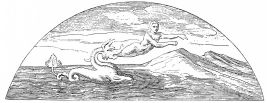
Jonas, after a painting in the Cemetery of Callistus.
It was towards the end of October that a young man, not unknown to us,
closely muffled up in his cloak, for it was dark and rather chill, might
be seen threading his way through the narrow alleys of the district
called the Suburra; a region, the extent and exact position of which is
still under dispute, but which lay in the immediate vicinity of the
Forum. As vice is unfortunately too often linked with poverty, the two
found a common asylum here. Pancratius did not seem much at home in this
part of the city, and made several wrong turns, till at length he found
the street he was in search of. Still, without numbers on the doors, the
house he wanted was an unsolved problem, although not quite insoluble.
He looked for the neatest dwelling in the street; and
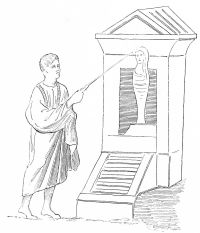
Lazarus raised from the dead. A similar representation is
found in the Catacomb Inter duos lauros, and in the Cemetery of Saints
Nereus and Achilles.
being particularly struck with the cleanliness and good order of one
beyond the rest, he boldly knocked at its door. It was opened by an old
man, whose name has already appeared in our pages, Diogenes. He was tall
and broad-shouldered, as if accustomed to bear burdens, which, however,
had given him a stoop in his gait. His hair was a perfect silver, and
hung down at the sides of a large massive head; his features were
strongly marked in deep melancholy lines, and though the expression of
his countenance was calm, it was solemnly sad. He looked like one who
had lived much among the dead, and was happiest in their company. His
two sons, Majus and Severus, fine athletic youths, were with him. The
first was busy carving, or scratching rather, a rude epitaph on an old
slab of marble, the reverse of which still bore traces of a heathen
sepulchral inscription, rudely effaced by its new possessor.
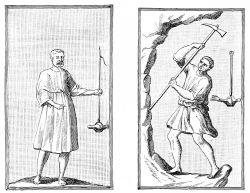
Two fossores, or excavators, from a picture in the
Cemetery of Callistus.
Pancratius looked over the work in hand and smiled; there was hardly a
word rightly spelt, or a part of speech correct; indeed, here it is:
DE BIANOBA
POLLECLA QVE ORDEV BENDET DE BIANOBA[72]
The other son was making a rough design, in which could be distinguished
Jonas devoured by the whale, and Lazarus raised from the dead, both most
conventionally drawn with charcoal on a board; a sketch evidently for a
more permanent painting elsewhere. Further, it was clear that when the
knock came to the door, old Diogenes was busy fitting a new handle to an
old pick-axe. These varied occupations in one family might have
surprised a modern, but they did not at all the youthful visitor; he
well knew that the family belonged to the honorable and religious craft
of the Fossores, or excavators of the Christian cemeteries. Indeed,
Diogenes was the head and director of that confraternity. In conformity
with the assertion of an anonymous writer, contemporary with St. Jerome,
some modern antiquarians have considered the fossor as forming a
lesser ecclesiastical order in the primitive Church, like the lector,
or reader. But although this opinion is untenable, it is extremely
probable that the duties of this office were in the hands of persons
appointed and recognized by ecclesiastical authority. The uniform system
pursued in excavating, arranging, and filling up of the numerous
cemeteries round Rome, a system too, so complete from the beginning, as
not to leave positive signs of improvement or change as time went on,
gives us reason to conclude that these wonderful and venerable works
were carried on under one direction, and probably by some body
associated for that purpose. It was not a cemetery or necropolis
company, which made a speculation of burying the dead, but rather a
pious and recognized confraternity which was associated for the purpose.
A series of interesting inscriptions, found in the cemetery of St.
Agnes, proves that this occupation was continued in particular families;
grandfather, father, and sons, having carried it on in the same
place.[73] We can thus easily understand the great skill and uniformity
of practice observable in the catacombs. But the fossores had
evidently a higher office, or even jurisdiction, in that underground
world. Though the Church provided space for the burial of all her
children, it was natural that some should make compensation for their
place of sepulture, if chosen in a favorite spot, such as the vicinity
of a martyr’s tomb. These sextons had the management of such
transactions, which are often recorded in the ancient cemeteries. The
following inscription is preserved in the Capitol:
EMPTV LOCVM AB ARTEMISIVM VISOMVM HOC EST
ET PRAETIVM DATVM FOSSORI HILARO IDEST
FOL NOOD PRAESENTIA SEVERI FOSS ET LAVRENTI
That is—
“This is the grave for two bodies, bought by Artimisius; and the
price was given to the Fossor Hilarus,—that is, purses....[74] In
the presence of Severus the Fossor and Laurentius.”
Possibly the last named was the witness on the purchaser’s side, and
Severus on the seller’s. However this may be, we trust we have laid
before our readers all that is known about the profession, as such, of
Diogenes and his sons.
We left Pancratius amused at Majus’s rude attempts in glyptic art; his
next step was to address him.
“Do you always execute these inscriptions yourself?”
“Oh, no,” answered the artist, looking up and smiling. “I do them for
poor people who cannot afford to pay a better hand. This was a good
woman who kept a small shop in the Vianova, and you may suppose did
not become rich, especially as she was very honest. And yet a curious
thought struck me as I was carving her epitaph.”
“Let me hear it, Majus.”
“It was, that perhaps some thousand years hence or more, Christians
might read with reverence my scratches on the wall, and hear of poor old
Pollecla and her barley stall with interest, while the inscription of
not a single emperor, who persecuted the Church, would be read or even
known.”
“Well, I can hardly imagine that the superb mausoleums of sovereigns
will fall to utter decay, and yet the memory of a market-wife descend to
distant ages. But what is your reason for thinking thus?”
“Simply because I would sooner commit to the keeping of posterity the
memory of the pious poor than that of the wicked rich. And my rude
record may possibly be read when triumphal arches have been demolished.
It’s dreadfully written though, is it not?”

A gallery in the Cemetery of St. Agnes, on the Nomentan
Way.
“Never mind that; its simplicity is worth much fine writing. What is
that slab leaning against the wall?”
“Ah, that is a beautiful inscription brought us to put up; you will
see the writer and engraver were different people. It is to go to the
cemetery at the Lady Agnes’s villa, on the Nomentan way. I believe it is
in memory of a most sweet child, whose death is deeply felt by his
virtuous parents.” Pancratius took a light to it, and read as follows:
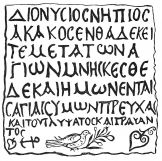
Inscription of the Cemetery of Saint Agnes.
“The innocent boy Dionysius lieth here among the saints. Remember
us in your holy prayers, the writer and the engraver.”
“Dear, happy child!” continued Pancratius, when he had perused the
inscription: “add me the reader, to the writer and carver of thine
epitaph, in thy holy prayers.”
“Amen,” answered the pious family.
But Pancratius, attracted by a certain husky sound in Diogenes’s voice,
turned round, and saw the old man vigorously trying to cut off the end
of a little wedge which he had driven into the top of the handle of his
pick-axe, to keep it fast in the iron; but every moment baffled by some
defect in his vision, which he removed by drawing the back of his brawny
hand across his eyes. “What is the matter, my good old friend?” said the
youth kindly. “Why does this epitaph of young Dionysius particularly
affect you?”
“It does not of itself; but it reminds me of so much that is past, and
suggests so much that may be about to come, that I feel almost faint to
think of either.”
“What are your painful thoughts, Diogenes?”
“Why, do you see, it is all simple enough to take into one’s arms a good
child like Dionysius, wrapped in his cerecloth, fragrant with spices,
and lay him in his grave. His parents may weep, but his passage from
sorrow to joy was easy and sweet. It is a very different thing, and
requires a heart as hardened as mine by practice” (another stroke of the
hand across the eyes) “to gather up hastily the torn flesh and broken
limbs of such another youth, to wrap them hurriedly in their
winding-sheet, then fold them into another sheet full of lime, instead
of balsams, and shove them precipitately into their tomb.[75] How
differently one would wish to treat a martyr’s body!”
“True, Diogenes; but a brave officer prefers the plain soldier’s grave,
on the field of battle, to the carved sarcophagus on the Via Appia. But
are such scenes as you describe common, in times of persecution?”
“By no means uncommon, my good young master. I am sure a pious youth
like you must have visited, on his anniversary, the tomb of Restitutus
in the cemetery of Hermes.”
“Indeed I have, and often have I been almost jealous of his early
martyrdom. Did you bury him?”
“Yes; and his parents had a beautiful tomb made, the arcosolium of his
crypt.[76] My father and I made it of six slabs of marble, hastily
collected, and I engraved the inscription now beside it. I think I
carved better than Majus there,” added the old man, now quite cheerful.
“That is not saying much for yourself, father,” rejoined his son, no
less smiling; “but here is the copy of the inscription which you wrote,”
he added, drawing out a parchment from a number of sheets.
“I remember it perfectly,” said Pancratius, glancing over it, and
reading it as follows, correcting the errors in orthography, but not
those in grammar, as he read:
AELIO FABIO RESTVTO
FILIO PIISIMO PARI N
TES FECERVNT QVIVI
XITY ANNI. S XVIII MENS
VII INIRENE.
“To Ælius Fabius Restitutus, their most pious son, his parents
erected (this tomb). Who lived eighteen years and seven months. In
peace.”
He continued: “What a glorious youth, to have confessed Christ at such
an age!”
“No doubt,” replied the old man; “but I dare say you have always thought
that his body reposes alone in his sepulchre. Any one would think so
from the inscription.”
“Certainly I have always thought so. Is it otherwise?”
“Yes, noble Pancratius, he has a comrade younger than himself lying in
the same bed. As we were closing the tomb of Restitutus, the body of a
boy not more than twelve or thirteen years old was brought to us. Oh, I
shall never forget the sight! He had been hung over a fire, and his
head, trunk, and limbs nearly to the knees, were burnt to the very bone;
and so disfigured was he that no feature could be recognized. Poor
little fellow, what he must have suffered! But why should I pity him?
Well, we were pressed for time, and we thought the youth of eighteen
would not grudge room for his fellow-soldier of twelve, but would own
him for a younger brother; so we laid him at Ælius Fabius’s feet. But we
had no second phial of blood to put outside, that a second martyr might
be known to lie there; for the fire had dried his blood up in his
veins.”[77]
“What a noble boy! If the first was older, the second was younger than
I. What say you, Diogenes, don’t you think it likely you may have to
perform the same office for me one of these days?”
“Oh, no, I hope not,” said the old digger, with a return of his husky
voice. “Do not, I entreat you, allude to such a possibility. Surely my
own time must come sooner. How the old trees are spared, indeed, and the
young plants cut down!”
“Come, come, my good friend, I won’t afflict you. But I have almost
forgotten to deliver the message I came to bring. It is, that to-morrow
at dawn you must come to my mother’s house, to arrange about preparing
the cemeteries for our coming troubles. Our holy Pope will be there,
with the priests of the titles, the regionary deacons, the notaries,
whose number has been filled up, and you, the head fossor, that all
may act in concert.”
“I will not fail, Pancratius,” replied Diogenes.
“And now,” added the youth, “I have a favor to ask you.”
“A favor from me?” asked the old man, surprised.
“Yes; you will have to begin your work immediately, I suppose. Now,
often as I have visited, for devotion, our sacred cemeteries, I have
never studied or examined them; and this I should like to do with you,
who know them so well.”
“Nothing would give me greater pleasure,” answered Diogenes, somewhat
flattered by the compliment, but still more pleased by this love for
what he so much loved. “After I have received my instructions, I shall
go at once to the cemetery of Callistus. Meet me out of the Porta
Capena, half an hour before mid-day, and we will go on together.”
“But I shall not be alone,” continued Pancratius. “Two youths, recently
baptized, desire much to become acquainted with our cemeteries, which
they do not yet much know; and have asked me to initiate them there.”
“Any friends of yours will be always welcome. What are their names, that
we may make no mistake?”
“One is Tiburtius, the son of Chromatius, the late prefect; the other is
a young man named Torquatus.”
Severus started a little, and said: “Are you quite sure about him,
Pancratius?”
Diogenes rebuked him, saying, “That he comes to us in Pancratius’s
company is security enough.”
“I own,” interposed the youth, “that I do not know as much about him as
about Tiburtius, who is really a gallant, noble fellow. Torquatus is,
however, very anxious to obtain all information about our affairs, and
seems in earnest. What makes you fear, Severus?”
“Only a trifle, indeed. But as I was going early to the cemetery this
morning, I turned into the Baths of Antoninus.”[78]
“What!” interrupted Pancratius, laughing, “do you frequent such
fashionable resorts?”
“Not exactly,” replied the honest artist; “but you are not perhaps aware
that Cucumio the capsarius[79] and his wife are Christians?”
“Is it possible; where shall we find them next?”
“Well, so it is; and moreover they are making a tomb for themselves in
the cemetery of Callistus; and I had to show them Majus’s inscription
for it.”
“Here it is,” said the latter, exhibiting it, as follows:
CVCVMIO ET VICTORIA
SE VIVOS FECERVNT
CAPSARARIVS DE ANTONINIANAS.[80]
“Capital!” exclaimed Pancratius, amused at the blunders in the epitaph;
“but we are forgetting Torquatus.”
“As I entered the building, then,” said Severus, “I was not a little
surprised to find in one corner, at that early hour, this Torquatus in
close conversation with the present prefect’s son, Corvinus, the
pretended cripple, who thrust himself into Agnes’s house, you remember,
when some charitable unknown person (God bless him!) gave large alms to
the poor there. Not good company I thought, and at such an hour, for a
Christian.”
“True, Severus,” returned Pancratius, blushing deeply; “but he is young
as yet in the faith, and probably his old friends do not know of his
change. We will hope for the best.”
The two young men offered to accompany Pancratius, who rose to leave,
and see him safe through the poor and profligate neighborhood. He
accepted their courtesy with pleasure, and bade the old excavator a
hearty good night.
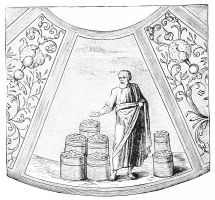
Our Saviour blessing the Bread, from a picture in the
Catacombs.
M. ANTONI
VS. RESTVTV
S. FECIT. YPO
CEVSIBI. ET
SVIS. FIDENTI
BVS. IN. DOMINO.[81]
 T seems to us as though we had neglected one, whose character and
thoughts opened this little history, the pious Lucina. Her virtues were
indeed of that quiet, unobtrusive nature, which affords little scope for
appearing on a public scene, or taking part in general affairs. Her
house, besides being, or rather containing, a title or parochial church,
was now honored by being the residence of the supreme Pontiff. The
approach of a violent persecution, in which the rulers of Christ’s
spiritual kingdom were sure to be the first sought out, as the enemies
of Cæsar,
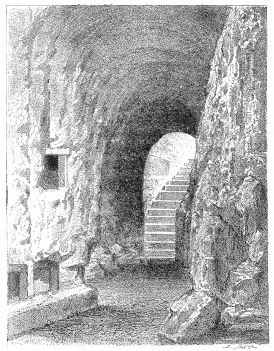
A Staircase in the Catacombs.
rendered it necessary to transfer the residence of the Ruler of the
Church, from his ordinary dwelling, to a securer asylum. For this
purpose Lucina’s house was chosen; and it continued to be so occupied,
to her great delight, in that and the following pontificate, when the
wild beasts were ordered to be transferred to it, that Pope Marcellus
might feed them at home. This loathsome punishment soon caused his
death.
Lucina admitted, at forty,[82] into the order of deaconesses, found
plenty of occupation in the duties of her office. The charge and
supervision of the women in church, the care of the sick and poor of her
own sex, the making, and keeping in order of sacred vestments and linen
for the altar, and the instruction of children and female converts
preparing for baptism, as well as the attending them at that sacred
rite, belonged to the deaconesses, and gave sufficient occupation in
addition to domestic offices. In the exercise of both these classes of
duties, Lucina quietly passed her life. Its main object seemed to be
attained. Her son had offered himself to God; and lived ready to shed
his blood for the faith. To watch over him, and pray for him, were her
delight, rather than an additional employment.
Early in the morning of the appointed day, the meeting mentioned in our
last chapter took place. It will be sufficient to say, that in it full
instructions were given for increasing the collection of alms, to be
employed in enlarging the cemeteries and burying the dead, in succoring
those driven to concealment by persecution, in nourishing prisoners, and
obtaining access to them, and finally in ransoming or rescuing the
bodies of martyrs. A notary was named for each region, to collect their
acts and record interesting events. The cardinals, or titular priests,
received instructions about the administration of sacraments,
particularly of the Holy Eucharist, during the persecution; and to each
was intrusted one cemetery or more, in whose subterranean church he was
to perform the sacred mysteries. The holy Pontiff chose for himself that
of Callistus, which made Diogenes, its chief sexton, not a little, but
innocently, proud.
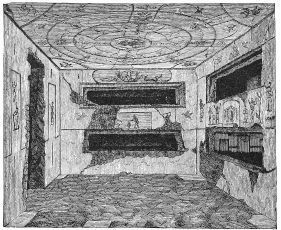
A Chapel of the Blessed Sacrament.
The good old excavator seemed rather more cheery than otherwise, under
the exciting forebodings of a coming persecution. No commanding officer
of engineers could have given his orders more briskly, or more
decidedly, for the defence of a fortified city committed to his skill to
guard, than he issued his to the subordinate superintendents of the
various cemeteries round Rome, who met him by appointment at his own
house, to learn the instructions of the superior assembly. The shadow of
the sun-dial at the Porta Capena was pointing to mid-day, as he issued
from it with his sons, and found already waiting the three young men.
They walked in parties of two along the Appian road; and at nearly two
miles from the
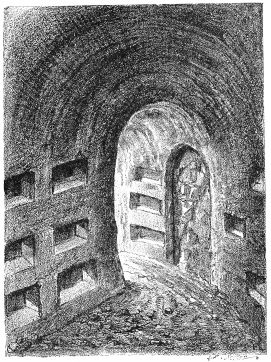
Underground gallery in the Catacombs, from Th. Roller’s
“Catacombes de Rome.”
gate,[83] they entered by various ways (slipping round different tombs
that lined the road) into the same villa on the right-hand. Here they
found all the requisites for a descent into the subterranean cemeteries,
such as candles, lanterns, and the instruments for procuring light.
Severus proposed that, as the guides and the strangers were in equal
number, they should be divided into pairs; and in the division he
allotted Torquatus to himself. What his reason was we may easily
conjecture.
It would probably weary our readers to follow the whole conversation of
the party. Diogenes not only answered all questions put to him, but,
from time to time, gave intelligent little lectures, on such objects as
he considered peculiarly attractive. But we believe we shall better
interest and inform our friends, if we digest the whole matter of
these into a more connected narrative. And besides, they will wish to
know something of the subsequent history of those wonderful excavations,
into which we have conducted our youthful pilgrims.
The history of the early Christian cemeteries, the Catacombs as they
are commonly called, may be divided into three portions: from their
beginning to the period of our narrative, or a few years later; from
this term to the eighth century; then down to our own time, when we have
reason to hope that a new epoch is being commenced.
We have generally avoided using the name of catacombs, because it might
mislead our readers into an idea that this was either the original or a
generic name of those early Christian crypts. It is not so, however:
Rome might be said to be surrounded by a circumvallation of cemeteries,
sixty or thereabouts in number, each of which was generally known by the
name of some saint or saints, whose bodies reposed there. Thus we have
the cemeteries of SS. Nereus and Achilleus,
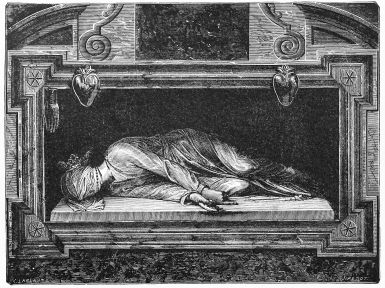
THE TOMB OF SAINT CECILIA.
On October 20, 1599, Cardinal Sfondrati had her tomb opened, and the
body of the saint, in a state of perfect preservation, was found in the
position here depicted. The sculptor, Stefano Maderno, made an exact
copy of it, and his statue now ornaments her tomb.
of St. Agnes, of
St. Pancratius, of Prætextatus, Priscilla, Hermes, &c. Sometimes these
cemeteries were known by the names of the places where they existed.[84]
The cemetery of St. Sebastian, which was called sometimes Cœmeterium ad
Sanctam Cæciliam,[85] and by other names, had among them that of Ad
Catacumbas.[86] The meaning of this word is completely unknown; though
it may be attributed to the circumstance of the relics of SS. Peter and
Paul having been for a time buried there, in a crypt still existing near
the cemetery. This term became the name of that particular cemetery,
then was generalized, till we familiarly call the whole system of these
underground excavations—the Catacombs.
Their origin was, in the last century, a subject of controversy.
Following two or three vague and equivocal passages, some learned
writers pronounced the catacombs to have been originally heathen
excavations, made to extract sand for the building of the city. These
sand-pits were called arenaria, and so occasionally are the Christian
cemeteries. But a more scientific and minute examination, particularly
made by the accurate F. Marchi, has completely confuted this theory. The
entrance to the catacombs was often, as can yet be seen, from these
sand-pits, which are themselves under ground, and no doubt were a
convenient cover for the cemetery; but several circumstances prove that
they were never used for Christian burial, nor converted into Christian
cemeteries.
The man who wishes to get the sand out of the ground will keep his
excavation as near as may be to the surface; will have it of easiest
possible access, for drawing out materials; and will make it as ample as
is consistent with the safety of the roof, and the supply of what he is
seeking. And all this we find in the arenaria still abounding round
Rome. But the catacombs are constructed on principles exactly contrary
to all these.
The catacomb dives at once, generally by a steep flight of steps, below
the stratum of loose and friable sand,[87] into that where it is
indurated to the hardness of a tender, but consistent rock; on the
surface of which every stroke of the pickaxe is yet distinctly
traceable. When you have reached this depth you are in the first story
of the cemetery, for you descend again by stairs to the second and third
below, all constructed on the same principle.
A catacomb may be divided into three parts, its passages or streets, its
chambers or squares, and its churches. The passages are long, narrow
galleries, cut with tolerable regularity, so that the roof and floor are
at right angles with the sides, often so narrow as scarcely to allow two
persons to go abreast. They sometimes run quite straight to a great
length; but they are crossed by others, and these again by others, so as
to form a complete labyrinth, or net-work, of subterranean corridors. To
be lost among them would easily be fatal.
But these passages are not constructed, as the name would imply, merely
to lead to something else. They are themselves the catacomb or cemetery.
Their walls, as well as the sides of the staircases, are honeycombed
with graves, that is, with rows of excavations, large and small, of
sufficient length to admit a human body, from a child to a full-grown
man, laid with its side to the gallery. Sometimes there are as many as
fourteen, sometimes as few as three or four, of these rows, one above
the other. They are evidently so made to measure, that it is probable
the body was lying by the side of the grave, while this was being dug.
When the corpse, wrapped up, as we heard from Diogenes, was laid in its
narrow cell, the front was hermetically closed either by a marble slab,
or more frequently by several broad tiles, put edgeways in a groove or
mortice, cut for them in the rock, and cemented all round. The
inscription was cut upon the marble, or scratched in the wet mortar.
Thousands of the former sort have been collected, and may be seen in
museums and churches; many of the latter have been copied and published;
but by far the greater number of tombs are anonymous, and have no record
upon them. And now the reader may reasonably ask, through what period
does the interment in the catacombs range, and how are its limits
determined. We will try to content him, as briefly as possible.
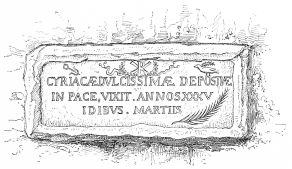
There is no evidence of the Christians having ever buried any where,
anteriorily to the construction of catacombs. Two principles as old as
Christianity regulate this mode of burial. The first is, the manner of
Christ’s entombment. He was laid in a grave in a cavern, wrapped up in
linen, embalmed with spices; and a stone, sealed up, closed His
sepulchre. As St. Paul so often proposes Him for the model of our
resurrection, and speaks of our being buried with Him in baptism, it was
natural for His disciples to wish to be buried after His example, so as
to be ready to rise with Him.
This lying in wait for resurrection was the second thought that guided
the formation of these cemeteries. Every expression connected with them
alluded to the rising again. The word to bury is unknown in Christian
inscriptions. “Deposited in peace,” “the deposition of ——,” are the
expressions used: that is, the dead are but left there for a time, till
called for again, as a pledge, or precious thing, intrusted to faithful,
but temporary, keeping. The very name of cemetery suggests that it is
only a place where many lie, as in a dormitory, slumbering for a while;
till dawn come, and the trumpet’s sound awake them. Hence the grave is
only called “the place,” or more technically, “the small home,”[88] of
the dead in Christ.
These two ideas, which are combined in the planning of the catacombs,
were not later insertions into the Christian system, but must have been
more vivid in its earlier times. They inspired abhorrence of the pagan
custom of burning the dead; nor have we a hint that this mode was, at
any time, adopted by Christians.
But ample proof is to be found in the catacombs themselves, of their
early origin. The style of paintings, yet remaining, belongs to a period
of still flourishing art. Their symbols, and the symbolical taste
itself, are characteristic of a very ancient period. For this peculiar
taste declined, as time went on. Although inscriptions with dates are
rare, yet out of ten thousand collected, and about to be published, by
the learned and sagacious Cavalier De Rossi, about three hundred are
found bearing consular dates, through every period, from the early
emperors to the middle of the fourth
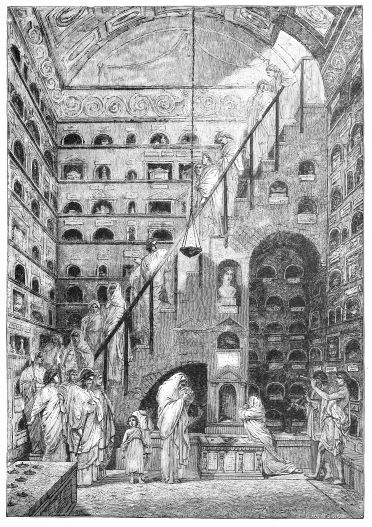
A COLUMBARIUM,
Or underground sepulchre in which the Romans deposited the urns
containing the ashes of the dead.
century (A.D. 350). Another curious and interesting custom furnishes us
with dates on tombs. At the closing of the grave, the relations or
friends, to mark it, would press into its wet plaster, and leave there a
coin, a cameo, or engraved gem, sometimes even a shell or pebble;
probably that they might find the sepulchre again, especially where no
inscription was left. Many of these objects continue to be found, many
have been long collected. But it is not uncommon, where the coin, or, to
speak scientifically, the medal, has fallen from its place, to find a
mould of it left, distinct and clear in the cement, which equally gives
its date. This is sometimes of Domitian, or other early emperors.
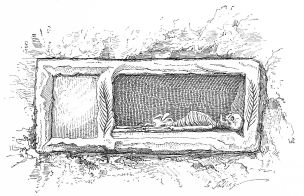
It may be asked, wherefore this anxiety to rediscover with certainty the
tomb? Besides motives of natural piety, there is one constantly recorded
on sepulchral inscriptions. In England, if want of space prevented the
full date of a person’s death being given, we should prefer chronicling
the year, to the day of the month, when it occurred. It is more
historical. No one cares about remembering the day on which a person
died, without the year; but the year without the day, is an important
recollection. Yet while so few ancient Christian inscriptions supply the
year of people’s deaths, thousands give us the very day of it, on which
they died, whether in the hopefulness of believers, or in the assurance
of martyrs. This is easily explained. Of both classes annual
commemoration had to be made, on the very day of their departure; and
accurate knowledge of this was necessary. Therefore it alone was
recorded.
In a cemetery close to the one in which we have left our three youths,
with Diogenes and his sons,[89] were lately found inscriptions mingled
together, belonging to both orders of the dead. One in Greek, after
mentioning the “Deposition of Augenda on the 13th day before the
Calends, or 1st of June,” adds this simple address:
ΖΗCΑΙC ENKῶ KAI
EPωTA ΥΠΕΡΗΜωΝ
“Live in the Lord, and pray for us.”
Another fragment is as follows:
.....N. IVN-
......IVIBAS-
IN PACE ET PETE
PRO NOBIS
“Nones of June ... Live in peace, and pray for us.”
This is a third:
VICTORIA. REFRIGERER [ET]
ISSPIRITVS. TVS IN BONO
“Victoria, be refreshed, and may thy spirit be in enjoyment” (good).
This last reminds us of a most peculiar inscription found scratched in
the mortar beside a grave in the cemetery of Prætextatus, not many yards
from that of Callistus. It is remarkable, first, for being in Latin
written with Greek letters; then, for containing a testimony of the
Divinity of our Lord; lastly, for expressing a prayer for the
refreshment of the departed. We fill up the portions of words wanting,
from the falling out of part of the plaster.
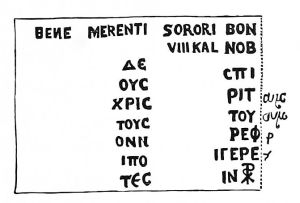
“To the well-deserving sister Bon ... The eighth day
before the calends of Nov. Christ God Almighty refresh thy spirit in
Christ.”
In spite of this digression on prayers inscribed over tombs, the reader
will not, we trust, have forgotten, that we were establishing the fact,
that the Christian cemeteries of Rome owe their origin to the earliest
ages. We have now to state down to what period they were used. After
peace was restored to the Church, the devotion of Christians prompted
them to desire burial near the martyrs, and holy people of an earlier
age. But, generally speaking, they were satisfied to lie under the
pavement. Hence the sepulchral stones which are often found in the
rubbish of the catacombs, and sometimes in their places, bearing
consular dates of the fourth century, are thicker, larger, better
carved, and in a less simple style, than those of an earlier period,
placed upon the walls. But before the end of that century, these
monuments become rarer; and interment in the catacombs ceased in the
following, at latest. Pope Damasus, who died in 384, reverently shrunk,
as he tells us, in his own epitaph, from intruding into the company of
the saints.
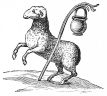
A Lamb with a Milk Pail, emblematic of the Blessed
Eucharist, found in the Catacombs.
Restitutus, therefore, whose sepulchral tablet we gave for a title to
our chapter, may well be considered as speaking in the name of the early
Christians, and claiming as their own exclusive work and property, the
thousand miles of subterranean city, with their six millions of
slumbering inhabitants, who trust in the Lord, and await His
resurrection.[90]
 IOGENES lived during the first period in the history of the cemeteries,
though near its close. Could he have looked into their future fate, he
would have seen, near at hand, an epoch that would have gladdened his
heart, to be followed by one that would have deeply afflicted him.
Although, therefore, the matter of this chapter have no direct bearing
upon our narrative, it will serve essentially to connect it with the
present topography of its scene.
When peace and liberty were restored to the Church, these cemeteries
became places of devotion, and of great resort. Each of them was
associated with the name of one, or the names of several, of the more
eminent martyrs buried in it; and, on their anniversaries, crowds of
citizens and of pilgrims thronged to their tombs, where the Divine
mysteries were offered up, and the homily delivered in their praise.
Hence began to be compiled the first martyrologies, or calendars of
martyrs’ days, which told the faithful whither to go. “At Rome, on the
Salarian, or the Appian, or the Ardeatine way,” such are the indications
almost daily read in the Roman martyrology, now swelled out, by the
additions of later ages.[91]
An ordinary reader of the book hardly knows the importance of these
indications; for they have served to verify several otherwise dubious
cemeteries. Another class of valuable writers also comes to our aid; but
before mentioning them, we will glance at the changes which this
devotion produced in the cemeteries. First, commodious entrances, with
easy staircases were made; then walls were built to support the
crumbling galleries; and, from time to time, funnel-shaped apertures in
the vaults were opened, to admit light and air. Finally, basilicas or
churches were erected over their entrances, generally leading
immediately to the principal tomb, then called the confession of the
church. The pilgrim, thus, on arriving at the holy city, visited each of
these churches, a custom yet practised; descended below, and without
having to grope his way about, went direct, by well-constructed
passages, to the principal martyr’s shrine, and so on to others, perhaps
equally objects of reverence and devotion.
During this period, no tomb was allowed to be opened, no body to be
extracted. Through apertures made into the grave, handkerchiefs or
scarfs, called brandea, were introduced, to touch the martyr’s relics;
and these were carried to distant countries, to be held in equal
reverence. No wonder that St. Ambrose, St. Gaudentius, and other
bishops, should have found it so difficult to obtain bodies, or large
relics of martyrs for their churches. Another sort of relics consisted
of what was called familiarly the oil of a martyr, that is, the oil,
often mixed with balsam, which burned in a lamp beside his tomb. Often a
round stone pillar, three feet or so in height, and scooped out at the
top, stands beside a monument; probably to hold the lamp, or serve for
the distribution of its contents. St. Gregory the Great wrote to Queen
Theodelinda, that he sent her a collection of the oils of the popes who
were martyrs. The list which accompanied them was copied by Mabillon in
the treasury of Monza, and republished by Ruinart.[92] It exists there
yet, together with the very phials containing them, sealed up in metal
tubes.
This jealousy of disturbing the saints, is displayed most beautifully in
an incident, related by St. Gregory of Tours. Among the martyrs most
honored in the ancient Roman Church were Sts. Chrysanthus and Daria.
Their tombs became so celebrated for cures, that their fellow-Christians
built (that is excavated) over them a chamber, with a vault of beautiful
workmanship, where crowds of worshippers assembled. This was discovered
by the heathens, and the emperor closed them in, walled up the entrance,
and from above, probably through the luminare, or ventilating shaft,
showered down earth and stones, and buried the congregation alive, as
the two holy martyrs had been before them. The place was unknown at the
peace of the Church, till discovered by Divine manifestation. But
instead of being permitted to enter again into this hallowed spot,
pilgrims were merely allowed to look at it, through a window opened in
the wall, so as to see, not only the tombs of the martyrs, but also the
bodies of those who had been buried alive at their shrines. And as the
cruel massacre had taken place while preparations were being made for
oblation of the holy Eucharist, there were still to be seen lying about,
the silver cruets in which the wine was brought for that spotless
sacrifice.[93]
It is clear that pilgrims resorting to Rome would want a hand-book to
the cemeteries, that they might know what they had to visit. It is
likewise but natural that, on their return home, they may have sought to
edify their less fortunate neighbors, by giving an account of what they
had seen. Accordingly there exists, no less fortunately for us than for
their untravelled neighbors, several records of this character. The
first place, among these, is held by catalogues compiled in the fourth
century; one, of the places of sepulture of Roman pontiffs, the other of
martyrs.[94] After these come three distinct guides to the catacombs;
the more interesting because they take different rounds, yet agree
marvellously in their account.
To show the value of these documents, and describe the changes which
took place in the catacombs during the second period of their history,
we will give a brief account of one discovery, in the cemetery where we
have left our little party. Among the rubbish near the entrance of a
catacomb, the name of which was yet doubtful, and which had been taken
for that of Prætextatus, was found a fragment of a slab of marble which
had been broken across ‘obliquely, from left to right, with the
following letters:
The young Cavalier de Rossi at once declared that this was part of the
sepulchral inscription of the holy Pope Cornelius; that probably his
tomb would be found below, in a distinguished form; and that as all the
itineraries above mentioned concurred in placing it in the cemetery of
Callistus, this, and not the one at St. Sebastian’s, a few hundred yards
off, must claim the honor of that name. He went further, and foretold
that as these works pronounced St. Cyprian to be buried near Cornelius,
there would be found something at the tomb which would account for that
idea, for it was known that his body rested in Africa. It was not long
before every prediction was verified. The great staircase discovered[96]
was found to lead at once to a wider space, carefully secured by
brick-work of the time of peace, and provided with light and air from
above. On the left was a tomb, cut like others in the rock, without any
exterior arch over it. It was, however, large and ample; and except one,
very high above it, there were no other graves below, or over, or at the
sides. The remaining portion of the slab was found within it; the first
piece was brought from the Kircherian Museum, where it had been
deposited, and exactly fitted to it; and both covered the tomb, thus:
Below, reaching from the lower edge of this stone to the ground was a
marble slab covered with an inscription, of which only the left-hand end
remains, the rest being broken off and lost. Above the tomb was another
slab let into the sand-stone, of which the right-hand end exists, and a
few more fragments have been recovered in the rubbish; not enough to
make out the lines, but sufficient to show it was an inscription in
verse, by Pope Damasus. How is this authorship traceable? Very easily.
Not only do we know that this holy pope, already mentioned, took
pleasure in putting verses, which he loved to write, on the tombs of
martyrs,[98] but the number of inscriptions of his yet extant exhibit a
particular and very elegant form of letters, known among antiquarians by
the name of “Damasian.” The fragments of this marble bear portions of
verses, in this character.
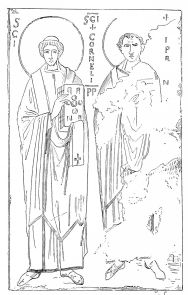
Saint Cornelius and Saint Cyprian, from De Rossi’s “Roma
Sotteranea.”
To proceed: on the wall, right of the tomb, and on the same plane, were
painted two full-length figures in sacerdotal garments, with glories
round their heads, evidently of Byzantine work of the seventh century.
Down the wall, by the left side of each, letter below letter, were their
names; some letters were effaced, which we supply in italics as follow:
SI✠ CORNELᴵ P̅P̅
SCI ✠ PRIᴬNᴵ¹[99]
We here see how a foreigner, reading these two inscriptions, with the
portraits, and knowing that the Church commemorates the two martyrs on
the same day, might easily be led to suppose that they were here
deposited together. Finally at the right hand of the tomb stands a
truncated column, about three feet high, concave at the top, as before
described; and as a confirmation of the use to which we said it might be
put, St. Gregory has, in his list of oils sent to the Lombard Queen,
“Oleum S. Cornelii,” the oil of St. Cornelius.
We see, then, how, during the second period, new ornaments, as well as
greater conveniences, were added to the primitively simple forms of the
cemeteries. But we must not, on that account, imagine that we are in any
danger of mistaking these later embellishments for the productions of
the early ages. The difference is so immense that we might as easily
blunder by taking a Rubens for a Beato Angelico, as by considering a
Byzantine figure to be a production of the two first centuries.
We come now to the third period of these holy cemeteries, the sad one of
their desolation. When the Lombards, and later the Saracens, began to
devastate the neighborhood of Rome, and the catacombs were exposed to
desecration, the popes extracted the bodies of the most illustrious
martyrs, and placed them in the basilicas of the city. This went on till
the eighth or ninth century; when we still read of repairs made in the
cemeteries by the sovereign pontiffs. The catacombs ceased to be so much
places of devotion; and the churches, which stood over their entrances,
were destroyed, or fell to decay. Only those remained which were
fortified, and could be defended. Such are the extramural basilicas of
St. Paul on the Ostian way, of St. Sebastian on the Appian, St. Laurence
on the Tiburtine, or in the Ager Veranus, St. Agnes on the Nomentan
road, St. Pancratius on the Aurelian, and, greatest of all, St. Peter’s
on the Vatican. The first and last had separate burghs or cities round
them; and the traveller can still trace remains of strong walls round
some of the others.
Strange it is, however, that the young antiquarian, whom we have
frequently named with honor, should have re-discovered two of the
basilicas over the entrance to the cemetery of Callistus, almost entire;
the one being a stable and bakehouse, the other a wine-store. One is,
most probably, that built by Pope Damasus, so often mentioned. The earth
washed down, through air-holes, the spoliation practised during ages, by
persons entering from vineyards through unguarded entrances, the mere
wasting action of time and weather, have left us but a wreck of the
ancient catacombs. Still there is much to be thankful for. Enough
remains to verify the records left us in better times, and these serve
to guide us to the reconstruction of our ruins. The present Pontiff[100]
has done more in a few years for these sacred places, which he has
appointed have done wonders. With very limited means, they are going
systematically to work, finishing as they advance. Nothing is taken from
the spot where it is found; but every thing is restored, as far as
possible, to its original state. Accurate tracings are made of all the
paintings, and plans of every part explored. To secure these good
results, the Pope has, from his own resources, bought vineyards and
fields, especially at Tor Marancia, where the cemetery of SS. Nereus and
Achilleus is situated; and we believe also over that of Callistus. The
French emperor too has sent to Rome, artists, who have produced a most
magnificent work, perhaps somewhat overdone, upon the catacombs: a truly
imperial undertaking.
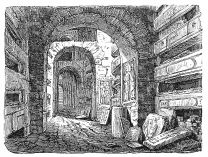
It is time, however, for us to rejoin our party below, and finish our
inspection of these marvellous cities of departed saints, under the
guidance of our friends the excavators.
 LL that we have told our readers of the first period of the history of
subterranean Rome, as ecclesiastical antiquarians love to call the
catacombs, has no doubt been better related by Diogenes to his youthful
hearers, as, taper in hand, they have been slowly walking through a long
straight gallery, crossed, indeed, by many others, but adhered to
faithfully; with sundry pauses, and, of course, lectures, embodying what
we have put together in our prosaic second chapter.
At length Diogenes turned to the right, and Torquatus looked around him
anxiously.
“I wonder,” he said, “how many turns we have passed by, before leaving
this main gallery?”
“A great many,” answered Severus, drily.
“How many do you think, ten or twenty?”
“Full that, I fancy; for I never have counted them.”
Torquatus had, however; but wished to make sure. He continued, still
pausing:
“How do you distinguish the right turn, then? Oh, what is this?” and he
pretended to examine a small niche in the corner. But Severus kept too
sharp a look-out, and saw that he was making a mark in the sand.
“Come, come along,” he said, “or we shall lose sight of the rest, and
not see which way they turn. That little niche is to hold a lamp; you
will find one at each angle. As to ourselves, we know every alley and
turn here below, as you do those of the city above.”
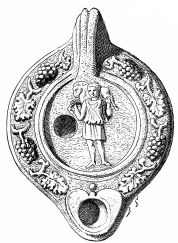
A Lamp with a representation of the Good Shepherd, found
at Ostium prior to the third century. From Roller’s “Catacombes.”
Torquatus was somewhat reassured by this account of the lamps—those
little earthen ones, evidently made on purpose for the catacombs, of
which so many are there found. But not content, he kept as good count as
he could of the turns, as they went; and now with one excuse, and now
with another, he constantly stopped, and scrutinized particular spots
and corners. But Severus had a lynx’s eye upon him, and allowed nothing
to escape his attention.
At last they entered a doorway, and found themselves in a square
chamber, richly adorned with paintings.
“What do you call this?” asked Tiburtius.
“It is one of the many crypts, or cubicula,[101] which abound in our
cemeteries,” answered Diogenes; “sometimes they are merely family
sepultures, but generally they contain the tomb of some martyr, on whose
anniversary we meet here. See that tomb opposite us, which, though flush
with the wall, is arched over. That becomes, on such an occasion, the
altar whereon the Divine mysteries are celebrated. You are of course
aware of the custom of so performing them.”
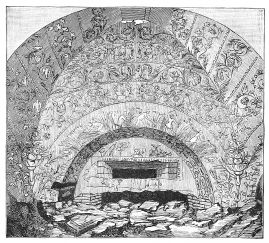
Cubiculum or Crypt, as found in the Catacombs.
“Perhaps my two friends,” interposed Pancratius, “so recently baptized,
may not have heard it; but I know it well. It is surely one of the
glorious privileges of martyrdom, to have the Lord’s sacred Body and
precious Blood offered upon one’s ashes, and to repose thus under the
very feet of God.[102] But let us see well the paintings all over this
crypt.”
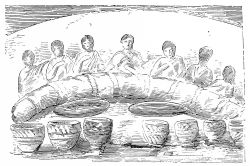
The Last Supper. From a picture in the Cemetery of St.
Callistus.
“It is on account of them that I brought you into this chamber, in
preference to so many others in the cemetery. It is one of the most
ancient, and contains a most complete series of pictures, from the
remotest times down to some of my son’s doing.”
“Well, then, Diogenes, explain them systematically to my friends,” said
Pancratius. “I think I know most of them, but not all; and I shall be
glad to hear you describe them.”
“I am no scholar,” replied the old man, modestly, “but when one has
lived sixty years, man and boy, among things, one gets to know them
better than others, because one loves them more. All here have been
fully initiated, I suppose?” he added, with a pause.
“All,” answered Tiburtius, “though not so fully instructed as converts
ordinarily are. Torquatus and myself have received the sacred gift.”
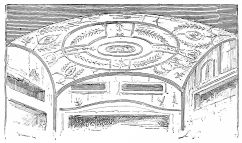
A Ceiling in the Catacombs. From De Rossi’s “Roma
Sotteranea.”
“Enough,” resumed the excavator. “The ceiling is the oldest part of the
painting, as is natural; for that was done when the crypt was excavated,
whereas the walls were decorated, as tombs were hollowed out. You see
the ceiling has a sort of trellis-work painted over it, with grapes, to
represent perhaps our true Vine, of which we are the branches. There you
see Orpheus sitting down, and playing sweet music, not only to his own
flock, but to the wild beasts of the desert, which stand charmed around
him.”
“Why, that is a heathen picture altogether,” interrupted Torquatus,
with pettishness, and some sarcasm; “what has it to do with
Christianity?”
“It is an allegory, Torquatus,” replied Pancratius, gently, “and a
favorite one. The use of Gentile images, when in themselves harmless,
has been permitted. You see masks, for instance, and other pagan
ornaments in this ceiling, and they belong generally to a very ancient
period. And so our Lord was represented under the symbol of Orpheus, to
conceal His sacred representation from Gentile blasphemy and sacrilege.
Look, now, in that arch; you have a more recent representation of the
same subject.”
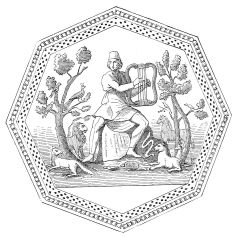
Our Lord under the Symbol of Orpheus. From a picture in
the Cemetery of Domitilius.
“I see,” said Torquatus, “a shepherd with a sheep over his
shoulders—the Good Shepherd; that I can understand; I remember the
parable.”
“But why is this subject such a favorite one?” asked Tiburtius; “I have
observed it in other cemeteries.”
“If you will look over the arcosolium,”[103] answered Severus, “you
will see a fuller representation of the scene. But I think we had better
first continue what we have begun, and finish the ceiling. You see that
figure on the right?”
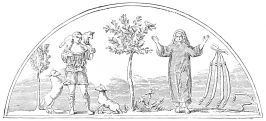
The Good Shepherd. A woman praying. From the arcosolium
of the Cemetery of Sts. Nereus and Achilleus.
“Yes,” replied Tiburtius; “it is that of a man apparently in a chest,
with a dove flying towards him. Is that meant to represent the Deluge?”
“It is,” said Severus, “as the emblem of regeneration by water and the
Holy Spirit; and of the salvation of the world. Such is our beginning;
and here is our end: Jonas thrown out of the boat, and swallowed by the
whale; and then sitting in enjoyment under his gourd. The resurrection
with our Lord, and eternal rest as its fruit.”
“How natural is this representation in such a place!” observed
Pancratius, pointing to the other side; “and here we have another type
of the same consoling doctrine.”
“Where?” asked Torquatus, languidly; “I see nothing but a figure
bandaged all round, and standing up, like a huge infant in a small
temple; and another person opposite to it.”
“Exactly,” said Severus; “that is the way we always represent the
resurrection of Lazarus. Here look, is a touching expression of the
hopes of our fathers in persecution: The three Babylonian children in
the fiery furnace.”
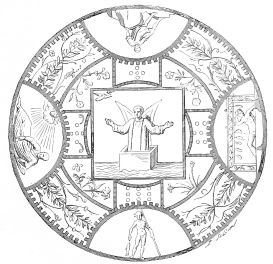
A Ceiling in the Catacombs. In the Cemetery of Domitilla,
third century.
“Well, now, I think,” said Torquatus, “we may come to the arcosolium,
and finish this room. What are these pictures round it?”
“If you look at the left side, you see the multiplication of the loaves
and fishes. The fish[104] is, you know, the symbol of Christ.”
“Why so?” asked Torquatus, rather impatiently. Severus turned to
Pancratius, as the better scholar, to answer.
“There are two opinions about its origin,” said the youth, readily; “one
finds the meaning in the word itself; its letters forming the beginning
of words, so as to mean ‘Jesus Christ, Son of God, Saviour.’[105]
Another puts it in the symbol itself; that as fish are born and live in
the water, so is the Christian born of water, and buried with Christ in
it, by baptism.[106] Hence, as we came along, we saw the figure of a
fish carved on tombs, or its name engraven on them. Now go on, Severus.”
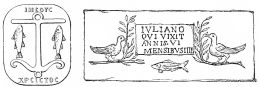
|
The fishes and anchor.
|
|
The fishes and doves.
|
“Then the union of the bread and the fish in one multiplication shows us
how, in the Eucharist, Christ becomes the food of all.[107] Opposite, is
Moses striking the rock, from which all drank, and which is Christ, our
drink as well as our food.”[108]
“Now, at last,” said Torquatus, “we are come to the Good Shepherd.”
“Yes,” continued Severus, “you see Him in the centre of the
arcosolium, in His simple tunic and leggings, with a sheep upon His
shoulders, the recovered wanderer from the flock. Two more are standing
at His sides; the truant ram on His right, the gentle ewe upon His left;
the penitent in the post of honor. On each side too, you see a person
evidently sent by Him to preach. Both are leaning forward, and
addressing sheep not of the fold. One on either side is apparently
giving no heed to their words, but browsing quietly on, while one is
turning up its eyes and head, looking and listening with eager
attention. Rain is falling copiously on them; that is the grace of God.
It is not difficult to interpret this picture.”
“But what makes this emblem such a particular favorite?” again pressed
Tiburtius.
“We consider this, and similar paintings, to belong chiefly to the time
when the Novatian heresy so much plagued the Church,” answered Severus.
“And pray what heresy is that?” asked Torquatus, carelessly; for he
thought he was losing time.
“It was, and indeed is, the heresy,” answered Pancratius, “that teaches,
that there are sins which the Church has not power to forgive; which are
too great for God to pardon.”
Pancratius was not aware of the effect of his words; but Severus, who
never took off his eye from Torquatus, saw the blood come and go
violently in his countenance.
“Is that a heresy?” asked the traitor, confused.
“Surely a dreadful one,” replied Pancratius, “to limit the mercy and
forgiveness of Him, who came to call not the just, but sinners to
repentance. The Catholic Church has always held, that a sinner, however
dark the dye, however huge the mass of his crimes, on truly repenting,
may receive forgiveness, through the penitential remedy left in her
hands. And, therefore, she has always so much loved this type of the
Good Shepherd, ready to run into the wilderness, to bring back a lost
sheep.”
“But suppose,” said Torquatus, evidently moved, “that one who had become
a Christian, and received the sacred Gift, were to fall away, and plunge
into vice, and—and”—(his voice faltered)—“almost betray his brethren,
would not the Church reject such a one from hope?”
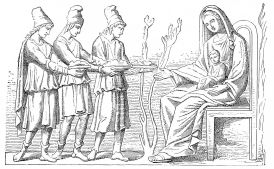
The Blessed Virgin and the Magi. From a picture in the
Cemetery of Callistus.
“No, no,” answered the youth; “these are the very crimes, which the
Novatians insult the Catholics for admitting to pardon. The Church is a
mother, with her arms ever open to re-embrace her erring children.”
There was a tear trembling in Torquatus’s eye; his lips quivered with
the confession of his guilt, which ascended to them for a moment; but as
if a black poisonous drop rose up his throat with it and choked him, he
changed in a moment to a hard, obstinate look, bit his lip, and said,
with an effort at coolness: “It is certainly a consoling doctrine for
those that need it.”
Severus alone observed that a moment of grace had been forfeited, and
that some despairing thought had quenched a flash of hope, in that man’s
heart. Diogenes and Majus, who had been absent looking at a new place
for opening a gallery near, now returned. Torquatus addressed the old
master-digger:
“We have now seen the galleries and the chambers; I am anxious to visit
the church in which we shall have to assemble.”
The unconscious excavator was going to lead the way, when the inexorable
artist interposed.
“I think, father, it is too late for to-day; you know we have got our
work to do. These young friends will excuse us, especially as they will
see the church in good time, and in better order also, as the holy
Pontiff intends to officiate in it.”
They assented; and when they arrived at the point where they had turned
off from the first straight gallery to visit the ornamented chamber,
Diogenes stopped the party, turned a few steps along an opposite
passage, and said:
“If you pursue this corridor, and turn to the right, you come to the
church. I have merely brought you here to show you an arcosolium, with
a beautiful painting. You here see the Virgin Mother holding her Divine
Infant in her arms, while the wise Easterns, here represented as four,
though generally we only reckon three, are adoring Him.”[109]
All admired the painting; but poor Severus was much chagrined at seeing
how his good father had unwittingly supplied the information desired by
Torquatus, and had furnished him with a sure clue to the desired turn,
by calling his attention to the tomb close round it, distinguishable by
so remarkable a picture.
When their company was departed, he told all that he had observed to his
brother, remarking, “That man will give us trouble yet: I strongly
suspect him.”
In a short time they had removed every mark which Torquatus had made at
the turnings. But this was no security against his reckonings; and they
determined to prepare for changing the road, by blocking up the present
one, and turning off at another point. For this purpose they had the
sand of new excavations brought to the ends of a gallery which crossed
the main avenue, where this was low, and left it heaped up there till
the faithful could be instructed of the intended change.
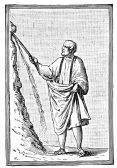
Moses striking the rock, from the Cemetery of “Inter duos
Lauros.”
 O recover our reader from his long subterranean excursion, we must take
him with us on another visit, to the “happy Campania,” or, “Campany the
blest,” as an old writer might have called it. There we left Fabiola
perplexed by some sentences which she had found. They came to her like a
letter from another world; she hardly knew of what character. She wished
to learn more about them, but she hardly durst inquire. Many visitors
called the next day, and for several days after, and she often thought
of putting before some or other of them the mysterious sentences, but
she could not bring herself to do it.
A lady, whose life was like her own, philosophically correct, and coldly
virtuous, came; and they talked together over the fashionable opinions
of the day. She took out her vellum page to puzzle her; but she shrank
from submitting it to her: it felt profane to do so. A learned man, well
read in all branches of science and literature, paid her a long visit,
and spoke very charmingly on the sublimer views of the older schools.
She was tempted to consult him about her discovery; but it seemed to
contain something higher than he could comprehend. It was strange that,
after all, when wisdom or consolation was to be sought, the noble and
haughty Roman lady should turn instinctively to her Christian slave. And
so it was now. The first moment they were alone, after several days of
company and visits, Fabiola produced her parchment, and placed it before
Syra. There passed over her countenance an emotion not observable to her
mistress; but she was perfectly calm, as she looked up from reading.
“That writing,” said her mistress, “I got at Chromatius’s villa, on the
back of a note, probably by mistake. I cannot drive it out of my mind,
which is quite perplexed by it.”
“Why should it be so, my noble lady? Its sense seems plain enough.”
“Yes; and that very plainness gives me trouble. My natural feelings
revolt against this sentiment: I fancy I ought to despise a man who does
not resent an injury, and return hatred for hatred. To forgive at most
would be much; but to do good in return for evil, seems to me an
unnatural exaction from human nature. Now, while I feel all this, I am
conscious that I have been brought to esteem you, for conduct exactly
the reverse of what I am naturally impelled to expect.”
“Oh, do not talk of me, my dear mistress; but look at the simple
principle; you honor it in others, too. Do you despise, or do you
respect, Aristides, for obliging a boorish enemy, by writing, when
asked, his own name on the shell that voted his banishment? Do you, as a
Roman lady, contemn or honor the name of Coriolanus, for his generous
forbearance to your city?”
“I venerate both, most truly, Syra; but then you know those were heroes,
and not every-day men.”
“And why should we not all be heroes?” asked Syra, laughing.
“Bless me, child! what a world we should live in, if we were. It is very
pleasant reading about the feats of such wonderful people; but one would
be very sorry to see them performed by common men, every day.”
“Why so?” pressed the servant.
“Why so? who would like to find a baby she was nursing, playing with, or
strangling, serpents in the cradle? I should be very sorry to have a
gentleman, whom I invited to dinner, telling me coolly he had that
morning killed a minotaur, or strangled a hydra; or to have a friend
offering to send the Tiber through my stables, to cleanse them. Preserve
us from a generation of heroes, say I.” And Fabiola laughed heartily at
the conceit. In the same good humor Syra continued:
“But suppose we had the misfortune to live in a country where such
monsters existed, centaurs and minotaurs, hydras and dragons. Would it
not be better that common men should be heroes enough to conquer them,
than that we should have to send off to the other side of the world for
a Theseus, or a Hercules, to destroy them? In fact, in that case, a man
would be no more a hero if he fought them, than a lion-slayer is in my
country.”
“Quite true, Syra; but I do not see the application of your idea.”
“It is this: anger, hatred, revenge, ambition, avarice, are to my mind
as complete monsters as serpents or dragons; and they attack common men
as much as great ones. Why should not I try to be as able to conquer
them as Aristides, or Coriolanus, or Cincinnatus? Why leave it to heroes
only, to do what we can do as well?”
“And do you really hold this as a common moral principle? If so, I fear
you will soar too high.”
“No, dear lady. You were startled when I ventured to maintain that
inward and unseen virtue was as necessary as the outward and visible: I
fear I must surprise you still more.”
“Go on, and do not fear to tell me all.”
“Well, then, the principle of that system which I profess is this: that
we must treat and practise, as every-day and common virtue, nay, as
simple duty, whatever any other code, the purest and sublimest that may
be, considers heroic, and proof of transcendent virtue.”
“That is indeed a sublime standard to form, of moral elevation; but mark
the difference between the two cases. The hero is supported by the
praises of the world: his act is recorded and transmitted to posterity,
when he checks his passions, and performs a sublime action. But who
sees, cares for, or shall requite, the poor obscure wretch, who in
humble secrecy imitates his conduct?”
Syra, with solemn, reverential look and gesture, raised her eyes and her
right hand to heaven, and slowly said: “His Father, who is in heaven,
who maketh His sun to rise on the good and the bad, and raineth on the
just and the unjust.”
Fabiola paused for a time, overawed: then said affectionately and
respectfully: “Again, Syra, you have conquered my philosophy. Your
wisdom is consistent as it is sublime. A virtue heroic, even when
unseen, you propose as the ordinary daily virtue of every one. Men must
indeed become more than what gods have been thought to be, to attempt
it; but the very idea is worth a whole philosophy. Can you lead me
higher than this?”
“Oh, far!—far higher still.”
“And where at length would you leave me?”

Monogram of Christ, found in the Catacombs.
“Where your heart should tell you that it had found peace.”
 HE persecution had now been some time raging in the East under
Dioclesian and Galerius; and the decree for enkindling it throughout the
West, had reached Maximian. But it had been resolved to make this a
work, not of repression, but of extermination, of the Christian name. It
had been determined to spare no one; but cutting off the chiefs of the
religion first, to descend down to the wholesale butchery of the poorest
classes. It was necessary for this purpose to concert measures, that the
various engines of destruction might work in cruel harmony: that every
possible instrument should be employed to secure completeness to the
effort; and also that the majesty of imperial command should add its
grandeur and its terror to the crushing blow.
For this purpose the emperor, though impatient to begin his work of
blood, had yielded to the opinion of his counsellors, that the edict
should be kept concealed till it could be published simultaneously in
every province, and government, of the West. The thundercloud, fraught
with vengeance, would thus hang for a time, in painful mystery, over its
intended victims, and then burst suddenly upon them, discharging upon
their heads its mingled elements, and its “fire, hail, snow, ice, and
boisterous blast.”
It was in the month of November, that Maximian Herculeus convoked the
meeting in which his plans had finally to be adjusted. To it were
summoned the leading officers of his court, and of the state. The
principal one, the prefect of the city, had brought with him his son,
Corvinus, whom he had proposed to be captain of a body of armed
pursuivants, picked out for their savageness and hatred of Christians;
who should hunt them out, or down, with unrelenting assiduity. The chief
prefects or governors of Sicily, Italy, Spain, and Gaul, were present,
to receive their orders. In addition to these, several learned men,
philosophers, and orators, among whom was our old acquaintance
Calpurnius, had been invited; and many priests, who had come from
different parts, to petition for heavier persecution, were commanded to
attend.

Maximian Herculeus holding his horse by the bridle and
protected by a shield bearing a she-wolf. From a bronze medal in the
collection of France.
The usual residence of the emperors, as we have seen, was the Palatine.
There was, however, another much esteemed by them, which Maximian
Herculeus in particular preferred. During the reign of Nero, the wealthy
senator, Plautius Lateranus, was charged with conspiracy, and of course
punished with death. His immense property was seized by the emperor, and
part of this was his house, described by Juvenal, and other writers, as
of unusual size and magnificence. It was beautifully situated on the
Cœlian hill, and on the southern verge of the city; so that from it was
a view unequalled even in the vicinity of Rome. Stretching across the
wavy campagna, here bestrided by colossal aqueducts, crossed by lines of
roads, with their fringes of marble tombs, and bespangled all over with
glittering villas, set like gems in the dark green enamel of laurel and
cypress, the eye reached, at evening, the purple slope of hills on
which, as on a couch, lay stretched luxuriously Alba and Tusculum, with
“their daughters,” according to oriental phrase,
basking brightly in the setting sun. The craggy range of Sabine
mountains on the left, and the golden expanse of the sea on the right of
the beholder, closed in this perfect landscape.
It would be attributing to Maximian a quality which he did not possess,
were we to give him credit for loving a residence so admirably situated,
through any taste for the beautiful. The splendor of the buildings,
which he had still further adorned, or possibly the facility of running
out of the city for the chase of boar and wolf, was the motive of this
preference. A native of Sirmium, in Sclavonia, a reputed barbarian
therefore of the lowest extraction, a mere soldier of fortune, without
any education, endowed with little more than a brute strength, which
made his surname of Herculeus most appropriate, he had been raised to
the purple by his brother-barbarian Diocles, known as the emperor
Dioclesian. Like him, covetous to meanness, and spendthrift to
recklessness, addicted to the same coarse vices and foul crimes, which a
Christian pen refuses to record, without restraint of any passion,
without sense of justice, or feeling of humanity, this monster had never
ceased to oppress, persecute, and slay whoever stood in his way. To him
the coming persecution looked like an approaching feast does to a
glutton, who requires the excitement of a surfeit to relieve the
monotony of daily excess. Gigantic in frame, with the well-known
features of his race, with the hair on his head and face more yellow
than red, shaggy and wild, like tufts of straw, with eyes restlessly
rolling in a compound expression of suspicion, profligacy, and ferocity,
this almost last of Rome’s tyrants struck terror into the heart of any
beholder, except a Christian. Is it wonderful that he hated the race and
its name?
In the large basilica, or hall, then, of the Ædes Lateranæ,[110]
Maximian met his motley council, in which secrecy was ensured by
penalty of death. In the semicircular apse at the upper end of the hall,
sat the emperor, on an ivory throne richly adorned, and before him were
arranged his obsequious and almost trembling advisers. A chosen body of
guards kept the entrance; and the officer in command, Sebastian, was
leaning negligently against it on the inside, but carefully noted every
word that was spoken.
Little did the emperor think, that the hall in which he sat, and which
he afterwards gave, with the contiguous palace, to Constantine, as part
of the dowry of his daughter, Fausta, would be transferred by him to the
head of the religion he was planning to extirpate, and become, retaining
its name of the Lateran Basilica, the cathedral of Rome, “of all the
churches of the city and of the world the mother and chief.”[111] Little
did he imagine, that on the spot whereon rested his throne, would be
raised a Chair, whence commands should issue, to reach worlds unknown to
Roman sway, from an immortal race of sovereigns, spiritual and temporal.
Precedence was granted, by religious courtesy, to the priests; each of
whom had his tale to tell. Here a river had overflowed its banks, and
done much mischief to the neighboring plains; there an earthquake had
thrown down part of a town; on the northern frontiers the barbarians
threatened invasion; at the south, the plague was ravaging the pious
population. In every instance, the oracles had declared, that it was all
owing to the Christians, whose toleration irritated the gods, and whose
evil charms brought calamity on the empire. Nay, some had afflicted
their votaries by openly proclaiming, that they would utter no more,
till the odious Nazarenes had been exterminated; and the great Delphic
oracle had not hesitated to declare, “that the Just did not allow the
gods to speak.”
Next came the philosophers and orators, each of whom made his own
long-winded oration; during which Maximian gave unequivocal signs of
weariness. But as the Emperors in the East had held a similar meeting,
he considered it his duty to sit out the annoyance. The usual calumnies
were repeated, for the ten-thousandth time, to an applauding assembly;
the stories of murdering and eating infants, of committing foul crimes,
of worshipping martyrs’ bodies, of adoring an ass’s head, and
inconsistently enough of being unbelievers, and serving no God. These
tales were all most firmly believed: though probably their reciters knew
perfectly well, they were but good sound heathen lies, very useful in
keeping up a horror of Christianity.
But, at length, up rose the man, who was considered to have most deeply
studied the doctrines of the enemy, and best to know their dangerous
tactics. He was supposed to have read their own books, and to be drawing
up a confutation of their errors, which would fairly crush them. Indeed,
so great was his weight with his own side, that when he asserted that
Christians held any monstrous principle, had their supreme pontiff in
person contradicted it, every one would have laughed at the very idea of
taking his word for his own belief, against the assertion of Calpurnius.
He struck up a different strain, and his learning quite astonished his
fellow-sophists. He had read the original books, he said, not only of
the Christians themselves, but of their forefathers, the Jews; who,
having come into Egypt in the reign of Ptolemy Philadelphus, to escape
from a famine in their own country, through the arts of their leader,
Josephus, bought up all the corn there, and sent it home. Upon which
Ptolemy imprisoned them, telling them, that as they had eaten up all the
corn, they should live on the straw, by making bricks with it for
building a great city. Then Demetrius Phalerius, hearing from them of a
great many curious histories of their ancestors, shut up Moses and
Aaron, their most learned men, in a tower, having shaved half their
beards, till they should write in Greek all their records. These rare
books Calpurnius had seen, and he would build his argument entirely on
them. This race made war upon every king and people, that came in their
way; and destroyed them all. It was their principle, if they took a
city, to put every one to the sword; and this was all because they were
under the government of their ambitious priests; so that when a certain
king, Saul, called also Paul, spared a poor captive monarch whose name
was Agag, the priests ordered him to be brought out and hewed in pieces.
“Now,” continued he, “these Christians are still under the domination of
the same priesthood, and are quite as ready to-day, under their
direction, to overthrow the great Roman empire, burn us all in the
Forum, and even sacrilegiously assail the sacred and venerable heads of
our divine emperors.”
A thrill of horror ran through the assembly, at this recital. It was
soon hushed, as the emperor opened his mouth to speak.
“For my part,” he said, “I have another and a stronger reason for my
abhorrence of these Christians. They have dared to establish in the
heart of the empire, and in this very city, a supreme religious
authority, unknown here before, independent of the government of the
State, and equally powerful over their minds as this. Formerly, all
acknowledged the emperor as supreme in religious, as in civil, rule.
Hence he bears still the title of Pontifex Maximus. But these men have
raised up a divided power, and consequently bear but a divided loyalty.
I hate, therefore, as a usurpation in my dominions, this sacerdotal sway
over my subjects. For I declare, that I would rather hear of a new rival
starting up to my throne, than of the election of one of these priests
in Rome.”[112]
This speech, delivered in a harsh grating voice, and with a vulgar
foreign accent, was received with immense applause; and plans were
formed for the simultaneous publication of the Edict through the West,
and for its complete and exterminating execution.
Then turning sharp upon Tertullus, the emperor said: “Prefect, you said
you had some one to propose, for superintending these arrangements, and
for merciless dealings with these traitors.”
“He is here, sire, my son Corvinus.” And Tertullus handed the youthful
candidate to the grim tyrant’s footstool, where he knelt. Maximian eyed
him keenly, burst into a hideous laugh, and said: “Upon my word, I think
he’ll do. Why, prefect, I had no idea you had such an ugly son. I should
think he is just the thing; every quality of a thoroughpaced,
unconscientious scape-grace is stamped upon his features.”
Then turning to Corvinus, who was scarlet with rage, terror, and shame,
he said to him: “Mind you, sirrah, I must have clean work of it; no
hacking and hewing, no blundering. I pay up well if I am well served;
but I pay off well, too, if badly served. So now go; and remember, that
if your back can answer for a small fault, your head will for a greater.
The lictors’ fasces contain an axe as well as rods.”
The emperor rose to depart, when his eye caught Fulvius, who had been
summoned as a paid court-spy, but who kept as much in the back-ground as
possible. “Ho, there, my eastern worthy,” he called out to him; “draw
nearer.”
Fulvius obeyed with apparent cheerfulness, but with real reluctance;
much the same as if he had been invited to go very near a tiger, the
strength of whose chain he was not quite sure about. He had seen, from
the beginning, that his coming to Rome had not been acceptable to
Maximian, though he knew not fully the cause. It was not merely that the
tyrant had plenty of favorites of his own to enrich, and spies to pay,
without Dioclesian’s sending him more from Asia, though this had its
weight; but it was more. He believed in his heart that Fulvius had been
sent principally to act the spy upon himself, and to report to Nicomedia
the sayings and doings of his court. While, therefore, he was obliged to
tolerate him, and employ him, he mistrusted and disliked him, which in
him was equivalent to hating him. It was some compensation, therefore,
to Corvinus, when he heard his more polished confederate publicly
addressed, as rudely as himself, in the following terms:
“None of your smooth, put-on looks for me, fellow. I want deeds, not
smirks. You came here as a famous plothunter, a sort of stoat, to pull
conspirators out of their nests, or suck their eggs for me. I have seen
nothing of this so far; and yet you have had plenty of money to set you
up in business. These Christians will afford you plenty of game; so make
yourself ready, and let us see what you can do. You know my ways; you
had better look sharp about you, therefore, or you may have to look at
something very sharp before you. The property of the convicted will be
divided between the accusers and the treasury; unless I see particular
reasons for taking the whole to myself. Now you may go.”

Monogram of Christ, found in the Catacombs.
Most thought that these particular reasons would turn out to be very
general.
 FEW days after Fabiola’s return from the country, Sebastian considered
it his duty to wait upon her, to communicate so much of the dialogue
between Corvinus and her black slave, as he could without causing
unnecessary suffering. We have already observed, that of the many noble
youths whom Fabiola had met in her father’s house, none had excited her
admiration and respect except Sebastian. So frank, so generous, so
brave, yet so unboasting; so mild, so kind in act and speech, so
unselfish and so careful of others, blending so completely in one
character nobleness and simplicity, high wisdom and practical sense, he
seemed to her the most finished type of manly virtue, one which would
not easily suffer by time, nor weary by familiarity.
When, therefore, it was announced to her that the officer Sebastian
wished to speak to her alone, in one of the halls below, her heart beat
at the unusual tidings, and conjured up a thousand strange fancies,
about the possible topics of his interview. This agitation was not
diminished, when, after apologizing for his seeming intrusion, he
remarked with a smile, that, well knowing how sufficiently she was
already annoyed by the many candidates for her hand, he felt regret at
the idea that he was going to add another, yet undeclared, to her list.
If this ambiguous preface surprised, and perhaps elated her, she was
soon depressed again, upon being told it was the vulgar and stupid
Corvinus. For her father, even, little as he knew how to discriminate
characters out of business, had seen enough of him at his late banquet
to characterize him to his daughter by those epithets.
Sebastian, fearing rather the physical, than the moral activity of
Afra’s drugs, thought it right to inform her of the compact between the
two dabblers in the black art, the principal efficacy of which, however,
seemed to consist in drawing money from the purse of a reluctant dupe.
He of course said nothing of what related to the Christians in that
dialogue. He put her on her guard, and she promised to prevent the
nightly excursions of her necromancer slave. What Afra had engaged to
do, she did not for a moment believe it was ever her intention to
attempt; neither did she fear arts which she utterly despised. Indeed
Afra’s last soliloquy seemed satisfactorily to prove that she was only
deceiving her victim. But she certainly felt indignant at having been
bargained about by two such vile characters, and having been represented
as a grasping avaricious woman, whose price was gold.
“I feel,” she said at last to Sebastian, “how very kind it is of you, to
come thus to put me on my guard; and I admire the delicacy with which
you have unfolded so disagreeable a matter, and the tenderness with
which you have treated every one concerned.”
“I have only done in this instance,” replied the soldier, “what I should
have done for any human being,—save him, if possible, from pain or
danger.”
“Your friends, I hope you mean,” said Fabiola, smiling; “otherwise I
fear your whole life would go, in works of unrequited benevolence.”
“And so let it go; it could not be better spent.”
“Surely, you are not in earnest, Sebastian. If you saw one who had ever
hated you, and sought your destruction, threatened with a calamity,
which would make him harmless, would you stretch out your hand to save,
or succor, him?”
“Certainly I would. While God sends His sunshine and His rain equally
upon His enemies, as upon His friends, shall weak man frame another rule
of justice?”
At these words Fabiola wondered; they were so like those of her
mysterious parchment, identical with the moral theories of her slave.
“You have been in the East, I believe, Sebastian,” she asked him, rather
abruptly; “was it there that you learnt these principles? For I have one
near me, who is yet, by her own choice, a servant, a woman of rare moral
perceptions, who has propounded to me the same ideas; and she is an
Asiatic.”
“It is not in any distant country that I learnt them; for here I sucked
them in with my mother’s milk; though, originally, they doubtless came
from the East.”
“They are certainly beautiful in the abstract,” remarked Fabiola; “but
death would overtake us before we could half carry them out, were we to
make them our principles of conduct.”
“And how better could death find us, though not surprise us, than in
thus doing our duty, even if not to its completion?”
“For my part,” resumed the lady, “I am of the old Epicurean poet’s mind.
This world is a banquet, from which I shall be ready to depart when I
have had my fill—ut conviva satur[113]—and not till then. I wish to
read life’s book through, and close it calmly, only when I have finished
its last page.”
Sebastian shook his head, smiling, and said, “The last page of this
world’s book comes but in the middle of the volume, wherever ‘death’
may happen to be written. But on the next page begins the illuminated
book of a new life—without a last page.”
“I understand you,” replied Fabiola, good-humoredly; “you are a brave
soldier, and you speak as such. You must be always prepared for death
from a thousand casualties; we seldom see it approach suddenly; it
comes more mercifully, and stealthily, upon the weak. You no doubt are
musing on a more glorious fate, on receiving in front full sheaves of
arrows from the enemy, and falling covered with honor. You look to the
soldier’s funeral pile, with trophies erected over it. To you, after
death, opens its bright page the book of glory.”
“No, no, gentle lady,” exclaimed Sebastian, emphatically. “I mean not
so. I care not for glory, which can only be enjoyed by an anticipating
fancy. I speak of vulgar death, as it may come to me in common with the
poorest slave; consuming me by slow burning fever, wasting me by long
lingering consumption, racking me by slowly eating ulcers; nay, if you
please, by the still crueller inflictions of men’s wrath. In any form
let it come; it comes from a hand that I love.”
“And do you really mean that death, so contemplated, would be welcomed
by you?”
“As joyful as is the epicure, when the doors of the banqueting-hall are
thrown wide open, and he sees beyond them the brilliant lamps, the
glittering table, and its delicious viands, with its attendant ministers
well girt, and crowned with roses; as blithe as is the bride when the
bridegroom is announced, coming with rich gifts, to conduct her to her
new home, will my exulting heart be, when death, under whatever form,
throws back the gates, iron on this side, but golden on the other, which
lead to a new and perennial life. And I care not how grim the messenger
may be, that proclaims the approach of Him who is celestially
beautiful.”
“And who is He?” asked Fabiola, eagerly. “Can He not be seen, save
through the fleshless ribs of death?”
“No,” replied Sebastian; “for it is He who must reward us, not only for
our lives, but for our deaths also. Happy they whose inmost hearts,
which He has ever read, have been kept pure and innocent, as well as
their deeds have been virtuous! For them is this bright vision of Him,
whose true rewards only then begin.”
How very like Syra’s doctrines! she thought. But before she could speak
again, to ask whence they came, a slave entered, stood on the threshold,
and respectfully said:
“A courier, madam, is just arrived from Baiæ.”[114]
“Pardon me, Sebastian!” she exclaimed. “Let him enter immediately.”
The messenger came in, covered with dust and jaded, having left his
tired horse at the gate; and offered her a sealed packet.
Her hand trembled as she took it; and while she was unloosening its
bands, she hesitatingly asked:
“From my father?”
“About him, at least,” was the ominous reply.
She opened the sheet, glanced over it, shrieked, and fell. Sebastian
caught her before she reached the ground, laid her on a couch, and
delicately left her in the hands of her handmaids, who had rushed in at
the cry.

Monogram of Christ, found in the Catacombs.
One glance had told her all. Her father was dead.
 HEN Sebastian came into the court, he found a little crowd of domestics
gathered round the courier, listening to the details of their master’s
death.
The letter of which Torquatus was the bearer to him, had produced its
desired effect. He called at his villa, and spent a few days with his
daughter, on his way to Asia. He was more than usually affectionate; and
when they parted, both father and daughter seemed to have a melancholy
foreboding that they would meet no more. He soon, however, recovered his
spirits at Baiæ, where a party of good livers anxiously awaited him; and
where he considered himself obliged to stay, while his galley was being
fitted up and stored with the best wines and provisions which Campania
afforded, for his voyage. He indulged, however, his luxurious tastes to
excess; and on coming out of a bath, after a hearty supper, he was
seized with a chill, and in four-and-twenty hours was a corpse. He had
left his undivided wealth to his only child. In fine, the body was being
embalmed when the courier started, and was to be brought by his galley
to Ostia.
On hearing this sad tale, Sebastian was almost sorry that he had spoken
as he had done of death, and left the house with mournful thoughts.
Fabiola’s first plunge into the dark abyss of grief was deep and dismal,
down into unconsciousness. Then the buoyancy of youth and mind bore her
up again to the surface; and her view of life, to the horizon, was as of
a boundless ocean of black seething waves, on which floated no living
thing save herself. Her woe seemed utter and unmeasured; and she closed
her eyes with a shudder, and suffered herself to sink again into
obliviousness, till once more roused to wakefulness of mind. Again and
again she was thus tossed up and down, between transient death and life,
while her attendants applied remedies to what they deemed a succession
of alarming fits and convulsions. At length she sat up, pale, staring,
and tearless, gently pushing aside the hand that tried to administer
restoratives to her. In this state she remained long; a stupor, fixed
and deadly, seemed to have entranced her; the pupils were almost
insensible to the light, and fears were whispered of her brain becoming
oppressed. The physician, who had been called, uttered distinctly and
forcibly into her ears the question: “Fabiola, do you know that your
father is dead?” She started, fell back, and a bursting flood of tears
relieved her heart and head. She spoke of her father, and called for him
amidst her sobs, and said wild and incoherent, but affectionate things
about, and to, him. Sometimes she seemed to think him still alive, then
she remembered he was dead; and so she wept and moaned, till sleep took
the turn of tears, in nursing her shattered mind and frame.
Euphrosyne and Syra alone watched by her. The former had, from time to
time, put in the commonplaces of heathen consolation, had reminded her
too, how kind a master, how honest a man, how loving a father he had
been. But the Christian sat in silence, except to speak gentle and
soothing words to her mistress, and served her with an active delicacy,
which even then was not unnoticed. What could she do more, unless it was
to pray? What hope for else, than that a new grace was folded up, like
a flower, in this tribulation; that a bright angel was riding in the
dark cloud that overshadowed her humbled lady?
As grief receded it left some room for thought. This came to Fabiola in
a gloomy and searching form. “What was become of her father? Whither was
he gone? Had he melted into unexistence, or had he been crushed into
annihilation? Had his life been searched through by that unseen eye
which sees the invisible? Had he stood the proof of that scrutiny which
Sebastian and Syra had described? Impossible! Then what had become of
him?” She shuddered as she thought, and put away the reflection from her
mind.
Oh, for a ray from some unknown light, that would dart into the grave,
and show her what it was! Poetry had pretended to enlighten it, and even
glorify it; but had only, in truth, remained at the door, as a genius
with drooping head, and torch reversed. Science had stepped in, and come
out scared, with tarnished wings and lamp extinguished in the fetid air;
for it had only discovered a charnel-house. And philosophy had barely
ventured to wander round and round, and peep in with dread, and recoil,
and then prate or babble; and, shrugging its shoulders, own that the
problem was yet unsolved, the mystery still veiled. Oh, for something,
or some one, better than all these, to remove the dismal perplexity!
While these thoughts dwell like gloomy night on the heart of Fabiola,
her slave is enjoying the vision of light, clothed in mortal form,
translucid and radiant, rising from the grave as from an alembic, in
which have remained the grosser qualities of matter, without impairing
the essence of its nature. Spiritualized and free, lovely and glorious,
it springs from the very hot-bed of corruption. And another and another,
from land and sea; from reeking cemetery, and from beneath consecrated
altar; from the tangled thicket where solitary murder has been
committed on the just, and from fields of ancient battle done by Israel
for God; like crystal fountains springing into the air, like brilliant
signal-lights, darted from earth to heaven, till a host of millions,
side by side, repeoples creation with joyous and undying life. And how
knows she this? Because One, greater and better than poet, sage, or
sophist, had made the trial; had descended first into the dark couch of
death, had blessed it, as He had done the cradle, and made infancy
sacred; rendering also death a holy thing, and its place a sanctuary. He
went into it in the darkest of evening, and He came forth from it in the
brightest of morning; He was laid there wrapped in spices, and he rose
again robed in His own fragrant incorruption. And from that day the
grave had ceased to be an object of dread to the Christian soul, for it
continued what he had made it,—the furrow into which the seed of
immortality must needs be cast.
The time was not come for speaking of these things to Fabiola. She
mourned still, as they must mourn who have no hope. Day succeeded day in
gloomy meditation on the mystery of death, till other cares mercifully
roused her. The corpse arrived, and such a funeral followed as Rome then
seldom witnessed. Processions by torch-light, in which the waxen
effigies of ancestors were borne, and a huge funeral pile, built up of
aromatic wood, and scented by the richest spices of Arabia, ended in her
gathering up a few handfuls of charred bones, which were deposited in an
alabaster urn, and placed in a niche of the family sepulchre, with the
name inscribed of their former owner.
Calpurnius spoke the funeral oration; in which, according to the
fashionable ideas of the day, he contrasted the virtues of the
hospitable and industrious citizen with the false morality of those men
called Christians, who fasted and prayed all day, and were stealthily
insinuating their dangerous principles into every noble family, and
spreading disloyalty and immorality in every class. Fabius, he could
have no doubt, if there was any future existence, whereon philosophers
differed, was now basking on a green bank in Elysium, and quaffing
nectar. “And oh!” concluded the old whining hypocrite, who would have
been sorry to exchange one goblet of Falernian for an amphora[115] of
that beverage, “oh! that the gods would hasten the day when I, his
humble client, may join him in his shady repose and sober banquets!”
This noble sentiment gained immense applause.
To this care succeeded another. Fabiola had to apply her vigorous mind
to examine, and close her father’s complicated affairs. How often was
she pained at the discovery of what to her seemed injustice, fraud,
over-reaching and oppression, in the transactions of one whom the world
had applauded as the most honest and liberal of public contractors!

The Peacock, as an Emblem of the Resurrection, found in
the Catacombs.
In a few weeks more, in the dark attire of a mourner, Fabiola went forth
to visit her friends. The first of these was her cousin Agnes.
 E must take our reader back a few steps in the history of Torquatus. On
the morning after his fall, he found, on awaking, Fulvius at his
bed-side. It was the falconer, who, having got hold of a good hawk, was
come to tame him, and train him to strike down the dove for him, in
return for a well-fed slavery. With all the coolness of a practised
hand, he brought back to his memory every circumstance of the preceding
night’s debauch, his utter ruin, and only means of escape. With
unfeeling precision he strengthened every thread of the last evening’s
web, and added many more meshes to it.
The position of Torquatus was this: if he made one step towards
Christianity, which Fulvius assured him would be fruitless, he would be
at once delivered to the judge, and cruelly punished with death. If he
remained faithful to his compact of treason, he should want for nothing.
“You are hot and feverish,” at last concluded Fulvius; “an early walk,
and fresh air, will do you good.”
The poor wretch consented; and they had hardly reached the Forum, when
Corvinus, as if by accident, met them. After mutual salutations, he
said: “I am glad to have fallen in with you; I should like to take you,
and show you my father’s workshop.”
“Workshop?” asked Torquatus with surprise.
“Yes, where he keeps his tools; it has just been beautifully fitted up.
Here it is, and that grim old foreman, Catulus, is opening the doors.”
They entered into a spacious court with a shed round it, filled with
engines of torture of every form. Torquatus shrunk back.
“Come in, masters, don’t be afraid,” said the old executioner. “There is
no fire put on yet, and nobody will hurt you, unless you happen to be a
wicked Christian. It’s for them we have been polishing up of late.”
“Now, Catulus,” said Corvinus, “tell this gentleman, who is a stranger,
the use of these pretty toys you have here.”
Catulus, with good heart, showed them round his museum of horrors,
explaining every thing with such hearty good-will, and no end of jokes
not quite fit for record, that in his enthusiasm he nearly gave
Torquatus practical illustrations of what he described, having once
almost caught his ear in a pair of sharp pincers, and another time
brought down a mallet within an inch of his teeth.
The rack, a large gridiron, an iron chair with a furnace in it for
heating it, large boilers for hot oil or scalding-water baths; ladles
for melting lead, and pouring it neatly into the mouth; pincers, hooks
and iron combs of varied shapes, for laying bare the ribs; scorpions, or
scourges armed with iron or leaden knobs; iron collars, manacles and
fetters of the most tormenting make; in fine, swords, knives, and axes
in tasteful varieties,[116] were all commented upon with true relish,
and an anticipation of much enjoyment,
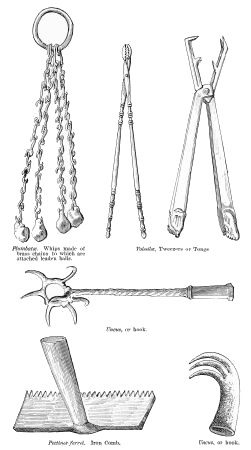
|
Plumbatæ. Whips made of
brass chains to which are
attached leaden balls.
|
Volsellæ, Tweezers or Tongs.
|
Uncus, or hook. |
|
Pectines ferrei. Iron Comb.
|
Uncus, or hook.
|
Instruments of Torture used against the Christians. From
Roller’s “Catacombes de Rome.” |
in seeing them used on those hard-headed and thick-skinned Christians.
Torquatus was thoroughly broken down. He was taken to the baths of
Antoninus, where he caught the attention of old Cucumio, the head of the
wardrobe department, or capsarius, and his wife Victoria, who had seen
him at church. After a good refection, he was led to a gambling-hall in
the Thermæ, and lost, of course. Fulvius lent him money, but for every
farthing, exacted a bond. By these means, he was, in a few days,
completely subdued.
Their meetings were early and late; during the day he was left free,
lest he should lose his value, through being suspected by Christians.
Corvinus had determined to make a tremendous dash at them, so soon as
the Edict should have come out. He therefore exacted from Torquatus, as
his share of the compact, that the spy should study the principal
cemetery where the pontiff intended to officiate. This Torquatus soon
ascertained; and his visit to the cemetery of Callistus was in
fulfilment of his engagement. When that struggle between grace and sin
took place in his soul, which Severus noticed, it was the image of
Catulus and his hundred plagues, with that of Fulvius and his hundred
bonds, that turned the scale in favor of perdition. Corvinus, after
receiving his report, and making from it a rough chart of the cemetery,
determined to assail it, early, the very day after the publication of
the Decree.
Fulvius took another course. He determined to become acquainted, by
sight, with the principal clergy, and leading Christians, of Rome. Once
possessed of this knowledge, he was sure no disguise would conceal them
from his piercing eyes; and he would easily pick them up, one by one. He
therefore insisted upon Torquatus’s taking him as his companion, to the
first great function that should collect many priests and deacons round
the Pope. He overruled
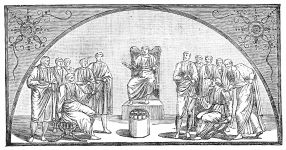
Christ and His Apostles, from a picture in the
Catacombs.
every remonstrance, dispelled every fear; and assured Torquatus, that
once in, by his password, he should behave perfectly like any Christian.
Torquatus soon informed him, that there would be an excellent
opportunity at the coming ordination, in that very month of December.
 HOEVER has read the history of the early Popes, will have become
familiar with the fact, recorded almost invariably of each, that he held
certain ordinations in the month of December, wherein he created so many
priests, and deacons, and so many bishops for different places. The
first two orders were conferred to supply clergy for the city; the third
was evidently to furnish pastors for other dioceses. In later times, the
ember-days in December, regulated by the festival of St. Lucy, were
those on which the Supreme Pontiff held his consistories, in which he
named his cardinal priests and deacons, and preconized, as it is called,
the bishops of all parts of the world. And, though this function is not
now coincident with the periods of ordination, still it is continued
essentially for the same purpose.
Marcellinus, under whose pontificate our narrative is placed, is stated
to have held two ordinations in this month, that is, of course, in
different years. It was to one of these that we have alluded, as about
to take place.
Where was this solemn function to be performed was Fulvius’s first
inquiry. And we cannot but think that the answer will be interesting to
the Christian antiquary. Nor can our acquaintance with the ancient Roman
Church be complete, without our knowing the favored spot where Pontiff
after Pontiff preached, and celebrated the divine mysteries, and held
his councils, or those glorious ordinations, which sent forth not only
bishops but martyrs to govern other churches, and gave to a St. Laurence
his diaconate, or to St. Novatus or St. Timotheus his priesthood. There,
too, a Polycarp or Irenæus visited the successor of St. Peter; and
thence received their commission the apostles who converted our King
Lucius to the faith.
The house which the Roman Pontiffs inhabited, and the church in which
they officiated till Constantine installed them in the Lateran palace
and basilica, the residence and cathedral of the illustrious line of
martyr-popes for 300 years, can be no ignoble spot. And that, in tracing
it out, we may not be misguided by national or personal prepossession,
we will follow a learned living antiquarian, who, intent upon another
research, accidentally has put together all the data requisite for our
purpose.[117]
We have described the house of Agnes’s parents as situated in the Vicus
Patricius, or the Patrician-street. This had another name, for it was
also called the street of the Cornelii, Vicus Corneliorum, because in
it lived the illustrious family of that name. The centurion whom St.
Peter converted[118] belonged to this family; and possibly to him the
apostle owed his introduction at Rome to the head of his house,
Cornelius Pudens. This senator married Claudia, a noble British lady;
and it is singular how the unchaste poet Martial vies with the purest
writers when he sings the wedding-song of these two virtuous spouses.
It was in their house that St. Peter lived; and his fellow-apostle St.
Paul enumerates them among his familiar friends, as well: “Eubulus and
Pudens, and Linus and Claudia,
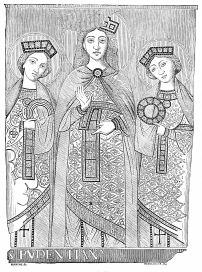
St. Pudentiana, St. Priscilla, and St. Praxedes.
and all the brethren salute thee.”[119] From that house, then, went
forth the bishops, whom the Prince of the Apostles sent in every
direction, to propagate, and die for, the faith of Christ. After the
death of Pudens, the house became the property of his children, or
grandchildren,[120] two sons and two daughters. The latter are better
known, because they have found a place in the general calendar of the
Church, and because they have given their names to two of the most
illustrious churches of Rome, those of St. Praxedes and St. Pudentiana.
It is the latter, which Alban Butler calls “the most ancient church in
the world,”[121] that marks at once the Vicus Patricius, and the house
of Pudens.
As in every other city, so in Rome, the eucharistic sacrifice was
offered originally in only one place, by the bishop. And even after more
churches were erected, and the faithful met in them, communion was
brought to them from the one altar by the deacons, and distributed by
the priests. It was Pope Evaristus, the fourth successor of St. Peter,
who multiplied the churches of Rome with circumstances peculiarly
interesting.
This Pope, then, did two things. First, he enacted that from
thenceforward no altars should be erected except of stone, and that they
should be consecrated; and secondly, “he distributed the titles;” that
is, he divided Rome into parishes, to the churches of which he gave the
name of “title.” The connection of these two acts will be apparent to
any one looking at Genesis xxviii.; where, after Jacob had enjoyed an
angelic vision, while sleeping with a stone for his pillow, we are told
that, “trembling he said, How terrible is this place! This is no other
than the house of God, and the gate of heaven. And Jacob arising in the
morning took the stone,..... and set it up for a title, pouring oil
on the top of it.”[122]
The church or oratory, where the sacred mysteries were celebrated, was
truly, to the Christian, the house of God; and the stone altar, set up
in it, was consecrated by the pouring of oil upon it, as is done to this
day (for the whole law of Evaristus remains in full force); and thus
became a title, or monument.[123]
Two interesting facts are elicited from this narrative. One is, that to
that time there was only one church with an altar in Rome; and no doubt
has ever been raised, that this was the church afterwards, and yet,
known by the name of St. Pudentiana. Another is, that the one altar till
then existing was not of stone. It was, in fact, the wooden altar used
by St. Peter, and kept in that church, till transferred by St. Sylvester
to the Lateran basilica, of which it forms the high altar.[124] We
further conclude, that the law was not retrospective, and that the
wooden altar of the Popes was preserved at that church, where it had
been first erected, though from time to time it might be carried, and
used elsewhere.
The church in the Vicus Patricius, therefore, which existed previous to
the creation of titles, was not itself a title. It continued to be the
episcopal, or rather the pontifical church of Rome. The pontificate of
St. Pius I., from 142 to 157, forms an interesting period in its
history, for two reasons.
First, that Pope, without altering the character of the church itself,
added to it an oratory which he made a title;[125] and having collated
to it his brother Pastor, it was called the titulus Pastoris, the
designation, for a long time, of the cardinalate attached to the church.
This shows that the church itself was more than a title.
Secondly, in this pontificate came to Rome, for the second time, and
suffered martyrdom, the holy and learned apologist St. Justin. By
comparing his writings with his Acts,[126] we come to some interesting
conclusions respecting Christian worship in times of persecution.
“In what place do the Christians meet?” he is asked by the judge.
“Do you think,” he replies, “that we all meet in one place? It is not
so.” But when interrogated where he lived, and where he held meetings
with his disciples, he answered, “I have lived till now near the house
of a certain Martin, at the bath known as the Timotine. I have come to
Rome for the second time, nor do I know any other place but the one I
have mentioned.” The Timotine or Timothean baths were part of the house
of the Pudens family, and are those at which we have said that Fulvius
and Corvinus met early one morning. Novatus and Timotheus were the
brothers of the holy virgins Praxedes and Pudentiana; and hence the
baths were called the Novatian and the Timotine, as they passed from one
brother to another.
St. Justin, therefore, lived on this spot, and, as he knew no other in
Rome, attended divine worship there. The very claims of hospitality
would suggest it. Now in his apology, describing the Christian liturgy,
of course such as he saw it, he speaks of the officiating priest in
terms that sufficiently describe the bishop, or supreme pastor of the
place; not only by giving him a title applied to bishops in
antiquity,[127] but by describing him as the person who has the care of
orphans and widows, and succors the sick, the indigent, prisoners,
strangers who come as guests, who, “in one word, undertakes to provide
for all in want.” This could be no other than the bishop or pope
himself.
We must further observe, that St. Pius is recorded to have erected a
fixed baptismal font in this church, another prerogative of the
cathedral, transferred with the papal altar to the Lateran. It is
related that the holy Pope Stephen (A.D. 257) baptized the tribune
Nemesius and his family, with many others, in the title of
Pastor.[128] And here it was that the blessed deacon Laurentius
distributed the rich vessels of the Church to the poor.
In time this name has given way to another. But the place is the same;
and no doubt can exist, that the church of St. Pudentiana was, for the
first three centuries, the humble cathedral of Rome.
It was to this spot, therefore, that Torquatus unwillingly consented to
lead Fulvius, that he might witness the December ordination.
We find either in sepulchral inscriptions, in martyrologies, or in
ecclesiastical history, abundant traces of all the orders, as still
conferred in the Catholic Church. Inscriptions perhaps more commonly
record those of Lector or reader, and of Exorcist. We will give one
interesting example of each. Of a Lector:
CINNAMIVS OPAS LECTOR TITVLI FASCIOLE AMICVS PAVPERVM
QVI VIXIT ANN. XLVI. MENS. VII. D. VIII. DEPOSIT IN PACE
X KAL. MART.[129]
Of an Exorcist:
MACEDONIVS
EXORCISTA DE KATOLICA.[130]
A difference was, however, that one order was not necessarily a passage,
or step, to another; but persons remained, often for life, in one of
these lesser orders. There was not, therefore, that frequent
administration of these, nor probably was it publicly performed with the
higher orders.
Torquatus, having the necessary pass-word, entered, accompanied by
Fulvius, who soon showed himself expert in acting as others did around
him. The assembly was not large. It was held in a hall of the house,
converted into a church or oratory, which was mainly occupied by the
clergy, and the candidates for orders. Among the latter were Marcus and
Marcellianus, the twin brothers, fellow-converts of Torquatus, who
received the deaconship, and their father Tranquillinus, who was
ordained priest. Of these Fulvius impressed well in his mind the
features and figure; and still more did he take note of the clergy, the
most eminent of Rome, there assembled. But on one, more than the rest,
he fixed his piercing eye, studying his every gesture, look, voice, and
lineament.
This was the Pontiff who performed the august rite. Marcellinus had
already governed the Church six years, and was of a venerable old age.
His countenance, benign and mild, scarcely seemed to betoken the
possession of that nerve which martyrdom required, and which he
exhibited in his death for Christ. In those days every outward
characteristic which could have betrayed the chief shepherd to the
wolves was carefully avoided. The ordinary simple garb of respectable
men was worn. But there is no doubt that when officiating at the altar,
a distinctive robe, the forerunner of the ample chasuble, of spotless
white, was cast over the ordinary garment. To this the bishop added a
crown, or infula, the origin of the later mitre; while in his hand he
held the crosier, emblem of his pastoral office and authority.
On him who now stood facing the assembly, before the sacred altar of
Peter, which was between him and the

Our Saviour represented as the Good Shepherd, with a
Milk-can at his side, as found in the Catacombs.
people,[131] the Eastern spy steadied his keenest glance. He scanned him
minutely, measured, with his eye, his height, defined the color of his
hair and complexion, observed every turn of his head, his walk, his
action, his tones, almost his breathing, till he said to himself: “If he
stirs abroad, disguised as he may choose, that man is my prize. And I
know his worth.”
PRIE IVN PAVSA
BET PRAETIOSA
ANNORVM PVLLA
VIRGO XII TANTVM
ANCILLA DEI ET X̅P̅I̅
FL. VINCENTIO ET
FRAVITO. V̅C̅ · CONSS.[132]
 F the learned Thomassinus had known this lately-discovered inscription,
when he proved with such abundance of learning, that virginity could be
professed in the early Church, at the age of twelve, he would certainly
have quoted it.[133] For can we doubt that “the girl who was a virgin of
only twelve years old, a handmaid of God and Christ,” was such by
consecration to God? Otherwise, the more tender her age, the less
wonderful her state of maidenhood.
But although this, the nubile age, according to Roman law, was the one
at which such dedication to God was permitted by the Church, she
reserved to a maturer period that more solemn consecration, when the
veil of virginity was given by the bishop; generally on Easter Sunday.
That first act probably consisted of nothing more than receiving from
the hands of parents a plain dark dress. But when any danger threatened,
the Church permitted the anticipation, by many years, of that period,
and fortified the spouses of Christ in their holy purpose, by her more
solemn blessing.[134]
A persecution of the most savage character was on the point of breaking
out, which would not spare the most tender of the flock; and it was no
wonder that they, who in their hearts had betrothed themselves to the
Lamb, as His chaste spouses forever, should desire to come to His
nuptials before death. They longed naturally to bear the full-grown
lily, entwined round the palm, should this be their portion.
Agnes had from her infancy chosen for herself this holiest state. The
superhuman wisdom which had ever exhibited itself in her words and
actions, blending so gracefully with the simplicity of an innocent and
guileless childhood, rendered her ripe, beyond her years, for any
measure of indulgence which could be granted, to hearts that panted for
their chaste bridal-hour. She eagerly seized on the claim that coming
danger gave her, to a more than usual relaxation of that law which
prescribed a delay of more than ten years in the fulfilling of her
desire. Another postulant joined her in this petition.
We may easily imagine that a holy friendship had been growing between
her and Syra, from the first interview which we have described between
them. This feeling had been increased by all that Agnes had heard
Fabiola say, in praise of her favorite servant. From this, and from the
slave’s more modest reports, she was satisfied that the work to which
she had devoted herself, of her mistress’s conversion, must be entirely
left in her hands. It was evidently prospering, owing to the prudence
and grace with which it was conducted. In her frequent visits to
Fabiola, she contented herself with admiring and approving what her
cousin related of Syra’s conversations; but she carefully avoided every
expression that could raise suspicion of any collusion between them.
Syra as a dependant, and Agnes as a relation, had put on mourning upon
Fabius’s death; and hence no change of habit would raise suspicion in
his daughter’s mind, of their having taken some secret, or some joint
step. Thus far they could safely ask to be admitted at once to receive
the solemn consecration to perpetual virginity. Their petition was
granted; but for obvious reasons was kept carefully concealed. It was
only a day or two before the happy one of their spiritual nuptials, that
Syra told it, as a great secret, to her blind friend.
“And so,” said the latter, pretending to be displeased, “you want to
keep all the good things to yourself. Do you call that charitable, now?”
“My dear child,” said Syra, soothingly, “don’t be offended. It was
necessary to keep it quite a secret.”
“And therefore, I suppose, poor I must not even be present?”
“Oh, yes, Cæcilia, to be sure you may; and see all that you can,”
replied Syra, laughing.
“Never mind about the seeing. But tell me, how will you be dressed? What
have you to get ready?”
Syra gave her an exact description of the habit and veil, their color
and form.
“How very interesting!” she said. “And what have you to do?”
The other, amused at her unwonted curiosity, described minutely the
short ceremonial.
“Well now, one question more,” resumed the blind girl. “When and where
is all this to be? You said I might come, so I must know the time and
place.”
Syra told her it would be at the title of Pastor, at daybreak, on the
third day from that. “But what has made you so inquisitive, dearest? I
never saw you so before. I am afraid you are becoming quite worldly.”
“Never you mind,” replied Cæcilia, “if people choose to have secrets
from me, I do not see why I should not have some of my own.”
Syra laughed at her affected pettishness, for she knew well the humble
simplicity of the poor child’s heart. They embraced affectionately and
parted. Cæcilia went straight to the kind Lucina, for she was a favorite
in every house. No sooner was she admitted to that pious matron’s
presence, than she flew to her, threw herself upon her bosom, and burst
into tears. Lucina soothed and caressed her, and soon composed her. In a
few minutes she was again bright and joyous, and evidently deep in
conspiracy, with the cheerful lady, about something which delighted her.
When she left she was all buoyant and blithe, and went to the house of
Agnes, in the hospital of which the good priest Dyonisius lived. She
found him at home; and casting herself on her knees before him, talked
so fervently to him that he was moved to tears, and spoke kindly and
consolingly to her. The Te Deum had not yet been written; but
something very like it rang in the blind girl’s heart, as she went to
her humble home.
The happy morning at length arrived, and before daybreak the more solemn
mysteries had been celebrated, and the body of the faithful had
dispersed. Only those remained who had to take part in the more private
function, or who were specially asked to witness it. These were Lucina
and her son, the aged parents of Agnes, and of course Sebastian. But
Syra looked in vain for her blind friend; she had evidently retired
with the crowd; and the gentle slave feared she might have hurt her
feelings by her reserve, before their last interview.
The hall was still shrouded in the dusk of a winter’s twilight, although
the glowing east, without, foretold a bright December day. On the altar
burned perfumed tapers of large dimensions, and round it were gold and
silver lamps of great value, throwing an atmosphere of mild radiance
upon the sanctuary. In front of the altar was placed the chair no less
venerable than itself, now enshrined in the Vatican, the chair of Peter.
On this was seated the venerable Pontiff, with staff in hand, and crown
on head, and round him stood his ministers, scarcely less worshipful
than himself.
From the gloom of the chapel, there came forth first the sound of sweet
voices, like those of angels, chanting in soft cadence, a hymn, which
anticipated the sentiments soon after embodied in the
“Jesu corona virginum.”[135]
Then there emerged into the light of the sanctuary the procession of
already consecrated virgins, led by the priests and deacons who had
charge of them. And in the midst of them appeared two, whose dazzling
white garments shone the brighter amidst their dark habits. These were
the two new postulants, who, as the rest defiled and formed a line on
either side, were conducted, each by two professed, to the foot of the
altar, where they knelt at the Pontiff’s feet. Their bridesmaids, or
sponsors, stood near to assist in the function.
Each as she came was asked solemnly what she desired, and expressed her
wish to receive the veil, and practise its duties, under the care of
those chosen guides. For, although consecrated virgins had begun to live
in community before this period, yet many continued to reside at home;
and persecution interfered with enclosure. Still there was a place in
church, boarded off for the consecrated virgins; and they often met
apart, for particular instruction and devotions.
The bishop then addressed the young aspirants, in glowing and
affectionate words. He told them how high a call it was to lead on earth
the lives of angels, who neither marry nor give in marriage, to tread
the same chaste path to heaven which the Incarnate Word chose for His
own Mother; and arrived there, to be received into the pure ranks of
that picked host, that follows the Lamb whithersoever He goeth. He
expatiated on the doctrine of St. Paul, writing to the Corinthians on
the superiority of virginity to every other state; and he feelingly
described the happiness of having no love on earth but one, which
instead of fading, opens out into immortality, in heaven. For bliss, he
observed, is but the expanded flower which Divine love bears on earth.
After this brief discourse, and an examination of the candidates for
this great honor, the holy Pontiff proceeded to bless the different
portions of their religious habits, by prayers probably nearly identical
with those now in use; and these were put on them by their respective
attendants. The new religious laid their heads upon the altar, in token
of their oblation of self. But in the West, the hair was not cut, as it
was in the East, but was always left long. A wreath of flowers was then
placed upon the head of each; and though it was winter, the well-guarded
terrace of Fabiola had been made to furnish bright and fragrant
blossoms.
All seemed ended; and Agnes, kneeling at the foot of the altar, was
motionless in one of her radiant raptures, gazing fixedly upwards; while
Syra, near her, was bowed down, sunk into the depths of her gentle
humility, wondering how she should have been found worthy of so much
favor. So absorbed were both in their thanksgiving, that they perceived
not a slight commotion through the assembly, as if something unexpected
was occurring.
They were aroused by the bishop repeating the question: “My daughter,
what dost thou seek?” when, before they could look round, each felt a
hand seized, and heard the answer returned in a voice dear to both:
“Holy father, to receive the veil of consecration to Jesus Christ, my
only love on earth, under the care of these two holy virgins, already
His happy spouses.”
They were overwhelmed with joy and tenderness; for it was the poor blind
Cæcilia. When she heard of the happiness that awaited Syra, she had
flown, as we have seen, to the kind Lucina, who soon consoled her, by
suggesting to her the possibility of obtaining a similar grace. She
promised to furnish all that was necessary; only Cæcilia insisted that
her dress should be coarse, as became a poor beggar-girl. The priest
Dionysius presented to the Pontiff, and obtained the grant of, her
prayer; and as she wished to have her two friends for sponsors, it was
arranged that he should lead her up to the altar after their
consecration. Cæcilia, however, kept her secret.
The blessings were spoken, and the habit and veil put on; when they
asked her if she had brought no wreath or flowers. Timidly she drew from
under her garment the crown she had provided, a bare, thorny branch,
twisted into a circle, and presented it, saying:
“I have no flowers to offer to my Bridegroom, neither did He wear
flowers for me. I am but a poor girl, and do you think my Lord will be
offended, if I ask Him to crown me, as He was pleased to be crowned
Himself? And then, flowers represent virtues in those that wear them;
but my barren heart has produced nothing better than these.”
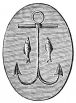
The Anchor and Fishes, an emblem of Christianity, found
in the Catacombs.
She saw not, with her blind eyes, how her two companions snatched the
wreaths from their heads, to put on hers; but a sign from the Pontiff
checked them; and amidst moistened eyes, she was led forth, all joyous,
in her thorny crown; emblem of what the Church has always taught, that
the very queenship of virtue is innocence crowned by penance.
 HE Nomentan road goes from Rome eastward, and between it and the
Salarian is a deep ravine, beyond which on the side of the Nomentan way
lies a gracefully undulating ground. Amidst this is situated a
picturesque round temple, and near it a truly beautiful basilica,
dedicated to St. Agnes. Here was the villa belonging to her, situated
about a mile and a half from the city; and thither it had been arranged
that the two, now the three, newly consecrated should repair, to spend
the day in retirement and tranquil joy. Few more such days, perhaps,
would ever be granted them.
We need not describe this rural residence, except to say that everything
in it breathed contentment and happiness. It was one of those genial
days which a Roman winter supplies. The rugged Apennines were slightly
powdered with snow; the ground was barely crisp, the atmosphere
transparent, the sunshine glowing, and the heavens cloudless. A few
greyish curls of melting smoke from the cottages, and the leafless
vines, alone told that it was December. Everything living seemed to know
and love the gentle mistress of the place. The doves came and perched
upon her shoulder or her hand; the lambs in the paddock frisked, and ran
to her the moment she approached, and took the green fragrant herbs
which she brought them, with evident pleasure; but none owned her kindly
sway so much as old Molossus, the enormous watchdog. Chained beside the
gate, so fierce was he, that none but a few favorite domestics durst go
near him. But no sooner did Agnes appear than he crouched down, and
wagged his bushy tail, and whined, till he was let loose; for now a
child might approach him. He never left his mistress’s side; he followed
her like a lamb; and if she sat down he would lie at her feet, looking
into her face, delighted to receive, on his huge head, the caresses of
her slender hand.
It was indeed a peaceful day; sometimes calm and quiet, soft and tender,
as the three spoke together of the morning’s happiness, and of the
happier morning of which it was a pledge, above the liquid amber of
their present skies; sometimes cheerful and even merry, as the two took
Cæcilia to task for the trick she had played them. And she laughed
cheerily, as she always did, and told them she had a better trick in
store for them yet; which was, that she would cut them out when that
next morning came; for she intended to be the first at it, and not the
last.
Fabiola had, in the meantime, come to the villa to pay her first visit
to Agnes after her calamity, and to thank her for her sympathy. She
walked forward, but stopped suddenly on coming near the spot where this
happy group were assembled. For when she beheld the two who could see
the outward brightness of heaven, hanging over her who seemed to hold
all its splendor within her soul, she saw at once, in the scene, the
verification of her dream. Yet unwilling to intrude herself unexpectedly
upon them, and anxious to find Agnes alone, and not with her own slave
and a poor blind girl, she turned away before she was noticed, and
walked towards a distant part of the grounds. Still she could not help
asking herself, why she could not be cheerful and happy as they? Why was
there a gulf between them?
But the day was not destined to finish without its clouds; it would have
been too blissful for earth. Besides Fabiola, another person had started
from Rome, to pay a less welcome visit to Agnes. This was Fulvius, who
had never forgotten the assurances of Fabius, that his fascinating
address and brilliant ornaments had turned the weak head of Agnes. He
had waited till the first days of mourning were over, and he respected
the house in which he had once received such a rude reception, or rather
suffered such a summary ejectment. Having ascertained that, for the
first time, she had gone without her parents, or any male attendants, to
her suburban villa, he considered it a good opportunity for pressing his
suit. He rode out of the Nomentan gate, and was soon at Agnes’s. He
dismounted; said he wished to see her on important business, and, after
some importunity, was admitted by the porter. He was directed along a
walk, at the end of which she would be found. The sun was declining, and
her companions had strolled to a distance, and she was sitting alone in
a bright sunny spot, with old Molossus crouching at her feet. The
slightest approach to a growl from him, rare when he was with her, made
her look up from her work of tying together such winter flowers as the
others brought her, while she suppressed, by raising a finger, this
expression of instinctive dislike.
Fulvius came near with a respectful, but freer air than usual, as one
already assured of his request.
“I have come, Lady Agnes,” he said, “to renew to you the expression of
my sincere regard; and I could not have chosen a better day, for
brighter or fairer scarcely the summer sun could have bestowed.”
“Fair, indeed, and bright it has been to me,” replied Agnes, borne back
in mind to the morning’s scene; “and no sun in my life has ever given me
fairer,—it can only give me one more fair.”
Fulvius was flattered, as if the compliment was to his presence, and
answered, “The day, no doubt you mean, of your espousals with one who
may have won your heart.”
“That is indeed done,” she replied, as if unconsciously; “and this is
his own precious day.”
“And was that wreathed veil upon your head, placed there in anticipation
of this happy hour?”
“Yes; it is the sign my beloved has placed upon my countenance, that I
recognize no lover but himself.”[136]
“And who is this happy being? I was not without hopes, nor will I
renounce them yet, that I have a place in your thoughts, perhaps in your
affections.”
Agnes seemed scarcely to heed his words. There was no appearance of
shyness or timidity in her looks or manner, no embarrassment even:
“Spotless without, and innocent within,
She feared no danger, for she knew no sin.”
Her childlike countenance remained bright, open, and guileless; her
eyes, mildly beaming, looked straight upon Fulvius’s face with an
earnest simplicity, that made him almost quail before her. She stood up
now, with graceful dignity, as she replied:
“Milk and honey exhaled from his lips, as the blood from his stricken
cheek impressed itself on mine.”[137]
She is crazed, Fulvius was just beginning to think; when the inspired
look of her countenance, and the clear brightness of her eye, as she
gazed forwards towards some object seen by herself alone, overawed and
subdued him. She recovered in an instant; and again he took heart. He
resolved at once to pursue his demand.
“Madam,” he said, “you are trifling with one who sincerely admires and
loves you. I know from the best authority,—yes, the best
authority,—that of a mutual friend departed, that you have been pleased
to think favorably of me, and to express yourself not opposed to my
urging my claims to your hand. I now, therefore, seriously and earnestly
solicit it. I may seem abrupt and informal, but I am sincere and warm.”
“Begone from me, food of corruption!” she said with calm majesty; “for
already a lover has secured my heart, for whom alone I keep my troth, to
whom I intrust myself with undivided devotion; one whose love is chaste,
whose caress is pure, whose brides never put off their virginal
wreaths.”[138]
Fulvius, who had dropped on his knee as he concluded his last sentence,
and had thus drawn forth that severe rebuke, rose, filled with spite and
fury, at having been so completely deluded. “Is it not enough to be
rejected,” he said, “after having been encouraged, but must insult be
heaped on me too? and must I be told to my face that another has been
before me to-day?—Sebastian, I suppose, again——”
“Who are you?” exclaimed an indignant voice behind him, “that dare to
utter with disdain, the name of one whose honor is untarnished, and
whose virtue is as unchallenged as his courage?”
He turned round, and stood confronted with Fabiola, who, having walked
for some time about the garden, thought she would now probably find her
cousin disengaged, and by herself. She had come upon him suddenly, and
had caught his last words.
Fulvius was abashed, and remained silent.
Fabiola, with a noble indignation, continued. “And who, too, are you,
who, not content with having once thrust yourself into my kinswoman’s
house, to insult her, presume now to intrude upon the privacy of her
rural retreat?”
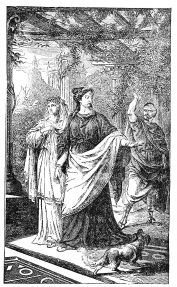
“Haughty Roman dame! thou shalt bitterly rue this day and
hour.”
“And who are you,” retorted Fulvius, “who take upon yourself to be
imperious mistress in another’s house?”
“One,” replied the lady, “who, by allowing my cousin to meet you first
at her table, and there discovering your designs upon an innocent child,
feels herself bound in honor and duty to thwart them, and to shield her
from them.”
She took Agnes by the hand, and was leading her away; and Molossus
required what he never remembered to have received before, but what he
took delightedly, a gentle little tap, to keep him from more than
growling; when Fulvius, gnashing his teeth, muttered audibly:
“Haughty Roman dame! thou shalt bitterly rue this day and hour. Thou
shalt know and feel how Asia can revenge.”
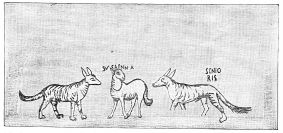
A Lamb between Wolves, emblematic of the Church, from a
picture in the Cemetery of St. Prætextatus.
 HE day being at length arrived for its publication in Rome, Corvinus
fully felt the importance of the commission intrusted to him, of
affixing in its proper place in the Forum, the edict of extermination
against the Christians, or rather the sentence of extirpation of their
very name. News had been received from Nicodemia, that a brave Christian
soldier, named George, had torn down a similar imperial degree, and had
manfully suffered death for his boldness. Corvinus was determined that
nothing of the sort should happen in Rome; for he feared too seriously
the consequences of such an occurrence to himself; he therefore took
every precaution in his power. The edict had been written in large
characters, upon sheets of parchment joined together; and these were
nailed to a board, firmly supported by a pillar, against which it was
hung, not far from the Puteal Libonis, the magistrate’s chair in the
Forum. This, however, was not done till the Forum was deserted, and
night had well set in. It was thus intended that the edict should meet
the eyes of the citizens early in the morning, and strike their minds
with more tremendous effect.
To prevent the possibility of any nocturnal attempt to destroy the
precious document, Corvinus, with much the same cunning precaution as
was taken by the Jewish priests to prevent the Resurrection, obtained
for a night-guard to the Forum, a company of the Pannonian cohort, a
body composed of soldiers belonging to the fiercest races of the North,
Dacians, Pannonians, Sarmatians, and Germans, whose uncouth features,
savage aspect, matted sandy hair, and bushy red moustaches, made them
appear absolutely ferocious to Roman eyes. These men could scarcely
speak Latin, but were ruled by officers of their own countries, and
formed, in the decline of the empire, the most faithful body-guard of
the reigning tyrants, often their fellow-countrymen; for there was no
excess too monstrous for them to commit, if duly commanded to execute
it.
A number of these savages, ever rough and ready, were distributed so as
to guard every avenue of the Forum, with strict orders to pierce
through, or hew down, any one who should attempt to pass without the
watchword, or symbolum. This was every night distributed by the
general in command, through his tribunes and centurions, to all the
troops. But to prevent all possibility of any Christian making use of it
that night, if he should chance to discover it, the cunning Corvinus had
one chosen which he felt sure no Christian would use. It was NUMEN
IMPERATORUM: the “Divinity of the Emperors.”
The last thing which he did was to make his rounds, giving to each
sentinel the strictest injunctions; and most minutely to the one whom he
had placed close to the edict. This man had been chosen for his post on
account of his rude strength and huge bulk, and the peculiar ferocity of
his looks and character. Corvinus gave him the most rigid instructions,
how he was to spare nobody, but to prevent any one’s interference with
the sacred edict. He repeated to him again and again the watchword; and
left him, already half-stupid with sabaia or beer,[139] in the merest
animal consciousness, that it was his business, not an unpleasant one,
to spear, or sabre, some one or other before morning. The night was raw
and gusty, with occasional sharp and slanting showers; and the Dacian
wrapped himself in his cloak, and walked up and down, occasionally
taking a long pull at a flask concealed about him, containing a liquor
said to be distilled from the wild cherries of the Thuringian forests;
and in the intervals muddily meditating, not on the wood or river, by
which his young barbarians were at play, but how soon it would be time
to cut the present emperor’s throat, and sack the city.
While all this was going on, old Diogenes and his hearty sons were in
their poor house in the Suburra, not far off, making preparations for
their frugal meal. They were interrupted by a gentle tap at the door,
followed by the lifting of the latch, and the entrance of two young men,
whom Diogenes at once recognized and welcomed.
“Come in, my noble young masters; how good of you thus to honor my poor
dwelling! I hardly dare offer you our plain fare; but if you will
partake of it, you will indeed give us a Christian love-feast.”
“Thank you most kindly, father Diogenes,” answered the elder of the two,
Quadratus, Sebastian’s sinewy centurion: “Pancratius and I have come
expressly to sup with you. But not as yet; we have some business in this
part of the town, and after it we shall be glad to eat something. In the
meantime one of your youths can go out and cater for us. Come, we must
have something good; and I want you to cheer yourself with a moderate
cup of generous wine.”
Saying this he gave his purse to one of the sons, with instructions to
bring home some better provisions than he knew the simple family usually
enjoyed. They sat down; and Pancratius, by way of saying something,
addressed the old man. “Good Diogenes, I have heard Sebastian say that
you remember seeing the glorious Deacon Laurentius die for Christ. Tell
me something about him.”
“With pleasure,” answered the old man. “It is now nearly forty-five
years since it happened,[140] and as I was older then than you are now,
you may suppose I remember all quite distinctly. He was indeed a
beautiful youth to look at: so mild and sweet, so fair and graceful; and
his speech was so gentle, so soft, especially when speaking to the poor.
How they all loved him! I followed him everywhere; I stood by as the
venerable Pontiff Sixtus was going to death, and Laurentius met him, and
so tenderly reproached him, just as a son might a father, for not
allowing him to be his companion in the sacrifice of himself, as he had
ministered to him in the sacrifice of our Lord’s body and blood.”
“Those were splendid times, Diogenes, were they not?” interrupted the
youth; “how degenerate we are now! What a different race! Are we not,
Quadratus?”
The rough soldier smiled at the generous sincerity of his complaint, and
bid Diogenes go on.
“I saw him too as he distributed the rich plate of the Church to the
poor. We have never had any thing so splendid since. There were golden
lamps and candlesticks, censors, chalices, and patens,[141] besides an
immense quantity of silver melted down, and distributed to the blind,
the lame, and the indigent.”
“But tell me,” asked Pancratius, “how did he endure his last dreadful
torment? It must have been frightful.”
“I saw it all,” answered the old fossor, “and it would have been
intolerably frightful in another. He had been first placed on the rack,
and variously tormented, and he had not uttered a groan; when the judge
ordered that horrid bed, or gridiron, to be prepared and heated. To look
at his tender flesh blistering and breaking over the fire, and deeply
scored with red burning gashes that cut to the bone where the iron bars
went across; to see the steam, thick as from a cauldron, rise from his
body, and hear the fire hiss beneath him, as he melted away into it; and
every now and then to observe the tremulous quivering that crept over
the surface of his skin, the living motion which the agony gave to each
separate muscle, and the sharp spasmodic twitches which convulsed, and
gradually contracted, his limbs; all this, I own, was the most harrowing
spectacle I have ever beheld in all my life. But to look into his
countenance was to forget all this. His head was raised up from the
burning body, and stretched out, as if fixed on the contemplation of
some most celestial vision, like that of his fellow-deacon Stephen. His
face glowed indeed with the heat below, and the perspiration flowed down
it; but the light from the fire shining upwards, and passing through his
golden locks, created a glory round his beautiful head and countenance,
which made him look as if already in heaven. And every feature, serene
and sweet as ever, was so impressed with an eager, longing look,
accompanying the upward glancing of his eye, that you would willingly
have changed places with him.”
“That I would,” again broke in Pancratius, “and, as soon as God pleases!
I dare not think that I could stand what he did; for he was indeed a
noble and heroic Levite, while I am only a weak imperfect boy. But do
you not think, dear Quadratus, that strength is given in that hour,
proportionate to our trials, whatever they may be? You, I know, would
stand any thing; for you are a fine stout soldier, accustomed to toil
and wounds. But as for me, I have only a willing heart to give. Is that
enough, think you?”
“Quite, quite, my dear boy,” exclaimed the centurion, full of emotion,
and looking tenderly on the youth, who with glistening eyes, having
risen from his seat, had placed his hands upon the officer’s shoulders.
“God will give you strength, as He has already given you courage. But we
must not forget our night’s work. Wrap yourself well up in your cloak,
and bring your toga quite over your head; so! It is a wet and bitter
night. Now, good Diogenes, put more wood on the fire, and let us find
supper ready on our return. We shall not be long absent; and just leave
the door ajar.”
“Go, go, my sons,” said the old man, “and God speed you! whatever you
are about, I am sure it is something praiseworthy.”
Quadratus sturdily drew his chlamys, or military cloak, around him, and
the two youths plunged into the dark lanes of the Suburra, and took the
direction of the Forum. While they were absent, the door was opened,
with the well-known salutation of “thanks to God;” and Sebastian
entered, and inquired anxiously if Diogenes had seen any thing of the
two young men; for he had got a hint of what they were going to do. He
was told they were expected in a few moments.
A quarter of an hour had scarcely elapsed, when hasty steps were heard
approaching; the door was pushed open, and was as quickly shut, and then
fast barred, behind Quadratus and Pancratius.
“Here it is,” said the latter, producing, with a hearty laugh, a bundle
of crumpled parchment.
“What?” asked all eagerly.
“Why, the grand decree, of course,” answered Pancratius, with boyish
glee; “look here, ‘Domini nostri Diocletianus et Maximianus, invicti,
seniores Augusti, patres Imperatorum et Cæsarum,’[142] and so forth.
Here it goes!” And he thrust it into the blazing fire, while the
stalwart sons of Diogenes threw
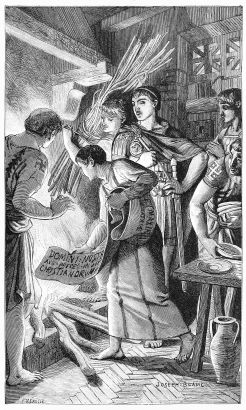
“Here it goes!” And he thrust it into the blazing
fire.
a faggot over it to keep it down, and drown its crackling. There it
frizzled, and writhed, and cracked, and shrunk, first one letter or word
coming up, then another; first an emperor’s praise, and then an
anti-Christian blasphemy; till all had subsided into a black ashy mass.
And what else, or more, would those be in a few years who had issued
that proud document, when their corpses should have been burnt on a pile
of cedar-wood and spices, and their handful of ashes be scraped
together, hardly enough to fill a gilded urn? And what also, in very few
years more, would that heathenism be, which it was issued to keep alive,
but a dead letter at most, and as worthless a heap of extinguished
embers as lay on that hearth? And the very empire which these
“unconquered” Augusti were bolstering up by cruelty and injustice, how
in a few centuries would it resemble that annihilated decree? the
monuments of its grandeur lying in ashes, or in ruins, and proclaiming
that there is no true Lord but one stronger than Cæsars, the Lord of
lords; and that neither counsel nor strength of man shall prevail
against Him.
Something like this did Sebastian think, perhaps, as he gazed
abstractedly on the expiring embers of the pompous and cruel edict which
they had torn down, not for a wanton frolic, but because it contained
blasphemies against God and His holiest truths. They knew that if they
should be discovered, tenfold tortures would be their lot; but
Christians in those days, when they contemplated and prepared for
martyrdom, made no calculation on that head. Death for Christ, whether
quick and easy, or lingering and painful, was the end for which they
looked; and, like brave soldiers going to battle, they did not speculate
where a shaft or a sword might strike them, whether a death-blow would
at once stun them out of existence, or they should have to writhe for
hours upon the ground, mutilated or pierced, to die by inches among the
heaps of unheeded slain.
Sebastian soon recovered, and had hardly the heart to reprove the
perpetrators of this deed. In truth, it had its ridiculous side, and he
was inclined to laugh at the morrow’s dismay. This view he gladly took,
for he saw Pancratius watched his looks with some trepidation, and his
centurion looked a little disconcerted. So, after a hearty laugh, they
sat down cheerfully to their meal; for it was not midnight, and the hour
for commencing the fast, preparatory to receiving the holy Eucharist,
was not arrived. Quadratus’s object, besides kindness, in this
arrangement, was partly, that if surprised, a reason for their being
there might be apparent, partly to keep up the spirits of his younger
companion and of Diogenes’s household, if alarmed at the bold deed just
performed. But there was no appearance of any such feeling. The
conversation soon turned upon recollections of Diogenes’s youth, and the
good old fervent times, as Pancratius would persist in calling them.
Sebastian saw his friend home, and then took a round, to avoid the Forum
in seeking his own abode. If any one had seen Pancratius that night,
when alone in his chamber preparing to retire to rest, he would have
seen him every now and then almost laughing at some strange but pleasant
adventure.

A Monogram of Christ, found in the Catacombs.
 T the first dawn of morning, Corvinus was up; and, notwithstanding the
gloominess of the day, proceeded straight to the Forum. He found his
outposts quite undisturbed, and hastened to the principal object of his
care. It would be useless to attempt describing his astonishment, his
rage, his fury, when he saw the blank board, with only a few shreds of
parchment left, round the nails; and beside it standing, in unconscious
stolidity, his Dacian sentinel.
He would have darted at his throat, like a tiger, if he had not seen, in
the barbarian’s twinkling eye, a sort of hyena squint, which told him he
had better not. But he broke out at once into a passionate exclamation:
“Sirrah! how has the edict disappeared? Tell me directly!”
“Softly, softly, Herr Kornweiner,” answered the imperturbable Northern.
“There it is as you left it in my charge.”
“Where, you fool? Come and look at it.”
The Dacian went to his side, and for the first time confronted the
board; and after looking at it for some moments, exclaimed: “Well, is
not that the board you hung up last night?”
“Yes, you blockhead, but there was writing on it, which is gone. That is
what you had to guard.”
“Why, look you, captain, as to writing, you see I know nothing, having
never been a scholar; but as it was raining all night, it may have been
washed out.”
“And as it was blowing, I suppose the parchment on which it was written
was blown off?”
“No doubt, Herr Kornweiner; you are quite right.”
“Come, sir, this is no joking matter. Tell me, at once, who came here
last night.”
“Why, two of them came.”
“Two of what?”
“Two wizards, or goblins, or worse.”
“None of that nonsense for me.” The Dacian’s eye flashed drunkenly
again. “Well, tell me, Arminius, what sort of people they were, and what
they did.”
“Why, one of them was but a stripling, a boy, tall and thin; who went
round the pillar, and I suppose must have taken away what you miss,
while I was busy with the other.”
“And what of him? What was he like?”
The soldier opened his mouth and eyes, and stared at Corvinus for some
moments, then said, with a sort of stupid solemnity, “What was he like?
Why, if he was not Thor himself, he wasn’t far from it. I never felt
such strength.”
“What did he do to show it?”
“He came up first, and began to chat quite friendly, asked me if it was
not very cold, and that sort of thing. At last I remembered that I had
to run through any one that came near me——”
“Exactly,” interrupted Corvinus; “and why did you not do it?”
“Only because he wouldn’t let me. I told him to be off, or I should
spear him, and drew back and stretched out my javelin; when in the
quietest manner, but I don’t know how, he twisted it out of my hand,
broke it over his knee, as if it had been a mountebank’s wooden sword,
and dashed the iron-headed piece fast into the ground, where you see it,
fifty yards off.”
“Then why did you not rush on him with your sword, and despatch him at
once? But where is your sword? it is not in your scabbard.”
The Dacian, with a stupid grin, pointed to the roof of the neighboring
basilica, and said: “There, don’t you see it shining on the tiles, in
the morning light?” Corvinus looked, and there indeed he saw what
appeared like such an object, but he could hardly believe his own eyes.
“How did it get there, you stupid booby?” he asked.
The soldier twisted his moustache in an ominous way, which made Corvinus
ask again more civilly, and then he was answered:
“He, or it, whatever it was, without any apparent effort, by a sort of
conjuring, whisked it out of my hand, and up where you see it, as easily
as I could cast a quoit a dozen yards.”
“And then?”
“And then, he and the boy, who came from round the pillar, walked off in
the dark.”
“What a strange story!” muttered Corvinus to himself; “yet there are
proofs of the fellow’s tale. It is not every one who could have
performed that feat. But pray, sirrah, why did you not give the alarm,
and rouse the other guards to pursuit?”
“First, Master Kornweiner, because, in my country, we will fight any
living men, but we do not choose to pursue hobgoblins. And, secondly,
what was the use? I saw the board that you gave into my care all safe
and sound.”
“Stupid barbarian!” growled Corvinus, but well within his teeth; then
added: “This business will go hard with you; you know it is a capital
offence.”
“What is?”
“Why, to let a man come up and speak to you, without giving the
watchword.”
“Gently, captain; who says he did not give it? I never said so.”
“But did he, though? Then it could be no Christian.”
“Oh yes, he came up, and said quite plainly, ‘Nomen
Imperatorum.’”[143]
“What?” roared out Corvinus.
“Nomen Imperatorum.”
“‘Numen Imperatorum’ was the watchword,” shrieked the enraged Roman.
“Nomen or Numen, it’s all the same, I suppose. A letter can’t make
any difference. You call me Arminius, and I call myself Hermann, and
they mean the same. How should I know your nice points of language?”
Corvinus was enraged at himself; for he saw how much better he would
have gained his ends, by putting a sharp, intelligent prætorian on duty,
instead of a sottish, savage foreigner. “Well,” he said, in the worst of
humors, “you will have to answer to the emperor for all this; and you
know he is not accustomed to pass over offences.”
“Look you now, Herr Krummbeiner,” returned the soldier, with a look of
sly stolidity; “as to that, we are pretty well in the same boat.”
(Corvinus turned pale, for he knew this was true.) “And you must
contrive something to save me, if you want to save yourself. It was you
the emperor made responsible, for the what-d’ye-call-it?—that board.”
“You are right, my friend; I must make it out that a strong body
attacked you, and killed you at your post. So shut yourself up in
quarters for a few days, and you shall have plenty of beer, till the
thing blows over.”
The soldier went off, and concealed himself. A few days after, the dead
body of a Dacian, evidently murdered, was washed on the banks of the
Tiber. It was supposed he had fallen in some drunken row; and no further
trouble was taken about it. The fact was indeed so; but Corvinus could
have given the best account of the transaction. Before, however, leaving
the ill-omened spot in the Forum, he had carefully examined the ground,
for any trace of the daring act; when he picked up, close under the
place of the edict, a knife, which he was sure he had seen at school, in
possession of one of his companions. He treasured it up, as an implement
of future vengeance, and hastened to provide another copy of the decree.

An Emblem of Paradise, found in the Catacombs.
 HEN morning had fairly broken, crowds streamed, from every side, into
the Forum, curious to read the tremendous edict so long menaced. But
when they found only a bare board, there was a universal uproar. Some
admired the spirit of the Christians, so generally reckoned cowardly;
others were indignant at the audacity of such an act; some ridiculed the
officials concerned in the proclamation; others were angry that the
expected sport of the day might be delayed.
At an early hour the places of public fashionable resort were all
occupied with the same theme. In the great Antonian Thermæ a group of
regular frequenters were talking it over. There were Scaurus the lawyer,
and Proculus, and Fulvius, and the philosopher Calpurnius, who seemed
very busy with some musty volumes, and several others.
“What a strange affair this is, about the edict!” said one.
“Say rather, what a treasonable outrage against the divine emperors!”
answered Fulvius.
“How was it done?” asked a third.
“Have you not heard,” said Proculus, “that the Dacian guard stationed at
the Puteal was found dead, with twenty-seven poniard-wounds on him,
nineteen of which would have sufficed each by itself to cause death?”
“No, that is quite a false report,” interrupted Scaurus; “it was not
done by violence, but entirely by witchcraft. Two women came up to the
soldier, who drove his lance at one, and it passed clean through her,
and stuck in the ground on the other side, without making any wound in
her. He then hacked at the other with his sword, but he might as well
have struck at marble. She then threw a pinch of powder upon him, and he
flew into the air, and was found, asleep and unhurt, this morning, on
the roof of the Æmilian basilica. A friend of mine, who was out early,
saw the ladder up, by which he had been brought down.”
“Wonderful!” many exclaimed. “What extraordinary people these Christians
must be!”
“I don’t believe a word of it,” observed Proculus. “There is no such
power in magic; and certainly I don’t see why these wretched men should
possess it more than their betters. Come, Calpurnius,” he continued,
“put by that old book, and answer these questions. I learnt more, one
day after dinner, about these Christians from you, than I had heard in
all my life before. What a wonderful memory you must have, to remember
so accurately the genealogy and history of that barbarous people! Is
what Scaurus has just told us possible, or not?”
Calpurnius delivered himself, with great pompousness, as follows:
“There is no reason to suppose such a thing impossible; for the power of
magic has no bounds. To prepare a powder that would make a man fly in
the air, it would be only necessary to find some herbs in which air
predominates more than the other three elements. Such for instance are
pulse, or lentils, according to Pythagoras. These, being gathered when
the sun is in Libra, the nature of which is to balance even heavy things
in the air, at the moment of conjunction with Mercury, a winged power as
you know, and properly energized by certain mysterious words, by a
skilful magician, then reduced to powder in a mortar made out of an
aerolite, or stone that had flown up into the sky, and come down again,
would no doubt, when rightly used, enable, or force a person to fly up
into the air. It is well known, indeed, that the Thessalian witches go
at pleasure through the clouds, from place to place, which must be done
by means of some such charm.
“Then, as to the Christians; you will remember, excellent Proculus, that
in the account to which you have done me the honor to allude, which was
at the deified Fabius’s table, if I remember right, I mentioned that the
sect came originally from Chaldæa, a country always famous for its
occult arts. But we have a most important evidence bearing on this
matter, recorded in history. It is quite certain, that here in Rome, a
certain Simon, who was sometimes called Simon Peter, and at other times
Simon Magus, actually in public flew up high into the air; but his charm
having slipped out of his belt, he fell and broke both his legs; for
which reason he was obliged to be crucified with his head downwards.”
“Then are all Christians necessarily sorcerers?” asked Scaurus.
“Necessarily; it is part of their superstition. They believe their
priests to have most extraordinary power over nature. Thus, for example,
they think they can bathe the bodies of people in water, and their souls
acquire thereby wonderful gifts and superiority, should they be slaves,
over their masters, and the divine emperors themselves.”
“Dreadful!” all cried out.
“Then, again,” resumed Calpurnius, “we all know what a frightful crime
some of them committed last night, in tearing down a supreme edict of
the imperial deities; and even suppose (which the gods avert) that they
carried their treasons still further, and attempted their sacred lives,
they believe that they have only to go to one of those priests, own the
crime, and ask for pardon; and, if he gives it, they consider themselves
as perfectly guiltless.”
“Fearful!” joined in the chorus.
“Such a doctrine,” said Scaurus, “is incompatible with the safety of the
state. A man who thinks he can be pardoned by another man of every
crime, is capable of committing any.”
“And that, no doubt,” observed Fulvius, “is the cause of this new and
terrible edict against them. After what Calpurnius has told us about
these desperate men, nothing can be too severe against them.”
Fulvius had been keenly eyeing Sebastian, who had entered during the
conversation; and now pointedly addressed him.
“And you, no doubt, think so too, Sebastian; do you not?”
“I think,” he calmly replied, “that if the Christians be such as
Calpurnius describes them, infamous sorcerers, they deserve to be
exterminated from the face of the earth. But even so, I would gladly
give them one chance of escape.”
“And what is that?” sneeringly asked Fulvius.
“That no one should be allowed to join in destroying them, who could not
prove himself freer from crime than they. I would have no one raise his
hand against them, who cannot show that he has never been an adulterer,
an extortioner, a deceiver, a drunkard, a bad husband, father, or child,
a profligate, or a thief. For with being any of these, no one charges
the poor Christians.”[144]
Fulvius winced under the catalogue of vices, and still more under the
indignant, but serene, glance of Sebastian. But at the word “thief,” he
fairly leapt. Had the soldier seen him pick up the scarf in Fabius’s
house? Be it so or not, the dislike he had taken to Sebastian, at their
first meeting, had ripened into hatred at their second; and hatred in
that heart was only written in blood. He had only intensity now to add
to that feeling.
Sebastian went out; and his thoughts got vent in familiar words of
prayer. “How long, O Lord! how long? What hopes can we entertain of the
conversion of many to the truth, still less of the conversion of this
great empire, so long as we find even honest and learned men believing
at once every calumny spoken against us; treasuring up, from age to age,
every fable and fiction about us; and refusing even to inquire into our
doctrines, because they have made up their minds that they are false and
contemptible?”
He spoke aloud, believing himself alone, when a sweet voice answered him
at his side: “Good youth, whoever thou art that speakest thus, and
methinks I know thy voice, remember that the Son of God gave light to
the dark eye of the body, by spreading thereon clay; which, in man’s
hands, would have only blinded the seeing. Let us be as dust beneath His
feet, if we wish to become His means of enlightening the eyes of men’s
souls. Let us be trampled on a little longer in patience; perhaps even
from our ashes may come out the spark to blaze.”
“Thank you, thank you, Cæcilia,” said Sebastian, “for your just and kind
rebuke. Whither tripping on so gaily on this first day of danger?”
“Do you not know that I have been named guide of the cemetery of
Callistus? I am going to take possession. Pray, that I may be the first
flower of this coming spring.”

A Monogram of Christ, found in the Catacombs.
And she passed on, singing blithely. But Sebastian begged her to stay
one moment.
 FTER the adventures of the night, our youths had not much time for
rest. Long before daybreak the Christians had to be up, and assemble at
their several titles, so as to disperse before day. It was to be their
last meeting there. The oratories were to be closed, and divine worship
had to begin, from that day, in the subterranean churches of the
cemeteries. It could not, indeed, be expected that all would be able to
travel with safety, even on the Sunday, some miles beyond the gate.[145]
A great privilege was, consequently, granted to the faithful, at such
times of trouble, that of preserving the blessed Eucharist in their
houses, and communicating themselves privately in the morning, “before
taking other food,” as Tertullian expresses it.[146]
The faithful felt, not as sheep going to the slaughter, not as criminals
preparing for execution, but as soldiers arming for fight. Their
weapons, their food, their strength, their courage, were all to be found
in their Lord’s table. Even the lukewarm and the timid gathered fresh
spirit from the bread of life. In churches, as yet may be seen in the
cemeteries, were chairs placed for the penitentiaries, before whom the
sinner knelt, and confessed his sins, and received absolution. In
moments like this the penitential code was relaxed, and the terms of
public expiation shortened; and the whole night had been occupied by the
zealous clergy in preparing their flocks for, to many, their last public
communion on earth.
We need not remind our readers that the office then performed was
essentially, and in many details, the same as they daily witness at the
Catholic altar. Not only was it considered, as now, to be the Sacrifice
of Our Lord’s Body and Blood, not only were the oblation, the
consecration, the communion alike, but many of the prayers were
identical; so that the Catholic hearing them recited, and still more the
priest reciting them, in the same language as the Roman Church of the
Catacombs spoke, may feel himself in active and living communion with
the martyrs who celebrated, and the martyrs who assisted at, those
sublime mysteries.
On the occasion which we are describing, when the time came for giving
the kiss of peace—a genuine embrace of brotherly love—sobs could be
heard and bursts of tears; for it was to many a parting salutation. Many
a youth clung to his father’s neck, scarcely knowing whether that day
might not sever them, till they waved their palm-branches together in
heaven. And how would mothers press their daughters to their bosom, in
the fervor of that new love which fear of long separation enkindled!
Then came the communion, more solemn than usual, more devout, more
hushed to stillness. “The Body of Our Lord Jesus Christ,” said the
priest to each, as he offered him the sacred food. “Amen,” replied the
receiver, with thrilling accents of faith and love. Then extending in
his hand an orarium, or white linen cloth, he received in it a
provision of the Bread of Life, sufficient to last him till some future
feast. This was most carefully and
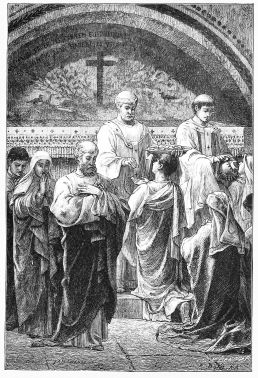
The Blessed Eucharist, in the Early Ages of the
Church.
reverently folded, and laid in the bosom, wrapped up often in another
and more precious covering, or even placed in a gold locket.[147] It was
now that, for the first time, poor Syra regretted the loss of her rich
embroidered scarf, which would long before have been given to the poor,
had she not studiously reserved it for such an occasion, and such a use.
Nor had her mistress been able to prevail upon her to accept any objects
of value, without a stipulation that she might dispose of them as she
liked, that was in charitable gifts.
The various assemblies had broken up before the discovery of the
violated edict. But they may rather be said to have adjourned to the
cemeteries. The frequent meetings of Torquatus with his two heathen
confederates in the baths of Caracalla had been narrowly watched by the
capsarius and his wife, as we have already remarked; and Victoria had
overheard the plot to make an inroad into the cemetery of Callistus on
the day after publication. The Christians, therefore, considered
themselves safer the first day, and took advantage of the circumstance
to inaugurate, by solemn offices, the churches of the catacombs, which,
after some years’ disuse, had been put into good repair and order by the
fossores, had been in some places repainted, and furnished with all
requisites for divine worship.
But Corvinus, after getting over his first dismay, and having as
speedily as possible another, though not so grand, a copy of the edict
affixed, began better to see the dismal probabilities of serious
consequences from the wrath of his imperial master. The Dacian was
right: he would have to answer for the loss. He felt it necessary to
do something that very day, which might wipe off the disgrace he had
incurred, before again meeting the emperor’s look. He determined to
anticipate the attack on the cemetery, intended for the following day.
He repaired, therefore, while it was still early, to the baths, where
Fulvius, ever jealously watchful over Torquatus, kept him in expectation
of Corvinus’s coming to hold council with them. The worthy trio
concerted their plans. Corvinus, guided by the reluctant apostate, at
the head of a chosen band of soldiers who were at his disposal, had to
make an incursion into the cemetery of Callistus, and drive, or drag,
thence the clergy and principal Christians; while Fulvius, remaining
outside with another company, would intercept them and cut off all
retreat, securing the most important prizes, and especially the Pontiff
and superior clergy, whom his visit to the ordination would enable him
to recognize. This was his plan. “Let fools,” he said to himself, “act
the part of ferrets in the warren; I will be the sportsman outside.”
In the meantime Victoria overheard sufficient to make her very busy
dusting and cleaning, in the retired room where they were consulting,
without appearing to listen. She told all to Cucumio; and he, after much
scratching of his head, hit upon a notable plan for conveying the
discovered information to the proper quarter.
Sebastian, after his early attendance on divine worship, unable, from
his duties at the palace to do more, had proceeded, according to almost
universal custom, to the baths, to invigorate his limbs by their healthy
refreshment, and also to remove from himself the suspicion, which his
absence on that morning might have excited. While he was thus engaged,
the old capsararius, as he had had himself rattlingly called in his
ante-posthumous inscription, wrote on a slip of parchment all that his
wife had heard about the intention of an immediate assault, and of
getting possession of the holy Pontiff’s person. This he fastened with a
pin or needle to the inside of Sebastian’s tunic, of which he had
charge, as he durst not speak to him in the presence of others.
The officer, after his bath, went into the hall where the events of the
morning were being discussed, and where Fulvius was waiting, till
Corvinus should tell him that all was ready. Upon going out, disgusted,
he felt himself, as he walked, pricked by something on his chest: he
examined his garments, and found the paper. It was written in about as
elegant a latinity as Cucumio’s epitaph, but he made it out sufficiently
to consider it necessary for him to turn his steps towards the Via
Appia, instead of the Palatine, and convey the important information to
the Christians assembled in the cemetery.
Having, however, found a fleeter and surer messenger than himself, in
the poor blind girl, who would not attract the same attention, he
stopped her, gave her the note, after adding a few words to it, with the
pen and ink which he carried, and bade her bear it, as speedily as
possible, to its destination. But, in fact, he had hardly left the
baths, when Fulvius received information that Corvinus and his troop
were by that time hastening across the fields, so as to avoid suspicion,
towards the appointed spot. He mounted his horse immediately, and went
along the high-road; while the Christian soldier, in a by-way, was
instructing his blind messenger.
When we accompanied Diogenes and his party through the catacombs, we
stopped short of the subterranean church, because Severus would not let
it be betrayed to Torquatus. In this the Christian congregation was now
assembled, under its chief pastor. It was constructed on the principle
common to all such excavations, for we can hardly call them edifices.
The reader may imagine two of the cubicula or chambers, which we have
before described, placed one on each side of a gallery or passage, so
that their doors, or rather wide entrances, are opposite one another. At
the end of one will be found an arcosolium or altar-tomb: and the
probable conjecture is, that in this division the men, under charge of
the ostiarii,[148] and in the other the women, under the care of the
deaconesses, were assembled. This division of the sexes at divine
worship was a matter of jealous discipline in the early Church.
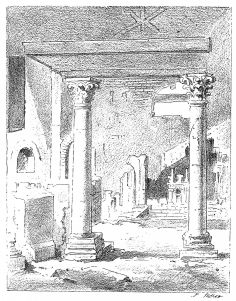
Ruins of the basilica of St. Alexander, on the Nomentan
Way. From Roller’s “Catacombes de Rome.”
Often these subterranean churches were not devoid of architectural
decoration. The walls, especially near the altar, were plastered and
painted, and half columns, with their bases and capitals, not
ungracefully cut out of the sandstone, divided
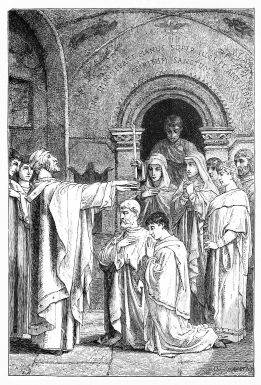
Confirmation, in the Early Ages of the Church.
the different parts or ornamented the entrances. In one instance, indeed
in the chief basilica yet discovered in the cemetery of Callistus, there
is a chamber without any altar, communicating with the church by means
of a funnel-shaped opening, piercing the earthen wall, here some twelve
feet thick, and entering the chamber, which is at a lower level, at the
height of five or six feet, in a slanting direction; so that all that
was spoken in the church could be heard, yet nothing that was done there
could be seen, by those assembled in the chamber. This is very naturally
supposed to have been the place reserved for the class of public
penitents called audientes or hearers, and for the catechumens, not
yet initiated by baptism.
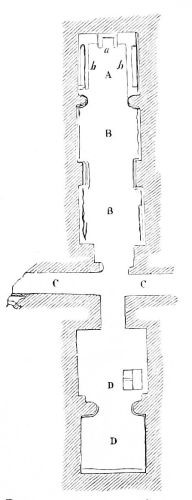
Plan of subterranean Church in the Cemetery of St. Agnes.
A. Choir, or chancel, with episcopal chair (a) and benches for the
clergy (b b).
B. Division for the men, separated from the choir by two pillars,
supporting an arch.
C. Corridor of the catacomb, affording entrance to the church.
D. Division for the women, with a tomb in it.
Each portion is subdivided by projections in the wall.
The basilica, in which the Christians were assembled, when Sebastian
sent his message, was like the one discovered in the cemetery of St.
Agnes. Each of the two divisions was double, that is, consisted of two
large chambers, slightly separated by half-columns, in what we may call
the women’s church, and by flat pilasters in the men’s, one of these
surfaces having in it a small niche for an image or lamp. But the most
remarkable feature of this basilica is a further prolongation of the
structure, so as to give it a chancel or presbytery. This is about the
size of half each other division, from which it is separated by two
columns against the wall, as well as by its lesser height, after the
manner of modern chancels. For while each portion of each division has
first a lofty-arched tomb in its wall, and four or five tiers of graves
above it, the elevation of the chancel is not much greater than that of
those arcosolia or altar-tombs. At the end of the chancel, against the
middle of the wall, is a chair with back and arms cut out of the solid
stone, and from each side proceeds a stone bench, which thus occupies
the end and two sides of the chancel. As the table of the arched-tomb
behind the chair is higher than the back of the throne, and as this is
immovable, it is clear that the divine mysteries could not have been
celebrated upon it. A portable altar must, therefore, have been placed
before the throne, in an isolated position in the middle of the
sanctuary: and this, tradition tell us, was the wooden altar of St.
Peter.
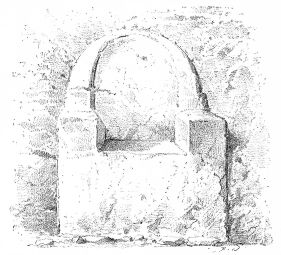
A Cathedra or Episcopal Chair in the Catacomb of Saint
Agnes.
We have thus the exact arrangements to be found in the churches built
after the peace, and yet to be seen in all the ancient basilicas in
Rome—the episcopal chair in the centre of the apse, the presbytery or
seat for the clergy on either hand, and the altar between the throne and
the people. The early Christians thus anticipated underground, or rather
gave the principles which directed, the forms of ecclesiastical
architecture.
It was in such a basilica, then, that we are to imagine the faithful
assembled, when Corvinus and his satellites arrived at the entrance of
the cemetery. This was the way which Torquatus knew, leading down by
steps from a half-ruinous building, choked up with faggots. They found
the coast clear, and immediately made their arrangements. Fulvius, with
one body of ten or twelve men, lurked to guard the entrance, and seize
all who attempted to come out or go in. Corvinus, with Torquatus and a
smaller body of eight, prepared to descend.
“I don’t like this underground work,” said an old, grey-bearded
legionary. “I am a soldier, and not a rat-catcher. Bring me my man into
the light of day, and I will fight him hand to hand, and foot to foot;
but I have no love for being stifled or poisoned, like vermin in a
drain.”
This speech found favor with the soldiers. One said, “There may be
hundreds of these skulking Christians down there, and we are little more
than half a dozen.”
“This is not the sort of work we receive our pay for,” added another.
“It’s their sorceries I care for,” continued a third, “and not their
valor.”
It required all the eloquence of Fulvius to screw up their resolution.
He assured them there was nothing to fear; that the cowardly Christians
would run before them like hares, and that they would find more gold and
silver in the church than a year’s pay would give them. Thus encouraged,
they went groping down to the bottom of the stairs. They could
distinguish lamps at intervals, stretching into the gloomy length before
them.
“Hush!” said one, “listen to that voice!”
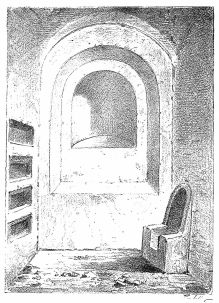
An Altar with its Episcopal Chair, in the Cemetery of
Saint Agnes.
From far away its accents came, softened by distance, but they were the
notes of a fresh youthful voice, that quailed not with fear; so clear,
that the very words could be caught, as it intoned the following verses:
“Dominus illuminatio mea, et salus mea; quem timebo?
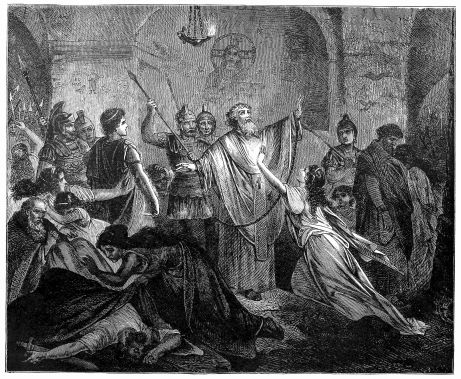
An Attack in the Catacombs.
“Dominus protector vitæ meæ; a quo trepidabo?”[149]
Then came a full chorus of voices, singing, like the sound of many
waters:
“Dum appropriant super me nocentes, ut edant carnes meas; qui tribulant
me, inimici mei, ipsi infirmati sunt et ceciderunt.”[150]
A mixture of shame and anger seized on the assailants as they heard
these words of calm confidence and defiance. The single voice again sang
forth, but in apparently fainter accents:
“Si consistant adversum me castra, non timebit cor meum.”[151]
“I thought I knew that voice,” muttered Corvinus. “I ought to know it
out of a thousand. It is that of my bane, the cause of all last night’s
curse and this day’s trouble. It is that of Pancratius, who pulled down
the edict. On, on, my men; any reward for him, dead or alive!”
“But, stop,” said one, “let us light our torches.”
“Hark!” said a second, while they were engaged in this operation; “what
is that strange noise, as if of scratching and hammering at a distance?
I have heard it for some time.”
“And, look!” added a third; “the distant lights have disappeared, and
the music has ceased. We are certainly discovered.”
“No danger,” said Torquatus, putting on a boldness which he did not
feel. “That noise only comes from those old moles, Diogenes and his
sons, busy preparing graves for the Christians we shall seize.”
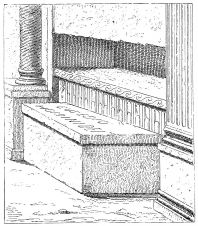
An Altar in the Cemetery of St. Sixtus.
Torquatus had in vain advised the troop not to bring torches, but to
provide themselves with such lamps as we see Diogenes represented
carrying, in his picture, or waxen tapers, which he had brought for
himself; but the men swore they would not go down without plenty of
light, and such means for it as could not be put out by a draught of
wind, or a stroke on the arm. The effects were soon obvious. As they
advanced, silently and cautiously, along the low narrow gallery, the
resinous torches crackled and hissed with a fierce glare, which heated
and annoyed them; while a volume of thick pitchy smoke from each rolled
downwards on to the bearers from the roof, half stifled them, and made a
dense atmosphere of cloud around themselves, which effectually dimmed
their light. Torquatus kept at the head of the party, counting every
turning right and left, as he had noted them; though he found every
mark which he had made carefully removed. He was staggered and baulked,
when, after having counted little more than half the proper number, he
found the road completely blocked up.
The fact was, that keener eyes than he was aware of had been on the
look-out. Severus had never relaxed his watchfulness, determined not to
be surprised. He was near the entrance to the cemetery below, when the
soldiers reached it above; and he ran forward at once to the place where
the sand had been prepared for closing the road; near which his brother
and several other stout workmen were stationed, in case of danger. In a
moment, with that silence and rapidity to which they were trained, they
set to work lustily, shovelling the sand across the narrow and low
corridor from each side, while well-directed blows of the pick brought
from the low roof behind, huge flakes of sandstone, which closed up the
opening. Behind this barrier they stood, hardly suppressing a laugh as
they heard their enemies through its loose separation. Their work it was
which had been heard, and which had screened off the lights, and
deadened the song.
Torquatus’s perplexity was not diminished by the volley of oaths and
imprecations, and the threats of violence which were showered upon him,
for a fool or a traitor. “Stay one moment, I entreat you,” he said. “It
is possible I have mistaken my reckoning. I know the right turn by a
remarkable tomb a few yards within it; I will just step into one or two
of the last corridors, and see.”
With these words, he ran back to the next gallery on the left, advanced
a few paces, and totally disappeared.
Though his companions had followed him to the very mouth of the gallery,
they could not see how this happened. It appeared like witchcraft, in
which they were quite ready to believe. His light and himself seemed to
have vanished at once. “We will have no more of this work,” they said;
“either Torquatus is a traitor, or he has been carried off by magic.”
Worried, heated in the close atmosphere, almost inflamed by their
lights, begrimed, blinded, and choked by the pitchy smoke, crest-fallen
and disheartened, they turned back; and since their road led straight to
the entrance, they flung away their blazing torches into the side
galleries, one here and one there, as they passed by, to get rid of
them. When they looked back, it seemed as if a triumphal illumination
was kindling up the very atmosphere of the gloomy corridor. From the
mouths of the various caverns came forth a fiery light which turned the
dull sandstone into a bright crimson; while the volumes of smoke above,
hung like amber clouds along the whole gallery. The sealed tombs,
receiving the unusual reflection on their yellow tiles, or marble slabs,
appeared covered with golden or silver plates, set in the red damask of
the walls. It looked like a homage paid to martyrdom, by the very furies
of heathenism, on the first day of persecution. The torches which they
had kindled to destroy, only served to shed brightness on monuments of
that virtue which had never failed to save the Church.
But before these foiled hounds with drooping heads had reached the
entrance, they recoiled before the sight of a singular apparition. At
first they thought they had caught a glimpse of daylight; but they soon
perceived it was the glimmering of a lamp. This was held steadily by an
upright, immovable figure, which thus received its light upon itself. It
was clothed in a dark dress, so as to resemble one of those bronze
statues, which have the head and extremities of white marble, and
startle one, when first seen; so like are they to living forms.
“Who can it be? What is it?” the men whispered to one another.
“A sorceress,” replied one.
“The genius loci,”[152] observed another.
“A spirit,” suggested a third.
Still, as they approached stealthily towards it, it did not appear
conscious of their presence: “there was no speculation in its eyes;” it
remained unmoved and unscared. At length, two got sufficiently near to
seize the figure by its arms.
“Who are you?” asked Corvinus, in a rage.
“A Christian,” answered Cæcilia, with her usual cheerful gentleness.
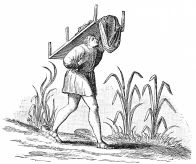
The Cure of the Man born Blind, from a picture in the
Catacombs.
“Bring her along,” he commanded; “some one at least shall pay for our
disappointment.”
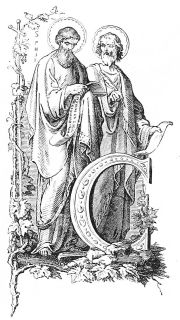 ÆCILIA, already forewarned, had approached the cemetery by a different,
but neighboring entrance. No sooner had she descended than she snuffed
the strong odor of the torches. “This is none of our incense, I know,”
she said to herself; “the enemy is already within.” She hastened
therefore to the place of assembly and delivered Sebastian’s note;
adding also what she had observed. It warned them to disperse and seek
the shelter of the inner and lower galleries; and begged of the Pontiff
not to leave till he should send for him, as his person was particularly
sought for.
Pancratius urged the blind messenger to save herself too. “No,” she
replied, “my office is to watch the door, and guide the faithful safe.”
“But the enemy may seize you.”
“No matter,” she answered, laughing; “my being taken may save much
worthier lives. Give me a lamp, Pancratius.”
“Why, you cannot see by it,” observed he, smiling.
“True, but others can.”
“They may be your enemies.”
“Even so,” she answered, “I do not wish to be taken in the dark. If my
Bridegroom come to me in the night of this cemetery, must He not find
me with my lamp trimmed?”
Off she started, reached her post, and hearing no noise except that of
quiet footsteps, she thought they were those of friends, and held up her
lamp to guide them.
When the party came forth, with their only captive, Fulvius was
perfectly furious. It was worse than a total failure: it was
ridiculous—a poor mouse come out of the bowels of the earth. He rallied
Corvinus till the wretch winced and foamed; then suddenly he asked, “And
where is Torquatus?” He heard the account of his sudden disappearance,
told in as many ways as the Dacian guard’s adventure: but it annoyed him
greatly. He had no doubt whatever, in his own mind, that he had been
duped by his supposed victim, who had escaped into the unsearchable
mazes of the cemetery. If so, this captive would know, and he determined
to question her. He stood before her, therefore, put on his most
searching and awful look, and said to her sternly, “Look at me, woman,
and tell me the truth.”
“I must tell you the truth without looking at you, sir,” answered the
poor girl, with her cheerfullest smile and softest voice; “do you not
see that I am blind?”
“Blind!” all exclaimed at once, as they crowded to look at her. But over
the features of Fulvius there passed the slightest possible emotion,
just as much as the wave that runs, pursued by a playful breeze, over
the ripe meadow. A knowledge had flashed into his mind, a clue had
fallen into his hand.
“It will be ridiculous,” he said, “for twenty soldiers to march through
the city, guarding a blind girl. Return to your quarters, and I will see
you are well rewarded. You, Corvinus, take my horse, and go before to
your father, and tell him all, I will follow in a carriage with the
captive.”
“No treachery, Fulvius,” he said, vexed and mortified. “Mind you bring
her. The day must not pass without a sacrifice.”
“Do not fear,” was the reply.
Fulvius, indeed, was pondering whether, having lost one spy, he should
not try to make another. But the placid gentleness of the poor beggar
perplexed him more than the boisterous zeal of the gamester, and her
sightless orbs defied him more than the restless roll of the toper’s.
Still, the first thought that had struck him he could yet pursue. When
alone in a carriage with her, he assumed a soothing tone, and addressed
her. He knew she had not overheard the last dialogue.
“My poor girl,” he said, “how long have you been blind?”
“All my life,” she replied.
“What is your history? Whence do you come?”
“I have no history. My parents were poor, and brought me to Rome when I
was four years old, as they came to pray, in discharge of a vow made for
my life in early sickness, to the blessed martyrs Chrysanthus and Daria.
They left me in charge of a pious lame woman, at the door of the title
of Fasciola, while they went to their devotions. It was on that
memorable day, when many Christians were buried at their tomb, by earth
and stones cast down upon them. My parents had the happiness to be of
the number.”
“And how have you lived since?”
“God became my only Father then, and His Catholic Church my mother. The
one feeds the birds of the air, the other nurses the weaklings of the
flock. I have never wanted for any thing since.”
“But you can walk about the streets freely, and without fear, as well as
if you saw.”
“How do you know that?”
“I have seen you. Do you remember very early one morning in the autumn,
leading a poor lame man along the Vicus Patricius?”
She blushed and remained silent. Could he have seen her put into the
poor old man’s purse her own share of the alms?
“You have owned yourself a Christian?” he asked negligently.
“Oh, yes! how could I deny it?”
“Then that meeting was a Christian meeting?”
“Certainly; what else could it be?”
He wanted no more; his suspicions were verified. Agnes, about whom
Torquatus had been able or willing to tell him nothing, was certainly a
Christian. His game was made. She must yield, or he would be avenged.
After a pause, looking at her steadfastly, he said, “Do you know whither
you are going?”
“Before the judge of earth, I suppose, who will send me to my Spouse in
heaven.”
“And so calmly?” he asked in surprise; for he could see no token from
the soul to the countenance, but a smile.
“So joyfully rather,” was her brief reply.
Having got all that he desired, he consigned his prisoner to Corvinus at
the gates of the Æmilian basilica, and left her to her fate. It had been
a cold and drizzling day like the preceding evening. The weather, and
the incident of the night, had kept down all enthusiasm; and while the
prefect had been compelled to sit in-doors, where no great crowd could
collect, as hours had passed away without any arrest, trial, or tidings,
most of the curious had left, and only a few more persevering remained,
past the hour of afternoon recreation in the public gardens. But just
before the captive arrived, a fresh knot of spectators came in, and
stood near one of the side-doors, from which they could see all.
As Corvinus had prepared his father for what he was to expect,
Tertullus, moved with some compassion, and imagining there could be
little difficulty in overcoming the obstinacy of a poor, ignorant, blind
beggar, requested the spectators to remain perfectly still, that he
might try his persuasion on her, alone, as she would imagine, with him;
and he threatened heavy penalties on any one who should presume to break
the silence.
It was as he had calculated. Cæcilia knew not that any one else was
there, as the prefect thus kindly addressed her:
“What is thy name, child?”
“Cæcilia.”
“It is a noble name; hast thou it from thy family?”
“No; I am not noble; except because my parents, though poor, died for
Christ. As I am blind, those who took care of me called me Cæca,[153]
and then, out of kindness, softened it into Cæcilia.”
“But now, give up all this folly of the Christians, who have kept thee
only poor and blind. Honor the decrees of the divine emperors, and offer
sacrifice to the gods; and thou shalt have riches, and fine clothes, and
good fare; and the best physicians shall try to restore thee thy sight.”
“You must have better motives to propose to me than these; for the very
things for which I most thank God and His Divine Son, are those which
you would have me put away.”
“How dost thou mean?”
“I thank God that I am poor and meanly clad, and fare not daintily;
because by all these things I am the more like Jesus Christ, my only
Spouse.”
“Foolish girl!” interrupted the judge, losing patience a little; “hast
thou learnt all these silly delusions already? at least thou canst not
thank thy God that He has made thee sightless.”
“For that, more than all the rest, I thank Him daily and hourly with all
my heart.”
“How so? dost thou think it a blessing never to have seen the face of a
human being, or the sun, or the earth? What strange fancies are these?”
“They are not so, most noble sir. For in the midst of what you call
darkness, I see a spot of what I must call light, it contrasts so
strongly with all around. It is to me what the sun is to you, which I
know to be local from the varying direction of its rays. And this object
looks upon me as with a countenance of intensest beauty, and smiles upon
me ever. And I know it to be that of Him whom I love with undivided
affection. I would not for the world have its splendor dimmed by a
brighter sun, nor its wondrous loveliness confounded with the
diversities of others’ features, nor my gaze on it drawn aside by
earthly visions. I love Him too much not to wish to see Him always
alone.”
“Come, come! let me have no more of this silly prattle. Obey the
emperors at once, or I must try what a little pain will do. That will
soon tame thee.”
“Pain?” she echoed innocently.
“Yes, pain. Hast thou never felt it? hast thou never been hurt by any
one in thy life?”
“Oh, no! Christians never hurt one another.”
The rack was standing, as usual, before him; and he made a sign to
Catulus to place her upon it. The executioner pushed her back on it by
her arms; and as she made no resistance, she was easily laid extended on
its wooden couch. The loops of the ever-ready ropes were in a moment
passed round her ankles, and arms drawn over the head. The poor
sightless girl saw not who did all this; she knew not but it might be
the same person who had been conversing with her. If there had been
silence hitherto, men now held their very breath; while Cæcilia’s lips
moved in earnest prayer.
“Once more, before proceeding further, I call on thee to sacrifice to
the gods, and escape cruel torments,” said the judge, with a sterner
voice.
“Neither torments nor death,” firmly replied the victim tied to the
altar, “shall separate me from the love of Christ. I can offer up no
sacrifice but to the one living God: and its ready oblation is myself.”
The prefect made a signal to the executioner, and he gave one rapid
whirl to the two wheels of the rack, round the windlasses of which the
ropes were wound; and the limbs of the maiden were stretched with a
sudden jerk, which, though not enough to wrench them from their sockets,
as a further turn would have done, sufficed to inflict an excruciating,
or more truly, a racking pain, through all her frame. Far more
grievous was this, from the preparation and the cause of it being
unseen, and from that additional suffering which darkness inflicts. A
quivering of her features and a sudden paleness alone gave evidence of
her torture.
“Ha! ha!” the judge exclaimed, “thou feelest that? Come, let it suffice;
obey, and thou shalt be freed.”
She seemed to take no heed of his words, but gave vent to her feelings
in prayer: “I thank Thee, O Lord Jesus Christ, that Thou hast made me
suffer pain the first time for Thy sake. I have loved Thee in peace; I
have loved Thee in comfort; I have loved Thee in joy,—and now in pain I
love Thee still more. How much sweeter it is to be like Thee, stretched
upon Thy Cross, even than resting upon the hard couch at the poor man’s
table!”
“Thou triflest with me,” exclaimed the judge, thoroughly vexed, “and
makest light of my lenity. We will try something stronger. Here,
Catulus, apply a lighted torch to her sides.”[154]
A thrill of disgust and horror ran through the assembly, which could not
help sympathizing with the poor blind creature. A murmur of suppressed
indignation broke out from all sides of the hall.
Cæcilia, for the first time, learnt that she was in the midst of a
crowd. A crimson glow of modesty rushed into her brow, her face, and
neck, just before white as marble. The angry judge checked the rising
gush of feeling; and all listened in silence, as she spoke again, with
warmer earnestness than before:
“O my dear Lord and Spouse! I have been ever true and faithful to Thee!
Let me suffer pain and torture for Thee; but spare me confusion from
human eyes. Let me come to Thee at once; not covering my face with my
hands in shame when I stand before Thee.”
Another muttering of compassion was heard.
“Catulus!” shouted the baffled judge in fury; “do your duty, sirrah!
what are you about, fumbling all day with that torch?”
The executioner advanced, and stretched forth his hand to her robe, to
withdraw it for the torture; but he drew back, and, turning to the
prefect, exclaimed in softened accents:
“It is too late. She is dead!”
“Dead!” cried out Tertullus; “dead with one turn of the wheel?
impossible!”
Catulus gave the rack a turn backwards, and the body remained
motionless. It was true; she had passed from the rack to the throne,
from the scowl of the judge’s countenance to her Spouse’s welcoming
embrace. Had she breathed out her pure soul, as a sweet perfume, in the
incense of her prayer? or had her heart been unable to get back its
blood, from the intensity of that first virginal blush?[155]
In the stillness of awe and wonder, a clear bold voice cried out, from
the group near the door: “Impious tyrant, dost thou not see, that a poor
blind Christian hath more power over life and death, than thou or thy
cruel masters?”
“What! a third time in twenty-four hours wilt thou dare to cross my
path? This time thou shalt not escape.”
These were Corvinus’s words, garnished with a furious imprecation, as he
rushed from his father’s side round the enclosure before the tribunal,
towards the group. But as he ran blindly on, he struck against an
officer of herculean build, who, no doubt quite accidentally, was
advancing from it. He reeled, and the soldier caught hold of him,
saying:
“You are not hurt, I hope, Corvinus?”
“No, no; let me go, Quadratus, let me go.”
“Where are you running to in such a hurry? can I help you?” asked his
captor, still holding him fast.
“Let me loose, I say, or he will be gone.”
“Who will be gone?”
“Pancratius,” answered Corvinus, “who just now insulted my father.”
“Pancratius!” said Quadratus, looking round, and seeing that he had got
clear off; “I do not see him.” And he let him go; but it was too late.
The youth was safe at Diogenes’s, in the Suburra.
While this scene was going on, the prefect, mortified, ordered Catulus
to see the body thrown into the Tiber. But another officer, muffled in
his cloak, stepped aside and beckoned to Catulus, who understood the
sign, and stretched out his hand to receive a purse held out to him.
“Out of the Porta Capena, at Lucina’s villa, an hour after sunset,” said
Sebastian.
“It shall be delivered there safe,” said the executioner.
“Of what do you think did that poor girl die?” asked a spectator from
his companion, as they went out.
“Of fright, I fancy,” he replied.
“Of Christian modesty,” interposed a stranger who passed them.
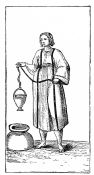
The Woman of Samaria, from a picture in the Cemetery of
St. Domitilla.
 HE prefect of the city went to give his report on the untoward events
of the day, and do what was possible to screen his worthless son. He
found the emperor in the worst of moods. Had Corvinus come in his way
early in the day, nobody could have answered for his head. And now the
result of the inroad into the cemetery had revived his anger, when
Tertullus entered into the audience-chamber. Sebastian contrived to be
on guard.
“Where is your booby of a son?” was the first salutation which the
prefect received.
“Humbly waiting your divinity’s pleasure outside, and anxious to
propitiate your godlike anger, for the tricks which fortune has played
upon his zeal.”
“Fortune!” exclaimed the tyrant; “fortune indeed! His own stupidity and
cowardice: a pretty beginning, forsooth; but he shall smart for it.
Bring him in.”
The wretch, whining and trembling, was introduced; and cast himself at
the emperor’s feet, from which he was spurned, and sent rolling, like a
lashed hound, into the midst of the hall. This set the imperial divinity
a-laughing, and helped to mollify its wrath.
“Come, sirrah! stand up,” he said, “and let me hear an account of
yourself. How did the edict disappear?”
Corvinus told a rambling tale, which occasionally amused the emperor;
for he was rather taken with the trick. This was a good symptom.
“Well,” he said at last, “I will be merciful to you. Lictors, bind your
fasces.” They drew their axes forth, and felt their edges. Corvinus
again threw himself down, and exclaimed:
“Spare my life; I have important information to furnish, if I live.”
“Who wants your worthless life?” responded the gentle Maximian.
“Lictors, put aside your axes; the rods are good enough for him.”
In a moment his hands were seized and bound, his tunic was stripped off
his shoulders, and a shower of blows fell upon them, delivered with
well-regulated skill, till he roared and writhed, to the great enjoyment
of his imperial master.
Smarting and humbled, he had to stand again before him.
“Now, sir,” said the latter, “what is the wonderful information you have
to give?”
“That I know who perpetrated the outrage of last night, on your imperial
edict.”
“Who was it?”
“A youth named Pancratius, whose knife I found under where the edict had
been cut away.”
“And why have you not seized him and brought him to justice?”
“Twice this day he has been almost within my grasp, for I have heard his
voice; but he has escaped me.”
“Then let him not escape a third time, or you may have to take his
place. But how do you know him, or his knife?”
“He was my school-fellow at the school of Cassianus, who turned out to
be a Christian.”
“A Christian presume to teach my subjects, to make them enemies of their
country, disloyal to their sovereigns, and contemners of the gods! I
suppose it was he who taught that young viper Pancratius to pull down
our imperial edict. Do you know where he is?”
“Yes, sire; Torquatus, who has abandoned the Christian superstition, has
told me.”
“And pray who is this Torquatus?”
“He is one who has been staying some time with Chromatius and a party of
Christians in the country.”
“Why, this is worse and worse. Is the ex-prefect then, too, become a
Christian?”
“Yes, and lives with many others of that sect in Campania.”
“What perfidy! what treachery! I shall not know whom to trust next.
Prefect, send some one immediately to arrest all these men, and the
school-master, and Torquatus.”
“He is no longer a Christian,” interposed the judge.
“Well, what do I care?” replied the emperor peevishly; “arrest as many
as you can, and spare no one, and make them smart well; do you
understand me? Now begone, all; it is time for my supper.”
Corvinus went home; and, in spite of medicinal applications, was
feverish, sore, and spiteful all night; and next morning begged his
father to let him go on the expedition into Campania, that so he might
retrieve his honor, gratify his revenge, and escape the disgrace and
sarcasm that was sure to be heaped on him by Roman society.
When Fulvius had deposited his prisoner at the tribunal, he hastened
home to recount his adventures, as usual, to Eurotas. The old man
listened with imperturbable sternness to the barren recital, and at last
said, coldly:
“Very little profit from all this, Fulvius.”
“No immediate profit, indeed; but a good prospect in view, at least.”
“How so?”
“Why, the Lady Agnes is in my power. I have made sure, at last, that
she is a Christian. I can now necessarily either win her or destroy her.
In either case her property is mine.”
“Take the second alternative,” said the old man, with a keen glow in his
eye, but no change of face; “it is the shorter, and less troublesome,
way.”
“But my honor is engaged; I cannot allow myself to be spurned in the
manner I told you.”
“You have been spurned, however; and that calls for vengeance. You
have no time to lose, remember, in foolery. Your funds are nearly
exhausted, and nothing is coming in. You must strike a blow.”
“Surely, Eurotas, you would prefer my trying to get this wealth by
honorable,” (Eurotas smiled at the idea coming into either of their
minds) “rather than by foul, means.”
“Get it, get it any way, provided it be the surest and the speediest.
You know our compact. Either the family is restored to wealth and
splendor, or it ends in and with you. It shall never linger on in
disgrace, that is, in poverty.”
“I know, I know, without your every day reminding me of the bitter
condition,” said Fulvius, wringing his hands, and writhing in all his
body. “Give me time enough, and all will be well.”
“I give you time, till all is hopeless. Things do not look bright at
present. But, Fulvius, it is time that I tell you who I am.”
“Why, were you not my father’s faithful dependant, to whose care he
intrusted me?”
“I was your father’s elder brother, Fulvius, and am the head of the
family. I have had but one thought, but one aim in life, the restoring
of our house to that greatness and splendor, from which my father’s
negligence and prodigality had brought it down. Thinking that your
father, my brother, had greater ability than myself for this work, I
resigned my rights and gains to him upon certain terms; one of which
was your guardianship, and the exclusive forming of your mind. You know
how I have trained you, to care nothing about the means, so that our
great ends be carried.”
Fulvius, who had been riveted with amazement and deep attention on the
speaker, shrunk into himself with shame, at this baring of both their
hearts. The dark old man fixed his eyes more intently than ever, and
went on:
“You remember the black and complicated crime by which we concentrated
in your hands the divided remnant of family wealth.”
Fulvius covered his face with his hands and shuddered, then said
entreatingly, “Oh, spare me that, Eurotas; for heaven’s sake spare me!”
“Well, then,” resumed the other, unmoved as ever, “I will be brief.
Remember, nephew, that he who does not recoil from a brilliant future,
to be gained by guilt, must not shrink from a past that prepared it by
crime. For the future will one day be the past. Let our compact,
therefore, be straightforward and honest, for there is an honesty even
in sin. Nature has given you abundance of selfishness and cunning, and
she has given me boldness and remorselessness in directing and applying
them. Our lot is cast by the same throw,—we become rich, or die,
together.”
Fulvius, in his heart, cursed the day that he came to Rome, or bound
himself to his stern master, whose mysterious tie was so much stronger
than he had known before. But he felt himself spell-bound to him, and
powerless as the kid in the lion’s paws. He retired to his couch with a
heavier heart than ever; for a dark, impending fate never failed to
weigh upon his soul every returning night.
The reader will perhaps be curious to know what has become of the third
member of our worthy trio, the apostate Torquatus. When, confused and
bewildered, he ran to look for the tomb which was to guide him, it so
happened, that, just within the gallery which he entered, was a
neglected staircase, cut in the sandstone, down to a lower story of the
cemetery. The steps had been worn round and smooth, and the descent was
precipitous. Torquatus, carrying his light before him, and running
heedlessly, fell headlong down the opening, and remained stunned and
insensible at the bottom, till long after his companions had retired. He
then revived, and for some time was so confused that he knew not where
he was. He arose and groped about, till, consciousness completely
returning, he remembered that he was in a catacomb, but could not make
out how he was alone and in the dark. It then struck him that he had a
supply of tapers about him, and means of lighting them. He employed
these, and was cheered by finding himself again in light. But he had
wandered from the staircase, of which, indeed, he recollected nothing,
and went on, and on, entangling himself more inextricably in the
subterranean labyrinth.
He felt sure that, before he had exhausted his strength or his tapers,
he should come to some outlet. But by degrees he began to feel serious
alarm. One after the other his lights were burnt out, and his vigor
began to fail, for he had been fasting from early morning; and he found
himself coming back to the same spot, after he had wandered about
apparently for hours. At first he had looked negligently around him, and
had carelessly read the inscriptions on the tombs. But as he grew
fainter, and his hope of relief weaker, these solemn monuments of death
began to speak to his soul, in a language that it could not refuse to
hear, nor pretend to misunderstand. “Deposited in peace,” was the inmate
of one; “resting in Christ” was another; and even the thousand nameless
ones around them reposed in silent calm, each with the seal of the
Church’s motherly care stamped upon his place of rest. And within, the
embalmed remains awaited the sound of angelic trumpet-notes, to awaken
them to a happy resurrection. And he, in a few more hours, would be dead
like them; he was lighting his last taper, and had sunk down upon a heap
of mould; but would he be laid in peace, by pious hands, as they? On the
cold ground, alone, he should die, unpitied, unmourned, unknown. There
he should rot, and drop to pieces; and if, in after years, his bones,
cast out from Christian sepulture, should be found, tradition might
conjecture that they were the accursed remains of an apostate lost in
the cemetery. And even they might be cast out, as he was, from the
communion of that hallowed ground.
It was coming on fast; he could feel it; his head reeled, his heart
fluttered. The taper was getting too short for his fingers, and he
placed it on a stone beside him. It might burn three minutes longer; but
a drop filtering through the ceiling, fell upon it, and extinguished it.
So covetous did he feel of those three minutes more of light, so jealous
was he of that little taper-end, as his last link with earth’s joys, so
anxious was he to have one more look at things without, lest he should
be forced to look at those within, that he drew forth his flint and
steel, and labored for a quarter of an hour to get a light from tinder,
damped by the cold perspiration on his body. And when he had lighted his
remnant of candle, instead of profiting by its flame to look around him,
he fixed his eyes upon it with an idiotic stare, watching it burn down,
as though it were the charm which bound his life, and this must expire
with it. And soon the last spark gleamed smouldering like a glow-worm,
on the red earth, and died.
Was he dead too? he thought. Why not? Darkness, complete and perpetual,
had come upon him. He was cut off for ever from consort with the living,
his mouth would no more taste food, his ears never again hear a sound,
his eyes behold no light, or thing, again. He was associated with the
dead, only his grave was much larger than theirs; but, for all that, it
was as dark and lonely, and closed for ever. What else is death?
No, it could not be death as yet. Death had to be followed by something
else. But even this was coming. The worm was beginning to gnaw his
conscience, and it grew apace to a viper’s length, and twisted itself
round his heart. He tried to think of pleasant things, and they came
before him; the quiet hours in the villa with Chromatius and Polycarp,
their kind words, and last embrace. But from the beautiful vision darted
a withering flash; he had betrayed them; he had told of them; to whom?
To Fulvius and Corvinus. The fatal chord was touched, like the tingling
nerve of a tooth, that darts its agony straight to the centre of the
brain. The drunken debauch, the dishonest play, the base hypocrisy, the
vile treachery, the insincere apostasy, the remorseful sacrileges, of
the last days, and the murderous attempt of that morning, now came
dancing, like demons hand in hand, in the dark before him, shouting,
laughing, jibing, weeping, moaning, gnashing their teeth; and sparks of
fire flying before his eyes, from his enfeebled brain, seemed to dart
from glaring torches in their hands. He sunk down and covered his eyes.
“I may be dead, after all,” he said to himself; “for the infernal pit
can have nothing worse than this.”
His heart was too weak for rage; it sunk within him in the impotence of
despair. His strength was ebbing fast, when he fancied he heard a
distant sound. He put away the thought; but the wave of a remote harmony
beat again upon his ear. He raised himself up; it was becoming distinct.
So sweet it sounded, so like a chorus of angelic voices, but in another
sphere, that he said to himself: “Who would have thought that Heaven was
so near to hell! Or are they accompanying the fearful Judge to try me?”
And now a faint glimmer of light appeared at the same distance as the
sounds; and the words of the strain were clearly heard:
“In pace, in idipsum, dormiam et requiescam.”[156]
“Those words are not for me. They might do at a martyr’s entombment;
they cannot at a reprobate’s burial.”
The light increased; it was like a dawn glowing into day; it entered the
gallery and passed across it, bearing in it, as in a mirror, a vision
too distinct to be unreal. First, there came virgins robed and holding
lamps; then four who carried between them a form wrapped up in a white
linen cloth, with a crown of thorns upon the head; after them the
youthful acolyte Tarcisius bearing a censer steaming with perfumed
smoke; and, after others of the clergy, the venerable Pontiff himself,
attended by Reparatus, and another deacon. Diogenes and his sons, with
sorrowful countenances, and many others, among whom he could distinguish
Sebastian, closed the procession. As many bore lamps or tapers, the
figures seemed to move in an unchanging atmosphere of mildest light.
And as they passed before him, they chanted the next verse of the psalm:
“Quoniam Tu Domine singulariter in spe constituisti me.”[157]
“That,” he exclaimed, rousing himself up, “that is for me.”
With this thought he had sprung upon his knees; and by an instinct of
grace words which he had before heard came back to him like an echo;
words suited to the moment; words which he felt that he must speak. He
crept forward, faint and feeble, turned along the gallery through which
the funeral procession was passing, and followed it, unobserved, at a
distance. It entered a chamber and lighted it up, so that a picture
of the Good Shepherd looked brightly down on him. But he would not pass
the threshold, where he stood striking his breast and praying for mercy.
The body had been laid upon the ground, and other psalms and hymns were
sung, and prayers recited, all in that cheerful tone and joyous mood of
hopefulness, with which the Church has always treated of death. At
length it was placed in the tomb prepared for it, under an arch. While
this was being done, Torquatus drew nigh to one of the spectators, and
whispered to him the question:
“Whose funeral is this?”
“It is the deposition,” he answered, “of the blessed Cæcilia, a blind
virgin, who this morning fell into the hands of the soldiers, in this
cemetery, and whose soul God took to Himself.”
“Then I am her murderer,” he exclaimed, with a hollow moan; and
staggering forward to the holy bishop’s feet, fell prostrate before him.
It was some time before his feelings could find vent in words; when
these came, they were the ones he had resolved to utter:
“Father, I have sinned before heaven, and against Thee, and I am not
worthy to be called Thy child.”
The Pontiff raised him up kindly, and pressed him to his bosom, saying,
“Welcome back, my son, whoever thou art, to thy Father’s house. But thou
art weak and faint, and needest rest.”
Some refreshment was immediately procured. But Torquatus would not rest
till he had publicly avowed the whole of his guilt, including the day’s
crimes; for it was still the evening of the same day. All rejoiced at
the prodigal’s return, at the lost sheep’s recovery. Agnes looked up to
heaven from her last affectionate glance on the blind virgin’s shroud,
and thought that she could almost see her seated at the feet of her
Spouse, smiling, with her eyes wide open, as she cast down a handful of
flowers on the head of the penitent, the first-fruits of her
intercession in heaven.
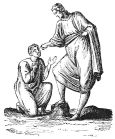
Jesus cures the Blind Man, from a picture in the Cemetery
of St. Domitilla.
Diogenes and his sons took charge of him. An humble lodging was procured
for him, in a Christian cottage near, that he might not be within the
reach of temptation, or of vengeance, and he was enrolled in the class
of penitents, where years of expiation, shortened by the intercession of
confessors—that is, future martyrs—would prepare him for full
re-admission to the privileges he had forfeited.[158]
 EBASTIAN’S visit to the cemetery had been not merely to take thither
for sepulture the relics of the first martyr, but also to consult with
Marcellinus about his safety. His life was too valuable to the Church to
be sacrificed so early, and Sebastian knew how eagerly it was sought.
Torquatus now confirmed this, by communicating Fulvius’s designs, and
the motive of his attendance at the December ordination. The usual papal
residence was no longer safe; and a bold idea had been adopted by the
courageous soldier,—the “Protector of the Christians,” as his acts tell
us he had been authoritatively called. It was to lodge the Pontiff where
no one could suspect him to be, and where no search would be dreamt of,
in the very palace of the Cæsars.[159] Efficiently disguised, the holy
Bishop left the cemetery, and, escorted by Sebastian and Quadratus, was
safely housed in the apartments of Irene, a Christian lady of rank, who
lived in a remote part of the Palatine, in which her husband held a
household office.
Early next morning Sebastian was with Pancratius. “My dear boy,” he
said, “you must leave Rome instantly, and go into Campania. I have
horses ready for you and Quadratus; and there is no time to be lost.”
“And why, Sebastian?” replied the youth, with sorrowful face and tearful
eye. “Have I done something wrong, or are you doubtful of my fortitude?”
“Neither, I assure you. But you have promised to be guided by me in all
things, and I never considered your obedience more necessary than now.”
“Tell me why, good Sebastian, I pray.”
“It must be a secret as yet.”
“What, another secret?”
“Call it the same, to be revealed at the same time. But I can tell you
what I want you to do, and that I think will satisfy you. Corvinus has
got orders to seize on Chromatius and all his community, yet young in
the faith, as the wretched example of Torquatus has shown us; and, what
is worse, to put your old master Cassianus, at Fundi, to a cruel death.
I want you to hasten before his messenger (perhaps he may go himself),
and put them on their guard.”
Pancratius looked up brightly again; he saw that Sebastian trusted him.
“Your wish is enough reason for me,” said he, smiling; “but I would go
the world’s end to save my good Cassianus, or any other
fellow-Christians.”
He was soon ready, took an affectionate leave of his mother; and before
Rome had fully shaken off sleep, he and Quadratus, each with
well-furnished saddle-bags on their powerful steeds, were trotting
across the campagna of Rome, to reach the less-frequented, and safer,
track of the Latin way.
Corvinus having resolved to keep the hostile expedition in his own
hands, as honorable, lucrative, and pleasant, it was delayed a couple of
days, both that he might feel more comfortable about his shoulders, and
that he might make proper preparations. He had a chariot hired, and
engaged a body of Numidian runners, who could keep up with a carriage
at full speed. But he was thus two days behind our Christians, though
he, of course, travelled by the shorter and more beaten Appian road.
When Pancratius arrived at the Villa of Statues, he found the little
community already excited, by the rumors, which had reached it, of the
edict’s publication. He was welcomed most warmly by all; and Sebastian’s
letter of advice was received with deep respect. Prayer and deliberation
succeeded its perusal, and various resolutions were taken. Marcus and
Marcellianus, with their father Tranquillinus, had already gone to Rome
for the ordination. Nicostratus, Zoë, and others followed them now.
Chromatius, who was not destined for the crown of martyrdom, though
commemorated, by the Church, with his son, on the 11th of August, found
shelter for a time in Fabiola’s villa, for which letters had been
procured from its mistress, without her knowing the reason why; for he
wished to remain in the neighborhood a little while longer. In fine, the
villa ad Statuas was left in charge of a few faithful servants, fully
to be depended upon.
When the two messengers had given themselves and their horses a good
rest, they travelled, by the same road as Torquatus had lately trodden,
to Fundi, where they put up at an obscure inn out of the town, on the
Roman road. Pancratius soon found out his old master, who embraced him
most affectionately. He told him his errand, and entreated him to fly,
or at least conceal himself.
“No,” said the good man, “it must not be. I am already old, and I am
weary of my unprofitable profession. I and my servant are the only two
Christians in the town. The best families have, indeed, sent their
children to my school, because they knew it would be kept as moral as
paganism will permit; but I have not a friend among my scholars, by
reason of this very strictness. And they want even the natural
refinement of Roman heathens. They are rude provincials; and I believe
there are some among the elder ones who would not scruple to take my
life, if they could do so with impunity.”
“What a wretched existence indeed, Cassianus, you must be leading! Have
you made no impression on them?”
“Little or none, dear Pancratius. And how can I, while I am obliged to
make them read those dangerous books, full of fables, which Roman and
Greek literature contain? No, I have done little by my words; perhaps my
death may do more for them.”
Pancratius found all expostulation vain, and would have almost joined
him in his resolution to die; only he had promised Sebastian not to
expose his life during the journey. He, however, determined to remain
about the town till he saw the end.
Corvinus arrived with his men at the villa of Chromatius; and early in
the morning rushed suddenly through the gates, and to the house. He
found it empty. He searched it through and through, but discovered
neither a person, a book, nor a symbol of Christianity. He was
confounded and annoyed. He looked about; and having found a servant
working in the garden, asked him where his master was.
“Master no tell slave where he go,” was the reply, in a latinity
corresponding to such a rude phraseology.
“You are trifling with me. Which way did he and his companions go?”
“Through yonder gate.”
“And then?”
“Look that way,” answered the servant. “You see gate? very well; you see
no more. Me work here, me see gate, me see no more.”
“When did they go? at least you can answer that.”
“After the two come from Rome.”
“What two? Always two, it seems.”
“One good youth, very handsome, sing so sweet. The other very big, very
strong, oh, very. See that young tree pulled up by the roots? He do that
as easy as me pull my spade out of the ground.”
“The very two,” exclaimed Corvinus, thoroughly enraged. “Again that
dastardly boy has marred my plans and destroyed my hopes. He shall
suffer well for it.”
As soon as he was a little rested, he resumed his journey, and
determined to vent all his fury on his old master; unless, indeed, he
whom he considered his evil genius should have been there before him. He
was engaged during his journey, in plotting vengeance upon master and
fellow-student; and he was delighted to find, that one at least was at
Fundi, when he arrived. He showed the governor his order for the arrest
and punishment of Cassianus, as a most dangerous Christian; but that
officer, a humane man, remarked that the commission superseded ordinary
jurisdiction in the matter, and gave Corvinus full power to act. He
offered him the assistance of an executioner, and other requisites; but
they were declined. Corvinus had brought an abundant supply of strength
and cruelty, in his own body-guard. He took, however, a public officer
with him.
He proceeded to the school-house when filled with scholars; shut the
doors, and reproached Cassianus, who advanced with open hand and
countenance to greet him, as a conspirator against the state and a
perfidious Christian. A shout arose from the boyish mob; and by its
tone, and by the look which he cast around, Corvinus learnt there were
many present like himself—young bears’ cubs, with full-grown hyenas’
hearts within them.
“Boys!” he shouted out, “do you love your master Cassianus? He was once
mine too, and I owe him many a grudge.”
A yell of execration broke out from the benches.
“Then I have good news for you; here is permission from the divine
emperor Maximian for you to do what you like to him.”
A shower of books, writing tablets, and other school missiles, was
directed against the master, who stood unmoved, with his arms folded,
before his persecutor. Then came a rush from all sides, with menacing
attitudes of a brutal onslaught.
“Stop, stop,” cried out Corvinus, “we must go more systematically to
work than this.”
He had reverted in thought to the recollection of his own sweet
school-boy days; that time which most look back on from hearts teeming
with softer feelings than the contemplation of present things can
suggest. He indulged in the reminiscence of that early season in which
others find but the picture of unselfish, joyous, happy hours; and he
sought in the recollection what would most have gratified him then, that
he might bestow it as a boon on the hopeful youths around him. But he
could think of nothing that would have been such a treat to him, as to
pay back to his master every stroke of correction, and write in blood
upon him every word of reproach that he had received. Delightful
thought, now to be fulfilled!
It is far from our intention to harrow the feelings of our gentle
readers by descriptions of the cruel and fiendish torments inflicted by
the heathen persecutors on our Christian forefathers. Few are more
horrible, yet few better authenticated, than the torture practised on
the martyr Cassianus. Placed, bound, in the midst of his ferocious young
tigers, he was left to be the lingering victim of their feeble cruelty.
Some, as the Christian poet Prudentius tells us, cut their tasks upon
him with the steel points used in engraving writing on wax-covered
tablets; others exercised the ingenuity of a precocious brutality, by
inflicting every possible torment on his lacerated body. Loss of blood,
and acute pain, at length exhausted him, and he fell on the floor
without power to rise. A shout of exultation followed, new insults were
inflicted, and the troop of youthful demons broke loose, to tell the
story of their sport at their respective homes. To give Christians
decent burial never entered into the minds of their persecutors; and
Corvinus, who had glutted his eyes with the spectacle of his vengeance,
and had urged on the first efforts at cruelty of his ready instruments,
left the expiring man where he lay, to die unnoticed. His faithful
servant, however, raised him up, and laid him on his bed, and sent a
token, as he had preconcerted, to Pancratius, who was soon at his side,
while his companion looked after preparations for their departure. The
youth was horrified at what he beheld, and at the recital of his old
master’s exquisite torture, as he was edified by the account of his
patience. For not a word of reproach had escaped him, and prayer alone
had occupied his thoughts and tongue.
Cassianus recognized his dear pupil, smiled upon him, pressed his hand
in his own, but could not speak. After lingering till morning he
placidly expired. The last rites of Christian sepulture were modestly
paid to him on the spot, for the house was his; and Pancratius hurried
from the scene, with a heavy heart and a no slight rising of its
indignation, against the heartless savage who had devised and witnessed,
without remorse, such a tragedy.
He was mistaken, however. No sooner was his revenge fulfilled than
Corvinus felt all the disgrace and shame of what he had done; he feared
it should be known to his father, who had always esteemed Cassianus; he
feared the anger of the parents, whose children he had that day
effectually demoralized, and fleshed to little less than parricide. He
ordered his horses to be harnessed, but was told they must have some
more hours’ rest. This increased his displeasure; remorse tormented
him, and he sat down to drink, and so drown care and pass time. At
length he started on his journey, and after baiting for an hour or two,
pushed on through the night. The road was heavy from continued rain, and
ran along the side of the great canal which drains the Pontine marshes,
and between two rows of trees.
Corvinus had drunk again at his halt, and was heated with wine,
vexation, and remorse. The dragging pace of his jaded steeds provoked
him, and he kept lashing them furiously on. While they were thus excited
they heard the tramp of horses coming fast on behind, and dashed forward
at an uncontrollable speed. The attendants were soon left at a distance,
and the frightened horses passed between the trees on to the narrow path
by the canal, and galloped forward, rocking the chariot from side to
side at a reckless rate. The horsemen behind hearing the violent rush of
hoofs and wheels, and the shout of the followers, clapped spurs to their
horses, and pushed gallantly forward. They had passed the runners some
way when they heard a crash and a plunge. The wheel had struck the trunk
of a tree, the chariot had turned over, and its half-drunken driver had
been tossed head over heels into the water. In a moment Pancratius was
off his horse and by the side of the canal, together with his companion.
By the faint light of the rising moon, and by the sound of his voice,
the youth recognized Corvinus struggling in the muddy stream. The side
was not deep, but the high clayey bank was wet and slimy, and every time
he attempted to climb it his foot slipped, and he fell back into the
deep water in the middle. He was, in fact, already becoming benumbed and
exhausted by his wintry bath.
“It would serve him right to leave him there,” muttered the rough
centurion.
“Hush, Quadratus! how can you say so? give me hold of your hand. So!”
said the youth, leaning over the bank and seizing his enemy by his arm,
just as he was relaxing his hold on a withered shrub, and falling back
fainting into the stream. It would have been his last plunge. They
pulled him out and laid him on the road, a pitiable figure for his
greatest foe. They chafed his temples and hands, and he had begun to
revive when his attendants came up. To their care they consigned him,
together with his purse, which had fallen from his belt as they drew him
from the canal. But Pancratius took possession of his own pen-knife,
which dropped out with it, and which Corvinus carried about him, as
evidence to convict him of having cut down the edict. The servants
pretended to Corvinus, when he had regained consciousness, that they had
drawn him out of the water, but that his purse must have been lost in
it, and lay still buried in the deep mud. They bore him to a neighboring
cottage, while the carriage was being repaired, and had a good carouse
with his money while he slept.
The Anchor and Fish, emblematic of Christianity, found in
the Catacombs.
Two acts of revenge had been thus accomplished in one day,—the pagan
and the Christian.
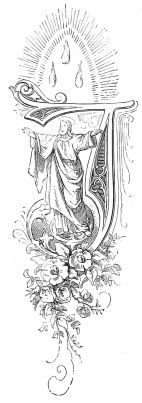 F, before the edict, the Thermæ of Dioclesian were being erected by the
labor and sweat of Christian prisoners, it will not appear surprising,
that their number and their sufferings should have greatly increased,
with the growing intensity of a most savage persecution. That emperor
himself was expected for the inauguration of his favorite building, and
hands were doubled on the work to expedite its completion. Chains of
supposed culprits arrived each day from the port of Luna, from Sardinia,
and even from the Crimea, or Chersonesus, where they had been engaged in
quarries or mines; and were put to labor in the harder departments of
the building art. To transport materials, to saw and cut stone and
marble, to mix the mortar, and to build up the walls, were the duties
allotted to the religious culprits, many of whom were men little
accustomed to such menial toil. The only recompense which they received
for their labor, was that of the mules and oxen which shared their
occupation. Little better, if better, than a stable to sleep in, food
sufficient in quantity to keep up their strength, clothing enough to
guard them from the inclemency of the season, this was all they had to
expect. Fetters on their ankles, heavy chains to prevent their escape,
increased their sufferings; and task-masters, acceptable in proportion
as they were unreasonable, watched every gang with lash or stick in
hand, ever ready to add pain to toil, whether it were to vent their own
wanton cruelty upon unresisting objects, or to please their crueller
masters.
But the Christians of Rome took peculiar care of these blessed
confessors, who were particularly venerated by them. Their deacons
visited them, by bribing their guards; and young men would boldly
venture among them, and distribute more nourishing food, or warmer
clothing to them, or give them the means of conciliating their keepers,
so as to obtain better treatment at their hands. They would then also
recommend themselves to their prayers, as they kissed the chains and the
bruises, which these holy confessors bore for Christ.
This assemblage of men, convicted of serving faithfully their divine
Master, was useful for another purpose. Like the stew in which the
luxurious Lucullus kept his lampreys ready fattened for a banquet; like
the cages in which rare birds, the pens in which well-fed cattle, were
preserved for the sacrifice, or the feast of an imperial anniversary;
like the dens near the amphitheatre, in which ferocious beasts were fed
for exhibition at the public games; just so were the public works the
preserves, from which at any time could be drawn the materials for a
sanguinary hecatomb, or a gratification of the popular appetite for
cruel spectacles, on any occasion of festivity; public stores of food
for those fierce animals, whenever the Roman people wished to share in
their savage propensities.
Such an occasion was now approaching. The persecution had lingered. No
person of note had been yet captured; the failures of the first day had
not been fully repaired; and something more wholesale was expected. The
people demanded more sport; and an approaching imperial birthday
justified their gratification. The wild beasts, which Sebastian and
Pancratius had heard, yet roared for their lawful prey. “Christianos ad
leones” might seem to have been interpreted by them, as meaning “that
the Christians of right belonged to them.”
One afternoon, towards the end of December, Corvinus proceeded to the
Baths of Dioclesian, accompanied by Catulus, who had an eye for proper
combatants in the amphitheatre, such as a good dealer would have for
cattle at a fair. He called for Rabirius, the superintendent of the
convict department, and said to him:
“Rabirius, I am come by order of the emperor, to select a sufficient
number of the wicked Christians under your charge, for the honor of
fighting in the amphitheatre, on occasion of the coming festival.”
“Really,” answered the officer, “I have none to spare. I am obliged to
finish the work in a given time, and I cannot do so, if I am left short
of hands.”
“I cannot help that; others will be got to replace those that are taken
from you. You must walk Catulus and myself through your works, and let
us choose those that will suit us.”
Rabirius, grumbling at this unreasonable demand, submitted nevertheless
to it, and took them into a vast area, just vaulted over. It was entered
by a circular vestibule lighted from above, like the Pantheon. This led
into one of the shorter arms of a cruciform hall of noble dimensions,
into which opened a number of lesser, though still handsome, chambers.
At each angle of the hall, where the arms intersected one another, a
huge granite pillar of one block had to be erected. Two were already in
their places, one was girt with ropes delivered round capstans, ready to
be raised on the morrow. A number of men were actively employed in
making final preparations. Catulus nudged Corvinus, and pointed, with
his thumb, to two fine youths, who, stripped slave-fashion to their
waists, were specimens of manly athletic forms.
“I must have those two, Rabirius,” said the willing purveyor to wild
beasts; “they will do charmingly. I am sure they are Christians, they
work so cheerfully.”
“I cannot possibly spare them at present. They are worth six men, or a
pair of horses, at least, to me. Wait till the heavy work is over, and
then they are at your service.”
“What are their names, that I may take a note of them? And mind, keep
them up in good condition.”
“They are called Largus and Smaragdus; they are young men of excellent
family, but work like plebeians, and will go with you nothing loth.”
“They shall have their wish,” said Corvinus, with great glee. And so
they had later.
As they went through the works, however, they picked out a number of
captives, for many of whom Rabirius made resistance, but generally in
vain. At length they came near one of those chambers which flanked the
eastern side of the longer arm of the hall. In one of them they saw a
number of convicts (if we must use the term) resting after their labor.
The centre of the group was an old man, most venerable in appearance,
with a long white beard streaming on his breast, mild in aspect, gentle
in word, cheerful in his feeble action. It was the confessor Saturninus,
now in his eightieth year, yet loaded with two heavy chains. At each
side were the more youthful laborers, Cyriacus and Sisinnius, of whom it
is recorded, that, in addition to their own task-work, one on each side,
they bore up his bonds. Indeed, we are told that their particular
delight was, over and above their own assigned portion of toil, to help
their weaker brethren, and perform their work for them.[160] But their
time was not yet come; for both of them, before they received their
crowns, were ordained deacons in the next pontificate.
Several other captives lay on the ground, about the old man’s feet, as
he, seated on a block of marble, was talking to them, with a sweet
gravity, which riveted their attention, and seemed to make them forget
their sufferings. What was he saying to them? Was he requiting Cyriacus
for his extraordinary charity, by telling him that, in commemoration of
it, a portion of the immense pile which they were toiling to raise,
would be dedicated to God, under his invocation, become a title, and
close its line of titulars by an illustrious name?[161] Or was he
recounting another more glorious vision, how this smaller oratory was to
be superseded and absorbed by a glorious temple in honor of the Queen of
Angels, which should comprise the entire of that superb hall, with its
vestibule, under the directing skill of the mightiest artistic genius
that the world should ever see?[162] What more consoling thought could
have been vouchsafed to those poor oppressed captives, than that they
were not so much erecting baths for the luxury of a heathen people, or
the prodigality of a wicked emperor, as in truth building up one of the
stateliest churches in which the true God is worshipped, and the Virgin
Mother, who bore Him incarnate, is affectionately honored?
From a distance Corvinus saw the group; and pausing, asked the
superintendent the names of those who composed it. He enumerated them
readily; then added, “You may as well take that old man, if you like;
for he is not worth his keep, as far as work goes.”
“Thank you,” replied Corvinus, “a pretty figure he would cut in the
amphitheatre. The people are not to be put off with decrepit old
creatures, whom a single stroke of a bear’s or tiger’s paw kills
outright. They like to see young blood flowing, and plenty of life
struggling against wounds and blows, before death comes to decide the
contest. But there is one there whom you have not named. His face is
turned from us; he has not the prisoner’s garb, nor any kind of fetter.
Who can it be?”
“I do not know his name,” answered Rabirius; “but he is a fine youth,
who spends much of his time among the convicts, relieves them, and even
at times helps them in their work. He pays, of course, well for being
allowed all this; so it is not our business to ask questions.”
“But it is mine, though,” said Corvinus, sharply; and he advanced for
this purpose. The voice caught the stranger’s ear, and he turned round
to look.

A Monogram of Christ, found in the Catacombs.
Corvinus sprung upon him with the eye and action of a wild beast, seized
him, and called out, with exultation, “Fetter him instantly. This time
at least, Pancratius, thou shalt not escape.”
 F a modern Christian wishes really to know what his forefathers
underwent for the faith, during three centuries of persecution, we would
not have him content himself with visiting the catacombs, as we have
tried to make him do, and thus learning what sort of life they were
compelled to lead; but we would advise him to peruse those imperishable
records, the Acts of the Martyrs, which will show him how they were
made to die. We know of no writings so moving, so tender, so consoling,
and so ministering of strength to faith and to hope, after God’s
inspired words, as these venerable monuments. And if our reader, so
advised, have not leisure sufficient to read much upon this subject, we
would limit him willingly to one specimen, the genuine Acts of SS.
Perpetua and Felicitas. It is true that they will be best read by the
scholar in their plain African latinity; but we trust that some one will
soon give us a worthy English version of these, and some other similar,
early Christian documents. The ones which we have singled out are the
same as were known to St. Augustine, and cannot be read by any one
without emotion. If the reader would compare the morbid sensibility, and
the overstrained excitement, endeavored to be produced by a modern
French writer, in the imaginary journal of a culprit condemned to
death, down to the immediate approach of execution, with the unaffected
pathos, and charming truthfulness, which pervades the corresponding
narrative of Vivia Perpetua, a delicate lady of twenty-one years of age,
he would not hesitate in concluding, how much more natural, graceful,
and interesting are the simple recitals of Christianity, than the
boldest fictions of romance. And when our minds are sad, or the petty
persecutions of our times incline our feeble hearts to murmur, we cannot
do better than turn to that really golden, because truthful legend, or
to the history of the noble martyrs of Vienne, or Lyons, or to the many
similar, still extant records, to nerve our courage, by the
contemplation of what children and women, catechumens and slaves,
suffered, unmurmuring, for Christ.
But we are wandering from our narrative. Pancratius, with some twenty
more, fettered, and chained together, were led through the streets to
prison. As they were thus dragged along, staggering and stumbling
helplessly, they were unmercifully struck by the guards who conducted
them; and any persons near enough to reach them, dealt them blows and
kicks without remorse. Those further off pelted them with stones or
offal, and assailed them with insulting ribaldry.[163] They reached the
Mamertine prison at last, and were thrust down into it, and found there
already other victims, of both sexes, awaiting their time of sacrifice.
The youth had just time, while he was being handcuffed, to request one
of the captors to inform his mother and Sebastian of what had happened,
and he slipped his purse into his hand.
A prison in ancient Rome was not the place to which a poor man might
court committal, hoping there to enjoy better fare and lodging than he
did at home. Two or three of these dungeons, for they are nothing
better, still remain; and a brief description of the one which we have
mentioned will give our readers some idea of what confessorship cost,
independent of martyrdom.
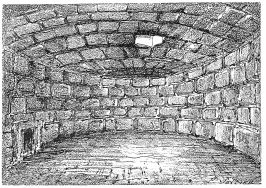
The Mamertine prison is composed of two square subterranean chambers,
one below the other, with only one round aperture in the centre of each
vault, through which alone light, air, food, furniture, and men could
pass. When the upper story was full, we may imagine how much of the two
first could reach the lower. No other means of ventilation, drainage, or
access could exist. The walls, of large stone blocks, had, or rather
have, rings fastened into them for securing the prisoners; but many used
to be laid on the floor, with their feet fastened in the stocks; and the
ingenious cruelty of the persecutors often increased the discomfort of
the damp stone floor, by strewing with broken potsherds this only bed
allowed to the mangled limbs, and welted backs, of the tortured
Christians. Hence we have in Africa a company of martyrs, headed by SS.
Saturninus and Dativus, who all perished through their sufferings in
prison. And the acts of the Lyonese martyrs inform us that many
new-comers expired in the jail, killed by severities, before their
bodies had endured any torments; while, on the contrary, some who
returned to it so cruelly tortured that their recovery appeared
hopeless, without any medical or other assistance, there regained their
health.[164] At the same time the Christians bought access to these
abodes of pain, but not of sorrow, and furnished whatever could, under
such circumstances, relieve the sufferings and increase the comforts,
temporal and spiritual, of these most cherished and venerated of their
brethren.
Roman justice required at least the outward forms of trial, and hence
the Christian captives were led from their dungeons before the tribunal;
where they were subjected to an interrogatory, of which most precious
examples have been preserved in the proconsular Acts of Martyrs, just as
they were entered by the secretary or registrar of the court.
When the Bishop of Lyons, Pothinus, now in his ninetieth year, was
asked, “Who is the God of the Christians?” he replied, with simple
dignity, “If thou shalt be worthy, thou shalt know.”[165] Sometimes the
judge would enter into a discussion with his prisoner, and necessarily
get the worst of it; though the latter would seldom go further with him
than simply reiterating his plain profession of the Christian faith.
Often, as in the case of one Ptolomæus, beautifully recited by St.
Justin, and in that of St. Perpetua, he was content to ask the simple
question, Art thou a Christian? and upon an affirmative reply, proceeded
to pronounce capital sentence.
Pancratius and his companion stood before the judge; for it wanted only
three days to the munus, or games, at which they were to “fight with
wild beasts.”
“What art thou?” he asked of one.
“I am a Christian, by the help of God,” was the rejoinder.
“And who art thou?” said the prefect to Rusticus.
“I am, indeed, a slave of Cæsar’s,” answered the prisoner; “but becoming
a Christian, I have been freed by Christ Himself; and by His grace and
mercy I have been made partaker of the same hope as those whom you see.”
Then turning to a holy priest, Lucianus, venerable for his years and his
virtues, the judge thus addressed him: “Come, be obedient to the gods
themselves, and to the imperial edicts.”
“No one,” answered the old man, “can be reprehended or condemned who
obeys the precepts of Jesus Christ our Saviour.”
“What sort of learning and studies dost thou pursue?”
“I have endeavored to master every science, and have tried every variety
of learning. But finally I adhered to the doctrines of Christianity,
although they do not please those who follow the wanderings of false
opinions.”
“Wretch! dost thou find delight in that learning?”
“The greatest; because I follow the Christians in right doctrine.”
“And what is that doctrine?”
“The right doctrine, which we Christians piously hold, is to believe in
one God, the Maker and Creator of all things visible and invisible; and
to confess the Lord Jesus Christ the Son of God, anciently foretold by
the prophets, who will come to judge mankind, and is the preacher and
master of salvation, to those who will learn well under Him. I indeed,
as a mere man, am too weak and insignificant to be able to utter any
thing great of His infinite Deity: this office belongs to the
prophets.”[166]
“Thou art, methinks, a master of error to others, and deservest to be
more severely punished than the rest. Let this Lucianus be kept in the
nerve (stocks) with his feet stretched to the fifth hole.[167]—And you
two women, what are your names and condition?”
“I am a Christian, who have no spouse but Christ. My name is Secunda,”
replied the one.
“And I am a widow, named Rufina, professing the same saving faith,”
continued the other.
At length, after having put similar questions, and receiving similar
answers from all the others, except from one wretched man, who, to the
grief of the rest, wavered and agreed to offer sacrifice, the prefect
turned to Pancratius, and thus addressed him: “And now, insolent youth,
who hadst the audacity to tear down the edict of the divine emperors,
even for thee there shall be mercy, if yet thou wilt sacrifice to the
gods. Show thus at once thy piety and thy wisdom, for thou art yet but a
stripling.”
Pancratius signed himself with the sign of the saving cross, and calmly
replied, “I am the servant of Christ. Him I acknowledge by my mouth,
hold firm in my heart, incessantly adore. This youth which you behold
in me has the wisdom of grey hairs if it worship but one God. But your
gods, with those who adore them, are destined to eternal
destruction.”[168]
“Strike him on the mouth for his blasphemy, and beat him with rods,”
exclaimed the angry judge.
“I thank thee,” replied meekly the noble youth, “that thus I suffer some
of the same punishment as was inflicted on my Lord.”[169]
The prefect then pronounced sentence in the usual form. “Lucianus,
Pancratius, Rusticus, and others, and the women Secunda and Rufina, who
have all owned themselves Christians, and refuse to obey the sacred
emperor, or worship the gods of Rome, we order to be exposed to wild
beasts, in the Flavian amphitheatre.”
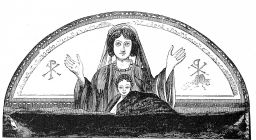
The Blessed Virgin, from a portrait found in the Cemetery
of St. Agnes.
The mob howled with delight and hatred, and accompanied the confessors
back to their prison with this rough music; but they were gradually
overawed by the dignity of their gait, and the shining calmness of their
countenances. Some men asserted that they must have perfumed themselves,
for they could perceive a fragrant atmosphere surrounding their
persons.[170]
 TRUE contrast to the fury and discord without, was the scene within
the prison. Peace, serenity, cheerfulness, and joy reigned there; and
the rough stone walls and vaults re-echoed to the chant of psalmody, in
which Pancratius was precentor, and in which depth called out to depth;
for the prisoners in the lower dungeon responded to those above, and
kept up the alternation of verses, in those psalms which the
circumstances naturally suggested.
The eve of “fighting with,” that is being torn to pieces by, wild
beasts, was always a day of greater liberty. The friends of the intended
victims were admitted to see them; and the Christians boldly took full
advantage of the permission to flock to the prison, and commend
themselves to the prayers of the blessed confessors of Christ. At
evening they were led forth to enjoy what was called the free supper,
that is, an abundant, and even luxurious, public feast. The table was
surrounded by pagans, curious to watch the conduct and looks of the
morrow’s combatants. But they could discern neither the bravado and
boisterousness, nor the dejection and bitterness of ordinary culprits.
To the guests it was truly an agape, or love-feast; for they supped
with calm joyfulness amidst cheerful conversation. Pancratius, however,
once or twice reproved the unfeeling curiosity, and rude remarks of the
crowd, saying, “To-morrow is not sufficient for you, because you love to
look upon the objects of your future hatred. To-day you are our friends;
to-morrow our foes. But mark well our countenances, that you may know
them again in the day of judgment.” Many retired at this rebuke, and not
a few were led by it to conversion.[171]
But while the persecutors thus prepared a feast for the bodies of their
victims, the Church, their mother, had been preparing a much more dainty
banquet for the souls of her children. They had been constantly attended
on by the deacons, particularly Reparatus, who would gladly have joined
their company. But his duty forbade this at present. After, therefore,
having provided as well as possible for their temporal wants, he had
arranged with the pious priest Dionysius, who still dwelt in the house
of Agnes, to send, towards evening, sufficient portions of the Bread of
Life, to feed, early in the morning of their battle, the champions of
Christ. Although the deacons bore the consecrated elements from the
principal church to others, where they were only distributed by the
titulars, the office of conveying them to the martyrs in prison, and
even to the dying, was committed to inferior ministers. On this day,
that the hostile passions of heathen Rome were unusually excited by the
coming slaughter of so many Christian victims, it was a work of more
than common danger to discharge this duty. For the revelations of
Torquatus had made it known that Fulvius had carefully noted all the
ministers of the sanctuary, and given a description of them to his
numerous active spies. Hence they could scarcely venture out by day,
unless thoroughly disguised.
The sacred Bread was prepared, and the priest turned round from the
altar on which it was placed, to see who would be its safest bearer.
Before any other could step forward, the young acolyte Tarcisius knelt
at his feet. With his hands extended before him, ready to receive the
sacred deposit, with a countenance beautiful in its lovely innocence as
an angel’s, he seemed to entreat for preference, and even to claim it.
“Thou art too young, my child,” said the kind priest, filled with
admiration of the picture before him.
“My youth, holy father, will be my best protection. Oh! do not refuse me
this great honor.” The tears stood in the boy’s eyes, and his cheeks
glowed with a modest emotion as he spoke these words. He stretched forth
his hands eagerly, and his entreaty was so full of fervor and courage
that the plea was irresistible. The priest took the Divine Mysteries
wrapped up carefully in a linen cloth, then in an outer covering, and
put them on his palms, saying:
“Remember, Tarcisius, what a treasure is intrusted to thy feeble care.
Avoid public places as thou goest along; and remember that holy things
must not be delivered to dogs, nor pearls be cast before swine. Thou
wilt keep safely God’s sacred gifts?”
“I will die rather than betray them,” answered the holy youth, as he
folded the heavenly trust in the bosom of his tunic, and with cheerful
reverence started on his journey. There was a gravity beyond the usual
expression of his years stamped upon his countenance, as he tripped
lightly along the streets, avoiding equally the more public, and the too
low, thoroughfares.
As he was approaching the door of a large mansion, its mistress, a rich
lady without children, saw him coming, and was struck with his beauty
and sweetness, as, with arms folded on his breast, he was hastening on.
“Stay, one moment, dear child,” she said, putting herself in his way:
“tell me thy name, and where do thy parents live?”
“I am Tarcisius, an orphan boy,” he replied, looking up, smilingly;
“and I have no home, save one which it might be displeasing to thee to
hear.”
“Then come into my house and rest; I wish to speak to thee. Oh, that I
had a child like thee!”
“Not now, noble lady, not now. I have intrusted to me a most solemn and
sacred duty, and I must not tarry a moment in its performance.”
“Then promise to come to me to-morrow; this is my house.”
“If I am alive, I will,” answered the boy with a kindled look, which
made him appear to her as a messenger from a higher sphere. She watched
him a long time, and after some deliberation determined to follow him.
Soon, however, she heard a tumult with horrid cries, which made her
pause, on her way, until they had ceased, when she went on again.
In the meantime, Tarcisius, with his thoughts fixed on better things
than her inheritance, hastened on, and shortly came into an open space,
where boys, just escaped from school, were beginning to play.
“We just want one to make up the game; where shall we get him?” said
their leader.
“Capital!” exclaimed another, “here comes Tarcisius, whom I have not
seen for an age. He used to be an excellent hand at all sports. Come,
Tarcisius,” he added, stopping him by seizing his arm, “whither so fast?
take a part in our game, that’s a good fellow.”
“I can’t, Petilius, now; I really can’t. I am going on business of great
importance.”
“But you shall,” exclaimed the first speaker, a strong and bullying
youth, laying hold of him. “I will have no sulking, when I want any
thing done. So come, join us at once.”
“I entreat you,” said the poor boy feelingly, “do let me go.”
“No such thing,” replied the other. “What is that you seem to be
carrying so carefully in your bosom? A letter, I suppose; well, it will
not addle by being for half an hour out of its nest. Give it to me, and
I will put it by safe while we play.” And he snatched at the sacred
deposit in his breast.
“Never, never,” answered the child, looking up towards heaven.
“I will see it,” insisted the other rudely; “I will know what is this
wonderful secret.” And he commenced pulling him roughly about. A crowd
of men from the neighborhood soon got round; and all asked eagerly what
was the matter. They saw a boy, who, with folded arms, seemed endowed
with a supernatural strength, as he resisted every effort of one much
bigger and stronger, to make him reveal what he was bearing. Cuffs,
pulls, blows, kicks seemed to have no effect. He bore them all without a
murmur, or an attempt to retaliate; but he unflinchingly kept his
purpose.
“What is it? what can it be?” one began to ask the other; when Fulvius
chanced to pass by, and joined the circle round the combatants. He at
once recognized Tarcisius, having seen him at the Ordination; and being
asked, as a better-dressed man, the same question, he replied
contemptuously, as he turned on his heel, “What is it? Why, only a
Christian ass, bearing the mysteries.”[172]
This was enough. Fulvius, while he scorned such unprofitable prey, knew
well the effect of his word. Heathen curiosity, to see the mysteries of
the Christians revealed, and to insult them, was aroused, and a general
demand was made to Tarcisius, to yield up his charge. “Never with life,”
was his only reply. A heavy blow from a smith’s fist nearly stunned him,
while the blood flowed from the wound. Another and another followed,
till, covered with bruises, but with his arms crossed fast upon his
breast, he fell heavily on the ground. The mob closed upon him, and were
just seizing him, to tear open his thrice-holy trust, when they felt
themselves pushed aside, right and left, by some giant strength. Some
went reeling to the further side of the square, others were spun round
and round, they knew not how, till they fell where they were, and the
rest retired before a tall, athletic officer, who was the author of this
overthrow. He had no sooner cleared the ground, than he was on his
knees, and with tears in his eyes, raised up the bruised and fainting
boy, as tenderly as a mother could have done, and in most gentle tones
asked him, “Are you much hurt, Tarcisius?”
“Never mind me, Quadratus,” answered he, opening his eyes with a smile;
“but I am carrying the divine mysteries; take care of them.”
The soldier raised the boy in his arms with tenfold reverence, as if
bearing, not only the sweet victim of a youthful sacrifice, a martyr’s
relics, but the very King and Lord of Martyrs, and the divine Victim of
eternal salvation. The child’s head leaned in confidence on the stout
soldier’s neck, but his arms and hands never left their watchful custody
of the confided gift; and his gallant bearer felt no weight in the
hallowed double burden which he carried. No one stopped him, till a lady
met him and stared amazedly at him. She drew nearer, and looked closer
at what he carried. “Is it possible?” she exclaimed with terror, “is
that Tarcisius, whom I met a few moments ago, so fair and lovely? Who
can have done this?”
“Madam,” replied Quadratus, “they have murdered him because he was a
Christian.”
The lady looked for an instant on the child’s countenance. He opened his
eyes upon her, smiled, and expired. From that look came the light of
faith: she hastened to be a Christian likewise.
The venerable Dionysius could hardly see for weeping, as he removed the
child’s hands, and took from his bosom, unviolated, the Holy of holies;
and he thought he looked more like
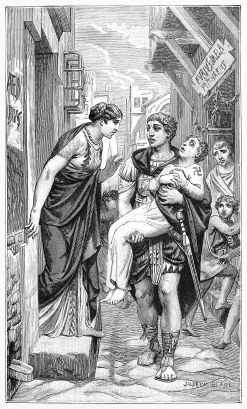
“Is it possible?” she exclaimed with terror, “is that
Tarcisius, whom I met a few moments ago, so fair and lovely?”
an angel now, sleeping the martyr’s slumber, than he did when living
scarcely an hour before. Quadratus himself bore him to the cemetery of
Callistus, where he was buried amidst the admiration of older believers;
and later the holy Pope Damasus composed for him an epitaph, which no
one can read, without concluding that the belief in the real presence of
Our Lord’s Body in the Blessed Eucharist was the same then as now:
“Tarcisium sanctum Christi sacramenta gerentem,
Cum male sana manus peteret vulgare profanis;
Ipse animam potius voluit dimittere cæsus
Prodere quam canibus rabidis cœlestia membra.”[173]
He is mentioned in the Roman martyrology, on the 15th of August, as
commemorated in the cemetery of Callistus; whence his relics were, in
due time, translated to the church of St. Sylvester in Campo, as an old
inscription declares.
News of this occurrence did not reach the prisoners till after their
feast; and perhaps the alarm that they were to be deprived of the
spiritual food to which they looked forward for strength, was the only
one that could have overcast, even slightly, the serenity of their
souls. At this moment Sebastian entered, and perceived at once that some
unpleasant news had arrived, and as quickly divined what it was; for
Quadratus had already informed him of all. He cheered up, therefore, the
confessors of Christ; assured them that they should not be deprived of
their coveted food; then whispered a few words to Reparatus the deacon,
who flew out immediately with a look of bright intelligence.
Sebastian, being known to the guards, had passed freely in, and out of,
the prison daily; and had been indefatigable in his care of its inmates.
But now he was come to take his last farewell of his dearest friend,
Pancratius, who had longed for this interview. They drew to one side,
when the youth began:
“Well, Sebastian, do you remember when we heard the wild beasts roar,
from your window, and looked at the many gaping arches of the
amphitheatre, as open for the Christian’s triumph?”
“Yes, my dear boy; I remember that evening well, and it seemed to me as
if your heart anticipated then, the scenes that await you to-morrow.”
“It did, in truth. I felt an inward assurance that I should be one of
the first to appease the roaring fury of those deputies of human
cruelty. But now that the time is come, I can hardly believe myself
worthy of so immense an honor. What can I have done, Sebastian, not
indeed to deserve it, but to be chosen out as the object of so great a
grace?”
“You know, Pancratius, that it is not he who willeth, nor he that
runneth, but God who hath mercy, that maketh the election. But tell me
rather, how do you now feel about to-morrow’s glorious destiny?”
“To tell the truth, it seems to me so magnificent, so far beyond my
right to claim, that sometimes it appears more like a vision than a
certainty. Does it not sound almost incredible to you, that I, who this
night am in a cold, dark, and dismal prison, shall be, before another
sun has set, listening to the harping of angelic lyres, walking in the
procession of white-robed Saints, inhaling the perfume of celestial
incense, and drinking from the crystal waters of the stream of life? Is
it not too like what one may read or hear about another, but hardly
dares to think is to be, in a few hours, real of himself?”
“And nothing more than you have described, Pancratius?”
“Oh, yes, far more; far more than one can name without presumption. That
I, a boy just come out of school, who have done nothing for Christ as
yet, should be able to say, ‘Sometime to-morrow, I shall see Him face to
face, and adore Him, and shall receive from Him a palm and a crown, yea,
and an affectionate embrace,’—I feel is so like a beautiful hope, that
it startles me to think it will soon be that no longer. And yet,
Sebastian,” he continued fervently, seizing both his friend’s hands, “it
is true; it is true!”
“And more still, Pancratius.”
“Yes, Sebastian, more still, and more. To close one’s eyes upon the
faces of men, and open them in full gaze on the face of God; to shut
them upon ten thousand countenances scowling on you with hatred,
contempt, and fury, from every step of the amphitheatre, and unclose
them instantly upon that one sunlike intelligence, whose splendor would
dazzle or scorch, did not its beams surround, and embrace, and welcome
us; to dart them at once into the furnace of God’s heart, and plunge
into its burning ocean of mercy and love without fear of destruction:
surely, Sebastian, it sounds like presumption in me to say, that
to-morrow—nay, hush! the watchman from the capitol is proclaiming
midnight—that to-day, to-day, I shall enjoy all this!”
“Happy Pancratius!” exclaimed the soldier, “you anticipate already by
some hours the raptures to come.”
“And do you know, dear Sebastian,” continued the youth, as if
unconscious of the interruption, “it looks to me so good and merciful in
God, to grant me such a death. How much more willingly must one at my
age face it, when it puts an end to all that is hateful on earth, when
it extinguishes but the sight of hideous beasts and sinning men,
scarcely less frightful than they, and hushes only the fiend-like yells
of both! How much more trying would it be to part with the last tender
look of a mother like mine, and shut one’s ears to the sweet plaint of
her patient voice! True, I shall see her and hear her, for the last
time, as we have arranged, to-day before my fight: but I know she will
not unnerve me.”
A tear had made its way into the affectionate boy’s eye; but he
suppressed it, and said with a gay tone:
“But, Sebastian, you have not fulfilled your promise,—your double
promise to me,—to tell me the secrets you concealed from me. This is
your last opportunity; so, come, let me know all.”
“Do you remember well what the secrets were?”
“Right well, indeed, for they have much perplexed me. First on that
night of the meeting in your apartments, you said there was one motive
strong enough to check your ardent desire to die for Christ; and lately
you refused to give me your reason for despatching me hastily to
Campania, and joined this secret to the other: how, I cannot conceive.”
“Yet they form but one. I had promised to watch over your true welfare,
Pancratius: it was a duty of friendship and love that I had assumed. I
saw your eagerness after martyrdom; I knew the ardent temperament of
your youthful heart; I dreaded lest you should commit yourself by some
over-daring action which might tarnish, even as lightly as a breath does
finely-tempered steel, the purity of your desire, or tip with a passing
blight one single leaf of your palm. I determined, therefore, to
restrain my own earnest longings, till I had seen you safe through
danger. Was this right?”
“Oh, it was too kind of you, dear Sebastian; it was nobly kind. But how
is this connected with my journey?”
“If I had not sent you away, you would have been seized for your boldly
tearing down the edict, or your rebuke of the judge in his court. You
would have been certainly condemned, and
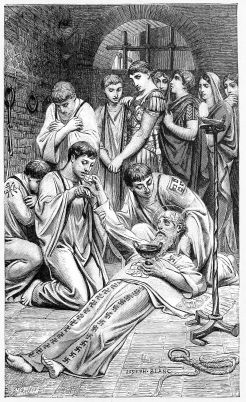
Each one, approaching devoutly, and with tears of
gratitude, received from his consecrated hand his share,—that is, the
whole of the mystical food.
would have suffered for Christ; but your sentence would have proclaimed
a different, and a civil, offence; that of rebellion against the
emperors. And moreover, my dear boy, you would have been singled out for
a triumph. You would have been pointed at by the very heathens with
honor, as a gallant and daring youth; you might have been disturbed,
even in your conflict, by a transient cloud of pride; at any rate, you
would have been spared that ignominy which forms the distinctive merit
and the special glory of dying for simply being a Christian.”
“Quite true, Sebastian,” said Pancratius with a blush.
“But when I saw you,” continued the soldier, “taken in the performance
of a generous act of charity towards the confessors of Christ; when I
saw you dragged through the streets, chained to a galley-slave, as a
common culprit; when I saw you pelted and hooted, like other believers;
when I heard sentence pronounced on you in common with the rest, because
you are a Christian, and for nothing else, I felt that my task was
ended; I would not have raised a finger to save you.”
“How like God’s love has yours been to me,—so wise, so generous, and so
unsparing!” sobbed out Pancratius, as he threw himself on the soldier’s
neck; then continued: “Promise me one thing more: that this day you will
keep near me to the end, and will secure my last legacy to my mother.”
“Even if it cost my life, I will not fail. We shall not be parted long,
Pancratius.”
The deacon now gave notice that all was ready for offering up the holy
oblation in the dungeon itself. The two youths looked round, and
Pancratius was indeed amazed. The holy priest Lucianus was laid
stretched on the floor, with his limbs painfully distended in the
catasta or stocks, so that he could not rise. Upon his breast
Reparatus had spread the three linen cloths requisite for the altar; on
them was laid the unleavened bread, and the mingled chalice, which the
deacon steadied with his hand. The head of the aged priest was held up
as he read the accustomed prayers, and performed the prescribed
ceremonies of the oblation and consecration. And then each one,
approaching devoutly, and with tears of gratitude, received from his
consecrated hand his share,—that is, the whole of the Mystical
Food.[174]
Marvellous and beautiful instance of the power of adaptation in God’s
Church! Fixed as are her laws, her ingenious love finds means, through
their very relaxation, to demonstrate their principles; nay, the very
exception presents only a sublimer application of them. Here was a
minister of God, and a dispenser of His mysteries, who for once was
privileged to be, more than others, like Him whom he represented,—at
once the Priest and the Altar. The Church prescribed that the Holy
Sacrifice should be offered only over the relics of martyrs; here was a
martyr, by a singular prerogative, permitted to offer it over his own
body. Yet living, he “lay beneath the feet of God.” The bosom still
heaved, and the heart panted under the Divine Mysteries, it is true; but
that was only part of the action of the minister: while self was already
dead, and the sacrifice of life was, in all but act, completed in him.
There was only Christ’s life within and without the sanctuary of the
breast.[175] Was ever viaticum for martyrs more worthily prepared?
 HE morning broke light and frosty; and the sun, glittering on the
gilded ornaments of the temples and other public buildings, seemed to
array them in holiday splendor. And the people, too, soon came forth
into the streets in their gayest attire, decked out with unusual
richness. The various streams converge towards the Flavian amphitheatre,
now better known by the name of the Coliseum. Each one directs his steps
to the arch indicated by the number of his ticket, and thus the huge
monster keeps sucking in by degrees that stream of life, which soon
animates and enlivens its oval tiers over tiers of steps, till its
interior is tapestried all round with human faces, and its walls seem to
rock and wave to and fro, by the swaying of the living mass. And, after
this shall have been gorged with blood, and inflamed with fury, it will
melt once more, and rush out in a thick continuous flow through the many
avenues by which it entered, now bearing their fitting name of
Vomitoria; for never did a more polluted stream of the dregs and pests
of humanity issue from an unbecoming reservoir, through ill-assorted
channels, than the Roman mob, drunk with the blood of martyrs, gushing
forth from the pores of the splendid amphitheatre.
The emperor came to the games surrounded by his court, with all the
pomp and circumstance which befitted an imperial festival, keen as any
of his subjects to witness the cruel games, and to feed his eyes with a
feast of carnage. His throne was on the eastern side of the
amphitheatre, where a large space, called the pulvinar, was reserved,
and richly decorated for the imperial court.
Various sports succeeded one another; and many a gladiator killed, or
wounded, had sprinkled the bright sand with blood, when the people,
eager for fiercer combats, began to call, or roar for the Christians and
the wild beasts. It is time, therefore, for us to think of our captives.
Before the citizens were astir, they had been removed from the prison to
a strong chamber called the spoliatorium, the press-room, where their
fetters and chains were removed. An attempt was made to dress them
gaudily as heathen priests and priestesses; but they resisted, urging
that as they had come spontaneously to the fight, it was unfair to make
them appear in a disguise which they abhorred. During the early part of
the day they remained thus together encouraging one another, and singing
the Divine praises, in spite of the shouts which drowned their voices
from time to time.
While they were thus engaged, Corvinus entered, and, with a look of
insolent triumph, thus accosted Pancratius:
“Thanks to the gods, the day is come which I have long desired. It has
been a tiresome and tough struggle between us who should fall uppermost.
I have won it.”
“How sayest thou, Corvinus? when and how have I contended with thee?”
“Always: every where. Thou hast haunted me in my dreams; thou hast
danced before me like a meteor, and I have tried in vain to grasp thee.
Thou hast been my tormentor, my evil genius. I have hated thee; devoted
thee to the infernal gods; cursed thee and loathed thee; and now my day
of vengeance is come.”
“Methinks,” replied Pancratius, smiling, “this does not look like a
combat. It has been all on one side; for I have done none of these
things towards thee.”
“No? thinkest thou that I believe thee, when thou hast lain ever as a
viper on my path, to bite my heel and overthrow me?”
“Where, I again ask?”
“Every where, I repeat. At school; in the Lady Agnes’s house; in the
Forum; in the cemetery; in my father’s own court; at Chromatius’s villa.
Yes, every where.”
“And nowhere else but where thou hast named? when thy chariot was dashed
furiously along the Appian way, didst thou not hear the tramp of horses’
hoofs trying to overtake thee?”
“Wretch!” exclaimed the prefect’s son in a fury; “and was it thy
accursed steed which, purposely urged forward, frightened mine, and
nearly caused my death?”
“No, Corvinus, hear me calmly. It is the last time we shall speak
together. I was travelling quietly with a companion towards Rome, after
having paid the last rites to our master Cassianus” (Corvinus winced,
for he knew not this before), “when I heard the clatter of a runaway
chariot; and then, indeed, I put spurs to my horse; and it is well for
thee that I did.”
“How so?”
“Because I reached thee just in time: when thy strength was nearly
exhausted, and thy blood almost frozen by repeated plunges in the cold
canal; and when thy arm, already benumbed, had let go its last stay, and
thou wast falling backwards for the last time into the water. I saw
thee: I knew thee, as I took hold of thee, insensible. I had in my grasp
the murderer of one most dear to me. Divine justice seemed to have
overtaken him; there was only my will between him and his doom. It was
my day of vengeance, and I fully gratified it.”
“Ha! and how, pray?”
“By drawing thee out, and laying thee on the bank, and chafing thee till
thy heart resumed its functions; and then consigning thee to thy
servants, rescued from death.”
“Thou liest!” screamed Corvinus; “my servants told me that they drew
me out.”
“And did they give thee my knife, together with thy leopard-skin purse,
which I found on the ground, after I had dragged thee forth?”
“No; they said the purse was lost in the canal. It was a leopard-skin
purse, the gift of an African sorceress. What sayest thou of the knife?”
“That it is here, see it, still rusty with the water; thy purse I gave
to thy slaves; my own knife I retained for myself; look at it again.
Dost thou believe me now? Have I been always a viper on thy path?”
Too ungenerous to acknowledge that he had been conquered in the struggle
between them, Corvinus only felt himself withered, degraded, before his
late school-fellow, crumbled like a clot of dust in his hands. His very
heart seemed to him to blush. He felt sick, and staggered, hung down his
head, and sneaked away. He cursed the games, the emperor, the yelling
rabble, the roaring beasts, his horses and chariot, his slaves, his
father, himself,—every thing and every body except one—he could not,
for his life, curse Pancratius.
He had reached the door, when the youth called him back. He turned and
looked at him with a glance of respect, almost approaching to love.
Pancratius put his hand on his arm, and said, “Corvinus, I have freely
forgiven thee. There is One above, who cannot forgive without
repentance. Seek pardon from Him. If not, I foretell to thee this day,
that by whatsoever death I die, thou too shalt one day perish.”
Corvinus slunk away, and appeared no more that day. He lost the sight on
which his coarse imagination had gloated for days, which he had longed
for during months. When the holiday was over he was found by his father
completely intoxicated: it was the only way he knew of drowning remorse.
As he was leaving the prisoners, the lanista, or master of the
gladiators, entered the room and summoned them to the combat. They
hastily embraced one another, and took leave on earth. They entered the
arena, or pit of the amphitheatre, opposite the imperial seat, and had
to pass between two files of venatores, or huntsmen, who had the care
of the wild beasts, each armed with a heavy whip, wherewith he inflicted
a blow on every one as he went by him. They were then brought forward,
singly or in groups, as the people desired, or the directors of the
spectacle chose. Sometimes the intended prey was placed on an elevated
platform to be more conspicuous; at another time he was tied up to posts
to be more helpless. A favorite sport was to bundle up a female victim
in a net, and expose her to be rolled, tossed, or gored by wild
cattle.[176] One encounter with a single wild beast often finished the
martyr’s course; while occasionally three or four were successively let
loose, without their inflicting a mortal wound. The confessor was then
either remanded to prison for further torments, or taken back to the
spoliatorium, where the gladiator’s apprentices amused themselves with
despatching him.
But we must content ourselves with following the last steps of our
youthful hero, Pancratius. As he was passing through the corridor that
led to the amphitheatre, he saw Sebastian standing on one side, with a
lady closely enwrapped in her mantle, and veiled. He at once recognized
her, stopped before her, knelt, and taking her hand, affectionately
kissed it.
“Bless me, dear mother,” he said, “in this your promised hour.”
“See, my child, the heavens,” she replied, “and look up thither, where
Christ with His saints expecteth thee. Fight the good fight for thy
soul’s sake, and show thyself faithful and steadfast in thy Saviour’s
love.[177] Remember him too whose precious relic thou bearest round thy
neck.”
“Its price shall be doubled in thine eyes, my sweet mother, ere many
hours are over.”
“On, on, and let us have none of this fooling,” exclaimed the lanista,
adding a stroke of his cane.
Lucina retreated; while Sebastian pressed the hand of her son, and
whispered in his ear, “Courage, dearest boy; may God bless you! I shall
be close behind the emperor; give me a last look there, and—your
blessing.”
“Ha! ha! ha!” broke out a fiendish tone close behind him. Was it a
demon’s laugh? He looked behind, and caught only a glimpse of a
fluttering cloak rounding a pillar. Who could it be? He guessed not. It
was Fulvius, who in those words had got the last link in a chain of
evidence that he had long been weaving—that Sebastian was certainly a
Christian.
Pancratius soon stood in the midst of the arena, the last of the
faithful band. He had been reserved, in hopes that the sight of others’
sufferings might shake his constancy; but the effect had been the
reverse. He took his stand where he was placed, and his yet delicate
frame contrasted with the swarthy and brawny limbs of the executioners
who surrounded him. They now left him alone; and we cannot better
describe him than Eusebius, an eye-witness, does a youth a few years
older:
“You might have seen a tender youth, who had not yet entered his
twentieth year, standing without fetters, with his hands stretched forth
in the form of a cross, and praying to God most attentively, with a
fixed and untrembling heart; not retiring from the place where he first
stood, nor swerving the least, while bears and leopards, breathing fury
and death in their very snort, were just rushing on to tear his limbs in
pieces. And yet, I know not how, their jaws seemed seized and closed by
some divine and mysterious power, and they drew altogether back.”[178]
Such was the attitude, and such the privilege of our heroic youth. The
mob were frantic, as they saw one wild beast after another careering
madly round him, roaring, and lashing its sides with its tail, while he
seemed placed in a charmed circle which they could not approach. A
furious bull, let loose upon him, dashed madly forward, with his neck
bent down, then stopped suddenly, as though he had struck his head
against a wall, pawed the ground, and scattered the dust around him,
bellowing fiercely.
“Provoke him, thou coward!” roared out, still louder, the enraged
emperor.
Pancratius awoke as from a trance, and waving his arms ran towards his
enemy;[179] but the savage brute, as if a lion had been rushing on him,
turned round and ran away towards the entrance, where, meeting his
keeper, he tossed him high into the air. All were disconcerted except
the brave youth, who had resumed his attitude of prayer; when one of the
crowd shouted out: “He has a charm round his neck; he is a sorcerer!”
The whole multitude re-echoed the cry, till the emperor, having
commanded silence, called out to him, “Take that amulet from thy neck,
and cast it from thee, or it shall be done more roughly for thee.”
“Sire,” replied the youth, with a musical voice, that rang sweetly
through the hushed amphitheatre, “it is no charm that I wear, but a
memorial of my father, who in this very place made gloriously the same
confession which I now humbly make; I am a Christian; and for love of
Jesus Christ, God and man, I gladly give my life. Do not take from me
this only legacy, which I have bequeathed, richer than I received it, to
another. Try once more; it was a panther which gave him his crown;
perhaps it will bestow the same on me.”
For an instant there was dead silence; the multitude seemed softened,
won. The graceful form of the gallant youth, his now inspired
countenance, the thrilling music of his voice, the intrepidity of his
speech, and his generous self-devotion to his cause, had wrought upon
that cowardly herd. Pancratius felt it, and his heart quailed before
their mercy more than before their rage; he had promised himself heaven
that day; was he to be disappointed? Tears started into his eyes, as
stretching forth his arms once more in the form of a cross, he called
aloud, in a tone that again vibrated through every heart:
“To-day; oh yes, to-day, most blessed Lord, is the appointed day of Thy
coming. Tarry not longer; enough has Thy power been shown in me to them
that believe not in Thee; show now Thy mercy to me who in Thee
believe!”
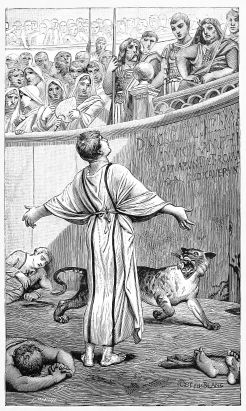
Pancratius was still standing in the same place, facing
the emperor, apparently so absorbed in higher thoughts, as not to heed
the movements of his enemy.
“The panther!” shouted out a voice. “The panther!” responded twenty.
“The panther!” thundered forth a hundred thousand, in a chorus like the
roaring of an avalanche.[180] A cage started up, as if by magic, from
the midst of the sand, and as it rose its side fell down, and freed the
captive of the desert.[181] With one graceful bound the elegant savage
gained its liberty; and, though enraged by darkness, confinement, and
hunger, it seemed almost playful, as it leaped and turned about, frisked
and gambolled noiselessly on the sand. At last it caught sight of its
prey. All its feline cunning and cruelty seemed to return, and to
conspire together in animating the cautious and treacherous movements of
its velvet-clothed frame. The whole amphitheatre was as silent as if it
had been a hermit’s dell, while every eye was intent, watching the
stealthy approaches of the sleek brute to its victim. Pancratius was
still standing in the same place, facing the emperor, apparently so
absorbed in higher thoughts as not to heed the movements of his enemy.
The panther had stolen round him, as if disdaining to attack him except
in front. Crouching upon its breast, slowly advancing one paw before
another, it had gained its measured distance, and there it lay for some
moments of breathless suspense. A deep snarling growl, an elastic spring
through the air, and it was seen gathered up like a leech, with its hind
feet on the chest, and its fangs and fore claws on the throat of the
martyr.
He stood erect for a moment, brought his right hand to his mouth, and
looking up at Sebastian with a smile, directed to him, by a graceful
wave of his arm, the last salutation of his lips—and fell. The arteries
of the neck had been severed, and the slumber of martyrdom at once
settled on his eyelids. His blood softened, brightened, enriched, and
blended inseparably with that of his father, which Lucina had hung about
his neck. The mother’s sacrifice had been accepted.[182]
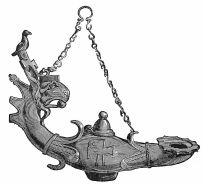
A Lamp bearing a Monogram of Christ, found in the
Catacombs.
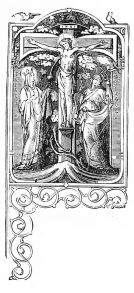 HE body of the young martyr was deposited in peace on the Aurelian way,
in the cemetery which soon bore his name, and gave it, as we have before
observed, to the neighboring gate. In times of peace a basilica was
raised over his tomb, and yet stands to perpetuate his honor.
The persecution now increased its fury, and multiplied its daily
victims. Many whose names have appeared in our pages, especially the
community of Chromatius’s villa, rapidly fell. The first was Zoë, whose
dumbness Sebastian had cured. She was surprised by a heathen rabble
praying at St. Peter’s tomb, and was hurried to trial, and hung with her
head over a smoky fire, till she died. Her husband, with three others of
the same party, was taken, repeatedly tortured, and beheaded.
Tranquillinus, the father of Marcus and Marcellianus, jealous of Zoë’s
crown, prayed openly at St. Paul’s tomb; he was taken and summarily
stoned to death. His twin sons suffered also a cruel death. The
treachery of Torquatus, by his describing his former companions,
especially the gallant Tiburtius, who was now beheaded,[183] greatly
facilitated this wholesale destruction.
Sebastian moved in the midst of this slaughter, not like a builder who
saw his work destroyed by a tempest, nor a shepherd who beheld his flock
borne off by marauders. He felt as a general on the battle-field, who
looked only to the victory; counting every one as glorious who gave his
life in its purchase, and as ready to give his own should it prove to be
the required price. Every friend that fell before him was a bond less to
earth, and a link more to heaven; a care less below, a claim more above.
He sometimes sat lonely, or paused silently, on the spots where he had
conversed with Pancratius, recalling to mind the buoyant cheerfulness,
the graceful thoughts, and the unconscious virtue of the amiable and
comely youth. But he never felt as if they were more separated than when
he sent him on his expedition to Campania. He had redeemed his pledge to
him, and now it was soon to be his own turn. He knew it well; he felt
the grace of martyrdom swelling in his breast, and in tranquil certainty
he awaited its hour. His preparation was simple: whatever he had of
value he distributed to the poor, and he settled his property, by sale,
beyond the reach of confiscation.
Fulvius had picked up his fair share of Christian spoils; but, on the
whole, he had been disappointed. He had not been obliged to ask for
assistance from the emperor, whose presence he avoided; but he had put
nothing by; he was not getting rich. Every evening he had to bear the
reproachful and scornful interrogatory of Eurotas on the day’s success.
Now, however, he told his stern master—for such he had become—that he
was going to strike at higher game, the emperor’s favorite officer, who
must have made a large fortune in the service.
He had not long to wait for his opportunity. On the 9th of January a
court was held, attended, of course, by all aspirants for favors, or
fearers of imperial wrath. Fulvius was there, and, as usual, met with a
cold reception. But after bearing silently the muttered curses of the
royal brute, he boldly advanced, dropped on one knee, and thus addressed
him:
“Sire, your divinity has often reproached me with having made, by my
discoveries, but a poor return for your gracious countenance and liberal
subsidies. But now I have found out the foulest of plots, and the basest
of ingratitudes, in immediate contact with your divine person.”
“What dost thou mean, booby?” asked impatiently the tyrant. “Speak at
once, or I’ll have the words pulled out of thy throat by an iron hook.”
Fulvius rose, and directing his hand, in accompaniment to his words,
said with a bitter blandness of tone: “Sebastian is a Christian.”
The emperor started from his throne in fury.
“Thou liest, villain! Thou shalt prove thy words, or thou shalt die such
a piecemeal death, as no Christian dog ever endured.”
“I have sufficient proof recorded here,” he replied, producing a
parchment, and offering it, kneeling.
The emperor was about to make an angry answer, when, to his utter
amazement, Sebastian, with unruffled looks and noble mien, stood before
him, and in the calmest accents said:
“My liege, I spare you all trouble of proof. I am a Christian, and I
glory in the name.”
As Maximian, a rude though clever soldier, without education, could
hardly when calm express himself in decent Latin, when he was in a
passion his language was composed of broken sentences, mingled with
every vulgar and coarse epithet. In this state he was now; and he poured
out on Sebastian a torrent of abuse, in which he reproached him with
every crime, and called him by every opprobrious name, within his
well-stocked repertory of vituperation. The two crimes, however, on
which he rung his loudest changes were, ingratitude and treachery. He
had nursed, he said, a viper in his bosom, a scorpion, an evil demon;
and he only wondered he was still alive.
The Christian officer stood the volley, as intrepidly as ever he had
borne the enemy’s assault, on the field of battle.
“Listen to me, my royal master,” he replied, “perhaps for the last time.
I have said I am a Christian; and in this you have had the best pledge
of your security.”
“How do you mean, ungrateful man?”
“Thus, noble emperor: that if you want a body-guard around you of men
who will spill their last drop of life’s blood for you, go to the prison
and take the Christians from the stocks on the floor, and from the
fetter-rings on the walls; send to the courts and bear away the
mutilated confessors from the rack and the gridiron; issue orders to the
amphitheatres, and snatch the mangled half that lives from the jaws of
tigers; restore them to such shape as yet they are capable of, put
weapons into their hands, and place them around you; and in this maimed
and ill-favored host there will be more fidelity, more loyalty, more
daring for you, than in all your Dacian and Pannonian legions. You have
taken half their blood from them, and they will give you willingly the
other half.”
“Folly and madness!” returned the sneering savage. “I would sooner
surround myself with wolves than with Christians. Your treachery proves
enough for me.”
“And what would have prevented me at any time from acting the traitor,
if I had been one? Have I not had access to your royal person by night
as by day; and have I proved a traitor? No, emperor, none has ever been
more faithful than I to you. But I have another, and a higher Lord to
serve; one who will judge us both; and His laws I must obey rather than
yours.”
“And why have you, like a coward, concealed your religion? To escape,
perhaps, the bitter death you have deserved!”
“No, sire; no more coward than traitor. No one better than yourself
knows that I am neither. So long as I could do any good to my brethren,
I refused not to live amidst their carnage and my afflictions. But hope
had at last died within me; and I thank Fulvius with all my heart, for
having, by his accusation, spared me the embarrassment of choice between
seeking death or enduring life.”
“I will decide that point for you. Death is your award; and a slow
lingering one it shall be. But,” he added, in a lower tone, as if
speaking to himself, “this must not get out. All must be done quietly at
home, or treachery will spread. Here, Quadratus, take your Christian
tribune under arrest. Do you hear, dolt? Why do you not move?”
“Because I too am a Christian!”
Another burst of fury, another storm of vile language, which ended in
the stout centurion’s being ordered at once to execution. But Sebastian
was to be differently dealt with.
“Order Hyphax to come hither,” roared the tyrant. In a few minutes, a
tall, half-naked Numidian made his appearance. A bow of immense length,
a gaily-painted quiver full of arrows, and a short broad-sword, were at
once the ornaments and the weapons of the captain of the African
archers. He stood erect before the emperor, like a handsome bronze
statue, with bright enamelled eyes.
“Hyphax, I have a job for you to-morrow morning. It must be well done,”
said the emperor.
“Perfectly, sire,” replied the dusky chief, with a grin which showed
another set of enamels in his face.
“You see the captain Sebastian?” The negro bowed assent. “He turns out
to be a Christian!”
If Hyphax had been on his native soil, and had trodden suddenly on a
hooded asp or a scorpion’s nest, he could not have started more. The
thought of being so near a Christian,—to him who worshipped every
abomination, believed every absurdity, practised every lewdness,
committed any atrocity!
Maximian proceeded, and Hyphax kept time to every member of his
sentences by a nod, and what he meant to be a smile;—it was hardly an
earthly one.
“You will take Sebastian to your quarters; and early to-morrow
morning,—not this evening, mind, for I know that by this time of day
you are all drunk,—but to-morrow morning, when your hands are steady,
you will tie him to a tree in the grove of Adonis, and you will slowly
shoot him to death. Slowly, mind; none of your fine shots straight
through the heart or the brain, but plenty of arrows, till he die
exhausted by pain and loss of blood. Do you understand me? Then take him
off at once. And mind, silence; or else——”

A Monogram of Christ, found in the Catacombs.
 N spite of every attempt at concealment, the news was soon spread among
all connected with the court, that Sebastian had been discovered to be a
Christian, and was to be shot to death on the morrow. But on none did
the double intelligence make such an impression as on Fabiola.
Sebastian a Christian! she said to herself; the noblest, purest, wisest
of Rome’s nobility a member of that vile, stupid sect? Impossible! Yet,
the fact seems certain. Have I, then, been deceived? Was he not that
which he seemed? Was he a mean impostor, who affected virtue, but was
secretly a libertine? Impossible, too! Yes, this was indeed impossible!
She had certain proofs of it. He knew that he might have had her hand
and fortune for the asking, and he had acted most generously and most
delicately towards her. He was what he seemed, that she was sure—not
gilded, but gold.
Then how account for this phenomenon, of a Christian being all that was
good, virtuous, amiable?
One solution never occurred to Fabiola’s mind, that he was all this
because he was a Christian. She only saw the problem in another form;
how could he be all that he was in spite of being a Christian?
She turned it variously in her mind, in vain. Then it came to her
thought thus. Perhaps, after all, good old Chromatius was right, and
Christianity may not be what I have fancied; and I ought to have
inquired more about it. I am sure Sebastian never did the horrible
things imputed to Christians. Yet every body charges them with them.
Might there not be a more refined form of this religion, and a more
grovelling one; just as she knew there was in her own sect,
Epicureanism? one coarse, material, wallowing in the very mire of
sensualism; the other refined, sceptical and reflective. Sebastian would
belong to the higher class, and despise and loathe the superstitions and
vices of the commoner Christians. Such a hypothesis might be tenable;
but it was hard to reconcile to her intellect, how a man like that noble
soldier could, any way, have belonged to that hated race. And yet he was
ready to die for their faith! As to Zoë and the others, she had heard
nothing, for she had only returned the day before from a journey made
into Campania, to arrange her father’s affairs.
What a pity, she thought, that she had not talked more to Sebastian on
such subjects! But it was now too late; to-morrow morning he would be no
more. This second thought came with the sharp pang of a shaft shot into
her heart. She felt as if she personally were about to suffer a loss, as
if Sebastian’s fate were going to fall on some one closely bound to her,
by some secret and mysterious tie.
Her thoughts grew darker and sadder, as she dwelt on these ideas amidst
the deepening gloom. She was suddenly disturbed by the entrance of a
slave with a light. It was Afra, the black servant, who came to prepare
her mistress’s evening repast, which she wished to take alone. While
busy with her arrangements, she said, “Have you heard the news, madam?”
“What news?”
“Only that Sebastian is going to be shot with arrows to-morrow morning.
What a pity; he was such a handsome youth!”
“Be silent, Afra; unless you have some information to give me on the
subject.”
“Oh, of course, my mistress; and my information is indeed very
astonishing. Do you know that he turns out to be one of those wretched
Christians?”
“Hold your peace, I pray you, and do not prate any more about what you
do not understand.”
“Certainly not, if you so wish it; I suppose his fate is quite a matter
of indifference to you, madam. It certainly is to me. He won’t be the
first officer that my countrymen have shot. Many they have killed, and
some they have saved. But of course that was all chance.”
There was a significance in her words and tones, which did not escape
the quick ear and mind of Fabiola. She looked up, for the first time,
and fixed her eyes searchingly on her maid’s swarthy face. There was no
emotion in it; she was placing a flagon of wine upon the table, just as
if she had not spoken. At length the lady said to her:
“Afra, what do you mean?”
“Oh, nothing, nothing. What can a poor slave know? Still more, what can
she do?”
“Come, come, you meant by your words something that I must know.”
The slave came round the table, close to the couch on which Fabiola
rested, looked behind her, and around her, then whispered, “Do you want
Sebastian’s life preserved?”
Fabiola almost leaped up, as she replied, “Certainly.”
The servant put her finger to her lip, to enforce silence, and said, “It
will cost dear.”
“Name your price.”
“A hundred sestertia,[184] and my liberty.”
“I accept your terms; but what is my security for them?”
“They shall be binding only if, twenty-four hours after the execution,
he is still alive.”
“Agreed; and what is yours?”
“Your word, lady.”
“Go, Afra, lose not a moment.”
“There is no hurry,” quietly replied the slave, as she completed,
unflurried, the preparations for supper.
She then proceeded at once to the palace, and to the Mauritanian
quarters, and went in directly to the commander.
“What dost thou want, Jubala,” he said, “at this hour? There is no
festival to-night.”
“I know, Hyphax; but I have important business with thee.”
“What is it about?”
“About thee, about myself, and about thy prisoner.”
“Look at him there,” said the barbarian, pointing across the court,
which his door commanded. “You would not think that he is going to be
shot to-morrow. See how soundly he sleeps. He could not do so better, if
he were going to be married instead.”
“As thou and I, Hyphax, intend to be the next day.”
“Come, not quite so fast; there are certain conditions to be fulfilled
first.”
“Well, what are they?”
“First, thy manumission. I cannot marry a slave.”
“That is secured.”
“Secondly, a dowry, a good dowry, mind; for I never wanted money more
than now.”
“That is safe too. How much dost thou expect?”
“Certainly not less than three hundred pounds.”[185]
“I bring thee six hundred.”
“Excellent! where didst thou get all this cash? Whom hast thou robbed?
whom hast thou poisoned, my admirable priestess? Why wait till after
to-morrow? Let it be to-morrow, to-night, if it please thee.”
“Be quiet now, Hyphax; the money is all lawful gain; but it has its
conditions, too. I said I came to speak about the prisoner also.”
“Well, what has he to do with our approaching nuptials?”
“A great deal.”
“What now?”
“He must not die.”
The captain looked at her with a mixture of fury and stupidity. He
seemed on the point of laying violent hands on her; but she stood
intrepid and unmoved before him, and seemed to command him by the strong
fascination of her eye, as one of the serpents of their native land
might do a vulture.
“Art mad?” he at last exclaimed; “thou mightest as well at once ask for
my head. If thou hadst seen the emperor’s face, when he issued his
orders, thou wouldst have known he will have no trifling with him here.”
“Pshaw! pshaw! man; of course the prisoner will appear dead, and will be
reported as dead.”
“And if he finally recover?”
“His fellow-Christians will take care to keep him out of the way.”
“Didst thou say twenty-four hours alive? I wish thou hadst made it
twelve.”
“Well, but I know that thou canst calculate close. Let him die in the
twenty-fifth hour, for what I care.”
“It is impossible, Jubala, impossible; he is too important a person.”
“Very well, then; there is an end to our bargain. The money is given
only on this condition. Six hundred pounds thrown away!” And she turned
off to go.
“Stay, stay,” said Hyphax, eagerly; the demon of covetousness coming
uppermost. “Let us see. Why, my fellows will consume half the money, in
bribes and feasting.”
“Well, I have two hundred more in reserve for that.”
“Sayest thou so, my princess, my sorceress, my charming demon? But that
will be too much for my scoundrels. We will give them half, and add the
other half—to our marriage-settlements, shan’t we?”
“As it pleases thee, provided the thing is done according to my
proposal.”
“It is a bargain, then. He shall live twenty-four hours; and after that,
we will have a glorious wedding.”
Sebastian, in the meantime, was unconscious of these amiable
negotiations for his safety; for, like Peter between two guards, he was
slumbering soundly by the wall of the court. Fatigued with his day’s
work, he had enjoyed the rare advantage of retiring early to rest; and
the marble pavement was a good enough soldier’s bed. But, after a few
hours’ repose, he awoke refreshed; and now that all was hushed, he
silently rose, and with outstretched arms, gave himself up to prayer.
The martyr’s prayer is not a preparation for death; for his is a death
that needs no preparation. The soldier who suddenly declares himself a
Christian, bends down his head, and mingles his blood with that of the
confessor, whom he had come to execute; or the friend, of unknown name,
who salutes the martyr going to death, is seized, and made to bear him
willing company,[186] is as prepared for martyrdom, as he who has passed
months in prison engaged in prayer. It is not a cry, therefore, for the
forgiveness of past sin; for there is a consciousness of that perfect
love, which sendeth out fear, an inward assurance of that highest grace,
which is incompatible with sin.
Nor in Sebastian was it a prayer for courage or strength; for the
opposite feeling, which could suggest it, was unknown to him. It never
entered into his mind to doubt, that as he had faced death intrepidly
for his earthly sovereign on the battle-field, so he should meet it
joyfully for his heavenly Lord, in any place.
His prayer, then, till morning, was a gladsome hymn of glory and honor
to the King of kings, a joining with the seraph’s glowing eyes, and
ever-shaking wings, in restless homage.
Then when the stars in the bright heavens caught his eyes, he challenged
them as wakeful sentinels like himself, to exchange the watchword of
Divine praises; and as the night-wind rustled in the leafless trees of
the neighboring court of Adonis, he bade its wayward music compose
itself, and its rude harping upon the vibrating boughs form softer
hymns,—the only ones that earth could utter in its winter night-hours.
Now burst on him the thrilling thought that the morning hour approached,
for the cock had crowed; and he would soon hear those branches murmuring
over him to the sharp whistle of flying arrows, unerring in their aim.
And he offered himself gladly to their sharp tongues, hissing as the
serpent’s, to drink his blood. He offered himself as an oblation for
God’s honor, and for the appeasing of his wrath. He offered himself
particularly for the afflicted Church, and prayed that his death might
mitigate her sufferings.
And then his thoughts rose higher, from the earthly to the celestial
Church; soaring like the eagle from the highest pinnacle of the
mountain-peak, towards the sun. Clouds have rolled away, and the blue
embroidered veil of morning is rent in twain, like the sanctuary’s, and
he sees quite into its revealed depths; far, far inwards, beyond senates
of saints and legions of angels, to what Stephen saw of inmost and
intensest glory. And now his hymn was silent; harmonies came to him, too
sweet and perfect to brook the jarring of a terrestrial voice; they came
to him, requiring no return; for they brought heaven into his soul; and
what could he give back? It was as a fountain of purest refreshment,
more like gushing light than water, flowing from the foot of the Lamb,
and poured into his heart, which could only be passive, and receive the
gift. Yet in its sparkling bounds, as it rippled along towards him, he
could see the countenance now of one, and then of another of the happy
friends who had gone before him; as if they were drinking, and bathing,
and disporting, and plunging, and dissolving themselves in those living
waters.
His countenance was glowing as with the very reflection of the vision,
and the morning dawn just brightening (oh, what a dawn that is!), caught
his face as he stood up, with his arms in a cross, opposite the east; so
that when Hyphax opened his door and saw him, he could have crept across
the court and worshipped him on his face.
Sebastian awoke as from a trance; and the chink of sesterces sounded in
the mental ears of Hyphax; so he set scientifically about earning them.
He picked out of his troop of a hundred, five marksmen, who could split
a flying arrow with a fleeter one, called them into his room, told them
their reward, concealing his own share, and arranged how the execution
was to be managed. As to the body, Christians had already secretly
offered a large additional sum for its delivery, and two slaves were to
wait outside to receive it. Among his own followers he could fully
depend on secrecy.
Sebastian was conducted into the neighboring court of the palace, which
separated the quarters of these African archers from his own dwelling.
It was planted with rows of trees, and consecrated to Adonis. He walked
cheerfully in the midst of his executioners, followed by the whole band,
who were alone allowed to be spectators, as they would have been of an
ordinary exhibition of good archery. The officer was stripped and bound
to a tree, while the chosen five took their stand opposite, cool and
collected. It was at best a desolate sort of death. Not a friend, not a
sympathizer near; not one fellow-Christian to bear his farewell to the
faithful, or to record for them his last accents, and the constancy of
his end. To stand in the middle of the crowded amphitheatre, with a
hundred thousand witnesses of Christian constancy, to see the
encouraging looks of many, and hear the whispered blessings of a few
loving acquaintances, had something cheering, and almost inspiring in
it; it lent at least the feeble aid of human emotions, to the more
powerful sustainment of grace. The very shout of an insulting multitude
put a strain upon natural courage, as the hunter’s cry only nerves the
stag at bay. But this dead and silent scene, at dawn of day, shut up in
the court of a house; this being, with most unfeeling indifference tied
up, like a truss of hay, or a stuffed figure, to be coolly aimed at,
according to the tyrant’s orders; this being alone in the midst of a
horde of swarthy savages, whose very language was strange, uncouth, and
unintelligible; but who were no doubt uttering their rude jokes, and
laughing, as men do before a match or a game, which they are going to
enjoy; all this had more the appearance of a piece of cruelty, about to
be acted in a gloomy forest by banditti, than open and glorious
confession of Christ’s name; it looked and felt more like assassination
than martyrdom.
But Sebastian cared not for all this. Angels looked over the wall upon
him; and the rising sun, which dazzled his eyes, but made him a clearer
mark for his bowmen, shone not more brightly on him, than did the
countenance of the only Witness he cared to have of suffering endured
for His sake.
The first Moor drew his bow-string to his ear, and an arrow trembled in
the flesh of Sebastian. Each chosen marksman followed in turn; and
shouts of applause accompanied each hit, so cleverly approaching, yet
avoiding, according to the imperial order, every vital part. And so the
game went on; every body laughing, and brawling, and jeering, and
enjoying it without a particle of feeling for the now drooping frame,
painted with blood;[187] all in sport, except the martyr, to whom all
was sober earnest—each sharp pang, the enduring smart, the exhaustion,
the weariness, the knotty bonds, the constrained attitude! Oh! but
earnest too was the steadfast heart, the untiring spirit, the unwavering
faith, the unruffled patience, the unsated love of suffering for his
Lord. Earnest was the prayer, earnest the gaze of the eye on heaven,
earnest the listening of the ear for the welcoming strain of the
heavenly porters, as they should open the gate.
It was indeed a dreary death; yet this was not the worst. After all,
death came not; the golden gates remained unbarred; the martyr in heart,
still reserved for greater glory even upon earth, found himself, not
suddenly translated from death to life, but sunk into unconsciousness in
the lap of angels. His tormentors saw when they had reached their
intended measure; they cut the cords that bound him; and Sebastian fell
exhausted, and to all appearance dead, upon the carpet of blood which he
had spread for himself on the pavement. Did he lie, like a noble
warrior, as he now appears in marble under his altar, in his own dear
church? We at least cannot imagine him as more beautiful. And not only
that church do we love, but that ancient chapel which stands in the
midst of the ruined Palatine, to mark the spot on which he fell.[188]
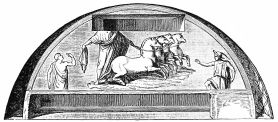
Elias carried up to Heaven, from a picture found in the
Catacombs.
 IGHT was far advanced, when the black slave, having completed her
marriage settlement quite to her own satisfaction, was returning to her
mistress’s house. It was, indeed, a cold wintry night, so she was well
wrapped up, and in no humor to be disturbed. But it was a lovely night,
and the moon seemed to be stroking, with a silvery hand, the downy robe
of the meta sudans.[189] She paused beside it; and, after a silence of
some moments, broke out into a loud laugh, as if some ridiculous
recollection connected itself in her mind with that beautiful object.
She was turning round to proceed on her way, when she felt herself
roughly seized by the arm.
“If you had not laughed,” said her captor, bitterly, “I should not have
recognized you. But that hyena laugh of yours is unmistakable. Listen,
the wild beasts, your African cousins, are answering it from the
amphitheatre. What was it about, pray?”
“About you.”
“How about me?”
“I was thinking of our last interview in this place, and what a fool you
made of yourself.”
“How kind of you, Afra, to be thinking of me, especially as I was not
just then thinking of you, but of your countrymen in those cells.”
“Cease your impertinence, and call people by their proper names. I am
not Afra the slave any longer; at least I shall not be so in a few
hours; but Jubala, the wife of Hyphax, commander of the Mauritanian
archers.”
“A very respectable man, no doubt, if he could speak any language
besides his gibberish; but these few hours of interval may suffice for
the transaction of our business. You made a mistake, methinks, in what
you said just now. It was you, was it not, that made a fool of me at
our last meeting? What has become of your fair promises, and of my
fairer gold, which were exchanged on that occasion? Mine, I know, proved
sterling; yours, I fear, turned out but dust.”
“No doubt; for so says a proverb in my language: ‘the dust on a wise
man’s skirts is better than the gold in the fool’s girdle.’ But let us
come to the point; did you really ever believe in the power of my charms
and philters?”
“To be sure I did; do you mean they were all imposture?”
“Not quite all; you see we have got rid of Fabius, and the daughter is
in possession of the fortune. That was a preliminary step of absolute
necessity.”
“What! do you mean that your incantations removed the father?” asked
Corvinus, amazed, and shrinking from her. It was only a sudden bright
thought of Afra’s, so she pushed her advantage, saying:
“To be sure; what else? It is easy thus to get rid of any one that is
too much in the way.”
“Good night, good night,” he replied in great fear.
“Stay a moment,” she answered, somewhat propitiated: “Corvinus, I gave
you two pieces of advice worth all your gold that night. One you have
acted against; the other you have not followed.”
“How?”
“Did I not tell you not to hunt the Christians, but to catch them in
your toils? Fulvius has done the second, and has gained something. You
have done the first, and what have you earned?”
“Nothing but rage, confusion, and stripes.”
“Then I was a good counsellor in the one advice; follow me in the
second.”
“What was it?”
“When you had become rich enough by Christian spoil, to offer yourself,
with your wealth, to Fabiola. She has till now coldly rejected every
offer; but I have observed one thing carefully. Not a single suit has
been accompanied by riches. Every spendthrift has sought her fortune to
repair his own; depend upon it, he that wins the prize must come on the
principle that two and two make four. Do you understand me?”
“Too well, for where are my two to come from?”
“Listen to me, Corvinus, for this is our last interview; and I rather
like you, as a hearty, unscrupulous, relentless, and unfeeling good
hater.” She drew him nearer and whispered: “I know from Eurotas, out of
whom I can wheedle anything, that Fulvius has some splendid Christian
prizes in view, one especially. Come this way into the shadow, and I
will tell you how surely you may intercept his treasure. Leave to him
the cool murder that will be necessary, for it may be troublesome; but
step in between him and the spoil. He would do it to you any day.”
She spoke to him for some minutes in a low and earnest tone; and at the
end, he broke out into the loud exclamation, “Excellent!” What a word in
such a mouth!
She checked him by a pull, and pointing to the building opposite,
exclaimed: “Hush! look there!”
How are the tables turned; or, rather, how has the world gone round in
a brief space! The last time these two wicked beings were on the same
spot, plotting bane to others, the window above was occupied by two
virtuous youths, who, like two spirits of good, were intent on
unravelling their web of mischief, and countermining their dark
approaches. They are gone thence, the one sleeping in his tomb, the
other slumbering on the eve of execution. Death looks to us like a holy
power, seeing how much he prefers taking to his society the good, rather
than the evil. He snatches away the flower, and leaves the weed its
poisonous life, till it drops into mature decay.
But at the moment that they looked up, the window was occupied by two
other persons.
“That is Fulvius,” said Corvinus, “who just came to the window.”
“And the other is his evil demon, Eurotas,” added the slave. They both
watched and listened from their dark nook.
Fulvius came again, at that moment, to the window, with a sword in his
hand, carefully turning and examining the hilt in the bright moonlight.
He flung it down at last, exclaiming with an oath, “It is only brass,
after all.”
Eurotas came with, to all appearance, a rich officer’s belt, and
examined it carefully. “All false stones! Why, I declare the whole of
the effects are not worth fifty pounds. You have made but a poor job of
this, Fulvius.”
“Always reproaching me, Eurotas. And yet this miserable gain has cost me
the life of one of the emperor’s most favorite officers.”
“And no thanks probably from your master for it.” Eurotas was right.
Next morning, the slaves who received the body of Sebastian were
surprised by a swarthy female figure passing by them, and whispering to
them, “He is still alive.”
Instead, therefore, of carrying him out for burial, they bore him to the
apartment of Irene. The early hour of the morning, and the emperor’s
having gone, the evening before, to his favorite Lateran palace,
facilitated this movement. Instantly Dionysius was sent for, and he
pronounced every wound curable; not one arrow having touched a vital
organ. But loss of blood had taken place to such a fearful extent, that
he considered weeks must elapse before the patient would be fit to move.
For four-and-twenty hours Afra assiduously called, almost every hour, to
ask how Sebastian was. When the probationary term was finished, she
conducted Fabiola to Irene’s apartment, to receive herself assurance
that he breathed, though scarcely more. The deed of her liberation from
servitude was executed, her dowry was paid, and the whole Palatine and
Forum rung with the mad carouse and hideous rites of her nuptials.
Fabiola inquired after Sebastian with such tender solicitude that Irene
doubted not that she was a Christian. The first few times she contented
herself with receiving intelligence at the door, and putting into the
hands of Sebastian’s hostess a large sum towards the expenses of his
recovery; but after two days, when he was improving, she was courteously
invited to enter; and, for the first time in her life, she found herself
consciously in the bosom of a Christian family.
Irene, we are told, was the widow of Castulus, one of the Chromatian
band of converts. Her husband had just suffered death; but she remained
still, unnoticed, in the apartments held by him in the palace. Two
daughters lived with her; and a marked difference in their behavior soon
struck Fabiola, as she became familiar with them. One evidently thought
Sebastian’s presence an intrusion, and seldom or never approached him.
Her behavior to her mother was rude and haughty, her ideas all belonged
to the common
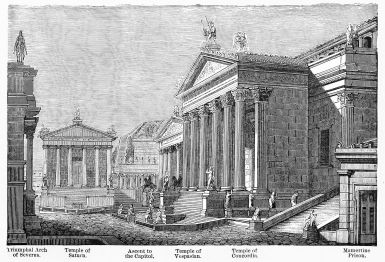
|
Triumphal Arch
of Severus.
|
Temple of Saturn.
|
Ascent to the Capitol.
|
Temple of Vespasian.
|
Temple of Concordia.
|
Mamertine Prison.
|
The Northwest Side of the Forum. |
world,—she was selfish, light, and forward. The other, who was the
younger, was a perfect contrast to her,—so gentle, docile and
affectionate; so considerate about others; so devoted to her mother; so
kind and attentive to the poor patient. Irene herself was a type of the
Christian matron, in the middle class of life. Fabiola did not find her
intelligent, or learned, or witty, or highly polished; but she saw her
always calm, active, sensible, and honest. Then she was clearly
warm-hearted, generous, deeply affectionate, and sweetly patient. The
pagan lady had never seen such a household,—so simple, frugal, and
orderly. Nothing disturbed it, except the character of the elder sister.
In a few days it was ascertained that the daily visitor was not a
Christian; but this caused no change in their treatment of her. Then she
in her turn made a discovery which mortified her—that the elder
daughter was still heathen. All that she saw made a favorable impression
on her, and softened the hard crust of prejudice on her mind. For the
present, however, her thoughts were all absorbed in Sebastian, whose
recovery was slow. She formed plans with Irene for carrying him off to
her Campanian villa, where she would have leisure to confer with him on
religion. An insuperable obstacle, however, rose to this project.
We will not attempt to lead our reader into the feelings of Sebastian.
To have yearned after martyrdom, to have prayed for it, to have suffered
all its pangs, to have died in it as far as human consciousness went, to
have lost sight of this world, and now to awaken in it again, no martyr,
but an ordinary wayfaring man on probation, who might yet lose
salvation,—was surely a greater trial than martyrdom itself. It was to
be like a man who, in the midst of a stormy night, should try to cross
an angry river, or tempestuous arm of the sea, and, after struggling for
hours, and having his skiff twirled round and round and all but upset,
should find himself relanded on the same side as he started from. Or,
it was like St. Paul sent back to earth and to Satan’s buffets, after
having heard the mysterious words which only one Intelligence can utter.
Yet no murmur escaped him, no regret. He adored in silence the Divine
Will, hoping that its purpose was only to give him the merit of a double
martyrdom. For this second crown he so earnestly longed, that he
rejected every proposal for flight and concealment.
“I have now,” he generously said, “earned one privilege of a martyr,
that of speaking boldly to the persecutors. This I will use the first
day that I can leave my bed. Nurse me, therefore, well, that it may be
the sooner.”
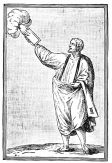
Moses receiving the Law, from a picture in the Cemetery
of “Inter duos Lauros.”
 HE memorable plot which the black slave betrayed to Corvinus, was one
to which allusion has already been made, in the conversation between
Fulvius and his guardian. He was convinced from the blind martyr’s
unsuspecting admissions, that Agnes was a Christian, and he believed he
had now two strings to his bow; either he could terrify her into
marriage with himself, or he could destroy her, and obtain a good share
of her wealth by confiscation. He was nerved for this second alternative
by the taunts and exhortations of Eurotas; but, despairing of obtaining
another interview, he wrote her a respectful, but pressing letter,
descriptive of his disinterested attachment to her, and entreating her
to accept his suit. There was but the faintest hint at the end, that
duty might compel him to take another course, if humble petition did not
prevail.
To this application he received a calm, well-bred, but unmistakable
refusal; a stern, final, and hopeless rejection. But more, the letter
stated in clear terms, that the writer was already espoused to the
spotless Lamb, and could admit from no perishable being expressions of
personal attachment. This rebuff steeled his heart against pity; but he
determined to act prudently.
In the meantime, Fabiola, seeing the determination of Sebastian not to
fly, conceived the romantic idea of saving him, in spite of himself, by
extorting his pardon from the emperor. She did not know the depth of
wickedness in man’s heart. She thought the tyrant might fume for a
moment, but that he would never condemn a man twice to death. Some pity
and mercy, she thought, must linger in his breast; and her earnest
pleading and tears would extract them, as heat does the hidden balsam
from the hard wood. She accordingly sent a petition for an audience; and
knowing the covetousness of the man, presumed, as she said, to offer him
a slight token of her own and her late father’s loyal attachment. This
was a ring with jewels of rare beauty, and immense value. The present
was accepted; but she was merely told to attend with her memorial at the
Palatine on the 20th, in common with other petitioners, and wait for the
emperor’s descent by the great staircase, on his way to sacrifice.
Unencouraging as was this answer, she resolved to risk any thing, and do
her best.
The appointed day came; and Fabiola, in her mourning habits, worn both
as a suppliant, and for her father’s death, took her stand in a row of
far more wretched creatures than herself, mothers, children, sisters,
who held petitions for mercy, for those clearest to them, now in
dungeons or mines. She felt the little hope she had entertained die
within her at the sight of so much wretchedness, too much for it all to
expect favor. But fainter grew its last spark, at every step that the
tyrant took down the marble stairs, though she saw her brilliant ring
sparkling on his coarse hand. For on each step he snatched a paper from
some sorrowful suppliant, looked at it scornfully, and either tore it
up, or dashed it on the ground. Only here and there, he handed one to
his secretary, a man scarcely less imperious than himself.
It was now nearly Fabiola’s turn: the emperor was only two steps above
her, and her heart beat violently, not from fear of man, but from
anxiety about Sebastian’s fate. She would have prayed, had she known
how, or to whom. Maximian was stretching out his hand to take a paper
offered to him, when he drew back, and turned round, on hearing his name
most unceremoniously and peremptorily called out. Fabiola looked up too;
for she knew the voice.
Opposite to her, high in the white marble wall, she had observed an open
window, corniced in yellow marble, which gave light to a back corridor
leading to where Irene’s apartments were. She now looked up, guided by
the voice, and in the dark panel of the window, a beautiful but awful
picture was seen. It was Sebastian, wan and thin, who, with features
almost etherealized, calm and stern, as if no longer capable of passion,
or strong emotion, stood there before them; his lacerated breast and
arms appearing amidst the loose drapery he had thrown around him. For he
had heard the familiar trumpet-notes, which told him of the emperor’s
approach, and he had risen, and crept thus far, to greet him.[190]
“Maximian!” he cried out, in a hollow but distinct voice.
“Who art thou, sirrah! that makest so free with thine emperor’s name?”
asked the tyrant, turning upon him.
“I am come as from the dead, to warn thee that the day of wrath and
vengeance is fast approaching. Thou hast spilt the blood of God’s Saints
upon the pavement of this city; thou hast cast their holy bodies into
the river, or flung them away upon the dunghills at the gates. Thou hast
pulled down God’s temples, and profaned His altars, and rifled the
inheritance of His poor. For these, and thine own foul crimes and
lewdnesses, thine injustices and oppressions, thy covetousness and thy
pride, God hath judged thee, and His wrath shall soon overtake thee; and
thou shalt die the death of the violent; and God will give His Church an
emperor after His own heart. And thy memory shall be accursed through
the whole world, till the end of time. Repent thee, while thou hast
time, impious man; and ask forgiveness of God, in the name of Him, the
Crucified, whom thou hast persecuted till now.”
Deep silence was held while these words were fully uttered. The emperor
seemed under the influence of a paralyzing awe; for soon recognizing
Sebastian, he felt as if standing in the presence of the dead. But
quickly recovering himself and his passion, he exclaimed: “Ho! some of
you, go round instantly and bring him before me” (he did not like to
pronounce his name). “Hyphax here! Where is Hyphax? I saw him just now.”
But the Moor had at once recognized Sebastian, and run off to his
quarters. “Ha! he is gone, I see; then here, you dolt, what’s your
name?” (addressing Corvinus, who was attending his father,) “go to the
Numidian court, and summon Hyphax here directly.”
With a heavy heart Corvinus went on his errand. Hyphax had told his
tale, and put his men in order of defence. Only one entrance at the end
of the court was left open; and when the messenger had reached it, he
durst not advance. Fifty men stood along each side of the space, with
Hyphax and Jubala at the opposite end. Silent and immovable, with their
dark chests and arms bare, each with his arrow fixed, and pointed to the
door, and the string ready drawn, they looked like an avenue of basalt
statues, leading to an Egyptian temple.
“Hyphax,” said Corvinus, in a tremulous voice, “the emperor sends for
you.”
“Tell his majesty, respectfully, from me,” replied the African, “that
my men have sworn, that no man passes that threshold, coming in, or
going out, without receiving, through his breast or his back, a hundred
shafts into his heart; until the emperor shall have sent us a token of
forgiveness for every offence.”
Corvinus hastened back with this message, and the emperor received it
with a laugh. They were men with whom he could not afford to quarrel;
for he relied on them in battle, or insurrection, for picking out the
leaders. “The cunning rascals!” he exclaimed. “There, take that trinket
to Hyphax’s black spouse.” And he gave him Fabiola’s splendid ring. He
hastened back, delivered his gracious embassy, and threw the ring
across. In an instant every bow dropt, and every string relaxed. Jubala,
delighted, sprang forward and caught the ring. A heavy blow from her
husband’s fist felled her to the ground, and was greeted with a shout of
applause. The savage seized the jewel; and the woman rose, to fear that
she had only exchanged one slavery for a worse.
Hyphax screened himself behind the imperial command. “If,” he said, “you
had allowed us to send an arrow through his head or heart, all would
have been straight. As it was, we are not responsible.”
“At any rate, I will myself see my work done properly this time,” said
Maximian. “Two of you fellows with clubs come here.”
Two of his attendant executioners came from behind; Sebastian, scarcely
able to stand, was also there; mild and intrepid. “Now, my men,” said
the barbarian, “I must not have any blood spilt on these stairs; so you
knock the life out of him with your cudgels; make clean work of it.
Madam, what is your petition?”—stretching out his hand, to Fabiola,
whom he recognized, and so addressed more respectfully. She was
horrified and disgusted, and almost fainting at the sight before her;
so she said, “Sire, I fear it is too late!”
“Why too late?” looking at the paper. A flash came from his eye, as he
said to her: “What! You knew that Sebastian was alive? Are you a
Christian?”
“No, sire,” she replied. Why did the denial almost dry up in her throat?
She could not for her life have said she was any thing else. Ah!
Fabiola, thy day is not far off.
“But, as you said just now,” replied the emperor, more serene, returning
her petition, “I fear it is too late; I think that blow must have been
the ictus gratiosus.”[191]
“I feel faint, sire,” said she, respectfully; “may I retire?”
“By all means. But, by the bye, I have to thank you for the beautiful
ring which you sent, and which I have given to Hyphax’s wife” (lately
her own slave!). “It will look more brilliant on a black hand than even
on mine. Adieu!” and he kissed his hand with a wicked smile, as if there
were no martyr’s body near to witness against him. He was right; a heavy
blow on the head had proved fatal; and Sebastian was safe where he had
so longed to be. He bore with him a double palm, and received a twofold
crown. Yet still, an ignominious end before the world; beaten to death
without ceremony, while the emperor conversed. How much of martyrdom is
in its disgrace! Woe to us when we know that our sufferings earn us
honor!
The tyrant, seeing his work completed, ordered that Sebastian at least
should not be cast into the Tiber nor on a dunghill. “Put plenty of
weights to his body,” he added, “and throw it into the Cloaca,[192] to
rot there, and be the food of vermin. The Christians at least shall not
have it.” This was done; and the Saint’s Acts inform us, that in the
night he appeared to the holy matron Lucina, and directed her where to
find his sacred remains. She obeyed his summons, and they were buried
with honor, where now stands his basilica.
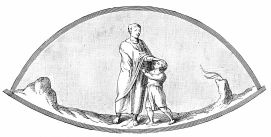
Christ blessing a Child, from a picture in the Cemetery
of the Latin Way.
 HERE are critical days in the life of man and of mankind. Not merely
the days of Marathon, of Cannæ, or of Lepanto, in which a different
result might have influenced the social or political fate of mankind.
But it is probable that Columbus could look back upon not only the day,
but the precise hour, the decision of which secured to the world all
that he taught and gave it, and to himself the singular place which he
holds among its worthies. And each of us, little and insignificant as he
may be, has had his critical day; his day of choice, which has decided
his fate through life; his day of Providence, which altered his position
or his relations to others; his day of grace, when the spiritual
conquered the material. In whatever way it has been, every soul, like
Jerusalem,[193] has had its day.
And so with Fabiola, has not all been working up towards a crisis?
Emperor and slave, father and guest, the good and the wicked, Christian
and heathen, rich and poor; then life and death, joy and sorrow,
learning and simplicity, silence and conversation, have they not all
come as agents, pulling at her mind in opposite ways, yet all directing
her noble and generous, though haughty and impetuous, soul one way, as
the breeze and the rudder struggle against one another, only to
determine the ship’s single path? By what shall the resolution of these
contending forces be determined? That rests not with man; wisdom, not
philosophy, can decide. We have been engaged with events commemorated on
the 20th of January; let the reader look, and see what comes on the
following day in his calendar, and he will agree it must be an important
day in our little narrative.
From the audience Fabiola retired to the apartments of Irene, where she
found nothing but desolation and sorrow. She sympathized fully with the
grief around her, but she saw and felt that there was a difference
between her affliction and theirs. There was a buoyancy about them;
there was almost an exultation breaking out through their distress;
their clouds were sun-lit and brightened at times. Hers was a dead and
sullen, a dull and heavy gloom, as if she had sustained a hopeless loss.
Her search after Christianity, as associated with anything amiable or
intelligent, seemed at an end. Her desired teacher, or informant, was
gone. When the crowd had moved away from the palace, she took
affectionate leave of the widow and her daughters; but, some way or
other, she could not like the heathen one as she loved her sister.
She sat alone at home, and tried to read; she took up volume after
volume of favorite works on Death, on Fortitude, on Friendship, on
Virtue; and every one of them seemed insipid, unsound, and insincere.
She plunged into a deeper and a deeper melancholy, which lasted till
towards evening, when she was disturbed by a letter being put into her
hand. The Greek slave, Graja, who brought it in, retired to the other
end of the room, alarmed and perplexed by what she witnessed. For her
mistress had scarcely glanced over the note, than she leaped up wildly
from her seat, threw her hair into disorder with her hands, which she
pressed, as in agony, on her temples, stood thus for a moment, looking
up with an unnatural stare in her eyes, and then sank heavily down again
on her chair with a deep groan. Thus she remained for some minutes,
holding the letter in both her hands, with her arms relaxed, apparently
unconscious.
“Who brought this letter?” she then asked, quite collected.
“A soldier, madam,” answered the maid.
“Ask him to come here.”
While her errand was being delivered, she composed herself, and gathered
up her hair. As soon as the soldier appeared she held this brief
dialogue:
“Whence do you come?”
“I am on guard at the Tullian prison.”
“Who gave you the letter?”
“The Lady Agnes herself.”
“On what cause is the poor child there?”
“On the accusation of a man named Fulvius, for being a Christian.”
“For nothing else?”
“For nothing, I am sure.”
“Then we shall soon set that matter right. I can give witness to the
contrary. Tell her I will come presently; and take this for your
trouble.”
The soldier retired, and Fabiola was left alone. When there was
something to do her mind was at once energetic and concentrated, though
afterwards the tenderness of womanhood might display itself the more
painfully. She wrapped herself close up, proceeded alone to the prison,
and was at once conducted to the separate cell, which Agnes had obtained
in consideration of her rank, backed by her parents’ handsome
largitions.
“What is the meaning of this, Agnes?” eagerly inquired Fabiola, after a
warm embrace.
“I was arrested a few hours ago, and brought hither.”
“And is Fulvius fool enough, as well as scoundrel, to trump up an
accusation against you, which five minutes will confute? I will go to
Tertullus myself, and contradict his absurd charge at once.”
“What charge, dearest?”
“Why, that you are a Christian.”
“And so I am, thank God!” replied Agnes, making on herself the sign of
the cross.
The announcement did not strike Fabiola like a thunderbolt, nor rouse
her, nor stagger her, nor perplex her. Sebastian’s death had taken all
edge or heaviness from it. She had found that faith existing in what she
had considered the type of every manly virtue; she was not surprised to
find it in her, whom she had loved as the very model of womanly
perfection. The simple grandeur of that child’s excellence, her
guileless innocence, and unexcepting kindness, she had almost
worshipped. It made Fabiola’s difficulties less, it brought her problem
nearer to a solution, to find two such peerless beings to be not mere
chance-grown plants, but springing from the same seed. She bowed her
head in a kind of reverence for the child, and asked her, “How long have
you been so?”
“All my life, dear Fabiola; I sucked the faith, as we say, with my
mother’s milk.”
“And why did you conceal it from me?”
“Because I saw your violent prejudices against us; how you abhorred us
as practisers of the most ridiculous superstitions, as perpetrators of
the most odious abominations. I perceived how you contemned us as
unintellectual, uneducated, unphilosophical, and unreasonable. You would
not hear a word about us; and the only object of hatred to your generous
mind was the Christian name.”
“True, dearest Agnes; yet I think that had I known that you, or
Sebastian, was a Christian, I could not have hated it. I could have
loved any thing in you.”
“You think so now, Fabiola; but you know not the force of universal
prejudice, the weight of falsehood daily repeated. How many noble minds,
fine intellects, and loving hearts have they enslaved, and induced to
believe us to be all that we are not, something even worse than the
worst of others!”
“Well, Agnes, it is selfish in me to argue thus with you in your present
position. You will of course compel Fulvius to prove that you are a
Christian.”
“Oh, no! dear Fabiola; I have already confessed it, and intend to do so
again publicly in the morning.”
“In the morning!—what, to-morrow?” asked Fabiola, shocked at the idea
of any thing so immediate.
“Yes, to-morrow. To prevent any clamor or disturbance about me (though I
suspect few people will care much), I am to be interrogated early, and
summary proceedings will be taken. Is not that good news, dear?” asked
Agnes eagerly, seizing her cousin’s hands. And then putting on one of
her ecstatic looks, she exclaimed, “Behold, what I have long coveted, I
already see; what I have hoped for, I hold safe; to Him alone I feel
already associated in heaven, whom here on earth I have loved with all
devotedness.[194] Oh! is He not beautiful, Fabiola, lovelier far than
the angels who surround Him! How sweet His smile! how mild His eye! how
bland the whole expression of His face! And that sweetest and most
gracious Lady, who ever accompanies Him, our Queen and Mistress, who
loves Him alone, how winningly doth she beckon me forward to join her
train! I come! I come!—They are departed, Fabiola; but they return
early for me to-morrow; early, mind, and we part no more.”
Fabiola felt her own heart swell and heave, as if a new element were
entering in. She knew not what it was, but it seemed something better
than a mere human emotion. She had not yet heard the name of Grace.
Agnes, however, saw the favorable change in her spirit, and inwardly
thanked God for it. She begged her cousin to return before dawn to her,
for their final farewell.
At this same time a consultation was being held at the house of the
prefect, between that worthy functionary and his worthier son. The
reader had better listen to it, to learn its purport.
“Certainly,” said the magistrate, “if the old sorceress was right in one
thing, she ought to be in the other. I will answer, from experience, how
powerful is wealth in conquering any resistance.”
“And you will allow, too,” rejoined Corvinus, “from the enumeration we
have made, that among the competitors for Fabiola’s hand, there has not
been one who could not justly be rather called an aspirant after her
fortune.”
“Yourself included, my dear Corvinus.”
“Yes, so far: but not if I succeed in offering her, with myself, the
lady Agnes’s great wealth.”
“And in a manner too, methinks, that will more easily gain upon what I
hear of her generous and lofty disposition. Giving her that wealth
independent of conditions, and then offering yourself to her, will put
her under one of two obligations, either to accept you as her husband,
or throw you back the fortune.”
“Admirable, father! I never saw the second alternative before. Do you
think there is no possibility of securing it except through her?”
“None whatever. Fulvius, of course, will apply for his share; and the
probability is, that the emperor will declare he intends to take it all
for himself. For he hates Fulvius. But if I propose a more popular and
palpably reasonable plan, of giving the property to the nearest
relation, who worships the gods—this Fabiola does, don’t she?”
“Certainly, father.”
“I think he will embrace it: while I am sure there is no chance of his
making a free gift to me. The proposal from a judge would enrage him.”
“Then how will you manage it, father?”
“I will have an imperial rescript prepared during the night, ready for
signature; and I will proceed immediately after the execution to the
palace, magnify the unpopularity which is sure to follow it, lay it all
on Fulvius, and show the emperor how his granting the property to the
next in the settlement of it, will redound greatly to his credit and
glory. He is as vain as he is cruel and rapacious; and one vice must be
made to fight another.”
“Nothing could be better, my dear father; I shall retire to rest with an
easy mind. To-morrow will be the critical day of my life. All my future
depends upon whether I am accepted or rejected.”
“I only wish,” added Tertullus, rising, “that I could have seen this
peerless lady, and sounded the depths of her philosophy, before your
final bargain was struck.”
“Fear not, father: she is well worthy of being your daughter-in-law.
Yes, to-morrow is indeed the turning-point of my fortunes.”
Even Corvinus can have his critical day. Why not Fabiola?
While this domestic interview was going on, a conference was taking
place between Fulvius and his amiable uncle. The latter, entering late,
found his nephew sitting sullen and alone in the house, and thus
accosted him:
“Well, Fulvius, is she secured?”
“She is, uncle, as fast as bars and walls can make her; but her spirit
is free and independent as ever.”
“Never mind that: sharp steel makes short work of spirit. Is her fate
certain? and are its consequences sure?”
“Why, if nothing else happens, the first is safe; the second have still
to encounter imperial caprice. But I own I feel pain and remorse at
sacrificing so young a life, and for an insecure result.”
“Come, Fulvius,” said the old man sternly, looking as cold as a grey
rock in the morning mist; “no softness, I hope, in this matter. Do you
remember what day is to-morrow?”
“Yes, the twelfth before the calends of February.”[195]
“The critical day always for you. It was on this day that to gain
another’s wealth, you committed——”
“Peace, peace!” interrupted Fulvius in agony. “Why will you always
remind me of every thing I most wish to forget?”
“Because of this: you wish to forget yourself, and that must not be. I
must take from you every pretence to be guided by conscience, virtue, or
even honor. It is folly to affect compassion for any one’s life, who
stands in the way of your fortune, after what you did to her.”
Fulvius bit his lip in silent rage, and covered his crimson face with
his hands. Eurotas roused him by saying: “Well, then, to-morrow is
another, and probably a final critical day for you. Let us calmly weigh
its prospects. You will go to the emperor, and ask for your rightful
share in the confiscated property. Suppose it is granted?”
“I will sell it as quick as possible, pay my debts, and retire to some
country where my name has never been heard.”
“Suppose your claims are rejected?”
“Impossible, impossible!” exclaimed Fulvius, racked by the very idea;
“it is my right, hardly earned. It cannot be denied me.”
“Quietly, my young friend; let us discuss the matter coolly. Remember
our proverb: ‘From the stirrup to the saddle there has been many a
fall.’ Suppose only that your rights are refused you.”
“Then I am a ruined man. I have no other prospect before me, of
retrieving my fortunes here. Still I must fly hence.”
“Good: and what do you owe at Janus’s arch?”[196]
“A good couple of hundred sestertia,[197] between principal and compound
interest at fifty per cent, to that unconscionable Jew Ephraim.”
“On what security?”
“On my sure expectation of this lady’s estates.”
“And if you are disappointed, do you think he will let you fly?”
“Not if he knows it, most assuredly. But we must be prepared from this
moment for any emergency; and that with the utmost secrecy.”
“Leave that to me, Fulvius; you see how eventful the issue of to-morrow
may be to you, or rather of to-day; for morning is approaching. Life or
death to you hang upon it; it is the great day of your existence.
Courage then, or rather an inflexible determination, steel you to work
out its destiny!”

A Monogram of Christ, found in the Catacombs.
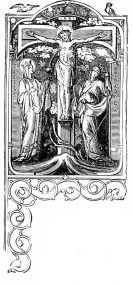 HE day is not yet dawning, and nevertheless we speak of having reached
its second part. How may this be? Gentle reader, have we not led you to
its first vespers, divided as they are between Sebastian of yesterday,
and Agnes of to-day? Have not the two sung them together, without
jealousy, and with fraternal impartiality, the one from the heaven which
he ascended in the morning, the other from the dungeon into which she
descended in the evening? Glorious Church of Christ! great in the
unclashing combination of thy unity, stretching from heaven to beneath
the earth, wherever exists a prison-house of the just.
From his lodgings Fulvius went out into the night-air, which was crisp
and sharp, to cool his blood, and still his throbbing brows. He wandered
about, almost without any purpose; but found himself imperceptibly
drawing nearer and nearer to the Tullian prison. As he was literally
without affection, what could be his attraction thither? It was a
strangely compounded feeling, made up of as bitter ingredients as ever
filled the poisoner’s cup. There was gnawing remorse; there was baffled
pride; there was goading avarice; there was humbling shame; there was a
terrible sense of the approaching consummation of his villany. It was
true, he had been rejected, scorned, baffled by a mere child, while her
fortune was necessary for his rescue from beggary and death,—so at
least he reasoned; yet he would still rather have her hand than her
head. Her murder appeared revoltingly atrocious to him, unless
absolutely inevitable. So he would give her another chance.
He was now at the prison gate, of which he possessed the watchword. He
pronounced it, entered, and, at his desire, was conducted to his
victim’s cell. She did not flutter, nor run into a corner, like a bird
into whose cage the hawk has found entrance; calm and intrepid, she
stood before him.
“Respect me here, Fulvius, at least,” she gently said; “I have but a few
hours to live: let them be spent in peace.”
“Madam,” he replied, “I have come to lengthen them, if you please, to
years; and, instead of peace, I offer happiness.”
“Surely, sir, if I understand you, the time is past for this sad vanity.
Thus to address one whom you have delivered over to death, is at best a
mockery.”
“It is not so, gentle lady; your fate is in your own hands; only your
own obstinacy will give you over to death. I have come to renew, once
more, my offer, and with it that of life. It is your last chance.”
“Have I not before told you that I am a Christian; and that I would
forfeit a thousand lives rather than betray my faith?”
“But now I ask you no longer to do this. The gates of the prison are yet
open to me. Fly with me; and, in spite of the imperial decrees, you
shall be a Christian, and yet live.”
“Then have I not clearly told you that I am already espoused to my Lord
and Saviour Jesus Christ, and that to Him alone I keep eternal faith?”
“Folly and madness! Persevere in it till to-morrow, and that may be
awarded to you which you fear more than death, and which will drive this
illusion forever from your mind.”
“I fear nothing for Christ. For know, that I have an angel ever guarding
me, who will not suffer his Master’s handmaid to suffer scorn.[198] But
now, cease this unworthy importunity, and leave me the last privilege of
the condemned—solitude.”
Fulvius had been gradually losing patience, and could no longer restrain
his passion. Rejected again, baffled once more by a child, this time
with the sword hanging over her neck! A flame irrepressible broke out
from the smouldering heat within him; and, in an instant, the venomous
ingredients that we have described as mingled in his heart, were
distilled into one black, solitary drop,—HATRED. With flashing look,
and furious gesture, he broke forth:
“Wretched woman, I give thee one more opportunity of rescuing thyself
from destruction. Which wilt thou have, life with me, or death?”
“Death even I will choose for her, rather than life with a monster like
thee!” exclaimed a voice just within the door.
“She shall have it,” he rejoined, clenching his fist, and darting a mad
look at the new speaker; “and thou too, if again thou darest to fling
thy baneful shadow across my path.”
Fabiola was alone for the last time with Agnes. She had been for some
minutes unobserved watching the contest, between what would have
appeared to her, had she been a Christian, an angel of light and a
spirit of darkness; and truly Agnes looked like the first, if human
creature ever did. In preparation for her coming festival of full
espousals to the Lamb, when she should sign her contract of everlasting
love, as He had done, in blood, she had thrown over the dark garments
of her mourning a white and spotless bridal robe. In the midst of that
dark prison, lighted by a solitary lamp, she looked radiant and almost
dazzling; while her tempter, wrapped up in his dark cloak, crouching
down to rush out of the low door of the dungeon, looked like a black and
vanquished demon, plunging into an abyss beneath.
Then Fabiola looked into her countenance, and thought she had never seen
it half so sweet. No trace of anger, of fear, of flurry, or agitation
was there; no paleness, no flush, no alternations of hectic excitement
and pallid depression. Her eyes beamed with more than their usual mild
intelligence; her smile was as placid and cheerful as it ever was, when
they discoursed together. Then there was a noble air about her, a
greatness of look and manner, which Fabiola would have compared to that
mien and stateliness, and that ambrosial atmosphere by which, in
poetical mythology, a being of a higher sphere was recognized on
earth.[199] It was not inspiration, for it was passionless; but it was
such expression and manner, as her highest conceptions of virtue and
intellect, combined in the soul, might be supposed to stamp upon the
outward form. Hence her feelings passed beyond love into a higher range;
they were more akin to reverence.
Agnes took one of her hands in each of her own, crossed them upon her
own calm bosom, and looking into her face with a gaze of blandest
earnestness, said:
“Fabiola, I have one dying request to make you. You have never refused
me any: I am sure you will not this.”
“Speak not thus to me, dearest Agnes; you must not request; you command
me now.”
“Then promise me, that you will immediately apply your mind to master
the doctrines of Christianity. I know you will embrace them; and then
you will no longer be to me what you are now.”
“And what is that?”
“Dark, dark, dearest Fabiola. When I look upon you thus, I see in you a
noble intellect, a generous disposition, an affectionate heart, a
cultivated mind, a fine moral feeling, and a virtuous life. What can be
desired more in woman? and yet over all these splendid gifts there hangs
a cloud, to my eyes, of gloomy shadow, the shade of death. Drive it
away, and all will be lightsome and bright.”
“I feel it, dear Agnes,—I feel it. Standing before you, I seem to be as
a black spot compared to your brightness. And how, embracing
Christianity, shall I become light like you?”
“You must pass, Fabiola, through the torrent that sunders us” (Fabiola
started, recollecting her dream). “Waters of refreshment shall flow over
your body, and oil of gladness shall embalm your flesh; and the soul
shall be washed clean as driven snow, and the heart be softened as the
babe’s. From that bath you will come forth a new creature, born again to
a new and immortal life.”
“And shall I lose all that you have but just now prized in me?” asked
Fabiola, somewhat downcast.
“As the gardener,” answered the martyr, “selects some hardy and robust,
but unprofitable plant, and on it engrafts but a small shoot of one that
is sweet and tender, and the flowers and fruits of this belong to the
first, and yet deprive it of no grace, no grandeur, no strength that it
had before, so will the new life you shall receive ennoble, elevate, and
sanctify (you can scarcely understand this word), the valuable gifts of
nature and education which you already possess. What a glorious being
Christianity will make you, Fabiola!”
“What a new world you are leading me to, dear Agnes! Oh, that you were
not leaving me outside its very threshold!”
“Hark!” exclaimed Agnes, in an ecstasy of joy. “They come, they come!
You hear the measured tramp of the soldiers in the gallery. They are
the bridesmen coming to summon me. But I see on high the white-robed
bridesmaids borne on the bright clouds of morning, and beckoning me
forward. Yes, my lamp is trimmed, and I go forth to meet the Bridegroom.
Farewell, Fabiola; weep not for me. Oh, that I could make you feel, as I
do, the happiness of dying for Christ! And now I will speak a word to
you which I never have addressed to you before,—God bless you!” And she
made the sign of the Cross on Fabiola’s forehead. An embrace, convulsive
on Fabiola’s part, calm and tender on Agnes’s, was their last earthly
greeting. The one hastened home, filled with a new and generous purpose;
the other resigned herself to the shame-stricken guard.
Over the first part of the martyr’s trials we cast a veil of silence,
though ancient Fathers, and the Church in her offices, dwell upon it, as
doubling her crown.[200] Suffice it to say, that her angel protected her
from harm;[201] and that the purity of her presence converted a den of
infamy into a holy and lovely sanctuary.[202] It was still early in the
morning when she stood again before the tribunal of the prefect, in the
Roman Forum; unchanged and unscathed, without a blush upon her smiling
countenance, or a pang of sorrow in her innocent heart. Only her unshorn
hair, the symbol of virginity, which had been let loose, flowed down,
in golden waves, upon her snow-white dress.[203]
It was a lovely morning. Many will remember it to have been a beautiful
day on its anniversary, as they have walked out of the Nomentan gate,
now the Porta Pia, towards the church which bears our virgin-martyr’s
name, to see blessed upon her altar the two lambs, from whose wool are
made the palliums sent by the Pope to the archbishops of his communion.
Already the almond-trees are hoary, not with frost, but with blossoms;
the earth is being loosened round the vines, and spring seems latent in
the swelling buds, which are watching for the signal from the southern
breeze, to burst and expand.[204] The atmosphere, rising into a
cloudless sky, has just that temperature that one loves, of a sun,
already vigorous, not heating, but softening, the slightly frosty air.
Such we have frequently experienced St. Agnes’s day, together with
joyful thousands, hastening to her shrine.
The judge was sitting in the open Forum, and a sufficient crowd formed a
circle round the charmed space, which few, save Christians, loved to
enter. Among the spectators were two whose appearance attracted general
attention; they stood opposite each other, at the ends of the semicircle
formed by the multitude. One was a youth, enveloped in his toga, with a
slouching hat over his eyes, so that his features could not be
distinguished. The other was a lady of aristocratic mien, tall and
erect, such as one does not expect to meet on such an occasion. Wrapped
close about her, and so ample as to veil her from head to foot, like the
beautiful ancient statue, known among artists by the name of
Modesty,[205] she had a scarf or mantle of Indian workmanship, woven in
richest pattern of crimson, purple, and gold, a garment truly imperial,
and less suitable, than even female presence, to this place of doom and
blood. A slave, or servant, of superior class attended her, carefully
veiled also, like her mistress. The lady’s mind seemed intent on one
only object, as she stood immovable, leaning with her elbow on a marble
post.
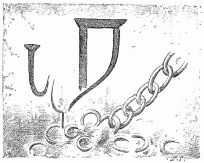
Chains for the Martyrs, after a picture found in 1841, in
a crypt at Milan.
Agnes was introduced by her guards into the open space, and stood
intrepid, facing the tribunal. Her thoughts seemed to be far away; and
she took no notice even of those two who, till she appeared, had been
objects of universal observation.
“Why is she unfettered?” asked the prefect angrily.
“She does not need it: she walks so readily,” answered Catulus; “and she
is so young.”
“But she is obstinate as the oldest. Put manacles on her hands at once.”
The executioner turned over a quantity of such prison ornaments,—to
Christian eyes really such,—and at length selected a pair as light and
small as he could find, and placed them round her wrists. Agnes
playfully, and with a smile,
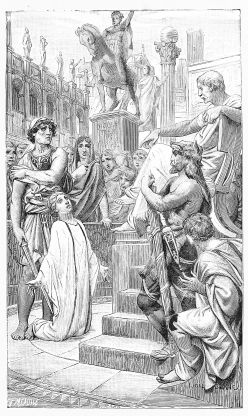
The judge angrily reproved the executioner for his
hesitation, and bid him at once do his duty.
shook her hands, and they fell, like St. Paul’s viper, clattering at her
feet.[206]
“They are the smallest we have, sir,” said the softened executioner:
“one so young ought to wear other bracelets.”
“Silence, man!” rejoined the exasperated judge, who, turning to the
prisoner, said, in a blander tone:
“Agnes, I pity thy youth, thy station, and the bad education thou hast
received. I desire, if possible, to save thee. Think better while thou
hast time. Renounce the false and pernicious maxims of Christianity,
obey the imperial edicts, and sacrifice to the gods.”
“It is useless,” she replied, “to tempt me longer. My resolution is
unalterable. I despise thy false divinities, and can only love and serve
the one living God. Eternal Ruler, open wide the heavenly gates, until
lately closed to man. Blessed Christ, call to Thee the soul that
cleaveth unto Thee: victim first to Thee by virginal consecration; now
to Thy Father by martyrdom’s immolation.”[207]
“I waste time, I see,” said the impatient prefect, who saw symptoms of
compassion rising in the multitude. “Secretary, write the sentence. We
condemn Agnes, for contempt of the imperial edicts, to be punished by
the sword.”
“On what road, and at what mile-stone, shall the judgment be
executed?”[208] asked the headsman.
“Let it be carried into effect at once,” was the reply.
Agnes raised for one moment her hands and eyes to heaven, then calmly
knelt down. With her own hands she drew forward her silken hair over
her head, and exposed her neck to the blow.[209] A pause ensued, for the
executioner was trembling with emotion, and could not wield his
sword.[210] As the child knelt alone, in her white robe, with her head
inclined, her arms modestly crossed upon her bosom, and her amber locks
hanging almost to the ground, and veiling her features, she might not
unaptly have been compared to some rare plant, of which the slender
stalk, white as the lily, bent with the luxuriancy of its golden
blossom.
The judge angrily reproved the executioner for his hesitation, and bid
him at once do his duty. The man passed the back of his rough left hand
across his eyes, as he raised his sword. It was seen to flash for an
instant in the air; and the next moment, flower and stem were lying
scarcely displaced on the ground. It might have been taken for the
prostration of prayer, had not the white robe been in that minute dyed
into a rich crimson—washed in the blood of the Lamb.
The man on the judge’s right hand had looked with unflinching eye upon
the stroke, and his lip curled in a wicked triumph over the fallen. The
lady opposite had turned away her head, till the murmur, that follows a
suppressed breath in a crowd, told her all was over. She then boldly
advanced forward, unwound from round her person her splendid brocaded
mantle, and stretched it as a pall, over the mangled body. A burst of
applause followed this graceful act of womanly feeling,[211] as the lady
stood, now in the garb of deepest mourning, before the tribunal.
“Sir,” she said in a tone clear and distinct, but full of emotion,
“grant me one petition. Let not the rude hands of
your servants again touch and profane the hallowed remains of her, whom
I have loved more than any thing on earth; but let me bear them hence to
the sepulchre of her fathers; for she was noble as she was good.”
Tertullus was manifestly irritated, as he replied: “Madam, whoever you
may be, your request cannot be granted. Catulus, see that the body be
cast, as usual, into the river, or burnt.”
“I entreat you, sir,” the lady earnestly insisted, “by every claim which
female virtue has upon you, by any tear which a mother has shed over
you, by every soothing word which a sister has ever spoken to you, in
illness or sorrow; by every ministration of their gentle hands, I
implore you to grant my humble prayer. And if, when you return home this
evening, you will be met at the threshold by daughters, who will kiss
your hand, though stained with the blood of one, whom you may feel proud
if they resemble, be able to say to them, at least, that this slightest
tribute to the maidenly delicacy which they prize has not been refused.”
Such common sympathy was manifested that Tertullus, anxious to check it,
asked her sharply:
“Pray, are you, too, a Christian?”
She hesitated for one instant, then replied, “No, sir, I am not; but I
own that if anything could make me one, it would be what I have seen
this day.”
“What do you mean?”
“Why, that to preserve the religion of the empire such beings as she
whom you have slain” (her tears interrupted her for a moment) “should
have to die; while monsters who disgrace the shape and name of man
should have to live and flourish. Oh, sir, you know not what you have
blotted out from earth this day! She was the purest, sweetest, holiest
thing I ever knew upon it, the very flower of womanhood, though yet a
child. And she might have lived yet, had she not scorned the proffered
hand of a vile adventurer, who pursued her with his loathsome offers
into the seclusion of her villa, into the sanctuary of her home, and
even into the last retreat of her dungeon. For this she died, that she
would not endow with her wealth, and ennoble by her alliance, that
Asiatic spy.”
She pointed with calm scorn at Fulvius, who bounded forward, and
exclaimed with fury: “She lies, foully and calumniously, sir. Agnes
openly confessed herself a Christian.”
“Bear with me, sir,” replied the lady, with noble dignity, “while I
convict him; and look on his face for proof of what I say. Didst thou
not, Fulvius, early this morning, seek that gentle child in her cell,
and deliberately tell her (for unseen, I heard you) that if she would
but accept thy hand, not only wouldst thou save her life, but, despising
the imperial commands, secure her still remaining a Christian?”
Fulvius stood, pale as death: stood, as one does for a moment who is
shot through the heart, or struck by lightning. He looked like a man on
whom sentence is going to be pronounced,—not of death, but of eternal
pillory, as the judge addressed him, saying:
“Fulvius, thy very look confirms this grievous charge. I could arraign
thee on it, for thy head, at once. But take my counsel, begone hence
forever. Flee, and hide thyself, after such villany, from the
indignation of all just men, and from the vengeance of the gods. Show
not thy face again here, nor in the Forum, nor in any public place of
Rome. If this lady pleases, even now I will take her deposition against
thee. Pray, madam,” he asked most respectfully, “may I have the honor of
knowing your name?”
“Fabiola,” she replied.
The judge was now all complacency, for he saw before him, he hoped, his
future daughter-in-law. “I have often heard of you, madam,” he said,
“and of your high accomplishments and exalted virtues. You are,
moreover, nearly allied to this victim of treachery, and have a right to
claim her body. It is at your disposal.” This speech was interrupted at
its beginning by a loud hiss and yell that accompanied Fulvius’s
departure. He was pale with shame, terror, and rage.
Fabiola gracefully thanked the prefect, and beckoned to Syra, who
attended her. The servant again made a signal to some one else; and
presently four slaves appeared bearing a lady’s litter. Fabiola would
allow no one but herself and Syra to raise the relics from the ground,
place them on the litter, and cover them with their precious pall. “Bear
this treasure to its own home,” she said, and followed as mourner with
her maid. A little girl, all in tears, timidly asked if she might join
them.
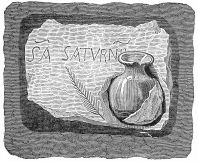
A Blood Urn, used as a mark for a martyr’s grave.
“Who art thou?” asked Fabiola.
“I am poor Emerentiana, her foster-sister,” replied the child; and
Fabiola led her kindly by the hand.
The moment the body was removed, a crowd of Christians, children, men,
and women, threw themselves forward, with sponges and linen cloths, to
gather up the blood. In vain did the guards fall on them, with whips,
cudgels, and even with sharper weapons, so that many mingled their own
blood with that of the martyr. When a sovereign, at his coronation, or
on first entering his capital, throws, according to ancient custom,
handfuls of gold and silver coins among the crowd, he does not create a
more eager competition for his scattered treasures, than there was among
those primitive Christians, for what they valued more than gold or
precious stones, the ruby drops which a martyr had poured from his heart
for his Lord. But all respected the prior claim of one; and here it was
the deacon Reparatus, who, at risk of life, was present, phial in hand,
to gather the blood of Agnes’s testimony; that it might be appended, as
a faithful seal, to the record of martyrdom on her tomb.
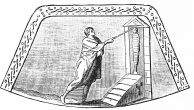
The Resurrection of Lazarus, from the Cemetery of St.
Domitilla.
 ERTULLUS hastened at once to the palace: fortunately, or unfortunately,
for these candidates for martyrdom. There he met Corvinus, with the
prepared rescript, elegantly engrossed in unical, that is, large
capital letters. He had the privilege of immediate admission into the
imperial presence; and, as a matter of business, reported the death of
Agnes, exaggerated the public feeling likely to be caused by it,
attributed it all to the folly and mismanagement of Fulvius, whose worst
guilt he did not disclose for fear of having to try him, and thus
bringing out what he was now doing; depreciated the value of Agnes’s
property, and ended by saying that it would be a gracious act of
clemency, and one sure to counteract unpopular feelings, to bestow it
upon her relative, who by settlement was her next heir. He described
Fabiola as a young lady of extraordinary intellect and wonderful
learning, who was most zealously devoted to the worship of the gods, and
daily offered sacrifice to the genius of the emperors.
“I know her,” said Maximian, laughing, as if at the recollection of
something very droll. “Poor thing! she sent me a splendid ring, and
yesterday asked me for that wretched Sebastian’s life, just as they had
finished cudgelling him to death.” And he laughed immoderately, then
continued: “Yes, yes, by all means; a little inheritance will console
her, no doubt, for the loss of that fellow. Let a rescript be made out,
and I will sign it.”
Tertullus produced the one prepared, saying he had fully relied on the
emperor’s magnanimous clemency; and the imperial barbarian put a
signature to it which would have disgraced a schoolboy. The prefect at
once consigned it to his son.
Scarcely had he left the palace, when Fulvius entered. He had been home
to put on a proper court attire, and remove from his features, by the
bath and the perfumer’s art, the traces of his morning’s passion. He
felt a keen presentiment that he should be disappointed. Eurotas’s cool
discussion of the preceding evening had prepared him; the cross of all
his designs, and his multiplied disappointments that day, had
strengthened this instinctive conviction. One woman, indeed, seemed born
to meet and baffle him whichever way he turned; but, “thank the gods,”
he thought, “she cannot be in my way here. She has this morning blasted
my character for ever; she cannot claim my rightful reward; she has made
me an outcast; it is not in her power to make me a beggar.” This seemed
his only ground of hope. Despair, indeed, urged him forward; and he
determined to argue out his claims to the confiscated property of Agnes,
with the only competitor he could fear, the rapacious emperor himself.
He might as well risk his life over it, for if he failed, he was utterly
ruined. After waiting some time, he entered the audience-hall, and
advanced with the blandest smile that he could muster to the imperial
feet.
“What want you here?” was his first greeting.
“Sire,” he replied, “I have come humbly to pray your royal justice, to
order my being put into immediate possession of my share of the Lady
Agnes’s property. She has been convicted of being a Christian upon my
accusation, and she has just suffered the merited penalty of all who
disobey the imperial edicts.”
“That is all quite right; but we have heard how stupidly you mismanaged
the whole business as usual, and have raised murmurings and discontent
in the people against us. So, now, the sooner you quit our presence,
palace, and city, the better for yourself. Do you understand? We don’t
usually give such warnings twice.”
“I will obey instantly every intimation of the supreme will. But I am
almost destitute. Command what of right is mine to be delivered over to
me, and I part immediately.”
“No more words,” replied the tyrant, “but go at once. As to the property
which you demand with so much pertinacity, you cannot have it. We have
made over the whole of it, by an irrevocable rescript, to an excellent
and deserving person, the Lady Fabiola.”
Fulvius did not speak another word; but kissed the emperor’s hand and
slowly retired. He looked a ruined, broken man. He was only heard to
say, as he passed out of the gate: “Then, after all, she has made me a
beggar too.” When he reached home, Eurotas, who read his answer in his
nephew’s eye, was amazed at his calmness.
“I see,” he drily remarked, “it is all over.”
“Yes; are your preparations made, Eurotas?”
“Nearly so. I have sold the jewels, furniture, and slaves, at some loss;
but, with the trifle I had in hand, we have enough to take us safe to
Asia. I have retained Stabio, as the most trusty of our servants; he
will carry our small travelling requisites on his horse. Two others are
preparing for you and me. I have only one thing more to get for our
journey, and then I am ready to start.”
“Pray what is that?”
“The poison. I ordered it last night, but it will only be ready at
noon.”
“What is that for?” asked Fulvius, with some alarm.
“Surely you know,” rejoined the other, unmoved. “I am willing to make
one more trial any where else; but our bargain is clear; my father’s
family must not end in beggary. It must be extinguished in honor.”
Fulvius bit his lip, and said, “Well, be it as you like, I am weary of
life. Leave the house as soon as possible, for fear of Ephraim, and be
with your horses at the third mile on the Latin gate soon after dusk. I
will join you there. For I, too, have an important matter to transact
before I start.”
“And what is that?” asked Eurotas, with a rather keen curiosity.
“I cannot tell even you. But if I am not with you by two hours after
sunset, give me up, and save yourself without me.”
Eurotas fixed upon him his cold dark eye, with one of those looks which
ever read Fulvius through; to see if he could detect any lurking idea of
escape from his gripe. But his look was cool and unusually open, and the
old man asked no more. While this dialogue was going on, Fulvius had
been divesting himself of his court garments, and attiring himself in a
travelling suit. So completely did he evidently prepare himself for his
journey, without necessity of returning home, that he even took his
weapons with him; besides his sword, securing in his girdle, but
concealed under his cloak, one of those curved daggers, of highest
temper and most fatal form, which were only known in the East.
Eurotas proceeded at once to the Numidian quarters in the palace, and
asked for Jubala; who entered with two small flasks of different sizes,
and was just going to give some explanations, when her husband,
half-drunk, half-furious, was seen approaching. Eurotas had just time to
conceal the flasks in his belt, and slip a coin into her hand, when
Hyphax came up. His wife had mentioned to him the offers which Eurotas
had made to her before marriage, and had excited in his hot African
blood a jealousy that amounted to hatred. The savage rudely thrust his
wife out of the apartment, and would have picked a quarrel with the
Syrian; had not the latter, his purpose being accomplished, acted with
forbearance, assured the archer-chief that he should never more see him,
and retired.
It is time, however, that we return to Fabiola. The reader is probably
prepared to hear us say, that she returned home a Christian: and yet it
was not so. For what as yet did she know of Christianity, to be said to
profess it? In Sebastian and Agnes she had indeed willingly admired the
virtue, unselfish, generous, and more than earthly, which now she was
ready to attribute to that faith. She saw that it gave motives of
actions, principles of life, elevation of mind, courage of conscience,
and determination of virtuous will, such as no other system of belief
ever bestowed. And even if, as she now shrewdly suspected, and intended
in calmer moments to ascertain, the sublime revelations of Syra,
concerning an unseen sphere of virtue, and its all-seeing Ruler, came
from the same source, to what did it all amount more than to a grand
moral and intellectual system, partly practical, partly speculative, as
all codes of philosophic teaching were? This was a very different thing
from Christianity. She had as yet heard nothing of its real and
essential doctrines, its fathomless, yet accessible, depths of mystery;
the awful, vast, and heaven-high structure of faith, which the simplest
soul may contain; as a child’s eye will take in the perfect reflection
and counterpart of a mountain, though a giant cannot scale it. She had
never heard of a God, One in Trinity; of the co-equal Son incarnate for
man. She had never been told of the marvellous history, of Redemption by
God’s sufferings and death. She had not heard of Nazareth, or Bethlehem,
or Calvary. How could she call herself a Christian, or be one, in
ignorance of all this?
How many names had to become familiar and sweet to her which as yet were
unknown, or barbarous—Mary, Joseph, Peter, Paul, and John? Not to
mention the sweetest of all, His, whose name is balm to the wounded
heart, or as honey dropping from the broken honeycomb. And how much had
she yet to learn about the provision for salvation on earth, in the
Church, in grace, in sacraments, in prayer, in love, in charity to
others! What unexplored regions lay beyond the small tract which she had
explored!
No; Fabiola returned home, exhausted almost by the preceding day and
night, and the sad scenes of the morning, and retired to her own
apartment, no longer perhaps even a philosopher, yet not a Christian.
She desired all her servants to keep away from the court which she
occupied, that she might not be disturbed by the smallest noise; and she
forbade any one to have access to her. There she sat in loneliness and
silence, for several hours, too excited to obtain rest from slumber. She
mourned long over Agnes, as a mother might over a child suddenly carried
off. Yet, was there not a tinge of light upon the cloud that
overshadowed her, more than when it hung over her father’s bier? Did it
not seem to her an insult to reason, an outrage to humanity, to think
that she had perished; that she had been permitted to walk forward in
her bright robe, and with her smiling countenance, and with her joyous,
simple heart, straight on—into nothing; that she had been allured by
conscience, and justice, and purity, and truth, on, on, till with arms
outstretched to embrace them, she stepped over a precipice, beneath
which yawned annihilation? No. Agnes, she felt sure, was happy somehow,
somewhere; or justice was a senseless word.
“How strange,” she further thought, “that every one whom I have known
endowed with superior excellence, men like Sebastian, women like Agnes,
should turn out to have belonged to the scorned race of Christians! One
only remains, and to-morrow I will interrogate her.”
When she turned from these, and looked round upon the heathen world,
Fulvius, Tertullus, the Emperor, Calpurnius,—nay, she shuddered as she
surprised herself on the point of mentioning her own father’s name—it
sickened her to see the contrast of baseness with nobleness, vice with
virtue, stupidity with wisdom, and the sensual with the spiritual. Her
mind was thus being shaped into a mould, which some form of practical
excellence must be found to fill, or it must be broken; her soul was
craving as a parched soil, which heaven must send its waters to refresh,
or it must become an eternal desert.
Agnes, surely, well deserved the glory of gaining, by her death, her
kinswoman’s conversion; but was there not one, more humble, who had
established a prior claim? One who had given up freedom, and offered
life, for this unselfish gain?
While Fabiola was alone and desolate, she was disturbed by the entrance
of a stranger, introduced under the ominous title of “A messenger from
the emperor.” The porter had at first denied him admittance; but upon
being assured that he bore an important embassy from the sovereign, he
felt obliged to inquire from the steward what to do; when he was
informed that no one with such a claim could be refused entrance.
Fabiola was amazed, and her displeasure was somewhat mitigated, by the
ridiculous appearance of the person deputed in such a solemn character.
It was Corvinus, who with clownish grace approached her, and in a
studied speech, evidently got up very floridly, and intrusted to a bad
memory, laid at her feet an imperial rescript, and his own sincere
affection, the Lady Agnes’s estates, and his clumsy hand. Fabiola could
not at all comprehend the connection between the two combined presents,
and never imagined that the one was a bribe for the other. So she
desired him to return her humble thanks to the emperor for his gracious
act; adding, “Say that I am too ill to-day to present myself, and do him
homage.”
“But these estates, you are aware, were forfeited and confiscated,” he
gasped out in great confusion, “and my father has obtained them for
you.”
“That was unnecessary,” said Fabiola, “for they were settled on me long
ago, and became mine the moment”—she faltered, and after a strong
effort at self-mastery, she continued—“the moment they ceased to be
another’s; they did not fall under confiscation.”
Corvinus was dumb-foundered: at last he stumbled into something, meant
for an humble petition to be admitted as an aspirant after her hand, but
understood by Fabiola to be a demand of recompense, for procuring or
bringing so important a document. She assured him that every claim he
might have on her should be fully and honorably considered at a more
favorable moment; but as she was exceedingly wearied and unwell, she
must beg him to leave her at present. He did so quite elated, fancying
that he had secured his prize.
After he was gone she hardly looked at the parchment, which he had left
open on a small table by her couch, but sat musing on the sorrowful
scenes she had witnessed, till it wanted about an hour to sunset.
Sometimes her reveries turned to one point, sometimes to another of the
late events; and, at last, she was dwelling on her being confronted with
Fulvius, that morning, in the Forum. Her memory vividly replaced the
entire scene before her, and her mind gradually worked itself into a
state of painful excitement, which she at length checked by saying aloud
to herself: “Thank heaven! I shall never behold that villain’s face
again.”
The words were scarcely out of her mouth, when she shaded her eyes with
her hand, as she raised herself up on her couch, and looked towards the
door. Was it her overheated fancy which beguiled her, or did her wakeful
eyes show her a reality? Her ears decided the question, by these words
which they heard:
“Pray, madam, who is the man whom you honor by that gracious speech?”
“You, Fulvius,” she said, rising with dignity. “A further intruder
still; not only into the house, the villa, and the dungeon, but into the
most secret apartments of a lady’s residence; and what is worse, into
the house of sorrow of one whom you have bereaved. Begone at once, or I
will have you ignominiously expelled hence.”
“Sit down and compose yourself, lady,” rejoined the intruder; “this is
my last visit to you; but we have a reckoning to make together of some
weight. As to crying out, or bringing in help, you need not trouble
yourself; your orders to your servants to keep aloof, have been too well
obeyed. There is no one within call.”
It was true. Fulvius found the way prepared unwittingly for him by
Corvinus; for upon presenting himself at the door the porter, who had
seen him twice dine at the house, told him of the strict orders given,
and assured him that he could not be admitted unless he came from the
emperor, for such were his instructions. That, Fulvius said, was exactly
his case; and the porter, wondering that so many imperial messengers
should come in one day, let him pass. He begged that the door might be
left unfastened, in case the porter should not be at his post when he
retired; for he was in a hurry, and should not like to disturb the house
in such a state of grief. He added that he required no guide, for he
knew the way to Fabiola’s apartment.
Fulvius seated himself opposite to the lady, and continued:
“You ought not to be offended, madam, with my unexpectedly coming upon
you, and overhearing your amiable soliloquies about myself; it is a
lesson I learned from yourself in the Tullian prison. But I must begin
my scores from an earlier date. When, for the first time, I was invited
by your worthy father to his table, I met one whose looks and words at
once gained my affections,—I need not now mention her name,—and whose
heart, with instinctive sympathy, returned them.”
“Insolent man!” Fabiola exclaimed, “to allude to such a topic here; it
is false that any such affection ever existed on either side.”
“As to the Lady Agnes,” resumed Fulvius, “I have the best authority,
that of your lamented parent, who more than once encouraged me to
persevere in my suit, by assuring me that his cousin had confided to him
her reciprocating love.”
Fabiola was mortified; for she now remembered that this was too true,
from the hints which Fabius had given her, of his stupid
misunderstanding.
“I know well, that my dear father was under a delusion upon this
subject; but I, from whom that dear child concealed nothing——”
“Except her religion,” interrupted Fulvius, with bitter irony.
“Peace!” Fabiola went on; “that word sounds like a blasphemy on your
lips—I knew that you were but an object of loathing and abhorrence to
her.”
“Yes, after you had made me such. From that hour of our first meeting
you became my bitter and unrelenting foe, in conspiracy with that
treacherous officer, who has received his reward, and whom you had
destined for the place I courted. Repress your indignation, lady, for I
will be heard out,—you undermined my character, you poisoned her
feelings, and you turned my love into necessary enmity.”
“Your love!” now broke in the indignant lady; “even if all that you have
said were not basely false, what love could you have for her? How
could you appreciate her artless simplicity, her genuine honesty, her
rare understanding, her candid innocence, any more than the wolf can
value the lamb’s gentleness, or the vulture the dove’s mildness? No, it
was her wealth, her family connection, her nobility, that you grasped
at, and nothing more; I read it in the very flash of your eye, when
first it fixed itself, as a basilisk’s, upon her.”
“It is false!” he rejoined; “had I obtained my request, had I been thus
worthily mated, I should have been found equal to my position, domestic,
contented, and affectionate; as worthy of possessing her as——”
“As any one can be,” struck in Fabiola, “who, in offering his hand,
expresses himself equally ready, in three hours, to espouse or to murder
the object of his affection. And she prefers the latter, and he keeps
his word. Begone from my presence; you taint the very atmosphere in
which you move.”
“I will leave when I have accomplished my task, and you will have little
reason to rejoice when I do. You have then purposely, and unprovoked,
blighted and destroyed in me every honorable purpose of life, withered
my only hope, cut me off from rank, society, respectable ease, and
domestic happiness.
“That was not enough. After acting in that character, with which you
summed up my condemnation, of a spy, and listened to my conversation,
you this morning threw off all sense of female propriety, and stood
forward prominently in the Forum, to complete in public what you had
begun in private, excite against me the supreme tribunal, and through it
the emperor, and arouse an unjust popular outcry and vengeance; such as,
but for a feeling stronger than fear, which brings me hither, would
make me now skulk, like a hunted wolf, till I could steal out of the
nearest gate.”
“And, Fulvius, I tell you,” interposed Fabiola, “that the moment you
cross its threshold, the average of virtue will be raised in this wicked
city. Again I bid you depart from my house, at least; or at any rate I
will withdraw from this offensive intrusion.”
“We part not yet, lady,” said Fulvius, whose countenance had been
growing every moment more flushed, as his lips had been becoming more
deadly pale. He rudely grasped her arm, and pushed her back to her seat;
“and beware,” he added, “how you attempt again either to escape or to
bring aid; your first cry will be your last, cost me what it may.
“You have made me, then, an outcast, not only from society but from
Rome, an exile, a houseless wanderer on a friendless earth; was not that
enough to satisfy your vengeance? No: you must needs rob me of my gold,
of my rightfully, though painfully earned wealth; peace, reputation, my
means of subsistence, all you have stolen from me, a youthful
stranger.”
“Wicked and insolent man!” exclaimed now the indignant Roman lady,
reckless of consequences, “you shall answer heavily for your temerity.
Dare you, in my own house, call me a thief?”
“I dare; and I tell you this is your day of reckoning, and not mine. I
have earned, even if by crime, it is nothing to you, my full share of
your cousin’s confiscated property. I have earned it hardly, by pangs
and rendings of the heart and soul, by sleepless nights of struggles
with fiends that have conquered; ay, and with one at home that is
sterner than they; by days and days of restless search for evidence,
amidst the desolation of a proud, but degraded spirit. Have I not a
right to enjoy it?
“Ay, call it what you will, call it my blood-money; the more infamous
it is, the more base in you to step in and snatch it from me. It is like
a rich man tearing the carrion from the hound’s jaws, after he has
swollen his feet and rent his skin in hunting it down.”
“I will not seek for further epithets by which to call you; your mind is
deluded by some vain dream,” said Fabiola, with an earnestness not
untinged with alarm. She felt she was in the presence of a madman, one
in whom violent passion, carried off by an unchecked, deeply-moved
fancy, was lashing itself up to that intensity of wicked excitement,
which constitutes a moral frenzy,—when the very murderer thinks himself
a virtuous avenger. “Fulvius,” she continued, with studied calmness, and
looking fully into his eyes, “I now entreat you to go. If you want
money, you shall have it; but go, in heaven’s name go, before you
destroy your reason by your anger.”
“What vain fancy do you mean?” asked Fulvius.
“Why, that I should have ever dreamt about Agnes’s wealth or property on
such a day, or should have taken any advantage of her cruel death.”
“And yet it is so; I have it from the emperor’s mouth that he has made
it over to you. Will you pretend to make me believe, that this most
generous and liberal prince ever parted with a penny unsolicited, ay, or
unbribed?”
“Of this I know nothing. But I know, that I would rather have died of
want than petitioned for a farthing of such property!”
“Then would you make me rather believe, that in this city there is any
one so disinterested as, undesired, to have petitioned for you? No, no,
Lady Fabiola, all this is too incredible. But what is that?” And he
pounced with eagerness on the imperial rescript, which had remained
unlooked at, since Corvinus had left it. The sensation to him was like
that of Æneas when he saw Pallas’s belt upon the body of Turnus. The
fury, which seemed to have been subdued by his subtlety, as he had been
reasoning to prove Fabiola guilty, flashed up anew at the sight of this
fatal document. He eyed it for a minute, then broke out, gnashing his
teeth with rage:
“Now, madam, I convict you of baseness, rapacity, and unnatural cruelty,
far beyond any thing you have dared to charge on me! Look at this
rescript, beautifully engrossed, with its golden letters and emblazoned
margins; and presume to say that it was prepared in the one hour that
elapsed between your cousin’s death and the emperor’s telling me that he
had signed it? Nor do you pretend to know the generous friend who
procured you the gift. Bah! while Agnes was in prison at latest; while
you were whining and moaning over her; while you were reproaching me for
cruelty and treachery towards her,—me, a stranger and alien to her!
you, the gentle lady, the virtuous philosopher, the loving, fondling
kinswoman, you, my stern reprover, were coolly plotting to take
advantage of my crime, for securing her property, and seeking out the
elegant scribe, who should gild your covetousness with his pencil, and
paint over your treason to your own flesh and blood, with his blushing
minium.”[212]
“Cease, madman, cease!” exclaimed Fabiola, endeavoring in vain to master
his glaring eye. But he went on in still wilder tone:
“And then, forsooth, when you have thus basely robbed me, you offer me
money. You have out-plotted me, and you pity me! You have made me a
beggar, and then you offer me alms,—alms out of my own wages, the wages
which even hell allows its fated victims while on earth!”
Fabiola rose again, but he seized her with a maniac’s gripe, and this
time did not let her go. He went on:
“Now listen to the last words that I will speak, or they may be the
last that you will hear. Give back to me that unjustly obtained
property; it is not fair that I should have the guilt, and you its
reward. Transfer it by your sign manual to me as a free and loving gift,
and I will depart. If not, you have signed your own doom.” A stern and
menacing glance accompanied these words.
Fabiola’s haughty self rose again erect within her; her Roman heart,
unsubdued, stood firm. Danger only made her fearless. She gathered her
robe with matronly dignity around her, and replied:
“Fulvius, listen to my words, though they should be the last that I may
speak; as certainly they shall be the last that you shall hear from me.
“Surrender this property to you? I would give it willingly to the first
leper that I might meet in the street, but to you never. Never shall you
touch thing that belonged to that holy maiden, be it a gem or be it a
straw! That touch would be pollution. Take gold of mine, if it please
you; but any thing that ever belonged to her, from me no treasures can
ransom. And one legacy I prize more than all her inheritance. You have
now offered me two alternatives, as last night you did her, to yield to
your demands, or die. Agnes taught me which to choose. Once again, I
say, depart.”
“And leave you to possess what is mine? leave you to triumph over me, as
one whom you have outwitted—you honored, and I disgraced—you rich, and
I penniless—you happy, and I wretched? No, never! I cannot save myself
from what you have made me; but I can prevent your being what you have
no right to be. For this I have come here; this is my day of
Nemesis.[213] Now die!” While he was speaking these reproaches, he was
slowly pushing her backwards with his left hand towards the couch from
which she had risen; while his right was tremblingly feeling for
something in the folds of his bosom.
As he finished his last word, he thrust her violently down upon the
couch, and seized her by the hair. She made no resistance, she uttered
no cry; partly a fainting and sickening sensation came over her; partly
a noble feeling of self-respect checked any unseemly exhibition of fear,
before a scornful enemy. Just as she closed her eyes, she saw something
like lightning above her; she could not tell whether it was his glaring
eye or flashing steel.
In another moment she felt oppressed and suffocated, as if a great
weight had fallen upon her; and a hot stream was flowing over her bosom.
A sweet voice full of earnestness sounded in her ears:
“Cease, Orontius; I am thy sister Miriam!”
Fulvius, in accents choked by passion, replied:
“It is false; give me up my prey!”
A few words more were faintly spoken in a tongue unknown to Fabiola;
when she felt her hair released, heard the dagger dashed to the ground,
and Fulvius cry out bitterly, as he rushed out of the room:
“O Christ! this is Thy Nemesis!”
Fabiola’s strength was returning; but she felt the weight upon her
increase. She struggled, and released herself. Another body was lying in
her place, apparently dead, and covered with blood.
It was the faithful Syra, who had thrown herself between her mistress’s
life and her brother’s dagger.
ΔΙΟΝΥCΙΟΥ[214]
ΙΑΤΡΟΥ
ΠΡΕCΒΥΤΕΡΟΥ
 HE great thoughts, which this occurrence would naturally have suggested
to the noble heart of Fabiola, were suppressed, for a time, by the
exigencies of the moment. Her first care was to stanch the flowing blood
with whatever was nearest at hand. While she was engaged in this work,
there was a general rush of servants towards her apartment. The stupid
porter had begun to be uneasy at Fulvius’s long stay (the reader has now
heard his real name), when he saw him dash out of the door like a
maniac, and thought he perceived stains of blood upon his garment. He
immediately gave the alarm to the entire household.
Fabiola by a gesture stopped the crowd at the door of her room, and
desired only Euphrosyne and her Greek maid to enter. The latter, since
the influence of the black slave had been removed, had attached herself
most affectionately to Syra, as we must still call her, and had, with
great docility, listened to her moral instructions. A slave was
instantly despatched for the physician who had always been sent for by
Syra in illness, Dionysius, who, as we have already observed, lived in
the house of Agnes.
In the meantime Fabiola had been overjoyed at finding the blood cease to
flow so rapidly, and still more at seeing her servant open her eyes upon
her, though only for a moment. She would not have exchanged for any
wealth the sweet smile which accompanied that look.
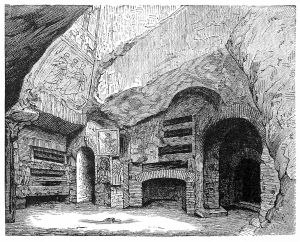
In a few minutes the kind physician arrived. He carefully examined the
wound, and pronounced favorably on it for the present. The blow, as
aimed, would have gone straight to Fabiola’s heart. But her loving
servant, in spite of prohibition, had been hovering near her mistress
during the whole day; never intruding, but anxious for any opportunity
which might offer, of seconding those good impressions of grace, which
the morning’s scenes could not fail to have produced. While in a
neighboring room she heard violent tones which were too familiar to her
ears; and hastened noiselessly round, and within the curtain which
covered the door of Fabiola’s own apartment. She stood concealed in the
dusk, on the very spot where Agnes had, a few months before, consoled
her.
She had not been there long when the last struggle commenced. While the
man was pushing her mistress backwards, she followed him close behind;
and as he was lifting his arm, passed him, and threw her body over that
of his victim. The blow descended, but misdirected, through the shock
she gave his arm; and it fell upon her neck, where it inflicted a deep
wound, checked, however, by encountering the collar-bone. We need not
say what it cost her to make this sacrifice. Not the dread of pain, nor
the fear of death could for a moment have deterred her; it was the
horror of imprinting on her brother’s brow the mark of Cain, the making
him doubly a fratricide, which deeply anguished her. But she had offered
her life for her mistress. To have fought with the assassin, whose
strength and agility she knew, would have been useless; to try to alarm
the house before one fatal blow was struck was hopeless; and nothing
remained but to accomplish her immolation, by substituting herself for
the intended victim. Still she wished to spare her brother the
consummation of his crime, and in doing so manifested to Fabiola their
relationship and their real names.
In his blind fury he refused her credit; but the words, in their native
tongue, which said, “Remember my scarf which you picked up here,”
brought back to his memory so terrible a domestic tale, that had the
earth opened a cavern in that moment before his feet, he would have
leaped into it, to bury his remorse and shame.
Strange, too, it proved, that he should not have ever allowed Eurotas to
get possession of that family relic, but should, ever since he regained
it, have kept it apart as a sacred thing; and when all else was being
packed up, should have folded it up and put it in his breast. And now,
in the act of drawing out his eastern dagger, he had plucked this out
too, and both were found upon the floor.
Dionysius, immediately after dressing the wound, and administering
proper restoratives, which brought back consciousness, desired the
patient to be left perfectly quiet, to see as few persons as possible,
so as to prevent excitement, and to go on with the treatment which he
prescribed until midnight. “I will call,” he added, “very early in the
morning, when I must see my patient alone.” He whispered a few words in
her ear, which seemed to do her more good than all his medicines; for
her countenance brightened into an angelic smile.
Fabiola had her placed in her own bed, and, allotting to her attendants
the outward room, reserved to herself exclusively the privilege, as she
deemed it, of nursing the servant, to whom a few months before she could
hardly feel grateful for having tended her in fever. She had informed
the others how the wound had been inflicted, concealing the relationship
between her assailant and her deliverer.
Although herself exhausted and feverish, she would not leave the bedside
of the patient; and when midnight was past, and no more remedies had to
be administered, she sank to rest upon a low couch close to the bed. And
now what were her thoughts, when, in the dim light of a sick room, she
opened her mind and heart to them? They were simple and earnest. She saw
at once the reality and truth of all that her servant had ever spoken to
her. When she last conversed with her, the principles which she heard
with delight, had appeared to her wholly beyond practice, beautiful
theories, which could not be brought to action. When Miriam had
described a sphere of virtue, wherein no approbation or reward of man
was to be expected, but only the approving eye of God, she had admired
the idea, which powerfully seized her generous mind; but she had
rebelled against its becoming the constraining rule of hourly conduct.
Yet, if the stroke under which she cast herself had proved fatal, as it
might easily have done, where would have been her reward? What, then,
could have been her motive but that very theory, as it seemed, of
responsibility to an unseen power?
And when Miriam had discoursed of heroism in virtue as being its
ordinary standard, how chimerical the principle had seemed! Yet here,
without preparation, without forethought, without excitement, without
glory,—nay, with marked desire of concealment, this slave had performed
a deed of self-sacrifice, heroic in every way. From what could that
result but from habitual heroism of virtue, ready at any hour to do what
would ennoble forever a soldier’s name? She was no dreamer, then, no
theorist, but a serious, real practiser of all that she taught. Could
this be a philosophy? Oh, no, it must be a religion! the religion of
Agnes and of Sebastian, to whom she considered Miriam every way equal.
How she longed to converse with her again!
Early in the morning, according to his promise, the physician returned,
and found his patient much improved. He desired to be left alone with
her; when, having spread a linen cloth upon the table, and placed
lighted tapers upon it, he drew from his bosom an embroidered scarf, and
uncovered a golden box, the sacred contents of which she well knew.
Approaching her he said:
“My dear child, as I promised you, I have now brought you not merely the
truest remedy of every ailment, bodily and spiritual, but the very
Physician Himself, who by His word alone restoreth all things,[215]
whose touch opens the eyes of the blind and the ears of the deaf, whose
will cleanses lepers, the hem of whose garment sends forth virtue to
cure all. Are you ready to receive Him?”
“With all my heart,” she replied, clasping her hands; “I long to possess
Him whom alone I have loved, in whom I have believed, to whom my heart
belongs.”
“Does no anger or indignation exist in your soul against him who has
injured you? does any pride or vanity arise in your mind at the thought
of what you have done? or are you conscious of any other fault requiring
humble confession and absolution before receiving the sacred gift into
your breast?”
“Full of imperfection and sin I know myself to be, venerable father; but
I am not conscious of any knowing offence. I have had no need to forgive
him to whom you allude; I love him too much for that, and would
willingly give my life to save him. And of what have I to be proud, a
poor servant, who have only obeyed my Lord’s commands?”
“Invite then, my child, this Lord into your house, that coming He may
heal you, and fill you with His grace.”
Approaching the table, he took from it a particle of the Blessed
Eucharist, in the form of unleavened bread, which, being dry, he
moistened in water, and placed within her lips.[216] She closed them
upon it, and remained for some time absorbed in contemplation.
And thus did the holy Dionysius discharge his twofold office of
physician and priest, attributed to him on his tomb.
 HROUGH the whole of that day the patient seemed occupied with deep, but
most pleasing thoughts. Fabiola, who never left her, except for moments
to give necessary directions, watched her countenance with a mixture of
awe and delight. It appeared as if her servant’s mind were removed from
surrounding objects, and conversing in a totally different sphere. Now a
smile passed like a sunbeam across her features, now a tear trembled in
her eye, or flowed down her cheeks; sometimes her pupils were raised and
kept fixed on heaven for a considerable time, while a blissful look of
perfect and calm enjoyment sat unvarying upon her; and then she would
turn round with an expression of infinite tenderness towards her
mistress, and hold out her hand to be clasped in hers. And Fabiola could
sit thus for hours in silence, which was as yet prescribed; feeling it
an honor, and thinking it did her good, to be in contact with such a
rare type of virtue.
At length, in the course of the day, after giving her patient some
nourishment, she said to her, smiling: “I think you are much better,
Miriam, already. Your physician must have given you some wonderful
medicine.”
“Indeed he has, my dearest mistress.”
Fabiola was evidently pained; and leaning over her, said softly: “Oh, do
not, I entreat you, call me by such a title. If it has to be used, it
should be by me towards you. But, in fact, it is no longer true; for
what I long intended has now been done; and the instrument of your
liberation has been ordered to be made out, not as a freedwoman, but as
an ingenua;[217] for such I know you are.”
Miriam looked her thanks, for fear of further hurting Fabiola’s
feelings; and they continued to be happy together in silence.
Towards evening Dionysius returned, and found so great an improvement,
that, ordering more nourishing food, he permitted a little quiet
conversation.
“I must now,” said Fabiola, so soon as they were alone, “fulfill the
first duty, which my heart has been burning to discharge, that of
thanking you,—I wish I knew a stronger word,—not for the life which
you have saved me, but for the magnanimous sacrifice which you made for
it—and, let me add, the unequalled example of heroic virtue, which
alone inspired it.”
“After all, what have I done, but simple duty? You had a right to my
life, for a much less cause than to save yours,” answered Miriam.
“No doubt,” responded Fabiola, “it appears so to you, who have been
trained to the doctrine which overpowered me, that the most heroic acts
ought to be considered by men as performances of ordinary duties.”
“And thereby,” rejoined Miriam, “they cease to be what you have called
them.”
“No, no,” exclaimed Fabiola, with enthusiasm; “do not try to make me
mean and vile to my own heart, by teaching me to undervalue what I
cannot but prize as an unrivalled act of virtue. I have been reflecting
on it, night and day, since I witnessed it; and my heart has been
yearning to speak to you of it, and even yet I dare not, or I should
oppress your weakness with my overcharged feelings. It was noble, it was
grand, it was beyond all reach of praise; though I know you do not want
it. I cannot see any way in which the sublimeness of the act could have
been enhanced, or human virtue rise one step higher.”
Miriam, who was now raised to a reclining position, took Fabiola’s hand
between both hers; and turning round towards her, in a soft and mild,
but most earnest tone, thus addressed her:
“Good and gentle lady, for one moment listen to me. Not to depreciate
what you are good enough to value, since it pains you to hear it, but to
teach you how far we still are from what might have been done, let me
trace for you a parallel scene, but where all shall be reversed. Let it
be a slave—pardon me, dear Fabiola, for another pang—I see it in your
face, but it shall be the last—yes, a slave brutish, ungrateful,
rebellious to the most benign and generous of masters. And let the
stroke, not of an assassin, but of the minister of justice, impend over
his head. What would you call the act, how would you characterize the
virtue, of that master, if out of pure love, and that he might reclaim
that wretched man, he should rush beneath the axe’s blow, ay, and its
preceding ignominious stripes, and leave written in his will, that he
made that slave heir to his titles and his wealth, and desired him to be
considered as his brother?”
“O Miriam, Miriam, you have drawn a picture too sublime to be believed
of man. You have not eclipsed your own deed, for I spoke of human
virtue. To act as you have now described would require, if possible,
that of a God!”
Miriam pressed the folded hand to her bosom, fixed on Fabiola’s
wondering eyes a look of heavenly inspiration, as she sweetly and
solemnly replied: “And Jesus Christ, who did all this for man, was truly
God.”
Fabiola covered her face with both her hands, and for a long time was
silent. Miriam prayed earnestly in her own tranquil heart.
“Miriam, I thank you from my soul,” at length Fabiola said; “you have
fulfilled your promise of guiding me. For some time I have only been
fearing that you might not be a Christian; but it could not be.
“Now tell me, are those awful, but sweet words, which you just now
uttered, which have sunk into my heart as deeply, as silently, and as
irrevocably as a piece of gold dropped upon the surface of the still
ocean goes down into its depths,—are those words a mere part of the
Christian system, or are they its essential principle?”
“From a simple allegory, dear lady, your powerful mind has, in one
bound, reached and grasped the master-key of our whole teaching: the
alembic of your fine understanding has extracted, and condensed into one
thought, the most vital and prominent doctrines of Christianity. You
have distilled them into their very essence.
“That man, God’s creature and bondsman, rebelled against his Lord; that
justice irresistible had doomed and pursued him; that this very Lord
‘took the form of a servant, and in habit was found like a man;’[218]
that in this form he suffered stripes, buffets, mockery, and shameful
death, became the ‘Crucified One,’ as men here call Him, and thereby
rescued man from his fate, and gave him part in His own riches and
kingdom: all this is comprised in the words that I have spoken.
“And you had reached the right conclusion. Only God could have
performed so godlike an action, or have offered so sublime an
expiation.”
Fabiola was again wrapped up in silent thought, till she timidly asked:
“And was it to this that you referred in Campania, when you spoke of God
alone being a victim worthy of God?”
“Yes; but I further alluded to the continuation of that sacrifice, even
in our own days, by a marvellous dispensation of an all-powerful love.
However, on this I must not yet speak.”
Fabiola resumed: “I every moment see how all that you have ever spoken
to me coheres and fits together, like the parts of one plant; all
springing one from another. I thought it bore only the lovely flowers of
an elegant theory; you have shown me in your conduct how these can ripen
into sweet and solid fruit. In the doctrine which you have just
explained, I seem to myself to find the noble stem from which all the
others branch forth—even to that very fruit. For who would refuse to do
for another, what is much less than God has done for him? But, Miriam,
there is a deep and unseen root whence springs all this, possibly dark
beyond contemplation, deep beyond reach, complex beyond man’s power to
unravel; yet perhaps simple to a confiding mind. If, in my present
ignorance, I can venture to speak, it should be vast enough to occupy
all nature, rich enough to fill creation with all that is good and
perfect in it, strong enough to bear the growth of your noble tree, till
its summit reach above the stars, and its branches to the ends of earth.
“I mean, your idea of that God, whom you made me fear, when you spoke to
me as a philosopher of Him, and taught me to know as the ever-present
watchman and judge; but whom I am sure you will make me love when, as a
Christian, you exhibit Him to me as the root and origin of such
boundless tenderness and mercy.
“Without some deep mystery in His nature, as yet unknown to me, I cannot
fully apprehend that wonderful doctrine of man’s purchase.”
“Fabiola,” responded Miriam, “more learned teachers than I should
undertake the instruction of one so gifted and so acute. But will you
believe me if I attempt to give you some explanation?”
“Miriam,” replied Fabiola, with strong emphasis, “ONE WHO IS READY TO
DIE FOR ANOTHER, WILL CERTAINLY NOT DECEIVE HIM.”
“And now,” rejoined the patient, smiling, “you have again seized a great
principle—that of FAITH. I will, therefore, be only the simple narrator
of what Jesus Christ, who truly died for us, has taught us. You will
believe my word only as that of a faithful witness; you will accept His,
as that of an unerring God.”
Fabiola bowed her head, and listened with reverential mind to her, in
whom she had long honored a teacher of marvellous wisdom, which she drew
from some unknown school; but whom now she almost worshipped as an
angel, who could open to her the flood-gates of the eternal ocean, whose
waters are the unfathomable Wisdom, overflowing on earth.
Miriam expounded, in the simple terms of Catholic teaching, the sublime
doctrine of the Trinity; then after relating the fall of man, unfolded
the mystery of the Incarnation, giving, in the very words of St. John,
the history of the Eternal Word, till He was made flesh, and dwelt among
men. Often was she interrupted by the expressions of admiration or
assent which her pupil uttered; never by cavil or doubt. Philosophy had
given place to religion, captiousness to docility, incredulity to faith.
But now a sadness seemed to have come over Fabiola’s heart: Miriam read
it in her looks, and asked her its cause.
“I hardly dare tell you,” she replied. “But all that you have related to
me is so beautiful, so divine, that it seems to me necessarily to end
here.
“The Word (what a noble name!), that is, the expression of God’s love,
the externation of His wisdom, the evidence of His power, the very
breath of His life-giving life, which is Himself, becometh flesh. Who
shall furnish it to Him? Shall He take up the cast-off slough of a
tainted humanity, or shall a new manhood be created expressly for Him?
Shall He take His place in a double genealogy, receiving thus into
Himself a twofold tide of corruption; and shall there be any one on
earth daring and high enough to call himself His father?”
“No,” softly whispered Miriam; “but there shall be one holy enough, and
humble enough, to be worthy to call herself His mother!
“Almost 800 years before the Son of God came into the world, a prophet
spoke, and recorded his words, and deposited the record of them in the
hands of the Jews, Christ’s inveterate enemies; and his words were
these: ‘Behold, a Virgin shall conceive and bear a Son, and His name
shall be called Emanuel,’[219] which in the Hebrew language signifies
‘God with us,’ that is with men.
“This prophecy was of course fulfilled in the conception and birth of
God’s Son on earth.”
“And who was she?” asked Fabiola, with great reverence.
“One whose very name is blessed by every one that truly loves her Son.
Mary is the name by which you will know her: Miriam, its original in her
own tongue, is the one by which I honor her. Well, you may suppose, was
she prepared for such high destiny by holiness and virtue; not as
cleansed, but as ever clean; not as purified, but as always pure; not
freed, but exempted, from sin. The tide of which you spoke, found before
her the dam of an eternal decree, which could not brook that the
holiness of God should mingle with what it could only redeem, by keeping
extraneous to itself. Bright as the blood of Adam, when the breath of
God sent it sparkling through his veins, pure as the flesh of Eve, while
standing yet in the mould of the Almighty hands, as they drew it from
the side of the slumbering man, were the blood and the flesh, which the
Spirit of God formed into the glorious humanity, that Mary gave to
Jesus.
“And after this glorious privilege granted to our sex, are you surprised
that many, like your sweet Agnes, should have chosen this peerless
Virgin as the pattern of their lives; should find in her, whom God so
elected, the model of every virtue; and should, in preference to
allowing themselves to be yoked, even by the tenderest of ties, to the
chariot-wheels of this world, seek to fly upwards on wings of undivided
love like hers?”
After a pause and some reflection, Miriam proceeded briefly to detail
the history of our Saviour’s birth, His laborious youth, His active but
suffering public life, and then His ignominious Passion. Often was the
narrative interrupted by the tears and sobs of the willing listener and
ready learner. At last the time for rest had come, when Fabiola humbly
asked:
“Are you too fatigued to answer one question more?”
“No,” was the cheerful reply.
“What hope,” said Fabiola, “can there be for one who cannot say she was
ignorant, for she pretended to know every thing; nor that she neglected
to learn, for she affected eagerness after every sort of knowledge; but
can only confess that she scorned the true wisdom, and blasphemed its
Giver;—for one who has scoffed at the very torments which proved the
love, and sneered at the death which was the ransoming, of Him whom she
has mocked at, as the ‘Crucified?’”
A flood of tears stopped her speech.
Miriam waited till their relieving flow had subsided into that gentler
dew which softens the heart; then in soothing tones addressed her as
follows:
“In the days of our Lord there lived a woman who bore the same name as
His spotless Mother; but she had sinned publicly, degradingly, as you,
Fabiola, would abhor to sin. She became acquainted, we know not how,
with her Redeemer; in the secrecy of her own heart, she contemplated
earnestly, till she came to love intensely, His gracious and
condescending familiarity with sinners, and His singular indulgence and
forgivingness to the fallen. She loved and loved still more; and,
forgetting herself, she only thought how she might manifest her love, so
that it might bring honor, however slight, to Him, and shame, however
great, on herself.
“She went into the house of a rich man, where the usual courtesies of
hospitality had been withheld from its Divine guest, into the house of a
haughty man who spurned, in the presumption of his heart, the public
sinner; she supplied the attentions which had been neglected to Him whom
she loved; and she was scorned, as she expected, for her obtrusive
sorrow.”
“How did she do this, Miriam?”
“She knelt at His feet as He sat at table; she poured out upon them a
flood of tears; she wiped them with her luxurious hair, she kissed them
fervently, and she anointed them with rich perfume.”
“And what was the result?”
“She was defended by Jesus against the carping gibes of His host; she
was told that she was forgiven on account of her love, and was dismissed
with kindest comfort.”
“And what became of her?”
“When on Calvary He was crucified, two women were privileged to stand
close to Him; Mary the sinless, and Mary the penitent: to show how
unsullied and repentant love may walk hand in hand, beside Him who said
that He had ‘come to call not the just, but sinners to repentance.’”
No more was said that night. Miriam, fatigued with her exertion, sank
into a placid slumber. Fabiola sat by her side, filled to her heart’s
brim with this tale of love. She pondered over it again and again; and
she still saw more and more how every part of this wonderful system was
consistent. For if Miriam had been ready to die for her, in imitation of
her Saviour’s love, so had she been as ready to forgive her, when she
had thoughtlessly injured her. Every Christian, she now felt, ought to
be a copy, a representative of his Master; but the one that slumbered so
tranquilly beside her was surely true to her model, and might well
represent Him to her.
When, after some time, Miriam awoke, she found her mistress (for her
patent of freedom was not yet completed) lying at her feet, over which
she had sobbed herself to sleep. She understood at once the full meaning
and merit of this self-humiliation; she did not stir, but thanked God
with a full heart that her sacrifice had been accepted.
Fabiola, on awaking, crept back to her own couch, as she thought,
unobserved. A secret, sharp pang it had cost her to perform this act of
self-abasement; but she had thoroughly humbled the pride of her heart.
She felt for the first time that her heart was Christian.
 HE next morning, when Dionysius came, he found both patient and nurse
so radiant and so happy, that he congratulated them both on having had a
good night’s rest. Both laughed at the idea; but concurred in saying
that it had been the happiest night of their lives. Dionysius was
surprised, till Miriam, taking the hand of Fabiola, said:
“Venerable priest of God, I confide to your fatherly care this
catechumen, who desires to be fully instructed in the mysteries of our
holy faith, and to be regenerated by the waters of eternal salvation.”
“What!” asked Fabiola, amazed, “are you more than a physician?”
“I am, my child,” the old man replied; “unworthily I hold likewise the
higher office of a priest in God’s Church.”
Fabiola unhesitatingly knelt before him, and kissed his hand. The priest
placed his right hand upon her head, and said to her:
“Be of good courage, daughter; you are not the first of your house whom
God has brought into His holy Church. It is now many years since I was
called in here, under the guise of a physician, by a former servant, now
no more; but in reality it was to baptize, a few hours before her death,
the wife of Fabius.”
“My mother!” exclaimed Fabiola. “She died immediately after giving me
birth. And did she die a Christian?”
“Yes; and I doubt not that her spirit has been hovering about you
through life by the side of the angel who guards you, guiding you unseen
to this blessed hour. And, before the throne of God, she has been
unceasing in her supplications on your behalf.”
Joy tenfold filled the breasts of the two friends; and after
arrangements had been made with Dionysius for the necessary instructions
and preparations for Fabiola’s admission to baptism, she went up to the
side of Miriam, and taking her hand, said to her in a low, soft voice:
“Miriam, may I from henceforth call you sister?” A pressure of the hand
was the only reply which she could give.
With their mistress, the old nurse, Euphrosyne, and the Greek slave,
placed themselves, as we now say, under instruction, to receive baptism
on Easter-eve. Nor must we forget one who was already enrolled in the
list of catechumens, and whom Fabiola had taken home with her and kept,
Emerentiana, the foster-sister of Agnes. It was her delight to make
herself useful, by being the ready messenger between the sick-room and
the rest of the house.
During her illness, as her strength improved, Miriam imparted many
particulars of her previous life to Fabiola; and as they will throw some
light on our preceding narrative, we will give her history in a
continuous form.
Some years before our story commenced, there lived in Antioch a man who,
though not of ancient family, was rich, and moved in the highest circles
of that most luxurious city. To keep his position, he was obliged to
indulge in great expense; and from want of strict economy, he had
gradually become oppressed with debt. He was married to a lady of great
virtue, who became a Christian, at first secretly, and afterwards
continued so, with her husband’s reluctant consent. In the meantime
their two children, a son and daughter, had received their domestic
education under her care. The former, Orontius, so called from the
favorite stream which watered the city, was fifteen when his father
first discovered his wife’s religion. He had learnt much from his mother
of the doctrines of Christianity, and had been with her an attendant on
Christian worship; and hence he possessed a dangerous knowledge, of
which he afterwards made so fatal a use.
But he had not the least inclination to embrace the doctrines, or adopt
the practices of Christianity; nor would he hear of preparing for
baptism. He was wilful and artful, with no love for any restraint upon
his passions, or for any strict morality. He looked forward to
distinction in the world, and to his full share in all its enjoyments.
He had been, and continued to be, highly educated; and besides the Greek
language, then generally spoken at Antioch, he was acquainted with
Latin, which he spoke readily and gracefully, as we have seen, though
with a slight foreign accent. In the family, the vernacular idiom was
used with servants, and often in familiar conversation. Orontius was not
sorry when his father removed him from his mother’s control, and
insisted that he should continue to follow the dominant and favored
religion of the state.
As to the daughter, who was three years younger, he did not so much
care. He deemed it foolish and unmanly to take much trouble about
religion; to change it especially, or abandon that of the empire, was,
he thought, a sign of weakness. But women being more imaginative, and
more under the sway of the feelings, might be indulged in any fancies of
this sort. Accordingly he permitted his daughter Miriam, whose name was
Syrian, as the mother belonged to a rich family from Edessa, to continue
in the free exercise of her new faith. She became, in addition to her
high mental cultivation, a model of virtue, simple and unpretending. It
was a period, we may observe, in which the city of Antioch was renowned
for the learning of its philosophers, some of whom were eminent as
Christians.
A few years later, when the son had reached manhood, and had abundantly
unfolded his character, the mother died. Before her end, she had seen
symptoms of her husband’s impending ruin; and, determined that her
daughter should not be dependent on his careless administration, nor on
her son’s ominous selfishness and ambition, she secured effectually from
the covetousness of both, her own large fortune, which was settled on
her daughter. She resisted every influence, and every art, employed to
induce her to release this property, or allow it to merge in the family
resources, and be made available towards relieving their embarrassments.
And on her death-bed, among other solemn parental injunctions, she laid
this on her daughter’s filial sense of duty, that she never would allow,
after coming of age, any alteration in this arrangement.
Matters grew worse and worse; creditors pressed; property had been
injudiciously disposed of; when a mysterious person, called Eurotas,
made his appearance in the family. No one but its head seemed to know
him; and he evidently looked upon him as at once a blessing and a curse,
the bearer both of salvation and of ruin.
The reader is in possession of Eurotas’s own revelations; it is
sufficient to add, that being the elder brother, but conscious that his
rough, morose, and sinister character did not fit him for sustaining the
position of head of the family and administering quietly a settled
property, and having a haughty ambition to raise his house into a nobler
rank, and increase even its riches, he took but a moderate sum of money
as capital, vanished for years, embarked in the desperate traffic of
interior Asia, penetrated into China and India, and came back home with
a large fortune, and a collection of rare gems, which helped his
nephew’s brief career, but misguided him to ruin in Rome.
Eurotas, instead of a rich family, into which to pour superfluous
wealth, found only a bankrupt house to save from ruin. But his family
pride prevailed; and after many reproaches, and bitter quarrels with his
brother, but concealed from all else, he paid off his debts by the
extinction of his own capital, and thus virtually became master of all
the wreck of his brother’s property, and of the entire family.
After a few years of weary life, the father sickened and died. On his
death-bed, he told Orontius that he had nothing to leave him, that all
he had lived on for some years, the very house over his head, belonged
to his friend Eurotas, whose relationship he did not further explain,
whom he must look up to entirely for support and guidance. The youth
thus found himself, while full of pride, ambition, and voluptuousness,
in the hands of a cold-hearted, remorseless, and no less ambitious man,
who soon prescribed as the basis of mutual confidence, absolute
submission to his will, while he should act in the capacity of an
inferior, and the understood principle, that nothing was too great or
too little, nothing too good or too wicked to be done, to restore family
position and wealth.
To stay at Antioch was impossible after the ruin which had overtaken the
house. With a good capital in hand, much might be done elsewhere. But
now, even the sale of all left would scarcely cover the liabilities
discovered after the father’s death. There was still untouched the
sister’s fortune; and both agreed that this must be got from her.
Every artifice was tried, every persuasion employed, but she simply and
firmly resisted; both in obedience to her mother’s dying orders, and
because she had in view the establishment of a house for consecrated
virgins, in which she intended to pass her days. She was now just of
legal age to dispose of her own property. She offered them every
advantage that she could give them; proposed that for a time they should
all live together upon her means. But this did not answer their purpose;
and when every other course had failed, Eurotas began to hint, that one
who stood so much in their way should be got rid of at any cost.
Orontius shuddered at the first proposal of the thought. Eurotas
familiarized him gradually with it, till—shrinking yet from the actual
commission of fratricide—he thought he had almost done something
virtuous, as the brothers of Joseph imagined they did, by adopting a
slower and less sanguinary method of dealing with an obnoxious brother.
Stratagem and unseen violence, of which no law could take cognizance,
and which no one would dare reveal, offered him the best chance of
success.
Among the privileges of Christians in the first ages, we have already
mentioned that of reserving the Blessed Eucharist at home for domestic
communion. We have described the way in which it was enfolded in an
orarium, or linen cloth, again often preserved in a richer cover. This
precious gift was kept in a chest (arca) with a lid, as St. Cyprian
has informed us.[220] Orontius well knew this; and he was moreover aware
that its contents were more prized than silver or gold; that, as the
Fathers tell us, to drop negligently a crumb of the consecrated bread
was considered a crime;[221] and that the name of “pearl,” which was
given to the smallest fragment,[222] showed that it was so precious in a
Christian’s eye, that he would part with all he possessed to rescue it
from sacrilegious profanation.
The scarf richly embroidered with pearls, which has more than once
affected our narrative, was the outer covering in which Miriam’s mother
had preserved this treasure; and her daughter valued it both as a dear
inheritance, and as a consecrated object, for she continued its use.
One day, early in the morning, she knelt before her ark; and after
fervent preparation by prayer, proceeded to open it. To her dismay she
found it already unlocked, and her treasure gone! Like Mary Magdalen at
the sepulchre, she wept bitterly, because they had taken her Lord, and
she knew not where they had laid Him. Like her, too, “as she was weeping
she stooped down and looked” again into her ark, and found a paper,
which in the confusion of the first glance she had overlooked.
It informed her that what she sought was safe in her brother’s hands,
and might be ransomed. She ran at once to him, where he was closeted
with the dark man, in whose presence she always trembled; threw herself
on her knees before him, and entreated him to restore what she valued
more than all her wealth. He was on the point of yielding to her tears
and supplications, when Eurotas fixed his stern eye upon him, overawed
him, then himself addressed her, saying:
“Miriam, we take you at your word. We wish to put the earnestness and
reality of your faith to a sufficient test. Are you truly sincere in
what you offer?”
“I will surrender any thing, all I have, to rescue from profanation the
Holy of Holies.”
“Then sign that paper,” said Eurotas, with a sneer.
She took the pen in her hand, and after running her eye over the
document, signed it. It was a surrender of her entire property to
Eurotas. Orontius was furious when he saw himself overreached, by the
man to whom he had suggested the snare for his sister. But it was too
late; he was only the faster in his unsparing gripe. A more formal
renunciation of her rights was exacted from Miriam, with the formalities
required by the Roman law.
For a short time she was treated soothingly; then hints began to be
given to her of the necessity of moving, as Orontius and his friend
intended to proceed to Nicomedia, the imperial residence. She asked to
be sent to Jerusalem, where she would obtain admission into some
community of holy women. She was accordingly embarked on board a vessel,
the captain of which bore a suspicious character, and was very sparingly
supplied with means. But she bore round her neck what she had given
proof of valuing, more than any wealth. For, as St. Ambrose relates of
his brother Satyrus, yet a catechumen, Christians carried round their
necks the Holy Eucharist, when embarking for a voyage.[223] We need not
say that Miriam bore it securely folded in the only thing of price she
cared to take from her father’s house.
When the vessel was out at sea, instead of coasting towards Joppe or any
port on the coast, the captain stood straight out, as if making for some
distant shore. What his purpose was, it was difficult to conjecture; but
his few passengers became alarmed, and a serious altercation ensued.
This was cut short by a sudden storm; the vessel was carried forward at
the mercy of the winds for some days, and then dashed to pieces on a
rocky island near Cyprus. Like Satyrus, Miriam attributed her reaching
the shore in safety to the precious burden which she bore. She was
almost the only survivor; at least she saw no other person saved. Those,
therefore, that did live besides, on returning to Antioch, reported her
death, together with that of the remaining passengers and crew.
She was picked up on the shore by men who lived on such spoil.
Destitute and friendless, she was sold to a trader in slaves, taken to
Tarsus, on the mainland, and again sold to a person of high rank, who
treated her with kindness.
After a short time, Fabius instructed one of his agents in Asia to
procure a slave of polished manners and virtuous character, if possible,
at any price, to attend on his daughter; and Miriam, under the name of
Syra, came to bring salvation to the house of Fabiola.
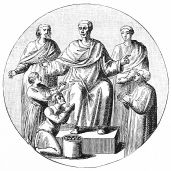
Ordination, from a picture in the Catacombs.
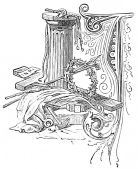 T was a few days after the occurrences related in our last chapter but
one, that Fabiola was told, that an old man in great anguish, real or
pretended, desired to speak with her. On going down to him and asking
him his name and business, he replied:
“My name, noble lady, is Ephraim; and I have a large debt secured on the
property of the late Lady Agnes, which I understand has now passed into
your hands; and I am come, therefore, to claim it from you, for
otherwise I am a ruined man!”
“How is that possible?” asked Fabiola in amazement. “I cannot believe
that my cousin ever contracted debts.”
“No, not she,” rejoined the usurer, a little abashed; “but a gentleman
called Fulvius, to whom the property was to come by confiscation; so I
advanced him large sums upon it.”
Her first impulse was to turn the man out of the house; but the thought
of the sister came to her mind, and she civilly said to him:
“Whatever debts Fulvius has contracted I will discharge; but with only
legal interest, and without regard to usurious contracts.”
“But think of the risks I ran, madam. I have been most moderate in my
rates, I assure you.”
“Well,” she answered, “call on my steward, and he shall settle all. You
are running no risks now at least.”
She gave instructions, accordingly, to the freed-man who managed her
affairs, to pay this sum on those conditions, which reduced it to one
half the demand. But she soon engaged him in a more laborious task, that
of going through the whole of her late father’s accounts, and
ascertaining every case of injury or oppression, that restitution might
be made. And further, having ascertained that Corvinus had really
obtained the imperial rescript, through his father, by which her own
lawful property was saved from confiscation, though she refused ever to
see him, she bestowed upon him such a remuneration as would ensure him
comfort through life.
These temporal matters being soon disposed of, she divided her attention
between the care of the patient and preparation for her Christian
initiation. To promote Miriam’s recovery, she removed her, with a small
portion of her household, to a spot dear to both, the Nomentan villa.
The spring had set in, and Miriam could have her couch brought to the
window, or, in the warmest part of the day, could even be carried down
into the garden before the house, where, with Fabiola on one side and
Emerentiana on the other, and poor Molossus, who had lost all his
spirit, at her feet, they would talk of friends lost, and especially of
her with whom every object around was associated in their memories. And
no sooner was the name of Agnes mentioned, than her old faithful guard
would prick up his ears and wag his tail, and look around him. They
would also frequently discourse on Christian subjects, when Miriam would
follow up, humbly and unpretendingly, but with the warm glow which had
first charmed Fabiola, the instructions given by the holy Dionysius.
Thus, for instance, when he had been treating of the virtue and meaning
of the sign of the cross to be used in baptism, “whether on the forehead
of believers, or over the water, by which they were to be regenerated,
or the oil with which, as well as the chrism, they were anointed, or the
sacrifice by which they are fed;”[224] Miriam explained to the
catechumens its more domestic and practical use, and exhorted them to
practise faithfully what all good Christians did, that is, to make this
holy sign upon themselves already, “in the course and at the beginning
of every work, on coming in and going out, when putting on their
clothes, or sandals, when they washed, sat down to table, lighted their
lamp, lay down in bed, or sat on a chair, in whatever conversation they
should be engaged.”[225]
But it was observed with pain, by all but Fabiola, that the patient,
though the wound had healed, did not gain strength. It is often the
mother or sister that is last to see the slow waste of illness, in child
or sister. Love is so hopeful, and so blind! There was a hectic flush on
her cheek, she was emaciated and weak, and a slight cough was heard from
time to time. She lay long awake, and she desired to have her bed so
placed that from early dawn she could look out upon one spot more fair
to them all than the richest parterre.
There had long been in the villa an entrance to the cemetery on this
road; but from this time it had already received the name of Agnes; for
near its entrance had this holy martyr been buried. Her body rested in a
cubiculum or chamber, under an arched tomb. Just above the entrance
into this chamber, and in the middle of the grounds, was an opening,
surrounded above by a low parapet, concealed by shrubs,
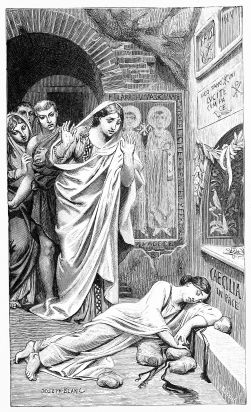
Fabiola went down herself, with a few servants, and what
was her distress at finding poor Emerentiana lying weltering in her
blood, and perfectly dead.
which gave light and air to the room below. Towards this point Miriam
loved to look, as the nearest approach she could make, in her infirm
health, to the sepulchre of one whom she so much venerated and loved.
Early one morning, beautiful and calm, for it wanted but a few weeks to
Easter, she was looking in that direction, when she observed
half-a-dozen young men, who on their way to angle in the neighboring
Anio, were taking a short cut across the villa, and so committing a
trespass. They passed by this opening; and one of them, having looked
down, called the others.
“This is one of those underground lurking-places of the Christians.”
“One of their rabbit-holes into the burrow.”
“Let us go in,” said one.
“Yes, and how shall we get up again?” asked a second.
This dialogue she could not hear, but she saw what followed it. One who
had looked down more carefully, shading his eyes from the light, called
the others to do the same, but with gestures which enjoined silence. In
a moment they pulled down large stones from the rock-work of a fountain,
close at hand, and threw down a volley of them at something below. They
laughed very heartily as they went away; and Miriam supposed that they
had seen some serpent or other noxious animal below, and had amused
themselves with pelting it.
When others were stirring she mentioned the occurrence, that the stones
might be removed. Fabiola went down herself with a few servants, for she
was jealous of the custody of Agnes’s tomb. What was her distress at
finding poor Emerentiana gone down to pray at her foster-sister’s tomb,
lying weltering in her blood, and perfectly dead. It was discovered
that, the evening before, passing by some Pagan orgies near the river,
and being invited to join in them, she had not only refused, but had
reproached the partakers in them with their wickedness, and with their
cruelties to Christians. They assailed her with stones, and grievously
wounded her; but she escaped from their fury into the villa. Feeling
herself faint and wounded, she crept unnoticed to the tomb of Agnes,
there to pray. She had been unable to move away when some of her former
assailants discovered her. Those brutal Pagans had anticipated the
ministry of the Church, and had conferred upon her the baptism of blood.
She was buried near Agnes, and the modest peasant child received the
honor of annual commemoration among the Saints.
Fabiola and her companions went through the usual course of preparation,
though abridged on account of the persecution. By living at the very
entrance into a cemetery, and one furnished with such large churches,
they were enabled to pass through the three stages of catechumenship.
First they were hearers,[226] admitted to be present, while the
lessons were read; then kneelers,[227] who assisted at a portion of
the liturgical prayers; and lastly elect, or petitioners[228] for
baptism.
Once in this last class, they had to attend frequently in church, but
more particularly on the three Wednesdays following the first, the
fourth, and the last Sundays in Lent, on which days the Roman Missal yet
retains a second collect and lesson, derived from this custom. Any one
perusing the present rite of baptism in the Catholic Church, especially
that of adults, will see condensed into one office what used to be
anciently distributed through a variety of functions. On one day the
renunciation of Satan was made, previous to its repetition just before
baptism; on another the touching of the ears and nostrils, or the
Ephpheta, as it was called. Then were
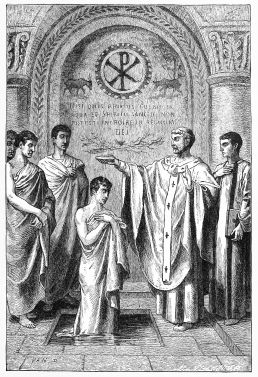
Baptism, in the Early Ages of the Church.
repeated exorcisms, and genuflections, and signings of crosses on the
forehead and body,[229] breathings upon the candidate, and other
mysterious rites. More solemn still was the unction, which was not
confined to the head, but extended to the whole body.
The Creed was also faithfully learnt, and committed to memory. But the
doctrine of the Blessed Eucharist was not imparted till after baptism.
In these multiplied preparatory exercises the penitential time of Lent
passed quickly and solemnly, till at last Easter-eve arrived.
It does not fall to our lot to describe the ceremonial of the Church in
the administration of the Sacraments. The liturgical system received its
great developments after peace had been gained; and much that belongs to
outward forms and splendor was incompatible with the bitter persecution
which the Church was undergoing.
It is enough for us to have shown, how not only doctrines and great
sacred rites, but how even ceremonies and accessories were the same in
the three first centuries as now. If our example is thought worth
following, some one will perhaps illustrate a brighter period than we
have chosen.
The baptism of Fabiola and her household had nothing to cheer it but
purely spiritual joy. The titles in the city were all closed, and among
them that of St. Pastor with its papal baptistery.
Early, therefore, on the morning of the auspicious day, the party crept
round the walls to the opposite side of the city, and following the Via
Portuensis, or road that led to the port at the mouth of the Tiber,
turned into a vineyard near Cæsar’s gardens, and descended into the
cemetery of Pontianus, celebrated as the resting-place of the Persian
martyrs, SS. Abdon and Sennen.
The morning was spent in prayer and preparation, when towards evening
the solemn office, which was to be protracted through the night,
commenced.
When the time for the administration of baptism arrived, it was indeed
but a dreary celebration that it introduced. Deep in the bowels of the
earth the waters of a subterranean stream had been gathered into a
square well or cistern, from four to five feet deep. They were clear,
indeed, but cold and bleak, if we may use the expression, in their
subterranean bath, formed out of the tufa, or volcanic rock. A long
flight of steps led down to this rude baptistery, a small ledge at the
side sufficed for the minister and the candidate, who was thrice
immersed in the purifying waters.
The whole remains to this day, just as it was then, except that over the
water is now to be seen a painting of St. John baptizing our Lord, added
probably a century or two later.
Immediately after Baptism followed Confirmation, and then the neophyte,
or new-born child of the Church, after due instruction, was admitted for
the first time to the table of his Lord, and nourished with the Bread of
angels.
It was not till late on Easter-day that Fabiola returned to her villa;
and a long and silent embrace was her first greeting of Miriam. Both
were so happy, so blissful, so fully repaid for all that they had been
to one another for months, that no words could give expression to their
feelings. Fabiola’s grand idea and absorbing pride, that day was, that
now she had risen to the level of her former slave: not in virtue, not
in beauty of character, not in greatness of mind, not in heavenly
wisdom, not in merit before God; oh! no; in all this she felt herself
infinitely her inferior. But as a child of God, as heiress to an eternal
kingdom, as a living member of the body of Christ, as admitted to a
share in all His mercies, to all the price of His redemption, as a new
creature in Him, she felt that she was equal to Miriam, and with happy
glee she told her so.
Never had she been so proud of splendid garment as she was of the white
robe, which she had received as she came out of the font, and which she
had to wear for eight days.
But a merciful Father knows how to blend our joys and sorrows, and sends
us the latter when He has best prepared us for them. In that warm
embrace which we have mentioned, she for the first time noticed the
shortened breath, and heaving chest of her dear sister. She would not
dwell upon it in her thoughts, but sent to beg Dionysius to come on the
morrow. That evening they all kept their Easter banquet together; and
Fabiola felt happy to preside at Miriam’s side over a table, at which
reclined or sat her own converted slaves, and those of Agnes’s
household, all of whom she had retained. She never remembered having
enjoyed so delightful a supper.
Early next morning, Miriam called Fabiola to her side, and with a fond,
caressing manner, which she had never before displayed, said to her:
“My dear sister, what will you do, when I have left you?”
Poor Fabiola was overpowered with grief. “Are you then going to leave
me? I had hoped we should live for ever as sisters together. But if you
wish to leave Rome, may I not accompany you, at least to nurse you, to
serve you?”
Miriam smiled, but a tear was in her eye, as taking her sister’s hand,
she pointed up towards heaven. Fabiola understood her, and said: “O, no,
no, dearest sister. Pray to God, who will refuse you nothing, that I may
not lose you. It is selfish, I know; but what can I do without you? And
now too, that I have learnt how much they who reign with Christ can do
for us by intercession, I will pray to Agnes[230] and Sebastian, to
interpose for me, and avert so great a calamity.
“Do get well: I am sure there is nothing serious in the matter; the warm
weather, and the genial climate of Campania, will soon restore you. We
will sit again together by the spring, and talk over better things than
philosophy.”
Miriam shook her head, not mournfully, but cheerfully, as she replied:
“Do not flatter yourself, dearest; God has spared me till I should see
this happy day. But His hand is on me now for death, as it has been
hitherto for life; and I hail it with joy. I know too well the number of
my days.”
“Oh! let it not be so soon!” sobbed out Fabiola.
“Not while you have on your white garment, dear sister,” answered
Miriam. “I know you would wish to mourn for me; but I would not rob you
of one hour of your mystic whiteness.”
Dionysius came, and saw a great change in his patient, whom he had not
visited for some time. It was as he had feared it might be. The
insidious point of the dagger had curled round the bone, and injured the
pleura; and phthisis
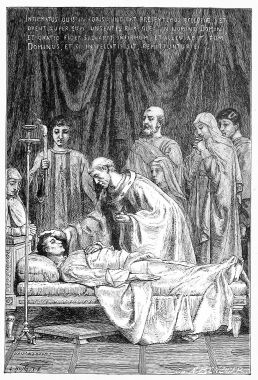
Administering the Sacrament of Extreme Unction, in the
Early Ages of the Church.
had rapidly set in. He confirmed Miriam’s most serious anticipations.
Fabiola went to pray for resignation at the sepulchre of Agnes; she
prayed long and fervently, and with many tears, then returned.
“Sister,” she said with firmness, “God’s will be done, I am ready to
resign even you to Him. Now, tell me, I entreat you, what would you have
me do, after you are taken from me?”
Miriam looked up to heaven, and answered, “Lay my body at the feet of
Agnes, and remain to watch over us, to pray to her, and for me; until a
stranger shall arrive from the East, the bearer of good tidings.”
On the Sunday following, “Sunday of the white garments,” Dionysius
celebrated, by special permission, the sacred mysteries in Miriam’s
room, and administered to her the most holy Communion, as her viaticum.
This private celebration, as we know from St. Augustine and others was
not a rare privilege.[231] Afterwards, he anointed her with oil,
accompanied by prayer, the last Sacrament which the Church bestows.
Fabiola and the household who had attended these solemn rites, with
tears and prayers, now descended into the crypt, and after the divine
offices returned to Miriam in their darker raiment.
“The hour is come,” said she, taking Fabiola’s hand. “Forgive me, if I
have been wanting in duty to you, and in good example.”
This was more than Fabiola could stand, and she burst into tears. Miriam
soothed her, and said, “Put to my lips the sign of salvation when I can
speak no more; and, good Dionysius, remember me at God’s altar when I am
departed.”
He prayed at her side, and she replied, till at length her voice failed
her. But her lips moved, and she pressed them on the cross presented to
her. She looked serene and joyful, till at length raising her hand to
her forehead, then bringing it to her breast, it fell dead there, in
making the saving sign. A smile passed over her face, and she expired,
as thousands of Christ’s children have expired since.
Fabiola mourned much over her; but this time she mourned as they do who
have hope.
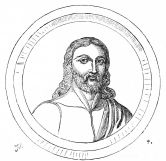
Portrait of Our Saviour, from the Catacomb of St.
Callistus.

Constantine, the first Christian Emperor, after a medal
of the time.
Part Third.—Victory. — CHAPTER I. THE STRANGER FROM THE EAST. — CHAPTER II. THE STRANGER IN ROME. — CHAPTER III. AND LAST.
 E appear to ourselves to be walking in solitude. One by one, those
whose words and actions, and even thoughts, have hitherto accompanied
and sustained us, have dropped off, and the prospect around looks very
dreary. But is all this unnatural? We have been describing not an
ordinary period of peace and every-day life, but one of warfare, strife,
and battle. Is it unnatural that the bravest, the most heroic, should
have fallen thick around us? We have been reviving the memory of the
cruellest persecution which the Church ever suffered, when it was
proposed to erect a column bearing the inscription that the Christian
name had been extinguished. Is it strange that the holiest and purest
should have been the earliest to be crowned?

Dioclesian.
After a medal in the Cabinet of France.
And yet the Church of Christ has still to sustain many years of sharper
persecution than we have described. A succession of tyrants and
oppressors kept up the fearful war upon her, without intermission, in
one part of the world or another for twenty years, even after
Constantine had checked it wherever his power reached. Dioclesian,
Galerius, Maximinus, and Lucinius in the East, Maximian and Maxentius in
the West, allowed no rest to the Christians under their several
dominions. Like one of those rolling storms which go over half the
world, visiting various countries with their ravaging energy, while
their gloomy foreboding or sullen wake simultaneously overshadow them
all, so did this persecution wreak its fury first on one country, then
on another, destroying every thing Christian, passing from Italy to
Africa, from Upper Asia to Palestine, Egypt, and then back to Armenia,
while it left no place in actual peace, but hung like a blighting
storm-cloud over the entire empire.
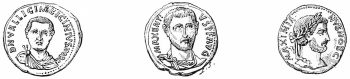
|
Lucinius.
From a Gold Medal in the French Collection.
|
Maxentius.
From a Silver Medal in the French Collection.
|
Galerius-Maximinus.
From a Silver Medal in the French Collection.
|
And yet the Church increased, prospered, and defied this world of sin.
Pontiff stepped after Pontiff at once upon the footstool of the papal
throne and upon the scaffold; councils were held in the dark halls of
the catacombs; bishops came to Rome, at risk of their lives, to consult
the successor of St. Peter; letters were exchanged between Churches far
distant and the supreme Ruler of Christendom, and between different
Churches, full of sympathy, encouragement and affection; bishop
succeeded bishop in his see, and ordained priests and other ministers to
take the place of the fallen, and be a mark set upon the bulwarks of the
city for the enemy’s aim; and the work of Christ’s imperishable kingdom
went on without interruption, and without fear of extinction.
Indeed it was in the midst of all these alarms and conflicts, that the
foundations were being laid of a mighty system, destined to produce
stupendous effects in after ages. The persecution drove many from the
cities, into the deserts of Egypt, where the monastic state grew up, so
as to make “the wilderness rejoice and flourish like the lily bud forth
and blossom, and rejoice with joy and praise.”[232] And so, when
Dioclesian had been degraded from the purple, and had died a peevish
destitute old man, and Galerius had been eaten up alive by ulcers and
worms, and had acknowledged, by public edict, the failure of his
attempts, and Maximian Herculeus had strangled himself, and Maxentius
had perished in the Tiber, and Maximinus had expired amidst tortures
inflicted by Divine justice equal to any he had inflicted on Christians,
his very eyes having started from their sockets, and Licinius had been
put to death by Constantine; the spouse of Christ, whom they had all
conspired to destroy, stood young and blooming as ever, about to enter
into her great career of universal diffusion and rule.
It was in the year 313 that Constantine, having defeated Maxentius, gave
full liberty to the Church. Even if ancient writers had not described
it, we may imagine the joy and gratitude of the poor Christians on this
great change. It was like the coming forth, and tearful though happy
greeting, of the inhabitants of a city decimated by plague, when
proclamation has gone forth that the infection has ceased. For here,
after ten years of separation and concealment, when families could
scarcely meet in the cemeteries nearest to them, many did not know who
among friends or kinsfolk had fallen victims, or who might yet survive.
Timid at first, and then more courageous, they ventured forth; soon the
places of old assembly, which children born in the last ten years had
not seen, were cleansed, or repaired, refitted and reconciled,[233] and
opened to public, and now fearless, worship.
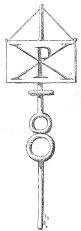
The Labarum or Christian Standard. From a coin of
Constantine.
Constantine also ordered all property, public or private, belonging to
Christians and confiscated, to be restored; but with the wise provision
that the actual holders should be indemnified by the imperial
treasury.[234] The Church was soon in motion to bring out all the
resources of her beautiful forms and institutions; and either the
existing basilicas were converted to her uses, or new ones were built on
the most cherished spots of Rome.
Let not the reader fear that we are going to lead him forward into a
long history. This will belong to some one better qualified, for the
task of unfolding the grandeur and charms of free and unfettered
Christianity. We have only to show the land of promise from above,
spread like an inviting paradise before our feet; we are not the Josue
that must lead others in. The little that we have to add in this brief
third part of our humble book, is barely what is necessary for its
completion.
We will then suppose ourselves arrived at the year 318, fifteen years
after our last scene of death. Time and permanent laws have given
security to the Christian religion, and the Church is likewise more
fully establishing her organization.
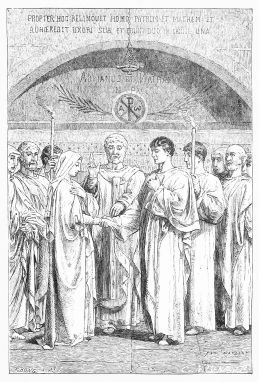
A Marriage in the Early Ages of the Church.
Many who on the return of peace had hung down their heads, having by
some act of weak condescension escaped death, had by this time expiated
their fall by penance; and now and then an aged stranger would be
saluted reverently by the passers-by, when they saw that his right eye
had been burned out, or his hand mutilated; or when his halting gait
showed that the tendons of the knee had been severed, in the late
persecution, for Christ’s sake.[235]
If at this period our friendly reader will follow us out of the Nomentan
gate, to the valley with which he is already acquainted, he will find
sad havoc among the beautiful trees and flower-beds of Fabiola’s villa.
Scaffold-poles are standing up in place of the first; bricks, marbles,
and columns lie upon the latter. Constantia, the daughter of
Constantine, had prayed at St. Agnes’s tomb, when not yet a Christian,
to beg the cure of a virulent ulcer, had been refreshed by a vision, and
completely cured. Being now baptized, she was repaying her debt of
gratitude, by building over her tomb her beautiful basilica. Still the
faithful had access to the crypt in which she was buried; and great was
the concourse of pilgrims, that came from all parts of the world.
One afternoon, when Fabiola returned from the city to her villa, after
spending the day in attending to the sick, in an hospital established in
her own house, the fossor, who had charge of the cemetery, met her
with an air of great interest, and no small excitement, and said:
“Madam, I sincerely believe that the stranger from the East, whom you
have so long expected, is arrived.”
Fabiola, who had ever treasured up the dying words of Miriam, eagerly
asked, “Where is he?”
“He is gone again,” was the reply.
The lady’s countenance fell. “But how,” she asked again, “do you know it
was he?” The excavator replied:
“In the course of the morning I noticed, among the crowd, a man not yet
fifty, but worn by mortification and sorrow, to premature old age. His
hair was nearly grey, as was his long beard. His dress was eastern, and
he wore the cloak which the monks from that country usually do. When he
came before the tomb of Agnes, he flung himself upon the pavement with
such a passion of tears, such groans, such sobs, as moved all around to
compassion. Many approached him, and whispered, ‘Brother, thou art in
great distress; weep not so, the saint is merciful.’ Others said to him,
‘We will all pray for thee, fear not.’[236] But he seemed to be beyond
comfort. I thought to myself, surely in the presence of so gentle and
kind a saint, none ought to be thus disconsolate or heart-broken, except
only one man.”
“Go on, go on,” broke in Fabiola; “what did he next?”
“After a long time,” continued the fossor, “he arose, and drawing from
his bosom a most beautiful and sparkling ring, he laid it on her tomb. I
thought I had seen it before, many years ago.”
“And then?”
“Turning round he saw me, and recognized my dress. He approached me, and
I could feel him trembling, as, without looking in my face, he timidly
asked me: ‘Brother, knowest thou if there lie buried any where here
about a maiden from Syria, called Miriam?’ I pointed silently to the
tomb. After a pause of great pain to himself, so agitated now that his
voice faltered, he asked me again: ‘Knowest thou, brother, of what she
died?’ ‘Of consumption,’ I replied. ‘Thank God!’ he ejaculated, with the
sigh of relieved anguish, and fell prostrate on the ground. Here too he
moaned and cried for more than an hour, then, approaching the tomb,
affectionately kissed its cover, and retired.”
“It is he, Torquatus, it is he!” warmly exclaimed Fabiola; “why did you
not detain him?”
“I durst not, lady; after I had once seen his face, I had not courage to
meet his eye. But I am sure he will return again; for he went towards
the city.”

Noe and the Ark, as a symbol of the Church, from a
picture in the Catacombs.
“He must be found,” concluded Fabiola. “Dear Miriam, thou hadst, then,
this consoling foresight in death!”
 ARLY next morning, the pilgrim was passing through the Forum, when he
saw a group of persons gathered round one whom they were evidently
teasing. He would have paid but little attention to such a scene in a
public thoroughfare, had not his ear caught a name familiar to it. He
therefore drew nigh. In the centre was a man, younger than himself; but
if he looked older than he was, from being wan and attenuated, the
other did so much more from being the very contrary. He was bald and
bloated, with a face swelled, and red, and covered with blotches and
boils. A drunken cunning swam in his eye, and his gait and tone were
those of a man habitually intoxicated. His clothes were dirty, and his
whole person neglected.
“Ay, ay, Corvinus,” one youth was saying to him, “won’t you get your
deserts, now? Have you not heard that Constantine is coming this year to
Rome, and don’t you think the Christians will have their turn about
now?”
“Not they,” answered the man we have described, “they have not the pluck
for it. I remember we feared it, when Constantine published his first
edict, after the death of Maxentius, about liberty for the Christians,
but next year he put us out of fear, by declaring all religions to be
equally permitted.”[237]
“That is all very well, as a general rule,” interposed another,
determined further to plague him; “but is it not supposed that he is
going to look up those who took an active part in the late persecution,
and have the lex talionis,[238] executed on them; stripe for stripe,
burning for burning, and wild beast for wild beast?”
“Who says so?” asked Corvinus turning pale.
“Why, it would surely be very natural,” said one.
“And very just,” added another.
“Oh, never mind,” said Corvinus, “they will always let one off for
turning Christian. And, I am sure, I would turn any thing, rather than
stand—”
“Where Pancratius stood,” interposed a third, more malicious.
“Hold your tongue,” broke out the drunkard, with a tone of positive
rage. “Mention his name again, if you dare!” And he raised his fist, and
looked furiously at the speaker.
“Ay, because he told you how you were to die,” shouted the youngster,
running away. “Heigh! Heigh! a panther here for Corvinus!”
All ran away before the human beast, now lashed into fury, more than
they would have done from the wild one of the desert. He cursed them,
and threw stones after them.
The pilgrim, from a short distance, watched the close of the scene, then
went on. Corvinus moved slowly along the same road, that which led
towards the Lateran basilica, now the Cathedral of Rome. Suddenly a
sharp growl was heard, and with it a piercing shriek. As they were
passing by the Coliseum, near the dens of the wild beasts, which were
prepared for combats among themselves, on occasion of the emperor’s
visit, Corvinus, impelled by the morbid curiosity natural to persons who
consider themselves victims of some fatality, connected with a
particular object, approached the cage in which a splendid panther was
kept. He went close to the bars, and provoked the animal, by gestures
and words; saying: “Very likely, indeed, that you are to be the death of
me! You are very safe in your den.” In that instant, the enraged animal
made a spring at him, and through the wide bars of the den, caught his
neck and throat in its fangs, and inflicted a frightful lacerated wound.
The wretched man was picked up, and carried to his lodgings, not far
off. The stranger followed him, and found them mean, dirty, and
uncomfortable in the extreme; with only an old and decrepit slave,
apparently as sottish as his master, to attend him. The stranger sent
him out to procure a surgeon, who was long in coming; and, in the
meantime, did his best to stanch the blood.
While he was so occupied, Corvinus fixed his eyes upon him with a look
of one delirious, or demented.
“Do you know me?” asked the pilgrim, soothingly.
“Know you? No—yes. Let me see—Ha! the fox! my fox! Do you remember our
hunting together those hateful Christians. Where have you been all this
time? How many of them have you caught?” And he laughed outrageously.
“Peace, peace, Corvinus,” replied the other. “You must be very quiet, or
there is no hope for you. Besides, I do not wish you to allude to those
times; for I am myself now a Christian.”
“You a Christian?” broke out Corvinus savagely. “You who have shed more
of their best blood than any man? Have you been forgiven for all this?
Or have you slept quietly upon it? Have no furies lashed you at night?
no phantoms haunted you? no viper sucked your heart? If so, tell me how
you have got rid of them all, that I may do the same. If not, they will
come, they will come! Vengeance and fury! why should they not have
tormented you as much as me?”
“Silence, Corvinus; I have suffered as you have. But I have found the
remedy, and will make it known to you, as soon as the physician has seen
you, for he is approaching.”
The doctor saw him, dressed the wound, but gave little hope of recovery,
especially in a patient whose very blood was tainted by intemperance.
The stranger now resumed his seat beside him, and spoke of the mercy of
God, and His readiness to forgive the worst of sinners; whereof he
himself was a living proof. The unhappy man seemed to be in a sort of
stupor; if he listened, not comprehending what was said. At length his
kind instructor, having expounded to him the fundamental mysteries of
Christianity, in hope, rather than certainty, of being attended to, went
on to say:
“And now, Corvinus, you will ask me, how is forgiveness to be applied to
one who believes all this? It is by Baptism, by being born again of
water and the Holy Ghost.”
“What?” exclaimed the sick man loathingly.
“By being washed in the laver of regenerating water.”
He was interrupted by a convulsive growl rather than a moan. “Water!
water! no water for me! Take it away!” And a strong spasm seized the
patient’s throat.
His attendant was alarmed, but sought to calm him. “Think not,” he said,
“that you are to be taken hence in your present fever, and to be plunged
into water” (the sick man shuddered, and moaned); “in clinical
baptism,[239] a few drops suffice, not more than is in this pitcher.”
And he showed him the water in a small vessel. At the sight of it, the
patient writhed and foamed at the mouth, and was shaken by a violent
convulsion. The sounds that proceeded from him, resembled a howl from a
wild beast, more than any utterance of human lips.
The pilgrim saw at once that hydrophobia, with all its horrible
symptoms, had come upon the patient, from the bite of the enraged
animal. It was with difficulty that he and the servant could hold him
down at times. Occasionally he broke out into frightful paroxysms of
blasphemous violence against God and man. And then, when this subsided,
he would go on moaning thus;
“Water they want to give me! water! water! none for me! It is fire!
fire! that I have, and that is my portion. I am already on fire, within,
without! Look how it comes creeping up, all round me, it advances every
moment nearer and nearer!” And he beat off the fancied flame with his
hands on either side of his bed, and he blew at it round his head. Then
turning towards his sorrowful attendants, he would say, “why don’t you
put it out? you see it is already burning me.”
Thus passed the dreary day, and thus came the dismal night, when the
fever increased, and with it the delirium, and the violent accesses of
fury, though the body was sinking. At length he raised himself up in
bed, and looking with half-glazed eyes straight before him, he exclaimed
in a voice choked with bitter rage:
“Away, Pancratius, begone! Thou hast glared on me long enough. Keep back
thy panther! Hold it fast; it is going to fly at my throat. It comes!
Oh!” And with a convulsive grasp, as if pulling the beast from off his
throat, he plucked away the bandage from his wound. A gush of blood
poured over him, and he fell back, a hideous corpse, upon the bed.
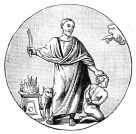
The Sacrifice of Abraham, from a picture in the
Catacombs.
His friend saw how unrepenting persecutors died.
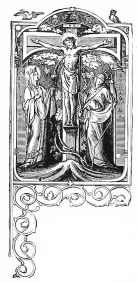 HE next morning, the pilgrim proceeded to discharge the business which
had been interfered with by the circumstances related in the preceding
chapter. He might have been first seen busily employed inquiring after
some one about the Januses in the Forum. At length, the person was
found; and the two walked towards a dirty little office under the
Capitol, on the ascent called the Clivus Asyli. Old musty books were
brought out, and searched column after column, till they came to the
date of the “Consuls Dioclesian Augustus, the eighth time, and Maximian
Herculeus Augustus, the seventh time.”[240] Here they found sundry
entries, with reference to certain documents. A roll of mouldy
parchments of that date was produced, docketed as referred to, and the
number corresponding to the entries was drawn out, and examined. The
result of the investigation seemed perfectly satisfactory to both
parties.
“It is the first time in my life,” said the owner of the den, “that I
ever knew a person who had got clear off, come back, after fifteen
years, to inquire after his debts. A Christian, I presume, sir?”
“Certainly, by God’s mercy.”
“I thought as much; good morning, sir. I shall be happy to accommodate
you at any time, at as reasonable rates as my father Ephraim, now with
Abraham. A great fool that for his pains, I must say, begging his
pardon,” he added, when the stranger was out of hearing.
With a decided step and a brighter countenance than he had yet
displayed, he went straight to the villa on the Nomentan way; and after
again paying his devotions in the crypt, but with a lighter heart, he at
once addressed the fossor, as if they had never been parted: “Torquatus,
can I speak with the Lady Fabiola?”
“Certainly,” answered the other; “come this way.”
Neither alluded, as they went along, to old times, nor to the
intermediate history of either. There seemed to be an understanding,
instinctive to both, that all the past was to be obliterated before men,
as they hoped it was before God. Fabiola had remained at home that and
the preceding day, in hopes of the stranger’s return. She was seated in
the garden close to a fountain, when Torquatus, pointing to her,
retired.
She rose, as she saw the long-expected visitor approach, and an
indescribable emotion thrilled through her, when she found herself
standing in his presence.
“Madam,” he said, in a tone of deep humility and earnest simplicity. “I
should never have presumed to present myself before you, had not an
obligation of justice, as well as many of gratitude, obliged me.”
“Orontius,” she replied,—“is this the name by which I must address
you?” (he signified his assent) “you can have no obligations towards me,
except that which our great Apostle charges on us, that we love one
another.”
“I know you feel so. And therefore I would not have pretended, unworthy
as I am, to intrude upon you for any lower motive than one of strict
duty. I know what gratitude I owe you for the kindness and affection
lavished upon one now dearer to me than any sister can be on earth, and
how you discharged towards her the offices of love which I had
neglected.”
“And thereby sent her to me,” interposed Fabiola, “to be my angel of
life. Remember, Orontius, that Joseph was sold by his brethren, only
that he might save his race.”
“You are too good, indeed, towards one so worthless,” resumed the
pilgrim; “but I will not thank you for your kindness to another who has
repaid you so richly. Only this morning I have learnt your mercy to one
who could have no claim upon you.”
“I do not understand you,” observed Fabiola.
“Then I will tell you all plainly,” rejoined Orontius. “I have now been
for many years a member of one of those communities in Palestine, of men
who live separated from the world in desert places, dividing their day,
and even their night, between singing the Divine praises, contemplation,
and the labor of their hands. Severe penance for our past
transgressions, fasting, mourning, and prayer form the great duty of our
penitential state. Have you heard of such men here?”
“The fame of holy Paul and Anthony is as great in the West as in the
East,” replied the lady.
“It is with the greatest disciple of the latter that I have lived,
supported by his great example, and the consolation he has given me. But
one thought troubled me, and prevented my feeling complete assurance of
safety even after years of expiation. Before I left Rome I had
contracted a heavy debt, which must have been accumulating at a
frightful rate of interest, till it had reached an overwhelming amount.
Yet it was an obligation deliberately contracted, and not to be justly
evaded. I was a poor cenobite,[241] barely living on the produce of the
few palm-leaf mats that I could weave, and the scanty herbs that would
grow in the sand. How could I discharge my obligations?
“Only one means remained. I could give myself up to my creditor as a
slave, to labor for him and endure his blows and scornful reproaches in
patience, or to be sold by him for my value, for I am yet strong. In
either case, I should have had my Saviour’s example to cheer and support
me. At any rate, I should have given up all that I had—myself.
“I went this morning to the Forum, found my creditor’s son, examined his
accounts, and found that you had discharged my debt in full. I am,
therefore, your bondsman, Lady Fabiola, instead of the Jew’s.” And he
knelt humbly at her feet.
“Rise, rise,” said Fabiola, turning away her weeping eyes. “You are no
bondsman of mine, but a dear brother in our common Lord.”
Then sitting down with him, she said: “Orontius, I have a great favor to
ask from you. Give me some account of how you were brought to that life,
which you have so generously embraced.”
“I will obey you as briefly as possible. I fled, as you know, one
sorrowful night from Rome, accompanied by a man”—his voice choked him.
“I know, I know whom you mean,—Eurotas,” interrupted Fabiola.
“The same, the curse of our house, the author of all mine, and my dear
sister’s, sufferings. We had to charter a vessel at great expense from
Brundusium, whence we sailed for Cyprus. We attempted commerce and
various speculations, but all failed. There was manifestly a curse on
all that we undertook. Our means melted away, and we were obliged to
seek some other country. We crossed over to Palestine, and settled for a
while at Gaza. Very soon we were reduced to distress; every body shunned
us, we knew not why; but my conscience told me that the mark of Cain was
on my brow.”
Orontius paused and wept for a time, then went on:
“At length, when all was exhausted, and nothing remained but a few
jewels, of considerable price indeed, but with which, I knew not why,
Eurotas would not part, he urged me to take up the odious office of
denouncing Christians; for a furious persecution was breaking out. For
the first time in my life I rebelled against his commands, and refused
to obey. One day he asked me to walk out of the gates; we wandered far,
till we came to a delightful spot in the midst of the desert. It was a
narrow dell, covered with verdure, and shaded by palm-trees; a little
clear stream ran down, issuing from a spring in a rock at the head of
the valley. In this rock we saw grottoes and caverns; but the place
seemed uninhabited. Not a sound could be heard but the bubbling of the
water.
“We sat down to rest, when Eurotas addressed me in a fearful speech. The
time was come, he told me, when we must both fulfil the dreadful
resolution he had taken, that we must not survive the ruin of our
family. Here we must both die; the wild beasts would consume our bodies,
and no one would know the end of its last representatives.
“So saying, he drew forth two small flasks of unequal sizes, handed me
the larger one, and swallowed the contents of the smaller.
“I refused to take it, and even reproached him for the difference of our
doses; but he replied that he was old, and I young; and that they were
proportioned to our respective strengths. I still refused, having no
wish to die. But a sort of demoniacal fury seemed to come over him; he
seized me with a giant’s grasp, as I sat on the ground, threw me on my
back, and exclaiming, ‘We must both perish together,’ forcibly poured
the contents of the phial, without sparing me a drop, down my throat.
“In an instant, I was unconscious; and remained so, till I awoke in a
cavern, and faintly called for drink. A venerable old man, with a white
beard, put a wooden bowl of water to my lips. ‘Where is Eurotas?’ I
asked. ‘Is that your companion?’ inquired the old monk. ‘Yes,’ I
answered. ‘He is dead,’ was the reply. I know not by what fatality this
had happened; but I bless God with all my heart, for having spared me.
“That old man was Hilarion, a native of Gaza, who, having spent many
years with the holy Anthony in Egypt, had that year[242] returned to
establish the cenobitic and eremitical life in his own country, and had
already collected several disciples. They lived in the caves hard by,
and took their refection under the shade of those palms, and softened
their dry food in the water of that fountain.
“Their kindness to me, their cheerful piety, their holy lives, won on me
as I recovered. I saw the religion which I had persecuted in a sublime
form; and rapidly recalled to mind the instructions of my dear mother,
and the example of my sister; so that yielding to grace, I bewailed my
sins at the feet of God’s minister,[243] and received baptism on
Easter-eve.”
“Then we are doubly brethren, nay twin children of the Church; for I was
born to eternal life, also, on that day. But what do you intend to do
now?”
“Set out this evening on my return. I have accomplished the two objects
of my journey. The first was to cancel my debt; my second was to lay an
offering on the shrine of Agnes. You will remember,” he added, smiling,
“that your good father unintentionally deceived me into the idea, that
she coveted the jewels I displayed. Fool that I was! But I resolved,
after my conversion, that she should possess the best that remained in
Eurotas’s keeping; so I brought it to her.”
“But have you means for your journey?” asked the lady, timidly.
“Abundant,” he replied, “in the charity of the faithful. I have letters
from the Bishop of Gaza, which procure me every where sustenance and
lodging; but I will accept from you a cup of water and a morsel of
bread, in the name of a disciple.”
They rose, and were advancing towards the house, when a woman rushed
madly through the shrubs, and fell at their feet, exclaiming: “Oh, save
me! dear mistress, save me! He is pursuing me, to kill me!”
Fabiola recognized, in the poor creature, her former slave Jubala; but
her hair was grizzly and dishevelled, and her whole aspect bespoke
abject misery. She asked whom she meant.
“My husband,” she replied; “long has he been harsh and cruel, but to-day
he is more brutal than usual. Oh, save me from him!”
“There is no danger here,” replied the lady; “but I fear, Jubala, you
are far from happy. I have not seen you for a long, long time.”
“No, dear lady, why should I come to tell you of all my woes? Oh! why
did I ever leave you and your house, where I ought to have been so
happy? I might then with you, and Graja, and good old departed
Euphrosyne, have learnt to be good myself, and have embraced
Christianity!”
“What, have you really been thinking of this, Jubala?”
“For a long time, lady, in my sorrows and remorse. For I have seen how
happy Christians are, even those who have been as wicked as myself. And
because I hinted this to my husband this morning, he has beaten me, and
threatened to take my life. But, thank God, I have been making myself
acquainted with Christian doctrines, through the teaching of a friend.”
“How long has this bad treatment gone on, Jubala?” asked Orontius, who
had heard of it from his uncle.
“Ever,” she replied, “since soon after marriage, I told him of an offer
made to me previously, by a dark foreigner, named Eurotas. Oh! he was
indeed a wicked man, a man of black passions and remorseless villany.
Connected with him, is my most racking recollection.”
“How was that?” asked Orontius, with eager curiosity.
“Why, when he was leaving Rome, he asked me to prepare for him two
narcotic potions; one for any enemy, he said, should he be taken
prisoner. This was to be certainly fatal; another had to suspend
consciousness for a few hours only, should he require it for himself.
“When he came for them, I was just going to explain to him, that,
contrary to appearances, the small phial contained a fatally
concentrated poison, and the large one a more diluted and weaker dose.
But my husband came in at the moment, and in a fit of jealousy thrust me
from the room. I fear some mistake may have been committed, and that
unintentional death may have ensued.”
Fabiola and Orontius looked at one another in silence, wondering at the
just dispensations of Providence; when they were aroused by a shriek
from the woman. They were horrified at seeing an arrow quivering in her
bosom. As Fabiola supported her, Orontius, looking behind him, caught a
glimpse of a black face grinning hideously through the fence. In the
next moment a Numidian was seen flying away on his horse, with his bow
bent, Parthian-wise over his shoulder, ready for any pursuer. The arrow
had passed, unobserved, between Orontius and the lady.
“Jubala,” asked Fabiola, “dost thou wish to die a Christian?”
“Most earnestly,” she replied.
“Dost thou believe in One God in Three Persons?”
“I firmly believe in all the Christian Church teaches.”
“And in Jesus Christ, who was born and died for our sins?”
“Yes, in all that you believe.” The reply was more faint.
“Make haste, make haste, Orontius,” cried Fabiola, pointing to the
fountain.
He was already at its basin, filling full his two hands, and coming
instantly, poured their contents on the head of the poor African,
pronouncing the words of baptism; and, as she expired, the water of
regeneration mingled with her blood of expiation.
After this distressing, yet consoling, scene, they entered the house,
and instructed Torquatus about the burial to be given to this
doubly-baptized convert.
Orontius was struck with the simple neatness of the house, so strongly
contrasting with the luxurious splendor of Fabiola’s former dwelling.
But suddenly his attention was arrested, in a small inner room, by a
splendid shrine or casket, set with jewels, but with an embroidered
curtain before it, so as to allow only the frame of it to be seen.
Approaching nearer, he read inscribed on it:
“The blood of the blessed Miriam, shed by cruel hands!”
Orontius turned deadly pale; then changed to a deep crimson; and almost
staggered.
Fabiola saw this, and going up to him kindly and frankly, placed her
hand upon his arm, and mildly said to him:
“Orontius, there is that within, which may well make us both blush
deeply, but not therefore despond.”
So saying she drew aside the curtain, and Orontius saw within a crystal
plate, the embroidered scarf so much connected with his own, and his
sister’s history. Upon it were lying two sharp weapons, the points of
both which were rusted with blood. In one he recognized his own dagger;
the other appeared to him like one of those instruments of female
vengeance, with which he knew heathen ladies punished their attendant
slaves.
“We have both,” said Fabiola, “unintentionally inflicted a wound, and
shed the blood of her, whom now we honor as a sister in heaven. But for
my part, from the day when I did so, and gave her occasion to display
her virtue, I date the dawn of grace upon my soul. What say you,
Orontius?”
“That I, likewise, from the instant that I so misused her, and led to
her exhibition of such Christian heroism, began to feel the hand of God
upon me, that has led me to repentance and forgiveness.”
“It is thus ever,” concluded Fabiola. “The example of our Lord has made
the martyrs; and the example of the martyrs leads us upwards to Him.
Their blood softens our hearts; His alone cleanses our souls. Theirs
pleads for mercy; His bestows it.
“May the Church, in her days of peace and of victories, never forget
what she owes to the age of her martyrs. As for us two, we are indebted
to it for our spiritual lives. May many, who will only read of it, draw
from it the same mercy and grace!”
They knelt down, and prayed long together silently before the shrine.
They then parted, to meet no more.
After a few years, spent by Orontius in penitential fervor, a green
mound by the palms, in the little dell near Gaza, marked the spot where
he slept the sleep of the just.
And after many years of charity and holiness, Fabiola withdrew to rest
in peace, in company with Agnes and Miriam.