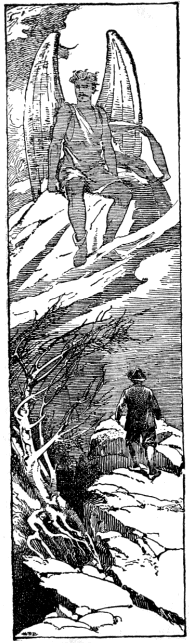
Once upon a time, a
poor man who had a large
family left England to go
and see if he could find a
better living for himself
across the seas. There
were many others on
board the ship, and for a
time all went well; but
when they were nearing
the end of their journey,
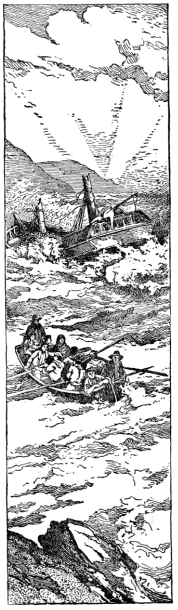
a great storm arose. The
winds blew, the waves rose
and roared, and broke upon
the ship; and at last
they were very glad to
be able to let her drift
aground on the nearest
land, which they found to
be an island on which no
one was living.
They all got safely to
shore; and as the ship
was broken up by the
wind and the waves, they were able to get many
planks, and nails, and other useful things from
the ship, and from its cargo, with which they
built themselves houses, made spades and ploughs,
so that they were not so badly off after all.
They had plenty of corn to last them until they
could grow some more, and for a time all went
well. But after they had got a good crop of
corn, they had to grind it into flour, and this
took a long time. There were no flour-mills on
the island, and John Jobson—for that was the
name of the laboring man—had to spend hours
every day grinding the grain into flour for his
wife and family to eat.
One day, after he had been grinding until his
back ached and his arms were very tired, he
began to be in despair. If it took him so much
time grinding his grain, he would have no time
left to look after the little farm which he had laid
out. His little boys, although they had great
appetites and ate as much bread as their mother
could make out of the flour which their father
ground between the two millstones, were not
strong enough to help him. All the other settlers
were just in the same position. They had
no machines to do any work for them. Everything
had to be done with their hands. There
were no people to hire as servants; and if there
had been, they could not have paid them any
wages, for they were poor and had no money. So
Jobson became very down-hearted, and not knowing
what to do, thought he would take a stroll in
the country and think over things.
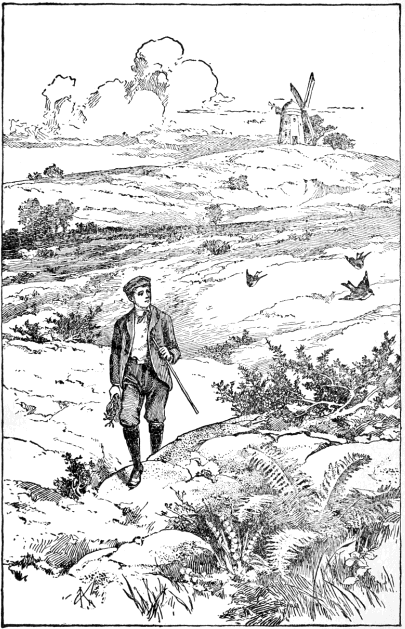
He climbed up some rising ground, and walked
a long way among the hills, wondering what on
earth he should do if he could get no help. He
was going up a little valley, which turned suddenly,
and there to his great astonishment he saw
a monstrous Giant. He was terribly scared, and
would have run away as hard as he possibly could,
but on taking a second look at the giant he saw
that he was asleep. Jobson looked again, and
wondered at the immense size of the giant. He
could hardly see to the end of him, and he saw
that he was enormously strong; yet he looked so
harmless and good-humored, that Jobson stood
gazing on him till his fear was nearly over. He
was clad in a robe of dazzling brightness where
the sun shone upon it, but the greater part was
shaded by the trees; and it reflected all their
different colors, which made it look like a green
changing silk. As Jobson stood, lost in amazement,
the giant opened his eyes, and turned
towards him with a good-humored smile.
As soon as Jobson saw him open his eyes he
started to run again, feeling sure that he could
have no chance if so huge a giant were to catch
him; but as he ran the giant spoke. He was still
lying down on his back in the grass, and his voice
was gentle and kind.
"Do not be afraid," he said. "I will do you
no harm."
"But you are so big," said Jobson, looking
timidly at the giant, and making ready to run the
moment the giant stirred.
But the giant did not stir. He said, "Yes, I
am very strong and very big, but I will do you no
harm."
As he still lay and smiled kindly, Jobson came
nearer to him, and at last all fear began to leave
him. Then he asked the giant who he was.
"My name," said the giant, "is Aquafluens."
"And where do you live?" said Jobson.
"I live in the island. I have always lived here,
long before you came."
"Then does it belong to you?" said Jobson,
fearing that the giant might treat him as a trespasser.
"I do not know," said the giant. "What does
'belong' mean?"
Jobson thought it was a queer question, but
said nothing. Then Jobson began to think
whether it might be possible to get this good-natured
giant, who seemed so strong, to help him
in his work. "Do you ever work?" he said to
the giant.
"Oh yes," said he; "I can work if you will set
me work to do. I like it. All work is play to
me."
Then Jobson's heart was glad within him, and
he thought to himself, "Here is one who could
grind all my corn with his little finger, but dare I
ask him?" So he thought for a time, and then he
said, "You said you would work for any one?"
"Yes," said Aquafluens, gently, "for any one
who will teach me to work."
"Then," said Jobson, "would you work for
me?"
"Yes," said the giant; "if you will teach me."
"But what wages must I pay you?" asked
Jobson.
Then the giant laughed, and said, "What queer
words you use. You say 'belong.' What does
'belong' mean? I do not know. You say
'wages.' What are 'wages'? I have never
heard of them."
At this Jobson thought the giant must be mad,
and he was a little afraid; then again he thought
to himself, "Perhaps he is not mad, but only
weak in his head. Giants, they say, are often not
very wise." So he tried to explain. "What shall
I give you if you work for me?"
"Give me?" said the giant; "what a joke!
You need give me nothing, I will work for you
for love."
Then Jobson could hardly believe his ears, but
he thought he would go home at once and tell
his wife the good news, that he had got a great,
strong giant who would work for him for
nothing.
"Where are you going?" said the giant.
"I am going home to tell my wife."
"Had you not better let me carry you?" said
the giant.
Then Jobson was frightened in his heart.
"Perhaps if I say yes the giant will swallow me
alive." But he did not tell him so.
"How can you carry me?" said he.
"I can carry you any way you like," said the
giant, "so long as the road goes down hill."
"Oh, it is down hill all the way!" said Jobson.
"Then," said he, "you must get upon my back,
and I will carry you there as quick as you like."
Jobson was afraid, for when he came to look at
the giant's back, and put his hand upon it, it sank
right in; then he saw that the skin was so soft
that, when you pressed upon it, it gave way under
your hand, or your foot, and you seemed to sink
right into the giant's back. So Jobson was terrified,
and screamed as he pulled his hand out of
the hole that he had made in the giant; but to
his surprise the hole closed up, just as if he had
never thrust his hand in. But his hand was wet
with the giant's blood. It was such queer blood;
it was quite cold, and it had no color.
Then the giant said, "That will never do, for
you are so small and so heavy for your little size,
that you would sink into me if you tried to sit on
my back."
"But what can I do?" said Jobson. The giant
took a tree-trunk which was lying close at hand,
and put it on his shoulder. "Now," said he, "jump
onto this trunk, and I will carry you safely."
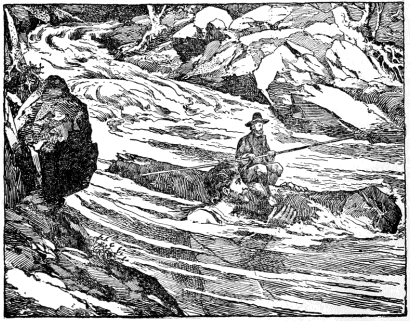
Jobson was very frightened when he sat on the
log, for he thought nothing would be more likely
than for the log and himself to sink out of sight
in the giant's body, but he soon found that
although the log sank in a little way, it did not
sink in far enough for him to touch the giant's
body with his feet. He was very glad, for he felt
all wet and cold where his arm seemed to have
gone through the giant's skin. "You had better
have a pole with you to steady yourself with."
Jobson picked up a long stick, and climbed up
once more onto the giant's shoulders, where the
great log lay; he seated himself, and waited with
terror for the giant's movement. He thought
that if he had seven-league boots he might throw
him up into the air. He would fall off, he was
sure; but, to his great surprise, the giant neither
jumped, nor stepped, nor ran; he seemed in the
strangest way to glide, without making any noise,
down the valley, across the hill to the place where
his cottage stood. When they came within sight
of the cottage his wife and children were standing
on a little hillock looking for him, and when
they saw him seated on the shoulders of this
strange monster they nearly had a fit with fright.
The children ran into the house, and the wife fell
at the feet of the great giant, saying, "Have
mercy on my poor husband!" But the giant
laughed and lay down on the grass: then Jobson
jumped off the trunk and told his wife of the
glad news, that this was a good giant, and that
he would do all their work for them. The children
came out of the house and looked timidly at
the monster, who, as soon as he had lain down,
closed his eyes and seemed to be sound asleep.
Jobson went into the house to tell his wife all
of the wonderful story of the giant, but his wife
did not seem to like the idea of employing the
giant.
"But he will work for nothing, wife," said Jobson.
The wife shook her head. "That is all very
well," she said; "but think of the food he will eat.
He would swallow all the food we have in the
house for breakfast, and we should starve."
The husband scratched his head, and said he
had never thought of that. "But," he said, "let
us go and ask him how much food we must give
him."
"And what drink he will want, and where will
you put him up?" said the wife.
Jobson began to believe that his workman was
not such a good bargain after all.
So when they drew near to the giant, he opened
his eyes and asked what was the matter.
Jobson said they were afraid they would not be
able to put him up in their house, as he was too
big to enter at the door.
"Oh," said the giant, "that does not matter, for
I never live in a house. I will simply sleep here
in the grass under the sky."
"But," said Jobson, "we are afraid that we shall
not be able to feed you."
"Feed me?" said the giant, laughing, with a
little ripply murmur that shook all his body.
"Who asked you for any food? I never eat
anything."
Then Jobson's wife was frightened, and said she
was afraid that there must be something uncanny
about him. But Jobson went on asking:—
"What do you drink?" said he.
"Only fresh water," said the giant.
Jobson was very pleased, and looking in triumph
at his wife, said to him:—
"And how much work can you do in a day?"
"As much as you like," said the giant.
"But I mean," said he, "how many hours will
you work?"
"As many hours as there are on the face of the
clock," said the giant.
"You mean twelve," said the wife.
"No," said the giant. "I mean all the hours
that are in a day."
"What!" said Jobson, "never stop night or
day? And do you never sleep?"
"When I have nothing to do," said the giant,
"I sleep, but as long as you give me work I will
go on working."
"But do you never get tired?" said Jobson.
"Tired!" said the giant, "I don't know what
that is. That is another funny word. What a
queer language you speak. What is being tired?"
Then Jobson looked at his wife and his wife
looked at him, and they said nothing for a little
time. Then they asked him when he was ready
to begin.
"At once," he said; "as soon as you have put
things right for me."
"What things?" said they.
"I told you I can only work going down hill.
If you want me to work hard you must let me
have some place that is very steep, and make a
step ladder for me to go down on. If you will fix
a wheel with steps on it, so that I can step on the
steps and make the wheel go round, I can do anything
you like."
"Could you grind corn?" said Jobson's wife.
"I can grind stones," said the giant, laughing.
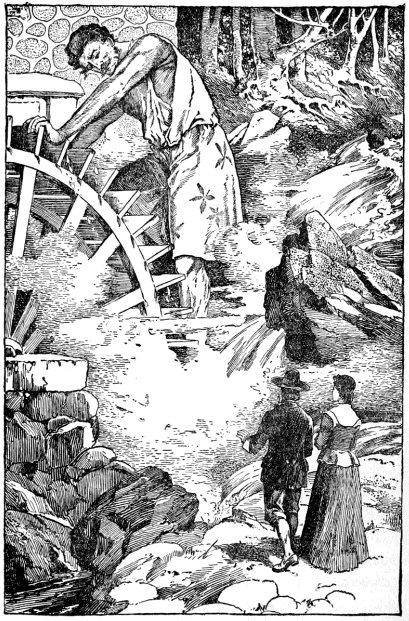
So Jobson and his wife set about building a
mill with a step wheel for the giant. They connected
a big wheel for the giant to step upon with
grindstones on the inside of the mill, so when the
giant stepped upon the wheel outside, he made the
millstones inside go round and round and grind
the wheat. When it was all finished they came to
the giant and asked him if he was ready to begin.
"Yes," he said.
"Begin then," said Jobson.
And the giant slowly and steadily stepped first
on one step of the wheel and then on another
until it began to go round and round, and the
millstones went round and round, and so it went
on until the whole of a sack of corn was ground
into flour, and still the giant went on, and on, and
on.
"Are you not tired?" said Jobson to him.
"I don't know what you mean," said he.
"Well, now," said Jobson, "do you think you
could get me some stones from the quarry?"
"Easily," said the giant. "But what have I to
carry them in?"
Then Jobson made a long box and put it upon
the giant's back; but he found that it was not so
easy going, for the road was quite flat, and over
and over again the giant stopped. He could go
very well down hill, but on level ground he needed
to be poked along with a long pole which Jobson
carried. When it came to the least down hill, he
went as quick as could be. This bothered Jobson
a great deal, for he saw that if the giant could
only go down hill, he could not be nearly so useful
as if he could go both ways. So he spoke
about it to the giant once, and he laughed and
said: "Hum! you must get my brother, he could
help me to go as quick along the level ground as
I do when I am going down hill; but even he
could not make me go up hill. Is there not
plenty of work I can do without that?"
"Certainly," said Jobson; and soon he had the
giant set to work to make all kinds of things.
Aquafluens
When he had ground all the corn, they took
away the millstones and fixed up a saw which
had come ashore from the wreck. They found
that the giant could saw wood as well as he could
grind corn. They asked him if he would bring
down the trees from the hills, with which they
could make planks to floor their cottage.
"Nothing is easier," said the giant; and when
the logs came down, he sawed them all up into
planks, and soon the Jobsons were so comfortable
that they not only had enough planks for
themselves, but they had more than they wanted,
so they gave them to the neighbors. Every one
was very anxious to find out if there were any
more giants in the island, because they could
see that Giant Aquafluens was more useful than
twenty men. He never ate, he never slept, he
only drank cold water, and day and night he
would go on working as regularly as if he were
a machine. Only, when the sun got very hot,
and he could not get any water to drink, his
strength seemed to wither away, but a good
heavy shower of rain set him up in time, and
then he would work away as hard as ever.
One day Jobson asked him where this brother
of his could be found. "You will find him
usually on the hilltops," said Aquafluens; "but
occasionally he comes sweeping down, and disturbs
me in the grass where I am lying."
"Can he do as much work as you?"
"When he Is in the
humor, but sometimes he
is not; and sometimes
he gets into a frightful
temper, until you think
he is going to destroy
everything. He even gets
me mad sometimes," said
Aquafluens.
At this Jobson was
silent, and wondered
greatly, for he had never
seen his good giant in a
passion. He told all this
to a neighbor called Jackson,
who was very anxious
to have a giant of his
own; and no sooner did
he hear that the stormy-tempered
brother of
Aquafluens lived on the
hilltops, than he went out
into the mountains to
see if he could find him.
At length, one day,
Jackson, climbing a high
rock, saw a magnificent
figure seated upon the
summit. He could
scarcely distinguish the shape for his eyes were
dazzled by its brightness; but what struck him
most were two enormous wings, as large as the
sails of a ship, but thin and transparent as the
wings of a gnat. Jackson doubted not but that
this was the brother of Aquafluens. Alarmed
at the account he had heard of the uncertainty of
his temper, he hesitated whether to approach.
The hope of gain, however, tempted him, and as
he drew nearer he observed that he also had a
smiling countenance. So mustering up courage
he ventured to accost him, and inquire whether
he was the person they had so long been in
search of, and whether he would engage in his
service.
"My name is Ventosus," cried the winged
giant, "and I am ready to work for you, if you
will let me have my own way. I am not of the
low disposition of my brother, who plods on with
the same uniform pace. I cannot help sometimes
laughing at his slow motion, and I amuse myself
with ruffling his placid temper, in order to make
him jog on a little faster. I frequently lend him
a helping hand when he is laden with a heavy
burden. I perch upon his bosom, and stretching
out my wings I move with such rapidity as
almost to lift him from the ground."
Jackson was astonished to hear Aquafluens
accused of sluggishness; he told Ventosus what
a prodigious quantity of work he had done for
the colony.
"He is a snail compared to me, for all that,"
holloed out Ventosus, who had sometimes a very
loud voice; and to show his rapidity he spread
his wings, and was out of sight in a moment.
Jackson was sadly frightened, lest he should
be gone forever; but he soon returned, and
consented to accompany Jackson home, on condition
that he would settle him in an elevated
spot of ground.
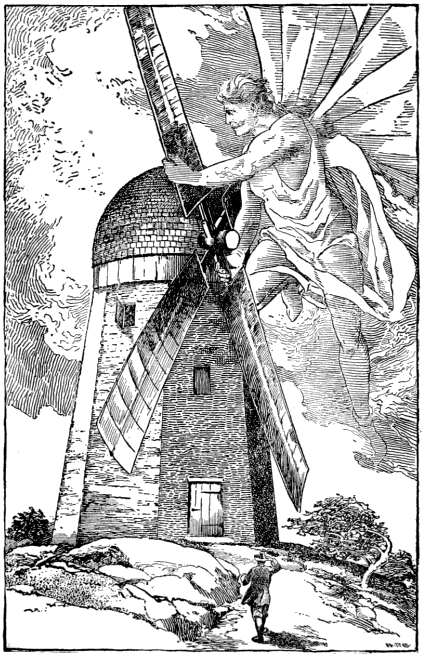
"My house is built on the brow of a hill," said
Jackson, "and I shall place yours on the summit."
"Well," said the giant, "if you will get me a
couple of millstones, I will grind you as much
corn in one hour as Aquafluens can in two.
Like my brother, I work without food or wages;
but then I have an independent spirit, I cannot
bear confinement; I work only when I have a
mind to it, and I follow no will but my own."
"This is not such a tractable giant as Aquafluens,"
thought Jackson; "but he is still more
powerful, so I must try to manage his temper as
well as I can."
His wonderful form and the lightness of his
wings excited great admiration. Jackson immediately
set about building a house for him on the
hill to grind corn in, and meanwhile, Ventosus
took a flight into the valley to see his brother.
He found him carrying a heavy load of planks,
which he had lately sawed, to their proprietor.
They embraced each other, and Ventosus, being
in a good humor, said, "Come, brother, let me
help you forward with your load, you will never
get on at this lazy pace."
"Lazy pace!" exclaimed one of the children,
who was seated on the load of wood on the giant's
back; "why, there is no man who can walk half
or quarter so fast."
"True," replied Ventosus; "but we are not
such pygmies as you."
So he seated himself beside the child, stretched
out his wings, and off they flew with a rapidity
which at first terrified the boy; but when he
found he was quite safe, he was delighted to sail
through the air almost as quickly as a bird flies.
When they arrived, and the wood had been
unloaded, Aquafluens said, "Now, brother, you
may help me back again."
"Not I," said Ventosus; "I am going on,
straight forward. If you choose to go along with
me, well and good; if not, you may make your
way home as you please."
Aquafluens thought this very unkind, and he
began to argue with his brother; but this only
led to a dispute. Aquafluens' temper was at
length ruffled; Ventosus flew into a passion: he
struggled with his brother, and roared louder
than any wild beast. Aquafluens then lost all
self-command, and actually foamed with rage.
The poor child stood at a distance, trembling
with fear. He hardly knew the face of his old
friend, so much was his countenance distorted by
wrath; he looked as if he could almost have
swallowed him up. At length, Ventosus disengaged
himself from his brother, and flew out of
his sight; but his sighs and moans were still
heard afar off. Aquafluens also murmured loudly
at the ill-treatment he had received; but he composed
himself by degrees, and, taking the boy on
his back, slowly returned home.
Jackson inquired eagerly after Ventosus, and
when the child told him all that had happened,
he was much alarmed for fear Ventosus should
never return; and he was the more disappointed,
as he had prepared everything for him to go to
work. Ventosus, however, came back in the
night, and when Jackson went to set him to work
in the morning, he found that nearly half the
corn was already ground. This was a wonderful
performance. Yet, upon the whole, Ventosus
did not prove of such use to the colony as his
brother. He would carry with astonishing quickness;
but then he would always carry his own
way; so that it was necessary to know what
direction he intended to take, before you could
confide any goods to his charge; and then, when
you thought them sure to arrive on account of
the rapidity with which they were conveyed,
Ventosus would sometimes suddenly change his
mind, and veer about with the fickleness of a
weathercock; so that the goods, instead of reaching
their place of destination, were carried to
some other place or brought to the spot whence
they set out. This inconvenience could not happen
with regard to grinding corn; but one of
no less importance often did occur. Ventosus,
when not inclined to work, disappeared, and was
nowhere to be found.
Ventosus
The benefit derived from the labor of these
two giants had so much improved the state of
the colony that not only were the cottages well
floored, and had good doors and window-shutters,
but there was abundance of comfortable furniture—bedsteads,
tables, chairs, chests, and cupboards,
as many as could be wished; and the men and
women, now that they were relieved from the
most laborious work, could employ themselves in
making a number of things which before they had
not time for. It was no wonder, therefore, that
the desire to discover more giants was uppermost
in men's minds.
They were always asking Aquafluens about
where they could find another giant, for he was
ever with them and never flew away, so they could
always ask questions; while Ventosus used to fly
away and disappear if they bothered him with
questions which he did not like to answer.
They hunted high and low for more giants, but
they found none. The heart of Aquafluens was
grieved within him, that they should seek so much
for a giant that did not need always to go down
hill. So one day, after much doubt, he told Jobson
that there was another giant who was stronger
than he, and much more constant and regular in
his work than Ventosus, who was here to-day and
away to-morrow, and whom you could never be
sure of. This giant was the strongest of all
giants, but he was also dangerous.
"I will then have nothing to do with him,"
said Jobson.
"Well," said Aquafluens, "if you know how to
manage him he will work for you."
"Can he go up hill?" said his little boy.
"As easily as I can go down," said Aquafluens.
"And who is this giant?" said Jobson.
"Alas," said Aquafluens, mournfully, "he is my
own son."
"Where is he?"
"You can only bring him by a charm, and if
you are not very careful, he may burst out and
kill you."
"Is he so very violent?" said Jobson.
"Very. His breath is scalding hot, and he is
a more expensive giant than either my brother or
myself."
"Must you pay him, then?" said Jobson's wife.
"He will work without pay, but he needs to be
kept hot. He will not work at all unless he is
seated right on the top of blazing coals."
"What a funny giant!" said Jobson's little boy.
"Does he not burn up?"
"No, the hotter you make the fire the stronger
he grows, but when the fire grows cold, all his
strength seems to die."
The Jobsons had a long talk over this, and
decided that they had better not have anything
to do with this strange giant. But once, when
they wanted a great deal of heavy stones carried
up the hill, they were driven to ask Aquafluens
if he would tell them the charm.
"Yes," said he; "it is very simple, but you
must not be afraid."
"No," said they, "we will not be afraid."
"Then take a little of my blood."
"Never!" said Jobson's wife.
"No, you do not need to be afraid," said Aquafluens;
"you only need to take a very little."
"And what must we do with it?"
"You must put it into an iron pot, and then
put it on the fire."
They were very loth to do this; but at last,
their need being great, they did so. They were
relieved to find that the taking of his blood did
not seem to hurt the good, kind giant, and then
they put the pot on the fire, and waited to see
what would happen. After a time, they heard a
singing noise, and they began to be frightened.
At last out of the pot there came a cloudy vapor,
which rose higher and higher and higher, until it
went away. But they saw no giant.
So they went to Aquafluens, and told him that
the charm would not work. He asked them what
they had done, and they told him, and he said,
"But did I not tell you my son would never work
unless you put him in prison? I will give you
some more of my blood, and you must put it in
an iron pot and put the lid on, and fasten it down
tight, and then see what will happen."
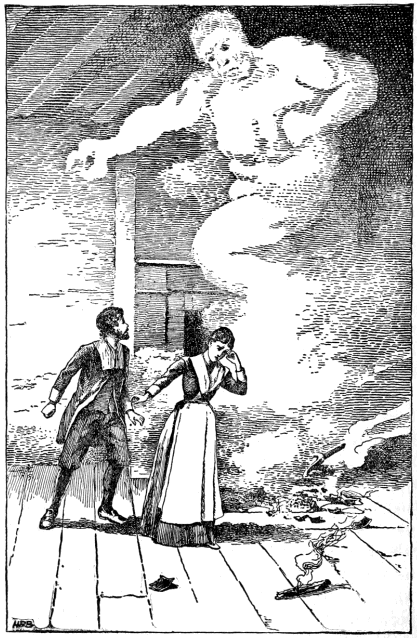
The Coming of Vaporifer
So they did as the good giant said. They took
some more of his blood, put it into the iron pot,
and put on a heavy lid, and fastened it on tight,
then they put it on the blazing fire, and waited.
This time they were terribly frightened, for after
a time the iron pot burst into a thousand pieces,
and blew all over the place, hurting Jobson's wife
on the head, and cutting Jobson's hand. So they
ran away frightened and told Aquafluens.
"Ah," he said, "I told you my son was a
dangerous child, but he is very strong, and if you
give him nothing to do he does mischief. So you
must give him a handle to turn. If you do that,
he will not burst anything, but will turn the
handle as hard as ever you like."
And they did just as the giant told them, and
they found that everything happened just so, for
the new giant, whose name was Vaporifer, was a
strong and willing worker. Up hill and down
dale made no difference to him. He could carry
and do everything they gave him to, but they
must keep him hot, and they must give him a
wheel to turn. If at any time he stopped they
had to let him get out, otherwise, if he had no
wheel to turn, and could not get out, he would
blow his prison to pieces.
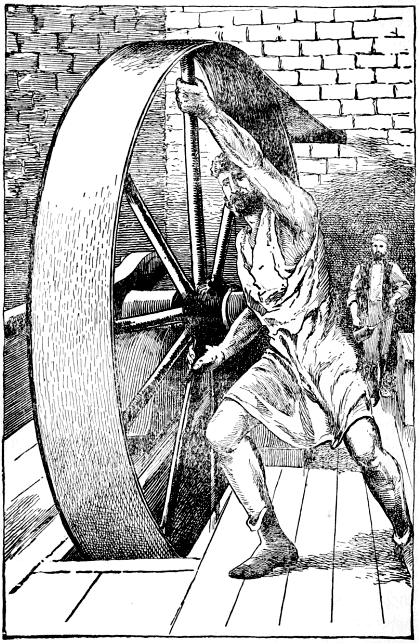
Vaporifer at Work
Thus it came to pass that Ventosus was wanted
very little, for Jobson and his friends liked Vaporifer,
who was regular and steady in his ways, and
could be relied upon always to do what was
wanted.
Aquafluens was still the most useful and the
cheapest of all the giants, but his son Vaporifer
was much stronger and more handy than his
father. Nor was there any limit to what he
could do if only they would give him plenty of
heat and always let him have a wheel to turn.
Now, then, who do you think were these three
giants? Perhaps you have already guessed from
their names, and from their description. The
first giant, Aquafluens, is the great giant of running
water, which will always run down hill, but
which comes to a standstill on level ground, and
cannot go up hill, no matter what happens. It is
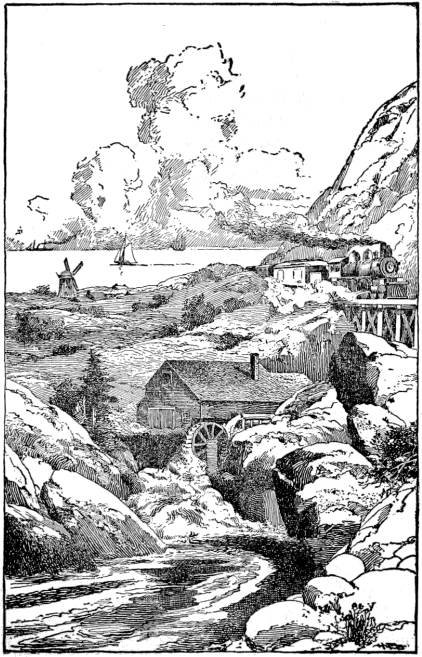
this great giant which turned all the water-mills,
which ground the corn, and sawed the wood, and
did all manner of work. Ventosus, his brother,
is the wind which bloweth whither it listeth, and
sometimes, lashes the water into stormy waves.
While as to that of Vaporifer, you surely understand
that it is nothing else but steam. These
three giants are real giants who are still doing
their work day by day, and every day. There are
no servants of man who have worked so cheaply,
so untiringly, and so well.
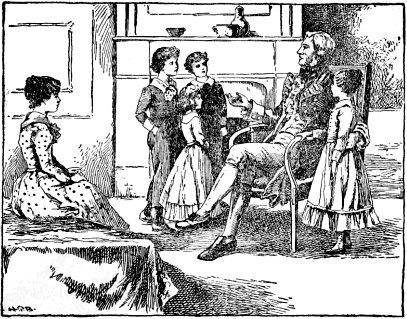
TRAVELLERS' WONDERS
One winter's evening, as Captain Compass was
sitting by the fireside, with his children all around
him, little Jack said to him, "Papa, pray tell us
some stories about what you have seen in your
voyages. I have been vastly entertained, while
you were abroad, with Gulliver's Travels, and
the Adventures of Sinbad, the Sailor, and I
think as you have gone round and round the
world, you must have met with things as wonderful
as they did."
"No, my dear," said the captain, "I never met
with Lilliputians or Brobdingnagians, I assure
you, nor ever saw the black loadstone mountains
or the valley of diamonds, but, to be sure, I have
seen a great variety of people, and have noticed
their different manners and ways of living;
and if it will be any entertainment to you, I will
tell you some curious things that I have observed."
"Pray do, papa," cried Jack and all his brothers
and sisters; so they drew close round him,
and he began as follows:—
"Well, then, I was once, about this time of the
year, in a country where it was very cold, and the
inhabitants had much ado to keep themselves
from starving. They were clad partly in the
skins of beasts, made smooth and soft by a particular
art, but chiefly in garments made from the
outward covering of a middle-sized quadruped
which they were so cruel as to strip off his back
when he was alive. They dwelt in habitations
part of which was sunk underground. The
materials were either stones or earth hardened
by fire; and so violent on that coast were the
showers of wind and rain that many of the roofs
were covered all over with stones. The walls of
their houses had holes to let in light, but to prevent
the cold air and wet from coming in, they
were covered by a sort of transparent stone made
artificially of melted sand or flint. As wood was
rather scarce, I know not what they would have
done for their fires had they not discovered in
the bowels of the earth a very extraordinary kind
of stone which, when put among burning wood,
caught fire and flamed like a torch."
"Dear me," said Jack, "what a wonderful stone!
I suppose it was like the things we call fire-stones,
that shine so when we rub them together."
"I don't think they would burn," replied the
captain; "besides, these are of a darker color.
"Well,—but their diet was remarkable,—some
of them ate fish that had been hung up in the
smoke till it was quite dry and hard; and along
with it they ate either the roots of plants, or a sort of
coarse black cake made of powdered seeds. These
were the poorer class. The richer had a kind of
cake which they were fond of daubing over with a
greasy matter, that was the product of a large
animal which lived among them. This grease
they used, too, in almost all their dishes, and
when fresh it really was not unpalatable. They
likewise devoured the flesh of many birds and
beasts when they could get it; and ate the leaves
and other parts of a number of kinds of vegetables
growing in the country, some absolutely
raw, others variously prepared by the aid of fire.
Another great article of food was the curd of milk,
pressed into a hard mass and salted. It had so
rank a smell that often persons of weak stomachs
could not bear to come near it. For drink
they made great use of the water in which certain
dry leaves had been steeped. These leaves,
I was told, came from a great distance. They had
likewise a method of preparing a liquor of the
seeds of a grass-like plant steeped in water, with
the addition of a bitter herb, and then set to work
or ferment. I was prevailed upon to taste it, and
thought it at first nauseous enough, but in time
I liked it pretty well. When a large quantity of
the mixture is used, it becomes perfectly intoxicating.
But what astonished me most was their
use of a liquor so excessively hot and pungent
that it seems like liquid fire. I once got a mouthful
of it by mistake, taking it for water, which it
resembles in appearance, but I thought it would
instantly have taken away my breath. Indeed,
people are not infrequently killed by it; and yet
many of them will swallow it greedily, whenever
they can get it. This, too, is said to be prepared
from the seeds above mentioned, which are harmless
and even valuable in their natural state,
though made to yield such a pernicious juice.
The strangest custom that I believe prevails in
any nation, I found here, which was that some
take a mighty pleasure in filling their mouths
full of smoke; and others in thrusting a nasty
powder up their nostrils."
"I should think it would choke them," said
Jack.
"It almost did me," answered his father,
"only to stand by while they did it—but use,
it is truly said, is second nature.
"I was glad enough to leave this cold climate;
and about half a year after I fell in with
a people enjoying a delicious temperature and a
country full of beauty and verdure. The trees
and shrubs were furnished with a great variety
of fruits which, with other vegetable products,
constituted a large part of the food of the inhabitants.
I particularly relished certain berries growing
in bunches, some white and some red, of a
very pleasant sourish taste, and so transparent
that one might see the seeds at their very centre.
There were whole fields full of odoriferous flowers,
which they told me were succeeded by pods bearing
seeds that afforded good nourishment to man
and beast. A great variety of birds enlivened the
groves and woods, among which I was greatly
entertained by one that without any teaching
spoke almost as articulately as a parrot, though
it was only the repetition of a single word. The
people were gentle and civilized, and possessed
many of the arts of life. Their dress was very
various. Many were clad only in a thin cloth
made of the long fibres of the stalk of a plant
cultivated for the purpose, which they prepared
by soaking in water and then beating with large
mallets. Men wore cloth woven from a sort of
vegetable wool, growing in pods upon bushes.
But the most singular material was a fine
glossy stuff, used chiefly by the richer classes,
which, as I was credibly informed, is manufactured
out of the webs of caterpillars—a most wonderful
circumstance, if we consider the immense
number of caterpillars necessary to the production
of so large a quantity of stuff as I saw used.
The people are very fantastic in their dress,
especially the women, whose apparel consists of a
great number of articles impossible to be described,
and strangely disguising the form of the body. In
some instances they seem very cleanly, but in other
cases the Hottentots can scarce go beyond them,
particularly in the management of their hair, which
is all matted and stiffened by the fat of swine and
other animals mixed up with powders of various
colors and ingredients. Like most Indian nations,
they wear feathers in their headdress. One thing
surprised me much, which was, that they bring
up in their homes an animal of the tiger kind, with
formidable teeth and claws, which, notwithstanding
its natural ferocity, is played with and caressed by
the most timid and delicate of their women."
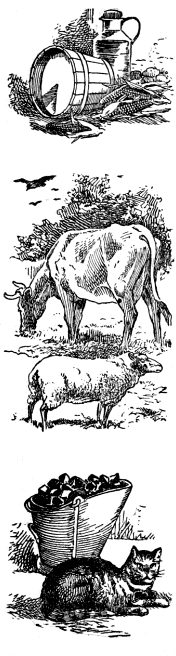
"I am sure I would not play with it," said Jack.
"Why, you might get an ugly scratch with it
if you did," said the captain.
"The language of this nation seems very harsh
and unintelligible to a foreigner, yet they converse
with one another with great ease and quickness.
One of the oddest customs
is that which men use on
saluting each other. Let
the weather be what it will,
they uncover their heads
and remain uncovered for
some time if they mean to
be extraordinarily respectful."
"Why, that's like pulling
off our hats," said Jack.
"Ah, ha! papa," cried
Betsy, "I have found you
out. You have been telling
us of our own country, and
what is done at home, all
the while."
"But," said Jack, "we
don't burn stones, or eat
grease and powdered seeds,
or wear skins and caterpillar's webs, or play with
tigers."
"No?" said the captain.
"Pray, what are coals but
stones; and is not butter
grease; and corn, seeds;
and leather, skins; and silk,
the web of a kind of caterpillar?
and may we not as well call a cat an animal
of the tiger kind, as a tiger an animal of the
cat kind?
"So if you recall what I have been describing,
you will find, with Betsy's help, that all the other
wonderful things I have told you of are matters
familiar among ourselves. But I meant to show
you that a foreigner might easily represent everything
as equally strange and wonderful among us
as we could do with respect to his country; and
also to make you sensible that we daily call a
great many things by their names without ever
inquiring into their nature and properties; so
that in reality it is only their manners and not the
things themselves with which we are acquainted."
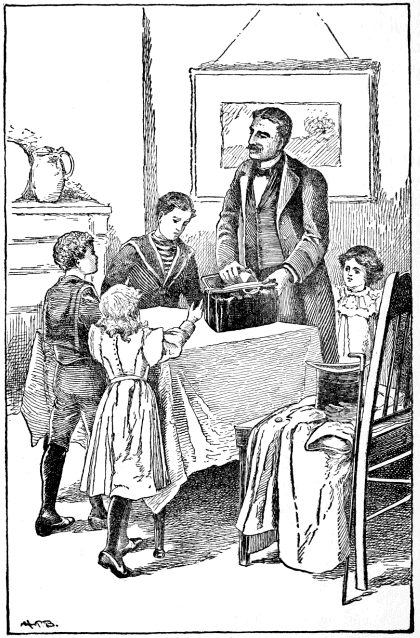
A Curious Instrument
A CURIOUS INSTRUMENT
A gentleman, just returned from a journey to
London, was surrounded by his children eager,
after the first salutations were over, to hear the
news; and still more eager to see the contents of
a small portmanteau, which were one by one
carefully unfolded and displayed to view. After
distributing among them a few small presents,
the father took his seat again, saying that he
must confess he had brought from town, for his
own use, something far more curious and valuable
than any of the little gifts they had received.
It was, he said, too good to present to any of
them; but he would, if they pleased, first give
them a brief description of it, and then perhaps
they might be allowed to inspect it.
The children were accordingly all attention,
while the father thus proceeded: "This small
instrument is made in the most perfect and wonderful
way, and everything about it is very delicate
and beautiful. Because of its extreme delicacy
it is so liable to injury that a sort of light
curtain, adorned with a beautiful fringe, is always
provided, and so placed as to fall in a moment on
the approach of the slightest danger. Its external
appearance is always more or less beautiful,
although in this respect there is a great diversity
in the different sorts. If you should examine the
inside you would find them all alike, but it is so
curious, and its powers so truly astonishing, that
no one who considers it can suppress his surprise
and admiration. By a slight and momentary
movement, which is easily made by the person it
belongs to, you can ascertain with considerable
accuracy the size, color, shape, weight, and value
of any article whatever. A person having one is
thus saved from the necessity of asking a thousand
questions, and trying a variety of troublesome
experiments, which would otherwise be
necessary; and such a slow and laborious process
would, after all, not succeed half so well as a
single trial of this very useful article."
George. "If they are such very useful things I
wonder that everybody, who can at all afford it,
does not have one."
Father. "They are not so uncommon as you
may suppose; I myself happen to know several
individuals who possess one or two of them."
Charles. "How large is it, Father? Could I
hold it in my hand?"
Father. "You might; but I should not like to
trust mine with you!"
George. "You will be obliged to take very
great care of it, then?"
Father. "Indeed I must: I intend every night
to enclose it within the small screen I mentioned;
and it must besides be washed occasionally in a
certain colorless fluid kept for the purpose. But,
notwithstanding the tenderness of this instrument,
you will be surprised to hear that its power
may be darted to a great distance, without the
least injury, and without any danger of losing it."
Charles. "Indeed! and how high can you dart
it?"
Father. "I should be afraid of telling you to
what a distance it will reach, lest you should think
I am jesting with you."
George. "Higher than this house, I suppose?"
Father. "Much higher."
Charles. "Then how do you get it again?"
Father. "It is easily cast down by a gentle
movement, that does it no injury."
George. "But who can do this?"
Father. "The person whose business it is to
take care of it."
Charles. "Well, I cannot understand you at
all; but do tell us. Father, what it is chiefly used
for."
Father. "Its uses are so various that I know
not which to specify. It has been found very serviceable
in deciphering old manuscripts, and, indeed,
has its use in modern prints. It will assist
us greatly in acquiring all kinds of knowledge;
and without it some of the most wonderful things
in the world would never have been known. It
must be confessed, however, that very much depends
on a proper application of it, since it is
possessed by many persons who appear not to
know what it is worth, but who employ it only
for the most low and common purposes without
even thinking, apparently, of the noble uses for
which it is designed, or of the great joy it is capable
of affording. It is, indeed, in order to have
you fully appreciate its value that I am giving
you this description."
George. "Well, then, tell us something more
about it."
Father. "It is very penetrating, and can often
discover secrets which could be detected by no
other means. It must be said, however, that it
is equally prone to reveal them."
Charles. "What! can it speak, then?"
Father. "It is sometimes said to do so, especially
when it happens to meet with one of its own
kind."
George. "What color are these strange
things?"
Father. "They vary considerably in this respect."
George. "What color is yours?"
Father. "I believe of a darkish color, but, to
confess the truth, I never saw it in my life."
Both. "Never saw it in your life!"
Father. "No, nor do I wish to; but I have
seen a reflection of it, which is so exact that my
curiosity is quite satisfied."
George. "But why don't you look at the thing
itself?"
Father. "I should be in great danger of losing
it if I did."
Charles. "Then you could buy another."
Father. "Nay, I believe I could not prevail
upon my body to part with it."
George. "Then how did you get this one?"
Father. "I am so fortunate as to have more
than one; but how I got them I really cannot
recollect."
Charles. "Not recollect! why, you said you
brought them from London to-night."
Father. "So I did; I should be sorry if I had
left them behind me."
Charles. "Tell, Father, do tell us the name of
this curious instrument."
Father. "It is called—an EYE."