FEW of our common insects enjoy a wider intimate acquaintance with or
a more respectful recognition from humanity than the wasps and
hornets. Their acquaintance, with that of their yellow-jacket bee and
bumble-bee relatives, is forced upon most of us at a tender and
impressionable age, and leaves a lasting reminiscence. Having once
been interviewed by a hornet, do we not remember him for life for his
pains?
The bee has perhaps given us equally pointed excuse for respectful, or
rather disrespectful, consideration, and yet how different is our
attitude to the bee in contrast with that towards the hornet! Why? The
discrimination is largely a matter of sentiment, but especially a
matter of ignorance; sentiment as associated with fragrant flowers and
droning wings and "white-clover honey"—for do we not all know the
"busy bee," and how he "gathers honey all the day" for the hive, and
thus for humanity and the hot biscuit? There is then a palliative for
the busy bee's "hot foot," as Paddy described his first warm contact
with the insect. But who ever heard of any one with a good word for
the hornet? He is under the ban—an outlaw, the black sheep of the
insect fraternity, a source of uneasy suspicion, shunned by valiant
man, good for nothing to the boy except to shy stones at from a safe
retreat; while to the fair sex, always the signal for precipitate
flight, if not hysterical terror.
The popular verdict on the hornet is so well voiced in that famous
entomological essay from the pen of Josh Billings that I am tempted to
quote it entire and use it for my present text. I am sure the average
reader will say "Amen" to every word of it:
"The hornet is a red-hot child ov Nature ov sudden impreshuns and a
sharp konklusion. The hornets alwus fites at short range and never
argy a case. They settle all ov their disputes bi letting their
javelin fly, an' are az certain an' az anxious tew hit az a mule iz.
Hornets bild their nest wherever they take a noshun to, an' seldum
are asked to move; for what good is it tew murder 99 hornets an' have
the one hundred one hit you with his javelin! I kan't tell you just
tew a day how long a hornet kan live, but I kno from experience that
every bug, be he hornet or somebody else who is mad all the time, an'
stings every chance he kan git, generally outlives all ov his nabors."
An artistically constructed paragraph, with a "snapper" at the end of
it, or rather a "sharp konklusion" quite consistent with its subject.
"Mad all the time," he says, and "stings every chance he can git," and
such would seem to be the unanimous belief. Indeed, the phrase "As mad
as a hornet" has passed into a proverb, which presumably dates back to
the Aryans, or at least from the scriptural allusion of the
providential visitation of hornets, which routed the impious
inhabitants of Canaan before the conquering Israelites. The ancient
Greeks and Latins are on record in their appreciation of the "warlike
hornet," and considered that it came rightly by its valor as an
inheritance from the dead war-horse from whose carcass the insects
were supposed to be spontaneously generated.
"The warlike horse if buried underground
Shortly a brood of hornets will be found."
writes Ovid. Another author, Cardanus, thought that a dead mule was
the more likely source, which recalls the above erudite allusion of
hereditary instinct of Billings.
Yes, if time-honored popular prejudice is to be accepted, the hornet
is always on the rampage, always spoiling for a fight, always "mad";
and considering how many thousands of them there are abroad, and what
opportunity they have of mischief, it is a wonder that poor humanity
is able to put its nose out of doors with impunity.
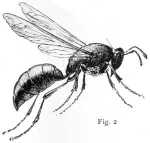
Let us see how far this bad reputation is sustained by the facts. What
is this black paper hornet (more properly wasp) doing from morning
till night? Buzzing among the flowers, creeping over the bruised apple
windfalls in the orchard, whirling and dodging about the window or
fence or side of the house, or perhaps darting in our faces as we sit
at the open window.
Two episodes which I recall, in which this white-tailed black wasp
from the big paper nest was conspicuous, occur to me as I write, and
as the two stories, taken together, will show us the true character of
the suspect, and what he is up to all day long, I will narrate them.
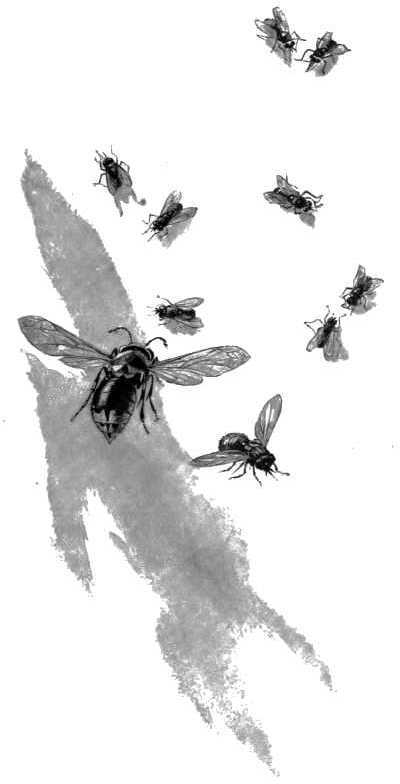
The first instance is vivid in my memory. It occurred in my
boyhood—my boyhood? how many another boy remembers the same
incident. That same hot day in August, that same cool, shadowy
swimming-hole in the brook, that same gray paper nest on the
overhanging branch a few rods up stream? What a tempting target! How
the stones flew as, safe up to our necks in water, if need be, we
pelted the paper domicile! And now a lucky throw has gone straight to
the mark. With a crushing thud the stone has penetrated the side and
knocked off a piece of the gray wall, which falls to the stream below,
exposing the tiers of paper comb, as a whirling, buzzy maze, like a
swarm of bees, enshrouds the mangled house. Ah, what fun! How we
laughed at the sport!—for at least ten seconds. Then the tide turned,
and how gladly had we possessed the art of the bull-frog, and buried
ourselves in the mud until the storm blew over, for the "mad" warlike
hornets were upon us. The red-hot child of Nature "was now at short
range," and "stinging every chance they could get." "When you see a
head hit it," seemed to be the plan of campaign, and of course the
heads had to come up once in a while, and erelong were considerably
enlarged, principally through inoculation, but let us hope with wisdom
as well.
"A mad hornet, and only at a little boyish fun! Look on this picture,
and now on this."
I have shown our hornet under exceptional circumstances, when anger
may be a positive virtue and a means of grace. Following are some of
the every-day capers, which have not helped his reputation, as I
observed them on the crowded porch of a summer hotel in the White
Mountains several years ago. It was in September, and about twenty
guests, mostly ladies and "summer girls," were assembled in a quiet
social convention.
Suddenly there was a scream, as one of the fair ones, with a frantic,
vigorous stroke of uplifted fan, distorted face, and a cross-eyed
glare, clutched her roll of fancy-work and fled to the house. "Did he
sting you?" asked her friend, who readily followed her in the door.
"The horrid hornet!" she exclaimed. "No, he didn't sting me, but he
would have done if I hadn't hit him just that minute. He flew right at
me in the ugliest way!" The words were hardly out of her mouth when
another scream was heard, followed by a general clearing of the
piazza. There were now two or three "mad" hornets making themselves
generally promiscuous among the guests. At the last general alarm one
gentleman, an old bachelor, who sat tilted back in his chair near by,
remarked, with an expression of superior disdain at such a silly
exhibition of feminine weakness: "Why, ladies, the hornet won't sting
you if you'll only let him alone; he has been buzzing around here for
an hour, and hasn't stung anybody yet."
At this moment, as fate would have it, the roving hornet chanced to
buzz around the speaker, and with a distinct object and deliberate aim
plumped itself against his nose, amid a roar of laughter from the
gentlemen present, and the complete discomfiture of the victim, who
lost his balance and toppled over sideways upon the floor. He was now
glad to follow the ladies in-doors, and enjoy the fun at his expense.
"Well, it might have been expected," he remarked, "after the way you
have all been screaming and banging at him. You have got him mad at
last, and the innocent spectator has had to suffer in consequence."
I chanced to be sitting within a few feet of the surprised bachelor,
and had observed the incident. Indeed, the hornet had once or twice
struck me forcibly upon my coat sleeve and shoulder. Concluding that
the incident suggested an opportunity for a little pedagogic
enlightenment, illustrated by an object-lesson too good to be entirely
lost, I sauntered into the hotel parlor, and did what I could to
relieve the hornet from the unjust aspersion on his character.
"Did he sting you?" I asked.
"No, he didn't," replied the victim, who, like the ladies whom he had
ridiculed, was more surprised than harmed; "but he tried to, and I
concluded not to give him a second chance. He struck me so hard that
if his sting had happened to hit me, it would have penetrated my
skull."
"And can you imagine a hornet failing in his intention when he gets
such a good square shot as that?" I asked, further.
"Well, no," he replied; "but perhaps his venom had been expended on
the ladies; by their screams I judge most of them must have been stung
a half-dozen times apiece."
"If you will step out on the porch a few moments," I proposed, "I am
assured you will soon be disposed to offer your apology to the
industrious and innocent insect which you have so libelled."
A cautious group soon assembled at the doorway of the piazza, and at
my suggestion closely watched the antics of the hornet, which was
still apparently as mad as ever, in the absence of human targets,
seemingly "working off his mad" by butting his head against the
clapboards along the side of the building. After a moment or two of
this exercise, with a quick curvet, the insect betook himself to the
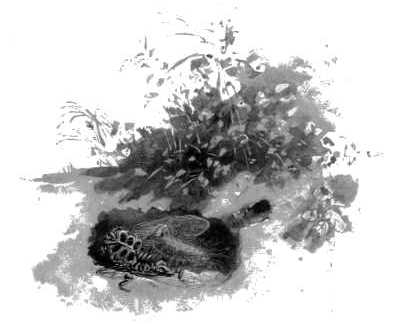
roof of the piazza, where he disappeared among the bordering vines. A
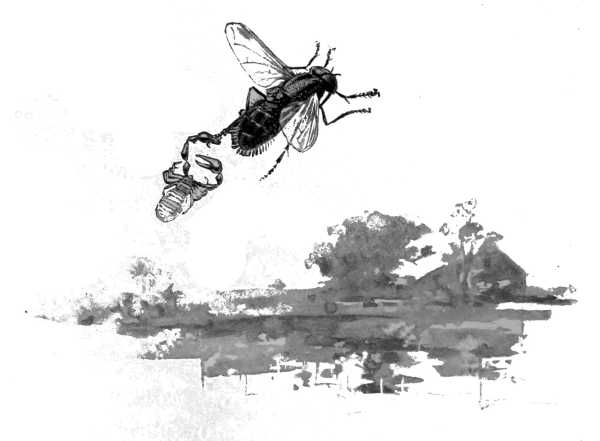
little cautious search soon revealed his hiding-place, however. He was
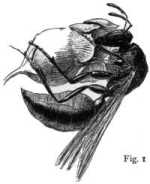
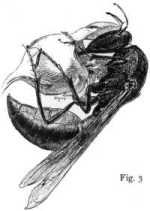
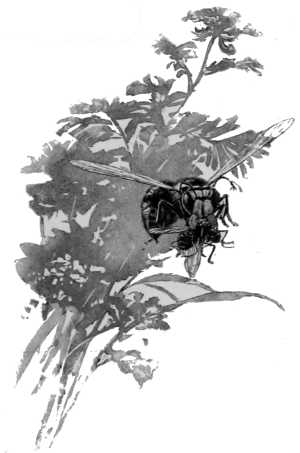
hanging, head downward, by one of his hind legs, twirling some dark
object in his front feet; and it needed only a little closer
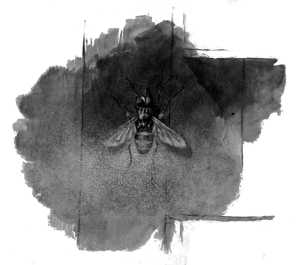
examination to disclose this object to be a fly, which was gradually
being reduced to a pulp by the sharp jaws of its captor—a morsel,
doubtless, soon to find its way to the cell of a baby hornet in some
paper nest close by.
"You will now doubtless understand that precipitate onslaught on your
nose," I remarked to my bachelor friend. "Rest assured that the
attraction of that aquiline member alone would never have caused the
panic that ensued; but you did not give our hornet the credit for the
removal of that pesky fly which had been annoying you for so long,
and which is even now being masticated into an unctuous pellet in some
secluded corner of the piazza, or is perhaps being borne on buzzing
maternal wings to the little white grub in the hornet nest yonder in
the pines."
And this is all there is to the "mad" of the hornet. He is generally
not half as mad as are his detractors. He is simply minding his own
business, and is as busy as a bee in his own way; and if his critics
will only mind theirs, there need be no fear that he will try
"konklusions" with them, or even give a hint of his "javelin."
This curious episode may be witnessed by any one who will take the
trouble to closely observe the wasp. The sunny side of the barn or
stable is generally the favorite hunting-ground, and any one who will
spend a half-hour in following the efforts of a single wasp will have
to admit that he earns his living, for it is not every fly that is
caught napping, and that white face, with its eager, open jaws, must
needs butt itself against the shingle many times before its quest is
satisfied.
But the warlike hornet does not always content himself with such small
game as a house-fly. Big bluebottle-flies are a frequent prey, and
juicy caterpillars are a welcome variety in his daily diet. Even the
butterfly, with a body nearly as large as his own, falls a frequent
victim, the scimitar-like jaws severing the painted wings in a
twinkling, either during flight, or falling one by one from its
dangling retreat.
The life of the black hornet, or wasp, may be briefly summed up. The
females survive the winter, and in spring build a tiny comb of papery
material composed of saliva and timber scraped from old gray boards
and fence rails. In each cell of the comb an egg is laid, which soon
hatches into a minute white grub, the sides of the cells being
continued to accommodate its growth, the comb being gradually inclosed
in the paper covering and enlarged as the nest cells are increased.
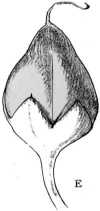
The grub at maturity incases itself within its cell by closing the
orifice with a silken veil, and soon turns to a chrysalis, and in a
few days emerges as a perfect wasp. Several broods are reared in a
season, the combs being extended in several layers, each suspended by
a single stalk from the centre of the one immediately above. A single
nest sometimes presents as many as six or seven tiers. But the nests
are much more safely examined in winter than in summer.