College of sciences and arts at Cuzco—Students—Library—Popularity of
Fenimore Cooper's works—Convents—Cock-pits—Procession—Condition of
the aborigines anterior to the Incas—Manco Capac and his wife—Their language—Antiquities—Inca's
fortress—Worship of the planetary bodies—Suspicion
of intercourse between ancient civilized Asia and South Peru—Temperature
of bull's blood—Reception of the prefect's family—Sham fight among the
Quichua Indians—Barley and corn crops—Trade—Loss of Paititi—Thermal
springs—Hospitality of a cura—Lampa—Gold mines of Carabaya—Lake
Titicaca—Appearance of the Indians—Puno—Military—Niggardly soil.
The city of Cuzco has a population of about 20,000, with a greater
proportion of creoles than any place between it and Lima. There is
but one newspaper published—an official called El Triunfo del Pueblo,
(the Triumph of the People.)
In the museum are many ancient curiosities: mummies, mining tools,
earthen, stone, and metal ware, war-clubs, hatchets, and Indian costumes.
In a small library hangs a translation, into Spanish, of the declaration
of independence of the United States. Among the few readers met
there, questions were often asked of Fenimore Cooper, who seems to be
better known in South America than any other North American. I
received much kindness from those of Spanish descent who had read
Mr. Cooper's works. The distinct pronunciation of his name shows the
deep impression made upon their mind by that distinguished author.
In the college of sciences and arts were three hundred boys. The
president seemed anxious to give a favorable impression of the institution.
In the picture gallery, some of the most choice drawings, executed by
the students from time to time, were preserved. There seemed to be
natural talent displayed, but a want of good instruction. Mathematics,
philosophy, Latin grammar, and drawing, are the principal studies.
While walking on the balcony among the boys, wrapped up in broadcloth
cloaks and caps, we observed a youngster deeply interested in a
very greasy-looking little book. He seemed to be the only one disposed
to study. He said, "Poetry is my lesson for to-day." He was asked
which he preferred to be, a Byron or a farmer? The boys around us
laughed, when he spoke out quickly—"a Byron, sir." On the wall of
a dressing-room hung in line three hundred Napoleon-fashioned cocked
hats, which the president informed me were worn by the boys in procession
when they went to pay their respects to the prefect. Peru has a
population of not quite two millions, more than half of which are friendly
aborigines. On the standing army list there are six "Grandes Mariscales,"
seven "Jenerales de Division," with twenty "Jenerales de Brigada," and
junior grades in large proportion.
The people of the country complain of a constant revolutionary spirit
in all places, and there is no advancement in "science and the arts." It
is said that when a creole mother in this country holds her baby between
her hands to tickle and kiss it, she addresses a boy as "My dear little
Bishop;" or, "My President." She objects to allow its head to be wet
with water, for fear of destroying its memory; and prevents it from
sleeping in the day-time, lest it may catch a sore throat. The birthday
of a boy is a cause for rejoicing. The father is congratulated, and the
mother praised for her patriotism. The proportion of females through
this country is great. The women are well developed, healthy, active,
and gay. Generally speaking, the men are not so.
Every Sunday evening there is a cock-fight in Cuzco, at fifty cents
entrance. The pit is built of mason work, with two entrances, and seats,
one behind the other, all round. Gaffs, three inches long, sharp, and
like a dragoon's sabre, are fastened to the cock's spurs; the fight is very
soon decided. A good deal of money is bet on these occasions, at which
the college-boys take part; ladies are not admitted, though they bet
upon their favorites as they are carried by to the pit. The commander
of police presides in uniform, with a small table before him, covered by
a green cloth, on which he makes his bets, and piles his silver and gold,
if he wins. He rings a small bell when he is ready for the fight to
commence, and decides the battle. There are few game chickens in
this part of the country, but the barn-door fowl, aided by gaffs, are
freely used up.
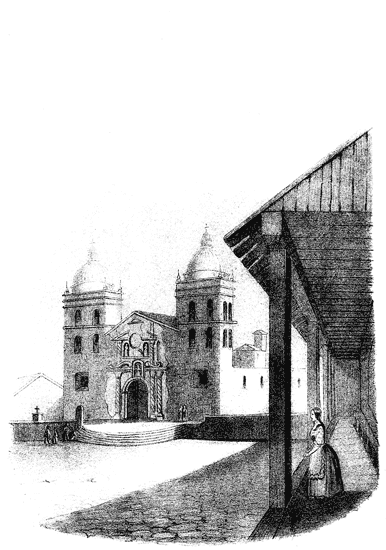
A visit to the churches and convents of Cuzco is interesting; many
of them are immense, built from the hewn stone from the ruined Inca
city. The ornaments are rich and costly; the carving of ornamental
woods from the montaña are well executed. We were surprised to find
such a display of oil paintings, which were used to induce the Indians
to change their worship to that of the Catholic. In the convent of San
Francisco, one represented a graveyard somewhere between Heaven and
hell; the dead are seen rising; winged angels come down from among
the clouds, and bore off the good people; while the devil's understrappers
grasped the bad, and tossed them over a precipice into an active
fire far below. This painting produces a lasting effect upon the minds
of the poor Indians. A major in the Peruvian army remarked "he saw
no soldiers in the fire;" at which a polite fat padre laughed, as if he did
not consider the subject in a serious light. In one corner of a filthy
room, near a closet, a robed priest was standing with a small book in one
hand, and a large loaf of bread in the other. He looked ashamed as he
saluted us with his mouth full. Among the flowers cultivated in the
area were a number of priests apparently in deep study, while one of
them was mending a hole in his breeches.
After a long continued drought, the sugar plants, maize, and potato
crops suffer for want of rain. On Sunday, August 31st, the prefect invited
us to walk in procession; a company of soldiers, and band of music
in front; the college boys, with cocked hats, and their happy-looking president,
were ready; the prefect appeared in full uniform. We marched
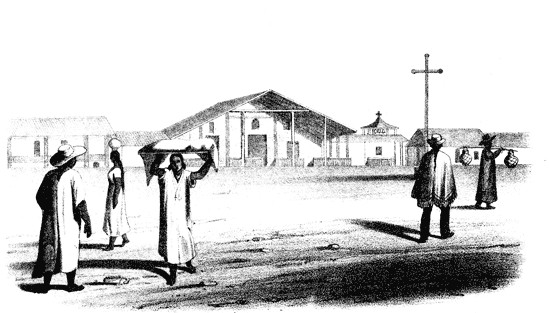
to the cathedral, which, with the main plaza, were filled with people.
On entering, no seats had been provided, and the prefect spoke sharply
to one of the priests. Three images, of full size, were raised on platforms
on the heads of men; the music commenced, and we followed
through the city. The Indians, who crowded from the surrounding
country, seemed very much interested, but it was wood-work to some of
us; with hats in hand we pushed through.
We halted in a narrow street, to allow another procession to pass,
similar to ours, except that it had a more interesting mixture of pretty
women. An image, borne on the heads of men, was called "El Patriarca
San José," followed by a number of priests and women singing. After
them a female figure, richly mounted with silver, dressed in a costly
brown silk dress, trimmed with gold, and spangled with silver. Her
black hair was hanging gracefully at length over her shoulders, and in
her arms she held an infant. We followed "Nuestra Señora de Belen"
to the cathedral. The bells announced her arrival, and the population
knelt in prayer.
Nuestra Señora was carried before the altar; those under the front
part of the platform knelt and rose three times, while the men behind
stood still, which made her appear as though bowing. When the Indians
shouted and cried, the women became much excited, and their little
children shed tears and screamed with all their might; even the Indian
men wept; a perfect shower of tears was produced. Their prayer to
God, through Nuestra Señora de Belen was to send rain for their perishing
crops in the country around.
Soon after the conquest, the fishermen of the bay of Callao picked up
a box, and upon opening it they found Nuestra Señora de Belen and
her child, with a letter, wherein it was written, she was intended for
the "City of the Kings;" Lima was Pizarro's name for the city of the
kings, and she was at once claimed by that city; but Cuzco was the
aboriginal city of the kings, and a dispute arose. Those of Cuzco declared,
that as she came in a box, which might be carried across the
Andes on the back of an ass, she was not sent to Lima. This argument
gained the lady, and she travelled over the mountains.
The Indians, and many of the creoles, believe, when they have too
much or too little rain for their crops, and take her through the streets
praying, God will listen, and send water, as required, for their fields.
When they are visited by disease, as at present, and the influenza is fatal
to their children, the Belen lady is implored.
The Convent of San Domingo is built over the ruins of the Temple
of the Sun, Moon, and Stars, which were worshipped together by the
old Peruvians—a worship objected to in moral laws. We are told that
the sun of the temple was made of a mass of silver and gold; so were
the moon and the stars. When the Spaniards captured Cuzco the
treasure of this temple was squandered at the gambling tables.
Before the days of the Incas, the Indians of these regions are thought
to have lived in holes in the ground, in crevices, or under overhanging
masses of rocks, and in caves, like wild bears, biscachas, or eagles.
They ate grass and roots of the earth like beasts; roamed among each
other as animals of the desert. Like the Chunchos, they reverenced
brave animals, large birds, and serpents. There were many tribes, with
different languages, and different worships of birds or beasts. In war
they flayed their prisoners, ate their flesh, drank their blood, made drum-heads
of their skins, and sticks of their bones. They went about in
flocks, robbing each other like wolves, the weaker giving way to the
strong. It has been said they fattened the children of their enemy like
lambs or calves, and ate them.
A man and a woman of some different race suddenly appeared among
them; they knew not from whence they came; the opinion was that
they were from out of the great Lake Titicaca. The man and his sister
told the Indians they had been sent by their father, the sun, to draw
them from their savage life, and to instruct them how they might live,
like men, and not like beasts; to show them how to cultivate the land
and raise food; to teach them to make clothing and to wear it. The
Indians were pleased, and ran off telling their neighbors, who gathered
together about the man, while his sister and wife taught the women
how to spin the wool of animals and to make clothing.
The language taught them was called Quichua; they were also instructed
to worship the sun, moon, and stars; to build towns on the
western end of the valley; to rise at the break of day, that they might
behold their Deity as he appeared in the east. They called the man
Manco Capac and Inca; they loved and worshipped him as a descendant
of the sun. The woman they called Coya Mama.
Manco Capac reigned many years, during which time he and his wife
taught the Indians from the Apurimac river on the west to the Porcotambo
river on the east; south from Cuzco to Lake Titicaca, and
north to where the Apurimac empties into the Santa Ana.
The moon was worshipped as the sister and wife of the sun, and
believed to be the mother of Manco Capac; the evening star, Venus,
was considered the attendant of the sun. They respected the cluster of
"seven stars," because they were called maids to the mother moon.
They had certain forms of worship and prayers which were made
through lightning, thunder, and the rainbow.
Manco Capac was kind and gentle in disposition, and the Indians
loved and obeyed him. He laid the foundation of great changes in the
manners of the aborigines, founded a church and a nation.
I was permitted to make sketches of some curious things, the works
of the ancient Peruvians, from collections preserved in private families,
who value their little museums very highly; they seldom give away a
specimen, but are anxious to receive anything in addition.
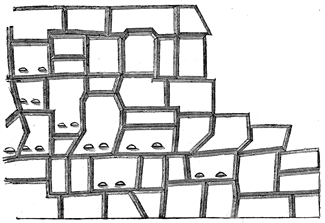
Fig. 1.
Figure 1 represents mason-work.
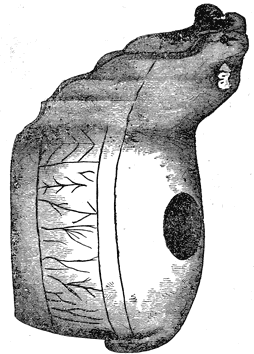
Fig. 2.
Figure 2, a drinking cup, the handle representing the head of a
llama, of stone, and rudely carved.
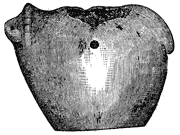
Fig. 3.
Figure 3, also stone, probably of older date.
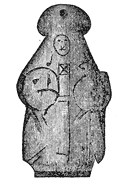
Fig. 4.
Figure 4, a stone portrait of one of the priests of the Temple of
the Sun; very smooth. Attached by a string in the hole on the head,
to be worn as an ornament round the neck.
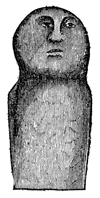
Fig. 5.
Figure 5, a smooth green and blue stone.

Fig. 6.
Figure 6, a stone likeness of the head and arms of a monkey eating
his breakfast.
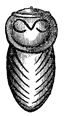
Fig. 7.
Figure 7, a common garden grub-worm, of stone.
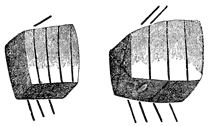
Fig. 8.
Figures 8, dice, of stone.
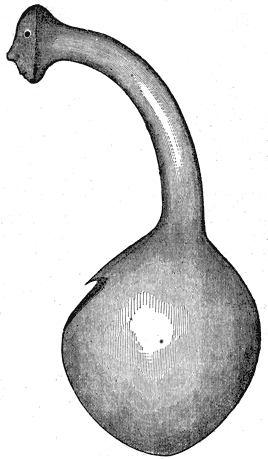
Fig. 9.
Figure 9, a clay water-ladle, painted red and worked very smooth.
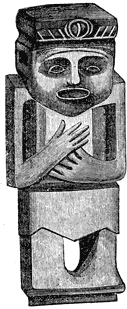
Fig. 10.
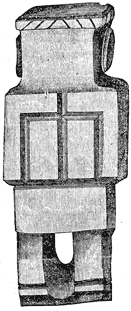
Fig. 10.
It is said that
such idols were
not permitted
to be worshipped
by the Incas.
They are of
granite, found
among the Andes—not
from
the Cordilleras.
In Peru and Bolivia,
the Cordilleras
are not
interrupted by
water-courses,
but are the dividing
lines between
the Atlantic
and the
Pacific water-sheds;
while the
Andes chain is
cut in many
places by the
streams flowing
to the eastward.
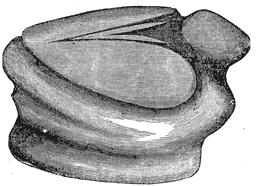
Fig. 11.
Figure 11 is of granite, bird-like in shape. It might have been
made for the head of a war-club or slung-stone.
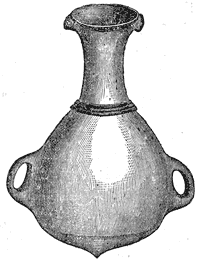
Fig. 12.
Figure 12, an earthen jar, seems to be more modern, though not
used by the Indians of the present day. It is of brick-color, painted
black round the neck.
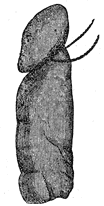
Fig. 13.
Figure 13, a green-colored stone likeness, worn suspended on the
breast.
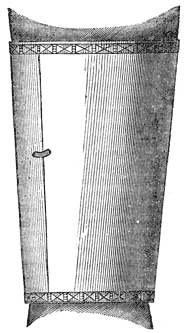
Fig. 14.
Figure 14, a metal armlet,
made of copper and tin, so
thin as to spring open when
drawn over the hand. The
fastening is a small string
through the holes. Bracelets
were favorite ornaments: they
are seldom worn in the present
day.
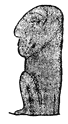
Fig. 15.
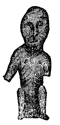
Fig. 16.
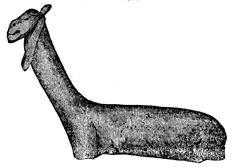
Fig. 17.
Figures 15, 16, and 17 are of the same metal; the latter the best
representation of a llama we could find; the two former are in the
usual posture of mummies.
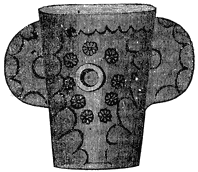
Fig. 18.
Figure 18, a drinking cup, is of earthenware, and the most fanciful.
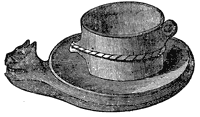
Fig. 19.
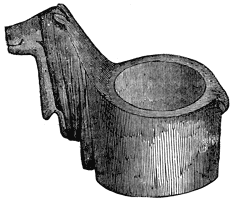
Fig. 20.
Figures 19 and 20 are of stone. The general contour of figure 20
reminds us of the alpaca; while the handle of the saucer of figure 19
represents an animal unknown to us.
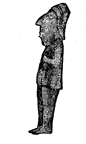
Fig. 21.
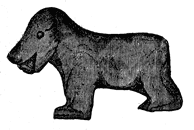
Fig. 22.
Figures 21 and 22 are of stone. Figure 22 represents an animal
unknown to us.
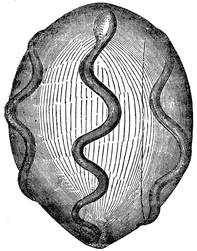
Fig. 23.
Figure 23, a stone, shaped like a lemon, with serpents carved
thereon, including a vein of gold in the stone, the production of the
montaña of the Madre-de-Dios.
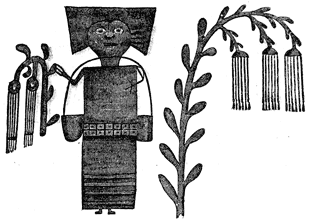
Fig. 24.
Figures 24 represent paintings on the outside of an earthen jar, red
and black.

Fig. 25.
Figure 25, of stone, may be a caricature of a bearded Spaniard in
his smoking cap.
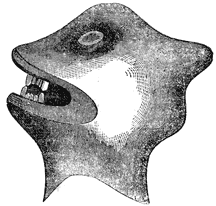
Fig. 26.
Figure 26, of clay, is the head of an animal unknown.
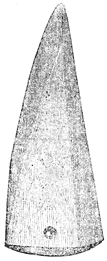
Fig. 27.
Figure 27, a stone blade of a knife, sharp on both edges.
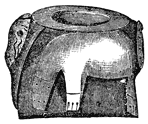
Fig. 28.
Figure 28, a drinking cup, with figures of animals.
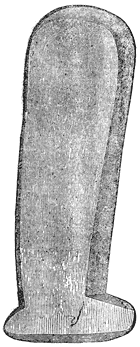
Fig. 29.
Figure 29, a copper chisel, flat on one side.
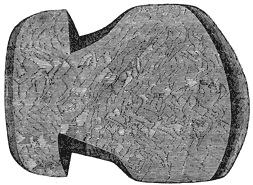
Fig. 30.
Figure 30, a green-colored stone hatchet, shaped like those found in
North America.

Fig. 31.
Figures 31, ear ornaments. Their weight stretches the ear. They
are of copper and tin, inlaid with silver and gold, and were hung to
the ear by the string. From their appearance, not owned by the
common Indians.
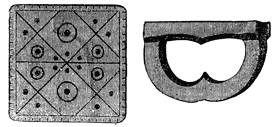
Fig. 32.
Figure 32, a bone wedding-ring, made as though the bride and
groom both wore it during the ceremony.
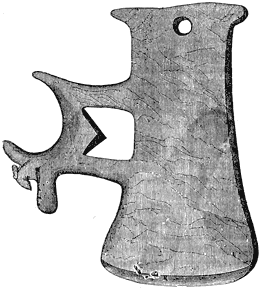
Fig. 33.
Figure 33, a hatchet, made of copper, hardened with tin. This was
found in the grave of an Indian warrior, near Cuzco, and is the best
made tool we found. Iron was not in use, and their tools were made
of this mixed metal. They probably cut stone with it. Dozens of
crowbars or chisels, 3 feet long and ¾ by ½ an inch thick, were found
in the silver mines.
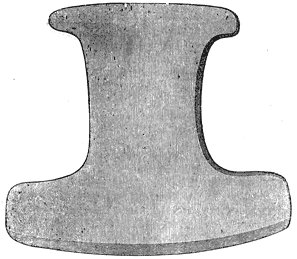
Fig. 34.
Figure 34 is a hatchet, of the same alloy as preceding figure.
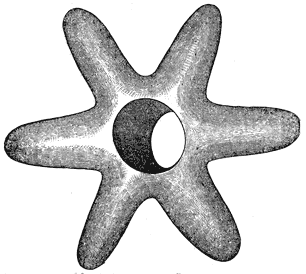
Fig. 35.
Figure 35, metal head of a war-club. Some are also found of stone.
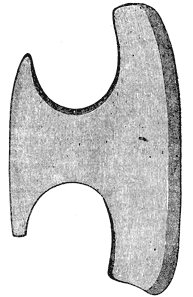
Fig. 36.
Figure 36, a metal war-hatchet; was taken from a grave near the
small town of Surati.
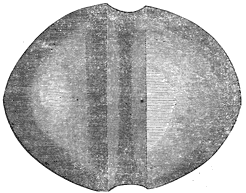
Fig. 37.
Figure 37, a slung-stone, used as a weapon of war.

Fig. 38.
Figure 38, a gold ornament worn on the forehead; the button, representing
the sun.
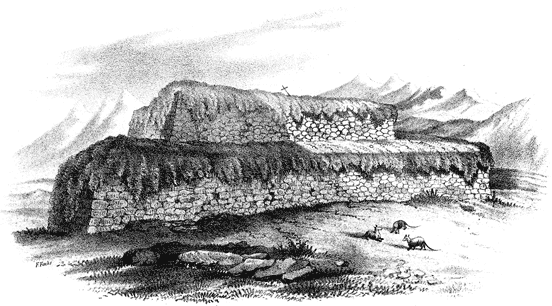
On a high hill on the north side of the city are remains of the walls
of the ancient fortress Sacsahuamam. The largest sized stone in the
drawing measured twenty-two feet at the base, and twelve and a half
feet perpendicularly, independent of its depth in the ground and wall.
The Indian boy standing near was full grown. We were at a loss to
know how the ancient Peruvians could handle such heavy masses, and
transport them half a mile over ground nearly level; but some recent
discoveries by Mr. Layard, in Asia, show no similar acts by human
powers and mechanical skill.
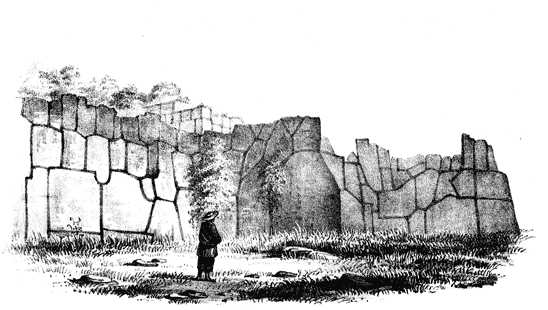
By Lieut. L. Gibbon U. S. N.
Lith. of P.S. Duval & Co. Phil.
NORTH VIEW OF THE REMAINS OF THE INCA'S FORT, SACSAHUAMAM, Cuzco.
The area occupied by this fortress may be about twelve acres. No
fortification in North America would more safely defy the effects of
round shot and shell, though built by people ignorant of such war
agents. The angles and ground plan are systematically laid down; the
stairways, by which the fort was entered, are built so as to be easily
shut up by large stones from the inside, making the door quite as secure
from the outside as the wall itself. The walls encircle the top of the
hill, the peak of which stands considerably above the ruins. On the
north side of the ruins, from which this view was taken, there are many
seats and flat places carved in the rocks, whence it is supposed people
witnessed plays on the flats, which have the appearance of parade-grounds.
Among these rocks there is a hole, said to be the entrance to
a subterraneous passage under the hill to the Temple of the Sun, a
distance of half a mile. I entered it, but could not proceed far, and
came away with doubts. Subterraneous roads, made by the order of
the Incas, are believed by some to exist between Tarma and Cuzco.
In the small stream flowing by this fortress, and through the city of
Cuzco, I washed some sand in a pan, and found grains of gold. The
Indians now seek the cultivation of the soil rather than gold-washing,
and find it more profitable. During the reign of the Incas, the precious
metals were solely used by them as ornaments and utensils, and not for
a currency, as now.
From time to time, during the reign of the Incas, the neighboring
tribes of Indians were brought under their control, either by persuasive
means or by force of arms, until their territory extended from the Pacific
coast on the west to the eastern slope of the Andes, and from Quito,
near the equator on the north, into Chili, near latitude 40° south. Some
of these Incas were great warriors, who marched to the frontiers with a
determination to extend their laws and religion over other territory,
until their possessions became so great, that the twelfth Inca decided to
deviate from the constitution established by the first, and gave the
southern portion of the kingdom to his eldest, and the northern portion
to another son. These brothers quarrelled. Francisco Pizarro took the
conqueror prisoner and had him hung, which completed the fall of the
Peruvian empire, the civilization of which yet astonishes the Spaniards.
I met an old woman in Cuzco who claimed to be a descendant of the
Incas family. She was unable to trace the account of descent farther
back than her own mother. Old ladies tell their children wonderful
stories in this part of the world. Those who claim to be of the same
blood as the Incas, assume a haughty manner towards their neighbors,
which becomes the Indian as little as other people. In the ruins of
forts, roads, and canals, the art of spinning, weaving, and dyeing,
curiously-carved stone tools and metal castings, are the true remnants
of the Incas. The people seemed to fancy the hewing of stone and
working in metals, but we find no traces of wood-work.
The Spaniards brought with them to Peru horses and mares, horned
cattle, asses, goats, hogs, sheep, tame cats, coins, and dogs of good breed.
They planted the grape vine in the valley of Cuzco, made slaves of the
Peruvians, who joined to hurl their oppressors in their turn from the
territory of Peru.
A traveller told me that in 1825 he could read the news of the war
in the faces of the Indians as he met them on the roads. If a battle
had been decided in favor of the republicans, the Indians looked up and
were cheerful; if in favor of the others, they hung their heads and were
sad. The histories of hard fought battles between their forefathers and
the Spaniards, and the overthrow of their religion and government, had
been handed down from generation to generation. Various changes of
manners and customs had interfered with their happiness. The natural
man never forgets an injury, and it seems characteristic of the Indians,
as well as of some others, to hate their enemies and to love their friends.
These people enjoy the recollection of the example of Manco Capac to
this day. He seems to have shaped his conduct to the disposition of
the nation.
The worship of the planetary bodies, "the sun, moon, and stars," is
some evidence of astronomical information, which gave its votaries
power over others, ignorant of the natural laws which regulate the
movements and periodic changes of these heavenly bodies; and thus
gradually enforced a perverted reverence for them by the multitude.
The Hebrew moral law specially objects to such worship, which appears
to have been previously known, and, therefore, was forbidden by
Moses.
During preceding revolutions, which are referred to in the scriptures,
ships employed in commerce between India and Egypt may have been
driven from the Persian gulf or Red sea, and have reached this continent.
A remnant, one man and one woman, well educated and instructed
in the arts of agriculture, mechanics, and domestic industry, would have
effected all the improvements shown by the education of an intelligent
race, as the Peruvians appear to have been.
Their customs, manners, and enterprises, assimilate so much with
those of remote antiquity, in Asia and Africa, as scarcely to be distinguished
from them.
Modern discoveries in Egypt and Assyria exhibit the same bridges
and idols, the same tools, weapons and utensils of clay or stone, and of
mixed metals—copper hardened by tin.
What things are dissimilar may have been the result of intention and
reform. The victory of Alexander the Great over the Tyrians, who were
active, enterprising, and intelligent navigators, and the description of
explorations to the Arabian sea, made by ships built upon the Indus,
authorize a suspicion of very ancient intercourse by some competent
means between civilized Asia and America, at the south, as well as by
northern navigators upon our eastern coasts.
In evidence of ancient art and contrivance, when Alexander besieged
Tyre, more than three hundred years before our era, he employed "chain
cables" for his ships, after the Tyrian divers had cut the rope cables and
set his vessels adrift.[1]
The hitherto recognised dates are not considered competent to compute
the period of man's existence on this earth. The original estimate
being possibly founded upon a different basis of calculation, similar
to the comparison alluded to by a sacred writer: "A thousand years in
Thy sight are as yesterday when it is passed."
The existence of a strange pair of foreigners, who arrived from some
unknown country, to introduce agriculture, arts, manufactures, and systematic
morals, among the native tribes of the Andes, does not appear
to be a traditional fiction, but a confirmed fact, in the history of the
aborigines of Peru.
The grateful recollection of the present race of Indians, for the kindness,
gentleness, and humanity of the Incas rulers towards their ancestors,
are often compared disadvantageously with the sufferings and privations
they think they experienced from subsequent governments, now
modified, by peculiar changes.
The writer cannot doubt that Manco Capac and his wife were realities.
Long voyages, attributed to a commercial people of very ancient
date, may authorize an attempt to show the possibility of the discovery
and improvement of the aboriginal people, distributed upon this portion
of our great continent, by some race versed in arts and knowledge,
descended from the Asiatic family, to whom primitive advances in civilization
have been most anciently attributed.
The Phœnicians are described to have made voyages from their colonial
settlements on the shores of the Mediterranean, to obtain amber
from the Baltic, and tin from the British islands.
These Phœnicians, originally passing by the waters, or along the
shores of the Euphrates, from the Persian gulf to the Mediterranean
sea, are stated by tradition to have introduced agriculture, manufactures,
arts, letters, architecture, and civilization, to the aborigines of Europe
and of Africa, in "the antiquity of ancient days."
The colonies of Sidan and Tyre in Asia, of Carthage in Africa, and
some on the European shores, in Greece, Italy, and Spain, have been
attributed to these remote people. They are described in our venerated
records as the merchants, navigators, and wise men of their distant age.
To pass the stormy Bay of Biscay, and encounter the boisterous seas
of the Northern ocean, these explorers must have possessed vessels with
officers and equipments, experienced pilots, and competent seamen, to
authorize suspicion of enterprise, intelligence, and powers quite sufficient
to lead them "to compass the earth."
The three years' voyages described in the Scriptures to have been
undertaken by Tyrian seamen, and the valuable productions enumerated
as portions of their cargoes, illustrate the mercantile character of that
age, confirmed by curious modern discoveries in Egypt and Assyria.
In the hazardous voyages of the Phœnicians, in search of tin, we
discover some proof of its importance in the arts and manufactures of
antiquity, more than equivalent to its uses at the present day.
The comparative absence of steel and iron tools among the relics of
ancient nations, may be explained by the fact that they possessed a substitute
in the easy combination of tin with copper, which, by accident or
their accurate acquaintance with these metals, enabled them to produce
results in the arts which still astonish us.
The immense rocks removed, ornamented, and elevated upon ancient
temples and pyramids, or carved in their natural positions for habitations
of the living and cemeteries for the dead, have long believed to
have been wrought without the employment of iron tools. Bronze was
certainly fabricated at very distant periods for the same uses as steel
and iron now.
Layard describes ornaments, weapons, tools, and armor of the ancient
Assyrians of copper "hardened, as in Egypt, by an alloy of tin."
The natives of Peru executed some significant works in porphyry and
granite, hewn by similar implements of bronze or copper, tempered by
a small alloy of tin.
By means of such tools, they wrought hard veins of silver, and are
supposed to have engraved the emerald.
M. de Humboldt carried with him to Europe a chisel, from a silver
mine opened by the Indians, not far from Cuzco, which, upon analysis,
was found to contain ninety-four parts of copper, united with .06 of tin.
The writer has been enabled to procure the partial examination of a
bronze crowbar, or long-bandied chisel, from an ancient mine of silver
in Peru. An exact analysis has been delayed, but of from ten to twelve
per cent. of tin are understood to be combined with the copper.
This alloy is employed for casting of bell-metal and cannon, for the
touch-hole of muskets, mirrors, or specula, for astronomical observations,
musical instruments, and formerly for coats of impenetrable armor.
These affinities in the manufactures of the Egyptians, Assyrians, and
ancient Peruvians, offer some suggestions of very remote intercommunication
between portions of civilized Asia and the natives of the Andes,
further elucidated by reference to other similarities in their mode of agriculture
by irrigation, and the employment of manures; the construction
and suspension of bridges; their causeways and aqueducts; the
working of mines, knitting, netting, spinning, weaving, and dyeing; their
roads, posts, inns, and grainaries, arms and armor.
The order, system, and policy of their morals; the arrangement of
public records; their duties; the worship of the sun, the moon, the
planets, and natural elements, distinctly and strictly forbidden in Hebrew
laws, because such practices had existed before the Exodus, and, therefore,
were objected to in the reformed code.
Indeed, the resemblance in the manners and customs of the Peruvians,
before the Spanish conquests, to those of oriental nations of the most remote
antiquity, has been frequently referred to by historians best acquainted
with the peculiarities of each.
The revolutions of the civilized nations of ancient Asia are repeatedly
referred to in biblical history to instruct the people in the causes which
led to proposed reformations in their moral laws.
To obtain relief from oppressive superstitions, famine, diseases, and
wars, or to find means fully to express the wonderful movements of mental
action, ancient revolutions may have driven numerous colonies, in long
forgotten ages, to seek refuge in most distant lands as now.
That such emigrations were made by land occasionally, a curious
proof exists in the interior of China. A town is inhabited by descendants
of people from the neighborhood of the Mediterranean, bearing
manuscripts of Hebrew laws, written upon rolls of skins or parchment, in
the peculiar characters of that people, and still remain as evidence of
their original descent, although the present inhabitants have become so
assimilated with the Chinese, that no one among them can read or comprehend
the language of those ancient commandments.
If the modern knowledge of the winds and currents of the ocean permit,
the writer will attempt to show, that sea-going vessels, well managed
by Phœnicians, Tyrians, or Carthaginians, equal, at least, to those in
which Columbus made his discoveries, were perfectly competent to traverse
the Indian and South Pacific oceans, and to have landed a civilized
pair on the coast of Peru, sufficiently near Lake Titicaca to give permanent
credit to their appearance from that direction, to instruct the gentle
and tractable aborigines of those mountains, who, by the mild, intelligent,
and persuasive character of the strangers, adapting their moderate
government to the peculiarities in the dispositions of the natives, gradually
acquired that prominence in the peaceful arts of life which put to
shame the acts of later conquerors.
In comparing the skulls of the Incas family with those of the aboriginal
Peruvians, engravings demonstrate the latter were deficient in intellectual
character, while the Incas exhibit very distinct differences of
conformation and of ability.
The oriental practice of travelling, by water or land, accompanied by
wives, is notorious. It still appears a trait of character distinguishing
eastern people, both in Asia and America.
Captain Gallownin, of the Russian sloop-of-war Diana, sent by his
government in 1811 to make a survey of the Kurile group, and to attempt
friendly relations with the Japanese, was induced to land with a
weak party, and taken prisoners. The officers of the Diana, in retaliation,
intercepted a Japanese vessel of the largest size. Fortunately, the captain
of this vessel was a great ship-owner and merchant—a person of
much influence and ability. He and his lady, the inseparable companion
of his voyages, are described to have borne their misfortunes with
wonderful composure, like old sailors.
We are taught by the winds and currents of the north Atlantic
ocean, that had Christopher Columbus sailed on his voyage of discovery
in a different month of the year, he never could have reached the New
World. He would have perished amidst calms, of which he knew
nothing.
The temperature of the blood of a young bull in Cuzco was 100°
Fahrenheit; air 57°. At the base of the Andes 101°; air 78°.
We were invited to join a party of gentlemen on horseback to meet
the prefect and his family from Arequipa. At the hacienda Angostura,
a large dinner table was spread on the piazza near a fresh stream of
water, shaded by willow trees, the air fragrant with the perfumes of
flowers and orange blossoms. The farm yards were filled with cattle
and sheep, while the fields around were planted with maize, barley,
potatoes, or green with lucerne. In the garden, peach, apple, and pear
trees were seen. We dismounted in the court-yard. A mule came
into the gate with a square box on his back, covered like a market
wagon, with a raised cotton-cloth cover upon hoops. Inside were three
noisy, laughing children. From the number of persons ready to assist
the youngsters, there was no mistaking these little Arequipanians, who
were delighted to get out of their box. The Señora and Señorita were
in their riding dresses. The ease of manner and beauty of the Arequipa
ladies have been celebrated; the daughter was about eighteen. She received
the compliments of a hundred beaux with graceful modesty.
The dinner table was well supplied with meats and wines, and a desert
table with many good things. Champaigne wine and sweetmeats
seemed of more assistance in speech-making and toasting than keeping
the party together on the road back. A judge of the court assured the
party "he should give up drinking water as soon as the navigation of
the Madre-de-Dios was open."
Angostura belongs to the Bishop of Cuzco; it is one of the best cultivated
haciendas in the valley.
A number of Indians collected in the small town of San Sebastian
were celebrating the Saint's day of the little church. The main street
was decorated with flags; arches were made with poles on each side, and
strings stretched across, to which were suspended coins of silver. The
first we passed under was adorned with one dollar pieces; the next,
half dollars; then quarters, shillings, and sixpences. Other arches
were made to which were hung pottery, fancifully-painted pitchers, jugs,
pots, and jars—all of earthenware. These hung so close to our heads
that some one plucked a specimen, which disrespectful act brought down
a string, and almost all were broken under our horses' feet.
The Indians were dancing in the little plaza, some in black masks,
others with cows' horns and the skin of the cow's head over their heads
and shoulders. A crowd of them were teasing a young bull, pulling his
tail and mounting him. The poor animal was tired down and secured,
specially disgusted at the music of a cane flute and hide drum.
We halted in the plaza and witnessed a sham fight with bows and
arrows, war clubs, and large wooden swords, gotten up for the moment
for the benefit of the prefect and his family. It was the representation
of a fight between the Quichua Indians of the Andes, and the Chunchos
of the lowlands. The killed, wounded, and prisoners in Chunchos
shoes was dreadful; while the delighted Quichuas went through the motions
of cutting their enemies up, one by one, into small bits, and heaped
them on one side like sticks in a wood pile.
The church doors were all open; the altar brilliantly lighted with
tallow candles; and along the walls on the outside stood rows of immense
chicha jars, carefully guarded by the women who huckstered it
out—a sixpence for an earthen jugful. The whole affair was a curious
mixture, difficult to digest by those unaccustomed to such habits.
Many of the ancient Indian customs seem to be allowed; this has a
good effect upon the aborigines, who give preference to cows' horns and
chicha over the more expensive requirements of the church.
From the balconies in the streets of Cuzco flowers were showered
upon the heads of the ladies, and the people shouted "Huzza for the
new Cuzcanians!" Many families were ready to welcome the lady and
her children into the prefectura, and after night she was serenaded by a
brass band. We have never seen the moon rise with such splendor as
it does over the snow-capped mountains to the east of Cuzco; she
throws her light quietly down over this interesting valley. There are
two noises which disturb its midnight stillness—the braying of a jackass
and the baying of a dog; both seem to wake up as the moon peeps
through the silvery peaks. The cocks crow as the moon is eclipsed by
a passing cloud.
The house of a prefect is generally a gay one. The gentlemen meet
in the evening to talk over the news of the day, play cards, and so on.
There is very little visiting among the ladies of Cuzco except on Sunday
after church. They are seldom seen walking in the streets. On Saturday
evenings they repair to the plaza to purchase a new pair of shoes, which
is the time to see them at most advantage. On these occasions the
priests appear with little silver images, standing on one side of a large
silver plate; as the ladies pay the Indians for their shoes, the padre presents
the image to be kissed, and the plate receives a donation or church-tax
upon the price of shoe-leather. There are very few who kiss the image
that do not pay, unless it be the second time the priest has offered it on
the same Saturday, and then they bashfully decline. On these days
poor families send old books, bits of iron, horse-shoes, nails, spikes, bridle-bits,
and stirrups, or any other article they may want the money for,
and the Indian servant sells them for what she can get. There is little
wealth in Cuzco; with a few exceptions, the people are as poor as they
are indolent. Some of the more energetic, who own haciendas in the
valley, and have mercantile houses in the city, are called rich—that is
to say, they have more than they require to live upon.
The climate of Cuzco, during our stay, was not pleasant; cold rains
water the hill-tops, which, in the morning, are white with frost, and being
evaporated, form clouds. Though Cuzco is within the tropics, and
the dry or warm season extends from May to September, the people are
dressed in winter clothing. When the sun passes Cuzco, on his way
south, the rainy season commences; the drops come down in hail and
snow flakes, and under the vertical sun the people are in mid-winter
storms, and require more clothing in what, astronomically speaking, is
their summer, than they do in their winter months. Strangers suffer
somewhat at first by not watching closely the changes of the temperature,
and dressing accordingly. Influenza and rheumatic affections are
very common; many of the poorer classes have small-pox for the want
of vaccination. There is a good deal of dropsy, but few cases of consumption.
The Indians use more coca here than elsewhere, and seem to injure
their health by chewing such quantities. Those living in the city are
thin and miserable-looking, in comparison with the country people.
The Indians seem to be much neglected; when they are sick, they wait
patiently until they die or get better. The charges of medical men are
high; Indians cannot afford to employ a Doctor. The native physicians
are generally the most moderate, and understand the climate the
best. There are a few foreigners in Cuzco, among them a French baker.
The people seem as fond of talking with him as they are of eating his
bread.
The city abounds with shop keepers and tailors, who pass their days
in the sun. As the twilight commences, the street doors are closed,
and the town presents a dark and doleful appearance. Here and there
a lamp is hung out in front of eating, government, and gambling houses.
The young men play billiards at a sort of club, where the room is decorated
with a likeness of Napoleon Bonaparte on one side, and George
Washington on the other. A Frenchman keeps the house.
The French are much the most popular foreigners. They soon marry
a country woman, and adopt the manners and customs of the Spaniards.
An Englishman don't manage so well; one may mistake a Frenchman,
who has been in the country a long time, for a Spaniard; but the
florid English face declares his nation at first sight. John Bull seems
delighted with an opportunity to speak English, while the French tongue
seems slung for Spanish. The Frenchman practises the courtesies and
habits of these people; introduces his wife and all the children to you.
He seems settled for life; the other talks constantly of returning to old
England. He is more active, sometimes cultivates the soil, or is engaged
in mining. Since my return from the Madre-de-Dios, a young
Englishman gathering bark, with a party of Quichua Indians, in a southeasterly
direction from San Miguel farm, were all murdered by the
Chunchos.
The mail arrives and leaves Cuzco for Lima, and other places, twice a
week. There are two mail routes to and from Lima; one inland through
Ayacucho and Huancavelica, distant 189 leagues; the other by the
English steamer from Callao to Yslay, thence through Arequipa. This
is the most expeditious route; the distance from Cuzco to Arequipa is
95 leagues.
October 28, 1851.—Our baggage well covered with tarpaulins.
José's saddle wallets received two roasted chickens, a leg of mutton, and
a large cheese fresh from the dairy, a present from the kind lady of the
house. This is the custom of the country. José tells me, as we follow
our train out of Cuzco, when guests are treated in this way, they may be
sure they are considered friends of the family. The hospitality of this
country is conspicuous and delicate.
The arrieros contract to go from post-house to post-house, on the
road south. I was recommended to go by the post, instead of engaging
mules for so long a distance. Although the change of mules is desirable,
the daily change of arrieros is not; the men work best after they become
accustomed to us.
The Indians are ploughing in barley and hoeing corn. The crops
suffer for want of rain in the valley. The road is very dusty. We
halted for the night in the small town of Oropesa, and for the first time
took up quarters in a Peruvian post-house. The moment Paititi entered
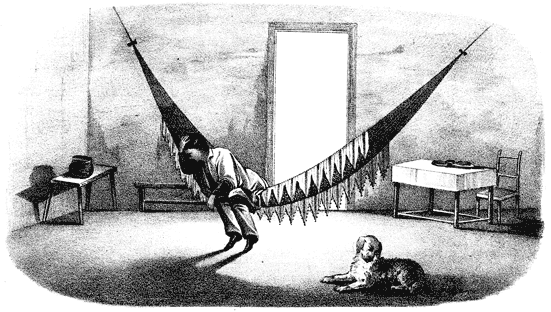
the patio, he began to war with the dogs. The house consisted of one
story and one room. Travellers take a house; we had a table and three
chairs, made of the wood of the montaña; in the corners were earthen
couches for beds. The walls were dirty, painted with pictures of angels
and saints. The ground floor was swept for us. As we took our tea,
Paititi sat in the doorway looking on. I felt a flea. The entrance
to the corral where the post-mules were kept, was opposite the kitchen,
where two large black hogs were feeding. In the doorway was seated
the fat, homely wife of the postman. The smoke of the kitchen fire
gracefully flowed out over her shaggy head; she was a very cross-looking
woman. One of her hogs came near, and Paititi gave him a
snap in the ham; she mumbled out something revengeful, while the
jolly postman laughed and praised our spirited watch-dog.
In the morning at 7, thermometer 58°, the postman came to say
good morning, and inquire how we passed the night, as though he did
not know how full of fleas his house was. After breakfast he left his
sour-looking wife, and accompanied us to the next post. The custom is
to pay fare in advance. Paititi gave the fat woman's sow a farewell
nip, and we marched on.
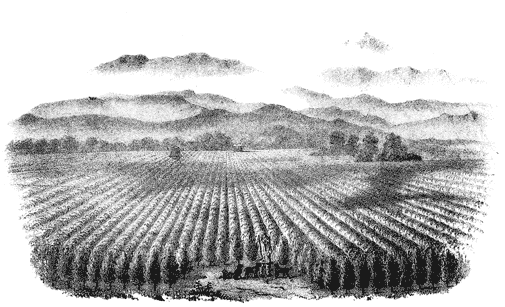
As we rise the side of the small mountain of rocks and red clay, we
look down upon a lake of clear water, in which a flock of wild ducks
are bathing. Beyond its green shores, we see lucerne, cornfields, and
haciendas surrounded with willow trees, near the base of barren hills.
This is the eastern end of the valley of Cuzco, which is about five
leagues long, and two miles wide in some places. It is thickly inhabited
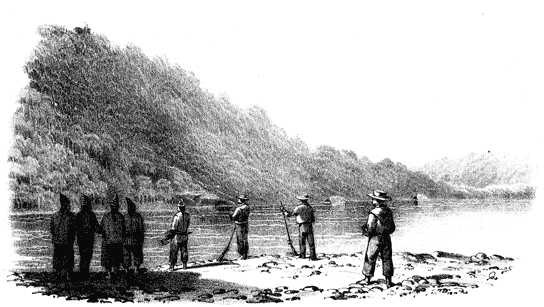
and well cultivated. Our course lay along the western bank of
the Urubamba river, a tributary of the Santa Ana. The waters glide
swiftly on northward. The river is straight, thirty yards wide, with
little fall; rocky bottom, and muddy water. The stream passes between
two ranges of hills. In places the valley is half a mile wide; then
again there is just room enough for the river and our road. Here the
shores are of black rock, then of gravel, then clay breaking down perpendicularly,
or with a long sandy beach. While the wild ducks feed
upon the water, the snipe seeks his food along the shore. Small fish and
tadpoles are plenty; but we saw no large fish in or out of the water.
The town of Quiquijana has a population of two thousand Indians.
They cultivate the soil as high up the mountain-sides as the producing
line; raise sheep and cattle. Mules are very fine-looking here. Where
the lucerne is not in blossom, we feed our mules with corn-fodder, and
they travel the better for it. Unripe lucerne weakens the animals.
There is an elevation above the sea at which barley grows, but never
produces grain. The stalk is very much liked by the mules, either
green or dry. On the flats it is raised and stored away for the dry
summer season, when the parching sun destroys the pastures.
We crossed the river on a freestone bridge. There was no toll to
pay. The road keeps the east bank of the river. The clouds stand
still over head, while we have a draft of wind through the valley, and
every few moments a wind comes in at right angles through the deep
cuts in the ridges. The mountains on both sides of the river are as
regular in shape and size as though they had been planted by hand.
The small, coarse grass parches yellowish.
Leaving the small Indian town of Checcacappa, the river runs from
the east through the mountains. At the turn there is a brushwood suspension
bridge in such a ruinous condition that we waded the stream
above, and continued our course south, through the valley, by a branch
of the Urubamba, called by the arrieros Sicuani. Beans and jackasses
seem to be the principal productions. After travelling some time
between high ridges of mountains, to come suddenly out upon level
land and small hills, reminds one of the break of day. Changed
baggage-mules at Cacha, a small town, where at midday the thermometer
stood at 71°.
October 31.—Found boiled eggs plenty, and a pleasant postwoman.
The town of Sicuani is larger than any passed through this side of
Cuzco, and built differently. On the long main street, which is crossed
by small, narrow lanes, we saw many pretty faces. The women are in the
majority in the market, buying and selling marketing—potatoes, peppers,
&c. For a country town, some of the houses are very respectable-looking.
The creoles regard us with an air of surprise. As we walk
along, they look very grave, touch their hats, and bow politely; but
suddenly turning, one catches them laughing and making remarks. At
first they called us Frenchmen. We tell them their mistake. They
inquire, "Englishmen?" Upon being told North Americans, they exclaim,
with a wondering expression, "Oh! California!" A party of Indian
boys were playing with tops—one of the very few things reminding
us of home.
A printed notice, pasted at the corner of the plaza, forbids the trapping
or shooting vicuña, by order of the supreme government. When
the people gather the wool of the vicuña, they kill the animal, instead
of shearing it and setting it at liberty again. We were told it was
easier to take the fleece off when the animal was dead. As their numbers
are decreasing, the government protects them.
November 1.—At 8 o'clock a. m., thermometer, 54°. It rained
during the night. The hills are now covered with snow. After leaving
the town and wading the river, we followed up the western bank of
the stream. On arriving at a small town, our baggage-mules passed
ahead. Proceeding some distance, we met a man, who told me the
baggage was not on that road, and we turned. After travelling for
some time, I suddenly missed Paititi. We had turned back without
calling him. Paititi had become a pet, and was now considered as one
of the party. José went back in search of him; but we never saw
our brave little animal again. He had guarded our tent by night,
and fought our battles on the road. He made friends for us, too;
for whenever the people heard his name, they wanted to know his
history. The mountain people take great interest in such matters;
and when they learned where Paititi came from, they became interested
in the party, and were the more polite upon introduction through the
dog. We have lost a friend.
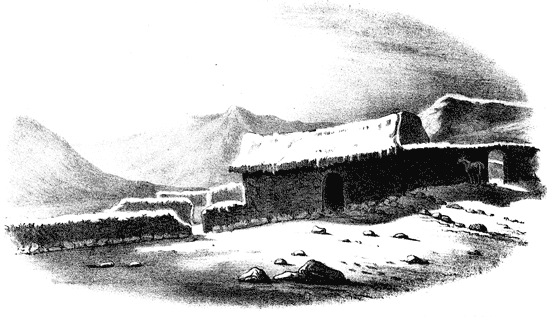
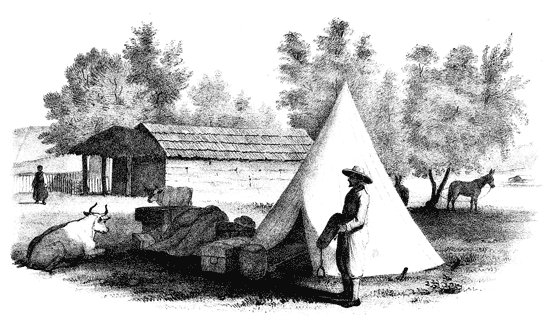
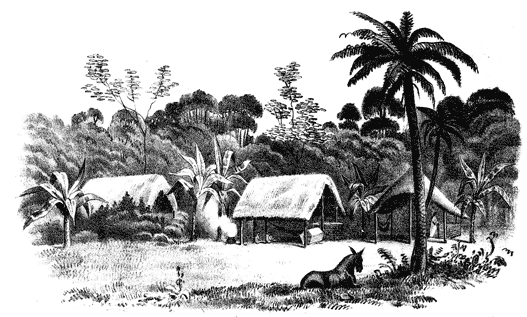
By Lieut. L. Gibbon U. S. N.
Lith. of P.S. Duval & Co. Phil.
AGUA CALIENTE POSTA, (Peruvian Tavern).
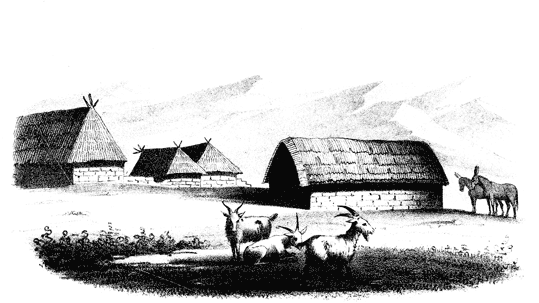
Agua Caliente post-house is the most miserable habitation imaginable,
surrounded by a few ruins of small houses. The evening is cold; the
tops of the mountains covered with snow. The post-mules pastured on
coarse grass in the plain or mountain pass. Our mules are unsaddled
and set at liberty to go with them; but they return to the door, and
look for their usual supper. The postman, a poor old Indian, was with
difficulty persuaded to sell us some barley straw, which José found in
one corner of a ruin. Dark cumulus clouds being about us, as the
rain, hail, and snow came down from southeast, the mules stood shivering
at the door. The scene is wild outside, and miserably dirty and damp
within. Five slim, hungry post-dogs came impudently into our house
at supper time. One of them went so far as to put his nose into José's
saddle-wallets. He at once engaged an Indian to go back to the small
town, and look for Paititi during the night.
A short distance from the house a mist was observed rising from a
spring amidst the hail-stones. The air was 40°, and spring water 122°.
This hot water bubbles up from the earth like boiling water in a pot,
and is the head of the river we have been travelling along. The hot
water flows northward. This spring appears like a small steam-engine,
working with all its might, manufacturing water for one of the branches
of the mighty Amazon. The water on the other side of the house flows
southward, declining to become Amazonian.
The Cordillera and Ande ranges here cross or come together. The
Andes range to the north of this high place is generally lower than the
Cordilleras. From here south the order of things is changed. The
eastern ridge in Bolivia and Chili is more characteristic of the western
chain of Peru and Ecuador. To the south we are told the western
range is lower than the eastern.
Our compass dances about so much that it is of no use here; at one
time it stands still with the south point down, and then again flies round
as though it had lost the north point. The soil is very wet and swampy.
The small snow-water lakes are filled with wild ducks, geese, and black
divers. We shot a pair of white geese, with tail and ends of wings
black, small bills and large heads; the male and female both of the
same color.
The town of Santa Rosa has a population of five hundred Indians;
it is difficult to tell whence they draw provisions, for not an inch of this
part of the country is cultivated, nor do we observe anything particularly
agreeable in the climate.
Our hour for starting in the morning is six o'clock; but here the
postman and arriero went to prayers; so we waited till 9, when we
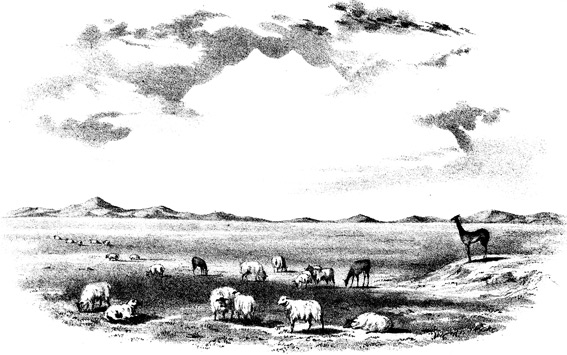
entered a puna, level as a floor. The mountains dwindled away to hills;
sheep are grazing on the plains; as we breakfasted on our roasted goose
by the side of the path, a tired Indian came up and told José he was
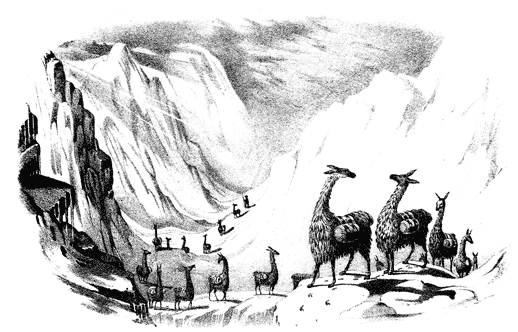
very hungry; with a wing and a biscuit, he followed his drove of eighty
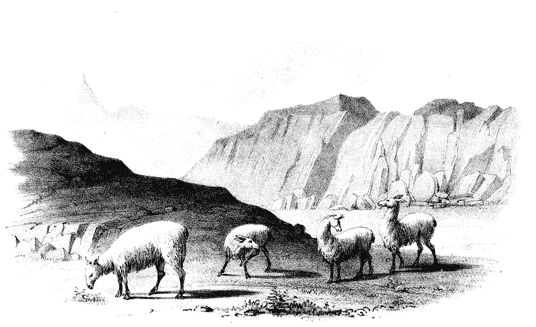
llamas more comfortably. I once asked an Indian what he did
when he was out of provision? He replied patiently, "Don't eat."
Here and there a low ridge crosses the plain east and west; as we rise
one of them our view is uninterrupted, except in the distance on the
east and west sides, when low ranges of small hills stretch along north
and south. At a small stream flowing west we shot a wild duck, and
got a crack at a snipe. As the thunder clapped to the northeast, we
rode into the town of Ayavire, a puna town. The Indians all look
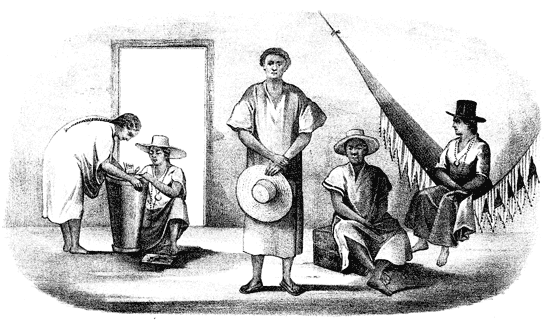
neatly dressed in coarse blue cloth; the houses are clean, but small, with
narrow streets. Two tall church steeples run up in the midst of the
houses, and a small plaza in front. What we first noticed was the
silence; not even the noise of the hoof of a jackass was heard on the
paved streets.
We dismounted in the patio of the cura of the town, and met at the
door three young ladies. I gave an open letter to the eldest to read;
the cura was not at home; the letter was from his son and their brother
in Cuzco, and we were welcomed. They had just finished dinner, but
we were served. A servant took the letter to the cura, who was dining
out. A message came from the governor to invite us to join his party;
we brushed the dust off, and the ladies arranged their hair, when we
walked with them through the town. At the governor's house we met
the old cura, who introduced us to the dinner party. It was after dinner
with all; we found them very agreeable. The cura insisted upon our
drinking a glass of wine with every lady in the room, which was tough
work, as there were quite a number. Music and coffee were introduced
in a room on another side of the patio. The cura was a sharp-featured
man, tall and very slim, with a most agreeable expression of face. He
smoked a paper cigar on an average of every ten minutes during the
evening. He was particularly fond of dancing with a pretty young girl
of sixteen, though he was about sixty years of age. He kept remarkably
good time; was full of life and gayety while with her; but when she
was otherwise engaged, he amused the party by falling to sleep in his
seat. He received the laughter and remarks of the elder ladies with
good humor; lighting his cigar by the candle and looking round the
room at the same time, burnt his fingers, which discomposed the musicians,
and confused the cotillon. He had drawn hollows in his cheeks
by working so much at the tobacco leaf, and forfeited every tooth in his
head, which was bald. Yet, his pleasant smile and agreeable manners
overcame these particulars, for the girls certainly liked him. His three
daughters were handsome persons, and had much of the old cura's
gayety about them. One was married to a miner, who she says is doing
little.
There are a few silver mines to the northeast of the town, which have
been abandoned, except one or two, from which little silver is extracted.
In the morning, we visited the church and saw the cura in his clerical
robes. To meet him came numbers of Indians, well dressed in blue—their
favorite color. Their hats, made of puna grass, and covered with
blue cloth, are lined with scarlet. The population here go barefooted.
The little town is thickly peopled—about fifteen hundred—but the plain
is not, and resembles a desert in many places. Near Ayavire barley
grows, but no grain is produced upon it. Potatoes and a little wheat
are brought to the plaza, a short distance from the east, and from the
valleys among the hills to the west. Corn cannot be raised on these
flats. Sheep are the principal animals here; black cattle and horses are
very small. The only spontaneous growth is a short, coarse puna grass,
which is not in the least green.
November 4, 1851.—At 3 p. m., thermometer, 57°; wet bulb, 52°.
About the hill tops there is rain, thunder, and lightning; the rain turns
into sleet, and the hills are white, while clouds appear after the rising of
the sun. On the puna, the reaper cuts his crop and leaves it on the
ground during the dry season; when the rainy season commences, he
plants again.
A strange traveller halted in front of the cura's door, where he and I
were standing. The compliments of the day were exchanged, when a
long pause followed. Upon invitation, the man dismounted, and his
horse was taken away by an Indian. Dinner was ordered by the
daughter; the man ate, smoked, slept, and was off next morning by
daylight. The cura said "that is the way we travel in this country;
many a time I have begged a dinner and night's lodging on the road. I
never saw that man before; he is from Arequipa and going to Cuzco."
One of the cura's daughters had a headache after the dance; she was
cured by one of our Siedlitz powders.
We journeyed along the lazy stream that winds its way towards the
south. Young lambs are staggering after the ewes. Indians of the
puna wear thick woollen skull caps. The sheep are sheared at the
commencement of the rainy season, when potatoes are planted. December
is the first stormy month; now the sky is of the clearest and of
the deepest blue; the days are warm, and the nights cold. We dismounted
to drink from a small stream, and shot a pair of ducks. As
we mounted, José's mule became frightened, kicked at a most furious
rate, broke from him and ran across the plain, through the flocks and
sheppardesses; stripped itself of saddle bags, gun, and part of the bridle,
but turning into the road, joined the baggage mules. Two days ago,
José was thrown in the most ridiculous manner over his mule's head.
When a mule becomes frightened, it is almost impossible for a man to
hold on; its whole strength is brought in opposition to the rider; and
notwithstanding the powerful bit used in this country, it often succeeds
in getting away. José generally finds something to amuse during the
day, his grave countenance making the scene the more laughable.
The master of the post at the small town of Pucará was a judge. Before
our leaving in the morning a case came before him. Two Indians
quarrelled about some property, while celebrating the saint's day of the
church. They both drank too much chicha; then the quarrel took a
more serious turn, and they were arrested. Witnesses on both sides
entered the post-house; the men stood up along the walls; one by one
told what he knew about the matter. The women were then called upon.
The two parties seated themselves opposite each other, near the door.
The judge questioned one; her answer brought on a general discussion.
They became very violent against each other. The scene became interesting.
When the Indian women have trouble, they cry and talk at
such a rapid rate, without listening to what is said, that the judge declared
he never could make head or tail of their evidence. The case
was postponed.
There is no dew at night on the puna. Half way between Pacará
and Lampa, the river Ayavire turns east; it is a small stream, about
fifteen yards wide. The wind here was up the river, and on the hill
side, and in the ravines near by, there were a few stunted trees. The
small river basin stretched off to the east; the winds come down over
the water and strike the hill there, and nowhere else do we observe
such a growth as on the hills near these puna table-lands.
The town of Lampa has a population of about four thousand. The
Indians are very black; the hot sun burns them in the day, and in the
cold nights they are smoked in their houses, some of which have tile
roofs, but they are generally thatched with puna grass. Neither the
heat of the sun, nor the effect of the smoke, has as yet made their hair
curly or woolly. It is worn in one long wig, China fashion. Many of
them were hewing stone, and preparing to increase the size of the
church, which appears to us very large, even now.
The sub-prefect was suffering from neuralgia, and many of the creoles
had toothache and colds. Lampa is a sort of half-way house between
Arequipa and Cuzco. The trains of mules, loaded with foreign manufactures,
halt here to rest on their way from the coast.
Our mules were well shod all round for the first time since we purchased
them in Lima. I made an agreement with the blacksmith that
they should not be whipped, in case they refused to stand still. We
expected a kicking from Rose, but she stood quietly. The blacksmith
wanted to buy her, and said she was worth more than she cost in Lima,
though mules are more plenty here. He charged four dollars for eight
shoes. The man's son held the mule; his daughter handed him the
nails, and his wife cooked her chupe by the smithy fire. She makes
pottery and he silver spoons; he is a creole and she an Indian woman.
One spoon had a sharp-pointed handle. After breakfast, which came
in between the shoeing of Rose's fore and hind feet, the woman picked
her teeth with the sharp end of the spoon; after which she used it as a
pin to hold on her shawl or manto, made usually of scarlet, blue, or
yellow coarse cloth, cut square, and sometimes ornamented with white
silk or silver thread. When cold, it is raised over the head, but generally
covers only the shoulders. The blacksmith was very polite, and
seemed actively employed. His shop and house are in one, situated
near where the arrieros stop, so that he is constantly called upon for
shoes. He wanted to know if we were not Germans!
The silver mines of Palca, seven leagues to the westward of this
place, are profitably worked. There are no steam engines. Some of
the old mines contain water, but are said to be valuable.
From Lampa to Crucero, the capital of the province of Carabaya, the
distance is thirty-one leagues in a northeasterly direction. From Crucero
there is a path through a rugged country, crossing mountain
streams, to the gold mines of Carabaya, situated in the wild woods on
the northeast side of the mountains, among which the tributaries of the
Madre-de-Dios take their rise. Gold was discovered and mines worked in
Carabaya many years ago; of late, new discoveries have been made, and
more gold hunters seek their fortunes there. At the commencement of
the dry season three hundred Quichua Indians set out on foot, with
provisions and clothing upon their backs, from Crucero to the mines.
The road near the mines is too rough for a mule. These Indians are
employed to work the mines by creole companies.
The gold occurs in quartz and in veins of black dust, which is sometimes
half gold, and also in grains among the sands of the river. I was
told one of the lavaderos or washings, called "Alta Gracia," worked from
May to December last year, by 150 men, produced one hundred and
twenty-five pounds of gold.
Pavements are built in the beds of the streams five yards square,
which are overflowed in the rainy season, and the gold deposited to the
amount sometimes of five ounces, which is separated from the sand by
washing in the dry season. The men suffer somewhat from sickness
and exposure; provisions are very scarce, for every man has to carry
enough to last during the season, as the country is uninhabited and uncultivated.
Specimens we saw were in lumps of from one to two ounces
each, and closely resembled the gold of California. I am told that persons
have lost money by placing too much confidence in the exaggerated
reports of the riches of these Carabaya mines. The expense is very
great. The daily wages of laboring Indians is fifty cents per day, besides
provisions. They received twenty five cents per day for building
the church in this town, where they enjoy health with their families,
and live an easy life. At the mines the climate is hot.
Those who remain late in the season are in danger of being caught
on the east side of streams which are impassable when flooded. From
December to May during the year the mines are unemployed; they are
beginning to come out now. Peruvian bark is found in Carabaya.
November 6.—At 6.30 p. m., thermometer, 52°; wet bulb, 45°. A
small stream flows southeast by the town, over which is a well-built
stone bridge. We keep along the east bank. On the plain to the south
we thought we saw a sheet of water, but it was the refraction, which
seemed to raise the hills up; they looked like islands. The country is
becoming more cultivated as we proceed south, and cattle are more numerous.
We find nearly the same dry, burnt-up vegetation and dusty
roads, though the air feels moist enough for green fields of grass.
Halting at the small adobe-built town of Juliaca, with a large church
as usual, our baggage-mules were changed. We spent the night at
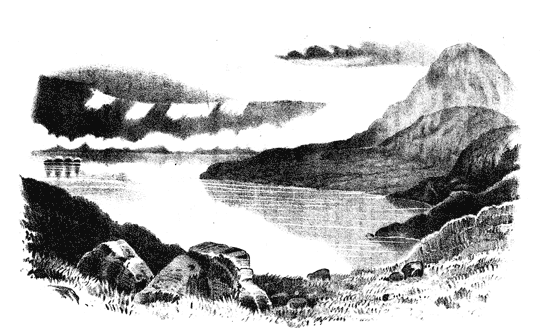
Caracota, and changed mules again at Pancarcolla. To the left of us
we beheld the deep blue waters of the great southern lake Titicaca.
The east wind troubled its waters; the white-capped waves reminded
us of the trade-wind region of the ocean. Large barren islands intercepted
our view; not a tree nor a bush was to be seen; the only living
thing in sight was a llama, seeking food among the tumbled-up rocks on
the unproductive hills. The scene is wild and deadly silent. Our
only view was to the southeast, where we saw tops of islands beyond
tops of islands, backed by mountain peaks.
The wind is cold, and the parching rays of the sun scorch the very
skin off. Our green veils are so constantly blown off our straw hats that
we pocket the troublesome things. The Indians on the road are very
polite. We are told that it is a custom among them to salute those
coming from Cuzco first, thereby showing respect for their ancient
capital.
There are great differences in the faces of the Indians, particularly
among the women. Some of them resemble negroes, with thick lips,
flat noses, and a stupid expression of the eyes. Others look bright, intelligent,
and lively. From the cheek-bone the face narrows uniformly
to the chin. The nose is small, straight, and sharp-pointed; the lips
thin. Should any have Manco Capac's blood, I doubt if they know it.
Some of them are very Shanghai in appearance, while others are taller.
They generally walk together, with the old women behind. The men
keep to themselves, and are remarkable for their family likeness. All
seem serious, well behaved, and are always deeply interested in whatever
they may be employed, let the occupation be ever so trifling. They
never seem to be in a hurry. They commence their work before sunrise,
and get through with it by sundown, provided there is no chicha
interference, which sometimes delays them on the road till after dark.
In such cases, the chances are, there have been some unpleasant feelings
washed away.
I saw two Indians meet who had a difficulty. One was very much
affronted, while the other, aware of having done a wrong, wanted to
make amends. He bought a cup of chicha, and begged the other to
drink it. For some time he refused, until the wife of the other persuaded
him. The moment it was taken, their faces changed to smiles,
and the trouble was forgotten. When there is ill-will among them,
they are so quiet, and their hatred so deep rooted, that it is only by
witnessing a settlement that one is convinced of their strong feelings.
They are truthful, honest, and respectful, one towards the other; they
have no affectation. Disinterested kindness and politeness are found
among them in purity. We often amuse ourselves watching the love-making
scenes, as those of marriageable age travel along the road.
Exceeding modesty on meeting others invariably accompanies both the
man and the girl. The men laugh at and joke the man, while the old
women scold the girl, and seem everlastingly opposed to matches.
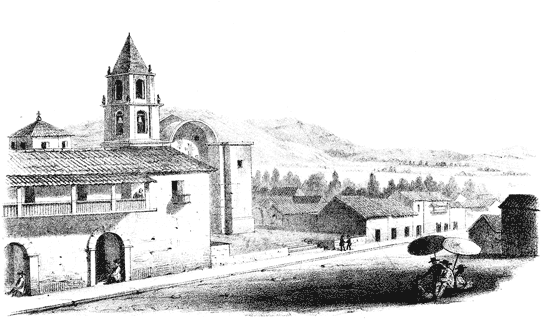
Winding round a hill, and descending a ravine, we come to an arched
gateway, and enter the city of Puno. It is a dry, dusty, uninteresting-looking
place, of about five thousand inhabitants, and is the capital of
the department of the same name, containing a population of 245,681.
The town is situated about a quarter of a mile from the west shore of
Lake Titicaca. The ground towards, the lake is a flat, green swamp,
with a long stone wharf jutting out into the water, at the end of which
are a few washerwomen, and some balzas laying at anchor. As we
entered the plaza, the captain of the police inquired whence we came,
and politely directed our way to the prefectura.
There were many officers in uniform, and soldiers lounging about
town. There was a warlike appearance here. Two extra battalions of
troops had been lately sent from Lampa, complaints being made by the
merchants of quantities of "bad money" coined and introduced into
this country from Bolivia.
The prefect was a colonel in the army. At his dinner-table, the
subject of war predominated. On the table were two kinds of wine—one
Peruvian, the other foreign; those who preferred the former were
praised for their patriotism, and received an extra invitation from the
prefect to take another glass. The table was well supplied with beef,
mutton, and potatoes. Yuca was considered a great delicacy; wheat
bread was scarce. We saw here what we had before seen at a midshipman's
mess—one man cunningly eating another man's allowance.
Salad heads are of good size.
November 10, 1851.—At 12.30 p. m., thermometer, 54°. The wind
blows from the eastward daily, all the year round; commences as the
sun rises; at sundown it falls calm. Light westerly winds sometimes
blow during the night. In such cases, the stars and moon shine clearly;
otherwise, the nights are overcast, and always cold. The mornings are
like our springs; the midday sun warm. There is neither dew nor
frosts, though the wind sweeps over the surface of the lake. Ice is
formed about the spring-water streams on the sides of the hills.
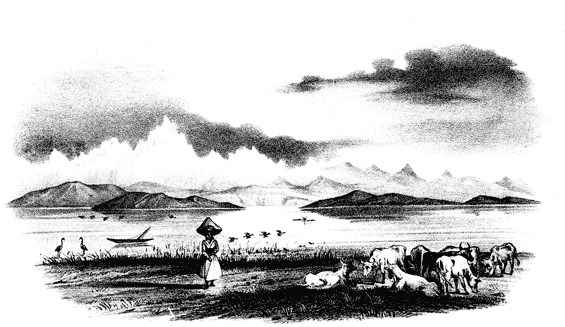
From an island in sight of Puno, the Indians bring vegetables to
market. Small fish are sometimes taken. Round black pebbles are
gathered from the bottom, and, with sheep's knuckle-bones, sold to pave
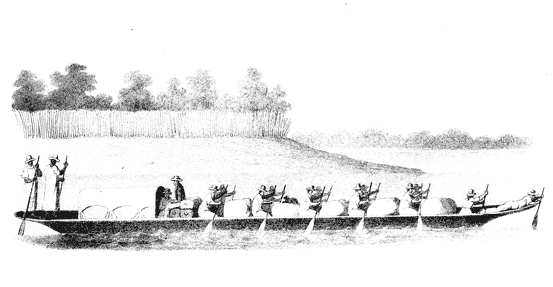
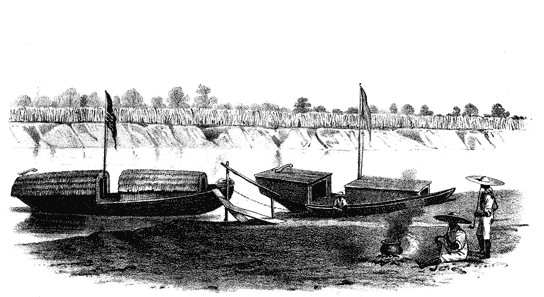
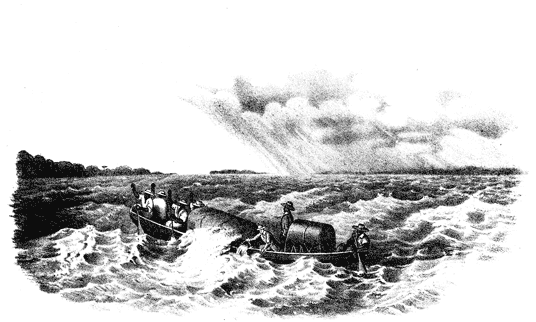
the patios of houses in the town. The Indians navigate the lake in
balsas or boats, made of the lake rush, which forms the material for
both hull and sails. They can only sail with a fair wind. It is always
fair to market in the daytime, and sometimes favorable at night to
return home. Headway is made against adverse winds by polling
over shoals.
The color of the water near the shore and shallows is green, like sea
water. When deep, it is blue. The surface of the lake in front of
Puno is nearly covered with dead rush stalks. Among them a few
wild ducks are feeding. The stench arising is disagreeable. The water
is not used for drinking in the town, though Lake Titicaca is not a salt
lake, as at one time was supposed.
The rainy season commences about the middle of December, and
ends in the middle of April, when probably the depth of the lake may
be increased one foot. Such is the opinion of intelligent persons in
Puno, though no one is known to have measured the difference of height
between the wet and dry seasons.
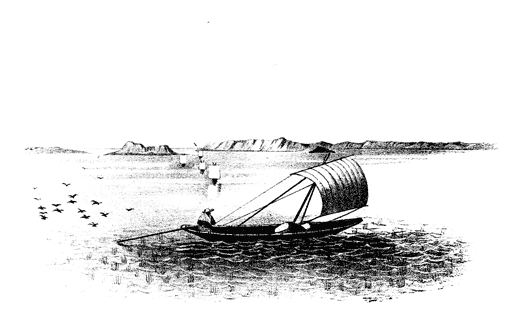
By Lieut. L. Gibbon U. S. N.
Lith. of P.S. Duval & Co. Phil.
TITICACA BALSA, off Puno.
On the lake there is one small schooner, belonging to Bolivia. The
captain told me he never found more than thirty fathoms water; generally
much less. In some places the water is so shoal that there is just
room to push a balsa through the rushes. The deepest water is found
on the eastern or Bolivian side.
This lake is about forty miles wide, and eighty miles long. By the
appearance of the flat land we found on the north side of it, we judge
it was at one time very much longer and deeper.
In the rainy season the rivers are loaded with soil from the mountains
around, which being emptied into the lake, settles, and the water flows
off, leaving behind its load of earth; and so the work from time immemorial
has been going on. This great lake is gradually filling up;
the water is getting shoaler every year; finally there will be a single
stream flowing through what, in future ages, may be called Titicaca
valley.
The easterly storms beat against the eastern sides of mountains
scorched into dust by the rays of the sun in the dry season. There is
no sod or growth to protect the soil from the heavy rains, which wash
it away much more than on the western side.