Mines of Morococha—A Yankee's house—Mountain of Puy-puy—Splendid view—Pachachaca—Lava
stream—Chain bridge at Oroya—Descent into the
valley of Tarma—Tarma—American physician—Customs—Dress—Religious
observances—Muleteers and mules—General Otero—Farming in the Sierra—Road
to Chanchamayo—Perils of travel—Gold mines of Matichacra—View
of the Montaña—Fort San Ramon—Indians of Chanchamayo—Cultivation.
We arrived at Morococha at 5 p.m. This is a copper mining
hacienda, belonging to some German brothers named Pflücker, of
Lima, who own, also, several silver mines of the neighborhood. The
copper and silver of these mountains are intimately mixed; they are
both got out by smelting, though this operation, as far as regarded the
silver, had been abandoned, and they were now beginning the process
of extracting the silver, by the mode of grinding and washing—such as
I have described at Párac—after having tried the via humida (or
method of washing in barrels, used in Saxony) and failed.
The copper ore is calcined in the open air, in piles consisting of
alternate layers of ore and coal, which burn for a month. The ore thus
calcined is taken to ovens, built of brick imported from the United
States, and sufficient heat is employed to melt the copper, which runs
off into moulds below; the scoria being continually drawn off with
long iron hoes. The copper in this state is called exe; it has about
fifty per cent. of pure copper, the residue being silver, iron, &c., &c. It
is worth fifteen cents the pound in England, where it is refined. There
is a mine of fine coal eighteen miles from the hacienda, which yields
an abundant supply. It is bituminous, but hard, and of great brilliancy.
The hacienda employs about one hundred hands; more are desired, but
they cannot be had at this time, because it is harvest, and the Indians
are gathering the corn, barley, and beans of the valleys below. A man
will get out about one thousand pounds of copper ore in a day. I do
not think the mines were at work during our stay; at least, I saw or
heard nothing of them. I could not either get statistics concerning the
yield of these mines or the cost of working them, and I thought that I
noticed some reserve upon this subject. The director told me that the
silver ore of this region was very rich, and spoke of specimens that
yielded one thousand, and even fifteen hundred, marks to the caxon.
The mining business of the hacienda is conducted by a director, an
intelligent and gentlemanly young German, named Richard Von
Durfeldt; and its fiscal affairs and general business, by an administrator,
a fine-looking young Spaniard, Don Jose Fco. de Lizarralde,
whose kindly courtesy we shall long remember. The engineer, or
machinist, is my friend and schoolmate Shepherd, who seemed to be a
"Jack of all trades"—blacksmith, carpenter, watch-maker, and doctor.
His room was quite a curiosity, and bespoke plainly enough the American.
I never saw so many different things gathered together in so
small a place: shelves of fine standard books; a dispensary for physic;
all manner of tools, from the sledge-hammer and the whip-saw to the
delicate instruments of the watch-maker; parts of watches lying under
bell-glasses; engravings hanging around the walls, with a great chart,
setting forth directions for the treatment of all manner of diseases and
accidents; horse furniture, saddle-bags, boots, shoes, and every variety
of garment, from the heavy woollen poncho of the man to the more
delicate cotton petticoat of the woman; for my friend has a pretty
young Sierra wife, who took great pleasure in talking to me about the
home and relations of my "paisano." Shepherd's warm room and bed,
with plenty of covering, was a princely luxury in that cold climate.
These things are comparative, and I had not slept under a roof but twice
since I left Lima. An old Englishman from the Isle of Guernsey,
named Grant, who seemed to be a sort of factotum, and knew and did
everything, and who was unwearied in his kindness and attention to us,
made up the sum of our pleasant acquaintances at Morococha. We
had beef and mutton for dinner, with good butter and cheese; vegetables
scarce; Gibbon not well; Richards very sick, and under treatment
from Shepherd.
June 3.—We all went to see the Mountain of Puy-puy, said to be
higher than Chimborazo. The place of view is about three miles from
Morococha. We passed the openings of a copper and silver mine, and
rode along a boggy country, where turf is cut for fuel. We saw many
snipes, ducks, and other aquatic birds. This upset all my preconceived
notions; I had no idea that I should see, at fifteen thousand feet above
the level of the sea, anything that would remind me of duck-shooting
in the marshes of the Rappahannock. To see the mountain, it was
necessary to cross a range of hills, about seven or eight hundred feet in
height. The road went up diagonally, but the ascent was the most
toilsome operation I had ever undertaken. We were obliged to dismount,
when about three-fourths of the way up, and lead the mules;
the path was muddy and slippery, and we had to stop to blow at every
half-dozen steps. Gibbon declared that this was the only occasion in
which he had ever found the big spurs of the country of any service;
for when he slipped and fell, as we all frequently did, he said that he
should inevitably have gone to the bottom had he not dug his spurs
into the soil, and so held on. I think that I suffered more than any of
the party. On arriving at the top, I was fairly exhausted; I thought
my heart would break from my breast with its violent agitation, and I
felt, for the first time, how painful it was
"To breathe
The difficult air of the iced mountain's top."
I soon recovered, however, and was amply repaid by the splendor of
the view. The lofty cone-shaped mountain, clad in its brilliant mantle
from the top even to the cylindrical base upon which it rested, rose in
solitary majesty from the plain beneath us; and when the sunlight,
bursting from the clouds, rested upon its summit, it was beautiful,
indeed. Gibbon almost froze taking a sketch of it; and the rest of us
tired ourselves nearly to death endeavoring to get a shot at a herd
of shy vicuñas that were seen feeding among the distant rocks. We
had a fatiguing ride, and enjoyed a late dinner and a good night's rest.
June 4.—We took leave of our hospitable friends, (whom I could no
longer intrude our large party upon,) and started at meridian, leaving
Richards too sick to travel. We rode down the "Valley of the Lakes"
in about an E. N. E. direction, visiting the silver mining hacienda of
Tuctu as we passed, which belongs to the establishment of Morococha.
We travelled over a heavy rolling country; the southern sides of the
hills clothed with verdure, and affording tolerable pasture; the northern
sides bare and rocky—no trees or bushes. About nine miles from
Morococha, we crossed a range of hills to the right, and entered the
village of Pachachaca.
This is situated in a valley that comes down from Yauli. The
stream of the Valley of the Lakes at this place joins with the larger and
very serpentine stream of the Yauli valley. This valley has a flat and
apparently level floor of half a mile in width, affording a carriage-road
of two or three miles in length. There is a hacienda for smelting silver
here; but having no letters, and but little time, (for the arriero begins
very justly to complain that we are delaying him an unreasonable time
upon the road,) I did not visit it.
Pachachaca is a small village of two hundred inhabitants. The
people seem more industrious than those of the villages on the other
side. There are fine crops of barley here, and we saw cabbages, onions,
peaches, and eggs, in the shops. We were greater objects of curiosity
in this place than we had been before. The people, I believe, took
us for peddlers, and the woman from whom we got our supper and
breakfast seemed offended because we would not sell her some candles,
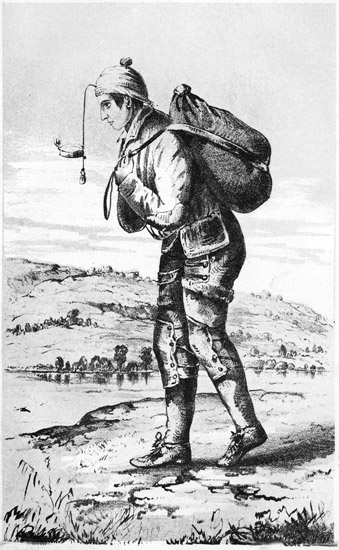
and importuned Gibbon for the sale of his straw hat. The men wore
short woollen trousers, buttoned at the knee, together with, generally,
two pair of long woollen stockings. The woollen articles of clothing
are woven in this neighborhood, except the ponchos, which come from
Tarma. Printed cottons from Lima sell for eighteen and three-quarter
cents the vara, (33 inches;) a cup and saucer of the commonest ware
are held at thirty-seven and a half cents, but purchasers are few; sewing-cotton,
a dollar the pound. Shoes come from Jauxa; also candles and
potatoes. Fuel is the "taquia," or dried cattle manure. Gibbon and
I had occasion afterwards to laugh at our fastidiousness in objecting
to a mutton-chop broiled upon a coal of cow-dung.
June 5.—We travelled down the valley about east. At about one
and a half mile we passed a very curious-looking place, where a small
stream came out of a valley to the northward and westward, and spread
itself over a flat table-rock, soft and calcareous. It poured over this
rock in a sort of horse-shoe cataract, and then spread over an apparently
convex surface of this same soft rock, about two hundred and
fifty yards wide, crossing the valley down which we were travelling.
This rock sounded hollow under the feet of the mules, and I feared we
should break through at every instant. I am confident it was but a
thin crust; and, indeed, after crossing it, we observed a clear stream of
water issuing from beneath it, and flowing into the road on the farther
side. We saw another such place a little lower down, only the stream
tumbled, in a variety of colored streaks, principally white, like salt,
over the metallic-looking rock, into the rivulet below. I presume there
must have been some volcano near here, and that this rock is lava,
for it had all the appearance of having once been liquid.
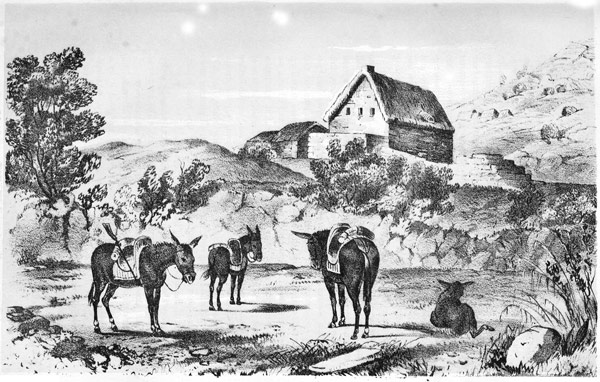
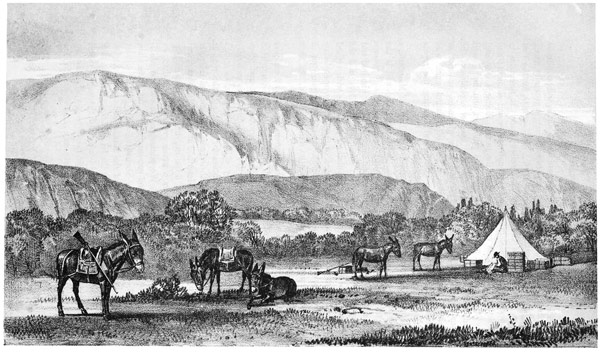
Lt. Gibbon del.
Wagner & McGuigan's Lith. Phila.
HACIENDA DE MAYOC.
Pl. 3.

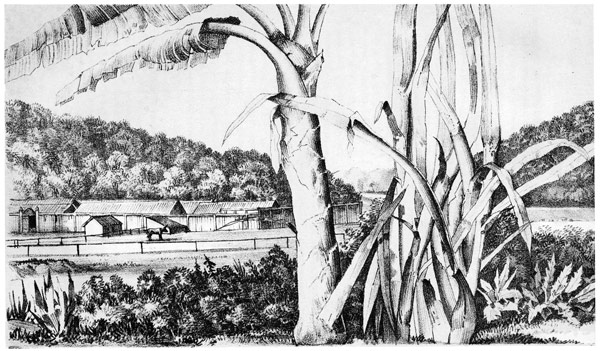
Lt. Gibbon del.
Wagner & McGuigan's Lith. Phila.
SAN MATEO.
Pl. 4.

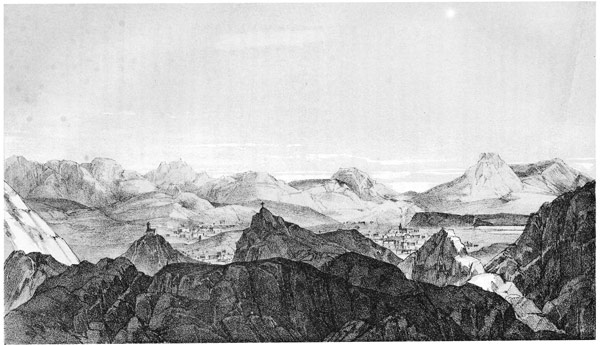
Lt. Gibbon del.
Wagner & McGuigan's Lith. Phila.
CORDILLERA FROM THE HIGHEST POINT OF THE ROUTE.
Pl. 5.
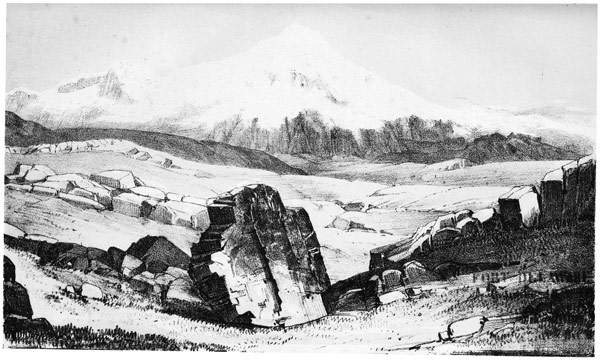
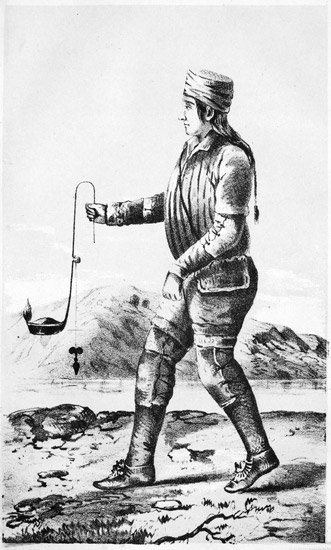
Lt. Gibbon del.
Wagner & McGuigan's Lith. Phila.
MOUNT PUYPUY.
Pl. 6.
The valley about two miles from Pachachaca is cut across by rocky
hills. Here we turned to the northward and eastward. The country at
first offered some pasturage, but became more barren as we advanced,
only showing, now and then, some patches of barley. We travelled till
noon on the left bank of the Yauli stream, when we crossed it by a
natural bridge, at a little village of a few huts, called Saco. At half-past
two, after a ride over a stony and dusty plain, bordered on each
side by rocky mountains, we arrived at the bridge of Oroya. This is a
chain suspension bridge, of about fifty yards in length, and two and a
half in breadth, flung over the river of Jauxa, which is a tributary of
the Ucayali. The Yauli stream, into which emptied the stream from
the lakes at Morococha, joins this river here, and this is the connexion
that I spoke of between those lakes, near the very summit of the Andes
and the Atlantic ocean.
The bridge consisted of four chains, of about a quarter of an inch
diameter, stretched horizontally across the river from strong stone-work
on each side. These are interlaced with thongs of hide; sticks of
about one and a half inch in diameter are laid across them and
lashed down, forming a floor. Two other chains are stretched across
about four feet above these, and connected with them by thongs of
hide; these serve for balustrades, and would prevent a mule from
jumping off. The bridge was about fifty feet above the water when we
passed. It seemed very light, and rocked and swayed under the motion of
the mules in crossing it. The heavy cargoes are taken off and carried
over on the shoulders of the bridge-keeper and his assistants. The toll
is twelve and a half cents the mule; and the same, the cargo. The
bridge-ward seemed astonished, and somewhat annoyed, when I told him
that one of the cargoes, which he left on the mule, was the heaviest I
had, being a box filled with bags of shot, balls, and powder, together
with the specimens of ore and rocks we had collected.
The river at this place turns from its southern course and runs to the
eastward, by the village of Oroya, where we camped. This village contains
about one hundred inhabitants, though we saw only five or six
men; most of the male inhabitants being away to the harvest on the
plains above. The women seemed nearly all to be employed in spinning
wool; holding the bundle of wool in the left hand and spinning it
out by a hanging broach. Very few of them spoke Spanish, but a corrupt
Quichua, or language of the Incas. We bought barley straw for
the mules, and got a beef chupe, with eggs and roasted potatoes, for
ourselves. We saw some small trees within the deserted enclosures
where houses had been, bearing a very fragrant flower, something resembling
the heliotrope, but much larger, and tinged with a reddish
color. We also saw flocks of sheep, but got no mutton for dinner.
June 6.—Got under way at 9 a. m., steering N. N. E., and making
a considerable ascent for about two miles. We then rode over a plain,
with rolling hills on each side, covered with a short grass, giving
pasturage to large flocks of sheep and some cows. The road then rose
again, taking our column of mercury in the barometer out of sight, till
half-past eleven, when we stood at the head of a ravine leading down to
the valley of Tarma. The height of this spot above the level of the
sea was eleven thousand two hundred and seventy feet. We rode down
this ravine, north, for three-quarters of an hour, and at an angle to the
horizon of full thirty degrees. The road was filled with fragments of
white calcareous rock, and the rocky hills on each side were pierced
with many a cavern. When nearly at the foot, the plants and flowers
familiar to us on the other side began to make their appearance, and in
such quick succession, that it seemed that an hour's ride carried us
over many a mile of the tedious ascent to the westward of the mountains.
First appeared the hardy little flowers of the heights above San
Mateo; then, the barley; the alfalfa; the Indian corn; beans; turnips;
shrubs, becoming bushes; bushes, trees; flowers growing larger and
gayer in their colors, (yellow predominating,) till the pretty little city
of Tarma, embosomed among the hills, and enveloped in its covering of
willows and fruit trees, with its long lawns of alfalfa (the greenest of
grasses) stretching out in front, broke upon our view. The ride of to-day
was a long and tiresome one, being mostly a bone-shaking descent;
and we hailed with pleasure the sight of the little town as a resting
place, after the tedious passage of the Cordillera, and felt that one of
the inconveniences and perils of the expedition was safely and happily
passed.
We arrived at 4 p. m., and rode straight to the house of a gentleman,
Don Lorenzo Burgos, to whom I brought a letter of introduction from
friend Shepherd, of Morococha; which letter contained the modest request
that Don Lorenzo should place his house at my disposal. This
he acceded to without hesitation, removing his sick wife, in spite of remonstrance,
into another room, and giving us his hall for our baggage,
and his chamber for our sleeping room. This I would not have acceded
to, except that this is not Don Lorenzo's place of residence, but a new
house which he is constructing here, and which he is only staying at
for a few days till his wife is able to travel to their regular place of
residence. There is no public house in the town, and it is customary
to take travellers in. When I (next morning) presented a letter of
introduction from the Bishop of Eretria to the Cura of Tarma, his first
question was, "Where are you lodged?" And when I told him, he
seemed annoyed, and said that I had not treated him properly in not
coming to his house. Don Lorenzo gave us some dinner, and we slept
well after the fatigues of the day.
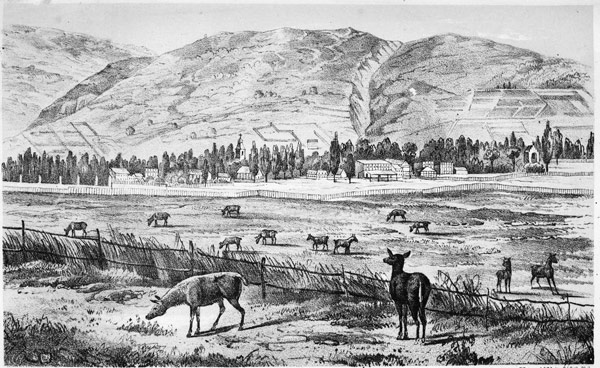
Tarma, a town of some seven thousand inhabitants, belonging to the
province of Pasco and department of Junin, is beautifully situated in
an amphitheatre of mountains, which are clothed nearly to the top
with waving fields of barley. The valley in front, about half a mile
wide, and two miles long, appears level, and is covered with the
greenest and richest pasturage. Its borders are fringed with fruit trees;
and the stream which waters it plunges, in a beautiful little cataract, of
some thirty feet in height, over a ledge of rocks at the farther end.
Its climate is delicious; and it is the resort of sickly people from Lima,
and the cold and inclement mining districts, who find comfort and restoration
in its pure atmosphere and mild and equable temperature. I was
told, although the district contains nearly twenty thousand inhabitants,
and its villages are close together, and easily accessible, that it could not,
of itself, support a physician, and that the government had to appropriate
the tax on spirits, and the surplus revenue of the bridge at Oroya,
to this purpose. A young American physician, recently established in
Tarma, gave me this account; but said that not even this had been sufficient
to keep one here; that the custom had, therefore, fallen into
desuetude, and that he was then engaged, with hope of success, in
endeavoring to have this appropriation renewed and paid over to him.
I cannot vouch for this story. It has an apocryphal sound to me. I
only know that it is a very healthy place, and that my medical friend
is a person of repute there. When I proposed to carry him off with
me, the ladies of my acquaintance raised a great outcry, and declared
that they could not part with their Medico. I think there is no apothecary's
shop in Tarma, for I supplied the Doctor with some medicines,
those which he had brought from Lima being nearly exhausted. I am
satisfied, though there are so few diseases, that a good-looking young
graduate of medicine, who would go there with money enough to buy
him a horse, might readily marry a pretty girl of influential family,
and soon get a practice that would enrich him in ten years. I afterwards
knew a young American at Cerro Pasco, who, though not a
graduate, and I believe scarcely a student of medicine, was in high
repute as a doctor, and had as much practice as he could attend to;
but who, like several of our countrymen whom I met abroad, was
dissipated and reckless, and, as he himself expressed it, "slept with the
pump."
The houses of Tarma are built of adobe; and the better sort are
whitewashed within and without; floored with gypsum and tiled. The
wood and iron work is of the rudest possible description, although the
former, from the Montaña of Chanchamayo, is pretty and good. The
doors of the house we are living in very much resemble "birds-eye
maple." Some of the houses are partially papered, and carpeted with
common Scotch carpeting. Most of them have patios, or enclosed
squares, within, and some of them flat roofs, with a parapet around
them, where maize, peas, beans, and such things, are placed in the sun
to dry.
Sunday is the great market-day, and the market-place is filled with
country people, who come in to sell their manufactures of ponchos,
blankets, shoes, hats, (made of the vicuña wool,) &c., and to buy coca,
cotton goods, and agua diente, as well as to attend mass and get drunk.
It is quite a busy and animated scene. The men are generally dressed
in tall straw hats, ponchos, breeches, buttoned at the knee, and long
woollen stockings; the women, in a blue woollen skirt, tied around the
waist, and open in front, to show a white cotton petticoat, the shoulders
covered with a mantle consisting of two or three yards of gay-colored
plush, called "Bayeta de Castilla," or Spanish baize. Everything
foreign in this country is called "de Castilla," (of Castile;) as in Brazil,
it is called "da Rainha," (of the Queen.) The skirt of a lady of higher
quality consists of a colored print, or mousseline. She rarely, unless
dressed for company, takes the trouble to put on the body of her dress,
which hangs down behind, and is covered with a gay shawl, passed
around the bust, with the end thrown gracefully over the left shoulder.
The hair, particularly on Sundays, is in perfect order; parted in the
middle, and hanging down in two plaits behind. It is surmounted by
a very neat, low-crowned straw-hat, the crown being nearly covered with
a broad ribbon; and she is always "bien calzada," (well shod.) The
women are generally large and well developed; not very pretty, but
with amiable, frank, and agreeable manners; they have, almost invariably,
a pleasant smile, with an open and engaging expression of
countenance.
Religion flourishes in Tarma; and the Cura seems to have a busy
time of it; though it is said he is cheated of half his rights in the way
of marriage fees. I think that no day passed while we were here that
there was not a "fiesta" of the church; for, although there are not
more than twenty-five or thirty feast days in the year insisted upon by
the church and the government, yet any piously-disposed person may get
up one when he pleases. The manner seems to be this: A person, either
from religious motives or ostentation, during or after Divine service in
the church, approaches the altar, and, kissing one of its appendages,
(I forget which,) proclaims his intention of becoming mayordomo or
superintendent of such and such a fiesta—generally that of the Saint
after whom he is named, and thereupon receives the benediction of the
priest. This binds him and his heirs to all the expenses of the celebration,
which, in the great functions in Lima, may be set down at no
small matter—the heaviest item being the lighting of one of those
large churches from floor to dome with wax. The jewels and other
adornments of the images borne in procession are generally borrowed
from the devout Señoras of the higher and richer class; but I am told
that many a person impoverishes his family for years by paying the
expenses of one of these festivals.
The fiestas in Tarma are generally celebrated with music, ringing of
bells, firing of rockets, and dances of Indians. A dozen vagabonds are
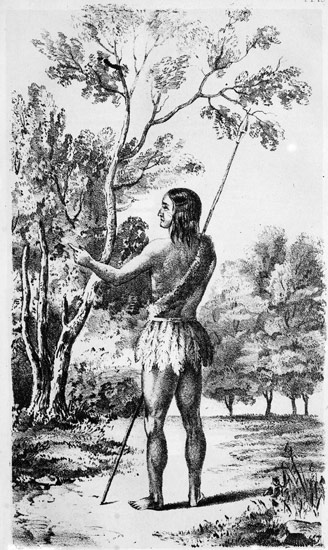
dressed in what is supposed to be the costume of the ancient Indians.
This consists of a red blanket hanging from one shoulder, and a white
one from the other, reaching nearly to the knee, and girded around the
waist; the usual short blue breeches, with a white fringe at the knee;
stockings of an indifferent color, and shoes or sandals of raw-hide,
gathered over the toes with a draw-string, and tied around the ankles.
The head-dress is a low crowned, broad-brimmed round hat, made of
wool, and surrounded with a circlet of dyed feathers of the ostrich.
Thus costumed, the party march through the streets, and stop every
now and then to execute a sort of dance to the melancholy and monotonous
music of a reed pipe, accompanied by a rude flat drum—both in
the hands of the same performer. Each man has a stick or club, of
hard wood, and a very small wooden or hide shield, which he strikes
with the club at certain periods of the dance, making a low clattering
in time with the music. They have also small bells, called "cascabeles,"
attached to the knees and feet, which jingle in the dance. They and
their company of Indians and Mestizos smell very badly on a near
approach. Connected with this there is a great deal of riot and drunkenness;
and I felt annoyed that the church should patronize and
encourage so demoralizing a procedure. The secular clergy of Peru,
with a few honorable exceptions, have not a high character, if one is to
believe the stories told of them by their own countrymen; and I had
occasion to observe that the educated young men, as well of Chili as
of Peru, generally spoke of them in terms of great contempt. I judge
that the case is different with the clergy of the monastic orders, particularly
the missionaries. Those I met with were evidently men of high
character; and to their zeal, energy, and ability, Peru owes the conquest
of by far the largest and richest part of the republic. It happens,
unfortunately for the Peruvian character, that nearly all of these are
foreigners—generally Spaniards and Italians.
June 7.—I suffered all day with violent pain in the head and limbs,
from the ride of yesterday. These Peruvian saddles, though good for
the beasts, and for riding up and down hill, stretch the legs so far apart
as for a long time to give the unaccustomed rider severe pains in the
muscles of the thighs; and I had to ride a large portion of the distance
with my leg over the pommel, like a lady.
We paid off and parted with the arriero, Pablo Luis Arredondo. I
did not find him so great a rascal as I expected; for, except the disposition
to get all out of me he could, (which was very natural,) and an
occasional growl, (which was also to be expected,) I had no reason to
be dissatisfied with Luis. Ijurra was always quarrelling with him; but
I think Ijurra has the fault of his countrymen generally, and wants the
temper and patience necessary to manage ignorant people. By soft
words and some bribery, I got along well enough with the old fellow;
and he loaded his mules beyond their usual cargoes, and drove them
along very well. I was frequently astonished at the difficulties they
surmounted, loaded as they were. The usual load is two hundred and
sixty pounds; and these animals of ours, with, I am sure, in some
instances, a heavier load, and of a most incongruous and heterogeneous
description, ascended hills and descended valleys which one would
scarcely think an unloaded mule could travel over. Our riding mules
were perfect treasures. Sure-footed, steady, strong, and patient, they
bore us along easily and with comfort; and Gibbon says that he will
part with his with tears, when we are compelled to give them up and
take to the boats.
The market at Tarma is tolerably good, though the meat is badly
butchered. Beef costs six cents a pound; a small leg of mutton, eighteen
and three-quarter cents; good potatoes, nearly a dollar a bushel;
cauliflowers, three small heads for twelve and a half cents; oranges, pineapples,
and peaches are abundant and cheap, but not good; bread, very
good, is baked in small loaves, by a Frenchman, four for twelve and a
half cents; flour comes from Jauxa; eggs are ten cents a dozen.
We had a visit from the Cura, and went to see the sub prefect of the
province, a gentleman named Mier, who promised me such assistance
as I needed in my visit to Chanchamayo. Both of these gentlemen
earnestly deprecated the idea of trusting myself and party among the
"Chunchos" Indians on the other side of the river Chanchamayo, saying
that they were very hostile to the whites, and dangerous. The Cura
promised to look out for a servant for us. We had visits, also, from
several gentlemen of the town; among them a Señor Cardenas, who
gave me a copy of the memorial of Urrutia. All seemed much interested
in my expedition to Chanchamayo, and hoped a favorable report.
June 11.—We rode about a league down the valley which leads
to Chanchamayo, to the farm of General Otero, to whom we brought
letters from Mr. Prevost, and Pasquel, bishop of Eretrea. We found
this farm a different sort of affair from anything we had hitherto seen
in this way in our travels. This is in a high state of cultivation, well
enclosed with mud walls, and in beautiful order. The General—a good
looking, farmer-like old gentleman—met us with great cordiality, and
showed us over the premises. He has a very large house, with all the
necessary offices attached, which he built himself. Indeed, he said he
had made the farm; for when he purchased it, it was a stony and
desolate place, and he had expended much time, labor, and money on
it. There were two gardens: one for vegetables and fruit, and one for
flowers. They were both in fine order. The fruits were peaches of
various kinds, apples, strawberries, almonds, and some few grapes. The
flowers were principally roses, pinks, pansies, jessamines, and geraniums.
There were a few exotics, under bell-glasses. Both fruit and flowers
were of rather indifferent quality, but much better than one would
expect to see in so elevated and cold a situation. The nights here,
particularly in the early morning, are quite cold.
This is the harvest season, and the General was gathering his crop of
maize. About twenty peons or laborers were bringing it in from the
fields, and throwing it down in piles in a large court-yard, while boys
and women were engaged in "shucking" it. In one corner of the
square, under a snug little shed attached to one of the barns, with stone
seats around it, sat the General's three daughters, sewing, and probably
superintending the "shucking." They were fair, sweet-looking girls.
The General had a tray of glasses, with some Italia (a cordial made of
a Muscatel grape that grows in the province of Ica, and hence called
Ica brandy) and paper cigars, brought out for us; and the whole
concern had a home look that was quite pleasing.
I cannot give a good idea of farming in this country, for want of
information of the value of land; this depending so entirely on its
situation and condition. The mountain sides are so steep, and the
valleys so rocky, that I imagine there is no great deal of cultivable
land in all this district, and therefore it is probably high. According
to Gen. Otero, land here is measured by "tongos," which is a square
of thirty-three varas. (A vara is thirty-three English inches.) Three
tongos make a "yuntada," or as much as it is calculated that a yoke of
oxen can plough in a day. About half an arroba, or twelve and a half
pounds of seed, is planted to the tongo. In maize, the yield is between
forty-five and fifty for one. Wheat yields about forty for one, but is
so subject to the rust as to be an uncertain crop, and is therefore little
cultivated. The price of maize is five dollars the carga or mule-load,
of two hundred and sixty pounds. From these data it appears, then,
that an acre will yield about forty-three bushels, which is worth one
dollar and twenty-five cents the bushel. Quantities of barley are
cultivated on the mountain sides, but the grain does not come to
perfection, and it is generally cut green for fodder; though the General
says that it is not good for that, the straw being coarse and hard.
Potatoes are a good crop; they are worth now in Tarma one dollar and
fifty cents the hundred pounds, and in times of scarcity have been
known to run up as high as seven dollars. One of the principal
articles of food of the laborers of this country is "cancha," or toasted
maize. They mix a little lime with the grains before putting them in
the hot ashes, which makes them whiter and improves their flavor.
It is really very sweet and good, and I liked it better than the green
corn roasted, which is such a favorite dish with us. Chicha, a fermented
liquor, is also made from Indian corn, and much drunk by all classes.
The General gave us some that he had prepared and bottled himself.
It was very good, rose-colored, and sparkled like Champagne. He told
us that our corn, which he called "mais morocha," was not so good as
this for making either cancha or chicha; this being softer and sweeter.
We visited the stables, which were very clean, and paved, and
contained some ten or fifteen fine-looking young horses; and there were
thirty or forty more, mares and colts, in a spacious corral or enclosure
near, with an American farrier from Tarma attending to some of them.
There is also a neat little chapel occupying a corner of the "patio,"
with the inscription over the door, "Domus mea, domus orationis est."
It was neatly papered and carpeted, and had colored prints of the
"Stations" hung around the walls. The altar-piece was a figure of our
Lady of Mercy, with the figures of St. Francis and St. Peter on each
side; these Saints being the patrons of the general and his lady, Don
Francisco and Doña Pedronilla. The General's manners were exceedingly
courteous and affable; and he possessed that suavity and gentleness
of bearing that seems to me always to characterize the military
man of high rank when in retirement. The whole establishment reminded
me of one of our best kept Virginia farms, where the owner
had inherited the homestead of his father, and was in easy circumstances.
June 12.—Dined with our countryman, Dr. Buckingham, and a
couple of young ladies, one of whom seemed to be his housekeeper.
The dinner was after the Peruvian fashion: first, a sort of thick soup;
then, roasted ribs of mutton, served with salad; this succeeded by a dish
of stewed Guinea pigs, mixed with a variety of vegetables, and which
would have been very good but for the addition of a quantity of aji, or
red pepper, which made it unendurable to the unaccustomed palate;
winding up with the invariable chupe, and the invariable dessert of
dulces, or sweetmeats. A Limenian never thinks of taking water
during dinner, and always eats sweetmeats after dinner, that he may
then safely take water; so that "Tomar dulces, para beber agua" is a
sort of dietetic proverb with them.
June 13.—Rode out on the Oroya road, with the intention of visiting
a cave, or what is reported to be a subterraneous passage made by the
Incas, and reaching as far as Jauxa, twenty-seven miles; but, after riding
about five miles, we determined that we were too late to explore the
cave for that day, and meeting Richards, from Morococha, we turned
back. I suspect that this cave is nothing more than the cañon, or
opening, of some long-deserted mine.
June 14.—Rode out to the southward, in the direction of Jauxa.
This valley, which rises very rapidly, is thickly settled, and well cultivated.
Road bad. Another valley debouches from this, about four
miles above Tarma, to the southward and eastward, leading to the
Montaña of Vitoc.
June 15.—Had a long visit from General Otero. The vivacious old
gentleman discoursed very pleasantly. He said that it was difficult to
get at the population of the town proper, the census being generally
taken of the Doctrina, or district over which the Cura had religious jurisdiction;
that this was about ten or twelve thousand, of which one-twelfth
part were pure white, about one-half Mestizos, (descendants of
whites and Indians,) and the balance Indians, there being very few
negroes. I asked him to account for the number of blind people we
had noticed in the streets. He said that most of the blind people came
from Jauxa, in which country much wheat and barley are produced; that
they sifted these grains, and got rid of the chaff by throwing them up
in the air, and he believed that the blindness arose from the irritation
caused by the chaff and barbs flying into the eyes of the people who
sifted.
He also said that he thought I should not attempt to cross the
Chanchamayo amongst the Indians, for that I would not be able to
defend myself against their attacks; but thought that, if I wished to
descend the Ucayali, I had better take a more southern tributary, called
the Pangoa; (this is Biedma's route, by Andamarca and Sonomora;)
that there the Indians were not so much irritated against the whites,
and that the river was known to be navigable for canoes, for he himself
had known a friar of Ocopa who, in 1817, had descended it for the
conversion of the Indians of the Ucayali, and had afterwards established
a missionary station at Andamarca, where the Indians came at
stated periods to be baptized and receive presents of hatchets, knives,
beads, &c., but that, on the occasion of the war in 1824, the supplies
had been stopped, and the Indians would come no more. He, as did
the sub-prefect, liked my idea of ascending from the mouth of the
Ucayali, with a properly-equipped Indian force, and looking into the
navigability of the Perené and Chanchamayo that way.
The latitude of Tarma, by mean of Mer. altitudes of α and β Centauri,
is 11° 25' 05" S.
June 16.—We left Tarma for the Chanchamayo. This is the first
time I have applied to authority for the means of locomotion. I did it
inadvertently, and was sorry for it; for, though I would probably have
been cheated in the price, yet I should not have been the cause of injustice
and oppression. I had said to the sub-prefect, a few days before,
that I wanted the means of transportation for some baggage to Chanchamayo,
which he promised to furnish me. Yesterday I went to ask
for it for to-day, and he referred me to the governor of the district, who
was present, and who told me that he would have what I required—viz:
two asses and a saddle mule, with two peons—ready by to-morrow
morning. Accordingly, this morning he sent for me, and presented to
me the owner of the mule, the owner of the asses, and the two peons.
The wages of these were to be four reals, or half a dollar, a day; and I
paid each three dollars in advance. To the governor I paid a dollar for
each ass, and two for the mule, with the understanding that I was to
pay as much more on my return. The peons were then lectured on
their duties, and sent round to my house with an escort of half a dozen
alguaziles, or constables, armed with sticks, to prevent their escaping or
getting drunk before the start. The asses and mules were also sent
round under a similar guard, so that my patio seemed filled with a
clamorous multitude, who created such a confusion that I had to turn
out all but my own people. I ordered these to load up; but they said
that the owners of the asses had sent no lassos, or thongs, to bind on the
burdens; and I soon discovered that there was a general unwillingness
for the job, and that the governor had pressed the animals into the
service against the will of the owners.
Strong efforts were made to get the mule away from me. The
woman of the house, who, it appears, was a sister of the owner, advised
me not to take it; and said that it was a bad, vicious animal, that would
do me a mischief. I was surprised at this, as he looked particularly
docile; and I directed my new servant (one recommended by the Cura,
and who looked twice as vicious as the mule) to mount and ride him
around the patio. The fellow grinned maliciously, and proved my judgment
correct. Finding this would not do, the owner (who had put his
sister up to making this attempt) then came forward, and said I must
pay him half a dollar more, as the governor had kept back that much
of the price. This being "no go," he tried to steal away his mule
while our backs were turned; but being prevented, he went off, got
drunk in about fifteen minutes, and came back maudlin; embracing,
kissing, and weeping over his mule, crying in piteous tones "Mi macho,
mi macho," (my mule, my mule.) We shoved him aside and rode off,
followed, I have no doubt, by the curses of the community.
This was all very annoying to me. I afterwards mentioned these circumstances
to the commandant of the fort at Chanchamayo, telling
him how much I would prefer to pay double price and get voluntary
service. He said that my sympathies were all thrown away upon these
people, that I must go to the governors for the means of transportation;
for that the Indians would not let me have their beasts at any price;
and related instances of his having to use threats, and even force, to induce
a sulky Indian to give him and his beast food and shelter when in
the Cordillera, and the approach of night made it impossible to go on.
Several travellers in these parts have also told me that they have been
compelled to shoot the poultry of an Indian, who with a large stock,
would refuse to sell at any price; but who, after the thing was done,
would good humoredly accept a fair value.
Ijurra also related instances of oppression and tyranny on the part of
the governors, particularly in the province of Mainas, where commerce
is carried on by transportation of the goods on the backs of Indians.
A travelling merchant goes to the governor and says, "I have such and
such a cargo; I want so many Indians to transport it." The governor,
generally a white or Mestizo, sends for the Curaca, (the lineal hereditary
governor of the tribe of Indians of that district, who has great
authority, and without whose assistance the whites probably could not
govern at all,) and orders him to have so many Indians detailed for a
journey. The Curaca drums them up, directing them to toast their
corn and prepare their "fiambre" (food for the road) for a journey of so
many leagues; and they are taken from their occupations and sent off,
for probably many days, at a pay of anything that the governor may
direct.
If a man wishes to build a house or open a farm, he may be supplied
with laborers for six months, at a hire, per month, of as many
yards of cotton cloth as will make each a shirt and pair of trousers;
the patron or master furnishing them with food; but, as may be
imagined, this is of the coarsest and commonest description that will
support life.
It would seem that men could never improve under a system of such
absolute slavery as this; yet to give them liberty, is to abandon them
and return them to a state of barbarity, shutting out all prospect of
improvement; and the only hope seems to be in the justice and moderation
of the rulers—a slim hope here.
We got off at noon; stopped at the "chacra" of Gen. Otero, and
received a letter of introduction to the commandant of the fort. When
the old gentleman saw our new servant "Mariano," he crossed himself
most devoutly, and ejaculated "Satanas!" He then told us that this
was a notoriously bad boy, whom nobody had been able to manage,
but that we, being strangers and military men, might get along with
him by strictness and severity; and he gave the boy a lecture upon his
duties and the faithful performance of them.
A mile and a half beyond Gen. Otero's is the town of Acobamba.
I judge that it contains twelve or fifteen hundred inhabitants; but it is
situated in a thickly-settled district, and the "Doctrina" is said to be
more populous than that of Tarma. Six more miles brought us to
Palca, a straggling town of about one thousand inhabitants. We
merely passed through, and a mile further on "brought up" at the
chacra of Don Justo Rojas, to whom I had a letter from Lizarralde, the
administrator at Morococha. Don Justo was engaged in extracting, by
boiling, the juice of the rhatany root for an apothecary of Lima. He
supplied us with a capital supper of chicken soup and boiled eggs, with
alfalfa for the beasts. He also sold us, from his establishment in town,
sugar and bread. We pitched the tent in an old corn-field, and slept
delightfully. Tent-pegs for this country should be of iron. Although
those we used were made of the hardest wood that could be found in
Lima, we had used them all up by this time, beating off their heads
by driving them with a hatchet into the hard and stony ground.
Don Justo's is the last chacra in the valley, which now narrows, and
allows no room for cultivation. Though going down hill by the barometer,
we were evidently crossing a chain of mountains, which the stream
at the bottom of the valley has saved us the trouble of ascending and
descending, by cleaving a way through for itself, and leaving the mountains
on either hand towering thousands of feet above our heads. The
ride was the wildest we have yet had; the road sometimes finding
room along the borders of the river, and then ascending nearly to the
top of the hills, and diminishing the foaming and thundering stream
to a noiseless, silver thread. The ascents and descents were nearly precipitous;
and the scene was rugged, wild, and grand beyond description.
We saw some miserable huts on the road, and met a few asses
carrying reeds and poles from Chanchamayo. It seemed a providence
that we did not meet these at certain parts of the road, where it is
utterly impossible for two beasts to pass abreast, or for one to turn and
retreat; and the only remedy is to tumble one off the precipice, or to
drag him back by the tail until he reaches a place where the other can
pass. Von Tschudi relates an instance of his shooting a mule which
met him at one of these places.
We met with a considerable fright in this way to-day. We were
riding in single file along one of these narrow ascents, where the road is
cut out of the mountain side, and the traveller has a perpendicular wall
on one hand, and a sheer precipice of many hundreds of feet upon the
other. Mr. Gibbon was riding ahead. Just as he was about to turn
a sharp bend of the road the head of a bull peered round it, on the
descent. When the bull came in full view he stopped, and we could
see the heads of other cattle clustering over his quarters, and hear the
shouts of the cattle-drivers, far behind, urging on their herd. I
happened to be abreast of a slight natural excavation, or hollow, in
the mountain side, and dismounting I put my shoulder against my
mule's flank and pressed her into this friendly retreat; but I saw no
escape for Gibbon, who had passed it. The bull, with lowered crest,
and savage, sullen look, came slowly on, and actually got his head
between the perpendicular rock and the neck of Gibbon's mule. I felt
a thrill of agony, for I thought my companion's fate was sealed. But
the sagacious beast on which he was mounted, pressing her haunches
hard against the wall, gathered her feet close under her and turned as
upon a pivot. This placed the bull on the outside, (there was room to
pass, though I did not believe it,) and he rushed by at the gallop,
followed in single file by the rest of the herd. I cannot describe the
relief I experienced. Gibbon, who is as gallant and fearless as man
can be, said "It is of no use to attempt to disguise the fact—I was
badly scared."
At 2 p. m., we arrived at a place called Matichacra, where there was
a single hut, inhabited by a woman and her child; the husband having
gone to Cerro Pasco to exhibit some specimens of gold ore which he
had found here. The woman was afflicted with an eruption on her
face, which she thought was caused by the metallic character of the
earth around, particularly the antimonial. She took a knife, and,
digging earth from the floor of her hut, washed it in a gourd, and
showed us particles of metal like gold sticking to the bottom. I
showed some of this earth to General Otero, who pronounced that
there was no gold in it; but Lieutenant Maury, who examined some
that I brought home with a powerful magnifier, has declared that there
was. The mountains have an exceedingly metallic appearance, and
the woman said that there were still in the neighborhood traces of the
mining operations of the Spaniards.
About a mile and a half above Matichacra commenced the steep
regular descent of the mountain range, and from just above it we
could discern where the valley debouched upon an apparent plain,
though bounded and intersected by distant mountains, bearing and
ranging in different directions. This place we judged to be the
"Montaña." We stopped an hour at Matichacra, (Gourd Farm,
from half a dozen gourd vines growing near the house,) and made a
chupe with a leg of mutton we had bought the night before at Palca.
We saw a few patches of Indian corn on the side of the mountain
opposite, and the tops of the mountains are clad with small trees. We
passed on five miles further, and camped on a level plat near the banks
of the stream, with bushes and small trees growing around us.
June 18.—This was the longest and hardest day's ride. The road
was very bad; rocky and rough where it descended the river, and
steep and difficult where it ascended the mountain side. We thought
that the engineer who planned and constructed the road had frequently
"taken the bull by the horns," and selected the worst places to run his
road over; and that he would have done much better had he occasionally
have thrown a bridge across the stream, and led the road along the
flank of the mountains on the other side. In seven and a half miles
we arrived at Utcuyacu, (cotton water,) the first hacienda where we
saw sugar-cane, yucca, pine-apples, and plantains. It had just been
opened, and nothing yet had been sold from it.
The road, by which we had descended the valley of Chanchamayo,
turned at this place sharp to the right, and faced the mountains that
divide this valley from that of the Rio Seco. We were near the
junction of the two valleys, but a rock had fallen from the hills above
and blocked up the road on which we were travelling, so that we had
to cross the mountain on our right and get into the other valley. The
ascent was steep, and trying to man and beast. It is called the "Cuesta
de Tangachuca," or "Hill of take care of your hat," and is about three
miles in length. The road, after passing through a thick forest, brought
us out upon a bald eminence, the termination of the spur of the Andes
that divides the two valleys. The rivers Seco and Chanchamayo unite
at its base and flow off through a valley, rapidly widening out, covered
with forests, and presenting an appearance entirely distinct from the
rocky and stern sterility that characterizes the country above. This is
the "Montaña" of which I had thought so much. I was wofully
disappointed in its appearance. I had taken the impression that I
should behold a boundless plain, alternating with forest and prairie,
covered with waving grass, and with a broad and gentle river winding
its serpentine course through it, between banks rich with the palm and
plantain. In place of this, the view from the mountain top showed a
country broken still into mountain and valley, (though on a much
smaller scale than above,) shaggy with trees and undergrowth of every
description, and watered by a small stream, still foaming and roaring
over its rocky bed.
We descended the hill by a very circuitous and precipitous path,
most of us on foot, though it may be ridden over, for Mr. Gibbon did
ride over the worst parts of it, and only dismounted where a fallen tree
made an obstruction that he could not pass. The descent brought us
to the rocky bed of the Rio Seco, crossing which we were clear of the
eastern chain of the Andes and in the Montaña of Chanchamayo.
As far as the traveller is concerned there are not, on the route we
have travelled, two ranges of the Andes—that is, he has not to ascend
and descend one range, and then ascend and descend another. From
the time he crosses the Cordillera at Antarangra, his progress is downward
till he reaches the plain. Really there are two. The streams
from the first, or western range, have broken their way through the
second, making deep gorges, at the bottom of which the road generally
runs, and leaves the peaks of the second range thousands of feet above
the head of the traveller.
A league from the crossing of the Rio Seco, we passed a bad and
broken bridge, that spans a small stream called "Punta Yacu," coming
down a valley from the southward, and halted at the hacienda of Don
Jose Manuel Cardenas, the first of the Montaña, where we camped for
the night.
June 19.—Six miles of travel brought us to the fort of San Ramon.
The road is a black mud bridle-path through the woods, much obstructed
with the roots and branches of trees, but level. Comparatively
few rocks are seen after leaving Cardenas. We were kindly received
by the commandant, Don Juan Noel, a fine-looking young man, Captain
of Frigate and Lieutenant Colonel in the Army, and his officers,
Major Umeres and Lieutenant ——.
Fort San Ramon is, by Mer. alt. of "γ Crusis," in latitude 11°.07 S.
Its height above the level of the sea, as given by barometer, is two
thousand six hundred and ten feet.
From the first of March to the last of August the climate is delightful;
but the heavy and almost continuous rains of the other six months
of the year make it disagreeable, but not unhealthy.
As we are now near the foot of the mountains, on the eastern slope,
I give a table of the distances and elevations of various points on the
route. The B. P. opposite some of the elevations show that these
were indicated by the temperature of boiling water:
| Places. |
Distances. |
Height above the level of the sea. |
|
Miles. |
Feet. |
| Callao |
. . . |
. . . |
| Lima |
6 |
476 |
| Pacayar |
12 |
1,346 |
| Yanacoto |
10 |
2,337 |
| Cocachacra |
16 |
4,452 |
| Moyoc |
15 |
7,302 |
| San Mateo |
13 |
10,200 |
| Acchahuarcu |
9 |
12,898 B. P. |
| Pass of Antarangra |
6 |
16,044 |
| Pass of Antarangra |
6 |
16,199 B. P. |
| Pachachaca |
13 |
12,786 B. P. |
| Oroya |
12 |
11,654 |
| Oroya |
12 |
11,825 B. P. |
| Tarma |
18 |
9,738 |
| Palca |
11 |
8,512 |
| Matichacra |
12 |
7,091 |
| Huacapishtana |
4 |
5,687 |
| Challuapuquio |
12 |
3,192 |
| Fort San Ramon |
6 |
2,605 |
| Fort San Ramon |
. . . |
2,953 |
The barometer gave the height of a point, four miles above Tarma,
at eleven thousand two hundred and seventy feet. So that there is a
descent in these four miles of distance of one thousand five hundred and
thirty-five feet. The ascent, however, between Acchahuarcu and the
top of the hill on which we observed, at the Pass of Antarangra, is
steeper than this, being three thousand three hundred and fifty-eight
feet in six miles.
From Yanacoto, on the western slope of the Andes, to the top of the
Pass, is fifty-nine miles; from the top of the Pass to Fort San Ramon,
on the eastern slope, which is two hundred and seventy feet higher than
Yanacoto, is eighty-eight miles. This gives the ascent of the Andes,
on its western slope, at 232 feet to the mile, and on its eastern slope
at 152.
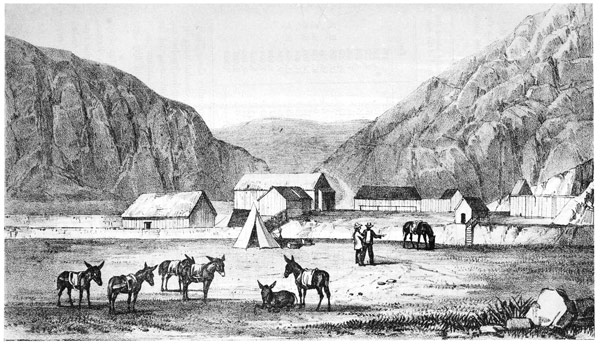
Lt. Gibbon del.
Wagner & McGuigan's Lith. Phila.
OROYA.
Pl. 7.
Lt. Gibbon del.
Wagner & McGuigan's Lith. Phila.
TARMA.
Pl. 8.
Yanacoto is only twenty-eight miles from the ocean that washes the
base of the slope on which it is situated. Fort San Ramon, (at nearly
the same elevation as Yanacoto,) by the winding of the river, cannot be
much less than four thousand miles from its ocean, and in the direct
course of the river is at least two thousand five hundred miles. But I
am of opinion, from some observations made afterwards with a boiling-point
apparatus, that the indications of the barometer, at the eastern
foot of the Andes, are not to be depended upon; and that San Ramon
has a greater elevation than is shown by the barometer.
The fort is a stockade, embracing about six acres, armed with four
brass four-pounders, and garrisoned with forty-eight men. It is situated
at the junction of the rivers Chanchamayo and Tulumayo—the former
about thirty and the latter forty yards wide—both shallow and obstructed
with rocks. The current seemed about five or six miles the
hour. A canoe, well managed, might shoot down the Tulumayo as
far as we saw it.
The fort was constructed in 1847, under the direction of President
Castilla, for the purpose of affording protection to the cultivators of the
farms in its rear. It doubtless does this against the unwarlike Indians
of this country; but I imagine that North American Indians, actuated
by the feelings of hostility which these people constantly evince, would
cross the rivers above the fort and sweep the plantations before the
soldiers could reach them. The Indians have abandoned all idea of
reconquering the territory they have lost, but are determined to dispute
the passage of the rivers and any attempt at further conquest. They
never show themselves now in person, but make their presence evident
by occasionally setting fire to the woods and grass on the hill-sides, and
discharging their arrows at any incautious person who may wander too
near the banks of the rivers.
Noel told us that many attempts had been made to establish friendly
relations with them. In former times the Indians used to advance out
of the forest, to the further bank of the river, and hold conversations
and exchange presents with the officers of the post. They gave bows
and arrows, rare birds and animals, and received in return, knives, beads,
and looking-glasses. But these parleys always ended with expressions
of defiance and insult towards the whites on the part of the Indians,
and frequently with a flight of arrows.
He related to us, that a year or two ago a General Castillo, with some
officers, came to visit the fort, and wished to try their skill at negotiation.
Accordingly, whilst they were at dinner, the sentinel reported that
an Indian had made his appearance; whereupon the party rose from
the table and went down to the river-side to have a talk. The Indian,
after salutations, made signs for a looking-glass, which was thrown over
to him; then, for a knife, with which he was also gratified. He then
asked for a tinder-box. There being none at hand, Noel went up to his
quarters for some. On his return, he met an officer coming up the
bank, with an arrow through his arm; and shortly after, another, with
one planted deep in his back, between the shoulders. It appears that,
as soon as the Indian had received his presents, he drew his bow at the
general. The party turned to fly; but a flight of arrows from the
forest wounded the two officers; and the one who was shot in the back
died of the wound eight days afterwards. These arrow-shots are of
frequent occurrence; and several of the soldiers of the fort have been
severely wounded. A number of arrows were discharged at some
soldiers, who were washing their clothes near the banks of the river,
whilst we were here. We picked them up, and the commandant made
us a present of them.
These arrows, as are the arrows of all the Indians I have met with, are
so heavy that, at a greater distance than twenty or thirty yards, it is
necessary to discharge them at an elevation, so that they shall describe
a curve in the air; and it is wonderful to see with what precision the
Indians will calculate the arc, and regulate the force so that the arrow
shall fall upon the object. On the Amazon many fish and turtle are
taken with bows and arrows. An Indian in a canoe discharges his
arrow in the air. It describes a parabola, and lights upon the back of
a fish, which the unpractised eye has not been able to see. The barb,
with which the arrow is armed, ships on the end of it, and is held in its
place by a cord which wraps around the shaft of the arrow, and is tied
to its middle. The plunge of the fish shakes the arrow clear of the
barb; the cord unwinds, and the arrow floats upon the water—an impediment
to the fish, and a guide to the fisherman, who follows his
arrow till the fish or turtle is dead. The motion of the arrow is so slow,
and it is so readily seen in its course, that I imagine there would be no
danger in the reception of single arrow-shots in front; for an abundance
of time is allowed to step aside and avoid them. I have seen boys shooting
at buzzards on the beach; and the arrow would alight upon the
very spot where the bird had been sitting, some seconds after he had
left it.
Whilst here, we visited the haciendas of the Brothers Santa Maria,
Padre Saurez, and Zapatero—all, I believe, inhabitants of Tarma. That
of the last seemed the largest, and the best order of any that I had
yet seen. A description of the method of cultivating the staples of the
country practised on this farm, will give an idea of the general system
of farming in the Montaña.
Zapatero has about one hundred acres cleared, and most of it planted
in cane, coca, yucca, pine-apples, plantains, coffee, and cotton. The farm
employs a mayordomo, or steward, and four resident laborers. These
are serfs, and cost the employer their support and seven dollars a year
each for their contribution to the government, or poll tax. When more
land is to be cleared, or the coca crop gathered, laborers are hired from
the neighboring villages of Tarma, Ocsabamba, or Palca, at nominal
wages of half a dollar a day; but their support is charged to them,
at such prices as to swallow up nearly all the wages. A sheep, for example,
is charged to them at three dollars: its price in Tarma is one;
yucca at thirty-seven and a half cents the arroba, of twenty-five pounds;
potatoes at fifty cents; maize at sixty-two and a half cents. This is the
maize of the hacienda; if it is supplied from the Sierra it is one dollar
and fifty cents. The laborers who live on the estate seem contented
with their lot; they dwell in small, filthy cane houses, with their wives
and children; do very little work, and eat chalona, (or dried mutton,)
charqui, (or jerked beef,) yucca, cancha, sweet potatoes, and beans; and
drink "huarapo," (the fermented juice of the cane,) and sometimes a
glass of bad rum made from it. They occasionally desert; but if they
do this, they must get some distance off, or custom, if not law, would
return them as debtors to their masters.
Sugar-cane is propagated, not from seed but from the top joints of the
old plant, and is planted at the commencement of the rainy season in
September. It is ready for cutting in a year; it yields again every ten
months, improving in quality and size every crop for a number of years,
according to the quality of the land and the care bestowed upon it. It
will continue to spring up from the roots for fifty or sixty years, with
one or two light workings with hoes in the year. The field is set fire
to after every cutting, to burn up the rubbage, weeds, &c. The average
height of the cane is about ten feet, though I have seen a stalk of sixteen
feet.
Two men to cut and two to carry, will supply a mill called "Trapiche,"
which consists of three upright wooden rollers, in a rude wooden
frame. These rollers are cogged and placed close to each other. The
head of the middle one extends above the frame, and is squared, so as
to allow the shipping on it of a long beam, to the end of which an ox
is harnessed, which, walking in a circle, gives motion to the rollers.
The end of the cane is placed between the rollers, and is drawn in and
crushed by them; a wooden trough is placed below, to catch the juice.
Such a mill will yield fifteen hundred pounds of caldo or juice in a day.
These fifteen hundred pounds will give from two hundred and fifty to
three hundred pounds of sugar, which is worth in Tarma twelve and a
half cents the pound.
Sugar-cane is the most valuable and useful product of the Montaña.
The leaves of the cane, when green, serve for food for the cattle; when
dry, to make wrappings for the chancaca and sugar. The crushed stalk
is used as fuel for the oven. The hogs fatten on the foam at the top of
the boiling. From the first boiling is made the chancaca or brown sugar
cake, which is eaten after dinner by almost all classes, and in great
quantities by the lower class; it is worth six and a quarter cents the
pound in Tarma. From one thousand pounds of the caldo boiled ten
hours, is made four hundred pounds of chancaca. Very little sugar is
yet made in the Montaña of Chanchamayo; indeed, I did not see a
nearer approach to it than chancaca in all the route.
Coca is a bush of about four feet high, producing a small light-green
leaf, which is the part used. The blossom is white, and the fruit a
small red berry. The seed is sown in beds at the end of the rainy
season—about the first of March. The earth should be well broken up
and cleaned. Arbors of palm leaves are frequently built over the
young shoots to protect them from the sun, and they are watered, if it
continues clear, for five or six days. It is transplanted in September, a
year and a half after planting, and gives its first crop in a year, and
every four months thereafter. The bush, if not destroyed by ants, will
continue to give leaves for many years. Sometimes, but rarely, the
leaves wither and the crop fails. It is necessary to gather the leaves
and dry them as quickly as possible, and, if a shower comes on, to gather
them up at once, as they are injured by getting wet. Every hundred
plants will give an arroba of leaves, which is worth, in Tarma, from six
to seven dollars. Some persons do not transplant, but sow several of the
seed together, and, when they come up, pull up all but the one most
flourishing, and leave that in its original place.
The leaf of this plant is to the Indian of Peru what tobacco is to
our laboring classes in the South—a luxury, which has become a
necessity. Supplied with an abundance of it, he sometimes performs
prodigies of labor, and can go without food for several days. Without
it, he is miserable and will not work. It is said to be a powerful
stimulant to the nervous system, and, like strong coffee or tea, to take
away sleep; but, unlike tobacco and other stimulants, no one has
known it to be injurious to the health. Von Tschudi thinks that an
immoderate use of it is injurious, but that, taken in moderation, it is in
no way detrimental to health; and that without it the Peruvian Indian,
with his spare diet, would be incapable of going through the labor
which he now performs. The coca plant he therefore considers as a
great blessing to Peru.
He relates that an Indian, employed by him in digging, worked hard
for five nights and days without intermission, except for two hours each
night—and this without food. Immediately after the work the Indian
accompanied him on a two days' journey of twenty-three leagues on
foot, and then declared that he was ready to engage in the same amount
of work, and go through it without food, if he were allowed an abundance
of coca. This man was sixty-two years of age, and had never been
sick in his life.
Coffee is propagated from suckers or slips, and it is necessary to
protect the plants from the sun by cultivating the broad-leaved plantain
among them till they have grown up to about four feet in height. No
care, except an occasional cleaning about the roots, is taken of them
here, and yet the finest coffee I have ever drunk was from this district.
The bush grows to seven or eight feet in height, and is very beautiful
in appearance. It has a small and very dark green leaf, pure white
blossoms, and green, red, and dark purple fruit on it at the same time.
It gives its first crop in two years; but this is small in quantity, and
indifferent in quality. The bush is not in perfection until four or five
years after planting, and will then last for an indefinite period. The
fruit has the size and appearance of a small cherry. Two seeds are
contained in each berry. Each seed is wrapped in a thin paper-like
envelope, and both together are covered with another, and then
surrounded by a sweet, pleasant-tasting pulp, which is covered with a
thin skin. Having no machines for getting rid of this pulp, the cultivators
gather the fruit, dry it in the sun, and then soak it in water till
all the envelopes come off, except the paper-like skin surrounding each
seed. The seeds are again dried in the sun, and sent to market with
this skin on. It is worth eight dollars the hundred pounds in Tarma.
In Lima it generally commands twenty, and sometimes twenty-five
and twenty-seven dollars, on account of its great superiority to the
coffee of Guayaquil and Central America, which is generally used
there.
"Cotton" may be planted at any time. It does not grow on a bush
or plant, as with us, but on a tree some eight or ten feet high. It gives
its first crop in a year, and will continue to give for three years; after
which the tree dries up, and it is necessary to replant. It bears cotton
all the time; but this is not good nor gathered during the rainy season.
I could not ascertain how much cotton a tree will give in its lifetime,
but, from the quantity of blossoms and bolls I saw on them, I should
think its yield was great. The quality, particularly that of Chanchamayo,
is very superior. It is the black-seed cotton, and when picked
off leaves the seed perfectly bare and clean.
There is also nankeen-colored cotton here, (the tree seeming in every
respect like that of the white;) and afterwards, in Brazil, I saw green-seed
cotton, in which the seed (generally seven in number for each boll,
or rather for each division of it, for the boll seemed to hold the cotton
in four distinct parts) were aggregated in a single knot, and enveloped
by the cotton. An active man will pick one hundred pounds of cotton
a day.
"Yucca," (cassava root,) which is grown from the stalk of the plant,
is planted at any time. It yields in nine months. The plant runs up
to fifteen or twenty feet in height, with about the thickness of a man's
wrist. It is difficult to distinguish this plant, or its fruit, from the
mandioc. The mandioc is called in Peru "yucca brava," or wild yucca;
and this yucca dulce, or sweet yucca. This may be eaten raw; the
juice of the other is a deadly poison. The yucca answers the same
purpose in Peru that the mandioc does in Brazil. It is the general
substitute for bread, and roasted or boiled is very pleasant to the taste.
The most common drink of the Indians, called "masato,"[6] is also made
from it. Each plant will give from twenty to twenty-five pounds of the
edible root, which grows in clusters like the potato, and some of which
are as long and thick as a man's arm.
Three crops of "Indian corn" are made in the year. It is of good
quality, but much care is necessary to preserve it from weevil and other
insects after it is gathered and put away. It is generally placed in an
upper story of a house, and a fire is kindled underneath from time to
time to smoke it, or it will all be destroyed.
"Platanos"—which is the general name for all kinds of plantains, or
bananas, of which last there are several species, called respectively
"guineas," de la isla, &c.—are the most common fruit of the country.
The people eat them raw, roasted, boiled, baked, and fried. There can
be no dinner without them; and a vile rum is also made of them. By
the Indians the fruit is generally cut green and roasted. It is propagated
from suckers or young bulbs, and gives fruit with such facility and
abundance as to foster and minister to the laziness of the people, who
won't work when they can get anything so good without it.
I have frequently thought that a governor would do a good act, and
improve the condition, or at least the character, of the governed, who
would set fire to, or grub up every "platanal" in his district, and thus
compel the people to labor a little for their bread.
The other fruits are pine-apples, of tolerable quality, which doubtless
would be very fine with care and attention; sour sop, a kind of bastard
chirimoya; and papayo, a large fruit, about the size of a common muskmelon,
with a green skin and yellow pulp, which is eaten, and is very
sweet and of delicate flavor. It has seed like the muskmelon, and
grows under the leaves of a kind of palm in clusters like the cocoanut.
There are a few orange trees, but no fruit. An orange tree does not
give good fruit under six years, and most of the haciendas have been
under cultivation but three.
The only farming utensils used in Chanchamayo are short coarse
sabres, with which weeds are cut up, and holes dug in the earth in
which to plant the seed.
This is not a good grazing country, though there were some cattle
belonging to the fort which seemed in good condition. All the meat
used is brought from Sierra. It seems difficult to propagate cattle
in this country. All the calves are born dead, or die soon after birth
with a goitre or swelling in the neck. I had no opportunity of investigating
this; but I saw afterwards, in an account of a missionary expedition
made by an Italian friar, Father Castrucci de Vernazza, to the
Indians of the Pastaza, in 1846, "that cattle were raised with great
difficulty about Mayobamba, on account of the 'subyacuro,' a species
of worm, which introduces itself between the cuticle and cellular tissue,
producing large tumors, which destroy the animal."
The houses on the haciendas are built of small, rough hewn, upright
posts, with rafters of the same forming the frame, which is filled in with
wild cane (caña brava,) and thatched with a species of narrow leafed
palm, which is plaited over a long pole and laid athwart the rafters.
The leaves lie, one set over the other, like shingles, and form an effectual
protection against the rain and sun; though I should think the rain
would beat in through the cane of the sides, as few of the houses are
plastered. The commandant of the fort was anxious to have his buildings
tiled, as this palm thatch, when dry, is exceedingly inflammable;
and he felt that the buildings of the fort were in constant danger from
the not distant fires of the savages. Señor Zapatero told me that he
had contracted with a workman to build him a large adobe house on
his hacienda, well fitted with doors and windows of good wood, and
tiled, to make it fire-proof, for eight hundred dollars. The same house
in Tarma would cost him between three and four thousand, on account
of the exceeding difficulty of getting the wood from the Montaña.
He is a Catalan, and seems a resolute fellow. He thinks that the government
may withdraw the troops from the fort at any time; but says
that he has four swivels, which he means to mount around his house;
and, as he has expended much labor and money on his hacienda, he will
hold on to the last extremity, and not give up his property without a
tussle.
It is a pity that there are not more like him, for many acres of fine
land are lying uncultivated in Chanchamayo on account of this fear;
and several of our Tarma friends offered us title deeds to large tracts of
land there, because a feeling of insecurity regarding the stability of the
government prevented them from expending time and money in the
cultivation of them. Another such administration as that just closed
under President Castilla will dissipate this apprehension; and then, if
the Peruvian government would invite settlers, giving them the means
of reaching there, and appropriating a very small sum for their maintenance
till they could clear the forest and gather their first fruits, I
have no doubt that fifty years would see settlements pushed to the
navigable head waters of the Ucayali, and the colonists would find purchasers
for the rich and varied products of their lands at their very
doors.
June 23.—We started on the return to Tarma, accompanied by the
commandant and his servant. We walked up a part of the hill at Rio
Seco. This is very hard work. I could not stand it more than half
way, and made the mule carry me over the rest. It takes one hour to
ascend, and an hour and a quarter to descend. Camped at Utcuyacu.
June 24.—Missing my saddle bags, which had some money in them,
we sent Mariano, (our Tarma servant,) accompanied by the servant of
the commandant, back to a place some distance the other side of the
big hill, where the saddle bags had been taken off to adjust the saddle.
He started at six; we at eight, following our return track. We made
the longest and hardest day's ride we had yet made; and were much
surprised at being joined by the servants with the saddle-bags by nine
p. m. They must have travelled at least thirty-six miles over these
terrible roads, crossing the big hill twice, and ascending quite two
thousand feet. Gibbon did not believe it. He thought—and with
much probability—that the boy had hid the saddle-bags at Utcuyacu,
and after we left there had produced them and followed in our track,
persuading or bribing the soldier to keep the secret. The commandant,
however, thought his servant incorruptible, and that this was no great
feat for these people.
One of our peons carried on his back, for a whole day, (fifteen miles,)
a bundle of alfalfa that Gibbon could not lift with ease, and pronounced,
upon trial, to be heavier than I am, or upwards of one hundred and
twenty-five pounds.
June 26.—Discharged Mariano because we could not trust him.
Though clever and active, he is neglectful and dishonest. We thought
it rather hard that the "Cura" should have recommended him to us,
as his character was notorious in the town. We believed that the
"Cura," with the people generally, was glad to get rid of him, and
was disposed to palm him off on any body.
We delighted the Tarma people with our favorable reports of the
Chanchamayo, and they loaded us with civilities and kindness. They
did not like the idea of my visiting the Montaña of Pozuzu and Mayro;
and seemed to fear that I might find there a better communication
with the Amazon.