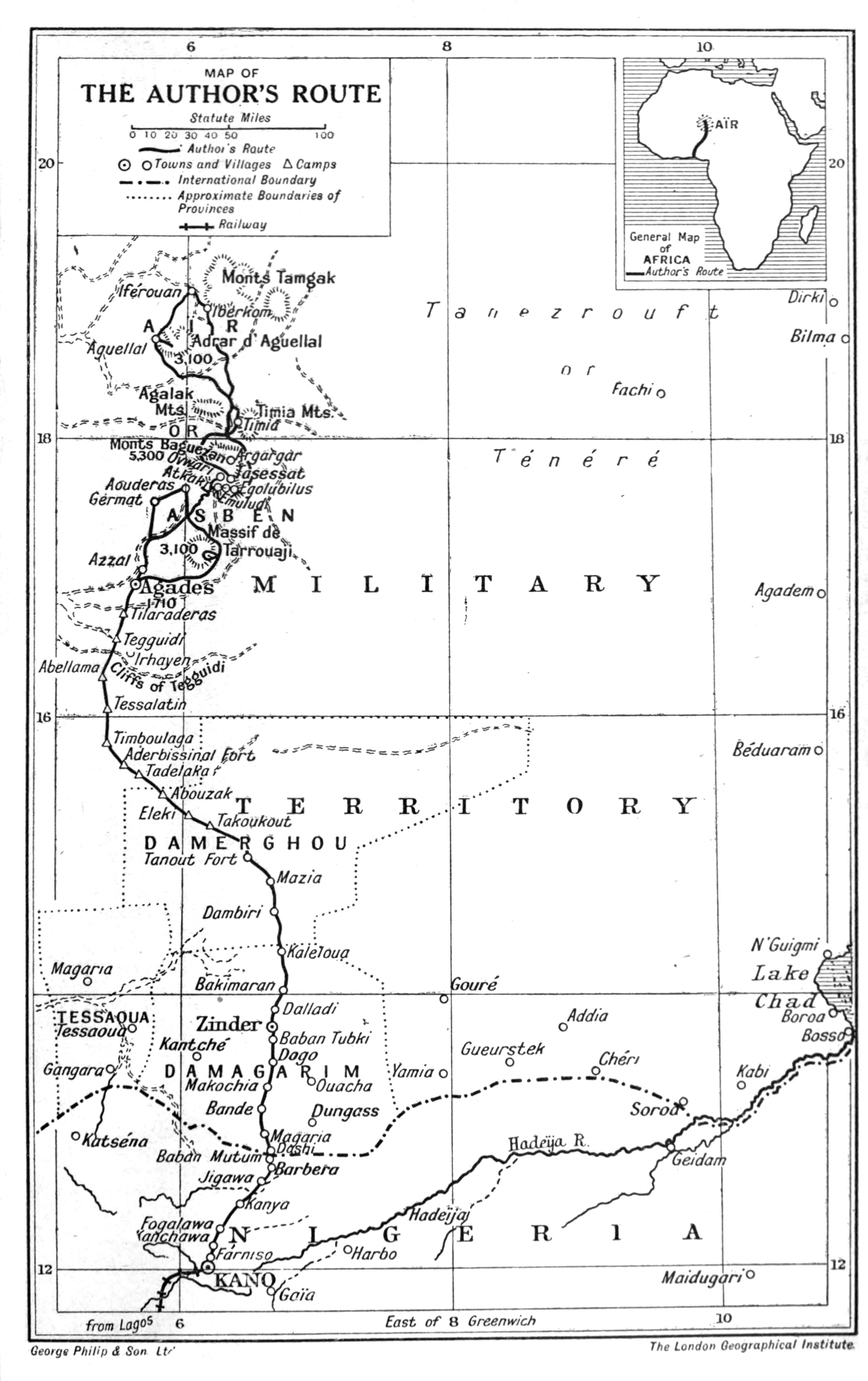
EXPLORATION OF AÏR OUT OF THE WORLD NORTH OF NIGERIA
By the Same Author
WILD LIFE IN CANADA
With numerous Photographs by the Author.
Second Impression.
THREE YEARS OF WAR IN EAST AFRICA
With a Foreword by Lord Cranworth.
Illustrated by Photographs and Drawings from the Author. Second
Impression.
A selection of Press Opinions of the above
will be found at the end of this book
OUT OF THE WORLD
BY ANGUS BUCHANAN, M.C. AUTHOR OF “THREE YEARS OF
WAR IN EAST AFRICA,” AND
“WILD LIFE OF CANADA”
WITH NUMEROUS
PHOTOGRAPHS BY THE AUTHOR
AND A MAP
LONDON JOHN MURRAY,
ALBEMARLE STREET, W. 1921
All Rights Reserved
TO MY FATHER A THOROUGH SPORTSMAN OF
THE FINE OLD SCHOOL
PREFACE
A narrative of an odd
undertaking to a foreign land. Odd, in the first place, insomuch
that for the greater part of a year a man’s tongue was mute to the
language of his race, for the land where he travelled was native:
first to the Hausa people; later to Hausa, Beri-Beri, Fulani and
Tuareg; and later still to Tuareg alone; while over all there was a
mere handful of French Europeans, who were the military
administrators of law and order.
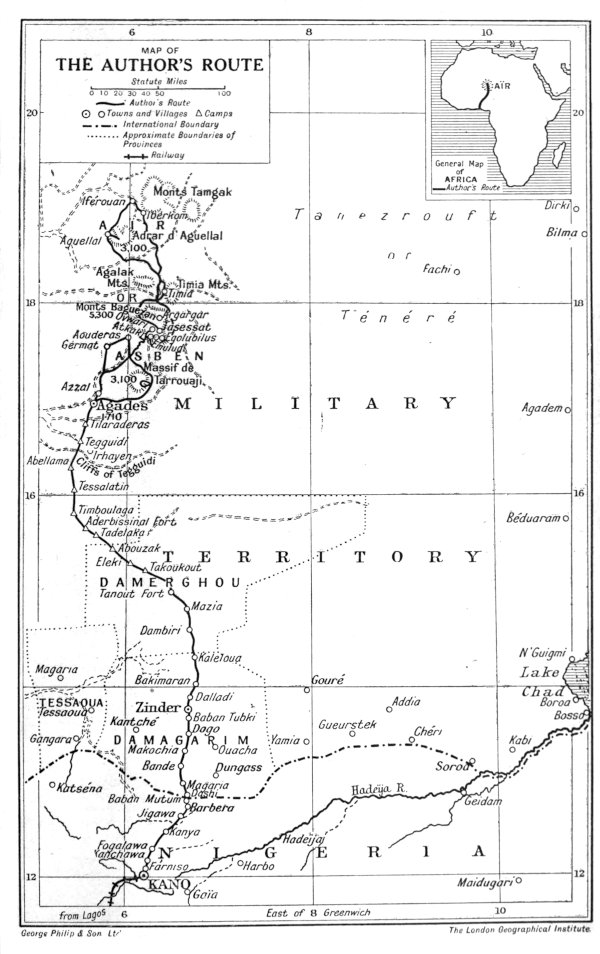
The country was that known as the Territoire Militaire du Niger
of the Western Sudan, wherein, remote and in the midst of desolate
seas of sand, lies the wild brooding mountain country of Aïr or
Asben—which was the traveller’s goal.
It might be said that the traveller was a rude man, for he was
untutored in the deep studies of the scholar of many languages, as
in a measure might be expected and understood of one whose
occupation called him from day to day to don rough clothing and
shoulder a rifle and march outside the frontiers of
civilisation.
Clumsy, therefore, were his beginnings in speech with the people
of the land; clumsy also his studies and understanding of all
things new and strange which unfolded before his eyes in that
amazing succession of novelty that taxes a balanced capacity of observation when one
stands spell-bound at the entrance of an unexpected wonderland.
Nevertheless, day by day, confusion became less; small words came
of many tongues; piece by piece threads of understanding became
woven into something durable and of the character of
trustworthiness.
So that to-day I—for, alas, I must use that personal pronoun
which is hateful to me, and admit that I am the traveller, so that
I may shoulder the full responsibility as to the faithfulness of
this narrative—have taken courage to tell my story with all its
shortcomings, but at the same time with an earnestness that may in
the end reveal, perhaps, the greater part of the picture of a
strange land as it appeared to me.
And I would tell you that it is a wholly pleasant task to sit at
home—Home, with all its repose and sweetness, neither
sun-exhausted nor limb-weary, and with a full repast at hand—and
look backward on the trail through the Sahara, and hear in
imagination the fierce wind that brings a blinding sandstorm on its
billows, and only have to write about it all.
But, though thus it is to-day, to-morrow or the day after I may
be gone once again to the uttermost corners of the world—for such
is my calling.
Some of my countrymen might envy me my to-morrow, some might
pity me; but to all I would say neither one thing nor another. Such
adventurings have their rare hours of pleasure and excitement and
their long weary periods of trial and endurance. He is wise who
knows the hazard
of life stripped of all its romance and does not expect to find
either great compensation or great gladness in strange lone
lands—in the same way as they are seldom to be found in any man’s
labours of the commonplace day.
It is deep satisfaction to me to know that, so far as the
collections brought back are concerned, my labours have not been in
vain, for it is one of my greatest desires, and the desire, I am
sure, of many loyal-hearted men, to see Great Britain ever striving
to continue to hold the honourable and prominent place in the
development of the Natural History of the World which she has held
in the Past. A year or two ago there were numerous and able rivals
in the field, and Germany and America appeared to be on the verge
of leading the world in all scientific research. Though a set-back
to the former has occurred through the unfortunate circumstance of
war, rivalry of nations will undoubtedly continue in the labyrinths
of research, and, I trust, will be welcomed from any quarter as a
healthy element that will ever give incentive to the students and
scientific workers of this country to hold their own, and offer
inducement to public-spirited people to encourage and support their
commendable efforts.
The humble work, which in the following pages I venture upon, is
not in any way a treatise on Natural History, but is a narrative
descriptive of strange scenes and peoples in Out-of-the-World
places in which Aïr has prominent position. And Aïr, in the centre
of the Sahara, is unknown, or virtually unknown to English-speaking
people. The German
explorer Dr. Barth, in his travels in Central Africa, 70 years ago
(1850-1), on behalf of the British Government, passed through Aïr,
and in his Travels in Central Africa gave some brief
discursive description of the country, which is, so far as I am
aware, the only account of Aïr that we have in modern English
literature.
But to return to my first remark, there are other reasons than
that given in the first place for terming this an odd undertaking,
and they are that the journey, which totalled some 1,400 miles of
camel-travel, led to a land that was almost virgin to exploration
of any kind, and of which nothing was known; while by force of
circumstances it was decided for me that I must go on my long
journey alone if I wished to undertake it; and therefore, perforce,
I set out without the two or three good comrades that can help so
greatly to lighten burdens, real or imaginary, on long uncertain
trails.
The primary object of the Expedition, which was undertaken in
the interests of the Right Honourable Lord Rothschild, was to link
up the chain of Zoological Geography across that portion of Central
Africa which lies between Algeria in Northern Africa and Nigeria in
West Africa. Previous research had advanced from the south as far
afield as Kano in Nigeria, and from the north to the Ahaggar
Mountains in the Sudan southwest of Fezzan. There remained a great
intermediate space unexplored by naturalists, wherein are the
French possessions known as the Territoire Militaire du Niger and
the unsettled mountainous region of Aïr or Asben; and it was
through those said
countries that the expedition proposed to journey.
With regard to the term Aïr or Asben which is applied to the
great range of mountains which lie north of the region of Damergou,
I think it is a pity that there should exist the seeming doubt of
correct designation which the double title implies, and for my own
part I propose, through my narrative, to refer only to the country
as Aïr, which is the correct name in the language of the Tuaregs
who inhabit the region, whereas Asben is a Hausa name, and would
appear to have no particular claim to recognition since it is not
Hausa country in the present era, whatever it may have been in the
distant past, when tribal and religious wars were continually
forcing territories to change hands.
The altitude readings, which I note during the narrative, since
many of them have not been previously recorded, were taken with an
aneroid barometer set to sea level before starting on the
expedition.
Although the expedition was to a French colony, I feel that it
was foreign only so far as concerned the difference of language,
for the few officers I encountered, who so ably helped me on my
way, if help I needed, were big-hearted men of the Lone Places
among whom one could not feel a stranger. To all I owe thanks for
such success as I gained, and gladly give it should any old comrade
of the open road read this humble work.
I am indebted, also, to the administrative officials in charge
of the Kano district who kindly rendered me many services ere I set out to
cross the boundary.
Collecting in the field is one side of Natural History research,
but there is, as you are aware, another side—the painstaking study
of the specimens after they are unpacked on the museum benches at
home. And I am much indebted to Lord Rothschild, Dr. Hartert, and
the British Museum for having most kindly furnished me with the
full results of the skilled studies of research to which the
collections have been subjected since my return, for in so doing
they have placed most valuable records at my disposal, so that I
may draw from that large fund of knowledge when desired and enhance
the value of this work.
Ever since Dr.
Hartert[1] came to Tring, twenty-nine years ago, I have
been keenly interested in the isolated mountains of Asben or Aïr in
the middle of the Sahara, and the country surrounding them. This
was chiefly owing to Dr. Hartert’s account of his interview with
some Tuareg traders who had come down into Nigeria to sell salt.
This interest was intensified by our own explorations in Algeria
and “Les Territoires du Sud,” and Geyr von Schweppenburg and
Spatz’s journeys in the Ahaggar Mountains, all of which yielded
many zoological treasures. Therefore, Dr. Hartert and I felt much
satisfaction when, after his strenuous labours in the war in East
Africa, Captain Angus Buchanan fell in with our views and undertook
to explore Asben and the country between it and Kano, in North
Nigeria, the terminus of the new railway. The eleven months
occupied in the undertaking have proved most fruitful, for, besides
the interesting ethnological and other facts recorded in the
subsequent pages of this book, the zoological results have been
most valuable. These latter results have been published in
Novitates Zoologicæ, the journal of the Tring Museum, in a
series of articles by Messrs. O. Thomas and M. A. C.
Hinton,[2] Dr. Hartert and myself.
The number of new species and sub-species is very large,
especially among the Mammals; Mr. Thomas indeed says that he has
never known a collection of Mammals, from a limited area such as
this, with so large a proportion of novelties. Among the new
Mammals, the most interesting are undoubtedly the “Gundi”
(Massoutiera), the Rock-Dassy (Procavia), and the
“Mouflon” (Ammotragus), because of the immense stretches of
desert which separate them from allied species and sub-species.
Among the Birds, one of the most interesting is the beautiful
goatsucker (Caprimulgus eximius simplicior), for, although a
slightly different subspecies, it illustrates once more the fact
that many species inhabit a belt south of the Sahara from N.E.
Africa across the African Continent to West Africa, while most of
the forms north and south of that belt do not show such a wide
range from east to west.
Among the Lepidoptera, the most interesting species are all true
“desert” forms, with a wide range reaching through Arabia into
India, although several new species and sub-species of butterflies
and moths of great interest are also in the collection.
From a zoo-geographical point of view the collection is most
valuable, for we now know zoologically a complete section of the
“Great Saharan Desert,” with the exception of the small portion
between the Ahaggar Mountains and Asben, and although the region of the Sahara
south of the former is undoubtedly tropical, and not palæarctic, in
its fauna, it is very remarkable what a large number of palæarctic
species and genera are still to be found there. Unlike most of the
collecting-grounds of the Old World, which can still yield new and
undescribed forms, Asben and its neighbourhood were absolutely
virgin soil zoologically, and Captain Buchanan’s specimens are the
first to reach the hands of scientific workers. Considering the
long journey by camel and the fact that Captain Buchanan was
working absolutely single-handed, the collecting of over 1,100
Birds and Mammals and over 2,000 Lepidoptera, in a region notorious
for its paucity, both of species and individuals, is a remarkable
achievement, and proves him to be a most efficient explorer and
naturalist.
Rothschild.
Tring Museum,
March 22nd, 1921.
OUT OF THE WORLD
CHAPTER I ENGAGING BOYS—LAGOS
It was at Seccondee on the
Gold Coast that “John” came aboard. Do not mistake me!—he was not a
first-class passenger nor an acquaintance. Far from it; he was one
of a motley crowd of jabbering natives which, with an extraordinary
conglomeration of hand-carried household belongings, were put
aboard from surf boats and herded on to the open after-deck—already
stacked with sacks of Kola nuts from Sierra Leone—like so many head
of frightened sheep.
No! John was certainly not of a race or rank to claim intimate
acquaintance. In the first place he was as black as the ace of
spades, which in itself for ever barred him from any claim to
equality or kinship—a hard plain fact which any old colonial on
“The Coast” or anywhere in Africa would endorse, while with grave
misgivings regretting the extraordinary policy and laws that grow,
from what sane source is past understanding, more and more lenient
in their evident stiffness of opinion to release native inhabitants
of our colonies from the slightest restraint of a dominant European
rulership; policy that is reacting— surely not with short-sighted blindness?—to
bring about the downfall of the fine old decorum of the white man’s
prestige which natives naturally observed in every respect in the
past. And it would be well to remember, those singular innovations
which are being brought in on the tide of European civilisation are
being entrusted to natives who are endowed by nature with
characteristics of a different race type to ours and which are
irrevocably unchangeable at the line of their limitations. European
education and European laws along certain well-chosen, sure-set
lines can cultivate those characteristics of the native to a
certain standard—but not one step further. It is the logic
of Nature: up to a point, with many creatures and plants and even
matter, artificial cultivation is possible and beneficial; but
over-experiment with the material, over-nurture and Nature steps in
and calls a decisive halt in this tampering with her creations, and
death or decline is thenceforth observed.
It is difficult for anyone to foresee the Future— that word of
wonderful depth which is the most awesome in the English
language—into which men may cast the biggest venturings of
experiment in the world; and generations watch them rise and
flourish if they be right, or flounder and go under if they be
wrong. And surely it shall never be— this would-be blending of two
entirely opposite races to a semblance of equality, though it is
for the present this ugly threat which is often before the
“Coaster” and the men on the bush stations to-day.
But to return to John, for John has importance in the narrative, which African
politics have not, the ship had hauled anchor and cleared Seccondee
for Lagos, and I stood solitary by the taffrail of the upper deck
looking idly on the low line of typical African shore that lay
indistinctly in the north. The deck, for the moment, was free of
passengers, for it was in the quiet afternoon hours, when almost
everyone on board retired to indulge in a pleasant book or a
snooze, as is the after-lunch habit in hot enervating climates like
Africa.
But, suddenly, I was not alone, and a native, who had no doubt
watched his chance to break the bounds of the lower-deck, stood
beside me waiting permission to speak.
“What do you want?” I asked, somewhat curiously. “You have no
right to be on this deck.”
“I want I make work for you, sir,” replied the native. “My
massa, he live for back, him go England. I plenty glad work for
you, sir.”
“But,” I warned, “suppose I want a boy? I am a hunter. I am not
going to live in a town or station in Nigeria where the duties of
cook-boy or house-boy are ordinary. I am going to travel far in a
strange land north of Kano; work will be hard and plenty; good boys
will catch good pay; bad boys will go home quick and catch nothing.
You are a coast boy, and I do not think you are fit for bush in far
country.”
But the boy was not so easily discouraged, either he wanted
employment urgently or was ignorant of the full purport of my
“white man talk,” for he answered in his pigeon English, with a
broad grin of hopefulness: “Dat be all same same, sir! I no fit savvy dat bush now,
dat’s true, by-n-bye I plenty fit to look him. I want work for
you—I good boy, sir!”
To which what could one do but smile? But, nevertheless, I now
looked the boy over more attentively.
His thick-set bulldog head was excessively ugly and
unprepossessing in all its features. Any face is dull which has no
attraction in the eyes or in the mouth, and those of this negro
native had none, for the soiled whites of his eyes rolled
alarmingly, and the large mouth had lips rolled into one that would
have served three ordinary men adequately. Moreover, he was an
Awori native of the Coast, and had profuse tribe marks on his face:
three small deep-stamped marks over the cheek-bones, and a line of
fourteen marks of the same stamp between the eye-corners and ears,
while on the centre of the forehead he had a sort of square and
compass scroll more lightly branded than the rest. He was clad, not
in the picturesque nakedness of the aboriginal, but, after the
fashion of the majority of “boys” on the Coast, in the cast-off
clothing of some late master—even to a tweed cap, which sat with
ridiculous incongruity on his black woolly head. Altogether he was
a regular dandy in “rig-out.” But he was no exception in that
respect, for the comical and audacious dress of house-boys of his
kind, who are inordinately full of personal swagger, has ever been
a source of much amusement to colonials and strangers alike.
It did not take long to size the native up and note those brief
somewhat unfavourable characteristics. But at the same time I had appraised the
thick-set, sturdy build of the boy, so that the conclusions I
finally arrived at were: “An ugly devil—not over intelligent, no
doubt—but strong and healthy, and should stand up through plenty of
hard work—and he looks honest.”
“What’s your name?” I asked.
“John, sir!” he replied. “John Egbuna,” he added, by way of
giving his full name; for it was no less a person than he who had
come aboard at Seccondee.
“All right,” I said, moving towards the deck smoking-room. “Come
to me when we dock at Lagos and you can work for me.”
Thus John made his appearance. By keen watchfulness he had
risked the abuse of ship’s officers and stolen a chance interview,
and taking him on in this way was a chance shot, but time proved it
to be a lucky one, for John went right through the whole
expedition, ever faithful as a dog to his master, while his
companions, one by one, fell out.
The ship docked at Lagos after she had come in over the bar on
an early morning tide, and steamed slowly inshore and up the wide
river-like tidal lagoon of muddy water disfigured with
surface-floating green slime-like vegetation and white froth, which
escaped, no doubt, from some swamp bank further inland. It was a
lagoon which was nevertheless picturesque and novel, with a light
morning haze upon waters from which protruded the poles and loosely
hanging nets of many fish traps, past which, or about which, up and
down the lagoon, plied long lithe dug-outs, and odd-shaped craft of many kinds,
single-sailed, or pole-driven, or paddled, and paintless and dark
as their negro occupants, except where the gay colour of a cotton
garb caught the eye on a boatman more extravagant than his
brethren, who were generally rag-clad or naked to the waist.
At Lagos, when I had landed, I made the disconcerting discovery
that there was no hotel—a circumstance strange in a port of
importance and modern in nearly every other way. I had natives to
engage in Lagos for my forthcoming travels, and other business, and
therefore it was necessary to stay a few days in the place. Lagos,
being a crowded town, was not the sort of place one could pitch a
tent in, or that would have been quickly done; but I finally
overcame the difficulty by interviewing the purser on the ship, who
kindly allowed me to retain my berth on board while the ship
unloaded her cargo.
And in that little cabin, in the course of events, some strange
interviews were entered on. I had an old-country friend on shore,
and with true Coast courtesy he sent his head-boy out into the
native town to carry the news that there was a white man on the
ship who wanted natives to go north with him, but that, “he want to
look boy fit to skin fine fine.”
Native news travels fast even in modern Lagos, and soon boys of
various races and types began to come aboard armed with their
pass-books and letters testifying character—in some cases letters
which were truly from past masters, in others, false and flattering
documents borrowed for the occasion were tendered, such is the
unscrupulous craftiness of some castes.
The outcome of two days of interviewing natives was not very
encouraging, since no boy was discovered who could skin birds or
animals with practical skill. However, at the end of the second day
I had selected three boys and dismissed the rest, despite their
clamourings to be heard further and reluctance to leave the
ship.
One of the natives held over for further examination was an
extraordinary individual, with all smooth face features absolutely
obliterated by the mass of seared vertical lines of tribe marks
which ornamented his entire face. He was of middle age, lean, and
hard-looking, and obviously the hunter and tracker that he claimed
to be. What this individual proposed, when an engagement was
broached, was that he be allowed to go to his tribe in the first
place to take the news of his departure to his people, and then
return and catch up with my caravan wherever I might be. Inquiry
revealed that his home was distant a whole month’s travel by canoe
along the coast. It would take him two months to go and return, and
after that he would have to find my camp “somewhere” north of Kano.
Yet he appeared to think nothing of such distance and to take to
travelling as a duck to water, and declared with conviction that he
would meet “master” anywhere, if he would but employ him. I had met
this type of tireless hunter among natives before, and they are
invariably very good if you can secure them. But, all things
considered, taking the man on in faith of fulfilment of merely
verbal promises, and
advancing him some money to provide for his wives in his absence,
savoured too much of bad business; and as he would not pack up and
come along as he stood, he was finally allowed to go, with the
understanding that if he hurried to his tribe and caught up with
the expedition north of Kano, he would then be taken on at good
wages, and his “back-time” made good.[3]
The other two boys were Hausa natives, the tribe that I had been
strongly advised by men of experience to get my boys from if
possible. They were both young—20 to 23—and had been selected from
the crowd as being in appearance the most intelligent, for as it
was of the utmost importance to secure some help in dressing
specimens in the field, it was my intention to teach them to skin
if in early practice they should show any aptitude for the
work.
Hence one of them was sent ashore to the market in Lagos with
instructions to buy a pair of tame pigeons, which would suffice for
my purpose in lieu of a specimen dropped to the gun.
Thereafter, down in the hot narrow cabin, while the ship lay at
anchor, I gave an object lesson on bird skinning—a necessary but
not very edifying proceeding. To begin with, there was a ridiculous
familiar pillow-cushion aspect about those dead tame pigeons
which robbed one at once of any æsthetic enthusiasm, no matter how
solemnly I was prepared to set about the delicate operation of
skinning; and a glance from the work-table to my pupils, great
loutish curly-headed negroes, with no appreciable sign of
dawning understanding
as my handiwork proceeded, made me much more inclined to laugh than
to be serious.
When the lesson for the day was over, I sent the boys home with
money to buy each a pigeon, which they were to try to skin in their
homes in the way I had shown, and bring their handiwork on the
morrow.
In due course they came aboard again with their “specimens”: one
poor skin in rags and with half the plumage gone, the other not so
heavily handled, and showing some signs of painstaking work. On
that day the lesson in my cabin was repeated, and then
independently at home, and the result was that, on the eve of
starting north to Kano, one boy—Sakari by name—was engaged, since
he had shown some intelligence and skill over his skinning lessons,
and the other dismissed as useless, as he had developed no aptitude
for the work.
It may not be out of place to say here, while on the subject,
that in spite of reports one hears at times of natives who have
become expert at preparing specimens—doubtless exceptions—I would
advise no collector to rely on local skill to any great extent, for
I have always found them most difficult to educate, and skilful and
careful only up to a certain point. For my own part I have never
employed a native on such work who, when the skin was separated
from the carcass, I could allow to apply the coating of
preservative and reset the specimen in the natural, faultless
repose which is essential to a finished skin required for
scientific purposes. For straightforward skinning, however, good
natives are procurable, and with practice can save much of the
collector’s time by doing the preliminary work.
Meantime, while hunting preparations were progressing, I had
spent some time on shore each day in the native quarters of Lagos.
The port at which a traveller disembarks in a land which is foreign
always holds the lively interest of novelty, if nothing more, and
Lagos had much that was novel. Notwithstanding the fact that the
outward aspect from the lagoon is almost entirely European, Lagos
is, broadly speaking, a great native city; and it is on that
account that it is so attractive to the curious stranger. The
European section, which runs chiefly in a line along the long
shores of the lagoon, is as a rampart between the sea and the great
area of native town which lies hidden behind the solidity and
imposing stature of the commercial and domestic buildings of the
white man. And it is behind those colonial buildings that one must
pass to gain entrance to the true city of primitive native hutments
which bears the aspect of the historic antiquity and primitive
character of the people who inhabit it. So turning from the main
street which runs along the water-front, and walking up one of the
side-streets, one finds oneself immediately among curious scenes
and curious people in narrow streets which are lined with irregular
closely packed native huts on either side—huts of every imaginable
shape, and built, for the most part, with a most nondescript
collection of materials which owners appear to have gathered
together with little or no cost to their pockets. The walls of the
huts are of mud, but the roofs, if they are not thatched, and the little dog-kennels
of bazaars which are in front of almost every dwelling, are made up
with old crate-boards, planks, corrugated iron, pieces of tin, old
sacks, canvas— anything; paintless, untidy squalor for the most
part, and the sun-basking places of countless lizards that come out
from behind the shady cracks.
Were the huts and the streets deserted of human life, Lagos
would indeed be a dismal place, and little short of one huge
rubbish heap; but it is entirely otherwise, for the scene is
crowded— even overcrowded—with life and colour, and hence
attractive and sometimes very beautiful, and down the hot dusty
streets, which in many instances are very narrow, and in and out of
side lanes, one may pass for hours and never be clear of the
brilliant cotton-clad throng; every individual of which, whether
Yuroba, Egba, Hausa, Arab or Kroo, seems intent on selling or
buying something in a veritable hive of trading and industry.
It is an uncommon sight, and a wonderfully picturesque one, to
view those busy streets of native Lagos—their fullness of motion
and rich, almost Oriental colouring of native dress, worn as a rule
with all the grace of perfect physique; bazaars bright with wares
exposed for sale; children toddling by the doors; and goats and
chickens, at risk of their lives, tripping and feeding among the
throng. Time without number, as I passed curiously through those
streets, my eye was arrested by little gleams of perfect colouring
in a perfect natural native setting—lovely pictures without one single act of
preparation or posture—and I confess I sighed and moved on,
regretting I was not an artist with genius to catch such scenes,
and hold them in all their beauty and simplicity, so that I might
show them also to my fellow-men, less fortunate in their freedom to
travel.
Wherefrom it may be gathered that I much enjoyed my brief
sojourn in Lagos, where I would fain have stayed longer, had not my
duties called me to hurry on to Kano.
THE AUTHOR.
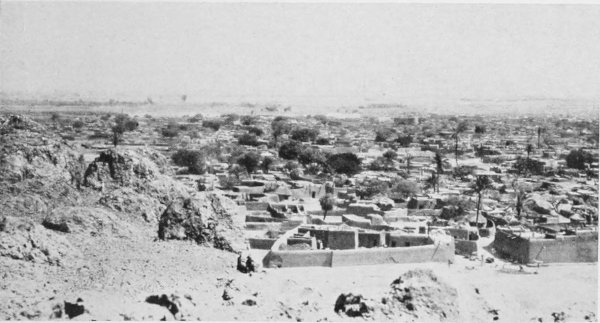
VIEW OF KANO CITY.
CHAPTER II KANO, NORTHERN NIGERIA, THE COMMERCIAL METROPOLIS OF THE WESTERN SUDAN
Twice a week a mixed
passenger train runs from Lagos to Kano, which, despite its crude
discomfort, must serve the traveller who wishes to go north, for
there is no other way for the present.
When the time came for me to set out upon that journey, to say I
was astonished at the crowds of natives at the station and at the
confusion would be to put it very mildly. Drowning the sound of
clanking trucks and blasts of engine whistles in the station, arose
the deafening cries of instruction and abuse of a highly excited,
hustling mob about to board the train, after bidding demonstrative
farewells to two or three generations of relations and friends. Din
and confusion reigned supreme; there was no calm eddy there, no
steady head or hand to order silence or orderliness. One might be
forgiven if, for the moment, one thought, as I did, that I had
mistaken my direction and had entered a native market-place, in
which a great sale was going on and the bidding eager and heated,
in a volcanic atmosphere of excitement.
Patience was necessary, I assure you, to carry master and boys and baggage through
the jostling of some hundreds of people, past the ticket-desks of
distracted native clerks, who were being overwhelmed by a fiercely
gesticulating, clamouring mob, that know, by force of primitive
environment, only their rude desires and nothing of manners. And
when the train had finally been boarded and the journey begun, I
found it was necessary to keep hold on patience throughout, for
many stations on the way held something of the same fearful din and
disorder.
Much could be done by strict measures on the part of the railway
authorities to “tone down” and regulate such native shortcomings,
which white men would surely welcome, for it is little less than
unchecked raw exuberance that is prevalent among them—perfectly
good-natured, as a rule—which interferes with the quick and
systematic disposition of the service, and which is not in keeping
with the fitness of things in modern travel.
But such circumstances are among the drawbacks which
unprecedented prosperity has brought in its wake. Nigeria, rich
beyond all possible estimate in natural resources, has come, and is
coming, into her own; no longer gradually and steadily as cautious
and perhaps wise men might wish, but by leaps and bounds in keeping
with the impatient spirit of the age. So that laggards are apt to
be left behind, or things which are primitive become out of date;
and that is what has happened with the Nigerian railway, which was
built, no doubt, and run for the little needs of the colony as they
existed a few years ago, but which is not now an adequate nor well
regulated service, and fails sadly to fall in line with the
astonishing progress of present-day commerce. Hence, in part, the
cause of the congestion and confusion at the stations which is so
prevalent to-day.
Nigeria urgently needs more railways, more railway facilities,
throughout the width and breadth of the land: a land that has few
equals in untouched natural wealth; a land of immense
possibilities, provided wise laws conserve its native labour
and cease to over-educate and over-wean it, and bring it back to
the natural conditions from which it has been swept in a whirlwind
of haste to clutch Prosperity and let everything else go by the
board. Meantime it is bottled up in its vast interior for lack of
outlets, while it is struggling like a thing unborn to break loose
from bondage.
It is only a very little of the awakening, of the struggling,
which one sees at almost every station “up the line,” but every
sign, little or great, is a sure forecast of a dawning and,
perhaps, wonderful new era in West Africa.
The three days’ wearisome journey to Kano need not be dwelt on
at length. Throughout it was through a country rich in forest and
bush, with no great change in geographical aspect or in altitude.
The change in appearance begins in the Kano region, at the end of
the railway, where the sub-deserts of the north come down in places
to the fringe of the bushland and grade one into the other. The
elevation of Kano is 1,700 ft., and this comparatively small change
in altitude over the
long distance from the coast to Kano—a distance of 704 miles—takes
place gradually, so that the country, with small exceptions,
appears flat throughout. There are great dense belts of oil palms
and coco-nut palms in from the coast, which in time, as you proceed
up-country, give place to more varied tropical forests of tall
stately trees growing from jungle undergrowth; while further on
again, toward the north, the growth is less prolific, and there is
much acacia bush, which is open or dense in patches, and of no
imposing height.
To step from the train at Kano and shake oneself free from the
discomforting heat and dust of the carriage and know that the
journey was at an end was a cause for rejoicing with me.
Civilisation now lay behind; here would I gather together my
caravan of camels and natives and set out on the open road with all
the freedom of a nomad.
And as a starting-off point, I learned, on close acquaintance,
that Kano was ideal, for it proved to be a place of the frontiers
and of the outdoors that harboured a host of wayfarers that passed
to and fro from the great and historical market-centre of the
north.
The ancient city of Kano is situated on an extensive plain of
cleared and cultivated bushland, which is not completely bare and
waste nor treeless, but which, nevertheless, bears a distinctive
change from the country further south, and has much of the
appearance of sub-desert in the dry season, for it holds the palest
of colouring—that true buff shadeless neutral tint common to desert
lands which oceans of wind-lain sand and ranges of dry prairie grass give to a
sun-parched, rain-thirsty country. But only in colour and
sand-winds of the Harmattan has it great resemblance to desert,
for, beside the scattered trees and bush, the level stretches on
closer inspection are found to be largely lands that have been
cultivated during the short rainy season and are now waste-grown
over a very sandy soil, which is dry and cracked and powdered to
fine dustiness on the surface. One of the common and best-known
ground plants amongst the dead vegetation on the sandy soil is that
named “Tafasa” by the Hausa people (Sesbania sp.
Leguminosæ). It is a straw-yellow, long-stalked underbrush,
with long thin bean-pods, and known to everyone about Kano, for it
grows about 2 ft. high in considerable extent, and crackles noisily
in brittle dryness as one brushes against it in passing. Another
well-known plant there, and everywhere in the bushland, is that
which the natives call “Karengia” (Pennisetum Cenchroides
Rich.), and which is a very annoying burr-grass that adheres to
any part of one’s clothing, and which is a terrible pest to the
hunter.
It was the season of the Harmattan when I reached Kano, for it
was the month of December, and the driving winds from the Sahara
had already set in. The Harmattan (often designated “Hazo” by Hausa
natives, which means mist) is a season of hot, dry, dust-filled
winds that blow from the desert interior steadily day after day,
but seldom with the abandoned fierceness of a sandstorm. At that
period the early mornings are cool even to coldness, and fresh and
vigorous with the
stirring of strong wind, which bears down with the coming of day,
and brings with it a fine mist-like haze which envelops the whole
country. But the haze is not an atmosphere of laden dampness, such
as is familiar to England; quite the contrary, for it is dry with
the intensity of a white heat, and mist-like only because the wind
is so full of fine sand particles from the tinder-dry desert in the
north, which it carries and lays in a carpet of fine penetrating
dust wherever it passes.
The dryness in the land at this season is unbelievable if you
have not experienced it; moisture is dried up as if the flame of a
furnace was licking at it; ink, for instance, dries as fast as each
letter of the alphabet is penned, and the clogging pen-nib is
almost unmanageable: writing-paper, books—even the stiff book
covers—everything of the kind curls up and becomes unsightly; boots
that fitted with comfort in England shrink to such an extent that
they are useless; nothing escapes, not even one’s person, lips
crack, and nostrils and eyes sting; and altogether one has days of
intense personal discomfort. Moreover, the fine almost invisible
sand-dust searches into everything, and very soon both my watches
were affected; next my camera shutter went wrong, and later on a
rifle and gun. These latter were the greatest mishaps to befall me
during Harmattan, and they were serious enough at the onset of an
expedition.
Thus it will be seen that at Kano there is already something of
sand and bleakness, and, to a considerable degree, it is therefore
relative to the
boundless Sahara to the north, while the advent of the Harmattan
and driving sands bring to one the very atmosphere of the great
lone wastes of the hinterland. And in keeping with such
impressions, and enhancing them, stands the strange, and ancient,
and powerful city of Kano, which in its unique earth-built aspect
has all the character of a city of the mystical northern desert and
little or none of the character one is accustomed to see in
Nigeria. Perhaps, most of all, Kano impressed me with its
atmosphere of age: the gigantic ramparts around it, and many of the
quaint mud dwellings were obviously time-worn, in that inimitable
manner of things that are unmistakably ancient, and carry about
them for ever the rudiments of the craftsmanship of strange races
that have passed and gone for all time.
And though we may know from hearsay that great powers in race
and religion have lived within the walls of Kano to fight and
struggle for power and existence through ages of History—as is the
destiny of kingdoms—it is difficult to realise how slowly time has
advanced in this secluded back-eddy, and how very close the past is
to the present, until you have walked within the ancient walls and
fallen under the spell of the old-world character of the people,
and their dwellings, and their customs.
Undoubtedly this atmosphere of the Past which hangs so closely
about Kano remains there because the town so long lay out of the
way of the ever-hurrying feet of that advancing, engulfing
“civilisation” of our age which is the ruling “God” of the white
man in his own land, whereso ever that be, or in any other land that he
has fallen heir to through the honourable, or mayhap—be it
whispered—dishonourable enterprise of a bygone grandparent.
It was as late as 1902 that the white man came before the gates
of Kano, demanding admittance, and since the aggressors were the
great “Bature,” and had many rifles (a few arms collectively are
invariably construed as many by timid, untaught natives),
the Hausa inhabitants, who were at discord with the Fulani, who
were their masters at the time, and deserted by the cowardly Emir
Alieu, forthwith bowed before Destiny with true Negro fatalism, and
accepted British rule without serious dispute, and without making
any kind of stout-hearted defence against the undermanned punitive
expedition that was sent out at the time; a fact to their
discredit, for they were in their thousands.
It would appear, from records, that the pact between conqueror
and vanquished was a friendly one, and of such wisdom that the
change of rule was not a drastic one and brought no tyranny; in
fact, the hands of the Crown’s Trustees were laid so lightly upon
the people in directing their administration, that they (the
natives) lost none of their ancient characteristics or pride of
race at the time of small beginnings of acquaintance with
Europeans; so that almost up to the present day Kano remained to
all intents and purposes completely native and original, and a
great and powerful centre of the Hausa people and of Mohammedanism.
It is at the present time that the careless breath of civilisation
has swept
inevitably—for it is useless to expect to gainsay Destiny—in from
the South, and has cast a blight upon the simplicity of the
natives, with unnatural consequences to their frail character.
In 1911 the Nigeria railway was laid down to Kano. In 1914—about
six years ago—there was less than a score of Europeans within the
British segregation about a mile east of the Hausa City, and at the
time of my journey, early in 1920, somewhere about six score; the
former a barely perceptible number amongst the vast native
population; the latter just enough to have started the swing of the
pendulum of commerce and speculation which already promises to
change a fine old world that is rare to a new world that will grow
commonplace. I treasure old things, as I fancy we all do, and
therefore cannot refrain from regret when I see something that is
dear totter on the brink of destruction—so often it cannot be saved
by reason of circumstances or environment, and it goes out for
ever, for the passing of the Old is just as inevitable as
the coming of the New beneath the propelling will of
Destiny.
The population of Kano is a fluctuating one, on account of the
nomadic propensities of many of the people, and I think I am right
in saying that there are on that account no exact statistics
concerning numbers. There is said to be an average population of
about 80,000 inhabitants in Kano, which dwindles to about 60,000 in
the “off season,” and rises to about 100,000 in the height of the
trading season, when ground-nuts are marketed.
The province of Kano, of which the City of Kano is capital, has a population of
2,871,236,[4] which is a much greater number than that
contained within any other province in Nigeria, its nearest
competitor having barely half that total.
Those few figures may serve to proportion the extent of the
importance of Kano; but let me lay statistics aside henceforth, for
I would fain wander back in random fashion within the old gaunt
walls of the city and examine the quaintness and the rudeness
wherever dust-lain mysterious lanes may lead me.
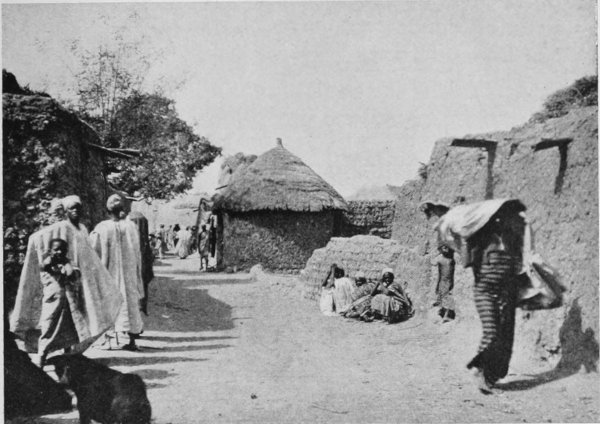
Within the walls of Kano the city is composed of thousands of
diminutive hutments, which crouch low and are huddled together as
if to gain each from the other strength, and companionship, and
protection, which is indeed the intention in a land which suffers
from the sting of driving, biting sandstorms, and knew in the Past
the swoop of attacking enemy.
The huts, and the enclosure walls about them, are built with
reddish clay-soil taken from pits in the neighbourhood, and, with
the addition of water and plant fibres, kneaded into a plaster
which, after it has been applied, sets very hard. Dwellings so
built are cool and weather-worthy for the greater part of the year,
but at the time of the Rains some damage is usually wrought by the
heavy wash of water, and repairs are necessary thereafter.
In appearance the dwellings are stoutly built at the hands of
patient, careful labour (for the natives are not a little skilled
in their work), and, though they have seldom ornament of any
kind, their simple
lines and odd and primitive planning have an attraction, and a
novelty that is peculiar, apparently, to the walled-towns on the
northern borders of negro-land.
Kano, like most native towns, has grown upon no preconceived
lines, with the result that it is to-day a happy-go-lucky jumble of
dwellings that in many cases appear to just save themselves from
complete imprisonment by the number of lanes that provide, by the
genius of necessity, a way of escape to the encompassed dwellers.
Throughout the whole city runs an amazing network of street-lanes,
zigzagging and turning and twisting in every conceivable direction
and holding to no true course for any appreciable distance, which
is the outcome of the numerous den-builders having built their
little dwellings wherever an open space or a corner was available,
without preconceived attempt to form the whole in any kind of
symmetrical plan.
From the outside the openings in the severe lane walls—which are
8 to 10 ft. high—do not invite a stranger to enter freely into the
privacy of these native dwellings, but, not wishing to miss
anything, I one day plucked up courage and asked of an aged woman,
who was squatted on the ground at a doorway in a lane, if she would
show me the interior of her house?
But before making my request I tactfully gave her the long
formula of Hausa greeting:
which formula the Hausa native dearly
loves to be greeted with, since it is the habitual form of friendly
salutation; and it now brought me good-natured bidding to
enter.
Across the door-opening in the wall I stepped from the lane into
the yard or compound—a small open space with high walls on all
sides— which was clean, though earthen and dusty, and contained a
few naked infants that played about the hut doors in company with a
pair of young goats of an age to be nursed and nourished at home,
while a few bantam-sized African fowls scratched for pickings where
wooden mortar stools and pestle poles on the ground told that the
industrious women of the house had lately been crushing grain for
the forenoon meal. There was not, contrary to the usual custom, any
tree or bush preserved within the narrow limits of the yard for
sun-shelter.
The yard I had entered contained two huts built of the same
clay-soil material as the outside walls, and, bending almost
double, I entered the low dark doorless opening which gave
admittance to the
home of the old woman, and stood then in dim light in a tiny den
which had only a few feet of space altogether. Indeed, such
dwellings contain area of so little extent that if a long
woodframed couch is placed therein, or a grass mat for reclining
upon is laid upon the floor, one full side of the room is taken up.
No window lit the interior—though there are sometimes one or two
narrow loopholes near the ceiling in huts of this type—and but a
dim light filtered indoors from the sun-shadow that fell athwart
the low doorless opening; the hard-baked floor was of the same red
clay-soil as the rest of the dwelling and of the colour of the
ground outside; the flat ceiling— which showed the ant-proof dum
palm beams and the spans of grass matting between, which carried
the weight of earth that composed the roof overhead—was densely
hung with cobwebs and black with the wood-smoke from years of
night-fires and cook-fires, which had also dimmed the rough red
walls. There was no furniture in the hut, nothing that had the
purpose of an ornament, for though the Hausa people are excessively
fond of ornament on their persons, strangely enough no such taste
is reproduced in their dwellings. Upon the floor lay a clean grass
mat, whereon the inhabitants are wont to crouch around the
food-bowl at meal-time, or individuals recline in sleep in the heat
of the height of the day; a few calabash drinking-bowls and bowls
for drawing well-water hung from the ceiling and from the wall,
where also a well-used bow and a buck-skin sheath of arrows hung
from a peg.
From this room a short dark passage led to the other hut, which was of exactly
the same character and aspect as the first, except that therein two
comely women, in bright cotton garb, had taken refuge in shyness of
the white stranger—wives, no doubt, of the proprietor, who was not
for the moment at home. A few Hausa words to them in friendliness
and a coin to the old woman, and I passed outside into the daylight
again and on my way, followed by the grateful “Na gode, na gode!
(thank you, thank you!) of the old woman, who was much flattered
over the advent of a white man to her humble “gidda” (abode).
Therein I have described one native home in Kano, and in
describing one have portrayed the type, for, except in minor
details, they are all very similar. They are, in fact, when all is
said and done, but the simple primitive shelters of an outdoor
people of an old world, who are content for the most part to make
shift, somewhat in gipsy fashion, with the rude necessities of life
like unto the wild things about them.
Of course there are, in addition to the mass of dwellings, the
Mohammedan mosque, and Sultan’s Palace, and market-stalls, which
have importance and peculiarities of their own and complete the
city as a whole; but the great novelty of the place lies along the
lanes and about the mud huts of the crowded populace, and upon the
rampart walls that stand stalwart guards through the ages.
In the Past it would appear the natives of Kano lived almost
altogether within the ramparts of the city, as was the defensive
custom of rival centres throughout the territory; for tribal wars
were continual in those days, one group fighting
another, one city
besieging another to such an extent that safety was only to be
found behind stout walls and lines of archers, while, in times of
disturbance, the bush outside remained a deserted
no-man’s-land.
Thus to withstand siege Kano had more than its crowded streets
of dwellings within the walls that enclosed an area of 7¼ square
miles; there was open ground where goats and cattle and camels
could be herded and fed for a time when threat of attack should
drive them in from the outside; there were ponds and pits of water,
even in the dry season, where beasts could be watered, and deep
wells to supply the people. So that with their herds of animals to
slaughter for meat, and secreted grain stores, and abundant water,
the inhabitants were in a strong position to withstand siege in the
good old days of high adventure—days not long removed so far as
they are concerned.
Within the walls, also, are the twin hills Goron Dutse and
Dalla, outstanding though not massive in area, but most notable
because they are the only hills in view on any side over the
distance of cleared land and bushland of the surrounding country,
so that they are like sentinel posts and fortresses to outside
eyes.
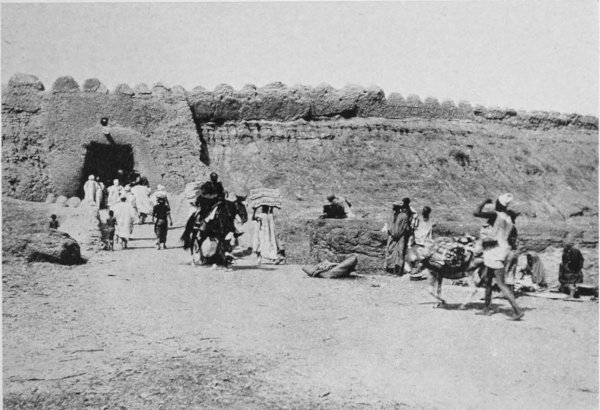
Lastly, and most striking feature of all in this place of
strange reflection of ancient customs, there are the great ramparts
which completely surround the city. They are the very embodiment of
strength, towering above all else—of great width and height, and
one solid mass of welded clay-soil. Indeed, the whole enclosure is
so colossal that one
cannot but be filled with amazement when endeavouring to conceive
an imaginary estimate of the labour and enthusiasm that the masters
and their subjects and their slaves must have put into the work. At
some time or other one can easily imagine that countless thousands
of naked natives swarmed upon those walls, intent on one great
purpose, like so many droves of tireless working ants. The walls
are 40 ft. wide at the base, and rise, tapering to 4 to 6 ft. width
at the top, to a height of 30 ft. and more. The parapet is
punctuated with regular openings to accommodate the drawn bows of
archers when kneeling on the ledge or pathway which is on the
inside of the top of the wall. The great wall which encircles the
city is no less than 11 miles around its circumference, while there
are thirteen tunnel-like gloomy entrances, through the great width
at the base, on main roadways that diverge from the city, so that
exit or entrance can be made from any side. In the side walls of
the tunnel entrances there are room-like cavities excavated which
apparently accommodated the guard in time of war.
The hour to enter Kano by one of these gates is in the cool of
the late afternoon, for at that time you will find that the
somnolence which the excessive heat of noonday lays upon the
easy-going inhabitants has lifted and that there is a great stir of
joyous life about the city. The earth streets and lanes are filled
with natives bent on one occupation or another, for Kano is at
heart a regular hive of industry—“the great emporium of Central
Africa,” as Dr. Barth described it on his travels in 1850. It is
the principal hour in the market-place, and women and men pass thereto
with baskets of wares carried with easy grace upon their heads;
laden donkeys, dun-coloured or grey, pass marketwards too; and
long-gaited camels, and sometimes lean-ribbed, big-boned oxen, all
converging into Kano in the one direction, whence issues the hum of
many voices telling where a multitude has already gathered.
A STREET-LANE IN KANO.
AN ENTRANCE IN THE MUD WALLS OF KANO.
The market is comprised of long streets of low, roofed-in open
stalls, wherein the wares are exposed upon the ground within an
allotted space, while the gown-clad Hausa merchants kneel behind
them with becoming solemnity and do business. You may see upon some
stalls British cotton, and British ironmongery, and British
cigarettes which have been imported, and a few other things; but
for the most part the wares are native, and you can single out
baskets of raw cotton, bobbins of home-spun thread, and stout Kano
Cloth—which is renowned in Nigeria—the weaving and dyeing of which
is a large industry. Also the sale of hides, and leather-work, and
basket-work, and pottery are local industries of importance that
bring wares to the market; while tailors and blacksmiths flourish
at their trades. There are food-stalls, where such staple foods as
millet, and guinea corn, and maize, and beans (whole or ground to
flour) are exposed for sale in calabash bowls or grass-woven
baskets; and tomatoes, onions, yams, sugar-canes, and the pepper
and plant-leaves that go to make up the local pottage condiments.
The meat market is set apart, which is wise, for it is fly-ridden
and odoriferous, and
beef and mutton and choice parts of offal (of which natives are
particularly fond) are there exposed for sale.
The merchants of the stalls are principally of the Hausa race,
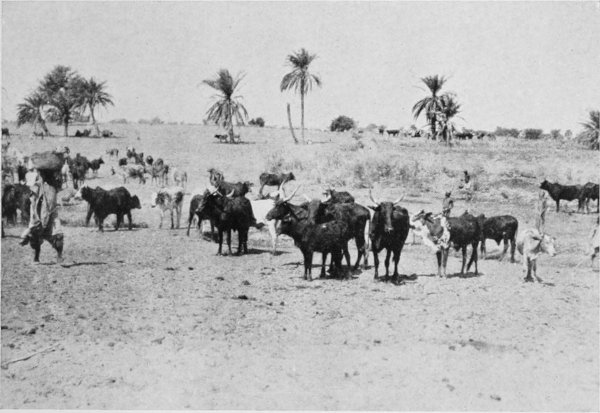
and there are a few Arabs. But in the cattle-market, which is also
on one side, the natives are often Fulani and Beri-Beri, who have
brought in cattle, sheep, goats, and camels from distant bush where
their herds roam.
There are some horses for sale in the cattle-market;
high-mettled, Arab-like beasts that are often very attractive, but
which, very unfortunately, are almost invariably gone at the houghs
through the stupid native habit of throwing a galloping horse
suddenly back on its hindquarters on hard ground to make a dramatic
halt before an audience or a king’s house, by means of pressure on
the locally-made cruel bit-iron which projects on to the roof of
the mouth.
It may be gathered at this stage that the local market of Kano
is well equipped to supply the wants of the primitive people.
Moreover, the whole interchange of trading is so extensive, that
there is a very wholesome buying and selling within its own circle
which employs almost everyone and makes the city doubly
self-supporting and self-sufficient.
This market within the old city, in its entirety, is the
everyday mart of the inhabitants and does not greatly concern the
white traders, who buy, at their own warehouses in the European
segregation outside the walls, their stacks of hides and tons of
ground-nuts and beans, which are the rich exports from the place.
There is also some European trade in cattle and sheep, which are railed
for the consumption of people at “down country” stations and on
“the Coast.”
But it is now time to pass on from the market-place and return
to quarters, though the loitering crowd that presses about the
stalls is so dense that it is difficult to pass through it, and the
din of the eager voices is deafening. However, once clear of the
congestion and noise, it is very pleasant walking or riding slowly
home under the spell of a closing day. Hundreds of natives are
still on the dusty roads, arriving joyfully at the journey’s end
with burdened animals, from distant parts, or coming from the
fields or villages near-by when the work of the day is finished;
all gladly and contentedly returning home, or coming to a haven of
rest, while the sound of pounding pestle-poles in their mortar
stools resounds methodically in the still air to declare to all
ears that industrious housewives are preparing the evening
meal.
You may hear also, about this time, the monotonous tom-tom of
small drums arising from the direction of a group of hutments, and
the loud voice of a functionary raised in peculiar declaration to
call forth neighbours; from which it may be understood that there
is gaiety afoot in some quarter where a wedding-dance is starting.
Such sounds on the evening air are very pleasant, as are all sounds
close to nature when they are explanatory of familiar living things
and joy of life to anyone who is overtaxed with the silence of the
lone places, as are many men of the caravans and of the bush who
drift into Kano from afar.
Passing through a shadowed gateway, named “Nassarawa,” in the eastern wall, you may
leave the strange old city behind in the dusk and take the straight
road to the white man’s town while snow-white flocks of Cattle
Egrets fly gracefully and softly across the eve-lit sky to their
night grounds, and satiated vultures and kites clamber heavily to
their roosting-perches on gnarled old solitary trees to gather on
each one in colonies.
CHAPTER III HAUSA, CURRENCY, CAMELS, TRAVELLING
At Kano I picked up two
more natives to accompany me on my journey, a Hausa youth named
Mona and a half-caste named Outa, while the interviews with
applicants were not without amusement, since conversation was
carried on in my somewhat amateur Hausa, with John privileged to
look on, and give his comical but shrewd opinion of the character
of his probable fellow-travellers—and he had his strong likes and
dislikes, though he judged his subjects solely by eye, for he could
not speak Hausa, as is the case with many natives of other tribes,
and in particular with coast boys.
Languages are very numerous in Africa, and to know them all
would be a great task, but every European on the West Coast knows
and makes use of the amusing native patois termed “Pigeon
English,” which is the crude English that natives learn to speak
who come much in contact with white men. And when one begins to
form sentences in Hausa, and troubles to translate them literally
into English, it is amusing what peculiar phrasing is arrived at,
and how similar it is to the patois of the natives. Thus
here are some literal
translations of some of the Hausa sentences I used:
Interrogating native
hunter.
“You, you make king of hunting in your town?”
“I make journey, I reach Aïr, after so I return within Kano when
my work I finish. You agree you come far together with me?”
“Money how much you wish you do work with me moon one one?”
“You agree you do month ten (with me)?”
Consulting a chief for
information of local hunting-ground and local hunter.
“I want I may collect birds and animals of bush.”
“I want I may flay them and I look inside of them.”
“I wizard am. I carry them and I show them to white men wizards
in land (of) Europe.”
“Not I wish I make journey quick because I want I catch them
all.”
“I want I may make hunting where grass it makes tall.”
“I want I may make hunting where rivers they make many: a place
of lake and marsh.”
“You are able you give me a hunter, he come along with me: he
point out to me a bush good?”
Translation of Hausa speech to
natives when camping and hunting.
“We shall alight here.”
“Perhaps we sit here days ten and four.”
(Or in opposite case): “We shall sit here little little, not we
shall delay place this. I will go I make hunting at (this) night.
You it is necessary you sit; you look (my) camp. Do not you
sleep.”
“I will take (my) gun, I will go, I will make of hunting
now.”
“You bring trap of iron.”
“We will sit here, we will watch in silence.”
“Do not you make (of) moving.”
“Beast that it is with a bad wound, we will follow it.”
The natives secured at Kano completed my personnel for
hunting—Sakari and Mona being available for gun-bearing,
bag-carrying, and skinning, Outa as horse-boy, and John as cook and
caretaker of his master, for he had already attached himself to me
with the sincerity of a faithful servant and was now watchful of my
welfare, especially taking upon himself to warn me when he detected
any “slim” manœuvring over camels or food or gifts by cunning
characters that came about camp or were met on our wayfaring.
Delays always seem to dog the start of a prearranged journey—the
more anxiously planned, the more sure some fateful hitch at the
last moment—and my experience at the “end of the line” in Nigeria
was no exception. At Kano the large quantity of stores of food and
hunting accessories that were to carry me through barren country
for about a year lacked almost all gun and rifle ammunition and an
important crate of apparatus for entomological work; all of
which had missed the
steamer at Liverpool; which advice I received in due course.
However, as the neighbourhood of Kano had been unworked by
collectors, it was not unprofitable to make a beginning there,
while observations alone would give me a good ground work to go on
as I moved further north, for by being familiar with species that
inhabited the Kano region of Northern Nigeria, I could the more
surely detect types peculiar to localities or given latitudes as I
encountered them in the Sudan.
Therefore I did not stay many days in Kano while waiting the
arrival of the lost supplies, and with the aid of native carriers
moved out with all my baggage to camp about six miles north of the
town near to a small village named Farniso.
My experiences there need not be unduly dwelt on. The
country-side was for the most part thickly populated and well
cultivated, and collecting was not of an exciting order. There were
no antelope in the neighbourhood, and jackals and foxes were the
largest animals I collected. Jackals were very plentiful, and I
have seen their dens even in the walls of Kano.
Reports reached me that there were a few lions in low-lying
country on the Hadeija river, where it passes through N’gourou, and
also that there was some good big-game country east of Kano towards
Maidugari (nearing Lake Chad territory), and I have no doubt but
that such reports were true, although I had no opportunity of
hunting in those localities. I judge that the big-game hunter who
journeyed to Kano would not find his hunting there, but would seek
it some days away to the east or the west or the north. I know not the
territory any great distance east and west, but I know something of
it northwards, and anon will explain where game lies where I
have seen.
Though collecting in the neighbourhood of Kano was not exciting,
bird life was attractive and abundant, as were small mammals, and
my days were well filled hunting in the early morning or late
afternoon during the hours of feeding and movement of the creatures
of the underbush, who dislike as much as humans do the intense heat
of an overhead sun, and skinning and setting specimens all through
the day, and after dark at night, in camp. During the few weeks I
remained camped near Farniso I collected 207 birds and 83 mammals,
and also a quantity of butterflies and moths.
In due course the lost ammunition arrived and a great anxiety
was lifted from my mind, for new regulations with regard to arms
and ammunition being exported from England were so complicated at
the time, that long delay, or even loss of authorisation was
possible if not probable; and I would have been in a nice
predicament and completely crippled without this item, which was so
indispensable to me on my journey. I assure you I could have
shouted with sheer joy when I saw the small weighty business-like
boxes coming into camp on the heads of carriers that were groaning
under their loads.
The arrival of ammunition stores left me free to begin the camel
journey northward over the boundary into French territory, though I
was still short of
the crate of entomological apparatus— which did not reach me till
more than a month later, forwarded by courtesy of the French
officials.
In departing from Kano I would say good-bye to the last post
that boasted of civilisation and pass “out of the world,” for there
are surely few places on the face of the earth more remote and
God-forsaken than the interior Sahara of Central Africa—as in due
course I was to learn; though in this I was to some extent prepared
by study of bare incomplete maps, and in finding how difficult it
was to glean any information of the country in England before
sailing. But I was not prepared to find how little was known of the
country at Kano, where I had calculated I would probably learn much
about my journey ahead, whereas, in fact, I gained practically no
information from the few white men there, and very little from
natives, who were much given to reticence with strangers, or, if
free-spoken, to wild exaggerations. I did not meet a single
Englishman or Scot in Kano who had been across the boundary into
French territory as far as Zinder, which is a ten days’ camel
journey north, and it is strange but really true that almost as
little is known of the Territoire du Niger in Nigeria as in
England, though the two former are next-door neighbours. But so far
as travelling to Zinder is concerned, apart from Zinder being in
French Territory, it can be readily understood why British
Europeans do not make the journey from Kano if one can realise the
desolation of the country and the exhausting heat of the African
sun, which makes such
a trip, merely for the sake of sight-seeing, altogether
uninviting.
By reason of preparing to enter this land that knew the sadness
and solitude of “the lone places” rather than even the rudiments of
civilisation and commerce, I had perforce to carry all stores
necessary to life; and I must carry money also—not a little, but a
quantity sufficient to last me over a protracted period. Therefore,
my last act on the eve of departing was to ride into Kano to draw
money from the bank. And through the kindness of the manager of the
Bank of British West Africa, who rightly viewed my task in the
light of one of national importance and not one of trade, I was
enabled to have the large quantity I required issued to me in
silver; which was a generous concession on his part, and of the
utmost value to me, for silver was at that time at a premium, and
one could purchase at least 25 per cent. more with coin than with
paper-money, which found ill-favour with the natives.
There are two reasons why notes, which, at the time of my visit
to West Africa, were causing much inconvenience and concern to
traders in Nigeria and to the military officials in the French
colony, are disliked. In the first place, many of the natives are
unable to read the value printed on paper-money, both the actual
figures and the wording being in English, so that when it is
tendered in purchase, they are sometimes doubtful of the value they
are receiving; whereas with coin they can easily judge the
different values by the variety of size. Secondly, it is the habit
of the natives to conceal their wealth in a secret hole in the
walls of their huts
or in the ground, and paper-money is not adapted for such a
purpose, since it is not impervious to damp in the rainy season,
nor the ravages of white ants or mice at all times. Furthermore,
the “brown paper” shilling currency is a poor affair at best, and
not durable to the large amount of outdoor handling which money
receives at the hands of the natives, and whenever a note becomes
torn, it is looked upon as valueless among themselves, and quickly
reaches the white man’s store, where it is known it will be
accepted and taken off their hands.
So, with knowledge of the drawbacks of paper, I gleefully
returned to camp with my supply of silver, and that night secreted
the major portion of the coin in various ammunition boxes in the
hope that it would in that way escape detection and plunder on my
long journey. Silver in quantity is very heavy to transport, but
that was fully compensated for—for had it not the power to put one
on good terms at once in all dealings necessary with natives?
Further, I found it unnecessary to make exchange to French coin
once I had crossed the Frontier, since the English shilling and
two-shilling piece were acceptable everywhere.
I secured ten camels for my journey to Zinder, and not, in a
limited time, since it was ground-nut season, when transport
animals are in great demand, being able to obtain the full number
required to transport my loads, which weighed close on 4,000 lbs.,
I had to fall back on oxen to complete the complement, taking four
of the latter to carry loads equivalent to that which
two camels could
carry. Camels can load 300 to 400 lbs.
The camels of Hausaland and the Territoire Militaire du Niger
are the one-humped race that are named “Rakumi” in Hausa and “Alum”
in Tamāshack, and they are the outstanding transport animals of the
country. Indeed, without camels it is difficult to see how the
inhabitants of the interior Sahara could subsist, for they are, in
essentials, the only animals truly adapted to long journeys in
barren land, where water and food are often very scarce. The
distance they can travel with 300 to 400 lbs. loaded on their
backs, and their uncomplaining endurance is altogether marvellous,
and it would be a man of poor appreciation indeed who knew their
habits and had not praise for them.
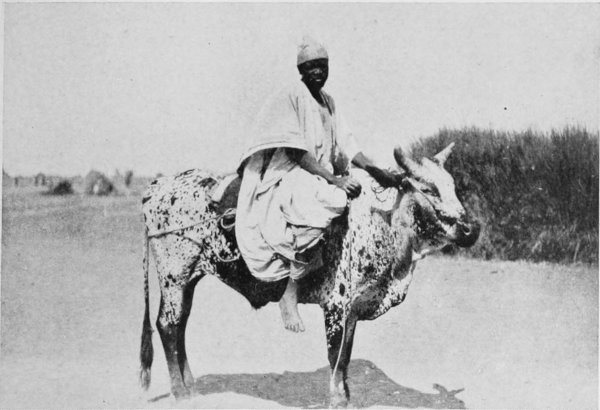
Donkeys and oxen are two other animals of transport which are
used on routes that are not too severe, and donkeys in their
patience and endurance have some of the commendable traits of
camels, and are capable of accomplishing long journeys if not too
heavily loaded—100 to 150 lbs. is a fair load—though they are
slower in getting over the ground. Oxen, on the other hand, are of
secondary value as transport animals, and are seldom satisfactory
on a journey of any length, for they do not harden well to their
work, and often break down tamely under a prolonged burden. This is
because the heat of day is very trying on them when en
route, while it has little effect on either camels or
donkeys.
As Aïr, and the section of the Territoire Militaire through
which my journey led me is the home of the camel, and since I travelled
hundreds of miles with those fine animals, perhaps a few remarks
concerning them would not be out of place.
The market-price of camels in 1920 at Kano and Agades was about
£8 for a young beast 4 years old, and about £15 for a full-grown
animal 9 to 15 years old. Those prices, even though they have risen
considerably since the war, like everything else even in such
remote parts, must appear small if it is taken into consideration
that camels require to be nourished and reared for 8 to 10 years
before they have reached maturity and are really fit to join the
caravans and bring recompense to the owner. On one occasion I saw a
young camel of 4 years, small and still with a semi-calf look about
it, being ridden by a Tuareg who was a lightweight; but to break a
camel at that age is quite exceptional, if not foolish, for in all
probability this early labour, before bones are hardened and
muscles full and set, spoils the ultimate development of the
animal. Some camels are considered developed enough for short
journeys when 6 years old, though they are seldom fully matured
until 8, 9, or 10 years, while they reach their prime about the age
of 15 years; afterwards they begin to lose a little ground, but are
often quite useful and strong up to and over 20 years. At an age of
30 years a camel may be said to be altogether beyond work.
In colour there is considerable range among camels, the most
common variety in this territory being light buffish-brown,
somewhat resembling sand, while piebald and brindled
camels are also
numerous, the latter having random patches of white on a surface
that is chiefly dull lead-like blackish-grey. Those piebald and
brindled beasts are reputed to be an Aïr race, but how far that is
true I had no opportunity of proving, though I can vouch for having
seen among the Aïr mountains more camel-calves of that colour than
any other. Moreover, it is a splendid protective colour against the
mountain background of blackish rock and pools of sand, so that the
claim has at least that in its favour. A colour that is not very
common among camels is pure white, while one that is quite rare is
rich tawny reddish buff. I have seen a score of animals of the
former colour, but only two of the latter.
A HAUSA NATIVE RIDING AN OX, KANO
CATTLE OF HAUSALAND.
In selecting camels to make up a caravan, it is problematical
whether you get good-tempered or bad-tempered beasts, and one
should be optimistic enough to accept the bad with the good and put
up with the annoyance of saddling and loading cantankerous
individuals, for there is no caravan was ever without them. But if
you wish to use a camel for hunting—and they are exceedingly good
for the purpose, being very noiseless of foot—great care in
selection should be exercised, and only a tried animal should be
used which is good-tempered and taught that it must not roar as you
dismount to commence your stalk on sighting game. The awkward and
somewhat wooden appearance of camels does not lead one to associate
much intelligence with them, but to think so is a mistake, and if
one desires to have a really good hunting camel, I know of no
better method to
secure it than to select a good-natured beast from the rank and
file, and hand-feed it with tit-bits of vegetation, and pet it when
mounting and dismounting, and let no one else saddle it or ride it,
and before long you will be astonished to find that you have won a
queer pet and a useful and obedient comrade. It will have been
gathered that it is the noisiness of the brutes that has to be
guarded against when hunting, and that is so, for they are fearful
beasts to roar on the slightest provocation. Besides being timid
animals, they are very tender skinned, and almost all of them emit
a loud complaining roar whenever they are touched by a human hand
or there is the slightest movement in the position of the saddle in
mounting or dismounting; while if an animal happens to be suffering
with horrible septic saddle-sores, such as are very common, it is
sure to make a terrifying uproar whenever approached.
When travelling with a caravan, it is usual to commence to load
up before daylight and get well started on the way before sunrise,
which is about 6.30 a.m., or—especially if there be a moon—to make
a start at 2 or 3 a.m. in the night, and travel the greater part of
the day’s journey free from the rays of the exhausting sun. On such
occasions the camels are gathered in at sundown on the eve before
from browsing among the acacias, and made to lie down by the
camp-fire, so that they are at hand when the camel-men go to work
in the darkness. Then, when the hour to start comes round, logs
that have been collected the night before are kindled to make a
blazing fire, and by the light of the flames the loads are securely
roped and loaded
across the pack-saddles, so that equally balanced packs rest on
either side, while throughout the process the black bush silence of
the night is rudely broken by the deep querulous roars of the
camels in protest against being handled. Loading up in the poor
light of night is a slow process, and in my case three or four men
usually took from an hour to an hour and a half to load ten to
fifteen camels. But the secret of a smooth journey is to begin the
day with loads thoroughly secure and well balanced so that they
will not annoy the bearer; and with bulky loads, such as the
chop-boxes and collecting-cases of the white man, which are
unfamiliar and clumsy both to the natives and their beasts, it
requires considerable care in loading to be reasonably sure of a
well-ordered start. When things do not go well, it is a mistake for
the traveller to become impatient and abuse or hurry the camel-men
in the early morning, when tempers are apt to be short, for
although they are undoubtedly slow in their methods, they know
their work and their animals, and will make the better loads if
left alone, and you merely lend a hand here and there, and joke
with them over their work, and thus gain their good-will and
confidence. As to the type of saddle, a serviceable and simple
saddle is made of wood in this fashion: first there are two
arch-shaped pieces which are made to fit over the back of the
animal, and which rest before and behind the hump, while underneath
them are bound leather pads filled with palm fibre, so that the
saddle is comfortably received on the camel’s back; secondly, from
the back and front pieces there are run four horizontal bars, which are
bound in position to the arches with goat-skin or sheep-skin
thongs, whereby the saddle is made rigid and complete. It is a very
simple piece of construction, but serves the purpose.
Sometimes no saddle is used when carrying good loads, such as
bales of grain or salt, which naturally lie very close and
compactly to the body of an animal, in which event two long
goat-skins are used, puffed out like pillows with filling, which
are thrown over the back on either side of the hump, and receive
the burdened load ropes which carry the bales in position on the
sides.
When loading camels on the first day at the commencement of a
journey, or after having been idle for a week or two turned loose
in the bush, they are afraid of their unfamiliar loads, and behave
like bolting horses or wild colts, and saddles and packs are no
sooner secured, and the brutes on to their feet, than they show
their ill-humour and everything is thrown to the ground again.
Once, twice, even thrice this may happen with three or four camels
in the caravan, while it seems as if you will never be able to get
out and away on the road. But in the end all are ready and in line
and a start is made. But on that day you are sure of trouble en
route with the fractious animals, and not until the morrow need
you expect anything like reasonable order, when you will almost
surely find that even the worst of the brutes has become docile and
resigned to steady work.
I did not miss any of my share of this sort of experience when
the day came for me to set out from Kano—I don’t think anyone does. Camels and
their Tuareg drivers were in my camp at Farniso ready to start on
the morrow (12th January). That evening trouble began: the
camel-men, not having finished their private bargaining in Kano and
seeking an excuse to delay, had put their heads together, with the
result that they concocted a story that they had not enough rope to
cope with the tying of the awkward loads of the white man—which was
true, in fact, though anyone might know that it was not necessary
to go to Kano to secure them with a village close at hand. However,
knowing their homes were distant, and that it might be long before
they had again occasion to visit Kano, I gave permission for one of
them to go back, provided he would start there that night when the
moon rose at 11.30 p.m., which he promised to do. Being easy-going
and trusting at that time, which was before I had much knowledge of
the plausible and sly-tongued Tuareg, I turned in and slept
soundly—and so did the cameleer, for next morning I learned
that he had not started for Kano until daylight. This meant that
the whole morning was lost—not very pleasant when tents are down
and everything you possess is bundled up and roped in camel-loads,
and there is nothing left to do but sit on them and smoke
innumerable cigarettes and inwardly curse your camel-men and your
luck.
The camels were, in the meantime, turned at large to feed in the
neighbourhood with their fore-feet hobbled, which was as it should
be; and all was right until the man returned from Kano with more ropes and his
purchases of cloth, and a cameleer hastened out to bring in the
animals, but returned in about an hour to say that he could not
find two of the camels.
At this stage everything seemed fated to go wrong on this
day.
But there is a rift in the clouds even on the worst of days, and
in the end the lost camels appeared in view, coming in at a
breakneck pace before a mounted camel-man who had skilfully tracked
them down in the sand for a long distance and rounded them up. The
brutes, though their fore-feet were hobbled, had tried to return to
their old haunts in Kano.
It was after 3 p.m. before we got loaded and away on this
ill-fated day.
I had arranged before starting that we would camp at Fogalawa,
18 miles away, and it was well I did so, for, after starting out
together on the road, I did not see the main part of the caravan
again until midnight, since I remained throughout the journey with
the tail-end of the line, where an obstreperous and unruly old
female camel made the devil’s own trouble, and threw her load again
and again with most vicious determination. The climax came close on
sunset, when the camel-man and I were overheated and dust-grimed
and angry over our exertions, and the cantankerous brute cut loose
once again, and threw and shattered the chop-boxes and strewed the
contents on the road. While bemoaning my ill-luck, and letting
tongue run loose on the virtues (?) of our beast of burden, and at
a loss to know what to do next, a native chanced to come up with
some unloaded camels,
and I was able to strike a bargain for a beast to take the place of
the unruly one.
Thereafter the journey was a smooth one, but, nevertheless, I
had lost so much time on the way that it was midnight before I came
into camp behind the last camel, and had been nine hours on a
journey that should ordinarily take five and a half to six and a
half hours.
So much for the discrepancies of the “first day”; and now I must
return to our starting-point, so that I may tell of the wayside.
During the afternoon and through the night in the darkness we
travelled over a broad roadway of loose shifting sand that held
north through fairly open country that was, in general, under
cultivation. Trees were plentiful, growing for the most part singly
and not in close-set mass, but they do not impress one with height
or stature at this season, though in the Rains the full-leaved
trees of any size are imposing and conspicuous enough in most of
the flat country between Kano and Kanya. No doubt the whole country
has been covered with acacia bush at one time, with an odd large
tree shooting above the dwarf forests here and there, and though
the acacia bush has been cleared away to give place to cultivation,
the big trees have been left standing, since to the toilers in the
fields they are harbours of shade from the merciless sun.
Along the road a constant incoming string of caravans of camels
and donkeys and oxen passed us, carrying bulging bales of
ground-nuts to Kano, for the ground-nut season had begun, and
unprecedented prices were being paid for them by the white man, which had created
a widespread boom in the district and a tremendous wave of
speculative excitement. It was a great year— 1920—of prosperity for
the natives of Kano, this last fling of commercial extravagance at
the end of the war—a rich year that, in the end, must have left its
mark, for one could easily forecast the time to come, when there
would be acute comparisons between the heyday of the boom and that
other day when the boom must burst, and hearts be sore—for it is
hard even for a native to come back to the solid old ground-level
after he thinks he has reached a golden citadel in the clouds.
Next morning we continued on our way without any repetition of
trouble with the animals, and the old camel, that had stubbornly
refused to carry the white man’s boxes yesterday, to-day carried
with ease a greater load of ammunition packed in native grass-woven
bales. The brute had been nothing more than wildly scared of the
strange articles that it had been set to carry.
The road continued broad to-day, but grew ever heavier underfoot
with loose sand. By the wayside there was not so much cultivation
as yesterday, and few habitations, except at Kore and Minna. We
camped in mid-afternoon at the small village of Kanya after a
pleasantly smooth journey. It was gratifying, after our trials of
yesterday, to see how nicely the camels of a well-ordered caravan
move forward over the ground with their soft-footed methodical
gait; they get over the heavy sand road not only with their long
pacing stride, in which both legs on the same side are lifted
together, but also they move with a strange stealthy silence, which is due to the
rubber-like give of their soft elastic pads. A further odd and
striking detail about the feet of a camel is that, unlike other
animals, the fore-feet are larger than the hind-feet.
Travelling by the wayside in inhabited country, if you happen to
be near human dwellings, cockcrows will herald in the African dawn
from some village hut-top obscure among the bush foliage, and on
the third day we were busy with the load-ropes in the chill of late
darkness ere the first glad cock-call told of approaching day.
Already we had learned that it was wise to travel in the cool hours
as far as possible and save our animals from the great heat of day,
so long as short nights and loss of sleep were not over-fatiguing
to ourselves, or, rather, perhaps I should say to myself alone, for
natives have the knack of sleeping in daylight just as easily as in
darkness, and throw themselves down in any little patch of
tree-shade at the end of a journey and retrieve their night-sleep
almost before it is lost: while that I could never do, even if I
had not work to attend to.
But there was one native with me who worked long hours without
sleep much as I did, and he was the faithful John. On his broad
shoulders rested all the petty duties of attending to his master’s
welfare in camp: a host of small duties indeed, such as cooking
meals at any hour— early or late, at noon or midnight; pitching or
striking my camp-bed (for I slept in the open); or doing the
services of a valet in looking after all my personal belongings,
and my toilet, even washing clothes when he had the time to
spare—in general,
cookboy and houseboy all in one, and a treasure. Moreover, he
afforded amusement all round through the medium of his perpetual
cheerfulness and expansive grin. Often I have laughed to see him,
after the rush of getting ready to start, when he had got the last
bundle turned over to the camel-men and his master’s camp clear,
come saucily forward in his cloth cap and with his cane
walking-stick—both relics of the coast which were inseparable from
his person— and with a perceptible swagger over his “English” (?)
and his importance as the master’s boy, grin broadly and ejaculate
to the head camel-man: “Come on, come on, Aboki (friend), we wait
for you!” which assurance always provoked laughter among the men,
while Sakari explained to them in Hausa John’s “English” (?), and
added to it in the telling.
The Harmattan winds had been very pronounced since starting, and
the third day was as bad as its predecessors. So full of sand-dust
was the air, that a white cloud hung over the land through which
the sun was unable to break clearly. The mane of my horse was white
with dust, and, looking on the acacia trees a little way off in the
bush, they had the appearance they would bear on a frosty morning,
with the fine dust, like white mist, hanging low and falling upon
them to lie whitely upon the leaves and boughs.
I noticed at Kanya, and beyond, that the peculiar reddish sand
and soil of Kano had given place to ordinary whitish-grey.
On this day we travelled to Jigawa, 18 miles away, on the banks
of the Tomas river, which, though it was nothing more than dry bed at
this season, is a very considerable stream during the Rains, quite
one hundred yards across the floodwater. The place is a small town,
with the remains of a stockade about its outskirts, and it
contained wells of water and the usual village produce of eggs,
fowls, and millet-meal, as well as goats and cattle. It may be
stated here that there is no scarcity of water or food experienced
anywhere on the journey from Kano to Zinder.
I heard at this village the first news of big game that I had
had, and in the cool of the afternoon I went out westward to
investigate, and the result of a prolonged hunt through fairly open
thorn bush was that I sighted, and viewed through field-glasses,
four Red-fronted Gazelle, which the local natives with me said were
in fair numbers in the neighbourhood. The beasts, at which I fired
one ineffectual shot, were very wild, and gave me the impression
that they were disturbed often by the natives who hunt them.
The fourth day was a pleasant one, for it entailed only a short
ten-mile journey; and I can assure you that a short day after two
or three long, hot, and exhausting ones is a very agreeable
change.
We camped at noon at Barbara, our day’s task finished; and the
camels were hobbled and turned out into the scrub bush to enjoy a
lengthy repast. Barbara is a large town that lies five miles on the
British side of the frontier, and here it was that I bid good-bye
to Nigeria for a time. Hence I made it a stopping-place, and an
easy day. (I did the same thing many months later, on my return, and was royally
received by the Saraki (native king) and his people-a large number
of whom were Fulani—who en masse spent the day in holiday
and dance because the White Man had safely returned and was
glad.)
On the morrow we crossed the boundary and entered French
territory, having crossed the line about an hour after starting
where it lay between the two small villages of Baban Mutum
(British) and Dashi (French); places, like many others, that were
not shown on either of the incomplete maps I possessed, which were
the best I could procure in England.
In the afternoon we halted and camped at Magaria, where there is
a small French fort commanded by a European officer, with native
troops under him. Here I was most cordially welcomed to French
soil, and enjoyed the frank, unfettered hospitality that for ever
is to be found with the big-hearted men of the Lone Places. Though
I was not yet more than eighty-five miles from Kano, a European
visitor was rare to the board of this solitary soldier, and so I
was made doubly welcome over our cups of good comradeship, though
neither could glibly speak the other’s tongue, and conversation was
carried on for the most part in halting words of Hausa. He was a
jovial good fellow, beside being the kindest of hosts, and ere the
day was out I think we put the sober mud walls of his little cabin
to shame with our gladness and laughter. That he was a lone man
could be gleaned from his surroundings and his tastes. For
companions about his abode he had a cage full of little waxbills, a
grey parrot, two
pie-dogs, two cats, and four Dorcas Gazelles— all bird and beast of
the country-side, except the two cats, which were Persian. The
barrack square and the garden of the Fort afforded him further
pleasures in homely hobbies: in the square, young trees had been
lately planted to form an entrance avenue and give shade, and to
watch them take root and thrive was this man’s way with his
treasures. And in the garden among the shrubs and vegetables his
interest was the same to coax plants that were not indigenous to
grow in the sandy, thirsty soil; and that he had some success I can
vouch for, for there were beds of such vegetables as carrots,
radish, beetroot, peas, and cabbage growing quite fairly at the
time of my visit.
As I progressed later on, I found such humble gardens wherever
white men were stationed: only a few places in all, it is true, but
always a garden to furnish the need for vegetables, which is a
pressing one to the health of Europeans in such a barren land as
this, for rarely vegetables and no fruit can be obtained from
natives. Apropos to this, entering a country of tropical heat, I
was not prepared to find that it was devoid of fruit (excepting a
limited amount of dates in the rainy season), and the discovery
disappointed and dismayed me, I must confess, for it left me on
short commons in that respect throughout the expedition. And when
one lives for a prolonged period on the unchanging diet of animals
that fall to your hunting, the hunger for fruit or vegetable grows
ever greater, and is, at times, very difficult to allay.
The sixth day found us on the road at dawn, with Nigeria behind
and the caravan well started on the way to Bande, our next halt. On
this day and the next, over a belt of about twenty-five miles,
country of marked change was passed through, and one got the
impression that it was now turning more to desert. Dum palms, in
small groups or solitary, sceptral with their tall graceful stems
and tufted rustling tops, were now in the landscape, while there
was a new sense of open space about one, such as is felt on sea or
prairie, which was brought about by the wide views of grass-grown
land before one where eye could range for long distances.
With the regularity of routine we were marching off the distance
on the map, and each day we camped a stage further on—and a day
nearer to Zinder. On the seventh day we made the journey from Bande
to Makochia, over a very heavy road of loose sand; on the eighth we
camped at Dogo— ever the cruel sand-drifting winds of Harmattan in
our faces, while ever we held steadily on, for after camels are
loaded at the dawning of day, never halt is made by the roadside
until the journey’s end is reached and the patient brutes lie down
and are relieved of their burdens.
The day of our journey to Dogo was one of particularly fierce
storm, and we went forward against a very heavy wind and enveloped
in continuous clouds of drifting sand: and, besides, it was so cold
that I had to keep on my woollen sweater and khaki tunic throughout
the day, although hitherto I had not on any day worn a tunic, and
as a rule discarded my sweater an hour or two after the chill of dawn. At Dogo
I was forcibly reminded of a snowstorm on the Canadian plains;
before the village there is a wide white level stretch of sand
almost plant-bare, over which winds and driftings rushed fiercely
from afar to pounce madly upon whatever lay across their path. Not
snowstorm nor piercing cold are elements of this land, but imagine
the soft sand underfoot, like snow, the drifting sand, the snow
blizzard, and the sting of the storm in eyes and nostrils and
throat as unpleasant as the tang of biting cold, and you have the
comparisons that have a very decided resemblance.
The road to Dogo lay over undulating country, pale with dry
grass and sand, with a touch of faded green where there were trees
in the open spaces. It should be a fair country to look upon in the
Rains, but it is for the present inert, and discoloured with the
drifting sand, and is a melancholy land indeed.
The country by the wayside had for a time a pronounced fall away
to a deep valley visible to the west.
The altitude of Dogo is 1,375 ft., so that we had descended some
300 ft. since leaving Kano.
Dogo is the Hausa for tall, but I could gather no
particular reason for the name. Had it been called Gara (the white
ant), however, I would have well understood, for I have seldom seen
an equal to the plague of termites that was here: boots, leggings,
articles hung to the wall, every box among the camel-loads, was
attacked by the infernal pests as soon as ever we camped
and before we had
time to prepare rough timber platforms to raise everything off the
ground. White ants have to be guarded against everywhere in the
Sudan, but I never saw them worse than at Dogo.
Next day, which was the ninth day of our journey, we reached
Baban Tubki, six miles south of Zinder, where there were a few
small date groves and plentiful well-water, and more luxuriant
vegetation than usual. So that I decided that here I would pitch a
collecting camp, and with that purpose in view swung the caravan
west of the road, and sought a camping-place among the scattered
trees and tall grass about a mile away. Camels were unloaded and
the packs freed from their many ropings, and the preparations of
camp erection were begun—and trekking for the present was at an
end. . . .
In the part of the territory of Damagarim through which I had
travelled since crossing the frontier there was no great change
from that of Nigeria. It was certainly less populated, but the
Hausa, Fulani, and Beri-Beri tribesmen were the same, as also was
the construction of their grass huts and villages, though some of
the latter were somewhat dilapidated and had the aspect of
belonging to a poorer or more careless class of natives.
So far as I could tell by daily short excursions into the bush
off the road, none of the country I had passed through was notable
for big-game; but if I was to hunt in that particular territory, I
would start at Jigawa (fifty-six miles north from Kano), and work
north as far as Makochia, about fifty miles further on. I know
there are Red-fronted
and Dorcas Gazelles in that belt, but that is as far as my limited
knowledge goes for the present.
By the wayside, each day, I had made notes of every living thing
I had seen—bird or beast or butterfly. Now it was my task to set to
work and preserve a representative collection of the fauna of
Damagarim, and forge one link in the chain of the zoological
geography of the country, of which up to the present nothing was
known.
CHAPTER IV A DAY’S WORK COLLECTING
Collecting was my constant
occupation during the month that I camped and hunted near
Zinder.
Now, collecting Fauna for the scientific purposes of large
Natural History Museums is work somewhat out of the ordinary; so
much so, in fact, that I would like to show clearly what such
pursuits entail, and to do this will endeavour to describe some of
the actual work in the field.
To begin with, the climate is African: which means, in this
territory, that for at least nine months in the year the land knows
not rain, and lies like an overdone pie-crust, withering beneath a
heat that is too great. Day after day, with unchecked regularity,
from the break of dawn, a fierce sun rises rapidly high up in the
sky, and as it gains in strength, so a silence settles upon the
earth, for so great is its oppression, that at the height of its
power it subdues all living things. About 10 a.m. you may notice
that the glad sounds of morning have faded—birds are retiring to
leafy shades, the boisterous noise of natives at work in the
village has died down; before noon the land is wrapped in silent
solitude, and Old Sol alone is left in the field.
Hence the time to go hunting in this land is early in the
morning or late in the afternoon, when the creatures of the
underworld have left their hiding-places and are up and about in
eager quest of feeding. For the hunter and his native boys it is
also the favoured hour, for, as in travelling, the cool of the day
allows of the maximum of exertion without any forfeit of sheer
exhaustion which the noonday sun inexorably imposes.
Let us follow the proceedings of a morning’s hunting. I have
turned wakeful toward dawn, and lie warmly in my blankets awaiting
the sound of cock-crowing to tell me the time, for I am without a
watch since the sand has damaged both I possess. When I hear the
call I listen for, I know full well I must bestir myself if I would
go away to the fields in good time. Blankets and bed are
provokingly comfortable at that moment, but it is fatal to
hesitate, so I call “John!” and at once he answers, for he too has
been sleeping lightly; and while I am dressing he lights a
camp-fire and prepares tea. Sakari and Mona are also awakened, and
sit, with their coloured blankets over their shoulders and drawn
about them, huddled before the few embers of a fire that they have
rekindled, for there is a chill in the air and they are still half
asleep and without vigorous circulation.
When I am ready, we prepare to start. My search is for birds
this morning, so I take ·410 shot-gun for collecting small
specimens, 12-bore shot-gun for anything larger, and a ·22
Winchester rifle in case I find some wary bird that I cannot get
within gun-shot of, and yet may see it watchfully perched within the range of the
little rifle. I fill my pockets with cartridges: those for the ·410
loaded with dust for sparrow-sized birds, and with No. 8 for birds
of the size of doves; while I carry only No. 6 in the cartridges
for the 12-bore gun, which I have found will kill vulture or eagle
or bustard—in fact, any bird less than an ostrich. Also, I take an
open basket, so that I may carry the specimens I capture with great
care and without damage to the plumage, some cotton wool to stop
bleeding and fill wounds, and a notebook in which to record the
colours of the soft parts before they fade at death—viz. the colour
of the eyes, the bill, and the feet.
John stays behind to prepare breakfast and make camp clean and
tidy for the day; Sakari and Mona come with me.
I know where I will go—I keep more westerly than yesterday. We
go carefully at first over the uneven ground, for it is not yet
light, though there is now a faint brightness in the eastern sky.
We are well away from camp, and cannot see it when daylight is upon
us. I am alert now that the sky has cleared; eyes roam everywhere,
catching movement in the undergrowth, among the leaves of big
trees, or in the sky. Many birds I see: little brown ones like the
undergrowth or ground; pale ones like the sand; dark ones like the
trees; or gorgeous ones that have no shy colouring, but are gems
unto themselves, that peep out brightly revealed in the dark
background of their leafy haunts. I know them all, they are very
familiar—for am I not among them every day? I am not concerned with
these: I pass on ever observant, ever expectant, knowing that there are others
that I will find. . . . Soon I am arrested: I have heard a note
that I do not know—so often I am guided in that way. I go forward
watchfully in the direction of the sound. . . . I have now marked
down the clump of bushes whence the call proceeds. . . . I am
within range of it— when I see a long-tailed bird dive from it and
disappear in an instant. I have seen that it is a Coly, but not of
a race I know. . . . Pray do not think I have lost this valuable
quarry, though it has flown and is out of sight. Ah, no! birds that
inhabit a favoured thicket are unlikely to fly very far, especially
in the feeding hours of morning. So I pause and listen attentively,
and anon I think I hear the tell-tale somewhat mournful single-pipe
call of the bird I seek, but it is so faint that I wonder if fancy
is deluding me. There is no time now to be lost. I hasten forward
among the thorn trees that in a belt grow numerously, and the pulse
quickens as I again hear the call for certain, and from more than
one bird. . . . I feel my way toward the sounds. . . . I am not
sure of the direction at first, but as I draw near there is no
doubt. The birds are ferreting for leaf-buds among the thick tangle
in the centre of a thorn tree (acacia). I get up in time to see
them dart away, and succeed in shooting one specimen. But that is
not enough, for the species, a long-tailed Coly, with a blue band
on the back of the head (Colins macrourus), is new to my
collection; I must follow them up. So I hunt on for an hour or so,
with the result that I capture four; and it has been an exciting
chase, for the birds were peculiarly wild, though they are of a kind
that are often easy of approach.
I am very warm, and stand beside a tree to smoke a soothing
cigarette. I have seen a number of hawks in the air during the
morning; now that I am idling in the shade I see another. It is of
a species that I have observed before, but that I have never been
able to approach—a very large hawk, of even dark leaden-grey
colour, with mighty wings and a crested head. The bird swings
slowly over the land about a quarter of a mile away, and I give up
following it, and drop my eyes to look about nearer at hand.
I had forgotten the incident, when Sakari aroused me with:
“White man, dem shafo (hawk) live for tree—look him!” and he
pointed away to a small group of tallish trees on our right. Sure
enough, following Sakari’s directions, I could make out the outline
of a heavy bird perched near the top of one of the trees, whence it
overlooked the whole countryside. The native had watched it fly and
settle there.
Now began a stalk as exciting as one could wish for. I always
look on birds of prey, the hawks and the eagles, as royal game, and
feel about the same intense interest in hunting a wild species of
them as I do when stalking a particularly fine head of big-game.
Between me and my prey there was hardly any tree cover. I could
only trust to using the “lie” of the hollows to reach the bird
unobserved or at least unsuspected. I ordered the two natives to
remain where they were, while I took my shot-gun and started on
a wide detour, so
that I might reach a little dry streamlet hollow that led in toward
the trees. Rapidly, but carefully, after I had got round into
position, I advanced, crouching and creeping, toward the bird; and
always when I dared to glance ahead I saw my coveted quarry perched
in place and unalarmed. When I drew closer I could distinguish the
eyes and hooked beak, and saw that the bird was watchful, for it
turned its head in one direction and then in another as it looked
out over the landscape. . . . Now I was crawling flatwise, bare
bruised knees and all, and before long stood breathless among the
trees—the bird somewhere overhead. As I moved to get a better view
through the branches, the bird swooped from its perch to make off;
and then crumpled up in mid-air as the report of my gun rang out.
Seldom have I been more satisfied with the sound of the fall of a
heavy bird; for many a like stalk have I made after equally rare
prize, only to find the sharp-eyed quarry depart when I was
half-way on my journey, or sometimes when almost within shooting
range.
The natives soon joined me, and having now enough specimens for
the work of the day, we turned back to camp.
On the way home I had two fox-traps to visit and lift, for it is
not safe to leave them set during daylight, lest browsing goat or
village cur stumble into them. The luck of the morning continued,
for in the second trap there was a struggling captive—a beautiful
buff sand-coloured little fox known as Vulpes pallida
edwardsi.
This capture afforded the two natives great satisfaction, and, as is their habit, they
showed fiendish glee over the downfall of this creature of renowned
wit and cunning. If they were not restrained by my presence, I know
they would poke it with sticks and jeer at it, and in many ways act
with unconscious cruelty, for they have not an atom of pity for
such things—no African has. If they were free to kill the fox, they
would secure the teeth and the eyes and the skin to secrete the
parts about their persons as charms in the firm belief that they
thus invest themselves with the high gifts of the animal against
the cunning of their opponents or enemies.
Thus finished a morning’s hunting. Sometimes, on other days, I
would meet with greater success, sometimes with less; and
sometimes, too, I would have my days of disappointment, when a
rarity was seen and lost through a missed shot or in losing all
traces of it in its flight. But the hunter does not readily forget,
and naturally memorises a place where he has once found quarry, so
that again and again he will revisit it, and often picks up on a
later day that which has escaped him at the start.
There were few big-game in the district, and, in my case, for
the present, it was not my concern to hunt them, except that I
might have fresh meat.
But in addition to ornithological research, I was interested in
collecting all kinds of small mammals, and as few indeed were ever
seen in daylight, I had to resort almost altogether to steel traps
to make my captures, and had mouse-traps, rat-traps, rabbit-traps,
and fox-traps set at nights wherever I found an inhabited burrow or den
or a frequented “run.”
Furthermore I had yet other matters to give thought to, for I
was to bring home collections of Lepidopteræ, which entailed long
excursions in the heat of the day in quest of butterflies, and
patience-trying hours of watching by a lamp-lure in the darkness of
night in quest of moths.
Altogether, I can assure you I had no time to weary for
companionship or to realise my loneliness, and that was a
comforting consideration.
I have described the manner of hunting specimens, and would now
turn to the work of preserving them.
I have built a rough-framed grass hut for workshop, close to my
tent. When I return in the morning, it is here that the specimens
are taken, and work is begun at once, for the temperature is so
great that a lifeless carcass cannot be relied on to keep fresh
longer than five hours, and will certainly be beyond handling if
left to the end of the day. I usually preserve from five to ten
specimens in a day, the number depending on size or the success of
hunting; while on special occasions I have finished as many as
fifteen in a day.
Sakari and Mona, the boys selected at Lagos and Kano to help in
skinning specimens, can now be trusted with certain work. The fox
had been put out of pain, and, laying it on its back, I make the
opening cut in it and start Sakari on the task of skinning. As he
proceeds to work the skin off, from the belly upwards, the limbs
are drawn inside and severed at the heel of the paws,
the tail is pulled
out by the root, and in time the skin is clear of the body and
drawn off over the neck and head. The limbs are then labelled:
“right fore,” “left fore,” “right hind,” and “left hind,” and are
severed from the carcass at the hip and shoulder joints, and, along
with the skull, are scraped clean of flesh and numbered and laid
aside to go with the finished skin of the specimen. All the scraps
of flesh and fatty matter are then removed from the skin, and I
take it over from Sakari to apply a thorough coating of arsenical
soap preservative, when it is labelled and completed, and laid
aside to dry. It has taken Sakari about an hour and a half to do
the work, and when he is finished I set him to partly skin the
smaller birds, for he is light-fingered and has considerable
skill.
Mona, meantime, is set to work on the large hawk, which proved
to be the Banded Gymnogene (Gymnogenys typica). A smaller
bird may have the wings severed at the shoulder of the carcass as
the skinning progresses and the bones drawn inside to be cleaned of
flesh and returned into position, but with a very large bird such
procedure is impossible, and the wings must be dealt with
separately. So I stretch one of the great wings to full expansion,
and on the underside make a cut along the full length of it. Mona
then proceeds to part the skin from flesh and bone, so that when
the skin is fully released above and below the limb, he can remove
all flesh. When one wing is complete, and the bones white and
clean, he proceeds with the other. Now the main body may be dealt
with, and a cut is made from the top of the breast-bone to the tail, and the
work of skinning continues, always using maize-meal as well as
scalpel in removing the skin, for the former is invaluable for
absorbing all moisture, such as saliva, blood, and grease, as the
skin is parted from the flesh, and safeguards all danger of soiling
the plumage. From the inside the legs are severed from the body at
the top of the thigh, and the tail at the base of the big quills,
and Mona proceeds with removing the skin from the body—for later
the legs may be returned to, the skin peeled down as far as it will
go, and the flesh cleaned from the bones. Soon he reaches the
shoulders, and breaks off the wing-bones close to the body, and
works the skin, which is now freed from the body carcass, slowly up
the neck and over the skull; the neck is then cut off at the base
of the skull and the carcass thrown away. The skull is carefully
cleaned and remains in the skin attached to the bill. When the
limbs and skin are all thoroughly cleaned, Mona’s work is finished,
for so far can I trust him to go, but no further. He has taken
fully two hours over the work, and he has nothing else to do for
the time being, since he is not yet sufficiently skilled to skin
the smaller things. I now take the hawk skin from Mona and
thoroughly anoint the skull and neck with preservative soap, fill
the eye-sockets with globular balls of cotton wool, to take the
place of the live eye, and pass the head back through the neck into
its normal position; I then soap all the remainder of the skin, and
place a thin layer of cotton-wool over the damp surface as I go
along to keep the feathers from becoming soiled should they turn over skinwards as they
often do. When that is done, the bird is completely preserved; but
still it has to be reformed, so that it will dry in a perfectly
natural outstretched posture. With this intention I first take
needle and strong thread, and where I see the base of the scapular
feathers showing on the inside of the skin, on either side, I pass
the thread through each, and tie it so that in doing so the
shoulders are brought together—a trick that greatly assists in
bringing the wing butts back into their normal place. Next I cut a
stout straight stick or rod of the length of the bird, and point
both ends. Upon the upper length of this I wrap sufficient wool to
fill the neck, and when that is done, it is carefully inserted in
the neckskin and the point of the stick forced up into the base of
the bill, while the other end is fixed into the root of the tail.
The bird-skin is now lying, back-downwards, with a straight firm
rod running down the centre of it; round this rod I commence to
build the woollen filling, until a form is shaped of the size of
the carcass. I then see that the base of the wing-bones and
leg-bones are nicely set close into the body, and, that done, draw
the skin over the breast into its original position, and hold it in
place with a few stitches; and the bird is ready to pick up and
have the feathers rearranged with such care that no one may suspect
that it has ever been tampered with—work that requires a
distressing amount of patience if you desire a beautiful specimen.
When every feather is in place, the specimen is laid in a
coffin-shaped mould[6] of correct width to hold the wings in place close to the body,
and it is then set aside to dry. When quite dry, the specimen is
perfectly rigid, and requires no further support, and may be
handled freely.
Small birds are treated in the same way, except that there is no
difficulty with the wings, but the work is much more dainty, and
requires light fingers and a great store of patience.
Some birds, such as ducks and night-jars, cannot be skinned by
bringing the neck over the head, as the latter is too large; in
such cases an incision is made in the back of the head and the
skull worked out through it.
Meantime, while the natives have been employed with fox and
hawk, I have worked on the small birds (the Colies), so that by
mid-afternoon all are finished and laid aside to dry, with
sufficient camphor sprinkled over them to keep ants from attacking
the soft parts of the head. I am then free to set out on another
search for specimens or to employ my time in setting traps. If I
collect in the cool of the evening, I keep specimens overnight,
which can be done without fear of decay, and start skinning them at
daybreak on the following morning.
My description will, I trust, illustrate something of the
process employed with specimens collected and preserved in the
field. You may already know them if you have been “behind the
scenes” in an important museum, and have seen the wealth of
research specimens that are there, carefully stored away from the
strong rays of daylight so that their colour shall not fade. Drawer
upon drawer of different species, all uniform in shape and labelled for the purpose: the
Type specimens from the locality where the species was first
discovered, and specimens from any other part of the world where it
has since been found to exist; many rare and immensely valuable;
many the absolute proof of vastly important records that have gone
to establish the Natural History of the world, and valuable as the
parchments of the historian or the relics of the antiquarian. There
you may actually see how the collector makes up his skins in the
field, and why they are made, and how the peoples of the world come
to know all the creatures that inhabit it.
CHAPTER V ZINDER
Zinder is a very strange
town: strange because of its great size in so isolated a position;
strange because of the nature of its site and old-world obsolete
composition.
Kano, though it is the commercial metropolis of the Western
Sudan, is first and foremost the capital of the province of the
same name by reason of its large population and importance; and in
like manner so we find Zinder, the capital of Damagarim, vastly
larger than any fellow-village in the territory—a unique and
imposing place, lost in a wilderness of great spaces and little
peoples.
It is difficult to give those “back home” a fair conception of
the solitude of Zinder. But let us suppose for the moment that
England and Scotland are wilderness—without “made” roads, without
mason-built houses or cottages—and all England covered with
scrub-wood of a great sameness, wherein, concealed among the
foliage, a few natives have settlements of primeval gipsy kind,
while Scotland, we picture, in fancy, as a mountain-land of barren
rock, with lowlands of desert sand, and almost no inhabitants at
all.
Zinder is 140 miles from Kano, and Agades, at the southern foot
of the Aïr mountains—and the only other old-world town on my
route—is 257 miles north of Zinder. Suppose we take London to
represent Kano, and set out to walk with a caravan of loaded camels
toward the north of England. Days pass, and we see a few
gipsy-constructed villages by the wayside—nothing more; but when we
approach Sheffield, we are surprised to see a large fortified town
appear before us, in the distance, standing in the great wilderness
alone. This we can take to represent Zinder, for from London to
Sheffield is about equidistant as from Kano to Zinder. If you would
continue the journey as far as Edinburgh or Glasgow, you should
imagine that you have passed from the scrub-wooded land into
desert, and that either of those Scottish towns may represent
Agades, for from Sheffield to Edinburgh is about equidistant as
from Zinder to Agades. Therefore, to realise the solitude of
Zinder, you require to imagine that Sheffield stands alone in her
dignity in all the land between London and Edinburgh; and if you
would picture even greater solitude, such as invests isolated
Agades, you may imagine Edinburgh as a straggling town, not large,
but steeped in ancient history, and that it is the only town in the
length and breadth of Scotland, the earth’s surface of which we
have imagined to be barren as sea-shore which the tide has left,
and containing but a mere handful of inhabitants. By such
comparisons, by likening with bold sweeps of the brush the home
geography to that in the territories of Kano,
Damagarim, Damergou,
and Aïr, we arrive at the conclusion that there would only be three
towns throughout the length of England and Scotland, which we have
called London, Sheffield, and Edinburgh for convenience of
comparative distance at which they are set apart, and nothing
intervening excepting a number of diminutive hut-villages of
natives among the scrub-wood of the land. By this time, if your
imagination has run free, you have shovelled the countless towns on
the map of England, Scotland, and Wales into the sea, so that you
have just the three you require and the requisite solitude
surrounding them. But that is not all you do: trains must vanish,
and ships that visit your shores, and the ocean around you shall be
deserted, and no strangers shall come to the land. . . . Then is
the picture of Solitude such as it is in the Western Sudan drawn to
completion, and you may realise something of the ever-present
weight of seclusion that hangs over ill-fated places that lie
remotely out of the world and seem to soliloquise of Eternity,
since they are so much alone and so near to the earth.
“Ah, it is a sad land!” is an exclamation I have oftentimes
heard escape from the lips of Frenchmen who hold appointments in
the country, for their vivacious natures feel most keenly the
solitude of the barren land which envelops them with a grimness
akin to the bare walls of a prison, and holds out no hope of escape
until the date of release decreed, the while many a homesick heart
has passionate longing for freedom of expression in convivial and
comprehensive surroundings. I have been informed by officers that the
depression of solitude—no doubt combined with the unnerving
influence of malaria—is so great, that some men cannot stand it,
and have to be prematurely sent from the territory in a state of
total mental collapse; especially is this the case, it is asserted,
among the N.C.O.s, who have naturally a narrower field of interest
outside their military duties than the officers.
Zinder, like Kano, is surrounded with great earthen walls of
similar height and strength, and they are so prominent that they
may be sighted at a long distance off, whether you approach the
place from the south or the north, for the nature of the landscape
is such that you descend to Zinder (altitude 1,640 ft.) from the
south, and look on its imposing bulwarks whenever you top a distant
ridge which lies about two miles away; while you ascend to it from
the north, where, perched on the crown of a rocky ridge, it has the
pleasing appearance of a fortified castle. Kano has no view equal
to this northern aspect of Zinder, which is of charming outline,
and which looks particularly picturesque in the shades of evening,
and fantastic in the moonlight, for then are the barren,
unsympathetic surroundings almost forgotten under the softening
influence of night’s enchantment.
The site upon which Zinder stands is a curious one, insomuch
that it is on a rising grade, which extends to the upper or most
northern section of the town, which is on a low-rugged ridge
extraordinary for the outcrop of giant boulders thereon, some of
them many times the height of man, and lending an uncommon character to the
surroundings of the habitations. The huts are built of clay-soil in
the same manner as at Kano, for the community is, as there, largely
Hausa, but the town in general, since it is smaller, is less
bewildering in its narrow street-lanes, while there are markedly
fewer inhabitants and less commotion. There is a circumstance in
Zinder which is sad to relate: many of the dwellings are forsaken,
and stand to-day in disrepair or in ruins, and a certain melancholy
atmosphere of decline is there. Doubtless there are many causes for
this decline, but those that are apparent and presently prominent
are: firstly, that the lure of the rapidly ascending prosperity of
industries and commerce of Kano has influenced many to desert the
old town and go to settle in the great metropolis; and, secondly,
that jurisdiction under military rule would appear to contain some
element that is irksome to a certain number of natives, and so
those who are not content, depart from under the immediate eyes of
the administrative to seek, perhaps, a greater freedom in some
distant bush-village, or in Hausaland in Nigeria. Natives of
primitive environment are very easily influenced, and the act of
changing abode an undertaking of small consequence, so that once a
movement commences, others quickly follow the example of the
leaders. My boys, Sakari and John, I fancy, expressed something of
popular Hausa opinion when they quaintly proffered the conviction
that “Kano is sweet past Zinder.”
NATIVES DRAWING WATER AT BABAN TUBKI WELLS, ZINDER.
AMONG THE ROCKS OF ZINDER.
On the high ground just outside the western walls of Zinder there has sprung up, since
the date of French occupation in 1900, an extensive European
cantonment which is altogether modern and in strange contrast to
the old town, to which it is distinctly foreign. Herein are the
headquarters of the military administration of the Territoire
Militaire du Niger. Here, laid out on broad lines, there are
spacious buildings of creditable French colonial design—long
flat-roofed, one-story bungalows in type, with pleasant balustrades
that shelter cool verandas. The thick walls of the buildings are
constructed by natives, with bricks which are baked with clay mud,
obtained, strangely enough, by breaking into the ancient wall
fortifications of Zinder, and kneaded, with the addition of fibrous
straw, and baked or dried in the blazing sun. The domestic quarters
or the administrative offices within the bungalows are delightfully
cool, and it is pleasant indeed to have occasion to go inside out
of reach of the hot sun of day which strikes down perpetually and
without mercy on the scorched, expressionless sand of bare streets
and compounds. (In the month of February the thermometer registers
about 80° Fahr. in the shade at 8 a.m., and about 100° Fahr. at
noon, although the hottest season is not reached until June and
July.) The cantonment, which might almost be called a town within
itself, is unique in the territory, there being nothing but
outlying forts to compare with it; indeed, if we go outside it, not
even the segregation at Kano, which contains about an equal number
of Europeans, can compare, in my opinion, with the general planning
and architectural
appearance of Zinder. Which may be due to the fact that Kano is
principally a township of trading stores, with domestic quarters
overhead, whereas at Zinder there is not a shop in the place, and
all the buildings are laid out on a well-conceived plan to
accommodate the military administration, with due consideration to
comfort and their exalted rank.
For the white traveller to come unawares upon the imposing
buildings of Zinder, in such isolated surroundings, is naturally a
great surprise, and a totally unexpected pleasure; and to the
natives who arrive from the distant bush, or stop in the passing of
their caravans, they must be a constant source of wonder.
In Zinder or in Kano, or, in fact, anywhere south of Aïr, you
never hear “Zinder” given its official name, for, without
exception, it is spoken of among the Hausa people under the
designation of “Damagarim.” Their explanation is that the name
“Zinder” is not of Hausa origin, but is an old Arabic or Tamāshack
name belonging to ancient rulers of northern race whose tribes have
long ago been driven back, though the name still remains in use
among the Semitic races in Aïr and other distant places on the old
caravan routes to Tripoli and Algeria.
Zinder came under French rule in 1900.
It was in 1898 that large military missions were organised with
the purpose of entering and occupying the country now known as the
Territoire Militaire du Niger in the Western Sudan. The project was
supported by a treaty between Britain and France which had been
agreed on and signed
in 1890—eight years before the undertaking was actually set
afoot.
There was, in all, three separate missions, which started from
Algeria, from the Niger river, and the Congo of French Equatorial
Africa; and the scheme was that all would converge on Lake Chad,
which was to be the rendezvous should each column meet with
success. An object ultimately attained—and the Territoire Militaire
was created in 1900, under the jurisdiction of a commandant, with
headquarters established at Zinder. In 1901 a second mission was
organised to stabilise the position, and this mission was a
powerful one in strength of arms, so that an imposing and awesome
impression should be made on the minds of any disaffected native
inhabitants, should such be encountered. During that year complete
occupation of the Damagarim Region was peacefully carried out.
Below are statistics kindly furnished by the commandant, in
September, 1920, of the native population in the region known as
Damagarim, of which Zinder is the capital:—
Hausa
116.104
Beri-Beri
33,680
Fulani
5.969
Tuareg
1,520
Bellahs (Captive slaves and their descendants, of no
caste)
4,564
Total Native Population
161,837
It will be seen that the Hausa race predominates, but the
northern quarter of this region is near to the limit of their range, for they
extend but little farther into the Damergou region, where they are
only twenty-three thousand all told; and those principally in the
neighbourhood of Tanout.
CHAPTER VI THE SHORES OF BUSHLAND AND DESERT
Toward the end of February
I left Zinder.
Takoukout, 109 miles farther on, was to be my next
camping-place.
Before leaving Zinder I heard plenty of discouraging news of the
journey confronting me: exploits of armed robbers and great
scarcity of food were freely spoken of, by both Europeans and
natives, as existing drawbacks to visiting Aïr; and I began to note
that my Hausa boys were growing restive and suspicious of what lay
ahead. In fact, in the end those fearsome but idle rumours
unsettled and unnerved Mona to such an extent that, when the time
drew near to go forward, I decided to send him back to Kano,
deeming it useless to take him further in such a state of mind.
Sakari was little better, but he was so helpful in skinning, that I
was loath to let him go, and by the aid of increased wages was able
to induce him to continue.
It was the old familiar trouble, for I have always found it
difficult to induce natives, most of whom appear to have a strong
erratical and unreliable temperament in their composition, to leave
their homes on a long journey, and, when possibilities of hunger and danger are added,
trouble may be anticipated after the undertaking has commenced, no
matter how auspicious the start, nor how binding the promises,
which were perfectly sincere at the time they were made.
For my own part I had often puzzled over the question: “Why is
it that Aïr has so long been avoided by naturalists and
travellers?” for, so far as I could gather, no one had explored the
country in British interests since Dr. Barth’s geological and
anti-slave trade mission to Central Africa in 1850—seventy years
ago; but now I believed I had a cue, for hunger and danger are
indeed companions of ill-omen sufficiently gruesome to warn away
the wise—provided they are altogether without some opposite
neighbours to stand by in time of stress and modify the fearsome
picture. But of this more anon.
It may be said that in leaving Zinder, northward bound, one
passes out into true Sahara and true wilderness. Henceforward the
break-up of the natural bushland sets in, and wide belts of sand
desert and dwarf bush alternate, until the vast sea of sand-plain
is reached about 180 miles north of Zinder. Henceforward, also, the
nature of the country undergoes change; it is more barren than
before, which is reflected at once in the tremendous drop in
population which occurs in the region or province of Damergou; and
it is reflected, also, in the dwarf stature of the ill-nourished
acacia trees, which, by the way, remind me much of the dying-down
of the timber forests of Canada to the dwarf Scrub Pine on
the shores of the
sub-Arctic barren grounds. How strikingly similar are those two
instances of landlocked shores, that are boundary between bushland
and desert or plain, though they take effect in continents widely
separated, and of entirely different climatic conditions! In both
cases the trees are ill-thriven and dwarfed, but there is a
difference: in the Sudan the cause is to be found in the unfertile
sand and lack of moisture, while in Canada it is the severity of
the winter in that particular latitude which lays its blight upon
the land.
Then, too, as you enter wilderness and land of diminished
population, you pass into country that is poorer in bird life, but
richer by far in big-game than any territory to the south—as shall
be seen as we progress.
The village of Tanout, 85 miles distant, lay across our path to
Takoukout, and I set out with the intention of covering the
distance in five days, which meant fairly stiff going for the
well-loaded camels. As customary, we had the usual trouble with
certain animals and their burdens on the first day out from Zinder,
and were on the road, without pause for rest, from 7 a.m. till 4
p.m., when we reached Bakimaran after a journey of 18 miles. There
is a belt of barren land which starts about 5 miles south of Zinder
and continues northward until beyond Bakimaran—a belt altogether 25
to 30 miles in width—and it was across this that we travelled in
setting out. It was drearily bare country, undulating in places
with low rounded rises, sandy or covered with withered grass, and
often with rough outcrops of gravel and boulders and rock, while, in patches, there
was some scraggy bush and an odd tree. Few natives were encountered
until Bakimaran was reached, and cattle and goat-herds, which are
common to inhabited territory, were remarkably scarce, though the
latter circumstance could, perhaps, in a measure be explained, as
there are occasions in the dry season when grazing or water give
out, and it is necessary that the main herds of the people be
driven, often long distances, to find new pasturage. Apropos of
this, there sometimes arises an amusing incident: a thunderstorm
and sudden cloud-burst of heavy rain occurs in a limited locality
and starts the grass growing green; before long a wandering bushman
chances upon this fine pasture, and hastens away to fetch his lean
and hungry herds to it; but on his return he finds to his disgust
that someone, who has also made the discovery, has forestalled him,
and there ensues lively dispute over rights of possession, which
sometimes ends in angry abuse and even fighting—like to the madness
of two hungry dogs that pounce together upon a dish of appetising
food, antagonistic and snarling, although the vessel, in all
probability, contains ample repast for both.
On the following day we departed from Bakimaran before dawn, and
camped at Kaléloua in the afternoon. On the way we passed from the
barren belt into fairly thick bush country, wherein no native
habitations were seen until we reached our destination. The country
now contained some big game. Red-fronted Gazelles were numerous,
and were observed, usually, singly or in pairs, and I had no difficulty in
shooting sufficient meat for my natives and the headmen of
Kaléloua. Also one small band of giraffe were observed, but not
disturbed, much to the disappointment of my natives, who were most
anxious that I should kill those Rakuma-n-daji (Camels of the
bush), which is the quaint Hausa name for those odd-shaped
animals.
On the third day, which was a Sunday, we travelled to Dambiri.
During the early part of the day we continued to pass through the
bush belt we had entered on the previous day, but midway on the
journey, after about 20 miles of bush country lay behind, this gave
place again to open plains of sand and dry grass, which continued
to Dambiri, and beyond as far as eye could see. In contour the open
landscape was gently rolling, without any sharp rise, and not
unlike the plain we had passed in leaving Zinder, except in the
ever-growing supremacy of sand and solitude.
The growing poverty of the land is reflected in the natives and
their habitations: the village of Dambiri, like the few others we
had passed since leaving Zinder, was small, and the grass dwellings
and yard fences built with less neatness and thoroughness than
further south, and there was much that was unkempt and uncared for
in the general aspect of the place, while the natives themselves
were poor and raggedly clad. It is curious to note how surely the
gradual change from fertile land to desert land is insistent of a
corresponding falling off in the quantity and quality of
the Hausaland
natives, until they reach the very lowest ebb on the shores of the
desert, and cease to venture farther; while another and vastly
different race, the nomad Tuaregs, take up the duel of existence
against nature in the great barren sea-like wastes beyond.
Dambiri, the designation of the village, is not an unpleasant
Hausa name in quality of sound, but one gets rather a set-back if
inquisitive enough to inquire into the literal English translation,
for the meaning of the word is, “a bush cat with a bad
smell”—which, I take it, rather pointedly has reference to the
Civet Cat.
Once a week, on a set day, it is the custom of each village to
hold market; and market-day constitutes the most important occasion
in the routine of native life, for all are born traders, even in
this impoverished territory of small productiveness, and outlying
natives and the inhabitants of other villages travel eagerly, often
long distances, with their quota of humble produce, to swell the
concourse. Sunday was the day of market at Dambiri, so that there
was unwonted stir about the place when we arrived, and much sound
of tom-toms. I will not go into details of market-day at Dambiri,
for the wares and proceedings are similar to those described at
Kano; but I will make mention of the tom-tom music.
Those drum-beats which emanate so persistently from the village,
and which sound so monotonous and aimless to the European stranger,
have in reality a definite purpose to the initiated, for they are in fact declaring
urgent news that is intended to reach the ears of all, something
after the manner of the old-fashioned town-crier in our own
country, who goes forth with a hand-bell to make quaint public
proclamations. Here are a few examples selected out of many: a
certain rattan, or scale of beats, means that a beast (ox, sheep,
or goat) is about to be killed, and that those who want fresh meat
should hasten to purchase it before the excessive heat of the
climate works destruction upon it; another sound denotes that meat
is being sold at the market-place—not at the slaughter-place;
others call the population to foregather before the King’s
dwelling, or to a wedding, or to feast; and yet another warns the
people of the approach of a Saraki (local king) or a Amiru (emir or
prince). In the examples which I have given, it will be seen that
there is some need of urgency in the proclamation; and that is
usually the case. Furthermore, the drum-beats of the tom-tom travel
much farther than the human voice, and as it is often desired to
reach the ears of the people at toil in the fields as well as those
within the village, the inhabitants show cuteness in thus using
their favourite instrument of music (?) for the duties of the day
as well as for pleasure.
On the fourth day we journeyed throughout across strange wide
plains of grass and sand, where no trees grow and but few scattered
dwarf bushes, and camped at Mazia, which has an altitude of 1,700
ft., so that a decided ascent has set in since leaving Dambiri
(1,500 ft.). In fact, on reaching Tanout next day, the highest
altitude thus far
encountered was recorded, namely, 1,800 ft., while a little further
north, above Guinea Valley, the continuation of the same height of
land recorded 1,900 ft., which is the highest point noted anywhere
on my route from Kano to Agades.
During the late afternoon, at Mazia, I shot two Dorcas Gazelles
and one great Arab Bustard to add to our scant supply of food. The
dainty little Dorcas Gazelles are creatures that frequent the open
plains and thin scrub, so that they too furnished evidence that we
were now on the shores of the desert.
Water is not plentiful nor pure at Mazia: in fact, at this
season (I am writing at the end of February), after four or five
months have passed without rainfall, many wells reach a very low
ebb, and pure water was a luxury enjoyed only at Zinder. Elsewhere
it was always much discoloured with vegetable matter, and decaying
timber props and soil; but it is precious enough even so, for it
means no less than life to man and beast in this country of
ravenous sunlight and terrifying dryness.
True to schedule, my caravan completed the 85-mile journey from
Zinder to Tanout in the calculated time, and weary, dust-covered
men and beasts camped at the Fort on the fifth day. On the way the
country continued open and practically bushless, and little changed
from that of the previous day, until the caravan drew near to
Tanout, when three small hills became visible in the direction we
were heading, while many of the low ridges among the sand-dunes
were now strewn with
dark glazed and rounded stones and pebbles, which gave to them a
curious and striking resemblance, when viewed from a distance, to
the colour of heather-hills at home in winter-time; also, in the
low ground in the widely sweeping hollows between the rounded
rises, there were often large circular or oval, basin-like,
sand-coloured mud-flats, which, no doubt, hold lakes of water in
the flood-rains of a good year (during some years very little rain
falls in the wet season, which, roughly, is July and August in this
territory, while there are occasions when the country is cruelly
handicapped by two or three successive years of very slight
rainfall), but which now appear to the eye as dry and smooth as a
concrete area, and devoid of a single blade of grass or shrub or
boulder—a cleanliness quite remarkable where no human hand has
given aid.
At this season of the year Tanout is surrounded by dreadfully
bare country, and one can scarcely conceive that the dead wastes of
sand of the present time are, at another season, cultivated and
green with the tall luxuriant growth of millet, guinea-corn, and
maize; nevertheless, such is the case. The neighbourhood of Tanout
is a renowned granary in the western Sudan, and it is to this
territory that the Tuaregs of Aïr, who for lack of rain grow very
little in their own country, send their caravans to barter for or
purchase the grains which I have named above, which are the staple
foods they live upon. This in some cases entails a journey of 170
miles (from Agades), and in others as much as 300 miles (from Timia, the furthest north
inhabited village in Aïr to-day), which figures should be doubled
if one wishes to calculate the full distance, outward and homeward,
that caravans travel before they can bring food to the doors of
their people.
The caravan track from the south runs straight into Tanout fort,
which therefore acts as a barrier across the route, where all who
pass may be questioned as to their identity and business—which is,
in fact, a duty performed at this place, where a check is desired
for military reasons on all native comings and goings. The fort,
which stands facing south on a slight rise, is small; a square
enclosure within high thick mud walls, containing a few humble
hutments set back against the main structure and facing into the
small open barrack square, which serve as quarters for the
Europeans and magazines for military stores. The coloured troops
are camped outside in a group of grass-thatched huts just west of
the fort walls, where a straight avenue, planted with young trees
that hesitate to take root in the ungracious soil, leads down to
the native village, which lies in a dip about a quarter of a mile
to the west. The native village is poorly constructed and
primitive, much like the others in the region, even though this is
the capital of Damergou. At the time of my visit there was one
European officer and three N.C.O.s at the fort in command of the
coloured troops; and a more isolated life than theirs could not
well be imagined.
The native population in 1920 within the region of Damergou, of which Tanout is
the capital, is detailed as follows:
Hausa
22,929
Beri-Beri
3,500
Tuareg
2,740
Fulani
370
Total Population
29,539
I also made some interesting notes with regard to the camels in
this region and the alarming decline which has recently taken
place—alarming because transport and existence in the country are
so much dependent on those animals. It is stated that there were
15,000 camels in Damergou previous to the rising of 1916 in Aïr,
whereas now there remain but 2,800—2,200 the property of Tuaregs,
and 600 belonging to Beri-Beri. The chief reason of this great loss
of animals appears to lie in the fact that at the time of the
rising— which, I am told, had strong religious influence behind it,
of the Senussi persuasion, as well as cunning instigation from
Constantinople, where the Turks were already the sworn enemies of
France in Europe—nearly all the Tuareg natives hastened north to
join the rebel leader, Kaossen, taking with them their camels; and
few of those camels ever returned. If one considers that a female
camel has but one young at a birth, and that many years are
required to rear camels to maturity, it will be seen that the loss
is very serious, since it can hardly be replaced—unless animals
were imported wholesale, which, I fancy, is an impossibility.
BERI-BERI BUSHMEN, DAMERGOU.
TANOUT VILLAGE.
In the following two days I completed the journey to my
destination at Takoukout, which is merely the native name of a
shallow valley, wherein a few nomad Tuaregs, who live in gipsy-like
families, herding their cattle and goats and roaming from place to
place in the virgin bush, have excavated numerous pit-like wells to
obtain sufficient water for themselves and their stock.
There are no native villages north of Tanout— none until Agades
is reached, 169 miles away, at the southern end of the mountains of
Aïr.
There is no water anywhere between Tanout and Takoukout at this
season, so, before setting out, one camel was loaded with
goat-skins of water sufficient to serve for the journey.
The country north of Tanout is very irregular, with much of the
ground surface strewn with pebbles and bare of vegetation, while
some strange and picturesque escarpments were passed before
descending into Guinea Valley, which is about 300 ft. below the
level of the high land on which Tanout is situated. In Guinea
Valley, 13 miles north of Tanout, the barren belt, which had first
been entered beyond Kaléloua at a point 50 miles back, is left
behind, and in the low ground there is now more bush-growth, which
continues to Takoukout, and beyond to the very edge of the
desert-sea.
After a pleasant cool journey by moonlight, my caravan reached
Takoukout on the second morning after my departure from Tanout;
whereupon I prepared to make a permanent encampment whence to do
some hunting, for in this last belt of bush before the desert is entered
there is much game reported, and, what concerned me most,
ostriches! Lord Rothschild was particularly anxious to secure
specimens of those birds from this isolated region.
CHAPTER VII OSTRICH HUNTING
It is remarkable that in
the wide range of territory over which I journeyed, ostriches were
to be found only in one particular part. I have endeavoured to
show, in the preceding chapter, that on the shores of the desert
there are alternating strips of barren desert and bushland, and it
is in the very last belt of bush, which reaches to the actual edge
of the desert, that ostriches are to be found— roughly between the
small forts of Tanout and Aderbissinat in a scattered bush belt
about 80 miles in width. I have seen one ostrich track within 30
miles of Agades (near Tegguidi cliff) and some 50 miles north of
the usual range, while I have heard reports of ostriches being near
Agades, but in actual experience I have seen enough to feel
satisfied that they do not often range far beyond the bush belt,
which dies out a short distance north of Aderbissinat, and about 80
miles south of Agades, which is near to the foot of the Aïr
mountains.
In deciding to make camp at Takoukout, I had selected the place
put forward by my camel-men and by the local natives as the most
favourable for the pursuit in view, while at the same time they
warned me that ostriches were not numerous anywhere in the country; and their judgment
eventually proved to be quite sound.
It was March 4th when I reached Takoukout and set about
preparing a permanent camp. I had had an escort of Senegalese
soldiers with me since leaving Zinder, for it is the military rule
that no European shall proceed north of that point unaccompanied by
an armed escort, and from Tanout six soldiers were detailed to go
with me to guard my belongings and person at Takoukout, so that on
this occasion pitching camp was rather an elaborate business, as it
required some defensive arrangement. With the purpose of gaining a
little shade, a clump of bush in a slight hollow was selected, and
there camp was established within a thick brushwood barricade of
thorn bushes, which was erected all around the encampment for
protection and as an enclosing wall. It was difficult to find any
local natives to help in cutting down trees for hut construction,
since the few that existed within visiting distance of the
Takoukout wells were hidden away in solitary bush-camps, and it was
difficult, also, to secure grass in the neighbourhood sufficiently
long for the purpose of covering in the walls and roof of the huts;
but a few Tuaregs of the district came to our aid on the second
day, and a comfortable camp was knocked into shape in due course.
There were then within the zareba: my tent erected for my own use;
a grass-hut workshop; a small cooking shelter for John; and, set
some distance apart, four rough hut sun-shelters for the soldiers,
as well as for Sakari, a local hunter, and a camel-man; while my
horse, and those belonging to escort, and two camels for carrying
water-skins or game on long journeys in the bush, were also within
the enclosure on nights that I happened to be there.
A notable addition to my personnel at this time was a native
hunter, of whom I shall make brief reference. This local warrior,
whose proper name was Dirto, but whom my followers invariably
called Tsofo (old man), was secured for me by the French officer at
Tanout, so that I would have a man familiar with hunting, and,
above all, familiar with the puzzling sameness of the level seas of
low bush-forest which prevailed in the Takoukout region. Tsofo, as
I too called him, since the name fitted so well, had the reputation
of being a great chasseur who had lived his life hunting the
wild animals of the bush with snare and bow and arrows, which
primitive devices are the only ones available to the natives for
pursuit of the chase in the country.
For the purpose of hunting, and, particularly as a means of
defence, bows and arrows are universally in use in Damergou, and an
adult male native is seldom seen abroad, no matter on what business
he is intent, without bow in hand and a leather sheath, containing
usually about fifteen arrows, slung from a cord over the left
shoulder. The same weapon is much used in Damagarim and Kano
provinces, but not to the same extent as in this still more remote
and exposed zone, where the need for an arm for protection is
imperative, since among the natives there is not only lingering
dread of robbers descending across the desert from the north, but
also the wild instinct of very primitive people, in dreadfully primitive
surroundings, to wage war, one against the other, under the grim
impulse of an existence that demands self-protection before all
else, and upholds the faith that life is a struggle for “the
survival of the fittest.” The European law of the country forbids
any natives to possess fire-arms.
But, to return to Tsofo, I will endeavour to describe him, for
he was an odd character in appearance and constitution, and at the
same time somewhat typical of many of his kind. When I first laid
eyes on him, I could not believe that the ill-clad, unkempt
creature that stood before me was the chosen hunter that was to
accompany me. Upon my word, I never saw a dirtier native; his bit
of a gown, once white, now a smoked blackish colour, was cast
carelessly over his shoulder and hung in rags about him, full of
rents and badly frayed round the bottom edge; beneath this he wore
an equally discoloured buck-skin loin-cloth and apron. He carried
not a scrap of food when he joined me, and had nothing about his
person except bow and arrows, and a hatchet and hunting-knife of
his own crude making. Undoubtedly he was past his prime, in fact he
was an old man, despite the stalwart framework that remained of
deep chest, and mighty thighs and lower limbs which bespoke an
athlete. His face was so wrinkled with exposure, and with frowning
beneath the fierce rays of the sunlight, and so unkempt that it
would be unkind to estimate his character by it. The coarse hair on
his head and the scrub-beard on his chin were almost entirely grey,
and his watery red-rimmed eyes betrayed declining years.
He wore a broad-brimmed, high-crowned hat, locally woven with
dyed grasses, which was not unlike the garish headgear of a Spanish
muleteer. On his feet he wore rough sandals cut to shape from a
single piece of thick antelope-hide. He was a Beri-Beri native of a
very primitive class, and most of his kind that I have seen have
fine physique, but coarse features of heavy unattractive type, and
I have often doubted the purity of their breeding.
As I have said, it would be unkind to judge Tsofo’s character by
his unprepossessing appearance, so I will tell you how I found him
in daily life. In his favour be it said: he knew perfectly the bush
country where we hunted, and, during many long journeys in the most
difficult bush I have ever encountered, he never failed to find his
way back to the base camp, though he had one or two occasions for
anxiety. On the other hand, Sakari, the Hausa boy, was quite
bewildered in this country, and got separated from us and lost on
three occasions, which goes to show that all natives have not that
marvellous faculty of travelling in a given direction with
animal-like instinct and memory, which is usually their most
striking gift. On account of this shortcoming, it is interesting to
note that Sakari had lived most of his life in Lagos and Kano, and
belonged to a family of shop-keepers, so that no doubt environment,
which has such a powerful influence on the character of mankind as
well as on the lesser creatures of the earth, had much to do with
his loss of natural instinct.
Tsofo’s knowledge of the bush was his greatest asset; as a hunter he was not
a success, for undoubtedly he was too old, as I will explain below.
But he was most eager to serve me and to bag game, and spared no
pains to that end. Also he was on friendly terms with the few nomad
Tuaregs who came about the shallow wells at Takoukout to water
their herds and fill their water-skins. (With them this old hand at
travelling light and camping anywhere bartered part of his share of
the buck-meat killed, so that he could have millet-meal
(Dawa) and goat cheese (Chuku) to vary his diet.) He
was kindly disposed to all he met, and had always a word and a
hand-pat for children, while he never attempted that domineering
attitude which natives are so prone to assume, when backed by a
white man’s presence, to bully some gift from the frightened
bush-people.
Being an old man, long days were too much for Tsofo, but, even
so, he never dropped behind while he hunted, though the efforts of
the day often caused him to groan with pain and complain of
sickness when we got into camp at night. He had wonderful strength
and endurance for his age, and I often found myself admiring his
dogged gait, though it was nothing less than pure animal toughness
of the kind which one associates with tramps, or tinkers in the old
country, who live outdoors the year round, and care little for
bodily comfort and cleanliness so long as they can secure enough to
eat.
Tsofo had his limitations: he would eat food in almost any
condition and in large improvident quantities. When he joined my
caravan he was
well-nigh in a starving condition, and when a gazelle was killed
for food, the old man fell upon it like a jackal, starting on the
raw entrails, when disembowelling the animal, and thereafter
cooking and eating meat until he was completely gorged. Next day he
was sick and not so greedy, but he soon recovered, and before long
I knew him to be a savage, untamed glutton when he had food in his
possession. The old rascal, I’m sure, had been a very fine hunter
and tracker, for he knew all the “tricks of the trade,” as it were,
and the habits of the animals; but both eyesight and hearing were
impaired to such an extent that he altogether lacked the acutely
keyed keenness of those senses, which are essential to good
hunting. I soon found that he was a blunderer after he had spoilt a
chance or two to shoot in failing to detect the first slight
movement of wary game, while he proved a dreadfully slow tracker,
because, by reason of his bad eyesight, he often overshot the
footprints he was following in the sand, and had to search about to
pick up the right track again. His knowledge of the bush was
invaluable, and, besides, he had an unassuming character that
pleased me, so I always took him out, but when I understood his
weakness, I did not allow him to join me up in front, but bade him
follow some hundred yards behind.
Before I proceed to deal with the actual search for ostriches, I
feel I should make reference to the climate, and its fierce
antagonism to comfortable hunting in this part of the world.
I would not like to boldly assert that the climate in the
Western Sudan is unhealthy for Europeans, for such an assertion might appear unjust
in the estimation of some men of very adaptable and robust
constitution, but on the whole I think it can justly be said that
the climate is such as belongs to Central Africa in general, and
that therefore it already has an accepted reputation for being very
hot and trying. North of the neighbourhood of Kano there is no open
water or marsh in the dry season (approximately from October to
July), so that for the greater part of the year no hanging
dampness, no mosquitoes, and no malaria are experienced in the
country with which I am dealing—which is so much to the good. On
the other hand you have a mighty opponent to comfort and health in
the form of the merciless sun, which glares down upon the white
glittering sand-surface of the earth with unmitigated fierceness,
laying an awesome withering breathlessness upon the land which saps
the energy of man and beast, so that they perforce forsake their
occupations for the greater part of the day and seek rest in the
shade; while even the plant life cannot survive the remorseless
moisture-consuming oppressor in the sky, and leaves and grass that
were green in the short rainy season, lie wilted and bleached on
the sand. We Europeans of temperate zones love the sun, but I’m
afraid Old Sol is a graceless and greedy robber of the earth’s
vitality in some climes, and here, where Nature has raised no
compact leafy screen upon the land, nor sends not clouds across the
sky, he well-nigh reigns supreme over smitten wastes that lie
wretchedly subdued because of his unopposed power. On account of
the intense heat, and the exhaustion resultant therefrom, I found the climate very
trying at times, for there are many occasions when the hunter must
be afoot all day in the open, while, even if he chances to be in
camp, the collector seldom enjoys relaxation from his busy labours
by the specimen bench during the valuable hours of daylight.
Records of temperature on 27th March read: 7 a.m., 58% Fahr.; noon,
105% Fahr.; 8 p.m., 71% Fahr. I have brought up the subject of
climate at this juncture, because it was at Takoukout that I felt
the heat more trying than at any other period—in fact, it
temporarily sapped my strength to such an extent that I came near
collapsing under the strain of day after day searching the stifling
hot waterless country for restless, ever-travelling ostriches.
I will not enter into every incident of the unlucky hunting that
I experienced at Takoukout, but will quote from my diary a few
records of typical days. In all I hunted twenty days for ostriches
and saw sixteen birds, but never fired a shot at any of
them. Nevertheless, the general details of hunting them are, I
feel sure, not without peculiar interest, and on that account I am
induced to give some personal experiences.
7th March.—Away hunting all day. Left camp 6.30 a.m.;
returned 5.30 p.m. Set out north-west till noon, then north till 3
p.m., then south-east to camp. Searched again for ostriches without
seeing any; a few tracks encountered, all leading westward. In late
afternoon, having seen no ostriches, I decided to break the
silence, which I was particular to preserve so long as there was
hope of coming on any of the great wary birds, and to shoot gazelle, if the
opportunity offered when nearing camp. Now, the country within the
last bush-belt is rich in game, and a day never passed without
seeing some beautiful gazelle-creatures which surely must rank
among the most noble on earth, so delicate in form are they, so
superbly graceful, so joyously alive in activity and in the sheen
of health that casts a glamour over their soft rich coats, so proud
with their finely poised heads and large inquiring eyes and
nostrils. There were three species of them: sometimes dainty little
Dorcas Gazelles, pale fawn in colour, like the dry grass and sand,
would be encountered in small lots of two, four, and five, and
occasionally in herds of about ten to fifteen in the open sandy
glades, which they seem to prefer to frequent; sometimes, again,
the rich rufous Red-fronted Gazelles would be seen among the
acacias, usually single, in pairs, or in threes and fours—never in
herds; while yet again the big and striking Dama Gazelles would be
encountered—striking because of the large amount of conspicuous
white which they possess. They are the largest species of the
genus. They were occasionally seen single, but are much given to
associate in herds of ten, twenty, thirty, or more. (Later on, in
August, after the advent of the Rains, which had caused a tall rank
grass to spring up in the bush and gave leaf to the acacias, so
that the country appeared much more enclosed and vastly changed
from the open barrenness which it possessed in the dry season,
those animals appeared to be migrating northward out into the
desert margin; no doubt so that they might breathe the wind of the open places,
and be to some extent free from flies, and feed on the fresh
delicate grasses that were then sprouting forth. On one notable
day, when between Tegguidi and Abellama—before the bush belt is
entered when journeying from the north—I passed herd after herd of
Dama Gazelles, and was able to get close enough on three occasions
to count the numbers. The totals were 37, 44, and 84, and in each
case I probably overlooked a few.
YOUNG OSTRICHES.
DORCAS GAZELLE.
The local Hausa names of those three species are: Dorcas
Gazelle, Matakundi; Red-fronted Gazelle, Barewa; Dama
Gazelle, Mena, sometimes Myna. The Hausa for ostrich
is Jimmina.
From the above may be gathered some idea of buck we expected to
see on this evening of which I am writing; true, there were other
kinds, but so rarely seen that, as a general rule, they could be
discounted, though their clean-cut tracks in the sand were
occasionally crossed. As far as my observations go, those others
were White Oryx, Korrigum, and Giraffe.
We were still a fair distance from camp when a nice herd of a
dozen Dama Gazelles were sighted, and, after a certain amount of
running and dodging to keep a screen of bush cover between the herd
and myself, I got a good view of them, and managed to drop the
animal that appeared to have the best head. I got another as they
jumped and paused to ascertain from which direction the danger
threatened, and yet another in following them up a little way; for,
besides wanting specimens, meat was needed in camp for all the
natives—fresh meat and sun-dried. One of the animals was a splendid male, but, as
so often happens, the fine head was spoilt through one horn being
slightly deformed and broken at the tip. However, one female was a
good specimen, and, as both sexes were desirable, I reserved it for
a museum specimen, and told the natives not to cut it in any way.
The other two were disembowelled, and all were then loaded on to
the two camels that had come up from the rear, where they had been
following unseen. The day was then drawing to a close, but incident
was not yet finished with, for, before reaching camp, I stalked and
shot a Red-fronted Gazelle—also a nice museum specimen—and missed
its companion.
8th March.—In camp all day skinning and preserving two
gazelles, one jackal, and a few small birds.
9th March.—Left camp at daybreak to continue search for
ostrich. Travelled eastward. Made short halt at 10 a.m. Nothing, so
far, has been seen of our quarry, though four tracks of yesterday’s
making were crossed—three of them leading in a southerly direction
and one in northerly direction. Five Dorcas Gazelles seen about
time of halting. Continued on the move after a brief consultation
with Tsofo, at the same time changing direction more into the
north, and soon entered country where bush was more plentiful, for
previously it had been very open and the scrub thin. But up to
noon-time nothing seen moving; sun blazing hot. Lunched and lay
watchful for a time in the doubtful shade of a poor-leaved tree,
while the natives slept.
Resumed search through bush about 2 p.m., about which time some Dama Gazelles were
seen resting in the heat of day. Those animals were given a wide
berth and left undisturbed, as is my unvarying custom when the
search for ostrich is afoot. In my opinion, to disturb any such
game which, for the time being, happen to be of secondary interest,
and set them hurrying away before you in alarm, is almost as bad as
to lose patience and fire an unimportant shot, for in both cases
you stand to spoil the great chance you hope for, since there is
always the possibility of giving warning to the creatures you seek,
and which may at any moment be at hand all unknown to the
hunter.
Close on 4 p.m. we came upon a very fresh ostrich track where a
bird had passed about two hours earlier in the afternoon. Followed
track some distance, but bird not seen, and gave up, as there
appeared no prospect of overtaking it before darkness set in;
indeed, so far as that was concerned, there was no certainty that
it would be overtaken even in a whole day’s travelling, for they
are birds that are incessantly moving on from place to place,
while, if alarmed, they run long distances before assured that they
are safe from their enemies.
Leaving the ostrich tracks, we started on a long wearisome
journey in a westerly direction to camp, while the sun set and the
day finished. I and the natives—Sakari, Tsofo, and the man with the
camels—showed much relief and gladness when at last, after the
trying labour of picking our way over rough unfamiliar country in
the dark, we caught the welcome light of our
camp-fires,
beckoning from afar; and we were safely back in camp an hour and a
half after dark.
From what I have thus far seen, added to local information
gleaned from more than one quarter, I am satisfied that ostriches
are far from plentiful in this isolated strip of country that they
inhabit, and it has been, and will continue to be, hard hunting to
secure the desired specimens— long arduous days of tracking through
the sand-swept bush, beneath the inextinguishable sun, until one
day, perchance, we meet across each other’s tracks. Tsofo, the old
native hunter, claims that for a number of years hunting conditions
within the territory have been undergoing change owing to the
influx of nomad Tuaregs, with their herds of goats and cattle, from
the neighbourhood of Aïr. Those natives in small numbers are now
scattered about in the bush at distant intervals, and, possibly, if
they were sedentary, no harm would be done, but the necessity of
constantly changing to fresh ground, so that enough food may be
found for their herds, and their own strong nomadic instincts, lead
those Tuaregs to range from place to place continually and disturb
considerable areas, and Tsofo rightly claims that this circumstance
greatly tends to frighten any timid game such as the ostrich, for
nothing is more disturbing to their keen senses than to come across
the tainted trail which clumsy herds of domestic animals invariably
leave behind wherever they happen to pass, or pause in feeding.
Tsofo declares, and no doubt there is a lot of truth in his
statement, that when the French occupied Agades (the first French
military mission visited Agades in 1904), some of the wild
unenthralled Tuaregs of Aïr fled from the country in fear of the
invaders and scattered broadcast on the edge of the desert as far
south as the neighbourhood of Tanout in their secretive, gipsy-like
wanderings.
10th March.—Hunting as unfruitful as yesterday.
11th March.—Almost at dark, after a long uneventful
tramp through the bush, I at last sighted ostrich. Crossing from a
bare open glade, and approaching quite close to an edge of fairly
thick bush, I suddenly stood motionless in my stride, for I had
seen the head and neck of an ostrich just within the cover. The
acacias awkwardly blocked further view, and breathlessly I made a
short careful creep forward. When I rose, inch by inch, to peer
forward, I found I was quite close to a great black male ostrich,
but, unfortunately, it stood on the far side of a tree, and the
trunk and all intervening branches and foliage hid it to such an
extent that I could not discern head from tail, nor where to place
a fatal shot. Therefore I tried to change my position very
slightly, and was in the act of doing so, when, of a sudden,
another bird on my right, a grey hen which I had not seen amongst
the bushes nor thought of guarding against, rushed off in alarm,
startling the bird I was stalking and two others. In an instant,
almost, they were out of sight among the bushes, and although I
rushed forward hoping that an open space was not far ahead and that
I would get a shot at them making off, I had no such luck, and
never saw them again. My disappointment was acute, the more so
because I had plenty of time to fire from the first position, after
crawling forward, if I had foreseen what was to follow, and taken
the risk of getting a lucky shot home.
Who that is a sportsman does not know disappointment of the
kind? I fancy we all do, and, moreover, have been lured on to stick
to many a difficult quest in once having seen and let escape some
much-prized quarry. Does not the fisherman who has risen a nice
fish and missed it, after many patient hours on the water, go on
thereafter with a new zest and a brighter outlook? It was so in my
case; and, instead of returning to Takoukout, and having sufficient
water on the camels, we camped out in the bush this night with a
new excitement, and hoping to make amends on the morrow.
12th March.—Camped comfortably overnight.
Hopes awakened by yesterday’s experience doomed to
disappointment, for the day’s hunting brought no reward. Returned
to camp in the afternoon; very tired, for the sun and the
glittering sand take it out of one. The sun seems to hold its
fatiguing intensity from 9 a.m. till 4 p.m. at this time of
year.
A number of gazelles seen, and tracks in the sand are constantly
crossed. It is splendid country for tracking, and most interesting
to read and study the signs upon the smooth sand.
Sand covers the whole earth in this country, and reminds me much
of a land of snow. The level wastes, that are random planted with
wiry, hard-living thorn trees (acacias), have patches that are
wind-swept and crusted to hardness underfoot, and there are soft
driftings in the slight declivities and about the plant roots,
while the grass is so scant in most places, that the few blades
that stand have the aspect of such as peep above the surface of a
country that has been the victim of a deep fall of snow.
13th March.—A day in camp. Feeling somewhat
overstrained. Skinned birds all forenoon; collected ten more in
afternoon. Giving bush a rest in hope that I’ll have more luck next
outing.
14th March.—Greater part of day skinning eleven birds.
Toward evening made short hunt to secure meat for camp, and had a
few shots at gazelle, wounding two, but failed to get either of
them. I shot badly: possibly through being overtired.
When about to turn home, I stood on a slight elevation and
looked out across a wide shallow hollow on to an open grass slope
similar to the one I occupied, and carefully scanned the distant
view, more from habit than in hope of seeing anything of particular
interest. My surprise was therefore manifest to the natives with me
when I discovered four black-looking objects, like boulders or
small dark shrubs, in the far distance, that moved and were
undoubtedly ostriches. In an instant the blacks were beside me
imbued with excitement equal to my own as I pointed out the birds.
Immediately, for receding day threatened to frustrate this lucky
chance, I started on a long encircling stalk, since the birds were
in an open position that was difficult to approach unseen, and
great care had to be exercised, for ostriches are endowed with
wonderfully keen eyesight. Unfortunately, when I cast in toward the
position of the
quarry, I saw nothing, and thought I had misjudged the place and
was a little too high on the slope. I then cast lower down, but
with no better result, and soon picked up their tracks leading
westward on to the summit of the rise. Perhaps I had been heard by
the birds, for pebbles crunched annoyingly underfoot in places, or
perhaps they had merely shifted onward in feeding; I could not
tell, for I had been out of sight of them almost since the stalk
began. They might still be quite close; but that availed me
nothing, for the moments of daylight, that had been precious, were
finished. So there was nothing for it but to give up and return to
camp empty-handed.
15th March.—Left camp at daybreak, taking with me two
mounted native escort, two camels and camel-men, Tsofo, and Sakari
in charge of my horse. I usually have a horse following behind in
case it should be required in an emergency, but never use it in
actual hunting, for the hoofs resound over loudly for my liking,
and I prefer to be far out ahead of all following, excepting one
native gun-bearer, and, on foot, moving along as quietly as
possible. I took a larger following than usual on this occasion,
and camels to carry skins of water, as I intended to be away some
days.
Travelled all day in north-westerly direction, but no ostriches
seen, and only two single tracks of them were crossed.
At dusk shot one gazelle for food, and camped at the kill for
the night.
Gazelle continue to be constantly seen. I have noted that Dama
Gazelles have a remarkable tendency to run up-wind when alarmed, an
impulse so strong that if you know this habit, and make to get
nearly between them and the wind, instead of making directly for
them, they will almost certainly pass you as they run away. As a
general rule they are very alert animals, and more difficult to
stalk than either the Red-fronted or Dorcas Gazelles.
16th March.—Moved on again at daylight, first heading
westward, then swinging more into the north under the direction of
Tsofo, making for a well on the Agades trail named Tchingaraguen,
so that the horses could be watered and the water-skins refilled.
During the morning oryx and giraffe tracks were seen on the sand,
which were the only incidents of note. Oryx tracks were not
uncommon, but giraffe tracks were seldom seen during my wanderings
through this bush. Neither animal was important to my collections,
so that I did not attempt to follow their tracks.
We reached Tchingaraguen about 11 a.m., and made short halt
while I breakfasted and the horses were watered—the poor brutes
were desperately thirsty. This half-barren, shadeless sand country
is not a land for horses, and they suffer a lot from the heat,
while fodder is miserably poor. I have resolved that when I move on
to Agades I will leave my horse behind at Tanout and henceforth
ride a camel.
Leaving Tchingaraguen, we crossed the Agades track and held
south-east. In other words, we had reached the crown of the huge
circular trail we were making through the country, with the
starting-point at Takoukout; we had covered the western side of that circle, and had
now the eastern side to trace in on the way homeward. The country
we entered, once well clear of the watering-place, held more
encouraging signs than hitherto, for a fair number of footprints
were seen upon the sand, sometimes where an ostrich had passed,
sometimes where birds had been feeding on the bleak acacias or on a
little patch of living ground weed; once, too, I came upon the
“form” where a bird had recently had a sand-bath, and picked up a
few feathers which had dropped out while the bird rolled in the
dust. But they are birds that are ever on the move, here one hour
and gone the next; and this day I never sighted a bird.
There is at least one substantial reason at the present time for
the restless wanderings of the ostrich, while I am not at all sure
that it does not account for their scarcity of numbers for the time
being in the territory. It was Tsofo who first drew my attention to
the marked scarcity of ostrich food. Time and again the old man,
who knew this country like a book, though he had not hunted in it
for more than a year back, led me to places where he knew, from
past experience, that there should be good feeding-ground for the
birds. But always when we got to these chosen places where their
favourite plants were expected to be abundant, he would look sadly
about him, for the bushes were almost as bare as dead trees, and
scarcely a plant grew on the soil that was not burnt up. The good
old fellow at such times bravely held his tongue, so that he would
not dishearten me, unaware that it was easy to detect his
disappointments and make one’s own deductions. It was not difficult to see that the
growth was suffering from a water-famine, and when at last I taxed
Tsofo on the poor state of the country, he confessed his surprise
at finding it in such condition, and said that the cause must lie
in the fact that no plentiful rain fell in the territory last year.
At a later date I happened to learn that at Agades in the same
year—1919—small rainfall had occurred only on two days, and there
is little doubt that there was a similar drought further south, and
that Tsofo spoke the truth.
But nevertheless it is difficult to conceive that a land, where
so fierce a sun is dominant, can survive without rainfall for
almost two years (sometimes, the natives declare, they experience
drought for so long as three years in succession), and it is little
wonder that, with such grim set-backs to existence, the ground is
largely barren and the bush-growth stunted.
But that the plants of the earth do not always survive, I can
vouch for, for when I passed east of the mountains of Tarrouaji in
Aïr later in the year, I saw there a belt of standing acacia bush,
on the edge of mountain and desert, that was quite dead, and to all
appearance from no other cause than from lack of nourishment. It
was an eerie sight and a desolate one: every bush dead, the limbs
colourless and lifeless, and the bark hanging therefrom in shreds—a
graveyard, where the struggle for existence had been greater than
could be withstood.
It was not difficult to ascertain which plants the ostriches fed
on at the season I was hunting them, for one could tell by the
tracks in the sand exactly where a bird stopped in the act of
feeding, while
careful survey of the foliage further revealed where pieces had
been broken off. I brought home those plants that were known to me
as food of the ostrich so that they might have authoritative
identification, and I give some notes on them herewith; while I am
indebted to Dr. A. B. Rendle, of the British Museum, for their
scientific names:
1. Cassia nr. obovata (Leguminosæ) Hausa: Filasko.
“Senegal Senna.” A small low shrub, with yellow flowers and short
flat pods, which curve in a quarter circle and have a raised
saw-edged rib down their centre. The local natives claim this plant
to be the one most sought after by ostriches.
2. Cucumis sp. (Cucurbitaceæ) Hausa: Gurji. A small
ground-creeping gourd, which has often long-reaching trailers.
Ostriches feed on the leaves of this plant.
3. Mœrua rigida R. Br. (Capparidaceæ) Hausa: Chichiwa. A
small tree, with white flowers and tiny elongated leaves.
4. Oxystelma bornouense R. Br. (Asclepiadaceæ) Hausa:
Hanjin Rago. A slender, climbing creeper, which flourishes in the
topmost branches of acacia trees, there overreaching and having
green foliage in a thick cluster. When trees are almost bare of
leaves, as often is the case in the dry season, the clumps of green
of this parasite in the tree-tops are conspicuous and easy to find,
which is perhaps a kind provision of Nature, so that the creatures
who seek such food may be guided to it from afar. The leaves of the
plant contain considerable juice, and it is the second favourite food of the ostrich;
while it is also a rich titbit for camels, who are very fond of
it.
Native hunters of the territory know those plants well, and
utilise the knowledge to secure the downfall of many an ostrich;
for it is where they expect birds to feed that they conceal the
traps that are the only means by which they can capture them, for
ostriches are too wary to be shot with bow and arrow. The ostrich
trap is of the same kind as that which the natives use for antelope
(and for wild sheep in Aïr), but it is of a much larger size and
stronger. It is constructed in this way: two wands about the
thickness of half an inch are relaxed in hot water and bent into
the form of a complete circle which has a diameter of 14 in.; those
rods are bound at their meeting points, and allowed to dry and set
in the form of a rigid hoop, whereupon they are laid together,
while closely grouped hard unbending straws, about the length of a
pencil, are inserted between them and stoutly bound in place with
strips of bark; all the straws radiate to the inside centre, but do
not quite meet, so that, though they are held firmly on the
circular frame, they have no support whatever where they converge
in the centre, therefore the finished article is a flat tray of
rigid straws, which is firm around the rim, but is subject to
collapse outward in the centre if any great weight be put upon it.
The contrivance looks a simple enough thing, but there is more in
the construction than first appears. The trap is for ostrich, and
on that account it is desirable that smaller animals shall not
“spring it,” and the resourceful hunters have hit on the
solution to a
nicety, simply by increasing the thickness and rigidity of the
straws, so that they will give beneath the weight of an ostrich,
while they will remain undisturbed beneath the footstep of a
gazelle.
To set an ostrich trap, a hole is excavated in the sand, say,
beneath an acacia thorn, which bears an attractive cluster of the
plant Oxystelma bornouense, and exactly where it is
anticipated a bird will stand that is intent on reaching the choice
foliage; this hole is 10 to 12 in. in diameter, so that when the
straw tray is laid over it, the greater part of the surface lies
over the cavity, while the rim is firmly held on the edge of the
pit. When the tray is in position, a very strong noose made out of
plaited raw-hide thongs, and opened to a diameter similar to the
rim of the tray, is laid over it, and the end attached to a stout
log: this log is buried beneath the sand, while the tray and noose
are also concealed by smoothing the sand surface over them until
every sign of disturbance of the soil is obliterated. If an ostrich
chance to visit the place, and approaches to feed on the small
clump of green leaves, with his eyes fixed upon the coveted morsel,
he will almost certainly step upon the concealed tray; whereupon
his foot breaks through it into the hole, and the noose jumps
upward and is around the limb when the unfortunate bird hurriedly
withdraws the foot from the hole. Thus he is caught; snared so
securely that, powerful bird though he is, he has no hope of
breaking loose. He will yet go a long distance, but trailing the
log behind him, and leaving the tell-tale marks of it in the
sand wherever he
goes—and his captors will find him in the end.
17th March.—Off again at daylight. But first searched
for a Dama Gazelle which I had wounded at camp almost at dark on
the night before, and had been unable to find it. Almost where we
had given up tracking it on the previous night we found the
animal’s deathbed, but only pools of blood-discoloured sand, and
some green grazings from the stomach, so completely had the animal
been devoured in the night by jackals and hyenas. I wanted to find
the head, for I thought it was a very fine one when shooting at the
animal, and I had all the natives search the neighbourhood of the
kill. But so complete had been the meal of the night-prowlers, that
not a vestige of anything was found except one solitary piece of
shoulder-blade.
To-day travelled south-east, but in morning nothing seen except
gazelle. However, about 10 a.m., advancing cautiously over a low
ridge, I saw at last a single ostrich; but the sharp-eyed brute saw
me at the same time also, and cleared right away, very wild. The
sun was now blazing hot, but we had to keep going incessantly, as
the water-skins were almost empty, and we had a long way to go to
reach Takoukout before sundown.
About noon again sighted ostriches—three of them away to the
west in fairly open country. Made long stalk, keeping out of sight
in the slight hollows, but could not overtake the birds, as they
were moving too rapidly; followed them a long way, but finally had
to give up. Throughout the remainder of the day no more birds were
seen, and we
reached Takoukout at sundown, after being three days in the bush,
and having seen, in that time, but four ostriches, distant and
wild. Very glad to get into camp; our water was finished, and all
were very done up with the excessive heat. The poor horses drank
till I thought they would collapse.
20th and 21st March.—Two fruitless days hunting for
ostrich. Not a bird seen. Travelled north, then west to Eleki, and
returned to camp on second day. Brought back one Dama Gazelle, two
Dorcas Gazelles, one partridge, and four small specimens.
I have endeavoured to give an idea of hard hunting in a dreary
belt of country, and beneath a pitiless sun, where the reward
desired was withheld to the bitter end. It is a chapter of
adversity, such as we all meet at some time or other in our
experiences of life, but may still hold some value, even although
the chief pursuit devolved in failure.
CHAPTER VIII LEAVING THE BUSHLAND BEHIND: AÏR ENTERED
On 29th March my Takoukout
camp was dismantled, and everything packed up in readiness to
continue farther on into the interior, where Agades, in Aïr, I
hoped would be my next place of halt.
My stay at Takoukout had been the least profitable of camping
places. It is true it was not territory where bird life was
plentiful, but results would have been better if ostrich hunting
had not taken up the greater part of my time.
At this date my total collections numbered 485 birds and 121
mammals, as well as 374 butterflies and 138 moths; and, of those,
58 birds were taken at Takoukout and 8 mammals, including three
complete gazelles (not merely the head and horns, but the whole
animal).
At the end of my stay at Takoukout I lost the services of
Sakari. He had grown less and less inclined to follow the arduous
life I led him, whilst he had developed a hankering to be back
amongst the companionship of his own people. Moreover, he had now a
better idea of the stern conditions which the nature of the country
imposed—conditions that promised to grow worse rather than better—and plainly he did
not relish the prospect of what lay ahead. His three experiences of
being lost in the bush, which I refer to in the preceding chapter,
did not tend to help matters, and, finally, seeing that his heart
was no longer in his work, I considered it advisable to pay him off
and send him back, though I was very sorry to lose him, since his
departure left me without any one to assist in the task of skinning
specimens.
I bid good-bye, also, to the old hunter Tsofo, who had joined me
for the period that I hunted at Takoukout, so that I might have the
assistance of his local knowledge. He had never been to Aïr, and,
therefore, could not aid me in the same way further on; a
circumstance which I think we both regretted, for the old fellow
was genuinely loath to go home, and I sorry to lose him. There had
always been plenty of buck-meat in camp, and the old fellow had
never wanted food, which was a state of affairs that greatly
pleased him, for he had close acquaintance with poverty in the
ordinary round of living in this poverty-stricken land.
John, therefore, was the only personal servant to go on with me
to Aïr—faithful, cheerful John, who did not care two straws where
he went, so long as he had his master with him.
Therefore John and the camel-men were all that composed my
following on the way to Agades, while the caravan was accompanied
by the escort of six native soldiers, who had been detailed by the
officer at Tanout to escort me as far as Aderbissinat, where there
was a small Fort midway on my journey.
I intended to leave Takoukout on the night of the 30th, for the
moon was full and opportune for night travel.
The day was employed proportioning loads and securely roping
them, when sufficient rope had been found, for it is astonishing
how such things disappear in the careless hands of natives during a
month in camp, and on this occasion, when packages came to be made
up, many ropes were short and others destroyed by white ants. As
there was no longer village nor market-place where such native
commodities could be purchased, there was no alternative but to
insist that the camel-men search the bush for suitable tree-bark
which could be plaited into rude cords; and this task kept the men
fully employed all afternoon.
With the aid of the light of the moon and brightly blazing
camp-fires, the camels were loaded up about 11 p.m., and we filed
out of the old stockade, which had been home for almost a
month, and made slowly off into the shadowy bush.
Night travel always holds for me an element of adventure, and it
is not without livening and keenly alert senses that one advances
into the unknown in the dark in the wake of some dusky leader who
has none of the apprehension which the tendency to blindness
produces in the stranger who is ignorant of the lie of the land
ahead. Under such circumstances night travel also holds novelty,
and, although one loses the opportunity to view the landscape as
one passes along, there is a freshening of the senses that makes
ample compensation: I am aware that it is cool, and that in
consequence it is good to be out in those common hours of sleep; I observe the gaunt
outline of the phantom-like camels that advance without sound of
foot-fall; I see the shadows of low trees that ever change their
shapes as we wend our course in and out among them over the
gleaming moonlit ways of sand; I hear, sometimes, the low soft
speech of the camel-man in consultation, followed, as a rule, by
the caravan being halted and the discordant roar of a camel, which
jars on the calm night stillness, while the men are righting a
load; . . . afterwards silence is regained, and we are as a part of
the brooding night, the camels padding along quite noiselessly in
the sand, and there is naught that I can hear but the slight
creaking of a load that rests uneasily on a pack-saddle, and the
gritty scrape of the hard-skin sandals of a shuffling camel-man
near me.
When the moon went down about 3 a.m., we camped for a few hours
in the bush, off-loading the camels and lying down to rest on the
bare ground without troubling to unpack blankets.
At daybreak, 6 a.m., the journey was resumed, and we camped at
the well known as Tchingaraguen about noon, having travelled 25
miles since we broke camp.
On the following day we again travelled a long distance, camping
by the light of the moon, about 9 p.m., at the well named Tadélaka,
being then only about 10 miles short of the small outpost at
Aderbissinat. Throughout the day the type of bush country continued
the same, in aspect and insomuch that there was no visible sign
that it is inhabited, though we are aware that there
are a few Tuaregs,
and their herds hidden in the inscrutable land somewhere.
A LONELY TUAREG CAMP IN THE BUSH.
SUNDOWN IN THE DESERT.
Next morning, 2nd April, we made the short journey to
Aderbissinat and halted for the day.
What a strange place Aderbissinat is: the whole no larger than a
small farm-dwelling enclosed within a square zareba, which might be
the fence of a crofter’s garden, while immediately outside are the
wells and one or two temporary native shelters. About the wells are
grouped some lean listless cattle and goats, and some tired donkeys
and camels belonging to passing caravans. How well they fit the
desolate scene! Listen to the plaintive lowing of the thirsty
cattle, not the common cry of a domestic beast, but a wild strange
sound peculiar to the land—a deep rumbling forced-out bellow that
tails away with terrible insistency to a wail of want so clear and
expressive in sound that even humans can easily comprehend that the
animals are in dire distress. The simple unadorned scene, which is
but a tiny speck of habitation in a boundless virgin space, lies in
a hollow, so that approaching it either from the south or the north
one is almost upon it before it is discovered.
If any of my fellow-men should ever doubt the constancy of the
old-fashioned prestige of the white race in Africa, which goes to
uphold peace in the wildest corners of the continent, I should like
to direct their attention to such a place as this. Aderbissinat
stands alone in one of the bleakest spots that could well be
imagined, and isolated to such an extent that, if it happened to be
attacked, it might easily be wiped out in a night and its nearest neighbour
remain in ignorance of the fact for days—Tanout lies 75½ miles
south, and Agades 93½ miles north, while both flanks are open to
unlimited unguarded ranges. Yet all the force within this tiny Fort
is one French officer and one sergeant, and a mere handful of
native troops. Is it conceivable that it is such a force as this
that intimidates the unreliable natives of the immediate
neighbourhood to uphold peacefulness, or that keeps away the
powerful bands of robbers from the north? I think not; rather is
the cause to be found in native tradition of the prowess of the
white race, and their far-reaching rule. It is not of an immediate
act of rashness that the usual native fanatic is afraid, but of the
inevitable consequences that they know would sweep in upon them
once they had raised the white man’s wrath. So that, in a broad
sense, it is simply this tradition of great power that safeguards
Aderbissinat, and other undermanned posts of the kind that are
dreadfully remote yet not hopelessly beyond the reach of the long
arm of justice; and therefore Tradition represents an unseen
strength that is unrecorded on any roll, yet is reliable and useful
as an army of men, impotent though it be except in significant
influence.
Diminutive though it is, Aderbissinat Fort serves more than one
purpose: it guards a precious store of water on the edge of the
desert, which furnishes half the water-supply that is necessary for
caravans to carry on the journey to Agades, for the intervening
desert is waterless except for one well at Abellama; it serves as a
blockhouse half way between Tanout and Agades, and therefore is protection to the
highway; while it is also an important relay and checking station
for the transport of the large supplies, chiefly grain, that are
constantly going north to Agades to feed the considerable forces
that are stationed there. Native escort, on foot, invariably
accompanies those caravans of supplies, and the duty, burdened with
rifle and accoutrements, is a very hard one in such a climate; so
much so, that it is only by a series of relays that the escort for
the total journey is successfully maintained. Thus, escort from
Tanout is relieved at Aderbissinat, and fresh men take on the
journey to Agades. Also, on occasions, the animals of a caravan are
changed at Aderbissinat and others complete the journey.
Therefore, when all things are considered, Aderbissinat is of
much importance to the transport of the country, and to the
existence of Agades, and I am inclined to think that it has always
held something of this importance as an outlying gateway to Aïr,
for all Tuaregs, whether old or young, claim it to be within the
southern boundary of their territory, though it is fully 100 miles
from the foot of the Aïr mountains; and no doubt it is in
consequence of their claim that the French authorities recognise it
as within Aïr at the present time.
There are five caravan stages between Aderbissinat and Agades,
known to the natives as Timboulaga, Tessalatin, Abellama, Tegguidi,
and Tilaràderas. The camping-ground known as Timboulaga is within
the bush-belt, but the others are all in the open desert, which
commences about 19 miles north of Aderbissinat.
I continued my journey on the following day, leaving
Aderbissinat in the cool of the late afternoon, and utilising the
kindly moon to light us on our way until camping-ground was chosen,
about midnight, some distance beyond Timboulaga.
On the next day, which was a Sunday (4th April), we again did
not move until the afternoon, while the camels, fifteen of them,
were turned out in the bush to partake of a good meal, as fodder
promised to be less plentiful ahead. Under suitable conditions,
camels should be allowed to graze at least five or six hours each
day after halt is made.
Early in the day I shot two gazelles to augment the food
supplies of the natives, and put in rather an uncomfortable time
thereafter, for, when the sun rose high overhead, we were left
without shade, and enjoyable rest was thereby impossible. In the
full midday hours the sun is so directly overhead, that on no side
of the dwarf, thin-leaved bush is there shade, which is a
circumstance that reminds me to recount the wisdom of my camels,
for, if the tired beasts happen to be off loaded about that time of
day, they all proceed to select, with perfect knowledge and
precision, the north-east side of the thickest bush available, thus
choosing resting-places exactly where shade will be thrown later on
when the sun commences to swing into the west.
I had intended to travel again at night, but the sun became so
irksome, that I grew very restless, and about 2 p.m. was glad to
call the camels in and start loading up, even though it
entailed unpleasant
labour for the camel-men in the intense heat.
Three hours after leaving Timboulaga we ascended perceptibly to
country of changed aspect, where the land was a desert of
sand-dunes, and sand-pockets, and level pools of small gravel. This
was the beginning of the desert, and the end of earth’s fertility;
behind lay the bush that struggled for a patchy existence in an
ungenerous soil, which was a circumstance sad enough, yet
infinitely more blessed did that barely clad beggary seem when
compared with the awful desolate deadness of desert, which was, in
general, unable to support life altogether.
On this night we camped at Tessalatin, which was but a name in a
drear level land of sand. The altitude there was 1,875 ft., 225 ft.
above Aderbissinat, which now lay 31 miles behind.
On the following day we left camp at 3.30 p.m. and camped at
Abellama about 11 p.m. Throughout the journey we travelled over
level desert— desert cloudless and pale as the sky, but of a
buffish or khaki tone, and in places covered with tussocks of hardy
grass, which catch and hold the loose sands that are the sweepings
of the wind, so that they bank up in mounds and wave-crests, and
bear the appearance of sand-dunes on the sea-shore. Here and there
a tiny thorn bush, alone and hardly living; at other times, a
scattered group of bushes that find existence possible and a little
easier, since they are banded together, and each protecting the
other from exposure to the onslaught of withering sand-storms.
After crossing a gradual rise to a height of land about
mid-journey to-day,
we began a slight descent toward Abellama (alt., 1,700 ft.), where
there is a deep well which is said to be as ancient as the old
caravan roads across Africa, and which is the only place where
water is to be found between Aderbissinat and Agades; so that,
though drear and comfortless and lacking in everything that is
picturesque, Abellama is a name that is conjured with by weary men
of the caravans that travel there thirsting for water and sorely in
need of replenishing the precious store that for some days has been
slowly diminishing in sagging goat-skins.
At Abellama, as there was no shady bush to camp beside, I
resorted to rigging up the baggage tarpaulin in the open desert,
and camped under a few feet of shade like the veriest gipsy
Tuareg.
As the months advance, so is the temperature increasing, and now
that there was less protection than ever from the sun, it seemed to
me that I was experiencing greater heat than I had ever known, and
heat that was terribly exhausting.
The cause of the exceedingly fierce temperature (105° Fahr.
to-day in the shade) may be accounted for in the fact that the sand
is a ready medium for holding and reflecting the heat of the sun.
As an example of this: if a man sit on a camel for some time, with
feet dangling downwards, the sole-leather of boot or shoe or
sandal, which is facing the sand and not the sun, becomes so heated
that the feet are vastly uncomfortable, while if he should dismount
and place weight upon them, the soles will be found to be so
burning hot that he will exclaim with pain.
When evening came on this day, the caravan did not move off, as
I had intended, for a change had come over me, and, for the first
time, I felt too weak to go on. Dysentery and fever were upon me,
illness which seemed to be the outcome of some kind of mild
sunstroke, for I was quite dizzy and confused. The night’s rest
helped me little, and I spent the next day also in camp, feeling
very miserable in my hot, improvised shelter. It was a bad place to
be caught ill in—no restful shade at hand, not even scraggy bush,
indeed, hardly enough wood to make a camp-fire; nothing but wastes
of dreary sun-bleached desert. One lay all day and almost panted in
the heat, and thanked God with a deep sigh of relief when the sun
went down.
At the end of the second day I felt I must make an effort to
move on, and therefore called John and the camel-men to my couch
upon the sand, and bade them prepare to start at midnight, even if
it was found necessary to rope me to my camel so that I should not
collapse and fall to the ground from weakness. This resolution was
carried out, and about 1 a.m. the caravan was en route under
the blessed coolness of the night, and aided by the light of the
moon, which rose about the time the men commenced to load up the
camels.
Tegguidi was reached not long after daylight, which enabled the
caravan to negotiate the rough descent of the Pass in the cliff
that is there without serious mishap to the loads, and we camped in
due course on the flat plain that lay below. By which time I felt
somewhat better, though I did not completely recover until some days
later, when privileged to rest and shelter in a cool mud-house at
Agades.
The abrupt change in elevation which occurs at Tegguidi is very
remarkable and the cliff the most unique geological occurrence that
I had thus far seen. It is a striking line of sheer cliff, which is
very rugged in countenance, while at the base there are bankings
and columns of detached rock and huge boulders. Advancing from the
south, no sign of the cliff is visible until you arrive almost at
the very edge of it, and look down over the grim countenance that
faces the north, and out upon the pale sand-plains that stretch
away from a level 200 ft. below. One is forcibly reminded of the
open sea and rugged coast that stems the tide, for the whole
formation, stretching east and west as far as eye can see, is like
to the cliffs of the sea-shore, and one wonders in what age and by
what force of elements it was fashioned to be so complete a
barrier, and if it holds some strange geological secret.
Tegguidi cliff is of interest to sportsmen, for a few Barbary
sheep are to be found there, while I received reliable reports of
one or two lions seen in the vicinity (probably the rare nameless
beast), which is quite feasible, as there is a tiny spring of water
at a point known as Irhayen further east on the same cliff.
A comfortless day was put in at Tegguidi, trying to rest as best
we could lying out on the bare plain as before, while the camels
foraged for thriftless pickings.
With the advent of the moon we thankfully stole away from the place in the middle
of the night.
When day broke, the caravan did not camp, for, anxious on
account of my health and our small water store, I kept moving on
until 2.30 p.m., when we camped about 11 miles from Agades, after
having been thirteen hours on the march. Desert was crossed
throughout the journey, dreary country of sand-dunes and great flat
stretches of sand, with occasional gravel rises, which were
sometimes buff like the sand and sometimes grey, but the pebbles
always as level and neat as if set in place by the hands of skilful
workmen. During the journey there was practically no change in
elevation, which remained about 1,600 ft.
Again we snatched brief rest in the early part of the night and
then travelled on to Agades, reaching our destination on the
morning of the sixth day of travel (10th April), every man and
beast of the caravan dreadfully tired; not because of the distance
we had come, 93 miles, but on account of the ravaging sun, and for
want of adequate sleep and proper food and water.
A note in my diary at this time reads: “It is uncanny land to
travel through—barren of everything—dead like the ashes of a
furnace fire—in no way beautiful, in nothing inspiring. . . . I was
really glad when I entered Agades.”
CHAPTER IX AGADES
Agades is not, as one might
imagine from a glance at the map, close under the Aïr mountains,
but is well out from them, and situated on the border of the
desert. From Agades the low foothills of the mountains, not a
continuous range, but individual elevations, with gaps between, are
visible, blue in the distance, in the north, over some low acacia
and evergreen “Abisgee” (Hausa) bush, which is growing, not far
away, along a wide, very shallow river-bed that holds water but for
a day or two during the surface rush of water that follows the rare
torrential bursts of rain which sometimes occur in July or
August.
It is a very great pleasure to sight those hills; to feast eyes
that are weary of looking over limitless space upon this tangible
promise of new and wonderful scene, already touched with the
restfulness of the greys and browns of mountain slopes that cannot
be altogether robbed of their richness by the blinding glare of
overbold sunlight. Great is the contrast between mountain and
desert, but greater still the change after the long, long journey
through the featureless land to the south, for from the seaboard on
the West Coast, from Lagos to Agades, there is no majestic range of
like kind to those mountains of Aïr.
Agades is an ancient town; not large, not encircled by a great
wall, not imposing, except for the high tapering tower of the old
Mohammedan mosque which stands sentinel above everything in the
land. It is, indeed, not much more than a cluster of clay-built
tiny dwellings that crouch tenaciously upon the desert to exist as
best they can amid driving winds and drifting sands that sweep over
a landscape that is as open as the sea. Therefore, in truth, Agades
to-day bears much of the woeful appearance of an outcast, and
stands on a site of singular choice in surroundings over-barren to
adequately support the inhabitants, who gain most of their
livelihood far afield on the caravan routes.
Yet Dr. Barth, who passed through Aïr 70 years ago, wrote of
Agades, with reference to its notable position in African history:
“It is by the merest accident that this town has not attracted as
much interest in Europe as her sister town Timbuktu.”[7]
But the heyday of the greatness of Agades is past, though it is
still a name of fame known to every native throughout the length
and breadth of the western Sahara, which renown it has attained
since it has long been a place of importance on one of the great
caravan routes across Africa, and in olden times, as the chief town
of Aïr, was a famous place where pilgrims journeying to and fro
from Mecca halted and forgathered. Very, very old is Agades, and
one cannot well conceive the changes that have taken place since
its beginning, yet
I am prone to think that the land, at least, was more fertile, less
sand-enveloped than to-day, and offered less hardship to existence,
for there is remarkable evidence of decline in the population of
Aïr; a decline which has apparently been devolving very slowly, to
judge by Dr. Barth’s remarks concerning Agades in 1850— remarks
which strangely enough could be applied with equal accuracy as it
appears to-day. “The streets and the market-places were still empty
when we went through them, which left upon me the impression of a
deserted place of bygone times; for even in the most important and
central quarter of the town most of the dwelling-houses were in
ruins.”[8] A concluding remark in my own diary of 1920
reads: “. . . but it is a sad place, belonging to an age of the
Past; half-deserted, half-dead; full of the melancholy of the lone
land which surrounds it.” Though 70 years separate those two
descriptions of the atmosphere of Agades, they are strangely alike
in fact.
But to come down to recent times, Agades was occupied by the
French in 1904 (16 years ago). In that year a military mission
joined in with the great caravan of thousands of camels that once a
year, at the time of the Rains when desert travel is possible,
journey to the oasis of Fachi and Bilma, east of Aïr, to bring back
to Hausaland a great store of salt obtained from salt-springs
there. This mission left Zinder in August and reached Agades on
12th September, where it met with a friendly reception. In time a
small pill-box of a fort was established about a mile north of
the native town,
which, by the way, was the one which withstood siege during the
Rising of 1916, under the leadership of the northern rebel Kaossen,
and Tegama, the traitor Sultan of Agades. Since then a large fort,
many times the size of the original, has been erected about the old
building, and equipped with modern weapons of war even to the
inclusion of a wireless plant which receives daily news from Lyon,
via Zinder.
Besides the Fort at Agades, there is also a strong camel corps
maintained in the territory. On occasions this mobile force is
camped at Agades, but more often it is forced to move from place to
place along the borders of the desert, so that fodder may be found
sufficient for the needs of the large number of camels.
Altogether the military force at Agades is a powerful one, which
is due to the need that exists to combat and confound the constant
depredations of armed robbers. Strange though it may seem in those
modern times, Agades to-day is the centre of continual skirmishing
activity, and Aïr the happy hunting-ground of daring bands of
robbers, who descend upon it in search of such loot as camels, and
goat herds, and young men and women to serve as slaves. Hogar and
Tébu robbers are the most notorious and persistent miscreants to
visit Aïr at the present time, but others from even greater
distances are not unknown. For instance, last year (1919) the
territory was visited by a band of the Requeibat tribe, said to be
some 200 strong, from Cape Juby in the Spanish possessions of
Morocco.
But later on I will deal more fully with the subject of robbers, which I
have brought up here for a moment, since it has important bearing
on the military composition of Agades.
The troops at Agades, or elsewhere in the Territoire Militaire,
are chiefly Senegalese natives, while there is also a scouting
force of camel-mounted goumiers, composed of local Tuaregs.
Altogether there are eleven Europeans at Agades—French officers and
N.C.O.s of the regular Colonial Service.
In the old town, apart from the Fort, there is a civic
population of some 1,400 Tuaregs, and, in addition, some Hausa
traders from the south, and an Arab or two from the north.
At the time of my visit food was remarkably scarce among the
natives of Agades, and they were actually living from hand to mouth
almost in a state of famine, though there was still three months to
run before the Rains were due which promised new grain crops and
new grazing for the herds. But, from all accounts, scant rations
and poverty may be associated with Agades at most times, and far
out on the caravan routes the traveller is warned that there is
“nothing to eat at Agades,” while the native soldiers, who get the
best that is going under any circumstances, obviously dread being
detailed for service there on account of its impoverished
condition. On my way north, one of the senior officers at Zinder,
speaking of the white men at Agades, remarked to me: “The climate,
it is good; we have men there who are strong; but, oh! they are not
fat.—Ah, no! they are not fat.”
The fact of the matter is, Aïr, at the present time, is far from
self-supporting in what she produces. This, in part, appears to be
due to the barren nature of the country, and to lack of rains, but
to a certain extent I believe it to be due to the indolent nature
of the Tuareg inhabitants, who are essentially wandering fickle
nomads, and not ardent toilers in the fields.
Of food-stuffs, Aïr produces goat herds which furnish the people
with a certain amount of milk, cheese, and meat; some wild game
which is snared for the flesh and hides; and a limited amount of
dates, which are gathered during the Rains. Domestic poultry, which
one associates with every native village in Africa, are here kept
in very small numbers, as there is little grain for them; and it is
often difficult to secure a single bird or a few eggs.
There are few villages in Aïr that can boast of inhabitants
to-day, and only at three of those is there any grain grown, viz.
at Azzal, Aouderas, and Timia, where small garden-plots on the
river-bed banks, which are watered daily from wells, are cultivated
to produce a small quantity of wheat and millet.
Yet grain is undoubtedly the chief food of the natives of Aïr,
and, therefore, since they do not grow it, as much grain (millet,
guinea-corn, and maize) as they can afford has yearly to be
imported into Aïr on camel caravans and donkey caravans, which
travel for this purpose to Tanout and Zinder, and even to Kano, 397
miles distant from Agades.
I was, unfortunately, only able to remain a few days at Agades
before proceeding into the mountains, and, so far as the strange old
town is concerned, I will not attempt to describe it fully, since I
have not had sufficient opportunity to study the ancient history of
the place—that all-important background which is the very soul of
its significance, and which may only be comprehended after long
examination, aided by the wisdom of the oldest inhabitants or
learned Senussi, Marabout, or Mohammedan priests.
I have in mind, however, two notable dwellings in Agades with
which I am familiar. The first I would like to describe is the
Sultan’s Palace, the most notable building in Agades excepting the
imposing Mohammedan mosque, and, perhaps, of greater interest now
than hitherto, since it was so lately the home of the traitor
sultan Tegama, who at the time of my visit lay awaiting trial on
the charge of high treason within the fort scarce a mile away.
(Tegama, however, never stood trial, for he committed suicide about
a month later.)
Through a deep archway in a thick mud wall you enter the
courtyard of the Sultan’s Palace. A small gloomy entrance, wherein
one can well imagine lurked the watchmen of the Sultan in time of
danger. On the outside of this entrance is a double-leaved,
cumbersome door, constructed with palm poles laced securely
together with thongs of goat-hide—a door to be closed at night to
shut out the dangers of the desert. Do not picture a courtyard
within the entrance that is paved and spotless for the reception of
the footsteps of royalty or you will be disappointed, for there is
nothing but an open space of level sand, with small mud buildings erected in such
position that they form a fairly regular square. On the east is the
palace; on the south the stall-divided mosque for private prayer;
on the west an open shelter, presumably for the reception of
travellers waiting audience with the Sultan or his advisers; and on
the north the wall wherein the entrance. The palace is
deserted—forsaken since the downfall of Tegama—and there is now no
pleasant scene within the courtyard, so that one can but imagine
those better days when camp-fires sparkled here at eventide
surrounded by the hum of camp-fire gossip, and groups of
picturesquely clad Tuaregs and reposing camels of wayfarers arrived
with news or food from distant parts. Or the scene by day: the
courtyard almost empty (as it is now), since the fierce heat of the
sun had driven the people to seek shelter within the dark chambers
of the palace, and the town, after the early hours of coolness, had
witnessed the directing of the business of the day.
To enter the palace from the courtyard you turn to the left, and
again you pass within a deep dark entrance. You are then in a
gloomy windowless mud-built vestibule or entrance hall, with large
fireplaces recessed at either end, while the room is crossed
diagonally, to a door in the opposite wall, by a path that has
raised margins. No doubt the convenient spaces on either side of
the path were loitering places, where servants of the Sultan
gossiped, the while they observed all who entered or passed out.
Proceeding, one steps from the vestibule through the door in the
opposite wall, and is again outdoors in the full daylight (which is most
noticeable after the darkness of the den-like interior), having
entered a small inner courtyard hemmed in by dwellings on all sides
and containing a confusing number of low dark doorways and
ascending stairways to dwellings above. Directly opposite the
vestibule is the low door which gives entrance to the throne-room,
a diminutive chamber with arched ceiling beams, which contains the
throne dais, fashioned, like all structure, with the clay-soil from
neighbouring pits, and rounded off plainly, but not without some
neatness and endeavour at rude design. As to the rest of the
chamber, there are a few small niches in the thick walls, and some
interesting quaintly primitive scroll ornament, while on the right
of the throne there is an exposed mud-built stairway leading up to
a second story, wherein are three low-ceilinged rooms lit by small
openings in the exterior wall, each room a tiny gloomy shut-in
space more like hiding-den or prison than chosen human dwelling.
The doors from the inner courtyard lead to many other such
apartments, no less diminutive, no less gloomy, and now but the
home of swarms of bats and one or two large brown African owls
(Bubo africanus cinerasceus). Throughout one finds the same
congestion of space, the same rude adaptability to the bare needs
of shelter of primitive outdoor people, which is common to every
native dwelling in Hausaland or Aïr, or, indeed, anywhere in
out-of-the-way places in Africa. The entire dwelling, and many
another of the kind in similar country, is a “Palace” only in name
and political significance. And this condition of primitiveness and humbleness ought, I
think, to be made quite clear, for I have read works which, in my
view, were far too apt to lead one astray in forming an overhigh
opinion of the royalty and magnificence which is sometimes believed
to surround the Emir or Sultan or Saraki of a native community and
their dwellings. True, such men are the kings and princes of the
land, and have a certain exalted standing; but there is a very wide
difference between those chiefs of tribes or districts (who are
sometimes not much more than crafty rascals, and seldom to any
notable degree better in refinement than their subjects) and the
kings of civilised lands. And the great difference in caste between
primitive King and cultured King is in no way more clearly
reflected than through the medium of their dwellings and
environments: in the one case a beautiful palace, rich in
architecture, refined, and royally appointed in every inner detail;
in the other nothing more important than a group of small bare
mud-built dwellings, neither tastefully appointed nor regal in any
degree, and entirely wrapped in an atmosphere of humbleness, even
poverty, such as surrounds all people of primitive environment and
primitive race.
Mosque.
VIEW OF AGADES.
THRONE-ROOM OF THE SULTAN OF AGADES.
The position of the Sultan of Agades is one of greatness in the
land, though of a type of local importance which has decided
limitations, and one might be forgiven, if, carried away by the
weight of rank and reputation, he should expect to find about the
Sultan’s abode something in keeping with the name of a sovereign.
But that is not so, for we find the throne-room a small
dark space, within
earthen walls, no larger than a cottage bedroom, and less
ornamented; and his private apartments for his own use, and the use
of his retinue, no larger, no more attractively or extravagantly
constructed, than tiny cellars or pen-like outhouses.
So that the Sultan’s Palace at Agades, like many others in
Africa, is a humble place indeed, its virtue not at all in regal
magnificence, but in historic value, and in the novelty and
quaintness of primitive native architecture of a character of great
simplicity and antiquity as if it has remained unchanged through
time by any process of civilisation.
The second dwelling I will describe is not in the old town of
Agades, nor is it of native design. I write of the European
mess-room within the Fort, part of a dwelling of European
conception, built with some knowledge of design, and imposing and
spacious in comparison with the diminutive buildings of the native
town, but, nevertheless, a dwelling rude enough in construction,
since, by nature of its wilderness environment, it is, in
essentials, impossible to avoid the limitations imposed by
primitive labour and primitive material.
I will give the description, such as it is, informally from my
diary, since it embraces a little of the life, as well as the
architecture, common to the white man at the Fort of Agades:
“We had forgathered for breakfast, that customary eleven o’clock
meal of the French which is both breakfast and lunch in one, at
that time of day when it is an ordeal merely to cross the barrack
square, so white and glaring the sand, so great the fierceness of the sun.
Therefore, one by one, the labours of the morning over, we stepped
into the shade and coolness of the thick walled room with a real
thankfulness; especially thankful, perhaps, those who bear the mark
of chronic fatigue, which an unnatural climate is so apt to impose,
and which is apparent upon the features of most of the group.
Around small tables that were pushed together to make up one large
one we sat down to the meal, the company being composed of five
French officers and myself, while our dusky native servants were in
attendance, and a small child stood to one side and pulled the cord
that swung a punka which was suspended over the table.
“We sat long over the repast, discussing many things African,
and it was not until some time after the meal was over that
conversation lagged at my end of the table and gave me an
opportunity to observe my surroundings. The room is not very large,
and there is just space enough to allow the attendants to pass
comfortably around the table. Trimless, square-cut liberal openings
serve as doors and windows, while over those are dropped blinds of
light lattice, which prevent the entrance of sun and sand-dust, yet
admit a free current of air. The mud walls are thick and straightly
built, smoothed down with a coating of mud plaster, and whitewashed
with a preparation of chalk and cement, obtained out of the ground
in the neighbourhood. (Dr. Barth in his works makes reference to a
house nicely whitewashed in the old town of Agades, but he did not
mention the interesting fact that the “whitewash” is native to Agades.) The walls
are bare of ornament except for cupboards, set back against them,
that are made from an assortment of packing-cases and still retain
their true character, even to the glaring names of merchant and
merchandise in their rude transformation and paintlessness. But
what better can be done where sawn boarding is unknown? The ceiling
of the room is lofty, and constructed with closely set undressed
fibrous dum palm timbers, the only wood in the country that the
terrible white ant will not destroy. Upon the walls, in the darkest
places, there are a number of wart-like lumps which are the
plaster-built cell-nests of black-and-yellow hornets that pass
constantly in and out of the room. Also there are one or two pairs
of tiny waxbills at freedom in the room, cheeping and flitting from
floor to window-ledge, or vanishing outdoors. They are always in
pairs, inseparable as love-birds, the male crimson in colour and
his mate mouse-brown. I must call them Estrilda senegala
bruuneiceps, so that there may be no error on account of their
scientific identity, but to ordinary folk, such as you and me, I
would describe them as ‘Crimson Waxbill’ or ‘House Waxbill.’
“I think I have described all, when eyes roam nearer hand and
dwell on the few articles on the table, and I see that even there
we do not escape the primitive: the pepper is in a cigarette tin
which still bears the yellow label of the manufacturer; the
salt is in another distinguished by a green label; while all
the drinking-glasses are dark-coloured and thick and ragged-rimmed,
and are nothing
more than old wine bottles cut down about their centre.”
And from all this we may perhaps justly conclude that the
Sultan’s Palace is about the best the natives can do in the way of
dwelling-building at Agades, and the mess-room at the Fort a fair
sample of the humble extent that civilised people can improve upon
it when thrown entirely on the scant resources of a wilderness.
CHAPTER X AÏR: NORTH TO BAGUEZAN MOUNTAINS AND HUNTING BARBARY SHEEP
On 26th April I left Agades
with the intention of travelling north into the Aïr mountains, and
to ultimately pitch a base camp on Baguezan.
Besides four transport camels, the little band which set out was
made up of two goumiers, by name Saidi and Atagoom, the chief of
Baguezan, and two followers and myself; six fully armed
camel-mounted men, not including my cook-boy, John, who was also in
the company. The Chief of Baguezan had been called into Agades so
that, if he was friendly disposed, he could conduct me to his
country. He was the new Chief Minerou who had succeeded Yofa, who
was foully killed a few months before by the dagger-thrust of a
skulking foe when guarding his camels against an attack from
prowling robbers.
At Agades, before departure, I had stored every article I could
do without, on account of the difficulties of travel ahead, and
took with me supplies of food and ammunition barely sufficient to
last for a period of two or three months.
Our little band left Agades at various times in the afternoon to camp at the
tent-like inhabited Tuareg village of Azzal, which was only about
five miles N.E. of our starting-point, and was to be the rendezvous
of our organised departure on the morrow.
27th April.—Left Azzal before dawn. Yesterday we had
skirted the foothills in travelling up the broad dry river-bed of
the shallow Azzal Valley, but to-day we departed from the edge of
the level desert, and entered low hill country of strange
appearance, composed of rock and boulder and gravel, bare of any
vegetation, and therefore dreadfully melancholy and barren. View
after view of brown coloured hills unfolded before us as we passed
onward over gravel-strewn ground, or picked our way through rocky
outcrops, or descended to sandy river-bed; while always one could
follow out the thin line of the river banks or hollows which caught
moisture in the rains, for they contained a bright green growth of
dum palm and “abisgee”[9] bush, which was very striking and
conspicuous among the sombre hills.
Without any doubt it is beyond Azzal that the traveller enters
the true brown-grey rock country of Aïr: the low country, which
contains many isolated cone-shaped hills or kopjes, that leads one,
in time, to the great central mountains. Bare the land is of
generous elements of beauty, and almost equally bare of living
thing. In many
places the only vegetation in a large area lies in the thin rift of
some infant rivulet—a meandering line of sand which seeks a way
among the grey pebbles and rocks, wherein a few dry tufts of grass,
and, perhaps, a stunted dwarf acacia, a grasshopper or two, and, if
you are in luck, a small mouse-like, sand-coloured lark crouching
on the ground may be seen, for scarcely any moving living thing
misses the eye in a land that is well-nigh motionless.
We camped at Solom Solom about noon, and obtained some water
from a well which is on the banks of a river there, and about which
one or two Tuaregs are camped. The Tuaregs with me pronounce this
name Selim Selim. It is about 18 miles due north of Azzal, and has
altitude of 2,100 ft. (Agades is 1,710 ft.)
28th April.—Left Solom Solom an hour before daybreak;
reached Tchefira about noon, after stopping to replenish our
water-skins in the river-bed known to the natives as Arrajubjub.
Water obtained by digging down in the sand of the river-bed close
under some large rocks on the east bank of the stream.
There is a height of land at Arrajubjub where the river falls
south to Agades and north toward Baguezan. The river valley, which
we chiefly followed to-day, and which turns almost due east not
long after leaving Solom Solom, is named in sections, as are most
rivers in the country: thus it is the Solom Solom (which becomes
the Azzal river further south) at the beginning of to-day’s
journey, then Dabaga, then Injerwdan, then Arrajubjub, and,
finally, Tchefira. The river banks continue to have the green fringe of
vegetation: dum palms, Hausa Kaba; small skunk-smelling
tree, Hausa Abisgee; small dwarf acacia, growing 3 ft. to 4
ft. high, Hausa Giga; and a fairly large acacia, say, 20 ft.
high, Hausa Zandidi.
MY CARAVAN ON THE ARRAJUBJUB RIVER.
TYPICAL AÏR LANDSCAPE.
Some picturesque hill country was passed through, though the
hills remain bare of vegetation. The large mountain range of
Aouderas was sighted faintly in the north about 11 a.m., distant a
little more than 20 miles.
A number of Dorcas Gazelles were seen at Tchefira and a single
Dama Gazelle.
29th April.—To-day our direction of travel changed to
about due N.E., while we kept chiefly in touch with the Araouat
River, sometimes travelling up its heavy sandy bed, sometimes
branching off to make a short cut overland when the river took a
large circuitous bend. The hills we passed to-day in the stony
uneven plains were mostly conical and of blackish lava rock or
reddish dust. About 6 miles from Tchefira there is a prominent hill
which the Tuaregs call Nafurifanya, and below this hill, on the
west side, we found a single native working on a section of ground
that contained a salt deposit, which mineral he collected by
digging one foot to three feet below the sand surface. At the end
of our journey, after travelling a considerable distance over
gravel-covered country, we intersected a narrow river-bed, named
Arra (not on map), where we camped for the day, in view of
Baguezan, lying north, and Aouderas, north-west: both very large
mountains, of which Aouderas appears the lesser in extent but the
greater in height. Many of the lower hills between Baguezan and
Aouderas are of striking shapes; two noteworthy with tower-like
peaks, and the others strangely cone-shaped.
Altitude at camp, 3,000 ft.
30th April.—Travelled onward in the early morning, and
camped two to three miles north-west of Teouar (a deserted village
of stone-built huts), close in under Baguezan foothills, at a place
selected by Minerou as a suitable camping-ground from which to hunt
among the hills for mountain sheep. We were still in the district
known to the natives as Arra, so named apparently on account of the
river course that has its source in the mountain of that name,
which is the most northern of a group of three prominent elevations
that lie immediately to the west of this camp, named respectively,
from south to north, Tchebishrie, Aouderas, and Arra.
When camp was selected, brackish water was obtained from the
Arra river by digging in the sandy bottom, but there was no rich
vegetation on the banks.
Thus far, north of Agades, good water had been found at Azzal
and Solom Solom in wells, and at Arrajubjub by excavation. No water
was drawn at Tchefira, except for the camels, as it was
brine-tasted and not good, and there was no water at our first camp
on the Arra river on 29th April.
Altitude at camp, 3,300 ft.
About 3 p.m. I set out with Minerou to tramp to the mountains to
search for sheep, and had my first experience of the nature of the
hunting that lay
before me in looking for those animals. The ruggedness of the
country was astonishing. To begin with, the apparently flat stony
land that lay between camp and the hills was, on closer
acquaintance, found to be thickly seared with deep ravines, and
although Minerou, who knew the country like a book, led me by the
easiest route, our path was constantly barred by those strange deep
channels, down which we scrambled, over rocks and stones, to
afterwards ascend with no little effort to the opposite side. The
nearer we drew to the hills, the rougher became the nature of the
country, and our outward journey culminated at the base of Arra in
one long scramble among huge boulders and loose stones, where
foothold had to be picked out at each step as we hurried on, for
Minerou, born mountaineer and barefooted (for he had removed his
sandals the better to grip foothold as he stepped or jumped from
rock to rock), was covering the ground at a great pace. We had
planned, in setting out, that we would not have sufficient daylight
to climb the mountain, and would skirt a part of the base in the
hope that at dusk we might chance upon sheep descending from the
mountain tops (where they remain all day) to feed on the sparse
vegetation in the ravines. However, our search went unrewarded,
although I had the pleasure of actually seeing one animal perched
away up on the mountain-side at a great height.
During the outing I saw some birds of great interest, and I
particularly made note of three species which I had not observed
further south, and which, later, proved to be the Rock
Pigeon (Columba
livia targia), the beautiful Sandgrouse (Pterocles
lichtensteinii targins), and a small sombre wheatear-like bird
(Ceromela melanura airensis) of blackish-brown colour of
striking similarity to the rocks and stones on which they
perch.
1st May.—Away before daylight to hunt in earnest for
wild sheep. To-day we did not go to the mountains lying N.W., but
made for some lower more isolated hills in the north, the principal
one of which the Tuaregs call Tuckazanza. The chief of Baguezan and
one of his men accompanied me. Travelling was as hard as that
experienced yesterday, over rough mountain sides and valleys of
rocks and boulders and stones, while in some cases whole hills were
composed of huge boulders, individually many tons in weight, which
could only be negotiated by reckless bounding and leaping and
scrambling, while deep ugly chasms held open mouth to receive you
should you slip. I have hunted in many strange places, but never in
such wild mountainous country as this; I feel I cannot compare it
with anything at home: the nearest to it in ruggedness that I know
is where one may hunt for sea otters along the cliff-shores of the
storm-torn coasts of the Orkney Islands.
About 7.30 a.m., having seen no sheep, we held a consultation,
when Minerou decided that he would climb right over the summit of
Tuckazanza, while his follower and myself were directed to go
further round the base and climb over a lower spur, and we were
eventually to meet again on the other side. This
arranged, we
started off on our separate ways. In due time I, along with
Minerou’s follower, had climbed to the summit of the ridge, always
scanning every fresh hollow or rise as they appeared in view in
hope of sighting game; but thus far without any luck.
We had begun the descent down the other side, when the native
beside me suddenly gripped my arm and pointed excitedly to the
right, where, after a few moments of perplexity in endeavouring to
locate that which the Tuareg had seen, my eyes were arrested by the
slight movement of a pair of heavy curved horns. Not a hair of the
animal was in sight, but the head undoubtedly belonged to a sheep
standing not more than five hundred yards away in a slight dip in
the mountain side. No time was to be lost: the horns were facing
our way, and perhaps, for all we could tell, the wary animal had
heard us and was looking upward, listening. I signed to the native
to lead on, judging he would choose the easiest way through the
huge boulders that we were among (I found in later experience that
mountain sheep always frequent the very roughest places, where they
the more readily find the coolest and darkest shelter from the heat
and sunlight in the caves and chasms which gigantic boulders and
rocks so readily form), and, crouching and scrambling and leaping,
we set off on the stalk at a perilous speed—perilous at least to
me, who could not boast the barefooted nimbleness of my mountaineer
companion.
It was surely the “daftest” and the least cunning stalk I have
ever made, excepting perhaps the “buck-fever” pranks of my
earliest experiences of hunting. The native had simply grasped the
idea that the animals looked like shifting when we sighted them,
for he had seen two, and his one purpose was to get there before
they could possibly be gone—and I had but to follow; for moments
were precious, and what use to hesitate and stop to explain that I
should advance slowly so that my footwear would make no scraping
noise on the rocks, and slowly, also, so that I should have some
breath and life in my body when the moment came to shoot. How I
managed to cover the distance in our mad haste without mishap I do
not to this day know, except that for the moment I had no time to
think of fear, which certainly helped me on over ugly chasms that
yawned across my path, entailing leaps that seemed beyond my
ability, yet, somehow, were miraculously crossed and left
behind.
We reached the place where the animal had stood, and, on peering
over the slight rise which had screened us, at once saw two sheep
clambering away over the rocks. I fired at once at the largest one
and brought him down, but twice missed the second one as he headed
away upwards, sometimes in view, more often hidden among the
rocks.
However, as luck had it, we learned a little later, when Minerou
joined us, that this second animal had run into him on the summit,
and he had shot it, so that both animals were bagged.
Consultation decided that the follower and I should go back to
camp for a camel to fetch in the game, while Minerou would return to his
kill on the summit and safeguard it against jackals and crows (the
latter were already croaking and cawing on the rocks about us,
having detected the kills from afar with their extraordinary
eyesight), as we had already secured ours, after disembowelling it,
by moving it into a hollow between two rocks, and heaping upon it
big stones so that nothing could reach the carcass.
On the way back to camp there occurred a strange incident that
proved highly exciting for a moment, until the voices of friends
banished the possibility of human bloodshed; an incident which
demonstrated to me at an early stage how real is bandit warfare in
those hills. This is what happened. We were about to cross a deep
ravine, when we suddenly espied two men travelling toward us on
foot, not on the open ground of the level land above, but perched
up on the cliff face of the sunken ravine and advancing amongst the
rocks, as if they had some purpose in remaining concealed.
Instantly the native with me crouched behind cover and looked to
the full charging of his rifle, quite apparently apprehending
danger. In a few moments the men advanced around a spur and
disappeared into a recess in the twisting ravine. Whenever they
were out of sight my follower bounded forward, agile as a goat,
among the huge rocks, to a prominence where he might carefully look
over and down upon the approaching men and observe them more
closely from a point of advantage, while I lay with my rifle ready
and waited. But the native did not beckon me forward, or return
himself, and soon I
heard voices ring out, and knew we were with friends and not
enemies, and a few moments proved them to be one of our own party,
who had been sent away the night before by the Chief to scout
through the neighbourhood as a precaution against robbers, and with
him was a native from Baguezan whom he had chanced to meet.
The alarm had turned out to be false. Nevertheless, I did not
readily forget my native’s instant expectation of a fight with
enemies, and the familiar manner in which he accepted the
situation. His were the actions of one who lived from day to day in
the midst of dangers, and had been bred and born to the habit of
defence against foes that ever lurked near.
Many incidents of this character I experienced later on, and had
soon learned that the alarming rumours relating to robbers which
were prevalent farther south were all too true, and that the
shadows of lurking foes were foremost in the thoughts of every
Tuareg in Aïr, where robbers imposed a terrifying oppression.
On reaching camp, a camel was despatched to find Minerou in the
hills and bring in the sheep, which in due course arrived in camp
to be skinned and used as food, as neither beast was perfect enough
to serve as a museum specimen. The larger of the two had a fine
head, but the body hair was thin and patchy, and altogether out of
condition.
A peculiar change in the hot cloudless weather had occurred
during the past two days. Yesterday, in the afternoon, there was
high wind and some
rain showers, while to-day, at the same hour, the sky was
overclouded, and distant thunder rumbled, and there was again very
high wind which wrecked my tarpaulin shade-shelter and rudely
interrupted the bird-skinning on which I was employed at the time.
Possibly Rains are now falling in Nigeria, where, I am told by the
natives, they are about due. But Rains are not due in Aïr until
July or August, if local information is to be trusted.
2nd May.—Away again at peep of daylight, but to-day had
no luck. The Chief and I followed the trail of a very large animal
where it had been this morning feeding along the foot of the
mountain named Ebodina, and when we had traced it over rocks and
sand-pools in the ravines to where it had taken to the heights, we
too started to ascend in hope of finding its resting-place in some
cave above. And upward we laboured during the remainder of the
morning, the sure-footed Chief sound of lung and never daunted, and
I, bound to follow over the wildest mountain face imaginable,
composed, like the hills we had hunted yesterday, chiefly of pile
upon pile of huge boulders, with deep dark chasms between. Into the
deepest of those recesses the Chief would sometimes pause to throw
a pebble in the hope that it might send the sheep from its place of
hiding in its noisy course as it bounded and trickled down into the
gloomy well-like depth. But all to no avail, and we returned to
camp empty-handed.
On this day I found the relics of a tragedy among the boulders
near the foot of Ebodina. They were the rags of clothing and a few
minute pieces of
personal belongings, and a riddled goat-skin water-bag belonging to
some native who had died there alone, either through falling from
the rocks or from want of water or food. No weather-bleached bones
lay beside those pitiful remnants, and without doubt jackals had
long ago seen to their removal.
3rd May.—Similar to the previous days here, the weather
dulled down in the afternoon, and we had high wind and thunder and
a little rain, the wind being a great hindrance to skinning in my
temporary quarters, for I have not built a grass-hut workshop here,
as the ground is bad to excavate for post sockets—rocks and gravel—
and wood and grass is very scarce.
No hunting except for small specimens, and none of the men left
camp, save to keep watch over the camels, who have constantly a
guard in case robbers should discover them.
The Chief of Baguezan is impatient to move on to the security of
his mountain home, one long day’s journey distant, but I ask him to
have patience for a little, for here we are on low ground, and can
hunt for bird and beast and butterfly which I may not find on the
mountain-top of Baguezan.
4th May.—Dawn found Minerou and myself again among the
deep ravines and rugged mountains in quest of sheep. Four animals
were seen late in morning far up the mountain side of Aouderas, but
we were unable to get near them. Signs of sheep are plentiful
enough, but, so far as I can judge at present, they are very wary
and wild and secretive in their movements, resting and hiding in the dark
mountain caves by day, and coming out to feed in late evening and
through the night.
Yesterday evening and to-day Rains have fallen quite heavily,
and the hitherto dry river-bed at camp is to-day a shallow stream
of water, which is a sight to gladden men’s hearts in this land of
terrible drought. The water in the river is very reddish on account
of the soil of that colour which has been washed down from the
ravine sides and mountain sides. Streams of water are also apparent
to-day in ravines on the slopes of Baguezan Mountains, so that
precious rain has fallen there also, and the Chief is now more
anxious than ever to get back to his home.
I discussed the boundaries of Aïr with the Chief of Baguezan
to-day. He states that Aderbissinat is within the boundary of Aïr,
and that east and west their country terminates at the edge of the
desert. He declares he knows nothing of the limits of Aïr to the
north, and that his people never go there. “It is bad country, they
are afraid to go,” he said; while at the same time he informed me
that none of his people would accompany me to Assodé or Iferouan
when I declared my intention to visit those places. Moreover, he
warned me solemnly that I would be very rash if I did not give up
my intention of going farther into the country—a view expressed by
every Tuareg native of Aïr with whom I discussed the subject
previous to setting out north. From which it may be gathered that
northern Aïr is indeed a place of evil repute.
To-day I trapped a beautiful silver-grey fox of a kind I had not seen before,
which, I fancy, is peculiar to mountain country and not to be found
in the desert. (Scientific examination has since proved it to be a
new sub-species: Vulpes rüppelli cæesia.)
5th May.—Travelled far this day over most rugged
country, but once again did not succeed in bagging sheep.
On returning to camp in the afternoon, blustering wind-squalls
again made the skinning of small specimens almost impossible, and I
suddenly made up my mind to pack up and go on to Baguezan, prompted
partly by the unsatisfactory conditions at camp and partly by the
wishes of the Chief and his men, who were impatient to reach their
homes.
Thus closed the first few days of hunting in the Aïr mountains
without any great measure of success. But I had thoroughly enjoyed
the search for sheep amongst the wild grandeur of strange mountains
and had found a type of hard hunting which, I fancy, would rejoice
the heart of any sportsman. Moreover, in the Chief of Baguezan I
had found a splendid hunter, full of shrewd knowledge of the habits
of the animals of his country, a born mountaineer, active as a cat
among the rocks, familiar with every nook and cranny in the hills,
and tireless in his quest for game.
At a later date I was very successful in similar hunting, and
secured fine representative specimens of the Barbary sheep of Aïr,
which the Hausa natives name Ragondoutchie (or Ragonduchi)
and the Tuaregs Afitell, and which has proved to
be a new
sub-species which Lord Rothschild has named Ammotragus lervia
angusi.
The head of the best male specimen had horns measuring 21 ins.
in length and of 20½ ins. span, while the animal weighed 152 lbs.
The largest sheep I shot was an old one which weighed 164 lbs.,
with damaged horns that had no larger dimensions than those
recorded above.
CHAPTER XI IN BAGUEZAN MOUNTAINS
I had no sooner departed outside the
immediate neighbourhood of the Fort of Agades, in commencing the
journey to Baguezan, as described in the preceding chapter, than
the Chief, Minerou, and his glib-tongued companions, who had all
put their heads together-even the two goumiers joining
in—endeavoured to dissuade me from my purpose to climb into
Baguezan Mountains, and strongly advised my return to Agades. Their
chief argument was that the camels carrying my stores could not
possibly ascend the mountain pass. From which I judged that they
were foolishly suspicious of the stranger, and did not want me to
pry into their mountain stronghold. They kept up plying me with
similar doubtful stories for the next three days, by which time we
had camped at Arra, whereafter they desisted, seeing that I would
on no account be shaken in my purpose before I had actually seen
the pass in Baguezan. The following days of sheep hunting with the
Chief brought us more closely together and enabled me to break
down, at least outwardly, the barrier of distrust of me; until, in
a moment of confidence, seeing that I would not be
hoodwinked, he went
so far as to admit that the ascent into Baguezan, for me and my
stores, could be accomplished.
So that it transpired that on 6th May we climbed the slopes of
Baguezan and entered the strange, awesome mountain stronghold.
There are, the natives declare, but two ways by which camels can
enter Baguezan mountains: one in the southern slopes above a
camping-place known to the natives as Tokede, which is the
principal pass and that which we used, while the other (the only
other pass I have seen, which endorses, to some extent, native
statements) lies N.W., and is a means of exit to, or entrance from,
the north, which is principally used at the present time by natives
passing between Baguezan and Timia. Both are rocky, awkward paths,
no wider than game-tracks, that wend their way zigzagging upward
over steep slopes where foothold for beasts of burden has been
searched for and found possible, while in many rough places the
path has been hewn and excavated by the hands of men where it has
been necessary.
Slowly the surefooted patient mountain-reared camels of Aïr
succeed in ascending or descending these paths, sometimes slipping
and falling to their knees, so treacherous the foothold, and always
some beasts of the caravan make the journey at the expense of torn
nails and bleeding feet.
When we had climbed half-way up Baguezan and had paused on a
short levelled stretch to rest the distressed camels and their
rock-bruised feet, as was necessary from time to time, I turned
back and looked
below, and out before me to the very horizon, on scenes the like of
which in colouring and utter strangeness I had never witnessed
before: to the west lay the mountains Tchebishrie, Aouderas, and
Arra, and a score of others that are unnamed, all dark and towering
and majestic; while in the forefront the rough lowland over which
we had travelled now looked, from a height, like level flats,
barren and blackish (on account of the porous lava rock and hard
round pebbles which cover the land), as if they had been swept by
fire and only the ash remained. The scenes are overflowing with a
strange drear greyness, that fills the heart of man with sadness,
except where deep ravines run out from the mountains and draw
therefrom thin lines that have sometimes their beginning in the
brightness of dum palms, or “Abisgee” bushes, which grow on dry
river-banks of certain fertility, and which trend to lines of sand
colour and the dull greyness of leafless acacias as they die away
in the far distance of the lowland.
In four hours we had ascended to the summit, and were upon a
plateau covered with innumerable rocky hills, through which we
wandered in and out where passage for the camels was possible, and
two hours later reached the small village of Tasessat, hidden in
the hills, where I decided to pitch a permanent
collecting-camp.
Baguezan mountains might be said to be two storeys high, the
great plateau being the line of the first and principal level,
whence arise countless hills with summits of various elevations.
The altitude of Tasessat village, which is on the plateau, is 5,200 ft., about
2,000 ft. above the land at the mountain base of Baguezan, while a
hill named Tarusszgreet, which is the highest rising from the
plateau, has an altitude of 6,050 ft.
The plateau of Baguezan is perplexing to describe adequately.
There are countless ranges of hills, sometimes with narrow
sand-flats and river-beds between; massive hills formed of giant
grey granite boulders, and others not nearly so numerous—with
rounded summits and a surface of apparent overlappings and
down-pourings of smooth loose reddish and grey fragments, as if the
peaks were of volcanic origin, though no craters are there. But it
is the formation of the many hills of giant granite boulders that
make the scenes so astonishing, so rugged, and so unique—you might
be on the roughest sea coast in the world, and not find scenes to
surpass those here in desolation and wildness. They are hills that
appear to the eye as if a mighty energy underneath had at some time
heaved and shouldered boulder upon boulder of colossal proportion
into position, until huge, wide-based, solid masses were raised
upon the plateau. On the other hand there are instances where hills
appear as if the forces underneath had built their edifice badly,
and in a manner not fit to withstand the ravages of time, and those
are places where part of the pile has apparently collapsed, and
there remains a bleak cliff face and the ruins of rocks at the
foot. Between the hills the narrow defiles which make up the
plateau level are, in general, small places of sand, where
scattered acacias grow (some to a fair height), and where, in
certain places, dry shallow sandy stream-beds find a course: also there
are flats, with ground surface of pebbles, which are bare as the
hills that invest them.
From the plateau, or even from the lower hills, it is impossible
to obtain a fair conception of the area of Baguezan mountains,
since an extensive view is blocked in all directions by the hills
which surround one on all sides. But from the top of Tarusszgreet a
splendid view may be obtained. The great hill-bearing plateau is
about 25 miles in diameter, with an edge that, viewed from the
commanding height of Tarusszgreet, appears almost as round as a
tea-cup. Looking down on the land on all sides from this pinnacle
that permits an unbroken view north, south, east, and west, the
scene is a memorable and a striking one: rocks, boulders, and grave
greyness predominate all else, for, as far as an eye can see within
the limits of Baguezan, nearly the whole land is one of barren
hills—barren, that is, of fertility, but not of wild native beauty,
even impressiveness. It strikes one most forcibly as a place of
fearful poverty, but, even though the blackness of the grey rocks
so strongly predominates, there are, as in the country south of
Baguezan, brighter scenes on a miniature scale in the pleasant
little basins or sandy pockets on the plateau, where, in places,
the line of a dry stream-bed may be traced, and where straggling
acacias stand darkly dotted against a buffish sandy background. Be
the eye attracted to the broad masses of grey hills, or to the
little gleams of golden sand, the view from the lofty height of
Tarusszgreet, somewhat vaguely sad though it be, captures the
appreciation of the
mountaineer, who cannot help, unless he be an unresponsive soul
indeed, being enraptured with the wonderful space of earth and sky
which his position for the moment commands, and with the details of
a hundred mysterious scenes contained within the miniature kingdom
that lies beneath his feet. Particularly at sunrise or sunset is
the view fair, when short-lived lights rest on the broad rugged
surface of mountain-side scene, and dip delicately into the valleys
to be absorbed by lurking shadows. Those are precious moments in a
day, or, might I say, in a lifetime?
TYPICAL BOULDER COMPOSITION OF MANY AÏR MOUNTAINS AND HILLS.
MINEROU, CHIEF OF BAGUEZAN, AND SAIDI, MY GOUMIER.
There is much beauty in Africa, though that is a circumstance
which, I believe, we do not often realise or speak about, because,
I fear, beauty is often missed, or at least fails to receive full
appreciation, since, to view any fair picture with full and
generous reflection, the individual or audience should be in the
cleanness of health and good spirits that lead to enthusiasm and
energy and praise; and, alas, such a state of mind is all too
seldom the white man’s lot beneath a sun that is hourly tapping his
precious store of vitality.
In ascending to the plateau of Baguezan, one enters a secretive
stronghold of a small band of Tuaregs, and I think it is because
Baguezan is a natural fortification, for the most part inaccessible
to robbers or to any stranger, that we to-day find any natives
living in Aïr north of Agades and its immediate neighbourhood. I
have said elsewhere that Timia, Aouderas, and Baguezan are the only
places now inhabited in Aïr north of Agades, and both Timia and
Aouderas are near to the foot of Baguezan, so that, when
robbers threaten,
the camels of the inhabitants of those two places can, if the
danger warrants, be driven on to the plateau for safety, while the
natives scatter broadcast among the rocks—a procedure which
occurred once while I was there.
There are in Baguezan mountains at the present time six tiny
villages. They are: Tasessat, the chief village where I camped,
whence radiate the bearings given below; Argargar, about 8 miles
distant from Tasessat, on a bearing of 330°; Ouwari, on the same
bearing, not far from Tasessat, on the track to Argargar;
Egulubilub, 3 to 4 miles from Tasessat, on a bearing of 140°;
Emuludi, on the same bearing, about one mile distant from Tasessat;
Atkaki, near Tasessat, on a bearing of 220°. Excepting Tasessat,
none of these villages are on any map I possess.
The dwellings now in use in the villages are mere tiny,
gipsy-like sun-shelters of a type common to the inhabitants of Aïr.
They are constructed with lathes of wood bent over to form a dome
framework, which is round in plan and a half-round in elevation.
Upon the framework hay-grass is laced securely, or skins, to keep
out sun and a certain amount of sand-dust. They are no higher than
permits an average man to stand upright inside, while the floor
space can little more than accommodate two or three outstretched
forms. Gipsy-like, they are not in any degree extravagant in labour
of construction or in expenditure of material, from which it may be
gathered that the natives are lazy and material scarce.
There are a number of stone-built dwellings at Tasessat and elsewhere, but nowhere
are they occupied by the natives, who have allowed them to relapse
to a state of ruin. Whether those strange old dwellings belonged to
a race which at one time the Tuaregs conquered, or to their own
ancestors, I do not know, though I am inclined to think that they
are of Hausa origin. At all events, they belong solely to the Past,
when, at some time or other, there were many people in the Baguezan
mountains, for in numerous places are to be found the old sites of
villages where huts were built of stone: in some cases the whole
village completely overthrown, in others a few skeletons of huts
standing. Also there are many strange old graveyards, sometimes
near an old village site, sometimes where no sign of dwelling-place
remains. They are usually on a level stony piece of ground, chosen,
I surmise, because jackals cannot scrape down through such a
surface, and the graves, which have lain there through ages, are
still marked with mounds of pebbles heaped body-length, or with
borders of selected stones laid out in the shape of a coffin; while
in some cases the wood poles, which support the stones laid over
the grave, have given out, and the grave lies partly open.
The natives of to-day point to ruins of this kind, and tell,
with a very real ring of sadness in their voices, that they mark
the full and awful extent of decline in population—the ravages of
war and the pillage at the hands of raiders who, even to-day,
descend upon the hapless decadent people to steal their camels and
take their young men and women into slavery.
Minerou and the old headman of Tasessat declare that natives of
Baguezan of the present time have not fled or been driven to the
low country in the south. Such a thing could not possibly be, they
say, “for there are no mountains there, and how could we live
without them?”—true mountain people, the land of their birth dear
to their hearts as their freedom.
To-day there are altogether only 40 male Tuaregs in Baguezan
mountains; that is, adult men at the head of a family.
According to native statement, there has never been, in living
memory, an English-speaking white man in Baguezan before; and no
one, they say, has camped or roamed about the hills as I have done,
in which event I trust this humble description of the place may
hold some particular interest. Old natives say that, previous to my
visit, there have been, in all, three white men in Baguezan: French
officers who have had occasion to enter Baguezan in course of
performing duty, and who did not remain there any length of
time.
The natives of Baguezan, like all natives of Aïr, get the grain
which is their principal food chiefly from Tanout and district, a
journey of about 496 miles altogether, outward and homeward. It is
transported by caravans of camels. On some occasions the natives
carry south with them, to market, dates, which they get chiefly
from Fachi, but a few from Aïr, and goat hides. Fachi, and also
Bilma, are oases on the desert east of Aïr. Fachi, according to the
natives, is fifteen days’ caravan journey from Baguezan, and Bilma
30 days’ journey. Both places are very well known to the natives of the
territory, for it is chiefly from those places that they obtain
salt for themselves and their camels.
With regard to the climate of Baguezan, the inhabitants say that
they have no snow in the mountains at any time, but there is ice in
the cold season (about November). Personally I have witnessed a
shower of large hailstones in Baguezan, similar to occurrences of
the kind witnessed in South Africa and during a Canadian summer,
when such hail-showers sometimes fall in the course of a
particularly violent thunderstorm. To one who comes from the
stifling hot desert, the remarkable clearness of the air of
Baguezan gives untold delight, while the coolness of morning and
evening in the mountains goes far toward reviving drooping
vitality. In my case I often look back and doubt if I could have
completed the undertaking without a disastrous breakdown had I not
had the good fortune to pick up a new store of vigour during my
stay among the mountain-tops of Baguezan.
I noted the following temperatures during the month of May:
daybreak, 60°, 62°, 68°, 74° Fahr.; noon, 96° Fahr.; sundown, 80°,
76°, 74° Fahr.
I hope to describe the Tuaregs of Aïr in a later chapter, and
for the moment, so far as the natives of Baguezan are concerned,
may briefly say that they are true mountain people, not very tall,
sturdily built, strong in wind and limb, and extraordinarily active
in hill-climbing. But they are cunning, shifty, and suspicious
people, and I never felt I was made a friend among them;
and Baguezan, up to
the present, ranks as the one place where I have felt frustrated in
overtures toward friendship with the local inhabitants. I hunted in
Baguezan from 6th May to 7th June, but my feeling of insecurity may
be judged in that I pitched camp well apart from the village of
Tasessat and surrounded it with a strong thorn zereba, through
which no one could enter without disturbance, and never lay down at
night without my loaded rifle by my side.
I consider I had only one friend in Baguezan: a native who might
be called the local smith, for he handled a bellows that nourished
a coke fire and welded primitive tools and weapons and trinkets for
the people. He often came to my camp uncalled, and gladly did me
any service that I wished that was within his power. Next to him I
trusted most the chief, Minerou; principally because I knew him
well—his good points and his faults. With him I was friends, at
least outwardly—as friendly as one can be with a person shrewdly
suspected of being an unscrupulous rascal. The commandant at
Agades, replying to a letter of mine from Baguezan, wrote with
regard to Minerou: “Yes! the Chief of Baguezan is underneath full
of slyness: and so they all are. But you know the bush law better
than myself, and I rely upon your carefully watching. Don’t trust
any of them.”
I find in my diary the following notes of the Chief of Baguezan:
“Among his people he is a king, and all appear to obey his command.
How he obtains authority over his wild-natured flock is, to me,
mysterious, yet the power of king is his. He is wise in a cunning way, and appears to
have greater capacity for enterprise and work than any of his
people. Like all Tuaregs, he has no subterfuge in his greed for
food or clothing or money. He professes to be my friend, yet at
heart I know he is full of suspicion of the stranger, and is
friends, in reality, only with my purse, and, also, because he
fears the military authorities at Agades. In his religion,
Mohammedan, or sect of Mohammedan, he is very devout, and at
sunrise or sunset, no matter what occupation he may interrupt, he
never fails to address his incantations and salaams to the east;
and I would not be surprised if the excessive zeal of his devotion
induces the belief that his faith is supreme, and shuts out the
white man as a fanatic or an enemy to his God.”
In time the period of hunting among the Baguezan mountains came
to an end, and I turned my thoughts to travelling northward, an
undertaking not altogether looked on with favour by the authorities
at Agades, who, though desirous of helping me, declared, like the
natives, that the journey entailed, perhaps, foolish risk. My own
view of the matter is partly contained in the following letter to
the commandant at Agades: “. . . with regard to going further
north, I place myself entirely in your hands, knowing you will
advise me for the best and assist me where you can. I realise even
here that there is risk and that one must ever be careful and on
the alert, but nothing worth while was ever accomplished without
overcoming difficulties, and I would much like, since I have come
so far with that purpose, to complete my journey fully in Aïr. From
my map I estimate
that Aguellal is 4 to 5 days further north and Iferouan 1 to 2 days
more (Iferouan would be the end of my northward journey), while
outward or homeward I would like to visit Assodé. I purpose
travelling very light, and estimate that 3 or 4 camels would
suffice for the journey. Regarding escort, I leave the matter
entirely with you, who know conditions much better than I do. For
my own part, I am ready to undertake any risk, but any natives who
may accompany me might feel reassured with a small show of rifles.
This is a type of mountain country where but a few armed men could
put up a great fight—if not taken by surprise in the dark. But now
there is the chief point: to obtain one native who knows where
there is water to be found on the journey. The Chief of Baguezan
declares none of his people know the north territory, though I
doubt his statement, and strongly suspect it is prompted by the
universal fear of entering an ill-reputed neighbourhood. Possibly a
guide can be secured in Agades? Where men from the north are to be
found, you, of course, know, and in this, as in everything, I will
await your consideration of the matter and your advice.”
Which letter brought satisfactory results; so that on the
afternoon of 7th June I was able to commence the journey to
Iferouan, situated in the extreme north of Aïr.
CHAPTER XII THE NORTHERN REGIONS OF AÏR: PART I
On 6th June I received a
letter from the commandant at Agades suggesting that I proceed at
once on my contemplated journey to the northern regions of Aïr,
proposing that I push forward under conditions that would restrict
the time that I remain beyond communication with Agades to a period
of 15 days. This was short time indeed for the journey, and would
entail constant travelling, but I had no wish to question the
desire of the French authorities, who, with kindness and courtesy,
assisted me in every way in their power to make the expedition a
success; therefore, to this proposal I at once concurred, and sent
back a message to say that if all went well, news of me might be
expected at Agades not later than 23rd June.
At the same time I was advised that six goumiers, to join me at
Timia, would be despatched from Agades on the following day, which,
with Atagoom and Saidi (the goumiers already with me) and myself,
would make up a party of nine rifles for the journey. Atagoom and
Saidi, who had now been with me for more than a month, had become
very friendly, and had grown familiar with the white man’s ways, so that I was
particularly glad that they were available for the forthcoming
journey. They were, like all Tuaregs, very lazy when about camp,
but splendid camel-men and travellers when once out on the trail,
Atagoom in particular being an exceptionally active and tireless
individual.
At the last moment, when loading up the camels in preparation to
depart from Baguezan, the Chief offered me a man to look after my
camels on the way to Timia; a powerfully built fellow, bigger than
the average native of Aïr, and appropriately named Dogo, which is
Hausa for tall, though he was more often addressed as Buzu, the
Tamāshack for slave—for such he was, free to all outward
appearance, but bound to the service of the Chief in some
mysterious way and dependent upon him. This man, like so many
others, was not a pure-blooded Tuareg—probably not of Tuareg
descent at all, for he was a descendant of slaves—although he spoke
their language and dressed as they did. He was a remarkably
reticent individual, and never spoke a word to me unless I first
addressed him, when he would couch his answer in a few brief
syllables, and then shut up like a clam. I give those few
particulars of Dogo because, although he set out merely to
accompany me to Timia, he came forward a couple of days later and
voluntarily offered to go the journey north with me: which he did,
and thenceforward this strange fellow, who never gave outward
demonstration of human feeling, attached himself devotedly to my
caravan (with the consent of the Chief), and looked after the
camels during all subsequent travel in Aïr, and, in the end, accompanied
me all the way back to Kano. Which was great good fortune for me,
for he was a splendid worker, and soon grew familiar with the
animals and their burdens, the way in which I liked to load up or
off-load, his duties in camp, and in tending the camels when turned
out to graze, so that in time I needed to pay little attention to
him, feeling secure that no detail would be forgotten.
We left Tasessat about 2 p.m. on 7th June, and travelled over
the plateau in a north-westerly direction, heading for the Pass
that gave exit to Timia. Our route over the plateau was far from a
direct one, since it was necessary to dodge in and out to evade the
numerous hills, while it was over cruelly rough country almost
altogether of stones and rocks, which punished the camels’ feet
severely; so severely that, after an equally hard journey the
following day, one of the animals had to be discarded when reaching
Timia. We were still on the plateau at sundown, and camped about an
hour’s journey from the head of the Pass.
Next day travel was resumed, and we soon came to the top of the
pass, where a magnificent view from the mountain edge lay before us
of the wide gradient of the rough hill-covered Baguezan mountain
sides, and of the very broad valley which lay westwards between us
and the Béla mountains, and is drained northward in time of rain by
the Assada river and its numerous tributaries.
Throughout the day I was delighted and astonished by the wealth of everchanging
scene of mountain and hill and valley, hardly finishing
appreciation of one striking picture before it changed, as we moved
onward, and another came into view to arrest attention. (To my
mind, wild mountain scenery, second only to the magnificent views
which surround Timia, is here seen at its best in Aïr—a region rich
in mountain landscape.) In the Infinite Detail I found greatest
attraction, detail of constant change of form and contour, and
perspective of country full of rugged features. It is not scene
that is rich in colour, being overclouded with the dominant dull
greyness of the bare rock and stone, and therefore, perhaps,
contains no great appeal to one who might appraise it with the eye
of a painter; rather would I suggest that it holds appeal for the
etcher, insomuch that there is such a wealth of detail, detail
delicate or superbly masterful, in form and outline, in grotesque
shapes, and in strength of shadow.
So far as travel underfoot was concerned, we put in a long
arduous day, first descending the pass out of Baguezan, which is a
more rugged and difficult one than that in the south, and then
continuing among foothills that never offered a level course, so
that we were constantly climbing or descending rocky, stony
hill-ground or dipping into the numerous ravines that crossed our
path; and we were still about a day’s journey from Timia when we
camped at night.
Before dawn on the following day—9th June— we had risen from our
hard beds on the open ground (I had left all camp equipment
in Baguezan, so
that this journey should not be unnecessarily hampered with
baggage) and pushed on to Timia, which it was necessary we should
reach this day, for we had been unable to find water at sundown
yesterday, and had almost finished the store in our goat-skin
bags.
Daylight found us slowly advancing northward, in towards Agalak
mountains, which loomed massively in a long line before us; at
first dimly, haze-softened, then growing to a frowning countenance,
in which cliffs and clefts and precipitous ravines could be
discerned. By which time we began to swing easterly, keeping the
slopes of Agalak mountains, which appear to have a plateau summit,
not far distant on our left, while Baguezan mountains lay almost
out of sight on our right. About 11 o’clock, after toiling up and
down dale, over stone-strewn ground and among rocks that presented
difficulty to free travel as constantly as yesterday, we emerged on
to a wide river-bed of loose sand which bore the name of Abarakan
in the locality where we intersected it. Still heading east, we
continued up the river course for a long time in the full heat of
day and with the sun-glare rebounding off the sand, which was very
loose and powdery, as in all river-beds in Aïr, and heavy underfoot
for the camels, but vastly better than the terrible mountain trail
we had left behind. About 1.30 p.m. we branched off the river,
ascending the right bank on to a small level stony plain which lay
beneath the western slopes of some low hills near to and S.E. of
the Timia range. We
crossed this plain in a northerly direction, into which course the
river had also turned just about the time we parted from it, and
even now the river channel was not far distant on our left, drawing
a parallel line also to Timia, but not so directly as the one which
Dogo, the local native, was following. However, at the head of the
rocky plain, where it terminated at the foot of hills which shut it
in completely, we again intercepted the river, about 2 miles from
Timia, where precipitous slopes dipped to the very edge of the east
bank and completely blocked passage on that side. Hence we entered
the river-bed again, and travelled up it a little way, between
steep banks, until we came to the mouth of Timia Gorge, and
encountered the strange and formidable barrier that there shuts off
further progress up the river. This obstacle was the sheer cliff of
a dry waterfall of height of some 25 to 30 ft., and, in conjunction
with the closely crowding hill-sides on either bank, it appeared to
close the narrow neck between the hills altogether. But native wit,
or necessity, had found a way to force a door in the barrier, to
give passage to caravans into the rich gorge that lay beyond, for
close examination of the west bank of the river reveals a winding,
precipitous, cave-like staircase hewn out of the solid rock, which
ascends to the top of the high bank, where there is space enough,
and no more, between mountain base and river-bank, to allow camels
to pass above the fall. One by one we led each camel into this
stairway, which they had to strain and struggle to ascend, and
humoured them slowly upwards, until all were safely at the top,
when we proceeded up the broad river-bed into Timia without
further hindrance.
Timia Gorge is, in my opinion, the most beautiful spot in Aïr
and the most fertile. It has a length of some three or four miles,
through which the wide shallow river-bed winds (I judge the river
to be 75 to 100 yards wide), while the steep slopes of the majestic
heights of Agalak and Timia mountains descend on either side to its
very margin, leaving, in places, narrow little stretches of ground
upon the banks, no wider than a mansion garden, which are irrigated
by means of wells and cultivated by the natives to grow wheat and
millet and maize, or bear thick groves of date palms.
We entered Timia village about 4 p.m., and were warmly welcomed
by the fine old headman, who acted as deputy in absence of the
Chief Fougda. I was amused to find that, as in many other
instances, all the natives who gathered around while we off-loaded
already knew of me and wanted to look on “the hunting white man,”
while many of the women and children of the village, who did not
travel to Agades like the men, had never seen a European before,
and were vastly interested in a timid, furtive way.
I was greatly pleased with Timia village, which is built chiefly
on the west bank of the river in a small open flat stony pocket at
the eastern base of Agalak. The small dome dwellings are the same
as those on Baguezan, but built with more care, while there is a
decided appearance of neatness and tidiness in the whole village
which I found lacking elsewhere in inhabited places in
Aïr. Moreover, I
found the people really industrious in working their riverside
gardens, and, in fact, when I came to see more of them a week or
two later, I judged them to be the most superior tribe I had
encountered in Aïr.
The six goumiers from Agades joined me at Timia, heavily masked,
like all Tuaregs, with yashmak, which leaves only the eyes
uncovered, and picturesquely dressed in cotton robes of various
colours; while the old headman brought forward a young fellow named
Homa, who had been born in Iferouan and was to act as guide, and,
in particular, point out where water was to be found. He and
another man had been part of the way north about a month before
trying to trap donkeys, which escaped from the natives at the time
of the evacuations, or out of the hands of robbers, and are now
running completely wild in Aïr. (Later I saw fresh tracks of one
band, and many signs of them where they had been feeding.) Those
men succeeded in trapping one donkey, but say the brutes are
terribly wild and difficult to catch.
The altitude of the stream-bed at Timia village is 3,800 feet,
while some of the splendid tops of Timia mountains, which are
higher than Agalak (map alt.: 4,593 ft.), appear to be easily 2,000
to 3,000 ft. more, and it would not surprise me if the highest
altitude in Aïr is contained in Timia mountains, and I regret I had
not occasion or time to climb to the highest peak.
Next morning, 10th June, we left Timia and started on the long
journey north in uninhabited regions. In the early part of the day
we travelled over
rough, broken, rocky country until Tiggeur was reached, the
abandoned site of a village (alt. 3,700 ft.), where there are a few
date palms and an old well which contains no water. To the east the
country had appeared more open thus far, and contained a number of
small hills, while on the west lay the high slopes of Agalak
mountains. Thereafter we continued by Tiggeur and Teguednu
river-beds, which had bare, almost treeless banks, and camped at
the junction where the latter stream and the Asselar meet and
become the broad Agoras river-bed, which trends away N.W. to the
ancient town of Assodé. Altitude at this camping-place, 3,150
ft.
To-night and henceforth a sentry was posted and the camels made
to lie down in a half-circle, while the goumiers slept beside them,
so that we were prepared in the event of robbers stealing in upon
us.
11th June.—Slight rain in early part of night;
otherwise no disturbance. Woke once or twice, hearing the sentry
moving about in idle wakefulness, which recalled habits of active
service.
Left our night camping-place about an hour before dawn and
travelled to Igouloulof. To-day we passed through country more open
in expanse, not in general so mountainous as hitherto, which
contained in the rough lowlands some level stretches of sand and
stone, while Goundaï mountains loomed large and very conspicuous at
a distance to the east.
Igouloulof (altitude, 2,950 ft.), on the north bank of a sandy
river-bed that trends east, proved to be a small deserted village among rocks
composed of remarkably well-built, flat-roofed stone huts, which
are whitish-grey in colour owing to the use of a natural cement in
their construction, apparently obtained from open pits in the
village. The huts bear a strange aspect against the black rocks,
showing like little square pill-boxes inset here and there with
pleasing irregularity. They are built without system in laying the
stone—no rubble, no regular jointing, just a jumble of stones that
are not very large, set in a liberal bed of mortar.
Such places, now deserted—and there are many in Aïr—fill me with
sadness; they are often in pleasant situations, and picturesque
even now, notwithstanding the strange bleakness and stillness of
the land, but one cannot refrain from thinking how much more
attractive Aïr would be if occupied by happy natives, and a
wayfarer could see, instead of this melancholy desolation, smoke of
wood-fires rising and hear homely sounds.
It is difficult to ascertain from the natives, with any
certainty of accuracy, the period when Aïr first began to decline
in population, though, of course, they all know of the final
desertion which took place, about three years ago, in the forced
evacuations following on the Rebellion of 1916, when the remnants
of the Tuareg inhabitants were commanded by the French authorities
to settle in the neighbourhood of Agades under direct protection of
the Fort and within reach of surveillance. But this last was a
comparatively small affair, and does not by any means
account for the
loss of the large population, which, if one is to judge by the
numerous ruins of old villages and graveyards, once occupied the
Aïr mountains. Apart from the question of the extent of oppression
pursued by stronger tribes from outside territories, I am prone to
wonder if Aïr has undergone any great geological change or climatic
change which has made it less fertile than hitherto? For it seems
to me that want and hunger are the most tangible causes that drive
people to forsake dearthful country and seek a better elsewhere
capable of supporting livelihood; more especially if the people
happen to be, as in Aïr, naturally nomadic. I think it may be
accepted that Aïr in the present age is a land of dearth not
capable of supporting a great many people. If it was a rich land,
and war was the great scourge that destroyed the people, would not
the victors seize the country and settle in it? Such thoughts
naturally occur to me, because I cannot believe that this
dreadfully bare country, as it is to-day, ever offered any
inducement to a large population to live in it; while if food for
many people was carried from Damergou, Damagarim, and Kano in the
south, it must have constituted a colossal and unending task that
necessitated the upkeep of great herds of camels and an abundant
growth of forage: viz. grass, ground plants, acacias, “Abisgee,”
and other bushes.
Therefore the solution may lie in geological change or climatic
change, such as may have altered the whole aspect of the land’s
fertility. If sands have swept in from the desert seas that bound
Aïr, to pile up gradually at the base of the range through centuries of time and
smother forests of acacia and other plant life which may have been
there, then the land has suffered a great loss (I have crossed the
edge of the eastern plain below Baguezan mountains, where there are
still considerable numbers of acacias close in to the margin where
mountain rock terminates); while also the sand that is blown into
the mountains from the desert is, during Rains, washed into the
valleys and innumerable river-beds, causing, perhaps, the valleys
to grow in depth of sand and the rivers, for lack of sufficient
gradient, or by reason of an estuary out on the desert that may be
slowly blocking up, to gradually fill up and choke, where once,
perhaps, there were deep rocky channels which held pools of water
all the year round.
If, on the other hand, or also, climatic conditions have
changed, and much less rain falls now than in former years—natives
declare some years in the present are practically rainless—the
difference in the fertility of the country would be tremendous, for
Aïr, with its countless river-courses, under conditions of
bountiful lasting rainfall would be rich and beautiful indeed.
12th June.—Bad weather set in last evening, beginning
with rapidly rising gale; then developing to thunderstorm and rain.
Heavy rain fell through the night, and we slept in water-soaked
blankets.
We left Igouloulof at daybreak, and continued northward to
Faodet. During the morning we passed through some broad valley
country, where evergreen “Abisgee” bushes were fairly
numerous, in
locality the guide called “Tchyerus”; and the river of that name,
draining westwards (which appears to be a local name for a section
of the Zilalet river, which is an arm of the great Agoras), was
forded, as it was in flood after the rain of last night.
Thereafter, before coming to Agarageur, we passed over open country
of pale sand, dotted with small cone-shaped hills, which opened up
in wide expanse westward. Agarageur mountain was passed close on
our right, and the stone-built village of Afis, which is S.W. of
the range, the tiny dwellings, strikingly diminutive, tucked in at
the great mountain base. Agarageur mountain (named Tamgak on
Courtier’s French map, but called by the natives Agarageur) appears
high and stately, rising in rugged slopes from massive
boulder-strewn base. Altitude at foot of Agarageur, 2,600 ft.
Approaching Faodet, where we camped, we travelled among rough
foothills, with the large magnificent range of the same name on the
east. The village of Faodet is in a level sand-basin, which
contains some “Abisgee” and acacia trees and an old deep well,
which is in bad disrepair and long out of use. The deserted stone
dwellings lie back among the foothills in a pleasant ravine. The
altitude at Faodet is 2,900 ft.
Not long before reaching Faodet, a fierce thunderstorm burst,
and we were suddenly caught on a bare hill-crest by onslaught of
heavy driving torrential rain, and as camels will not face such
weather, they at once turned their backs to the biting gale and
slashing rain, and huddled together in little groups to stand
motionless with
their cowering, unprotected riders on their backs, while the rain
beat down on them. It was a strange sight—groups drawn together for
protection, patiently waiting, the rain, as if incensed, literally
hurling itself angrily down upon us in torrents, while the ground
at our feet grew to a flowing stream of water, and camels shifted
their feet uneasily as the wet and discomfort and cold increased.
But in the end, as always in this country, the brief mad storm
ceased, and we shook out our bedraggled feathers, so to speak, and
journeyed on our way.
We had barely restarted when a second unexpected incident
surprised us this day; and this was when breasting a ridge we came
right on top of three men ascending from the other side. Their
appearance was extraordinary: they were clothed solely in skins of
wild sheep and gazelle, and their whole colour, even to their pale
light yellowish faces, was a remarkable blend with the sand. Had we
not surprised them, it is certain that we should never have
detected them hidden away among rocks and sand. They were
absolutely wild men of the mountains, roaming those uninhabited
ranges at will, and were amazed and visibly frightened when finding
themselves completely at our mercy; which fear was partly dispelled
when they were told I had no wish to make captives of them or harm
them. They all carried short wooden-shafted spears, and bundles of
skin bags containing their scant belongings, slung over their
shoulders on a short stick; one also carried a small child perched
on the top of his shoulder and clinging to the crown of
his head. All were
wearing yashmaks, which veiled their faces in the usual Tuareg
fashion. When it was found that we were friendly, two women were
revealed concealed fearfully among the rocks near by, and with them
were four small naked children—two of them infants in arms. Those
strange people had no goats and no grain, and were living on wild
meat, which they trapped with snares, green barely ripe dates, and
edible roots and leaves and berries of worth known to themselves.
They had not been out of Tamgak mountains for a year, they
declared, and were on their way to Igouloulof to gather “Abisgee”
berries, now ripening in that district. I gave them half a gazelle,
killed this day, and sent them gratefully on their way, letting
them go, knowing they might never be seen again, with the same
feelings as I might liberate snared animals, and watch them bound
away into the wilderness, their dearly loved freedom regained.
WILD MEN, NORTHERN AÏR.
APPROACHING IFEROUAN.
I note to-day that thus far no mosquitoes, which had appeared
further south in the wake of the first light Rains, have been seen
north of Timia.
Shot three Dorcas Gazelles to-day to augment our food supplies;
a number of those animals seen.
Each day I note down the few birds which I see, and remain
watchful for new species which I may not have already collected in
Aïr; but up to now have found nothing of that kind.
13th June.—Leaving Faodet, a broad view of mountain
range was sighted soon after daylight to the north and east, and
the slopes and outline of the great Tamgak mountains, in the north
of Aïr, lay before us, not in appearance of astonishing height (map
alt. west side of range 5,569 ft.), but very rugged and of massive
solidity, for they are of extensive area. But before the Tamgak
range is reached, a very wide valley or flat sandy plain is crossed
which lies between the Faodet mountains and Tamgak mountains. At
this time we could see in the north a peculiar blunt-pointed
isolated tower of rock projecting above the most distant mountains
in sight along the Tamgak range, which the guide at once declared
denoted the position of Iferouan; and once one has seen this unique
rock spire from the south, or anywhere, one could never mistake the
locality of Iferouan in the whole of Aïr. (It transpired later that
this spire is nearer to Zeloufiet than Iferouan, for we swung out
in a north-west direction from the mountains at Zeloufiet, to find
Iferouan in a wide fertile valley at a considerable distance from
Tamgak.) Thus, in the morning, we sighted a landmark of our
destination, which we expected to reach about 4 p.m.
Crossing the flat sandy plain, referred to above, the village of
Iberkom was found right in under mountain slopes of Tamgak, in a
valley fertile in open bush growth, which was already pleasantly
green from the fall of recent rain. There were some date palms at
Iberkom and a few stone huts among the bare rocks.
Leaving Iberkom, we followed round the western base of Tamgak
range, crossing over one or two bare rocky ridges, but generally
following along the narrow level bush-grown sandy valley
that circled round
the base of the towering grey rocks. We next passed a small village
named Tanetmolet, deserted like all others, with a well which
contained no water. Altitude, 2,400 ft. Soon afterwards Tintaghoda
was passed: a picturesque widely laid out village on a gravel
ridge, the stone huts of which were more elaborate than any seen
elsewhere, having roof parapets and craftless ornament in some
cases, while all buildings were of peculiar colouring, since the
stones were laid in a brick-red mortar. (I did not dismount and
walk about the empty village, which I much regretted afterwards,
when I learned, from the exiled Chief of Iferouan, that this place
contains an important mosque. On the other hand I had been told
that there was a mosque at Iferouan, and could find no trace of it
there, and now know that the Tintaghoda mosque is the one of the
territory.) A deep well south of the village held water in plenty,
but it was sour and stagnant from lying long unused.
The bush-grown valley narrowed after we had breasted the stony
rise of Tintaghoda, then opened out again before Zeloufiet is
reached; another village that is first viewed on a bare stony
ridge, and of some picturesqueness and variety when entered, except
that it is sadly desolate like all the others. There is a fine belt
of date palms to the west of the huts, and many old garden-patches
which still bear the marks of irrigation, at one time laid out with
the purpose of nursing cultivation. At Zeloufiet the great Tamgak
mountains have died down, and the wide flat basin, wherein is the
village, is surrounded by ranges of low black hills; while the strange rock spire,
which we had seen from afar in the morning, lies due east of the
village. Between Zeloufiet and Iferouan the shallow, bankless river
we have been keeping in touch with in the bush-grown valley along
the mountain base broadens out and becomes the extremely wide
shallow Igheser river-bed, which on its banks carry some dum palms
and date palms, besides some “Abisgee” and acacia bush; while the
small villages of Afassat and Tassebet, which each contain some
date palms, are passed on the east bank of the river before
Iferouan is reached.
Nearing Iferouan, the goumiers were much interested in the
tracks of a single camel in the sand of the river-bed. Expert in
reading the minutest detail of any individual camel track, they
spent some time following the signs, which led toward Iferouan, and
conjecturing among themselves over them. They were not very fresh
tracks, a week or ten days old, but the natives decided that they
were certainly the marks of a camel from the north; no doubt the
mount of a scout from some Hogar band of robbers sent to spy out
the land: looking at the dates in Iferouan to judge, perhaps, when
they would be ripe, so that they might, in season, be plundered or
descent be planned upon the people who might be sent from Timia or
Agades to gather them—a disaster which actually occurred last year.
On the other hand, the outlaw might have gone into Iferouan for
water, and thereafter proceeded south to spy about the borders of
inhabited districts to seek out the grazing-places of camels, with
a view to his band
swooping in on them and bearing them off; as so often happens in
Aïr in the present day.
It was a weary band of men, and camels, that off-loaded and
camped in Iferouan, for we had travelled hard for the last few days
over country that held many drawbacks to comfortable travel.
The dwellings of Iferouan are on the west bank of the Igheser
river, among, and bordering, an extensive date-palm and dum-palm
belt, where many wells are sunk which once served the wants of
natives and irrigated the garden patches, that had evidently been
cultivated on every available piece of ground within the palm
grove. (Later the exiled Chief of Iferouan, by name Obidelkilli,
informed me that it was principally wheat which was grown there in
the past, a grain which in all probability came into the country
from northern Africa.) The huts in the palm grove are of cane
framework and grass thatched, and are chiefly in a state of ruin,
while outside the grove, on the margin of stony ground to the west,
there are both grass huts and stone huts. Also, on an island, quite
apart from the village, out in the centre of the wide stream-bed,
there is a small house of European aspect, apparently a small post
or place of accommodation for resident or visiting French officer
at one time.
From Iferouan one views the rugged western slopes of the great
Tamgak range out to the northern extreme, and low hills beyond that
tail away in the distance—the last of the hills of Aïr, broken
hills that appear to grow more diminutive and scattered as they
recede beyond the care of the wild mountain ranges of Aïr. . . . I
had reached my
goal, the north of Aïr, a goal which from the time I left England
to this memorable day had never been promised with any measure of
certainty; and perhaps I may be forgiven if at this hour I was
filled with gladness.
CHAPTER XIII THE NORTHERN REGIONS OF AÏR: PART II
I remained the next day in
Iferouan collecting a few specimens of doves, inhabiting the palm
trees, which proved to be Streptopelia turtur hoggara, a
rare and beautiful soft-coloured richly mottled dove which I found
in no other locality in Aïr. This was the first and only good find
during my northern journey, throughout which birds remained
remarkably scarce. I think, after all, birds like the society of
mankind; at any rate, desolate, man-forsaken northern Aïr held very
few birds indeed in comparison with inhabited districts in the
south. Mankind cultivate seed crops, keep herds of cattle, throw
out debris, live where water is to be found, and have a score or
more habits, each of which unconsciously, in some way, is of
benefit to one or other of the feathered tribe.
I did not intend to return to Timia by the route I had come, but
to journey south-west to Aguellal, the most western mountain range
in Aïr of any importance, and thence cut back eastward by way of
the ancient town of Assodé.
Before setting out, an unexpected difficulty cropped up in that,
wilfully or truthfully, Homa, the native who had been guide to
Iferouan, declared
that he did not know the way to Aguellal. I had made my plans quite
clear before leaving Timia, and was considerably annoyed to find
that I had been misled as to the ability of the guide. I called the
goumiers, and asked each one if he knew the country, but received a
negative reply from all, which, so far as I could judge, was true,
although by this time I knew something of Tuareg shortcomings, and
was aware that the whole business might be a ruse to put me off
returning by a circuitous and longer route. In any case, I nipped
any indecision, which they may have wished to encourage, in the
bud, by declaring emphatically that I had a good Takarda
(map), and would lead the way to Aguellal, at the same time knowing
the men would have to accompany me unless they wished to greatly
displease their officer at Agades.
My map showed a track from Iferouan to Aguellal, and the evening
before starting I sent the chief goumier and Homa out to search for
it west of the village. They came back at dark with the encouraging
news that they had found a track out on the stony plain leading
westward.
Hence at daybreak on 15th June we set out from Iferouan in the
direction of Aguellal. The track soon proved to be very vague, so
that I had to refer frequently to map and compass before Aguellal
mountain range loomed in sight, a procedure which astonished and
impressed the natives, who had for days past been vastly interested
in the magic sheet of paper which told me so much about a land
which they were aware I had never seen before. From time to time we
picked up the old
track, usually on stony ground where sand had not drifted, and thus
reassured we kept on a true course.
The country between Iferouan and Aguellal is in general aspect
plain-like and expansive and very barren. Low rugged hills lie west
and south of Iferouan, in country of alternating stretches of light
gravel and sand in slight hollows and valleys, and darker gravel
and rock on the rounded ridges and higher lands. When more than
midway on our journey, we crossed an extensive sandy plain on its
western margin, and there the old track was completely obliterated
by weather and drifting sand, and I noticed the leading camel-man
was following, at times, the small particles of bleached
camel-litter of animals that had long ago passed this way—in the
end, even those slight signs, that would escape unpractised eyes,
were lost.
No trees were seen to-day, except an occasional low weed-like,
ill-nourished bush and a few scattered acacias at our night camp,
which was chosen in the Aniogaran valley bed (altitude, 2,200 ft.),
at which time we were in full view of the northern slopes of rugged
Aguellal.
Dr. Barth, on entering the Aïr mountains from the north in 1850,
described the approach to Aguellal as “a picturesque wilderness,”
where “majestic mountains and detached peaks towered over the
landscape.”
Unlike other localities throughout to-day’s journey, there was
no sign of recent rainfall, and the land lay terribly parched, and
altogether the most drear and barren area we had entered since
leaving Timia.
The undulating fairly level type of country was of the type
favoured by Dorcas Gazelles, and a number of them were seen to-day,
and an animal shot for food.
I am now living principally on buck-meat and dried dates bought
in Timia, for my European stores, which I have had to draw on
heavily ever since leaving the inhabited regions of Damergou, are
almost finished. The articles I miss most of all, and which ran out
about a month ago, are sugar and tobacco; especially the latter,
which can be a wonderful solace when the palate grows listless on a
constant diet of freshly killed meat.
Resuming the journey on the following day, we changed our course
westward and then southward, to swing round the north-west spur of
the Aguellal range, over very rough foothills, through which an old
mountain track led us in toward Aguellal village, which lay hidden
round the corner of the spur, until we came suddenly in sight of it
at close range.
We camped in Aguellal two hours after setting out. Aguellal
village (altitude, 2,100 ft.) is beneath the western slope of the
strange dark mountains of the same name—magnificent ranges in
rugged contour, and of considerable height— while westward from the
deserted village, or rather, villages, for there are four separate
groups of dwellings in different localities, stretches a wide sandy
valley, with green banks of low bush comprised chiefly of “Abisgee”
and acacia. There are no date palms at Aguellal and no old signs of
grain cultivation; indeed, I doubt if the barren stony ground would permit of
cultivation. So that natives in the past apparently gave their
attention entirely to maintaining herds of goats and camels,
though, in general, Aguellal mountain has little attractive
fertility round its base, and is surrounded by country of more
barren appearance than the more central ranges,[10]
which have a certain fertility in some of the valleys in their
immediate surroundings.
The deserted huts in the villages are stone-built and of reddish
colour, and many contained relics of native furniture and utensils,
such as wooden stools, mortar bowls, grass mats, grass-made baskets
and dishes, and earthenware water-jars. In a number of dwellings
jars were found built into the inside walls, and the goumiers
informed me that those were customarily used by natives as
hiding-places for money.
There is a deep well at Aguellal in the centre of the principal
village.
Accompanied by Atagoom and Saidi, I left camp not long after
midday, and proceeded to climb into Aguellal mountains, an
undertaking which proved to be a strenuous one, and we did not get
back to camp until after dark. Mountain climbing in intense heat is
not mountain climbing under ideal conditions, and we put in an
afternoon of extreme exertion, for Aguellal slopes are very steep,
almost cliff-like in their upper reaches, and of a rugged
composition which rendered them quite impassable in places. We
succeeded, before
receding daylight warned us to begin descent, in climbing to a
summit which registered 3,100 ft., 1,000 ft. above Aguellal
village, which is a very considerable distance away from the actual
mountain base. Other peaks were, at that altitude, above us north
and south-west, which appeared almost inaccessible without the aid
of ropes, and I judged they might have additional height of 600 to
800 ft. (On one map which I possess there is an altitude reading on
the east side of the range of 3,609 ft.)
Fresh tracks of wild sheep were numerous in the mountain.
17th June.—Left Aguellal at daybreak, travelling first
south-west to avoid the southern spur of Aguellal, and thereafter
swinging round into the south-east with the intention of cutting in
to the broad Agoras valley, and thence continuing up the river
course to Assodé. The journey to-day was the hardest performed
since leaving Timia, being throughout over rocky, irregular
lowland, which offered bad foothold for the camels and entailed
much variance of direction to avoid impassable rocks and gully
channels. Throughout the day there were many individual hills in
the landscape. About mid-journey a long time was spent in making
our way through the strange pass that is between the large detached
hills of Matalgha and Marasset—a much greater time and distance
than the map would lead one to expect.
Marasset is prominent, and can be identified a long way off. It
has one peak in particular, which rises high above all else and
terminates in twin cone-shaped towers.
IN AGUELLAL MOUNTAINS AT 3,100 FEET.
WE FIND A PRECIOUS POOL OF WATER S.E. OF AGUELLAL, AÏR.
Beyond Marasset we found a pool of fresh rainwater, which
brought forth a general exclamation of pleasure, while halt was
made to slack our immediate thirst and fill all our water-skins.
Throughout this journey in northern Aïr it has been, excepting on
one other occasion, our lot to subsist on the stagnant, foul-tasted
waters obtained from old decayed village wells which have not been
in use for some years.
We camped about 4 p.m. at a small village named Ebazouera, near
to the edge of the expansive Agoras valley; a tiny village
containing a few ruins and three standing stone huts. There was no
well. Altitude, 2,300 ft.
18th June.—About two hours after setting out in the
early morning we passed out of rocky land and intersected the
Agoras river, which was then followed upstream until Assodé was
reached about 2 p.m. The river-bed of sand is very wide, with
shallow banks almost barren of trees. It was necessary for me to
act as guide, as on the previous days; moreover, the natives now
had implicit faith in my magic Takarda (map). One might
think that doubt should not arise travelling in a wide river-bed,
nevertheless it does; broad channels open up in the shores, outlets
of other streams join into the Agoras, and more than once the
question arises: which shall be followed of two broad ways?—which
seem, at their junction, to both lead much in the same direction.
However, when nearing Assodé, one or two of the goumiers, and the
guide Homa, began to find landmarks with which they were familiar,
and I soon learned that I need have no further concern as to
our whereabouts, as
the way back to Timia was henceforth known to the natives.
I may say that the French map of Aïr, resultant from the Cortier
Geographical Mission, which had been kindly given to me at Agades,
proved of the utmost service to me throughout my travels in Aïr,
and is an excellent and accurate map if one follows it on broadly
conceived lines. But one must form conception of proportion very
expansively, for the scale (and, perhaps, the extent of
geographical data) does not permit the inclusion of the abundant
detail which this rugged mountain-land possesses. For instance, the
chief mountain ranges and a great many hills and rivers are
indicated, but there are hundreds, yea, perhaps, thousands, of
individual hills and many streams which are not included on the
map.
The village or town of Assodé (altitude, 2,475 ft.) is the
largest I came across in Aïr north of Agades. It is strangely
situated in a small stony plateau-basin, behind high rocky banks on
the north side of the Agoras river, in country more hilly than that
which borders the river further west. The basin, wherein lies the
village, is completely surrounded with natural ramparts of small
hills, and therefore presents the appearance of a place capable of
strong defence in time of war. The space within the hills is in
places crowded with stone huts, while, where huts do not now stand,
the area is a rubbish heap of ruins where dwellings have fallen,
and undoubtedly Assodé at one time was a place of considerable
importance.
Among the ruins I found the ancient mosque of Assodé, the existence of which is
known to every Tuareg in Aïr, and no doubt it holds a prominent
place in Mohammedan religious history. The mosque stands, without
any notable prominence, except in ground area, on the crown of a
rising knoll in the eastern quarter of the village, with the front
and tower ruins facing the north-west; possibly so that the main
body of the prayer court and devotion cells face eastward toward
the rising sun. The mosque is altogether in a sad state of ruin:
roofs in places collapsed, lintels and door jambs fallen, and the
tower (apparently never built to any great height) but a pile of
fallen stones. Roughly, the mosque has a ground area of 135 ft.
length and 55 ft. breadth, which longitudinally is divided into two
equal sections: an indoor place of prayer and an outdoor place of
prayer. The indoor section, which is the eastern half, is made up
of five long dark passage-like aisles, varying from 5 ft. to 6 ft.
wide, with stone walls, about 2 ft. thick, which are honeycombed
with low door openings 4 ft. high, while the ceilings are only 7
ft. to 8 ft. high, constructed with timbers carrying an earth and
gravel roof. The outdoor section is simply an open courtyard,
surrounded by a stone wall and levelled off a few steps above the
ground level outside. On the west of this there is a wing, 21 ft.
by 78 ft., on a lower level containing a double row of aisles:
possibly a special department for the devotions of priests. I found
in the aisles great piles of Mohammedan literature, most
beautifully penned, and regretted I could not bear it away with me
so that it might be searched for ancient records relating to the history of the
land. (Later I informed the French authorities of this literature,
and it is possible that an effort will be made to have it brought
back and preserved and thoroughly examined.)
There are monastic quarters well apart from the mosque and
farther east, and they still have outline which shows that they
were more extensive than any of the hut dwellings at present
standing, which are small, square, single-room affairs.
All the ancient huts of the age of the mosque are completely in
ruins and but piles of building stones, so that one cannot judge
the shape which they possessed, but it is highly probable that they
were of the same style as those at present standing.
There are no date palms at Assodé, but numerous signs that the
inhabitants kept goats and camels.
19th June.—We left Assodé an hour and a half before
daylight, and, on account of the chapter of incidents about to be
related, travelled without halt till 5 p.m.
Leaving Assodé, we headed south-east up the Agoras river, until
we intersected our outward route to Iferouan at the point where we
had camped ten days before at the junction of the Teguednu and
Asselar rivers, at which time the large conspicuous mountain named
Goundai, which I remarked on when outward bound, was again in
view.
It was at this point that tremendous excitement was suddenly
aroused among the goumiers in finding fresh tracks of camels in the
sand of the
river-bed of robbers, who, coming from the north-east, had cut into
our outward tracks and had gone southward following them.
High exclamations and intense excitement was rife among the
goumiers for some minutes, while rifles were unslung and locks
looked to and magazines fully charged, the while the tracks in the
sand were being examined and read. There were, the goumiers
decided, twelve camels, and their riders were undoubtedly robbers,
but they were in considerable doubt as to whether they had come
from Tibesti or the Ahaggar mountains, and such signs as they
picked up—an end of cord, a small piece of cotton garb, and a few
dried dates; articles all eagerly examined—failed to prove
conclusively whether the band were Tébu or Hogar natives.
I had intended to camp at Tiggeur for the day, but now decided
to rapidly follow the tracks of the robbers in the hope of arriving
in time to aid the natives of Timia, if aid were needed. So we
hurried on, following the course of a deep ravine; and all the time
the tracks in the sand were being keenly read by the excited
goumiers. In time, some miles from Timia, we came to where the
robbers had happened on a herd of goats tended by a woman. Here it
was noted in the sand that they had spurred their camels to rush
forward so that they might catch and seize the woman, and signs of
struggle were found below an acacia tree, where they had effected
her capture. Thereafter they had driven the goats before them along
the ravine until a side-branch was reached, and we traced where one
man had turned up this on foot and gone off eastward with the captured
herd, while the main band had continued in towards Timia, led by
the woman they had taken prisoner, and whose sandal-prints could be
traced in the sand. (It was presumed that the goats would be driven
to some rendezvous where the band would meet later; but this proved
wrong conjecture, for it was afterwards found that they had
abandoned the goats.) Again, farther on, we traced in the sand
where all the robbers had dismounted and advanced stealthily to
where some donkeys were grazing; no doubt with the purpose of
catching anyone who might be in attendance so that he or she would
not escape to give the alarm in Timia. But there was no sign of an
additional prisoner having been taken, and the robbers had
continued onward, taking the donkeys with them for a short
distance, and then had turned them aside up a quiet gulley and left
them there.
At last, having left the ravine to ascend over a stony stretch
of land and then descend into Timia valley, we came upon the
place—just before the river bends toward the village, and in
shelter of a jutting hill-spur—where, in the dusk, the robbers had
made camp. They had lain beside their camels and reposed, and had
apparently partaken of little food beyond dried dates, as they had
not dared to light fires. From this camping-place, where they
waited the advent of dawn, we traced the naked footprints of two of
the robbers who, in the dark, had crept stealthily in to Timia to
reconnoitre.
In a few minutes more we were on the outskirts of Timia, which
seemed strangely deserted and silent. However, we soon espied a
single armed man dodging about in a date grove, and hailed him that
we were friends, whereupon he and two others came out to join us,
and soon the hurried tale of the adventures of the day was being
poured into the ears of my excited goumiers.
To begin with: we were too late! Timia had been attacked and
entered, and the robbers had left, heading south, about four hours
ago. The disjointed story of the natives pieced together something
in this form: The robbers had attacked Timia at dawn to-day, trying
to terrorise the place. But the inhabitants had had warning the
evening before, brought in by a woman, who had been with the
donkeys, which the robbers had come across, and who had fled
undetected some little time before the bandits had reached the
animals. So that the Timia natives (who were unfortunately without
the leadership of their chief Fougda: reputed to be an able man in
circumstances of danger) were already secreted among the rocks in
the gorge at dawn awaiting the robbers. Also they had wisely sent a
man to where their camels were grazing south-west of Timia, with
instructions that they were to be driven with all haste on to the
Baguezan plateau (an order which events proved was not explicitly
obeyed). Therefore, when the robbers advanced, they found the
natives waiting for them, and, apparently, regular guerilla warfare
ensued which lasted for some hours. It would appear that the Timia
natives were foolish, and blazed off their ammunition at
ineffective range; for, apparently, they did not hit a single
robber, while they completely exhausted their scant supplies of
ammunition. On the other hand the robbers were very daring and wily
in attack and better marksmen, also they had modern rifles and
plenty of ammunition (later I picked up a full clasp—6 rounds— of
·303 Italian ammunition and some empty cases of Turkish ammunition
of about ·44 calibre).
About noon the village was completely at the mercy of the
robbers, and they entered where they willed. But, be it said to
their credit, they made no attempt to wreak vengeance on the people
or their dwellings, and they carried off neither quantities of food
nor goats nor women. Their sole purpose was to steal camels, and as
none were in the village or near by, they forthwith forced the old
headman, whom they had captured, to guide them out of the village
and take them to where the camels were to be found.
This was as far as their story went. At the time we arrived in
Timia the robbers were somewhere to the south, searching for the
camels belonging to the natives.
I was in a quandary, for I felt sure the robbers could yet be
caught, yet if I led the goumiers against the robbers without real
personal cause and failed to rout them, or suffered heavy
casualties, I might be asked awkward questions by the French
authorities and be asked to leave the country; which would be
disastrous to the interests of the expedition. Therefore, after due
consideration of my position as a civilian in a foreign land, which
barred me from pursuing the enemy with no other purpose than to
force a fight, I called the chief goumier and Atagoom, and told them that I was
certain that if their captain at Agades knew they were close to
robbers, he would expect them to follow them up, while, if they did
not, he would be sure to be vastly displeased—this was, I felt, as
far as I could go in the matter. And my reasoning bore fruit, for
the goumiers agreed to follow the robbers, reinforced by five armed
natives of Timia, and though both men and beasts were terribly
tired, having travelled since 4.30 in the morning, they set out to
follow the tracks of the robbers just as it was growing dusk.
As soon as I had got them away, I sent the half-dozen unarmed
men remaining in Timia to look for wounded, and before retiring to
rest dressed, as best I could, with warm water and bandages, three
bad cases which they brought in: one of whom I did not expect to
live.
The old headman wearily returned to Timia at night, leaning
heavily on his staff and barely able to walk, for, besides his
trying experiences in the hands of the robbers, he was slightly
wounded in the chin and right knee. The robbers had released him
when they had sighted the camels they sought. He said the robbers
were Hogar, and the band comprised twelve camels (as the goumiers
had accurately read from the mingled tracks in the sand), fourteen
men, and thirteen rifles. (Those robbers sometimes mount two men on
one camel.)
Timia, 20th June.—Spent an uneventful night alone: no
further disturbance.
This morning a few natives begin to appear out of hiding and
come to my camping-place to express their gladness that I have returned
to protect them. (For they have great faith in the powers of any
white man.) They are still in a state of panic, and most of the
women and children remain hidden among the rocks in the mountain
sides afraid to come in, especially as they fear a second band
which the robbers declared would follow them in a day or two; a
declaration which proved without truth, and circulated by the
robbers solely to intimidate the populace and prevent the men of
Timia from leaving the neighbourhood to follow them. For my own
part I remain camped in the open by the edge of the dry river-bed,
in spite of remonstrance from the old headman, who wanted me also
to hide in the hills; and before the end of the day my apparent
indifference had helped to restore native confidence.
During the day five more wounded were brought in to be attended
to, in addition to the three placed in my charge last evening: one
of whom had died during the night.
The goumiers returned late to-night, reporting they had not
caught up the robbers, who had succeeded in capturing (about midway
between Timia and Baguezan plateau) and driving off thirty-two
camels. The native guarding the camels, who had unfortunately
dallied in executing the order to drive the camels rapidly away
into Baguezan, had been caught by the robbers and disrobed of
everything he possessed except a leather loincloth.
21st June.—I now proposed to remain and collect at
Timia for some time; therefore, as arranged, I sent off news to Agades of my
safe return from northern Aïr, at the same time returning all the
goumiers, excepting the two worthies Atagoom and Saidi.
Two of my patients passed away overnight, both with very bad
internal wounds. Three have now succumbed to wounds out of the
eight brought in. The remainder are all likely to recover.
22nd June.—Quiet day skinning, and Timia now rapidly
returning to a normal state. This morning witnessed the arrival of
many of the fugitive population from hiding in the mountains. They
came in twos or threes and small parties: some men, with staves and
bundles on their shoulders; but mostly women, liberally clad, for
warmth at night, in cotton clothing, and carrying rolled-up grass
mats upon which they had slept among the rocks. Some of the women
also drove in goats before them.
Further information with regard to the robbers was revealed to
me to-day by the old headman, who is now recovering from his
wounds. It appears that on the way to Timia the robbers came upon
and caught one of the “wild” women from Tamgak mountain which we
had run across north of Egouloulof, and had questioned her closely
as to whom it was who had passed northward and left behind the many
camel tracks. She informed them there was a white man and many
armed natives, who had gone to Iferouan; whereupon they showed
signs of uneasiness, and threw the woman aside, while exclaiming
denunciations on our heads, and, among themselves, saying that they must now
hasten on their way to Timia, lest we return on their heels or
intercept them on their way north.
It is also now known definitely that the robber band were Hogar
natives, and came from Janet, a short distance south-west of Ghat,
in the territory of the Asger (Asdjer, Azkar), approximately some
500 miles north of Timia, and were led by a famous and much-feared
robber chief named Chebickee. The old headman, who, of course, had
ample opportunity to see everything while captive, says the band
were mounted on exceptionally fine camels, as I and the goumiers
had already surmised from the large footprints in the sand.
I remained on in Timia while the wounded recovered and the
little village among the mountains gradually settled down to wonted
peacefulness.
CHAPTER XIV EAST OF BAGUEZAN, AOUDERAS, AND TARROUAJI
After collecting specimens
for some little time in the pleasant neighbourhood of Timia, I set
out to return to my base camp on Baguezan, not by the route I had
come, but round by the east side of the mountain, via Tebernit
valley, and thereafter along the southern base until we should come
to the pass above Tokede which I had originally climbed. There is
no pass in the northern or eastern mountain-sides of Baguezan.
The journey by this route occupied four days, as against two and
a half days by the more direct route on the western side by which I
had travelled outward to Timia. But, in general, the east side of
Baguezan is easier to travel along with camels than the rugged
western side, for there it is possible to skirt the margin of the
stony foothills that lie out from the base and travel along the
edge of the sand or over fairly level gravel-covered ground.
The eastern aspect of Baguezan Mountains differs from that of
the west in that it presents a more abrupt mountain face and has
less bulwark of rugged foothills than in the west, where the whole
country below the plateau is broken and mountainous; while out
beyond the foothill
margin on the east side, east of the shallow Tebernit valley, the
land stretches away in a flat-looking plain, which contains very
few detached hills, and, in places, bears a fair growth of open
acacia bush.
Leaving Tebernit valley and advancing round the south-east
corner of Baguezan the Ouna and Nabaro rivers are crossed: wide dry
stream-beds rising from deep crevices in the mountain-side. There
are some particularly large acacias growing on the banks of the
Ouna river, while there is a deserted village on the south bank of
the stream. Altitude, a short distance north of Ouna river, 3,300
ft.
So completely deserted is Ouna village and the whole territory,
that I see, as I have seen elsewhere, confident gazelles resting in
the street spaces, while their footprints mark the sand even to the
very doors of the dwellings.
Dorcas Gazelles are fairly plentiful in the country east of
Baguezan, and there are also a few Dama Gazelles, while there are
Wild Sheep on the mountain faces; but, so far as the latter are
concerned, the rugged western side of the mountain is much the
better hunting-ground.
The flatness of the country east of Baguezan continues round
into the south-east for a long way, and it is not until Adekakit
river is reached that the aspect changes and one begins to enter
rugged foothills.
Adekakit river, which rises in a remarkably deep ravine on the
mountain face, is a broad river-bed, with fairly fertile banks,
which support some dum palms, and the south side of the
mountain appears to
be the only locality around Baguezan base where those trees
grow.
By the time Teouar is reached, one has entered a land of
mountain foothill environment and encounters many scenes of rugged
beauty. Particularly fine in that respect is the journey up the
Tessouma river-bed from Teouar to Tokede. The stream-bed is here
very broad, and well garbed with trees on either bank, dum palm, a
few date palms, acacia and “Abisgee” bush, while its course is
channelled, latterly in a deep twisting rock-banked gorge, through
a land of mountains, some of which have such grotesque shapes and
towering heights that they command acute admiration and
attention.
Teouar village (altitude, 3,050 ft.) stands on high stony ground
on the east bank of the river. It is a deserted village of stone
huts. Across the river there are some date palms, and here we found
two natives cultivating the ground beneath the palms in spite of
their constant fear of robbers. So great is their dread, that at
our approach to Teouar we descried two figures fleeing into the
hills until I sent the goumiers in chase of them, and to hail them
that we were friends. One was armed with a huge heavy
long-barrelled rifle, long out of date, while the other had only a
hand-spear.
I have already described the ascent from Tokede to Baguezan
plateau, so that the final stage of my journey back into Baguezan
need not here be dwelt on.
It was early in July when I re-entered Baguezan, and I was
astonished and delighted at the change which, owing to considerable
rain showers in June, had taken place during my absence. Where
all had been bleak and overshadowed with the melancholy grey of
bare rocky hills, there are now valleys bearing green-leafed trees
and green grass, while even among the rocks there is a faint tint
of greenness where thin grass or small plant or tiny bush has
precarious lodgment. But I note no bright display of flowers, which
is because the few flowering bushes and plants have blooms that are
small and modest, and are hidden at any distance by the fullness of
growth of green leaf and grass blade. Butterflies, hitherto
remarkably scarce, are now numerous on Baguezan on account of the
prevailing spring-like conditions, but they are not of great
variety of kind, nor brilliantly coloured, nor large of size, being
chiefly of desert forms.
The few days I remained on Baguezan were occupied, when not
collecting, in packing away boxes of specimens in readiness to
travel, and in mending my bush-clothes which were now in a sad
state of raggedness.
On 4th July I left Baguezan mountains and set out to Agades,
having, by camel courier, received a request to come in to meet the
commandant of the Territoire Militaire du Niger, who was to arrive
at Agades from Zinder in a few days in the course of a round of
inspection of outlying posts.
I journeyed back to Agades by the way I had come, and spent
three very enjoyable days at the Fort in the society of fellow
Europeans—a great treat when one has been long alone except for
native following.
In connection with the last remark, being alone on work of this kind has, I
have concluded, one advantage, which may be set against its
harshness in denying companionship; and that is the rare
opportunity which it gives to undistracted study. When a man in
ordinary business life wishes to pursue deep study, it is common
habit to select a quiet room where he may sit alone in undisturbed
contemplation of his subject. And a similar privacy has, I believe,
its advantages to the man out on the trail: alone, he is better
equipped to give undivided attention to study, so long as the
period of research is not too protracted and the strain of
loneliness not unbearable to the point of depression. But besides
this advantage to study, besides the fate which circumstances may
impose, I would be one of the first to say to anyone contemplating
a journey beyond civilised frontiers: “Never go without a
well-tried comrade—if you can help it.”
TEOUAR, A TYPICAL DESERTED VILLAGE OF AÏR.
But to return to my narrative. On the way in to Agades I
experienced a rain-storm, which illustrates how local such
occurrences often are. My caravan was five miles north-east of
Agades on the evening of 7th July, when we saw black threatening
clouds rolling in the distance apparently over Agades, and, judging
it prudent not to run into the storm, we camped at Azzal for the
night. At Azzal we experienced strong wind and a very light shower,
but on entering Agades next morning we learned that on the previous
evening a regular tornado had descended upon the place (which
wrecked the wireless plant) and torrential rains had fallen. The
after result will be that at Agades (without rain until this
storm) the
vegetation will now rapidly grow fresh and green, while Azzal and
the other places unwatered will remain dormant. Hence at this
season parts of Aïr may be green, like Baguezan and localities
further north, and others parched and leafless.
It was during this journey to Agades that some particularly fine
deceptive mirages were seen. At times lakes of blue water bordered
with marsh would be apparent away in the distance, always, of
course, to fade out long before the traveller could draw near to
the alluring picture. The whole illusion is perfectly clear to the
healthy traveller, but what a thing of torture such picture could
be to any unfortunate man in search of water in the barren
land—lakes lying before our eyes, but for ever receding out of
agonised reach.
After my brief visit to Agades, which had interrupted previous
plans, I turned again northward, with the purpose of travelling to
Aouderas, where I had originally intended to go direct from
Baguezan.
On the way north I camped at Azzal (altitude, 1,825 ft.) for a
week to make some collections, and, in particular, to capture some
specimens of the beautiful Bee-eater, Merops albicollis
albicollis, which up to that time I had not seen elsewhere.
It was here, at the settlement on the banks of the Azzal river,
which contains many of the natives evacuated from northern Aïr,
that I found the Chief of Iferouan with a number of his tribe about
him. His people had been accustomed to grow wheat at Iferouan, and
it was interesting to note that they had commenced, with
considerable success, to establish the same crop cultivation
at Azzal, with the
aid of deep wells and primitive irrigation. But the Chief declared
that he and his people longed to be free to return to Iferouan—
“Our hearts are there, not in Azzal.” A sentiment which recalled
the words of the Chief of Baguezan in decrying the Sahara south of
Aïr as of no attraction to his people: “There are no mountains
there, and how could we live without them!”
The Chief of Iferouan had been across Africa on the old pilgrim
route, which he described to me as follows: From the country of the
Tuaregs in the neighbourhood of Timbuktu the route crosses Upper
Senegal to Zinder on the Niger river, thence it skirts the northern
borders of Sokoto (Nigeria), and then strikes north-east to Agades,
and continues through Aïr via Aouderas, Aguellal, and Iferouan (or
alternatively via Assodé), thereafter continuing away northward to
Tripoli on the seaboard of the Mediterranean, touching on the way
the important points of Ghat, Rhadames, and Djebel. So far as this
ancient pilgrim route concerns Aïr, the old caravan roads are still
to be seen with undiminished clearness when they pass over stony
ground where no sand accumulates and not a blade of vegetation has
root. At such places one may see ten to fifteen single foot-wide
paths running parallel to each other camel-width apart,
light-coloured clearly defined lines where the dark gravel surface
of the natural ground has been brushed aside or powdered down by
passage of countless feet. When those old roads lead off such stony
ground through rocks between hills or over ridges, where the way is
barred with rocks
and boulders, the road changes always to a narrow much-worn single
defile, which turns and twists where passage for camels has been
found possible, or, by labour of hands, made possible. Again, when
those old roads enter and continue along the loose sandy bed of a
dry river, there remains no sign of track whatever, as all marks
have been long washed away by wind and flood.
Accompanied by ten goumiers, I left Azzal on the 19th July en
route to Aouderas, three days’ journey north. At Dabaga, on the
Azzal river, we branched off the route to Baguezan, and headed due
north until we cut into the Tilisdak river, when we turned eastward
until Aouderas was reached. I will not enter upon detailed
description of the journey to Aouderas, for the barren country was
of the same rugged, stony, hill-dotted nature as that described
south of Baguezan. The altitude at Dabaga registered 2,100 ft., at
Germat, on the Tilisdak river, 2,350 ft., and at Aouderas, 2,700
ft., so that (as experienced on the journey to Baguezan) a decided
ascent takes place between Agades (1,710 ft.) and the base of the
most southern mountain ranges, once the sand plains are left behind
and the true rock region of Aïr entered.
Fortunately it was not a very long journey to Aouderas, for the
climate at this time was particularly trying, as it was the season
preceding the Rains, which period, and the period just after the
Rains, are the most unhealthy for European or native, and much
sickness (principally malaria) then prevails. At these times many
of the days are unpleasantly hot and enervating—days
that from sunrise
to sunset are breathless and sultry and heavily oppressive. While,
as to the intensity of the heat, an afternoon temperature on 20th
July registered 102° Fahr. in the shade.
The little village of Aouderas is tucked away in an open glen in
the foothills of Aouderas mountains, and is surrounded on all sides
by rugged hills and mountainous landscape. The Aouderas river runs
through the glen, and the village is built upon its banks. In
places where there are small pockets of level ground between the
river-bank and the rising hill-side, there are a goodly number of
date palms growing in the gardens of grain cultivated beneath their
shade, which makes very attractive scenes after the barren greyness
of the land to the south.
I was warmly received by the Chief of Aouderas and his tribe,
who had news that I was coming, and, to my surprise, I found, as on
no other like occasion, that a hut had already been built for me on
a nicely cleared space of ground. I find that all Aïr natives know
of “the Hunting White Man” now, and each new place that I visit,
where there are natives, my welcome increases in cordiality and
there is less suspicion of the stranger.
On the day I entered Aouderas there was a caravan of natives,
with camels and donkeys, camped there, who, with a posse of
goumiers, were, in obedience to orders from Agades, on their way
north to Iferouan to gather dates, which are now ripening. Some of
those natives openly declared that they were afraid of the journey,
and related to me the following story: “Last year, at this season,
a party went north on the same errand, and, in the night, when camped at Iberkom,
they were surprised by Tébu robbers, and three of them were killed
and two captured and bound and carried off, as were also all the
donkeys which were to have transported the dates to Agades.”
During the time I camped at Aouderas I spent much time in the
mountains and witnessed many of the wild magnificent scenes which
are to be found on the tops and in rock-girt valleys, whether one
travels eastward or westward or northward among the many ranges. In
the detached Amattasa mountains, west of Aouderas, I hunted to an
altitude of 4,000 ft., which is near to but not the highest summit;
and in the Aouderas mountains, north of the village, I reached an
altitude over 3,000 ft., which, however, is a long way from the
summit of this massive rugged range. There is some very fine
scenery in the Amattasa range, while on the east side of it there
is a rocky river-bed which has a course in a cliff-banked gully
that cuts deeply below the level of the surrounding land. The
natives call this river the Tarare. Immediately below a ruined
village of the same name there is, in this stream, a remarkable dry
waterfall of great height, while in deep cavities in the rock at
the bottom there are pools of open water and some green vegetation;
the only place in Aïr where I have found a river containing open
water in the dry season which was long-lying and not the outcome of
recent rains. The cliffs of the fall and the sheer banks on either
side were the haunts of numerous dark-coloured apes, which stared
curiously upon the strange intruders and barked repeatedly. There is, also, a
cave at the foot of the east bank which the Chief of Aouderas
declares used to be the home of lions.
Passing north of Amattasa mountains, the river Tarare runs out
into a very wide valley of dark gravel ground, with hills and
mountains on all sides; and this is the way through from Aouderas
Glen to the Assada valley, which lies between Baguezan and Béla
mountains, and which I had viewed, further north, from the head of
the north-west pass out of Baguezan.
The Chief of Aouderas, whose name is Ochullu, proved to be a
fine hunter, and thoroughly friendly, and together we hunted in all
directions, sleeping among the mountains at night on occasions, so
that we might travel farther and be high in the hills at break of
day.
Besides collecting birds, and small mammals, and butterflies in
the Aouderas neighbourhood, I had the good fortune to kill three
wild sheep (wily difficult animals to approach), one of them a nice
museum specimen, which was skinned complete, while another proved
to be the largest of the kind which I shot in Aïr, weighing 164
lbs., but was, unfortunately, no use as a specimen, as it had one
massive horn diseased at the base.
Ochullu was not nearly so active among the rocks as Minerou (the
Chief of Baguezan), and whereas Minerou had led me many a pretty
dance among wild mountain-tops, I found it was now my turn to
reverse the position and give Ochullu some gruelling
experiences.
With reference to this subject I received about this time a
letter from the Commanding Officer at Agades, which contained the following
paragraph: “Minerou has come to Agades; he told me you are not fat,
you climb the rocks like the Ragin-douchi (wild sheep), and you are
very fond of rats; so everything is right.” Let me hasten to add
that even although I may be lean, I do not eat rats. (The amusing
remark of Minerou is intended to refer to my efforts to collect
small rodents of all kinds.)
But, to return to the subject of the preceding paragraph, if not
a hard hunter, Ochullu was a wise one, who knew every crevice in
the mountains and the habits of our quarry, so that it was a
pleasure to set out with him.
Ochullu has a memorable mark upon his person, which I shall
always associate with this “Child of the mountains”—a deep sword
wound slashed across his left side, which was often exposed when he
lifted his arm and the loose mantle drapings of his sleeve
uncovered his swarthy side, which, below the armpit, was bare to
the waist.
Ochullu, like all Tuaregs, is familiar with robbers and with
fighting. In fact I believe he is inclined to be a bit of an
independent outlaw himself, for he showed me a hiding-place, high
in the Aouderas range, where he and his tribe had fled from the
French soldiers during the 1916 rising, and where they had hidden
till a peaceable truce was arranged. While now, at the time of my
visit, he does not appear altogether content to acknowledge the
authority of the newly appointed Sultan of Agades.
Among other interesting things, Ochullu showed me where last
year, one afternoon, twelve robbers had come in close to Aouderas and
lain in hiding in a ravine while two of their band went right in to
the village outskirts and spoke as friends to a native woman,
gathering wood, whom they craftily questioned as to the inmates of
the village. They sought to obtain news of the movements of the
white men in Agades; whether there were any soldiers in the
neighbourhood, whether or not the Chief of Aouderas was at home in
the village, and how many rifles the natives possessed. However,
Ochullu and some armed men chanced to be at home at the time, which
circumstance was apparently disquieting to the robbers, for they
thereafter prudently withdrew, taking with them two camels which
they had found grazing near where they lay in hiding. But that same
band proceeded to Baguezan, and it was they who a few days later
raided camels of Baguezan and killed the late Chief Yofa, as I have
previously related.
Ochullu made some interesting remarks with regard to Rains. Thus
far it has been a rainless year at Aouderas, like last year, and
Ochullu declares that if rain does not fall with the present moon
(full moon, 27th July, to-morrow), none will come this year.
Further, he told me that Aouderas would still have water in the
wells in the event of no proper rainfall occurring for a period of
four years, while he says Iferouan, Timia, and Azzal all suffer
want if there is not rainfall in two years.
Ochullu is very superstitious, and declares that if only the
Sultan of Agades would call all the people of the land together and
make a great united
prayer to Allah, they would then surely have rain.
On 1st August I left Aouderas and started south, intending to
return to Agades to commence the long journey south to Kano, after
circling round the eastern side of the Massif of Tarrouaji.
Accompanied by the goumiers, I departed from Aouderas at dusk
after warm leave-taking with Ochullu and many of his tribe, among
whom I had been made welcome from the start; while I carried away a
number of bundles of fresh dates (the first of the season),
presented by the Chief in final token of goodwill: a gift which I
afterwards conveyed all the way home to England. We travelled till
very late by light of the full moon, and camped out in the stony
Ararouat plains, which I had passed through before on the way to
Baguezan.
Continuing at dawn on the following day, we crossed the
extensive gravel-covered plain which lies between the Ararouat
river and the northern base of Tarrouaji, and camped about noon on
the In Ouajou river (altitude, 2,750 ft.), a small dry river-bed in
flat country north of the massive hill range.
In the late afternoon a thunderstorm advanced over us, and, much
to my relief, some rain fell; for, previous to leaving Aouderas, I
had been warned that no water is to be found anywhere in the
neighbourhood of Tarrouaji in the dry season, and all the goumiers
were averse to my attempting to make the journey. Nevertheless, I
had set out; but when search for water in the neighbourhood of our
In Ouajou camp had proved completely fruitless, I began to fear that
our plight would force me to give up the intention of going round
Tarrouaji—and then the storm broke, leaving small pools of water in
its wake, and an awkward situation was saved. As the natives put
it: “Allah had listened to me.”
3rd August. I remarked this morning, after the rain, a
few short hours of dawn, when earth was damp and grass roots
already green and the pipe of wilderness birds filled the air with
unwonted cheerfulness. . . . For a moment spring in the desert . .
. ere stilled in its birth by scorching sun and driving sand.
Travelled from daylight to dusk round the eastern base of
Tarrouaji, and camped at a pool of water, which was found close in
under the hills after some searching.
From the north and east the massif of Tarrouaji appears a great
jumble of hills of no great height, which do not die out at the
plain’s edge with the impressive strength that may be found in
great mountain slopes or towering cliffs, but rather do they tail
away in broken diminishing lines to outlying plains, where little
straggling hills of rock are seen as far as the eye can
penetrate.
On the following day I did not resume caravan travel, but left
the goumiers in camp and set out before dawn to climb into
Tarrouaji hill-tops. During the day the highest of numerous
altitudes recorded was 3,100 ft., and, so far as I could judge by
eye, I doubt if any of the innumerable crowded hill-tops which
constitute this range exceed that figure. As the altitude of our
camp on the east base of the range was 2,300 ft., the actual
elevation of the
range itself, to its highest points, in that quarter was therefore
only 800 ft.
Those hills hold wild and barren scenes and no fertility, and
are seldom, if ever, entered by natives, which accounts, no doubt,
for the number of Barbary Sheep which I found inhabiting this range
and the ease with which I could approach them. Hitherto I had been
mightily pleased if I got a single shot at sheep during a day’s
hunting, but on this day I killed no fewer than four animals, and
looked upon half a dozen others within range which I allowed to go
unharmed. It was here that I secured the best head taken by me in
Aïr of the new subspecies of Barbary Sheep (Ammotragus lervia
angusi).
5th August.—We left our camp on the east side of
Tarrouaji in the middle of the night, and travelled on round to the
south side of the range as far as the district known as Tin-Daouin,
where we camped for the day while I skinned a specimen of vulture I
had shot. Thunder had been over us yesterday, but very little rain
fell; however, to-day we entered country where it was apparent
there had been heavy rain yesterday, for the ground was
water-soaked, and the sands of the river-beds were cast in freshly
lain wavelets as the result of flood an hour or two subsided.
6th August.—We saddled our camels and were away at
dawn, and travelled till 3.30 p.m., when we camped in Tin-Teborag
valley (altitude, 1,900 ft.), having left the hills of Tarrouaji
behind and advanced near to Agades, which now lay due west not far
distant. Throughout the day the country was rolling and somewhat
roughly broken, while a number of broad valleys were crossed at
intervals where river tributaries trend south to join the
mainstream Tin-Daouin, which passes eastward in a flat valley well
away from the hills. Those valleys, with river-bed in their centre,
are wide and very shallow, as is usual everywhere in lowland in
Aïr, with little or no banks; merely a slight slope of gravel or
rock surroundings, terminating where sand and grass tussocks and
trees of the valley begin. Much of the undulating country is of
pleasant warm-coloured browns and greys in certain morning and
evening lights: wide stretches of ground surface of pebbles of an
orderly smallness and sameness, as smoothly and well-arranged as a
pebble beach on sea-shore which the tide has just left. Indeed the
whole outlook in such foothill gravel country of an early morn is
remarkable: strange because of the absence of earth and vegetation,
but with an artistic appeal to the eye on account of its striking
orderliness and cleanness and uncommon purity of colour.
On the following evening we travelled in to Agades: my travels
in the mountains of Aïr at an end, and the long journey south to
Nigeria all that lay between me and the completion of my
travels.
CHAPTER XV THE TUAREGS OF AÏR
Before concluding this
narrative I would like to make brief reference to the native
inhabitants of Aïr.
I have said elsewhere that the total population of Aïr at the
present time is made up of 5,000 Tuaregs. And they are strange
people—the strangest race I have ever come in contact with—
independent, haughty, daring, unscrupulous, and lazy in leisure,
yet fit to rank among the finest travellers and camel-riders in the
world. If one is to judge these Tuaregs fairly, one must try to
conceive their surroundings and realise the all-important fact that
they are practically wild people in a wild land that lies remote
and unknown, and that they have had no advantages to influence them
to be aught but wholly primitive. While, further, it may be well to
remember that they are the remnant descendants of a race that was
once crafty and able in war; indeed, even in the present day, they
consider themselves the aristocrats of the land, and look down with
scarcely veiled contempt on all negro tribes.
To the French officers and to many Hausa natives they are known
as downright rascals, because they are cunning and deceitful in the
most unprincipled way the moment they have any dealings with strangers, and I imagine
that among themselves they hold belief that anyone outside their
own tribe is a legitimate enemy to be overcome, if possible, by
cunning artifice, since strength of arms is no longer theirs.
For my own part I found the Tuaregs of Aïr difficult people to
deal with, and impossible people to rely on. Except at Timia and
Aouderas, I met with no sincere friendliness at their hands, and
was inclined to be wholly harsh in my judgment of them all, until
my later experiences prompted me to be more inclined to mitigate my
opinion of their shortcomings; for, after all, especially with
primitive natives, one must live among such people for a long time
to break through that protective reserve that shuts out the
stranger as a suspect and interloper, and to learn to know them
from an intimate point of view.
In appearance these Tuaregs, who are an Arab-like Semitic race,
are not tall. The men are generally of strong, wiry build,
inclined, if anything, to slimness, and I have never seen one of
their sex in any degree corpulent. The women are smaller than the
men, many of them not much more than five feet in height, and, at
middle age, often grow to moderate stoutness.
The features of the Tuareg natives are usually of a swarthy
copper colour of fairly light hue, while a few of them are as
yellowish-white as Arabs. Their features are, of course, not of
blunt negro type, and—when they can be seen unmasked—there is a
pleasant variety of facial character among them, and no two are
found to be alike.
Many of the women paint their faces—especially when attending a
marriage or a feast—with a hideous pigment, sometimes yellow and
sometimes red.
The men, without exception, wear the yashmak over their
faces on all occasions. This is a long swathe of cotton cloth,
sometimes white, but generally dark blue or black, which is wound
round the head so that the lower folds cover all the face up to the
centre of the nose-bridge, while the upper folds are passed over
the forehead and overlap the eyebrows, so that a hood is formed to
shade the eyes from the fierce rays of the sun. All that remains
visible of an individual’s face are two piercing dark eyes that
peer out of the narrow slit in the mask. One may know Tuaregs thus
masked for months, and identify individuals by little more than
their eyes; but should the yashmak ever be removed, the
transformation is so staggering that it is impossible to recognise
the person at all, since you have never seen the face before in its
entirety. The women wear a cotton shawl cast over the crown of the
head, in typical work-girl fashion, but they do not cover the face
or wear yashmak in any form. Wearing the yashmak is a
Moslem custom, but outside its religious purport I am not sure but
that it is a very comfortable and sensible thing for those nomads
of desert places to wear, for it serves as splendid protection to
the face in biting sandstorms, since it completely covers the mouth
and nostrils and ears, while it hoods the eyes from fierce and
tiring sun-glare.
As to the garb of the men, they are clothed in full-flowing cotton gowns
which reach almost to the ground, while folds drop from the
shoulders to the elbows to look like wide sleeves without being
actually sewn to that form. Underneath this robe are worn loose
baggy cotton trousers secured round the waist. The robes are, in
general, white or dark indigo-blue (a dye locally obtained in
Hausaland, where all Tuareg clothing is bought), and the latter
colour is the most becoming. All the men wear leather sandals on
otherwise naked feet. For ornament they wear leather wallets
containing charms and trinkets, which are hung in front of the
person suspended from a cord round the neck. Bangles above the
elbows on the arms are also commonly worn, usually made out of soft
slate-like native stone, which may be hewn to bangle-shape and then
polished to a glossy blackness; sometimes the bangles are of cheap
metal, welded out of scraps of brass or tin by the local
blacksmith. All Tuaregs carry double-edged swords in a leather
sheath slung over the shoulder on a strap.
TUAREG BOYS OF BAGUEZAN MOUNTAINS.
“ATAGOOM,” A TUAREG NATIVE OF AÏR IN TYPICAL DRESS.
The women wear loose cotton garb swathed about them, but, being
of diminutive stature, they seldom bear anything of the native
gracefulness which is often associated with the men, many of whom
have more than ordinary vanity as to their appearance and carry
themselves accordingly. The women are much given to wearing bright
coloured cottons, and sometimes the effect in sombre surroundings
is very pleasant. For ornament the women principally wear bangles
both on the wrists and above the elbows, necklaces to which one or
more charm is attached, and earrings.
With regard to the wealth of the natives, I think it may safely
be said that they are a poor people, if we except one or two chiefs
who possibly have fair means. The wealthiest individual that I
questioned on this matter was a native of Timia, who possessed
thirty camels, which, if valued at £12 a piece—which is a fair
average price—would place his total wealth at £360. But the
property of the ordinary native of Aïr is usually comprised of one
or two camels and a number of goats, ranging from herds of five to
thirty according to their means. The camels, besides being the
means of transporting private stores of grain from the south, bring
in a certain ready-cash return (usually about two francs per camel
per day) when hired by traders or military authorities to make up a
caravan journey to Hausaland or elsewhere. The goat-herds furnish
milk, which is a staple food among the Tuaregs—liquid or in the
form of cheese; while male animals are butchered from time to time,
the meat eaten, and the hides turned to domestic use or sold.
The Tuaregs of Aïr appear to be a fairly healthy race, but the
women do not bear large families, and I am told that there is a
good deal of inbreeding wherever there are small local settlements.
Outside of Agades there is no European doctor (at Agades there is a
doctor, the only one north of Zinder), and the country would
benefit greatly if it could support an adequate medical staff.
The language of the Tuaregs, which they call Tamāshack
(Temashight and Tarkiye: Barth), is much more difficult to
learn than Hausa, and is spoken in a peculiar rapid-running
fashion, which
makes it very difficult to grasp the distinct sounding of the
vowels. Tuareg voices are often pleasantly soft and musical.
I have remarked with interest that tree names and the names of
birds and animals are well-known to almost all the natives, even
boys at an early age having much knowledge of the nature about
them. How many of us at home can name all the trees and birds of
the common roadside? But then we are really an indoor,
over-civilised people, while those natives of the outdoors
must know Nature and something of her secrets, since she
provides their livelihood: food, building material, ropes,
saddlery, leather, clothing, dyes, medicines, even luxuries—all
that is essential to man’s needs, the Tuareg harvests from his
countryside, in small portion, whether he seek among the
branch-tops, or digs at the tree-roots, or kills with arrow or
noose-trap, or sows and reaps grain with the two hands Creation
gave him and little else besides the scraps of metal he fashions to
bring to his aid.
On the other hand, so far as one can observe, these natives do
not discern beauty in the scenes about them, and I have often
witnessed them pass by some exceptionally fair picture without
paying the slightest attention to it. They are, however, attracted
by strange shapes, such as are often to be seen among the rugged
mountain-tops, and they sometimes exclaim and point these out.
These natives have also some meagre knowledge of the great world
outside their own land: no doubt scraps of information brought to
their ears by their Mohammedan priests, or by those who have made the pilgrimage to
Mecca and returned alive. They know, for instance, that there are
such races as Japanese and Indians; while they have a Tamāshack
name for fish, and know that this is a creature that lives
in the water and is good to eat, though none exist anywhere in
Aïr.
The Mohammedan religion, and sects of Mohammedanism, such as
Senussi, constitute the faith of the natives of Aïr, and they are
very devout.
In their domestic life, it seems to me, the Tuaregs know little
of the beauty of love. Marriage to them is something of an animal
instinct, and the devotion of the men is never sacred to one woman,
for they have usually from two to four wives. As an instance of
their apparent lack of deep devotion, I have seen Tuaregs, after
being away on a journey with their camels for months, return to
their home-village and alight on the outskirts to enter into
promiscuous conversation with the crowd of men that quickly gather
to hear the news the travellers bring, and have known them to spend
hours thus engaged before they give a thought to go forward to
their huts to greet their wives and children: surely a strange
indifference to domestic devotion on the part of men who have been
long away from home.
In daily life it is the custom of the natives to rise before
daylight, and they are already started on the road if they are
travelling, or at work about their hut doors if they are in camp,
before dawn lightens the eastern horizon. But you are not to
conclude from this that they are energetic people, far from it; I
believe that, except when travelling, the men are the laziest people
I have ever met. By 8 a.m. I have known men to lie down in their
huts, and not again make any attempt to rise and exert themselves
until 4 or 5 p.m. in the cool of the evening. The dreadfully hot
climate tends towards such laziness, but without doubt it is
inherent in the blood. And their lazy life begins in childhood, for
at an early age the children are sent out by their parents to herd
the goats; and through the heat of a long day the youngsters
chiefly spend their time sleeping or idling beneath the shade of
acacias while the animals wander at no great range. In the cool of
the evening the herd-boys wake to exertion, and if flocks have
strayed while unattended, they have merely to follow their
footprints in the tell-tale sand to come up with them and drive
them home to the village.
It is pleasant to be near a native village at sundown: to hear
the clear voice of some woman who sets out along a bypath uttering
some strange peculiar call known only to her herd, who will in time
bleat an answer; then, so that they may be milked and sheltered for
the night from prowling, destructive jackals, to see her humour
them slowly homeward, repeating her call the while, as the active
animals run from bush to bush in haste to ferret out a few last
mouthfuls of supper; while shadows of evening deepen and the
comfort of coolness sets men and women rejoicing in the village.
Then may be heard, above the talk and laughter of the villagers,
the thud! thud! thud! of pestle poles as women crush grain for the
evening meal in wooden mortar-bowls, and the cries of nursling livestock that await
their feeding-time— the bleat of suckling goats and the unhappy
roaring call of the milk-hungry, impatient camel-calves.
It is the women who work: they who carry water, tend the beasts,
collect firewood, prepare the evening meal; and, besides their many
domestic tasks, to them also is credit due for teaching their
children all that they know of home-work and bush-work, of
school-learning and legend, of folksong and dance.
I would say of the Tuareg men that they are adventurers of the
road; seen at a disadvantage in their villages, but active and able
when away with their caravans—superb camel-riders, observant
trackers, and endowed with that marvellous second sense of
direction which belongs only to natives.
CHAPTER XVI HEADING FOR HOME
Who of us who have lived in
Out of the World places do not know the boundless pleasure that is
ours in those memorable hours when trammels are cast aside and,
task-free and care-free, we are at liberty to set out Homeward
Bound! on that dream-journey that has ever been treasured as
something finer than gold and oft our solace in the bitterest hours
of solitude! And, at Agades, while packing up and preparing to go
south, I confess to spending days of exultation, while honest John
went about with a perpetual smile on his face: for he too was at
last going home!
I left Agades, en route to the south, on 10th August,
with a caravan of camels bearing boxes and bales containing my
complete collections.
We had no sooner departed than we experienced terrible weather:
sandstorms succeeded by thunderstorms and rain, which for the next
six days caused me considerable anxiety in my efforts to protect
the precious cases of specimens from damage.
On the second day we camped below Tegguidi cliff in a regular
land of flood, while thunderstorm raged and rain swept down upon us
in torrents, and we spent a miserable night, standing
ankle-deep in
water, unable to lie down on the ground to sleep.
Next day we were in the centre of lakes of water, and it was
impossible for the caravan-camels to travel; indeed, it was not
until late morning on the following day that the water subsided
sufficiently to permit of foothold for the camels and we were able
to load up and, with difficulty, get out of the predicament.
The advent of Rains had set the game moving northward out of the
bush-country, and, when travelling between Tegguidi and Abellama,
great numbers were seen out on open plains which had been bleak and
barren sand-wastes when I had passed northward, but which now
contained patches of fresh grass-greenness. Dama Gazelles
(Gazella dama damergouensis, subsp. nov.: Hausa: Mena) were
most numerous, and many large herds of them were seen, and I
counted herds of 37, 44, and 84. Dorcas Gazelles (Gazella dorcas
dorcas: Hausa: Matakundi) were also plentiful, while I also saw
a few handsome White Oryx (Oryx algazel algazel).
A day later Egyptian kites and marabou, and black and white
storks were very common feeding on the abundance of locusts which
now infested the green vegetation, the former catching locusts on
the wing or swooping to pick them off grass-blades with their
well-known dexterity. None of these birds had been present in this
locality in the dry season.
On 16th August I reached the lonely post of Aderbissinat, and
camped there for two weeks while collecting waterfowl and hunting
again for ostrich.
Much water had collected in ponds in Aderbissinat valley, and here,
and henceforth, territory that had appeared bleak and barren when I
passed northward was now green and fresh and well-watered, and
completely changed in aspect. Waterfowl were unknown in the
territory in the dry season, but now I found them plentiful: geese,
ducks, waders; even gulls. But the advent of rain had brought one
evil upon Aderbissinat—it was infested with mosquitoes, and much
malaria was prevalent among the native soldiers of the Fort.
AGADES FORT, BUILT WITH CLAY-MUD.
CAUGHT IN FLOOD RAINS BELOW TEGGUIDI.
Aderbissinat, as I have already stated, is on the southern
borders of Aïr, and in departing from it on 30th August I bid final
farewell to the strange land I had come so far to explore.
In pursuit of my zoological research I calculate my
camel-caravan travelled the following distances in Aïr:
Miles
Aderbissinat to Agades
93½
Agades to Tasessat, Baguezan Mountains
79
Tasessat to Timia
49
Timia to Iferouan
77
Iferouan to Aguellal
31
Aguellal to Assodé
40
Assodé to Timia
30
Timia to Tasessat via east side of Baguezan
73
Tasessat to Agades
79
Agades to Aouderas via Tilisdak river
62
Aouderas to Agades via east side of Tarrouaji
93
Agades to Aderbissinat
93½
Total caravan travel in Aïr
800
Kano to Aderbissinat
303
Aderbissinat to Kano
303
Total travel with camels
1,406
There is one point I would like to refer to before departing
from the subject of Aïr. Aïr has been termed in the past on African
maps and in textbooks a great “oasis,” a word which I take it means
a “fertile place in a sandy desert”; a concise enough explanation,
unless one endows it with a wider, less clearly defined latitude.
But it appears to me that such a term applied to Aïr, inferring as
it does that the country is fertile, is an imposition on the word
that is apt to be misleading to anyone who endeavours to conceive,
through the medium of description, the real composition of the
country. And I hold this belief because during the dry season I
cannot imagine a more barren country than Aïr in all the world:
mountain after mountain of bare rock and far-reaching lowlands of
nothing but dark gravel-covered ground, bleak as a ploughed field
in winter time, except for scant rifts of green along shallow sandy
river-beds or close under mountain slopes. Without doubt Aïr is
bleak almost as the veriest desert: the one a vast lifeless scene
of rock and boulder and pebble, the other great wastes of sand. For
my own part, therefore, I am happier and much more sure of my
ground when, in speaking of the country, I refer to it nominally as
“The mountain land of Aïr,” and am sure that at the present time it
has no real claim to be termed an “oasis” unless in the height of a
good season of rain.
From Aderbissinat I travelled south to Tanout, where I camped in
the hope of securing an ostrich, as I had met with no success in
hunting for those birds up till that time. Here, however,
owing solely to the
keenness of the French officer at the Fort, I managed to secure a
very fine adult male ostrich, which proved on later examination to
be the same species as is found elsewhere in Africa: Struthio
camelus camelus. Those birds carry a large quantity of fat, and
the task of skinning this specimen, and cleaning and drying the
skin free of oily matter with due regard to keeping the rich plumes
unsoiled, occupied no less than two days.
Tanout, like everywhere else now, was greatly changed since I
had passed north, and I found all the inhabitants in the fields
cultivating large areas of millet which had already sprung up
almost to man-height. All natives declare it has been a bountiful
and wonderful season of rain; which has fallen here earlier than
farther north.
North of Tanout the country is uninhabited (except for a few
roving Tuaregs) and uncultivated; but on resuming the journey south
of this Fort, I thenceforth passed green fields of millet each
day.
I need not dwell further on my return journey to Nigeria, via
Zinder, for it was henceforth, until our destination was reached,
simply routine of continual wearisome grinding travel, while I
suffered from fitful attacks of malaria which I had contracted at
Aderbissinat.
On 22nd September I re-entered Kano. All that I find recorded in
my diary of this, to me, memorable day is: “The trail has ended—the
camels have gone and faithful Dogo—and I miss the fretful roar of
the beasts, and the soft speech of the Tuaregs, and the glow of the
camp-fire. . . . Everyone is most kind in welcoming me
safely back.” But
it needs no diary to recall the day of my arrival in Kano—when the
long trail finished, and riding saddles and pack saddles and a band
of sorely tried camels were freed upon the sand from precious loads
of specimens which they had carried for many months. That great
last day when work was done—the burden and worry of it all thrown
to the four winds—the warm handshake of friends awaiting to welcome
me in—a day, indeed, rare in a lifetime.
Yes! I was back among my own people at last, had drifted in
unannounced like the sandstorms that fitfully bore me company from
the north, no one knowing of my coming until a ragged figure was in
the streets of the European settlement, where civilisation and
railway begin and the desolation of the Sudan ends.
Fourteen hundred miles lay behind me in my camels’ tracks, and
all of the months of a year but one since the day I left home.
Assuredly, and perhaps I may be forgiven for thinking so, it was
good to be back on British soil, good to hear my own tongue spoken,
and good to look on the broad grin on John’s face. “Kano is sweet
past Zinder,” he had said long ago, and boarding the steamer at
Lagos a few days later, while honest John stood by with tears in
his eyes and repeated injunctions that “master” was to hurry to
return, I said to him: “Yes, John, what you mean is: ‘Home is sweet
past anywhere else on earth—and you are right!’” And I stepped on
board, followed by John’s parting cry ringing in my ears: “Sai wata
rana” (Farewell till another day).
APPENDIX
NEW SPECIES AND SUBSPECIES DISCOVERED
DURING THE EXPEDITION
NEW SPECIES AND SUBSPECIES OF
MAMMALS (OTHER THAN RUMINANTS)
Described by Messrs. Oldfield
Thomas and Martin A. C. Hinton of
the British Museum (Natural History). (The complete collection is
fully described by Messrs. Thomas and
Hinton in Novitates Zoologicæ, the
Journal of the Tring Museum, vol. xxviii., pp. 1-13, 1921.)
With regard to the entire collection of mammals (other than
Ruminants), in which is contained the above species and subspecies
which are new, the British Museum paper, in the foreword makes the
following appreciative statements:
“Thanks to the kindness of Lord Rothschild we are now able to
give a list of the complete collection made by Captain Buchanan,
both of such further mammals as he obtained in the Kano region and
of those which he got northwards to Aïr itself, which he explored
most successfully.
As this is a country which has been hitherto entirely out of the
ken of mammalogists, we were prepared to expect a considerable
number of new forms to be discovered, but we certainly never
expected that so very high a proportion of the species would be
new. Indeed we believe it may safely be said that in the history of
mammalogy no collection containing so high a proportion of
novelties has ever come to Europe from a continental locality.
In all, the collection contains 36 species and subspecies, of
which no less than 18 are new, 6 of these latter having been described in our
previous paper. Considering the comparatively barren nature of the
country, and the number of mammals usually found to occur in any
given area, the capture of 36 forms indicates that Captain Buchanan
has been highly successful in getting a full representation of the
fauna of the districts he has worked in. . . .
“As already stated, the National Museum has to thank Lord
Rothschild for a full set of the mammals dealt with, including all
the types. The skins are all beautifully prepared, and Captain
Buchanan is to be congratulated on the great value that his
collection has proved to possess.”
NEW SUBSPECIES OF UNGULATE
MAMMALS
Described by Lord
Rothschild, F.R.S., Ph.D. (The complete collection of
Ungulate Mammals is fully described by Lord
Rothschild in Novitates Zoologicæ, the Journal of the
Tring Museum, vol. xxviii., pp. 75-77, 1921.)
Locality taken
Arui, Udad, or Barbary sheep: Ammotragus lervia angusi
subsp. nov. (Largest head collected: right horn 21 in. over curve;
left horn 20⁸⁄₁₀ in.)
Aïr.
Dama gazelle: Gazella dama damergouensis subsp. nov.
(Largest head collected: length of horns 5⁶⁄₁₀ ins.)
Damergou.
NEW SUBSPECIES OF BIRDS
Described by Dr. Ernst
Hartert, Director of Tring Museum. (The complete collection
of Birds is fully described by Dr. Hartert
in Novitates Zoologicæ, vol. xxviii., pp. 78-141, 1921.)
Dr. Hartert, in his most interesting foreword to his paper
(which deals extensively with the zoo-geographical history of the
Sahara and the important information which the Expedition has
brought to light in that connection), states two facts which have a
particular bearing on the value of the collection of birds:
“Zoologically Aïr remained absolutely unknown until Buchanan’s
expedition. It was with great satisfaction to myself that Lord
Rothschild fell in with my ideas about it, with his usual zeal and
interest in all scientific exploration, and that Captain Buchanan
accepted the offer to make a collecting trip to Aïr for the Tring
Museum. The exploration of that country has been in my mind since
1886. . . . It was one of my many unfulfilled dreams of life to
visit Asben myself, but I have never given up hope one day to see
natural history specimens from there. . . .
“Captain Buchanan obtained skins of 168 species. In a country
which, to a great extent, is desert and therefore poor in animal
life, and considering that he also collected as many Lepidoptera
and mammalia as possible, this is a very fine collection.”
NEW SPECIES AND SUBSPECIES OF
BUTTERFLIES AND MOTHS
Described by Lord
Rothschild, F.R.S., Ph.D. (The complete collection is fully
described by Lord Rothschild in
Novitates Zoologicæ.)
BUTTERFLIES
Locality taken
Teracolus amelia f. arid. insignis f. nov.
Kano.
Teracolus celimene angusi subsp. nov.
Damagarim.
Teracolus liagore f. pluv. liagoroides f. nov.
Aïr.
Eronia
bugueti buchanani subsp. nov.
Damergou.
Terias flavicola f. arid. parva f. nov.
Kano.
Vivachola livia pallescens subsp. nov.
Damagarim and Aïr.
Spindasis buchanani sp. nov.
Kano and Damagarim.
MOTHS
Aegocera brevivitta rectilineoides subsp. nov.
Damergou.
Timora buchanani sp. nov.
Aïr.
Timora terracottoides sp. nov.
Damagarim.
Adisura affinis sp. nov.
Damagarim.
Eublemma dissoluta sp. nov.
Damagarim.
Eublemma bipartita sp. nov.
Damergou.
Eublemma perkea sp. nov.
Damagarim.
Eublemma pseudonoctna sp. nov.
Damagarim.
Ozarba damagarima sp. nov.
Damagarim, Damergou, and Aïr.
Pseudozarba abbreviata sp. nov.
Aïr.
Pseudozarba bella sp. nov.
Aïr.
Enlocastra sahariensis sp. nov.
Damagarim.
Enlocastra pseudozarboides sp. nov.
Aïr.
Tarache buchanani sp. nov.
Damergou and Aïr.
Tarache asbenensis sp. nov.
Aïr.
Crypsotidia griseola sp. nov.
Damagarim.
Crypsotidia parva sp. nov.
Kano.
Grammodes buchanani sp. nov.
Damagarim.
Parachalciope mixta sp. nov.
Locality not noted.
Raphia buchanani sp. nov.
Kano.
Rhynchina sahariensis sp. nov.
Damagarim, Damergou, and Aïr.
Rhynchina buchanani sp. nov.
Aïr.
Hypena sordida sp. nov.
Damagarim.
Casama griseola sp. nov.
Damagarim and Damergou.
Acidaliastis micra dissimilis ab. saturata ab.
nov.
“Captain Buchanan’s book has the rare charm of
an exquisite simplicity, coupled with a fresh, almost boyish
delight in his questing successes. . . . May ‘Caribou Antler’ soon
return to his beloved North, and give us yet another delightful
book.”
THE DAILY TELEGRAPH:
“The record of his study of birds, beasts, and
fishes of the Far North is written not merely with scientific
accuracy, but with a broad outlook that must interest alike the
naturalist and the ordinary layman. . . . The book affords
fascinating reading for young and old.”
THE MORNING POST:
“It is the treasure of the mind and the eye of a
man of knowledge and sensibility, exploring beyond the white man’s
frontier of Saskatchewan. . . . Commend it we can, and do,
heartily.”
NATURE:
“Birds predominate throughout the pages of what
is really a naturalist’s journal—unvarnished, graphic, and with a
strong personal note. . . . The picture that the author gives of
the caribou is a fine piece of work.”
THE PALL MALL GAZETTE:
“Excellent reading. . . . Naturalists,
sportsmen, and all lovers of adventure will find the book both
profitable and entertaining.”
THE SCOTS PICTORIAL:
“A delightful book about his wanderings and
adventures in the North-West. The spirit of the wilds is in his
language, telling of the grandeur and beauties of these regions,
the vast solitudes, the continuous struggle with Nature. . . . As
interesting as it is informative.”
With Numerous Photographs by the Author
SECOND IMPRESSION
JOHN MURRAY, Albemarle Street, LONDON, W.1
By Captain Angus Buchanan, M.C.
THREE YEARS OF WAR
IN EAST AFRICA
With a Foreword by LORD
CRANWORTH
THE TIMES:
“A book which is singularly attractive and
‘African’ all over. . . . His narrative is essentially the story of
three years’ soldiering in Central Africa by a lover of the wild, a
traveller in many lands, a naturalist and sportsman.”
THE SPECTATOR:
“Captain Buchanan’s valuable book. . . . It is
of great human interest as a record of the admirable work done by
the author’s battalion.”
NAVAL AND MILITARY RECORD:
“Wonderfully interesting—the author gives
thrilling accounts of the fighting, but the story is more that of a
man possessing the spirit of adventure, an explorer of the wild, a
lover of nature, and a sportsman.”
THE EVENING STANDARD:
“One emerges with a profound admiration of the
man and his work, both with sword and pen. His equipment is so
complete. A thorough soldier, one that sticks it out through
exhaustion and disease till the body refuses any longer to obey the
indomitable will; a gifted leader; a big game hunter, whose hunting
is inspired by a love of natural history that comes out in his
study of birds; a traveller with a keen eye for the picturesque in
nature and man; and, to cap all, a thinker, and one of those wise
thinkers who translate their theories of life into consistent
action.”
ARMY AND NAVY GAZETTE:
“The author gives us an admirable idea of the
country . . . a valuable contribution to the literature of the
campaign, and incidentally provides a fine record of the work of
the splendid corps to which he belonged.”
THE GRAPHIC:
“This well-written book is intensely inspiring
as a study in British pluck.”
With Illustrations from Drawings and Photographs
by the Author
[6]Made of pasteboard for small specimens and
wood for large.
[7]Barth’s Travels in Central Africa.
Vol. i, p. 370.
[8]Dr. Barth’s Travels in Central Africa.
Vol. i, p. 399.
[9]“Abisgee,” Hausa
name; an evergreen, willow-like bush, which has a pungent skunk
odour. It bears large clusters of currant-like fruit in June and
July. This bush was found only in Aïr, and it may be Boscia
salicifolia, Oliver (Capparidaceæ).
[10]The mountains of Baguezan, Timia, Agalak,
Goundaï, Agarageur, Faodet, and Tamgak may be said to form almost
one continuous range, whereas Aguellal is a detached mountain
range.