Sixty-four Queries addressed to a Convocation of Worthies from the
Spirit World; also, the Replies given by them, and confirmed under
conditions which no mortal could pervert.
548. Having received many pages of communication from my father,
sister, brother, and certain other spirit friends, on the subject of the spirit
world, and having been urged by him and other inhabitants of that world
to publish the information thus communicated, I represented, at a time
when this honoured being reported his presence, that I felt a reluctance
at publishing solely on the authority of my relations; and requested that
certain distinguished spirits, who, as I had been told, had attended one of
my lectures at Boston, should sanction a synopsis of the facts which I had
learned respecting the spirit world. (409 to 547.)
549. The propriety of my request being admitted, it was appointed that
on Monday, the 18th of February, 1855, at nine o’clock, there should be a
convocation of some of the worthies in question at the dwelling of the
excellent medium employed. Accordingly, soon after my arrival there, at
the appointed time, my father reported himself, and the following names
were spelt out as being present:
- George Washington,
- J. Q. Adams,
- Wm. H. Harrison,
- A. Jackson,
- Henry Clay,
- Benjamin Franklin,
- W. E. Channing,
- H. K. White,
- Isaac Newton,
- Byron,
- Martha Washington,
- Besides relatives and friends.
550. The queries subjoined were then read successively, pausing, of
course, for an answer to each in turn.
551. The answers were given through an instrument analogous to that
represented by Fig. 1, Plate 4, and described on the page opposite to the
plate.
552. Finally, after all the queries had been answered agreeably to the
usual conditions, a confirmation of the whole was given under test conditions,
as explained in the page opposite Plate 4.
553. Relying on these conditions as competent to secure the issue
against the control of the medium or that of any other mortal, the question
was put, “Have all the answers been correctly communicated?” In
reply, the index moved so as to point to the word “Yes,” and the following
address was made at the same time:
554. Friend, we have heard your questions, and severally affirm that
we have answered them as recorded by you.
555. It is to be understood that all the subjoined inquiries were
answered simply in the affirmative, excepting where a qualified answer
made more words necessary than the word “Yes,” by itself. The queries
having been previously reduced to writing, the answers were written down
by me at once.
556. (1.) Is it true that within a space lying between the earth and
the lunar orbit there are seven concentric regions, denominated spheres,
which may be called the country of spirits; that this country has all
the features of terrestrial scenery, but with a much greater beauty, even in
the third sphere, while the beauty of the other four spheres is greater in
proportion as they are higher?
Ans. Yes.
557. (2.) Is it true that in those regions there are mountains, plains,
rivers, lakes, brooks, rills, trees, flowers, birds, beasts, and every attribute
of the most admired portions of this lower sphere?
Ans. Yes.
558. (3.) Is it true that, by the higher spirits, music, poetry, and all
the sciences and fine arts, are highly and zealously cultivated, and that the
pleasures of social intercourse are more highly enjoyed than upon earth?
Ans. Yes.
559. (4.) Are the narratives of their translation to the spirit world,
which I have received from my sister, brother, William Wiggins, and
the spirit Maria, to be relied on as coming from them, and as correct
in their representations of the usual process of transference to the spiritual
world after death?
Ans. Yes.
560. (5.) How many spheres are there, this world being the first in
the series?
Ans. Seven.
561. (6.) How many inhabited by spirits?
Ans. Six.
562. (7.) Are there subdivisions? if so, how many in each sphere?
Ans. Six.
563. (8.) Are the subdivisions equidistant?
Ans. Yes.
564. (9.) How are they designated?
Ans. Either as circles or planes.
565. (10.) Are they concentric with each other and with this globe?
Ans. Yes.
566. (11.) At what distance from the terrestrial surface does the lower
boundary of the second sphere, or first spiritual abode, commence?
Ans. Sixty miles.
567. (12.) Are the atmospheres of the spheres more rare in proportion
as they are more elevated?
Ans. Yes.
568. (13.) Do they increase in beauty as they are higher in the series?
Ans. Yes.
569. (14.) How are they illuminated?
Ans. By a peculiar sun within the spiritual spheres.
570. (15.) Is our sun visible in the spirit world?
Ans. No.
571. (16.) If lighted by a peculiar spiritual sun invisible in our mundane
region, do the rays of that sun consist of undulations of an all-pervading
ethereal fluid, analogous to that assumed to exist by the undulationists?
Ans. Yes.
572. (17.) Or do they depend upon the last-mentioned fluid for existence?
Ans. No.
573. (18.) Are there not peculiar elementary principles appropriate,
severally, to the spiritual world, and likewise to the material world?
Ans. Yes.
574. (19.) Is it not an error to suppose that any of the ponderable elements
recognised by chemistry can contribute to the organization of the
person of an imponderable spirit?
Ans. Of course, not without a loss of ponderosity, which involves a loss
of identity or a transformation.
575. (20.) Is it not luminiferous matter which causes the effulgence
of spirits, analogous in its effects to that of luminiferous insects, though
consisting of a spiritual material entirely different from those which enter
into the luminiferous matter of insects?
Ans. Yes.
576. (21.) Are spirits in the lowest level of the second sphere destitute
of effulgence?
Ans. Yes.
577. (22.) Are they absolutely enveloped in a dark halo?
Ans. Yes.
578. (23.) Is reformation indicated first by diminished darkness, and
subsequently by augmented effulgence?
Ans. Yes.
579. (24.) Is the sphere of a spirit known by the relative brightness
or darkness of his halo?
Ans. Yes.
580. (25.) Is the lower circle of the second sphere disagreeable as to
its scenery?
Ans. Yes.
581. (26.) Is spirit Maria’s description of the spheres correct? (505
to 523.)
Ans. Yes.
582. (27.) Does this feature lessen as the circles are higher?
Ans. Yes.
583. (28.) Do the last-mentioned circles present an aspect less agreeable
than that of our sphere?
Ans. Yes.
584. (29.) At what point does the scenery become superior to any in
our world?
Ans. In the third sphere.
585. (30.) What designates the boundaries of the spheres, so as to
make spirits perceive when they are passing through the partition between
one and another?
Ans. Diversity of impression made upon the spirit.
586. (31.) What confines a spirit to his proper level, so that none can
mount above it into a sphere to which he does not belong?
Ans. A moral specific gravity, in which the weight is inversely as the
merit, prevents the spirit from rising above his proper level.
587. (32.) Are spirits of different densities rarer or more refined in
constitution as they are higher in rank?
Ans. Yes.
588. (33.) Has the most dense or most undeveloped spirit any weight?
if not, how are they denser than those who have progressed farther?
Ans. They are in the spheres heavy as compared with other spirits, but
their weight would not influence a scale-beam in this mundane sphere.
589. (34.) If the lowest have no weight, wherefore are they more competent
to give physical manifestations by moving ponderable bodies?
Ans. They do not act by weight, but all spirits, under favourable conditions
and with certain means, possess, in a minute degree, a portion of
that power possessed to an infinite extent by the Deity, of annulling gravitation
and vis inertiæ; and though they cannot exercise such powers without
the aid of a medium, the medium is to them as an implement in the
hands of a human being.
590. (35.) How are such movements produced consistently with the
law that action and reaction are equal and contrary?
Ans. Gravity and vis inertiæ being neutralized, the physical law of action
and reaction does not prevail against the spirit volition.
591. (36.) Do spirits employ their limbs in effecting manifestations?
Ans. Not necessarily.
592. (37.) Have spirits a power of creating that which they desire?
Ans. Yes.
593. (38.) Like the genius of Aladdin’s lamp, can spirits within their
sphere create habitations at their bidding?
Ans. Yes.
594. (39.) Does this creative power exist in the spirits of each sphere,
or is it denied, as I have been informed, to those of the second sphere?
Ans. It is denied.
595. (40.) Is this creative power more extensive as the sphere to which
the spirit belongs is more elevated?
Ans. Yes.
596. (41.) Are the spirits of the third sphere happy?
Ans. Yes.
597. (42.) Does happiness become greater as the rank of the spirit becomes
higher?
Ans. Yes.
598. (43.) Do spirits of infants go to the seventh sphere?
Ans. Yes.
599. (44.) Does an infant dying before noticing any thing go to that
sphere?
Ans. Yes.
600. (45.) Does it require care analogous to that given to infants in this
world?
Ans. It is carefully instructed.
601. (46.) Do infant spirits come down and reside among kindred more
or less, visiting, as it grows older, those mundane scenes which may compensate
it for its loss of opportunities by premature death?
Ans. Yes.
602. (47.) Does not the inability to communicate with its kindred cause
it to be unhappy under these circumstances?
Ans. It is not rendered unhappy, in consequence of the peculiar manner
in which such circumstances act upon the spirit mind.
603. (48.) Do such spirits, as for instance, those going to the other world
while children, but having attained mature age, say forty, become companions
for their parents and friends in the spheres who may have died
after their maturity, or is there a too great simplicity or childishness?
Ans. In purity and simplicity they are contented to live.
604. (49.) Is the love of children, who have died very young, as great
to their parents and relations who remain in this world as if they continued
to live in their society?
Ans. Greater.
605. (50.) Is there a deference shown to spirits on the same plane
commensurate with their superiority in learning, science, and wisdom?
Ans. Yes.
606. (51.) The object of marriage in this world being manifestly the
perpetuation of the species, consistently with the preservation of refinement
and the welfare of offspring, and there being no such motive in the
spiritual world, how can there be any motive for any such indissoluble ties?
Ans. Between spirits joined by matrimony in the spheres there is a
greater blending of mutual self-love into one common sentiment than in
any other friendship.
607. (52.) Have spirits any fluid circulating through an arterial and
venous system, which is subjected to a respiratory process, analogous to
that which our blood undergoes?
Ans. Yes.
608. (53.) As spirits are weightless, is not this fluid devoid of weight?
Ans. Yes.
609. (54.) Has it any colour?
Ans. No.
610. (55.) Does the gaseous or ethereal matter respired by spirits pervade
the mundane sphere?
Ans. Yes.
611. (56.) Do mortals breathe it as a means of sustenance to their
spiritual organization while encased by this “mortal coil?”
Ans. Yes.
612. (57.) Does it supply the nervous system?
Ans. Yes.
613. (58.) Is it communicated to inferior animals?
Ans. Yes.
614. (59.) Do fishes require atmospheric oxygen while swimming,
(water consisting of 8 parts in 9 of pure oxygen,) in order to get at the
spiritual gas associated with the former?
Ans. The spiritual gas imperceptibly accompanying atmospheric air is
especially necessary to fishes.
615. (60.) Creed is alleged to be productive of no obstruction to ascendency
in the spiritual world.
Ans. Belief, being an involuntary act of the mind, has no merit or culpability
attached to it, excepting so far as it is the consequence or is productive
of prejudices; the advance of a spirit is retarded by these defects.
616. (61.) As in the spiritual world there is no necessity, desire, or
passion which spirits can gratify by violence or fraud, on what is virtue
founded? Where there is no motive or power to do wrong, where is the
merit of doing right?
Ans. In the spheres, vice is displayed by the endurance of bad passions;
virtue is manifested by love, purity, and the aspiration for improvement.
617. (62.) As the diversities of human character are clearly the results
of organization and education, neither of which can be controlled by the
human beings whose merit or demerit is the inevitable consequence,
how can there be any culpability? It is true that a man can act as he
wills; but is not his will the creature of his passions and reason jointly?
If his passions be increased, will not reason be less capable of controlling
them? and, vice versâ, if his passions be enfeebled or his reason strengthened,
will not his passions have less sway? Does it not follow that while
we must in self-defence resist or restrain those who cannot govern themselves,
should we not commiserate all who have the misfortune to be so
badly constituted?
Ans. We are no more able to answer that than you.
618. (63.) When a being virtuously constituted is murdered by one of
the opposite character, who is most an object of commiseration? which is
most favoured as a creature of God? Is not the difference between these
beings analogous to that between the dog and the wolf? Both creatures
of God—one is to be extirpated, the other cherished, as an inevitable consequence
of the laws of creation?
Ans. The victim is most favoured.
619. (64.) Has not the analogy between a wicked or a savage man, and
one who has the advantage of a good organization and education, a better
exemplification in the case of a wild dog, and one brought up by a kind
master, since the wild dog is reclaimable, may be reformed, and so may the
bad or savage man. Hence, in the spheres, is not punishment or restraint
made with a view to reformation rather than as a retribution for inevitable
defects?
Ans. Correct.
620. From the information conveyed by communications submitted in
the preceding pages, as well as others, it appears that there are seven spheres
recognised in the spirit world. The terrestrial abode forms the first or
rudimental sphere.
621. At the distance of about sixty miles from the terrestrial surface,
the spirit world commences. It consists of six bands or zones, designated
as spheres, surrounding the earth, so as to have one common centre with
it and with each other. An idea of these rings may be formed from that
of the planet Saturn, excepting that they are comparatively much nearer
to their planet, and that they have their broad surfaces parallel to the
planet, and at right angles to the ecliptic, instead of being like Saturn’s
rings, so arranged that their surfaces are parallel to the plane in which his
ecliptic exists.
622. Supposing the earth to be represented by a globe of thirteen and
a half inches in diameter, the lower surface of the lowest of the spiritual
spheres, if represented in due proportion to the actual distance from the
earth, would be only one-tenth of an inch from the terrestrial surface.
The bands observed over the regions in the planet Jupiter which correspond
with our tropical regions, agree very well in relative position with
those which are assigned to our spiritual spheres. They are probably the
spiritual spheres of that planet.
It having struck me as possible that these bands might be due to spiritual
spheres appertaining to Jupiter, I inquired of the spirits; their
reply was confirmatory.
623. The objection naturally occurs that ours are invisible to us; yet
we know that light may be polarized in passing through transparent masses
so as to produce effects in one case which it does not in others when not
so polarized. It would have to pass through the spheres of Jupiter, and
return through them again. This light, twice subjected to the ordeal of
passing through the spirit world, when contrasted with that which goes and
returns without any such ordeal, may undergo a change of a nature to
produce an effect upon the eye, when, in the absence of this contrast, no
visual change should be perceptible.
624. I am aware that it has been alleged that the bands do not appear
always to occupy the same boundaries, and at times appear separated or
more unequally distributed than at others. This may be due in part to
actual changes which the spiritual essence may undergo as to its relative
position, or optical delusions, if not deviations, resulting from the susceptibility
of polarizing causes.
625. Possibly some peculiarity in the reflecting surface of the planet
may be productive of such polarizing variations in the state of the light as
to cause a difference sufficient for detection.
626. Alum, transparent to the rays of light, intercepts nearly the whole
of the rays of heat. Opaque black glass intercepts the rays of light
entirely, those of heat but partially.
627. Rock salt, a substance analogous to alum, intercepts radiant heat
only to a very small extent.
628. When the rays of the setting sun fall upon the glass of windows,
we see one portion reflected with great effulgence, yet another goes
through the glass. The last-mentioned portion of the rays received on a
second pane are reflected, while those which were reflected will pass through
another pane without reflection.
629. This may demonstrate that the conditions requisite to the permeability
of media by rays is affected by diversities of intestinal arrangements
which are inscrutable to us.
630. The interval between the lower boundaries of the first spiritual sphere
and the second is estimated at thirty miles as a maximum, but this interval
is represented to be less, as the spheres between which it may exist are
more elevated or remote from the terrestrial centre.
631. Each sphere is divided into six “circles” or plains. More properly
these may be described as concentric zones, occupying each about
one-sixth of the space comprised within the boundaries of the sphere. There
being six subdivisions to each of the six spheres, in all there must be
thirty-six gradations.
632. These boundaries are not marked by any visible partition, but
spirits have in this respect a peculiar sense, which makes them feel when
they are passing the boundaries of one sphere in order to get to the
next.
633. This allegation of the existence of an invisible spirit world within
the clear azure space intervening between the surface of this globe and
the lunar orbit may startle the reader; and yet this idea may have been
presented by Scripture to the same mind, without awakening skepticism.
It was urged by a spirit friend—Is it more wonderful that you should find
our habitations invisible, than that we are invisible?
634. It is plain that between the lowest degrees of vice, ignorance, and
folly, and the highest degrees of virtue, learning, and wisdom, there are
many gradations. When we are translated to the spheres, we take a rank
proportional to our merit, which seems to be there intuitively susceptible
of estimation by the law above alluded to, of the grossness being greater
as the character is more imperfect. Both the spirits and spheres are
represented as having a gradation in constitutional refinement, so that the
sphere to which a spirit belongs is intuitively manifest. Rank is determined
by a sort of moral specific gravity, in which merit is inversely as
weight. Another means of distinction is a circumambient halo by which
every spirit is accompanied, which passes from a darkness to effulgency
as the spirit belongs to a higher plane. Even mortals are alleged to be
surrounded with a halo visible to spirits, although not to themselves.
Intuitively, from the extent and nature of this halo, spirits perceive the
sphere to which any mundane being belongs. The effulgence of the higher
spirits is represented as splendid. As soon as emancipated from their corporeal
tenement, spirits enter the spheres, and are entitled to a station
higher in direct proportion to their morality, wisdom, knowledge, and
intellectual refinement.
635. The first spiritual sphere, or the second in the whole series, is as
large as all the other five above it. This is the hell or Hades of the spirit
world, where all sensual, malevolent, selfish beings reside. The next
sphere above this, or the third in the whole series, is the habitation of all
well-meaning persons, however bigoted, fanatical, or ignorant. Here they
are tolerably happy.
636. In proportion as spirits improve in purity, benevolence, and wisdom,
they ascend. They may ascend as love-spirits, in consequence of the two
first-mentioned attributes; but cannot go up on account of wisdom alone.
A knave, however wise, cannot advance in the spheres. There are, in
fact, two modes of ascent—love, so called, and love and wisdom united.
Those who go up in love are called love-spirits; those who unite both
qualifications are called wisdom-spirits. A feminine spirit, who had been
remarkable for her disinterested devotion to her relatives and friends,
ascended almost forthwith to the fifth sphere. My friend W. W. had an
ascent equally rapid to the same sphere. Yet another spirit, who was
fully as free from vice as either of those above alluded to, took many years
to ascend in wisdom to the fifth sphere, not being satisfied to rise unless
accompanied by the attributes of wisdom, as well as love. Spirit B.
alleged that because he was a free-thinker he went up more quickly than
another spirit, A. A., being questioned, admitted that B. had got on
more speedily, in consequence of superior liberality.
637. Washington is in the seventh sphere.
638. In the spheres, diversity of creed has no influence, excepting so
far as its adoption indicates badness of heart and narrowness of mind, and
has been of a nature to injure the moral and intellectual character.
639. Degradation ensues as an inevitable consequence of vice, and as
the means of reform, not as vindictive punishment. God is represented
as all love, and is never named without the most zealous devotion. Spirits
in any sphere can descend into any sphere below that to which they belong,
but cannot ascend above this sphere. They are surrounded by a
halo, which is brighter in proportion as their sphere is higher. They have
an intuitive power of judging of each other and of mortals. Attachments
originating in this life are strengthened, while hatred passes away. The
spirits in the upper spheres have “ineffable” happiness. The sufferings
of those below are negative, rather than positive. They are made to
feel shame at a degradation which is rendered intuitively evident to
themselves and all other spirits. But all are capable of improvement,
so as to have elevation and happiness within their reach sooner or
later. The higher spirits are always ready to assist sinners by kind
admonition. (92.)
640. My brother alleges himself to hold the office of a teacher. By
teachers, spirits fresh from this world, called the “rudimental sphere,” are
examined to determine their rank.
641. Spirits are carried along with our globe by their moral affections
and affinity, which upon them acts as gravitation upon material bodies.
They are just where they wish themselves to be, as they move in obedience
to their moral impulses or aspirations, not having a gross, material body
to carry along with them.
642. Spirits of the higher spheres control more or less those below
them in station, who are sent by them to impress mortals virtuously.
Spirits are not allowed to interpose directly, so as to alter the course of
events upon earth. They are not allowed to aid in any measure to obtain
wealth.
643. Blessed spirits are endowed with a power competent to the gratification
of every rational want. They enjoy, as I am authorized to say by
the convocation of spirits to whom allusion has been made, a power like
that ascribed to the genius of Aladdin’s lamp. (593.)
644. There is nothing of the nature of marketable property in the spirit
world, since every inhabitant above the second sphere, or Hades, has as
much as he wants, and needs no more to purchase the requisites for his
enjoyment or subsistence, than we need to buy air to breathe.
645. It ought also to be explained that after spirits reach the highest
plain or circle of the seventh sphere, they are represented as being entitled
to enter the supernal heaven, taking place among the ministering angels
of the Deity.
646. Whether the connubial tie endures or not, is optional. Hence
those who have not found their matrimonial connection a source of happiness
in this world, are at liberty to seek a new hymeneal union in the
spirit world. Where there have been a plurality of husbands or wives,
those unite who find themselves happy in doing so. But, as if to indemnify
mortals for the crosses in marriage or in love, or for the dreariness of mundane
celibacy, all are destined in the spheres to find a counterpart with
whom they may be happy, there being peculiarly ardent pleasurable emotions
attached to the connubial union in the spheres which mortals cannot
understand.
647. Infants grow as they would have done upon earth, nearly. They
are nursed and educated, and on account of their higher purity have, in
this point of view, as much elevation as their relatives who attain great
worldly pre-eminence.
648. The alleged motives for our existence in this rudimental sphere,
is the necessity of contrast to enable us to appreciate the immunity from
suffering of the higher spheres. Infants in this respect are at a disadvantage;
but being unable to appreciate their deficiency, do not grieve therefor.
“Where ignorance is bliss, ‘twere folly to be wise.”
649. Allusion has already been made to the condition of those who
have departed from this world during infancy, or prior to maturity. A letter
from one of my sons who died when five months old has been introduced
into this work, (470.) The change which ensues on spiritual birth,
has been described. (488.)
650. Among the most wonderful facts narrated by my spirit father,
and sanctioned by the convocation of spirits, is the existence of a spiritual
sun concentric with ours, and yet emitting independent rays for the spirit
world, not for our world; while the rays of our sun do not reach the
world above mentioned.
651. Further, the fact that spirits respire a vital fluid inscrutable to our
chemists, although it coexists everywhere with oxygen, and furnishes our
spirits, while encased in the flesh, with an appropriate spiritual nourishment.
652. Thus is there another world, existing concentrically and in some
degree associated with ours, which is of infinitely greater importance to
our enduring existence than that wherein we now abide.
653. After I had written the preceding exposition of the knowledge
imparted to me of the spirit world, I solicited an intercommunion with
Washington, to submit the summary for his sanction. Accordingly, he
was ushered into my presence by a reliable spirit, and my exposition, and
the pages contrasting the heaven of Spiritualism with that of Scripture,
were read, and received his sanction under test conditions. (See Plate 4.)
654. In this, my first interview, I premised that I wished to let him
know that I had always been one of his most devoted political advocates,
having always styled myself a Washington Federalist, and that I had as
early as 1812 embodied my sentiments in some verses. He said he was
aware that such verses were written by me, but would wish me to repeat
them. I obeyed his request. They are as follows:
655. Hail glorious day, which gave Washington birth,
To Columbia and liberty dear,
When a guardian angel descended on earth
To shed blessings o’er many a year.
Though heroes and statesmen, by glory enshrined,
May be seen in the temple of fame,
No hero or statesman unblemished we find,
Unless under Washington’s name.
Wealth, titles, and power, were by him ever spurn’d,
Of heroes too often the aim;
From a king or his favours indignant he turn’d,
Only feeling his country’s high claim.
To this ever true, in her trouble’s dark night,
Intent on her welfare alone,
Against her proud tyrants, he urged the dread fight,
Till lie forced them her freedom to own.
Next in France a strange demon uplifted its head,
All the nations of earth to bewray,
And into its snares would Columbia have led,
Had not Washington warn’d her to stay.
Best and wisest of men! when counsell’d by thee,
Could thy people their treasure withhold?
When ruled by another, then could they agree
To lavish their millions untold?
By Genet insulted, by slander aggrieved,
If thy wrongs unrevenged could remain,
For denouncing the men whom false he believed,
By a mob could thy Lingan be slain?
Can the voice of the country for whom he had bled,
E’er sanction a murder so base,
Or the tear-drops of millions, piously shed,
The deep stain from our annals efface?
656. As soon as the last words in the preceding verses were recited, I
was thrilled by the following effusion:
657. My Friend: How my heart swells with grateful emotion, at hearing
that beautiful effusion from your lips! Yes, my friend, I strove while on
earth, to carry out the impressions which were made on my mind by superior
intelligences, and if I failed, my countrymen will bear testimony.
658. Your noble father is a friend of mine, and I feel a love for you
commensurate with his worth. He is foremost in the ranks of spiritual
intelligences, and ready to act when duty calls.
659. My friend, I sympathize with you in your arduous undertaking;
but let me assure you that your reward will be greater than the suffering
you have endured. Yes, most nobly you have fought against error; and
you will yet place the banner of freedom high upon the battlement of
truth. Farewell, noble scion of a noble man!
Geo. Washington.
660. I do not conceive that in my change of opinion I have been involved
in any inconsistency of principle. It always appeared to me that
in explaining the planetary movements, after arriving at the Newtonian
boundary made by momentum and gravitation, there could be no alternative
between appealing to the spiritual power of God, or resorting to atheism.
An appeal to the power of God has always been my choice; nevertheless
holding that wondrous power to be of a nature wholly unintelligible
to finite man. (57 to 87.)
661. Confining the range of my philosophy to the laws of motion, magnificently
illustrated by the innumerable solar systems, but no less operative
in every minute mechanical movement, I hold that I could only come
to the same conclusion as Faraday, that if tables when associated with human
beings moved, it must in some way be due to those beings, since,
agreeably to all experience of the laws of matter in the material world,
inanimate bodies cannot originate motion. But as when the planetary
motions are considered, any hypothesis fails which does not account for
the rationality of the result, and therefore involves the agency not only
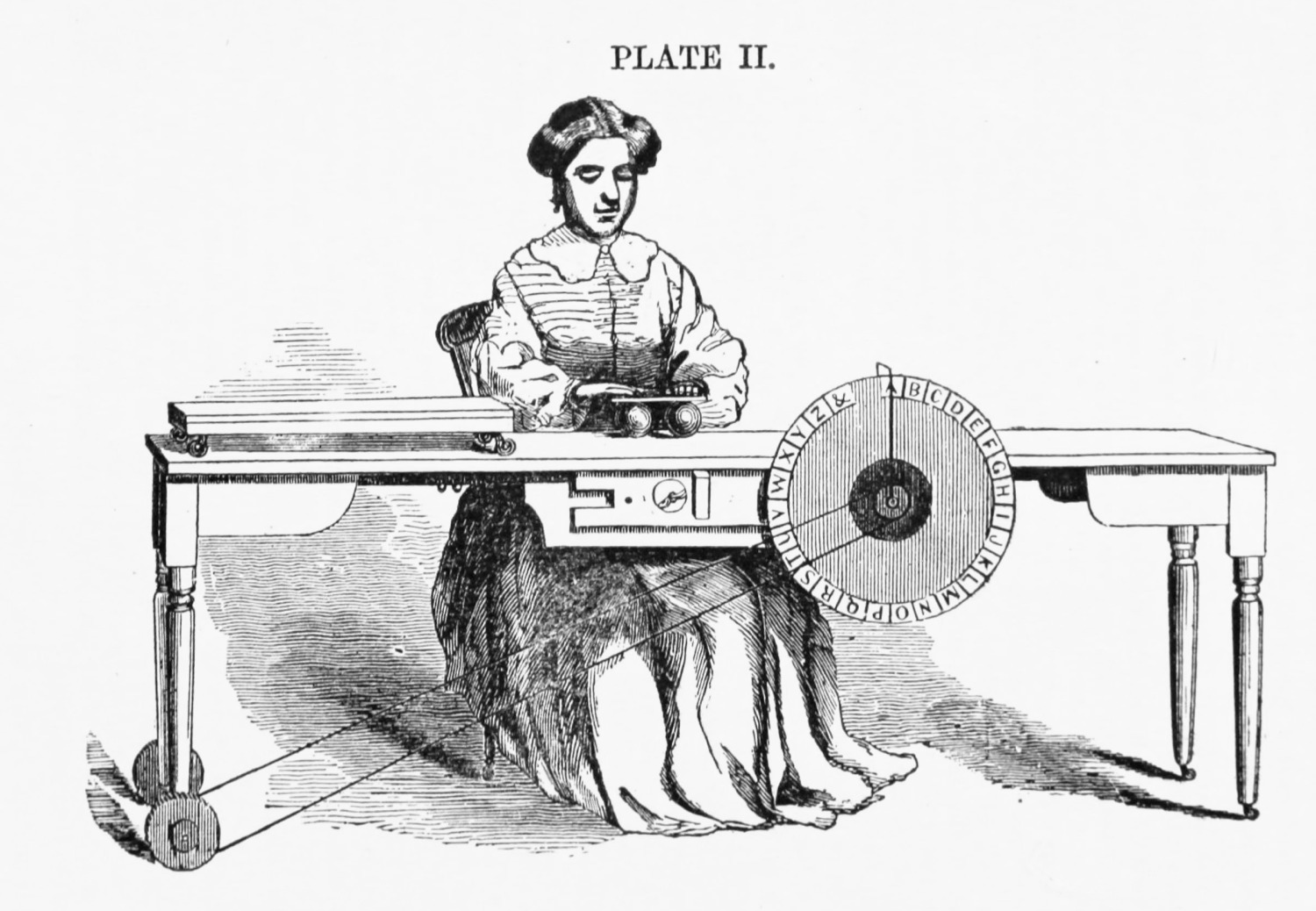
of a powerful but a rational cause; so the manifestations of Spiritualism,
involving both reason and power, might consistently justify me in looking
for agents endowed with the reason and power manifested by the phenomena.
This power being invisible and imponderable, and at the same
time rational, there was no alternative but to consider it as spiritual, no
less than that to which planetary motion is due. In its potentiality the
power thus manifested might be extremely minute as compared with the
potentiality of the Creator; still it had to be of the same spiritual nature.
662. It has not appeared unreasonable to infer that the soul in assuming
the spirit form should acquire a power of which material beings are
destitute, and of which they can only conceive an idea from its necessity
to the operations of God. Parting with its material attributes, were the
soul not to acquire others, even if it could exist, it would be perfectly
helpless. Hence, in becoming an immaterial spirit, it must acquire powers
indispensable and appropriate to that state of existence.
663. Since we know that the animal frame for the most part after death,
on the exposure to the air, warmth, and moisture, returns to the atmosphere
whence it is mainly derived, it follows that on undergoing that awful
change the soul must take the spirit form, unless it perish with its material
tenement. So far, then, all who believe in the immortality of the
soul, must concur with spiritualists that on dying we become spirits.
664. It will then be admitted by all who believe in the immortality of
the soul that, as for every mortal that dies a spirit is born, innumerable
spirits must exist. Is it not then reasonable to consider them as agents in
producing phenomena which can only be ascribed to invisible, imponderable,
rational, and affectionate beings, especially when they themselves
sanction this inference by word and deed?
665. Were a tyrant to enclose a human being while alive within a cast-iron
vessel, the aperture through which the introduction should be made
being closed by a stopple soldered in air-tight, all the ponderable elements
of the corporeal body would be retained; but can any one who believes the
soul to survive the body, think that it would remain included in that vessel
so long as it should endure? Cast-iron coats itself with a carbonated
peroxide, vulgarly called rust, and then undergoes no farther change; so
that the corporeal elements might be retained to an infinite time. But
could the soul be thus imprisoned, perhaps to eternity? Could the tyranny
of a man thus imprison an immortal soul? Does it not follow that the
soul would not be confined by the air-tight and apparently impenetrable
metallic vessel?
666. The invisibility of the soul in leaving the body, must be admitted,
since, however the dying may be surrounded by their friends and
nurses, and vigilantly guarded after death by watches, as customary with
many, the soul is not seen to leave the body. It must, therefore, be invisible,
and capable of permeating cast-iron or any other material within
which, while alive, an immortal being might be enclosed air-tight.
667. The qualities of invisibility and penetrative power being necessarily
conceded to the soul, is it unreasonable to extend this attribute to its
habitation in the skies: to the country of spirits?
668. In communicating with a friendly spirit, I adverted to the difficulty
of inducing people to conceive that in the clear azure space existing
between the earth and moon, there should be scenery like ours, with plains,
hills, mountains, valleys, rivers, lakes, seas, and every variety of edifice in
greater perfection than upon earth. “You do not see us,” said my friend;
“then why should you wonder at not seeing our world?”
669. It is quite evident that no such obstacle stood in the way of belief
in the existence of heaven among the Jews, as it is constantly referred to
as being above; Noah’s deluge came through the windows of heaven; and
this idea has been sustained in the language of Christ, as well as of the
Hebrew prophets.
670. Elijah is represented as having visibly ascended to heaven. That
the vicinity and invisibility of heaven are not at war with Scripture, is
alleged in a recent work by the Rev. Mr. Harbaugh of the German Reformed
Church, of Lancaster, Pennsylvania. He quotes approvingly a
passage in a work, entitled “Physicial Theory of Another Life,” by Taylor,
which I subjoin:
671. Taylor suggests—“That within the space occupied by the visible
and ponderable universe, and on all sides of us, there is existing and
moving another element, fraught with another species of life, corporeal
indeed, and various in its orders, but not open to the cognízance of those
who are confined to the conditions of animal organization, not to be seen
nor heard, nor to be felt by man.” “Our present conjecture,” remarks
the author in another place, “reaches to the extent of supposing that
within the space encircled by the sidereal revolutions, there exists and moves
a second universe, not less real than the one we are at present conversant
with: a universe elaborate in structure, and replete with life; life agitated
with momentous interests, and perhaps by frivolous interests; a universe
conscious perhaps of the material spheres, or unconscious of them, and
firmly believing (as we do) itself to be the only reality. Our planets in
their sweep do not perforate the structure of this invisible creation; our
suns do not scorch its plains: for the two collateral systems are not connected
by any active affinities.”
672. This would bring “the things which are not seen,” indeed, near
to and around us. To enter the other world would not be so much a
removal in space, as just to be made loose from, or to become insensible to,
the conditions of this life. Death will be only the destruction or disappearance
of human and earthly affinities, and directly we shall be surrounded
by affinities adapted to our new state of existence, and shall find for ourselves
a congenial home in and around our present habitation.
673. Much is argued in favour of this theory. It is said in no place
to interfere with Scripture, but rather to be countenanced by incidental
hints and allusions. It is said to be made highly probable by the known
truths of physical science. An unseen world, in all respects material,
inhabited by corporeal beings, it is said, is possible. There are material
elements which are not cognizable to any of our senses except by a round
of research and experiment, and then only in their remote effects, as, for
instance, electricity. The atmosphere also, and light, are material, and
yet so subtle as almost entirely to evade our unassisted observation; and
may there not be still others as yet to us unknown? We are related to,
and become acquainted with, the external world by the medium of the five
senses; but who will say that there are not other senses hidden in possibility
in our nature which may by means of other affinities communicate
with a world far more refined in its constitution, with which we cannot
now come in contact? Science has discovered living animalculæ in the
solidest substances; the air we breathe and the water we drink are the
homes of myriads of beings, and though unseen by the naked eye, these
elements are swarming with miniature life! It seems to be God’s motto,
“Multum in parvo”—life in life, world in world, universe in universe!
With these known facts in science before us, may we not, it is asked, consider
the above theory probable?
674. It is further supposed that this invisible world around us is the
after stage of the present life; and as it is a stage of being in all respects
superior to this, it may be that its inhabitants have a knowledge of us,
though we have not of them, just as we are acquainted with grades of
animalcule life beneath us, when it can hardly be supposed that they know
any thing of our existence. Hence, too, in some exceptive cases it may
be possible for them to break through the veil of separation, and appear
in various ways unto men on the platform of human life. Then we are
indeed “surrounded by a cloud of witnesses,” who stand around, or bend
over us, and look with deep interest upon the struggle of life, and when
they see it unequal in the case of the saints, they break through in their
ardour, and become ministering spirits to those who are heirs of eternal
life.
675. It is also supposed that these beings in the world unseen may
have capacities to communicate with the remotest inhabitants of God’s
universe. The facilities of communication may be so great in these ethereal
climes, that space is annihilated, and the different hosts of intelligences in
the wide universe may commune with each other and God as one family
in their “Father’s house.”
676. There is a surprising degree of coincidence between the speculations
comprised in this quotation, and the accounts which I have received
respecting the spirit world from some of those occupying an elevated
grade therein. It has been observed above that if the soul be immortal,
it cannot be imagined to remain in the grave, since the greater part of
the human organization in hot weather escapes through putrefaction, as
vapour or gas. Hence the endurance of the soul after death involves
spiritual existence. We must, therefore, on dying, take an invisible spiritual
form.
677. Believers in revelation stare incredulously when mention is made
of a spirit, as if its existence were an impossibility; yet it has been shown,
that according to orthodoxy, death extricating the soul from the body, it
must forthwith commence its spiritual life. The existence of spirits being
thus established, that they should communicate with us would be more
probable than that they should not, excepting that it has not been heretofore
generally known to take place. But spirits allege that the manifestations
which have been taking place for some years have been the result
of efforts especially made by a delegation of philanthropic spirits, to break
through the partition which has so long prevented the communication to
mortals of a correct knowledge of the existence of the human soul after
death, and the requisites to the attainment of celestial happiness.
678. The accomplishment of this object is a step in the progressive advancement
and the means of improvement possessed by the celestial world,
analogous to the invention of printing or of the telegraph in the mundane
sphere.
679. The management is intrusted to advanced spirits acquainted with
the affairs of both worlds. Agreeably to Scripture, heaven is above,
over our heads; to prevent the Tower of Babel from reaching it, a confusion
of tongues was ordained. The second commandment speaks of heaven
above and earth beneath. Christ “descended into hell,” according to
the apostles’ creed; of course, hell is below. “Whosoever calls his brother
a fool, is in danger of hell-fire.” That hell and fire should be thus associated
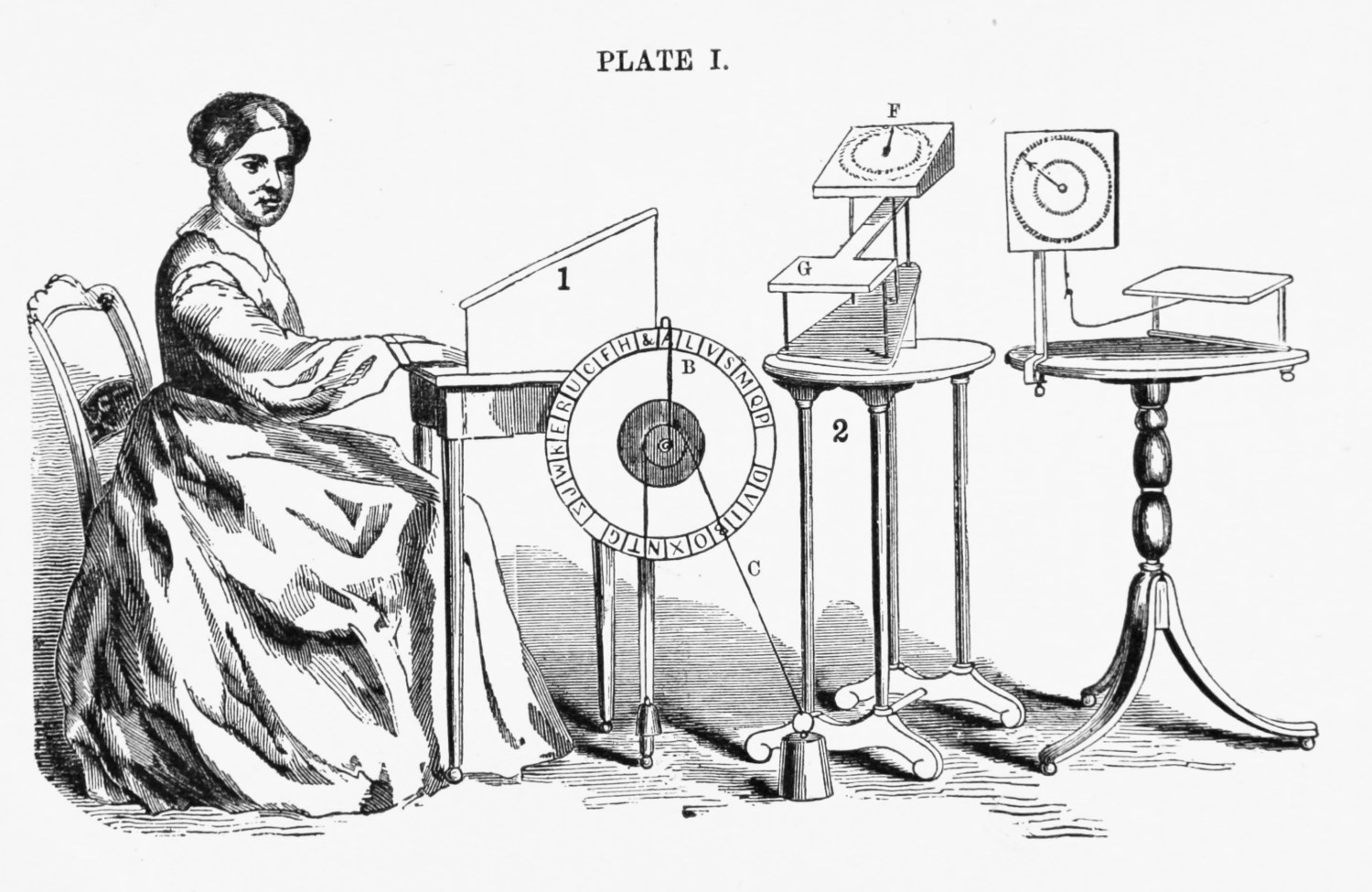
is therefore consistent with the observations of geologists, who infer that
the interior of the earth consists of ignited matter of which volcanoes are
the safety-tubes, however inconsistent with reason to suppose immortal
souls to be broiling therein.
680. But enlightened Christians do not, I believe, locate hell within
this earth, nor call in fire to aid in their conceptions of it. Evidently, the
more rational idea of the future abode of souls is that of its being above
every point on the earth’s surface, and equidistant therefrom. This would
involve that of a space concentric with the earth, and which falls in with
the idea of that comprising the spheres of Spiritualism.
681. If we leave this earth, in order to imagine any location beyond
the range of astronomical bodies, it would place the locality at a distance,
according to Herschel, requiring nineteen hundred thousand years for
souls to travel, moving with the velocity of light, two hundred thousand
miles in a second. In one of my lectures, in 1842, I suggested that heaven
might be situated at that central space about which all the constellations
of the universe have been supposed to revolve.
682. But if we infer a general place of reception for souls, then in that
celestial emporium every soul from all the myriads of planets, of all the
solar systems in the universe, must congregate. Far more rational does it
not seem that our heaven should be associated with our own planet, in the
welfare, the past history, and future prospects of which the souls who were
born upon it, must take pre-eminent interest?
683. The separation of any heaven into spheres seems inevitable, since
the association of spirits according to their virtue and intellectual acquirements
and capacity seems indispensable to harmony and happiness. Thus
the more virtuous, wise, and cultivated spirits are, the higher their spheres
of existence.
684. Let any person contemplate the information respecting the spirit
world given in the preceding pages, in the communications from my spirit
relations and others, and then say whether, in receiving them as true, any
believer in immortality, as vaguely portrayed in the gospel, will not make
a beneficial exchange.
685. How can any person become a spiritualist without forthwith finding
an irresistible impulse to conduct himself in this world, so as to acquire
eminence in the next? For what are we all working? is it not for happiness,
“our being’s end and aim,” the difference being only in the mode
by which it is sought? By some it is through the good of others as well
as of themselves; yet too many seek it without regard to that portion of
their fellow-creatures whom they may deem it their interest to oppress, deceive,
cheat, or rob.
686. But even these will perceive how much better it will be to pursue
the opposite course, since every wrong done by them here, will have to be
expiated by a proportionate penance in the spirit world.
687. By every good action resulting from the wish to do as we would
be done by, we advance a step higher in that heavenly stairway by which
we may ultimately reach the supernal heaven, and become ministering angels
of God.
688. But even during our ascending progression, we shall pass through
a succession of stages wherein every intellectual, social, and amiable propensity
of our nature will be gratified.
689. In justice to myself, and to give more weight to the inferences
drawn from my laborious investigations, I will subjoin the correspondence
between Mr. Holcomb and myself, which succeeded the receipt of the letter
which has been introduced in the commencement of my narrative, (128.)
So far as my judgment goes, there never was a letter written of which the
facts or inferences are more correct; yet it appears that so late as the 8th
of February I was still a doubter. The tenor of the correspondence will
show that if I was conquered, I did not yield the ground undisputed, and
was vanquished only by facts and reasons which, when understood or admitted,
must produce in others the conviction which they created in me.
If I was the victim of an intellectual epidemic, my mental constitution
did not yield at once to the miasma. It took some three months to include
me among its victims.
Philadelphia, January 14, 1854.
690. Dear Sir:—Your letter of the 17th of November met my eye as
I was this morning looking over a file of letters. I am led to write, therefore,
that in consequence of your suggestion, and those of others, I have
been giving my attention to the phenomena to which you alluded. When
I come to any conclusion, I will write again.
691. I still concur with Faraday, and have seen nothing to make me
believe in the spiritual manifestations. Yet I am not surprised that the
latter should be believed in by those who have that belief, as there are phenomena
which I cannot explain yet, any more than many which I have
seen resulting from jugglery. The converts are, however, such worthy
persons, that I cannot bring myself to suspect them of deception. I
think you must be mistaken as respects a table moving when left to itself
entirely. The circumstances for producing this phenomena have been
repeatedly made favourable by the mediums in my presence, but excepting
in one instance, when it was within reach of the feet, no motion ensued.
692. It would, indeed, be a glorious mercy if God would give us some
evidence, which should settle the religious opinions of mankind.
Robert Hare.
Southwick, Mass., Feb. 3d, 1854.
693. Dear Sir: I wish, however, to say something in regard to the
subject-matter of your letter. You say you are not surprised at the belief
of many in Spiritualism, as there are phenomena which you cannot explain.
You also say that you think I must be mistaken “as respects a
table moving when left to itself entirely.” I do not think a table would
move if left to itself entirely, since matter cannot put itself into motion.
The great question is, What is the power that makes the table move? You
think it is muscular, and I am certain that it is something else. When
I am looking at the sun in a clear sky, I know that it shines. No argument
would have any influence to make me doubt the evidence of my
senses. There has, no doubt, been a great deal of jugglery in the world,
but shall I doubt the evidence of my senses on that account? How shall
we prove any thing in a court of justice, if the evidence of our senses is
not to be relied upon? While I am looking at a table, it moves, and I
have the same evidence that no body touches it, that I have that it moves.
I see the table tilt up, and poise itself on two of its four legs, and then on
the other two, and finally it wholly rises from the floor, and seems to float
in the air without any visible support whatever; all this time there are no
persons within six feet of it. In a letter of N. P. Talmadge, published in
the Tribune of May 27th last, he gives an account of his seeing tables
move when nothing visible touched them. I mention him, because I suppose
his character and standing would be likely to have weight with you.
It would, however, be very easy to mention a very great many cases, proved
by testimony that would be conclusive in any court of justice. I supposed
that it was too late in the day to doubt facts of this character, as they are
taking place in numerous places in this country and also in Europe. I
suppose this is the reason why Faraday’s explanation has availed so little
to check Spiritualism in England or France.
694. I believe Henry Gordon resides now in Philadelphia. I have no
doubt you can see such things for yourself in his presence by attending a
few times. Our judge of probate, who lives a few miles from me, told
me a few days ago that a young lady of his acquaintance put her hands
upon a table and it moved. He then took hold of the table to prevent
the motion, but he had not strength to do it. The table would slide on
the floor, notwithstanding his utmost efforts to prevent it. Now it is perfectly
idle to say that the young lady unconsciously exerted such a power.
The judge ridicules the idea of its being caused by spirits. He says that it
is electricity. You are too well acquainted with the laws of electricity to
believe that under such circumstances it can produce any such feats. I
know of a case, in Springfield City, in which four respectable merchants,
with whom I am acquainted, testify that a large table, with two of them on
it, moved around the room. In that instance the medium’s hands were on
the table. But who can believe that such a force could be exerted without
the movers being conscious of it. There are cases enough of the same
description to fill a volume.
695. There is another phase of this matter that is worthy of attention,
and that is the intelligence connected with it. You mention cases where
the answers were not correct. Thousands of such cases might be furnished.
In the presence of some of the mediums, almost all the answers
will be false; while in the presence of others, it will be very rare that a
wrong answer is given. Some of the answers being wrong does not prove
that there is no intelligence connected with it. In the presence of a good
medium, a question asked mentally is answered as readily and as correctly
as when asked vocally. I do not depend on the testimony of others for
this. I have found it to be true in my own experience. In the presence
of some mediums, mental questions are not answered. The foregoing are
facts that are well settled if evidence can settle any thing. To say that
we are dupes and fools, decides nothing. I suppose that I can examine a
matter as carefully and intricately as most men, and I know I am not deceived
about the facts. But the cause is quite another matter.
696. I suppose you are acquainted with the various and conflicting
explanations that have been given. They all appear to my mind perfectly
absurd and incredible, and no two of them agree. Rev. Dr. Beecher was
appointed by his association to examine and report. He did so, and decides
that the communications are from the spirits of the dead, but from
the evil or unblest portion of them. If it is from spirits, there is as much
evidence that some of them are good, as that others are evil.
697. I must close. I did not expect an answer, but was glad to hear
from you, and if you make any important discovery, I should be glad to
hear from you again; I am not settled in my mind respecting the cause
of these strange phenomena. I agree with you heartily in your last remark
in your letter, that “it would indeed be a glorious mercy if God would give
us some evidence which should settle the religious opinions of mankind.”
Yours, very respectfully,
Amasa Holcomb.
Philadelphia, February 8, 1854.
698. You believe fully that tables move without contact, because you
have seen them move; I am skeptical, because I have never seen them move
without human contact, although I have been at several circles.
699. You have been much more lucky than I have been as to the manifestations,
whether mechanical or mental.
700. I shall lose no opportunity of making further observations. I
have no clue to find Gordon. You ought to give me his address, and
communicate all you know respecting him.
Robt. Hare.
Southwick, February 20, 1854.
701. Dear Sir: Your letter of February 8th is before me. You did not
say whether you believed in the soul’s immortality or not! This is the
most important of all questions to me, and how is it to be settled? If
the Bible is not to be depended upon, and we have no communications
from the spirit world, what evidence have we of our immortality? I have
been greatly afflicted with doubts upon this subject. It has exceeded all
other afflictions that I have met with. You will of course see at once
how desirous I am that these apparent communications should prove to be
in reality from the spirit world, as that would settle the question. I seize
upon every thing that seems to have a bearing upon the question of immortality,
and I confess that I have strong hopes that Spiritualism, as it is
termed, will settle this question. If it be true that there is physical force
and intelligence, neither of which proceed from the medium, how is it to
be explained? You doubt these two, but I am as well assured of them
as I can be of any thing.
702. If spirits communicate, it is certain that some of them deceive.
It would appear that there are all sorts of characters, the same as there
are in this world. If you should become satisfied of the two facts that I
mentioned, I should like to have you and other men of science try your
skill at explanation.
703. I will relate what took place at the first sitting that I ever
attended. It was in Boston, and I went as a perfect stranger. Before
the sitting commenced, and but few had collected, a strolling musician
came along and commenced playing at the door, and every tune played at
the door was beaten or rapped on the table. The medium was in the
room; I saw her walk up to the table and lay her hand on it, and then
walk away, but it made no difference with the raps on the table; they continued,
without any person near it, as long as the tunes were played at
the door. When it came my turn to question, I asked, Are any of my
relatives present? Ans. Yes. Will you rap at each letter of your name,
if the alphabet is called over. Ans. Yes! The alphabet was called, and
there was a rap at A, one at L, one at F, one at R, one at E, and one at
D,—Alfred: a son that died at the age of twenty-two years. Among a
great many questions, I asked, How many years since you died. Is it
twelve? Is it eleven? Is it ten? Is it nine? Is it eight? Is it
seven? There was a rap at seven, but I asked, Is it six? and instantly
there were rapped........; the seventh was fainter. I said, He probably
means that it is six and a piece, when instantly they were repeated
........; the last the faintest. The raps were equidistant, like the
ticking of a clock, and about as loud. I supposed at the time that it was
less than seven. After the sitting was over, and we were preparing to
leave, I said, It is possible that we may have mistaken the time since my
son’s death? There was instantly a loud rap on the table. I then asked,
Did you mean seven? and there was instantly an affirmative. I inquired
for the odd months, and the answer was four. When I got home, I found
the true time was seven years, four months, and two days. These last raps
were when no person was within six feet of the table. I confess myself
unable to explain the foregoing without admitting that it was my son who
responded. If you could have such an opportunity, and inquire for some
dear friend whom you loved in life, I think you would witness what would
interest you.
704. I mention the foregoing as a specimen. I have received a great
many communications purporting to be both from my son and a daughter,
who died at the age of eighteen, quite as remarkable as the above. Now,
admitting the two facts of physical force and intelligence, I don’t know
even then that spirits are the agents; but it seems probable, because I
doubt whether any other explanation can be given, that will appear at all
reasonable. It is very evident that there is an intelligence that governs
the world; but if that intelligence has given us no revelation excepting
what is in nature, then it appears to me that every thing that can give
us any knowledge of what we are to be hereafter, is valuable beyond all
price. Uncertainty upon this matter is painful, but then we know so
little about the Deity, that I think there is great uncertainty in our views
of what he does, either to prevent or bring to pass the good and evil that
we see around us. Yours, very respectfully,
Amasa Holcomb.
Philadelphia, February 24, 1854.
705. Dear Sir: There is a great resemblance in your sentiments, as described
in your letter of the 20th, (just received,) and those which I entertain,
excepting that while I am very desirous—I may say extremely
desirous—to learn something which may prove another state of existence,
I am not unhappy at my not being able to find out the truth. If I have
less hopes, I have also less fears, than those who have heaven and hell
both to encounter. I do not envy those who are placed in the situation
of depending upon the estimate which may be formed of them hereafter,
whether they are to be placed among the “sheep” or “the goats.”
706. It is true that the gospel holds out the idea on one hand that intense
belief, called faith, will wash away sin; but on the other, it is said,
that “he who knoweth his Master’s will, yet doeth it not,” shall be beaten
with many stripes, while he who is ignorant of that will, and doeth it not,
shall be beaten with few. Under these circumstances, who can escape
flagellation? Who is it that does the will of God, as enumerated by
Christ? Who loves his neighbour as himself? Who presents a second
cheek on receiving a blow on one? Who gives his coat, when his cloak
has been taken? Who returns good for evil? Who acts as if it were as
hard for a rich man to go to heaven as for a camel to get through the eye
of a needle?
707. Unless our missionaries can make better Christians abroad than
they leave at home, it were inhuman to add to the number, who are to be
pre-eminently punished for their neglect of their Master’s will, while fully
apprized of it. In many cases a pagan will be better off than his nominally
Christian instructor, although he should not prove a convert to
Christianity.
708. My sentiments are much like those which Socrates expressed.
I hope for a future world, and therein to have a happier existence. All
those reasons which have been advanced by wise and good men in favour
of such futurity, operate upon my mind as upon theirs; but if there be
no such a state of future existence, I shall never wake up to feel my disappointment.
It will only be a prolongation of a state of oblivion analogous
to that which we enter upon transiently, every night.
709. The incentives which have acted upon you, act also upon me, and
I have seen some of the manifestations on which you rely; but not so
satisfactorily. The answers which I have received have not been worthy
of the other world.
710. A message from my own father, amounted to this: “Oh, my son,
listen to reason;” and there it ended. Several similar nugatory sentences
have been manifested through the alphabet.
711. I have, however, constructed an instrument to put the question
of independency of intelligence to the test. It works independently of
any control of the medium, as the letters, which must be seen to bring
them correctly under the index, are concealed by a screen. (Plate I.)
712. The sentence above quoted was communicated in this way.
713. I am about, by this contrivance, to test the manifestations farther.
Robert Hare.
714. Among the best precepts afforded by the gospel is that of laying
up treasure in heaven, in preference to seeking to become rich in this
world. To pursue the last-mentioned course has been alleged to disqualify
us more or less for entering heaven. Certainly, however, honest exertion
for the acquisition of wealth is the corner-stone of human prosperity, and
money seems in most instances necessary to the effectual exercise of that
fellow-feeling in the cultivation of which human virtue pre-eminently
consists. (See Influence of Mundane wealth on Celestial Happiness.)
715. How can a man display charity, hospitality, or contribute his
means and time to objects of philanthropy, unless he beforehand lay up
wealth? How could the Samaritan have assisted the traveller who had
been maltreated by thieves, had he not taken care to have something beforehand,
not only for himself, but for the needy? But still the precept,
Lay up treasure for thyself in heaven, is precisely the course which Spiritualism
indicates. Precepts may lead, but examples will draw. Those
who have gone before us to eternal life, furnish us not only precepts, but
examples also. They furnish exemplifications of the consequences of their
conduct, if followed. With few exceptions, my intercourse has been with
those only, who did lay up treasure in heaven, by doing on earth as they
would have others to do unto them. Of the spirits with whom I have
communicated, only two alleged or indicated that they were unhappy. Of
these, I was informed, one bore an ill character upon earth.
716. Another, after having suggested to his inquiring brother some
measures relating to his surviving wife’s temporal concerns, spontaneously
added the following words: “I am not hapey.” The inquiry being made
for the cause of his misery, the resulting reply was, “I did not do rite
when I was in this world.”
717. Another admitted that he was drowned, in consequence of getting
dead drunk. On being asked if he were happy, he answered, “Damned
happy.” In reply to an inquiry whether he was sorry to have quitted
this life, he replied in the affirmative.
718. Having evidently been a seaman, who had sailed under an officer
who was present, he had preserved the usual fondness of sailors for tobacco
and grog. This propensity he could not avoid displaying, notwithstanding
his having passed death’s dread portal, and the obvious inutility
of expressing to mortals his craving for those pernicious stimulants.
719. Thus it appears that in the spirit world one means of retribution
for the indulgence of bad propensities in this life, is subjugation to their
ungratified cravings.
720. Of course, the more of these a spirit carries with him, the greater
is his misery; while the more he founds his happiness on the indulgence of
good propensities, the greater his power and opportunities of enjoyment.
721. As an illustration of the manner in which happiness may arise
from the indulgence of good propensities, one of the enjoyments of a spirit
of the fifth sphere is, as I am informed, in looking after children of
relatives and friends, who have not as yet followed them to the spirit world.
722. Believing in the existence of a spirit world, where there are thirty-six
grades of existence, corresponding to degrees of purity and intellectual
acquirement,—purity alone giving exaltation merely, while cultivation of
mind secures breadth of consideration,—we have, in the first place, to adhere
strictly to truth, honesty, justice, benevolence, and doing as we would
be done by, to reach a sphere higher in proportion as we are more successful.
Yet, among those on the same plane, superiority in mental attributes
gives precedence.
723. Nothing is better known than “while precepts may lead, examples
draw,” and that subjection to bad examples, even when checked by good
precepts, is generally irresistible by the young. But when there are no
precepts to check, but, on the contrary, ill counsel as well as bad example,
few human beings, however well constituted organically, could resist
the tendency of such educational evil. Let bad hereditary propensities be
superadded, and what can ensue but a climax of wickedness? Manifestly,
however, all this is independent of any choice on the part of the victim.
A high degree of virtue may consistently be inferred to result if all these
conditions be inverted, and good precepts, good examples, co-operative in
improving a mind of the opposite kind, one which owes to its progenitors
goodness of heart and high intellectual capacity.
724. Much stress is laid upon free-will, but is will ever free from the
joint control of reason and passion? What is will, if it be not the resultant
of the conflict or co-operation of these? It may be a question whether,
without passions, a man would act at all; but certainly he would act
like an idiot or baby, so far as his will should be entirely independent of
his reason.
725. It must be conceded, then, that the prodigious diversity between
virtue and vice is the consequence of contingencies, which are no more
under the control of the individual affected than the colour of his hair or
the number of cubits in his stature.
726. The great features of the spiritual religion are, as I understand
them, as follows:—Its foundation is laid in the belief of an all-good Deity,
whose power is manifested to us by the immensity, profundity, sublimity,
ingenuity, and adaptation of the means to the ends in the creation ascribed
to the co-operation, if not origination, of his mind. The Bible of the
spiritualist is the book of nature—the only one which by inward and outward
evidence can be ascribed to divine authorship.
727. In this book we read, as matters of fact, that there is an infinite
series of gradation in the rank of animals, as well as variety in their dispositions
and propensities. This may be seen, from the half-animal, half-vegetable
known as the polypus, up to man, there being gradations not
only of genera, but of species and varieties. Thus amid men there are
various races, rising one above the other in development, from the Bushman,
Hottentot, or lowest Negro, up to the most highly-developed race of
white men. But when we have passed through the gradation of the races,
we have to enter upon that of individuals, who in the same race are by
diversity of organization or education, or of both, made extremely different
as to intellectual, moral, and scientific pre-eminence.
728. It is difficult for human reason to reconcile with impartiality this
immense diversity in the lot of the creatures of God; but that such is the
law of nature is self-evident: it is an intuitive truth. To reconcile it with
the all-goodness of God, we must suppose a limitation of power, and that
it has been beyond his power to put created beings more nearly upon
a level. But, as Seneca observes, all have received more than they had a
claim for. Some may think that the parable of the hiring of labourers
for a vineyard, conveys an idea like that of the Roman sage.
729. These considerations being premised, it would seem that punishment
in the spirit world is only the carrying out of the same system, excepting
that while the deficiencies or vices which have arisen in this world
become a punishment in the next, they also operate as the means of improvement,
or, to use the language of that world, of “progression.” It
may be inferred that as in this world the power of the Deity, although
commensurate with the all but infinite universe in which we exist, was so
restricted by conditions as to induce that enormous diversity of position in
the scale of animation which has been presented to view. Yet in the
world to come these defects and vices are liable to be remedied; and,
though they react upon their victim, it is with a view to his own ultimate
benefit. There is not a malevolent devil to seize the poor miscreant, and,
like the savage Indian, torture him with a fiend-like pleasure. He is regarded
with compassion, and as soon as contrition is induced, treated with
sympathy by the higher spirits, and assisted by counsel and enlightened
by instruction. Unable any longer to indulge his bad propensities, the
desire of rising to a higher level becomes a passion. Intellectual and
social pleasures begin to be enjoyed. So long as he remains under the influence
of his mundane appetites, he has to consort with spirits who are
similarly actuated; they read each other’s mind, and thus are made
acquainted with the deformity of their own. They eventually thus become
instrumental in reciprocal correction. So soon as an aspiration for
a better state is awakened, they rise to the next plane or circle above that
in which they may have been existing; the only difficulty is in taking the
first step. Progression grows with its growth, and strengthens with its
strength, so that all beings may sooner or later attain to the highest sphere
in the spirit world. It should be understood that there is no pardon for
existing sin. Pardon can only exist as a consequence of reform, and in
proportion thereto. (92.)
730. An assailant of Spiritualism, who not long since lectured at Sansom
Street Hall, founded one of his charges on the commiseration felt
by good angels for sinners, agreeably to Spiritualism. But from the examination
above given respecting the origin of the difference between the
virtuous and vicious, does it not appear that the fate of the latter is quite
as hard as can be reconciled with justice, even under the more benign institution
of Spiritualism? According to this, there exist in the spirit
world six spheres, each subdivided into six circles or planes, forming together
a succession of grades in which the soul finds its place according
to moral and intellectual merit. The first of the spheres is throughout
comparatively hideous in its aspect and disgusting in its inhabitants, who
are designated by a dark halo in lieu of the effulgence which distinguishes
spirits of the rest of the spheres. Moreover, this distinguishing effulgence,
as well as the beauty of the spirit world, augments with the grade
of the being whom it envelops, thus making a series of ranks in society
founded on real nobility of head and heart. When it is considered that
this immense diversity ensues mainly from contingency in organization,
education, and greater or less exposure to trial, it must be clear that the
difference made between the good and the bad by Spiritualism does not
fall short of the degree which human reason can reconcile with justice.
731. The assailant of Spiritualism to whom allusion was made, while
admitting the truth of the evidence given of communication with spirits,
explained it by reference to Satan. It is remarkably inconsistent with
this idea that this evidence is of a nature to abrogate the existence, and
of course the sovereignty, of that imaginary arch-fiend. Again, it can
hardly be conceived that the greater commiseration for sinners should
come from a malevolent devil, and the urging for everlasting and cruel
torture from a sincere disciple of the benevolent Jesus Christ. But how
much, then, must it shock one who embraces these views, that in addition
to the misfortune of being badly organized, badly educated, and badly
tempted, the being subjected to these disadvantages is to be exposed eternally
to misery, typified, if not realized, by broiling on burning brimstone!
I am aware that doing away with the more horrible attributes of hell will
be alleged to be subversive of one of the restraints upon criminality; but,
in the first place, it is evident that a man who is restrained from crime
solely by the fear of punishment is only a more prudent villain than one
who is not restrained by that selfish apprehension. When a man is deterred
from crime only by prudence, hope of reward, or fear of punishment,
he ought not to have a higher grade in heaven than the perpetrator
of the crime.
732. But, agreeably to experience, of all restraints upon crime, none are
more efficacious than the fear of degradation. The lawyer who will do the
bidding of a caucus (or of a powerful demagogue in the executive office)
in order to get a judicial appointment, when securely seated therein, will
not give a charge which will degrade him in the eyes of the legal profession,
and consequently in that of society, as well as in his own estimation.
The dishonest gambler, who neglects to pay his tradesman’s bill,
will not fail to pay his gambling debts. The debtor who will take every
advantage in getting a high price for his goods, and who will put off any
other payment as long as possible, fails not to pay his note at a bank.
Sovereign states, who pay no other claims, take every means to meet the
interest on their funded obligations. “Failure” in the one case, in the
mercantile adaptation, involves the loss of reputation for good financial
faith, abroad as well as at home; but the just complaints of domestic
claimants, not heard upon the exchange, are unheeded. The great object,
in many cases, is not to leave the crime “undone, but to keep it unknown.”
The corrupt, selfish politician, who would promote war in order to give
himself an opportunity of emolument or official pre-eminence, when facing
the enemy in the field of battle will nominally die for that country whose
interests he has sacrificed. But not from the alleged motive will he die,
but either to avoid being degraded as a coward, or for the hope of popularity
which may help him to office.
733. In the spirit world, all are seen through and justly estimated, so
that degradation and vice, or elevation and virtue, are inevitably associated
by spiritual intuition. Yet there is, in my opinion, far more satisfactory
proof of the truth of Spiritualism than of any other creed involving immortality;
while, so far as adopted, it must tend to do away with priestcraft,
sectarian malevolence, and religious intolerance. Man will go to the
spirits of his ancestors for his religion, not to a fanatical, bigoted, or interested
priest. Should spirits actually exist, as supposed, and convey the
same religious knowledge all over the world, all men will agree that virtue
is to be the means of salvation, not bigotry, under the name of faith.
734. It is conceived that Spiritualism has all the desirable attributes of
religion, as stated in the second page of the introduction of this work. It
sanctions the idea of the existence of one Supreme Being, who is represented
as all love to his creatures; while his powers are made known to us
by the sublimity, profundity, magnificence, and inconceivable extent of
the creation which he rules. It does not represent him as selfishly creating
us for the purpose of worshipping him, as capable of jealousy or implacable
wrath for the result of errors which his alleged omnipotence could
by a fiat correct. On the contrary, we have been created to be happy
sooner or later; evil existing not through design, but in consequence of
conditions which he cannot control or cure unless through the operation
of general principles.
735. With a view to mutual happiness, reciprocal beneficence is enjoined.
We are required to obey the precepts of acting toward others as we would
have them act toward us.
736. This innate law is appealed to instinctively by any child who is
oppressed by another larger than itself, and was consecrated by Confucius
six hundred years before its judicious sanction by Christ.
737. Spiritualism has the merit pre-eminently not only of furnishing a
knowledge of immortality beyond the grave, but a precise knowledge of
the spirit world in lieu of the silence of the Pentateuch and the vagueness
and inconsistency of the gospel. An effort to establish the truth of these
allegations will be made under the next head.
738. On the first spiritual manifestations occurring, the great object of
the mass of observers was to see the physical effects. In the next place,
intellectual communications were sought, but these being obtained by a
tedious process, it was deemed sufficiently interesting if a few sentences
could be made out, or even one. It was, moreover, a great object with
inquirers to ascertain by the interchange of language, whether the spirit
of a relation or friend were really present, as alleged by the supposed spirit.
Hence, the communications were very deficient as respects any information
of the spirit world. It is not surprising, therefore, that prejudicial unbelievers
should have taken up the idea that there is nothing inviting in the
heaven of Spiritualism. I hope that, agreeably to the communications
from the spirit world recorded in the preceding pages, there is enough to
create an ardent desire to become a dweller therein.
739. But is it not unreasonable for a person to disdain a state of existence
which is by the spirits themselves described as “ineffably” happy?
Alluding to the progression, which is to carry spirits eventually among the
ministering angels of God, I observed to my spirit friend, Dr. W. E. Channing,
that I did not consider him in heaven yet. “Were you situated as I
am,” said he, “you would not say that!” But let us see how far the ideas
of heaven, as warranted in Scripture, are comparable with those which have
been communicated by spirits.
740. In a work by the Rev. Mr. Harbaugh, of the German Reformed
Church of Lancaster, Pa., a great effort is made to collect all the hints
respecting heaven which have been given in the Old and New Testaments.
This learned divine quotes the following paragraph from Dr. Chalmers:
“The common imagination,” says Dr. Chalmers, “that we have a paradise
on the other side of death, is that of a lofty aerial region, where the inmates
float in ether, or are mysteriously suspended upon nothing—where all the
warm and sensible accompaniments which give such an expression of
strength, and life, and colouring to our present habitation, are attenuated
into a sort of spiritual element; that is, meagre and imperceptible, and
utterly uninviting to the eye of mortals here below; where every vestige
of materialism is done away, and nothing left but unearthly scenes, that
have no power of allurement, and certain unearthly ecstasies, with which
it is felt impossible to sympathize.”
741. After reading and believing the representations of heaven given
by the immortal inhabitants of the spirit world, who can avoid turning in
disgust from the portrait thus cited by Dr. Chalmers?
742. The most favourable idea of heaven given in Scripture seems to
be that which identifies it with Paradise; in other words, a most beautiful
garden. But who would conceive an eternal residence in one garden,
however superlative its attractions, as desirable? The idea of the spheres
assumes a succession of gardens, with every pleasure, every joy of which
the human heart and intellect are capable; and beyond those gardens
the whole universe is open to us, and an ultimate ministration as angels
under our Heavenly Father.
743. The portraiture cited by Chalmers is not approved of by the Rev.
Mr. Harbaugh, but in order to confute it he does not resort to any better
picture given in the Bible, but to reasoning. This shows that, learned as
he is, and idolatrous as he appears in worshipping the Bible as an adequate
fountain of light, he cannot get from the object of this idolatry any
passage tending to prove the inconsistency of the idea quoted from Chalmers
with Scripture. Were there not the greatest poverty of instruction
on this all-important subject, the ideas alleged to exist as above mentioned,
upon the high authority of Dr. Chalmers, could never have had sufficient
currency to merit notice. It may be assumed that no Christians can conceive
themselves to be better entitled to the joys of heaven than the
twelve apostles of Christ. In order to show how far any expectations of
a bliss higher than that afforded by Spiritualism could have been entertained
by those disciples consistently with Scripture, I deem it in point to
refer the language held to them by their Divine Master. I subjoin a few
lines from Dr. Harbaugh, wherein he quotes the query put to that Master,
by the twelve, and the consequent reply. Nothing can be farther from
my idea of a happy state than the benefaction promised to them. The
query and reply are subjoined, in order to enable the reader to judge of
both:—Behold, we have left all and followed thee: what shall we have
therefor? The Saviour answered the above query when made by Peter,
as follows:—When the Son of Man shall sit upon the throne of his glory,
ye shall also sit upon twelve thrones, judging the twelve tribes of Israel.
Here is a direct answer by Christ to an inquiry respecting the nature of
the reward which his disciples were to have for their merits as his faithful
devotees. They are to be made severally worldly dignitaries; each is to
sit on a throne, judging a tribe of Israel. That is, they are to have
worldly pre-eminence, accompanied, of course, by all the vexations attendant
on such stations, as well as the uncertainty and limitation arising from
liability to death and disease. How weak and worldly-minded must his
disciples have been, could such a prospect be alluring to them! I ask for
any sectarian to say in candour, whether a governorship over one of the
wealthiest States, the presidency, or any sovereignty in Christendom,
would be deemed a heaven in comparison with that eternity of ineffable
happiness enjoyed by the immortal spirits of the higher spheres? Yet
Mr. Harbaugh, with the simplicity of blind faith, quotes this without perceiving
how meagre is the gospel evidence thus afforded of the joys
awaiting the faithful as a reward for their good conduct in this life.
744. The following remarks, made by Mr. Harbaugh, demonstrate how
partial sectarians are in reading Scripture: “What shall we have therefor?
This is a question that frequently arises in the Christian’s mind, as he
endeavours to cheer his ofttimes drooping spirits with a look toward the
recompense of reward. What shall we have? We have left all for thee,
and by following thee we have confessed that we are pilgrims and strangers
upon earth. In this world we shall have tribulation; but thou didst overcome
the world; what shall those have who overcame with thee?” Harbaugh
remarks: “Here then is curiosity which the Saviour himself approves,
because he satisfies it. The same pious curiosity still manifests
itself in the minds of God’s people in their holiest hours, and shall there
be nothing revealed to satisfy them? Yes, God will approve of such inquiries,
and will grant the influence of that Spirit, who leads unto all
truth to all those who search the Scripture for an answer.” Drawing an
eloquent picture of the aspirations of the soul for some realization of the
vague ideas of the rewards of the faithful in a future state of existence,
he exults that this curiosity, as he calls it, should be sanctioned by Christ,
“who approves this curiosity because he satisfies it.” How does he
satisfy it? Is it by holding up the hope of a judgeship for each? It
seems it was not then foreseen that instead of performing the part of the
Jewish Messiah, with which he thus identified himself, that of gathering
together the chosen people of God, he was to put forth opinions which
were to scatter them through the world. “Wo unto you, Chorazin,”
&c., for the heinous offence of not admitting him to be both the Messiah
and the Son of God. The promise of the judgeships was quite consistent
with the former character, and strengthens the idea that he never pretended
to any higher mission. With this the promise in question is consistent,
but is wholly irreconcilable with his divinity, which would make
these judgeships worse than giving a stone for bread or a serpent for a
fish. In order to have bestowed these judgeships, the Roman empire
must have been subverted. It seems that if (as stated by the worthy Mr.
Harbaugh) the curiosity of the disciples was truly and correctly satisfied,
that this satisfaction was the sum total of the heaven with which they
were remunerated; since not the slightest hint is given that they were,
like the penitent thief, to be with their object of devotion in paradise.
It would seem, on the whole, that the rewards of the thief and the beggar
Lazarus were of a more heavenly nature than those promised to the apostles,
even had the latter been susceptible of realization, instead of being
irreconcilable with the doom which awaited the Hebrews, and consequently
a mere vox et præterea nihil. But while, in lieu of an eternal progressive
happiness, Christ holds up the transient, precarious, and limited
supremacy from which a truly pious and wise man would turn in disgust,
when hell is to be represented, we have eternal torments typified by fire,
and weeping and gnashing of teeth in utter darkness, in despite of this
fire. The situation which Christ, the Son of God, was to have, was to
bear manifestly a relation to that of his disciples. His situation would
be somewhat analogous to that of Washington, when he was in the presidential
chair, and the thirteen States were governed by as many of his
faithful followers in the Revolutionary War. Yet Washington did not
find his chair worth retaining longer than the good of the country made
it important to remain. I am confident that neither would that great man
leave his position in the seventh sphere for the presidency, nor any spirit
among those who held the gubernatorial dignity, as suggested, find a
governorship now a motive for leaving their bright abodes in the celestial
world.
745. Dr. Harbaugh sanctions the idea that the revolutions of all the
constellations with which telescopic examination has made us acquainted,
may take place about a central sun, bearing the relation to other suns
analogous to that which God has been represented to have to the other
potentates; whence the title of “King of kings.” The existence, then, of
a sun of suns is suggested, about which the constellations formed by inferior
bodies of the same kind revolve. It would seem, then, that a more
fitted allotment had been made if, enthroned by his Father’s side on that
sun of suns, he had allotted to each of his disciples a constellation, than
have assigned to them miserable transitory judgeships in Judea: a speck
of territory, in this speck of a globe, which in a field of vision embracing
the universe, would be imperceptible.
746. There being in Scripture so much more stress laid upon the torments
of hell than the joys of heaven, is probably the reason why the
horror of death is so great among Christians in general. Their practice
in this respect is to speak of death as a great calamity. Here and there
may be found a believer who is thoroughly convinced that the efficacy of
his peculiar tenets, combined with the absence of criminality, and the
redeeming influence of repentance, will insure him a passage to heaven;
but the predominant language is to represent the death of any large number
of human beings as a great calamity. Those who are exposed to danger
pray most earnestly to be saved, and their death is always treated as
a cause for deep regret by surviving friends. Hence the weeping, the
grief, and the mourning called for by custom,—the relations and connections
wearing black for months. Hence the dark hearse, the black pall, and
bitter lamentation over the grave; which shows that it is not realized that
death is only a glorious spiritual birth! I am confident that spiritualists
will soon abandon a custom which must on their part be inconsistent;
since they must look on death as no more a bereavement, than a residence
in a foreign country, the means of communication being within reach, and
a happy reunion foreseen.
747. When on board of a steamer under way at night, the possibility
of her going down occurring to my mind, I felt cheered by the idea that
I should not go down with her, but soar to the spirit world with my immortal
friends, who would flock to meet my apotheosis. (Page 101.)
748. It has been urged that a most substantial idea of heaven, given in
the old Bible, is that of a restoration to Paradise, of which the description
gives the idea of an exquisite, beautiful garden; but Spiritualism
gives the idea of garden above garden, improving in beauty with their
elevation. Then there are thirty-six gradations in all, and in the five
happy spheres thirty; so that there is excitement arising from well-rewarded
emulation as a source of interest. Into the idea of heaven, as
suggested in Scripture, intellectual ability and improvement form no part
and give no superiority; whence the tendency of the more strict constructionists
to turn a cold shoulder to every acquirement which is not coupled
with scriptural knowledge. Neither the Athenæum, nor any library, is to
be accessible on Sunday. If the time devoted at meetings and at church
were given to the study of the real book of God, how much more learned
would be those who thus employ their Sundays! It is held that the lowest
and most ignorant person who is educated to believe implicitly the
tenets of a sect, when he would by the same process as easily be made to
believe any other tenets, is in heaven to be as high as the most enlightened
as well as virtuous man, who has the only merit which can be
attached to belief in a high degree—that of ardent desire for truth, and
taking the pains to form an opinion for himself. Nay, the ignorant bigot
is to be higher in heaven, if the free-thinker alluded to, should not agree
with the ghostly adviser, of the devoted sectarian with whom he is compared.
749. The idea of living in the finest garden which imagination can conceive,
without the enjoyments and progression which my father’s communication
attributes to the spheres, would beget tedium rather than the
ineffable happiness which my spirit friends profess to enjoy. But while
one of the Jewish ideas of heaven in its best form, is thus deficient, the
description given by the learned Josephus of hell is horrible in the extreme,
that of heaven being disgusting. I give it as I find it quoted by
the Rev. Mr. Harbaugh:
750. “Now as to Hades, wherein the souls of the righteous and unrighteous
are detained, it is necessary to speak of it. Hades is a place in
the world not regularly finished, a subterraneous region, wherein the light
of this world does not shine; from which circumstance in this region
there must be perpetual darkness. This region is allotted as a place of
custody for souls, in which angels are appointed as guardians to them, who
distribute to them temporary punishment, agreeably to every one’s behaviour
and manners.
751. “In this region there is a certain place set apart as a lake of
unquenchable fire, whereinto, we suppose, no one hath hitherto been cast,
but it is prepared for a day aforedetermined by God, in which one righteous
sentence shall deservedly be passed upon all men; when the unjust,
and those that have been disobedient to God, and have given honour to
such idols as have been the vain operations of the hands of men as to God
himself, shall be adjudged to this everlasting punishment, as having been
the causes of defilement; while the just shall obtain an incorruptible and
never-fading kingdom. These are now indeed confined in Hades, but not
in the same place wherein the just are confined. For there is one descent
in this region, at whose gate, we believe, there stands an archangel, with
a host; which gate, when those pass through that are conducted down by
the angels appointed over souls, they do not go the same way, but the just
are guided to the right hand, and are led with hymns, sung by the angels
appointed over that place, unto a region of light, in which the just have
dwelt from the beginning of the world, not constrained by necessity, but
ever enjoying the prospect of the good things they see, and rejoicing in
the expectation of those new enjoyments which will be peculiar to every
one of them, and esteeming those things beyond what we have here; with
whom there is no place of toil, no burning heat, no piercing cold, nor any
briers there; but the countenances of the fathers and the just, which they
see always, smile upon them while they wait for the rest, and eternal new
life in heaven, which is to succeed this region. This place we call the
bosom of Abraham. But as to the unjust, they are dragged by force to
the left hand, by the angels allotted for punishment, no longer going with
a good will, but as prisoners driven by violence; to whom are sent the
angels appointed over them to reproach them, and threaten them with
their terrible looks, and to thrust them still downward. Now these angels
that are set over these souls drag them into the neighbourhood of hell
itself; who, when they are hard by it, continually hear the noise of it, and
do not stand clear of the hot vapour itself; but when they have a near
view of this spectacle, as of a terrible and exceeding great prospect of fire,
they are struck with a fearful expectation of a future judgment, and in
effect punished thereby; not only so, but when they see the place (or choir)
of the fathers and of the just, even thereby are they punished, for a chaos
deep and large is fixed between them, insomuch that a just man that hath
compassion upon them cannot be admitted, nor can any one that is unjust,
if he were bold enough to attempt it, pass over it.”
752. So much for Josephus. Mr. Harbaugh subjoins as follows: “This
extract is exceedingly interesting. It shows to what extent of distinctness
the Jewish ideas of the future state had attained. The dreamlike underworld
is here considerably illuminated. The righteous and the wicked are
separated, and already share the first fruits of their eternal reward. The
righteous are surrounded with intimations and shadowy promises of better
things to come, in the expectation of which they are already happy; the
wicked are surrounded with tokens and forebodings of more fearful ill,
much of which they already suffer in awful expectation.
753. “Through this picture,” says our good parson, “we see in faint
but terrible glimmerings, in the distance, the region of eternal fire, which
awaits the wicked when the judgment-day shall remove them from Hades;
on the other hand, we see also the dawning of an eternal day for the just,
the rest and eternal new life which is to succeed this region. This kingdom
of the dead, beyond which the thoughts of men in the early ages did
not wander, is considered only as a place of detention for judgment, while
the idea of a final state, both for the righteous and the wicked, is believed
to exist beyond it.”
754. How can any person sincerely pretend that those who rely on a
happy idea of our immortal life are indebted for it to the source from
which this Hebrew Pharisee derived the impressions given in the preceding
quotation? Yet the Pharisees were the only conspicuous Hebrew sect
who believed in heaven. The Sadducees did not believe in immortality.
755. The history of Lazarus and the rich man, (says Harbaugh, page
168,) “plainly teaches that both the righteous and the wicked on death
pass into a fixed and eternal abode, where no change is possible;” and he
further states (pp. 169-70) that “the misery of the wicked commences
immediately after death, and before the resurrection, and their condition
is unchangeably fixed.” According to St. Luke, (chapter xvi.) in the page
alluded to above by Harbaugh, we are informed that the wicked, while in
the torture of hell-fire, are within the view of the righteous, (verse 23.)
The righteous are near enough to converse with those in torment, and yet
there is an impassable barrier between them. The rich man is not tortured
for his sins, but simply because he had “enjoyed good things.” Yet
Abraham, who turned his son and son’s mother out in the wilderness to
starve, and twice exposed his wife to prostitution, is represented as enjoying
the reward due to the righteous.
756. How little sincere, heartfelt belief there can be in the words of
Christ, may be estimated from the fact that scarcely any Christian but
seeks for the good things of this life, instead of qualifying themselves for
heaven by undergoing the rewarded privations of a Lazarus.
757. It is utterly unintelligible to my mind why repentance and reformation
should not avail after, as well as before death, as it is represented
to be in the spirit world.
758. There is a coincidence between these representations of Josephus
and those of the gospel, so far as that both represent the righteous as witnessing
the torments of the wicked. Would not such a situation make
heaven a hell to good-hearted angels?
759. According to Matthew, (chapter xxv. 24,) the blessed, after the
day of judgment, are to inherit the kingdom prepared from the foundation
of the world. Of the joys that kingdom would afford there is no
description. But, as usual, hell is made sufficiently horrible, (chapter xxv.
41,)—“Depart from me, ye cursed, into everlasting fire, prepared for the
devil and his angels.”
760. In this respect, if in no other, there is an immense superiority in
the conceptions of futurity given by my immortal advisers, in comparison
with those attributed as above to Christ.
761. It has been urged that human conduct is so much dependent on
organization, education, temptation, and example, neither of which are
within the option of any soul, that the orthodox doctrine respecting sin is
manifestly wrong. But admitting the culpability which that doctrine imputes,
it has been shown that the gradations of sinfulness between the
extremes of vice and virtue are innumerable. Suppose for each gradation
a strand in a ladder, like that of which Jacob dreamed, and human souls
supported severally at elevations commensurate with their respective pretensions.
This adjustment being made, suppose a plane at any level to
divide the vertical row into two portions, all below the plane being considered
as goats, all above the plane as sheep. Evidently, between the
soul just above, and that just below the plane, there would be only a shade
of difference; yet the one would have to go to hell, the other to heaven,
eternally.
762. According to Spiritualism, on entering the spirit world each soul
finds its just level by a sort of moral specific gravity, in which merit is
inversely as weight. Every soul, moreover, has the privilege of reforming,
and rising proportionally to the improvement thus obtained.
763. One of the most agreeable conceptions attending our future existence
in the spheres, is that of being restored to the appearance of youth;
the decrepitude and wrinkles of age, of disease, mutilation, deformity,
ugliness, are all avoided in the spiritual body. The insane are restored to
reason, the idiot gradually improved in mind.
764. There is no small degree of contradiction in Scripture respecting
the locality of heaven. In addressing the thief, paradise is identified with
heaven by Christ. “St. Paul is alleged to have been taken up into paradise,”
says Harbaugh; yet, according to the map accompanying the work
of Josephus, Paradise is represented as being upon the river Tigris, near the
Persian Gulf. The idea given of the abode of Adam and Eve, in Genesis,
conveys the impression that it was a terrestrial locality.
765. In the Decalogue the abbreviation of life is threatened as the punishment
for not honouring parents, and God is alleged to have held out
the promised land to Moses, instead of comforting him by a clairvoyant
view of a place of blissful enjoyment in some celestial region.
766. Elijah was carried up to heaven in the sight of Elisha. The commandment
makes heaven above, the earth beneath. Christ was seen ascending
by his disciples, and according to the apostles’ creed, after descending
into hell, he arose on the third day and ascended into heaven. Yet
Josephus consigns both heaven and hell to a subterranean region, like the
Elysian Fields and Erebus of the heathen, but places them on each side
of a lake of everlasting fire. This representation is sanctioned in the
allusion by Christ to Dives, Lazarus, and Abraham; the former, broiling
to eternity, requests that Lazarus should get a little water to cool the tip
of his tongue. This Abraham declares to be impossible. Hence it appears
the parties were so near as to converse with each other, and for those
who were blest to witness the sufferings of the damned. Thus, according
to Christ as well as Josephus, heaven and hell are in immediate proximity,
and both must be in the infernal regions.
767. The actual effects of the old Bible were to produce either unbelievers
in immortality, like the Sadducees, or immoral believers, like the
Pharisees, whom Christ especially denounces as vipers, and internally corrupt,
like whited sepulchres holding dead men’s bones.
768. Christ never singles out the Sadducees for denunciation, but speaks
of the Pharisees particularly as hypocritical and corrupt. But in what
did their hypocrisy consist, if it was not in that insincerity of their professions
as respects belief in futurity which was shown by their worldliness.
769. Thus the evidence of the existence of a future state was such as
to produce avowed unbelievers, or professed believers whose morality was
so deficient as to create an expression that they were corrupt hypocrites, as
odious as vipers.
770. It is not the feebleness of the impressions respecting the existence
of another world, where happiness is proportional to good conduct, that
renders the existing system so inoperative in preventing those vices which
it especially interdicts; as, for instance, combativeness, cupidity, and revengefulness;
so that the course usually pursued by professed Christians,
does not merely amount to a neglect of Christ’s precepts, but renders an
adherence to them disreputable? Nothing is more degrading throughout
Christendom than poverty or tame submission to blows. The last excuse
Christians in general will make for any omission or deficiency is their
poverty.
771. If they really believed that they would broil to eternity, like the
rich man, merely for seeking the good things of this life, would the attainment
of those good things be made the great object of their existence?
772. Notwithstanding the representations of Josephus, sanctioned, as
above shown, by Christ, of the subterranean localization of Elysium, there
seems, nevertheless, an instinctive propensity to assume that heaven is
overhead. Clergymen all look upward when they address God, and the
Thespian artists universally follow their example. Whenever heaven is
referred to, it is customary, I believe, for all devout persons to turn their
eyes in the same direction.
773. But if heaven be above, what does this term above mean? It
practically designates a vertical direction relatively to this globe at any
point over which a speaker who uses the word may stand. Consequently,
it indicates a space overhead, having everywhere the same relative position
to the terrestrial surface; in other words, a region concentric with that
surface, like that within which the clouds float. This floating takes place
rarely at a less distance than two, or more than six, miles.
774. The spiritual spheres are estimated, as already mentioned, as being
between sixty and one hundred and twenty miles from the earth’s surface.
They are, therefore, analogous in position to the region of the clouds, though
at a much greater distance and vastly more capacious.
775. According to Christianity, there is no immortality for animals
below the grade of humanity; but according to Spiritualism, animals
that are favourites of man in this world are his companions in the next.
Much stress is laid on the singing of birds in the account given of the
spheres. There is a line of demarcation below which the privilege of an
existence after death is not enjoyed. Respecting that boundary my information
is at present incomplete.
776. In order to do justice to the excellent and learned clergyman to
whom I have so often referred, I will annex the whole of those pages in
which he conceives himself to give the “true doctrine” respecting heaven.
However unsatisfactory it may be to me, I hope it will be found interesting
to those who, like the author, look only to the Bible for information respecting
their existence beyond the grave.
“One gentle sigh their fetter breaks;
We scarce can say, ‘They’re gone!’
Before the willing spirit takes
Her mansion near the throne.”
777. “The different theories by which the souls of saints are supposed
to be detained from entering heaven immediately at death, have now been
exhibited. They have led us a long and dreary chase. The groundlessness
of these theories has been, in part, shown in connection with a statement
of them. They will, however, be more completely overthrown by a
statement of the true doctrine, and by the arguments that may be adduced
in its support. Various arguments that, in passing along, were offered
against these false views, will also substantiate the true doctrine; thus the
same implements that have been used to tear down the old building may
be employed to erect the new. If, therefore, any thing should be presented
in this section, among other things, which may seem to have been
presented before, it must be remembered that though they are the same
tools, they are now used to do a different kind of execution.
778. “We consider the true doctrine of God’s word on this subject to
be this: The saints do immediately, at death, enter that place which is
called heaven, where the body of the Saviour now is, where the divine
manifestations are most clearly and gloriously made, where angels have
their proper home, and where all the heirs of Christ shall finally and forevermore
be assembled.
779. “That the saints pass immediately at death into heaven, is taught
in the symbols in some of the most pious and learned denominations in
the church. We grant that this does not prove it absolutely true; but it
has much weight, as showing how the Scripture on this subject was understood
by many pious and learned men who had the same interest in
and motives for the truth as we have, and were, we may therefore suppose,
just as sincerely anxious to be led into the truth as we can possibly be.
The conclusions, therefore, to which they have come, and which have been
adopted by their numerous successors for centuries, are valuable. Beside
furnishing us with the testimony of so much learning and piety, it serves
to show that this is no new idea, and that it is not the faith of a few, but
is the testimony of the church.
780. “The first symbolical testimony we produce is the Heidelberg Catechism,
published first in 1563. This symbol has been the embodiment
of the reformed faith for more than three centuries. Its influence has
been very extensively respected and felt. It has, since its publication,
been translated and read in at least fourteen different languages; and it
is said that half a million editions of it have been published in Germany
alone. In this country it is received as a symbolic book, both in the Dutch
Reformed and in the German Reformed churches. In the fifty-seventh
question it is asked, What comfort is afforded to us by the doctrine of the
resurrection of the body; and the answer is: ‘That not only my soul
after this life shall be immediately taken up to Christ its head; but also,
that my body, being raised by the power of Christ, shall be reunited with
my soul, and be made like unto the glorious body of Christ.’ Here the
doctrine is plainly taught, and has been responded to with a joyful amen
by millions during three hundred years.
781. “The next is from the Shorter Catechism, received as a symbolic
book in the different branches of the Presbyterian communion. It is in
answer to the thirty-seventh question: ‘What benefits do believers receive
from Christ at death? The souls of believers are at their death made
perfect in holiness, and do immediately pass into glory; and their bodies,
being still united to Christ, do rest in their graves till the resurrection.’
In the eighty-sixth question of the Larger Catechism this same doctrine
is taught in more words. The following quotation is from the Westminster
Confession of Faith: ‘The bodies of men, after death, return to dust
and see corruption; but their souls, (which neither die nor sleep,) having
an immortal substance, immediately return to God who gave them. The
souls of the righteous, being then made perfect in holiness, are received
into the highest heavens, where they behold the face of God in light and
glory, waiting for the full redemption of their bodies.’ The declaration
that they are ‘then made perfect in holiness,’ is no doubt directly aimed
against the idea of a process of purgatorial or medicinal preparation, mentioned
in a previous section. The declaration that they are then ‘received
into the highest heavens,’ is intended to stand in opposition to the idea of
a middle abode in all its forms.
782. “The book of ‘Doctrines and Discipline of the Methodist Episcopal
Church’ is silent on this subject; but, so far as I have been able to
learn, the proper Protestant doctrine on this subject is held in that large
communion. Their views of the nature of justification and sanctification
would admit of no other to be consistently believed among them. It is
believed that this is also the prevailing sentiment among Baptists, and
other Congregationalists.
783. “What is here presented from symbols as the united faith of so
many learned and pious men living in different ages, and in different parts
of the world, is also founded on holy Scripture. By no wresting and violence
has the church, in the general stream of its theological views, been
turned aside from this faith. It is vain that men hope to annul, by means
of violent and unnatural interpretations, the plain declarations of Scripture,
to serve a theory.
‘Truth, crush’d to earth, will rise again,
The eternal years of God are hers.’
784. “The Saviour said to the penitent thief on the cross—‘To-day shalt
thou be with me in paradise.’ Now the question arises, Where and what
is that paradise in which the Saviour promised the dying penitent that he
should be with him that day? This can be seen by referring to other passages
in the Scriptures where the word paradise is used, and where its
sense cannot be mistaken. This can be seen by reference to 2 Cor. xii.
There it is said that Paul was caught up into paradise; and in the same
passage the place into which he was taken is called the third heaven—the
highest and holiest place in the universe. In Rev. ii. 7 we are told
that the tree of life stands in the midst of the paradise of God; and in
Rev. xxii. 2, we are told that that same tree of life stands by the side of
the river which flows from the throne of God and the Lamb. From this
it is evident that paradise is the heaven where God dwells and the Lamb.
Is then the middle abode, Hades, the kingdom of shades, the peculiar
abode of God and the Lamb?
785. “The objection that the Saviour himself did not go to heaven
that day, but was for forty days afterward on the earth, and that therefore
he could not be with the penitent thief in paradise, has no force. During
the three days that intervened between his death and resurrection, he
could as well be in heaven as in Hades. Indeed, it is evident that he was
in heaven during those three days, from what he says to his disciples
shortly before his death: ‘A little while, and ye shall not see me; and
again, a little while, and ye shall see me, because I go to the Father.’
Moreover, his tarrying on the earth and appearing among his disciples does
not conflict with the idea that he was also in paradise. When he was yet
in the flesh on earth, he could say: ‘And no man hath ascended up to
heaven, but that he came down from heaven, even the Son of man which
is in heaven.’ In the same way that he was in heaven at that time, he
may have been in heaven with the penitent thief during the forty days
between his death and ascension.
786. “The history of the rich man and Lazarus (Luke xvi.) plainly
teaches that both the righteous and the wicked, at death, pass into a fixed
and eternal abode, where no change is possible. No comment on the passage
is necessary. This portion of Scripture has a thousand times been
tortured out of its meaning by errorists of various kinds, and as often has
its testimony fallen back into the church’s healthful stream of sound views.
As a sheep, carried away from the fold, returns when set free, so this passage
always comes back again; for the voice of a stranger it heareth not,
nor followeth!
787. “In the Revelation, John, in his vision, saw the souls of departed
martyrs and saints ‘in heaven,’ ‘under the altar,’ ‘before the throne of
God,’ &c., and in the company of each other, of God, of Christ, and of
angels, in the central and highest heavens, and in that place where the
saints go no more out forever. Let it be remembered, also, that all this
is before the resurrection; and if the following passages are carefully considered,
they will leave no doubt on any candid mind that the saints are,
immediately after death, admitted into heaven. To quote them all would
be too tedious; a reference to them is sufficient: Rev. v. 6-14; vi. 9-12;
vii. 9-17; xiv. 1-6; xiv. 12, 13.
788. “For further proof still the reader is referred to Acts vii. 59;
2 Cor. v. 1-9; Phil. i. 21-24; 2 Tim. iv. 6-9; Eph. iii. 15. In this
last passage, the whole family of Christ is represented to be at two places,
in heaven and on earth; but according to the other theory, there ought
also to be some in Hades, or the third place.
789. “It may also be remarked that the misery of the wicked commences,
according to the Scripture, immediately after death, and before
the resurrection, and that their condition is unchangeably fixed. This is
evident from Luke xvi.; and also from that passage in Jude where he says
that those who had died impenitent in the destruction of Sodom and Gomorrah
were, at the time he wrote, ‘suffering the vengeance of eternal
fire.’ In like manner it is said of the righteous at death, that they are
blessed ‘from henceforth;’ and of those who were clothed in white robes,
having come up through great tribulation, it is said, ‘therefore are they
before the throne of God.’
790. “These passages are plain, and it would, in all probability, never
have been attempted to make them mean any thing different from their
plain sense, were it not for some difficulties, which, it is thought,
stood in the way of the doctrine that the souls of the saints pass immediately
at death into heaven. Let us look at these, and see whether they
are not fancied difficulties, which one glance at the truth ought to remove:
791. (1.) “It is said that the soul, in a state of separation from the
body, cannot be in the same state, nor properly in the same place, as it
will be after the resurrection; and as heaven is to be the eternal abode of
the saints after the resurrection, it cannot be a proper abode for them
before. This objection has, however, no force. There is, for instance, in
this world, a great difference between a person in childhood and old age,
yea, before he is born and after, or between his sleeping and waking state;
and yet he is in all these in the same world, in the same place, and is the
same person. The state and condition of the Saviour differs widely from
that of any saint or angel, and yet both are in heaven. So angels and
human spirits differ, and yet both are in one company and in one place.
So in heaven the condition of the saints before and after the resurrection
may differ much, and yet they may be, in both cases, in the same place.
792. “(2.) The saints cannot enter heaven, it is said, before they are
judged; and as the day of judgment is represented to be after the resurrection,
the saints cannot enter heaven until after that, and consequently
not immediately at death. We may, however, consider, as is generally
done, that the day of judgment is only a public and final consummation of
the decision of man’s destiny. Although God can, and no doubt, does,
for himself, judge and decide for each one when he dies, yet it seems necessary
for the glorious praise of his justice and righteousness that all
other intelligences should see the propriety of his decision. This is necessary,
that every mouth may be stopped; and in order to do this he has
appointed a day in the which he will judge the world in righteousness by
that man whom he has ordained.
793. “(3.) It is also said that the condition of many is represented in
that day to be undecided. Thus many are said to be disappointed;
coming to be judged, they find that their expectations of heaven are vain,
and they say, ‘Have we not prophesied, cast out devils, and done many
wonderful works in Thy name?’ Now it is said that if these persons had
been in a fixed state before, they could not have been in doubt on this
matter. The force of this objection is only apparent. The representations
of the judgment are after the manner of men, and consequently our
conceptions of it must be more or less according to what we are accustomed
to see on earth. The Saviour is warning his hearers not to delay
preparation for death; and, in order to impress his solemn exhortation,
tells them that many will find themselves disappointed in their expectations
in reference to the final decision of their judge, and that their hopes
of heaven, being built on the sand, will fail at last. It does no more exclusively
refer to that day than the many warnings to prepare to meet the
Son of Man refer to the time of his second coming. He is always coming,
and to prepare for death is to prepare to meet him. So to find ourselves
deceived at the day of death is the same as to find ourselves deceived at
the day of judgment.
794. “(4.) Again, it is said that in some cases the full effects and
consequences of persons’ actions are not fully worked out when persons
die. Thus, for instance, it is known that the labours and writings of
many infidels, who are long since dead, are still working for evil; and on
the other hand, the labours and writings of many good men are still working
out good. These consequences must, in a certain sense, come into the
consideration of their punishment or reward. Hence it is thought their
destiny cannot immediately be decided. But to this it may be replied
that God, who judges, knows how these consequences will work themselves
out, and is able, therefore, to give a just judgment as well at the
day of death as at the end of the world. At the last day, when all consequences
have run out their history, it will be proper that they should
be exhibited in a solemn public judgment, that all may see for themselves
that all his ways are just and right. Besides, there is nothing unreasonable
or unscriptural in the belief that the happiness of the righteous in
heaven, and the misery of the lost in hell, will increase in exact proportion
as the consequences of their actions on the earth are developing themselves,
until the day of judgment, when the cup will be full, and then the
full draught of happiness or misery will be taken finally and forever!
Oh, what a moment will that be!
795. “Some additional considerations will serve more completely still
to answer these and other objections, and reconcile the serious and thoughtful
mind to the idea that the souls of the saints are in heaven before the
resurrection of the body.
796. “We shall only gain proper ideas in reference to this interesting
subject when we have corrected our ideas of heaven, for many of them are
evidently wrong. We are inclined to think of heaven as affording to the
saints a fixed or stereotyped condition, without attaching to it the idea of
degrees and progression. When we maintain that the saints pass immediately
at death into heaven, we do not mean that they enter then upon their
final condition, or into their highest state of perfection, but only that they
enter into that place which is their final abode. When, for instance, a
child is born into the world, it is in the world; but it is limited in its
observations, actions, ideas, capacities, and enjoyments, and yet all these
are in their state perfect; all its faculties occupy their place symmetrically,
and we have in the child a uniform but not a perfect being. Analogous
to this may be the primary stage of our future celestial history. The
child is in the world before it is born and during its infantile years, but
how different is it, and how different is the world to it, from what it will
be when all its faculties are ripe! So in heaven. The child before self-consciousness
appears to enjoy an indistinct and floating life, but happy
too; so may it be with our future condition before the resurrection of the
body. The condition of the disembodied spirit will, no doubt, be somewhat
isolated and lonely, (in a pleasant sense,) its happiness being derived
much, though not entirely, from the flow of its own harmonious existence,
and not from its connection with things external. Its future connection
with its body will arrest its floating condition, and connect it again more
consciously with locality and materiality. Thus it will become more
capable of social relations and joys; just as the child emerging from its
floating state in infancy has its social powers developed by being furnished
with self-consciousness and speech, by which it learns intelligently to
separate and distinguish itself from the general mass of being, which makes
its enjoyments higher in their nature and more acute and sensible in their
quality.
797. “Perhaps the state of the saints previous to the resurrection of
the body, and in the first stage of their future being, may be analogous to
(but of course higher than) a state of ordinary sleep, with active, pleasant
dreaming. In dreams, the spirit acts and enjoys, unconscious of the body;
and may we not suppose that the spirit after death may, to a certain extent,
act and enjoy without the body? Perhaps it may in this state pass
profitably and pleasantly through the first stages of its future history. It
may, so to say, become habituated to eternal things, and develop its spiritual
capacities to such a degree as to be prepared, at the time of the
resurrection, to enter upon a more tangible and positive state of existence.
It may thus, also, become acquainted with purely spiritual beings, and with
the modes of purely spiritual existence. This will be useful, because the
saints after the resurrection will be required to hold communion with
things material and immaterial. While the saint is in this world, in the
body, he becomes conversant with material things, and habituated to them;
now, in the other world, in a disembodied state, previous to the resurrection,
he will become conversant with and habituated to purely spiritual
existence, so that after the resurrection, when soul and body are again
united, he will be able to hold converse and communion with either material
or immaterial existences at pleasure.
798. “To this it may be objected that while those who lived in the
early ages of the world would have a long time to remain in this state of
celestial pupilage, those who live in later ages would have less, and those
in the last days scarcely any.
799. “This objection, so far from militating against this idea, most
beautifully illustrates and confirms it. Thus the souls of men are more
developed in spiritual things now, and will be still more in future, than
they were in the earlier ages of the world. Those who lived in the morning
of the world had very limited and indistinct ideas of divine and
eternal things. Their views of a future world, especially, were exceedingly
misty and obscure. As the church advanced, life and immortality
were more and more brought to light. Revelation passed from types,
shadows, and ceremonies, into brighter and clearer realities; and spiritual
conceptions gained a firmer and more distinct hold upon the consciousness
of men. The new dispensation was an advance upon the old, as under the
old the age of prophecy had been upon the law, and the law upon the
simple twilight of the patriarchal age. In what a different light those who
lived after the new dispensation dawned, stood from those under the Old
Testament, is clear from what the Saviour says—‘Among those that are
born of women, there is not a greater prophet than John the Baptist; but
he that is least in the kingdom of God’ (in the new dispensation) ‘is
greater than he.’
800. “At the present day, clearer views are enjoyed than were enjoyed
in the early history of the Christian church. Let any one read the history
of the patristic controversies, and he will see how the most learned stumbled
among propositions in search of truth which are now clearly comprehended
by intelligent Sabbath-school children. And so it will go on into the
future. Spiritual ideas which are as giants to us, and the nature and
relations of which we do not see, will be apprehended by our successors at
once. Thus, under the tuition of the Spirit, revelation will show itself
progressive, and new things, as well as old, in reference to the spiritual
world, will be constantly and successively brought out of the treasure of
God’s word, of which the divine Spirit is the commentator. How, you
ask, does all this apply to the subject in hand? Thus the earlier a saint
lived in this world, the longer time for this heavenly pupilage he will have
in the next before the resurrection, and he needs more; the later he lived
in this world, the less will he have in the other before the resurrection,
and he needs less. Thus those who enjoy in this world superior advantages
on account of living under the clearer dispensation of divine truth in
the last ages of the church, shall not have any advantage over those who
had less on account of living in the first ages, since those who had less
will have longer time in the future world before the resurrection.
801. “With this idea in view, the passage in 1 Thess. iv. 15 becomes
beautifully intelligible: ‘For this we say unto you by the word of the
Lord, that we which are alive and remain unto the coming of the Lord,
shall not prevent’ (that is, shall not go before, anticipate, or have any
advantage over) ‘those which are asleep; the dead in Christ shall RISE
first: then’ (when they have risen) ‘we which are alive and remain shall
be caught up together with them in the clouds, to meet the Lord in the
air; and so shall we be ever with the Lord.’ Those who shall live in the
last moment, having had their spirits fully enlightened and prepared for a
future existence in the brightness of the latter-day glory before death,
shall not ‘sleep’ at all, for there will be no necessity for it; but ‘shall all
be changed in a moment, in the twinkling of an eye, at the last trump.’
‘The dead shall be raised incorruptible,’ having been prepared for their
incorruptible body, but ‘we shall be changed.’ 1 Cor. xv. 51, 52.
802. “This theory may be seen in the same way to illustrate itself
consistently when applied to those who are lost. Those who live last in
the world, when superior light is around them, sin against greater light
than those who lived earlier, and are therefore sooner prepared to have
their doleful station fixed finally in hell, in the union of soul and body.
803. “The doctrine we present in reference to the condition of the
spirits of the saints in heaven, differs from the idea of a middle state, in a
third place, in several important particulars. It excludes the idea of a
middle place entirely, and of course all idea of probation, which is generally
attached to it in some form or other. The state of the spirit in
heaven, though imperfect, being the celestial childhood of the spirit, is
nevertheless final, and not probationary. Our enjoyments there will be in
exact proportion to our capacity; and as fast as our spirits are unfolded,
will our joys increase.
‘The more our spirits are enlarged on earth,
The deeper draughts they shall receive of heaven.’
804. “What an interesting moment to the spirit will be the moment
after death! What scenes will open up before it! The friends will stand
weeping over the now tenantless body, but the spirit is—oh!
‘My thoughts pursue it where it flies,
And trace its wondrous way!’
805. “The Christian need have no unpleasant anxiety about what
scenes will open to him, for he knows that the glory which will then
break upon his astonished spirit will exceed his keenest anticipations.”
806. The facts which I have noticed in relation to mediumship, are
certainly among the most inexplicable in nature.
807. There are two modes in which spiritual manifestations are made
through the influence or sub-agency of media. In the one mode, they employ
the tongue to speak, the fingers to write, or hands to actuate tables
or instruments for communication; in the other, they act upon ponderable
matter directly, through a halo or aura appertaining to media; so that
although the muscular power may be incapacitated for aiding them, they
will cause a body to move, or produce raps intelligibly so as to select letters
conveying their ideas, uninfluenced by those of the medium.
808. Even where they act through the muscular frame of the media,
their vision may be intercepted by a screen, so that they cannot influence
the selection of the letters requisite to a communication. (Plate I.)
809. Rappings or tappings are made at the distance of many feet from
the medium, and ponderable bodies, such as bells, are moved or made to
undergo the motion requisite to being rang.
810. It will be perceived that my spirit father, in reply to the queries
put in relation to this mystery, asks, “How do you move your limbs—carry
the body wheresoever it goeth? how does God cause the movements of astronomical
orbs?” (457.)
811. Evidently some instrument must intervene between the divine will
and the bodies actuated thereby, and in humble imitation between the
human will and the limbs. Upon the viscera our will has no influence.
The heart moves without the exercise of volition.
812. As there is an ethereal medium by means of which light moves
through space from the remotest visible fixed star to the eye, at the
rate of two hundred thousand miles per second; as through an affection
of the same ether frictional electricity moves, according to Wheatstone’s
estimate, with a velocity exceeding that of light,—so may we not infer that
the instrument of Divine will acts with still greater velocity, and that in
making man in this respect after his own image, so far as necessary to an
available existence, gives him one degree of power over the same element
while in the mortal state, and another higher degree of power in the spiritual
state. But if there be an element through which a spirit within his
mortal frame is capable of actuating that frame, may not this element of
actuation be susceptible of becoming an instrument to the will of another
spirit in the immortal state?
813. The aura of a medium which thus enables an immortal spirit to do
within its scope things which it cannot do otherwise, appears to vary with
the human being resorted to; so that only a few are so endowed with this
aura as to be competent as media. Moreover, in those who are so constituted
as to be competent instruments of spiritual actuation, this competency
is various. There is a gradation of competency, by which the nature of the
instrumentality varies from that which empowers violent loud knocking
and the moving of ponderable bodies without actual contact, to the grade
which confers power to make intellectual communications of the higher
order without that of audible knocking. Further, the power to employ
these grades of mediumship varies as the sphere of the spirit varies.
814. It has been stated that mortals have each a halo perceptible to
spirits, by which they are enabled to determine the sphere to which any
individual will go on passing death’s portal. Spirits cannot approach effectively
a medium of a sphere much above, or below that to which they belong.
815. As media, in proportion as they are more capable of serving for
the higher intellectual communication, are less capable of serving for mechanical
demonstration, and as they are more capable of the latter are less
competent for the former, spirits likewise have a higher or lower capacity
to employ media. It has been mentioned that having made a test apparatus,
my spirit sister alleged that it could not be actuated by her without
assistance of spirits from a lower sphere. I inquired whether she could
not meet me again, accompanied by the requisite aid. The reply was in
the affirmative, and accordingly she met me at an appointed hour, and my
apparatus was actuated effectually under test conditions. (Plate 4, dd, ii, kk.)
816. After I had read over an exposition of my information respecting
the spirit world to the spirit of the illustrious Washington, I requested
him to give me a confirmation while the medium should be under test
conditions. (Plate 4, kk.) I placed the hand of the medium upon the
board lever of the instrument, of which a representation has been given,
(Plate I, Plate 4,) so as to be on the outer side of the fulcrum, and requested
him to attest the reliability of the medium during the previous
intercommunion. In reply it was alleged not to be within his power to
give me that test; I urged that this test had been given in his presence.
“We had an employee, then,” was his rejoinder. Fortunately I had contrived
a test instrument requiring less of the mechanical power, so that
by means of it he was enabled to perfect the evidence by bringing the index
to the affirmative, under conditions which put it out of the power of
the medium to produce that result. (See Plate 4 and description.)
817. These facts make the subject of mediumship a most complicated
mystery; but the creation teems with mystery, so that inscrutability cannot
be a ground for disbelief of any thing. The only cases wherein there
is absolute incredibility, are those in which the definition of the premises
contradicts those of the inferences or conclusions.
818. It is evident from the creative power which the spirits aver themselves
to possess, that they exercise faculties which they do not understand.
Their explanation of the mysteries of mediumship only substitutes
one mystery for another.
819. If we undertake to generalize, it must come pretty near what I
have said above, that spirits are endowed, as my spirit father alleges, with
a “magic will,” capable of producing, as they allege, wonderful results
within their own world, (452;) nevertheless that this will does not act by
itself directly on mundane bodies. An intermedium is found in the halo
or aura within or without certain human organizations. The halos thus
existing are not all similarly endowed; some having one, some another
capability. Some are better for one object, some for another object.
Again, the will-power varies as the sphere of the spirits is higher or lower,
so that the medium suited for one is not suited for another.
820. Thus the means by which they are capable of communicating is
various, and moreover precarious, according to the health and equanimity
of the mortal being under whose halo they may strive to act.
821. Evidently, the ponderable elements recognised by mundane chemists
cannot contribute to any of the bodies of the spirit world, since their
gravity must disqualify them for use in a world where every thing is, in
comparison with them, weightless. Accordingly, one of the queries put by
me to the convocation of spirits (574) was, whether any of our elements,
being ponderable, could act as such in the imponderable spiritual creation.
The reply was, Not without undergoing a transformation. This would be
equivalent to annihilating them first, and recreating them afterward, when
the process of creating alone would be sufficient. But manifestly it is of
no importance, whether their adaptation to the spirit world be the result
of creation or of transformation.
822. Concerned in the processes of mediumship, it is manifest that
there is none of that kind of electricity or magnetism of which the laws
and phenomena have been the subject of Faraday’s researches, and which
are treated of in books, under the heads of frictional or mechanical electricity,
galvanism, or electro-magnetism.
823. Frictional electricity, such as produced usually by the friction of
glass in an electrical machine, or of aqueous globules generated by steam
escaping from a boiler, is always to be detected by electrometers, or the
spark given to a conducting body when in communication with the earth;
the human knuckle, for instance. When not sufficiently accumulated to
produce these evidences of its presence, it must be in a very feeble state
of excitement. But even in the highest accumulation by human means,
as in the discharge of a powerfully charged Leyden battery, it only acts for
a time inconceivably brief, and does not move ponderable masses as they
are moved in the instance of spiritual manifestation. It is only in transitu,
that frictional electricity displays much power, and then its path is extremely
narrow, and the duration of its influence inconceivably minute.
According to Wheatstone’s experiments and calculations, it would go round
the earth in the tenth part of a second.
824. How infinitely small, then, the period required to go from one side
of a room to another! Besides, there are neither means of generating such
electricity, nor of securing that insulation which must be an indispensable
precursor of accumulation.
825. Galvanic or voltaic electricity does not act at a distance so as to
produce any recognised effects, except in the case of magnetic metals, or
in the state of transition produced by an electric discharge. In these phenomena
the potent effects are attainable only by means of perfect insulated
conductors, as we see in the telegraphic apparatus. No reaction with imperfect
conducting bodies competent to toss them to and fro, or up and
down, can be accomplished. The decomposing influence, called electrolytic,
is only exhibited at insensible distances, within a filament of the matter
affected.
826. It has appeared to me a great error on the part of spirits, as well
as mortals, that they should make efforts to explain the phenomena of the
spirit world by the ponderable or imponderable agents of the temporal
world. The fact that the rays of our sun do not affect the spirit world,
and that there is for that region an appropriate luminary whose rays we
do not perceive, (415) must demonstrate that the imponderable element to
which they owe their peculiar light differs from the ethereal fluid which,
according to the undulatory theory, is the means of producing light in the
terrestrial creation.
827. In one of the replies made by the convocation, (571,) the idea
was sanctioned of the effulgence of the spirit being due to an appropriate
ethereal fluid, analogous to that above alluded to. But it has, I think,
been shown by me, that as light is due to the undulations of our ether, so
electricity is due to waves of polarization. But if undulations produce
light in the ether of the spiritual universe as well as in ours, why may
not polarization produce in the ether of the spirit world an electricity analagous
to ours? Thus, although in spiritual manifestations our electricity
takes no part, their electricity may be the means by which their will is
transmitted effectually in the phenomena which it controls.
828. The words magnetism and magnetic are used in this world in two
different senses. In one, it signifies the magnetism of magnets or electromagnets;
in the other, the animal magnetism of which the existence was
suggested by Mesmer, and which is commonly called Mesmerism.
829. This mesmerical magnetism seems to be dependent rather on properties
which we have as immortals, encased in a corporeal clothing, than
as mortals owing our mental faculties to that frame. If it be the spiritual
portion of our organization which is operative in clairvoyancy, spiritual
electricity may be the intermedium both of that faculty and of mesmeric
influence.
830. All spirits are clairvoyant more or less, and where this faculty is
exercised, it seems to be due to an unusual ascendancy of the spiritual
powers over the corporeal, so that clairvoyants possess some of the faculties
which every spirit, after shuffling off the mortal coil, must possess to
a greater or less extent.
831. In striving to make a test apparatus by which the communication
should be uninfluenced by the muscular power of the medium, through
which alone her will could modify the ideas communicated, an interesting
fact was ascertained. The nullifying of the power of muscular control,
which it is the object of this contrivance to accomplish, is obtained unexceptionally
by means of two balls and a plate, as already illustrated,
(Plate 2,) or by placing the hands of the medium exterior to the fulcrum
of the lever-board, as described in the instance of testing the communication
received from the convocation. But these methods requiring that the
conditions should be favourable, both, as respects the spirit communicating
and the medium, are liable to fail. It struck me that the distance between
the hands and the surface of the table or tray to be moved, by lessening
the influence of the medium on the table or tray, lessened the power of
actuation. My efforts were therefore directed to contrive to have the
hand of the medium near the surface to be moved, without the possibility
of contact.
832. With this view I placed a board for receiving the hands of the
medium upon delicate rollers, so that no horizontal movement would affect
the base board supporting the rollers and actuating the index. To give
greater efficacy to the aura, a plate of glass was supported in a wooden
frame or sash by means of four screw rods fixed upright on the base board,
each furnished with two screw nuts. The screw rods passed through four
suitable holes, so as to have one nut beneath, the other above, the sash.
Thus situated, by adjusting the nuts, the sash could be regulated to any
horizontal level, so as to be near the upper surfaces of the hands without
any contact therewith.
833. On trying this arrangement, it was found as difficult for a spirit to
actuate it as if the glazed sash had not been employed.
834. Under these circumstances, I had the glass plate or pane slit lengthwise
into two equal strips. These being restored to the position previously
occupied in the sash, I interposed between their edges a piece of sheet-tin,
with teeth cut in one of its edges, (Plate 4, kk,) so as to make it look like a
long narrow saw, such as are used by sawyers in frames. With the aid of a
leaden joint, (such as is used by glaziers to join glass panes,) to which the
saw was soldered, the teeth of this projected about the eighth of an inch
below the glass, so as to be near the upper surface of any hand, resting on
the sliding board.
835. It was with no small degree of satisfaction that I found the apparatus
now sufficiently susceptible of actuation by my spirit friends.
836. From this result it would seem that the saw-shaped metallic conductor,
operated precisely as it would have acted had it been necessary to
impart to the pane those means of electric discharge of which, as at first
used, it was deficient.
837. As soon as I had introduced the serrated conductor, my spirit
father corroborated the impression that it promoted the influence of the
medium.
838. This was the first instance in which I have discovered any analogy
between the laws governing the communication of the medium of the
spirit will-power, and those obeyed by electrical phenomena.
839. An account is given in my narrative of an experiment in which a
board, suspended at one end from a spring-balance, was made to descend
with a force of three pounds, through the instrumentality of a medium who
had no connection with the board, excepting water which was interposed.
Hence, as the hook screwed into the board, by which it was secured to
the hook of the balance, was six times as far from the fulcrum as the
hands of the medium, the force exerted by the officiating spirit was equal
to 3 × 6 = 18 pounds. (See Plate 3, and description.) Nevertheless,
no upward reaction was perceptible to me, nor was any experienced by the
medium, Henry Gordon, as he declared.
840. In the case of the boy (Plate 3,) a downward action of seven pounds
was observed, which, multiplied by the difference of distance, amounted to
7 × 6 = 42 pounds, and yet the boy was not perceptibly impelled in the
opposite direction. Nor, when through the same juvenile mediumship,
the whole of the apparatus was thrown upon the floor, did the boy appear
to be impelled in the opposite direction. Nor was there any reaction when
the apparatus was thrown down. Now, agreeably to the laws of nature,
as established by human experience, in all cases of motion or momentum,
there must be an equal force exercised in the opposite direction by the vis
inertiæ of some other matter endowed with that attribute. Hence Archimedes
said, “Give me but where to stand, and I will move the world.” A point
of support, a place of resistance, however, was held to be indispensable.
841. The only explanation of which I can conceive is, that spirits, by
volition, can deprive bodies of vis inertiæ, and move bodies, as they do
themselves, by their will. But the necessity of the presence of a medium
to the display of this power, granting its existence, is a mystery.
842. That the spirit should, by its “magic” will-power, take possession
of the frame of a human being, so as to make use of its brain and nervous
system, depriving its appropriate owner of control, is a wonderful fact
sufficiently difficult to believe, yet, nevertheless, intelligible. The aura
which surrounds a medium must be imponderable. No volition of the
medium can, through its instrumentality, move ponderable bodies, nor cause
raps or consequent vibrations in the wooden boards. Hence, the presence
of a medium imparts power to spirits which the medium does not possess.
843. The aura on the one side, and the spirit on the other, are inert
unless associated. Thus the volition of the spirit gives activity to an
effluvium, by itself, so devoid of efficacy that it wholly escapes the perception
of the possessor or the observation of his mundane companions. It has
been already alleged, that the usual reference to mundane electricity must
be wholly unsatisfactory to all acquainted with the phenomena and laws
associated under that name; since no such movements have ever been
produced by such electrical means, nor is it consistent with those mundane
electrical laws, nor the facts which electricians have noticed, that such
movements should be produced. Those movements which have been produced
by electricity have never been effected without surfaces oppositely
charged, nor, of course, without the means of charging them. Neither are
there associated with the spiritual manifestations means at hand of creating
nor of holding charges either much more minute than those which
display perceptible force or cause audible sound.
844. Electro-magnetic phenomena require the use of powerful galvanic
batteries or magnetic metals. Galvanic series, of the most powerful kind,
do not act at the minutest distance without contact.
845. Even lightning could not move a table backward and forward,
though it might shatter it into pieces, if duly interposed in a circuit.
846. Electrical sparks produce snapping sounds in the air, not knockings
or rappings upon sonorous solids.
847. Allusion has been above made to the unfavourable influence
upon manifestations of the demeanour and incredulity of the investigator,
displayed in suspicious, cold, scrutinizing looks, such as would be merited
only by a cheat or pickpocket. All this has a deteriorating influence upon
mediumship, and likewise repels the spirits. While communicating through
a medium, a near blood relative, much beloved by the communicating
spirit while in this world, coming into the circle, an immediate departure
of the spirit was the consequence. It was subsequently alleged in explanation
that there existed a repulsiveness between him and the spirit, founded
on the idea that his opinions were under the influence of worldly considerations,
whence a predetermination to disbelieve, as far as possible, by
an unfavourable view of the evidence.
848. An incredulity liable to be overcome by the reason by which it has
been created does not form a bar; but where an impregnable bigotry has
been introduced merely by education, so that the person under its influence
would have been a Catholic, Calvinist, Unitarian, Jew, or Mohammedan
by a change of parentage, cannot usually be changed by any evidence or
argument. Spirits will not spend their time subjecting their manifestations
to such impregnable bigotry, or to predetermined malevolence.
849. On this account such persons find it hard to obtain the manifestations
which they seek with ill-will to Spiritualism, and a predisposition to
ridicule and pervert it.
850. Besides this difficulty, there is no doubt a constitutional state,
the inverse of that which creates a medium. The atmosphere of persons
so constituted, neutralizes that of those who are endowed with that of
mediumship.
851. It were impossible for any one to be more incredulous than I was
when I commenced my investigations; but in the first place, my recorded
religious impressions, founded on more than a half century of intense
reflection, in no respect conflicted with the belief which Spiritualism
required. As I said to a clergyman, I wish I knew as well what I ought
to believe, as I can perceive what I ought not to believe. I was ardently
desirous that the existence of a future state should be established in a way
to conform to positive science, so that they might start together. This
was perceived by my spirit friends, and that they had only to give me
sufficient evidence of the existence of spirits and their world, to make me
lay down in the cause my comparatively worthless mortal life, could I be
more useful to truth in dying than in living.
852. My father and sister, brother and friend Blodget, were therefore
not deterred by my sneers or denunciations. Moreover, I was never predisposed
to suspect any medium of treachery, and therefore never disgusted
them by the display of any such impressions. To the aid of these truly
angelic spirits who were nearly allied with me, came another angel, (whom
I will designate by his initials W. W.,) who, from philanthropic motives,
seems to have selected me to serve in this invaluable dispensation. Hence,
his first annunciation of my destined course, in language which so far, however
it may imply an overestimate of my capacity to serve, shows the more
the partiality with which it seems to have been estimated by him. (47.)
853. It occurred to me to try how far the interposition of my hand
would interfere with the powers of the medium to whom I resorted. To
my surprise, it seemed very little to impair the actuation of the index by
the officiating spirit. It next occurred to me to ascertain how far a diminution
of contact, between the hand of the medium and mine, would impair
the power exercised under these conditions. In pursuance of my
request, the contact was diminished by successively lifting the fingers of
the medium and the rest of the hand from mine, until only one finger
was left. Finally, this finger was removed, and yet the power of actuation
still continued to exist, though enfeebled. The officiating spirit, my
friend W. W., now was made a party to this investigation, being requested
to estimate the effects as well as myself.
854. I requested the medium to pick up a pair of scissors which lay on
the table, and, while holding the blades between the finger and thumb, to
lay the rings upon the back of my hand. An increase of power was
manifested to my observation and that of W. W.
855. At a subsequent sitting, having made due preparation, a strip of
sheet tin about two inches wide, and about fifteen inches in length, being
applied to the back of my hand while resting on the base board of the
spiritoscope, (Plate 4, Fig. 2,) the medium held it successively at various
distances. Under these circumstances, the facilitation was greater as the
distance between her hand and mine was diminished.
856. A plate of glass of about four inches square, interposed between
the palm of the hand of the medium and the back of mine, interrupted
the power entirely; but neither cork nor a metallic plate of a similar size
much reduced the power.
857. The frame (Fig. 3, Plate 4) being in situ, as described, paragraph
kk of the description, under these circumstances the removal of the
serrated strips diminished the power more and more as removed.
858. Thus it appears that there is a mesmeric electricity, or spiritual
electricity, which may be considered as appropriate to the spirit world as
their vital air is; but which like that air, may influence our spiritual bodies
while in their mundane tenement. It may, as well as the vital air of the
spirit world, belong in common to the inhabitants of that world and to us
as spirits, being a polarizing affection of the spiritual ethereal medium,
of which the undulations constitute the peculiar rays of their spiritual sun.
859. That this spiritual or mesmeric electricity should be auxiliary to
the efficacy of the magic will-power, of spirits, is of course one of those
mysteries which, like that of gravitation, may be ascertained to prevail,
and yet be to spirits as well as mortals inexplicable.
860. We live in a wonder-working universe, which becomes more and
more wonderful as we learn more of it, instead of being brought more
within our comprehension. When we compare what we know with the
knowledge of savages, it may appear a mountain of learning and science;
but this very learning and science only makes us see still more how great
is our ignorance!
861. This, for the third time, brings under discussion the report of
Dr. Bell, of Somerville, near Boston, on spiritual manifestations.
862. It is not in reference to this distinguished physician in his individual
capacity that I name him thus often, but in reference to the hypothesis
which his allegations must oblige him to sustain, and of which he
may be considered a most respectable advocate. Dr. Bell not only admits,
but confirms by his own testimony, the important fact of the movement
of heavy bodies without contact. His experience, in this respect, is more
striking than mine, since he has not only seen this phenomena take place
repeatedly, but on one occasion, as before stated, saw tables move fifty feet,
intelligently obedient to his directions. He also admits the reception of
such communications from pretended spirits, as spiritualists would consider
as coming from real spirits. Yet on the negative ground, that
agreeably to his experience, nothing was found to be communicable but
what pre-existed in the mind of some mortal present, he infers that the
ideas received are not derived from spirits, but from the minds of those
mortals who are parties to the process.
863. Of course our distinguished friend thus involves himself in the
task of explaining not only the intellectual, but also the mechanical movements,
by the mental agency of the media who participate in the conditions
under which the manifestations occur.
864. I have already adduced manifestations irreconcilable with the
assumption on which the whole of Dr. Bell’s inference is built, (111 to 288.)
But were his observations verified, in order to make them justify the abnegation
of spirits, it should be shown that any spirit could tell him any
thing which must be known to him, whether known to the spirits or not.
Remembering all the facts communicated to him by his spirit brother, it
should be shown that any other spirit could narrate them as well as his
spirit brother. Any inquiry made of any spirit, of which the answer is
known to the inquirer, should be told on request as well as any other;
but it will be found that answers are given only to those of which the
spirit knows the answers independently, through his own memory. Under
favourable circumstances mental questions are answered; but often,
when mental questions cannot be answered, those put verbally are replied
to. I have detected spirit impostors, by their inability to tell the name of
my sister in the spheres.
865. I postponed the discussion on this question until I should have
submitted to the reader the communications which I had received. I
trust that these are of a nature to show that they could not have originated
in my mind, nor in those of the media through whom they were obtained.
866. Whatever want of ability may be shown, by Dr. Bell, to exist in
the communications alleged to come from Paine, Swedenborg, and Bacon,
or from spirits personating those distinguished men, it cannot do away
the valuable information which I have obtained from my spirit father and
others, sanctioned by a convocation of spirits. It has been shown that in
a few pages of that communication, there is vastly more knowledge of
our happy prospects in the future world, than all that can be found in the
Scriptures.
867. Dr. Bell will not, I am sure, suspect me of any want of truthfulness,
and will hardly flatter the media and myself with an unconscious
origination of ideas, which had never before occurred to either.
868. If he finds that in the case of Swedenborg and Bacon the spirits
are below their medial instruments in capacity, he will find that in the
instance of my spirit friends this estimate must be inverted.
869. My experience does not tend to establish that there is less folly or
more wisdom in the inhabitants of the spirit world than in this. I concur
with Dr. Bell in the opinion that the work to which he alludes, attributed
to the spirit of Paine, merits all the denunciation which he bestows
on it. I concur that it must be the work of a mind, whether celestial or
mundane, ignorant of the rudiments of chemical philosophy. But if such
a work coming from a mortal would not disprove the author’s claim to be
a mortal human being, wherefore then should a foolish book coming from
a foolish, ignorant spirit, personating Paine, disprove the author to be a
spirit? It only shows that low, ignorant, foolish spirits personate the
spirits of eminent authors; but does that disprove the existence of spirits?
Does madness or idiocy annihilate the victim of these afflictions? But in
all cases where communications are obtained through speaking or writing
media, the minds of the media are liable, unconsciously, to pervert or
repress the sentiments of the spirits, and therefore are not trusted by me,
unless corroborated by communications through the alphabet.
870. By their existence in the spheres, it seems to me that spirits improve
as to their talents, not as to their reasoning powers. They have a
superior knowledge to that which we possess of their own world, but not
of our sciences, as far as I have had means of judging. Having no great
objects to effect, they have no great incentive to thought or contrivance.
It is by learning, more than by invention, that they rise in the spheres.
871. These inferences are not, however, admitted by the spirits. They
allege that as their medial instruments improve, they will give me reason
to change my opinion. They assume to go deeper and farther into the
nature of things than mortals.
872. To me it seems that their happiness is due in part to self-felicitation
and seeing every thing under a rosy hue. They often advert to the
superior height upon which they stand, without showing that they see more
in consequence.
873. So far as I can judge, in some branches of knowledge, the spirits
will improve by discussion with mortals. They will be cured of some of
their “sky scraping!”
874. They seem to be mainly improved by their reciprocal intercourse.
Thus honest bigots of all sects, find when they get together that in point
of fact none of their records are true!
875. It is by getting rid of error, more than acquiring knowledge, that
they rise in reciprocal estimation.
876. Very soon after my father began to communicate with me, nearly
fourteen months ago, he said—“We know little more in religion than you.”
877. They all agree that good works are solely of importance, creeds
only being good or bad as they induce good or bad deeds.
878. A good man cannot accept a creed which sanctions wickedness;
that, for instance, which authorizes, under certain sophistical pretences,
spoliation, massacre, rape, fraud, &c. Whenever any man brings himself
to believe that his God ever authorized such crimes, or patronized
those who were guilty of them, he becomes more or less immoral. Dr. Berg
truly alleged that “a devotee is assimilated to the God whom he worships.”
879. To assist me, as it were, in exposing the errors of those who with
Dr. Bell admit, for the most part, the facts of Spiritualism, yet ascribe the
whole to the minds of mortals acting as media or inquirers, an advocate
of that side of the question gives this explanation of the fact of my having
sent a message to Mrs. Gourlay by my spirit sister:
880. He alleged it as a fact, that if two snails be placed in proximity,
and afterward apart to a considerable distance, that the contact of one, will
affect the other perceptibly.
881. That Mrs. Gourlay and myself being frequently in each other’s
society, it followed that if at the distance of about a hundred miles I wished
her to induce Dr. Gourlay to apply at the bank, Mrs. Gourlay, although
at the time engaged in receiving a most interesting communication from
her mother for her brother, had so much more snail-like sympathy, with
me at Cape Island, than with the ideas she believed to proceed from her
mother, that she would interrupt the one forthwith, to attend to the other
at that particularly inconvenient time! Meanwhile, the phenomenon of
the index of my disk being moved independently of any effort of mine, so
that I can make oath that no mortal moved it, is not taken into view.
Surely if by such means a message respecting a pecuniary affair could
awaken sympathy, there are many messages which it would be of immensely
more importance to convey, than that which I sent in the instance
in question.
882. But how comes it that neither I nor any other of her friends can
send messages to Mrs. Gourlay while in the same city with her? Must
her friends go to Cape Island for the purpose? Will this erudite and ingenious
psychologist inform me by what means I may bring about this
object, which, on business account, would be more convenient than sending
notes by penny post?
883. Am I to go through the same process of sitting down at my spiritoscope?
Will this learned assailant of Spiritualism inform me why I must
do this, and must wait till the index moves? Wherefore should it move
after a quarter of an hour’s invocation, when it will not move at first?
884. Again, I wish the circumstance I am about to mention to be explained
by psychology: I was sitting in my solitary third-story room at
Cape Island, invoking my sister as usual, when to my surprise I saw Cadwallader
spelt out on my disk. “My old friend, General Cadwallader?”
said I. “Yes.” A communication ensued of much interest. But before
concluding, I requested him, as a test, to give me the name of a person
whom I met in an affair of honour more than fifty years ago, when he
(General Cadwallader) was my second. The name was forthwith given,
by the pointing out on the disk the letters requisite to spell it.
885. Now as the spirit of General Cadwallader, during more than fifteen
months that other friends had sought to communicate with me, had never
made me a visit, why should his name have been spelt out when I had not
the remotest hope of his coming, and was expecting another spirit, the
only one who had been with me at the Cape?
886. Further, the breakfast bell having rung, I said, “General, will you
come again after breakfast?” I understood him to consent to this invitation.
Accordingly, when afterward I reseated myself in statu quo, I
looked for the General, but, lo! Martha, my sister’s name, was spelt out!
887. I challenge this psychologist to put his hypothesis on paper, in
order that I may psychologize him into a more consistent assumption of premises
and conclusions.
888. Let him show his hand by reducing his sophistry, as I conscientiously
consider it, to black and white. He may learn the difference between
talent and judgment. I am aware that he shows a vast deal more of the
appropriate ability of his profession in defending the view he has espoused,
than I could hope to exert. It is only in the strength of truth that I feel
strong. “Thrice is he armed that hath his quarrel just.”
889. It is of no small importance that this learned and subtle psychologist,
should explain how my spiritoscope, or any other instrumental means
of alphabetic indication, becomes necessary to effect the psychologization of
a medium at a great distance, so as to convey to her mind the ideas which it
is an object to impart. Why is it necessary that the index over a disk at
Cape May, should revolve to the letters requisite to spell a message, in
order that the index of another disk in Philadelphia, should revolve at a
subsequent time? How does the mechanism in one place, acquire a power
from the remote actuation of another? Will it be pretended that they
are affected analogously to the sympathetic snails; whence, having kept
each other’s company, this miracle ensued? But even this is not true, since
they were not kept together, if ever they were in each other’s company.
890. Could any process be divined by which an instrument for supposed
alphabetic communication with spirits, could be applied to transmit such
messages as that for which I employed mine, according to this psychological
hypothesis, it would be superior to the existing telegraphic process,
since the ocean could be no barrier to messages which, although dependent
on snail-like sympathy, would have nothing in it of the proverbial
creeping attribute of the animal in question.
891. The following manifestations are of a nature, as it seems to me, to
invalidate Dr. Bell’s notion that the communications received from the
spirit are acquired from the minds of the bystanders:
892. Calling on Miss Ellis, it was found that her time was so pre-engaged,
that she could not, as she said, sit for me till the day but one
succeeding. My spirit sister manifested her desire to communicate, and
conveyed the idea that Miss Ellis could give an hour named next day, if
she would examine her list. This examination being made, the suggestion
was verified.
893. Here was an idea not obtained from the mind of any person present.
It could not exist in the minds of those who, like my friend and
myself, had not seen the list, nor could it have been in Miss Ellis’s mind,
as in that case she would not have had to consult the list, in order to determine
the truth of the suggestion.
894. In this visit, Dr. W. F. Channing, who was my companion, said
that possibly he had better not accompany me. It was left to my spirit
sister to decide. No instrument being ready, as the quickest mode of
communication, the medium was made to take up her pen, and began forthwith
to make figures upon a sheet of paper. When the operation terminated,
nothing but figures were seen to have been written. The medium
said she did not know what to make of it. But under the letters it was
written, “Select, from the alphabet, the letters corresponding, and you have
my answer.” This being done, the following sentence was obtained: “My
dear brother, come alone.”
895. It cannot be reasonably imagined that either Miss Ellis, my friend,
or myself suggested this reply, as my friend and myself regretted the
result, and it was not the interest of Miss Ellis to lessen the circle. But
none of us had the ability to have perceived the numbers indicating the
relative position of letters in the alphabetic row, so as to have selected
them correctly. It would take some time to associate the letters with the
numbers duly, and an unusual strength of memory to recollect them.
896. In his instructive work on Spiritualism, the idea is advanced by
Capron, that the species of modern spirit communication, of which his
book mainly treats, dates back to a period of history so early that no age
or country is exempt from accounts of them.
897. To me it seems that I have never read any thing in history in
which intellectual communication was established by sounds or mechanical
movements with invisible beings. Sight has almost always been the
sense most appealed to in evidence of the appearance of ghosts. In the
instance of the Witch of Endor, Samuel is made to come from his grave,
not like one of our happy spirits from his beautiful abode in the spirit
world:—
“Then said the woman, Whom shall I bring up unto thee? And he
said, Bring me up Samuel. And when the woman saw Samuel, she cried
with a loud voice: and the woman spake to Saul, saying, Why hast thou
deceived me? for thou art Saul. And the king said unto her, Be not
afraid: for what sawest thou? And the woman said unto Saul, I saw
gods ascending out of the earth. And he said unto her, What form is he
of? And she said, An old man cometh up; and he is covered with a
mantle. And Saul perceived that it was Samuel, and he stooped with his
face to the ground, and bowed himself. And Samuel said to Saul, Why
hast thou disquieted me, to bring me up? And Saul answered, I am sore
distressed; for the Philistines make war against me, and God is departed
from me, and answereth me no more, neither by prophets, nor by dreams:
therefore I have called thee, that thou mayest make known unto me what
I shall do. Then said Samuel, Wherefore then dost thou ask of me, seeing
the Lord is departed from thee, and is become thine enemy? And the
Lord hath done to him as he spake by me: for the Lord hath rent the
kingdom out of thine hand, and given it to thy neighbour, even to David:
Because thou obeyedst not the voice of the Lord, nor executedst his fierce
wrath upon Amalek, therefore hath the Lord done this thing unto thee
this day. Moreover, the Lord will also deliver Israel with thee into the
hand of the Philistines: and to-morrow shalt thou and thy sons be with
me: the Lord also shall deliver the host of Israel into the hand of the
Philistines.” 1 Sam. xxviii. 11-19.
898. It is represented in this quotation, that the ghost of Samuel came
and conversed with Saul; that he “ascendeth out of the earth; an old
man cometh up, and he is covered with a mantle.” Where is there any
thing in common between this representation and the process by which I
communicate with my familiar spirits,—not coming up from the grave, or
the disgusting heaven of Josephus, but from their magical abodes in the
skies! I challenge any one to adduce the idea, as having ever been expressed,
that any one had found any mode of conversing with spirits
resembling in its operation that which we now have discovered. This
seems to be as new to the spirits as to us, being as much a novelty as the
electric telegraph. The very limited degree in which it has been recently
accomplished has been attained with very great difficulty. It appears that
efforts were made to establish this intercourse in England at the mansion
of the celebrated Wesley, without any beneficial result. If ever this art
had been discovered, certainly it would not have been lost. Even the idea
of rapping or knocking independently of mortal agency, had the fact ever
been established, could not have been held so incredible as it was, almost
universally, when it took place at Hydesville, or in Great Britain, as above
mentioned.
899. The learned Dr. Priestley, utterly incredulous that the rappings
at Wesley’s could be ascribed to any supermundane agency, attributes it
to some trick on the part of servants, assisted by neighbours. It appears
that in general the most scientific and well-read persons are the
most backward in ascribing such phenomena to invisible spirits. If,
therefore, during past ages such inscrutable noises and movements of
bodies had occurred, resembling those recently noticed, still no such use
had been made of them as we now behold. Such manifestations being
once so far demonstrated as to induce people of sound mind to unite
in referring them to the immortal spirits of departed friends, is a fact of
such awful, thrilling interest, that it never could have become obsolete;
especially as the same state of things which permitted it once to be
successfully witnessed, would have led to its reiteration. Neither the
spirits nor mortals had laid it aside, any more than the telegraph or the
railways will be disused, after experiencing the advantages of those inventions.
900. Is there not as much reason for the lateness of this discovery, as
for that of any of those inventions by which modern times are distinguished
from ancient? Even now, with what difficulty has it been accomplished
to the degree to which it has arrived. After eighteen months of laborious
investigation, I find myself surrounded by inveterate skeptics among my
own family friends and most of my comrades in science.
901. There is scarcely a country besides this in which I should escape
legal penalties or tyrannical restraint, in expressing the opinions which I
most devoutly entertain, and am impelled irresistibly to express; and,
although in this country, free from legal penalties, there is scarcely an
orthodox female tongue belonging to some of the best of the sex (in all
other respects amiable) which will not devote itself universally in the service
of bigotry and intolerance.
902. But beside the arguments thus founded, there is another, resting
on the fact that had there been any intellectual communication with the
spirit world, there could not have been such an ignorance of the religious
doctrines which there prevail. There is in that world no diversity as
respects the existence and unity of God; nor as to the unimportance of
those creeds which have caused in this world so much mischief, by the
consequent animosity, persecutions, and warfare. The superior efficacy of
good works over creeds is by the higher spirits invariably insisted upon.
903. Then, agreeably to the same authority, the idea of an omnipotent,
omniscient, and prescient God being under the necessity of subjecting
things to trial, is considered as involving a contradiction; the premises
being irreconcilable with the conclusion. There is not an elevated spirit
that will not answer in the affirmative, every query proposed in the verses
inserted, (page 34.)
904. There is but one sentiment as respects the question between probation
and progression, and that is in favour of the latter. “Onward and
upward is the motto on our spiritual banner.” Such is the language held,
and repeated over and over again. It would not take a quarter of an hour
for a spirit to pour information into the ear of a mortal which, if credited,
would put an end to all honest discord respecting religion, and induce that
mortal thenceforth to look to the spirit world as his ultimate destination.
The language of the paragraph in the address through Lanning, would go
home to every human mortal having reason to comprehend it, so that
whatever they might pursue in this world would be with an ultimate view
to ascendancy in the other. (See Preface.)
905. Bigotry, fanaticism, selfish sectarianism, the want of media and
bold, enlightened investigators, seem to have formed impenetrable obstacles
to the promulgation of a knowledge of the greatest importance to human
prosperity, morals, and future happiness. No doubt that so much evil
should arise merely from want of a knowledge so near at hand, is one of
the facts which human reason finds it most difficult to reconcile with the
power and goodness of the Almighty Ruler of the universe; but that is a
difficulty which exists in case any one creed be assumed as true; since none
has been heretofore so communicated as to be within the reach of mankind
in general. Meanwhile the error has originated in various sects, that they
have been especially favoured by God, so that they alone of all his creatures
have had true light let in upon them.
906. Happily, from the mode in which the light of Spiritualism has
been received by its present votaries, it may be gradually extended to all
their fellow-creatures; and meanwhile those who enjoy this light do not
assume that their fellow-creatures who are in this respect less fortunate,
are on that account to be censured, denounced, and persecuted as far as the
power to persecute goes. Spiritualists believe the wonderful manifestations
on which their creed rests, to have far more testimony in its favour than
any other before accredited; and that the manifestations relied on being
more recent, and observed by multitudes of eye-witnesses, known by their
neighbours to be truthful, have, as mere hearsay proof, an immense superiority
over the recorded tradition of an obscure, illiterate, superstitious
age and country. But then the same privilege which has been enjoyed by
one set of observers belongs to any succeeding number, and no less to succeeding
ages than to this. It is not assumed that any special inspiration
appertains to any existing being, as an instrument of promoting truth, that
will not inure to others. No particular exclusive capacity for miracles is
claimed for this age; on the contrary, the belief is that in this, as in other
things, there will be improvement and progression, and that posterity will
learn directly from the same high angelic source whence we learn.
907. The more the moral code of Spiritualism is contrasted with that
which has heretofore prevailed, the better we shall be pleased. We challenge
the strongest, the most learned of those who adhere to that dispensation,
to meet us ore rotundo seu currente calamo. Confident in the strength
of truth and the feebleness of error, the writer of these lines fears not
any competitor who makes error his client.
908. The great object of the more prudent and calculating portion of
mankind, is to provide for that old age which they all hope to attain, or, if
it be not reached, to provide the means for themselves or families which
may insure a comfortable if not luxurious support, in case sickness or
mutilation should deprive them of the power of making money, or competency
to earn wages.
909. But how precarious and fleeting are any such worldly advantages,
when compared with those of an eternal home, where every thing desirable
may be had without causing a drop of sweat to fall from the brow! Let
the description of the higher spheres be compared with any earthly paradise,
which, besides inferiority in every attribute which can render it attractive,
is open to all the ills of mental and bodily suffering to which flesh is
heir. If there be any objection to the consequences of a due appreciation
of the bliss which we may expect in the spirit world, it would seem to be
founded on its tendency so to enfeeble our interest in this world, as to
deter the human efforts on which this sphere is, under God’s laws, mainly
dependent for improvement. But then, as a matter of principle, in order
to merit elevation in the spirit world, exertion may be induced in this; and
exertion thus originating, can never be perverted to the perpetuation of
those wrongs now so often forming the steps to human aggrandizement.
The subjugation, the pillage, and extirpation of mankind, will never be
induced by considerations founded on the desire to accumulate treasure in
heaven.
910. There is hardly in respect to any subject, more error than in the
estimate made of persons who strive to acquire wealth. The question lies
not in the zeal with which it may be sought, but in the object for which
it is desired. Although the maxim that the end justifies the means, be
immoral when extended so far as to palliate any dereliction of the cardinal
virtues, does it not hold good so long as the means employed are consistent
with these virtues? Is it not charitable honestly to seek the pecuniary
means of being charitable? Is it not liberal to seek the means wherewith
to be liberal? Hospitable, to seek the means to support hospitality? Is it
not the duty of each man to promote the welfare of his wife and children,
by seeking the means wherewith to house, clothe, and feed them, and,
moreover, to educate them intellectually as well as morally? Since, when
destitute of education, a man is little above a brute, surely it must be meritorious
to seek the means of educational improvement, both for ourselves
and for those by whom we are surrounded; but more especially for those
who are so dependent on us, that it can only through us be attained.
911. That part of the Lord’s prayer which deprecates temptation, is
perhaps of pre-eminent importance; since where there is one man who goes
through the world honestly by resisting temptation, there are hundreds
who preserve their honesty by avoiding temptation: by so providing pecuniary
means in due time, as not to be placed between the alternative of
starving, begging, cheating, or stealing.
912. In our republic it will be found that while the acquisition of wealth
enables one individual to raise his family by educational superiority, the
offspring of another, by the loss of fortune, sink into the mass of illiterate
labourers; so that there is a perpetual undulation by the educational influence
of money. Though public schools may extend the advantages of
education to the poor, yet want drives the educated youth to loathsome
drudgery, made more painful by the enlargement of his views resulting
from education.
913. To the consequence of hereditary noblemen hereditary wealth is
essential, having vastly more influence than titles. In those countries
where titles exist without associated wealth, they have scarcely any weight.
However incompetent money may be to give importance to an uneducated
commoner, a cotton-spinner, by educating his son and giving him his fortune,
may prepare him to sway an empire; when, had his father been a
pauper, the premier might have lived among those so eloquently described
by Shakspeare’s Henry the Fourth, as upon “uneasy pallets stretching
them.” How different from those perfumed chambers and canopies of
costly state, to which this spinner’s boy was actually enabled to climb
through the education and position resulting from paternal affluence!
914. Civilization elevates those who have the advantages of education,
and who are either professionally employed in intellectual pursuits, or have
leisure to cultivate science and literature from taste. But the same division
of human labour and enterprise which gives intellectual pursuits to a
few as a profession, gives to the mass occupations inconsistent with the
cultivation of their intellectual powers. Those who are engaged in the
humblest species of industry, living from hand to mouth, have little or no
time to spare from that which their necessities imperatively require; and
the bodily fatigue incurred during working hours, makes repose from all
exertion the primary object.
915. But the situation of the poor, ignorant, and uneducated labourer
in civilized society, is rendered worse than that of an equally ignorant and
uneducated barbarian, by contrast with his educated neighbours. The lowest
savage has as much scholastic education as his chief, while the civilized
labourer may be in the rear of an educated child of five years of age.
Thus the absolute evil is made relatively still greater. When any man
reflects on these facts, can he be otherwise than anxious for those means
which are necessary to put his offspring upon a par in learning with those
of others in the same community?
916. Early in life, it is manifest to every one who does not enjoy pecuniary
affluence, that any species of indulgence which he may desire requires
money for its attainment. Even the command of leisure for any
enjoyment requires money, since, if obliged to work to earn his bread, a
man may not have leisure for any other object.
917. Among the most rational motives for the pursuit of wealth is the
love of independence. “Thy spirit, Independence, let me share—lord of
the lion heart and eagle eye!” In this sentiment every noble soul must
participate. How many have had, like the apothecary in Shakspeare’s
tragedy, to allow their poverty to rule, instead of honest will! How many
have been induced to “earn their daily bread by their daily shame!”
918. Prudent, thoughtful, honest men, who do not choose to live houseless,
without clothes, nor upon the sweat of other men’s brows, turn from
the paths of amusement, of sensual enjoyment, from the love of literature
or science, or from the observation and investigation of nature’s beauties
and miracles, in order to get, through wealth, the power, and honest right
to indulge. But while pursuing this great object, in the first instance
only as the means of attaining other objects, good or bad, they grow old
in the chase; their passions burn out, while avarice originates as it were
from their ashes, not, phœnix-like, to replace one parental being, but a horrid
monster, having nothing in common with a plurality of progenitors,
but the selfish, ardent love of money, unmitigated by any redeeming aspiration.
A being so actuated—or, in other words, a miser—would certainly
find it as difficult to reach a higher sphere in the spirit world, as it were
for a camel to get through the needle’s eye.
919. As swine accumulate fat to bequeath to those to whom they leave
their carcasses, so the avaricious accumulate wealth, to hoard until it can
no longer be retained. They die with an immense amount of negative sin;
since all their omissions to do good, which is within their power, is carried
to their debit in the spirit world. Their poverty in the spirit world will
be proportioned to their ill-used wealth in this temporal abode.
920. When this is well brought home to mankind, there will be less
avarice, and fewer of those crimes which arise from selfish cupidity, or ambition.
921. The following is a narrative of the circumstances which led to the
conversion to a belief in Spiritualism, of my esteemed friend, Mrs. M. B.
Gourlay, through whose high attributes as an intellectual medium, I am in
a great measure indebted for my conversion. I do most devoutly believe
that the information received from my spirit father, through her mediumship,
would, if duly credited, be of more value to true religion and morality,
than the forty millions of dollars annually expended upon the Church of
England.
Philadelphia, May 20, 1855.
To Professor Robert Hare:
922. My Dear Sir: Pursuant to your request, I have the pleasure to
present you the following particulars of my experience and observation in
relation to the phenomena of spiritual intercourse,—phenomena which
engage, at the present time, the serious and profound attention of thousands
of intelligent minds; manifestations that are rapidly and steadily
spreading their influence over the entire continent, and carrying with them
the evidence of their spiritual origin, while impressing receptive minds
with the truth of their sacred importance to an extent unexampled in the
history of any other movement.
923. My attention was attracted to the phenomena in question, about
five years since, by reading sundry reports in the New York Tribune, of
certain mysterious sounds which had occurred in the city of Rochester,
and purported to have been made by the spirits of the departed.
924. I regarded the subject at first with great distrust, supposing it a
mere imposition on the credulity of the public, and considered it entirely
unworthy of serious thought.
925. Finding, however, that it was eliciting considerable notice, and
knowing that facts are sometimes stranger than fiction, I deemed it consonant
with reason to suspend my judgment till more conversant with the
facts.
926. Having been admonished by a much-loved, intelligent, and, I
would add, practical Christian mother to worship at the altar of truth,
while exercising my reason on all subjects presented to my mind, I was, as
might be presumed, nearly, if not entirely, free from the shackles of bigotry,
superstition, and dogmatism, and was thus prepared, so far at least as these
barriers to mental and moral progression are concerned, to investigate any
subject within the range of my capacity.
927. Hearing of the spread of the manifestations, and their actual
occurrence in the city of Bangor, Maine, where I then resided, I resolved,
with the first favourable opportunity, to investigate the matter for
myself.
928. Not many days had elapsed after forming this resolution, before I
met an intimate friend, an exemplary and respected member of the Methodist
Episcopal denomination, who informed me that she was interested
in spiritual manifestations, and desired to investigate them. But alas!
she was bound by the galling fetters of sectarian and priestly bondage, and
dared not move in such an investigation. Her pastor had said that
the “arch deceiver,” the veritable Satan, was the prime instigator in
this scheme, and, moreover, that to participate in a movement so diabolical
in its character would render her liable not only to loss of membership in
the church, but expose her to divine wrath in this world, as well as endless
torment in the world to come.
929. I believed such an intolerant and persecuting spirit, to be diametrically
opposed to every principle of true Christianity, and repugnant to
the claims of reason; and deprecating any doctrine, orthodox though
called, that would thus stifle free thought and inquiry, and consign to eternal
misery the children of our heavenly Father, even however depraved, I
advised my friend to exercise her reason, with which she was by nature
endowed, and regardless of the sneers of a time-serving multitude, or
the anathemas of the church, to obey the injunction of the apostle—“Prove
all things—hold fast that which is good.”
930. She consented; and a few days subsequent to this interview, she
extended to me an invitation to attend a spiritual circle to be convened
at the house of a highly respectable family, members of the Unitarian
Church, and much esteemed by a large circle of friends for their many
virtues.
931. The invitation was gladly accepted, and the ensuing evening found
us seated at a table in the domicile of our worthy friends, Mr. and Mrs.
T-—-, with some six or eight intelligent persons of both sexes.
932. Having, agreeably to request, placed our hands on the table, we
silently raised our thoughts in solemn and sincere aspirations to the great
Father of spirits, and desired to be brought into more harmonious relation
with the spirits of our dear departed friends, and hoping that these
might thereby be better able to manifest themselves to their friends still in
the earthly habiliments of humanity.
933. We had not remained long in this position, before we heard distinct
sounds like the falling of drops of water on the table. Imagine our
surprise and inexpressible delight, when first aroused to a vital consciousness
of the presence of celestial visitants in our midst! I shall never
forget the glorious expression of pleasure which illumined the countenances
of that little band of seekers for truth, nor the electric thrill of
joy which I experienced on this happy occasion.
934. The sounds continued to respond to our inquiries; three expressing
the affirmative, and one the negative. It was suggested by a member
of the circle to use the alphabet as a means of communication; and that
on passing a pencil slowly over the card, the spirits would indicate, by the
sounds, the letters required to convey their thoughts. In this manner we
received many convincing evidences of spirit intercourse; such as getting
the names of our spirit friends, the particular localities of their birth and
death, and the precise time of their departure from this world, with many
other proofs of their presence and identity.
935. We were soon informed by the communicating intelligence that a
much more rapid mode of communication would now be established between
us. On inquiring its nature, it was spelt out—Let Welthea (referring
to my friend) take the pen, and we will write through her hand.[17]
To all of us this was a new and unexpected revelation. My friend, being
very timid and retiring in her nature, was evidently confused by this announcement.
At our very earnest solicitation, however, she lifted the pen
from the table. Her hand was now seized by an invisible and intelligent
power, and being in a normal state, several beautiful stanzas,[18] touching
her mission in this glorious cause, resulted from this first and, to all of
us, astounding performance.
936. This, to us, was a new phase of the manifestations, and to myself
and friend was very wonderful, since, I am certain, she had never thought
of becoming a medium for spiritual intercommunion.
937. Soon after writing the stanzas alluded to, her hand was again influenced
to write a communication to a gentleman present. He was a
stranger to my friend, now regarded as a medium, and the communication
was from the spirit of a sister who had passed from earth about thirty
years before, the name, in full, of the spirit being appended.
938. After receiving instructions from the spirits, in regard to the
manner of conducting our circle, we adjourned to the time appointed for
our next meeting.
939. On the succeeding day I visited my friend at her residence, and
received many additional evidences of the presence and identity of spirits.
My father, mother, and sister, and many other loved spirit friends with
whom the medium had no acquaintance, and whose names even were not
known to her, communicated, and reminded me of many incidents of their
life on earth of which my friend was wholly ignorant, and some of them
I had myself almost forgotten.
940. At subsequent and frequent interviews with this lady, I received
many indubitable proofs of the presence and guardianship of angels; of
which the following is an example:
941. Some weeks after our first interview, and while discussing the
ordinary topics of the day, her hand was influenced to write these
sentences:
942. “My dear M: You will be surprised and pleased to learn that an
old schoolmate is present; one that you never, while on earth, anticipated
hearing from again. Many years have fled since our last meeting. I
have come from the realms of the unseen, to renew the acquaintance
with you begun in childhood, and to advise you in relation to your
spiritual development. You are destined to become a good impressional
medium for spiritual truth. Follow the directions which we from time to
time shall give you, and you will progress rapidly, and be greatly profited
thereby. Elevate your mind to the source of light and truth, and seek to
be saved from every thing that might hinder your spiritual advancement.
Devote a portion of each day to the development of your spirit, and investigate
the principles which govern the physical and spiritual departments
of the universe. You are living in the light of an advanced age, and are
surrounded by many advantages. Improve the privileges that you enjoy,
for the benefit of yourself and others.
Lydia Manly.”
943. The communication being finished, my friend handed it to me,
saying, “I am not acquainted with this name.” I said, on glancing at
the signature, that I never knew any one of the name of Hanly. It was
immediately written, “Let Margaret look again, and she will find that
she is mistaken in the name; it is Manly, not Hanly.” Imagine my
astonishment on recognising the name of a schoolmate whom I had not
seen, heard, nor thought of, for many years. This was to me, and might be
to any one, a full and satisfactory confirmation of spiritual communion.
944. On a subsequent occasion, it was written, through my friend, by my
spirit sister, “Do you want instruction? I will talk to you of friendship
this time. Let the basis of your friendship be esteem, and by all means
seek to have this sure foundation. Friendship is a source of the greatest
pleasure, and when begun in a right manner, ends not on earth, but continues
to increase with unabated interest throughout eternity. Yours has
thus far been characterized by firmness and sincerity. Oh! if you knew
with what interest I look upon you, my dear sisters, watching the progress
of your affections, and seeking a close intimacy with your spirits, it
would awaken in both of your minds a lively interest for heavenly objects,
and incite you to the pursuit of solid happiness. Friendship should begin
in time to continue in eternity. Oh! could I convey to you the worth
of time when viewed in this light!
945. “I am watching your silent communings. The lofty aspirations
of your souls are not of an earthly nature. Your minds are being enlightened
and seeking communion with God. Be encouraged, my dear
sisters; we shall all be united in love. Be well grounded in the spiritual
faith, and let your motto be—Onward in the divine life.
Mary.”
946. Again, it was written, “Sing with the spirit! Sister, let thy
heart make tuneful melody with an angel choir who now surround you!
Sing a song to immortality; how the dear departed, clothed in robes of
victory, now stand on heavenly hills, enwrapt in glorious visions of the
Great Eternal, bowing before the throne! Sing, ‘Death, where is thy
sting? oh! grave, where is thy victory?’
947. “While here you meet, guardian angels are in attendance. Here
is a gray-haired sire, a mother, and a sweet-lipped babe. All have come,
with noiseless wing, to listen to thee. Precious moments! Improve them
in converse sweet of heaven, and blessings, richer far than earthly treasures,
we will pour upon you.”
948. The reminiscences of the hours devoted with my friend to the investigation
of this sublime subject are among the happiest of my life. They
serve to awaken the purest, holiest, and most affectionate sentiments and
sympathies of my nature, and thereby lead me into closer communion with
the loved ones who have gone before me.
949. But in reference to my family, I was for a season destined to be
alone in my happy belief. It is true, my husband did not reject the subject,
but thought the phenomena in question might be accounted for by a
reference to the principles of mental science. I requested him to solve
the mystery. He attempted it, but failed. His explanation, like all
others adverse to the spiritual theory, was an explanation in which nothing
is explained.
950. About three months after these occurrences, a lady informed my
husband that one of her daughters, about fifteen years of age, was a medium
for the rappings. The young lady being present, declined the appellation
as a term of reproach. Perceiving her discomfort, he requested to
know what she thought of these manifestations. Her reply was, that they
claimed a spiritual origin, but, in her opinion, they were due to “electricity,
or something of that sort.”
951. Hearing the raps on the young lady’s chair, and on various other
articles of furniture in the room, he requested her to put her hands on the
table. This being done, the sounds were made on the table so loud and
distinct, that they might have been heard in an adjoining apartment. Inquiring
of the spirits if they would communicate with him by the alphabet,
he was answered in the affirmative by three raps.
952. Having taken a seat at some distance from the table, and placed
himself in such a position that no one could see the letters but himself,
he proceeded to take down those indicated by the sounds as he passed a
pencil slowly over the alphabet.
953. The sounds having at length ceased to respond, he tried to read
the communication, but found it impossible to do so until he had first
arranged what was written into words and sentences. This having been
accomplished, he read, to his utter amazement, as follows: “My dear son,
your parent rejoices in this opportunity to communicate with you. Let
me advise you to investigate this most important subject; it will benefit
you in time and eternity.
Your spirit father, W. G.”
954. On reading this communication, my husband said he felt “riveted
to the spot;” that he had realized the presence of a long-lost parent, and
that language failed to convey his feelings. It is perhaps needless to say
that he was from that moment a believer in the truth of Spiritualism.
955. Months rolled on, and we continued to receive and enjoy the delightful
intercourse of our spirit friends. One day, while engaged in sewing,
the needle dropped suddenly from my fingers. At the same instant
I experienced a sensation in my right hand and arm analogous to a slight
electric shock. My husband, seeing me start, inquired the cause. Perceiving
the temperature of my hand diminished, he became somewhat
alarmed, and commenced rubbing it. In a few moments we heard sounds
on the workstand at which I was seated. I inquired if the spirits wished
to communicate, which was responded to by three raps. Taking the card
and passing a pencil over it, the following words were given:
956. “My child, be not afraid! we are trying to develope you as a
writing medium.” I experienced the next day a similar feeling in the
same arm, and was influenced to write the following impressive words:
957. “My dear Child: Your mother would impart to you a few thoughts
relative to an event which is generally regarded with unspeakable horror.
I mean the dissolution of the material body. Death should present no
terror to the mind, since it is but a transition of the spirit to a more exalted
and perfected state of being; a disunion of the imperishable and
eternal principles of the soul and spirit from their temporary home in the
physical form. It is but the door at whose threshhold the spirit lays aside
its worn-out garment, to appear clothed in its much more beautiful habiliments
in the spiritual realm—the entrance to “a house not made with
hands, eternal in the heavens.”
958. “To the mind that views this change in the condition of the spirit
in its true light, it will appear a necessary preliminary step in the development
of the immortal germ to a higher and much more glorious existence.
With the gross earthly body, the spirit could not inhabit the celestial
spheres, nor rove the elysian fields of eternal progression. You have
a rosebud in your keeping, which must expand to an immortal flower in
heaven. Earth has given it birth, but its vitality is feeble. It needs
transplanting into a more genial soil in the garden of our Father and our
God, where it will ultimately unfold its fair and beautiful proportions. In
other words, your little infant, Emily, will soon join me; for I perceive
that disease is deep seated in her system—a disease that no remedy can
reach. Be prepared, then, my dear child, for the change which is soon to
take place. Prepare for the messenger Death! Be calm, be firm!
“Your mother, Lydia.”
959. This was a manifestation to me of a spirit mother’s love and
watchful care. She foresaw that the inevitable event was at hand. She
perceived that our darling child was incurably diseased. Although I
trembled at the thought of parting with my treasure, still I was much
calmer and more resigned in consequence of this parental warning, when
the dread summons came.
960. Three weeks passed, and still there was no apparent change in our
little one from her usual seemingly healthy condition. My husband had
business which called him to Philadelphia. At his urgent request I accompanied
him. We left our little ones in charge of a female friend and a faithful
nurse, intending to be absent about two weeks. Ten days subsequent
to the time of our departure from home, I received a strong impression to
return, and that my presence would soon be required there. My husband
objected, on the ground that his business was unfinished. I proposed returning
alone, but he was unwilling, and we started for home the next
morning. We found our children all well. I was joked about my spiritual
impression, and was told it was the result of imagination. On the
day succeeding our return, however, our dear child was taken sick, and
after an illness of three days her enfranchised spirit passed from earth to
heaven.
961. Notwithstanding the ridicule heaped, at that time, by its opposers
upon the believers in Spiritualism, and the affected contempt in which the
votaries of this much-abused doctrine were then held, we pursued the investigation
of the subject, and became daily more imbued with a sense of
the truth and harmony of its divine teachings. We had the pleasure of
seeing many persons, who had once denounced it as an idle dream, as a
humbug, and a delusion, now converted to a full faith in its glorious realities.
A change came over the spirit of their dream, and they are now
blessed in the enjoyment of the richest feast for mind and soul ever bestowed
by a munificent God upon his grateful children. And many do
not hesitate to proclaim the fact to the world; for, thank heaven, the days
of the Inquisition are numbered, and a brighter and more glorious day is
dawning on benighted humanity.
962. The following extracts from a letter of my brother, Dr. North, of
Waterville, Maine, in reply to my husband, may serve to show the mind
of one of the skeptics referred to, in regard to the subject of Spiritualism,
both before and after investigation. As they may not be uninteresting to
your readers, I give them to you, as follows:
963. “Dear Doctor:—Your letter of the 17th instant is before me,
and its remarkable contents noticed. Had a great man or men, for instance,
Daniel Webster, Henry Clay, or Millard Fillmore, advised a friend
to a certain course, if I thought that course improper, I should have felt at
liberty to dissent from him or them; but when the adviser is the spirit of
my departed mother, or the soul of your departed brother, I cannot dissent,
or give an opinion that would conflict with them. It seems to me,
dear doctor, that you cannot have better advisers unless you call the spirit
of Gabriel to your assistance, and you can do no less than consult the dictates
of the rappers.
964. “To be serious, I am surprised at your easy conversion to Spiritualism.
I had supposed you spirit-proof, the greatest skeptic in the
land; but I find you are completely taken in and done for! I do not
place the least reliance on your superhuman communications, and would
advise you to look upon them as phenomena of Mesmerism or mind-reading.
The medium is in a mesmeric state, and consequently is capable of
reading the thoughts of the inquirer, and answering questions correctly.
The sounds are easily accounted for. The subject is alarmed and superstitious,
and therefore easily imposed upon. The creaking of a boot is
often taken by such persons in this state of mind as a spiritual rap. Do
not be imposed upon by such superstition, but choose rather to be guided
by good sound sense.
965. “You might consult the spirit of Lorenzo Dow. He was a good
old soul, and one that always safely advised his friends.
966. “Give my love to Martin Luther, and William Penn, and the
Wandering Jew. If you should hear any thing of M. B-—-, you may let
me know. He died three or four years since in my debt.”
967. The subjoined was received some time after the foregoing from the
same hand, but was dictated, it seems, by a more elevated spirit:
968. “In relation to Spiritualism, I am deeply convinced of its truthfulness.
God grant that the grand and glorious realities which it reveals
may so influence me that my progress in goodness and holiness will never
end! Do I believe in it? Yes! yes! It is my daily hope and happiness;
the bread of life; and it will be my consolation in death. I have
read much, but have seen little of the manifestations. I should be very
happy to spend a fortnight with you and meet your circle.
969. “My wife is reading and approximating toward belief. We have
read the following works:—Davis’s Harmonia; Davis’s Present Age and
Inner Life; Edmonds’s and Dexter’s work on Spiritualism; Beecher’s
Report, and Brittan’s Reply to the same; Stilling’s Pneumatology;
Riechenbach’s Dynamics; Cahagnet’s Celestial Telegraph, and the Spiritual
Telegraph, weekly. I am so deeply interested in spiritual literature
that other reading is insipid to me. I am rejoiced that people in the
higher walks of life are engaged in the subject. It will give popularity to
it, and the weak and fearful souls will be encouraged and strengthened in
well-doing.” The following was addressed to me last February:
970. “My Dear Sister: You say it is too late to wish us a happy New
Year. It is never too late to wish our friends happiness, and strive to
make them happy. This is a new year indeed; a new era to be made
memorable through time and eternity; one in which the spirits of our
friends are striving for our happiness. Then let us not only make each
other happy, but by purifying our thoughts and conversation, strive to
progress in this rudimental world, so that when we find ourselves disrobed
of these bodies, and in the sphere of eternal progression, we may be with
and make the spirits of our friends happy. This is a glorious happy new
year. The old ark of theology and superstition is passing away. The
life-blood of the popular theology is drying up. The lens of the spiritual
philosophy is concentrating upon it the powerful and burning rays of truth.
Already a dense and fetid smoke is issuing from its decaying portals. Its
priests and votaries already are crying, Fire! fire! God grant, that from
its ashes no phœnix may arise to propagate anew its senseless dogmas.
Then will this be a happy year for all mankind.” On a subsequent occasion
he writes—
971. “The spiritual doctrine is gaining ground here. Many of our
influential citizens are believers. Some that were infidels have become
hopeful Christians. Public opinion is softening, and it is not now esteemed
a disgrace, as it was some time since, to believe. The acquisition of such
men as Professor Hare, Edmonds, Talmadge, Chase, Simmons, Dexter, and
Brittan to our ranks, has given respectability to it, and wrought a revolution
in opinion.”
972. Thus much I have said respecting my spiritual experience anterior
to leaving Maine. Concerning my experience since then, much more
might be said, but as you are already familiar with the most of it, it
remains for me to present you with a few of the best and most unequivocal
demonstrations of spiritual communion that I have witnessed, but
which have not come under your personal observation. Among which
the following touching incidents cannot fail to interest those whose
hearts and minds are not closed by the iron bars of prejudice and superstition:
973. While spending the evening of January the 21st, 1854, at the
house of a friend, it was proposed by the lady and her husband that we
should form a circle. We had not been long seated at the table when
three ladies, two of whom I had never seen, favoured us with their company,
and took their seats at some distance from the circle. They had
been in the room but two or three minutes, when the following was given
through the table:
974. “My dear mother! In love I meet you this evening. Oh, mother,
why do you mourn my death? I have just begun to live. Grieve
not for me!
975. “I wish my husband to investigate Spiritualism. I will communicate
to him.
976. “Why should you erect a monumental slab to my memory? Let
me live in the hearts of friends.
Sarah North.”
977. When the gentleman who took down the communication read it,
I was surprised at hearing the name of North, that being my maiden
name. As there was no Sarah in our family, I asked the spirits, Who
is Sarah North? Before they had time to reply, one of the ladies referred
to (Mrs. Wightman) approached the table in tears. She said, “That is
from my daughter Sarah. I have been engaged to-day in the solemn duty
of selecting a tombstone to her memory.”
978. On Nov. 25th, 1854, I sat by appointment with Mrs. Wightman
for spirit intercourse. Mrs. W. put the question, “Is Elizabeth Adams
present?” “Yes.” “Will she communicate?” “Yes.” “My dear
aunt,” was immediately spelt out. Interrupting the communication at
that point, I asked Mrs. W. if Elizabeth Adams was her niece. No, she
replied; it must be a mistake. Thinking it probable that there was something
wrong in the conditions, I removed my hand for a few moments.
On replacing it, to our surprise, the words, “My dear aunt,” were repeated.
“Well!” we exclaimed, simultaneously, “that is strange. Let us see
what may come;” and we received the following:
979. “My dear Aunt: This is the first time that I have communicated.
When I left the rudimental sphere, I was so young I did not know what
it meant to die; I now know. It was the beginning of life! I will come
again soon and talk with you.
Your niece,
Almira Barnes.”
980. It was some moments before Mrs. W. could recall to mind the
fact that her sister had lost a child, of the above name, about twenty-three
years since, aged three months. Here is intelligence so clearly independent
of our minds, that it is, in my opinion, entirely fatal to the theory of
“mental reflection” so often adduced by the unbelievers in Spiritualism.
At the close of this communication the following was received:
981. “Dear Mother: I am happy to have this opportunity to send you
a kind message. Although I am often with you, I cannot speak to you
through your own mediumship. Oh mother! what delight it would give me
could I make myself visible to you. What would you say if you should
see me sitting in the chair I so long occupied when an invalid? I often sit
in that chair, but you cannot yet see me. Have you not heard me rap to
you? I have tried in various ways to make myself manifest. I think you
had better go South this winter. I think father’s health would be better
there. I will visit you, if you go. The climate where you now live is too
bracing for father’s lungs. When the warm weather returns, you can bid
farewell to the sunny South and seek your Northern home. I wish I could
speak to you through your own dear hand, but that I cannot yet do.
982. “Dear mother, you will become a medium; then we shall have
good times. Good-by, blessed mother! I look forward to a happy reunion
with all your loved ones here.
Elizabeth Adams.”
983. The above, as may be seen, was from the spirit that Mrs. W.
called for, and the communication was designed for the spirit’s mother,
who lived in the State of New York. The message was subsequently forwarded
to her address. E. A., Mrs. Wightman, informed me, died after
a lingering illness of consumption. She occupied the arm-chair alluded
to during the greater part of her sickness, and she promised her mother
she would come back and sit in it after her death, if she could. Her step-father,
whose indisposition she refers to, is affected with a chronic disease
of the lungs. The loved ones are Elizabeth’s brothers and sisters, all of
whom, five or six, are in the spirit world. These facts were unknown to
me at the time.
984. Last January, my friend Mrs. Wightman brought two ladies to
witness, for the first time, some of the phenomena of our beautiful philosophy.
Their names were suppressed, to be disclosed by the communications
that might come from their spirit friends, in order to strengthen the
evidences of spiritual intercourse. My hand being applied to the disk, the
index spelled out the following:
985. “Dear Mother: I am not dead, but living in the love sphere of
my Father in heaven. When you laid my little body in the ground, it
caused you many tears. Kind friends wept. I see one here who was a
faithful friend to you in that hour of anguish. Cherish her, for she was a
friend in need. Oh! mother, I wish you to believe that your little child
is indeed with you. I can come to earth when I wish to see you and father.
It only causes me to feel a little sad that you and father cannot see
me.
F. H. W.”
986. One of the ladies rose from her seat and accepted the communication
as from her darling boy, who had been put in his grave two years before.
The name was all right: “Franklin Henry Wilcox.” The friend
referred to was Mrs. Wightman, who had been a true friend in the trying
hour of a mother’s sorrow, and had performed the solemn duty of preparing
her dear child for the depository of his earthly remains, and to pour
balm on the heart of a bereaved and stricken mother.
987. About two months since, two of the professors of the Female Medical
College of Pennsylvania, one of whom, Dr. Harvey, is favourably
known to you, called to see me in relation to the subject of Spiritualism.
I had never seen either of these gentlemen. After a few minutes’ conversation
on the topic in question, Dr. H. observed—“We should like, madam,
if you will be kind enough to favour us with a sitting, to communicate
with our spirit friends.” Complying with the doctor’s request, I placed
my hand on the disk, and the subjoined was rapidly communicated:
988. “My brothers in the glorious profession of medicine! I greet you
this afternoon with unabated affection and respect. It seems like a dream
that I have passed from your midst; but passing away is written on all
things of a perishable nature. Not so with the spirit, which is an emanation
from God.
989. “My earthly career is closed, and a brighter one is now in view.
Oh, the inexpressible delight which fills my soul when I behold the wondrous
works of Omnipotence! Here I can pursue, untrammelled, those subjects
which were so delightful to me when an inhabitant of the mundane sphere.
Oh! that I had prepared my mind in some measure, by proper investigation,
for this transcendent world of living beauties! but the love of my
profession filled my mind, to the exclusion of the more important one of
spiritual progression. I would that I could converse with my beloved wife,
that I might console her for her early loss! Tell her that I am happy;
this will speak volumes.
Johnson.”
990. The foregoing was accepted by the doctors, as coming from their
colleague, the late Dr. Johnson; and they said that he was the spirit they
had wished to hear from.
991. The same spirit has since communicated with Dr. H. and has given
him abundant evidence of his identity.
992. Many more incidents in my experience, giving proof of the truth
of spirit intercourse, might be adduced; but as time and space admonish
me to bring my narrative to a close, I reserve them for a future period.
993. I have thus, my dear friend, given you a very hasty and imperfect
sketch of my experience in Spiritualism, and my development as a medium.
Little need here be said to prove, to reflecting minds, the value of
this heaven-descended philosophy. It is a theme that all may study
with pleasure and profit, when so disposed.
994. Whatever may be thought of modern Spiritualism, and however
opposed it may be to many of the preconceived notions and opinions of
mankind, it is certain that there is nothing in its fundamental doctrines
and teachings, which may not be reconciled with the laws of God, so far
as these are known to man.
995. It matters not, I should think, whether this movement is sanctioned
or not by a former revelation, as that would neither add to nor detract
from its intrinsic merit. Spiritualism is endeared to the heart of thousands
by its fond associations, and mementoes of love and affection from
those dear friends who have passed from their sight, though still united to
them by kindred ties. It has gone on in triumph, overspreading every
State in our glorious republic, and, passing over the broad sea, has reached
the shores of other lands, binding together the brotherhood of man in the
sacred bonds of love, and dispelling the discordant elements of strife and
sectism which have hung over the world, and like a dark pall, imparted
their sombre hue to the minds of men. Progress is its name, and love its
mission. It has no affinity with vice. It makes no war with right, but
inculcates the highest standard of morality. It is noiselessly accomplishing
its divine mission. Many a widow’s heart is made to leap with
joy by its benign influence, and many an orphan feels its silent ministration.
Many a prodigal son has been reclaimed at the brink of ruin by the voice
of a spirit mother! It is not only a few individuals who are to receive
the blessings which flow from this new dispensation—the masses are to be
benefited. It inculcates principles which will strengthen the foundations
of society, promote harmony in the social system, and ultimately unite all
mankind under its broad standard of peace. That Spiritualism is rapidly
extending its bounds, and gaining hundreds of thousands of converts, admits
not of a doubt; and that it has the elements within it to elevate, reform,
and redeem the race, it were folly, nay, madness, to deny.
996. Eighteen months have scarcely elapsed, my dear friend, since our
first acquaintance, and you are aware of the circumstances which afforded
me this highly-esteemed pleasure. The event, I am happy to say, has
proved an era in my own life that I shall always revert to with pleasurable
and heartfelt emotion; for its results have not only proved a blessing and
solace to you, but a source of much joy and happiness to myself. Though
you have encountered much opposition, and even abuse, from the ignorant
and illiterate as well as from the professed votaries of science, in defending
the cause of spiritual philosophy, you have fearlessly and faithfully
battled against error, and planted your standard on the high pinnacle of
truth. And as David of old, with the smooth stones of Kedron, slew the
Gathean giant, and was met with songs of triumph and dances of joy by
the daughters of Israel; so you, armed with the panoply of truth, have gone
forth with the weapons of philosophy and reason to prostrate the hydra-headed
monster; and will, I trust, receive in your turn the acknowledgments
and love of your grateful friends.
997. “There is a nobler strife than clashing spears,
A nobler peril than the battle-field;
‘Tis when, with trust in God, worn as a shield,
‘Midst universal hisses, scoffs, and sneers,
The man of truth with brow serene appears
And stands forth singly, for the right appealed
To the Eternal Umpire; nor will yield
One backward step, from policy or fears.
The savage, bandit, nay, the brute, is steeled
‘Gainst bristling danger—e’en the worm uprears
Beneath the foot his tiny sting, to crave
A venomed vengeance; but immortal years
Are full of glory for the Christ-like brave,
Who dare to suffer wrong, that they from wrong may save.”
Very truly yours,
Margaret B. Gourlay.
998. Certainly, in one conclusion all zealous religious sectarians will
coincide. I allude to that which makes belief in a future state of existence
of the highest importance to the happiness of reasoning mortals.
999. Those who, for faith in immortality, have been satisfied to rely on the
creed which they may have chanced to derive from their ancestors through
education, and have consequently felt the comfort of a belief in immortality
thence arising, may readily conceive of the benefit which must ensue
to those of their fellow-creatures upon whom such a creed has not been
impressed, but who are quite sensible of the immense value of any facts
tending to create such a belief in life to come. It is to be lamented, however,
that persons who have this impression contingently from a peculiar
education, are irritated at having analogous impressions created in a different
way.
1000. But in obedience to any dissatisfaction thus arising, to assail
those who may acquire a knowledge of futurity by a new route, is manifestly
inconsistent with the golden rule. As an exemplification of the
benefit which the new evidences of another and a better world may produce
in the minds of those who are not satisfied with that of revelation, I
will subjoin the account of his conversion indited by one of my
esteemed friends, Doctor W. Geib, who preceded me in spiritual investigation,
and has longer enjoyed the influence which Spiritualism exercises
over its votaries.
1001. The author was a member of the circle under whose auspices my
experimental tests were for the most part applied, and was present on the
very occasion when my own apparatus, which had been contrived to disprove
spiritual agency, demonstrated its existence.
1002. “The verdure and warblings of fifty springs had elevated the souls
of the writer of the present sketch in wonder, admiration, and gratitude, to
the great Omnipotent Father of the Universe, without opening to his
longing view a world beyond the grave.
1003. “There was pain in the thought, that scenes so enchanting, feelings
so susceptible to their charms, a mind constituted to appreciate their
miraculous wonders and pervading fascinations, and to do homage to the
great Intelligence which gave them existence, should in a few short years
be destined, like the foliage of the forest, to death and decay.
1004. “Still, to his mind there was arrogance in the thought that man
could ever be the recipient of joys beyond those provided for him in common
with all animal creation; and he chased from his mind the sombre
thought of death, as a dreaded incubus upon life and the enemy of his few
remaining joys.
1005. “But how changed the scene! Death, once so disturbing to his
peace, so discordant with the moral attributes of his nature, which ‘puzzles
the will,’ and leads the mind to seek in wonder and discouragement the motive
for human life, is now but a ‘consummation devoutly to be wished,’
when this race of earthly life shall have been duly run; when we may
have filled the measure of our destined usefulness, and secured by our
moral affinities a joyful reception in the spheres above.
1006. “And why this change in thought and feeling? How are the
horrors of the grave, the dread of dissolution into the primordial elements
of creation, exchanged for the blissful assurance of immortal life for the
soul of man, in all its associate identity, after it shall have departed from
its earthly tenement of flesh?
1007. “The answer to this all-absorbing question, which sheds light
into the gloomy recesses of the skeptic’s mind, and gives joy to his despairing
heart—which supplied evidence where none had been sought, conviction
where it had been sought in vain, and imparts to the accepted hope
and faith of the professional believer, the confirmation of a demonstrated
fact—is to be found in the irrefutable evidence of Spiritual Philosophy.
1008. “How invaluable is this dispensation of an Almighty Providence,
which has made his despairing creature, a believer in the immortality of
the soul of man; has cleared from his mental vision the clouds of doubt
and disbelief, and has opened to his rejoicing mind the irrefragable evidence
of a future life beyond the grave!
1009 ‘Hail now on earth the glorious day,
When infidels have learnt to pray;
When heaven’s laws by reason blessed,
Are all with fondest love confessed!
When man in bliss can look above,
And see a God in all his love;
Can own with joy the mighty King,
And loud his hallelujahs sing.
Throw back the gates, ye heavenly band,
To loved ones show the spirit land;
Hang out the beacon lights to see
A home for all, the bond and free.
And now the dreams of former days
Behold in those celestial ways;
Where sorrow’s eye is never seen,
Where love and hope are ever green.’—W. G.
1010. “The exhibition of so-called spiritual agency in New York City
by the Misses Fox and their mother, was the first incident that claimed
my notice, and excited my laughter and ridicule, in this apparent new
phase in the science of legerdemain.
1011. Blitz and his wonders crossed my mental vision, and seemed
outdone by the results of this feminine exhibition, in which the spirits
of another world were invoked, and aided in the performance.
1012. This happened when psychology had been developed to a wondering
world, as the climax of magnetic phenomena in the wonderful attributes
of man, and was regarded by myself among many as the culmination
of human research in the science of animal life.
1013. Meeting an intelligent friend who had bestowed much pains in
the investigation of this department of science, and inquiring of him as to
the progress of magnetism, I was answered, that something much more wonderful
than magnetism engaged his attention and occupied his mind at
that time.
1014. Asking what the subject might be, and being asked in return,
if I had not heard of the wonders of Spiritualism, a painful impression was
made on my mind and feelings that, where all had been regarded as sound
and straight, there must be some latent obliquity of thought; that my
friend, as the Spaniards say, was a little tonto, or that he was likely soon
to become so, was quite apparent.
1015. However, my strictest scrutiny could detect no decline of his
intelligent and ingenuous mind, and his well-digested remarks addressed to
my incredulous ears, gave proof enough that this might be another demand
for the investigation of science, and a step forward in the progressive
development of nature’s laws.
1016. Being the leading member of a circle that held its meetings at
his house, and kindly acquiescing in my request to be present and witness
the phenomena, I found myself shortly afterward seated at a table, on a
Sabbath evening, with about twenty ladies and gentlemen, whose every
appearance was fatal to my preconceived prejudices against the understanding
of those with whom I expected to be associated.
1017. It was evidently a meeting for religious devotion. Sacred songs
took the lead, and my own voice, as if impelled by a foreign influence, was
raised for the first time by the impulse of feeling to participation in this
vocal prayer of gratitude and praise, sung to the great, almighty Founder
of the universe.
1018. Indeed it would be well for the cause of spiritual philosophy
if all exhibitions of its wonderful and sacred phenomena were made under
circumstances calculated to impress the mind with the greatness and dignity
of its source. To feel protected from the nefarious cupidity of the
world is an important first step for the successful investigation of a subject
so sacred in its character, and so absorbing, in contemplating the prospective
existence of man.
1019. Seeing my associates place their hands flat on the table, I followed
their example, and was soon made sensible of the reason, by feeling
what was recognised as electric concussion, made by spirits to denote their
presence.
1020. And ever will my mind recur with delight and gratitude to the
influence on my moral nature of this mission of love and salvation to an
invulnerable heart! It flashed like electricity across the mind; the clouds
of skepticism were ruptured, and shed a grateful and refreshing shower of
hopeful joy on the feverish doubts of an unbelieving soul. This beginning
led to progressive investigation, and that, as is uniformly the case, to a
confirmed conviction of the communion of spirits with their friends on
earth.
1021. Hearing much of physical demonstrations, but having witnessed
only the concussions, vulgarly called the raps, the question was put to my
friend, the gentleman already referred to, if a demonstration could be had
to gratify my curiosity, and strengthen my assurance, when the following
dialogue occurred:
1022. ‘Will the spirits be so obliging as to make a physical demonstration?’
Answered by three raps on the table, which were responded to
by an affirmative expression from the whole circle. My seat was at the
side of the medium, a married lady of considerably more than ordinary
weight. Question. Will the spirits move Mrs. D. in her chair? Ans. Yes.
1023. As this demonstration was intended for my special benefit, and
our invisible friends were fully committed for its performance, my attention
was riveted on the lady who was to be the subject of it. ‘Madam,
will you please put your feet on the spar of the chair?’ This being fully
accomplished—‘and your hands in your lap,’ was added. As her hands
dropped, the lady left my side, passed about two feet backward, and immediately
returned to her former position at the table.
1024. My astonishment was naturally raised to the highest pitch,
demanding of Dr. P., who sat on her opposite side, if I could believe my
own eyes, and that Mrs. D. had really been moved from my side. ‘Oh,
certainly,’ he replied; ‘that is nothing. I have seen far more wonderful
manifestations than that.’
1025. The idea of collusion was too ridiculous to be entertained for a
moment; every consideration condemned it. The carpet on which the
chair stood on its slender legs, with at least one hundred and fifty pounds
added to its gravity, must have been extensively injured had the chair
remained in contact with it. But not even a sound was audible, and my
mind was left to contemplate an invisible power that had effected the
movement of a ponderous body in mid air.
1026. Showing the interest of my own dear invisible guardian friends,
it was spelt out by the card, the primitive mode of communication at that
time, that I should change my seat to the side of the medium; and it was
only after this change had been made that my mind was impressed to ask
for a demonstration.
1027. By this demonstration of supernal agency I was delighted,
humbled, and convinced. As the octogenarian Robert Owen, of London,
proclaimed to the world in a published letter, in relating his own case, I
became a convert to spiritual life and intercourse by the force of this
evidence, because I should have considered any man a fool, who, with a
mind free from the curse of a bigoted education, and whose thoughts and
feelings were not mortgaged to the world, could reject such palpable and
convincing proof, and entertain a different conclusion.
1028. Being subsequently in the city of New York, I visited the
public circles of Mrs. C., a medium for automatic writing and the sounds.
Being requested, as the rest had been, but without response, to ask if any
of my spirit friends were present, my interrogation was answered by three
distinct raps on the table. ‘Now ask who it is; a father, mother, and so
on;’ and I was informed it was a son. ‘Is your sister with you?’ ‘Yes.‘
‘Will you spell her name?’ ‘Yes;’ and it was correctly given. ‘Is her
little son with her?’ ‘Yes.’ ‘Will you spell his name?’ ‘Yes;’ and a
name of seventeen letters was correctly spelt out by the card, the letters
being indicated, when pointed to, by three raps.
1029. My spirit son also informed me when he had died and of what
disease. I asked if they were happy. It will be observed that my
son’s name had not been mentioned, reserving it for a test. Three raps
had replied in the affirmative to my question, when the medium spasmodically
seized a pencil, extended a sheet of paper toward me, and wrote
upside down, so that I might read it as written: ‘We are looking forward
for you to join us, when we shall be more so;’ and to my perfect delight
and astonishment, signed my son’s name to the communication, asking
whether the name was correct.
1030. On a subsequent occasion, when a large and respectable company
was present, I remarked to Mrs. C. that she had reported the fact
that foreign languages had been written by her hand. ‘All kinds of language;
but I don’t know any thing about them,’ was the reply. ‘If you
have no objection, I should like to get a communication from my son, in a
foreign language.’ ‘Oh, not the least; if he knew it in this world, he
will know it in the next.’ ‘My son, will you give me a communication in
a foreign language?’ Answer, three raps. The company were all intent on
this striking and convincing test of spiritual intercourse. In French? no;
one rap. In Spanish? three raps. The medium’s hand, as before, seized
the pencil, and wrote upside down a communication to me in correct Spanish,
though we all accepted her declaration, that she was not acquainted
with one word of the Spanish language.
1031. As it is said of our beneficent almighty Father, that when two
or three are gathered together in his name, he is with them, so it is with
the spirits of our dear departed relatives and friends. When a few congenial,
harmonious spirits of earth are associated in virtuous love, and
their affinity for their supermundane spirit friends is strong enough to
draw them here, they come on missions of friendship, and pour happiness
into our hearts, provided the presence of a medium, possessing the required
conditions, affords them an opportunity.
1032. It has been my good fortune to be a member of such an association,
called a spirit circle; and the communications which have come to
me from my dear departed children, and others who are dear to me, filled
with love and interest for my welfare in the world, have given a value to
life which it never had before, supplying a stimulus to the heart and mind
which has guarded them from the influence of surrounding excitements,
and strewed that path with many sweets which was too apt, with less
humility and resignation, to be regarded with doubt and pursued with
remorse.
1033. Let it not be said that spiritual philosophy imparts no benefit to
man. It need not be asked if opening heaven to the mind of the skeptic
is not a boon: it is too manifest an axiom to be made a question. Is it no
advantage to mankind to know that this life is a prelude to one in the
skies? no incentive to virtue to be taught that the beginning of our spirit
life will correspond with the termination of our mundane existence, and
that our position there will be governed by our affinities here? Operating
on spiritual, as gravity does on physical, matter, and giving to crime a weight
which holds the criminal back in the career of immortal happiness; and
that this must be first disposed of by the redeeming laws of nature before
the soul can begin its progressive flight to spheres of celestial bliss.
1034. At one of those family harmonious associations at which spirits
are wont to come, I received a first communication from a much-loved
daughter, whose devoted affection in this world caused her untimely death
to leave a large blank in my happiness, till spiritual philosophy gave to
my mind the assurance of her exalted bliss and unaltered love.
1035. To hear, as it were, the voice of one who had been resolved,
agreeably to my belief, into the primitive elements of her physical nature,
proclaiming her existence and transcendent happiness in scenes of surpassing
beauty and fascination, was well calculated to soften the heart, however
hard before, and make it for the future a more ready recipient of happy
impressions; to open the floodgates of feeling, waken up the latent
sympathies of our nature, and make us participants of those fountains of
joy, which flow from the blessings of pure religion.
1036. “‘Father Dear: I will give you some idea of my beautiful
home. Think of all the flowers ever seen on earth blended in one, all
the heavenly strains of music blended in one strain, all beauty combined,
and you will have a slight conception of the heavenly kingdom.
1037. Poets have sung of heavenly joys, but fancy cannot paint, nor
artist sketch, the wondrous beauties of the spirit home. Darling father,
how glad I am to see you have begun to live for heaven! I shall be one
to welcome you when life’s journey is over. Oh, mother dear, will you,
for the love you bear to us, listen to the voice of your children? We will
give you all the proof you ask.
Maria.”
1038. This was all got by pointing to the letters on a card, and taken
down by a third person. All in such a manner as to preclude the possibility
of the least participation of any one in its production.
1039. A beautiful and much-loved son, who left this world at three
years of age, came to me, at the end of twenty-seven years, from the seventh
supernal sphere, with words of love, consolation, and advice. Such events,
to a believer in the spiritual doctrine, are well calculated to arouse the
strongest energies of the soul and inspire the best feelings of the heart!
1040. The regular progress of maturity of the spirit, uninterrupted by
the grave, is made evident to our astonished minds by an event like this.
We are also admonished by the same source that decline is not an attribute
of spirit life; that old age recedes, and infancy advances, to the same
point of maturity, with entire immunity from all physical infirmity.
1041. On last Christmas-day, being convalescent from a rather doubtful
illness, and musing alone on the wonders and blessings of spiritual
intercourse, I was induced to write the following letter to my much-loved
spirit daughter, from whom had come the preceding and many other communications:
1042. ‘Dear angel Child: The untiring affinity of your cherished
love, which, unobstructed by time and space, makes you so often the companion
of my mind and heart, and the dear partner of my thoughts and
feelings, would seem to render the present object of addressing a letter to
you and your dear brothers in heaven a superfluous task.
1043. But, my dear Maria, my ever dear and cherished child, with
my growing faith in the blessed reality of spiritual existence, I am becoming
daily more anxious to preserve the history of my happy experience,
and also my correspondence with my beloved relations of this world, who
have preceded me in the progressive destiny of the human race. Beside
which, my beloved daughter, it will assimilate, revive, and perpetuate
that mundane correspondence, the dear mementoes of which had their beginning
seventeen summers since in your sick chamber on the banks of
the Hudson, while an ambitious and youthful votary of Minerva, and
ended on the Alabama, ever sacred to my memory, with the termination
of your worldly career, a wife and a mother.
1044. The considerations which engage my mind and elicit my solicitude,
in this contemplated correspondence with my spirit relatives and
friends, are the mode of conducting it, that may make them acquainted
with its contents, the fear of transcending the limits of propriety in the
subject-matter of my letters, and my solicitude to make all my thoughts,
feelings, and acts as conformable to the high behests of spirit life as may
be within the reach of my weak and earthly nature.
1045. The communications I have received from you and your dear
brothers, and from your Uncle John and Aunt Rebecca, are a perpetual
source of happiness to my mind, and nothing, while I am in this world,
can reflect so much joy on my heart as the continued correspondence of
all the loved ones who have gone before me.
1046. Your angel visits, and those of my dear William, during my
recent bodily affliction, have exercised that joyful influence on my heart
and mind so essential in diseases of a dangerous nature and of doubtful
termination.
1047. The assurance which you and your dear brother have given
me, that my sickness has had the happy effect to spiritualize my mental
and physical nature, has been already made manifest to my grateful mind
by strengthened resolution for the future, and a more exalted sense of the
demands of that true spiritual philosophy which felicitates our life in this,
and secures for us a desirable position in the spheres above.
1048. Flowing from my warm aspirations for the increased happiness
of my fellow-creatures in this mundane sphere, by the dissemination and
growth of the spiritual doctrine, I cherish a wish that this letter may be
made to subserve that divine object, by exhibiting to the world an irrefutable
test of spiritual intercourse.
1049. For this purpose, my dear angel child, in your next interview
through our much-respected medium, allow me to request the favour of
you to make my letter so far the subject of your communication, as may
exhibit the reality of your spiritual existence, intelligence, and clairvoyance,
and your continued correspondence of heart and mind with your
happy father.
“Christmas, 1854.
1050. Shortly after writing this letter, at the circle of which I am a
member, the following communication was spelled out on the spiritoscope
or disc.
1051. ‘Darling Father: I wish to say something to you about William’s
communication. He has impressed you since you were sick more
than myself. You are rapidly developing as an impressional medium.
1052. ‘We have been constantly with you. Having wished to give a
communication the evening our friend (a lady who is a very superior medium)
was with you and mother, but the mode was too tedious. It was
an era in mother’s life. Her opposition tends in some measure to repulse
us; not that we love her less, but our loving natures must meet reciprocal
tenderness.
1053. ‘Love begets love in the heavenly spheres, as well as on earth.
I cannot say more at present, but I think William will speak more at
length about the letter.
Maria.’
1054. ‘What letter?’ ‘Father knows,’ was the reply. The next
communication for me on the same evening was the following:
1055. ‘Father, I wish you to read the letter which you have in your
pocket-book before you go home; it will dispel all doubts in your mind
relative to its spiritual origin.
W. G.’
1056. On the next evening, finding myself incidentally one of a happy
meeting of spiritual friends, the following came for me through the spiritoscope
from my brother, referring to my letter:
1057. ‘Brother William: We are still with and around you. During
your sickness it was the province of Maria to watch you daily. Other
friends were near; among these were father and mother, with your sons
Jacob, William, and Henry, Rebecca, and many others bound to you by
the ties of consanguinity. On Christmas-day we held a levee in your
room. If you could have seen us, I think it might have disturbed your
placidity, but you sat as composed as if you were entirely alone. I think
if you will recall the circumstances, you will confess that a power foreign
to your own was exerting an influence to give forth spiritual monitions.
1058. ‘I am anxious that Maria should make a communication in regard
to the letter, and she will do so when an opportunity offers.’
1059. On the next meeting of our circle, the following beautiful letter
was put in my hand by our intelligent and highly-developed medium,
Mrs. Gourlay, written by her under spiritual impression:
1060. ‘Dear Father: I mentioned to you briefly at the circle that
brother William impressed you to write the letter which you addressed to
me on Christmas-day. I perceive with pleasure that my friend Mrs. G.
is now sufficiently under my control to answer your affectionate epistle.
The proposed correspondence between us affords me much pleasure, and
causes me to feel as if I were really to live over again the days of my
earthly existence, when I was blessed with the oft-repeated manifestations
of your parental love and affection. I flatter myself, my dear father, that
this revival of loving association will tend much to your happiness as well
as mine. I will be a friendly star to guide you in your course over the
troubled sea of life, that you may not become submerged in its surging
billows, but arrive safely at the haven of eternal joy and felicity. I will
lift your soul by degrees to the source of love and wisdom, and cause you
to feel sensations of pleasure such as you have never before experienced.
You have a mind which delights in the beauties of nature and art. Let
me tell you, then, that no scene of earthly grandeur which you have ever
witnessed, nor the sublimest flight of fancy of the wildest enthusiast in
the cause of Spiritualism, can compare with the beauties and joys of the
spirit home.
1061. ‘I regret that the members of my loved family are so much
blinded by prejudice, as to debar themselves the holy privilege of spiritual
intercourse—a communion which would serve to connect them indissolubly
with us, and teach them of a world beyond death and the grave. Oh!
father, how my heart rejoices that I can come to you with cheering words,
and pour into your willing ear the tidings of the gospel of peace, which
will prove a balm of consolation to your drooping spirit! The ordinary
trials of life are but as dew on the eagle’s wing, when the proud bird soars
aloft to court the rays of the rising sun. Father, I have already presented
you with a view of the beautiful realities of my spirit home. The picture
I have drawn is no ideal one, but a real and substantial scene of enduring
pleasures. Now let me ask, How will your joys compare with ours? Oh!
that the minds of my darling children might become imbued with an understanding
of this most holy religion, for I am conscious that it would
add largely to their present and future bliss!
1062. Dear father, I perceive the emotions of your inmost heart, and
if the love of a devoted child can in any wise conduce to your happiness,
it is most freely thine. Oh! that dear mother could feel as you do, how
happy her declining years on earth might become! When she is disposed
to listen to the voices of her spirit children, it will be our pleasure to come
to her “with glad tidings of great joy.” Wishing you both, my dear
parents, all the happiness which earth can afford, I subscribe myself your
ever loving daughter.
Maria.’”
1063. The following letter was placed in a sealed envelope, addressed
and handed to Mrs. Gourlay for an impressional reply. A few days afterward
the answer to it, here annexed, was handed to me by my esteemed
friend, the lady named, with the original letter still in the sealed envelope
as it had been handed to her. This has to be regarded as a beautiful specimen
of psychometric mediumship.
Philadelphia, March 23, 1855.
1064. My dear Brother John: Your communication last evening at our
circle of “progress” afforded me much gratification, as you are doubtless
aware from your pervading perception. I regret that circumstances do not
allow of a more frequent intercourse with my beloved friends of the spirit
land. It is also my ardent desire to hold communion with all my spirit
relatives, and would wish with you, my dear brother, to bring about this
delightful consummation.
1065. Your injunction of cheerfulness, as an efficient means of securing
a healthful equilibrium of the vital organism, I can fully appreciate, and
shall endeavour to profit by your welcome brotherly and excellent advice,
as far as circumstances will permit. It is true, my dear John, that a
longer sojourn here harmonizes with my desire to effect some objects, the
accomplishment of which would probably add to my happiness here, and
my claim for congenial association. The object to which I allude is the
amelioration of the condition of the poor and wretched of my fellow-creatures,
making them through my agency the recipients of some active benevolence.
1066. I have imbibed the opinion that the only acceptable offering at
the throne of the great God, is the actual performance of those duties
which are incumbent on us as individuals and social beings; beginning
with the establishment of our own personal physical and moral character,
and those of our own household and immediate social circle of relatives and
friends; and then, to the accomplishment of this, to cultivate the sentiment
of benevolence in aiding to promote the individual welfare of mankind in
the use of what talent and other means may have fallen to our lot. I am
prone, in my relations with the great Omnipotent Ruler of the universe, to
apply the time-honoured maxim, “Actions speak louder than words.”
1067. Your invitation, my dear brother, to increase my intercourse with
my spirit friends, finds in my heart and mind a very ready compliance.
You propose a daily appropriation of time to this object. If you will do
me the favour to appoint the time most agreeable to them and most desirable
for myself, it shall be, to the fullest extent of my power, sacredly
devoted to a duty and pleasure that are nearest to my heart.
1068. I feel the assurance that the good earth-character and intelligence
of my spirit family, and the extent of our mutual love and affinity, afford
me a more than ordinary opportunity for receiving information of that
bright world which has become a delightful prospective inheritance to me
and to thousands of doubting, fearful, and despairing minds.
1069. Your inspiring cheerfulness, my dear John, has already verified
your sensible prognostic of the great influence on disease of a cheerful
mind. I have learnt to entertain a high opinion of the bright intelligence
and clairvoyance of the more elevated denizens of the spirit world; and
shall always, therefore, regard any advice that may be offered me for the
better government of my body and soul as a welcome and precious offering
from those I love. I will close for the present with the assurance of
my unaltered affection.
William.
1070. My dear Brother: With heartfelt love and affection I respond
to your letter in reply to a message which I delivered through the instrumentality
of our devoted friend, Mrs. Gourlay. During our happy interchange
of thought, it will be my endeavour to suggest such ideas to your
mind as may serve to elevate it and develope its capabilities. To the mind
that is ignorant and prejudiced, this mode of communion with the invisible
world may seem to be a direct violation and infringement of nature’s laws;
but it is, on the contrary, not only natural, but perfectly legitimate to the
age in which you now live. It is not a new revelation, but simply the
discovery of hidden truths peculiarly adapted to the present advanced
state of the race. It is old material in a new form. The material and
spiritual elements are contributing, as never before, to the elevation and
happiness of mankind, and already is established a spiritual telegraph on
which I am at this moment successfully operating—sending a message
of love to you, my brother.
1071. You say my words of cheer have wrought a change for the better
in your system. This is a result which naturally follows a strict adherence
to my prescription—cheerfulness.
1072. You desire to know what time would be most advisable for you
to sit for spiritual communion. I would say, early in the morning, before
the mind becomes taxed with the cares of the day, make a record of your
impressions.
1073. You observe that it gives you great pleasure to receive messages
from those in the spirit world who are bound to you by the ties of relationship.
Let me assure you, my dear brother, that the feeling is mutual; and
while time lasts with you, it will be our endeavour to gladden your heart
with tokens of our increasing and untiring love. Your cup of happiness
shall be filled to the brim, if it depends on us.
1074. Brother, may you meet with friends true and kind; may the labours
of the cheerful morn render each day a happier one to you; and when
night steals upon a slumbering world, may you close your outward eyes in
peace with all mankind! Keep the mind’s sunshine bright! You have
a soul to feel for others’ woes, and this is the true stamp of divinity.
John.
1075. Some peculiar views respecting marriage, which are not consistent
with the ideas of female delicacy and chastity heretofore entertained,
have been designated by the name of “Free Love,” and have been commented
on as proceeding from the spirit world. I am happy to say that,
agreeably to the impressions which I have derived from my spirit friends,
any doctrine, having a tendency of the kind thus described, would be at
least as much censured in the spirit world as in this. As the best mode
of removing this groundless imputation on Spiritualism, I will state the
impressions which I entertain on the subject of marriage.
1076. Among the sources of happiness in the spirit world much insisted
on is that resulting from a combined union of those really created
for each other. The marriage contracted in this world, loses its binding
power in the spirit world, yet may endure if mutually desired. If a
husband has had several wives, or a wife several husbands, the tie endures
only between the most congenial pair.[20]
1077. Sexual association is the means throughout nature by which the
perpetuation of species is effected. But that this association may exist
among human beings without degradation, it is manifestly necessary that
it should not be indiscriminate. Not only delicacy, modesty, and the cultivation
of congenial affection, but likewise the interests of offspring, require
that the parents and children should form one family. The welfare
of children, their equal duty to both parents, and natural affections between
the parents and their children, must make a separation painful to all
parties, however affection may have declined between the husband and
wife, on the part of either or both.
1078. Hence, in the mundane sphere, the perpetuation of the human
race consistently with decorum, and the welfare of offspring, and the happiness
of the parties, especially the mother and wife, seems to be the
great object of matrimony. In the spheres it is difficult to perceive how
any motives of equally high importance can exist. It must be that connubial
union in the spirit world rather grows out of marriage in this
world, in order to fill up the void in the heart which might otherwise
arise from our mundane habits. It would seem as if it were a benevolent
indemnification for celibacy, or for the miseries so often resulting from the
connubial state in this world, consequent, like the sufferings of child-bearing,
to the perpetuation of mankind.
1079. It seems to me an error to suppose that the terrestrial marriage
can be a secondary object with God, when the important part which it
performs is taken into view.
1080. Incapacity to maintain a family often renders it impossible for
those who would marry to come together, and worldly motives induce marriages,
even when disgust or indifference may exist on the part of one,
if not on that of both the parties.
1081. It seems, moreover, even where marriage actually results from
the passion of love, that it is more or less the consequence of a species
of hallucination, through which lovers deck an object with all that they
would wish to exist in the way of merit, and feel toward them an affection
proportionate to their own capacity to love, rather than of the degree of
power in the object, reasonably to excite such intense partiality. It is
thus that the love of the mother to the child she believes to be her own,
will be powerful in proportion to her own capacity for maternal love,
rather than of the child to excite love; since though it be a monster, and
not really her own child, but fraudulently substituted therefor, it will
cause no diminution of her maternal devotion.
1082. It is the impression on the mind that determines the object to
which the passion is directed; the character of the being actuated by the
passion, which determines its strength.
1083. But where to all those qualifications which would create friendship
between persons of the same sex, the peculiar emotions which take
place between those of different sexes are superadded, those who come
together in this world under the hymeneal tie, may find it something more
than a mere civil contract, and not terminated by death. Moreover, independently
of the original passion, there arises an affection which is
justly distinguished as conjugal, and which differs from the other in this
highly important particular, that it is founded on a thorough reciprocal
knowledge, instead of that ignorance which too often accompanies attachments
produced by the arrows of the blind god, as Cupid is sometimes
designated with figurative consistency.
1084. Having always supposed that independently of the emotions
peculiar to the sexes, there could only be friendship between a man and
woman like that which would exist between a brother and sister, I am at
a loss to understand what it can be which, in the spiritual state of existence,
can induce indissoluble marriage.
1085. On submitting the suggestions comprised in the preceding statement
to the spirit to whom I owe much information, herein quoted, and
to the spirit of a most intimate male friend, by both it was alleged that
peculiar emotions were attendant on sexual affection in the spheres, as
well as on earth, so far as consistent with the absence of that which exists
in common with brutes.
1086. Is it not a mistake to suppose that any doctrine gains any validity
by claiming inspiration as its source, when there is nothing but human
testimony to advance in support of that claim? For if in the instance of
Spiritualism, human testimony is deemed to be unavailable, how comes it
to avail when adduced in support of this arrogant claim of inspiration?
As well might a man expect to cure the defect of a marshy foundation by
substituting columns of iron for wooden posts, or that, while resting on
wood, the support could be made firmer by introducing iron into the superstructure.
1087. As the introduction of the iron would diminish the competency
of the foundation in proportion to the augmentation of weight, so the
claim to inspiration lessens the competency of the testimony upon which
it is advanced, proportionally as the incredibility is increased.
1088. But as respects the ancient witnesses, their own statements make
them out unworthy of confidence. Facts or circumstances are stated
which are manifestly blasphemous, inconsistent, and absurd, if not impossible.
Thus a want of veracity or of discretion being demonstrated in some
points, is sufficient to destroy validity in all.
1089. Revelation assumes God to be omnipotent, omniscient, prescient,
and all good, yet represents him as under the necessity of subjecting his
creatures to probation, to find out what, by the premises, he must foresee.
It represents him while wishing his creatures to know him and his attributes,
as not teaching them that which he wishes them to learn, yet punishing
them and their posterity for ignorance arising from his own omission.
1090. It does not suffice to allege that the Old Testament taught God’s
will to the Jews; since it is to me incredible that our Heavenly Father
would give instruction of vital importance to a few of his children, leaving
all the rest uninstructed, and yet afflict them for this result. But,
admitting this possible, it appears that the instruction given the Jews in
the book of Moses failed in those particulars, which are of paramount importance.
1091. In the Bible, God is represented as susceptible of jealousy, of
wrath, of authorizing the butchery of three thousand Israelites for worshipping
a golden calf; sanctioning the massacre of the whole nation of the
Midianites, with the reservation of the virgins for violation by the bloody
murderers of their kindred; the outrageous deception and fraud on the
part of Jacob; swindling the Egyptians by borrowing their ornaments with
intention of purloining them; hardening the heart of Pharaoh, yet afflicting
his subjects for the obduracy thus produced; instructing Saul to
surprise and massacre the Amalekites, even to each “suckling babe”, for a
wrong done by their ancestors some hundred years before, as authorizing
the hewing down with a sword the regal prisoner Agag in cold
blood,[21] and sanctioning the destruction of whole pagan communities by
David.[22]
1092. The following is the account given of this favourite of Jehovah:
“And David said in his heart, I shall now perish one day by the hand of
Saul: there is nothing better for me than that I should speedily escape
into the land of the Philistines; and Saul shall despair of me, to seek me
any more in any coast of Israel; so shall I escape out of his hand. And
David arose, and he passed over with the six hundred men that were with
him unto Achish, the son of Maoch, king of Gath. And David dwelt with
Achish at Gath, he and his men, every man with his household, even David
with his two wives, Ahinoam the Jezreelitess, and Abigail the Carmelitess,
Nabal’s wife. And it was told Saul that David was fled to Gath: and he
sought no more again for him. And David said unto Achish, If I have
now found grace in thine eyes, let them give me a place in some town in
the country, that I may dwell there: for why should thy servant dwell in
the royal city with thee? Then Achish gave him Ziglag that day: wherefore
Ziglag pertaineth unto the kings of Judah unto this day. And the
time that David dwelt in the country of the Philistines was a full year
and four months. And David and his men went up, and invaded the
Geshurites, and the Gezrites, and the Amalekites: for those nations were
of old the inhabitants of the land, as thou goest to Shur, even unto the
land of Egypt. And David smote the land, and left neither man nor
woman alive, and took away the sheep, and the oxen, and the asses, and
the camels, and the apparel, and returned, and came to Achish. And
Achish said, Whither have ye made a road to-day? And David said,
Against the south of Judah, and against the south of the Jerahmeelites,
and against the south of the Kenites. And David saved neither man nor
woman alive, to bring tidings to Gath, saying, Lest they should tell on us,
saying, So did David, and so will be his manner all the while he dwelleth
in the country of the Philistines. And Achish believed David, saying, He
hath made his people Israel utterly to abhor him; therefore he shall be
my servant forever.”
1093. Here is massacre, spoliation, base lying to Achish, his truly
noble-hearted friend, whom he deceives into a belief that he had made the
people of Israel abhor him, when it was his intention to become king of
Judea, and of course the enemy of his too-confiding protector, whenever
an opportunity offered.
1094. Praise be to God that he has sent us a new way to religious light,
not associated with this detestable immorality!
1095. Jehovah is made to arrest the sun, in order that Joshua may
slaughter his flying foes. He is described as authorizing the Jews to extirpate
their neighbours and seize their territory. I do most conscientiously
declare that the portrait of Jehovah by the Bible appears to me more
suitable for Satan than for our heavenly Father, who is represented by the
spirits as perfectly impartial and equally loving to all his creatures.
1096. The example set in the Bible of slandering and persecuting those
who did not believe in its doctrines, has ever been followed out by scriptural
devotees, who would presumptuously represent that it is only from
the Scriptures, which they recognise as the word of God, that a correct
knowledge of the divine attributes can be obtained. But this is the converse
of the truth. As described by Seneca, the Roman Sage, the God
of the ancient theist was to the Jehovah of the Bible as Hyperion to
Satyr. (See Seneca’s opinions of God, 1224)
1097. It appears to me a striking proof how far men can be demented
by educational bigotry, that it should be supposed that their omnipotent
God can require human missionaries’ aid to promulgate or carry out his will.
Did God a special creed require,
Each soul would he not with that creed inspire?
1098. The Old Testament does not impart a knowledge of immortality,
without which religion were worthless. The notions derived from the gospel
are vague, disgusting, inaccurate, and difficult to believe. The Pentateuch
did not give the Jews an idea of immortality, nor were those Jews
distinguished for morality, who from other sources than the Pentateuch
embraced a belief in immortality. It has already been pointed out that
the most enlightened sect among the children of Israel, the Sadducees,
did not believe in a future state, while the Pharisees, who professed to believe
therein, appear to have been so immoral as to be pre-eminently the
objects of Christ’s denunciation.
1099. As respects the precepts of Christ, those on which he laid most
stress are not only neglected, but grossly violated, by the opposite course
being sanctioned by the overruling sentiment of society. Nothing would
subject a man to more contempt in Christendom than a tame submission
to blows, or being so poor as to wear patched or ragged clothes. There
are few, if any, in Christendom, who would not rather have any deficiency
in attire attributed to accident or taste, than to poverty.
1100. I have shown that the idea which the Pharisees entertained of
heaven, as portrayed by Josephus, representing the wicked like the rich
man within sight of the good, would be a hell to a good-hearted angel.
This representation is sanctioned by Christ in his story of the rich man
and Lazarus. The only reward promised to his apostles was worldly preeminence
in the form of judgeships. Hence it were hardly reasonable for
those who are subordinate in merit to the disciples to expect any better
remuneration. Hell is as absurdly as horridly typified by eternal exposure
to interminable fire.
1101. Thus neither among the Jews, nor among Christians, has the
Bible furnished any adequate account of a future state, nor has it been
productive of higher morality; since the only morality which does exist,
is coupled not only with the neglect, but with the violation of those precepts
which the gospel inculcates.
1102. Diogenes took a lantern to see if he could find an honest man in
Greece. Were any one to employ a lime-light, he would not in Christendom
find a Christian who carries out in practice the precepts of his divine
Master. If those who know their Master’s will, yet do it not, are to be
beaten with many stripes, while the ignorant pagan is to bear but few,
were it not better to be a pagan than such a Christian as those are, for the
most part, who exist in Christendom? Unless our missionaries can make
better Christians, is it not inhumane to add to the number?
1103. On calling on a bigoted, self-styled disciple of Christ to show me
anyone who put the precepts of Christ into practice, the reply was, “We rely
on his merits.” “That is all you do,” said I. “In common with others
of your tenets, you make the blood of Christ a fund on which every sinner
may draw in proportion as he has confidence in its detersive influence.”
1104. I am supported in some of the views above presented, by a communication
from a believer in revelation, under the signature of Bosanquet,
to the Baltimore Church Times, for June 15, 1848. I will quote a portion
of this communication, which is as follows:
1105. “But the want of faith is more open and direct than this, and it is the more obvious
and pointed upon religious subjects. The Bible is boldly and practically denied in
every particular. No class or body of men believe and obey it, and strange as it may
seem, it is by no nation, or people, or churches, or sects of men, less implicitly believed
and followed than by those very people and sections of the church who talk so much
about it. There are no persons less obedient to the plain sense and mandates of the
written word of God, than those who most speak of and uphold it as the sole authority
and standard, and reject all assistance from the history of the church and what is spoken
against as tradition. Every class of persons reject some portion or other of the sacred
Scriptures. If you talk to some of temporal honour and rewards, and the observance of
a day of rest, and the patriarchs, they will say, Oh! that is the Old Testament, and is abrogated.
If you speak to others of good works, they will say, Oh! that is only in the Gospels,
and the Epistles carry us much beyond that, and are superior to it. Unitarians,
again, receive a Bible of their own; that is, just so many passages are excluded as will suit
their own belief and purpose. Others, of numerous sects, dwell each upon some half
dozen chapters, or passages, or phrases, or words of Scripture, of the Epistles especially,
and dwell upon them idolatrously and devotedly, to the exclusion of all the rest, so far as
the authority of Scripture is concerned, from belief and practice.
1106. This is even in the religious world—the thinking and reasoning world. Let us
now turn our observation to the world itself; to the working and practical.
1107. The Bible is denied in every particular. Men do not believe that we are really to
be Christians; that we are to imitate our Lord. They do not believe that the world could
possibly go on if all men were to act upon pure Christian motives, and up to a perfect
Christian rule: if they were to forgive and forget injuries; if they were not to resent an
affront; if they were to give to people because they asked them: if they were to lend
money without looking for interest; if we were all to give up luxuries, and style, and
costly furniture and equipage; if we, our cattle and servants, were strictly to observe the
day of rest. How many are there among us who believe that ‘the tree of knowledge’ is
not an absolute good? or that we ought to receive the gospel with the simplicity of little
children. Who believes that we ought to honour our father and mother, and our sovereign?
Who is there that acts up to the precept that we ought not to judge others in
their character? How many are there who appear to believe that it is not right to be
anxious about the future; that riches are not a good thing; that the entrance into heaven
is easier to the poor man; that we ought to return a tenth to God; that we would bring a
blessing to give freely and largely to the poor; that children are a blessing and a gift
from the Lord, and that the man is happy who has his quiver full of them? It is evident
that in all these points the Bible is disbelieved and is practically denied, and does
not control or guide us in our habits and principles of life and society.
1108. Still less do we believe that the public measures, the laws, and government of
the state, and the intercourse with other nations, ought to be, or can be, carried on and
conducted upon Christian principles. What number or classes of persons believe that
righteousness exalteth a nation? that we are punished according to the national sins of
the people, and for the sins of the rulers? and that if wicked and irreligious men preside
over our councils, we shall as a nation suffer the penalties of it? or that the conscience
of the government is the conscience of the people, and that our rulers are bound to take
the first care for the pure religion and morals of the country; and that, if they do so, their
righteousness will bring down a blessing upon the nation?
1109. To come again to more direct practice, and to our own habits of life. Who is
there who thinks first what is right, and according to the pattern of Christ, and after the
will of God, in what he is about to do, and not what is wise and expedient? Who seeks
first the kingdom of God, and God’s rule of righteousness, and trusts that all temporal
good consequences will follow upon it? Who is there who thinks and abides only by the
rule of what is right and commanded? We may almost answer in the words of Scripture,
‘There is none righteous, no, not one!’ Who believes in and trusts to the assistance
and suggestions of the Spirit in his designs and undertakings, and believes, and acts, and
writes, and thinks, as believing that the most useful and important and influential suggestions
of our thoughts and invention come to our mind by the inspiration of the Holy
Spirit, more than by our own cleverness, and exertion, and memory, and prays for divine
help upon commencing every task, or writing, or undertaking accordingly? Who forbears
strictly and endeavours to expel at once all thought and every suggestion of the mind in
worldly matters on a Sunday, with confidence and faith that the same and more useful
thought will be supplied on the succeeding week-days, and that the unqualified dedication
and sanctification of the Lord’s day will make the labour of the six days more effectual
and fruitful than would be that of the seven? Who would believe now that a sabbatical
year would not necessarily be impracticable and ruinous, or that a populous country
could exist under such a rule, or that it would not produce a debasing and demoralizing
idleness?”
1110. Let not the reader infer that these admissions come from a free-thinker.
The following remarks will prove the writer one of the faithful, in
the sense in which this epithet argues a mind chained down by abject enthralment,
to put any constructions on facts but that which is subversive of
educational prejudice: “All the evils of which the existence is admitted
are due to our narrowing down our reception of truths and facts to the
limits of reason—of our own more or less shallow individual reason.”
1111. Now to me it seems that the nominal profession of a faith in
facts which are absurd and contradictory, and professed reverence for
precepts which are as utterly impracticable as unwise in the abstract, induces
this monstrous incompatibility of the actual morality of Christendom
with the professions of Christians and doctrines of Christianity.
1112. Our submission to scriptural authority is not to be governed by
our own reason, but by that of persons who lived many ages ago, originally
assumed to be inspired by God, upon human testimony; which in the
case of Spiritualism, or any other than the one in point, is treated as mere
chaff.
1113. It strikes me, from the considerations presented under the head
of Mundane Wealth, that the precepts of Christ were fundamentally
erroneous, so far as they discredit and discourage efforts for the honest
acquisition of wealth. (908.)
1114. God has given the fowls of the air feathers as a natural clothing,
and thus any effort to procure clothing on their part is rendered unnecessary;
he has not given them hands nor intellectual ingenuity to spin and
weave. On the other side, with little exception, man is naturally devoid
of clothing, and requires clothes to protect him from the scorching solar
rays or freezing blasts of winter, but has been furnished with the hands
and the ingenuity to spin and weave. Under these circumstances, was it
reasonable to allege that man should be governed by the example of the
feathered creation? Was it reasonable to infer that there should be no
spinning or weaving by men, because there neither was nor could be any
performed by fowls?
1115. Again, the lily, like all other vegetables, not only comes into
existence naked, but remains so, since it neither can nor will clothe itself,
and would perish if by any artificial clothing it were shut out from the
influence of the solar rays, and from the absorption of carbonic acid, which
furnishes the vegetable creation with the carbon requisite for the fibres
essential to stability. Hence the allegation that Solomon in all his glory
was not clothed like the lily, is irreconcilable with the nature and actual
state of this beautiful flower, which is destitute of clothing by nature, and
which would perish if it were clothed. The skin of vegetable leaves, to a
certain extent, performs for them what mouths do for animals. How unreasonable,
then, to argue from one to the other, that man should imitate
the vegetable; or to compare a plant, naturally and of necessity naked, with
a king gorgeously clothed?
1116. The degrading a rich man, whether honest or not, to the level
of a felon or murderer, as respects accessibility to heaven, and of course
favour in the sight of God, is so erroneous, that there never was a precept
which was less respected in practice, by the votaries of its author. As I
have heretofore remarked, the conduct of Christians is not merely negative
in respect to this precept—they do not merely neglect it; their course is
the converse of any obedience to its dictates. Yet professed Christians
while violating their divine Master’s behests in a way which makes their
performance the inverse of the results which their professions involve, for
the most part treat any person who does not profess devotion for Christ’s
doctrines, as actually more culpable than themselves, and more liable to
retribution after death. This is about as just as for a man, who after
marrying a woman and calling her his wife, should act the inverse of the
obligations imposed by the connubial contract, and then consider an individual
who had never entered into any obligation with her of any kind, as
guilty of sinful neglect in not acknowledging as a wife, one whom he never
married. The question is, who treats the woman most ill, he who acknowledges
but neglects, or he who does not display a hymeneal devotion
which he never led her to expect?
1117. Again, the precept to return good for evil, would, if acted up to,
encourage evil. Were a man to submit quietly to be robbed, whipped,
and cheated, he would encourage robbing, flagellation, and fraud. Far
wiser is the precept of Confucius, “Return good for good; for evil, justice.”
The impracticable precept of Christ is so far from being carried out by
professing Christians, that in their conduct to the aborigines of Africa,
India, and America, they have always been aggressive, always rewarding
the hospitality of the natives with fraud and violence, and their conduct
toward each other is the inverse of the ultra precept of Christ—“Return
good for evil.” They not unfrequently return evil for good.
1118. There is, as I think, nothing more injurious than the habitual
violation of acknowledged professions. If the violator be aware of his
inconsistency, it involves the incessant perpetration of manifest wickedness;
and if his mind be so cramped by education that he commits such
violations unconsciously, it must degrade the all-important power of distinguishing
good from evil. Thus, in the garb of truth,
Dark error leads
With best intent
To evil deeds,
The bigot to ensnare.
1119. It is this nominal devotion to the doctrines of Christ, with a
demeanour diametrically in teeth of them, which causes that anti-Christian
morality which Bosanquet portrays.
1120. But I am conscientiously of opinion that the respect paid to
Abraham, Jacob, Moses, Samuel, David, &c., by which one five hundred-millionth
of the blood of Abraham is made an honour to Jesus Christ,
is among the reasons of the low state of morality among those who
consider the Bible as the Word of God, and are thus led to view with
indulgence, prostitution, murder, massacre, rape, cheating, and fraud.
Agreeably to the opinion of a champion of Christianity, already quoted,
“The worshipper is assimilated to the imaginary deity whom he worships.”
1121. With the exchange of two words for two other words, the verses
which Pope ascribes to Eloisa, might well be uttered by many self-called
Christians, who in defending the gospel from any conscientious attack, hesitate
not at any intemperance of language, and yet think that the marriage
ceremony is all that is called for.
1122. “Ah! wretch, believed the spouse of God in vain,
Confessed within the slave of love and man.”
1123. Although the substitution of the words wealth and power for love
and man would spoil the rhythm, it would not lessen the applicability to
the great mass of those who call themselves Christians, while not only
neglecting, but positively violating the precepts of Him by whose blood
they still hope, by a due degree of faith, to wash away their transgressions.
1124. The universe, as it is presented to my mind, induces a belief that
it must have a presiding deity of commensurate power. As there are
millions of suns, each having its planets; as the space which it occupies
appears to us little short of infinity; as it must have endured from eternity,
and must endure eternally,—the power and glory of this presiding
deity must be commensurate with his realm, as to extent and magnificence.
Yet evil exists; which can only exist from choice on his part, or
because it cannot be avoided. There must be a want of will or power to
prevent or remove evil. Such is the God which my reason obliges me to
acknowledge. Where impressions are the offspring of reason, they cannot
destroy their parent. But those who owe their opinions of their deity to
tradition, have a deity which, not having originated from reason, may
always be made the means of setting its dictates aside.
1125. The bigot’s god is a dangerous idol, although he be not represented
by an image; and no less dangerous is any book which owes authority
to hereditary, intolerant dictation and servile devotion.
1126. The fear of public opinion, or a desire to do what is deemed right
among men, seems to be the principal motive for religious professions and
church-going in the great mass of society. The prevailing morality being,
as already noticed, not only neglectful of Christ’s precepts, but absolutely
the inverse of them—not only permitting, but calling for a course diametrically
opposite, as respects the acquisition of wealth and submission to
wrongs—shows that it is not generally founded on a desire to cultivate the
good will of Christ, but to square with sectarian opinion. I hold that one
cause of this is, that the conviction of a future state, in which happiness
is in proportion to our deportment here, is not so deep as that which I now
have. Under the conviction which I have, nothing could tempt me to act
in such way as to produce a retrograde influence on my pretensions as a
spirit.
1127. It seems to me, as urged by me before, that no one believing the
language of Abraham, as narrated and sanctioned by Christ, to have come
authenticated direct from the Son of God, and consequently expecting it to
be verified, would render himself liable to the punishment of Dives for the
sake of enjoying the good things of this world.
1128. The idea that souls are to remain in the grave till the “last day,”
the procrastination of that day and geological knowledge being inconsistent
with the belief that any such day will arrive, makes the sinner less fearful,
the good less hopeful, and diminishes the number of those who are actually,
in their worldly conduct, influenced by their hopes or fear of future
rewards or punishments.
1129. The expectation of washing away sin through the merit of a
bigoted belief in Christ, co-operating with the vague, contradictory, and
irrational idea of heaven and hell recorded in Scripture, seems to be the
reason why Christians act so inconsistently with the precepts of Him whom
they professedly adore.
1130. Nothing can be more inconsistent with the religion inculcated by
my spirit friends, than the idea of atonement for sin by faith in any religion,
true or false.
1131. Had there ever been any available light let in from the spirit
world, this error had been denounced, and having been thus stamped as
erroneous from on high, could not have acquired or retained its mischievous
hold of so many millions of human beings, by substituting blind faith
for genuine virtue.
1132. Another reason why, throughout Christendom, the vices most
deprecated by Christ are those pre-eminently prevalent, is that his precepts
were absolutely impracticable, unless explained away in the style of Lord
Peter in the “Tale of a Tub.”
1133. Some of the excellent Society of Friends may, as respects war,
have been obedient to the precepts of Christ, and probably in other respects
deviate from them less than most other sects; but as to wealth their
course is the inverse of giving away their money. They are rationally
among the most active and successful in the honest acquisition of money.
In this they would act morally, excepting the violation of their recognised
obligation to obey the precepts of Christ.
1134. Does not experience show that nothing is more injurious to morals
than unreasonable restraint? This has been seen in the profligacy of
the children of puritanical sectarians. To disobey an unreasonable restriction
always appears comparatively a trivial offence. Going to a play,
in the opinion of the mass of the world, is not sinful; but for a minor to
go to a play in disobedience of parental authority, by stealth, deception,
or lying, becomes sinful delinquency, and introduces a habit which may
lead to crime as wicked as that of the conduct of Jacob to Esau. Lying
and deceiving for venial purposes will soon induce the habit. The restriction
from eating pork or drinking wine has no doubt induced much deception
and falsehood among the followers of Mohammed, and thus made a
crime where none would have existed. In like manner, the putting a rich
man on a footing with a felon, as respects access to heaven, forbidding the
resistance to blows or spoliation, makes almost every professed Christian
practically unfaithful to his professions, and of course an infidel of the
worst kind. More or less of this infidelity is involved in various ways, as
above admitted by “Bosanquet.”
1135. If the history of Christianity, so called, be reviewed, it will be
found that the deviations from the precepts of Christ during the present
age are quite venial, compared with those which took place during the
thousand years or more in which Romanism had the ascendency.
1136. A painful picture of the morals of the clergy during that period
may be found in a recent work by Bishop Hopkins of Vermont. It would
seem as if the crimes and indecency displayed during the Middle Ages,
exceed even those of Abraham, Moses, Jacob, and David, and Samuel, the
cruel, despotic pope of Judea. The deposition of Saul for not killing
Agag, and his hewing his royal prisoner down with a sword in cold
blood, may have been looked to as a justification of pontifical cruelty
and despotism.
1137. The immense importance attached by mankind to correct religious
impressions is demonstrated, in the first place, by the enormous expenditure
throughout this world in sustaining those who are conceived by their
constituents to be the true expounders of religion;[23] and, in the second
place, by the blood and treasure which have been expended either in missions
or in wars, for the extension or defence of the impressions believed
by various sectarians to be the most accordant with truth.
1138. Yet it must be plain that in no case has there been any higher
evidence than that of an alleged human communication, direct or indirect,
with some recognised deity, if not the true God. If the will of God has
ever been revealed, the number who have actually pretended to an interview
with him, or with any immortal subordinate spirit are very few. The
Old Testament depends upon the testimony of Moses and a few Hebrew
prophets, whose inspiration rests upon their own allegations, respecting
themselves or each other.
1139. As regards the basis of Christianity, there are two irreconcilable
opinions: one held by the Protestants, the other by the Roman Catholics;
since although there is a great diversity of opinion between Protestants,
there is between all Protestants and Papists this difference: The latter
relying on their own church as the sole depository of all the evidence of
Christianity, do not allow any direct recourse to Scripture for a rule of
faith. The former reject the claims of the church of Rome, and resort to
the gospel for their rule of faith.[24]
1140. But wherefore should such implicit confidence be placed in language
alleged to have been held by Moses or any other ancient author? or
should they be credited, even when they allege God to have used such
words as these, “Let me wax hot in my wrath that I may consume them.”
The motive for this imputation against God, was that Moses might take
credit for moderation in slaughtering only three thousand of God’s chosen
people in one day, for worshipping a golden calf, made by his own brother,
afterward made high-priest. Thus the ringleader, being the brother of
Moses, was loaded with honours, while those whom he led astray were to
be massacred in cold blood. Yet it is on such witnesses as this blood-thirsty,
blasphemous bigot, that orthodoxy relies for assuming the Pentateuch
to be the word of God, censuring, if not persecuting, all who do not
concur with it.
1141. The intercourse with the angel Gabriel rests upon the evidence
of Mary alone, who was interested immensely to make her child a god,
instead of being her illegitimate offspring. Of the dream of Joseph there
can be no witness besides himself. But would a dream be now admitted
as testimony in any court of justice.
1142. The diversity of opinion existing between Romanists and Protestants,
are briefly exhibited in the subjoined quotations from the controversy
between Archbishop Hughes and the Rev. Mr. Breckinridge. They
have already been cited by me in a pamphlet on the better employment of
the first day of the week. Here are the opinions of two men highly qualified
to judge. In one, we have an eminent champion of Romanism; in
the other, a no less able champion of Calvinism. To the latter belongs
the distinction of having persecuted the Quakers and witches, and of having
roasted Servetus; to the former, putting some hundreds of thousands
to death or torture by the sword, the rack, or the fagot.
1143. Agreeing with each of the parties that the other is in the wrong,
I, of course, assume that they are both in error. Taken together, they
may be considered as proving that there is no evidence in favour of Christianity,
which I have not the authority of eminent Christians for rejecting.
In the 29th page of the controversy between himself and Breckinridge,
Bishop Hughes speaks as follows:
1144. “My fourth argument was, that the Protestant rule of faith actually
undermines the authority of the Scriptures, by extinguishing the
proofs of their authenticity and inspiration, and consequently terminates
in moral suicide. Just imagine to yourself an ordinary will or testament,
written but twenty years ago, purporting to be the last will and testament
of a wealthy deceased relative, and designating you as heir, but without
either signature or probate, and ask yourself what it would be worth?
Could such a document establish its own authenticity? And yet this is
precisely the situation to which the Protestant rule of faith reduced the
Scriptures, by which, and by which alone, their authenticity could have
been established. St. Augustine, of whom Presbyterians are sometimes
wont to speak with respect, declared that it was the testimony of the church
which moved him to believe in the Scriptures. But now the order of
belief is ‘reformed.’ Men pick up (pardon the phrase) the sacred volume,
as they find it floating on the sea of two thousand years, and by one
great but gratuitous act of belief, which flings all intermediate church authority
and tradition to the winds, they say ‘the Bible is the Bible, and
we are its interpreters, every man for himself.'”
1145. It seems not to have occurred to the right reverend champion
of the Catholic creed, that it is not more true that a testament without witnesses
is of no validity, than it is true that the testimony of witnesses
claiming under the will, cannot be admitted. A document written after
the death of the testator would not be considered in a court of justice as
entitled to the name of a testament. But were persons to write a will
after a man’s death, and bring it forward, claiming under it supremacy,
would their claim produce any result beside derision?
1146. The distinguished prelate justly treats the gospel as resting on
the traditionary evidence of the church; since, as he truly urges, the
church existed before the gospel, having been instituted at the time when
his instructions were given to the apostles by Christ.
1147. But how much value is to be attached to the testimony of the
church, may be learned from the following opinion of the learned clergyman
to whom I have alluded as the other party in the controversy, (pages
35, 36:)
1148. “The unwarrantable liberties of your church with the word of
God show her fallible to a deplorable degree.
1149. Your rule, if observed, requires implicit faith in the decretals
and interpretations of fallible men, which is subversive of the very nature
and end of religion in the soul. Faith supposes knowledge, conviction on
evidence, and trust in God, founded on a belief of divine truth; but your
rule requires unconditional submission to the dicta of the church in the
lump. The ‘Carbonaria fides,’ or faith of the collier, is the very faith
required. It is as follows: When asked, ‘What do you believe?’ he
answered, ‘I believe what the church believes.’ ‘What does the church
believe?’ Ans. ‘What I believe.’ ‘Then what do you and the church
together believe?’ Ans. ‘We both believe the same thing.’ This is the
grand catholicon for believing every thing, without knowing any thing.
In this soil grew the maxim that ‘ignorance is the mother of devotion.’
It is believing by proxy, or rather not believing at all, in the true sense.
Here is the secret of the unity of your church.”
1150. To conclude, I agree with the right reverend able and learned
archbishop, that Christianity has no witnesses but those disciples of Christ
whom he calls the church; but I also concur with his able, learned, and
reverend opponent, that the said church is neither competent as a witness,
nor reliable as a foundation for Christianity.
1151. Breckinridge does not perceive that the gospel on which he relies,
and the recorded traditions which ascribe that work to inspiration,
have no better foundation than the testimony of fallible men.
1152. Manifestly, however, the authority of the church of Rome cannot
be overset without oversetting the authenticity of the Christian
religion.
1153. Could any one believe that an experienced farmer would sow a
field with garlic when intending to have a crop of wheat? Would not the
conclusion be that if a field upon his farm were occupied by that objectionable
weed, it must have been the spontaneous production of the soil,
not of a mistake so gross on his part? Yet our prescient God is represented
as so much inferior in foresight to an ordinary farmer, that while
the religious soil of Christendom was for ages occupied with crops of Catholicism,
in the Grecian or Roman modification, the seed of Protestantism
was sown by God through his son and vicegerent, Christ, intending to
have the soil occupied by Protestantism. Manifestly, either it was intended
that Catholicism should prevail, as above described, or an omnipotent,
omniscient, and prescient God did not preside over the seeding.
1154. Yet notwithstanding this diversity as to the true import of Christianity
between the most distinguished Christian sectarians, each sect conceives
itself justified in propagating its own peculiar opinions among
ignorant pagans. The principle being thus sanctioned, that those who
believe themselves to have become acquainted with religious truth, are
justified in propagating a knowledge of it, wherefore should not that privilege
be exercised by a spiritualist as well as a Christian?
1155. Humility is one of the virtues inculcated by Christ; but if his disciples
assume to themselves a peculiar capacity to know what is true, and
an exclusive right to teach what they thus assume to be truth, there will
be no humility in their practice, however it may be blazoned among their
professions.
1156. The view which I have presented in the preceding pages is corroborated
by a personage of no less authority than William Pitt, afterward
the Earl of Chatham, and prime minister of England. His opinions,
alleged to have been originally published in the London Journal for 1733,
are as follows:
“Pure Religion and undefiled before God and the Father, is this: to visit the Fatherless
and Widows in their afflictions, and to keep one’s self unspotted from the World.”
1157. “Gentlemen: Whoever takes a view of the world, will find, that
what the greatest part of mankind have agreed to call religion, has been only
some outward exercise esteemed sufficient to work a reconciliation with God.
It has moved them to build temples, flay victims, offer up sacrifices, to fast
and feast, to petition and thank, to laugh and cry, to sing and sigh by
turns; but it has not yet been found sufficient to induce them to break
off an amour, to make a restitution of ill-gotten wealth, or to bring the
passions and appetites to a reasonable subjection. Differ as much as they
may in opinion concerning what they ought to believe, or after what manner
they are to serve God, as they call it, yet they all agree in gratifying
their appetites. The same passions reign eternally in all countries and in
all ages, Jew and Mohammedan, the Christian and the Pagan, the Tartar
and the Indian, all kinds of men who differ in almost every thing else,
universally agree with regard to their passions. If there be any difference
among them, it is this; that the more superstitious, the more vicious they
always are, and the more they believe, the less they practise. This is a
melancholy consideration to a good mind; it is a truth, and certainly
above all things, worth our while to inquire into. We will, therefore,
probe the wound, and search to the bottom; we will lay the axe to the
root of the tree, and show you the true reason why men go on in sinning
and repenting, and sinning again through the whole course of their lives;
and the reason is, because they have been taught, most wickedly taught,
that religion and virtue are two things absolutely distinct; that the deficiency
of the one might be supplied by the sufficiency of the other; and
that what you want in virtue, you must make up in religion. But this
religion, so dishonourable to God, and so pernicious to men, is worse than
Atheism, for Atheism, though it takes away one great motive to support
virtue in distress, yet it furnishes no man with arguments to be vicious;
but superstition, or what the world means by religion, is the greatest possible
encouragement to vice, by setting up something as religion which
shall atone and commute for the want of virtue. This is establishing iniquity
by a law, the highest law; by authority, the highest authority; that
of God himself. We complain of the vices of the world, and of the
wickedness of men, without searching into the true cause. It is not
because they are wicked by nature, for that is both false and impious,
but because to serve the purposes of their pretended soul-savers, they have
been carefully taught that they are wicked by nature, and cannot help
continuing so. It would have been impossible for men to have been both
religious and vicious, had religion been made to consist wherein alone it
does consist; and had they been always taught that true religion is the
practice of virtue in obedience to the will of God, who presides over all
things, and will finally make every man happy who does his duty.
1158. This single opinion in religion, that all things are so well made
by the Deity, that virtue is its own reward, and that happiness will ever
arise from acting according to the reason of things, or that God, ever wise
and good, will provide some extraordinary happiness for those who suffer
for virtue’s sake, is enough to support a man under all difficulties, to keep
him steady to his duty, and to enable him to stand as firm as a rock, amid
all the charms of applause, profit, and honour. But this religion of reason,
which all men are capable of, has been neglected and condemned, and
another set up, the natural consequences of which have puzzled men’s
understandings, and debauched their morals, more than all the lewd poets
and atheistical philosophers that ever infested the world; for instead of
being taught that religion consists in action, or obedience to the eternal
moral law of God, we have been most gravely and venerably told that it
consists in the belief of certain opinions which we could form no idea of,
or which were contrary to the clear perceptions of our minds, or which
had no tendency to make us either wiser or better, or, which is much
worse, had a manifest tendency to make us wicked and immoral. And
this belief, this impious belief, arising from imposition on one side, and
from want of examination on the other, has been called by the sacred
name of religion, whereas real and genuine religion consists in knowledge
and obedience. We know there is a God, and know his will, which is,
that we should do all the good we can; and we are assured from his perfections,
that we shall find our own good in so doing.
1159. And what would we have more? are we, after such inquiry,
and in an age full of liberty, children still? and cannot we be quiet unless
we have holy romances, sacred fables, and traditionary tales to amuse us
in an idle hour, and to give rest to our souls, when our follies and vices
will not suffer us to rest?
1160. You have been taught, indeed, that right belief, or orthodoxy,
will, like charity, cover a multitude of sins; but be not deceived; belief
of, or mere assent to the truth of propositions upon evidence, is not a virtue,
nor unbelief a vice; faith is not a voluntary act, does not depend
upon the will; every man must believe or disbelieve, whether he will or
not, according as the evidence appears to him. If, therefore, men, however
dignified or distinguished, command us to believe, they are guilty of
the highest folly and absurdity, because it is out of our power; but if
they command us to believe, and annex rewards to belief, and severe penalties
to unbelief, then they are most wicked and immoral, because they
annex rewards and punishments to what is involuntary, and, therefore,
neither rewardable nor punishable. It appears, then, very plainly unreasonable
and unjust to command us to believe any doctrine, good or bad,
wise or unwise; but, when men command us to believe opinions which
have no tendency to promote virtue, but which are allowed to commute
or atone for the want of it, then they are arrived at the utmost pitch of
impiety, then is their iniquity full; then have they finished the misery,
and completed the destruction of poor mortal man; by betraying the interest
of virtue, they have undermined and sapped the foundation of all
human happiness; and how treacherously and dreadfully have they betrayed
it! A gift, well applied, the chattering of some unintelligible
sounds called creeds; an unfeigned assent and consent to whatever the
church enjoins, religious worship and consecrated feasts; repenting on a
death-bed; pardons rightly sued out; and absolution authoritatively given,
have done more toward making and continuing men vicious, than all the
natural passions and infidelity put together. For infidelity can only take
away the supernatural rewards of virtue; but these superstitious opinions
and practices have not only turned the scene, and made men lose sight
of the natural rewards of it, but have induced them to think, that were
there no hereafter, vice would be preferable to virtue, and that they increase
in happiness as they increase in wickedness; and this they have
been taught in several religious discourses and sermons, delivered by men
whose authority was never doubted, particularly by a late Rev. prelate, I
mean Bishop Atterbury, in his sermon on these words: ‘If in this life
only be hope, then we are of all men the most miserable,’ where vice and
faith ride most lovingly and triumphantly together. But these doctrines
of the natural excellency of vice, the efficacy of a right belief, the dignity
of atonements and propitiations have, beside depriving us of the native
beauty and charms of honesty, and thus cruelly stabbing virtue to the
heart, raised and diffused among men a certain unnatural passion, which
we shall call a religious hatred—a hatred constant, deep-rooted, and immortal.
All other passions rise and fall, die and revive again; but this of
religious and pious hatred rises and grows every day stronger upon the mind
as we grow more religious, because we hate for God’s sake, and for the
sake of those poor souls, too, who have the misfortune not to believe as we
do; and can we in so good a cause hate too much? the more thoroughly
we hate the better we are; and the more mischief we do to the bodies and
states of these infidels and heretics, the more do we show our love to God.
This is religious zeal, and this has been called divinity; but remember,
the only true divinity is humanity.
W. Pitt.”
1161. The Rev. Allen Putnam, whose narrative of his conversion to
Spiritualism, has been submitted, gave a very sensible and interesting lecture
on this new doctrine, at the Melodeon, in Boston, last October. One
of his remarks struck me as being very well warranted by my own observation
and experience. He said that we are wont to express indignation at the
absurd, cruel, and unnatural Chinese custom of cramping the female foot;
but to him it appeared that in Christendom a much worse practice existed,
that of cramping the minds of females by bringing them up zealous sectarians,
their opinions, in general, being determined by their parentage.
Thus Miss A. is a Romanist; Miss B. an Episcopalian; Miss C. a Calvinist;
Miss D. a Methodist; Miss E. a Jewess; all most excellent creatures
in any other respect excepting the effects of educational sectarianism,
which had been interchanged, had their parentage been commuted. (259.)
1162. One of the blessings of Spiritualism, according to my view, is,
that this cramped state of the mind, which attaches importance to various
phases of analogous educational error, will be removed by receiving
their opinions from the same source. But it seems that one of the most
amiable and interesting among those angelic devotees, has been actuated by
the same anxiety for my salvation from hell, that I have felt for her emancipation
from the educational ligatures imposed upon her otherwise excellent
understanding. The following letter is the fruit of her zeal in my favour:
August 1, 1855.
1163. My dear Sir: You have too much kindness yourself, not to receive
in kindness what is so intended; and you have too much politeness not to
grant as much as you ask of a friend. I, therefore, with all confidence,
send you the enclosed letter, written by one of the first intellects in the
country. Now, if when you send your pamphlets and the papers you wish
me to read, you will state that you have read this letter, (with the care you
wish me to read yours,) not to refute but to comprehend the mind of the
writer, I will do the same. But, as what I send to you requires higher
power than any power in created man, I will continue to pray to this higher
power, this Creator of all things, that you may so read under his blessing
and guidance, (before whom you and the very world upon which you tread,
are but a molecule or mite,) that you, I say, may find that salvation for
your immortal soul, which you seem so much to desire. If you believe
that your father and sister exist, and consequently, that you have a soul
that cannot die, you must feel a deep anxiety with us all for the future
welfare of this soul, and will not treat with indifference the attempt to
offer you that which is a complete satisfaction to your friend!
1164. I would avoid argument, as two persons at opposite points can
never see the objects in the same light; but I send simply the Christian’s
plan of salvation, to which I only ask you to attend as carefully as I attended
to the statement of your theory. When I return to New York
permanently, I will inform you. As I am anxious to retain these papers,
and life is uncertain, please so arrange them that they may easily be found,
should any thing happen.”
1165. The following lines, which are subjoined in the title page of my
pamphlet, addressed to the Episcopal clergy, would have forewarned any
but an enthusiast, that there was an outwork to be conquered before any
impression could be made:
1166. If God can creatures make to suit his will,
Foresee, if they can, his design fulfill,
Wherefore those creatures to trial expose,
Traits to find out, which he thus foreknows?
1167. Persons who should differ about axioms could never agree in
mathematical demonstrations, nor is it possible for A and B to agree in
theology, when A assumes what to B appears to comprise a contradiction
within its premises and conclusions. Having for years held the opinion
conveyed in the above lines, to be self-evident truth, it is of course useless
to debate with those who take an opposite view, especially just at this time,
when I believe that opinion to be sanctioned by my spirit friends. This
opinion was urged in my letter to the Episcopal clergy; yet this kind
adviser has not seen, or has not taken pains to understand, its all-important
bearing.
1168. The letter of this charming woman commences with begging the
question. It is assumed that the arguments of her clerical friend require
for comprehension a higher power than any power created in man. But
this to me appears fanatical presumption, just as much as it would be in
any other sectarian. The excellent authoress of the epistle puts herself in
a class of females whom it has been my object to emancipate from the
restraint imposed upon their minds, no less cramping than that to which
the feet of Chinese ladies are subjected.
1169. It must be evident, that unless there was a successful precursory
effort by facts and reasoning, to make me believe that what appears to me
below good sense, is actually above it, her inference that discussion would
be useless is quite evident. But this amounts to an admission that the
opinions which it is her object to impart, are not founded in reason.
1170. Her clerical friend falls into the same error, as will appear from
the following quotation. The last postulate in the world which he could
induce me to admit, would be that any thing which owes its existence entirely
to barbarous, wicked, ignorant, covetous, and blood-thirsty men, can
be God’s word, and, therefore, paramount to human reason.
1171. How would he enable an idiot to believe in the Bible, or in any
thing? Is not our capacity to believe correctly, greater as our reason is
better by nature? It is only through his own intellectual faculties that
he has received his opinions and can defend them. It is through my reason
that my head and heart repel the Old Testament as, for the most part,
the work of a set of unprincipled bigots, comprising allegations which the
present state of astronomy and geology demonstrate to be fallacious, and
which, independently of that cramping of the intellect by education, which
it is my ardent desire to remove, would be denounced replete with indecency,
immorality, and misrepresentation of God.
1172. It is striking that this kind lady, in referring to my sister and
other spirit friends, should suppose that I would slight the direct heartfelt
evidence received from them, in obedience to impressions felt by her in
common with every other devotee to any religion whatever. They could,
with just as much consistency, appeal to their tenets, and assume their
“Koran,” their “Shasters,” or “Zendavesta” to be above my reason.
1173. But the whole tenor of this application shows that the authoress
expects to set aside the results of nearly twenty months’ investigation, creating
in me a firm devout conviction that I have a correct knowledge of the
spirit world, received through my relatives, friends, and high spirits, in
deference to those of a set of people of whom I know nothing but ill.
May God do that for her which she has so benevolently implored for me,
and remove from her brain the influence of educational narrowness. I
would utter the same aspiration for the divine whom she has brought in as
her advocate, who I hope as sincerely believes what he alleges, as I believe
in the communications of my guardian spirits.
1174. But this superior intellect, it will be shown, falls into one of
the most inexcusable errors, into which a tyro in reasoning can fall, that
of founding his arguments on premises which are emphatically denied by
the other party—a gross begging of the question, that the Bible is the
word of God, and paramount to human reason.
1175. In a subsequent part of this letter, Hume’s excellent rule is set
aside: that we must weigh the probability of the evidence against the
improbability of the miracle. Rochefoucault alleges, ‘Tis better to tell a
probable lie, than an extremely improbable truth. By what evidence can
any record be proved true, when it is vastly more probable it should be
false, than the facts recorded by it should be true.
1176. Manifestly, there are but these two ways in which any record can
command credence: either there must be external evidence sufficient to
weigh against the improbability of the facts which it has recorded; or
those facts must be of a nature to create belief from their probability, from
what is called internal evidence. As to external evidence, clearly any
amount of that, may be adduced without creating a belief in spiritual manifestations.
Human evidence is wholly inadequate to prove any thing
which sectarianism does not wish to admit. Considering the external evidence
of Scripture as vastly inferior to that on which Spiritualism is
founded, and the miracles recorded, and the doctrines taught, as carrying
no evidence of their truth, but the contrary, I do not understand upon
what reasonable ground they are to be identified with the word of God.
1177. This fascinating lady supposes that she gave ear to my exposition
of my views; but I am under the impression that she is quite deaf to any
thing that does not concur with her fanatical impressions, otherwise she
would never have looked upon me as one to be converted from the opinions
which I entertain by the reasoning of her clerical friend, beginning with a
begging of the question: assuming that revelation is God’s word, in order
to prove it to be God’s word.
1178. So the Bible is true because of the miracles which it records;
and these are true because the Bible records them!
1179. If she can so confine her mind as to become master of the pyramid
of facts which I have raised in favour of Spiritualism, she will perceive
that all other evidence of immortality sinks into insignificance as
compared with it. Now all this may be nominally abrogated by denying
the truth of it. But if I do not rely on my own senses, is it likely I shall
rely on those of other persons, in whom I have no more confidence than
her clerical adviser and herself have in Mohammed and his disciples.
1180. I subjoin a portion of the letter of the clerical champion, whose
reasoning this interesting devotee deems so conclusive. I have gone over
the whole of it, and have ascertained that by substituting Allah for God,
Mohammed for Christ, Prophet for Redeemer, Mediator for Saviour, it has
a qualification which would be deemed a merit elsewhere, if not in Christendom:
it would serve just as well to uphold the religion of Mohammed,
as that of Christ.
1181. The letter is so long that it would occupy too many pages to give
the whole; but I will give a portion, sufficient to show how the reasoning,
on which many sectarians rely, may be just as good for any other creed,
founded on an arrogation of premises, as that for which they contend.
1182. “Allah forbid that I should depreciate the value of reason in
any of its offices. Reason is Allah’s gift to man, and must be used as
Allah designs. But so is the Koran Allah’s gift to man, and must be
used as Allah designs. Two gifts from the same perfect being cannot
conflict with each other. The Koran in its teachings and revealings may
go beyond or rise above the comprehension of our reason, because reason
in man is a finite and imperfect gift, while the Koran from Allah opens
the mind of an infinite and perfect being. But the Koran does not and
cannot in any thing contradict reason, because Allah does not and cannot
contradict himself. Unless, therefore, you are prepared to say that
the Koran is not Allah’s gift to man—if you are a believer in its true
divine inspiration—you must see and admit that when the Koran, as Allah’s
mouth, reveals any thing which our reason cannot as yet comprehend, because
beyond or above, though not against, that reason, then Faith must
submissively receive the revelation addressed to it, and Reason stop her
speculation and shut her mouth at the limit which Allah has set. Reason
has to do with the evidences which show the Koran to be Allah’s gift;
with the grammatical and intended sense of what Allah taught and revealed
in the Koran, and with the use of what in the Koran is clear to the comprehension
of man. But here Reason’s province ends. When the Koran
goes beyond or rises above this point, Reason must pause and adore, and
Faith must go forward and receive. I do not hold, as you intimate, that
the right exercise of reason ‘is impious,’ or that Reason is to be discarded
and Faith substituted, if by this be implied any thing incompatible between
the proper offices of Reason and Faith; but I mean that our finite
reason is to stop at the limit assigned her by her author, and let Faith as
a higher power go forward and receive what Allah teaches or reveals to
her acceptance. Faith can now receive more than Reason can as yet comprehend.
She does so in the province of nature; she must do so in the
province of revelation. This cannot be denied without taking at once the
ground of the infidel—a ground from which, I doubt not, you would shrink
back as from the border of an open pit of destruction.
1183. I am thus brought to your remark, that ‘The Mohammedan
system, as generally received, is not difficult to understand.’ If this be
strictly true, it must be because that system, ‘as generally received,’ is not
the true system; for, in this sense, or as truly and rightly received, the
Mohammedan system contains various things which it is difficult to understand,
if by understanding be meant comprehending. We may, indeed,
understand that a fact or a truth exists or is revealed, while that fact or that
truth itself is, for the present, utterly beyond or above our comprehension.
And this is precisely the case with the Mohammedan system rightly viewed.
It contains various facts and truths which our reason cannot yet fathom.
Natural reason loves to separate and set aside these great and high things
from the Koran as non-essentials, and then to busy itself with those parts
of the Koran which are level with its own height; pleased with the dream
that it has grasped enough, has grasped all that can be of any real value.
Believe me when reason does this, for one who has the Koran in his
hands, she plays at a perilous game.
1184. The main position which I have thus far taken is, however, virtually
conceded in another part of your letter. Alluding to what I had
urged as to the importance of acknowledging Mohammed as your mediator,
and relying on his mediation only for justification as all-sufficient,
reconciling all difficulties, and removing all embarrassment from the consideration
of the union of justice and mercy in the deity, you say: ‘But
does it remove all embarrassment? Is not Allah himself the author of
the plan of salvation? Was not Mohammed himself Allah, and also his
vicegerent?’ The impossibility of answering these questions satisfactorily
to the plainest reason, teaches me to recoil from the impiety of inquiring
how my Maker will save me or reconcile his own attributes? I know full
well that the great mass of human minds are totally incapable of considering
such a subject with any approximation to a solution of it, and therefore
do I feel that the eternal salvation or condemnation of mankind does
not depend on such theological questions. Here you directly admit the
inability of reason in most minds satisfactorily to comprehend some of the
great and high points of the Mohammedan system, and the consequent
impiety of her attempting such a comprehension. You might as well explicitly
admit her inability for this comprehension in all minds; for no
mind in its present state can by reason alone grasp all that Allah has
revealed in the Koran. These great and high things are not proposed to
reason alone, but to reason so far as their evidence is concerned, and to
faith so far as their substance is to be received. Reason may satisfy herself
that they are revealed. Faith alone can take in the substance which
they contain. When they are proposed to it, faith must receive them,
or salvation cannot come, whether the reason of the individual addressed
be the ‘plainest’ or otherwise.
1185. Your argument in the above extract does not satisfy me so well
as your admission. From the inability of the great mass of minds satisfactorily
to comprehend the high mysteries of the Koran, you infer that
the ‘eternal salvation or condemnation of mankind does not depend on
such theological questions.’ Certainly, the salvation of mankind in the
mass does not depend on these or any other theological questions; if by
this be meant depending on the ability to comprehend such questions, because
the points involved in these questions, so far as they are mysteries, are
proposed not to reason as comprehending, but to faith as receiving. But
do you mean to be understood as saying, that when the Koran is put into
any man’s hand, and when Allah through the Koran opens to that man
his revealed way of salvation, the individual thus approached may accept
what is level with his reason, but reject what is proposed to his faith and
above his reason, and that yet notwithstanding such rejection he may reasonably
hope to be saved? If so, I ask you by what right you argue thus?
Who is Allah, and what is man? When he tells you the way in which
he will save you, not the mass of mankind or the heathen to whom the
Koran has never come, but you yourself, what right have you to say that
your salvation does not depend on your faith’s reception of those very
things which are above your reason’s comprehension? How do you know
but that the whole efficacy of the plan proposed to you, depends on your
receiving the great facts and truths propounded to your faith? ‘Faith
itself, I admit,’ you may contend, ‘does not save any man; it is the Mediator
that saves.’ But you have no right to say, or think, or hope that he will
or can save you with the Koran in your hand, in any other way than that
which in the Koran he proposes to your faith. And if when he demands
your faith in what surpasses your reason, you withhold that faith, and
plead the sufficiency of what he has incidentally made level with your
reason, do you not thereby show that you have not the spirit which he
requires, and that you are yet none of his? In the Koran he has not only
revealed to you his mission and sanctification, but also proposed to you his
mediation as a propitiation for your sin; and he has told you that ‘you
must be born again,’ not only of water, but also ‘of the spirit;’ that except
you be converted and become as a ‘little child, you shall not enter
into the kingdom of heaven;’ and that ‘he that believeth and is baptized
shall be saved, but he that believeth not shall be damned:’ ‘believeth’ not
a part only, but the whole of the Koran then intrusted to its Ulemas.
Here he explicitly demands your faith in the whole Koran. But suppose
it had been otherwise, suppose he had simply opened to you a way by
which he could certainly save you, without saying any thing about faith,
as the one great and necessary receiver of the facts and truths involved in
that way; I ask, would not a rejection of a part of those involved facts
and truths be equivalent to a rejection of the whole? Would it not display
the same spirit as a rejection of the whole? Would it not show that you
were not walking in his way, but in some other which you supposed might
possibly be found? Nay, would it not show that in your heart you had
no confidence in him as a mediator; that you even rebelled against his
right to prescribe to you the terms on which he would save you?”
1186. To conclude, with respect to this guardian angel of my soul, to
whom this digression owes its existence; it may comfort her to know that
I conceive myself so securely protected and guided already, and so sure
of the result of that guidance and protection, that I would advise her, in
my turn, to consider well whether she ought not to pray to God to give
her a little more light respecting her own destiny, than is afforded by the
book which is vaunted as being above reason, and as being the word of
God. Does she conceive the subterranean cave with the “lake of unquenchable
fire,” in which Dives is roasting in sight of the blessed, to be so
satisfactory as to be unwilling to hear of a preferable abode in the azure
sky? Does she aspire to some official position commensurate with that of
the judgships which Christ promised his disciples? If it is to procure me
a place in the heaven described in Scripture, I beg leave to decline,
being pre-engaged; and therefore give her an invitation to meet me hereafter
in the glorious abode to which I confidently aspire, and where I shall
feel myself especially called upon to render her my assistance to rise from
the inferior though happy sphere to which, with her present opinions, she
is destined.
1187. I would recommend to her, and to others in the same predicament,
the perusal of the influence of the conversion to Spiritualism on
my friends, as presented in this volume. I would also recommend her to
study the comparison made between the heaven and hell of Scripture and
that of Spiritualism, as herein presented.
1188. I hope my would-be mundane guide to salvation will find in the
verse and prose addressed to me by one more nearly allied (215, 250, 538)
a sufficient apology for declining her kindly-tendered guidance, especially
as the path through which she would lead me is known to this excellent
relative, who has frequently passed and repassed it during her residence of
more than two years in the spirit world, while to my mundane friend it is
as yet unknown, and, as I believe, misapprehended. But although my
mind has not been converted to her view of the service tendered, my heart
will never cease to be gratefully inclined toward one who, while actually
in want of guidance herself, thought so much of the supposed deficiency
from which it is imagined I suffer.
1189. If a man cannot be guilty of infidelity to another man’s wife,
how can he be guilty of infidelity to another man’s religion? The Mohammedan
wrongfully calls the Christian “infidel,” because he does not
believe in Mohammed; and as wrongfully is the epithet retorted, because
the Mohammedan does not believe in Christ. The epithet can only be
truly applicable to those who, while professing a religion, do not act up to
their professions. In this sense, Christendom, so called, teems with infidels
to Christianity.
1190. Since my spirit sister’s translation to the spheres, she has risen
from the fifth to the sixth sphere. It has been alleged by her that her
ascent was retarded by her belief in the atonement. I subjoin some reasoning
on that subject:
1191. As respects free-will, Dr. Johnson shrewdly said that all practice
is in its favour, all theory against it; but whatever view may be taken
on this subject, no one can deny that so far as it is possible for sin to be
avoided, it must be within the power of God to make men virtuous. The
fact that they are not sinless, must arise either from his not wishing to
make them more virtuous, or from his inability to make them so. That
he does not make them free from sin implies either a want of will or a
want of power.
1192. But whatever may in this respect be true, his omniscience must
have enabled him to perceive the result beforehand, and of course it is
inconceivable that he would, consistently with his goodness, have created
them, foreknowing that they would be so wicked as to deserve eternal
punishment.
1193. All this it was in his power to obviate by not creating men, or
by making their temptations less, or their power of resistance greater.
But foreseeing their wickedness, and imposing fetters on his omnipotent
power, so as to render a certain amount of suffering inevitable, he is said
to have determined that a portion of the godhead should expiate in the
flesh, by the pains of crucifixion, the punishment due to the sinful creatures
which he has been supposed to have wilfully created, foreseeing this
result.
1194. But in order to make men better, instead of using that almighty
power with which he is said to have hardened the heart of Pharaoh, to
soften the human heart and enlighten the human mind universally, he is
made to resort to a method which, however cruel and manifestly unjust in
making an innocent being suffer for the guilty, has proved utterly inefficient,
since only a small minority of mankind profess Christianity, and
of that minority only an imperceptible portion, if any, comply with its
requisitions, as before observed; hence the greater part are liable “to be
beaten with many stripes,” while those to whom the mission of Christ has
been unknown are to “be beaten with but few stripes.”
1195. Human lawgivers may enact constitutions which result in practical
failure, because they do not foresee the issue. Such failures are
ascribed to their deficiency in practical wisdom. But the failure of measures
for the production of any result proving it unwise, must demonstrate
that it did not originate with an all-wise author; in other words, with the
Almighty.
1196. It is manifestly absurd to ascribe to that Being any measures
which have failed to effect the ends for which they have been specially
devised. Knowing that Mohammed would have more followers than
Christ, that the largest portion of mankind would remain pagans, that
even in Christendom the Christian religion would be a source of bloody
contention and theological hatred, making scarcely any real Christians,—how
could it originate with a wise and prescient Deity?
1197. “By their fruits ye shall know them?” It being premised that
God is omniscient, all-wise, and omnipotent, can any fruit proceed from
that high source which has not proved to answer well the purpose for
which it was intended?
1198. The actual morality of Christendom being the inverse of that
excessive and impracticable restraint, which Christ enjoined as the object
of his mission, must prove that his doctrine could not have originated
with a being by whom its failure must have been foreseen.
1199. Arguments such as I have used are met often by referring to the
evils, to which all animated nature is subjected, in the way of misery, mutilation,
disease, or death. But when the government of the universe is
attributed to general laws, it may be inferred that evil results from a want
of power to render those laws free from bad consequences. Nothing but
such limitation of power, or an indisposition to prevent those evils, can
account for their occurrence. But this is widely different from assuming,
in the first place, with self-called orthodoxy, that God is omnipotent,
omniscient, all-wise, and all-good, and then representing him as resorting
to measures for the accomplishment of his ends which are utterly inefficacious.
This is accusing the Almighty of acting like an idiot. Can
any thing be more preposterous, than that an all-wise, all-good, all-powerful,
and all-foreseeing Deity should require the services of human missionaries
to carry out his will? Would he not at least require that such messengers
of his word should first agree as to what that word ought to be? A
pagan might remain during his whole life a pagan, should he, before adopting
any creed, require that professed Christians, in general, should agree
as to the tenets which he should espouse.
1200. Agreeably to the attributes assigned to the Deity by orthodoxy,
the state of things which exists in the universe cannot be otherwise than
as God wishes it to be, to the falling of a sparrow; so that any change
sought by man, beyond the immediate sphere of his necessities, must be
an officious interference with God’s providence.
1201. Yet if a man be considered as an instrument in attaining certain
beneficent ends, without which those ends could not be accomplished, then
human exertion is reasonable, in whatever way it can be productive of good.
1202. How can any being who contemplates the wonderful power displayed
in the creation, hesitate to perceive that if the divine Architect
desired that all men should coincide in their modes of worship, he would
have furnished them sufficient evidence of his will, and disposed their
minds to receive the desired impression?
1203. Nevertheless, his measures are represented as the inverse of these.
It is represented that a creed which he wished all men to embrace was
promulgated in an obscure part of an obscure country, under the yoke of
heathen despotism, in a language unknown to any other people. It was
so promulgated that the great majority of mankind were entirely out of
the reach of its influence, and have remained so for nearly two thousand
years. Moreover, those who have been made acquainted with Christianity
are unable to agree in what it consists.
1204. As I have already urged, if we were to judge of the extention of
Christianity by the number of Christians who do not in practice violate the
precepts of Christ, it might be a question whether the name of Christendom
is applicable to any part of the world.
1205. As in consideration of the idolatry of the Amalekites the Israelites
were, according to the Bible, authorized to extirpate that nation, for
a wrong done to Israel some hundred years before, may not the Russians
imagine themselves justified for the massacre of Sinope? (1 Sam. xv.)
1206. The Turks have done vastly more harm to the Greek Christians,
when, with fire and sword, they subdued the Greek empire, and obliged
each man to pay annually for wearing his head, than the tribe of Amalek
did to the Hebrews. In the one case there does not appear to have been
for centuries any repetition of the wrong; but in the other the wrongs
were reiterated, and of an enduring nature. It is true that the Mohammedan
sovereigns were in Turkey more tolerant of their Christian subjects
than Christian sovereigns were of Mohammedans; or even of the Albigenses,
Lollards, Wicliffites, Lutherans, or Calvinists. The Turks never
introduced an inquisitorial tribunal to burn or torture unbelievers.
On this account they may think themselves less open to the charge of
cruel intolerance than some of the self-called disciples of Christ; and no
doubt the discordancy between the conduct of those disciples and the
precepts of their teacher, may have contributed to their contemptuous
opinions of those whom they improperly call infidels to Mohammed, not
perceiving that people who have not professed a religion, can no more be
infidels thereto than one man can be guilty of infidelity to another man’s
wife. This argument, however, would be answered by the fact that Christians
call Mohammedans infidels, not in consequence of any violation of
their faith in Mohammed, but because they have never had any faith in
Christ.
1207. Such skeptical Mohammedans as Lady Mary Wortley Montague
made mention of in her letters from Constantinople, will no doubt consider
the term infidel applicable only to such as break their professed faith,
whatever it may be.
1208. Agreeably to this definition, every fighting or wealth-seeking
Christian is an infidel to the religion which he professes; every Mohammedan
who indulges in wine is an infidel.
1209. The religion taught by Mohammed, like that of Moses, authorized
the most cruel wars, the extermination of nations for erroneous belief,
while the religion of Christ directs us to love our neighbours as ourselves;
to return good for evil; to give our coat when our cloak is taken; to submit
passively to blows, and that the possession of wealth interferes with
access to heaven. Christianity is, moreover, unfavourable to polygamy or
concubinage.
1210. It follows that the precepts of Jesus call for restraint upon the
predominant passions of human nature, while those of Mohammed, in justifying
warfare, excessive indulgence in women, and in the spoliation and
massacre of unbelievers, coincide with the most predominating propensities
of human nature. It is, therefore, far easier to be faithful to the
precepts of Mohammed than those of Christ.
1211. Nevertheless, as both Christ and Mohammed treated the Old
Testament as authentic, it is to be feared that the Turks and Russians
may look to it for justification of their intolerant cruelty.
1212. None of the ancient Pagans were as hostile to the Hebrews, as
the disciples of Mohammed have been to the Greek Christians. But not
even the Mohammedans have been so intolerant to those whom they call
infidels, as Christian sectarians have been, to such persons as they have
dogmatically adjudged to be heretics.
1213. It should be well considered whether any authority dependent
on human records can justify the inference that God, anywhere, or in any
age, ever authorized such cruelty as that exhibited at Sinope.
1214. Whenever men adopt the idea entertained by the Jews and Mohammedans,
and certain sects of Christians, that a peculiar creed is necessary
to salvation, it is deemed humane to inflict any temporal evil in order
to eradicate any other belief which will subject souls to eternal punishment.
When to the Catholics in the reign of Queen Mary it was urged that burning
heretics alive would not change their creed, the reply was, that although
the victims should not be converted, the souls of their progeny would be
saved from damnation by the extirpation of the heresy with the heretics.
Admitting the premises, the conclusion was correct, and the auto-da-fé and
the tortures of the inquisition were even more excusable than a painful
chirurgical operation, when it preserves the temporal life of the patient.
1215. If the Czar is of opinion, that for every Christian who may replace
a Turk, a soul will be saved from damnation, he may conceive himself as
well authorized to extirpate the Turks, as were Moses and Joshua to extirpate
any heathen nation.
1216. Moreover, by some Christians, Jesus is considered as having sanctioned
the retention of that characteristic of the Hebrew portraiture of
Jehovah, which makes it right to exterminate unbelievers in the orthodox
creed. This must be a source of discord wherever it is recognised, as it
induces persecution from conscientious regard to the salvation of the victims
upon whom it acts, while in them it naturally creates bitter resentment
instead of gratitude.
1217. Having submitted the representations of Jehovah, given in the
Old Testament, I will subjoin those of the great modern philosopher
Newton, and those of Seneca, one of the most distinguished sages of antiquity.
The reader may, from these data, judge how far piety or morality
would suffer, were that ancient record to give way to the direct evidence
of Spiritualism.
1218. “God has no need of organs; he being everywhere present to
the things themselves.
1219. “It appears from phenomena, that there is a being incorporeal,
living, intelligent, omnipresent, who, in infinite space, as it were in his
sensory, sees the things themselves, intimately and thoroughly perceives
them, and comprehends them wholly by their immediate presence to himself.
1220. “This most beautiful system of the sun, planets, and comets
could only arise from the counsel and dominion of an intelligent and
powerful being; and if the fixed stars be centres of similar systems, these,
being all formed by like wisdom, must be subject to the dominion of one;
especially since the light of the fixed stars is of the same nature with the
light of the sun; and all systems mutually give and receive light.
1221. “God governs all things, not as the soul of the world, but as the
Lord of the universe. The Supreme Deity is an eternal, infinite, and
absolutely perfect being, omnipotent and omniscient; that is, his duration
extends from eternity to eternity, and his presence from infinity to infinity;
he governs all things, and knows all things which exist, or can be known.
He is not eternity or infinity; but eternal and infinite; he is not duration
or space; but he endures and is present; he endures forever and is present
everywhere. Since every portion of space is always, and every indivisible
moment of duration is everywhere, certainly the Maker and Lord of all
things cannot be never or nowhere. God is omnipresent, not virtually
only, but substantially; for power cannot subsist without substance. In
him all things are contained and move, but without reciprocal affection.
God is not affected by the motion of bodies, nor do bodies suffer resistance
from the omnipresence of God.
1222. “It is universally allowed that God exists necessarily; and by
the same necessity he exists always and everywhere. Whence he is
throughout similar, all eye, all ear, all brain, all arm, all power of perceiving,
understanding, and acting; but in a manner not at all human, not at
all corporeal; in a manner to us altogether unknown. As a blind man has
no idea of colours, so we have no idea of the manner in which the most
wise God perceives and understands all things. He is entirely without
body, and bodily form, and therefore can neither be seen, nor heard, nor
touched; nor ought he to be worshipped under any corporeal representation.
We have ideas of his attributes, but what the substance of any thing
is, we are wholly ignorant. We see only the figures and colours of bodies;
we hear only sounds; we touch only external superficies; we smell only
odours; we taste only savours; of their internal substance we have no
knowledge by any sense, or by any reflex act of the mind; much less
have we any idea of the substance of God. We know him only by his
properties and attributes, by the most wise and excellent structure of things,
and by final causes; and we reverence and worship him on account of his
dominion. A God without dominion, providence, and design, is nothing
else but fate and nature.”
1223. The language above quoted does not involve the idea that Newton
owed his idea of God to the Bible, or that he considered him as having
any person, much less that he consisted of three persons. He makes no
allusion to Christ or to the Scriptures. His opinions are quite reconcilable
with Theism, but incompatible with the existence of the Trinity.
1224. “Great respect is due to universal opinion. We consider common
assent an evidence of truth. That there are Gods, we are convinced,
among other proofs, from the fact that the belief in their existence is
natural to man. No nation has been found so brutal as to be entirely
without religion.
1225. “We begin to know God from his works. What is God? All
that you see, and all that you do not see. In what does the nature of God
and man differ? The best part of man is his mind; in God there is nothing
but mind. He is pure spirit. Many names are applicable to him. Do
you call him Fate? You do not err. He it is upon whom every thing
depends. The cause of causes. Do you call him Providence? You are
right. It is by his appointment that this world is so arranged that it
performs without confusion the part assigned to it. Do you call him
Nature? You do not sin. It is he from whom all things are produced.
1226. “You may properly apply to God any name expressive of celestial
power. All his benefits may give rise to distinctive appellations.
Thus he is called Father, Hercules, Mercury, &c. Father, because he is
truly the Father of all; Hercules, because he is omnipotent; Mercury,
because he is pure Reason, the principle of science, of order, and of
harmony.
1227. “Justice, Prudence, Fortitude, Temperance, are all names of one
God, expressive of his various attributes, and are qualities of the one mind;
whichever of them you love, you love God. Known unto God are all his
works.
1228. “Whatever is to happen is present with him. What to us is
sudden and unexpected, has by him been foreseen and provided for.
1229. “A wise man does not change his opinion, how much less God!
As a river does not flow back, or stop in its course, so the order of nature
is governed by fixed laws, which are nothing less than divine decrees.
1230. “Who is so wretched, so neglected, who born to so cruel a destiny,
as not to have received any benefits from the gods? Look at those
who complain of their lot, you will find that they are not deprived of all
comforts. Is the gift of life nothing? Are there no objects pleasant to
the eye, to the ear, or to the mind? God’s kindness does not only supply
us with what is necessary to existence, he provides also for our pleasure.
Witness the variety of fruits, differing in flavour; the many healthful
vegetables, so great a variety of food for different seasons of the year, some
produced from the earth without culture, even for the idle; animals of all
kinds abounding in the earth, the sea, and the air, as if all things in
nature were tributary to our enjoyment. Consider the rivers flowing gracefully
through the fields which they fertilize; others, whose deep beds in
their vast and navigable courses, afford the means of a profitable commerce,
or by overflowing their banks during the drought and heat of summer,
water the parched earth and cause it to bring forth abundantly. You deny
that you have received any favours, and yet are unwilling to part with what
you possess. There are some philosophers who do not appreciate the divine
gifts. They complain that we are not endowed with perfect health, incorruptible
virtue, and foreknowledge. They scarcely refrain from impudently
despising nature, that she has made us less than gods. How much better
would it be to return thanks to the gods for the many benefits we have
received, and for placing us in this beautiful world, and subjecting it to
our rule, as their vicegerents.
1231. “The Deity has thought of us from the beginning; and this
world has been so arranged as to make his care of us manifest. We admit
our obligation to love our parents, as those from whom we derive our existence.
They were, however, certainly not the authors of our existence,
but were utterly ignorant of the mysteries of nature.
1232. “That we are indebted for our existence to an intelligent cause,
is evident from the provisions made for our support long before our birth.
1233. “The strong instinct of a mother, making her willing to endure
any privation for the helpless stranger; the sacred fountain which, at the
moment it is wanted, flows from the mother’s breast; the air adapted to
the lungs, the light to the eye: what more shall I say?—a present God is
revealed!
1234. “Our kind Father begins to bestow benefits on us before we are
capable of perceiving our obligations to him, and continues them even
when we are ungrateful. Some accuse him of forgetting them; some of
injuring them; others believe him to be regardless of his works; nevertheless,
like a good parent, who smiles at the follies of his children, God
does not cease to confer his benefits on those who deny his existence, but
with an equal eye regards all nations, and uses his power only to bless.
He sprinkles the earth with soft showers; he moves the sea by his breath;
tempers the severity of winter and the heat of summer, and is placable to
the errors of imperfect mortals.”
1235. The subjoined essay, as above designated, was written nearly
ten years ago, before the author had any hope that any knowledge of a
future state would be mercifully afforded through himself, as well as many
others, which would supply the only deficiency in the elements requisite to
the proposed innovation. Fortunately the doctrines, since taught by the
spirits, entirely corroborate the suggestions of this essay; so that Spiritualism,
natural religion, and literature, may hereafter go hand in hand
on Sunday.
1236. This now gloomy day, may, through the happy united instrumentality
suggested, become a day of real intellectual improvement, as well
as of every species of variety of innocent recreation. Yet every species
of selfish sensual pleasure will be avoided and condemned by every conscientious
believer in spiritual manifestations.
1237. It is suggested that persons opposed to sabbatarianism, inconsistent
with the early and long-continued practice of Christianity, and
with the freedom of conscience guaranteed by the Constitution of the United
States, should unite to render Sunday (erroneously called the Sabbath) a
day of moral, literary, and scientific instruction, for those who, dissatisfied
with the sectarianism of the existing places of worship, pass the day without
edifying occupation.
1238. The object of this association would be to contemplate the Deity,
agreeably to the opinions entertained by the first and one of the best of
philosophers, Sir Isaac Newton; the sentiments of morality comprised in
the precepts ascribed to Confucius, as well as to Christ, “Do unto others
as you would have them do unto you.”
1239. As respects the object of devotion, the idea of the Deity entertained
by Newton, and this sentiment of Pope’s universal prayer, might
be adopted:
1240. “Father of all, in every age,
In every clime adored,
By saint, by savage, and by sage,
Jehovah, Jove, or Lord.”
1241. As regards ceremonial, that sanctioned by Christ, agreeably
to which the brief appeal of the humble, contrite publican, was deemed
preferable to that of the self-complacent, multiloquent, pompous Pharisee.
1242. The opinions of the Deity given by Newton, are quoted to show
that there is nothing therein to justify intolerant sectarianism, nor to indicate
the distinguished author to have been indebted for them to Revelation.
1243. As favouring toleration, the sentiments expressed by Seneca, the
Roman sage, should be cherished. The sentiments of this sage prove that
among the heathens a more pious idea of God existed than that given by
the Bible, which represents him as jealous, and as punishing not only the
individual, but his posterity, for an involuntary ignorance, which by a mere
fiat, omnipotency could correct.
1244. God is quite tolerant, according to Seneca, as respects any misapprehension
of his pretensions, while, according to Moses, he is extremely
intolerant.
1245. Instead of teaching people to dislike and disesteem those who
may differ from them, as to the designation, form, or name under which
the Deity is to be worshipped, it should be held that no person of sound
mind would waste his time and his energies in worshipping that which he
does not conscientiously believe to be entitled to adoration, any more than
a man will knowingly pay a debt to or court the favour of one to whom
he owes nothing, and from whom he cannot expect any thing in return.
It might be argued as reasonably, that a person in paying by mistake a
forged draft, is less honest than in paying one which is genuine, as that a
virtuous pagan is to have less favour with God than any other man, however
orthodox his creed. (See Theological Axioms, page 34.)
1246. Were a lessee to pay a forged order for rent due to his landlord,
would the latter strive to punish him for the mistake, especially if so
wealthy as not to feel the want of the money? But what would be said
of the landlord who, knowing that his lessee had received an erroneous
impression as to the owner of his tenement, should allow him to pay year
after year without any effort to prevent him from being cheated? Would
not this deprive him of moral if not of legal claim to the rent? God is
represented as omniscient, and consequently as cognizant of the misapprehension
which leads the pagan to kneel before his idol, and yet without
either influencing his mind, or placing before him any evidence of his error,
punishing him for his mistake.
1247. It should, moreover, be an object to prove the greatness and goodness
of God, by making men acquainted with the wondrous miracles of
that universe of which a nook has been assigned to the inhabitants of this
planet, which, in comparison with the totality, is as minute as any grain of
sand which contributes to form our terrestrial globe is to the whole mass
of which it constitutes a part—so insignificant. It should be an object to
show how that “honesty is the best policy,”—the bad never being happy.
1248. Those well-educated sectarians of different creeds should be held
wanting in humility, who severally considered themselves free from that
error in belief to which they deem all other men liable. It is conceived,
also, that individuals are answerable for their opinions to God only, and
that for one man to condemn another for not thinking as he himself thinks,
is to violate the precept, “judge not, lest ye be judged,” and the golden
rule of acting toward other men as you would have them act toward you.
1249. Since our missions are all intended to induce pagans and others
to think freely as respects the tenets in which they have been educated,
how can it be otherwise than proper for every person to think without fear
of denunciation upon the tenets of his ancestry. Are we to deny ourselves
the liberty of thought, which we claim for all who differ from us as
to their creeds?
1250. A sectarian who is a Christian only as to observances, and is
therefore really a practical infidel, accuses a man of infidelity who is practically
a Christian, so far as Christianity and virtue are associated, because
that man does not arrive at his morality by the route which his denunciator
points out, but never follows to any good purpose.
1251. While missionaries, who ought to know all that can be learned, do
not agree among themselves, wherefore do they attempt to instruct the
ignorant? How is the unlettered pagan to judge between the Catholic,
Calvinist, Unitarian, or Deist?
1252. It is believed that a great majority of the people of the United
States, while favourable to the observance of Sunday as a day of worship,
of innocent recreation, and of moral and intellectual improvement, are adverse
to the legal enforcement of restrictions introduced into Christianity
by puritanism. They do not consider the first day of the week as liable
to the commandment given to the Jews for the observance of the seventh
day; still less that the innocent recreation allowed to the Jews under that
commandment is to be denied to Christians on that day of rest. The
commandment forbids work, but does not prohibit recreation. That it
was thus viewed by the Hebrews, is asserted upon the authority of a
learned Jew.
1253. It is conceived that the enforcement of any observance on sectarian
ground, is inconsistent with the freedom of conscience guaranteed by
the Constitution of the United States.
1254. If God intended the Sabbath to be kept so strictly, wherefore is
it not kept holy by him? why do not the rivers stop flowing, vegetables
growing, and the wind stop blowing on the day selected for the Sabbath,
especially if a sparrow does not fall without his cognizance.
1255. Precepts may lead, but example will draw. Aware of this, is
it conceivable that God would enjoin man to keep any day holy, and yet
fail to keep it holy himself? Regulating the blowing of the winds, as
well as the falling of sparrows, when creating a storm, would he not be
responsible for forcing the breach of the Sabbath upon the mariner?
1256. Ought the farmer to lose his crops in order to avoid working on
Sunday? The Romans took advantage of the Hebrew Sabbath to make
their advances upon Jerusalem, the tenets of the Jews restricting them
from resistance; yet there was no divine interference to shield this chosen
people against the heathen conqueror, or to assist them in the observance
of the commandment.
1257. The plea on which the commandment was founded is manifestly
groundless—that an omnipotent God could be so weary as to require rest.
But it has been suggested by enlightened Christians, that the six days were
periods of immense duration, and of course the seventh day being like the
rest could not be a day of twenty-four hours, like the Jewish Sabbath so
called, but, on the contrary, an era comprising many ages.
1258. In the spheres, agreeably to the communication received from
spirits, great importance is attached to the friendship, the affection, and
the ardent love, which may subsist between congenial minds or souls;
they seem to recognise love as something which cannot be felt by all to all;
so that while benevolence, charity, and sympathy may be sentiments entertained
to mankind generally, there are other sentiments which require concentration,
in order to have any efficacy. Of this nature are parental,
filial, and conjugal affection, as well as other intimate friendships.
1259. Sympathy between the parent and child, between husband and
wife, and likewise occasionally between brothers and sisters, or such friends
as Pylades and Orestes, may be so strong as to induce the risk, if not the
loss of life, but this sympathy cannot be self-induced. Where, from principle,
a person may determine to make the sacrifice, not from impulse, he
cannot endow himself with the sensitiveness which would make him feel
for the sufferer as for himself. A being may admire such a sentiment, and
have an ambition to be so actuated, but that would not create the sensibility
to which its existence is due. It has been alleged that Napoleon’s
mother said of him, as I remember to have read somewhere: “He wished to
have a good heart.” The most that can be done is to act as if we did love,
and consequently sympathize, so as to feel the pains and privations of another
as if they were our own. But it were inconsistent to entertain a love
so powerful and peculiar, and not give our time, thought, services, or attention
to the object of our affection. It were inconsistent so to love and keep
at a distance, and behave toward the object as if we were indifferent. But
were the sentiment to be felt universally, or even generally, there would
be such a cutting up of our time, service, or attention, that, as respects
any individual in particular, it would be nugatory, and might as well not
exist. There would likewise be such a multiplicity and perplexity of
yearnings that it would distract the heart, perhaps place it in a less happy
condition than if it were devoid of any affection whatever.
1260. Although temporal life may at times be sacrificed by one being
to save that of another, it is manifestly because the being who makes the
sacrifice is constituted so nobly as to endure less pain under the circumstances
in question in making than avoiding self-immolation. But can
any one who has not been so organized and educated as to make such a
sacrifice, be sufficiently changed by preaching, or monition, to undergo self-immolation
to save a fellow-creature?
1261. Is it reasonable to order, direct, or advise people to love, especially
on the part of any one who by his acknowledged omnipotency could
so constitute them as to sympathize to any required extent? I admit,
that it may be consistent to urge them to act toward others, as far as possible,
as if they were loved.[25]
1262. Should not the great object of cultivation be sympathy and benevolence,
which are general in their nature? We may deeply sympathize
with a sufferer, even with a brute, whom we do not love. Benevolence
should we not also cultivate, by endeavouring habitually to take the most
favourable view of those around us which our observation and reason can
permit? Does it not argue a want of discrimination to treat love as a
sentiment, to be entertained toward all other mortals by mere volition?
Is it reasonable that Christ, or any other teacher, assuming to be missionaries
of the Creator, should enjoin us to love, when the capacity for that
sentiment manifestly varies through organization and education, derived
from that Creator by various human beings, as much nearly, as the opposite
propensities of the wolf and dog? Behold the difference between the
elephant and rhinoceros: the former capable of a canine fidelity and affection,
the latter irretrievably hostile; and again between a wild elephant
and one tamed by education.
1263. Were his organization and education dependent on himself, it
might be reasonable to say to a human being, Love your neighbour as yourself,
love your enemies; but how can that Deity who determines man’s race
and his parentage, and of course whether he be a savage or a civilized
man, whether a Thug or a real Christian, if such a thing can be,—how can
that Deity require a being to do that which is irreconcilable with his passions,
opinions, and habits, derived from nature and education, as well as
the examples set by those around him?
1264. The inutility of precepts in controlling human passions, may be
seen in the history of Christendom, in which, as already urged, the morals
and conduct of mankind, with very few exceptions, have been diametrically
opposite to that of their divine Master, so called. Who have been more
aggressive than the great majority of professed Christians? Who have
been more actuated by cupidity? Yet these votaries have been, for the
most part, vociferous in their professions of devotedness to Christ, making
him the Son of God as well as their teacher, and too often cruelly
maltreating those who have denied his divinity.
1265. Both on the part of the ancient Jews, or on that of modern Christians,
religion has been made an excuse or a plea for despoiling unbelievers
of their patrimony. In the contention respecting the right to Oregon,
the great question, on which judgment was to turn, was, which of all of the
Christian potentates claiming it, was the first to lay his longing eyes upon
the object of contention? It has been shown that the massacre of whole
nations involved no criminality, provided they were pagans. David put to
the sword the pagan communities, man, woman, and child, during which
time Jehovah was with him. The pagans being mere vermin in the estimation
of the Jewish deity, the wrongs done to them were not cited as
among David’s misdoings. No Nathan came to call him to account for
his flagitious conduct to them, or to Achish, (1 Sam. xxvii. 8 to 12.)
1266. In his correspondence with the British minister, respecting territorial
rights granted to the English by the Mosquito king, Mr. Clayton
urged that the aborigines never had been admitted to have any rights to
their own lands, which could interfere with Christian claimants.
1267. In the preceding pages, I have endeavoured to show that the existing
morality of Christendom does not owe its existence to Christianity.
My object has been to do away the apprehension that this morality would
be deprived of its foundation were Spiritualism or any other innovation to
be accredited which would be inconsistent with revelation. But I hope
I have shown that whatever merit may be possessed by the existing state
of morals, it cannot be ascribed to any influence exercised by those precepts
of Christ which are not only neglected, but acted in diametric opposition
to.
1268. Another cause of alarm has been that it would weaken that belief
in a future state of rewards and punishments which is so essential to encourage
virtue and repress vice. But it has been pointed out that the authority
of Moses is against the existence of a future state, not merely negatively,
but positively, so far as any authority is given to him as inspired by God.
For what stronger argument need there be that there is no state of existence
beyond the grave, than the fact that the being who of all mankind
solely had immediate converse with the Deity, should not have learned
from him the all-important fact? If, as now held generally among Christians,
an unbeliever in a future state is culpable in the sight of God, as
well as theirs, and disqualified from testifying in courts of justice, can it
be conceived that God would have failed to communicate a knowledge of
immortal existence to his favourite lawgiver; or how could that lawgiver
have been so devoid of that desire for immortality as to have been satisfied
to remain ignorant?
1269. Materialists who have become converts to Spiritualism, all represent
themselves as having entertained a great anxiety to believe in immortality
prior to the blessed, cherished truth having been made evident to
their thirsting souls.
1270. Converts from Materialism to Spiritualism, who have shown much
zeal in the investigation of the subject, and eagerness in believing in immortality
as soon as evidence was obtained, were, by certain sectarians,
doomed to hell for their heresy. Yet this Hebrew materialist, who made
no use of his transcendent opportunities of acquiring correct knowledge
of futurity from the Deity, is made an object of veneration, and the book
which he wrote, while devoid of this pre-eminently important information,
is worshipped as an idol.
1271. His allegations that God authorized the Israelites to borrow in
order to purloin, or that he authorized the murder of the people misled by
Aaron to worship the golden calf, are manifestly as false as blasphemous.
Then why imagine that mankind can suffer by the substitution of a belief
in a future state associated with the purest principles of morality, for the
books of Moses, which sanction crimes and discredit immortality?
1272. As respects any subsequent alleged inspirations to which Pharisees,
the papists of Judea, owed their professed belief in a future state, in the
first place, we have the authority of Christ for viewing them as hypocrites:
externally, like whited sepulchres, internally, as no less corrupt than dead
men’s bones. Of course there is reason, on this account, to doubt whether
they acquired a sincere belief in a future state from any part of Scripture.
But evidently it did not make them moral. Their immorality, on the contrary,
was made more hideous by the cloak of false religion. Nothing is
more detestable than to see religion in men’s mouths, with cupidity and
unprincipled ambition at their hearts. Yet this much may be said for the
Pharisees, that they had not professed themselves Christians, and thus
subject to those precepts of Jesus which place the acquisition of wealth
on a level with felony as respects the accessibility to heaven. The Pharisees
of Christendom, even those who assumed to be exclusively the depositories
of revelation and sole expounders of God’s word, have been
absolutely as wicked as the Pharisees, and relatively more wicked by the
monstrous discordancy of their course with their professed devotion to the
ultra precepts of the alleged Son of their God.
1273. It has been shown, moreover, that although Christ occasionally
referred to hell, yet he gave inconsistent views of it, (738, 764764.) At one
time it is fire, into which any one is to be doomed for alleging his brother
a fool, whether this allegation be true or not; at another, it is utter darkness,
with weeping and gnashing of teeth; and of course there could be no
fire. Then the disgusting description given by Josephus is sanctioned,
agreeably to which, like the Elysium and Erebus of the heathen, both hell
and heaven are subterranean localities, but separated by a lake of unquenchable
fire, across which Abraham and Dives converse. At another time,
heaven is above; he ascends to heaven in sight of his apostles, yet the
penitent thief is to be with him in paradise, which, agreeably to Genesis
and Josephus, is upon the earth on the river Tigris, near the Persian Gulf.
But wherever the Elysium and Erebus of the gospel may be, all souls, according
to it, are to remain in their graves till the “last day,” and then,
like Samuel, being called up from their tombs, are to be sorted into two
squadrons, of which one is to go to an undescribed heaven, the other to the
“hell fire prepared for the devil and his angels from the beginning of the
world.” The injustice which would follow from a judgment of this kind,
by which two souls differing from each other only by a shade would meet
a fate so different that one would have to go to heaven, the other to hell to
remain eternally, is so manifest, that, like the ultraism of the same record, it
loses its effect altogether upon people in general.
1274. It must be clear that the great mass of professed Christians are
very little restrained by their fears of such an eternity of punishment. Had
Christ any specific knowledge of the kingdom of heaven to which he occasionally
alluded, wherefore did he not convey that knowledge to his disciples?
But they seem to have learned no more from Jesus than Moses did from
Jehovah, and hence their querulous inquiry as to what would be their
reward. But the promise of judgeships, (743 to 745,) of worldly preeminence,
was a satire upon them. It argues that he considered them as
worldly-minded. Had he known the world to be looked upon by the apostles
as beneath consideration in comparison with immortal life, he would
hardly have insulted them by the offer. But their tone has a great deal
too much of the Swiss in it. Had they been so very dull, or Christ so reserved,
that the idea was not conveyed to them that in acting the part of pious,
virtuous men, they would have the reward promised to the righteous in
the other world.
1275. Thank God, no spiritualist who reads with attention the communications
given in this work, will ever inquire as to the extent of selfish
reward which he is to enjoy! He would be impressed by his general
knowledge with the idea that the less any being is actuated by selfish aspiration,
the greater his capacity for happiness and his pretensions to the
means of felicity.
1276. It were in vain, I think, to find in the apple of discord, in the
mischiefs let loose from Pandora’s box, or any other figurative exemplification,
any idea adequate to convey my conception of the mischief done to
the world by introducing the dogma, that belief could be the means of
salvation; so that if God had so constituted or so situated a people, that
they could not believe what was communicated to them by certain itinerant
preachers, it should be worse for them in the day of judgment than for
Sodom and Gomorrah; two cities which God had destroyed because he had
not so organized them, and circumstanced them, as to make them as virtuous
as he, subsequently to their creation, desired.
1277. Christ fully justified this opinion, when he alleged himself to
have come as a sword, not as a messenger of peace, and to set father and
son, mother and daughter, &c., at variance with each other, making the
people of a man’s own household his foes. It may be said that he identified
himself with piety and rectitude; so that it was for the virtue of which
he, as the Son or missionary of God, was the representative, that he plead;
but this pious devotion has much more of self in it than people imagine.
They identify God or Christ with the welfare of their souls and bodies. It
is through the hope of benefit to these that they take such a deep interest
in God.
1278. But is it not strange that the Christian religion should be treated
as a harbinger of peace and harmony, when, with its entrance into the
world, came the intolerance, before confined to Judea, and when by its
founder it is represented as a sword, to sever the dearest ties by introducing
the poisoning idea that belief could be a virtue or a sin? It seems to
have been the cause of a peculiar animosity which has always accompanied
its progress, if not its endurance, and which set the example to Mohammed
of attaching the same fanatical idea to another basis, comporting with
his individual aggrandizement, at the expense of much human misery.
1279. The language of Christ held to his apostles, showing that he considered
them as thirsting for temporal honours, and his aspiration for the
throne of his glory, situated, of course, in the same mundane region, may
warrant the surmise that his views did not differ from those of Mohammed
as to the ultimate object, however much he may have found it necessary,
under the Roman despotism, to fight with the tongue instead of the sword.
1280. But how can this sentiment be justified in which he makes devotion
to himself irreconcilable with the holy ties between the child and his
parents, or the parents and their children? The God of Spiritualism
would view parental and filial love as the truest piety. He asks only that
love. He has not constituted us to have that sort of love for him. Had
he wished it, he would have made us so, as to be thus actuated.
1281. “He that believeth in me shall have eternal life.” “Thy faith
hath made thee whole.” These allegations produced a change in the world
at large. That bigotry and animosity which led the Jews to consider that
all who did not agree with them in creed, were objects of spoliation, massacre,
rape, enslavement, were now extended to other parts of the world.
1282. No doubt the success of this exclusive notion, on the part of
Christ, led to its adoption by Mohammed, and thus some hundred millions
have been actuated by this mischievous impression, which is now at work
on the Russian territory. It has been already suggested that this idea
always begets persecution to the extent of the power to exercise it. While
seeing the horrid consequences of this error in the persecution of the
French Calvinists, Calvin could not avoid the diabolic impulse in the instance
of Servetus. It cannot be necessary to recall to our readers the
many bloody persecutions and religious wars which have disgraced Christendom
far more than any other part of the globe, nor to allude to the
tyranny reciprocally employed by any sect having complete ascendancy.
Yet with these consequences before the mind—the facts which I have adduced
to prove that the morality of Christendom is not due to Scripture—the
tocsin is sounded wherever any effort is made to get rid of the crimes
and indecencies of the Old Testament, or the error of making bigoted
belief, under the name of faith, a primary consideration on the part of the
New Testament. People are taught that every thing good is due to Scripture;
that thence alone can we get any correct notions of morality, any
knowledge of a future state. The idea is entertained that Christianity
made a great change for the better as soon as it prevailed, and that without
it we should sink into a state of demoralization.
1283. Consistently with my experience of the effect of a confident belief
in a future state of existence on my own mind, as already suggested,
I was always under the impression, prior to my conversion, that those who
believed in a future state must be happier; and if that belief were not associated
with mischievous error, that it should not be assailed. The idea
that what I considered as bigotry, should be a counterpoise for sin, I did
consider a mischievous error, tending to substitute devotion for good works,
and as I saw, too, made nations selfish. The love of hoarding was very
commonly coupled with this selfishness, which operated at once to produce
efforts to lay up treasure on earth by close dealing, and in heaven by strict
sectarianism, bigotry, and intolerance. But, nevertheless, I was restrained
from any effort to cure these errors, from the conviction that religion, unaccompanied
by the expectation of a future state, can never take hold of
the human heart.
1284. In a dialogue between the spirit of Wm. Penn and that of Thos.
Paine, the former points out this error: “You strove to take from your
readers one of their greatest comforts under the afflictions of mortal life.”
Foreseeing this would have prevented me from writing the Age of Reason.
Any set of skeptics who should only coincide in disbelieving, could never
adhere together nor make many converts. The prospect of future life
must be promised confidently, or there would be few proselytes.
1285. But the spiritual manifestations, and the intellectual, the heartfelt
intercommunion with my relatives, friends, and the immortal, great, and
good Washington, now enable me to assert that there is not, nor can be
upon any record of the past, any evidence so complete, as that presented
to my senses, concurrently with a multitude of observers. I now, therefore,
feel myself warranted to speak out what my reason justifies and my
conscience dictates; and have not hesitated to express the opinions which
are spread out upon the pages immediately preceding that which contains
this exposition.
1286. With a view to show how much more happy was the state of
reciprocal sectarian feeling in the world before this idea of making belief
an object of vital importance, I will quote here, first a passage from Mosheim’s
Ecclesiastical History, vol. i., and will subjoin some pages from
“Gibbon’s Decline and Fall of the Roman Empire;” following these up
with quotations from Bishop Hopkins, of Vermont:
1287. “Each nation suffered its neighbours to follow their own method
of worship, to adore their own gods, to enjoy their own rites and ceremonies,
and discovered no displeasure at their diversity of sentiments in
religious matters. They all looked upon the world as one great empire,
divided into various provinces, over every one of which a certain order
of divinities presided, and that, therefore, none could behold with
contempt the gods of other nations, or force strangers to pay homage to
theirs.
1288. “The Romans exercised this toleration in the amplest manner.
As the sources from which all men’s ideas are derived are the same,
namely, from their senses, there being no other inlet to the mind but
thereby, there is nothing wonderful in the general prevalence of a sameness
of the ideas of human beings in all regions and all ages of the world.
The affections of fear, grief, pain, hope, pleasure, gratitude, &c., are as
common to man as his nature as a man, and could not fail to produce a
corresponding similarity in the objects of his superstitious veneration. To
have nothing in common with the already established notions of mankind,
to bear no features of resemblance to their hallucinations and follies, to
be nothing like them, to be to nothing so unlike, should be the essential
predications and necessary credentials of the ‘wisdom which is from above.’
1289. “It has, however, been alleged by learned men, with convincing
arguments of probability, ‘that the principal deities of all the Gentile
nations resembled each other extremely, in their essential characters;
and if so, their receiving the same names could not introduce much confusion
into mythology, since they were probably derived from one common
source. If the Thor of the ancient Celts was the same in dignity, character,
and attributes with the Jupiter of the Greeks and Romans, where
was the impropriety of giving him the same name? Dies Jovis is still
the Latin form for our Thor’s day. When the Greeks found in other
countries deities that resembled their own, they persuaded the worshippers
of those foreign gods that their deities were the same that were honoured
in Greece, and were, indeed, themselves convinced that this was the case.
In consequence of this, the Greeks gave the names of their gods to those
of other nations, and the Romans in this followed their example. Hence
we find the names of Jupiter, Mars, Mercury, Venus, &c. frequently
mentioned in the more recent monuments and inscriptions which have
been found among the Gauls and Germans, though the ancient inhabitants
of those countries had worshipped no gods under such denominations.”
1290. “The policy of the emperors and the senate, as far as it concerned
religion, was happily seconded by the reflections of the enlightened,
and by the habits of the superstitious, part of their subjects. The various
modes of worship which prevailed in the Roman world were all considered
by the people as equally true; by the philosopher, as equally false; and
by the magistrate, as equally useful. And thus toleration produced, not
only mutual indulgence, but even religious concord.
1291. “The superstition of the people was not imbittered by any mixture
of theological rancour; nor was it confined by the chains of any speculative
system. The devout polytheist, though fondly attached to his
national rites, admitted with implicit faith the different religions of the
earth. Fear, gratitude, and curiosity, a dream or an omen, a singular
disorder, or a distant journey, perpetually disposed him to multiply the
articles of his belief, and to enlarge the list of his protectors. The thin
texture of the pagan mythology was interwoven with various, but not discordant,
materials. As soon as it was allowed that sages and heroes, who
had lived, or who had died, for the benefit of their country, were exalted
to a state of power and immortality, it was universally confessed that
they deserved, if not the adoration, at least the reverence, of all mankind.
The deities of a thousand groves and a thousand streams possessed, in
peace, their local and respected influence; nor could the Roman, who deprecated
the wrath of the Tiber, deride the Egyptian who presented his
offering to the beneficent genius of the Nile. The visible powers of nature,
the planets, and the elements, were the same throughout the universe
The invisible governors of the moral world were inevitably cast in a similar
mould of fiction and allegory. Every virtue, and even vice, acquired
its divine representative; every art and profession its patron, whose attributes,
in the most distant ages and countries, were uniformly derived from
the character of their peculiar votaries. A republic of gods of such opposite
tempers and interests required, in every system, the moderating
hand of a supreme magistrate, who, by the progress of knowledge and
flattery, was gradually invested with the sublime perfections of an Eternal
Parent, and an omnipotent Monarch. Such was the mild spirit of antiquity,
that the nations were less attentive to the difference than to the
resemblance of their religious worship. The Greek, the Roman, and the
Barbarian, as they met before their respective altars, easily persuaded
themselves that under various names, and with various ceremonies, they
adored the same deities. The elegant mythology of Homer gave a beautiful
and almost regular form to the polytheism of the ancient world.
1292. “The philosophers of Greece deduced their morals from the nature
of man rather than from that of God. They meditated, however,
on the Divine Nature as a very curious and important speculation, and
in the profound inquiry they displayed the strength and weakness of the
human understanding. Of the four most celebrated schools, the Stoics
and the Platonists endeavoured to reconcile the jarring interests of reason
and piety. They have left us the most sublime proofs of the existence
and perfections of the first cause, but as it was impossible for them to
conceive the creation of matter, the workmen in the Stoic philosophy was
not sufficiently distinguished from the work, while, on the contrary, the
spiritual God of Plato and his disciples resembled an idea rather than a
substance. The opinions of the Academics and Epicureans were of a less
religious cast; but while the modest science of the former induced them to
doubt, the positive ignorance of the latter urged them to deny the providence
of a Supreme Ruler. The spirit of inquiry, prompted by emulation and
supported by freedom, has divided the public teachers of philosophy into a
variety of contending sects; but the ingenuous youth who, from every
part, resorted to Athens and the other seats of learning in the Roman
empire, were alike instructed in every school to reject and to despise the
religion of the multitude. How, indeed, was it possible that a philosopher
should accept, as divine truths, the idle tales of the poets, and the incoherent
traditions of antiquity, or that he should adore as gods those imperfect
beings whom he must have despised as men! Against such unworthy
adversaries Cicero condescended to employ the arms of reason and
eloquence, but the satire of Lucian was a much more adequate as well as
more efficacious weapon. We may be well assured that a writer conversant
with the world would never have ventured to expose the gods of his
country to public ridicule, had they not already been the objects of secret
contempt among the polished and enlightened orders of society.
1293. “Notwithstanding the fashionable irreligion which prevailed in
the age of the Antonines, both the interest of the priests and the credulity
of the people were sufficiently respected. In their writings and conversation,
the philosophers of antiquity asserted the independent dignity
of reason, but they resigned their actions to the commands of law and of
custom. Viewing, with a smile of pity and indulgence, the various errors
of the vulgar, they diligently practised the ceremonies of their fathers,
devoutly frequented the temples of the gods, and sometimes condescending
to act a part on the theatre of superstition, they concealed the sentiments
of an atheist under the sacerdotal robes. Reasoners of such a temper
were scarcely inclined to wrangle about their respective modes of faith or
of worship. It was indifferent to them what shape the folly of the multitude
might choose to assume; and they approached with the same inward
contempt, and the same external reverence, the altars of the Lybian,
the Olympian, or the Capitoline Jupiter.
1294. “It is not easy to conceive from what motives a spirit of persecution
could induce itself into the Roman councils. The magistrates could
not be actuated by a blind though honest bigotry, since the magistrates
were themselves philosophers, and the schools of Athens had given laws
to the senate. They could not be impelled by ambition or avarice, as the
temporal and ecclesiastical powers were united in the same hands. The
pontiffs were chosen among the most illustrious of the senators, and the
office of Supreme Pontiff was constantly exercised by the emperors themselves.
They knew and valued the advantages of religion, as it is connected
with civil government. They encouraged the public festivals which
humanize the manners of the people. They managed the arts of divination,
as a convenient instrument of policy, and they respected as the firmest
bond of society the useful persuasion that, either in this or a future
life, the crime of perjury is most assuredly punished by the avenging
gods? But while they acknowledged the general advantages of religion,
they were convinced that the various modes of worship contributed alike
to the same salutary purposes, and that, in every country, the form of
superstition which had received the sanction of time and experience was
the best adapted to the climate and to its inhabitants. Avarice and taste
very frequently despoiled the vanquished nations of the elegant statues
of their gods and the rich ornaments of their temples, but in the exercise
of the religion which they derived from their ancestors, they uniformly
experienced the indulgence, and even protection, of the Roman conquerors.
The province of Gaul seems, and indeed only seems, an exception
to this universal toleration. Under the specious pretext of abolishing
human sacrifices, the Emperors Tiberius and Claudius suppressed the dangerous
power of the Druids; but the priests themselves, their gods and
their altars, subsisted in peaceful obscurity till the final destruction of
paganism.
1295. “Rome, the capital of a great monarchy, was incessantly filled
with subjects and strangers from every part of the world, who all introduced
and enjoyed the favourite superstitions of their native country.
Every city in the empire was justified in maintaining the purity of its ancient
ceremonies; and the Roman senate, using the common privilege,
sometimes interposed to check this inundation of foreign rites. The Egyptian
superstition, of all the most contemptible and abject, was frequently
prohibited; the temples of Serapis and Isis demolished, and their worshippers
banished from Rome and Italy. But the zeal of fanaticism prevailed
over the cold and feeble efforts of policy. The exiles returned, the
proselytes multiplied, the temples were restored with increasing splendour,
and Isis and Serapis at length assumed their place among the Roman deities.
Nor was this indulgence a departure from the old maxims of government.
In the purest ages of the commonwealth, Cybele and Æsculapius
had been invited by solemn embassies, and it was customary to tempt
the protectors of besieged cities by the promise of more distinguished
honours than they possessed in their native country. Rome gradually became
the common temple of her subjects, and the freedom of the city was
bestowed on all the gods of mankind.”
1296. “Origen complains of the neglect and inattention of his day, through the increase
of worldliness. Cyprian about the same time mourns over the progress of degeneracy,
and Eusebius, toward the close of the third century, laments the corruption of the
primitive morality in strong terms of censure.
1297. “But yet superstition was rapidly advancing, and the complaints of priestly corruption
and general licentiousness were on the increase. The election of Pope Damasus
was the occasion of a public riot, in which his partisans besieged the church where the
friends of the other candidate were assembled, broke down the doors, and uncovered the
roof; and in the shameful battle that ensued, one hundred and thirty-seven persons were
slain, of both sexes. The splendour of the Roman bishops had grown so rapidly, that the
heathen historian Ammianus Marcellinus pronounced the episcopal style of living to be
superior to that of a king. Toward the close of the fourth century, Chrysostom defended
the new system of monkery, on the ground that Christians had become so corrupt, especially
in the large cities. Jerome before him had bitterly complained of the prevailing
degeneracy, and became a monk in order to escape from it. St. Augustine lamented that
many Christians in his day (about A. D. 389) were superstitious, that they adored the
sepulchres and pictures of the saints, and ate and drank to excess at funerals, under the
excuse that it was an act of religion.
1298. “The fifth century was not likely to improve the state of the church, but on the
contrary it witnessed a rapid deterioration. The testimony of Salvian is set forth by
Fleury, proving that among the Roman Christians there was much heathen idolatry remaining;
that the greater part were only Christians in name, and worse than the barbarians
in life and conversation.
1299. In the sixth century, toward the close, we see Pope Gregory the Great attributing
all the public calamities to the ambition of the bishops, who concealed the teeth of
wolves under the face of sheep.
1300. “The seventh century. We begin to see the fruits of clerical celibacy in the rule
established by the council of Toledo, that the illegitimate children of the clergy, from the
bishop down to the sub-deacon, should be slaves in the church where their fathers served.
It is to be presumed that this canon was intended to discourage and amend the incontinence
of the clergy, but the adoption of such an extraordinary law proves plainly the
prevalence of the evil. So general had the worldliness of the clergy become, that in the
latter part of this century the most eminent bishops of France took great part in political
matters, and in time of war marched at the head of their troops, like the lay barons.
1301. “One of the most important events of the eighth century was the forgery of the
Decretals, by which all the primitive bishops of Rome, from Clement to Sylvester, were
made to utter the most extravagant doctrines concerning the power of the pope, the supremacy
of Rome, and the authority to judge the other bishops, while the pope himself
could be judged by none. Yet such was the ignorance of the times, that this forgery was
successful throughout the whole Latin Church, and remained unquestioned for eight
hundred years together. Another strong proof of this prevailing ignorance is found in
the course of the bishops at the second council of Nice, where pretended miracles performed
by images were cited from false documents without any suspicion of mistake.
1302. “The parliament of Worms presented to the emperor a request from all the people
that the bishops should no longer go out at the head of their troops, but should stay in
their dioceses and assist the army by their prayers; and Charlemagne willingly granted the
petition. But it is remarkable that this application came not from the clergy, but from the
laity; and it was so little regarded afterward, that we shall find some warlike bishops even
among the popes themselves. This same emperor endeavoured with great zeal to purify
the morals of the clergy; and his reproofs of their worldliness, their avarice, and their
prostitution of sacred things for the sake of gain, are remarkable monuments of his own
good sense and of the corruption which infested the church in the ninth century. After
his death, which occurred in A. D. 814, some churches invoked him as a saint, notwithstanding
he had four wives and five concubines.
1303. “The year 844 was signalized by the introduction of false relics at Dijon in
France, by which, nevertheless, several remarkable cures were supposed to have been
effected, until the fraud was discovered; but the proceedings show that such impostures
were common. In A. D. 850 a poor presbyter named Gotheschalk, who had adopted high
views on predestination, was not only deposed from the priesthood, but afterward publicly
whipped, as an incorrigible heretic, and cast into prison, where he died after eighteen
years’ confinement. Yet his doctrine was defended by other bishops of high reputation,
and his punishment was denounced as cruel and unjust.
1304. “In A. D. 864, a violent outrage took place at Rome, in which Gonthier, the
Archbishop of Cologne, protesting against the judgment of Pope Nicholas, told his
brother Hildwin, who was a priest, to place his protestation on the tomb of Saint Peter:
that is, upon the altar of the church. Accordingly, Hildwin entered into the church
with several followers, all armed, and as the keepers opposed him, he repulsed them with
blows, and killed one of them upon the spot. He then accomplished his purpose, and retreated
sword in hand. The anecdote is only of importance as a proof of the spirit of the
age. The first instance of a partial interdict occurs in A. D. 871. The ordeals of boiling
water, cold water, and red-hot iron were employed in this age, to determine questions of
justice under the auspices of the priests; and even kings employed them, with all faith
and confidence. The Duke of Naples had formed an alliance with the Saracens, which
the pope disproved; and as he refused to break it on the order of the pontiff, he was excommunicated.
The Bishop Athanasius, who was the duke’s own brother, took him and
put out his eyes, sent him as prisoner to Rome, and caused himself to be proclaimed Duke
of Naples in his place. The pope approved this conduct highly, and praised the bishop for
loving God more than his brother, and putting out the right eye which had offended,
according to Scripture. This pontiff was John VIII., and the time was A. D. 877.
1305. It would occupy too much space, and make too wide a digression,
were I to proceed in quoting the details of the evidence showing the state
of morals in Christendom during the Middle Ages to have been much below
that which the heathen displayed during the period immediately succeeding
the advent of Christ, according to Mosheim and Gibbon. But
although the reader should not be enabled to form an opinion directly, by
a perusal of the details, fortunately I am enabled to submit that of the
right reverend prelate by whom they have been compiled.
1306. The fact deserves attention, that for more than a thousand years,
of all the upper classes of society the Christian clergy were pre-eminently
wicked, frequent complaints having been made against them by the laity,
notwithstanding the cruel persecution to which complainants were liable.
The popes were generally as prominent in wickedness as high in official
distinction. The summing up of Bishop Hopkins, which I subjoin, fully
confirms the impression which I have endeavoured to convey:
1307. “I have now gone over the history of your church, with the
single aim of proving, from your own records, the rise, progress, and terrible
extent of its corruption, up to the close of the sixteenth century.
Here we see that for a period of seven centuries together there had been
a constant outcry for reformation; that the popes and priesthood were the
objects of continual complaint on the part of the laity; that by their own
acknowledgment, although the church was never destitute of true Christians,
yet holiness was the exception, and iniquity the rule, since the
great body of the clergy were steeped in licentiousness, avarice, simony,
cruelty, violence, falsehood, and blood; that the University of Paris, one
of your most famous nurseries of theological education, was infested with
an infidel philosophy, and with habits of libertine sacrilege; that the boasts
of absolute atheism were heard from the lips of pontiffs and cardinals;
that the reliance of your church was in the terrors of the inquisition, in
the rack, the dungeon, and the stake; that war, and treachery, and assassination,
were patronized in the service of religion; that bishops, and cardinals,
and popes, were ready to lead their troops to battle; that there were
constant revolts and rebellions against the tyranny of the priestly power;
that there were many schisms in the papal kingdom, in which two or three
pretenders to infallibility cursed each other at the same time, in the name
of God and his apostles; and that every effort to banish these horrible
iniquities proved utterly abortive, until the success of the Protestant reformation
compelled them to respect public opinion, by fear for their very
being if they continued to brave it any longer.”
1308. It is believed that there was no such wickedness among the pagan
priesthood as to have become a cause of complaint, although far less
power existed to silence accusation. Throughout Christendom even monarchs
were made to suffer severely for their remonstrances against papal
tyranny, and had to make concessions after having been ill-treated. By
way of exemplifying his disrespect for those precepts of Christ which enjoin
humility, meekness, and poorness of spirit as the means of reaching
heaven, Pope Celestin kicked the crown from the head of the emperor,
Henry VII., as this potentate knelt before him. Could any sane man
have done this while believing that Christ’s allegations were to be verified,
agreeably to which the “poor in spirit” are to have heaven, the meek to
inherit the earth? (See Hopkins.)
1309. According to Taylor’s Diegesis, Constantine inquired of Sopater,
the pagan priest, if he could absolve him from his sins, among which was
that of scalding one of his wives to death, and executing unjustly one of
his sons. Sopater informed him that it went beyond his power to obtain
pardon for such sins. The Christian priests having agreed to procure the
desired absolution, is supposed to have been one of the principal motives
which induced Constantine to embrace Christianity. Yet it was under
this wicked despot that the Council of Nice was held, which decided in
favour of the divinity of Christ.
1310. It is difficult to imagine that persons who actually believed in a
future state of rewards and punishments, and who of course must have
been impressed with the comparative insignificance of any worldly enjoyments,
would, for any earthly objects, have acted so much in a way to
doom their souls to perpetual torture. It may therefore be inferred that
the clerical papists who acted so wickedly were religious hypocrites, like
the Jewish Pharisees. I am strongly under the impression that the imperfection
of the proof of the truth of Scriptures, in the first place, and
the inadequate and disgusting representations respecting the future world
which they present, has always been productive of secret unbelief, and
consequent recklessness respecting the dictates of religion or morality.
1311. Of the manner in which the clergy of the present day reason
themselves into a belief, and expect to induce others to concur with them,
the parodied quotation from the clerical Goliah of my would-be guide to
heaven is an exemplification. It is only by frowning down objections, or
begging the question, that they can get on. (1182.)
1312. Said one among the most amiable of my clerical friends to me,
when I adverted to the improbability that the Deity of this almost infinite
universe would select a few human animalcules in Judea as his especial
favourites: “Dr. Hare, you must not expect me to sit by patiently,
and see the pillars of my profession assailed.” I am sorry, said I, if I
have said any thing to give you pain. “How would you like the pillars
of your science to be attacked?” I would defend them, not endeavour
to silence the assailant! But all criticisms which lead to the cure of
errors only benefit a science founded on truth.
1313. The skepticism produced by reading the Bible is alleged, by Archbishop
Hughes, as the motive of his church for forbidding the reading of
it to the faithful. It was the reading of the Bible, when a minor, which
led to my unbelief in its authenticity. Bible societies may, without intending
it, do much to prepare the reasoning portion of mankind for the
adoption of a more moral, consistent, and rational gospel.
1314. That one pope at least was a materialist, the following quotation
from Bishop Hopkins’s work will prove.
1315. “The year 1308 was marked by the resolution of Pope Clement V. to take up his
residence at Avignon. Two years afterward, he appointed three cardinals to examine the
witnesses against the former pope, Boniface VIII., and Cardinal Cajetan; and the testimony
taken on the occasion proved them both to have been downright atheists. It was
in substance as follows:
1316. “Nicholas, a priest and canon of the cathedral, &c., on oath, said, that being at
Naples, under the pontificate of Celestin V., viz. A. D. 1274, in the house of Marin Sichinulfe,
where Cardinal Benedict Cajetan dwelt, he entered the chamber of the cardinal in
the suite of the Bishop of Fricenti, and found there a clerk disputing with him, in presence
of several persons, upon the questions, which was the best law or religion, that of
the Christians, of the Jews, or of the Saracens? and who those were that best observed
their own? Then the cardinal said, What are all these religions? They are the inventions
of men. We need not put ourselves to any trouble, except for this world, since there
is no other life but the present. He said also, on the same occasion, that this world has
had no beginning, and would not have an end. Nicholas, Abbot of St. Benedict, &c., deposed
to the same fact, adding that the Cardinal Cajetan had said that the bread was not
changed in the sacrament of the altar, and that it was false that it was the body of Jesus
Christ; that there is no resurrection; that the soul dies with the body; that this was his
opinion and that of all men of letters, but that the simple and ignorant thought otherwise.
The witness being asked if the cardinal did not thus speak jestingly, replied that
he said these things seriously and in good faith.
1317. “Manfred, a lay citizen of Lucca, said, that in the year 1300, before Christmas,
being in the chamber of Pope Boniface, in presence of the ambassadors of Florence, of
Boulogne, and of Lucca, and many other persons, a man, who appeared to be the Pope’s
chaplain, told his holiness of the death of a certain knight who had been a wicked
man, and therefore it was necessary to pray for him, that Jesus Christ might have pity
on his soul. Upon which Boniface treated him as if he were a fool; and after having
spoken injuriously of Jesus Christ, he added: This knight has already received all the
good and evil he can have, and there is no other life than this, nor any other paradise or
hell than what is in this world. The witness testified to another discourse of Boniface,
which modesty does not allow of our reporting; and another witness recited a story about
him still more impious than the foregoing.
1318. “‘What remains of this information,’ says Fleury, ‘comprehends the depositions
of thirteen witnesses, all to a similar effect. Another information which appeared the following
year contained the evidence of twenty-three witnesses to the same facts, with
others equally scandalous. But as the affair was never brought to judgment, it is superfluous
to enter into any further details.’
1319. “Now here is a very extraordinary and powerful evidence to prove that at least
one pope, and he a very distinguished one, Boniface VIII., and one cardinal, of high reputation,
were not only infidels themselves, but claimed to be of the same class with ‘all
men of letters.’ That the testimony was satisfactory seems incontrovertible; because the
witnesses were thirty-six in number, unimpeached in character, and thought sufficient by
Philip the Fair, King of France, and all his leading nobility. He proposed that Boniface
should be arraigned, though dead, for heresy, and that his bones should be disinterred
and burned, according to the modern fashion established by the Roman Church. It may
seem strange, however, that even if Boniface and Cajetan had held such sentiments, they
should have been so foolish as to utter them in the presence of so many. To this two answers
may be given. First, that the influence of the philosophy which we have already
noted in the University of Paris was so prevalent, that the clergy and the upper ranks of
the laity were generally infected with it, and religion was looked upon, by nearly all, as
a thing of policy, necessary to keep the vulgar in order, but only professed by the higher
classes, as it was in heathen Rome, ‘for the sake of appearances.’ Unhappily, there are
many proofs too strong to be doubted that this infidel philosophy was rife among the
priesthood; and perhaps there is no other way of accounting for the manifest fact that
the church, like the state, was governed for so many ages by the machinery of force and
fear, as if there was no inward conscience to appeal to, except among a few pious souls,
here and there—enough to perpetuate the church, according to the promise of Christ, but
not enough to affect the general sentiment.”
1320. While the silence of the Pentateuch respecting immortality throws
the authority of the “word of God,” so called, against the endowment of
the human soul with that all-important attribute, the language of the decalogue
is inconsistent with the unity of the divine power. The words,
“Thou shalt have no other gods before me,” implies that there were other
gods who might be acknowledged; since if there were none other, the
proper words would be—Thou canst have no other God but me, or—There
is no other God but me.
1321. Again, when Jehovah alleges himself to be jealous, of whom
could he be jealous, if there was no other God to excite the sentiment of
jealousy? Can any one conceive God to be jealous of an idol, when he
must perceive that whatever worship may be bestowed on idols, is actually
intended for the true God? (1245, 1246.) Could Adam have been jealous
when there was no other man in existence to be jealous of?
1322. In the Introduction the ends to be answered by religion were
stated, (page 18.) Several of the foregoing pages have been designed to
show that Scripture does not fulfil these objects, being almost silent as
respects immortality, using doubtful language respecting the unity of the
divine power. Moreover, Jehovah is described as wrathful, jealous, and
vindictive; as sanctioning the massacre, spoliation, and extirpation of neighbouring
nations.[26] The fruits of the religion of Moses were two sects, of
whom one did not believe in a future state of rewards and punishments;
the other, although professing such a belief, (according to the barbarous
idea of Josephus,) were not as moral as the unbelievers, (750, 1098.) Moreover,
as respects the New Testament, the precepts on which it laid the
most stress, those against pecuniary cupidity and resistance of wrong, have
been not only neglected, but acted upon inversely; so that rapacity and
aggression have been the predominant features of the conduct of Christians,
unworthily so called, toward each other, but especially toward those who
have been of a different religious belief. In one trait, however, the words
of Christ, already cited, have been fully carried out: “I come as a sword.”[27]
1323. It may be seen from the passages quoted, that prior to the promulgation
of Christianity, people of various religious sects were willing to
live in harmony; but that after its promulgation there was much discord,
and that those who should have been especially influenced by Christianity
(the priesthood) were the foremost in vice!
1324. It is conceived that either on the one side the evidence of Christianity
could not have gone home to the soul of those who so grossly violated
its monitions, or that the rewards held out by it had not been presented
under an aspect sufficiently inviting to counteract the fleeting allurements
of this temporal world. It is conceived that Scripture is from
beginning to end, from the Pentateuch to the Gospel of John, too worldly,
as first exhibited in the promise of lands to the Jews, and lastly of judgeships
to the apostles. The Old Testament, of necessity, can treat of nothing
but worldliness, since there is throughout scarcely any reference to heaven;
and some of the Psalms would accord better with the curses of a devil,
than with the prayers of a sincere Christian. The cix. Psalm contains
this language:
1325. “When he shall be judged, let him be condemned; and let his prayer become sin.
Let his days be few; and let another take his office. Let his children be fatherless, and his
wife a widow. Let his children be continually vagabonds, and beg: let them seek their
bread also out of their desolate places. Let the extortioner catch all that he hath, and
let the strangers spoil his labour. Let there be none to extend mercy unto him: neither
let there be any to favour his fatherless children. Let his posterity be cut off; and in the
generation following let their name be blotted out. Let the iniquity of his fathers be
remembered with the Lord; and let not the sin of his mother be blotted out. Let them
be before the Lord continually, that he may cut off the memory of them from the earth.
Because that he remembered not to show mercy, but persecuted the poor and needy man,
that he might even slay the broken in heart. As he loved cursing, so let it come unto
him: as he delighted not in blessing, so let it be far from him. As he clothed himself
with cursing like as with his garment, so let it come into his bowels like water, and like
oil unto his bones. Let it be unto him as the garment which covereth him, and for a girdle
wherewith he is girded continually. Let this be the reward of mine adversaries from
the Lord, and of them that speak evil against my soul.”
1326. Under these circumstances, wherefore should there be any alarm
for the consequences of replacing belief in Scripture by belief in Spiritualism,
if the evidence of this be, as we think, vastly more reliable, and the
morality far more consistent with that followed in practice by great and
good men of ancient and modern times.
1327. Moreover, the basis of probation, upon which the morality of
Scripture is built, is manifestly a castle in the air, since it involves this
contradiction, that an omnipotent, omniscient, and prescient Deity, who
can make his creatures what he wishes them to be, and must know what
they are, has to resort to trial to learn that which he knows before the
process is undertaken, as well as he can possibly after its accomplishment.
This demonstration alone overturns the whole probationary superstructure
existing in the minds of sectarians.
1328. Meanwhile, the communications which I have submitted involve
the idea of progression, and convey infinitely more knowledge of futurity
than the Old and New Testaments taken together.
1329. I am aware how much it is a part of the existing system of education
to imbue a confident faith in whatever tenets may be taught, and
how little it is possible, in consequence, to have any arguments fairly considered
which bear against the educational impressions. It may be seen
in the instance of the interesting lady to whom I owe the kind letter, (1163,)
how much more anxious such persons are to teach than to listen. She
had, as she supposed, listened to an exposition of my views, of which the
foundation had already been described in a published letter, with an effort
to compare the heaven and hell of Scripture with those of Spiritualism;
yet in all confidence of victory, this excellent creature brings me a letter
written by one whom she considers to have a first-rate intellect, and who
begins by assuming what I most emphatically deny, and of which the
argument is just as good for Mohammedanism as for Christianity, provided
the Koran be assumed as the word of God in lieu of the Bible, and Mohammed
as the vicegerent of God instead of Christ. This may be considered
as the argument of an eminent Episcopalian in favour of the truth
of Christianity, while in those cited from Hughes and Breckinridge we
have the arguments of an eminent Romanist on one side, and an eminent
Calvinist on the other. The one objects to the basis of “fallible” men
as the rule of faith; the other, to any inference derived from a gospel by
“fallible” men. Breckinridge does not recollect that there is nothing
more fallible than the traditions, compilations, and translations of fallible
men, nor how skeptical all those who sustain the truth of Scripture on
this evidence, are of any other evidence of the same kind which conflicts
with Scripture.
1330. If the reader will look at the letters of Amasa Holcomb and my
replies, (690,) he will see an exemplification of the difficulty in which
many were placed, who had no other evidence of a future state beside
that afforded by Scripture. Let him apply to the human evidence of
antiquity no less skepticism than is now applied to the human evidence
of Spiritualists, and then estimate the weight of testimony in favour of the
Scriptures. Let him fairly consider the internal evidence against Scripture,
as briefly sketched in this work or elsewhere, and then say whether
he can conscientiously condemn Mr. Holcomb or myself for conscientiously
disbelieving Scripture.
1331. Let it be considered whether belief in Christianity is not at the
present time a consequence of morality, rather than its cause; whether it is
not, with ninety-nine in a hundred, the consequence of early impressions,
which have associated the Christian religion and morals inseparably on the
conscience; without, however, inducing in any one of the individuals thus
influenced any idea that the precepts of Christ are to be carried out in
practice. It would be manifestly preposterous to look for this where the
clergy, who were the teachers, did not practically obey the precepts, but
went ahead in the race of iniquity, whichever way the current might lead,
and almost everywhere as desirous of wealth, and power, and worldly distinction
as other men. The imperfection of the evidence of scriptural
truth, on which the belief in it rests, or that false moral sense derived from
education, which makes the person affected just as tenacious of one creed
as of another, whether it be Judaic, Christian, or Mohammedan, causes
the faith thus arising to yield whenever the moral sense is impaired on
which it rests. Not being supported by reason, as soon as the educational
conscientiousness on which it was founded is blunted, any faith built upon
it forms no barrier. The individual perceives that his opinions were not
formed by himself, but imparted, and would have been different, had he
been born of different parents. Thus faith rests upon morality, not morality
upon faith; and when morality goes, faith ceases to be a barrier.
But meanwhile those who abandon morality, find in their educational impressions
one which is a salvo to them, however sinful. They find that
Christ died for those who believe in his divinity or in his divine mission,
and of course, that by closing their ears and eyes to all evidence or argument
impeaching Christianity, and continuing to cherish the early impressions
made by their teachers, they may be redeemed from future punishment;
whereas, as Dr. Berg alleged in his debate with Barker, “A sinner
cannot be saved out of Christ.”
1332. But one consequence of this interested, bigoted belief is, that
animosity which, it was foretold by Christ, would cause such horrible discord,
and would make his advent equivalent to a severing of all the
dearest ties between relatives and friends, the superior and his subordinates.
As at this time any idea of a religion would be scouted with indignation
which should not make a future state of rewards and punishments
the primary object, it is inconceivable to me wherefore the Old Testament
should be an object of veneration to those whose thoughts are heavenward.
How could there be any thing but worldliness where nothing but the things
of the world were objects of desire—no heaven beyond.
1333. From what has been urged, is it not manifest that, in the first
place, it is of great importance that the evidence of a future state should
be placed on a firmer footing than on recorded and translated traditions,
or on the decretals of a most profligate priesthood? Would it not be one
of the greatest imaginable blessings that those who have not the consolation
of believing in immortality, should have that consolation, and those
who already believe in a future state of existence, should have a better
knowledge of that state, than that given by Josephus, sanctioned by Christ,
even as collated by the pious and learned clergyman, Dr. Harbaugh? (750.)
1334. If Christ had nothing but the vicinity of the fire prepared for the
devil and his angels, agreeably to Josephus, and his story of Dives and
Lazarus, or imaginary worldly appointments, or lying in the grave till the
last day,—if these are all the grounds that Christians have had to build
upon as respects future happiness, is it to be wondered at that the priesthood
of the Middle Ages, who best knew the defect of gospel evidence, how little
they themselves were to be trusted, and how illusory was the promise
made to the apostles of judgeships, (743,) should, of all others in society,
be the least restrained by fear of future punishment?
1335. A prevalent calumny against human nature has been, that men
remain wilfully reckless as respects religious truth; or that they remain in
error designedly, and not because they mistake it for truth. But it is notorious,
that as respects the laws of man, those who make it their business
to violate them take great care to make themselves acquainted with the
laws which it is their object to break. None but an idiot would expect
the law to be less severe in proportion as he should keep himself ignorant
of its provisions. No banditti in the Russian empire would expect the
less to go to Siberia because they should deny the reigning czar to be the
sovereign. They would not expect to escape his power by enthroning a
pretended czar, and paying him honour. Such conduct would be too absurd,
even for fools to pursue; yet it is upon such erroneous views that
three thousand Israelites were surprised and assassinated for worshipping
the golden calf; and that eminent clergymen do not consider it as blasphemy
against the paternal God, described by Seneca (1224) to represent
him as sanctioning this horrible butchery.[28]
1336. The truth is, the selfishness of the worst men makes it quite as
much an object with them, as with good men, to know to what punishments
they may become liable, or what advantages they will be entitled to
hereafter. Self-interest makes every man anxious to know that which
deeply affects his future existence. Is there any one who would not wish
to learn whether his soul is to rot in the coffin with its fleshy integuments,
or to have another and eternal existence, happy or wretched according to
his deportment in this world?[29]
1337. Those who really wish to serve the cause of true religion, and
human welfare here and hereafter, should not expect that harsh words or
measures will promote these objects. If, from want of due consideration,
they uphold that which is repulsive to the human heart and understanding,
and turn a deaf ear to facts and reasoning, which would produce a more
beneficial issue, they will really be amenable to the blame which they so
unjustly lavish upon those whom they calumniate as “Infidels,” while
they themselves are really infidels to their professed principles. The Bible
itself made me an unbeliever in its authenticity, and makes unbelievers of
many who read it attentively and fearlessly, after their reason is matured.
1338. Nothing could serve the cause of true religion and true morality
more than a belief in a future state of reward and punishment, without
having that book made an appendage to the instruction.
1339. In order to form an idea of the Deity, we must consider the extent
of the universe over which he rules, and the magnificence and multiplicity
of the bodies which it comprises. Alpha Centauri, a star of the
Centaur, a constellation in the southern hemisphere, is the nearest of the
fixed stars; it nevertheless is nearly twenty thousand million of miles from
the earth. Light, flying at the rate of two hundred thousand miles in a
second, to come from that star, would take three years and three months
to reach the earth.
1340. A star in the constellation of the Swan, known as “61 Cygni,” is
another among the few whose distance is sufficiently small to allow it to
be measured. This is nearly three times as far as Alpha Centauri; so that
it would take light nine years to come from “61 Cygni” to the earth.
This star appears single to the naked eye, but, seen through a telescope,
appears like two stars, which according to Mitchell, are six thousand
millions of miles apart.
1341. But the stars which enter into the nebula of Orion are so remote,
that light, to come from one of them, would require ninety-two thousand
years. Suppose an imaginary right line to be extended from a star in
Orion so as to pass through the centre of this planet, and to reach a star
on the other side as remote as that first mentioned; of course, the distance
being doubled, it would require light twice the time to perceive it, or one
hundred and eighty-four thousand years. Suppose a spherical space of
which that line forms a diameter, or we may suppose a larger sphere, including
all the nebula visible by the Rosse telescope. It is estimated that
there are in all not less than one hundred millions of stars visible with the
aid of that magnificent instrument, each of which is a sun with its planets;
so that we have reason to suppose that there are an hundred millions of
solar systems. Some of the suns are, like Sirius, estimated to give sixty-three
times as much light as our sun emits. Our planet is to Jupiter as
one to twelve hundred; to Saturn, as one to one thousand; to the sun,
as one to one million four hundred thousand. It is hardly to be seen by
the naked eye from Jupiter, and would be invisible to any human eye
situated upon any planet more remote than Jupiter. To the whole of the
sidereal creation, it is as a globule of water in the ocean, and the inhabitants
are as animalcules in that globule.
1342. Having thus prepared his mind with a proper conception of the
vastness of the attributes of the Deity, and the degree of the comparative
importance of the human race in the divine mind, as it surveys the whole
creation, let the reader take up the book of Genesis, and compare the impressions
which that alleged word of God would convey with those which
the preceding facts and considerations would induce. It may be expedient
that the reader, while under the sublime impression of the majesty and
magnificence of the Deity, as displayed in his works, should consider what
evidence there is of any entity having the relation to him of a female; and
if it be irrational to suppose a commensurate being of the other sex, let
the reader consider how this Supreme Deity could have a son? The existence
of a son requiring both a father and mother, it may be well to think
how a male without a female god could have a son. He may take into
view the opinions of Newton, that God cannot be presumed to have organs.
Doubtless it will be perceived that this all-pervading, magnificent being
cannot require eyes to see, ears to hear, a nose to smell, a tongue to speak,
or a mouth to eat, legs with which to walk, or arms with which to strike.
Of course he will not consider him as having a person made of those organs,
as in the instance of his creature, man. He will agree with Newton, that
it were absurd to ascribe even one person to God, and would be still more
so to ascribe three persons. Again, if three persons be essential to God,
he being eternal, the three persons must be eternal, and of course neither
can bear the relation of a son to the other; nor can the coeval Holy Ghost
proceed from two of the trio, forming the third person, who, by the premises,
existed before he came into his subsequent existence, as alleged by
the contradictory conclusion. If the individuals composing the Godhead
have any distinct will or reason, the admission of the trinity amounts to
polytheism; and if they have not severally independent natures and reason,
then the association of the idea of three persons is useless. Is it not
idolatrous thus to associate with the Deity effete masses of spiritual matter,
under the name of persons, and worship the imaginary monster thus created
as the true God? Still more, is it not monstrous to represent that those
who cannot adore this imaginary idol, are wilfully incredulous?
1343. I have said that the account of the creation, given in the Pentateuch,
is inconsistent with geological facts. Much sophistry has been employed
to escape from this truth. Thus eminent geologists have striven to
reconcile the alleged creation of the world in six days, to mean actually
six eras, each of immense duration; yet Scripture representing that the
day succeeding those so employed, should be kept holy as a Sabbath, and
this being viewed in the Decalogue as a period of twenty-four hours, precludes
the assignment of any longer duration to each of the six days, actually
occupied by the Creator in performing his great work.
1344. To enable the reader to judge how far the facts ascertained by
geological investigation, can be reconciled with the scriptural account, I
shall here quote them, as stated by Professor Hitchcock, in his work entitled
“Religion of Geology,” page 19. It should be known to the reader that
this author is among those who assume the Bible to be the word of God
upon the same grounds as the clergyman, (1182.)
1345. “Under these circumstances, all that I can do, is to state definitely
what I apprehend to be the established principles of the science
that have a bearing upon religious truth, and refer my hearers to standard
works on the subject for the proof that they are true. If any will not
take the trouble to examine the proofs, I trust they will have candour and
impartiality enough not to deny my positions.
1346. “The first important conclusion to which every careful observer
will come is, that the rocks of all sorts which compose the present crust
of the globe, so far as it has been explored, at least to the depth of several
miles, appear to have been the result of second causes; that is, they are
now in a different state from that in which they were originally created.
1347. “It is, indeed, a favourite idea with some, that all the rocks and
their contents were created, just as we now meet them, in a moment of
time; that the supposed remains of animals and plants, which many of
them contain, and which occur in all states, from an animal or plant little
changed, to a complete conversion into stone, were never real animals and
plants, but only resemblances; and that the marks of fusion and of the
wearing of water, exhibited by the rocks, are not to be taken as evidences
that they have undergone such processes, but only that it has pleased God
to give them that appearance; and that, in fact, it was as easy for God to
create them just as they now are as in any other form.
1348. “It is a presumption against such a supposition, that no men,
who have carefully examined rocks and organic remains, are its advocates.
Not that they doubt the power of God to produce such effects, but they
deny the probability that he has exerted it in this manner; for throughout
nature, wherever they have an opportunity to witness her operations,
they find that when substances appear to have undergone changes, by
means of secondary agencies, they have in fact undergone them; and,
therefore, the whole analogy of nature goes to prove that the rocks
have experienced great changes since their deposition. If rocks are an
exception to the rest of nature,—that is, if they are the effect of miraculous
agency,—there is no proof of it; and to admit it without proof is to
destroy all grounds of analogical reasoning in natural operations; in other
words, it is to remove the entire basis of reasoning in physical science.
Every reasonable man, therefore, who has examined rocks, will admit that
they have undergone important changes since their original formation.
1349. “In the second place, the same general laws appear to have
always prevailed on the globe, and to have controlled the changes which
have taken place upon and within it. We come to no spot, in the history
of the rocks, in which a system different from that which now prevails
appears to have existed. Great peculiarities in the structure of animals
and plants do indeed occur, as well as changes on a scale of magnitude
unknown at present; but this was only a wise adaptation to peculiar circumstances,
and not an infringement of the general laws.
1350. “In the third place, the geological changes which the earth has
undergone, and is now undergoing, appear to have been the result of the
same agencies—viz. heat and water.
1351. “Fourthly. It is demonstrated that the present continents of
the globe, with perhaps the exception of some of their highest mountains,
have for a long period constituted the bottom of the ocean, and have been
subsequently either elevated into their present position, or the waters have
been drained off from their surface. This is probably the most important
principle in geology; and though regarded with much skepticism by many,
it is as satisfactorily proved as any principle of physical science not resting
on mathematical demonstration.
1352. “Fifthly. The internal parts of the earth are found to possess a
very high temperature; nor can it be doubted that at least oceans of melted
matter exist beneath the crust, and perhaps even all the deep-seated interior
is in a state of fusion.
1353. “Sixthly. The fossiliferous rocks, or such as contain animals and
plants, are not less than six or seven miles in perpendicular thickness, and
are composed of hundreds of alternating layers of different kinds, all of
which appear to have been deposited, just as rocks are now forming, at the
bottom of lakes and seas; and hence their deposition must have occupied
an immense period of time. Even if we admit that this deposition went
on in particular places much faster than at present, a variety of facts forbid
the supposition that this was the general mode of their formation.
1354. “Seventhly. The remains of animals and plants found in the
earth are not mingled confusedly together, but are found arranged, for the
most part, in as much order as the drawers of a well-regulated cabinet.
In general, they appear to have lived and died on or near the spots where
they are now found; and as countless millions of these remains are often
found piled together, so as to form almost entire mountains, the periods
requisite for their formation must have been immensely long, as was
taught in the preceding proposition.
1355. “Eighthly. Still further confirmation of the same important
principle is found in the well-established fact, that there have been upon
the globe, previous to the existing races, not less than five distinct periods
of organized existence; that is, five great groups of animals and plants, so
completely independent that no species whatever is found in more than
one of them, have lived and successively passed away before the creation
of the races that now occupy the surface. Other standard writers make
the number of these periods of existence as many as twelve. Comparative
anatomy testifies that so unlike in structure were these different groups,
that they could not have coexisted in the same climate and other external
circumstances.
1356. “Ninthly. In the earliest times in which animals and plants
lived, the climate over the whole globe appears to have been as warm as,
or even warmer than, it is now between the tropics. And the slow change
from warmer to colder appears to have been the chief cause of the successive
destruction of the different races; and new ones were created, better
adapted to the altered condition of the globe; and yet each group seems
to have occupied the globe through a period of great length; so that we
have here another evidence of the vast cycles of duration that must have
rolled away even since the earth became a habitable globe.
1357. “Tenthly. There is no small reason to suppose that the globe
underwent numerous changes previous to the time when animals were
placed upon it; that, in fact, the time was when the whole matter of the
earth was in a melted state, and not improbably also even in a gaseous
state. These points, indeed, are not as well established as the others that
have been mentioned; but, if admitted, they give to the globe an incalculable
antiquity.
1358. “Eleventhly. It appears that the present condition of the earth’s
crust and surface was of comparatively recent commencement; otherwise
the steep flanks of mountains would have ceased to crumble down, and
wide oceans would have been filled with alluvial deposits.
1359. “Twelfthly. Among the thirty thousand species of animals and
plants found in the rocks,[30] very few living species have been detected;
and even these few occur in the most recent rocks, while in the secondary
group, not less than six miles thick, not a single species now on the globe
has been discovered. Hence the present races did not exist till after those
in the secondary rocks had died. No human remains have been found
below those alluvial deposits which are now forming by rivers, lakes, and
the ocean. Hence geology infers that man was one of the latest animals
that was placed on the globe.
1360. “Thirteenthly. The surface of the earth has undergone an enormous
amount of erosion by the action of the ocean, the rivers, and the
atmosphere. The ocean has worn away the solid rock, in some parts of
the world, not less than ten thousand feet in depth, and rivers have cut
channels through the hardest strata, hundreds of feet deep and several
miles long; both of which effects demand periods inconceivably long.
1361. “Fourteenthly. At a comparatively recent date, northern and
southern regions have been swept over and worn down by the joint action
of ice and water, the force in general having been directed toward the
equator. This is called the drift period.
1362. “Fifteenthly. Since the drift period, the ocean has stood some
thousands of feet above its present level in many countries.
1363. “Sixteenthly. There is evidence, in regard to some parts of the
world, that the continents are now experiencing slow vertical movements—some
places sinking, and others rising. And hence a presumption is
derived that, in early times, such changes may have been often repeated,
and on a great scale.
1364. “Seventeenthly. Every successive change of importance on the
earth’s surface appears to have been an improvement of its condition,
adapting it to beings of a higher organization, and to man at last, the
most perfect of all.
1365. “Finally. The present races of animals and plants on the globe
are for the most part disposed in groups, occupying particular districts,
beyond whose limits the species peculiar to those provinces usually droop
and die. The same is true, to some extent, as to the animals and plants
found in the rocks; though the much greater uniformity of climate that
prevailed in early times permitted organized beings to take a much wider
range than at present; so that the zoological and botanical districts were
then probably much wider. But the general conclusion, in respect to
living and extinct animals is, that there must have been several centres
of creation, from which they emigrated as far as their natures would allow
them to range.
1366. “It would be easy to state more principles of geology of considerable
importance; but I have now named the principal ones that bear
upon the subject of religion. A brief statement of the leading truths of
theology, whether natural or revealed, which these principles affect, and on
which they cast light, will give an idea of the subjects which I propose to
discuss in these lectures.
1367. “The first point relates to the age of the world. For while it
has been the usual interpretation of the Mosaic account that the world
was brought into existence nearly at the same time with man and the
other existing animals, geology throws back its creation to a period indefinitely
but immeasurably remote. The question is, not whether man has
existed on the globe longer than the common interpretation of Genesis
requires,—for here geology and the Bible speak the same language,—but
whether the globe itself did not exist long before his creation; that is,
long before the six days’ work, so definitely described in the Mosaic
account? In other words, is not this a case in which the discoveries of
science enable us more accurately to understand the Scriptures?
1368. “The introduction of death into the world, and the specific character
of that death described in Scripture as the consequence of sin, are
the next points where geology touches the subject of religion. Here, too,
the general interpretation of Scripture is at variance with the facts of
geology, which distinctly testify to the occurrence of death among animals
long before the existence of man. Shall geology here, also, be permitted
to modify our exposition of the Bible?
1369. “The subject of deluges, and especially that of Noah, will next
claim our attention. For though it is now generally agreed that geology
cannot detect traces of such a deluge as the Scriptures describe, yet upon
some other bearings of that subject it does cast light; and so remarkable
is the history of opinions concerning the Noachian deluge, that it could
not on that account alone be properly passed in silence.”
1370. “Are not the hairs of your head all numbered?—Which of you by
taking thought can add one cubit to his stature?” Luke xii. 7, 25.
1371. May it not be consistently inquired, who, without God’s assistance,
can make his passions less ardent? his counteracting reason or conscientiousness
more competent to restrain them? Who, prior to his sublunary
existence, had the option, whether he should be born a Jew, a
Gentile, or a Christian; whether in the Roman, Grecian, Episcopalian, or
dissenting churches; whether his progenitors should be Chinese, Hindoos,
Europeans, negroes, or savages? Who has, through his own previous
choice, been brought up, on the one hand, by ignorant and vicious, or on
the other, by virtuous and well-educated, parents? Can any soul be alleged
to be responsible for entering the body of an infant begotten by idolaters,
and thus subjected to the curse of the commandment? Or can a soul be
deemed to have any merit because it came into the world as the progeny
of parents orthodox in their own estimation, and happy in the belief that
while myriads are to suffer to eternity in another world, for errors or crimes
arising from causes beyond their control, a few are to be made eternally
happy, notwithstanding their admitted sinfulness, by virtue of a bigoted
confidence in the pre-eminent ability of their parents, their priests, or
of themselves to learn tenets of which the great majority of mankind are
ignorant? Humility in profession is associated with a towering and overbearing
presumption in practice toward all who differ with them in creed:
hence an effort to instruct others at the expense of millions spent in missions,
while they have no better evidence of the accuracy of their own
knowledge than a fallible human conviction.
1372. If two persons, A. and B., were organized exactly alike, educated
precisely in the same way, and subjected to the same temptations or incentives,
would they not act alike? Would not their acting differently prove
that they were not alike in all respects?
1373. It may be said that they are free agents, being endowed with free-will;
but if they be perfectly alike and similarly situated, (agreeably to the
premises,) their free-will must be perfectly similar; and if not, let it be
allowed to be, through God’s will, perfectly similar. Is it in their power
to alter the nature of their will, any more than “the colour of their hair.”
1374. If any other being act differently from these, does it not follow
that he is differently organized, educated, or situated from them; and that
the diversity in one or all of these respects must be proportionable to the
degree in which his actions and morals differ from those of A. and B.
1375. But it may be inquired, where is the merit of virtue, or the demerit
of vice, if they be the consequences of causes over which we have
no control? The reply is, that virtue is an endowment due to the will of
Deity, just as the difference between the different races of mankind and
the various genera of animals, or between individuals of the same species,
must be due to that volition. An analogous idea of the necessity of God’s
help to virtue is insisted upon by some of our most respectable and numerous
Christian sects. It places virtue in man, so far as it may exist, upon
the same basis as in God. It has always been held by all Christians that
God can do no wrong; that vice is inconsistent with his nature. The
more, then, a man is by nature and education incapable of being vicious,
the greater his natural aptitude for virtue, the more he approaches its most
perfect exemplification.
1376. But how can the punishment of the wicked be justified under
this view of their case? I answer, that it can only be justified in self-defence,
for the reformation of the offender, or to prevent the repetition
of injury where no other means can be employed, just as killing wild
beasts, noxious insects, or our enemies in warfare is justified.
1377. Punishment, unless with a view to prevention or reformation,
seems to me diabolic. It seems irreconcilable with the injunction to return
good for evil, that the Deity from whom it proceeds should return evil for
evil, in excess; that he should, for finite and transient sins, award eternal
punishment.
1378. The inference that omniscience and omnipotence could create
myriads of beings, foreseeing that they must be subjected to extreme misery
for an unlimited time, is irreconcilable with all goodness and omniscience.
But it may be demanded, does not the fear of future punishment make
mankind more virtuous? The man who avoids a felony solely through fear
of future punishment is not the less wicked; he is only a more prudent, or
a more cowardly villain. That piety to God and philanthropy are virtues,
is most evident; but then these incentives must be disinterested. If Abraham
could believe that shedding his son’s blood upon the altar would gratify
the Deity, in order to make it a pious or virtuous act, it should have
been unaccompanied by any expectation of benefit to himself. He must
have had a conception of the Deity fully as bad as that of any heathen,
to suppose that the sacrifice would be agreeable to him.
1379. There is, moreover, much reason to infer that a man who could
pass his wife as his sister, and send her to a palace in order to gain influence
with a king, did not lose sight of himself when he contemplated killing
his son to propitiate the King of kings. But no human testimony
should induce us to credit such imputations against Jehovah. Nothing is
more probable than that priests should invent this absurd fable, and nothing
more improbable than that an omniscient God, who could read Abraham’s
inmost thoughts, should have found it necessary to ask such a barbarous
sacrifice, in order to determine the extent and sincerity of that devotion
of which he must have already known the precise limits.
1380. I have already made objections to the idea that we can be placed
in this world for the purpose of probation. I will here make use of additional
arguments in support of those objections. Spiritualism assumes
that we are placed here for progression. It has, in this aspect, a self-evident
ascendency over the scriptural doctrine.
1381. A finite being has need to subject his works to trial, in order to
learn whether they have the requisite perfection; but how can an omnipotent
and omniscient Deity be under any necessity of trying his works? In
the first place, they must be precisely what he has designed; in the next
place, foreseeing the result of any experiment he may make, he has no
motive for the trial. Thus, before placing Adam and Eve in Paradise, God
must have known that Adam would be incompetent to resist his wife, his
wife the serpent, and that the apple would be eaten. How useless then
was the experiment! How can it be reconciled with omniscience and
omnipotence? The crime would not have taken place had God made
woman less inquisitive; her husband strong enough morally to resist
temptation and his wife’s seductive influence; or had not the serpent or
Satan, under the form of this reptile, been allowed to tempt Eve. And
yet in consequence of that act, not only the soul of the first man, but that
of all his posterity, are considered by orthodoxy as having fallen, as being
doomed to eternal punishment, unless by being morally regenerated, principally
by a blind belief in the allegation of certain priests, who do not
agree among themselves as to what we are to believe.
1382. But what had souls unborn to do with the acts of Adam and
Eve? Is it conceivable that the soul of the child is begotten by the
souls of its parents, or to be inferred that it is a spiritual being, created by
God for the body, which the progenitors beget in their corporeal capacity?
(See Seneca’s opinion, 1230.) How could a dumb snake, belonging to the
class of reptiles, very low comparatively in intellectual capacity, acquire
power of speech and reason without a special miracle on the part of God,
either directly or indirectly through Satan, acting with the cognizance of his
divine master. This reptile, previously created without feet, because the
devil merely assumed his form, is doomed as a punishment to crawl on
his belly, in the only way in which he could move consistently with his
organization, independently of the sentence!!! Would it be any greater
punishment to cause snakes to creep on their bellies than quadrupeds to
go on their feet? Since none of the genera of serpents are endowed with
reason or speech, how could they be responsible for the acts of an animal
which, being endowed with those attributes, would not belong to their
order? It must have been a peculiar reptile, in the form of a snake,
created for the special purpose of tempting Eve. If, with Milton, it be
assumed that it was Satan, in the form of a serpent, who tempted her?
how could serpents be responsible for the crime?
1383. It will be perceived, that when the church had the world most
completely under its sway, there was the least morality; but as the arts
and sciences grew up, in despite of religious intolerance, morality improved.
Thus a system has been established, which while violating, more especially
the most emphatic monitions of Christ, tends to enforce those rules of conduct
which are necessary to the welfare of society. But an auxiliary
principle—honour—has come into operation, which often restrains those
who are not influenced by religion, nor by pure morality. Honour, like
the fear of hell, may make a man act more nobly, or more honestly, without
improving his religious principles or his heart. Hence the saying,
“Honour among thieves,” and likewise among unprincipled gamblers.
1384. Mercantile honour, under the name of mercantile credit, is another
important substitute for real heartfelt integrity. The ill consequences
of a loss of worldly consideration, or of those advantages which
result from the ability to borrow, or to postpone payment with consent of
the creditor, is a motive for punctual payment, when a debt equally due,
in honesty, would be neglected. This goes much farther as an element
of the prevailing morality in securing punctual payment, than
religion.
1385. That religion has actually very little to do with mercantile morals,
must be evident, since it is never, on change, an object of inquiry. When
men are about to trust large sums, they do not inquire how often the other
party goes to church, nor to what church he goes. It has never been my
lot to know any one whom I thought better for his religion. I have known
many whom I thought better through native goodness of heart than they
would have been if left to the influence of their bigoted opinions alone.
I heard a clergyman, distinguished for his amiability and liberality in
social intercourse, speak from the pulpit of infidelity as “the work of the
devil.”
1386. There are allegations of this kind made from the pulpit which to
me appear to be absolutely calumnious, though those who make them do
not conceive themselves to be calumniators. It is, in truth, their false religion
which speaks; they are possessed as if by an evil spirit, yet the goodness
of their hearts prevents them from realizing any such calumnies in
their personal intercourse with society. Dr. Berg said it was not he (Dr.
Berg) that spoke when he used ill language to Barker, but the Bible.
There is a want of Christian moderation in the language of Christ, and
John the Baptist, and in some of the Psalms, which seems inconsistent with
Christ’s precepts. John, addressing the Pharisees as “vipers fleeing from
the wrath to come,” representing them as poisonous reptiles, and God as
enraged against them. The language of Christ respecting some of the
same sect, to which allusion has been made, is even more abusive.
1387. But among the calumnies to which I have alluded, are those
which represent the human heart as innately wicked, and only to be corrected
by religious regeneration. All the souls created since Adam ate
the apple, must be born anew, thus drawing a marked distinction between
those who have gone through this second birth, and such as myself, who
have not undergone this recuperative process. But what man of common
sense draws a line between those who are thought to have been born over
again, and those who have not? The great majority of those who call
themselves Christians, do not put any more trust in one who has gone
through this second birth, than in one who is not deemed to have been
thus regenerated.
1388. While the science and literature of the Roman Empire sank
under the influence of the Christian pontiff (pope) into ignorance, superstition,
and vice, the Arabians, under the influence of their Mohammedan
pontiffs, (caliphs,) arose from barbarism to a comparatively superior state
of intellectual acquirement, as the following quotation, from “Gibbon’s
Decline and Fall of the Roman Empire,” will show:
1389. “After their civil and domestic wars, the subjects of the Abbassides, awakening
from this mental lethargy, found leisure and felt curiosity for the acquisition of profane
science. This spirit was first encouraged by the Caliph Almansor, who, besides his knowledge
of the Mohammedan law, had applied himself with success to the study of astronomy,
but when the sceptre devolved to Almamon, the seventh of the Abbassides, he completed
the designs of his grandfather, and invited the muses from their ancient seats. His ambassadors
at Constantinople, his agents in Armenia, Syria, and Egypt, collected the volumes
of Grecian science: at his command they were translated by the most skilful interpreters
into the Arabic language; his subjects were exhorted assiduously to peruse these
instructive writings; and the successor of Mohammed assisted with pleasure and modesty
at the assemblies and disputations of the learned. ‘He was not ignorant,’ says Abulpharagius,
‘that they are the elect of God, his best and most useful servants, whose lives are
devoted to the improvement of their rational faculties. The mean ambition of the Chinese
or the Turk may glory in the industry of their hands, or the indulgence of their
brutal appetites. Yet these dexterous artists must view, with hopeless emulation, the
hexagons and pyramids of the cells of a bee-hive: these fortitudinous heroes are awed by
the superior fierceness of the lions and tigers; and in their amorous enjoyments, they are
much inferior to the vigour of the grossest and most sordid quadrupeds. The teachers
of wisdom are the true luminaries and legislators of a world, which, without their aid,
would again sink in ignorance and barbarism.’ The zeal and curiosity of Almamon were
imitated by succeeding princes of the line of Abbas: their rivals, the Fatimites of Africa
and the Ommiades of Spain, were the patrons of the learned, as well as the commanders
of the faithful: the same royal prerogative was claimed by their independent emirs of the
provinces; and their emulation diffused the taste and the rewards of science from Samarcand
and Bochara to Fez and Cordova. The vizir of a sultan consecrated a sum of two
hundred thousand pieces of gold to the foundation of a college at Bagdad, which he endowed
with an annual revenue of fifteen thousand dinars. The fruits of instruction were
communicated, perhaps at different times, to six thousand disciples of every degree, from
the son of the noble to that of the mechanic: a sufficient allowance was provided for the
indigent scholars; and the merit or industry of the professors was repaid with adequate
stipends. In every city the productions of Arabic literature were copied and collected by
the curiosity of the studious and the vanity of the rich. A private doctor refused the invitation
of the sultan of Bochara, because the carriage of his books would have required
four hundred camels. The royal library of the Fatimites consisted of one hundred thousand
manuscripts, elegantly transcribed and splendidly bound, which were lent, without jealousy
or avarice, to the students of Cairo. Yet this collection must appear moderate, if
we can believe that the Ommiades of Spain had formed a library of six hundred thousand
volumes, forty-four of which were employed in the mere catalogue. Their capital, Cordova,
with the adjacent towns of Malaga, Almeria, and Murcia, had given birth to more
than three hundred writers, and above seventy public libraries were opened in the cities
of the Andalusian kingdom. The age of Arabian learning continued about five hundred
years, till the great eruption of the Moguls, and was coeval with the darkest and most
slothful period of European annals; but since the sun of science has arisen in the West, it
should seem that the Oriental studies have languished and declined.”
1390. I here close my remarks upon the Influence of Scripture on the
Morals of Christians. They have proceeded from a desire to promulgate
what I deem to be truth, and to expose the errors by which I conceive it
to be environed. It is inconsistent with my nature to state less than the
truth when treating on any subject. I shall be sorry for any pain which
I may give to those whose hearts are so associated with their opinions, that
whatever conflicts with the one is painful to the other; yet I wish any
persons so wounded to reflect how little denunciation has been spared, not
only as respects opinions, but as respects motives, where “infidels,” unjustly
so called, have been held up to view. I have not assailed the motives
of any one; even as respects opinions, I have withheld or modified
sarcasms which, as I think, might have been justly employed, or used
without modification.
1391. Subsequently to the printing of the articles under the head of
Corroborative Evidence, a pamphlet was received from which the subjoined
pages are translated, by my friend, Dr. Geib. It serves to show the impression
made by spirit manifestations in another part of Christendom,
upon one who belongs to the church.
Introduction.
1392. “Mesmerism, table turning, and mediumship being phenomena
which, in my estimation, demand serious investigation before pronouncing
judgment on them, as soon as this became known to me, as an ocular witness,
far from judging of them, ex abrupto, as so many have done under
the same circumstances, I confined myself to make numerous experiments,
with the hope that they might in time furnish me with some very useful
facts, in searching for the cause of these wonderful phenomena.
1393. “Being in possession of some of these facts, I thought the present
an opportune time for their publication, when two savans of the elite,
such as the Marquis de Mirville and the Count de Gasparin, are engaged
in a scientific contest on this subject.
1394. “I consider the present moment the more opportune, that the
facts furnished by my investigation, being at variance with certain leading
points in the doctrines contained in the Pneumatology of M. de Mirville,
and the Supernatural in General of M. de Gasparin, may induce those
writers to give a new complexion to their doctrines, by taking counsel from
my facts. These, shedding a new light on the triple phenomena, would
powerfully aid in the solution of a problem which, up to the present time,
does not appear to have been solved in a manner as clear and positive, as
the interests of truth, science, and religion demand. Such has been and
is now my belief, as well as that of many others whom I thought proper
to consult before undertaking the task in which I have engaged.
1395. “Simple as my language is, it will be seen to have issued from
the pen of a man who boldly seeks the truth, and is not to be arrested in
his course by any worldly interests. Persuaded that in view of my
position, my readers will grant me the indulgence which in a similar case
I could not refuse them, I will proceed to the main question without further
preliminaries. I divide my monograph into two parts; facts opposed to
the Pneumatology of M. de Mirville, and the Supernatural in General of
M. de Gasparin.
First Part.
1396. “Table turning and mediumship are nothing more, in the opinion
of M. de Mirville, than the work of the devil! I give an abstract of his
doctrine as found in his Pneumatology. ‘In the letter,’ he says, ‘which
I had the honour to address to the Societe Mesmerisme of Paris on the
non-intervention of the devil in therapeutic mesmerism, dated Sept. 20,
1847, and published in numbers 54, 56, and 57 of the Journal of Magnetism,
I established the existence of the devil, with the attributes given him
in the Scriptures, as well as the power he possesses, with divine permission,
to act morally and physically on mankind, as set forth in the same holy
books.’
1397. “In view of what I have just said, I cannot be mistaken by M. de
Mirville with respect to demonology. But while admitting the existence
of a devil, and his power over man, I cannot agree with the opinion of M.
de Mirville in his Pneumatology, which admits the direct intervention of
the devil in table turning and table talking, as well as in the powers of
mediums; a view of the subject which I hold to be at variance with the
teachings of the Catholic Church on the possessed, and the manner of deliverance
therefrom, the evil spirit, which I proceed to explain.
1398. “It is an axiom as old as the world—in proportion as the cause
is removed the effect ceases; sublata causa tollitur effectus. The truth
of this maxim, in reference also to diabolical possessions, is found to be
explicitly proved in the Holy Scriptures. A mute is presented to Christ
to be cured: oblatus est ei mutus. The Divine Master, knowing that
dumbness is caused by the devil, hastens to remove the cause, by chasing
the evil spirit from the body of the possessed, which being done, the mute
spoke in the midst of the people ravished with admiration. ‘And he was
casting out a devil, and it was dumb. And it came to pass when the devil
was gone out, the dumb spake, and the people wondered.’ St. Luke xi. 14.
1399. “There was at Philippi, in Macedonia, a girl who, being possessed
of the evil spirit, had the gift of divination to such an extent, that people
came from all parts to consult her, much to the benefit of her masters. St.
Paul having chased the demon from the body of the possessed, she lost
the gift of divination; which exasperating her masters, they dragged St.
Paul before a magistrate like a malefactor. (Acts xv.) Admitting these
principles, it follows that if the devil intervenes directly in tables and mediums,
as Christ drove him from the mute, and St. Paul from the girl of
Philippi, then, a fortiori, should clairvoyants lose their lucidity, tables be
made to stand still, and mediums be deprived the power of tracing a line
however short; sublata causa tollitur effectus. The cause being removed,
the effect must cease.
1400. “Our next object is to refer to the means for removing the evil
spirit wherever found; and consulting the Catholic ritual affords us this
knowledge. In fact, agreeably to these teachings, demons are driven off
by the sacred names of God and Jesus, by prayer, the sign of the cross,
by holy water, and exorcisms; and these means being known, I am going
to report the effect of these means on clairvoyant subjects, tables, and
mediums.
1403. “Having witnessed some extraordinary phenomena, and desiring
to assure myself as to the presence of a diabolical agency in these manifestations,
as I had been persuaded to believe—profiting by the opportunity
offered by some mediums magnetized by others, and not by myself—I was
induced to pray to invoke the sacred names of God and Jesus, to make
the sign of the cross on the subjects, and went so far as to sprinkle them
with holy water, with the design of driving out the devil, should he have
taken possession of them. However, as not one of these mediums lost, in
my presence, the smallest part of their powers, I was led to infer that the
devil had nothing to do with the phenomena.
1404. “The following fact should attract the attention of all observers
holding the orthodox faith: A youth of thirteen, put to sleep by his
mother, at my house, gave proof of the greatest clairvoyance, even so far
as to be in communion with supermundane beings. Alarmed, as I acknowledge
I was, at what passed under my eyes, and suspecting, as I did,
that the devil might be the agent of those phenomena, I took my crucifix,
and presenting it to the clairvoyant, conjured him in the holy name of
Jesus. But in place of repelling it, as I expected, he seized the cross in
the most affectionate manner, and, smiling, pressed it to his lips; as much
to the edification of his mother as of myself. Should M. de Mirville
desire the address of the parties, he can have it.
1405. “The means thus employed by me to discover if the evil spirit
actuated mesmeric subjects, have been employed also by other persons
with the same view, and with similar results. Should M. de Mirville
desire to know some of these persons, I will be happy to facilitate the
acquaintance. As to exorcism, it is known by the biography of the celebrated
clairvoyant Prudence, that although exorcised on several occasions,
the exorcisms failed to deprive him, in the smallest degree, of his great
clairvoyance. To the facts which I have just reported in support of the
non-intervention of the devil, some new facts of another kind will be
adjoined, which in some measure confirm the first.
1406. “One of the models of sacred eloquence, the R. P. Lacordaire,
speaking of mesmerism in 1846, far from qualifying it as satanical, as M.
de Mirville has done, proclaimed from the pulpit of truth, in the church
of Notre Dame of Paris, that this phenomenon belonged to the order of
prophecy, and that it was a provision of the divinity to humble the pride
of materialism. This language, descended from the summit of the sacred
tribune, is known to have received the public approbation of Mgr. Affre,
the centre of Catholicism of the diocese of Paris, who, addressing the
faithful, said to them: ‘My brothers, it is God who speaks with the mouth
of the illustrious Dominican.’
1407. A very pious female, abandoned by her medical adviser, being
in a state of despair, was magnetized by one of her parents, and fell into
the most complete trance. In one of her first sleeps, she said she saw a
person who, according to the description she gave of him, appeared to be
the clairvoyant’s great-grandfather, deceased several years before the birth
of his grand-daughter. The latter was cured by the advice received during
her trance condition from the said great-grandfather. This fact appeared
to me so grave in its nature, and so interesting to science and religion,
that I thought proper to publish it in number nineteen of the Magnetisme
Spiritualiste, with an appeal to all those who, by their knowledge, might
be able to explain this phenomenon.
1408. Among those to whom our appeal was made, figured the theologians,
to whom, in speaking of the person who appeared to the clairvoyant,
I said: ‘Should this not be considered the devil, who, assuming a
fantastic personation, took that of the great-grandfather of M. R., and
appearing thus to him, cured him of a disease which he himself had
originated?’
1409. Some copies of the number of the journal in question were
sent to the sovereign pontiff, through his apostolic nuncio at Paris, to Mgr.
the archbishop of Paris, to the faculty of theology at Sorbonne, to RR.
PP. Jesuits of the Rue des Postes, to R. P. Lacordaire, and to the Calvinistic
Consistory of Paris, begging them to enlighten me on a fact of
such grave importance. But to the present time, a period of three years,
not one of these great personages has informed me that the phenomenon
to which I invited their attention is the work of the devil, which proves
that, in their opinion, the evil one is a stranger to this phenomenon; for
otherwise they would not have failed to answer my inquiry, if only from
interest for religion, or through charity to myself. Should M. de Mirville
desire to know the clairvoyant I refer to, he can be conducted to his
domicile.
1410. Mgr. Sibour, on mesmerism, and La Grandeur, if interrogated,
will tell you that the thoughts expressed by clairvoyants are only reflections
from their magnetizers, without saying a single word to you about
the devil. But we have said enough on clairvoyants, and will pass to the
tables.
1411. I have made a great many experiments in table-turning and
table-talking with pious laymen and with ecclesiastics, men of prayer and
serious habits, and even with a venerable bishop, and always in a very
serious manner; desiring to know, for the sake of religion and our souls,
if the devil is in reality the agent who conveys movement and language
to the tables. Besides exorcism, we have employed all the means taught
and prescribed in the Catholic Church to drive out the devil, and we have
never obtained any results; for neither prayer, nor the sacred names of
God and Jesus, nor the sign of the cross made on the tables, nor the crucifix,
nor the chapelet, (the beads,) nor the Gospels, nor the image of
Christ placed on the tables, nor holy water, could stop their turnings,
knockings, and replying to our questions. But far from it, and much to
our astonishment, we have seen the table turn over before the image of
Christ crucified. I will say no more. In the experiments made with the
bishop just named, and the person with whom I was boarding, it was the
venerable bishop himself that made the sign of the cross on a stand, without
in the least retarding the motion of that small piece of furniture.
Monseigneur then asked the stand if it loved the cross, and it replying in
the affirmative, it was with surprise that Monseigneur saw the stand turn
over before his croix pastorale, and speak to him in orthodox language of
a future life.
1412. If, according to all the facts which I have just reported, it be
necessary to reason agreeably to M. de Mirville, behold what that reasoning
must be. The teachings of the Catholic ritual give to prayer, to the
sacred names of God and Jesus, to the sign of the cross, to the holy water,
and the exorcisms, the virtue of driving the devil (le démon) out of the
possessed. Now, as neither prayer, the sacred names, the sign of the cross,
&c. are able to drive the spirit out of mediums, nor out of tables, which,
according to M. de Mirville, are also victims, then the Catholic Instructor,
which assigns these means for removing evil spirits, must be in error.
Then the Scripture, the SS. PP., and the Church, authorities on which the
Catholic teachings are based on the subject of possessions, and the manner
of delivering the possessed of the evil spirit, (les démons,) are in error.[31]
And what true Catholic dare entertain this language? It is then to avoid
getting into so unfortunate a position, that I have thought proper to reject
the opinion of M. de Mirville on the manifestations of spirits. I shall be
told that if the prescribed means sometimes fail, it is from want of faith
on the part of those who employ them. This is my reply to that objection.
The peasants do not possess a large quantity of faith, and, notwithstanding,
Origen says the name of God, pronounced even by a peasant,
chases the demons.—Origines contra celsum.
1413. There are a great many people, and among them figure some
pious ecclesiastics and laymen, who quite frequently partake of the sacrament,
who have experimented with me, who have prayed with me, have
invoked with me the sacred names of God and Jesus, &c.; is it then credible
that among these persons, not one should be found possessing a portion
of faith equal to that of a peasant, which is able, according to Origen,
to drive out the devil in the name of God? I am unable to believe it.
What! the venerable bishop, who experimented with me during four years,
had sacrificed himself in propagating the faith in distant lands, should he
not have as much faith as a peasant, in order to be able to remove an evil
spirit in the name of God? This would be to insult the sacred labour of
propagating the faith in the person of one of its most distinguished apostles.
1414. But this is not enough; notice how St. John teaches us to know
if a spirit is of God or not. ‘My well beloved, this is how to know that
a spirit is of God: all spirits who confess that Jesus Christ has come in
the flesh, are of God, and those who do not confess that he is come in the
flesh, are not of God.’ (1 John ix.) Instructed by St. John in the manner
of knowing the spirits of God, to assure myself further on the nature
of spirits or occult forces, exhibited in the movement and language of tables,
I have used the method indicated by St. John. It was with this view that,
my little table being in motion, I addressed to it the following questions:
Do you confess that Jesus Christ is come in the flesh? Yes, it replied.
The same question, repeated several times, produced uniformly the same answer.
Having this experiment alone at my house, I was desirous of seeing
whether the same results would be obtained in company. With this design
I went to the houses of persons acquainted with these phenomena,
and begged a gentleman, a medium, to place his hands with mine on a
stand. The movement of the stand being felt, the same question was answered
in the same manner. And after this experience can I conscientiously
believe in the intervention of the devil in the turning and speaking
of the tables, without regarding the testimony of St. John as erroneous;
and should I regard it as such? It is for M. de Mirville to answer.
1415. But I do not stop here. It is said in the ritual of Paris and
others, in the chapter of the possessed, as follows: Signa energumenorum
sunt. Ignota lingua liogni idque, maxima serie verborum quæ previderi
non potuerunt velita loquentem intelligere distantia, et oculta patefacere
et vires supra etatis suæ naturam ostendere. Very well, if demons, as
the ritual says, speak all languages, even those unknown, after the great
number of experiments which I have made, I am prepared to declare that
tables do not speak all languages, even the known ones, nor do they understand
them. Let some one who does not understand Greek, addressing a
question to the table in French, request it to reply in Greek, and we will
see if the table does it. Let a stranger give to an inquirer at the table a
question in a language unknown to him, limiting himself to merely reading
it, and we will see if the table respond; I defy all the tables in the
world to do it. If M. de Mirville desires to make these experiments with
me, I am entirely at his service.
1416. I have endeavoured to discover if tables have the faculty which,
according to the ritual, is possessed by the devil (les démons) to penetrate
the hidden and the future, and I have found in this direction more
error than truth. As to the superior physical force which, according to
the ritual, is possessed by the devil, (les démons,) there is not a single turning
table in the world, whose movement cannot be arrested or retarded by
enveloping the hands of the experimenters in silk; which proves that the
tables have not a power supra naturam, and that of course it could not be
the devil who furnishes the momentum. But what gives more force to the
reasons on which I rest, for not referring the motive-power to an evil
spirit, is this: that having made them separately known to four prelates of
the church of France, three of whom are conspicuous in the religious investigation
of these phenomena, begging a due examination and report if
my opinion is in error, that I may retract and write against the tables,
not one of these prelates has pronounced me wrong, nor in the least blamed
my exposition of facts. And in case it may become necessary to establish
this fact, I retain the letters of these prelates. Let us now pass to the
consideration of the mediums.[32]
1417. Hearing that there were persons whose hands, without their
will, were made to write some very extraordinary things, and that these
persons were called ‘mediums,’ one day, in order to assure myself of the
fact, I took a crayon in my hand, and placing it on paper, concentrated
myself as much as possible. But a few minutes had passed, when I felt
my hand controlled without my will, and saw it trace some lines, letters,
and words. This experiment being repeated often with the same success,
I have therefore become a medium, though of a secondary degree.
1418. Desiring to know whether, in this phenomenon, there might not
be some diabolical agency, in order to satisfy my mind on that subject, I
asked of the occult power, or the spirit that controlled my hand, if it was
the devil; being answered in the negative, I requested to have proof of it.
Scarcely were those words uttered, when my hand, moving with energy,
drew a large cross. Seeing this, I put the same questions about J. C.
that were put at my table, and the answers, being written, were the same;
from which I concluded that the agency in the writing of mediums is the
same as in moving the tables, which, in my opinion, is not that of the
devil, as already said. However, in order to confirm my assurance of the
non-intervention of the devil in the phenomena of mediums, I desired to
add another experiment, which follows:
1419. As the devil speaks all languages, according to the ritual, even
those unknown, to see whether the occult power or spirit which caused me
to write possessed this satanic attribute, which, being so, would prove the
intervention of the devil in the performance of mediums, I asked the
invisible agent if it would cause the Lord’s prayer to be written in several
languages, and was answered in the affirmative. Yielding my hand with
a pen to the motive power, the Pater was written in two ways, which the
same power, also by writing, said was in Valaque and in Russian. Then
requesting the same to be written in French, Spanish, Italian, and Latin,
it was immediately done; when requesting it to be written in English and
German, was answered it could not be done. Why not? I inquired.
Because you neither speak nor write those two languages, which is
necessary.
1420. In what languages then, I asked, are you able to make me
write? In the languages which I spoke on earth, as the Valaque and
Russian, and those which you speak. The Pater, thus written, I had the
honour to present it personally to Monseigneur the Archbishop of Paris,
by his request. Having mentioned this, I was advised to request my spirit
friend to write something in Valaque, and have it submitted to some one
acquainted with that language, in order to determine the fact of its being
so; which proposal I willingly accepted.
1421. But, returned to my house, the idea occurred to me to make an
experiment to control my familiar spirit myself. I wrote on a piece of
paper a phrase in French, and took a separate copy of it on another piece
of paper. I read this phrase to my spirit, and requested him to render it
in Valaque. The spirit, having made some lines, told me by writing that
the translation was already made. I requested him to do the same with
it in Spanish, Italian, and Latin, and it was done. Requesting him further
to write the same in English, he replied it could not be done, as I
did not speak that language. Allowing a few minutes to pass, I took the
copy of the phrase, and requested the spirit to do the same with it that he
had done with the original. The spirit having caused me to write, as he
professed, the same phrase in the same languages as he had caused me to
write it in previously, I hastened to compare the two translations; but
what was my surprise when finding the Spanish, Italian, and Latin translations
of the copy like those of the original; I found the Valaque translation
of the original and that of the copy not at all alike!
1422. “Convinced, then, that my spirit did not understand the Valaque,
which proved to me, according to the ritual, that it was not a devil, (un
démon,) but that notwithstanding he had deceived me, I gave him a
severe reprimand, treating him as an infamous cheat, and driving him
from my presence. At this juncture, my hand was caused to tremble excessively,
which terminated by writing in large characters: ‘I am the
devil, and you are a bad preacher that seeks to find out the secrets of God!’
Very well, I said; your proclamation in large letters that you are the
devil, is no reason why I should believe it. The devil, according to the
ritual, speaks all languages, and you do not speak the Valaque nor English,
and therefore you are not the devil. If I am a bad preacher, that does
not concern you. It is God who will judge me, and I submit to his holy
will. Could I see you as I feel you, I would fix you well; but as it is, I
decline any further correspondence with you.
1423. “Scarcely had I expressed these words, when my hand, being
influenced, wrote as follows: ‘Pardon! pardon! I am not the devil. If
I said so, it was to frighten you, because you continued to plague me with
your questions; but I see you are a man that fears nothing. You are not
a bad preacher, but a great thinker. Continue then to experiment with
me, and I will always tell you the truth!’
1424. “Very well, I pardon you, and request you to say, without deceiving
me, what languages you do speak? ‘I speak no other languages than
those which you speak, and if I did otherwise, it was for amusement.’
Then what are the languages which the spirits speak? ‘Those of the
communing person, and no others.’[33] And this ended the meeting.
1425. “Wishing still to test what had been said to me by my spirit, I
went to the house of a writing medium, like myself, and begged him to
try some experiments in writing. In the midst of our experiments, I
wrote the following words on a small piece of paper in Spanish: Como té
llamos? and without making their signification known to the medium in
French, requested him to read them to the spirit friend. This was done,
but the spirit was silent. The medium, however, insisting on an answer,
was impressed by the spirit to write the word malheur, (misfortune.) The
reply not agreeing with the question, I told the medium to say to his spirit
that he had badly replied. Then the spirit made the medium write as
follows: ‘If I have not complied with your request, it is because I do not
understand that language.’
1426. As the medium did not understand what had been read to the
spirit, which in French would mean, Comment vous appelez-vous? (What
is your name?) I perceived that if the spirit did not reply to the Spanish,
it was because the medium neither spoke nor understood that tongue;
which agreed with what my spirit had told me. Then I requested the
medium to ask his spirit to make me write. On the affirmative response
of the spirit, I took the pen, and addressing the same question to him:
Como te llamos? he replied in Spanish—Benito. Answer me in French—Benoit.
In Latin—Benedictus.
1427. This experiment confirming what my spirit had told me, that
the spirits could produce only the language of those with whom they communed,
was a new proof for me of the non-intervention of the devil; seeing,
according to the ritual, that he is master of all languages, and that
mediums only write those they understand, and have previously learnt.[34]
If M. de Mirville desires to make some such experiments with me, it will
afford me great pleasure to do so.
1428. Nota bene: What merits particular regard in the information
received from my spirit friend as to the language used by spirits in communing
with men is, that the same was said one hundred and five years
since by the ecstatic Swedenborg. See No. 236 of his Treatise on Heaven
and Hell, by Le Boys des Guays.
1429. This will suffice for the present for M. de Mirville. It remains
for him to explain the facts we have reported, and to reconcile them with
his Pneumatology: in expectation I proceed to notice the Supernatural
in General of M. de Gasparin.”
Second Part.
1430. “All the prodigies of the mesmeric subjects of clairvoyants, the
sorcery, haunting spirits, apparitions, visions, &c., owe their origin, according
to M. de Gasparin, to nervous excitement, fluidic action, and sometimes
are hallucinations. As I do not design here to make a critical analysis
of M. de Gasparin’s work, not considering myself capable, and leaving
this honour to those who are in some scientific line, I design merely
occupying myself with some facts which refer personally to me, and which
appear to me to oppose some points in the doctrine of M. de Gasparin in
his table-turning, or Supernatural in General, as already noticed in the
introduction to the monograph, and I commence with the subject of
ecstasy.
1431. “Speaking of ecstatics, M. de Gasparin explains himself as follows:
‘As to their intellectual faculties, they are capable in those cases of
prodigious development. The ecstatics declare themselves that they have
two souls; that a voice foreign to their own causes them to speak; that
they suddenly receive ideas entirely unknown to them, and terms of expression
entirely strange to them. It happens even that the peasant
accustomed to patois, speaks French, and that illiterate men express themselves
in Latin. Now, have we something here that is supernatural?
Certainly not; it is a physiological state, or often the treasures of reminiscence,
which the subject possessed, though in fact not aware of it. The
peasant may have known how to speak French; she may not have known
it, and still it may all have been engraved on the deep recesses of the
memory, where nothing is ever really effaced. Exalted or sick, she finds
herself in possession of the French language. A merchant, who has
scarcely passed the first classes, and who never knew Latin, finds himself
the possessor of the Latin language, and embarrasses his doctor, whom he
addresses in that tongue.’
1432. “According to this ecstatic theory of M. de Gasparin, it follows
that the ideas expressed by the subjects, and which were unknown to
them in their normal state, are nothing more than reminiscences. I admit,
with M. de Gasparin, that reminiscence is only the return of the soul to
the recollection of a thing or an idea, which, though engraven on the memory,
was forgotten. This return, however, does not happen without some
remarks, which, from the recollection of some ideas or incidents, conduct
the mind to the recollection of what was forgotten.
1433. “I am a medium: according to the received opinion, a medium is
a waking magnetic subject. Now, every magnetic subject is in a degree
ecstatic; therefore I, being a medium, am ecstatic. Well, I being ecstatic,
take a pencil, and concentrating myself in that state, request the occult
power that moves my hand without my volition to cause it to write, if it
is possible, something on the creation. The last word is scarcely pronounced
when my hand proceeds to write, without interruption, something
true or false, on the creation, which surprises me.
1434. “This interview terminates, and desiring to know if these ideas
on the creation come from reminiscences, I seek to discover if they could
have been engraven on my memory, either from reading or hearing them
related. With this view I commenced by reading religious and philosophic
books that would be likely to discuss the question, but could find nothing
like what I had written. I consulted the public libraries, and they contained
nothing on the creation similar to what my hand had communicated.
Not a professor, philosopher, naturalist, physiologist, theologian, or historian,
with whom I had ever had any intercourse, could recollect any thing
of the kind.
1435. “After this, I reason as follows: having examined all the means
by which what was written by my hand on the creation could have been
impressed on my memory, nothing appears to warrant that belief; therefore,
these notions on the creation cannot be regarded as reminiscences.
1436. “But it is not enough, we have said, that in reminiscence, are
necessary, which, by the recollection of an object, idea, or notion, we are
led to the further recollection of something forgotten. That this should
take place, some time is required, however little it may be. However, in
the case related, not a moment was required, and this breaks up the required
process, in order to respond to the theory of M. de Gasparin.
1437. “Now, if these ideas on the creation are not reminiscences—if
they do not emanate from the devil, who, agreeably to our author, is an
entire stranger to these phenomena—if it is not the soul of a deceased
person that controlled my hand, as M. de Gasparin, being a Protestant,
does not believe in returning spirits nor in communion with the dead,
who then caused to be written by my hand such strange things, without my
knowledge or assistance? And I beg M. de Gasparin to be so good as to
explain this phenomenon, which appears to be in opposition with his theory
on the prodigies of ecstatic subjects. Should M. de Gasparin desire to see
what I have written, he can be gratified. But what will he say, when
having requested my spirit to reply in writing on some subject familiar to
my mind, he is unable to do it, or replies contrary to my thoughts and
convictions? Can this be called reminiscence? I pass now to consider
mesmerism.
1438. “In speaking on this subject, the Supernatural of M. de Gasparin
says, ‘The clairvoyance of mesmerism appears in general to have only the
character of an echo. Its wonders are those of reminiscence or perception
of images and thoughts, which occupy the intelligence of the person with
whom the clairvoyant is in rapport. This appears to be the balance-sheet
of animal magnetism, and it has changed but little since its origin.’ (Tome
ii. page 311.)
1439. “According to what M. de Gasparin has just told us, it follows,
that when a clairvoyant tells us in his sleep that he sees the spirit of a
deceased person, and gives us an exact description of his person, we are
not to regard it as the deceased person that the clairvoyant sees, but his
image impressed on the memory of that clairvoyant from acquaintance with
the defunct when living, or in the memory of the consulting visitor in
rapport; so that the clairvoyant, in these apparitions of the dead, is governed
only by reminiscence or the reflection of images or of thoughts.
Now, having allowed M. de Gasparin to speak, I desire in my turn to
speak also.
1440. “In January, 1848, a work was published, entitled Les Arcanes de
la Vie Future Révelée: The Arcana of a Future Life Revealed. My attention
being attracted by the title of this work, it was procured, and proved
to be nothing but a collection of the apparitions of deceased persons to
clairvoyants.
1441. “On so delicate a question, I thought it best to consult the
Scriptures, to see whether the appearance of the dead to the living was
admitted by the sacred volumes. I opened, then, the Bible, and the first
passage that met my eye was the chap. xxvii. of the first book of Kings,
where it said that Samuel had appeared to the witch of Endor, and that,
by the intermediation of the latter, the prophet spoke to Samuel; an
apparition on which were sketched those reported by M. Cahagnet in his
Arcana. I saw afterward in the second book of Maccabees, the high-priest
Onias and the prophet Jeremiah appearing to Judas Maccabeus.
I see in St. Matthew, chap. xvii., the apparition of Moses and Elias to
Peter, John, and James on the Tabor. Finally, I read, in chap. xxviii.
of the said St. Matthew, that at the death of our Saviour Jesus Christ,
many of the dead appeared to a great number of the inhabitants of
Jerusalem.
1442. “Convinced by the holy volume of the possibility, or rather of
the reality, of the apparition of the dead to the living, I put to myself this
question: Can these apparitions of the dead to the living which, according
to the Bible, took place in former times, be permitted to occur at the present
time? In order to resolve that question, I desired again to consult
the Bible, and found the Holy Spirit, in Ecclesiastes, holding the following
language: ‘What has been, is what shall be; and what has been done, is
what shall be done again.’
1443. “Then, I said to myself, the appearance of the dead to the living
has taken place, according to the Bible; therefore, agreeably to the same
sacred volume, what has existed at one time may exist at another. Therefore,
there is no reason for rejecting the doctrine of communion of spirits,
God willing, at the present time.
1444. “But it is to be found out whether the apparitions reported in
the Arcana were realities, or were only illusions, so called. The solution
of this problem belongs to me. And with this view I found myself at the
house of the author of the Arcana, where a very serious discussion took
place between him and myself on his work, which ended with the apparition
of my brother Joseph, the third one that figures in the second
volume of the Arcana. In fact, I called for the apparition of my late
brother, and scarcely had a few minutes passed when the clairvoyant,
Adile, told me she saw a gentleman, and by the description she gave of
the stature, costume, character, the cause and place of the death of the
person appearing, I could not avoid recognising in the said person that of
my brother Joseph.
1445. “This apparition had such an effect on me, as to keep me awake
the whole night, seeking to explain the phenomenon. But becoming
fatigued with researches, I thought, as a magnetizer, to be able to explain
these apparitions by the same means as M. de Gasparin pretends to explain
them at the present time. I said to myself that clairvoyants saw the
image of things impressed on the memory of the persons with whom they
were in rapport; the image of my late brother being engraved on my
memory, it was enough for M. Cahagnet to put me, by an act of his will,
in rapport with his clairvoyant, for the latter to have seen the image of my
brother on the tablets of my memory.
1446. “With this impression, I wrote to M. Cahagnet, saying to him,
that in spite of my assurance yesterday of the reality of the apparition of
my brother, my knowledge of magnetism had caused me to-day to think
otherwise, and that further evidence would be necessary to convince me of
its reality. M. Cahagnet having complied, two spirits were evoked; one
of my aforesaid brother Joseph, and the other of Antoinette Carré, the
sister of my domestic; apparitions reported in the second volume of the
Arcana, and the description given by the clairvoyant could not have been
more correct. But as I still entertained the idea that these images could
not be traced by the clairvoyant in my mind, this meeting produced no
results. Curious, however, to know whether other clairvoyants possessed
the same faculty as the clairvoyant of M. Cahagnet in regard to these apparitions,
in the sense I understand them, I begged M. Lecocq, clockmaker
of the navy, living at Argenteuil, to try some experiments with his
sister, a very lucid clairvoyant.
1447. “Five apparitions appeared, of whom three were unknown to
him or his clairvoyant, knowing only their names; and their identity was
determined by the assistance of other persons present who had known
them, as reported from two sources, the letter written me by M. Lecocq,
which M. de Gasparin can see, and the report made by the former to M.
Cahagnet, which was published in the second volume of the Arcana, page
244. In view of this fact, and others of the same nature come to my
knowledge, my opinion as to the derivation of appearances and thoughts
from the mind of communicants through the clairvoyant begins to be modified.
However, to be entirely convinced of the reality of these apparitions,
I should require similar facts to be presented to my own eyes.
1448. “Animated by these sentiments, I requested a person in whom
I reposed entire confidence, to give me the name of a defunct, entirely
unknown to me, and that of Joseph Moral was given. The young clairvoyant
of thirteen years, whom I named at the beginning of this monograph,
being one day put to sleep by his mother at my house, I used the
opportunity to request the subject to invoke the spirit of Joseph Moral.
Scarcely had two minutes elapsed, when the young clairvoyant announced
the presence of a person, whom she described. Having never seen the
said Joseph Moral, and therefore not able to say any thing about him, I
was limited to writing down a faithful account of him as given by the
clairvoyant.
1449. “The meeting ended, I sought the person who had furnished the
name, and reading the description, and much surprised to find it correct,
she said to me, ‘How, sir, were you able to give such an exact description
of M. Joseph Moral, whom you never knew and have never seen?’
1450. “This fact was for me a positive conviction that clairvoyants, in
their communion with the dead, do not simply see the image of the
deceased in the memory of the consulting party, but that they see the
veritable souls of the departed, as the witch of Endor saw the soul of
Samuel, according to our creed, called the Holy Spirit of the Ecclesiastic.
And should M. de Gasparin desire to know the person who gave me the
name of M. Joseph Moral, it will give me pleasure to wait on him to her
house.
1451. “Here is another fact like the preceding, but still more interesting.
M. de Sarrio, of Alicant, in Spain, a cavalier of Malta, gave to my
brother Joseph, of whom I have already spoken, fifteen thousand francs, to
be distributed among the poor; for which sum my brother aforesaid gave
a receipt to the benevolent donor. At the death of M. de Sarrio, his brother,
the Marquis of Algolfa, becoming his heir, found this receipt among
the papers of the deceased. At the death of my brother, the Marquis
desiring to know if all the amount had been disbursed, addressed my
sister, who became his heir, on the subject. But my sister, being unacquainted
with his affairs, not having lived with him, submitted to the
marquis the schedule of the deceased; which, showing only the distribution
of half the amount, the other half was claimed by the marquis, and
finally made the subject of a lawsuit.
1452. “My sister, much aggrieved, made me a party to her troubles, in
a letter from Alicant. Discomforted by what had happened to my sister, I
visited my young clairvoyant and demanded the presence of my brother,
who, as she had said, had several times been with her. He was reported
present, and I questioned him in relation to the money received from M. de
Sarrio, reproaching him in regard to the reversion of the said balance, and
the pain he had caused my sister.
1453. “My brother, astounded at my language, said, that he owed nothing
to anybody; and as to the amount referred to, he had given it to Father
Mario before dying, to be distributed to the poor; to prove which it would be
necessary to call Father Mario. Scarcely had my brother said this, when
the clairvoyant said she saw a man with my brother, and from the description
she gave of him, I thought I recognised a Capuchin friar, who, interrogated
by my brother, confirmed what he had said.
1454. “Having never heard the name of Father Mario, as I had left
Alicant thirty years before, I requested some particulars of his country
and family, and was told he belonged to St. Vincent du Respect, one league
from Alicant, &c., and I put the following questions to my sister, by letter:
Was your brother Joseph visited in his sickness by a priest named Father
Mario, having a sister at St. Vincent du Respect? and do you know if
this Father Mario is dead? Following is the answer:
1455. “‘As to Father Mario, he left this country several years since,
and it is not known if he is in France or America. He did not visit our
brother in his last sickness, because he had left some years before. He
has two sisters, one was in Algeria, and the other went with him.’ The
letters written by me to my sister on this subject, and her replies, with
other details, were published in the third volume of the Arcana. The
originals are at the disposal of M. de Gasparin, and I would desire to ask
that gentleman one question: Whether the apparition of Father Mario, as
established by the letters of my sister, confirming the existence of Father
Mario, is not a positive fact, and not an hallucination? Whether, as this
monk had never been seen nor known by me, his image could possibly
have been perceived by the clairvoyant through any impression made
upon my mind? Of course, it could not have been the devil who personated
Father Mario, if M. de Gasparin correctly repudiates the intervention
of Satan in spiritual manifestations.
1456. “Can M. de Gasparin explain to me the appearance of Father
Mario consistently with his Psychological hypothesis in General. These
are the facts which I have at present to oppose to the Psychological Rationale
of M. de Gasparin. At a future time I shall be prepared to say
more to him as well as to M. de Mirville, both on mesmerism and table-turning,
as well as in regard to mediums.
1457. “If the marquis and count do not respond to my call, their
silence will do great injury to the cause of truth, science, and religion. It
is, then, in order not to act against interests so sacred, that I take pleasure
in hoping that these gentlemen will comply with my wishes.”
1458. Among the most distinguished and eloquent advocates of Spiritualism
in Philadelphia, is Mr. Isaac Rehn, President of the Harmonial
Society. It is said that a good countenance is a constant letter of
recommendation. The truth of this adage is conspicuously realized in the
instance of this sensible and agreeable spiritualist. There is an air of good
feeling and sincerity in Mr. Rehn’s tones and expression, which would
cause him to be viewed as a reliable witness before any honest and intelligent
jury.
1459. The fact of mechanical movements being induced without muscular
contact, direct or indirect, is one of the phenomena which scarcely
any one will believe without intuitive proof. It will be seen that on the
third of February, 1854, after I had been engaged in the investigation of
spiritual manifestations for more than two months, I was still so incredulous
as to employ this language to Mr. Holcomb: “You believe fully that
tables move without contact, because you have seen them thus moved; I
am skeptical, because I have not seen them move without human contact,
although I have been at several circles.”
1460. But one of the forms of this phenomenon, which has excited the
most wonder and incredulity, is that of the carrying of Mr. Henry Gordon,
a medium, through the air without the contact of any mundane body. Mr.
Rehn having been among the witnesses of this fact, I requested him to give
me a statement of it, as well as of others of a similar kind. Subjoined is
a letter, written in consequence of my request:
Philadelphia, August 1, 1855.
Professor Robert Hare:
1461. Dear Sir: In obedience to your invitation, I will proceed to
make a brief statement of the more prominent facts supporting the hypothesis,
that the spirits of those who once dwelt with us do still hold intercourse
with mortals.
1462. During the early part of the year 1850, some friends of mine, in
whom I had full confidence, stated to me the result of several intercommunions
had with these mysterious agents, by which I was led to a determination
to test the matter for myself; and, accordingly, on the fifth day of July,
in company with a friend, I visited New York, that being the only accessible
point known to us at which to gain the object of our visit. The Fox
family, consisting of Mrs. Fox, Mrs. Fish, (afterward Mrs. Brown,) Catherine
and Margaret Fox were then at Barnum’s Hotel, giving to the public
opportunities to test the reality or imposture of the so-called spiritual
phenomena. We called at the rooms of the family, and obtained a sitting
during the afternoon of the same day. A dozen or more persons were
present at the sitting, the result of which was the conviction that the
sounds were not a deception on the part of the mediums, but the result of
some occult force and intelligence, independent of the ladies themselves.
1463. Without entering into any detail of the incidents of the visit
above referred to, or speculations upon the general subject under consideration,
I propose to cite incidents in my own experience, which go to
establish the truth of spiritual intercourse.
1464. Shortly after the commencement of the sounds in the first circle
instituted in this city, and of which I was, from the first, a member, demonstrations
in the form of movements of tables, chairs, and other articles
commenced. Many times they were very violent, but in most instances it was
necessary that the hands of the company, and especially those of the medium,
should be upon the table. During the session of a circle, however, held in
the afternoon—and of course in daylight—these movements became unusually
violent. Two card-tables, around which the company sat, having been
drawn to the centre of the floor, were thrown backward and forward with
great force. After moving thus for some minutes, one of the tables started
toward some two or three of the company, and pressed heavily against
them, causing them to recede until they had reached the wall; the table
would then retreat to the centre of the floor, and, as it were, charge some
two or three more, whom in like manner it would press back. Thus it
continued retreating and attacking, until the entire company were seated
around at the sides of the room.
1465. Having thus cleared the floor in the central part of the room, the
table rose deliberately at the side next to myself, and so continued until it
had turned some distance beyond the point of equilibrium, with the evident
design of performing a revolution.
1466. These and other manifestations were at the time so wonderful
and strange to that part of the company present which had never before
met in a circle, as to cause great terror. One lady became so much alarmed
during the performance of the spirits with the table as above described,
that she screamed aloud, which interfering with the requisite conditions
for success, the table fell heavily upon the floor, breaking off the top.
1467. During the rising of the table on the side toward myself, I
reached my hand and pressed upon it, with the view of seeing what force
was employed in raising it. Upon removing my hand, it would spring up
as if it were suspended from the ceiling by an elastic cord.
1468. At the time this phenomenon was occurring, a friend of mine,
Mr. J. A. Cutting, of Boston, Massachusetts, being seated by my side,
found himself moved, as though some one had drawn the chair on which
he was sitting. He then placed his feet upon the front round of the chair,
so as to entirely insulate himself from the floor, and while in this position
he was raised from the floor, chair and all. This gentleman was quite
large and stout, weighing, I should think, not less than one hundred and
seventy pounds.
1469. I would here state particularly and emphatically, that at the time
of these most violent movements of the table, no hands were upon them,
nor was there any physical contact with the objects moved.
1470. At the same session, a tumbler and pitcher being upon a washstand
in a corner of the room, some five feet distant from any person present,
suddenly a crash was heard in the direction in which those articles
were situated. Upon examination, the tumbler was found to be broken
into several hundred pieces, and what is still more strange, the pieces were
not scattered around, but occupied a spot which did not exceed eight or
ten inches in diameter! It seemed as if the tumbler had collapsed; even
the bottom, thick as it was, was broken into many pieces. These facts occurred
at the house of Mr. George D. Henck, dentist, in Arch street, who,
with the other persons present on that occasion, will at any time corroborate
these statements.
1471. On another occasion, at the house of Mr. J. Thompson, of this
city, during a sitting, I requested, among other things, that the spirits
would move the table without physical contact. Mrs. Thompson, Mrs.
R-—-, and myself, the only persons in the room, drew back from the
table, and it was then moved some six or eight inches. In addition to
this, it moved from various points, and objects were retained on the table,
when under ordinary circumstances, from the inclination of the table,
they must have fallen off.
1472. At a sitting at my own residence, some two years since, some
very strange phenomena occurred. At the close of the session, a young
man, of slender frame and constitution, (Mr. H. C. Gordon,) had his hand
thrown violently upon the centre of a large dining-table, weighing not less
than eighty or ninety pounds. Some of the company were requested to
raise Mr. Gordon’s hand from the table. This, after much effort, was accomplished,
and, strange to relate, the table accompanied the hand until it
was entirely isolated from the floor. This was a result which I would have
doubted, had it not come under my own personal observation.
1473. About the same time, a company of persons, whose names, as far
as I can recollect, I shall mention, were seated around two tables, joined
together, in order to furnish room sufficient to seat the party. The house
in which I then lived had two parlours, with folding doors. The two
tables referred to occupied the entire length of the front parlour, leaving
barely room enough for the chairs at the front end of the room; the other
end of the table extended quite to the folding doors, leaving, of course, no
passage on either end. It so happened that I was seated at that end of
the table projecting into the doorway. The medium, Mr. Gordon, was
seated about midway of the tables, on the left, the other seats being occupied
by the rest of the company.
1474. After a variety of manifestations had occurred, the medium was
raised from his seat by an invisible power, and, after some apparent resistance
on his part, was carried through the doorway between the parlours,
directly over my head, and his head being bumped along the ceiling, he
passed to the farther end of the back room, in which there was no one
beside himself.
1475. Although all the individuals present had not equally good opportunity
of ascertaining the facts in this case, the room having been somewhat
darkened, still his transit over the end of the table at which I was
seated, and the utter impossibility of the medium passing out in other
way than over our heads, his continued conversation while thus suspended,
and his position, as indicated by the sound, with other facts in
the case, leave no reasonable doubt of the performance of the feat.
1476. There were present on the occasion alluded to, the following persons,
viz.: Aaron Comfort, George D. Henck, Rebecca Thomas, Naomi
Thomas, Marianne Thomas, Esther Henck, Mrs. Rehn, J. S. Mintzer,
M. D., and many others.
Respectfully, I. Rehn.
1477. The truth of the elevation and carriage of this medium aloft, by
invisible agency, from one part of a room to another, does not depend on
the testimony of one set of observers; several other respectable eye-witnesses
have alleged the occurrence of a similar manifestation in their
presence.
1478. One of our most zealous and eloquent spiritualists, is my friend,
J. M. Kennedy. He has done me the favour, out of many striking manifestations
observed by him, to communicate two, which are among the
most demonstrative of a physical power and mental intelligence, and which
cannot be ascribed to mortal agency. That in which the magnetic needle
was moved by his request, without physical contact, is, as I conceive, pre-eminently
interesting.
Philadelphia, August, 1855.
“Professor Hare:
1479. “Sir: You ask me to state some facts I have witnessed, which
tended to convince my mind that the varied phenomena, occurring among
us, are truly ascribable to the direct action of disembodied spirits. I will
state two matters, remarking, however, that I have had other and different
forms of evidence equally satisfactory to me.
1480. “About two years since, I was invited to meet a private circle
to witness physical manifestations. I met them at the house of a near
neighbour, whose lady is a medium. There were about ten persons present.
The circle being seated, the movement of the table and tipping in
answer to questions occurred. I now asked for a communication with
myself, which was assented to. I then inquired if the spirits would move
the table, despite of my power to hold it still, the company to withdraw
from the table, excepting the medium and myself. The answer was, ‘We
will!’ The company all arose, and removed their chairs; I stood up and
took hold of the table, exercising my best judgment as to the use of my
strength in the pending contest. The medium having placed her hand on
the table, I promptly announced, ‘I am ready.’ At once, the movement
of the table commenced, despite of my efforts to prevent it, and having
slightly pushed me backward, it began to draw me in the opposite direction.
It moved entirely across the room, dragging me along with it, my
feet sliding on the carpet. I resisted the motion of the table with all the
power I could command, and no visible being but myself had any contact
with it, excepting the medium, whose hand (not hands) was on the top of
the table.
1481. “I then said, ‘If I sit on the table, will you throw me off?’
Answer. Yes. I at once sat on it, and the medium placing her hand as
before, I said, ‘I am ready,’ and almost instantaneously the table was
turned over on its side, of course, throwing me off. All this occurred at
a private house; the room was light enough to read small print, and there
was entire freedom to search for trick, machinery, &c. There was to me
evidence of an intelligent, invisible power, giving us the tests we suggested
and asked for, to prove its presence and power.
1482. “On another occasion, there were present, at the dwelling of
another friend of mine, my friend and his lady, also a lad learning business
with him, and myself, the apprentice lad being the medium. We
sat in the parlour in the afternoon, windows open, room well lighted.
1483. “Among other manifestations which occurred was this: I placed
on the centre of the large dining-table a glass tumbler, on which I placed
a compass, the needle being one foot in length. On the periphery of the
compass, the alphabet, as well as the various points, was painted, and at
each letter there was a small metallic pin permanently fixed. After
changing the compass freely, to see if the needle worked free and true, I
left it so placed that the needle pointed due north, according to the points
marked therefor. We then removed our chairs from the table some distance,
no one being in contact with it. My friend was on the east, his
lady on the south, the medium on the west, and myself on the north side
of the table. I then requested that the spirits would move the compass
needle to such points as we might designate; and naming north, south,
east, west, north-east, south-west, &c., perhaps, in all, nearly twenty different
points, I saw the needle promptly and quickly moved to each point,
as and when designated by me, and there held steadily for a brief time; and
on each occasion, after having been thus held, I saw it fly back to the
north point. I also requested that they (the spirits) would spell John by
moving the needle to the letters, and I saw the needle promptly moved to
the several letters required to spell the name, stopping at each, tipping
and touching the small pin opposite the letter, and then immediately returning
to its position due north.
1484. “This manifestation I was compelled to regard as clearly proving
the action of an invisible, intelligent power, present with us, and purporting
to be a disembodied spirit once known among us as a man. There
was here also perfect freedom to search for trick, machinery, &c.; and all
these suggested explanations occurred as clearly to my mind as to men
generally, and were duly cared for by me; for I was then an investigator
of the truth of spirit manifestations, and did not wish to be humbugged.
These cases, however, are but a sample of the chain of testimony that has
satisfied my mind fully on this question.
John M. Kennedy.”
1485. As respects the communication which follows, I have only to say
that I consider the author as quite reliable, both as to his capacity to observe
accurately, and his disposition to exert that capacity faithfully. I
believe him to have one of those minds which, like the scale-beam, allows
every thing pro or con to have its due weight.
“Philadelphia, September 6, 1855.
“Professor R. Hare:
1486. “Dear Sir: At our last interview you wished a few facts from
my experience.
1487. “About three years since I lectured in this city against the
spiritual agency of ‘the modern manifestations,’ and advocated a nerve
aura, obedient to the will. At that time I had the power to stop the
physical movements. Subsequently, the agents in these phenomena refused
to obey me. I have since been informed by the spirits, that they
permitted me to control them for a time, in order ultimately to convince
me by depriving me of said power.
1488. “Having read your statement of the message transmitted by you,
through your spirit sister, from Cape May, in July last, to this city, I
have thought that an account of a similar despatch from myself, through
my spirit wife, to a circle in this city, might be acceptable.
1489. “On the evening of June 22, 1853, while sitting at the table at
Mrs. Long’s, (a writing medium, living at No. 9 Thompson St., New York),
my deceased wife purported to be communicating with me. At that time
I had been appointed, by the spirits, dictator to a circle, which convened
every Wednesday evening at the residence of H. C. Gordon, 103 North
Fifth St., Philadelphia. I inquired of my wife if she could convey a message
to the circle then assembled in Philadelphia. She answered, ‘I will
try.’ I then requested her to take my respects to the circle, and inform
them that I was succeeding admirably in my investigation, and becoming
stronger in the glorious truth of spirit intercommunion. In the course
of seventeen minutes, the spirit again announced her presence, and informed
us she had delivered the message. On the next Wednesday evening,
I was present at the circle in Philadelphia, and was informed by all
the members present that my communication had been duly received.
Another spirit, I was informed, had been communicating, when an interruption
occurred, and my wife gave her name, and, in substance, the communication,
through the hand of Mr. Gordon.
1490. “There were present about twelve persons of high respectability,
among whom were Mr. and Mrs. Howell, Mr. and Mrs. Laird, Mr. Aaron
Comfort, Mr. William Knapp, &c.
1491. “At Mrs. Long’s there were three or four persons present, among
them, I think, Mr. Ira Davis.
1492. “I am not a medium, therefore the objection of medium sympathy
is out of place.
Yours, &c. W. West.
“George St., 4th house west of Broad.”
1493. Among the wonders of Spiritualism, none have excited so much
astonishment as the manifestations which have occurred at the establishment
of Mr. Koons, in Athens county, Ohio. The phenomena are so
extraordinary, as to be difficult to be believed, even by Spiritualists; and
yet there is far more evidence of their truth than of any of the miracles
recorded in Scripture. In no instance has any of these been attested in
due form by known spectators, and admitting that, in this respect, there
is no deficiency, they were not of a nature to be repeated before a succession
of observers. Those at Koons’s have been repeated, and are still
being repeated. I first heard that there was such an establishment from
my spirit brother, at least fifteen months ago. My spirit friends confirm
the truth of the account received, and sanction the idea that there is something
in the locality which favours mediumship. I subjoin the narratives
of several visitors to the establishment in question:
1494. Joseph Hazard, Esq., of Narragansett, R. I., is very well known
in Philadelphia, as well as in the vicinity of his residence. Mr. Hazard
accompanied me, in some of my investigating visits, to spiritual circles,
and was present, as I have mentioned, (139,) on the occasion when I first
saw a table move without contact. There is no doubt but that he is a
truthful witness. If he has overrated what he heard or saw, it must be
from the enthusiasm with which he was inspired.
Athens Co., Ohio, May 4, 1855.
1495. My Dear Sir: I have been here these three days, witnessing the
wonderful spirit manifestations of which we have heard so much. Allow
me to assure you that the published account of them is no more to the
reality than shadow is to substance. No pen can describe, and if it could,
I believe no mind could believe that had not witnessed them. The spirits
talk audibly through a trumpet, not with good articulation, but as if the
process were mechanical. On the accordeon, however, the language is
exquisitely articulated, being some beautiful air or catch, according to the
number of words; the harmony being perfect, and every note forming a
part or whole word. They frequently move overhead, next the ceiling,
with a rapidity of motion inconceivably astounding, blowing a trumpet
with deafening blasts at times, or beating a tamborine or some other instrument.
1496. One of the exhibitions represents a spirit hand during this circuit,
beating a tamborine, there being a piece of sand-paper with phosphorus
on it, which they use for illuminating the hand. I saw them begin
the work and complete it. The hand was small and delicate, and flew all
over the room with something like the rapidity of light on a broken surface
of water, frequently snapping the fingers, and stopping often near to
myself and others, that we might see it to full advantage.
1497. Another hand, which I could not see, touched me, but I took hold
of it. It seemed as if covered with buckskin.
1498. The spirits are now contriving a plan to exhibit in the light. They
say that light destroys the conditions necessary by their present system,
even that evolved by the phosphorus rendering the operation very difficult.
1499. It appears evident that spirits to be seen with material eyes are
obliged to materialize themselves, or else spiritualize our vision; and these
things have been done repeatedly.
1500. I have not yet seen them write. I have heard them talk and
play on many instruments by the hour. There is a base and tenor drum
on which they perform with such violence, that it is almost deafening at
times, and the whole house resounds till it shakes throughout. Some of
the music is seraphic, especially when they speak with the harmonicon,
when it is more unearthly in its character than I should have been able to
imagine.
1501. The spirit houses are distinct buildings of one room, dark as
Erebus, and rather lonesome places, in this wilderness. I have, nevertheless,
obtained permission to sleep on the floor each night in one: and during
two of those nights I have been favoured with faint music on the
drums. Last night, from the moment I extinguished the light, drumming
was continued throughout the night, accompanied by a few notes on the
violin.
1502. The spirit said last night, “I can’t play a bit,” but, nevertheless,
he played some things delightfully. This was a new performer, who had
sent word he would perform this night, and that he was a German.
1503. One spirit attempted to sing through the trumpet, but could not
make music; after each failure he would stop a minute, and then, very
good-naturedly, say, “I will try again.” This he did several times, when
he added “What shall I do for you, if I can’t sing?” He at length
took up an accordeon, and succeeded better on that; but I presume did
not suit himself, as he would exclaim every once in a while, “Oh, dear!”
very despondingly.
1504. The effort the spirits make to manifest themselves is very great,
evidently, and the amiability of their demeanour here is striking. However,
I cannot tell you but a small portion of what I have seen, but believing
you would be interested in this sketch, I have hastily made it, and
hope you will excuse the rudeness of it. If I could not witness again
what I have seen during the last seventy-two hours, I would not part with
the consciousness of it for the whole State of Ohio.
I am very sincerely your friend,
Jos. P. Hazard.
To Prof. Robt. Hare, Philada.
LOCALITY OF JONATHAN KOONS.—A HILLY LAND.
1505. The house of Mr. Koons is in Milford, Athens county, Ohio,
twenty-five miles south-west of McConnelsville, forty-two miles from Lancaster,
and sixty-seven miles from Columbus.
1506. Persons going from the West can go to Lancaster, which is the
nearest point by railroad, thence down the Hocking River by stage, which
runs daily to Chauncey, thence on foot two miles to Koons. From the
North persons would take the stage at Columbus, thence to Lancaster by
the lines above described. From the East there are steamboats to McConnelsville,
on the Muskingum, both from Zanesville and Marietta, but from
these private carriages must be got; distance as above, twenty-five miles,
but the miles bear no correspondence to the hours, for on every route they
think they do well if they accomplish two and a half miles an hour. No
man ever travelled over so hilly a country anywhere else, and when you
finally get into Koons’s vicinity, you find the essence of hills personified;
there is no such thing as a level spot large enough to put a house on.
THE HOUSE OF THE SPIRITUALIST.—PRESENCE OF ELECTRICITY.
1507. Koons’s house is located on the south-east angle of a sharp ridge,
some few rods below the edge of the ledge, and where, when the native
trees occupied the ground, the lightning was wont to make frolic among
them; and where it still likes to sport. The stove-pipe above the spirit
room was burst off, and a number of times during the sitting of the
mediums, the electric sparks were seen to play over the wires of the
spirit table.
THE ROOM WHERE THE SPIRITS MANIFEST THEIR POWER.
1508. The spirit room is built of logs, as well as the house in which
Mr. Koons resides; it is situated at the end of his dwelling-house, and
six feet from it. It is twelve by sixteen feet square, and seven feet high
inside; there is a tight floor, and the ceiling above is of rough boards,
laid close edge to edge; in the garret above, there is less than three feet
clear room to the peak of the roof, and up here are stowed old shoes and
other old trumpery. There is a door in the front, near the centre of the
building, and a small window on each side of it, and one window in the
back side; the windows have each close shutters outside to exclude the
light. Across the back end of the room are three rough board shelves.
Two feet in front of these, stands the spirit table, three feet wide and six
feet long. In front of this, and setting against it, is a common fall-leaf
table, about three and a half feet square, which extends to within one foot
of the stove; and across the back end of the room are two rough benches
for spectators to sit upon, and the front one comes within one foot of the
stove. Then, on each end of the table is room for three or four chairs, all
of which fills the room so full that there is no room to get around. Mr.
Koons’s seat is at the left of the table, where he sits and plays the fiddle.
Nahum, his son, sits on the left of the table; he is a lad eighteen years
old, and the principal medium; and his mother sits next to him.
THE FURNITURE AND OCCUPANTS.
1509. The spirit table has a frame or rack standing on it, and extended
from one end to the other; this rack sustains a tenor drum at one end and
a brass drum at the other, attached to it by means of wires; there are
wires also passing in various directions about the rack, and sustaining some
small bells, some images of birds cut out of copper plate, &c.; there are
two fiddles, a guitar, banjo, accordeon, French harp, tin horn, tea bell,
triangle, and tamborine, either hanging up or on the tables. The room
will hold eighteen or twenty persons besides the mediums, and when filled,
as it usually is, there is no room to pass around or between the people and
the table or stove.
1510. Some phosphorus is always placed on the table between wet
sheets of paper, for the exhibition of the hand.
THE MANIFESTATIONS COMMENCE.—THE SPIRITS PLAY ON DRUMS, HARPS,
FRENCH HORNS, ACCORDEONS, AND TAMBORINES.
Koons’s Room, June 19, 1855.
1511. Between eight and nine o’clock, Mr. Koons and his son Nahum
went into the room and closed the doors and shutters, for the purpose, they
said, of inquiring of King, the presiding spirit, whether he would attend
that evening, and what time he would commence; this they always do,
and they were told to get ready in twenty minutes. We went into the
room. Mr. Koons took his seat with his fiddle and tuned it; I took my
seat by his side, and my wife next to me, our chairs setting close to each
other, and the chairs and benches in the room were all filled. The window-shutters
and doors were now closed, and Mr. Koons put out the light, and
immediately there came a startling blow upon the table that made the
room jar, and almost brought me to my feet. “Well, King,” said Mr.
Koons, “you are here,” and commenced playing a lively tune. As soon
as Koons began to play the fiddle, the bass and tenor drums began to play
with such power and energy as to frighten me; the whole house was on a
jar and vibrating in perfect time with the music; and I know no mortal
hands had hold of the drumsticks, and for the time the thought was irresistible
and constant that spirits controlled them. After two or three tunes
on the drums, the tamborine was taken up and beat with such violence,
that I expected every moment it would be dashed to pieces, at the same
time it was making rapid circles in the room and dashing from one place
to another, and occasionally thrust almost in my face, so that I was afraid
it would hit me. Then the French harp would be played, and then the
drums, harp, and accordeon altogether; then a strange kind of unearthly
noise would sing in concert with the music. Interspersed between the
tunes upon the harp was talking through the horn, the horn frequently
passing through the room, over and around us at the same time.
THE MANIFESTATIONS CONTINUE, AND THE HEAD SPIRIT WRITES A
COMMUNICATION.
1512. At one time there was talking around the room, so as to disturb
those that were anxious to hear every thing, when suddenly there came a
shriek that was truly terrific; such a sound as Milton might suppose
would be made by an imp of the infernal regions. The horn then said:
“Keep silent.”
1513. Koons talked some time with the voice in the horn and harp;
then asked him to write a communication for me. We then heard the
rattling of paper, and the phosphorus began to show itself, was taken up
in a hand, showed the hand. It then got a pencil, took some paper, and
laid it on a table close before me, and wrote on it, making the same sound
that a pencil always makes in rapid writing; then made some flourishes on
the paper below the writing, threw down the pencil, handed the paper into
my hand, and threw the phosphorus on the floor in front of Mr. Koons,
who took it up and handed it to the hand again; it then threw it in the
corner of the room, and said, “Good-night,” when Mr. Koons lighted a
candle. I examined the paper that the hand had given me, and found it
was my paper, which I had placed on the table, with a private mark on it.
There were four lines written on it in a good legible hand, and following
the ruled lines on the paper as follows:
1514. “Well, friend, we return our regards to you for the interest you
have manifested in our presence and performance; we now take our
leave. Farewell.
King.”
At Koons’s, Thursday, June 21.
1515. We have much more of a performance than usual, and one highly
satisfactory. Among other things, after they had finished playing a tune,
Mr. Schenick, who sat next to me, and who plays the violin very well,
said, “King, won’t you hand me the other fiddle?” It was taken up and
handed to him over my head, thumbing the strings as it passed. “Yes,”
it said, “I will give you the fiddle; you do not want the bow, I suppose.”
“Oh, yes,” said Schenick, “I want the bow, too.” The horn said, “Can’t
you get along without it?” Schenick answered, “I can’t play very well
with my fingers.” Then the bow was handed to him, the horn named a
tune, and both fiddles began to play, accompanied by the drums and the
accordeon, and a number of voices sang, something like human voices.
1516. Then the tamborine was played with much spirit, and passed
rapidly around the room. At the same time it made stops in front of a
person, touched them gently on the shoulder, head, or somewhere else,
playing all the while; then passed to another, and so on. It passed me,
and dropped into my wife’s lap. It then flew over Van Sickle’s head,
made a great flourish, lit on it, and began to press down; and Van says,
“Bear down; I can hold you up.” He then said there was the weight of
a large man put on his head; it also passed to a number of others, and
pressed down on their heads. Mr. Koons then asked him to lay the tamborine
on my head, which it did immediately, bearing down, I should think,
with a weight of twenty pounds: I raised up my hand and took hold of
it, when it started up, and I held on as fast as I dared for fear of breaking
the Tamborine; it then passed around and came to my wife, and pressed
gently against her head. This, she said, she mentally requested it to do,
as she did not want it to bear down hard on her.
1517. Mr. Koons then said, “King, it is very warm here; won’t you
take Mrs. Gage’s fan and fan us?” But before he had finished speaking,
the tamborine began to fly around the room like lightning, breathing a strong
current of wind, and fanning all in the house. Then the phosphorus was
taken up and darted around the room like flakes of lightning, and a hand
began to develop. We talked with the voice while this process was going
on, and tried to urge our spirit friends to write a communication for us.
When the hand was formed, it passed around the room and shook hands or
touched the hands of many of us. It took hold of my hand, and then of
my wife’s. We both felt the shape of a hand distinctly. It then got some
paper and a pencil, and laying the paper on the table, right in front of us,
began to write with great rapidity; covered one side of the sheet; turned
it over again, wrote five lines, signed it, filled the rest of the page with
flourishes, folded it, and placed it in my wife’s hand. It then flew around
the room, darting from the table up to the ceiling, there making three or four
distinct knocks, and darting down and up, repeating the knocks a number
of times in succession; it then passed all around the room, stopping and
showing the hand to all that wanted to see it. It then commenced darting
around the room again, and snapping its fingers as loud as a man could
do. It then threw the phosphorus in the back corner of the room, said
“Good night,” and was gone. Mr. Koons then lighted the candle, and my
wife read the paper which was given her by the spirit hand, as follows:
THE SPIRIT’S LETTER.
1518. To the Friends of this Circle: After various inquiries made at
this circle, we deem it highly necessary to reply by stated reasons, why our
presiding spirit declines to give the names of the spirits present during
our performances at this room:
1519. 1st. Let the inquirer conceive himself entering a congregated
promiscuous assembly of persons, who are all anxiously awaiting his approach
under the discharge of some important and general mission, in behalf
of those in attendance. On entering the assembly, he looks around
upon his anxious inquirers, and sees them attended with their respective
safeguards, such as he never saw before. In the discharge of his official
duty, however, he is necessitated to exclude himself from the direct view
and intercourse of the safeguards, so as to be brought into a nearer relation
to the corresponding parties. The interlocution accordingly takes
place, when each one in turn begins to interrogate the speaker in his excluded
position, on subjects relating to their excluded guard, of which the
speaker knows but little or nothing, except the cognition of their presence
on his arrival; and in order to acquaint himself with the circumstances
and matters inquired after, so as to answer correctly, the speaker has to
disencumber himself at every inquiry, and not only so, but would also fail
to perform his devolved duty by submitting himself to the scrutiny and
criticism of the corresponding parties. Which, then, of the two requirements
would be of the most consequence—to discommode the general interest
of the assembly and that of his own official duty, or to omit the latter
and attend to the discharge of a more important and higher duty, by which
the peace and consoling riches would be augmented to the fulness of their
cup?
1520. Now, this is the position our presiding spirit occupies. When
himself and band enter the room, he recognises, many bright guardian
spirits interspersed among the promiscuous assembly, of whom he has no
knowledge. And in the discharge of their manifesting performances, they
necessarily must assume physical incumbrances, which shuts them from a
direct view of the attending spirits; and as many questions that are led
in relation to them so often, the corresponding spirit has to disrobe himself
so as to give a correct relation, to say nothing of the possibility of receiving
and conveying wrong impressions from spirits who do not regard
the truth.
1521. Given by Second King, at the council of the presiding band.
THE ABOVE IS CERTIFIED TO.
1522. After this communication had been read, a certificate, setting forth
the above facts was drawn up and signed by all those present, as follows:
1523. Audience present.—Portia Gage, Gage’s Lake, Ill.; John Gage,
Gage’s Lake, Lake county, Ill.; Solomon Bordon, Millfield, Athens county,
Ohio; Thomas Morris and wife, Hyram Schenick, Selah Van Sickle, Delaware,
Ohio.
1524. Mediums present.—Jonathan Koons, Abigail T. Koons, Nahum
W. Koons.
CONCLUDING REMARKS.
1525. When a person comes here and sees the rooms, and finds them
open all day for the children to run in and out of, and for visitors to examine,
and sees there are no juggler’s tools about, and no place to keep
them; the mediums and all engaged are of that artless stamp, and in their
whole appearance, bearing, and conduct, so marked with honesty and sincerity
of purpose, that the idea of their being imposters, or of their psychologizing
their auditors, is simply ridiculous. That the music is not imaginary,
is proved in another way, if further proof is necessary; it can be
heard as well outside as inside of the houses, and is frequently heard by
the neighbours for miles around. There is no question about the manifestations,
and about their having all that superhuman or unaccountable character
that the most sanguine writers have given them. They rather seem to be
over-cautious about exaggerating any thing, and consequently fall far short
of conveying an adequate idea of the phenomena. Therefore, all we have
to do is to account for these existing facts, for the facts cannot be controverted.
The intelligence displayed is sometimes of a high order, and they
always claim to be spirits of men or women who have left the earthly form,
and passed to that undiscovered country from whose bourne it has been
said no travellers return. But of this every one can judge for themselves,
though it is difficult to imagine what they can be, if they are not spirits.
John Gage.
1526. Sunday evening, 27th May last, I walked some three miles
through a wood over a very poor road, in the direction of what is called
the spirit rooms of Jonathan Koons. I noticed at the foot of a hill several
carriages by the roadside, and horses tied to the fence and trees; and
on reaching the place, I observed from thirty to fifty men sitting on stones,
logs, and fences around a dilapidated log-cabin. The men looked respectable,
and their deportment and conversation bore the impress of a religious
meeting. I inquired who lived there, and was informed that Jonathan
Koons lived in that house, (pointing to the cabin,) and that (pointing to a
small one near by) is the spirits’ room. I inquired what spirits lived
there, and was told that it was the room where people go in to talk with
their spirit friends who have gone out of their earthly tabernacle. On
inquiry as to what this gathering was for, I was informed that these people
had come to talk with their spirit friends and to witness spirit manifestations.
I was informed that I might go in—that everybody was free to
enter and examine the room, and to attend the circle. I selected a good
“soft” stone, and sat me down, a perfect stranger, with the other disciples.
I scrutinized the people closely, and listened to their conversation without
joining in it. I overheard one say that Mr. Koons was in his house. In
the course of half an hour a man came out, whom several persons addressed
as Mr. Koons; he glanced his eyes over the congregation; presently, two
men drove up, who, as I subsequently learned, came from Amesville, some
ten miles distant; they were entire strangers to me and I to them; they
looked around, spoke with some persons, and then with Mr. Koons, asking
whom he had there, &c., and finally asked him who I was, pointing me out
to Mr. Koons. Mr. Koons observed that he had not learned my name,
that I had just come; but he was impressed by spirits to say, “His name
is Charles Partridge, of New York.” Soon after, one of these men approached
me, and asked if I was Mr. Partridge, from New York. I answered
in the affirmative. “Charles Partridge?” “Yes.” “Well,” said he,
“the spirits told Mr. Koons who you were.” I had not overheard their
conversation, but such was the result of one of my tests as to the spirit
origin of these manifestations.
1527. Mr. Koons and one of his children (a medium) went into the
spirit room alone, as is their custom before forming the public circle, to
receive such instruction from the presiding spirit (King) as he might wish
to communicate. There are often more persons present desiring to obtain
admittance than the room will hold. In such cases the spirit directs Mr.
Koons to especially invite those in who have come the longest distance,
and such as cannot remain there for another opportunity, usually calling
the names of the parties, and leaving out the neighbours and those who
can make it convenient to be present on subsequent occasions. At one of
these preliminary interviews, I was invited in by Mr. Koons. Immediately
on closing the doors, the spirit took up the trumpet, (described in my last
communication,) and spoke through it audibly and distinctly, saying, “Good
evening, friends!” to which we responded in like manner. The spirit
then addressed me by name, and observed, in substance, that although
they were strangers to me, I was not a stranger to them: they had been
cognizant of my thoughts, desires, and efforts in behalf of Spiritualism from
the time my attention was first called to the subject. They spoke in very
flattering terms of myself and others, who had been bold to testify to the
spiritual manifestations witnessed in the early times, and during the severer
trials and opposition. They had watched the TELEGRAPH with anxious solicitude,
and with eminent satisfaction. They closed in a fervent benediction
and consecration to further and greater good and uses. After which this
spirit (King) said to Mr. Koons, that they could not hold a public circle
that evening, as he was elsewhere engaged. Mr. Koons expressed much
regret at this announcement, and said he felt much embarrassed and mortified,
because several persons were there who had come a long way; some
from New York, Pennsylvania, Virginia, Canada, and other distant places.
The spirit said he was sorry, but he had engaged to attend a circle elsewhere,
(naming the place a long distance away,) and he must be there in
fifteen minutes. Mr. Koons would not be satisfied with any excuses, but
insisted that he (King) had agreed to preside over his circle, and meet the
company who came there; and rather than be made the instrument of
apology to others for the disappointment in the performances, he would
abandon it altogether, etc. King said, “Wait a few moments, and I will
go and see if arrangements can be made.” He thereupon laid down the
trumpet, and to all appearances left us, and we could get no further replies
for four or five minutes, when the trumpet was again taken up, and King
spoke through it, saying he had arranged the matter by deputizing a portion
of his band to fill his engagement, and they would therefore hold a
circle in that place, commencing the performance in fifteen minutes, but
perhaps they would not be able to make so good music, or have the full
complement of the manifestations. Thus ended this preliminary interview,
which sufficiently indicates the character of all similar ones.
1528. I attended three public circles in the spirit house of Mr. Koons,
and three in the spirit house of Mr. John Tippie; they are situated about
three miles apart; the rooms and manifestations are very similar, although
the electrical tables, so called, differ somewhat in their construction; the
presiding spirits are of the same name, King; they claim to be father and
son. These rooms will seat about twenty-five or thirty persons each, and
are usually full. Many times, while I was there, more persons desired to
go in than the house would hold, and some of them had to remain outside.
They could hear the music and the spirits’ conversation just as well, and
they only had to forego being touched by spirits and seeing them. The
music is heard, under favourable circumstances, at the distance of one mile,
or as far as any band of martial music can be heard. After the circle is
formed, the door and windows are shut, the light is usually extinguished,
and almost instantaneously, a tremendous blow by the large drumstick is
struck on the table, when immediately the bass and tenor drums are beaten
rapidly, like calling the roll on the muster-field, waking a thousand echoes.
The rapid and tremulous blows on these drums are really frightful to many
persons. This beating of the drums is continued five minutes or more,
and when ended, King usually takes up the trumpet and salutes us with
“Good evening, friends,” or something like it, and often asks what particular
manifestations are desired. If none are specially asked for, King often asks
Mr. Koons to play on the violin, the spirit band playing at the same time
on the drums, triangle, tamborine, harp, accordeon, harmonica, etc. etc.;
upon these the spirits perform scientifically, in very quick and perfect time.
They commence upon each instrument at one instant, and in full blast, and
stop suddenly after sounding the full note, showing that they have some
more perfect method than we have of notifying each performer of the instant
to start and stop. After the introductory piece on the instruments,
the spirits often sing. I heard them sing. The spirits spoke to us, requesting
us to remain perfectly silent. Presently, we heard human voices
singing, apparently in the distance, so as to be scarcely distinguishable;
the sounds gradually increased, each part relatively, until it appeared as if
a full choir of human voices were in our small room, singing most exquisitely.
I think I never heard such perfect harmony; each part was performed
with strict attention to its relative degree of sound or force. There
was none of that flopping, floundering, ranting, and shrieking which constitutes
the staple of what is latterly called music; harmony, rather than
noise, seemed to constitute the spirits’ song. So captivating was it, that
the heartstrings seemed to relax or to increase their tension, to accord with
the heavenly harmony. It seems to me that no person could sit in that
sanctuary without feeling the song of “Glory to God in the highest, peace
on earth, and good-will to man,” spontaneously rising in the bosom, and
finding expression on the lip. I don’t know that the spirits attempted to
utter words with their song; if they did, they succeeded in this particular
no better than modern singers. But it was hardly necessary for the spirits
to articulate, for every strain and modulation seemed pregnant with holy
sentiments, and language could scarcely signify more. After this vocal
performance, several pieces of quick music were performed by the spirits
on the several instruments. They play faster than mortals usually do, and
in most perfect time throughout. If any instrument gets out of chord,
they tune it; they tuned the violin in my presence, and did it rapidly and
skilfully.
1529. Spirits reconstruct their physical bodies, or portions of them, from
similar elements, apparently, as those which constitute our mortal bodies.
Spirits’ hands and arms were reorganized in our presence, on several of
these occasions; and that we might see the more distinctly, they sometimes
wet their hands with a weak solution of phosphorus, (which Mr. Koons
prepared some time previous by their request,) which emits a light, so that
their hands can be almost as distinctly seen in a dark room as they could
be if the room were light. At one of these circles which I attended, there
were three hands which had been covered with this solution of phosphorus,
and we all saw them passing swiftly around the room, over our heads, carrying
the instruments, and playing upon the violin, accordeon, triangle,
harmonica, and tamborine, and all keeping perfect time. These instruments
were moved so swiftly and near the faces of the audience,—our own
among them,—that we felt the cool atmospheric current as distinctly as we
do that produced by a fan. Several of the company in different parts of
the room remarked that they not only felt this disturbance of the air, but
heard it, and distinctly saw the hand and instrument pass close to their
faces. Several of us requested the spirits to place these instruments in our
hands, or touch us on our heads or other parts of our bodies; and in most
cases it was instantly done. I held up my hands, and requested the spirits
to beat time with the tamborine on my hands. They did so, and gave
me more than I asked for, by striking my knees, hands, and head in a similar
manner. I have seen the tamborine players in the minstrel bands of
New York; I have seen the best performers in the country; but they cannot
perform equal to these spirits. The perfect time and the rapidity with
which they beat are truly surprising.
1530. Spirit hands with phosphorus upon them passed around the
room, opening and shutting, and exhibiting them in various ways and positions
which no mortal hand could assume or occupy—demonstrating them
to be veritable spirit hands, physically organized. The phosphorescent
illumination from these hands was so distinct, that it occurred to me I could
see to read by it; and I took a pamphlet from my pocket, and asked the
spirit to place the hand over it, that I might see if I could read by the
light. The spirit did so, when I at once perceived that I held the pamphlet
wrong end up. I turned it, and could read. The members of the
circle remarked that they could see very plainly my hands, face, and the
pamphlet I held, and as distinctly could see the spirit’s hand and a portion
of the arm. I then put out my hands, and asked the spirits to shake
hands with me; they did so almost instantly. I then asked them to let
me examine their hands, and they placed them in mine, and I looked at
them and felt them until I was entirely satisfied. Others asked the same
favour, and it was readily granted them. These spirit hands appeared to
be reorganized from the same elements that our hands are; and, except
that they had a kind of tremulous motion, and some of them being cold and
death-like, we could not by our senses distinguish them from hands of
persons living in the form.
1531. This spirit hand took a pen, and we all distinctly saw it write on
paper which was lying on the table; the writing was executed much more
rapidly than I ever saw mortal hand perform; the paper was then handed
to me by the spirit, and I still retain it in my possession. At the close of
the session the spirit of King, as is his custom, took up the trumpet and
gave us a short lecture through it—speaking audibly and distinctly, presenting
the benefits to be derived, both in time and eternity, from intercourse
with spirits, and exhorting us to be discreet and bold in speech, diligent in
our investigations, faithful to the responsibilities which these privileges
impose, charitable toward those who are in ignorance and error, tempering
our zeal with wisdom; and finally closing with a benediction.
1532. I am aware that these facts so much transcend the ordinary experience
of mortals, that few persons can accept them as true on any
amount of human testimony. I obtained the addresses of the following
named persons, and hope they will excuse me for the liberty I take in referring
to them in this connection, for the confirmation of my statements.
They were present at some or all the circles which I attended, when
these manifestations occurred: R. I. Butterfield, Cleveland, Ohio; William
D. Young, Covington, Ind.; George and David Brier, Rainsville, Ind.;
David Edger and daughter, Mercer co., Pa.; S. Van Sickle, Delaware,
O.; S. T. Dean, Andrew Ogg, and Geo. Walker and son, Amesville, O.;
Azel Johnson, Millfield, O.; W. S. Watkins, New York; Thomas Morris
and wife, Dover, O.; Dr. Geo. Carpenter, Athens, O.; Thomas White,
Mount Pleasant, O. Many other persons were present, whose names I did
not learn.
Charles Partridge.
1533. The following communication from Governor Tallmadge to Mrs.
Sarah H. Whitman, of Providence, R. I., has been in print for some time,
and came out early, when Spiritualism had made too little impression to be
duly appreciated. I for one, at the period of its first publication, could
not realize it. But the public are now better prepared, and it may be repeated
with advantage. Besides, this work is made for the uninformed
and incredulous, rather than for those who have been heretofore converted,
and who are familiar with the earliest manifestations.
Baltimore, Tuesday, April 12, 1853.
1534. Dear Madam: I seize a few leisure moments, while detained
here a short time on business, to give you a more extended account of the
“Physical Manifestations” to which I alluded in a former letter. In this
account, I shall confine myself to those which purport to come from the
spirit of John C. Calhoun.
1535. I have received numerous communications from him, from the
commencement of my investigation of this subject down to the present
time. Those communications have been received through rapping mediums,
writing mediums, and speaking mediums. They are of the most
extraordinary character. In style and sentiment, they would do honour to
him in his best days on earth.
1536. After the arrival of the Misses Fox in Washington City, in February
last, I called on them by appointment, and, at once, received a communication
from Calhoun. I then wrote down and propounded mentally
the following question:
1537. “Can you do any thing (meaning physical manifestations) to
confirm me in the truth of these revelations, and to remove from my mind
the least shadow of unbelief?” To which I received the following answer:
1538. “I will give you a communication on Monday, at half-past seven
o’clock. Do not fail to be here. I will then give you an explanation.
“John C. Calhoun.”
1539. It is proper here to remark, that all the communications referred
to in this letter, were made by Calhoun after a call for the alphabet, and
were rapped out, letter by letter, and taken down by me in the usual
way. They were made in the presence of the Misses Fox and their
mother. I called on Monday at the hour appointed, and received the following
communication:
1540. “My friend, the question is often put to you, ‘What good can
result from these manifestations?’ I will answer it. It is to draw mankind
together in harmony, and convince skeptics of the immortality of the
soul.
John C. Calhoun.”
1541. This reminds me that, in 1850, at Bridgeport, in the presence of
other mediums, among many questions put and answers received, were the
following, the answer purporting to come from W. E. Channing:
1542. Q. What do spirits propose to accomplish by these new manifestations?
A. To unite mankind, and to convince skeptical minds of the
immortality of the soul.
1543. The coincidence in sentiment of the answer of J. C. Calhoun
and W. E. Channing, in regard to the object of these manifestations, is
remarkable, and worthy of particular notice. The concurrence of two
such great minds, whether in or out of the body, on a subject so engrossing,
cannot fail to command the attention of every admirer of exalted
intellect and moral purity.
1544. During the above communication of Calhoun, the table moved
occasionally, perhaps a foot, first one way and then the other. After the
communication closed, we all moved back from the table, from two to four
feet, so that no one touched the table. Suddenly the table moved from the
position it occupied some three or four feet, rested a few moments, and
then moved back to its original position. Then it again moved as far the
other way, and returned to the place it started from. One side of the
table was then raised, and stood for a few moments at an angle of about
thirty-five degrees, and then again rested on the floor as usual.
1545. The table was a large, heavy, round table, at which ten or a
dozen persons might be seated at dinner. During all these movements no
person touched the table, nor was any one near it. After seeing it raised
in the manner above mentioned, I had the curiosity to test its weight by
raising it myself. I accordingly took my seat by it, placed my hands
under the leaf, and exerted as much force as I was capable of in that
sitting posture, and could not raise it a particle from the floor. I then
stood up in the best possible position to exert the greatest force, took hold
of the leaf, and still could not raise it with all the strength I could apply.
I then requested the three ladies to take hold around the table, and try
altogether to lift it. We lifted upon it until the leaf and top began to
crack, and did not raise it a particle. We then desisted, fearing we should
break the table. I then said, “Will the spirits permit me to raise the
table?” I took hold alone and raised it without difficulty. After this, the
following conversation ensued:
1546. Q. Can you raise the table entirely from the floor? A. Yes.
1547. Q. Will you raise me with it? A. Yes. Get me the square
table.
1548. The square table was of cherry, with four legs—a large-sized
tea-table. It was brought out and substituted for the round one, the
leaves being raised. I took my seat on the centre; the three ladies sat at
the sides and end, their hands and arms resting upon it. This, of course,
added to the weight to be raised—namely, my own weight and the weight
of the table. Two legs of the table were then raised about six inches
from the floor, and then the other two were raised to a level of the first,
so that the whole table was suspended in the air about six inches above the
floor. While thus seated on it, I could feel a gentle vibratory motion, as
if floating in the atmosphere. After being thus suspended in the air for a
few moments, the table was gently let down again to the floor!
1549. Some pretend to say, that these physical manifestations are made
by electricity! I should like to know by what laws of electricity known
to us, a table is at one time riveted, as it were, to the floor, against all the
force that could be exerted to raise it; and at another time raised entirely
from the floor, with more than two hundred pounds weight upon it?
1550. At a subsequent meeting, Calhoun directed me to bring three
bells and a guitar. I brought them accordingly. The bells were of different
sizes—the largest like a small-sized dinner-bell. He directed a drawer
to be put under the square table. I put under a bureau-drawer, bottom
side up. He directed the bells to be placed on the drawer. The three
ladies and myself were seated at the table with our hands and arms resting
on it. The bells commenced ringing in a sort of chime. Numerous raps
were made, as if beating time to a march. The bells continued to ring
and to chime in with the beating of time. The time of the march was
slow and solemn. It was beautiful and perfect. The most fastidious ear
could not detect any discrepancy in it.
1551. The raps then ceased, and the bells rang violently for several
minutes. A bell was then pressed on my foot, my ankle, and my knee.
This was at different times repeated. Knocks were made most vehemently
against the underside of the table, so that a large tin candlestick was, by
every blow, raised completely from the table by the concussion.
1552. I afterward examined the underside of the table, (which, it will
be recollected, was of cherry,) and found indentations in the wood, made
by the end of the handle of the bell, which was tipped with brass. Could
electricity make those violent knocks with the handle of the bell, causing
indentations and raising the candlestick from the table at every blow? Or
was it done by the same invisible power that riveted the table to the floor
and again raised it, with all the weight upon it, entirely above the floor?
1553. Here the ringing of the bells ceased, and then I felt sensibly and
distinctly the impression of a hand on my foot, ankle, and knee. These
manifestations were several times repeated.
1554. I was then directed to put the guitar on the drawer. We were
all seated as before, with our hands and arms resting on the table. The
guitar was touched softly and gently, and gave forth sweet and delicious
sounds, like the accompaniment to a beautiful and exquisite piece of music.
It then played a sort of symphony, in much louder and bolder tones. And,
as it played, these harmonious sounds becoming soft, and sweet, and low,
began to recede, and grew fainter and fainter, till they died away on the
ear in the distance. Then they returned and grew louder and nearer, till
they were heard again in full and gushing volume, as when they commenced.
I am utterly incapable of giving any adequate idea of the beauty
and harmony of this music. I have heard the guitar touched by the
most delicate and scientific hands, and heard from it, under such guidance,
the most splendid performances. But never did I hear any thing that
fastened upon the very soul like these prophetic strains drawn out by an
invisible hand from the spirit-world. While listening to it, I was ready to
exclaim, in the language of the Bard of Avon—
1555. “That strain again; it had a dying fall;
Oh, it came o’er my ear like the sweet south
That breathes upon a bank of violets,
Stealing and giving odour.”
1556. After the music had ceased, the following communication was
received:
1557. “This is my hand that touches you and the guitar.
John C. Calhoun.”
1558. At another time, the following physical manifestation was made
in the presence of General Hamilton, General Waddy Thompson, of South
Carolina, and myself:
1559. We were directed to place the Bible on a drawer under the table.
I placed it there, completely closed. It was a small pocket Bible, with
very fine print. Numerous raps were then heard, beating time to “Hail
Columbia,” which had been called for. Soon the sounds began to recede,
and grew fainter and fainter, till, like the music of the guitar, they died
away in the distance. The alphabet was then called for, and it was spelled
out, “Look.” I looked on the drawer and found the Bible open. I took
it up and carefully kept it open at the place as I found it. On bringing
it to the light, I found it open at St. John’s Gospel, chapter ii. being on
the left side, and chapter iii. being on the right side. I said, “Do you
wish us to look at chapter ii.?” A. “No.” “Do you wish us to look
at chapter iii.?” A. “Yes.” And it was then said, “Read.” I commenced
reading the chapter, and significant and emphatic raps were given
at many verses; and at verses 8, 11, 19, 34, most vehement raps were
given. By looking at these verses, you will appreciate the significancy
and intelligence of this emphatic demonstration. This manifestation purported
to come from Calhoun, who had previously invited us three gentlemen
to be present at a particular hour.
1560. In reflecting on the preceding manifestations, one cannot but
marvel at the power by which they are made, and the intelligence by which
that power is directed. And it would seem impossible for one to doubt
the source of that intelligence. If, however, doubt should still remain on
the mind of any one acquainted with similar manifestations, that doubt
must be entirely dispelled by the account of the manifestation which
follows:
1561. I was present, by Calhoun’s appointment, with the Misses Fox
and their mother. We were seated at the table as heretofore, our hands
and arms resting upon it. I was directed to put paper and pencil on the
drawer. I placed several sheets of unruled letter-paper, together with a
wood pencil, on it. I soon heard the sound of the pencil on the paper.
It was then rapped out, “Get the pencil and sharpen it.” I looked under
the table, but did not see the pencil. At length I found it lying diagonally
from me, three or four feet from the table. The lead was broken
off within the wood. I sharpened it, and again put it on the drawer.
Again I heard the sound of the pencil on the paper. On being directed
to look at the paper, I discovered pencil marks on each side of the outer
sheet, but no writing. Then was received the following communication:
1562. “The power is not enough to write a sentence. This will show
you that I can write. If you meet on Friday, precisely at seven, I will
write a short sentence.
John C. Calhoun.”
1563. We met, pursuant to appointment, took our seats at the table,
our hands and arms resting on it as usual. I placed the paper with my
silver-cased pencil on the drawer, and said:
1564. “My friend, I wish the sentence to be in your own handwriting,
so that your friends will recognise it.” He replied, “You will know the
writing.” He then said, “Have your minds on the spirit of John C.
Calhoun.”
1565. I soon heard a rapid movement of the pencil on the paper, and
a rustling of the paper, together with a movement of the drawer. I was
then directed to look under the drawer. I looked, and found my pencil
outside of the drawer, near my feet, but found no paper on the drawer
where I placed it. On raising up the drawer, I discovered the paper all
under it. The sheets were a little deranged, and on examining, I found
on the outside sheet these words: “I’m with you still.”
1566. I afterward showed the “sentence” to General James Hamilton,
former Governor of South Carolina, General Waddy Thompson, former
Minister to Mexico, General Robert B. Campbell, late Consul at Havana,
together with other intimate friends of Calhoun, and also to one of his sons,
all of whom are as well acquainted with his handwriting as their own; and
they all pronounced it to be a perfect fac simile of the handwriting of
John C. Calhoun.
1567. General Hamilton stated a fact, in connection with this writing,
of great significance. He says that Calhoun was in the habit of writing
“I’m,” for “I am,” and that he has numerous letters from him where the
abbreviation is thus used.
1568. Mrs. General Macomb has stated the same fact to me. She says
that her husband, the late General Macomb, has shown to her Calhoun’s
letters to him, where this abbreviation “I’m” was used for “I am,” and
spoke of it as a peculiarity of Calhoun.
1569. How significant, then, does this fact become! We have not only
the most unequivocal testimony to the handwriting itself, but, lest any
skeptic should suggest the possibility of an imitation or a counterfeit, this
abbreviation, peculiar to himself, and known only to his most intimate
friends, and which no imitator or counterfeiter could know, is introduced
by way of putting such a suggestion to flight forever.
1570. This “sentence” is perfectly characteristic of Calhoun. It contains
his terseness of style, and his condensation of thought. It is a text
from which volumes might be written. It proves—1. The immortality of
the soul; 2. The power of spirits to revisit the earth; 3. Their ability to
communicate with relatives and friends; and, 4. The identity of the spirit
to all eternity.
1571. How one’s soul expands with these sublime connections! How
resistless is this testimony of their truth! How surprising that men can
doubt, when this flood of living light is poured upon them by spirits who, in
the language of Webster, “revel in the glory of the eternal light of God.”
Very truly yours, N. P. Tallmadge.
Mrs. Sarah Helen Whitman, Providence, R. I.
1572. The author of the letter which comes under this head has already
been introduced to the readers of this work, in giving an account of the
manifestations observed through his mediumship, (393.)
Ealing Villa, near London, July 26, 1855.
1573. * * * In London I found but a limited number, comparatively
speaking, who possess any intelligent or rational idea of the spiritual
philosophy. The subject has not made any great advance here; but those
who are investigating include in their number some of the best minds of
England. The first call I received was from Sir Charles E. Ischam, who
has proved a most excellent friend to me. A day or two after this I received
an invitation from Sir Edward Bulwer Lytton to visit him at his
country-seat at Knebworth. I accepted his invitation, and had an interesting
and delightful visit.
1574. I was deeply interested in Sir Edward, who is, by birth, education,
and mind, a most superior person. His love of the beautiful, in
nature and art, but especially in nature, is manifested at every part of his
wide domain. Knebworth was originally built by a follower of the Conqueror,
and was, in the year of the Armada, occupied by Queen Elizabeth.
The state-room contains the bed upon which her majesty slept. It has
rich velvet hangings—the same which shaded the slumbers of Queen Bess.
The room of the extensive library contains the oak table at which Cromwell,
Pym & Co. sat while planning the rebellion. * * * We had some
manifestations at our seances almost as good as those we had at-—- ‘s
in your place. The spirits showed their presence in the same palpable
way, by presenting tangible hands, shaking hands, &c., and Sir Edward
“acknowledges the corn,” to use a Yankee vulgarism. He is much interested
in the subject, and has bestowed no small share of thought upon
the matter.
1575. I have also had the pleasure of being presented to the Marchioness
of H-—-s, Baroness G-—-y R-—-n. She is a highly intellectual
and altogether charming lady, who possesses much native refinement
and a fearless desire to learn and follow the TRUTH. I met, too, the Earl
of E-—-e and the Marquis of C-—-e, at one of our circles a few evenings
since. A most kind friend I also found in the Vicomte de St. Amirro,
Chargé d’Affaires from Brazil, who has given me valuable letters to France.
I am to meet him and his lady (both investigators) the coming autumn at
the Neapolitan court.
1576. I enclose a paragraph from one of the London journals, giving a
sketch of an interview I had with Lord Brougham and Sir David Brewster.
The latter, as you are well aware, wrote that article in the Edinburgh
Review, some months ago, in which he argued against the existence of
spirit agency in the production of the manifestations, and in which he
denounced the whole matter, in the bitterest terms, as a delusion and an
imposition. His article has been eagerly and widely quoted by the opponents
of Spiritualism on both sides of the Atlantic, and its statements are
doubtless believed by those who are incapable of appreciating or comprehending
the truths which they assail.
1577. Sir David, however, has for once met with a “stumper,” for he
has seen and felt such manifestations of his spirit friends as to completely
upset his philosophy. He frankly confessed that he is “sorely puzzled”
at what he has witnessed, and Lord Brougham acknowledges himself to
be thoroughly nonplussed. Both of these noted men brought the whole
force of their keen discernment to bear upon the solution of the phenomena;
but the presence of substantial, actual hands, and the demonstrative
strength of the spirits who thus clothed themselves for the time and
moved material objects about the room, proved to be too much of a question
for them to master.
1578. Time will not allow me to mention the various interesting sittings
I have had, nor the many distinguished personages who have been in our
circles during my short stay in London. I am at present enjoying the
quiet of an English country home. The gentleman with whom I am stopping
(Mr. Rymer) is one of the most distinguished solicitors in London.
He has been a materialist, or disbeliever in a future state, all his life previous
to witnessing these demonstrations of spirit existence. He is now a
believer (or rather a knower) of the future life. The manifestations, so
often scoffed at by professing Christians, have done for him, as they have
for upward of twenty-five thousand infidels and atheists in America, what
no power of the pulpit or doctrine of evangelical religion could ever have
effected.
1579. Is not this one fact alone a sufficient reply to the oft-repeated
question of “What good does it all do?” There is many a broad-loving
soul that, failing in the effort to narrow itself down to the limits of a dogmatical
creed, has ended in infidelity or blank atheism; but the number
of these is becoming steadily less by the influence of the spirit manifestations,
which are to them what the placing of the hand in the spear-wound
was to Thomas. Mr. R., since his conversion, has given a lecture on the
subject, and will give another.
1580. One thing I will not omit. Mrs. Trollope, whom Americans
will be apt to remember, came, with her son, from Florence to London for
the express purpose of seeing the manifestations. They were accordingly
invited to spend a few days with me at my village home; and, I must say,
I was agreeably disappointed in her. My previous ideas of her had not
been such as to prepossess me in her favour, but I have become an admirer
of her private character. She has none of the stiffness of the author
about her, nor any of the “blue-stocking.” She enjoys the realities of
existence more fully than any one I have ever met in a circle.
1581. The seance with her was one of strange interest. Her son was
an unbeliever, and his mother was very desirous that he should be
“brought to a knowledge of the truth.” When at length the light did
beam upon his soul, and the chords of his spirit vibrated in unison with
the celestial harmonies that ushered in the birth of faith through the
shadows of his old unbelief, the result was too much for his stoicism, and
the tears of holy joy coursed down his manly cheeks. Her joy was too
great for utterance, and her rapturous emotions seemingly too great to be
endured. It was an impressive scene, and an occasion of deep interest.
There are many such in the life of a spirit medium.
1582. In a few weeks I leave England for the Continent, in company
with my friend, Mr. Rymer. We intend to reach Rome in November,
where we purpose to spend a few months, if his holiness will let us. You
shall hear from me again.
Yours truly, D. H. Hume.
The following is the article referred to as having appeared in the London
Journal:
1583. “A circumstance which has excited the most extraordinary sensation
among the privileged few who have been admitted within the sphere
of its operations, has taken place at Ealing, a village on the Uxbridge
road. A young gentleman, named Hume, a native of Scotland, but who
has resided for many years in America, is now on a visit at the house of
Mr. Rymer, a highly respectable solicitor. Mr. Hume is what the Americans
term a ‘medium,’ and through his instrumentality some extraordinary
and, if true, miraculous, occurrences have taken place.
1584. “The spirits of deceased persons have been heard and felt in
Mr. Rymer’s house, and a variety of circumstances have taken place,
which the persons who were present affirm could not have been produced
except by supernatural agency. One of the spirits is supposed to be that
of a son of Mr. Rymer, a little boy about eleven or twelve years of age,
who has been induced to write to his parents under the cover of the table,
and the writing is, to all appearances, precisely similar to that of the child
when alive. Mr. Rymer, who is thoroughly convinced of the bonâ fides
of the affair, has invited several persons to witness the manifestations,
and among them the Rev. Mr. Lambert, the incumbent, who has become
a devout believer in the existence of these communicative spirits.
1585. “Some rumours of the spirit manifestations having reached Lord
Brougham, the medium had an interview with the noble and learned lord
in the presence of Sir David Brewster, when several unaccountable revelations
were made, and even Lord Brougham has confessed himself amazed
and sorely bothered to comprehend the description of agency by which an
accordeon is forced into his hands and made to play, or his watch taken
out of his pocket and found in the hands of some other persons in the
room; for such are among the vagaries performed by the Ealing spirits.
The house of Mr. Rymer is, of course, besieged by persons anxious to
witness the manifestations, and scarcely a night passes that some scoffer
is not converted into a true believer in the mystery of spiritual manifestations.”
1586. The following is the summary of the result of the investigation
of spiritual manifestations by the Rev. Mr. Ferguson, of the Baptist
Church, Nashville, Tennessee.
1587. His sentiments are of a nature to need no recommendation, as
they appeal to the head and the heart. He is one of the advocates of
Spiritualism of whom we have reason to be proud. It is from his work,
entitled “A Record of Communications from the Spirit Spheres,” that
this summary is quoted:
1588. “You will now allow me to sum up briefly the phenomena I
have witnessed since my investigations began:
1589. “First. I have seen tables and other furniture moved, with and
without hands; heard distinct and sometimes loud raps on the ceiling,
floor, and furniture of various rooms, which were changed from one locality
to another, as doubts arose as to any unobserved causes, to which we would
have attributed them but for the transition; have heard them upon my
person, clothing, pillow, pulpit, and still have them in almost every serious
hour of thought and meditation, and have them near me as I write; and
I find this experience to be that of hundreds who, with me and others,
believers and skeptics, have witnessed or realized all I here state to
be true.
1590. “Second. I have heard, in the presence of scores, whose names
are at any man’s command who may desire them for an honest reference,
native Americans, who never spoke a word of German, discourse for hours
in that tongue, in prose and poetry, in the presence of native Germans,
who pronounced their addresses pure specimens of the power of their language.
I see, daily, lengthy essays and books written under what claims
to be spirit intelligence, above, far above, the capacity and culture of the
instruments through whom they are written. There is scarcely a day in
which I do not receive such communications; and if a day passes without
it, it is my neglect, not that of the intelligence, that seems ever ready to
speak when a proper medium can be secured. At home and abroad, in
the houses of strangers and acquaintances, such mediums have described
the age, appearance, time of death, and the peculiarities of character of
the deceased relatives of persons present, and where they could have had
no acquaintance with them, and, in many instances, could not have known
of their existence or death. I have had meetings of mediums who knew
nothing of each other occur at my house and elsewhere, without their
knowledge, and to which they were brought from a distance of miles, and
which seemed as inexplicable to them as to me, until after some effect for
their benefit was secured by their meeting, and explained by their spirit
monitors. To prove the identity of spirit intelligences, communicating to
me through others, they have detailed private conversations held with me
during their earth life; referred to incidents and events of which the mediums
could have known nothing; described, accurately, occurrences taking
place at a distance of hundreds of miles; answered questions that had
been written in my private records for future investigation, months after
they had passed from my active memory; stated the state of my investigations
of various subjects, with the folly or wisdom, as they regarded it,
of my difficulties; leaving me, on the whole, no choice as to whether I
would regard them as what they claimed to be, save that of honest conviction
or the most shameless hypocrisy. Allow me to say, therefore, that
there is no event of history, no fact in mental philosophy, no conclusions
in logical dialectics, more fully and forcibly established, in my convictions,
than the following:
1591. “I believe, I know, that I have held, and now frequently
hold, communion, intelligible and improving, with
kindred and elevated spirits, who have passed from fleshly
sight.
1592. “You will not be surprised, therefore, at my willingness to risk
reputation, the dearest ties of friendship, and prospects of earthly gain
and honour, if need be, in the avowal and propagation of this faith, and
the results to which it must inevitably lead. God knows, and every intimate
friend on earth knows, that I would hesitate, long and seriously, to
avow a faith that was doubtful in my own mind, or of doubtful influence
for good in my dim foresight, where so much is apparently at stake. I
think I may safely appeal to my past life as proof that the dearest personal
and earthly considerations have often been sacrificed, where it was
thought my action would affect the interests or happiness of others.
Know, then, that it is from the maturest consideration of duty, and the
obligation that every man owes to truth and right, and especially when
truth and right are ridiculed and denounced, that I detail to you these
results of a long experience and the most serious and solemn investigations
of my life. Willingly, I cannot find it in my heart to disappoint a friend
or injure an enemy. And with such friends as in the providence of God
have surrounded me, who have proved themselves true and enduring
when every form of bigotry and animosity were aroused against my position,
reputation, and influence,—with all this pressure of enmity and
friendship upon me, you must know, and all will hereafter know, that
nothing but loyalty to conviction and a desire to preserve privileges I have
learned to esteem above what men call life or death, could induce me to
lay these facts before the world.
1593. “If it be asked what good we expect to effect by the statement
of these facts, we answer, the spread of truth upon the dearest, purest,
and holiest relations of man, and the breaking away of the clouds that
gather around the mind of man in view of death and futurity, the darkness
of which can nowhere be more distinctly felt than in the asking of such
a question. The purity, angelic loveliness, and divine holiness that such
a faith, if firmly based, must secure, inspires the loyal soul as with heavenly
beatitudes in the contemplation. Its power to restrain and reform;
to soften the hard heart of evil indulgence; to expose the still harder
heart of bigotry and religious denunciation; to moisten the eye of criminal
effrontery, which the hypocrisies of the world have made stern and fixed;
to bring the strong man of selfish apathy, as a child once more in company
with his brother-children, at the feet of maternal or sisterly tenderness,
whose earthly bodies have long since been entombed; to keep down the
unnatural separations of families beneath the manly wisdom and fatherly
affection of one who claims all as his, and still needing his care; to turn
the scoff of godless ribaldry into loving faith, and the shame of pulpit
curses pronounced upon human brethren and by human beings, of eternal
doom, into blessings of eternal help; to make all, yes all, realize an inner
religion, which worships at the altar of eternal truth and unchangeable
love. With such aims and prospects before us, to ask what is the good of
general, tangible spirit intercourse, is to ask the good of immortality, of
heaven, and of God.”
1594. The preceding is the title of a work by the Rev. Adin Ballou, of
Hopedale, Massachusetts. It is among those which give what appears to
me available, well-considered facts and opinions respecting Spiritualism.
Mr. Ballou judiciously, as I think, disposes the spirit manifestations under
the following heads:
1595. “I. Those in which all the important demonstrations were most
evidently caused by departed spirits. II. Those in which some of the important
demonstrations were probably caused or greatly affected by undeparted
spirits. III. Those in which the demonstrations were of a heterogeneous,
incongruous, or derogatory character.
1596. “The following is a statement of Mr. Ballou’s experience taken
from the work in question:
1597. “In this chapter I shall conclude what I have to say under my
first general head, by referring to a few particulars connected with cases
within my personal knowledge, and then stating the principal points of
doctrine taught by the spirits.
1598. “I will not go into minute narration or description, but simply
mention the more important phenomena I have witnessed. I have heard
multiform sounds in the presence of spirit media, purporting to be made
by departed spirits; some like the tickings of a small watch, others like the
clicking of a common clock, others like the loud knocking of a labouring
man on the door of his neighbour with his knuckles, others like the
scratching of a hard finger-nail on a board, others like the creaking of a
door or window, &c. &c. I have heard the time and metre of tunes beaten
out with the utmost accuracy, and by several rappers in unison—not only
while the tune was being played or sung, but afterward, without accompaniment.
And I am as certain that these sounds were not made by any
conscious mortal agency, as I am of the best-authenticated facts in the
common transactions of life.
1599. “I have seen tables and light stands of various size moved about in
the most astonishing manner, by what purported to be the same invisible
agency, with only the gentle and passive resting of the hands or finger-ends
of the medium on one of their edges; also, many distinct movings of
such objects, by request, without the touch of the medium at all. I have
sat and conversed by the hour together with the authors of these sounds
and motions, by means of signals first agreed on; asking questions and obtaining
answers—receiving communications spelled out by the alphabet—discussing
propositions sometimes made by them to me, and vice versâ;
all by a slow process, indeed, but with every possible demonstration of intelligence,
though not without incidental misapprehensions and mistakes.
I have witnessed the asking of mental questions by inquirers, who received
as prompt and correct answers as when the questions were asked audibly to
the cognition of the medium.
1600. “I have known these invisibles, by request, to write their names
with a common plumbago pencil on a clean sheet of paper—half a dozen
of them, each in a different hand. To make sure of this, as an absolute
fact, the medium was required to lay her left hand, back downward, in
the hollow of a veracious person’s hand, both open; when a piece of pasteboard
paper was laid on her hand, a well-examined blank sheet of writing-paper
placed thereon, and a lead pencil on top of that; in which position
(the medium’s right hand being held up to view,) both the hands, with
these fixtures resting on them, were placed under the leaf of the table, as
insisted on by the writers. After a minute or two, at a given signal by the
spirits that they had done, the paper was exhibited with various names
written thereon, as above affirmed. This was repeatedly tested with the
same results, under circumstances putting all suspicion of fraud and jugglery
entirely at rest.
1601. “I have requested what purported to be the spirit of a friend,
many years deceased, to go to a particular place, several miles distant from
that of the sitting, and to bring me back intelligence respecting the then
health and doings of a certain relative well known to the parties. In
three minutes of time the intelligence was obtained, numerous particulars
given, some of them rather improbable, but every one exactly confirmed the
next day by personal inquiries made for that purpose.
1602. “I have been requested by the invisibles to speak on a particular
subject, at a given time and place, with the assurance that responses should
be made on the occasion, by knockings, approving the truths uttered; all
which was strikingly verified. Once, at a most unexpected interview, when
nothing of the kind had been previously thought of by any person present,
a spirit, so purporting, who had several times evinced much interest in my
public labours, spelled out:—‘Have you selected your subjects of discourse
for the next Sunday?’ Only one of them, I answered. Would
my spirit friend like to suggest a text for the other part of the day?
‘Yes.’ What is it? I inquired. He spelled out the word ‘The,’ and
ceased. Wondering at his silence, the signal of another spirit was given.
The new-comer communicated by movings of the table, not by raps, like
the other. He said that our friend, the rapper, had been suddenly summoned
away for a few moments, but would certainly return soon. He did
return within fifteen minutes, resumed his communication just where he
left it, and spelled out—‘The second chapter of first Corinthians, the
twelfth and thirteenth verses.’ No man in the room had the least recollection
of the words referred to. So the Bible was called for, when the
text proved to be the following:—‘Now we have received, not the spirit
of the world, but the spirit which is of God, that we might know the
things that are given to us of God. Which things we also speak, not in
the words which man’s wisdom teacheth, but which the Holy Ghost teacheth;
comparing spiritual things with spiritual.’ Struck with the sublimity,
purity, richness, and force of the passage, I answered that I accepted
it thankfully, as a very appropriate text for the occasion referred to, and
would endeavour to illustrate its great truths as well as I might be able.
My spirit friend expressed great pleasure by sounds rapidly made on the
table, and announced that he and several other sympathizing spirits should
be present to hear the discourse, and, if the medium should also be there,
would manifest their approbation of the good things uttered. All this
was verified in a remarkable manner.
1603. “I have seen a medium gently magnetized and thrown into a
trance in one minute, by the imperceptible influence of the spirits, in accordance
with their own original proposition, reluctantly acceded to by the
medium and her friends; during which sometimes she had visions of the
spirit world, and at others became entirely non-cognizant of every thing
transpiring in either world. In the latter case, the spirits, as previously
promised, made use of her organs of speech, unconsciously to herself, and
thus answered numerous questions, instead of responding by the rappings.
That these trances were not superinduced by mortal agency, and were not
feigned, but real, I am as certain as I can be of any thing not absolutely
beyond the possibility of mistake.
1604. “I might proceed much further in the particularization of manifestations
coming under my personal observation, but will not make myself
tedious. Suffice it to say, that I have witnessed enough with my own eyes
and ears to prepare me for the belief of the still more incredible manifestations
reported from a thousand places in our country and the world. I
will merely add, that I have received many excellent communications from
these invisible friends, and scarcely a single one of a light, frivolous, or
low character; though I know that in this respect my experience has been
unlike that of some others. I can say in truth, speaking for myself alone,
that my whole moral nature has been purified and elevated by the influences
which have flowed in upon me during the investigation of this subject.
Others, I am sure, can say the same. There are those, no doubt,
who have abused the whole thing—befooling themselves and others in a
lamentable manner. What is there in the wide world that has wholly
escaped abuse and perversion? Reason, inspired and crowned with the
wisdom from above, is indispensable to the avoidance of these evils. Until
a much larger portion of mankind than at present attain to the development
of their higher faculties, we must expect the abuse and perversion,
to a greater or less extent, of every thing in nature. ‘But wisdom
is justified of all her children.’”
1605. The following statement of A. H. Jarvis, a Methodist clergyman,
of Rochester, New York, is copied from Mr. Ballou’s work. It is one of
those manifestations in which the information conveyed cannot be conceived
to have pre-existed in the mind of the person by whom it was
received:
1606. “There are many facts which have come under my observation,
equally convincing of the intelligence and utility of the communications
from these unseen agents, who, I now believe, are continually about us,
and more perfectly acquainted with all our ways, and even our thoughts,
than we are with each other. But the fact in reference to my friend
Pickard is what you desire. He was at my house on Friday afternoon,
April 6, 1849. None of the Fox family were present. While at the tea-table,
we had free communications on different subjects. Pickard was requested
to ask questions. He desired to know who it was that would answer
questions. The answer was—‘I am your mother, Mary Pickard.’
Her name, or the fact of her death, was not known to any of us. The
next Monday evening he (Pickard) was at Mr. G-—- ’s, and tarried there
over night. He there received a communication, purporting to be from
his mother, saying, ‘Your child is dead.’ He came immediately to my
place, and said he should take the stage for home, (Lockport, sixty miles
distant.) He left in the stage at 8 or 9, A. M. At 12, M., I returned
to my house, my wife meeting me with a telegraph envelope. I broke the
seal and read mentally, first:
“‘Rochester, April 10, 1849.
1607. “‘By telegraph from Lockport—the Rev. A. H. Jarvis, No. 4
West St.
1608. “‘Tell Mr. Pickard, if you can find him, his child died this
morning.—Answer.
R. Mallory.’
1609. “I then read it to my wife, and said, ‘This is one of the best and
most convincing evidences of the intelligence of those invisible agents;’ and
then I added, ‘God’s telegraph has outdone Morse’s, altogether.’
“Yours, truly, A. H. Jarvis.’
“To E. W. Capron, Auburn.”
1610. The subjoined opinions of the spirits, taken from the volume
above mentioned, differ but immaterially from those which I have received;
proving that information respecting scriptural morals, when properly
sought, will be consistently obtained:
1611. “1. There is one and but one God, an infinite Spirit and the Father
of spirits. He loves all, and eternally seeks their good by all wise and
fitting means.
1612. “2. All human beings are spirits as to their absolute internal constitution,
and soon after death emerge into distinct conscious spiritual identities,
having bodies, forms, and peculiarities as obviously cognizable to
each other, and as distinguishable from each other, as here in the flesh.
1613. “3. All human beings possess certain mental and moral qualities,
partly constitutional, partly circumstantial, and partly self-wrought, which
determine for the time being each individual’s real spiritual character and
relative nearness to, or distance from, the divine standard of perfection. So
that each one is in a certain sphere, and in some circle or degree of that
sphere, as to his spirit, always, whether existing in the fleshly body or
after his dissolution. And if a person is spiritually in a certain sphere at
death, in that sphere he finds himself the moment he resumes his consciousness
in the spirit world, associated with kindred spirits.
1614. “4. There are seven spirit spheres, or circles,[36] inferior to the
heavenly or celestial spheres, and each sphere or circle has several degrees.
Man is a being by nature capable of progress, subject to certain fundamental
spiritual and moral laws. In conformity to these laws, he may now
progress from lower to higher spheres; i. e. he may draw nearer and nearer
to God; or, what is the same thing, nearer as a spirit to the divine standard
of perfection. But without conformity to these laws, he cannot progress,
but obscures and debases himself. Death does not change man’s
real character, nor his proper spirit sphere, nor his capability to make progress,
nor the laws of progress. No man is in a morally worse state, all
things considered, by reason of passing into the spirit world. The worst
even are, if any way affected, in a better state there than in the flesh.
They whose spirit sphere was purer, find themselves proportionally blessed.
Many remain very long in the lower spheres, where, though enabled to
enjoy existence in the degree possible at such a distance from the divine
focus of blessedness, they are ‘spirits in prison,’ and wretched in comparison
with those in the paradisaical spheres. Their existence is a blessing
to them even while thus low, and there is no such place or state as a
HELL of unmitigated, hopeless misery. Meantime, God, angels, and all
the higher spirits, are for ever seeking the elevation of the inferior spirits,
by all just, wise, and appropriate means. And no one, however low and
sluggish of progress, will finally fail to be attracted upward, obediently to
the divine laws, from one degree to another, and from one sphere to another,
till he reach the heavenly mansion—even though it take an age of
eternities to complete his destiny.
1615. “5. Spirits in the higher of the seven spheres are employed in
three general exercises. 1. In religious aspirations, meditations, worship—in
striving after a more perfect knowledge of and communication with
God—whom they cannot see there any more than here, as a personal being,
but only in spirit by faith and intuition. 2. In study, self-examination,
contemplations of truth, and acquainting themselves with all useful
knowledge attainable by them. 3. In ministering to struggling spirits on
earth and in the lower spheres—endeavouring to elevate and bless them;
thus cultivating love to God, wisdom within themselves, and ever-active
benevolence to their inferiors in condition. Spirits in any circle can descend
into all the circles below their own, but cannot, except by special permission,
ascend into a higher sphere, until qualified by spiritual progress.
1616. “6. Mankind are by nature one family of brothers and sisters,
the offspring of a common Father in heaven, whom they ought to love with
all their heart, and each other as themselves. The good of each is really
the good of all, and that of all the good of each. Therefore, no one can
injure another without injuring himself in the end. All kinds of tyranny
and oppression are utterly sinful. So all war, violence, revenge, and vindictive
punishment. So all intemperance, debauchery, and sexual pollution.
So all falsehood, covetousness, fraud, extortion, and pecuniary taking
of advantage. So all pride and domineering of superiors over inferiors.
So all religious bigotry, thrusting down, persecution, and sectarian bitterness.
So every thing contrary to personal holiness, to the piety which
loves God supremely, and man as a brother, whether friend or foe. These
reliable spirits are everywhere reformers, regenerators of the world, individually
and socially. They are for the reconciliation of all things—for
universal harmony—on the great principles of truth, purity, justice, love,
and wisdom. And they all predict a better future for the human race here
on earth, as well as in the future state.
1617. “7. It is the imperative duty of every human being to exercise
his own powers, faculties, reason, and judgment, with modesty, humility,
and firmness, and not to be overawed, borne down, or led away captive, by
any assuming spirit in or out of the flesh. Every one is accountable for
himself, and ought both to judge and act for himself, with supreme reverence
for God and his moral perfections, according to his own highest convictions
of truth and duty. Thus he should examine the Bible and all
books. Thus all human governments, authorities, powers, constitutions,
laws, customs, and usages, in church and state. Thus try all spirits, and
their communications—all pretended prophets, philosophers, and teachers—all
professions and assumptions whatsoever. No one should imperiously
dictate, or cower down before another. But truth, rectitude, reason, and
the suasion of wisdom, should alone sway the minds of moral agents.
1618. “Such is a fair digest and summary of the principal doctrines
put forth in ninety-nine one hundredths of the communications of reliable
spirits throughout the country. I have stated them in my own language,
as I have understood them. It will be seen that they differ in some respects
from every sectarian view of theology, religion, and morality now
popular in the world.”
1619. To those who have not seen the original statement of the benevolent
and distinguished Judge Edmonds, respecting his conversion, the subjoined
account, taken from the introduction to his work on “Spiritualism,”
may prove interesting.
1620. “It was in January, 1851, that my attention was first called to
the subject of ‘spiritual intercourse.’ I had, in the course of my life,
read and heard from the pulpit so many contradictory and conflicting doctrines
on the subject (of man’s future existence) that I hardly knew what
to believe.
1621. “For about four months I devoted at least two evenings in a
week, and sometimes more, to witnessing the phenomenon in all its phases.
I kept careful records of all I witnessed, and, from time to time, compared
them with each other, to detect inconsistencies and contradictions. I read
all I could lay my hands upon, on the subject, and especially all the
professed ‘exposures of the humbug.’ In fine, I availed myself of every
opportunity that was afforded thoroughly to sift the matter to the bottom.
I was all this time an unbeliever. At length the evidence came, and with
such force that no sane man could withhold his faith.
1622. “To detail what I witnessed for those four months, and recorded,
would fill, at least, one hundred and thirty closely-written pages. I will,
however, mention a few things, which will give a general idea of that
which characterized interviews now numbering several hundred. Most of
them have occurred in the presence of others. I have preserved their
names in my records. * * * * * These considerations grow out of
this fact:
1623. “First. That I have thus very many witnesses whom I can
invoke to establish the truth of my statements.
1624. “Second. That if I have been deluded, and have not seen and
heard what I think I have, my delusion has been shared by many as
shrewd, as intelligent, as honest, and as enlightened people as are to be
found anywhere among us.
1625. “My attention was first drawn to the intercourse by the rappings,
then the most common, but now the most inconsiderable, mode of communing.
Of course I was on the look-out for deception, and at first relied
upon my senses, and the conclusions which my reason might draw from
their evidence. * * *
1626. “After depending upon my senses as to these various phases of
the phenomenon, I invoked the aid of science, and, with the assistance of
an accomplished electrician and his machinery, and of eight or ten intelligent,
educated, and shrewd persons, examined the matter. We pursued
our inquiries many days, and established, to our satisfaction, two things:
first, that the sounds were not produced by the agency of any person present
or near us; and, secondly, that they were not forthcoming at our will
and pleasure. In the mean time, another feature attracted my attention,
and that was ‘physical manifestations,’ as they are termed. Thus, I have
known a pine table, with four legs, lifted up bodily from the floor, in the
centre of a circle of six or eight persons, turned upside down, and laid
upon its top at our feet, then lifted up over our heads, and put leaning
against the back of the sofa on which we sat. * * * * I have seen a mahogany
centre-table, having only a centre leg, and with a lamp burning
upon it, lifted from the floor, at least a foot, in spite of the efforts of those
present, and shaken backward and forward, as one would shake a goblet in
his hand. * * * *
1627. “I have known a dinner-bell, taken from a shelf in a closet, rung
over the heads of four or five persons in that closet, then rung around the
room over the heads of twelve or fifteen persons in the back parlour, and
then borne through the folding-doors to the farther end of the front parlour,
and then dropped on the floor.
1628. “I have known persons pulled about, with a force which it was
impossible for them to resist; and once, when all my strength was added,
in vain, to that of one thus affected.
1629. “I have known a mahogany chair thrown on its side, and moved
swiftly back and forth on the floor, no one touching it, through a room
where there were, at least, a dozen people sitting. Yet no one was touched,
and it was repeatedly stopped within a few inches of me, when it was
coming with a violence which, if not arrested, must have broken my legs.
1630. “This is not a tithe, nay, not an hundredth part, of what I have
seen, of the same character. At the same time, I have heard from others,
whose testimony would be credited in any human transaction, and which
I could not permit myself to disregard, accounts of still more extraordinary
transactions; for I have been by no means so much favoured in this
respect as some.
1631. “Intelligence was a remarkable feature of the phenomenon.
Thus, I have frequently known mental questions answered—that is, questions
merely framed in the mind of the interrogator, and not revealed by
him or known to others. Preparatory to meeting a circle, I have sat down
alone in my room, and carefully prepared a series of questions to be propounded;
and I have been surprised to find my questions answered, and
in the precise order in which I wrote them, without my even taking my
memorandum out of my pocket, and when I knew that no person present
knew that I had prepared questions, much less what they were.
1632. “My most secret thoughts—those which I never uttered to
mortal man or woman—have been freely spoken, as if I had uttered them.
1633. “I have known Latin, French, and Spanish words spelled out
through the rappings; and I have heard mediums, who knew no language
but their own, speak in those languages, and in Italian, German, and
Greek, and in other languages unknown to me, but which were represented
to be Arabic, Chinese, and Indian, and all done with the ease and
rapidity of a native.
1634. “I have seen a person who knew nothing of music, except a
little that he had learned at a country singing-school, go to the piano and
play in perfect keeping, as to time and concord, the several parts of an
overture to an opera.
1635. “When I was absent last winter, in Central America, my friends
in town heard of my whereabouts, and of the state of my health, seven
times; and, on my return, by comparing their information with the entries
in my journal, it was found to be invariably correct.
1636. “I went into the investigation, originally thinking it a deception,
and intending to make public my exposure of it. Having, from my researches,
come to a different conclusion, I feel that the obligation to make
known the result is just as strong. Therefore it is, mainly, that I give
the result to the world.
“J. W. Edmonds.”
1637. Mr. Garrison is spoken of as a man of unimpeachable veracity
and independent mind. His testimony will have weight with one class of
inquirers, if not with another. The following is from the “Liberator” of
March 3, 1854.
1638. “We are often privately asked, what we think of the ‘Spiritual
Manifestations,’ so called, and whether we have had any opportunities to
investigate them.
1639. “When we first heard of the ‘Rochester knockings,’ we supposed
(not personally knowing the persons implicated) that there might be some
collusion in that particular case, or, if not, that the phenomena would ere
long elicit a satisfactory solution, independent of all spiritual agency. As
the manifestations have spread from house to house, from city to city, from
one part of the country to the other, across the Atlantic into Europe, till
now the civilized world is compelled to acknowledge their reality, however
diverse in accounting for them—as these manifestations continue to increase
in variety and power, so that all suspicion of trick or imposture becomes
simply absurd and preposterous—and as every attempt to find a solution
for them in some physical theory relating to electricity, the odic
force, clairvoyance, and the like, has thus far proved abortive—it becomes
every intelligent mind to enter into an investigation of them with candour
and fairness, as opportunity may offer, and to bear such testimony in regard
to them as the facts may warrant, no matter what ridicule it may excite
on the part of the uninformed or skeptical.
1640. “As for ourselves, most assuredly we have been in no haste to
jump to a conclusion in regard to phenomena so universally diffused, and
of so extraordinary a character. For the last three years, we have kept
pace with nearly all that has been published on the subject; and we have
witnessed, at various times, many surprising ‘manifestations;’ and our
conviction is, that they cannot be accounted for on any other theory than
that of spiritual agency. This theory, however, is not unattended with
discrepancies, difficulties, and trials. It is certain that, if it be true, there
are many deceptive spirits, and that the apostolic injunction to ‘believe
not every spirit,’ but to try them in every possible way, is specially to be
regarded, or the consequences may prove very disastrous.
1641. “We might write a pretty long essay on what we have seen and
heard, touching this matter; but this we reserve for some other occasion.
We shall now merely describe some of the phenomena which we witnessed
in New York during our recent visit to that city.
1642. “The medium in this instance was Mrs. Brown, formerly Mrs.
Fish, of Rochester. The circle was composed of six gentlemen and four
ladies. The table was of ample dimensions, so as to accommodate the
party without inconvenience. We sat around it in the usual manner, (the
hands of each individual resting upon the table,) and engaged in social
chit-chat. While waiting for some demonstrations from the invisible
world, we had our right foot patted as by a human hand, and the right leg
of our pantaloons strongly pulled, by some unseen agency. This was done
repeatedly, though we said nothing at the time; but, thinking it might be
possible that the foot of some one of the company might undesignedly be
in contact with our own, we cautiously felt around to ascertain if this were
the case, but there was nothing tangible; and the moment we put our foot
down, the same familiar tappings and jerks followed. Still, we made no
disclosure. Raps were then distinctly heard, and the alphabet was called
for. Letter by letter, it was rapped out that the medium must put her feet
in the custody of one of the party, and then we were told to wait for demonstrations.
This was evidently done to convince every one present that
the medium had nothing to do with the phenomena, by way of fraud or
collusion; and, during the entire sitting, (a protracted one,) before any remarkable
feat was performed, the medium was invariably ordered to take
such a position as to render it clearly impossible for her to be privy to it.
The presence of several spirits was indicated during the evening, and satisfactory
tests were made; but the most communicative and efficient one purported
to be that of ‘Jesse Hutchinson.’ It was he who had been playing
bo-peep with us under the table; and, now that the medium was secured,
to the satisfaction of all present, he renewed his salutations, not
only to us personally, but to nearly every one of the circle. The ladies
had their dresses, and the gentlemen their pantaloons, pulled, and their
feet patted, in the most emphatic manner. Heavy raps were now made
on the floor; and, on being requested to that effect, ‘Jesse’ beat a march—it
seemed to us Washington’s march—in admirable time, and in the most
spirited manner; no drummer could have done it more skilfully. He was
then asked to beat time, while the company joined in singing several
tunes—‘The Old Granite State,’ among others—which he did to perfection.
He then spelt out the following communications by the alphabet:
‘I am most happy, dear friends, to be able to give you such tangible evidence
of my presence. The good time has truly come. The gates of the
New Jerusalem are open, and the good spirits, made more pure by the
change of spheres, are knocking at the door of your souls.’
1643. “Isaac T. Hopper now indicated his presence to his daughter,
who was at the table, and made some physical demonstrations. His message,
as rapped out, was as follows: ‘I am truly happy to echo back joy
and gladness from my happy home. Truth is bearing its way on gloriously,
and the subject of Spiritualism will work miracles in the cause of reform.
My friends, the rock of prejudice begins to yield to the hammer of truth;
and, now, with the aid of good spirits, you can blast it without the use of
powder.’ And he subsequently added, ‘I want you to see that spirits have
power to move matter.’
1644. “It was next rapped out, ‘Put the bell under the table.’ We,
accordingly, took the bell, (an ordinary table-bell,) and put it down at our
feet. In a few moments, it was smartly rung by an unseen power, and
then fell to the floor. This was done again and again—the bell making
the circuit of the table, and ringing so loudly that the servant-girl, in an adjacent
room, supposing she was needed, came in to inquire what was wanted.
1645. “Next, a cane with a hooked handle was laid on the carpet,
under the table. Immediately, it struck the table violently, and rubbed
along the under surface its entire length. It then fell to the floor, and
traversed over and under the feet of several of the party, like a living
snake—in one or two instances the foot being involuntarily lifted to enable
it to pass under. Its movements were exceedingly curious. At one time,
we caught hold of the handle as it protruded itself by our side, and endeavoured
to pull it from under the table; but the resistance was as strong
as though another hand was grasping it at the opposite end.
1646. “We were now directed to put several things under the table,
observe how they were placed, and wait for results. When told to look,
we found that a penknife was missing, nor could it be discovered by the
most careful search. On again resuming our seats, we were told to take
another look; and, behold! there was the penknife, precisely where it
had been originally placed!
1647. “Next, we were directed to lay some writing-paper, with a pencil
upon it, under the table. This was done; and, in a few moments, on
being told to look, we found the word ‘Jesse’ written upon it in a scrawling
hand, as though made with great difficulty. The same experiment
was again made, and ‘Isaac T. H.’ (Hopper) was written very legibly, and
in a different hand. A third time this was done, and ‘Mary Jane’ was
recorded,—the name of a young lady who had been communicating with
a gentleman present. The first two autographs we have in our possession.
1648. “We now made two requests of ‘Jesse,’ to convince us yet
more strongly of his presence. The first was, to press our right foot
firmly to the floor, and to make loud raps directly under it. This was
quickly done, the foot being grasped as by a mortal hand, and vibrating
to the raps thus strangely made. The second was, if possible, to take us
by the right hand with his own, so as to make the touch palpable beyond
a doubt. Keeping the hand carefully in custody between our knees as we
sat—the hands of all the company, including those of the medium, being
on the table—we, in a few moments, had it patted, first on one side, then
on the other, briskly and repeatedly, as if by another hand, having a negative
feeling, as though there was no warmth in it, but natural in every
other respect. For the general gratification, the same thing was done to
others of the party.
1649. “How shall demonstrations like these be accounted for, except
on the hypothesis of spirit-agency? If we cannot positively affirm that
Isaac T. Hopper and Jesse Hutchinson were present on that occasion, we
are, at least, prepared to declare, as our own conviction, as well as that of
the entire company, we believe, that invisible spirits, not of this mundane
sphere, performed the phenomena we have thus briefly narrated to our
readers.”
1650. The following is extracted from a highly interesting letter, entitled,
“The Ministry of Angels Realized,” addressed by Mr. and Mrs.
Newton to the Edward’s Congregational Church, Boston, of which they
were members. Mr. Newton is editor of the “New England Spiritualist,”
and sustains a reputation for high moral and intellectual attainment.
1651. “The results, however, of this first investigation, at the time, were
(for reasons not then apparent, but which have since been made plain to us)
far from satisfactory. Though we witnessed some striking evidences of
invisible intelligent agency, there was nothing by which this agency could
be possibly identified; and the conclusion seemed most in accordance with
our previous opinions, that, if any agency beyond that of human beings
was concerned, it was that of evil and seducing spirits. Some months
subsequently to this, we were led to attempt the investigation under circumstances
more favourable to arriving at a satisfactory conclusion. * * *
The results of this interview were of the most surprising, yea, astounding
character. An intelligence, claiming to be that of a venerated parent, who
had long since passed within the veil, manifested its presence, and addressed
to one of us a communication glowing with parental affection, and breathing
the very spirit of the upper realm. This was accompanied by the
statement of a number of facts, pertaining to his earthly life, none of which,
we were fully satisfied, could have been known to any person, bodily
present, except the inquirer, and some of them unknown even to him.
Although the investigation had been approached with minds on the alert
and perceptions sharpened to detect collusion, imposture, deception, or diabolism,
in any of its forms, no trace of them could be perceived; all was
conducted with evident frankness and candour, on the part of those concerned;
and no solution of the mystery was then arrived at, and no adequate
one has since been offered, which does not recognise the agency of intelligent
beings. A trumpet-blast from the clouds could scarcely have been
more startling to our prejudices and unbelief than was that message from
the hidden world. * * * As may be well supposed, the interest awakened
by this occurrence was sufficient to lead to a further investigation. But a
truth so novel and startling could not at once be received, however demonstrative
and convincing the evidence on which it rested. Nor was it
until evidence had accumulated upon evidence, and proof become piled
upon proof—not until manifestations of the most marvellous character
had been repeatedly witnessed, under a great variety of circumstances, and
notwithstanding the application of every conceivable test—that we could
consent to acknowledge, even to ourselves, a belief in the agency of spiritual
beings. That belief, however, in spite of prejudice and skepticism,
in spite of the general cry of “humbug” and “imposture,” in spite of all
attempts of scientific men to explain the marvels on the basis of materialism,
(which explanations we found in every case to be wholly inadequate
to account for what we witnessed,) that belief became at length forced
upon our minds by irresistible evidence.
1652. “But the question still pressed upon us, who were these invisible
beings? and what their character and designs? They claimed to be the
spirits of departed human beings. Some of them insisted that they were
our relatives and friends, and they furnished most startling and inexplicable
proofs of their identity. They professed to be thus manifesting themselves
to our outward senses, for the purest and holiest of purposes. * * *
1653. “The most favourable of opportunities were offered us for making
investigation, and they were carefully and prayerfully improved.
1654. “For several months did we continue to apply to what was transpiring
under our notice, through the mediumship of others, the keenest
powers of observation, and the highest exercise of moral perception, which
have been granted us; ever seeking light and aid from Him who has said,
‘Ask, and ye shall receive.’
1655. “At length, these intelligences from another sphere began to
manifest themselves to us in a manner most unlooked-for and diverse from
any thing we had elsewhere witnessed, in the quietness and seclusion of
our own home, and without the intervention of any other person. From
small and gentle beginnings, they have gone forward, as we were able to
bear the increasing light, to give greater, and higher, and clearer proofs
of the reality of their presence, their identity, and their heavenly mission;
until, through a period of six or seven months, we have been permitted,
as we believe, the almost daily enjoyment of the sweetest and most intimate
communion with the spirits of ‘just ones made perfect above.’
“A. E. Newton,
S. J. Newton.”
1656. The following is a statement of facts by Mrs. Charles Partridge,
taken from the minutes of the New York circle, attested by several highly
respectable and credible persons, among whom is my personal friend, Doctor
Gray.
1657. “Persons at the circle have been unexpectedly turned round in
the chairs in which they were sitting, and moved to and from the table.
Chairs and sofas have suddenly started from their positions against the
wall, and moved forward to the centre of the room, when they were required
in the formation of the circle. The persons in the circle have
each successively lifted his own side of the table, and the invisible power
has raised the opposite side correspondingly. Occasionally the spirits
have raised the table entirely, and sustained it in air, at a distance of
from one to three feet from the floor, so that all could satisfy themselves
that no person in the flesh was touching it. Lights of various
colours have been produced in dark rooms. A man has been suspended
in, and conveyed through, the air, a distance of fifty feet, or more. The
communications have been given in various ways, but chiefly in writing,
and by the rappings through the ordinary alphabetical mode.
1658. “At the close of the session held on the 17th of November, 1851,
the spirits, through the alphabet, and in their usual manner, said, ‘We
wish to give you a sentence for you to find out and remember;’ when the
following was communicated: ‘Debemos amar á todo el mundo aun á nuestros
enemigos.’ No person present on that occasion understood a word
of this language, but we were subsequently informed that it was Spanish.
1659. “During the session on the 19th of January, 1852, the spirits signified
their desire to make a communication in Hebrew. Mr. Partridge
asked who should call the alphabet, and received for answer, ‘The only
person present who understands it—George Bush.’ Professor Bush thereupon
proceeded to repeat the Hebrew alphabet, and a communication in
that language was received.
1660. “Many additional facts might be given to show that spirits communicate
in various languages through E. P. Fowler; but the above will
suffice for the purposes of this statement.
1661. “We cannot allow the present occasion to pass, without an expression
of the entire confidence and unqualified esteem with which Mr.
Fowler is regarded by the members of the New York circle, and by those
who know him generally. We have had an intimate personal acquaintance
with him for two years past—some of us for a much longer period—and
we have only known him as a high-minded and honourable young man.
From the beginning, he has steadily refused to accept the slightest compensation
for his time and services while employed in the capacity of a
medium; and we deem it but an act of simple justice to Mr. F. to record
the fact that, on all occasions, we have found him entirely unassuming in
his deportment, and eminently truthful in his life.
“R. T. Hallock, M. D.,
J. T. Warner, M. D.,
Almira L. Fowler,
A. G. Hull, M. D.,
W. J. Baner,
John F. Gray, M. D.,
Samuel T. Fowler,
Mr. & Mrs. Charles Partridge.”
1662. “This is to certify that, during a long investigation of the modern
phenomena which are now attracting attention in our own country
and in the old, I have repeatedly seen my own table, in my own room, to
which I know there is no nice machinery affixed for purposes of deception,
without any contact whatever of earthly kind, raised, tipped, moved about
the room, as if a strong man was there at work. Also, a piano-forte played
upon in the same way, without mortal contact, producing most beautiful
music—an ocean piece, in which a storm was represented succeeded by a
calm. These phenomena occurred in the presence of several other individuals
of both sexes, all of whom saw, and all of whom are ready to testify.
I have also received from a medium, who never saw me before, and knew
nothing of my family, the fact of my father’s death, his name, and a
perfect fac-simile of his handwriting; and this when I was not expecting
such handwriting, and could not have possibly imitated it, without a copy,
in the labour of three months.
D. F. Goddard.”
1663. As this work may be read by many who have not perused any
other book on the subject of which it treats, I hope that those who take it
up, having a knowledge of the most important spirit manifestations heretofore
published, will excuse my quoting them here. My object is to furnish
the readers of this volume a reasonably, comprehensive view of Spiritualism,
without the necessity of their referring to works which may not
be easily accessible.
1664. To the cool Yankee sagacity of Mrs. Fox and her daughters, the
world is indebted for the happy result that these manifestations did not,
like those which preceded them in other parts of the world, end in a mere
inexplicable mystery, and erroneous inferences as to their origin. I allude
here to the well-known fact, that similar manifestations were made in the
early part of the last century, in Epworth, England, at the mansion of the
celebrated clergyman, Wesley, and that one of his daughters was endowed
with the attributes of a medium for many years, without the art of alphabetic
communication having been suggested.
1665. I might here republish the history of the famous “rappings and
knockings” at Hydesville and Rochester, in the State of New York; but
as regards evidence, they amount to about the same thing, only not so concentrated,
as those demonstrations which occurred at the residence of the
Rev. Dr. Phelps, in Stratford, Connecticut. The doctor, who is a Congregationalist,
and one of the most worthy men in the world, became a convert
to Spiritualism in consequence of these manifestations, an account of
which is subjoined. I quote it from the excellent work of E. W. Capron,
Esq., entitled, “Modern Spiritualism, its Facts and Fanaticisms.”
1666. I omit quoting the history of the abortive effort made by the
spirits to communicate with the Wesleys, but refer the reader to the account
published in a work entitled, “Memoirs of the Wesley Family,”
by Adam Clark, LL.D., second edition, 1846; or to the work of Mr.
Capron, already specified.
1667. “While these strange occurrences were taking place at Rochester
and Auburn, and the press and people were busy in trying to account for
them on strictly mundane principles, making all manner of insinuations
against the character and motives of those who even dared to investigate
for themselves, some manifestations took place at Stratford, Conn., which
attracted attention to that quarter, as well on account of the character and
standing of the gentleman at whose house they occurred, as the very strange,
boisterous, and violent character of the manifestations. I have been allowed
to examine all the records kept of the occurrences by Dr. Phelps, and shall
be able, therefore, to present the history with more minuteness and accuracy
than has ever before appeared.
1668. “The first disturbances took place on the tenth day of March,
1850, at the house of Rev. Eliakim Phelps, D.D. The house had been
occupied by him from the 22d of February, 1848. It is a large and genteel
country mansion, separated from the street by a fence forty-five feet
in front of the house; which is thirty-two feet in front, and, including the
piazza, seventy feet deep, with a hall thirteen feet wide, running through
the whole depth of the building. Adjoining, and opening from this hall,
are two parlours and a dining-room. On the second floor are five sleeping-rooms,
and on the third floor two. The kitchen is in the basement. The house
was built about the year 1829 or ‘30 by a Captain Dondall, who for several
years commanded a vessel in the China trade, and who died in the Bay of
Canton within two or three years after his family had taken up their residence
in the house. The property then passed into the hands of another
sea-captain, by the name of Purcell, who, with his family, occupied it for
several years. Captain Purcell dying suddenly in New York, the family
removed, and the house was occupied by an Episcopal clergyman for a
school a year or more, and afterward by a Mr -—-, also as a school for
boys.
1669. “None of the families who had thus far occupied the house had
ever been disturbed, or witnessed any thing aside from ordinary events.
At the death of Captain Purcell it became the property of the two daughters,
of whom Dr. Phelps purchased it during the month of November,
1847. For two years previous to this it had been unoccupied. Dr. Phelps
and family commenced their residence therein on the 22d of February,
1848. Nothing occurred to excite the attention of the family out of the
ordinary course of events until the 10th of March, 1850; and, as before
stated, nothing can be learned of any strange or unusual events occurring
there previous to that time. It will be observed by the dates given that
Dr. Phelps had occupied the house more than two years, had found it an
agreeable and quiet place of residence—having never himself or any member
of the family been disturbed or alarmed by unusual occurrences. On
the 10th of March, as above stated, it being the Sabbath, Dr. Phelps and
family, consisting of Mrs. Phelps, two daughters, and two sons, the eldest
a daughter aged sixteen, a son of twelve years, and a second daughter of
six years, children of Mrs. Phelps by a former marriage, and another son of
Dr. Phelps by the present marriage, not then three years old, all attended
church; and an Irish servant girl, who had been employed in the family
some six months, and had shown herself to be honest and trustworthy, had
gone on that day to Bridgeport, to attend the Catholic church. On leaving
the house in the morning, it appears that the doctor had secured the
chamber doors, and put the keys in his pocket; those which could be were
locked inside and the keys left in them. The only door by which the chambers
could be entered was locked, and the key taken by Dr. Phelps. He
also locked the front door inside, left the key in the lock, and, passing out at
the back door, locked that, and placed the key in his pocket. On returning
from church at noon, the front door was found standing open; the
chamber doors, which were left fastened, were now open; and in the nursery
the furniture was thrown about in disorder; chairs on the bed, and thrown
down upon the floor; the shovel, tongs, and poker, with other things, were in
unusual positions and places, every thing showing unmistakable signs of the
work of some rude hand making mischief in their absence. Upon discovering
the disorder here, Dr. Phelps passed into other rooms on the same floor,
but could see no further evidence of intrusion. The first supposition was,
very naturally, that some person or persons had entered and robbed the house.
Search was immediately made in the closets where silver plate, spoons,
forks, etc., were kept. All were found safe and undisturbed. A gold
watch, left in an exposed place, remained there as left. The impression
still remained that burglars had been in; and, on examination of the windows,
one was found that could be raised from the outside, and though there
was no evidence of entrance having been made there, no doubt existed that
this was the place of access. Thinking they might return during the afternoon,
Dr. Phelps remained at home, the other members of the family
going again to church. Being left alone, the doctor armed himself, and,
selecting a secluded position, awaited the return of the burglars. There
was no disturbance during the afternoon; no sound of footfall; all remained
quiet. On the return of the family, after the service, usually
closing at three o’clock, several other articles were found out of place, but
not in a way to make it certain that they were not moved in the morning.
Articles of kitchen furniture were changed about. A teakettle, which
had been used at dinner-time, was found hidden behind some boxes in the
cellar. The bread, sugar-bowl, eggs, and numerous other things kept in
the kitchen, were found where they did not belong, and where they had
evidently been placed in some way which the family could not account for.
Upon entering the middle chamber, occupied as a sleeping-room, a sheet
was found spread over the bed outside the counterpane, and beneath which
was a nightgown and chemise laid out with the arms folded across the
breast, with stockings placed in a position to represent, as it seemed, a
corpse disposed as is usual before placing it in the coffin. On the wall
were written characters resembling those said by certain clairvoyants to
belong to a spiritual language, but which none of the family were able to
decipher. Whether they had any significance, or how they came there,
was alike an unanswerable question by the family; they had not observed
them before. Occurrences ceased for that day and night, yet, no one
thinking of any mystery in the matter, they imputed it to roguish boys,
or others, who had effected entrance with false keys, for mischief rather
than for robbery, and that the culprits would soon be detected. The next
morning, March 11th, when the family went up stairs, after breakfast, the
middle chamber had again been visited, exhibiting much the same scene
of disorder presented the previous day. A sheet was spread out upon the
floor, the washstand laid upon its back upon the sheet, a candlestick set
upon the stand, the washbowl placed upon one side, and the pitcher on the
other. The nightgown and chemise, used on the previous occasion to represent
a dead body, were found one in the bowl, the other in the pitcher.
It appears that these articles of clothing were not then in use; they had
been placed in a trunk which stood in a closet adjoining that room. They
were replaced in the trunk when removed from the bed the day before.
As they were conversing in relation to the disposition of the things as
above stated, Mrs. Phelps looked under the bed, and discovered articles
there, partially concealed by the bed, resembling those in question. They
were taken out and pronounced to be the same. Dr. Phelps had not before
examined them, but then took them, noted the name and number on each,
as they were marked, folded and placed them again in the trunk, remarking
that he would put them where they would stay; did not lock the trunk,
not having a key, but locked the closet and placed the key about his own
person; then requesting the family to all leave the room first, which they
did, the doctor, following, locked the door of the room, and kept the key.
Having observed that Mrs. Phelps seemed a little troubled as to the
mystery, he thought to convince her that there was no mystery in the
matter, and, having secured the closet and room, he descended to
the rooms below, following them all. After the lapse of some fifteen
minutes, some person spoke to the doctor, upon which he went up to the
chambers. At the head of the stairs, out in the hall, he found the same
articles which he had left as before stated. He examined them, and was
positive they were the same. He went to the door, found it locked, entered
by applying the key from his pocket, went to the closet, found it
locked, took the key from his pocket, opened the door, looked in the trunk,
and the articles were gone! Dr. Phelps states that he was confident
there was no deception in the case, and that he then, for the first, felt that
there was a mystery about the affair. He had never believed in the appearing
of ghosts or departed spirits, warnings, or any thing of that nature,
and, at the age of threescore, had never seen or heard any thing connected
with that class of phenomena. The evidence upon which such superstitions,
as he termed them, rest, he had never examined, and, while he had
no proof positive that they were impossible, and never did occur, he had
no evidence to found a belief upon that they ever had. His idea of spiritual
manifestations seems to have been that most, if not all, followed by
a strict scrutiny, might be accounted for on natural or known principles,
or some physical means, which would disrobe them of the mysterious altogether.
But it was not to rest here. On the same day (March 11th) the
moving and throwing of furniture commenced. An umbrella, standing at
the end of the hall, leaped, without visible assistance, a distance of at
least twenty-five feet. Dr. Phelps saw the movement, and knows there
was no perceptible agency by which the motion was produced. A bucket,
standing at the head of the stairs, was thrown into the entry below.
Smaller articles, such as nails, forks, knives, spoons, bits of tin, iron, and
keys, were thrown from different directions about the house. He says,
‘There were times when they came from such directions that they might
have been thrown by some person in the house’—at least, that may be admitted;
but in very many cases the motion and point of starting were such
as to preclude all possibility of deception on the part of persons in the
rooms. During the afternoon, Dr. and Mrs. Phelps had occasion to go to
Bridgeport, a distance of some three miles. During their absence the
shovel and tongs, standing in the dining-room, were thrown violently down
the basement stairs; a piece of mourning-crape fastened to the knocker of
the back door, and the mirrors in the front chambers covered with sheets
and tablecloths, as is the custom in some parts of the country while a person
lies dead in the house. The crape on the door Dr. Phelps did not
see, but the covering on the mirrors he removed with his own hands. The
position of the mirrors in one room was such that the coverings could not,
without great difficulty, have been placed there by any person about the
house. Various articles were said to have been thrown about the room—the
phenomena continuing in his absence about the same as when he was
present in the fore part of the day. Soon after sundown all was again
quiet, and so continued through the night.
1670. “The next morning, (March 12th,) soon after the family were
up, the same phenomena began again; knives, forks, spoons, blocks of
wood, nails, etc. etc. were thrown from different directions, and with increased
frequency, attended by still stranger circumstances, and those of a
still more mysterious character. Mrs. Phelps expressed some alarm, and
a wish that some of the neighbours might be called in. Dr. Phelps
called on a retired clergyman of Stratford, a man of extensive information,
much experience, and sound judgment, who was universally admitted to
be capable of rendering correct judgment and good advice in such a case.
He requested him to call and spend an hour at the house, to which he
cheerfully consented. Dr. P. told him that his family had been a little
excited by some occurrences in the house, but did not state any of the
details of the matter, but desired that he would sit with them for a short
time and witness for himself. He remained all day, but was, at first,
firmly of the opinion that the occurrences were produced, in some way,
through the agency of the girl, or some other person about the house, and
his main attention was directed to the girl in the kitchen, or the children,
in the expectation that he should detect them in doing it.
1671. “The door leading from the parlours to the kitchen was, by his
request, locked, and all communication between it and the other parts of
the house cut off; still, the throwing of articles went on as before. The
children were sent out of the room, and the doors locked; but this made
no difference. He stayed through most of the day on Thursday, and returned
soon after breakfast next morning, and remained most of the time
for nearly three weeks. He became satisfied, before the close of the second
day, that neither the girl in the kitchen nor the children had any agency
in producing the strange movements. During the day (March 12th) some
of the neighbours were in the house, and small blocks of wood were seen
to fall in different places in their presence; but only one person noticed
them in a way to excite inquiry, and that person was requested not to
mention what she had seen.
1672. “On Wednesday, March 13th, the manifestations commenced
early in the morning, in the middle chamber, the room in which two
children slept, and began while they were both asleep. A book, standing
in the library, ten or twelve feet from the bed, leaped from the shelf into
the middle of the room. The blower, which was in the grate, leaped out
on the floor, a distance of at least six feet, the noise of which first
awakened the children. At the breakfast-table several articles were
thrown; among them a large potato, which had been sent from Pennsylvania,
and laid up in a closet in the east chamber, fell on the table directly
by the side of Dr. P.'s plate, in a manner that no person could have done
it without instant detection. The doctor’s curiosity was much excited,
and he watched, with all the scrutiny he was capable, every person in the
room. He took up the potato and let it fall from different heights, in
order to determine how far it must have fallen to have made the concussion
that it did; and it was adjudged by all that the distance could not
have been more than twelve or fifteen inches.
1673. “Rev. Mr. —— came in soon after breakfast, and remained
during the day. Several Bibles were opened at different passages, which
seemed to be selected with a great deal of care, and indicated either by
placing small pieces of paper on them or turning down a leaf. These
things first occurred in the middle chamber, where the library stood.
While the family were at dinner similar things were done in the parlour
adjoining the dining-room. Two Bibles and an Episcopal prayer-book
were opened at different passages, chairs turned forward on the floor, two
solar lamps placed on the floor, a hat and man’s cap put one on each;
nearly every thing in the room had been moved, and in so short a time,
that it seems wholly inadmissible that any person about the house could
have done it; beside, the whole household were in the dining-room, all seated
at the table, except the servant, and she was employed waiting on the table.
1674. “In the afternoon the demonstrations were confined to the middle
parlour; Dr. and Mrs. Phelps, and Mr.——, and, a part of the time,
the eldest daughter, being present; in the absence of the daughter the
doors were locked, and the three first named only were present.
1675. “The throwing of various things occupied the afternoon. The
articles thrown were picked up and placed upon the mantel, and between
the hours of one and four o’clock, the number amounted to forty-six;
among which were nails, bits of tin, iron, keys, and small blocks, all of
which were gathered from different parts of the house; most of them from
closets on the second floor and the chambers. At one time, while Mr.
M-—- was standing near the centre of the room, a padlock, which was
known to have been in the closet of the middle chamber, fell at his feet.
He took it in his hand, letting it fall from different heights, to discover
the probable distance it must have fallen to produce the concussion. After
various trials it was judged to have fallen not more than two or two and a
half feet. As Dr. P. was sitting, perhaps ten feet from the piano-forte,
he saw a small toy-mouse, which was on the piano, arise as if tossed, and,
describing a parabola as it came, fall at his side, so near that he took it
from the floor without leaving his chair. This he speaks of seeing as distinctly
as he ever saw any thing, the whole being perfectly in his view.
He also saw, in the same way, among other things, a nail, cotton-spool,
and key, arise from behind the sofa, which stood diagonally across the
corner of the room. He arose, went to the sofa, looking behind and under
it, but could discover nothing which might give impulse to the articles.
While examining the carpet about the sofa to find if any other things were
there, without success, as his eyes were directed to one spot, there arose
from that very point a piece of cheese-rind, perhaps eight inches from the
floor; when he saw it first it arose four or five feet, passed over the sofa,
and fell on the floor. He is positive it was not there when he was looking
at the carpet, and knows there were no visible means of its moving.
1676. “Mr. M-—- suggested, as he was about to leave on Wednesday
night, that if the strange phenomena should return, he would like to have
some other persons called in. Early the next morning, Thursday, the 14th,
the manifestations commenced about as they had on the previous day.
Soon after breakfast a sheet was found spread upon the floor, several
Bibles were opened at different places, the candlesticks, in a row, the
highest in the middle, and covered with a sheet; other articles changed
about the room, without any seeming design, more than to attract attention.
Mr. M-—- proposed that notes be despatched to Rev. Mr. W-—-,
Congregational minister, and Mr. Plant, a lawyer of high standing and
respectability, which was accordingly done. It was at this time that they
first began to hear rappings and heavy poundings. A loud sound, like
some person striking the floor with some heavy substance, was heard,
generally in the middle chamber. This was usually done when no one
was in the chamber, and on any one entering all was still. In one instance
a chair was seen to rise from the floor and beat down again, five or six
times, with a violence which caused the house to tremble so as to be felt
in all the adjoining apartments. A large plated candlestick, standing on
the mantel, was moved by some unseen power to the floor, and then rose
up and down, beating the floor, until the candlestick was broken. This
was the first article that was damaged about the house. Several times
during the day loud noises, like some one pounding with an axe or some
heavy substance on the floor, were heard in different parts of the house,
and several times the loud poundings terminated with a frightful scream;
it was not a cry of distress, or any thing that could be easily imitated,
seeming like something between the cry of a cat and the bleating of a calf,
but louder than either. These sounds occurred in all probably twenty
times while the manifestations were going on. Sometimes the screams
seemed to be in the third story, sometimes in the front-hall chamber,
several times out in the yard, and occasionally in other places. There was
at no time any audible expression of words. The sounds consisted of
poundings, knockings, and screamings. On this day the first images were
found, which will be spoken of more fully hereafter.
1677. “In the evening of this day, just after some young ladies had
called, Dr. P.‘s daughter returned to the parlour, it being between nine
and ten o’clock. After seeing the young ladies to the door, an iron stand,
in which stood the fire-shovel, tongs, and poker, leaped from the hearth,
where it stood, into the middle of the floor, and rose up and beat the floor
with a force that made a jar that could be felt, and the sound heard, in
any part of the house. This was seen only by the daughter, but Dr. P.
and wife heard the noise. The daughter ran through the dining-room to
get up stairs, and, as she passed, a large table was standing, with the other
furniture, arranged for breakfast the next morning. The table was three
feet nine inches wide, and five feet three inches long, made of solid mahogany;
and when she entered the room it rose up and beat five or six
times against the floor with a force which made the house jar. The noise
was heard by many persons in the house. Mrs. P. was alarmed, and
screamed out, ‘Oh, take me from this place!’ This happened between
nine and ten o’clock, P. M. Previous to this time all manifestations had
ceased by sundown, or a little after.
1678. “Soon after daylight on Friday, March 15th, movements similar
to those on previous days commenced. Henry, a lad then eleven and a
half years of age, attended the academy, and nothing had, thus far, ever
occurred to connect these strange phenomena with his presence. Dr. P.
had never heard or thought of particular persons being ‘mediums.’ But
on this day the remarkable occurrences seemed to be connected more or
less with this boy. His cap was torn on his head, so as to be entirely
destroyed. Another one which he put on was taken in the same way.
First a small hole opened in the crown; this gradually extended, and in a
short time it was torn into many pieces. On another cap characters were
made, apparently with chalk. They resembled those sometimes made by
persons in the higher mesmeric state, describing them as characters of a
spiritual language. Five or six of these characters were, at one time,
made on the boy’s cap. Others, supposed to constitute a sentence, were
written on a red pocket-handkerchief; others on his pantaloons and coat,
and on the inside of his sack-coat. Copies of these characters were
taken with great care, and were preserved till September following, when
they were mysteriously destroyed. From this time it became evident that
some of the phenomena had some kind of connection with this boy.
1679. “An umbrella which he was carrying was, in a mysterious manner,
torn in several pieces. His pantaloons were torn from the bottom
upward, as high as the knee, and sometimes higher, and were literally torn
to ribbons, an inch or more wide. This occurred several times under the
immediate inspection of Rev. Mr. M., which seems to fix the fact that,
in those instances at least, no power visible did it. Thus it continued for
several weeks, clothing to the amount of twenty dollars being destroyed.
At one time, while he was riding in a carriage with Dr. P., his cap on his
head was torn in a mysterious manner, and his pants torn from the waistband
to the bottom, in a way that no human power could have done. Dr.
P. heard them torn, but could see nothing doing it, and knows the boy
could not have done it himself. It was on this day, March 15th, that
images, dressed in articles of clothing, were again seen; only two or three
appeared on that day. The most extraordinary occurrences of this kind
took place on Saturday, the 16th. Soon after breakfast two or three
images appeared in the middle chamber; soon again another, followed by
others still, numbering in all eleven or twelve. They were formed of
articles of clothing, found about the house, stuffed to resemble the human
figure. A lady’s dress would be stuffed in some cases with a muff; again
with a pillow, and sometimes with other dresses; a bonnet and shoes were
aptly placed to complete the figure. These, on this occasion, all but one,
represented females in the attitude of devotion, some having Bibles or
prayer-books placed before them. One, formed of Mrs. P.‘s dress, so
much resembled the real, that the little boy, scarce three years old, coming
into the room with his sister, older, whispered, ‘Be still, ma is saying
prayers.’
1680. “A portable writing-desk, usually standing on the secretary in
the room, was taken and placed upon the floor, a towel spread over it, and
the image of a child kneeling beside it. A Yankee clock was taken from
the mantel in the nursery and placed upon the floor in the middle room,
a distance of twenty feet, and so carefully done that the clock was still
going when discovered in its new place, though it stopped some time after.
It does not appear that any of these images were seen in the process of
construction, or that the clothing, which was gathered from different localities,
was seen in the act of moving. When persons entered the room every
thing was still, the clothing about the floor, which, upon going in again
within a few minutes, were found wrought into forms. The marked rapidity
of their construction, and the lifelike appearance of them, seems to
have been truly wonderful. During this day several others than members
of the family were present. In several instances, when the rooms were
closed and the doors guarded, so that no person could enter, the images
were constructed. To one reading or listening to the relation of these
facts, the mischief and cunning evinced will seem amusing as well as most
wonderful; but to the family, who bore the annoyance and witnessed the
terrifying demonstrations, it was a serious and trying affair.
1681. “The reader will keep in mind that this was on Saturday of the
first week of these strange proceedings, and many persons were still believing
that they must be produced by some one in the house; every
member of the family therefore was subjected to the most rigid scrutiny,
which makes it morally certain that no member of the household could
have had any agency in the matter without being at once detected. Beside
the neatness and despatch with which they were formed, the natural appearance
of most of them must have required taste and skill beyond the
conception of ordinary persons in the flesh. Mr. M. remained there
throughout the day, Mr. W., Governor Plant, and Captain S., a part of
the day. During the day and evening various things were thrown in different
parts of the house. A brick-bat, which lay on the stairs leading to
the third story, was thrown violently down stairs, passing very near the
head of the eldest daughter as she was descending the stairs. A fire-shovel
was also thrown near her, which she first saw high above her in a
position to fall upon her head. She was several times constrained to cry
out from fear, so much as to cause apprehension on her account.
1682. “[I omit, in this place, at the request of Dr. Phelps, a minute
account of occurrences in which the medium seemed to be one who has
now grown to be a young woman, and would feel a repugnance at having
her name mentioned in connection with the subject. At one time a ribbon
was tied around her neck, while she was sleeping, so tight as to cause a
serious affection of the brain. Dr. Phelps was sitting in the room when
it was done. Several other remarkable occurrences are omitted, on account
of her connection with them. In the main they do not differ materially
in their nature from the occurrences herein related.]
1683. “The hiding of hats, caps, clothing, &c., seems at this time to
have become of common occurrence. On several occasions a hat was seen
to go up stairs—not thrown, but seemed to be carried rapidly by unseen
hands. For several days Dr. P. was forced to keep his hat under lock and
key to prevent its disappearance, if left out as usual. Coats, hats, and
canes of gentlemen, who were strangers in the house, were spirited away;
the only object seeming to be the gratification of mischievous desires, with
the exception of a few instances. They were found sometimes in the chimney,
under the bed, and in the bottom of trunks. The design seemed to
be to detain the owners to witness further demonstrations. Two gentlemen
from an adjoining town called, one of whom had expressed an earnest
desire to witness the phenomena; but having passed several hours, and
seeing nothing, they were about to leave, when the person who expressed
the wish found himself minus a hat. A thorough searching followed, but
no hat could be found; consequently, the gentleman decided to remain until
the next day. During the evening and night, phenomena transpired
sufficient to gratify his most abundant desire. Similar cases, with like
results, afterward occurred.
1684. “On the nineteenth and twentieth, little occurred to cause alarm.
Some of the family heard loud and frightful screams in an adjacent outhouse,
which must have been torturing to the feelings, much more so than
the silent images. Small articles were also thrown about the house. Reports
had now got abroad, and some excitement was being produced, as is
always the case in country towns, where each person knows their neighbour’s
private business quite as well, and sometimes better, than those most
interested. And in a matter of this kind all efforts to prevent publicity
would prove unavailing. Curiosity and staring wonder would overstep all
bounds of propriety and respect for the private rights and feelings of the
family, forgetting that it is no slight thing for the harmony and quiet of a
household to be invaded, each member being subjected to suspicion, ill-natured
scrutiny, or careless reproach. On this subject I can speak from
experience, having myself passed the ordeal. To persons of refined sensibility
it is a trial indeed. In this case, Dr. P. adopted the rule of giving
all who called an opportunity to investigate for themselves, and to this
rule he adhered, notwithstanding the annoyance such a constant visitation
must have occasioned. In one instance, while a rabble was gathered outside,
a stranger, who came unintroduced by letter or otherwise, asked to
spend the night, and was refused for obvious reasons.
1685. “On Friday and Saturday, March 23d and 24th, the disturbances
increased, and became still more annoying. Loud poundings and screams
were heard in different places, and on Saturday evening, between sunset
and dark, Harry was passing through the dining-room, and thought himself
suddenly caught up by some unseen power from the floor, and supposed
that he was about to be carried off through the ceiling. He was very much
frightened, and screamed so as to alarm the family, and remained in a state
of great nervous excitement for two or three hours, and the effects did not
wholly wear off for more than a week. At times he was in such a state
as to require two men to hold him. For several days after this, he spent
a portion of his time with one of the neighbours during the day; but the
disturbances continued the same at the house, although he appeared to be
more or less the medium as long as the phenomena continued. At one
time he was thrown into a cistern of water; at another he was tied up and
suspended from a tree, and several times was thrown into a state of apparent
insensibility, in which he would remain from ten to fifteen minutes,
and for which no human cause could be assigned.
1686. “Somewhere about the 20th or 22d of March, Dr. P.‘s attention
was called to a pamphlet, (Capron and Barron’s,) giving a history of the
‘mysterious noises’ at Rochester and Auburn. Several persons who had
read the same proposed to question the agents of these disturbances in the
manner there recorded, and see if they could get answers to questions. To
this the doctor objected, for reasons known to himself, but which may
readily be imagined by those knowing his position in life, and his general
opinions of such phenomena.
1687. “On the 26th of March Anna left Stratford, and on the 3d of
April Harry also left. No manifestations took place while both were
away. Harry was absent a week, and Anna three weeks; but the very day
that Harry returned, the manifestations commenced with greater power
than ever. Even before he arrived at the house, a paper with some mysterious
characters was dropped near the front door. These characters were
interpreted by a clairvoyant[37] to read as follows:
1688. ‘Fear not when he returns; all danger is o’er.
We came, we disturbed thy house; but shall no more.
Believe us not evil or good, till we prove
Our speech to humanity, our language of love.’
1689. This was supposed to indicate that no further disturbance would
be made; but in the course of two or three hours another paper was found
in the boy’s hat, in these words:
1690. ‘The good ones say that all is done,
But the wicked ones say it has just begun.’
1691. The ‘wicked ones,’ in this case, seemed to come nearer the
truth than the ‘good ones;’ for, on the afternoon of the eighth of April,
the breaking of glass commenced for the first time, by the breaking of a
pane in a mysterious manner. In the evening of the same day another
was broken during family prayers, some of the pieces falling inside and
some outside. There were no indications of any thing being thrown
against it.
1692. From this time forward for several weeks glass was broken
almost daily, until the whole number of panes broken amounted to seventy-one
in the house and out-buildings. Most of them were broken by
something being thrown against them; among the articles were a brush,
a shoe, a poker, a fire-shovel, a candlestick, a pair of snuffers, books, and
numerous other things; occasionally a stone or piece of brick, thrown from
the outside.
1693. Dr. P. thinks it would have been possible, but not probable, that,
in some of these cases, they might have been broken by human agency;
but he was an eye-witness in some twenty or thirty cases, and knows that
they could not have been so done. He saw a brush, which he knew
to have been on a certain shelf but a moment before, and no person near
the shelf, fly to the window, break out a glass, and fall down between the
shutter and sash, where he knew from the position that no one could
have thrown it. He saw a tumbler, which was standing on a bureau, rise
from its place, fly to the window, and dash out the only pane remaining
whole in the window, when no person was within twenty feet of it, and
the only persons in the room were himself and Harry, the latter standing
by the doctor’s side in the doorway of the room—a position in which it
was utterly impossible for him to have done it without detection.
1694. The mysterious visitors, whoever they were, seemed at times
to be actuated by a spirit of sheer mischief in the destruction of property,
particularly glass and crockery. Even the glass in the carriage-top was
broken out. Pitchers of water were, on two or three occasions, poured
into the beds, and the pitchers and other vessels thrown about the room
and broken. The damage to furniture during the whole time was nearly
two hundred dollars. Sometimes there was a cessation of ‘hostilities’ for
two or three days; but they would then return with additional violence;
in fact, they increased gradually in violence from the beginning to the
middle of April. On the evening of that day, and during the night, they
were more violent and destructive than ever before. On the night of the
13th of April, loud pounding and beating, as with some hard substance,
were frequent in the room adjoining that in which Dr. P. slept; so loud
and continued were they, that at one o’clock no person in the house had
been able to sleep. Soon after, a small drawer was taken from a dressing-table,
and beaten so violently against the bedstead as to break it into
fragments, some of which were thrown against the windows, breaking
two panes of glass. The knockings were now transferred to Mrs. P.‘s
room. She was pinched, pricked with pins, and otherwise annoyed in a
manner beyond explanation ‘on any known laws of matter or mind.’ Mr.
W. C. was staying in the house that night. He went to the room by request,
and proposed to interrogate them, as they were then doing at Rochester
and other places in Western New York. Being left to act his pleasure,
he queried, and was replied to as follows: ‘Who are you? If a spirit,
knock.’ Immediately there were heard on the head of the bed distinct
knocks. Q.—‘Are you a good or bad spirit? If good, knock.’ To this
there was no answering sound. ‘If a bad spirit, knock.’ At once the same
sounds as before were heard. Q.—‘Will you spell your name if the alphabet
is called?’ A.—Knock. It was done; and a name was spelled out, and
a communication made of a most extraordinary character, detailing the
particulars of a transaction in which a portion of the family were said to
have been defrauded out of a large property. As this whole communication
relates to a matter which may yet come before the tribunals of our
country for adjudication, I am expressly prohibited from making any extracts
from this part of the journal. I regret this more, as the facts in
this case form one of the most wonderful and unaccountable cases on record.
1695. The family concluded that, after these important disclosures
were made, the disturbances would cease; but they were doomed to be
disappointed. The following night no communications were made, but
the throwing of articles and breaking of windows, crockery, etc., were
renewed with greater violence than before. Four or five panes of glass
were broken in one room in the space of half an hour. While the family
were together in the east chamber, a small sauce-dish, with an iron handle,
rose from the floor, under the washstand, and beat against the bedstead
with such violence as to break the handle off, and was then thrown back
from whence it started. It beat seven or eight times against the bedstead,
producing a noise that could easily be heard twenty rods. A round of a
chair was beaten against the bedstead in the same manner, when there was
no person within seven or eight feet of it. A lamp that was on the
mantel leaped into the middle of the floor, and was extinguished. Being
left thus suddenly in the dark produced no little agitation, and Mrs.
Phelps proposed that they should take the children and go into the street,
rather than stay in the house that night. In a few minutes two gentlemen,
who had appointed to spend the night with them, arrived, and the
more violent of the manifestations ceased.
1696. About this time, Dr. P.‘s attention was called to the fact that
the demonstrations were much more violent in the presence of some persons
than of others. While some were present they would cease entirely,
and commence as soon as they left, with great vehemence.
1697. On the 17th the communications were renewed, and from that
time they had frequent communications, mainly respecting the property
affair. At one time they asked how they should know that this was
really from the spirit it purported to be, and requested his signature;
when in less than four minutes a small piece of paper, having on it an
exact fac-simile of his handwriting, was seen sticking to the wall—the
writing apparently done with a pencil. Dr. Phelps still preserves the
original paper, with the name inked over. It was stuck to the wall by
being made damp.
1698. It was now discovered that, in order to get the rapping, the
presence of Henry was necessary. At one time a request was made by
the rapping to send him to New York, and a threat that all the windows
in the house would be broken, if they did not, was made; but in a few
minutes after, a small piece of paper was seen to fall, apparently from the
ceiling, and on it written, ‘Send him not to New York—evil will befall
him.’ It was evident that there were two or more contending agencies
engaged in the manifestations. It was not easy to define or imagine
what their objects were. At times, when one was making a communication,
the other would rap, seemingly to make confusion. At other
times, when a communication was being made by alphabet, a paper
would be dropped down, and on it written, ‘It is all a lie; don’t believe
what he says.” Sometimes language the most profane, and occasionally,
but rarely, obscene, would be written out in this way. Inquiry was made
as to how these contradictory communications were to be accounted for,
and the answer was that an opposing spirit was attempting to defeat the
object of the first; that this spirit was now one of his tormentors; that
both were in a state of misery, and his suffering would be mitigated if the
object of the first could be accomplished, although he would never go to a
state of happiness.
1699. “Among the spirits who communicated were two who professed
to be in a state of happiness, and three in a state of misery. One of the
good spirits claimed to be a sister of him who made the first communication;
she communicated frequently, and constantly manifested herself in
the morning and evening devotions of the family, and always gave two
distinct knocks at the utterance of ‘Amen.’ Upon inquiry as to the
meaning of these two knocks, the answer was given that it was a response,
after the manner of the Episcopal service, signifying that she joined in
the devotions.
1700. Much that was communicated after the first few days was of a
trifling and childish character; some, more like what would be received
from street rowdies than any thing else. To the question why they destroyed
property, they replied, ‘For fun.’ It was asked of the opposing
spirit what could be done to afford him relief; he answered that ‘The
best thing they could do would be to give him a piece of pie.’ Sometimes
letters would come, purporting to be from ministers of Philadelphia,
giving accounts of conversions in their congregations and additions to
their churches. These were addressed to the doctor, and indicated a
knowledge of things in Philadelphia to an astonishing degree. Some of
the letters were addressed to Mrs. Phelps, signed, or rather purporting to
be signed, by departed spirits of persons who had lived in Philadelphia,
and all, or nearly all, who had lived in a single square, and were the acquaintances
of Mrs. Phelps, during a residence in that city, in the time of
her former marriage. Sentimental notes were also addressed to the
daughter. These letters and billets were frequent, amounting in all to
nearly one hundred, and were all written in one hand, though purporting
to come from different persons. The fact was at one time referred to,
and an explanation desired, to which the following was given: ‘We do
not write with the hand—do not touch the pencil; we write with the
will.’ At one time a paper was thrown down to Mrs. Phelps, while in
the parlour with a number of ladies, having written on it, with a pencil,
as follows:
1701. ‘Sir: Sir Sambo’s compliments, and begs the laddyes to accept
as a token of esteem.’
1702. A lady in the family of Dr. Phelps had, in a humorous way,
requested the spirits to write her a letter that she might send to a friend
in Philadelphia. The spirit complied with the request by sending down
the following:
1703. ‘Dear Mary: I have just time to write and tell you I am
well. Give my love to Miss K. and her uncle. Also to Mrs. and Mr. D.
Also to Sarah. Good-bye.
H. P. Devil.’
1704. The initials of the lady’s name who asked for the letter
were H. P.
1705. Papers were also thrown down, signed ‘Beelzebub’ and ‘Sam
Slick.’ Sometimes names of persons whom the family had known in
Philadelphia, but who had been dead several years, were signed to these
papers.
1706. The following was in pencil, and seems to be written in the
same hand as the other. It was superscribed ‘E. Phelps:’
1707. ‘If you promise not to write what I told you, I will not throw
any thing all this week.’
1708. On the 28th of July, 1850, two singular letters were thrown
down, addressed to Dr. Phelps. They were both in one handwriting, but
were signed by two different orthodox clergymen of Philadelphia. Their
interest in religious movements, and their acquaintance with the phraseology
of ‘revival’ correspondence, are seen at a glance. ‘St. Peter’s,’ in
the second letter, is a Puseyite church.
1709. ‘Dear Brother: The Lord is dealing bountifully with his
chosen people. Brother Barnes admitted to the church forty-nine last
Sunday, and Brother Parker thirty-four to-day. Brother Converse has
had the cholera, and Brother Fairchild has grown so fleshy as scarcely to
be recognised. Our friend Mr. Tarr has buried his wife. She died of
consumption. E. Tarr is married. Brother Mahu, being suddenly inspired
last Sunday, spoke so eloquently and so loud, and used such majestic
action, as to be quite done up for a while. He broke a blood-vessel.
Old Tiers has gone crazy, and is shut up in a mad-house, or, rather, a hospital.
The H-—- s have gone into the country to spend some time.
That’s all the news.
‘Your faithful brother in Christ,
‘R. A.’
1710. ‘Dear Brother: The millennium truly is coming. The day
of the Lord is at hand. We are adding countless numbers to the altar of
the Lord. Brother A-—- became inspired last Sunday to such a degree,
that his soul took its flight to the regions above, and has not yet returned.
The Catholic churches, St. Joseph’s and St. Mary’s, were burned down;
St. Peter’s, also—I believe that is a Catholic church. Brother Mahu was
preaching from the text, ‘Resist the devil,’ &c., when he was suddenly
overturned by an invisible power, which frightened him so that his hair
turned white in five minutes.
1711. ‘Brother Barnes, to render his church more attractive, is going
to have opera-singing and dancing every Sunday afternoon. Mrs. Alexander
Tower, old Mr. Tiers, Brother Fairchild, and Mrs. Somerville are
going to dance. I think they will find it a very lucrative employment.
Jane and Martha still progress in Hebrew.
‘Your affectionate brother, M. R.’
1712. On Sunday, April 27th, 1851, on returning from church, the
family found strange characters written on the last leaf of a writing-book,
lying on the hall floor, although it was known to be in the nursery previous
to their going away. None of the family had any knowledge of how
the book got into the hall.[38]
1713. H. C. Gordon, a clairvoyant, interpreted the characters as follows:
The first line, 95th Psalm, 2d verse; second line, 3d and 6th verse;
and the third line, the 10th verse.
1714. Certain characters were found on the wall in the east chamber,
on Sunday morning, May 4th, 1851. They were made with a candle on
the wall near the south window.
1715. These were translated to be, ‘Spirits of a higher order desire to
communicate with you soon.’
1716. Spirit-writing, without visible human agency, has never been a
common mode of communicating, although it was among the early occurrences
at Hydesville, Rochester, and Auburn.[39]
1717. Sometimes these missives were enclosed in a book, and thrown
down stairs or into the room; sometimes wrapped about a key or nail, or
any thing that would give a momentum, and thrown into the room. Often
they were seen to fall from above; this occurring frequently when the
doors were closed, and it was not possible for any visible agent to have been
the cause. Writing would appear on the wall at times, made, as it appeared,
with a pencil. On one occasion, Dr. Phelps was writing at his
desk, and, turning his back for a few moments, without leaving his chair,
turned again to his paper, where he found written in large letters, ‘Very
nice paper and very nice ink for the devil.’ The ink was not yet dry, the
desk was not two feet from him as he sat, and he was entirely alone in the
room.
1718. About the first of May, Dr. Phelps, of Boston, brother of the Rev.
Doctor, and Prof. Phelps, of Andover, a son of the Rev. Doctor, went to
Stratford to ‘expose the humbug,’ and with a full belief that it was a trick
of evil-minded persons, and that they should be able to detect and expose
it without trouble; and they were disappointed, as hundreds have been
under like circumstances. On Tuesday evening a loud rap was heard on
the back door, seeming to be made by the knocker, loud enough to be heard
twenty rods distant. The servant went to the door, but no person was
there. After the lapse of five or eight minutes, the rap was repeated. It
was then supposed that some one had done it mischievously; but, on looking
about, no person was discovered. It was in the shades of evening,
but not dark enough to prevent any person being seen, who might have
done it, as easily as at mid-day. The knocking came the third time, when
Dr. Phelps—the visitor—placed himself in the hall, perhaps four feet
from the door, and the Professor, of Andover, took a position on the steps
without, each having full view of the door. The same loud raps were
repeated on the door between them. The knocker did not move, nor could
the eye detect any cause for what met the ear. The noise was heard throughout
the house, and both the gentlemen were positive that no visible agent
was employed to produce it. About bed-time, a loud pounding was heard
on the chamber-door. The gentlemen, each with a candle in hand, stood
on either side of the door, as the pounding, as though done with a heavy
boot, was continued. The noise appeared to each to be on the side of the
door opposite to him. On the following morning, as Dr. Phelps, of Stratford,
was standing at the foot of the stairs leading to the third story, a
noise as loud and much resembling the report of a pistol occurred apparently
close to his ear. These boisterous sounds occurred at intervals during
a great part of the time that the disturbance was continued. Sometimes
for weeks they would not be heard; and again for days they were
heard every day.
1719. It would seem, from various occurrences, that the agents of
these sounds, whoever they were, must have been human beings, or, at
least, possessed of all the leading characteristics of humanity. They were
evidently influenced by kindness or unkindness, by respect and confidence,
as persons generally are in this life. Some instances illustrating this are
given. One morning, during the breakfast hour, they would push the table
suddenly, raise up one side and shake it in such a manner as to spill the
coffee, and otherwise occasion serious inconvenience. A person at the
table spoke to them in a tone of authority, commanding them to desist;
but the act was at once repeated. Again they were commanded to cease,
but increased violence followed this command. This was five or six times
repeated, and the shaking was each time renewed. At length another person
at the table said, ‘I request you kindly to cease this annoyance, and
allow us to take our breakfast quietly,’ and they ceased at once, without a
repetition. It was found, from this time, that kindness had about the same
effect upon them that it produces upon mankind at large. A lady, the
wife of a clergyman, spent a few weeks in the family during the summer,
who received many communications from them, would often, when the scissors,
thimble, or things of that kind, were mislaid, say, ‘I will thank the
spirits to return my thimble, scissors,’ or whatever was missing, and the
article named would drop at her side, or in her lap, within a minute. Things
of this kind occurred very many times in the course of the time that these
phenomena were continued. If a key or knife, or any thing of the kind,
was mislaid, and any person was looking for it, frequently it would be
thrown to them as though their wants were anticipated. Dr. Phelps was
once with Harry in the stable, when the currycomb could not be found,
and he asked Harry where it was, to which Harry replied that he did not
know. At that moment, the doctor saw it rise, as if thrown, from a point
ten feet distant from them, and, describing a parabola, fall within a short
distance of the spot where they both were standing.
1720. About the middle of May, Dr. Phelps and Harry were riding
to Huntington, a distance of seven miles. When they had proceeded
about one mile on the way, a stone, about the size of a hen’s egg, was
thrown into the carriage, and lodged on Dr. Phelps’s hat. Soon another
and another were thrown in. The carriage was a covered one, and the
back curtain was down, and there was no way a stone could have been
thrown in by ordinary means. At one house where they stopped, the moment
the front door was opened, two stones were thrown, one of which
entered the door as it stood partly open, and the other hit one of the lights
of glass, and broke it. Harry was standing on the door-steps at the time,
and there was no one in the street who could have thrown them. Two
stones were also thrown against another house where they stopped of an
errand. Sixteen stones were thrown into the carriage on the doctor’s
return, and, including those thrown against the two houses, twenty, in
driving three or four hours.
1721. As it was now apparent that these strange things were in some
way connected with Harry as a medium, it was thought best to separate
him from the family. Accordingly board was obtained for him in a family
some two miles distant. One day, when he came home, he told his mother,
in great secrecy, that on the night previous he had been awakened
from his sleep by some person dressed in white, whom he saw standing by
his bedside. He was frightened, and was about to scream, when the person
spoke and said, ‘Be not afraid, my son; I am your father;’ and then placed
in the boy’s hand a silver watch, and told him to wear it for his sake. The
boy affirms that he had the watch in his hand; that it was not a dream;
and that he was entirely awake; and that his father told him to tell no
one of it but his mother and Dr. P. His mother told him it was nothing
but a dream, and turned it off as a light affair.
1722. It seems that a valuable silver watch had been left the boy by
his father, which was not in use, but had been kept locked up in a drawer
of a dressing-table, to which he (Harry) had no access. A member of the
family, having occasion to look into the drawer, saw the watch, and knows
it was there, and that the drawer was locked, and the key given to Mrs. P.
A few minutes after the conversation with his mother about the apparition
and the watch, the night previous, he came in from the yard with the
watch in his hand! He said his father had again appeared to him, and
put the watch into his hand again, and said, ‘Wear this for my sake.’ He
brought the watch into the house, and showed it to his mother, and said
that his father said, ‘Tell your mother to look at the second-hand.’ The
hand was off, and lay on the face of the watch under the crystal. A credible
person will make oath, if called upon, that she saw the watch in the
drawer, where it was usually kept, not more than six or eight minutes before,
and that she locked the drawer and gave the key to Mrs. Phelps.
The key had been in possession of no other person, and Harry had not
been in the room during the time. The watch was taken to Dr. P., and
he tried to replace the second-hand, but could not succeed. He closed it,
leaving the hand loose on the face, and passed it back to Harry, saying
that he must take it to the watch-maker. When he took it in his hand, he
exclaimed, ‘Why, it’s on!’ They looked, and it was on and going. In a
few minutes it was off again, and was put on a second time, all within a
minute or two. The doctor affirms that it was not out of his sight a moment;
that he knows the watch was not opened, and that no visible power
was employed in doing it.
1723. On one occasion the piano-forte was played while it is known
that no person was in the room; and, at another time, it was turned around,
the front toward the wall, and so far removed from the side of the room as
to allow the player room to sit next to the wall; the stool was also appropriately
placed.
1724. On several occasions, about this time, certain members of the
family saw, or thought they did, visible appearances. Dr. P. did not give
entire credit to these statements; not but what he had full confidence in
the honesty of the family, but the excited state in which some of them had
been for a long time led him to think that they might imagine they saw
what had no existence in fact. Toward the last of May, it was signified
that one of the spirits who had communicated would appear visibly—first
to the daughter, then to Mrs. P., and then to the doctor himself. They
asked in what manner he would appear, and the answer was, ‘In a sheet.’
Between ten and eleven o’clock the same night, soon after the family had
retired, Anna, who occupied the east bedroom, the door between her room
and that where the doctor and his wife slept being open, and a lamp burning
on a stand so placed as to light both rooms, called to her mother, and
said, ‘There it is, in a sheet.’ Dr. P. asked where; when she said it was
in the door between the two rooms, coming from the room the doctor occupied,
but the doctor saw nothing. The daughter was frightened, and
covered up her head, and in a few minutes looked up and saw nothing.
He was represented as moving slowly from one room to the other.
1725. In about two minutes Mrs. Phelps exclaimed, ‘There it is!’
and drew the clothes over her head. Both the daughter and mother saw
it at this time, but still the doctor saw nothing, although in as favourable
a position as either of the others.
1726. After two or three minutes had elapsed, the doctor also saw it.
It appeared to him to move slowly from the hall chamber into his, and
turn and move slowly back. It had the appearance of a very tall person
with a sheet thrown around it; he saw only the sheet. In about one
minute, something was thrown on to the bed, which proved to be a sheet
which had been taken from the wardrobe in the hall. Dr. Phelps declares
that he was not frightened in the least, and could not have been
mistaken in the appearance. Some two or three weeks subsequent to this
a similar appearance was seen, and Dr. P. sprang out of bed, determined
to seize hold of it if possible. It came part way into his room, and then
moved slowly back. The daughter affirmed that the doctor was within
two or three feet of it when it disappeared, and a sheet dropped into a
chair. These were the only instances in which the doctor saw any thing
himself. Others of the family saw persons in a mysterious way several
times.
1727. At one time, while Anna was in the dining-room, and a cousin
of hers and some of the children in the front yard, her attention was
arrested by some one entering the front parlour. She went in, and saw
three gentlemen—two of them sitting on the sofa, and one on a chair by
the table—all having their hats on, and drawn down over their eyes more
than usual; the one by the table had his feet upon the table, and was
reading a paper. She was surprised that neither of them rose up, or looked
at her, as she entered the room; and when she was within five or six feet
of the one nearest her, he leaned over on one side and fell, chair and all, on
the floor, and instantly all disappeared! She was frightened, and ran to
her cousin, who was near the front door. She came in, but no persons
were there, neither could they have entered without her seeing them. The
chair was thrown down, but no person near who could have done it.
1728. A few other instances occurred in which appearances were supposed
to have been seen; but the circumstances were not of a character to
put the matter beyond a doubt, therefore no record was kept of them.
About the middle of May, Dr. Phelps spent some time with the Fox
family in New York. He soon decided that the manifestations were essentially
the same as those at his house, with a few points of difference.
With them property was not destroyed, and they were not painfully annoyed.
The sounds were different, it being with them a double or rolling
sound, and at his house a single knock. They could call upon and
receive answers from different spirits, or what claimed to be different ones.
This could be done at his house. During the months of June and July
the same general occurrences continued at Stratford. Sometimes for two
or three days there would seem to be an entire cessation of ‘hostilities.’
Then they would commence again with redoubled force. People from all
parts of the country were visiting the house, to whom every facility was
afforded to search into the cause. Newspaper discussions were going on,
casting the most unjust and painful reflections, subjecting the family to
suffering little short of martyrdom, while numberless other persons had as
good an opportunity of explaining the matter as the persecuted family. In
this affliction I can sympathize somewhat with Dr. Phelps and family. In
the first days of these phenomena in Western New York, all persons who
were involved with or interested in them were looked upon and treated at
once as void of all common feeling or sensibility, both privately and publicly;
their names passed about, coupled with opprobrious epithets; their
houses were entered without ceremony, and even in the face of direct
request to the contrary; their right to quiet and repose invaded, their
houses often being crowded with visitors, prompted by idle curiosity and
a malicious desire to torture, beyond the midnight hour; still insisting to
remain, and adding insult to injury by declaring in your ears that it was
an arrant cheat—a grand humbug—being carried on; and all for—what?
And at the same time those whose ill-fortune it then seemed to be to have
an identity with it were weeping and praying for the scourge to be removed
from them; for scourge it seemed, indeed, under such circumstances.
1729. Dr. and Mrs. Phelps concluded, in August, as the demonstrations
were then less frequent, on taking a short journey of three weeks.
The disturbances were still more annoying in their absence than before;
and it was decided as best to close the house for the winter, and remain
away. Accordingly, on the 11th of September, Harry left for Pennsylvania,
and it was arranged that the other members of the family should follow
within three weeks. It seems that, although the manifestations were connected
more intimately with Harry, his presence was not all-important, as
they did not cease altogether when he left; but communications were still
made, though with less force and violence. The knockings were not as
loud, and the communications less free or frequent. At one time a note
was thrown into the room, while Dr. P. was writing at the desk, which
contained the following: “How soon do the family expect to go to Pennsylvania?
I wish to make some arrangements before they go. Please
answer in writing.’ The doctor replied as desired, as follows: ‘About the
first of October,’ and placed the paper in a position where he had before
put writings of the kind, and heard nothing further.
1730. Two or three days after this, a communication was given by
use of the alphabet, saying that Root, a gentleman who had been in the
house, had destroyed the doctor’s book. He inquired ‘What book?’ and
was answered ‘The big book.’ Yet he did not know what book was designated,
and repeated the question, and received the answer, ‘The big
book in the secretary.’ Still it was not understood. Again was spelled,
‘Look and see!’ Dr. Phelps had in the secretary two blank books; in the
larger one he had written a full account of the mysterious manifestations,
in the form of a diary, and, having noted them as they occurred from day
to day, they were recorded with more minuteness than could afterward be
done. Upon looking, it was discovered that every page that had been
written upon was torn from the book and gone. After a long search, the
fragments of the leaves were found in the vault. Copies of the characters
which the doctor had carefully taken, and felt anxious to preserve, were
every scrap gone. There were, in a dressing-table drawer in the chamber,
a great number of the notes sent. These were set on fire with a match
and burned in the drawer. The fire was discovered by the smoke, but not
until the papers were so far charred as to injure them beyond preservation.
A few of these writings only are retained, which were in other places.
The last of the annoyances was on the 25th of September, and was that
of throwing ink upon the daughter’s dress. She was standing on the
piazza, near the front door; the window of the front chamber was open,
from which was thrown a small bottle of ink. The ink went over her
dress in a way to entirely unfit it for further use. There was no person in
the chamber who would have done such a thing for mischief; and, indeed,
no person in the house who would have been guilty of it.
1731. The young lady was just setting out for a visit at New Haven,
from which she was anticipating much pleasure, and I cannot conceive of
any feeling, short of sheer malevolence, that would prompt such an act.
1732. On the second day of October, the family, with the exception
of Dr. Phelps and the cook, left Stratford to go to Pennsylvania. During
their absence all demonstrations ceased, with what may be termed one exception.
A letter, addressed by Dr. Phelps to Mrs. Phelps, contained,
when it reached her, some of the spirit-writing in pencil, saying that ‘her
husband was sick and wished her to return if she expected to see him
alive.’ He was then in good health; but the next week was sick and
confined to his bed two or three days. There may or may not have been
some connection between the two occurrences. It was the design of Dr.
Phelps to separate the family for a time, in order, if possible, to get rid of
the annoyance; and for the five weeks he remained at Stratford, after the
family had left, no disturbances took place. Harry stayed in Bucks
county (Pa.) all winter, and the other members of the family lived in
Philadelphia.
1733. In the month of March the family returned to Stratford. The
house had been closed and under the charge of a neighbour, and no sign
of any disturbance was visible, as every article of furniture was found just
as they left it. About the fourth or fifth day after their return slight rapping
was heard as they sat at the tea-table. They affected not to notice
it, and the next day it was repeated more distinctly, but no response was
made. Soon after, certain characters were found about the house, which
were known, from the circumstances, to be of recent origin. Two or three
days after, distinct communications were made by a spirit purporting to be
Dr. Phelps’s daughter, who died at the age of twelve years. On being
questioned, this spirit could not give any evidence of identity.
1734. About the first of May several communications of a trifling
character were given. On one occasion the doctor asked if they would be
troubled any more as they had been, when they answered by rapping the
following:
1735. ‘Be not afraid that they will trouble you more,
Though we have not quitted Connecticut shore.’
1736. At another time certain characters were given, which were interpreted
by the rapping as follows: ‘Evil one has gone, and better one
has come.’ No communications were made after the early part of May,
but some things occurred indicating their presence and desire for mischief.
1737. At one time, on cutting a loaf of bread, there were found in it
nails, pen-holders, small sticks, and tin, under circumstances which showed
that they must have been placed there after it was put on the table and
before the family were ready for tea. At one time Harry’s hat was hid
away, and then his cap, and then another hat. He took his brother’s cap
to use, and that was also taken away. On the evening of the 18th of
July they set fire to some papers in the doctor’s secretary, and some twenty
papers and letters were burned before they were discovered. Fire was set
at the same time to the papers in both the closets, under the stairs in the
hall. They were discovered by the smoke. Two or three days after this,
when some friends who had visited them were about to leave, their bonnets
and some other articles could not be found, although search was made
in every part of the house, until the train by which they were to go to
New York had passed. They were at last found, locked into an enclosed
washstand, in a way that made it morally certain that they could not have
been placed there by human hands.
1738. On the 29th of July Harry left to spend some time at New Lebanon,
N. Y., and during his absence no manifestations were noticed, although
they were constantly on the look-out for something of the kind. Anna and
her mother left for Philadelphia on the 25th of September, and they had
been so long exempt from annoyances that they hoped they had ceased
altogether. But Harry had the manifestations at New Lebanon, and there
was first operated on, by invisible agency, to produce a magnetic sleep,
into which he passed with a sudden shock. He had never been magnetized
before, although frequent attempts had been made to do so. In this state
he evinced all the phenomena common to good clairvoyance. On his return
to Stratford, on the 9th of October, the sounds accompanied him almost
constantly; but they seemed less inclined to mischief than formerly, because,
as they said, ‘Harry had passed to a higher state, where the low
and ignorant spirits could not communicate with him.’
1739. On several occasions characters of a unique description were
made. Some were written early in April, 1851, which Harry interpreted
to read: ‘We are to take our leave of you soon.’
1740. Some were traced out with chalk on the piazza of the house, on
the 31st of March, 1850.
1741. These Harry interpreted to mean: ‘You may expect good spirits
to come by-and-by.’ The same characters had been said, by A. J.
Davis, to read: ‘Our society desires through various mediums to impart
thoughts.’ The spirit that seemed to be most prominent in all these communications
claimed to be Harry’s father, and sometimes a sister of Dr.
Phelps, who died about three years previous to this; also a child of Dr.
Phelps, who died more than twenty-two years before. The communications
seemed generally to come from the boy’s father. On the 12th of October
he passed into a mesmeric state, and wrote some characters, which
he translated as follows:
1742. ‘My dear children: I love you, and try to do every thing that
will do you good. Obey dear Mr. Phelps in every thing, for he knows
what is right and what is wrong. This is the advice of your spirit father.’
1743. On the same paper were written others, which, being translated,
read: ‘You were troubled once with evil spirits, but now they are no more.
They have bid adieu, and good spirits have come and are with you all the
time.’
1744. Again occur others, which read: ‘You must not fear, brother,
that you will be troubled with evil spirits any more. No, brother, no
more.
Your spirit sister, Bliss.’
1745. The person here supposed to communicate is a sister of Dr.
Phelps, a widow, who left the earth-sphere in 1848, and by whom several
of the previous communications are said to have been made. Other characters,
of the same general formation, were made at the same time, but
were not then translated.
1746. On the evening of the 12th, Dr. Phelps, Harry, and two
younger children, were seated at a table; responses were frequently given
by raps under the table. Dr. Phelps inquired if it would accommodate
them at all to have some substance to rap with; to which they replied
affirmatively. He threw down a table-knife; the raps seemed immediately
to be made by striking the knife against the table-leaf, and soon it was
tossed up on to the table. A small tea-bell was then placed under the
table; it was rung several times, and tossed on to the table as the knife
had been. It was again put down, and returned as before; the same being
repeated several times in succession. The light was then extinguished,
and the candle put under the table with a match-box containing matches,
and the spirits requested to light it. They distinctly heard the match
drawn upon the bottom of the box, which was prepared with sand-paper
for that use. All saw the light, but the first match went out. Again the
scratching of the match was heard; it ignited, the candle lighted, and was
placed upon the table! The experiment was repeated several times, with
the same result; every precaution being taken to prevent collusion in the
matter.
1747. On a subsequent occasion a chair was placed upon the table by
invisible power, and the two children, Harry and Hannah, raised up and
placed upon it; they could neither of them tell how it was done. The
sensation was that of some person placing a hand under them and raising
them up. Many of these things occurred when the room was darkened,
as has been the case in numerous other places, and for which explanations
have been recorded, as given by the spirits. On the evening of the 20th
of October, the light being put out of the room, the bell was placed under
the table, with a request that it should be rung, and placed in the doctor’s
hand. He was sitting by the table with both his hands lying on his
lap open, with the palms upward. The bell rung several times with some
violence, and then was placed in his left hand. This was repeated four or
five times in succession. Dr. P. sat beyond the reach of any one, and the
room was sufficiently light for him to have detected any movement on the
part of persons present. He requested them to let him feel the hand that
placed the bell in his. Very soon a hand came in contact with his, took
hold of his fingers, shaking his hand, passed slowly over the back of his
hand, then over the palm again, took hold of his fingers, and he felt what
he is sure to have been a human hand. He describes it as being cold and
moist, which accords with my own experience repeatedly, and that of my
friends. They then took hold of his foot, shook it with much force,
loosened the string, took off the shoe, and placed it upon the table before
him. At his request the shoe was replaced, the heel adjusted, and the
strings drawn up, but not tied.
1748. On a subsequent occasion a large-sized tea-bell was rung under
the table, then rose up, passed round the room, ringing violently all the
way, and fell upon the table. The candle was in the closet, but the room
was sufficiently light to make it certain that no person left the table to
convey it. It was manifest that from the time Harry returned from New
Lebanon the manifestations began gradually to subside. They were less
frequent and less marked. It was arranged that he should accompany
the family to Philadelphia, and go to a boarding-school at a town about
twenty miles distant from the city. At different times he had been told
that if he went there he would again be annoyed by bad spirits. The
question was many times put, ‘Will you annoy him again if he goes to
the school?’ A.—‘We will not, but others will.’—‘What others?’ A.—‘Those
who were with him last summer.’—‘Will they disturb him if he
stays here and goes to the academy in Stratford?’—‘No. They will not
disturb him while he is with you.’—‘What will they do if he goes to
Pennsylvania?’ A.—‘They will tear his clothes, destroy his books, and
break his windows.’—‘Can you not control those bad spirits, and prevent
their doing him any injury?’—‘No.’—‘Will you do all you can?’—‘Yes.’
At another time Dr. Phelps inquired if they would not leave him, as his
mother was so much opposed to the whole thing. ‘Will you not, to oblige
her, leave him, that he may be a medium no longer?’ said the doctor.
The reply was, ‘If we leave him, evil spirits will get possession of him
again.’ These communications were made by what purported to be the
boy’s father. For two weeks previous to going to Philadelphia the
manifestations had almost wholly subsided; perhaps only occurred when
requested; and notwithstanding the repeated declarations that when he
should leave for the school in Pennsylvania, the bad spirits would come in
and make him trouble, it was determined to try the experiment, and on
the 11th of November the family set out for Philadelphia, where they
were to spend the winter, while Harry was to go to school. He remained
with the family in Philadelphia about a week, where a few communications
were given to Dr. Phelps in private. The spirits said they would begin
to annoy the boy on the cars, on his way to the school, would pinch him
and tear his clothes, so that, when he got there, they would be found torn,
and that the troubles would follow him in the school as long as he stayed
there. Dr. Phelps, under all the circumstances, thought it best not to
send him; but on consultation it was decided to have him go, and on the
19th of November he started for the school. Dr. P. went a mile or two
with him, put him under the care of the conductor, and told him to report
on his return if any thing worthy of notice occurred on the way. In two
days the doctor was sent for to come and take him away. He said that
soon after his father left him on the cars, he was pinched, pricked with
pins, and annoyed in various other ways, until he reached his destination;
that, on his arrival there, he found that his pantaloons were torn in
front, between the waistband and the knees, in two places, several inches
in length. He changed them for another pair which were new and made
of very substantial material, and these were torn down in front at least
half a yard in length, before the doctor arrived there. The knockings had
attended him in school and other places; his books were torn and damaged
to the amount of two dollars, which the doctor paid. The family where
he was had become alarmed, and would not keep him, and he was taken
away. The boy stated that on one of the evenings, while he was there,
he was walking in the street, when his cap was mysteriously taken from
his head and thrown upon the sidewalk. As he stooped to pick it up he
saw the flash of a gun at some distance, and a bullet passed over his back
and struck a board fence near him. He was afterward informed by the
rapping that, had he not stooped down, he would have been killed, and
that his friendly spirit took this means to preserve him.
1749. Dr. P. now concluded to return with Harry to Stratford, and
was told that the bad spirits would have no control over him there. The
family in which they resided in Philadelphia had become alarmed at the
strange occurrences, and finally they again returned to Stratford. From
that time the disturbances began to subside, and by the 15th of December,
1851, they had ceased altogether. The family remained at Stratford till
the spring of 1852, when they returned to their former residence in the
city. The house at Stratford is occupied by another family, but no disturbances
have ever occurred with the family which now occupy the house,
and none with Dr. P.‘s family since the above date.
1750. Thus ends one of the most remarkable histories in the whole
course of modern spiritual manifestations. The authority on which it comes
to the world is indisputable, and the characters of all concerned are beyond
suspicion. It will be observed that generally the demonstrations, as in
case of Mr. Calvin R. Brown, in the Fox family, were less boisterous after the
family consented to hold communication with them. It seemed to be the
desire of a spirit to communicate and set right a matter which was making
him unhappy. This accomplished, the demonstrations ceased.
1751. From the foregoing narrative it will be seen that these phenomena
do not attach to places, as some have supposed. It makes the fact
equally clear that they do attach to persons, and that without certain
media they cannot, to any extent, take place. If there is such a thing as
‘haunted houses,’ they must belong to another class of phenomena, or a
very different phase of the same, than those always depending on the
presence of particular persons.
1752. Another fact seems also to be proved by the above narration,
namely, that persons may be powerful mediums at one time and afterward
lose the power, for neither of the media of Dr. Phelps’s family in Stratford
have had any proof of mediumship for years.”
1753. The most wonderful and important of all the facts communicated
to me by my spirit father, and subsequently sanctioned by a convocation
of spirits, were the following: 1. That there is a special spirit sun, concentric
with our sun, which illuminates the spirit world, without perceptibly
affecting our visual organs. 2. That there is a peculiar vital gas
which spirits breathe, although inscrutable to our senses or chemical tests,
which we respire in our spiritual capacity. These facts I have considered
as among those, which it was impossible could have been learned from the
minds of Mrs. Gourlay or myself, as they were certainly new to both of us,
and difficult to realize when communicated. My attention has been recently
directed by a friend to an essay in a work entitled “Rambles and
Reveries of a Student,” wherein I find (page 11) the ideas in question to
have been awakened in the author without the smallest interchange of ideas
with Mrs. Gourlay or myself. I have been under the impression that his
leaning would have been unfavourable to Spiritualism. The language
employed is as follows:
1754. I hold it as a truth, that a divine atmosphere surrounds our
earth—an aroma emitted from the world of spirits, in which dwell the
great truths and secrets of the universe—a great world that pours down
riches upon us, as the sun pours down heat; and as without the sun this
world would be but a formless wilderness, so, without this spirit sun, would
it be barren of thought or beauty.
1755. Above us and around us exists a spiritual atmosphere, more
subtle than the natural one. As the latter is the supporter of physical
life, so the former is of psychal. We absorb the delicate magnetic aromata
from all substances, through the medium of the air, as well as the comparatively
coarse oxygen; so all of our soul-life comes from this spirit atmosphere—all
thought, all feeling, all appreciation of truth and beauty.
1756. Man is the apex of earth-creation, and the basis of all heavenly
life—the foundation of all spiritual existence. Standing thus in a middle
plane as the highest thing of earth, and the lowest of heaven, he holds
magnetic relationship to both; the earth not only supplying the physical
requirements of his being, such as food, drink, and air, but he absorbs impalpable
nourishment from all his surroundings: the aroma from flowers,
and trees, and fruit, as well as the magnetic emanations from people; intuitively
appreciating harmonious influences—feeling an instinctive repulsion
when under those that are inharmonious. This antagonism, or horror,
we call antipathy; and biography abounds with strange stories of its individual
action. Whenever antipathy is experienced, it is a proof that something
exists in the peculiar magnetic sphere which has no affinity with the
other sphere.
1757. An animal is but a highly organized combination of the mechanical
and chemical forces of the earth, returning to the earth when
death ensues: the only good resulting from its life is, that gross matter
has been changed into a little higher condition by the combination.
1758. Man, regarded as the animal, possesses nothing after his death
but the spiritual attributes he has received, corresponding to the physical
things he sought in his earthly life; if that was low and sensual, his spiritual
condition will be the same; for the spirit land is as much a spiritual
condition as it is a place.
1759. As man’s external form grows from appropriating substance
from the earth, so are thoughts and sentiments, and all things relating to
the soul, appropriated from the spirit world. Take the earth from man,
and he ceases to exist as a physical being; take the spirit world from him,
and he ceases to exist as an immortal soul.
1760. All physical things have corresponding truths in the spiritual
world, and a man is truly harmonious when he receives the corresponding
essence or quality with the material thing—not as a mere symbolization,
but as an actuality, as real to the soul as its corresponding earthly truth is
to the body. As a petty illustration, we will say that where an apple is
eaten, a harmonious man receives not only the nutriment contained in the
fruit, but he also receives its spiritual correspondence, so as to be doubly
nourished by it.
1761. “Men having a stronger magnetic relationship to the spirit
world, are easily exhausted, for they do not receive strength enough from
the earth sphere to keep soul and body in harmony.
1762. Persons en rapport with the earth are the labourers and tillers
of the ground, living only in the lowest plane of mental life.
1763. The truly harmonious men receive equally the spiritual and
physical elements: they are electrical conductors, whose attracting points
bend downward as well as upward, dispensing, equally, thought and
strength to their less harmonious fellows, with but little exhaustion.
1764. Men originate nothing: they have merely different degrees of
receptivity; are merely more or less in magnetic relationship with the
higher world. A principle, or truth, is not your truth, or my truth, but
God’s truth; as much as a drop of water in the ocean, or a sand-grain in
the great desert; as little a personal possession as the cloud above your
head. If we look at it abstractly, we perceive the absurdity of all quarrels
in relation to originality of ideas—water refreshes the thirsty traveller,
whether drunk from his own cup or the cup of another; and if we can
incorporate a new truth into our lives, it is unimportant whether we receive
it directly or indirectly from the great fountain.
1765. The intellectual struggle of the student is but an education of
the soul, training it to become susceptible to higher influences—an attempt
to enter into unalloyed magnetic relationship with the spirit world.
1766. Prayer is a simple and natural method of becoming en rapport
with higher beings and a higher world: yet no thinker ever believed that
prayer would move the Divine Being to alter His eternal plans. As He is
the fountain of all Love and all Wisdom, His designs must be without
flaw—must be for eternal good: yet prayer is one of the most holy, beautiful,
and useful of things; it is the earnest asking of the soul for comfort—whatever
the words may be—and by the exaltation of feeling, we
rise up from the earth-life into the higher spiritual planes, and become
harmonized by the indwelling harmonies of those spheres. Prayer is aspiration.
Prayer is the desire to embrace the Infinite. The form of prayer
is unimportant; its power lies in the indwelling desire of good. Men
should not have forms and times of prayer, but their whole lives should
be long, unending acts of prayer.”
1767. It seems that the light of Spiritualism had begun to dawn in the
mind of the author of the preceding passage. His language respecting
prayer is in strict conformity with the doctrine of Spiritualism.
1768. As the author, to whom reference is thus made, was on terms of
great mutual friendship with my late sister, as well as with myself, I have
consulted her spirit as to the origin of the impressions which had been
thus indited by our common friend. It appears from her reply to my
inquiry, that these ideas were communicated to him by my spirit father,
and that his conversion to Spiritualism had commenced prior to his decease,
which took place about two years ago.
1769. It is a fact, that as we study more deeply the nature of matter,
we find that we know the less about it. The crude impressions by which
it makes us sensible of its presence are, of course, intuitively received, and
are reiterated incessantly. Hence, the mass of mankind do not imagine
that there can be any mystery respecting that ponderable matter which
influences the scale-beam. The existence of any other matter, people generally
are slow to admit. The electric fluid and caloric, the supposed
causes of electricity and heat, were rarely believed in, out of the scientific
world, but ponderable matter is the last thing of which any person would
imagine himself ignorant. Yet we find that some of the most experienced
investigators of nature, have not made up their minds as to what ponderable
matter is.
1770. According to Newton, matter consists of hard, impenetrable particles,
endowed with vis inertiæ, gravitation, and chemical attraction for
other particles; vis inertiæ being that force by which a body, if in motion,
requires a certain degree of force to arrest or retard it, or to put it into
motion if at rest. Gravitation causes all masses to attract each other reciprocally,
with a force exactly proportioned to their vis inertiæ; so that
these forces are reciprocally measures of each other. It is usual to make
gravitation its own measure, by estimating it to be as the weight of the
mass; while weight is only the reciprocal attraction of gravitation between
the body tried, and the earth. (64.)
1771. These properties being conceded as belonging to matter, and the
measure of its quantity, the next question is, of what does massive matter
consist? As to the ratio of weight to bulk, which is designated as “specific
gravity,” we see an immense disparity between solids. Potassium,
for instance, weighs three-fourths of its bulk of water, while platinum
weighs twenty-one times its bulk in that fluid. The density of gaseous
hydrogen is to that of platina not more than 1 to 25,000, and yet it may
be rarified to the one-hundredth part of its normal spissitude, while apparently
filling the same space. Thus the same space may be filled successively
by different portions of matter, yet the quantity of matter in the
space, in the first case, may be to the quantity contained in the second, as
2,500,000 to 1. Newton’s definition of material particles was as follows:
1772. “It seems probable to me that God, in the beginning, formed
matter in solid, massy, hard, impenetrable, movable particles, of such
sizes and figures, and with such other properties, and in such proportion
to space, as most conduced to the end for which he formed them; and that
those primitive particles, being solids, are incomparably harder than any
porous bodies compounded of them; even so very hard as never to wear
or break in pieces; no mundane power being able to divide what God himself
intended to be indivisible.”
1773. Boscovitch, observing that all that was essential to material atoms
was attraction and repulsion, the latter being the substitute of Newton’s
impenetrability, suggested an hypothesis which dispensed with the atom,
and assumed only the forces of attraction and repulsion; alternating, as it
appears to me, in a way more original than warrantable. This idea of
atoms has been modified by an accomplished mathematician, Exley, of
Bristol, England. I quote here Exley’s view:
1774. “The reader has only to allow that each atom of matter consists
of an indefinitely extensive sphere of attraction, resting on a very small
concentric sphere of repulsion, the force being everywhere, from the centre,
inversely as the square of the distance, repulsive near the centre, and
then attractive. Now that part which regards the attraction has already
obtained the consent of all the followers of Newton; and much more than
the other part, which respects repulsion, has been already received in the
principles of our present philosophy.
1775. It may be here asked—Are we absolutely to exclude solid
atoms? I confess I can find no use for them. It is true, Sir Isaac Newton
thought that the atoms of matter consisted of minute solids.
1776. But this hypothesis, however convenient and consonant with
our prejudices, is not absolutely necessary to the explanation of natural
phenomena; for, it may be conceived, according to the theory of Boscovitch,
that matter consists not of solid particles, but of mere mathematical
centres, of forces attractive and repulsive, whose relations to space were ordained,
and whose actions are regulated and maintained by the Creator of the
universe. Both hypotheses, however, agree in one great principle, viz.: that
the properties of bodies depend upon forces emanating from immovable
points (whether substantial or not is of little importance) of their masses.
1777. The atoms of matter constituted as in the theory now proposed
possess all the individuality, indivisibility, and indestructibility, which the
learned and illustrious Newton ascribes to his small solids, and they answer
all the ends he has mentioned; the central points, indeed, will be utterly
impenetrable by each other, since the repulsion there is infinite; and if at
those centres we suppose small solids to be placed, they can answer no farther
end than is accomplished by this immensely great repulsive force;
for from what we know of matter, we must suppose them to be indefinitely
small, if we introduce such solids; and hence they will occupy the place
where the repulsion is infinitely great; such solids would be found only an
obstacle, and an incumbrance to the free actions of matter; since, however
small we imagine them to be, their magnitude will be infinite if compared
with a mathematical point, the centre of an atom, which is devoid
altogether of magnitude. It may be added, that if any reader wish to
retain these solids at the centres of the atoms, it will not materially affect
the conclusions, provided he allow us to have them as small as we please;
and so much, if he intend to philosophize, he must grant, whatever course
he may determine to pursue.”
1778. These efforts to define matter derive interest from the following
attempt of Farraday to sustain a view inconsistent with that of Newton, by
practical illustration:
1779. This sagacious investigator adverts to the fact, that after each
atom in a mass of metallic potassium has combined with an atom of oxygen
and an atom of water, forming thus a hydrated oxide—caustic potash—the
resulting aggregate occupies much less space than its metallic ingredient
previously occupied; so that, taking equal bulks of the hydrate and
of potassium, there will be in the metal only 430 metallic atoms, while in
the hydrate there will be 700 such atoms. Yet in the latter, besides the
700 metallic atoms, there will be an equal number of aqueous and oxygenous
atoms, in all 2800 ponderable atoms. It follows, that if the atoms
of potassium are to be considered as minute impenetrable particles, kept
at certain distances by an equilibrium of forces, there must be, in a mass
of potassium, vastly more space than matter. Moreover, it is the space
alone that can be continuous. The non-contiguous material atoms cannot
form a continuous mass. Consequently, the well-known power of potassium
to conduct electricity must be a quality of the continuous empty
space which it comprises, not of the discontinuous particles of matter with
which that space is regularly interspersed. It is in the next place urged,
that while, agreeably to these considerations, space is shown to be a conductor,
there are considerations equally tending to prove it to be a non-conductor,
since in certain non-conducting bodies, such as resins, there
must be nearly as much vacant space as in potassium. Hence the supposition
that atoms are minute impenetrable particles, involves the necessity
of considering empty space as a conductor in metals, and as a non-conductor
in resins, and of course in sulphur and other electrics. This is considered
as a reductio ad absurdum. To avoid this contradiction, Farraday
supposes that atoms are not minute impenetrable bodies, but, existing
throughout the whole space in which their properties are observed, may
penetrate each other. Consistently, although the atoms of potassium pervade
the whole space which they apparently occupy, the entrance into that
space of an equivalent number of atoms of oxygen and water, in consequence
of some reciprocal reaction, causes a contraction in the boundaries
by which the combination thus formed is enclosed. This is an original
and interesting view of this subject, well worthy of the contemplation of
chemical philosophers.
1780. But, upon these premises, Farraday has ventured on some inferences
which, upon various accounts, appear to me unwarrantable. I
agree that “a” representing a particle of matter, and “m” representing
its properties, it is only with “m” that we have any acquaintance, the existence
of “a” resting merely on an inference. Heretofore I have often
appealed to this fact, in order to show that the evidence of imponderable,
no less than of ponderable matter, is precisely the existence of properties
which can only be accounted for by inferring the existence of an appropriate
matter to which those properties appertain. Yet I cannot concur
in the idea that, because it is only with “m” that we are acquainted, the
existence of “a” must not be inevitably inferred, so that bodies are to be
considered as constituted of their materialized powers. I use the word
“materialized,” because it is fully admitted by Farraday, that by dispensing
with an impenetrable atom “a” we do not get rid of the idea of matter,
but have to imagine each atom as existing throughout the whole sphere of
its force, instead of being condensed about the centre. This seems to follow
from the following language:
1781. “The view now stated of the constitution of matter would seem
to involve necessarily the conclusion that matter fills all space, or at least
the space to which gravitation extends, including the sun and its system;
for gravitation is a property of matter dependent on a certain force, and
it is this force which constitutes matter.”
1782. Literally, this paragraph seems to convey the impression, that,
agreeably to this new idea of matter, the sun and his planets are not distinct
bodies, but consist of certain material powers reciprocally penetrating each
other, and pervading a space larger than that comprised within the orbit
of Neptune. We do not live upon, but within, the matter of which the
earth is constituted, or rather within a mixture of all the solar and planetary
matter belonging to our solar system. I cannot conceive that the sagacious
author seriously intended to sanction any notion involving these consequences.
I shall assume, therefore, that, excepting the case of gravitation,
his new idea of matter was intended to be restricted to those powers which
display themselves within masses at insensible distances, and shall proceed
to state the objections which seem to exist against the new idea as associated
with those powers.
1783. Evidently the arguments of Farraday against the existence, in
potassium and other masses of matter, of impenetrable atoms endowed with
cohesion, chemical affinity, momentum, and gravitation, rest upon the inference
that in metals there is nothing to perform the part of an electrical
conductor besides continuous empty space. This illustrious philosopher
has heretofore appeared to be disinclined to admit the existence of any
matter devoid of ponderability! The main object of certain letters which
I addressed to him was to prove that the phenomena of induction could
not, as he had represented, be an “action” of ponderable atoms, but, on
the contrary, must be considered as an affection of them consequent to
the intervention of an imponderable matter, without which the phenomena
of electricity would be inexplicable. This repugnance to the admission
of an imponderable electrical cause, has been the more remarkable, as his
researches have not only proved the existence of prodigious electrical
power in metals, but likewise that it is evolved during chemico-electric
reaction, in equivalent proportion to the quantity of ponderable matter decomposed
or combined.
1784. According to his researches, a grain of water, by electrolytic reaction
with four grains of zinc, evolves as much electricity as would
charge fifteen millions of square feet of coated glass when supplied by a plate
machine of fifty inches in diameter. But in addition to the proofs of the
existence of electrical powers in metals thus furnished, it is demonstrated
that this power must be inseparably associated with metals, by the well-known
fact that in the electro-magnetic machine—an apparatus which we
owe to his genius, and the mechanical ingenuity of Pixii and Saxton—a
coil of wire, being subjected to the inductive influence of a magnet, is
capable of furnishing, within the circuit which it forms, all the phenomena
of an electrical current, whether of ignition, shock, or electrolysis.
1785. The existence in metals of an enormous calorific power must be
evident from the heat evolved by mere hammering. It is well known that
by a skilful application of the hammer, a piece of iron, between it and a
cold anvil, may be ignited. To what other cause than their inherent
calorific power can the ignition of metals by the discharge of a Leyden
battery be ascribed?
1786. It follows, that the existence of an immense calorific and electrical
power is undeniable. The materiality of these powers, or of their cause,
is all that has been questionable. But, according to the speculations of
Farraday, all the powers of matter are material; not only the calorific and
electrical powers are thus to be considered, but likewise the powers of
cohesion, chemical affinity, inertia, and gravitation, while of all these material
powers only the latter can be ponderable!
1787. Thus, a disinclination on the part of this distinguished investigator
to admit the existence of one or two imponderable principles, has led him
into speculations involving the existence of a much greater number. But
if, while the rest of the properties of the metal are represented by Newtonian
atoms, the calorific and electrical powers be both material and imponderable,
and of these such enormous quantities exist in potassium, as well
as in zinc and all other metals, so much of the reasoning in question as is
founded on the vacuity of the space between the metallic atoms is groundless.
1788. Although the space occupied by the hydrated oxide of potassium
comprises 2800 ponderable atoms, while that occupied by an equal
mass of the metal comprises only 430, there may be in the latter proportionally
as much more of the material, though imponderable, powers of heat
and electricity, as there is less of matter endowed with ponderability.
1789. Thus, while assuming the existence of fewer imponderable causes
than the celebrated author of the speculation has himself proposed, we
explain the conducting power of metals, without being under the necessity
of attributing to void space the property of electrical conduction. Moreover,
I consider it quite consistent to suppose that the presence of the
ethereal basis of electricity is indispensable to electrical conduction, and
that diversities in this faculty are due to the proportion of that material
power present, and the mode of its association with other matter. The
immense superiority of metals will be explained, by referring it to their
being peculiarly replete with the ethereal basis of heat and electricity.
1790. Hence Farraday’s suggestions respecting the materiality of what
has heretofore been designated as the properties of bodies, furnish the
means of refuting his arguments against the existence of ponderable impenetrable
atoms as the basis of cohesion, chemical affinity, momentum,
and gravitation.
1791. But I will, in the next place, prove that his suggestions not only
furnish an answer to his objections to the views in this respect heretofore
entertained, but are likewise pregnant with consequences directly inconsistent
with the view of the subject which he has recently presented.
1792. I have said that of all the powers which are, according to Farraday’s
speculations, to be deemed material, gravitation can alone be ponderable;
since, according to his speculations, gravitation, in common with
every power heretofore attributed to impenetrable particles, must be a
matter independently pervading the space throughout which it is perceived.
This being the consequence, by what tie is gravitation, or, in
other words, weight—indissolubly attached to the rest? It cannot be pretended
that either of the powers is the property of any other. Each of
them is an m, and cannot play the part of an a, not only because an m,
an effect, cannot be an a, its cause, but because, according to the premises,
no a can exist. Nor can it be advanced that they are the same power,
since chemical affinity and cohesion act only at insensible distances, while
gravitation acts at any and every distance, with forces inversely as their
squares; and, moreover, the power of chemical affinity is not commensurate
with that of gravitation. One part, by weight, of hydrogen has a
greater affinity, universally, for any other element than two hundred parts
of gold. By what means then are cohesion, chemical affinity, and gravitation
inseparably associated in all the ponderable elements of matter? Is
it not fatal to the validity of the highly ingenious and interesting deductions
of Farraday, that they are thus shown to be utterly incompetent to
explain the inseparable association of cohesion, chemical affinity, and
inertia with gravitation, while the existence of a vacuity between Newtonian
atoms, mainly relied upon as the basis of an argument against their
existence, is shown to be inconsistent both with the ingenious speculation
which has called forth these remarks, and those Herculean “researches”
which must perpetuate his fame? (See Appendix for Farraday’s Speculations
on Electric Conduction and the Nature of Matter.)
1793. While the speculations of Farraday, isolate gravitation, as the
only matter endowed with weight, and treat all other matters as weightless,
those of another eminent philosopher, Whewell, would tend to prove
that all matter is heavy.
1794. This subject may be interesting now, when we are anxious to understand
well the nature of matter, which Comte would represent as the
basis of mind, and when it becomes a point of departure in forming ideas
of spirit and mind, as they must be contemplated by Spiritualism. I
therefore subjoin a critique upon the allegation that all matter can be
heavy, and on the relation between vis inertiæ and gravitation.
1795. One consideration seems to be usually overlooked in contemplating
these forces. It is forgotten that inertia is the property of one
body, while gravitation requires two for its existence. If there were only
one body in nature, it might move on, in obedience to its vis inertiæ, for
any length of time; but, during an isolated existence, could neither attract
nor be attracted. Whewell’s theorem, in his own language, is as follows:
1796. “We see,” alleges Whewell, “that the propositions that all bodies
are heavy, and that inertia is proportional to weight, necessarily follow
from those fundamental ideas which we unavoidably employ in all attempts
to reason concerning the mechanical relations of bodies.” (See Demonstration
that all Matter is heavy, by the Rev. William Whewell, B.D. Silliman’s
Journal, vol. 42, page 265.)
To Professor Whewell:
1797. Dear Sir: I thank you for your kind attention in sending me
a copy of your pamphlet, entitled a “Demonstration that all Matter is
heavy,” comprising a communication made to the Cambridge Philosophical
Society.
1798. I conceive that to demonstrate that all matter is heavy, is, in
other words, to prove that all matter is endowed with attraction of gravitation,
or that general property which, when it causes bodies to tend toward
the centre of the earth, is called weight. Hence to assert that all matter
is heavy, is no more than to say, that attraction of gravitation exists between
all or any masses of matter.
1799. You say, “it may be urged that we have no difficulty in conceiving
of matter which is not heavy.” I have no hesitation in asserting
that there should be no difficulty in entertaining such a conception; since
I cannot understand why any two masses may not be as readily conceived
to repel, as to attract each other, or neither to attract nor to repel. Is it
not easier to imagine two remote masses indifferent to each other, than that
they act upon each other? Is any thing more difficult to understand than
that a body can act where it is not?
1800. It is also mentioned by you, that it may be urged “that inertia
and weight are two separate properties of matter.” Now I will not only
urge, but also, with all due deference, will undertake to show, that the existence
of inertia may as well be proven, and its quantity estimated, by
means of repulsion as by means of attraction.
1801. Suppose two bodies, A and B, to be endowed with reciprocal
attraction, or, in other words, to gravitate toward each other. Being
placed at a distance, and then allowed to approach, if, after any given
time, it were found that they had moved severally any ascertained distances,
evidently their relative inertias would be considered as inversely as
those distances.
1802. In the next place, let us suppose two bodies, X and Y, endowed
with the opposite force of reciprocal repulsion, to be placed in proximity,
and then allowed to fly apart. The distances run through by them severally,
being, at any given time, determined, might not their respective
inertias be taken to be inversely as those distances; so that the question
would be as well ascertained in this case as in that above stated, in which
gravitation should be resorted to as the test?
1803. It seems to me that this question is sufficiently answered in the
affirmative, in your second paragraph, page 7, (p. 269,) in which you
allege, that “one body has twice as much inertia as another, if, when the
same force acts upon it for the same time, it acquires but half the velocity.
This is the fundamental conception of inertia.”
1804. In the third paragraph, fourth page, (p. 261,) you say, “that
the quantity of matter is measured by those sensible properties of matter
which undergo quantitative addition, subtraction, and division, as the
matter is added, subtracted, or divided, the quantity of matter cannot be
known in any other way; but this mode of measuring the quantity of
matter, in order to be true at all, must be true universally.”
1805. Also your fourth paragraph, fifth page, (p. 268,) concludes with
this allegation: “And thus we have proved, that if there be any kind of
matter which is not heavy, the weight can no longer avail us, in any case,
to any extent, as the measure of the quantity of matter.”
1806. In reply to these allegations, let me inquire, Cannot a matter exist
of which the sensible properties do not admit of being measured by human
means? Because some kinds of matter can be measured by “those
sensible qualities which undergo quantitative addition, subtraction, and
division,” does it follow that there may not be matter which is incapable
of being thus measured? And wherefore would the method of obtaining
philosophical truth be “futile” in the one case, because inapplicable in the
other? Because the inertias of A and B have been discovered, by means
of their gravitation, does it follow that the inertias of X and Y cannot
be discovered by their self-repellent power? Why should the inapplicability
of gravitation in the one case render its employment futile in the
other?
1807. It is self-evident, that matter without weight cannot be estimated
by weighing, but I deny that on that account such weightless
matter may not be otherwise estimated. The inertias of A and B cannot
be better measured by gravitation than those of X and Y by repulsion, as
already shown.
1808. You seem to infer, in paragraph second, page sixth, (p. 268,)
that we should be equally destitute of the means of measuring matter accurately,
“were any kind of matter heavy indeed, but not so heavy, in
proportion to its quantity of matter, as other kinds.”
1809. If, in the case of all matter, weight be admitted to be the only
measure of quantity, it were inconsistent to suppose any given quantity
of matter, of any one kind, to have less weight than an equal quantity of
another kind; but upon what other than a conventional basis is it to be
assumed that there is more matter in a cubic inch of platinum than in a
cubic inch of tin? in a cubic inch of mercury than in a cubic inch of iron?
Judging by the chemical efficacy of the masses, although the weight of
mercury is to that of iron as 13.6 is to 8, there are more equivalents of the
latter than the former in any given bulk, since by weight twenty-eight
parts of iron are equivalent to two hundred and two parts of mercury.
1810. Weight is one of the properties of certain kinds of matter, and
has been advantageously resorted to, in preference to any other property,
in estimating the quantity of the matter to which it appertains. Nevertheless,
measurement by bulk is found expedient or necessary in many
cases. But may we not appeal to any general property which admits of
being measured or estimated? Farraday has inferred that the quantity of
electricity is as the quantity of gas which it evolves. Light has been
considered as proportional in quantity to the surface which it illuminates
with a given intensity at a certain distance. The quantity of caloric has
been held to be directly as the weight of water which it will render aeriform;
and has also been estimated by the degree of its expansive or thermometric
influence. What scale-beam is more delicate than the thermoscope
of Melloni?
1811. In the last paragraph but one, seventh page, (p. 270,) you
suggest, that “perhaps some persons might conceive that the identity of
weight and inertia is obvious at once, for both are merely resistance to
motion; inertia, resistance to all motion, or change of motion; weight,
resistance to motion upward.”
1812. I am surprised that you should think the opinion of any person
worthy of attention, who should entertain so narrow a view of weight, as
antagonist of momentum, as that above quoted, “that it is a resistance to
motion upward.” Agreeably to the definition given at the commencement
of the letter, weight, in its usual practical sense, is only one case of
the general force which causes all ponderable masses of matter to gravitate
toward each other, and which is of course liable to resist any conflicting
motion, whatever may be the direction. When, in the form of solar attraction,
it overcomes that inertia of the planets which would otherwise cause
them to leave their orbits, does gravitation “resist motion upward?”
1813. In the next paragraph you allege, that “there is a difference in
these two kinds of resistance to motion. Inertia is instantaneous, weight
is continuous, resistance.”
1814. It is to this allegation I object, that as you have defined inertia
to be “resistance to motion, or to change of motion,” it follows that it
can be instantaneous only where the impulse which it resists is instantaneous.
It cannot be less continuous than the force by which it is
overcome.
1815. Gravity has been considered as acting upon falling bodies by an
infinity of impulses, each producing an adequate acceleration; but to every
such accelerating impulse, producing of course a “change of motion,”
will there not be a commensurate resistance from inertia? and the impulses
and resistances being both infinite, will not one be as continuous as
the other?
1816. I have already adverted to inertia as the continuous antagonist
of solar attraction in the case of revolving planets.
1817. Agreeably to Mossotti, the creation consists of two kinds of
matter, of which the homogeneous particles are mutually repellent, the
heterogeneous mutually attractive. Consistently with this hypothesis, per
se, any matter must be imponderable; being endowed with a property the
very opposite of attraction of gravitation. This last-mentioned property
exists between masses consisting of both kinds of particles, so far as the
attraction between the heterogeneous atoms predominates over the repulsion
between those which are homogeneous. It would follow from these
premises, that all matter is ponderable or otherwise, accordingly as it may
be situated.
1818. Can the ether by which, according to the undulatory theory, light
is transmitted, consist of ponderable matter? Were it so, would it not be
attracted about the planets with forces proportioned to their weight, respectively?
and becoming of unequal density, would not the diversity in
its density, thus arising, affect its undulations, as the transmission of sound
is influenced by any variations in the density of the aeriform fluid by
which it is propagated?
With esteem, I am yours truly,
Robert Hare
(See appendix for Whewell’s Essay.)
1819. Is it possible for a mere centre to be endowed with a force? or
reasonable that language should not make a distinction between something
and nothing, between cause and effect, between matter and the properties
of matter? m being the properties, and a the Newtonian atom, of which
they have been considered as the attributes, I cannot concur in the reasoning
which infers that where we can only perceive phenomena, we are to
dispense with the idea of causation, because that causation is not directly
perceptible. It seems to me, from the meaning of the words, that no
cause can exist without some effect, nor can any effect exist without a
cause. Language founded on the existence of ideas cannot be disused.
Can there be any reason for considering any thing as endowed with existence
which gives no evidence of existence? We distinguish between
the thing which causes and the effect which it produces. The cause evidently
has a centrality; the effect, though it indicates by the direction in which it
arrives, the centre whence it proceeds, is remote from that centre. The
existence of this centrality seems to be recognised in the suggestion that
atoms are centres of forces. This implies that the source or cause is at
the centre in each atom, and, of course, the phenomenon, being more or
less remote from the centre, cannot be the source or cause, and hence has
been treated as an effect or property.
1820. The suggestion that the office of atoms may be performed by
centres of forces, in fact, assigns to a mere centre the part now performed
by a Newtonian atom. But it must be evident that the centre is that
point within any rotating mass, which does not turn therewith; and which,
where neither of the opposite motions resulting from rotation take place,
can neither have length nor breadth. This reduces the idea of a centre
to a common definition with a mathematical point; which is nihility in
the extreme. An absolutely void space may be identified with nihility,
and a mathematical point is a portion of that space, without length,
breadth, or thickness. To endow centres with forces is to disregard the
axiom, “Out of nothing nothing can come.” Moreover, wherefore should
there be a force at certain mathematical points, and yet others be destitute
of the same attribute? Manifestly, if some mathematical points are deficient
of powers with which others are endowed, there must be something
associated with one, which is not associated with the other. This justifies
the Newtonian idea, that the force, though proceeding from the centre, is,
like the terrestrial attraction of gravitation, the resultant of the complicated
attraction of the whole of a body surrounding the centre. But the centrality
of the force does not seem to accord with the idea of the inferred
diffusion of properties. In the instance of gravitation it does not account
for those attributes by which this globe acts as a solid mass within its
material superficies, and yet, according to the Farradian definition, reaches
beyond the moon!
1821. But the idea of that polarity, of which Farraday has done so
much to establish the existence in all matter, in one form or another,
seems to involve that, to constitute atoms, there must be two centres of
analogous, but opposite, forces in each: whence it ensues that crystals
shoot in prisms or spiculæ, as water is seen to shoot in freezing; and
through which salts, as deposited by the evaporation of the solvent from a
solution of them, are seen to travel over the sides of the vessel; and upon
which property the phenomena of electricity and magnetism appear to be
dependent. How is this to be reconciled with this notion of each atom
existing in a diffusible penetrable state throughout the space in which its
properties prevail? Since these opposite polarities are energetic in their
reciprocal polar attraction, what keeps them together, yet prevents them
from so uniting as to produce neutralization?
1822. Mr. Exley’s ideas, if admitted, leave no alternative but either to
place a Newtonian atom within each of his concentric spheres, or to assume
that nothing can have properties, or that effects can exist without causes.
What is to cause a force at any mathematical point more than at any other?
How, in case of a moving body, are the forces to appear successively to
proceed from various centres, if there be nothing in which it is inherent,
which moves and carries its forces or properties wheresoever it goes? Does
not this suggestion that atoms are centres of their forces, by making the
cart draw itself, force the effect to be its own cause? It is quite consistent
with the Newtonian definition, that the resultant of the action of every
part of a mass should comport as if it proceeded from a common centre,
as does terrestrial gravitation; and of course, whether we have the Newtonian
idea or that of Boscovitch, Farraday, or Exley, we have forces proceeding
from centres. The great difference is that agreeably to the one
these forces emanate from nothing; agreeably to the other, from something.
I used to define matter to my pupils as that which has properties.
In the mind, is not force distinguished from some moving power which
gives it rise? Is not this distinction inevitable? and were the word force
employed to designate the moving power which exercises force, would it
not confound ideas, without altering the actual state of the case? Would
it not impoverish language, without improving science?
1823. The bodies which occupy the attention of a chemist are found in
one of three states—those of solidity, fluidity, and elasticity. Ice, liquid
water, and steam exemplify these different states. The fact is thus illustrated,
that the same chemical compound, consisting of oxygen and hydrogen,
may exist in either state, according to the temperature to which it
may be subjected.
1824. Experience justifies the surmise, that scarcely any body in nature
is utterly insusceptible of these three states, provided it were heated or refrigerated
with an unlimited power.
1825. Beside the property of gravitation, of which the energy is inversely
as the square of the distance, however great, (as when it enables
the two suns, apparently forming but one—the double star, 61 Cygni
(1340)—at the distance of six thousand millions of miles, to attract each
other so as to revolve about their common centre of gravity,) atoms are
endowed with a force called attraction of aggregation, which operates only
at insensible distances, so that when brought into due proximity they unite
and form a coherent mass. Again, they are endowed, as already mentioned,
with chemical affinity, which varies with the kind of particles in
which it exists as a property; being the characteristic by which they are
distinguished one from the other.
1826. According to the doctrine which chemists have heretofore suggested
for the existence of matter in the elastic or gaseous state, each
aerial or gaseous atom was conceived to be enveloped in an atmosphere of
fluid called caloric, resembling the ether in the self-repellent power of its
constituent particles. This atmosphere has been assumed to impart to
atoms which it envelopes its own inherent power of reciprocal repulsion,
like that which those of the ether have. But Dalton showed that there
was no repulsion between gaseous atoms when heterogeneous. Two or
more such gases, hydrogen and nitrogen, for instance, being comprised in
the same cavity, there would be no repulsion between the atoms of hydrogen
and those of nitrogen, but only between those of the same gas. This
has been held to be equally true, however many gases might be mingled,
or whatever vapours might be superadded.
1827. The idea is thus refuted, which ascribes the repulsive power to
the same elastic fluid, since in that case the diversity of the gaseous atoms
could not so affect the repulsive influence as to nullify it between heterogeneous
atoms, while sustaining this repulsion, where the atoms should
be alike.
1828. Moreover, as the rays of light have been found to be mere undulations
in the ether; the rays of heat, being perfectly analogous in their
attributes, must also be due to ethereal undulations. But vaporization may
be affected by radiant heat, and gases owe their aeriform state to the same
cause as vapor or steam; yet transient undulations evidently cannot form
a permanent combination, so as to confer the durable elasticity of a permanent
gas.
1829. It appears, then, that neither the doctrine of caloric, nor the undulatory
doctrine, as it is received, will explain the creation of permanent
gas. Under these circumstances a modification of the existing opinions is
called for. It has, for some years, occurred to me, that the Newtonian
doctrine of radiation might be associated with that of undulation.
1830. The fact that radiant heat could be collected by a mirror so as to
raise the temperature of bodies placed in the focus, and that this process
could take place in vacuo, as ascertained by Sir Humphrey Davy, had been
adduced as unquestionable evidence of the materiality of caloric, the supposed
fluid cause of heat. But as the cold proceeding from a snowball or
any cold body could be collected by the same process, it was urged by
some chemists that the evidence of the materiality of the cause of cold
must also be admitted. Prevost met this argument by suggesting that no
body in nature is absolutely cold. Every body, however refrigerated, is
not so cold as to be incapable of greater refrigeration. Hence all bodies
being absolutely above the zero of nature, are throwing off rays to each
other, and where there is equality of temperature, they do not cause any
change in their relative temperatures. The rays thrown off by A are compensated
by those which it receives from B, and vice versa. But if A
throws off to B more than B reciprocates, the temperature of A must fall
until an equilibrium is attained. Thus, A being the mirror and B the
snowball, the mirror is refrigerated, and causes a greater radiation from
any body situated about its focus. This explanation was generally received,
but to me, the following rationale, which I advanced, appeared
preferable:
1831. I assumed caloric to exist throughout the sublunary creation, as
the luminiferous ether is assumed to be diffused throughout all space by
the undulationists; the diffusion arising from the reciprocal repulsion of
its particles being similar to that which had been supposed to cause the
diffusion of caloric. There is the greatest analogy between this diffusion
and that which is known to exist in the case of gases. The process is the
same, whether the gas be dense like chlorine, or thirty-six times as rare,
as in the instance of hydrogen, and in the luminiferous ether resembles
the process by which hydrogen is rarified, or might be rendered more rare,
were the pressure of the atmosphere removed.
1832. It is known that in any gas or gaseous mixture like that which we
breathe, if a deficit of pressure be caused in any spot, the gaseous particles
will quickly move toward it, in order to restore the equilibrium of
pressure, and that if, on the other hand, any augmentation of pressure be
produced at any spot, the gas will move outward to restore the equilibrium.
1833. The particles being symmetrically arranged in lines, a row of
particles may be conceived to lie between every two remote points. If we
suppose any number of points in the focal body, and a corresponding
number in the surface of the mirror, it may be conceived that the intervening
ethereal or calorific particles will move in rows one way or the other,
as the pressure in the focal space may become greater or less. Thus an
effect is brought about, equivalent to that which the Newtonian idea of
radiation involves; lines of particles proceed from the hotter points to the
colder ones.
1834. The arrangement of the particles of caloric, which was originally,
in my view, confined to the sublunary creation, appears of necessity to
belong to the luminiferous ether, required by the theory ascribing light to
undulations, though the last-mentioned medium must be endowed with
ubiquity as above stated, so as to abound in every part of space through
which light reaches the eye.
1835. The undulatory hypothesis supposes that a wave-like motion being
imparted to a row of particles, by a luminous point in the surface of the
luminous body, is transmitted, like the sound producing waves in the air,
to the other end of the row.
1836. This undulatory progression has been roughly illustrated by the
transitory serpentine movements which may be made in a cord, stretched
like a clothes-line between the tops of posts.
1837. In order to make this illustration elucidate the conception which I
advance, we have only to suppose that the cord, instead of being attached
to the post, should be drawn rapidly over pulleys, and, while thus actuated,
be subjected to a cause of undulatory vibration. It may be conceived
that, by this process, the ethereal particles, while performing all which the
undulatory theory requires, might at the same time perform all required
by that of emission and material calorific radiation. Directed upon a vaporizable
liquid, the undulations might perform the part of sensible
heat; the ethereal particles, successively combining, might furnish the
latent heat requisite to the constitution of vapour.
1838. Agreeably to Newton, the seven colours of the spectrum are due
to as many different kinds of radiant particles of various refrangibility, or
susceptibility of being bent from the rectilinear path when passed through
the same refracting medium.[40]
1839. According to the undulatory theory, the colours are caused by
diversities in the undulations producing them. Retaining this feature, the
last-mentioned hypothesis, as modified by myself, appears to be competent
to explain the phenomena of light as well as those of vaporization, produced
by calorific radiation, since not only is any vaporizing liquid subjected
to the transient effect of the undulations, but also may combine with
the ethereal particles as they come into contact with it.
1840. Thus modified, the rationale of the rainbow, or prismatic spectrum,
would not be that the colours indicate as many varieties of original
radiant particles, but that they are to be explained agreeably to the undulatory
hypothesis, which ascribes them to as many varieties in the undulations,
just as the notes in music are ascribed to diversities of vibration.
1841. The ether, under this view, performs the part heretofore assigned
to latent heat, by combining with solids so as to render them susceptible
of expansion, and of electrical conduction by being liable to the polarization
which constitutes electricity.
1842. Sensible heat, according to this aspect, is due to the vibrations
of the ethereal fluid, which is sustained by the sun, by ignition in the
interior of the earth, and by chemical reaction, including combustion and
respiration.
1843. The correctness of the inference, that conductors owe their conductive
power to ethereal matter entering into their composition, has been
insisted upon in my strictures on Farraday’s speculation in some of the
preceding pages. The facts admitted by this distinguished investigator of
nature’s laws, gave to me a basis on which to rest an argument in favour
of the existence of an imponderable cause of heat and electricity in metals,
which seems to me unanswerable.
1844. Agreeably to the hypothesis respecting which the preceding
preparatory suggestions have been made, gasification is not due to a
repulsive atmosphere of ethereal matter, severally appropriated to each
ponderable constituent atom, but to an attraction for every such atom exercised
by the ethereal fluid, such as water exercises toward sugar, quick-lime,
salt, or any soluble substance. The ether attracts the particles of
certain solids, and is of course reacted upon by them. The particles thus
attracted naturally distribute themselves throughout it, at symmetrical
distances. Hence the law of Pettit and Dulong is verified, which, at least,
holds good with all gasifiable atoms, that their capacity is inversely as
their atomic weight.
1845. The atomic weights of hydrogen, nitrogen, and chlorine being
severally 1, 14, 36, when associated with equal volumes of the imponderable
ether, they will have still the same weight. Equal volumes will weigh
the same as the atoms with which they are associated; and the capacity for
heat, being directly as the volumes, will be inversely as the weights, the
calculation being the same, whether ether or caloric be the imponderable
principle to which they owe their gasification. By concurring with those
chemists, who estimate the atoms of oxygen at 16, instead of 8, this gas
will come into the same calculation.
1846. When heterogeneous gases are confined within the same cavity,
that they should not react with each other is no more wonderful, than that
the same mass of water may at the same time hold different substances in
solution, which may add to its hydrostatic pressure though they have no
reciprocal reaction.
1847. Sensible heat appears to be due to vibrations in the ether, kept
up by the solar rays or central ignition within this globe. By the heat
thus acquired the self-repellent power of the ether is augmented. When
by refrigeration this source of repulsion is diminished beyond a certain
limit, the atoms of certain vaporizable particles, such as those of steam and
other condensible vapours, are approximated sufficiently to attract each
other, and consequently coalesce and are condensed.
1848. It follows that light is due to undulation, sensible heat to vibration,
and electricity to the polarization caused in the ethereal medium, while
either in a free, or in a combined state. Thus this luminiferous ether performs
the part heretofore attributed to latent heat or caloric in one state;
in another state, that of sensible heat.
1849. Massotti has suggested that all bodies consist of two kinds of
ultimate particles; that any two or more particles of one kind are repulsive
of each other, while any two or more of different kinds are reciprocally
attractive. Hence atoms are formed, consisting of one atom of one
kind and one of the other kind. Of course, were the opposite forces
exercised by the heterogeneous and homogeneous equal, the resulting atoms
would be neither attractive nor repulsive; but assuming the attractive
power to have the ascendency, the hypothesis would account for the property
of gravitation.
1850. Let the suggestions of Massotti be modified, so far as that the
extremities of each particle, whether of one or the other kind, are to be
considered as endowed with opposite polarities, like those of the magnetic
needle, as already suggested in the case of matter in general. Then in
one relative position of the extremities they may be reciprocally repulsive,
in the other reciprocally attractive; likewise one of the kinds of matter,
like the light-producing ether of the undulationists, may pervade the universe,
and be condensed in a peculiarly great quantity within perfect conductors:
all this being premised, it may be conceived how the waves of
opposite polarization, which proceed from oppositely electrified, or in other
words, oppositely polarized bodies, cause the matter through which they
pass to be decomposed or explosively rent.
1851. As elsewhere stated, in large bodies of water, waves are the effect
of transference of motion successively from one part of the mass to the
other; the rolling of the wave causing nothing to pass but the motion,
and of course, the momentum is invariably consequent to motion. The
waves by which sound is transmitted, are analogous; nothing being transferred
excepting a vibration of the air, capable of affecting the tympanum
of the ear with the impression requisite to create in the sensorium the idea
of sound.
1852. Any affection of matter, capable of existing in successive parts of
a material body, so that while the body is stationary, the affection passes
from one part of the mass to others, may be considered as a wave of that
affection, as reasonably as the affection called momentum is considered as
producing a wave in water, when passing through it, as above described.
It is in this way that I consider that the term wave of polarization may
be applied to an affection of matter consisting of an abnormal position of
the poles of the constituent particles, successively induced in rows of
atoms, so as to proceed from one part of the series to the other.
1853. And as two sets of waves, of which the hollows of one should
correspond with the elevations of the others, would, by being associated,
produce an even surface and equalization of the momentum in the aqueous
liquid, so, in opposite polarities, there might be reciprocal neutralization
by the coming together of the polarities.
1854. Agreeably to the view which I take of the present state of our
electrical knowledge, the phenomena designated under the name of electricity
are due entirely to a process which I designate as polarization, and
the consequences thereof. Those attractions and repulsions which have
been found to exist between particles of matter, instead of being an endowment
of the whole mass of each particle, seem confined, as already
suggested, to particular terminations or spots, as we see this property on a
larger scale in the loadstone or natural magnet. In the body long known
under this appellation, the attractive power which it exercises is displayed
usually at two distinct portions of its superficies, which are called poles.
When a piece of steel wire is duly rubbed by either of these poles, it acquires
a similar attractive polarity, which always appears at the extremities.
When formed into an appropriate shape and freely suspended, such a wire
magnet constitutes the compass needle, having the wonderful and all-important
faculty of arranging itself within a meridian plane, so as to be
always nearly north and south; the same pole invariably pointing in the
same direction. The poles are named from the quarter to which they
point, one being called the north pole of the needle, the other the south
pole. This involves that the north pole of the earth itself has nominally
south polarity; the south pole, north polarity.
1855. When two suspended compass needles are sufficiently approximated,
it will be seen that between the poles which point in the same
direction, there is repulsion; between those which point in different
directions, attraction. When the dissimilar poles are brought into contact,
they adhere; and if left cohering, will continue attached for any length of
time; and while in that state of coherence, the magnetic power of the
poles thus touching, being neutralized, disappears.[41]
1856. If two needles be laid parallel, an interval between them, the extremities
being made to communicate by applying two wires of suitable
dimensions, also parallel to each other, the magnetic power will be neutralized.
1857. It is inferred that analogous phenomena take place in the particles
of masses or surfaces which are endowed with chemical affinity or
even cohesive attraction.
1858. It is to the existence of the power by which these effects are
caused, at opposite terminations, that bodies, in congealing or freezing from
the state of liquidity, shoot into prismatic, oblong, regular forms, called
crystals. This is illustrated in the formation of ice, which is seen to shoot
into such prismatic crystals.
1859. When a pane of glass is so situated as to have the focus of a solar
microscope thrown upon any spot, so that the glass thus affected may be
between the eye of an observer and the microscope, any small crystals
formed are greatly magnified. Hence if the focal space be moistened with
a solution of certain salts, the solvent evaporating, crystallization ensues,
and is seen to form appropriate figures for each salt employed. It is owing
to this property that when certain solutions of various substances are evaporated,
the soluble solid, as it is deposited from the solvent, arranges
itself longitudinally; one atom attaching itself to the pole of another, until
it creeps over the sides of the vessel in great quantity. The appearance
of arborescence in certain minerals is thus accounted for. When an amalgam
of mercury with silver is hung by a platina wire within a bottle of a
solution of silver in nitric acid, there is formed a beautiful branching of
silver filaments. These are longer, though more slowly formed, as the
solution is more dilute. In very dilute solutions I have seen prisms of
silver of more than an inch in length, so delicate, that but for the brilliancy
of the surface they could not have been detected by the eye.
1860. Farraday distinguished two kinds of polarity—ferro-magnetic and
dia-magnetic. That above described as taking place between steel magnets
is designated as ferro-magnetic. Dia-magnetic particles under magnetic
influence take position at right angles to that which would ensue from
ferro-magnetism.
1861. This explanation being premised to enable the student to comprehend
what is meant by polarity, I will proceed to explain electric phenomena,
according to the theory which I hold.
1862. It is expected that the preceding discussions have prepared the
reader to conceive that the atoms of all ponderable matter are endowed
with two analogous but opposite polar powers, which we term polarity.
That in any two atoms the dissimilar polar powers tend to make them unite,
the similar powers having the opposite tendency. That in any inert mass
the opposite powers or polarities are in contact, and thus reciprocally neutralized.
1863. It will be also understood that the ethereal fluid which pervades
the universe as the means of illumination is assumed to consist in like
manner of atoms or particles which are endowed with polarity, so that
when the opposite poles are in proximity, there is neutralization: repulsion,
and disturbance, when similar poles are approximated. This being premised,
the allegation may be intelligible, that when bodies are electrified,
the poles of the component atoms or particles are conceived to be deranged
from their natural position of reciprocal neutralization, so that they react
with exterior bodies, disturbing the poles of their constituent particles,
and thus electrifying them by induction.
1864. This abnormal state of disturbance, is conceived to be produced
on glass or resin, or any electric, when duly subjected to friction.
1865. Thus when in an electric machine a vitreous surface is rubbed
by a leather cushion, the particles both of the leather and glass surfaces are
deranged from their natural state of reciprocal neutralization, and present
their poles in an active state, and the glass surface, moving through the
ethereal medium, (812) polarizes it as it passes, the ether resuming its
normal state till the ethereal atmosphere over the conductor is reached. To
that it imparts durable polarity; the metallic superficies of the conductor
taking the opposite state, so that the charge is retained until the glass goes
to and returns from the cushion, with a farther supply of polarity.
1866. The charges of polarization received by the plates at each succeeding
revolution of the plate or cylinder, is divided with the ethereal
atmosphere over the conductor, and this process is reiterated till the frictional
power has accomplished its maximum effect. Then the conductor
is said to be charged positively, according to the theory of one fluid, and
vitreously, according to that of Dufay, or the theory of two fluids. Meanwhile,
if the cushion communicates duly with an insulated conductor, a
process perfectly analogous to that just described has been charging that
conductor, pari passu, with the one first mentioned. By these means we
have two excited or charged conductors.
1867. If, before charging these conquerors, two scalps of hair be severally
situated on them, it will be perceived that, as the charging proceeds,
the hairs on each of the scalps rise, and endeavour to keep away from each
other. But, meanwhile, the whole of the hair on either is attracted by
that on the other conductor. Moreover, on touching both conductors with
any metallic rod, simultaneously, the whole of the excitement disappears,
and the hairs assume their normal position.
1868. In producing this discharge, iron is not more effective than any
other metal. It is, in fact, known to be less competent for this species of
conduction, than copper, silver, or gold.
1869. When the conductors are excited they have a powerful effect
upon gold leaves, suspended as in the electrometer.
1870. The state of the conductors, when excited, as described here, is
said to be static. Such a state of excitement is distinguished as a statical
charge of electricity.
1871. In the next place, if we procure a horse-shoe magnet, lay it on a
table, cover it with a sheet of paper, and then sift over it iron filings, we
shall see the shape of the magnet delineated upon the paper, by the filings
arranging themselves above its corners in preference. But as the sifting
proceeds, the filings will be seen to extend themselves in filaments, so as
very much to resemble the electrified hair above described. A tuft of the
ferruginous filaments will be formed upon each pole of the magnet, each
filament avoiding its neighbours, as far as possible. But while each filament,
in either tuft, avoids every other in its appropriate tuft, the whole
of the filaments in one, are attracted by those in the other. Thus, the
charges of polarity which cause each similarly polarized filament to avoid
those in the same state, induce those polarized by one of the poles of
the magnet, to attract such as are polarized by the other pole of the
magnet.
1872. Here is, so far, a great analogy between the phenomena of the
polarization of filings and the polarization of the hair, above described.
But then there is this difference: excepting iron, cobalt, and nickel, there
is no metal which can, by contact with the poles of a magnet, neutralize
the polarity by which the iron filings are affected; and even these metals
produce this result by a process, the inverse of that by which charges of
statical electricity are neutralized. In fact, the magnetic metal, far from
acting as a discharger, acts as a keeper; and a piece of iron, of a suitable
shape, applied to the terminations of a horse-shoe magnet, prevents the
gradual diminution of the magnetism, which otherwise ensues. Hence
the name keeper is applied to it, as well as armature, derived from the
French.
1873. It will be perceived that, in a steel magnet, the charges are sustained
at the terminations of a conductor, which, as estimated by Cavendish,
conducts electricity with a velocity two hundred thousand times as
great as water.
1874. The charge of the conductor of the machine is superficial, a gilt
globe of glass holding as good a charge as a solid globe of metal; and,
moreover, in this superficial charge, the ether and the air participate, undergoing
a polar affection, analogous to that of the filings exposed to the
influence of the magnet.
1875. On the other hand, in the use of the steel magnet, the charge
is internal, and, other things being equal, increases with the quantity of
iron charged; neither the air nor the ether participate in this magnetic
charge. There is no mode in which the charges of the poles of a magnet
can be made to pass from one to the other, through any interposed conducting
mass.
1876. The retention of the charge seems to be dependent upon a state
of the particles in which they are capable of being deranged from their
normal position with a certain degree of extraneous influence, and can only
resume their natural relative position by a contrary application of a similar
agent. Although steel differs from iron only in containing, as an ingredient,
one-fiftieth of carbon, this gives it the highly valuable property of
hardening, when suddenly refrigerated; a result which may be accounted
for by supposing that, in consequence of the sudden exposure to a powerful
conducting medium, there is a sort of a jerk by which the particles
loose from their midst an undue portion of their ethereal constituents, and
cannot recover their normal arrangement after the refrigeration. When
this effect is reached to a maximum, the steel is so brittle as sometimes to
fly into two or more pieces when left to itself. When soft iron is subjected
to the magnetizing process, it exchanges one polarity for the other
with such speed, that, in some electro-magnetic instruments, this reversal
is effected more than one hundred times in a second; but precisely in proportion
as the magnetism is readily received, it is more readily lost. On
the other side, when hardened to a maximum, steel can scarcely be magnetized
at all. Thus, to have a permanent magnet, we must employ the
metal in a state of induration between the extremes. These facts tend to
corroborate the inference that magnetism is dependent on the relative position
of the ferruginous particles. It is presumed that the ferruginous particles
of which the filings consist indicate, by their direction, as seen externally,
the direction in which the constituent particles of the magnet
are situated beneath the metallic surface.[42]
1877. If to a wire, connecting the poles of a galvanic battery, iron
filings are applied, each ferruginous particle becomes a little magnet, and
displays exactly the same disposition to unite in filaments as has been represented
to take place when they are exposed upon a sheet of paper, to
the influence of a magnet supporting it. But while this affection is thus
identical with that induced by the steel magnet, it differs therefrom, in its
being as transient as the galvanic discharges to which it owes its existence.
These, at the lowest estimate, are sufficiently rapid to go round the globe
in two seconds; whence it may be conceived that the time taken to percur
a few inches of wire must be almost infinitely brief. Hence, although
the filings continue in a state of magnetization so long as the action of the
battery is sustained, and the wire kept in due contact with the poles of
the battery, it is only by a rapid reiteration of discharges, that this result
is effected.
1878. As the relative position of the particles composing the steel
magnet has been inferred to be indicated by that of the movable filings
which they influence, we may suppose the position of the particles composing
the wire, to be indicated by that which the filings take by which it is
encircled. These are situated always as if forming tangents to the circumference
of the wire, and hence it may be perceived that the metallic
particles, forming the wire, have been shifted from their normal position,
parallel to the axis, so as to take that tangential direction which the magnetization
evinces.
1879. On one end of the wire being in communication with one pole
of a voltaic series, on touching the other pole of the series with the other
end of the wire, filaments of the particles previously situated parallel to
the axis, are jerked out of the normal position with an inconceivable quickness,
the discharge, however, not affecting successive parts of the length
absolutely at once, but successively; so that there is a time required for
the process, however inconceivably minute it may appear to us. The
effect upon the filaments of filings, at the different ends of the wire, are
perfectly simultaneous, and the effect analogous, but different in this respect,
that the positive poles are presented externally at one end, the negative
at the other, so that, when the polarizing affections meet at an intermediate
point within the wire, neutrality ensues.
1880. Thus it will be perceived that no current passes through the
wire, any more than the water which is seen to form a wave, on one side
of a lake, passes with the wave which is seen apparently to proceed to the
other side. Notoriously, in this case, nothing passes but the momentum,
which is successively imparted to successive portions of the intervening
water; so, in the galvanic discharge, successive portions of the intervening
wire are affected by the original disturbing jerks, of which the power
passes from each portion to that next beyond it, just as the momentum in
the case of the aqueous wave.
1881. Upon these considerations I hold myself as warranted in calling
the affections of the wire, as described, waves of polarization, not that the
affection of the wire has the smallest similitude to that with which water
produces waves, but that, in both cases, there is a successive communication
of a property. It is well known that there is this analogy in the two cases;
in either, opposite waves, on due meeting, produce reciprocal neutrality.
1882. The neutralization of the electro-polarity induced upon the
charged conductors (1867) by touching both at the same time by a conducting
rod, is effected in some degree analogously to the process in the voltaic
discharge; since waves of opposite polarization are produced at each extremity,
and, rushing toward an intermediate point, are neutralized by
meeting. But the polarization in the case of the conductors, as has been
stated, (1874,) is superficial, and extends not only to the surfaces of the
conductors, but likewise to the surrounding ether and air, and does not
affect the ponderable atoms of the wire unless the charge be too great to
pass in this superficial manner. In that case, being condensed upon the
wire to a state of great intensity, it causes a polarization of the atoms
composing it, similar to that of the voltaic discharge, though less durable.
1883. From the preceding exposition it follows that the conduction and
insulation of that species of electricity which is excited by an electrical
machine or other frictional processes, exists upon the superficies of insulated
masses, or that of the circumambient particles of the air or ether.
This frictional electricity likewise passes preferably over the surfaces of
conductors, so that the moistened surface of glass, or other non-conductors,
conveys it with enormous facility. It is notorious, that when the air is
moist, electrical machines are paralyzed. But this cannot be in consequence
of the moist air acting as a conductor. Agreeably to some experiments
which I made, a fog from hot water does not act as a conductor.
Evidently, were a fog or a cloud a conductor, the air and moisture forming
a thunder cloud could not be electrified, so as to give the discharges which
constitute lightning.
1884. It is well known that a tube will carry more lightning than a
rod, of which the sectional area should comprise the same quantity of
metal. Yet, when the wire is too small to carry a charge outside, it is
acted upon intestinally and may be explosively deflagrated. But while the
existence of a film of moisture upon the glass legs of an electrical machine,
may paralyze its power, to a powerful galvanic battery moisture is well
known to be essential.
1885. If the poles of a powerful voltaic series, while highly charged,
were severally to have a conducting communication with the conductors
of an electrical machine, it would discharge them so rapidly, that the
most active working would not enable them to give a spark; yet at the
poles of the same series there might be charges accumulated which would,
in effecting chemical decomposition, heating, deflagrating wire, or inducing
magnetism, be immensely superior to that created by a machine.
1886. Farraday’s reasoning and observations, founded on the idea that
the only difference between galvanic and frictional electricity was that
between quantity and intensity, led him to take up the idea that a grain
of water with an equivalent of zinc would evolve as much electricity as
sixteen millions of square feet of coated glass, charged by a powerful machine
of fifty inches in diameter. I am surprised that Farraday did not consider
his premises erroneous, when he found them involving such startling
conclusions.
1887. The source of this startling inference was, I think, as follows:
Farraday entertained the opinion, that the only difference between voltaic
and frictional electricity was that of quantity and intensity. He went so
far as to intimate that this opinion would be entertained the more confidently
as the electrician forming his decision should be better acquainted
with the subject. I advanced what appeared to me unanswerable objections
to this conclusion, but such as were not deemed by him worthy of
reply. Unduly confident in his postulate, Farraday first ascertained the
greatest effect which could be produced by a certain number of turns of a
powerful machine, with a fifty inch plate, in causing a deviation of the
galvanometric needle, and then, comparing the quantity of zinc and water
required to produce the same effect through galvanic action, by a rule-of-three
statement the result above mentioned was obtained. In my view
the error arose from overlooking the fact that in the one case the whole
discharge was exercised in polarizing the ponderable matter, while in the
other only a portion of the discharge was thus employed, being only a
secondary effect of the polarization of the circumambient medium. Only
that portion of the charge which was forced into an association with the
ponderable matter, had any effect on the galvanometric needle.
1888. According to Gaziot’s experiments, a Grove’s battery of 320
pairs would not give a spark before contact at any distance, although
frictional machines, proportionally powerful, have given sparks at twenty
inches.
1889. Thus the laws of conduction and insulation, as respects the two
kinds of electricity in question, are different; the waves of polarization are
in the case of the galvanic circuit confined to absolute contact with conducting
ponderable matter. It cannot pass through the electrical medium
or the air by the disruptive process. When once a passage has been made
for it, it may pass convectively, carrying with it the polarizable matter, as
may be seen in the arch formed between the poles of a powerful voltaic
series after contact.
1890. This arch cannot be formed between two metallic points, because
none but those of a most fixed and infusible nature can support the heat
produced. It is only between charcoal points that it can be created, because
no other competent conductor is infusible at the temperature of its volatilization.
It is in fact only by the process in question, that charcoal can be
volatilized per se. It may be inferred that as those waves of electro-polarity
which require the presence of ponderable as well as ethereal matter cannot
pass over an interval without the assistance of ponderable matter such
as is supplied by the coal. On contact with each other, the points completing
the circuit are subjected to an intensity of the polarizing power
which causes the carbon of the points, in the state of vapour, to become
associated with the ethereal waves, and thus produces the flaming arch,
which distinguishes the scene of reciprocal neutralization.
1891. Three ideas must coexist in every rational being; nihility, mind,
and matter. We can, of course, conceive of a perfectly void space, and
likewise of a mathematical point, which designates a position not an entity.
Yet, position cannot be determined without surrounding entities,
between which this point exists, without having claim to any portion of
those entities, whether there be only one actual material surface, or where
several are cornered together. Of such points we have already treated, as
forming at the immovable centre of a rotating mass, so that a centre is,
of course, one state of the existence of such a point.
1892. After the considerations already presented, it will be seen that
there is great difficulty in conceiving of the existence of an atom of matter
endowed with polarity, and of course with two centres of two analogous,
but opposite and irreconcilable forces. And we must consider that there
are more than fifty such heterogeneous elementary atoms, all endowed with
various degrees of affinity, so as that two may unite energetically to the exclusion
of a third. This is designated as a case of decomposition, and
may be exemplified by the process in which water is explosively decomposed
by potassium, with which the oxygen of the water unites to the
exclusion of hydrogen. When we see that from seven parts, by weight,
of charcoal, and about nine parts of water, sugar ensues; that the sweetness
with which this sugar is endowed, is the result of a difference between
this substance and starch, in the proportion of the watery elements: starch
consisting of less water than sugar, with the same amount of charcoal;
when we learn that twelve parts, by weight, of charcoal, fourteen parts of
nitrogen, and one of hydrogen, constitute the deadly prussic acid; and
when, in fact, we discover that the atoms of matter which compose our
flesh are capable of entering into as many active chemical combinations
as the beads of a kaleidoscope can be productive of figures, then it will be
manifest that the phenomena characterizing what we call matter, as well
as the powers of that matter, are such as to prove our utter incapacity to
comprehend the powers and properties of material atoms, and that we
must not object to any wonder that nature may produce, because it is
beyond our comprehension.[43]
1893. The belief in the powers displayed by matter does not then
result from their being explicable, but from their being evident, just as
the elaboration of the chick from the egg demonstrates the fact that the
yolk and the white have been converted into a chicken without our being
enabled to comprehend the process by which it has been effected. Such
being the imperfection of our knowledge respecting the intricate nature of
matter and its reactions, it seems to me inconsistent that there should
have been such backwardness to believe in the independent existence of
mind, of which the phenomena and properties are quite as evident as
those of matter, the mode of existence and operation in either case being
inscrutable.
1894. The great distinction between mind and matter is the presence
of will on the one side, and the absence of it upon the other. Vis inertiæ
is the antipodes of will; and if gravitation have any association with will,
it will be that of the Creator; but in the inert mass actuated, it serves
only to add to the evidence of incapability of self-actuation.
1895. Passion and reason, the parents of will, are properties as manifest
as those which, surrounding a centre, give to it that idea of a central force
which indicates the presence of material atoms, though it does not constitute
them, as I have urged.
1896. The existence of vis inertiæ, gravitation, and chemical affinity,
is not more evident as properties of ponderable matter than reason and
passion and consequent will are of mind; nor is will less evidently the
offspring of reason and passion, than momentum is of vis inertiæ and gravitation.
The existence of these attributes of mind is as evident as is the
existence of those of ponderable matter, and the incomprehensibility of
their origin or mode of operation should no more be an obstacle to belief
in the former case than in the latter.
1897. Nothing is more thoroughly fundamental and essential in the
doctrine inculcated by revelation than the omnipotency of the will of God.
According to Scripture, the whole heaven and earth, and all that is in
them, sprung into existence in consequence of the fiat of the Deity, whose
will, under the designation of “overruling providence,” is alleged to
regulate every thing, even to the fall of a sparrow, or the advent of a pestilence.
It follows that the suggestions which I have made respecting the
powers of mind are perfectly orthodox, so far as the mind of the Creator
is concerned; and as, according to orthodoxy, man is made after God’s own
image, however humble and minute may be the being so made, his mind,
so far as it exists, must be, within the sphere allotted to it, existing upon
an analogous footing to that of its author. The idea of all things coming
from the creative power of God as the first cause, involves the existence of
the divine-will power, of the first cause; and consequently, beings endowed
with an analogous will, must, so far as they have any available existence,
be endowed with will-power, of which the potentiality may be more extensive
in spirits than in mortals.
1898. It is because there is no other imaginable power which can be
productive of the rationality of the universal creation, that forms the great
argument for assuming the will of a reasoning Deity to be the cause of
causes. Vain were it to appeal to any irrational force under the name of
odylic, or any other, to explain the divine attributes on which this argument
reposes. In like manner, the assailants of Spiritualism cannot find
any nominal force, whether new or old, which can explain the rationality
of the results which I have submitted to the public in this book, as coming
from the minds of my spirit friends.
1899. It has been alleged above, that three ideas must exist in the conception
of every rational being; nihility, mind, matter.
1900. Mind is distinct from matter in its usual acceptation; but it also
differs from nihility. There are some attributes common to mind and
matter; since they cannot be considered as nothing, they must both be
something. Therefore, the word thing applies to either, and thing is
sometimes received as synonymous with matter. But between these two
kinds of things, mind and matter, we have an intermediate thing called
spirit, which is sometimes confounded with mind. In its original sense,
this word merely denoted a thin or refined matter, such as air, wind,
breath. In chemistry, it has been applied to every thing obtained by distillation,
as, for instance, spirit of wine, spirit of salt, spirit of nitre, of
vitriol, spirit of turpentine.[44]
1901. Hence, by analogy, when the mind of a mortal, after death, was
seen, or supposed to be seen, in a shadowy form called a ghost or shade, it
was conceived to be the spirit or essence of the mortal body which it had
inhabited. It was the body which the mind took or kept for its integuments
after abandoning its perishable mundane casket, as the spirits are
wont to call the carnal body.
1902. It is difficult for us mortals to conceive of mind without such a
spiritual body. Yet, agreeably to information from my spirit friends, the
substances of which the bodies, the country, and habitations of spirits are
constituted, seem to have the attributes of materiality no less than the
substances of which the bodies, the territory, and the habitations of mortals
are constituted. Their spiritual substances perform for them the same
offices as our material substances do for ours, yet it is expedient to distinguish
them by different appellations, and those cited here have been sanctioned
by custom at least as far as the time of St. Paul, or when these
words in Genesis were first used: “The spirit of God moved on the surface
of the water.”
1903. Hence, the words materialism and materialist have been made
synonymous with unbelief or unbeliever in a future state of spiritual
existence.
1904. Spirit has also been confounded with mind or soul, or so associated
that we speak of the spirit of a friend, when intending to convey
the idea of soul or mind.
1905. The soul seems to be understood as the basis both of the passions
and the reason, uniting both the power of thinking and reasoning with
those of loving and hating, of benevolence and malevolence, so that even
the soul of Jehovah has been represented in Scripture as being actuated
by jealousy, wrath, and vindictiveness.
1906. According to information from the spirit world, spirit is viewed
as the clothing of the soul, and is not constant in its characteristics; but,
on the contrary, varies with the plane which it occupies, so that its density
is inversely as the rank attained. It is on this account that the inferior
spirits cannot rise above the level to which they rightfully belong.
1907. The impression is conveyed that there is a state to be attained in
the spiritual heaven, wherein the tenuity of the integuments of the soul
are still more refined.
1908. According to the speculation in which I indulged in a previous
page, a centre cannot differ from the nihility involved by the conception
of a mathematical point, without a circumambient something, to which the
difference is due, and, however difficult to conceive in what way the attributes
of a human soul are associated about the centre whence their influence
proceeds, this difficulty, having been shown to exist no less in the
case of ponderable atoms, would be an objection to the existence of matter
as much as of mind.
1909. The word mind is much used as synonymous with intellect or
understanding, though it seems to me we consider it as more or less associated
with the passions which actuate it. The word soul, on the other
hand, involves the association of every thing which distinguishes a being
capable of passion, and competent to reason, from a corpse. It is remarkable
that, as spirits become more pure and intellectual, they should be
alleged to become more refined in their spiritual integuments, thus removing
further from the mundane state, and becoming less capable of giving
those manifestations in which violent movements are witnessed.
1910. There never was perhaps a more eloquent exhibition of that which
has been designated as ratiocinatio verbosa, than in the appeals made to
the odic force as the means of explaining spiritual manifestations. It
may be inferred, from the speculation into which I entered, when treating
of mediumship, (806,) that there is a spiritual light and spiritual electricity,
which performs for spirits in the spiritual world what our electricity
and light does for us in this world. It was pointed out that the term magnetism
had been applied to mesmeric phenomena rather in consequence
of an analogy between them and those of electro-magnetism, than from
any identity. To this spiritual electricity, mortals, in their spiritual organism,
which coexists with the mortal body, during mundane life, are liable;
being unconsciously under its influence.
1911. The phenomena of mundane light being ascribed to the undulations
of an ethereal fluid pervading the visible universe, (1831,) and electricity
being ascribed to the polarization of the same fluid, so the spirits
ascribe their electricity and their light to the undulation and polarization
of an analogous ethereal fluid. It is to this ethereal fluid of the spiritual
world, that the phenomena called odic belong, as I conceive. We may
speak of that ether as the odic fluid, and we may designate the light and
electricity which it produces as odic light, and odic electricity.
1912. But the use of the term force, as applied either to the ether
appropriate to this mundane sphere, or to that which belongs more especially
to the spirit world, seems to me erroneous. Imponderable fluids may be
instrumental to forces, but, per se, cannot have force. No imponderable
material fluid can per se have any force, unless that of the reciprocal repulsion
of particles, which causes their equable diffusion and resistance to
condensation. Electricity has less force in proportion as it is more isolated.
In vacuo it passes more diffusely and with less noise in proportion as the
vacuum is more perfect. The violence of electrical phenomena is always
dependent upon the reaction of the ponderable masses upon or between
which it acts. In proportion as the matter on which it operates is more
favourable to its condensation therein, or thereupon, the more violent is
the deflagration or explosion which results. But in all the phenomena
which have hitherto been recognised as the objects of strict physical examination,
vis inertiæ has been indispensable to the exhibition of force.
“Give me but where to stand, and I will move the world,” was the exclamation
of Archimedes; but the conviction thus expressed, of the necessity
of a resisting basis, is universally recognised. In other words, there
can be no action without reaction, whether chemical, mechanical, or muscular
force be applied. Of course, it is preposterous to speak of an isolated
imponderable physical fluid, as possessing force per se. When left to
itself it would remain inert, like any other inanimate matter. Clearly,
isolated action on the part of such a fluid cannot be shown in any case
whatever.
1913. Reichenbach alleged the substance or principle to which the name
odic has been given to be visible, but he did not adduce any instance of
its acting as a moving power so as to justify its being designated as the
odic force.
1914. It is, however, unnecessary that those who admit the existence
of an invisible ethereal medium through which, without muscular contact,
or agency, effects are produced by will, should concur in their opinions
respecting the nature of that imponderable principle. The question between
those agreeing in the preceding principles, is whether it is to the
will of mortals or to the will of disembodied spirits that such manifestations
are to be attributed. I should think that no person who shall have
read the communications which I have introduced into this work, as coming
from my spirit friends, can ascribe those communications to the medium and
myself. They must either suppose that there is a wilful manufacture of
the wonderful and interesting information therein contained, setting aside
the test conditions, through which they are sanctioned, as unreliable; or
they must ascribe a wonderful fertility to the minds of the media and myself,
through whom they have been obtained.
1915. So far from the ideas being obtained from my mind, which proceed
from my spirit father, that he and I cannot come to one opinion on
some points after much discussion. My father and sister have, by reiterated
communication, as well established a conviction on my mind of their
being that which they allege themselves to be, as if a correspondence had
been carried on with them for the same space of time, say eighteen months,
while they should be residing in another part of the country.
1916. But the whole superstructure built up by the most confident
among the recent assailants of Spiritualism, Mahan, rests on the error
already exposed in the case of its commission by Dr. Bell.
1917. It is assumed that spirits can never tell any ideas which do not
exist in the minds of some persons present. Who was present when my
spirit messenger conveyed to Mrs. Gourlay the request to send her husband
to bank to inquire when a note would be due? Again, when cards were
selected without the denomination having been seen by any mortal present,
how could the denomination of the cards be spelt out upon the alphabetic
disk?
1918. In his work, Mr. Mahan assumes that the odic force is identical
with that which is the immediate cause of the spirit manifestations.
Agreeably to the considerations above presented, no imponderable material
principle, such as the ether of the undulation theory is supposed to be, can
be a force. The only part which it can perform is that of being a medium of
force. The fluid of electricity was never assumed to be a moving power,
neither according to the Franklinian hypothesis of one fluid, nor that of
two fluids, according to Dufay. Without chemical or mechanical disturbance,
they would be as still as the water in a pond during a perfect
calm.
1919. There is evidently, however, in nature, an imponderable cause of
motion, and of other changes, more complicate than simple motion, and, I
believe, only one such cause, and that is mind. No one who attributes the
creation to the mind of the Creator, but must admit that the mind of the
Creator and Ruler of the universe is the moving power of the universe.
It must also be admitted that the mind of man, as a moving power, is very
minute in comparison with that of its Author, or Source, but still resembling
it so far as it reasons, and obeys the dictates of that reason, and causes
matter to move in consequence of its designs, desires, wishes, or emotions.
1920. But if this will of the Creator exists, it must have some medium
through which it reaches the objects which it influences, just as the ether
of the undulationist is necessary to the transmission of light. It is
through this medium that gravitation exists as one of the effects of divine
will, since, although it appears to be a property of matter, it is inferred to
be no less the effect of an habitual exercise of volition, than the erect
posture preserved in man, by analogous means, unconsciously; whence, in
him, it ceases with sleep. The human will, within its comparatively
minute, humble sphere of action, must require also a medium analogous
to that through which God acts; otherwise, how does a thought so quickly
move the toe? While encompassed by its perishable tenement, there is
a certain extent of this will-power enjoyed through the laws of God;
but on casting off this envelope, the spirit, to be qualified for its new state
of existence, becomes endowed with more extensive power of the nature in
question.
1921. This power of the will exists and is displayed in the mesmeric
phenomena, where the will of one individual dominates over the limbs of
another. The power of the will of an individual over his own muscles,
not only in the usual movement, but in producing a rigidity of the muscles
of the arm or thigh, is of course notorious. But it appears that
there are some persons morbidly susceptible of this rigidity, or at least
preternaturally liable to it. Again, others have a will which is, in some
degree, preternatural; hence, when such persons are in proximity, the one
can actuate the muscles of the other, and even modify the impressions on
the brain.
1922. Spirits, as above stated, appear to be endowed with this will-power
to an extent proportioned to their necessities. Hence it was substantiated
by my spirit father in the first instance, and by the convocation of
spirits in the second, that they, like the genius of Aladdin’s lamp, can
create, in their own world, the objects of rational desire or fancy by a fiat,
but their will-power cannot directly move mundane bodies. In order to
effect this, they must avail themselves of the coarser medium of the human
will-power, in which case they act, as one mortal may act upon the will-power
of another in proximity. The will-power aura of human beings
and of spirits seems to emanate from their organism respectively, and,
no doubt, connects duly with that of God. Hence, there is thus, that
association of the divine will, with all animated beings, which is suggested
by the popular theology. The will, and the aura through which
it acts, varying with the organism with which it is associated, it requires
a certain coincidence in the attributes of a spirit and a mortal, to enable
the former to use the aura of the latter to produce any manifestation of
its will or ideas. But so far as this coincidence exists, the power is enjoyed.
That such coincidences have arisen, I conceive must be evident from the
careful consideration of the facts which I have recorded in this work.
1923. The question is put by the Rev. Mr. Mahan, why the odic force,
existing in nature, may not be productive of the results ascribed to disembodied
spirits? He overlooks the fact that no inanimate imponderable
principle can be, per se, a moving power; that inanimate matter does
not move itself. Then, as I understand, agreeably to another phase, he
inquires why may it not become an instrument to the minds of the mortals
concerned?
1924. In the first place, there are facts within my experience which
cannot be explained by any possible exertion of any mundane mind, were
those concerned to concur in striving to accomplish the result. Thus, how
would it be possible for Mrs. Gourlay and myself to have brought about
the result of which an account has been given in the supplemental preface
of this work, and upon which remarks have been made in other pages?
It is utterly impossible that, by any imaginable process, Mrs. Gourlay,
having no previous hint, could have become the instrument of my volition
at the distance of nearly a hundred miles from Philadelphia, and when, at
the time, she was intently engaged in receiving, as she alleges, a communication
from her spirit mother to her brother, who was her visitor from
his abode in Maine.
1925. Again, it cannot be imagined that things would be communicated
by my spirit father and others, of which I was ignorant when they
were made. The same may be said of Mrs. Gourlay, as she knew nothing of
the facts communicated to her, for me. Then, when the narrative of those
facts was read over to the spirit, there were often things to be explained and
views to be justified, in opposition to my previous impressions. Conversing
frequently with Mrs. Gourlay, I know that she had none of the important
impressions respecting the spheres, which were conveyed through
her for my edification.
1926. “Evidence that the Scriptures are given by inspiration of the
Spirit of God, as contrasted with the evidence, that the spirit manifestations
are from the spirits of men.”
1927. The Rev. Mr. Mahan, not satisfied with endeavouring to refute
Spiritualism directly, devotes some pages of his work to the object of bearing
it down by the weight of Scriptural superiority, both as to the evidence,
and its moral tendencies. This renders the expediency of the strictures
which I have made, or may make, on the other side of the question, unquestionable.
1928. There are several truths, which I deem to be axiomatic, which
are irreconcilable with the truth of Revelation, (18 to 20.) Merely to state
them is to refute Mr. Mahan’s allegation above cited. With readers who
will not admit the axioms to which allusion is made, I must agree to differ.
(See page 34.)
1929. In the first place, I have represented it as a contradiction to allege
that an omnipotent, omniscient, and prescient God can subject any thing
to probation, (1380.)
1930. In the next place, I hold that an omnipotent God cannot wish
men to have any religion, without that object being effected.
Will not any event arrive
For which both will and power strive?
Must not any result obtain
Which power unites with will to gain?
1931. I answer these queries in the affirmative, and of course consider
the theology of Revelation as involved in a contradiction, so far as it
represents an omnipotent and prescient God as wishing any creed to be
adopted which has not been adopted.
1932. As a corollary to these axioms, it results that God never has performed
any miracle for the purpose of conveying a knowledge of the true
religion; simply because all that have been alleged to have come from
God have only produced religious discord. Of course God, foreseeing
the failure of those miracles, would not have resorted to them.
Did God a special creed require,
Each soul would he not with that creed inspire?
1933. This I answer affirmatively. The truth of the affirmative is as
clear to my mind as any of Euclid’s axioms.
1934. Another conclusion I consider as inevitable: that no document
can be substantiated by the facts of which it furnishes the sole evidence.
1935. In this predicament I place the Bible, the Koran, the Shaster,
or Veda, and the Zendavesta, or any religious record of antiquity.
1936. Manifestly, a record made by man can have no higher authority
than that of the men whose testimony it records, and those by whom it
was recorded.
1937. If we are to judge of the Jewish priesthood by the example
afforded by Samuel, we have no more reason to trust a Hebrew pontiff
than a Romish pope, (1091.) Bishop Hopkins has sufficiently shown
how far priests are to be trusted, (1296.) What would be said of any
book, alleged to be due to Divine inspiration, if it had, agreeably to its
own authority, an origin no more reliable than the allegation of a priest
that it had been found in a temple or church, there being no other evidence
of its not having been forged by the priest, or his accomplices,
than his own allegation? What better evidence would there be of the
sacred origin of such a document, than there is of the Book of Mormon—the
Bible brought forward by Joe Smith? Yet the following quotation
will show that there was no Bible in use in Judea in the reign of Josiah,
350 years after the reign of David, and just before the Babylonian captivity;
and that, in consequence, idolatry had to a great extent superseded
the true worship.
1938. Under these circumstances, the high priest alleged a copy of the
Bible to be found, and sent it by a scribe to the king. This monarch had
lived in such ignorance of the existence of this holy code, that he was
thrown into a state of such deep penitence for the sinful omissions arising
from his ignorance, as to rend his clothes by way of expressing his sorrow.
Moreover, orders were forthwith given to have the abuses abated,
which had been introduced solely through ignorance.
1939. I view this evidence of the highest importance at this time, when
such men as Mahan, and the anonymous author of the parodied letter,
(1182,) are appealing to the Bible as the inspired word of God, and thus
making God sanction a catalogue of atrocious crimes and indecencies, and
when this imposture is to sit as an incubus on those truly moral impressions
which the blessed spirits of the immortal Washington and other
worthies, as well as my honoured father, would communicate for the amelioration
of the religion and morals of mankind. I repeat, that I consider
it of immense importance that attention should be called to the questionable
foundation on which these pretensions to inspiration are erected. I
shall, therefore, not only quote a portion of these pretended words of God,
but also that part of a chapter in the Book of Josephus which narrates
the same all-important occurrence more fully and satisfactorily, though
giving the same evidence essentially.
1940. “And when they brought out the money that was brought into
the house of the Lord, Hilkiah the priest found a book of the law of the
Lord given by Moses. And Hilkiah answered and said to Shaphan the
scribe, I have found the book of the law in the house of the Lord. And
Hilkiah delivered the book to Shaphan. And Shaphan carried the book to
the king, and brought the king word back again, saying, All that was
committed to thy servants, they do it. And they have gathered together
the money that was found in the house of the Lord, and have delivered it
into the hand of the overseers, and to the hand of the workmen. Then
Shaphan the scribe told the king, saying, Hilkiah the priest hath given
me a book. And Shaphan read it before the king. And it came to pass
when the king had heard the words of the law, that he rent his clothes.
And the king commanded Hilkiah, and Ahikam the son of Shaphan, and
Abdon the son of Micah, and Shaphan the scribe, and Asaiah a servant
of the king’s, saying, Go, inquire of the Lord for me, and for them that
are left in Israel, and in Judah, concerning the words of the book that is
found; for great is the wrath of the Lord that is poured out upon us, because
our fathers have not kept the word of the Lord, to do after all that
is written in this book. And Hilkiah, and they that the king had appointed,
went to Huldah the prophetess, the wife of Shallum the son of
Tikvath, the son of Hasrah, keeper of the wardrobe; (now she dwelt in
Jerusalem in the college:) and they spake to her to that effect. And she
answered them, Thus saith the Lord God of Israel, Tell ye the man that
sent you to me, Thus saith the Lord, Behold, I will bring evil upon this
place, and upon the inhabitants thereof, even all the curses that are written
in the book which they have read before the king of Judah: because they
have forsaken me, and have burned incense unto other gods, that they
might provoke me to anger with all the works of their hands; therefore
my wrath shall be poured out upon this place, and shall not be quenched.
And as for the king of Judah, who sent you to inquire of the Lord, so
shall ye say unto him, Thus saith the Lord God of Israel concerning the
words which thou hast heard; because thy heart was tender, and thou
didst humble thyself before God when thou heardest his words against
this place, and against the inhabitants thereof, and humbledst thyself before
me, and didst rend thy clothes, and weep before me; I have even heard
thee also, saith the Lord. Behold, I will gather thee to thy fathers, and
thou shalt be gathered to thy grave in peace, neither shall thine eyes see
all the evil that I will bring upon this place, and upon the inhabitants of
the same. So they brought the king word again. Then the king sent
and gathered together all the elders of Judah and Jerusalem. And the
king went up into the house of the Lord, and all the men of Judah, and
the inhabitants of Jerusalem, and the priests, and the Levites, and all the
people, great and small: and he read in their ears all the words of the
book of the covenant that was found in the house of the Lord. And the
king stood in his place, and made a covenant before the Lord, to walk after
the Lord, and to keep his commandments, and his testimonies, and his
statutes, with all his heart, and with all his soul, to perform the words of
the covenant which are written in this book. And he caused all that were
present in Jerusalem and Benjamin to stand to it. And the inhabitants
of Jerusalem did according to the covenant of God, the God of their fathers.
And Josiah took away all the abominations out of all the countries
that pertained to the children of Israel, and made all that were present
in Israel to serve, even to serve the Lord their God. And all his days
they departed not from following the Lord, the God of their fathers.”
1941. “The repairs of the temple being completed, and all expenses
defrayed, Hilkiah, in conformity to the king’s orders, took out the money
for the purpose of converting it into vessels for the use of the temple; and,
upon removing the gold, happened to discover the sacred books of Moses.
This he took out and gave to Shaphan, the king’s secretary, to peruse,
who, upon reading them over, went to the king, accompanied by Hilkiah,
who told him that he had executed all his commands relative to the reparation
of the temple, and at the same time presented the book to him in
great form, assuring him what it was, and where they had found it.
1942. “The king ordered Shaphan to read a part of the contents, which
being done, he rent his robes, in dread of the heavy curses denounced
against a wicked generation. In the height of his affliction, he desired
the secretary, with Hilkiah, and several priests who were present, to go to
the prophetess Huldah, the wife of Shallum, a man of eminence, and unite
their endeavours to prevail upon her to make intercession with God for
pardon toward himself and his subjects. He told them there was great
reason to apprehend that the vengeance of Heaven would fall upon the
present generation as a punishment for the iniquity of their progenitors,
and particularly their neglect and contempt of the laws of Moses; and
that, without obtaining a reconciliation, they should be dispersed over the
face of the earth, and terminate their lives in misery.
1943. “Hilkiah, with those who were appointed to accompany him,
immediately repaired to the prophetess, and having related the cause of
the king’s affliction, and his earnest desire of her intercession with Heaven
in behalf of him and his subjects, she bade them return him this answer:
That the sentence already pronounced was not to be recalled on any supplication
or intercession whatever. That the people were to be banished from
their own country, and punished for their disobedience with the loss of all
human comforts. That the judgment was irrevocable, for their obstinately
persisting in their superstitious and idolatrous practices, notwithstanding so
many warnings to a timely repentance, and the menacing predictions of the
prophets, if they persevered in their abominations.
1944. “This unchangeable decree was to show, by the event, that there
is a just and overruling Disposer of all things, and the predictions which
he delivered by the means of the prophets will be infallibly verified, as
the certain indications of his whole will respecting mankind. The prophetess
added, ‘Tell the king, however, that, in consideration of his own
pious and virtuous example, the judgment shall be averted from the people
during his days; but that the day of his death shall be the eve of their
final destruction.’
1945. “As soon as Josiah received this message from the prophetess, he
immediately despatched messengers to the several cities within his dominions,
commanding all the priests and Levites, and men of all ages and
conditions, to repair with the utmost speed to Jerusalem. These orders
being obeyed, and the people assembled, the king went to the temple,
where, in the hearing of the whole multitude, he caused the laws of God,
as contained in the books of Moses, to be distinctly read; after which he
bound himself and the people, with their universal consent, by a most
solemn oath, strictly to observe every article contained in the sacred books,
respecting the laws and religion established by Moses. This solemn oath
was followed by prayers and oblations for the divine blessing and protection.
1946. “The king strictly enjoined the high priest to take a particular
account of the plate and vessel in the temple, and to cast out so many of
them as they should find to have been dedicated by any of his ancestors to
idolatrous services. Those that were found were reduced to dust, and in
that state thrown into the air. All the priests were likewise put to death,
that were not of the flock of Aaron.
1947. “Having effected this reformation in Jerusalem, Josiah made a
progress throughout his whole dominions, where he destroyed all the relics
of Jeroboam’s superstition and idolatry, and burnt the bones of false prophets,
upon the very altar which that impious king had set up. Of this
we have taken notice before, as well as the intervention of the prophet,
with a prediction in the hearing of the multitude, at the time when Jeroboam
was offering sacrifice, ‘That one of the race of David, Josiah by
name, was to do this.’ The prediction was verified, by the event, three
hundred and fifty-one years after it was foretold.
1948. “So ardent was the zeal of Josiah for extending the great work
of reformation, that he went in person to several of the Israelites who had
escaped the Assyrian bondage, in order to dissuade them from continuing
in superstition, and prevail with them to embrace the pure religion of their
forefathers, according to the long established custom of their country. Nor
did he rest here, but caused the towns and villages to be searched for the
discovery of any remains of idolatrous practices that might lie concealed.
The very figures of the horses over the porch of the temple, which their
forefathers had dedicated to the sun, and all the monuments to which the
people had ascribed divine honour, were, by his special order, taken away
and destroyed.
1949. “Having thus purged the whole nation from idolatry, and fully
restored the true worship of the one only and true God, he called an assembly
of the people at Jerusalem, for the purpose of celebrating the
passover, the time for that festival being near at hand. On this occasion
the king gave out of his own store, for paschal sacrifices, thirty goats, a
thousand lambs, and three thousand oxen. The heads of the priests presented
to the others of the sacerdotal order two thousand six hundred
lambs, and the chief of the Levites gave to their tribes five thousand
lambs, and five hundred oxen. A solemn sacrifice was made of these
victims, according to the precepts of Moses, and the ceremony was performed
under the direction of the priests. From the time of the prophet
Samuel to that day, there had never been a festival celebrated with equal
solemnity; for this had the allowed preference, because the whole was
conducted in strict conformity to the very letter of the laws, and the precise
mode of their forefathers. Josiah, after the accomplishment of a work
of such moment and importance to the nation in general, enjoyed his government
in honour, peace, and plenty, till he closed his life.”—Book 10,
page 153.
1950. After the Pentateuch had been viewed as the word of God, made
known to a people as their peculiar inheritance, lifting them, in their own
estimation, above the rest of mankind, as God’s chosen people, this code
being the sole authority for their bloody and rapacious course toward their
neighbours, is it credible that such a document, had it ever existed, could
have become both obsolete and forgotten?[45] Yet we have no alternative
but to admit this absurdity, or to conclude that the Bible has no better
authority than the Book of Mormon; the one being no more than the
other the work of a designing priesthood and would-be rulers.
1951. What credit would be given to any work having no better authority
for divine origin than that of the allegation that some pope had found
it in a cathedral or in the Vatican, and had sent it to some monarchical
bigot as the mislaid testament of the Almighty, given by inspiration
through some ancient predecessor of his holiness?
1952. It may be difficult to conceive that Hilkiah and his associates, in
writing a book, as proceeding by inspiration from Jehovah, could have
fabricated any facts so derogatory to an immaculate Deity as those mentioned
under the authority of Moses. How impious must have been their
conceptions, to represent him as authorizing them to borrow trinkets of the
Egyptians, in order to purloin them; the sanctioning the cold-blooded
murder of three thousand people for religious error; the slaughtering of
whole nations, even to their suckling babes, as in the case of the Midianites,
Canaanites, and Amalekites, with the setting aside virgins for the fate
from which the Roman Virginius relieved his daughter by his dagger!
It is difficult to conceive that an idea, so derogatory of God, could have
been entertained by his chosen people. Yet, on the other hand, inasmuch
as they were written, there must have been some mind so impious as to
have originated them; and it may be a less wonder that such fabricators
should have existed in a cruel and barbarous age of the world, than that,
in the present age of superior morality and civilization, they should find
endorsers in the professed ministers of the Being whom they have thus
misrepresented.
1953. Mr. Mahan alleges: “Every reader will agree with us in the
assumption that the incorruptible God has never performed and never will
perform a miracle in attestation of that which is unreal or untrue. A
religion really and truly attested by divine miracles must therefore be
admitted to be true.”
1954. To this very admissible truism, I add that an omnipotent and
prescient God could not have any occasion to perform miracles in attestation
of any thing, since, by the premises, his will must be carried out
without miracles. That any thing should, even for an instant, be contrary
to his will, is inconsistent with his foresight and omnipotency. It would
be a miracle that any thing counter to his will should exist.
1955. The next postulate of Mr. Mahan is: “No religion attested as
true by divine miracles can be false.”
1956. Was this proposition ever impugned? No one would resist the
unquestionable dictates of God, however conveyed, whether by miracles
or any other means. The question is not whether a religion attested by
divine miracles should be accredited, but whether there were ever any miracles,
attesting any religion, performed; and if so, what religion has
the peculiar merit of having been thus attested? Millions, who believe
in other religions, deride those miracles of revelation which Mr. Mahan
would adduce; and Protestants do not admit many which the Romish
Church sanctions. For one, I deny that any miracle has ever been performed
with the view of attesting any religion whatever. No miracle
could be necessary to attest the will of Omnipotence any more than to
enable a man to wave his hand. But, admitting that it ever has been necessary,
no miracle has ever been resorted to for the purpose in question,
since none has answered the desired end. This would not have been the
case had miracles been resorted to by prescient omnipotence.
1957. A miracle, as defined by this author, on page 345 of his work, is
an event “whose existence and characteristics can be accounted for but by
a reference to the direct and immediate interposition of creative power, as
their exclusive cause.”
1958. I reassert that, where omnipotence and prescience are concerned,
such interposition could, in no case, be requisite. The miracle would be,
that there could be any thing so contrary to omnipotent will as to require
any miraculous interference to set it right!
1959. Instead of assuming, with orthodoxy, that our heavenly Father is
quite omnipotent, spirits hold that his powers are only such as this magnificent
and almost infinite universe involves; consequently, there is no
necessity on their part to admit that every thing must be exactly as God
wishes it to be. They are not obliged to consider him as allowing mischievous
ignorance, sin, and misery to exist, while by a fiat he could correct them;
and still less are they involved in the necessity of supposing that, while
able to make every thing perfect, he, from choice, makes them imperfect,
and yet has had to resort to drowning his creatures by a great flood,
and subjecting whole nations to degrading captivity; authorizing one
nation to massacre another, even to each suckling babe, for wrongs done
centuries before.
1960. By Spiritualism, the Deity is represented as operating by general
laws, from which, consistently with his attributes, he cannot deviate, having
to perform no miracle to attain his ends; and that through these laws he
is incessantly acting for the good of mankind; and the whole universe is
progressing under his benign controlling influence.
1961. Thus we have the two systems, that of progression last mentioned,
and that of probation above objected to; which last, being in diametric
opposition to an axiomatic truth, is, on this account alone, manifestly
absurd.
1962. But, admitting that miracles could, without inconsistency, be
supposed to be resorted to by prescient omnipotence, in order to produce
or prevent some consequence of a general law, in the making or carrying
out of which an all-wise and all-powerful being inconsistently displays a
want of wisdom and foresight, it must be perfectly clear that a prescient
being would resort to such miracles as would produce the desired effect;
not such as would be only partially seen or believed, and would become a
new source of discord. Omnipotence could certainly devise miracles
which could be seen and be believed in by all men; and which would so
impress their minds, as to make them believe in what they should hear
and see. By a single fiat, God, if as omnipotent as represented in Scripture,
could make all his people of one mind. He would not send them a
“sword to separate father from child, mother from daughter, mother-in-law
from daughter-in-law,” and to make the subordinates of each household
rise in rebellion against their master. A prescient God would not
perform miracles of such doubtful character as, for want of evidence, to
oblige one of the miracle-makers to enforce a belief in them by treacherous
and cruel assassination, as did Moses. God would require no evidence of
his miracles but such as could be recorded in the minds of believers. He
would not have the records of his will so situated, as to be liable to be confounded
with the fabrications of priestcraft. If devils were to be cast out,
he would not have drowned a herd of swine, merely to give those immortal
miscreants a ducking.
1963. So far are the miracles narrated in the gospel from commanding
my credence, that the account of them proves to me, that the Evangelists
were men without discretion, in recording any thing so absurd and incredible,
and so useless to the main object, of giving a knowledge of God,
and of the means of reaching a future happy state.
1964. How absurd to represent God as performing miracles remotely
and indirectly bearing upon his object, instead of exercising his omnipotent
power universally, effectually, and at once!
1965. If God were to adopt any miraculous means to make his will
known, they would not be such as would fail in attaining their end.
None but an idiot would resort to measures foreknown to be incompetent
to the object for which they should be devised. As no miracles that have
been alleged to have been performed have been productive of general conviction
of the truth of the creed which they have been alleged to support,
it follows that they could not have had a divine origin. A prescient
God would not have resorted to incompetent miracles.
1966. This reverend author is likewise of opinion that nothing but
miracles can be appealed to as evidence of the divine origin of Christianity
or of any other religion.
1967. When miracles are appealed to by different sects, in support of
their conflicting pretensions, it must result that, if religion is to be founded
only on miracles, that religion only can be recognised as true whose miracles
are so pre-eminently evident as to abrogate all others that conflict
with it. But it is notorious that the miracles brought forward by each
sect are denied, if not ridiculed, by others. Appealing to miracles is, in
fact, appealing to the human evidence on which they depend. In like
manner, any religion which rests on assumed inspiration, rests, in fact, on
the evidence proving that the inspiration claimed ever took place.
1968. But are we to believe in all miracles which have been alleged
by men to have happened? Are we to believe any book to be inspired,
because men, who contradict each other, alleged it to be inspired? and if
several books are alleged to be inspired, how are we to choose between
them? Is a man’s choice of these books to be governed by his education?
If brought up in Turkey, is he to believe that the Koran is the
word of God; if in Christendom, the gospel? If all who surround
him were to treat it as impious to doubt that a book is the word of
God, is he to submit to this dictation, or is he to exercise his own judgment,
and examine whether the Bible of the Christian, and the miracles
on which it rests, are not more likely to be true than the Koran and the
miracles on which it rests? But if, after having examined both of these
works, he finds that the miracles on which they rest are, in both cases,
entirely dependent on human testimony, and that this testimony is disputed
on one side by the Mohammedans, and on the other by the Christians,
and that each party only admits such miracles to be true as harmonize
with his own religion; that miracles told by profane writers
rather tend to discredit than to corroborate the occurrences with which
they are associated,—will not the inference naturally arise that the belief
in miracles is the result of religion, not religion the result of belief
in miracles?
1969. An analogous result may be perceived in relation to any extraordinary
manifestation in Spiritualism. Scarcely any one will believe that
the spirit hand (1513) has been seen and felt at Koons’s establishment in
Ohio, unless previously a convert to Spiritualism. Thus he does not
become a spiritualist by reading the account of that manifestation, but
believes the manifestation because he has been converted to Spiritualism.
Did the truth of that manifestation rest upon the evidence of only one
set of eye-witnesses, even spiritualists had not believed in it. As miracles
have ever been alleged to have been seen only by very few persons,
and have never been of a nature to be seen by a succession of observers,
I cannot conceive why any man, in any age or time, could be reasonably
expected to display a credulity, the inverse of that now exhibited, as
respects this spiritual manifestation. Scarcely any person, without being
an eye-witness of the fact, has been brought to believe that tables move
without human contact. By recurrence, the reader may perceive that in
my letter of February 3, 1854, I use this language in my letter to Mr.
Holcomb: You believe that tables move without contact, because you have
seen them so moved; I am skeptical, because I have never seen them moved
without contact, though I have been at several circles, (698.)
1970. When I stated to my friend, Professor Henry, the experiment
illustrated by plate 3, with the utmost precision, made twice on two different
evenings, he said: “I would believe you as soon as any man in the
world, but I cannot believe that.” Yet the result of that experiment was
nothing more than the fact of bodies moving when uninfluenced by any
apparent mortal agency, accompanied by a demonstration of a governing
reason; a result which has been established again and again by myself
with the greatest precision, and by many other investigators. Evidently,
if this had never been repeated, it would have been treated as a mental
hallucination on my part by my comrades in science and all the rest of the
community.
1971. Such is the difficulty of inducing credence, in enlightened minds,
of any thing which is inconsistent with those laws of nature with which
they have become familiar. Clearly, in the present advanced state of the
human mind, no miracles would be believed on hearsay testimony.
1972. It seems as if facts, incredible at first view, are always believed
when they are confirmed by being seen by independent and disinterested
and intelligent observers sufficiently often, and under such modifications, as
to make all such observers believe in them. We are willing to believe in
a mysterious fact as one of a genus, but not when isolated. If I may
judge by the incredulity with which my observations in Spiritualism have
been met by those who had previously considered me reliable, I should
deem it utterly impossible among intelligent, well-educated people of the
present day to induce a belief in an isolated miracle; and, as respects
ignorant, bigoted sectarians, the difficulty to obtain credence would be at
least as great.
1973. Were our heavenly Father now to cause miracles to be performed
as wonderful and as isolated as those mentioned in Scripture, as
no one would know any thing of them direct from God, excepting those
by whom they might be witnessed, it would only cause the narrators of
them to be ridiculed, as those spiritualists were ridiculed who first asserted
their belief in spiritual manifestations. In order, therefore, that miracles
should be believed in by an enlightened community, belief would have to
be instilled by education or supported by reiterated observation, since, in
enlightened communities, no miracles would be believed in but those which
should come within these conditions.
1974. There is not a single miracle mentioned in the gospel which tends
to throw light upon the alleged object of Christ’s mission. The object of
their performance was mainly to prove his supernatural power to those
who should believe in them, and thus to cause him to be accredited as a
missionary from God. So far from their ever having had an effect of this
kind on my mind, gospel miracles tended only to destroy my confidence in
the veracity or discretion of their narrators, upon the same principle that
spiritualists have lost weight with their intelligent friends by mentioning
manifestations which were considered by these as incredible.
1975. I can foresee a great triumph for spiritualists, sooner or later, in
the world to come, if not in this; but this result will not flow from the
conversion of their skeptical friends to a belief in the manifestations which
may have been viewed by the narrators, as described. The conversion of
skeptics will arise from their own observation, with the concurrent testimony
of many reliable witnesses, all tending to the verification of analogous
phenomena.
1976. The miracles of Scripture never have had nor never can have
this species of corroboration, and of course will make but little progress
among people educated under conflicting impressions. In this age of
bigotry in favour of all educational mysteries and extreme skepticism as to
innovations, the last thing which could obtain credence would be miracles
of the nature of those which Mr. Mahan assumes to be the only foundation
for religious belief.
1977. It has already been urged that Moses was, by his own account,
a worldly man, who, as I conceive, was guilty of a misrepresentation in
alleging that the Creator of the hundred millions of solar systems comprised
in this universe (1342) made him and his people especially the object
of a partiality, authorizing them to plunder and extirpate all the
neighbouring people: moreover, that Moses was worldly-minded in the
extreme, and so intent upon acquiring lands in this world, as to neglect
his opportunities, if he had any, of learning from Jehovah, in frequent
alleged intercourse with him, any information respecting the immortality
of the soul, (1091, 1098, 1271.) My attention has been recently turned
to the 24th chapter of Exodus. It is there mentioned that Moses, with
more than seventy elders of Israel, went up the mount, and there had an
interview with the God of Israel, when “they saw God.” It is then
stated that “The Lord spake unto Moses, saying, Speak unto the children
of Israel, that they bring me an offering. And this is the offering which
you shall take of them, gold, silver, and brass, and blue and purple, fine
linen, and goats’ hair,” &c.[46]
1978. There are then two or three chapters occupied with the specification
of the various valuable articles of gold, and precious wood, and stones,
required by an omnipotent God to furnish a tabernacle. Such is the misuse
made by this pretended missionary of God, of the opportunity of learning
that which is above all price. How many thousands of human beings
have been willing to lay down their lives for religious truth!—and yet this
pretended favourite of Jehovah, by his own account, spent his time in
getting baubles, making the Almighty his agent. It may be that the
whole is a fable, and that the account originated in the time of Hilkiah,
when the Pentateuch was acknowledged to have been found accidentally.
But if Moses and the elders really ascended the mount, and represented
themselves as seeing God, and receiving those directions, evidently they
were all a set of impostors, who resorted to this mode of obtaining furniture
for the tabernacle.
1979. Among the errors propagated industriously by fanatical sectarians,
is that of representing the Old and New Testament as of inestimable importance,
as the only source of our knowledge of a future state of existence,
of which heathen writers are mentioned as deficient. In refutation
of the calumny thus promulgated, I deem it expedient to quote the following
sentiments ascribed by Xenophon to Cyrus, King of Persia, in addressing
his children:
1980. “Think not, my dearest children, that when I depart from you,
I shall be no more: remember that my soul, even while I lived among
you, was invisible; yet by my actions you were sensible it existed in this
body. Believe it, therefore, existing still, though it still be unseen. How
quickly would the honours of illustrious men perish after death, if their
souls performed nothing to preserve their fame! For my part, I could
never think that the soul, which, while in a mortal body, lives, when departed
from it, dies; or that its consciousness is lost when it is discharged
out of an unconscious habitation; on the contrary, it most truly exists
when it is freed from all corporeal alliance.”
1981. Let this be compared with the inexcusable inattention of Moses,
taking his own narrative to be true, in communicating with God about
every thing else, almost, excepting that which concerns immortal life. If
the despicable criminality of Abraham in putting his wife at the pleasure
of two heathen kings successively, and their repugnance to have violated
his connubial rights, be taken as a fit test of comparative morality, if
these sentiments of King Cyrus be compared with those of the Jewish
lawgiver as respects immortality, the chosen people of God were much
below some neighbouring heathens both in morality and religion.
1982. This inference will be fortified by comparing the portraiture of
the Deity as given by Moses (1140) and Samuel, (1091,) with that given
by Seneca, (1224.)
1983. Much has been said in Scripture and by its votaries against idolatry,
but I do most seriously consider the Old Testament as a more pernicious
idol than any image or statue can be in the nature of things.
1984. An image or statue does not speak; it suggests nothing cruel,
unjust, or indecent to the worshipper; neither do any of the objects usually
treated as idols. It must evidently be an error to accuse idolaters of contemplating
the inert image to which they kneel, as their God. They must
see that it neither does nor can do any thing. They must perceive that,
fixed in one place, the image cannot have that ubiquity or efficacy, essential
to divine power. It follows that the object of adoration must be an
invisible power associated with the idol, which may occupy the image
only when invoked. In every temple devoted to Jupiter there might be
a statue of Jupiter, and yet it was never held that there was more than
one Jupiter. From the verses subjoined, from Pope’s translation of the
Iliad, it appears that Homer gave to Jupiter a supremacy which made the
other deities bear to him no higher relation than that which the archangels
do to God, according to Christianity:
1985. “Let down our golden everlasting chain,
Whose strong embrace holds heaven, and earth, and main;
Strive all, of mortal or immortal birth,
To drag by this the Thunderer down to earth.
Ye strive in vain. If I but lift this hand,
I heave the heavens, the ocean, and the land;
For such I reign, unbounded and above,
And such are men and gods compared to Jove.”
1986. But when a book is made the word of God, which patronizes men
as belonging to a chosen seed who are guilty of cruelty, robbery, fraud,
massacre in cold blood, it becomes a more active and mischievous idol than
any dumb beast, image, or statue can be. An idolater worships a silent
idol as the representative of God. The idol cannot say, “I am a jealous
God: I wax hot in my wrath.”
1987. Mr. Mahan urges, that the sufferings undergone by martyrs to
Christianity is evidence of its truth, whereas, it seems to me that it only
proves the conviction of the parties, which, if displayed by a dervise or a
fakir, would be called bigotry. But if suffering in a cause is evidence
in its favour, there have been sufferers on the other side, as well as on that
which this author has undertaken to uphold. It is but fair, if those who
suffer for one side should have their suffering held up as proof of their
conscientiousness, the same conscientiousness should be conceded to those
who have suffered for the other. The author of the pages I am about to
quote, the Rev. Robert Taylor, was, for want of a better answer to his
publication, condemned to Oakam Jail, in England, for one year. It was
there he wrote his Diagesis, copies of which may be had of Mr. Curtis,
No. 34 Arch street, as well as other books which may assist readers to
form an opinion for themselves. I shall quote some pages from this work,
which, being studied after reading Mahan’s arrogant allegations, will make
good the old saying, that “One story is good until another is told.”
1988. “The ordinary notion, that the four gospels were written by the
persons whose names they bear, and that they have descended to us from
original autographs of Matthew and John, immediate disciples, and of
Mark and Luke, contemporaries and companions, of Christ, in like manner
as the writings of still more early poets and historians have descended to
us from the pens of the authors to whom they are attributed, is altogether
untenable. It has been entirely surrendered by the most able and ingenuous
Christian writers, and will no longer be maintained by any but those
whose zeal outruns their knowledge, and whose recklessness and temerity
of assertion can serve only to dishonour and betray the cause they so injudiciously
seek to defend.
1989. “The surrender of a position which the world has for ages been
led to consider impregnable, by the admission of all that the early objection
of the learned Christian Bishop, Faustus the Manichean, implied,
when he pressed Augustine with that bold challenge which Augustine was
not able to answer, that,[47] ‘It was certain that the New Testament was
not written by Christ himself, nor by his apostles, but a long while after
them, by some unknown persons, who, lest they should not be credited
when they wrote of affairs they were little acquainted with, affixed to their
works the names of apostles, or of such as were supposed to have been
their companions, asserting that what they had written themselves was
written ACCORDING TO those persons to whom they ascribed it.’
1990. “This admission has not been held to be fatal to the claims of
divine revelation, nor was it held to be so even by the learned Father
himself who so strenuously insisted on it, since he declares his own unshaken
faith in Christ’s mystical crucifixion, notwithstanding.
1991. “Adroitly handled as the passage has been by the ingenuity of
theologians, it has been made rather to subserve the cause of the evidences
of the Christian religion than to injure it. Since, though it be admitted
that the Christian world has ‘all along been under a delusion’ in this
respect, and has held these writings to be of higher authority than they
really are; yet the writings themselves and their authors are innocent of
having contributed to that delusion, and never bore on them, nor in them,
any challenge to so high authority as the mistaken piety of Christians has
ascribed to them, but did all along profess no more than to have been
written, as Faustus testifies, not BY, but ACCORDING to, Matthew, Mark,
Luke, and John; and by persons of whom indeed it is not known who
or what they were, nor was it of any consequence that it should be, after
the general acquiescence of the church had established the sufficient correctness
of the compilations they had made.
1992. “And here the longo post tempore (the great while after) is a
favourable presumption of the sufficient opportunity that all persons[48] had,
of knowing and being satisfied that the gospels which the church received
were indeed all that they purported to be; that is, faithful narrations of
the life and doctrines of Christ according to what could be collected from
the verbal accounts which his apostles had given, or by tradition been supposed
to have given, and, as such, ‘worthy of all acceptation.’
1993. “The objection of Faustus becomes from its own nature the most
indubitable and inexceptionable evidence, carrying us up to the very early
age, the fourth century, in which he wrote, with a demonstration that the
gospels were then universally known and received under the precise designation,
and none other, than that with which they have come down to us,
even as the gospels, respectively, according to Matthew, Mark, Luke, and
John.
1994. “Of course there can be no occasion to pursue the inquiry into
the authenticity of the Christian Scriptures lower down than the fourth
century.
1995. “1. Though, in that age, there was no established canon or
authoritative declaration that such and none other than those which have
come down to us were the books which contained the Christian rule of faith.
1996. “2. And though ‘no manuscript of these writings now in
existence is prior to the sixth century, and various readings which, as
appears from the quotations of the Fathers, were in the text of the Greek
Testament are to be found in none of the manuscripts which are at present
remaining.’—Michaelis, vol. ii. p. 160.
1997. “3. And though many passages which are now found in these
Scriptures were not contained in any ancient copies whatever.
1998. “4. And though ‘in our common editions of the Greek Testament
are MANY readings which exist not in a single manuscript, but are
founded on MERE CONJECTURE.’ —Marsh’s Michaelis, vol. ii. p. 496.
1999. “5. And though ‘it is notorious, that the orthodox charge the
heretics with corrupting the text, and that the heretics recriminate upon
the orthodox.’—Unitarian New Version, p. 121.
2000. “6. And though ‘it is an undoubted fact that the heretics were
in the right in many points of criticism where the Fathers accused them
of wilful corruption.’—Bp. Marsh, vol. ii. p. 362.
2001. “7. And though ‘it is notorious that forged writings under
the names of the apostles were in circulation almost from the apostolic
age.’—See 2 Thess. ii. 2, quoted in Unitarian New Version.[49]
2002. “8. And though, ‘not long after Christ’s ascension into heaven,
several histories of his life and doctrines, full of pious frauds and fabulous
wonders, were composed by persons whose intentions, perhaps, were not
bad, but whose writings discovered the greatest superstition and ignorance.’—Mosheim,
vol. i. p. 109.
2003. “9. And though, says the great Scaliger, ‘They put into their
Scriptures whatever they thought would serve their purpose.’[50]
2004. “10. And though, ‘notwithstanding those twelve known infallible
and faithful judges of controversy, (the twelve apostles,) there were
as many and as damnable heresies crept in, even in the apostolic age, as
in any other age, perhaps, during the same space of time.’—Reeve’s Preliminary
Discourse to the Commonitory of Vincentius Lirinensis, p. 190.
2005. “11. And though there were in the manuscripts of the New
Testament, at the time of editing the last printed copies of the Greek
text, upward of ONE HUNDRED AND THIRTY THOUSAND various readings.”—Unitarian
New Version, p. 22.
2006. “12. And though ‘the confusion unavoidable in these versions
(the ancient Latin, from which all our European versions are derived)
had arisen to such a height, that St. Jerome, in his Preface to the Gospels,
complains that no one copy resembled another.’—Michaelis, vol. ii.
p. 119.
2007. “13. And though the Gospels fatally contradict each other;
that is, in several important particulars, they do so to such an extent as no
ingenuity of supposition has yet been able to reconcile: after Marsh,
Michaelis, and the most learned critics, have stuck, and owned the
conquest.
2008. “14. And though the difference of character between the three
first Gospels and that ascribed to St. John is so flagrantly egregious, that
the most learned Christian divines and profoundest scholars have frankly
avowed that the Jesus Christ of St. John is a wholly different character
from the Jesus Christ of Matthew, Mark, and Luke; and that their
account and his should both be true is flatly impossible.[51]
2009. “15. And though such was the idolatrous adulation paid to the
authority of Origen, that emendations of the text which were but suggested
by him were taken in as part of the New Testament; though he
himself acknowledged that they were supported by the authority of no
manuscript whatever.—Marsh, in loco.
2010. “16. And though, even so late as the period of the Reformation,
we have whole passages which have been thrust into the text, and thrust
out, just as it served the turn which the Protestant tricksters had to serve.
2011. “17. And though we have on record the most indubitable historical
evidence of a general censure and correction of the Gospels having
been made at Constantinople, in the year 506, by order of the Emperor
Anastasius.[52]
2012. “18. And though we have like unquestionable historical evidence
of measureless and inappreciable alterations of the same having
been made by our own Lanfranc, Archbishop of Canterbury, for the
avowed purpose of accommodating them to the faith of the orthodox.”[53]
2013. The silence of Josephus respecting Christ induced some Christians
to concoct the pious fraud of interpolating in his history a notice of
the career and crucifixion of Christ, but subsequent Christian writers have
detected and exposed the interpolation; so that the history alluded to,
written soon after Christ’s death by the distinguished Hebrew, contains no
notice of those events; and, from the following passage in Gibbon, it appears
that it did not awaken much attention among the Romans. Yet Mahan,
assuming the opposite to be true, urges it as evidence of the evangelical
account, that the phenomena drew universal attention.
2014. “How shall we excuse,” says Gibbon, “the supine inattention of
the pagan and philosophic world to those evidences which were presented
by the hand of Omnipotence, not to their reason, but to their senses?
This miraculous event, which ought to have excited the wonder, the curiosity,
and the devotion of mankind, passed without notice in an age of
science and history. It happened during the lifetime of Seneca and the
elder Pliny, who must have experienced the immediate effects or received
the earliest intelligence of the prodigy. Each of these philosophers, in a
laborious work, has recorded all the great phenomena of nature—earthquakes,
meteors, comets, and eclipses—which his indefatigable curiosity
could collect; both one and the other have omitted to mention the greatest
phenomenon to which the mortal eye has been witness since the creation
of the globe.” (Gibbon, vol. ii. chap. xv. p. 379.)
2015. The example is set in the Old Testament of attributing the worst
motives to every one who does not concur with the accusers in religious
opinions. I conscientiously believe that the Israelites who made the
golden calf were at least as righteous in their worship as those who treacherously
and cruelly massacred them in obedience to an order strangely
represented as sanctioned by Jehovah: “Put every man his sword by his
side, and go in and out of the camp, and slay every man his brother,
every man his companion, and every man his neighbour; and the children
of Levi did according to the words of Moses, and there fell of the
people on that day about three thousand men.”
2016. Obviously, the only way in which those who, with Mr. Mahan,
can find any pretence for ascribing this horrible sanguinary order to the
inspiration of God, is by treating idolatry as so wicked as to be punished,
not only in the immediate transgressor, but in his offspring to the third
and fourth generation. Is it not a fairer way of viewing this affair to
infer that Moses and his partisans were covetous, unprincipled men, who
did not hesitate at swindling, lying, massacre, or any measures requisite
to give him and them ascendency? Was there ever a greater analogy
between the measures of any two evil-doers than those of Mohammed and
Moses, both professing communion with God, which we now know could
not have taken place, and both pleading his commands to exercise the most
horrible intolerance at home, as well as cruel rapacity abroad?
2017. Mohammed appears to have been more successful than Moses in
convincing his followers of his mission. There seems to have been a great
distrust of Moses, which he artfully always ascribes to the impiety of the
unbelievers; like all other religious impostors, identifying his word with
that of God. Nothing but his inability to convince the skeptics of the
divine origin of his mission could have induced them to worship idols in
opposition to his remonstrance; and the fact that Aaron assisted them in
casting the golden calf, can only be explained by his participation in the
heresy. Does not this alleged conduct on the part of Aaron render the
whole affair so absurd as to throw doubt over the whole history? Moses,
while killing the malcontents, could hardly avoid punishing their ringleader.
Moreover, how could one who would assist in idolatrous worship,
be fit to hold the office of high-priest, into which he was soon afterward
installed with great pomp?
2018. It is perfectly clear, to my mind, that a pagan who sincerely worships
any thing as his God, really worships God. He stands in the same
relation to his God that a debtor stands to his real creditor when paying a
forged draft.
2019. Wicked priests have raised a cry against idolaters, as the real
thief strives, by calling after some innocent person within view, to divert
the hue and cry from himself. As an exemplification of this species of
wickedness, I quote here a speech made to the Emperor Constantius by
Julius Firmicius Maternus, (Taylor’s Diagesis, page 144:)
2020. (Addressing the Emperor Constantius.) “Take away, take away,
in perfect security,” exclaims this self-called Christian priest, “O most
holy emperor, take away all the ornaments of their temples. Let the fire
of the mint or the flames of the mines melt down their gods. Seize upon
all their wealthy endowments, and turn them to your own use and property.
And, O most sacred emperor, it is absolutely necessary for you to
revenge and punish this evil. You are commanded by the law of the Most
High God to persecute all sorts of idolatry with the utmost severity; hear
and commend to your own sacred understanding what God himself commands.
He commands you not to spare your son or your brother; he bids
you plunge the avenging knife even into the heart of your wife that sleeps
in your bosom; to persecute your dearest friend with a sublime severity;
and to arm your whole people against these sacrilegious pagans, and tear
them limb from limb. Yea, even whole cities, if you should find this
guilt in them, must be cut off. O most holy emperor, God promises
you the rewards of his mercy, upon condition of your thus acting. Do,
therefore, what he commands, complete what he prescribes.”
2021. It should be recollected that this diabolical address was made to
the Christian son and successor of Constantine. Can there be a more
shocking picture of the mischievous consequences of the example and
doctrines of Moses as respects idolaters? Certainly, Constantius was not
any better for his Christianity, when he could listen, without indignation,
to such wicked suggestions!
2022. It is alleged that in the city of Thessalonica the Emperor Theodosius
put to death all the pagans that breathed, in obedience to Christianized
Mosaic intolerance, which in modern times was carried out in the
massacre of St. Bartholomew’s day, and the Inquisition. Such were the
effects of the propagation of Christianity, with the appendage of the Pentateuch
to the swordlike attributes with which Christ endowed himself:
“Think not that I am come to send peace on earth; I come not to send
peace, but a sword!” Matt. x. 34.
2023. Shakspeare truly makes one of his characters say that whosoever
takes away the good name of another commits a more wicked theft than
one who takes a purse. But in this portrait of the effect of calumny
there is one important feature omitted, which is sometimes the most injurious:
I allude to the pain of mind created by a false accusation. If, as
I have before urged, it be wrong to hurt the flesh by a blow, is it not
wrong to hurt the soul by calumny? The sting of the fangs of the viper,
no less than the paw of the lion, may give a mortal infliction; but no less
painful may be the effect of a false human tongue. Is it not as great a
wrong to wound a man’s soul as his flesh? Yet there never has been any
hesitation on the part of sectarians to express any painful opinion as to
heretics or idolaters. The word infidel, so much more deserved by themselves
for their violation of the precepts they profess, is used as a matter
of course, and, coupling with an error in worship a heinous sinfulness, the
idolater is always in the wrong. But reasonably, upon the grounds which
have been advanced in the preceding portion of this work, (1245,) idolatry
may be an imputation against the intellectual pretension, but not
against the integrity, of the worshipper; and for one I consider the propensity
to the worship of idols displayed throughout the whole of the Jewish
history, and even by Solomon the “Wise,” as a strong proof that there
never was sufficient evidence presented to the Jews of the divine origin of
the books of Moses, or any others represented as conveying God’s holy
word.
2024. It is not doing as we would be done by to accuse any worshipper
of bad motives, for the reasons which I have above given; and when it is
considered how unwilling people are to part with their property, the fact that
the Israelites gave their gold ornaments to enable Aaron to cast a golden
calf, shows that they sincerely believed that their worship would be acceptable
to some deity who had the best claim to their acknowledgment.
If they mistook the object, it must have been an error of the understanding,
which it would have been evidently more reasonable to have corrected
by reasoning and evidence, than by punishment.
2025. While such eminent men as Mahan, and the learned Goliah of my
mundane guardian spirit, will hold up this, to my mind, barbarous and
preposterous Pentateuch as the word of God, I am obliged to meet them
upon the ground thus stated; but there are other highly respectable clergymen,
who concur in questioning that the Pentateuch existed until after
the return of the Jews from their captivity; and there is evidence, agreeably
to the quotations I have made, that this alleged work of divine inspiration,
or word of God, as stated in the Second Book of Chronicles, and 22d
chapter of the Second Book of Kings, has no better foundation than the
word of the priest Hilkiah and his accomplices.
2026. The Rev. Mr. Norton, in a laborious investigation, shows that,
according to internal evidence, almost all the important facts stated in
Genesis and Exodus are inconsistent with each other or the circumstances
under which they are alleged to have happened.
2027. Mr. Mahan conceives that the willingness of the believers in the
gospel to sacrifice their lives in testimony of the sincerity of their conviction
proves the truth of revelation. Wherefore, then, does not their
exposure to the slaughtering sword of the partisans of Moses prove the
sincerity of the Israelites in their worship of their idol? No wise knave
would do any thing so absurd. History shows that many of those who
have been most willing to make sacrifices for their belief have been great
fanatics. Their willingness to suffer only proves the intensity of their belief,
not the truth of the miracles which they believe.
2028. Having first assumed, contrary to the fact, that the mission of
Christ was generally accredited in the contemporaneous pagan communities,
Mr. Mahan claims this to be evidence of the facts stated by the evangelists.
2029. But if the belief in a mission by contemporaries is evidence in its
favour, is not the disbelief of contemporaries evidence on the other side?
Is not the fact that Moses could only expel idolatry from the Hebrews by
the sword, a proof that he was unable to convince them by any adequate
evidence of his claims to inspiration?
2030. This surmise, respecting the inadequacy of the facts and reasoning
which Moses had to advance in favour of his pretensions as a missionary
of Jehovah, appears to be fully justified in the history given by
Josephus. From the following language, which this distinguished Jewish
historian alleges to have been held by one of the Israelites, it is evident
that Moses was then viewed as no better than Mohammed or any of the
usurping popes of Christendom. While Protestants sanction such religious
despots as Moses and Samuel, they ought not to complain of the papal
despots of Christendom, (note to 1091.)
2031. “Corah, an Hebrew of great wealth and influence, and famous
for his eloquence, becoming jealous of the dignity to which Moses had
attained, raised a clamour against him among the Levites who were of the
same tribe, by suggesting to them, in an occasional harangue, ‘That it redounded
to their dishonour thus tamely to suffer Moses, under pretence of
the divine command, to retain unlimited authority, vest the priesthood in
his brother Aaron without their suffrages, and bestow places of honour and
profit at pleasure.’ He added, ‘that these measures were the more oppressive
and grievous as founded on the arts of sophistry and insinuation;
that those who are conscious of deserving posts of dignity endeavour to
obtain them not by force, but mild persuasion; that it was the interest of
a state to check the ambition of such aspiring individuals, before they acquired
an influence that might prove destructive.’ He demanded by what
authority Moses had conferred the priesthood on Aaron and his sons, enforcing
his own title as superior to theirs, both by descent and property.”
2032. In consequence of this, Moses addresses the following prayer,
which certainly is as remote from the sentiments which the precepts of
Christ would call for, as any which can be imagined:
2033. “Testify thy wonted kindness to the Hebrews by inflicting condign
punishment on Dathan and Abiram, for suggesting that thy purposes
are opposed by my arts. Visit these detractors from thy glory with exemplary
vengeance. Let the earth on which they tread swallow them up,
with their families and substance, to the manifestation of thy power, and
as an example to posterity not to think unworthily of the Majesty of
heaven.”
2034. Mr. Mahan urges that those who sacrificed their lives for a cause
must have had good reason for their course. What are we, then, to think
of Zimri the Hebrew, who used the following language to Moses, and was,
as well as those who concurred with him in opinion, murdered in consequence,
not after trial, but by Lynch law, as will appear from the sequel?[55]
2035. “‘Moses, you are at liberty to contend for the use and observance
of your own laws, which have obtained a sanction and authority by long
custom alone, or you would have been brought to merited disgrace and
punishment, and found, to your cost, that the Hebrews were not to be
deluded by your arts. I will never subject myself to your tyrannical decrees,
assured that, under a pretext of regard to religion and law, you seek
to enslave us, and establish a supreme authority over us, by denying us
those liberties to which all free-born men have an undoubted right. Was
there a more grievous oppression during the whole course of an Egyptian
bondage than the power you usurped of punishing every man by laws of
your own formation? You particularly deserve punishment for abrogating
and annulling those customs, laws, and privileges which are authorized and
established by the common consent of nations, and preferring the suggestions
of your fancy to rules so generally followed and rationally founded.
Conscious that I have done nothing wrong, I now frankly declare, in this
assembly, that I have married a strange woman. This I confess with an
honest boldness, and would do the same in the face of the world. I also
worship the gods whom thou hast forbidden to be worshipped, as I do not
hold myself bound to submit to your arbitrary sway either in matters of
law or religion, but must assert the liberty of investigating the truth for
myself, and directing my own personal concerns.’
2036. “Zimri, in this speech, delivered the general sentiment of the
whole faction, while the multitude silently waited the issue of his presumptuous
conduct, for they apprehended much confusion would ensue.”
2037. But one of Moses’s partisans did not allow this noble asserter of
the rights of human nature to survive this bold stand long, as will appear
from the rest of the narrative, which thus proceeds:
2038. “His contumacy and flagrantly insolent behaviour to Moses
raised the resentment of one Phineas to the highest degree. He was a
youth eminent for the dignity of his family, his singular prowess, and his
personal virtues. Eleazar the high-priest being his father, he was nearly
allied to the great lawgiver. Sensible that to suffer such indignity to pass
with impunity would bring both the religion and the laws of the Hebrews
into contempt, he determined to make an example of the ringleader of the
faction, as his exalted rank would cause that example to have a greater
influence on the minds of the people. His resolution being equal to his
zeal, he repaired, without delay, to the tent of Zimri, and at one stroke
slew both him and Cobi his wife. This resolute act excited an emulation
among those of his contemporaries who still maintained a regard for the
honour of their country, to avenge themselves on those who had done it
violation; inasmuch that they fell most furiously upon the faction, and put
great numbers of them to the sword.”
2039. Where is the true-hearted son of Columbia who would not have
been among those who fell with Zimri, for the right of choosing his wife
and his religion according to his own judgment?
2040. “‘Wherefore, to avoid this danger of apostasy from the worship
of the God of your fathers, suffer not any of your enemies to live after
you have conquered them; but esteem it highly conducive to your interest
to destroy them all, lest, if you permit them to live, you become infected
by their manners, and thereby corrupt your own institutions. I do further
exhort you to overthrow their altars, temples, groves, and indeed to exterminate
their nations with fire and sword. By these means alone the permanency
of your happy constitution can be secured to you.’”
2041. Let these sentiments of Moses be compared with those of the
great Cyrus, in which he justly adverts to the immortality of the soul.
Moses was always worldly, and, as respects the lives of neighbouring pagans,
so called, displayed no better morality than Thuggism on a great scale.
2042. The question is put, Wherefore can spirits cause tappings on or
tilting of tables, only when a medium is present? To those who believe in
the Old Testament as the word of God, it may be in point to inquire, Wherefore
the mere elevation of the hands of Moses, on a hill remote from the
field of battle, enabled the Israelites to overcome their enemies, when the
opposite result ensued when the hands of the veracious prophet were
lowered, as agreeably to verses 11 and 12, chapter xvii. of Exodus?
2043. “And it came to pass, when Moses held up his hand, that Israel
prevailed; and when he let down his hand, Amalek prevailed. But
Moses’s hands were heavy, and they took a stone and put it under him,
and he sat thereon, and Aaron and Hur stayed up his hands, the one on
the one side and the other on the other side; and his hands were steady
until the going down of the sun.”
2044. It follows from the verses in question that the skill, strength, or
courage of every Jewish combatant varied with the elevation or depression
of the arms of Moses above or below a mean horizontal plane.
2045. Surely, the peculiar influences thus exercised by the author of
the Pentateuch is at least as incredible as that by which the presence of
a medium enables spirits to move ponderable bodies, when otherwise they
could not move them. The influence ascribed to Moses is alleged to have
been witnessed only on one occasion, whereas that attributed to media has
been seen in a multiplicity of instances by living witnesses of good character,
who will attest to the facts, as well as the media themselves.
2046. But, independently of the incredibility of this Mosaic miracle as
an isolated fact discordant with the laws of nature and human experience,
is it not incredible on account of its inconsistency with the just and humane
idea of God which the truly pious entertain, that he should give this
assistance to the Jews in their unchristian warfare? This reasoning is at
least as applicable to the alleged arrestation of the sun, (involving that of
the rotary motion of the earth,) in order that Joshua might make a further
slaughter of the vanquished Canaanites. For this slaughter the prominent
excuse seems to have been that Moses, wishing to possess the territory of
the Canaanites, professed to have the authority of God for extirpating them
as idolaters, agreeably to the following language, which is represented
by Mr. Mahan and others as the word of God, (Deut. viii. 16, 20, 22:)
2047. “And thou shalt consume all the people which the Lord thy God
shall deliver thee; thine eye shall have no pity upon them: neither shalt
thou serve their gods; for that will be a snare unto thee. Moreover, the
Lord thy God will send the hornet among them, until they that are left,
and hide themselves from thee, be destroyed. And the Lord thy God
will put out those nations before thee by little and little; thou mayest not
consume them at once, lest the beasts of the field increase upon thee.”
2048. “One witness shall not rise up against a man for any iniquity or
any sin: at the mouth of two witnesses, or three witnesses, shall the matter
be established,” (Deut. xix. 15.)
2049. Agreeably to the preceding quotation from Scripture, one witness
is not sufficient to convict a man of any iniquity. Two witnesses, at least,
are necessary to establish guilt. But if a single witness be insufficient to
establish the iniquity of a man, how is it to be established, on the evidence
of the priest Hilkiah alone, that the manuscript, which, as he represented,
he had found in the temple, was the inspired code of Moses, or, as Mahan
and others would have it, the word of God?
2050. Should the righteousness of a religious code be established by
evidence insufficient to establish the iniquity of an individual? A fortiori,
when, by proving the righteousness of a code, a whole generation was to be
convicted of iniquity, was the evidence of one individual sufficient, especially
when the iniquity thus to be adjudged was to draw down the unquenchable
wrath of God, agreeably to Huldah the prophetess?
2051. “When thou comest nigh unto a city to fight against it, then
proclaim peace unto it. And it shall be, if it make thee answer of peace,
and open unto thee, then it shall be that all the people that is found therein
shall be tributaries unto thee, and they shall serve thee. And if it will
make no peace with thee, but will make war against thee, then thou shalt
besiege it. And when the Lord thy God hath delivered it into thine hands,
thou shalt smite every male thereof with the edge of the sword: but the
women, and the little ones, and the cattle, and all that is in the city, even
all the spoil thereof, shalt thou take unto thyself: and thou shalt eat the
spoil of thine enemies, which the Lord thy God hath given thee. Thus
shalt thou do unto all the cities which are very far off from thee, which
are not of the cities of these nations. But of the cities of these people
which the Lord thy God doth give thee for an inheritance, thou shalt save
alive nothing that breatheth: but thou shalt utterly destroy them, namely,
the Hittites, and the Amorites, the Canaanites, and the Perizzites, the
Hivites, and the Jebusites, as the Lord thy God hath commanded thee,”
(Deut. xx. 10-17.)
2052. Parson Berg and Bishop McIlvaine unjustly represent the doctrines
of futurity, held by Christians, as causing those who believe in
eternal punishment—in the horrible hell described by Josephus, and sanctioned
by the gospel, with the precarious notions of heaven derived from
the same authority—to have less fear of death than deists, by them called
infidels. But I have known many deists die, and certainly I have never
seen any believer in Christianity meet death with more firmness than those
who did not believe. Some of the last-mentioned class have died of painful
complaints with the most admirable equanimity. But to illustrate the
injustice of these reverend gentlemen in their undue assumption of the
superior fearlessness of death of those persons who believe in the gospel
over those who do not so believe, I will here quote a passage from the
travels of a Christian missionary, which describes the equanimity with
which the Chinese meet death. From the work of the French missionary,
Mr. Huc, it will be seen that death is contemplated with far less fearful
apprehension in China than in Christendom.
2053. “In no other country than China, perhaps, could men be heard
exchanging compliments on the subject of a coffin. People (in Christendom)
are most shy of mentioning the lugubrious objects destined to contain
the mortal remains of a relation or friend; and when death does enter
the house, the coffin is got in in secresy and silence, in order to spare the
feelings of the mourning family. But it is quite otherwise in China;
there a coffin is simply an article of the first necessity to the dead, and of
luxury and fancy to the living. In the great towns you see them displayed
in the shops with all sorts of tasteful decorations, painted, and varnished,
and polished, and trimmed up to attract the eyes of passengers, and give
them the fancy to buy themselves one.
2054. “People in easy circumstances, who have money to spare for
their pleasures, scarcely ever fail to provide themselves beforehand with a
coffin to suit their own taste, and which they consider becoming; and,
until the moment arrives for lying down in it, it is kept in the house; not
as an article of immediate necessity, but as one that cannot fail to be consoling
and pleasant to the eye in a nicely-furnished apartment.
2055. “For well-brought up children, it is a favourite method of expressing
the fervour of their filial piety toward the authors of their being,
a sweet and tender consolation for the heart of a son, to be able to purchase
a beautiful coffin for an aged father or mother, and come in state to present
the gift at the moment when they least expect such an agreeable surprise.
If one is not sufficiently favoured by fortune to be able to afford
the purchase of a coffin in advance, care is always taken before ‘saluting
the world,’ as the Chinese say, a sick person shall at least have the satisfaction
of casting a glance at his last abode; and if he is surrounded by at
all affectionate relations, they never fail to buy him a coffin and place it
by the side of his bed.
2056. “In the country, this is not always so easy, for coffins are not
kept quite ready, and, besides, peasants have not such luxurious habits as
townspeople. The only way, then, is to send for the carpenter of the
place, who takes the measure of the sick person, not forgetting to observe
to him that it must be made a little longer than would seem necessary,
because one always stretches out a little when dead. A bargain is then
made concerning the length and breadth, and especially the cost; wood is
brought, and the workmen set about their task in the yard, close to the
chamber of the dying person, who is entertained with the music of the
saw and the other tools, while death is at work with him, preparing him
to occupy the snug abode when it is ready.
2057. “All this is done with the most perfect coolness, and without the
slightest emotion, real or affected. We have ourselves witnessed such
scenes more than once, and it has always been one of the things that most
surprised us in the manners of this extraordinary country. A short time
after our arrival in the mission of the north, we were walking one day in
the country with a Chinese seminarist, who had the patience to reply to all
our long and tedious questions about the men and things of the Celestial
Empire. While we were keeping up the dialogue as well as we could, in a
mixture of Latin and Chinese, using a word of one or the other as we
found occasion, we saw coming toward us a rather numerous crowd, who
advanced in an orderly manner along a narrow path. It might have been
called a procession.
2058. “Our first impulse was to turn aside, and get into some safe
corner behind a large hill; for, not having as yet much experience in the
manners and customs of the Chinese, we had some hesitation in producing
ourselves, for fear of being recognised and thrown into prison; possibly
even condemned and strangled. The crowd had now come up with
us, and we stood aside to let it pass. It was composed of a great number
of villagers, who looked at us with smiling faces, and had the appearance
of being uncommonly pleased. After them came a litter, on which was
borne an empty coffin, and then another litter, upon which lay extended a
dying man, wrapped in blankets. His face was haggard and livid, and his
expiring eyes were fixed upon the coffin that preceded him. When every
one had passed, we hastened to ask the meaning of this strange procession.
‘It is some sick man,’ said the seminarist, ‘who has been taken ill in a
neighbouring village, and whom they are bringing home to his family. The
Chinese do not like to die away from their own house.’ ‘That is very natural;
but what is the coffin for?’ ‘For the sick man, who probably has
not many days to live. They seem to have made every thing ready for
his funeral.’ I remarked by the side of the coffin a piece of white linen.
‘That, they mean to use for the mourning.’
2059. “These words threw us in the most profound astonishment, and
we saw then that we had come into a new world—into the midst of a
people whose ideas and feelings differed widely from those of Europeans.
These men quietly setting about to prepare for the funeral of a still living
friend and relation—this coffin placed purposely under the eyes of the dying
man, doubtless with the purpose of doing what was agreeable to him; all
this plunged us into a strange reverie, and the walk was continued in
silence. The astonishing calmness with which the Chinese see the approach
of death does not fail when the last moment arrives. They expire
with the most incomparable tranquillity, without any of the emotions, the
agitations, the agonies that usually render the moment of death so terrific.”
2060. It is remarkable that Mr. Huc cites an “entire want of religious
feeling, as among the causes of this indifference to death.”[57] But it may
be inquired whether that can be a proper kind of religious feeling which
interferes with equanimity at the prospect of our spiritual birth. I can
easily believe Mr. Huc to be correct, if his entire want of religious feeling
means the absence of all fear of an eternal broiling, like that of Dives.
2061. It is the absence of that sort of religion which this sectarian
would teach; that which consigns the great majority of mankind to perpetual
misery on account of their disbelief in Romanism.
2062. Widely different is the effect of the religion I have espoused. It
has made a prodigious change in my feelings. I look forward to death
with hope, rather than fear. (See page 32 (108) of this work for the different
effect of Romanism on my mind.)
2063. It will be observed that under the general head of Mr. Mahan’s
errors, I have treated of not only those which he has advocated, but such
as he sanctions by his general endorsement of Scripture. However, I
here take my leave of Mr. Mahan and his errors.