COMPOSITION OF THE EXPEDITION. — AHMED BASHA; HIS
CHARACTER. — SCENE BETWEEN MOHAMMED ALI AND SHEIKH SULIMAN OF
ROSSÈRES. — SLAVE TRADE AND SLAVE HUNTS. — SULIMAN EFFENDI, THE
SICILIAN POISONER. — DEATH OF MUSTAPHA BEY. — VAISSIÈRE AND THE
EUROPEANS IN EGYPT. — PUCKLER MUSCAU. — AHMED BASHA’S WIFE. —
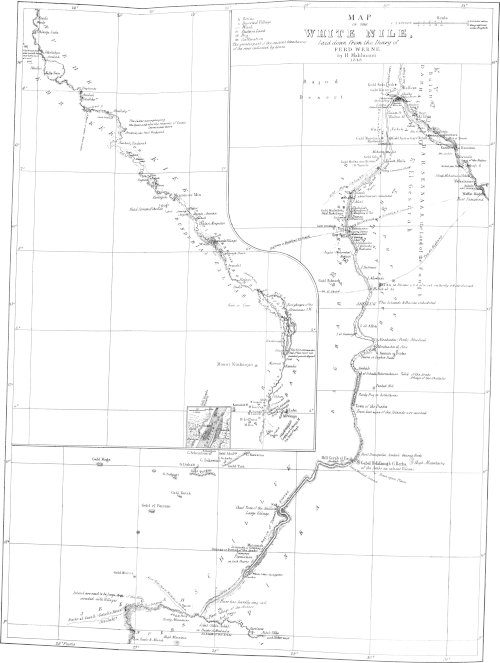
DESCRIPTION OF KHARTÙM. — BLUE AND WHITE NILE. — DEPARTURE OF THE
EXPEDITION.
Khartùm, 23 Nov. 1840. The engineers
have long since arrived, and at last, in spite of all the
assumption and threats of Arnaud, whose intention of wilfully
delaying the expedition could not be denied, and the motive of
which is sufficiently shewn by Sabatier’s explanation, the Turks
themselves determined to set out to-day. They were impelled to this
activity by Ahmed Basha’s having given the strictest orders to make
all despatch, “so that another expedition chargeable solely to the
treasury of this place might not be necessary, as was perhaps the
intention of the Franks.”
The equipment consists of four dahabiës from Káhira (vessels
with two masts and cabins, about one hundred feet long, and twelve
to fifteen broad), each with two cannon; three dahabiës from
Khartùm (one of which has also two cannon); then two kaiàss (ships
of burden with one mast), and a sándal (skiff) for communication:
the crews are composed of two hundred and fifty soldiers (negroes,
Egyptians, and Syrians), and one hundred and twenty sailors and
mariners from Alexandria, Nubia, and the land of Sudan. Suliman
Kashef, although without rank in the army, commands the troops by
the absolute will of the Basha, as he had done before in a Chasua
at Taka. Selim-Capitan from Crete has the direction of the ships
and properly of the whole expedition;[2]
the second captain is Feïzulla Effendi from Constantinople. The
other officers are two Kurds, a Russian, an Albanian, and a
Persian; the Europeans are Arnaud and Sabatier as engineers,
Thibaut as collector, and I as an independent passenger at my own
expense. Arnaud has yielded also to circumstances, notwithstanding
his parole d’honneur that he would not go with us, unless
his salary for ten or twelve months were paid beforehand. The ships
are furnished with ten months’ provisions, and six months’ pay has
been advanced to preserve in some measure from perishing of hunger
the families of the soldiers left behind, which from the low price
of female slaves were numerous. The officers and the other persons
holding appointments have received the Taïm belonging to them in money (the
different nations according to their grade), owing to the want of
rice, wheat, lupins, lentils, onions, butter and oil, meat and
bread, so that they might make what purchases they pleased, or stow
it in their kammer (money-pouch) according to the manner of
oriental misers, and let the neighbouring stomach feed on common
soldier’s fare, and console itself with the prospect of good days
to come. An indemnification has been given in tobacco and onions,
even to the common people, for the articles of the taïm, deficient
in the victualling magazine, which could not well be realized until
they arrived at Belled-Sudàn.
Ahmed Basha takes very good care of his soldiers, according to
Turkish notions, and pays them regularly, because his very
existence, which is menaced on every side, and the realization of
his ambitious plans, depend upon their fidelity.
Regiments of black slaves, being the born enemies of the Arabs,
are said to support him more resolutely than all his other troops;
and, as he affirms, in case of necessity, they feed on grass, and
have performed miracles of bravery in his presence, in Mora (the
Morea) and in the Hejaz. On this account, the idea struck him in
Taka of making up an amount of 5,000 slaves, and allotting this
duty pro rata among the superior Sheïkhs and officers. On
this occasion, ten slaves were imposed even on Selim-Capitan, which
he was obliged to furnish, although he was not in Ahmed Basha’s
service.
I first gained the dangerous confidence of this man in its full
extent by the following means:—He found himself here entirely
alone, as if in banishment; and when we were conversing about the people
and the country, with its abundant resources which were not taken
advantage of, and how Kurdshid Basha had conducted affairs here,
and dragged everything to the devouring Masr, and left nothing
remaining to him, he wished to know my opinion. I pointed out to
him repeatedly, and without reserve, the independence of Egypt, and
the plundering system carried on by the government of that country
and—my conviction being that he should follow the example of the
Basha—I sought to instigate him to render himself independent at
the head of this oppressed and discontented people, and to call
himself Sultan of Nigritia. It was clear to me that this was not
the first time since our acquaintance that he had brooded over the
idea, which he opposed with seemingly plausible, but
long-considered scruples. His sleepless nights, during which old
Deli Mustapha was obliged to make coffee for him four or five
times, were now explained; but I did not at that time know that he
was mortally hated there, where he believed he was beloved, and
that in spite of his fine speeches, he was called the executioner
of the Land of Sudàn. I might therefore awaken in the country, from
the great aversion of the grandees of the place to him, the desire
for a declaration of independence, but never for Ahmed himself. I
will bring forward some examples from the conduct of this execrable
man, to shew how the Turks make their countries happy.
Ahmed Basha was brought as a Memluke (white slave) from
Circassia to Egypt, and sold to Mustapha Bey, sister’s son of
Mohammed Ali’s first wife. He became the barber of the Bey, and
afterwards, when
his own beard grew, was appointed an officer in the army. He
accompanied the campaigns in the Morea, Hejàz and Syria. He brought
intelligence of the victory from St. Jean d’Acre with incredible
celerity to Egypt, and is said to have been attacked with
hemorrhage, as he was delivering the despatches to Mohammed Ali. He
afterwards became war-minister, but was removed in six months from
this important post, not on account of any incapacity, but from his
self-willed disposition, inveterate obstinacy, and excessive spirit
of opposition to all the grandees, and even to the viceroy himself,
who might have been pleased on the whole with his energetic
government. His iron arm threatened even to bend the Franks in the
Egyptian service under Turkish despotism, and he had already
brought the consuls into a good train, when one of them declared
that the Turks had no code of laws, that the Koran could not be
considered as such, and that the employés being Europeans
could not be subjected to arbitrary power. For a time he remained
without an appointment in Káhira, till he was sent with the 8th
regiment to Belled-Sudan. For a year he governed in common with
Kurdshid Basha, during which time he carried his intrigues so far,
that the Governor, who was generally beloved, was recalled, and
sent as Commandant to Adana in Syria, whilst the former received
his post as Governor-General with increased power. Here he
preserves, indeed, his own due respect and that of his people, in
the hope of being made the future Sultan of the natives; yet, by
his measures, he has not only trifled away the love of those men
who are so easily led by their chiefs, but also completely cut off
his return to Egypt, where, in the meantime, a book of his
crimes has been opened.
He is a man of fifty years of age, though in appearance he seems
scarcely forty; large and strongly built, with regular, handsome
and expressive features, generally wearing a serious look, though
he laughs a good deal. Whilst he is laughing, which is at his
command at any time, we may often observe in his handsome
countenance traces of agitation, betraying other thoughts than
those inspired by the gaiety of the moment. His physiognomy becomes
still more disfigured by his outbursts of wrath, which are not
rare, when his true character is more rapidly developed in the
working of his features than by all the chiselling and carving of
the Gorgon’s head. His blue eyes stare and sparkle in his deadly
pale countenance, and his inmost soul reflects itself in its real
light, at this moment, as if in a mirror—it is the face of a tiger.
Every one, seeing him for the first time, finds him a handsome man,
but with something inexpressibly gloomy in his look, and in the
melancholy features shaded by a dark beard. Ahmed Basha is a true
economist in every thing, and boasts of his parsimony, (which,
however, unfortunately degenerates into avarice,) saying, it is
extremely necessary for him;—that he requires a good deal of money
for present occasions, and will want more for the future;—and that
Mohammed Ali has only become great through his gold;—every means,
therefore, is justifiable by which he can acquire wealth. His table
is sparingly served; he does not touch the sweet favourite dishes
of the Turks, as being fit for women and not for men; he hates the
Turks and calls them asses. Therefore he is always
complaining that he stands alone, that everything presses upon him,
which is the truth, because every one fears him and dares not
speak. For his whole large establishment, with the exception of the
Harim, one sheep is killed daily; whereas, on the
contrary, Kurdshid had twelve or fourteen killed; and what was not
consumed was divided amongst the poor starving people—a custom more
worthy of a civil and military Governor of all Belled-Sudàn;
especially as the Turks and wealthy Arabs—the latter, however,
seldom, partly from fear of the former—feed the poor abundantly.
Besides money was obliged to be sent very often from Egypt to
Belled-Sudàn for the support of the troops; moreover, all the gold
which was drawn from Fàzogle and Kordofàn, and coined in Kahira,
was paid; for the preceding Governor complained continually of his
empty chest. Ahmed Basha knew how to provide himself with gold,
since he would never lose sight of his own interest. I heard from
him in Taka of the bombarding and surrender of St. Jean d’Acre,
which intelligence was kept secret. He feared for his position; and
his plan of making himself independent received a severe blow,
since Ibrahim Basha might suddenly march with his disposable army,
and attempt a diversion on this side.
The just Governor sent to his dear sovereign 4,000 purses, the
surplus of the treasury; and to shew the good old man what his
Ahmed could do in the country, 1500 gold okien as a present.
Besides this, he had had considerable expenses, had paid one-half
of the soldiers more than Kurdshid Basha, had purchased thousands
of camels and asses for the Chasua, for the purpose of transport,
&c. One would conclude from this, that under this Basha, a
complete reform of the system of government, and a flourishing
condition of the land, had rendered these supplies of money and
gold possible, but the surplus must be sought for in other causes
than in the prosperous state of the country.
If the direct taxes be very irregularly paid through the conduct
of the Kashefs (plur. Koshàf), Ahmed Basha has a number of other
means by which to squeeze gold out of the people. Inheritances,
where the testator is set aside, and, if necessary, some crime
fixed on him; despotic dictation of tributes in money or gold;
farming monopolies; selling fruits from the Shona, or the farms of
the Basha; net-proceeds of the slave-hunts, &c.
In selling the fruits and farming the monopolies, the price is
generally raised only in appearance by accomplices, and then in a
very courteous manner the affair is hinted first to one and then to
the other, who, in gratitude for the gracious punishment, raise
their hands to their mouth and head, well knowing that even the
latter belongs to the Basha, who commonly presides over such forced
broker’s business.
It is not a very rare thing for Sheikhs who cannot raise the
quantum of gold so arbitrarily imposed, to breathe out their souls
under the Nabút. A favourite plan of his, pursuing the same aim,
and having an apparent legal ground in itself, is the arrangement
of his iron will according to the investigations to be directed
towards powerful Kashefs, who do not deliver to him the half of
their plunder, or towards honest officials, whom he hates, and
whose places he
has already beforehand sold to others, when he is certain of the
share of the precious gain, which is made on collecting the Tulba.
These profitable investigations are especially directed against
officers who have the management of the accounts. A fresh revision
of their accounts, which perhaps were delivered twelve to fifteen
years ago, was entered upon for the second time, and, as he partly
made it alone, or by his creatures appointed and assigned for that
purpose, or when he thought it advisable, he ordered a bastinadoing
for life or death, it has never happened that the people selected
for payment were found guiltless.
Enormous sums have been squeezed out in this barbarous manner,
and hundreds of men plunged into misery and extreme poverty; for
Ahmed was not contented with falsifying the accounts of years long
past, and having them liquidated.—No; but he punished them also for
their falsely alleged embezzlements. Not one of these unfortunate
creatures had the least thing left to him, except a miserable
dress—everything belonging to them was sold—house, garden, slaves,
clothes, kitchen utensils, in short, to repeat the word,
everything—even the most necessary carpets and coverings for
repose. The proceeds flowed into the treasury of the Divan.
It is true, that nearly all the Turkish officials are cheats and
extortioners, only seeking to enrich themselves in every possible
way, and to defraud the State, as even the best conduct affords no
security for the duration of their appointments; but let justice be
done to them, and do not, because the Basha gives the order, find
the culprits guilty. Generally, the sum pretended to have been embezzled,
was twice or four times as large as the whole property of the
official. In this case, everything was taken that there was to
take, and if the man were wanted, he remained in his service, but
received for his pay scarcely as much as would provide him
sparingly with durra; the remaining part, being deducted on account
of his debt, flowed into the treasury.
In other instances the accomplices were ordered to replace the
deficient amount. Among these were reckoned those who perhaps
formerly were his superior officers, or his colleagues, and
fellow-collectors; and this judgment always followed, when Copts
were his accomplices. In the whole Egyptian kingdom the Copts
(Kopt, or Oept, as they do not pronounce the K to our ear,) are
condemned to be the Mallems (scribes). The Basha cherishes a
cordial hatred of these Nazrani, partly because he detests their
cringing servility and hypocrisy, which are carried to perfection,
and looks upon them, on this account, with the same contempt as he
does on the Greeks and Jews. Many of them are hanged, merely to
spread terror.
Not long ago the following incident occurred: a Coptic Mallem
was convicted in the manner stated above, of having purloined 1000
thalers[3] or pillar dollars at different times. He
received 1000 blows, and all his things were sold, the produce of
which covered the sum due, leaving a few hundred dollars over. The
unfortunate fellow, after this fearful punishment, was thrown, more
dead than alive, into chains, and they left him to his fate,
without sending
him a surgeon to afford him the least alleviation, by attending to
his severe wounds. The Basha went on a journey; his wakil, Fàragh
Effendi, an Abyssinian, who had been formerly a slave to the
Spanish Colonel, Seguerra, in Alexandria, took pity on him, and
sent for the surgeon, Sulimon Effendi (De Pasquali, a native of
Palermo). He passed three months in prison in this frightful
condition, when Fàragh Effendi thought he might solicit the Basha
to pardon the Copt. The answer of Ahmed Basha was to this effect:
“The Nazrani must be hanged, to serve as an example.”
Everyone at Khartùm was astonished, and the more so, because no
one doubted his innocence. A gibbet was quickly erected at the
market-place, and on the following morning the unfortunate creature
was hanging,—as Faragh Effendi told me the story,—with a placard,
written in large letters, on his back, and his feet scarcely half a
foot from the ground. All the Copts, notwithstanding the calamity,
were exceedingly rejoiced that he had not professed Islamism before
his death, but had died stedfastly as a Nazrani. The Turks and
Arabs are just as strenuous in their exertions to make proselytes
as the expensive European missionaries, without immediately
descending in thunder with their Prophet, as with a Deus ex
machiná, from high Olympus. The cruelty of this Basha is said
to have gone so far in Dongola that he wanted to force the son of a
Copt to witness the execution of the sentence of death on his
innocent father; but, luckily, the father died the night
before.
In Khartùm, the young Sheikh Effendi (mallem, or Turkish scribe)
received an order to revise the account of the Nasir of the linen Shunah.
He, being yet a novice in these affairs, and not knowing that the
word of the Basha “to investigate” must be always connected with
“guilty,” goes to him, and says that it is quite correct; but the
latter quickly sends the good youth back again to make another
investigation. Sheikh Effendi returns, and says, that the “man is
innocent:” the Basha calls him eshek (ass), sends him a very large
and long piece of cotton-stuff as the standard measure, and
commands him to make good the account, or else he would indemnify
himself out of the Sheikh’s own property. Sheikh Effendi was
therefore forced to take this great Top Homàss as the measure, when
of course an enormous deficit appeared; for, amongst the goods sent
in by several tribes of the Arabs, are included woollen stuffs made
in the country for the dress of soldiers, for sails, tents,
&c., and there is mostly a difference of one to two ells (drà,
arm’s-length) between these pieces. This was now extended back to
all the years in which the fellow had been Nasir, and the man was
entirely ruined.
Except the punishment of beating to death, which causes as
little sensation here as in Russia, public executions are not so
frequent in Khartùm itself, where his presence alone creates
terror; but the secret ones are performed without the cord and the
sword. The following may serve as a proof of the condition of this
grievously afflicted country:—When Mohammed Ali was travelling over
Sennaar, the old Sheikh Suliman of Rossères, the most esteemed and
influential man of Gesira (island, Sennaar) was forced to pay his
respects to him in the city of Rossères. He came with a retinue of his Hammeghs,
dressed simply in a black ferda; and, having stepped into the tent
of the great Basha, he greeted him, and seated himself, without
being invited, on the divàn close to him. The viceroy, beside
himself with anger at this freedom, did not speak a word to him;
but, after a short time, through his dragoman Abdin Bey, bade him
depart. The old Basha told our Ahmed Basha, when Sheikh Suliman
should again appear, to stand before him, in order to
instil somewhat more respect into this old obstinate fellow.
Suliman was summoned, and Ahmed entered into a conversation with
him intentionally, standing before the viceroy, to prevent him from
sitting down before the latter had assigned him the proper place by
motioning with his hand to do so. The crafty Suliman, perceiving
the Turkish finesse, and provoked at such treatment, which he did
not deserve, drew himself up erect, and addressed Mohammed Ali thus
in a serious, calm tone of voice, without waiting for the first
word from the latter, conformably to Turkish etiquette:—
“Thou wishest to reduce me, here, in the presence of my people,
to the grade of thy servant (Gadàm), but thou wilt be disappointed.
Thou dost not know my power. Art thou aware that it only needs a
word from me to excite the whole island to revolt, and to destroy
thee and thy trifling military escort? Reflect that thou art in my
kingdom, in my power, and not I in thine, Yet I will not be base;
say, in a few words, why I have been summoned here, and what I
shall do.” Mohammed Ali, enraged to frenzy at hearing a black talk
so to him, but perceiving only too well the truth of what he said,
reflecting on Suliman’s power and importance, and his own small
army, gave way in this critical juncture, and ordered Abdin Bey
(although he understands Arabic) to explain to him that the manner
in which he had behaved was not proper; that he intended to invest
him with the mantle of honour, and that he must kiss his hand as a
token of subjection. Sheikh Suliman listened to this, laughing at
the same time, but returned thanks for the honour of the
investiture, and stooped to kiss his hand, which, however, he did
not do, as the old Basha, enraged, kept both of them behind him;
whereupon Suliman, without further ceremony, silently went away,
and never appeared again, although he was summoned several
times.
Mohammed Ali was indignant at the heads or Sheikhs of the
mountains of Fàzogl not having paid their respects to him, as they
had been apparently subdued by Ahmed Basha, in his expedition
against Mount Tabi, Aba Regrehk, Singue, to Beni-Shangull, (twelve
days’ journey behind Fàzogl, called by the Turks Fèsog’l), or
rather had entered into a friendly alliance. And he attributed
their non-appearance to Sheikh Suliman, whose dominion extends from
Aba Nande, below Rossères, to Fàzogl, and who, although of a small
and weak frame, for he is above eighty years old, (some say more
than a hundred), has not lost by his subjection the fame of his
bravery in former times, which is spread through the land, and of
which wonders are related. On the contrary, he is reckoned a real
prince of peace among these considerable chiefs, and has preserved
tranquillity in the country in behalf of the Turks,
entirely for the
sake of preventing bloodshed. He went into the villages of his
people, who honour him as a father and tutelar genius, and merely
said, “The Turks again want Tulba; I know not whence to take it.”
They brought it spontaneously, each according to his means, and
even more than he wanted, which surplus he then distributed among
the poor. One must know the avaricious character of these people
properly to appreciate such generosity.
This frank and open speech on the 24th Dec. 1838, was sufficient
to shew the old Basha how civilization, even in Ethiopia, begins to
assert its claims, and urges resistance against Turkish barbarism;
for wherever the soil is abundant, there personal freedom, the love
of which these people have preserved pure in their hearts, has a
right to demand a generous maintenance; but they have not even
this, for, in contempt of the country and the people, every thing
belongs to the great man, or his hangmen. He sent presents,
therefore, and issued written proclamations, to the absolute rulers
of Kamomil—where the richest veins of gold have been found—of
Fazangùr, Duhb, and even to the Galla-chiefs, in which he says that
he is not come to disturb their tranquillity,—that he, the Lord
of armies and cannons, promises peace, &c. Even Abu
Sarrott, the terror of all the mountains behind Fàzogl, received
sabres and Turkish dresses from Mohammed Ali, and, fourteen days
afterwards, the receiver of these presents plundered all the
magazines, and carried away the cows and camels. This Abu Sarrott,
before whom every one trembles, was formerly a slave of the Sultan
of Mount Hummos, east of Fàzogl, had rendered himself independent, and
having no settled abode, makes himself a home everywhere.
Mohammed Ali led four battalions of infantry, 400 Mogrebin
cavalry under their leader Ladham, and 600 horsemen armed with
lances, swords, and bucklers, from Sennaar, under the Sheikhs
Defalla and Edris Wood Adlàn, with two field-pieces, to Fàzogl,
where he made a sacrifice to humanity, by releasing 400 slaves. He
had already in Khartùm revived the old edict issued from Alexandria
and Káhira for the abolition of the slave-trade, in order to throw
dust in the eyes of Europeans; but this order was one of those
which, though publicly given, contained secretly a counter order.
This practice goes so far, that these fine orders which are issued
from Kahira, are entrusted to a kawass or courier, who on such
occasions is a confidential lictor of the great Basha, and who
quietly whispers into the ear of Ahmed Basha how he is to
understand the despatches. So much for the suppression of the
slave-trade, or rather of the Chasua (slave-hunt), as the former is
practised publicly throughout all Egypt, even in the houses of the
Consuls. So much for the not setting foot upon Abyssinia, where
however Emir Bey undertook an expedition from Fàzogl to Atish,
towards its boundaries, marching forward with the incredible
caution usual in the Chasua, and seized Christian churches, and
massacred every soul. So likewise in Taka, where slave-hunts took
place on all sides; and from whence we should very certainly have
gone to Habes, if the campaign had turned out well. Such was the
case also in Kordofàn, where, on the intelligence that Mohammed Ali
had himself put
into effect at Fàzogl the orders he had given in Khartum, on
account of the delay that took place, the slaves found unfit to be
recruits were set at liberty. At the same time the well instructed
Ahmed Basha dared to issue an order to Mustapha Bey to prepare a
Chasua for 6,000 slaves, by which the loss of the 400 in Fazogl and
of the few who had been emancipated in Kordofàn was sufficiently
covered. Ahmed Basha managed afterwards to gain the confidence of
the old Sheikh Suliman, probably, by praising his independent
behaviour towards Mohammed Ali. In short, Sheikh Suliman, who had
no medical assistant in Rossères, allowed himself to be persuaded
by Ahmed Basha to make his nephew, Edris Kantòr (also Kamptor) the
ruling Sheikh, conformably to Mohammed Ali’s wishes; to stand by
his (Ahmed’s) side in Khartùm as his counsellor, and to take into
consideration the welfare of the country. The renegade Suliman
Effendi (with whom my brother was once there) was to have him under
his care; but the Sheikh would not take any medicine, because he
feared a physician whose fame had even extended from Arabia. This
Sicilian had poisoned thirty-three soldiers there in order to ruin
two Frenchmen, the physician and the apothecary, whom he detested.
Ahmed Basha has need of such persons even in this land. Suliman
suddenly died because he was too tenacious of life and wanted to
return to Rossères, and was immediately buried according to the
custom of this country, just as I was on the point of visiting him.
“Deve morire, non c’è misericordia,” said Suliman Effendi,
laughing, when opposing my brother with respect to the nature
of his illness;
and he was right. The brother of Sheikh Suliman, Nasr Wud Ahmed,
came six months after to this capital; the strong, robust man was
despatched in fourteen days in the same Turkish manner. Another
brother received for some trifling matter 1,000 blows with the
kurbash (a scourge, or whip, cut from the skin of the
hippopotamus), far worse than the Nabùt, and reckoned to be
equivalent to death: this man endured the punishment not only
manfully without uttering a sound, but sprang up, and exclaimed,
“Ana achu el bennaght!” (literally, “I am a brother of the
maiden!” it means, however, a man who defends his hearth—generally,
a hearty, brave fellow). Such examples of hardihood are not rare
here, and depend partly on the race from which they spring. By the
intrigues and the constant chicaneries of Ahmed Basha, the family
of Suliman has been reduced to the lowest point. Woe to the Turks,
therefore, when the time for revenge comes! The people belonging to
the race of the Hammeghs still continue formidable, and remain
always devotedly attached to the family.
These great Lords of the Isles, such as Edris Wud Adlàn, and
Edris Kantòr, nephew of old Suliman, possess villages wherein 3000
or 4000 slaves live at their ease, with their wives and children,
who are faithful and require only a hint from their protector.
These Sheikhs, who are the issue of the marriages between the
Funghs and Hammeghs, have besides a body-guard which they have
furnished for themselves, being their own or perhaps not their own
children. Thus Kantòr has more than 100 wives, Edris
somewhat less,
none of whom must be barren, if they do not wish to be displaced by
others.
The old policy, which unfortunately still holds good, of chiefs
being at variance with one another, bears its fruit also here.
Kantòr as Sheikh of the Divàn, fears the lawful heirs, the children
of Sheikh Suliman and Nasr, and has already murdered seven of them,
without being called to account for it. Two sons, however, fled to
the Sheikh Wud Abrish, on the confines of Makàda.
There died besides, in confinement, whilst I was in the country,
the great Sheikh Mohammed-Din, a martyr for his Haddendas;—also
Sheikh Hademer, highly esteemed in Mahass, who some years before
had prophesied from his old books, that the Inglés (English) would
free them from the Turks; wherefore, as soon as the intelligence
was received of the taking of St. Jean d’Acre, he was seized in
order to be, like Mohammed-Din, for ever set aside.
A man of consideration, on whom the Basha had forced the post of
Muder of Dongola, for a considerable sum of money, died the day
before he was about to set out for Dongola. My brother said to
Suliman Effendi, that the unfortunate man was poisoned. “Pare
cosi ma ben pagato la sua morte da Muder,” answered the
renegade, and then abused the avaricious Basha, because, instead of
paying his debts, he had required him to reduce them himself.
What, however, made a great noise and sensation in Egypt, was
the death of Farat-Bey, in Wollet Mèdine, and especially the sudden
decease of the brave Mustaphà Bey, in Khartùm, the only Turk who
was really beloved in the whole country, and who was therefore an
enemy of the Basha. He came from Kordofan to Fàzogl, during the time of the
extreme heat, where Ahmed Basha hoped he would perish from the
insufferable climate, as he said himself jocosely. He was not well,
and was exhausted by the journey; he became worse without Suliman
Effendi summoning to a consultation the three Italian physicians
who happened to be present, Cecconi, Toscanelli, and Count de
Domine. The Bey, surrounded by Memlukes and servants, requested
Suliman Effendi to give him medicine to send him to sleep. The
latter spoke in Italian to himself, went to the small army
medicine-chest, being watched by the slaves, took laudanum and gave
it to the Bey, in a silver tablespoon; but the desired sleep did
not come;—and Mustaphà himself called for opium, though he was not
accustomed at other times to use it. The attendants, still
remaining in respectful silence, heard and saw how the Sicilian
muttered again in Italian, again poured laudanum into the spoon,
and held it to the mouth of the Bey. Scarcely had the latter taken
this dose, which was larger than the first, than blood rushed from
his nose and mouth, and he slept for ever. His Memlukes knew the
bottle on which the name was specified, too exactly, and called it
Rogh el Affiùn (spirit of opium). Suliman Effendi did not appear
the next day, and on the morning after, when he came to me, was
very discomposed and absent in mind—exclaiming, “che brav’
uomo! peccato,”—whilst he sought every moment his snuff-box.
Whereupon I asked him, whether he had given the Bey laudanum twice?
He did not deny it, but he had only given “a few drops,” “e,
Signor Avvocato! mi era padrone, io servo suo.”
I had
everything to fear from this man, who otherwise was friendship and
familiarity itself, on account of my brother, whom the Basha
intended to put in his place, as medical inspector of Belle Sudan,
and had openly expressed that intention. It was therefore with the
most solemn earnestness, that I threatened him with death, if I
should not find my brother alive on my return, and should discover
that he had come in contact with him.
“Dio guardi, che affronto,” he said, and quietly drank
his glass of rum; for a similar insult had been openly offered to
him in the divàn of the Basha, which naturally referred to the
poisonings laid to his charge in Arabia and here. Not only did the
superior military and civil officers fear to take medicine from
him; but also the Basha—who, indeed, knew him best—would not
receive on one occasion a glass of lemonade from him, though he had
prepared it under his own eyes, and asked my brother for another
glass, which was, of course, annoying to him. He was called at the
bazaars “Rogh el Affiùn;” in the coffee-houses, “Rogh el Affiùn,”
and “el Marras” (ruffian, or bad man).
The unhappy end of Mustaphà Bey found general sympathy; and some
astonishment was excited when it was known that the Basha had
threatened Suliman Effendi with the bastinado if he did not pay his
debts. Even in the divan of Vaissière (which we also called the
exchange, because this man, who was an officer under Napoleon, and
decorated with the croix d’honneur, carries on the most
considerable traffic in slaves in the whole country) the death of
the Bey was discussed by the Franks; and it was doubted whether it had been
done by Ahmed Basha’s orders, or whether Suliman Effendi had
accomplished the deed of his own accord, in order to render an
essential service to him.
Whilst they were speaking of him, the old greybeard entered with
his accustomed sallies of wit. They laughed at his conceits, and
treated him as usual, which is so easy for these European people,
even when they have deadly hatred in their hearts, that it makes an
honest man shudder. I could relate a good deal of these Europeans,
but it would make too long a digression here, although we are
stopping between the Blue and White Nile; and I consider it even my
duty to particularize them by name on another opportunity, as I,
with my iron sceptre in my hand, have before threatened to do. My
brother and myself might perhaps be reproached for having visited
such companions, who, under an exterior appearance, by which the
mere passing traveller is so easily blinded, have utterly abandoned
all law, justice, and morality, and have almost renounced Europe;
and for having associated with men who are no longer masters of
their better selves, but entirely lost, and of whom we were warned
in Káhira. Kahira and Alexandria must be known to estimate properly
such a warning, as it does not refer to the immorality of men, but
only to the preservation of one’s own interests against danger.
Káhira, as well as Alexandria, affords abundance of materials for a
chronique scandaleuse, and forms an uncommonly rich and
highly interesting stubble-field of unmistakable colonial nature,
where a careful winnowing of the higher society would give a
surprising result.
It is the same even with the small and partly ephemeral colonies of
Franks in Khartùm, where they concentrate themselves at times.
After a tedious journey of three months, we arrived here. The
Muslims perceived the French flag hoisted as a matter of
precaution, as it generally prevents the ship being taken away for
the use of Bilik (government), and they crossed over to the
Douaniers, who never lose sight of their prey: we were truly glad
to find human beings again. Our flag was known by no one except by
Vaissière, who gave vent to an old grudge against the Prussians,
and excited a prejudice against us among the Italians, which was so
much the greater, because a noble example of Prussian manners and
customs had caused an uncommon sensation here in Khartùm. The long
title of my countryman was hardly perceptible on the fragments of
pots, whereon we read “Puckler-Muscau,” called and supposed by the
common people to be “Sultan betal Moscow.” However, they tendered
their services to us with uncommon hospitality, letters having
preceded us which possibly described us as harmless fellows,—except
one, a German letter. A Frank, in white Turkish costume, addressed
us, like a shade from the lower regions, in the German language: we
were surprised, and especially when he asked about a letter from my
countryman ——, which at the best, therefore, must have been an
Uriah’s letter. The pale citizen of Khartùm calls himself a peasant
(from the neighbourhood of Wurzburg), and is now inspector of
manufactories in Kamlin.
A letter, full of low calumny, from my amiable friend had found its way even
to him, although I had not done him any injury; but he was too well
known. He had, in a peculiar sense of the word, given me letters of
recommendation against my will, not only here, but in Cairo, to
which city he took the trouble of writing three. It is the curse of
a prolonged residence in the South that the character of Europeans,
and particularly of the northern nations, alters more or less in
course of time. Slumbering passions display themselves in an odious
and very dangerous manner; the cat becomes a tiger raging against
itself, if the spirits of Ahriman,—brandy, and opium,—have him
betwixt them;—and at last he is mocked and laughed at. A choice of
companions, who might be called “good and bad, or high and low,”
was not to be found among the few Franks in Khartùm. They live a
cat and dog life with each other, but are breathing witnesses that
this is the land of the Lotophagi; for, from their frequent
convivia and bacchanalia, they might be supposed to be bursting
with love and friendship. Whoever is really in earnest to acquire
general information on the manners and customs of the East, and to
increase his knowledge of human nature, must not carry himself as
cautiously as a diplomatist, provided he is conscious of good sound
principles, fostered from youth upwards.
Mustaphà Bey was dead; Ahmed Basha had lost a rival, and
moreover came into possession of 2000 purses, by the closest money
transactions with the public exchequer. The brother of the victim
arrived with a high and mighty Firman from Constantinople and
Káhira, to fetch his brother back to Thrace from the unhealthy climate, and,
perchance, also from the dangerous contiguity to Ahmed Basha. It
was intended, perhaps, that he should come too late, for they
managed, in a remarkable manner, to procrastinate his stay in
Káhira, and also on the road. He was very much cast down, and
scarcely regarded by the Turks, even by the Copts, wherefore he did
not dare to reclaim his inheritance, as he valued his life.
Sero venientibus ossa could not, however, be said of him,
for the Charim (harim), with flesh and blood in abundance, remained
to him. This arose from the Princess or Bashalessa,—as the wife of
Ahmed Basha, and the daughter, or adopted daughter, of Mohammed
Ali, is called by the Franks,—having, in an unusual visit, openly
shewn her sympathy, and prevented, by her authority, on the part of
the Divàn, the harim being plundered. This lady was awarded to
Ahmed as a mark of peculiar favour, when he was residing in Káhira,
where she also remained behind till the year 1840.
Ahmed Basha was obliged to discard his former wives, according
to the custom here, and also in Turkey, when the daughters of the
Sultan are married. Even those great men were forced to do this, to
whom Mohammed Ali, in that magnanimous reduction of his inventory
of women in 1838, bequeathed princesses from his Charim (for whom
he had lost all regard, and would not pension as widows), to be
their reigning lawful wives, and whose slippers, conformably to the
Mussulman custom, they were compelled to kiss. Our Bashalessa is,
according to my brother’s opinion, an accomplished Levant lady, who
knows how to distinguish good from bad, and feels herself extremely
unhappy in Khartùm, where she is confined to her cloister, with an
occasional excursion on the Nile. She is desirous of getting away
from the place, and wanted, therefore, to entrust my brother, when
we had determined on our return, with a letter to her father
Mohammed Ali: she sent also, contrary to her former custom, several
times during my brother’s illness to inquire after his health. When
he was called in to see her as a physician, she received him
without a veil, just like her attendants, and spoke continually of
Masr, and asked after political news. She is a tall, imposing, and
almost masculine person, with a deep voice, yet very courteous;—but
not nearly so handsome as two novices in her train, condemned to
chastity. In the antechamber, from whence the Tauwàsch (eunuchs)
did not dare to step over the threshold of the cell, he always
found an European breakfast to console him. She may, therefore,
have contributed to Ahmed Basha’s being recalled to Káhira. The
latter, however, did not obey the repeated invitations, and died
of a tertian ague in the spring of 1844. His successor was
Ahmed Basha, known by the epithet of “Menikli,” (meaning “great
ear,”) whose march to Taka appears, according to the usual vaunting
of the Arabs, to have turned into just as rapid a retreat.
Khartùm forms, in every respect, the capital of Belle-Sudan; it
has a mixed population of about 30,000 souls, and lies, according
to Duke Paul William Von Würtemberg, (who visited this country in
the spring of 1840, and went as far as Facharne, near the Geb’l
Kassan, three or four days’ journey above Fazogl), under the 15th° 41′ 25″ north
latitude, on the northern point of the land of Sennaar, between the
Nile and the White Stream. It is called Khartùm (point of land)
from this position. Only a few fishing huts marked, some thirty
years ago, the place where gardens and fields extend on the narrow
neck of land running from the city northward towards the mouth of
the White Stream, from whence the colony, advancing upwards in the
direction of the Blue Stream to the south-east, turns the greatest
part of its numerous gardens to its principal side, whilst the
miserable huts of the Baràbras lie scattered about the level margin
of the White Stream. The small group of houses standing in the
place of the fishing huts I have mentioned, is called el Belled,
meaning village here, in opposition to Helle (city). Khurdshid
Basha is, properly speaking, the founder of Khartùm, for he fixed
his residence here, erected more public buildings, and even
established a dock on the White and another on the Blue Stream.
Except the dyami (mosque) and the bassàr (bazaar), all the houses
are built of lathes, or air stones, the fabrication of which is so
slight in the new buildings, that very noxious standing pools are
formed, which, at the first rains, are immediately peopled with
frogs, said to come out of the earth. Ahmed Basha understood these
disadvantages to health so much the more, because he himself was
subject to frequent fevers, and wished, in order to obviate the
noxious evil of the unhealthy situation of the city, not only to
fill up these ditches, by pulling down the houses nearest to them,
but also for the sake of a better draught of air, to have wide
streets formed. To render the city secure against any danger from water, he was to
have made the shore of the Blue Nile an angle of 45°, and the earth
removed thereby, with the ruins of the houses taken down, was to
have been employed to make a broad dam;—this dam to be planted with
trees.
In like manner, a long wall was to have been raised along the
White River, and an extensive sandy country would have been laid
under cultivation. We spoke on this subject in Taka, and he
immediately wanted a drawing of a plan, which was easily made, even
at so great a distance, because, excepting the mosque and the new
bazaar, no heed was to be taken even of his palace. Ahmed Basha had
really much practical sense, and thought that every one ought to
be, by instinct, a bit of a Hakim and Maendes, (physician and
engineer).
The departure of the expedition was fixed for the 23rd November,
and yet three cannon shots, unexpected by any one, resounded to-day
about l’Asser, (three o’clock in the afternoon), as an imperative
signal, although it had been long wished for by me. I sprang to the
window and heard myself summoned, from the ship which was to convey
me, to come immediately. Now there arose an indescribable swarm of
people and clatter on the shore, a crying, howling, and
leave-taking, so that I was glad to be able to squeeze through the
crowd to the cabin. Sounding above every thing arose the shrill
treble of women, that inimitable and horrible quavering cry,
“Kullelullullulu,” by which they give vent to every lively emotion
of the heart in pain, joy, and misery, with different modulations
which a foreign ear can only distinguish by frequently hearing
them. This time it
was a farewell cry, for every one flocked to the shore to give the
parting greeting, and some rushed even into the Nile to the side of
the vessels. There were women, daughters, sisters, brothers, and
the chorus of black, brown, and white dancing girls, who nimbly
drew from large round vessels of clay (burma) more merissa, and
passed this parting drink round in gourd shells (gara) among their
acquaintances, gratis. These dancing women, or filles de joie
(guavàsi, sing., ghasië), are never wanting here at any
feast, whether with Turks or Christians, and break, at least, the
monotony of such comfortless society where woman is always
excluded.
If we few Europeans had not perhaps dragged ourselves very
quickly to the vessels, with an occasional curse at the climate on
our lips, the Turks, certainly, did not move more actively; nay,
they were even more enervated by the influence of the climate, and
the discomforts attending it. They came therefore surlily,
sluggishly, and unattended, having left behind their attendants in
the harims. It was only the coloured people that suffered nothing;
they were in their native element. Our black soldiers embraced one
another, shouting for joy, because they were going to the south, to
their free fatherland, from which they had been inhumanly torn by
Chasuas or Dshellabs (slave-hunts or slave-dealers). Inspired by
Merissa, they shouted, in their language, to their different
countrymen, who, partly in chains, were carrying water, and many a
plan for the recovery of their freedom, and the destruction of
their oppressors, may have been awakened in their rude minds.
Belle-Sudàn means
not so much Land of the Blacks, as Land of Men of
Colour, for assuet denotes black, and sud
smutty or dingy, as the word is used here; for example, in dirty
linen. According to the colour, the name might have been used as
beginning from Assuan, but the northern boundary of Belle-Sudàn is
formed by the two rocks of Assul, on the right shore of the Nile, a
declivity of the Achaba Shangull. That Achaba with its
rocks crosses the Nile, and its natural gates also are the
boundaries of the Mamùr of Berber. But here, where the poor, fair
child of man, not excepting even the Arabs and Kopts, totters about
and fades away, weak, and feverish as if he were affected with the
Marasmus senilis; here upon his native soil, we ought to see this
dark people, how boldly and freely, nay wantonly and
flexibly—again, how angularly and awkwardly they move their limbs
under this glowing sun;—how they stamp with inconceivable pleasure,
fury, and perseverance, upon the hot ground in the wild dance, till
the earth trembles again. Here it is that we must see the Blacks,
when they have drowned their grief for their lost freedom, and the
home-sickness which kills most of them, in sparkling
Merissa, if we would know them thoroughly, with all their
peculiarities, and in their entire bestial beauty. From this muddy
soil of the shallow lakes of the inner countries fermenting under
the hot sun, such a dark-coloured and black breed as the Dinkas
could alone spring, with the primitive forms of human monsters, yet
with plastic frames, without being masters, in our sense, of their
mass of limbs. With what ease and purity the naturalized dark-brown
Arab and Baràbra, and the black Nuba move here:—how secure their tread on the
vessels, in comparison with our Egyptian lubbers, who, like the
Pachydermata, cannot renounce the Fellah.
The line of the vessels unwound itself into a curve from the
shore of the blue stream; the cannons thundered, all the guns were
repeatedly discharged, the drums (trombet) beat a flourish; here
and there arose a noise and contention for places; the Arabs sang
to the stroke of the oar with the accompaniment of the tarabùka
(pot drum), the Baràbras struck up songs with their tambùr (guitar,
Arabic, Rabàba) at the same time: here one blew the double flute
(argùl), there sounded the sumàra (pastoral pipe). All this was
done chiefly to stun themselves and to lighten their agitated
hearts. Scarcely had I by signs taken my leave, than there came
over me a feeling of separation, as if I had left my brother Joseph
in Khartùm. Many days journey indeed he was from me, and in a
campaign that I knew, from being previously present at it, was
dangerous. At Gohr et Gash, I had jumped on a dromedary without
first embracing him: we had both regarded it as a good omen, but
now our separation was first definitively decided. In Khartùm I
had, at times, received intelligence or letters from the camp; here
we had so often afforded brotherly assistance to each other on a
sick bed, and mutually saved one another’s lives. What dangers,
what adventures awaited him and me between the present and the
moment of meeting again!—but—we shall yet see one another.
Sailing down the blue stream, we soon neared the wooded island
of Tuti, inhabited by the Baràbras, rising gently like a little
Delta, at the conflux of the two arms of the Nile. This island is
said to be the oldest colony of the Baràbras in these parts, on
account of which they bury their dead there from the whole
surrounding country, just as the Arab tribes, and the other
inhabitants of the banks of the Nile carry their dead to the
village of Hubba, lying opposite to Khartùm, upon the right side of
the Blue River, because in both places highly revered Sheikhs or
saints have their tombs in lofty, cupola-shaped vaults, gradually
diminishing upwards to a conical form, and called Hubba, (not
Kubba, which means the plague, a disease entirely unknown here).
The White River, flowing to the north-east, rolls in an unbroken
stream along the north-west side of the island of Tuti, whilst the
Blue River, whose current is more than twice as strong, bounds
against this straight, whitish stream of water, as well as against
the south-east side of the island, and winding through between the
latter and its right shore, which juts out, makes a bend, deserts
its former direction to the north-west, and turns in a
north-easterly one, with the White Stream.
Here, once, both streams met and became united in a lake, which
might have formed a triangle, according to the direction of the
White Downs, above Khartùm from the Blue River, near the village of
Gos Burri, the smallest angle of which went towards the south into
the White River. At that time, the Blue Stream exercised quite a
different dominion, and did not condescend to the before-named bend
at the Island of Tuti, from which bend the traveller is firmly
convinced that the Blue Stream flows into the White. The
inhabitants of the banks, however, assert the contrary, for the former, as being the
Nile, is considered, as it were, sacred, from its superior water
and its more beautiful colour; although they allow that both
streams spring from one source. This likewise redounds to its fame,
that it is said to flow five times quicker than the White Stream,
which latter indeed is nearly stagnant in the dry season. With all
its good qualities, the Blue Stream displays a destructive activity
towards Khartùm. If it had extended this activity before, more
towards its right shore on the east, and spared the low ground
heaped up by it towards the west, to be the foundation of a future
city, and formed by its alluvial deposit a dam against the White
Stream, its waves would now wash up more against its west shore,
exactly opposite to the principal side of Khartùm. It is very
certain that it is not necessary to go back into the ages before
history, to speak of a land-draining of the northern point of
Sennaar, since the expression “fok el Bachr,” points plainly to the
old river’s edge by the Mosque; and likewise, not a single brick
has been found in all this lake soil of Khartùm, except on the hill
near Burri, which also must be considered merely as a new shore of
the lake. As I have said before, the Blue Stream always extends
more towards the mouth of the White, which it has already pressed
down against the edge of the rock, in the desert near Omdurman,
whilst it extended itself, like a lake, immediately from Hubba in
the extensive low country east of Halfaia, until it closed the road
there with the hilly alluvial deposit upon which this city is
partly built.
If the lake ground at Khartùm was principally governed by the White Stream,
and its deep, clayey site overlaid with sand, the blue stream has
heightened its lake at Halfaia with a fruitful soil, which yet
enjoys at high water its blessed waves, that impart, however, only
a soft green to the forest.
Near Wud, or Wolled Hüsseïn, four hours’ east of Halfaia, a
natural canal is seen in the rocks, with a steep fall, which even
now is active as a Gohr, and might have made an outlet once for the
lake on this side. The immediate cause, however, why the blue
stream, by Khartùm, presses against its left shore, and flows
almost under the houses of Khartùm, lies in the fact, that it has
thrown up so much sand within these few years, against its east
shore from Hubba to the island of Tuti, that the inhabitants of
that great village are forced, when the water has somewhat
subsided, to go far over the sand of the heightened bed of the
river to the water, and that the inhabitants of the island there
wade through the Nile to the right shore, on a sandbank ominously
forming itself. If this last current of the blue river shall
eventually be dammed up, its mass of water will rush with the
strength of a powerful mountain torrent against the mouth of the
white stream, and raise it, because its last strength is already
expended, even at a moderate height of water, by the projecting
rocks and the islands impeding its mouth. Then Khartùm will be
lost, and the water will not only regain its former territory below
Djami, but the blue stream will also break through above the whole
city, as I sufficiently convinced myself a short time ago, at high
water, when the city, notwithstanding the miserable Turkish
precautions, was saved as if by a miracle, and the blue stream looked into my
window, over the narrow dam of earth, which is about three or four
feet high.
On this occasion, I saw five gazelles at the south-west end of
the city, near the hospital, gazing with wonder on the mirror of
the water of the wide white stream passing over into its old lake
basin, which was driving them towards the city. A stupid Topshi
(cannoneer), who was at too great a distance, without further
ceremony scared them away immediately by a heavy shot from the
powder magazine, whilst I, with my servant, had made a long circuit
through the water, in vain. On such an inevitable swelling of the
river, which must lead to the destruction of Khartùm, the old
double lake that has ebbed away, will come to life for some time,
and not only wash away the island of Tuti even to its rocky base,
but also the whole margin of the left shore of the united stream up
to Kàrreri, which, however, possesses in its rocky mountain, about
three hours’ distant from Khartùm, a breakwater reaching from the
desert of Baguda.
Ahmed Basha perceived all this very well, when we travelled
together on the Nile to Tomaniàt below Halfaia, where he had taken
the best fields from the Shaïgiës, in an illegal manner, and had
ordered fifty sakies (or chain of buckets, for raising water) to be
constructed upon it, and where the sesame was standing
majestically, higher than a man, and might yet grow another foot.
For this purpose—to obviate the danger which might arise to the
future royal city—the bend of the right shore near Tuti was to have
been broken by a deep canal, in order to carry away the sand from
Hubba, and to
deepen there the bed of the river. A favourite plan of the Basha’s,
however, was to make his residence a fortress, to erect works on
Tuti, and to place Khartùm upon an island by a canal, to be opened
from the Blue to the White Nile; for such a canal formerly existed
from Soba to the White Stream. Old people relate, to be sure, but
only as a rumour, that the White and Blue Stream met together
there. The ruins of Soba already known (which place one hears
pronounced likewise Suba and Seba), consists of heaps of burnt
bricks, without any other cement than the Nile slime, which have
supplied the surrounding country for the vaults of the reputed holy
Sheikhs, as well as in more modern times, Khartùm with materials
for its mosque: they extend over a considerable space on the right
shore of the Blue River. I heard the country opposite these ruins
called likewise “Dar Soba;” therefore a contra-Soba, or perhaps
once united to it, since the burnt and fused masses of brick, the
wide-scattered bricks and fragments, even the ditches, if there had
not been clay or foundations and vaults dug out, indicate, at all
events, an old place. A small village on the edge of the river,
under shady mimosas, and called Soba, extends to this. I have found
just as slight traces of that canal, or of the bed of a river in
this woody country, as in the other Soba on the right side of the
river; and, therefore, I cannot assume, with regard to the
last-mentioned ruins, that they were once situated on the land of
Sennaar, although the right shore might indicate the violence of an
irruption of water through the city itself.
Before I forsake the Blue Stream, I must yet remark that, besides the usual name
of “Bach’r asrek,” it is called in this neighbourhood, “the Nile,
or Bahr el Nil,” as I have often convinced myself. If it be asked
why it is called the Nile, the answer is, because it has beautiful
and good water: the old expression for this river is therefore
identical with its properties. It is just the same in Egypt, where,
as I found from experience, especially in Káhira, Bahr el Nil
expresses the material properties of the water, for even the sakkah
(water-carrier) interprets the Nile water with hellue (sweet), in
opposition to cistern and brackish water. The Basha calls it also
nothing but Nile, and says that certain Sheikhs have declared to
him, that ignorant people call it after its blue colour. Nile means
in the Arabic language indigo; otherwise this word is no longer
used for a blue colour. I had an opportunity of hearing the word
Nile used for inundation, together with Ba Kebir, or ruga tossiga
(great water), denoting the same thing. The old expression of Nile
awakes here, therefore, at the moment when it discloses itself as a
divinity, a protector, and a nourisher of the country and people.
Only the large pastoral Arab tribe of the Shukuriës, in the
so-called Meroë, between the Blue River and the Atbara, has the
peculiar name of “Adehk,” in its Aggem language for this stream,
whilst the other nations in their name for it, indicate its colour.
Those of Dongola, and Mahass, who both boast to be Gins betal Thin
(people of the soil), call it Amanga Arumga, and Essige Rumege, and
the united stream, Ruga; even the far distant Nuba negroes, the old
support of the family of the Ethiopian mixture of blood,
from Assuan to
Rossères, call it Blue Water (Tè Uri). It is the Blue River,
therefore, which possibly has imposed the name of Nile on the
united stream, and might have formed the road of cultivation to
nations wandering down and back again, whilst the mouth of the
White Stream, retarded by lake-like shallows and swamps, was far
less known. As, in addition to this, it is denied, with some
justice, that fertility and good water are the property of the
White River, it might have been, in the ages of antiquity, despised
so much the more, and looked upon as a subordinate stream, not to
be spoken of: not a single burnt brick, or other memorial, points
to an earlier intercourse with it.
Before we entered the mouth of the White Stream, we conferred
the last honour on the sacred water of the Blue River, by filling
the large earthern water-vessels, (Sirr, like the ancient Amphora)
with a great noise, and cursed the White River as being stinking
(affen.) The sails were worked amid prodigious confusion; the
north-east wind blew gently in them, and we bent our course from
the Mogren, (denoting equally conflux and mouth, confluentia et
ostium,) round the northern point of the land of Sennaar, (Ras
el Khartùm, head of the neck of land,) and sailed slowly to the
south over the rocks, overflowed with water, into the White Stream.
There we heard the last kulle-lullu-lulu of the women, who raised,
with both hands, their handkerchiefs in an arch over their heads,
as in funerals. This made most of us laugh, especially my men, who
thought that they had as good teeth as the Njam-Njam, so much
feared by many, particularly by well-fed Egyptians, but whose
country no one could point out.