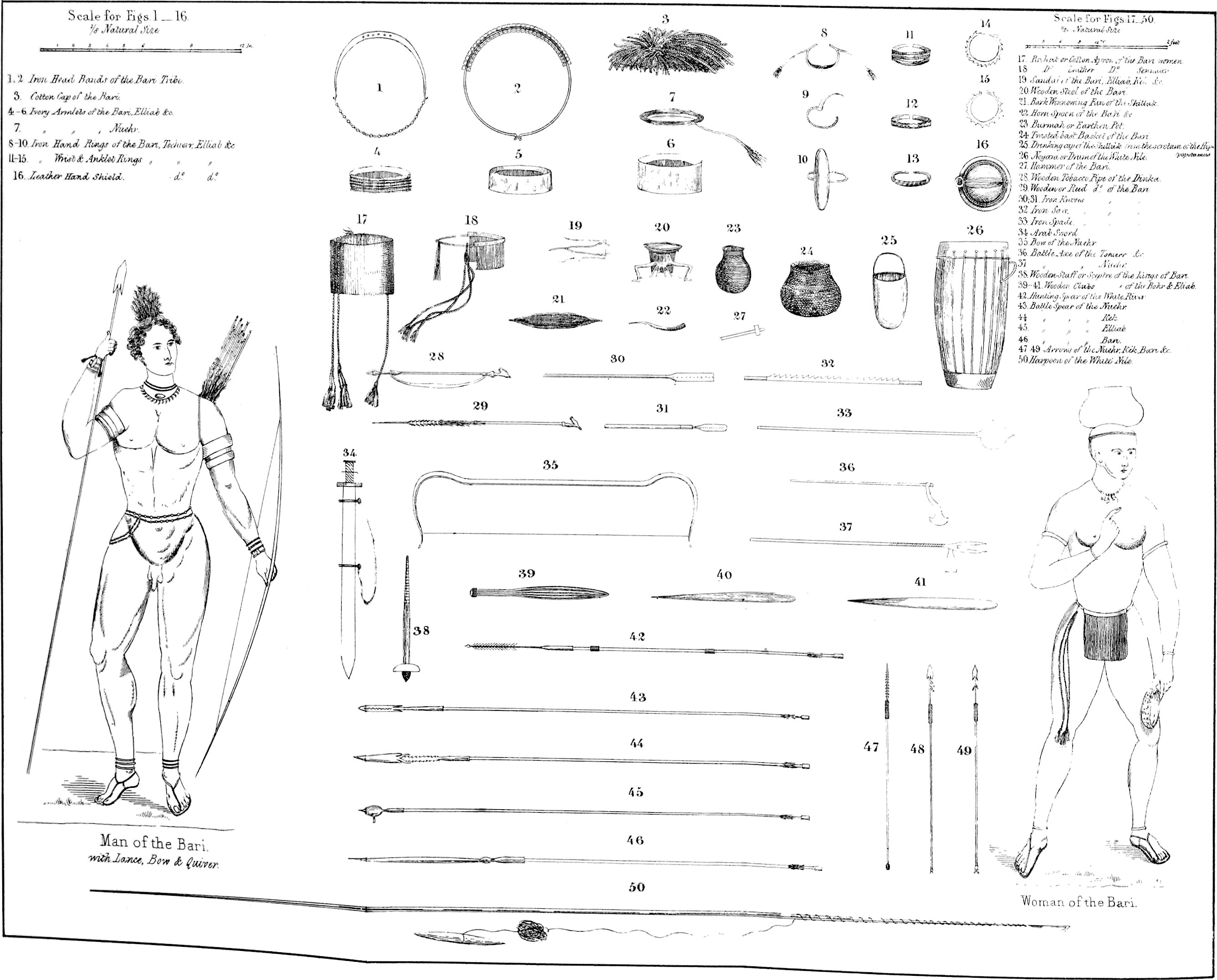
EXAMINATION OF AN ARM OF THE NILE. — FORESTS ON THE
BANKS. — PRICE OFFERED IN ENGLAND FOR A LIVE HIPPOPOTAMUS. — THESE
ANIMALS RARELY MET WITH IN EGYPT. — THE LIÈNNS. — ROPES MADE FROM
THE LEAVES OF THE DOUM-PALM. — UÈKA. — CHARACTER AND DESCRIPTION OF
THE LIÈNNS. — THE EMEDDI-TREE. — DÖBKER-TREE. — COTTON-TREES. — THE
TSHIÈRRS. — TRIBES OF THE BODSCHOS AND KARBORAHS. — LABYRINTHS OF
THE WHITE STREAM. — BARTER WITH THE KARBORÀHS. — THEIR DRESS, ARMS,
ORNAMENTS, ETC. — MOUNT NERKANJIN. — ISLAND OF TUI. — THE KOKIS. —
CONTEST WITH HIPPOPOTAMI. — CROCODILES’ EGGS. — HOSTILITY OF THE
TSHIÈRRS TO THE ELLIABS. — EBONY CLUBS. — THE BÒHRS: THEIR SONGS,
ORNAMENTS, ETC. — ANT-HILLS. — “IRG-EL-MOJE” OR WATER-ROOT, A
SPECIES OF VEGETABLE. — VETCHES. — THE ANDURÀB OR ENDERÀB-TREE. —
THE DAKUIN-TREE. — A SOLDIER STABBED BY A NATIVE. — ANTIQUITY OF
DUNG-FIRES.
6th February.—Yesterday the doubtful
river was indeed investigated, but only for a very short distance,
for the wind was contrary, and the sailors and soldiers murmured
loudly, because they knew that this intermediate voyage, which
threatened to delay their arrival in Khartùm, arose from the
Franks. Under such circumstances, even the expressions of the
natives of the country cannot be depended upon, for our black
soldiers can translate just what pleases them. At first the river
was said to come from the mountains above, and now they make it
take its origin as a gohr near the Liènns. We had an interpreter
with us, who is familiar with its shores, and who returned to us at this
opportunity. When he also confirmed the new assertion, the further
examination was provisionally given up after a course of about an
hour long. Where it flows down N.W. by N., we turned round and
navigated W. by N. out of it back to our encampment. The projecting
shore had deceived me, therefore, when previously passing by, with
respect to the direction of this arm of the Nile. It is called
Kiehr, which is the often-heard kir (water), thence Kirboli, Kirti,
Kiti. There is therefore no doubt that the name of the White
Stream, the main arm of which is called also here Kir-Te, is
originally Te, from Barì to Khartùm, for it is even called Te Uri
by the Nubas, the former word not being used for drinkable water.
The country of these four arms of the Nile is called Kofon,
corresponding to the Arabic mogren (conflux).
I repaired this morning on board Selim Capitan’s vessel, and
shall remain with him to-day, on account of his interpreter. It was
not till this morning that it was at last determined to follow
further the questionable arm of the Nile, which we navigated for a
short tract the day before yesterday. Seven o’clock. We leave our
landing-place, and proceed up the Kièhr in a westerly direction.
After a quarter of an hour the latter serves as a gohr to N.,
appearing soon to disembogue itself into the stream, which we
navigated previously.
We go some paces here S.W., where quite a little island, with
high reeds, rises in the middle of the river. From W. to S.W., from
W. to N.W. The Kièhr seems to be rapid at its tide, and to exercise
great force: we see it by the torn and indented shores, and especially by
the devastations on a little gohr, now dry. Half-past seven
o’clock. A broad gohr flows away to N., and winds immediately N.W.
Our river, which increases considerably in breadth above this Nile
arm, winds W.S.W., and S.W. Before us a large forest; near it we
halt immediately afterwards.
At eight o’clock, a north-wind gets up, and we sail S.S.W., and
S. by E.; after a quarter of an hour, S.W., and W., and with a
short bend, immediately to S. Right and left pastoral villages,
with lowing herds and natives on the ant-hills. The huts have the
form of a bee-hive, are five to six feet high, and plastered with
Nile slime. The ash-grey people dance and jump, and want to keep us
by force. The women run and sing by us, their hands thrown over
their heads in real despair because we will not stop. Half-past
eight o’clock. S. by E. The depth of the water not more than a
fathom. On the left a long summer village and a harim of several
tokuls close to it. We halt a moment at the right shore, take the
wood which the negroes had already brought for us to the shore,
give them some sug-sug, and proceed. The women, with large leathern
aprons, who have gone away empty-handed, jump and make gestures as
if they were mad.
A quarter before nine o’clock, S. Clouds threatening rain. At
the right the forest close at hand. E.S. On the right a large
pastoral village, with plastered beehives, looking like the bakers’
ovens in the land of Sudàn. The cattle stand with their
beautifully-twisted horns, close pressed together, and low at us,
probably because they recognise us as deadly enemies, and would rather be in the
meadow than waiting here for us. We do not halt for the sake of the
oxen, but on account of the vessels stopping behind, although we
ought to take advantage of the favourable wind, as the water is
falling more and more. Elliàbs are there, who are unarmed, but yet
immediately begin their war-dance. The vessels have, fortunately,
not been stranded, and we sail on at nine o’clock. The village is
called Kiùi or Quùi, and is the boundary of the Elliàbs on the
right side of the river. After a quarter of an hour, E.S.E.
Half-past nine o’clock, S.E. by S., and in a bend to S. A quarter
before ten o’clock, S.S.E., and S.E., where, at the corner, the
crocodiles make a great rustling in the shallow water, and seem to
be engaged in violent combat. At ten o’clock, S.S.E.
I am again very weak to-day, and cannot yet recover myself, for
I want a glass of good wine; every moment I sink back upon the
cushion, and can scarcely hold a pen. The Haba accompanies us
continuously at a slight distance from the right shore. A quarter
after ten o’clock. From S.E. to S.W., and again to S.E. We see many
crocodiles wallowing about in the water, who do not look at us in a
very friendly manner. Half-past ten o’clock. From S.E. by S. to
S.W. The hippopotami, thirteen in number, are crowded like smooth
rocks in the water before us. They spout up the water from anger at
still larger swimming animals approaching, as they may conceive our
vessels to be, for it does not seem that they are in conflict
amongst themselves, or that they want to take the field against the
crocodiles, who are keeping behind us.
A little
before eleven o’clock some armed ash-grey men shew themselves,
without any ornaments, on the right shore. From S.W. by W. to S. by
W. We halt at the right shore to receive some elephants’ teeth, but
they are too old, and we bear off immediately again to S.E. In the
forest at the right hand we perceive a number of birds and a
considerable herd of gazelles, who stand in an attitude of
curiosity like goats. Up to here the Elliàbs ran after us from the
village of Kiùi. Half-past eleven o’clock. From S.E. by E. to S.,
yet not for long, but to the left S.E. At half-past twelve o’clock.
We halt a second time at the right shore, owing to want of wood. I
saw here a large oval shield of neat’s hide, held simply by a
stick. It belonged to an Elliàb; these shields are said to be used
more in contests with animals than in war. This is perhaps likewise
the case with the few larger shields in the country of Bari.
At half-past one o’clock we navigate again to S.E., and a
quarter before two to S. by E. We see that the forest lies lower
than the shores, and that the water enters it. This local quality
of ground is the case generally, perhaps, in the forests. Either
they lie behind the dam of the old shore, which prevents the mass
of waters of the periodical rains from flowing into the river, or
the Nile enters through the chasms of the shores, if they do not
lie in recesses or old river-beds, where the rain water collects
and remains on the clayey substratum, which is the very same even
as far as the mountains of Bari. How could it be possible else that
these vigorous trees (the Tihl or elephant-tree is particularly
seen here), should retain their magnificent verdure
abstractedly from the atmospheric moisture.
Two o’clock. The thermometer this morning 18°, noon 26°, and now
27° Reaumur. From S. to S.S.E. and soon again to S. The north wind
has slackened since noon; we navigate slowly, and must even content
ourselves with libàhn, for no one has yet thought of taming river
buffaloes to tow us in the water itself. Laughable as this may
appear at the moment, yet I do not consider it impossible, for
according to the crew, a young hippopotamus is as tame as a calf.
The apothecary Laskaris possessed shortly before my arrival in
Khartùm such a Nile calf. He wanted to make a vast sum of money by
it, for they had offered in England a reward of some thousand
pounds sterling to any one who would bring a live hippopotamus to
London. It is well known that a living species has never yet been
seen in Europe. His avarice did not allow him, however, to place
the beast in some garden close to the Nile; nor did he provide a
cow and fresh milk. He was even foolish enough to lower it into the
cold cistern, where it died in a few days. Although this primitive
animal was formerly indigenous in Egypt, yet now it very rarely
descends over the cataracts to that country. Mohammed Ali had
received such a beast as a present from Upper Nubia, which was kept
for some years as a curiosity in a reservoir in the Nile at Bulak,
the lower port of Kàhira.
Half-past three o’clock.—From S. to S.E. by S. On the right, in
the badly planted Haba, the first doum-palms again, standing at the
corner, which we pass by at a quarter before three, for a very
short tract to
S.S.W., and equally rapidly S.S.E., to go at three o’clock again
S.S.W., and immediately to S. A half-finished tokul-village rises
very humbly between some old low huts. There were here benches in
the form of couches, which I had not yet seen on the White Stream,
although I had not exactly regretted their absence. They consist of
cudgels, and every single tokul has its seat of repose. Half-past
three o’clock. From S.W. to S. by E. Near the doum-palms, we see
also solitary and unusually high poison-trees in the forest, at the
right hand. The country appears very little populated; perhaps a
sign that we are really in a tributary arm or gohr. This was also
the case even where the Kièhr disembogues near the Elliàbs. The
scantier population may arise, in part, from the more recent lines
of the shore being less constant. The solitary tokuls belong to
fishermen, if we may judge from the sürtuks and fish-baskets set
up. Four o’clock. From S. in a bend to S.E. On the left a long and
miserable village stretches along the shore, with nine carcases of
tokuls, and small tobacco-plantations. This appears also to be a
village of fish-eaters.
Half-past four o’clock. Still the solitary tokuls, with fishing
implements and sürtuks. From S.E. by S., a short tract to S. The
natives are of a friendly disposition, and laughed immoderately,
when the sailors, among whom our Abu Hashis play the principal
part, imitated the cry and laughter of the women. By the short
stakes, which are already sufficiently known to us, we perceive
that their icthyophagism has a flesh-side. They also use the word
matta (lord and king) when they address us. It may, therefore be a borrowed
word among them; it is said also to be used in Habesh. A quarter
before five o’clock, from S.S.W. to S. by E. A miserable village,
with tobacco-plantations, on the left shore, but the divine smoke
rising close by, asserts the old attractive power of meat. We stop
for a moment, at five o’clock, at the right shore, as if we were
about to land, but the drum is beat, and the tired crew must again
to the rope. S.E. by S. The village at the right shore, before
which a little sycamore hangs over the river, is better built, and
its several magazines testify that the people apply themselves to
agriculture. Half-past five o’clock. At the upper end of the
village the river winds in an arch S.E. by E. We see continually
doum-palms in the forest of the left shore, whereon a village
rises.
At last we are again close to the main stream, and near the
Island of Buko. At sunset we halt at the right shore S.S.E. We see
from hence the trees near which, a few days ago, we lay at anchor
by the village of Buko, and also the village itself, but separated
from it by land, and our gohr,—the presumed river, winds to the
right.
The Liènns dwell here; and the interpreter already dismissed,
Gùmberi, who had left us in Berize, the capital of the Bambers,
came to us again. Clothing appears here to be the privilege only of
the chiefs, for Gùmberi was obliged to take off his red shirt, it
being against the Ethiopian regulations about dress, and he was
asked whether he was a sheikh. (I use here, as throughout my book,
the word sheikh of the Arabic language, as the most significant in
analogous circumstances.) There are many doum-palms here, especially young
copse, upon which the sailors pounce, and take the leaves to make
cords of them. I see, to my sorrow, that they do not even spare the
narrow convoluted hearts, which are four to five feet long. The
leaves are plucked, laid in bundles upon a stone, and worked with a
stick, till they are split into fibres; then they are again twisted
together, sorted anew, and laid, like coarse hemp, in the sun to
dry. The very same process takes place with the inside bark of
various trees. I got, subsequently, in the country of the Shilluks,
a small handful of flax, which, according to my Tshauss Marian, was
prepared from the bark of the Baobàb: this tree is called in the
Nuban language, Omràh; its fruit, however, Tabeldi. It is whiter
than flax, shining like raw silk, and feels exactly like the
latter.
7th February.—The beating of the doum-leaves goes on
again at daybreak, as if the crew wanted to acquire enormous
treasures by them in Khartùm. It appears as if we shall remain here
to-day, on account of the doum-palms and hunting. Our encampment is
an old bean-field, from which my servants brought me, in a very
short time, a number of beans, quite young, to eat as a salad.
Unfortunately I must begin to be sparing of my vinegar, for it is
truly welcome to me in these regions, as the most refreshing
restorative, although it causes thirst afterwards. I have almost
entirely renounced meat, and live principally on coffee, biscuit
and uèka. The people cannot subsist without this dried bamie, and
therefore my men have laid in a plentiful stock. Rubbed to a meal
on the murhaka, I have it boiled to a thick pap, with onions and the pepper of
the country, (fillfill bèlladi), and I afterwards pour vinegar over
it. I remarked this morning that Arnaud noted 82° atmospheric
moisture, although the hygrometer has entirely left off working. I
made him comprehend that this was somewhat too much here; he took
the thing, however, as a bagatelle, and said that it would rectify
itself afterwards!
The race of the Liènns, who dwell here, is called Kikin, and the
Tshièrrs live opposite. The Liènns are friendly, and even sociable:
they allow themselves to be joked with, and take the blows with
reeds, which the sailors deal them, as play; but do not venture to
return them. Though these people are inclined generally to jesting,
and merry scenes often take place with our wags, during which the
former are a pattern of good humour, yet they still remain
extremely mistrustful in barter. It is not till they have grasped
the beads firmly in their hands, that they let the goods go which
are to be given for them. I remark that the number of the stippled
lines on their forehead is usually from three to five; we see many
also with quite a smooth forehead. Their weapons are better than
those of the Elliàbs, and they exhibit, on the whole, more wealth,
not only by their ornaments, which, indeed, per se, are
insignificant, but, in particular, by a certain plumpness of body,
denoting better nourishment.
They bring us baskets, very neatly plaited, of split bamboo
reeds, square at the top, and protruding spherically at the bottom.
I get some bows and arrows, perfectly similar to those of Bari. The
arrows, with wooden or bone points, are principally only
destined for the
chase, as also the spears, with barbs. Iron is dear here, and they
did not like, therefore, to sell their javelins, some specimens of
which I had acquired previously. They tell us that there are
several lions in the neighbouring Haba, and want to prevent us from
hunting on that account. We remained on land to-night, with just
confidence in the good disposition of the people, as we had done
previously among the Elliàbs, and set sentinels on the shore.
8th February.—I repaired early this morning to the
forest, and returned in two hours, just as Arnaud was setting out,
in company with Suliman Kashef and his men. Suliman altered his
mind suddenly, alleging, as a pretext, the heat; and Arnaud also,
who, before sunrise, was going to slaughter lions and tigers,
composed himself very submissively to return. The doum-palms, if
they do not form a single species, have a meagre appearance, and
but little height; the doum-copse, on the contrary, stands very
luxuriantly, and measures sixty fingers’ breadth in a fan. The
negroes have really no dome-fruit left, and the elephants may have
had the beginning of it, and the gleanings. The poison-trees are
unusually large here.
A tree attracted my attention, by its size and light-coloured
branches, similar to those of the sycamore. Unfortunately it had
lost, like the baobàb, its leaves, except a few. The ends of its
boughs, from which the leaves develope themselves, have buds
similar to those of the chesnut-trees. Mariàn says that this tree
is called Emeddi, and is present on all the mountains of Nuba.
According to him it has small flowers, and little fruits of a
reddish colour.
These are as large as clusters of grapes, and hang together in the
same manner, only somewhat looser, are very sweet and eaten. The
elephant-tree (in the language of the Nubas Tihl, or also Or
Omul—Or, tree, omul, elephant) stood in abundant verdure, with long
young fruits. As I now hear, its fruit is eaten by the Nubas only
in case of necessity. If we consider this tree, with its shady roof
of leaves and its magnificent long clusters of flowers and fruits,
we feel inclined to look upon it as the Persea, or arbor
cœlestis of the hieroglyphics, and not the leafless baobàb, which
is mostly a ruin without shade. In Kordofàn, the Or Omul or Tihl
sheds, moreover, its leaves, as the beautifully foliated Emeddi
does here.
Another tree pleased me, which was covered with white flowers,
as if with snow. The small, pointed, and succulent leaves are
something like those of the pear-tree, as well as the tree itself.
Four white leaves are arranged around eighteen long blue stamina.
The fruit is said to be as large as an egg, and is eaten. The tree
is called döbker, and is also indigenous in Nuba. Among the mimosas
we remarked only talle; sunt seems not to present itself at all in
these upper regions. Nearly all the wood of these trees is soft,
and was felled to be worked into pulleys and other things for the
vessels. As the bark of the muddus-tree is better than all the
others for ropes, and does not appear on the great Nile, it was
eagerly sought for. I found also some cotton-trees with small
leaves, in the Haba, which lies tolerably high, and presents an
extensive view. Honey is found here in the ground, and on the
trees, but the little cakes contain only a small
quantity. A
large durra-field in the Haba lies, on the whole, high, and falls
away to E. and S.; the soil is strongly mixed with sand. It must
rain here, therefore, for a long time, and continuously, as the
powerful growth of the trees bespeaks, because otherwise durra,
even were it ever so rapid in coming to maturity, could not thrive
without artificial irrigation.
The Tshièrrs live in friendship with the Liènns, whose language
they use, and have the very same insignia of race on their
foreheads. Wherever there are boundaries, such as the river here,
then there appears jealousy and discord. A little slave of Selim
Capitan’s begged to be allowed to throw into the water the other
boy, who was not, like himself, a Tshièrr, but a Liènn, because he
dwelt on the other side of the river. In other respects both these
tribes live in peace; and yesterday a Tshièrr brought us a young
slave-girl purchased from the Liènns, and she was bought in
exchange by Suliman Kashef. We have already become too intimate
with the natives by our two days’ abode for the Turks not to
commence civilising them after their manner. At the head stands
Selim Capitan, who is really earnest about the matter; at his side,
Suliman Kashef, who is not behind the worthy son of Crete in
cultivation, and likes laughing and amusement. The thermometer had
this morning 20°, noon until three o’clock, 27° to 29°, and after
sunset 27° Reaumur.
9th February.—At half-past seven o’clock this morning
we leave our encampment, and go by the rope E.S.E., and soon S.E. A
summer village lies at the right shore, and an island in the water,
which is low and covered with green vegetables. Two tokuls are upon it,
surrounded with high fish-baskets and hedges of cut simsim, which
appears to be dried in this way. I remark on the island as well as
on the steep disrupt shores, that the lower thick layer of earth
consists of black mould, whilst the middle stratum is red with iron
particles, and the upper one strongly impregnated with sand. The
arable land here appears not to arise from a general deposition,
but has its commencement from the slime of a lake, and the remains
of a subjacent vegetation for its formation. The north wind has set
in, and we navigate round the island in S.W., S.E., and S., and
sail at eight o’clock S. by E. Immediately afterwards S.S.W., a
small island before the forest on the left shore. Eight o’clock,
S.E. Here the island will soon end. Then to S.; solitary farm-yards
on the right and left on the low shores; cultivation before the
rising Haba. A quarter before nine o’clock, S.S.W. The left shore
is covered with young dome-palms, and a large widely scattered
village ascends gradually with the shore to the height of the Haba,
in which we remark a number of large dome-palms. The margin of the
shore stretches flat along the river, and before it lies a
completely shallow island, or peninsula, whereon a quantity of
fishing implements are lying about. Nine o’clock S., then S.S.E.,
and S.E. Right and left, the level land is well cultivated with
durra, simsim, and especially lubiën.
The wind changes after nine o’clock to E. We furl the sails, and
halt at half-past nine o’clock, at the left shore, after we had
first gone a short tract to E. by the rope. There is a very little
isle in the river, and near the trees on the left shore a
hamlet, under
which the edge of the shore is also cultivated. From deck we
perceive five other villages, of which one is large, at a slight
distance from the water. The Haba retreats for an hour. At the
right shore are two villages, and the Haba is still further
distant.
The people of the Lienns are, on the whole, poor in ornaments
and weapons, although individuals carry two or three spears, and a
bow with arrows, without quivers, in the left hand. They have the
heads of the spears generally turned towards the ground, which was
not the case further up. This is perhaps rather a sign of friendly
sentiments than their usual custom. They fear, as I saw yesterday
and the day before, even the smacking of the great, long whips,
that the sailors have made from bark for their amusement. They like
to look at the beating of the palm-leaves, and then the sailors
cannot forbear dealing cracking blows right and left, with the
dome-leaves, and running after them. The Liènns understand a joke,
and laugh, run away, and return immediately again to let themselves
be cudgelled anew. They are great children, who are happy at seeing
us and our doings, and playing with the soldiers, although the
jests of the latter are often rude, and at times even end with
plunder.
Ten o’clock.—We proceed with the libàhn E. by S. Half-past ten
o’clock. From S.E. to S.W. At the left lie four villages, tolerably
close together, and on the right rises, at a quarter of an hour
distant, a considerable village between trees, on the gentle height
of the Haba; before it a large level field descends to the edge of
the river. Soon again to the left round to S. by E. A crowd of
natives, amongst whom are also some coloured red, welcome us from
all sides. Our gohr is not above fifty paces broad, but has a
strong fall. Nothing is yet to be discovered of the main stream,
and we begin now to doubt in our very tedious voyage, whether we
did see on the 6th instant our old anchorage at the island of Buko.
A quarter before eleven o’clock, S.E. by S. Not far from the right
shore, a large village, near which we hear the lowing of herds. The
shore is cultivated, and we see there some magazine tokuls, and
whilst we are going S. by E., we perceive from the deck another
large city in the Haba. Opposite, on the left shore, some tokuls,
and a numerous herd of cows.
Eleven o’clock. From S.S.W. to S.E. and E.S.E. Half-past eleven.
From E.N.E. to S.E. At twelve o’clock we stop near some tokuls on
the right shore, to allow the crew to eat. The upper boundary of
the Bodshos, who follow the before-mentioned Kikins, is in the
neighbourhood, and the Karboràhs begin here, who also belong, with
the first named tribe, to the nation of the Liènns. They dwell on
both sides of the river, and live at war with each other. In a
quarter of an hour we move on again, and go in short bends S. by
E., E.S.E., S.E., and S.S.W. From the deck—four villages on the
right, and three on the left. Half-past twelve o’clock. For a
finger’s length to S.E., and then S and S.W.; a quarter before one
to S. One o’clock, S.S.E. On the left two villages seen from the
deck; on the right an island, covered with high grass. We must
think no more of an island of Buko, for this gohr is said by the
negroes to lead up to the mountains; and I had therefore heard
quite correctly, at the very beginning, near the Kofon
of the Elliàbs
and Bohrs, where this very same thing was said plainly enough.
If we suppose that we shall again be connected with other arms
of the Nile, for we were near such a one on the 6th inst., which I
still hold to be that of the island of Buko, our return voyage,
with the present waste of time, might become more difficult than is
expected. We should be obliged to wait for the commencement of the
hariff (rainy season), or to seek to regain King Làkono’s sympathy,
which we have forfeited. The want of good bread-corn, already
beginning to be felt, is the only thing that makes me fear the crew
would not then be induced to follow further the White Stream beyond
Bari.
The Abu Hashiff of Suliman Kashef proclaimed this morning a
punishment of five hundred blows of the cudgel to any soldier or
sailor who should be found to have delayed slaughtering his goats
or sheep till to-morrow. They had collected together at different
times, by purchase, theft, and robbery, several beasts, whom they
were fattening with durra, to sell them in Khartùm.
Sand-banks also appear with the increase in width of the gohr,
and render the navigation difficult. A quarter before two o’clock,
a short tract, S.S.W. and W.S.W. Two o’clock, W. by S. A broad gohr
flows here from our arm to S.E., and makes the land at our left a
large island. We go, however, up the stream, and wind W.S.W., where
we halt at the right shore. It is asserted very positively that we
have navigated up and down that broad gohr flowing from here, and
that therefore the continued ascending in the gohr, in which we are
at this moment, and which also is becoming broader, has no object.
It matters not, however, whether we are blind and do not see, or
whether we see as we wish, so that we only go again downwards. Our
river arm has suddenly here again a width of three hundred paces.
This, as well as the depth of the water, speaks, certainly, in
favour of the sailors’ opinion, that we are again on the main
stream. The supreme council would fain, of course, assent to this
opinion, but, to my great astonishment, I hear it is very much
feared that we shall lose our way in another stream territory, and
not come out at all by Khartùm. In order to prevent our returning
by the very same road in our gohr, I propose to navigate up even as
far as the mountains, to set ourselves right, or at least to find
some memorials, such as a village or natives that we had seen
previously. Our men, however, put no more confidence in what the
latter say, and the crocodiles and hippopotami give us no
intelligence. The blue-green broken corals which we had found
already in the kingdom of Bari, are still the same here, and are
preferred by far to those of a white colour.
At half-past two o’clock a north-east wind set in, which blew
the wise council asunder. A short tract to E.S.E. by the
rope, and we sail then S.W. by S. in a flat arch to S.W. with two
miles’ course. The shores are low and only three to four feet high.
The green forest developes itself behind the slender, half-dried
reeds. A quarter after three o’clock. From S.W. with a short bend
to E.S.E.; at half-past three o’clock E. by N., and at four o’clock
S.W. by W. The shores have been for a long time without
cultivation, and only here and there we see some
negroes, but yet
there are two large villages, a quarter of an hour distant from the
left shore.
It is scarcely four o’clock when Fadl tells me from the mast
that he sees a high mountain W.S.W. I remark its peak also
immediately from the deck. To judge by the outline of it, it
appears to be the Nerkanjin, but I do not wish it, as I would
rather see another beautiful mountain country. Whilst we are
sailing S.S.W. a gohr issues on the right from our mysterious river
to W.N.W., and makes, therefore, the land at our right, a large
island. What a happy combination of natural canals, and what
nations may be still drinking of this water! A quarter after four
o’clock, S.E. by S. Right and left a village on the shores. There
are low tokuls with clay walls and square doors: the roof consists
of leaves of the dome palm. Their large baskets are also composed
of the hearts of these trees. The village of the right shore has
many open tokuls or cattle-stalls, and enters tolerably far into
the land, where we observe several herds. Half-past four o’clock.
From S.E., with the broad beautiful bend of the river to S. by E.
At five o’clock we stop opposite a large village on the right
shore, where many natives are collected. The thermometer, 20°, 28°,
30°, and 27° Reaumur.
10th February.—At the first sight of the morning dawn
we heard the great wooden kettle-drum (nogàra) sounding opposite in
the large village of Karborah, which instrument is beaten for
amusement, as well as for driving out the cattle. The watch-houses
of the cow-herdsmen stand in the centre of the enormous herd; the
employment of these men may be taken in turns like that of the
night-watch. The tribe of the Karboràhs, who, as I have said
before, are a branch of the Liènns, and independent, is here
likewise not entirely stippled on the forehead. Yesterday evening
we traded with them, and I received many a pretty thing,
principally of iron; for they dwell nearer the mountains, the
source of iron wealth. Thus, I purchased ivory bracelets, with
black streaks; bows of bamboo, with iron ends, and narrow bands of
iron; ropes of bark, which, according to Mariàn, are from the
muddus-tree, and the strongest; some hair-lines, said to be made
from giraffes; thin iron chains, which they sling round their ribs;
but I could neither see a kettle-drum nor an antelope-horn for
blowing. It was with much trouble that I got a surprisingly
beautiful little he-goat, with a head like a gazelle, although the
other little goats have compressed noses. Selim Capitan was looked
upon here also as our matta; and they wanted to take by force a
large elephant’s tooth, which I had already bought, to present to
him, not returning, however, my thick glass beads. Several Nile
buffaloes are found in the river—a sign in the present season of
the year, that agriculture is diligently attended to in the
vicinity.
At eight o’clock, we set off from S. to S.W.; a quarter before
nine o’clock, from S.E. by S. to S.S.E.; on the left a hamlet. A
quarter after nine o’clock, S.E.; and we sail with the good east
wind immediately again S. and S.S.W., and make three miles.
Half-past nine o’clock, S.E. Cultivation at the right side, and a
watch-house in the tobacco plantations. It seems as if tobacco were
considered, in the opinion of our people, an article of luxury
which may be taken whenever they like, without injustice. The
tobacco plantations are sheltered here also with reed-mats erected
on sticks three feet high, as a protection against the scorching
solar rays. Immediately again S. Dancing, clapping, huzzaing, and
young girls and women singing on the right shore.
A quarter before ten o’clock. From S.S.W. to S.E. The wind is
very contrary, and drives us together to the right shore, where we
make use of the rope for a short time. The merry girls and women
are adorned with rings and necklaces; only the head is shaved, as
in the other places, and they wear no rings in their ears. They
have the sitting-skin already mentioned behind, and the narrow
rahàt before. Moreover, most of them are armed with bows and
arrows, probably for self-defence in the absence of the men. A
quarter after ten o’clock. We sail again to S. We remark no
villages, and yet there are several people on the right shore; the
habitations seem, therefore, to be up the country in the Haba. It
was not till after a quarter of an hour that a large village
appeared: soon afterwards a second, the inhabitants of which have
collected on the right shore. About eleven o’clock we double a
little island on the right, and at the left a broad gohr, with a
strong fall, flows in from S.E.; near it lies a still smaller
island, like a grass-shield, bulging out in the middle, which we
also leave on the left. Half-past eleven o’clock. From S. Libàhn,
E.S.E. Herds right and left; shady roofs on four stakes. My men
have bought a large wooden drum for me, and throw it down the
shore; but several natives, who are against the sale, jump after
it, and take it back by force; it seems to be the property
of the
community. Twelve o’clock. From E.S.E to S.S.W. In the background
an island ascends.
The negroes wear frequently small animals’ skins on their heads,
which hang down over the nape of their necks. The sun has as
injurious an effect here on the former as on the vertebral columns
of the latter. A quarter of an hour later to S., and our corpulent
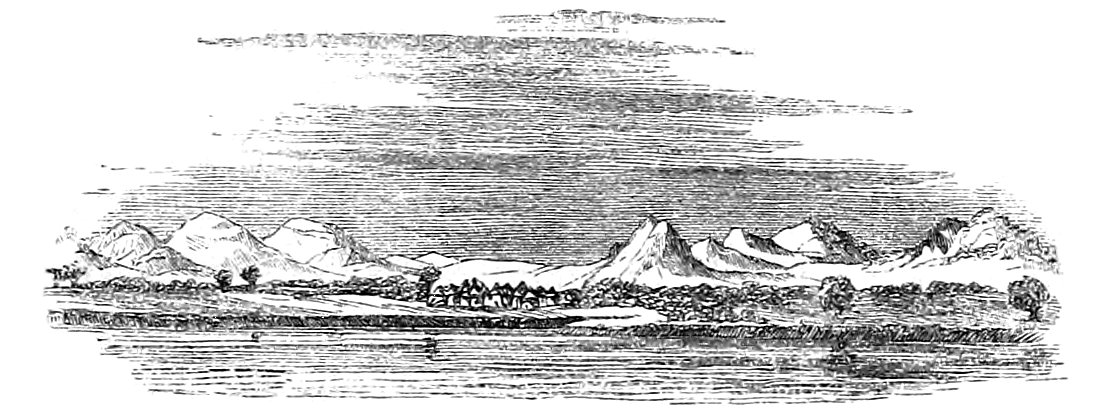
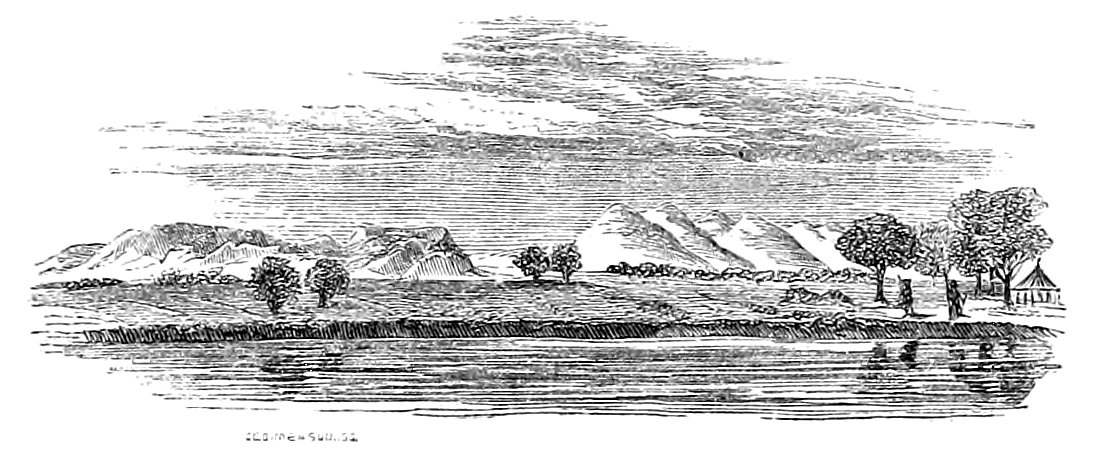
friend, Mount Nerkanjin, steps forward from S.W., blue and boldly,
from the background over the above-named island, near which a gohr
flows from W.S.W. At half-past twelve o’clock we lie to at the
right shore, near the same, to let the men rest and eat. I could
not tell what made me so hot, but the thermometer shews just 33°,
although this morning it was only 20°, as usual. We only stop
twenty minutes, and the poor crew must again to the rope, S.S.E.
After one o’clock, we halt a second time near a little island, the
narrowest arm of which we soon follow, on account of the greater
depth. The current in this canal, which has fifty to sixty paces,
is uncommonly strong. Two o’clock.—From S.S.E. to S.W. by S., and
immediately to the left S. by E., and right S.S.W. A quarter after
two o’clock.—A magnificent east wind: we shall make four miles to
S. by W. and S.S.W.; but it slackens immediately after casting out
the log, and only refreshing breezes breathe through the windows.
In order to get from this place, we assist the hoisted sails by
libàhn. A small island before us closes the narrow reach of our
course, which our ship, until half-past two, nearly fills up. Three
o’clock, S.E. by S, and on the right round a corner S.S.W., a few
paces, then immediately left to S., where we stop a moment.
“El Bah’r
kebir!” our people are shouting on all sides; for they take the
broad stream, wherein we are now sailing, for the White Nile
itself. An arm separates from it to N.N.W.; the last land on the
right is therefore also an island. We go by the left shore of the
main stream, where it winds from S.S.W. to E.N.E. It is called
here, as up the river, Kirboli, and both sides of it are inhabited
by the Elliàbs; therefore there is no doubt that it is the main
stream. The great island just mentioned is called Tui. We proceed
at four o’clock to S.S.W., and Mount Nerkanjin remains in a
south-westerly direction as previously. Half an hour later, we go
from S.S.W. to S.; still no village, nor familiar tree appears;
even the sailors begin again to doubt—for aught I care,—only
forward; so that at last it must be resolved to wait for the rainy
season. At half-past four o’clock S.S.E.; we halt on the sand, and
no one appears to be sure of his point, least of all Arnaud, who
cannot comprehend his own journal.
Every doubt is removed, after considerable questioning of the
natives; we return a quarter before five o’clock from this ascent,
and stop above the Kièhr, which we had come up from the White Nile,
in order to examine it, even to its issue, and had taken hitherto
for an independent mountain stream. At six o’clock we go to the
neighbouring island, between the Nile and the gohr Kièhr. At sunset
29°; this will be a hot night.
11th February.—We remain near the large island of Tui,
make a section of the Nile, and find the main stream below the bay,
where it divides into three arms, a hundred and twenty-eight mètres
broad. It is
called here Landofò; the Kokis inhabit its left shore. The Liénns
possess the right, together with our island, and the shores of the
gohrs, between which is the island of Tobo. Only a few of the
latter tattoo the forehead; some, the shoulders, as far as the
upper part of the arm; and others, the upper part of the back: some
have also coloured themselves with ochre.
12th February—Observations are to be made also to-day,
in order to start in the afternoon. I purchase for a few large
glass beads, the first fine elephant’s tooth, and I design
it, being the largest of all, as a cabinet specimen for my country.
Now, at last, it is evident to every one, that we are navigating
back our old road. It is fortunate for me that I am able to set up
continuously and write my journal, affected as I am with fever all
the day after the hot nights. At half-past two o’clock we bear off,
and reach at half-past four the end of the island of Tobo, near
which we land at sunset by the left shore, having made four miles
and a half with a strong current, and the stroke of the oar.
Thermometer, in the morning, 20°; noon, 32°; evening, 30°.
13th February.—We are to set out half an hour after
sunrise; in the meantime the men are slaughtering in haste some
cows, which natives of uncommon size have brought us. We do not
proceed, therefore, till seven o’clock, in a north-westerly
direction. The river makes such short bends that we bound every
moment against the shore, notwithstanding the very strong fall, and
we tear off also a corner of the loose earth. This, as well as the
carelessness in steering, causes the vessel to draw water
continually. Nine o’clock. We stop at the left shore, near
some dome-palms; the water is a little deeper here, as if a broad
arm of the Nile, from E.S.E., joins with our narrow one, or we with
it. Here also they bring us cotton for sale. Eleven o’clock. We go
on with a favourable east wind. The tokuls for dwellings are the
peristyles already described. At noon we see several hippopotami,
some of them real monsters; these may remain here pretty
constantly, being perhaps their hunting district, because the river
is, on the whole, of great depth in this place.
We get on a sand-bank, close to which several crocodiles are
encamped. The first of these beasts (in truth a fearful leader)
attacks the men who are pushing the vessel off the sand-bank; then
a soldier jumps overboard, armed only with a hatchet (Chadàn),
boldly meets it, and really drives it back into the water. At this
moment shots were fired by the soldiers on board the vessels at the
whole congregation, but so badly aimed that not one remained dead
on the spot; they all made a slow retreat into the water, and we
found afterwards, in the moist sand on the shore, fifty-three of
their eggs lying together all of a layer. The shells were a little
broken, as if cracked, which may be caused by the sun and the humid
sand. At first I thought, indeed, that these eggs might be near
hatching; but I was persuaded of their freshness, when the crew eat
them, roasted in ashes, with much goût. I tried also a little one,
and found the usual taste of eggs, only it seemed to me
particularly dry, and the white was more spongy and not compact. My
servants had preserved eight of the eggs, which I put among
those found in
the neighbourhood of the crocodile shot by Suliman Kashef. I see
that the latter are smaller, but thicker and rounder than the
first-named. In general they do not exceed the size of a goose’s
egg, and differ from birds’ eggs, especially by both ends being
uniformly arched. When I compared these eggs subsequently, in
Khartùm, with another one, found by me lying openly in the sand of
the shore of the united stream, on our journey to Sennaar, I found
the latter to be considerably larger than those of the White
Stream. Without wishing to decide by this on the different species
of crocodiles, I remark that the people here well know that there
are such distinctions. At one o’clock, we halt at the right shore,
near a pastoral village, but do not find the expected oxen. About
five o’clock we push off again, and a Nile arm divides to N.E.;
then comes another from S.E., and winds E.S.E. This is the arm,
according to the general assertion, which we previously
ascended.
14th February.—We at eight o’clock, navigate, the gohr,
which is new to us, and goes from N. to N.W. Right and left dwell
the Elliàbs; also on both shores of the gohr from whence we came.
The Tshiérrs follow the Elliàbs; their boundary is determined by
some dome-palms. The former made, yesterday, a marauding and
murderous attack on the island-land enclosed by the gohr, and
killed several men; they were, however, put to flight by the
Elliàbs, who hastily collected, and were driven over the water, by
which they left three dead. The Elliàbs mean now to make a great
war against them, and would not, on that account, sell us any of
the few spears which these poor pastoral people possess. The Kièhrs
dwell, according to the inquiries made by Selim Capitan over the
island, on the right shore of the Nile arm, which we ascend, the
river being also called there Kièhr, as we have already mentioned.
This circumstance may have led Selim wrong, for the Bohrs dwell
there, as I ascertained with the assistance of my Jengàh. After a
quarter of an hour, we again stop close to the left shore, where
our river-arm, called here the Kir, flows to N.W. Hardly any people
come to us, and the few we see are dirty, covered with ashes, and
without ornaments. Their spears, small in number, are however kept
polished, as the negroes generally clean carefully every thing
pertaining to weapons, and iron decorations, except when they have
coloured red with ochre their entire bodies, and then every thing
they carry on them and with them is dyed with the same colour. We
see clouds, foreboders of rain, almost uninterruptedly in the sky.
Thermometer, at sunrise, 21°; from twelve to three o’clock not more
than 30°, at sunset 29°. The Frenchmen add still more degrees, and
see also more, in order to frighten their readers at such a
country.
We go, after a short halt, to the right shore, where there is a
large cattle village, with many sleeping-places and plastered
bee-hives, or tokuls, their tops being lightly covered with straw
or reeds: large herds there. We navigate, with the stern of the
vessel foremost, although the captain is on deck, towards N.N.W.,
and shall halt immediately at the left shore near a little pastoral
village. The red colour of the large heaps of ashes arises only
from the burnt cows’ dung. 3 o’clock. Selim Capitan has just
returned after a
long voyage downwards. No water; therefore libàhn again, back into
the gohr traversed previously. I procured to-day, from the
herdsmen, four heavy breakers of beads or hassaeis of ebony,
without ornament; and I see also here old woollen morions, of which
I possess already one specimen. The Frenchmen still keep their
windows hung with curtains or closed, so as not to be disturbed by
the exterior world. At half-past four o’clock we are so fortunate
as to enter our old gohr E.S.E., and come soon to the old
encampment (I am again ill, as I was then,) turn the bow foremost,
go N.W., and stop at sunset to N. at the left shore. I purchase a
miserable little stool, which is rare here, from the Elliàbs.
15th February.—I have received, from Selim Capitan, a
Bohr, as drogman, but he will do nothing at first, for he is too
hungry. The river flows at half-past six, and up to seven o’clock,
continually to N., with declinations to N.W., where a small island
appears on the right. Again N.; on the left a large pastoral
village of the name of Uadir, belonging to the Elliàbs, or as our
Bohrs call them, Alliababe. The Bohrs possess the right shore,
between whom and the Elliàbs eternal war prevails. N.N.W.: on the
left a little island. Half-past seven o’clock. Over the dry straw
of the shore on the left green copse is sprouting, the tree-tops of
the neighbouring forest. Some drops of rain fell to-night on
Feïzulla Capitan’s fiery brandy-nose, as if on a hot stone, while
he was sleeping on deck; now, also, I feel some drops on my cool,
pale nose. A fine prospect! for neither are our corn magazines well
covered, nor our cabins air-tight above, thanks to Selim Capitan’s
negligence. From N.N.E. immediately again N.N.W. Eight o’clock. Right and
left a forest, preceded by a narrow border of the shore. A little
island on the right displays its green margin of reeds and
creepers, as we see in all of them. We halt at the sandy right
shore: the left is fertile soil, which is also the case on the
right, though only for a short tract. Suliman Kashef’s mallem was
buried here the preceding year, and Suliman visited now his grave
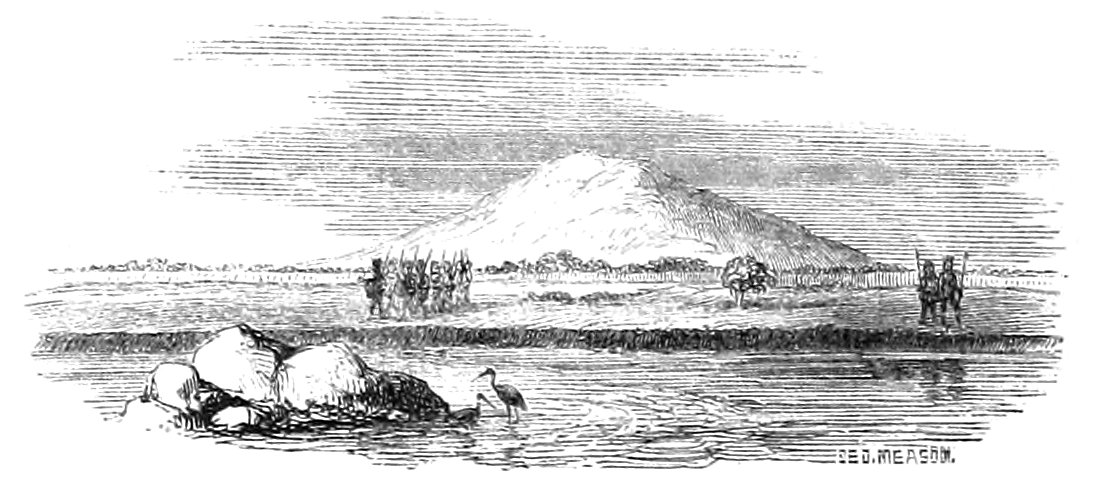
under the trees. Opposite to us lies the tolerably large pastoral
village of Kelagò, a portion of which only I draw, because it is
like all the others. Thibaut also has applied himself to the ivory
trade; he has just acquired three elephants’ teeth. Half-past nine
o’clock. Away to N. and N.W.; at ten o’clock, a small pastoral
village on the left, with ash-grey people. The forest extends at
one side, and was refreshing to us, with its various tints of
green. Here and there the sun breaks through the clouds, and casts
picturesque gleams of light around; I can even enjoy it, for I feel
myself again better after the very strong perspiration I had in the
night.
The Bohrs have lines on their foreheads like the Elliàbs, not
waved, however, like the latter, but straight, and also broader.
The drogman has five, which appear to consist of double lines. A
quarter after ten o’clock, N.N.W.; to the left an islet, with
flowering creepers and reeds. We are welcomed with a song, for this
is the usual custom with the tribes below Bari. One leads the
choir, and the chorus joins continually with “jok, jok, are o jok;”
but they have several refrains, among which their “abande jok”
should not be forgotten. At eleven o’clock N., uninterruptedly,
like our direction, with the former deviations to W. and E., the eternal
enumeration of which would only be tiresome. I know enough of the
previous ascent to be able to control my French companions. We stop
at half-past twelve o’clock at the right shore by the Haba, and
push off at half-past one again to N.N.W. The nation of the Bors,
or Bohrs, is likewise poor, and nothing was to be purchased from
them but some teeth, which Matta Selim Capitan appropriated to
himself. The tribes hitherto seen have, on the whole, the same sort
of weapons, although some arms are only similar; everywhere we see
solitary spears, similar to those of Bari. It seems generally that
all iron work is manufactured in that country, according to the
taste of the different tribes, which is frequently indeed very bad,
and sent away from thence; many, however, may have been introduced
by intercourse with nations dwelling at their side. It is a cool
north-west wind.
Thermometer, Sunrise 23° to 24°. Noon 27°. A quarter of an hour
later an island five minutes long shews itself to the left in the
middle of the river. We go N.N.W. At the foot of this island,
another one, small and low, and, as it appeared to me at first,
cultivated; but this, however, was not subsequently confirmed. Our
course passes between yellow and light-green copse and other trees.
Only here and there, there is still a dome-palm, quite small or
young; yet they probably serve for the canoes here, for I observed
several of these boats on the shore. Two o’clock. N.W. An island in
the centre of the river which we leave at our right; then N.N.W. I
have convinced myself, by new ant-hills, that these
insects, which are somewhat larger here than the common ant, raise
the earth from a depth where it is entirely wet, black, and without admixture of
sand (such as on the level of the Nile, and in its neighbourhood),
to make their buildings durable. On the other hand, I remember the
fallen-down craters of the ant-hills among the Dinkas. It is now
evident to me that they openly seek a protection against the
weather by getting under the trees when there are any in their
neighbourhood. The shores shew here already a little oxyde earth.
Half past two o’clock. From N.N.E. to N., whereupon we halt at the
right shore; for the Frenchmen want to go hunting.
16th February.—Thermometer yesterday evening, 24°; this
morning, 19°. I made an excursion into the interesting forest: it
lies upon slightly-elevated sandy bottom, on which the dome-palms
do not grow so luxuriantly as in the country of the Tshièrrs, where
I counted sixty lances on one leaf, whilst here there are only from
forty-two to forty-six. I had preserved previously a vegetable,
though not knowing the nature of its root: here the sailors grubbed
up some of the same sort, and I saw tubers on them three feet and a
quarter thick, running towards the upper part to a round form, but
appearing to branch out below like enormous roots. Slender roots
shoot from these main tubers, and on them rises an
insignificant-looking vegetable, a foot high, covered at the top
with small oval pale-green leaves, like those of the box-tree: the
clusters of gossamer-flowers are of a yellowish colour. It is
called “Irg-el-moje” (water-root)—in Nuban, “Otto;” is very full of
juice, but of a nauseous, sweet taste, and is sold in Kahira. The
suckers, properly speaking, must by virtue of the soil here, go to
a great depth. Our liquorice tastes perhaps better, owing to its dryness. The
large specimens were cut to pieces and torn, by reason of their
softness, and in consequence of the greediness of our crew, who are
like children, and yet laugh at the blacks. I took a specimen for
myself. The beautiful red peas or vetches were also found. This
vegetable was gathered; but no one at first knew the foliage, until
I discovered at last a few slender tendrils of vetches, which were
still green, and hung together with the dry peas in the pods, which
were burst open. The blacks and men of Belled Sudàn make use of
them as an ornament. They are small, hard, and rough, like beads,
have a black eye, with a white and scarcely visible line, and are
called hap-el-arùss (bride-grain). I have in my possession several
of them. The anduràb or enderàb, a large tree with willow-like
laciniated bark, is very common here: it has little green clusters
of flowers on its lower branches, hanging in wild disorder; small
round fruit, at present green, and willow-like, yet truncated
leaves. Besides many other trees, such as talles, geïlids, and
others, there is also a very large tree, now thoroughly leafless,
deserving notice, from its short prickles, and little apples.
Mariàn tells me that it has small round leaves, which make their
appearance in the hariff, together with a white flower, and that it
is called, in the Nuban language, dakuin. The fruit is not eaten,
but gathered green, and strung round the necks of children, as a
preventive against fever and other diseases.
We do not perceive grass anywhere, and therefore there are not
any cattle or human beings; but there may be, perhaps, many wild
beasts. Wild
buffaloes, as I had been assured previously in the upper Haba, and
several of which animals Suliman Kashef and Capitan Mohammed Agà,
the Arnaut, with the halberdiers of the former, pretend to have
seen, are said to be frequently found here, and larger than those
of Egypt. We are more inclined to believe this assertion, because
it is well known to all our blacks that such beasts often appear
among the Shilluks, Hassanïes, and elsewhere. This animal is called
“Gamùs el galla.”
This morning, unfortunately, a soldier was stabbed by a Bohr
with a spear, because, as I suspect, he was about to take it away
from the latter according to the favourite Belesh manner, that is,
without paying for it. We were magnanimous, and did not take any
revenge on another Bohr, who was dragged to us instead of the
proper criminal. So likewise I see the voluntary slaves of
Selim Capitan chained together on the shore. At one o’clock we
leave our beautiful landing-place. On the left a little village
appears, then also a Haba; but it is too scantily furnished with
trees, and soon retreats ashamed before the magnificent forest
opposite. After some minutes a reed island divides the river. Then
we proceed with W.N.W., our sails swollen by the east wind, and
leave it to the right whilst we go more westerly, but soon again N.
The burning of the reeds has an unpleasing effect to the eye, but
the country rises new-born like a phœnix from the ashes. The island
is fifteen minutes long. Half-past one o’clock. From N.E. by E. to
W. by S. A hamlet in the Haba to the right of the shore, which is
here high and precipitously disrupt, owing to the narrow
pass, lies
picturesquely. A quarter before two o’clock, N.W., on the right a
little island. At two o’clock from N.E. to N.W. in the bend, but
the Haba has disappeared. A quarter after two o’clock N.N.E.; on
the right an island ten minutes long. At the end of it N.E.; on the
left an old village containing tokuls with six to seven
indentations on the roofs. The Haba, with several dhellèbs, has
approached us on the avulsed high shore; it shews the genuine marks
of the ancient or high shores. Half-past two o’clock, near the bend
to N.W.; on the right many dhellèbs, which are not, however, of
remarkable appearance, especially as the lower dry branches are
upon them. A quarter before three o’clock. From the short E.N.E.
tract to N.N.W. The forest on the right rises upon sandy deposits
of downs, somewhat in the form of a hill. The sand was once
deposited, perhaps, by an unusual inundation, on the underwood, and
has remained there since that time. The shores are still intermixed
with ochre here and there. A glistening long course before us
towards N.N.W., such as we had not had for a long time, with the
exception of the small inlets right and left; also a little island
there. Thermometer 19° and 29° to 30°. Three o’clock. The Haba has
retreated, yet N.N.W. On the left a small tokul village as before;
immediately under it to the right E.N.E. and W.N.W., again a
forest, the only break of the monotonous shores, islands, and
villages. A quarter after three o’clock. From a short westerly
direction to N.N.W. We halt at the right shore; perhaps Selim
Capitan’s vessel draws water—yet, no; the French gentlemen had not
come up.
A quarter
after four o’clock: off again, and we go N.E. On the right side
Bohrs, and on the left Elliàbs. Half-past four o’clock, N.W. The
Haba on the right rises on downs; we see dome-palms also on it, but
upon firm, dark earth, whilst the sand lies only on the surface.
Moreover, these dome-palms are considerably higher than the
dhellèbs. Violent storms cannot take place in these regions; I have
never seen a single tree torn up by the wind. A quarter before five
o’clock, from N.E. to N.N.W. The Haba remains and consoles us more
than sufficiently for the arid shore, although green reeds and
weeds struggle up here and there, and strike the roots deep into
the vivifying water.
To N.N.W., a long row of tokuls appears in parade before us,
without any other background than the horizon. On the right a
narrow arm goes to E., and places the barren tokul-city on an
island. In the bend from N.W. to W. The tokuls have, in part, the
screen mentioned before, as the entrance; the sleeping-places in
the neighbourhood are built of new reeds, and sixty tokuls without
sleeping-places, and huts join them. This place, inhabited by
Bohrs, is called Jemàhl. Immediately to the left also, by N.W, a
tokul-village opposite; the lower walls, being proportionably high,
are partly plastered with Nile slime. The knowledge of my drogman
Joi is already at an end: he does not know the name of this long
village, lying on the margin of the river like a crescent. Five
o’clock from S.W. to N.E. by N. I remark the circumference of a red
cone of ashes in the centre part of the broken shore:
the reeds brush
the vessel, and some of them fall on the plank before my
window.
That custom of dung-fires for the encampment of the herds
already mentioned, appears very ancient; for the earth deposited by
the river lies from three to four feet high near them. About sunset
we stop, on account of good neighbourhood, near a pastoral village
on the right shore, where the river winds to N. The goats and sheep
jump from the vessels with delight to the green grass on the shore.
We hoped to get some oxen here, but not any were brought us.