—“Even the worst tea is sweet when first made from the new
leaf.”—Japanese proverb.
Exotics and Retrospectives
Kité miréba,
Sahodo madé nashi,
Fuji no Yama!
Seen on close approach, the mountain of Fuji does not
come up to expectation.—Japanese proverbial philosophy.
The most beautiful sight in Japan, and certainly
one of the most beautiful in the
world, is the distant apparition of Fuji on
cloudless days,—more especially days of spring
and autumn, when the greater part of the peak
is covered with late or with early snows. You
can seldom distinguish the snowless base, which
remains the same color as the sky: you perceive
only the white cone seeming to hang in heaven;
and the Japanese comparison of its shape to an
inverted half-open fan is made wonderfully exact
by the fine streaks that spread downward from
the notched top, like shadows of fan-ribs. Even
lighter than a fan the vision appears,—rather
the ghost or dream of a fan;—yet the material
reality a hundred miles away is grandiose among
the mountains of the globe. Rising to a height
of nearly 12,500 feet, Fuji is visible from thirteen
provinces of the Empire. Nevertheless it is one
of the easiest of lofty mountains to climb; and
for a thousand years it has been scaled every
summer by multitudes of pilgrims. For it is
not only a sacred mountain, but the most sacred
mountain of Japan,—the holiest eminence of
the land that is called Divine,—the Supreme
Altar of the Sun;—and to ascend it at least once
in a life-time is the duty of all who reverence
the ancient gods. So from every district of the
Empire pilgrims annually wend their way to
Fuji; and in nearly all the provinces there are
pilgrim-societies—Fuji-Kō,—organized for the
purpose of aiding those desiring to visit the
sacred peak. If this act of faith cannot be performed
by everybody in person, it can at least
be performed by proxy. Any hamlet, however
remote, can occasionally send one representative
to pray before the shrine of the divinity of Fuji,
and to salute the rising sun from that sublime
eminence. Thus a single company of Fuji-pilgrims
may be composed of men from a hundred
different settlements.
By both of the national religions Fuji is held in
reverence. The Shintō deity of Fuji is the beautiful
goddess Ko-no-hana-saku-ya-himé,—she
who brought forth her children in fire without
pain, and whose name signifies “Radiant-blooming-as-the-flowers-of-the-trees,”
or, according to
some commentators, “Causing-the-flowers-to-blossom-brightly.”
On the summit is her
temple; and in ancient books it is recorded that
mortal eyes have beheld her hovering, like a
luminous cloud, above the verge of the crater.
Her viewless servants watch and wait by the
precipices to hurl down whomsoever presumes
to approach her shrine with unpurified heart....
Buddhism loves the grand peak because its form
is like the white bud of the Sacred Flower,—and
because the eight cusps of its top, like the
eight petals of the Lotos, symbolize the Eight
Intelligences of Perception, Purpose, Speech,
Conduct, Living, Effort, Mindfulness, and Contemplation.
But the legends and traditions about Fuji, the
stories of its rising out of the earth in a single
night,—of the shower of pierced-jewels once
flung down from it,—of the first temple built
upon its summit eleven hundred years ago,—of
the Luminous Maiden that lured to the crater
an Emperor who was never seen afterward, but is
still worshipped at a little shrine erected on the
place of his vanishing,—of the sand that daily
rolled down by pilgrim feet nightly reascends to
its former position,—have not all these things
been written in books? There is really very little
left for me to tell about Fuji except my own
experience of climbing it.
I made the ascent by way of Gotemba,—the
least picturesque, but perhaps also the least difficult
of the six or seven routes open to choice.
Gotemba is a little village chiefly consisting of
pilgrim-inns. You reach it from Tōkyō in about
three hours by the Tōkaidō railway, which rises
for miles as it approaches the neighborhood of
the mighty volcano. Gotemba is considerably
more than two thousand feet above the sea, and
therefore comparatively cool in the hottest season.
The open country about it slopes to Fuji; but the
slope is so gradual that the table-land seems
almost level to the eye. From Gotemba in perfectly
clear weather the mountain looks uncomfortably
near,—formidable by proximity,—though
actually miles away. During the rainy
season it may appear and disappear alternately
many times in one day,—like an enormous
spectre. But on the grey August morning when
I entered Gotemba as a pilgrim, the landscape
was muffled in vapors; and Fuji was totally
invisible. I arrived too late to attempt the ascent
on the same day; but I made my preparations at
once for the day following, and engaged a couple
of gōriki (“strong-pull men”), or experienced
guides. I felt quite secure on seeing their broad
honest faces and sturdy bearing. They supplied
me with a pilgrim-staff, heavy blue tabi (that is
to say, cleft-stockings, to be used with sandals), a
straw hat shaped like Fuji, and the rest of a
pilgrim’s outfit;—telling me to be ready to
start with them at four o’clock in the morning.
What is hereafter set down consists of notes
taken on the journey, but afterwards amended
and expanded,—for notes made while climbing
are necessarily hurried and imperfect.
August 24th, 1897.
From strings stretched above the balcony upon
which my inn-room opens, hundreds of towels
are hung like flags,—blue towels and white,
having printed upon them in Chinese characters
the names of pilgrim-companies and of the
divinity of Fuji. These are gifts to the house,
and serve as advertisements.... Raining from
a uniformly grey sky. Fuji always invisible.
August 25th.
3:30 a. m.—No sleep;—tumult all night
of parties returning late from the mountain, or
arriving for the pilgrimage;—constant clapping
of hands to summon servants;—banqueting and
singing in the adjoining chambers, with alarming
bursts of laughter every few minutes....
Breakfast of soup, fish, and rice. Gōriki arrive
in professional costume, and find me ready.
Nevertheless they insist that I shall undress again
and put on heavy underclothing;—warning me
that even when it is Doyō (the period of greatest
summer heat) at the foot of the mountain, it is
Daikan (the period of greatest winter cold) at
the top. Then they start in advance, carrying
provisions and bundles of heavy clothing....
A kuruma waits for me, with three runners,—two
to pull, and one to push, as the work will be
hard uphill. By kuruma I can go to the height
of five thousand feet.
Morning black and slightly chill, with fine
rain; but I shall soon be above the rain-clouds....
The lights of the town vanish behind us;—the
kuruma is rolling along a country-road.
Outside of the swinging penumbra made by the
paper-lantern of the foremost runner, nothing
is clearly visible; but I can vaguely distinguish
silhouettes of trees and, from time to time, of
houses,—peasants’ houses with steep roofs.
Grey wan light slowly suffuses the moist
air;—day is dawning through drizzle....
Gradually the landscape defines with its colors.
The way lies through thin woods. Occasionally
we pass houses with high thatched roofs that
look like farmhouses; but cultivated land is
nowhere visible....
Open country with scattered clumps of trees,—larch
and pine. Nothing in the horizon but
scraggy tree-tops above what seems to be the rim
of a vast down. No sign whatever of Fuji....
For the first time I notice that the road is black,—black
sand and cinders apparently, volcanic
cinders: the wheels of the kuruma and the feet
of the runners sink into it with a crunching
sound.
The rain has stopped, and the sky becomes
a clearer grey.... The trees decrease in size
and number as we advance.
What I have been taking for the horizon, in
front of us, suddenly breaks open, and begins to
roll smokily away to left and right. In the great
rift part of a dark-blue mass appears,—a portion
of Fuji. Almost at the same moment the sun
pierces the clouds behind us; but the road now
enters a copse covering the base of a low ridge,
and the view is cut off.... Halt at a little
house among the trees,—a pilgrims’ resting-place,—and
there find the gōriki, who have
advanced much more rapidly than my runners,
waiting for us. Buy eggs, which a gōriki rolls
up in a narrow strip of straw matting;—tying
the matting tightly with straw cord between the
eggs,—so that the string of eggs has somewhat
the appearance of a string of sausages....
Hire a horse.
Sky clears as we proceed;—white sunlight
floods everything. Road reascends; and we
emerge again on the moorland. And, right in
front, Fuji appears,—naked to the summit,—stupendous,—startling
as if newly risen from
the earth. Nothing could be more beautiful.
A vast blue cone,—warm-blue, almost violet
through the vapors not yet lifted by the sun,—with
two white streaklets near the top which
are great gullies full of snow, though they look
from here scarcely an inch long. But the charm
of the apparition is much less the charm of color
than of symmetry,—a symmetry of beautiful
bending lines with a curve like the curve of a
cable stretched over a space too wide to allow of
pulling taut. (This comparison did not at once
suggest itself: The first impression given me by
the grace of those lines was an impression of
femininity;—I found myself thinking of some
exquisite sloping of shoulders towards the neck.)
I can imagine nothing more difficult to draw at
sight. But the Japanese artist, through his marvellous
skill with the writing-brush,—the skill
inherited from generations of calligraphists,—easily
faces the riddle: he outlines the silhouette
with two flowing strokes made in the fraction of
a second, and manages to hit the exact truth of
the curves,—much as a professional archer might
hit a mark, without consciously taking aim,
through long exact habit of hand and eye.
I see the gōriki hurrying forward far away,—one
of them carrying the eggs round his neck!...
Now there are no more trees worthy of the
name,—only scattered stunted growths resembling
shrubs. The black road curves across a vast
grassy down; and here and there I see large black
patches in the green surface,—bare spaces of ashes
and scoriæ; showing that this thin green skin
covers some enormous volcanic deposit of recent
date.... As a matter of history, all this district
was buried two yards deep in 1707 by an eruption
from the side of Fuji. Even in far-off Tōkyō
the rain of ashes covered roofs to a depth of sixteen
centimetres. There are no farms in this
region, because there is little true soil; and there
is no water. But volcanic destruction is not eternal
destruction; eruptions at last prove fertilizing;
and the divine “Princess-who-causes-the-flowers-to-blossom-brightly”
will make this waste to smile
again in future hundreds of years.
... The black openings in the green surface
become more numerous and larger. A few
dwarf-shrubs still mingle with the coarse grass....
The vapors are lifting; and Fuji is changing color.
It is no longer a glowing blue, but a dead sombre
blue. Irregularities previously hidden by rising
ground appear in the lower part of the grand
curves. One of these to the left,—shaped like
a camel’s hump,—represents the focus of the last
great eruption.
The land is not now green with black patches,
but black with green patches; and the green
patches dwindle visibly in the direction of the
peak. The shrubby growths have disappeared.
The wheels of the kuruma, and the feet of the
runners sink deeper into the volcanic sand....
The horse is now attached to the kuruma with
ropes, and I am able to advance more rapidly.
Still the mountain seems far away; but we are
really running up its flank at a height of more
than five thousand feet.
Fuji has ceased to be blue of any shade. It is
black,—charcoal-black,—a frightful extinct heap
of visible ashes and cinders and slaggy lava....
Most of the green has disappeared. Likewise all
of the illusion. The tremendous naked black
reality,—always becoming more sharply, more
grimly, more atrociously defined,—is a stupefaction,
a nightmare.... Above—miles above—the
snow patches glare and gleam against that
blackness,—hideously. I think of a gleam of
white teeth I once saw in a skull,—a woman’s
skull,—otherwise burnt to a sooty crisp.
So one of the fairest, if not the fairest of earthly
visions, resolves itself into a spectacle of horror
and death.... But have not all human ideals
of beauty, like the beauty of Fuji seen from afar,
been created by forces of death and pain?—are
not all, in their kind, but composites of death,
beheld in retrospective through the magical haze
of inherited memory?
The green has utterly vanished;—all is black.
There is no road,—only the broad waste of
black sand sloping and narrowing up to those
dazzling, grinning patches of snow. But there
is a track,—a yellowish track made by thousands
and thousands of cast-off sandals of straw
(waraji), flung aside by pilgrims. Straw sandals
quickly wear out upon this black grit; and every
pilgrim carries several pair for the journey. Had
I to make the ascent alone, I could find the path
by following that wake of broken sandals,—a
yellow streak zigzagging up out of sight across
the blackness.
6:40 a. m.—We reach Tarōbō, first of the
ten stations on the ascent: height, 6000 feet.
The station is a large wooden house, of which
two rooms have been fitted up as a shop for the
sale of staves, hats, raincoats, sandals,—everything
pilgrims need. I find there a peripatetic
photographer offering for sale photographs of
the mountain which are really very good as
well as very cheap.... Here the gōriki take
their first meal; and I rest. The kuruma can
go no further; and I dismiss my three runners,
but keep the horse,—a docile and surefooted
creature; for I can venture to ride him up to
Ni-gō-goséki, or Station No. 2½.
Start for No. 2½ up the slant of black sand,
keeping the horse at a walk. No. 2½ is shut up
for the season.... Slope now becomes steep
as a stairway, and further riding would be dangerous.
Alight and make ready for the climb.
Cold wind blowing so strongly that I have to tie
on my hat tightly. One of the gōriki unwinds
from about his waist a long stout cotton girdle,
and giving me one end to hold, passes the other
over his shoulder for the pull. Then he proceeds
over the sand at an angle, with a steady short
step, and I follow; the other guide keeping
closely behind me to provide against any slip.
There is nothing very difficult about this climbing,
except the weariness of walking through
sand and cinders: it is like walking over dunes....
We mount by zigzags. The sand moves
with the wind; and I have a slightly nervous
sense—the feeling only, not the perception; for
I keep my eyes on the sand,—of height growing
above depth.... Have to watch my steps carefully,
and to use my staff constantly, as the slant
is now very steep.... We are in a white fog,—passing
through clouds! Even if I wished
to look back, I could see nothing through this
vapor; but I have not the least wish to look
back. The wind has suddenly ceased—cut off,
perhaps, by a ridge; and there is a silence that I
remember from West Indian days: the Peace of
High Places. It is broken only by the crunching
of the ashes beneath our feet. I can distinctly
hear my heart beat.... The guide tells me
that I stoop too much,—orders me to walk
upright, and always in stepping to put down the
heel first. I do this, and find it relieving. But
climbing through this tiresome mixture of ashes
and sand begins to be trying. I am perspiring
and panting. The guide bids me keep my honorable
mouth closed, and breathe only through
my honorable nose.
We are out of the fog again.... All at once
I perceive above us, at a little distance, something
like a square hole in the face of the
mountain,—a door! It is the door of the third
station,—a wooden hut half-buried in black
drift.... How delightful to squat again,—even
in a blue cloud of wood-smoke and under
smoke-blackened rafters! Time, 8:30 a. m.
Height, 7,085 feet.
In spite of the wood-smoke the station is comfortable
enough inside; there are clean mattings
and even kneeling-cushions. No windows, of
course, nor any other opening than the door;
for the building is half-buried in the flank of the
mountain. We lunch.... The station-keeper
tells us that recently a student walked from
Gotemba to the top of the mountain and back
again—in geta! Geta are heavy wooden sandals,
or clogs, held to the foot only by a thong
passing between the great and the second toe.
The feet of that student must have been made
of steel!
Having rested, I go out to look around. Far
below white clouds are rolling over the landscape
in huge fluffy wreaths. Above the hut, and
actually trickling down over it, the sable cone
soars to the sky. But the amazing sight is the
line of the monstrous slope to the left,—a line
that now shows no curve whatever, but shoots
down below the clouds, and up to the gods only
know where (for I cannot see the end of it),
straight as a tightened bowstring. The right flank
is rocky and broken. But as for the left,—I
never dreamed it possible that a line so absolutely
straight and smooth, and extending for so enormous
a distance at such an amazing angle, could
exist even in a volcano. That stupendous pitch
gives me a sense of dizziness, and a totally unfamiliar
feeling of wonder. Such regularity appears
unnatural, frightful; seems even artificial,—but
artificial upon a superhuman and demoniac
scale. I imagine that to fall thence from
above would be to fall for leagues. Absolutely
nothing to take hold of. But the gōriki assure
me that there is no danger on that slope: it is all
soft sand.
Though drenched with perspiration by the exertion
of the first climb, I am already dry, and cold....
Up again.... The ascent is at first through
ashes and sand as before; but presently large stones
begin to mingle with the sand; and the way is
always growing steeper.... I constantly slip.
There is nothing firm, nothing resisting to stand
upon: loose stones and cinders roll down at every
step.... If a big lava-block were to detach itself
from above!... In spite of my helpers and of
the staff, I continually slip, and am all in perspiration
again. Almost every stone that I tread
upon turns under me. How is it that no stone
ever turns under the feet of the gōriki? They
never slip,—never make a false step,—never
seem less at ease than they would be in walking
over a matted floor. Their small brown broad feet
always poise upon the shingle at exactly the right
angle. They are heavier men than I; but they
move lightly as birds.... Now I have to stop
for rest every half-a-dozen steps.... The line
of broken straw sandals follows the zigzags we
take.... At last—at last another door in the
face of the mountain. Enter the fourth station,
and fling myself down upon the mats. Time,
10:30 a. m. Height, only 7,937 feet;—yet it
seemed such a distance!
Off again.... Way worse and worse....
Feel a new distress due to the rarefaction of the
air. Heart beating as in a high fever.... Slope
has become very rough. It is no longer soft ashes
and sand mixed with stones, but stones only,—fragments
of lava, lumps of pumice, scoriæ of
every sort, all angled as if freshly broken with a
hammer. All would likewise seem to have been
expressly shaped so as to turn upside-down when
trodden upon. Yet I must confess that they never
turn under the feet of the gōriki.... The cast-off
sandals strew the slope in ever-increasing numbers....
But for the gōriki I should have had
ever so many bad tumbles: they cannot prevent
me from slipping; but they never allow me to
fall. Evidently I am not fitted to climb mountains....
Height, 8,659 feet—but the fifth
station is shut up! Must keep zigzaging on to
the next. Wonder how I shall ever be able to
reach it!... And there are people still alive
who have climbed Fuji three and four times, for
pleasure!... Dare not look back. See nothing
but the black stones always turning under me,
and the bronzed feet of those marvellous gōriki
who never slip, never pant, and never perspire....
Staff begins to hurt my hand.... Gōriki
push and pull: it is shameful of me, I know, to
give them so much trouble.... Ah! sixth station!—may
all the myriads of the gods bless my
gōriki! Time, 2:07 p. m. Height, 9,317 feet.
Resting, I gaze through the doorway at the
abyss below. The land is now dimly visible only
through rents in a prodigious wilderness of white
clouds; and within these rents everything looks
almost black.... The horizon has risen frightfully,—has
expanded monstrously.... My
gōriki warn me that the summit is still miles
away. I have been too slow. We must hasten
upward.
Certainly the zigzag is steeper than before....
With the stones now mingle angular rocks;
and we sometimes have to flank queer black
bulks that look like basalt.... On the right
rises, out of sight, a jagged black hideous ridge,—an
ancient lava-stream. The line of the left
slope still shoots up, straight as a bow-string....
Wonder if the way will become any steeper;—doubt
whether it can possibly become any
rougher. Rocks dislodged by my feet roll down
soundlessly;—I am afraid to look after them.
Their noiseless vanishing gives me a sensation
like the sensation of falling in dreams....
There is a white gleam overhead—the lowermost
verge of an immense stretch of snow....
Now we are skirting a snow-filled gully,—the
lowermost of those white patches which, at first
sight of the summit this morning, seemed scarcely
an inch long. It will take an hour to pass it....
A guide runs forward, while I rest upon my staff,
and returns with a large ball of snow. What
curious snow! Not flaky, soft, white snow, but
a mass of transparent globules,—exactly like
glass beads. I eat some, and find it deliciously
refreshing.... The seventh station is closed.
How shall I get to the eighth?... Happily,
breathing has become less difficult.... The
wind is upon us again, and black dust with it.
The gōriki keep close to me, and advance with
caution.... I have to stop for rest at every turn
on the path;—cannot talk for weariness....
I do not feel;—I am much too tired to feel....
How I managed it, I do not know;—but I have
actually got to the eighth station! Not for
a thousand millions of dollars will I go one step
further to-day. Time, 4:40 p. m. Height, 10,693
feet.
It is much too cold here for rest without winter
clothing; and now I learn the worth of the heavy
robes provided by the guides. The robes are blue,
with big white Chinese characters on the back,
and are padded thickly as bedquilts; but they feel
light; for the air is really like the frosty breath
of February.... A meal is preparing;—I notice
that charcoal at this elevation acts in a refractory
manner, and that a fire can be maintained only
by constant attention.... Cold and fatigue
sharpen appetite: we consume a surprising quantity
of Zō-sui,—rice boiled with eggs and a
little meat. By reason of my fatigue and of the
hour, it has been decided to remain here for the
night.
Tired as I am, I cannot but limp to the doorway
to contemplate the amazing prospect. From
within a few feet of the threshold, the ghastly
slope of rocks and cinders drops down into a prodigious
disk of clouds miles beneath us,—clouds
of countless forms, but mostly wreathings and
fluffy pilings;—and the whole huddling mass,
reaching almost to the horizon, is blinding white
under the sun. (By the Japanese, this tremendous
cloud-expanse is well named Wata-no-Umi, “the
Sea of Cotton.”) The horizon itself—enormously
risen, phantasmally expanded—seems halfway
up above the world: a wide luminous belt
ringing the hollow vision. Hollow, I call it, because
extreme distances below the sky-line are
sky-colored and vague,—so that the impression
you receive is not of being on a point under a
vault, but of being upon a point rising into a stupendous
blue sphere, of which this huge horizon
would represent the equatorial zone. To turn
away from such a spectacle is not possible. I
watch and watch until the dropping sun changes
the colors,—turning the Sea of Cotton into a
Fleece of Gold. Half-round the horizon a yellow
glory grows and burns. Here and there beneath
it, through cloudrifts, colored vaguenesses define:
I now see golden water, with long purple headlands
reaching into it, with ranges of violet peaks
thronging behind it;—these glimpses curiously
resembling portions of a tinted topographical map.
Yet most of the landscape is pure delusion. Even
my guides, with their long experience and their
eagle-sight, can scarcely distinguish the real from
the unreal;—for the blue and purple and violet
clouds moving under the Golden Fleece, exactly
mock the outlines and the tones of distant peaks
and capes: you can detect what is vapor only
by its slowly shifting shape.... Brighter and
brighter glows the gold. Shadows come from the
west,—shadows flung by cloud-pile over cloud-pile;
and these, like evening shadows upon snow,
are violaceous blue.... Then orange-tones appear
in the horizon; then smouldering crimson.
And now the greater part of the Fleece of Gold
has changed to cotton again,—white cotton
mixed with pink.... Stars thrill out. The
cloud-waste uniformly whitens;—thickening
and packing to the horizon. The west glooms.
Night rises; and all things darken except that
wondrous unbroken world-round of white,—the
Sea of Cotton.
The station-keeper lights his lamps, kindles a
fire of twigs, prepares our beds. Outside it is
bitterly cold, and, with the fall of night, becoming
colder. Still I cannot turn away from that astounding
vision.... Countless stars now flicker and
shiver in the blue-black sky. Nothing whatever
of the material world remains visible, except the
black slope of the peak before my feet. The
enormous cloud-disk below continues white; but
to all appearance it has become a liquidly level
white, without forms,—a white flood. It is no
longer the Sea of Cotton. It is a Sea of Milk,
the Cosmic Sea of ancient Indian legend,—and
always self-luminous, as with ghostly quickenings.
Squatting by the wood fire, I listen to the gōriki
and the station-keeper telling of strange happenings
on the mountain. One incident discussed I
remember reading something about in a Tōkyō
paper: I now hear it retold by the lips of a man
who figured in it as a hero.
A Japanese meteorologist named Nonaka, attempted
last year the rash undertaking of passing
the winter on the summit of Fuji for purposes of
scientific study. It might not be difficult to winter
upon the peak in a solid observatory furnished
with a good stove, and all necessary comforts;
but Nonaka could afford only a small wooden
hut, in which he would be obliged to spend the
cold season without fire! His young wife insisted
on sharing his labors and dangers. The
couple began their sojourn on the summit toward
the close of September. In midwinter news was
brought to Gotemba that both were dying.
Relatives and friends tried to organize a rescue-party.
But the weather was frightful; the peak
was covered with snow and ice; the chances of
death were innumerable; and the gōriki would
not risk their lives. Hundreds of dollars could
not tempt them. At last a desperate appeal was
made to them as representatives of Japanese
courage and hardihood: they were assured that
to suffer a man of science to perish, without
making even one plucky effort to save him,
would disgrace the country;—they were told
that the national honor was in their hands. This
appeal brought forward two volunteers. One
was a man of great strength and daring, nick-named
by his fellow-guides, Oni-guma, “the
Demon-Bear,” the other was the elder of my
gōriki. Both believed that they were going to
certain destruction. They took leave of their
friends and kindred, and drank with their families
the farewell cup of water,—midzu-no-sakazuki,—in
which those about to be separated by death
pledge each other. Then, after having thickly
wrapped themselves in cotton-wool, and made all
possible preparation for ice climbing, they started,—taking
with them a brave army-surgeon who
had offered his services, without fee, for the
rescue. After surmounting extraordinary difficulties,
the party reached the hut; but the inmates
refused to open! Nonaka protested that
he would rather die than face the shame of failure
in his undertaking; and his wife said that she
had resolved to die with her husband. Partly by
forcible, and partly by gentle means, the pair
were restored to a better state of mind. The
surgeon administered medicines and cordials; the
patients, carefully wrapped up, were strapped to
the backs of the guides; and the descent was
begun. My gōriki, who carried the lady, believes
that the gods helped him on the ice-slopes. More
than once, all thought themselves lost; but they
reached the foot of the mountain without one
serious mishap. After weeks of careful nursing,
the rash young couple were pronounced out of
danger. The wife suffered less, and recovered
more quickly, than the husband.
The gōriki have cautioned me not to venture
outside during the night without calling them.
They will not tell me why; and their warning is
peculiarly uncanny. From previous experiences
during Japanese travel, I surmise that the danger
implied is supernatural; but I feel that it would
be useless to ask questions.
The door is closed and barred. I lie down
between the guides, who are asleep in a moment,
as I can tell by their heavy breathing. I cannot
sleep immediately;—perhaps the fatigues and
the surprises of the day have made me somewhat
nervous. I look up at the rafters of the black
roof,—at packages of sandals, bundles of wood,
bundles of many indistinguishable kinds there
stowed away or suspended, and making queer
shadows in the lamplight.... It is terribly cold,
even under my three quilts; and the sound of the
wind outside is wonderfully like the sound of
great surf,—a constant succession of bursting
roars, each followed by a prolonged hiss. The
hut, half buried under tons of rock and drift,
does not move; but the sand does, and trickles
down between the rafters; and small stones also
move after each fierce gust, with a rattling just
like the clatter of shingle in the pull of a retreating
wave.
4. a. m.—Go out alone, despite last evening’s
warning, but keep close to the door. There is a
great and icy blowing. The Sea of Milk is unchanged: it
lies far below this wind. Over it the
moon is dying.... The guides, perceiving my
absence, spring up and join me. I am reproved
for not having awakened them. They will not let
me stay outside alone: so I turn in with them.
Dawn: a zone of pearl grows round the
world. The stars vanish; the sky brightens. A
wild sky, with dark wrack drifting at an enormous
height. The Sea of Milk has turned again into
Cotton,—and there are wide rents in it. The
desolation of the black slope,—all the ugliness of
slaggy rock and angled stone, again defines....
Now the cotton becomes disturbed;—it is breaking
up. A yellow glow runs along the east like
the glare of a wind-blown fire.... Alas! I shall
not be among the fortunate mortals able to boast
of viewing from Fuji the first lifting of the sun!
Heavy clouds have drifted across the horizon at
the point where he should rise.... Now I know
that he has risen; because the upper edges of
those purple rags of cloud are burning like charcoal.
But I have been so disappointed!
More and more luminous the hollow world.
League-wide heapings of cottony cloud roll apart.
Fearfully far-away there is a light of gold upon
water: the sun here remains viewless, but the
ocean sees him. It is not a flicker, but a burnished
glow;—at such a distance ripplings are invisible....
Further and further scattering, the clouds
unveil a vast grey and blue landscape;—hundreds
and hundreds of miles throng into vision at
once. On the right I distinguish Tōkyō bay, and
Kamakura, and the holy island of Enoshima (no
bigger than the dot over this letter “i”);—on
the left the wilder Suruga coast, and the blue-toothed
promontory of Idzu, and the place of the
fishing-village where I have been summering,—the
merest pin-point in that tinted dream of
hill and shore. Rivers appear but as sun-gleams
on spider-threads;—fishing-sails are white dust
clinging to the grey-blue glass of the sea. And
the picture alternately appears and vanishes while
the clouds drift and shift across it, and shape
themselves into spectral islands and mountains
and valleys of all Elysian colors....
6:40 a. m.—Start for the top.... Hardest
and roughest stage of the journey, through a wilderness
of lava-blocks. The path zigzags between
ugly masses that project from the slope
like black teeth. The trail of cast-away sandals
is wider than ever.... Have to rest every few
minutes.... Reach another long patch of the
snow that looks like glass-beads, and eat some.
The next station—a half-station—is closed;
and the ninth has ceased to exist.... A sudden
fear comes to me, not of the ascent, but of the
prospective descent by a route which is too steep
even to permit of comfortably sitting down. But
the guides assure me that there will be no difficulty,
and that most of the return-journey will
be by another way,—over the interminable level
which I wondered at yesterday,—nearly all soft
sand, with very few stones. It is called the
hashiri (“glissade”); and we are to descend at
a run!...
All at once a family of field-mice scatter out
from under my feet in panic; and the gōriki behind
me catches one, and gives it to me. I hold
the tiny shivering life for a moment to examine
it, and set it free again. These little creatures
have very long pale noses. How do they live in
this waterless desolation,—and at such an altitude,—especially
in the season of snow? For
we are now at a height of more than eleven
thousand feet! The gōriki say that the mice
find roots growing under the stones....
Wilder and steeper;—for me, at least, the
climbing is sometimes on all fours. There are
barriers which we surmount with the help of
ladders. There are fearful places with Buddhist
names, such as the Sai-no-Kawara, or Dry Bed
of the River of Souls,—a black waste strewn
with heaps of rock, like those stone-piles which,
in Buddhist pictures of the underworld, the ghosts
of children build....
Twelve thousand feet, and something,—the
top! Time, 8:20 a. m.... Stone huts;
Shintō shrine with tōrii; icy well, called the
Spring of Gold; stone tablet bearing a Chinese
poem and the design of a tiger; rough walls of
lava-blocks round these things,—possibly for
protection against the wind. Then the huge
dead crater,—probably between a quarter of a
mile and half-a-mile wide, but shallowed up to
within three or four hundred feet of the verge by
volcanic detritus,—a cavity horrible even in the
tones of its yellow crumbling walls, streaked and
stained with every hue of scorching. I perceive
that the trail of straw sandals ends in the crater.
Some hideous over-hanging cusps of black lava—like
the broken edges of a monstrous cicatrix—project
on two sides several hundred feet above
the opening; but I certainly shall not take the
trouble to climb them. Yet these,—seen through
the haze of a hundred miles,—through the soft
illusion of blue spring-weather,—appear as the
opening snowy petals of the bud of the Sacred
Lotos!... No spot in this world can be more
horrible, more atrociously dismal, than the cindered
tip of the Lotos as you stand upon it.
But the view—the view for a hundred leagues,—and
the light of the far faint dreamy world,—and
the fairy vapors of morning,—and the
marvellous wreathings of cloud: all this, and
only this, consoles me for the labor and the
pain.... Other pilgrims, earlier climbers,—poised
upon the highest crag, with faces turned
to the tremendous East,—are clapping their
hands in Shintō prayer, saluting the mighty
Day.... The immense poetry of the moment
enters into me with a thrill. I know that the
colossal vision before me has already become a
memory ineffaceable,—a memory of which no
luminous detail can fade till the hour when
thought itself must fade, and the dust of these
eyes be mingled with the dust of the myriad
million eyes that also have looked, in ages forgotten
before my birth, from the summit supreme
of Fuji to the Rising of the Sun.
Mushi yo mushi,
Naïté ingwa ga
Tsukuru nara?
“O insect, insect!—think you that Karma can be exhausted
by song?”—Japanese poem.
If you ever visit Japan, be sure to go to at least
one temple-festival,—en-nichi. The festival
ought to be seen at night, when everything
shows to the best advantage in the glow of
countless lamps and lanterns. Until you have
had this experience, you cannot know what Japan
is,—you cannot imagine the real charm of queerness
and prettiness, the wonderful blending of
grotesquery and beauty, to be found in the life
of the common people.
In such a night you will probably let yourself
drift awhile with the stream of sight-seers through
dazzling lanes of booths full of toys indescribable—dainty
puerilities, fragile astonishments, laughter-making
oddities;—you will observe representations
of demons, gods, and goblins;—you will
be startled by mandō—immense lantern-transparencies,
with monstrous faces painted upon
them;—you will have glimpses of jugglers,
acrobats, sword-dancers, fortune-tellers;—you
will hear everywhere, above the tumult of voices,
a ceaseless blowing of flutes and booming of
drums. All this may not be worth stopping for.
But presently, I am almost sure, you will pause
in your promenade to look at a booth illuminated
like a magic-lantern, and stocked with tiny wooden
cages out of which an incomparable shrilling proceeds.
The booth is the booth of a vendor of
singing-insects; and the storm of noise is made
by the insects. The sight is curious; and a
foreigner is nearly always attracted by it.
But having satisfied his momentary curiosity,
the foreigner usually goes on his way with the idea
that he has been inspecting nothing more remarkable
than a particular variety of toys for children.
He might easily be made to understand that the
insect-trade of Tōkyō alone represents a yearly
value of thousands of dollars; but he would
certainly wonder if assured that the insects themselves
are esteemed for the peculiar character of
the sounds which they make. It would not be
easy to convince him that in the æsthetic life of a
most refined and artistic people, these insects hold
a place not less important or well-deserved than
that occupied in Western civilization by our
thrushes, linnets, nightingales and canaries. What
stranger could suppose that a literature one thousand
years old,—a literature full of curious and
delicate beauty,—exists upon the subject of these
short-lived insect-pets?
The object of the present paper is, by elucidating
these facts, to show how superficially our
travellers might unconsciously judge the most
interesting details of Japanese life. But such
misjudgments are as natural as they are inevitable.
Even with the kindest of intentions it
is impossible to estimate correctly at sight anything
of the extraordinary in Japanese custom,—because
the extraordinary nearly always relates
to feelings, beliefs, or thoughts about which a
stranger cannot know anything.
Before proceeding further, let me observe that
the domestic insects of which I am going to
speak, are mostly night-singers, and must not
be confounded with the semi (cicadæ), mentioned
in former essays of mine. I think that the
cicadæ,—even in a country so exceptionally rich
as is Japan in musical insects,—are wonderful
melodists in their own way. But the Japanese
find as much difference between the notes of
night-insects and of cicadæ as we find between
those of larks and sparrows; and they relegate
their cicadæ to the vulgar place of chatterers.
Semi are therefore never caged. The national
liking for caged insects does not mean a liking
for mere noise; and the note of every insect
in public favor must possess either some rhythmic
charm, or some mimetic quality celebrated in
poetry or legend. The same fact is true of the
Japanese liking for the chant of frogs. It would
be a mistake to suppose that all kinds of frogs
are considered musical; but there are particular
species of very small frogs having sweet notes;
and these are caged and petted.
Of course, in the proper meaning of the word,
insects do not sing; but in the following pages
I may occasionally employ the terms “singer”
and “singing-insect,”—partly because of their
convenience, and partly because of their correspondence
with the language used by Japanese
insect-dealers and poets, describing the “voices”
of such creatures.
There are many curious references in the old
Japanese classic literature to the custom of keeping
musical insects. For example in the chapter
entitled Nowaki[1] of the famous novel “Genji
Monogatari,” written in the latter part of the
tenth century by the Lady Murasaki-Shikibu, it
is stated: “The maids were ordered to descend to
the garden, and give some water to the insects.”
But the first definite mention of cages for singing-insects
would appear to be the following passage
from a work entitled Chomon-Shū:—“On the
twelfth day of the eighth month of the second
year of Kaho [1095 A. D.], the Emperor ordered
his pages and chamberlains to go to Sagano and
find some insects. The Emperor gave them a
cage of network of bright purple thread. All,
even the head-chaplain and his attendants, taking
horses from the Right and the Left Imperial
Mews, then went on horseback to hunt for
insects. Tokinori Ben, at that time holding the
office of Kurando,[2] proposed to the party as they
rode toward Sagano, a subject for poetical composition.
The subject was, Looking for insects
in the fields. On reaching Sagano, the party
dismounted, and walked in various directions
for a distance of something more than ten chō,[3]
and sent their attendants to catch the insects.
In the evening they returned to the palace.
They put into the cage some hagi[4] and ominameshi
[for the insects]. The cage was respectfully
presented to the Empress. There was saké-drinking
in the palace that evening; and many
poems were composed. The Empress and her
court-ladies joined in the making of the poems.”
This would appear to be the oldest Japanese
record of an insect-hunt,—though the amusement
may have been invented earlier than the
period of Kaho. By the seventeenth century
it seems to have become a popular diversion;
and night-hunts were in vogue as much as day-hunts.
In the Teikoku Bunshū, or collected works
of the poet Teikoku, who died during the second
year of Shōwō (1653), there has been preserved
one of the poet’s letters which contains a very
interesting passage on the subject. “Let us go
insect-hunting this evening,”—writes the poet to
his friend. “It is true that the night will be very
dark, since there is no moon; and it may seem
dangerous to go out. But there are many people
now going to the graveyards every night, because
the Bon festival is approaching[5];—therefore the
way to the fields will not be lonesome for us. I
have prepared many lanterns;—so the hata-ori,
matsumushi, and other insects will probably come
to the lanterns in great number.”
It would also seem that the trade of insect-seller
(mushiya) existed in the seventeenth century;
for in a diary of that time, known as
the Diary of Kikaku, the writer speaks of his disappointment
at not finding any insect-dealers in
Yedo,—tolerably good evidence that he had met
such persons elsewhere. “On the thirteenth day
of the sixth month of the fourth year of Teikyo
[1687], I went out,” he writes, “to look for
kirigirisu-sellers. I searched for them in Yotsuya,
in Kōjimachi, in Hongō, in Yushimasa, and
in both divisions of Kanda-Sudamachō[6]; but I
found none.”
As we shall presently see, the kirigirisu was
not sold in Tōkyō until about one hundred and
twenty years later.
But long before it became the fashion to keep
singing-insects, their music had been celebrated
by poets as one of the æsthetic pleasures of
the autumn. There are charming references to
singing-insects in poetical collections made during
the tenth century, and doubtless containing
many compositions of a yet earlier period. And
just as places famous for cherry, plum, or other
blossoming trees, are still regularly visited every
year by thousands and tens of thousands, merely
for the delight of seeing the flowers in their seasons,—so
in ancient times city-dwellers made
autumn excursions to country-districts simply for
the pleasure of hearing the chirruping choruses
of crickets and of locusts,—the night-singers
especially. Centuries ago places were noted as
pleasure-resorts solely because of this melodious
attraction;—such were Musashino (now Tōkyō),
Yatano in the province of Echizen, and Mano in
the province of Ōmi. Somewhat later, probably,
people discovered that each of the principal species
of singing-insects haunted by preference some particular
locality, where its peculiar chanting could
be heard to the best advantage; and eventually
no less than eleven places became famous throughout
Japan for different kinds of insect-music.
The best places to hear the matsumushi
were:—
(1) Arashiyama, near Kyōto, in the province of Yamashiro;
(2) Sumiyoshi, in the province of Settsu;
(3) Miyagino, in the province of Mutsu.
The best places to hear the suzumushi were:—
(4) Kagura-ga-Oka, in Yamashiro;
(5) Ogura-yama, in Yamashiro;
(6) Suzuka-yama, in Isé;
(7) Narumi, in Owari.
The best places to hear the kirigirisu were:—
(8) Sagano, in Yamashiro;
(9) Takeda-no-Sato, in Yamashiro;
(10) Tatsuta-yama, in Yamato;
(11) Ono-no-Shinowara, in Ōmi.
Afterwards, when the breeding and sale of
singing-insects became a lucrative industry, the
custom of going into the country to hear them
gradually went out of fashion. But even to-day
city-dwellers, when giving a party, will sometimes
place cages of singing-insects among the garden-shrubbery,
so that the guests may enjoy not only
the music of the little creatures, but also those
memories or sensations of rural peace which such
music evokes.
The regular trade in musical insects is of
comparatively modern origin. In Tōkyō its
beginnings date back only to the Kwansei era
(1789-1800),—at which period, however, the
capital of the Shōgunate was still called Yedo.
A complete history of the business was recently
placed in my hands,—a history partly compiled
from old documents, and partly from traditions
preserved in the families of several noted insect-merchants
of the present day.
The founder of the Tōkyō trade was an itinerant
foodseller named Chūzō, originally from
Echigo, who settled in the Kanda district of the
city in the latter part of the eighteenth century.
One day, while making his usual rounds, it occurred
to him to capture a few of the suzumushi,
or bell-insects, then very plentiful in the Negishi
quarter, and to try the experiment of feeding
them at home. They throve and made music in
confinement; and several of Chūzō’s neighbors,
charmed by their melodious chirruping, asked to
be supplied with suzumushi for a consideration.
From this accidental beginning, the demand for
suzumushi grew rapidly to such proportions that
the foodseller at last decided to give up his
former calling and to become an insect-seller.
Chūzō only caught and sold insects: he never
imagined that it would be more profitable to
breed them. But the fact was presently discovered
by one of his customers,—a man named
Kirayama, then in the service of the Lord
Aoyama Shimodzuké-no-Kami. Kiriyama had
bought from Chūzō several suzumushi, which
were kept and fed in a jar half-filled with moist
clay. They died in the cold season; but during
the following summer Kiriyama was agreeably
surprised to find the jar newly peopled with a
number of young ones, evidently born from eggs
which the first prisoners had left in the clay. He
fed them carefully, and soon had the pleasure,
my chronicler says, of hearing them “begin to
sing in small voices.” Then he resolved to make
some experiments; and, aided by Chūzō, who
furnished the males and females, he succeeded in
breeding not only suzumushi, but three other
kinds of singing-insects also,—kantan, matsumushi,
and kutsuwamushi. He discovered, at the
same time, that, by keeping his jars in a warm
room, the insects could be hatched considerably
in advance of the natural season. Chūzō sold
for Kiriyama these home-bred singers; and both
men found the new undertaking profitable beyond
expectation.
The example set by Kiriyama was imitated by
a tabiya, or stocking-maker named Yasubei (commonly
known as Tabiya Yasubei by reason of his
calling), who lived in Kanda-ku. Yasubei likewise
made careful study of the habits of singing-insects,
with a view to their breeding and nourishment;
and he soon found himself able to carry
on a small trade in them. Up to that time the
insects sold in Yedo would seem to have been
kept in jars or boxes: Yasubei conceived the
idea of having special cages manufactured for
them. A man named Kondō, vassal to the Lord
Kamei of Honjō-ku, interested himself in the
matter, and made a number of pretty little cages
which delighted Yasubei, and secured a large
order from him. The new invention found public
favor at once; and Kondō soon afterwards
established the first manufactory of insect-cages.
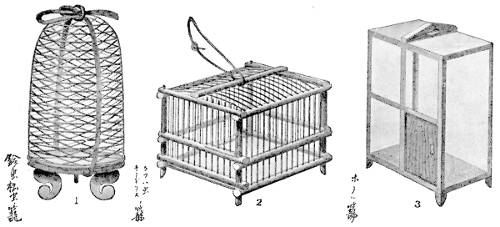
1. A Form of Insect Cage. 2. Cage for Large Musical Insects,—Kirigirisu, Kutsuwamushi, etc.
3. Cage for Small Musical Insects, or Fire-Flies
The demand for singing-insects increased from
this time so rapidly, that Chūzō soon found it
impossible to supply all his would-be customers
directly. He therefore decided to change his
business to wholesale trade, and to sell to retail
dealers only. To meet orders, he purchased
largely from peasants in the suburbs and elsewhere.
Many persons were employed by him;
and Yasubei and others paid him a fixed annual
sum for sundry rights and privileges.
Some time after this Yasubei became the first
itinerant-vendor of singing-insects. He walked
through the streets crying his wares; but hired a
number of servants to carry the cages. Tradition
says that while going his rounds he used to wear
a katabira[7] made of a much-esteemed silk stuff
called sukiya, together with a fine Hakata-girdle;
and that this elegant way of dressing proved of
much service to him in his business.
Two men, whose names have been preserved,
soon entered into competition with Yasubei.
The first was Yasakura Yasuzō, of Honjō-ku, by
previous occupation a sahainin, or property-agent.
He prospered, and became widely known
as Mushi-Yasu,—“Yasu-the-Insect-Man.” His
success encouraged a former fellow-sahainin,
Genbei of Uyeno, to go into the same trade.
Genbei likewise found insect-selling a lucrative
occupation, and earned for himself the sobriquet
of Mushi-Gen, by which he is yet remembered.
His descendants in Tōkyō to-day are amé[8]-manufacturers;
but they still carry on the hereditary
insect-business during the summer and autumn
months; and one of the firm was kind enough
to furnish me with many of the facts recorded in
this little essay.
Chūzō, the father and founder of all this curious
commerce, died without children; and sometime
in the period of Bunsei (1818-1829) his business
was taken over by a distant relative named Yamasaki
Seïchirō. To Chūzō’s business, Yamasaki
joined his own,—that of a toy-merchant. About
the same time a law was passed limiting the
number of insect-dealers in the municipality to
thirty-six. The thirty-six then formed themselves
into a guild, called the Ōyama-Kō (“Ōyama
Society”), having for patron the divinity
Sekison-Sama of the mountain Ōyama in Sagami
Province.[9] But in business the association
was known as the Yedō-Mushi-Kō, or Yedo
Insect-Company.
It is not until after this consolidation of the
trade that we hear of the kirigirisu,—the same
musical insect which the poet Kikaku had vainly
tried to buy in the city in 1687,—being sold
in Yedo. One of the guild known as Mushiya
Kojirō (“Kojirō the Insect-Merchant”), who did
business in Honjō-Ku, returning to the city after
a short visit to his native place in Kadzusa,
brought back with him a number of kirigirisu,
which he sold at a good profit. Although long
famous elsewhere, these insects had never before
been sold in Yedo.
“When Midzu Echizen-no-Kami,” says the
chronicle, “became machi-bugyō (or chief magistrate)
of Yedo, the law limiting the number
of insect-dealers to thirty-six, was abolished.”
Whether the guild was subsequently dissolved
the chronicle fails to mention.
Kiriyama, the first to breed singing-insects artificially,
had, like Chūzō, built up a prosperous
trade. He left a son, Kaméjirō, who was adopted
into the family of one Yumoto, living in Waséda,
Ushigomé-ku. Kaméjirō brought with him to the
Yumoto family the valuable secrets of his father’s
occupation; and the Yumoto family is still celebrated
in the business of insect breeding.
To-day the greatest insect-merchant in Tōkyō
is said to be Kawasumi Kanésaburō, of Samon-chō
in Yotsuya-ku. A majority of the lesser
dealers obtain their autumn stock from him. But
the insects bred artificially, and sold in summer,
are mostly furnished by the Yumoto house. Other
noted dealers are Mushi-Sei, of Shitaya-ku, and
Mushi-Toku, of Asakusa. These buy insects
caught in the country, and brought to the city by
the peasants. The wholesale dealers supply both
insects and cages to multitudes of itinerant vendors
who do business in the neighborhood of the parish-temples
during the en-nichi, or religious festivals,—especially
after dark. Almost every night of
the year there are en-nichi in some quarter of the
capital; and the insect-sellers are rarely idle during
the summer and autumn months.
Perhaps the following list of current Tōkyō
prices[10] for singing-insects may interest the
reader:—
| Suzumushi | 3 | sen 5 rin, to | 4 | sen. |
| Matsumushi | 4 | „ | 5 | „ |
| Kantan | 10 | „ | 12 | „ |
| Kin-hibari | 10 | „ | 12 | „ |
| Kusa-hibari | 10 | „ | 12 | „ |
| Kuro-hibari | 8 | „ | 12 | „ |
| Kutsuwamushi | 10 | „ | 15 | „ |
| Yamato-suzu | 8 | „ | 12 | „ |
| Kirigirisu | 12 | „ | 15 | „ |
| Emma-kōrogi | 5 | „ |
| Kanétataki | 12 | „ |
| Umaoi | 10 | „ |
These prices, however, rule only during the
busy period of the insect trade. In May and the
latter part of June the prices are high,—for only
artificially bred insects are then in the market. In
July kirigirisu brought from the country will
sell as low as one sen. The kantan, kusa-hibari,
and Yamato-suzu sell sometimes as low as two
sen. In August the Emma-kōrogi can be bought
even at the rate of ten for one sen; and in September
the kuro-hibari, kanétataki, and umaoi
sell for one or one and a half sen each. But
there is little variation at any season in the prices
of suzumushi and of matsumushi. These are
never very dear, but never sell at less than three
sen; and there is always a demand for them. The
suzumushi is the most popular of all; and the
greater part of the profits annually made in the
insect-trade is said to be gained on the sale of
this insect.
As will be seen from the foregoing price-list,
twelve varieties of musical insects are sold in
Tōkyō. Nine can be artificially bred,—namely
the suzumushi, matsumushi, kirigirisu, kantan,
kutsuwamushi, Emma-kōrogi, kin-hibari, kusa-hibari
(also called Asa-suzu), and the Yamato-suzu,
or Yoshino-suzu. Three varieties, I am
told, are not bred for sale, but captured for the
market: these are the kanétataki, umaoi or
hataori, and kuro-hibari. But a considerable
number of all the insects annually offered for
sale, are caught in their native haunts.
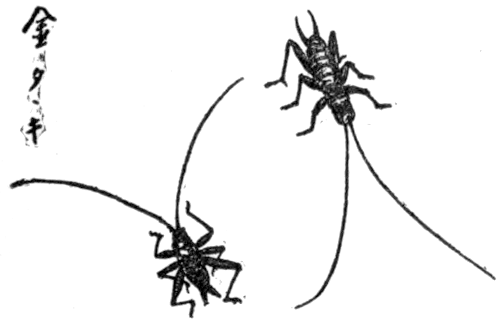
Kanétataki (“The Bell-Ringer”) (natural size).
The night-singers are, with few exceptions,
easily taken. They are captured with the help of
lanterns. Being quickly attracted by light, they
approach the lanterns; and when near enough to
be observed, they can readily be covered with nets
or little baskets. Males and females are usually
secured at the same time, for the creatures move
about in couples. Only the males sing; but a
certain number of females are always taken for
breeding purposes. Males and females are kept
in the same vessel only for breeding: they are
never left together in a cage, because the male
ceases to sing when thus mated, and will die in a
short time after pairing.
The breeding pairs are kept in jars or other
earthen vessels half-filled with moistened clay,
and are supplied every day with fresh food.
They do not live long: the male dies first, and
the female survives only until her eggs have been
laid. The young insects hatched from them, shed
their skin in about forty days from birth, after
which they grow more rapidly, and soon attain
their full development. In their natural state
these creatures are hatched a little before the
Doyō, or Period of Greatest Heat by the old
calendar,—that is to say, about the middle
of July;—and they begin to sing in October.
But when bred in a warm room, they are hatched
early in April; and, with careful feeding, they
can be offered for sale before the end of May.
When very young, their food is triturated and
spread for them upon a smooth piece of wood;
but the adults are usually furnished with unprepared
food,—consisting of parings of egg-plant,
melon-rind, cucumber-rind, or the soft interior
parts of the white onion. Some insects, however,
are specially nourished;—the abura-kirigirisu,
for example, being fed with sugar-water and
slices of musk-melon.
All the insects mentioned in the Tōkyō price-list
are not of equal interest; and several of the
names appear to refer only to different varieties
of one species,—though on this point I am not
positive. Some of the insects do not seem to
have yet been scientifically classed; and I am
no entomologist. But I can offer some general
notes on the more important among the little
melodists, and free translations of a few out of
the countless poems about them,—beginning
with the matsumushi, which was celebrated in
Japanese verse a thousand years ago:
Matsumushi.[11]
As ideographically written, the name of this
creature signifies “pine-insect;” but, as pronounced,
it might mean also “waiting-insect,”—since
the verb “matsu,”
“to wait,” and the noun
“matsu,” “pine,” have
the same sound. It is
chiefly upon this double
meaning of the word as
uttered that a host of
Japanese poems about
the matsumushi are based. Some of these
are very old,—dating back to the tenth century
at least.
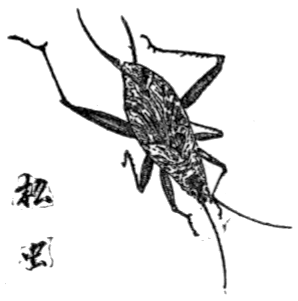
Matsumushi (slightly enlarged).
Although by no means a rare insect, the matsumushi
is much esteemed for the peculiar clearness
and sweetness of its notes—(onomatopoetically
rendered in Japanese by the syllables
chin-chirorīn, chin-chirorīn),—little silvery
shrillings which I can best describe as resembling
the sound of an electric bell heard from a distance.
The matsumushi haunts pine-woods and
cryptomeria-groves, and makes its music at night.
It is a very small insect, with a dark-brown back,
and a yellowish belly.
Perhaps the oldest extant verses upon the
matsumushi are those contained in the Kokinshū,—a
famous anthology compiled in the year 905
by the court-poet Tsurayuki and several of his
noble friends. Here we first find that play on
the name of the insect as pronounced, which was
to be repeated in a thousand different keys by a
multitude of poets through the literature of more
than nine hundred years:—
Aki no no ni
Michi mo madoinu;
Matsumushi no
Koe suru kata ni
Yadoya karamashi.
“In the autumn-fields I lose my way;—perhaps
I might ask for lodging in the direction of the
cry of the waiting-insect;”—that is to say,
“might sleep to-night in the grass where the
insects are waiting for me.” There is in the
same work a much prettier poem on the matsumushi
by Tsurayuki.
With dusk begins to cry the male of the Waiting-insect;—
I, too, await my beloved, and, hearing, my longing grows.
The following poems on the same insect are
less ancient but not less interesting:—
Forever past and gone, the hour of the promised advent!—
Truly the Waiter’s voice is a voice of sadness now!
Parting is sorrowful always,—even the parting with autumn!
O plaintive matsumushi, add not thou to my pain!
Always more clear and shrill, as the hush of the night grows deeper,
The Waiting-insect’s voice;—and I that wait in the garden,
Feel enter into my heart the voice and the moon together.
Suzumushi.[12]
The name signifies “bell-insect;” but the bell
of which the sound is thus referred to is a very
small bell, or a bunch of little bells such as a
Shinto priestess uses in the sacred dances. The
suzumushi is a great favorite with insect-fanciers,
and is bred in great numbers for the market. In
the wild state it is found in many parts of Japan;
and at night the noise made by multitudes of
suzumushi in certain lonesome places might easily
be mistaken,—as
it has been by
myself more than
once,—for the
sound of rapids.
The Japanese description
of the insect as resembling
“a watermelon seed”—the black kind—is
excellent. It is very small, with a black back,
and a white or yellowish belly. Its tintinnabulation—ri-ï-ï-ï-in,
as the Japanese render the
sound—might easily be mistaken for the tinkling
of a suzu. Both the matsumushi and the
suzumushi are mentioned in Japanese poems of
the period of Engi (901-922).
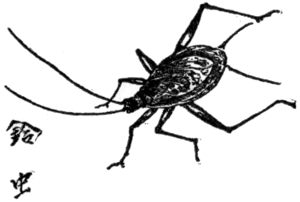
Suzumushi (slightly enlarged).
Some of the following poems on the suzumushi
are very old; others are of comparatively recent
date:—
Yes, my dwelling is old: weeds on the roof are growing;—
But the voice of the suzumushi that will never be old!
To-day united in love,—we who can meet so rarely!
Hear how the insects ring!—their bells to our hearts keep time.
The tinkle of tiny bells,—the voices of suzumushi,
I hear in the autumn-dusk,—and think of the fields at home.
Even the moonshine sleeps on the dews of the garden-grasses;
Nothing moves in the night but the suzumushi’s voice.
Heard in these alien fields, the voice of the suzumushi,—
Sweet in the evening-dusk,—sounds like the sound of home.
Vainly the suzumushi exhausts its powers of pleasing,
Always, the long night through, my tears continue to flow!
Hark to those tinkling tones,—the chant of the suzumushi!
—If a jewel of dew could sing, it would tinkle with such a voice!
Foolish-fond I have grown;—I feel for the suzumushi!—
In the time of the heavy rains, what will the creature do?
Hataori-mushi.
The hataori is a beautiful bright-green grasshopper,
of very graceful shape. Two reasons
are given for its curious name, which signifies
“the Weaver.” One is that, when held in a
particular way, the struggling gestures of the
creature resemble the movements of a girl weaving.
The other reason is that its music seems to
imitate the sound of the reed and shuttle of a
hand-loom in operation,—Ji-ï-ï-ï—chon-chon!—ji-ï-ï-ï—chon-chon!
There is a pretty folk-story about the origin
of the hataori and the kirigirisu, which used to
be told to Japanese children in former times.—Long,
long ago, says the tale, there were two
very dutiful daughters who supported their old
blind father by the labor of their hands. The
elder girl used to weave, and the younger to sew.
When the old blind father died at last, these good
girls grieved so much that they soon died also.
One beautiful morning, some creatures of a kind
never seen before were found making music
above the graves of the sisters. On the tomb
of the elder was a pretty green insect, producing
sounds like those made by a girl weaving,—ji-ï-ï-ï,
chon-chon! ji-ï-ï-ï, chon-chon! This
was the first hataori-mushi. On the tomb of
the younger sister was an insect which kept crying
out, “Tsuzuré—sasé, sasé!—tsuzuré, tsuzuré—sasé,
sasé, sasé!” (Torn clothes—patch,
patch them up!—torn clothes, torn clothes—patch
up, patch up, patch up!) This was the
first kirigirisu. Then everybody knew that the
spirits of the good sisters had taken those shapes.
Still every autumn they cry to wives and daughters
to work well at the loom, and warn them to
repair the winter garments of the household
before the coming of the cold.
Such poems as I have been able to obtain about
the hataori consist of nothing more than pretty
fancies. Two, of which I offer free renderings,
are ancient,—the first by Tsurayuki; the second
by a poetess classically known as “Akinaka’s
Daughter”:—
Weaving-insects I hear; and the fields, in their autumn-colors,
Seem of Chinese-brocade:—was this the weavers’ work?
Gossamer-threads are spread over the shrubs and grasses:
Weaving-insects I hear;—do they weave with spider-silk?
Umaoi.
The umaoi is sometimes confounded with the
hataori, which it much resembles. But the true
umaoi—(called junta in Izumo)—is a shorter
and thicker insect than the hataori; and has at
its tail a hook-shaped protuberance, which the
weaver-insect has not. Moreover, there is some
difference in the sounds made by the two creatures.
The music of the umaoi is not “ji-ï-ï-ï,—chon-chon,”
but, “zu-ï-in-tzō!—zu-ï-in-tzō!”—say
the Japanese.
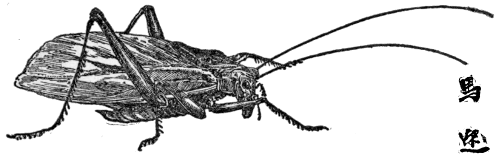
Umaoi (natural size).
Kirigirisu.[13]
There are different varieties of this much-prized
insect. The abura-kirigirisu, a day-singer, is a
delicate creature, and must be carefully nourished
in confinement. The tachi-kirigirisu, a night-singer,
is more commonly found in the market.
Captured kirigirisu sold in Tōkyō are mostly
from the neighborhood of Itabashi, Niiso, and
Todogawa; and these, which fetch high prices,
are considered the best. They are large vigorous
insects, uttering very clear notes. From Kujiukuri
in Kadzusa other and much cheaper kirigirisu
are brought to the capital; but these have a disagreeable
odor, suffer from the attacks of a
peculiar parasite, and are feeble musicians.
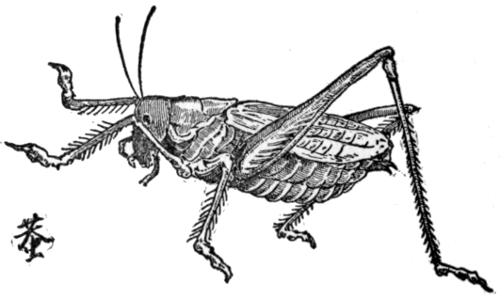
Kirigirisu (natural size).
As stated elsewhere, the sounds made by the
kirigirisu are said to resemble those of the Japanese
words, “Tsuzuré—sasé! sasé!” (Torn
clothes—patch up! patch up!); and a large proportion
of the many poems written about the
insect depend for interest upon ingenious but
untranslatable allusions to those words. I offer
renderings therefore of only two poems on the
kirigirisu,—the first by an unknown poet in the
Kokinshū; the second by Tadafusa:—
O Kirigirisu! when the clover changes color,
Are the nights then sad for you as for me that cannot sleep?
O Kirigirisu! cry not, I pray, so loudly!
Hearing, my sorrow grows, and the autumn-night is long!
Kusa-hibari.
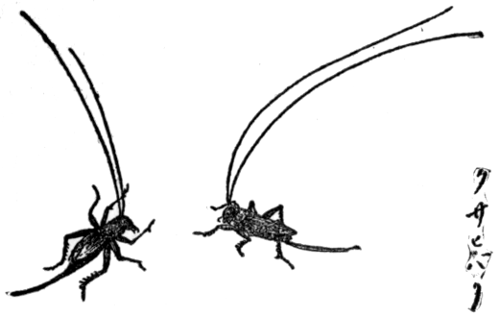
Kusa-hibari (natural size).
The kusa-hibari, or “Grass-Lark,”—also
called Asa-suzu, or “Morning-Bell;” Yabu-suzu,
or “the Little
Bell of the Bamboo-grove;”
Aki-kazé, or
“Autumn-Wind;”
and Ko-suzu-mushi,
or “the Child of the
Bell-Insect,”—is a
day-singer. It is very
small,—perhaps the
smallest of the insect-choir,
except the Yamato-suzu.
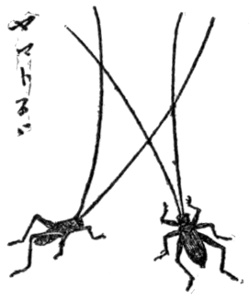
Yamato-suzu (“Little-Bell of Yamato”) (natural size).
Kin-hibari.
The kin-hibari, or “Golden
Lark” used to be found in great
numbers about the neighborhood
of the well-known Shino-bazu-no-iké,—the
great lotos-pond
of Uyeno in Tōkyō;—but
of late years it has become
scarce there. The kin-hibari
now sold in the capital are brought from Todogawa
and Shimura.
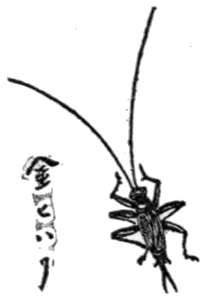
Kin-hibari (natural
size).
Kuro-hibari.
The kuro-hibari,
or “Black Lark,” is
rather uncommon,
and comparatively
dear. It is caught
in the country about
Tōkyō, but is never
bred.
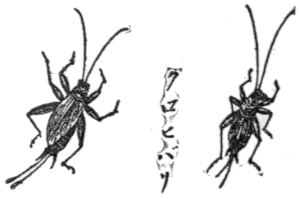
Kuro-hibari (natural size).
Kōrogi.
There are many varieties of this night-cricket,—called
kōrogi from its music:—“kiri-kiri-kiri-kiri!—kōro-kōro-kōro-kōro!—ghi-ï-ï-ï-ï-ï-ï!”
One variety, the ebi-kōrogi, or “shrimp-kōrogi,”
does not make any sound. But the
uma-kōrogi, or “horse-kōrogi;” the
Oni-kōrogi, or “Demon-kōrogi;”
and the Emma-kōrogi, or “Cricket-of-Emma[14]
[King of the Dead],”
are all good musicians. The
color is blackish-brown, or
black;—the best singing-varieties have curious
wavy markings on the wings.
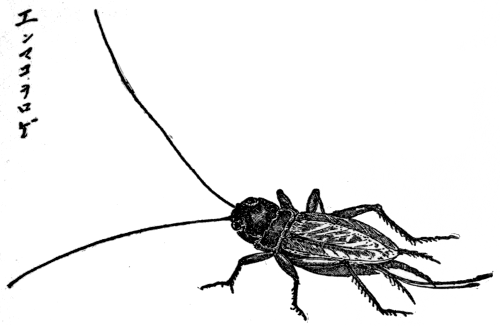
Emma-kōrogi (natural size).
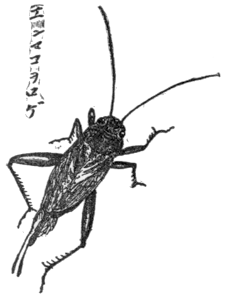
Emma-kōrogi.
An interesting fact regarding the kōrogi is that
mention of it is made in the very oldest collection
of Japanese poems known, the Manyōshu,
probably compiled about the middle of the eighth
century. The following lines, by an unknown
poet, which contain this mention, are therefore
considerably more than eleven hundred years
old:—
Niwa-kusa ni
Murasamé furité
Kōrogi no
Naku oto kikeba
Aki tsukinikeri.
[“Showers have
sprinkled the garden-grass.
Hearing
the sound of
the crying of the
kōrogi, I know
that the autumn
has come.”]
Kutsuwamushi.
There are several varieties of this extraordinary
creature,—also called onomatopoetically gatcha-gatcha,—which
is most provokingly described in
dictionaries as “a kind of noisy cricket”! The
variety commonly sold in Tōkyō has a green
back, and a yellowish-white abdomen; but there
are also brown and reddish varieties. The kutsuwamushi
is difficult to capture, but easy to
breed. As the tsuku-tsuku-bōshi is the most
wonderful musician among the sun-loving cicadæ
or semi, so the kutsuwamushi is the most wonderful
of night-crickets. It owes its name, which
means “The Bridle-bit-Insect,” to its noise, which
resembles the jingling and ringing of the old-fashioned
Japanese bridle-bit (kutsuwa). But
the sound is really much louder and much more
complicated than ever was the jingling of a single
kutsuwa; and the accuracy of the comparison is
not easily discerned while the creature is storming
beside you. Without the evidence of one’s own
eyes, it were hard to believe that so small a life
could make so prodigious a noise. Certainly
the vibratory apparatus in this insect must be very
complicated. The sound begins with a thin sharp
whizzing, as of leaking steam, and slowly strengthens;—then
to the whizzing is suddenly added
a quick dry clatter, as of castanets;—and then,
as the whole machinery rushes into operation,
you hear, high above the whizzing and the clatter,
a torrent of rapid ringing tones like the tapping
of a gong. These, the last to begin, are also the
first to cease; then the castanets stop; and finally
the whizzing dies;—but the full orchestra may
remain in operation for several hours at a time,
without a pause. Heard from far away at night
the sound is pleasant, and is really so much like
the ringing of a bridle-bit, that when you first
listen to it you cannot but feel how much real
poetry belongs to the name of this insect,—celebrated
from of old as “playing at ghostly escort
in ways where no man can pass.”
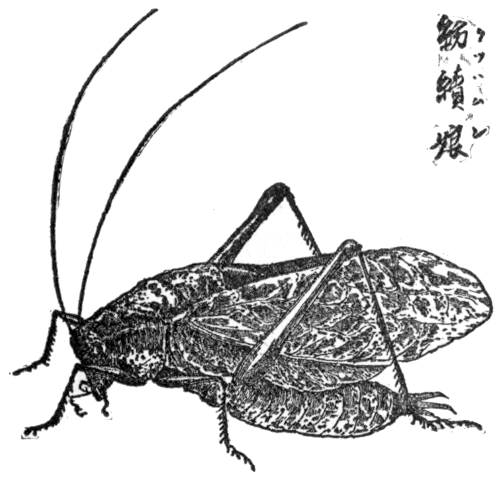
Kutsuwamushi (natural size).
The most ancient poem on the kutsuwamushi
is perhaps the following, by the Lady Idzumi-Shikibu:—
Waga seko wa
Koma ni makasété
Kinikeri to,
Kiku ni kikasuru
Kutsuwamushi kana!
—which might be thus freely rendered:
Listen!—his bridle rings;—that is surely my husband
Homeward hurrying now—fast as the horse can bear him!...
Ah! my ear was deceived!—only the Kutsuwamushi!
Kantan.
This insect—also called kantan-gisu, and
kantan-no-kirigirisu,—is a dark-brown night-cricket.
Its note—“zi-ï-ï-ï-in” is peculiar:
I can only compare it to the prolonged twang of
a bow-string. But this comparison is not satisfactory,
because there is a penetrant metallic quality
in the twang, impossible to describe.
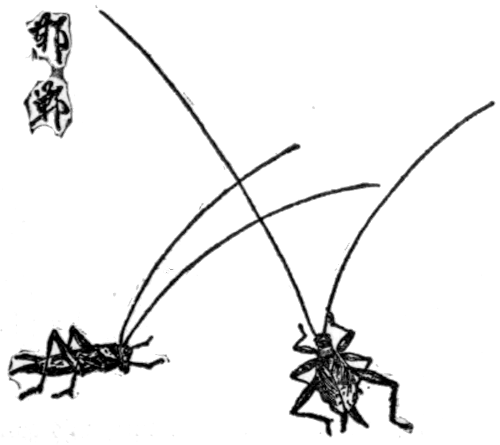
Kantan (natural size).
Besides poems about the chanting of particular
insects, there are countless Japanese poems, ancient
and modern, upon the voices of night-insects in
general,—chiefly in relation to the autumn season.
Out of a multitude I have selected and
translated a few of the more famous only, as
typical of the sentiment or fancy of hundreds.
Although some of my renderings are far from
literal as to language, I believe that they express
with tolerable faithfulness the thought and feeling
of the originals:—
Not for my sake alone, I know, is the autumn’s coming;—
Yet, hearing the insects sing, at once my heart grows sad.
Kokinshū.
Faint in the moonshine sounds the chorus of insect-voices:
To-night the sadness of autumn speaks in their plaintive tone.
I never can find repose in the chilly nights of autumn,
Because of the pain I hear in the insects’ plaintive song.
How must it be in the fields where the dews are falling thickly!
In the insect-voices that reach me I hear the tingling of cold.
Never I dare to take my way through the grass in autumn:
Should I tread upon insect-voices[15]—what would my feelings be!
The song is ever the same, but the tones of the insects differ,
Maybe their sorrows vary, according to their hearts.
Idzumi-Shikibu.
Changed is my childhood’s home—all but those insect-voices:
I think they are trying to speak of happier days that were.
These trembling dews on the grass—are they tears for the death of autumn?—
Tears of the insect-singers that now so sadly cry?
It might be thought that several of the poems
above given were intended to express either a real
or an affected sympathy with imagined insect-pain.
But this would be a wrong interpretation.
In most compositions of this class, the artistic
purpose is to suggest, by indirect means, various
phases of the emotion of love,—especially that
melancholy which lends its own passional tone to
the aspects and the voices of nature. The baroque
fancy that dew might be insect-tears, is by its
very exaggeration intended to indicate the extravagance
of grief, as well as to suggest that human
tears have been freshly shed. The verses in which
a woman declares that her heart has become too
affectionate, since she cannot but feel for the bell-insect
during a heavy shower, really bespeak the
fond anxiety felt for some absent beloved, travelling
in the time of the great rains. Again, in the
lines about “treading on insect-voices,” the dainty
scruple is uttered only as a hint of that intensification
of feminine tenderness which love creates.
And a still more remarkable example of this indirect
double-suggestiveness is offered by the little
poem prefacing this article,—
“O insect, insect!—think you that Karma can be exhausted by song?”
The Western reader would probably suppose that
the insect-condition, or insect-state-of-being, is
here referred to; but the real thought of the
speaker, presumably a woman, is that her own
sorrow is the result of faults committed in former
lives, and is therefore impossible to alleviate.
It will have been observed that a majority of
the verses cited refer to autumn and to the sensations
of autumn. Certainly Japanese poets
have not been insensible to the real melancholy
inspired by autumn,—that vague strange annual
revival of ancestral pain: dim inherited sorrow
of millions of memories associated through millions
of years with the death of summer;—but
in nearly every utterance of this melancholy, the
veritable allusion is to grief of parting. With its
color-changes, its leaf-whirlings, and the ghostly
plaint of its insect-voices, autumn Buddhistically
symbolizes impermanency, the certainty of bereavement,
the pain that clings to all desire, and
the sadness of isolation.
But even if these poems on insects were primarily
intended to shadow amorous emotion, do
they not reflect also for us the subtlest influences
of nature,—wild pure nature,—upon imagination
and memory? Does not the place accorded
to insect-melody, in the home-life as well as in
the literature of Japan, prove an æsthetic sensibility
developed in directions that yet remain for
us almost unexplored? Does not the shrilling
booth of the insect-seller at a night-festival proclaim
even a popular and universal comprehension
of things divined in the West only by our
rarest poets:—the pleasure-pain of autumn’s
beauty, the weird sweetness of the voices of the
night, the magical quickening of remembrance by
echoes of forest and field? Surely we have
something to learn from the people in whose
mind the simple chant of a cricket can awaken
whole fairy-swarms of tender and delicate fancies.
We may boast of being their masters in the
mechanical,—their teachers of the artificial in all
its varieties of ugliness;—but in the knowledge
of the natural,—in the feeling of the joy and
beauty of earth,—they exceed us like the Greeks
of old. Yet perhaps it will be only when our
blind aggressive industrialism has wasted and
sterilized their paradise,—substituting everywhere
for beauty the utilitarian, the conventional,
the vulgar, the utterly hideous,—that we shall
begin with remorseful amazement to comprehend
the charm of that which we destroyed.

My friend opened a thin yellow volume of
that marvellous text which proclaims at
sight the patience of the Buddhist engraver.
Movable Chinese types may be very
useful; but the best of which they are capable
is ugliness itself when compared with the beauty
of the old block-printing.
“I have a queer story for you,” he said.
“A Japanese story?”
“No,—Chinese.”
“What is the book?”
“According to Japanese pronunciation of the
Chinese characters of the title, we call it Mu-Mon-Kwan,
which means ‘The Gateless Barrier.’
It is one of the books especially studied by the
Zen sect, or sect of Dhyâna. A peculiarity of
some of the Dhyâna texts,—this being a good
example,—is that they are not explanatory.
They only suggest. Questions are put; but the
student must think out the answers for himself.
He must think them out, but not write them.
You know that Dhyâna represents human effort
to reach, through meditation, zones of thought
beyond the range of verbal expression; and any
thought once narrowed into utterance loses all
Dhyâna quality.... Well, this story is supposed
to be true; but it is used only for a Dhyâna
question. There are three different Chinese versions
of it; and I can give you the substance of
the three.”
Which he did as follows:—
—The story of the girl Ts’ing, which is told
in the Lui-shwo-li-hwan-ki, cited by the Ching-tang-luh,
and commented upon in the Wu-mu-kwan
(called by the Japanese Mu-Mon-Kwan),
which is a book of the Zen sect:—
There lived in Han-yang a man called Chang-Kien,
whose child-daughter, Ts’ing, was of peerless
beauty. He had also a nephew called
Wang-Chau,—a very handsome boy. The
children played together, and were fond of each
other. Once Kien jestingly said to his nephew:—“Some
day I will marry you to my little
daughter.” Both children remembered these
words; and they believed themselves thus betrothed.
When Ts’ing grew up, a man of rank asked for
her in marriage; and her father decided to comply
with the demand. Ts’ing was greatly troubled
by this decision. As for Chau, he was so much
angered and grieved that he resolved to leave
home, and go to another province. The next
day he got a boat ready for his journey, and
after sunset, without bidding farewell to any one,
he proceeded up the river. But in the middle of
the night he was startled by a voice calling to
him, “Wait!—it is I!”—and he saw a girl
running along the bank towards the boat. It was
Ts’ing. Chau was unspeakably delighted. She
sprang into the boat; and the lovers found their
way safely to the province of Chuh.
In the province of Chuh they lived happily
for six years; and they had two children. But
Ts’ing could not forget her parents, and often
longed to see them again. At last she said to
her husband:—“Because in former time I could
not bear to break the promise made to you, I ran
away with you and forsook my parents,—although
knowing that I owed them all possible
duty and affection. Would it not now be well
to try to obtain their forgiveness?” “Do not
grieve yourself about that,” said Chau;—“we
shall go to see them.” He ordered a boat to be
prepared; and a few days later he returned with
his wife to Han-yang.
According to custom in such cases, the husband
first went to the house of Kien, leaving Ts’ing
alone in the boat. Kien, welcomed his nephew
with every sign of joy, and said:—
“How much I have been longing to see you!
I was often afraid that something had happened
to you.”
Chau answered respectfully:—
“I am distressed by the undeserved kindness of
your words. It is to beg your forgiveness that
I have come.”
But Kien did not seem to understand. He
asked:—
“To what matter do you refer?”
“I feared,” said Chau, “that you were angry
with me for having run away with Ts’ing. I took
her with me to the province of Chuh.”
“What Ts’ing was that?” asked Kien.
“Your daughter Ts’ing,” answered Chau, beginning
to suspect his father-in-law of some
malevolent design.
“What are you talking about?” cried Kien,
with every appearance of astonishment. “My
daughter Ts’ing has been sick in bed all these
years,—ever since the time when you went
away.”
“Your daughter Ts’ing,” returned Chau, becoming
angry, “has not been sick. She has
been my wife for six years; and we have two
children; and we have both returned to this
place only to seek your pardon. Therefore please
do not mock us!”
For a moment the two looked at each other in
silence. Then Kien arose, and motioning to his
nephew to follow, led the way to an inner room
where a sick girl was lying. And Chau, to his
utter amazement, saw the face of Ts’ing,—beautiful,
but strangely thin and pale.
“She cannot speak,” explained the old man;
“but she can understand.” And Kien said to
her, laughingly:—“Chau tells me that you ran
away with him, and that you gave him two
children.”
The sick girl looked at Chau, and smiled; but
remained silent.
“Now come with me to the river,” said the
bewildered visitor to his father-in-law. “For I
can assure you,—in spite of what I have seen in
this house,—that your daughter Ts’ing is at this
moment in my boat.”
They went to the river; and there, indeed,
was the young wife, waiting. And seeing her
father, she bowed down before him, and besought
his pardon.
Kien said to her:—
“If you really be my daughter, I have nothing
but love for you. Yet though you seem to be
my daughter, there is something which I cannot
understand.... Come with us to the house.”
So the three proceeded toward the house. As
they neared it, they saw that the sick girl,—who
had not before left her bed for years,—was
coming to meet them, smiling as if much delighted.
And the two Ts’ings approached each
other. But then—nobody could ever tell how—they
suddenly melted into each other, and became
one body, one person, one Ts’ing,—even
more beautiful than before, and showing no sign
of sickness or of sorrow.
Kien said to Chau:—
“Ever since the day of your going, my
daughter was dumb, and most of the time like a
person who had taken too much wine. Now I
know that her spirit was absent.”
Ts’ing herself said:—
“Really I never knew that I was at home. I
saw Chau going away in silent anger; and the
same night I dreamed that I ran after his boat....
But now I cannot tell which was really I,—the
I that went away in the boat, or the I that
stayed at home.”
“That is the whole of the story,” my friend
observed. “Now there is a note about it in the
Mu-Mon-Kwan that may interest you. This
note says:—‘The fifth patriarch of the Zen sect
once asked a priest,—”In the case of the separation
of the spirit of the girl Ts’ing, which was
the true Ts’ing?”’ It was only because of this
question that the story was cited in the book.
But the question is not answered. The author
only remarks:—‘If you can decide which was
the real Ts’ing, then you will have learned that
to go out of one envelope and into another is
merely like putting up at an inn. But if you
have not yet reached this degree of enlightenment,
take heed that you do not wander aimlessly
about the world. Otherwise, when Earth,
Water, Fire, and Wind shall suddenly be dissipated,
you will be like a crab with seven hands
and eight legs, thrown into boiling water. And
in that time do not say that you were never told
about the Thing.’... Now the Thing—”
“I do not want to hear about the Thing,” I
interrupted,—“nor about the crab with seven
hands and eight legs. I want to hear about the
clothes.”
“What clothes?”
“At the time of their meeting, the two Ts’ings
would have been differently dressed,—very differently,
perhaps; for one was a maid, and the
other a wife. Did the clothes of the two also
blend together? Suppose that one had a silk robe
and the other a robe of cotton, would these have
mixed into a texture of silk and cotton? Suppose
that one was wearing a blue girdle, and the other
a yellow girdle, would the result have been a green
girdle?... Or did one Ts’ing simply slip out
of her costume, and leave it on the ground, like
the cast-off shell of a cicada?”
“None of the texts say anything about the
clothes,” my friend replied: “so I cannot tell you.
But the subject is quite irrelevant, from the Buddhist
point of view. The doctrinal question is the
question of what I suppose you would call the
personality of Ts’ing.”
“And yet it is not answered,” I said.
“It is best answered,” my friend replied, “by
not being answered.”
“How so?”
“Because there is no such thing as personality.”
Shindaréba koso ikitaré.
“Only because of having died, does one enter into life.”
—Buddhist proverb.
Behind my dwelling, but hidden from view
by a very lofty curtain of trees, there is
a Buddhist temple, with a cemetery attached
to it. The cemetery itself is in a grove of
pines, many centuries old; and the temple stands
in a great quaint lonesome garden. Its religious
name is Ji-shō-in; but the people call it Kobudera,
which means the Gnarled, or Knobby Temple, because
it is built of undressed timber,—great logs
of hinoki, selected for their beauty or strangeness
of shape, and simply prepared for the builder by
the removal of limbs and bark. But such gnarled
and knobby wood is precious: it is of the hardest
and most enduring, and costs far more than common
building-material,—as might be divined
from the fact that the beautiful alcoves and the
choicest parts of Japanese interiors are finished
with wood of a similar kind. To build Kobudera
was an undertaking worthy of a prince; and, as
a matter of history, it was a prince who erected
it, for a place of family worship. There is a
doubtful tradition that two designs were submitted
to him by the architect, and that he chose the
more fantastic one under the innocent impression
that undressed timber would prove cheap. But
whether it owes its existence to a mistake or not,
Kobudera remains one of the most interesting
temples of Japan. The public have now almost
forgotten its existence;—but it was famous in
the time of Iyemitsu; and its appellation, Ji-shō-in,
was taken from the kaimyō of one of the
great Shogun’s ladies, whose superb tomb may
be seen in its cemetery. Before Meiji, the temple
was isolated among woods and fields; but the city
has now swallowed up most of the green spaces
that once secluded it, and has pushed out the
ugliest of new streets directly in front of its
gate.
Gate of Kobudera
This gate—a structure of gnarled logs, with a
tiled and tilted Chinese roof—is a fitting preface
to the queer style of the temple itself. From
either gable-end of the gate-roof, a demon-head,
grinning under triple horns, looks down upon the
visitor.[16] Within, except at the hours of prayer,
all is green silence. Children do not play in the
court—perhaps because the temple is a private
one. The ground is everywhere hidden by a fine
thick moss of so warm a color, that the brightest
foliage of the varied shrubbery above it looks
sombre by contrast; and the bases of walls, the
pedestals of monuments, the stonework of the
bell-tower, the masonry of the ancient well, are
muffled with the same luminous growth. Maples
and pines and cryptomerias screen the façade of
the temple; and, if your visit be in autumn, you
may find the whole court filled with the sweet
heavy perfume of the mokusei[17]-blossom. After
having looked at the strange temple, you would
find it worth while to enter the cemetery, by the
black gate on the west side of the court.
I like to wander in that cemetery,—partly because
in the twilight of its great trees, and in the
silence of centuries which has gathered about
them, one can forget the city and its turmoil, and
dream out of space and time,—but much more
because it is full of beauty, and of the poetry of
great faith. Indeed of such poetry it possesses
riches quite exceptional. Each Buddhist sect has
its own tenets, rites, and forms; and the special
character of these is reflected in the iconography
and epigraphy of its burial-grounds,—so that for
any experienced eye a Tendai graveyard is readily
distinguishable from a Shingon graveyard, or a
Zen graveyard from one belonging to a Nichiren
congregation. But at Kobudera the inscriptions
and the sculptures peculiar to several Buddhist
sects can be studied side by side. Founded for
the Hokké, or Nichiren rite, the temple nevertheless
passed, in the course of generations, under
the control of other sects—the last being the
Tendai;—and thus its cemetery now offers a
most interesting medley of the emblems and the
epitaphic formularies of various persuasions. It
was here that I first learned, under the patient
teaching of an Oriental friend, something about
the Buddhist literature of the dead.
No one able to feel beauty could refuse to confess
the charm of the old Buddhist cemeteries,—with
their immemorial trees, their evergreen
mazes of shrubbery trimmed into quaintest
shapes, the carpet-softness of their mossed paths,
the weird but unquestionable art of their monuments.
And no great knowledge of Buddhism is
needed to enable you, even at first sight, to understand
something of this art. You would recognize
the lotos chiselled upon tombs or water-tanks,
and would doubtless observe that the designs of
the pedestals represent a lotos of eight petals,—though
you might not know that these eight
petals symbolize the Eight Intelligences. You
would recognize the manji, or svastika, figuring
the Wheel of the Law,—though ignorant of
its relation to the Mahâyâna philosophy. You
would perhaps be able to recognize also the
images of certain Buddhas,—though not aware
of the meaning of their attitudes or emblems in
relation to mystical ecstasy or to the manifestation
of the Six Supernatural Powers. And you
would be touched by the simple pathos of the
offerings,—the incense and the flowers before
the tombs, the water poured out for the dead,—even
though unable to divine the deeper pathos
of the beliefs that make the cult. But unless an
excellent Chinese scholar as well as a Buddhist
philosopher, all book-knowledge of the great
religion would still leave you helpless in a world
of riddles. The marvellous texts,—the exquisite
Chinese scriptures chiselled into the granite
of tombs, or limned by a master-brush upon the
smooth wood of the sotoba,—will yield their
secrets only to an interpreter of no common
powers. And the more you become familiar
with their aspect, the more the mystery of them
tantalizes,—especially after you have learned that
a literal translation of them would mean, in the
majority of cases, exactly nothing!
What strange thoughts have been thus recorded
and yet concealed? Are they complex
and subtle as the characters that stand for them?
Are they beautiful also like those characters,—with
some undreamed-of, surprising beauty, such
as might inform the language of another planet?
As for subtlety and complexity, much of this
mortuary literature is comparable to the Veil of
Isis. Behind the mystery of the text—in which
almost every character has two readings—there
is the mystery of the phrase; and again behind
this are successions of riddles belonging to a
gnosticism older than all the wisdom of the Occident,
and deep as the abysses of Space. Fortunately
the most occult texts are also the least
interesting, and bear little relation to the purpose
of this essay. The majority are attached, not to
the sculptured, but to the written and impermanent
literature of cemeteries,—not to the stone
monuments, but to the sotoba: those tall narrow
laths of unpainted wood which are planted above
the graves at fixed, but gradually increasing intervals,
during a period of one hundred years.[18]
Sotoba in Kobudera Cemetery
(The upper characters are “Bonti”—modified Sanskrit)
The uselessness of any exact translation of these
inscriptions may be exemplified by a word-for-word
rendering of two sentences written upon
the sotoba used by the older sects. What meaning
can you find in such a term as “Law-sphere-substance-nature-wisdom,”
or such an invocation
as “Ether, Wind, Fire, Water, Earth!”—for an
invocation it really is? To understand these
words one must first know that, in the doctrine
of the mystical sects, the universe is composed
of Five Great Elements which are identical with
Five Buddhas; that each of the Five Buddhas
contains the rest; and that the Five are One by
essence, though varying in their phenomenal manifestations.
The name of an element has thus
three significations. The word Fire, for example,
means flame as objective appearance; it means
flame also as the manifestation of a particular
Buddha; and it likewise means the special quality
of wisdom or power attributed to that Buddha.
Perhaps this doctrine will be more easily understood
by the help of the following Shingon classification
of the Five Elements in their Buddhist
relations:—
I. Hō-kai-tai-shō-chi
(Sansc. Dhârma-dhâtu-prakrit-gñâna), or “Law-sphere-substance-nature-wisdom,”—signifying
the wisdom that
becomes the substance of things. This is the element Ether.
Ether personified is Dai-Nichi-Nyōrai, the “Great Sun-Buddha”
(Mahâvairokana Tathâgata), who “holds the seal of
Wisdom.”
II. Dai-en-kyō-chi
(Âdarsana-gñâna), or “Great-round-mirror-wisdom,”—that
is to say the divine power making images manifest.
This is the element Earth. Earth personified is Ashuku
Nyōrai, the “Immovable Tathâgata” (Akshobhya).
III. Byō-dō-shō-chi
(Samatâ-gñâna), “Even-equal-nature-wisdom,”—that is,
the wisdom making no distinction of persons or of things.
The element Fire. Personified, Fire is Hō-shō Nyōrai, or
“Gem-Birth” Buddha (Ratnasambhava Tathâgata), presiding
over virtue and happiness.
IV. Myō-kwan-zatsu-chi
(Pratyavekshana-gñâna), “Wondrously-observing-considering-wisdom;”—that
is, the wisdom distinguishing
clearly truth from error, destroying doubts, and presiding
over the preaching of the Law. The element Water. Water
personified is Amida Nyōrai, the Buddha of Immeasurable
Light (Amitâbha Tathâgata).
V. Jō-shō-sa-chi
(Krityânushthâna-gñâna), the “Wisdom-of-accomplishing-what-is-to-be-done;”—that
is to say, the divine wisdom
that helps beings to reach Nirvana. The element Air.
Air personified is Fu-kū-jō-ju, the “Unfailing-of-Accomplishment,”—more
commonly called Fuku-Nyōrai (Amoghasiddhi,
or Sâkyamuni).[19]
Now the doctrine that each of the Five Buddhas
contains the rest, and that all are essentially One,
is symbolized in these texts by an extraordinary
use of characters called Bon-ji,—which are recognizably
Sanscrit letters. The name of each
element can be written with any one of four
characters,—all having for Buddhists the same
meaning, though differing as to sound and form.
Thus the characters standing for Fire would read,
according to Japanese pronunciation, Ra, Ran,
Raän, and Raku;—and the characters signifying
Ether, Kya, Ken, Keën, and Kyaku. By different
combinations of the twenty characters making the
five sets, different supernatural powers and different
Buddhas are indicated; and the indication
is further helped by an additional symbolic
character, called Shū-ji or “seed-word,” placed
immediately after the names of the elements.
The reader will now comprehend the meaning
of the invocatory “Ether, Wind, Fire,
Water, Earth!” and of the strange names of
divine wisdom written upon sotoba; but the
enigmas offered by even a single sotoba may
be much more complicated than the foregoing
examples suggest. There are unimaginable
acrostics; there are rules, varying according to
sect, for the position of texts in relation to the
points of the compass; and there are kabalisms
based upon the multiple values of certain Chinese
ideographs. The whole subject of esoteric inscriptions
would require volumes to explain; and the
reader will not be sorry, I fancy, to abandon it at
this point in favor of texts possessing a simpler
and a more humane interest.
The really attractive part of Buddhist cemetery-literature
mostly consists of sentences taken from
the sûtras or the sastras; and the attraction is
due not only to the intrinsic beauty of the faith
which these sentences express, but also to the
fact that they will be found to represent, in
epitome, a complete body of Buddhist doctrine.
Like the mystical inscriptions above-mentioned,
they belong to the sotoba, not to the gravestones;
but, while the invocations usually occupy
the upper and front part of the sotoba, these
sutra-texts are commonly written upon the back.
In addition to scriptural and invocatory texts,
each sotoba bears the name of the giver, the
kaimyō of the dead, and the name of a commemorative
anniversary. Sometimes a brief
prayer is also inscribed, or a statement of the
pious purpose inspiring the erection of the sotoba.
Before considering the scripture-texts proper, in
relation to their embodiment of doctrine, I submit
examples of the general character and plan of
sotoba inscriptions. They are written upon both
sides of the wood, be it observed; but I have not
thought it necessary to specify which texts belong
to the front, and which to the back of the sotoba,—since
the rules concerning such position differ
according to sect:—
I.—Sotoba of the Nichiren Sect.
(Invocation.)
Ether, Wind, Fire, Water, Earth!—Hail
to the Sutra of the Lotos of the Good Law!
(Commemorative text.)
To-day, the service of the third year has been performed
in order that our lay-brother [kaimyō] may be enabled to
cut off the bonds of illusion, to open the Eye of Enlightenment,
to remain free from all pain, and to enter into bliss.
(Sastra text.)
Myō-hō-kyō-riki-soku-shin-jō-butsu!
Even this body [of flesh] by the virtue of the Sutra of
the Excellent Law, enters into Buddhahood.
II.—Sotoba of the Nichiren Sect.
(Invocation.)
Hail to the Sutra of the Lotos of the Good
Law!
(Commemorative text.)
The rite of feeding the hungry spirits having been fulfilled,
and the service for the dead having been performed,
this sotoba is set up in commemoration of the service and
the offerings made with prayer for the salvation of Buddha
on behalf of—(kaimyō follows).
(Prayer—with English translation.)
Gan i shi kudoku
Fu-gyū o issai
Gatō yo shujō
Kai-gu jō butsudo.
By virtue of this good action I beseech that the merit of
it may be extended to all, and that we and all living beings
may fulfil the Way of Buddha.[20]
The fifth day of the seventh month of the
thirtieth year of Meiji, by —— ——, this sotoba
has been set up.
III.—Sotoba of the Jōdo Sect.
(Invocation.)
Hail to the Buddha Amida!
(Commemorative mention.)
This for the sake of—(here kaimyō follows).
(Sutra text.)
The Buddha of the Golden Mouth, who possesses
the Great-Round-Mirror-Wisdom,[21] has
said: “The glorious light of Amida illuminates
all the worlds of the Ten Directions, and
takes into itself and never abandons all living
beings who fix their thoughts upon that
Buddha!”
IV.—Sotoba of the Zen Sect.
(Sastra text.)
The Dai-en-kyō-chi-kyō declares:—“By entering
deeply into meditation, one may behold
the Buddhas of the Ten Directions.”
(Commemorative text.)
That the noble Elder Sister[22] Chi-Shō-In-Kō-Un-Tei-Myō,[23]
now dwelling in the House of Shining Wisdom, may instantly
attain to Bodhi.[24]
(Prayer.)
Let whomsoever looks upon this sotoba be forever
delivered from the Three Evil Ways.[25]
(Record.)
In the thirtieth year of Meiji, on the first day
of the fifth month, by the house of Inouyé, this
sotoba has been set up.
The foregoing will doubtless suffice as specimens
of the ordinary forms of inscription. The
Buddha praised or invoked is always the Buddha
especially revered by the sect from whose sutra
or sastra the quotation is chosen;—sometimes also
the divine power of a Bodhisattva is extolled, as
in the following Zen inscription:—
“The Sutra of Kwannon says:—‘In all
the provinces of all the countries in the Ten
Directions, there is not even one temple where
Kwannon is not self-revealed.’”
Sometimes the scripture text more definitely
assumes the character of a praise-offering, as the
following juxtaposition suggests:—
“The Buddha of Immeasurable Light illuminates
all worlds in the Ten Directions of
Space.”
This for the sake of the swift salvation into Buddhahood
of our lay-brother named the Great-Secure-Retired-Scholar.
Sometimes we also find a verse of praise or an
invocation addressed to the apotheosized spirit of
the founder of the sect,—a common example
being furnished by the sotoba of the Shingon
rite:—
“Hail to the Great Teacher Haijō-Kongō!”[26]
Rarely the little prayer for the salvation of the
dead assumes, as in the following beautiful example,
the language of unconscious poetry:—
“This for the sake of our noble Elder Sister
----. May the Lotos of Bliss by virtue of these
prayers be made to bloom for her, and to bear
the fruit of Buddhahood!”[27]
But usually the prayers are of the simplest, and
differ from each other only in the use of peculiar
Buddhist terms:—
—“This for the sake of the true happiness of our lay-brother—[kaimyō],—that
he may obtain the Supreme
Perfect Enlightenment.”
—“This tower is set up for the sake of ——, that he
may obtain complete Sambodhi.”[28]
—“This precious tower and these offerings for the sake
of —— ——,—that he may obtain the Anattra-Sammyak-Sambodhi.”[29]
One other subject of interest belonging to the
merely commemorative texts of sotoba remains
to be mentioned,—the names of certain Buddhist
services for the dead. There are two classes of
such services: those performed within one hundred
days after death, and those celebrated at fixed
intervals during a term of one hundred years,—on
the 1st, 2d, 7th, 13th, 17th, 24th, 33d,
50th, and 100th anniversaries of the death. In
the Zen rite these commemorative services—(perhaps
we might call them masses)—have
singular mystical names by which they are
recorded upon the sotoba of the sect,—such
as Lesser Happiness, Greater Happiness, Broad
Repose, The Bright Caress, and The Great
Caress.
But we shall now turn to the study of the
scripture-texts proper,—those citations from
sûtra or sastra which form the main portion of
a sotoba-writing; expounding the highest truth
of Buddhist belief, or speaking the deepest thought
of Eastern philosophy.
At the beginning of my studies in the Kobudera
cemetery, I was not less impressed by the quiet
cheerfulness of the sotoba-texts, than by their
poetry and their philosophy. In none did I find
even a shadow of sadness: the greater number
were utterances of a faith that seemed to me
wider and deeper than our own,—sublime proclamations
of the eternal and infinite nature of
Thought, the unity of all mind, and the certainty
of universal salvation. And other surprises
awaited me in this strange literature. Texts or
fragments of texts, that at first rendering appeared
of the simplest, would yield to learned
commentary profundities of significance absolutely
startling. Phrases, seemingly artless, would suddenly
reveal a dual suggestiveness,—a two-fold
idealism,—a beauty at once exoteric and mystical.
Of this latter variety of inscription the
following is a good example:—
“The flower having bloomed last night, the
World has become fragrant.”[30]
In the language of the higher Buddhism, this
means that through death a spirit has been released
from the darkness of illusion, even as the
perfume of a blossom is set free at the breaking
of the bud, and that the divine Absolute, or
World of Law, is refreshed by the new presence,
as a whole garden might be made fragrant by
the blooming of some precious growth. But in
the popular language of Buddhism, the same
words signify that in the Lotos-Lake of Paradise
another magical flower has opened for the Apparitional
Rebirth into highest bliss of the being
loved and lost on earth, and that Heaven rejoices
for the advent of another Buddha.
But I desire rather to represent the general
result of my studies, than to point out the special
beauties of this epitaphic literature: and my purpose
will be most easily attained by arranging
and considering the inscriptions in a certain
doctrinal order.
A great variety of sotoba-texts refer, directly
or indirectly, to the Lotos-Flower Paradise of
Amida,—or, as it is more often called, the Paradise
of the West. The following are typical:—
“The Amida-Kyō says:—‘All who enter into
that country enter likewise into that state of
virtue from which there can be no turning
back.’”[31]
“The Text of Gold proclaims:—‘In that
world they receive bliss only: therefore that
world is called Gokuraku,—exceeding bliss.’”[32]
“Hail unto the Lord Amida Buddha! The
Golden Mouth has said,—‘All living beings that
fix their thoughts upon the Buddha shall be received
and welcomed into his Paradise;—never
shall they be forsaken.’”[33]
But texts like these, though dear to popular
faith, make no appeal to the higher Buddhism,
which admits heaven as a temporary condition
only, not to be desired by the wise. Indeed, the
Mahâyâna texts, describing Sukhâvatî, themselves
suggest its essentially illusive character,—a world
of jewel-lakes and perfumed airs and magical
birds, but a world also in which the voices of
winds and waters and singers perpetually preach
the unreality of self and the impermanency of all
things. And even the existence of this Western
Paradise might seem to be denied in other sotoba-texts
of deeper significance,—such as this:—
“Originally there is no East or West: where
then can South or North be?”[34]
“Originally,”—that is to say, in relation to the
Infinite. The relations and the ideas of the Conditioned
cease to exist for the Unconditioned. Yet
this truth does not really imply denial of other
worlds of relation,—states of bliss to which the
strong may rise, and states of pain to which the
weak may descend. It is a reminder only. All
conditions are impermanent, and so, in the profounder
sense, unreal. The Absolute,—the Supreme
Buddha,—is the sole Reality. This doctrine
appears in many sotoba-inscriptions:—
“The Blue Mountain of itself remains eternally
unmoved: the White Clouds come of
themselves and go.”[35]
By “the Blue Mountain” is meant the Sole
Reality of Mind;—by “the White Clouds,” the
phenomenal universe. Yet the universe exists but
as a dream of Mind:—
“If any one desire to obtain full knowledge of
all the Buddhas of the past, the present, and the
future, let him learn to comprehend the true
nature of the World of Law. Then will he perceive
that all things are but the production of
Mind.”[36]
“By the learning and the practice of the True
Doctrine, the Non-Apparent becomes [for us]
the only Reality.”[37]
The universe is a phantom, and a phantom
likewise the body of man, together with all emotions,
ideas, and memories that make up the
complex of his sensuous Self. But is this evanescent
Self the whole of man’s inner being? Not
so, proclaim the sotoba:—
“All living beings have the nature of Buddha.
The Nyōrai,[38] eternally living, is alone unchangeable.”[39]
“The Kegon-Kyō[40] declares:—‘In all living
creatures there exists, and has existed from the
beginning, the Real-Law Nature: all by their
nature contain the original essence of Buddha.’”
Sharing the nature of the Unchangeable, we
share the Eternal Reality. In the highest sense,
man also is divine:—
“The Mind becomes Buddha: the Mind itself
is Buddha.”[41]
“In the Engaku-Kyō[42] it is written: ‘Now
for the first time I perceive that all living beings
have the original Buddha-nature,—wherefore
Birth and Death and Nirvana have become for
me as a dream of the night that is gone.’”
Yet what of the Buddhas who successively
melt into Nirvana, and nevertheless “return in
their order”? Are they, too, phantoms?—is
their individuality also unreal? Probably the
question admits of many different answers,—since
there is a Buddhist Realism as well as a
Buddhist Idealism; but, for present purposes, the
following famous text is a sufficient reply:—
Namu itsu shin san-zé shō butsu!
“Hail to all the Buddhas of the Three Existences,[43]
who are but one in the One Mind!”[44]
In relation to the Absolute, no difference exists
even between gods and men:—
“The Golden Verse of the Jō-sho-sa-chi[45]
says:—‘This doctrine is equal and alike for all;
there is neither superior nor inferior, neither
above nor below.’”
Nay, according to a still more celebrated text,
there is not even any difference of personality:—
Ji ta hō kai byō dō ri yaku.
“The ‘I’ and the ‘Not-I’ are not different in
the World of Law: both are favored alike.”[46]
And a still more wonderful text—(to my
thinking, the most remarkable of all Buddhist
texts)—declares that the world itself, phantom
though it be, is yet not different from Mind:—
Sō moku koku dō shitsu kai jō butsu.
“Grass, trees, countries, the earth itself,—all
these shall enter wholly into Buddhahood.”[47]
Literally, “shall become Buddha;” that is,
they shall enter into Buddhahood or Nirvana.
All that we term matter will be transmuted
therefore into Mind,—Mind with the attributes
of Infinite Sentiency, Infinite Vision, and Infinite
Knowledge. As phenomenon, matter is unreal;
but transcendentally it belongs by its ultimate
nature to the Sole Reality.
Such a philosophical position is likely to puzzle
the average reader. To call matter and mind but
two aspects of the Ultimate Reality will not seem
irrational to students of Herbert Spencer. But to
say that matter is a phenomenon, an illusion, a
dream, explains nothing;—as phenomenon it
exists, and having a destiny attributed to it, must
be considered objectively. Equally unsatisfying
is the statement that phenomena are aggregates
of Karma. What is the nature of the particles
of the aggregate? Or, in plainest language, what
is the illusion made of?
Not in the original Buddhist scriptures, and
still less in the literature of Buddhist cemeteries,
need the reply be sought. Such questions are
dealt with in the sastras rather than in the sûtras;—also
in various Japanese commentaries upon
both. A friend has furnished me with some
very curious and unfamiliar Shingon texts containing
answers to the enigma.
The Shingon sect, I may observe, is a mystical
sect, which especially proclaims the identity of
mind and substance, and boldly carries out the
doctrine to its furthest logical consequences. Its
founder and father Kū-kai, better known as Kōbōdaishi,
declared in his book Hizōki that matter is
not different in essence from spirit. “As to the
doctrine of grass, trees, and things non-sentient
becoming Buddhas” he writes, “I say that the
refined forms [ultimate nature] of spiritual bodies
consist of the Five Great Elements; that Ether[48]
consists of the Five Great Elements; and that
the refined forms of bodies spiritual, of ether, of
plants, of trees, consequently pervade all space.
This ether, these plants and trees, are themselves
spiritual bodies. To the eye of flesh, plants and
trees appear to be gross matter. But to the eye
of the Buddha they are composed of minute spiritual
entities. Therefore, even without any
change in their substance, there can be no error
or impropriety in our calling them Buddhas.”
The use of the term “non-sentient” in the
foregoing would seem to involve a contradiction;
but this is explained away by a dialogue in the
book Shi-man-gi:—
Q.—Are not grass and trees sometimes called sentient?
A.—They can be so called.
Q.—But they have also been called non-sentient: how
can they be called sentient?
A.—In all substance from the beginning exists the impress
of the wisdom-nature of the Nyōrai (Tathâgata):
therefore to call such things sentient is not error.
“Potentially sentient,” the reader might conclude;
but this conclusion would be wrong. The
Shingon thought is not of a potential sentiency,
but of a latent sentiency which although to us
non-apparent and non-imaginable, is nevertheless
both real and actual. Commenting upon the
words of Kōbōdaishi above cited, the great priest
Yū-kai not only reiterates the opinion of his
master, but asserts that it is absurd to deny that
plants, trees, and what we call inanimate objects,
can practise virtue! “Since Mind,” he declares,
“pervades the whole World of Law, the grasses,
plants, trees, and earth pervaded by it must all
have mind, and must turn their mind to Buddhahood
and practise virtue. Do not doubt the doctrine
of our sect, regarding the Non-Duality of
the Pervading and the Pervaded, merely because
of the distinction made in common parlance between
Matter and Mind.” As for how plants or
stones can practise virtue, the sûtras indeed have
nothing to say. But that is because the sûtras,
being intended for man, teach only what man
should know and do.
The reader will now, perhaps, be better able to
follow out the really startling Buddhist hypothesis
of the nature of matter to its more than startling
conclusion. (It must not be contemned
because of the fantasy of five elements; for these
are declared to be only modes of one ultimate.)
All forms of what we call matter are really but
aggregates of spiritual units; and all apparent
differences of substance represent only differences
of combination among these units. The differences
of combination are caused by special tendencies
and affinities of the units;—the tendency
of each being the necessary result of its particular
evolutional history—(using the term “evolutional”
in a purely ethical sense). All integrations
of apparent substance,—the million suns
and planets of the universe,—represent only the
affinities of such ghostly ultimates; and every
human act or thought registers itself through
enormous time by some knitting or loosening of
forces working for good or evil.
Grass, trees, earth, and all things seem to us
what they are not, simply because the eye of
flesh is blind. Life itself is a curtain hiding
reality,—somewhat as the vast veil of day conceals
from our sight the countless orbs of Space.
But the texts of the cemeteries proclaim that the
purified mind, even while prisoned within the
body, may enter for moments of ecstasy into
union with the Supreme:—
“The One Bright Moon illuminates the mind
in the meditation called Zenjō.”[49]
The “One Bright Moon” is the Supreme
Buddha. By the pure of heart He may even be
seen:—
“Hail unto the Wondrous Law! By attaining
to the state of single-mindedness we behold
the Buddha.”[50]
Greater delight there is none:—
“Incomparable the face of the Nyōrai,—surpassing
all beauty in this world!”[51]
But to see the face of one Buddha is to see
all:—
“The Dai-en-kyō-chi-kyō[52] says:—‘By entering
deeply into the meditation Zenjō, one may
see all the Buddhas of the Ten Directions of
Space.’”
“The Golden Mouth has said:—‘He whose
mind can discern the being of one Buddha, may
easily behold three, four, five Buddhas,—nay,
all the Buddhas of the Three Existences.’”[53]
Which mystery is thus explained:—
“The Myō-kwan-satsu-chi-kyō[54] has said:—‘The
mind that detaches itself from all things
becomes the very mind of Buddha.’”[55]
Visitors to the older Buddhist temples of Japan
can scarcely fail to notice the remarkable character
of the gilded aureoles attached to certain
images. These aureoles, representing circles,
disks, or ovals of glory, contain numbers of little
niches shaped like archings or whirls of fire, each
enshrining a Buddha or a Bodhisattva. A verse
of the Amitâyur-Dhyâna Sûtra might have suggested
this symbolism to the Japanese sculptors:—“In
the halo of that Buddha there are Buddhas
innumerable as the sands of the Ganga.”[56]
Icon and verse alike express that doctrine of the
One in Many suggested by the foregoing sotoba-texts;
and the assurance that he who sees one
Buddha can see all, may further be accepted as
signifying that he who perceives one great truth
fully, will be able to perceive countless truths.
But even to the spiritually blind the light must
come at last. A host of cemetery texts proclaim
the Infinite Love that watches all, and the certainty
of ultimate and universal salvation:—
“Possessing all the Virtues and all the
Powers, the Eyes of the Infinite Compassion behold
all living creatures.”[57]
“The Kongō-takara-tō-mei[58] proclaims:—‘All
living beings in the Six States of Existence[59]
shall be delivered from the bonds of attachment;
their minds and their bodies alike shall be freed
from desire; and they shall obtain the Supreme
Enlightenment.’”
“The Sûtra says:—‘Changing the hearts of
all beings, I cause them to enter upon the Way of
Buddhahood.’”[60]
Yet the supreme conquest can be achieved only
by self-effort:—
“Through the destruction of the Three Poisons[61]
one may rise above the Three States of Existence.”
The Three Existences signify time past, present,
and future. To rise above—(more literally, to
“emerge from”)—the Three Existences means
therefore to pass beyond Space and Time,—to
become one with the Infinite. The conquest of
Time is indeed possible only for a Buddha; but
all shall become Buddhas. Even a woman, while
yet a woman, may reach Buddhahood, as this
Nichiren text bears witness, inscribed above the
grave of a girl:—
Kai yo ken pi ryō-nyō jō butsu.
“All beheld from afar the Dragon Maiden
become a Buddha.”
The reference is to the beautiful legend of
Sâgara, the daughter of the Nâga-king, in the
Myō-hō-rengé-kyō.[62]
Though not representing, nor even suggesting,
the whole range of sotoba-literature, the foregoing
texts will sufficiently indicate the quality of
its philosophical interest. The inscriptions of the
haka, or tombs, have another kind of interest;
but before treating of these, a few words should
be said about the tombs themselves. I cannot
attempt detail, because any description of the
various styles of such monuments would require
a large and profusely illustrated volume; while
the study of their sculptures belongs to the enormous
subject of Buddhist iconography,—foreign
to the purpose of this essay.
There are hundreds,—probably thousands,—of
different forms of Buddhist funeral monuments,—ranging
from the unhewn boulder, with
a few ideographs scratched on it, of the poorest
village-graveyard, to the complicated turret (kagé-kio)
enclosing a shrine with images, and surmounted
with a spire of umbrella-shaped disks or
parasols (Sanscrit: tchâtras),—possibly representing
the old Chinese stûpa. The most common
class of haka are plain. A large number of the
better class have lotos-designs chiselled upon some
part of them:—either the pedestal is sculptured
so as to represent lotos-petals; or a single blossom
is cut in relief or intaglio on the face of the tablet;
or—(but this is rare)—a whole lotos-plant,
leaves and flowers, is designed in relief upon one
or two sides of the monument. In the costly
class of tombs symbolizing the Five Buddhist
Elements, the eight-petalled lotos-symbol may be
found repeated, with decorative variations, upon
three or four portions of their elaborate structure.
Occasionally we find beautiful reliefs upon tombstones,—images
of Buddhas or Bodhisattvas;
and not unfrequently a statue of Jizō may be seen
erected beside a grave. But the sculptures of
this class are mostly old;—the finest pieces in
the Kobudera cemetery, for example, were executed
between two and three hundred years ago.
Finally I may observe that the family crest or
mon of the dead is cut upon the front of the
tomb, and sometimes also upon the little stone
tank set before it.
The inscriptions very seldom include any texts
from the holy books. On the front of the monument,
below the chiselled crest, the kaimyō is
graven, together, perhaps, with a single mystical
character—Sanscrit or Chinese; on the left side
is usually placed the record of the date of death;
and on the right, the name of the person or
family erecting the tomb. Such is now, at least,
the ordinary arrangement; but there are numerous
exceptions; and as the characters are most
often disposed in vertical columns, it is quite easy
to put all the inscriptions upon the face of a very
narrow monument. Occasionally the real name
is also cut upon some part of the stone,—together,
perhaps, with some brief record of the
memorable actions of the dead. Excepting the
kaimyō, and the sect-invocation often accompanying
it, the inscriptions upon the ordinary class of
tombs are secular in character; and the real interest
of such epigraphy is limited to the kaimyō.
By kai-myō (sîla-name) is meant the Buddhist
name given to the spirit of the dead, according to
the custom of all sects except the Ikkō or Shinshū.
In a special sense the term kai, or sîla, refers to
precepts of conduct[63]; in a general sense it might
be rendered as “salvation by works.” But the
Shinshū allows no kai to any mortal; it does
not admit the doctrine of immediate salvation by
works, but only by faith in Amida; and the
posthumous appellations which it bestows are
therefore called not kai-myō, but hō-myō, or
“Law-names.”
Before Meiji the social rank occupied by any
one during life was suggested by the kaimyō.
The use, with a kaimyō, of the two characters
reading in den, and signifying “temple-dweller,”
or “mansion-dweller,”—or of the more common
single character in, signifying “temple” or
“mansion,” was a privilege reserved to the nobility
and gentry. Class-distinctions were further
indicated by suffixes. Koji,—a term partly corresponding
to our “lay-brother,”—and Daishi,
“great elder-sister,” were honorifically attached to
the kaimyō of the samurai and the aristocracy;
while the simpler appellations of Shinshi and
Shinnyo, respectively signifying “faithful [believing]
man,” “faithful woman,” followed the
kaimyō of the humble. These forms are still used;
but the distinctions they once maintained have
mostly passed away, and the privilege of the
knightly “in den,” and its accompaniments, is
free to any one willing to pay for it. At all
times the words Dōji and Dōnyo seem to have
been attached to the kaimyō of children. Dō,
alone, means a lad, but when combined with ji or
nyo it means “child” in the adjectival sense;—so
that we may render Dōji as “Child-son,” and
Dōnyo as “Child-daughter.” Children are thus
called who die before reaching their fifteenth year,—the
majority-year by the old samurai code;
a lad of fifteen being deemed fit for war-service.
In the case of children who die within a year
after birth, the terms Gaini and Gainyo occasionally
replace Dōji and Dōnyo. The syllable Gai
here represents a Chinese character meaning
“suckling.”
Different Buddhists sects have different formulas
for the composition of the kaimyō and
its addenda;—but this subject would require a
whole special treatise; and I shall mention only
a few sectarian customs. The Shingon sect sometimes
put a Sanscrit character—the symbol of
a Buddha—before their kaimyō;—the Shin
head theirs with an abbreviation of the holy
name Sakyamuni;—the Nichiren often preface
their inscriptions with the famous invocation,
Namu myō hō rengé kyō (“Hail to the Sutra of
the Lotos of the Good Law!”),—sometimes
followed by the words Senzo daidai (“forefathers
of the generations”);—the Jōdo, like
the Ikkō, use an abbreviation of the name Sakyamuni,
or, occasionally, the invocation Namu
Amida Butsu!—and they compose their four-character
kaimyō with the aid of two ideographs
signifying “honour” or “fame;”—the Zen
sect contrive that the first and the last character
of the kaimyō, when read together, shall form a
particular Buddhist term, or mystical phrase,—except
when the kaimyō consists of only two
characters.
Probably the word “mansion” in kaimyō-inscriptions
would suggest to most Western readers
the idea of heavenly mansions. But the fancy
would be at fault. The word has no celestial
signification; yet the history of its epitaphic use
is curious enough. Anciently, at the death of
any illustrious man, a temple was erected for the
special services due to his spirit, and also for the
conservation of relics or memorials of him. Confucianism
introduced into Japan the ihai, or mortuary
tablet, called by the Chinese shin-shu;[64] and
a portion of the temple was set apart to serve as
a chapel for the ihai, and the ancestral cult. Any
such memorial temple was called in, or “mansion,”—doubtless
because the august spirit was
believed to occupy it at certain periods;—and
the term yet survives in the names of many
celebrated Buddhist temples,—such as the Chion-In,
of Kyōtō. With the passing of time, this
custom was necessarily modified; for as privileges
were extended and aristocracies multiplied, the
erection of a separate temple to each notable
presently became impossible. Buddhism met the
difficulty by conferring upon every individual of
distinction the posthumous title of in-den,—and
affixing to this title the name of an imaginary
temple or “mansion.” So to-day, in the vast
majority of kaimyō, the character in refers only
to the temple that would have been built had circumstance
permitted, but now exists only in the
pious desire of those who love and reverence the
departed.
Tomb in Kobudera Cemetery
(The relief represents Seishi Bosatsu—Bodhisattva Mahâsthâma—in meditation. It is 187 years old. The white patches on the surface are lichen growths)
Nevertheless the poetry of these in-names does
possess some real meaning. They are nearly all
of them names such as would be given to real
Buddhist temples,—names of virtues and sanctities
and meditations,—names of ecstasies and
powers and splendors and luminous immeasurable
unfoldings,—names of all ways and means of
escape from the Six States of Existence and the
sorrow of “peopling the cemeteries again and
again.”
The general character and arrangement of
kaimyō can best be understood by the aid of a
few typical specimens. The first example is from
a beautiful tomb in the cemetery of Kobudera,
which is sculptured with a relief representing the
Bodhisattva Mahâsthâma (Seishi Bosatsu) meditating.
All the text in this instance has been cut
upon the face of the monument, to left and right
of the icon. Transliterated into Romaji it reads
thus:—
(Kaimyō.)
Tei-Shō-In, Hō-sō Myō-shin, Daishi.
(Record.)
—Shōtoku Ni, Jin shin Shimotsuki, jiu-ku nichi.
[Translation:—
—Great Elder-Sister, Wonderful-Reality-Appearing-at-the-Window-of-Law, dwelling
in the Mansion of the Pine of Chastity.
—The nineteenth day of the Month of Frost,[65] second
year of Shōtoku,[66]—the year being under the Dragon of
Elder Water.]
For the sake of clearness, I have printed the
posthumous name proper (Hō-sō Myō-shin) in
small capitals, and the rest in italics. The first
three characters of the inscription,—Tei-Shō-In,—form
the name of the temple, or “mansion.”
The pine, both in religious and secular poetry, is
a symbol of changeless conditions of good, because
it remains freshly-green in all seasons. The
use of the term “Reality” in the kaimyō indicates
the state of unity with the Absolute;—by “Window-of-Law”
(Law here signifying the Buddha-state)
must be understood that exercise of virtue
through which even in this existence some perception
of Infinite Truth may be obtained. I have
already explained the final word, Daishi (“great
elder-sister”).
Less mystical, but not less beautiful, is this
Nichiren kaimyō sculptured upon the grave of
a young samurai:
Ko-shin In, Ken-dō Nichi-ki, Koji.
[Koji,—
Bright-Sun-on-the-Way-of-the-Wise, in the
Mansion of Luminous Mind.][67]
On the same stone is carven the kaimyō of
the wife:—
Shin-kyō In, Myō-en Nichi-ko, Daishi.
[Daishi,—
Spherically-Wondrous-Sunbeam, in the Mansion
of the Mirror of the Heart.]
Perhaps the reader will now be able to find
interest in the following selection of kaimyō,
translated for me by Japanese scholars. The
inscriptions are of various rites and epochs; but I
have arranged them only by class and sex:—
[Masculine Kaimyō.]
Koji,—
Law-Nature-Eternally-Complete, in the Mansion of the Mirror of Light.
Koji,—
Lone-Moon-above-Snowy-Peak, in the Mansion of Quiet Light.
Koji,—
Wonderful-Radiance-of-Luminous-Sound, in the Mansion of the Day-dawn of Mind.
Koji,—
Pure-Lotos-bloom-of-the-Heart, in the Mansion of Shining Beginnings.
Koji,—
Real-Earnestness-Self-sufficing-within, in the Mansion of Mystery-Penetration.
Koji,—
Wonderful-Brightness-of-the-Clouds-of-Law, in the Mansion of Wisdom-Illumination.
Koji,—
Law-Echo-proclaiming-Truth, in the Mansion of Real Zeal.
Koji,—
Ocean-of-Reason-Calmly-Full, in the Mansion of Self-Nature.
Koji,—
Effective-Benevolence-Hearing-with-Pure-Heart-the-Supplications-of-the-Poor,—dwelling in the Mansion of the Virtue of Pity.
Koji,—
Perfect-Enlightenment-beaming-tranquil-Glory,—in the Mansion of Supreme Comprehension.
Koji,—
Autumnal-Prospect-Clear-of-Cloud,—of the Household of Sakyamuni,—in the Mansion of the Obedient Heart.
Koji,—
Illustrious-Brightness,—of the Household of the Buddha,—in the Mansion of Conspicuous Virtue.
Koji,—
Daily-Peace-Home-Prospering, in the Mansion of Spherical Completeness.
Shinshi,—
Prosperity-wide-shining-as-the-Moon-of-Autumn.
Shinshi,—
Vow-abiding-wondrously-without-fault.
Shinshi,—
Vernal-Mountain-bathed-in-the-Light-of-the-Law.
Shinshi,—
Waking-to-Dhyâna-at-the-Bell-Peal-of-the-Wondrous-Dawn.
Shinshi,—
Winter-Mountain-Chastity-Mind.[68]
[Feminine Kaimyō]
Daishi,—
Moon-Dawn-of-the-Mountain-of-Light, dwelling in the August Mansion of Self-witness.[69]
Daishi,—
Wondrous-Lotos-of-Fleckless-Light, in the Mansion of the Moonlike Heart.
Daishi,—
Wonderful-Chastity-Responding-with-Pure-Mind-to-the-Summons-of-Duty,—in the Mansion of the Great Sea of Compassion.
Daishi,—
Lotos-Heart-of-Wondrous-Apparition,—in the Mansion of Luminous Perfume.
Daishi,—
Clear-Light-of-the-Spotless-Moon, in the Mansion of Spring-time-Eve.
Kaishi,—
Pure-Mind-as-a-Sun-of-Compassion, in the Mansion of Real Light.
Daishi,—
Wondrous-Lotos-of-Fragrance-Etherial, in the Mansion of Law-Nature.
Shinnyo,—
Rejoicing-in-the-Way-of-the-Infinite.
Shinnyo,—
Excellent-Courage-to-follow-Wisdom-to-the-End.
Shinnyo,—
Winter-Moon-shedding-purest-Light.
Shinnyo,—
Luminous-Shadow-in-the-Plumflower-Chamber.
Shinnyo,—
Virtue-fragrant-as-the-Odor-of-the-Lotos.
[Children’s Kaimyō.—Male.]
Dai-Dōji,[70]—
Instantly-Attaining-to-the-Perfect-Peace, dwelling in the August Mansion of Purity.
Dai-Dōji,[71]—
Permeating-Lucidity-of-the-Pure-Grove, dwelling in the August Mansion of Blossom-Fragrance.
Gaini,—
Frost-Glimmer.
Dōji,—
Dewy-Light.
Dōji,—
Dream-of-Spring.
Dōji,—
Spring-Frost.
Dōji,—
Ethereal-Nature.
Dōji,—
Rain-of-the-Law-from-translucent-Clouds.
[Children’s Kaimyō.—Female.]
Dai-Dōnyo,[72]—
Bright-Shining-Height-of-Wisdom, dwelling in the August Mansion of Fragrant Trees.
Gainyo,—
Snowy-Bubble.
Gainyo,—
Shining-Phantasm.
Dōnyo,—
Plumflower-Light.
Dōnyo,—
Dream-Phantasm.
Dōnyo,—
Chaste-Spring.
Dōnyo,—
Wisdom-Mirror-of-Flawless-Appearing.
Dōnyo,—
Wondrous-Excellence-of-Fragrant-Snow.
After having studied the sotoba-texts previously
cited, the reader should be able to divine the
meaning of most of the kaimyō above given.
At all events he will understand such frequently-repeated
terms as “Moon,” “Lotos,” “Law.”
But he may be puzzled by other expressions; and
some further explanation will, perhaps, not be
unwelcome.
Besides expressing a pious hope for the higher
happiness of the departed, or uttering some
assurance of special conditions in the spiritual
world, a great number of kaimyō also refer,
directly or indirectly, to the character of the vanished
personality. Thus a man of widely-recognized
integrity and strong moral purpose, may—like
my dead friend—be not unfitly named:
“Bright-Sun-on-the-Way-of-the-Wise.” The
child-daughter or the young wife, especially remembered
for sweetness of character, may be commemorated
by some such posthumous name as
“Plumflower-Light,” or “Luminous-Shadow-of-the-Plumflower-Chamber;”—the
word “plumflower” in either case at once suggesting the
quality of the virtue of the dead, because this
blossom in Japan is the emblem of feminine
moral charm,—more particularly faithfulness to
duty and faultless modesty. Again, the memory
of any person noted for deeds of charity may
be honoured by such a kaimyō as, “Effective-Benevolence-Listening-with-Pure-Heart-to-the-Supplications-of-the-Poor.”
Finally I may
observe that the kaimyō-terms expressing altitude,
luminosity, and fragrance, have most often
a moral-exemplary signification. But in all
countries epitaphic literature has its conventional
hypocrisies or extravagances. Buddhist kaimyō
frequently contain a great deal of religious
flattery; and beautiful posthumous names are
often given to those whose lives were the reverse
of beautiful.
When we find among feminine kaimyō such
appellations as “Wondrous-Lotos,” or “Beautiful-as-the-Lotos-of-the-Dawn,”
we may be sure in
the generality of cases that the charm, to which
reference is so made, was ethical only. Yet there
are exceptions; and the more remarkable of these
are furnished by the kaimyō of children. Names
like “Dream-of-Spring,” “Radiant-Phantasm,”
“Snowy-Bubble,” do actually refer to the lost
form,—or at least to the supposed parental idea
of vanished beauty and grace. But such names
also exemplify a peculiar consolatory application
of the Buddhist doctrine of Impermanency. We
might say that through the medium of these
kaimyō the bereaved are thus soothed in the
loftiest language of faith:—“Beautiful and brief
was the being of your child,—a dream of spring,
a radiant passing vision,—a snowy bubble. But
in the order of eternal law all forms must pass;
material permanency there is none: only the
divine Absolute dwelling in every being,—only
the Buddha in the heart of each of us,—forever
endures. Be this great truth at once your comfort
and your hope!”
Extraordinary examples of the retrospective
significance sometimes given to posthumous
names, are furnished by the kaimyō of the
Forty-Seven Rōnin buried at Sengakuji in
Tōkyō. (Their story is now well-known to all
the English-reading world through Mitford’s
eloquent and sympathetic version of it in the
“Tales of Old Japan.”) The noteworthy peculiarity
of these kaimyō is that each contains
the two words, “dagger” and “sword,”—used
in a symbolic sense, but having also an appropriate
military suggestiveness. Ōïshi Kuranosuké
Yoshiwo, the leader, is alone styled Koji;—the
kaimyō of his followers have the humbler suffix
Shinshi. Ōïshi’s kaimyō reads:—“Dagger-of-Emptiness-and-stainless-Sword,
in the Mansion
of Earnest Loyalty.” I need scarcely call attention
to the historic meaning of the mansion-name.
Three of the kaimyō of his followers will serve
as examples of the rest. That of Masé Kyudayu
Masaake is:—“Dagger-of-Fame-and-Sword-of-the-Way
[or Doctrine.]” The kaimyō of Ōïshi
Sezayémon Nobukiyo is:—“Dagger-of-Magnanimity-and-Sword-of-Virtue.”
And the
kaimyō of Horibei Yasubei is:—“Dagger-of-Cloud-and-Sword-of-Brightness.”
The first and the last of these four kaimyō will
be found obscure; and several more of the forty-seven
inscriptions are equally enigmatic at first
sight. Usually in a kaimyō the word “Emptiness,”
or “Void,” signifies the Buddhist state of
absolute spiritual purity,—the state of Unconditioned
Being. But in the kaimyō of Ōïshi
Kuranosuké the meaning of it, though purely
Buddhist, is very different. By “emptiness”
here, we must understand “illusion,” “unreality,”—and
the full meaning of the phrase “dagger-emptiness”
is:—“Wisdom that, seeing the
emptiness of material forms, pierces through
illusion as a dagger.” In Horibei Yasubei’s kaimyō
we must similarly render the word “cloud”
by illusion; and “Dagger-of-Cloud” should be
interpreted, “Illusion-penetrating Dagger of Wisdom.”
The wisdom that perceives the emptiness
of phenomena, is the sharply-dividing, or distinguishing
wisdom,—is Myō-kwan-zatsu-chi
(Pratyavekshana-gñâna).
Possibly I have presumed too much upon the
patience of my readers; yet I feel that these studies
can yield scarcely more than the glimpse of a
subject wide and deep as a sea. If they should
arouse any Western interest in the philosophy and
the poetry of Buddhist epitaphic literature, then
they will certainly have accomplished all that I
could reasonably hope.
Not improbably I shall be accused, as I have
been on other occasions, of trying to make Buddhist
texts “more beautiful than they are.” This
charge usually comes from persons totally ignorant
of the originals, and betrays a spirit of
disingenuousness with which I have no sympathy.
Whoever confesses religion to have been a developing
influence in the social and moral history of
races,—whoever grants that respect is due to
convictions which have shaped the nobler courses
of human conduct for thousands of years,—whoever
acknowledges that in any great religion
something of eternal truth must exist,—will hold
it the highest duty of a translator to interpret the
concepts of an alien faith as generously as he
would wish his own thoughts or words interpreted
by his fellow-men. In the rendering of Chinese
sentences this duty presents itself under a peculiar
aspect. Any attempt at literal translation would
result in the production either of nonsense, or of a
succession of ideas totally foreign to far-Eastern
thought. The paramount necessity in treating
such texts is to discover and to expound the
thought conveyed to Oriental minds by the
original ideographs,—which are very different
things indeed from “written words.” The translations
given in this essay were made by Japanese
scholars, and, in their present form, have the
approval of competent critics.
As I write these lines a full moon looks into
my study over the trees of the temple-garden,
and brings me the recollection of a little Buddhist
poem:—
“From the foot of the mountain, many are
the paths ascending in shadow; but from the
cloudless summit all who climb behold the self-same
Moon.”
The reader who knows the truth shrined in this
little verse will not regret an hour passed with me
among the tombs of Kobudera.
“With hands resting upon the floor, reverentially you
repeat your poem, O frog!”
Ancient Poem.
Few of the simpler sense-impressions of
travel remain more intimately and vividly
associated with the memory of a strange
land than sounds,—sounds of the open country.
Only the traveller knows how Nature’s voices—voices
of forest and river and plain—vary according
to zone; and it is nearly always some
local peculiarity of their tone or character that
appeals to feeling and penetrates into memory,—giving
us the sensation of the foreign and the
far-away. In Japan this sensation is especially
aroused by the music of insects,—hemiptera
uttering a sound-language wonderfully different
from that of their Western congeners. To a
lesser degree the exotic accent is noticeable also
in the chanting of Japanese frogs,—though the
sound impresses itself upon remembrance rather
by reason of its ubiquity. Rice being cultivated
all over the country,—not only upon mountain-slopes
and hill-tops, but even within the limits of
the cities,—there are flushed levels everywhere,
and everywhere frogs. No one who has travelled
in Japan will forget the clamor of the ricefields.
Hushed only during the later autumn and brief
winter, with the first wakening of spring waken
all the voices of the marsh-lands,—the infinite
bubbling chorus that might be taken for the
speech of the quickening soil itself. And the
universal mystery of life seems to thrill with a
peculiar melancholy in that vast utterance—heard
through forgotten thousands of years
by forgotten generations of toilers, but doubtless
older by myriad ages than the race of man.
Now this song of solitude has been for centuries
a favorite theme with Japanese poets; but
the Western reader may be surprised to learn that
it has appealed to them rather as a pleasant sound
than as a nature-manifestation.
Innumerable poems have been written about
the singing of frogs; but a large proportion of
them would prove unintelligible if understood as
referring to common frogs. When the general
chorus of the ricefield finds praise in Japanese
verse, the poet expresses his pleasure only in the
great volume of sound produced by the blending
of millions of little croakings,—a blending which
really has a pleasant effect, well compared to the
lulling sound of the falling of rain. But when
the poet pronounces an individual frog-call melodious,
he is not speaking of the common frog of
the ricefields. Although most kinds of Japanese
frogs are croakers, there is one remarkable exception—(not
to mention tree-frogs),—the kajika,
or true singing-frog of Japan. To say that it
croaks would be an injustice to its note, which is
sweet as the chirrup of a song-bird. It used to be
called kawazu; but as this ancient appellation
latterly became confounded in common parlance
with kaeru, the general name for ordinary frogs,
it is now called only kajika. The kajika is kept
as a domestic pet, and is sold in Tōkyō by several
insect-merchants. It is housed in a peculiar cage,
the lower part of which is a basin containing sand
and pebbles, fresh water and small plants; the
upper part being a framework of fine wire-gauze.
Sometimes the basin is fitted up as a ko-niwa,
or model landscape-garden. In these times the
kajika is considered as one of the singers of spring
and summer; but formerly it was classed with
the melodists of autumn; and people used to
make autumn-trips to the country for the mere
pleasure of hearing it sing. And just as various
places used to be famous for the music of particular
varieties of night-crickets, so there were
places celebrated only as haunts of the kajika.
The following were especially noted:—
Tamagawa and Ōsawa-no-Iké,—a river and a
lake in the province of Yamashiro.
Miwagawa, Asukagawa, Sawogawa, Furu-no-Yamada,
and Yoshinogawa,—all in the province
of Yamato.
Koya-no-Iké,—in Settsu.
Ukinu-no-Iké,—in Iwami.
Ikawa-no-Numa,—in Kōzuké.
Now it is the melodious cry of the kajika, or
kawazu, which is so often praised in far-Eastern
verse; and, like the music of insects, it is mentioned
in the oldest extant collections of Japanese
poems. In the preface to the famous anthology
called Kokinshū, compiled by Imperial Decree
during the fifth year of the period of Engi
(A. D. 905), the poet Ki-no-Tsurayuki, chief
editor of the work, makes these interesting observations:—
—“The poetry of Japan has its roots in the
human heart, and thence has grown into a multi-form
utterance. Man in this world, having a
thousand millions of things to undertake and to
complete, has been moved to express his thoughts
and his feelings concerning all that he sees and
hears. When we hear the uguisu[73] singing
among flowers, and the voice of the kawazu
which inhabits the waters, what mortal [lit.:
‘who among the living that lives’] does not
compose poems?”
The kawazu thus referred to by Tsurayuki is
of course the same creature as the modern
kajika: no common frog could have been mentioned
as a songster in the same breath with that
wonderful bird, the uguisu. And no common
frog could have inspired any classical poet with
so pretty a fancy as this:—
Té wo tsuité,
Uta moshi-aguru,
Kawazu kana!
“With hands resting on the ground, reverentially
you repeat your poem, O frog!” The charm of
this little verse can best be understood by those
familiar with the far-Eastern etiquette of posture
while addressing a superior,—kneeling, with the
body respectfully inclined, and hands resting upon
the floor, with the fingers pointing outwards.[74]
It is scarcely possible to determine the antiquity
of the custom of writing poems about
frogs; but in the Manyōshū, dating back to the
middle of the eighth century, there is a poem
which suggests that even at that time the river
Asuka had long been famous for the singing of
its frogs:—
Ima mo ka mo
Asuka no kawa no
Yū sarazu
Kawazu naku sé no
Kiyoku aruran.
“Still clear in our day remains the stream of
Asuka, where the kawazu nightly sing.” We
find also in the same anthology the following
curious reference to the singing of frogs:—
Omoboyezu
Kimaseru kimi wo,
Sasagawa no
Kawazu kikasezu
Kayeshi tsuru kamo!
“Unexpectedly I received the august visit of my
lord.... Alas, that he should have returned
without hearing the frogs of the river Sawa!”
And in the Rokujōshū, another ancient compilation,
are preserved these pleasing verses on the
same theme:—
Tamagawa no
Hito wo mo yogizu
Naku kawazu,
Kono yū kikéba
Oshiku ya wa aranu?
“Hearing to-night the frogs of the Jewel River
[or Tamagawa], that sing without fear of man,
how can I help loving the passing moment?”
Thus it appears that for more than eleven
hundred years the Japanese have been making
poems about frogs; and it is at least possible that
verses on this subject, which have been preserved
in the Manyōshū, were composed even earlier than
the eighth century. From the oldest classical
period to the present day, the theme has never
ceased to be a favorite one with poets of all
ranks. A fact noteworthy in this relation is that
the first poem written in the measure called
hokku, by the famous Bashō, was about frogs.
The triumph of this extremely brief form of
verse—(three lines of 5, 7, and 5 syllables respectively)—is
to create one complete sensation-picture;
and Bashō’s original accomplishes the
feat,—difficult, if not impossible, to repeat in
English:—
Furu iké ya,
Kawazu tobikomu,
Midzu no oto.
(“Old pond—frogs jumping in—sound of
water.”) An immense number of poems about
frogs were subsequently written in this measure.
Even at the present time professional men of
letters amuse themselves by making short poems
on frogs. Distinguished among these is a young
poet known to the Japanese literary world by the
pseudonym of “Roséki,” who lives in Ōsaka and
keeps in the pond of his garden hundreds of singing
frogs. At fixed intervals he invites all his
poet-friends to a feast, with the proviso that each
must compose, during the entertainment, one poem
about the inhabitants of the pond. A collection
of the verses thus obtained was privately printed
in the spring of 1897, with funny pictures of
frogs decorating the covers and illustrating the
text.
But unfortunately it is not possible through
English translation to give any fair idea of the
range and character of the literature of frogs.
The reason is that the greater number of compositions
about frogs depend chiefly for their literary
value upon the untranslatable,—upon local
allusions, for example, incomprehensible outside
of Japan; upon puns; and upon the use of words
with double or even triple meanings. Scarcely
two or three in every one hundred poems can
bear translation. So I can attempt little more
than a few general observations.
That love-poems should form a considerable
proportion of this curious literature will not seem
strange to the reader when he is reminded that
the lovers’ trysting-hour is also the hour when
the frog-chorus is in full cry, and that, in Japan
at least, the memory of the sound would be
associated with the memory of a secret meeting
in almost any solitary place. The frog referred
to in such poems is not usually the kajika. But
frogs are introduced into love-poetry in countless
clever ways. I can give two examples of modern
popular compositions of this kind. The first contains
an allusion to the famous proverb,—I no
naka no kawazu daikai wo shirazu: “The frog
in the well knows not the great sea.” A person
quite innocent of the ways of the world is compared
to a frog in a well; and we may suppose
the speaker of the following lines to be some
sweet-hearted country-girl, answering an ungenerous
remark with very pretty tact:—
Laugh me to scorn if you please;—call me your “frog-in-the-well”:
Flowers fall into my well; and its water mirrors the moon!
The second poem is supposed to be the utterance
of a woman having good reason to be jealous:—
Dull as a stagnant pond you deemed the mind of your mistress;
But the stagnant pond can speak: you shall hear the cry of the frog!
Outside of love-poems there are hundreds of
verses about the common frogs of ponds or ricefields.
Some refer chiefly to the volume of the
sound that the frogs make:—
Hearing the frogs of the ricefields, methinks that the water sings.
As we flush the ricefields of spring, the frog-song flows with the water.
From ricefield to ricefield they call: unceasing the challenge and answer.
Ever as deepens the night, louder the chorus of pond-frogs.
So many the voices of frogs that I cannot but wonder if the pond be not wider at night than by day!
Even the rowing boats can scarce proceed, so thick the clamor of the frogs of Horié!
The exaggeration of the last verse is of course
intentional, and in the original not uneffective.
In some parts of the world—in the marshes of
Florida and of southern Louisiana, for example,—the
clamor of the frogs at certain seasons
resembles the roaring of a furious sea; and
whoever has heard it can appreciate the fancy
of sound as obstacle.
Other poems compare or associate the sound
made by frogs with the sound of rain:—
The song of the earliest frogs,—fainter than falling of rain.
What I took for the falling of rain is only the singing of frogs.
Now I shall dream, lulled by the patter of rain and the song of the frogs.
Other poems, again, are intended only as tiny
pictures,—thumb-nail sketches,—such as this
hokku,—
Path between ricefields; frogs jumping away to right and left;—
—or this, which is a thousand years old:—
Where the flowers of the yamabuki are imaged in the still marsh-water, the voice of the kawazu is heard;—
—or the following pretty fancy:—
Now sings the frog, and the voice of the frog is perfumed;—for into the shining stream the cherry-petals fall.
The last two pieces refer, of course, to the true
singing frog.
Many short poems are addressed directly to the
frog itself,—whether kaeru or kajika. There are
poems of melancholy, of affection, of humor, of
religion, and even of philosophy among these.
Sometimes the frog is likened to a spirit resting
on a lotos-leaf; sometimes, to a priest repeating
sûtras for the sake of the dying flowers; sometimes
to a pining lover; sometimes to a host
receiving travellers; sometimes to a blasphemer,
“always beginning” to say something against
the gods, but always afraid to finish it. Most of
the following examples are taken from the recent
book of frog-poems published by Roséki;—each
paragraph of my prose rendering, it should
be remembered, represents a distinct poem:—
Now all the guests being gone, why still thus respectfully sitting, O frog?
So resting your hands on the ground, do you welcome the Rain, O frog?
You disturb in the ancient well the light of the stars, O frog!
Sleepy the sound of the rain; but your voice
makes me dream, O frog!
Always beginning to say something against
the great Heaven, O frog!
You have learned that the world is void: you
never look at it as you float, O frog!
Having lived in clear-rushing mountain-streams,
never can your voice become stagnant,
O frog!
The last pleasing conceit shows the esteem in
which the superior vocal powers of the kajika are
held.
I thought it strange that out of hundreds of
frog-poems collected for me I could not discover
a single mention of the coldness and clamminess
of the frog. Except a few jesting lines about the
queer attitudes sometimes assumed by the creature,
the only reference to its uninviting qualities
that I could find was the mild remark,
Seen in the daytime, how uninteresting you
are, O frog!
While wondering at this reticence concerning the
chilly, slimy, flaccid nature of frogs, it all at once
occurred to me that in other thousands of Japanese
poems which I had read there was a total
absence of allusions to tactual sensations. Sensations
of colors, sounds, and odors were rendered
with exquisite and surprising delicacy; but sensations
of taste were seldom mentioned, and
sensations of touch were absolutely ignored. I
asked myself whether the reason for this reticence
or indifference should be sought in the particular
temperament or mental habit of the race; but I
have not yet been able to decide the question.
Remembering that the race has been living for
ages upon food which seems tasteless to the
Western palate, and that impulses to such action
as hand-clasping, embracing, kissing, or other
physical display of affectionate feeling, are really
foreign to far-Eastern character, one is tempted to
the theory that gustatory and tactual sensations,
pleasurable and otherwise, have been less highly
evolved with the Japanese than with us. But
there is much evidence against such a theory; and
the triumphs of Japanese handicraft assure us of
an almost incomparable delicacy of touch developed
in special directions. Whatever be the
physiological meaning of the phenomenon, its
moral meaning is of most importance. So far as
I have been able to judge, Japanese poetry usually
ignores the inferior qualities of sensation, while
making the subtlest of appeals to those superior
qualities which we call æsthetic. Even if representing
nothing else, this fact represents the
healthiest and happiest attitude toward Nature.
Do not we Occidentals shrink from many purely
natural impressions by reason of repulsion developed
through a morbid tactual sensibility? The
question is at least worth considering. Ignoring
or mastering such repulsion,—accepting naked
Nature as she is, always lovable when understood,—the
Japanese discover beauty where we blindly
imagine ugliness or formlessness or loathsomeness,—beauty
in insects, beauty in stones, beauty in
frogs. Is the fact without significance that they
alone have been able to make artistic use of the
form of the centipede?... You should see my
Kyōtō tobacco-pouch, with centipedes of gold
running over its figured leather like ripplings of
fire!
He was two years old when—as ordained in
the law of perpetual recurrence—he
asked me for the Moon.
Unwisely I protested,—
“The Moon I cannot give you because it is too
high up. I cannot reach it.”
He answered:—
“By taking a very long bamboo, you probably
could reach it, and knock it down.”
I said,—
“There is no bamboo long enough.”
He suggested:—
“By standing on the ridge of the roof of the
house, you probably could poke it with the
bamboo.”
—Whereat I found myself constrained to make
some approximately truthful statements concerning
the nature and position of the Moon.
This set me thinking. I thought about the
strange fascination that brightness exerts upon
living creatures in general,—upon insects and
fishes and birds and mammals,—and tried to
account for it by some inherited memory of
brightness as related to food, to water, and to
freedom. I thought of the countless generations
of children who have asked for the Moon, and of
the generations of parents who have laughed at
the asking. And then I entered into the following
meditation:—
Have we any right to laugh at the child’s wish
for the Moon? No wish could be more natural;
and as for its incongruity,—do not we, children
of a larger growth, mostly nourish wishes quite as
innocent,—longings that if realized could only
work us woe,—such as desire for the continuance
after death of that very sense-life, or individuality,
which once deluded us all into wanting
to play with the Moon, and often subsequently
deluded us in far less pleasant ways?
Now foolish as may seem, to merely empirical
reasoning, the wish of the child for the Moon, I
have an idea that the highest wisdom commands
us to wish for very much more than the Moon,—even
for more than the Sun and the Morning-Star
and all the Host of Heaven.
I remember when a boy lying on my back in
the grass, gazing into the summer blue above me,
and wishing that I could melt into it,—become
a part of it. For these fancies I believe that a
religious tutor was innocently responsible: he had
tried to explain to me, because of certain dreamy
questions, what he termed “the folly and the
wickedness of pantheism,”—with the result that
I immediately became a pantheist, at the tender
age of fifteen. And my imaginings presently led
me not only to want the sky for a playground,
but also to become the sky!
Now I think that in those days I was really
close to a great truth,—touching it, in fact, without
the faintest suspicion of its existence. I mean
the truth that the wish to become is reasonable in
direct ratio to its largeness,—or, in other words,
that the more you wish to be, the wiser you are;
while the wish to have is apt to be foolish in
proportion to its largeness. Cosmic law permits
us very few of the countless things that we wish
to have, but will help us to become all that we
can possibly wish to be. Finite, and in so much
feeble, is the wish to have: but infinite in puissance
is the wish to become; and every mortal
wish to become must eventually find satisfaction.
By wanting to be, the monad makes itself the
elephant, the eagle, or the man. By wanting to
be, the man should become a god. Perhaps on
this tiny globe, lighted only by a tenth-rate yellow
sun, he will not have time to become a god;
but who dare assert that his wish cannot project
itself to mightier systems illuminated by vaster
suns, and there reshape and invest him with the
forms and powers of divinity? Who dare even
say that his wish may not expand him beyond
the Limits of Form, and make him one with
Omnipotence? And Omnipotence, without asking,
can have much brighter and bigger play-things
than the Moon.
Probably everything is a mere question of wishing,—providing
that we wish, not to have, but to
be. Most of the sorrow of life certainly exists
because of the wrong kind of wishing and because
of the contemptible pettiness of the wishes. Even
to wish for the absolute lordship and possession
of the entire earth were a pitifully small and
vulgar wish. We must learn to nourish very
much bigger wishes than that! My faith is that
we must wish to become the total universe with
its thousands of millions of worlds,—and more
than the universe, or a myriad universes,—and
more even than Space and Time.
Possibly the power for such wishing must
depend upon our comprehension of the ghostliness
of substance. Once men endowed with
spirit all forms and motions and utterances of
Nature: stone and metal, herb and tree, cloud
and wind,—the lights of heaven, the murmuring
of leaves and waters, the echoes of the hills,
the tumultuous speech of the sea. Then becoming
wiser in their own conceit, they likewise became
of little faith; and they talked about “the
Inanimate” and “the Inert,”—which are nonexistent,—and
discoursed of Force as distinct
from Matter, and of Mind as distinct from both.
Yet we now discover that the primitive fancies
were, after all, closer to probable truth. We cannot
indeed think of Nature to-day precisely as did
our forefathers; but we find ourselves obliged to
think of her in very much weirder ways; and
the later revelations of our science have revitalized
not a little of the primitive thought, and infused
it with a new and awful beauty. And meantime
those old savage sympathies with savage Nature
that spring from the deepest sources of our being,—always
growing with our growth, strengthening
with our strength, more and more unfolding
with the evolution of our higher sensibilities,—would
seem destined to sublime at last into forms
of cosmical emotion expanding and responding
to infinitude.
Have you never thought about those immemorial
feelings?... Have you never, when
looking at some great burning, found yourself
exulting without remorse in the triumph and glory
of fire?—never unconsciously coveted the crumbling,
splitting, iron-wrenching, granite-cracking
force of its imponderable touch?—never delighted
in the furious and terrible splendor of its
phantasmagories,—the ravening and bickering
of its dragons,—the monstrosity of its archings,—the
ghostly soaring and flapping of its spires?
Have you never, with a hill-wind pealing in your
ears, longed to ride that wind like a ghost,—to
scream round the peaks with it,—to sweep the
face of the world with it? Or, watching the
lifting, the gathering, the muttering rush and
thunder-burst of breakers, have you felt no impulse
kindred to that giant motion,—no longing
to leap with that wild white tossing, and to join
in that mighty shout?... And all such ancient
emotional sympathies with Nature’s familiar
forces—do they not prelude, with their modern
æsthetic developments, the future growth of rarer
sympathies with incomparably subtler forces, and
of longings to be limited only by our power to
know? Know ether—shivering from star to
star;—comprehend its sensitivities, its penetrancies,
its transmutations;—and sympathies ethereal
will evolve. Know the forces that spin the
suns;—and already the way has been reached of
becoming one with them.
And furthermore, is there no suggestion of such
evolvement in the steady widening through all the
centuries of the thoughts of their world-priests
and poets?—in the later sense of Life-as-Unity
absorbing or transforming the ancient childish
sense of life-personal?—in the tone of the new
rapture in world-beauty, dominating the elder
worship of beauty-human?—in the larger modern
joy evoked by the blossoming of dawns, the
blossoming of stars,—by all quiverings of color,
all shudderings of light? And is not the thing-in-itself,
the detail, the appearance, being ever less
and less studied for its mere power to charm, and
ever more and more studied as a single character
in that Infinite Riddle of which all phenomena
are but ideographs?
Nay!—surely the time must come when we
shall desire to be all that is, all that ever has been
known,—the past and the present and the future
in one,—all feeling, striving, thinking, joying,
sorrowing,—and everywhere the Part,—and
everywhere the Whole. And before us, with the
waxing of the wish, perpetually the Infinities shall
widen.
And I—even I!—by virtue of that wish,
shall become all forms, all forces, all conditions:
Ether, Wind, Fire, Water, Earth,—all motion
visible or viewless,—all vibration named of light,
of color, of sonority, of torrefaction,—all thrillings
piercing substance,—all oscillations picturing
in blackness, like the goblin-vision of the X-rays.
By virtue of that wish I shall become the Source
of all becoming and of all ceasing,—the Power
that shapes, the Power that dissolves,—creating,
with the shadows of my sleep, the life that shall
vanish with my wakening. And even as phosphor-lampings
in currents of midnight sea, so
shall shimmer and pulse and pass, in mine Ocean
of Death and Birth, the burning of billions of
suns, the whirling of trillions of worlds....
—“Well,” said the friend to whom I read this
revery, “there is some Buddhism in your fancies—though
you seem to have purposely avoided
several important points of doctrine. For instance,
you must know that Nirvana is never to
be reached by wishing, but by not wishing. What
you call the ‘wish-to-become’ can only help us,
like a lantern, along the darker portions of the
Way. As for wanting the Moon—I think that
you must have seen many old Japanese pictures
of apes clutching at the reflection of the Moon in
water. The subject is a Buddhist parable: the
water is the phantom-flux of sensations and ideas;
the Moon—not its distorted image—is the sole
Truth. And your Western philosopher was really
teaching a Buddhist parable when he proclaimed
man but a higher kind of ape. For in this
world of illusion, man is truly still the ape, trying
to seize on water the shadow of the Moon.”
—“Ape indeed,” I made answer,—“but an
ape of gods,—even that divine Ape of the
Ramayana who may clutch the Sun!”


