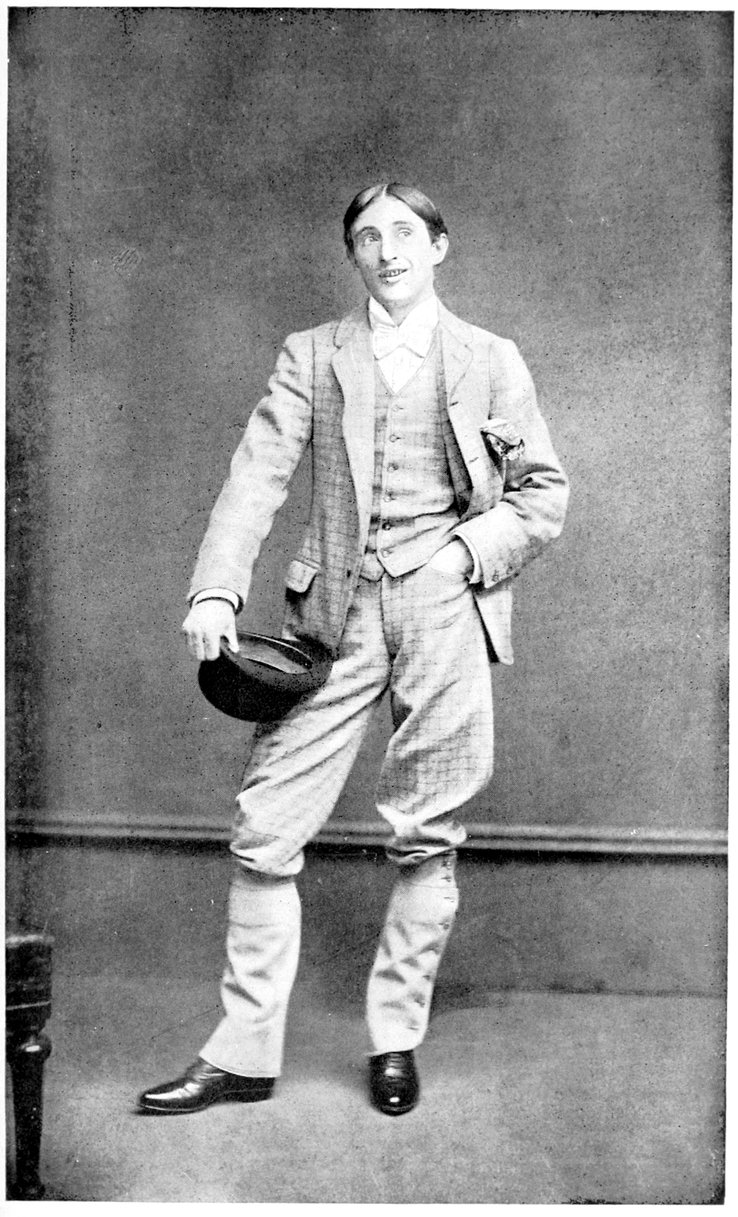
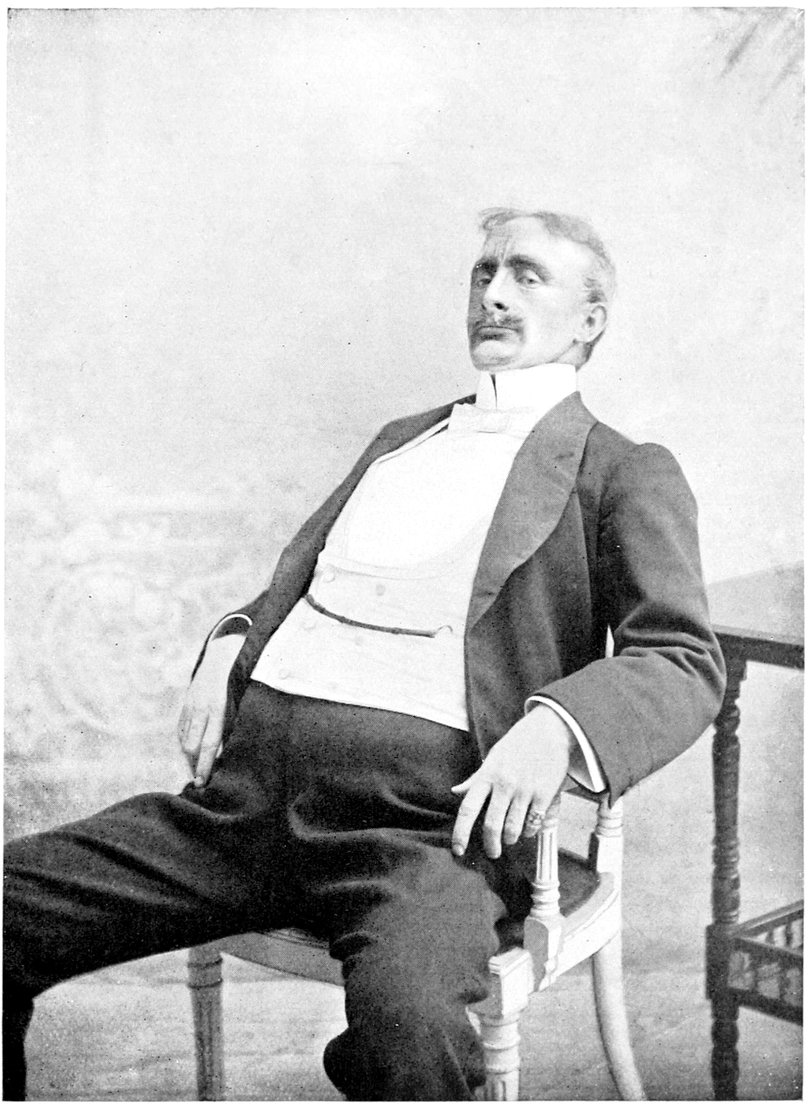
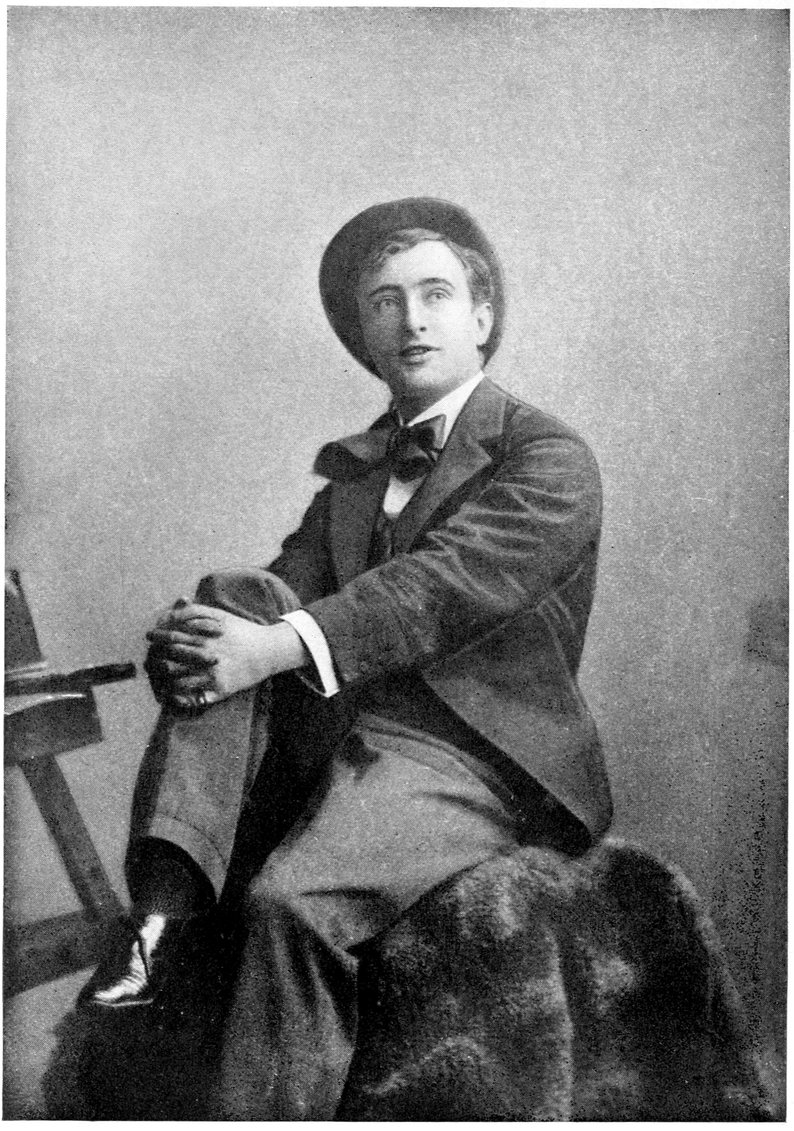
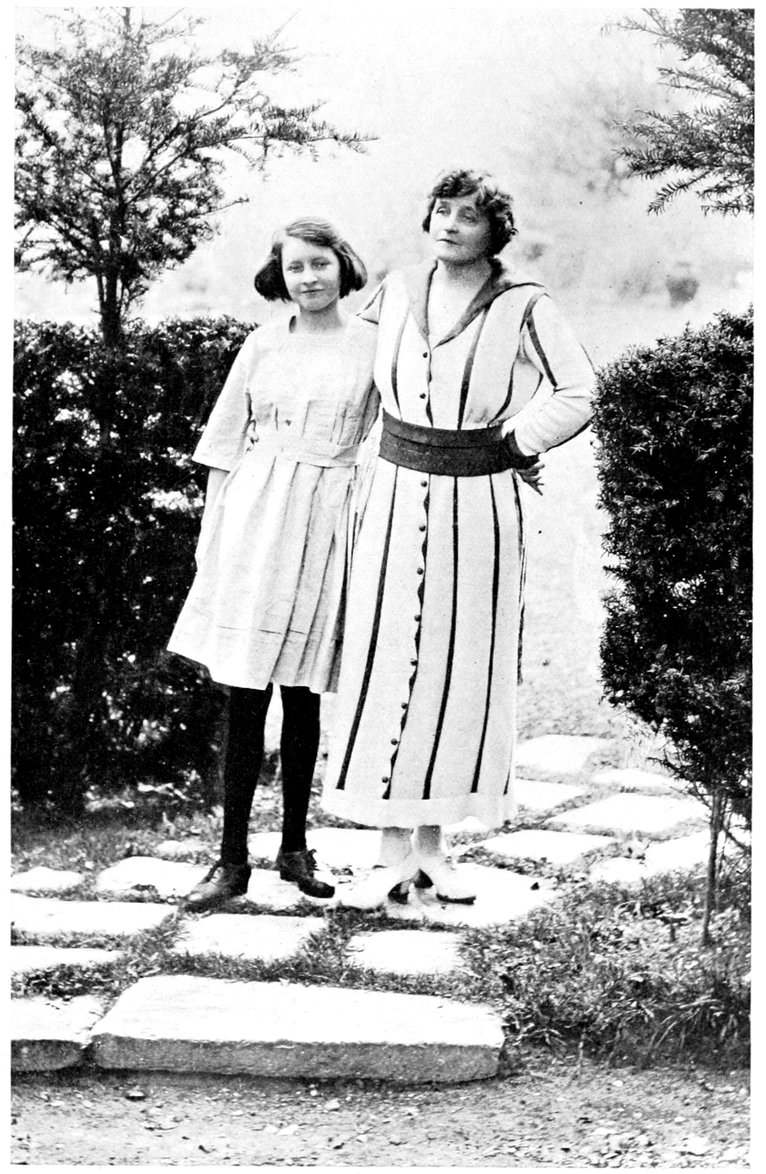
As Mr. Wickfield said to Miss Trotwood—the
old question, you know—“What is your
motive in this?”
I am sure it is excellent to have a motive, and if
possible a good motive, for doing everything; and
so before I begin I want to give my motive for
attempting to write my memoirs of things and
people, past and present—and here it is.
Jack, my son, was on tour with his own company
of Eliza Comes to Stay; and Jill, my little daughter,
was playing at the St. James’s Theatre, her first
engagement—and, incidentally, earning more each
week than I did when I first played “lead” (and
I found my own dresses). I thought that some day
they might like to know how different things were
in the “old days”; like to read how one worked,
and studied, and tried to save; might like to know
something of the road over which their father and
mother had travelled; and perhaps gain some idea
of the men and women who were our contemporaries.
Perhaps, if they, my own boy and girl, would like
to read this, other people’s boys and girls might like
2to read it also: it might at least interest and amuse
them.
To me, to try and write it all would be a joy, to
“call spirits from the vasty deep,” to ring up again
the curtain on the small dramas in which I had
played—and the small comedies too—and to pay
some tribute to the great men and women I have
known. It may all seem to be “my story,” but
very often I shall only be the string on which are
hung the bravery, kindness, and goodness of the
really great people; not always the most successful,
but the really great, who have helped to make life
what it should be, and luckily sometimes really is!
So I determined to begin, and begin at the
beginning.
Brighton! when it was Brighton; still retaining
some of the glories of the long past Regency; with
its gay seasons, its mounted police, and—no Metropole
Hotel; when the only two hotels of any importance
were the “Bedford” and the still-existing
“Old Ship.” The old chain pier, standing when we
went to bed one evening, and swept away when we
got up the next morning by a terrific gale. The
Aquarium, then a place which people really visited
and regarded as something of a “sight worth seeing”—does
anyone go there now, except on a very
wet day? The Dome in the Pavilion, with its grand
orchestral concerts, conducted by the famous Mr.
Kuhe, whose son is now a musical critic in London.
All these things belonged to Brighton of the—well,
the exact date does not matter—but of the time when
women did not ride bicycles or drive motor cars,
3because certainly the one, and certainly the other so
far as women were concerned, did not exist. In those
days men rode a high “single wheel” bicycle: the
higher the wheel, the greater the Knut—only the
word “Knut” was unknown then!
Those are some of the memories I have of Brighton
at the time when we were a happy, noisy, large family
living in Regency Square; a really large family, even
as Victorian families went—nine girls and one boy.
We had no money, but unlimited health and spirits.
My mother!—well, everyone says “Mine was the
sweetest mother in the world,” but my mother really
was. She had a most amazing amount of character
hidden under a most gentle exterior. As pretty as a
picture, adorable—just “Mother.”
And father—an austere, very good-looking man of
uncertain temper; one of those tempers which periodically
sweep through the house like a tornado.
Absolutely upright, and deeply respected, but with
a stern sense of his duties as a parent which we, his
children, hardly appreciated.
My first recollection is of trying to climb into my
mother’s bed, and finding the place that should have
been mine occupied by a “new baby.” I heard years
afterwards that when my mother was told that her
tenth child and ninth daughter had arrived in the
world, she exclaimed: “Thank God it’s a girl!”
Such a nice feminine thing to say, bless her!
Six of the girls lived to grow up, and we each, as
we grew sufficiently advanced in years, took turns at
the “housekeeping”. I know I did double duty, as
my sister Jessie distinguished herself by fainting one
4morning when preparing the breakfast, and so was
not allowed to do it any more. I remember creeping
down the stairs in the dark early mornings (when I
think of “getting breakfast”, it seems to me that
we must have lived in perpetual winter, the mornings
seem to have always been cold and dark, never bright
and sunny: I suppose the memory of the unpleasant
things remains longer), going very softly past my
father’s room, and putting the loathsome porridge—partially
cooked the night before—on the gas ring,
and, having stirred it, creeping upstairs again to dress.
I remember, too, at breakfast how I would watch
my father’s face, to see by his expression if it was
“all right”; the awful moment when, eyeing
it with disfavour, he would give his verdict:
“Lumpy!” The cook for the day, after such a
verdict, generally left the table in tears.
It must have been before I was old enough to make
porridge that I had my first sweetheart. His name
was Johnnie; he was a small Jew, and we met in
Regency Square; together we turned somersaults all
round the Square, and it must have been all very
idealistic and pleasant. I remember nothing more
about him, so apparently our love was short-lived.
Up to the time that my sister Decima was six, my
father kept a stick in the dining-room; the moral
effect of that stick was enormous; should any member
of the family become unruly (or what my father
considered unruly), the stick was produced and a
sharp rap on the head administered.
One day Decima was the culprit, and as my father
leant back to reach the stick, she exclaimed cheerfully:
5“You won’t find the old stick, cos I’ve hided
it.”
She had, too; it was not found for years, when it
was discovered in a large chest, right at the bottom.
It is still a mystery how Decima, who was really only
a baby at the time, put it there. Looking back, I
applaud her wisdom, and see the promise of the aptitude
for “looking ahead” which has made her so
successful in the ventures on which she has embarked;
for the “stick” certainly affected her most. She
was a naughty child, but very, very pretty. We
called her “The Champion”, because she would take
up the cudgels on behalf of anyone who was “underdog”.
I loved her devotedly; and, when she was
being punished for any special piece of naughtiness
by being interned in her bedroom, I used to sit outside,
whispering at intervals, “I’m here, darling”,
“It’s all right, dear”, and so on.
Yet it was to Decima that I caused a tragedy, and,
incidentally, to myself as well. She was the proud
possessor of a very beautiful wax doll; a really beautiful
and aristocratic person she was. We always said
“Grace” before meals (I think everyone did in those
days), and one morning I was nursing the doll. In
an excess of religious fervour, I insisted that the
wax beauty should say “grace” too. Her body,
not being adapted to religious exercises, refused to
bend with the reverence I felt necessary; I pushed
her, and cracked off her head on the edge of the table.
Now, mark how this tragedy recoiled on me! I had
a gold piece—half a sovereign, I suppose—given to
me by some god-parent. It lived in a box, wrapped
6in cotton wool, and I occasionally gazed at it; I never
dreamt of spending it; it was merely regarded as an
emblem of untold wealth. Justice, in the person of
my father, demanded that, as I had broken the doll,
my gold piece must be sacrificed to buy her a new
head. If the incident taught me nothing else, it
taught me to extend religious tolerance even to wax
dolls!
Not only did we hate preparing breakfast, we hated
doing the shopping, and called it “Sticking up to
Reeves, and poking down to Daws”—Reeves and
Daws being the grocer and laundryman respectively.
It was in the process of “Sticking up to Reeves”,
whose shop was in Kemptown, one morning, that
Decima stopped to speak to a goat, who immediately
ate the shopping list out of her hand.
Decima was the only member of the family who
succeeded in wearing a fringe—openly—before my
father. We all did wear fringes, but they were
pushed back in his presence; Decima never pushed
hers back! In those days so to adorn one’s forehead
was to declare oneself “fast”—an elastic term,
which was applied to many things which were frowned
on by one’s elders. That was the “final word”—“fast!”
Our great excitement was bathing in the sea, and
singing in the church choir. We bathed three times
a week; it cost 4d. each. Clad in heavy serge, with
ample skirts, very rough and “scratchy”, we used
to emerge from the bathing machines. All except
Ada, who swam beautifully, and made herself a bathing
suit of blue bunting with knickers and tunic. My
7father used to row round to the “ladies’ bathing
place” in his dinghy, and teach us how to swim. As
there was no “mixed bathing” then, this caused
much comment, and was, indeed, considered “hardly
nice”. My brother Henry was the champion
swimmer of the South Coast, and he and Ada used
to swim together all round the West Pier—this,
again, was thought to be “going rather far” in more
senses than one!
Though I loved Decima so devotedly, we apparently
had “scraps”, for I can remember once in the
bathing machine she flicked me several times with a
wet towel—I remember, too, how it hurt.
We all sang in the church choir; not all at once;
as the elder ones left, the younger ones took their
places. Boys from the boarding school in Montpelier
Square used to be brought to church: we exchanged
glances, and felt desperately wicked. Once (before
she sang in the choir) Decima took 3d. out of the
plate instead of putting 1d. into it.
At that time our pocket-money was 1d. a week, so
I presume we were given “collection money” for
Sunday; this was later increased to 2s. a month,
when we had to buy our own gloves. Thus my
mother’s birthday present—always the same: a pot
of primulas (on the receipt of which she always expressed
the greatest surprise)—represented the savings
of three weeks on the part of Decima and me.
It was due to parental interference in a love affair
that I once, in a burst of reckless extravagance,
induced Decima to add her savings to mine and spend
5d. in sweets, all at one fell swoop.
8I was 14, and in love! In love with a boy who
came to church, and whose name I cannot remember.
We met in the street, and stopped to speak. Fate,
in the person of my father (who always seems to have
been casting himself for the parts of “Fate”,
“Justice”, “Law”, or “Order”) saw us; I was
ordered into the house, and, seizing my umbrella, my
father threatened to administer the chastisement
which he felt I richly deserved for the awful crime of
“speaking to a boy”. I escaped the chastisement
by flying to my room; and it was there, realising
that “love’s young dream was o’er”, I incited
Decima to the aforementioned act of criminal extravagance.
I know one of the packets she brought
back contained “hundreds and thousands”; we
liked them, you seemed to get such a lot for your
money!
My life was generally rather blighted at that time,
for, in addition to this unfortunate love affair, I had
to wear black spectacles, owing to weak eyes, the
result of measles. “A girl” told me, at school, that
“a boy” had told her I “should be quite pretty if
I hadn’t to wear those awful glasses.” The tragedy
of that “if”!
I was then at Miss Pringle’s school, where I don’t
think any of us learnt very much; not that girls were
encouraged to learn much at any school in those days.
I certainly didn’t. My eyes made reading difficult.
Then the opportunity for me to earn my own living
offered; it was seized; and I went to Liverpool. I
was to teach gymnastics and dancing under Madame
Michau.
9The original Madame Michau, mother of the lady
for whom I was to work, had been a celebrity in her
day. Years before—many, many years before—she
had taught dancing in Brighton, where she had been
considered the person to coach debutantes in the
deportment necessary for a drawing-room. Her
daughter was very energetic, and worked from morning
to night. She had a very handsome husband, who
ostensibly “kept the books”, which really meant
that he lounged at home while his wife went out to
work. Not only did she work herself, but she made
me work too—from eight in the morning until eleven
at night; in fact, so far as my memory serves me,
there was a greater abundance of work than of food.
I don’t regret any of it in the least; the dancing
and gymnastics taught me how to “move” in a way
that nothing else could have done. It taught me,
also, how to keep my temper!
Only one thing I really resented; that was, among
other duties, I had to mend Madame’s husband’s
underwear. Even then I am overstating the case;
I did not mind the mending collectively; what I
minded was the mending individually—that is, I hated
mending his (what are technically known, I think, as)
pants. At the end of a year I “crocked up”—personally
I wonder that I lasted so long—and came
home for a holiday. I was then about 15, and I fell
in love. Not, this time, with a small boy in the
Square; not with a big boy; this was a real affair.
“He” was at least twelve years older than I, very
good to look at, and apparently he had excellent
prospects on the Stock Exchange. My family, so far
10as I can remember, approved, and I was very happy.
I forget how long the engagement lasted—about a
year, I think—and for part of that time I was back
in Liverpool. I know the engagement ring was pearl
and coral. One day a stone fell out—so did the
engagement. The picture “he” had drawn of us
living in domestic and suburban bliss at West Norwood—me
clad in brown velvet and a sealskin coat
(apparently irrespective of times or seasons) vanished.
He “went broke” on the Stock Exchange, and
broke off the engagement—perhaps so that his love
affairs might be in keeping with the general wreckage;
I don’t know. I remember that I sat in the
bedroom writing a farewell letter, damp with tears,
when the sight of a black beetle effectively dried my
tears and ended the letter.
I don’t know that this love affair influenced me at
all, but I decided I was utterly weary of Liverpool.
I came back to Brighton, and taught dancing there,
partly on my own and partly in conjunction with an
already established dancing class. It was there that
I taught a small, red-headed boy to do “One, two,
three—right; one, two, three—left.” He was the
naughtiest small boy in the class; I used to think
sometimes he must be the naughtiest small boy in
the world. His name was Winston Churchill.
It was not a thrilling life—this teaching children
to dance—on the contrary, it was remarkably dull,
and once your work becomes dull to you it is time
you found something else to do. I decided that I
would. I would make a bid for the Stage.
We, or at least my elder sisters, gave theatrical
11performances at home—comedies and operettas—and
it was during the production of one of these that
I met Miss Harriet Young, the well-known amateur
pianist, in Brighton.
The production was called Little Golden Hope,
the one and only amateur production in which I ever
took part. It was written by my brother-in-law,
Ernest Pertwee, and the music by Madame Guerini,
who had been a Miss Wilberforce, daughter of Canon
Wilberforce. Miss Young used to come and play the
piano at these productions, and I heard that she knew
Mrs. Kendal! Mrs. Kendal was staying at Brighton
at the time. A letter of introduction was given to
me by Miss Young, and, accompanied by my sister
Bertha, I went to see Mrs. Kendal.
No very clear memory of it remains. She was
charming; I was paralysed with fright. If she gave
me any advice about the advisability of taking up the
stage as a profession, it was “don’t”—so I went
back to my dancing class.
But hope was not dead! Florrie Toole, who was
a pupil of my sister Emily, promised me an introduction
to her father, and not only to him but to Tom
Thorne of the Vaudeville Theatre as well. I made
up my mind to go up to London and see them both.
All this was arranged with the greatest secrecy, for I
knew that my father would set his face sternly against
“the Stage”. Though we might be allowed to have
amateur theatricals at home, though we might teach
dancing, singing, elocution, or indeed anything else,
the Stage was something unthought of in the minds
of parents. However, Fate was on my side. I was
12out teaching all day, and, once the front door had
closed behind me in the morning, I was not actually
expected back until the evening, so I slipped up to
London. There, at the Vaudeville Theatre, I saw
both Tom and Fred Thorne.
In those days there were no play-producing
societies—no Play Actors, Interlude Players, or
Repertory Players—and so new plays were “tried
out” at matinées. One was then looming on the
horizon of the Vaudeville—Partners—and it was in
connection with a possible part in this play that my
name and address were taken; I was told that I
might hear from Mr. Thorne “in about a week”,
and so, full of hope, I returned to Brighton. About
a week later I received a letter which told me that I
had been given a small part in Partners, and stating
the days on which I should have to rehearse in
London.
It was then that the question arose, “Should I tell
father?” I thought it over, long and earnestly, and
decided not to. I did not have to rehearse every day,
and, as I had slipped up to London before, “all unbeknownst”,
why not again? So, entering on my
career of crime, and unheeding the words of—I think—the
good Doctor Watts, who says “Oh, what a
tangled web we weave when first we practise to
deceive”, I used to come up to rehearsal, leaving my
family happy in the belief that I was teaching dancing
in Brighton!
During rehearsals I heard from Florrie Toole that
she had arranged an interview for me with her father,
who would see me on a certain day, at his house at
13Lowdnes Square. That was a real “red letter day”.
For some reason, which I forget, I had taken Decima
with me, and after the rehearsal I was asked if I
would like to see the matinée performance of Hearts
is Hearts, which was then playing at the Vaudeville.
Would I like! I was given a box—a stage box at
that—and there Decima and I sat, thrilled to the
depths of our small souls.
Before this auspicious occasion I had seen three
theatrical performances, and three only. One had
been at the Adelphi, when I saw Harbour Lights,
and the other two at the Brighton Theatre-Royal;
from the upper circle, or the gallery, I had seen Faust,
when a really very stout lady played “Marguerite”;
and the other a pantomime, Cinderella, when Florence
St. John played “Cinders” (and played it most
delightfully, too) and Charles Rock played “Baron
Hardup”. Even these two delightful events had
been somewhat marred by the fact that father insisted
that we should “come out before the end, to avoid
the crush”—as though anyone minded a crush after
a theatre, when you went only twice a year, and were
only 14!
But to return to our stage box at the Vaudeville
Theatre. The interview with Mr. Toole was fixed
for 5.30, but rather than miss a moment of the play,
we stayed until the very end, and were thus forced
to be recklessly extravagant and take a hansom to
Lowdnes Square. It cost eighteen-pence, but we
both felt that it was worth it, felt that this was indeed
Life—with a very large capital letter.
I do not think that the interview with the great
14comedian was impressive. Florrie took me in to her
father, and said “This is Eva.” He said “How
are you?” and murmured vague things about “seeing
what we can do” and—that was all.
The matinée came, I played a little chambermaid.
As “Herbert” says in Eliza Comes to Stay: “The
characters bear no relation to life, sir. The play
opens with the butler and the housemaid dusting the
drawing-room chairs”—I was the “housemaid”.
I remember the fateful afternoon we first played
Partners. I was in the Green Room—there were such
things then—Maud Millet was learning her part between
all her exits and entrances. During one of
my waits, Mr. Scot Buest offered me a glass of champagne;
I thought that I had plumbed the depths of
depravity! It was Mr. Buest who later asked me to
have dinner with him. I did, but felt sure that all
London would ring with my immorality. What a
little prude I must have been!
That afternoon Mr. Toole was in front, and so saw
me play. A few days later I heard from him; he
offered me a part in The Cricket on the Hearth,
which he was going to produce at his own theatre.
I was to receive “£1 a week, and find your own
dresses”. Naturally, I accepted, and was then faced
with the necessity of telling my father. I took my
courage in both hands, and broke the news.
The expected tornado swept the house, the storm
broke and the thunder of my father’s wrath rolled
over our heads. My mother was held responsible for
my wickedness; she was asked to consider what “her
child” had done; for, be it said, when any of us did
15anything which met with my father’s disapproval, we
were always “my mother’s children”; when we met
with his approval, we were his, and apparently his
only.
So my mother wept, and my father washed his
hands with much invisible soap, ordering me never to
darken his doors again—“To think that any daughter
of his”, and much more—oh! very much more—to
the same effect.
I remained firm; here was my chance waiting for
me in the greatest city in the world, and I was determined
to take it. I left Brighton for London—“the
world was mine oyster”.
CHAPTER II THE START
16
“We ... never stopped in the old days to turn things
over in our minds, and grow grey over counting the chances
of what would or what wouldn’t happen. We went slap for
everything like the healthy young devils we were.”
—When We Were Twenty-One.
And so at Christmas I began to play “The
Spirit of Home” in The Cricket on the
Hearth at Toole’s Theatre, which was a
small place, mostly underground, beside the Charing
Cross Hospital. I was very happy; it was all new
and exciting, and everyone was very kind to me.
Kate Phillips, who played “Dot”, had been ill, and
her dressing-room—the dressing-room provided for
the leading lady—was underground; she couldn’t
stand it, and, as mine was on the roof—or as nearly
on the roof as possible—she came up to dress with
me. It was in Kate Phillips’s (and my) dressing-room
that I first saw Winifred Emery, who came on to
Toole’s for tea from the Vaudeville. She was perfectly
beautiful, with most lovely hands, and oh, so
attractive!
In those days, after a matinée, there were only two
things to do—either stay in the theatre or go out and
walk about in the streets. Your rooms were generally
17a long way from the theatre, which meant ’bus riding
(and every penny had to be considered), and there
were no girls’ clubs then. No Three Arts Club,
Theatrical Girls’ Club, no A.B.C.’s, no Lyons,
nothing of that kind, so you stayed in the theatre.
Another person who was in the cast was George
Shelton, the same George Shelton who was in Peter
Pan this year—1922—when Jill made her first appearance.
I can see no difference in him; after all
these years he looks, and is, just the same. The
children who went to see Peter Pan—so Mr. Lyn
Harding assured us—“found Smee lovable”, as I
found him so many years ago. Only then he wasn’t
playing Smee!
The run ended, and I was engaged to play in a
first piece by Justin Huntly Macarthy, called The
Red Rag. I have no very clear recollection of the
part, except that I played the girl who made love to
a man “over the garden wall,” standing on a flowerpot.
It was in this play, The Red Rag, that Decima
asked, after noting that only the “top half” of the
gentleman appeared over the wall, “As his legs don’t
show, does he have to wear trousers? Because, if he
doesn’t, it must be such a very cheap costume.” I
had a new dress for the part, which is not really so
impressive as it sounds, for in those days “Nun’s
veiling” (thanks be to Heaven!) was 6½d. a yard,
and, as in The Cricket on the Hearth I had been clad
in white Nun’s veiling, so now for The Red Rag I
wore a blue dress of the same useful material. Of
course, I made both of them myself.
However, this play marked a “point in my career”—I
18began to have “notices” in the Press. The
Punch critic of that date said: “If names signify
anything, there is a young lady who is likely to remain
on the stage a very long time—‘Quoth the
Raven, Eva Moore’.” She has, too—a very long
time. The People said he should keep his “critical
eye on me, in fact both his critical eyes.”
At the end of the spring season, Mr. Toole asked
me to go on tour for the summer and autumn, to
play “leading lady”—this was a real leap up the
ladder—appearing in fifteen plays. I was to receive
£3 a week. I accepted (of course I accepted!),
and took with me twenty-three dresses. I remember
the number, because in order to buy the
necessary materials I had to borrow £10 from my
brother.
By this time the attitude of my father had changed;
he no longer regarded me as “lost”, and no longer
looked upon the Stage as the last step in an immoral
life; he was, I think, rather proud of what I had
done. So far had he relented that, when my sister
Jessie decided that she too would go on the Stage,
there was no opposition. She left home without any
dramatic scenes, and went into the chorus of Dorothy,
where she understudied Marie Tempest and Ben
Davis’s sister-in-law, Florence Terry, afterwards
playing the latter’s part.
I was staying then off the Strand, near the Old
Globe Theatre, sharing rooms with the sister of a man—his
name does not matter, he has since left the Stage
for the Church—to whom I later was engaged.
When Jessie came to London we arranged to have
19rooms together. One day we mounted a ’bus at
Piccadilly, and found we could go all the way to
Hammersmith for a penny. We were so struck by
the cheapness of the journey that we rode the whole
length of the pennyworth.
Eventually we found rooms in Abingdon Villas,
two furnished rooms for 18s. a week; we took them
and “moved in”.
I must go back here to record what might really
have been a very tragic business for me. After I had
been playing in The Red Rag for about five weeks,
Mr. Toole was taken ill, and the theatre was closed
for over a month—“no play, no pay”. Providence
had ordained that I should have been given the money
for a new winter coat; I had the money, and was
waiting to buy the garment. The coat had to wait;
I had to keep a roof over my head. I paid it over—in
a lump—to the landlady, and knew I was safe to
have at least a bed in which to sleep until the theatre
re-opened.
The tour began; we went to Plymouth, Bath,
Scarborough, Dublin, Edinburgh (where, for the first
time, I slept in a “concealed bed”), and many other
places I have forgotten; but, wherever we went, the
audience was the same: Toole had only to walk on
the stage and they howled with laughter. I very
seldom spoke to him; in those days I was far too
frightened to address the “Olympians”; I could
only congratulate myself on being in the company at
all.
Funnily enough, the position I held was originally
offered by Toole to Violet Vanbrugh; I fancy—in
20fact, I am pretty sure—that I eventually was given
it because she wanted “too much money”. She
probably asked for £5, or even perhaps rose to the
dizzy height of demanding £8, while I “went for
£3” (it sounds like little David Copperfield selling
his waistcoat!).
I think I enjoyed the tour; it was all new and
strange to me. The sea journey to Ireland was distinctly
an experience. I remember that a critic in
Cork, a true son of Ireland, said of me in his paper,
“Critics have been known to become dizzy before
such beauty.” How I laughed at and enjoyed that
notice! It was at Cork that poor dear Florrie Toole
was taken ill. She had joined us some weeks before,
to my great delight, for she had always been so very
kind to me. It was from Florrie that I received a
velvet dress, which was one of the most useful articles
in my wardrobe; it was altered and re-altered, and
finally retired from active service after having been
my “stand-by” in many parts.
During the week we were at Cork, Florrie was ill—not
very ill, or so it seemed; at any rate, she was
able to travel with us to Edinburgh on the Sunday.
There she became rapidly worse, and it was found
that she had typhoid fever. We left her in Edinburgh,
and heard the following week that she was
dead. Such a beautiful life cut short! She was so
brilliant, and so very, very lovable.
21I shared rooms with Eliza Johnson, a capable but
somewhat unrelenting elderly lady. She “dragooned”
me effectively; young men who showed
any tendency to gather round stage doors, or gaze at
one in the street, were sternly discouraged. At Cambridge,
I remember, I had a passionate love letter
from some “undergrad.”, who said he refrained
from signing his name, as his “trust had been broken
before”, but, if I returned his affection, would I
reply in the “agony” column of the Times to
“Fido”! I did nothing of the kind, naturally; but
so definite were the feelings of Eliza Johnson on
“things of that kind” that she told me she could
“not help feeling that I was, in some measure, to
blame.”
At Birmingham, on the Friday night, after
“treasury,” I left my money in my dressing-room,
went on the stage, and returned to find the money
gone! I went to the manager and told him, but he
protested that he could do nothing. I managed to
borrow money to pay for my rooms, and went on to
the next town very downcast indeed. Three pounds
was a lot of money. The following week I had a
letter from Birmingham, telling how the writer, who
was employed at the theatre, had stolen the money,
but that the sight of my distress had so melted his
heart that he had decided to return it to me intact.
The £3 was enclosed. I concluded that it was one
of the stage hands; it wasn’t, it was Mr. Toole. He
had heard of my loss, and, in giving me the money,
could not resist playing one of those practical jokes
which he loved!
The tour ended and we came back to London,
where Toole was going to put on a first piece called
The Broken Sixpence before The Don. The cast
included Mary Brough, Charles Lowne, the authoress
22(Mrs. Thompson)—who was a very beautiful woman,
but not a strikingly good actress—and, among the
“wines and spirits,” me.
My dress was the same that I had worn in The
Butler (a play we had done on tour), or, rather, it
was part of the dress, for, as I was playing a young
girl, with short skirts, I only used the skirt of the
dress, merely adding a yoke; in addition, I wore a
fair wig.
I have it on good authority that I looked “perfectly
adorable”, for it was in this play, though I did not
know it for a long time, that Harry Esmond first saw
me, and, apparently, approved of me!
Then I began to be ill; too much work, and, looking
back, I fancy not too much food, and that probably
of the wrong kind for a girl who, after all, was
only about 17, and who had been playing in a
different play every night for weeks.
I didn’t stop working, though I did feel very ill
for some weeks, but finally an incident occurred
which took the matter out of my hands and forced
me to take a rest.
I was walking home from the theatre, with my
salary and my savings (seven pounds, which I had
gathered together to pay back to my brother for the
loan I mentioned before) in my bag. In those days
the streets were in the state of semi-darkness to which
London grew accustomed in the war—at any rate, in
all but the largest streets; some one, who must have
known who I was, or at any rate known that I was
an actress and that Friday night was “pay night”,
sprang out of the darkness, struck me a heavy blow
23on the head, snatched my bag, and left me lying
senseless.
After that, I gave in—I went home, and was very
ill for a long time with low fever; not only was I ill,
I was hideously depressed. However, I went back to
Mr. Toole as soon as I was better, and he told me he
was going to Australia, and asked me to go too. The
salary was to be £4 a week, and “provide your own
clothes”. I declined, though how I had the pluck
to decline an engagement in those days passes my
comprehension. However, I did, and Irene Vanbrugh
went to Australia in my place—though not at
my salary; she was more fortunate.
I began to haunt agents’ offices, looking for work,
and a dreary business it was! At last I was engaged
to go to the Shaftesbury to play in The Middleman
with E. S. Willard, and it was here that I first actually
met my husband. He was very young, very
slim, and looked as young as he was; he was, as is the
manner of “the powers that be”, cast for a villain,
and, in order to “look the part”, he had his shoulders
padded to such an extent that he looked perfectly
square. His first words in the play were “More
brandy!” I don’t think he was a great success in
the part, though, looking through some old press
cuttings, I find the following extract from The
Musical World: “But a Mr. Esmond shows, I think,
very high promise, together with faults that need to
be corrected. His attitudes are abominable; his
voice and the heart in it could hardly be bettered”—and
that in spite of the padding!
I think we were at once great friends—at any rate,
24I know he had to use a ring in the play, and I lent
him mine. In particular I remember one evening,
when I was walking down Shaftesbury Avenue with
the man to whom I was engaged, and we met Harry
wearing my ring; I was most disturbed, lest my own
“young man” should notice. However, we broke
the engagement soon after—at least I did—and after
that it didn’t matter who wore or who did not wear
my ring. Then Harry, who lived at Empress Gate,
used to take me home after the theatre; and if he
didn’t take me home, he took somebody else home,
for at that time I think he loved most pretty girls.
It was a little later that he wrote in his diary: “Had
tea with Agnes (Agnes Verity); took Eva home;
she gave me two tomatoes; nice girl. How happy
could I be with either!”—which, I think, gives a
very fair idea of his general attitude at the time.
The Middleman ran well; it was a good play, with
a good cast—E. S. Willard, Annie Hughes, Maude
Millet, and William Mackintosh—the latter a really
great actor. I understudied Annie Hughes—and
played for her. In The Middleman, Willard wore
his hair powdered, to give him the necessary look of
age, and in one scene I had to comb it. I was most
anxious to do well in Annie Hughes’s part, and was
so zealous that I combed all the powder out of his
hair at the back, to my own confusion and his great
dismay.
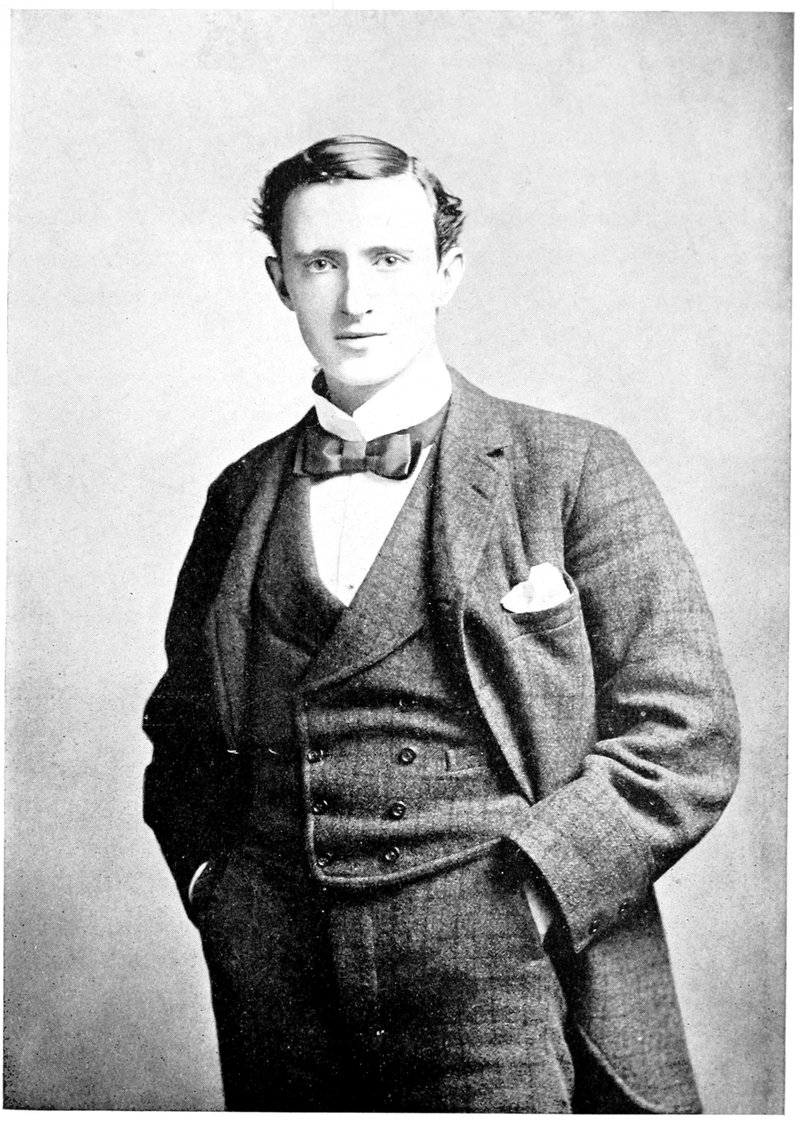
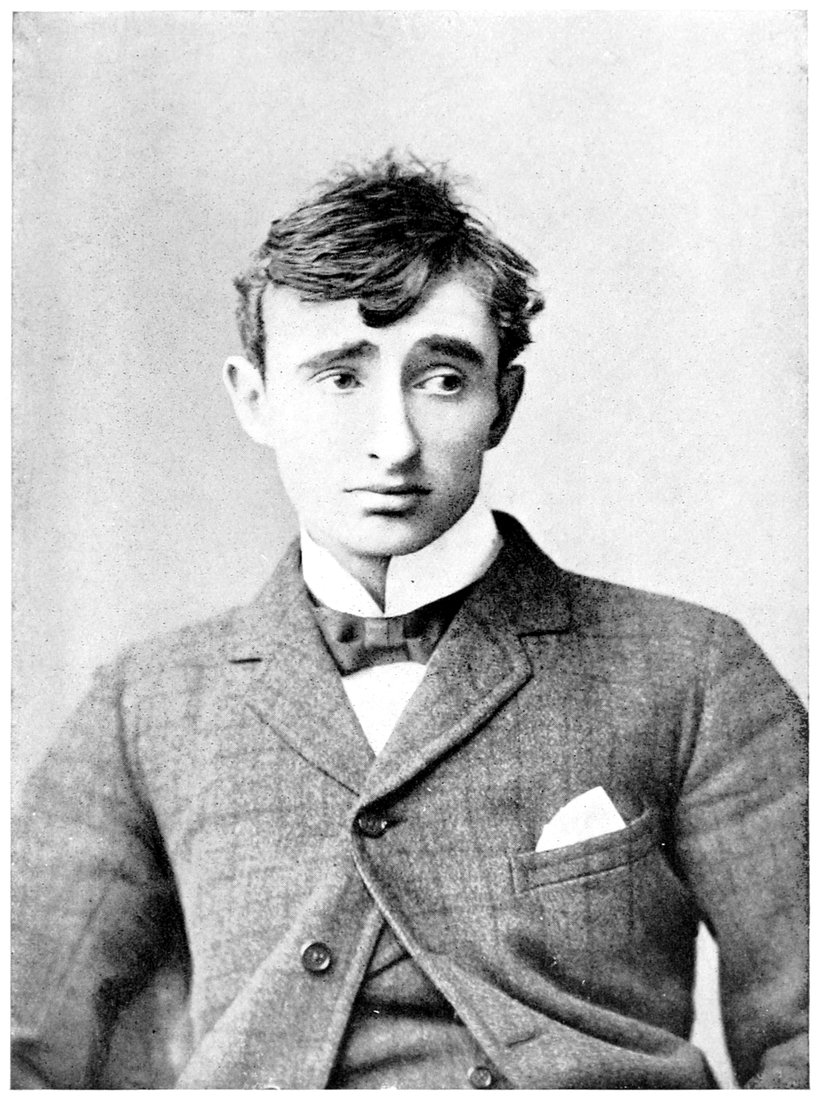
Photograph by Elliott & Fry, London, W.To face p. 24
Harry
November 19th. 1891
25At the end of the run of The Middleman, I wrote
to Mr. (now Sir) A. W. Pinero, and asked for an
interview. His play, The Cabinet Minister, was
shortly to be produced at the Court Theatre, and I
hoped he might give me a part. He granted me the
interview, and I remember how frightened I was.
I met him some time ago, and he reminded me of it.
He told me I struck him as being “such a little
thing”. Anyway, he gave me a part. This was the
first production in which I had played where the
dresses were provided by the management, and very
wonderful dresses they were.
It was a great cast—Mrs. John Wood (whose
daughter and granddaughter were both with us in
Canada in 1920), Allen Aynesworth (a very typical
young “man about town”), Rosina Philippi,
Weedon Grossmith, and Arthur Cecil.
Mrs. John Wood was a wonderful actress; she got
the last ounce out of every part she played. Fred
Grove says: “When she had finished with a part, it
was like a well-sucked orange; not a bit of good left
in it for anyone else.” The first act of The Cabinet
Minister was a reception after a drawing-room. We
all wore trains of “regulation” length; at rehearsals
Mrs. Wood insisted that we should all have long curtains
pinned round us, to accustom us to the trains.
Arthur Cecil, who had been in partnership with
Mrs. Wood, was a kindly old gentleman who always
carried a small black bag; it contained a supply of
sandwiches, in case he should suddenly feel the pangs
of hunger. “Spy,” of Vanity Fair, did a wonderful
drawing of him, complete with bag.
I remember Rosina Philippi, then as thin as a
lamp-post, having a terrific row one day with Weedon
Grossmith—what about, I cannot remember. He
was playing “Mr. Lebanon”, a Jew, and “built
26up” his nose to meet the requirements of the part.
In the heat of the argument, Rosina knocked off his
nose; he was so angry. The more angry he got, the
more she laughed!
I think it was before the run of The Cabinet
Minister that I became engaged to Harry. I know
that during the run Harry was playing at the Royalty
in Sweet Nancy, and was apparently rather vague
and casual about the duties of an engaged young man.
I remember he used often to send his best friend to
call for me and bring me home from the theatre. If
he had not been such a very attractive young man
himself, one might have thought this habit showed a
lack of wisdom. He was very attractive, but very
thin; I found out, to my horror, that he wore nothing
under his stiff white shirts! Imagine how cold, riding
on the top of ’buses—anyway, it struck me as dreadful,
and my first gift to him was a complete set of
underwear. He protested that it would “tickle”,
but I know he wore them, with apparently no grave
discomfort.
I went to Terry’s to play in Culprits—a tragic play
so far as I was concerned. I really, for the first time,
“let myself go” over my dresses. I spent £40.
(Imagine the months of savings represented by that
sum!) We rehearsed for five weeks, and the play
ran three.
By this time my sister Jessie had gone on tour, first
with Dr. Dee, by Cotsford Dick, later with D’Oyley
Carte’s Company. Decima and I were sharing rooms
which Jessie had taken with me. Decima had been
at Blackheath at the College of Music, where she had
27gained a scholarship. On her own initiative she came
up to the Savoy Theatre, for a voice trial, and was
promptly engaged for the part of “Casilda” in the
forthcoming production of The Gondoliers. I remember
the first night of the opera occurred when I
was still playing in The Middleman. Not being in
the last act, I was able to go down to the Savoy. I
was fearfully excited, and filled with pride and joy;
it was a great night. After the performance, Decima
cried bitterly all the way home, so convinced was she
that her performance could not have been successful.
It was not until the following morning, when she
was able to read the notices in the morning papers,
that she was reassured and finally comforted. Far
from ruining her performance, she had made a big
success.
During the time we shared rooms we were both taken
ill with Russian influenza—and very ill we both were.
Geraldine Ulmar came to see us, and brought, later,
Dr. Mayer Collier, who proved “a very present help
in trouble”. He rose high in his profession, and
never ceased to be our very good friend, nor failed
in his goodness to us all.
On October 31st, 1891, I find the following Press
cutting appeared: “Mr. Esmond will shortly marry
Miss Eva Moore, the younger sister (this, I may say,
was, and still is, incorrect) of pretty Miss Decima
Moore of the Savoy”. I was then playing in The
Late Lamented, a play in which Mr. Ackerman
May, the well-known agent, played a part. Herbert
Standing was in the cast, though I remember very
little about what he—or, for the matter of that, anyone
28else—played, except that he was supposed to be
recovering from fever, and appeared with a copper
blancmange mould on his head, wrapped in a blanket.
It would seem that the humour was not of a subtle
order.
We were married on November 19th, 1891, on the
winnings of Harry and myself on a race. We backed
a horse called “Common,” which ran, I imagine,
in either the Liverpool Cup or the Manchester
November Handicap. Where we got the tip from,
I don’t know; anyway, it won at 40 to 1, and we
were rich! Adding £50, borrowed from my sister
Ada, to our winnings, we felt we could face the world,
and we did.
The wedding was to be very quiet, but somehow
ever so many people drifted into the Savoy Chapel
on the morning of November 19th, among them
Edward Terry, who signed the register.
As Harry was “on his way to the altar”, as the
Victorian novelists would say, his best man, Patrick
Rose, discovered that the buttons of his morning coat
had—to say the least of it—seen better days. The
material had worn away, leaving the metal foundation
showing. He rushed into Terry’s Theatre, and
covered each button with black grease paint!
We both played at our respective theatres in the
evening, and certainly the best laugh—for that night,
at least—was when Harry, in The Times, said:
“I’m sick of ’umbug and deception. I’m a married
gentleman! Let the world know it; I’m a young
married English gentleman”.
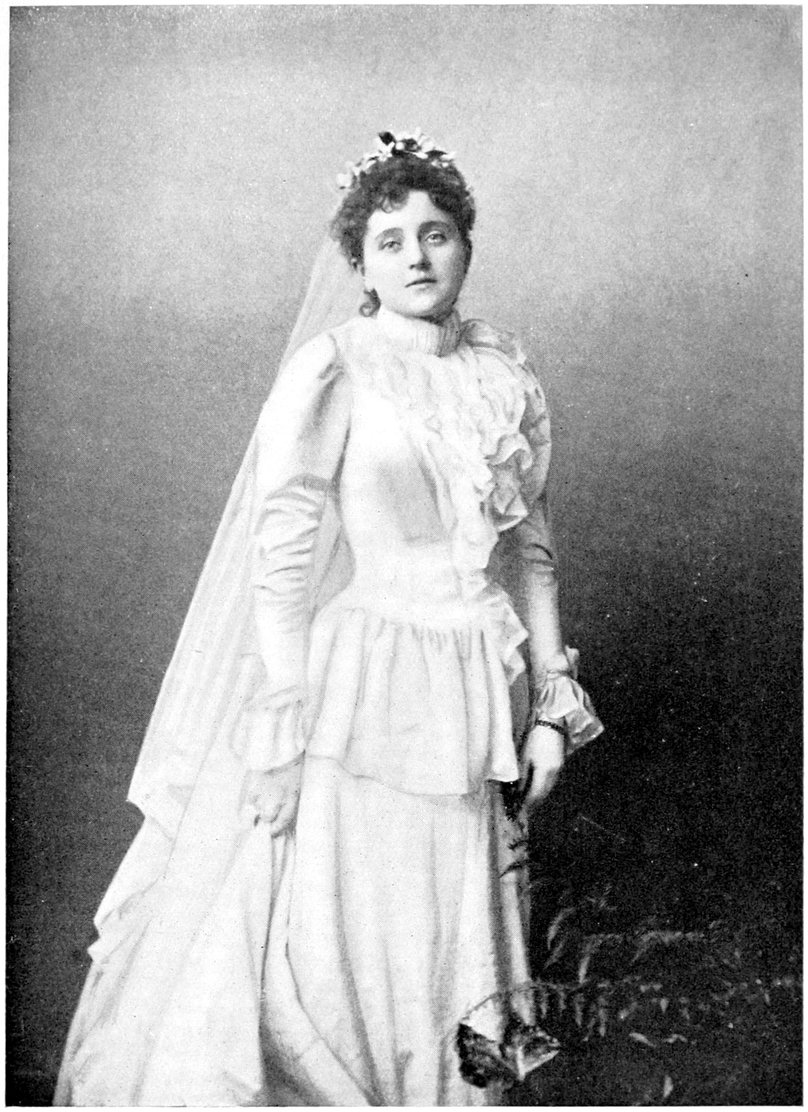
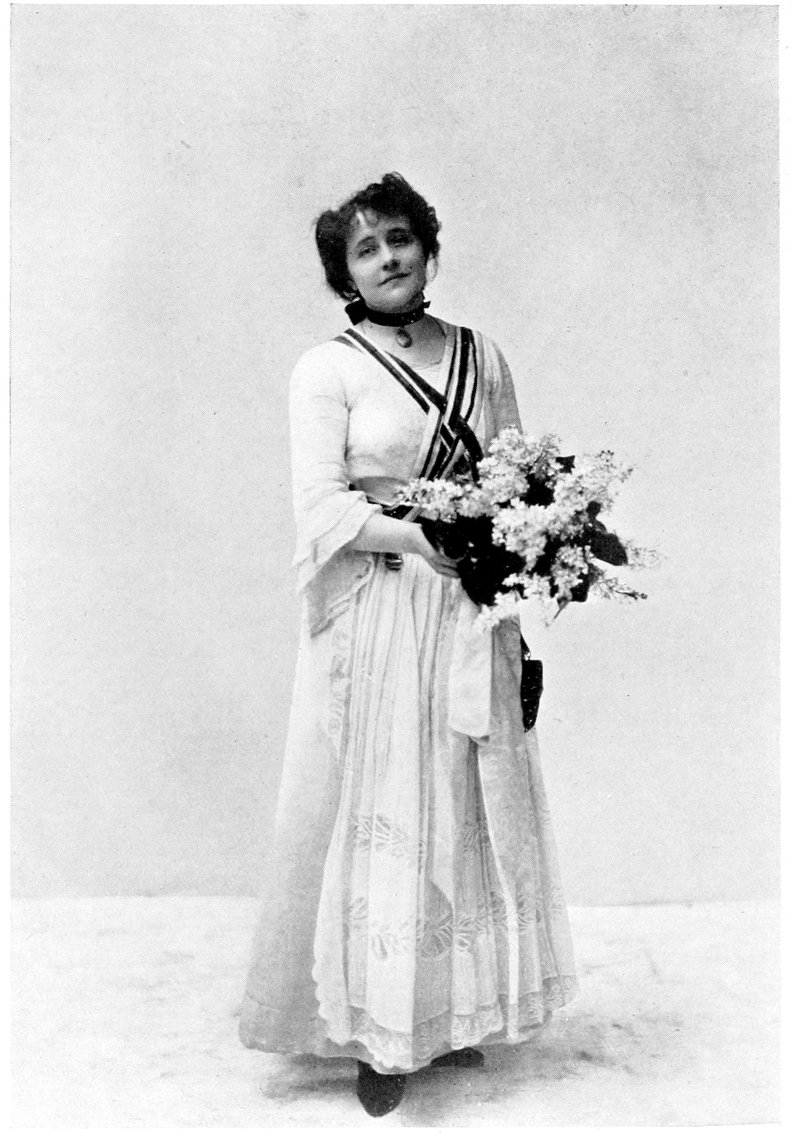
Photograph by Gabell & Co., London, W.To face p. 28
Wedding Bells
November 19th. 1891
CHAPTER III WEDDING BELLS
29
“A wedding doesn’t change things much, except that the
bride’s nearest relations can shut their eyes in peace.”
—Birds of a Feather.
And so we were married.... We had a
funny wedding day. Harry, being an Irishman,
and, like all Irishmen, subject to
queer, sudden ways of sentiment, insisted that in the
afternoon we should call on his eldest sister! I cannot
remember that he had, up to then, shown any
overwhelming affection for her, but that afternoon
the “Irishman” came to the top, and we called on
“herself”. We then dined at Simpson’s, and went
off to our respective theatres to work.
I was rehearsing at the time for a musical play—The
Mountebanks, by W. S. Gilbert. I went to
him, rather nervous, and asked if I “might be excused
the afternoon rehearsal”. He naturally asked
“why?”; and blushingly, I don’t doubt, I told
him “to get married”. He was most intrigued at
the idea, and said I might be “excused rehearsals”
for a week.
Three weeks after we were married, Edward Terry
sent for Harry to come to his dressing-room—and I
may say here that Terry’s Theatre only possessed
30three dressing-rooms: one, under the stage, for
Edward Terry, one for the men of the company, and
another for the women—the reason for this scarcity
being that, when the theatre was built, the dressing-rooms
were forgotten! I believe the same thing happened
when the theatre was built at Brixton; if anyone
has played at the theatre in question, and will
remember the extraordinary shapes of the rooms, they
will readily believe it! But to go back to Terry’s—Harry
was sent for, and Edward Terry presented him
with two books, which he said would be of the greatest
use to him and me. They were Dr. Chavasse’s Advice
to a Mother and Dr. Chavasse’s Advice to a Wife.
I do not know if anyone reads Dr. Chavasse in these
days, but then he was the authority on how to bring
up children. Fred Grove assured me that he brought
up a family on Dr. Chavasse.
Anyone who has seen my husband’s “evergreen
play,” Eliza Comes to Stay, may remember the extract
from the book—the very book that Edward
Terry gave to us—which he uses in the play. I give
it here; I think it is worth quoting:
“Question: Is there any objection, when it is
cutting its teeth, to the child sucking its thumb?
“Answer: None at all. The thumb is the best
gum-stick in the world. It is ‘handy’; it is neither
too hard nor too soft; there is no danger of it being
swallowed and thus choking the child.”
Photograph by Alfred Ellis, London, W.To face p. 30
Harry as Howard Bompas
“The Times” 1891
31It was during the run of The Late Lamented that
I first met Fanny Brough, President and one of the
founders of the Theatrical Ladies’ Guild, which has
done so much splendid work. She worked with Mrs.
Carson (wife of the then Editor of The Stage), who
was the originator of the Guild. When the Music
Hall Ladies’ Guild began, some years later, they
ran their organisation on the same lines. Two of the
founders, I think I am right in saying, of the Musical
Hall Ladies’ Guild, were the unfortunate Belle
Elmore (the Wife of Crippen, who killed her) and
Edie Karno, the wife of Mr. Fred Karno, of Mumming
Birds fame.
Speaking of Fanny Brough reminds me of others
of that famous family. Lal Brough, who held a kind
of informal gathering at his house, with its pleasant
garden, each Sunday morning. It was a recognised
thing to “go along to Lal Brough’s” about 10.30
to 11 on Sunday. About 1 everyone left for their
respective homes, in time for the lunch which was
waiting there. Looking back, thinking of those
Sunday morning gatherings, it seems to me that we
have become less simple, less easily contented; who
now wants a party, even of the least formal kind, to
begin in the morning? We have all turned our days
“upside down”—we begin our enjoyment when the
night is half over, we dance until the (not very) small
hours, and certainly very very few of us want to meet
our friends at 11 a.m. They were happy Sundays at
Lal Brough’s, but they belong to a side of stage social
life which is now, unhappily, over and done. They
belong, as did the host, to “the old order”.
Sydney Brough, Lal Brough’s son, was a person
of marvellous coolness and resource. I was once playing
with him in a special matinée of A Scrap of
Paper, in which he had a big duel scene. While the
32curtain was down, some thoughtful person had cleared
the stage of all “unnecessary impedimenta”, including
the daggers needed for the fight. When
Brough should have seized them, they were nowhere
in sight. Most people would have “dried up”—not
Sydney Brough. He composed a long speech
while he looked all over the stage for the missing
daggers; he looked everywhere—talking all the time—and
finally found them—on the top of a large cupboard,
on the stage!
In 1892 I played in Our Boys with William Farren,
who was “a darling”, and Davy James—he was
very ill at the time, I remember, and very “nervy”.
May Whitty (now Dame May Webster) and I used
to dress above his room. We used to laugh immoderately
at everything; poor David James used to hate
the noise we made, and used to send up word to us,
“Will you young women not laugh so much!”
Speaking of May Whitty reminds me that one paper
said of our respective performances in the play: “If
these two young ladies must be in the play, they
should change parts.”
Cicely Richards was in the cast too; she later
played Nerissa in The Merchant of Venice, with
Irving, at Drury Lane, and I took Decima—who, be
it said, had never read or seen the play—to see it.
Her comment, looking at Shakespeare’s masterpiece
strictly from a “Musical Comedy” point of view,
was “I don’t think much of the Rosina Brandram
part”—the said part being “Nerissa,” and Rosina
Brandram at that time the heavy contralto in the
Gilbert and Sullivan operas.
33It was in A Pantomime Rehearsal that I first met
Ellaline Terriss; we were the “two gifted amateurs”
who sing a duet. She was as pretty as a picture, and
as nice as she was pretty. I also sang a song, called
“Poor Little Fay”, and at the revival “Ma
Cherie”, by Paul Rubens, which, I think, Edna
May sang later on in the music halls. I know she
came one evening to hear the song, and sat in a box,
which made me very nervous. She was very quiet
and rather shy—at least so I found her when we met.
Charlie Brookfield was in the Pantomime Rehearsal,
playing the part created by Brandon Thomas.
He was a most perfectly groomed man, and always
wore magnificent and huge button-holes, as really
smart young men did at that time. The bills for
these button-holes used to come in, and also bills for
many other things as well, for he was always in debt;
it used to cause great excitement as to whether
“Charlie” would get safely in and out of the theatre
without having a writ served on him.
There are hundreds of good stories about Charles
Brookfield, some of them—well, not to be told here—but
I can venture on two, at least. When Frank
Curzon was engaged to Isabel Jay, someone—one of
the pests who think the fact that a woman is on the
stage gives them a right to insult her—sent her a
series of insulting letters, or postcards—I forget
which. Curzon was, naturally, very angry, and
stated in the Press that he would give £100 reward
to find the writer. Brookfield walked into the club
one day and said, “Frank Curzon in a new rôle, I
see.” Someone asked, “What rôle?” “Jay’s disinfectant,”
34replied Brookfield. He was walking
down Maiden Lane one morning with a friend, and
then Maiden Lane was by no means the most reputable
street in London. “I wonder why they call it
Maiden Lane?” said his friend. “Oh,” responded
Brookfield, “just a piece of damned sarcasm on the
part of the L.C.C.” At the time when Wyndham
was playing David Garrick, he was sitting one day in
the Garrick Club under the portrait of the “great
little man”. Brookfield came up. “’Pon my
word,” he began, “it’s perfectly wonderful; you
get more like Garrick every day.” Wyndham
smiled. “Yes,” went on Brookfield, “and less like
him every night.” When Tree built His Majesty’s,
he was very proud of the building, and used to love
to escort people past the place and hear their flattering
comments on the beauty of the building. One
day he took Brookfield. They stopped to gaze on
“my beautiful theatre”, and Tree waited for the
usual praise. After a long pause, Brookfield said:
“Damned lot of windows to clean.” He could, and
did, say very witty, but bitter and cutting, things,
which sometimes wounded people badly; yet he said
pathetically to a friend once: “Can’t think why
some people dislike me so!”
About this time, or perhaps rather earlier (as a
matter of fact, I think it was in Culprits), I met
Walter Everard, who, though quite an elderly man,
did such good work with the Army of Occupation in
Cologne; he is still, I think, doing work in Germany
for the British Army.
In Man and Woman I met the ill-fated couple,
35Arthur Dacre and Amy Roselle. She was the first
well-known actress to appear on the music halls. She
went to the Empire to do recitations. She was much
interviewed, and much nonsense was talked and
written about the moral “uplift” such an act would
give to the “wicked Empire”—which was just what
the directors of the Empire, which was not in very
good odour at the time, wanted. She was a queer,
rather aloof woman, who took little notice of anyone.
He, too, was moody, and always struck me as rather
unbalanced. They went to Australia later, taking
with them a bag of English earth. There they found
that their popularity had gone, poor things! He shot
her and then killed himself, leaving the request that
the English earth might be scattered over them.
Lena Ashwell was in the cast. She was not very
happy; for some reason, Amy Roselle did not like
her, and did nothing to make things smooth for her.
Lena Ashwell, in those days, was a vague person,
which was rather extraordinary, as she was a very fine
athlete, and the two qualities did not seem to go
together. She also played in a first piece with Charles
Fulton. One day her voice gave out, and I offered to
“read the part for her” (otherwise there could have
been no curtain-raiser)—a nasty, nerve-racking business;
but, funnily enough, I was not nearly so nervous
as poor Charles Fulton, who literally got
“dithery”.
Henry Neville was also in Man and Woman.
A delightful actor, he is one of the Stage’s most
courtly gentlemen, one of those rare people whose
manners are as perfect at ten in the morning as they
36are at ten at night. Writing of Henry Neville reminds
me that later he was going to appear at a very
big matinée for Ellen Terry at Drury Lane, in which
“all stars” were to appear in the dance in Much
Ado. Everybody who was anybody was to appear—Fred
Terry, Neville, my husband, Ben Webster, and
many more whose names I cannot remember at the
moment. At ten each morning down they went to
rehearse. Edith Craig was producing the dance, and
put them through their paces. Apparently they were
not very “bright”, and Edie was very cross. Finally
she burst out: “No, no, no—and if you can’t do it
any better than that, you shan’t be allowed to do it
at all!” Evidently after that they really “tried
hard”, for they certainly were allowed to “do it”,
as the programme bears witness.
In a special matinée at the old Gaiety I met Robert
Sevier. He had written a play called The Younger
Son, which I heard was his own life when he was in
Australia. I don’t think it was a great success—at
anyrate, it was not played again—but Sevier enjoyed
the rehearsals enormously. After the matinée he
asked all the company to dinner at his house in
Lowdnes Square. His wife, Lady Violet Sevier, was
present. Sevier enjoyed the dinner, as he had done
the rehearsals, but she—well, she “bore with us”;
there was a frigid kindness about her which made one
feel that—to put it mildly—she “suffered” our presence,
and regarded the whole thing as an eccentricity
of “Robert’s” (I cannot imagine that she ever called
him “Bob”, as did the rest of the world).
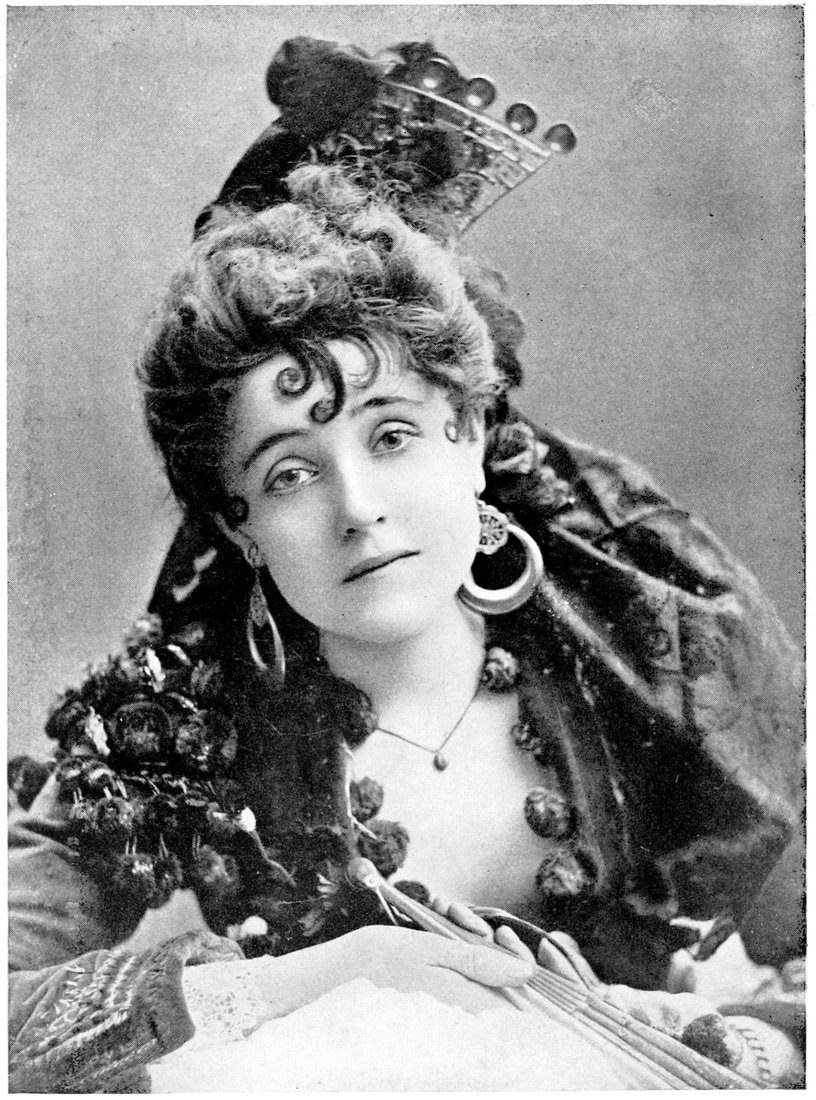
Photograph by Alfred Ellis, London, W.To face p. 37
Pepita
“Little Christopher Columbus”
37The same year, 1893, I played in Little Christopher
Columbus. Teddie Lonnen was the comedian. May
Yohe played “Christopher”, and played it very well
too; I impersonated her, in the action of the play.
We had to change clothes, for reasons which were
part of the plot. She was not an easy person to work
with, and she certainly—at that time, at all events—did
not like me. This play was the only one in which
I ever rehearsed “foxy”—that is, did not put in
the business I was going to play eventually. The
reason was this: as I gradually “built up” the part,
putting in bits of “business” during the rehearsals,
I used to find the next morning that they were
“cut”: “That line is ‘out’, Miss Moore,” or
“Perhaps you’d better not do that, Miss Moore.”
So “Miss Moore” simply walked through the rehearsals,
to the horror of the producer. I used to go
home and rehearse there. But on the first night I
“let myself go”, and put into the part all I had
rehearsed at home. The producer was less unhappy
about me after that first night! However, it still
went on after we had produced. Almost every night
the stage manager would come to my room: “Miss
Moore, a message for you—would you run across the
stage less noisily, you shake the theatre”; would I
stand further “up stage”; or would I do this, or
that, or the other. Oh! May Yohe, you really were
rather trying in those days; still, things did improve,
and eventually she really was very nice to me. It
was in Little Christopher Columbus that I wore
“boy’s clothes”. I thought they suited me—in
fact, I still think they did—a ballet shirt, coat (and
not a particularly short coat either) and—breeches.
38But, behold the Deus ex machina, in the person of my
husband! He came to the dress rehearsal, and later
we rode home to our little flat in Chelsea on the top
of a bus, discussing the play. Suddenly, as if struck
by a bright thought, he turned to me and said:
“Don’t you think you’d look awfully well in a
cloak?” I felt dubious, and said so, but that did
not shake him. “I do,” he said, and added: “Your
legs are much too pretty to show! I’ll see about it
in the morning.” He did! Early next morning he
went up and saw Monsieur Alias, the cloak was made
and delivered to me at the theatre that very evening,
and I wore it too. It covered me from head to foot;
with great difficulty, I managed to show one
ankle. But Harry approved of it, very warmly
indeed.
There is a sequel to that story. Twenty years after,
I appeared at a big charity matinée at the Chelsea
Palace as “Eve”—not Eve of the Garden of Eden,
but “Eve” of The Tatler. I wore a very abbreviated
skirt, which allowed the display of a good deal of long
black boots and silk stocking. Ellen Terry had been
appearing as the “Spirit of Chelsea”. After the
performance she stood chatting to Harry and me.
“Your legs are perfectly charming; why haven’t we
seen them before?” I pointed to Harry as explanation.
She turned to him. “Disgraceful,” she said,
adding: “You ought to be shot.”
I was engaged to follow Miss Ada Reeve in The
Shop Girl at the Gaiety Theatre. It was a ghastly
experience, as I had, for the few rehearsals that were
given me, only a piano to supply the music, and my
39first appearance on the stage was my introduction to
the band. I had to sing a duet with Mr. Seymour
Hicks—I think it was “Oh listen to the band”—at
anyrate, I know a perambulator was used in the song.
Mr. Hicks’s one idea was to “get pace”, and as I
sang he kept up a running commentary of remarks
to spur me on to fresh efforts. Under his breath—and
not always under his breath either—he urged me
to “keep it up”, to “get on with it”, until I felt
more like a mental collapse than being bright or
amusing. This was continued at most of the performances
which followed; I sang, or tried to sing,
accompanied by the band—and Mr. Hicks. Then,
suddenly—quite suddenly—he changed. The theatre
barometer swung from “Stormy” to “Set fair”.
Even then, I think, I had learnt that such a sudden
change—either in the barometer or human beings—means
that a storm is brewing. It was!
I remember saying to Harry, when I got home one
evening after this change, “I shall be out of the
theatre in a fortnight; Seymour Hicks has been so
extraordinarily pleasant to me—no faults, nothing
but praise.” What a prophet I was!
As I was going to the dressing-room the next
evening, I met Mr. George Edwardes on the stairs.
He called to me, very loudly, so that everyone else
could hear, “Oh! I shan’t want you after next
Friday!” I protested that I had signed for the
“run”. I was told that, though I might have done
so, he had not, and so ... well!
It was before the days when Sydney Valentine
fought and died for the standard contract, before the
40days when he had laboured to make the Actors’
Association a thing of real use to artists—a real
Trades Union; so I did not claim my salary “for
the run”, but the fact that I received a cheque from
the management “in settlement of all claims” is
significant.
Another rather “trying time” was many years
later when I appeared “on the halls”. Let me say
here that I have played the halls since, and found
everyone—staff, manager, and other artists—very
kind; but at that time “sketches had been doing
badly”, and when the date approached on which I
was to play at the—no, on second thoughts I won’t
give the name of the hall—the management asked me
either to cancel or postpone the date. I refused. I
had engaged my company, which included Ernest
Thesiger, Bassett Roe, and several other excellent
artists, for a month, and the production had been
costly, so I protested that they must either “play
me or pay me”. They did the latter, in two ways—one
in cash, the other in rudeness. How I hated that
engagement! But even that had its bright spot, and
I look back and remember the kindness of the
“Prime Minister of Mirth”, Mr. George Robey,
who was appearing at that particular hall at the time.
He did everything that could be done to smooth the
way for me.
I seem to have been unlucky with “sketches” at
that time. I had a one-act comedy—and a very
amusing comedy too; my son later used it as a
curtain-raiser, and I played it at several of the big
halls: as the Americans say, “It went big.”
41I thought I would strike out on my own and see
an agent myself, without saying anything to anybody.
This is what happened. (I should say that this is only
a few years ago, when I had thought for some time
that as an actress I was fairly well known.)
I called on the agent in question; he was established
in large and most comfortable offices in the
West End. I was ushered into the Presence! He
was a very elegant gentleman, rather too stout perhaps.
He sat at a perfectly enormous desk, swinging
about in a swivel chair, and, without rising or
asking me to sit down (which I promptly did), he
opened the interview:
“Who are you?” I supplied the information.
“Don’t know you,” he replied. “What d’you
want?” I told him, as briefly as possible. At the
word “sketch” he stopped me, and with a plump
hand he pounded some letters that lay on his desk.
“Sketches,” he repeated solemnly, “I can get
sketches three-a-penny, and good people to play ’em.
Nothing doing.”
I stood up and walked to the door, then perhaps
he remembered that he had seen me in a play or
something—I don’t know; anyway, he called
after me, “Here, who did you say you were?”
“Still Eva Moore,” I said calmly, and made my
exit.
All agents may not be like that; I hope they are
not; but I fancy he is one of the really successful
ones. Perhaps their manners are in inverse ratio to
their bank balances.
Talking of agents, I heard of one who was listening
42to a patriotic ballad being sung at the Empire during
the war. A man who was with him did not like it,
and said, “You know, that kind of stuff doesn’t do
any good to the Empire”—meaning the British
Empire. “No,” was the reply; “they don’t go
well at the Alhambra, for that matter, either.”
CHAPTER IV PLAYS AND PLAYERS
43
“A good deal more work for all of us, my lord.”
—Love and the Man.
The year 1894 found me playing in The Gay
Widow, the first play in which I ever worked
with Charles (now, of course, Sir Charles)
Hawtrey. I do not remember very much about the
play except that I wore most lovely clothes, and that
Lottie Venne played “my mother”.
This year does, however, mark a very important
milestone in our lives—Harry’s and mine; it was the
first time we attempted management on our own,
and also his first play was produced. We, Harry and
I, with G. W. Elliott, greatly daring, formed a small
syndicate. We took the St. James’s Theatre for
eight weeks while George Alexander was on tour,
and presented Harry’s play Bogey. (In those days
all big London managers went on tour for a few
months, taking their London company and production.)
First, let me say that, whatever the merits or demerits
of the play, we were unlucky. We struck the
greatest heat wave that London had known for years;
and that, as everyone knows, is not the best recipe in
44the world for sending up the takings at the box office.
As for the play, George Alexander said—and, I
think, perhaps rightly—the “play was killed by its
title.” It was a play dealing with “spiritualism,” in
a limited sense. I mean that it was not in any sense
a propaganda play; it had, naturally, not the finish,
or perhaps the charm, of his later work—he would
have been a poor craftsman if it had been, and a less
great artist if the years which came after had taught
him nothing—but Bogey certainly did not deserve
the hard things which one critic, Mr. Clement Scott,
said of it. He wrote one of the most cruel notices
which I have ever read, a notice beginning “Vaulting
Ambition”—which, in itself, is one of the bundle
of “clichés” which may be used with almost equal
justice about anything. To say, as Mr. Scott did,
that I saved the play again and again “by supreme
tact” was frankly nonsense. No actress can save a
play “again and again by supreme tact”; she may,
and probably will, do her best when she is on the
stage, but if she “saves the play” it is due to her
acting capacity, and not to “tact”—which seems to
me to be the dealing gracefully with an unexpected
situation in a way that is essentially “not in the
script”.
However, the fact remains that Mr. Clement Scott
unmasked the whole of his battery of heavy guns
against the play and the author, for daring to produce
it while he was still under fifty years of age; and,
after all, it was rather “setting out to kill a butterfly
with a double-barrelled gun”. Still....
The following night another play was produced, at
45another theatre, and on this play (not at all a brilliant
achievement) Mr. Clement Scott lavished unstinted
praise. On the first night of a third play, as he went
to his stall, the gallery—which was, as usual, filled
largely by the members of the Gallery First Night
Club—greeted him with shouts of “Bogey”, and
continued to do so until, in disgust, he left the stalls.
After that night, Clement Scott always occupied a
box! But the sequel! Some days after the production
of Bogey, the President of the Gallery First
Night Club called at our little house in Chelsea. I
remember his call distinctly: our maid was “out”,
and I opened the door to him. He came to ask Harry
to be the guest at the first dinner of the club. It was,
I think, when that club held its twenty-fifth birthday,
that we were both asked to be the guests of the club—a
compliment we much appreciated.
The play Bogey was not a success, but I should
like to quote the remarks of the dramatic critic of the
Sporting Times, which seemed, and still seem, to me
kind and—what is of infinitely greater importance—just:
“Ambition is not necessarily vaulting, and it
is a thing to be encouraged and not mercilessly
crushed in either a young author or a young actor.
Nor when the youngster figures in the double capacity
of author and actor is the crime unpardonable....
This is all apropos of an ungenerous attack in a
quarter from which generosity would have been as
graceful as the reverse is graceless.... It was remarked
to me by a London manager: ‘I don’t know
any actor on our stage who could play the part better
than Esmond does’, and, upon my word! I am inclined
46to agree with him.... Bogey is not a good
play ... but it has a freshness about it, an originality
of idea which is not unlikely to prove unattractive
to a great many.”
However, Harry Esmond tried again; and the
row of plays on a shelf in my study is proof that he
was only “baffled to fight better”.
In Bogey we had a stage manager, I remember,
who should, had the gods taken sufficient interest in
the destinies of men, have been a maker of “props”
and a property master. He played a small part, of a
“typical city man”, and his one ambitious effort
towards characterisation was to ask if he “might be
allowed to carry a fish basket”. He evidently
thought all city men call at Sweetings before catching
their train home!
In The Strange Adventures of Miss Brown, which
was my next engagement, I played with Fred Kerr,
who wore a toupée. I remember at one place in
the play, where I had to “embrace him impulsively”,
he always said in a loud whisper, “Mind
my toupée.”
Both Harry and I were in The Blind Marriage, at
the Criterion. He and Arnold Lucy played
“twins”, and Harry had to add a large false nose to
the one with which nature had already very generously
provided him. They wore dreadful clothes—knickerbockers
which were neither breeches nor “plus
fours” but more like what used to be known as
“bloomers”. Herbert Waring and Herbert Standing
were both in the cast, and on the first night the
latter was very excited. Waring went on and had a
47huge ovation, while Herbert Standing, in the wings,
whispered excitedly, “They think it’s me! they
think it’s me!”
Herbert Standing was a fine actor, with more than
a fair share of good looks. He was very popular at
Brighton, where he used to appear at concerts. I
remember he was talking one day to Harry, and told
him how he had “filled the Dome at Brighton”
(which was a vast concert hall). Harry murmured,
“Wonderful; how did you do it?” “Oh,” said
Standing, “recited, you know. There were a few
other people there—Ben Davis, Albani, Sims
Reeves,” and so on.
Mr. Standing came to see Harry one day, and was
shown into his study, which was a small room almost
entirely filled with a huge desk. Standing began to
rail against the fate which ordained that at that
moment he had no work. “I can do anything, play
anything,” he explained, which was perfectly true—he
was a fine actor! “Listen to this,” and he began
to recite a most dramatic piece of work, full of emotion
and gesture. As he spoke, he advanced upon
“H. V.”, who kept moving further and further
away from him. I came into the study, to find Harry
cowering against the wall, which effectually stopped
him “getting away” any further, and Standing,
now “well away”, brandishing his arms perilously
near Harry’s nose.
Standing was devoted to his wife, and immensely
proud of his family. When she died, he was heartbroken.
He met some friends one day, who expressed
their sympathy with him in his loss. “Yes,”
48said Standing, “and what do you think we found
under her pillow? This”—and he produced a photograph
of himself, adding mournfully, “but it doesn’t
do me justice!”
It was in Under the Red Robe that I first actually
played with Winifred Emery (who used to give most
lovely tea parties in her dressing-room). Cyril
Maude, Holman Clark, Granville Barker, and Annie
Saker (who were later to make such a number of big
successes at the Lyceum, under the Brothers Melville’s
management) were also in the cast. I only met
the author, Stanley Weyman, once, but he was very
generous to all the company and gave us beautiful
souvenirs; I still use a silver cigarette box, engraved
with a cardinal’s hat, which he gave to me. He was
not one’s preconceived idea of a writer of romantic
plays and books; as a matter of fact, he was rather
like Mr. Bonar Law.
After this run, I went on tour for a short time with
J. L. Shine, with An Irish Gentleman, and at one
town—Swansea, I think—he gave a Press lunch. All
kinds of local pressmen were invited, and, in comparison
to the one who fell to my lot, the “silent tomb”
is “talkative”. Soup, fish, joint, all passed, and he
never spoke a single word. He was a distinctly noticeable
person, wearing a cricket cap, morning coat, and
white flannel trousers. I tried every subject under
the sun, with no result, until—at last—he spoke. “I
’ave a sort of claim on you perfessionals,” he said.
I expressed my delight and surprise, and asked for
details. “Well,” he said, “in the winter I’m an
animal impersonator, but in the summer I take up
literature.” I have always wondered if he played the
front or hind legs of the “elephant”!
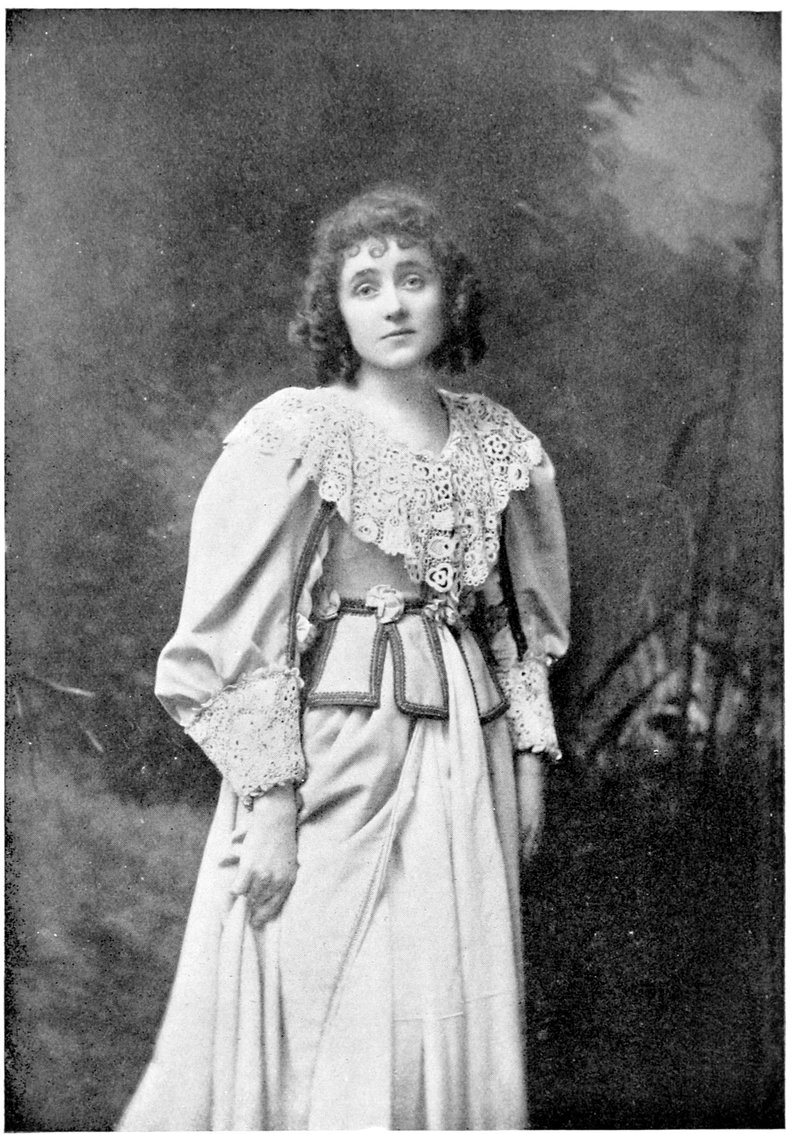
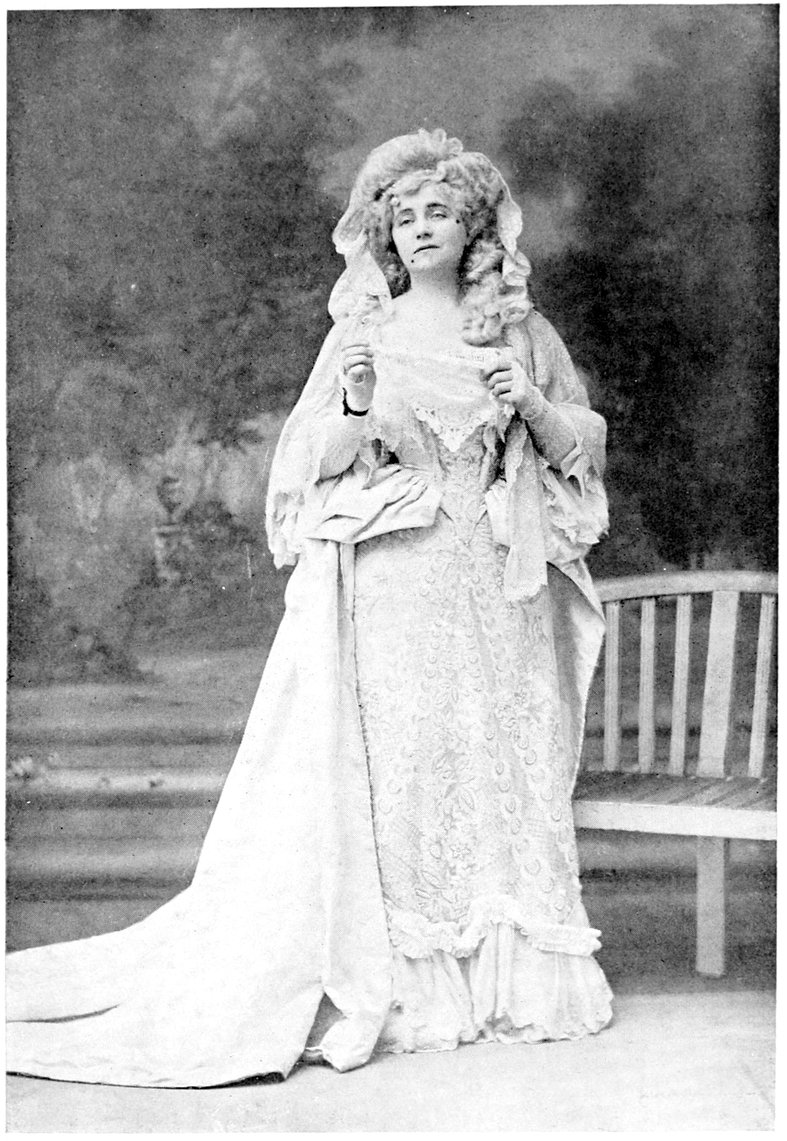
Photograph by Gabell & Co., London, S.W.To face p. 48.
Madame de Cocheforet
“Under the Red Robe”
49Soon after I returned to London, my husband’s
second play was produced by Charles Hawtrey, One
Summer’s Day—and thereby hangs a tale! Harry
had sent the play to Hawtrey and, calling a month
later, saw it still lying—unopened—on his desk. He
determined that Hawtrey should hear the play, even
if he wouldn’t read it himself; Harry would read it
to him.
“I’ll call to-morrow and read my play to you,” he
said. Hawtrey protested he was very busy, “hadn’t
a minute”, had scores of plays to read, etc. But
Harry only added, “To-morrow, at ten, then,” and
went. The next morning he arrived, and after some
difficulty obtained entrance to Hawtrey’s room.
Again Hawtrey protested—he really had not time to
hear, he would read the play himself, and so on; but
by that time Harry had sat down, opened the book,
and began to read. At the end of the first act, Hawtrey
made another valiant effort to escape; he liked
it very much, and would read the rest that same
evening. “You’ll like the second act even better,”
H. V. said calmly, and went on reading. When the
third act was finished, Hawtrey really did like it, and
promised to “put it on” as soon as possible.
“In a fortnight,” suggested the author. Oh!
Hawtrey wasn’t sure that he could do it as soon as
that, and the “summer was coming”, and Harry
had had one lesson of what a heat wave could do to
a play. So he said firmly, “The autumn then.”
Hawtrey gave up the struggle, and the play was put
50into rehearsal and produced in the autumn. One
Summer’s Day was a great success; it was in this
play that Constance Collier played her first real part.
She had been at the Gaiety in musical comedy, where,
I remember, she entered carrying a very, very small
parcel, about the size of a small handkerchief box,
and announced “This contains my costume for the
fancy dress ball!”
Mrs. Calvert played in this production, which reminds
me that in the picnic scene we used to have
“real pie”, which she rather enjoyed. After we had
been running for some time, the management
thought, in the interests of economy, they would
have a “property pie”—that is, stuffed not with
meat, but with cotton wool. Mrs. Calvert, all unknowing,
took a large mouthful, and was nearly
choked!
In One Summer’s Day we had a huge tank filled
with real water, sunk at the back of the stage, and
Ernest Hendrie, Henry Kemble, and Mrs. Calvert
used to make an entrance in a punt—a real punt. One
day they all sat at one end, with most disastrous consequences;
after that, they “spread themselves”
better.
Henry Kemble was a delightful, dignified person,
who spoke in a “rolling” and very “rich” voice.
He used, occasionally, to dine well—perhaps more
well than wisely. One night, in the picnic scene, he
was distinctly “distrait”, and forgot his line. As I
knew the play backwards, I gave his line. He was
very angry. We were all sitting on the ground at a
picnic. He leant over the cloth and said in a loud
51voice, “You are not everybody, although you are the
author’s wife.”
In this play a small boy was needed, and we sought
high and low for a child to play the “urchin”. A
friend told us one day he knew of the “very boy”,
and promised to send him up for inspection. The
following morning the “ideal urchin” arrived at the
Comedy Theatre. He was a very undersized Jew,
whose age was, I suppose, anything from 30 to 40,
and who had not grown since he was about twelve.
This rather pathetic little man walked on to the stage,
and looked round the theatre, his hands in his
pockets; then he spoke. “Tidy little ’all,” was his
verdict—he was not engaged!
My next engagement was in The Sea Flower. I
remember very little about it except that I wore a
bunch of curls, beautiful curls which Willie Clarkson
made for me. On the first night, Cosmo Stuart
embraced me with such fervour that they fell off, and
lay on the stage in full view of the audience.
Then followed The Three Musketeers, a splendid
version of that wonderful book, by Harry Hamilton,
with a magnificent cast. Lewis Waller was to have
played “D’Artagnan”, which he was already playing
on tour; Harry was to go to the touring company
and play Waller’s part. Then there came some hitch.
I am not very clear on the point, but I think Tree
had arranged for a production of the same play, in
which Waller was engaged to play “Buckingham”,
and that Tree or the managers in the country would
not release him. Anyway, Harry rehearsed the part
in London. Then Waller managed to get released
52for a week to come to London and play for the first
week of the production, while Harry went to the
provinces. Waller came up to rehearse on the
Friday with the London company, ready for the
opening on Monday. I had lost my voice, and was
not allowed to speak or leave my room until the
Monday, and therefore the first time I met D’Artagnan
was on the stage at the first night. If you will
try and imagine how differently Lewis Waller and
Harry Esmond played the part, you will realise what
a nerve-racking business it was. For example, in the
great “ride speech,” where Harry used to come in
absolutely weary, speaking as an exhausted man,
flinging himself into a chair, worn out with his ride
and the anxiety attached to it, Waller rushed on to
the stage, full of vitality, uplifted with the glory of
a great adventure, and full of victory, leading me to
the chair before he began to speak. You may imagine
that on the first night I felt almost lost. I am not
trying to imply that one reading was “better” than
the other; both were quite justified; only, to me,
the experience was staggering.
Waller was always vigorous, and particularly as
D’Artagnan. One night when he entered and
“bumped” into Porthos, he “bumped” so hard
that he fell into the orchestra and on to the top of
the big drum! Nothing daunted, Waller climbed
out of the orchestra, by way of the stage box, back
on to the stage!
The first time I played with Tree was in a special
performance of The Dancing Girl. I played the
lame girl, and I remember my chief worry was how,
53being lame, to get down a long flight of stairs in time
to stop Tree, who played the Duke, from drinking
the “fatal draught” of poison.
I was then engaged by Tree to play in Carnac
Sahib, a play by Henry Arthur Jones. It dealt with
military life in India. The rehearsals were endless,
and not without some strain between the author and
Tree. Henry Arthur Jones used to come to rehearsals
straight from his morning ride, dressed in riding
kit, complete with top boots and whip; Tree didn’t
like it at all!
The day before the production there was a “call”
for “words” at 11 in the morning. The only person
who did not know their “words” was Tree; he
never arrived! The dress rehearsal was fixed for 3;
we began it at 5, and at 6 in the morning were “still
at it”.
After the end of one of the acts—the second, I
think—there was a long wait. This was at 2.30 a.m.!
The band played, and for an hour we sang and danced
on the stage. Then someone suggested that it might
be as well to find out what had happened to Tree.
They went to his dressing-room and found him; he
had been asleep for an hour! At last we began the
final act. Tree reclined on a bed of straw, and I
fanned him with a palm leaf. There was a wait,
perhaps three or four seconds, before the curtain rose.
“Oh God!” said Tree, in the tone of one who has
waited for years and is weary of everything: “Oh
sweet God! I am ready to begin!”
It was soon after, in Marsac of Gascony, at Drury
Lane Theatre, I made my entrance on a horse—a real
54stage horse; the same one, I think, that Irving had
used. I may say this is the only time that I had—as
you might say—known a horse at all intimately. It
was a dreadful play: the audience rocked with
laughter at all the dramatic situations. It was short-lived,
and I went soon after to Harry’s play, The
Wilderness, which George Alexander produced at
the St. James’s Theatre. Aubrey Smith appeared
in this play, looking very much as he does now, except
that his moustache was rather longer. Phyllis Dare
played one of the children—and a very dear child she
was; so, too, was her sister Zena, who used to call
at the theatre to take her home.
There were two children in this play, who had a
“fairy ring” in a wood. (If anyone does not know
what a fairy ring is, they should go into the nearest
field and find one, for their education has been seriously
neglected.) To this “ring” the two children
used to bring food for the fairies, which they used to
steal from the family “dustbin”. One of the
“dainties” was a haddock, and this—a real fish—was
carefully prepared by the famous Rowland Ward,
so that it would be preserved and at the same time
retain its “real” appearance. A party of people
sitting in the third row of the stalls wrote a letter
of protest to Alexander, saying that the “smell from
the haddock was unbearable”, and it was high time
he got a new one!
I remember that during rehearsals George Alexander
was very anxious that Harry should “cut”
one of the lines which he had to speak. In the scene
in the wood, Sir Harry Milanor (which was the
55character he played), in talking to his elderly uncle,
has to exclaim, “Uncle Jo! Look, a lizard!”
George Alexander protested that the line was unreal,
that no man would suddenly break off to make such
a remark, and therefore he wished Harry would either
“cut” or alter it. One day, shortly before the production,
Alexander was walking in Chorley Woods
with his wife, who was “hearing his lines”. When
they reached a bridge, he leant over the parapet, still
repeating his words. Suddenly he broke off in the
middle of a sentence to exclaim, “Look! A trout!”
“Lizard, Alex.,” his wife corrected quietly; and
henceforth he never made any objection to the line
which had previously caused such discussion.
It was when he took The Wilderness on tour that
I had what I always say was “the best week of my
life”. We were not only playing The Wilderness,
but several other plays in which I did not appear,
which meant that I sometimes had nights on which
I was free. There was at that time a bad smallpox
scare, and when we were in Manchester the whole
company was vaccinated.
Harry was then going to America to produce a
play, and I was taking my baby, Jack (from whom
I had never been parted before), to stay with his
grandmother in Brighton, while I went to Ireland.
I left Manchester, took Jack to Brighton, feeling
when I left him (as, I suppose, most young mothers
feel when they leave their babies for the first time
in someone else’s care) that I might never see him
again, and on the Saturday morning I saw Harry off
to the States.
56I spent the evening with Julia Neilson and Fred
Terry, who were playing Sweet Nell of Old Drury
in Liverpool. They did all they could to cheer me—and
I needed it! I left them to join the company
on the landing-stage, to cross to Ireland. And what
a crossing it was, too! The cargo boat which carried
our luggage gave up the attempt to cross, and put
into the Isle of Man, and the captain of our passenger
boat seriously thought of doing the same thing.
Finally we arrived at Belfast, to find the main drain
of the town had burst, the town was flooded, and the
stalls and orchestra at the theatre were several feet
deep in most unsavoury water! There was no performance
that evening—I remember we all went to
the music hall, by way of a holiday—but the next
evening we opened at the Dockers’ Theatre, the company
which was playing there having been “bought
out”. So the successes of the St. James’s Theatre—light,
witty comedies—were played at the Dockers’
Theatre, where the usual fare was very typical melodrama.
The next day we all began to feel very ill—the
vaccination was beginning to make itself felt—also
I had developed a rash, and, in addition, I thought
I must have hurt my side, it was so painful.
I remember, at the hotel, George Alexander
came to my door, knocked, and, when I opened
it, said:
“Are you covered in spots?”
“Yes,” I told him.
“Don’t worry,” he begged; and, tearing open
the front of his shirt, added: “Look at me!”
57He, too, had come out “all of a rash”—due, I
suppose, to the vaccination. My side got worse, and
I had to see a doctor, who said I had shingles—a most
painful business, which prevented me from sleeping
and made me feel desperately ill. The climax came
on the Saturday night. Alexander was not playing,
his rash had been too much for him, and his doctor
advised him not to appear. The understudy played
in his stead, and, however good an understudy may
be—and they are often very good—it is always trying
to play with someone who is playing the part for the
first time. At the end of the play, The Wilderness,
I had a scene with my first lover, in which I referred
to “my husband”. Some wit in the gallery yelled
“And where’s the baby, Miss?”. I was ill, I hadn’t
slept for nights, my husband was on his way to
America, I was parted from my baby, my sister was
in the midst of divorcing her husband—which had
added to my worries—and this was the last straw!
When the play ended, I walked off the stage, after
the final curtain, blind with tears—so blind, indeed,
that I fell over a piece of scenery, and hurt myself
badly. This made me cry more than ever, up to
my dressing-room, in my dressing-room, and all the
way back to the hotel, and, as far as I remember,
most of the night.
When we reached Dublin, fate smiled upon me.
I met Mr. W. H. Bailey (afterwards the “Right
Hon.”, who did such good work on the Land Commission),
and he took me to his own doctor—Dr.
Little, of Merrion Square (may his name be for ever
blessed!), who gave me lotions and, above all, a
58sleeping draught, and gradually life became bearable
again.
One dreadful day (only twenty-four hours this
time, not weeks) was while I was playing at the St.
James’s in The Wilderness. I was driving in a dog-cart
(this is before the days of motor cars) in Covent
Garden, when the horse slipped and fell, throwing me
out. I picked myself up, saw that the horse’s knees
were not broken, and walked into the bank at the
corner of Henrietta Street to ask for a glass of
water. I found that, not only had I a large bump on
my head, but that my skirt was covered with blood.
Round I went to the Websters’ flat in Bedford Street
and climbed up five flights of stairs. May Webster
found that I had a huge gash on my hip, and said the
only thing to do was to go to the hospital. Down
five flights I went, and drove to Charing Cross Hospital.
There a young doctor decided he would put in
“a stitch or two”, and also put a bandage on my
head. He was a particularly unpleasant young man,
I remember, and finally I said to him: “Do you
know your manners are most unpleasant? You don’t
suppose people come in here for fun, do you?” He
was astonished; I don’t think it had ever dawned on
him that he was “unpleasant”, and I suppose no
one had dared to tell him. I only hope it did him
good, and that he is now a most successful surgeon
with a beautiful “bedside manner”.
I drove to the theatre, where there was a matinée,
with my hat, or rather toque, perched on the top of
a large bandage, plus a leg that was rapidly beginning
to stiffen. I got through the performance, and decided
59to stay in the theatre and rest “between the
performances”. I was to have dinner sent to my
dressing-room. Harry thought I had said “someone”
would see about it; I thought that he said he
would see about it; the “someone else” thought
that we were both seeing about it, and so, between
them all, I had no dinner at all.
By the end of the evening performance I was really
feeling distinctly sorry for myself, with my head
“opening and shutting” and my leg hurting badly.
When, at the end of the play, I fell into Alexander’s
arms in a fond embrace, I just stayed there. He
was just helping me to a chair, and I had begun to
cry weakly, when H. H. Vincent came up, patted
me firmly—very firmly—on the back, and said:
“Come, come, now; don’t give way, don’t give
way!” This made me angry, so angry that I forgot
to go on crying.
CHAPTER V MORE PLAYS AND PLAYERS
60
“Going to wander—into the past.”
—Fools of Nature.
When Anthony Hope’s play, Pilkerton’s
Peerage, was produced, the scene was—or
so we were told—an exact representation
of the Prime Minister’s room at 10 Downing
Street. One Saturday matinée the King and Queen,
then Prince and Princess of Wales, came to see the
play, and on that particular afternoon we, the company,
had arranged to celebrate the birth of Arthur
Bourchier’s daughter—in our own way.
He was playing the Prime Minister, and we had
been at considerable pains to prepare the stage, so that
at every turn he should be confronted with articles
connected with very young children. For instance, he
opened a drawer—to find a pair of socks; a dispatch
box—to find a baby’s bottle; and so on. The King and
Queen could see a great deal of the joke from the
Royal box, and were most interested. In the second
act, a tea-time scene, Bourchier, on having his cup
handed to him, discovered seated in his cup a
diminutive china doll, and the thing began to get on
his nerves. He hardly dare touch anything on the
stage, for fear of what might fall out. In the last act,
a most important paper was handed to him in the
action of the play. He eyed it distrustfully, and you
could see him decide not to take it, if he could avoid
doing so, for fear of what might happen. He did
everything in his power not to take that paper; he
avoided it with an ingenuity worthy of a better cause,
but “the play” was too strong for him, and he
finally had to “grasp the nettle”. He took it as if
he feared it might explode—a pair of small pink
woollen socks fell out! It was a disgraceful business,
but oh! so amusing, and we all enjoyed it.
Photograph by The Biograph Studio, London, W.To face p. 61
Kathie
“Old Heidelberg”
61In 1903 Alexander put on that great success, Old
Heidelberg, at the St. James’s. We were rehearsed
by a German, who had one idea which he always
kept well in the foreground of his mind—to make us
all shout; and the louder we shouted, the better he
was satisfied. He was blessed with an enormous voice
himself—as all Germans, male and female, are—and
saw no difficulty in “roaring” lines. The whole of
the rehearsals were punctuated with shouts of
“Louder-r-r-r!”
In this play Henry Ainley played one of the
students—quite a small part. I have a picture of him,
wearing a student’s cap, and looking so delightful!
I remember nothing particular which happened during
the run, except that one evening, when I was
hoisted on to the shoulders of the “boys”, one of
them nearly dropped me into the footlights; and
another evening, when someone had recommended
me to use some special new “make up” for my eyes,
and I did so, the result being that the stuff ran into
my eyes and hurt so badly that I had to play practically
62all the last act with my eyes shut! “Kattie”,
in this play, has always been one of my favourite
parts.
Then my husband’s play, Billy’s Little Love
Affair, was produced, and proved very satisfactory
from every point of view. Allen Aynesworth,
Charles Groves, and Florence St. John were in the
cast. She was a most delightful comedienne, of the
“broad comedy school”. A most popular woman,
always known to all her friends as “Jack”; she died
a few years ago, very greatly regretted by everyone.
One evening during the run of this play, Allen
Aynesworth made an entrance, and Charles Groves,
who was on the stage, noticed that his face was
decorated with a large black smudge. Funnily
enough, Aynesworth noticed that the same “accident”
had happened to Groves. Each kept saying
to the other, “Rub that smudge off your face”,
and each thought the other was repeating what he
said. Thus, when Aynesworth whispered “Rub the
smudge off your face”, Groves apparently repeated
“Rub the smudge off your face”! Both became
gradually annoyed with the other, and when they
came off they faced each other, to ask indignantly,
in one breath, “Why didn’t you do as I told you?”—then
discovering the truth that they both had
smudges.
When this play was to be produced in America,
an amusing thing happened. The man who was playing
the leading part (his Christian name was William,
but he was usually known as “Billy” by most
people), his wife was just at that time bringing a
63divorce suit against him. A wire arrived one day for
Harry, saying “Title of Billy’s Little Love Affair
must be altered; impossible to use under circumstances”.
It was altered and called Imprudence
instead, thanks to the courtesy of Sir Arthur Pinero,
who had already used that title.
Then came Duke of Killiecrankie, with Grahame
Browne, Weedon Grossmith, and Marie Illington.
She was a dignified lady; a very excellent actress, as
she is still. Grossmith, who loved to have “little
jokes” on the stage (and, let me say, not the kind
of jokes which reduce all the artistes on the stage to
a state of helpless imbecility, and leave the audience
wondering what “Mr. So-and-so has said now”),
one evening at the supper scene held a plate in front
of Marie Illington, whispering in ecstatic tones,
“Pretty pattern, isn’t it? Lovely colouring”, and
so on—not, perhaps, a very good joke, but quite
funny at the time. She was furious, and on leaving
the stage, said to him in freezing tones, “Kindly
don’t cover up my face. You’re not the only ornament
on the stage, you know!”
Then followed a Barrie play—or, rather, two
Barrie plays—one, Josephine, a political satire; the
other, Mrs. Punch. I recollect working like a Trojan
to learn an Irish jig, and that is about the extent of
my memories of the play.
It seems rather remarkable how easily one does
forget plays. For the time being, they are a very
actual part of one’s life; but, once over, they are
very quickly forgotten, with all the hopes and fears,
the worries and uncertainties, attached to them. For
64example, I once played the leading part in The Importance
of Being Earnest, learnt the part in twelve
hours, and played without a rehearsal. I only “dried
up” once during the play; I worked at top pressure
to learn the part, and now (though I will admit it is
some years ago) not a single line of the play remains
in my mind.
In Lights Out, one incident certainly does remain
very vividly in my memory. Charles Fulton had to
shoot me at the end of the play. I wasn’t too happy
about the pistol, and Harry was frankly nervous. He
besought Fulton to “shoot wide”, so that there
might be no danger of the “wad” (which was, or
should have been, made of tissue paper) hitting me.
At the dress rehearsal, the wad (which was made of
wash-leather), flew out and hit me on the arm. I had
a bad bruise, but that was all; and I remember saying
happily to Charles Fulton, “That’s all right;
now it will never happen again!” However, on the
second night, the property man, who loaded the
pistol, put in, for some reason best known to himself,
another wad made of wash-leather. The fatal shot
was fired: I felt a stinging pain in my lip as I fell.
When I got up, I found my mouth was pouring with
blood; the wad had hit me on the mouth and split
my lip. Fulton turned to me on the stage, preparing
to “take his call”, saying brightly and happily,
“All right to-night, eh, Eva?”
Then he saw what had happened. The curtain went
up for the “call” with poor Fulton standing with his
back to the audience, staring at me. My old dresser,
Kate, had a cloth wrung out in warm water ready,
65and I sat on the stage mopping my lip. Everyone
seemed to forget all about me, the entire company
gathered round the pistol, and I sat watching H. B.
Irving and Charles Fulton alternately squinting
down the barrel, as if some dark secret was contained
in it. They went so far as to stick a bit of white
paper on the fireproof curtain and shoot at it, to see
how far either way the pistol “threw”. It all struck
me as so intensely funny that I roared with laughing,
which recalled my existence to their memory. A
doctor was sent for, and I was taken to my dressing-room.
Meanwhile the car was sent to the Green
Room Club to call for Harry, who finished early in
the play. The chauffeur (who was a very fat youth)
met Charles Hallard coming out of the club; very
nervously he stopped him and said, “Oh, sir, will
you tell the master the mistress has been shot!”
Hallard, trying to be very tactful, went into the cardroom,
where Harry was playing, leant over him, and
said in a dignified whisper, “It’s all right, don’t
worry, Eva’s not badly hurt.” Harry rushed round
to the theatre, to find poor Fulton walking up and
down in great distress. He tried to stop Harry to
explain “how it happened”; all he got was a furious
“Curse you, curse you!” from Harry, who was
nearly beside himself; no doubt picturing me dead.
I asked the doctor to give me “the same thing as
he gave the prize-fighters”, to stop my lip swelling;
and he did; but when I played the following night,
which I had to do, as my understudy did not know
the part, I felt that I had enough superfluous face
easily to “make another”.
66I used to do a “fall” in Lights Out—which, by
the way, I never rehearsed—which used to take the
make-up off the end of my nose every night.
I have played in many costume parts—Powder-and-Patch—which
I loved. There was “Lady
Mary” (the “Lady of the Rose”, as she was called)
in the famous play, Monsieur Beaucaire, when Lewis
Waller revived that play. “Lady Mary” was not
a very sympathetic part, but picturesque; and to
play with Will (as he was lovingly called by all who
knew him) was a joy. I had a lovely doll, dressed
as “Lady Mary”, presented to me, and I have her
still.
Sweet Kitty Bellaires, by Egerton Castle, was
another Powder-and-Patch part; she was a delight
to play, but, alas! that play was not one of those that
ran as long as it deserved. In one scene, a large four-poster
bed was required, in which Kitty in her huge
crinoline and flowing train had to hide herself when
she heard the arrival of unwelcome visitors; but it
was not considered “nice” for a bed to be used, at
anyrate in that theatre, so after the dress rehearsal
the bed was removed, and Kitty had to hide behind
window curtains.
Shortly after this play, Miss Jill Esmond made her
first bow to the world; a wee but most amiable baby,
all laughter and happiness; in fact, during one holiday
at Puise, near Dieppe, where we spent a lovely
family holiday, Jack used to make her laugh so much
I quite feared for her.
Photograph by Alfred Ellis, London, W.To face p. 66
Lady Mary Carlyle
“Monsieur Beaucaire”
67When I played in Alfred Sutro’s play, John
Glayde’s Honour, with George Alexander, Matheson
Lang was playing, what I think I am right in saying
was his first “lover” part in London, in the same
play. My mother came to the first night, and
watched me play the part of a wife who leaves her
husband, going away with her lover. Her comment
was: “I’m sure you were very clever, darling,” as
she kissed me; “but I never want to see you play
that part again.” “Muriel Glayde”, though not
really a sympathetic character, was intensely interesting,
and I loved playing her.
Which reminds me of another story of my mother,
that I can tell here. After my father died, she came
to live in London. She was then 73 years old. She
had been up to town to see the flat which we had
taken for her, and to make certain arrangements.
She was going back to Brighton, and I was driving
with her to the station, when she said, seriously:
“Of course, darling, when I come to live in London,
I shall not expect to go to a theatre every night.”
To go to the theatre every night had been her custom
during her brief visits to me when my father had been
alive.
When I played in Mr. Somerset Maugham’s play,
The Explorer, in 1908, I had a narrow escape from
what might have been a nasty accident. Mr. A. E.
George was playing my lover, and in the love scene
he used to take from me the parasol which I carried
and practise “golf strokes” with it to cover his
(“stage”, not real, be it said) nervousness. One
evening the parasol and its handle parted company;
the handle remained in his hand, and the other half
flew past my cheek, so near that I could hardly believe
68it had left me untouched, and buried itself in the
scenery behind me. There was a gasp from the audience,
then I laughed, and they laughed, and all was
well.
That winter I played “Dearest” in Mrs. Hodgson
Burnett’s Little Lord Fauntleroy. “Dearest”
is a young widow, and I remember after Harry
had seen the play his comment was: “Well,
it is not given to every man to see his wife a
widow!”
Earlier in that year I went to Drury Lane to play
in The Marriages of Mayfair, one of those spectacular
dramas for which the Lane was so famous. Lyn
Harding and that delightful actor, Mr. Chevalier,
who, alas! has lately died, were both in the play.
There was one very dangerous—or, anyhow, very
dangerous-looking—scene. Mr. Chevalier and I had
to appear in a sledge which was supposed to be coming
down the mountain-side. The platform—or,
rather, the two platforms—on which Mr. Chevalier,
myself, driver, horse, and sledge had to wait before
appearing, was built up as high as the upper circle of
the theatre. The horse, after a few performances,
learned to know his cue for appearing, got very excited,
and took to dancing, much to our alarm. The
two platforms used slowly to divide, and we could
see down to the depths of the theatre, right below the
stage. Mr. Chevalier and I used to sit with one leg
outside the sledge, in case it became necessary for us
to make a hasty leap. Later, a horse that was a
less vivid actor was given the rôle, much to our comfort.
I remember it was suggested that Miss Marie
69Lloyd should appear and play herself, but Miss Lloyd
did not fall in with the idea.
I have heard that she did not care for either pantomime,
revue, or the drama, and did not consider herself
suited to it. Which reminds me of a story which
was told to me about an occasion when Marie Lloyd
appeared in pantomime. Her great friend, Mrs.
Edie Karno, came round after the performance, and
was asked by the comedienne: “Well, dear, what
do you think of me in pantomime?”
Edie Karno, who was nothing if not truthful, and
who had herself been one of the greatest “mime”
actresses of the last generation, replied: “I don’t
think it suits you like your own work.”
“You don’t think I’m very good?” pursued
Marie Lloyd.
“Not very, dear,” admitted the other.
“Not very good?” repeated Marie Lloyd.
“You’re wrong; as a matter of fact, I’m damned
rotten in it!”
Speaking of criticism reminds me of a story of the
French authoress who went to see Sir John Hare
rehearse “Napoleon” in her play, La Belle Marseilles.
He did not look as she had expected, and she
said, in broken English, “Oh! he is too old, he is
too little, he is too sick, and besides he cannot act.”
She had not seen him play in A Pair of Spectacles.
And again, when I was playing in The Dangerous
Age, at the beginning of the war, a woman sent
round a note to me, saying: “I have enjoyed the
play so much. I can’t see at all, I’ve cried so
much.”
70When Looking for Trouble was produced in 1910,
at the Aldwych, there was some litigation over it, and
the case came up for arbitration. The judge’s decision
is (I think I am right in saying) in these cases
placed in a sealed box. The contesting parties have
to pay a fee of (again I can only say “I think”) of
£100 for the box to be opened. In this case neither
of them was willing to do this, so the box remained
unopened; and, as far as I know, the decision remains
unknown to this day.
It was while I was rehearsing in Looking for
Trouble that the news of the loss of the “Titanic”
came through. I shall always remember that afternoon.
I came out, with no idea what had happened,
to find the whole Strand hushed. There is no other
word for it; people quite unknown to each other stood
talking quietly, and everyone seemed stunned by the
news of the frightful disaster, which seemed an
impossibility.
Then came our first short American tour, and the
War. I did a short tour, and then “War Work”
kept me busy until 1918, when, under the management
of Mr. J. E. Vedrenne, I went to the Royalty
to play in Arnold Bennett’s delightful play, The
Title, with Aubrey Smith. The whole ten months
I was at the Royalty in this play were sheer happiness.
I had a management who were considerate in
every way; I liked the whole company enormously;
I had a wonderfully charming part—what could anyone
want more? Cæsar’s Wife followed at the
Royalty, and I stayed there to play in it. I remember
I had to knit on the stage, and the work I
managed to get through, in the way of silk sports
stockings, etc., was very considerable.
Photograph by Foulsham & Banfield, Ltd., London, W.To face p. 71
“Mumsie”
71Again under Mr. Vedrenne’s management, I
played “Mumsie” in Mr. Knoblauch’s play of the
same name. Mumsie was a great play. Some day
it will be revived; some day, when the scars left by
the war are somewhat healed, we shall be able to
watch it without pain; but then the war was too
near, we still felt it too acutely, the whole play was
too real, too vivid for the audience to be able to watch
it with any degree of comfort. Mumsie was short-lived,
but I look back on the play with great affection.
My part was wonderful, and I say, without any
undue conceit or pride in my own powers, it was my
tour de force. I worked at the part very hard, for
I had to acquire a French accent, and, as I do not
speak French, it was difficult. I had my reward for
all my work in the satisfaction of knowing that the
author liked my work. Perhaps the greatest compliment
that was paid to my accent was one evening
when the Baron Emile d’Erlanger came to see me.
He poured out what was, I am told, a stream of
praise in French; and when I explained, as best I
could, that I had not understood one word, he refused
to believe me.
Then came The Ruined Lady; again Aubrey
Smith and I were together. It was during the run
of this play that I first met Sir Ernest Shackleton. I
found him, as I think I have said elsewhere, delightfully
unaffected and modest. He had a plan that
Harry should turn his book, South, into a film, but
the scheme never materialised. Our Canadian tour
72followed, and when I came back I found Mr. Norman
McKinnel waiting for me to play in Sir Ernest Cochran’s
play, A Matter of Fact, at the Comedy Theatre,
a strong part of emotion which I thoroughly enjoyed.
This was followed by my first white-haired part at
the St. James’s, in The Bat, the play that made
everybody who saw it thrill with excitement. This
play had a long run, and during that time I played
in a film, Flames of Passion, which led to my recent
visit to Berlin to play in Chu Chin Chow for the same
firm.
There, then, is the account of my life, as truthfully
as I can record it. For I have never kept diaries,
and have had to rely on what, I find, is not always as
reliable as I could wish—my memory. And yet
sometimes it is too fertile, too ready to remind me,
to prompt me to remember fresh stories. Now, when
I feel that I have finished and made an end, other
recollections come to me, and I am tempted to begin
all over again.
I have at least two in my mind now, which I must
give you, though they have no bearing on what I
have been writing. Still, after all, I am not attempting
to give an accredited autobiography; I am only
trying to tell things that happened. So here are the
stories which refuse to be left out, or be put in their
proper place in another chapter:
Camera Study by Florence Vandamon, London.To face p. 72
Miss Van Gorder
“The Bat”
73Sir Herbert Tree.—One night, during a performance
at His Majesty’s, he walked on to the stage
just as the curtain was going up. Suddenly he saw,
standing at the far side of the stage, a new member
of his company; he crossed over to him and asked,
“Is it true that you were once with Granville
Barker?” “Yes,” replied the man, nervously, “it
is true.” “Oh, my God!” said Tree; then, turning
to the stage manager, said, “Ring up.”
Again: The day he was to receive his knighthood,
a rehearsal was called in the afternoon. Everyone
knew that Tree was being knighted on that day, and
much astonishment was expressed. The company
assembled on the stage, and after a short time Tree
appeared in the full glory of his ceremonial dress.
He looked round at the company, slowly, then said:
“Thank you, ladies and gentlemen; I don’t think
I need detain you any longer. Good-bye,” and left
the theatre.
CHAPTER VI FOR THE DURATION OF THE WAR
74
“Oh, well, I shall explain to ’em that the country’s at war.”
—The Law Divine.
On August 3rd or 4th, 1914, when war was
declared, we were at Apple Porch. My
sister Decima was with us, and I can remember
her sitting in the garden drawing up on a piece
of paper, headed “H. V. Esmond’s and Eva Moore’s
Tour,” the details of her scheme for organising
women’s work, so that it might be used to the best
advantage in the coming struggle.
We went to London, and by the Saturday following
the offices of the Women’s Emergency Corps
were opened. Gertrude Kingston lent the Little
Theatre, and it was there the work began. I was
playing at the Vaudeville Theatre each evening, and
working at the Little Theatre all day. Women enrolled
in thousands; trained women were grouped
into their proper classes, and untrained women were
questioned as to what they “could do”. Weekly
lists were sent to the War Office, containing full particulars
as to the numbers of women we could supply
for transport, cooks, interpreters, and so forth; and
each week a letter was received in acknowledgment,
saying that women “were not needed”. That was
75in 1914. Eighteen months later the Corps was found
to be the “front door”, the place where women
could be found to meet any emergency. It would
be impossible to give one-tenth of the names of the
women who worked for and with the Corps, women
who gave time and money, brain and endurance, to
the work. The Emergency Corps was the first body
of women in this country regularly to meet the refugees
from Belgium, find them hospitality, clothes,
and food. It was the first organisation to make a
definite attempt to supply British toys; it sent
women, capable of teaching French, to most of the
large training camps throughout the country. I remember
we issued a small book, called French for
Tommies, which was remarkably useful. The Corps
sent thousands of blankets to Serbia, ran the first
ambulances, organised canteens for the troops in
France, provided cheap meals for workers, and a
hundred other things which I cannot remember.
When the cry for respirators was first raised, the
Corps took a disused laundry, and supplied them in
thousands; they were a pattern which was soon
superseded, but that was the pattern supplied to us
at the time.
When I went on tour, I undertook to enrol members
in the provinces, and met with considerable
success; and it was a year later, 1915, at Bournemouth,
that I met Miss Marie Chisholm and Mrs.
Knocker, who had been in Belgium with Dr. Munro,
and who had the first Ambulance Corps out in Belgium
and did such fine work in the early days of 1914.
They were home on leave, to return when it was ended
76to their dressing-station on the Belgian front line.
I was very interested in their work, and promised to
do what I could to help. Through the kindness and
generosity of the British public, I was able to send
them money and many useful things. I should like
to quote one instance—one of many—which shows
how the public responded to any appeal. At Birmingham
I heard from Miss Chisholm that the
Belgian “Tommies” were suffering very badly
from frost-bitten ears; the wind, coming over the
inundated fields in front of the trenches, cut like a
knife. “I would give anything,” she wrote, “for
a thousand Balaclava helmets.” On the Thursday
night, at the Birmingham theatre, I made my appeal,
and in a week 500 had been sent to me, and 1000
followed in less than three weeks’ time. Sandbags,
too, I was able to send out in thousands, through the
interest and kindness of those who heard my appeals.
It was through the Emergency Corps that I really
first met them. Miss Chisholm had been my messenger
in the very early days of the war, and, before
I pass on to other matters, I want to say a last word
about that organisation. It was the parent of practically
all the other war societies. The Needlework
Guilds formed their societies on the lines we had
used; the various workrooms, in which women’s
work was carried on, came to us to hear how it was
done; the W.A.F. and W.A.A.C., and other semi-military
organisations, were formed long after we had
started the Women’s Volunteer Reserve. Much
concern had been expressed at the bare idea of
Women Volunteers; but Decima and Mrs. Haverfield
77stuck to their point, and Mrs. Haverfield carried
on that branch finely. Nothing but a national necessity
could have brought women together in such
numbers, or spurred them on to work in the splendid
way they did. The Corps was a “clearing house”
for women’s work, and when women settled down
into their proper spheres of usefulness, the Corps,
having met the emergency, ceased as an active body
to exist; but, before it did so, it had justified its
existence a dozen times over.
Major A. Gordon, who was King’s Messenger to
the King of the Belgians, proved himself a great friend
to the “Women of Pervyse” and myself. It was
through his efforts that I was able to pay my memorable
visit to the Belgian trenches in 1918, and later
I had the honour of receiving the Order de la Reine
Elizabeth. All we five sisters worked for the war
in all different branches at home and abroad, and we
all received decorations: Decima, the Commander
of the British Empire, Medallion de Reconnaissance,
and Overseas Medals; Bertha, the O.B.E. for home
service; Emily (Mrs. Pertwee), Le Palm d’Or, for
Belgian work; Ada, the Allied and Overseas Medals
for services with the French and British, in both
France and Germany, also, through her efforts in
endowing a room in the British Women’s Hospital
for the totally disabled soldier, Star and Garter.
Speaking of this brings back the memory of the
wonderful day at Buckingham Palace, when the
Committee of the British Women’s Hospital,
founded by the Actresses’ Franchise League in 1914,
were commanded by the Queen to present personally
78to her the £50,000 they had raised for that hospital.
If I remember rightly, about 23 of us were there.
The Queen, after the presentation, walked down the
line and spoke to each one of us with her wonderful
gracious manner, and to many referred to the pleasure
she had received from seeing our various theatrical
performances. Before the Queen entered the room,
we were asked by Sir Derek Keppel to form ourselves
in alphabetical order, and Lady Wyndham
(Miss Mary Moore), my sister Decima, Lady Guggisberg,
and myself (Mrs. H. V. Esmond) all promptly
grouped ourselves under the M’s as Moores.
In the spring of 1918, when the Germans were
making their last big advance, I was able to arrange
to pay a flying visit to Belgium, to see the dressing-station
at Pervyse. We had to pass Fumes, and
found it in flames. The sight of that town being
steadily bombarded, with the houses flaming against
a brilliant sunset, was one of the most terrible but
wonderful coloured things I have ever seen. We
arrived at the H.Q. of the 2nd Division of the Belgian
Army, to find the evening strafe in full swing. I can
see now the Belgian Tommy as I saw him then, quite
unconcerned by the guns, planting little flowers,
Bachelor’s Buttons, outside the General’s hut. I
wished that I could have shared his unconcern;
I found the noise simply ear-splitting, and when a
particularly noisy shell burst, and I asked the General
if “it was going or coming”, he roared with
laughter. I have never felt less amused than I did at
that moment!
He sent us over to Pervyse in his car, to collect
79some papers which Mrs. Knocker, who was returning
to England in a few days, needed. The dressing-station
was a small and much-shelled house, on the
very edge of the flooded land which lay between the
Belgian trenches and the enemy—from the little
house you could actually see the German sandbags.
The dressing-station itself was anything but a
“health resort”, and there is no question that these
two women faced great danger with enormous fortitude.
Afterwards we motored to G.H.Q., where the
staff were at dinner—or, rather tragically for us,
where the staff had just finished dinner. I have the
Menu still, signed by all who were present. It consisted
of “Poached Eggs and Water Cress”, with
Coffee to follow. We did not like to say we were
“starving for want of food”, and so said we had
dined. I was very glad to remember that in our car
reposed a cooked chicken, which had been bought in
Dunkirk. We—that is, Miss Chisholm, Mrs.
Knocker (who had become by then Baroness
T’Scerelles), her husband, and I—slept at a farmhouse
some distance from H.Q. The only tolerably
pleasant part of the night, which was noisy with the
sound of shells, was the eating (with our fingers) of
the cooked chicken. I do not think I have ever been
so hungry in my life!
The following day I was taken to the trenches at
Ramskeppelle. The men were very much astonished
to see a woman in mufti. What struck me most was
the beauty of the day, for the sun was shining, and
birds singing, yet from behind us came the noise of
80the 15–inch guns, firing on the Germans, and back
came the thunder of their replies. The sunshine, the
birds, the beauty of the day—and war!
I stayed at Boulogne, on the way back, for the
night, as the guest of Lady Hatfield at the Red Cross
Hospital, and then returned home, bringing with me
the Baroness, who was suffering from shock and the
awful effects of gas. If it has seemed, or did seem
at the time, that these two women had perhaps overmuch
praise for what they did, I would ask you to
remember that they worked in that exposed position,
continually running grave risks, for three and a half
years. It was the sustained effort that was so wonderful,
which demanded our admiration, as well as
the work which received the grateful thanks of the
whole of the 2nd and 3rd Divisions of the Belgian
Army.
To go back to the theatrical side of things. In
1914, the first week of the war, some 200 touring
companies were taken “off the road”, and we—my
husband and I—were advised to cancel our provincial
dates at once. This we decided not to do, but to
“carry on” as we had already arranged. The financial
side was not very satisfactory, but I must say that
the managers in the country appreciated our efforts;
and, apart from that, we had the satisfaction of
knowing that we were providing work for, at anyrate,
a few artists and the staffs in the provincial
theatres, at a time when work was very, very difficult
to obtain.
I look back on those years of the war as a rather
confused series of emotions and pictures, when one
81worked, spoke at meetings, played in the evening,
read the casualty lists, and always “wondered
why”; when each day seemed to bring the news that
some friend had made the supreme sacrifice, when
each day brought the knowledge that the world was
the poorer for the loss of many gallant gentlemen.
Pictures that remain—tragic, humorous, and soul-stirring.
The first detachment of men I saw leaving
for the front! It was about a quarter to twelve; I
had been playing at Kennington Theatre, and stood
waiting for a ’bus at the end of Westminster Bridge.
As I stood, I heard the sound of marching men, “the
men who joined in ’14”. Out of the darkness they
came, still in their civilian clothes, not marching with
the precision of trained men, but walking as they
would have done to their work. Not alone, for beside
almost each man walked a woman, and often she
carried his bundle, and he carried—perhaps for the
last time—a baby. I wondered if King Charles,
riding his horse in Trafalgar Square, had seen them
pass and realised that in them was the same spirit as
lived in the Englishmen who sent him to the scaffold—that
England and the English people might be
free? Nelson, watching from the top of his column,
must have known that the spirit that lived in his men
at Copenhagen, the Nile, and Trafalgar was still
there, burning brightly; and His Grace of Cambridge,
once Commander-in-Chief of the British
Army, did he too watch the sons and grandsons of
the men who fought in the Crimea, going out to face
the same dangers, the same horrors, as the men he
had known? So they passed, in silence, for at such
82times one cannot find words to cry “Good luck” or
“God bless you”. Out of the darkness they came,
and into the darkness again they went, in silence—“the
men who joined up in ’14”.
And Southampton in the early days! One night
men began to march past the Star Hotel at six in
the evening, and at six the next morning men were
still marching past, and all the time the sound of
singing went with them, all night long—“Tipperary”.
I wonder what “Tipperary” meant to
them all; did it mean home, the trenches, or
Berlin? Who knows! but they never seemed to tire
of singing it.
In May, 1915, we went to Ireland, and in Dublin
we heard of the loss of the “Lusitania”. No one
believed it was true. It seemed impossible that
England’s super-passenger ship could have been sunk
almost in sight of land.
We reached Cork on the Sunday evening. Charles
Frohman was one of the missing passengers. Early
on the Monday, Harry and I went to Queenstown, to
try and find his body. The sight we saw in the shed
on the Cunard quay is beyond description. Lying
on the concrete floor, their hands all tied with thick
pieces of rope, lay nearly a hundred victims of war
and German civilisation! Men, women, children,
and little babies. I shall never forget the pathos of
the dead children and babies! Dragged into the
awful machinery of war, the Holy Innocents of the
Twentieth Century, butchered by the order of a
Modern Herod. In one corner lay a little girl, about
nine years old; her face was covered with a cloth;
83the terrible pathos of her poor little legs, wearing
rather bright blue stockings, the limp stillness of her!
We found poor Mr. Frohman—the man who made
theatrical destinies, launched great theatrical ventures,
who had been sought after, made much of, and
was loved by all those who knew him—lying there
alone, although he was surrounded by silent men and
women. We took him flowers, the only flowers in
all that dreadful shed. They went with him to
America, and later his sister told us they were buried
with him. Outside in the streets and in the Cunard
office were men and women, white-faced and dry-eyed:
it was all too big for tears: tears were dried
up by horror. Later in the week the streets from
the station to quay had on each side of the road a
wall of coffins.
I read in the papers accounts of the disaster, of the
“wonderful peace which was on the faces of the
dead”. That peace can only have existed in the
minds of the writers—I know I did not see it. Horror,
fear, amazement, and, I think, resentment at being
hurled into eternity; but peace existed no more in
the faces of the dead than it did in my heart. I came
away from that shed and cursed the German nation.
Yet even little children had done great things. Lady
Allen, from Montreal, was on board with her two
little girls. I was told by their sister, who was over
doing Red Cross work, that they stood all three hand
in hand, wearing life-belts, when a woman friend
came up to them; she was without a belt. One of
the little girls took off her belt, saying as she did so,
“You take mine, because I have learnt to swim”.
84Lady Allen and the two children, holding hands,
jumped into the sea; neither of the children was ever
seen again alive.
I met an Australian soldier, in a tiny hotel (for
every place was full to overflowing), who had been on
board. He told me that in his boat there was a
woman who sang steadily for hours to keep up the
spirits of her companions; she was, he said, “perfectly
wonderful”. After they had been on the
water for five hours, they saw a man on a small raft;
they had no oars, and neither had he. The Australian
jumped overboard, swam to him, and towed the raft
back to the boat. He did this with three ribs broken!
The thing which he told me he regretted most was
the loss of his concertina, which he had saved up for
years to buy!
I do not mind admitting that I hated the sea trip
back to England; apart from my own feelings, I felt
that I was in a great measure responsible for the rest
of our company. We left Dublin with all lights out,
and went full steam ahead all the time. It was the
quickest passage the boat had ever made. Immediately
on going on board, I collected enough life-belts
for every woman of the company to have one, piled
them on the deck, and sat on them!
So the war dragged on, and one did what was
possible. It is of no interest to record the visits to
hospitals, the work, and so forth; everyone worked,
and worked hard. My feeling was always, when some
wounded man gave me thanks out of all proportion
to what I had been able to do, that I should have liked
to quote to him words from my husband’s play, Love
85and the Man: “I have done so little, and you have
done so much”. Only the Tommy, being British,
would have been very uncomfortable if I had said
anything of the kind.
Then, at last, came that wonderful morning in
November, when, riding on the top of a ’bus in Piccadilly,
I heard the “maroons”, and saw all the pent-up
emotion of the British people break loose. They
had heard of disasters, lost hopes, the death of those
they loved best in the world, almost in silence, but
now—“it was over”, and a people thanked God that
“England might be Merrie England once again”.
I went on to my Committee meeting, a meeting for
the organisation of a scheme to raise funds for St.
Dunstan’s Blind Soldiers, and I remember, when it
was ended, walking up the Haymarket with Forbes
Robertson, and noticing the change that had come
over everything. If we lost our heads a little that
day, who can blame us? For four years we had, as it
were, lived in dark cellars, and now, when we came
out into the light, it blinded us—we were so unaccustomed
to “being happy”.
That night Harry was playing at Wyndham’s
Theatre in The Law Divine. He told me that the
audience certainly only heard about half of the play,
owing to the noise in the street outside.
My sister Decima, after having been attached to
the French Army in January, 1915, ran the Leave
Club in Paris, which did such fine work and made a
home for thousands of British soldiers in 1917; it
continued there after the Armistice, till 1920. I shall
not attempt to describe it, as I hope she may one day
86do so herself. When the Armistice was signed, she
went at once to Cologne. She was one of the first
women to get to the city, and began at once to
organise a club for the Army of Occupation, on the
same lines as the one in Paris. Before she left, the
work of the club had come to an end, owing to the
large reduction of the Army of Occupation. I went
over, and together we did a tour of the battlefields.
With my sister were her Commandant, Miss Cornwallis,
Mrs. Carter, whose husband did fine work
with the submarines and went down in the one he
commanded, and Miss Fisher, who was my sister’s
chauffeuse in Cologne. We took the same route as
the Germans had taken into Belgium in 1914, and
travelled over a thousand miles of devastated land.
From Ypres to Verdun, everywhere the Graves Commission
were busy. We saw cemetery after cemetery
full of little wooden crosses, which Rupert Brooke
said made “some corner in a foreign field ... forever
England”. We saw the parties of Annamites
who collected the dead from the battlefields; they
were most repulsive looking, and I was told that they
were the only people who could be persuaded to do
the work. From Fort Fleure, in the valley, we saw
the little village of wooden huts where they lived, under
the direction of one British soldier, who lived there
with his wife. Through all the battle area were
dwarfed, distorted trees, twisted into almost sinister
shapes; and among them moved the blue figures of
the Annamites from Tonkin, looking for the dead.
It was spring-time, and on Vimy Ridge the cowslips
were growing, and at Verdun the ground was
87thick with violets. I gathered bunches and placed
them on lonely graves. Looking in my note-book,
I see under “Verdun” the words, “miles of utter
desolation”. I shall never forget those miles and
miles of wasted land, torn and churned up by the
guns, the ground still scarred by trenches and pitted
with shell-holes, here and there a grave with a wooden
cross, and often a steel helmet on it—a pathetic loneliness.
I thought what England had escaped: we still
had our green fields, our wonderful trees; our villages
were still standing, and our factories still held
machinery that was useful and might be worked:
“This fortress built by Nature for herself,
Against infection and the hand of war;
· · · · ·
This precious stone set in a silver sea.”
England was unchanged. The memory of what I
saw there in France made me understand why the
French people demand reparations from the nation
that wasted France.
Outside Arras we met an R.A.C. man and asked
him to tell us of an hotel where we might stay for the
night. He told us of one, and we went on our way.
When we got to the town we could not find the hotel,
and asked a Tommy near the ruined Cathedral if he
could direct us. He offered to show us the way, and
got on to the step of the car beside Miss Cornwallis,
who was riding outside. She asked him what part of
England he came from, and found he came from the
same small place in Kent that she had lived in all her
life. He gave her the additional information: “I
88know you quite well; I’ve driven your father’s cows
scores of times!” We reached the hotel, which was
a kind of large bungalow, with canvas walls, run by
an Australian—and very well run, too. I went to
my room, which I was sharing with my sister, and
realised that every word which was said in the next
room could be heard. The next room was occupied
by the R.A.C. soldier who had directed us to come
to the hotel. He was not alone, but was saying
“Good-bye” to his French sweetheart. Poor girl,
he was leaving for England the next day, and she
wanted very much to come with him. It was rather
pathetic, and I wished so much the walls had not been
so thin.
When one thinks now of the “Lights out”, the
marching men, the ambulances at the stations, the
men in khaki, and the air raids, it all seems like something
that happened hundreds of years ago! Talking
of air raids reminds me that some time ago I was
rehearsing with an American producer for an American
play. Everyone on the stage had to be in a great
state of tension, and, to convey his meaning, he said
to me: “You’re all as if you were waiting for a
bomb to drop. Do you understand what I mean?
Have you ever heard a bomb drop?” I assured him
that I had, and knew exactly what “it was like”.
I thought, too, “What do some of you know of
England, and England in war time!”
CHAPTER VII THE SUFFRAGE
89
“The sex is learning sense.”
—Grierson’s Way.
I am not going to embark upon a long discussion
as to the wrongs and rights of the question,
I am not going to attempt to write a history of
the movement; I am only going to try to tell you
of some of the incidents, the thoughts, and personalities
that remain with me.
Why did I become a Suffragist? Because all my
life I had been a working woman; I had, and still
have, a passionate love for England; I believed that
I ought to be able to have a voice in the government
of that country; and believed, too, that simply because
I was a woman, there were certain very vital
questions on which my opinion, and the opinion of
my sister-women, might be of value—questions
which affected “us” as women, and “us” as
mothers.
I did not go to prison; but I had, and have, the
deepest respect for the women who did. When you
look back on the ordeals which women endured, and
what they suffered, as suffer they did, remember that
no woman who faced those ordeals or endured those
90sufferings did it for either notoriety, enjoyment, or
bravado!
As for the “damage” they did, well, I am content
to leave the wisdom of such methods to be justified
by wiser heads than mine, and to believe, as I do
firmly, that those methods were only resorted to
when the leaders believed that all other means had
failed. Were we not advised by Mr. Hobhouse to
abandon a policy of “pinpricks”, and “do as the
men had done”?
There were many funny incidents connected with
the Suffrage Movement, and not the least funny was
Mr. Austen Chamberlain’s reason why women ought
not to have the vote: “Because women are women,
and men are men.” It was Mr. Chamberlain who
said that women ought not to mix at all in political
affairs. My sister Decima wrote to him at once, to
ask if by that statement he meant that he wished
women to discontinue working for the Tariff Reform
League, and she received a prompt answer “in the
negative”.
My first public speech was made at the Queen’s
Hall. They rang up at very short notice to ask if I
would “say a few words”. Rather fearful as to my
powers of oratory, I went. I remember Christabel
Pankhurst was in the chair. I began to speak, and
a small blood vessel broke in my lip. I stood there
speaking, and between sentences mopping up the
small but persistent stream of blood. When my own
handkerchief was no longer of any use, Christabel
passed me another. By the time I finished my speech
a small pile of “gory” looking handkerchiefs lay at
91my feet, and not a woman on the platform had a
handkerchief left. It was a horrible experience for
a “raw hand”.
What a fighter Christabel Pankhurst was! The
hall might be in an uproar, but it did not daunt
Christabel; she spoke, and, if no one listened, she
went on speaking until they did! She was a brilliant
speaker, who never let her brilliance get above the
heads of her audience, and never let them feel she was
“talking down to them”. I have never known any
woman, who was so ready-witted; no one ever
“caught her out”.
A man once got up and asked, “Now, Miss Pankhurst,
putting all the fun of talking in public on one
side, don’t you really wish you were a man?” Miss
Pankhurst gave the question a second’s consideration,
looked carefully at the speaker, then gave her
head that queer little jerk which always heralded some
unexpected answer—the crowds knew it, and used
to watch for it. “Don’t you?” was all she said.
Another occasion a man got up and commenced a
long, rambling question as to what would happen to
“the home” if he got into Parliament and his wife
got into Parliament too. It took him a long time to
say it all, and he drew a really very touching picture.
“I don’t know your wife, sir,” said Christabel;
“I’ve never seen her; she might, of course, be returned
for Parliament; but you—oh! (very soothingly)
I don’t think you need worry!” Taking the
audiences on the whole, they liked her. If there was
a row that even she could not talk down, it was an
extraordinary thing. They liked her humour, they
92liked her doggedness, her pugnacity, and her youthful
enjoyment of any and every joke, even if one was
turned against her. The famous Pantechnicon was
Christabel’s idea. Everyone has heard of it, and it is
exactly the same story as the “Wooden Horse of
Troy”, only “the horse” was a furniture van, the
occupants were Suffragists, and “Troy” was the
sacred precincts of the House of Commons.
Mrs. Pankhurst had all the fighting spirit, but she
lacked the quick humour of her daughter. She was
a wonderful woman, who had worked all her life “for
women”, and worn herself out bodily—not mentally—in
doing so. I have seen and heard her often, but
never without a sense of deep admiration for her
brain and her endurance. Those of us who remember
will recall the placards in those days: “Arrest of
Mrs. Pankhurst”, followed a fortnight later by
“Mrs. Pankhurst Released”—that was after hunger
striking—then, “Illness of Mrs. Pankhurst”.
About three weeks later, when she had regained a
little of her strength, you saw, “Arrest of Mrs.
Pankhurst”. (That was under “the Cat and Mouse
Act”.) That weary round used to go on, until you
wondered how human brain, let alone human body,
could stand it. But stand it she did, and came back
again and again. I wonder now if all that she
suffered, and all that she gained, ever enters the minds
of the women voters who go to the polling-booths on
election days?
Not only may they remember Mrs. Pankhurst,
there are other figures “that remain”—Flora Drummond,
Annie Kenny, Mrs. Howe Martin, Lady
93Constance Lytton, and Mrs. Despard. The last was,
as Mrs. Nevinson once said, “not a woman, but an
inspiration”. She was born fifty years too soon;
she was an old lady when the Suffrage Movement
first began to be a real “thing” in practical politics.
It was a living example of mind over matter that
made it possible for her to work as she did. She was,
I suppose, the most picturesque figure in the movement;
she looked what she is—an aristocrat. You
will find her type in the Spanish pictures of Tiapolo.
I can think of one at the moment which hangs in the
Scottish National Gallery; Mrs. Despard might have
sat for the court lady on the left. Now she has
become an Irish citizen, and lives outside Dublin,
devoting her time to trying to alleviate the sufferings
of her adopted countrymen. That I do not see eye
to eye with her aims and methods does not shake my
belief that those aims and methods are actuated from
nothing but rooted beliefs. It was Mrs. Despard
who said once, during the most strenuous part of the
Suffrage campaign, “Oh! then ’twas good to be
alive, but to be young was very heaven!” An
idealist, even something of a fanatic, but with
her eyes fixed on the stars and her heart full
of high purpose and great faith in her cause—that
is Mrs. Despard as I saw, and still see,
her.
Of the sufferings (and I use the word advisedly) of
the women who “dared greatly”, I will not write,
and for two reasons—first, the fight is over, we gained
our objective, and removed from the Statute Book the
clause which classed women with “lunatics”; and,
94secondly, because if I did write, and write truly of
the things I know, no one would believe me, and I
even doubt if anyone could print what I could write,
and write in all truth. So I leave that side, and ask
you to believe that, even if we admit (and I reserve
my own opinion) that many of the things which the
Suffragists did were foolish, unnecessary, destructive,
even wicked, they had punishment meted out to them
in not only full measure, but “pressed down and
running over”; and I can tell you only that the
courage with which they met that punishment was
worthy of the great cause for which they fought,
whatever their methods—the Emancipation of
Women.
The Actresses’ Franchise League was formed after
the Women’s Social and Political Union, and after
the Women’s Freedom League. It was “non-party
and non-political”. Though it did not advocate the
extreme measures, it did not condemn; its policy
was “The aim is everything”. I remember our first
meeting at the Criterion; Sir Johnston Forbes
Robertson took the chair and spoke for us. He, like
his mother before him, has been a warm supporter
of anything which will lead to better conditions for
women. The meeting was a great success, and from
that time we, the Actresses’ Franchise League, took
its place with the other franchise societies. I remember,
in one of the processions which were organised
from time to time, the Actresses sent a contingent.
Cissy Loftus, May Whitty, Lena Ashwell, and I
were marching four abreast. We all wore white
dresses, with sprays of pink roses, except Lena Ashwell,
95who was in mourning. At the end of Northumberland
Avenue there was a long wait; we were
held up for some time. A man who was passing
looked at us and recognised Lena Ashwell. He
turned to his friend and said, “See ’er, that third
one in that line? I’ll tell you ’oo she is; she’s the
‘Bad Girl of the Family’!”
I think in most of us the work cultivated a sense of
humour, but it was certainly due to a lack of that
valuable commodity in someone that I was asked to
hand in my resignation to the A.F.L. My husband
wrote a one-act play, called Her Vote, the story of
a “fluffy” young woman who, after persuading
everyone she meets that it is “their duty” to attend
a big Suffrage meeting, does not go herself, because
her “young man” has taken tickets for a
fashionable ball. That, roughly, was the story. I
played the sketch, and it really was very funny. Two
days later, at a meeting of the League, “someone”
got up and stated that they had seen the sketch, and
that evidently “Eva Moore preferred Kisses to
Votes”, and suggested that I should be told not to
play the sketch again, or resign. I resigned; I felt
that one could work as well for a cause outside a
society as in one. I may say that I was asked to go
back, which I did, still reserving the right to myself
to play in any play, without the assumption that
I was working anti-Suffrage propaganda. That
line, “Prefers Kisses to Votes”, has always struck
me as so very excellent, it should be used in a
play.
I did, however, call down upon my head a terrible
96storm, and quite innocently. At a time when
“forcible feeding” was being resorted to very much,
two girls, who were Suffragists, were presented at
Court. They were both of very good social position,
and very charming. One of them, on being presented
to the King, said “Your Majesty, won’t you
stop forcible feeding?” She was promptly hustled
out of the presence, and the Press the following day
was full of “the insult offered to the King”. It may
have been, probably was, the wrong time to do it;
it was probably the wrong way to attempt to do it;
but I did feel, and still feel, that the girl must have
called up every ounce of courage she possessed to say
what she did. At a meeting next day I ventured to
say just what I have written here, ending with:
“Whatever one may feel about the wisdom or the
propriety of her action, you must take off your hat to
the girl for her courage.” Then the storm burst.
That evening I found headlines in the papers: “Eva
Moore takes off her hat to the woman who insulted
the King”, and so on; it was astonishing. The
result was rather dreadful; men I had never seen
wrote to me, wrote the most abusive, indecent letters
I have ever read or even dreamed could be written,
letters which left me gasping that people who could
write at all should descend to using such epithets
and expressions. Had I not already been a
Suffragist, those letters would have made me one!
However, it came to an end and I survived, though
I admit at the time it distressed me very much
indeed.
A disagreeable experience was when I was called
97to give evidence in the case of “Pankhurst and
Pethick Lawrence v. the Crown”. Mrs. Pankhurst
was alleged to have spoken against the Crown and His
Majesty’s Government at the Albert Hall meeting,
and the Pethick Lawrences, as chief organisers of the
meeting, were involved. That, so far as my memory
serves me, was the case. I was to give evidence for
Mrs. Pankhurst. I was instructed not to answer too
quickly, not to answer too slowly, and no first night
has ever brought such a torture of nerves as did that
cross-examination at the Old Bailey. I remember
very little about it all, except the grim air which
seemed to brood over everything, and the fear that I
might “say something wrong”. Sir Rufus Isaacs
was “for the Crown”, and I was in the witness-box.
I remember after some time he said, “—and so you
suggest so-and-so, Miss Moore?” It was a question
very like the old story, “Do you still beat your
wife?”—whichever way you answered, you were
wrong. I admit frankly I was paralysed with fright;
I tried to collect my wits, tried to think of some
“really telling” answer; no inspiration came. At
last I said, with what dignity I could muster, “I
suggest nothing”, and heard him say the most welcome
words which, I think, have ever struck my ears,
“You may stand down!”
And we were told we went through that kind of
ordeal because we liked it and loved the notoriety!
What imagination some people have!
Some day, when we look back from a distance of
years, the things will fall into their right perspective,
and we shall be able to tell stories which will fire the
98imagination of those who hear them; such stories
will be the Pantechnicon; the story of “Charlie”
Marsh, lying hidden on the roof of Birmingham
Town Hall, followed by three months’ imprisonment,
during the whole of which time she was forcibly fed;
the story of Lilian Lenton, who hid for two days in
the organ loft in Leeds Town Hall; the story of
Theresa Billington and the Dog Whip, and many
others. We are still too near them as actual happenings,
we still let our political opinions, on either side,
colour our feelings; but in the future we shall see
them for what they were: as brave attempts to fight
whole-heartedly for a great cause.
I think of the great public funeral accorded to
Emily Davidson, and remember that a martyr is
“one who suffers death or grievous loss in defence or
on behalf of any belief or cause”; the worthiness
or unworthiness of the cause is a question which
only the martyr can answer to his or her own soul.
Emerson says: “A man does not come the length of
the spirit of martyrdom without some flaming love”,
and I believe that it was a “flaming love” for their
sister-women which was the driving-force behind all
they did.
I look back, no longer “dreaming dreams”, but
seeing “visions”—and the visions I see are of
women coming from all parts of England, from the
factories of Lancashire, from Yorkshire, from the
hunting-fields, from offices, schools, and from every
place where women might be found, who wanted to
see the dawn of the new era, giving up much which
made life pleasant and easy, braving scorn, ridicule,
99and often bodily danger, to do what they might to
“right a wrong”. I like to remember that “I did
what I could” and was, at anyrate, one of the rank
and file in that great army.
I go back to August, 1914, and think how all those
women put aside their political ambitions, even their
demand for recognition, and declared a truce, so that
they might concentrate against a common enemy
which threatened their country. “I hated war,”
one of them said to me, speaking of ’14, “I was and
always had called myself a pacifist, but, when the
war came, well, I worked with the rest of us, to help
to win it.”
The war was over, and at a luncheon given at the
Savoy I met Mr. Lloyd George. I told him that I
had not seen him for a long time, and reminded him
that the last time was when I came, as a member of
a deputation on behalf of Women’s Suffrage, to see
him at 10 Downing Street. “Yes,” he said, “I remember.
Well, I always told Christabel Pankhurst
you should all have the vote, and I kept my
word!” After nearly forty years of “constitutional
methods”, of spade-work and propaganda, and after
nearly a decade of active work—nearly ten years
during which constitutional methods were flung to
the winds, and the women fought for the franchise
as “the men had fought”—they won that which
they demanded: their political freedom—obtained,
as all freedom has been obtained, “with a
great price”, and that “great price” was years
of self-sacrifice, culminating in the European
War.
100So political swords were turned to ploughshares,
for, as Mrs. Pankhurst used to say, “Remember
when you have gained the vote your work is only
beginning”; and the women of England were at
last able to say, each one, “I am a citizen of no
mean city.”
CHAPTER VIII PEOPLE I HAVE MET
101
“There is so much in Nature—so many sides.”
—Love and the Man.
If all these “impressions that remain” seem—what,
indeed, they are—very disjointed, remember
that Life as one lives it is, after all, a
“patchy” and disjointed business.
Mrs. John Wood.—I have spoken elsewhere of
Mrs. John Wood, and the following incident happened
when I was playing under her management at
the Court Theatre. I came to the theatre by Underground,
and one night the train stopped and was held
up between Kensington and Sloane Square Stations.
I looked nervously at my watch, and saw the time
was rapidly approaching when I ought to be in my
dressing-room. Still the train remained stationary.
I began to feel rather desperate, so decided to do all
I could to “get ready” in the train. I was wearing
buttoned boots—I undid the buttons; I was wearing
a dress with many small buttons down the front—I
undid them all, keeping my coat buttoned tight to
hide the state of “undress”. (I remember an unfortunate
man who was in the same carriage, gazing
at me, evidently thinking I was a dangerous lunatic
102and wondering what I should do next.) At last the
train moved, and I got out and rushed into the
theatre, gained my dressing-room, and began to tear
off my clothes. I did not attempt to “make up”—there
was no time; I directed all my energies to getting
into my stage frock—which, by the way, was
a dress for a “drawing-room”, with train and
feathers all complete. The stage manager, who was
not blessed with the capacity for doing the right thing
at the right moment, chose the moment when I was
struggling into this very elaborate costume to come
to the door and to begin to expostulate with me for
being late. “What has made you so late, Miss
Moore?”, “Do you know you should have been in
the theatre half an hour ago?”, “Do you know
you’ll be off?”, and so on, until in sheer exasperation
I called to him (and I do not regret it), “Oh!
for Heaven’s sake, go away, you fool!” He did.
He went and told Mrs. John Wood that I had been
very rude to him, and she sent for me, after the performance,
to “know why”. I told her the whole
story, and as it was unfolded to her I saw her lips
begin to quiver and her eyes dance with amused
understanding. When I finished, she gave her verdict.
I know she felt the discipline of the theatre
must be upheld at all costs, but she saw the humour
of it. “I understand,” she said. “We will say no
more about it, this time—but it must not happen
again!”
Photograph by The Dover Street Studios, Ltd., London, W.To face p. 102
Eliza
“Eliza Comes to Stay”
103A Manager in the Suburbs.—I had been playing
“Eliza”. We had played to capacity all the week,
at a certain suburban theatre which shall be nameless.
On the Saturday night the local manager came to
me; he was very delighted at the “business”, and
said so with great enthusiasm. The play was
“great”, I was “great”, the business was equally
“great”. “And now,” he concluded “you will
have a little something with me, to drink to your
return to this theatre.” I said it was very kind of
him, but that I really didn’t want the “little something”;
but he seemed rather hurt, and so I consented.
I do not know exactly what nectar I expected
him to send into my room, but I certainly
did not expect a small bottle of Guinness’s stout,
which was what he did send.
Simone le Barge.—She was playing in London
with George Alexander, and was present at a very
representative theatrical lunch. The thing which
struck her most, so she told me, was that everyone
was married or going to be married. There was
George Alexander and his wife; Fred Terry and his
wife; Cyril Maude and his wife; H. B. Irving and
his wife; Martin Harvey and his wife; Oscar Asche
and Sir Herbert Tree, both with their wives; Harry
and I, and so on. It astonished her! She said, in the
tone of one who sees “strange things and great mystries”:
“Dans la France—c’est impossible!”
A Scotch Landlady.—I arrived in Glasgow one
Sunday, and I feel rather about Glasgow as poor Dan
Leno did. “They tell me this is the second city of
our Empire; when I find a real ‘outsider’, I’m
going to back it for a place!” However, when I
104arrived by the night train from the South, I found
the landlady cleaning the house with the vigour of
twenty women. I had to sit in her room until my
own were cleaned. When finally this was accomplished
to her satisfaction, I was allowed to take possession.
I unpacked and took out some sewing,
which was a series of small flannel garments I was
making for Jack, then a baby. She walked into my
room, and saw what I was doing; she fixed me with
a “cold eye”. “Sewin’!” she ejaculated. I explained
they were for my baby, etc., but the cold eye
still remained cold. “On the Sawbath!” she said.
“Weel, Ah ca’ it naething but impious,” and with
that she walked out and left me alone with my
“impiety”.
Dan Leno.—I have no real right to include Dan
Leno. I never met him, but my sister Decima did,
and someone else who did told me this story, which
I think is worth repeating. Leno lived at Brixton
(I am told that, as all good Americans go to Paris
when they die, so all good music hall artists go to
Brixton when they die), and he used on Sunday
mornings to potter round his garden wearing carpet
slippers, an old pair of trousers, his waistcoat open,
and no collar; quite happy, and enjoying it immensely.
He went round, on one of these Sunday
mornings, to a “hostelry” for liquid refreshment,
and met there a “swell comedian” who knew him.
This gentleman, who appeared on the halls dressed
rather in the manner of Mr. George Lashwood, was
faultlessly dressed in a frock coat, the regulation dark
105grey trousers, and looked rather “stagily” immaculate.
He looked at Dan with disapproval, and proceeded
to expostulate with him. “Danny, boy, you
shouldn’t come out dressed like that. After all, you
are England’s leading comedian, and—well—you
ought to make yourself look smart. Let people know
who you are!” Then, with pride, he added:
“Look at me, boy; why don’t you do like I do?”
Leno looked at him gravely. “Like you?” he repeated.
“Look like you?—I never come out in my
‘props’, old boy.”
Mr. Henry Arthur Jones years ago said a thing to
Harry that has ever lived in my memory. They were
discussing acting and plays, and Mr. Jones said “A
play is as good as it is acted.” That remark sums up
the whole question. A play can only be seen and valued
through the acting; it’s the only art that has to be
judged through the medium of other personalities,
and not by the creator. When I once saw a revival
of one of Harry’s plays, that had not the advantage
of his personal supervision, I realised how completely
true Mr. Jones’s remark was.
A Scottish Soldier.—It was during the war. I
was walking up Regent Street, and there I saw him,
fresh from France, hung round like a Christmas tree,
obviously knowing nothing of London, and, being a
Scot, far too proud to ask his way. I ventured to
speak to him, for, as in the old days girls suffered
from “scarlet” fever, during the war I suffered from
“khaki” fever. “Do you want to get to a railway
station?” I asked. “Aye; Paddington.” As it
106happened, I too was going to Paddington, and I said
so. “I am going there myself; if you will come with
me, I can tell you where to find the platform. We
will get on the ’bus that comes along; I’ll show you
the way.” He looked at me, not unkindly, but with
the scorn of a true Scot for the simplicity of a
Southerner who underrates the intelligence of the
men from “over the Border”. “Ye wull, wull
ye?” he said. “Aye—well—ye wull not. Ah’ve
been warrrrned aboot lassies like you!” And he
walked away with great dignity and self-possession.
Ellen Terry.—I have seen her, as you have seen
her—and if by chance you have not done so, you have
missed one of the things that might well be counted
“pearls of great price”—on the stage, looking perfectly
beautiful, with the beauty which did not owe
its existence to wonderful features or glorious colouring,
but to that elusive “something” that the limitations
of the English language force me to describe
as “magnetism”; but the most lovely picture I
carry in my mental gallery is of her in her own house
at Chelsea. A letter, signed by all the actresses of
Great Britain, was to be sent to the Queen concerning
a big charity matinée. It had been most carefully
worded, and a most wonderful copy made. Mrs.
Kendal had signed it, and I was deputed to take it
to Ellen Terry for her signature. When I got to
her house, she was ill in bed, neuralgia in her head,
and I was shown into her bedroom. I don’t know
if you could look beautiful with your head swathed
in flannel, suffering tortures from neuralgia; I know
107I couldn’t; but Ellen Terry did. She looked rather
as she did in The Merry Wives of Windsor. If you can
imagine “Mistress Ford” sitting up in an old four-poster
bed, still wearing her “wimple”, and looking
sufficiently lovely to turn Ford’s head, and Falstaff’s
head, and everybody else’s head a dozen times—that
was Ellen Terry as I saw her then. I gave her the
letter, this carefully made “fair copy”, for her to sign.
She read the letter, slowly, pen in hand. Some phrase
failed to please her, and saying “No, I don’t think
that will do”, she took her pen, scored through some
words, and substituted others, handing the letter back
to me, with “I think that is better, don’t you?”
Have you seen her writing? It is rather large, very
black, very distinct, and very pretty; I did not dare
to say that no letter could be given to the Queen with
corrections—a Queen had made them, and it was not
for me to remark on what she did. I said I was sure
it was an improvement, and took my precious letter
away for other signatures. What happened to the
letter eventually, whether another copy was made or
not—that has all vanished from my mind; but the
picture of lovely “Mistress Ford” remains.
A ’Bus Driver.—In the old days I used to walk
from the Strand to Piccadilly and catch my ’bus there.
It saved a penny. One old ’bus driver—there were
horse ’buses then, of course—used to wait for me. I
used to climb on to the top of the ’bus, and he used
to talk to me, and take an enormous interest in “how
I was getting on”. Years afterwards I was at Paddington,
and as I came out of the station I saw, seated
108on the box of a cab, my old friend of the ’bus. He
told me he had “got on”, and had bought a cab,
a four-wheeler; that he had never “lost sight of
me”; and that he still thought of me, and always
should think of me, as “his Miss Moore”. Bless his
red face! I wonder what he is driving now. Taxis
and motor ’buses may be very good things in their
way, but they lost us the “real” ’bus driver and
the “real” cab driver.
A “Tommy” from the Second London General
Hospital.—I was playing “Eliza” at the Brixton
Theatre, and on the Saturday the manager, the late
Newman Maurice, asked a party of wounded boys
from the London General Hospital to come, as our
guests, to the matinée. I, in my turn, asked if they
would come round to my dressing-room, at the end
of the play, for tea and cigarettes; they came, and
in a terrific state of excitement, too. All talking at
once, they tried to tell me the reason, and after some
time I began to understand. One of their number
had been “shell-shocked”, and so badly that he had
lost his speech; he had been watching the play that
afternoon and suddenly began to laugh, and, a second
later, to the delight Of his companions, to speak! I
have never seen such congratulations, such hand-shakings,
such genuine delight, as was expressed by
those boys over their comrade’s recovery. One of the
boys that afternoon was a mass of bandages; you
could not see anything of his face and head but two
bright eyes, so badly had he been wounded. When I
went to Canada, two years ago, this man was waiting
109for me at the hotel at Vancouver. He was no longer
wrapped in bandages, but he had been so certain that
I should not know him again that he had brought
photographs of himself, taken while still in hospital,
“complete with bandages”, to prove his identity!
As a matter of fact—how or why, I cannot say—I did
remember him at once.
George Bernard Shaw.—I once rehearsed for a
play of his at the Haymarket Theatre. I remember
he used to sit at rehearsals with his back to the footlights,
tilting his chair so far on its hind legs that it
was only by the intervention of heaven that he did
not fall into the orchestra. There he sat, always
wearing kid gloves, firing off short, terse comments
on the acting, and rousing everybody’s ire to such an
extent that the fat was in the fire, and finally the
production was abandoned, after five weeks’ rehearsal!
It was produced later, and was a very great
success, Henry Ainley playing the lead. When Bernard
Shaw and Granville Barker went into management
at the Court Theatre, Harry and I met Shaw
one day, and Harry asked how the season “had
gone”. “Well,” said Bernard Shaw, “I’ve lost
£7000, and Barker’s lost his other shirt.”
Mrs. Kendal.—She came to a reception the other
day at Sir Ernest and Lady Wilde’s, to which I had
taken my little daughter, Jill. “Look, Jill,” I said,
as she entered the room, “that is Mrs. Kendal.”
She looked, and her comment is valuable, as showing
the impression which “The Old General” made on
the “new recruit”: “How perfectly beautiful she
110looks.” I lunched with her, not long ago, at her
house in Portland Place, and I remarked how charming
her maids looked. She nodded. “When anyone
is coming to see me, I always say to my servants,
‘A clean cap, a clean apron, look as nice as you can;
it is a compliment we owe to the visitors who honour
this house’.” We sat talking of many things, and
Mrs. Kendal said reflectively: “Think of all the
things we have missed, people like you and me,
through leading—er—shall we say, ‘well-conducted
lives’! And, make no mistake, we have missed
them!” What an unexpected comment on life from
Mrs. Kendal! and yet, I suppose, true enough.
I suppose, as “Eliza” says, one “can be too safe”,
and perhaps it might be, at all events, an experience
to “be in danger for once”.
Ella Shields.—I met her again in Canada. She
had come from the States, where, in common with
many other artists who are assured successes in England,
she had not had the kindest reception. Canada,
on the other hand, delighted in her work, and gave
her a wonderful ovation wherever she went. One day
we went out walking together, and she gave me the
best lesson in “walking” I have ever had. I have
never seen anyone who moved so well, so easily, and
so gracefully. I told her that I wished I could walk
with her every day, to really learn “how she did it”.
Arthur Bourchier.—When both Harry and I
were playing in Pilkerton’s Peerage, Arthur Bourchier
suddenly made a rule that no one was to leave
their dressing-room until called by the call-boy, immediately
111before their entrance on to the stage. One
night the call-boy forgot, and Harry was not called,
as he should have been. Bourchier came off, and
there was a bad “wait”. He turned to me and
whispered, in an agonised voice, “Go on and say
something”, which I declined to do. At that
moment Harry rushed on to the stage, and, as he
tore past Bourchier, very, very angry at missing his
“cue”, shook his fist in Bourchier’s face, saying
fiercely “Damn you!” After his scene he came off,
still very angry, and went up to Bourchier. The
storm burst. “There you are!” Harry said; “you
see the result of your damned, idiotic rules——”,
and much more in the same strain. Bourchier, in a
soothing voice, said: “It’s all right, it’s all right,
Harry—I’ve sacked the call-boy!”
The German Production of “Old Heidelberg.”—Before
George Alexander produced this
play, it was done at the old Novelty Theatre by a
German company, under the direction of Herr
Andresson and Herr Berhens. Alexander asked me
to go and see it, with Mrs. Alexander, which we did.
I have rarely seen such a badly “dressed” play. The
one real attempt to show the “glory” of the reigning
house of “Sachsen-Karlsburg” was to make the
footmen wear red plush breeches. The “State
apartments” were tastefully furnished in the very
best period of “Tottenham Court Road” mid-Victorian
furniture. After the performance was
over, Herr Berhens came to see us in the box. I did
not know quite what to say about the production, so
112I murmured something rather vague about the “back
cloth looking very fine.” Herr Berhens bowed.
“So it should do,” he said, “the production cost
£25!”
Rudge Harding.—He is a “bird enthusiast”,
and will sit and watch them all day long, and half the
night too, if they didn’t get tired and go to roost.
Rudge Harding was coming to stay with us at
“Apple Porch”—our house in the country, near
Maidenhead. Harry met him at the station, saying
breathlessly, “Thank God you’ve come! We have
a bottle-throated windjar in the garden; I was so
afraid it might get away before you saw it!” Harding
said he had never heard of the bird (neither, for
that matter, had anyone else, for Harry had evolved
it on his way to the station). Needless to say, on
arriving at “Apple Porch”, the “bottle-throated
windjar” could not be located, but Harry had “recollected”
many quaint and curious habits of the
bird. He possessed a large three-volume edition of
a book on birds—without an index—and for three
days Rudge Harding searched that book for the
valuable additional information on the bird which
Harry swore it must contain. He might have gone
on looking for the rest of his visit, if Harry had not
tired of the game and told him the awful truth!
Morley Horder.—He is now a very, very successful
architect, and is, I believe, doing much of the
planning for the re-building of North London. He
designed “Apple Porch” for us, and when it was
in process of being built we drove over one day with
113him to see it. We had then a very early type of car,
a Clement Talbot, with a tonneau which was really
built to hold two, but on this occasion held three—and
very uncomfortable it was—Morley Horder,
Phillip Cunningham, and I. Horder, a very quiet,
rather retiring man, with dark eyes and very straight
black hair, said not a word the whole journey. Cunningham
chatted away, full of vitality and good
humour. When we finally reached “Apple Porch”,
Cunningham got out and turned to Morley Horder.
“Now then,” he said, “jump out, Chatterbox!”
Eric Lewis.—There is no need to speak of his
work, for everyone knows it, and appreciates the
finish and thought which it conveys. He played
“Montague Jordon” in Eliza for us, for a long time,
and has been the “only Monty” who ever really
fulfilled the author’s idea. Others have been funny,
clever, amusing, eccentric, and even rather pathetic;
Eric Lewis was all that, and much more. He is, and
always has been, one of the kindest of friends, as time
has made him one of the oldest.
Fred Grove.—Another of the “ideals” of the
evergreen play, Eliza. He has played “Uncle
Alexander” a thousand times and more, each time
with the same care and attention to detail. He has
evolved a “bit of business” with a piece of string,
which he places carefully on the stage before the curtain
goes up; never a week has passed, when he has
been playing the part, but some careful person has
picked up that piece of string and taken it away,
under the impression that they were making the stage
114“tidy”. What a wonderful memory Fred Grove
has, too! Ask him for any information about stage
matters—any date, any cast—and the facts are at his
finger-tips at once. He has made a very large collection
of books on the stage, and among them a copy
of the poems written by Adah Isaacs Menken, the
“first female Mazeppa”, who married the famous
Benicia Boy, a great prize-fighter of his day. The
poems were considered so beautiful that some of them
were attributed to Swinburne, who declared he had
nothing to do with them beyond giving them his
deep admiration. Fred Grove is one of the people
who never forget my birthday; Sydney Paxton is
another.
Clemence Dane.—My sister Ada knew her first,
and it was at her suggestion that I went down to see
“Diana Courtis” (the name she used for the stage)
play at Hastings. We were about to produce Sandy
and His Eliza, the title of which was changed later
to Eliza Comes to Stay. I decided she was exactly
the type I wanted to play “Vera Lawrence”, the
actress, and engaged her at once. It was not until
she began to write that she changed her name from
“Diana Courtis” to “Clemence Dane”. I remember
we were doing a flying matinée, to Southend,
and I took Jill, then a very tiny girl, with me.
All the way there she sat on “Diana Courtis’s” knee
and listened to wonderful stories, Kipling’s Just So
Stories. When they came to an end, Jill drew a
deep breath and said, “What wouldn’t I give to be
able to tell stories like that!” “Yes,” responded
115the teller of the stories, “and what wouldn’t I give
to be able to write them!” She designed and drew
our poster, which we still use, for Eliza—Cupid
standing outside the green-door, waiting to enter.
I have a wonderful book, which “Clemence Dane”
made for me; all the characters in Eliza, everyone
mentioned, whether they appear or not, are drawn
as she imagined them. To be naturally as versatile
as this—actress, artist, and writer—seems to me a
dangerous gift from the gods, and one which needs
strength of character to resist the temptation to do
many things “too easily” and accomplish nothing
great. Clemence Dane has three books, and what I
shall always regard as a great poem in blank verse,
to prove that she has resisted the temptation.
CHAPTER IX PERSONALITIES
116
“You are surprised that I know such nice people?”
—Fools of Nature.
The Pageantry of Great People! If I could
only make that pageant live for you as it
does for me! I know it is impossible; it
needs greater skill than mine to make the men and
women live on paper. It is only possible for me to
recall some small incident which seems typical of the
individual. In itself, that may be a poor way of
drawing mental pictures; but it is the only way I
can attempt with the smallest hope of success. Great
people, whether great in art, wit, or greatness of
heart, demand great skill to depict them, so, having
excused myself for my inevitable shortcomings, I will
set to work. If I fail utterly, I ask you to remember
it is due to lack of skill, and not lack of appreciation.
If I seem to recall these “big” people chiefly through
incidents that seem humorous, it is because I like to
remember the things which have made me, and others
with me, laugh. If the stories do not appear very
laughable, then you must make allowances again, and
believe that they “were funny at the time”, perhaps
because when they happened I was young. We all
117were young, and the world was a place where we
laughed easily—because we were happy.
Sir Herbert Tree.—I begin my Pageant with
Herbert Tree because he was a great figure; he stood
for a very definite “something”. You might like
or dislike him, but you had to admit he was a personality.
He certainly posed, he undoubtedly postured;
but how much was natural and how much
assumed, I should not like to attempt to decide.
There was something wonderfully childlike about
him; he would suddenly propound most extraordinary
ideas in the middle of a rehearsal—ideas
which we knew, and for all I know Tree knew too,
were utterly impossible. I remember during the
rehearsals of Carnac Sahib, when we were rehearsing
the scene in the Nabob’s palace, Tree suddenly struck
an attitude in the middle of the stage and called for
Wigley (who, by the way, he always addressed as
“Wiggerley”), who was “on the list” as either
stage manager or assistant stage manager, but whose
real work was to listen to Tree and to prompt him
when necessary—which was very often. Tree called
“Wiggerley”, and “Wiggerley” duly came.
“I’ve got an idea,” said Tree. “Wiggerley” expressed
delight and pleasure, and waited expectant.
“Those windows” (pointing to the open windows
of the “palace”); “we’ll have a pair of large,
flopping vultures fly in through those windows.
Good, I think; very good.” The faithful “Wiggerley”
agreed that the idea was brilliant, and
stated that “it should be seen to at once”. Tree
118was perfectly satisfied. The vultures never appeared,
and I have not the slightest belief that “Wiggerley”
ever looked for any, or indeed ever had the smallest
intention of doing so.
Tree was very fond of Harry, and used often to
ask him to go back to supper, after the theatre, when
Tree lived in Sloane Street. One evening he asked
him to “come back to supper”, and Harry, for some
reason, wanted to come straight home; probably he
had a very nice supper of his own waiting. Tree persisted.
“Oh, come back with me; there’s stewed
mutton; you know you like stewed mutton”, and
finally Harry gave way. They drove to Sloane
Street, and walked into the dining-room. There was
on the table a large lace cloth, and—a bunch of
violets! That was all. Tree went up to the table,
lifted the violets and smelt them, an expression of
heavenly rapture, as of one who hears the songs of
angels, on his face. He held them out to Harry (who
smelt them), saying “Aren’t they wonderful?”,
then, taking his hand and leading him to the door,
he added “Good-night, good-night.” Harry found
himself in the street, Tree presumably having gone
back either to eat or smell the violets in lieu of supper.
When he produced Much Ado, playing “Benedick”,
he introduced a scene between “Dogberry”
and “Verges”, and also some extraordinary business
when Sir Herbert sat under a tree and had oranges
dropped on him from above. Harry and I went to
the first night, and he resented each “introduction”
more fiercely than the last. He sank lower and lower
in his stall, plunged in gloom, and praying that Tree
119would not send for him at the end of the play and ask
“what he thought of it all”. However, Tree did,
and we found ourselves in the “Royal Room”,
which was packed with people, Tree holding a reception.
I begged Harry to be tactful, and Harry had
made up his mind not to give Tree the opportunity
of speaking to him at all, if it could be avoided. Tree
saw him and came towards us; Harry backed away
round the room, Tree following. Round they went,
until Harry was caught in the corner by the stair.
Tree put the fateful question, “What do you think
of it?” By this time Harry’s “tact” had taken
wings, and he answered frankly, if rather harshly,
“Perfectly dreadful!” I fancy Tree must have
thought the world had fallen round him; he couldn’t
believe he was “hearing right”. He persisted, “But
my scene under the tree?” Back came Harry’s
answer, “Awful!” “And the scene between Dogberry
and Verges?” Again, “Perfectly appalling!”
Tree stared at him, then there was a long
pause. At last Tree spoke: “Yes, perhaps you’re
right.”
Here is a picture of Tree at a dress rehearsal of,
I think, Nero. Tree, attired in a flowing gold robe,
moving about the stage, with what was apparently a
crown of dahlias on his head. The crown was rather
too big, and, in the excitement of some discussion
about a “lighting effect”, it had slipped down over
one eye, giving Tree a dissipated appearance, not
altogether in keeping with his regal character. Lady
Tree (I don’t think she was “Lady” Tree then)
called from the stall: “Herbert, may I say one
120word?” Tree turned and struck an “Aubrey
Beardsley” attitude; with great dignity he replied,
“No, you may not”, and turned again to his discussion.
A wonderful mixture of innocence and guile, of
affectations and genuine kindness, of ignorance and
knowledge, of limitations and possibilities, that was
Herbert Tree as I read him. But a great artist, a
great producer, and a very great figure.
William Terriss.—“Breezy Bill Terriss”, the
hero of the Adelphi dramas. Handsome, lovable,
with a tremendous breadth of style in his acting that
we see too seldom in these days of “restraint”. His
“Henry VIII.” to Irving’s “Wolsey” was a magnificent
piece of acting. There is a story told of him,
when Irving was rehearsing a play in which there was
a duel—The Corsican Brothers, I think. At the dress
rehearsal (“with lights” to represent the moon,
which lit the fight), Irving called to “the man in the
moon”: “Keep it on me, on me!” Terriss dropped
his sword: “Let the moon shine on me a little,”
he begged; “Nature is at least impartial.” Everyone
knows of his tragic death, and his funeral was a
proof of the affection in which he was held—it was
practically a “Royal” funeral. When, a few
months ago, Marie Lloyd was buried, the crowds,
the marks of affection, the very real and very deep
regret shown everywhere, reminded me of another
funeral—that of “Breezy Bill Terriss”.
Marie Loftus.—One of the names which recall
the time when there were still “giants” on the
121music hall stage. I don’t mean to imply that Variety
does not still possess great artists, but there seems
to be no longer that “personal” feeling, the affection,
admiration—I might almost say adoration—which
was given to the “giants”; and Marie Loftus
was “of them”. I saw her years ago at the Tivoli,
when she came on with a “baby” in her arms, playing
a “comic-melodrama”. I remember she
“threw snow over herself”, and finally committed
suicide by allowing a small toy train to run over her.
Perhaps it does not sound amusing, perhaps we have
all grown too sophisticated; if so, we are losing
something—and something very well worth keeping.
The Second time I saw Marie Loftus was at the
Chelsea Palace, about two years ago. I saw her do
a “Man and Woman” act, one half of her dressed
as a woman, the other half as a man. These “two”
people fought together—it was a masterpiece. I shall
never forget the unstinted praise which it called forth
from Harry, who was with me. I saw her not long
ago, not on the stage; she was then looking forward
to an operation on her eyes, which she hoped would
make it possible for her to “work” again. Whether
she does so or not, I shall always look back on those
two evenings—one at the Tivoli, the other many
years later at Chelsea—as occasions when I saw a very
brilliant artist at work.
Sir Henry Irving.—I saw him first when I stayed
with Florrie Toole, when I first went on the stage,
and Irving came to see her father. I do not remember
anything he said or anything he did, but I do
122remember the impression which the appearance of
the two men (and, after all, it was more truly an
indication of their character than it is of most people)
made upon me. Toole, short and eminently cheerful—you
could not imagine him anything but what he
was, a natural comedian, with all a comedian’s tricks
of speech; and Irving, tall, thin, with something of
the monastic appearance, which stood him in such
good stead in “Becket”, dignified, and to all but his
friends rather aloof. And the one attracted the other
so that they were unchangeable friends. I have
heard that Irving could be very bitter, very cruelly
sarcastic: I know he could be the most truly courteous
gentleman who ever stepped, and I will give an
instance which was one of the finest illustrations of
“fine manners” that I ever witnessed. A most
wonderful luncheon was given at the Savoy to Mr.
Joe Knight, a critic, on his retirement. The whole
of the theatrical profession was there, and Irving was
in the chair. Harry and I were present. He was
rather unhappy at the time, because he had been
“pilled” for the Garrick Club; he felt it very much—much
more then than he would have done a few years
later. He was quite young then, and took it rather
to heart. After the lunch we went up to speak to
Sir Henry, who, as he shook hands with Harry, said
in a tone half humorous, half sardonic, and wholly
kindly, “I understand you have been honoured by
the Garrick Club as I have been”; adding, still
more kindly, “only to me it happened twice.” If
anything could have salved the smart in Harry’s mind
it was to know he shared the treatment which had
123been given to Sir Henry Irving; that is why I cite
this incident as an example of real courtesy.
H. B. Irving.—Often so detached that his very
detachment was mistaken for rudeness or unkindness;
with mannerisms which, to those who did not
know him, almost blotted out the very genuine goodness
of heart which lay underneath them. Yet again
with a queer lack of knowledge of “who people
were” and what went on around him, as the following
story will show. This was told me by a man who
knew him well and witnessed the incident. “Harry”
Irving was playing Waterloo on the variety stage,
and on the same “bill”, on this particular week,
were George Chirgwin (the White-Eyed Kaffir) and
Marie Lloyd. One evening there was a knock at the
door of Irving’s dressing-room, and a dresser told him
“Miss Lloyd would like to speak to you in her
dressing-room, please, sir!” “H. B.” turned to
James Lindsay, who was in the room, and asked
blandly, “Who is Miss Lloyd, Jimmy? Ought I
to answer the summons? I don’t know her, do I?”
Jimmy explained that Miss Lloyd was certainly accustomed
to people coming when she sent for them, and
that “anyway she was distinctly a lady to meet, if
the opportunity arose”. Irving went, and was away
for over half an hour; when he returned he sat down
and said earnestly, “You were quite right. She is
distinctly a lady to know. Most amusing. I must
meet her again. Her humour is worth hearing, perhaps
a little—er—but still most amusing.” “But
why did she want you at all?” Jimmy asked.
124“Ah!” said Irving, “that is the really amusing
thing! She didn’t want me! She really wanted a
man called George Chirgwin, who is apparently a
friend of hers. The dresser mixed the names, poor
fool.” The sequel is from Marie Lloyd herself.
Someone asked her about the incident. “I remember,”
she said, “I remember it quite well. I sent
for Chirgwin, to have a chat, and in walks this other
fellow. I didn’t know who he was, and he didn’t say
who he was; and I’m certain he didn’t know me.
He sat down and chatted; at least, I chatted; he
seemed quite happy, so I went on, and presently he
wandered out again. He seemed a nice, quiet
fellow.” Try and read under all that the simplicity
of two great artists, and you will realise that it is not
only an amusing incident, but a light on the character
of both.
Lawrence Irving.—I think—no, I am sure—that
he would, had he lived, have been a very great actor;
his performance in Typhoon was one of the finest
things I have ever seen. He was a man full of enthusiasms.
I can remember him talking to Harry
of Tolstoi, for whom he had a great admiration, and
being full of excitement about his work. Once he
was at our house, and Harry and he were arguing
about some writer as if the fate of the whole world
depended upon the decision they came to. Harry
offered Lawrence a cigar, and had at once poured
upon his head a torrent of reasoned invective against
“smoking” in general and cigars in particular. It
was “a disgusting and filthy habit”, men who
smoked were “turning themselves into chimneys”,
and so on. The next morning Harry was going by
the Underground to town, and on the opposite platform
saw Lawrence Irving smoking a perfectly enormous
cigar. Harry, delighted, called out, “What
about ‘filthy habits’ and ‘chimney pots’ now!”
in great glee. Lawrence took the cigar from his lips
and looked at it seriously, as if he wondered how it
got there at all. Then he climbed down from the
platform, over the rails to the other side, where Harry
stood, simply to give him an explanation, which, he
said, he “felt was due”. He was smoking “to see
how it tasted”!
125W. S. Gilbert.—He was Jill’s God-father, and
I have a photograph of him, which he signed “To
Eva, the mother of my (God) child.” And that was
typical of Gilbert; he could make jokes from early
morning to set of sun—and did. Once, many years
ago, when Decima was playing at the Savoy, I had
hurt my knee, and for some reason she told Gilbert.
I think it was because she wanted to be excused a
rehearsal so that she might come back to be with me
“when the doctor came”. Gilbert insisted that I
should be taken to his own doctor, Walton Hood,
and that at once. So, without waiting for my own
doctor to arrive, off we went to Walton Hood. He
looked at my knee, tugged at it, something clicked,
and he said “Walk home”, which I did, putting my
foot to the ground for the first time for a month.
I am sure it is due to W. S. Gilbert that I am not
now a cripple.
126Sir Charles Hawtrey.—Once upon a time
(which is the very best way of beginning a story)
Charles Hawtrey owed Harry some money—a question
of royalties, as far as I remember. Harry was
“hard up”—in those days we were all often “hard
up”, and didn’t mind owning it, though I don’t
suppose we really liked it any better then than we do
now—so away went “H. V.” to see Charles Hawtrey
at the Haymarket. He was shown into his
room, and the question was discussed. Mr. Hawtrey
decided that “of course you must have it at once”.
He took Harry into an adjoining office, where upon
a table were numbers of piles of money, all with a
small label on the top of the pile, each label bearing
a name. Hawtrey’s hand hovered above the piles of
money, and alighted on one. “You shall have this
one,” he said, and prepared to hand it over to Harry,
when a voice called from an inner office, “You can’t
take that one, sir; that belongs to So-and-so.”
Again the actor-manager’s hand went wandering
over the table, and he had just announced “You shall
have this one”, when the same voice called out the
same warning. This went on for several minutes,
until at last Hawtrey turned to Harry. “They all
seem to belong to somebody,” he said; “but never
mind, I’ll go out now and borrow it for you!” This
story might be called “A New Way to Pay Old
Debts.”
Anthony Hope.—I might call him Sir Anthony
Hope Hawkins, but I knew him first (and shall
always think of him) as Anthony Hope. I have
127met a good many brilliant authors, but very few who
were as brilliant “out of their books” as in them.
Anthony Hope is the exception. He used to give
the most delightful supper parties at his flat in Savoy
Mansions, supper parties where everyone seemed to
shine with the brilliance inspired by their host. He—well,
he talked as he wrote—polished, clever witticisms.
Speaking of him reminds me of a holiday
Harry and I spent at Hazleborough one summer,
years ago. We were staying at a bungalow there,
and soon after we arrived a note was delivered to
Harry. It was from “The Mayor of Hazleborough”,
and stated that he had heard of the
arrival of the “well-known dramatist, Mr. H. V.
Esmond”, and begged that the said “Mr. H. V.
Esmond” would open the local bazaar, which was to
be held in a few days’ time. I thought Harry ought
to say “Yes”; Harry was equally certain that he
should say “No”, and added that he had brought
no suitable clothes with him. A note was finally dispatched
to the Royal Castle Hotel, from which “the
Mayor” had written, to say that “Mr. Esmond
regretted, etc.” Later we were sitting in the garden.
I was still maintaining that it had been a mistake to
refuse, and Harry equally certain that he had done
the best thing in refusing, when three heads appeared
over the fence and three voices chanted in unison,
“Ever been had?”—Anthony Hope, May and Ben
Webster, who had sent the letter, and were indeed,
combined, “The Mayor of Hazleborough”.
128Mrs. Patrick Campbell.—Harry knew her much
better than I did. They had been at the same theatre
for a long time, in different plays, and he admired
her tremendously. He used to say that one of the
most beautiful pictures he had ever seen was one
evening when he went home to her flat, somewhere
in Victoria, with her husband, Patrick Campbell. It
was very late, and she had gone to bed, but she got
up and came into the dining-room in her nightdress.
She curled herself up in a large armchair, wrapped a
skin rug round her, and, with her hair falling loose
on her shoulders, Harry said she was one of the most
lovely things he had ever seen in his life. He even
railed at Kipling, after this incident, for daring to
describe any woman as “a rag, and a bone, and a
hank of hair”. The meeting with Mrs. Campbell
that I remember was this: A matinée was to be
given, Royalty was to be present, and I was asked to
approach Mrs. Campbell if she would consent to
appear. She was then playing, I think, at the Haymarket.
I went, and Harry went with me. We
were shown into her dressing-room. For some
reason, which neither he nor I could ever quite
fathom, she did not wish to remember who he was.
She repeated his name in a vague, rather bored voice:
“Mr. Esmond? Esmond?”; then, as if struck
with a sudden thought, “You write plays, don’t
you?” Harry, entering into the spirit of it all, said
very modestly that he “tried to do so”. More inspiration
seemed to come to her: “Of course—yes!
Sisters—you have had an enormous success with
Sisters in America, haven’t you?” (I should say
129here that he never wrote a play called Sisters in his
life.) He smiled and agreed: “Tremendous!”
“It is so interesting to meet clever people—who
write successful plays,” she added. The conversation
went on along these lines for some time. When we
left, she said “Good-bye” to me, and turned to
Harry with “Good-night, Mr.—er—Esmond.”
An extraordinary incident, possibly an extraordinary
woman, but a very great actress.
Marie Lloyd.—I can give two “flashlights” of
Marie Lloyd. One, when I saw her at the Tivoli,
when she wore a striped satin bathing-costume, and
carried a most diminutive towel; the other, when I
saw her at the Palladium, and spent one of the most
enjoyable thirty minutes of my life. Was she vulgar?
I suppose so; but it was a “clean” vulgarity, which
left no nasty taste behind it; it was a happy, healthy
vulgarity, and when it was over you came home and
remembered the artistry which was the essential
quality of all she said and did. I met her at a charity
concert I arranged at the Alhambra during the war;
I know she came all the way from Sheffield to appear.
We had an auction sale of butter, eggs,
pheasants, and so forth. Poor Laurie de Freece was
the auctioneer, and he was suffering from a very bad
throat; his voice was dreadfully hoarse. He stuck
bravely to his work, and when he got to the pheasants
Marie Lloyd could bear it no longer. She put her
head round the side of the “back cloth” and said,
“Five pounds, me—Marie Lloyd. I can’t bear to
hear you going on with that voice; it’s awful.”
130When Harry died, she said to a woman who knew
both Marie Lloyd and me, “I did think of sending
her a wire, and then I thought of writing a letter
(Marie Lloyd, who never wrote letters if she could
avoid doing so!), then somehow—I didn’t do either.
Will you just say to Eva Moore that you’ve seen me,
and say, ‘Marie’s very sorry’?” Already she is
becoming almost a legendary figure; men and
women will tell stories of Marie Lloyd long after the
songs she sang are forgotten. Personally, to me she
will always rank as one of the world’s great artists,
and I like to remember that, when I was given the
sympathy of so many loving men and women, Marie
Lloyd too was “very sorry”.
CHAPTER X STORIES I REMEMBER
131
“When you know as much of life as I do, you will see a jest
in everything.”—Bad Hats.
“Tell me a story”—that was what we
used to ask, wasn’t it? And when the
story was told it was of knights, and lovely
ladies, and giants who were defeated in their wickedness
by the prince, and the story ended—as all good
stories should end—“and they lived happy ever
after”.
As we grew older we still wanted stories, but, because
we found life lacked a good deal of the laughter
we had expected to find, we wanted stories to make
us laugh. I am going to try and tell you “true
stories that will make you laugh”. If they are new,
so much the better; but if they are old—well, are
you too old yourself to laugh again?
Frank Curzon objected, and very rightly, to ladies
wearing large hats at matinées. He objected so
strongly that everyone heard of the fight to the death
between Frank Curzon and the matinée hat, “The
Lady and the Law Case”. One day, at a meeting of
West End managers, when arrangements were being
made for some big matinée, Frank Curzon proposed
132something which Herbert Tree opposed. There was
some argument on the matter, and at last Tree
launched his final bolt: “My friend, Frank Curzon,”
he said, “is evidently talking through his
matinée hat.”
George Edwardes had a servant who stuttered very
badly. He had been with Edwardes, “man and
boy”, for many years, and at last attended his
master’s funeral. He was telling the glories of the
ceremony to someone, and said: “It was a l-l-lovely
funeral! S-s-some b-boy sang a s-s-solo; he s-ang it
b-b-beautifully; I expected any m-m-minute to
see the G-guvenor sit up and say, ‘G-give him a
c-c-contract!’”
George Edwardes was once interviewing a lady for
the chorus at the Gaiety; he asked her, “Do you run
straight?” “Yes, Mr. Edwardes,” was the reply,
“but not very far, or very fast.”
He once gave a supper party at the old Waldorf
Hotel, which at that time was literally overrun with
mice. G. P. Huntly was present, and, among
others, Mr. Blackman, one of George Edwardes’s
managers. All dined well—and many not wisely.
Presently G. P. Huntly saw a mouse on the curtain,
and the dreadful fear assailed him that perhaps “it
wasn’t really a mouse—not a real mouse, anyway”.
He turned to Mr. Blackman and said, “Did you see
that?” “See what?” asked the other. Huntly
pointed to the curtain. “That mouse on the curtain.”
By that time the mouse had moved, and
133Blackman replied in the negative. In a minute
Huntly asked the same question again: “See that
mouse?” Blackman (who by this time had seen it),
to “rag” him, said “No.” Poor Huntly turned
very white, rose from his seat, and said, “Ah!—Good-night!”
and went home.
Alfred Lester and Mr. W. H. Berry—at one time,
at least—did not “get on”. One morning Lester
was going to interview Edwardes about something,
and Edwardes, knowing about this “rift in the
theatrical lute”, warned Blackman before Lester
came, “Now, on no account mention Berry! Let’s
have a nice, quiet, pleasant interview; keep Berry
out of it,” and so on. When Alfred Lester came
into the room, Edwardes stretched out his hand and
said cordially, “Well, Berry, how are you, my boy?
Sit down.”
When we were married, W. S. Gilbert gave us a
silver tea-set, and later a day came when we pooled
our worldly wealth and found we had eighteen
shillings in the whole world—and Gilbert’s tea-set.
We debated as to whether the tea-set should find a
temporary home with “uncle”, but decided to wait
as long as we could before taking this step. Harry
heard that a tour was going out from the Gaiety, and
thought he would try for the “Arthur Roberts”
part on tour. (Could anything have been more
absurd!) He learnt a song, and set out, calling at
the Websters’ flat to practise the song again. He
arrived at the Gaiety, full of hope and—the song;
was told to begin, opened his mouth, and found he
134had forgotten every note; and so—Arthur Roberts
lost a rival, and he came home. Soon afterwards
George Alexander gave him a contract, and Gilbert’s
tea-set was saved!
A well-known producer of sketches and revues,
who is noted more for his energy than his education,
was once rehearsing a company in which a number of
young men, chiefly from the Whitechapel High
Street, were enacting the parts of aristocrats at a
garden party. One of them advanced to a young
woman to “greet her”, which he did like this:
Raising his hat, he exclaimed: “’Ello, H’Ethel!”
A voice came from the stalls—the producer: “Good
Lord! That isn’t the way that a h’earl talks. Let
me show you.” He rushed up on to the stage and
advanced to the young lady, raising his hat and holding
his arm at an angle of 45 degrees. “Ello!
H’Ethel!” he began; “what are you a-doin’
’ere?”; then turning to the actor, he said, “There
you are! that’s the way to do it!”
H. B. Irving was manager at the Savoy Theatre
during the air raids. One evening, when the news
of an air raid came through, he went to warn his
leading lady. He walked straight into her dressing-room,
and found the lady absolutely—well, she had
reached the final stage of undressing. Irving, quite
absent-minded as usual, never even saw how she was
dressed. “Take cover!” he said, and walked out
again.
During the war I sat on many Committees—we all
did, for that matter. This particular one was concerned
135with arranging work for women, work which
needed “pushing through” quickly, and the secretary
was reading the suggested scheme. It read
something as follows: “It is suggested that the
women shall work in shifts, etc., etc.” A well-known
Peeress, who was in the chair, leant forward.
“Quite good,” she said, “quite good, but I should
like some other word substituted for ‘shifts’; it really
sounds—not quite nice, I think.”
Another Committee—this time for providing work
for women who had been connected either with art,
music, or the drama—all of which, I may say, became
elastic terms. It was a large Committee—much too
large—and it consisted of many very well-known and
charitably inclined ladies. There were—but no, I
had better not give you names! The secretary was
reporting on the case of a woman who had just been
admitted to the workrooms—an elderly, self-respecting,
very good-looking woman, who had years before
played—and played, I believe, very admirably—in
“sketches”, but in the days when £3 was considered
a very good salary. The report finished, the secretary
waited for comments. From the end of the
table came a voice—a very full, rich, deep voice—which
belonged to a lady swathed in sables, and
wearing pearls which would have kept a dozen women
in comfort for a year.
“And you say this lady has been working for
many years?” The secretary replied that she had—many
years.
“And she was receiving a salary all the time?”
136The secretary again explained that “in those days
salaries were very small”.
“And now she wants work in our workrooms?”.
A pause, the speaker pulled her sables round her,
the pearls rattled with her righteous indignation.
“Another improvident actress!” she said, in the
tone of one who has plumbed the enormity of human
depravity to its very depths.
During the war I used sometimes to go to a munition
factory and, during the dinner-hour, to entertain
the “boys and girls”. Such nice “boys and girls”,
too, who apparently liked me as much as I liked them.
I heard a story there about their “works motto”,
which struck me as rather amusing. The owner of
the works chose it—“Play for the side”—and had
it put up in the canteen. When the workers were
assembled for dinner, he took the opportunity to say
a few words on the subject of the motto. “Play for
the side,” he began, when a voice from the back of
the canteen was heard: “That’s all right, Guv’nor,
but whose side—ours or yours?”
Here is a story of Martin Harvey. He was playing
The Breed of the Treshams in the provinces, and had
in the company an actor who played a very small
part, and who loved to talk in what is known as
“rhyming slang”. It is a stupid kind of slang which
designates “whisky” as “gay and frisky”,
“gloves” as “turtle doves”. Martin Harvey was
going on to the stage one evening, and met this actor
rushing back to his dressing-room. Knowing that
he should have been on the stage when the curtain
137went up, Harvey asked “Where are you going?”
“It’s all right,” replied the man, “I’m just going
back to my dressing-room for a second; I’ve forgotten
my turtle doves.” “Well, be quick about
it,” Harvey told him; “and please remember in
future I don’t like you to keep birds in the dressing-rooms!”
After the war, a well-known “play-going”
society gave a dinner to a representative section of
the legitimate and variety stages who had done work
for the soldiers in the war. Mr. George Robey was
to respond for Variety. I sat opposite to him, with
Mr. Harry Tate on my left, and almost opposite me,
quite close to George Robey, sat Marie Lloyd. She
was wonderfully dressed, with a marvellous ermine
cloak; and it was quite evident, from the moment
she arrived (which was very late), that she was in a
very bad temper. (As a matter of fact, I heard later
that she was upset at the death of an old friend, Mr.
Dick Burge.) Mr. Robey got up to “respond for
Variety”, and really I must admit that his speech
was very much on the lines of “I have been very
glad—er—er—that is, we have been very glad”, and
so on. I watched Marie Lloyd’s face; it got more
and more “black” as his speech went on. When he
finished, she rose and said in that attractive, rather
hoarse voice—which was at that moment a remarkably
cross voice too—“I’m Marie Lloyd; I’ve done
my bit for the “boys”; I haven’t had my photo in
the papers for years; and what I want to know is—touching
this speech we have just listened to—what’s
138Marie Lloyd and poor old Ellen Terry done?” She
leant across to Harry Tate, said “Come on, Harry”,
and walked from the room. Everyone gasped. It
was all over in a few seconds, but it left its mark on
the dinner.
When Brookfield took a company to America he
lost a good deal of money over the venture. On his
return he walked into the Green Room Club, and
met Grossmith (“Old G. G.”), and began to tell
him of his losses. “Can’t understand it,” said G. G.,
“you people take thousands of pounds of scenery,
trainloads of artists, spend money like water, and
come back and say ‘It hasn’t paid!’ Look at me:
I take nothing to America with me but a dress suit,
come back having made ten thousand pounds!”
“Very likely,” said Brookfield; “remember everyone
doesn’t look as damned funny in a dress suit as
you do!”
Lionel Monckton was in the Green Room Club
one evening, having supper. Mr. Thomas Weiglin,
a well-developed gentleman, walked in, faultlessly
attired in full evening dress; everyone applauded his
entrance. Mr. Monckton looked up, and said in a
voice of protest, “I have been coming to the club
in evening dress for forty years, and no one has ever
done that to me.”
Winifred Emery told me this. She and Cyril
Maude were on their honeymoon. She was lying in
bed, wearing a most engaging nightdress, and she
thought that she was looking very nice. He stood
139at the end of the bed, watching her, and presently
walked to her, took a small piece of the nightdress
in his fingers, saying as he did so, “Don’t you think
it would be better if it was made of stronger calico?”
Herbert Tree met Fred Terry in the Garrick Club
one day, and said to him: “My new production—er—what
do you think about my having your beautiful
daughter, Phyllis, to play the leading lady’s
part?”
Fred Terry said he thought it would be very admirable
for all concerned, and that he approved entirely.
“What handsome remuneration should I have to
offer her?” Tree asked. Mr. Terry named a sum,
which he thought “about right”.
“What;” said Tree; “what!” Then came a
long pause, and at last Tree said in a dreamy voice,
“Do you know I can get Marie Lloyd for that?”
I was once playing a sketch at a hall in the provinces,
where the population apparently come to the
performance so that they may read their evening
papers to the accompaniment of music. At the end
of the week, the manager asked me how “I liked the
audience”, and I told him. “You’re quite right,”
he replied, “but I’ve got a turn coming next week
that they will appreciate, that they will understand.”
I asked what the turn was. “Roscoe’s Performing
Pigs,” he told me.
A certain actor tells a story about himself when he
first went on the stage. He had just sold out of the
Army, and felt he was rather conferring a favour
140upon Henry Irving by joining his company at the
Lyceum. They were rehearsing Coriolanus, and
someone was wanted to “walk on” as a messenger.
Irving looked round, and his eye lit upon our friend,
who was wearing—as smart young men did in those
days—a large white fluffy tie. “Here you, young
man in the white tie,” he said. The product of the
Army took not the slightest notice. “Here you,”
Irving repeated; “come here, I want you.” Our
friend, with offended dignity on every line of his face,
advanced and asked, “Did you want me?” “Yes,”
said Irving, “I did.” “Then,” said the budding
Thespian, “my name is Gordon!” “Oh, is it?”
Irving said, affably. “Mine is Irving; how are
you?” Then, changing his tone, “Now I want you
to come on here, carrying,” etc., etc.
When Barrie’s Twelve Pound Look was at the
Coliseum, two “comedy sketch artists” were in the
stalls. The play went very well—very well indeed.
One of the comedians turned to the other: “Who
wrote this?” “Fellow called ‘Barrie’,” was the
reply. “Ah!” said the first, “he writes our next;
he’s good!”
While rehearsing a scene in a film production, the
producer described to the two artistes the Eastern
atmosphere he wanted—the warmth, the amorous
love conveyed in the love scenes. He read the scene,
with all the usual Eastern language, such as “Rose
of Persia”, “O, Light of My Desire”, “Look at
me with your lovely eyes”, and other such remarks
which might convey the “kind of acting” which he
141was trying to get. The actor listened to what the
producer said in silence, then remarked cheerfully,
“Yes, yes, I know—‘Shrimps for Tea’.”
Decima’s son was very young when the war broke
out. He was a “Snotty” at Dartmouth, and saw
a great deal of active service. After the Battle of
Jutland he wrote home to us a short description of
the fight, saying briefly that he had seen this or that
ship sunk, adding: “And now to turn to something
really serious; I owe my laundry thirty shillings, and
until the bill is paid the blighter refuses to let me have
my shirts. Could you loan me a couple of quid?”
When Flames of Passion, the film in which I
appeared, was showing at the Oxford, a woman I
knew went to see it, and was sitting in the gallery.
Next to her was a flower-woman—one of the real old
type, complete with shawl and small sailor hat. After
a time they began to talk to each other. This is the
conversation as it was reported to me later:
“It’s a good picture, dearie, ain’t it?” asked the
“flower-girl”. “Very good.”
“I think Eva Moore’s good, don’t you?” “Very
good.”
“She’s lorst ’er ’usband lately, pore thing; very
’ard for ’er. Though, mind yer, it’s a pleasant
change, in one way: most of these ’ere actresses only
mislay theirs.”
Which reminds me of another story. Some time
after Harry died, a man I knew slightly called to see
me. He came in, and began to say how grieved he
142was to hear of Harry’s death, and how much he sympathised
with me in my loss. This went on for some
time, then he said: “But the real thing I came to
ask was—do you know of a good ‘jobbing’ gardener?”
An author once engaged an actor for a part, simply
on account of his very ugly face and his exceeding bad
complexion. At the dress rehearsal the author met
the actor at the side of the stage, “made up”.
“Who are you?” he asked. The actor gave his
name. “Go and wash all the make-up off at once,”
said the author; “I only engaged you for your ugly
face.”
At Henley Regatta, years ago, Jack (about six
years old, very fair and attractive) was watching the
races from a balcony over Hobbs’ boathouse, which
belonged to kind friends of ours, Mr. and Mrs.
Pidgeon, who yearly invited us to see the wonderful
view. After watching several races, Jack turned to
our hostess and said, “Please, does the steamer never
win?”
It was from their balcony, too, that I saw Mr.
Graham White, when he flew right down the racecourse
in his aeroplane, dipping and touching the
water like a swallow, to the alarm of the crowds in
their boats on either side of the course—a never-to-be-forgotten
sight.
Photograph by Alfred Ellis, London, W.To face p. 142
Harry as Major-General Sir R. Chichele
“The Princess and the Butterfly”
CHAPTER XI ROUND AND ABOUT
143
“We’ve been to a good many places in the last few months,
but we’ve had a very pleasant time.”
—Grierson’s Way.
When we first went out to America
together, Harry and I, in 1914, it was my
first visit, though not his; he had been
over before to produce several of his own plays. We
took with us The Dear Fool, which was played in
this country in 1914, and Eliza Comes to Stay. Personally,
I did not enjoy the visit very much; and, to
be quite candid, it was not the success we could have
wished. The critics were not too kind, and, though
American theatrical criticism may have changed since
then, I found their articles such an extraordinary
mixture of journalese, slang, and poker terms as to
be almost unintelligible—at all events to my British
intelligence. These articles may have been very
amusing; perhaps if I could have read them “on this
side”, I might have found them so, but in New York
I admit the kind of writing—of which I give an
example here—merely irritated me, as I imagine it
must have irritated many other English artists:
“After the first act there was a universal call for the
water-boy, yet we all stayed; nobody raised the ante,
144so we all cheerfully drew cards for the second act.
Alas, when it was too late, we discovered it was a
bum deck. I don’t believe there was anything higher
than a seven spot.” That may be very clever. I can
almost believe it is very witty; but I still hold that it
is not “criticism”.
I give one more example, and also the comment
of another American newspaper upon the extract
from the first journal. The extract concerns The
Dear Fool, and is as follows:—“A pretty severe
strain on one’s critical hospitality. Betty at best a
cackling marionette made of sawdust. It is but a
meaningless jumble of stock phrases and stock situations.
Anything more feeble it would be hard to
imagine. The ‘Dear Fool’ is one of the worst.”
Now mark the pæan of thanksgiving which this criticism
calls forth from another New York journal:—“Not
only is this (referring to the extract given
above) an accurate and intelligent account of last
night’s play—healthy fearlessness which rarely gets
into the New York criticisms. Let us have more of
this honest and straightforward writing about the
current drama.”
That is only the worst—may I say “the worst”,
not only from “our” point of view, but also from
the point of view of “criticism”—which I still
maintain it was not, in any sense of the word. Some
weeks ago I read a very admirable series of essays by
Mr. Agate, and in writing of critics he says (and he is
one of them) that every critic should be a “Jim
Hawkins”, looking for treasure. Too often, I can
believe, it is a weary search; but surely in every play
145there is something which calls for approbation, and
which may point to possibilities in the author’s work.
To find that streak of gold, to incite the author to
follow it, and to perhaps point out in what manner
he may best do so, coupled with a fair review of his
play as a whole, giving faults as they appear and
merits where they can be found—that seems to me
the justification of criticism.
Another critic wrote with perhaps a less racy pen,
but with more understanding:—“There was a
literary quality in the writing and a neatness in the
construction which were inviting, and there was a
mellowness to the story of its middle-aged lovers
which had real appeal. Over it all was the unmistakable
atmosphere of English life. All these qualities
and the fact that the play was extremely well acted,
counted strongly in its favour.”
Alan Dale, the critic who was regarded as the critic
of America, under whose pen actors and managers
quaked in their shoes, wrote:—“It has the gentle,
reluctant English atmosphere of other plays by this
actor-author, and it is interesting by reason of its lines
and its characterisation. After all the ‘shockers’ of
to-day, with their red and lurid types, after the insensate
struggle for garish effects and horrors, this
play gives us a whiff of repose; it is unstagy, its
characters are real human beings who talk like human
beings; if they haven’t anything startling to say
from the theatrical point of view, they are at least
human.”
What a good thing it is we don’t all see things
through one pair of glasses!
146But I am wandering from my story of the visit to
America. I look back on it all now, and remember
the series of untoward events and mishaps which
occurred before our journey began. The week before
we left England, a cable came from “C. F.” (Charles
Frohman) to say that he had altered the theatre
which was to be the scene of our production. Our
theatre had been let to a big film company, and we
were to be sent to the Garrick. A wretched little
place it was, too; as the stage manager there said
frankly: “Only fit for a garage.” As a matter of
fact, I believe it now is one. Even before we left
Liverpool a wave of depression came over me, when
our ship met with an accident as she was leaving port.
The sun—a wintry, pale sun—was sinking as we
began to move, towed out of the river. The order to
release was, I suppose, given too soon; on board we
felt nothing—the only sign that anything was wrong
was that we saw everyone on the landing-stage running
for dear life, like frightened rabbits. Then we
realised that our big ship was crashing into the
landing-stage, crushing like matchwood a big dredger
which was lying alongside, and also the iron gangway.
All we felt on board was a slight shiver which seemed
to run through the ship. We were delayed seven
hours while the screws were examined. I am not a
superstitious mortal, but the feeling that all this was
a bad omen clung to me—and, be it said, proved true.
On board we were a happy party; many of the
company had been with us before, and so were old
friends. Jack and Jill (who was nearing her fifth
birthday) loved their first experience of travelling a
147long distance; the Esmond family were out to enjoy
the trip—and succeeded. The entrance to New
York harbour filled me with interest. I still remember
and wonder at those eight or nine tiny tugs, veritable
cockle-shells they looked, which “nosed” our
huge liner into dock. I remember, too, the ghastly
business of the Customs! I am not a good sailor,
and the moment I stood on solid earth again it seemed
to heave up and down, and continued to do so for
several days. The hours which we spent, waiting for
our baggage to be examined, were absolute torture
to me. Socially, we had a perfect time, kindness and
hospitality were shown to us in every possible way;
but our poor Eliza was abused up hill and down dale.
The first night was the most horrible I can remember.
The theatre was boiling hot, and the hot-water
pipes continually went off like great guns. I was as
cold as ice. After playing Eliza everywhere in England
to the accompaniment of roars of laughter, the
coldness of the reception at the Garrick in New York
was hard to bear.
For some reason, it was said that Eliza was copied
from a play then in New York—Peg o’ My Heart—and
which was an enormous success. It was stated,
with almost unnecessary frankness, that for us to have
presented Eliza in New York was an impertinence.
Naturally there was not a word of truth in the statement;
as a matter of fact, Eliza had been written
some years before Peg, and there had been a suggestion
(which had not materialised) that it should have
been produced in America soon after it was written.
We made no reply to these unjust and utterly untrue
148statements and suggestions; it would have been useless;
but I am glad now to take this opportunity of
referring to them. Eliza had been the cause of
trouble before: it is a long story, but one which I
think is worth recording here, and at this particular
point.
When we produced Eliza at the Criterion, Miss
Mabel Hackney came to see it, bringing with her
Miss Simmons, the authoress of a play called Clothes
and The Woman. This play had been sent to me
to read some time before, and, having been very
busy, I had not done so at once. Miss Simmons
wrote to me, asking if I would return it, to which I
replied that I should be glad to keep it for a little
longer, so that I might read it. In all, I suppose
the play was in my house for three months. At the
end of that time the MS. was returned to Miss Simmons,
with a letter in which I stated that I liked the
play very much, “up to a point”, but that at the
moment I was not producing anything. I read
dozens of plays in the course of a year, and, having
returned it, dismissed the matter from my mind.
Eliza, as I have said, was produced, and a performance
witnessed by Miss Simmons, who at once,
without approaching Harry or myself, sent a letter
to the Authors’ Society, demanding that they should
apply for the immediate withdrawal of Harry’s play,
on the grounds that it was plagiarism of her comedy,
Clothes and The Woman. Harry, on receipt of the
letter from the Authors’ Society, at once communicated
with Miss Dickens, that efficient lady who has
typed so many of his plays. Miss Dickens was able
149to prove conclusively to the Authors’ Society that
Eliza Comes to Stay had been typed by her at least
two and a half years before Clothes and The Woman
had been sent to me by Miss Simmons. The Society
was satisfied, and laid the facts before Miss Simmons,
who, I regret to say, did not feel it necessary to offer
an apology to Harry for the injustice she had done
him.
To use an old joke, which I find the critics are still
willing to use whenever Eliza is performed, “she”
did not come to stay in New York, and we put on
The Dear Fool. This play was as warmly praised as
Eliza had been slated, and we both scored a great
personal success. We later renamed the play, as
Harry discovered that the title, The Dear Fool,
means in America a kind of “silly ass”, which was
not at all what he intended to convey. In consequence,
he called it The Dangerous Age, and under
that title it was produced in London.
I am reminded here of a story which Harry told
me once when he came home after a trip to America.
He had been to see Maud Adams and William
Feversham playing Romeo and Juliet. Miss Adams,
so he was told, believed that the love between Romeo
and Juliet was strictly platonic, and would therefore
have no bed in the famous bedroom scene. The two
lovers were discovered, as the curtain rose, seated on
a sofa reading a book of poems. Harry, in telling me
of the play, said he was certain that the book was
Dr. Chavasse’s Advice to a Wife, a book which is
well known in this country to all families—at least
those of the last generation.
150Our visit to America ended, and we went for three
weeks to Canada before returning home to begin our
own season at the Vaudeville Theatre in London.
Our next visit to Canada was in 1920, when we
took with us Eliza—be it said, “by special request”—and
The Law Divine. To tell one half of the kindness
we received at the hands of the Canadian people
would fill a huge book alone, and I must content
myself with saying that it was nothing short of
“wonderful”—quite, quite wonderful. Everywhere
we went, people were anxious to do everything possible
to make our visit pleasant, and how well they
succeeded!
The Trans-Canada Company, with which we went,
had formed a splendid idea, and one which I hope
will meet with the success it deserves; this is, to
bring from London, British plays with British
players, and to visit, as far as is possible, every town
in Canada, so that the people of Canada may be in
touch with the Mother Country in her ideas and
ideals, and so cement the affection between the two
countries which has been so splendidly aroused by
the Great War. We were delighted to be pioneers,
or one of the sections of the pioneers, of the scheme;
but in the smaller towns we found that the inhabitants
had so long been accustomed to American farces (and
“bedroom” farces at that) or the lightest of musical
comedies, that an English comedy, spoken by English
people with English voices, was almost Greek
to them. As someone said to me one day, “Your
accent is so difficult to understand”, and one could
see that was true, for in the opening scene of The
151Law Divine, which should be played quickly, we had
to decrease the pace to let the audiences get used to
our voices. This only applied to the smaller places;
in the larger towns the audiences loved the plays; the
English home setting, the sailor and the Tommy, in
The Law Divine, won all hearts, and the simplicity
and directness of the acting astonished those of the
audiences who had never seen a London production.
On arriving at Quebec, we were rushed off by a
night train to Montreal, in order that we might be
present at a big luncheon party, given by Lord and
Lady Shaughnessy, to welcome us to Canada. There
we met many people who became our warm friends,
Sir Frederick and Lady Taylor, Mrs. Drummond
(who is so well known in the amateur dramatic world),
Mrs. Henry Joseph—to mention only a few of the
friends we made in Canada.
That week we started our tour at Halifax (Nova
Scotia), and visited 48 towns in four months, travelling
right through Canada to Victoria, B.C. It was
all tremendously interesting, and the hospitality we
received was boundless—luncheons, dinners, suppers,
given both by private friends and numerous clubs,
such as the Canadian Women’s Club, The Daughters
of the Empire, the Men’s Canadian Club, the
Rotary, the Kyannias, and the various dramatic clubs.
At Toronto we were asked to speak in the new
theatre at Hart Hall, the beautiful college that has
been built on the lines of an Oxford College, and
given by Deane Massey, Esq. This was the first
time that a woman had been asked to speak there,
and I believe some little anxiety was felt as to “what
152I should say”, but my subject was a safe one. I
dealt with “Women’s Work during the War, and
the Work for Her to do in the Future”. Harry, on
this occasion, spoke of “The Drama”. It was an
effort—a very real effort—as he hated and was really
frightened of public speaking. On such occasions he
usually recited, and used to make a tremendous effect
with that great poem, The Defence of Lucknow.
When I say “a tremendous effect”, I do not mean
only from a dramatic point of view, but from the
point of view that it was “Empire work”.
I remember at Edmonton, Alberta—the city that
is built farthest north of Canada—we were invited to
lunch at the big college. There in the big hall we
met the students, and sat down with some four
hundred men of all ages from 18 to 40—students who,
I was interested to learn, were all learning Spanish
as well as German in their course. In the middle of
the hall hung a huge Union Jack, and under it Harry
stood reciting The Defence of Lucknow to four hundred
spellbound men and boys. I shall never forget
the rousing cheers which went up from those who had
listened to him when he ceased speaking. Professor
Carr was the head of the College, and both he and his
wife were charming to us. There we met Mr. Evans,
who has done so much for the city. He and his wife
gave a hockey match for us and the members of our
company, which resulted in Harry “coming down”
very hard on his gold cigarette case and squashing it
quite flat.
At Winnipeg—“The Golden Gate to the West”,
I believe it is called—we met more delightful people,
153among them the Hon. “Bob” Rogers, as he is
called. At the Barracks, where “Princess Pat.’s
Own” were quartered, I met many men who had
been friends of Decima’s in France during the war.
It was here that I saw what, up to that time, I had
only read of—a real dog-sledge. It was a bitter day,
with a howling wind off the prairies, and at least
29 degrees below zero. Suddenly I saw dashing up
the main street nine dogs, dragging what looked to
me like a small boat. Forgetting the biting wind, I
stopped to watch. “The boat” stopped, and all the
dogs lay down instantly in the snow, all looking as
if they were grinning, and wagging their tails with
vigour. Then a man got out of “the boat”, and
lifted out a dog with a strap attached to it; this he
harnessed to the rest of the team, stopping only to
cuff one of the resting dogs, which had taken the
opportunity to eat some snow. The man got back
into the sledge, and they were off again at full tilt.
I loved the sight, so strange and picturesque—so
strange to English eyes, and yet enacted for me by
some unknown man, who was yet “part and parcel”
of the Empire, even as I was.
I never got over my feeling of depression when I
looked at the prairies. Perhaps I saw them at a bad
time, covered with snow—endless flat snow, which
seemed limitless, seemed to stretch away to infinity.
The only time I ever saw any beauty which brought
joy in them, was one day when we had to leave Moose
Jaw. We had a long journey to our next town, and
left at three in the morning. I remember that
through the night some of the company played
154bridge, the ever-cheerful Florrie Lumley, of course,
being one of the players. I went to bed, to snatch
what sleep I could after two performances. The
morning was the most amazing sunrise I have ever
seen; the sky full of rich mauves and pinks, melting
into blues and yellows, over the vast expanse of flat
ground, is something which I could never hope to
describe. I only know that I felt more than repaid
for my early rising by the joy, the wonderful colour,
the beauty, and the happiness which that sunrise gave
to me.
Again I seem to see Calgary, with its crowd of men
of all nationalities; here a cowboy in full kit, with
rattlesnake stirrups; there an Indian, incongruous
with his hair in plaits and yet wearing European
clothes, his squaw with him; a Japanese; even an
Indian wearing a turban—all making a wonderful
picture of East and West. And then, in the midst
of all this cosmopolitan crowd, the huge hotel with
all the most modern comforts—for all the C.P.R.
Hotels are wonderful. It was from the roof garden
of this hotel at Calgary that I had my first sight of
the Rockies—and, oh! the joy of the Rockies. To
me all those days of long journeys, the fatigues, the
distress were nothing, were forgotten, in the joy of
the sight of the mountains, the delight of feeling that
one was actually “in” such beauty, and that the
joy of looking at them would go on for days.
We stayed to play at two little towns in the mountains.
Kamloops, one of them, made us laugh—as,
indeed, did many of our experiences. Fortunately
our company was a happy one, all being ready to
155make light of difficulties. On this occasion we had
to dress for the performance under most uncomfortable
conditions, for the theatre at Kamloops is just
a “frame” or wood hall. Rooms—of sorts—are
provided for the artists; for instance, Harry’s room
was built on the ground, no floor boarding, just bare
earth—and the temperature at 40 degrees below
zero; no heating was provided except in one room.
The lighting, too, left much to be desired; we all
had about two very tiny electric lights to dress by,
and, just before the curtain went up, a knock came
to the door, and the request was made for “the
electric-light globes, as they were wanted for the
footlights”. When we did ring up, the seven or
eight globes which were to assist the public to see us
clearly were all backed by yellow posters, on which
was printed “Cyril Maude as ‘Grumpy’”. If we
had not all laughed so immoderately, I think the
sight, facing us all through our performance, might
have made us “Grumpy”.
At Vancouver we were very gay. Our visit was
all too short, and accordingly many different societies
joined forces, and by this means we succeeded in
meeting as many people as possible in the short time
we were able to spend in the city. I think I have
never felt more nervous in my life than I did at the
luncheon given to us by the Canadian Men’s Club
at the vast Vancouver Hotel, the largest hotel I have
ever seen. About five hundred men were present, and
I was the only woman. My entrance was almost a
royal one; I was led by the President of the Club
down a big flight of stairs into the hall; all the men
156rose to their feet and gave us a tremendous reception;
I found myself, half tearfully, saying, “Oh, thank
you, thank you so much.” It was a wonderful
feeling, to be so far away from home, and yet to find
such a lovely welcome from people who were not only
glad to see you, but told you so. Miss M. Stewart,
the daughter of Mrs. and General Stewart, who did
such great work in France, laughingly constituted
herself my chauffeuse, and drove me everywhere.
I look forward to seeing Vancouver again one day.
At Medicine Hat we played only one night, and,
as I was walking down the main street, a frail little
woman came up to me and asked, “Are you Eva
Moore?” When I answered her, she said “I’m
your cousin.” She had come countless miles from
her prairie farm, which she ran with her son, to see
me play. I had never seen her before; had not
known, even, that I had a cousin in that part of the
world!
It was at Revelstoke, again in the Rockies—a place
that had once been very flourishing, but owing to vast
forest fires had almost ceased to be a working town—that
I had an amusing experience. At every theatre
God Save the King had always been played at the
end of each performance. Here, to my astonishment,
not a note was played. I asked the reason, and was
told that the gentleman who played the piano—the
only instrument in the orchestra—was a German.
I was furious, and, knowing that the following week
the famous “Dumbells” were coming with their
latest revue, Biff Bang, I wrote to the Major who
was their manager, telling him what had happened,
157and asking him to see that the matter was put right.
I knew I was safe in making the request, as the
“Dumbells”, who had won all hearts on their tour
through Canada, were all ex-Service men, all men
who had served in the trenches. I also wrote to the
Canadian Women’s Club, who had presented me
with a bouquet, and to the manager of the theatre.
All this had to be done very quickly, as we were only
a few hours in the place. I never heard anything in
reply until, by good fortune, the week we said
“Good-bye” to Canada the “Dumbells” came to
Montreal and I went to see them play, and after the
performance went round to speak to the actors. It
was then that their manager told me that, on receiving
my letter, which was awaiting him, he had at
once sent round to the stage to tell “the boys” that
God Save the King would be sung twice before the
play started and twice after the performance. He
said, “Of course, the boys thought I was mad, but
they did as I asked.” He went on to tell me that
after the performance he went on to the stage and
read them my letter, which was greeted with cheers.
The next morning he went out and met the chief
townsman, the butcher, who remarked how disgraceful
it was that, though we called ourselves British,
we had not had the Anthem played at the end of our
performance. The Major again produced my letter
and read it to him, asking that he would make its
contents known in the town, which he promised to
do. I hope he did, for it impressed me very much
everywhere to see the staff of the theatres standing,
hat in hand, while the Anthem was played, and I
158should hate any Canadian to think that we were less
loyal than they.
Going west through the Rockies, we missed seeing
the first part, as the train went through that section
at night; but coming back, by staying one night at
a town, we were able to do the whole of the journey
by day—and this Harry and I determined to do.
During the night more snow had fallen, and we woke
to a spotless, glistening world of white; the eighteen
inches of snow which had fallen during the night, on
the top of what had already fallen during the long
winter, made the country look beautiful. As we
sledged to the wee station, right in the midst of vast
white mountains, under a sky of sapphire blue, the
ground seemed to be set with millions of diamonds.
I shall never forget that day; it gave me the most
wonderful joy. Later I sat on a chair outside the
observation car, drinking in the beauty, until my
feet became so cold that the pain was real agony, and
I could bear it no longer. I went inside to thaw them
on the hot-water pipes, sitting even then with my
face glued to the window, so that nothing of the
beauty might escape me. I did this all day. Harry
did at last persuade me to lunch, but the moment it
was over I went back to my chair. Later, as the sun
went down, a huge moon, like a harvest moon, rose
with its cold, clear light, picking out fresh peaks,
showing up snow-covered mountains in a new light.
I refused to move, and Harry had to dine alone,
while I froze outwardly, but inwardly was all glowing
with excitement at the beauty and joy of what I saw.
Now I can close my eyes and think that I see it all
159again: the canvas tents where the men working on
the C.P.R. live; the pathetic, lonely little graves;
the Indians; the squaws on the frozen rivers, sitting
by holes in the ice, fishing; then Kicking Horse
Valley, the climb from Field, that marvellous
engineering feat when the train goes twice through
the mountain in a figure-eight to enable it to mount
the height. You lose all sense of direction as you go
up and up, for one moment you see the moon on
one side of the train, a moment later you see her on
the other. I am not sure that this part of the journey
is not the best, and yet I don’t know; it is hard to
say.
The Great Divide! All my life I had read and
heard of it, and now at last I saw it. We got out at
Banff and sledged to the hotel, where we stayed the
night; next morning we wandered about until it was
time to get the train. Perhaps we had seen too much
beauty, seen too many wonders, and had become
capricious, but I found Banff disappointing; the ice-run
and the ice-castle seemed poor and out of place
in their vast surroundings. The last stage of our
journey was through the Park, where we saw herds
of buffaloes, peacefully browsing in the snow, and an
elk, too. We saw also the “Three Sisters” Canmore,
and bade adieu to the snow mountains. I hope it’s
only adieu. I have books of photographs which were
taken there; one photograph is of the inveterate
“punster”, Fred Grove, who was in Canada at the
time, with Sir John Martin Harvey’s Company. He
had it taken standing under a poster of Eliza, in
which he had played “Uncle Alexander” so many
160times. On the back of it he wrote “Fred Grove at
Regina—how he wishes he could re-jine ’er.”
Another picture illustrates what was a curious
coincidence. Harry and I were taken standing under
a poster of The Law Divine. There had been a heavy
snowstorm, and the whole of the poster was obliterated
except the two letters, “D ... V”. Soon
after, Harry was taken ill at Saskatoon with pneumonia.
I had to go on with the company, and play
every evening a comedy! knowing that any moment
might bring me the news I dreaded. But, “D.V.”—and
I say it with all reverence—Harry pulled
through, and joined us in time to return to England.
He was an amazing patient. Left there alone,
very, very ill, his wonderful sense of humour never
failed him. I remember one evening a wire came
through for me, from Harry. It was a quotation
over which we had often laughed, written by the late
Poet Laureate, Alfred Austin, at the time when
King Edward lay ill with appendicitis. It ran:
“Across the wires the hurried message came—
He is no better, he is much the same.”
With us in the company was Nigel Bruce, who
regards a Test Match as one of the really important
things of life, and who would, I believe, infinitely
rather “play for England” in one of the Test
Matches than be Prime Minister. One evening
Harry wired to me:
“England lost both Test Matches. Get Willie
(Nigel Bruce) oxygen.”
Both these wires were sent when he was very, very
161ill, when the majority of us would have been too much
concerned over the probability of leaving the world
to wish in the least to be amusing. I have, too, a
packet of letters which he wrote to me. Written in
pencil, and often the writing indicating great physical
weakness, but still the fun is there in every one of
them. Here are some extracts from his letters at
that time:
“Holy Pigs, I am getting so fed up with this
business.... Mrs. —— sent a note that if I wanted
some cheery society would I ring her up, and the
doctor would let her see me. I shall tell her my back
is too sore! Cheerio to everybody. There’s a lot of
fun to be got out of life.”
“... This goes to Toronto. I shall not do much
there, I’m afraid. However, it might have been
worse (his illness), and it’s given me a nice pair of
mutton-chop whiskers anyhow. There is a wonderful
monotony about these white walls, day in, day
out; one needs the patience of Job not to throw the
soap-dish at the Crucifix sometimes.... I daresay
I may write a fairy play, and, as Jowett says in one
of his letters to Mrs. Asquith, ‘the pursuit of literature
requires boundless leisure’.... I don’t think
I am a very good patient; there are moments when
I seethe with impotent rage against everything and
everybody, which is all very foolish; so I have a cup
of orange-water, and try and keep my nails clean....
Play all the bridge you can, that you may be
the expert at our week-end parties, and support the
family at the gaming-table.”
The following is written when he was very ill, for
162he writes at the bottom, as a kind of postscript,
“This took ages to write.” In this letter he
enclosed a small tract, which I gave to “Florrie
Lumley”, as he suggests. This is the letter:
“Another night and day wiped off—they all count.
Love to everybody. Nobody is allowed to see me
yet, but, to-day being Sunday, a nice old man pushed
the latest news of Jesus through a crack in the door
while he thought I was asleep. Perhaps it will do
that worldly Florrie Lumley a bit of good.”
In another letter he says: “There is a devil in the
next room that has done nothing but groan at the
top of his voice all day; if I could get at him with
a hat-pin, I’d give him something to groan for.”
The following must have been the first letter he
wrote after the worst time was over, for he begins:
“No more death-struggles, my dear. But I am still
on my back, and it takes two of the nurses to move
me. I can see telegraph poles out of the corner of
my eye, if I squint; and the dawn rolls up each
morning. People are very kind, and my room is full
of daffodils—they remind me of little children
playing. Bless you!”
So the tour which began so brightly, with us both
speaking at huge meetings of the Empire League,
with us both enjoying the wonderful new scenes, the
trip through the Rockies (for which alone it would
have been worth visiting Canada), with us both
laughing at the discomforts of the theatres and some
of the queer little hotels at which we had to stay,
ended with Harry just able to join us before we sailed.
Still, he did sail back to England with us.
163I was full of thanksgiving, not only for his recovery,
but for the care and love that Dr. Lynch, who had
had charge of his case, had given him. It was his
care that had pulled Harry out of danger; both he
and Mrs. Lynch had been so wonderful to him, and
treated him as though he were an old friend and not
as a chance visitor to their town; no one could have
done more than they had done for Harry. Curiously
enough, I found out later that Dr. Walker, who had
been called in to give a second opinion on Harry’s
case, had lived, during the war, close to “Apple
Porch”, our house at Maidenhead. He had been
at Lady Astor’s, and had attended the Canadian
soldiers who were so badly gassed.
I am reminded of so many holidays and small
travels we took together—to the sea, to Switzerland,
to Ireland, Scotland: holidays which stand out as
lovely pictures, as days which were crowded with
laughter and sunshine. Were there days when the
rain poured down, and the skies were not blue?...
I have forgotten them.
I remember one holiday in Scotland, when every
evening we used to play bridge, the minister—who,
as he expressed it, “just loved a game o’ cairds”—joining
us. One Saturday evening he came, and
declined to play because the next day was the “Sawbath”,
and he did not think it right. He explained
this at some length, and then turned to me with a
smile: “I’ll just sit by your side, Mrs. Esmond,”
he said, “and advise ye.” During that same visit
we had with us two dogs—one a real Scotch terrier,
the other—just a dog. As a matter of fact, he was
164the famous “Australian Linger” to which Harry
was so devoted, and which has been mentioned elsewhere.
One Sunday we all set out for the Kirk, to
hear our “minister” friend preach, first locking both
dogs in a shed near the hotel. We arrived at the
Kirk—Ada (my sister, who has always been with
Harry and myself in our joys, helping us in our
troubles and often with heavy work, just a tower of
strength and understanding); Charles Maitland
Hallard, in the full glory of the kilt; and Harry and
I. During the service we heard a noise at the door,
and one of the party went to investigate. There were
our two dogs, guarded by the minister’s own Aberdeen,
lying with their three noses pressed against
the crack of the door, waiting for the service to end.
The Aberdeen, with a proper knowledge of what is
right and proper during divine service, had evidently
prevented our two dogs from entering. We found,
on returning to the hotel, that they had gnawed a
large hole in the door of the shed in which they had
been locked, thus making their escape. It was on
that particular Sunday that poor Charles Hallard
had his knees so badly bitten by a horse-fly—or,
from their appearance, a host of horse-flies—that
the kilt could not be worn again during the
holiday.
As I write this, my boxes are still standing waiting
to be unpacked, for I have just returned from Berlin,
where I have spent the past ten weeks. Berlin!
What a city! Wonderful, wonderful trees everywhere;
a city which one feels is almost too big, too
vast! The enormous buildings, the colossal statues,
165it seems a city built not for men and women but for
giants. Gradually you realise that the wide streets,
sometimes with four avenues of trees, have a definite
purpose; that the city was so planned that the air
might reach all who lived within its boundaries. The
Tiergarten, which is a joy to behold, until you reach
the Sesarsalle, which ruins the beauty with its endless
and often ugly statues. Houses, big and beautifully
kept, with real lace curtains, spotlessly clean, in
almost every window; the whole city planted out
with a wealth of flowers, roses by the million, cactus
plants, lilac and syringa. Every spare piece of ground
planted and laid out to perfection. When I came
back to England, and on my way home passed
Buckingham Palace, I was struck with the beds laid
out there. The three or four hundred geraniums
seemed so poor and inadequate after the streets of
Berlin! I wondered why some of the money spent
on street decoration could not have been paid in
“reparation”; for the Germans it would mean fewer
flowers, less beauty in their streets, but something
towards the payment of their just debts.
Numberless theatres, some very beautiful, others
glaringly hideous both in design and colouring. All
places of amusement—theatres, picture palaces, concerts,
and dance-rooms—are literally packed out at
every performance. The interest in music is wonderful,
no matter if the performance is operetta, opera,
or concert; it is an amazing sight to see the audience
surge up to the platform at the end of a performance
and storm it, offering applause and congratulation to
the artist or artists. After Act 1 at the theatre, the
166audience rise as one man, and pour out into the vestibule,
where they walk round and round, eating
heartily of dark-brown bread sandwiches, drinking
beer or wine which they buy from the buffet. To one
unaccustomed to the country, it is an amusing sight
and rather astonishing, but it is a wise practice,
as most entertainments begin as early as 7 p.m.,
and the latest hour for a performance to begin
is 7.30.
I, personally, saw no lack of anything. The
hotels are full, not only with people who are staying
in them, but with casual visitors who come in for
5 o’clock tea; this begins at 3, and continues until
about 8 o’clock. The dining-rooms are never closed,
and meals seem to go on all day long. “Men with
corrugated backs to their necks”, as Sir Philip
Gibbs so aptly describes them, sit for hours partaking
of sugar cakes, ices, and liquors.
Only once during my stay did I see the slightest
hint of poverty, and that was where some wooden
houses had been built outside the city during the war
for poor people with families. Here the children
were of the real gypsy type, played round us as we
worked (for I was playing in a film), rolling and
tumbling in the sand.
I was taken over The Schloss by a soldier who had
served under Hindenburg, and done much fighting
in the infantry and later as a gunner. He described
vividly to me the Riots, when the Palace was stormed
by the sailors, who took possession and lived a life of
riotous enjoyment there for a short time, dancing
each evening on the wonderful floor of the ballroom
167where so many crowned heads had gathered in other
days. The sailors were finally turned out after forty-eight
hours’ heavy fighting. The man who was my
guide told me that the rioters managed their firing
badly, as they fired from both sides of the Palace,
thus wounding many of their own men. He told
me also that many soldiers held the belief that the
riots had been permitted by the authorities in order
to draw attention from the Staff, as the feeling at
the time against the Army was so strong. I can only
give this as his own opinion, and cannot vouch for
its correctness.
One drenching day I visited Potsdam, which
seemed to me a perfectly hideous place, both inside
and out, so ornate that it hurt. The much-vaunted
Mussel Hall, a large room entirely covered with shells,
seemed to me ghastly and a place in which no one
could bear to remain for long. The one perfect room
was the Kabinet, delightful in colour-scheme and
construction. The Theatre, a small, beautifully
designed place with a delightful stage, seats about
four hundred people, and it was here that the Kaiser
witnessed the performance of his own works.
On an April day in June, with sunshine, heavy
rain, and lovely clouds, I took a long motor drive
down the famous track, which is twenty miles long,
with fir trees on either side, past a great lake and
many big houses with perfectly kept gardens, to
Sans Souci. Perfect, with its lovely Kolonade in a
semi-circle, and the Palace which looks down and up
a grassy slope to a ruin on the summit, surrounded
by trees. The ruin is an artificial one, copied from
168one in Rome, but the effect is quite charming. I
saw the narrow Gallerie, the cedar-and-gold writing-room,
which is round in formation, its door concealed
by a bookcase, where Fredrick Rex used to sit and
write, looking out on to a pergola which is French
in design. The reception-room with its perfect green
walls and rose-covered furniture—each room seemed
more delightful than the last. Lovelier still, the
garden, with its six wonderful terraces leading down
to the large pond filled with goldfish, many of which
are so old that they have become quite white; in the
centre of the pond a fountain, which when playing
throws a jet as high as the flagstaff, six terraces up.
The whole place gave me a feeling of poetry and
romance, quite different to anything I had experienced
in Berlin. I visited the church where the two
coffins of Fredrick the Great and Fredrick Rex lie
side by side, covered with flags. The church is a
small but impressive building, but spoilt by a huge
Iron Cross on one wall, which is made of wood and
almost entirely covered with nails: a similar idea to
the Hindenburg statue (no longer to be seen) into
which people knocked nails, paying money to be
allowed to do so.
My guide on this occasion was an ex-soldier who
was decorated with the Iron Cross. He told me
many interesting facts. He had been in the Crown
Prince’s regiment—the King’s Hussars—first on
the Western Front, and later at Verdun. He told
me that the Crown Prince never left headquarters,
nor led his regiment; that this was always done by
General Gneiseuan, who refused to allow his name to
169appear as having led the troops, as he considered it
an insult to the Prince. He said that at Verdun in
1917 no less than 366 men were shot dead on the
field for refusing to advance.
I listened often to remarks made about the Kaiser
by the men who had been his subjects, and never once
did I hear one word of pity for him, one word of
regret at his downfall. The fact that so many valuable
articles, plate, jewels, pictures, were sent by him
to Holland is a bitter pill to his people. So valuable
were many of the articles that, had he allowed them
to be sold, the proceeds might have paid off a considerable
amount of the reparation debt. It seemed
to me that any love which his people once had for
William Hohenzollern was dead.
My mind went back to the time when my own
country mourned the loss of a King, a King who had
enjoyed as much lifetime as is given to many men,
and who was deposed only by that strongest of all
monarchs—Death. I saw the picture of the Great
Hall at Westminster, with the crowds waiting to pay
their last tribute to King Edward VII. I remembered
how I stood, with many others, on the steps at
the entrance, and, looking down into the hall, saw a
solid, slowly moving mass of people, the representatives
of a mourning nation. There in the centre stood
the coffin, with the signs of temporal power laid upon
it, and at each corner a soldier with bowed head, each
representing one of Britain’s Colonies. Above the
coffin, showing in the pale light of the candles, was
a canopy, a cloud which floated over it. The breath
of all the hundreds who had passed had gathered and
170hung there: the very life of his people had gone to
make a canopy for the King. I thought how in the
hall where the English people had won so much of
their liberty, Edward the Seventh had held a last
audience with his subjects; how he had lain there
that everyone who wished might find him, for the last
time, waiting for his people. For “the deposing of
a rightful King” I had seen a nation mourn,
mourning with a personal sorrow; and here in Germany
I listened to the men who had been subjects
of “The Peacock of the World”, and who for his
passing, his degradation, his loss, had not one word
of pity or regret.
The German people? I left Germany wondering,
and even hoping. The breaking of the military
party, the downfall of the house of Hohenzollern, with
its brood of decadent, idle, pleasure-loving princes
and the “Tinsel and Cardboard King” may mean
ultimate salvation for the German people. Not perhaps
in my lifetime, but in the wonderful “someday”
when all the world will be wiser and happier
than it is now. A country where the very waiters
can discuss music, literature, and poetry; a country
of beautiful towns, green trees, and great manufactures;
a country where, because of the heights to
which one realises it might have climbed, its fall is all
the greater and more dreadful.
Not the least interesting feature of my visit has
been the closer contact with the director of the film,
and his wife—Mr. Herbert Wilcox, a short man
with a great dignity and immense charm. He was
one of the gallant youngsters of 1914, who joined up
171as a Tommy and later did great work in the Flying
Corps. Through Mr. Wilcox I have had my first
intimate knowledge of film direction, and it has filled
me with great respect for that branch of the theatrical
profession, which, because it is still comparatively
new, is less well-known and understood.
CHAPTER XII A BUNDLE OF OLD LETTERS
172
“Wait till you read the letter.”
—Eliza Comes to Stay.
To explain why I include this chapter at all,
I want to give you the scene as it happened
in my study in Whiteheads Grove. I think
that will be a better explanation than if I were to tell
you my ideas on letters and letter-writing, however
fully and completely I might do so.
It was one of those days when the desire to explore
drawers and boxes, the top shelves of cupboards, and
brown paper parcels, comes over one; that desire
came over me, and I began. I did not get on very
fast—one never does—and the first obstacle was a
parcel marked “Letters, Private”. I untied the
string, and began to read them; that was the end of
my exploring for the day, for as I read I went back
to the times when those letters were written and
turned over in my mind the happenings which had
caused them ever to be written. I saw the writers,
and heard their voices. So the afternoon went past
very quickly, for when ghosts come to visit you they
demand your whole attention, and will not be dismissed
quickly, will not be told, as one can tell
ordinary people, “I am so busy to-day, will you
173come and see me some other time?”; they demand
attention, and you find most of them too dear to deny
it to them.
Besides, does anyone ever really lose their fondness
for letters? I write, I think, more than most people;
sometimes I seem to spend my life writing letters,
but—I still look forward to “to-morrow morning’s
post”, and I think I always shall.
As I read these old letters, written to me and to
Harry during the past twenty years, I found myself
laying aside first this one, and then that one, because
they seemed amusing, or very kind, or especially
indicative of the character of the writer. When the
afternoon was over, my heap of letters had grown,
and I had determined to make them into a parcel
again and give them to whoever cared to read them
as “A Bundle of Old Letters”.
Listen to this one: I do not know why it was
written, or when, except that it is headed “February
1st”—but it takes me back to the days of “The
Gent., the Genius, and the Young Greek God”—the
days when Harry Esmond, Charles Hallard, and
Gerald du Maurier went holiday-making together:
My Dear Harry,
Expressing one’s thoughts in any way is a
form of conceit, surely, isn’t it? If you speak them,
or write them, you expect others to listen—therefore
you must consider what you think of importance.
Authors must all be of a conceit that is abnormal,
and preachers, and—Good God—Poets!
Some people would rather not listen to the
174commonplace thoughts of others—for these there
should just be a “news sheet”, giving generally
what is taking place, with no garnishings and comments
and “what we think”, etc.—for silent men
like “Tug” Wilson, engineers, scientists, and equilibrists.
Nowadays (do you agree with me?) too
much expression is given to “feelings”, and little
feeble feelings at that. There is no loud roar of a
lion, no sweet song of a nightingale, and no great
hush either—it is all sparrows, and a banging door.
Everything is “tuppence”. You never read:
“Death of A——”; it is always “Tragic Death”,
“Splendid Death”, “Comic Death”; why not
“Death”?
Love to you all.
Gerald.
Here is a letter dated “June 30th, 1898”; it is
headed New York, and begins:
My Dear Esmond,
I accept your play. I suppose even a
manager may give way to his feelings sometimes, and
I am going to do it now. I cannot express to you
sufficiently how much I like the play. If it meets
with the same impressions on an audience as it has
with me, we will both have a fine thing. However,
independent of all that, in these times when a
manager is compelled, regretfully, to refuse so many
plays, it is a gratification to be able to say “I will
accept and am glad of it”.
Yours truly,
Charles Frohman.
175That was a glimpse of the Charles Frohman (“C.F.”,
as he was always called), whom Harry knew and
loved.
This is a letter that Harry must have written out
as a rough draft, for there are alterations and “cuts”
in it. I cannot remember why or to whom it was
written, but I am sure he wrote it very seriously, and
chuckled over it after it was finished:
“If authors in engaging artists for plays allowed
themselves to be biassed by the private life of each
artist, I fear many theatres would close and many
deserving people would starve. If Miss Smith, Jones,
or Robinson suits the requirements of a play, it is not
my business, or the manager’s, to enquire whether
or no she murdered her mother. Is she the right
person for the play?—that’s all one can consider.”
There the letter—or, rather, the draft—ends; I do
not know who the lady was—but I hope she made
a great success.
I wonder why I have this next letter? Someone
sent it to me, I suppose, with that great kindness
some people show in “passing on” the really nice
things that are sometimes said of one. And why not?
If only everyone would forget the unkind things they
hear, and only treasure and repeat the kind ones—well,
the world would be a happier place for everyone.
This letter is dated “May 19th, 1901”, so I feel I
may be allowed to quote from it without being
accused of undue conceit, because it is “so many
years ago”:
176“You are right, and I think it is only fair to the
‘new lead’ to say so—Eva Moore is a revelation—and
that delicious natural laugh, which is of all
Nature’s inventions about the hardest to reproduce
at will. I suspect that Alexander has discovered what
we all want so much—the new ‘Madge Kendal’.”
If there is one thing for which I have always striven,
it is a natural laugh, and I like to think that I had
attained it twenty-two years ago; I like to think I
still retain it!
Here is a letter, in large, black writing, but such
charming writing it is! Full of vigour, full of humour
too. I do not know when it was written; the only
date is “June 22”. It runs:
Let there be no mistake about this little matter.
We do want to come, and we are coming,
To You
on
Thursday, 1 July, 4 o’clock.
Question: Until ——?
Answer: We go away.
Ellen Terry.
That letter brings another memory with it. Perhaps
it was the time when she stayed “until she went
away”, but I remember Ellen Terry in my garden,
going up to my mother, who was seated there, and
saying, “How are you, Mrs. Moore? My name
is Ellen Terry.” The simplicity and beauty of that
Great Lady is something to remember always.
177The next letter in my packet is very short, and its
brevity and the fact that it is “very much to the
point” appeals to me. It was written after seeing
The Law Divine:
My Dear Harry Esmond,
Do you mind my saying your Play will live
long after you—or I? That is the one thought I
brought away with me.
Yours with his Hat off,
Fred Wright.
28/3/19.
Here is another, and again undated, except for
“Feb. 19th”:
Dear Mr. Esmond,
Only a line to say how tremendously I
enjoyed the play this afternoon. Why won’t you
write me a play like that? I want to play “a
mother”!!
Kindest regards,
Yours sincerely,
Gladys Cooper.
What a contrast to another letter, from one of
the worst actors I have ever seen, who begins by
telling “My Dear Esmond” that he wants a play
written for him, and proceeds to describe for six
sheets of notepaper how the play is to be written and
how the climax is to be reached; he ends with the
words, “remember I want at least one great
178moment of passion”. I cannot remember that
Harry ever embarked on this play, which, with its
one “great moment” only insisted on, might not
have held an audience for two and a half hours!
Harry’s answer was, “My Dear X., God is in His
Heaven.”
This letter interests me for many reasons; the
writer herself had an arresting personality, and this
letter, with its clarity of style, its beautifully clear
and artistic writing, writing which never ceases for
a single word to depict character and sensitive feeling,
the sentiment bravely speaking what the writer felt,
and yet never deteriorating into nothing but carping
criticism; all these things go to give a very true idea
of the writer:
Dear Mr. Esmond,
I followed every word and scene of your
play with the deepest interest. I found it quite terrible.
It would be absurd to say that such stories
ought not to receive illustration on the stage. But
I do say that, when they are presented, they should
be told in the Shakespearean and not in the Ibsen
manner. One requires poetry and music and every
softening aid for tragedies so dismal, otherwise the
whole thing is a nightmare. I am not older than
you are, but I have had a great deal of sorrow, and
I have been forced to see the squalid side of every
ideal. Yet I thought you were unjust even to the
worst in human nature. I know you won’t mind
my saying this, because I have such an admiration
for your great talents. There are so few dramatists in
179Europe that, where one recognises unusual ability,
one may be pardoned for wishing to see it displayed
to the highest advantage. Life, as it is, is quite
“strong” enough; if you show it as it is not, it
becomes inartistically weak from excess of horrors.—Then
follows some criticism of the acting, ending
with the words, “Its (the play’s) balance was so
good, and it never halted or drooped. You have got
the real gift.” The letter is signed “Yours sincerely,
Pearl Mary-Teresa Craigie” (whom the world knew
better as “John Oliver Hobbes”).
On a large sheet of very excellent paper, and
somewhere near the bottom of the sheet, is written:
Dear Esmond,
Thanks very much for Grierson. I am
devouring him—gloom and all—with great gusto.
Sincerely yours,
Max Beerbohm.
This next letter must have been written concerning
Grierson’s Way, and is in the queer irregular handwriting
of William Archer, the great critic. He
says: “Of course Messieurs of the Old Guard in
criticism die, but never surrender. Never mind!
You have scored a big victory, and I congratulate
you with all my heart. The mantle of ‘Clemmy’
(Clement Scott) has certainly descended upon the
Telegraph gentleman.”
The next item in my bundle is a photograph of the
“Weekly Box Office Statement” of the Knickerbocker
Theatre, New York, and at the bottom is
180printed “This theatre’s largest week’s business at
regular prices”. The “attraction” was “Mr. N.
C. Goodwin and Miss Maxine Elliott”, and the play
was When We Were Twenty-One.
Letters here from Maxine Elliott! Black, rather
wild writing, straggling over the pages, written with
a soft, thick pen, and very “decided” ink. This
one was written soon after Jill was born. Maxine
Elliott is her godmother, hence the enquiries:
Dear Harry Esmond,
What is Miss Esmond’s Christian name?
You didn’t tell me, and I have a little souvenir for
her that I want to get marked. How proud you
and Eva must be, and how secret you were! I almost
believe you bought her at the Lowther Arcade! (once
the Home of dolls).
Another letter from her begins: “Dear Harry
Esmond,—Philadelphia the frigid, Philadelphia the
unappreciative, has received us well, even at this
inauspicious time to open, and I am full of hope and
confidence in New York.”
Here is a third from the same source; this, I think,
was written when Harry first agreed to write a play
for her, which when completed was called Under the
Greenwood Tree:
I am longing to hear the new play, and full of
excitement over it, and what an angel you are to
write it for me! I sail April 4th, and that means
London—Blessed London—about the 11th.... I
am doing the biggest business of my life this year,
181which is the only satisfaction to be derived from this
laborious, monotonous, treadmill sort of grind that
it is in this country of vast distances (America).
I shall retire (ha! ha!) after we finish with the big
play you are writing for me, you nice Harry Esmond!
My best love to you all.
Yours very sincerely,
Maxine Elliott Goodwin.
Letters from busy men and women, how much
they mean! Not the formal typewritten affair, but
written with their own hands, and meaning moments
snatched from the rush of work that they always have
before them. This one from Mr. Robert Courtneidge,
for instance, written from his office to Harry
after The Law Divine was produced. And the sidelight
that it gives to the character of the man who
wrote it! Listen:
My Dear Esmond,
I saw The Law Divine yesterday, and
enjoyed it more than I can express. It is a delightful
play—admirably acted. It was quite a treat to
me, who am not given to the theatre spirit nowadays.
I didn’t go round to see you, for I’m as backward
as a novice, and I tremble at “going behind” where
I have no business.
Kindest regards,
Yours truly,
Robert Courtneidge.
P.S.—And I remember Miss Illington playing
juvenile parts in Edinburgh—dear, dear! She was a
braw young lassie then, but a delightful actress.
182That is the Robert Courtneidge I have met; with
a twinkle in his shrewd, kindly eyes, and that more
than a touch of his country’s humour always ready
to appear—when rehearsals are over. He is one of
the people who remain young, despite the fact that
at a rehearsal he has been known to put on his hat
and, shaking his head, say sadly, “I’m an old man,
I can’t stand it”, and so walk away. Underneath
it all, though actors may turn pale and actresses may
shed tears in the dark recesses of the prompt corner,
there is always the twinkle in Robert Courtneidge’s
eye—if you look for it!
I should not wish to praise myself; I should never
wish to be an egotist, even though this is an account
of “My Life”; and that is why I have included in
my bundle of letters only a few that have been written
to me, but mostly those which were written to Harry.
Here is one, however, which appealed to me then,
and does still, as “high praise”. It is from a
Frenchwoman—and is, therefore, “praise from Sir
Hubert Stanley”—for it refers to the performance
of Mumsie, by Edward Knoblauch—that dear,
human, though unsuccessful play for which I had so
much love:
I could see working in you all the feelings of a
Frenchwoman. You are a great artist. You give
me intense pleasure. I wish to thank you very much.
Very sincerely yours,
Marguerite Arnold Bennett.
183This letter was written after Harry played
“Touchstone”, when he was so severely criticised by
some for his conception of the part:
My Dear Esmond,
Touchstone, Touchstone, Touchstone at last!
A creation, a triumph, a delight; wit, fantasy, irony—that
hint of the Great God Pan behind the motley—all
unite to make the Touchstone I have always
longed for but have only now seen for the first time.
Sincerely yours,
Justin Huntly McCarthy.
Here is a letter which Harry wrote to me. He
was arranging for a theatre at the time, though what
theatre I cannot remember. He evidently feels that
he has been successful in an absolutely business-like
way—probably because he never was, and if he had
made a fair “deal” over anything it was due entirely
to the honesty of his associates and not to his own
capacity, for, as I have said elsewhere, he was never
“one of the children of this world”:
“Your poor husband,” he writes, “has been
having a devil of a time. The evolving, the planning,
the diplomacy, the craft!—but we rehearse
Monday, and open in ten days. Jill had a lovely time
in the garden to-day, as happy as a bumble bee. I
think I’ve had the dreariest week I’ve ever had in my
life, but all’s well that ends well.”
Evidently all the “craft” had been taking all the
colour out of life for him!
184When he died, I had so many wonderful letters
from all our friends, and not only friends who were
personally known to me, but dear people who wrote
to me from all over the world, offering their sympathy
and love; offerings of sympathy from their Majesties
the King and Queen—one of those signal proofs of
their kindly thought in and for their subjects which
have helped to make them so dearly loved by the
Empire; from men and women who had worked
with us, who had known Harry as an actor, as a man,
or as both; from people who had never known him,
but loved him for his written and spoken word; from
people who had known me, and wished to send me
their loving help at such a time. Among these many
letters there is one from Sir Johnston Forbes Robertson,
a letter full of regret at Harry’s death, and of
kind and cheering thoughts for me; it gives a picture
of Harry, riding a bicycle past Buckingham Palace
one morning. The night before Forbes Robertson
had played in a new production, and the critics in
some of the papers had not been too kind. The
letter recalls how Harry, riding past Forbes Robertson
that morning, called out cheerily, “Never mind
what they say, you were fine.” The writer adds,
“Wasn’t it just like him?” One of those happy
pictures of Harry which did so much to bring rays of
happiness to me at that time.
Not the least beautiful was one which consisted
only of a single line, the letter of the best type of
Englishman, the man who “cannot talk”, but whose
very affection renders him dumb. It was just this:
185“Eva, dear, I am so sorry for you”—and so said
everything that a kind heart could say.
The pleasant memories that many of those letters
recalled! As Charles Hawtrey wrote, “I look back
on One Summer’s Day as nearly the happiest, if not
quite the happiest, of my stage life, and it is one of
the ‘memories’ that seem to dwell in the minds of
many of my audiences.”
The gift that some people have of putting so much
into a few lines, all the tragedy of a lifetime in a few
words! One dear woman wrote to me, she having
lost her much-loved husband about a year previously:
“I have such pleasant memories of him (Harry);
always so kind and charming to me in the early days;
and, since then, both of us with both of you—and now
only you and me.”
And they gave me a great deal, those letters; and
here is one which expresses all I want to say—a letter
from Miss Sybil Thorndike—and so I give you her
words, as an expression of what I feel and what I
felt then: “Doesn’t it seem strange that out of a
big personal grief comes sometimes a wonderful
recognition of warmth that’s in the hearts of outsiders?”
So I finish my “Bundle of Letters”, tie up the
parcel, and put them away—for I cannot bring
myself to destroy them. They are part of one’s life;
they came as an unexpected joy, or as something
186looked for anxiously; they came, bringing praise,
good news, sympathy, and kindly thoughts. Letter-writing
as an art may be lost; but I still say, with
a feeling which has always something of a child’s
expectancy and hope: “There is always to-morrow
morning’s post.”
Photograph by Turner & Drinkwater, Hull.To face p. 187
Harry as Little Billee
“Trilby”
CHAPTER XIII HARRY, THE MAN
187
“The dearest, bravest, truest chap that ever stepped in shoe
leather.”—When We Were Twenty-One.
“He’s such an odd sort of chap, always doing such rum
things.”—The Wilderness.
If I was asked to describe Harry in one word,
the one I should instinctively use would be
“Youth”; youth with its happy joy in the
simple things of life, youth with its hope and ambition,
youth with its intolerance, feeling disappointment
and unkindness so deeply, and yet with its tears
so quickly dried by the laughter that was never very
far away. That was Harry Esmond, who found the
world a giant playroom full of toys of which he never
tired.
An Irishman, with the true Irishman’s imagination,
living so much in dreams that dreams became
more real than reality. He saw everything in pictures,
vividly and full of life. It would seem that
the ideas, which were born in dreams, became the
living things of reality. Once, I remember, when
he told Charles Hallard, very excitedly, that something
he said or did was “foul”, poor Charles protested,
“My God! and in the morning he’ll believe
it’s true!” We all laughed, Harry with the rest,
but I realise how very truly he had judged Harry’s
188character. Not that he believed it in this particular
instance, but, through life, what he said on impulse
to-day became conviction to-morrow.
And with all his imagination his love of the fantastic
went hand in hand. As little children love to
play games in which there is a certain element of
“fear”, so Harry loved the fantastic which bordered
on terror.
I can see him, seated at dinner at Whiteheads
Grove, arguing on the comparative merits of William
Morris and Tennyson—he, and those who listened
to him, utterly oblivious of the fact that the dinner
was rapidly growing cold. To point his argument,
he began to quote the Idylls of the King—Arthur’s
return:
“And as he climbed the castle stair, a thing fell at his feet,
And cried ‘I am thy fool, and I shall never make thee smile again’.”
I shall never forget the horror he put into the words
“a thing fell at his feet”, and how the whole tragedy
was unrolled in two lines of verse.
Once, too, someone asked him to tell some
spiritualistic experience, or some story he had heard
from someone who had “seen a spirit”. “Tell us
about it,” they asked. Harry, loving the terror
which he felt the story would bring, answered in
almost a whisper, “No, no, I daren’t; it terrifies
me!”, and promptly went on to tell the whole story,
enjoying the horror of it all, as children love a ghost
story.
189The very people he knew were either, in his eyes,
wonderful compounds of every virtue or there was
“no health in them”. He would meet some individual
who, in the first five minutes of their acquaintance,
would say or do something which appealed to
him: that person became for ever “a splendid
chap”; while, on the other hand, some harmless
individual who struck a “wrong note” (probably
quite unwittingly) was referred to for months as “a
terrible fellow”.
The name he took for the stage—Harry Vernon
Esmond—was a tribute to romance and imagination.
He was young—young in years, I mean—and he
loved a wonderful lady, to whom he never addressed
a single word. She was Harriet Vernon, who, attired
as Gainsborough’s “Duchess of Devonshire”, used
to thrill the hearts of the young men of the day every
evening at the Tivoli, the Old Oxford, and other
Temples of Variety. Harry, with others, worshipped
at the shrine of Harriet Vernon. He never spoke to
her; I doubt if he ever wanted to: it was simply
the adoration of a very young man for a beautiful
woman, whose life to him was wrapped in wonderful
mystery. Night after night he watched her, and,
when he took up the stage as a career, he, being a
nineteenth century knight and so unable to “bind
her gage about his helm”, openly avowed his admiration
and allegiance by taking her name, and so
became Harry Vernon Esmond.
Foolish? Ridiculous? I don’t think so; and it
was rather typical of Harry’s feelings with regard to
women all his life. He loved beautiful women as he
190loved the beautiful pictures, the beautiful books, and
beautiful places of the world. Women, individually,
he might—and often did—dislike; but women as
women, en masse, he idealised. In all his plays he
never drew a woman who was wholly unkind or
entirely worthless. He might set out to draw a
vampire, a heartless creature without any moral
sense; but before the end of the play, the fact that
she was a woman would be too strong for him, and
in one sentence—perhaps only half a dozen words—he
would make you feel that “she so easily might
have been different, had fate been kinder”.
Perhaps you remember “Vera Lawrence” in
Eliza Comes to Stay. She is mercenary, heartless,
and throws over Sandy so that she may marry his rich
uncle; but Harry Esmond could not give her to the
world as nothing more than that—she was a woman,
and a beautiful woman. Listen to the extenuating
clause. She is showing Sandy a new umbrella, and
says, “It isn’t meant for rain; once it was opened
to the rain it would never go back and be slim and
elegant again. Oh! Sandy, they opened me to the
rain too soon!” That is the echo of some half-forgotten
tragedy which had made Vera Lawrence
what she was, instead of the woman “she might
have been”.
He began to write when he was very young, and
I have a manuscript at home of his first play, entitled
Geraldine, or Victor Cupid. It is a rather highly
coloured work, which has never been inflicted on the
public, written in an exercise-book when he was
fourteen.
191He used to recite, too, when he was a very small
boy, and a man who knew him then described him as
“a tiresome little boy who would recite long poems
to which no one wanted to listen”. The tragedy of
the prophet without honour!
We were very young when we married, and it was
perhaps due to that fact that Harry was really a very
casual lover. I have told elsewhere how his friend
was sent to escort me home from the theatre, and
there were many other instances which I could quote.
After our marriage he changed entirely; he was the
most perfect lover any woman ever had, and his letters
to me, written when he was on tour and in America,
are as beautiful, as full of tenderness and imagery,
as anything he ever wrote.
We married with Hope as a banking account, and
lived in a little studio flat in Chelsea. In the flat
below us (and this is “by the way”, and has nothing
to do with Harry as I am trying to depict him to
you) lived another young married couple, Mr. and
Mrs. Shortt. He became, as all the world knows,
the “Right Hon.”, and I wonder if he held as harsh
views on the subject of Women’s Suffrage then as
he did later.
It was not for some time that Harry realised that
he could write. He loved acting passionately, and
in his plays you will find all the fire and life which he
put into his spoken work. It was perhaps to him,
as it has been to many, something of a disadvantage
that he could do two things well, for it divided his
powers, and he was torn between his desire to act
and his desire to create characters which others should
192portray. Acting was his first love, and the knowledge
that he had the power to write, and write well, came
to him slowly; I think perhaps he almost distrusted
it, as a possible menace to his career as an
actor.
They were good days in the little flat, they were
indeed “the brave days when we were twenty-one”.
Troubles came and we shouldered them, hardly feeling
their weight. The small happenings, which then
were almost tragedies we were able soon after to
look back upon as comedies, because we were young,
and happy, and very much in love with each other.
The dreadful day came when Harry, who wanted a
new bicycle very badly, went to the bank and asked
for an advance of eight pounds, which was refused
by the manager—the day when our worldly wealth
was represented by eighteen shillings, and two pounds
in the bank (which we dare not touch, for it would
have “closed our account”). Then Cissie Graham
(now Mrs. Allen) played the part of the Good Fairy
and saved us, though she does not know it. She
offered me a special week at Bristol. In the nick of
time I was engaged to play in Justin Huntly
McCarthy’s Highwayman, and soon after Harry
went to George Alexander on contract; and so fate
smiled on us again!
Then came his first play—a one-act curtain-raiser
called Rest. I suppose all young authors are excited
when the first child of their brain is given to the world.
I have never seen Harry so excited over any play as
he was over Rest. It was played at a matinée for
Mr. Henry Dana, who was with Sir Herbert Tree
193for so long, and died not long ago, to the deep regret
of all who knew him.
When I speak of Harry’s excitement over this play,
I do not want you to think that excitement was
unusual with him. He was often roused to a great
pitch of excitement by the small, pleasant things of
life, because he loved them. He was the embodiment
of Rupert Brooke’s “Great Lover”: for him
“books and his food and summer rain” never ceased
to bring joy and delight. To be blasé or bored were
things unknown to him. No man ever needed less
the Celestial Surgeon to “stab his spirit wide
awake”! His joy in the lovely, small things of life
was as keen at fifty as it had been at fifteen.
Once, after great difficulty, I persuaded him to go
for a holiday on the Continent—for he hated to go
far away from his own roof-tree. I always remember
the effect the first sight of the Swiss mountains
had on him. Do you remember the story of the
great Victorian poet who, travelling to Switzerland
with his friend, was reading The Channings?—how,
when his friend touched him on the arm and said,
“Look, the Alps”, he replied, without raising his
eyes from his book, “Hush, Harry is going to be
confirmed”! This is how differently the sight
affected Harry: He had been sitting in the corner
of the carriage, dreaming dreams; at last I saw the
snow-covered Alps. “Look, Harry,” I said, “the
mountains!” He woke from his dreams and looked
out; there was a long silence, which I broke to ask
if they impressed him very much. All his reply was,
“Hush! don’t speak!”
194Three things never ceased to make an appeal to
him—old people, young children, and animals. I
shall never forget his beautiful courtesy to my mother,
and in fact to anyone who was old and needed care.
Children all loved him, and his relations with his own
children were wonderful. Our first baby, Lynette,
died when she was only a few days old, and Harry’s
first experience of having a child was really when
Decima’s little boy Bill came to live with us. When
later Jack, and still later Jill, were born, the three
were to all intents and purposes one family. Harry
was never too busy or too tired to tell them wonderful
stories—stories which were continued from night to
night, year by year. He used to tell the most exciting
adventures of imaginary people, always leaving
them in the very middle of some terrible predicament,
from which he would extricate them the next evening.
I can remember him coming down one evening, after
telling one of these adventures to Jill, with a frown
of very real worry on his forehead, and rumpling his
hair in distress, saying, as he did so, “I’ve left them
on the edge of a precipice, and God only knows how
I’m going to save them to-morrow night!”—“them”
being the characters in the story.
His dogs! In Harry’s eyes, none of them could
really do wrong. One I remember, a great Harlequin
china-eyed Dane. She was a huge beast, and suffered
from the delusion that she was a “lap dog”, and as
Harry was the only person who existed in the world,
so far as she was concerned, so his was the only lap
on which she ever wished to sit. At those moments
he was totally extinguished under the mass of dog.
Photograph by Miss Compton Collier, London, N.W.6.To face p. 194
Jill and her Mother
195But his best-loved dog was “Buggins”, who was
an animal of doubtful ancestry, called out of courtesy
by Harry an “Australian Linger”. He originally
belonged to the Philip Cunninghams, and Harry,
calling there one day and finding Buggins in deep
disgrace for some misdemeanour, decided that our
flat would be the ideal home for the dog. From that
moment, until he died from eating another dog’s
meal as well as his own (for, be it said frankly,
Buggins was greedy), his life was as gorgeous as
Harry could make it. He had a state funeral and lies
at “Apple Porch”—the place which he, as well as
his master, loved so dearly.
I wish I could tell you adequately of Harry’s
humour, but the things he said were funny because
he said them and because of the way in which he said
them. Put down in black and white, they seem
nothing, they might even seem rather pointless; but
the memory of Bill sitting with his mouth open,
ready to laugh at “Pop’s” jokes, and never waiting
in vain, the memory of the roars of laughter which
were the accompaniment of every meal—that has
lasted while the jokes themselves are forgotten.
The jokes are forgotten, and the laughter remains!
That is how Harry lives always for us, who knew and
loved him; that is how he lives for Bill, and Jack,
and Jill: as the finest playmate they ever had; the
man who, though he might treat life as a jest, was
desperately serious over games and the things of
“make-believe”; who might laugh at the faults
which the world thinks grave, and was grave over the
faults at which the world too often laughs.
196And the sound of his laughter, and of the children
laughing with him, brings me to the last picture;
brings me to a scene in which Harry, though he did
not appear, was the most actual personality in the
memory. It was in the restaurant of the Gare du
Nord in Paris, in the April of 1922. It was a perfect
spring day, the sun was shining, birds were singing,
all the trees were full of budding leaf and flowers.
We had given his “body to the pleasant earth”;
not, I felt, sleeping there alone, for France had become
the resting-place of so many Englishmen who
had been young, and brave, and beautiful. We had
come back to Paris from St. Germain, the children
and I. The restaurant was empty, and anyone entering
would never have imagined from where we had
come and what had been our errand that morning.
The children spoke all the time of Harry, and spoke
of him with laughter and smiles. It was “Do you
remember what Pops said?”, and “What a joke it
was that day when Pops did this, that, or the other”,
until I realised that, though he had finished his work
here, he would always live for the children and for
me in the “laughter that remained”.
Graves are kept as green with laughter as with
tears; but in our minds there is no feeling of
“graves” or death, only the joy of looking back on
the sunny days, which had been more full of sunshine
because the figure which stood in the midst of the
sunlight had been Harry.
Harry would have hated, almost resented, another
illness, with all the attendant weariness; would have
dreaded a repetition of all he went through in Canada.
197He, who loved to live every moment of his life to the
full, always felt that “to pass out quickly” was the
only way to hope to die. His wish was fulfilled when
he died so suddenly in Paris. And yet, though he
had loved his friends, loved his work, and loved, too,
the public life which was the outcome of it, he loved
best of all the quiet of his home; there, within its
four walls, he would have, had it been possible, done
all his work, and had all his friends gather round him.
A last token of the love which those friends bore
him is being made to him now by “His Fellow-Craftsmen”;
it is a bronze medallion, made by the
sculptor, Mr. Albert Toft, and will be placed where
Harry’s body lies, at the Cemetery at St. Germain-en-Laye.
The beautiful thought originated with
Mr. Cyril Harcourt and Mr. Dion Clayton Calthrop,
and many who loved Harry have joined hands with
them. As I write, a letter has just come to me from
Mr. Harcourt, saying: “It is done, and we think
beautifully. The face and hand, with the cigarette
smoke curling up, are wonderful.” I can fancy that
Harry sees it too, and says in that beautiful voice of
his, full of all the tones and music I know so well:
“And I, in some far planet, past the skies,
I shall look down and smile;
Knowing in death I have not lost my friends,
But only found in death their lasting love.”
Of his wonderful charm it is almost impossible to
write, and yet it was essentially part of him, and a
feature of his personality. Whatever his faults may
198have been—and he had them, as have all of us—it
was his wonderful charm which made them so easy
to forgive. As Fred Grove used to say of him:
“Though to the faults of mortals he may fall,
Look in his eyes, and you forget them all.”
His friends know, as I do, his generosity; that
keen anxiety to help, either by money or kindness,
anyone who was unfortunate. Harry never waited
to wonder if his help was wise or judicious; a man
or woman was poor, underfed, or unhappy, that was
enough for him, and any help he could give was at
once forthcoming, and given with such unfeigned
pleasure at being able to help that I am convinced
many of those who asked him for money went away
feeling they had conferred a favour on Harry Esmond
by borrowing his money.
On his work, both as a writer and an actor, I shall
try to touch later. I have tried here to give you the
man as I knew him: A boy with the soul of a poet;
a man who always in his heart of hearts believed that
most men were brave, and, unless life had been unkind,
all women good; who evolved a philosophy
which, though it may not have been very deep, was
always gay; to whom life was full of small excitements,
wonderful adventures, and splendid friends;
who remained, after thirty years of married life, still
a very perfect lover; and who understood his children
and was their most loved playmate, because he never
ceased himself to be a child; complex, as all artistic
natures must be, and sometimes, if he seemed too
ready to sacrifice the real to the imaginary, it was
because the imaginary to him seemed so much more
“worth while”.
Photograph by The Dover Street Studios, London, W.To face p. 199
Harry as Widgery Blake
“Palace of Puck”
199Perhaps the best summing-up of Harry that can
be given is to quote Henley’s lines on Robert Louis
Stevenson:
“A streak of Ariel, a hint of Puck,
Of Hamlet most of all, and something of
The Shorter Catechist.”
There, then, is the picture I have tried to make for
you: Harry elated over the success of a play; Harry
cast down over some unkind cut, grave for a moment,
with his gravity turned to smiles at some happy
thought which suddenly struck him; our hopes and
fears; our good and bad times together; and over
all, drowning all other sounds, comes the noise of
Harry’s laughter and that of three happy children
laughing with him.
CHAPTER XIV HARRY, THE PLAYWRIGHT
200
“He used to write of life as it ought to be.”
—The Law Divine.
The last thing I wish to give you is a list of
his plays, with the comment that they were
a success or the reverse, adding what eminent
critics said of them. I want only to tell you how
he wrote his plays, and try to make you understand
why he wrote as he did. If I quote what critics said
of his work, it will not be because in this or that
extract I find undiluted praise, but because that critic
has—or, at least, so it seems to me—found truth.
Harry’s first play I have still; it is written in an
exercise-book, and is called Geraldine, or Victor
Cupid, or Love’s Victory. It is a highly coloured
piece of work, which has never been inflicted upon
the public; written, I imagine, when he was about
twelve years old.
Not until we had been married for some years did
Harry realise that he could write plays; he was
passionately fond of acting, and wished to take up
nothing that might interfere with his profession, but
gradually the knowledge came to him that he could
create characters on paper as well as on the stage.
201He made his plays long before he wrote them;
I mean he thought the whole play out in its entirety,
lived for weeks with the characters in his mind, came
to know them intimately and to be absolutely at
home with them, before he began actually to write
the play in black and white.
I have known him to write the last act first, simply
because he had planned the play so entirely before
he put pen to paper. Often when at “Apple
Porch” he would write for an hour, then go out on
the golf course, knock a ball about for two or three
holes, then return to his desk, and pick up the scene
just where he had left it.
Grierson’s Way he wrote straight off in three
weeks; there is hardly an alteration in the manuscript.
He was intensely happy when writing;
talked very little about his work, as a rule, but lived
in two worlds—his friends in the play, and his family.
He thought sad and gloomy plays were a mistake,
and should not be written, or, if written, whatever
the subject, the author “should be able to let in the
sunshine somewhere”. He never wrote another
Grierson’s Way.
The Wilderness was written under most difficult
circumstances. Jack was three months old, he was
frightfully ill for weeks, and I was up night after
night nursing him. Harry used to sit in the study
at the end of the passage, writing, writing, coming
in now and again to see how we were getting on.
Later, when Jack was better, Harry took a table and
put it up in the loft over a wee stable we had, where the
car was kept; there, daily, he and his big dog Diana,
202which George Alexander had given him, used to
climb up the ladder that was flat up against the wall,
and do his writing. The going up was all right, but
the coming down was the difficulty. Harry put a
heap of straw on the ground, and, after he had got
half-way down the ladder, Diana used to put her
fore paws on his shoulders, then Harry would drag
her till her hind legs got to the edge of the trap-door,
when she would drop on Harry, and together they
would fall on to the straw; this went on for weeks.
His first play to be produced in London, with the
exception of a one-act play called Rest, was Bogey;
and here I must quote the Standard critic, who wrote
of the play: “A fairy tale, if you will, but a fairy
tale which deals with the passions of men and
women.” That was so very true of so many of
Harry’s plays; they were “fairy tales”, because
that was how he saw life—as a wonderful fairy tale,
with an ending that was intended to be happy, and,
if it failed to be, was so because mortals had meddled
with the story and spoiled it. A playwright should
“hold the mirror up to Nature”, but the result must
depend upon what he sees in the mirror; if he sees
stories which have the gold and glitter of romance,
then, in writing his play, which contains both, he is
only depicting truly what he has seen.
Bogey was not the success that it might have been,
but it was sufficient to prove finally to its writer that
he had the power to write, a power which only needed
developing. It lacked the concise beauty of his later
work; he had not then learnt his craft; but, as many
of the critics testified, it was the work of “a dramatist,
203a writer of plays, born, if as yet not fully made”.
He began to write other plays, and gradually, if
you read them, you will find how he advances in his
knowledge of words. He would seek for hours for
the right word. He used to say that a word which
was not exactly the one he wanted, and for which
he was seeking, hurt him like a discord on the piano.
From the actor’s point of view, Harry was generous;
that is to say, every part he wrote was “worth playing”,
and every part had a line which would appeal
to the audience and stamp the actor on their minds,
no matter how small the part might be. For example,
in the first act of Eliza (a play for which Harry had
no very great affection), the carman who brings in
the rocking-horse has two lines to say, and two only,
but one of them will gain a laugh from the audience,
and lifts the part from being nothing but a “one-line
part”.
Another point of his writing is that almost all the
characters, where it is possible, have to depict a full
range of emotions. Fun and pathos are in almost
every part, every part is worthy of study, for by
giving the time and thought to it the actor can come
to realise the character in full, because behind the
actual written word lies so much that may be found
if it is sought for. That is due, I think, to the fact
that Harry could, if necessary, have written the
whole life of every character, because before he began
to write he lived with them, as it were, for weeks.
In his plays—or, rather, in every act of his plays—you
will find a great sense of completeness, not only
in the actual “curtains” themselves, but in the construction
204of the act. As he says in The Wilderness,
which George Alexander produced at the St. James’s
Theatre, “the wheel has come full circle”. Take
the second act of that particular play, which begins
with Sir Harry Milanor bringing his uncle to the
place in the woods where he, Sir Harry, played as a
child. He begins to create an atmosphere of fairyland;
he tells of how he stormed the pass, fought
the elephants, killed the giants, and so won his kingdom.
Then come the two children, who bring with
them food for the fairies, and Sir Harry and his old
uncle creep away. As the act goes on, mundane
things come into the scene, but the curtain falls with
the children again in the fairy ring, looking for the
food which they brought the “good people”; it
has gone, and the curtain falls with the children
stating firmly, “I knowed they was hungry”. So,
perhaps subconsciously, you wait for the next act
with the spirit of fairyland and all that it means still
with you. You have your belief in the good, simple,
unquestioned things of life established, which is the
author’s way of setting for his next scene.
Again, in the second act of Eliza, Monty Jordan
sits reading plays for Vera Lawrence, whom Sandy
is going to marry, and find her a theatre and a play
to make her name, for she is an actress. You see
Vera Lawrence as the centre of Sandy’s world; even
his best friend is dragged in to work for her. So at
the end of the act you find Vera Lawrence, her hair
falling round her shoulders, to prove to Eliza that it
is not a wig, while the latter stands nonplussed and
dismayed. Vera is the “top note” all through the
205act, at the end as at the beginning; so your mind,
holding the picture of the triumphant Vera, feels the
same surprise as does Lady Pennybroke when in
Act 3 Eliza enters, looking no longer a “sight, sticking
in at the front and out at the back”, but quite
charming, ready to conquer not only Monty Jordan,
but Sandy Verrall. Act 2 has made the audience
not only laugh at Eliza for what she is, but makes
them contrast her with Vera, and realise how unlikely
it is that she can ever enter successfully into
the lists for Sandy’s affections, as she does eventually.
I suppose all playwrights have their favourite
methods of gaining mental effects, and the “full
circle” was one of Harry’s. He loved to have what
are known as “good curtains”—that is, he loved a
scene or act to end on a very high, strong note. Time
after time you will find the act ends with some short
sentence, but which is really the concentration of a
long speech, so written that in a few words you get
all the energy and determination, or all the pathos
and tragedy, that a speech of many lines might have
made less vivid.
For example, take the last act of Love and the
Man (played by Forbes Robertson and Miss Kate
Rorke), when Wagoneur comes to ask Lord Gaudminster
if he may see his wife (who lies dead upstairs)
and whom Wagoneur has loved.
“You won’t let me see her?” he asks, and Gaudminster
answer simply “No.” Wagoneur turns
and, half-blind with grief, gropes his way from the
room. That is all! But could a speech of many
pages be more eloquent?
206Again, the last lines of the second act of The
Dangerous Age (played by Harry and myself). Jack
lies hurt, perhaps dying, after an accident; Bill, his
brother, sits with Egbert Inglefield waiting for news.
His mother, Betty Dunbar, has gone to London to
say good-bye to her lover. Egbert Inglefield, who
also loves her, knows this, though of course Bill, her
son, does not. Bill comes to Egbert and says, “Oh,
Eggy, I feel rotten”; Egbert, knowing that all his
hopes are falling in ruins, says “So do I, old man!”
Very simple, but the tragedy of his answer touches
you far more than a noble speech would do at that
particular juncture.
With regard to the plays themselves, and again I
do not want to give a long list of them, but only to
touch one or two which seems to me particularly
typical of the writer’s philosophy. I remember that
after his death one paper spoke of him as the “gay
philosopher”, and I should seek long before I found
a better phrase in which to express his outlook. His
own attitude was “valiant in velvet, light in ragged
luck”, and so he drew his men and women. They
may suffer, and you suffer with them; but it is
healthy pain, which looks towards the east for the
sunshine of to-morrow which will bring alleviation.
There is no feeling in your mind, as you watch them,
that “things can never be better”, that misfortune
is inevitable; except in Grierson’s Way, which was
one of his earlier works, when the critics were still
waiting for “him to grow old, and sensible, and
happy”, as one of them said after the production
of My Lady Virtue, which Arthur Bourchier,
207Violet Vanbrugh, and myself played at the
Garrick.
He calls certainly 75 per cent. of his plays
“Comedies”, but they are comedies which touch
very often on tragedy. And in a sense he was right
in so calling them, for comedy, properly speaking, is
a comment on the imperfections of human nature,
which causes amusement to those who understand
men and manners. So most of his plays are comedies,
though some of them rely on tragic incidents for their
story.
I have spoken before of Harry’s fondness for the
“redeeming feature” in even his worst characters,
and how few really bad people he ever tried to draw!
I think as he wrote, or earlier still, when he began
to think about his characters, he acquired a certain
affection for them, which made him wish to make
them something less than the villains he had at first
intended. Added to that, his dislike of unpleasant
things, and you get some idea of why he wrote the
type of plays he did. Even Mr. Clement Scott, who
disliked his first play, Bogey, so intensely, wrote of
him later: “Believe me, his two last plays, When
We Were Twenty-One and The Wilderness, will be
English classics when all the mock Ibsenism and
sham exercise in society salacity are buried in the
dust of oblivion.” So he gave the world what I think
are not only beautiful plays, but essentially kindly
plays.
Eliza Comes to Stay he never liked very much; he
thought it below the level of the rest of his work;
and though this evergreen play has certainly been a
208very valuable property, yet I think Harry would
have been better pleased by the same success of one
of his other plays. Yet Eliza is lovable, even before
she becomes “the new me”, even when she is still
dressed to look “dreadfully respectable”. And what
a part it is, too! what is called “an actress-proof”
part—which means, in the vernacular of the stage,
“it will play itself”; so it may, but what a difference
when it is played—well, as it can be played by anyone
who will take the trouble to study Eliza, and then,
by the grace of God, is able to give her to the audience
as, not a freak, but a very human, affectionate
girl, standing rather breathless on the threshold of a
world she does not know.
Perhaps his favourite play was The Dangerous
Age, which we first played in America, where the
audiences liked it enormously, and which, when we
brought it to London, was not a great success. There
is no character to which Harry has been more kind
than to Betty Dunbar; she does ugly things, but
you are never allowed to feel they have really touched
her; she remains, after her indiscretions, still the
same delightful and charming person; you are made
to feel that the agony which she suffers, when she
waits to hear if her little son will live or die, has wiped
out all her foolishness—to give it no harsher name.
It was during a performance of this play that a
young man turned to a friend who sat with him, and
said “I can’t watch it; it’s terrible to see a woman’s
soul stripped naked”; and a story he told later is of
value here, because I think it gauges so correctly
Harry’s attitude towards women. This man had
209been a sailor, and, talking over the play with a friend
later, he took exception to his remark that “Betty
Dunbar was a pretty worthless woman”, and to
account for his defence of the character he told this
story:—“I was once doing a Western Ocean trip,
on a tramp steamer, in November. We struck a bad
gale, and the Atlantic rollers stripped her of everything.
Next morning I stood with the skipper on
deck. There she was, rolling about, not rising to the
rollers, but just lying there—down and out. I said
to the skipper, ‘She looks what she is—a slut.’ He
turned on me sharply and said, ‘Don’t you ever say
that about a ship or a woman. If some man hadn’t
scamped his job, and not done his best, she wouldn’t
be looking as she does this morning’.” I think that
was Harry’s feeling about women like his heroine in
The Dangerous Age—that it was probably the fault
of a very definite “someone” that they had not
made a greater success of life.
He loved to write of children, and wrote of them
with almost singular understanding and reality. The
children in The Wilderness, the two boys in The
Dangerous Age, the “Tommy” and the Midshipman
in The Law Divine, the small caddie in A Kiss
or Two, are all real children, full of humour and
wonderful high spirits, who never—as do so many
“stage children”—become tedious or boring.
A Kiss or Two was produced at the London
Pavilion—a legitimate venture which followed years
of variety. It was a charming play, and one speech
from it—the legend—is one of the most delightful
things Harry ever wrote. The character was an Irish
210soldier, Captain Patrick Delaney, and was played by
Harry. I give part of it here:
“It’s a legend I’m tellin’ ye, an’ all true legends
begin with ‘My Dear and My Judy.’ Well, My
Dear and My Judy, one fine day Mother Nature,
havin’ nothin’ better to do, she made a man. You
know what a man is? That’s all right then—well,
she made a man, and this mighty fine piece of work
tickled her to death, it did, and so she went to bed
devilish pleased with herself, had a beautiful dream,
woke up next morning, went one better than the day
before—she made a woman. Ye can’t say you know
what a woman is, for she’s a mystery to the lot of us.
Well, she made a woman, and then she sat down and
looked at the pair of them, and the pair of them looked
at each other, and mighty uneasy they felt, wondering
what the devil it was all about. At last, after them
two had been looking at each other till the perspiration
was breaking out upon their foreheads, Mother
Nature breaks the awful silence, and pointing to the
woman, who was standing all of a quiver, with her
eyes lookin’ anywhere except at the man, yet seein’
him all the time, Mother Nature pointin’ to the
woman, say to the man, ‘That sweet lookin’ thing’s
all yours,’ says she. ‘I can’t believe it,’ says the
man with a gulp. Then Mother Nature, pointing
to the man, who was looking at the woman as if there
was nothin’ else in the wide, wide world worth looking
at which there wasn’t—Mother Nature, pointing to
the man, says to the woman, ‘An’ that fine looking
thing’s all yours,’ says she. ‘Sure I know it,’ says
the woman, bold as brass, and the fat was in the fire.
211But that’s only the beginning: it’s now that the
trouble comes. At last, when everything had settled
into its proper place between these two, the man came
home one day and couldn’t find his collar stud.
‘Where’s that woman?’ says he. ‘Out walkin’ with
another man,’ says they. ‘That won’t do at all,’
says he. ‘How’ll you stop it?’ says they. ‘I’ll
make a law,’ says he, and that’s where the trouble
began.... He sent for all the stuffy old men of his
acquaintance, and they had a meeting by candle-light
in the Old Town Hall. And he up an’ spoke to
them: ‘Now all you gentlemen,’ says he, ‘have
been casting sheep’s eyes at the girls. I’ve been
watchin’ you at it the times I haven’t been busy
doin’ it myself,’ says he. ‘Them girls have been
casting them same sheep’s eyes back at you with
interest,’ says he. ‘Can’t help it,’ says the old men.
‘It’s Nature,’ says they. ‘Nature is it?’ says he,
‘then there’s too much of this Nature about,’ says
he, ‘and I’m goin’ to stop it.’ With that his eloquence
carried the meeting, and they started in to
make laws. Oh, them laws that they made, sure they
forgot all about the days of their youth, when their
blood was warm, and the sunshine was singin’ in
their hearts. They just sat there on them cold stones
in that old Town Hall, chilled to the marrow, and
made them laws to stop love-making. And while
they were at it, there came a tap at the door, and they
all gave a jump which showed you they were doin’
something they were ashamed of. ‘What’s that?’
says they, and they all looked round and then there
came another little tap, and the door slowly opened,
212and there in the sunlight stood a beautiful young
woman, lookin’ in at them, her eyes all agog with
wonder. ‘What the divil are you doin’?’ says she.
‘None of your business,’ says they. ‘True for you,’
says she. An’ she took them at their word, and
slammed the door, an’ she’s been slamming the door
on them same laws ever since!”
I have given that speech fully, because it seems to
me to be so very much the spirit in which Harry
wrote and to show so well his attitude towards
life—fantastic, ideal, almost but not quite a fairy
tale.
You will find it, too, in The Law Divine (which
Harry played at Wyndham’s Theatre for so long with
Miss Jessie Winter), when Edie tells her son about
her honeymoon, when she says: “Ordinary people!
We were the children of the moon, we were the
spirits of sea mist and soft night air—Dads said we
were.” The whole scene is full of that imagery
which was so much part of the writer’s mental
composition.
In Bad Hats, which play he renamed, having first
called it The Rotten Brigade, and which at the production
was called Birds of a Feather, he wrote
another of those plays which, though called by the
author “a comedy”, had all the elements of a
tragedy. Harry intended to write another First Act,
making the First Act the Second, in order that the
existing circumstances would be more easy for the
audience to grasp. It was, and is, a great play, and
Jacob Ussher is one of the finest character-studies he
ever created.
213I should have liked to have dealt more fully with
many of his less-well-known plays; with One Summer’s
Day, which Charles Hawtrey produced, and
which was the first emotional part he had ever played,
and of which I am asked so often, “When are you
going to revive it?”; with Grierson’s Way, which
caused so much comment when it was produced; with
The Sentimentalist, with its wonderful first act, the
play being the story of a man’s life, which was praised
for its beauty and imagination by some, while others
asked, “What’s it all about?”
Harry was accused of writing “sugary” plays,
sentimental plays, plays which were thin, and the
like; but, in answer to these accusations, I can only
quote two critics and give my own opinion afterwards.
One of them says: “This is what they call
pinchbeck sentiment. I don’t know. It convinced
me, and that was quite enough. This is the kind of
human story that has elicited the art of a Frederic
Robson, a Johnnie Toole, and a Henry Irving in
England.” And the other: “Do you know what
personal charm is? It is the effect produced by a man
or a woman who enters a room, makes a few graceful
remarks, says a few words very much to the point in
an agreeable voice, and suddenly creates an atmosphere
which wins everybody around. Mr. Esmond
as a playwright possesses it.” And my own opinion,
which is that, if Harry wrote of charming, simple,
loving, and lovable people, it was because that was
how he found his fellow-men; that his characters who
go through three acts lightly, bravely, and gallantly,
are just as real as the characters in those rather depressing
214plays which are hailed as “slices of life”—and
much more entertaining.
He filled his plays with beautiful things about life,
because he honestly thought life itself was beautiful;
he made his men and women “straight” and with
decent impulses, because he was convinced that was
how God made real people; and he gave his plays, or
nearly all of them, “happy endings”, because he
thought that “those who were good shall be happy”.
That was how Harry “held the mirror up to
Nature”, and how he tried to do what no artist can
do more than succeed in doing:
“Draw the thing as he sees it.”
CHAPTER XV HARRY, THE ACTOR
215
“There comes a time in every man’s life when his own
judgment is of greater use to him than other people’s.”
—When We Were Twenty-One.
“I have been lectured a good deal during my career.”
—Fools of Nature.
No man in his time played more parts than
Harry. To begin with, he started very
young, started off from the bosom of a
family which had no knowledge of the stage. So
innocent were they of the life on which he was
embarking, that his mother, hearing that he had
joined a company of touring actors, asked, in all
seriousness, “What time is the caravan calling for
you, my dear?”
He started his career with a salary of ten shillings
a week, and played anything and everything that
was offered. He used to tell the story of “how he
played a wave”—lying underneath a very dusty
floor cloth, “billowing up and down”—and a nasty,
stuffy business it must have been, too! Imagine the
horror of the modern young actor, touring the provinces,
if he were asked to lie on the stage and give
an impersonation of that element which Britain is
popularly reputed to rule!
216One of his first real parts—and I doubt if it was
even a speaking part—was that of a waiter who had
to carry on a basket of refreshments for the guests
at a picnic. Harry was determined to make the part
“stand out”. He took the script back to his rooms—rooms,
did I say? Room, a combined room, at
probably eight shillings a week—and thought over it
very earnestly. Inspiration came to him—he would
make the waiter a very lame man with an elaborate
limp; and at rehearsal next day he entered limping.
Mr. Fernandez, the producer, shouted from the
stalls, “Here, here, my boy, what are you doing?”,
and added very seriously, “never fool with a part,
take your work seriously. Take it from him, give it
to somebody else!” That was the result of Harry’s
first attempt at characterisation. You must remember
that at this time he was about 15 or 16, very
slight and boyish-looking, and he went round the
provinces playing heavy villains in The Stranglers
of Paris, The Corsican Brothers, Uriah Heep, Oliver
Twist, etc. Think of a boy of that age portraying
“Bill Sykes”! However, he stuck to the provinces
for some time, like many another actor who won his
spurs in London after a long and perhaps rather
dreary apprenticeship; though I cannot believe that
Harry ever found any acting dreary, he loved it too
well.
When at last he came to London it was to appear
in The Panel Picture, in which he made an amazing
success in the part of a boy who was shot on the stage
and had a big death scene; and then the round of
playing old men began. I have told how, when I
217first met him, he was playing the part of a villain,
and so padded as to be almost unrecognisable.
When, many years later, he went to George Alexander,
it was to play “Cayley Drummle”, the old
man in The Second Mrs. Tanqueray, and it took
George Alexander a long time to believe that Harry
could make a success of a part which was suited to
his years. This, in spite of the fact that he had already
played the boy in Sweet Nancy, when Clement Scott
(who disliked his first play so heartily) lifted his hands
to the skies and “thanked Heaven for this perfect
actor!” When George Alexander produced Much
Ado, I remember he sent for Harry and asked him
tentatively if he thought he could play “Claudio”.
Harry was delighted at the prospect, and I remember,
too, his disappointment when he was finally cast for
“Verges”. Later came Henry Arthur Jones’s
Masqueraders, when at last his chance came; he
played a young man, and won not only the heart of
George Alexander, but the heart of the public, by
his performance.
I hesitate to use the word “genius”; but my
excuse, if one is needed, must be that others used it
before in referring to Harry. In the old days, when
we all used to go holiday-making together, when
Harry, Gerald du Maurier, and Charles Hallard
were almost inseparable companions, they were
known as “The Gent., The Genius, and The Young
Greek God”—one of those happy phrases, coined
under sunny skies, which, under all the fun that
prompts them, have a sub-stratum of truth. The
phrase has lived, for only a year ago Gerald du
218Maurier wrote to me, saying, “And when we meet,
I will be the Young Greek God again, and we will
talk of the Genius—bless him!” So I use the word
in connection with Harry as an actor, and will only
modify it by adding that he had one handicap—he
was too versatile. As a young man he could play old
men, and play them well, even brilliantly. As an
older man he could still play young men, who were
indeed young, not creatures born of grease paint and
wigs, whose only attempt at being young came from
affected movements and smart clothes.
His character-studies were real people, not bundles
of eccentricities, with amazing and repulsive tricks;
they were real old people, treated, where it was demanded,
with humour, but a humour which was from
the heart and spoke to the heart, and not only apparent
to the eye of the beholder. His young men were
charming, virile, and obviously enjoying life. He
could play devout lovers, rakes (and what delightful
rakes, too, they were!), old men, and mad men, and
play them all with more than a touch of genius.
There you had his handicap: from the very fact of
the excellence of all he did, he was never allowed to
specialise. He never became definitely associated
with any special type of part. It never became a case
of “No one can play that except Harry Esmond”,
for there was probably a part in almost every play
which Harry Esmond could have played, and played
with charm and distinction.
Photograph by Alfred Ellis, London, W.To face p. 218
Harry as Major Blencoe
“The Tree of Knowledge”
219Consider for a moment some of the parts which he
played, and consider the variety of them. There is
“Little Billee”, a part which I find many people
remember best; “Kean”, the mad musician, in
Grierson’s Way; “D’Artagnan” in The Three
Musketeers; “Sir Benjamin Backbite” in The
School for Scandal; “Touchstone” in As You Like
It; old “Jacob Ussher” in Birds of a Feather; and
various characters in Dear Brutus, The Times,
Lights Out, Chance, The Idol. They were all parts
which were as different as could well be imagined,
and every one worthy of notice, and played with
sympathy and great understanding.
When the Royal Performance of Trilby was given,
as far as possible it was attempted to present the
original cast. Harry was asked to play the “young
and tender Little Billee”. At first he refused,
saying that he was too old, but finally he was persuaded
to appear. Phyllis Neilson Terry was to play
“Trilby”, and I remember hearing of her dismay
when she was told who was to be “Billee”. She
remembered seeing Harry in the part when she “was
a little girl”! At the dress rehearsal her fears
vanished. She came up to me and told me what she
had feared. “But now,” she said, “well, just look
at him; he’s straight from the nursery; my husband
says I’m baby-snatching.”
Swing the pendulum to the other side, and recall
his “Jacob Ussher” in his own play, Birds of a
Feather—the old Jew, the modern Shylock, who sees
himself bereft of the only thing he loves in life, his
daughter. Ussher is no more ashamed of the way in
which he has made his money than Shylock was, but
he, with all his pride of race, is very definitely
ashamed that his daughter should wish to marry such
220a poor “aristocratic fish” as “Rupert Herringham”.
How the part includes every note in the
scale of the emotions; how Ussher alternates between
the over-indulgent father and the martinet who rules
his women exactly as his forefathers did; how he
bullies and cajoles; how he uses persuasion and
force; how he raves, rails, and finally weeps; and
who, when Harry played him, wept not as an
Englishman, but as a Jew who sees, in the ruin of
his daughter, the destruction of the Temple and the
Holy City by those who “know not the Law and
the Prophets”. After seeing the play, a Jew told
him that the only disappointment, the only thing
which seemed “unreal”, was to find Harry seated
in his dressing-room “talking English and not
Hebrew”; and yet a critic said of this performance
that “as far as characterisation is concerned, Ussher
might have been a Gentile”. Let that critic see to
it that he knows well the sons of Jacob, and then let
him recall the performance at the Globe Theatre,
with Harry Esmond as “one of them”.
I have told you how he came to play “D’Artagnan”
in the Musketeers, in the place of Lewis
Waller, and I remember the doubts which were
expressed everywhere as to whether Harry was sufficiently
robust and virile to play the part of the Gascon
soldier of fortune. How Harry, realising that so far
as personal appearance went he was as unlike the
traditional hero of Dumas’ romance as well could be
imagined, set to work to give such a reading that his
slimness, his boyishness, his delicate air of romance,
might be changed from handicaps to assets. Lewis
221Waller was probably more the man Dumas had in
his mind; he was outwardly the typical mercenary
fire-eater with a love of adventure, and a great-hearted
courage behind it all; Harry Esmond was
more like the conventional “Athos”, but he made
you feel that here was the “soldier in spite of himself”;
here was the son of Gascony who might so
easily have been made a courtier or even a priest, but
for the love of adventure, the romance, the high-spirited
courage, which had driven him out to join
the King’s Musketeers at any cost. Speaking of this
part reminds me that during the run of the play
Harry allowed his hair to grow, so that he did not
need to wear a full wig. He was riding down the
King’s Road one morning on his bicycle, when two
small boys caught sight of him. “’Ere, Bill,”
shouted one, “’ere’s a poet.” The other gazed at
Harry, and returned with scorn, “Garn wiv yer, that
ain’t a poet, that’s a bloomin’ b——dy poem.”
When Lewis Waller produced Romeo and Juliet,
Harry was cast for “Mercutio”, a part which called
for all the gaiety, all the youth, all the gallantry
which he knew so well how to portray. I find that
one critic said of his performance that “it had that
touch of mystery which Mr. Esmond has given before,
a touch of aloofness, indefinably appealing and
tragic”, which seems to me to sum up the performance
admirably. I find, too, another critic who says
“he cannot interpret that youthfulness which springs
from the joy of living”—“the joy of living”, which
was an integral part of the man all his life!
Speaking of “Mercutio” brings me to another
222Shakespearean part which Harry played—that of
“Touchstone”. And here again he committed the
crime of playing “Touchstone” as he felt he should
be played, not as custom, convention, and tradition
dictated. The first intimation that he was outraging
the feelings of these three old gods came at rehearsal,
when on the exit “bag and baggage, scrip and
scrippage” the producer told him “Here you exit,
dancing. You know what I mean: ‘the light fantastic
toe’.” Harry did know, and he did not see
why the exit demanded that particular method. He
asked “Why?” “Why?” repeated the producer,
Mr. H. H. Vernon; “why? Well, because it is
always made like that.” Again Harry asked “Yes,
but why? what’s the reason?” “Reason,” repeated
Mr. Vernon, “I don’t know any reason; it’s always
done like that.” “Give me a reason,” Harry
begged, “and if it’s a good one, I’ll think it over”;
but no reason was forthcoming, except the reiteration
that “it had always been done so, etc.” Now, to
Harry, “Touchstone” was a “jester”, not a
“clown”, and he believed that when Shakespeare so
designated him it was used in the sense of “one who
clowns or jests”; he saw no reason to make “Touchstone”
anything but a “clown” in name, for he
held that his words prove him to be the cleverest man
in the play, and that he is the forerunner of “Jack
Point”, “Grimaldi”, and even poor dear pathetic
Dan Leno and Charlie Chaplin—the great comedians
who make you laugh with the tears never very far
from your eyes, because they are so tragically funny;
the comedians whose comedy is ever very nearly
tragedy, and who, when they cease to convulse their
audiences, look out at the world with eyes that have
in them no mirth, but a great sadness, which springs
from knowledge that they “are paid to be funny”;
that feeling which makes W. S. Gilbert’s “Point”
sing:
Photograph by Gabell & Co., London, W.To face p. 222
Harry as Touchstone
“As You Like It”
223“Though your wife ran away
With a soldier that day,
And took with her your trifle of money—
Bless your heart, they don’t mind,
They’re exceedingly kind;
They don’t blame you so long as you’re funny.”
That is the cry of your jester all the world over, and
that was the feeling which existed in Harry’s mind
when he depicted “Touchstone” as a rather sardonic,
melancholy person, with a great brain, the
only use for which he can find is to make people laugh.
I will take only two instances to justify his idea
of “Touchstone”. The first: Are the words
“The more pity, that fools may not speak wisely what wise men do foolishly”
those of a “clown” or “a fool” in the ordinary
sense?
Take also “Corin’s” words:
“You have too courtly a wit for me, I’ll rest.”
He is frankly puzzled by the Jester’s humour. Yet
“Corin” is a typical shepherd of the times, and an
English shepherd (for all we meet him in the Forest
of Arden): as such, he was used to the jokes and
witticisms of the ordinary clown; he had “roared his
224ribs out” at them at the village fairs. This “Touchstone”
is no ordinary clown, and “Corin” finds his
humour makes a demand upon the head; he is more
than “funny”, he is the Court wit. Read the conversation
which has gone before, and you will find
that this is indeed “The Court Jester”, and a
courtier before he was a jester—a man accustomed
to sharpen his wits upon those of the men he met at
Courts. And so Harry gave him—a wise man, a
disappointed, cynical man, but a man who could
afford to value the wit of those around him at its
proper worth—less than his own.
When Sir Herbert Tree revived The School for
Scandal, Harry played “Sir Benjamin Backbite”.
Harry, Who loved sincerity, and truth, and simplicity,
played the affected fop of the period, with his cane,
his lace handkerchief, his fur muff, his bouquet, and
his general air of affectation, and played him so that
to watch and listen to it was a sheer delight.
These are but a few of his parts—the parts which,
when he played them, were both praised and blamed.
I want to touch on his method of playing, and call to
your memory some of the features which characterised
it. He was always sincere; he might, and did (as in
Eliza), get bored with a part, but he was too good an
actor, too proud of his work, ever to let it appear to
an audience.
His voice was wonderful; he could put more
tenderness, without the least touch of sentimentality,
into his words than anyone I ever heard. To hear
Harry say “My dear”, as he did in The Dangerous
Age and again in The Law Divine, was to hear all
225the essence of love-making, with all the love in the
world behind it, put into two words.
His gesture was superb; he was not, as so many
actors are, apparently afraid of using a big sweeping
movement; he (perhaps it was the Irishman in him)
was never afraid that a big gesture would look ridiculous.
He knew that anything, whether tone of voice
or gesture or movement is very rarely ridiculous if it
is prompted by real feeling. He knew that the real
justification for anything an actor may do on the
stage is “because I feel it”, not “because I think
it will look effective”. As a producer—and he was
one of the best producers I have ever seen—he got
the very last ounce out of his company because he
always, when asked “What do you want me to do
here?”, answered “What do you feel you want to
do?” He “nursed” his company, and watched
them grow strong under his care.
All his movements were good. He could use his
feet in a way that, if anyone had tried to copy, would
have looked ridiculous. He had a little rapid trick
of shifting from one foot to the other, when he was
worried or uncertain, which I have never seen attempted
by anyone else. He did it in the last act
of Twenty-One, when the girl he loves is trying to
get him to propose to her; he used it again in A Kiss
or Two, and it gave you the keynote to the man’s
mental attitude as much as his spoken words. In this
latter play, during his telling of the “Legend”,
which I have quoted in another chapter, he used that
sweeping gesture of his arm of which I have spoken.
Seated in a chair, leaning forward, carried away by
226the story he tells, he comes to the words, “and there
in the sunlight stood a beautiful young woman”.
Out went his arm, his eyes following it, the fingers
outspread to take in the whole of the picture, until,
when he looked behind him, looked to where his arm
and hand pointed, you might almost have seen her,
“her eyes all agog with laughter”.
He was curiously affected by the parts he played;
I mean he actually became very much the man he
depicted on the stage. When he played old men, he
would come home in the evening still very much “in
the part”, inclined to walk slowly and move rather
stiffly. When he played young men—such as
“Captain Pat Delaney”, for example—he was
gallant, walked buoyantly, and very evidently was
thoroughly in love with life. I have known him at
such times, when we were out together, raise his hat
to any girl we met who was young and pretty—not
because he wanted to speak to her, certainly not
because he knew her, but simply because he loved
pretty girls, and wanted an excuse to smile at them,
all from the pure joy of being alive.
So there is Harry Esmond, the actor, as I knew
him—enjoying his work, never letting it sink to anything
less than a profession of which he was very
proud. He chose the Stage because he loved it, and
he loved it as long as he lived. He studied each part
with a kind of concentrated interest, and played them
as he believed them to be meant to be played. I think
for everything he did he could have given a definite
and sufficient reason, and so believed in what he did.
“He hath the letter, observe his construction of it”;
227and if his construction was new or strange, unconventional
or untraditional, it was so because that was
how Harry Esmond was convinced it should be.
His position as an actor was something of the attitude
of “How happy I could be with either, were
t’other dear charmer away”. He loved all his work,
whether character-studies, gallant soldiers, or tender
lovers; they all claimed the best that was in him, and,
as the best was “very good”, it became not what
he could play, but what he could not play. So I
review them mentally, the parts that Harry played,
and wonder if he had been less gifted, if he had not
had in his composition that very big streak of genius,
whether he might not perhaps have been one of the
names which will be handed down to posterity as
“the world’s greatest actors”. Then I ask myself
in which direction should he have concentrated, and
which of the big parts that he played would I have
been willing to have missed. Which? I cannot
decide. “D’Artagnan”, “Touchstone”, “Sandy”,
“Kean”, “Jacob Ussher”, “Mercutio”, even
that really poor part “Little Billee”, were all so
good that I am glad he played them. I think, too,
that the success of them all came from a great understanding
as well as great observation, and that was
why “one man in his time” played so many
parts, and played them all with more than ordinary
distinction and feeling.
CHAPTER XVI AND LAST
228
“Hush! Come away!”—The Wilderness..sp 2
So I come to the end, so far as one can come to
the end of recollections and memories, for each
one brings with it many others; they crowd
in upon me as I write, and I have to be very firm with
myself and shut the door in the face of many.
I have tried to tell you some of the incidents which
have amused and interested me; I have tried to make
you see men and women as I have seen them; and
have tried to make you walk with me down “life’s
busy street”. I have tried to pay the tribute of
affection and regard to the various “Cæsars” I have
known, and if in this book any names are missing—names
of men and women who have been, and are,
my very dear and good friends—I can only tell them
that they are not missing in my heart.
I look back over the years that are past, look
back to the time when I first came to London, and
looked on “leading ladies” and “leading men” as
giants who walked the earth, when I used to wonder
if I could ever hope to be one of them; and then,
it seemed with wonderful swiftness, the years flew
past and, behold! I was a leading lady myself. That
229is one of the wonderful tricks life plays for our
mystification: the far-off hope of “some day”
becomes the realisation of “to-day”.
To-day, as I sit writing this, I can look out on
the garden of “Apple Porch”—the house that Harry
and I almost built together; the garden which we
turned, and changed, and planted, to make it what
it has become, “our ideal garden”. And in that
garden ghosts walk for me—not “bogeys”, but
kindly spirits of men and women who lived and
laughed with us as friends; not that in life all of
them walked in this garden of ours, but because now
they come to join the procession which moves there.
With them are many who are still with me, and whose
companionship still helps to make life very happy.
They join the others, and walk in my garden, to
remind me of the times we have laughed together,
and to assure me that life in the future still has good
things for me.
For, make no mistake, youth is very wonderful,
youth is very beautiful, but it passes and leaves
behind, if you will only try to cultivate it, something
which can never pass away: that is the youth that
is not a question of years, but of humanity and a
young heart. If you can still feel the delight of the
first primrose, if you can still feel your heart leap at
the sight of the leaves throwing off their winter coats
and showing the first vivid green of the spring; if
you can stand in the glory of a sunny day in March
and thank God for His annual proof of the Resurrection,
the re-birth of what all through the winter had
seemed dead and is “now alive again”—then you
230are one of those whom the gods love; you will die
young, for you can never grow old.
So, in my garden, the procession of ever-young
people passes.
Over in that far corner is Herbert Lindon, sitting
at an easel, painting a picture of the house. “A plain
man, my masters”, but the kindliest of friends, with
the most helpful nature in the world. Behind him
stands Forbes Robertson, with his beautiful face, his
wonderful voice, and his courtly manners. Had he
lived five hundred years ago, he would have ridden
out, dressed in shining armour, to fight for the Right
against the Wrongs of the World; but, dressed in
the clothes of 1923, he is still a knight, the instinctive
supporter of the weak against the strong, the good
against the evil.
Lawrence Kellie passes my window, a cigar in his
mouth, and pauses a moment to tell me that he is
going in to play some of his own compositions, to
my great delight. On the golf links, outside the
garden, I can see Charles Frohman, looking like a
kindly “brownie”; he is flying a huge kite, so big
that he might be in danger of flying after the kite,
were it not for two small boys, Jack and Bill, who
are holding fast to his legs.
Arthur Collins, very spruce and dapper, passes
with E. S. Willard; they tell me they are going to
persuade Frohman to leave his kite-flying and come
in to play poker with them and Fred Terry.
Fred Terry stops outside the window for a talk
with me, and reminds me of the winter he came to
stay with us here, when Harry would insist upon his
231going out, in a biting east wind, to see “the beauty
of the night”! I ask him if he remembers the Bank
Holiday when he was with us, when Harry had to
go back to a rehearsal of some approaching production?
How he (Fred) was taken ill with a bad
heart attack, and that, rather than let me see how he
was suffering, for fear the sight should frighten me,
he shut himself up in a room and refused to let me
enter. Fred Terry, large and genial, wearing eye-glasses,
moves away, and I see him stop to speak to
Lottie Venne, who on very high heels, looking like
a very alert, very “wide awake” bird, is coming
towards us, her heels tapping on the stones of the
path.
That gentle-looking woman over there is Marion
Terry, and with her Lena Ashwell, talking, I am
certain, of some plan or scheme which she is preparing
to “carry through” with her extraordinary capacity
and originality.
You see that squarely built man yonder, who looks—what
he is—a sailor? That is Ernest Shackleton.
He comes over to me, bringing his book with him.
He shows me the title—one word, South—and asks
if I think Harry will consider making it into a film-play.
I tell him that the day England publicly
mourned his loss in St. Paul’s Cathedral, during the
service a sudden ray of sunlight came through one of
the painted windows and struck the wall, just under
the dome; how I followed it with my eyes, and saw
that it fell on the words “The glory of his works
endureth forever”. I think he smiles a little, and
says, as Englishmen do when praised for what they
232have done, “Oh, I didn’t do anything very great or
glorious.”
Here is a man who, too, has done great things.
An explorer also, but he has explored the depths of
humanity; he has seen just how far his fellow-men
and women can fall, and yet he still retains his faith
in “the good that is in the worst of us”. It is
W. T. Waddy, the Metropolitan magistrate.
Burns’s prayer that we should “deal gently with
your brother man, still gentler sister woman” has
no application to Mr. Waddy; he “keeps the faith”
that believes that fundamentally humanity is good,
and each day in his work he testifies to it. I remind
him that it was his father, Judge Waddy, who first
escorted me to the House of Commons.
Over there is “Billy” Congreave, who gained the
Victoria Cross and made the Great Sacrifice in the
war. With him, telling his battles over again, is
Dr. Leahy. He left his leg at the Marne, but that
did not prevent him enjoying, as he does still, a round
or two with the gloves. I should think he “enjoys”
it more than his opponent, for “Micky” Leahy is
an enormous man. He appears to be the last man
in the world likely to possess, as he does, wonderful
gifts of healing.
Who is that woman laughing at some joke made
by the man walking with her? She is Dame May
Whitty, and the man is Sir Alfred Fripp. You see
him at his very best when surrounded by his wife and
’a large family of very healthy children. She, Dame
Whitty, is a friend of thirty years, and her affection
and goodness to me have never altered.
233The woman who has just joined them is Susanne
Sheldon. I parody the saying, “better twenty years
of Europe than a cycle of Cathay” when speaking
of Suzanne, and say “better one day of Susanne than
a month of the people who lack her understanding
and great heart.” Some day go to the Children’s
Hospital in Great Ormond Street, and hear of the
work she has done there; they will tell you more than
I can, for she does not talk of all she does.
The lame man, who looks so fierce, is Sydney
Valentine. He looks fierce, and rather as though he
had more brain than heart. His looks belie his
nature. He leans on his stick by my window, and
we talk of the early days of the Actors’ Association.
I remind him of the splendid fight he made to gain
the Standard Contract for the acting profession. I
ask him, “Do you remember the Lyric Theatre
meeting?”, and I add some hard things about the
people who attacked him there. He smiles, and
reminds me of our own Suffrage motto (and how he
used to hate the Suffrage Movement, too!), “The
aim is everything”, and adds “After all, we won
our battle, didn’t we?”
J. L. Toole, coming up, hears the last sentence,
and asks, “Battle, what battle?” Just as I am
about to answer, he pops a “bullseye” into my
mouth, as he used to years ago when I was playing
with him on the stage. Toole laughs, and I laugh
with him; but our laughter is checked by a tall man,
with a heavy moustache, who, with a melancholy face,
is filling a pipe from a tobacco-pouch like a sack—and
not a very small sack, either! He brings an air of
234tragedy with him, and I ask, “What is the matter,
Aubrey?”
It is Aubrey Smith, the “Round the Corner
Smith” who took the first English cricket eleven to
South Africa, and still, when his work on the stage
allows him, will rush away to Lords or the Oval to
watch a match. “Haven’t you heard?” he asks;
and adds, “Dreadful, dreadful; I don’t know what
England’s coming to.” “What has happened?”
I ask again. He looks at me sadly and tells me—“England
has lost the Test Match!” He wanders
away, and a few minutes later I hear him laughing—a
laugh which matches him for size. He is probably
telling the woman he is talking to (Elizabeth Fagan)
of the new pig-styes he has built at West Drayton.
There is Marie Tempest, and how fascinating she
is! She has the cleverest tongue and the most sparkling
humour of any woman I know. The woman
near her is Julia Neilson, a dream of loveliness, and
with a nature as lovely as her face. There, too, are
Lady Martin Harvey and Lady Tree—Lady Tree,
whom I first understood when I met her under
circumstances which were very difficult for us both;
and who showed me then what “manner of woman”
she is, so that ever since I have loved and admired her.
And Nell Harvey, who can face the rough patches of
life with equanimity, and who can “walk with
kings” without losing that “common touch” which
gives her the breadth of vision, the tolerance, and
kindness which have made her ever ready to give help
to those who need it.
This man coming towards me, his hands clasped
235behind him, who looks as if he were meditating
deeply, is Sir Charles Wyndham. When he was
playing in London, and Harry was a very young
actor in the provinces, and had heard of but had
never seen Charles Wyndham, one paper said it was
“a pity that Mr. Esmond has tried to give such a
slavish imitation of the great actor”. He stands for
a moment to ask me if I remember the evening he
came to see The Dangerous Age, and repeats again
his admiration and praise of the play. I tell him that
I remember, also, how after the play he sat in Harry’s
dressing-room for an hour and a half, delighting both
of us with his stories of the stage, “past and present”.
He passes on, and you see him stop to speak to
Anthony Hope, that delightful man who possesses a
manner of joyous cynicism of which one never tires.
George Alexander has joined them, perhaps speaking
of the success of The Prisoner of Zenda. You notice
his beautiful white hair. Once, in The Wilderness,
he had to darken it, and as in the play he had to lay
his head on my shoulder, my dress was gradually
marked with the stain he used for his hair.
I stand and reach out to shake the hand of Lewis
Waller, and ask him if he is still “putting square
pegs into round holes”. He asks, in his beautiful
voice that was the salvation of so many really poor
plays, what I mean. I remind him of a play, many
years ago, when Harry remonstrated with him and
said that some of the parts in the production were
played so badly, adding “Why do you engage such
people? they are not, and never will be, actors”;
236and how Lewis Waller replied, “I know, I know,
Harry, but I would sooner have round pegs in square
holes than not have people round me who love me.”
Dear Will! He moves away, speaking to this person
and that person, and giving to each one something
of his very gentle and infinitely lovable personality.
That beautiful woman, surely “God’s most wonderful
handiwork”, to whom Will is speaking now,
is Maxine Elliott; she is Jill’s God-mother, another
of the lovely women whose faces are only the mirrors
of the natures which lie beneath.
The sound of the piano reaches me, and I look to
see if Lawrence Kellie is still playing, and have to
look twice before I can believe that it is not he who
sits playing, but Raymond Rose, who is so wonderfully
like him. Perhaps he is at work composing, not
this time for His Majesty’s Theatre, but, like Henry
Purcell, for “that blessed place where only his music
can be excelled”.
Then the gate at the end of the garden opens, and,
carrying a bag of golf clubs, and clad in an old coat
and equally old trousers which seem to be “draped”
round his ankles, comes Harry. He comes up to the
window, full of the joy of life and never-ending youth;
leaning his arms on the window-sill, he looks at the
men and women in the garden, and smiles.
“Our friends,” I tell him.
And he repeats after me, “Yes, our friends.”
After a moment he goes on, thoughtfully: “I used
to tell you that ‘Friendship was a question of
streets’; I think I was wrong: it’s something more
than that.” And, as if to prove his words, we both
see Malcolm Watson walking in the garden, the
kindly Scot, who never fails anyone, a real friend of
countless years.
Photograph by Miss Compton Collier, London, N.W.6.To face p. 237
Apple Porch
237“I think it is—something more than that,”
I answer.
As we talk, the sun suddenly blazes out, filling all
the garden with light; Harry stretches out his hand,
smiling, and says: “Sunshine! Let’s go out!”
So the dream ends, but the garden and the sunshine
remain; and not only the garden and the sunshine,
but the knowledge that “these are my friends”;
that these men and women have known and, I think,
loved me, as I have known and loved them; and the
fact that they have been and are, many of them,
still in my life, making the world a finer and cleaner
place in which to live.
That is how I should wish to look back on life:
not always easy, or smooth, or always happy, but
with so much that has been worth while, so much
that has been gay and splendid.
Gradually everything falls into its right perspective;
things which seemed so important, so tragic,
so difficult “at the time”—why, now one can almost
look back and laugh. Not everything: the things
which were rooted in beliefs and convictions do not
shrink with the years; and I am glad, and even a
little proud, that I lived through the time which held
the Boer War, the Suffrage Campaign, and the
Greatest World Struggle that the world has ever
seen—please God, the Last Great War of All!
238My work, my own work, it has been hard—there
have been difficult times, when lack of understanding
made work less of a joy than it should have been—but,
looking at it all as a whole, and not as a series of
detached memories, it has been very good to do, and
I have been very happy in doing it. It has kept my
brain working, and, I think, kept my heart young;
and never once since the front door of my father’s
house closed behind me, and I left home in that
storm of parental wrath, have I regretted that I chose
the Stage as a profession.
I have tried to tell you something of what the years
have brought, with no real thought except that it was
a joy to me to remember it all. I have not tried to
“point a moral or adorn a tale”, but simply to tell
my story as it happened. Yet there is surely a moral—or,
at least, some lesson—which has been learnt in
all the years of work and play. I think it is this:
Let God’s sunlight into your lives, live in the sunlight,
and let it keep you young. For youth is the
thing which makes life really worth living, youth
which means the enjoyment of small things,
youth which means warm affections, and which
means also the absence of doubting and distrusting
which, if you allow it, will take so much of the
glorious colour out of life’s pictures.
So, in Harry’s words, I would end all I have tried
to tell you by saying:
“Sunshine! Let’s go out!”
FINIS
APPENDICES — APPENDIX I PARTS PLAYED BY EVA MOORE — APPENDIX II SOME PARTS PLAYED BY H. V. ESMOND — APPENDIX III PLAYS WRITTEN BY H. V. ESMOND — SHORT PLAYS
241
1887
“Varney”
Proposals
“Spirit of Home” (Dot)
The Cricket on the Hearth
1888
“Alice”
A Red Rag
“Alice Marshall”
The Butler
“Dora”
The Don
——
The Spittalfields Weaver
——
Toole in the Pig Skin
——
Ici on Parle Française
——
Birthplace of Podgers
——
Artful Cards
——
Paul Pry
1889
“Kitty”
A Broken Sixpence
“Felicia Umfraville”
The Middleman
“Alice Jolliffe”
The Home Feud
“Nancy”
The Middleman
“Diana”
Pedigree
1890
“Countess of Drumdurris”
The Cabinet Minister
1891
“Gwendoline Fanlight”
Culprits
“Mrs. Richard Webb”
The Late Lamented
“Nita”
The Mountebanks
1892
“Matilde”
A Scrap of Paper
“Violet Melrose”
Our Boys
2421893
“Miss Violet”
A Pantomime Rehearsal
“Amanda P. Warren”
Allendale
“Mrs. Delafield”
Man and Woman
“Lettice”
Time will Tell
“Winifred Chester”
The Younger Son
“Pepita”
Little Christopher Columbus
1894
“Nellie Dudley”
The Gay Widow
“Lead”
The Shop Girl
*†“Fairy Buttonshaw”
Bogey
1895
“Angela Brightwell”
The Strange Adventures of Miss Brown
“Nelly Jedbury”
Jedbury, Jun.
“Dora”
The Wanderer from Venus
1896
“Molly Dyson”
Major Raymond
*†“Margaret”
In and Out of a Punt
†“Miss Savile”
A Blind Marriage
“Madam de Cocheforet”
Under the Red Robe
1897
“Mistress Golding”
The Alchemist
“Elladeen Dunrayne”
An Irish Gentleman
*††“Maysie”
One Summer’s Day
1898
“April”
The Sea Flower
“Angela Goodwin”
Tommy Dodd
†“Gabrielle de Chalius”
The Three Musketeers
2431899
“Sybil Crake”
The Dancing Girl
“Ellice Ford”
Carnac Sahib
“Lucie Manette”
The Only Way
“Christina”
Ibb and Christina
“Louise”
Marsac of Gascony
1901
“Kate Duewent”
A Fools’ Paradise
*“Mabel Vaughan”
The Wilderness
——
The Importance of Being Earnest
1902
“Lady Hetty Wrey”
Pilkerton’s Peerage
*“Lady Ernstone”
My Lady Virtue
1903
“Kathie”
Old Heidelberg
*“Miss Wilhelmina Marr”
Billy’s Little Love Affair
“Lady Henrietta Addison”
The Duke of Killiecrankie
1904
“Lady Mary Carlyle”
Monsieur Beaucaire
1905
†“Klara Volkhardt”
Lights Out
1906
“Judy”
Punch
“Miss Blarney”
Josephine
1907
“Muriel Glayde”
John Glayde’s Honour
“Sweet Kitty Bellaires”
Sweet Kitty Bellaires
1908
“Mrs. Crowley”
The Explorer
“Dorothy Gore”
The Marriages of Mayfair
“Mrs. Errol” (Dearest)
Little Lord Fauntleroy
“Lady Joan Meredith”
The House of Bondage
2441909
“Kathie” (revival)
Old Heidelberg
“Hon. Mrs. Bayle”
The Best People
“Hon. Mrs. Rivers”
The House Opposite
1910
“Gay Birch”
Company for George
1911
“Christine”
A Woman’s Wit
1912
“Kate Bellingham”
Looking for Trouble
*†“Eliza”
Eliza Comes to Stay
*†“Betty”
The Dangerous Age
1913
*†“Eliza”
Eliza Comes to Stay
*†“Betty”
The Dangerous Age
1914
*†“Eliza”
Eliza Comes to Stay
*†“Betty”
The Dangerous Age
1915
*†“Phyllis”
When We Were Twenty-One
1918
“Mrs. Culver”
The Title
“Mrs. Etheridge”
Cæsar’s Wife
1920
“Mumsie”
Mumsie
1921
“Lady Marlow”
A Matter of Fact
*†“Edie La Bas”
The Law Divine
1922
“Miss Van Gorder”
The Bat
1923
“Mary Westlake”
Mary, Mary Quite Contrary
All those marked * were plays written by my husband.
No one will be surprised that, when Mr. Stephen McKenna sets
out to follow an old trail, he finds it a necessity of his
artistic temperament to diverge into bye-paths. Last winter,
finding London an uninspiring city of refuge, he set sail for
the Bahamas. The result of his sojourn there is one of the
most personal, the most individual books of this generation.
It is not fiction though it contains stories; not a travel book
though it talks of travel; not autobiography though written in
the first person. It is a sort of literary confessional of a
singularly attractive and communicative intellect.
TOGETHER
By NORMAN DOUGLAS. 12s. 6d. net. With a
special hand-made paper edition limited to 250
signed copies at £2 2s. net.
It is difficult at this late day to say anything new of Norman
Douglas. His reputation as one of the most original writers
of this generation is solidly established. A vast number of
travel books is published every year, but there is to be found
in none of them that quality of personal flavour that is the
chief charm and characteristic of Mr. Douglas’s writing. His
new book, “Together,” is as delightful as “Alone,” and it
has the added attraction of being a piece of continuous
narrative.
LANDSCAPE PAINTING. Vol. I. From Giotto to Turner.
By C. LEWIS HIND. 25s. net.
Mr. Hind is the author of many volumes, but he has
always looked forward to the writing of this particular book
as one of the chief events of his career. Wherever he has gone,
to the Shires of England, the States of America, to Italy or
the provinces of France, he has always sought material for
this volume. The book will be profusely illustrated.
260
THE SECRET OF WOMAN
By HELEN JEROME. 7s. 6d. net.
During the war men and women rushed recklessly into
marriage. Now in the hour of post-war disillusion they are
seeking to diagnose the symptoms of their troubles. Never
before has there been such a demand for sane, clear-thinking
books on the sex question; for books that are addressed not
to the neurotic, nor the thin-blooded, nor the over-sexed; but
to healthy-minded, healthy-bodied men and women who
honestly desire to make each other happy. Such a book is Helen
Jerome’s “The Secret of Woman.” It deals exhaustively,
though lightly and wittily, with the relationships of men and
women. Here are some of the chapter headings: “Wherein
men are superior,” “Woman’s attitude to male beauty,” “Are
women liars?” “Does woman know passion?”
ROBERT BURNS: His Life and Genius.
By ANDREW DAKERS. 10s. 6d. net.
In spite of the assumed lack of sympathy between their rival
interests, there are a great many publishers who are also
authors. But to the best of our knowledge, the first literary
agent to write books as well as sell them is Andrew Dakers,
one of the youngest and most enterprising members of his
profession. His critical and biographical study of Burns
develops a new and distinctly provocative interpretation of
Burns’s private life.
EXITS AND ENTRANCES
By EVA MOORE. 15s. net.
A light, witty, merry volume of reminiscence by one of the
most fascinating and popular actresses the stage has ever
known.
SPARKS FROM THE FIRE: a Volume of Essays.
By GILBERT THOMAS. 6s. net.
The career of Gilbert Thomas as an essayist and a poet has
been for a long time followed with attention by those who
value taste and scholarship. His new book is certain of a
warm welcome.
261New Fiction at 7s. 6d. Net.
ONE OF THE GUILTY
By W. L. GEORGE, Author of “A Bed of
Roses,” “The Stiff Lip,” “The Confession of
Ursula Trent.”
“One of the Guilty” is a romantic story, a novel of action;
it is a study of the primitive human instincts that underlie
the veneer of education and environment. In “The Confession
of Ursula Trent” Mr. George told how a well-bred girl of
county family became, through circumstances and influence,
a demi-mondaine. In “One of the Guilty” he shows how a
public schoolboy can become a criminal. Never before has
the life of a thief, of a successful thief, been presented so
graphically, so dramatically, so intimately. Every detail of
the methods and implements of modern burglary is described,
and yet throughout one’s sympathies, one’s affections, are
with the thief; one hopes, in spite of oneself, that he will
win through.
“One of the Guilty” is not, in the accepted sense of the
word, a sex novel. But it is as much a love story as it is an
adventure story, and in no other novel, perhaps, has W. L.
George written more tender, more beautiful, more passionate
love scenes that he has in this book.
GOOD HUNTING
By NORMAN DAVEY.
Norman Davey, the author of “The Pilgrim of a Smile,” is
not one of those novelists who believe that it is necessary to produce
a new book every autumn. Indeed, two years have passed
since the successful appearance of “Guinea Girl,” his romance
of Monte Carlo. His new novel, “Good Hunting,” is, as was
“The Pilgrim of a Smile,” a series of stories grouped about
one man; a fashionable and popular young man whom a number
of girls endeavour to ensnare into marriage, and it is dedicated
to the 1,337,208 superfluous women (last census)!
SMOKE RINGS
By G. B. STERN, Author of “The Room,”
“The Back Seat,” etc.
A first collection of short stories by one of the most brilliant
of our younger novelists.
TRANSCRIBER’S NOTES
Silently corrected typographical errors and variations in spelling.
Archaic, non-standard, and uncertain spellings retained as printed.