Visit to the Mount of Olives to procure olive root. Cabinet work
from it. Attempt, by a Fancy spell, to raise up again the ancient
city of Jerusalem. Its appearance. Fortifications. Towers.
Royal palace. Stupendous wall supporting the Courts of the
Temple. Outer Cloister. Solomon’s Porch. Court of the Gentiles.
Inner Cloister. Gate called “Beautiful.” Court of the Jews.
Court of the Priests. Altar. The TEMPLE. Its dazzling
façade. Noble entrance. Skill of the Architect. Vestibule.
Grape-vine of Gold. The Sanctuary. Its furniture. Holy of
Holies. Effect of this place on Pompey. Walls of the edifice.
Stones of amazing size. Frame work of the city. Villages and
gardens around. Effect of the contrast between the Temple and
Mount of Olives. The millions coming up to the Passover.
Their Hymns. The Roman army. Titus takes a view of the
city. Events foretelling its doom. The horror-stricken prophet.
The olive root makes beautiful cabinet work;
and, desirous of procuring some from the Mount of
Olives to be worked up for my friends, I took one
day an interpreter and a couple of natives, and
ascended the mountain to see if I could purchase
some. Southward of Absalom’s monument is the
village of Siloa, standing in what appears to have
been a quarry; and consisting partly of houses
erected on the rocky platforms, and in part of caves
cut in the side of the declivity. This was quite
deserted; but near the summit of the mountain I
was fortunate enough to find a house with occupants,
from whom I purchased the privilege of cutting
some roots.[64] It may afford an idea of the state of
the arts at Jerusalem, when I mention that the best
axe which we could find in the city was a species
of blunt grubbing-hoe; and that we actually grubbed
through the thick roots; and this, they informed me,
is the usual way of cutting wood in that country.
Mr. Nicholayson had owned an English axe, but
his Arab guards had carried it off at the conclusion
of the siege.
Soon after commencing operations on the trees,
we found ourselves surrounded by a dozen wild
looking men, who seemed to have started up from
beneath the ground, where probably they had been
concealed in the caves and artificial pits with which
the country abounds. They were induced, by the
offer of a trifling compensation, to assist us; and
while they were tugging away at the wood, I sat down
a few yards off to make some plans and sketches of
the city. In half an hour the interpreter came to
say that they had all fled; and on returning I found
that not an individual of them was to be seen.
The soldiers at the city gate below had spied them
out with their glasses, and a detachment had been sent
up to seize them; but they were too cunning, and
escaped; and as we stood by the tree, we heard
them, in their flight, calling to the soldiers, and using
epithets that were any thing but complimentary.
I have introduced this simple circumstance, however,
not so much for its own sake, as to give me an
opportunity of carrying the reader once more to the
top of the Mount of Olives. And here I wish him
to sit down at the spot which I have just been
occupying on the central eminence, and gaze down
on this place of wonderful history, and of tender
and thrilling association. But my object is not to
speak of the present city of Jerusalem; I wish to
blot out all that picture, defaced in so many places
by wretchedness and unsightly ruins, and to place
before his imagination the ancient city of Jerusalem,
when she sat upon these hills in her jewelled ornaments,—when
“glorious things were spoken of thee,
O city of God.”
Often as that city is upon our lips, I believe there
are few persons who have an idea of its extraordinary
splendor in the olden times; for it was a place
not only unique, and of strange religious interest,
but also of wonderful magnificence. The period
of Solomon’s reign might perhaps be selected as that
when its effect was most imposing; but I prefer for
our picture the time, of the Agrippas, because, while
the splendor of Jerusalem was scarcely less than in
the reign of Solomon, we have, by the aid of Josephus,
more ample materials for forming a judgment of its
appearance; and this, too, with a slight exception, was
the city whose streets our Saviour trod, and over which,
while observing it from a spot just below us here on
the Mount of Olives, he wept in the sad anticipation
of its downfall.
And now look northward, and westward, and
southward, and notice how, from these distant heights,
the land slopes gently downward; bending hitherward
as if in reverence, and to add dignity to the
consecrated spot. Now look downward. Behold
now I spread over the place the spell of a sober and
chastened Fancy. I call up again the buried objects
of other days. City of the olden time—arise!
See, this is the ancient Jerusalem!
Truly it is a magnificent place; a picture of rare
and exquisite beauty set in a frame of brilliants. Recovered
from our surprise, and the eye having grown more
familiar with the unique spectacle, we turn now to
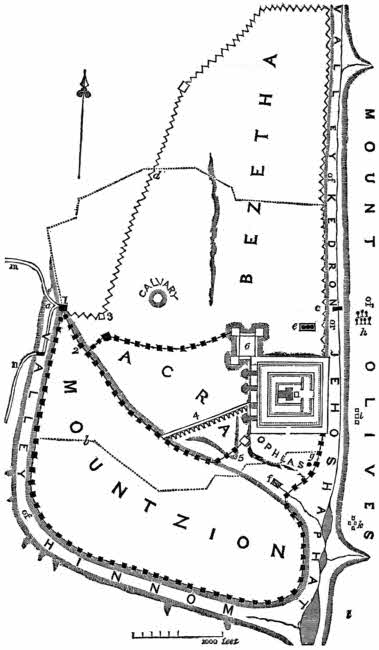
examine it in detail. And, first, observe the walls by
which it is begirt; what a proud and formidable
array of strength is here. The massive battlements
seem to set all earthly power at defiance, while the
stones of immense size excite our wonder, not only
by their prodigious size, but by their peculiar and
careful finish. That wall on the north is eighteen
feet in thickness, and with its battlements and turrets
is forty-five feet in height; it runs zigzag, so that
each part may be raked from the towers, of which
there are ninety in this wall. The towers, thirty-six
feet square, are of solid masonry, and are crowned
each with two stories or suites of rooms, in which
architectural beauty is consulted as well as strength,
and which are of great magnificence. The angles
in the wall are acute, receding considerably from the
towers; and the whole structure, as it sweeps around
the city, looks like a mountain of solid and immoveable
rock. At its north-western angle, high above
all the rest, rises the tower of Psephinus, massive
below, but in its upper part marked by graceful,
though still heavy architecture; it is octangular, and
attains an elevation of one hundred and twenty-seven
feet.
Within this, separating Acra from Bezetha, is
another wall, a solid mountain of masonry, presenting
high angular walls, battlements, and towers of
exceeding strength; and here, south of Acra, on the
edge of Zion, is a third line of similar defences, making,
with the steepness of the ascent, a bulwark by no means
less formidable than the rest; and on the southern and
western sides of this mountain, grow up from the
edge of the high rocky precipice, by which it is there
begirt, lines of broad and high stone-work, presenting
an utterly hopeless barrier to an assailant. “Walk
about Zion, and go round about her; tell the towers
thereof; mark ye well her bulwarks; beautiful for
situation, the joy of the whole earth is Mount Zion.
The kings were assembled, they passed by together;
they saw it, and so they marvelled; they were troubled,
and hasted away.”
The chief glory of these defences of Zion, however,
is a nest of towers there at the north-west angle,
“which, for largeness, beauty, and strength, are beyond
all that are in the habitable earth.” They were
built by Herod, and called after his friend, his
brother, and his wife. They stand at a point where
the elevation of Mount Zion, contracting into narrow
limits, becomes more remarkable, and thus presents
their altitude and elaborate architectural
beauties in a more striking point of view. One of
them is placed in the sharp angle, and is called the
tower of Hippicus. It is 46 feet square; and to
an elevation of 55 feet is composed of firm and
solid masonry, the stones with which it is built
being 36 feet in length, by eighteen in width,
and nine in height; above this enduring mass is a
reservoir 36 feet in elevation; next above this
is a double range of magnificent chambers of ornamental
yet massive architecture, making an additional
height of 46 feet; and above these rise
battlements and turrets, the whole height of the
tower being 146 feet.
A short distance from it we behold the tower Phasaelus,
72 feet square and 164 in height. Seventy-two
feet of this elevation consists of stones like those
in the tower just described; and the rest is composed
of heavy stone work faced with colonnades; of richly
ornamented chambers, and of battlements and turrets.
The third tower of Mariamne, named by Herod
after his wife, is smaller than these, but of exquisite
beauty, and richly adorned with ornaments; it attains
an elevation of 91 feet.
All these look immediately down upon the royal
palace, also on Mount Zion; and here the eye is
wearied with tracing the labyrinth of courts, the
succession of porticos adorned with rich and curious
pillars, the ranges of lofty windows, giving
light to halls where statuary and carved work have
added their embellishments, and where the vessels
are of silver and gold. And in the courts below and in
the gardens are rare trees, and fountains, and brazen
statues, and winding streams. No cost or skill has
been spared in this palace by a prince whose resources
were of the most ample kind. These palaces
and courts and towers are the Kremlin of Jerusalem.
Observe now that long bridge, with its lofty
arches, a striking feature in this scene, and adding
greatly to its picturesque effect. It rises high above
the dwellings of Acra, and, stretching quite across
that portion of the city, connects the precincts of
this palace with the Temple. But let us hasten to
turn our attention to the Temple. The city has yet
many striking objects that solicit our attention; the
lofty and frowning castle of Antonia, palaces in great
numbers, private edifices of remarkable architecture,
brought out into strong relief by the uneven nature of
the ground, invite our notice; but the wonderful
Temple, grand, mysterious, awful, is here before us,
and the eye glances impatiently at other objects. Let
us turn then, and suffer our eyes to dwell and feast
on this.
And it is indeed a glorious sight. It stands here
all before us, the walls that support its courts rising
from the very depths of the valley of Jehoshaphat,
and towering aloft to an astonishing, a giddy height.
It was a bold and daring conception—that of carrying
up this mountain of stone-work to such a stupendous
elevation. This wall here fronting us is
729 feet in height![65] On the northern and western
sides, owing to the inequality of the ground, the
elevation is somewhat less.
You perceive that in order to obtain greater strength,
the walls are not perpendicular, but somewhat slanting,
so that with the ascending nature of the ground
in the courts above, the whole structure has somewhat
of a pyramidal form. The stones of which it is composed
are of prodigious size, yet are fitted together
with the greatest care, and in addition to the security
afforded by their magnitude, are strengthened
internally by means of iron clamps. This wall is
above 730 feet in length on each side; it forms an
exact square, and the whole interior space being
filled up, we have thus a vast mountain raised by
human labor, a stupendous structure that must excite
the astonishment of all succeeding ages. But
this is only the ground work, the substructure for
the great Temple and its sacred courts. Look upward
now; you see along the edge of this wall, far
up at its giddy elevation, where the brain reels as it
attempts to measure the depths below, you see a cloister
or ornamented colonnade, on the outside ornamented
with architectural embellishment, and yet
more remarkable still for massiveness and strength,
as if to guard from the assaults even of the wildest
fancy the sacred precincts of the Temple. This cloister
is 55 feet wide, and consists on the outside of a
range of chambers, and within or towards the Temple,
of a double row of marble columns 46 feet in
height, each column consisting of a single block of
white marble; the entablature gives to the whole
cloister or colonnade an elevation of more than 60
feet. At the southern end, instead of two, are four
rows of columns, each column six feet in diameter
and 27 in height; the heaviness of the shaft being
relieved by fanciful flutings at the base, and by rich
leaf-shaped capitals, like those which we consider as
belonging to the Corinthian order. This end is
called Solomon’s Porch;[66] it consists of a nave, if I
may use the term, 45 feet wide, and in height 100
feet, with side aisles, each 30 feet wide, and 50 in
height. It is an enchanting spot, and fanned at that
high elevation with a perpetual breeze, and is a favorite
resort; but, indeed, where, in this whole colonnade,
forming a complete circuit of 2900 feet, is a spot that
is not marked by exceeding beauty and magnificence?
At each angle you perceive towers of elaborate
architecture, crowned with turrets or pinnacles,
where, gazing downward, the senses recoil with
horror from the frightful depth.
But this is only the commencement of the grandeur
of this wonderful Temple. Within this cloister
is an open court, running also quite around; it
is paved with marble, and its level is broken by a
few steps of ascent, also passing along the whole
circuit of the court. This is the court of the Gentiles;
and inscriptions on columns are seen at intervals,
forbidding this class of people to advance
nearer to the Temple. Along the inner edge of this
court runs another cloister, consisting also of a row
of chambers, with a single colonnade in the interior,
or looking toward the Temple. In the space allotted
here to the chambers, the ground has taken
an ascent of seventeen feet from the court of the Gentiles,
but the colonnade itself is on level ground, the
pillars being, as in the outer colonnade, forty-six
feet in height, and making, with the entablature,
likewise a full elevation of more than sixty feet; but
from the rise of the ground this colonnade is twenty
feet higher than the other.
In this cloister, fronting us on the east, is the
“Beautiful Gate;”[67] and truly, no one need be directed
to mark its surpassing magnificence. It is ninety-one
feet in height by seventy-three in width; the doors are
of massive Corinthian brass, covered on both sides,
as are also the jambs and lintels, with plates of gold
and silver, sometimes plain, sometimes in fretted
work, or raised into figures in low or in high relief.
On either side of the doorway is a tower, seventy-three
feet high, adorned with columns twenty-one
feet in circumference. On the northern and southern
sides of this cloister are eight other gates, of less
magnitude, but covered in a similar manner, as are
also their jambs and lintels, with plates of gold and
silver; and strengthened also like the former, with
towers and massive columns.
Passing through this, we are once more in an open
court, paved with marble, and rising by steps towards
the central point. The eastern side of this court is
allotted to the worship of the Jewish women, while
that on the north and south is divided off for the
men. At the inner edge of this court is again another
wall; it is of marble, only a few feet in height, and is
richly ornamented with sculpture; it separates the
court of the Jewish worshippers from the inmost
court of all, the court of the Priests.
And there, at the eastern side of this inmost court,
in the open air, at the apex of this stupendous Pyramidal
structure, canopied only by the heavens, stands
the Altar of Burnt Sacrifice. It is a colossal structure,
being twenty-seven feet in height and ninety-one
feet on each of its sides. The ascent is by an
inclined plane on the south.
And just beyond it, is the TEMPLE. This looks
also to the eastward, and as we attempt to gaze upon
it in this bright morning sun, now darting its rays
across the Mount of Olives, our dazzled eyes turn
away, pained by the glorious sight. It presents a
front one hundred and eighty-two feet long and of
an equal height, all of which is covered with thick
plates of gold. What a magnificent spectacle!
What a grand termination to this stupendous structure,
towering upwards from the deep valley towards
the clouds. Cast your eye downwards, and let it
range over the immense masses of chiselled rocks,
wrought into regular shape, enriched with architectural
device, and piled on each other till the senses
are pained in endeavoring to take in the colossal
fabric of more than seven hundred feet in height;
glance at the huge mouldings into which the wall
swells at its termination; mark the high colonnades
of pure showy marble, that are ranged along the
edge of this mighty structure; see within this the
marble tesselated pavement, ascending by flights of
steps, and encircling the mountain; and then again
another range of light marble porticos sweeping
quite around; mark the pavement, again ascending
by unbroken flights of marble steps; and here, at
length, crowning the whole magnificent work, is the
gorgeous Temple, its front one hundred and eighty-two
feet high, decked with elaborate architectural
embellishments, and covered with massive gold.
And “the Lord is in his Holy Temple, let all the
earth keep silence before Him.”
Yes, in this gorgeous edifice, raised to such a
stupendous height, wrapped in a splendor that the
eye can scarcely look upon; deep within the edifice
in a spot of mysterious darkness and solitude, is
shadowed forth the presence of Jehovah; and this
Temple belongs not to Jerusalem, but to the whole
world. And He, the Deity, whose very name is
awful, and should be used with reverence, hath
blessed this spot with his peculiar presence; and it
is meet that man should look upon it with deep and
solemn feeling. “How amiable,” said the Psalmist,
when far distant, “how amiable are thy tabernacles,
O Lord of Hosts. My soul longeth, yea, even fainteth,
for the courts of the Lord; my heart and my
flesh crieth out for the living God. For a day in thy
courts is better than a thousand. I had rather be a
door-keeper in the house of my God, than to dwell
in the tents of wickedness.”
In this eastern front of the Temple is an open and
ornamented door-way, 46 feet wide and 128 feet in
height. The architect of this edifice was a man of
skill. He knew well the powerful effect produced
by the prevalence of high ascending lines in a building,
and in the Temple he has taken advantage of
this effect, and with the best results. How fine is
the appearance of this grand and lofty door-way,
open also so as to give a view of the rich vestibule
just within! Our thoughts and our feelings, whatever
they may be, are not checked at the very threshhold,
but are allowed to penetrate to a short distance;
they are not excluded from the edifice; they enter
sufficiently to make us a part of it; and yet it is not
made common by being all exposed; sufficient of it
remains shut up to excite our wonder, to cherish
feelings of respect, to inspire that awe which arises
from mystery.
He who may enter this lofty door-way, will find
himself in a vestibule at right angles with his path;
it is 36 feet wide, 92 in length, and 164 feet in height.
The wall in front of him is all covered with plates of
gold, which, like that on the exterior front, is in various
forms, smooth and highly burnished, or in
patterns of embossed work, or in figures of various
kinds. From the lofty ceiling, which the eye is
pained in attempting to reach, hangs down a golden
vine, with leaves and fruit of the same metal, and so
colossal are its dimensions, that the clusters of grapes
are six feet in length.[68] Our foot may not be placed
within this vestibule; but through the large open
door-way we can discover much of the splendor by
which it is distinguished. In the golden wall that
bounds our vision at its further side, is a door-way
twenty-nine feet wide by 100 in height, covered by
a Babylonian curtain, of blue and scarlet and purple,
richly embroidered, and of wonderful workmanship.
Its ample folds conceal a door, which, like the wall,
is covered with plates of gold, plain or in various
patterns, and of exceeding richness.
He who enters this door will find himself in The
Sanctuary. This is a chamber thirty-six feet wide and
seventy-two in length, and 109 in height; its height,
however, cannot be reached by the eye; for this
chamber is in darkness, except the obscure light shed
upon it by several lamps. Daylight cannot penetrate
it, unless occasionally a feeble glimmering
through the door-way; a mysterious obscurity is left
to pervade it, and the vision, turning upward, combats
for a while the deepening shadows, and is then repelled
by utter darkness. The furniture of this room
is simple, for it contains only the Table of Shew-bread,
and the Golden Candlestick, and the Altar of
Incense. While the incense ascends silently, and
keeps the chamber filled with perpetual odours, the
softened light of the Seven Golden Lamps of the
Candlestick falls upon a table with twelve loaves of
bread, one for each tribe; as if, by this simple emblem,
the staff of his life kept here in memorial, man
would gratefully acknowledge by whom his existence
is prolonged, and whence are derived its blessings.
There is something in this quiet and simple
scene, a subdued and humble, yet grateful character
in its speech, that is very impressive.
At the further end of this chamber is again a door-way
covered by a thick veil of many folds. It opens
into a square chamber thirty-six feet on each side,
and 109 in height. In this chamber there is nothing
at all. It is quite dark; and its deep obscurity and
its vacancy are fit emblems of HIM who is invisible
to mortal eye, and whom mortal thought can never
reach. This is the Holy of Holies. It is entered
only by the High Priest, and by him but once a year.
Unadorned, and deeply shut up within the Temple,
it is left to darkness, and silence, and impressive
solitude.
When Pompey, after a toilsome siege, at length
took this mountain by assault, he hastened to the
Temple, incited both by curiosity, and by a desire to
feed his eye on the wealth that had at length become
his own; but when, having examined the Sanctuary
in its dim mysterious light, and then, raising this
veil, he stood in the Holy of Holies, and found no
object, nought but an obscurity that his eye, as he
gazed upward, sought in vain to pierce, a feeling of
awe and dread seems to have come upon him; he
left the Temple, having touched neither its furniture
nor its treasure, and, calling off his troops, he gave
orders to repair the injuries that had been occasioned
by his assault.
The walls of this building are fourteen and a half
feet in thickness, and are composed of stones forty-six
feet long by twenty-one in width, and fourteen
in thickness, interspersed with some that have the
astonishing length of eighty-two feet.[69] The main
body of the edifice, containing the Sanctuary and the
Holy of Holies, is so narrow in proportion to its elevation,
that it would be in danger from earthquakes
if that were not guarded against by an outer wall nine
feet from this, with which it is connected so as to form
between them three tiers of cells, thirty in each tier;
the upper part of the building is used as store-rooms
for the furniture and utensils of the Temple. The
vestibule, being at right angles with the body of the
edifice, projects thirty-six feet on either side. The
stone employed here appears to be a pure white marble,
for those portions of the building which are not
covered with plates of gold are of dazzling whiteness,
so as to appear at a distance like a mountain covered
with snow.
The whole mass, the foundation walls, the porticoes,
the Temple, are indeed a wonderful structure; and
with the sacred and solemn associations connected
with them, form an object of surpassing interest and
grandeur.
And now look down again upon the city and upon
the fair region stretching all around. The ground
on which Jerusalem is built, assists greatly, as you
perceive, in giving it architectural effect. Babylon,
Nineveh, Thebes, Memphis, those cities of ancient
renown, were built on level plains, and with all their
riches and greatness were in most parts tame
and monotonous; but here the picturesque is added
to greatness and splendor; the walls and towers overhang
deep precipices; the lofty palaces are brought
into stronger relief by their situations; each portion
of the city, by harmony or by contrast, adds a charm
to every other; and the Temple, like another sun
chained to the dizzy heights of Moriah, sheds an effulgence
over all.
Gaze now around. What a frame-work is there
for the city of Jerusalem! See the villages, embosomed
in gardens of deep verdure, sprinkled thickly
over all the plains, which, ascending as they retire
from the city, expose every object to our view. Here
the houses stand in thick clusters, there they straggle
along amid the overhanging trees; and the whole
immense extent of country seems only a continuation
of the city in a more cheerful form. And this Mount
of Olives, what a beautiful object it must be when
viewed from the city. Its graceful slopes, its gardens,
its deep shade, its white cottages, its villas, where the
wealthy love to retire, half exposed, half concealed,
by the dense verdure; its groves and public walks;
what an admirable picture they form; and alongside
of the stupendous and glittering pyramid of Mount
Moriah, each by contrast gives new beauties and
new charms to the other. Where in all the world
shall we find a scene equal to this?
And now glance your eye along these roads that
come winding over the hills by which Jerusalem is
encircled. See! The whole country seems awakened
into an intensity of life and animation. It is the
Passover. Far off as the eye can reach, the great
highways and the narrow paths are covered with
masses of living beings, thousands upon thousands
pouring onwards, and still succeeded by other thousands,
till it seems as if the whole habitable globe
was sending its inhabitants and its tribute to this
sacred city. And it does. Here are “Parthians and
Medes, and Elamites, and the dwellers in Mesopotamia,
and in Judea, and Cappadocia, in Pontus and
Asia, Phrygia and Pamphylia, in Egypt and in the
parts of Lybia about Greece, and strangers of Rome,
and Cretes, and Arabians,” in their various costumes,
and speaking their various tongues. The number
that assembles here on this occasion is about three
millions. They come, some purely from religious
feeling, some also for commerce; for the occasion is
seized by dwellers in far distant countries for the
interchange of commodities. As they approach the
city, however, a common feeling takes possession of all
of them, delight, reverence, awe, wonder, admiration.
As they gain the summits of the distant hills, and
catch a view of the Temple, they burst into shouts
of joy, they prostrate themselves upon the ground,
they break out into hymns of praise. The air
seems burdened by the noises that unceasingly ascend;
one while they are like the roar of the ocean;
at another, they rise, and sink, and swell upward
again into lofty strains of wonder and thanksgiving;
the earth trembles under the moving to and fro of
these countless multitudes. See—still they come,
thousands and yet still countless thousands pressing
onward towards the city. The eye is wearied with
beholding them; the senses are pained and overwhelmed.
And now the sounds abate and sink into a deep but
continuous murmur. They are preparing for the
Paschal sacrifice. The multitudes are divided into
companies of from ten to twenty, and each company,
by a deputy appointed for that purpose, is to offer
in the courts of the temple a lamb without blemish
or spot; the blood is to be sprinkled at the foot of
the great altar, and the fat is to be cast upon it for a
burnt offering. There will be 250,000 of these sacrifices.
See! the courts of the Temple, the flat roofs of the
colonnades, are covered by the dense throngs; the
walls and towers of the city, the terraces of the
lofty dwellings of Jerusalem, are crowded by the
multitudes; and the ascending plains around, and the
slopes of the Mount of Olives, are all animated; it
is an ocean of living beings.
And now they are silent all. Soon you will perceive
a great cloud of smoke roll up from the altar and
envelope the Temple, and then you will hear their
hymns. There it is! and astounding! the millions
of voices that ascend seem to burst the very heavens;
the mountain shakes under the strange concussion.—Their
Hymn.—
Hallelujah! Hallelujah!
O praise God in his holiness,
Praise him in the firmament of his power.
Praise him for his mighty acts,
Praise him for his excellent greatness.
Instrumental music accompanying.
Praise him in the sound of the trumpet,
Praise him upon the lute and harp.
Let every thing that hath breath praise the Lord.
Children of the Levites, from the Temple.
Thine ordinances, O God, how glorious they are.
But tell us, fathers of Israel, what mean ye by this service?
Solemn recitative, from the Elders.
It is the sacrifice of the Lord’s Passover, who passed over
the houses of the children of Israel, in Egypt, when he
smote the Egyptians, and delivered our houses.
Hymn from Mount Moriah.
Sing unto the Lord, for he hath triumphed gloriously.
He has brought us in and planted us in the mountain of his inheritance;
In the place, O Lord, which thou hast made for thee to dwell in,
In the Sanctuary, O Lord, which thine own hands have established.
Full chorus of all the multitudes.
The Lord is our strength, and he is become our salvation.
He is our God, and we will honor his habitation.
Our father’s God, and we will exalt him.
Hallelujah. The Lord shall reign for ever and ever. Hallelujah.
Full company of instrumental music, on Mount Moriah.
Now listen, this is the hymn of solemn invocation.
From the Priests in the inner Court.
The Lord hear thee in the day of trouble.
The name of the God of Jacob defend thee,
Send thee help out of the Sanctuary, and strengthen thee out of Zion.
Remember all thy offerings, and accept thy burnt sacrifices.
Grant thee according to thy heart’s desire, and fulfil all thy mind.
Be merciful unto us, O God, be merciful unto us; for our soul trusteth in thee.
Response from the deputies in the surrounding courts.
Hear our cry, O God; give ear unto our supplications.
From the ends of the earth will we call upon thee when our heart is in heaviness.
Our souls wait only upon God; for our expectation is from him.
He is our salvation and our glory; he is the rock of our strength and our refuge.
Response from the full multitude.
Also unto thee, O Lord, belongeth mercy; our souls wait only upon thee.
Thou art our salvation and our glory; thou art the rock of our strength and our refuge.
HYMN THIRD.
Voices of the full multitude.
O sing unto the Lord a new song; for he hath done marvellous things.
With his own right hand, and with his holy arm, hath he gotten himself the victory.
The Lord hath declared his salvation; his righteousness hath he openly showed in the sight of the heathen.
He hath remembered his mercy and truth towards the house of Israel;
And all the ends of the world have seen the salvation of our God.
Show yourselves joyful before the Lord, all ye lands; sing, rejoice, and give thanks.
Praise the Lord upon the harp; sing to the harp with a psalm of thanksgiving.
With trumpets also, and shawms, O show yourselves joyful before the Lord, the king.
Full outburst of instrumental music on Mount Moriah.
HYMN FOURTH.
Voices of the strangers.
How amiable are thy Tabernacles, O Lord of Hosts.
I was glad when they said unto me, let us go into the house of the Lord.
Our feet stand joyfully within thy gates, O Jerusalem.
Voices of the citizens.
Pray for the peace of Jerusalem, for the peace of Jerusalem; they shall prosper that love thee.
Full chorus of all, both strangers and citizens.
Peace be within thy walls, and prosperity within thy palaces.
For my brethren and companions’ sakes, I will wish thee prosperity.
Because of the house of the Lord our God, I will seek thy good.
Hallelujah! The Lord shall reign for ever and ever! Hallelujah!
City of Jerusalem! art thou then to be a heap of
ruins? Land of glory! art thou then to be a desolation?
Temple of the living God, to which exceeding
beauty and wonderful associations draw our
hearts, art thou then to be laid in the dust, till not
one stone shall be left upon another? It is even so.
The voices of the worshippers are suddenly
hushed, for upon yon distant hills, to the northward,
is the glitter of armor; and see, the heights are now
all covered with a dense array of the legions of Rome.
Their leader comes here to reconnoitre, and from
this mountain looks down upon the glorious city.
“It must be—
And yet it moves me, Romans! it confounds
The counsels of my firm philosophy,
That Ruin’s merciless ploughshare must pass o’er,
And barren salt be sown on yon proud city.
As on our olive-crowned hill we stand,
Where Kedron at our feet its scanty waters
Distils from stone to stone with gentle motion,
As through a valley sacred to sweet Peace.
How boldly doth it front us! how majestically!
Like a luxurious vineyard, the hill-side
Is hung with marble fabrics, line on line,
Terrace o’er terrace, nearer still, and nearer
To the blue heavens. Here bright and sumptuous palaces,
With cool and verdant gardens interspersed;
Here towers of war, that frown in massy strength,
While over all hangs the rich purple eve.
And as our clouds of battle, dust, and smoke,
Are melted into air, behold the Temple,
In undisturbed and lone serenity,
Finding itself a solemn sanctuary
In the profound of heaven! It stands before us
A mount of snow, fretted with golden pinnacles!
The very sun, as though he worshipped there,
Lingers upon the gilded cedar roofs!
And down the long and branching porticoes,
On every flowery sculptured capital
Glitters the homage of his parting beams.
By Hercules! the sight might almost win
The offended majesty of Rome to mercy.”
Milman.
It is a wonderful city, wonderful in its origin, in its
history, in its present character; strange events, too,
have been foretelling its doom, and terrible is to be
its downfall.
A flaming sword was seen night after night, for the
space of a year, suspended over the city; the inhabitants
crowded to the Temple, they offered sacrifices,
but still that bloody sword was over them; the timid
buried themselves in their chambers and wept; the
gay tried to forget it in debauch, but still it hung
above the city, and the hearts of the stoutest at length
quailed before it. It has lately disappeared, but they
do not know whether to consider this as an omen
for good or for evil.
Also the Beautiful Gate of the Temple, which
requires twenty men to move it, one night, though
secured by heavy bolts, opened of its own accord,
as if to show that the spirits which had been keeping
guard in the Temple were leaving it.
Also one night at Pentecost, as the priests were
going to their duties in the inner court of the Temple,
they felt a quaking of the earth, and then, as
they stood to recover from their dread, they heard a
whispering noise as of a multitude of people, saying,
“Let us go hence.”
Even now, as we have been sitting here, a lonely
and mournful, but loud voice, has been repeating in
the lanes and in the high streets of the city, “Wo, wo
to Jerusalem!” And for four years, by day and in
the deep stillness of night, that melancholy cry has
been unceasingly heard denouncing wo to the affrighted
and cowering inhabitants. A plain countryman
came up to the Feast of Tabernacles four years ago
while the country was prosperous and at peace;
and while engaged in the duties of this occasion
became suddenly a changed man, and before the
multitudes cried aloud, “A voice from the east, a
voice from the west, a voice from the four winds, a
voice against Jerusalem and the Holy House, a voice
against the bridegrooms and the brides, and a voice
against this whole people!” A dead weight of fear
has ever since lain upon the spirits of the inhabitants,
crushing the timid, and oppressing even the boldest.
They have tried by every means to stop his mournful
cry; they have beaten him till his bones were laid
bare, but he made no supplication and shed no
tears; they have carried him before the rulers, but
he has not been awed to silence, nor to their
queries and threats has he made any reply; he has
associated with no one, but in the crowded city has
made himself a solitary and a lonely man; he has
not complained when ill treated and abused from
day to day; he has not thanked those who gave him
food; to each he has replied only by his usual exclamation
of, wo to the city; the channels of all feeling,
except a deep and dreadful horror, seem to have
been frozen up. He rests but little; something
within him hath murdered sleep. At midnight,
when all nature is hushed in death-like repose,
from amid the deep darkness his mournful voice
is heard; and the mother starts and draws her
infant to her breast, and the sentry on his post
trembles at the prolonged and melancholy cry,
“Wo, wo, wo to Jerusalem!”
The wo hath been poured out upon the unhappy
city.
Eleven hundred thousand persons perished during
the siege, by famine, pestilence, or by human
violence. Ninety-seven thousand at its close were
carried as captives into distant lands.[70]