Distance from
|
Miles.
|
Port Penrhyn
|
5
|
Llanvair Vechan
|
2
|
Conway
|
9
|
Penmaen Mawr
|
3
|
Llandegai
|
3½
|
London
|
245
|
Aber, or, as it is called by way of
distinction, Aber-gwyngregyn, the Stream of the White Shells, is
a small neat village, situated on the Holyhead and Chester road,
near the Lavan Sands, at the extremity of a luxuriant vale
watered by the river Gwyngregyn, which runs into the Irish sea;
it commands a fine view of the entrance into the Menai, with the
islands of Anglesea and Priestholme, and the vast expanse of
water which rolls beneath the ragged Ormesheads. The
pleasantness of its situation, and the salubrity of its air,
render this place exceedingly attractive during the summer
season, and the beach, at high water, is very convenient for sea
bathing.
The church is an ancient structure, with a square tower; the
living being in the gift of Sir R. W. Bulkeley.
The Bulkeley Arms is an excellent inn, where post-chaises and
cars may be had.
This is considered a very convenient station for such persons
as wish to examine Penmaen-mawr, and the adjacent country, either
as naturalists or artists. From this place also persons
frequently cross the Menai straits immediately into Anglesea, in
a direction towards Beaumaris. The distance is somewhat
more than six miles. When the tide is out, the Lavan Sands
are dry for four miles, in the same direction, over which the
passenger has to walk within a short distance of the opposite
shore, where the ferry-boat plies. In fogs, the passage
over these
sands has been found very dangerous, and many have been lost in
making the hazardous enterprise at such times. As a very
salutary precaution, the bell of Aber church, which was presented
for the purpose by the late Lord Bulkeley, in 1817, is rung in
foggy weather, with a view to direct those persons whose business
compels them to make the experiment. It would be dangerous
for a stranger to undertake the journey without a guide, as the
sands frequently shift: however, since the erection of the Menai
bridge, this route is seldom taken.
The village is situated at the mouth of the deep glen, which
runs in a straight line a mile and a half between the mountains,
and is bounded on one side by a magnificent rock, called
Maes-y-Gaer. At the extremity of this glen, a mountain
presents a concave front, down the centre of which a vast
cataract precipitates itself in a double fall, upwards of sixty
feet in height, presenting in its rushing torrent over the
scattered fragments of rock a grand and picturesque
appearance.
At the entrance of the glen, close to the village, is an
extensive artificial mount, flat at the top, and near sixty feet
in diameter, widening towards the base. It was once the
site of castle belonging to the renowned prince, Llewelyn the
Great, foundations are yet to be seen round the summit; and in
digging, traces of buildings have been discovered. This
spot is famous as the scene of the reputed amour of William de
Breos, an English baron, with the wife of the Welsh hero, and of
the tragical occurrence which followed its detection. This
transaction, which has given rise to a popular legend, is well
told in Miss Costello’s “Pictorial Tour,”
published in 1845:—
Llywelyn had been induced by the artful promises of the smooth
traitor, king John, to accept the hand of his daughter, the
princess Joan; but his having thus allied himself did not prevent
the aggressions of his father-in-law, and John having cruelly
murdered twenty-eight hostages, sons of the highest Welsh
nobility, Llywelyn’s indignation overcame all other
considerations, and he attacked John in all his castles between
the Dee and Conway, and, for that time freed North Wales from the
English yoke.
There are many stories told of the princess Joan, or Joanna,
somewhat contradictory, but generally received: she was, of
course, not popular with the Welsh, and the court bard, in
singing the praise of the prince, even goes so far as to speak of a female
favourite of Llywelyn’s, instead of naming his wife:
perhaps he wrote his ode at the time when she was in disgrace, in
consequence of misconduct attributed to her. It is related
that Llywelyn, at the battle of Montgomery, took prisoner William
de Breos, one of the knights of the English court, and while he
remained his captive treated him well, and rather as a friend
than enemy. This kindness was repaid by De Breos with
treachery, for he ventured to form an attachment to the princess
Joan, perhaps to renew one already begun before her marriage with
the Welsh prince. He was liberated, and returned to his own
country; but scarcely was he gone than evil whispers were
breathed into the ear of Llywelyn, and vengeance entirely
possessed his mind: he, however, dissembled his feelings, and,
still feigning the same friendship, he invited De Breos to come
to his palace at Aber as a guest. The lover of the princess
Joan readily accepted the invitation, hoping once more to behold
his mistress; but he knew not the fate which hung over him, or he
would not have entered the portal of the man he had injured so
gaily as he did.
The next morning the princess Joan walked forth early, in a
musing mood: she was young, beautiful, she had been admired and
caressed in her father’s court, was there the theme of
minstrels and the lady of many a tournament—to what avail?
her hand without her heart had been bestowed on a brave but
uneducated prince, whom she could regard as little less than
savage, who had no ideas in common with her, to whom all the
refinements of the Norman court were unknown, and whose uncouth
people, and warlike habits, and rugged pomp, were all distasteful
to her. Perhaps she sighed as she thought of the days when
the handsome young De Breos broke a lance in her honour, and she
rejoiced, yet regretted, that the dangerous knight, the admired
and gallant William, was again beneath her husband’s
roof. In this state of mind she was met by the bard, an
artful retainer of Llywelyn, who hated all of English blood, and
whose lays were never awakened but in honour of his chief, but
who contrived to deceive her into a belief that he both pitied
and was attached to her. Observing her pensive air, and
guessing at its cause, he entered into conversation with her, and
having ‘beguiled her of her tears’ by his melody, he
at length ventured on these dangerous words.—
“Diccyn, doccyn, gwraig Llywelyn,
Beth a roit ti am weled Gwilym?”
“Tell me, wife of Llywelyn, what would you give for
sight of your William?”
The princess, thrown off her guard, and confiding in
harper’s faith, imprudently exclaimed:—
“Cymru, Lloegr, a Llywelyn,
Y rown i gyd am weled Gwilym!”
“Wales, and England, and Llywelyn—all would I give
to behold my William!”
The harper smiled bitterly, and, taking her arm, pointed
slowly with his finger in the direction of a neighbouring hill,
where, at a place called Wern Grogedig, grew a lofty tree, from
the branches of which a form was hanging, which she too well
recognised as that of the unfortunate William de Breos.
In a dismal cave beneath that spot was buried “the
young, the beautiful, the brave;” and the princess Joan
dared not shed a tear to his memory. Tradition points out
the place, which is called Cae Gwilym Dhu.
Notwithstanding this tragical episode, the princess and her
husband managed to live well together afterwards; whether she
convinced him of his error, and he repented his hasty vengeance,
or whether he thought it bettor policy to appear satisfied; at
all events, Joan frequently interfered between her husband and
father to prevent bloodshed, and sometimes succeeded. On
one occasion she did so with some effect, at a time when the
Welsh prince was encamped on a mountain above Ogwen lake, called
Carnedd Llywelyn from that circumstance; when he saw from the
heights his country in ruins, and Bangor in flames. Davydd,
the son of the princess, was Llywelyn’s favourite
son. Joan died in 1237, and was buried in a monastery of
Dominican friars at Llanvaes, near Beaumaris; Llywelyn erected
over her a splendid monument, which existed till Henry the Eighth
gave the monastery to one of his courtiers to pillage, and the
chapel became a barn. The coffin, which was all that
remained of the tomb, like that of Llywelyn himself, was thrown
into a little brook, and for two hundred and fifty years was used
as a watering trough for cattle. It is now preserved at
Baron Hill, near Beaumaris.
Caernarvon
|
36
|
Nevyn
|
16
|
Pwllheli
|
16
|
This is a miserably poor village, at the very extremity of
Caernarvonshire, seated in a bay, beneath some high and sandy
cliffs. On the summit of a promontory are the ruins of a
small church, called Capel Vair, or Chapel of our Lady. The
chapel was placed here to give the seamen an opportunity of
invoking the tutelar saint for protection through the dangerous
sound. Not far distant, are also the ruins of another
chapel, called Anhaelog. At this spot, pilgrims in days of
yore embarked on their weary journey to pay their vows at the
graves of the saints of Bardsey.
The original church was a very old structure, in the style of
ancient English architecture, dedicated to St. Hyrwyn, a saint of
the island of Bardsey, and was formerly collegiate and had the
privilege of sanctuary; it contained a nave, south aisle, and
chancel, and was an elegant and highly finished building. A
new church has been recently built, on the site of the old one,
at the expense of the landed proprietors, aided by the church
building societies.
The mouth of the bay is guarded by two little islands, called
Ynys Gwylan, a security to the small craft of the inhabitants,
who are chiefly fishermen. It takes its name from the
rivulet Daron, which empties itself here.
This primitive village is noted as the birth place of Richard
Robert Jones, alias Dick Aberdaron, the celebrated Welsh
linguist. He was born in 1778, and died in deep distress at
St. Asaph in 1843. Jones was the son of a carpenter, and
always evinced a want of capacity, except in the acquiring of
languages by self culture. He began with the Latin tongue
when fifteen years of age. At nineteen he commenced with
Greek, and proceeded with Hebrew, Persiac, Arabic, French,
Italian, and other modern languages; and was ultimately
conversant with thirteen. Notwithstanding that he read all
the best authors, particularly in the Greek, he seemed to acquire
no other knowledge than as to the form and construction of
language. He was always in great indigence, and used to
parade the streets of Liverpool extremely dirty and ragged, with
some mutilated stores of literature under his arm, and wearing
his beard
several inches long. He was at one time much noticed by the
late Mr. Roscoe, who secured him a weekly stipend, which however
was not maintained after the death of that distinguished
scholar.
Generally called by the Welsh Yr Ynys Enlli (the Island of the
Current), and formerly known as the Island of the Saints, is
situated about three leagues to the west of Aberdaron; it is
somewhat more than two miles long and one broad, and contains
about 370 acres of land, of which near one-third is occupied by a
high mountain, affording sustenance only to a few sheep and
rabbits. The number of inhabitants does not exceed one
hundred, and their chief employment is fishing, there being great
abundance round the island. It is the property of Lord
Newborough.
On the south-east side, which is only accessible to the
mariner, there is a small well sheltered harbour, capable of
admitting vessels of 30 or 40 tons burden. The lighthouse
was erected in 1821; it is a handsome square tower, 74 feet high,
and surmounted by a lantern, 10 feet high.
This island was formerly celebrated for an abbey, a few
portions only of which are now remaining. Dubricius,
archbishop of Caerlleon, resigned his see to St. David, retired
here, and died A.D. 612; he was
interred upon the spot, but such was the veneration paid to his
memory in after ages, that his remains were removed in the year
1107 to Llandaff, and interred in that cathedral, of which
Dubricius had been the first bishop. After the slaughter of
the monks of Bangor Is-y-coed, nine hundred persecuted men who
had embraced Christianity, sought a sacred refuge in this island,
where numbers of the devout had already established a sanctuary,
and found repose from the troubles which then raged through the
Principality.
Aberystwyth across the sands
|
11
|
Barmouth
|
16
|
Dolgellau
|
21
|
Machynlleth
|
10
|
Towyn
|
4
|
This is a small sea-port in the parish of Towyn, and about
four miles from that place. It is pleasantly situated on
the northern
side of the mouth of the river Dovey, which here empties itself
into Cardigan bay, and is rapidly rising into estimation as a
bathing place. The beach is highly favourable for bathing,
being composed of hard firm sand, affording a perfectly safe
carriage-drive of about eight miles in length, along the margin
of the sea. The ride to Towyn along the sands, at low
water, is extremely delightful.
Several respectable houses and a commodious hotel (the Corbet
Arms) have of late years been erected for the accommodation of
visitors; and a chapel of ease has also been lately built by
subscription, which affords great convenience to the inhabitants,
who are four miles distant from the parish church. Service
is performed every Sunday morning in English, and in the
afternoon in the Welsh language.
The river Dovey is here one mile in width, and is crossed by a
ferry, which leads by a road along the sea shore to Borth, whence
is a communication with the Aberystwyth road. During the
spring tides the ferry can only be crossed at low water, on
account of the sands being flooded, and so rendered
impassable. The river is navigable nine miles up a most
picturesque country, and affords good trout fishing.
Caernarvon Ferry
|
3
|
Mona Inn
|
8
|
Newborough
|
7
|
Aberffraw, once a princely residence, is now reduced to a few
small houses; it is situated on the river Ffraw, near a small
bay. Not a vestige is to be seen of its former importance,
except the rude wall of an old barn, and Gardd y Llys, at the
west end of the town. It was a chief seat of the native
princes, and one of the three courts of justice for the
Principality. Here was always kept one of the three copies
of the ancient code of laws. This place is of great
antiquity, being one of three selected by Roderic the Great,
about 870, for the residence of his successors. In 962 it
was ravaged by the Irish. An extent was made of Aberffraw
in the 13th Edward III, from which may be learned some of the
ancient revenues of the Welsh princes. It appeared that
part arose from the rents of lands, from the profits of mills and
fisheries, and often from things taken in kind; but the last more
frequently commuted for their value in money. There is a good inn
called the Prince Llywelyn.
Near to Aberffraw is Bodorgan, the seat of Owen Augustus
Fuller Meyrick, Esq., which is pleasantly situated, and overlooks
Caernarvon bay. The mansion, gardens, and conservatories
are worth a visit from the tourist
Bangor
|
27
|
Chester
|
35
|
Conway
|
12
|
London
|
225
|
Rhuddlan
|
5
|
Rhyl
|
7
|
St. Asaph
|
8
|
Abergele, [8] a market town, is pleasantly situated on
the great Chester and Holyhead road, on the edge of Rhuddlan
marsh, and about a mile from the sea shore. The church is
ancient, with a plain uninteresting tower, which the
white-washing hand of modern “improvement” has
deprived of all pretensions to the picturesque. The town
consists only of one long street; and in 1841, its population,
with the parish, was returned at 2661.
The coast is composed of firm hard sands, affording delightful
drives for many miles. Tradition says, the sea has in old
time overflowed a vast tract of inhabited country, once extending
at least three miles northward; as an evidence of which, a
dateless epitaph, in Welsh, on the church-yard wall, is cited,
which is thus translated: “In this church yard lies a man
who lived three miles to the north of it.” There is,
however, much stronger proof in the fact, that at low water may
be seen, at a distance from the clayey bank, a long tract of hard
loam, in which are imbedded numerous bodies of oak trees,
tolerably entire, but so soft as to cut with a knife as easily as
wax: the wood is collected by the poorer people, and, after being
brought to dry upon the beach, is used as fuel.
The salubrity of the air, the pleasantness of situation, and
the superiority of its shore for sea-bathing, have rendered this
town a favourite resort for genteel company, and it has long been
a fashionable watering place. The environs are picturesque,
the scenery
beautiful, and many interesting excursions may be made from this
locality. The Bee Hotel, one of the best in the kingdom, is
a most comfortable house, and possesses superior accommodations;
and there are some excellent private lodgings to be had in the
town: for those who would prefer a more immediate contiguity to
the sea, there are cottages close to the beach, fit for
respectable families, and apartments may be had from farmers, who
are in the habit of accommodating visitors for the summer
season. Bateman Jones, Esq. has a handsome residence on the
road between the town and the beach. Besides the Chester
and Holyhead and other mails that pass through Abergele, there is
an omnibus which runs daily to Voryd, to meet the Liverpool and
Rhyl steam-packet.
The pretty villages of Bettws and Llanfair are in this
immediate neighbourhood: near the former is Coed Coch, the
residence of J. Ll. Wynn, Esq. Llanfair is most
picturesquely situated on the Elwy, a little way above its
conflux with the Aled. Close to the village is Garthewin,
the sylvan residence of Brownlow W. Wynne, Esq. embowered in
trees; and following up the Elwy and its narrow but beautiful
valley, is the village of Llangerniew; near to it is Llyn Elwy,
the pool from which issues and gives name to the river
Elwy. Havod-unos, about a quarter of a mile from the
village, is the seat of S. Sandbach, Esq. an eminent Liverpool
merchant, who some time ago purchased it and the estate, once the
property of a long list of ap Llwyds. Two or three
miles to the south-east, lies the village of Llansannan, at the
head of the pretty vale of Aled. Close below the village is
the elegant modern mansion of the Yorkes, called Dyffryn Aled: it
is built of Bath free stone, and presents a very beautiful and
classical structure. These are places a little out of the
common track of tourists, but they will not be disappointed at
visiting them; and from Abergele is the most convenient start to
them. The roads are good; the country very beautiful; trout
fishing is excellent in the Elwy and Aled from their sources, the
Aled and Elwy pools, to Rhuddlan; and the villages afford very
good passing-by accommodations.
On the hills above Abergele, grow some of the more uncommon
plants; geranium sanguineum, rubia peregrina, halloboris
fœtidus. In the shady wood, paris quadrifolia, and
ophrys nidus avis; and on the beach, glaucium luteum, and
eryngium maritimum abundantly. The hills are interesting to
the geologist as well as to the botanist; and command
remarkably grand and extensive views of the ocean, and of the
adjacent mountain scenery.
About a mile from Abergele, on the left of the road towards
Conway, stands Gwrych Castle, a modern castellated mansion, the
property and residence of Henry Lloyd Bamford Hesketh, Esq.
The situation is admirably chosen for a magnificent sea view,
which, owing to the constant passing of vessels for the ports of
Liverpool and Chester, is extremely beautiful and animated.
Very near to this singular but ambitious looking structure, is a
huge calcareous rock, called Cefn-yr-Ogo (or the Back of the
Cavern), an inexhaustible mine of limestone, where a multitude of
labourers are constantly employed in blasting the rock, and
breaking the masses, which are exported to Liverpool and other
places. But what chiefly renders it curious is the
circumstance of a number of natural caverns penetrating its side
in different places; one of which, called Ogo (or the Cavern), is
well worth a visit. It is celebrated in history as having
once afforded a place of retreat to a British army. Its
mouth resembles the huge arched entrance of a Gothic
cathedral. A few feet within this, and immediately in the
centre of it, a rock rising from the floor to the lofty roof, not
unlike a massive pillar rudely sculptured, divides the cavern
into two apartments. The hollow to the left soon
terminates; but that to the right spreads into a large chamber,
30 feet in height, and stretching to a greater depth than human
curiosity has ever been hardy enough to explore. Making a
short turn a few yards from the entrance, and sweeping into the
interior of the mountain, the form and dimension of the abyss are
concealed in impenetrable darkness, and its windings can only be
followed about forty yards with prudence, when the light totally
disappears, and the flooring becomes both dirty and unsafe.
Stalactites of various fanciful forms decorate the fretted roof
and sides of this extraordinary cavern. [10]
From
Cave Hill (Cefn-yr-Ogo), is an extensive and varied
prospect. The city of St. Asaph, the Vale of Clwyd, the
mountains of Flintshire, and in clear weather, a portion of
Cheshire and Lancashire, with the town of Liverpool, are
distinctly seen to the eastward; and to the north is visible the
Isle of Man; to the west, the Island of Anglesea; and to the
south-west, the mountains of Caernarvonshire. Just below is
the small village of
In this little village or glen it is supposed that Richard the
Second was surrounded and taken by a band of ruffians, secreted
by the Earl of Northumberland, for the purpose of forcing him
into the hands of Bolingbroke, who was at Flint. Here
enterprise has discovered the means of realizing wealth. A
railway, several miles long, has been constructed from the sea to
Llysfaen limestone rocks, being on a remarkably steep incline
down the side of the mountain. It is a stupendous work, and
highly creditable to the projector, Mr. Jones.
About two miles nearer Conway, is the increasing and
respectable village of Colwyn. A new church has lately been
erected here. Glan-y-don, the seat of H. Hesketh, Esq., is
in this neighbourhood; Mr. Wynne and Dr. Cumming have cottages
here, and many other genteel residences have recently been
built. The sea bathing is very good, and the place is
pleasant and salubrious. Up the valley, to the left of the
bridge, is the village of Llanelian, with its calm green meadows,
and its far-famed holywell, or Ffynan Fair.
Returning to Abergele, and at the opposite end, is a good and
direct road to Rhuddlan, through a number of excellent and extensive
corn farms. The road crosses the celebrated Morva Rhuddlan
(or Rhuddlan Marsh).
About three miles on the St. Asaph road is the neat and clean
little village of
And about a quarter of a mile before you come to it, you pass
on your right Pen-y-Parc Hill, on the top of which is a Roman
encampment, afterwards occupied by the famous Owen Gwynedd,
during his struggles against English encroachments; and it was
here he pitched his tents after his “fine retreat before
Henry the Second, whom he here kept at bay.” The
curious may visit it from the village, inquiring for Park Meirch,
where the old battles were fought. And close to this
place is Dinorben, an ancient manor-house, from which is the
title of Lord Dinorben, whose residence, Kinmel Park, is a little
beyond, and close to the village. About six years since the
mansion was destroyed by fire; but has now been rebuilt in a
style of princely elegance, and has once more become the home of
that hospitality for which the respected proprietor is
famous. The park is finely wooded and well stocked with
deer. The scenery from the house is rich, varied, and
beautiful; the gardens and grounds are extensive, and tastefully
laid out. His royal highness, the Duke of Sussex, for
several years before his death, annually spent some weeks at
Kinmel in the shooting season.
The church at St. George is a neat structure, and has recently
been restored by Lord Dinorben, the patron. In the
church-yard is a costly stone mausoleum, in the Gothic style,
erected over the remains of Lady Dinorben, a lady beloved for her
virtues, and eminent for her charities. The architect was
Mr. Jones, of Chester: the design and workmanship are chaste and
elegant.
Not far from Kinmel, towards St. Asaph, is Bodelwyddan, the
modern elegant mansion of Sir John Hay Williams, Bart., one of
the most lovely spots in Wales; and in the plain below is
Pengwern, the hospitable seat of Lord Mostyn.
Aberdovey
|
11
|
Devil’s Bridge
|
12
|
Llanidloes
|
30
|
London, by Ross
|
217
|
Machynlleth
|
18
|
[It may be necessary to apprise the reader, that though this
work is professedly a description of North Wales only, it has been thought advisable to
deviate from the letter of its title, so far as to include within
its pages the above distinguished town, and that great and
attractive curiosity, the Devil’s Bridge; both of which,
situated in Cardiganshire, the North Wales tourist usually
visits, the town being only 18 miles beyond Machynlleth, and the
cataract the same distance from Llanidloes.]
Aberystwyth has long been esteemed a fashionable watering
place; the gently sloping beach, the clearness of the water, and
the salubriousness of the air, have all conspired to render it an
inviting spot for sea-bathing; and within the last few years, the
efforts of art have been sedulously employed in seconding the
works of nature, by furnishing to its visitants excellent roads,
superior accommodations, and suitable buildings for fashionable
amusements. Pleasant walks have also been formed in the
environs. The town, which owes its origin to the erection
of the castle, is described by Leland as having been encompassed
by walls, (the last remains of which were removed some years
since,) and as being in his time a better market than Cardigan;
and Camden, who ascribes the building of its walls to Gilbert de
Clare, earl of Strongbow, states, that it was then the most
populous town in the county. Since that time it has
materially increased, both in extent and importance, and may be
still regarded as the most flourishing place in this part of
South Wales, its population in 1841 being returned at 4916.
It is pleasantly situated at the lower extremity of the valley of
Rheidiol, amid lofty hills, and on a bold eminence overlooking
the bay of Cardigan, by which it is bounded on one side, while on
the other it is environed by the Rheidiol, over which is a stone
bridge of five arches, forming an entrance to it from the
south.
The houses are in general well built, and of respectable
appearance, several of them being large and handsome, especially
such as are of modern erection, which are entirely of
stone. The streets are disposed with considerable
regularity, and well paved and macadamised. The inhabitants
are supplied with water from the river Rheidiol, which is brought
into the town on carriages in the form of small carts, drawn by
one horse, each holding two barrels, and sold at a low
rate. About the commencement of the last century, it began
to rise into notice as a bathing-place, and from a series of
progressive improvements, is now one of the most frequented
places of fashionable resort on this part of the coast.
The beach affords a pleasant and interesting walk; and the
shore, consisting of lofty and precipitous rocks of dark-coloured
slate, is worn by the action of the waves into caverns of
romantic and picturesque appearance. The beach is composed
of fine pebbles, among which are found many valuable stones; the
water in consequence is always peculiarly clear, and
uncontaminated with any admixtures. In sandy situations,
the contrary is frequently the case. The fine stones are
picked up with great avidity by the numerous visitors residing
here in the summer months, and afford ample employment to several
lapidaries in the town. Hot sea-water, vapour, and
medicated baths are provided with every requisite accommodation;
several bathing machines are in attendance, and from the
convenient sloping of the beach, a facility of bathing is
afforded at almost any state of the tide, within a very short
distance of the shore. For the reception of the increasing
number of visitors, many additional lodging-houses have been
built, of which the Marine Terrace, a handsome range of modern
buildings suitable for private families, is situated on the
margin of the bay, commanding a fine marine view. The Belle
Vue is a spacious and commodious hotel; in front of which is a
fine promenade. On the south-west of the Marine Terrace, is
a gateway leading to a spacious castellated mansion, called the
Castle-house, commanding an extensive view across the bay: it was
originally built as a private mansion by the late Sir Uvedale
Price, Bart. of Foxley hall, Herefordshire, and consists of three
octagonal towers, connected by ranges of apartments, and having a
light and elegant balcony on the side towards the sea.
Beyond this, on one side is the Castle Hill, crowned with the
venerable ruins of an ancient fortress, and forming another
favourite promenade, affording from different points various
extensive, romantic, and interesting views of the sea, the
neighbouring hills, and the surrounding country.
On the other side of the Castle Hill, separated only by the
churchyard, are the new public rooms, handsomely built in the Grecian style
of architecture, on ground given by W. E. Powell, Esq., of Nant
Eös, from a design by Mr. Repton, at an expense of
£2000, raised by subscription in shares of £10 each,
and opened to the public in 1820. The suite consists of a
very handsome assembly and promenade room, a card-room and a
billiard-room. There is a good library in the new
market-place; a new theatre has been built on the north parade,
and was opened for the first time in the summer of 1833.
The church, dedicated to St. Michael, was built by subscription
in the year 1787: it is a plain structure, situated within the
precincts of the castle, and separated from the walks along the
ruins of that edifice by a stone wall erected at the expense of
the inhabitants. A gallery was erected in the church at its
western end in the year 1790, at an expense of £104 14s.,
which was defrayed by Mrs. Margaret Pryce. The service is
performed in the morning and evening in the English language, and
in the afternoon in Welsh; there is likewise service on the
evenings of Wednesday in the English, and on the Thursday in the
Welsh language.
The augmented population of this place, and the increasing
number of visitors during the season, having rendered the
erection of another place of worship necessary, a church or
chapel has been recently built upon a large scale by
subscription, after a plan by Mr. Haycock, of Shrewsbury, in the
modern Gothic style, at an expense of £3600, including a
grant of £1000 from the parliamentary commissioners, and
£400 from the society for the enlargement of churches and
chapels: it was consecrated in September, 1833. The parish
church is situated at Llanbadarn, at about a mile distant from
the town. There is a peculiarity regarding the grave-stones
at this place: they are generally fixed in a stack of bricks
built up for the purpose, and white-washed, the tablet appearing
in front. The surface of the grave is usually paved with a
kind of small marble stones, which are found in abundance on the
beach. There are also several places of worship for
dissenters. Aberystwyth likewise possesses the advantage of
a chalybeate spring, situate at a very short distance east of the
town. This spring was discovered by a kind of accident in
1779. It is highly spoken of, as containing valuable
medicinal properties, and much resembling the Tunbridge waters;
but it is always advisable that a physician should be consulted
as to the season and extent of its use. To complete the
circle of attractions which this interesting place presents, the
annual races are here rising into repute; these usually take
place in August, in a field near Gogerddan, about three miles
from the town. Archery and cricket clubs have also been
established, and are upheld with great spirit; and here the
lovers of angling may be gratified with their favourite
diversion. The Ystwyth and the Rheidiol are in the
immediate vicinity; the autumnal fishing for salmon and sewin is
excellent; and within a day’s excursion, a variety of
lake-fishing will afford capital sport.
Aberystwyth contains many interesting relics of antiquity, and
was evidently in the “olden time,” a place of some
renown, as well as a scene of some of the unhappy troubles which
darkened the reign of Charles the First.
In queen Elizabeth’s reign a company of Germans reaped a
large fortune in working the silver mines in the vicinity of this
town. Sir Hugh Myddleton, after them, was equally
successful, and accumulated £2000 a month out of one silver
mine at Bwlch yr Eskir, which enabled him (in 1614) to bring the
new river to London. He, again, was succeeded by Mr.
Bushell, a servant of Sir Francis Bacon, who also gained such
immense profits, that he made Charles the First a present of a
regiment of horse, and clothed his whole army; he also furnished
the king with a loan of £40,000, which was considered as a
gift to supply his necessities; and when that unfortunate monarch
was pressed, his devoted subject raised a regiment among his
miners at his own charge.
On Pen Dinas, a very high and steep hill, near the bridge over
the Rheidiol, is a large entrenchment, still in a good state of
preservation, and where, Caradoc informs us, Rhŷs ap
Gruffydd, in 1113, encamped his forces, which, by a
manœuvre of the English, were enticed from the hill over
the bridge, to besiege Aberystwyth castle, where they were
surrounded and cut off almost to a man. The tradition of
the town attributes this entrenchment to the forces employed by
Cromwell to besiege the castle. Opposite this, on a hill at
the extremity of the town, are two other entrenchments, in a bad
state of preservation and destitute of the tumuli or barrows,
often found contiguous to such vestiges in Wales.
Aberystwyth is a place of considerable trade; but the harbour,
being a bar harbour, is of uncertain and often dangerous
navigation, and frequently choked up, until the land freshes come
down, after heavy falls of rain, and force a passage. The trustees,
acting under the harbour act passed in 1780, being empowered to
raise the sum of £4000 for its improvement, upon mortgage
of the dues, and seeing the necessity of doing something more
effectually than the works they were occasionally enabled to
erect by the expenditure of the annual revenues, which were
constantly being swept away by the sea, determined upon employing
that eminent engineer and hydrographer, the late Mr. Nimmo, to
survey the harbour, and to give his report thereon. The
report having been published, by which it appeared that a sum of
£10,000 was necessary to carry his suggestions into effect;
a committee was formed, who issued a prospectus, soliciting
subscriptions from those disposed to aid them in the
accomplishment of so desirable an object, and the following
munificent donations were immediately made: the Duke of
Newcastle, £1000; the Earl of Lisburne, £500; Colonel
Powell, M.P. £500; Pryce Pryce, Esq. M.P. £500.
The works have since been completed.
The walks and drives in the vicinity are numerous and
engaging; and from the number of eminences by which the town is
environed on the land side, views the most varied and interesting
present themselves to the lover of the picturesque. From
the summit of Pen Dinas, he at once beholds three beautiful
valleys, with the rivers Ystwyth and Rheidiol winding their
devious course on either side beneath his feet. On turning
round, he is gratified with a magnificent view of the expansive
bay of Cardigan, with its bold coast stretching out on either
hand to the extremity of Cardiganshire on the southern side, and
that of Caernarvon on the northern; the latter embracing within
its range the rocky ridge of Cader Idris and the lofty peaks of
Snowdon. The prospect from the summit of Craig-lâs is
equally beautiful and diversified. The new line of road to
Hereford and Shrewsbury, completed at an expense of £4000,
along the opposite bank of the Rheidiol, to the Devil’s
Bridge road, and nearly parallel with it, passes through some
fine scenery, and the course of the river from the excellent new
inn at Ponterwyd is wild and terrific, particularly about the
spot called the Parson’s Bridge, half a mile therefrom.
The hotels and inns at Aberystwyth afford every comfort for
the entertainment of visitors, and there is every facility of
coach travelling to various parts of the country.
Aberystwyth
|
12
|
Havod
|
4
|
Llanidloes
|
19
|
Pont-y-Mynach, or Pont-ar-Fynach, vulgarly the Devil’s
Bridge, near the Havod Arms inn, is a single arch, about 30 feet
in the chord, thrown over another arch of less than 20 feet,
which spans a dark and tremendous chasm. The under arch is
said to have been thrown across by the monks of Ystrad Florida
Abbey, about the year 1087; but the country people, thinking so
bold an effort above the reach of those ghostly fathers, ascribed
it to his Satanic Majesty. The present bridge was built in
1753, at the expense of the county, over the original, which was
left standing; and the railings were put up in 1814, by Mr.
Johnes, of Havod. It is a most romantic and extraordinary
structure.
The scenery in this neighbourhood is inexpressibly grand and
sublime—what Byron would call, “a blending of all
beauties;” a combination of all those lovely charms and
impressive wonders, which Nature has scattered with such
exuberant prodigality throughout the mountains and valleys of
Wales.
The Havod Arms inn stands on a most interesting site in this
locality, and affords excellent accommodation to tourists.
Few persons, whether from North or South Wales, who visit the
falls of Pont-y-Mynach, but will be desirous of seeing the
celebrated seat of the late Mr. Johnes, at
Which is about four miles distant. The mansion was
built, and the estate laid out in its present paradisaical state
of loveliness, by the late Mr. Johnes, of whom it has been truly
said, he made the barren wilderness around him to smile, and
converted the worthless heath into waving woods, luxuriant corn
fields, and pastures. From October, 1795, to April, 1801,
Mr. Johnes planted more than 2,065,000 trees, besides a great
number of acres that he sowed with acorns. Since this
period the plantations have been extended on the same scale with
equal spirit; from one to two hundred thousand trees being
planted every year.
The mansion is built of Portland stone, in a somewhat novel
mode of architecture, from designs by Mr. Baldwyn of Bath; it
combines the distinguishing features of the Moorish and Gothic styles, with
turrets and painted windows. It is situated near the banks
of the river Ystwyth, and beautifully environed by lofty hills,
clothed with oak. The interior of the house corresponds in
elegance with the exterior.
A correct idea of the enchanting beauties of the scenery has
been left on record by the elegant pen of Mr.
Cumberland:—“Havod is a place in itself so
pre-eminently beautiful, that it highly merits a particular
description. It stands surrounded with so many noble
scenes, diversified with elegance as well as with grandeur; the
country on the approach to it is so very wild and uncommon, and
the place itself is now so embellished by art, that it will be
difficult, I believe, to point out a spot that can be put in
competition with it, considered either as the object of the
painter’s eye, the poet’s mind, or as a desirable
residence for those who, admirers of the beautiful wildness of
nature, love also to inhale the pure air of aspiring mountains,
and enjoy that santo pacé, as the Italians
expressively term it, which arises from solitudes made social by
a family circle. From the portico it commands a woody,
narrow, winding vale; the undulating form of whose ascending
shaggy sides are richly clothed with various foliage, broken with
silver waterfalls, and crowned with climbing sheep-walks,
reaching to the clouds. Neither are the luxuries of life
absent; for, on the margin of the Ystwyth, where it flows
broadest through this delicious vale, we see hothouses and a
conservatory; beneath the rocks, a bath; amid the recesses of the
woods, a flower-garden; and within the building, whose
decorations, though rich, are pure and simple, we find a mass of
rare and valuable literature, whose pages here seem doubly
precious, where meditation finds scope to range unmolested.
“In a word, so many are the delights afforded by the
scenery of this place and its vicinity, to a mind imbued with any
taste, that the impression on mine was increased after an
interval of ten years from the first visit, employed chiefly in
travelling among the Alps, the Appennines, the Sabine hills, and
the Tyrolese; along the shores of the Adriatic, over the Glaciers
of Switzerland, and up the Rhine; where, though in search of
beauty, I never, I feel, saw any thing so fine—never so
many pictures concentrated in one spot; so that, warmed by the
renewal of my acquaintance with them, I am irresistibly urged to
attempt a description of the hitherto almost virgin-haunts of
these obscure mountains.
“Wales, and its borders, both North and South,
abound, at intervals, with fine things: Piercefield has grounds
of great magnificence, and wonderful picturesque beauty; Downton
Castle has a deliciously wooded vale, most tastefully managed;
Llangollen is brilliant; the banks of the Conway savagely grand;
Barmouth romantically rural; the great Pistyll-y-Rhaiadr is
horribly wild; Rhaiadr-y-Wennol gay, and gloriously irregular;
each of which merits a studied description. But at Havod
and its neighbourhood, I find the effects of all in one circle;
united with this peculiarity, the deep dingles, and mighty woody
slopes, which, from a different source, conduct the
Rheidiol’s never-failing waters from Plinlimmon, and the
Mynach, are of an unique character, as mountainous forests,
accompanying gigantic size with graceful forms; and taken
altogether, I see ‘the sweetest interchange of hill and
valley, rivers, woods and plains, and falls, with forests
crowned, rocks, dens, and caves,’ insomuch that it requires
little enthusiasm there to feel forcibly with Milton—
‘All things that be send up from
earth’s great altar
Silent praise.’
“There are four fine walks from the house, chiefly
through ways artificially made by the proprietor; all dry, kept
clean, and composed of materials found on the spot; which is
chiefly a coarse stone, of a greyish cast, friable in many
places, and like slate, but oftener consisting of immense masses
that cost the miner, in making some parts of these walks,
excessive labour; for there are places where it was necessary to
perforate the rock many yards, in order to pass a promontory
that, jutting across the way, denied further access; and to go
round which you must have taken a great tour, and made a
fatiguing descent. As it is, the walks are so conducted
that few are steep; the transitions easy, the returns commodious,
and the branches distinct. Neither are there too many; for
much is left for future projectors; and if a man be stout enough
to range the underwoods, and fastidious enough to reject all
trodden paths, he may, almost every where, stroll from the
studied line, till he be glad to regain the friendly conduct of
the well-known way. Yet one must be nice, not to be content
at first to visit the best points of view by the general routine;
for all that is here done has been to remove obstructions, reduce
the materials, and conceal the art; and we are no where presented
with attempts to force the untamed streams, or indeed to invent
any thing,
where nature, the great mistress, has left all art
behind.”
To this lively delineation, we shall only add one sentence of
the Rev. Mr. Warner, who, after visiting this spot,
remarks:—“The whole together forms a scene so
striking, that while wandering through its ever-changing
beauties, we felt no inclination to tax Mr. Cumberland with
enthusiasm when he declared that in ten years’ travelling
through the Alps, the Appennines, the Sabine hills, and the
Tyrolese; the shores of the Adriatic; the Glaciers of
Switzerland; and the banks of the Rhine; he never saw any thing
so fine—never so many pictures concentrated in one
spot.”
The splendid library at Havod was adorned with a most valuable
collection of books and manuscripts, which Mr. Johnes had, at an
immense expense, brought together, many of which were unique and
of the highest historical importance, including those of Sir John
Sebright’s collection, in the Welsh language, together with
some splendidly illuminated manuscripts of Froissart.
These, with several thousand volumes, comprising a complete Don
Quixote’s library, with other works of equal rarity, which
cannot be replaced, were unfortunately consumed by a fire which
destroyed the mansion on March 13, 1807. The origin of this
calamity has never been satisfactorily ascertained, neither is it
possible to estimate, with any approach to accuracy, the extent
of the loss: it has been stated at £70,000. However,
Mr. Johnes determined to restore his mansion in the best manner
he could, and another collection of books was soon made, founded
by the Pesaro library, which Mr. Johnes had purchased in Italy,
and was on its way to Havod at the time when the fire
occurred.
This highly esteemed, accomplished, and public-spirited
gentleman survived the destructive visitation about nine years,
during which he was engaged in promoting improvements on his
estate. He died at Exeter, and his mortal remains were
interred in the family vault at the new church built by himself
within the precincts of Havod grounds. His widow survived
until October, 1833, when she also died at Exeter, and was buried
in the same tomb with her respected husband and their only
daughter, who died on the 24th July, 1811, in the 27th year of
her age. The family becoming extinct upon the death of the
widow, the vault, after her interment, was completely arched
over.
The
whole of the magnificent estate of Havod was put up to auction by
Mr. Robins, in the spring of 1831, and became the property of the
Duke of Newcastle, together with the timber, the splendid
collection of books and furniture, and the large cellar of choice
wines, for which that nobleman is said to have paid about
£62,000. The noble duke expended a very large sum in
enlarging and improving, and became a most munificent benefactor
to the neighbourhood. In 1843, however, it was again
submitted to the hammer of Mr. Robins, but no sale was
effected. The estate has since been bought of His Grace by
H. Bold Houghton, Esq. The purchase-money is said to have
been £150,000.
Beaumaris
|
16
|
Holyhead
|
20
|
Llanerch-y-medd
|
6
|
Menai Bridge
|
18
|
This is a market town on the coast, chiefly supported by the
copper mines, with which the surrounding district abounds.
About the year 1766, Amlwch had not more than half-a-dozen houses
in the whole parish, but now it contains a population exceeding
6000. It has a capacious harbour, cut out of the solid rock
or slate, executed at the expense of the mining companies,
capable of admitting thirty vessels of 200 tons burthen, where
originally there was only a cleft or opening, too small to
receive a single vessel. There are large smelting works for
copper erected near the harbour, the property of the mining
companies.
In conjunction with Beaumaris, Holyhead, and Llangefni, this
town returns one member to parliament. The church,
consecrated in 1801, is an elegant building, erected by the Parys
mine company, at an expense of £4000. The situation
of Amlwch is most salubrious.
The immense treasures contained in the Parys mountain, which
is in the immediate vicinity of Amlwch, and to which the town
owes its prosperity, were unknown and lay neglected until about
the year 1765, when one Frazer, a Scotch miner, came in search of
ores, and gave encouragement to other adventurers. Though
he discovered copper ore by sinking shafts in the mountain, he
was discouraged from proceeding by the influx of water. Sir N.
Bailey, grandfather of the Marquis of Anglesea, who had leased
the lead mines at Penrhyn-dû, in Caernarvonshire, to the
Macclesfield company, bound them to make a spirited effort to
work the Parys mine. This they did, but with so little
success, that after some time they sent positive orders to the
agent to discontinue his operations, and discharge the
miners. The agent, however, fortunately disobeyed the
injunction; and as a last attempt, collected all his mining force
to one spot, where he sunk a shaft, and within seven feet of the
surface discovered a body of ore which was worked with great
success for many years. This happened on the 2d of March,
1768, whence St. Chad has ever since been a venerated patron of
the Anglesea miners.
In the Parys mountain are two mines: of these, that upon the
eastern side is called the Mona mine, the entire property of the
Marquis of Anglesea, who works it, and also the smelting house at
Amlwch. The Parys mine is the joint property of the Marquis
of Anglesea and Lord Dinorben, and is now worked by a
company. The stranger, in order to see the mines to
advantage, should first furnish himself with a guide, to avoid
danger, and follow the steps of Mr. Bingley, who thus describes
his efforts to gratify his curiosity:—“Having
ascended to the top, I found myself standing on the verge of a
vast and tremendous chasm. I stept on one of the stages
suspended over the edge of the steep, and the prospect was
dreadful. The number of caverns at different heights along
the sides; the broken and irregular masses of rock which
everywhere presented themselves; the multitudes of men at work in
different parts, and apparently in the most perilous situations;
the motions of the whimsies, and the raising and lowering of the
buckets, to draw out the ore and rubbish; the noise of picking
the ore from the rock, and of hammering the wadding when it was
about to be blasted; with, at intervals, the roaring of the
blasts in different parts of the mine—altogether excited
the most sublime ideas, intermixed, however, with sensations of
terror.
“I left this situation, and followed the road that leads
into the mine; and the moment I entered my astonishment was again
excited. The shagged arches and overhanging rocks, which
seemed to threaten annihilation to any one daring enough to
approach them, fixed me almost motionless to the spot. The
roofs of the work, having in many places fallen in, have left some of the
rudest scenes that the imagination can paint; these, with the
sulphureous fumes from the kilns in which the ore is roasted,
gave it to me a perfect counterpart to Virgil’s entrance
into Tartarus. To look up from hence and observe the people
on the stages, a hundred and fifty feet above one’s head;
to see the immense number of ropes and buckets, most of them in
motion; and to reflect that a single stone, casually thrown from
above, or falling from a bucket, might in a moment destroy a
fellow-creature—a man must have a strong mind not to feel
impressed with most unpleasant sensations.”
The mines are still prolific in their production of copper
ore, and afford a great revenue to their proprietors.—There
are also alum works, and a green vitriol manufactory in the
neighbourhood of these mines. The principal inns at Amlwch
are Ty Mawr and the Castle. About four miles distant is
Llysdulas, the hospitable seat of Col. Hughes, brother to Lord
Dinorben.
Corwen
|
12
|
Dinas Mowddwy
|
18
|
Dolgellau
|
17
|
Ffestiniog
|
19
|
London
|
207
|
Mawr Twrog
|
22
|
Bala, or the Outlet of the Lake, is a small neat town
consisting of one long street, with two or three others crossing
at right angles, and a population of about 2500. There are
two good inns here, the White Lion and the Bull’s Head, the
former being an excellent posting house. This town is noted
for its trade in woollen stockings, woollen comfortables, and
Welsh wigs. Mr. Pennant remarks, that in his time, on a
Saturday, their market-day, from two to five hundred pounds worth
of these goods were disposed of; but this staple appears to have
greatly decreased since that period. Still, however,
knitting is here an almost universal employment; and whether you
walk in the town, or the country around, you will scarcely ever
meet a female unemployed, even while they carry water, or other
burdens upon their heads.
Near the south-east end of the town is a high artificial
mount, called Tommen-y-Bala, supposed to be of Roman
construction: in the summer time it is usually covered, in a
picturesque manner, with knitters of all ages. From the
summit there is it fine view of Llyn Tegid and the adjacent
mountains, which present a particularly grand and majestic aspect
in this vicinity, successfully rivalling the glories of
Snowdonia. The quarter sessions for the county are held
here; and also the spring assizes. The town-hall is a plain
building, standing in the principal street. A
chapel-of-ease was erected in 1811 by subscription: it is a plain
structure, with a low tower, surmounted by a spire. The
parish church is situate at Llanycil, about a mile from the town:
the service is performed there in the morning, and at Bala in the
afternoon. The Rev. Thomas Charles, Calvinistic Methodist,
the founder of the Bible Society, resided here. He was a
great promoter of education and Sunday schools amongst his
countrymen; and compiled a Welsh biblical dictionary in four
volumes.
Llyn Tegid, or Pimblemere, (for this pool has these various
names) is within a quarter of a mile south of the town, and is a
fine expanse of water, with well-cultivated, sloping boundaries,
clothed in many parts with verdant woods.
Bala and it fine lake (says Mr. Roscoe in his
“Wanderings through North Wales,”) have attractions
peculiar to themselves. To appreciate them as they deserve,
the traveller should first ascend the craggy summit of the
neighbouring mountain, and gaze upon the rude glens beyond,
through which the boisterous Twrch rushes in a succession of
resounding falls. It is by contrasting the wilder and
fiercer tracts of the landscape, with its milder features round
the quiet hamlet and lake, that we add fresh zest to the
interchange of feelings ever open to the Cambrian
traveller. Bala lake is the most extensive in Wales, being
nearly four miles in length, and three quarters of one in
breadth, its banks consequently embracing a circuit of about nine
miles. Its greatest depth is forty feet; and the water is
said to be so pure, that the nicest chemical tests can detect
scarcely any foreign admixture.
Be this as it may, the lake has abundance of pike, perch,
trout, eels, and roach, with shoals of a fish called gwyniad, so
named from the extreme whiteness of its scales. It is a
gregarious fish, often found in the Alpine lakes, more especially
those of Switzerland, and dies soon after it is taken. Its
weight rarely exceeds four pounds, and its flavour is by many
persons considered rather insipid; a circumstance that by no
means recommends the gallantry of the late Lord Lyttelton, when he
assures his friends that it is so exquisitely delicate as to more
than rival in flavour the lips of the fair maids of Bala
themselves. But, being so very good, and like the ladies of
Bala, perhaps, sensible of their attractions, these fish have the
shrewdness to keep out of harm’s way, as we are told, by
remaining at the bottom of the water, where they feed on small
shells and aquatic plants, from which scarcely any bait will
induce them to emerge; they are, therefore, principally taken by
nets. The angler may always be certain that, while a cloud
rests on Aran, he may save himself the trouble of fishing in the
lake. In former times the fishery is stated to have formed
part of the possessions attached to Basingwerk Abbey, but has
since fallen into the hands of Sir Watkin Williams Wynn, who has
pitched his tent, in the shape of a neat sporting-box, quite
according to the Irish rule, ‘convanient to the
spot.’
Though now so calm and beautiful,—reflecting all the
quiet and clearness of the heavens upon its breast, as the
swallow skimmed its glassy surface, and the wild-fowl sought
their home in its little bays and creeks,—the aspect of
Bala Lake, when the storm is up, and ‘the winter
wild’ puts on his terrors, can assume a very different kind
of beauty. To see it when the autumnal winds ruffle its
broad expanse with billows, or the clouds discharge their
contents as fiercely as the torrent from the hills,—when
the drifting rack and snow-storm mingle the last leaves of the
year with the scattered beauty of the meads and gardens, the
observer can no longer recognise the least resemblance in the
characteristics of the two landscapes, the Bala of the opposite
seasons.
Upon the north-east side, the water sometimes rises many feet
above its usual level. When the winds and the rains, as I
was informed, ‘meet and combine the whole of their
forces,’ it is a grand sight to see the lake overshoot its
banks, and rush beyond into the valley of old Edeirnion.
Once, in the month of June, 1781, a part of the vicinity is
believed to have been inundated by one of those singular
occurrences, the bursting of an overcharged cloud, called a
water-spout, which, however frequently beheld at sea, seldom
visits the land. It was attended by terrific lightning and
continuous rain, which caused the Twrch—fed by torrents
from the Bwlch-y-Groes hills—to overflow and sweep every
thing before it. The spoils of fields and villages, and
even human life, marked the progress of the flood; and as far as
Corwen the rising of the rivers suddenly burst on the
ear of the affrighted people. The scene round Bala is
recorded by the old inhabitants as heart-rending and
terrific. The deep and dismal chasm, spanned by the
one-arched bridge through which the stream of the llyn pours its
flood down the wildest rocky falls, exhibited a magnificent
sight, swelled by the mountain rains into one immense volume of
foaming cataract, which again bursting from its black and
caverned bed through the wooded glens beyond, rolled its unusual
mass of burdened torrents to join the waters of the Twrch.
Along the course of the Dee, huge branches, and some of the large
forest-trees themselves, which threw a gloomier shadow over the
stormy scene, were uprooted by the maddening storm and launched
into the yawning flood. The lake rose with the impulse of
the storm, till it assumed the aspect of a wild and restless sea,
keeping stern music with the crashing of the neighbouring woods
and the whistling of the blast, while, drowning the roar of the
torrent, the thunder, ever and anon, startled the ear, and
occasional flashes illuminating the sky exhibited for a moment
the lurid and dreadful scene to view.
Bala is an excellent station for anglers, who are sure of good
sport, and a delightful ramble on the banks of the lake.
The name of the wizard stream is thought to have been derived
from the Welsh word Dwfr-Dwy, that is, the waters of the two
rivers. Some centuries ago the Dee was held in
superstitious veneration by the inhabitants of the country, from
what were then believed the miraculous overflowing of its banks
at times when there had been no preceding heavy rains: and from
its being believed to have foretold some remarkable events by
changing its channel. History informs us, that when the
Britons, drawn up in battle-array on its banks, had been prepared
to engage with their Saxon foes, it was their custom first to
kiss the earth, and then for every soldier to drink a small
quantity of the water. The name is certainly not derived,
as many have supposed, from dû, black; for, except
when tinged by the torrents from the mountain morasses, its
waters are perfectly bright and transparent. In
Spenser’s description of Caer Gai, the dwelling of old
Timon, foster-father of Arthur, the colour of the Dee is
considered very different from black:
“Lowe
in a valley green.
Under the foot of Rawran mossie o’er,
From whence the river Dee, as silver clene.
His tempting billows roll with gentle roar.”
That lover of the marvellous, Giraldus Cambrensis, informs as
very gravely, that the river Dee runs through Bala lake, and is
discharged at the bridge near the town without their waters
becoming mixed. He, doubtless, means to say, that the river
might be traced by its appearance from one end of the lake to the
other. Giraldus has the reputation of being very
credulous.
The Dee, descending from Bala lake, passes under a small
bridge, at the opposite end of which it enters, and from which
the channel of the river is formed. It then winds along the
beautiful vale of Corwen, about four miles below which it washes
the eastern side of Denbighshire, and passing the bridge at
Llangollen, it very soon forms the boundary division between
England and Wales. Its chief tributaries are the Alwen,
which has its rise in one of the lakes on the western part of the
county; the Ceiriog, which descends from the slate mountains near
Chirk; the Clywedog, which it receives below Bangor Is-y-coed;
and the Alun, which rises in the mountains about Llandegla.
It flows northward to Chester, Flintshire, and the Irish sea.
Close to Bala, on the Corwen road, is Rhiwlas, the seat of R.
W. Price, Esq.: the house is situated on an eminence, in the
midst of extensive grounds, and forms an interesting object,
being profusely decorated with an evergreen, which likewise
adorns the lodge-gates. A considerable stream, called the
Tryweryn, which runs through the domain, adds much to the general
beauty of this pretty retreat.
Abergele
|
27
|
Beaumaris, by the bridge
|
6½
|
Caernarvon
|
9
|
Capel Curig
|
14½
|
Conway
|
14½
|
Holyhead
|
24
|
London, by Chester
|
251
|
— by Shrewsbury
|
237
|
Plas Newydd
|
5
|
Penmaen Mawr
|
8½
|
Bangor, (from ban côr, the high and beautiful choir,) is
a small but neatly built town, and the most ancient see in the
Principality. Its present population, 7232. It has
been much improved within the last few years, especially since the
erection of the Menai Bridge, which has attracted numerous
visitors anxious to see one of the finest works of human skill,
though still inconsiderable in comparison with its importance in
ancient times, when it was denominated Bangor Vawr, or the Great
Bangor, probably to distinguish it from Bangor Is-y-coed in
Flintshire. The town is delightfully situated in a
sheltered vale, between two high ridges of slate rock, at the
mouth of the Menai Straits, of which it commands a beautiful
prospect.
Bangor and its environs have the advantage of an almost
inexhaustible diversity of walks, rides, and sea excursions; and
in addition to these highly interesting facilities, several new
roads and path-ways have recently been completed and generously
thrown open to the public by the spirited proprietors of the
Pen’r-allt estate, who disposed of that valuable property
to various persons, for the erection of villas, ornamental marine
residences, lodging houses, and public baths.
Garth-point, the eastern extremity of the Pen’r-allt
property, a short distance from the city, where a ferry crosses
to the Anglesea shore, is unrivalled for the sublimity,
picturesque beauty, and variety of its surrounding objects,
consisting of an immense expanse of seas, mountains, lowlands,
and plantations. To the left, on the Anglesea coast, are
seen an extensive sloping wood and a pretty marine cottage,
forming part of the domain of Baron Hill, the splendid mansion of
Sir R. B. W. Bulkeley, Bart. M.P.; the town, castle, church, and
bay of Beaumaris; and about five miles further, to the
north-east, Puffin or Priestholm Island, with its tower and
semaphore. To the right, on the Caernarvonshire coast, the
majestic promontory of Great Orme’s Head (abounding with
copper ore) stands boldly forward, apparently isolated, its
rugged front protruding like a rocky fortress into the sea, to
guard the entrance to the Menai Straits; Little Orme’s
Head, Conway Bay, Penmaen Bâch, Pen-dyffryn, the residence
of Sir Chas. Smith; Penmaen Mawr, Bryn-y-neuadd, the seat of John
Wynne, Esq.; Prince Llywelyn’s Tower, the Pass, village and
church of Aber, the property of Sir Richard Bulkeley. To
the south-east of which appear, in pre-eminent height and
grandeur, the cloud-capt Carnedd Llywelyn and Carnedd Dafydd, in
“Snowdon’s Alpine range;” Penrhyn Castle, the
superb mansion of the Hon. Col. Douglas Pennant, M.P.; Port
Penrhyn with its numerous shipping; the spacious Penrhyn Arms Inn
and pleasure grounds; Hirael quay and shore; forming altogether,
in one expansive view, a glorious panorama of at least thirty
miles in circuit.
At the egress of the river Cegid into the Menai, a commodious
harbour has been formed, called Port Penrhyn, which is capable of
admitting and securing vessels of three hundred tons
burden. The quay is upwards of three hundred yards long,
and an immense tonnage of slates brought by railway from the
quarries about six miles distant, is thence shipped to all parts
of the world. A neat stone bridge over the river Cegid
connects the quay with the city. The market at Bangor is
held on Friday.
There are several excellent inns, where the traveller will
find the best accommodations, as well as post-chaises and cars,
with “good horses and careful drivers.” The
Penrhyn Arms Hotel, a short distance from the town, is really a
princely establishment, on an extensive and admirable scale of
management. The Castle, Liverpool Arms, and Royal Oak inns,
have also a good reputation.
The following extract from Dr. Johnson’s diary, when he
visited this city in 1774, in company with Mr. and Mrs. Thrale,
will exhibit the progress of improvement at Bangor in a very
advantageous point of light:—“At evening (says he)
the moon shone eminently bright, and our thoughts of danger (on
passing Penmaen Mawr) being now past, the rest of our journey was
very pleasant. At an hour somewhat late, we came to Bangor,
where we found a very mean inn, and had some difficulty
of obtaining a lodging. I lay in a room where the
other bed had two men.” What a contrast to the
splendid accommodation now obtainable by tourists at this popular
watering-place! Within the last twenty years, the
population has been quadrupled, almost all the town built or
rebuilt, all the old roads altered or widened, and new ones
formed in the direction of London and Holyhead.
The facilities for travelling are abundant:—In summer
there are steam-packets everyday to and from Liverpool; and in
winter, two or three every week. The London mail passes
through Bangor each way every day, also the Chester and Liverpool
mail; and besides these, there are daily coaches to London,
Chester, Liverpool, Caernarvon, Pwllheli, and Barmouth.
Three banks have been recently established at Bangor, one of
which is a branch of the Chester bank of Messrs. Williams and Co., at
the Cottage, the bottom of Waterloo-street; another, a branch of
the North and South Wales bank, in High-street, nearly opposite
the Market-place; and the third, a branch of the National
Provincial, in the same street. By the Reform Act, Bangor
was made a contributory borough in returning a member of
parliament for Caernarvon; W. B. Hughes, Esq. is the present
member.
stands on a low piece of ground near the centre of the town,
and externally has but a humble appearance. It was founded
about 525, by Daniel, son of Dinothus, abbot of Bangor Is-y-coed,
in Flintshire, under the auspices of Maelgwm Gwynedd, king of
Wales, founder of Penmon, patron of Taliesin, and the most
liberal prince of his time, though much abused by Gildas, who
calls him Insularum Draco, because he resisted the innovations
which Pope Gregory wished to introduce into the British church by
means of Augustine the monk, and which gave rise to the
denunciatory ode of Taliesin—
The mother church suffered greatly at different periods during
the civil commotion. It was destroyed in 1071, but soon
afterwards rebuilt; and in 1212, when King John invaded the
country, having passed Conway, he halted at Aber, and sent part
of his army to burn Bangor. The city was destroyed, and
Robert of Shrewsbury, then bishop of that see, carried prisoner
to the English camp. He was afterwards ransomed for two
hundred hawks. The prelate was, however, suffered to remain
here, although incapable of performing his duty effectively, on
account of his ignorance of the language of the people. At
his death, in accordance with his own request, he was interred in
the market-place at Shrewsbury. He was the original
compiler of the wonderful legend of St. Winifrede, afterwards
enlarged by Bishop Fleetwood. In the year 1402, the sacred
edifice was again reduced to ruin by the rage of Owen Glyndwr
(who was infuriated by his wrongs and sufferings), and lay in
ruins ninety years, when the choir was restored by Bishop Deane
or Deny. The body and tower now existing were built by
Bishop Skeffington in 1532.
Some considerable improvements were completed in the cathedral
in 1827, by the outlay of £2000 from the tithes of
Llanddinam, in Montgomeryshire, appropriated by an act of James the
Second, 1685, for the repairs of Bangor cathedral, and
£2000 collected in different parts of the united kingdom,
by the praiseworthy and indefatigable exertions of the Rev. J. H.
Cotton, LL.B., then precentor and senior vicar, but now dean, the
whole of which has been expended in the most advantageous manner,
under his superintendence, and will remain a lasting monument of
his zeal and perseverance. Some years ago, the citizens of
Bangor originated a subscription to this estimable dignitary, in
acknowledgment of the many good services he had rendered to the
city and neighbourhood. The worthy dean, with his
characteristic regard for the fabrics as well as the doctrines of
the church, devoted the sum to the ornamenting the cathedral with
a splendid painted window,—a lasting memorial of the
respect and veneration in which he is held, and of his
praiseworthy disinterestedness.
The bishopric owes the chief of its revenues and immunities to
Anian, bishop of the diocese in the reign of Edward the First,
who, being in high favour with that monarch, and having had the
honour of christening the young prince, born at Caernarvon,
afterwards Edward the Second, had, as a compensation for the
temporalities confiscated in the reign of Henry the Third,
various manors, ferries, and grants from the revenues of the
Principality, allotted to the see.
Here was anciently a parish church, built in 975, by king
Edgar, situated about 400 yards north-east of the cathedral, and
called Llanvair Edward Vrenin. Bishop Skeffington, in Henry
the Eighth’s time, caused it to be taken down, and repaired
the present church with the materials. Here, likewise, near
the sea shore, Tudor ab Gronwy, of Penmynydd and Tre’r
Castell, in Anglesea, founded a house of Black Friars, and was
interred there in 1311. In an old monody to this individual
are the following lines:—
For Tudor dead, the tears incessant flow,
And Bangor suffers in the general woe.
The free school was founded in 1557, by Dr. Jeffrey Glynn,
upon the site of this building. It has long enjoyed
reputation as a training seminary for Oxford, Cambridge, and
Trinity College, Dublin. The environs are well cultivated
and picturesque, and are interspersed with handsome residences,
amongst which is that of the bishop’s palace.
On the summit of a steep rock, opposite Friars’ School,
are to be traced the remains of an ancient castle, supposed to
have been
built by Hugh Lupus, Earl of Chester, in the reign of Henry the
Second. Several pieces of scoria have been found on the
spot, which leave no doubt that arrows have been manufactured
there at some very distant period. On the extreme height of
the opposite hill, at the back of Friars’ School, are the
remains of a British encampment, on an extensive scale, of more
ancient date than the preceding. These interesting objects
will be found, on investigation, well worthy the notice of the
antiquary. It is conjectured, that the British encampment
alluded to, communicated, to the southward, with Dinas Dinorwic,
near Llandeiniolen, as that renowned British station is
distinctly seen from this spot; and also with another to the
east, called Braich-y-Ddinas, situate on the summit of Penmaen
Mawr.
An elegant Roman Catholic chapel has recently been erected in
the suburbs of the city, on the Caernarvon road.
Pleasant excursions may be made from Bangor to Conway,
Caernarvon, Beaumaris, Amlwch, Plâs Newydd, Aber, Port
Penrhyn, Priestholm or Puffin Island, Penrhyn Castle, the
Llandegai slate quarries, and Snowdon. In fact, the
locality abounds with objects of natural beauty and historical
interest.
Within about two miles from Bangor, near the spot where the
old ferry was, stands that stupendous monument of human skill,
the Menai Bridge.
The erection of this bridge was for several years in
contemplation before it was finally determined upon. In
1810 and 1811, several plans were submitted to a committee of the
House of Commons, and particularly one in the latter year, by Mr.
Telford, proposing a bridge of cast iron, the expense of which
was estimated at £127,000; but the difficulty of fixing a
proper centring, owing to the rocky bottom of the channel, and
the depth and rapidity of the tide-way, caused this project to be
abandoned. In 1818, a new plan was presented by the same
engineer, for a bridge on the suspension principle. In
developing this plan, Mr. Telford remarks, “The iron
hanging bridge over the Menai to consist of one opening of 560
feet between the points of suspension; in addition to which there
are to be seven arches, four on the coast of Anglesea, and three
on that of Caernarvonshire, each 60 feet in the span, making the
total length of the bridge 910 feet; the height above the level of high
water line to be 100 feet. The road-way will embrace two
carriage ways, each twelve feet in breadth, with a foot-path of
four feet between them. The whole is to be suspended from
four lines of strong iron cables, by perpendicular iron rods
placed five feet apart, and these rods will support the road-way
framing. The suspending power is calculated at 2016 tons,
and the weight to be suspended, exclusive of the cables, is 343
tons, leaving a disposable power of 1674 tons.
“The four sides of the road-ways will be made of framed
iron work, firmly bound together for seven feet in height, and
there will be a similar work for five feet in depth below the
cables. The weight of the whole bridge between the points
of suspension will be 489 tons. The abutments will consist
of the masonry, comprising the extreme stone-work, the two piers,
and the seven arches before mentioned: each of the two piers will
be 60 feet by 40½ wide at high water mark, having a
foundation of rock. Upon the summit of the two main piers,
will be erected a frame of cast-iron work, of a pyramidal form,
for the purpose of raising the cables from which the bridge is to
be suspended.” The probable cost of erecting this
structure Mr. Telford estimated at £60,000, or, allowing
for any unforeseen charges, at most £70,000, about
one-fourth of the calculated expense of the cast-iron bridge on
the old plan.
The following particulars we extract from Dr. Pring’s
Narrative of the Grand Menai Suspension Bridge, published
immediately on its completion. “The first stone of
this national bridge was laid without any ceremony on the 10th
August, 1820, by Mr. Provis, resident engineer. On the 26th
April, 1825, the first chain of this stupendous work was thrown
over the straits of Menai, in the presence of an immense
concourse of people. At half-past two o’clock, it
then being about half flood tide, the raft prepared for the
occasion, stationed on the Caernarvonshire side, near Treborth
mill, which supported the part of the chain intended to be drawn
over, began to move gradually from its moorings, towed by four
boats, with the assistance of the tide, to the centre of the
river, between the two grand piers. When the raft was
adjusted, and brought to its ultimate situation, it was made fast
to several buoys, anchored in the channel for that purpose.
A part of the chain, pending from the apex of the suspending pier
on the Caernarvonshire side down nearly to high-water mark, was
then made fast by a bolt, to the part of the chain laying on the
raft; which operation was completed in ten minutes.
“The next process was the fastening of the other
extremity of the chain on the raft to two blocks of immense size
and power, for the purpose of hoisting it up to its intended
station, the apex of the suspension pier on the Anglesea
side. When the blocks were made secure to the chain
(comprising 25 tons weight of iron), two capstans, and also, two
preventive capstans, commenced working, each capstan being
propelled by thirty-two men. To preserve an equal tenison
in the rotatory evolutions of the two principal capstans, two
fifers played several enlivening tunes, to keep the men regular
in their steps, for which purpose they had been previously
trained. At this critical and interesting juncture, the
attention of every one present seemed rivetted to the novel
spectacle: the chain rose majestically, and the gratifying sight
was enthusiastically enjoyed by all present in ‘breathless
silence!’ At ten minutes before five o’clock,
the final bolt was fixed, which completed the whole line of
chain, and the happy event was hailed by the hearty acclamations
of the spectators. Not the least accident, delay, or
failure, occurred in any department during the whole of the
operation. From the moving of the raft to the uniting of
the chain, only two hours and twenty-five minutes
transpired. Upon the completion of the chain, three of the
workmen passed along its upper surface, which forms a curvature
of 590 feet; the versed sine of the arch is 43 feet. The
sixteenth chain, completing the whole line of suspension, was
curried over on the 9th of July following.
“The general opening of the bridge took place on Monday,
January 30th, 1826. The royal London and Holyhead mail
coach, carrying the London mail-bag for Dublin, passed over at
one o’clock, a.m. and the first
carriage that passed was that of Augustus Elliott Fuller, Esq.,
one of the commissioners, drawn by four beautiful greys; the
first stage coach was the Pilot, a Bangor and Caernarvon day
coach; the first London stage coach was the Oxonian. These
were followed by the carriage of Sir David Erskine, Bart., late
proprietor of the ferry, drawn by four elegant greys, decorated
with ribbons, and by several gentlemen’s carriages,
landaus, gigs, cars, &c. and a long train of horsemen.
Numerous flags were flying; and cannons, stationed on each side
of the bridge, were discharged at intervals during the day.
“The dimensions of the bridge are as follows:—The
extreme length of the chain, from the fastenings in the rock, is
about 1715 feet; the height of the road-way from high water line,
is 100
feet; each of the seven small piers from high water line to the
spring of the arches, is 65 feet; the span of each arch is
52½ feet. Each of the suspending piers is 53 feet
above the road; the roads on the bridge consist of two
carriage-ways of 12 feet each, with a foot-path of four feet in
the centre; the length of the suspended part of the road from
pier to pier is 553 feet; the carriage-road passes through two
arches in the suspending piers, of the width of 9 feet by 15 feet
in height to the spring of the arches. To counteract the
contraction and expansion of the iron from the effects of the
change of the atmosphere, a set of rollers are placed under
cast-iron saddles on the top of the suspending piers where the
chains rest; the vertical rods an inch square, suspended from the
chains, support the sleepers for the flooring of the road-way,
the rods being placed 5 feet from each other. The chains,
sixteen in number, consist of five bars each; length of the bars
10 feet, width 3 inches by 1 inch, with six connecting lengths at
each joint, 1 foot 4 inches by 8 inches, and 1 inch thick,
secured by two bolts at each joint, each bolt weighing about 50
pounds; and the total number of the bars in the cross-section of
the chain is 80. The total weight of iron-work is 4,373,281
pounds.”
The pen and pencil of genius have frequently been employed to
delineate the Menai Bridge, and whatever difference of taste may
have prevailed in determining the character of the various
sketches, all writers have been unanimous in their admiration of
the intellect which could devise, and the skill which could erect
this magnificent and astonishing structure. The approach by
water has been thus described:—“When, on entering the
straits, the bridge is first seen suspended as it were in mid
air, and confining the view of the fertile and richly wooded
shores, it seems more like a light ornament than a massy bridge,
and shews little of the strength and solidity which it really
possesses. But as we approached it nearer, whilst it still
retained its light and elegant appearance, the stupendous size
and immensity of the work struck us with awe; and when we saw
that a brig, with every stick standing, had just passed under
it—that a coach going over it appeared not larger than a
child’s toy—and that foot passengers upon it looked
like pigmies, the vastness of its proportions was by contrast
fully apparent.”
Another tourist gives the subjoined outline, while surveying
the attractive object on the spot:—“Having landed by
means of boats on the Anglesea side, we proceeded to the bridge,
the
visiting of which is a new era in the lives of those who have not
before had that pleasure, and is a renewed luxury to those who
have seen it again and again. Our party walked over the
bridge slowly, because there was something to be admired at every
step;—the effect of a passing carriage; the vibration
caused even by a hand applied to the suspending rods; the depth
to the level of the water; the fine view of the straits in both
directions; the lofty pillar erected in honour of the Marquis of
Anglesea; the diminutive appearance of persons on the shore; the
excellence and strength of the workmanship; the beauty of the
arches over the road through the suspension piers, and the echo
in them; all conspired to delight and to detain us. Many of
our party then went down the steep bank to the foot of the
bridge, from which point, certainly, the best view is to be had
of the whole structure, inasmuch as by being in contact, as it
were, with its proportions on terra firma, a better idea
can be formed of its real, and indeed wonderful dimensions.
We actually lingered about the spot careless of time, or of aught
but the scene we were contemplating.”
From the Suspension Bridge to Beaumaris, the road is
exquisitely beautiful: it follows the line of the winding and
indented shore of the Menai: now commanding an extensive view of
the noble bay, and its lofty encircling mountains—now
entering the woods of Baron Hill, scarcely protected from the
precipice, the base of which is washed by the waves, which are
heard chafing against the rock below—again it emerges from
the woods, and the whole glorious panorama bursts on the sight:
the beautiful town of Beaumaris lying at your feet, whilst the
Ormeshead, Penmaen Mawr, the Nant Francon mountains, and the more
distant range of Snowdonia, with Penrhyn Castle and Bangor,
terminating with nature’s great rival, the Bridge, form a
prospect of remarkable beauty and sublimity.
The Menai Straits, which separate Anglesea from the main land,
although bearing the appearance of a river, are formed by an arm
of the sea; the navigation of which is peculiarly dangerous at
particular times of the tide, and in stormy weather. At
each extremity, during the flood, it has a double current, from
the concussion of which, termed Pwll Ceris, it is perilous to
encounter it; and so tremendous are the storms with which the
straits are occasionally disturbed, that before the erection of
the Menai Bridge, a tempestuous day has been sufficient to
suspend the intercourse of England with Ireland, the high road
to which, via Holyhead, lies through Anglesea.
Within the range of the coast, a distance of about fifteen miles,
there are six ferries; the first of which, to the south, is
Aber-Menai, nearly opposite Caernarvon, and the sixth, and widest
at high water, is between the village of Aber and Beaumaris.
Nicholson, in his Cambrian Guide, says, “There appears
but little doubt of Anglesea having been once connected with the
main land, as evident traces of an isthmus are discernible near
Porthaethwy ferry; where a dangerous line of rocks nearly crosses
the channel, and causes such eddies at the first flowing of the
tide, that the contending currents of the Menai seem here to
struggle for superiority. This isthmus once destroyed, and
a channel formed, it has been the work of ages, by the force of
spring tides and storms, gradually to deepen and enlarge the
opening.” In support of this hypothesis, the author
of Beaumaris Bay quotes the following historical
facts:—“In the year 61, the Roman infantry, under
Suetonius, crossed the Menai on a bridge of boats, to
Pant-yr-Ysgraffiau (the inlet of the skiffs) under Porthamael,
while the cavalry forded it below Llanidan. Edward the
First also crossed the strait in the same manner at Moel-y-don,
but suffered severely from an unfortunate attack, on the return
of the tide; several of his leading warriors now lying in the
chapel of the Friary, near Beaumaris.”
In the original prospectus for the construction of the Chester
and Holyhead railway, it was proposed to carry the line across
the suspension bridge which has just been described; the engines
to be detached from the trains at each end of the bridge, and the
carriages to be conveyed over by horses. The government
very properly objected to an arrangement which would have been in
all respects a great public inconvenience. It was then
proposed to cross the Straits in the vicinity of the Britannia
rock, a little to the southward of the suspension bridge, by a
bridge of two cast-iron arches supported on piers of
masonry. This project was opposed by the trustees of the
Caernarvon harbour, as a dangerous interference with the free
navigation of the Straits, which had always been of a difficult
and intricate character. A long and anxious investigation
of this matter ended in a proposal by Mr. Robert Stephenson, the
eminent engineer to the railway company, to construct a mode
of transit, which should be perfectly unobjectionable. In
May, 1845, that gentleman explained to a committee of the House
of Commons, to whom the Chester and Holyhead Railway Bill had
been referred, that the engineers sent down by the Board of
Admiralty to Bangor having reported that the proposed two-arched
bridge would be injurious to the navigation, and recommended one
of a much greater width, and of a flat surface, without any arch;
he (Mr. Stephenson) had been under the necessity of preparing
himself to carry out those suggestions. He was apprehensive
that owing to the expansion and contraction of iron, in a
position where the ends, as in an arch, are jammed down on
immovable piers of masonry, the fabric of an iron arch of such
great width might not be free from danger; and a suspension
bridge would not be safely available as a railway for locomotive
engines. He had therefore come to the conclusion, that a
tube or tunnel, of wrought iron, large enough for the passage of
trains, would be the most feasible plan, embracing safety for the
navigation, and creating no delay to the transit of the railway
carriages over the straits. The tube would be 900 feet in
length, supported at the centre in a pier of masonry, about 100
feet high, erected on the Britannia rock. The ends would
not be jammed, as in the case of an arch, but left free, so as to
admit of expansion in the metal arising from the change of
temperature. The practicability and safety of this novelty
in engineering science, were attested by several witnesses of
competent skill and ability; and the plan was ultimately
sanctioned by Parliament. The pier of masonry to be erected
on the Britannia rock, which lies about mid-way across the
stream, is to have four sides, each of 50 feet width; the
water-way on each side of the pier to be 450 feet wide; the
height and shape of the Menai suspension bridge to be maintained
in the construction of the proposed tunnel, with the same clear
headway for the free passage of vessels navigating the
straits. At a meeting of the Chester and Holyhead Railway
Company, in August 1845, the report presented by the board of
management contained the following passages:—
“With reference to the magnitude, as well as
the novelty of the work, your directors deemed it essential that
the plan of crossing the Menai Straits, proposed by Mr.
Stephenson, the company’s engineer, should be subjected to
the test of experiments. Those experiments have been in
progress for some time, and are now nearly completed. The results as
at present shewn are extremely satisfactory, confirming most
strongly the soundness of the principle, and giving the most
perfect confidence to your directors, with regard to the proposed
stupendous structure, that its erection will be easy, and that
its security will be complete and lasting. So satisfied is
Mr. Stephenson with the comparative strength, durability, and
economy of this new method of bridge-building, that he purposes
adopting it also for the crossing of the river at
Conway.”
In the spring of 1846, contracts for the erection of this
novel bridge over the Menai were entered into; the works are now
in progress; and this singular triumph of engineering skill will
afford another extraordinary instance of the achievements of
railway enterprise; and add another to the many wonders of nature
and art, which abound throughout this attractive district of the
Principality.
The magnificent seat of the Hon. E. Douglas Pennant, M.P. for
Caernarvonshire, is within an easy walk of Bangor. The
present castle is said to have been built on the site of a palace
of Roderic Molwynog, prince of Wales, who began his reign in 720,
and long continued in possession of the Welsh sovereigns.
This ancient demesne has been a favourite subject of the British
muse from the earliest times.
Abode of native chiefs, of bards the theme,
Here princely Penrhyn soars above the stream,
And phœnix-like, in rising splendour drest,
Shews on its wide domain a regal crest;
Here Cambria opes her tomes of other days,
And with maternal pride, the page displays—
Dwells on the glorious list, and loves to trace
From Britain’s genuine kings—her noblest race.
The estate came into the family of Pennant, partly by the
purchase of the late Lord Penrhyn’s father (John Pennant,
Esq.), and partly by his own marriage with Anne Susannah,
daughter and sole heiress of the late-General Warburton, of
Winnington, in Cheshire. By this matrimonial compact, the
two moieties, which had for some time been divided, became
united: and his lordship having no issue, the immense estates
devolved upon the late George Hay Dawkins Pennant, Esq., whose
daughter married the present respected possessor. The lady
with whose hand so wealthy a dowry was bestowed, died in the year
1842, and in January, 1846, the Hon. E. D. Pennant married Lady
Louisa Fitzroy, the accomplished daughter of the Duke and Duchess
of Grafton. Lord Penrhyn made very considerable alterations
in the mansion; and his immediate successor, whose public spirit
well accorded with that of his lordship, and whose generous
munificence endeared him to the surrounding district, was long
engaged in rebuilding it, in a magnificent style, so as to render
it one of the most complete edifices in the kingdom. It is
erected in the boldest style of castellated architecture, of Mona
marble, and displays a magnificent range of buildings, crowned
with lofty towers, of which five are circular; the keep, and
another of the principal towers are square, with angular
turrets. The internal decorations correspond with the
grandeur of the exterior; the mantle-pieces and other ornaments
being made of Mona marble, which admits of a very high polish:
the furniture is also extremely elegant. The situation is
most picturesque and imposing, and commands a glorious,
extensive, and diversified prospect of marine and mountain
scenery. There are several lodges forming entrances to the
park, all elegant in their design, and lofty in their elevation;
the principal one, which is near the junction of the London and
Chester roads, being a stately and beautiful specimen of the
architecture of the whole. A grand massive substantial
gateway, on a corresponding plan, has been completed; together
with a handsome park wall, thirteen feet high, and seven miles in
circuit.
There is an elegant chapel near the castle, for the
accommodation of the family; and on the beach are handsome and
commodious hot and cold baths. The stables are upon a noble
and extensive scale. The building has a handsome
façade, fronted with patent slate, and the pilasters which
divide the stalls, as well as the mangers, are of the same
material. Indeed, this very valuable article appears to be
converted, on the Penrhyn demesne, to every possible use.
The park is fenced with narrow upright slate slabs, cut in
imitation of palisadoes, and fixed by pins to oaken railings,
which find their support in posts formed of cubic slate.
In this mansion is still preserved a hirlas, or drinking horn
of the hero, Piers Gruffydd, perhaps the only elegant specimen of
that kind of utensil, elucidatory of ancient manners, at present
existing. It is a large bugle, of an ox’s horn,
ornamented with enchased silver, and suspended by a chain of the
same metal, having the initials of his own name and family
engraved at the end. Piers Gruffydd owned Penrhyn estate in
the reign of Queen Elizabeth, and joined the fleet of Sir Francis
Drake, in a vessel which he purchased and equipped at his own
cost. He was afterwards in the gallant action with the
Spanish Armada. In the royal court of Cambria, there were
legally three sorts of horns for the purpose of public or private
libations. The first was y corn ydd yuo y brenin, or
the one solely appropriated to the king’s use; second,
corn cyweithas, by which the domestics of the palace were
summoned to duty; and third, corn y pencynydd, committed
to the custody of the chief huntsman. On grand occasions,
the domestics of the palace were permitted to drink out of the
sovereign’s horn; and the chamberlain or high steward, on
such occasions, furnished handsome potations of the generous
metheglin. The contents of the horn at these times assumed
the name of the sacred potion, similar to the wassail
bowl, or the apostle’s cup, in use among the Saxons.
Ulphus, when he conveyed certain lands to the church at York, is
said to have quaffed off the contents of such a vessel, drinking
a health, Deo et sancto Petro (to God and St.
Peter). On festive days, the imperative custom was to empty
the horn at one tip, and instantly blow it, as a testimony that
it had been thoroughly drained.
The improvements made by the late Lord Penrhyn in this very
interesting parish and its flourishing neighbourhood were most
comprehensive and important. The aspect of the country has,
in fact, been thoroughly changed; and profitable employment found
for thousands of the working population. About forty years
ago, this part of the country bore a most wild, barren, and
neglected appearance; but it is now covered with handsome villas,
well-built farm-houses, neat cottages, rich meadows,
well-cultivated fields, and flourishing plantations; bridges have
been built, new roads made, bogs and swampy grounds drained and
cultivated, neat fences raised, and barren rocks covered with
woods.
The slate quarries at Cae Braich-y-Cefn (about six from
Bangor), in the vicinity of Nant Francon, the most considerable
in Wales, are the property of the family of Penrhyn Castle.
The rock has been opened at vast expense, and the quarries are
worked with great judgment and enterprise. There are more than
2000 persons continually employed; and it is computed that about
two hundred tons of slates are daily conveyed down to Port
Penrhyn, whence they are exported to various parts of the
kingdom, to Ireland, and to America. These quarries were
discovered so far back as the time of Queen Elizabeth. In
1740 the slates were all of one size, and very small. But
when Lord Penrhyn took the quarries into his own hands, about
1782, his lordship cleared the rubbish, which had been
accumulating for ages, and opened these quarries in a judicious
and scientific manner. His lordship also constructed an
iron railway from the quarries to Port Penrhyn, a distance of six
miles, which is said to have cost £170,000. The
weekly wages now paid to the workmen engaged in these quarries
amount to about £1700.
On the arrival of a visitor, he should, if possible, obtain
permission to accompany one of the overlookers of the works in
his round, rather than trust to the casual guidance of any idler
who may be found lurking about with the intention to profer
assistance; as the sole object of the latter is to procure
payment, without giving himself much trouble in pointing out the
wonders of the place. Should he be successful, the
intelligent and communicative spirit of his guide will amply
repay the difficulty he may have experienced in finding him.
He will be conducted to every ledge of the mountain, up an
inclined plane, till he reaches the summit, and will have an
opportunity of seeing the whole process of the slate
manufacture. In one place he will discover the workmen
aloft, suspended by ropes against the precipitous side of the
rock, busily employed in splitting down every projecting shelf of
the blue steganium; in another, persons employed in the laborious
occupation of boring for the purpose of filling the orifice with
gunpowder, to rend the rock from the immense mass to which it is
attached; others occupied in removing the rubbish, of which so
many years’ labour has produced a wonderful accumulation;
and numbers in splitting the detached masses, and cutting them
into a variety of sizes, denominated duchesses, countesses,
ladies, &c. which names were bestowed by General Warburton
about the year 1765. This process is executed with
astonishing rapidity. Then may be heard the alarum shout,
betokening that a fusee is lighted and will soon explode, warning
those employed in the vicinity to secure themselves from danger;
and in a few moments, the explosion itself rattles through the
extensive levels with terrific grandeur. It cannot be
expected that accidents amongst the workmen are of rare
occurrence; on the contrary, they too frequently happen, for
scarce a week passes without some poor fellows meeting with
severe bodily injury; but this is solely attributed to their own
negligence of the proper precaution.
Portions of the mountain are farmed by individuals, who pay a
price consonant with the value or quality of the substratum, and
employ workmen to remove and fit it for exportation; when they
receive so much per thousand, in the same ratio, for their
labour. There is a strong spring of water at the top of the
mountain, which is conveyed by a large wooden pipe to the bottom,
and there rendered serviceable in turning an immense cutting
mill. A few hundred yards distant, also, are several mills
of this description, where large pieces of rock are cut into
grave-stones, and into the requisite sizes for roofing houses,
and for the use of schools, &c.
St. Ann’s chapel, near the quarries, was erected and
liberally endowed by the late Lord Penrhyn; and Lady Penrhyn left
a sum for an organ, and a suitable stipend for the
organist.—Within a short distance of the slate quarries is
the charming cottage of the late Lady Penrhyn, called
It is now used by Mr. Pennant’s family as an occasional
resort on paying a morning visit to the quarries, or other
objects of curiosity in the neighbourhood. The style is
florid Gothic, and shows great taste in the design. The
centre contains an elegant room, the front of it forming a
segment of a circle; the wings contain a coach house and
stabling. Over the river Ogwen is a bridge corresponding
with the architecture of the house. This beautiful cottage
is hid from the road by the trees and plantation; Llwyd calls it
“the Eden of the Mountains.”
Before quitting this remarkably interesting vicinity, we take
leave to quote the following description from the graphic pen of
Miss Costello:—
“From Bangor the lofty towers and turrets of
Penrhyn Castle are conspicuous in the scenery, and have a very
grand and imposing appearance, more so than any modern erection
of the kind I ever saw. The building stands on a commanding
height, and from its elevation has a magnificent view of
Beaumaris Bay, and all the wide sweep of the sea, Puffin or
Priestholm Island and a great part of Anglesea, the fine bold
rock of the Great Orme’s Head, said to have once been
dedicated to Serpent worship, and the range of the
Caernarvonshire mountains.
“So stately, so massive, and so stupendous is this
castle, that it scarcely seems the work of a modern architect;
and if there had been more simplicity observed in its
construction, it might well pass for a genuine Roman
castle. The enormous profusion of ornament with which the
doors, windows, staircases, halls, and ceilings are covered,
betray the effort made to render that complete which would have
been more so with less pains. The involved pillars, the
redundant zigzags, the countless grotesque heads, of all sizes,
grinning from all heights, the groves of slender columns, the
circular arches, the semi-pointed arcades, form a maze of
architecture such as never could have before, in any age,
appeared on one spot.
“To wander through the wondrous halls of Penrhyn is like
struggling along in a bewildered dream, occasioned by having
studied some elaborate work on the early buildings of the Saxons
and Normans. The eyes are dazzled and the mind confused
with the quick succession of astonishing forms; but the result is
rather wonder at the imagination or close copying of the artist,
and at the enormous wealth which could repay such an exertion of
skill, than admiration of the beauty created. Mona marble
and fine stone furnish materials for all these sculptured
treasures, and slate enters into much of the adornment; for close
by are the famous slate-quarries, which have produced the
enormous sums expended on this erection. In order to shew
what can be done with slate, various articles of furniture are
placed in the rooms occupying the places usually filled by carved
wood and marble; chimney-pieces and tables of polished slate are
seen, but the great triumph is a bedstead, beautifully carved,
which, though far from elegant, is yet exceedingly curious.
“The library and drawing-rooms are very fine, and have
even a comfortable appearance: all the house is gorgeously
decorated, and all its laboured splendour announces such immense
riches, that it seems as though the gnomes who work gold and
silver in the neighbouring hills had all been made slaves of some
potent lamp or ring, and had worked incessantly for years in the
construction and adornment of the most gigantic mass of
architecture that ever was beheld. There are, however, very
few
specimens of the higher order of art; a few portraits are to be
found in one room, which are curious. In particular I was
struck with a likeness of the celebrated Anne Clifford, of
Cumberland, when a child: she is dressed in a stiff black dress,
all over buttons and ornaments, and from under her arm peeps a
hideous little dog. As, in her memoirs, she dwells a good
deal on her own beauty, one cannot but smile at this comment on
her vanity, for, unless the artist did her great injustice, she
must have been a singularly ugly child. Two portraits of
the Countess of Derby are remarkable: one has a child’s
doll lying on a table near her, and in the other she is
represented holding a feather fan, and covered and half smothered
with elaborate ruffs which seem to bristle up in every part of
her attire.
“The famous hirlas horn, belonging to an ancient
Cambrian prince, the treasure of the castle, we had not an
opportunity of seeing, as we found it was carefully locked up
from public view. It held the same place as the Saxon
wassail bowl, and it was customary that those who had the honour
of drinking from it should empty the horn at one draught, and
then blow it, to prove that they had performed the feat expected
of them. One of the most picturesque objects on the way to
the famous slate quarries, is the little mill of Coet Mor, whose
wheel is turned by a rushing stream breaking wildly over heaps of
rocks.
“The slate quarries of Penrhyn are situated near Nant
Ffrancon, at a spot called Cae Braich-y-Cefn, and are exceedingly
curious, and even picturesque. We were conducted over them
by a very loquacious Irishman, the only person of his nation
employed in the works, all the others being Welsh.
“Most of these places, where enormous labour produces
enormous wealth, are to me displeasing to contemplate; but there
is nothing here that conveys an idea of over-tasked workmen, no
horrible underground toil and dark dungeon-like caves, where
human creatures are condemned, like souls in penance for some
hideous crime, to drag heavy weights and chains through frightful
chasms, and delve and dig for ore in spaces not large enough for
them to stand upright; here are no deadly vapours, no fatal gases
mortal to humanity, all is wide and open in the pure light of
day, high, and broad, and healthy. The mountain is cut into
ridges of slate, and here and there the projecting edges have
formed themselves into graceful shapes: in the very centre of the
quarry rises a beautiful conical pillar of slate which the
admiration of the workmen has spared, now that their
labours have brought it to the shape which it bears. It is
a great ornament to the area, and it is to be regretted that in
time it must fall, as the slate of which it is composed happens
to be of the purest kind. The huts of the workmen scattered
over the quarry have a singular effect, and the wild aspect of
the men accords well with their abodes. The thundering
sound produced by the occasional blasting of the rock is very
grand, as it rolls and echoes amongst the caves, and along the
heights; and the grey masses glowing in the sun, and reflecting
the sky through their rents, have an imposing aspect.”
In July, 1844, the King of Saxony made a tour through England
and Wales; a narrative of which, written by His Majesty’s
Physician, Dr. Carus, has been published in the present year
(1846). From that journal of the royal travels, we extract
the subjoined passages—which may serve to show the
impressions made upon the mind of an intelligent though somewhat
prejudiced foreigner, by the more striking objects of interest in
this locality.
“As the road approaches Bangor, it runs near
the sea, and brings us close to the end of one of the most
extraordinary structures of modern times—the vast iron
suspension bridge which forms the junction between the mainland
and the island, universally known and celebrated as the Menai
Bridge.
“The drivers were ordered to stop, and we dismounted, in
order to pass over and examine this splendid work, and endeavour
to gain as accurate an idea as possible of its nature and
size. The coasts of Wales and Anglesea at both sides of the
strait, are rocky, and about 100 feet high, and the breadth of
the channel by which they are separated, is about 1600
feet. The object was to connect the two coasts by a bridge,
and it has been fully attained. Two very stout columns of
solid masonry are built in the water, one on each side, over the
summits of which are stretched the immense chains, from which the
bridge itself is suspended. The channel between the columns
is about 600 feet wide, and over this stretches the horizontal
line of the road-way, which is supported and made fast by means
of about 800 strong iron rods. Each of the sixteen chains
which constitute the suspending power, is stated to be 1714 feet
long, and consists of large massive links, joined and bound
together by strong iron bolts. These chains pass over the
tops of the supporting columns, on moveable iron rollers of
great strength, and are thus in a condition readily to
accommodate themselves to the changes of temperature, without
risk. The greatest difference in length between the
strongest summer heat and most intense winter cold, is said to
amount to sixteen inches. The work was begun under the
direction of Mr. Telford, in the year 1819, and finished in
1826. Such is the general idea of the whole
structure. When seen from the side, it is very difficult
immediately to form a notion of the magnitude of the work; and
besides, the simplicity of the outline gives at first an
impression of very moderate extent. The feeling is very
much the same as that with which strangers are impressed on the
first view of St. Peter’s in Rome. They find it
extremely difficult to believe that a structure of such magnitude
is before them. And as the banks on both sides are very
uniform, it requires to be compared with some other
object—such as that of a large ship sailing through
beneath, in order to gain a correct notion of its real
magnitude. On viewing the bridge, and passing over it,
through its long uniform alleys of ever-recurring iron rods,
another observation forced itself upon my mind. This
immense work, which in all its parts is regulated by the
principle of utility, is totally deficient in all the charms of
beauty. It cuts the landscape like a black uniform line,
concave on one side, and perfectly horizontal on the other; and
when viewed closely, the columns by which the bridge is
supported, are wholly destitute of every description of
architectural or sculptural ornament. Those perpetually
recurring iron rods, which follow one another in monotonous rows,
only serve to suggest the feeling of despair to which a painter
must be reduced in any attempt to delineate the structure, and to
give any thing like an accurate drawing of this tedious iron
lattice-road. True, it may be very difficult to combine the
demands of taste with the strict principles of utility in such an
undertaking, where the grand object is strength. There is,
properly speaking, a genuine English, dry, pedantic character
usually exhibited in such structures as this. And, after
all, what style should art here apply in order to introduce the
charms of beauty into a work of this character? Neither the
Egyptian nor Grecian style is at all appropriate to works in
iron—the Gothic is quite as little applicable to such a
purpose—and I have already remarked that in addition to
these three, there can be as little pretension to introduce a
fourth, really distinct from them, as to add a new kingdom to those of the
recognised mineral, animal, and vegetable ones. This makes
the task of the architect a very difficult one to
accomplish. It is for them to see how the difficulty is to
be met.
“Having passed over the bridge to the Anglesea side, we
descended to the shore, and took a boat, in order to have a view
of this immense structure from beneath. By far the clearest
idea of the vastness of the work is thus obtained, by viewing it
from the green sea, which flows beneath with a gentle southerly
current; the true magnitude and proportions of the bridge are
then most deeply impressed upon the mind; but even here, no idea
of beauty is suggested. Other bridges, with their various
arches and ornamental buttresses, may, and frequently do present
objects of great beauty to the eye. This, however, is, and
must always remain, a great mathematical figure.
“After having thus examined the bridge from all parts of
the river, we descended into the vast cavern on the Anglesea
side, in which the ends of the chains are made fast in the rocks
far under ground. The whole is planned with great ingenuity
and skill. The rock, which forms the resisting power, is
armed, as it were, with huge masses of iron, containing deep
mortices, into which the bolts that bind the ends of the chains
are made fast.
“In this manner, therefore, the sixteen powerful chains
are fastened in the deep rocks on both sides of the strait; and
assuredly, no human power or weight can be well conceived
sufficient to tear them from the depth in which they are
anchored. Even the long Macadamized bridge itself presents
such a degree of stability, as to be very little moved by the
carriages which pass over its surface.”
* * * *
“On the morning of the 13th, (July, 1844,)
the birthday of my dear mother, I enjoyed a beautiful view of the
little port of Bangor, from the garden terrace of the hotel, from
which a view is obtained of the northern opening of the Menai
Strait, of the bay of Beaumaris, and the more distant mountains
of Wales. The weather, too, was tolerably fine in the
morning; but at the time of our departure it had become cloudy,
and it was raining hard when we arrived at the remarkable and
extensive Penrhyn slate quarries, which are of great importance
to the whole of Wales. They are situated about six miles to
the N.E. of Bangor, on the slope of the hill, and have been particularly
rich and productive for the last fifty years. When one
arrives at this quarry from below, it presents the appearance
almost of a crater open towards the front, along the lips of
which, twelve or fourteen terraces run, one above another, each
of which is from forty-five to fifty feet high, and upon which
the works of blasting and digging are carried on by about 2000
workmen. The stone is of a reddish-brown; sometimes, also,
greyish slate, of fine grain, which splits well into plates, and
takes a fine polish. The mass never contains organic
remains, but is frequently traversed by strata of quarry or
limestone, in which crystals of some metals, principally copper
and iron, occur.
“The manner in which these quarries are worked is the
following. On the galleries, or terraces, large masses of
slate are first detached by means of powder, and then roughly
hewn into shape. There are laid along each of these
terraces tram-roads formed of rails loosely laid down, upon which
the masses of slate, in waggons with suitable wheels, are thrust
along by men to the little houses situated on the declivity of
the mountain, at the extremities of the galleries. Here
they are split into smaller plates; and it is curious to observe
how regularly the slate splits into fine and still finer plates,
down to the thickness of three or four lines. Several
pieces are allowed to retain a thickness of an inch or an inch
and a half, and are used for tables and flagstones, the thinner
ones for covering roofs, &c. The manner, too, in which
they are squared, being cut out at once by a sort of hatchet,
according to a line made by means of a ruler, is very
curious. The plates thus formed are distinguished by very
amusing names. Thus the largest are called queens,
the next princesses, then duchesses, ladies,
and so on. The enormous quantity of slate produced may be
estimated from the facts, that a railway has been constructed
specially from these quarries to Penrhyn harbour, at an expense
of £170,000, which every week takes down between 500
and 600 tons, or about 12,000 cwt. of slate; and that the yearly
net produce has sometimes brought in as much as £60,000 to
the owner of the quarry, the Hon. Douglas Pennant.
“The quarrying itself is attended with considerable
danger. The workmen, when a portion of the rock is to be
blasted from the upper part of a gallery, are obliged to bore the
hole, suspended in mid-air by ropes, to load the hole so bored,
to set fire to the match, and then to place themselves beyond the
reach of
the explosion. They are also exposed to the chance of
accidents from the falling of portions of the sharp slate; and it
was carious, even yesterday—on which, being pay-day, the
work was not regularly going on—to hear now and then the
explosion of the blasting of some part of the rock, at the same
time that it was almost difficult to pass along the galleries,
without falling over the little railways or some of the sharp
pieces of stone. The manner in which Queen Victoria was
received here, on her visit some years ago, must have produced a
curious effect. As soon as she arrived, 1300 explosions
were heard from all parts of the quarry, having been all
previously prepared for this purpose. After having (the
greater part of the time in the rain) inspected all the parts of
this immense quarry, and, besides, a saw-mill, for cutting up the
thicker plates of the slate, we returned towards Bangor, and
visited Penrhyn Castle, the property of the Hon. D.
Pennant. In olden times, a castle belonging to Roderic
Molwynog, grandson of Cadwallader, stood on this spot. It
was rebuilt in the time of Henry the Sixth, and has been quite
lately renewed (under the direction of a London architect, of the
name of Hopper) by the father-in-law of the present
possessor. It is a remarkable and splendid building, such
as could only be completed with a revenue like that proceeding
from the quarries.
“On entering the park, the castle is seen on a wooded
height, grey, like Windsor, with large towers and high turrets,
without any apparent roof, quite like an old fortress.
Through the castle-gate we entered the court-yard, ornamented in
the Norman style: but this style is much more splendidly and
grandly exhibited in the entrance-hall, from whence staircases
conduct to the upper rooms. Every thing here is in the
Saxon style of building; the columns with their curious
ornaments, and the upper parts covered with arabesques.
Tall stone candelabra and a splendid chimney-piece, all in the
same style, increase the magnificent appearance of the hall; the
windows with their round arches are filled with stained glass;
the staircase winds over arches supported on columns, and beside
Norman statues; in a word, the whole sight is grand and
imposing. The internal arrangements of the whole place, the
drawing and dining rooms, the library, the bed-rooms, are all on
a similar scale of magnificence; several wainscotted with
beautiful carved oak: the furniture and beds all harmonising with
the prevailing style of the building. We remarked a curious
object in the state bed-room (almost all such castles appear to have
such a state room, with a bed in it); namely, a bed, of which the
whole of the bedstead and the posts which supported the canopy
were made of the finest black slate, beautifully polished and
manufactured. This reference to the principal foundation of
the wealth of the possessor, appeared to me to show his gratitude
rather than his taste. It may easily be supposed, however,
that other curious objects were to be seen here; among these, we
were shewn one of those curious drinking horns, formerly general
in this district, as also in Scandinavia. I was sorry that
we entirely lost the view from the continued rain; for this view,
both towards the sea and towards the mountains, must be of a very
splendid description.”
Chester
|
13
|
Ellesmere
|
8
|
Holt
|
7
|
Overton
|
3
|
Whitchurch
|
10½
|
Wrexham
|
5
|
Bangor Is-y-coed stands in a detached part of the country, on
the banks of the Dee, over which is a good stone bridge of five
arches, from the vicinity of which a beautiful landscape is
presented. This place is celebrated as the site of the most
ancient monastery in Britain, founded, as old writers assert, by
Lucius, the son of Coel, and first Christian king of Britain,
prior to the year 180. Lucius formed it into a university,
for the increase of learning, and the preservation of the
Christian faith in this realm; and it produced many learned men
even in that early age. At the arrival of Augustine about
596, on a mission from Pope Gregory I. to convert the English
Saxons to Christianity, this monastery appears to have been in a
very flourishing state. The monks at Bangor were
independent of the Romish church; and in a conference between St.
Augustine and its governors, the imperious missionary demanded of
them that they should keep the feast of Easter at the same time
that the Papists did; that they should administer baptism
according to the ceremonies of the church of Rome; and
“preach the word of life with him and his
fellows.” In other things, he said, they would be
allowed to retain their ancient customs, insolently concluding,
that “if they would not accept of peace with their
brethren, they should receive war from their
enemies.” They refused obedience to his injunctions,
and resolutely maintained the original rites of their
church. Shortly after this period followed the dreadful
massacre of the monks of Bangor.
Not long after this event, the monastery became neglected, and
went entirely to decay. William of Malmsbury, who lived
shortly after the Norman conquest, asserts, that even in his
time, there remained only some relics of its ancient
magnificence: there were, he says, so many ruined churches and
such immense heaps of rubbish, as were not elsewhere to be
found. Leland says of it, in the time of Henry the Seventh,
that its site was in a fertile valley on the south side of the
Dee; but that the river having since changed its course, then ran
through the middle of the ground on which it stood. The
extent of its walls, he affirms, was equal to that of the walls
round a town; and the two gates, the names of which had been
handed down by tradition, had been half a mile asunder.
Within the memory of persons then living, the bones of the monks,
and pieces of their clothes, had been ploughed up, in the
cultivation of the ground.
Aberdovey
|
16
|
Dolgelley
|
10
|
Harlech
|
10
|
London
|
225
|
Towyn
|
12
|
The town of Barmouth is seated near the bottom of some high
mountains, many of the houses being built on the steep sides; and
viewed from the sea, it resembles a fortress of some strength,
hanging immediately over the sands. The town stands near to
the sea, at the mouth of the Maw or Mawddach, and takes its name
of Barmouth, i.e. Abermaw or Mawddach, from that
circumstance. At high water, the tide here forms a bay
above a mile over, but the entrance is rather hazardous, on
account of the sand-banks. This is the only port of
Merionethshire, but its commerce is not very extensive. The
chief manufactures are flannels and woollen stockings; and of
these Mr. Pennant observed sixty years ago, that £40,000
worth of the former have been exported in a year, and
£10,000 worth of stockings.
The parish church is distant about a mile and a half from the
town, but in 1830 a chapel of ease was opened here for Divine
service, which is principally performed in English. A national
school has recently been erected at the outskirts of the town, on
the Harlech road, from an excellent design by Mr. Jones, of
Chester. There are also chapels in the town occupied by the
Wesleyans, the Calvinists, and Independents.
The town is generally well filled with fashionable bathers in
the summer season, for whose convenience, accommodation, and
amusement, the inhabitants have made ample provision. There
are two excellent inns: the Cors-y-gedol Arms, where post chaises
and cars, as well as guides to Coder Idris, and the lakes and
waterfalls, may be obtained; and also the Commercial Inn, with
stabling and coach-houses. During the summer months,
stage-coaches leave and arrive every day in the week, except
Sunday, from different places, including Liverpool, Shrewsbury,
and Caernarvon. There is a mail every day to and from the
latter place, passing through Harlech, Tan-y-bwlch, Tremadoc, and
Beddgelert. A four-horse mail-coach between Chester and
Barmouth has lately commenced running daily. There are
several good shops; and for the accommodation of visitors,
circulating libraries have been established. Here, also,
are two baths, a billiard-room, and a bowling-green. The
lodging houses are excellent. The town, and the
turnpike-roads throughout the district, have lately been greatly
improved, and are still improving. The population is about
2000.
“The beach,” says Mr. Bingley, “is one of
the most delightful walks I ever beheld. The wide river
Mawddach winds among the mountains, forming many and elegant
promontories. These rise to great heights on each side,
some clad with wood, and others exhibiting their naked rocks,
scantily covered with purple heath. The summit of the lofty
Cader Idris is seen to rise above the other mountains, in the
back ground.” From Barmouth a delightful excursion
may be made along the banks of the Maw, or in a boat up the
river, for about eight miles. The beach also affords a
beautiful drive of six miles. From this place a projecting
causeway, called Sarn-Badric, runs 15 miles into the sea, which
tradition says, though her evidence alone is but slight
authority, once surrounded one hundred cities. The upper
part is perceptible at low water.
In the neighbourhood of Barmouth are several gentlemen’s
mansions and other pretty residences, of which Bryntirion, the
property of Charles Henry Harford, Esq., was the most beautiful:
it was destroyed by fire about the latter end of 1840, and has
not yet been rebuilt.
The
Rev. Mr. Newell, in his Scenery of Wales, observes that while at
Cors-y-gedol Arms, at Barmouth, he was introduced to a Welsh
harper, whose performance he did not seem much to admire.
Mr. Newell then adds, “It is a curious circumstance that we
owe Gray’s Bard to a Welsh harper—blind Parry, Sir W.
W. Wynn’s harper. In a letter from Cambridge, Gray
says:—‘Mr. Parry has been here, and scratched out
such ravishing blind harmony, such tones of a thousand years old,
with names enough to choke you, as have set all this learned body
a dancing, and inspired them with due respect for my old bard,
his countryman, whenever he shall appear. Mr. Parry, you
must know, has set my ode in motion again, and has brought it at
last to a conclusion.’”
The angling stations are, Arthog Chapel, three miles distant,
and Llyn Bodlyn, four miles from Barmouth; Llyn Irddin and Llyn
Geirw, near to the town; and Llyn Raithlyn, in the neighbourhood
of Traws-fynydd.
Amlwch
|
17
|
Bangor, by the bridge
|
6½
|
Caernarvon
|
12
|
Conway
|
14½
|
Holyhead
|
27
|
London, by Chester
|
258
|
— by Shrewsbury
|
243
|
Mona
|
14
|
Snowdon
|
12
|
Beaumaris, a most respectable and well-built town, in
Anglesea, is a corporate borough, where the assizes for that
county are held. The town and liberties are included in the
parishes of Llandegvan and Llanvaes: the whole occupying a
district nearly semi-circular in form, and presenting to the
Menai a bold rocky cliff of three miles, and an indented beach of
more than two. This place, like many others on the Welsh
coast, has lately become a most fashionable resort for bathing
visitors, for which it is admirably adapted, the sands being firm
and the water clear. In 1805, hot baths were erected here,
and accommodations of the first class abound.
The church, formerly called “the Chauntry of our Lady of
Beaumaris,” is considered as a chapel of ease to
Llandegvan. It is situated on an eminence in the centre of
the town, and consists of a nave, isles, and chancel, covered
with lead, and embrasured; having a ring of six bells, a clock,
and an organ, all the gift of the late Lord Bulkeley. In
the chancel is a beautiful monument of a knight and his lady, in white
alabaster, recumbent on an altar-tomb. Mr. Llwyd says, they
represent Sir Richard Bulkeley and his lady; the former was
appointed Chamberlain of North Wales, and was in great favour
with Queen Elizabeth. In the church, a white marble
monument, executed by Westmacott, in memory of the late Lord
Bulkeley, who died June 3, 1822, stands on the left side of the
altar: this beautiful piece of sculpture represents Faith
directing the view of the dejected widow towards the bust of her
husband and to heaven. Also a beautiful monument of a
female kneeling in an attitude of devotion, on a pedestal, by
Ternouth, to the memory of Charlotte Mary, first wife of Sir R.
B. W. Bulkeley, Bart., and daughter of Lord Dinorben. There
is likewise a tablet to the memory of David Hughes, erected in
1812, by some persons who had been educated in the Free School of
which he was the founder. There are also several other
monuments and tablets, but not possessing any peculiar
attraction. On a plain stone near the east entrance into
the church is the following quaint inscription to the memory of
Meredith Davies:—
Who has been our parish clerk
Full one and thirty years, I say,
Must here, alas! lie in the dark
Bemoaned for ever and for aye.
Near to the church is the Free School, founded in 1603, by
David Hughes, Esq., who also endowed alms-houses for six poor
persons, to whom he granted annuities; the late Lord Bulkeley
added four to this number; they are situated about a mile from
the town, near the entrance of Baron Hill Park. Near the
castle are the shire hall, and other suitable offices, where the
assizes are held. The town-hall is a good building,
comprising the assembly-room and a suite of civic
apartments. A custom-house and a national school are also
included among the public institutions of Beaumaris.
The Williams Bulkeley Arms Hotel is a magnificent
establishment, and most admirably conducted. The Commercial
and Liverpool Arms Inns are also houses where good accommodation
may be had. The market-days are Wednesday and
Saturday. Population, 2299.
Beaumaris enjoys a most beautiful and sublime prospect, with
the distinguishing peculiarity, that the eye at the same time
rests on a noble expanse of the ocean, and an extensive range of some
of the loftiest mountains in Wales. A grander or more
interesting scene it is impossible to imagine. From the
spacious piece of ground called the Green, which, landward, is
enclosed by the hotel, a splendid range of houses called Victoria
Terrace, and the old Castle, this enchanting view is seen to the
best advantage; seaward, at full tide, it presents to the eye an
infinite variety, in numbers of trading vessels, yachts, and
smaller pleasure boats, constantly passing close to the beach,
whilst at low water the sands afford many delightful and
extensive drives.
“Ever charming, ever new,
When will the landscape tire the view?”
Beaumaris castle was the last of the three great fortresses
erected by Edward the First, to hold in awe his new and unwilling
subjects on both sides the Menai. For this purpose he fixed
upon a flat near the water side, with the view of surrounding it
with a fosse, for the double purpose of defence, and bringing
small craft to unload their cargoes under its walls; part of
which canal, called the Llyn-y-Green, was till lately remaining;
and the large iron ring, to which the vessels were fastened, is
still in its place at the great east gate.
Within the present ruins of the castle is an area or square,
of 190 feet, with obtuse corners; on the right is the chapel, an
admirable piece of masonry, and the only entire room in all
Edward’s buildings; its stone arched roof having saved it
at the general dilapidation. Opposite to the south-east
entrance is the great hall, 70 feet long and 23 broad, with a
range of five elegant windows, and forming a front (its turreted
angles excepted) that has rather a modern appearance; and though,
upon the whole, a fortress of prodigious magnitude, yet its low
situation, and the great diameter of its Moorish towers, cause
its ample proportions to appear of less height and extent than is
really the case. This castle is reputed to be the scene of
the massacre of the bards by Edward the First, who does not
appear to have felt secure in his newly-acquired dominions so
long as this influential order remained to raise the song and
string the lyre to deeds of patriotic resistance. The same
system of persecution seems to have been acted upon after the
death of the bardicide; for in the reign of Henry the Fourth,
Rhŷs Gôch, speaking of Gruffydd Llwyd, says—
“The best of bards is
interdicted.”
Within
the area of this ancient castle, in the month of August, 1832,
was held a splendid Congress of Bards, or Eisteddfod, under the
munificent patronage of Sir R. B. W. Bulkeley. It was
attended by most of the nobility and gentry of the neighbouring
counties; and the meeting derived peculiar importance from the
presence of Her Royal Highness the Duchess of Kent, and her
illustrious daughter, then Princess Victoria, now the Queen of
these realms. During several months of that summer, the
royal party had honoured the Principality with their residence,
fixing their domicile for the time at Plâs Newydd, the
elegant seat of the Marquis of Anglesea. A grand regatta in
the bay followed the literary and musical contests in the castle;
and the evenings were agreeably enlivened with splendid concerts,
balls, and other festivities.
On an eminence behind the town stands this charming residence
of the late Lord Bulkeley. At his death, it descended to
his nephew, Sir R. B. W. Bulkeley, Bart. M.P., by whom it is now
occupied. It has recently been rebuilt and modernised, and
is delightfully situated on the declivity of a richly-wooded
hill, commanding a fine prospect of all the northern mountains of
Caernarvonshire, of the bay of Beaumaris, and a vast expanse of
sea. This place has been in possession of the Bulkeley
family from the date of the second charter of the corporation of
Beaumaris, procured in the reign of Elizabeth. The house
was originally built in the reign of James I., for the reception
of Henry, the eldest son of that monarch, when on his way to
Ireland. But his untimely death so much affected Sir
Richard Bulkeley, the owner, that he gave up his original and
magnificent plan, and used the part only that was then completed
for his family seat. The old house was greatly enlarged and
improved by its late noble possessor. The extensive grounds
are finely wooded, and laid out with great taste and
judgment. The gardens have been extended and beautified,
and the liberal owner generously allows them to be thrown open
for the accommodation of the public. Sir R. Bulkeley is
deservedly esteemed for his efforts to improve the agriculture of
his native county, by the introduction of modern and scientific
culture.
At a short distance east of the house, in a sylvan recess, is
the stone coffin of the Princess Joan, consort of Llywelyn ab Iorwerth,
Prince of Wales in 1105. It had originally been deposited
in the subjacent monastery of Llanvaes, and, on the dissolution
of that religions establishment, was placed to receive a watering
brook, like that of Richard III. at Leicester, after the fatal
battle of Bosworth field. In 1812 it was discovered, in its
ignoble uses, by Mr. R. Llwyd, author of Beaumaris Bay, after
being lost for 290 years, when it was removed to its present
situation by the late Lord Bulkeley.
A few hundred yards distant from Baron Hill is Henllys Lodge,
the residence of Captain Lewis Hampton, containing a valuable
collection of curiosities, which any respectable person is at
liberty to inspect. Contiguous to it is The Fryars, the
residence of the late Lady Williams, relict of the late Sir R.
Williams, Bart., of Nant, Caernarvonshire, and mother of Sir R.
W. Bulkeley, Bart.
Six miles from Beaumaris is the village of Pentraeth, delightfully situated in the
vicinity of Red Wharf. Near it are the mansions of
Plâs-gwyn, the seat of Lord Vivian, who married Miss
Panton, the heiress and grand daughter of the late Jones Panton,
Esq., and thus became possessed of this fine property, which he
has greatly unproved; Rhiwlas, the seat of the Rev. Gethin
Williams; and Red Hill, the seat of — Sparrow, Esq.
The neighbourhood is worthy of a visit, being the direct road to
Amlwch.
The church at Pentraeth was thought worthy of an engraving by
Mr. Grose, the antiquary. The Panton Arms is a good country
house of entertainment. Not far from Pentraeth, and near
the sea-side, is Tre’r Castell, formerly the residence of
Marchudd, founder of one of the royal tribes of Wales. It
is now an ancient castellated mansion. It was also the
residence of Sir Tudor ap Goronwy, who did homage to Edward the
second, when Prince of Wales, at Chester. On this domain is
supposed to have been fought, in 818, the “sore battle of
Llanfaes,” between Egbert, King of the Welsh Saxons, and
Merfyn Frych, King of Wales. From this place Queen
Elisabeth received annually a large supply of metheglin or mead,
a favourite Welsh beverage. Close by is Castell Aber
Lleiniog, where are the vestiges of an ancient fort, founded by
Hugh Lupus and the Earl Hugh of Shrewsbury, when they took
possession of Anglesea. The neighbourhood, in fact, is rich
in scenic beauty and historical associations.
Which stretches itself before and on each side of the town
forms a well-sheltered harbour, and in stormy weather affords
security to vessels of considerable burthen. The depth of
the water near the town is six or seven fathoms even when the
tide is out; but this deep channel scarcely extends more than a
quarter of a mile in width. All the rest of the bay, for
several miles, is left dry at low water, and has the name of
Lavan Sands. Among the intelligent natives an opinion is
prevalent that these sands once formed a habitable hundred of
Caernarvonshire, and were first overflowed during the sixth
century.
The sea of the Menai occasionally produces very singular
fish. That called the Beaumaris Shark sometimes appears; a
curious species of mussel; and creatures of forms that astonish
the fishermen;—
“Strange things come up, to look at them,
The monsters of the deep.”
This may perhaps account for the marvellous legend, preserved
in “The Triads of the Isle of Britain,” concerning
“the Palug Cat of the Menai.” A remarkable
whale was captured in this Bay in the spring of 1846, and sent to
Liverpool for exhibition. The whole shore throughout the
district is said to be “a mine of fish.”
About a mile from Beaumaris, near the seat of the widow of
late Sir Robert Williams, Bart., and not far from the shore, are
yet to be seen, in the walls of a barn, the poor remains of the
house of Franciscan friars, founded in the thirteenth century by
Llywelyn ab Iorwerth, Prince of Wales, still called by the above
name. At the dissolution, the establishment maintained
eight friars, of whom two only were allowed to be Welshmen, when
the convent and its possessions were sold: they are at present
the property of Sir R. B. W. Bulkeley.
Two miles north of Llanvaes Friary, stands this ancient and
decayed ruin, consisting at present of little more than the
ruinous refectory and part of the church. This was a priory
of Benedictine monks, dedicated to St. Mary, founded in the sixth
century, and re-endowed in the thirteenth by Llywelyn ab
Iorwerth. At its suppression by Henry the Eighth, the revenues
were valued at £48 per annum.
A small island, divided by the narrow channel called the Sound
from the eastern extremity of Anglesea: its British name, Ynys
Seriol, is derived from the residence of St. Seriol upon it in
the sixth century: the compound name of Priest-holm originated in
its being the occasional retreat of the religious of the
neighbouring priory of Penmon. It is also called Puffin
Island, from its being annually resorted to by these birds for
the purpose of breeding.
This island will afford a day of sport to the disciple of
Colonel Hawker—or of information to the industrious
antiquary—or amusement to a pic-nic party; and indeed, to
all visitors in search of health, pleasure, or the picturesque,
who may be sojourning at Beaumaris. It is nearly a mile
from the shore, to the edge of which it slopes in verdant turf on
each side from its lofty central eminence. In shape it
resembles a lemon, extending a mile in length and half a mile in
breadth. Near the centre are the ruins of an old square
tower, supposed to have been a portion of a religious house, once
subordinate to the priory of Penmon; which, from “the odour
of sanctity” thrown around it by popular tradition,
attracted many devotees, and penitents, and dying persons, to its
sacred shrine, either as the subjects of pilgrimage or prayer, or
to obtain interment within its holy walls. Giraldus says,
“the island was inhabited by hermits, living by manual
labour and serving God.” The superior reputation
which this monastery enjoyed, induced the Welsh princes, Llywelyn
and David, and (after the conquest of the country) Edward the
First, to grant to it the revenues of Penmon. Prince Owen
Gwynedd, who lies buried here, was the founder; and its sanctuary
became the refuge at once of the oppressor and the oppressed, in
that lawless age to which it belonged. Little remains to
attest the presence of the crowds of devout men that thronged it,
or of the noble, the wealthy, or of the poor, that once were
interred in its consecrated cemetery. A colony of rabbits
has usurped their territory; and swarms of cormorants, stormy
petrels, curlews, and puffin auks, and, even though but
comparatively seldom seen, peregrine falcons hasten to these
shores in the summer months, to breed and nurture their
young. There is a small house on the island for the man
who attends a signal staff erected here in 1826, to form part of
the telegraphic communication between Liverpool and Holyhead.
A pleasant aquatic excursion may he made from Garth Point to
Puffin Island, passing through the picturesque bay of Beaumaris,
the distance being nine miles.
A melancholy interest attaches to this neighbourhood from a
most calamitous event which occurred in the bay of Beaumaris, on
the night of the 17th August, 1831. On the morning of that
day, the Rothsay Castle steamer left the pier-head,
Liverpool, for Beaumaris, the number of passengers and seamen
being between 120 and 140 souls. After passing the floating
light, stationed about 15 miles from Liverpool, the sea became
very rough and the wind adverse; and some of the passengers,
apprehensive of danger, in vain urged the captain, Lieutenant
Atkinson, to return. Between the Great and Little Ormeshead
the vessel was beating about for three hours, and soon after
passing the latter, night had come on, the sea running high, and
the tide ebbing. It was near twelve o’clock when she
arrived at the mouth of the Menai Strait, about five miles from
Beaumaris. When opposite the tower on Puffin Island,
suddenly the steam got so low that the engine would not keep the
vessel on her proper course; and she struck on what is called the
spit of the Dutchman’s Bank, where she remained immovable
till she went to pieces. At least one hundred persons are
known to have perished, and twenty-one were ascertained to be
saved.
A strict investigation into the causes of this dreadful
calamity was subsequently instituted, from which it appeared that
the vessel itself was unfit for the station; that there were no
guns on board to make signals of distress; that the captain and
mate were in a state of intoxication during the time of peril;
that there had been great mismanagement and obstinacy on the part
of the former, and criminal negligence in omitting to furnish the
vessel with necessary apparatus for such an emergency. The
most praiseworthy activity is ascribed to the gentry and other
inhabitants of Beaumaris, as well as the boatmen belonging to the
bay, in rescuing the surviving sufferers, and providing places of
decent sepulture for the dead. On this subject, the
following testimony, from the pen of Lieutenant Morrison, of the
Royal Navy, who has published a Narrative of the unfortunate
wreck, is truly valuable:—“The meritorious efforts
made by Sir Richard Bulkeley, Bart. and other gentlemen of the
neighbourhood, to insure respect to the remains of the
unfortunate sufferers, I believe to have been attended with
perfect success. Indeed, I saw numerous valuable and
portable articles which had been saved, and lodged in the hands
of the authorities of Beaumaris, and which might have been very
readily abstracted by the finders, to whom they offered great
temptation. I was never among the inhabitant of North Wales
before, and I must observe that the very excellent conduct of the
lower orders on this occasion forms a strong contrast to that I
have witnessed on the coasts of Devonshire and the south of
Ireland.”
The many accidents in this bay at length induced the
corporation of the Trinity House to erect a lighthouse on the
south-westerly point of the island, at a part called Trwyn-du, or
Black Point, which was finished in the course of the summer of
1838. It is a splendid work of art in the bell form; and
contains more courses of masonry under low-water mark than the
celebrated Eddystone lighthouse. The light is thrown out to
sea by means of a strong reflector erected on the opposite or
Anglesea coast. It is worthy of attention, and visitors
will find it a pleasant sail from Bangor and Beaumaris.
From April to October, first-class steam-packets regularly
arrive from Liverpool every afternoon (except Sunday) about five
o’clock at the Bangor Ferry inn (which has lately been much
improved and enlarged), and return the next morning between eight
and nine o’clock, calling each way at Garth Point and
Beaumaris. And we may here add that this is the cheapest
and most interesting marine excursion which can be enjoyed from
Liverpool.
Aber-glaslyn
|
1½
|
Caernarvon
|
13
|
Llanberis
|
12
|
Snowdon Summit
|
6
|
Tan-y-Bwlch
|
10
|
Tre-Madoc
|
7
|
Beddgelert, a village most charmingly situated in a beautiful
tract of meadows, at the junction of three vales, near the
conflux of the Gwynnant and the Colwyn.
The church is erected on the site of an ancient priory of
Augustine monks, with which a convent for nuns was also
incorporated. Part of the arches and clustered columns
which supported the nave of the priory are still visible in the
wall of the church, and there are other remains which prove the
original religious establishment to have been of considerable
extent. In 1194 it was endowed with lands by Llywelyn the
Great; and it is recorded that in those days the prior had fifty
cows and twenty-two sheep. In 1283 it suffered from fire,
and Edward I. repaired the damages. In 1535 Henry VIII.
bestowed it on the abbey of Chertsey, in Surrey; and in 1577 it
was made appurtenant to that of Bisham, Berks.
Moel Hebog (the Hawk Hill) rises boldly from the vale in front
of the village, which takes its name—Beddgelert, or the
Grave of Gelert, from an affecting tradition, which has been made
the subject of an admirably pathetic ballad by the Hon. W. R.
Spencer. Miss Costello gives this romantic legend with her
wonted taste and effect:—
“King John had given to Llywelyn the Great,
not only his daughter Joanna in marriage, but as a prize little
inferior, a fine greyhound, of superior breed and great beauty,
who was wont to take the lead in all his expeditions, and to
bring down the game in gallant style. The usual season of
the chase arrived, and the prince, his wife, and children had
repaired to the hunting-ground in this valley: one day Llywelyn
set forth, and had not gone far when he discovered that Gelert,
his favourite hound, had lagged behind; he called him in vain,
and, out of temper and impatient, he continued his way, and
occupied himself in his sport, still, however, dwelling with
vexation on the absence of his constant companion. On his
return, as he was about to enter his dwelling, he was met by
Gelert, who leaped upon him and shewed every demonstration of
delight. The prince angrily drove him off, and, as he did
so, remarked that the jaws of the dog were covered with blood,
that blood was on the floor and on the walls—a strange
foreboding of evil stole over his mind: his infant son had been
left in the cradle—no attendant was near—he tracked
the crimson stairs—they led him to the spot where his child
reposed—the cradle was overturned, the infant gone, and a
pool of blood was at his feet.
“Llywelyn allowed himself not a moment’s time for
reflection—Gelert was fawning beside the couch of his
murdered child—his fangs were red with gore—he could
not doubt but that the wretched animal had torn the sleeping
babe, and drawing his sword, he plunged it into the body of the
hound. At this instant he heard a cry—he darted
forward, removed the confused heap before him, and, struggling
beneath, he beheld his child uninjured, his tiny hands
resting on the body of a gaunt wolf, which had been killed by
Gelert in his defence.
“What was now left for Llywelyn but remorse and late
repentance?—he erected a tomb over the remains of the
faithful dog, and the spot is called ‘the Grave of
Gelert’ to this day.
“There is a Welsh adage which alludes to this legend,
‘he repents as much as the man who killed the
dog’—and this would naturally lead one to imagine
that the sad tale were indeed true; nevertheless, the same is
told in many places, and seems originally to have come from the
far East, where almost all beautiful stories had their birth.
“It is said to be engraven on a rock in Limerick; it is
told in an old English romance; it is repeated in France; and it
is the subject of Persian drama!”
Some chroniclers assert, that Prince Llywelyn founded the
church of Beddgelert to commemorate the preservation of his son,
and as some atonement for slaying his preserver, the faithful
hound.
In a field contiguous to the churchyard, is a large stone,
which is said to mark the spot where Gelert was buried.
Near the stone is a building, now used as a cow-house, which is
reputed to have been the residence of the prince.
There is an excellent inn here, the Goat, recently enlarged
and improved, not inferior in accommodation to any in
Wales. The Caernarvon and Tan-y-Bwlch mail coach passes
twice a day through the village. Behind the old public
house opposite is an interesting view of a solemn dell. The
eye, in surveying this chasm, is relieved now and then by spots
of verdure, patches of heath, thinly-scattered sheep, and the
beautiful curvature of the mountain. In the Welsh annals
this region is styled the Forest of Snowdon. A guide to the
many objects of interest in the locality may be procured at any
time at the Goat inn. When Mr. Nicholson traversed this
part of the country, the name of the guide was William Lloyd, who
was also the village schoolmaster, and who thus explained his
occupation in a placard stuck upon the door of the
inn:—“William Lloyd, conductor to Snowdon, Moel
Hebog, Dinas Emrys, Llanberis pass, the lakes, waterfalls,
&c. &c.” The name of the present guide is
Richard Edwards.
On the road towards Aber-glaslyn, a stone is pointed out by
the name of the Chair of Rhŷs Gôch o’r
’Ryri, the famous mountain bard, contemporary with Owen
Glyndwr. He was of the house of Havod-garegog, at the
entrance into the Traeth Mawr sands, whence he used to walk, and
sitting on this craggy seat, composed his poems. Among
others is a satire on a fox, for killing his favourite
peacock. He died about the year 1490, and was interred in
the holy ground at Beddgelert, escaping the vengeance of the
English, for inspiring his countrymen with the love of liberty,
and animating them by his compositions into a long and gallant
resistance to the galling yoke.
The neighbourhood of Beddgelert abounds with objects worthy of
the tourist’s attention; and of several of these we will
now add a few particulars.
Turning to the right hand on crossing the bridge leading from
the inn, you follow up the course of a stream that waters one of
the most beautiful valleys in Wales. On the left, about
half a mile up the valley, is a lofty wood-clad rock, called
Dinas Emrys, the fort of Ambrosius, or Merlin Emrys, a magician
who was sent for to this place from Caer Merddin
(Carmarthenshire) by Vortigern, who was king of Britain from 449
to 466. It was to this place that Vortigern retired, when
he found himself despised by his subjects, and unable to contend
longer with the treacherous Saxons, whom he had introduced into
his kingdom. It is probable that this insular rock afforded
him a temporary residence, till be removed to his final retreat
in Nant Gwrtheryn, or Vortigern’s Valley, not far from
Nevyn, in the promontory of Lleyn. Speed says that
Vortigern married his own child by Rowena, daughter of Hengist,
the Saxon prince, and had by her one son.—On passing round
the foot of another beautiful isolated rock,
(The Pool of the Fort), a lake about a half to three-quarters
of a mile in extent, is spread before you. It is entirely
surrounded by lofty mountains, the tints of which being of a
deeper and browner shade than the generality of Welsh hills,
gives a peculiar richness to the confined valley. The road
runs close along the shore, overhung by one of the magnificent
buttresses of Snowdon: to the right the eye stretches across the
lake to the hills which rise from the water’s edge, above
which a second tier of mountains appears, the great chain which
separates you from the vale of Ffestiniog. The river which feeds
the lake winds through the verdant and undulating grounds which
spread themselves, a miniature park, between the cottage and the
lake. A romantic pass, affording space for the river and
road only, leads to a valley totally different from, though not
less beautiful than that of Llyn Dinas: the valley forms a bowl
among the hills, the bottom is a small grassy plain, here and
there dotted with trees, through which the river winds; the sides
are magnificent mountains: it is beauty sleeping in the lap of
terror.—On the left, the eye is led to
among the deepest recesses of Snowdonia. The immediate
boundary of the valley is succeeded by heights rising
successively above each other. Immediately above this deep
and gloomy gorge towers the monarch of hills, sublime and
terrific in his precipitous height, yet presenting in its conical
summit, its cairn and landmark, a graceful object, filling up the
mountainous gap, the sides of which form a suitable frame to this
noble picture. You follow up the course of the stream,
through the same enchanting scenery, the road gradually
ascending, till you catch through the plantations on the left a
view of
stretched below at your feet. This lake and valley are
deeply set among the loftiest mountains of Wales or England, and
form one of the loveliest pictures in this country. Two or
three gentlemen’s residences render this valley cheerful,
without destroying its character of seclusion.
Shortly after leaving the lake, the most striking view of
Snowdon presents itself; you look across the valley on a huge
precipice, over the edge of which, through a wide sweeping dip in
the hill, a very picturesque waterfall, Rhaiadr cum Dyli, is
projected. Plain indications of its source,
a highly elevated mountain lake, are apparent; above this
rises a dark perpendicular wall of rock, towards the summit of
which craggy and sharp ridges run up, and at the junction the
towering peak of Snowdon rises: shortly after, you join the road
from Capel Curig to Llanberis. Let no inconvenience induce
the tourist to relinquish this route.
In the
vale of Colwyn, and nearly two miles from Beddgelert, is a small
pool, about the size of a good horse-pond, called
(Or the Pool of the Sod), first celebrated by Giraldus
Cambrensis, in the account of his journey through Wales in the
twelfth century, as containing a floating island. This is
still in existence, but not more than eight or nine yards in
length, and evidently appears to be a detached piece of the
turbery of which the bank is composed. There is a small
willow-tree growing upon it, and it is carried to and fro by the
action of the wind and water. Sometimes it remains near the
side of the pool for a considerable while, and it is so large and
firm as to bear cattle on it. When it has been dislodged by
the wind, a few sheep have often been borne by it to the other
parts of the bank.—Within two miles of Beddgelert is
situated
(Or the Bridge of the Conflux of the Blue Pool); it is also
called by the inhabitants the Devil’s Bridge; on which
account it has sometimes been confounded with the bridge of that
name near Havod, in Cardiganshire. In approaching this spot
from Beddgelert, the rocks on each side become incomparably
grand. The road winds along a narrow stony vale, where the
huge cliffs so nearly approach as only just to leave width
sufficient at the bottom for the road, and the bed of the
impetuous torrent that rolls along the side of it. Here
these lofty rocks, which oppose nothing to the eye but a series
of the rudest precipices, “raised tier on tier, high piled
from earth to heaven,” seem to forbid all further access,
and to frown defiance on the traveller.
The bridge crosses the Glaslyn, and unites the counties of
Merioneth and Caernarvon. In the span it is thirty feet,
and from the water to the parapet forty feet high. There is
excellent fishing in this river; it abounds with salmon and
trout. Some years ago, there was a noted salmon leap a few
yards above the bridge, and in the course of an hour, twenty or
thirty fish have been seen attempting to spring over the barrier,
but it is now broken down and fallen into decay. The salmon
come up the river in the latter end of the year, sometimes as
early as the beginning of October, in order to deposit their
spawn on the sandy shallows, and are here very plentiful.
The fishery belongs to the Wynn family. When the
tourist has passed the bridge, and proceeded about one hundred
yards on the Tre-Madoc road, he will then see the view to
perfection. The elegant and venerable arch clothed with
ivy—the foam of the little waterfall almost
beneath—the majestic rocks to the right, combining to form
one of the finest pictures in Wales.
It was probably from this place that Giraldus Cambrensis
asserted of Merionethshire, that “it was the roughest and
most dreary part of Wales, for its mountains were both high and
perpendicular, and in many places so grouped together, that
shepherds talking or quarreling on their tops, could scarcely, in
a whole day’s journey, come together.”
There is very good fishing in this neighbourhood, at a lake
called Llyn-y-Dinas, about two miles from Beddgelert; the fish
are good for the table, of the weight of about half a pound;
however, trouts of five or six pounds weight have been
taken. There are two boats kept by Robert Roberts; the
flat-bottomed one is considered the better and safer for
angling. Another lake appears, somewhat smaller, called
Llyn Gwynnant, which has been injured by being netted, but still
affords fair sport for the angler.
Capel Curig
|
5
|
Cerniogau Mawr
|
9½
|
Llanrwst
|
4
|
Bettws-y-Coed (or Station in the Wood), a small village,
pleasantly situated on the Shrewsbury and Holyhead road, not far
distant from the junction of the Llugwy and the Conway. The
church stands in a little cemetery in the centre of the vale,
enclosed by a few stately forest trees, and forms a venerable and
interesting object. It contains an old monument in memory
of Griffith, the son of David Gôch, who was a natural son
of David, brother to Llywelyn, the last prince of Wales. He
died in the fourteenth century, and is here represented by a
large armed recumbent figure in a recess in the north wall.
On one side of the figure, there is yet left this
inscription,—“Hic jacet Gruffydd ap Davyd
Gôch: Agnus Dei, misere mei.”
Within a mile distant is a bridge, consisting of a single arch of
iron, of 105 feet in the span, and called the Waterloo Bridge
from the circumstance of its having been erected in the same year
in which the battle of Waterloo was fought. It carries the
Holyhead road over the Conway.
Near
Bettws-y-Coed is also Pont-y-Pair, a most singular bridge, flung
over the Llugwy, consisting of four arches, placed on the rude
rocks, which form most durable piers. These rocks are
precipitous, and in high floods exhibit to the passenger most
awful cataracts below the bridge. The scenery beyond,
composed of rocky mountains fringed with woods, is very
striking. The river Conway affords good salmon and trout
fishing. The remarkably picturesque character of this
district is particularly attractive to artists who delight to
make sketches from scenes of natural beauty and grandeur.
Dolgelley
|
5
|
Dinas Mowddwy
|
11
|
Machynlleth
|
13
|
Towyn
|
15
|
These distances are computed from the summit of Cader
Idris.
The mountain of Cader Idris, in height the second in Wales,
rises upon the sea-shore, close upon the northern side of the
estuary of the small river Disynwy, about a mile from
Towyn. It proceeds with almost a constant ascent, first
northward for about three miles, then for ten miles further runs
E. N. E., giving out from its
summit a branch nearly three miles long in a south-westerly
direction, parallel to the main ridge. It is very steep and
craggy on every side, but the southern descent, especially to the
border of Tal-y-llyn lake, is the most precipitous, being nearly
perpendicular. Its breadth bears but a small proportion to
its length, a line passing along its base, and intersecting the
summit, would scarcely equal four miles and a half; and in the
other parts it is a mere ridge, whose base hardly ever exceeds
one mile in breadth.
Cader Idris is the beginning of a chain of primitive
mountains, extending in a N. N. E.
direction, and including the Arrans and Arrenigs. It is
much loftier and more craggy than the slate and secondary
mountains which surround it. Dolgelley is the place from
which the ascent to this mountain is usually made.
Several tourists of literary eminence have made the ascent of
Cader Idris, and have left on record graphic and animated
descriptions of the sublime views which its summit
discloses. Mr. Roscoe says—“The following
morning promising a fine day, I determined upon making an
excursion over Cader Idris. This mountain is one of the
most lofty in Wales, and forms a part of the great
chain of hills which runs nearly parallel with the coast for many
miles, in connection with the Arrans and the Arrenigs, and more
inland, towards Corwen, with the Berwyn range. Proceeding
over the hill which leads to Towyn, I reached a small lake, and
turning to the left, commenced the ascent. After great
labour for three or four hours, and consequent fatigue, I reached
the summit; and the pool Llyn-y-Cae shewed itself, situated among
high rocks, whose weather-beaten cliffs overhang the water; but
thick mists, wafted from the sea, prevented an extended
view. Mr. Aikin has enriched his narrative with a
description of this grand and picturesque scene he witnessed, the
following extract from which leaves nothing to be
desired:—‘We were now above all the eminences within
a vast expanse, and as the clouds gradually cleared away, caught
some grand views of the surrounding country. The huge rocks
which we before looked up to with astonishment, were now far
below our feet, and many a small lake appeared in the valleys
between them. To the north, Snowdon and its dependencies
shut up the scene; on the west, we saw the whole curve of the bay
of Cardigan, bounded at a great distance by the Caernarvon
mountains, and nearer, dashing its white breakers against the
rocky coast of Merioneth. The southern horizon was bounded
by Plinlimmon, the bay of Swansea, the channel, peeping through
the opening of the Brecon mountains; and on the east, the eye
glanced over the lake of Bala, the two Arrenig mountains, the two
Arrans, and the long chain of Berwyn mountains, to the Breiddin
hills on the confines of Shropshire. Dimly, in the distant
horizon, was beheld the Wrekin, rising alone from the plain of
Salop.’
“At the foot of the mountain is the little village of
Tal-y-Llyn, which borrows its name from the church at the head of
the lake, not unmeetly denominated by the people ‘the
Charming Retreat.’ The church, a simple antique
building, is dedicated to St. Mary. The parish extends
about eight miles, embracing in its circuit a large portion of
the mountainous chain. The whole vicinity, wood, and hill,
and lake—stirred by the winds, or clothed with the yellow
hues of autumn—wore a highly picturesque yet dreary aspect;
and I took great delight in exploring a number of bold, romantic
streams and falls, all within the limits of this interesting
district. Tal-y-Llyn (the Head of the Lake), with its
little church, dedicated to St. Mary, stands at the west end of
the pool, in a long valley lying below the lofty ranges of Cader
Idris. Looking north-east, the vale is contracted by the
mountain bases, with their sides broken into a thousand crags,
some sharp and conical, and others overhanging, as if ready to
fall upon the heedless traveller, who wends his way beneath their
shadows. Pen-y-Delyn (or the Harp Rock) is there, bearing a
resemblance in its figure to that instrument, with its indented
and perforated summit, ready to receive the first breath of the
morning, and to herald the rising beam of the great luminary with
the fabled music of Memnon; and Llam-y-Ladron too, (or the
Thieves’ Leap), the Tarpeian Rock from whose fearful top,
it is said, the ancient Britons used to cast their felon
brethren.”
Of the heights of Cader Idris, of Arran Vowddwy, and of the
Arrenig Vawr, says Mr. Pennant, I am enabled to give a very exact
account, by the assistance of the ingenious Mr. M. Hughes, of
Bala, who assures me that the Pen-y-Gader is 2858 feet above the
level of Dolgelley-green; Arran-Vowddwy, 740 above Llyntegid; and
the Arrenig, only 20 yards short of Arran; that the fall from the
lake to Dolgelley-green, is 180 yards; so that the real
difference of height between the Cader and the Arran is only
thirty yards. Two graves, where human bodies were
deposited, have lately been discovered at the foot of Cader
Idris, under two immense carnedds.
Within the last few years, for the accommodation of visitors,
a cottage has been erected on the summit of the mountain, by
Richard Pugh, who resides at Dolgelley, and who acts in the
capacity of a guide. This has proved of great advantage to
visitors, who were not unfrequently assailed by the teeming
shower, without an opportunity of shelter; and who had no spot
for temporary refreshment while waiting for the dispersion of
misty clouds in order to enjoy the exquisite prospect. Here
parties or individuals may have all convenient
refreshments. The road up the mountain on the Dolgelley
side has lately been much improved, so as to enable ladies and
gentlemen to ride up to the very top with the greatest ease and
safety, which cannot be done on the other side of the mountain
without great danger. The charge of the guide for
conducting a party to the summit is five shillings, and the same
sum is paid for each of the ponies employed in the ascent.
For angling stations, see Dolgelley and Tal-y-Llyn.
Chester
|
12
|
Hawarden
|
6
|
Mold
|
6
|
Wrexham
|
5
|
Caergwrle was once a flourishing town, but has dwindled into
an insignificant village. Its parish church is about a mile
distant. There is good reason for believing that Caergwrle
was a Roman station, probably an outpost to Deva. Camden
discovered here an hypocaust, hewn out of the solid rock, six
yards and a quarter long, five yards broad, and somewhat more
than half a yard in height. On some of the tiles were
inscribed the letters, “Legio xx.” which seem to
denote the founders. This is further corroborated by the
name of the place, “Caer gawr lleng,” (the camp of
the great legion), Cawr lleng being the name by which the Britons
distinguished the twentieth legion.
The castle stood on the summit of a high rock. Its
present remains are very inconsiderable; they are, however,
sufficient to indicate that it never could have been a fortress
of any great importance.
Is an inconsiderable village, little more than a mile from
Caergwrle; it also has the remains of a castle, at which Eleanor,
queen of Edward the First, made some stay on her way to
Caernarvon.—Within a short distance are the mansions of
Bryn Yorkyn and Plâs Têg. Caergwrle and Hope,
in conjunction with Flint, Caerwys, Rhuddlan, Overton, and
Holywell, send a member to Parliament.
Angling station:—the river Alun.
Bangor
|
9
|
Beaumaris
|
14
|
Beddgelert
|
13
|
Capel Curig
|
17
|
Dolbadarn Castle
|
10
|
Ffestiniog
|
25
|
Llanberis
|
8
|
London by Chester
|
254
|
— by Shrewsbury
|
236
|
Pwllheli
|
20
|
Tan-y-Bwlch
|
23
|
Tre-Madoc
|
20
|
Caernarvon is the capital of the county, and is one of the
largest and best towns in North Wales. It name is properly
Caer yn
Arvon, which signifies a walled town in the district opposite to
Anglesea. Ar Vôn or Ar Môn implies opposite to
Mona.
“Caernarvon (we adopt the interesting and
elegant description of Mr. Roscoe,) is built on a peninsula,
formed by the Menai on the west and north sides, and by the
Seiont on the south. It was formerly enclosed by walls,
defended by a chain of round towers, which on three sides are
still nearly entire. In former times there were but two
gates through which the inhabitants passed, but other openings
have been more recently made to form communications with the
suburbs, which are rapidly extending. The town-hall is over
one of the ancient gates of the town.
A terrace, extending from the quay to the north end of the
walls, offers a delightful promenade, and presents a variety of
interesting objects around the port, which is daily rising into
greater importance by receiving and dispensing the fruits of
industry and commerce. This terrace, Mr. Bransby observes,
possesses the powerful recommendation of being always clean, and
of soon becoming dry after heavy and continued rain. From
this walk to behold the sun on a calm summer evening, as he goes
down ‘in a paradise of clouds’ behind the Anglesea
hills, is to witness one of the most lovely and glorious
spectacles in nature. On an eminence called the Twt-hill,
near the Uxbridge Arms Hotel, is a most extensive and varied
panoramic view, including part of the Snowdonian range,—the
isle of Anglesea, with its plains, farms, and villas, backed by
the mountains of Holyhead and Parys,—the swelling
Menai,—and the blue and spacious bay, with the sea
stretching far beyond.
The harbour and the pier have both undergone very great
improvement, and ships of considerable burthen can now come up
alongside the quay. An extensive trade is carried on with
Liverpool, Dublin, Bristol, Swansea, &c., besides a lucrative
coast trade, exchanging the invaluable mineral substances of this
part of the Principality for timber and other articles.
Slates are brought here as to the general depôt from the
quarries about Llanberis and Llanllyfni; and the country people
of all ranks resort hither, as the best and cheapest market, from
a considerable distance.
The market-house, erected by the corporation, the Uxbridge
Arms Hotel, by the Marquis of Anglesea, a number of excellent
inns, among which stand foremost the Goat Hotel and the Sportsman,
with hot and cold baths, and a billiard-room, render the modern
town as pleasant and commodious a place of residence as the most
fastidious nabob,—to say nothing of hardy Welshmen and
pedestrian ramblers,—could possibly desire.
Caernarvon is resorted to as a bathing place, and by invalids
seeking health and amusement, for a temporary residence.
There are here the advantages of a genteel neighbourhood as well
as salubrious air; and the rambler in quest of romantic scenery
frequently makes this town his head quarters. Besides many
pleasant walks and rides in the immediate vicinity, within the
circle of a dozen miles are the Menai Straits as far as Bangor,
Llanberis, Snowdon, Plâs Newydd, and Beddgelert, offering
not only inducements to those in search of the picturesque, but
affording a source of continued gratification to the botanist,
mineralogist, and antiquary.
The parish church of Caernarvon is at Llanbeblig, and stands
in its loneliness at the distance of half a mile to the
south-east of the castle wall. It is a structure of great
antiquity, and contains the altar-tomb of Sir William Gruffydd (a
member of the Penrhyn family) and Margaret, his wife. The
knight mailed in armour, and the lady in the full dress of the
age, are sculptured in white marble, and lie side by side.
English service is performed at a chapel of ease at Caernarvon,
close to the castle; but in this venerable little place the
service is conducted in Welsh. The churchyard exhibits the
peculiarities which give a touching interest to some of the
burying places of the Principality. Flowers of all colours,
but especially snowdrops, violets, and pale primroses, display
their beauty and expend their perfume on the graves of children,
and maidens ‘that die unmarried,’ while branches of
the box, arbutus, and laurel, with shrubs of a firm and sombre
hue, mark the resting places of the more matured in this
‘City of the Silent.’
For its ample and magnificent feudal structure,—almost
terrible to the eye,—Caernarvon is indebted to the first
Edward, who raised this colossal castle—as if in derision
of the poor tenure of all sovereign power—near the ruins of
the great Roman station. Soon after his conquest, Edward
began the stupendous pile, which served less to overawe the Welsh
than for a magnificent ruin and a modern wonder. The
remains of Segontium furnished part of the materials, bright grey
limestone, of exceeding durability, was brought from Twr Celyn,
in Anglesea, and grit-stone, for the windows and arches,
from Vaenol, between Caernarvon and Bangor.
Vast, irregular, and more shattered than its exterior grandeur
would lead us to suppose, this giant-fortress stretches far along
the west of the town, its broad spreading walls being surmounted,
at intervals, with octagonal towers. The extent of the
courts, the gateways, and the towers, bear equal witness to those
noble proportions which astonish the modern architect, as from
its Eagle-turrets he commands the whole of its magnificent area,
and the wide sweeping circuit of its walls.
Opposite the massive Eagle tower, in which the unfortunate
Edward the Second was born, is the Queen’s Gate, [76] which had two portcullises that
communicated with a drawbridge across the moat. Over the
embattled parapet are seen the turrets rising majestically above
the solitary ruins, bounded on two sides by the water; the third
bears traces of a large ditch; on the north-east side is a deep
well, nearly filled up, with a round tower contiguous to it,
apparently the ancient dungeon. The exterior, and
especially the main entrance, has an air of forlorn
grandeur, blended with massy strength, which must at all times
excite admiration and awe in the beholder. The area within
is irregularly oblong, and was divided into an outer and inner
court. The external walls of the castle, enclosing an area
of great extent, are nearly as perfect as when they were built,
and of considerable height and thickness.
The state apartments appear to have been spacious, commodious,
and handsomely ornamented; the windows wide, and enriched with
elegant tracery. The form is polygonal, though the exterior
of the edifice presents a complete square. The floors and
staircases are considerably injured—in many places wholly
demolished. A gallery extended round the entire fortress,
to serve as a means of communication in times of danger, and
during a siege. It lay close to the outer walls, and was
provided with narrow slips, adapted for stations, from which to
annoy an enemy with arrows or other missiles as occasion might
require. But its time-worn and ivy-covered bulwarks are now
fast yielding, like the interior, to the assaults of time.
Some years ago the Eagle tower, struck by lightning, was split
down several yards from the summit, giving it still more the
aspect of a splendid ruin.
It was evening, as I before said, when I first caught sight of
the castle. The sun’s disk had sunk below the
horizon, but his refracted rays still played upon that imaginary
line ‘which parts the day and night,’ casting an
attenuated melancholy grace over the crumbling fortress. I
lingered amongst those ruins till the last vestige of light was
withdrawn, except such as is bestowed by a clear blue firmament
emblazoned with burning stars. As I gazed, the phantoms of
history passed rapidly before my mental eye, with an order and
truth like unto the facts treasured in her pages, and with a
realizing illusion that converted me into an actual spectator of
the scenes. From the topmost point of the Eagle Tower a
prophetic voice seemed to issue, dispelling the delusion that in
those days clung to the hearts of the stricken Cambrians, that
their own-loved Arthur would again appear to raise up their
fast-falling nation to its former glory. I saw the stern
conqueror buckling on his armour, after the Easter festival,
resolute to conquer or exterminate the defenders of that ancient
land. I heard the wailing of that dark and stormy night of
Palm Sunday, when the strong hold of Hawarden fell before his
victorious sword. I tracked the line of march his countless
legions took through the deep forest, reaching, in ancient
times, from the confines of Cheshire to the mountains of Snowdon,
leaving Flint and Rhuddlan still frowning in their perilled rear;
and I looked upon the picture of that onslaught at the bridge of
Moel-y-don, when an English knight was seen buffeting the waves
of Menai, and alone escaped to tell the tale of national
vengeance. The panorama shifted, and another pictured page
discovered that gallant prince, the last of his race who held the
sceptre of the Cymri, slowly retreating before his haughty foe
into the mountain holds hard by,—dispirited, though not
despairing,—cursed by the priest whom Edward brought to
curse him,—deluded by the soothsayer, whose prophecy bore
‘a double sense,’ too fatally fulfilled in his own
person,—deserted by many of his friends, and his affianced
wife basely held a captive in the hands of his enemy. The
scene then moved; the undaunted hero still struggled with his
fate, once the sovereign of the whole land, now only lord of the
five baronies of Snowdon,—goaded by the insults of his mean
conqueror,—maddened into open war,—betrayed by his
base confederate lords,—and perishing alone and defenceless
in the solitary recesses of a wood. Such was the strange
eventful story; and that castle which marked the triumph of the
conqueror, and the subjection of the people—which heard the
infant cries of the first English prince of this cheated
land—which opened wide at midnight its gates to troops of
warrior-knights belonging to an alien country—which rung
again and again with the rude revelry of that barbarous age, when
the pageant and tournament of Nefyn was ended,—and which in
the days of its strength, passed into the hands of foes, and
friends, and fratricides,—that castle in its gaunt ruins,
yet remained as the monument of these records, and the tomb in
which past ages silently slept.”
A rail-road has lately been formed from Llanllyfni to
Caernarvon, a distance of more than nine miles, for the purpose
of conveying the copper ore and slates to the quay.
A most interesting part of the Menai Straits is connected with
Caernarvon. Tourists may enjoy boating in perfection,
either on the Tal-y-Foel ferry, the new ferry at Barris, to which
a good road has recently been made, through the lands of the
Marquis of Anglesea, by his free permission; or to Aber-mania, at
the mouth or gap of the straits, and then to Llanddwyn, where are
the remains of an old abbey. On the opposite side the gap
to Aber-mania is St. David’s Fort, a marine residence of Lord
Newborough, well worth a visit, and where the domestics shew the
greatest civility. A few miles to the northward, on the
east coast of Caernarvon bay, is Dinas Dinlle, an old Roman
station of artificial formation.
Caernarvon is remarkable for having been the first town in the
principality that enjoyed the privilege of a royal charter, which
was granted by Edward the First. The government of the
place was rested in a mayor (who is always constable of the
castle), two bailiffs, a recorder, burgesses, &c. before the
passing of the municipal reform act; now it is under the
provisions of that act. In conjunction with the boroughs of
Conway, Criccieth. Nevin, Pwllheli, and Bangor, Caernarvon
returns a member to parliament. The member in the present
parliament is W. B. Hughes, Esq.
There are two banks, viz. Messrs. Williams & Co. commonly
known as the old bank, and which is in connection with the banks
of the same firm at Chester and Bangor; and a branch of the North
and South Wales bank. Coaches pass several times each day
between this place and Bangor, and the mail leaves every morning
for Pwllheli through Clynog; and for Barmouth, through
Beddgelert, Tremadoc, Tan-y-bwlch, and Harlech.
Caernarvon castle is now undergoing considerable repairs,
under the authority of the Commissioners of Woods and
Forests.
It is more than probable, that the town of Caernarvon had its
origin in the Roman city of Segontium, about half a mile distant,
and that it is not, as many have supposed, indebted for its name
to Edward the First; for the fort in Arvon, or in the
hundred opposite to Anglesea, as the name indicates, would apply
with equal propriety to the ancient city as to this more modern
fortress. The town, however, there is no doubt, was the
creation of Edward, and it was most probably formed from the
ruins of the old station. The site of the ancient city of
Segontium lies about half a mile south of Caernarvon, the ancient
Roman station mentioned in the Itinerary of Antonius. This
appears to have been the principal station that the Romans had in
North Wales, all the rest being only subordinate stations.
It received its name from the river Seiont, which rises in the
lower lake of Llanberis, passes under the walls, and discharges
itself into the Menai near Caernarvon castle. Its form was
an oblong; and it appears originally to have occupied about six
acres of ground. Not far hence was the fort which belonged
to it:
this was also of an oblong figure, and stood upon about an acre
of ground. The walls are at present about eleven feet high,
and six in thickness, and at each corner there has formerly been
a tower. A chapel, said to be founded by Helen, daughter of
Octavius, Duke of Cornwall, and a well which bears her name, are
amongst the ruins still pointed out. The chapel was
standing little more than a century ago. The old Roman road
from the station of Dinas Dinorwic, in Llanddeiniolen, to Dinas
Dinlle, on the shore of Caernarvon bay, lay through
Caernarvon. Both stations are worth the attention of the
antiquary.
Chester
|
23
|
Denbigh
|
7½
|
Holywell
|
6
|
London
|
212
|
Mold
|
12
|
St. Asaph
|
7
|
Caerwys, formerly a market town, with the parish of the same
name, contains about 1000 inhabitants, being situated on the high
road leading from Holywell to Denbigh, through the beautiful Vale
of Clwyd. Caerwys has the most considerable fairs for
cattle, sheep, pigs, and horses, in all the country, though its
markets have long since failed. The market-house still
remains, but it has been converted, time out of mind, into a
dwelling-house. It is close to the cross; to the S. W. the arches are yet plainly to be
seen, though filled up; and the remains of an erect south dial
are yet distinctly to be seen in the south wall.
A few hundred yards to the west, is a most beautiful dingle,
known by the name of Maesmynan Wort, offering a pleasant ramble
to the admirer of nature and the botanist. Near the place
where the brook, which runs through this dingle by Maesmynan
House, empties itself into the Wheeler, was formerly the
residence of Llywelyn ab Gruffydd, the last native prince of
Wales: a cottage, now called Pandy, shews the place where the
prince resided.
Among the towns of the Principality, this was formerly a place
of great renown, but its glory has faded away, and nought remains
to evince its ancient consequence but its name. This is a
compound of the two words, Caer, a city, and
gwŷs, a summons, notifying its having been a place of
judicature. The assizes for the county were held in the
town of Caerwys till about the middle of the seventeenth
century, when they were removed to Flint; the goal is yet
remaining, though converted into a dwelling-house, called Yr
hên Gaol. This still continues to be one of the
contributory boroughs for the return of a member to
parliament. Mr. Pennant, upwards of fifty years ago,
describes Caerwys as a “town mouldering away with
age.” The chief boast of this town was its being the
olympia of North Wales, the theatre where the British
bards poured forth their extemporaneous effusions,
“In thoughts that breathe, and words that
burn;”
and where the honoured minstrels awakened
“Their harps to soul-enchanting melody,
And gave to rapture all their trembling strings.”
Here were held the ancient Eisteddvodau, or congresses
of bards and minstrels, where judges presided, appointed by
special commission from the Princes of Wales previous to the
conquest, and from the Kings of England after that event.
These arbiters were bound to pronounce justly and impartially on
the talents of the respective candidates, and grant degrees
according to merit. The bards were formed into a college,
the members of which had particular privileges to be enjoyed by
none but such as were admitted to their degrees, and licensed by
the judges. The last commission granted by royal authority
for holding this court of Apollo seems to have been in the 9th of
Elizabeth, when Sir Richard Bulkeley, knt. and certain other
persons were empowered to make proclamation in the towns of North
Wales, that all persons intending to follow the profession of
bards, &c. should appear before them at Caerwys on a certain
day, in order to give proofs of their talents in the science of
music, and to receive licenses to practise the same. The
meeting was numerous, and fifty-five persons were admitted to
their degrees. From this period, these meetings were
discontinued at Caerwys and throughout the Principality: the
minstrel ceased to be considered a venerable character in
England, and our monarchs looked, probably, with equal contempt
on the bards of Wales. Thus neglected and despised, the
Eisteddvodau dwindled to nothing, and reposed in oblivion for
many years.
Towards the close of the last century, some spirited Welsh
gentlemen, who had the honour of their national harmony and
literature at heart, determined to revive a meeting likely to preserve and
encourage that music and language, the excellence of which has
for ages been enthusiastically admired by their countrymen.
In the spring of 1798, their resolution was carried into effect;
and an Eisteddvod was held at Caerwys, the ancient place of
meeting. Since this period, Eisteddvodau have been frequent
in different parts of the Principality.
Bangor
|
14½
|
Beddgelert
|
12
|
Caernarvon
|
17
|
Cerniogau Mawr
|
15
|
Ffestiniog
|
20
|
Llanberis
|
10
|
Llanrwst
|
10
|
Menai Bridge
|
17
|
Capel Curig is most beautifully situated on the London and
Holyhead road. From its vicinity to Snowdon and other
mountains of note in this part of the Principality, and to
several of the first lakes in North Wales, it has been for a long
time much frequented by tourists; and since the diversion of the
great Holyhead road through Nant Ffrancon, and the erection of a
spacious hotel here by the late Lord Penrhyn, has become a place
of fashionable resort, and during the summer season is visited by
many families of distinction. A new line of road from this
place to Caernarvon, through the pass of Llanberis, at the foot
of Snowdon, has lately been opened, affording a more direct
communication with the interior of the counties of Caernarvon and
Merioneth.
In this vale there is a lovely variety both of wood and
water. The name is derived from its chapel, dedicated to a
Welsh saint called Curig, situate a short distance from the
inn. He is mentioned in an old Welsh poem, which, however,
only intimates his order, and nothing more is at present known of
him.
Capel Curig is situated in a district abounding with mineral
wealth. A great quantity of calamine has been obtained
here, and in the vicinity is found the broad primitive rock
called serpentine. Near a place called Bryn Gwaliau,
between Capel Curig and Llanrwst, there are some remains of a
Roman edifice, a great part of which has been removed for
building materials: one of the apartments was found by Mr. Lysons
to be sixty feet by twenty in dimensions, and another eighteen
feet six inches square, in which latter were several short square
pillars of stone, similar to those of the hypocaust near the
Feathers hotel in Chester.
Behind
the inn at Capel Curig westward are two lakes connected by a
stream, on which a boat is kept, and frequently employed by
visitors in aquatic excursions. At the foot of the lake
there is an ancient rustic bridge, from which, as well as from
the lake, is a fine view of old Snowdon and his proud
associates.—At a short distance from the hotel southward,
rises the mountain of
Whose height is 2878 feet: it is exceedingly precipitous,
especially on that side towards Bettws-y-Coed, and the summit is
thickly strewed with loose fragments. From this commanding
station is a most magnificent view of the mountains of Snowdonia,
of nine different lakes, and “ocean’s dim
immensity.” The distance from the inn to the summit
is about three miles and a half.—Beneath Moel Siabod,
towards the east, and about five miles from Capel Curig, is
Said to have been built about the year 500. It is
situated on a high rock, inaccessible on one side, and consists
of two square towers, one 40 feet by 25, the other 31 feet by 20,
and a court in the middle. This old ruin, entirely enclosed
by mountains, built probably by some of the princes of North
Wales, though its original founder and the time of its erection
are unknown. Iorwerth Drwyndwn made this castle his
residence, and his son, Llywelyn the Great, is said to have been
born at this place. It was a fortress of considerable
importance to the Welsh, but a few decaying relics now serve to
mark the site of its former power and grandeur. Recent
investigations render it probable that this was the last
stronghold in North Wales that held out against Edward the
First. In the royal roll of expenditure of that period,
appear items of payments to an earl, a knight, and a squire, for
bringing news to the Queen, at Rhuddlan, where the army of
reserve was stationed whilst Edward was pursuing his successes in
the Snowdonian mountains, of the reduction of this fortress; and
the date corresponds with the close of the resistance and capture
of David, the brother of Llywelyn. The village of
Dolwyddelan stands within about a mile of the castle, and
consists of only a few small cottages.
Three miles and a half from Capel Curig, on the left of the
road toward Bettws, is the celebrated cataract of
(Or the Waterfall of the Swallow.) The scenery around
this truly beautiful and picturesque fall, formed by the little
river Llugwy, is truly grand; the water at the top is in one
body, but soon becomes broken into many streams, dashing
impetuously over large masses of rock, which impede its progress,
down a rugged chasm of sixty feet wide at the broadest part, The
high banks of the ravine are wooded, the trees hanging
beautifully over the torrent, and the ground is richly carpetted
with mosses and various wild flowers. From the upper part
of the wood, near the head of the fall, there is a very good view
of the descending flood; a path from the high road leads to the
fall, and a little wicket gate has been placed in the wall on the
road side, for the convenience of visitors who may wish to obtain
a view of this sublime scene, which, although contiguous to the
road, is so obscured in the wood, that the traveller will almost
certainly pass it unawares, unless he makes timely enquiry: it
may, however, be discovered by a summer-house which has lately
been built on the top of a mountain directly over the fall.
About four miles from Capel Curig, on the Bangor road, is
situated
From whence issues the river Ogwen. This lake is well
stocked with excellent trout of a peculiar colour and flavour,
surpassing in these respects all fish found in the
Caernarvonshire lakes; they are of a bright yellow cast in the
water, though when eaten they have a fine salmon colour; they are
easily taken with the fly. The surplus water of this lake
discharges itself at the western end, through a chasm in the
rocks, tumbling in three noble cataracts down a height of about
one hundred feet, called the Falls of Benglog, which are
concentrated into a bed in the luxuriant and beautifully green
meadows of
(Or the Beaver’s Hollow), so called from having been the
resort of those animals. This is a romantic and tremendous
glen, destitute of wood, and even of cultivation, except the
narrow slip of a meadow which lies along its bottom. The
fantastic piles of rocks which compose its sides, rise abruptly
from their base, and stretch their barren points into the
clouds. The Holyhead and London road passes through the
whole extent.
In 1685, part of a rock, forming one of the impending cliffs,
became so undermined by wind and rain, that loosing its hold, it
fell in several immense masses, and in its passage down a steep
and craggy cliff, dislodged some thousands of other stones.
The largest piece of the falling rock continued its motion
through a small meadow, and rested on the further side of the
river Ogwen. In the winter of 1831, another part of the
rock gave way, when upwards of one thousand tons fell from near
the summit of Benglog, a little below the Ogwen cataracts; part
rolling straight across the road, fell into the valley and river
at the bottom; while another part having acquired a less
momentum, rested on the road; the intercourse of travellers was
for some time impeded, although one hundred miners were engaged
in clearing the surface of the road. A gentleman from the
vale of Llanrwst had just passed along in his carriage, on his
way to Bangor, when the terrific sound of the dissolving mountain
fell upon his astonished ear.
The mountains at the upper end of this vale form a scene
singularly grand; on each side the hollow appears guarded by a
huge conical rock, Trivaen on the right, and Braich-dû on
the left. These, with the Glyder-vach and the Glyder-vawr,
and some other mountains, fill up the distance, and apparently
close the vale.
Near this place, beside a little gothic cottage, is a small
hone quarry, Y Trivaen, which received its name from three tall
stones standing in an upright position on its summit, and from
below had the exact resemblance of three men. Of these only
two remain.
One mile from Ogwen lake, in a deep valley, lies a dark pool,
called
The gloomy horrors of the surrounding scenery exceed even
those of Ogwen; the encircling cliffs are overhanging, broken,
and dark; in one part the whole mountain is rent asunder, and the
chasm of Twll dû (or the Black Cleft) gapes between the
terrific masses. The solitude of Cwm Idwal proved
favourable to the perpetration of a deed of blood, and it was
here that young Idwal, the infant heir of Prince Owen Gwynedd,
was treacherously assassinated, by order of his foster-father
Nefydd, to whose care his father had consigned him.
Miss
Costello gives the following description of this romantic
region:—
“We were not induced to linger very long in the slate
quarries, being more desirous to make ourselves acquainted with
the undisturbed nature which invited us on the way to Capel
Curig.
“The Vale of Nant Ffrancon is wild and stupendous in the
extreme; it is an extensive marshy valley, filled with peat,
whose black masses are piled in all directions in stacks;
numerous alleys filled with the water which drains from it, are
cut through the turf on whose surface the graceful cotton plant
waves its feathery and snowy tresses, covering the swampy ground,
and lending it beauty; numerous water flowers of bright colour
give some life to the scene, which would otherwise be
inexpressibly dreary. Huge masses of crumbling rocks bind
in the narrow valley, and assume the strangest and most grotesque
shapes, as though the visions of the Welsh bard, Davydd ap
Gwilym, were realized, and
“‘There were in every hollow
A hundred wry-mouthed elves.’
“Indeed, the famous and dreaded family of the Ellyllon,
who are fond of coming forth in mist and rain, seemed to have
pursued and overtaken us just as we had nearly reached the
gloomy, dark, and secluded lake of Ogwen. The clouds grew
darker, and rolled in heavy masses through the valley, and down
the sides of the hills—a chill and hollow wind rose and
whistled fearfully along the pass—large drops of rain began
to fall, and we thought there was no escape from one of those
storms so frequent in these regions; but the spirits sulked
themselves into good humour, and did not force us to choose the
usual alternative of travellers who fall into their power, for
they are said to insist on their taking the uncomfortable choice
of three methods of continuing their journey: to go with them
‘above the wind, mid wind, or below the wind:’ the
first is to be whirled above the tops of the mountains at more
than rail-road speed; the last to be hurried along, through
brakes and briars, against stones and amongst bogs; and the
middle way, generally preferred by those who have experience in
the freaks of these elves, is to accompany them at a moderate
distance in the air just clearing every obstacle.
“We contrived to gain the shore of lake Ogwen unmolested
by all the imps and demons, who seemed to have come on the wings
of the blast from their modern retreat on the pedestals of Penrhyn
Castle, to visit the haunts where they dwelt in days of yore,
before every rock was attacked for its mineral wealth as it is
now. On the borders of this solemn lake, however, the
miner’s hammer is unheard; all is solitary grandeur and
gloomy sublimity: mountains are piled on each other, and appear
to crowd together round the lake, pressing its dark waters into a
small space, deep and generally still, though ruffled when we saw
it, by the rushing wind that swept through the hollow of Nant
Ffrancon.
“The river Ogwen issues from this lake, and the
accumulated waters which its rocky basin is unable to contain
force their way through a chasm in the rocks, and fall with
tremendous force in three cataracts, called the Falls of
Benglog.
“Solemn and silent as Ogwen appears, it is less fearful
and solitary than another dark lake situated high up amongst the
mountains in the vicinity, called Llyn Idwal, where, in the early
times of Welsh history, it is recorded, that Idwal, the infant
heir of Prince Owen Gwynedd, was drowned by the hand of his
foster-father, when
“‘No human ear but Dunawt’s [87] heard
Young Idwal’s dying scream.’
“The cliffs that encircle this lake are split into a
thousand fearful shapes, and a mighty chasm yawns between, called
Twll dû, which is said to be the abode of the unquiet soul
of the murderer and the howling and exulting demon who torments
him for his hateful crime—a crime
“‘Most foul, strange, and
unnatural.’
“No bird will ever dip his wing in that lake, nor pause
near its waters.
“Nothing can exceed the horror of this spot: the breach
in the black rock is like that produced by the Sword of Roland in
the Pyrenees, but no cheering prospect of far lands opens
through: here all is dark, fearful, and tremendously
appalling.
“The Twll dû is sometimes called the Devil’s
Kitchen; the waters of the lake rush impetuously through its
chasm. In memory of the tragedy acted here, the fish, of
which there was formerly a profusion, were all deprived,
according to received tradition, of one eye, the left being
closed: as there are now no fish in the lake, it is impossible to
verify the truth of this legend.
“This neighbourhood is the chosen abode of demons and
strange monsters; and once upon a time, it is said, that a hunter
pursuing the chase in the valleys between these mountains saw
suddenly, perched on a rock, an extraordinary animal, such as had
never before been beheld. It was hunched like a buffalo,
and was covered with tufts of hair which shone like gold.
The daring hunter pursued it over every obstacle, till he had
nearly reached the Twll dû, when he overtook and slew it;
but he gained little by his exploit, for the animal bellowed so
loud that the rocks split in all directions; and neither the
huntsman nor his prey was seen afterwards.
“The pretty inn at Capel Curig is built of slate, walls
and roof and flights of steps, all of a shining grey, contrasting
oddly with its gay garden of roses which lies beneath. From
this garden is a fine view of Snowdon and its lake, with mountain
scenery of great sublimity on all sides. The graceful
bridge over Gwyryd is a beautiful object in the distance: while
Snowdon, Moel Siabod, and the three sister lakes linked together,
which extend along this charming valley, lie all before the
eye.”
Cerniogau
|
3
|
Corwen
|
10
|
Llanrwst
|
14
|
Pont-y-Glyn
|
4½
|
Ruthin
|
15
|
This is a pleasant village, so named from its being supposed
to have been the abode of the Druids. In Camden’s
time it was famed for some druidical remains. These ancient
relics have long since been removed; they consisted of
cromlechs and kist vaens, or stone chests.
At Pen Gwerwyn, a hill about a mile to the east of the
village, are some inconsiderable remains of a castle, of which
tradition says that it once belonged to Caractacus. We are
told that when he was routed by the Romans, he retreated to this
castle for safety; but was, with his whole family, betrayed to
the enemy, and sent prisoner to Rome, where he delivered that
celebrated speech which is so familiar to all students of British
history.
Capel Curig
|
15
|
Cerig-y-Druidion
|
3
|
Corwen
|
13
|
Ruthin
|
18
|
Cerniogau Mawr is a hamlet of three or four small houses, in
an elevated situation, on the London and Holyhead
mail-road. Five miles on the road to Llanrwst is
Gallt-y-Gwy, a terrace of more than two miles long. To the
east appears the beautiful deep vale of Llanrwst, with Conway in
the termination.
Although this city is not strictly within the cognizance of
our publication, yet its close proximity to North Wales, and the
advantages which it offers as a starting point from which a tour
of the Principality may be commenced, warrant us in devoting to
it a passing notice. Chester abounds with objects of
interest to the traveller; and its many antique relics of bygone
ages never fail to excite the admiration of those who take
pleasure in the quaint architecture, or historical memorials of
former times.
Its old walls, its antique rows, its curiously carved and
gable-ended houses, its venerable cathedral, its solemn towers,
its abbey gates, the ruined Priory, and the time-worn church of
St. John, may be enumerated among the more prominent vestiges of
its antiquities. While its noble castle, its unrivalled
Grosvenor Bridge, and the elegant lodge at the entrance of Eaton
Park, are among the modern attractions which the tourist will
examine with interest and delight; but to the description of
which we shall not in this place devote a fuller notice, as they
are more particularly alluded to elsewhere.
Llangollen
|
7
|
London
|
176
|
Oswestry
|
5
|
Ruabon
|
6
|
Chirk is pleasantly situated on the northern bank of the river
Ceiriog, which, flowing through a small vale of great beauty,
here separates the counties of Denbigh and Salop, and of course
Wales and England. It is a very neat and clean village, and
contains some highly respectable houses, and several substantial
and well-built cottages, having been greatly improved within the
last few years by the late Mrs. Myddelton Biddulph, who, on
coming into possession of the Chirk Castle estates, pulled down
several dilapidated buildings, and erected others of modest and
uniform appearance for her tenants, on more eligible sites.
The Holyhead road, on both sides the village, has been widened
and altered within the last few years, so as to avoid the
irregularities and windings in its course. There are some
coal mines in this parish, extensive lime works, and several
large iron forges, which employ a great number of hands.
The village has a good church, and in the yard are several
remarkably old yew trees.
The Ellesmere canal enters this parish from Shropshire, and is
conveyed across the vale of Chirk and the river Ceiriog by means
of an aqueduct, two hundred and thirty yards long, consisting of
ten arches, the piers of which are sixty-five feet high, and then
immediately enters a tunnel two hundred and twenty yards
long. On emerging from this subterranean passage, it
proceeds on its course through the parish, and then enters
another tunnel, soon after which it is carried over the vale of
the Dee by the stupendous aqueduct of Pont-y-Cyssylltau.
About one mile and a half to the west of the village is
proudly situated on an eminence, backed by the Berwyn
mountains. It is a venerable quadrangular embattled
structure, defended by a low massive tower at each corner, and
another in the centre of the north front, where is the principal
entrance, under an arched gateway guarded by a portcullis, into a
square area of considerable dimensions, round which the various
apartments are ranged: on the east side of this area extends a
low embattled corridor, leading into the principal apartments,
which were greatly altered, modernised, and embellished by the
late Mrs. Biddulph, within the last few years; but the old
entrance to the hall is by a flight of steps on the north side of
the area. The picture gallery, at the south end of which is
the chapel, is 100 feet in length by 22 in width, and contains
some good portraits and other paintings.
Chirk castle is supposed to have been built in the year 1013,
and was an extremely strong fortification. The front is
about 250
feet; and two persons abreast may parade the battlements with
ease. It was besieged by the parliamentary forces, and
considerably battered by the cannon of Cromwell. The
repairs cost £80,000.
The park is extensive, and disposed with picturesque effect,
the inequalities of its surface, and the declivity of the hill
extending behind it and towards the north, having afforded a
favourable scope for the arrangement of the trees and
plantations. Near New Hall, which is described as an old
seat of the Myddeltons, rebuilt many years ago as a farm-house,
and surrounded by a moat, at the entrance into the park from
Llangollen and Wrexham, stands a pair of iron gates, of the
richest, most delicate, and exquisite workmanship, designed and
executed by a common blacksmith.
The summit of the castle commands a wide expanse of great
beauty and magnificence, offering to the naked eye an
uninterrupted view into seventeen different counties. The
river Ceiriog runs on the west side of the castle, through a deep
and picturesque valley, remarkable in history as the scene of a
sanguinary conflict in 1165, between the forces under Henry the
Second and those of the Welsh under their brave Prince Owen
Gwynedd, when the latter obtained a decisive victory, and
compelled the Saxon monarch to seek safety in a retreat to his
own territories.
In this neighbourhood are many ancient fortifications, the
most noticeable of which is part of Offa’s dyke, thrown up
as the boundary between the ancient Britons and the Saxons in
763.
This fine estate has been in possession of the Myddelton
family since the beginning of the seventeenth century; the
present possessor is Colonel Robert Myddelton Biddulph, Lord
Lieutenant of Denbighshire, paternally descended from the
Biddulphs of Ledbury, in Herefordshire.
One mile below the village of Chirk is also
the elegant seat of Lord Dungannon. It is delightfully
situated on an elevation, and surrounded by extensive and
beautiful plantations.
Caernarvon
|
10
|
Llanllyfni
|
6
|
Pwllheli
|
10
|
This beautiful village is situated on the turnpike-road, about
equidistant between Caernarvon and Pwllheli. It has a
remarkably fine gothic church, the tower of which rises very
beautifully from among a verdant cluster of noble trees.
St. Beuno, the reputed uncle of St. Winifred, erected the
church and a grand mausoleum, now called St. Beuno’s
chapel, which communicates with the church through a dark vaulted
passage of six yards. In this chapel the remains of the
pious founder, who lived in the seventh century, were deposited,
and here also was his saintly niece interred. Her effigy in
stone, mutilated like an Egyptian mummy, is still to be seen at
this sacred edifice.
About a hundred yards from the church, adjoining the
turnpike-road, is St. Beuno’s well, eight feet square,
inclosed by a wall eight feet high. This well was much
famed for healing the sick, and particularly for curing the
rickets in children. Within the last fifty years, however,
the well has ceased to attract so many devotees, though no doubt
can exist as to the sanative virtues of its waters.
In the south-east corner of the church, near the altar-table
there is an old wooden chest, belted with iron, and fastened to
the floor, called “Cŷff Beuno” (Beuno’s
chest), which was originally placed there to receive the
offerings of money from the devotees of the saint, who repaired
there for comfort and healing.
Between Clynog and Caernarvon is Glynllifon, the seat of Lord
Newborough. It was recently destroyed by fire, and is now
rebuilt.—Near the coast is Dinas Dinlle, a Roman station,
30 acres in extent, supposed to have been artificially raised by
the soldiers of Agricola.
Rhaiadr Dibyn Mawr is a waterfall among the mountains, distant
about two miles from Clynog.
Aber
|
9
|
Abergele
|
12
|
Bangor
|
14½
|
Caernarvon
|
24
|
Llandulas
|
9
|
Llanrwst
|
12
|
London
|
236
|
Penmaen Mawr
|
6
|
This is one of the most interesting and picturesque towns in
North Wales. The approach to the town from the Denbighshire
side of the river is remarkably interesting, and presents a fine
view of the noble castle and the beautiful suspension bridge,
with the adjacent mountain scenery, forming a glorious panorama
of surpassing loveliness and sublimity. The pearl fishery
of the Conway, which even yet, though shorn of its former
importance, affords employment to several poor families, was
celebrated in the time of the Romans. Pliny says that
Julius Cæsar dedicated in one of the temples of Rome a
breastplate set with British pearls, probably from this
fishery. And in comparatively modern days, one of these
pearls, presented to the Queen of Charles the Second by Sir R.
Wynne, was honoured with a place in the royal crown, where
probably it yet shines, in testimony of the loyalty of the
Welshman. The British pearls are found in a shell-fish,
called by Linnæus myd margaritefera, the pearl
muscle, peculiar to stony and rapid rivers.
The port of Conway is a dry harbour, frequented by a few
coasting vessels; and the river is navigable up to the village of
Trefriw, which is about twelve miles from its mouth. A quay
extends along the east side of the town wall. The principal
inns are the Castle and the Newborough Arms.
The castle, built in 1284, under the eye of Edward the First,
by the architect, it is supposed, whom he employed in the
erection of Caernarvon, is very justly regarded as one of the
most beautiful fortresses in a country distinguished for the
splendour and magnificence of its military structures.
Though more extensive and better preserved, it somewhat resembles
the castle of Falaise, in Normandy. Its base, however, is
less wooded, and there is no brawling streamlet leaping, as
there, from rock to rock, at its foot; but instead, a broad,
majestic river, and a creek full at high water, swoop round two
of its sides. The other two face the town. Within the
walls are two spacious courts; and the external line of the
fortifications contains eight lofty towers, each with a slender turret,
singularly graceful and elegant in form, springing from its
summit.
The great hall on the right measures 130 feet long and 30
broad, and is lighted by six lancet-shaped windows, opening out
upon the creek, and three pointed windows, of exquisite tracery,
looking towards the ample court. Eight Gothic arches, four
of which remain entire, supported the roof of this magnificent
apartment. A lofty Norman arched window at each end, and
two broad carved fire-places, completed the architectural
decorations and appearances of the hall. The spacious hall
was the scene of the Christmas revelries to which Edward and his
queen invited the English nobility and their high-spirited dames,
while the monarch was forging the chain that was for ever to
enslave the prostrate Principality. The walls, on all
sides, are covered with a green drapery of luxuriant ivy, and a
meadow of grass lies in the open area of the courts. The
warder’s duty is supplied by a whole tribe of crows, whose
solemn parley is heard the instant a stranger’s foot
approaches the domain they have usurped; and the ivied walls are
nearly alive with blackbirds, and birds of all colour, whose
notes resound for the live-long day throughout these otherwise
deserted ruins. Two entrances, both contrived for security,
led into the fortress; one by winding narrow stairs, up a steep
rock, from the Conway, and terminating in a small advanced work
before one of the castle-gates, covered by two round
towers—the other towards the town, protected by similar
works, with the addition of a drawbridge over a broad moat.
Notwithstanding its grandeur and importance, this castle makes
no great figure in history. Soon after its erection, the
royal founder was besieged in it by the Welsh, and the garrison
nearly reduced to an unconditional surrender by famine.
Finally, however, they were extricated from their perilous
situation by the arrival of a fleet with reinforcements and
provisions. In 1399, Richard the Second, then in Ireland,
commanded the troops, raised in his behalf against the haughty
Bolingbroke, to assemble at Conway, and their numbers were
considerable; but the vacillation and feebleness of purpose of
that monarch induced many of them to abandon him on his arrival;
yet the remainder was still sufficient to have made head against
the usurper, had not the king, who feared to fight his own
battles, basely abandoned his followers, and rushed blindly into
the snare laid for him by his enemies. During the civil
wars, Conway Castle was at first held by Archbishop Williams
for the king; but the warlike churchman, being superseded by the
fiery Rupert in the command of North Wales, went over in dudgeon
to the republican party, and personally assisted the gallant
General Mytton in the reduction of the castle. While the
republic flourished, this noble fortress was suffered to retain
all its ancient grandeur undiminished; but on the restoration, a
grant having been made of it, by the Stuart, to the Earl of
Conway, its new possessor ordered his agent to remove the timber,
iron, lead, and other valuable materials, and send them to
Ireland, ostensibly for his master’s service, though it is
generally supposed they were intended for his own use. A
suitable fate attended this desecration of one of the finest
structures of antiquity, the vessels which conveyed the materials
being wrecked, and the whole of the property entirely lost.
This ancient castle is the fictitious scene of the drama of
the Castle Spectre, and of The Bard of Gray.
The suspension bridge, by Mr. Telford, is constructed on the
same principle as that of the Menai, though on a smaller scale,
and presents an appearance singularly elegant, lying at the foot
of the antique castle, and surrounded by scenery of the most
picturesque description. It is 320 feet in length between
the supporting towers, and 18 feet above high-water mark.
The chains on the western side pass upwards of 50 feet under the
castle, and are fastened in the granite foundations on which it
is built. On the farther side they are bolted into an
insular rock, which rises in the bed of the river, and forms the
strait through which the gushing waters pass on their way to the
sea.
The piers of the bridge, and the toll-house at the western
extremity, are built in strict keeping with the architecture of
the castle. An embankment, formed of hard clay, faced with
solid masonry of stone, and stretching from the insular rock to
the western shore of the county of Denbigh, a length of 671
yards, with a breadth of 30 feet, and an extreme elevation of 54
feet, exhibits one of the finest and firmest
chaussées in the world.
The church, though ancient, contains scarcely anything worthy
of notice, except the following inscription, engraved on a stone
in the nave of the building, which, though found in Pennant and
other tourists, is so curious as to deserve repetition:
“Here lyeth the body of Nicholas Hookes, of Convey,
gentleman, (who was the forty-first child of his father, Wm.
Hookes Esq. by Alice, his wife,) the father of twenty-seven
children, who died the 27th day of March, 1637.” In
the market-place is an old building called Plâs Mawr, which
was erected more than two centuries ago. It is deserving
the notice of the antiquarian. The town is surrounded by a
very thick wall, strengthened by twenty-four towers, most of
which remain in tolerable preservation.
Miss Costello seems to have been thoroughly enraptured with
Conway, of which she says, “I think no description, however
enthusiastic, can do justice to one of the most romantic and
interesting spots that exists perhaps in Europe. Although
the modern bridge, which carries the road across the river to the
castle walls, looks, as it is of course, of a very different date
from the antique structure, yet there is something so singular,
so beautiful, and so aërial in a suspension bridge, that it
can scarcely be thought out of character with the Moorish-looking
towers and turrets to which it leads, which are as light and
graceful as itself, in spite of their immense strength and
power. With all the legends of supernatural buildings with
which Wales abounds, it would not be difficult for the
imagination to conceive that the Genii threw these delicate
chains over the wide space that divides the castle from the
opposite rocks, and thus obtained a triumph over the giant who
kept the fortress. Both near and at a distance it has a
beautiful effect, and is even more graceful than the surprising
work over the Menai Straits.
“The castle, although on the shore of the broad river,
which is here, at high water, half a mile wide, stands on a lofty
rock, which forms the strong foundation of the fabric, and
defends the town, which must however have been well capable of
defence in itself, to judge by the huge walls which surround it,
and which are still entire, and the enormous towers placed from
distance to distance along their whole extent. The shape of
the town is fancifully said to resemble a Welsh harp, to the form
of which it really has much affinity; and as there are no suburbs
nor a single straggling house beyond the allotted precincts, it
is plainly defined and has a peculiarly striking aspect, quite
unlike that of any other town I ever saw.
“In all lights and from all points the castle looks
well: but the best view of it is perhaps from the opposite shore,
where all its towers, and battlements, and minaret turrets, come
out in great relief, particularly with a sunset sky behind them,
when they
stand forth most gorgeously. With the river full of water,
and the sun going down red and glowing, as we saw it the first
evening we arrived, nothing can be conceived more magnificent
than the scene:
“‘Seem’d all on fire that castle
proud,’
“with crimson and golden flames issuing from the lofty,
dark walls. But when we beheld it in the morning, shining
white, with the blue sky for its background, we could not decide
at which hour it was most admirable; and again, whether by the
light of a brilliant moon the mighty fortress, whose rents and
defacements the favouring shade concealed, did not appear after
all to the greatest advantage. * * *
“We were so delighted with the extreme beauty of the
castle, and the quiet of this simple place, that we remained
there ten days, in order to enjoy frequent strolls amongst the
ruins, and visit some of the most interesting places
near.”
We fully concur in the glowing encomiums which have been
passed by the most intelligent tourists on the locality of
Conway, which is doubtless one of the most attractive and
interesting spots in the Principality.
From Conway, Mr. Bingley, the celebrated author, made an
excursion round
a commot or hundred of Caernarvonshire, situated upon the side
of the river opposite to Conway, and forming a considerable
promontory into the Irish Sea. After crossing the river,
and proceeding along the shore for about half a mile, the first
object of attraction is
or Dinas Gonwy (or the Fort on the Conway), called by the
common people, “Y Faer dre,” and by the English,
Gannoc. The ruins of the ancient castle are situated on the
summit of two small hills, near the shore. At a short
distance is a circular watch-tower, said to have been built some
time in the latter part of the seventeenth century.
Mr. Bingley next crossed the flat, and under the S.W. side of Llandudno rock, passed the
shell of a large mansion, which some centuries ago was a palace
belonging to the Bishop of Bangor; thence along the steep and
slippery sides of the elevated down of Llandudno, for about two
miles to the end of the promontory. Here the rocks are for the most
part perpendicular, of amazing height. Many rare plants are
found in this district.
About a mile from the N. E. side
of the promontory is Llandudno church; and at a short distance is
Eglwys Rhôs, celebrated as the last refuge of Maelgwyn
Gwynedd, who fled hither to avoid the vâd velen (or
yellow fever) which raged over a great part of Europe.
Not far distant is Gloddaeth, one
of the seats of the Hon. E. M. Ll. Mostyn, built by his ancestor,
Sir Roger Mostyn, Bart. in the reign of Queen Elizabeth.
The walks of Gloddaeth are remarkably beautiful. The house
was famed for its library of ancient manuscripts, chiefly Welsh,
which has been removed to Mostyn Hall. At the distance of a
mile is Bodysgallen, the seat of Miss
Mostyn. It is a place of great antiquity; the situation is
commanding, and finely shaded by venerable woods.
Archbishop Williams, a native of Conway, who succeeded the
illustrious Lord Bacon in the office of Lord High Chancellor of
England, died at Gloddaeth, A.D.
1650.
Another excursion made by Mr. Bingley was up the vale of
Conway, leading on the road to Llanrwst. Having passed the
village of Gyffin, he found the vale of Conway to afford many
very interesting prospects. Caer
Rhun (the Fort of Rhun) lies at the distance of five
miles. It is a charming little village, on the western bank
of the river, surrounded with wood. To this site has
generally been assigned the ancient Roman Conovium. In the
summer of 1801, the late Rev. H. D. Griffith had many apartments
cleared, where were discovered several broken vases, dishes,
&c. From the road, near the bridge, called Pont
Porthlwyd, about eight miles from Conway, high up the mountain on
the left, is a waterfall of very considerable height, called in
the neighbourhood Rhaiadr Mawr (the great waterfall.) Mr.
Bingley ascended along a winding path, which conducted him to the
bed of the river, near the station, whence he saw it to the best
advantage. The water runs from a pool among the mountains,
called Llyn Eigiau. He pronounces this waterfall the
grandest and most picturesque of any he had seen in North
Wales.
For angling station, see Llanrwst.
Bala
|
12
|
Chester
|
33
|
Denbigh
|
20
|
Holyhead
|
67
|
Llangollen
|
10
|
London
|
193
|
Ruthin
|
12
|
Pentre Voelas
|
15
|
Corwen (the White Choir) is a small market-town on the London
and Holyhead road, situated at the foot of the Berwyn mountains,
on the bank of the Dee. The population (2199) is
principally employed in agriculture. There is a good inn
here, exhibiting the gigantic features of Owen Glyndwr, the
renowned and formidable opponent of Henry the Fourth.
Within the church, under an arch on the north side of the
altar, there is a very ancient coffin-lid, in high preservation,
bearing the following inscription, “Hic jacet Jorwerth
Sulien, vicarius de Corvaen; ora pro eo.” There is
also a fine cross fixed in a circular stone to the west of the
steeple. The name of Corwen, corrupted from Corvaen, is
probably derived from the cross: cor, signifying a circle,
and maen, which is changed into vaen when joined
with cor, is The Stone or Cross in the Circle.
The house of the celebrated Owen Glyndwr was situated in this
parish, but not a vestige of it is now left: the site is marked
by a clump of fir trees, on the left of the Llangollen road,
about three miles from Corwen. At Rhug, within a mile and a
half of the town, stands the elegant seat of Colonel
Vaughan.—Rhagatt, the mansion of Edward Lloyd, Esq., is
also situated in the parish, and within two miles of the
town.
The roads in this district are excellent; the Shrewsbury and
Holyhead mail runs through the town. There are also two
good lines of road hence to Bala; that by Llandrillo leads
through the vale of Edeyrnion, which is one of the most beautiful
in Wales, the road very excellent, with scarcely a hill in its
course; the other by the Druid, 12 miles, commands a very fine
view of Bala lake, and the surrounding hills. There is
likewise a very good road, 12 miles, to Ruthin.
Upon the Berwyn mountains, behind the church, is a place
called Glyndwr’s Seat, whence is a most charming and
extensive prospect, which may be reached without fatigue.
The rich and delightful vale of Corwen expands beneath, with the
Dee in the centre. Here Glyndwr might view nearly forty
square miles of his own land.
Near
to Corwen is the site of an ancient British encampment, called
Caer Drwyn; it is on the summit of a hill, and protected by a
circular wall, about one mile in circumference: and within are
the ruins of a circular fort. It is supposed to be one of
the chain of posts from Dyserth to Cynwyd, and formed in olden
times a stronghold. Owen Gwynedd occupied it in the days of
Henry the Second.
The tourist remaining at Corwen, who has any relish for
angling, may readily obtain all the necessary tackle in the town,
at a low charge, and will find good fishing between Corwen and
Llan-St.-Ffraid bridges, two or three miles, and at Llandrillo,
about five miles from Corwen.
This district was visited by a most desolating flood, caused
by heavy rains, in the summer of 1846.
Beddgelert
|
11
|
Caernarvon
|
20
|
London
|
240
|
Pwllheli
|
8
|
Cricaeth, a little borough town, contributory to Caernarvon,
with 811 inhabitants, is very irregularly built. Except the
remains of its small castle, it contains nothing which can claim
the attention of the traveller. This ruin stands on a
rising ground, at the end of a long neck of land, jutting into
the sea. The entrance into it is between two round towers;
the others being all square. Edward the First is said to
have founded this castle; and it was once the residence of
Howel-y-Fwyall, who captured the king of France at the battle of
Poictiers. It is stated that the Welsh warrior struck off
the head of the king’s horse with a battle-axe, and then
secured the monarch. The event is thus recorded by one of
the native bards:—
“Pan
roddodd
Y ffrwyn ymhen Brenin Ffrainc.”
The Black Prince made Howel constable of this castle, granting
him a guard of eighty yeomen at the royal charge, and a mess of
meat to be served up daily before his pole-axe.
The church, dedicated to St. Catherine, is a spacious
structure, but in a very neglected state.
From the eminence on which the castle stands, is a beautiful
view across Cardigan bay towards Harlech, where is seen its fine
old castle, backed by the high and distant mountains of
Merionethshire.
Abergele
|
13
|
Chester
|
28
|
Conway
|
25
|
Corwen
|
20
|
Holywell
|
14
|
Llanrwst
|
22
|
London by Chester
|
214
|
— by Shrewsbury
|
206
|
Mold
|
16
|
Ruthin
|
8
|
St. Asaph
|
6
|
Bodfary
|
4
|
Denbigh, the capital of the county, is situated on the
declivity of a craggy hill, in the vale of Clwyd. This
place was originally named by the Welsh Castell
Caled-Vryn-yn-Rhôs (the Castle on the Craggy Hill in
Rhôs), from the prominent situation of the castle in the
ancient territory of that name. By the parliamentary
returns of 1841, the population was 3405. The two principal
inns are the Bull and the Crown. Denbigh was formerly
accounted a place of great importance, while its castle and walls
were entire; and, about the middle of the sixteenth century, it
was thus celebrated by Churchyard, the poet, in his
“Worthies of Wales:”—
Denbigh, now appeare, thy turne is next,
I need no gloss, nor shade, to set thee out;
For if my pen doe follow playnest text,
And passe right way, and goe nothing about,
Thou shalt be knowne, as worthie well thou art,
The noblest soyle that is in any part;
And for thy seate, and castle do compare,
With any one in Wales, whate’er they are.
The town is picturesquely situated on the side of a steep
hill, and the noble ruins of the castle on its summit greatly
contribute to its venerable appearance. Denbigh consists of
three principal, and several smaller streets and lanes, and is
well paved and lighted, but only scantily supplied with water,
which is brought from several springs, each at some distance from
the more respectable portions of the town. This
inconvenience is much increased during a continuance of dry
weather, at which time the wells occasionally become exhausted,
excepting that termed the Goblin Well, situated at the foot of
the hill on which the castle is built; this is so copious as to
supply a considerable portion of the town, but the labour of
carrying the water up the steep ascent is very great.
Connected with this spring is a cold bath. The environs
abound with beautiful and richly varied scenery. The land
in the vicinity is rich, and in a high state of cultivation; and
in the neighbourhood are numerous splendid seats and elegant
villas, inhabited by opulent families, who have selected Denbigh for
their residence on account of the advantages of its
situation.
The ancient parochial church, dedicated to St. Marcellus, and
now in a very dilapidated condition, is situated in the open
valley, at Whitchurch, [102a] about a mile
from the town, from which place the rectory was transferred by
act of parliament to Denbigh, which was made the head of the
parish. In the porch of this church are two monumental
brass effigies, in a kneeling posture, of Richard Myddelton, [102b] of Gwaunynog, governor of Denbigh
Castle in the reigns of Edward VI., Mary, and Elizabeth; and of
his wife Jane, both of whom were here interred. In the body
of the building there is an ill-executed mural monument to the
memory of the learned Welsh antiquary, Humphrey Llwyd, of
Foxhall, near Denbigh, who is represented as kneeling beneath a
range of small arches, and in Spanish costume. There is
also a large altar-tomb to the memory of Sir John Salusbury and
his lady, the former of whom died in 1578. A neat mural
monument in the western wall has been erected, by the
Gwyneddigion Society in London, to the memory of Thomas Edwards,
of Nant, commonly called Twm o’r Nant, the celebrated
“Cambrian Shakspere,” who died on the 3rd of April,
1810, at the age of 71, and was interred in the churchyard.
All the parochial duties are now performed at the chapel of
St. Hilary, within the walls of the castle, with the exception of
funerals, which still take place at Whitchurch, there being no
cemetery attached to the former. The inhabitants, early in
1838, realized a handsome subscription to erect a new church, so
as to be more convenient, in a contiguous part of Denbigh parks,
the site of which was liberally offered by Captain Mostyn,
R.N. The first stone was laid on the coronation-day of our
beloved sovereign, Queen Victoria. There are places of
worship for Baptists, Independents, Calvinists, and Wesleyan
Methodists. The town also contains a free grammar-school
for twenty boys; a blue-coat charity school, on the foundation of
which are twenty-four hoys; a national school, in which
eighty-six boys and one hundred girls are educated.
Denbigh has a good town-hall, a dispensary, a reading
room and a Welsh literary society. Its chief manufactories
are gloves and shoes; the market is held on Wednesday and
Saturday. There is also a branch of the North and South
Wales Bank here. Denbigh is the chief of the contributory
boroughs that send one member to parliament: the present M.P. is
Townshend Mainwaring, Esq., of Marchwiel.
It is a remarkable circumstance that no specific provision for
the insane poor has been made in any part of North Wales,
although the melancholy records of those afflicted by the loss of
reason, prove that the Welsh are no more exempt from that severe
visitation than the mixed races known as Anglo-Saxon. This
circumstance excited the attention of the philanthropic Mr.
Ablett, of Llanbedr, who has most generously presented twenty
acres of land, in the immediate vicinity of Denbigh, for the site
of the building and grounds of an institution to be called the
North Wales Lunatic Asylum, and a subscription amounting to
upwards of £6000 has been realized. The estimate for
one commensurate to the wants of this part of Wales, is from
£12,000 to £15,000, and it is proposed that the rest
of the fund shall be contributed by the counties, in whom the
management of the institution shall be vested.
is situated on the summit of the Caled-Vryn, an isolated
limestone rock, rising abruptly to the height of two hundred and
forty feet from the western boundary of the Vale of Clwyd, and
incloses an area of considerable extent; the principal entrance
is on the north, under a lofty and magnificent arch, which is
nearly entire, and flanked by two large towers, now in ruins;
above it is a niche, in which is a robed figure of the founder,
Henry Lacey, Earl of Lincoln, in a sitting posture; the whole of
the rooms and towers are in a state of the utmost
dilapidation. The citadel is surrounded with walls, a mile
and a quarter in circumference, which inclose the whole of the
ancient town: the principal entrance is on the north-west, and is
defended by two majestic towers, which are nearly entire; from
these the walls extend round the brow of the hill, on the most
elevated and precipitous parts of which numerous lofty towers
have been erected, forming together one of the strongest bulwarks
in the kingdom. Within these walls are the ruins of the
church or chapel, founded by the Earl of Leicester; and the
chapel of St. Hilary, formerly appropriated to the use of the
garrison, and now the parochial church.
The walls inclose a considerable area, now covered with grass,
in which horses and cattle are depastured. Within the walls
of the fortress are numerous cottages, which materially diminish
the interest commonly excited by such extensive ruins; and on the
south-west front of the castle, and on the boundary wall on this
side, are an extensive terrace and bowling-green, commanding one
of the richest and most delightful views of the fertile Vale of
Clwyd, embracing the whole of the eastern portion of this
beautiful and finely varied tract, terminated by the ocean at
Llandudno bay, and on the south by the whole range of Clwydian
mountains, with their numerous camps and tumuli. On this
delightful spot the congress of bards and minstrels, called the
grand Eisteddfod, was held on the 16th, 17th, 18th, and 19th days
of September, 1828: it was honoured by the presence of his royal
highness the Duke of Sussex, and most of the nobility and gentry
of the surrounding country. The bowling-green, in the midst
of the ruins, is well worth a visit; it is laid out with
considerable taste.—Within two miles of Denbigh is
which was visited by Dr. Johnson, during his residence with
Mrs. Piozzi: the estate was at that time in the possession of his
friend, the Rev. Dr. Myddelton. In the hall is still
retained an easy chair, in which Dr. Johnson was accustomed to
sit. On the grounds, a short distance from the house, in a
very retired situation, overhung with trees, is a monument to his
memory, bearing the following inscription:—
SAMUEL
JOHNSON, LL. D.
OBIT 13 DIE DECEMBRIS,
ANNO DOMINO 1784,
ÆTATIS 75.
And on the other side, on a marble tablet,—“This
spot was often dignified by the presence of Samuel Johnson,
LL.D., whose moral writings, exactly conformable to the precepts
of Christianity, give ardour to virtue, and confidence to
truth.” Over a door of a cottage on the estate are
the following lines, the composition of the learned
lexicographer:—
Around this peaceful cot, his humble shed,
If health, if confidence, if virtue tread,
Though no proud column grace the gaudy door,
Where sculptured elegance parades it o’er;
Nor pomp without, nor pageantry within,
Nor splendid shew, nor ornament is seen;
The swain shall look with pity on the great,
Nor barter quiet for a king’s estate.
1768.
Near to this place is the village of Henllan, about two miles
from which is Llanefydd, leading to the Aled and Elwy vales.
Bala
|
18
|
Dolgelley
|
10
|
Llangollen
|
40
|
Machynlleth
|
13½
|
Mallwyd
|
1½
|
Dinas Mowddwy is an inconsiderable town, in the parish of
Mallwyd, pleasantly situated on the shelf of a rock called
Craig-y-Ddinas, near the margin of the small river Cerrist, at
its conflux with the Dovey, and on the road from Dolgelley to
Mallwyd, at the junction of three vales, each of which is
inclosed by lofty mountains: it consists chiefly of one
street. The principal building is the
“Plâs,” or mansion, being the manor house of
the lordship of Mowddwy, which from an early period belonged to
the Myttons of Halston, but was lately purchased by a Mr. Bird,
of Birmingham.
Slates, of an inferior quality, are dug from the adjacent
rocks, for the use of the neighbouring country.
Is situate about half way between Bangor and Caernarvon, and
is the shipping place for the Llanberis quarries, belonging to T.
Assheton Smith, Esq., of Vaenol. Upwards of one hundred
tons per day are loaded at the wharf, and the railway by which
they are conveyed is an object of considerable interest.
Holywell
|
9
|
Rhuddlan
|
2½
|
St. Asaph
|
5
|
The church of this village stands in a romantic situation,
overshadowed with several large yews. There are some good
paintings in the south window, and in the chancel is
inscribed, “Sir John Conway, 1636.” The yard
contains some singular tomb-stones; two in particular have a
semi-circular stone upon their tops: also an ancient cross,
adorned with wreaths, and another with some traces of a human
figure, now inserted into the situation as a style. The
latter is supposed to be the remains of Cross Einion, which was
erected on the spot where Einion, son of Risid Flaidd, was slain,
at one of the sieges which the castle sustained.
The castle, called sometimes Gerri Castle, (or Castell y
Graig,) stands on the summit of a high lime-stone rock, at the
distance of half a mile from the village; its remains consist of
a few shattered fragments only. In a field a little to the
south, is a ruinous building called Siamber Wen, (the White
Hall,) said to have been the house of Sir — Pounderling, a
valiant knight, who was constable of the castle, and whose tomb
is still to be seen in Dinmeirchion church. Cwm church,
about a mile distant, is surrounded with hills, and commands a
view of the Vale of Clwyd.
From the top of one of the hills that surrounds the village
issues a water, forming a beautiful cascade, which rises from a
small well, culled Ffynnon-asa, (or St. Asaph’s Well,) in a
dingle in Cwm parish. The height of the cascade is 17
yards, concealed between two arches of the rock, behind which it
has worn a passage.
Bala
|
18
|
Barmouth
|
10
|
Chester
|
57
|
London
|
212
|
Machynlleth
|
16
|
Maen Twrog
|
18
|
Towyn
|
17
|
Trawsfynedd
|
12
|
Dolgelley (the Dale of the Hazel) is the principal market town
in Merionethshire, where the assizes are held alternately with
Bala. It is situated in a wide and fertile vale, upon the
river Wnion, over which is a stone bridge of seven arches,
erected in 1638, but thoroughly repaired and enlarged some years
ago. The town is surrounded by high and, in many parts,
wooded mountains.
There are many well-built houses, including a good range,
fronted by shops, called Eldon Row, the property of Sir Robert
Vaughan; but in general the houses are erected with such extreme
irregularity in regard to each other, as to convey but
a mean idea of the projector’s good taste. The
principal building is the county hall, situated near the river;
it is a neat stone edifice, erected in 1825, at an expense of
£3000. The court room is handsomely fitted up with
necessary accommodations for the officers of justice. In
the hall is a splendid portrait of Sir R. W. Vaughan, Bart.
painted by Sir M. A. Shee, P.R.A.
The county gaol, situated at the outskirts of the town, is a
semicircular edifice of stone, built in 1811, at an expense of
nearly £5000; it includes also the house of correction, and
comprises three day rooms, and four airing yards, and will admit
of a classification of the prisoners into five divisions.
Part of the building in which a parliament was held by Owen
Glyndwr, is still standing among a group of old houses, having
the post-office in front, near the Ship Inn, and is called Cwrt
Plâs yn y Drêv (the town hall court).
The church, dedicated to St. Mary, is a neat structure built
of lime-stone, in the Grecian style of architecture, having a
handsome tower and large nave. There is an ancient monument
of an armed knight; he is represented as clad in close mail,
wearing a helmet and neck guard, with a sword in his hand and a
dog at his feet, and a lion passant gardant on his shield, on
which is inscribed, “Hic jacet Mauric, filius Ynyr
Vychan.” There is also a handsome monument lately
erected to the memory of Baron Richards, who was a native of this
parish. In 1836, a neat monument was also erected to the
memory of the late Rev. John Jones, A.M. Archdeacon of
Merioneth. Service is performed here in the English
language, on every alternate Sunday, in the afternoon. The
celebrated antiquary, Robert Vaughan, of Hengwrt, was buried in
this church.
This place has long been noted for the manufacture of coarse
woollen cloth or flannel, called webs, in which a considerable
number of persons are at present employed. There are
several good inns, the Golden Lion, the Angel, and the Ship, at
all of which guides may be obtained to Cader Idris and the
waterfalls. There are also three banks here: the old
Dolgelley bank, a branch of the North and South Wales, and a
branch of the National Provincial.—About three miles from
Dolgelley, on the Machynlleth road, is Caerynwch, the seat of
Richard Richards, Esq. M.P. for this county.
The town is seen to the greatest advantage at the distance of about
two miles, on the Machynlleth road; but, like in other Welsh
towns, is only pleasing at a distance. The prospects from a
spot called the Bowling-green are singularly fine. The
threatening summit of Cader Idris, the northern ascent to which
appears nearly perpendicular, lends its mountain sublimity; a
train of subordinate inequalities, stretching their rugged
eminences along its base. But if the town affords so little
to gratify the curiosity of the inquisitive tourist, its
neighbourhood abounds with objects of the most interesting
character. Sir H. Hoare asserts, that he “knows of no
place in the Principality whence so many pleasing and interesting
excursions may be made, and where nature bears so rich, varied,
and grand an aspect, as at Dolgelley.”
A new road leading from Dolgelley to Towyn was recently
opened, by which the very hilly and dangerous route through
Llanegryn is entirely avoided. It passes by Penmaen Pool,
Abergwynnant (the mansion of Sir H. Bunbury), Garthangharad,
Arthog, Ynysfaig, and Henddol, through the village of Llwyngiul,
where there is a very comfortable inn, called the Garthangharad
Arms. From the bridge by Abergwynnant, a most magnificent
view of Cader Idris presents itself; and in going along the
sea-coast opposite to Barmouth, there is a delightful view of
Cardigan Bay, Bardsey Island, and the Caernarvonshire
mountains. The variety, beauty, and extent of prospects on
this road are not surpassed in any part of the
Principality. The highway from Barmouth ferry comes into
this road by Ynysfaig.
The waterfalls in this vicinity are interesting attractions to
the tourist: these are Rhaiadr Dû (the Black
Cataract); Rhaiadr-y-Mawddach (the Fall of the river
Mawddach); Pistyll-y-Cain (the Fall of the Cain).
The first is about five, the two latter about eight miles from
Dolgelley, and all of them near the high road leading towards
Maentwrog. These falls may be classed among the most
magnificent and picturesque cataracts of the Principality.
Stands in its mouldering desolation about a mile and a half
from Dolgelley, and half a mile from Llanilltyd, near the banks
of the Maw. The ruins may be visited by the pedestrian, in
his way to the waterfalls. The abbey was founded in 1198,
by Meredith and Griffith, lords of Merioneth. The monks were of the
Cistercian order, and the abbey was dedicated to St. Mary.
Part only of the church of this monastery is left, and the
refectory and abbot’s lodgings are built into an adjoining
farm-house.
Within a few hundred yards of the village of Llanilltyd, in
this parish, on the right of the road from Dolgelley, stands
Hengwrt, the property of Colonel Vaughan, of Rhûg, formerly
the residence of Robert Vaughan, Esq. the eminent antiquary,
author of British Antiquities Revived and other learned
works. The library here contains the largest collection of
Welsh MSS. in existence. It was principally from the MSS.
in this library that Aneurin Owen, Esq. compiled his able Digest
of the Old Welsh Laws.
About two miles from Dolgelley, is an ancient seat, formerly
belonging to the Nannau family, but now the property and
residence of Sir Robert Williames Vaughan, Bart.
The grounds of Nannau are entered under a fine gateway, the
house being a mile distant from the entrance to the park; which
for picturesque beauty and the calm grandeur of rural scenery, is
not surpassed by any domain in the Principality. Some
romantic traditions also confer additional interest on this
charming scene. In the higher part are the remains of a
British post, called Moel Orthrwm (or the Hill of Oppression),
having probably been held by some notorious tyrant of the olden
time. Here also once stood an immense oak, blasted and
hollowed by time, in which, according to popular belief, Owen
Glyndwr inhumed the fresh-bleeding corpse of his treacherous
cousin, Howel Sele, who had been bribed to make an attempt upon
his life, where it remained concealed for forty years. In
Pennant’s time, the trunk of this patriarchal tree was
twenty-seven feet and a half in circumference; it was in the last
stage of decay, and pierced by age into the form of a Gothic
arch. Its end is thus described by Sir Richard Colt Hoare:
“During a visit to Sir Robert Vaughan, in the summer of the
year 1813, this aged tree, mentioned by Mr. Pennant, attracted my
notice; and in the morning of the 13th of July, I made a drawing
of it, on one of the most sultry days I ever felt; the succeeding
night was equally hot, and on the same night this venerable oak
fell to the ground.”
The gardens at Nannau are very extensive, and laid out with
excellent taste: they contain a number of choice exotics, and an
inspection of them proves a source of never-failing gratification
to every lover of horticultural pursuits.
Distances from
Dolgelley.
|
Miles.
|
Traws-vynydd, on the Bychan
|
12
|
Llanvachreth
|
3½
|
Hendre Llwyngwr, (S. W.)
|
11
|
Pont Dolgefiliau, on the Mawddach, (N.)
|
8
|
Dol-y-gamedd, on the Wnion
|
3½
|
Llyn Cregenan, (S. W.)
|
4
|
Llyn Gader
|
1½
|
Llyn Geirw, (S. W.)
|
5
|
Tal-y-llyn, Cader Idris
|
8
|
Caernarvon
|
25
|
Capel Curig
|
20
|
Bala
|
19
|
Maentwrog
|
2½
|
Tan-y-Bwlch
|
2½
|
Tremadoc
|
13
|
Ffestiniog is a small but increasing village, standing on
eminence at the head of the beautiful vale of Maentwrog.
The population amounts to 1648, principally employed in the slate
quarries, about four miles from the village. The church is
built in the ancient style of English architecture, and dedicated
to St. Michael. A gallery has recently been erected at the
west end, containing seventy-two free sittings. There are
also several dissenting places of worship, with Sunday schools
attached. A national school for the parishes of Ffestiniog
and Maentwrog, was opened in 1830, in a neat building erected a
short distance from the village on the Maentwrog road. Mrs.
Oakeley, of Tan-y-Bwlch, has lately built and endowed a chapel of
ease near the quarries. It is intended for the convenience
of the inhabitants of the houses that have been built in the
vicinity of the quarries, which are upwards of four miles distant
from the parish church.
There are two good inns, the Pengwern Arms, and the Newborough
Arms; at the former, cars and post horses may be obtained; there
is likewise attached to it a very comfortable boarding-house,
kept by Miss Owen. There is a branch of the North and South
Wales bank here. The roads in this neighbourhood have, of
late, been much improved. A rail road it now completed for
the conveyance of slates to Port Madoc, a distance of about
fourteen miles.
The
scenery of Ffestiniog closely resembles that of St. Helena, and
particularly Sandy Hook Cove. The vale which gives
celebrity to this village has been eulogized by many
distinguished travellers. Mr. Pennant calls it the
“Tempê of the country.” Mr. Warner
observes, “that it comprehends every object that can enrich
or diversify a landscape.” Mr. Wyndham affirms, that
“it affords as rich studies for the painter, as the
neighbourhood of Tivoli or Frascati.” And Lord
Lyttelton, who visited the place about the year 1756, is still
more lavish in his encomiums. More recent travellers have
been equally enthusiastic in their admiration of this pleasant
locality.—About half a mile from Ffestiniog are the
One of these is about three hundred yards above, and the other
three hundred yards below a rustic stone bridge, three quarters
of a mile distant. The upper fall consists of three steep
rocks, over which the water foams into a deep black basin,
overshadowed by the adjoining rocks. The other is formed by
a broad sheet of water, precipitated down a slightly shelving
rock, about 40 feet high. After the water has reached the
bottom of the deep concavity, it rushes along a narrow rocky
chasm, where rolling amid the shaggy rocks, it glistens among the
scattered fragments, and falling from slope to slope, gains a
smoother bed, and steals among the mazes of the vale. In
the pools below these falls, there is excellent fishing, the
trout and salmon being very numerous. Between the lower
cataract and the bridge is a tall columnar rock, which stands in
the bed of the river, called Pulpit Hugh Llwyd Cynvael (or
Hugh Lloyd’s Pulpit.)
There are few vales which afford such delightful
prospects. Many of the high mountains bounding its sides,
are shaded by oaks, and the serpentine Dwyryd steals placidly
along the bottom through rich cultivated fields. This
river, at the bottom of the valley, receives the tide, and
expands into a wide lake-like channel, called Traeth Bychan,
where it flows through the sandy estuary of Traeth Bach, and into
Cardigan bay, the sea at a distance closing the view.
The village of Maentwrog is
delightfully situated near the middle of the vale.—About
four miles distant, among the hills, is
This and several other lakes are notable for the excellent
sport they afford for angling. Of these, a gentleman who is
fond of this diversion, and who has visited those parts, has
kindly furnished us with the following
information:—“The fish in Cwm-orddin Lake (says he)
rise more eagerly to flies than any I ever saw. The fish
are rather small, and not good for the table. The two best
stations for angling, are, first, where the boat is kept; second,
the head of the lake. Throw among the weeds, fearlessly, as
they always come away with a pull.
Contains excellent fish, both in size and quality, but they
are very shy: it is about two miles from Ffestiniog, near the
Capel Curig road.—No boat.
About two miles and a half from Ffestiniog, contains most
excellent trout, far less shy than those of Morwynion. No
boat.—There is a small lake just below the summit of Moel
Wyn, which may be tried by any one wishing to combine a fine
extensive view with sport. No boat.—Llyn Conway is at
times difficult of access round its banks, being marshy. No
boat.—There are two or three lakes on the right of the road
to Bala. My opinion is, that without a boat the angler will
do little on a lake. I would recommend, therefore, a very
long rod when you must fish from shore. There is good
salmon fishing in the river that runs past Maentwrog. In
the beginning of June, I found the sand fly excellent for the
lakes.”
Chester
|
14
|
Holywell
|
5
|
London
|
200
|
Mold
|
6
|
Flint is a borough, market-town, and sea-port, and a parochial
chapelry in the parish of Northop, and is the ancient capital of
the county: it contains a population of 2860 inhabitants.
Although it cannot be identified with any Roman station mentioned
in the Itineraries, it was nevertheless either of Roman or
Roman-British origin, as is proved from the circumstance of its
even now occupying a rectangular entrenched area, like that
of a Roman place of defence, and by the discovery, at various
times, both here and in the neighbourhood, of Roman coins,
fibulæ, &c., while at the same time it is traditionally
related that a very large town existed here at an early
period.
The town is situated on the shore of the estuary of the Dee,
opposite to Parkgate, to which ferry-boats ply daily from
Flint. It consists of four principal streets, crossing each
other at right angles; the buildings, however, are very inferior
in appearance. The town-hall, and gaol where the county
prisoners are kept, are tolerable structures, but the assizes are
held at Mold, six miles distant. Close to the town are
extensive collieries, in which several hundred men are constantly
employed, and 1,500 tons of coal are raised weekly: rail-roads
have been constructed to convey the coal to the wharfs, whence it
is sent coastwise to Chester, and to various parts of North
Wales. The principal exports, in addition to the vast
quantity of coal, are the produce of the lead works in the
vicinity, consisting of lead in pigs, bars, sheets, and patent
pipes; red lead, litharge, and silver.
For the convenience of persons who visit Flint, hot baths have
been constructed, and are provided with every requisite
accommodation. The Royal Oak and the Ship may be considered
inns of the second order. The government of the town was
vested in a mayor, the constable of the castle (appointed by
letters patent), two bailiffs, a recorder, and twelve capital
burgesses, assisted by a mace-bearer, and other officers, elected
annually, until the municipal Reform Act superseded the
charters. It is one of the contributory boroughs, which, in
conjunction with Caergwrle, Caerwys, Overton, Rhuddlan, St.
Asaph, Holywell, and Mold, return one member to parliament.
There are daily ferry-boats plying between Flint and Chester, at
the low rate of six-pence for each passenger.
The remains of this ancient structure stand upon a rock in the
marsh at the bottom of the town, and so near the river, that at
high water the walls are washed by the tide. It has been a
square building, with a tower at each angle, considerable remains
of every one of which are yet left. The tower at the
south-east corner, which is called the Double Tower, is much
larger than the others. In its outward diameter it measures
forty
feet; it is formed by two concentric walls, each six feet thick,
having a gallery eight feet wide included between them, and
leaving a circular area of about twenty feet in diameter, into
which there was an entry from the gallery by four doors.
This appears to have been the keep. The interior of the
castle is a square court, containing about an acre of
ground. In the curtain on the west side, there are yet left
several windows with pointed arches.
Antiquarians are undecided as to the founder of Flint castle,
some asserting that it was commenced by Henry the Second, and
completed by Edward the First; while others affirm that it was
entirely the work of the latter. It was alternately in
possession of the Welsh and English princes during the various
vicissitudes which distinguished the wars of that period; and in
1399 was the scene of the betrayal of the unfortunate monarch,
Richard the Second, by Percy, Earl of Northumberland, into the
power of his ambitious rival, Bolingbroke, the “aspiring
Lancaster.” Under the insidious pretence that
Bolingbroke, who was waiting for the king at Flint, desired only
to have his property restored, and that the kingdom should have a
parliament, Northumberland met Richard at Conway, where he had
gone after his return from Ireland; and they were journeying
together, when, among the recesses of the mountains near Penmaen
Rhôs, the latter observed a band of soldiers. Alarmed
for his safety, and now fearful of the snare that was laid for
him, he attempted to return; but Percy, springing forward, caught
his horse’s bridle, and forcibly directed his course.
They dined together at Rhuddlan castle, and arrived on the same
evening at Flint. The next day, “after dinner, (says
Stowe) the Duke of Lancaster entered the castle all armed, his
basinet excepted. King Richard came down to meet him; and
the duke, as soon as he saw the king, fell down on his knees, and
coming near unto him, he kneeled a second time with his hat in
his hand; and the king then put off his hoode, and spoke first:
‘Fair cousin of Lancaster, you are right
welcome.’ The duke, bowing low to the ground,
answered, ‘My lord, I am come before you sent for me; the
reason why I shall shew you. The common fame among your
people is such, that ye have for the space of twenty or
two-and-twenty years, ruled them very rigorously; but, if it
please our lord, I will help you to govern better!’
The duke then, with a high sharp voice, bade bring forth the
king’s horses, and two little nagges, not worth fourtie franks,
were brought forthe: the king was set on the one, and the Earl of
Salisbury on the other; and thus the duke brought them from Flint
to Chester;” whence, after a night’s rest, they were
marched to London, and made a public entry into the metropolis,
under those moving circumstances which are so exquisitely
narrated by Shakspere in his tragedy of Richard the Second.
In the civil wars, Flint castle was garrisoned for the king,
by Sir Roger Mostyn, and was defended with great bravery, but was
at last surrendered to General Mytton. In August, 1646, it
was ordered to be dismantled, with Hawarden and several other
fortresses, and has since fallen into utter decay, though its
ruins present towards the sea a somewhat imposing appearance.
Gresford is a beautiful village, situated on the western side
of the road from Wrexham to Chester, near the head of a romantic
valley, which opens into the Vale Royal of Cheshire, a tract of
country remarkable for the richness of its soil, the beauty of
its scenery, and the diversified views which it presents.
The little vale of Gresford was one of the most lovely in the
Principality; but the fiery dragons of the Shrewsbury and Chester
Railway have now invaded its tranquil retreats, and marred the
picturesque charms of this locality.
On one of the richly wooded eminences overlooking the vale,
stands Gresford Church, a truly noble and admirable specimen of
ecclesiastical architecture, in the late perpendicular style,
which was probably built during the latter part of the reign of
Henry the Seventh. No tourist, who has the least taste for
ecclesiology, should neglect to examine this sacred edifice,
which exhibits in its construction a combination of beauties that
never fail to command the eulogiums of the intelligent and
discriminating. Its appearance is also much enhanced by the
scenery around it, and those only who are familiar with the
vicinity can feel how admirably the church harmonises with the
country. Its melodious peal of bells was once reckoned
among the seven wonders of North Wales; but wonders since those
days have become more plentiful, and some people say the peal is
actually deteriorated. In the churchyard is a remarkable
yew tree, 30 feet in girth, which botanists say is more than 2000
years old. This tree attracts even as much notice as the
church itself.
Deeply sheltered in the vale, is Gresford Lodge, the elegant
seat of Mrs. W. Egerton. Upper Gwersyllt Hall, on the banks
of the Alyn, was the residence of Colonel Robinson, a
distinguished partizan of the unfortunate Charles the First, who
was interred in Gresford church in 1680. Lower Gwersyllt
was occupied by another zealous adherent of that prince, Jefferey
Shakerley.
From the top of Marford Hill, on the road towards Chester, is
a most magnificent and extensive view of the vale of Cheshire,
the “old city,” and the river Dee. In the
immediate vicinity of the village, is an eminence called the
Rofts, formerly a British camp, treble-trenched, having at one
corner a lofty mount or keep.
Angling station.—The river Alyn.
This village, which forms a detached portion of Flintshire,
takes its name from a spacious mere or lake, in form resembling a
human hand, on one side of which the village is pleasantly
situated. It stands on the road betwixt Wrexham and
Whitchurch. The lake occupies a space of 73 acres, on one
side of which stands the family mansion of Sir John Hanmer, and
on the other the seat of Lord Kenyon. In the church is a
handsome monument, erected in 1806, to the memory of Lord Chief
Justice Kenyon, who was born at Gredington, in the
vicinity. There is another monument in honour of Sir Thomas
Hanmer, who was Speaker of the House of Commons in the reign of
Queen Anne.
Hanmer is distinguished by the Welsh, as being the birthplace
of their celebrated bard, Davydd ab Edmund, who at an Eisteddvod,
held at Caermarthen, in 1451, won the bardic chair, and through
his superior eloquence obtained the sanction of that
congress to his twenty-four canons of Welsh poetry, by which the
“science” has, in a great measure, been governed ever
since.
Barmouth
|
10
|
London
|
229
|
Maen-Twrog
|
10
|
Penmorfa, across sands
|
12
|
Tan-y-Bwlch
|
10
|
Tremadoc, across sands
|
10
|
Do. through Tan-y-Bwlch
|
20
|
Harlech, or Harddlech, is an inconsiderable place, situated
upon a barren rock, containing four or five hundred inhabitants;
it is the county town of Merionethshire, and all elections for a
representative in parliament take place here. Its name is
derived from its situation, originally called Twr Bronwen, and
afterwards Caer Collwyn, from Collwyn ap Tagno, who resided there
about 877. Harlech castle stands on a rocky eminence, close
by the marshy tract between the hills and Cardigan bay, bearing
it is said a strong resemblance to the Turkish castle of
Belgrade. It consists of one large square building, each
side measuring about 70 yards, having a round tower at the
several corners, crowned with turrets now nearly defaced.
The walls, now clad with ivy, are lofty and of great thickness,
from the summit of which a most splendid and sublime prospect may
be commanded, including a vast extent of marine and mountain
scenery.
According to ancient history, this castle was built by
Maelgwyn Gwynedd, Prince of North Wales, about 530, and Edward I.
founded the present fortress upon the ruins of the old
building. It was completed in 1283. In 1404, this
castle, with that of Aberystwyth, was seized by Owen Glyndwr,
during his contest with Henry IV. They were both retaken,
about four years afterwards, by an army which the king despatched
into Wales. Margaret of Anjou, the haughty queen of Henry
VI., after the king’s defeat at Northampton, in 1460, fled
from Coventry, and found an asylum in this fortress.
In the civil wars of Charles I. Harlech castle was the last in
North Wales which held out for the king. Near this place is
a curious antique monument, called Coeten Arthur, or King
Arthur’s Quoit, which is a large flat stone, lying
horizontally, supported by two others. The supporters are
about twenty inches square, two of them are eight feet high, and
the incumbent stone, inclining to an oval, is eleven feet in
length. Col. Vaughan, of Rhûg, is constable of the
castle.
In the winter of 1694, this neighbourhood was greatly alarmed
by a kind of fiery exhalation, or mephitic vapour, which arose
from a sandy marshy tract of land, called Morfa Bychan (the
little marsh), across the channel, eight miles towards Harlech,
and injured much of the country, by poisoning the grass in such a
manner as to kill the cattle, and to set fire to hay and corn
ricks for near a mile from the coast. It is represented to
have had the appearance of a weak blue flame, which by any noise,
such as the firing of guns, or the sounding of a horn, was easily
extinguished. All the damage was done invariably in the
night, and in the course of the winter not less than sixteen hay
ricks and two barns, one filled with corn and the other with hay,
were burnt by it. It did not appear to affect anything
else, and the men could go into it without receiving any
injury. It was observed at different times during eight
months. The occasion of this singular phenomenon has never
been satisfactorily accounted for.
In 1692, a golden torque, which is now placed amongst the
admirable collection of Welsh antiquities at Mostyn, was
discovered near Harlech. It is in the form of a wreathed
bar of gold, highly polished, twisted, and flexible. It is
hooked at both ends, and about four feet long.
From Harlech an excursion may be made to Cwm Bychan (the
little hollow), about four miles distant.—One mile from the
town may be seen a circle of stones, thirty yards in diameter,
probably one of those druidic circles in which were held the
gorseddau, or bardic meetings. Cwm Bychan is a
grassy dell, about half a mile in length, surrounded by desolate
scenery. On the right, at its entrance, is the small pool
called Llyn y Cym Bychan, from the edge of which Carreg y Saeth
(the Rock of the Arrow), towers in dreary blackness; yet the
landscape extends hence in great magnificence. Descending
into the hollow, past an ancient mansion, and ascending on the
other side, a deep mountain hollow occurs, called Bwlch
Tyddiad. Passing upon this rocky cleft beyond the higher
mountains, a fine prospect of all the country eastward suddenly
opens, bounded by the majestic Cader Idris, the two Arrenigs, and
other ranges of commanding grandeur.
Out of the track, two miles south of Harlech, is a cromlech,
in a farm called Gwern Einion; and on the side of the hill, where the
road passes, in the recesses of a wood, is a considerable
cataract. Between the cromlech and the town of Harlech is
another druidic circle.
At the ebb of the tide, part of a long stone wall, which runs
out into the sea from Machran, a point of land a few miles south
of Harlech, may be seen. It extends in a W.S.W. direction for nearly twenty miles,
and is called Sarn Badrig, or Sarn Badrwyg (the Shipwrecking
Causeway), an astonishing work, being throughout 24 feet
thick. Sarn y Bwlch runs from a point N.W. of Harlech, and is supposed to meet
the end of this. The space between is said to have formed,
several centuries ago, a habitable hundred of Merionethshire,
called Cantref Gwaelod (the Lowland Hundred). Those walls,
as it is supposed, were built to keep out the sea.
The principal inn is the Blue Lion, where post chaises may be
had, and a guide procured to conduct the tourist to the many
objects of attraction in the neighbourhood. The parish
church having become very dilapidated, a new one, more
conveniently situated, has been built, on a site given by the
late Sir R. W. Vaughan, of Nannau. It was consecrated in
1841; the expense of its erection being defrayed by
subscriptions, aided by grants from the Incorporated Society for
building and repairing Churches, and from the Bangor Diocesan
Church Building Society. The service is occasionally
performed in the English language.
Distance from
Harlech.
|
Miles.
|
Llanvihangel, on the Dwyryd
|
5
|
Llanbedr, on the Bychan
|
3
|
Lakes.—Llyn y Vedw
|
near the
Dwyryd.
|
Llyn Eidaw
|
Llyn Glyn
|
Llyn y Cym Bychan
|
5
|
Llyn Trewyn.
|
|
Chester
|
7
|
Flint
|
8
|
Holywell
|
11
|
Northop
|
5
|
This prosperous little town, pronounced Harden, consists of
one continuous street, more than half a mile long, and has a neat
and cleanly appearance. The British name was Pennardd
Halawg, or Pennardd-y-Lâg,
corrupted probably from Pen-y-Lwch (the head-land above
the lake), the surrounding marshes having been once covered by
the sea. It has a weekly market and the population of the
parish is rated at somewhat above 6000 inhabitants. The
Glynne Arms is the principal inn where the traveller may be
comfortably accommodated.
Extensive collieries are worked in this parish, and there are
also several large brick and tile works, besides numerous
potteries for the manufacture of the coarser kind of
earthenware. An extensive foundry is carried on at Hawarden
by Messrs. Williams & Co., and has become celebrated for the
manufacture of steam-engines, iron steam-boats, and other works
of mechanical science which modern enterprise has brought into
active requisition. The river Dee, or Chester channel,
passes within about two miles of the town, and thus affords every
facility of water conveyance.
The living is a “peculiar,” in the patronage of
Sir S. R. Glynne, and of which the Rev. H. Glynne is the
rector. Its value, according to the “Liber
Ecelesiasticus,” is £2844. The church,
dedicated to St. Deiniol, is an ancient and spacious structure,
with a square embattled tower. It was thoroughly repaired
in 1764, and the chancel was almost entirely rebuilt in 1817, at
an expense of £1400, jointly defrayed by the Hon. and Rev.
George Neville Grenville, then rector, the late Lord Amesbury,
and the inhabitants. Various restorations and improvements
have also been effected by the present rector.
Hawarden has likewise the advantage of an endowed grammar
school. The parish is very extensive, and besides the
church just noticed, contains three others; all in admirable
condition, and remarkable for the exemplary order and efficiency
with which the services of our holy liturgy are solemnized.
There is one at Broughton, another at Buckley, which has lately
been repaired and beautified; and a third at Pen-y-mynydd, which
is an elegant and perfect specimen of architecture. It was
built at the cost of Sir S. R. Glynne, Bart. M.P., and was
consecrated in 1843. With each of these churches,
commodious schools are connected; and indeed, the ecclesiastical
establishments, within the peculiar of Hawarden, are worthy of
all praise. Hawarden Park, one of the most charming and
picturesque of the many noble domains scattered through the
Principality, is remarkable for the extreme verdure and softness
of its grass, the majestic stateliness of its trees, the calm
solitudes of its glens, and the combined loveliness and sublimity
of its landscape scenery. It is also a spot of much
historical interest; as within its territory, stand the ivy-clad
ruins of an ancient castle, which, in past ages, was a fortress
of great importance.
Little more than fragments of the former towers and keep
remain; indeed, a considerable portion of the ruin was itself
obscured by heaps of rubbish, till the late Sir John Glynne had
them removed, and the foundations laid open to view. It was
constructed in a pentagonal form; on one side was a spacious
gateway, and on the other a kind of barbican. At one angle
was situated the keep or citadel, a circular tower still nearly
entire, and which forms one of the most picturesque objects that
strike the eye on first approaching ‘its ancient solitary
reign.’ Other portions consist of the relics of the
vast mouldering walls—of massive donjons,—and,
in one part, of a long flight of steps, at the bottom of which
was a door and a draw-bridge, crossing a ravine to another
division of the castle, embracing, most probably, the prison,
thus fearfully secured.
On all sides it was surrounded by deep chasms and fosses, and,
from its extensive plan and broad foundations, it has the
appearance of having been erected at different periods—of
having been sometimes defaced and at others restored, according
to the vicissitudes and fortunes of war.
Dating soon after the Conquest, it came into possession of
Roger Fitzvalerine, a son of one of the adventurers who followed
the Norman Conqueror. It was subsequently held, on the
tenure of seneschalship, by the family of Monthault, of the Earls
of Chester, and finally annexed by Henry the Third to the
crown. After this it came into the possession of Prince
Llywelyn, and was stormed by his brother David. On the
subjection of the country, Hawarden was granted to the house of
Salisbury, and afterwards to that of Stanley. From Thomas,
Earl of Derby, it descended to his second wife Margaret, Countess
of Richmond, and mother of Henry the Seventh. In 1495, that
monarch is stated to have honoured the castle with a visit, to
enjoy the pleasures of the chase; but his real motive was to
ingratiate himself with the Earl her husband, after the
ungrateful act of executing his brother Sir William Stanley, to
whose assistance he was mainly indebted for the crown. The
estates continued in the family till the execution of James Earl
of Derby, in 1651; and, not long after, they were purchased by Sergeant
Glynne, from the Commissioners of Sequestration.
It was at Hawarden that the ambitious Earl of Leicester, after
securing the persons of the King and his son Edward, entered into
that fatal league with Llywelyn which compelled Henry to
surrender the sovereignty of Wales, with the homage of its
baronial suffrages, which were transferred to the Welsh
prince. In the last struggle for independence, it was
surprised by David, his brother, on the night of Palm Sunday, and
the entire garrison put to the sword. This prince had acted
with equal perfidy towards Edward the First, his benefactor, and
towards Llywelyn.
From the now broken towers of Hawarden, there is a vast and
most magnificent prospect, embracing a wide sweep of country,
from the Vale Royal of Cheshire to the estuaries of the Dee and
the Mersey.
The modern mansion of Hawarden Park, the seat of Sir S. R.
Glynne, Bart. M.P., Lord Lieutenant of Flintshire, is a stately
structure, erected by Sir John Glynne in 1752. In 1809 it
received some magnificent additions, and then assumed the form of
a castellated edifice, with antique-looking windows and
turrets. The pleasure-grounds are beautiful and
extensive.
To the west of Hawarden church, in a field near to the
turnpike-road, is an artificial mount of earth, which Mr. Pennant
conjectures to have been a small camp. Tradition says, it
was raised as a fortification, to prevent Henry the Second from
advancing by this pass into Wales, in 1157. The prospects
therefrom are delightfully grand, comprehending a view of Chester
and the entire course of the silvery Dee from the old city to the
Irish channel.—About two miles from Hawarden stands
which has now become the thriving seat of a large population
engaged in the collieries; and in the manufacture of earthenware,
draining tiles, and fire-bricks; all of which are held in high
repute, and consequently command an extensive trade.
is distant from Hawarden about two miles, and stands a quarter
of a mile to the right from the turnpike-road leading thence to
Northop. This interesting and lonely ruin does not discover
itself
by lofty towers, but will require some trouble to find it, as it
is concealed on the east, west, and south, by the adjoining
grounds, and embosomed in trees to the north, without any visible
way of approach, save up the streamlet, which passes at its foot,
and discharges itself into the estuary of the Dee, about two
miles and a half below. Pennant designates this structure a
small fortress, but from its present appearance it seems better
calculated for the retirement or resort of a gang of desperate
marauders, than for any military purpose. The towers are
now finely overgrown with ivy, and command the view of three
wooded glens, forming a gloomy solitude. The time of its
erection is involved in some obscurity.—In the woods, near
this place, called to this day,
part of the flower of the army detached by Henry the Second,
in 1157, from his camp on Saltney, was surprised and defeated by
David and Conan, the sons of Owen Gwynedd, sent by their father
with a strong party from his camp near Basingwerk. They
suffered the enemy to march along the straits of the country,
till their forces were entangled in the depth of the woods and
the steeps of the narrow valleys. The attack was fierce,
sudden, and unexpected: the slaughter dreadful; and the pursuit
carried even to Henry’s encampment. This proved to
the English but a prelude to a second defeat. The king,
with intent to repair the disgrace, marched forward with his
whole army; and at Coleshill, near Flint, suffered himself to be
entrapped into the same dilemma which his detachment had before
experienced. His forces were again defeated, and several of
his chiefs, with numbers of his men, slain. Henry de Essex,
hereditary standard-bearer, and a man of approved valour, was
seized with a panic, and throwing down the standard, cried out
the king was killed. The route would have been general, if
the king had not valiantly rallied his forces, and repulsed the
Welsh; but in the end he thought it prudent to withdraw his army,
and encamp in a more secure situation. He afterwards
attempted to cut off the retreat of Owen Gwynedd by marching
along the shore, and placing himself between him and the
mountains; but the sagacious prince, penetrating his views,
retired to a plain near St. Asaph, still called Cil Owen (or
Owen’s Retreat), and thence to a strong post, called
Brin-y-Pin, defended by great ramparts and ditches.
A small village, on the west bank of the Dee, was once a
market town, and a place of some consequence; yet, even in its
decayed and delapidated state, it has for its governor a mayor
and two bailiffs.—The two villages of Holt and Farndon are
separated only by the river, and communicate by a bridge of ten
arches, built in 1345. The Dee at this place divides
England from Wales; Farndon being in Cheshire, and Holt in
Denbighshire.
Amlwch
|
20
|
Bangor
|
24
|
Beaumaris
|
27
|
Chester
|
86
|
Dublin
|
60
|
London, by Chester
|
266
|
This place, which is of very remote antiquity, derives its
Welsh name, Caer Gybi, implying the fortress or city of Cybi
(pronounced Kubby), from its situation on a small island at the
western extremity of Anglesea, called Ynys Cybi, for many years
the residence of a British saint of that name, who is said to
have been the son of Solomon Duke of Cornwall. Its
population in 1841, was 3869 inhabitants.
Owing to the very extensive intercourse which now subsists
between Great Britain and Ireland, the town has, within the last
few years, rapidly increased in extent and improved in
appearance. From its advantageous situation, it has been
selected as the principal station of the post-office packets, for
conveying the mails to Dublin; and among other improvements, a
new line of road has been constructed under the walls of the
town, along the margin of the traeth, or sandy estuary, which
forms the harbour, extending more than a mile along an artificial
embankment, from the entrance of the town to the commencement of
the pier. This pier extends from the small island, called
Ynys Halen, or Salt Island, in an east south-easterly direction
into the sea, and is 360 yards in length. It is connected
with the main land by a handsome iron bridge of one arch,
dividing the centre, and each part turning on a swivel to afford
a passage on either side. Beyond this bridge are the engineer’s house, the custom house, the
harbour-master’s offices, and the depôt for the
post-office stores: further on is a grand triumphal arch, built
by subscription of the gentry of the county of Anglesey, to
commemorate the circumstance of the royal squadron having
anchored in Holyhead bay, on the night of the 6th of August,
1821, and the landing of his majesty George IV. on the following
day. The grand terminus of the Chester and Holyhead railway
will be on the site of the present pier, and it has been resolved
by government to make a packet station and harbour of refuge,
equal to the wants of the whole Irish channel, and upon a most
extensive and magnificent scale, from designs made by the
celebrated engineer, Mr. Rendel. When the railway and
harbour improvements are completed, the transit between London
and Dublin will be accomplished in thirteen hours.
The triumphal arch, which was opened in August, 1824, is a
chaste and elegant structure of Mona marble, brought from the
Red-wharf Quarry, and consists of a central carriage way,
separated on each side by two handsome pillars of the Doric order
from a footway, enclosed by a wall ornamented at the extremities
with antæ of correspondent character, the whole twenty feet
high, and supporting a boldly projecting cornice, surmounted by
three diminishing tiers of masonry, forming a platform.
Over the carriage-way, on each side, is a large entablature,
respectively bearing inscriptions in Welsh and Latin,
commemorative of the event.
The lighthouse is built entirely of hewn stone, and without
any other timber than what was necessary for the door cases and
window frames. It consists of three stories, the ceilings
of which are groined, and the gloves are of smooth stone: its
base is six feet above high water mark, and is protected from the
sea by a stone glacis. The tower, which is circular, is
thirty-three feet in height to the gallery, and the lantern,
which is ten feet higher, is lighted with twenty brilliant lights
of oil gas, having reflectors plated with silver, and displaying
a strong white light, which, being at an elevation of fifty feet
above the level of the sea, affords a safe guide to vessels
approaching the harbour. The whole of these works were
completed at an expense of about £130,000, and a graving
dock was constructed at an additional expense of
£12,000.
The post-office establishment at this place consists of six
steam packets of 230 tons burden, which sail regularly from this port
and Kingstown, keeping up a constant intercourse between the two
countries.
No manufactures are carried on at this place: several attempts
have been made at considerable expense to explore the mineral
treasures with which the parish was supposed to abound, but
nothing of importance has yet been discovered, except veins of
Mona marble, called “verd antique,” which have been
worked to some extent. The trade consists chiefly in the
building of coasting vessels, the repairing of all the post
office steam packets belonging to the several ports of England
and Wales, and the making of ropes and cables. The market
is on Saturday. The North and South Wales bank has a branch
here.
The church, dedicated to St. Cybi, is a spacious cruciform
structure, principally in the decorated style of English
architecture.
The promontory called the Head, by which the harbour is
sheltered from the westerly winds, presents a singular aspect,
its sides towards the sea forming in some parts immense
perpendicular precipices, while in others they are worn, by the
continued action of the waves, into caverns of magnificent and
romantic appearance. Of these, one called the
“parliament house,” is accessible only by boats at
half ebb ride, and consists of a series of receding arches,
supported by massive and lofty pillars of rock, displaying an
interior of picturesque beauty and sublime grandeur. Some
of these caverns afford shelter for gulls, razor-bills, herons,
cormorants, and other birds; and the loftiest crags are
frequented by the peregrine falcon. The eggs of these birds
are in great request as a delicacy for the table; and some of the
hardiest inhabitants are employed in the hazardous task of
procuring them for sale.
There are several ancient military forts in the neighbourhood,
whose appearance indicates them to be of Roman origin. At a
small distance westerly is a large hill, having several natural
and artificial curiosities. Within about 200 yards of the
top are the remains of a strong wall, which seem to have
belonged, as well as the churchyard walls, to a place of defence
against the frequent incursions of the Irish. To the W. S. W. of the top, and nearly under it,
in a situation awfully romantic, are the remains of a
chapel. From the top of this mountain there is a most
extensive view, comprehending the Isle of Man, the hill of Howth
on the Irish coast, and parts of the Highlands of Scotland.
Many
gold Roman coins of the time of later emperors were found a few
years ago in Holyhead mountain; and in 1835, in removing some old
walls at Ty Mawr (Great House), the property of Lord Stanley, of
Alderley, were found several spear heads, axes, and rings, of
bronze, with red amber blades, which from the form and the nature
of the materials, appear to be of Phœnician origin.
At Trefigreeth, another farm belonging to the Stanley family,
situated within a quarter of a mile of the London and Holyhead
road, about one mile from the town, is a small but perfect
cromlech. A larger one, in great preservation, may be seen
at Presadwaedd, about four miles from Holyhead. And at
Tywyn-y-Capel, about two miles from Holyhead, on the old post
road, and close to the sea, is a very singular mound, on the top
of which, a few years ago, were the remains of a small
chapel. The mound is artificial, being formed of sea
sand. It is filled with graves. The coffins are
formed of rude flat stones, and are placed in rows above each
other. They contain the remains of persons of both
sexes. The sea every year makes encroachments upon it,
laying open the graves and strewing the shore with bones.
Tradition is silent as to the origin of this singular place of
burial. It is worth the investigation of the antiquary.
The South Stack Light-house is connected with the harbour, and
materially contributes to facilitate its access. It is
erected on the summit of an isolated rock, three or four miles
westward from Holyhead, and separated from the main land by a
chasm 90 feet in width. This splendid structure was raised
in the year 1808. The elevation of the summit of the rock
on which it is erected, is 140 feet above the level of the sea at
high water mark; the height of the tower, from the base to the
gallery, is 60 feet; and the lantern is 12 feet high from the
gallery; making the total elevation of the light 212 feet above
high water mark. The light is produced by twenty-one
brilliant lamps, with powerful reflectors placed on a revolving
triangular frame, displaying a full-faced light every two
minutes, which, in clear weather, is distinctly visible at a
distance of ten leagues. Latterly there has been an
addition of three red lights placed at the rock, which are more
distinctly visible in foggy weather than the light-house
lights. The rough sea caused by the strong tides, about the
head, rendered the communication by boat very precarious.
In order to obviate the danger, a passage was contrived by means
of two ropes thrown across the gulph, along which the
individual was drawn in a box or cradle, by the assistance of
pulleys affixed at each end. This plan was superseded by a
bridge of ropes, which was used some years after, though always
considered unsafe, on account of the constant wear of the
ropes. In 1827, a modern suspension chain bridge was thrown
over the sound, the span of which is 110 feet, the chains being
firmly bolted in the rock on each side, and carried over two
massive stone pillars erected for the purpose. The chain
supports a platform of timber five feet wide, and 70 feet above
high water mark. The bridge is attained by descending the
Holyhead mountain in a zigzag direction, by a flight of 380
steps.
On the rocks south of the harbour of Holyhead, and commanding
the town, an obelisk has been erected by public subscription to
the memory of the late Captain Skinner, formerly master of one of
the post-office packets on this station, who lost his life by
being washed overboard in 1833. He was very generally
respected, and had been a commander on this station for many
years.
To the N. E. is the Isle of
Skerries, on which there is also a light-house.
There are several good inns at Holyhead, the principal of
which is the Eagle and Child Hotel.
For romantic wildness and stern grandeur of aspect, no place
can surpass this portion of the iron-bound coast of Anglesea.
Chester
|
18
|
Denbigh
|
14
|
Flint
|
5
|
London
|
201
|
Mold
|
10
|
Northop
|
6
|
Rhuddlan
|
11
|
St. Asaph
|
10
|
Holywell, called by the Welsh Trêffynnon, (or the Town
of the Well,) is an improving and pleasantly-situated place, on
the great road from Chester to Holyhead; the town and parish
containing a population of 10,834, with a crowded market on the
Friday.
But before going into any topographical particulars, we must
introduce our readers to the legend of the miraculous well of the
famous St. Winefred, as put into an agreeable narrative by Miss
Costello:—
We stopped at a remarkably good inn, and lost no time
in going down the steep hill at the bottom of which the pretty
little chapel over the fine well is situated. Nothing can
be more secluded and pleasing than its position by the side of
the handsome church with its low churchyard, all placed in a deep
hollow, so removed from the upper town, that the bells summoning
to prayer cannot be heard above, and a ringer is accustomed to go
about the town with the large bell slung round his shoulders, and
a cushion on his knee, against which the bell beats as he walks,
and proclaims his holy errand. This old custom, doubtless
of considerable antiquity, is still kept up, and we are glad
that, being there on a Sunday, we were able to see the
perambulating belfry.
Margaret, the mother of Henry VII., erected the graceful
chapel whose fretted roof is the boast of Holywell, but one had
existed long before her time; for the miracle of St. Winefred
happened, according to the monks of the Basingwerk, to whom the
world is indebted for the legend, early in the seventh century,
and is thus told:
Winefred, a beautiful and devout virgin, lived in the reign of
an imaginary king, and was of noble birth, and the niece of a man
whose sanctity had already made him conspicuous, and who was
known as the good Beuno. A prince of the country, whose
name was Caradoc, saw the fair damsel, and loved her; but his
passion was not so pure as her goodness ought to have
inspired. Even then there was a chapel at the foot of the
hill, where, while Beuno was at the altar praying with certain of
the inhabitants of the neighbouring town, amongst whom were the
parents of Winefred, to the astonishment of all, a head rolled
and bounded into the sacred inclosure, and stopped at the
altar. Beuno stooped to raise up the head, and observed
that where it had rested, instead of the pool of blood which was
there but an instant before, a stream of crystal water had sprung
up. His amazement was increased when he found that the
beautiful features and golden hair of the head he gazed upon were
those of his beloved niece. He hastened from the spot, and
mounting the hill, discovered her mutilated body lying prostrate,
and the cruel prince Caradoc flying with a drawn sword in his
hand. The truth became clear to him at once. Winefred
had fled from the importunities of the prince who, pursuing, had
wreaked his vengeance on her by cutting off her head. The
saint, for such Beuno afterwards became, immediately with devout
prayers joined the severed head to the body, when, to the awe and
delight of all beholders, the virgin arose, as if from sleep,
uninjured and lovely as ever, nor was there a trace left of the
accident but a slight white mark, like a thread, round her
throat. Beuno cursed the caitif prince, “who melted
away as wax melts before the fire.” Winefred lived
fifteen years after this event; she founded a monastery at
Gwytherin in Denbighshire, of which she became the abbess, and
died there.
Before the event of her decapitation, it seems the valley was
particularly dry, so much so as to bear the name of
Sychnant, [130] from that circumstance; therefore it
was most fortunate that the head of the pursued damsel should
have rolled where it did. Not only did the spring attest
the miracle, but the very moss and stones around have properties
that enforce the belief. The moss emits an odoriferous
smell in testimony of the saint’s purity, and the stones at
the bottom are stained with her blood, and keep their tint to
this day. It is true that some naturalists, who had not the
same motive for keeping the world in ignorance as the monks of
Basingwerk had, have proclaimed that the moss is only a
sweet-scented plant called Jungermannia asplenoides, and
that the crimson stains on the stones are produced by a vegetable
named Byssus jolithus, by no means uncommon, thus
characterised by Linnæus: “the Byssus easily betrays
itself by giving the stones, to which it adheres, an appearance
of being smeared with blood. If rubbed, the plant yields a
smell like violets.”
Fortunately, all the botanical and other students of the days
of St. Winefred were monks, who knew well how to keep their own
counsel, and turn their knowledge to their own advantage.
Our fair tourist proceeds to narrate some of the
“miracles and lying wonders,” which are said to have
occurred during the removal of the devout virgin’s corpse
from Gwytherin to Shrewsbury; and then comes a conclusion, which
we suppose the devotees of the saint of the Holy Well will regard
as nothing less than “flat blasphemy.”
“After all this,” observes Miss Costello, “it
is mortifying to find that the blessed St. Winefred never existed
at all, nor was more than an Undine, a thought, a name, a fairy
of a fountain! for Gwenvrewy, as she is called in Welsh,
signifies the white hill water, or the white
gushing stream, meaning the overflowing well which Nature
formed without a miracle.”
As our province is rather to describe the well itself, than to
bandy arguments about the lady whose name it bears, we may
briefly state that it is one of the most remarkable springs of
water in the kingdom.
The well is an oblong square, about twelve feet by
seven. The water passes into a small square court through
an arch, under which the Roman Catholics used to swim as an act
of penance. The quantity of water thrown up is not less
than eighty-four hogsheads every minute. This water has
never been known to freeze, and scarcely ever varies in quantity,
either in drought, or after the greatest rains. Though this
stream has little more than a mile to run before it arrives at
the sea, a great number of mills, forges, and other works are
kept in motion by it, three of which are placed abreast.
The sacred well is the object of many pilgrimages, even in
this day, and several modern miracles are related of the
influence of its waters. Pope Martin the fifth especially
enjoined such pilgrimages, and the monks of Basingwerk were
furnished with pardons and indulgences to sell to the
devotees. James the Second visited the well in 1686; and
Leopold, king of the Belgians, in 1819.
Apart from all superstitious notions, its waters doubtless
possess many sanative properties.
The authoress of the new romance of “Llywelyn’s
Heir,” says with reference to this charmed place: “We
would recommend any strangers to the spot to visit it, should an
opportunity offer, and judge with their own eyes of the lightness
and beauty of the tall pointed arches and the flying buttresses
that adorn the exterior; and to decide whether the interior is
not even more worthy of notice. The well, into which the
miraculous stream pours forth its astounding body of water, is
polygonal; the columns that rise above it are singularly
beautiful, and after many serpentine wanderings, meet and form a
canopy worthy of the water-king, who doubtless frequently holds
there his court. The legend of the saint, and beautiful
carvings in stone are scattered around; but they appear to have
been placed there to do honour to the house of Stanley, and not
to the saint—by no means an astonishing circumstance, for
the saint had been long dead, and was probably tired of working
miracles; and the Stanleys were living, and willing to bestow munificent
gifts, of which this building and the chapel above it remain
memorials to this day.”
The church, dedicated to St. Winefred, and rebuilt in 1769, is
a rather spacious structure of Grecian architecture, 68 feet long
by 56 wide; consisting of a nave with north and south aisles,
with a chancel, in which is a window embellished with modern
stained glass. It has also two large galleries over the
aisles, and the whole is calculated to contain about 3,000
persons. Remains of the ancient edifice are still seen in
the remarkably plain pillars on each side of the nave. It
contains several monuments and tablets, and amongst them one by
Westmacott, erected to the memory of Paul Panton, Esq.
Under the chancel are the vaults of the Mostyns of Talacre,
the Pennants of Downing, and the Pantons of Bagillt; in the
chancel is a neat cenotaph, in memory of Mary, mother of the late
Edward Pennant, Esq. On the wall, at the end of the same
aisle, is a flat stone with twelve quarterings, copied from those
over the chimney-piece in the dining-room at Mostyn.
In rebuilding the church, the headless figure of a priest was
found in his sacerdotal habit, and with a chalice in his
hand. He is supposed to have been Thomas, second son of
Thomas ap David, abbot of Basingwerk. This headless trunk
is often exhibited to the wondering as the image of the blessed
St. Winefred! The service is alternately English and Welsh,
and at night there are English lectures. Holywell contains
several meeting-houses for the various denominations of
dissenters. A new Roman Catholic chapel has lately been
erected.
The environs, which are studded with numerous handsome
residences and gentlemen’s seats, abound with richly
diversified scenery; and from the higher grounds are obtained
extensive and varied prospects over the surrounding country,
which is rich in picturesque beauty. The air is salubrious,
and the opportunities of cold and sea-bathing, render it not only
a pleasant place of permanent residence, but also of occasional
resort for invalids, for whose comfort every accommodation is
provided, with the benefit of good medical advice, and the
advantage of numerous pleasant rides and walks in the immediate
neighbourhood.—There are several good inns in the town, the
principal of which are, the White Horse, King’s Arms,
King’s Head, and the Red Lion.
For many ages, the copious stream of St. Winefred served only
to turn a corn-mill belonging to Basingwerk abbey, and it was not
till the year 1777 that Holywell began to emerge from obscurity,
when Mr. Smalley introduced the cotton manufacture, and erected a
mill on a principle similar to that of one built at Cromford, by
Sir Richard Arkwright. Soon after this, Mr. Smalley was
joined by an opulent company from Lancashire, and erected, in
1783, a larger mill, now called the upper mill, which worked
12,218 spindles; the same company, in 1787, built the lower mill,
adapted to the working 7492 spindles, and in 1791, the crescent
mill, in which 8286 spindles were kept in motion. These
mills were applied to the spinning of cotton thread, of which
26,098lb was produced on an avenge weekly, furnishing employment
to nearly one thousand persons. A great part of that trade
has now left Holywell, and the buildings are applied to other
branches of manufacture.
There are, upon the same stream, several extensive copper
mills, for rolling sheet copper, the manufacture of every
description of copper vessels, copper bolts used in
ship-building, and copper cylinders: there is also a mill for
drawing copper wire, &c. Besides these, there are a
large iron foundry, a paper mill, and zinc works.
The district immediately around Holywell, is pre-eminently
distinguished for the richness of its mineral treasures, and
particularly for its mines of lead and calamine, which appear to
have been worked from the earliest period, and continue still to
form an almost inexhaustible source of wealth.
(Or Maes-glâs), called also Greenfield Monastery, is
beautifully situated in a meadow, about a mile east of Holywell
among rich meadows, commanding a fine view of the Cheshire shore,
with a profusion of spreading sycamores, and groves of ancient
trees on all sides. Its time-worn and crumbling ruins are,
from some points of view, highly picturesque.
The little at present left of the abbey is scarcely sufficient
to indicate its former extent. The church, which stood on
the east side, is totally destroyed.
Near to the abbey, a castle formerly reared its towers, but of
this scarcely a vestige remains visible. Close to this spot
also runs the celebrated Watt’s Dyke, which terminates at
the Dee below. It is clearly traced hence through Northop,
Hope, Wrexham, and the grounds of Wynnstay, to Maesbury, near Oswestry,
where it ends.—About three miles north-west of Holywell,
is
The seat of Viscount Fielding, who married, in June 1846, Miss
Pennant, the heiress to the estate. The present house was
built, probably on the site of an older mansion, in 1627, but has
lately undergone great improvements. This hall was the
birth-place and residence of the celebrated author, Mr. Thomas
Pennant, whose antiquarian and topographical researches form an
important contribution to the historical records of the
country. The walks are agreeable and diversified,
particularly in the immediate vicinity of the mansion, which is
approached by a rural path, winding through a beautiful and
well-wooded dingle. Much taste is displayed in the
landscape gardening and horticultural arrangements of this little
paradise.—About a mile and a half north-west of Downing, on
the summit of a lofty hill, stands
An ancient circular building of great height, in form not much
unlike a windmill. It is a pharos, or Roman
light-house, erected by that people to conduct navigators to and
from the Deva. It is tolerably entire, and built of
lime-stone, bedded in hard mortar. The antiquary will not
begrudge a walk to examine this ancient relique bequeathed to us
by the conquerors of the world.—Two miles north-west of
Downing, lies the ancient structure of
The property and residence of the Hon. Edward Mostyn Lloyd
Mostyn, M.P., nephew of the late Sir Thomas Mostyn, and heir
apparent of Lord Mostyn, of Pengwern. The house is
approached by a magnificent gateway, called Porth Mawr, erected
at the termination of a venerable avenue of forest trees, leading
to one vestibule of the mansion, which stands in a small but
beautiful and well-wooded park, about half a mile from the
estuary of the Dee. The mansion is worth the attention of
the tourist and antiquary. It is of the Elizabethan age,
though built upon the site of a former house erected in the reign
of Henry the Sixth. In the spacious hall are several
specimens of armour and implements of warfare previous to the
introduction of fire-arms. The rooms are literally crowded
with
family portraits, by the old masters, the principal of which are
Sir Roger and Lady Mostyn. There are several fine portraits
of Charles the First, including an original by Vandyke. In
the dining-room, the sideboard is formed of one piece of plank,
quite a curiosity; it is nearly six feet wide, and twelve feet
long; and is hewn, not sawed. The tapestry parlour is
beautiful. The mansion is noted for the maintenance of
English hospitality after the manner of “the olden
time.”
During the time that Henry, Earl of Richmond, was secretly
conspiring the overthrow of the house of York, he passed
concealed from place to place, in order to form an interest among
the Welsh, who favoured his cause on account of their respect to
his grandfather, Owen Tudor, their countryman. While he was
at Mostyn, a party attached to Richard the Third arrived there to
apprehend him. He was then about to dine, but had just time
to leap out of a back window, and make his escape through a hole,
which to this day is called the King’s Window.
Richard ap Howel, then Lord of Mostyn, joined Henry at the battle
of Bosworth: and after the victory, received from the King, in
token of gratitude for his preservation, the belt and sword he
wore on that day.
There are many curious objects of antiquity at Mostyn,
including a golden torque found at Harlech; a silver harp, in the
possession of the family since 1568; the Mostyn pedigree; and the
largest private collection of Welsh manuscripts in the
Principality. The Gloddaeth library and manuscripts, as
well as similar literary stores from other mansions of this
family, have been brought here; for the reception of which, the
hon. proprietor has erected a library worthy of the
collection.
To the treasures of Mostyn has also been added a splendid
candelabrum valued at one thousand guineas, presented by the
political friends of the Hon. Mr. Mostyn, who, on the day of the
presentation, October 31, 1843, entertained the subscribers,
amounting to several hundreds, in a manner worthy of the best
days of the ancient, princely, loyal, and hospitable house of
Mostyn.
Holywell
|
6½
|
Rhuddlan
|
6
|
St. Asaph
|
10
|
The village of Llanasa is situated in a pleasant valley at the
northern extremity of the county, on the south-western shore of
the estuary of the Dee. The church has two east windows, in
the more ancient of which is some fine stained glass, brought
from Basingwerk abbey. The church-yard contains some
curious tomb-stones.—In the neighbourhood are several
genteel residences, and about two miles from the village is
the seat of Sir Pyers Mostyn, a branch of the family of the
Mostyns of Mostyn. The old house was built in the time of
James the First; but when the late baronet came into possession
of the estate, it was razed to the ground for the purpose of
building another mansion on its site. The first stone of
the new house was laid by Sir Edward Mostyn, on the 31st day of
July, 1824. When the shell was completed, part of it was
burnt down by an accidental fire on the night of the 11th of
September, 1827; but it was soon rebuilt, and finished in a
magnificent style. The house is an old English mansion, of
truly handsome appearance, erected after a design and under the
superintendence of Mr. T. Jones, architect, of
Chester.—Within a short distance of Llanasa, and situated
on an eminence near the confluence of the Dee with the Irish Sea,
is
built by the late John Douglas, Esq. It is a building in
the castellated style of English architecture, having several
lofty and elegant towers, from the summit of which the view is
very extensive, commanding the surrounding hills, and those of
Yorkshire, Derbyshire, and Staffordshire; the Isle of Man,
Beeston Castle, Chester, and Liverpool, are also discernible;
and, in the opposite direction, a small part of the Snowdonian
chain may be observed.—About a mile from Llanasa, is
the admired residence of Edward Morgan, Esq., erected in 1578;
but it has been considerably improved and enlarged within the
last forty years. The house occupies a sheltered situation
among the hills, whence the prospect is extensive and
pleasing.
Beddgelert
|
12
|
Caernarvon
|
10
|
Capel Curig
|
10
|
Dolbadarn
|
2
|
This village, situated on the road between Caernarvon and
Capel Curig, derives its name from the dedication of its church
to St. Peris, a British, or, as some affirm, a Roman saint, who
had been a cardinal of Rome, and is said to have resided in this
celebrated spot with Padarn, an anchorite about the sixth
century, who had a cell or small chapel, in a meadow between
Dolbadarn castle, and old Dolbadarn inn, now called the
“Snowdonia.”
The church, situated in a deeply sequestered glen about half a
mile above the upper lake, is a small, low structure, of the most
primitive character.
Near the church is the well of St. Peris, formerly famed for
its miraculous efficacy in the cure of diseases, and therefore a
place of resort with pilgrims and devotees.
The parish of Llanberis is very large in extent, and is
divided into two districts or townships, viz. Nant-ucha’,
alias Nant-Peris, and Nant-isa’, alias Nant-Padarn, and
comprises several of the loftiest mountains in the Principality,
besides numerous natural objects worthy the research of the
curious.
The village of Llanberis is romantic in the extreme. It
lies in a narrow grassy glen, surrounded by immense rocks, whose
cloud-capped summits are seldom visible to the inhabitants
below. All the parts immediately surrounding the village
were formerly covered with wood; but, except some saplings from
the old roots, there are at present very few trees left. In
the memory of persons lately living, there were great woods of
oak in several parts of these mountains. In the tenth
century the whole country must have been nearly covered with
wood, for one of the laws of Howel Dda (Howel the Good) directs
that “whoever cleared away timber from any land, even
without the consent of the owner, he should, for five years, have
a right to the land so cleared; and after that time it should
again revert to the owner.”
The Pass of Llanberis presents a scene of wild grandeur and
fearful sublimity, of the most impressive and majestic
character.
Amidst the vast ranges of these British Alps, are two
beautiful lakes. The upper one at Llanberis, called also
Llyn Peris, is about a mile in length, and nearly half of one in
breadth; the depth is said, in places, to be one hundred and
forty yards. The other, called Llyn Padarn, is about a mile
and a half long, but so narrow as to assume rather the appearance
of a river than a lake. Between these, a communication is
formed by a stream, and out of the lower issues the river Seiont,
which, after flowing in an irregular diffused manner, discharges
itself into the Menai at Caernarvon. At the foot of the
lower lake is a rural and picturesque stone bridge, leading to a
most perfect Roman station, called Dinas Dinorwic, partly natural
and partly artificial. It is in fine preservation.
(Or Padarn’s Meadow), so called from Padarn, a British
saint of obscure note. Since the opening of the new line of
road from Caernarvon to Capel Curig, Llanberis has become the
principal resort of parties visiting Snowdon. In addition
to the spacious and comfortable inn at Dolbadarn, a new and more
commodious house, the Royal Victoria Hotel, has been erected at
the expense of T. A. Smith, Esq., near Dolbadarn castle, for the
accommodation of the increased number of visitors whom this truly
interesting district draws together in the summer months.
The hotel is in a most eligible situation, at the junction of the
two lakes, and within a few hundred yards of Dolbadarn castle,
about two miles from the village of Llanberis, on the road from
Caernarvon. Every facility for ascending Snowdon is here
provided.
The castle, standing near the junction of the two lakes of
Llanberis, is the only one that remains in the narrow passes of
North Wales. As it was impossible for an enemy to climb the
chain of mountains, which are a guard to Caernarvonshire and
Anglesea, and as there were five narrow passes, the British
secured each with a castle: this was the central one. Owen
Gôch was here confined upwards of twenty years, for having
joined in a rebellion against his brother Llywelyn ap Gruffydd,
the last prince of Wales. It seems to have been long in
ruins, for in Leland’s time there was only part of a tower
left. The key of the castle is kept at the Victoria Hotel,
and may be had by tourists on application.
The
view hence is remarkably splendid, embracing the lakes, which
extend nearly three miles, the various interesting objects by
which they are surrounded, and the immense chains of rugged
mountains that bound the vale. The view from the lake is
also finely picturesque.
About half a mile south of the castle, at the end of a deep
glen, there is a tremendous cataract, called
(The Waterfall of the Great Chasm.) It is upwards of
sixty feet in height, and is formed by the mountain torrent from
Cwm Brwynog, which rushes through a cleft in the rock above, and
after coming in a direct line, suddenly takes a turn with the
broad stratum of the rock, and thus descends aslant, with a
thundering noise, into the deep black pool below.
On the declivity of the mountain, and nearly opposite
Dolbadarn castle, on the eastern side of the lake, are extensive
slate quarries, the property of Thomas Assheton Smith, Esq.,
situated high among the rocks. The mode of conveying the
slates down the almost precipitous descent, to the margin of the
lake, was formerly singularly awkward, and apparently very
dangerous. The carts, each conveying about one ton of
slates in winter, and two in summer, were drawn down a serpentine
path by one horse in front, and one hooked on behind, to
counteract the rapidity of motion which otherwise would endanger
the whole. From the lake the slates were carted in great
quantities to the Menai, whence they were shipped to Ireland,
Liverpool, America, &c. To avoid this great labour and
danger, a railroad has been made from the quarries down to the
shipping place at Velin Heli, on the Menai, a distance of about
nine miles. By this road, the slates are conveyed down, at
an average, it is said, of about 100 tons daily throughout the
year. At this place of activity, generally designated by
the name of “Dinorwic Slate Quarry,” above a thousand
men are usually employed.
On the opposite side of the lake, and nearer to Caernarvon, at
a place called Glyn Rhonwy, is another quarry, the property of
Lord Newborough, worked by from 150 to 200 men; and the slates
are conveyed by carts to Caernarvon.
This little valley can also boast of its mineral
treasures. A valuable copper mine is situated on the side
of the upper lake, about half a mile from the village. A stream of
water, for the use of the mine, is conveyed along the mountain on
each side, and over the road, just at the head of a lake, by
means of a wooden conduit, supported by piers. The ore
obtained is, in general, what is termed rich, on an average worth
from £20 to £25 per ton; but the value consequently
varies with the price of copper.
About two miles above Llanberis church, on the Capel Curig
road, there is an immense stone, that has once been precipitated
from above, called
This stone is of some thousand tons weight, and many times
larger than the celebrated mass of rock in Barrowdale, called
Bowdar Stone. It lies in a place called Ynys Hettws
(Hetty’s Island); and two of its sides meeting at an angle
with the ground, it was once used as the habitation of an old
woman, who in summer resided in the vale to feed and milk her
cows. The enclosures are yet nearly entire, and are
sometimes used as a sheepfold.
(The Resting Place), the top of the ascent between Llanberis
and Capel Curig, four miles from the former, overlooks the
glorious prospects before noticed. It also commands a view
into the mountain pass which joins Nant Hwynan and the vale of
Capel Curig. The vale of Llanberis is narrow and almost
straight, nearly filled with two lakes, connected by a canal
called Bala ’r Ddeulyn (the Junction of the two Lakes),
celebrated (previous to the opening of the copper mines) for the
abundance of the red and golden char. These fish are still
caught in the lakes, though not so plentifully as formerly; the
char is taken about the middle of September.
The upper and lower lakes
|
(Bad sport).
|
Llyn Cwm Dwythog
|
2 miles from Dolbadarn inn.
|
Llyn Llydan
|
5 — on Snowdon.
|
Glaslyn
|
on the west of ditto.
|
Aber
|
3½
|
Bangor
|
2
|
Conway
|
10
|
Port Penrhyn
|
2
|
Near to the grand entrance to Penrhyn Park, are the much
admired church and little village of Llandegai, hidden from the
immediate view by a high wall, extending some yards in the
front. The parish is more than fifteen miles in length,
from the shore of the Menai straits far into the mountainous
regions of Snowdon, including a wide district, abounding with
almost every species of mineral treasure. The scenery of
the neighbourhood is beautifully picturesque and impressively
grand, comprehending on one hand a vast amphitheatre of
mountains, and on the other a fine view of the Menai Straits.
The church is one of the neatest in the Principality, in the
form of a cross, having a tower in the centre. Its style is
Gothic, and it is supposed to have been erected about the reign
of Edward the Third. Within the church is a mural monument
to the memory of John Williams, lord keeper of the great seal in
the reign of James the First, who died at Gloddaeth, and was
interred in this church in 1650. He is represented in his
episcopal dress, kneeling at the altar. There is also an
elegant marble monument erected to the memory of the late Lord
and Lady Penrhyn, executed by Westmacott. On one side it is
supported by a female peasant, deploring the loss of the
deceased, and on the other by a quarry-man, holding an iron bar
and a slate knife, earnestly reading the inscription which
commemorates his benefactor. Beneath are smaller figures,
the first representing a boy feeding his goats on the mountains,
emblematical of the state of the country when his lordship
commenced his improvements; the second, two boys working in a
slate quarry, emblematical of industry; the third is, one boy
teaching another to read the Bible, emblematical of religious
education; and the fourth, three boys with sickles in a wheat
field, denoting plenty. Lord Penrhyn died in 1806.
The following is a translation of the somewhat curious Latin
inscription on the monumental record of the renowned Archbishop
and Lord Chancellor Williams:—“Sojourner, read, and
in these few words, particularly observe that which you would not expect
to find in this obscure chapel. Here lies buried John
Williams, the most renowned of prelates, descended by his
father’s lineage from the Williams’s of Cochwillan,
and by his mother’s from the Griffiths of Penrhyn, whose
great parts and eminence in all kinds of learning raised him
first to the deanery of Sarum, and afterwards advanced him to
that of Westminster by the favour of King James. At one and
the same time he was the most intimate favourite of and privy
councillor to that great king, lord keeper of the great seal of
England, and bishop of the see of Lincoln, whom Charles the First
honoured with the archiepiscopal mitre of York. He was
thoroughly versed in all sciences—a treasury of nine
languages—the very soul of pure and undefiled
theology—an oracle of political tact—the very
acmé and ornament of wisdom, whether sacred, canonical,
civil, or municipal. His conversation was engagingly
sweet—his memory more tenacious than human—a
repository of all species of history—expended in
magnificent edifices the sum of £20,000,—an exemplary
pattern of liberality, munificence, generosity, hospitality, and
compassion for the poor. In those lamentable times which
followed, being worn out with the things which he saw and heard,
when, by reason of the fury of the rebels, he could no longer
serve his king nor his country, having lived 68 years, on the
25th of March, which was his birthday, with strong faith in
Christ, and steadfast allegiance to his king, he most devotedly
resigned his soul to God, dying of a quinsy. It matters
little that so small a monument, placed in this obscure spot,
preserves the memory of so great a man, since years and ages
shall never cease to celebrate his virtues. He died 25th
March, A.D. 1650.
“Pass on, traveller, it is enough, your curiosity is
gratified.”
The ancient family residence, Cochwillan, is within a short
distance of the church, and remains in much the same condition as
when, “broken by the storms of state,” the good
prelate here sought his final resting-place on earth.
Llandudno old church is situated near the promontory of
Ormeshead, which forms the eastern boundary of the entrance into
Beaumaris Bar. It has the appearance from the sea of a
dilapidated cow-house. A new church has been erected on the
side of the promontory, where the inhabitants principally
reside. There are here several very valuable and extensive
copper mines. The cliffs towards the sea are lofty and
abrupt; and the whole scene wild and romantic in the extreme.
On the centre of the mountain is a rocking stone, called
Crŷd Tudno (or the Cradle of St. Tudno); and on an eminence
are the ruins of a large square building, of which the walls,
apparently constructed without mortar, lie scattered in various
directions. On the highest part of the promontory, and near
the Great Ormeshead, a signal staff has been erected,
communicating with Llysfaen on the east, and Puffin Island on the
west, forming thereby a post of communication between Liverpool
and Holyhead. These hills and the neighbouring woods of
Gloddaeth abound in rare and curious plants. The rock just
above the village of Llandudno is the only habitation in Britain
of the cotoneaster vulgaris, which grows here
abundantly.
The parish of Llandudno contains six hundred and sixty-two
inhabitants.
Llanedwen is a small village where Henry Rowlands, the learned
author of Mona Antiqua Restaurata, was interred. He was
instituted to the vicarage of this place in October, 1696, and
died 1723. He lies under a black slab of Anglesea marble,
in the south part of the church.
This is a small village on the eastern coast of
Anglesea. The church, dedicated to St. Elian, is supposed
to have been founded by the patron saint about 540; and adjoining
to it is a small chapel, of very ancient foundation, measuring in
its interior twelve feet by fifteen, called Myfyr, the
confessional. A curious closet of wood, of an hexagonal
form, called St. Elian’s closet, is yet left in the east
wall, and is supposed to have served both the office
of a communion table, and as a chest to contain the vestments and
other utensils belonging to the chapel. Near to the door is
placed Cyff Elian (Elian’s Chest), or poor-box.
Superstitions devotees out of health send their offerings to the
saint, which are put through a hole into the box.
At Point Lynas, near this place, a light-house of considerable
dimensions has been erected.
Amlwch
|
6
|
Beaumaris
|
17
|
Holyhead
|
16
|
London
|
263
|
Llanerch-y-medd is a considerable town, with a market on
Wednesday, deriving its importance chiefly from its proximity to
the Parys mountain, on the northern side of Anglesea. Here
are the leading fairs for Anglesea oxen, and the south country
dealers attend to make their purchases for the Kent and Sussex
pastures. An establishment has been opened in this town for
the manufacture of snuff, in imitation of the celebrated Lundy
Foot, of Dublin. There is a small but comfortable inn
here.
Within one mile of the town is Llwydiaeth, the hospitable
mansion of W. P. Lloyd, Esq. At a small distance is a
rocking stone, held in great sanctity by the bards as a druidical
remain.
Dolgelley
|
24
|
Llanfair
|
5
|
Machynlleth
|
25
|
Mallwydd
|
13
|
Newtown
|
14
|
Welshpool
|
12
|
This interesting little village is pleasantly situated on the
banks of the river Banwy, and at the lower extremity of a narrow
vale of about seven miles in length. The Cross Foxes Inn
affords good accommodation. The situation of the village,
being on the turnpike-road from Shrewsbury to Machynlleth and
Dolgelley, causes it to be much enlivened in the summer season,
by coaches passing through, conveying travellers to the bathing
places at Aberystwyth and Barmouth.
The parish, extending nearly eight miles in length, and about
three in breadth, is divided into six townships, comprising a
population of about 1000, chiefly employed in agriculture.
The lands are but partially enclosed and cultivated, the hilly
parts affording only pasturage for sheep, young cattle, and Welsh
ponies, during the summer; but the soil of the lower grounds is
tolerably fertile, and when properly cultivated, is capable of
producing grain of every kind. Within this parish, on the
mountains, are several lakes of considerable extent and depth,
and some of them containing great abundance of fish, chiefly
trout and eels.
The most ancient manor-house in these parts is Neuadd-wen (the
White-hall). This was formerly the seat of Meredydd ab
Cynan, brother of Gruffydd ab Cynan, Prince of North Wales, who
served the Princes of Powys, and was termed Lord of
Rhiw-hiriaeth, Coedtalog, and Neuadd-wen. Some genealogists
say that he was Meredydd ab Cynvyn, and brother to Bleddyn ab
Cynvyn, Prince of Powys. The estate of Neuadd-wen was
divided and subdivided according to the custom of gavel kind,
until the time of Evan ab Owen, the last of the line of Meredydd
ab Cynan, whose two daughters were married, the one to the
Llwydiarth family, the other to that of Newtown Hall. In a
heap of rubbish, at the back of the present farm-house of
Nauadd-wen, were found pieces of free stone, with mouldings,
which appeared to be the ruins of an arched window. The
building seemed to have been Gothic, according to the taste of
the eleventh and twelfth century. It is probable that the
name of Neuadd-wen was given to the new structure, for there is a
tradition that its former appellation was Llŷs Wgan, which
is corrobarated by the fact, that a rivulet near the house is
still called Nant Wgan.
Adjoining Neuadd-wen lies the capital farm of Llysyn, formerly
the estate of Ieuan ab Bedo Gwyn, descendant of a cadet branch of
the family of Neuadd-wen. This estate was afterwards
purchased by the Herberts, and made the residence of some branch
of that family, ancestors to the present Earl of Powys. The
name of Llysyn seems to be a contraction of Llŷs-dyddyn (the
Court-farm). Probably, the Princes of Powys had here a
court of judicature.
This parish contains the vestiges of several tumuli, forts,
and ramparts, such as those at Moel-y-ddolwen, Gardden,
Rhôs-y-gallt, &c.; but the most singular vestige of
antiquity here is that of the Roman causeway, called Sarn-Sws, or
Sarn-Swsen, which leads from the old Roman station of Caer-Sws,
near
Llanidloes, to Chester; or as some will have it, from
Caerllëon-ar-Wysg, in Monmouthshire, to
Caerllëon-ar-Ddyfr-dwy, or Chester on the Dee. This
road enters the parish of Llanervul on the hills of the Drum, and
thence descends through the farms of Cae’r-Bacha,
Cynniwyll, &c., and crosses the river Banwy below Neuadd-wen,
and then up Craig-y-gô, whence it proceeds through the
parish of Llanvihangel; and Dr. Worthington says it might be
traced through the parish of Llanrhaiadr-yn-Mochnant, at
Street-Vawr, near Coed-y-Clawdd, over Rhôs-y-brithdir, to
Pen-y-Street, and thence to Llamiwrch, &c. In some
places the pavement may be found a little below the surface.
The church of Llanervul is dedicated to Urval Santes, a female
saint, whose pedigree is not known: some suppose that the ancient
tomb-stone in the church-yard was erected to her memory, but the
inscription by no means corroborates that supposition.
Mrs. Priscilla Forster, a descendant of the family of the
Herberts of Llysyn, bequeathed £300 for the instruction of
the poor children of the parish: this sum was invested in the
purchase of a farm near the village, now considered worth
£35 per annum, which is appropriated agreeably to the
intentions of the benevolent testatrix.
This village is celebrated as the birth-place of Goronwy Owen,
of whom a Welsh author has said that “he was the greatest
genius either of this age, or that ever appeared in our country;
and perhaps few other countries can boast his equal for universal
knowledge.” He was born in 1722, had the rudiments of
his education at the grammar-school of Bangor, whence, in 1741,
he went to Oxford. Four years afterwards he received holy
orders at Bangor, and became curate to the Bishop at
Llanfair. He successively held the curacy of Donnington,
near Shrewsbury, and Walton, near Liverpool: but having only a
slender income, and being disappointed in his hopes of
preferment, he emigrated to America. The taste, manners,
and morals of the Virginians were offensive and disgusting to
this son of sorrow. He lost by death his wife and children,
all but one boy; and he himself, while but comparatively a young
man, sank to the grave under the pressure of accumulated
misfortunes. To a perfect acquaintance with the Latin and
Greek languages, he added a knowledge of the Hebrew, Chaldee,
Arabic, and Syriac. His Latin odes have been universally
admired for the purity of their language, and for the elegance of
their expression. As a Welsh poet he ranks superior to all
since the days of Dafydd ap Gwilym. Those parts of his
works which have been printed are considered as perfect models of
Welsh poetry. It has been lately stated that a grandson of
the bard is now living in the United States, and is a member of
the congress.
Can-Office
|
7
|
Dinas-Mowddwy
|
18
|
Mallwyd
|
16
|
Newtown
|
10
|
Oswestry
|
20
|
Welshpool
|
8
|
Llanfair, or Llanfair-Caer-Einion, a small market town
pleasantly situated on the declivity of an eminence, rising from
the south bank of the small river Banwy, which falls into the
Vyrnwy, and on the turnpike road leading from Welshpool to
Machynlleth and Dolgelley, containing 2687 inhabitants. It
has a church dedicated to St. Mary, an ancient structure; and
five places of worship for dissenters. The Vyrnwy abounds
with such a quantity and variety of fish, as justly to entitle it
to the name of amnis piscosus. The inhabitants of
this place are said to excel in the practice of spearing
fish.
Myfod (Meivod)
|
5 miles on the Vyrnwy.
|
Llangynyw
|
2½ „
|
Llanervul
|
5 „
|
London
|
178
|
Mallwyd
|
20
|
Oswestry
|
14
|
Shrewsbury
|
25
|
Welshpool
|
12
|
A market town of some note, situate in a fertile valley on the
banks of the river Cain, surrounded by lofty hills. The
market is held on Thursday. Population, 1955.
In the centre of the town stands the church, which was erected
when the excellent Dr. Beveridge was bishop of the diocese; it is
a neat brick building, dedicated to St. Myllyn. The peal of
bells surpasses any in the county. Here are three endowed
schools; and a good town hall was built in 1775.
Bôd Fach, near this town, the seat of Lord Mostyn, was
once the residence of his paternal ancestors, the Kyffins.
The markets and fairs of Llanfyllyn are well attended,
particularly for the purchase of Welsh merlins, which are brought
here for sale in great numbers.
Beaumaris
|
12
|
Llanerch-y-Medd
|
7
|
Menai Bridge
|
7
|
Mona Inn
|
3
|
This is a small but neat market town centrally situated in the
island. The markets and fairs are of considerable
importance. It is one of the contributory boroughs; the
present M.P. being Col. Paget. There is a neat church under
the hill, and the town is romantically situated. The
principal inn is Pen-y-bont.
Tregarnedd, now only a farm-house, but once the residence of
Ednyfed Vychan, an able chieftain to Llywelyn the Great, is in
this parish.
About three miles distant on the Llanerch-y-medd road is
Tregaian, the residence of Vice-Admiral Lloyd. Not far off
is Maen Rhos Rhyfel, where Owen Gwynedd obtained a signal victory
over an invading army of Erse, Manksmen, and Normans. The
population of Llangefni is 1753.
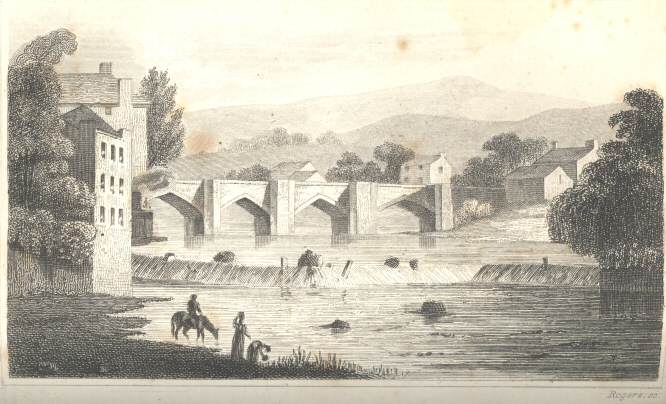
Chester
|
23
|
Chirk
|
7
|
Corwen
|
10
|
London
|
183
|
Oswestry
|
12
|
Ruabon
|
6
|
Ruthin
|
15
|
Wrexham
|
12
|
The name of this place is derived from the dedication of its
church to an ancient British saint named Collen, whose lineage
runs thus, in names almost unpronounceable by Saxon
tongues—St. Collen ap Gwynnawg ap Clydawg ap Cowrda ap
Caredog Freichfras ap Llyr Merim ap Einion Yrth ap Cunededd ap
Wledig. The town, which is beautifully situated in a deep
narrow valley, enclosed by lofty mountains, and watered by the
noble stream of the Dee, appears anciently to have been protected
by the neighbouring fortress of Castell Dinas Bran, situated on
the summit of a vast conical hill in its neighbourhood. The
houses are in general old or rather mean in appearance, though
occasionally interspersed with some modern handsome dwellings;
and there is excellent accommodation for the numerous visitors
who frequent the neighbourhood during the summer season.
The pure air and mild temperature cause a number of families to
adopt this locality as a permanent retreat. The Hand, the
King’s Head and Royal Hotel, are the two principal
inns. Population, 1500.
Here is a stone bridge over the Dee, consisting of four
pointed arches, erected in the year 1345, by John Trevor, Bishop
of St. Asaph, and which was anciently regarded as one of the
wonders of North Wales. The scenery of the neighbourhood is
pre-eminent for its grandeur and sublimity, and for its
picturesque and romantic beauty.
The church is an ancient structure, with small pretensions to
architectural beauty, except some fine carvings on the roof and
other parts of the interior. The view from the churchyard
is remarkably pretty, embracing the bridge, the weir, and Crow
Castle. The talented and self taught clerk, Mr. Jones, may
be consulted by writers with profit, as a person of considerable
attainments and general information. The church services
are alternately in the Welsh and English language.
The market is held on Saturday, and is well supplied with
butcher’s meat, but very little corn is sold. By the
late act for amending the representation, Llangollen has been
made a polling-place in the election of knights for the
shire.
a district long celebrated in prose and verse for its varied
beauties, is bounded on each side by lofty mountains of imposing
grandeur. It is certainly a charming and romantic spot; and
though not so grandly impressive, or so surpassingly beautiful as
some of the other Welsh valleys, its lovely features become more
attractive on a familiar acquaintance. A remarkable range
of lime-stone hills, called the Eglwyseg Rocks, adds a singular
variety to the landscape. It is almost needless to observe
that “Llangollen, that sweetest of vales,” is the
scene of the home of “Jenny Jones,” whose charms are
sung in Charles Matthews’ popular ballad.—In this
vale, and within a quarter of a mile from the town, stands
the famed retreat of Lady Eleanor Butler and Miss Ponsonby,
better known, probably, as the two recluses of Llangollen
Vale. These two females, delighted with the scenery around
Llangollen, when it was little known to the rest of the world,
sought here, about the year 1778, a philosophical retirement from
the frivolities of fashionable life, and selected and improved a
dwelling that commands a fine mountain prospect, which obtained
the name of Plâs Newydd. This elegant little cottage
is situated on a small knoll, and surrounded by very tasteful
grounds.
The peculiar style in which these ladies decorated their
retreat has been much discussed. A palisade, ornamented
with antique and grotesque figures carved in oak, enclosed the
front; and the doors and windows were decorated with carving of
the same material. The rooms were tastefully adorned with
drawings. A carriage drive, open to strangers, crosses the
lawn immediately in front of the cottage. Lady Eleanor
Butler died June 2, 1829, at the advanced age of 90, and Miss
Ponsonby, Dec. 9, 1831, aged 76: both were interred in the
churchyard of Llangollen. To their memory is erected a
monument of unique and elegant structure. It has three
sides, on each of which there is an appropriate epitaph; one for
Lady Eleanor Butler, another for Miss Ponsonby, and the other for
their youthful servant, Mary Carrol, who had accompanied them from
Ireland, the country of their birth, to this delightful
retirement.
The whole property was consigned to the hammer in 1832, and
was purchased by two other maiden ladies, viz. Miss Lolly and
Miss Andrew, who seemed inclined to emulate the retirement of its
former possessors.
There are many other genteel villas and country residences,
within a convenient distance of the town, deserving of
notice.
is situated on a high and somewhat conical hill, about a mile
from Llangollen. The building has been about a hundred
yards long, and fifty in breadth; and it formerly occupied the
whole crown of the mountain. From its extremely elevated
situation (being about 910 feet above the surface of the Dee at
Llangollen bridge), it must have been a place of vast
strength. On the side which is most accessible, it was
defended by trenches cut through the solid rock. The
present remains consist of nothing more than a few shattered
walls. There is a well of pure water on the top of the
hill.
The views hence on every side are very grand. Towards
the east stretches the whole vale of Llangollen, through which
the Dee foams over its rocky bed; and beyond the vale is seen all
the flat and highly cultivated country that extends for many
miles. Just beneath lies the town of Llangollen, and
towards the west is the vale of Crucis, with its back-ground of
lofty mountains, whose dark sides are agreeably varied with wood
and meadow. This fortress, from the style of its
architecture, is evidently the work of the Britons; but by whom
built, or when demolished, is a matter of mystery. Old
Churchyard, who visited it in the sixteenth century, calls it
“an old ruynous thing.”
or, as it is called by the Welsh, Monachlog Llan
Egwestl, about two miles from Llangollen, and one mile and a
half from Castell Dinas Bran, on the right of the road towards
Ruthin, is a grand and majestic ruin, affording some noble
specimens of ancient Gothic architecture. There are still
remaining of the church the east and west ends, and the south
transept. Several pillars and arches also remain as
interesting memorials of this exquisite relic of a past age.
The
cloister on the south side, which a century ago, was only a
shell, is now converted into a dwelling-house, the residence of
the person who farms the adjacent lands. Three rows of
groined arches, on single round pillars, support the dormitory,
which is now a loft for containing corn, approached by steps from
without. The area of the church is overgrown with tall ash
trees, which hide from the sight some part of the ruin, but
contribute greatly to its picturesque beauty.
Vale Crucis was a house of Cistercian monks, dedicated to the
Virgin Mother. It was indebted for its foundation, about
the year 1200, to Madoc ap Griffith Maelor, Lord of Bromfield and
Dinas Brân, who, after various successes, and acquiring
much booty by the reduction and ruin of English castles,
dedicated a portion of his booty to the service of
religion. He was interred here. At the dissolution
the revenues appear to have amounted to about £200 per
annum. A short time ago, the burial place of the monks was
accidentally discovered, in the garden at the back of the
farm-house, where many of their remains were found, which must
have been there in an undisturbed state for six hundred
years.
The Vale of Crucis is indebted for its name to this cross or
pillar, which is to be found in a field near the abbey, and just
opposite to the second mile-stone from Llangollen. This
pillar is very ancient. The Rev. John Price, Bodleian
librarian, (uncle of Dr. Price of Llangollen,) a great antiquary,
wrote to Mr. Lloyd, of Trevor Hall, respecting this long
neglected pillar, and at his suggestion it was placed in the
position it now occupies. It appears to have been erected
upwards of a thousand years ago, in memory of Eliseg (the father
of Brochwel Yscythrog, Prince of Powys, who was slain at the
battle of Chester in 607), by Concenn or Congen, his great
grandson. The inscription is much defaced, so that it
cannot be satisfactorily traced. The shaft was once above
twelve feet long, but having been thrown down and broken,
sometime during the civil wars, its upper part, only about eight
feet in length, was left. After these commotions, it was
suffered to lie neglected for more than a century.
From Llangollen, most tourists visit this stupendous work of
art. It is a wonderful effort of ingenious contrivance, and
affords a convincing proof of the incalculable capability of
human energies when directed by science. This aqueduct was
constructed for the purpose of conveying the Ellesmere canal over
the river and vale of the Dee. It was commenced in 1795,
from designs by Mr. Telford, and completed in ten years.
Its direction is from north to south, crossing the Dee at right
angles; and it forms, in connexion with the exquisite scenery
surrounding it, a noble and magnificent picture. To view it
to the best advantage, the stranger must descend on one side of
it, into the valley beneath; he will then be impressed with its
stupendous character. Though the aqueducts of the Romans
were superior in length, in other respects they were inferior to
this modern structure.
The tourist may proceed along the high road towards Chirk,
four miles from the town, where a turning to the left will
conduct him to Pont Cysylltau Aqueduct; or crossing the bridge at
Llangollen, ascend the hill to the canal, and walk along its
banks till he arrives at the aqueduct. The high road is
preferable, as it commands some engaging prospects.
The aqueduct, in length 1007 feet, consists of nineteen
arches, each 45 feet in the span, with the addition of 10 feet 6
inches of iron work in continuation at each end. The
supporting piers are stone, of a pyramidal shape, measuring at
the base 21 feet by 14 feet wide; but diminishing upwards to 12
feet by 7 at the top; and their height about 116 feet. Over
this immense arcade is extended a trough, or large open caisson,
made of cast iron, 11 feet 10 inches broad, by which the water of
the canal is conveyed over the river 1009 feet to the opposite
level. Two iron plates are screwed together from centre to
centre of each arch; and along one side of the canal is a towing
path, four feet in breadth, with a handsome iron balustrade, as a
defence for man and horse. The elevation collectively will
stand thus:—
|
Feet.
|
Inches.
|
Height of piers
|
116
|
0
|
Depth of trough, or caisson
|
5
|
6
|
Height of balustrade
|
4
|
7
|
Total height from surface of the
Dee
|
126
|
1
|
At the southern end is an embankment of earth, 1500 feet in length,
and seventy-five feet in height nearest the abutment of the
arches. The whole undertaking is said to have cost
£47,069 : 6 : 7.
On the centre arch is the following
inscription:—“The nobility and gentry of the adjacent
counties, having united their efforts with the great commercial
interest of this country, in creating an intercourse and union
between England and North Wales, by a navigable communication of
the three rivers, Severn, Dee, and Mersey, for the mutual benefit
of agriculture and trade, caused the first stone of this aqueduct
of Pont Cyssyllte to be laid on the 25th day of July, MDCCXCV,
when Richard Myddelton, of Chirk, Esq., one of the original
patrons of the Ellesmere canal, was Lord of the Manor, and in the
reign of our Sovereign George the Third; when the equity of the
laws and the security of property promoted the general welfare of
the nation, while the arts and sciences flourished by his
patronage, and the conduct of civil life was improved by his
example.”
The antiquarian will find some interesting remains in this
neighbourhood worthy of investigation. Amongst them is a
square tower, very strongly built, in advance of and at the foot
of the hill on which Crow Castle stands. For many years it
has been appropriated as part of a farm-house, called ‘The
Tower.’ The walls of the original building or tower
are very thick; and in one corner of the quadrangle there is a
winding stone staircase, now concealed by a bookcase. The
probability is that this old tower was an advanced station
belonging to the castle. There are also vestiges of a
nunnery or monastery at a place called Pengwern.
About six miles from Llangollen, on the Ruthin road, is a
curious old building, called Rhydidris, near Llandaglan.
The site, the extensive stabling, and the antique curiosities in
the house, raise the probability that it has been garrisoned, and
also been a military station of great importance.
The Shrewsbury and Chester Railway Company intend to run a
branch from their main line at Ruabon to Llangollen.
The Dee
|
from Corwen to Llangollen.
|
“ “
|
from Llangollen to Overton.
|
Bala
|
11
|
Llanfyllyn
|
7
|
Llanrhaiadr
|
6
|
Llangynog (the church of St. Cynog) is a small village,
situated in a pleasing slip of fertile land, above which rises a
stupendous rock of coarse slate. The river Tanat, which
runs through this village, is celebrated for its delicious
trout. The upper end of the vale is bounded by two vast
precipices; between them juts out the rude promontory of Moel ddu
Vawr. On the north side of this valley is the house of
Llechwend-garth, the occasional residence of the late Thomas
Thomas, Esq. of Downing, near Holywell, whose daughter married H.
Davies Griffith, Esq. of Caer-Rhûn, Caernarvonshire, who,
in consequence, became possessed of this estate, and was in 1835
high sheriff of the county of Montgomery. The new inn
affords tolerable accommodations.
At Craig-y-Mwyn. somewhat more than two miles from the
village, in 1692, a vein of lead ore was discovered, so valuable
as to yield to the Powys family a clear revenue of at least
£20,000 a year. It had been worked to the depth of
about one hundred yards, when on a sudden the water broke in with
such continuous power, that the proprietor was compelled to
abandon the undertaking. About the commencement of the
present century, however, the mine was leased by a company, who
drove a level beneath it, in order to draw off the water, and
continued the working of it for some time; they occasionally
found masses of pure ore, weighing from 70 to 1001b. each.
After some time the works were again discontinued, until a few
years ago, when the old shaft was reopened, and the operations
proceeded with considerable success.
At Craig-y-Gribin, in this parish, are some quarries of
excellent blue slate, of strong and durable quality.
This is a small village, situated near the west coast of the
promontory of Lleyn. Its church, standing on an eminence,
forms a
good land-mark.—Between this place and the sea, the lofty
range of the Rival (or Yr Eifl) Mountains, which form conspicuous
objects from Caernarvon and other parts of the country.
Upon the first of these eminences, about a mile from Llanhaiarn,
is Tre ’r Caeri (or the Town of Fortresses), which Mr.
Pennant describes as “the most perfect and magnificent, as
well as the most artfully constructed British post he ever
behold.” The only accessible side was defended by
three walls, which appear to have been very lofty. The area
is irregularly shaped, and near the centre is a square space
surrounded by the fragments of habitations.
Caernarvon
|
3
|
Llanedwen
|
2
|
Menai Bridge
|
6
|
Plas Newydd
|
3
|
Llanidan is a little village, near the shores of the Menai,
not far from the spot where the Romans landed, headed by
Suetonius Paulinus, who murdered the Britons by thousands.
It is called, by Rowlands, Maes Mawr Gad (the Great Army’s
Field). It lies three hundred yards from the Menai, and
consists of about twenty acres. The Romans entered the
water about two hundred yards south of Llanfair-is-caer church,
where the shore is flat, the water shallow, and only three
quarters of a mile wide. At low water, and at neap tide,
most of the bed is dry.
After the death of Nero, in the year 67, the natives, after
six years of thraldom, threw off the Roman yoke, the Druids
returned and assumed their authority and property, which they
held till the year 76; when Agricola crossed the Menai, nearly a
mile farther north, landed at a field yet called Pont or
Pant-yr-Yscraffiau (Bridge of Boats), where the same tragedy was
re-acted in this and the two adjoining fields.
The locality abounds with an interesting variety of druidical
remains. Lord Boston has a residence and a park here: the
house is a clumsy building, but the situation is most
pleasant.
Aberystwyth
|
30
|
Devil’s Bridge
|
19
|
London
|
193
|
Machynlleth
|
20
|
Newtown
|
14
|
Plinlimmon
|
7
|
Llanidloes (the Church of St. Idloes) is pleasantly situated
near the Severn. The population of the whole parish is
4261, including 2562 inhabitants of the town, who are principally
employed in spinning and weaving of flannels, the manufacture of
which has been established in this town from a very early period,
and has continued materially to increase; the softest and most
durable texture is made here. The principal inn is the New
Inn, an excellent and well conducted establishment, where
post-chaises and other vehicles may be had; the Queen’s
Head, Red Lion, and the Crown, are also respectable houses, where
travellers may be well accommodated. By the late Reform
Act, this town was made one of the contributory boroughs of the
county.
The church was originally founded towards the close of the
fifth or at the beginning of the sixth century. Of the
original building the towers only remain. The present
structure was built about 200 years ago. In 1816, the
chancel and south wall were rebuilt; at the same time the church
was renewed; and a set of new bells was hung in the tower in
1824. As is usual in all the Welsh towns, there are places
of worship for various dissenting congregations. The
market-day is on Saturday.
A few years ago, a handsome stone bridge of three arches was
erected over the Severn, at a considerable expense; and a new and
excellent line of road was opened from hence to Rhaiadr, which
makes a direct and regular communication between North and South
Wales. Lord Mostyn is lord of the manor; a court leet is
held once a year, at Michaelmas, when officers are appointed, in
whom the government of the place is vested. In the vicinity
of the town are several handsome residences, the property of
opulent individuals.
Within eight miles of Llanidloes, in the parish of
Llanbrynmair, are two fine waterfalls, near to each other, of
which the principal, called Ffrwd Vawr, is very grand, especially
after heavy rains; the water having a perpendicular descent of
more than one hundred and thirty feet.
Within the limits of Llanidloes parish is partly included the
lofty mountain of Plinlimmon, (or, more properly, Plumlumon, the
five-peaked mountain) which is the highest in the several chains,
of which it forms the centre: and from this place the ascent to
its summit is usually made, being only seven miles distant from
the town, whence guides from the principal inns are
provided. From the highest point is obtained a fine
prospect of vast extent, comprehending on the south, the hills of
Cardiganshire and Radnorshire; on the west, Cardigan bay and St.
George’s channel; on the north, Cader Idris and part of the
Snowdon range of mountains, separating the counties of Caernarvon
and Merioneth; on the north-east, the Breiddyn hills, in
Montgomeryshire; and on the east, part of the counties of
Hereford and Salop. This mountain derives a considerable
degree of interest from its giving rise to the rivers Severn,
Wye, Rheidiol, and Llyvn-nant; of which the former is secondary
only to the Thames in commercial importance; whilst the Wye and
the Rheidiol surpass all other rivers in Britain for the
picturesque beauty of their scenery.
The Severn, here called by its ancient British name of Havren,
rises on the northern side of the mountain, in a stony chalybeate
spring, and is speedily joined and increased by other springs
rising near to its source, and by several mountain torrents,
before it reaches Llanidloes.
The Wye rises from two powerful springs on the south-eastern
side of the mountain, and after a long circuitous course, falls
into the Severn near Chepstow.
The Rheidiol has its source in a pool called Llyn Llygad
Rheidiol, and falls into the sea at Aberystwyth.
The Llyvn-nant issues from a pool called Glâs Llyn.
About twenty years ago, Llyn Llygad was entirely without
fish. Two gentlemen, one of whom was the late Captain
Jones, R.N., of Machynlleth, were grousing on Plinlimmon, when
the conversation turned on the peculiarity of this lake being
entirely destitute of the finny tribe, and the possibility of
stocking it from a neighbouring rivulet. A staff net was
procured, and some dozens of small trout caught in the river
Rheidiol were thrown into the lake, which at that time swarmed
with millions of horse leeches. Some of the trout, when
placed in the pool, lay upon their sides faint and exhausted: and
strange as it may appear, the rapacious leeches attached
themselves to the sick fish, and actually devoured them.
Others of the trout were vigorous; these and their progeny have
enforced the lex talionis with a vengeance; and while the
fish abound, not a leech is now to be seen.
At Melin Velindre, on the route to Plinlimmon, is a romantic
cataract, and near a sheep farm, called Blaen Havren, the Severn
rolls its waters over a lofty ledge of slate rocks, in which
gullies have been found of picturesque shapes.
About two miles from the town, on the south-east, is a
spacious pool, called Llyn-ebyr, extending over a surface of
nearly one hundred acres; it abounds with pike, eels, and perch,
and affords excellent fishing; it is frequented by wild fowl; and
during the summer season it is the resort of parties of pleasure,
for whose accommodation boats belonging to gentlemen in the
vicinity are kept on the pool.
Distance from
Llanidloes.
|
Miles.
|
The Clywedog
|
|
Bodaioch, on the Tavannon
|
5
|
Glan Trevnant
|
5
|
Llandinam
|
6½
|
Llangurig
|
5
|
Llanrhaiadr (the Village of the Cataract), on the road between
Ruthin and Denbigh, is situated on a small eminence in the
fertile vale of Clwyd. It derives its name from a spring at
a short distance, called Ffynnon Ddyfrog, where once was a bath
and chapel, dedicated to St. Ddyfrog.
The church is a very interesting and handsome structure.
On the east window is a painting of the genealogy of Christ from
Jesse, executed about 1533. In the church-yard is a curious
inscription to John ap Robert, whose pedigree is traced up to
Cadell, king of Powys.
The scenery, both to Denbigh and Ruthin, is all the way
extremely beautiful.
Bala
|
18
|
Llanfyllyn
|
5
|
Llangynog
|
6
|
Oswestry
|
14
|
This is a small village situated at the extremity of the
county, in a deep hollow, surrounded by mountains.
Dr. William Morgan, the first translator of the Bible into
Welsh, was vicar of this place. He was promoted to the
bishopric of Llandaff, and in 1601 to that of St. Asaph, where he
died in 1604. This valley is called Mochnant, (the Vale of
the Rapid Brook) at the extremity of which, distant from the
village about four miles and a half, is
(The Spout of the Cataract) reputed to be the largest
waterfall in Wales. The little river Rhaiadr here falls
down an almost perpendicular black crag, of 240 feet in
height. For about two-thirds of this space, the water
slides down the flat face of a naked rock; it rages thence
through a natural arch, and, passing between two prominent sides,
falls into a basin. It then passes though a well-wooded
dell, forming a boundary line which separates the counties of
Denbigh and Montgomery, and after assisting to form some pretty
scenes, falls into the Tanat. Near to the waterfall is a
neat inn, built in the Gothic style, by Sir W. W. Wynn, where the
stranger may meet with tolerable accommodation.
Abergele
|
22
|
Bettws-y-Coed
|
4
|
Cerniogau
|
14
|
Capel Curig
|
10
|
Conway
|
12
|
Denbigh
|
22
|
Llanrhychwyn
|
2½
|
London
|
218
|
Maen-Twrog
|
20
|
This town is pleasantly situated on the western bank of the
river Conway, which here forms the boundary between the counties
of Denbigh and Caernarvon, in the spacious and beautiful vale of
Llanrwst, environed by majestic and well-wooded hills, the land
at the foot of which is plentifully watered and remarkably
fertile. The town consists principally of small houses and
shops, with a population of 3905 inhabitants. It has a
market on Tuesday, and a branch of the North and South Wales
bank. The Eagles is the principal inn; but a good house of
public entertainment is sadly wanted here.
The bridge over the Conway, leading to Gwydir, is an elegant
structure, built about the year 1636, from a plan by the
celebrated Inigo Jones, at an expense of £1000, defrayed
conjointly by the two counties which it connects. It is an
extraordinary fact that a vibration of the bridge may be caused
by any person standing above the middle arch and forcing himself
rather smartly against the parapet.—Excellent roads have
lately been made, communicating with the London, Holyhead, and
Chester roads, and also with Denbigh and St. Asaph, the improved
state of which has induced a considerable increase of visitors,
during the summer months, to view the picturesque and much
admired scenery of this neighbourhood.
Llanrwst was formerly noted for making harps; at present the
spinning of woollen yarn, and the knitting of stockings,
constitute the principal branches of trade. In the
market-place stands the town-hall, a substantial structure,
rebuilt in 1842.
The original church, dedicated to St. Grwst, was a small
edifice, situated close to the margin of the river, and built
about the year 1170; and was supposed, from its style of
architecture, to have been erected in the fifteenth century: it
contained a screen of beautifully carved oak, brought here from
the abbey of Maenan, which was used as a gallery for the
singers. A new church has, however, been built on its site;
and adjoining it, on the other side, is Gwydir chapel, a handsome
square castellated edifice, the interior of which is decorated
with a profusion of carved work; it was built by Sir Richard
Wynne, from a design by Inigo Jones, in 1633, as a burial place
for his family, the deceased members of which had previously been
interred in the chancel, and contains many elegantly engraved
brasses, exhibiting portraits of several of this family. On
the eastern wall is a slab of white marble, recording the
pedigree of the founder, and tracing his ancestors to Owen
Gwynedd, prince of North Wales. On the southern wall is a
mutilated monument to the memory of Sir John Wynne, Bart., a
learned antiquary, and an indefatigable gleaner of materials for
the illustration of Welsh history. In the centre of the
chapel, upon the floor, lies the stone coffin of Llywelyn the
Great, who died in 1240, and was interred in the abbey which
he had founded at Aberconway, thence removed to Maenan, and from
that place, at the dissolution, the coffin was brought to the old
parish church of Llanrwst, where it remained obscured by rubbish,
until placed in its present more appropriate situation. The
same attention has likewise been paid to another piece of
antiquity placed near it, a recumbent armed effigy of Howel
Coetmor, grandson of Davydd, brother to Llywelyn ap Gruffydd; he
was the owner of the Gwydir estate, which was sold by one of his
descendants to the family of Wynne. There are in the parish
eleven places of worship for dissenters. A new church,
called by the inhabitants the English church, has lately been
erected about half a mile from Llanrwst. It is a neat and
commodious edifice.
This ancient mansion, about half a mile distant from the town,
beautifully situated amidst extensive woods of oak, which clothe
the rocks projecting between the rivers Conway and Llugwy, near
the foot of a lofty precipice called Carreg y Gwalch, or the Rock
of the Falcon, was erected by John Wynne ab Meredydd, in 1555,
and comprised an extensive, but somewhat irregular pile of
buildings, ranged in a quadrangular style, and consisting of an
inner and outer court. A great part of this edifice was
taken down in 1816, since which time the present structure,
though on a much smaller scale, has been built. A small
portion of the former mansion still remains, and is fitted up in
an antique and elegant style. That part which was built by
Meredydd still remains, and contains some magnificent rooms, in
which are several articles of furniture made from the druidical
oaks of ancient times, and the cradle which nurtured Sir John and
Sir Richard Wynne is still to be seen. The pleasure grounds
are laid out with great taste, and contain a good collection of
plants. Mary Wynne, afterwards Duchess of Ancaster, the
last of this great race, conveyed the property to that family,
and Lord Willoughby d’Eresby now possesses it in right of
his lady.
This delightful vale, which is neither so widely extended as
the Vale of Clwyd, nor so contracted as that of Llangollen, is
regarded by the admirers of picturesque scenery, as exhibiting the most
varied assemblage of beautiful features which the pencil could
delineate. Mr. Burke has pronounced it “the most
charming spot in Wales.” The prospect of the dense
woods and towering hills which enclose it on each side, is
enlivened by the sparkling waters of the sportive Conway, which
present an animated scene, either of small vessels arriving at
the village of Trefriw, or of the diminutive boats, called
coracles, used in fishing for salmon and smelts, considerable
quantities of which are caught in their respective seasons.
At Mayne, within a mile of Llanrwst, is a spring of high repute,
and frequently used with great effect as a cold bath.
In the valley called Nant Bwlch yr Haiarn, near Gwydir, is a
cataract which falls about 100 feet, called Rhaiadr-y-Parc
Mawr. The quantity of water, however, is seldom large
enough to produce much effect. About two miles and a half
from Llanrwst, on the Conway road, is the small but beautiful
village of
situated on an eminence commanding a delightful and extensive
view of the Vale of Llanrwst. Near and above this lovely
spot is the celebrated lake of Geirionydd, on the banks of which
lived the illustrious bard Taliesin, called by his countrymen, by
way of distinction, “Taliesin ben Beirdd,” the chief
of the bards. About a mile from Llyn Geirionydd is the
mountain village of Llanrhychwyn. Lord Willoughby
d’Eresby has erected a monument which his lordship intended
should identify the spot where the poet resided. Here, in a
sort of hollow, formed on the summit of a mound, are still to be
seen some remains of an ancient habitation. The river
Conway is navigable from its mouth to Trefriw, for vessels of 60
tons burden, which bring coal, lime, timber, and grocery, for the
supply of the inhabitants of the town and neighbourhood, and
carry back the produce of the slate quarries and mines of the
adjoining parishes. Five miles S. E. of Llanrwst, is
a small village, very poor and primitive indeed, once
celebrated as the burial place of St. Winefred, but the
pilgrimages to it are now few and far between.—Three miles
to the north stood the Abbey of Maenan; but a large old house
built out of its ruins now occupies its place.
Distance from
Llanrwst.
|
Miles.
|
Bettws-y-Coed
|
5
|
Trefriw
|
2½
|
Dolgarrog
|
4
|
Llanbedr
|
5
|
Dolwyddelan
|
8
|
Various Lakes
near Llanrhychwyn and Dôlgarrog, viz.
|
Llyn Geirionydd
|
4
|
Llyn Bogynmyd
|
3
|
Llyn Cowlyd
|
6
|
Llyn Afangc.
|
Llyn Tal-y-llyn, and Llyn Crafnant, near
Llanrwst.
|
Aberdovey
|
10
|
Aberystwyth
|
18
|
Chester
|
70
|
Dolgelley
|
16
|
Llanidloes
|
20
|
London
|
208
|
Newtown
|
28
|
Towyn
|
14
|
Machynlleth is an ancient well-built town, superior to most in
North Wales for cleanliness and respectability, the streets being
remarkably spacious and regular in appearance. It is
situated on the road leading to Aberystwyth from Shrewsbury and
North Wales, about a quarter of a mile from the southern bank of
the river Dyfi. The township contains a population of
2482. It is the centre of the woollen manufactory in this
part of the country, where also some tanning business is carried
on. The Eagles is accounted the principal inn, and the
Unicorn Arms, in the middle of the town, has obtained a good
repute for excellent accommodation. The name of this town
signifies the place of the river Cynllaeth, which was the ancient
name of the Dyfi or Dovey, in the valley of which it
stands. It is the supposed Maglana of the Romans, where, in
the reign of Honorius, a lieutenant was stationed to awe the
mountaineers.
Here Owen Glyndwr summoned the nobility and gentry, of Wales
in 1402. Amongst the number, Sir David Gam attended with
the design of murdering Glyndwr, but the plot was discovered, and
Sir David was seized. He would have suffered
instantaneous death, had not some powerful friends interfered,
through whose intercession his sentence was mitigated to
confinement at Machynlleth, where he continued some time.
But Sir David was scarcely set at liberty, ere he began to
manifest a turbulent disposition; which so exasperated Glyndwr,
that he burnt his house in resentment, uttering to Gam’s
servant the following extemporaneous stanza:—
Os gweli di wr coch cam,
Yn ’mofyn am Gyrnigwen;
Dywed ei bod hi tan y lan,
A nod y glo ar ei phen.
David, however, escaped this meditated vengeance by flying
into England, where he continued in favour at the court of Henry
the Fifth.
In the august assembly called Owen’s parliament, Glyndwr
exerted his first acts of royalty, being then acknowledged as the
Prince of Wales, and proclaimed and crowned.
Machynlleth has a neat and commodious church, which has
recently been rebuilt. The town-hall or market-house was
erected in 1783, by Sir W. W. Wynn, grandfather of the present
owner of Wynnstay, who is lord of the manor, and holds courts
leet twice in the year. The county court is held
alternately here and at Montgomery, and the petty sessions for
the hundred are held here occasionally. There are places of
worship for Independents, Calvinists, and Wesleyan Methodists;
and a national school liberally endowed.
The new line of road from Machynlleth to Towyn is exceedingly
picturesque and beautiful, particularly that part of it lying
between Penal and Aberdovey, which is cut out of the solid rock,
and was opened in 1827; it passes along the northern bank of the
Dovey, and affords most delightful views of the opposite coast of
Cardiganshire, with the sea in the distance.
Bala
|
22
|
Bedd-gelert
|
10
|
Capel Curig
|
22
|
Caernarvon
|
23
|
Dolgelley
|
18
|
Ffestiniog
|
3
|
Harlech
|
10
|
Slate Quarries
|
5
|
Tan-y-Bwlch
|
0¼
|
Tremadoc
|
10
|
The Cataracts
|
2
|
This is a small village, situated in the most romantic part of
the highly picturesque vale of Ffestiniog, on the southern bank
of the river Dwyryd. It derives its name from a large
stone, still remaining in the church-yard, called Maen-Twrog,
erected to the memory of a British saint, who died about the year
610. The church was rebuilt on the site of the ancient
structure in 1814, and is a neat stone edifice with a square
embattled tower. The Rev. Edmund Prys, Archdeacon of
Merioneth, one of the most eminent poets of his time, was rector
of this parish: he translated the metrical psalms used in the
Welsh churches, and assisted Bishop Morgan in translating the
Bible. He died in the year 1623, and was buried in
Maen-Twrog church. Nothing can exceed the beauties of the
little vale in which the village is built; the well-wooded hills
are moderately high, and scattered with pleasing effect.
There is a comfortable inn here, where neat cars may be
had. A Sunday school was lately erected, at the expense of
Mrs. Oakley. Within sight of the village, and about a
quarter of a mile distant, on the opposite side of the river,
is
that is, Below the Pass, which is one of the most beautiful
and celebrated places connected with the range of Snowdonian
mountains. It takes its name from being situated at the
brow of a hill, where it overlooks the vale of Ffestiniog; and
from Plâs Tan-y-Bwlch, the residence of the late W. G.
Oakley, Esq., which is delightfully and romantically
situated. The prospect from the terrace of this mansion is
most splendid and interesting, embracing the glorious scenery of
the vale of Ffestiniog, the river Dwyryd in all its meandering
windings, the range of Merionethshire mountains in the distance,
the majestic castle of Harlech, and the lake-like intervening
views opening into Cardigan bay.
The
Oakley Arms, an elegant hotel, is conveniently situated in the
centre of the many attractive objects of this romantic
district.
Several Roman antiquities have lately been found near this
place, consisting of coins, urns, and inscribed stones, some of
which are in the possession of Mrs. Oakley, and of J. Lloyd, Esq.
of Pen-y-Glanau, who has also an extensive collection of
antiquities, found in different parts of the Principality.
About two miles on the Harlech road, up a woody valley, are
two most interesting waterfalls, on the Velin-Rhyd river, one
called the Rhaiadr Dû, or the Black Cataract, and the other
the Raven Fall. From the former the water rushes down a
steep channel for about one hundred yards, and is thence thrown
with great force over three rocks, each of which takes a
different direction from the others: the depth of the fall is
about forty feet. The latter is not more than a quarter of
a mile distant, and in equal in beauty and grandeur. It
consists of six different falls, each of which, about thirty feet
in extent, is beautifully picturesque, and, as seen from the base
of the rock over which the river descends, has a sublime and
romantic appearance. There are also several other falls of
minor interest on the streams that water the vale. At a
cottage near the bridge, which the tourist will cross before he
leaves the main road from Maen-Twrog, a guide to the falls may be
obtained.
After the natural beauties of this lovely district, the object
of the greatest attraction is the Ffestiniog railroad, for the
conveyance of slates from the Ffestiniog quarries to Port Madoc,
which is cut through rocks nearly the whole length of fourteen
miles, and forms an inclined plane the whole distance, the fall
of which is equal to one in one hundred and twenty, and the
descent from its commencement to its termination is a most
delightful ride, through an infinite variety of sublime and
interesting scenery. For the accommodation of tourists and
visitors, a carriage, connected with the Oakley Arms Hotel, has
been placed on the line.
The quarries with which the railway is in connexion produce
the best and most valuable kind of slate. They belong to
Lords Newborough, Palmerston, and Powlett; Mrs. Oakley; S.
Holland, J. Greaves, W. Turner, and Thomas Casson, Esquires.
Bala
|
19
|
Can-Office
|
12
|
Dinas Mowddwy
|
1½
|
Machynlleth
|
12
|
This is a little village, placed between the salient angles of
three abrupt mountains, Arran, Camlan, and Moel Dyfi, in a small
valley surrounded by many delightful scenes, through which runs
the river Dyfi, or Dovey.
The falls of the Dovey at Pont Fallwyd, about half a mile
distant, are particularly romantic and beautiful.
The church is a very humble Gothic structure. The
churchyard is remarkable for several large yew trees, one of
which measures twenty-two feet in girth, and forty feet in
height.—Mallwyd has a good inn, where post chaises may be
procured.
Chester
|
12
|
Denbigh
|
16
|
Flint
|
6
|
Hawarden
|
6
|
Holywell
|
10
|
London
|
200
|
Northop
|
3
|
Ruthin
|
10
|
Wrexham
|
11
|
The ancient British name of this place, (Yr Wyddgrûg),
signifying a Lofty and Conspicuous Hill, and also the Roman name
of Mont Altus, of like import, were derived from a high mound on
the north-western side of the present town, now called the Bailey
Hill, a commanding eminence, partly natural, and partly
artificial, upon which a fortification appears to have been
erected at a very early period, but whether by the ancient
Britons, or by the Romans, is not accurately known. It is
seated in a pleasant valley, watered by the river Alyn; consists
principally of one long spacious street; and in 1841, with that
part of the township immediately adjoining, contained 10,653
inhabitants. By the late Act for amending the
representation, Mold has been constituted a borough, contributory
with Flint and the other boroughs in the county, in the return of
a member to Parliament.
In the environs are numerous handsome seats and elegant
mansions. The principal inns are the Black Lion and
Leeswood Arms hotels. To the former a spacious assembly
room has lately been added, and many agreeable balls are there
given. The parish abounds with mineral wealth; the western
district
is rich in lead ore, which is generally found imbedded in
limestone, or chirtz; but the operations are much impeded by the
subterraneous stream of the Alyn, which here flows under ground
for the space of upwards of half a mile. Numerous tumuli
are found in various parts of the parish. In October 1833,
some workmen, digging in a field near the town, discovered a
human skeleton, having at its feet an earthern pot, which
apparently contained ashes; and on the breast, with other metal,
a large plate of gold, much ornamented, valued at the sum of
£70: the trustees of the British Museum became the
purchasers of these antique relics.
In the neighbourhood are various works for smelting lead, and
an extensive cotton mill.
The county assizes are held in Mold. A new county hall
has been erected in the old English style of architecture, from a
design by Thomas Jones, Esq., architect, of Chester.
The church, dedicated to St. Mary, and said to have been
erected in the early part of the sixteenth century, is a spacious
and handsome structure, consisting of a nave, north and south
aisles, and a chancel, with a lofty square embattled tower,
enriched with sculpture and crowned with pinnacles, which though
of more recent erection, precisely correspond with the general
design. The interior of the church is embellished with
architectural details and sculptured monuments. Among
numerous monuments worthy of examination, is an elegant one to
the memory of Richard Davies, Esq., of Llanerch; and against a
pillar of the nave is this singular epitaph, composed by Dr.
Wynne for himself, and placed there during his
life:—“In conformity to ancient usage, from a proper
regard to decency, and a concern for the health of his
fellow-creatures, he was moved to give particular directions for
being buried in the adjoining churchyard, and not in the church;
and as he scorned flattering of others while living, he has taken
care to prevent being flattered by others when dead, by causing
this small memorial to be set up in his lifetime: God be merciful
to me a sinner!” In the burial ground are deposited
the remains of Wilson, the celebrated painter, styled “the
English Claude.” There are places of worship for
various denominations of dissenters. A branch railway from
Mold, to form a junction with the Shrewsbury and Holyhead lines,
at Saltney, near Chester, will soon be constructed.
Of the ancient castle not a vestige at present can be discerned,
and its very site is completely covered with thriving
plantations. The Bailey Hill, on which it stood, though at
present difficult of ascent, was rendered still more arduous by
the erection of strong ramparts and the formation of a deep moat:
from the summit of this hill a fine view of the surrounding
country is obtained. About a mile west of Mold is a noted
spot of ground, called
Or the Field of Germanus. Soon after the final
establishment of Christianity in this part of the Principality,
about 448, a severe conflict took place here, between the
combined forces of the pagan Saxons and Picts, and the native
converts, of whom thousands had been just previously
baptized. The latter calmly awaited the approach of the
enemy at this place, under the command of Bishops Germanus and
Lupus, the former of whom, having given his troops orders to
repeat after him the word “alleluiah,” led them on to
battle.
This triumphant shout, uttered by the whole army, struck such
terror into the hearts of the pagans, that they fled on all
sides; numbers perished by the swords of their pursuers; and
many, attempting to escape, were drowned in the adjacent
river. This celebrated victory, which took place in Easter
week, has been distinguished by historians with the appellation
of “Victoria Alleluiatica;” and the memorial of it
has been perpetuated by the erection of a pillar, in 1730, on the
spot where St. Germanus is said to have stood. Modern
researches of antiquarians have raised a doubt as to the locality
of this remarkable event. One mile and a half on the
Chester road runs
The ancient and famous boundary between Wales and England,
extending from Basingwerk, in Flintshire, to Monmouth. When
the Romans made their inroads into this island, many of the
Britons retreated into Wales, at which time the rivers Dee and
Severn divided the two countries: all to the east was England,
and to the west Wales. This division continued about 600
years, when the ambitious Offa, coveting the fertile lands of his
neighbours, raised a quarrel and an army. He drove the
conquered westward among the mountains, seized their property,
formed this vast dyke, and ordained that neither Englishman nor
Welshman should pass the new boundary.
On the right of the road leading towards Caergwrle, and about
a mile from Mold, is an old structure, which presents a singular
specimen of the style of domestic architecture during the ages of
lawless violence in which it was erected: it consists of an
ancient square tower of three stories, and appears to have been
designed as a place of fortified habitation. During the
wars between the houses of York and Lancaster, it was inhabited
by Reinallt ab Gruffydd ab Bleddyn, who was constantly engaged in
feuds with the citizens of Chester. In 1495, a considerable
number of the latter came to Mold fair, and a fray arising
between the hostile parties, great slaughter ensued on both
sides; but Reinallt, who obtained the victory, took the mayor of
Chester prisoner, and conveyed him to his mansion, where he hung
him on the staple in his great hall. To avenge this
affront, a party of two hundred men was dispatched from Chester
to seize Reinallt, who, retiring from his house into the
adjoining woods, permitted a few of them to enter the building,
when, rushing from his concealment, he blocked up the door, and,
setting fire to the house, destroyed them in the flames: he then
attacked the remainder, whom he pursued with great slaughter: and
such as escaped the sword, were drowned in attempting to regain
their homes. The staple on which the mayor was hung still
remains fixed on the ceiling of the lower apartment.
On the right of the road to Ruthin, about five miles west of
Mold, is this conspicuous eminence, rising 1845 feet above the
level of the sea. Upon the summit of this mountain, the
gentlemen of the country entered into a subscription, and erected
in 1810, a jubilee column, to commemorate the fiftieth year of
the reign of George III. The first stone was laid by Lord
Kenyon, on the 25th October, in the presence of more than 3000
people. The monument was executed from designs by T.
Harrison, Esq., of Chester, and consists of a rough stone
building of pyramidal form, about 150 feet in height, and 60 feet
diameter at the base. A square block of stone in the centse
marks the division of the two counties, Denbighshire and
Flintshire, and four parishes. From this elevated spot may
be seen parts of Staffordshire and Derbyshire; the Wrekin, in
Shropshire; Snowdon and Cader Idris, in Wales; and Black Comb, in
Cumberland. The view is exceedingly grand and extensive,
combining every variety of natural scenery; and as the mountain
road has lately been repaired, and a room for visitors with a
shed for horses erected on the summit, it forms a convenient and
interesting spot from which to contemplate the beauties of
Wales. The jubilee column has also been repaired by public
subscription, to which Lord Kenyon was a liberal contributor.
This village, which lies about four miles from Mold, on the
bridle road to Denbigh, is remarkable for the finely-carved roof
of its church, which at the dissolution of monasteries was
brought from the abbey of Basingwerk.
Beaumaris
|
14
|
Holyhead
|
12
|
Menai Bridge
|
10
|
Mona Inn, formerly called Caeau Môn, is an excellent
hotel, situate midway between Bangor and Holyhead, on the new
line of road between those places. Post chaises are kept
here. About nine miles beyond the Mona Inn the mail road
crosses the Stanley Sands, by means of an embankment 1300 yards
in length, and upon an average of 16 feet in height. In the
fields of the inn the geologist will find a curious red rock,
containing jasper, which will cut glass like a diamond, and which
also polishes beautifully.
Bishop’s Castle
|
9
|
London
|
169
|
Newtown
|
9
|
Welshpool
|
8
|
This town, the capital of the county, is romantically
situated, partly on the summit, and partly on the declivity of a
hill, rising from the southern bank of the Severn, and under the
shelter of a mountain of a mountain of loftier
elevation.—The town-hall stands in the middle of the town,
the area underneath being used for the market: the upper part is
divided into two handsome rooms, erected at the expense of Lord
Clive, the larger of which is used for assemblies; the smaller,
for the business of the quarter sessions. On the left of
the road leading to Shrewsbury is the new gaol, built by the
county at an expense of £10,000. In 1841, the
population returns gave to this town 1208 inhabitants. The
Dragon has the reputation of being the principal inn.
The town was anciently built and fortified with a castle, by
Baldwyn, lieutenant of the Welsh marshes to William the
Conqueror, and then called Tre-Faldwyn, i.e. Baldwyn’s
Town; but Roger de Montgomery, Earl of Shrewsbury, in 1092,
entered Powys-land, and took his place, which he fortified anew,
built the castle (according to Doomsday-book), and called it
after his own name. The church is a handsome cruciform
structure, and contains an ancient monument to the memory of
Richard Herbert, Esq., father of the celebrated Lord Herbert of
Chirbury.
The ruins of the castle crown an eminence to the north of the
town, the approach to which is easy; but on the opposite side,
the rock upon which it is built rises almost
perpendicularly. A seat belonging to the Earl of Powys,
called Leymore Lodge, stands about half a mile from the town, on
the road to Bishop’s Castle.
Is celebrated for having been the spot where the national
independence of the Welsh was finally prostrated. After the
death of Llywelyn, the northern Welshmen set up Madoc, his
cousin, who assembled a great army, and after several victories
at Caernarvon, Denbigh, Knockin, and on the marshes, the hero of
the Principality was here overthrown, in 1294, by the collected
power of the Lords Marshers, after a fiercely contested
battle.
Caernarvon
|
21
|
Cricaeth
|
15
|
London
|
270
|
Pwllheli
|
7
|
Nevyn is a small market town, situated on the western coast of
the county, with a population of 1726 inhabitants. It is only
remarkable as the place where Edward the First, in 1284,
celebrated his conquest of Wales by tournaments and feasts.
The coast in the neighbourhood is bold and rocky, and the
surrounding scenery altogether of a mountainous character.
The church is a neat building, erected in 1824.
On a narrow head-land, jutting into the sea, about a mile from
the town, is Porth-yn-Llëyn, supposed, from remains of
strong entrenchments, to have been a port frequented by the
Romans. It forms a natural bay, in which there is safe
anchorage in all winds, for vessels of the largest tonnage.
Aberfraw
|
7
|
Menai Bridge
|
12
|
Newborough is on inconsiderable village, containing 895
inhabitants, deriving its name from having been constituted a
free borough by Edward the First. It was originally a place
of great importance, being the capital of the island, and was for
many years the residence of the princes of North Wales, who had a
palace here, where, or at Aberfraw, on the opposite side of the
Malldraeth sands, they occasionally fixed their seat of
government, as the exigences of that turbulent period might
require. At the time of the first conquest of Wales by
Edward the First, this place appears to have been the chief town
in the island, as well as the seat of justice for the whole comot
of Menai. In the reign of Henry the Seventh, upon a
representation to that sovereign, the assizes and other county
business were removed from Beaumaris to Newborough. Having,
however, declined from its former importance, in the third year
of Edward the Sixth, the assizes, sessions, and general county
business were removed back to Beaumaris, where they have been
continued ever since.
Caerwys
|
5
|
Holywell
|
7
|
St. Asaph
|
6
|
Rhuddlan
|
4
|
This village is situated about three miles to the right hand
of the great Chester and Holyhead road, and within three miles of
the estuary of the Dee.
The
church is a small structure of modern date, standing within a
spacious cemetery, in which are some fine lofty trees. On
the south of the church, and not far distant from the principal
entrance, stands a tall and very beautiful stone cross, the upper
part finely sculptured in high relief. Here is built one of
the charity schools, founded and opened in 1726, by Dr. Daniel
Williams, a dissenting minister, with an annual endowment of
£8, a charity which he extended to every county in North
Wales, distinguishing that of Wrexham, the place of his birth, by
an annual salary of £15.
The conjecture of the learned antiquarian, Mr. Pennant, that
from the numerous tumuli and other sepulchral memorials visible
in the neighbourhood, it was the scene of the slaughter of the
Ordovices, by the Romans under Agricola, seems to be well
founded.
Near the village is a hill called Cop ’r ’leni, on
the summit of which is a most enormous carnedd or tumulus, formed
of lime-stones. It covers nearly an acre of ground, and is
in height from 20 to 30 yards. The most probable conjecture
is, that it was erected over the remains of some distinguished
warrior or chieftain, slain in battle, and in later times served
as an observatory to discern the approach of an enemy, for which
purpose it is well calculated, as it commands an extensive view
both of the neighbouring encampments, and the estuaries of the
Dee and Mersey.
A short distance from this place, on the brow of another hill,
is Bryn-y-Saethau, or the Hill of Arrows, probably from being the
station of the archers in the engagement: close to this is
Bryn-y-Lladdfa, or the Hill of Slaughter, a name peculiarly
appropriate to the site of a battle; a little below again is
Pant-y-Gwae, or the Hollow of Woe.
Between Newmarket and Mostyn, about one mile and a half
distance from the former place, there is on an elevation a
singular monument, denominated Maen Achwynfan, or the Stone of
Lamentation and Weeping, on which are cut some very curious
figures; the height of the stone is twelve feet, and two feet
four inches wide at the base; the form is that of an ancient
obelisk.
A short time since one of the tumuli or barrows was opened in
the presence of Mr. Morgan, of Golden Grove, and the Rev. Henry
Parry, vicar of Llanasa, and was found to contain a quantity of
bones and boars’ tusks, the latter in good
preservation. An urn, nearly two feet in height,
was struck upon, but through the precipitancy of the workmen
employed on the occasion, was unfortunately broken to pieces.
Bishop’s Castle
|
16
|
Llanidloes
|
14
|
Llanfyllyn
|
19
|
London
|
179
|
Machynlleth
|
30
|
Welshpool
|
14
|
Newtown, or as it is called by the Welsh Tre’-Newydd, is
situated on the banks of the river Severn, on the road from
Welshpool to Aberystwyth, and contains 3990
inhabitants.—The principal inns are the Boar and the
Angel. Very little is known either of the origin or the
early history of this place, which within the last fifty years,
from the celebrity of its flannel manufacture, has risen into
importance. A spacious hall has recently, been erected,
from a design by Mr. Penson, in which the market for the staple
commodity of the place is held, each alternate Thursday.
Many factories have been established, which afford employment to
more than two thousand persons.
A substantial bridge of stone over the Severn, called the Long
Bridge, was completed in 1827, at a cost exceeding £4000:
it consists of three arches of more than sixty feet span; the
arches and the parapets being of grey free-stone, and the spears
and spandrils of blue stone, found in the neighbourhood. A
stone bridge of one arch was built in 1803, over the town brook,
on the road to Welshpool, which, by way of distinction, is called
the Short Bridge.
The church, dedicated to St. Mary, is an ancient
structure. In the interior are some marble monuments,
chiefly to the family of Price, of Newtown Hall. The
environs abound with pleasing and romantic scenery, and a fine
view of the town is obtained from the summits of the hills on the
north and south sides. At the distance of about a mile and
a half on the road to Built, there is a picturesque and beautiful
spot, which is much resorted to by strangers; from the summit of
a shelving mass of rock, eighty feet high, a stream of water
rushes with impetuosity, forming in its descent a fine cascade,
which winds at the base through a richly wooded glen.
Distances from
Newtown.
|
Miles.
|
Bettws
|
4
|
Llanmerewig
|
4
|
Llanwynog
|
6
|
Chester
|
11½
|
Flint
|
3
|
Hawarden
|
4½
|
Holywell
|
6
|
London
|
194
|
Mold
|
3
|
This is a large and pleasantly situated village, in a fertile
part of the country, surrounded by numerous seats and elegant
villas. The Welsh name is Llan-Eurgain, from the dedication
of its first church to St. Eurgain, daughter of the Prince
Maelgwyn Gwynedd, and niece of St. Asaph, the second bishop of
the see, which from him derived its name.
The church, which has a noble tower, erected in 1571, stands
on a small eminence, and is an irregular building, embattled in
the front, and supported by clumsy buttresses. The interior
length is 113 feet, and the breadth 38½ feet. There
have been three dedications of Northop church; the first to St.
Eurgain; the second to St. Mary; and the third to St.
Peter. There are several remarkable monuments in this
church.
The parish of Northop contains about 6000 acres of land,
nearly the whole extent of which is in cultivation. The
population of the parish in 1841 was 3566.
Coals are found in the lower parts of the parish, and some of
the works have been extensively carried on for many years; large
quantities are conveyed by iron rail-roads to Connah’s
Quay, and there shipped for Chester, Liverpool, and Dublin.
Lead ore is found, though not in great abundance, in the township
of Caer Allwch.
Chirk
|
5
|
Ellesmere
|
8
|
Llanfyllyn
|
14
|
Shrewsbury
|
18
|
Welshpool
|
16
|
Wrexham
|
14
|
This town, though not situated in Wales, is so contiguous,
that it is frequently visited by travellers, either on commencing
or
terminating their tour, Oswestry lying on the great line of road
from Llangollen to Shrewsbury. The town occupies the
declivity of a range of hills, which skirt it on the western
side, and command an extensive view over the fertile plains of
Salop. The streets are well paved and lighted: the old
buildings of timber and brick have been succeeded by respectable
modern edifices; and the town, which has long been stretched
beyond its ancient boundaries, is still progressively increasing
in extent and importance. The population of the parish by
the last census was 8843.
This is a neat little village, delightfully situated on the
banks of the Dee, over which river is a handsome stone bridge of
two lofty arches, connecting the counties of Denbigh and Flint,
on the road from Chester to Shrewsbury. The surrounding
scenery is beautifully picturesque. The village, with its
venerable church, forms a pleasing and highly interesting feature
in a charming landscape. In the churchyard are several fine
yew trees. The site of the ancient castle occupies the brow
of a lofty promontory overlooking the river Dee; and in the park
of Gwernhaeled are the remains of a large circular camp, with an
ancient tumulus. In this vicinity is the elegant seat of F.
R. Price, Esq. Bryn-y-Pys.
Angling
Station.—The Dee up to Llangollen.
Aber
|
4
|
Bangor
|
9
|
Conway
|
6
|
Port Penrhyn
|
8
|
Penmaen Mawr is an immense hill, and so denominated from being
the last of the long chain of mountains which cross the
country. This gigantic rock, along which the road from
Chester to Holyhead passes, exhibits a fine contrast with the
adjacent fertility, by its sterile grandeur. This place was
once the dread of the neighbourhood, the immense promontory
affording only a narrow zig-zag path along the shelf of its frowning
side for the terrified traveller to pass. Under his feet
were loose masses of rugged stones, impeding his progress;
beneath, a hundred fathoms down, the roaring ocean foaming
against the perpendicular base of the mountain; and over his
head, the impending precipice, threatening by its shivering
aspect to overwhelm or hurry him headlong down the craggy
steep. The danger, from the declivity of the mountain, with
the crumbling nature of the strata, increased with his progress,
and, in several difficult parts of the road, one false step must
have inevitably proved fatal.
From the numerous accidents that occurred, it was long an
object of melancholy consideration to the inhabitants in the
vicinity: the winter evenings were often spent in relating the
alarming tales of the perils and disasters attendant on passing
Penmaen Mawr. Modern science, however, has made travelling
in this fearful district both safe and attractive. By order
of the Parliamentary Commissioners, a new road was opened in
1827, by the celebrated Mr. Telford. And a capacious tunnel
has been constructed for the Chester and Holyhead Railway,
through the adjoining mountain of Penmaen Bach, which seemed to
defy every attempt to pierce its gloomy recesses.
On the summit of a lull called Braich-y-Ddinas, rising out of
Penmaen, are the ruins of a castle, the fortifications of which
were capable of containing 20,000 men; the remains of walls are
still standing, and a well that supplied the garrison is
constantly full of water, furnished principally by the
condensed vapour of the mountain. This was
considered the strongest post possessed by the Britons in the
district of Snowdon. It was deemed impregnable; and here
the reduced bands of the brave Welsh army were posted, pending
the negociation betwixt Edward I. and Llywelyn.
Beddgelert
|
7
|
Pwllheli
|
11
|
Pont Aberglaslyn
|
5½
|
Tremadoc
|
1
|
Penmorfa, or the Head of the Marsh, is a small wood-clad
village, romantically situated on the western bank of Traeth
Mawr, but is so much out of the way of tourists as to be seldom
visited. The church is small, and dedicated to St. Beuno,
having
within a small monument to the memory of Sir John Owen, a general
and supporter of Charles I., who, being taken prisoner at a
battle near Bangor, was condemned to die by the Parliament; but
through the intercession of Ireton, he was liberated after a few
months’ imprisonment.
Beaumaris
|
6
|
Plas Newydd
|
5
|
Penmynydd is situated on the eastern side of Anglesea, near
the great post road from Bangor to Holyhead, six miles from the
Menai Bridge. It is celebrated as being the native place of
Owen Tudor.
Capel Curig
|
11
|
Corwen
|
15
|
Denbigh
|
18
|
Ffestiniog
|
14½
|
Llanrwst
|
11
|
Maen-Twrog
|
17
|
This is a small hamlet on the great London and Holyhead road,
with a very comfortable inn. About four miles distant are
the Conway waterfalls. A new road has lately been formed
hence to Denbigh, and another to Ffestiniog.
Plas Newydd (the New Mansion), anciently Llwyn Moel (the Grove
on the Hill), one of the principal groves in Anglesea, sacred to
druidic worship, once the magnificent seat of the Marquis of
Anglesea, but now occupied by T. Assheton Smith, Esq. of
Vaenol. Caernarvonshire. It is beautifully situated
on the curve of the Menai, protected on three sides by venerable
oak trees, and about one hundred yards of the strait, with a fine
lawn in front, sloping to the edge of the water, and defended
from the encroachment of the sea by a strong parapet embattled
wall.
Here the noble proprietor had the distinguished honour of
entertaining his late Majesty George the Fourth, on his visit to Ireland
in 1821; and also, at the invitation of the Noble Marquis, who
was then exercising his official duties as Lord Lieutenant of
Ireland, her Royal Highness the Duchess of Kent and her
illustrious daughter, the Princess (now Queen) Victoria, took up
their residence for several weeks in the summer of 1822, during
the time of holding the Eisteddfod at Beaumaris, where they
visited and occasionally resided.
Opposite the stables, behind the house, stands the most
complete cromlech in Anglesea, perhaps in Britain; and the
domains abound with most interesting vestiges of antiquity.
A short distance from Plas Newydd, is Mr. Saunderson’s
beautiful cottage, in the formation and embellishment of which
that gentleman has displayed peculiar taste; and about half a
mile to the west, within the park, is Plasgwyn, the seat of the
lute Rev. Henry Rowlands, and also Llanidan Hall, the seat of
Lord Boston.
On Craig-y-Dinas, a rock on the side of the London and
Holyhead road, about midway between the Menai bridge and Plas
Newydd, stands the Anglesea Column, erected to commemorate the
exploits of the noble marquis. The first stone was laid
June 18, 1816, being the anniversary of the battle of Waterloo;
and the pillar was completed September 8 in the following
year. Its height from the base is 100 feet, and the summit
of the hill on which it is built rises 260 feet above the level
of the sea. It forms an interesting and commanding object
in the romantic scenery of the neighbourhood.
Pont-y-Glyn (the Bridge of the Precipices) is situated on the
great Holyhead and London road, between Corwen and Cerniogan
Mawr. The woody glen, at the head of which stands
Pont-y-Glyn, with its prominent rocks, nearly obscured by the
surrounding foliage, forms a lovely picture. On a sudden
turn of the road, stands the bridge thrown over a chasm.
Beneath is the rugged and precipitous bed of the river, where,
among immense masses and fragments of rocks, the stream foams
with violent impetuosity. The cataract is not lofty, but
from its being directly under the bridge, where it is seen dashing
among the dark opposing rocks, with the addition of the pendant
foliage from each side, the scene is finely picturesque and
elegant. The bridge rests upon the two nearly perpendicular
rocks, and appears to be 50 or 60 feet above the bed of the
stream. The view thence down the hollow is truly
sublime.
Caernarvon
|
20
|
Chester
|
93
|
Cricaeth
|
8
|
London
|
250
|
Nevyn
|
7
|
Pwllheli, or the Salt Water Pit, is a pleasant market-town and
sea-port, the population of which is about 1500. The market
is held on Wednesday and Saturday. The Crown and Anchor,
where post-chaises may be had, is accounted the principal inn;
the Ship and Ivy Bush are respectable. The town, which is
well built, has become a place of some resort for bathing.
The parish church, which is situated about half a mile to the
north of the town, is small and dilapidated. A new church,
dedicated to St. Peter, was consecrated by the Bishop of Bangor
September 16th, 1834. It is a neat and chaste edifice,
capable of accommodating a large congregation. Two banks
have branches here, the North and South Wales and the National
Provincial.
The town-hall, erected in 1818, is a neat substantial edifice,
the lower part of which is appropriated on market-days as
shambles, and the upper part contains an excellent assembly room,
and a room in which the petty sessions are held. The
commerce consists entirely in the importation of coal and of shop
goods from Liverpool, for the supply of which to the surrounding
country Pwllheli forms a great depôt, and is esteemed the
cheapest place for living in North Wales. This is one of
the contributory boroughs which, with Caernarvon, returns a
member to parliament.—The surrounding scenery comprehends
many pictures of grandeur and of beauty; and a view from the
town, embracing the whole extent of the Snowdon mountains, the
Merionethshire hills, and Cardigan bay, is truly
magnificent. Several improvements are in progress at
Pwllheli.
Abergele
|
5
|
Flint
|
16
|
Holywell
|
11
|
London
|
220
|
Rhuddlan contains, with the chapelry of Rhyl, 2415
inhabitants. The town lies in a flat, on the eastern hank
of the river Clwyd, about two miles from its influx into the
sea. The river is here a little extended in width, so as,
at high water, to admit vessels of 50 tons up to the bridge.
Rhuddlan was formerly a place of considerable magnitude, but
no traces of its former importance are left, except in the ruins
of its ancient castle. Edward the First annexed to it the
privileges of a free borough, to facilitate an intercourse
between the Welsh and English, for the purpose of allaying the
rooted enmity and the unhappy jealousies that had for centuries
rent the two countries. In all his proceedings, this
monarch exhibited strong features of policy. He had been
early taught that when stratagem would supply the place of men
and treasure, it was at least wise, if not always just, to adopt
it. Hence originated the statute of Rhuddlan, and hence was
his infant son proclaimed Prince of Wales. This statute,
which was passed in parliament assembled here in the year 1283,
contains a set of regulations for the government of Wales; it
also recites many curious particulars relative to the Welsh
customs previous to Edward’s conquest, against which it was
in a great measure directed.
Betwixt the town and the sea is a large marsh called Morva
Rhuddlan (the Marsh of Rhuddlan), where, in the year 725, a
dreadful battle was fought between the Saxons, under Offa, king
of Mercia, and the Welsh, in which the latter, after an obstinate
conflict, were defeated with great slaughter, Carodoc, king of
North Wales, and many of his principal chieftains, being among
the slain. Such of the Welsh as escaped the sword of the
enemy, perished in the marsh, from the influx of the tides; and
all who were taken prisoners were inhumanly massacred, without
regard to age or sex. In commemoration of this disastrous
event, was composed the well-known Welsh air of “Morva
Rhuddlan,” which is much admired for the plaintive
sweetness of its melody.
The bridge at Rhuddlan consists of two arches, built or
rebuilt in 1595, with an impression of the arms of Hughes,
Bishop of St. Asaph, upon one of the battlements.
At a private house is shewn part of the building where Edward
the First held the parliament which passed the statute of
Rhuddlan, in 1283; the observation of the tourist will be
directed to it by the following inscription on the
building:—“This fragment is the remains of the
building where King Edward the First held his parliament, A.D. 1283, in which was passed the
statute of Rhuddlan, securing the Principality its judicial
rights and independence.”
is built of red stone, nearly square, and has six
towers. The principal entrance appears to have been at the
north-west angle, betwixt two round towers; the two opposite to
these are much shattered, but the others are in a better state of
preservation. There is some difference of opinion as to the
period at which this castle was erected. Two celebrated
historians, Powel and Camden, attribute it to Llywelyn ap
Sitsyllt, who reigned in Wales at the commencement of the
eleventh century, and made it the place of his residence.
In 1063, three years before William the Conqueror came to the
throne, Rhuddlan castle was in the possession of Gruffydd ap
Llywelyn, prince of North Wales. It was in that year
attacked and burnt by Harold, the son of Godwin, Earl of Kent
(afterwards King of England), in retaliation for some
depredations committed by the Welsh on the English borders.
It was subsequently the scene of many interesting historical
events.
In 1399, the castle was seized by the Earl of Northumberland,
previous to the deposition of Richard the Second, who dined here,
in company with the Earl, in his way to Flint, where he was
treacherously delivered into the power of his rival,
Bolingbroke.
In the civil wars, Rhuddlan was garrisoned for the King, but
was surrendered to General Mytton in July, 1646, and in the
December following was ordered by the parliament to be
dismantled.—It is at present the property of the Bodryddan
family.
Angling
Station.—Cwm, three miles from Rhuddlan.
Abergele
|
8
|
Chester
|
30
|
Holywell
|
13
|
St. Asaph
|
5
|
Rhyl is situated at the termination of the Vale of Clwyd, near
the mouth of the river from which that beautiful valley takes its
name, and is much frequented as a bathing place during the summer
months, for which purpose, both from its immediate contiguity to
the sea, and the extent and firmness of its sands, it is
admirably adapted. There are excellent and commodious
hotels, with smaller inns and lodging houses, intermingled with
several neat cottages, occupied for the summer residences of some
of the wealthy neighbours. There are machines for the
accommodation of bathers, and hot and cold baths, supplied with
sea water, to which are attached billiard and news rooms, and a
spacious bowling green.
A church has been erected, capable of containing 500 persons,
in which there is Divine service in the English language every
Sunday. Steam-packets ply regularly from Rhyl to Liverpool
three times a week, and occasionally from Rhyl to Beaumaris,
affording its visitors an opportunity of seeing some of the
magnificent scenery of the Welsh coast. Cars may be
obtained at any time from the principal inns, and there is an
omnibus on the Voryd side, which runs regularly from Abergele, to
meet the packets. Extensive and important local
improvements have lately been effected, to add to the attractions
of Rhyl as a marine residence.
The shore presents no very striking scenery; still the antique
castle of Rhuddlan, in its sober hues, and the dark range of
Clwydian hills, stretching far into the distance, afford a scene
of no ordinary beauty. To the south is seen the bold
promontory of the Great Ormeshead, beyond which is Puffin Island;
and when days are bright and skies are clear, the distant hills
of Cumberland may be dimly seen, losing themselves beyond the
waters of the Irish Sea.—Provisions of all kinds are cheap;
and milk, vegetables, and poultry, are abundantly supplied by the
neighbouring farmers. The lover of angling may find an
opportunity of enjoying his favourite amusement, as the Clwyd and
Elwy, both celebrated trout streams, are within one hour’s
walk.
Chirk
|
4½
|
Denbigh
|
28
|
Llangollen
|
7
|
Wrexham
|
5½
|
Ruabon, or Rhiw-abon, is a village containing about 1300
inhabitants, situated on the road from Oswestry to Wrexham and
Chester. The church, dedicated to St. Mary, is an
interesting and venerable structure, in which are several
splendid marble monuments. There is one by Rhysbrac, to the
memory of Sir Watkin Williams Wynn, who was killed by a fall from
his horse, on the 26th of September, 1749, aged 41 years; the
figure is in a graceful attitude, as in the act of addressing an
assembly. An elegant Latin inscription, the composition of
the late Dr. King, of St. Mary’s Hall, Oxford, enumerates
in eloquent detail his mental abilities, social qualities, and
public and private virtues.
There are likewise two monuments by Nollekens, one to the
memory of the late Sir Watkin Williams Wynn, Bart., and the other
to his wife, Lady Rennetta Williams Wynn. The latter
represents that amiable lady in the character of Hope, standing
and reclining on an urn. The countenance, attitude, and
drapery, are exquisitely fine. The figure stands on a
pedestal, on which, in high relievo, is a coiled serpent,
hieroglyphical of eternity; and within is an inscription
indicating that her ladyship was third daughter of Charles Noel,
Duke of Beaufort, and died July 25, 1769, at the early age of
23. The church was thoroughly repaired in 1772, at the
expense of the first Sir Watkin, who presented an organ and a
small but elegant font of white marble, on the occasion of the
baptism of his eldest son, the late baronet. Dr. David
Powel, the Welsh historian, who was instituted to this vicarage
in the year 1571, was interred here.
In the neighbourhood are numerous iron works and
collieries. The British iron company has very extensive
works at Acrevair, in which several hundred men are constantly
employed. There are considerable coal works at Cefn-Mawr, a
large and populous village on the northern bank of the Dee, near
an elegant bridge thrown over the river, called New Bridge.
The Eagles or Wynnstay Arms Inn is a respectable house.
Ruabon is one of the principal stations of the Shrewsbury and
Chester Railway.—A short distance from the inn is
This extensive park, which is twelve miles in circumference,
is entered from the village by a plain but handsome gateway of
modern erection, opening into a straight avenue, nearly a mile in
length, composed of lofty trees of ancient growth, in which
venerable oaks, stately elms, beeches, and chesnuts, are
intermingled; and at the extremity of which is the mansion, the
hospitable residence of Sir Watkin Williams Wynn, Bart.,
beautifully situated on a fine and extensive lawn, gently sloping
to a noble and picturesque lake. The older portion of the
building contains the domestic offices and general departments
for the accommodation of the household. The modern part,
erected by the first Sir Watkin, and enlarged by the late
baronet, is spacious and substantial structure: the interior
comprises several noble apartments, embellished with some
excellent family portraits, by Sir Joshua Reynolds and some of
the best masters, two full length paintings of Charles II. and
his Queen, and several other pictures of merit.
The park is enriched with some of the noblest trees in the
Principality, and comprehends much variety and beauty of scenery:
there are handsome lodge entrances into it from various parts of
the surrounding district.
At a short distance from the hall, situated in charming
pleasure grounds, is a cold bath, near which stands a handsome
fluted column, erected after a design by the late Mr. James
Wyatt: it is one hundred feet high, ornamented on the faces with
festooned wreaths of oak leaves, and at the angles with eagles,
finely moulded in bronze; the capital is surmounted by an
entablature supporting a circular platform, surrounded with an
iron balustrade, to which there is an ascent from the interior by
a flight of spiral steps, and having in the centre a circular
pedestal, twelve feet high, on which is placed a massive vase of
bronze, enriched with goats’ heads. Over the door
leading to the ascent, is a tablet bearing the following
inscription:—“To the memory of Sir Watkin Williams
Wynn, Bart. who died on the 29th of July, MDCCLXXXIX. this column was erected by
his affectionate mother, Frances Williams Wynn;” and on the
north side, in letters of copper, is the
inscription—“Filium optimus. Mater, eheu!
superstes.” Near this column is a fine sheet of
water, bounded by Watt’s Dyke, which here intersects the
park, and from which the mansion originally derived the name of
Wattstay, changed by Sir John Wynn, to its present
appellation.
Near the southern extremity of the woods is a cenotaph,
erected by the late Sir Watkin, from a design by Sir Jeffrey
Wyatville, to the memory of his brother officers and soldiers who
were slain during the rebellion in Ireland in 1798: it stands on
an eminence overlooking a deep ravine, called Nant y Bele (the
Dingle of the Marten), through which the river Dee urges it rapid
course along a narrow channel, richly fringed with impending
woods. From this spot there is a most magnificent prospect,
embracing a vast extent of the counties of Caernarvon, Denbigh,
Flint, Chester, and Salop, Chirk Castle and its noble park, the
whole of the beautiful vale of Llangollen, including the
stupendous aqueduct of Pont-y-Cysylltau, and the majestic ruins
of Castell Dinas Brân, with the stately range of mountains
in the distance.
A gay archery fête of the British Bowmen,
attended by 300 of the aristocracy of the kingdom, was held at
Wynnstay in 1846.
Angling
Station.—The Dee.
Bala
|
22
|
Chester
|
22
|
Corwen
|
12
|
Denbigh
|
8
|
Llangollen
|
15
|
London
|
210
|
Mold
|
10
|
St. Asaph
|
14
|
Wrexham
|
18
|
Ruthin (Rhudd-ddin or Rhuthyn) is beautifully situated on the
aclivity of an eminence in the picturesque Vale of Clwyd, at the
base of which and through the lower part of the town flows the
river from which the vale takes its name, at this place an
inconsiderable stream, serving only to work some mills in the
neighbourhood. The parish contains 3333 inhabitants.
The appearance of the town is pleasing, and the neighbourhood is
embellished with numerous gentlemen’s seats, and commands
much varied scenery. The principal inns are the White Lion
and Cross Foxes.
The government of Ruthin is vested in a municipal
corporation. It is one of the contributory boroughs, with
Denbigh, Holt, and Wrexham, to return a member to
parliament. Ruthin has been made a polling-place in the
election of knights of the shire; and from its central
situation, it has been selected, in preference to the town of
Denbigh, for holding the assizes for the county: the quarter
sessions are held alternately here and at Denbigh. The
town-hall, situated in the market-place, was built in 1663, and
is used for holding the courts leet and baron. Prior to the
erection of the county-hall, the quarter sessions were held
there. The county-hall is a modern structure, fronted with
white stone, and, with the county gaol and house of correction,
also situated here, is highly creditable to the skill of the
architect, Mr. Turner.
The church is an interesting and ancient structure, with a
fine roof of carved oak, panelled, richly sculptured, and
apparently of the time of Henry the Seventh. The church was
changed into a collegiate chapter A.D. 1310, by John de Grey, who formed an
establishment of several regular canons, and endowed it with
valuable lands and numerous privileges. The apartments of
the canons were connected with the church by a cloister, of which
a remaining portion has been converted into a residence for the
warden.
The town contains an endowed free grammar school, a national
school supported by voluntary subscriptions, and places of
worship for various dissenting congregations.—The present
rector is the Venerable Archdeacon Newcome, author of Memoirs of
Dr. Goodman, Dean of Westminster, and Dr. Godfrey Goodman, Bishop
of Gloucester, and also of some local histories.
The ancient castle occupied the declivity of a hill, fronting
the Vale of Clwyd towards the west, and, from the extensive
foundations and remaining portions of the walls, appears to have
been a structure of great strength and magnificence: the remains
consist chiefly of fragments of the towers, dungeons, and ruined
walls. This fortress was built by Edward the First, who in
1281 gave it, with the hundred of Dyffryn Clwyd, to Reginald de
Grey; from the family of Greys it devolved to Richard Earl of
Kent, who sold it to Henry the Seventh. It was afterwards
granted to Dudley Earl of Warwick, by Queen Elizabeth.
After the restoration, the castle and its dependencies were
purchased by Sir Richard Myddelton.
The elegant castellated mansion erected by the Hon. F. West,
within the ruins of the old castle, forms a beautiful feature in
the prospect of the town. The architect having blended the
ancient and modern parts with harmonious effect, the structure
displays great taste on the part of the projector. From
various parts of the site are several rich and extensive
prospects. No tourist should omit a visit to Ruthin Castle,
which abounds with objects of interest to the student of British
history.
Near the town-hall is a rude block of lime-stone, called Maen
Huail, on which, it is said, the celebrated Prince Arthur
beheaded his rival Huail, brother to Gildas the historian.
Ruthin mill, a curious ancient edifice, having on the apex of the
eastern gable a red stone cross, is supposed to have been
originally the chapel of the cell of White Friars, mentioned by
Leland as formerly existing here, but of which no records are
preserved.
Dr. Goodman, Dean of Westminster, one of the translators of
Archbishop Parker’s Bible, and principal promoter of Bishop
Morgan’s Welsh translation; Edward Thelwall, tutor to Lord
Herbert of Chirbury; Dr. Parry, Bishop of St. Asaph; Dr. Goodman,
Bishop of Gloucester; Sir Eubule Thelwall, Knt., principal and
second founder of Jesus College, Oxford; and Sir Thomas Exmewe,
Lord Mayor of London in 1517, were natives of this place.
This beautiful valley, called by the Welsh Dyffryn Clwyd (the
Vale of the Flat), commences three or four miles south of Ruthin;
enclosed by mountains, whose brown and barren summits form a fine
contrast to the verdant meads and luxuriant fields beneath, which
as far as the eye can reach present a most pleasing
picture. Towns, villages, and mansions, thickly studded
over the country, tend still more to enliven the cheering scene,
which is exceedingly beautiful and attractive.
This vale is the most extensive of any in Wales, being about
twenty-four miles in length, above Ruthin to Rhuddlan, and
varying from five to seven miles in breadth; it contains the
three considerable towns of Denbigh, Ruthin, and St. Asaph.
There are several of the adjacent heights whence the vale may be
seen to advantage; such are the Bwlch Pen-Barras, on the old road
to Mold, about four miles from Ruthin, and that part of the new
road by which the traveller descends into the vale, commencing
about three miles from the latter town; but the best station for
an extended view, is the eastern ridge of the mountain, between
Dymeirchion and Bodfari, about three hundred yards from Bryn
Bella. The view presents a most enchanting panorama of
natural scenery.
Angling
Station.—The Clwyd.
Abergele
|
7
|
Conway
|
18
|
Chester
|
28
|
Denbigh
|
6
|
Holywell
|
10
|
London
|
217
|
Rhuddlan
|
3
|
St. Asaph, commonly called Llan Elwy, derived its origin and
name from the erection of a church on the bank of the river Elwy,
about the middle of the sixth century. The city is
beautifully situated on the gentle aclivity of an eminence,
washed on the eastern side by the river Clwyd, and on the west by
the Elwy, which unite at the distance of about a mile to the
north. The parish contains 3338 inhabitants. Over the
Elwy, at the extremity of the principal street, is a handsome
stone bridge of five arches; and over the Clwyd is a fine bridge
of more modern erection, within a quarter of a mile to the east
of the cathedral church. The White Lion and the Mostyn Arms
are the principal inns. St. Asaph has been added to the
other boroughs of this county, now eight in number, which
unitedly return one member to parliament.
The approach from Holywell to St. Asaph is commodious and
picturesque. The view of the city is peculiarly striking;
its elevated situation on an eminence near the termination of the
rich and fertile Vale of Clwyd, crowned on the summit with the
cathedral, and having the parish church at its base, makes it a
conspicuous object from every point; and the luxuriant groves of
trees in which it is deeply embosomed, give to it a romantic
appearance. The surrounding scenery, which abounds with
objects of interest and beauty, is seen to great advantage from
the heights of the city and from the grounds in the immediate
vicinity.
The cathedral consists chiefly of the structure raised by
Bishop Anian, the second of that name, about the year 1284, and
after its demolition by Owen Glyndwr, it was restored by Bishop
Redman, towards the close of the fifteenth century, with the
exception of the choir, which was rebuilt about the year 1770, by
the Dean and Chapter, with funds which had been vested in their
hands as trustees for that purpose. It is a cruciform
structure, principally in the decorated style of English
architecture, with a low square embattled tower, rising from the
intersection of the nave and transepts, and having at the
north-east angle a staircase turret: the exterior is of simple
but good design; the buttresses are few and of very bold
character, and the arch of the west door is plainly moulded: the
east end is ornamented with a window, which is said to be a
fac-simile of the east window in Tintern abbey, in Monmouthshire,
and in 1810 was filled with beautifully stained glass, at the
expense of the Dean and Chapter, aided by the contributions of
the gentry in the neighbourhood. The “good Bishop
Beveridge” was consecrated to this see in 1704.
The interior of the cathedral contains some interesting
monuments; an altar-tomb, with a recumbent figure in episcopal
robes, is said to commemorate the munificent prelate, Davydd ab
Owen, who was interred here in 1512; and near the west door is a
painted tomb, with an inscription to the memory of Bishop Isaac
Barrow, who died in 1680. There is a monument of white
marble, to the memory of Dean Shipley, by Ternouth, erected by
subscription about the year 1829, at an expense of £600,
consisting of a full-length figure of the Dean in his canonicals,
in a sitting posture; and also a neat altar-tomb monument to the
memory of Bishop Luxmore, who died in January, 1830, from a
design by T. Jones, Esq. of Chester. Among other objects of
interest to admirers of taste and genius, we may mention a mural
tablet to the memory of that charming poetess, the gifted Mrs.
Hemans. The choir is neatly fitted up, and the general
appearance of the interior remarkably gratifying, from its
appropriate solemnity and the excellent order in which it is
kept. A new organ was erected a few years since.
The episcopal palace, situated at a short distance to the west
of the cathedral, was rebuilt upon a more extensive scale and in
an appropriate style, at the expense of the late Bishop.
The deanery, about a quarter of a mile from the cathedral, and on
the west bank of the river Elwy, was also rebuilt by the present
Dean. Dr. T. V. Short is the present Bishop of St.
Asaph. The parochial church, dedicated to St. Asaph and St.
Kentegern, is situated at the base of the eminence, of which the
cathedral occupies the summit; it is a small edifice without a
tower, and is supposed to have been erected about the year
1524. There are places of worship for Independents, and
Calvinistic and Wesleyan Methodists.
The views in the neighbourhood are delightfully picturesque
and varied.
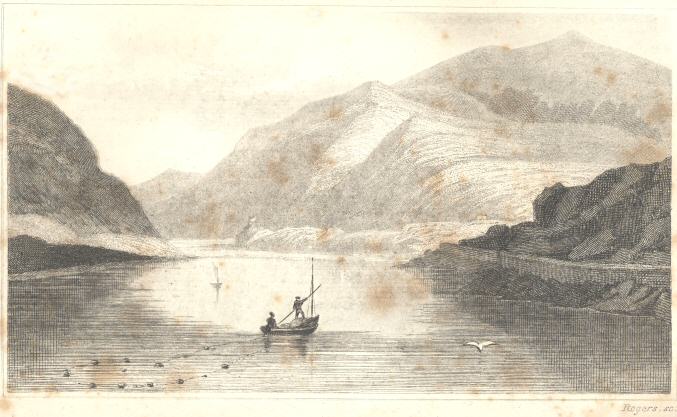
There
are numerous elegant mansions within the parish; among the most
conspicuous are—Kinmel, the seat of Lord Dinorben;
Bodelwyddan, the seat of Sir John Williams, Bart., one of the
handsomest residences of North Wales; Pengwern, that of Lord
Mostyn, built about the beginning of the last century; Cefn, that
of Edward Lloyd, Esq.; and Bronwylfa, the residence of Colonel
Sir Henry Browne, erected in the year 1660, and enlarged in
1816. In this last mansion are some valuable trophies taken
during the late war, amongst which are, Napoleon
Buonaparte’s travelling map and book of roads of the French
empire, in splendid morocco cases, emblazoned with the imperial
arms, taken from his library at Fontainbleau, by Sir Henry, in
1815 and a French field-marshal’s baton, two feet three
inches in length, covered with purple velvet, ornamented with
golden bees, and surmounted with an imperial crown, taken in
Silesia, in 1812, by a division of Blucher’s corps.
In the township of Cefn Meriadog are some magnificent natural
caverns, extending for a considerable distance into the limestone
rocks; in some parts of those the roof is more than forty feet in
height, and near the river Elwy the base of the rock is
perforated by a lofty natural arch, 21 yards in length, and 36
feet high, through which is a road capable of admitting a wagon
loaded with hay. Various fossil remains have been found in
these caverns, which have been considered by Professor Buckland
as worthy of a personal scrutiny on the spot.
Angling
Station.—Bodfari, four miles from St. Asaph.
A chain of the highest mountains in Wales extends across
Caernarvonshire, from Bardsey Island to Penmaen Bach, near Conway
bay, gradually rising from each extremity towards the centre,
which is occupied by Snowdon. The name of this mountain was
first given to it by the Saxons, and signifies a hill covered
with snow; but the Welsh call all this adjacent range
Creigian-yr-Eyri (the Eagle’s Cliffs;) for it is not true,
as has been asserted, that snow may be found upon it through the
whole year. The temperature at the summit is generally very
low, even in summer. In July, just after sunrise, the
thermometer has been observed at 34 deg. and in August at 48 deg.
early in the afternoon.
The
perpendicular height of Snowdon is by late admeasurements 1190
yards above the level of the sea. This makes it, according
to Pennant, 240 yards higher than Cader Idris. Some state
Whernside, in Yorkshire, to be the highest mountain in South
Britain, and more than 4000 feet. Helvelyn is 3324 feet,
Benlomond 3262. Mont Blanc rises 15,680 feet; the American
Chimboraco is 20,909 feet, the highest ground ever trodden by
man; and the mountain of Thibet above 25,000 feet, the highest at
present known.
The air on the top of Snowdon is sharp and bracing, and like
that in all other mountain districts, is salubrious and congenial
to health and longevity. It is seldom that persons who have
taste and leisure visit this part of Caernarvonshire without
ascending to the top of our British Alps; and those who make a
tour from motives of curiosity would think the omission almost
inexcusable. An important consideration for the tourist is
the point whence he should commence the ascent for the towering
summit of this majestic mountain. Dolbadarn, Llyn Cwellyn,
Beddgelert, and Llanberis, all put in their claims for
eligibility as a starting-place, and at each of these stations
trusty guides may be engaged. We are inclined to the
opinion that the Victoria Hotel at Llanberis is the spot from
which the most easy and convenient ascent may be effected.
It may readily be imagined that every resting point in
climbing this commanding eminence must reveal, amidst the
magnificent scenery of so romantic a district, views of
surpassing grandeur and beauty: and such indeed is the case to an
extent which the most vivid imagination can scarcely
conceive. The enthusiastic author of “The Beauties,
Harmonies, and Sublimity of Nature,” gives the following
glowing description of the prospects from the summit:—
“After climbing over masses of crags and
rocks, we ascended the peak of Snowdon. Arrived at its
summit, a scene presented itself magnificent beyond the powers of
language! Indeed, language is indigent and impotent when it
would presume to sketch scenes on which the Great Eternal has
placed his matchless finger with delight. Faint are thy
broad and deep delineations, immortal Salvator Rosa!
Powerless and feeble are your inspirations, genius of Thomson,
Virgil, and Lucretius! From this point are seen
five-and-twenty lakes. Seated on one of its crags, it was
long before the eye, unaccustomed to measure such elevations,
could accommodate itself to scenes so admirable; the whole
appearing as if there had been a war of the elements, and as if we were
the only inhabitants of the globe permitted to contemplate the
ruins of the world. Rocks and mountains, which, when
observed from below, bear all the evidence of sublimity, when
viewed from the summit of Snowdon, are blended with others as
dark, as rugged, and as elevated as themselves; the whole
resembling the swellings of an agitated ocean. The extent
of this prospect appears almost unlimited. The four
kingdoms are seen at once: Wales, England, Scotland, and Ireland!
forming the finest panorama the empire can boast. The
circle begins with the mountains of Cumberland and Westmoreland;
those of Ingleborough and Penygent, in the county of York, and
the hills of Lancashire forefollow; then are observed the
counties of Chester, Flint, Denbigh, and a portion of
Montgomeryshire. Nearly the whole of Merioneth succeeds;
and drawing a line with the eye along the diameter of the circle,
we take in the regions stretching from the triple crown of Cader
Idris to the sterile crags of Carnedds David and Llywelyn.
Snowdon, rising in the centre, appears as if he could touch the
south with his right hand, and the north with his left.
‘Surely,’ thought Colonna, ‘Cesar sat upon
these crags, when he formed the daring conception of governing
the world!’ From Cader Idris, the eye, pursuing the
orbit of the bold geographical line, glances over the bay of
Cardigan, and reposes for a while on the summit of the
Rivals. After observing the indented shores of
Caernarvonshire, it travels along a line of ocean, till, in the
extremity of the horizon, the blue mountains of Wicklow terminate
the perspective. Those mountains gradually sink along the
coast till they are lost to the eye; which, ranging along the
expanse, at length, as weary of the journey, reposes on the
Island of Man, and the distant mountains of Scotland. The
intermediate space is occupied by the sides and summits of
mountains, hollow crags, masses of rocks, the towers of
Caernarvon, the fields of Anglesea, with woods, lakes, and glens,
scattered in magnificent confusion. A scene like this
commands our feelings to echo, as it were, in unison to its
grandeur and sublimity: the thrill of astonishment, and the
transport of imagination, seem to contend for the mastery, and
nerves are touched that never thrilled before.”
But it is not always thus. Earthly pleasures are often
greater in the anticipation than the enjoyment; and ardent hopes
are subject to occasional disappointments. Bright as the
day may be, mountain mists will sometimes intervene, and passing
clouds suddenly draw a curtain over these glorious revelations of
Almighty Power. Take, for instance, the narrative of the
King of Saxony’s ascent up Snowdon in July, 1844, his
Majesty’s excursion being made from Beddgelert:—
“Early this morning, according to our
previous design, we made the ascent of Snowdon: the appearance of
the weather was by no means encouraging, the sky was lowering,
and the clouds hung deep around the mountain top. Still
there was no rain, many signs of a favourable change, and we took
our chance of the advantages in our favour and set out. We
made early preparation for our journey, and, at seven
o’clock, mounted a light carriage, accompanied by a skilful
guide. We followed the road towards the foot of the
mountain, as far up its flank as it was accessible to any
description of carriage. We commenced the ascent. Our
path lay for some distance over wet pasture and spongy meadows;
after which, the path became steeper, and occasional masses of
bold projecting rocks occurred. We were not the only
travellers, whom the day tempted to try their good fortune on the
summit of the highest mountain in England. Some ladies,
mounted on ponies, rode sometimes before and sometimes behind us,
and several parties followed them on foot. The summit of
the mountain lay concealed in clouds; the rocks stood forth bold
and black from the green of the Alpine meadows, on which the
beautiful yellow anthericum ossifragum grows in great
profusion, and a cold wind blew from the ravines which skirted
our path. A young Alpine lark, only imperfectly fledged,
fluttered along the ground before our feet; our guide easily
caught it with his hands, but the old ones flew around, uttering
such painful screams, that I induced him again to put the poor
panting little creature upon the grass, behind a large block of
stone. When we ascended a little further, the view to the
westward became partially free, and we saw the sea, the isle of
Anglesea, and Caernarvon Castle. As we ascended, however,
the clouds again closed around us, and finally we found ourselves
completely enveloped in the penetrating fog of these moist
goddesses. The ascent also in many places now became
difficult; the wind blew cold along the side of some rocky walls,
or from the depths of some neighbouring ravine; the thick fogs
continued to roll more densely along the mountain sides; but
fortunately, so far, they did not thoroughly penetrate our
clothes with their moisture.
“Still onward, from height to height! deep ravines lay
at our side, the bottom of which, filled with thick fog, yawned
horribly below. Vegetation now almost wholly disappeared,
except merely a few rare Alpine plants, and on every side of us
rose lofty crags of black chlorite slate. Having
taken some repose after the efforts of the ascent, behind a
projecting rock which sheltered us from the wind, we again set
forth, and in about a quarter of an hour (two hours in all) we
reached the pinnacle of the mountain—4348 feet above the
level of the sea. View there was none! We found
refuge in a small wooden shed, erected for the protection of
travellers from the rain and wind, in which the host kept up a
welcome fire. The man presently prepared a singular brown
mixture, which he sold for coffee, and furnished some grayish
oatmeal cake as an accompaniment. There were no spirituous
liquors of any description to be had, because the occupier, with
no small degree of self-satisfaction, gave us to understand that
his wooden hut was to be regarded as a Temperance
Inn. Not far from this mountain hotel, which I must
state to be the first imperfect house of accommodation we had yet
met in England, was a small stone hut, in which the rest of the
travellers, together with their ponies, had found a harbour not
much better than our own.
“Having spent some time upon the summit, dried
ourselves, and ranged about among the craggy rocks and through
the fog, we found our visit was in vain—no hopes of the
weather clearing were longer entertained, and we prepared to
proceed on our descent. Before we had descended far from
the summit, the clouds presented occasional breaks, and we were
able to snatch partial views into the beautiful deep valleys
which lie between the converging ridges of the mountain; and on
one occasion the clouds rose like a curtain, and revealed to us a
splendid prospect of the sea. In these occasional glimpses,
we perceived for a moment that the declivities of the mountain
were enjoying the full beams of the sun, and immediately we were
again closely enveloped in our foggy mantle of clouds.
There was a continual play of currents of air and waves of fog
with the earth. Such phenomena furnish highly interesting
subjects of contemplation to those who have greater leisure for
their contemplation than we ourselves had. Of such
extraordinary atmospheric phenomena, however, it may be said,
they show the life of the clouds, but cloud the image of
life! If, however, the observation of such phenomena be
made the chief object of a whole excursion, they will be found to
have something in them unsatisfying. The unconscious life
of nature always falls in value in the eyes of him who has
thought upon and experienced the mighty movements and impulses of
the mind and feelings. As I have already said, what signify
earth, and suns, and planets, if there were no eye to see, no
intelligence to give them life?
“Having proceeded somewhat further on the descent, our
guide prepared to follow a different route in our return, through
a deep precipitous valley, in which the king immediately
acquiesced. The task, however, was by no means easy; it
involved the necessity of going straight down a sharp declivity
of the mountain, at least 1000 feet high, and very sparingly
covered with moist earth and tufts of grass. We were
obliged to aid ourselves as well as we could by the firmness of
our tread, taking a zigzag course, and by the appliances of our
hands and sticks, at length reached the bottom in safety.
The path, however formidable to us, would, undoubtedly, not have
presented many difficulties to a well-trained Alpine hunter; to
those, however, who are not accustomed to such clambering, it
must be regarded as making a severe demand upon the exercise of
their muscular power, and as a species of training which, when
successfully completed, must always result in good. Even on
reaching the valley, there was no path, and we were obliged to
make our way over stock and stone, through bog and brook, till we
came to a lower and a smoother region. During our descent,
we were obliged to endure the alternative of heat and cold, of
sunshine and rain; at length we reached some mines, at which rude
paths began to appear, and presently after found ourselves at our
carriages, and drove by another road again back to
Beddgelert. On this road, too, we enjoyed the sight of some
splendid mountain scenery. The weather had now become clear
and sunny, while the top of Snowdon still lay thickly enveloped
in masses of dark clouds. A small lake lay stretched out
before us in the vale, full of picturesque beauty, and noble
mountains beside and beyond, rose and towered one above
another. I heartily envied an artist who had established
his studio on the edge of a mountain brook, and appeared
to be diligently engaged in his work. What a pleasure it
must be, to be engaged in an attempt to give a faithful
delineation of such noble forms! About half-past two we
reached the hotel at Beddgelert, and our mountain excursion was
at an end.”
Let us be very earnest in impressing upon the minds of all
tourists one important injunction,—never ascend Snowdon
without a guide. It is unwise and perilous, even in the
brightest weather, to make such an attempt. A melancholy
instance of this venturous spirit occurred in the autumn of
1846, when the Rev. H. S. Starr, of Northampton, ascended the
mountain without a guide; and doubtless perished in some of its
bogs or precipitous defiles, as from that period till now, no
trace of this unfortunate clergyman has been discovered.
For Angling Stations, see
Llanberis.
Dolgelley
|
8
|
Dinas Mowddwy
|
11
|
Machynlleth
|
8
|
Towyn
|
10
|
This is a very picturesque little village, about half way
between Machynlleth and Dolgelley, deriving its name from the
church, at the head of a beautiful lake, appropriately called
Llyn Mwyngil, (The Lake of the Charming Retreat,) from the west
end of which issues the river Dysyni, taking its course to the
sea through Towyn Marsh. The scenery is remarkably
romantic, and is rendered more so by the lakes which are within
the limits of the parish. That of Tal-y-llyn is small but
beautiful; its greatest breadth is not more than half a mile, and
its length between one and two miles. Its northern
boundaries consist of rich pasture land, while on the south a
high green hill, covered only with short herbage, in fact a mere
sheep walk, rears itself to the clouds, and extends the whole
length. Its only piscatory productions are trout and eels;
the latter attaining a good size, and finding a safe protection
in the deep coat of moss which covers the bottom. Of the
trout there are two species, the large lake trout and the common
river trout, the latter finding their way into the lake by two or
three streams which feed it from the mountain; these never attain
any considerable size, but the others, being indigenous to the
pool, grow to a large size. The finest, which are caught
with a fly, vary from half a pound to between one and two pounds;
one weighing more than 12lb. was found a few winters ago, frozen
under the ice. The lake is the property of Colonel Vaughan,
who purchased it for no other purpose than that of affording his
friends the enjoyment of angling therein. The stranger, who
is perfectly unknown to the generous-hearted Welshman, is equally
welcome to participate in the sport, without the formality of
begging a day’s fishing, or even intimating his intention
to the proprietor. A new and commodious inn, near the
village, was built last year by Colonel Vaughan: it
affords good accommodations, and the charges are very
moderate.
Beside the lake already mentioned, there is another under the
summit of Cader Idris, called Llyn Cau, (the Pool of the Chasm,)
from its being situated under vast cliffs; it is about a quarter
of a mile long, and nearly of equal breadth, and has the
appearance of the crater of a volcano, at the head of the chasm,
through which a stream runs from the lake, and forms a fine
cataract, close to the ancient house of Dolydd Cau, and then
unites with another river, which meanders along the level vale
below, to the upper end of Llyn Mwyngil. The vale in which
it is situated is so contracted, as to leave, for a considerable
part of its length, only a very narrow road on each side of the
lake, from the clear surface of which are reflected its
precipitous declivities. Towards the extremity of the vale,
the lake contracts gradually into the form of a river, rushing
with much force through a stone arch into a very narrow pass,
having on one side the church, and on the other a small cluster
of houses, which form the village, embosomed in trees, and
assuming a romantically beautiful appearance.
At the distance of a mile or two from the church, the hills
almost meet, and present a sterile and rugged aspect; they are
broken into numberless crags, of which some are vertical and
sharply pointed, but the greater number project horizontally, and
impend with threatening gloom over the vale beneath. One of
these precipices, from its resemblance in form to a harp, has
been called Pen y Delyn; and another, from a tradition that it
was formerly the practice to throw thieves from its summit, has
been denominated Llan-y-Lladron (the Thieves’ Leap), a
practice corresponding with that related of the Tarpeian rock at
Rome.
Angling
Station.—The Lake: good fishing. A boat.
Aberdovey
|
4
|
Barmouth
|
12
|
Dolgelley
|
16
|
London
|
226
|
Machynlleth
|
14
|
Towyn is a market-town beautifully situated at the distance of
about a mile from the sea-coast, near the mouth of the river
Dysyni, in a small but pleasant vale. The return of the
population for the town and parish is 2694 inhabitants.
During summer, the place is much frequented for
sea-bathing, by persons who prefer retirement to the bustle of a
more fashionable watering place. Valetudinarians are also
attracted hither by St. Cadvan’s Well, much celebrated for
the cure of rheumatic, scrofulous, and cutaneous disorders.
The ride over the sands to Aberdovey, a rising place about four
miles distant, is very pleasant. A beautiful line of road
to that interesting village has been constructed, and is
continued from that place to Pennal, abounding with picturesque
scenery, and commanding views of Snowdon, Arran Mowddwy, Cader
Idris, and Plinlimmon.
Towyn is one of the places at which the poll is appointed to
be taken in the election of the parliamentary representative of
the county. The church, dedicated to St. Cadvan, is an
ancient cruciform structure, in the Norman style of architecture,
containing some curious old monuments, which the inquisitive
stranger ought not to leave unnoticed.
On a steep hill near the town are some remains of an ancient
castle of great strength; the fortifications comprehend the
entire summit of the eminence: one of the apartments, thirty-six
feet in diameter, was hewn out of the solid rock, Craig-y-Deryn
(the Bird’s Bock), situated in the vale of Dysyni, about
three or four miles from Towyn, is in the highest degree wild and
romantic. A small but picturesque waterfall may be seen at
Dôlgôch.
At a small distance from the town is Ynys-y-maengwyn, a noble
mansion, pleasantly situated in grounds tastefully laid out, and
embellished with flourishing plantations and timber of ancient
growth, among which is an evergreen oak, considered to be the
finest tree of its kind in the kingdom. The garden is very
extensive, and contains many rare trees and plants.
The angler will find excellent amusement in the Dysyni, which,
after rolling through a rude assemblage of rugged mountains,
flows through the fertile vale of Towyn, passing first by
Peniarth, a seat belonging to the Wynn family, and then by
Ynys-y-maengwyn, and finally entering Cardigan bay, about a mile
eastward of Towyn. This is an excellent river for salmon,
and it contains some remarkably dark and deep pools, more
especially near Peniarth, where the river winds close by the
house; the angler will also find good sport farther up the
mountains.
Angling
Station.—The river, up to Tal-y-Llyn.
This village is situated on the road from Dolgelley to
Tan-y-Bwlch, in an exposed and mountainous district. The
church is an ancient structure of the old English style of
architecture; the parish is of vast extent, being above ten miles
in length, and eight in breadth, consisting chiefly of barren
mountains, used only as sheep-walks. At this place a guide
may be had to the waterfalls of Pistyll-y-Cain and
Rhaiadr-y-Mawddach, distant about three or four miles.
On the road side towards Ffestiniog is Llyn Rathlyn, a small
lake, noted for a singular variety of perch, having the lower
extremity of the back-bone strangely distorted. The
celebrated Humphrey Lloyd, who was consecrated Bishop of Bangor
in 1673, was born at Bôd-y-Vuddai, in the parish of
Traws-fynydd.
Barmouth
|
20
|
Ditto, by Tan-y-Bwlch
|
30
|
Beddgelert
|
7
|
Caernarvon
|
20
|
Ffestiniog
|
13
|
Harlech
|
10
|
Ditto, by Tan-y-Bwlch
|
20
|
Pwllheli
|
14
|
Tan-y-Bwlch
|
10
|
Tremadoc is a market-town and sea-port of very recent origin,
and is a signal instance of the triumph of perseverance over
apparently insurmountable local difficulties. It derives
its name from its enterprising founder, the late Wm. Alexander
Madock, Esq. This gentleman, having projected a plan for
regaining from the sea a portion of the land on the western side
of the wide sandy estuary called the Traeth Mawr, purchased the
estate of Tan-yr-Allt, in the immediate vicinity, in 1798, and in
1800 succeeded in recovering a tract of nearly two thousand acres
of rich land, then forming Penmorfa Marsh, which now produces
excellent crops of wheat, barley, and clover, to which he gave
the appropriate name of Glandwr.
Encouraged by the success of his first attempt, Mr. Madock was
induced to undertake the more arduous enterprise of reclaiming
the whole of the Traeth Mawr; and for this purpose he obtained in
1808 an act of parliament, vesting in him and his heirs the whole
extent of these sands, from Pont Aberglâslyn, at their
head, to the point of Gêst, at their lower extremity.
Notwithstanding the numerous unforeseen obstacles which
threatened to frustrate the undertaking, Mr. Madock succeeded in
constructing across the mouth of the Traeth Mawr, at the eastern
extremity of Cardigan bay, an embankment of earth and stones,
nearly one mile in length, from north to south, varying from 100
to 400 feet in breadth at the base, and diminishing gradually to
the summit, which is 100 feet high from the foundation. By
means of this embankment, a line of communication has been formed
between the counties of Caernarvon and Merioneth, and a tract of
more than 2700 acres of land was recovered from the sea, besides
a vast extent of adjoining land, which was before overflowed by
the tides, but which is now, by draining, rendered susceptible of
cultivation. This arduous enterprise was completed in 1811,
at an expense of more than £100,000; and, including the
lands previously recovered, not less than 7,000 acres have been
gained.
The town is situated by the side of a lofty mountain, on the
western side of Traeth Mawr, on a portion of the tract first
recovered from the sea, and is built in the form of a square
quadrangular area, having in the centre a lofty column, round the
pedestal of which there is a flight of twelve steps. On the
eastern side a commodious market-house has been erected, above
which is an assembly-room. Mr. Madock also built, at his
own expense, a handsome church, in the late style of English
architecture, with a lofty spire, which forms an interesting
object as seen from the sea-coast.
Tan-yr-Allt, the seat of the late W. A. Madock, Esq., is a
spacious modern mansion of elegant design, situated on a rock
overlooking the town. Morfa Lodge, and
Tuhwnt-i’r-Bwlch, erected also by that gentleman, are
handsome villas in the immediate vicinity of the town.
Captain Parry, R.N. of Llwyn-on, Denbighshire, has also a seat
called Aberdunant, between this place and Beddgelert.
With a view to promote the commercial interests of the town
which he had founded, Mr. Madock, in 1821, obtained an act of
parliament for improving the navigation of this part of the bay
on which it is situated, and thus rendered it accessible to
vessels of three hundred tons burden: commodious quays and wharfs
were also constructed.
The last improvement carried into effect was the erection of
Port Madoc, about one mile from the town, where many good houses
have been built. The principal exports are slates, from the
Ffestiniog quarries, and copper ore, which is brought from the
neighbouring mines. The chief imports are timber, coal, and
lime. A rail-road also runs to this place from the quarries
and mines in the neighbourhood. The road from Tremadoc to
Beddgelert commands to great advantage the scenery of the
Merionethshire side of the Traeth, and affords a delightful ride
to Pont Aberglaslyn and its vicinity.
Llanfair
|
8
|
London
|
171
|
Montgomery
|
8
|
Newtown
|
14
|
Oswestry
|
16
|
Shrewsbury
|
18
|
This town is called Welsh, to distinguish it from a town of
the same name in Dorsetshire, and Pool, from its proximity to a
piece of water called Llyn-du Pool, now within the inclosure of
Powys park. The town, which Leland describes as being in
the reign of Henry the Eighth, “the best market in
Powys,” still retains that character, in addition to which
it may justly be regarded as the modern capital of the county,
and, with the parish, contains 4626 inhabitants. The town
has a cheerful and prepossessing appearance. The flannel
manufacture is carried on here, but upon a less scale than at
Llanidloes or Newtown. A considerable trade is carried on
in malt, and there are likewise several large tanneries.
Welshpool is made contributory with Llanidloes, Llanfyllyn,
Machynlleth, Montgomery, and Newtown, in returning a member to
parliament. The assizes for the county are held here.
The town-hall is a commodious building of brick, in the centre of
the principal street.
The church, with the exception of the chancel and the tower,
was rebuilt in 1774. It is in the early style of English
architecture, with a lofty square embattled tower, and its
interior accommodation was enlarged by the addition of galleries
in 1824. Amongst the communion plate, there is a chalice of
fine gold, holding one quart, and valued at £170; engraved
on it is a Latin inscription, stating it to have been presented
to the church of Pool, by Thomas Davies, Governor-general of the
English colonies on the western coast of Africa, in gratitude for
the preservation of his life during his residence in that
unhealthy clime.
the seat of the Earl of Powys, is a stately but irregular pile
of building, venerable for its antiquity: it is pleasantly
situated in a well-wooded park, at the distance of a mile from
the town, on the right of the road leading to Montgomery, and
occupies a commanding site on a ridge of rocks overlooking a vast
extent of richly diversified country, the greater part of which
was formerly subject to its lord. The views from its
extensive and richly wooded park are remarkably interesting and
beautiful.
Distances from
Welshpool.
|
Miles.
|
Berriew, on the confluence of the Rhiw and Severn
|
5
|
Llandysylio, on the Vyrnwy
|
8
|
Llandrinio
|
9
|
Llanvyllin, the Abel, Cain, and Vyrnwy
|
12
|
Chester
|
12
|
Llangollen
|
11½
|
Oswestry
|
6
|
Ruthin
|
16
|
Wrexham is a large and well-built town, whose population,
including the parish, was returned in 1841 at 12,981
inhabitants. From its extent and importance, it has
sometimes been denominated the metropolis of North Wales.
The town is pleasantly situated at the junction of the
Shrewsbury. Welshpool, Oswestry, and Chester roads, and in
the centre of the mining and manufacturing districts of the
eastern part of Denbighshire. Races are annually held early
in October, on a course a little north-west of the town, on the
right of the road to Mold. Wrexham is one of the principal
stations on the Shrewsbury and Chester Railway.
No particular branch of trade or manufacture is carried on in
the town; but the parish, which is about twelve miles in length,
abounds with mineral wealth, and extensive works of various kinds
are carried on in different parts of it. The principal inns
are the Wynnstay Arms and the Lion. Markets are held on
Thursday and Saturday, the former being the chief market
day. There are several fairs held annually for cattle; but
the principal one is that which commences on the 23d of March,
and continues for fourteen days. For the accommodation of
the various dealers attending it, five extensive areas are fitted
up with shops and booths. A new and handsome market-hall
has also been lately built, and cheese fairs established.
Wrexham is contributory with Denbigh, Holt, and Ruthin, in the
return of a parliamentary representative.
The church, dedicated to St. Giles, is a spacious and noble
Gothic structure, deservedly regarded as one of the finest
ecclesiastical edifices in the Principality. It was erected
in the year 1472, the tower not being finished till 1506, as
appears by a date on the building. The exterior is
elaborately embellished with sculpture; and the tower, which is
very lofty and highly enriched, consists of several successive
stages, panelled throughout, and decorated with numerous statues
of saints in canopied niches: from its elevation, and the light
open-work turrets by which it is crowned at the angles, it forms
a conspicuous and interesting object in the surrounding
landscape. It has a remarkably fine carved roof: and a
noble altar-piece, designed by Mr. Jones of Chester, and worked
in stone by Mr. Blayney of that city; the east window being
filled with beautifully stained glass by Mr. Evans, of
Shrewsbury.
In the chancel is an altar-tomb, on which is a recumbent
effigy of Dr. Bellot, successively Bishop of Bangor and Chester,
who died in 1596, and was there interred. Nearly opposite
to this tomb is an interesting monument, by Roubilliac, to the
memory of Mrs. Mary Myddelton, of Chirk Castle, representing a
female rising from the tomb in all the freshness of youth and
beauty, at the sound of the last trumpet which is to summon the
dead to judgment. At the corner of the aisle is also a
monument by Roubilliac, to the Rev. Thomas Myddelton and Arabella
his wife; and there are monuments to Wm. Lloyd, Esq. and his son,
the Fitzhughs, the Pulestons, the Longuevilles, Sir Foster and
Lady Cunliffe, and other families in the neighbourhood..
About a mile from Wrexham, on the right of the road leading to
Chester, is Acton Park, the residence of Sir R. H. Cunliffe,
Bart., a spacious mansion, delightfully situated in extensive
grounds, richly diversified with picturesque and romantic
scenery, and commanding pleasing views of the town and adjacent
country. Acton was the birth-place of the notorious Judge
Jeffreys, who obtained so bad an eminence in the reign of James
the Second.


