New England is by some affirmed to be an island, bounded on the
north with the River Canada (so called from Monsieur Cane).—Josselyn's
Rarities.
And still older, in Thomas Morton's "New English Canaan,"
published in 1632, it is said, on page 97, "From this Lake [Erocoise]
Northwards is derived the famous River of Canada, so named, of
Monsier de Cane, a French Lord, who first planted a colony of
French in America."
A YANKEE IN CANADA
I fear that I have not got much to say about Canada,
not having seen much; what I got by going to Canada
was a cold. I left Concord, Massachusetts, Wednesday
morning, September 25th, 1850, for Quebec. Fare, seven
dollars there and back; distance from Boston, five hundred
and ten miles; being obliged to leave Montreal on
the return as soon as Friday, October 4th, or within ten
days. I will not stop to tell the reader the names of my
fellow-travelers; there were said to be fifteen hundred
of them. I wished only to be set down in Canada, and
take one honest walk there as I might in Concord woods
of an afternoon.
The country was new to me beyond Fitchburg. In
Ashburnham and afterward, as we were whirled rapidly
along, I noticed the woodbine (Ampelopsis quinquefolia),
its leaves now changed, for the most part on dead trees,
draping them like a red scarf. It was a little exciting,
suggesting bloodshed, or at least a military life, like an
epaulet or sash, as if it were dyed with the blood of the
trees whose wounds it was inadequate to stanch. For
now the bloody autumn was come, and an Indian warfare
was waged through the forest. These military trees
appeared very numerous, for our rapid progress connected
those that were even some miles apart. Does the
woodbine prefer the elm? The first view of Monadnock
was obtained five or six miles this side of Fitzwilliam,
but nearest and best at Troy and beyond. Then
there were the Troy cuts and embankments. Keene
Street strikes the traveler favorably, it is so wide, level,
straight, and long. I have heard one of my relatives,
who was born and bred there, say that you could see a
chicken run across it a mile off. I have also been told
that when this town was settled they laid out a street
four rods wide, but at a subsequent meeting of the proprietors
one rose and remarked, "We have plenty of
land, why not make the street eight rods wide?" and so
they voted that it should be eight rods wide, and the
town is known far and near for its handsome street. It
was a cheap way of securing comfort, as well as fame,
and I wish that all new towns would take pattern from
this. It is best to lay our plans widely in youth, for
then land is cheap, and it is but too easy to contract
our views afterward. Youths so laid out, with broad
avenues and parks, that they may make handsome and
liberal old men! Show me a youth whose mind is like
some Washington city of magnificent distances, prepared
for the most remotely successful and glorious life after
all, when those spaces shall be built over and the idea
of the founder be realized. I trust that every New England
boy will begin by laying out a Keene Street through
his head, eight rods wide. I know one such Washington
city of a man, whose lots as yet are only surveyed and
staked out, and, except a cluster of shanties here and
there, only the Capitol stands there for all structures,
and any day you may see from afar his princely idea
borne coachwise along the spacious but yet empty avenues.
Keene is built on a remarkably large and level
interval, like the bed of a lake, and the surrounding
hills, which are remote from its street, must afford
some good walks. The scenery of mountain towns is
commonly too much crowded. A town which is built
on a plain of some extent, with an open horizon, and
surrounded by hills at a distance, affords the best
walks and views.
As we travel northwest up the country, sugar maples,
beeches, birches, hemlocks, spruce, butternuts, and ash
trees prevail more and more. To the rapid traveler the
number of elms in a town is the measure of its civility.
One man in the cars has a bottle full of some liquor.
The whole company smile whenever it is exhibited. I
find no difficulty in containing myself. The Westmoreland
country looked attractive. I heard a passenger
giving the very obvious derivation of this name, Westmore-land,
as if it were purely American, and he had
made a discovery; but I thought of "my cousin Westmoreland"
in England. Every one will remember the
approach to Bellows Falls, under a high cliff which rises
from the Connecticut. I was disappointed in the size of
the river here; it appeared shrunk to a mere mountain-stream.
The water was evidently very low. The rivers
which we had crossed this forenoon possessed more of
the character of mountain-streams than those in the
vicinity of Concord, and I was surprised to see everywhere
traces of recent freshets, which had carried away
bridges and injured the railroad, though I had heard
nothing of it. In Ludlow, Mount Holly, and beyond,
there is interesting mountain scenery, not rugged and
stupendous, but such as you could easily ramble over,—long,
narrow, mountain vales through which to see the
horizon. You are in the midst of the Green Mountains.
A few more elevated blue peaks are seen from the
neighborhood of Mount Holly; perhaps Killington Peak
is one. Sometimes, as on the Western Railroad, you
are whirled over mountainous embankments, from which
the scared horses in the valleys appear diminished to
hounds. All the hills blush; I think that autumn must
be the best season to journey over even the Green Mountains.
You frequently exclaim to yourself, What red
maples! The sugar maple is not so red. You see some
of the latter with rosy spots or cheeks only, blushing on
one side like fruit, while all the rest of the tree is green,
proving either some partiality in the light or frosts or
some prematurity in particular branches. Tall and
slender ash trees, whose foliage is turned to a dark
mulberry color, are frequent. The butternut, which is
a remarkably spreading tree, is turned completely yellow,
thus proving its relation to the hickories. I was
also struck by the bright yellow tints of the yellow
birch. The sugar maple is remarkable for its clean
ankle. The groves of these trees looked like vast forest
sheds, their branches stopping short at a uniform height,
four or five feet from the ground, like eaves, as if they
had been trimmed by art, so that you could look under
and through the whole grove with its leafy canopy, as
under a tent whose curtain is raised.
As you approach Lake Champlain you begin to see
the New York mountains. The first view of the lake
at Vergennes is impressive, but rather from association
than from any peculiarity in the scenery. It lies there
so small (not appearing in that proportion to the width
of the State that it does on the map), but beautifully
quiet, like a picture of the Lake of Lucerne on a music-box,
where you trace the name of Lucerne among the
foliage; far more ideal than ever it looked on the map.
It does not say, "Here I am, Lake Champlain," as
the conductor might for it, but having studied the geography
thirty years, you crossed over a hill one afternoon
and beheld it. But it is only a glimpse that you
get here. At Burlington you rush to a wharf and go on
board a steamboat, two hundred and thirty-two miles
from Boston. We left Concord at twenty minutes before
eight in the morning, and were in Burlington about
six at night, but too late to see the lake. We got our
first fair view of the lake at dawn, just before reaching
Plattsburg, and saw blue ranges of mountains on either
hand, in New York and in Vermont, the former especially
grand. A few white schooners, like gulls, were
seen in the distance, for it is not waste and solitary like
a lake in Tartary; but it was such a view as leaves not
much to be said; indeed, I have postponed Lake Champlain
to another day.
The oldest reference to these waters that I have yet
seen is in the account of Cartier's discovery and exploration
of the St. Lawrence in 1535. Samuel Champlain
actually discovered and paddled up the lake
in July, 1609, eleven years before the settlement of
Plymouth, accompanying a war-party of the Canadian
Indians against the Iroquois. He describes the islands
in it as not inhabited, although they are pleasant,—on
account of the continual wars of the Indians, in consequence
of which they withdraw from the rivers and
lakes into the depths of the land, that they may not be
surprised. "Continuing our course," says he, "in this
lake, on the western side, viewing the country, I saw on
the eastern side very high mountains, where there was
snow on the summit. I inquired of the savages if those
places were inhabited. They replied that they were,
and that they were Iroquois, and that in those places
there were beautiful valleys and plains fertile in corn,
such as I have eaten in this country, with an infinity
of other fruits." This is the earliest account of what is
now Vermont.
The number of French-Canadian gentlemen and
ladies among the passengers, and the sound of the
French language, advertised us by this time that we
were being whirled towards some foreign vortex. And
now we have left Rouse's Point, and entered the Sorel
River, and passed the invisible barrier between the
States and Canada. The shores of the Sorel, Richelieu,
or St. John's River are flat and reedy, where I had
expected something more rough and mountainous for
a natural boundary between two nations. Yet I saw a
difference at once, in the few huts, in the pirogues on
the shore, and as it were, in the shore itself. This was
an interesting scenery to me, and the very reeds or
rushes in the shallow water and the tree-tops in the
swamps have left a pleasing impression. We had still
a distant view behind us of two or three blue mountains
in Vermont and New York. About nine o'clock
in the forenoon we reached St. John's, an old frontier
post three hundred and six miles from Boston, and
twenty-four from Montreal. We now discovered that
we were in a foreign country, in a station-house of another
nation. This building was a barn-like structure,
looking as if it were the work of the villagers combined,
like a log house in a new settlement. My attention was
caught by the double advertisements in French and
English fastened to its posts, by the formality of the
English, and the covert or open reference to their queen
and the British lion. No gentlemanly conductor appeared,
none whom you would know to be the conductor
by his dress and demeanor; but ere long we began to
see here and there a solid, red-faced, burly-looking
Englishman, a little pursy perhaps, who made us
ashamed of ourselves and our thin and nervous countrymen,—a
grandfatherly personage, at home in his
greatcoat, who looked as if he might be a stage proprietor,
certainly a railroad director, and knew, or had
a right to know, when the cars did start. Then there
were two or three pale-faced, black-eyed, loquacious
Canadian-French gentlemen there, shrugging their
shoulders; pitted as if they had all had the small-pox.
In the meanwhile some soldiers, redcoats, belonging
to the barracks near by, were turned out to be drilled.
At every important point in our route the soldiers
showed themselves ready for us; though they were evidently
rather raw recruits here, they manœuvred far
better than our soldiers; yet, as usual, I heard some
Yankees talk as if they were no great shakes, and they
had seen the Acton Blues manœuvre as well. The officers
spoke sharply to them, and appeared to be doing
their part thoroughly. I heard one suddenly coming to
the rear, exclaim, "Michael Donouy, take his name!"
though I could not see what the latter did or omitted to
do. It was whispered that Michael Donouy would have
to suffer for that. I heard some of our party discussing
the possibility of their driving these troops off the field
with their umbrellas. I thought that the Yankee, though
undisciplined, had this advantage at least, that he especially
is a man who, everywhere and under all circumstances,
is fully resolved to better his condition essentially,
and therefore he could afford to be beaten at first; while
the virtue of the Irishman, and to a great extent the
Englishman, consists in merely maintaining his ground
or condition. The Canadians here, a rather poor-looking
race, clad in gray homespun, which gave them the
appearance of being covered with dust, were riding
about in caleches and small one-horse carts called charettes.
The Yankees assumed that all the riders were
racing, or at least exhibiting the paces of their horses,
and saluted them accordingly. We saw but little of the
village here, for nobody could tell us when the cars
would start; that was kept a profound secret, perhaps
for political reasons; and therefore we were tied to our
seats. The inhabitants of St. John's and vicinity are
described by an English traveler as "singularly unprepossessing,"
and before completing his period he adds,
"besides, they are generally very much disaffected to
the British crown." I suspect that that "besides"
should have been a because.
At length, about noon, the cars began to roll towards
La Prairie. The whole distance of fifteen miles was
over a remarkably level country, resembling a Western
prairie, with the mountains about Chambly visible in the
northeast. This novel but monotonous scenery was exciting.
At La Prairie we first took notice of the tinned
roofs, but above all of the St. Lawrence, which looked
like a lake; in fact it is considerably expanded here; it
was nine miles across diagonally to Montreal. Mount
Royal in the rear of the city, and the island of St.
Helen's opposite to it, were now conspicuous. We could
also see the Sault St. Louis about five miles up the
river, and the Sault Norman still farther eastward. The
former are described as the most considerable rapids in
the St. Lawrence; but we could see merely a gleam of
light there as from a cobweb in the sun. Soon the city
of Montreal was discovered with its tin roofs shining
afar. Their reflections fell on the eye like a clash of
cymbals on the ear. Above all the church of Notre
Dame was conspicuous, and anon the Bonsecours market-house,
occupying a commanding position on the
quay, in the rear of the shipping. This city makes the
more favorable impression from being approached by
water, and also being built of stone, a gray limestone
found on the island. Here, after traveling directly inland
the whole breadth of New England, we had struck
upon a city's harbor,—it made on me the impression
of a seaport,—to which ships of six hundred tons
can ascend, and where vessels drawing fifteen feet lie
close to the wharf, five hundred and forty miles from
the Gulf, the St. Lawrence being here two miles wide.
There was a great crowd assembled on the ferry-boat
wharf and on the quay to receive the Yankees, and flags
of all colors were streaming from the vessels to celebrate
their arrival. When the gun was fired, the gentry
hurrahed again and again, and then the Canadian
caleche-drivers, who were most interested in the matter,
and who, I perceived, were separated from the former
by a fence, hurrahed their welcome; first the broadcloth,
then the homespun.
It was early in the afternoon when we stepped ashore.
With a single companion, I soon found my way to the
church of Notre Dame. I saw that it was of great size
and signified something. It is said to be the largest
ecclesiastical structure in North America, and can seat
ten thousand. It is two hundred and fifty-five and a
half feet long, and the groined ceiling is eighty feet
above your head. The Catholic are the only churches
which I have seen worth remembering, which are not
almost wholly profane. I do not speak only of the rich
and splendid like this, but of the humblest of them as
well. Coming from the hurrahing mob and the rattling
carriages, we pushed aside the listed door of this church,
and found ourselves instantly in an atmosphere which
might be sacred to thought and religion, if one had any.
There sat one or two women who had stolen a moment
from the concerns of the day, as they were passing; but,
if there had been fifty people there, it would still have
been the most solitary place imaginable. They did not
look up at us, nor did one regard another. We walked
softly down the broad aisle with our hats in our hands.
Presently came in a troop of Canadians, in their homespun,
who had come to the city in the boat with us,
and one and all kneeled down in the aisle before the
high altar to their devotions, somewhat awkwardly, as
cattle prepare to lie down, and there we left them. As
if you were to catch some farmer's sons from Marlborough,
come to cattle-show, silently kneeling in Concord
meeting-house some Wednesday! Would there not
soon be a mob peeping in at the windows? It is true,
these Roman Catholics, priests and all, impress me as
a people who have fallen far behind the significance
of their symbols. It is as if an ox had strayed into a
church and were trying to bethink himself. Nevertheless,
they are capable of reverence; but we Yankees are
a people in whom this sentiment has nearly died out,
and in this respect we cannot bethink ourselves even
as oxen. I did not mind the pictures nor the candles,
whether tallow or tin. Those of the former which I
looked at appeared tawdry. It matters little to me
whether the pictures are by a neophyte of the Algonquin
or the Italian tribe. But I was impressed by the quiet,
religious atmosphere of the place. It was a great cave
in the midst of a city; and what were the altars and
the tinsel but the sparkling stalactites, into which you
entered in a moment, and where the still atmosphere
and the sombre light disposed to serious and profitable
thought? Such a cave at hand, which you can enter
any day, is worth a thousand of our churches which
are open only Sundays, hardly long enough for an airing,
and then filled with a bustling congregation,—a
church where the priest is the least part, where you
do your own preaching, where the universe preaches to
you and can be heard. I am not sure but this Catholic
religion would be an admirable one if the priest
were quite omitted. I think that I might go to church
myself some Monday, if I lived in a city where there
was such a one to go to. In Concord, to be sure, we
do not need such. Our forests are such a church,
far grander and more sacred. We dare not leave our
meeting-houses open for fear they would be profaned.
Such a cave, such a shrine, in one of our groves, for
instance, how long would it be respected? for what purposes
would it be entered, by such baboons as we are?
I think of its value not only to religion, but to philosophy
and to poetry; besides a reading-room, to have a
thinking-room in every city! Perchance the time will
come when every house even will have not only its
sleeping-rooms, and dining-room, and talking-room or
parlor, but its thinking-room also, and the architects
will put it into their plans. Let it be furnished and
ornamented with whatever conduces to serious and
creative thought. I should not object to the holy water,
or any other simple symbol, if it were consecrated by
the imagination of the worshipers.
I heard that some Yankees bet that the candles were
not wax, but tin. A European assured them that they
were wax; but, inquiring of the sexton, he was surprised
to learn that they were tin filled with oil. The church
was too poor to afford wax. As for the Protestant
churches, here or elsewhere, they did not interest me,
for it is only as caves that churches interest me at all,
and in that respect they were inferior.
Montreal makes the impression of a larger city than
you had expected to find, though you may have heard
that it contains nearly sixty thousand inhabitants. In
the newer parts, it appeared to be growing fast like a
small New York, and to be considerably Americanized.
The names of the squares reminded you of Paris,—the
Champ de Mars, the Place d'Armes, and others,—and
you felt as if a French revolution might break
out any moment. Glimpses of Mount Royal rising
behind the town, and the names of some streets in that
direction, make one think of Edinburgh. That hill
sets off this city wonderfully. I inquired at a principal
bookstore for books published in Montreal. They
said that there were none but school-books and the
like; they got their books from the States. From time
to time we met a priest in the streets, for they are distinguished
by their dress, like the civil police. Like
clergymen generally, with or without the gown, they
made on us the impression of effeminacy. We also
met some Sisters of Charity, dressed in black, with
Shaker-shaped black bonnets and crosses, and cadaverous
faces, who looked as if they had almost cried
their eyes out, their complexions parboiled with scalding
tears; insulting the daylight by their presence, having
taken an oath not to smile. By cadaverous I mean that
their faces were like the faces of those who have been
dead and buried for a year, and then untombed, with
the life's grief upon them, and yet, for some unaccountable
reason, the process of decay arrested.
"Truth never fails her servant, sir, nor leaves him
With the day's shame upon him."
They waited demurely on the sidewalk while a truck
laden with raisins was driven in at the seminary of St.
Sulpice, never once lifting their eyes from the ground.
The soldier here, as everywhere in Canada, appeared
to be put forward, and by his best foot. They were in
the proportion of the soldiers to the laborers in an African
ant-hill. The inhabitants evidently rely on them in
a great measure for music and entertainment. You
would meet with them pacing back and forth before
some guard-house or passage-way, guarding, regarding,
and disregarding all kinds of law by turns, apparently
for the sake of the discipline to themselves, and not because
it was important to exclude anybody from entering
that way. They reminded me of the men who are
paid for piling up bricks and then throwing them down
again. On every prominent ledge you could see England's
hands holding the Canadas, and I judged by the
redness of her knuckles that she would soon have to
let go. In the rear of such a guard-house, in a large
graveled square or parade ground, called the Champ
de Mars, we saw a large body of soldiers being drilled,
we being as yet the only spectators. But they did not
appear to notice us any more than the devotees in the
church, but were seemingly as indifferent to fewness of
spectators as the phenomena of nature are, whatever
they might have been thinking under their helmets of
the Yankees that were to come. Each man wore white
kid gloves. It was one of the most interesting sights
which I saw in Canada. The problem appeared to be
how to smooth down all individual protuberances or
idiosyncrasies, and make a thousand men move as one
man, animated by one central will; and there was some
approach to success. They obeyed the signals of a
commander who stood at a great distance, wand in
hand; and the precision, and promptness, and harmony
of their movements could not easily have been matched.
The harmony was far more remarkable than that of
any choir or band, and obtained, no doubt, at a greater
cost. They made on me the impression, not of many
individuals, but of one vast centipede of a man, good
for all sorts of pulling down; and why not then for some
kinds of building up? If men could combine thus earnestly,
and patiently, and harmoniously to some really
worthy end, what might they not accomplish? They
now put their hands, and partially perchance their heads
together, and the result is that they are the imperfect
tools of an imperfect and tyrannical government. But
if they could put their hands and heads and hearts and
all together, such a coöperation and harmony would be
the very end and success for which government now
exists in vain,—a government, as it were, not only with
tools, but stock to trade with.
I was obliged to frame some sentences that sounded
like French in order to deal with the market-women,
who, for the most part, cannot speak English. According
to the guidebook the relative population of this
city stands nearly thus: two fifths are French-Canadian;
nearly one fifth British-Canadian; one and a half fifths
English, Irish, and Scotch; somewhat less than one half
fifth Germans, United States people, and others. I saw
nothing like pie for sale, and no good cake to put in
my bundle, such as you can easily find in our towns,
but plenty of fair-looking apples, for which Montreal
Island is celebrated, and also pears cheaper and I
thought better than ours, and peaches, which, though
they were probably brought from the South, were as
cheap as they commonly are with us. So imperative is
the law of demand and supply that, as I have been
told, the market of Montreal is sometimes supplied with
green apples from the State of New York some weeks
even before they are ripe in the latter place. I saw here
the spruce wax which the Canadians chew, done up in
little silvered papers, a penny a roll; also a small and
shriveled fruit which they called cerises, mixed with
many little stems, somewhat like raisins, but I soon returned
what I had bought, finding them rather insipid,
only putting a sample in my pocket. Since my return,
I find on comparison that it is the fruit of the sweet
viburnum (Viburnum Lentago), which with us rarely
holds on till it is ripe.
I stood on the deck of the steamer John Munn, late
in the afternoon, when the second and third ferry-boats
arrived from La Prairie, bringing the remainder of the
Yankees. I never saw so many caleches, cabs, charettes,
and similar vehicles collected before, and doubt if New
York could easily furnish more. The handsome and
substantial stone quay which stretches a mile along
the riverside and protects the street from the ice was
thronged with the citizens who had turned out on foot
and in carriages to welcome or to behold the Yankees.
It was interesting to see the caleche-drivers dash up and
down the slope of the quay with their active little horses.
They drive much faster than in our cities. I have been
told that some of them come nine miles into the city
every morning and return every night, without changing
their horses during the day. In the midst of the crowd
of carts, I observed one deep one loaded with sheep
with their legs tied together, and their bodies piled one
upon another, as if the driver had forgotten that they
were sheep and not yet mutton,—a sight, I trust, peculiar
to Canada, though I fear that it is not.
About six o'clock we started for Quebec, one hundred
and eighty miles distant by the river; gliding past
Longueuil and Boucherville on the right, and Pointe aux
Trembles, "so called from having been originally covered
with aspens," and Bout de l'Isle, or the end of the
island, on the left. I repeat these names not merely for
want of more substantial facts to record, but because
they sounded singularly poetic to my ears. There certainly
was no lie in them. They suggested that some
simple, and, perchance, heroic human life might have
transpired there. There is all the poetry in the world
in a name. It is a poem which the mass of men hear
and read. What is poetry in the common sense, but a
string of such jingling names? I want nothing better
than a good word. The name of a thing may easily be
more than the thing itself to me. Inexpressibly beautiful
appears the recognition by man of the least natural
fact, and the allying his life to it. All the world reiterating
this slender truth, that aspens once grew there;
and the swift inference is that men were there to see
them. And so it would be with the names of our native
and neighboring villages, if we had not profaned them.
The daylight now failed us, and we went below; but
I endeavored to console myself for being obliged to
make this voyage by night, by thinking that I did not
lose a great deal, the shores being low and rather unattractive,
and that the river itself was much the more
interesting object. I heard something in the night about
the boat being at William Henry, Three Rivers, and in
the Richelieu Rapids, but I was still where I had been
when I lost sight of Pointe aux Trembles. To hear a
man who has been waked up at midnight in the cabin
of a steamboat inquiring, "Waiter, where are we
now?" is as if, at any moment of the earth's revolution
round the sun, or of the system round its centre, one
were to raise himself up and inquire of one of the deck
hands, "Where are we now?"
I went on deck at daybreak, when we were thirty or
forty miles above Quebec. The banks were now higher
and more interesting. There was an "uninterrupted
succession of whitewashed cottages," on each side of
the river. This is what every traveler tells. But it is
not to be taken as an evidence of the populousness of
the country in general, hardly even of the river-banks.
They have presented a similar appearance for a hundred
years. The Swedish traveler and naturalist Kalm,
who descended the river in 1749, says, "It could really
be called a village, beginning at Montreal and ending
at Quebec, which is a distance of more than one hundred
and eighty miles; for the farmhouses are never
above five arpents, and sometimes but three asunder, a
few places excepted." Even in 1684 Hontan said that
the houses were not more than a gunshot apart at most.
Ere long we passed Cape Rouge, eight miles above
Quebec, the mouth of the Chaudière on the opposite or
south side; New Liverpool Cove with its lumber-rafts
and some shipping; then Sillery and Wolfe's Cove and
the Heights of Abraham on the north, with now a view
of Cape Diamond, and the citadel in front. The approach
to Quebec was very imposing. It was about six
o'clock in the morning when we arrived. There is but
a single street under the cliff on the south side of the
cape, which was made by blasting the rocks and filling
up the river. Three-story houses did not rise more than
one fifth or one sixth the way up the nearly perpendicular
rock, whose summit is three hundred and forty-five
feet above the water. We saw, as we glided past,
the sign on the side of the precipice, part way up,
pointing to the spot where Montgomery was killed in
1775. Formerly it was the custom for those who went
to Quebec for the first time to be ducked, or else pay a
fine. Not even the Governor-General escaped. But we
were too many to be ducked, even if the custom had not
been abolished.[1]
Here we were, in the harbor of Quebec, still three
hundred and sixty miles from the mouth of the St.
Lawrence, in a basin two miles across, where the greatest
depth is twenty-eight fathoms, and though the water
is fresh, the tide rises seventeen to twenty-four feet,—a
harbor "large and deep enough," says a British
traveler, "to hold the English navy." I may as well
state that, in 1844, the county of Quebec contained
about forty-five thousand inhabitants (the city and
suburbs having about forty-three thousand),—about
twenty-eight thousand being Canadians of French origin;
eight thousand British; over seven thousand natives
of Ireland; one thousand five hundred natives of
England; the rest Scotch and others. Thirty-six thousand
belong to the Church of Rome.
Separating ourselves from the crowd, we walked up
a narrow street, thence ascended by some wooden steps,
called the Break-neck Stairs, into another steep, narrow,
and zigzag street, blasted through the rock, which
last led through a low, massive stone portal, called
Prescott Gate, the principal thoroughfare into the
Upper Town. This passage was defended by cannon,
with a guard-house over it, a sentinel at his post, and
other soldiers at hand ready to relieve him. I rubbed
my eyes to be sure that I was in the Nineteenth Century,
and was not entering one of those portals which
sometimes adorn the frontispieces of new editions of
old black-letter volumes. I thought it would be a good
place to read Froissart's Chronicles. It was such a
reminiscence of the Middle Ages as Scott's novels.
Men apparently dwelt there for security! Peace be unto
them! As if the inhabitants of New York were to go
over to Castle William to live! What a place it must
be to bring up children! Being safe through the gate,
we naturally took the street which was steepest, and
after a few turns found ourselves on the Durham Terrace,
a wooden platform on the site of the old castle of
St. Louis, still one hundred and fifteen feet below the
summit of the citadel, overlooking the Lower Town, the
wharf where we had landed, the harbor, the Isle of Orleans,
and the river and surrounding country to a great
distance. It was literally a splendid view. We could
see, six or seven miles distant, in the northeast, an indentation
in the lofty shore of the northern channel,
apparently on one side of the harbor, which marked
the mouth of the Montmorenci, whose celebrated fall
was only a few rods in the rear.
At a shoe-shop, whither we were directed for this
purpose, we got some of our American money changed
into English. I found that American hard money would
have answered as well, excepting cents, which fell very
fast before their pennies, it taking two of the former to
make one of the latter, and often the penny, which had
cost us two cents, did us the service of one cent only.
Moreover, our robust cents were compelled to meet on
even terms a crew of vile half-penny tokens, and Bungtown
coppers, which had more brass in their composition,
and so perchance made their way in the world.
Wishing to get into the citadel, we were directed to the
Jesuits' Barracks,—a good part of the public buildings
here are barracks,—to get a pass of the Town
Major. We did not heed the sentries at the gate, nor
did they us, and what under the sun they were placed
there for, unless to hinder a free circulation of the air,
was not apparent. There we saw soldiers eating their
breakfasts in their mess-room, from bare wooden tables
in camp fashion. We were continually meeting with
soldiers in the streets, carrying funny little tin pails of
all shapes, even semicircular, as if made to pack conveniently.
I supposed that they contained their dinners,—so
many slices of bread and butter to each, perchance.
Sometimes they were carrying some kind of military
chest on a sort of bier or hand-barrow, with a springy,
undulating, military step, all passengers giving way
to them, even the charette-drivers stopping for them to
pass,—as if the battle were being lost from an inadequate
supply of powder. There was a regiment of Highlanders,
and, as I understood, of Royal Irish, in the
city; and by this time there was a regiment of Yankees
also. I had already observed, looking up even from the
water, the head and shoulders of some General Poniatowsky,
with an enormous cocked hat and gun, peering
over the roof of a house, away up where the chimney
caps commonly are with us, as it were a caricature of
war and military awfulness; but I had not gone far up
St. Louis Street before my riddle was solved, by the apparition
of a real live Highlander under a cocked hat,
and with his knees out, standing and marching sentinel
on the ramparts, between St. Louis and St. John's
Gate. (It must be a holy war that is waged there.)
We stood close by without fear and looked at him. His
legs were somewhat tanned, and the hair had begun to
grow on them, as some of our wise men predict that it
will in such cases, but I did not think they were remarkable
in any respect. Notwithstanding all his warlike
gear, when I inquired of him the way to the Plains
of Abraham, he could not answer me without betraying
some bashfulness through his broad Scotch. Soon after,
we passed another of these creatures standing sentry at
the St. Louis Gate, who let us go by without shooting
us, or even demanding the countersign. We then began
to go through the gate, which was so thick and tunnel-like
as to remind me of those lines in Claudian's "Old
Man of Verona," about the getting out of the gate being
the greater part of a journey;—as you might imagine
yourself crawling through an architectural vignette at the
end of a black-letter volume. We were then reminded
that we had been in a fortress, from which we emerged
by numerous zigzags in a ditch-like road, going a considerable
distance to advance a few rods, where they
could have shot us two or three times over, if their
minds had been disposed as their guns were. The
greatest, or rather the most prominent, part of this city
was constructed with the design to offer the deadest
resistance to leaden and iron missiles that might be cast
against it. But it is a remarkable meteorological and
psychological fact, that it is rarely known to rain lead
with much violence, except on places so constructed.
Keeping on about a mile we came to the Plains of Abraham,—for
having got through with the Saints, we came
next to the Patriarchs. Here the Highland regiment
was being reviewed, while the band stood on one side
and played—methinks it was La Claire Fontaine, the
national air of the Canadian French. This is the site
where a real battle once took place, to commemorate
which they have had a sham fight here almost every day
since. The Highlanders manœuvred very well, and if
the precision of their movements was less remarkable,
they did not appear so stiffly erect as the English or
Royal Irish, but had a more elastic and graceful gait,
like a herd of their own red deer, or as if accustomed to
stepping down the sides of mountains. But they made
a sad impression on the whole, for it was obvious that
all true manhood was in the process of being drilled
out of them. I have no doubt that soldiers well drilled
are, as a class, peculiarly destitute of originality and
independence. The officers appeared like men dressed
above their condition. It is impossible to give the soldier
a good education without making him a deserter.
His natural foe is the government that drills him. What
would any philanthropist who felt an interest in these
men's welfare naturally do, but first of all teach them
so to respect themselves that they could not be hired
for this work, whatever might be the consequences to
this government or that?—not drill a few, but educate
all. I observed one older man among them, gray as a
wharf-rat, and supple as the devil, marching lock-step
with the rest, who would have to pay for that elastic
gait.
We returned to the citadel along the heights, plucking
such flowers as grew there. There was an abundance
of succory still in blossom, broad-leaved goldenrod, buttercups,
thorn bushes, Canada thistles, and ivy, on the
very summit of Cape Diamond. I also found the bladder
campion in the neighborhood. We there enjoyed
an extensive view, which I will describe in another
place. Our pass, which stated that all the rules were
"to be strictly enforced," as if they were determined
to keep up the semblance of reality to the last gasp,
opened to us the Dalhousie Gate, and we were conducted
over the citadel by a bare-legged Highlander in
cocked hat and full regimentals. He told us that he had
been here about three years, and had formerly been
stationed at Gibraltar. As if his regiment, having perchance
been nestled amid the rocks of Edinburgh Castle,
must flit from rock to rock thenceforth over the earth's
surface, like a bald eagle, or other bird of prey, from
eyrie to eyrie. As we were going out, we met the Yankees
coming in, in a body headed by a red-coated officer
called the commandant, and escorted by many citizens,
both English and French-Canadian. I therefore immediately
fell into the procession, and went round the
citadel again with more intelligent guides, carrying, as
before, all my effects with me. Seeing that nobody
walked with the red-coated commandant, I attached
myself to him, and though I was not what is called
well-dressed, he did not know whether to repel me or
not, for I talked like one who was not aware of any
deficiency in that respect. Probably there was not one
among all the Yankees who went to Canada this time,
who was not more splendidly dressed than I was. It
would have been a poor story if I had not enjoyed some
distinction. I had on my "bad-weather clothes," like
Olaf Trygvesson the Northman, when he went to the
Thing in England, where, by the way, he won his bride.
As we stood by the thirty-two-pounder on the summit
of Cape Diamond, which is fired three times a day, the
commandant told me that it would carry to the Isle of
Orleans, four miles distant, and that no hostile vessel
could come round the island. I now saw the subterranean
or rather "casemated" barracks of the soldiers,
which I had not noticed before, though I might have
walked over them. They had very narrow windows,
serving as loop-holes for musketry, and small iron
chimneys rising above the ground. There we saw the
soldiers at home and in an undress, splitting wood,—I
looked to see whether with swords or axes,—and in
various ways endeavoring to realize that their nation
was now at peace with this part of the world. A part
of each regiment, chiefly officers, are allowed to marry.
A grandfatherly, would-be witty Englishman could give
a Yankee whom he was patronizing no reason for the
bare knees of the Highlanders, other than oddity. The
rock within the citadel is a little convex, so that shells
falling on it would roll toward the circumference, where
the barracks of the soldiers and officers are; it has been
proposed, therefore, to make it slightly concave, so that
they may roll into the centre, where they would be
comparatively harmless; and it is estimated that to do
this would cost twenty thousand pounds sterling. It
may be well to remember this when I build my next
house, and have the roof "all correct" for bomb-shells.
At mid-afternoon we made haste down Sault-au-Matelot
Street, towards the Falls of Montmorenci, about
eight miles down the St. Lawrence, on the north side,
leaving the further examination of Quebec till our return.
On our way, we saw men in the streets sawing
logs pit-fashion, and afterward, with a common wood-saw
and horse, cutting the planks into squares for paving
the streets. This looked very shiftless, especially in
a country abounding in water-power, and reminded me
that I was no longer in Yankeeland. I found, on inquiry,
that the excuse for this was that labor was so
cheap; and I thought, with some pain, how cheap men
are here! I have since learned that the English traveler
Warburton remarked, soon after landing at Quebec,
that everything was cheap there but men. That must
be the difference between going thither from New and
from Old England. I had already observed the dogs
harnessed to their little milk-carts, which contain a
single large can, lying asleep in the gutters regardless
of the horses, while they rested from their labors, at
different stages of the ascent in the Upper Town. I
was surprised at the regular and extensive use made of
these animals for drawing not only milk but groceries,
wood, etc. It reminded me that the dog commonly is
not put to any use. Cats catch mice; but dogs only
worry the cats. Kalm, a hundred years ago, saw sledges
here for ladies to ride in, drawn by a pair of dogs.
He says, "A middle-sized dog is sufficient to draw a
single person, when the roads are good;" and he was
told by old people that horses were very scarce in their
youth, and almost all the land-carriage was then effected
by dogs. They made me think of the Esquimaux, who,
in fact, are the next people on the north. Charlevoix
says that the first horses were introduced in 1665.
We crossed Dorchester Bridge, over the St. Charles,
the little river in which Cartier, the discoverer of the St.
Lawrence, put his ships, and spent the winter of 1535,
and found ourselves on an excellent macadamized road,
called Le Chemin de Beauport. We had left Concord
Wednesday morning, and we endeavored to realize that
now, Friday morning, we were taking a walk in Canada,
in the Seigniory of Beauport, a foreign country,
which a few days before had seemed almost as far off
as England and France. Instead of rambling to Flint's
Pond or the Sudbury meadows, we found ourselves,
after being a little detained in cars and steamboats,—after
spending half a night at Burlington, and half a
day at Montreal,—taking a walk down the bank of the
St. Lawrence to the Falls of Montmorenci and elsewhere.
Well, I thought to myself, here I am in a foreign
country; let me have my eyes about me, and take it
all in. It already looked and felt a good deal colder
than it had in New England, as we might have expected
it would. I realized fully that I was four degrees nearer
the pole, and shuddered at the thought; and I wondered
if it were possible that the peaches might not be all gone
when I returned. It was an atmosphere that made me
think of the fur-trade, which is so interesting a department
in Canada, for I had for all head-covering a thin
palm-leaf hat without lining, that cost twenty-five cents,
and over my coat one of those unspeakably cheap, as
well as thin, brown linen sacks of the Oak Hall pattern,
which every summer appear all over New England,
thick as the leaves upon the trees. It was a thoroughly
Yankee costume, which some of my fellow-travelers
wore in the cars to save their coats a dusting. I wore
mine, at first, because it looked better than the coat it
covered, and last, because two coats were warmer than
one, though one was thin and dirty. I never wear my
best coat on a journey, though perchance I could show
a certificate to prove that I have a more costly one, at
least, at home, if that were all that a gentleman required.
It is not wise for a traveler to go dressed. I should no
more think of it than of putting on a clean dicky and
blacking my shoes to go a-fishing; as if you were going
out to dine, when, in fact, the genuine traveler is going
out to work hard, and fare harder,—to eat a crust by
the wayside whenever he can get it. Honest traveling is
about as dirty work as you can do, and a man needs a
pair of overalls for it. As for blacking my shoes in such
a case, I should as soon think of blacking my face. I
carry a piece of tallow to preserve the leather and keep
out the water; that's all; and many an officious shoe-black,
who carried off my shoes when I was slumbering,
mistaking me for a gentleman, has had occasion to
repent it before he produced a gloss on them.
My pack, in fact, was soon made, for I keep a short
list of those articles which, from frequent experience, I
have found indispensable to the foot-traveler; and, when
I am about to start, I have only to consult that, to be
sure that nothing is omitted, and, what is more important,
nothing superfluous inserted. Most of my fellow-travelers
carried carpet-bags, or valises. Sometimes one
had two or three ponderous yellow valises in his clutch,
at each hitch of the cars, as if we were going to have
another rush for seats; and when there was a rush in
earnest,—and there were not a few,—I would see my
man in the crowd, with two or three affectionate lusty
fellows along each side of his arm, between his shoulder
and his valises, which last held them tight to his back,
like the nut on the end of a screw. I could not help asking
in my mind, What so great cause for showing Canada
to those valises, when perhaps your very nieces had
to stay at home for want of an escort? I should have
liked to be present when the custom-house officer came
aboard of him, and asked him to declare upon his honor
if he had anything but wearing apparel in them. Even
the elephant carries but a small trunk on his journeys.
The perfection of traveling is to travel without baggage.
After considerable reflection and experience, I have concluded
that the best bag for the foot-traveler is made
with a handkerchief, or, if he study appearances, a piece
of stiff brown paper, well tied up, with a fresh piece
within to put outside when the first is torn. That is
good for both town and country, and none will know
but you are carrying home the silk for a new gown for
your wife, when it may be a dirty shirt. A bundle which
you can carry literally under your arm, and which will
shrink and swell with its contents. I never found the
carpet-bag of equal capacity which was not a bundle of
itself. We styled ourselves the Knights of the Umbrella
and the Bundle; for, wherever we went, whether to Notre
Dame or Mount Royal or the Champ de Mars, to the
Town Major's or the Bishop's Palace, to the Citadel,
with a bare-legged Highlander for our escort, or to the
Plains of Abraham, to dinner or to bed, the umbrella
and the bundle went with us; for we wished to be ready
to digress at any moment. We made it our home
nowhere in particular, but everywhere where our umbrella
and bundle were. It would have been an amusing
circumstance, if the mayor of one of those cities had
politely asked us where we were staying. We could only
have answered that we were staying with his honor for
the time being. I was amused when, after our return,
some green ones inquired if we found it easy to get
accommodated; as if we went abroad to get accommodated,
when we can get that at home.
We met with many charettes, bringing wood and stone
to the city. The most ordinary-looking horses traveled
faster than ours, or perhaps they were ordinary-looking
because, as I am told, the Canadians do not use the
curry-comb. Moreover, it is said that on the approach
of winter their horses acquire an increased quantity of
hair, to protect them from the cold. If this be true,
some of our horses would make you think winter were
approaching, even in midsummer. We soon began to
see women and girls at work in the fields, digging potatoes
alone, or bundling up the grain which the men cut.
They appeared in rude health, with a great deal of color
in their cheeks, and, if their occupation had made them
coarse, it impressed me as better in its effects than making
shirts at fourpence apiece, or doing nothing at all—unless
it be chewing slate-pencils—with still smaller
results. They were much more agreeable objects, with
their great broad-brimmed hats and flowing dresses,
than the men and boys. We afterwards saw them doing
various other kinds of work; indeed, I thought that we
saw more women at work out of doors than men. On
our return, we observed in this town a girl, with Indian
boots nearly two feet high, taking the harness off a dog.
The purity and transparency of the atmosphere were
wonderful. When we had been walking an hour, we
were surprised, on turning round, to see how near the
city, with its glittering tin roofs, still looked. A village
ten miles off did not appear to be more than three or
four. I was convinced that you could see objects distinctly
there much farther than here. It is true the villages
are of a dazzling white, but the dazzle is to be
referred, perhaps, to the transparency of the atmosphere
as much as to the whitewash.
We were now fairly in the village of Beauport, though
there was still but one road. The houses stood close
upon this, without any front yards, and at an angle
with it, as if they had dropped down, being set with
more reference to the road which the sun travels. It
being about sundown, and the falls not far off, we
began to look round for a lodging, for we preferred to
put up at a private house, that we might see more of
the inhabitants. We inquired first at the most promising-looking
houses,—if, indeed, any were promising.
When we knocked, they shouted some French word for
come in, perhaps Entrez, and we asked for a lodging in
English; but we found, unexpectedly, that they spoke
French only. Then we went along and tried another
house, being generally saluted by a rush of two or three
little curs, which readily distinguished a foreigner, and
which we were prepared now to hear bark in French.
Our first question would be "Parlez-vous Anglais?"
but the invariable answer was "Non, monsieur;"
and we soon found that the inhabitants were exclusively
French Canadians, and nobody spoke English at
all, any more than in France; that, in fact, we were in
a foreign country, where the inhabitants uttered not
one familiar sound to us. Then we tried by turns to
talk French with them, in which we succeeded sometimes
pretty well, but for the most part pretty ill.
"Pouvez-vous nous donner un lit cette nuit?" we would
ask, and then they would answer with French volubility,
so that we could catch only a word here and there.
We could understand the women and children generally
better than the men, and they us; and thus, after a
while, we would learn that they had no more beds than
they used.
So we were compelled to inquire, "Y a-t-il une maison
publique ici?" (auberge we should have said, perhaps,
for they seemed never to have heard of the other), and
they answered at length that there was no tavern, unless
we could get lodgings at the mill, le moulin, which we
had passed; or they would direct us to a grocery, and
almost every house had a small grocery at one end of
it. We called on the public notary or village lawyer, but
he had no more beds nor English than the rest. At one
house there was so good a misunderstanding at once
established through the politeness of all parties, that
we were encouraged to walk in and sit down, and ask
for a glass of water; and having drank their water,
we thought it was as good as to have tasted their salt.
When our host and his wife spoke of their poor accommodations,
meaning for themselves, we assured them
that they were good enough, for we thought that they
were only apologizing for the poorness of the accommodations
they were about to offer us, and we did not
discover our mistake till they took us up a ladder into
a loft, and showed to our eyes what they had been laboring
in vain to communicate to our brains through our
ears, that they had but that one apartment with its few
beds for the whole family. We made our adieus forthwith,
and with gravity, perceiving the literal signification
of that word. We were finally taken in at a sort
of public house, whose master worked for Patterson,
the proprietor of the extensive sawmills driven by a portion
of the Montmorenci stolen from the fall, whose roar
we now heard. We here talked, or murdered, French
all the evening, with the master of the house and his
family, and probably had a more amusing time than if
we had completely understood one another. At length
they showed us to a bed in their best chamber, very
high to get into, with a low wooden rail to it. It had
no cotton sheets, but coarse, home-made, dark-colored
linen ones. Afterward, we had to do with sheets still
coarser than these, and nearly the color of our blankets.
There was a large open buffet loaded with crockery in
one corner of the room, as if to display their wealth to
travelers, and pictures of Scripture scenes, French, Italian,
and Spanish, hung around. Our hostess came
back directly to inquire if we would have brandy for
breakfast. The next morning, when I asked their names,
she took down the temperance pledges of herself and
husband and children, which were hanging against
the wall. They were Jean Baptiste Binet and his wife,
Geneviève Binet. Jean Baptiste is the sobriquet of the
French Canadians.
After breakfast we proceeded to the fall, which was
within half a mile, and at this distance its rustling
sound, like the wind among the leaves, filled all the
air. We were disappointed to find that we were in
some measure shut out from the west side of the fall
by the private grounds and fences of Patterson, who
appropriates not only a part of the water for his mill,
but a still larger part of the prospect, so that we were
obliged to trespass. This gentleman's mansion-house
and grounds were formerly occupied by the Duke of
Kent, father to Queen Victoria. It appeared to me in
bad taste for an individual, though he were the father
of Queen Victoria, to obtrude himself with his land
titles, or at least his fences, on so remarkable a natural
phenomenon, which should, in every sense, belong to
mankind. Some falls should even be kept sacred from
the intrusion of mills and factories, as water privileges
in another than the millwright's sense. This small
river falls perpendicularly nearly two hundred and fifty
feet at one pitch. The St. Lawrence falls only one
hundred and sixty-four feet at Niagara. It is a very
simple and noble fall, and leaves nothing to be desired;
but the most that I could say of it would only have
the force of one other testimony to assure the reader
that it is there. We looked directly down on it from
the point of a projecting rock, and saw far below us,
on a low promontory, the grass kept fresh and green
by the perpetual drizzle, looking like moss. The rock
is a kind of slate, in the crevices of which grew ferns
and goldenrods. The prevailing trees on the shores
were spruce and arbor-vitæ,—the latter very large and
now full of fruit,—also aspens, alders, and the mountain-ash
with its berries. Every emigrant who arrives
in this country by way of the St. Lawrence, as he
opens a point of the Isle of Orleans, sees the Montmorenci
tumbling into the Great River thus magnificently
in a vast white sheet, making its contribution with emphasis.
Roberval's pilot, Jean Alphonse, saw this fall
thus, and described it, in 1542. It is a splendid introduction
to the scenery of Quebec. Instead of an artificial
fountain in its square, Quebec has this magnificent
natural waterfall, to adorn one side of its harbor.
Within the mouth of the chasm below, which can be
entered only at ebb-tide, we had a grand view at once
of Quebec and of the fall. Kalm says that the noise
of the fall is sometimes heard at Quebec, about eight
miles distant, and is a sign of a northeast wind. The
side of this chasm, of soft and crumbling slate too steep
to climb, was among the memorable features of the
scene. In the winter of 1829 the frozen spray of the
fall, descending on the ice of the St. Lawrence, made
a hill one hundred and twenty-six feet high. It is an
annual phenomenon which some think may help explain
the formation of glaciers.
In the vicinity of the fall we began to notice what
looked like our red-fruited thorn bushes, grown to the
size of ordinary apple trees, very common, and full of
large red or yellow fruit, which the inhabitants called
pommettes, but I did not learn that they were put to
any use.
By the middle of the forenoon, though it was a rainy
day, we were once more on our way down the north
bank of the St. Lawrence, in a northeasterly direction,
toward the Falls of St. Anne, which are about thirty
miles from Quebec. The settled, more level, and fertile
portion of Canada East may be described rudely as a
triangle, with its apex slanting toward the northeast,
about one hundred miles wide at its base, and from
two to three or even four hundred miles long, if you
reckon its narrow northeastern extremity; it being the
immediate valley of the St. Lawrence and its tributaries,
rising by a single or by successive terraces toward the
mountains on either hand. Though the words Canada
East on the map stretch over many rivers and lakes
and unexplored wildernesses, the actual Canada, which
might be the colored portion of the map, is but a little
clearing on the banks of the river, which one of those
syllables would more than cover. The banks of the St.
Lawrence are rather low from Montreal to the Richelieu
Rapids, about forty miles above Quebec. Thence they
rise gradually to Cape Diamond, or Quebec. Where we
now were, eight miles northeast of Quebec, the mountains
which form the northern side of this triangle were
only five or six miles distant from the river, gradually
departing farther and farther from it, on the west, till
they reach the Ottawa, and making haste to meet it on
the east, at Cape Tourmente, now in plain sight about
twenty miles distant. So that we were traveling in a very
narrow and sharp triangle between the mountains and
the river, tilted up toward the mountains on the north,
never losing sight of our great fellow-traveler on our
right. According to Bouchette's Topographical Description
of the Canadas, we were in the Seigniory of the Côte
de Beaupré, in the county of Montmorenci, and the
district of Quebec,—in that part of Canada which was
the first to be settled, and where the face of the country
and the population have undergone the least change
from the beginning, where the influence of the States
and of Europe is least felt, and the inhabitants see little
or nothing of the world over the walls of Quebec. This
Seigniory was granted in 1636, and is now the property
of the Seminary of Quebec. It is the most mountainous
one in the province. There are some half a dozen
parishes in it, each containing a church, parsonage-house,
gristmill, and several sawmills. We were now in
the most westerly parish, called Ange Gardien, or the
Guardian Angel, which is bounded on the west by the
Montmorenci. The north bank of the St. Lawrence
here is formed on a grand scale. It slopes gently, either
directly from the shore or from the edge of an interval,
till, at the distance of about a mile, it attains the height
of four or five hundred feet. The single road runs along
the side of the slope two or three hundred feet above the
river at first, and from a quarter of a mile to a mile
distant from it, and affords fine views of the north channel,
which is about a mile wide, and of the beautiful Isle
of Orleans, about twenty miles long by five wide, where
grow the best apples and plums in the Quebec district.
Though there was but this single road, it was a continuous
village for as far as we walked this day and the
next, or about thirty miles down the river, the houses
being as near together all the way as in the middle of one
of our smallest straggling country villages, and we could
never tell by their number when we were on the skirts
of a parish, for the road never ran through the fields or
woods. We were told that it was just six miles from one
parish church to another. I thought that we saw every
house in Ange Gardien. Therefore, as it was a muddy
day, we never got out of the mud, nor out of the village,
unless we got over the fence; then, indeed, if it was on
the north side, we were out of the civilized world. There
were sometimes a few more houses near the church, it is
true, but we had only to go a quarter of a mile from the
road, to the top of the bank, to find ourselves on the verge
of the uninhabited, and, for the most part, unexplored
wilderness stretching toward Hudson's Bay. The farms
accordingly were extremely long and narrow, each having
a frontage on the river. Bouchette accounts for this
peculiar manner of laying out a village by referring to
"the social character of the Canadian peasant, who is
singularly fond of neighborhood," also to the advantage
arising from a concentration of strength in Indian
times. Each farm, called terre, he says, is, in nine cases
out of ten, three arpents wide by thirty deep, that is,
very nearly thirty-five by three hundred and forty-nine
of our rods; sometimes one half arpent by thirty, or one
to sixty; sometimes, in fact, a few yards by half a mile.
Of course it costs more for fences. A remarkable difference
between the Canadian and the New England
character appears from the fact that, in 1745, the French
government were obliged to pass a law forbidding the
farmers or censitaires building on land less than one
and a half arpents front by thirty or forty deep, under a
certain penalty, in order to compel emigration, and bring
the seigneur's estates all under cultivation; and it is
thought that they have now less reluctance to leave the
paternal roof than formerly, "removing beyond the
sight of the parish spire, or the sound of the parish
bell." But I find that in the previous or seventeenth
century, the complaint, often renewed, was of a totally
opposite character, namely, that the inhabitants dispersed
and exposed themselves to the Iroquois. Accordingly,
about 1664, the king was obliged to order that
"they should make no more clearings except one next
to another, and that they should reduce their parishes
to the form of the parishes in France as much as possible."
The Canadians of those days, at least, possessed
a roving spirit of adventure which carried them further,
in exposure to hardship and danger, than ever the New
England colonist went, and led them, though not to
clear and colonize the wilderness, yet to range over it as
coureurs de bois, or runners of the woods, or, as Hontan
prefers to call them, coureurs de risques, runners of risks;
to say nothing of their enterprising priesthood; and
Charlevoix thinks that if the authorities had taken the
right steps to prevent the youth from ranging the woods
(de courir les bois), they would have had an excellent
militia to fight the Indians and English.
The road in this clayey-looking soil was exceedingly
muddy in consequence of the night's rain. We met an
old woman directing her dog, which was harnessed to
a little cart, to the least muddy part of it. It was a
beggarly sight. But harnessed to the cart as he was,
we heard him barking after we had passed, though we
looked anywhere but to the cart to see where the dog
was that barked. The houses commonly fronted the
south, whatever angle they might make with the road;
and frequently they had no door nor cheerful window on
the road side. Half the time they stood fifteen to forty
rods from the road, and there was no very obvious passage
to them, so that you would suppose that there must
be another road running by them. They were of stone,
rather coarsely mortared, but neatly whitewashed, almost
invariably one story high and long in proportion
to their height, with a shingled roof, the shingles being
pointed, for ornament, at the eaves, like the pickets of a
fence, and also one row halfway up the roof. The gables
sometimes projected a foot or two at the ridge-pole only.
Yet they were very humble and unpretending dwellings.
They commonly had the date of their erection on them.
The windows opened in the middle, like blinds, and were
frequently provided with solid shutters. Sometimes,
when we walked along the back side of a house which
stood near the road, we observed stout stakes leaning
against it, by which the shutters, now pushed half open,
were fastened at night; within, the houses were neatly
ceiled with wood not painted. The oven was commonly
out of doors, built of stone and mortar, frequently on a
raised platform of planks. The cellar was often on the
opposite side of the road, in front of or behind the
houses, looking like an ice-house with us, with a lattice
door for summer. The very few mechanics whom we
met had an old-Bettyish look, in their aprons and
bonnets rouges like fools' caps. The men wore commonly
the same bonnet rouge, or red woolen or worsted
cap, or sometimes blue or gray, looking to us as if they
had got up with their night-caps on, and, in fact, I afterwards
found that they had. Their clothes were of the
cloth of the country, étoffe du pays, gray or some other
plain color. The women looked stout, with gowns that
stood out stiffly, also, for the most part, apparently of
some home-made stuff. We also saw some specimens
of the more characteristic winter dress of the Canadian,
and I have since frequently detected him in New England
by his coarse gray homespun capote and picturesque
red sash, and his well-furred cap, made to protect
his ears against the severity of his climate.
It drizzled all day, so that the roads did not improve.
We began now to meet with wooden crosses frequently,
by the roadside, about a dozen feet high, often old and
toppling down, sometimes standing in a square wooden
platform, sometimes in a pile of stones, with a little niche
containing a picture of the Virgin and Child, or of Christ
alone, sometimes with a string of beads, and covered
with a piece of glass to keep out the rain, with the words,
Pour la Vierge, or INRI, on them. Frequently, on the
cross-bar, there would be quite a collection of symbolical
knickknacks, looking like an Italian's board; the representation
in wood of a hand, a hammer, spikes, pincers,
a flask of vinegar, a ladder, etc., the whole, perchance,
surmounted by a weathercock; but I could not look at
an honest weathercock in this walk without mistrusting
that there was some covert reference in it to St. Peter.
From time to time we passed a little one-story chapel-like
building, with a tin-roofed spire, a shrine, perhaps
it would be called, close to the path-side, with a lattice
door, through which we could see an altar, and pictures
about the walls; equally open, through rain and shine,
though there was no getting into it. At these places
the inhabitants kneeled and perhaps breathed a short
prayer. We saw one schoolhouse in our walk, and listened
to the sounds which issued from it; but it appeared
like a place where the process, not of enlightening, but
of obfuscating the mind was going on, and the pupils
received only so much light as could penetrate the
shadow of the Catholic Church. The churches were
very picturesque, and their interior much more showy
than the dwelling-houses promised. They were of stone,
for it was ordered, in 1699, that that should be their
material. They had tinned spires, and quaint ornaments.
That of Ange Gardien had a dial on it, with the Middle
Age Roman numerals on its face, and some images in
niches on the outside. Probably its counterpart has
existed in Normandy for a thousand years. At the
church of Château Richer, which is the next parish to
Ange Gardien, we read, looking over the wall, the
inscriptions in the adjacent churchyard, which began
with Ici gît or Repose, and one over a boy contained
Priez pour lui. This answered as well as Père la Chaise.
We knocked at the door of the curé's house here,
when a sleek, friar-like personage, in his sacerdotal
robe, appeared. To our "Parlez-vous Anglais?" even
he answered, "Non, monsieur;" but at last we made him
understand what we wanted. It was to find the ruins of
the old château. "Ah! oui! oui!" he exclaimed, and,
donning his coat, hastened forth, and conducted us to a
small heap of rubbish which we had already examined.
He said that fifteen years before, it was plus considérable.
Seeing at that moment three little red birds fly out of a
crevice in the ruins, up into an arbor-vitæ tree which
grew out of them, I asked him their names, in such
French as I could muster, but he neither understood me
nor ornithology; he only inquired where we had appris
à parler Français; we told him, dans les États-Unis;
and so we bowed him into his house again. I was surprised
to find a man wearing a black coat, and with
apparently no work to do, even in that part of the world.
The universal salutation from the inhabitants whom
we met was bon jour, at the same time touching the hat;
with bon jour, and touching your hat, you may go
smoothly through all Canada East. A little boy, meeting
us, would remark, "Bon jour, monsieur; le chemin
est mauvais" (Good morning, sir; it is bad walking).
Sir Francis Head says that the immigrant is forward
to "appreciate the happiness of living in a land in which
the old country's servile custom of touching the hat does
not exist," but he was thinking of Canada West, of
course. It would, indeed, be a serious bore to be obliged
to touch your hat several times a day. A Yankee has
not leisure for it.
We saw peas, and even beans, collected into heaps
in the fields. The former are an important crop here,
and, I suppose, are not so much infested by the weevil
as with us. There were plenty of apples, very fair and
sound, by the roadside, but they were so small as to
suggest the origin of the apple in the crab. There was
also a small, red fruit which they called snells, and
another, also red and very acid, whose name a little boy
wrote for me, "pinbéna." It is probably the same with,
or similar to, the pembina of the voyageurs, a species
of viburnum, which, according to Richardson, has given
its name to many of the rivers of Rupert's Land. The
forest trees were spruce, arbor-vitæ, firs, birches, beeches,
two or three kinds of maple, basswood, wild cherry,
aspens, etc., but no pitch pines (Pinus rigida). I saw
very few, if any, trees which had been set out for shade
or ornament. The water was commonly running streams
or springs in the bank by the roadside, and was excellent.
The parishes are commonly separated by a stream,
and frequently the farms. I noticed that the fields were
furrowed or thrown into beds seven or eight feet wide
to dry the soil.
At the Rivière du Sault à la Puce, which, I suppose,
means the River of the Fall of the Flea, was advertised
in English, as the sportsmen are English, "The best
Snipe-shooting grounds," over the door of a small public
house. These words being English affected me as
if I had been absent now ten years from my country,
and for so long had not heard the sound of my native
language, and every one of them was as interesting to
me as if I had been a snipe-shooter, and they had been
snipes. The prunella, or self-heal, in the grass here,
was an old acquaintance. We frequently saw the inhabitants
washing or cooking for their pigs, and in one
place hackling flax by the roadside. It was pleasant to
see these usually domestic operations carried on out of
doors, even in that cold country.
At twilight we reached a bridge over a little river, the
boundary between Château Richer and St. Anne, le
premier pont de Ste. Anne, and at dark the church of La
Bonne Ste. Anne. Formerly vessels from France, when
they came in sight of this church, gave "a general
discharge of their artillery," as a sign of joy that they
had escaped all the dangers of the river. Though all
the while we had grand views of the adjacent country
far up and down the river, and, for the most part, when
we turned about, of Quebec in the horizon behind us,
and we never beheld it without new surprise and admiration;
yet, throughout our walk, the Great River
of Canada on our right hand was the main feature in
the landscape, and this expands so rapidly below the
Isle of Orleans, and creates such a breadth of level
horizon above its waters in that direction, that, looking
down the river as we approached the extremity of that
island, the St. Lawrence seemed to be opening into the
ocean, though we were still about three hundred and
twenty-five miles from what can be called its mouth.[2]
When we inquired here for a maison publique we
were directed apparently to that private house where
we were most likely to find entertainment. There were
no guide-boards where we walked, because there was
but one road; there were no shops nor signs, because
there were no artisans to speak of, and the people raised
their own provisions; and there were no taverns, because
there were no travelers. We here bespoke lodging
and breakfast. They had, as usual, a large, old-fashioned,
two-storied box stove in the middle of the room,
out of which, in due time, there was sure to be forthcoming
a supper, breakfast, or dinner. The lower half held
the fire, the upper the hot air, and as it was a cool Canadian
evening, this was a comforting sight to us. Being
four or five feet high it warmed the whole person as you
stood by it. The stove was plainly a very important
article of furniture in Canada, and was not set aside
during the summer. Its size, and the respect which was
paid to it, told of the severe winters which it had seen
and prevailed over. The master of the house, in his
long-pointed red woolen cap, had a thoroughly antique
physiognomy of the old Norman stamp. He might have
come over with Jacques Cartier. His was the hardest
French to understand of any we had heard yet, for there
was a great difference between one speaker and another,
and this man talked with a pipe in his mouth
beside,—a kind of tobacco French. I asked him what
he called his dog. He shouted Brock! (the name of the
breed). We like to hear the cat called min, "Min! min!
min!" I inquired if we could cross the river here to the
Isle of Orleans, thinking to return that way when we
had been to the falls. He answered, "S'il ne fait pas un
trop grand vent" (If there is not too much wind). They
use small boats, or pirogues, and the waves are often
too high for them. He wore, as usual, something between
a moccasin and a boot, which he called bottes
Indiennes, Indian boots, and had made himself. The
tops were of calf or sheepskin, and the soles of cowhide
turned up like a moccasin. They were yellow or reddish,
the leather never having been tanned nor colored.
The women wore the same. He told us that he had
traveled ten leagues due north into the bush. He had
been to the Falls of St. Anne, and said that they were
more beautiful, but not greater, than Montmorenci, plus
beau, mais non plus grand, que Montmorenci. As soon
as we had retired, the family commenced their devotions.
A little boy officiated, and for a long time we
heard him muttering over his prayers.
In the morning, after a breakfast of tea, maple-sugar,
bread and butter, and what I suppose is called potage
(potatoes and meat boiled with flour), the universal dish
as we found, perhaps the national one, I ran over to the
Church of La Bonne Ste. Anne, whose matin bell we had
heard, it being Sunday morning. Our book said that this
church had "long been an object of interest, from the
miraculous cures said to have been wrought on visitors
to the shrine." There was a profusion of gilding, and
I counted more than twenty-five crutches suspended on
the walls, some for grown persons, some for children,
which it was to be inferred so many sick had been able
to dispense with; but they looked as if they had been
made to order by the carpenter who made the church.
There were one or two villagers at their devotions at
that early hour, who did not look up, but when they had
sat a long time with their little book before the picture
of one saint, went to another. Our whole walk was
through a thoroughly Catholic country, and there was
no trace of any other religion. I doubt if there are any
more simple and unsophisticated Catholics anywhere.
Emery de Caen, Champlain's contemporary, told the
Huguenot sailors that "Monseigneur the Duke de
Ventadour (Viceroy) did not wish that they should sing
psalms in the Great River."
On our way to the falls, we met the habitans coming
to the Church of La Bonne Ste. Anne, walking or riding
in charettes by families. I remarked that they were
universally of small stature. The toll-man at the bridge
over the St. Anne was the first man we had chanced to
meet, since we left Quebec, who could speak a word of
English. How good French the inhabitants of this part
of Canada speak, I am not competent to say; I only
know that it is not made impure by being mixed with
English. I do not know why it should not be as good
as is spoken in Normandy. Charlevoix, who was here
a hundred years ago, observes, "The French language
is nowhere spoken with greater purity, there being no
accent perceptible;" and Potherie said "they had no
dialect, which, indeed, is generally lost in a colony."
The falls, which we were in search of, are three miles
up the St. Anne. We followed for a short distance a
foot-path up the east bank of this river, through handsome
sugar maple and arbor-vitæ groves. Having lost
the path which led to a house where we were to get
further directions, we dashed at once into the woods,
steering by guess and by compass, climbing directly
through woods a steep hill, or mountain, five or six
hundred feet high, which was, in fact, only the bank
of the St. Lawrence. Beyond this we by good luck fell
into another path, and following this or a branch of it,
at our discretion, through a forest consisting of large
white pines,—the first we had seen in our walk,—we
at length heard the roar of falling water, and came
out at the head of the Falls of St. Anne. We had descended
into a ravine or cleft in the mountain, whose
walls rose still a hundred feet above us, though we were
near its top, and we now stood on a very rocky shore,
where the water had lately flowed a dozen feet higher,
as appeared by the stones and driftwood, and large
birches twisted and splintered as a farmer twists a withe.
Here the river, one or two hundred feet wide, came flowing
rapidly over a rocky bed out of that interesting wilderness
which stretches toward Hudson's Bay and Davis's
Straits. Ha-ha Bay, on the Saguenay, was about one
hundred miles north of where we stood. Looking on
the map, I find that the first country on the north which
bears a name is that part of Rupert's Land called East
Main. This river, called after the holy Anne, flowing
from such a direction, here tumbled over a precipice,
at present by three channels, how far down I do not
know, but far enough for all our purposes, and to as
good a distance as if twice as far. It matters little
whether you call it one, or two, or three hundred feet;
at any rate, it was a sufficient water privilege for us. I
crossed the principal channel directly over the verge
of the fall, where it was contracted to about fifteen feet
in width, by a dead tree which had been dropped across
and secured in a cleft of the opposite rock, and a smaller
one a few feet higher, which served for a hand-rail.
This bridge was rotten as well as small and slippery,
being stripped of bark, and I was obliged to seize a
moment to pass when the falling water did not surge
over it, and midway, though at the expense of wet feet,
I looked down probably more than a hundred feet, into
the mist and foam below. This gave me the freedom
of an island of precipitous rock by which I descended
as by giant steps,—the rock being composed of large
cubical masses, clothed with delicate close-hugging
lichens of various colors, kept fresh and bright by the
moisture,—till I viewed the first fall from the front,
and looked down still deeper to where the second and
third channels fell into a remarkably large circular basin
worn in the stone. The falling water seemed to jar the
very rocks, and the noise to be ever increasing. The
vista down-stream was through a narrow and deep cleft
in the mountain, all white suds at the bottom; but a
sudden angle in this gorge prevented my seeing through
to the bottom of the fall. Returning to the shore, I made
my way down-stream through the forest to see how far
the fall extended, and how the river came out of that
adventure. It was to clamber along the side of a precipitous
mountain of loose mossy rocks, covered with a
damp primitive forest, and terminating at the bottom
in an abrupt precipice over the stream. This was the
east side of the fall. At length, after a quarter of a mile,
I got down to still water, and, on looking up through the
winding gorge, I could just see to the foot of the fall
which I had before examined; while from the opposite
side of the stream, here much contracted, rose a perpendicular
wall, I will not venture to say how many
hundred feet, but only that it was the highest perpendicular
wall of bare rock that I ever saw. In front of
me tumbled in from the summit of the cliff a tributary
stream, making a beautiful cascade, which was a
remarkable fall in itself, and there was a cleft in this
precipice, apparently four or five feet wide, perfectly
straight up and down from top to bottom, which, from
its cavernous depth and darkness, appeared merely
as a black streak. This precipice is not sloped, nor is
the material soft and crumbling slate as at Montmorenci,
but it rises perpendicular, like the side of a mountain
fortress, and is cracked into vast cubical masses of
gray and black rock shining with moisture, as if it were
the ruin of an ancient wall built by Titans. Birches,
spruces, mountain-ashes with their bright red berries,
arbor-vitæs, white pines, alders, etc., overhung this
chasm on the very verge of the cliff and in the crevices,
and here and there were buttresses of rock supporting
trees part way down, yet so as to enhance, not injure,
the effect of the bare rock. Take it altogether, it was a
most wild and rugged and stupendous chasm, so deep
and narrow, where a river had worn itself a passage
through a mountain of rock, and all around was the
comparatively untrodden wilderness.
This was the limit of our walk down the St. Lawrence.
Early in the afternoon we began to retrace our steps,
not being able to cross the north channel and return by
the Isle of Orleans, on account of the trop grand vent,
or too great wind. Though the waves did run pretty
high, it was evident that the inhabitants of Montmorenci
County were no sailors, and made but little use
of the river. When we reached the bridge between St.
Anne and Château Richer, I ran back a little way to
ask a man in the field the name of the river which we
were crossing, but for a long time I could not make out
what he said, for he was one of the more unintelligible
Jacques Cartier men. At last it flashed upon me that it
was La Rivière au Chien, or the Dog River, which my
eyes beheld, which brought to my mind the life of the
Canadian voyageur and coureur de bois, a more western
and wilder Arcadia, methinks, than the world has ever
seen; for the Greeks, with all their wood and river gods,
were not so qualified to name the natural features of
a country as the ancestors of these French Canadians;
and if any people had a right to substitute their own for
the Indian names, it was they. They have preceded the
pioneer on our own frontiers, and named the prairie for
us. La Rivière au Chien cannot, by any license of language,
be translated into Dog River, for that is not such
a giving it to the dogs, and recognizing their place in
creation, as the French implies. One of the tributaries
of the St. Anne is named La Rivière de la Rose; and
farther east are La Rivière de la Blondelle and La Rivière
de la Friponne. Their very rivière meanders more than
our river.
Yet the impression which this country made on me
was commonly different from this. To a traveler from
the Old World, Canada East may appear like a new
country, and its inhabitants like colonists, but to me,
coming from New England and being a very green
traveler withal,—notwithstanding what I have said
about Hudson's Bay,—it appeared as old as Normandy
itself, and realized much that I had heard of
Europe and the Middle Ages. Even the names of humble
Canadian villages affected me as if they had been
those of the renowned cities of antiquity. To be told by
a habitan, when I asked the name of a village in sight,
that it is St. Feréol or St. Anne, the Guardian Angel or
the Holy Joseph's; or of a mountain, that it was Bélange
or St. Hyacinthe! As soon as you leave the States,
these saintly names begin. St. Johns is the first town
you stop at (fortunately we did not see it), and thenceforward,
the names of the mountains, and streams, and
villages reel, if I may so speak, with the intoxication
of poetry,—Chambly, Longueuil, Pointe aux Trembles,
Bartholomy, etc., etc.; as if it needed only a little foreign
accent, a few more liquids and vowels perchance in the
language, to make us locate our ideals at once. I began
to dream of Provence and the Troubadours, and of
places and things which have no existence on the earth.
They veiled the Indian and the primitive forest, and the
woods toward Hudson's Bay were only as the forests
of France and Germany. I could not at once bring myself
to believe that the inhabitants who pronounced
daily those beautiful and, to me, significant names lead
as prosaic lives as we of New England. In short, the
Canada which I saw was not merely a place for railroads
to terminate in and for criminals to run to.
When I asked the man to whom I have referred, if
there were any falls on the Rivière au Chien,—for I
saw that it came over the same high bank with the
Montmorenci and St. Anne,—he answered that there
were. How far? I inquired. "Trois quatres lieue."
How high? "Je pense-quatre-vingt-dix pieds;" that is,
ninety feet. We turned aside to look at the falls of the
Rivière du Sault à la Puce, half a mile from the road,
which before we had passed in our haste and ignorance,
and we pronounced them as beautiful as any that we saw;
yet they seemed to make no account of them there, and,
when first we inquired the way to the falls, directed us
to Montmorenci, seven miles distant. It was evident
that this was the country for waterfalls; that every
stream that empties into the St. Lawrence, for some
hundreds of miles, must have a great fall or cascade on it,
and in its passage through the mountains was, for a
short distance, a small Saguenay, with its upright walls.
This fall of La Puce, the least remarkable of the four
which we visited in this vicinity, we had never heard of
till we came to Canada, and yet, so far as I know, there
is nothing of the kind in New England to be compared
with it. Most travelers in Canada would not hear of
it, though they might go so near as to hear it. Since my
return I find that in the topographical description of the
country mention is made of "two or three romantic
falls" on this stream, though we saw and heard of but
this one. Ask the inhabitants respecting any stream,
if there is a fall on it, and they will perchance tell you
of something as interesting as Bashpish or the Catskill,
which no traveler has ever seen, or if they have not found
it, you may possibly trace up the stream and discover
it yourself. Falls there are a drug, and we became quite
dissipated in respect to them. We had drank too much
of them. Beside these which I have referred to, there are
a thousand other falls on the St. Lawrence and its tributaries
which I have not seen nor heard of; and above
all there is one which I have heard of, called Niagara,
so that I think that this river must be the most remarkable
for its falls of any in the world.
At a house near the western boundary of Château
Richer, whose master was said to speak a very little
English, having recently lived at Quebec, we got lodging
for the night. As usual, we had to go down a lane to get
round to the south side of the house, where the door was,
away from the road. For these Canadian houses have
no front door, properly speaking. Every part is for the
use of the occupant exclusively, and no part has reference
to the traveler or to travel. Every New England
house, on the contrary, has a front and principal door
opening to the great world, though it may be on the cold
side, for it stands on the highway of nations, and the
road which runs by it comes from the Old World and
goes to the far West; but the Canadian's door opens
into his backyard and farm alone, and the road which
runs behind his house leads only from the church of one
saint to that of another. We found a large family, hired
men, wife, and children, just eating their supper. They
prepared some for us afterwards. The hired men were
a merry crew of short, black-eyed fellows, and the wife
a thin-faced, sharp-featured French-Canadian woman.
Our host's English staggered us rather more than any
French we had heard yet; indeed, we found that even
we spoke better French than he did English, and we
concluded that a less crime would be committed on the
whole if we spoke French with him, and in no respect
aided or abetted his attempts to speak English. We
had a long and merry chat with the family this Sunday
evening in their spacious kitchen. While my companion
smoked a pipe and parlez-vous'd with one party, I parleyed
and gesticulated to another. The whole family
was enlisted, and I kept a little girl writing what was
otherwise unintelligible. The geography getting obscure,
we called for chalk, and the greasy oiled table-cloth
having been wiped,—for it needed no French,
but only a sentence from the universal language of looks
on my part, to indicate that it needed it,—we drew
the St. Lawrence, with its parishes, thereon, and thenceforward
went on swimmingly, by turns handling the
chalk and committing to the table-cloth what would
otherwise have been left in a limbo of unintelligibility.
This was greatly to the entertainment of all parties. I
was amused to hear how much use they made of the
word oui in conversation with one another. After
repeated single insertions of it, one would suddenly
throw back his head at the same time with his chair, and
exclaim rapidly, "Oui! oui! oui! oui!" like a Yankee
driving pigs. Our host told us that the farms thereabouts
were generally two acres or three hundred and sixty
French feet wide, by one and a half leagues (?), or a
little more than four and a half of our miles deep. This
use of the word acre as long measure arises from the
fact that the French acre or arpent, the arpent of Paris,
makes a square of ten perches, of eighteen feet each, on a
side, a Paris foot being equal to 1.06575 English feet.
He said that the wood was cut off about one mile from
the river. The rest was "bush," and beyond that the
"Queen's bush." Old as the country is, each landholder
bounds on the primitive forest, and fuel bears no price.
As I had forgotten the French for sickle, they went out in
the evening to the barn and got one, and so clenched the
certainty of our understanding one another. Then,
wishing to learn if they used the cradle, and not knowing
any French word for this instrument, I set up the knives
and forks on the blade of the sickle to represent one; at
which they all exclaimed that they knew and had used
it. When snells were mentioned they went out in the
dark and plucked some. They were pretty good. They
said they had three kinds of plums growing wild,—blue,
white, and red, the two former much alike and the
best. Also they asked me if I would have des pommes,
some apples, and got me some. They were exceedingly
fair and glossy, and it was evident that there was no
worm in them; but they were as hard almost as a stone,
as if the season was too short to mellow them. We had
seen no soft and yellow apples by the roadside. I declined
eating one, much as I admired it, observing that
it would be good dans le printemps, in the spring. In the
morning when the mistress had set the eggs a-frying she
nodded to a thick-set, jolly-looking fellow, who rolled
up his sleeves, seized the long-handled griddle, and
commenced a series of revolutions and evolutions with it,
ever and anon tossing its contents into the air, where
they turned completely topsy-turvy and came down
t'other side up; and this he repeated till they were done.
That appeared to be his duty when eggs were concerned.
I did not chance to witness this performance, but my
companion did, and he pronounced it a masterpiece in
its way. This man's farm, with the buildings, cost seven
hundred pounds; some smaller ones, two hundred.
In 1827, Montmorenci County, to which the Isle of
Orleans has since been added, was nearly as large as
Massachusetts, being the eighth county out of forty (in
Lower Canada) in extent; but by far the greater part
still must continue to be waste land, lying as it were
under the walls of Quebec.
I quote these old statistics, not merely because of the
difficulty of obtaining more recent ones, but also because
I saw there so little evidence of any recent growth.
There were in this county, at the same date, five Roman
Catholic churches, and no others, five cures and five
presbyteries, two schools, two corn-mills, four sawmills,
one carding-mill,—no medical man or notary
or lawyer,—five shopkeepers, four taverns (we saw no
sign of any, though, after a little hesitation, we were
sometimes directed to some undistinguished hut as
such), thirty artisans, and five river crafts, whose tonnage
amounted to sixty-nine tons! This, notwithstanding
that it has a frontage of more than thirty miles on the
river, and the population is almost wholly confined to its
banks. This describes nearly enough what we saw.
But double some of these figures, which, however, its
growth will not warrant, and you have described a
poverty which not even its severity of climate and ruggedness
of soil will suffice to account for. The principal
productions were wheat, potatoes, oats, hay, peas, flax,
maple-sugar, etc., etc.; linen cloth, or étoffe du pays,
flannel, and homespun, or petite étoffe.
In Lower Canada, according to Bouchette, there are
two tenures,—the feudal and the socage. Tenanciers,
censitaires, or holders of land en roture pay a small
annual rent to the seigneurs, to which "is added some
articles of provision, such as a couple of fowls, or a
goose, or a bushel of wheat." "They are also bound to
grind their corn at the moulin banal, or the lord's mill,
where one fourteenth part of it is taken for his use" as
toll. He says that the toll is one twelfth in the United
States where competition exists. It is not permitted to
exceed one sixteenth in Massachusetts. But worse than
this monopolizing of mill rents is what are called lods et
ventes, or mutation fines,—according to which the
seigneur has "a right to a twelfth part of the purchase-money
of every estate within his seigniory that changes
its owner by sale." This is over and above the sum paid
to the seller. In such cases, moreover, "the lord possesses
the droit de retrait, which is the privilege of preemption
at the highest bidden price within forty days
after the sale has taken place,"—a right which, however,
is said to be seldom exercised. "Lands held by
Roman Catholics are further subject to the payment to
their curates of one twenty-sixth part of all the grain
produced upon them, and to occasional assessments for
building and repairing churches," etc.,—a tax to which
they are not subject if the proprietors change their faith;
but they are not the less attached to their church in consequence.
There are, however, various modifications of
the feudal tenure. Under the socage tenure, which is
that of the townships or more recent settlements, English,
Irish, Scotch, and others, and generally of Canada
West, the landholder is wholly unshackled by such conditions
as I have quoted, and "is bound to no other
obligations than those of allegiance to the king and
obedience to the laws." Throughout Canada "a freehold
of forty shillings yearly value, or the payment of ten
pounds rent annually, is the qualification for voters."
In 1846 more than one sixth of the whole population
of Canada East were qualified to vote for members of
Parliament,—a greater proportion than enjoy a similar
privilege in the United States.
The population which we had seen the last two days—I
mean the habitans of Montmorenci County—appeared
very inferior, intellectually and even physically,
to that of New England. In some respects they were
incredibly filthy. It was evident that they had not
advanced since the settlement of the country, that they
were quite behind the age, and fairly represented their
ancestors in Normandy a thousand years ago. Even in
respect to the common arts of life, they are not so far
advanced as a frontier town in the West three years old.
They have no money invested in railroad stock, and
probably never will have. If they have got a French
phrase for a railroad, it is as much as you can expect of
them. They are very far from a revolution, have no
quarrel with Church or State, but their vice and their
virtue is content. As for annexation, they have never
dreamed of it; indeed, they have not a clear idea what
or where the States are. The English government has
been remarkably liberal to its Catholic subjects in
Canada, permitting them to wear their own fetters, both
political and religious, as far as was possible for subjects.
Their government is even too good for them. Parliament
passed "an act [in 1825] to provide for the extinction
of feudal and seigniorial rights and burdens on
lands in Lower Canada, and for the gradual conversion
of those tenures into the tenure of free and common
socage," etc. But as late as 1831, at least, the design of
the act was likely to be frustrated, owing to the reluctance
of the seigniors and peasants. It has been observed
by another that the French Canadians do not extend nor
perpetuate their influence. The British, Irish, and other
immigrants, who have settled the townships, are found
to have imitated the American settlers and not the
French. They reminded me in this of the Indians, whom
they were slow to displace, and to whose habits of
life they themselves more readily conformed than the
Indians to theirs. The Governor-General Denouville
remarked, in 1685, that some had long thought that it
was necessary to bring the Indians near them in order
to Frenchify (franciser) them, but that they had every
reason to think themselves in an error; for those who
had come near them and were even collected in villages
in the midst of the colony had not become French, but
the French who had haunted them had become savages.
Kalm said, "Though many nations imitate the French
customs, yet I observed, on the contrary, that the French
in Canada, in many respects, follow the customs of the
Indians, with whom they converse every day. They
make use of the tobacco-pipes, shoes, garters, and
girdles of the Indians. They follow the Indian way of
making war with exactness; they mix the same things
with tobacco [he might have said that both French and
English learned the use itself of this weed of the Indian];
they make use of the Indian bark-boats, and row them
in the Indian way; they wrap square pieces of cloth
round their feet instead of stockings; and have adopted
many other Indian fashions." Thus, while the descendants
of the Pilgrims are teaching the English to make
pegged boots, the descendants of the French in Canada
are wearing the Indian moccasin still. The French, to
their credit be it said, to a certain extent respected the
Indians as a separate and independent people, and
spoke of them and contrasted themselves with them as
the English have never done. They not only went to
war with them as allies, but they lived at home with
them as neighbors. In 1627 the French king declared
"that the descendants" of the French, settled in New
France, "and the savages who should be brought to the
knowledge of the faith, and should make profession of it,
should be counted and reputed French born (Naturels
François); and as such could emigrate to France, when
it seemed good to them, and there acquire, will, inherit,
etc., etc., without obtaining letters of naturalization."
When the English had possession of Quebec, in 1630,
the Indians, attempting to practice the same familiarity
with them that they had with the French, were driven
out of their houses with blows; which accident taught
them a difference between the two races, and attached
them yet more to the French. The impression made on
me was that the French Canadians were even sharing
the fate of the Indians, or at least gradually disappearing
in what is called the Saxon current.
The English did not come to America from a mere
love of adventure, nor to truck with or convert the
savages, nor to hold offices under the crown, as the
French to a great extent did, but to live in earnest and
with freedom. The latter overran a great extent of country,
selling strong water, and collecting its furs, and converting
its inhabitants,—or at least baptizing its dying
infants (enfans moribonds),—without improving it.
First went the coureur de bois with the eau de vie; then
followed, if he did not precede, the heroic missionary
with the eau d'immortalité. It was freedom to hunt, and
fish, and convert, not to work, that they sought. Hontan
says that the coureurs de bois lived like sailors ashore.
In no part of the Seventeenth Century could the French
be said to have had a foothold in Canada; they held only
by the fur of the wild animals which they were exterminating.
To enable the poor seigneurs to get their living,
it was permitted by a decree passed in the reign of Louis
the Fourteenth, in 1685, "to all nobles and gentlemen
settled in Canada, to engage in commerce, without being
called to account or reputed to have done anything
derogatory." The reader can infer to what extent they
had engaged in agriculture, and how their farms must
have shone by this time. The New England youth, on
the other hand, were never coureurs de bois nor voyageurs,
but backwoodsmen and sailors rather. Of all
nations the English undoubtedly have proved hitherto
that they had the most business here.
Yet I am not sure but I have most sympathy with
that spirit of adventure which distinguished the French
and Spaniards of those days, and made them especially
the explorers of the American Continent,—which so
early carried the former to the Great Lakes and the
Mississippi on the north, and the latter to the same river
on the south. It was long before our frontiers reached
their settlements in the West. So far as inland discovery
was concerned, the adventurous spirit of the English
was that of sailors who land but for a day, and their
enterprise the enterprise of traders.
There was apparently a greater equality of condition
among the habitans of Montmorenci County than in
New England. They are an almost exclusively agricultural,
and so far independent population, each family
producing nearly all the necessaries of life for itself. If
the Canadian wants energy, perchance he possesses
those virtues, social and others, which the Yankee lacks,
in which case he cannot be regarded as a poor man.
After spending the night at a farmhouse in Château
Richer, about a dozen miles northeast of Quebec, we
set out on our return to the city. We stopped at the
next house, a picturesque old stone mill, over the Chipré,—for
so the name sounded,—such as you will nowhere
see in the States, and asked the millers the age of the
mill. They went upstairs to call the master; but the
crabbed old miser asked why we wanted to know, and
would tell us only for some compensation. I wanted
French to give him a piece of my mind. I had got
enough to talk on a pinch, but not to quarrel, so I had
to come away, looking all I would have said. This was
the utmost incivility we met with in Canada. In Beauport,
within a few miles of Quebec, we turned aside to
look at a church which was just being completed,—a
very large and handsome edifice of stone, with a green
bough stuck in its gable, of some significance to Catholics.
The comparative wealth of the Church in this
country was apparent; for in this village we did not
see one good house besides. They were all humble cottages;
and yet this appeared to me a more imposing
structure than any church in Boston. But I am no judge
of these things.
Reëntering Quebec through St. John's Gate, we took
a caleche in Market Square for the Falls of the Chaudière,
about nine miles southwest of the city, for which
we were to pay so much, besides forty sous for tolls. The
driver, as usual, spoke French only. The number of
these vehicles is very great for so small a town. They are
like one of our chaises that has lost its top, only stouter
and longer in the body, with a seat for the driver where
the dasher is with us, and broad leather ears on each
side to protect the riders from the wheel and keep children
from falling out. They had an easy jaunting look,
which, as our hours were numbered, persuaded us to be
riders. We met with them on every road near Quebec
these days, each with its complement of two inquisitive-looking
foreigners and a Canadian driver, the former
evidently enjoying their novel experience, for commonly
it is only the horse whose language you do not understand;
but they were one remove further from him by
the intervention of an equally unintelligible driver. We
crossed the St. Lawrence to Point Levi in a French-Canadian
ferry-boat, which was inconvenient and dirty,
and managed with great noise and bustle. The current
was very strong and tumultuous; and the boat tossed
enough to make some sick, though it was only a mile
across; yet the wind was not to be compared with that
of the day before, and we saw that the Canadians had a
good excuse for not taking us over to the Isle of Orleans
in a pirogue, however shiftless they may be for not
having provided any other conveyance. The route
which we took to the Chaudière did not afford us those
views of Quebec which we had expected, and the
country and inhabitants appeared less interesting to
a traveler than those we had seen. The Falls of the
Chaudière are three miles from its mouth on the south
side of the St. Lawrence. Though they were the largest
which I saw in Canada, I was not proportionately
interested by them, probably from satiety. I did not see
any peculiar propriety in the name Chaudière, or caldron.
I saw here the most brilliant rainbow that I ever
imagined. It was just across the stream below the precipice,
formed on the mist which this tremendous fall
produced; and I stood on a level with the keystone of
its arch. It was not a few faint prismatic colors merely,
but a full semicircle, only four or five rods in diameter,
though as wide as usual, so intensely bright as to pain
the eye, and apparently as substantial as an arch of
stone. It changed its position and colors as we moved,
and was the brighter because the sun shone so clearly
and the mist was so thick. Evidently a picture painted
on mist for the men and animals that came to the falls
to look at; but for what special purpose beyond this, I
know not. At the farthest point in this ride, and when
most inland, unexpectedly at a turn in the road we
descried the frowning citadel of Quebec in the horizon,
like the beak of a bird of prey. We returned by the river
road under the bank, which is very high, abrupt, and
rocky. When we were opposite to Quebec, I was surprised
to see that in the Lower Town, under the shadow
of the rock, the lamps were lit, twinkling not unlike
crystals in a cavern, while the citadel high above, and
we, too, on the south shore, were in broad daylight. As
we were too late for the ferry-boat that night, we put up
at a maison de pension at Point Levi. The usual two-story
stove was here placed against an opening in the
partition shaped like a fireplace, and so warmed several
rooms. We could not understand their French here very
well, but the potage was just like what we had had before.
There were many small chambers with doorways, but
no doors. The walls of our chamber, all around and
overhead, were neatly ceiled, and the timbers cased
with wood unpainted. The pillows were checkered and
tasseled, and the usual long-pointed red woolen or
worsted nightcap was placed on each. I pulled mine
out to see how it was made. It was in the form of a
double cone, one end tucked into the other; just such, it
appeared, as I saw men wearing all day in the streets.
Probably I should have put it on if the cold had been
then, as it is sometimes there, thirty or forty degrees
below zero.
When we landed at Quebec the next morning a man
lay on his back on the wharf, apparently dying, in the
midst of a crowd and directly in the path of the horses,
groaning, "O ma conscience!" I thought that he pronounced
his French more distinctly than any I heard,
as if the dying had already acquired the accents of a
universal language. Having secured the only unengaged
berths in the Lord Sydenham steamer, which was to
leave Quebec before sundown, and being resolved, now
that I had seen somewhat of the country, to get an idea
of the city, I proceeded to walk round the Upper Town,
or fortified portion, which is two miles and three quarters
in circuit, alone, as near as I could get to the cliff
and the walls, like a rat looking for a hole; going round
by the southwest, where there is but a single street
between the cliff and the water, and up the long wooden
stairs, through the suburbs northward to the King's
Woodyard, which I thought must have been a long way
from his fireplace, and under the cliffs of the St. Charles,
where the drains issue under the walls, and the walls
are loopholed for musketry; so returning by Mountain
Street and Prescott Gate to the Upper Town. Having
found my way by an obscure passage near the St. Louis
Gate to the glacis on the north of the citadel proper,—I
believe that I was the only visitor then in the city who
got in there,—I enjoyed a prospect nearly as good as
from within the citadel itself, which I had explored some
days before. As I walked on the glacis I heard the sound
of a bagpipe from the soldiers' dwellings in the rock, and
was further soothed and affected by the sight of a soldier's
cat walking up a cleated plank into a high loophole
designed for mus-catry, as serene as Wisdom herself,
and with a gracefully waving motion of her tail, as
if her ways were ways of pleasantness and all her paths
were peace. Scaling a slat fence, where a small force
might have checked me, I got out of the esplanade into
the Governor's Garden, and read the well-known inscription
on Wolfe and Montcalm's monument, which
for saying much in little, and that to the purpose,
undoubtedly deserved the prize medal which it received:—
MORTEM . VIRTUS . COMMUNEM .
FAMAM . HISTORIA .
MONUMENTUM . POSTERITAS .
DEDIT
(Valor gave them one death, history one fame, posterity
one monument.) The Government Garden has for
nosegays, amid kitchen vegetables, beside the common
garden flowers, the usual complement of cannon directed
toward some future and possible enemy. I then returned
up St. Louis Street to the esplanade and ramparts there,
and went round the Upper Town once more, though I
was very tired, this time on the inside of the wall; for I
knew that the wall was the main thing in Quebec, and
had cost a great deal of money, and therefore I must
make the most of it. In fact, these are the only remarkable
walls we have in North America, though we have
a good deal of Virginia fence, it is true. Moreover, I
cannot say but I yielded in some measure to the soldier
instinct, and, having but a short time to spare, thought
it best to examine the wall thoroughly, that I might be
the better prepared if I should ever be called that way
again in the service of my country. I committed all the
gates to memory, in their order, which did not cost me
so much trouble as it would have done at the hundred-gated
city, there being only five; nor were they so hard
to remember as those seven of Bœotian Thebes; and,
moreover, I thought that, if seven champions were
enough against the latter, one would be enough against
Quebec, though he bore for all armor and device only an
umbrella and a bundle. I took the nunneries as I went,
for I had learned to distinguish them by the blinds;
and I observed also the foundling hospitals and the convents,
and whatever was attached to, or in the vicinity
of the walls. All the rest I omitted, as naturally as one
would the inside of an inedible shell-fish. These were
the only pearls, and the wall the only mother-of-pearl
for me. Quebec is chiefly famous for the thickness of its
parietal bones. The technical terms of its conchology
may stagger a beginner a little at first, such as banlieue,
esplanade, glacis, ravelin, cavalier, etc., etc., but with the
aid of a comprehensive dictionary you soon learn the
nature of your ground. I was surprised at the extent
of the artillery barracks, built so long ago,—Casernes
Nouvelles, they used to be called,—nearly six hundred
feet in length by forty in depth, where the sentries, like
peripatetic philosophers, were so absorbed in thought
as not to notice me when I passed in and out at the
gates. Within are "small arms of every description,
sufficient for the equipment of twenty thousand men,"
so arranged as to give a startling coup d'œil to strangers.
I did not enter, not wishing to get a black eye; for they
are said to be "in a state of complete repair and readiness
for immediate use." Here, for a short time, I lost sight
of the wall, but I recovered it again on emerging from
the barrack yard. There I met with a Scotchman who
appeared to have business with the wall, like myself;
and, being thus mutually drawn together by a similarity
of tastes, we had a little conversation sub moenibus, that
is, by an angle of the wall, which sheltered us. He lived
about thirty miles northwest of Quebec; had been nineteen
years in the country; said he was disappointed that
he was not brought to America after all, but found himself
still under British rule and where his own language
was not spoken; that many Scotch, Irish, and English
were disappointed in like manner, and either went to the
States or pushed up the river to Canada West, nearer
to the States, and where their language was spoken. He
talked of visiting the States some time; and, as he seemed
ignorant of geography, I warned him that it was one
thing to visit the State of Massachusetts, and another to
visit the State of California. He said it was colder there
than usual at that season, and he was lucky to have
brought his thick togue, or frock-coat, with him; thought
it would snow, and then be pleasant and warm. That is
the way we are always thinking. However, his words
were music to me in my thin hat and sack.
At the ramparts on the cliff near the old Parliament
House I counted twenty-four thirty-two-pounders in a
row, pointed over the harbor, with their balls piled
pyramid-wise between them,—there are said to be in
all about one hundred and eighty guns mounted at
Quebec,—all which were faithfully kept dusted by
officials, in accordance with the motto, "In time of
peace prepare for war;" but I saw no preparations for
peace: she was plainly an uninvited guest.
Having thus completed the circuit of this fortress,
both within and without, I went no farther by the wall
for fear that I should become wall-eyed. However, I
think that I deserve to be made a member of the Royal
Sappers and Miners.
In short, I observed everywhere the most perfect
arrangements for keeping a wall in order, not even
permitting the lichens to grow on it, which some think
an ornament; but then I saw no cultivation nor pasturing
within it to pay for the outlay, and cattle were
strictly forbidden to feed on the glacis under the severest
penalties. Where the dogs get their milk I don't know,
and I fear it is bloody at best.
The citadel of Quebec says, "I will live here, and you
shan't prevent me." To which you return, that you have
not the slightest objection; live and let live. The Martello
towers looked, for all the world, exactly like abandoned
windmills which had not had a grist to grind
these hundred years. Indeed, the whole castle here
was a "folly,"—England's folly,—and, in more senses
than one, a castle in the air. The inhabitants and the
government are gradually waking up to a sense of this
truth; for I heard something said about their abandoning
the wall around the Upper Town, and confining
the fortifications to the citadel of forty acres. Of course
they will finally reduce their intrenchments to the circumference
of their own brave hearts.
The most modern fortifications have an air of antiquity
about them; they have the aspect of ruins in better
or worse repair from the day they are built, because they
are not really the work of this age. The very place where
the soldier resides has a peculiar tendency to become old
and dilapidated, as the word barrack implies. I couple all
fortifications in my mind with the dismantled Spanish
forts to be found in so many parts of the world; and if in
any place they are not actually dismantled, it is because
that there the intellect of the inhabitants is dismantled.
The commanding officer of an old fort near Valdivia in
South America, when a traveler remarked to him that,
with one discharge, his gun-carriages would certainly
fall to pieces, gravely replied, "No, I am sure, sir, they
would stand two." Perhaps the guns of Quebec would
stand three. Such structures carry us back to the Middle
Ages, the siege of Jerusalem, and St. Jean d'Acre, and
the days of the Bucaniers. In the armory of the citadel
they showed me a clumsy implement, long since useless,
which they called a Lombard gun. I thought that their
whole citadel was such a Lombard gun, fit object for the
museums of the curious. Such works do not consist with
the development of the intellect. Huge stone structures
of all kinds, both in their erection and by their influence
when erected, rather oppress than liberate the mind.
They are tombs for the souls of men, as frequently for
their bodies also. The sentinel with his musket beside a
man with his umbrella is spectral. There is not sufficient
reason for his existence. Does my friend there, with a
bullet resting on half an ounce of powder, think that he
needs that argument in conversing with me? The fort
was the first institution that was founded here, and it
is amusing to read in Champlain how assiduously they
worked at it almost from the first day of the settlement.
The founders of the colony thought this an excellent site
for a wall,—and no doubt it was a better site, in some
respects, for a wall than for a city,—but it chanced that
a city got behind it. It chanced, too, that a Lower Town
got before it, and clung like an oyster to the outside of
the crags, as you may see at low tide. It is as if you were
to come to a country village surrounded by palisades in
the old Indian fashion,—interesting only as a relic of
antiquity and barbarism. A fortified town is like a man
cased in the heavy armor of antiquity, with a horse-load
of broadswords and small arms slung to him, endeavoring
to go about his business. Or is this an indispensable
machinery for the good government of the country?
The inhabitants of California succeed pretty well, and
are doing better and better every day, without any such
institution. What use has this fortress served, to look at
it even from the soldiers' point of view? At first the
French took care of it; yet Wolfe sailed by it with
impunity, and took the town of Quebec without experiencing
any hindrance at last from its fortifications. They
were only the bone for which the parties fought. Then
the English began to take care of it. So of any fort in the
world,—that in Boston Harbor, for instance. We shall
at length hear that an enemy sailed by it in the night,
for it cannot sail itself, and both it and its inhabitants
are always benighted. How often we read that the
enemy occupied a position which commanded the old,
and so the fort was evacuated! Have not the schoolhouse
and the printing-press occupied a position which
commands such a fort as this?
However, this is a ruin kept in remarkably good
repair. There are some eight hundred or thousand
men there to exhibit it. One regiment goes bare-legged
to increase the attraction. If you wish to study the
muscles of the leg about the knee, repair to Quebec.
This universal exhibition in Canada of the tools and
sinews of war reminded me of the keeper of a menagerie
showing his animals' claws. It was the English leopard
showing his claws. Always the royal something or other;
as at the menagerie, the Royal Bengal Tiger. Silliman
states that "the cold is so intense in the winter nights,
particularly on Cape Diamond, that the sentinels cannot
stand it more than one hour, and are relieved at
the expiration of that time;" "and even, as it is said,
at much shorter intervals, in case of the most extreme
cold." What a natural or unnatural fool must that
soldier be—to say nothing of his government—who,
when quicksilver is freezing and blood is ceasing to be
quick, will stand to have his face frozen, watching the
walls of Quebec, though, so far as they are concerned,
both honest and dishonest men all the world over have
been in their beds nearly half a century,—or at least
for that space travelers have visited Quebec only as they
would read history! I shall never again wake up in a
colder night than usual, but I shall think how rapidly
the sentinels are relieving one another on the walls of
Quebec, their quicksilver being all frozen, as if apprehensive
that some hostile Wolfe may even then be scaling
the Heights of Abraham, or some persevering Arnold
about to issue from the wilderness; some Malay or
Japanese, perchance, coming round by the northwest
coast, have chosen that moment to assault the citadel!
Why, I should as soon expect to find the sentinels still
relieving one another on the walls of Nineveh, which
have so long been buried to the world. What a troublesome
thing a wall is! I thought it was to defend me, and
not I it! Of course, if they had no wall, they would not
need to have any sentinels.
You might venture to advertise this farm as well
fenced with substantial stone walls (saying nothing
about the eight hundred Highlanders and Royal Irish
who are required to keep them from toppling down);
stock and tools to go with the land if desired. But it
would not be wise for the seller to exhibit his farm-book.
Why should Canada, wild and unsettled as it is,
impress us as an older country than the States, unless
because her institutions are old? All things appeared
to contend there, as I have implied, with a certain rust of
antiquity, such as forms on old armor and iron guns,—the
rust of conventions and formalities. It is said that the
metallic roofs of Montreal and Quebec keep sound and
bright for forty years in some cases. But if the rust was
not on the tinned roofs and spires, it was on the inhabitants
and their institutions. Yet the work of burnishing
goes briskly forward. I imagined that the government
vessels at the wharves were laden with rottenstone and
oxalic acid,—that is what the first ship from England
in the spring comes freighted with,—and the hands of
the Colonial legislature are cased in wash-leather. The
principal exports must be gunny bags, verdigris, and
iron rust. Those who first built this fort, coming from
Old France with the memory and tradition of feudal
days and customs weighing on them, were unquestionably
behind their age; and those who now inhabit and
repair it are behind their ancestors or predecessors.
Those old chevaliers thought that they could transplant
the feudal system to America. It has been set out, but
it has not thriven. Notwithstanding that Canada was
settled first, and, unlike New England, for a long series
of years enjoyed the fostering care of the mother country;
notwithstanding that, as Charlevoix tells us, it had
more of the ancient noblesse among its early settlers than
any other of the French colonies, and perhaps than all
the others together, there are in both the Canadas but
600,000 of French descent to-day,—about half so many
as the population of Massachusetts. The whole population
of both Canadas is but about 1,700,000 Canadians,
English, Irish, Scotch, Indians, and all, put together!
Samuel Laing, in his essay on the Northmen, to whom
especially, rather than the Saxons, he refers the energy
and indeed the excellence of the English character,
observes that, when they occupied Scandinavia, "each
man possessed his lot of land without reference to, or
acknowledgment of, any other man, without any local
chief to whom his military service or other quit-rent for
his land was due,—without tenure from, or duty or
obligation to, any superior, real or fictitious, except
the general sovereign. The individual settler held his
land, as his descendants in Norway still express it, by
the same right as the King held his crown, by udal
right, or adel,—that is, noble right." The French have
occupied Canada, not udally, or by noble right, but
feudally, or by ignoble right. They are a nation of
peasants.
It was evident that, both on account of the feudal
system and the aristocratic government, a private man
was not worth so much in Canada as in the United
States; and, if your wealth in any measure consists in
manliness, in originality and independence, you had
better stay here. How could a peaceable, freethinking
man live neighbor to the Forty-ninth Regiment? A
New-Englander would naturally be a bad citizen, probably
a rebel, there,—certainly if he were already a
rebel at home. I suspect that a poor man who is not
servile is a much rarer phenomenon there and in England
than in the Northern United States. An Englishman,
methinks,—not to speak of other European
nations,—habitually regards himself merely as a constituent
part of the English nation; he is a member of
the royal regiment of Englishmen, and is proud of his
company, as he has reason to be proud of it. But an
American—one who has made a tolerable use of his
opportunities—cares, comparatively, little about such
things, and is advantageously nearer to the primitive
and the ultimate condition of man in these respects.
It is a government, that English one,—like most other
European ones,—that cannot afford to be forgotten,
as you would naturally forget it; under which one cannot
be wholesomely neglected, and grow up a man and
not an Englishman merely,—cannot be a poet even
without danger of being made poet-laureate! Give me
a country where it is the most natural thing in the world
for a government that does not understand you to let
you alone. One would say that a true Englishman could
speculate only within bounds. (It is true the Americans
have proved that they, in more than one sense, can
speculate without bounds.) He has to pay his respects
to so many things, that, before he knows it, he may have
paid away all he is worth. What makes the United
States government, on the whole, more tolerable—I
mean for us lucky white men—is the fact that there
is so much less of government with us. Here it is only
once in a month or a year that a man needs remember
that institution; and those who go to Congress can play
the game of the Kilkenny cats there without fatal consequences
to those who stay at home, their term is
so short; but in Canada you are reminded of the government
every day. It parades itself before you. It is
not content to be the servant, but will be the master;
and every day it goes out to the Plains of Abraham or
to the Champ de Mars and exhibits itself and toots.
Everywhere there appeared an attempt to make and
to preserve trivial and otherwise transient distinctions.
In the streets of Montreal and Quebec you met not only
with soldiers in red, and shuffling priests in unmistakable
black and white, with Sisters of Charity gone into mourning
for their deceased relative,—not to mention the
nuns of various orders depending on the fashion of a
tear, of whom you heard,—but youths belonging to
some seminary or other, wearing coats edged with white,
who looked as if their expanding hearts were already
repressed with a piece of tape. In short, the inhabitants
of Canada appeared to be suffering between two fires,—the
soldiery and the priesthood.
About twelve o'clock this day, being in the Lower
Town, I looked up at the signal-gun by the flagstaff
on Cape Diamond, and saw a soldier up in the heavens
there making preparations to fire it,—both he and the
gun in bold relief against the sky. Soon after, being
warned by the boom of the gun to look up again, there
was only the cannon in the sky, the smoke just blowing
away from it, as if the soldier, having touched it off, had
concealed himself for effect, leaving the sound to echo
grandly from shore to shore, and far up and down the
river. This answered the purpose of a dinner-horn.
There are no such restaurants in Quebec or Montreal
as there are in Boston. I hunted an hour or two
in vain in this town to find one, till I lost my appetite.
In one house, called a restaurant, where lunches were
advertised, I found only tables covered with bottles and
glasses innumerable, containing apparently a sample
of every liquid that has been known since the earth dried
up after the flood, but no scent of solid food did I perceive
gross enough to excite a hungry mouse. In short,
I saw nothing to tempt me there, but a large map of
Canada against the wall. In another place I once more
got as far as the bottles, and then asked for a bill of
fare; was told to walk up stairs; had no bill of fare,
nothing but fare. "Have you any pies or puddings?"
I inquired, for I am obliged to keep my savageness in
check by a low diet. "No, sir; we've nice mutton-chop,
roast beef, beefsteak, cutlets," and so on. A burly Englishman,
who was in the midst of the siege of a piece of
roast beef, and of whom I have never had a front view
to this day, turned half round, with his mouth half full,
and remarked, "You'll find no pies nor puddings in
Quebec, sir; they don't make any here." I found that it
was even so, and therefore bought some musty cake and
some fruit in the open market-place. This market-place
by the waterside, where the old women sat by their
tables in the open air, amid a dense crowd jabbering all
languages, was the best place in Quebec to observe the
people; and the ferry-boats, continually coming and
going with their motley crews and cargoes, added much
to the entertainment. I also saw them getting water
from the river, for Quebec is supplied with water by
cart and barrel. This city impressed me as wholly foreign
and French, for I scarcely heard the sound of the
English language in the streets. More than three fifths
of the inhabitants are of French origin; and if the
traveler did not visit the fortifications particularly, he
might not be reminded that the English have any foothold
here; and, in any case, if he looked no farther than
Quebec, they would appear to have planted themselves
in Canada only as they have in Spain at Gibraltar; and
he who plants upon a rock cannot expect much increase.
The novel sights and sounds by the waterside made
me think of such ports as Boulogne, Dieppe, Rouen,
and Havre-de-Grâce, which I have never seen; but I
have no doubt that they present similar scenes. I was
much amused from first to last with the sounds made
by the charette and caleche drivers. It was that part of
their foreign language that you heard the most of,—the
French they talked to their horses,—and which
they talked the loudest. It was a more novel sound
to me than the French of conversation. The streets
resounded with the cries, "Qui donc!" "Marche tôt!"
I suspect that many of our horses which came from
Canada would prick up their ears at these sounds. Of
the shops, I was most attracted by those where furs and
Indian works were sold, as containing articles of genuine
Canadian manufacture. I have been told that two
townsmen of mine, who were interested in horticulture,
traveling once in Canada, and being in Quebec, thought
it would be a good opportunity to obtain seeds of the
real Canada crookneck squash. So they went into a
shop where such things were advertised, and inquired
for the same. The shopkeeper had the very thing they
wanted. "But are you sure," they asked, "that these
are the genuine Canada crookneck?" "Oh, yes, gentlemen,"
answered he, "they are a lot which I have
received directly from Boston." I resolved that my
Canada crookneck seeds should be such as had grown
in Canada.
Too much has not been said about the scenery of
Quebec. The fortifications of Cape Diamond are omnipresent.
They preside, they frown over the river and
surrounding country. You travel ten, twenty, thirty
miles up or down the river's banks, you ramble fifteen
miles amid the hills on either side, and then, when you
have long since forgotten them, perchance slept on them
by the way, at a turn of the road or of your body, there
they are still, with their geometry against the sky. The
child that is born and brought up thirty miles distant,
and has never traveled to the city, reads his country's history,
sees the level lines of the citadel amid the cloud-built
citadels in the western horizon, and is told that that is
Quebec. No wonder if Jacques Cartier's pilot exclaimed
in Norman French, "Que bec!" (What a beak!) when
he saw this cape, as some suppose. Every modern
traveler involuntarily uses a similar expression. Particularly
it is said that its sudden apparition on turning
Point Levi makes a memorable impression on him who
arrives by water. The view from Cape Diamond has
been compared by European travelers with the most
remarkable views of a similar kind in Europe, such as
from Edinburgh Castle, Gibraltar, Cintra, and others,
and preferred by many. A main peculiarity in this, compared
with other views which I have beheld, is that it
is from the ramparts of a fortified city, and not from a
solitary and majestic river cape alone, that this view is
obtained. I associate the beauty of Quebec with the
steel-like and flashing air, which may be peculiar to that
season of the year, in which the blue flowers of the succory
and some late goldenrods and buttercups on the
summit of Cape Diamond were almost my only companions,—the
former bluer than the heavens they
faced. Yet even I yielded in some degree to the influence
of historical associations, and found it hard to attend
to the geology of Cape Diamond or the botany of the
Plains of Abraham. I still remember the harbor far
beneath me, sparkling like silver in the sun, the answering
highlands of Point Levi on the southeast, the
frowning Cap Tourmente abruptly bounding the seaward
view far in the northeast, the villages of Lorette
and Charlesbourg on the north, and, further west,
the distant Val Cartier, sparkling with white cottages,
hardly removed by distance through the clear air,—not
to mention a few blue mountains along the horizon
in that direction. You look out from the ramparts of
the citadel beyond the frontiers of civilization. Yonder
small group of hills, according to the guide-book,
forms "the portal of the wilds which are trodden only
by the feet of the Indian hunters as far as Hudson's
Bay." It is but a few years since Bouchette declared
that the country ten leagues north of the British capital
of North America was as little known as the middle of
Africa. Thus the citadel under my feet, and all historical
associations, were swept away again by an influence
from the wilds and from Nature, as if the beholder had
read her history,—an influence which, like the Great
River itself, flowed from the Arctic fastnesses and Western
forests with irresistible tide over all.
The most interesting object in Canada to me was the
River St. Lawrence, known far and wide, and for centuries,
as the Great River. Cartier, its discoverer, sailed
up it as far as Montreal in 1535,—nearly a century
before the coming of the Pilgrims; and I have seen
a pretty accurate map of it so far, containing the
city of "Hochelaga" and the river "Saguenay," in
Ortelius's Theatrum Orbis Terrarum, printed at Antwerp
in 1575,—the first edition having appeared in
1570,—in which the famous cities of "Norumbega"
and "Orsinora" stand on the rough-blocked continent
where New England is to-day, and the fabulous but
unfortunate Isle of Demons, and Frislant, and others,
lie off and on in the unfrequented sea, some of them
prowling near what is now the course of the Cunard
steamers. In this ponderous folio of the "Ptolemy of
his age," said to be the first general atlas published
after the revival of the sciences in Europe, only one page
of which is devoted to the topography of the Novus
Orbis, the St. Lawrence is the only large river, whether
drawn from fancy or from observation, on the east side
of North America. It was famous in Europe before the
other rivers of North America were heard of, notwithstanding
that the mouth of the Mississippi is said to
have been discovered first, and its stream was reached
by Soto not long after; but the St. Lawrence had attracted
settlers to its cold shores long before the Mississippi,
or even the Hudson, was known to the world.
Schoolcraft was misled by Gallatin into saying that
Narvaez discovered the Mississippi. De Vega does not
say so. The first explorers declared that the summer in
that country was as warm as France, and they named
one of the bays in the Gulf of St. Lawrence the Bay of
Chaleur, or of warmth; but they said nothing about
the winter being as cold as Greenland. In the manuscript
account of Cartier's second voyage, attributed by
some to that navigator himself, it is called "the greatest
river, without comparison, that is known to have ever
been seen." The savages told him that it was the
"chemin du Canada,"—the highway to Canada,—"which
goes so far that no man had ever been to the
end that they had heard." The Saguenay, one of its
tributaries, which the panorama has made known to
New England within three years, is described by Cartier,
in 1535, and still more particularly by Jean Alphonse,
in 1542, who adds, "I think that this river comes
from the sea of Cathay, for in this place there issues a
strong current, and there runs there a terrible tide." The
early explorers saw many whales and other sea-monsters
far up the St. Lawrence. Champlain, in his map, represents
a whale spouting in the harbor of Quebec, three
hundred and sixty miles from what is called the mouth
of the river; and Charlevoix takes his reader to the
summit of Cape Diamond to see the "porpoises, white
as snow," sporting on the surface of the harbor of Quebec.
And Boucher says in 1664, "from there [Tadoussac]
to Montreal is found a great quantity of Marsouins
blancs." Several whales have been taken pretty high up
the river since I was there. P. A. Gosse, in his "Canadian
Naturalist," p. 171 (London, 1840), speaks of
"the white dolphin of the St. Lawrence (Delphinus
Canadensis)," as considered different from those of the
sea. "The Natural History Society of Montreal offered
a prize, a few years ago, for an essay on the Cetacea of
the St. Lawrence, which was, I believe, handed in."
In Champlain's day it was commonly called "the Great
River of Canada." More than one nation has claimed
it. In Ogilby's "America of 1670," in the map Novi
Belgii, it is called "De Groote River van Niew Nederlandt."
It bears different names in different parts of
its course, as it flows through what were formerly the
territories of different nations. From the Gulf to Lake
Ontario it is called at present the St. Lawrence; from
Montreal to the same place it is frequently called the
Cateraqui; and higher up it is known successively as
the Niagara, Detroit, St. Clair, St. Mary's, and St. Louis
rivers. Humboldt, speaking of the Orinoco, says that
this name is unknown in the interior of the country; so
likewise the tribes that dwell about the sources of the
St. Lawrence have never heard the name which it bears
in the lower part of its course. It rises near another
father of waters,—the Mississippi,—issuing from a
remarkable spring far up in the woods, called Lake
Superior, fifteen hundred miles in circumference; and
several other springs there are thereabouts which feed
it. It makes such a noise in its tumbling down at one
place as is heard all round the world. Bouchette, the
Surveyor-General of the Canadas, calls it "the most
splendid river on the globe;" says that it is two thousand
statute miles long (more recent geographers make
it four or five hundred miles longer); that at the Rivière
du Sud it is eleven miles wide; at the Traverse, thirteen;
at the Paps of Matane, twenty-five; at the Seven
Islands, seventy-three; and at its mouth, from Cape
Rosier to the Mingan Settlements in Labrador, near one
hundred and five (?) miles wide. According to Captain
Bayfield's recent chart it is about ninety-six geographical
miles wide at the latter place, measuring at right angles
with the stream. It has much the largest estuary, regarding
both length and breadth, of any river on the
globe. Humboldt says that the River Plate, which has
the broadest estuary of the South American rivers, is
ninety-two geographical miles wide at its mouth; also
he found the Orinoco to be more than three miles wide
at five hundred and sixty miles from its mouth; but he
does not tell us that ships of six hundred tons can sail up
it so far, as they can up the St. Lawrence to Montreal,—an
equal distance. If he had described a fleet of such
ships at anchor in a city's port so far inland, we should
have got a very different idea of the Orinoco. Perhaps
Charlevoix describes the St. Lawrence truly as the most
navigable river in the world. Between Montreal and
Quebec it averages about two miles wide. The tide is
felt as far up as Three Rivers, four hundred and thirty-two
miles, which is as far as from Boston to Washington.
As far up as Cap aux Oyes, sixty or seventy miles below
Quebec, Kalm found a great part of the plants near the
shore to be marine, as glasswort (Salicornia), seaside
pease (Pisum maritimum), sea-milkwort (Glaux), beach-grass
(Psamma arenaria), seaside plantain (Plantago
maritima), the sea-rocket (Bunias cakile), etc.
The geographer Guyot observes that the Marañon
is three thousand miles long, and gathers its waters
from a surface of a million and a half square miles; that
the Mississippi is also three thousand miles long, but its
basin covers only from eight to nine hundred thousand
square miles; that the St. Lawrence is eighteen hundred
miles long, and its basin covers more than a million
square miles (Darby says five hundred thousand); and
speaking of the lakes, he adds, "These vast fresh-water
seas, together with the St. Lawrence, cover a surface of
nearly one hundred thousand square miles, and it has
been calculated that they contain about one half of all
the fresh water on the surface of our planet." But all
these calculations are necessarily very rude and inaccurate.
Its tributaries, the Ottawa, St. Maurice, and
Saguenay, are great rivers themselves. The latter is said
to be more than one thousand (?) feet deep at its mouth,
while its cliffs rise perpendicularly an equal distance
above its surface. Pilots say there are no soundings till
one hundred and fifty miles up the St. Lawrence. The
greatest sounding in the river, given on Bayfield's chart
of the gulf and river, is two hundred and twenty-eight
fathoms. McTaggart, an engineer, observes that "the
Ottawa is larger than all the rivers in Great Britain,
were they running in one." The traveler Grey writes:
"A dozen Danubes, Rhines, Taguses, and Thameses
would be nothing to twenty miles of fresh water in
breadth [as where he happened to be], from ten to forty
fathoms in depth." And again: "There is not perhaps
in the whole extent of this immense continent so fine an
approach to it as by the river St. Lawrence. In the Southern
States you have, in general, a level country for many
miles inland; here you are introduced at once into a
majestic scenery, where everything is on a grand scale,—mountains,
woods, lakes, rivers, precipices, waterfalls."
We have not yet the data for a minute comparison of
the St. Lawrence with the South American rivers; but
it is obvious that, taking it in connection with its lakes,
its estuary, and its falls, it easily bears off the palm from
all the rivers on the globe; for though, as Bouchette
observes, it may not carry to the ocean a greater volume
of water than the Amazon and Mississippi, its surface
and cubic mass are far greater than theirs. But, unfortunately,
this noble river is closed by ice from the beginning
of December to the middle of April. The arrival
of the first vessel from England when the ice breaks
up is, therefore, a great event, as when the salmon, shad,
and alewives come up a river in the spring to relieve the
famishing inhabitants on its banks. Who can say what
would have been the history of this continent if, as has
been suggested, this river had emptied into the sea where
New York stands!
After visiting the Museum and taking one more look
at the wall, I made haste to the Lord Sydenham
steamer, which at five o'clock was to leave for Montreal.
I had already taken a seat on deck, but finding that I
had still an hour and a half to spare, and remembering
that large map of Canada which I had seen in the parlor
of the restaurant in my search after pudding, and realizing
that I might never see the like out of the country,
I returned thither, asked liberty to look at the map,
rolled up the mahogany table, put my handkerchief on
it, stood on it, and copied all I wanted before the maid
came in and said to me standing on the table, "Some
gentlemen want the room, sir;" and I retreated without
having broken the neck of a single bottle, or my own,
very thankful and willing to pay for all the solid food
I had got. We were soon abreast of Cap Rouge, eight
miles above Quebec, after we got under weigh. It was
in this place, then called Fort du France Roy, that the
Sieur de Roberval with his company, having sent home
two of his three ships, spent the winter of 1542-43. It
appears that they fared in the following manner (I
translate from the original): "Each mess had only two
loaves, weighing each a pound, and half a pound of
beef. They ate pork for dinner, with half a pound of
butter, and beef for supper, with about two handfuls
of beans without butter. Wednesdays, Fridays, and
Saturdays they ate salted cod, and sometimes green,
for dinner, with butter; and porpoise and beans for
supper. Monsieur Roberval administered good justice,
and punished each according to his offense. One, named
Michel Gaillon, was hung for theft; John of Nantes was
put in irons and imprisoned for his fault; and others
were likewise put in irons; and many were whipped,
both men and women; by which means they lived in
peace and tranquillity." In an account of a voyage up
this river, printed in the Jesuit Relations in the year
1664, it is said: "It was an interesting navigation for us
in ascending the river from Cap Tourmente to Quebec,
to see on this side and on that, for the space of eight
leagues, the farms and the houses of the company, built
by our French, all along these shores. On the right, the
seigniories of Beauport, of Notre Dame des Anges; and
on the left, this beautiful Isle of Orleans." The same
traveler names among the fruits of the country observed
at the Isles of Richelieu, at the head of Lake St. Peter,
"kinds (des espèces) of little apples or haws (senelles),
and of pears, which only ripen with the frost."
Night came on before we had passed the high banks.
We had come from Montreal to Quebec in one night.
The return voyage, against the stream, takes but an
hour longer. Jacques Cartier, the first white man who
is known to have ascended this river, thus speaks of his
voyage from what is now Quebec to the foot of Lake St.
Peter, or about half-way to Montreal: "From the said
day, the 19th, even to the 28th of the said month [September,
1535], we had been navigating up the said river
without losing hour or day, during which time we had
seen and found as much country and lands as level as we
could desire, full of the most beautiful trees in the world,"
which he goes on to describe. But we merely slept and
woke again to find that we had passed through all that
country which he was eight days in sailing through. He
must have had a troubled sleep. We were not long
enough on the river to realize that it had length; we got
only the impression of its breadth, as if we had passed
over a lake a mile or two in breadth and several miles
long, though we might thus have slept through a European
kingdom. Being at the head of Lake St. Peter, on
the above-mentioned 28th of September, dealing with
the natives, Cartier says: "We inquired of them by
signs if this was the route to Hochelaga [Montreal];
and they answered that it was, and that there were yet
three days' journeys to go there." He finally arrived at
Hochelaga on the 2d of October.
When I went on deck at dawn we had already passed
through Lake St. Peter, and saw islands ahead of us.
Our boat advancing with a strong and steady pulse over
the calm surface, we felt as if we were permitted to be
awake in the scenery of a dream. Many vivacious Lombardy
poplars along the distant shores gave them a
novel and lively, though artificial, look, and contrasted
strangely with the slender and graceful elms on both
shores and islands. The church of Varennes, fifteen
miles from Montreal, was conspicuous at a great distance
before us, appearing to belong to, and rise out of,
the river; and now, and before, Mount Royal indicated
where the city was. We arrived about seven o'clock, and
set forth immediately to ascend the mountain, two miles
distant, going across lots in spite of numerous signs
threatening the severest penalties to trespassers, past
an old building known as the MacTavish property,—Simon
MacTavish, I suppose, whom Silliman refers
to as "in a sense the founder of the Northwestern Company."
His tomb was behind in the woods, with a
remarkably high wall and higher monument. The family
returned to Europe. He could not have imagined
how dead he would be in a few years, and all the more
dead and forgotten for being buried under such a mass
of gloomy stone, where not even memory could get at
him without a crowbar. Ah! poor man, with that last
end of his! However, he may have been the worthiest
of mortals for aught that I know. From the mountain-top
we got a view of the whole city; the flat, fertile,
extensive island; the noble sea of the St. Lawrence
swelling into lakes; the mountains about St. Hyacinthe,
and in Vermont and New York; and the mouth of the
Ottawa in the west, overlooking that St. Anne's where
the voyageur sings his "parting hymn," and bids adieu
to civilization,—a name, thanks to Moore's verses, the
most suggestive of poetic associations of any in Canada.
We, too, climbed the hill which Cartier, first of white
men, ascended, and named Mont-real (the 3d of October,
O. S., 1535), and, like him, "we saw the said river
as far as we could see, grand, large, et spacieux, going to
the southwest," toward that land whither Donnacona
had told the discoverer that he had been a month's
journey from Canada, where there grew "force Canelle
et Girofle," much cinnamon and cloves, and where also,
as the natives told him, were three great lakes and afterward
une mer douce,—a sweet sea,—de laquelle n'est
mention avoir vu le bout, of which there is no mention to
have seen the end. But instead of an Indian town far in
the interior of a new world, with guides to show us where
the river came from, we found a splendid and bustling
stone-built city of white men, and only a few squalid
Indians offered to sell us baskets at the Lachine Railroad
Depot, and Hochelaga is, perchance, but the fancy name
of an engine company or an eating-house.
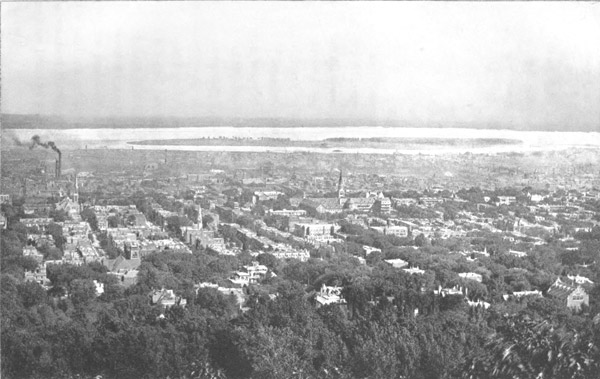
Montreal from Mount Royal
We left Montreal Wednesday, the 2d of October,
late in the afternoon. In the La Prairie cars the Yankees
made themselves merry, imitating the cries of the
charette-drivers to perfection, greatly to the amusement
of some French-Canadian travelers, and they kept it
up all the way to Boston. I saw one person on board
the boat at St. Johns, and one or two more elsewhere in
Canada, wearing homespun gray greatcoats, or capotes,
with conical and comical hoods, which fell back between
their shoulders like small bags, ready to be turned up
over the head when occasion required, though a hat
usurped that place now. They looked as if they would
be convenient and proper enough as long as the coats
were new and tidy, but would soon come to have a beggarly
and unsightly look, akin to rags and dust-holes.
We reached Burlington early in the morning, where the
Yankees tried to pass off their Canada coppers, but the
newsboys knew better. Returning through the Green
Mountains, I was reminded that I had not seen in
Canada such brilliant autumnal tints as I had previously
seen in Vermont. Perhaps there was not yet so
great and sudden a contrast with the summer heats in
the former country as in these mountain valleys. As we
were passing through Ashburnham, by a new white
house which stood at some distance in a field, one passenger
exclaimed, so that all in the car could hear him,
"There, there's not so good a house as that in all Canada!"
I did not much wonder at his remark, for there
is a neatness, as well as evident prosperity, a certain
elastic easiness of circumstances, so to speak, when not
rich, about a New England house, as if the proprietor
could at least afford to make repairs in the spring, which
the Canadian houses do not suggest. Though of stone,
they are no better constructed than a stone barn would
be with us; the only building, except the château, on
which money and taste are expended, being the church.
In Canada an ordinary New England house would be
mistaken for the château, and while every village here
contains at least several gentlemen or "squires," there
there is but one to a seigniory.
I got home this Thursday evening, having spent just
one week in Canada and traveled eleven hundred miles.
The whole expense of this journey, including two guide-books
and a map, which cost one dollar twelve and a
half cents, was twelve dollars seventy-five cents. I do
not suppose that I have seen all British America; that
could not be done by a cheap excursion, unless it were
a cheap excursion to the Icy Sea, as seen by Hearne or
Mackenzie, and then, no doubt, some interesting features
would be omitted. I wished to go a little way
behind the word Canadense, of which naturalists make
such frequent use; and I should like still right well to
make a longer excursion on foot through the wilder
parts of Canada, which perhaps might be called Iter
Canadense.
Books of natural history make the most cheerful
winter reading. I read in Audubon with a thrill of
delight, when the snow covers the ground, of the magnolia,
and the Florida keys, and their warm sea-breezes;
of the fence-rail, and the cotton-tree, and the migrations
of the rice-bird; of the breaking up of winter in Labrador,
and the melting of the snow on the forks of the
Missouri; and owe an accession of health to these
reminiscences of luxuriant nature.
Within the circuit of this plodding life,
There enter moments of an azure hue,
Untarnished fair as is the violet
Or anemone, when the spring strews them
By some meandering rivulet, which make
The best philosophy untrue that aims
But to console man for his grievances.
I have remembered, when the winter came,
High in my chamber in the frosty nights,
When in the still light of the cheerful moon,
On every twig and rail and jutting spout,
The icy spears were adding to their length
Against the arrows of the coming sun,
How in the shimmering noon of summer past
Some unrecorded beam slanted across
The upland pastures where the Johnswort grew;
Or heard, amid the verdure of my mind,
The bee's long smothered hum, on the blue flag
Loitering amidst the mead; or busy rill,
Which now through all its course stands still and dumb,
Its own memorial,—purling at its play
Along the slopes, and through the meadows next,
Until its youthful sound was hushed at last
In the staid current of the lowland stream;
Or seen the furrows shine but late upturned,
And where the fieldfare followed in the rear,
When all the fields around lay bound and hoar
Beneath a thick integument of snow.
So by God's cheap economy made rich
To go upon my winter's task again.
I am singularly refreshed in winter when I hear of
service-berries, poke-weed, juniper. Is not heaven made
up of these cheap summer glories? There is a singular
health in those words, Labrador and East Main, which
no desponding creed recognizes. How much more than
Federal are these States! If there were no other vicissitudes
than the seasons, our interest would never tire.
Much more is adoing than Congress wots of. What
journal do the persimmon and the buckeye keep, and
the sharp-shinned hawk? What is transpiring from
summer to winter in the Carolinas, and the Great Pine
Forest, and the Valley of the Mohawk? The merely
political aspect of the land is never very cheering; men
are degraded when considered as the members of a
political organization. On this side all lands present
only the symptoms of decay. I see but Bunker Hill and
Sing-Sing, the District of Columbia and Sullivan's
Island, with a few avenues connecting them. But paltry
are they all beside one blast of the east or the south wind
which blows over them.
In society you will not find health, but in nature.
Unless our feet at least stood in the midst of nature, all
our faces would be pale and livid. Society is always
diseased, and the best is the most so. There is no scent
in it so wholesome as that of the pines, nor any fragrance
so penetrating and restorative as the life-everlasting in
high pastures. I would keep some book of natural
history always by me as a sort of elixir, the reading of
which should restore the tone of the system. To the sick,
indeed, nature is sick, but to the well, a fountain of
health. To him who contemplates a trait of natural
beauty no harm nor disappointment can come. The
doctrines of despair, of spiritual or political tyranny or
servitude, were never taught by such as shared the
serenity of nature. Surely good courage will not flag
here on the Atlantic border, as long as we are flanked by
the Fur Countries. There is enough in that sound to
cheer one under any circumstances. The spruce, the
hemlock, and the pine will not countenance despair.
Methinks some creeds in vestries and churches do forget
the hunter wrapped in furs by the Great Slave Lake, and
that the Esquimaux sledges are drawn by dogs, and in
the twilight of the northern night the hunter does not
give over to follow the seal and walrus on the ice. They
are of sick and diseased imaginations who would toll the
world's knell so soon. Cannot these sedentary sects do
better than prepare the shrouds and write the epitaphs
of those other busy living men? The practical faith of
all men belies the preacher's consolation. What is any
man's discourse to me, if I am not sensible of something
in it as steady and cheery as the creak of crickets? In it
the woods must be relieved against the sky. Men tire me
when I am not constantly greeted and refreshed as by
the flux of sparkling streams. Surely joy is the condition
of life. Think of the young fry that leap in ponds, the
myriads of insects ushered into being on a summer
evening, the incessant note of the hyla with which the
woods ring in the spring, the nonchalance of the butterfly
carrying accident and change painted in a thousand hues
upon its wings, or the brook minnow stoutly stemming
the current, the lustre of whose scales, worn bright by
the attrition, is reflected upon the bank!
We fancy that this din of religion, literature, and
philosophy, which is heard in pulpits, lyceums, and
parlors, vibrates through the universe, and is as catholic
a sound as the creaking of the earth's axle; but if a man
sleep soundly, he will forget it all between sunset and
dawn. It is the three-inch swing of a pendulum in a
cupboard, which the great pulse of nature vibrates by
and through each instant. When we lift our eyelids and
open our ears, it disappears with smoke and rattle like
the cars on a railroad. When I detect a beauty in any of
the recesses of nature, I am reminded, by the serene
and retired spirit in which it requires to be contemplated,
of the inexpressible privacy of a life,—how
silent and unambitious it is. The beauty there is in
mosses must be considered from the holiest, quietest
nook. What an admirable training is science for the
more active warfare of life! Indeed, the unchallenged
bravery which these studies imply, is far more impressive
than the trumpeted valor of the warrior. I am
pleased to learn that Thales was up and stirring by night
not unfrequently, as his astronomical discoveries prove.
Linnæus, setting out for Lapland, surveys his "comb"
and "spare shirt," "leathern breeches" and "gauze cap
to keep off gnats," with as much complacency as Bonaparte
a park of artillery for the Russian campaign. The
quiet bravery of the man is admirable. His eye is to
take in fish, flower, and bird, quadruped and biped.
Science is always brave; for to know is to know good;
doubt and danger quail before her eye. What the
coward overlooks in his hurry, she calmly scrutinizes,
breaking ground like a pioneer for the array of arts that
follow in her train. But cowardice is unscientific; for
there cannot be a science of ignorance. There may be
a science of bravery, for that advances; but a retreat
is rarely well conducted; if it is, then is it an orderly
advance in the face of circumstances.
But to draw a little nearer to our promised topics.
Entomology extends the limits of being in a new direction,
so that I walk in nature with a sense of greater
space and freedom. It suggests besides, that the universe
is not rough-hewn, but perfect in its details. Nature
will bear the closest inspection; she invites us to
lay our eye level with the smallest leaf, and take an
insect view of its plain. She has no interstices; every
part is full of life. I explore, too, with pleasure, the
sources of the myriad sounds which crowd the summer
noon, and which seem the very grain and stuff of
which eternity is made. Who does not remember the
shrill roll-call of the harvest-fly? There were ears for
these sounds in Greece long ago, as Anacreon's ode
will show.
"We pronounce thee happy, Cicada,
For on the tops of the trees,
Drinking a little dew,
Like any king thou singest,
For thine are they all,
Whatever thou seest in the fields,
And whatever the woods bear.
Thou art the friend of the husbandmen,
In no respect injuring any one;
And thou art honored among men,
Sweet prophet of summer.
The Muses love thee,
And Phœbus himself loves thee,
And has given thee a shrill song;
Age does not wrack thee,
Thou skillful, earthborn, song-loving,
Unsuffering, bloodless one;
Almost thou art like the gods."
In the autumn days, the creaking of crickets is heard
at noon over all the land, and as in summer they are
heard chiefly at nightfall, so then by their incessant chirp
they usher in the evening of the year. Nor can all the
vanities that vex the world alter one whit the measure
that night has chosen. Every pulse-beat is in exact time
with the cricket's chant and the tickings of the deathwatch
in the wall. Alternate with these if you can.
About two hundred and eighty birds either reside
permanently in the State, or spend the summer only,
or make us a passing visit. Those which spend the winter
with us have obtained our warmest sympathy. The nuthatch
and chickadee flitting in company through the
dells of the wood, the one harshly scolding at the
intruder, the other with a faint lisping note enticing him
on; the jay screaming in the orchard; the crow cawing
in unison with the storm; the partridge, like a russet
link extended over from autumn to spring, preserving
unbroken the chain of summers; the hawk with warrior-like
firmness abiding the blasts of winter; the robin[4]
and lark lurking by warm springs in the woods; the
familiar snowbird culling a few seeds in the garden or
a few crumbs in the yard; and occasionally the shrike,
with heedless and unfrozen melody bringing back summer
again:—
His steady sails he never furls
At any time o' year,
And perching now on Winter's curls,
He whistles in his ear.
As the spring advances, and the ice is melting in the
river, our earliest and straggling visitors make their
appearance. Again does the old Teian poet sing as well
for New England as for Greece, in the
RETURN OF SPRING
Behold, how, Spring appearing,
The Graces send forth roses;
Behold, how the wave of the sea
Is made smooth by the calm;
Behold, how the duck dives;
Behold, how the crane travels;
And Titan shines constantly bright.
The shadows of the clouds are moving;
The works of man shine;
The earth puts forth fruits;
The fruit of the olive puts forth.
The cup of Bacchus is crowned,
Along the leaves, along the branches,
The fruit, bending them down, flourishes.
The ducks alight at this season in the still water,
in company with the gulls, which do not fail to improve
an east wind to visit our meadows, and swim about by
twos and threes, pluming themselves, and diving to
peck at the root of the lily, and the cranberries which
the frost has not loosened. The first flock of geese is seen
beating to north, in long harrows and waving lines;
the jingle of the song sparrow salutes us from the shrubs
and fences; the plaintive note of the lark comes clear
and sweet from the meadow; and the bluebird, like an
azure ray, glances past us in our walk. The fish hawk,
too, is occasionally seen at this season sailing majestically
over the water, and he who has once observed it
will not soon forget the majesty of its flight. It sails the
air like a ship of the line, worthy to struggle with the
elements, falling back from time to time like a ship on
its beam ends, and holding its talons up as if ready for
the arrows, in the attitude of the national bird. It is a
great presence, as of the master of river and forest. Its
eye would not quail before the owner of the soil, but make
him feel like an intruder on its domains. And then its
retreat, sailing so steadily away, is a kind of advance. I
have by me one of a pair of ospreys, which have for some
years fished in this vicinity, shot by a neighboring pond,
measuring more than two feet in length, and six in the
stretch of its wings. Nuttall mentions that "the ancients,
particularly Aristotle, pretended that the ospreys
taught their young to gaze at the sun, and those who
were unable to do so were destroyed. Linnæus even believed,
on ancient authority, that one of the feet of this
bird had all the toes divided, while the other was partly
webbed, so that it could swim with one foot, and grasp a
fish with the other." But that educated eye is now dim,
and those talons are nerveless. Its shrill scream seems
yet to linger in its throat, and the roar of the sea in its
wings. There is the tyranny of Jove in its claws, and
his wrath in the erectile feathers of the head and neck.
It reminds me of the Argonautic expedition, and would
inspire the dullest to take flight over Parnassus.
The booming of the bittern, described by Goldsmith
and Nuttall, is frequently heard in our fens, in the
morning and evening, sounding like a pump, or the
chopping of wood in a frosty morning in some distant
farm-yard. The manner in which this sound is produced
I have not seen anywhere described. On one
occasion, the bird has been seen by one of my neighbors
to thrust its bill into the water, and suck up as much as it
could hold, then, raising its head, it pumped it out again
with four or five heaves of the neck, throwing it two or
three feet, and making the sound each time.
At length the summer's eternity is ushered in by the
cackle of the flicker among the oaks on the hillside, and
a new dynasty begins with calm security.
In May and June the woodland quire is in full tune,
and, given the immense spaces of hollow air, and this
curious human ear, one does not see how the void could
be better filled.
Each summer sound
Is a summer round.
As the season advances, and those birds which make
us but a passing visit depart, the woods become silent
again, and but few feathers ruffle the drowsy air. But
the solitary rambler may still find a response and
expression for every mood in the depths of the wood.
Sometimes I hear the veery's[5] clarion,
Or brazen trump of the impatient jay,
And in secluded woods the chickadee
Doles out her scanty notes, which sing the praise
Of heroes, and set forth the loveliness
Of virtue evermore.
The phœbe still sings in harmony with the sultry
weather by the brink of the pond, nor are the desultory
hours of noon in the midst of the village without their
minstrel.
Upon the lofty elm-tree sprays
The vireo rings the changes sweet,
During the trivial summer days,
Striving to lift our thoughts above the street.
With the autumn begins in some measure a new
spring. The plover is heard whistling high in the air
over the dry pastures, the finches flit from tree to tree,
the bobolinks and flickers fly in flocks, and the goldfinch
rides on the earliest blast, like a winged hyla peeping
amid the rustle of the leaves. The crows, too, begin
now to congregate; you may stand and count them as
they fly low and straggling over the landscape, singly or
by twos and threes, at intervals of half a mile, until a
hundred have passed.
I have seen it suggested somewhere that the crow was
brought to this country by the white man; but I shall
as soon believe that the white man planted these pines
and hemlocks. He is no spaniel to follow our steps;
but rather flits about the clearings like the dusky spirit
of the Indian, reminding me oftener of Philip and
Powhatan than of Winthrop and Smith. He is a relic
of the dark ages. By just so slight, by just so lasting a
tenure does superstition hold the world ever; there is
the rook in England, and the crow in New England.
Thou dusky spirit of the wood,
Bird of an ancient brood,
Flitting thy lonely way,
A meteor in the summer's day,
From wood to wood, from hill to hill,
Low over forest, field, and rill,
What wouldst thou say?
Why shouldst thou haunt the day?
What makes thy melancholy float?
What bravery inspires thy throat,
And bears thee up above the clouds,
Over desponding human crowds,
Which far below
Lay thy haunts low?
The late walker or sailor, in the October evenings,
may hear the murmurings of the snipe, circling over
the meadows, the most spirit-like sound in nature; and
still later in the autumn, when the frosts have tinged the
leaves, a solitary loon pays a visit to our retired ponds,
where he may lurk undisturbed till the season of moulting
is passed, making the woods ring with his wild
laughter. This bird, the Great Northern Diver, well
deserves its name; for when pursued with a boat, it
will dive, and swim like a fish under water, for sixty rods
or more, as fast as a boat can be paddled, and its pursuer,
if he would discover his game again, must put
his ear to the surface to hear where it comes up. When
it comes to the surface, it throws the water off with one
shake of its wings, and calmly swims about until again
disturbed.
These are the sights and sounds which reach our
senses oftenest during the year. But sometimes one
hears a quite new note, which has for background other
Carolinas and Mexicos than the books describe, and
learns that his ornithology has done him no service.
It appears from the Report that there are about forty
quadrupeds belonging to the State, and among these
one is glad to hear of a few bears, wolves, lynxes, and
wildcats.
When our river overflows its banks in the spring,
the wind from the meadows is laden with a strong scent
of musk, and by its freshness advertises me of an unexplored
wildness. Those backwoods are not far off then.
I am affected by the sight of the cabins of the muskrat,
made of mud and grass, and raised three or four feet
along the river, as when I read of the barrows of Asia.
The muskrat is the beaver of the settled States. Their
number has even increased within a few years in this
vicinity. Among the rivers which empty into the Merrimack,
the Concord is known to the boatmen as a dead
stream. The Indians are said to have called it Musketaquid,
or Prairie River. Its current being much more
sluggish and its water more muddy than the rest, it
abounds more in fish and game of every kind. According
to the History of the town, "The fur-trade was here
once very important. As early as 1641, a company was
formed in the colony, of which Major Willard of Concord
was superintendent, and had the exclusive right to
trade with the Indians in furs and other articles; and
for this right they were obliged to pay into the public
treasury one twentieth of all the furs they obtained."
There are trappers in our midst still, as well as on the
streams of the far West, who night and morning go
the round of their traps, without fear of the Indian.
One of these takes from one hundred and fifty to two
hundred muskrats in a year, and even thirty-six have
been shot by one man in a day. Their fur, which is not
nearly as valuable as formerly, is in good condition in
the winter and spring only; and upon the breaking up
of the ice, when they are driven out of their holes by the
water, the greatest number is shot from boats, either
swimming or resting on their stools, or slight supports
of grass and reeds, by the side of the stream. Though
they exhibit considerable cunning at other times, they
are easily taken in a trap, which has only to be placed
in their holes, or wherever they frequent, without any
bait being used, though it is sometimes rubbed with their
musk. In the winter the hunter cuts holes in the ice,
and shoots them when they come to the surface. Their
burrows are usually in the high banks of the river, with
the entrance under water, and rising within to above the
level of high water. Sometimes their nests, composed of
dried meadow-grass and flags, may be discovered where
the bank is low and spongy, by the yielding of the ground
under the feet. They have from three to seven or eight
young in the spring.
Frequently, in the morning or evening, a long ripple
is seen in the still water, where a muskrat is crossing
the stream, with only its nose above the surface, and
sometimes a green bough in its mouth to build its house
with. When it finds itself observed, it will dive and swim
five or six rods under water, and at length conceal itself
in its hole, or the weeds. It will remain under water for
ten minutes at a time, and on one occasion has been
seen, when undisturbed, to form an air-bubble under the
ice, which contracted and expanded as it breathed at
leisure. When it suspects danger on shore, it will stand
erect like a squirrel, and survey its neighborhood for
several minutes, without moving.
In the fall, if a meadow intervene between their burrows
and the stream, they erect cabins of mud and
grass, three or four feet high, near its edge. These are
not their breeding-places, though young are sometimes
found in them in late freshets, but rather their hunting-lodges,
to which they resort in the winter with their
food, and for shelter. Their food consists chiefly of flags
and fresh-water mussels, the shells of the latter being left
in large quantities around their lodges in the spring.
The Penobscot Indian wears the entire skin of a muskrat,
with the legs and tail dangling, and the head caught
under his girdle, for a pouch, into which he puts his
fishing-tackle, and essences to scent his traps with.
The bear, wolf, lynx, wildcat, deer, beaver, and marten
have disappeared; the otter is rarely if ever seen here
at present; and the mink is less common than formerly.
Perhaps of all our untamed quadrupeds, the fox has
obtained the widest and most familiar reputation, from
the time of Pilpay and Æsop to the present day. His
recent tracks still give variety to a winter's walk. I tread
in the steps of the fox that has gone before me by some
hours, or which perhaps I have started, with such a tiptoe
of expectation as if I were on the trail of the Spirit
itself which resides in the wood, and expected soon to
catch it in its lair. I am curious to know what has determined
its graceful curvatures, and how surely they were
coincident with the fluctuations of some mind. I know
which way a mind wended, what horizon it faced, by the
setting of these tracks, and whether it moved slowly or
rapidly, by their greater or less intervals and distinctness;
for the swiftest step leaves yet a lasting trace.
Sometimes you will see the trails of many together, and
where they have gamboled and gone through a hundred
evolutions, which testify to a singular listlessness and
leisure in nature.
When I see a fox run across the pond on the snow,
with the carelessness of freedom, or at intervals trace
his course in the sunshine along the ridge of a hill, I give
up to him sun and earth as to their true proprietor.
He does not go in the sun, but it seems to follow him,
and there is a visible sympathy between him and it.
Sometimes, when the snow lies light and but five or six
inches deep, you may give chase and come up with one
on foot. In such a case he will show a remarkable presence
of mind, choosing only the safest direction, though
he may lose ground by it. Notwithstanding his fright, he
will take no step which is not beautiful. His pace is a
sort of leopard canter, as if he were in no wise impeded
by the snow, but were husbanding his strength all the
while. When the ground is uneven, the course is a series
of graceful curves, conforming to the shape of the surface.
He runs as though there were not a bone in his
back. Occasionally dropping his muzzle to the ground
for a rod or two, and then tossing his head aloft, when
satisfied of his course. When he comes to a declivity, he
will put his fore feet together, and slide swiftly down it,
shoving the snow before him. He treads so softly that
you would hardly hear it from any nearness, and yet
with such expression that it would not be quite inaudible
at any distance.
Of fishes, seventy-five genera and one hundred and
seven species are described in the Report. The fisherman
will be startled to learn that there are but about a
dozen kinds in the ponds and streams of any inland
town; and almost nothing is known of their habits.
Only their names and residence make one love fishes.
I would know even the number of their fin-rays, and
how many scales compose the lateral line. I am the
wiser in respect to all knowledges, and the better qualified
for all fortunes, for knowing that there is a minnow
in the brook. Methinks I have need even of his sympathy,
and to be his fellow in a degree.
I have experienced such simple delight in the trivial
matters of fishing and sporting, formerly, as might have
inspired the muse of Homer or Shakespeare; and now,
when I turn the pages and ponder the plates of the
Angler's Souvenir, I am fain to exclaim,—
"Can such things be,
And overcome us like a summer's cloud?"
Next to nature, it seems as if man's actions were the
most natural, they so gently accord with her. The small
seines of flax stretched across the shallow and transparent
parts of our river are no more intrusion than the
cobweb in the sun. I stay my boat in mid-current, and
look down in the sunny water to see the civil meshes of
his nets, and wonder how the blustering people of the
town could have done this elvish work. The twine looks
like a new river-weed, and is to the river as a beautiful
memento of man's presence in nature, discovered as
silently and delicately as a footprint in the sand.
When the ice is covered with snow, I do not suspect
the wealth under my feet; that there is as good as a
mine under me wherever I go. How many pickerel are
poised on easy fin fathoms below the loaded wain! The
revolution of the seasons must be a curious phenomenon
to them. At length the sun and wind brush aside their
curtain, and they see the heavens again.
Early in the spring, after the ice has melted, is the time
for spearing fish. Suddenly the wind shifts from northeast
and east to west and south, and every icicle, which
has tinkled on the meadow grass so long, trickles down
its stem, and seeks its level unerringly with a million
comrades. The steam curls up from every roof and fence.
I see the civil sun drying earth's tears,
Her tears of joy, which only faster flow.
In the brooks is heard the slight grating sound of
small cakes of ice, floating with various speed, full of
content and promise, and where the water gurgles under
a natural bridge, you may hear these hasty rafts hold
conversation in an undertone. Every rill is a channel
for the juices of the meadow. In the ponds the ice cracks
with a merry and inspiriting din, and down the larger
streams is whirled grating hoarsely, and crashing its way
along, which was so lately a highway for the woodman's
team and the fox, sometimes with the tracks of the
skaters still fresh upon it, and the holes cut for pickerel.
Town committees anxiously inspect the bridges and
causeways, as if by mere eye-force to intercede with the
ice and save the treasury.
The river swelleth more and more,
Like some sweet influence stealing o'er
The passive town; and for a while
Each tussock makes a tiny isle,
Where, on some friendly Ararat,
Resteth the weary water-rat.
No ripple shows Musketaquid,
Her very current e'en is hid,
As deepest souls do calmest rest
When thoughts are swelling in the breast,
And she that in the summer's drought
Doth make a rippling and a rout,
Sleeps from Nahshawtuck to the Cliff,
Unruffled by a single skiff.
But by a thousand distant hills
The louder roar a thousand rills,
And many a spring which now is dumb,
And many a stream with smothered hum,
Doth swifter well and faster glide,
Though buried deep beneath the tide.
Our village shows a rural Venice,
Its broad lagoons where yonder fen is;
As lovely as the Bay of Naples
Yon placid cove amid the maples;
And in my neighbor's field of corn
I recognize the Golden Horn.
Here Nature taught from year to year,
When only red men came to hear,—
Methinks 't was in this school of art
Venice and Naples learned their part;
But still their mistress, to my mind,
Her young disciples leaves behind.
The fisherman now repairs and launches his boat.
The best time for spearing is at this season, before the
weeds have begun to grow, and while the fishes lie in the
shallow water, for in summer they prefer the cool depths,
and in the autumn they are still more or less concealed
by the grass. The first requisite is fuel for your crate;
and for this purpose the roots of the pitch pine are commonly
used, found under decayed stumps, where the
trees have been felled eight or ten years.
With a crate, or jack, made of iron hoops, to contain
your fire, and attached to the bow of your boat about
three feet from the water, a fish-spear with seven tines
and fourteen feet long, a large basket or barrow to carry
your fuel and bring back your fish, and a thick outer
garment, you are equipped for a cruise. It should be a
warm and still evening; and then, with a fire crackling
merrily at the prow, you may launch forth like a cucullo
into the night. The dullest soul cannot go upon such an
expedition without some of the spirit of adventure; as
if he had stolen the boat of Charon and gone down the
Styx on a midnight expedition into the realms of Pluto.
And much speculation does this wandering star afford
to the musing night-walker, leading him on and on,
jack-o'-lantern-like, over the meadows; or, if he is wiser,
he amuses himself with imagining what of human life,
far in the silent night, is flitting moth-like round its candle.
The silent navigator shoves his craft gently over
the water, with a smothered pride and sense of benefaction,
as if he were the phosphor, or light-bringer, to these
dusky realms, or some sister moon, blessing the spaces
with her light. The waters, for a rod or two on either
hand and several feet in depth, are lit up with more than
noonday distinctness, and he enjoys the opportunity
which so many have desired, for the roofs of a city are
indeed raised, and he surveys the midnight economy of
the fishes. There they lie in every variety of posture;
some on their backs, with their white bellies uppermost,
some suspended in mid-water, some sculling gently
along with a dreamy motion of the fins, and others quite
active and wide awake,—a scene not unlike what the
human city would present. Occasionally he will encounter
a turtle selecting the choicest morsels, or a muskrat
resting on a tussock. He may exercise his dexterity, if
he sees fit, on the more distant and active fish, or fork
the nearer into his boat, as potatoes out of a pot, or even
take the sound sleepers with his hands. But these last
accomplishments he will soon learn to dispense with,
distinguishing the real object of his pursuit, and find
compensation in the beauty and never-ending novelty
of his position. The pines growing down to the water's
edge will show newly as in the glare of a conflagration;
and as he floats under the willows with his light, the
song sparrow will often wake on her perch, and sing
that strain at midnight which she had meditated for the
morning. And when he has done, he may have to steer
his way home through the dark by the north star, and he
will feel himself some degrees nearer to it for having lost
his way on the earth.
The fishes commonly taken in this way are pickerel,
suckers, perch, eels, pouts, breams, and shiners,—from
thirty to sixty weight in a night. Some are hard
to be recognized in the unnatural light, especially the
perch, which, his dark bands being exaggerated, acquires
a ferocious aspect. The number of these transverse
bands, which the Report states to be seven, is, however,
very variable, for in some of our ponds they have nine
and ten even.
It appears that we have eight kinds of tortoises,
twelve snakes,—but one of which is venomous,—nine
frogs and toads, nine salamanders, and one lizard, for
our neighbors.
I am particularly attracted by the motions of the serpent
tribe. They make our hands and feet, the wings of
the bird, and the fins of the fish seem very superfluous,
as if Nature had only indulged her fancy in making them.
The black snake will dart into a bush when pursued,
and circle round and round with an easy and graceful
motion, amid the thin and bare twigs, five or six feet
from the ground, as a bird flits from bough to bough,
or hang in festoons between the forks. Elasticity and
flexibleness in the simpler forms of animal life are equivalent
to a complex system of limbs in the higher; and
we have only to be as wise and wily as the serpent, to
perform as difficult feats without the vulgar assistance
of hands and feet.
In May, the snapping turtle (Emysaurus serpentina)
is frequently taken on the meadows and in the river.
The fisherman, taking sight over the calm surface, discovers
its snout projecting above the water, at the distance
of many rods, and easily secures his prey through
its unwillingness to disturb the water by swimming
hastily away, for, gradually drawing its head under, it
remains resting on some limb or clump of grass. Its
eggs, which are buried at a distance from the water,
in some soft place, as a pigeon-bed, are frequently
devoured by the skunk. It will catch fish by daylight,
as a toad catches flies, and is said to emit a transparent
fluid from its mouth to attract them.
Nature has taken more care than the fondest parent
for the education and refinement of her children. Consider
the silent influence which flowers exert, no less
upon the ditcher in the meadow than the lady in the
bower. When I walk in the woods, I am reminded that
a wise purveyor has been there before me; my most
delicate experience is typified there. I am struck with
the pleasing friendships and unanimities of nature,
as when the lichen on the trees takes the form of their
leaves. In the most stupendous scenes you will see delicate
and fragile features, as slight wreaths of vapor,
dew-lines, feathery sprays, which suggest a high refinement,
a noble blood and breeding, as it were. It is not
hard to account for elves and fairies; they represent this
light grace, this ethereal gentility. Bring a spray from
the wood, or a crystal from the brook, and place it on
your mantel, and your household ornaments will seem
plebeian beside its nobler fashion and bearing. It will
wave superior there, as if used to a more refined and polished
circle. It has a salute and a response to all your
enthusiasm and heroism.
In the winter, I stop short in the path to admire how
the trees grow up without forethought, regardless of the
time and circumstances. They do not wait as man does,
but now is the golden age of the sapling. Earth, air, sun,
and rain are occasion enough; they were no better in
primeval centuries. The "winter of their discontent"
never comes. Witness the buds of the native poplar
standing gayly out to the frost on the sides of its bare
switches. They express a naked confidence. With cheerful
heart one could be a sojourner in the wilderness, if he
were sure to find there the catkins of the willow or the
alder. When I read of them in the accounts of northern
adventurers, by Baffin's Bay or Mackenzie's River, I
see how even there, too, I could dwell. They are our
little vegetable redeemers. Methinks our virtue will hold
out till they come again. They are worthy to have had a
greater than Minerva or Ceres for their inventor. Who
was the benignant goddess that bestowed them on mankind?
Nature is mythical and mystical always, and works
with the license and extravagance of genius. She has her
luxurious and florid style as well as art. Having a pilgrim's
cup to make, she gives to the whole—stem, bowl,
handle, and nose—some fantastic shape, as if it were to
be the car of some fabulous marine deity, a Nereus or
Triton.
In the winter, the botanist need not confine himself
to his books and herbarium, and give over his outdoor
pursuits, but may study a new department of vegetable
physiology, what may be called crystalline botany, then.
The winter of 1837 was unusually favorable for this.
In December of that year, the Genius of vegetation
seemed to hover by night over its summer haunts with
unusual persistency. Such a hoar-frost as is very uncommon
here or anywhere, and whose full effects can never
be witnessed after sunrise, occurred several times. As I
went forth early on a still and frosty morning, the trees
looked like airy creatures of darkness caught napping;
on this side huddled together, with their gray hairs
streaming, in a secluded valley which the sun had not
penetrated; on that, hurrying off in Indian file along
some watercourse, while the shrubs and grasses, like
elves and fairies of the night, sought to hide their diminished
heads in the snow. The river, viewed from the
high bank, appeared of a yellowish-green color, though
all the landscape was white. Every tree, shrub, and spire
of grass, that could raise its head above the snow, was
covered with a dense ice-foliage, answering, as it were,
leaf for leaf to its summer dress. Even the fences had
put forth leaves in the night. The centre, diverging, and
more minute fibres were perfectly distinct, and the edges
regularly indented. These leaves were on the side of the
twig or stubble opposite to the sun, meeting it for the
most part at right angles, and there were others standing
out at all possible angles upon these and upon one
another, with no twig or stubble supporting them. When
the first rays of the sun slanted over the scene, the grasses
seemed hung with innumerable jewels, which jingled
merrily as they were brushed by the foot of the traveler,
and reflected all the hues of the rainbow, as he moved
from side to side. It struck me that these ghost leaves,
and the green ones whose forms they assume, were the
creatures of but one law; that in obedience to the same
law the vegetable juices swell gradually into the perfect
leaf, on the one hand, and the crystalline particles troop
to their standard in the same order, on the other. As if
the material were indifferent, but the law one and invariable,
and every plant in the spring but pushed up into
and filled a permanent and eternal mould, which, summer
and winter forever, is waiting to be filled.
This foliate structure is common to the coral and the
plumage of birds, and to how large a part of animate
and inanimate nature. The same independence of law
on matter is observable in many other instances, as in
the natural rhymes, when some animal form, color, or
odor has its counterpart in some vegetable. As, indeed,
all rhymes imply an eternal melody, independent of any
particular sense.
As confirmation of the fact that vegetation is but a
kind of crystallization, every one may observe how,
upon the edge of the melting frost on the window, the
needle-shaped particles are bundled together so as to
resemble fields waving with grain, or shocks rising here
and there from the stubble; on one side the vegetation
of the torrid zone, high-towering palms and wide-spread
banyans, such as are seen in pictures of oriental scenery;
on the other, arctic pines stiff frozen, with downcast
branches.
Vegetation has been made the type of all growth; but
as in crystals the law is more obvious, their material
being more simple, and for the most part more transient
and fleeting, would it not be as philosophical as convenient
to consider all growth, all filling up within the
limits of nature, but a crystallization more or less rapid?
On this occasion, in the side of the high bank of the
river, wherever the water or other cause had formed a
cavity, its throat and outer edge, like the entrance to a
citadel, bristled with a glistening ice-armor. In one place
you might see minute ostrich-feathers, which seemed the
waving plumes of the warriors filing into the fortress;
in another, the glancing, fan-shaped banners of the
Lilliputian host; and in another, the needle-shaped
particles collected into bundles, resembling the plumes
of the pine, might pass for a phalanx of spears. From
the under side of the ice in the brooks, where there was
a thicker ice below, depended a mass of crystallization,
four or five inches deep, in the form of prisms, with their
lower ends open, which, when the ice was laid on its
smooth side, resembled the roofs and steeples of a Gothic
city, or the vessels of a crowded haven under a press of
canvas. The very mud in the road, where the ice had
melted, was crystallized with deep rectilinear fissures,
and the crystalline masses in the sides of the ruts resembled
exactly asbestos in the disposition of their needles.
Around the roots of the stubble and flower-stalks, the
frost was gathered into the form of irregular conical
shells, or fairy rings. In some places the ice-crystals
were lying upon granite rocks, directly over crystals of
quartz, the frostwork of a longer night, crystals of a
longer period, but, to some eye unprejudiced by the
short term of human life, melting as fast as the former.
In the Report on the Invertebrate Animals, this singular
fact is recorded, which teaches us to put a new
value on time and space: "The distribution of the
marine shells is well worthy of notice as a geological
fact. Cape Cod, the right arm of the Commonwealth,
reaches out into the ocean, some fifty or sixty miles. It is
nowhere many miles wide; but this narrow point of land
has hitherto proved a barrier to the migrations of many
species of Mollusca. Several genera and numerous
species, which are separated by the intervention of only
a few miles of land, are effectually prevented from mingling
by the Cape, and do not pass from one side to the
other.... Of the one hundred and ninety-seven marine
species, eighty-three do not pass to the south shore,
and fifty are not found on the north shore of the Cape."
That common mussel, the Unio complanatus, or more
properly fluviatilis, left in the spring by the muskrat
upon rocks and stumps, appears to have been an important
article of food with the Indians. In one place, where
they are said to have feasted, they are found in large
quantities, at an elevation of thirty feet above the river,
filling the soil to the depth of a foot, and mingled with
ashes and Indian remains.
The works we have placed at the head of our chapter,
with as much license as the preacher selects his text, are
such as imply more labor than enthusiasm. The State
wanted complete catalogues of its natural riches, with
such additional facts merely as would be directly useful.
The reports on Fishes, Reptiles, Insects, and Invertebrate
Animals, however, indicate labor and research,
and have a value independent of the object of the legislature.
Those on Herbaceous Plants and Birds cannot be of
much value, as long as Bigelow and Nuttall are accessible.
They serve but to indicate, with more or less
exactness, what species are found in the State. We detect
several errors ourselves, and a more practiced eye would
no doubt expand the list.
The Quadrupeds deserved a more final and instructive
report than they have obtained.
These volumes deal much in measurements and
minute descriptions, not interesting to the general
reader, with only here and there a colored sentence to
allure him, like those plants growing in dark forests,
which bear only leaves without blossoms. But the
ground was comparatively unbroken, and we will not
complain of the pioneer, if he raises no flowers with his
first crop. Let us not underrate the value of a fact; it
will one day flower in a truth. It is astonishing how few
facts of importance are added in a century to the natural
history of any animal. The natural history of man himself
is still being gradually written. Men are knowing
enough after their fashion. Every countryman and
dairy-maid knows that the coats of the fourth stomach of
the calf will curdle milk, and what particular mushroom
is a safe and nutritious diet. You cannot go into any
field or wood, but it will seem as if every stone had been
turned, and the bark on every tree ripped up. But,
after all, it is much easier to discover than to see when the
cover is off. It has been well said that "the attitude of
inspection is prone." Wisdom does not inspect, but
behold. We must look a long time before we can see.
Slow are the beginnings of philosophy. He has something
demoniacal in him, who can discern a law or
couple two facts. We can imagine a time when "Water
runs down hill" may have been taught in the schools.
The true man of science will know nature better by his
finer organization; he will smell, taste, see, hear, feel,
better than other men. His will be a deeper and finer
experience. We do not learn by inference and deduction
and the application of mathematics to philosophy, but
by direct intercourse and sympathy. It is with science
as with ethics,—we cannot know truth by contrivance
and method; the Baconian is as false as any other, and
with all the helps of machinery and the arts, the most
scientific will still be the healthiest and friendliest man,
and possess a more perfect Indian wisdom.
Concord, July 19, 1842.
The needles of the pine
All to the west incline.
Summer and winter our eyes had rested on the dim
outline of the mountains in our horizon, to which distance
and indistinctness lent a grandeur not their own,
so that they served equally to interpret all the allusions
of poets and travelers; whether with Homer, on a spring
morning, we sat down on the many-peaked Olympus,
or with Virgil and his compeers roamed the Etrurian
and Thessalian hills, or with Humboldt measured the
more modern Andes and Teneriffe. Thus we spoke our
mind to them, standing on the Concord cliffs:—
With frontier strength ye stand your ground,
With grand content ye circle round,
Tumultuous silence for all sound,
Ye distant nursery of rills,
Monadnock, and the Peterboro' hills;
Like some vast fleet,
Sailing through rain and sleet,
Through winter's cold and summer's heat;
Still holding on, upon your high emprise,
Until ye find a shore amid the skies;
Not skulking close to land,
With cargo contraband,
For they who sent a venture out by ye
Have set the sun to see
Their honesty.
Ships of the line, each one,
Ye to the westward run,
Always before the gale,
Under a press of sail,
With weight of metal all untold.
I seem to feel ye, in my firm seat here,
Immeasurable depth of hold,
And breadth of beam, and length of running gear.
Methinks ye take luxurious pleasure
In your novel western leisure;
So cool your brows, and freshly blue,
As Time had nought for ye to do;
For ye lie at your length,
An unappropriated strength,
Unhewn primeval timber,
For knees so stiff, for masts so limber;
The stock of which new earths are made
One day to be our western trade,
Fit for the stanchions of a world
Which through the seas of space is hurled.
While we enjoy a lingering ray,
Ye still o'ertop the western day,
Reposing yonder, on God's croft,
Like solid stacks of hay.
Edged with silver, and with gold,
The clouds hang o'er in damask fold,
And with such depth of amber light
The west is dight,
Where still a few rays slant,
That even heaven seems extravagant.
On the earth's edge mountains and trees
Stand as they were on air graven,
Or as the vessels in a haven
Await the morning breeze.
I fancy even
Through your defiles windeth the way to heaven;
And yonder still, in spite of history's page,
Linger the golden and the silver age;
Upon the laboring gale
The news of future centuries is brought,
And of new dynasties of thought,
From your remotest vale.
But special I remember thee,
Wachusett, who like me
Standest alone without society.
Thy far blue eye,
A remnant of the sky,
Seen through the clearing or the gorge
Or from the windows of the forge,
Doth leaven all it passes by.
Nothing is true,
But stands 'tween me and you,
Thou western pioneer,
Who know'st not shame nor fear
By venturous spirit driven,
Under the eaves of heaven.
And canst expand thee there,
And breathe enough of air?
Upholding heaven, holding down earth,
Thy pastime from thy birth,
Not steadied by the one, nor leaning on the other;
May I approve myself thy worthy brother!
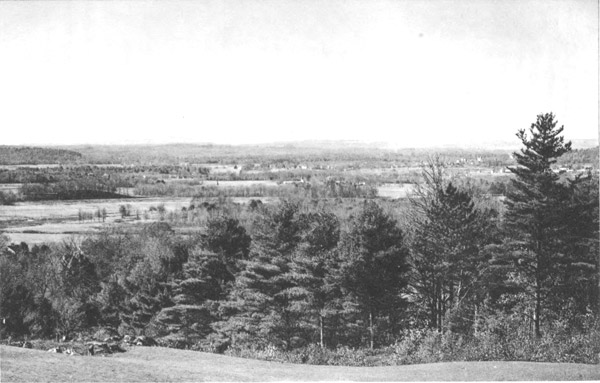
Mount Wachusett from the Wayland Hills
At length, like Rasselas, and other inhabitants of
happy valleys, we resolved to scale the blue wall which
bounded the western horizon, though not without misgivings
that thereafter no visible fairyland would exist for
us. But we will not leap at once to our journey's end,
though near, but imitate Homer, who conducts his
reader over the plain, and along the resounding sea,
though it be but to the tent of Achilles. In the spaces of
thought are the reaches of land and water, where men
go and come. The landscape lies far and fair within,
and the deepest thinker is the farthest traveled.
At a cool and early hour on a pleasant morning in
July, my companion and I passed rapidly through
Acton and Stow, stopping to rest and refresh us on the
bank of a small stream, a tributary of the Assabet, in the
latter town. As we traversed the cool woods of Acton,
with stout staves in our hands, we were cheered by the
song of the red-eye, the thrushes, the phœbe, and the
cuckoo; and as we passed through the open country, we
inhaled the fresh scent of every field, and all nature lay
passive, to be viewed and traveled. Every rail, every
farmhouse, seen dimly in the twilight, every tinkling
sound told of peace and purity, and we moved happily
along the dank roads, enjoying not such privacy as the
day leaves when it withdraws, but such as it has not
profaned. It was solitude with light; which is better
than darkness. But anon, the sound of the mower's rifle
was heard in the fields, and this, too, mingled with the
lowing of kine.
This part of our route lay through the country of
hops, which plant perhaps supplies the want of the vine
in American scenery, and may remind the traveler of
Italy and the South of France, whether he traverses the
country when the hop-fields, as then, present solid and
regular masses of verdure, hanging in graceful festoons
from pole to pole, the cool coverts where lurk the gales
which refresh the wayfarer; or in September, when the
women and children, and the neighbors from far and
near, are gathered to pick the hops into long troughs; or
later still, when the poles stand piled in vast pyramids in
the yards, or lie in heaps by the roadside.
The culture of the hop, with the processes of picking,
drying in the kiln, and packing for the market, as well
as the uses to which it is applied, so analogous to the
culture and uses of the grape, may afford a theme for
future poets.
The mower in the adjacent meadow could not tell us
the name of the brook on whose banks we had rested, or
whether it had any, but his younger companion, perhaps
his brother, knew that it was Great Brook. Though
they stood very near together in the field, the things they
knew were very far apart; nor did they suspect each
other's reserved knowledge, till the stranger came by.
In Bolton, while we rested on the rails of a cottage fence,
the strains of music which issued from within, probably
in compliment to us, sojourners, reminded us that thus
far men were fed by the accustomed pleasures. So soon
did we, wayfarers, begin to learn that man's life is
rounded with the same few facts, the same simple relations
everywhere, and it is vain to travel to find it new.
The flowers grow more various ways than he. But
coming soon to higher land, which afforded a prospect
of the mountains, we thought we had not traveled in
vain, if it were only to hear a truer and wilder pronunciation
of their names from the lips of the inhabitants;
not Way-tatic, Way-chusett, but Wor-tatic, Wor-chusett.
It made us ashamed of our tame and civil
pronunciation, and we looked upon them as born and
bred farther west than we. Their tongues had a more
generous accent than ours, as if breath was cheaper
where they wagged. A countryman, who speaks but
seldom, talks copiously, as it were, as his wife sets cream
and cheese before you without stint. Before noon we
had reached the highlands overlooking the valley of
Lancaster (affording the first fair and open prospect into
the west), and there, on the top of a hill, in the shade of
some oaks, near to where a spring bubbled out from a
leaden pipe, we rested during the heat of the day, reading
Virgil and enjoying the scenery. It was such a place
as one feels to be on the outside of the earth; for from
it we could, in some measure, see the form and structure
of the globe. There lay Wachusett, the object of our
journey, lowering upon us with unchanged proportions,
though with a less ethereal aspect than had greeted our
morning gaze, while further north, in successive order,
slumbered its sister mountains along the horizon.
We could get no further into the Æneid than
— atque altae moenia Romae,
— and the wall of high Rome,
before we were constrained to reflect by what myriad tests
a work of genius has to be tried; that Virgil, away in
Rome, two thousand years off, should have to unfold his
meaning, the inspiration of Italian vales, to the pilgrim
on New England hills. This life so raw and modern, that
so civil and ancient; and yet we read Virgil mainly to
be reminded of the identity of human nature in all ages,
and, by the poet's own account, we are both the children
of a late age, and live equally under the reign of Jupiter.
"He shook honey from the leaves, and removed fire,
And stayed the wine, everywhere flowing in rivers;
That experience, by meditating, might invent various arts
By degrees, and seek the blade of corn in furrows,
And strike out hidden fire from the veins of the flint."
The old world stands serenely behind the new, as
one mountain yonder towers behind another, more dim
and distant. Rome imposes her story still upon this late
generation. The very children in the school we had that
morning passed had gone through her wars, and recited
her alarms, ere they had heard of the wars of neighboring
Lancaster. The roving eye still rests inevitably on
her hills, and she still holds up the skirts of the sky on
that side, and makes the past remote.
The lay of the land hereabouts is well worthy the
attention of the traveler. The hill on which we were
resting made part of an extensive range, running from
southwest to northeast, across the country, and separating
the waters of the Nashua from those of the Concord,
whose banks we had left in the morning, and by bearing
in mind this fact, we could easily determine whither
each brook was bound that crossed our path. Parallel to
this, and fifteen miles further west, beyond the deep and
broad valley in which lie Groton, Shirley, Lancaster, and
Boylston, runs the Wachusett range, in the same general
direction. The descent into the valley on the Nashua
side is by far the most sudden; and a couple of miles
brought us to the southern branch of the Nashua, a shallow
but rapid stream, flowing between high and gravelly
banks. But we soon learned that these were no gelidae
valles into which we had descended, and, missing the
coolness of the morning air, feared it had become the
sun's turn to try his power upon us.
"The sultry sun had gained the middle sky,
And not a tree, and not an herb was nigh,"
and with melancholy pleasure we echoed the melodious
plaint of our fellow-traveler, Hassan, in the desert,—
"Sad was the hour, and luckless was the day,
When first from Schiraz' walls I bent my way."
The air lay lifeless between the hills, as in a seething
caldron, with no leaf stirring, and instead of the fresh
odor of grass and clover, with which we had before been
regaled, the dry scent of every herb seemed merely
medicinal. Yielding, therefore, to the heat, we strolled
into the woods, and along the course of a rivulet, on
whose banks we loitered, observing at our leisure the
products of these new fields. He who traverses the
woodland paths, at this season, will have occasion to
remember the small, drooping, bell-like flowers and
slender red stem of the dogsbane, and the coarser stem
and berry of the poke, which are both common in
remoter and wilder scenes; and if "the sun casts such a
reflecting heat from the sweet-fern" as makes him faint,
when he is climbing the bare hills, as they complained
who first penetrated into these parts, the cool fragrance
of the swamp-pink restores him again, when traversing
the valleys between.
As we went on our way late in the afternoon, we
refreshed ourselves by bathing our feet in every rill that
crossed the road, and anon, as we were able to walk in
the shadows of the hills, recovered our morning elasticity.
Passing through Sterling, we reached the banks of
the Stillwater, in the western part of the town, at evening,
where is a small village collected. We fancied that
there was already a certain western look about this place,
a smell of pines and roar of water, recently confined by
dams, belying its name, which were exceedingly grateful.
When the first inroad has been made, a few acres
leveled, and a few houses erected, the forest looks wilder
than ever. Left to herself, nature is always more or
less civilized, and delights in a certain refinement; but
where the axe has encroached upon the edge of the
forest, the dead and unsightly limbs of the pine, which
she had concealed with green banks of verdure, are
exposed to sight. This village had, as yet, no post-office,
nor any settled name. In the small villages which we
entered, the villagers gazed after us, with a complacent,
almost compassionate look, as if we were just making
our début in the world at a late hour. "Nevertheless,"
did they seem to say, "come and study us, and learn
men and manners." So is each one's world but a clearing
in the forest, so much open and inclosed ground.
The landlord had not yet returned from the field with
his men, and the cows had yet to be milked. But we
remembered the inscription on the wall of the Swedish
inn, "You will find at Trolhate excellent bread, meat,
and wine, provided you bring them with you," and were
contented. But I must confess it did somewhat disturb
our pleasure, in this withdrawn spot, to have our own
village newspaper handed us by our host, as if the greatest
charm the country offered to the traveler was the
facility of communication with the town. Let it recline
on its own everlasting hills, and not be looking out from
their summits for some petty Boston or New York in the
horizon.
At intervals we heard the murmuring of water, and
the slumberous breathing of crickets, throughout the
night; and left the inn the next morning in the gray
twilight, after it had been hallowed by the night air,
and when only the innocent cows were stirring, with a
kind of regret. It was only four miles to the base of the
mountain, and the scenery was already more picturesque.
Our road lay along the course of the Stillwater,
which was brawling at the bottom of a deep ravine,
filled with pines and rocks, tumbling fresh from the
mountains, so soon, alas! to commence its career of
usefulness. At first, a cloud hung between us and the
summit, but it was soon blown away. As we gathered
the raspberries, which grew abundantly by the roadside,
we fancied that that action was consistent with a lofty
prudence; as if the traveler who ascends into a mountainous
region should fortify himself by eating of such
light ambrosial fruits as grow there, and drinking of the
springs which gush out from the mountain-sides, as he
gradually inhales the subtler and purer atmosphere of
those elevated places, thus propitiating the mountain
gods by a sacrifice of their own fruits. The gross products
of the plains and valleys are for such as dwell
therein; but it seemed to us that the juices of this berry
had relation to the thin air of the mountain-tops.
In due time we began to ascend the mountain, passing,
first, through a grand sugar maple wood, which bore
the marks of the auger, then a denser forest, which
gradually became dwarfed, till there were no trees whatever.
We at length pitched our tent on the summit. It is
but nineteen hundred feet above the village of Princeton,
and three thousand above the level of the sea; but by
this slight elevation it is infinitely removed from the
plain, and when we reached it we felt a sense of remoteness,
as if we had traveled into distant regions, to Arabia
Petræa, or the farthest East. A robin upon a staff was
the highest object in sight. Swallows were flying about
us, and the chewink and cuckoo were heard near at
hand. The summit consists of a few acres, destitute of
trees, covered with bare rocks, interspersed with blueberry
bushes, raspberries, gooseberries, strawberries,
moss, and a fine, wiry grass. The common yellow lily
and dwarf cornel grow abundantly in the crevices of
the rocks. This clear space, which is gently rounded, is
bounded a few feet lower by a thick shrubbery of oaks,
with maples, aspens, beeches, cherries, and occasionally
a mountain-ash intermingled, among which we found
the bright blue berries of the Solomon's-seal, and the
fruit of the pyrola. From the foundation of a wooden
observatory, which was formerly erected on the highest
point, forming a rude, hollow structure of stone, a dozen
feet in diameter, and five or six in height, we could see
Monadnock, in simple grandeur, in the northwest, rising
nearly a thousand feet higher, still the "far blue mountain,"
though with an altered profile. The first day
the weather was so hazy that it was in vain we endeavored
to unravel the obscurity. It was like looking into
the sky again, and the patches of forest here and there
seemed to flit like clouds over a lower heaven. As to
voyagers of an aerial Polynesia, the earth seemed like a
larger island in the ether; on every side, even as low as
we, the sky shutting down, like an unfathomable deep,
around it, a blue Pacific island, where who knows what
islanders inhabit? and as we sail near its shores we see
the waving of trees and hear the lowing of kine.
We read Virgil and Wordsworth in our tent, with
new pleasure there, while waiting for a clearer atmosphere,
nor did the weather prevent our appreciating
the simple truth and beauty of Peter Bell:—
"And he had lain beside his asses,
On lofty Cheviot Hills:
"And he had trudged through Yorkshire dales,
Among the rocks and winding scars;
Where deep and low the hamlets lie
Beneath their little patch of sky
And little lot of stars."
Who knows but this hill may one day be a Helvellyn,
or even a Parnassus, and the Muses haunt here, and
other Homers frequent the neighboring plains?
Not unconcerned Wachusett rears his head
Above the field, so late from nature won,
With patient brow reserved, as one who read
New annals in the history of man.
The blueberries which the mountain afforded, added to
the milk we had brought, made our frugal supper, while
for entertainment the even-song of the wood thrush
rang along the ridge. Our eyes rested on no painted
ceiling nor carpeted hall, but on skies of Nature's painting,
and hills and forests of her embroidery. Before
sunset, we rambled along the ridge to the north, while a
hawk soared still above us. It was a place where gods
might wander, so solemn and solitary, and removed
from all contagion with the plain. As the evening came
on, the haze was condensed in vapor, and the landscape
became more distinctly visible, and numerous sheets of
water were brought to light.
"Et jam summa procul villarum culmina fumant,
Majoresque cadunt altis de montibus umbrae."
And now the tops of the villas smoke afar off,
And the shadows fall longer from the high mountains.
As we stood on the stone tower while the sun was setting,
we saw the shades of night creep gradually over
the valleys of the east; and the inhabitants went into
their houses, and shut their doors, while the moon
silently rose up, and took possession of that part. And
then the same scene was repeated on the west side, as far
as the Connecticut and the Green Mountains, and the
sun's rays fell on us two alone, of all New England men.
It was the night but one before the full of the moon,
so bright that we could see to read distinctly by moonlight,
and in the evening strolled over the summit without
danger. There was, by chance, a fire blazing on
Monadnock that night, which lighted up the whole
western horizon, and, by making us aware of a community
of mountains, made our position seem less solitary.
But at length the wind drove us to the shelter of
our tent, and we closed its door for the night, and fell
asleep.
It was thrilling to hear the wind roar over the rocks,
at intervals when we waked, for it had grown quite
cold and windy. The night was, in its elements, simple
even to majesty in that bleak place,—a bright moonlight
and a piercing wind. It was at no time darker than
twilight within the tent, and we could easily see the
moon through its transparent roof as we lay; for there
was the moon still above us, with Jupiter and Saturn on
either hand, looking down on Wachusett, and it was a
satisfaction to know that they were our fellow-travelers
still, as high and out of our reach as our own destiny.
Truly the stars were given for a consolation to man.
We should not know but our life were fated to be always
groveling, but it is permitted to behold them, and surely
they are deserving of a fair destiny. We see laws which
never fail, of whose failure we never conceived; and
their lamps burn all the night, too, as well as all day,—so
rich and lavish is that nature which can afford this
superfluity of light.
The morning twilight began as soon as the moon had
set, and we arose and kindled our fire, whose blaze might
have been seen for thirty miles around. As the daylight
increased, it was remarkable how rapidly the wind went
down. There was no dew on the summit, but coldness
supplied its place. When the dawn had reached its
prime, we enjoyed the view of a distinct horizon line,
and could fancy ourselves at sea, and the distant hills
the waves in the horizon, as seen from the deck of a vessel.
The cherry-birds flitted around us, the nuthatch
and flicker were heard among the bushes, the titmouse
perched within a few feet, and the song of the wood
thrush again rang along the ridge. At length we saw
the run rise up out of the sea, and shine on Massachusetts;
and from this moment the atmosphere grew more
and more transparent till the time of our departure, and
we began to realize the extent of the view, and how the
earth, in some degree, answered to the heavens in
breadth, the white villages to the constellations in the
sky. There was little of the sublimity and grandeur
which belong to mountain scenery, but an immense
landscape to ponder on a summer's day. We could see
how ample and roomy is nature. As far as the eye could
reach there was little life in the landscape; the few birds
that flitted past did not crowd. The travelers on the
remote highways, which intersect the country on every
side, had no fellow-travelers for miles, before or behind.
On every side, the eye ranged over successive circles of
towns, rising one above another, like the terraces of a
vineyard, till they were lost in the horizon. Wachusett
is, in fact, the observatory of the State. There lay Massachusetts,
spread out before us in its length and
breadth, like a map. There was the level horizon which
told of the sea on the east and south, the well-known
hills of New Hampshire on the north, and the misty
summits of the Hoosac and Green Mountains, first
made visible to us the evening before, blue and unsubstantial,
like some bank of clouds which the morning
wind would dissipate, on the northwest and west. These
last distant ranges, on which the eye rests unwearied,
commence with an abrupt boulder in the north, beyond
the Connecticut, and travel southward, with three or
four peaks dimly seen. But Monadnock, rearing its
masculine front in the northwest, is the grandest feature.
As we beheld it, we knew that it was the height
of land between the two rivers, on this side the valley of
the Merrimack, on that of the Connecticut, fluctuating
with their blue seas of air,—these rival vales, already
teeming with Yankee men along their respective streams,
born to what destiny who shall tell? Watatic and the
neighboring hills, in this State and in New Hampshire,
are a continuation of the same elevated range on which
we were standing. But that New Hampshire bluff,—that
promontory of a State,—lowering day and night
on this our State of Massachusetts, will longest haunt
our dreams.
We could at length realize the place mountains occupy
on the land, and how they come into the general scheme
of the universe. When first we climb their summits and
observe their lesser irregularities, we do not give credit
to the comprehensive intelligence which shaped them;
but when afterward we behold their outlines in the
horizon, we confess that the hand which moulded their
opposite slopes, making one to balance the other,
worked round a deep centre, and was privy to the plan
of the universe. So is the least part of nature in its bearings
referred to all space. These lesser mountain ranges,
as well as the Alleghanies, run from northeast to southwest,
and parallel with these mountain streams are the
more fluent rivers, answering to the general direction of
the coast, the bank of the great ocean stream itself.
Even the clouds, with their thin bars, fall into the same
direction by preference, and such even is the course of
the prevailing winds, and the migration of men and
birds. A mountain chain determines many things for
the statesman and philosopher. The improvements
of civilization rather creep along its sides than cross its
summit. How often is it a barrier to prejudice and fanaticism!
In passing over these heights of land, through
their thin atmosphere, the follies of the plain are refined
and purified; and as many species of plants do not scale
their summits, so many species of folly, no doubt, do not
cross the Alleghanies; it is only the hardy mountain-plant
that creeps quite over the ridge, and descends into
the valley beyond.
We get a dim notion of the flight of birds, especially
of such as fly high in the air, by having ascended a
mountain. We can now see what landmarks mountains
are to their migrations; how the Catskills and Highlands
have hardly sunk to them, when Wachusett and
Monadnock open a passage to the northeast; how they
are guided, too, in their course by the rivers and valleys;
and who knows but by the stars, as well as the mountain
ranges, and not by the petty landmarks which we use.
The bird whose eye takes in the Green Mountains on the
one side, and the ocean on the other, need not be at a
loss to find its way.
At noon we descended the mountain, and, having
returned to the abodes of men, turned our faces to the
east again; measuring our progress, from time to time,
by the more ethereal hues which the mountain assumed.
Passing swiftly through Stillwater and Sterling, as with
a downward impetus, we found ourselves almost at
home again in the green meadows of Lancaster, so like
our own Concord, for both are watered by two streams
which unite near their centres, and have many other
features in common. There is an unexpected refinement
about this scenery; level prairies of great extent, interspersed
with elms and hop-fields and groves of trees,
give it almost a classic appearance. This, it will be
remembered, was the scene of Mrs. Rowlandson's capture,
and of other events in the Indian wars, but from
this July afternoon, and under that mild exterior, those
times seemed as remote as the irruption of the Goths.
They were the dark age of New England. On beholding
a picture of a New England village as it then appeared,
with a fair open prospect, and a light on trees and river,
as if it were broad noon, we find we had not thought the
sun shone in those days, or that men lived in broad daylight
then. We do not imagine the sun shining on hill
and valley during Philip's war, nor on the war-path of
Paugus, or Standish, or Church, or Lovell, with serene
summer weather, but a dim twilight or night did those
events transpire in. They must have fought in the shade
of their own dusky deeds.
At length, as we plodded along the dusty roads, our
thoughts became as dusty as they; all thought indeed
stopped, thinking broke down, or proceeded only passively
in a sort of rhythmical cadence of the confused
material of thought, and we found ourselves mechanically
repeating some familiar measure which timed with
our tread; some verse of the Robin Hood ballads, for
instance, which one can recommend to travel by:—
"Sweavens are swift, sayd lyttle John,
As the wind blows over the hill;
For if it be never so loud this night,
To-morrow it may be still."
And so it went, up-hill and down, till a stone interrupted
the line, when a new verse was chosen:—
"His shoote it was but loosely shott,
Yet flewe not the arrowe in vaine,
For it mett one of the sheriffe's men,
And William a Trent was slaine."
There is, however, this consolation to the most wayworn
traveler, upon the dustiest road, that the path his
feet describe is so perfectly symbolical of human life,—now
climbing the hills, now descending into the vales.
From the summits he beholds the heavens and the horizon,
from the vales he looks up to the heights again. He
is treading his old lessons still, and though he may be
very weary and travel-worn, it is yet sincere experience.
Leaving the Nashua, we changed our route a little,
and arrived at Stillriver Village, in the western part of
Harvard, just as the sun was setting. From this place,
which lies to the northward, upon the western slope of
the same range of hills on which we had spent the noon
before, in the adjacent town, the prospect is beautiful,
and the grandeur of the mountain outlines unsurpassed.
There was such a repose and quiet here at this hour, as
if the very hillsides were enjoying the scene; and as we
passed slowly along, looking back over the country we
had traversed, and listening to the evening song of the
robin, we could not help contrasting the equanimity of
Nature with the bustle and impatience of man. His words
and actions presume always a crisis near at hand, but
she is forever silent and unpretending.
And now that we have returned to the desultory life
of the plain, let us endeavor to import a little of that
mountain grandeur into it. We will remember within
what walls we lie, and understand that this level life too
has its summit, and why from the mountain-top the
deepest valleys have a tinge of blue; that there is elevation
in every hour, as no part of the earth is so low that
the heavens may not be seen from, and we have only to
stand on the summit of our hour to command an uninterrupted
horizon.
We rested that night at Harvard, and the next morning,
while one bent his steps to the nearer village of
Groton, the other took his separate and solitary way to
the peaceful meadows of Concord; but let him not forget
to record the brave hospitality of a farmer and his
wife, who generously entertained him at their board,
though the poor wayfarer could only congratulate the
one on the continuance of hay weather, and silently
accept the kindness of the other. Refreshed by this
instance of generosity, no less than by the substantial
viands set before him, he pushed forward with new
vigor, and reached the banks of the Concord before the
sun had climbed many degrees into the heavens.
Under the one word "house" are included the schoolhouse,
the almshouse, the jail, the tavern, the dwelling-house;
and the meanest shed or cave in which men live
contains the elements of all these. But nowhere on the
earth stands the entire and perfect house. The Parthenon,
St. Peter's, the Gothic minster, the palace, the
hovel, are but imperfect executions of an imperfect idea.
Who would dwell in them? Perhaps to the eye of the
gods the cottage is more holy than the Parthenon, for
they look down with no especial favor upon the shrines
formally dedicated to them, and that should be the most
sacred roof which shelters most of humanity. Surely,
then, the gods who are most interested in the human
race preside over the Tavern, where especially men congregate.
Methinks I see the thousand shrines erected to
Hospitality shining afar in all countries, as well Mahometan
and Jewish as Christian, khans and caravansaries
and inns, whither all pilgrims without distinction resort.
Likewise we look in vain, east or west over the earth,
to find the perfect man; but each represents only some
particular excellence. The Landlord is a man of more
open and general sympathies, who possesses a spirit
of hospitality which is its own reward, and feeds and
shelters men from pure love of the creatures. To be
sure, this profession is as often filled by imperfect characters,
and such as have sought it from unworthy
motives, as any other, but so much the more should we
prize the true and honest Landlord when we meet with
him.
Who has not imagined to himself a country inn,
where the traveler shall really feel in, and at home, and
at his public house, who was before at his private house?—whose
host is indeed a host, and a lord of the land, a
self-appointed brother of his race; called to his place,
beside, by all the winds of heaven and his good genius,
as truly as the preacher is called to preach; a man of
such universal sympathies, and so broad and genial a
human nature, that he would fain sacrifice the tender
but narrow ties of private friendship to a broad, sunshiny,
fair-weather-and-foul friendship for his race; who
loves men, not as a philosopher, with philanthropy, nor
as an overseer of the poor, with charity, but by a necessity
of his nature, as he loves dogs and horses; and
standing at his open door from morning till night would
fain see more and more of them come along the highway,
and is never satiated. To him the sun and moon are but
travelers, the one by day and the other by night; and
they too patronize his house. To his imagination all
things travel save his sign-post and himself; and though
you may be his neighbor for years, he will show you only
the civilities of the road. But on the other hand, while
nations and individuals are alike selfish and exclusive, he
loves all men equally; and if he treats his nearest neighbor
as a stranger, since he has invited all nations to share
his hospitality, the farthest-traveled is in some measure
kindred to him who takes him into the bosom of his
family.
He keeps a house of entertainment at the sign of the
Black Horse or the Spread Eagle, and is known far
and wide, and his fame travels with increasing radius
every year. All the neighborhood is in his interest, and
if the traveler ask how far to a tavern, he receives some
such answer as this: "Well, sir, there's a house about
three miles from here, where they haven't taken down
their sign yet; but it's only ten miles to Slocum's, and
that's a capital house, both for man and beast." At
three miles he passes a cheerless barrack, standing desolate
behind its sign-post, neither public nor private, and
has glimpses of a discontented couple who have mistaken
their calling. At ten miles see where the Tavern
stands,—really an entertaining prospect,—so public
and inviting that only the rain and snow do not enter.
It is no gay pavilion, made of bright stuffs, and furnished
with nuts and gingerbread, but as plain and sincere
as a caravansary; located in no Tarrytown, where
you receive only the civilities of commerce, but far in the
fields it exercises a primitive hospitality, amid the fresh
scent of new hay and raspberries, if it be summer-time,
and the tinkling of cow-bells from invisible pastures; for
it is a land flowing with milk and honey, and the newest
milk courses in a broad, deep stream across the premises.
In these retired places the tavern is first of all a house,—elsewhere,
last of all, or never,—and warms and
shelters its inhabitants. It is as simple and sincere in its
essentials as the caves in which the first men dwelt, but
it is also as open and public. The traveler steps across
the threshold, and lo! he too is master, for he only can be
called proprietor of the house here who behaves with
most propriety in it. The Landlord stands clear back in
nature, to my imagination, with his axe and spade felling
trees and raising potatoes with the vigor of a pioneer;
with Promethean energy making nature yield her increase
to supply the wants of so many; and he is not
so exhausted, nor of so short a stride, but that he comes
forward even to the highway to this wide hospitality
and publicity. Surely, he has solved some of the problems
of life. He comes in at his back door, holding a
log fresh cut for the hearth upon his shoulder with one
hand, while he greets the newly arrived traveler with
the other.
Here at length we have free range, as not in palaces,
nor cottages, nor temples, and intrude nowhere. All the
secrets of housekeeping are exhibited to the eyes of men,
above and below, before and behind. This is the necessary
way to live, men have confessed, in these days, and
shall he skulk and hide? And why should we have any
serious disgust at kitchens? Perhaps they are the holiest
recess of the house. There is the hearth, after all,—and
the settle, and the fagots, and the kettle, and the crickets.
We have pleasant reminiscences of these. They are the
heart, the left ventricle, the very vital part of the house.
Here the real and sincere life which we meet in the
streets was actually fed and sheltered. Here burns the
taper that cheers the lonely traveler by night, and from
this hearth ascend the smokes that populate the valley
to his eyes by day. On the whole, a man may not be so
little ashamed of any other part of his house, for here is
his sincerity and earnest, at least. It may not be here
that the besoms are plied most,—it is not here that they
need to be, for dust will not settle on the kitchen floor
more than in nature.
Hence it will not do for the Landlord to possess too
fine a nature. He must have health above the common
accidents of life, subject to no modern fashionable diseases;
but no taste, rather a vast relish or appetite. His
sentiments on all subjects will be delivered as freely as
the wind blows; there is nothing private or individual
in them, though still original, but they are public, and
of the hue of the heavens over his house,—a certain
out-of-door obviousness and transparency not to be disputed.
What he does, his manners are not to be complained
of, though abstractly offensive, for it is what
man does, and in him the race is exhibited. When he
eats, he is liver and bowels and the whole digestive apparatus
to the company, and so all admit the thing is
done. He must have no idiosyncrasies, no particular
bents or tendencies to this or that, but a general, uniform,
and healthy development, such as his portly person
indicates, offering himself equally on all sides to men.
He is not one of your peaked and inhospitable men of
genius, with particular tastes, but, as we said before, has
one uniform relish, and taste which never aspires higher
than a tavern-sign, or the cut of a weather-cock. The
man of genius, like a dog with a bone, or the slave who
has swallowed a diamond, or a patient with the gravel,
sits afar and retired, off the road, hangs out no sign of
refreshment for man and beast, but says, by all possible
hints and signs, I wish to be alone,—good-by,—farewell.
But the Landlord can afford to live without privacy.
He entertains no private thought, he cherishes no
solitary hour, no Sabbath-day, but thinks,—enough
to assert the dignity of reason,—and talks, and reads
the newspaper. What he does not tell to one traveler he
tells to another. He never wants to be alone, but sleeps,
wakes, eats, drinks, sociably, still remembering his race.
He walks abroad through the thoughts of men, and the
Iliad and Shakespeare are tame to him, who hears the
rude but homely incidents of the road from every
traveler. The mail might drive through his brain in the
midst of his most lonely soliloquy without disturbing
his equanimity, provided it brought plenty of news and
passengers. There can be no profanity where there is no
fane behind, and the whole world may see quite round
him. Perchance his lines have fallen to him in dustier
places, and he has heroically sat down where two roads
meet, or at the Four Corners or the Five Points, and his
life is sublimely trivial for the good of men. The dust of
travel blows ever in his eyes, and they preserve their clear,
complacent look. The hourlies and half-hourlies, the
dailies and weeklies, whirl on well-worn tracks, round
and round his house, as if it were the goal in the stadium,
and still he sits within in unruffled serenity, with no
show of retreat. His neighbor dwells timidly behind a
screen of poplars and willows, and a fence with sheaves
of spears at regular intervals, or defended against the
tender palms of visitors by sharp spikes,—but the
traveler's wheels rattle over the door-step of the tavern,
and he cracks his whip in the entry. He is truly glad to
see you, and sincere as the bull's-eye over his door. The
traveler seeks to find, wherever he goes, some one who
will stand in this broad and catholic relation to him, who
will be an inhabitant of the land to him a stranger, and
represent its human nature, as the rock stands for its
inanimate nature; and this is he. As his crib furnishes
provender for the traveler's horse, and his larder provisions
for his appetite, so his conversation furnishes the
necessary aliment to his spirits. He knows very well
what a man wants, for he is a man himself, and as it
were the farthest-traveled, though he has never stirred
from his door. He understands his needs and destiny.
He would be well fed and lodged, there can be no doubt,
and have the transient sympathy of a cheerful companion,
and of a heart which always prophesies fair weather.
And after all the greatest men, even, want much more
the sympathy which every honest fellow can give, than
that which the great only can impart. If he is not the
most upright, let us allow him this praise, that he is the
most downright of men. He has a hand to shake and
to be shaken, and takes a sturdy and unquestionable
interest in you, as if he had assumed the care of you,
but if you will break your neck, he will even give you the
best advice as to the method.
The great poets have not been ungrateful to their
landlords. Mine host of the Tabard Inn, in the Prologue
to the Canterbury Tales, was an honor to his
profession:—
"A semely man our Hoste was, with alle,
For to han been a marshal in an halle.
A large man he was, with eyen stepe;
A fairer burgeis was ther non in Chepe:
Bold of his speche, and wise, and well ytaught,
And of manhood him lacked righte naught.
Eke thereto was he right a mery man,
And after souper plaien he began,
And spake of mirthe amonges other thinges,
Whan that we hadden made our reckoninges."
He is the true house-band, and centre of the company,—of
greater fellowship and practical social talent than
any. He it is that proposes that each shall tell a tale to
while away the time to Canterbury, and leads them himself,
and concludes with his own tale,—
"Now, by my fader's soule that is ded,
But ye be mery, smiteth of my hed:
Hold up your hondes withouten more speche."
If we do not look up to the Landlord, we look round
for him on all emergencies, for he is a man of infinite
experience, who unites hands with wit. He is a more
public character than a statesman,—a publican, and
not consequently a sinner; and surely, he, if any, should
be exempted from taxation and military duty.
Talking with our host is next best and instructive to
talking with one's self. It is a more conscious soliloquy;
as it were, to speak generally, and try what we would
say provided we had an audience. He has indulgent
and open ears, and does not require petty and particular
statements. "Heigh-ho!" exclaims the traveler.
Them's my sentiments, thinks mine host, and
stands ready for what may come next, expressing the
purest sympathy by his demeanor. "Hot as blazes!"
says the other. "Hard weather, sir,—not much stirring
nowadays," says he. He is wiser than to contradict
his guest in any case; he lets him go on; he lets
him travel.
The latest sitter leaves him standing far in the night,
prepared to live right on, while suns rise and set, and
his "good-night" has as brisk a sound as his "good-morning;"
and the earliest riser finds him tasting his
liquors in the bar ere flies begin to buzz, with a countenance
fresh as the morning star over the sanded floor,—and
not as one who had watched all night for travelers.
And yet, if beds be the subject of conversation, it will
appear that no man has been a sounder sleeper in his
time.
Finally, as for his moral character, we do not hesitate
to say that he has no grain of vice or meanness in him,
but represents just that degree of virtue which all men
relish without being obliged to respect. He is a good
man, as his bitters are good,—an unquestionable goodness.
Not what is called a good man,—good to be considered,
as a work of art in galleries and museums,—but
a good fellow, that is, good to be associated with.
Who ever thought of the religion of an innkeeper,—whether
he was joined to the Church, partook of the
sacrament, said his prayers, feared God, or the like?
No doubt he has had his experiences, has felt a change,
and is a firm believer in the perseverance of the saints.
In this last, we suspect, does the peculiarity of his religion
consist. But he keeps an inn, and not a conscience.
How many fragrant charities and sincere social virtues
are implied in this daily offering of himself to the public!
He cherishes good-will to all, and gives the wayfarer as
good and honest advice to direct him on his road as the
priest.
To conclude, the tavern will compare favorably with
the church. The church is the place where prayers and
sermons are delivered, but the tavern is where they are
to take effect, and if the former are good, the latter cannot
be bad.
The wind has gently murmured through the blinds, or
puffed with feathery softness against the windows, and
occasionally sighed like a summer zephyr lifting the
leaves along, the livelong night. The meadow mouse
has slept in his snug gallery in the sod, the owl has sat
in a hollow tree in the depth of the swamp, the rabbit,
the squirrel, and the fox have all been housed. The
watch-dog has lain quiet on the hearth, and the cattle
have stood silent in their stalls. The earth itself has
slept, as it were its first, not its last sleep, save when some
street-sign or wood-house door has faintly creaked upon
its hinge, cheering forlorn nature at her midnight work,—the
only sound awake 'twixt Venus and Mars,—advertising
us of a remote inward warmth, a divine cheer
and fellowship, where gods are met together, but where
it is very bleak for men to stand. But while the earth has
slumbered, all the air has been alive with feathery flakes
descending, as if some northern Ceres reigned, showering
her silvery grain over all the fields.
We sleep, and at length awake to the still reality of a
winter morning. The snow lies warm as cotton or down
upon the window-sill; the broadened sash and frosted
panes admit a dim and private light, which enhances
the snug cheer within. The stillness of the morning is
impressive. The floor creaks under our feet as we move
toward the window to look abroad through some clear
space over the fields. We see the roofs stand under their
snow burden. From the eaves and fences hang stalactites
of snow, and in the yard stand stalagmites covering
some concealed core. The trees and shrubs rear white
arms to the sky on every side; and where were walls and
fences, we see fantastic forms stretching in frolic gambols
across the dusky landscape, as if Nature had strewn her
fresh designs over the fields by night as models for man's
art.
Silently we unlatch the door, letting the drift fall in,
and step abroad to face the cutting air. Already the
stars have lost some of their sparkle, and a dull, leaden
mist skirts the horizon. A lurid brazen light in the east
proclaims the approach of day, while the western landscape
is dim and spectral still, and clothed in a sombre
Tartarean light, like the shadowy realms. They are
Infernal sounds only that you hear,—the crowing of
cocks, the barking of dogs, the chopping of wood, the
lowing of kine, all seem to come from Pluto's barnyard
and beyond the Styx,—not for any melancholy they
suggest, but their twilight bustle is too solemn and mysterious
for earth. The recent tracks of the fox or otter,
in the yard, remind us that each hour of the night is
crowded with events, and the primeval nature is still
working and making tracks in the snow. Opening the
gate, we tread briskly along the lone country road,
crunching the dry and crisped snow under our feet, or
aroused by the sharp, clear creak of the wood-sled, just
starting for the distant market, from the early farmer's
door, where it has lain the summer long, dreaming amid
the chips and stubble; while far through the drifts and
powdered windows we see the farmer's early candle, like
a paled star, emitting a lonely beam, as if some severe
virtue were at its matins there. And one by one the
smokes begin to ascend from the chimneys amid the
trees and snows.
The sluggish smoke curls up from some deep dell,
The stiffened air exploring in the dawn,
And making slow acquaintance with the day
Delaying now upon its heavenward course,
In wreathèd loiterings dallying with itself,
With as uncertain purpose and slow deed
As its half-wakened master by the hearth,
Whose mind still slumbering and sluggish thoughts
Have not yet swept into the onward current
Of the new day;—and now it streams afar,
The while the chopper goes with step direct,
And mind intent to swing the early axe.
First in the dusky dawn he sends abroad
His early scout, his emissary, smoke,
The earliest, latest pilgrim from the roof,
To feel the frosty air, inform the day;
And while he crouches still beside the hearth,
Nor musters courage to unbar the door,
It has gone down the glen with the light wind,
And o'er the plain unfurled its venturous wreath,
Draped the tree-tops, loitered upon the hill,
And warmed the pinions of the early bird;
And now, perchance, high in the crispy air,
Has caught sight of the day o'er the earth's edge,
And greets its master's eye at his low door,
As some refulgent cloud in the upper sky.
We hear the sound of wood-chopping at the farmers'
doors, far over the frozen earth, the baying of the house-dog,
and the distant clarion of the cock,—though the
thin and frosty air conveys only the finer particles of
sound to our ears, with short and sweet vibrations, as
the waves subside soonest on the purest and lightest
liquids, in which gross substances sink to the bottom.
They come clear and bell-like, and from a greater distance
in the horizon, as if there were fewer impediments
than in summer to make them faint and ragged. The
ground is sonorous, like seasoned wood, and even the
ordinary rural sounds are melodious, and the jingling
of the ice on the trees is sweet and liquid. There is the
least possible moisture in the atmosphere, all being
dried up or congealed, and it is of such extreme tenuity
and elasticity that it becomes a source of delight. The
withdrawn and tense sky seems groined like the aisles of
a cathedral, and the polished air sparkles as if there
were crystals of ice floating in it. As they who have
resided in Greenland tell us that when it freezes "the
sea smokes like burning turf-land, and a fog or mist
arises, called frost-smoke," which "cutting smoke frequently
raises blisters on the face and hands, and is
very pernicious to the health." But this pure, stinging
cold is an elixir to the lungs, and not so much a frozen
mist as a crystallized midsummer haze, refined and
purified by cold.
The sun at length rises through the distant woods,
as if with the faint clashing, swinging sound of cymbals,
melting the air with his beams, and with such rapid
steps the morning travels, that already his rays are gilding
the distant western mountains. Meanwhile we step
hastily along through the powdery snow, warmed by
an inward heat, enjoying an Indian summer still, in
the increased glow of thought and feeling. Probably
if our lives were more conformed to nature, we should
not need to defend ourselves against her heats and colds,
but find her our constant nurse and friend, as do plants
and quadrupeds. If our bodies were fed with pure and
simple elements, and not with a stimulating and heating
diet, they would afford no more pasture for cold
than a leafless twig, but thrive like the trees, which find
even winter genial to their expansion.
The wonderful purity of nature at this season is a
most pleasing fact. Every decayed stump and moss-grown
stone and rail, and the dead leaves of autumn,
are concealed by a clean napkin of snow. In the bare
fields and tinkling woods, see what virtue survives. In
the coldest and bleakest places, the warmest charities
still maintain a foothold. A cold and searching wind
drives away all contagion, and nothing can withstand
it but what has a virtue in it, and accordingly, whatever
we meet with in cold and bleak places, as the tops of
mountains, we respect for a sort of sturdy innocence,
a Puritan toughness. All things beside seem to be called
in for shelter, and what stays out must be part of the
original frame of the universe, and of such valor as God
himself. It is invigorating to breathe the cleansed air.
Its greater fineness and purity are visible to the eye,
and we would fain stay out long and late, that the gales
may sigh through us, too, as through the leafless trees,
and fit us for the winter,—as if we hoped so to borrow
some pure and steadfast virtue, which will stead us in
all seasons.
There is a slumbering subterranean fire in nature
which never goes out, and which no cold can chill. It
finally melts the great snow, and in January or July
is only buried under a thicker or thinner covering. In
the coldest day it flows somewhere, and the snow melts
around every tree. This field of winter rye, which
sprouted late in the fall, and now speedily dissolves
the snow, is where the fire is very thinly covered. We
feel warmed by it. In the winter, warmth stands for all
virtue, and we resort in thought to a trickling rill, with
its bare stones shining in the sun, and to warm springs
in the woods, with as much eagerness as rabbits and
robins. The steam which rises from swamps and pools
is as dear and domestic as that of our own kettle. What
fire could ever equal the sunshine of a winter's day,
when the meadow mice come out by the wall-sides,
and the chickadee lisps in the defiles of the wood? The
warmth comes directly from the sun, and is not radiated
from the earth, as in summer; and when we feel his
beams on our backs as we are treading some snowy
dell, we are grateful as for a special kindness, and bless
the sun which has followed us into that by-place.
This subterranean fire has its altar in each man's
breast; for in the coldest day, and on the bleakest hill,
the traveler cherishes a warmer fire within the folds of
his cloak than is kindled on any hearth. A healthy man,
indeed, is the complement of the seasons, and in winter,
summer is in his heart. There is the south. Thither
have all birds and insects migrated, and around the
warm springs in his breast are gathered the robin and
the lark.
At length, having reached the edge of the woods,
and shut out the gadding town, we enter within their
covert as we go under the roof of a cottage, and cross
its threshold, all ceiled and banked up with snow. They
are glad and warm still, and as genial and cheery in
winter as in summer. As we stand in the midst of the
pines in the flickering and checkered light which straggles
but little way into their maze, we wonder if the
towns have ever heard their simple story. It seems to
us that no traveler has ever explored them, and notwithstanding
the wonders which science is elsewhere
revealing every day, who would not like to hear their
annals? Our humble villages in the plain are their
contribution. We borrow from the forest the boards
which shelter and the sticks which warm us. How
important is their evergreen to the winter, that portion
of the summer which does not fade, the permanent
year, the unwithered grass! Thus simply, and with
little expense of altitude, is the surface of the earth diversified.
What would human life be without forests,
those natural cities? From the tops of mountains they
appear like smooth-shaven lawns, yet whither shall we
walk but in this taller grass?
In this glade covered with bushes of a year's growth,
see how the silvery dust lies on every seared leaf and
twig, deposited in such infinite and luxurious forms
as by their very variety atone for the absence of color.
Observe the tiny tracks of mice around every stem,
and the triangular tracks of the rabbit. A pure elastic
heaven hangs over all, as if the impurities of the summer
sky, refined and shrunk by the chaste winter's
cold, had been winnowed from the heavens upon the
earth.
Nature confounds her summer distinctions at this
season. The heavens seem to be nearer the earth. The
elements are less reserved and distinct. Water turns
to ice, rain to snow. The day is but a Scandinavian
night. The winter is an arctic summer.
How much more living is the life that is in nature, the
furred life which still survives the stinging nights, and,
from amidst fields and woods covered with frost and
snow, sees the sun rise!
"The foodless wilds
Pour forth their brown inhabitants."
The gray squirrel and rabbit are brisk and playful
in the remote glens, even on the morning of the cold
Friday. Here is our Lapland and Labrador, and for
our Esquimaux and Knistenaux, Dog-ribbed Indians,
Novazemblaites, and Spitzbergeners, are there not the
ice-cutter and woodchopper, the fox, muskrat, and
mink?
Still, in the midst of the arctic day, we may trace
the summer to its retreats, and sympathize with some
contemporary life. Stretched over the brooks, in the
midst of the frost-bound meadows, we may observe the
submarine cottages of the caddis-worms, the larvæ
of the Plicipennes; their small cylindrical cases built
around themselves, composed of flags, sticks, grass,
and withered leaves, shells, and pebbles, in form and
color like the wrecks which strew the bottom,—now
drifting along over the pebbly bottom, now whirling in
tiny eddies and dashing down steep falls, or sweeping
rapidly along with the current, or else swaying to and
fro at the end of some grass-blade or root. Anon they
will leave their sunken habitations, and, crawling up
the stems of plants, or to the surface, like gnats, as perfect
insects henceforth, flutter over the surface of the
water, or sacrifice their short lives in the flame of our
candles at evening. Down yonder little glen the shrubs
are drooping under their burden, and the red alderberries
contrast with the white ground. Here are the
marks of a myriad feet which have already been abroad.
The sun rises as proudly over such a glen as over the
valley of the Seine or the Tiber, and it seems the residence
of a pure and self-subsistent valor, such as they
never witnessed,—which never knew defeat nor fear.
Here reign the simplicity and purity of a primitive age,
and a health and hope far remote from towns and
cities. Standing quite alone, far in the forest, while the
wind is shaking down snow from the trees, and leaving
the only human tracks behind us, we find our reflections
of a richer variety than the life of cities. The chickadee
and nuthatch are more inspiring society than statesmen
and philosophers, and we shall return to these last
as to more vulgar companions. In this lonely glen, with
its brook draining the slopes, its creased ice and crystals
of all hues, where the spruces and hemlocks stand up
on either side, and the rush and sere wild oats in the
rivulet itself, our lives are more serene and worthy to
contemplate.
As the day advances, the heat of the sun is reflected
by the hillsides, and we hear a faint but sweet music,
where flows the rill released from its fetters, and the
icicles are melting on the trees; and the nuthatch and
partridge are heard and seen. The south wind melts
the snow at noon, and the bare ground appears with its
withered grass and leaves, and we are invigorated by
the perfume which exhales from it, as by the scent of
strong meats.
Let us go into this deserted woodman's hut, and see
how he has passed the long winter nights and the short
and stormy days. For here man has lived under this
south hillside, and it seems a civilized and public spot.
We have such associations as when the traveler stands
by the ruins of Palmyra or Hecatompolis. Singing
birds and flowers perchance have begun to appear here,
for flowers as well as weeds follow in the footsteps of
man. These hemlocks whispered over his head, these
hickory logs were his fuel, and these pitch pine roots
kindled his fire; yonder fuming rill in the hollow, whose
thin and airy vapor still ascends as busily as ever,
though he is far off now, was his well. These hemlock
boughs, and the straw upon this raised platform, were
his bed, and this broken dish held his drink. But he
has not been here this season, for the phœbes built their
nest upon this shelf last summer. I find some embers
left as if he had but just gone out, where he baked his
pot of beans; and while at evening he smoked his pipe,
whose stemless bowl lies in the ashes, chatted with his
only companion, if perchance he had any, about the
depth of the snow on the morrow, already falling fast
and thick without, or disputed whether the last sound
was the screech of an owl, or the creak of a bough, or
imagination only; and through his broad chimney-throat,
in the late winter evening, ere he stretched himself
upon the straw, he looked up to learn the progress
of the storm, and, seeing the bright stars of Cassiopeia's
Chair shining brightly down upon him, fell contentedly
asleep.
See how many traces from which we may learn the
chopper's history! From this stump we may guess the
sharpness of his axe, and from the slope of the stroke,
on which side he stood, and whether he cut down the
tree without going round it or changing hands; and,
from the flexure of the splinters, we may know which
way it fell. This one chip contains inscribed on it the
whole history of the woodchopper and of the world.
On this scrap of paper, which held his sugar or salt,
perchance, or was the wadding of his gun, sitting on
a log in the forest, with what interest we read the tattle
of cities, of those larger huts, empty and to let, like this,
in High Streets and Broadways. The eaves are dripping
on the south side of this simple roof, while the titmouse
lisps in the pine and the genial warmth of the sun around
the door is somewhat kind and human.
After two seasons, this rude dwelling does not deform
the scene. Already the birds resort to it, to build
their nests, and you may track to its door the feet of
many quadrupeds. Thus, for a long time, nature overlooks
the encroachment and profanity of man. The
wood still cheerfully and unsuspiciously echoes the
strokes of the axe that fells it, and while they are few
and seldom, they enhance its wildness, and all the elements
strive to naturalize the sound.
Now our path begins to ascend gradually to the top
of this high hill, from whose precipitous south side we
can look over the broad country of forest and field and
river, to the distant snowy mountains. See yonder thin
column of smoke curling up through the woods from
some invisible farmhouse, the standard raised over
some rural homestead. There must be a warmer and
more genial spot there below, as where we detect the
vapor from a spring forming a cloud above the trees.
What fine relations are established between the traveler
who discovers this airy column from some eminence in
the forest and him who sits below! Up goes the smoke
as silently and naturally as the vapor exhales from the
leaves, and as busy disposing itself in wreaths as the
housewife on the hearth below. It is a hieroglyphic of
man's life, and suggests more intimate and important
things than the boiling of a pot. Where its fine column
rises above the forest, like an ensign, some human life
has planted itself,—and such is the beginning of Rome,
the establishment of the arts, and the foundation of
empires, whether on the prairies of America or the
steppes of Asia.
And now we descend again, to the brink of this woodland
lake, which lies in a hollow of the hills, as if it were
their expressed juice, and that of the leaves which are
annually steeped in it. Without outlet or inlet to the
eye, it has still its history, in the lapse of its waves, in
the rounded pebbles on its shore, and in the pines
which grow down to its brink. It has not been idle,
though sedentary, but, like Abu Musa, teaches that
"sitting still at home is the heavenly way; the going
out is the way of the world." Yet in its evaporation it
travels as far as any. In summer it is the earth's liquid
eye, a mirror in the breast of nature. The sins of the
wood are washed out in it. See how the woods form
an amphitheatre about it, and it is an arena for all the
genialness of nature. All trees direct the traveler to its
brink, all paths seek it out, birds fly to it, quadrupeds
flee to it, and the very ground inclines toward it. It is
nature's saloon, where she has sat down to her toilet.
Consider her silent economy and tidiness; how the
sun comes with his evaporation to sweep the dust
from its surface each morning, and a fresh surface is
constantly welling up; and annually, after whatever
impurities have accumulated herein, its liquid transparency
appears again in the spring. In summer a
hushed music seems to sweep across its surface. But now
a plain sheet of snow conceals it from our eyes, except
where the wind has swept the ice bare, and the sere
leaves are gliding from side to side, tacking and veering
on their tiny voyages. Here is one just keeled up against
a pebble on shore, a dry beech leaf, rocking still, as if
it would start again. A skillful engineer, methinks,
might project its course since it fell from the parent
stem. Here are all the elements for such a calculation.
Its present position, the direction of the wind, the level
of the pond, and how much more is given. In its
scarred edges and veins is its log rolled up.
We fancy ourselves in the interior of a larger house.
The surface of the pond is our deal table or sanded floor,
and the woods rise abruptly from its edge, like the walls
of a cottage. The lines set to catch pickerel through
the ice look like a larger culinary preparation, and the
men stand about on the white ground like pieces of
forest furniture. The actions of these men, at the distance
of half a mile over the ice and snow, impress us
as when we read the exploits of Alexander in history.
They seem not unworthy of the scenery, and as momentous
as the conquest of kingdoms.
Again we have wandered through the arches of the
wood, until from its skirts we hear the distant booming
of ice from yonder bay of the river, as if it were moved
by some other and subtler tide than oceans know. To
me it has a strange sound of home, thrilling as the voice
of one's distant and noble kindred. A mild summer sun
shines over forest and lake, and though there is but one
green leaf for many rods, yet nature enjoys a serene
health. Every sound is fraught with the same mysterious
assurance of health, as well now the creaking of
the boughs in January, as the soft sough of the wind
in July.
When Winter fringes every bough
With his fantastic wreath,
And puts the seal of silence now
Upon the leaves beneath;
When every stream in its penthouse
Goes gurgling on its way,
And in his gallery the mouse
Nibbleth the meadow hay;
Methinks the summer still is nigh,
And lurketh underneath,
As that same meadow mouse doth lie
Snug in that last year's heath.
And if perchance the chickadee
Lisp a faint note anon,
The snow is summer's canopy,
Which she herself put on.
Fair blossoms deck the cheerful trees,
And dazzling fruits depend;
The north wind sighs a summer breeze,
The nipping frosts to fend,
Bringing glad tidings unto me,
The while I stand all ear,
Of a serene eternity,
Which need not winter fear.
Out on the silent pond straightway
The restless ice doth crack,
And pond sprites merry gambols play
Amid the deafening rack.
Eager I hasten to the vale,
As if I heard brave news,
How nature held high festival,
Which it were hard to lose.
I gambol with my neighbor ice,
And sympathizing quake,
As each new crack darts in a trice
Across the gladsome lake.
One with the cricket in the ground,
And fagot on the hearth,
Resounds the rare domestic sound
Along the forest path.
Before night we will take a journey on skates along
the course of this meandering river, as full of novelty
to one who sits by the cottage fire all the winter's day,
as if it were over the polar ice, with Captain Parry or
Franklin; following the winding of the stream, now
flowing amid hills, now spreading out into fair meadows,
and forming a myriad coves and bays where the pine
and hemlock overarch. The river flows in the rear of the
towns, and we see all things from a new and wilder side.
The fields and gardens come down to it with a frankness,
and freedom from pretension, which they do not wear on
the highway. It is the outside and edge of the earth.
Our eyes are not offended by violent contrasts. The last
rail of the farmer's fence is some swaying willow bough,
which still preserves its freshness, and here at length all
fences stop, and we no longer cross any road. We may
go far up within the country now by the most retired and
level road, never climbing a hill, but by broad levels
ascending to the upland meadows. It is a beautiful
illustration of the law of obedience, the flow of a river;
the path for a sick man, a highway down which an acorn
cup may float secure with its freight. Its slight occasional
falls, whose precipices would not diversify the landscape,
are celebrated by mist and spray, and attract the traveler
from far and near. From the remote interior, its current
conducts him by broad and easy steps, or by one gentler
inclined plane, to the sea. Thus by an early and constant
yielding to the inequalities of the ground it secures itself
the easiest passage.
No domain of nature is quite closed to man at all
times, and now we draw near to the empire of the fishes.
Our feet glide swiftly over unfathomed depths, where in
summer our line tempted the pout and perch, and where
the stately pickerel lurked in the long corridors formed
by the bulrushes. The deep, impenetrable marsh, where
the heron waded and bittern squatted, is made pervious
to our swift shoes, as if a thousand railroads had been
made into it. With one impulse we are carried to the
cabin of the muskrat, that earliest settler, and see him
dart away under the transparent ice, like a furred fish,
to his hole in the bank; and we glide rapidly over
meadows where lately "the mower whet his scythe,"
through beds of frozen cranberries mixed with meadow-grass.
We skate near to where the blackbird, the pewee,
and the kingbird hung their nests over the water, and the
hornets builded from the maple in the swamp. How
many gay warblers, following the sun, have radiated
from this nest of silver birch and thistle-down! On the
swamp's outer edge was hung the supermarine village,
where no foot penetrated. In this hollow tree the wood
duck reared her brood, and slid away each day to forage
in yonder fen.
In winter, nature is a cabinet of curiosities, full of
dried specimens, in their natural order and position. The
meadows and forests are a hortus siccus. The leaves and
grasses stand perfectly pressed by the air without screw
or gum, and the birds' nests are not hung on an artificial
twig, but where they builded them. We go about dry-shod
to inspect the summer's work in the rank swamp,
and see what a growth have got the alders, the willows,
and the maples; testifying to how many warm suns, and
fertilizing dews and showers. See what strides their
boughs took in the luxuriant summer,—and anon these
dormant buds will carry them onward and upward
another span into the heavens.
Occasionally we wade through fields of snow, under
whose depths the river is lost for many rods, to appear
again to the right or left, where we least expected; still
holding on its way underneath, with a faint, stertorous,
rumbling sound, as if, like the bear and marmot, it too
had hibernated, and we had followed its faint summer
trail to where it earthed itself in snow and ice. At first
we should have thought that rivers would be empty and
dry in midwinter, or else frozen solid till the spring
thawed them; but their volume is not diminished even,
for only a superficial cold bridges their surfaces. The
thousand springs which feed the lakes and streams are
flowing still. The issues of a few surface springs only are
closed, and they go to swell the deep reservoirs. Nature's
wells are below the frost. The summer brooks are
not filled with snow-water, nor does the mower quench
his thirst with that alone. The streams are swollen when
the snow melts in the spring, because nature's work has
been delayed, the water being turned into ice and snow,
whose particles are less smooth and round, and do not
find their level so soon.
Far over the ice, between the hemlock woods and
snow-clad hills, stands the pickerel-fisher, his lines set
in some retired cove, like a Finlander, with his arms
thrust into the pouches of his dreadnaught; with dull,
snowy, fishy thoughts, himself a finless fish, separated a
few inches from his race; dumb, erect, and made to be
enveloped in clouds and snows, like the pines on shore.
In these wild scenes, men stand about in the scenery,
or move deliberately and heavily, having sacrificed the
sprightliness and vivacity of towns to the dumb sobriety
of nature. He does not make the scenery less wild, more
than the jays and muskrats, but stands there as a part
of it, as the natives are represented in the voyages of
early navigators, at Nootka Sound, and on the Northwest
coast, with their furs about them, before they were
tempted to loquacity by a scrap of iron. He belongs
to the natural family of man, and is planted deeper in
nature and has more root than the inhabitants of towns.
Go to him, ask what luck, and you will learn that he too
is a worshiper of the unseen. Hear with what sincere
deference and waving gesture in his tone he speaks of
the lake pickerel, which he has never seen, his primitive
and ideal race of pickerel. He is connected with the
shore still, as by a fish-line, and yet remembers the season
when he took fish through the ice on the pond, while
the peas were up in his garden at home.
But now, while we have loitered, the clouds have
gathered again, and a few straggling snowflakes are beginning
to descend. Faster and faster they fall, shutting
out the distant objects from sight. The snow falls
on every wood and field, and no crevice is forgotten;
by the river and the pond, on the hill and in the valley.
Quadrupeds are confined to their coverts and the birds
sit upon their perches this peaceful hour. There is not
so much sound as in fair weather, but silently and
gradually every slope, and the gray walls and fences, and
the polished ice, and the sere leaves, which were not
buried before, are concealed, and the tracks of men and
beasts are lost. With so little effort does nature reassert
her rule and blot out the traces of men. Hear how
Homer has described the same: "The snowflakes fall
thick and fast on a winter's day. The winds are lulled,
and the snow falls incessant, covering the tops of the
mountains, and the hills, and the plains where the lotus-tree
grows, and the cultivated fields, and they are falling
by the inlets and shores of the foaming sea, but are
silently dissolved by the waves." The snow levels all
things, and infolds them deeper in the bosom of nature,
as, in the slow summer, vegetation creeps up to the
entablature of the temple, and the turrets of the castle,
and helps her to prevail over art.
The surly night-wind rustles through the wood, and
warns us to retrace our steps, while the sun goes down
behind the thickening storm, and birds seek their roosts,
and cattle their stalls.
"Drooping the lab'rer ox
Stands covered o'er with snow, and now demands
The fruit of all his toil."
Though winter is represented in the almanac as an old
man, facing the wind and sleet, and drawing his cloak
about him, we rather think of him as a merry woodchopper,
and warm-blooded youth, as blithe as summer.
The unexplored grandeur of the storm keeps up the
spirits of the traveler. It does not trifle with us, but has
a sweet earnestness. In winter we lead a more inward
life. Our hearts are warm and cheery, like cottages
under drifts, whose windows and doors are half concealed,
but from whose chimneys the smoke cheerfully
ascends. The imprisoning drifts increase the sense of
comfort which the house affords, and in the coldest days
we are content to sit over the hearth and see the sky
through the chimney-top, enjoying the quiet and serene
life that may be had in a warm corner by the chimney-side,
or feeling our pulse by listening to the low of cattle
in the street, or the sound of the flail in distant barns all
the long afternoon. No doubt a skillful physician could
determine our health by observing how these simple and
natural sounds affected us. We enjoy now, not an Oriental,
but a Boreal leisure, around warm stoves and fireplaces,
and watch the shadow of motes in the sunbeams.
Sometimes our fate grows too homely and familiarly
serious ever to be cruel. Consider how for three months
the human destiny is wrapped in furs. The good Hebrew
Revelation takes no cognizance of all this cheerful snow.
Is there no religion for the temperate and frigid zones?
We know of no scripture which records the pure benignity
of the gods on a New England winter night. Their
praises have never been sung, only their wrath deprecated.
The best scripture, after all, records but a meagre
faith. Its saints live reserved and austere. Let a brave,
devout man spend the year in the woods of Maine or
Labrador, and see if the Hebrew Scriptures speak adequately
to his condition and experience, from the setting
in of winter to the breaking up of the ice.
Now commences the long winter evening around the
farmer's hearth, when the thoughts of the indwellers
travel far abroad, and men are by nature and necessity
charitable and liberal to all creatures. Now is the happy
resistance to cold, when the farmer reaps his reward, and
thinks of his preparedness for winter, and, through the
glittering panes, sees with equanimity "the mansion of
the northern bear," for now the storm is over,—
"The full ethereal round,
Infinite worlds disclosing to the view,
Shines out intensely keen; and all one cope
Of starry glitter glows from pole to pole."
Every man is entitled to come to Cattle-Show, even a
transcendentalist; and for my part I am more interested
in the men than in the cattle. I wish to see once
more those old familiar faces, whose names I do not know,
which for me represent the Middlesex country, and come
as near being indigenous to the soil as a white man can;
the men who are not above their business, whose coats
are not too black, whose shoes do not shine very much,
who never wear gloves to conceal their hands. It is true,
there are some queer specimens of humanity attracted
to our festival, but all are welcome. I am pretty sure to
meet once more that weak-minded and whimsical fellow,
generally weak-bodied too, who prefers a crooked
stick for a cane; perfectly useless, you would say, only
bizarre, fit for a cabinet, like a petrified snake. A ram's
horn would be as convenient, and is yet more curiously
twisted. He brings that much indulged bit of the country
with him, from some town's end or other, and introduces
it to Concord groves, as if he had promised it so
much sometime. So some, it seems to me, elect their
rulers for their crookedness. But I think that a straight
stick makes the best cane, and an upright man the best
ruler. Or why choose a man to do plain work who is
distinguished for his oddity? However, I do not know
but you will think that they have committed this mistake
who invited me to speak to you to-day.
In my capacity of surveyor, I have often talked with
some of you, my employers, at your dinner-tables, after
having gone round and round and behind your farming,
and ascertained exactly what its limits were. Moreover,
taking a surveyor's and a naturalist's liberty, I have
been in the habit of going across your lots much oftener
than is usual, as many of you, perhaps to your sorrow,
are aware. Yet many of you, to my relief, have seemed
not to be aware of it; and, when I came across you in
some out-of-the-way nook of your farms, have inquired,
with an air of surprise, if I were not lost, since you had
never seen me in that part of the town or county before;
when, if the truth were known, and it had not been for
betraying my secret, I might with more propriety have
inquired if you were not lost, since I had never seen you
there before. I have several times shown the proprietor
the shortest way out of his wood-lot.
Therefore, it would seem that I have some title to
speak to you to-day; and considering what that title is,
and the occasion that has called us together, I need offer
no apology if I invite your attention, for the few moments
that are allotted me, to a purely scientific subject.
At those dinner-tables referred to, I have often been
asked, as many of you have been, if I could tell how it
happened, that when a pine wood was cut down an oak
one commonly sprang up, and vice versa. To which I
have answered, and now answer, that I can tell,—that
it is no mystery to me. As I am not aware that this has
been clearly shown by any one, I shall lay the more stress
on this point. Let me lead you back into your wood-lots
again.
When, hereabouts, a single forest tree or a forest
springs up naturally where none of its kind grew before,
I do not hesitate to say, though in some quarters still it
may sound paradoxical, that it came from a seed. Of the
various ways by which trees are known to be propagated,—by
transplanting, cuttings, and the like,—this is the
only supposable one under these circumstances. No such
tree has ever been known to spring from anything else.
If any one asserts that it sprang from something else,
or from nothing, the burden of proof lies with him.
It remains, then, only to show how the seed is transported
from where it grows to where it is planted. This
is done chiefly by the agency of the wind, water, and
animals. The lighter seeds, as those of pines and
maples, are transported chiefly by wind and water; the
heavier, as acorns and nuts, by animals.
In all the pines, a very thin membrane, in appearance
much like an insect's wing, grows over and around the
seed, and independent of it, while the latter is being
developed within its base. Indeed this is often perfectly
developed, though the seed is abortive; nature being,
you would say, more sure to provide the means of transporting
the seed, than to provide the seed to be transported.
In other words, a beautiful thin sack is woven
around the seed, with a handle to it such as the wind can
take hold of, and it is then committed to the wind,
expressly that it may transport the seed and extend the
range of the species; and this it does, as effectually as
when seeds are sent by mail in a different kind of sack
from the Patent Office. There is a patent office at the
seat of government of the universe, whose managers are
as much interested in the dispersion of seeds as anybody
at Washington can be, and their operations are infinitely
more extensive and regular.
There is, then, no necessity for supposing that the pines
have sprung up from nothing, and I am aware that I am
not at all peculiar in asserting that they come from seeds,
though the mode of their propagation by nature has been
but little attended to. They are very extensively raised
from the seed in Europe, and are beginning to be here.
When you cut down an oak wood, a pine wood will
not at once spring up there unless there are, or have been
quite recently, seed-bearing pines near enough for the
seeds to be blown from them. But, adjacent to a forest
of pines, if you prevent other crops from growing there,
you will surely have an extension of your pine forest,
provided the soil is suitable.
As for the heavy seeds and nuts which are not furnished
with wings, the notion is still a very common one
that, when the trees which bear these spring up where
none of their kind were noticed before, they have come
from seeds or other principles spontaneously generated
there in an unusual manner, or which have lain dormant
in the soil for centuries, or perhaps been called into
activity by the heat of a burning. I do not believe these
assertions, and I will state some of the ways in which,
according to my observation, such forests are planted
and raised.
Every one of these seeds, too, will be found to be
winged or legged in another fashion. Surely it is not
wonderful that cherry trees of all kinds are widely dispersed,
since their fruit is well known to be the favorite
food of various birds. Many kinds are called bird
cherries, and they appropriate many more kinds, which
are not so called. Eating cherries is a bird-like employment,
and unless we disperse the seeds occasionally, as
they do, I shall think that the birds have the best right
to them. See how artfully the seed of a cherry is placed
in order that a bird may be compelled to transport it,—in
the very midst of a tempting pericarp, so that the
creature that would devour this must commonly take the
stone also into its mouth or bill. If you ever ate a cherry,
and did not make two bites of it, you must have perceived
it,—right in the centre of the luscious morsel, a
large earthy residuum left on the tongue. We thus take
into our mouths cherry-stones as big as peas, a dozen at
once, for Nature can persuade us to do almost anything
when she would compass her ends. Some wild men and
children instinctively swallow these, as the birds do
when in a hurry, it being the shortest way to get rid of
them. Thus, though these seeds are not provided with
vegetable wings, Nature has impelled the thrush tribe
to take them into their bills and fly away with them; and
they are winged in another sense, and more effectually
than the seeds of pines, for these are carried even against
the wind. The consequence is, that cherry trees grow
not only here but there. The same is true of a great many
other seeds.
But to come to the observation which suggested these
remarks. As I have said, I suspect that I can throw some
light on the fact that when hereabouts a dense pine
wood is cut down, oaks and other hard woods may at
once take its place. I have got only to show that the
acorns and nuts, provided they are grown in the neighborhood,
are regularly planted in such woods; for I
assert that if an oak tree has not grown within ten miles,
and man has not carried acorns thither, then an oak
wood will not spring up at once, when a pine wood is cut
down.
Apparently, there were only pines there before. They
are cut off, and after a year or two you see oaks and other
hard woods springing up there, with scarcely a pine
amid them, and the wonder commonly is, how the seed
could have lain in the ground so long without decaying.
But the truth is, that it has not lain in the ground so long,
but is regularly planted each year by various quadrupeds
and birds.
In this neighborhood, where oaks and pines are about
equally dispersed, if you look through the thickest pine
wood, even the seemingly unmixed pitch pine ones, you
will commonly detect many little oaks, birches, and other
hard woods, sprung from seeds carried into the thicket
by squirrels and other animals, and also blown thither,
but which are overshadowed and choked by the pines.
The denser the evergreen wood, the more likely it is to
be well planted with these seeds, because the planters
incline to resort with their forage to the closest covert.
They also carry it into birch and other woods. This
planting is carried on annually, and the oldest seedlings
annually die; but when the pines are cleared off, the oaks,
having got just the start they want, and now secured
favorable conditions, immediately spring up to trees.
The shade of a dense pine wood is more unfavorable
to the springing up of pines of the same species than of
oaks within it, though the former may come up abundantly
when the pines are cut, if there chance to be sound
seed in the ground.
But when you cut off a lot of hard wood, very often
the little pines mixed with it have a similar start, for the
squirrels have carried off the nuts to the pines, and not
to the more open wood, and they commonly make pretty
clean work of it; and moreover, if the wood was old, the
sprouts will be feeble or entirely fail; to say nothing
about the soil being, in a measure, exhausted for this
kind of crop.
If a pine wood is surrounded by a white oak one
chiefly, white oaks may be expected to succeed when
the pines are cut. If it is surrounded instead by an
edging of shrub oaks, then you will probably have a
dense shrub oak thicket.
I have no time to go into details, but will say, in a
word, that while the wind is conveying the seeds of pines
into hard woods and open lands, the squirrels and other
animals are conveying the seeds of oaks and walnuts into
the pine woods, and thus a rotation of crops is kept up.
I affirmed this confidently many years ago, and an
occasional examination of dense pine woods confirmed
me in my opinion. It has long been known to observers
that squirrels bury nuts in the ground, but I am not
aware that any one has thus accounted for the regular
succession of forests.
On the 24th of September, in 1857, as I was paddling
down the Assabet, in this town, I saw a red squirrel run
along the bank under some herbage, with something
large in its mouth. It stopped near the foot of a hemlock,
within a couple of rods of me, and, hastily pawing a hole
with its fore feet, dropped its booty into it, covered it up,
and retreated part way up the trunk of the tree. As I
approached the shore to examine the deposit, the squirrel,
descending part way, betrayed no little anxiety about
its treasure, and made two or three motions to recover it
before it finally retreated. Digging there, I found two
green pignuts joined together, with the thick husks on,
buried about an inch and a half under the reddish soil
of decayed hemlock leaves,—just the right depth to
plant it. In short, this squirrel was then engaged in
accomplishing two objects, to wit, laying up a store of
winter food for itself, and planting a hickory wood for
all creation. If the squirrel was killed, or neglected its
deposit, a hickory would spring up. The nearest hickory
tree was twenty rods distant. These nuts were there
still just fourteen days later, but were gone when I
looked again, November 21st, or six weeks later still.
I have since examined more carefully several dense
woods, which are said to be, and are apparently, exclusively
pine, and always with the same result. For
instance, I walked the same day to a small but very
dense and handsome white pine grove, about fifteen
rods square, in the east part of this town. The trees are
large for Concord, being from ten to twenty inches in
diameter, and as exclusively pine as any wood that I
know. Indeed, I selected this wood because I thought
it the least likely to contain anything else. It stands
on an open plain or pasture, except that it adjoins another
small pine wood, which has a few little oaks in it,
on the southeast side. On every other side, it was at
least thirty rods from the nearest woods. Standing on
the edge of this grove and looking through it, for it is
quite level and free from underwood, for the most part
bare, red-carpeted ground, you would have said that
there was not a hardwood tree in it, young or old. But
on looking carefully along over its floor I discovered,
though it was not till my eye had got used to the search,
that, alternating with thin ferns, and small blueberry
bushes, there was, not merely here and there, but as
often as every five feet and with a degree of regularity,
a little oak, from three to twelve inches high, and in one
place I found a green acorn dropped by the base of a pine.
I confess I was surprised to find my theory so perfectly
proved in this case. One of the principal agents
in this planting, the red squirrels, were all the while
curiously inspecting me, while I was inspecting their
plantation. Some of the little oaks had been browsed
by cows, which resorted to this wood for shade.
After seven or eight years, the hard woods evidently
find such a locality unfavorable to their growth, the
pines being allowed to stand. As an evidence of this, I
observed a diseased red maple twenty-five feet long,
which had been recently prostrated, though it was still
covered with green leaves, the only maple in any position
in the wood.
But although these oaks almost invariably die if the
pines are not cut down, it is probable that they do better
for a few years under their shelter than they would
anywhere else.
The very extensive and thorough experiments of the
English have at length led them to adopt a method
of raising oaks almost precisely like this which somewhat
earlier had been adopted by Nature and her squirrels
here; they have simply rediscovered the value of
pines as nurses for oaks. The English experimenters
seem, early and generally, to have found out the importance
of using trees of some kind as nurse-plants
for the young oaks. I quote from Loudon what he describes
as "the ultimatum on the subject of planting
and sheltering oaks,"—"an abstract of the practice
adopted by the government officers in the national forests"
of England, prepared by Alexander Milne.
At first some oaks had been planted by themselves,
and others mixed with Scotch pines; "but in all cases,"
says Mr. Milne, "where oaks were planted actually
among the pines and surrounded by them [though the
soil might be inferior], the oaks were found to be much
the best." "For several years past, the plan pursued
has been to plant the inclosures with Scotch pines only
[a tree very similar to our pitch pine], and when the
pines have got to the height of five or six feet, then to
put in good strong oak plants of about four or five years'
growth among the pines,—not cutting away any pines
at first, unless they happen to be so strong and thick as
to overshadow the oaks. In about two years it becomes
necessary to shred the branches of the pines, to give
light and air to the oaks, and in about two or three more
years to begin gradually to remove the pines altogether,
taking out a certain number each year, so that, at the
end of twenty or twenty-five years, not a single Scotch
pine shall be left; although, for the first ten or twelve
years, the plantation may have appeared to contain nothing
else but pine. The advantage of this mode of planting
has been found to be that the pines dry and ameliorate
the soil, destroying the coarse grass and brambles which
frequently choke and injure oaks; and that no mending
over is necessary, as scarcely an oak so planted is
found to fail."
Thus much the English planters have discovered by
patient experiment, and, for aught I know, they have
taken out a patent for it; but they appear not to have
discovered that it was discovered before, and that they
are merely adopting the method of Nature, which she
long ago made patent to all. She is all the while planting
the oaks amid the pines without our knowledge,
and at last, instead of government officers, we send a
party of woodchoppers to cut down the pines, and so
rescue an oak forest, at which we wonder as if it had
dropped from the skies.
As I walk amid hickories, even in August, I hear the
sound of green pignuts falling from time to time, cut
off by the chickaree over my head. In the fall, I notice
on the ground, either within or in the neighborhood of
oak woods, on all sides of the town, stout oak twigs
three or four inches long, bearing half a dozen empty
acorn-cups, which twigs have been gnawed off by squirrels,
on both sides of the nuts, in order to make them
more portable. The jays scream and the red squirrels
scold while you are clubbing and shaking the chestnut
trees, for they are there on the same errand, and two
of a trade never agree. I frequently see a red or gray
squirrel cast down a green chestnut bur, as I am going
through the woods, and I used to think, sometimes,
that they were cast at me. In fact, they are so busy
about it, in the midst of the chestnut season, that you
cannot stand long in the woods without hearing one
fall. A sportsman told me that he had, the day before,—that
was in the middle of October,—seen a green
chestnut bur dropped on our great river meadow, fifty
rods from the nearest wood, and much further from the
nearest chestnut tree, and he could not tell how it came
there. Occasionally, when chestnutting in midwinter,
I find thirty or forty nuts in a pile, left in its gallery,
just under the leaves, by the common wood mouse
(Mus leucopus).
But especially, in the winter, the extent to which this
transportation and planting of nuts is carried on is made
apparent by the snow. In almost every wood, you will
see where the red or gray squirrels have pawed down
through the snow in a hundred places, sometimes two
feet deep, and almost always directly to a nut or a pine
cone, as directly as if they had started from it and bored
upward,—which you and I could not have done. It
would be difficult for us to find one before the snow
falls. Commonly, no doubt, they had deposited them
there in the fall. You wonder if they remember the
localities, or discover them by the scent. The red squirrel
commonly has its winter abode in the earth under
a thicket of evergreens, frequently under a small clump
of evergreens in the midst of a deciduous wood. If there
are any nut trees which still retain their nuts standing
at a distance without the wood, their paths often lead
directly to and from them. We therefore need not suppose
an oak standing here and there in the wood in
order to seed it, but if a few stand within twenty or thirty
rods of it, it is sufficient.
I think that I may venture to say that every white
pine cone that falls to the earth naturally in this town,
before opening and losing its seeds, and almost every
pitch pine one that falls at all, is cut off by a squirrel,
and they begin to pluck them long before they are ripe,
so that when the crop of white pine cones is a small one,
as it commonly is, they cut off thus almost every one
of these before it fairly ripens. I think, moreover, that
their design, if I may so speak, in cutting them off
green, is, partly, to prevent their opening and losing their
seeds, for these are the ones for which they dig through
the snow, and the only white pine cones which contain
anything then. I have counted in one heap, within a
diameter of four feet, the cores of 239 pitch pine cones
which had been cut off and stripped by the red squirrel
the previous winter.
The nuts thus left on the surface, or buried just beneath
it, are placed in the most favorable circumstances
for germinating. I have sometimes wondered how those
which merely fell on the surface of the earth got planted;
but, by the end of December, I find the chestnut of the
same year partially mixed with the mould, as it were,
under the decaying and mouldy leaves, where there
is all the moisture and manure they want, for the nuts
fall fast. In a plentiful year, a large proportion of the
nuts are thus covered loosely an inch deep, and are, of
course, somewhat concealed from squirrels. One winter,
when the crop had been abundant, I got, with
the aid of a rake, many quarts of these nuts as late
as the tenth of January, and though some bought at
the store the same day were more than half of them
mouldy, I did not find a single mouldy one among these
which I picked from under the wet and mouldy leaves,
where they had been snowed on once or twice. Nature
knows how to pack them best. They were still plump
and tender. Apparently, they do not heat there, though
wet. In the spring they were all sprouting.
Loudon says that "when the nut [of the common
walnut of Europe] is to be preserved through the winter
for the purpose of planting in the following spring, it
should be laid in a rot-heap, as soon as gathered, with
the husk on, and the heap should be turned over frequently
in the course of the winter."
Here, again, he is stealing Nature's "thunder." How
can a poor mortal do otherwise? for it is she that finds
fingers to steal with, and the treasure to be stolen. In
the planting of the seeds of most trees, the best gardeners
do no more than follow Nature, though they may not
know it. Generally, both large and small ones are most
sure to germinate, and succeed best, when only beaten
into the earth with the back of a spade, and then covered
with leaves or straw. These results to which planters
have arrived remind us of the experience of Kane and
his companions at the north, who, when learning to
live in that climate, were surprised to find themselves
steadily adopting the customs of the natives, simply becoming
Esquimaux. So, when we experiment in planting
forests, we find ourselves at last doing as Nature does.
Would it not be well to consult with Nature in the
outset? for she is the most extensive and experienced
planter of us all, not excepting the Dukes of Athol.
In short, they who have not attended particularly
to this subject are but little aware to what an extent
quadrupeds and birds are employed, especially in the
fall, in collecting, and so disseminating and planting,
the seeds of trees. It is the almost constant employment
of the squirrels at that season, and you rarely
meet with one that has not a nut in its mouth, or is not
just going to get one. One squirrel-hunter of this town
told me that he knew of a walnut tree which bore particularly
good nuts, but that on going to gather them
one fall, he found that he had been anticipated by a
family of a dozen red squirrels. He took out of the tree,
which was hollow, one bushel and three pecks by measurement,
without the husks, and they supplied him
and his family for the winter. It would be easy to multiply
instances of this kind. How commonly in the fall
you see the cheek-pouches of the striped squirrel distended
by a quantity of nuts! This species gets its scientific
name, Tamias, or the steward, from its habit
of storing up nuts and other seeds. Look under a nut
tree a month after the nuts have fallen, and see what
proportion of sound nuts to the abortive ones and shells
you will find ordinarily. They have been already eaten,
or dispersed far and wide. The ground looks like a
platform before a grocery, where the gossips of the
village sit to crack nuts and less savory jokes. You
have come, you would say, after the feast was over,
and are presented with the shells only.
Occasionally, when threading the woods in the fall,
you will hear a sound as if some one had broken a twig,
and, looking up, see a jay pecking at an acorn, or you
will see a flock of them at once about it, in the top of an
oak, and hear them break them off. They then fly to a
suitable limb, and placing the acorn under one foot,
hammer away at it busily, making a sound like a woodpecker's
tapping, looking round from time to time to see
if any foe is approaching, and soon reach the meat, and
nibble at it, holding up their heads to swallow, while
they hold the remainder very firmly with their claws.
Nevertheless it often drops to the ground before the bird
has done with it. I can confirm what William Bartram
wrote to Wilson, the ornithologist, that "the jay is one
of the most useful agents in the economy of nature, for
disseminating forest trees and other nuciferous and
hard-seeded vegetables on which they feed. Their chief
employment during the autumnal season is foraging to
supply their winter stores. In performing this necessary
duty they drop abundance of seed in their flight over
fields, hedges, and by fences, where they alight to
deposit them in the post-holes, etc. It is remarkable
what numbers of young trees rise up in fields and pastures
after a wet winter and spring. These birds alone
are capable, in a few years' time, to replant all the
cleared lands."
I have noticed that squirrels also frequently drop their
nuts in open land, which will still further account for the
oaks and walnuts which spring up in pastures, for,
depend on it, every new tree comes from a seed. When I
examine the little oaks, one or two years old, in such
places, I invariably find the empty acorn from which
they sprung.
So far from the seed having lain dormant in the soil
since oaks grew there before, as many believe, it is well
known that it is difficult to preserve the vitality of acorns
long enough to transport them to Europe; and it is
recommended in Loudon's "Arboretum," as the safest
course, to sprout them in pots on the voyage. The same
authority states that "very few acorns of any species will
germinate after having been kept a year," that beech
mast "only retains its vital properties one year," and the
black walnut "seldom more than six months after it has
ripened." I have frequently found that in November
almost every acorn left on the ground had sprouted or
decayed. What with frost, drouth, moisture, and worms,
the greater part are soon destroyed. Yet it is stated by
one botanical writer that "acorns that have lain for centuries,
on being ploughed up, have soon vegetated."
Mr. George B. Emerson, in his valuable Report on the
Trees and Shrubs of this State, says of the pines: "The
tenacity of life of the seeds is remarkable. They will
remain for many years unchanged in the ground, protected
by the coolness and deep shade of the forest above
them. But when the forest is removed, and the warmth
of the sun admitted, they immediately vegetate." Since
he does not tell us on what observation his remark is
founded, I must doubt its truth. Besides, the experience
of nursery-men makes it the more questionable.
The stories of wheat raised from seed buried with an
ancient Egyptian, and of raspberries raised from seed
found in the stomach of a man in England, who is supposed
to have died sixteen or seventeen hundred years
ago, are generally discredited, simply because the evidence
is not conclusive.
Several men of science, Dr. Carpenter among them,
have used the statement that beach plums sprang up in
sand which was dug up forty miles inland in Maine, to
prove that the seed had lain there a very long time, and
some have inferred that the coast has receded so far.
But it seems to me necessary to their argument to show,
first, that beach plums grow only on a beach. They
are not uncommon here, which is about half that distance
from the shore; and I remember a dense patch
a few miles north of us, twenty-five miles inland, from
which the fruit was annually carried to market. How
much further inland they grow, I know not. Dr. Charles
T. Jackson speaks of finding "beach plums" (perhaps
they were this kind) more than one hundred miles inland
in Maine.
It chances that similar objections lie against all the
more notorious instances of the kind on record.
Yet I am prepared to believe that some seeds, especially
small ones, may retain their vitality for centuries
under favorable circumstances. In the spring of 1859,
the old Hunt house, so called, in this town, whose chimney
bore the date 1703, was taken down. This stood on
land which belonged to John Winthrop, the first governor
of Massachusetts, and a part of the house was
evidently much older than the above date, and belonged
to the Winthrop family. For many years I have ransacked
this neighborhood for plants, and I consider myself
familiar with its productions. Thinking of the seeds
which are said to be sometimes dug up at an unusual
depth in the earth, and thus to reproduce long extinct
plants, it occurred to me last fall that some new or rare
plants might have sprung up in the cellar of this house,
which had been covered from the light so long. Searching
there on the 22d of September, I found, among other
rank weeds, a species of nettle (Urtica urens) which I
had not found before; dill, which I had not seen growing
spontaneously; the Jerusalem oak (Chenopodium
Botrys), which I had seen wild in but one place; black
nightshade (Solanum nigrum), which is quite rare
hereabouts, and common tobacco, which, though it was
often cultivated here in the last century, has for fifty
years been an unknown plant in this town, and a few
months before this not even I had heard that one man,
in the north part of the town, was cultivating a few
plants for his own use. I have no doubt that some or all
of these plants sprang from seeds which had long been
buried under or about that house, and that that tobacco
is an additional evidence that the plant was formerly
cultivated here. The cellar has been filled up this year,
and four of those plants, including the tobacco, are now
again extinct in that locality.
It is true, I have shown that the animals consume a
great part of the seeds of trees, and so, at least, effectually
prevent their becoming trees; but in all these cases,
as I have said, the consumer is compelled to be at the
same time the disperser and planter, and this is the tax
which he pays to Nature. I think it is Linnæus who says
that while the swine is rooting for acorns he is planting
acorns.
Though I do not believe that a plant will spring up
where no seed has been, I have great faith in a seed,—a,
to me, equally mysterious origin for it. Convince me
that you have a seed there, and I am prepared to expect
wonders. I shall even believe that the millennium is at
hand, and that the reign of justice is about to commence,
when the Patent Office, or Government, begins to distribute,
and the people to plant, the seeds of these things.
In the spring of 1857 I planted six seeds sent to me
from the Patent Office, and labeled, I think, Poitrine
jaune grosse, large yellow squash. Two came up, and
one bore a squash which weighed 123½ pounds, the other
bore four, weighing together 186¼ pounds. Who would
have believed that there was 310 pounds of poitrine
jaune grosse in that corner of my garden? These seeds
were the bait I used to catch it, my ferrets which I sent
into its burrow, my brace of terriers which unearthed
it. A little mysterious hoeing and manuring was all the
abracadabra presto-change that I used, and lo! true to
the label, they found for me 310 pounds of poitrine
jaune grosse there, where it never was known to be, nor
was before. These talismans had perchance sprung
from America at first, and returned to it with unabated
force. The big squash took a premium at your fair that
fall, and I understood that the man who bought it,
intended to sell the seeds for ten cents apiece. (Were
they not cheap at that?) But I have more hounds of the
same breed. I learn that one which I despatched to a
distant town, true to its instincts, points to the large
yellow squash there, too, where no hound ever found it
before, as its ancestors did here and in France.
Other seeds I have which will find other things in that
corner of my garden, in like fashion, almost any fruit
you wish, every year for ages, until the crop more than
fills the whole garden. You have but little more to do
than throw up your cap for entertainment these American
days. Perfect alchemists I keep who can transmute
substances without end, and thus the corner of my garden
is an inexhaustible treasure-chest. Here you can
dig, not gold, but the value which gold merely represents;
and there is no Signor Blitz about it. Yet farmers'
sons will stare by the hour to see a juggler draw
ribbons from his throat, though he tells them it is all
deception. Surely, men love darkness rather than light.
I wish to speak a word for Nature, for absolute freedom
and wildness, as contrasted with a freedom and
culture merely civil,—to regard man as an inhabitant,
or a part and parcel of Nature, rather than a member
of society. I wish to make an extreme statement, if so
I may make an emphatic one, for there are enough
champions of civilization: the minister and the school
committee and every one of you will take care of that.
I have met with but one or two persons in the course
of my life who understood the art of Walking, that is,
of taking walks,—who had a genius, so to speak, for
sauntering, which word is beautifully derived "from
idle people who roved about the country, in the Middle
Ages, and asked charity, under pretense of going à la
Sainte Terre," to the Holy Land, till the children
exclaimed, "There goes a Sainte-Terrer," a Saunterer,
a Holy-Lander. They who never go to the Holy Land in
their walks, as they pretend, are indeed mere idlers and
vagabonds; but they who do go there are saunterers in
the good sense, such as I mean. Some, however, would
derive the word from sans terre, without land or a home,
which, therefore, in the good sense, will mean, having no
particular home, but equally at home everywhere. For
this is the secret of successful sauntering. He who sits
still in a house all the time may be the greatest vagrant
of all; but the saunterer, in the good sense, is no more
vagrant than the meandering river, which is all the while
sedulously seeking the shortest course to the sea. But I
prefer the first, which, indeed, is the most probable
derivation. For every walk is a sort of crusade, preached
by some Peter the Hermit in us, to go forth and reconquer
this Holy Land from the hands of the Infidels.
It is true, we are but faint-hearted crusaders, even
the walkers, nowadays, who undertake no persevering,
never-ending enterprises. Our expeditions are but tours,
and come round again at evening to the old hearth-side
from which we set out. Half the walk is but retracing
our steps. We should go forth on the shortest walk,
perchance, in the spirit of undying adventure, never to
return,—prepared to send back our embalmed hearts
only as relics to our desolate kingdoms. If you are ready
to leave father and mother, and brother and sister, and
wife and child and friends, and never see them again,—if
you have paid your debts, and made your will, and
settled all your affairs, and are a free man, then you are
ready for a walk.
To come down to my own experience, my companion
and I, for I sometimes have a companion, take pleasure
in fancying ourselves knights of a new, or rather an old,
order,—not Equestrians or Chevaliers, not Ritters or
Riders, but Walkers, a still more ancient and honorable
class, I trust. The chivalric and heroic spirit which
once belonged to the Rider seems now to reside in, or
perchance to have subsided into, the Walker,—not the
Knight, but Walker, Errant. He is a sort of fourth
estate, outside of Church and State and People.
We have felt that we almost alone hereabouts practiced
this noble art; though, to tell the truth, at least
if their own assertions are to be received, most of my
townsmen would fain walk sometimes, as I do, but
they cannot. No wealth can buy the requisite leisure,
freedom, and independence which are the capital in
this profession. It comes only by the grace of God.
It requires a direct dispensation from Heaven to become
a walker. You must be born into the family of
the Walkers. Ambulator nascitur, non fit. Some of my
townsmen, it is true, can remember and have described
to me some walks which they took ten years ago, in
which they were so blessed as to lose themselves for
half an hour in the woods; but I know very well that
they have confined themselves to the highway ever
since, whatever pretensions they may make to belong
to this select class. No doubt they were elevated for a
moment as by the reminiscence of a previous state of
existence, when even they were foresters and outlaws.
"When he came to grene wode,
In a mery mornynge,
There he herde the notes small
Of byrdes mery syngynge.
"It is ferre gone, sayd Robyn,
That I was last here;
Me lyste a lytell for to shote
At the donne dere."
I think that I cannot preserve my health and spirits,
unless I spend four hours a day at least—and it is
commonly more than that—sauntering through the
woods and over the hills and fields, absolutely free from
all worldly engagements. You may safely say, A penny
for your thoughts, or a thousand pounds. When sometimes
I am reminded that the mechanics and shopkeepers
stay in their shops not only all the forenoon,
but all the afternoon too, sitting with crossed legs, so
many of them,—as if the legs were made to sit upon,
and not to stand or walk upon,—I think that they
deserve some credit for not having all committed suicide
long ago.
I, who cannot stay in my chamber for a single day
without acquiring some rust, and when sometimes I
have stolen forth for a walk at the eleventh hour, or
four o'clock in the afternoon, too late to redeem the
day, when the shades of night were already beginning
to be mingled with the daylight, have felt as if I had
committed some sin to be atoned for,—I confess that
I am astonished at the power of endurance, to say
nothing of the moral insensibility, of my neighbors
who confine themselves to shops and offices the whole
day for weeks and months, aye, and years almost together.
I know not what manner of stuff they are of,—sitting
there now at three o'clock in the afternoon,
as if it were three o'clock in the morning. Bonaparte
may talk of the three-o'clock-in-the-morning courage,
but it is nothing to the courage which can sit down
cheerfully at this hour in the afternoon over against
one's self whom you have known all the morning, to
starve out a garrison to whom you are bound by such
strong ties of sympathy. I wonder that about this time,
or say between four and five o'clock in the afternoon,
too late for the morning papers and too early for the
evening ones, there is not a general explosion heard
up and down the street, scattering a legion of antiquated
and house-bred notions and whims to the four winds
for an airing,—and so the evil cure itself.
How womankind, who are confined to the house
still more than men, stand it I do not know; but I have
ground to suspect that most of them do not stand it
at all. When, early in a summer afternoon, we have
been shaking the dust of the village from the skirts of
our garments, making haste past those houses with
purely Doric or Gothic fronts, which have such an
air of repose about them, my companion whispers that
probably about these times their occupants are all gone
to bed. Then it is that I appreciate the beauty and
the glory of architecture, which itself never turns in,
but forever stands out and erect, keeping watch over
the slumberers.
No doubt temperament, and, above all, age, have a
good deal to do with it. As a man grows older, his
ability to sit still and follow indoor occupations increases.
He grows vespertinal in his habits as the evening
of life approaches, till at last he comes forth only
just before sundown, and gets all the walk that he requires
in half an hour.
But the walking of which I speak has nothing in it
akin to taking exercise, as it is called, as the sick take
medicine at stated hours,—as the swinging of dumbbells
or chairs; but is itself the enterprise and adventure
of the day. If you would get exercise, go in search of
the springs of life. Think of a man's swinging dumbbells
for his health, when those springs are bubbling
up in far-off pastures unsought by him!
Moreover, you must walk like a camel, which is said
to be the only beast which ruminates when walking.
When a traveler asked Wordsworth's servant to show
him her master's study, she answered, "Here is his
library, but his study is out of doors."
Living much out of doors, in the sun and wind, will
no doubt produce a certain roughness of character,—will
cause a thicker cuticle to grow over some of the
finer qualities of our nature, as on the face and hands,
or as severe manual labor robs the hands of some of
their delicacy of touch. So staying in the house, on
the other hand, may produce a softness and smoothness,
not to say thinness of skin, accompanied by an
increased sensibility to certain impressions. Perhaps
we should be more susceptible to some influences important
to our intellectual and moral growth, if the
sun had shone and the wind blown on us a little less;
and no doubt it is a nice matter to proportion rightly
the thick and thin skin. But methinks that is a scurf
that will fall off fast enough,—that the natural remedy
is to be found in the proportion which the night bears
to the day, the winter to the summer, thought to experience.
There will be so much the more air and
sunshine in our thoughts. The callous palms of the
laborer are conversant with finer tissues of self-respect
and heroism, whose touch thrills the heart, than the
languid fingers of idleness. That is mere sentimentality
that lies abed by day and thinks itself white, far from
the tan and callus of experience.
When we walk, we naturally go to the fields and
woods: what would become of us, if we walked only
in a garden or a mall? Even some sects of philosophers
have felt the necessity of importing the woods to themselves,
since they did not go to the woods. "They
planted groves and walks of Platanes," where they took
subdiales ambulationes in porticos open to the air. Of
course it is of no use to direct our steps to the woods,
if they do not carry us thither. I am alarmed when
it happens that I have walked a mile into the woods
bodily, without getting there in spirit. In my afternoon
walk I would fain forget all my morning occupations
and my obligations to society. But it sometimes happens
that I cannot easily shake off the village. The thought
of some work will run in my head and I am not where
my body is,—I am out of my senses. In my walks I
would fain return to my senses. What business have I
in the woods, if I am thinking of something out of the
woods? I suspect myself, and cannot help a shudder,
when I find myself so implicated even in what are called
good works,—for this may sometimes happen.
My vicinity affords many good walks; and though
for so many years I have walked almost every day, and
sometimes for several days together, I have not yet
exhausted them. An absolutely new prospect is a great
happiness, and I can still get this any afternoon. Two
or three hours' walking will carry me to as strange a
country as I expect ever to see. A single farmhouse
which I had not seen before is sometimes as good as the
dominions of the King of Dahomey. There is in fact
a sort of harmony discoverable between the capabilities
of the landscape within a circle of ten miles' radius,
or the limits of an afternoon walk, and the threescore
years and ten of human life. It will never become quite
familiar to you.
Nowadays almost all man's improvements, so called,
as the building of houses and the cutting down of the
forest and of all large trees, simply deform the landscape,
and make it more and more tame and cheap.
A people who would begin by burning the fences and
let the forest stand! I saw the fences half consumed,
their ends lost in the middle of the prairie, and some
worldly miser with a surveyor looking after his bounds,
while heaven had taken place around him, and he did
not see the angels going to and fro, but was looking
for an old post-hole in the midst of paradise. I looked
again, and saw him standing in the middle of a boggy
Stygian fen, surrounded by devils, and he had found his
bounds without a doubt, three little stones, where a
stake had been driven, and looking nearer, I saw that
the Prince of Darkness was his surveyor.
I can easily walk ten, fifteen, twenty, any number
of miles, commencing at my own door, without going
by any house, without crossing a road except where the
fox and the mink do: first along by the river, and then
the brook, and then the meadow and the woodside.
There are square miles in my vicinity which have no
inhabitant. From many a hill I can see civilization and
the abodes of man afar. The farmers and their works
are scarcely more obvious than woodchucks and their
burrows. Man and his affairs, church and state and
school, trade and commerce, and manufactures and
agriculture, even politics, the most alarming of them
all,—I am pleased to see how little space they occupy
in the landscape. Politics is but a narrow field, and
that still narrower highway yonder leads to it. I sometimes
direct the traveler thither. If you would go to the
political world, follow the great road,—follow that
market-man, keep his dust in your eyes, and it will
lead you straight to it; for it, too, has its place merely,
and does not occupy all space. I pass from it as from
a bean-field into the forest, and it is forgotten. In one
half-hour I can walk off to some portion of the earth's
surface where a man does not stand from one year's
end to another, and there, consequently, politics are
not, for they are but as the cigar-smoke of a man.
The village is the place to which the roads tend, a
sort of expansion of the highway, as a lake of a river.
It is the body of which roads are the arms and legs,—a
trivial or quadrivial place, the thoroughfare and ordinary
of travelers. The word is from the Latin villa,
which together with via, a way, or more anciently ved
and vella, Varro derives from veho, to carry, because
the villa is the place to and from which things are carried.
They who got their living by teaming were said
vellaturam facere. Hence, too, the Latin word vilis
and our vile, also villain. This suggests what kind of
degeneracy villagers are liable to. They are wayworn by
the travel that goes by and over them, without traveling
themselves.
Some do not walk at all; others walk in the highways;
a few walk across lots. Roads are made for horses and
men of business. I do not travel in them much, comparatively,
because I am not in a hurry to get to any
tavern or grocery or livery-stable or depot to which
they lead. I am a good horse to travel, but not from
choice a roadster. The landscape-painter uses the figures
of men to mark a road. He would not make that
use of my figure. I walk out into a nature such as the
old prophets and poets, Menu, Moses, Homer, Chaucer,
walked in. You may name it America, but it is not
America; neither Americus Vespucius, nor Columbus,
nor the rest were the discoverers of it. There is a truer
account of it in mythology than in any history of America,
so called, that I have seen.
However, there are a few old roads that may be trodden
with profit, as if they led somewhere now that they
are nearly discontinued. There is the Old Marlborough
Road, which does not go to Marlborough now, methinks,
unless that is Marlborough where it carries me.
I am the bolder to speak of it here, because I presume
that there are one or two such roads in every town.
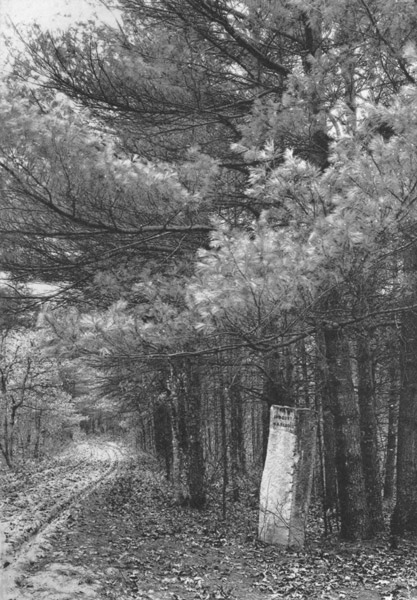
The Old Marlborough Road
THE OLD MARLBOROUGH ROAD
Where they once dug for money,
But never found any;
Where sometimes Martial Miles
Singly files,
And Elijah Wood,
I fear for no good:
No other man,
Save Elisha Dugan,—
O man of wild habits,
Partridges and rabbits,
Who hast no cares
Only to set snares,
Who liv'st all alone,
Close to the bone,
And where life is sweetest
Constantly eatest.
When the spring stirs my blood
With the instinct to travel,
I can get enough gravel
On the Old Marlborough Road.
Nobody repairs it,
For nobody wears it;
It is a living way,
As the Christians say.
Not many there be
Who enter therein,
Only the guests of the
Irishman Quin.
What is it, what is it,
But a direction out there,
And the bare possibility
Of going somewhere?
Great guide-boards of stone,
But travelers none;
Cenotaphs of the towns
Named on their crowns.
It is worth going to see
Where you might be.
What king
Did the thing,
I am still wondering;
Set up how or when,
By what selectmen,
Gourgas or Lee,
Clark or Darby?
They're a great endeavor
To be something forever;
Blank tablets of stone,
Where a traveler might groan,
And in one sentence
Grave all that is known;
Which another might read,
In his extreme need.
I know one or two
Lines that would do,
Literature that might stand
All over the land,
Which a man could remember
Till next December,
And read again in the spring,
After the thawing.
If with fancy unfurled
You leave your abode,
You may go round the world
By the Old Marlborough Road.
At present, in this vicinity, the best part of the land
is not private property; the landscape is not owned, and
the walker enjoys comparative freedom. But possibly
the day will come when it will be partitioned off into
so-called pleasure-grounds, in which a few will take
a narrow and exclusive pleasure only,—when fences
shall be multiplied, and man-traps and other engines
invented to confine men to the public road, and walking
over the surface of God's earth shall be construed to
mean trespassing on some gentleman's grounds. To
enjoy a thing exclusively is commonly to exclude yourself
from the true enjoyment of it. Let us improve our
opportunities, then, before the evil days come.
What is it that makes it so hard sometimes to determine
whither we will walk? I believe that there is a
subtle magnetism in Nature, which, if we unconsciously
yield to it, will direct us aright. It is not indifferent to us
which way we walk. There is a right way; but we are
very liable from heedlessness and stupidity to take the
wrong one. We would fain take that walk, never yet
taken by us through this actual world, which is perfectly
symbolical of the path which we love to travel in
the interior and ideal world; and sometimes, no doubt,
we find it difficult to choose our direction, because it
does not yet exist distinctly in our idea.
When I go out of the house for a walk, uncertain as
yet whither I will bend my steps, and submit myself to
my instinct to decide for me, I find, strange and whimsical
as it may seem, that I finally and inevitably settle
southwest, toward some particular wood or meadow or
deserted pasture or hill in that direction. My needle
is slow to settle,—varies a few degrees, and does not
always point due southwest, it is true, and it has good
authority for this variation, but it always settles between
west and south-southwest. The future lies that way to
me, and the earth seems more unexhausted and richer on
that side. The outline which would bound my walks
would be, not a circle, but a parabola, or rather like one
of those cometary orbits which have been thought to be
non-returning curves, in this case opening westward,
in which my house occupies the place of the sun. I turn
round and round irresolute sometimes for a quarter of
an hour, until I decide, for a thousandth time, that I will
walk into the southwest or west. Eastward I go only by
force; but westward I go free. Thither no business leads
me. It is hard for me to believe that I shall find fair
landscapes or sufficient wildness and freedom behind the
eastern horizon. I am not excited by the prospect of a
walk thither; but I believe that the forest which I see in
the western horizon stretches uninterruptedly toward
the setting sun, and there are no towns nor cities in it of
enough consequence to disturb me. Let me live where
I will, on this side is the city, on that the wilderness, and
ever I am leaving the city more and more, and withdrawing
into the wilderness. I should not lay so much
stress on this fact, if I did not believe that something
like this is the prevailing tendency of my countrymen.
I must walk toward Oregon, and not toward Europe.
And that way the nation is moving, and I may say that
mankind progress from east to west. Within a few years
we have witnessed the phenomenon of a southeastward
migration, in the settlement of Australia; but this affects
us as a retrograde movement, and, judging from the
moral and physical character of the first generation of
Australians, has not yet proved a successful experiment.
The eastern Tartars think that there is nothing west
beyond Thibet. "The world ends there," say they;
"beyond there is nothing but a shoreless sea." It is
unmitigated East where they live.
We go eastward to realize history and study the
works of art and literature, retracing the steps of the
race; we go westward as into the future, with a spirit of
enterprise and adventure. The Atlantic is a Lethean
stream, in our passage over which we have had an opportunity
to forget the Old World and its institutions. If
we do not succeed this time, there is perhaps one more
chance for the race left before it arrives on the banks of
the Styx; and that is in the Lethe of the Pacific, which
is three times as wide.
I know not how significant it is, or how far it is an
evidence of singularity, that an individual should thus
consent in his pettiest walk with the general movement
of the race; but I know that something akin to the
migratory instinct in birds and quadrupeds,—which,
in some instances, is known to have affected the squirrel
tribe, impelling them to a general and mysterious movement,
in which they were seen, say some, crossing the
broadest rivers, each on its particular chip, with its
tail raised for a sail, and bridging narrower streams
with their dead,—that something like the furor which
affects the domestic cattle in the spring, and which is
referred to a worm in their tails, affects both nations
and individuals, either perennially or from time to time.
Not a flock of wild geese cackles over our town, but it to
some extent unsettles the value of real estate here, and,
if I were a broker, I should probably take that disturbance
into account.
"Than longen folk to gon on pilgrimages,
And palmeres for to seken strange strondes."
Every sunset which I witness inspires me with the
desire to go to a West as distant and as fair as that into
which the sun goes down. He appears to migrate westward
daily, and tempt us to follow him. He is the Great
Western Pioneer whom the nations follow. We dream
all night of those mountain-ridges in the horizon, though
they may be of vapor only, which were last gilded by his
rays. The island of Atlantis, and the islands and gardens
of the Hesperides, a sort of terrestrial paradise, appear
to have been the Great West of the ancients, enveloped
in mystery and poetry. Who has not seen in imagination,
when looking into the sunset sky, the gardens of the
Hesperides, and the foundation of all those fables?
Columbus felt the westward tendency more strongly
than any before. He obeyed it, and found a New World
for Castile and Leon. The herd of men in those days
scented fresh pastures from afar.
"And now the sun had stretched out all the hills,
And now was dropped into the western bay;
At last he rose, and twitched his mantle blue;
To-morrow to fresh woods and pastures new."
Where on the globe can there be found an area of
equal extent with that occupied by the bulk of our
States, so fertile and so rich and varied in its productions,
and at the same time so habitable by the European,
as this is? Michaux, who knew but part of them,
says that "the species of large trees are much more
numerous in North America than in Europe; in the
United States there are more than one hundred and
forty species that exceed thirty feet in height; in France
there are but thirty that attain this size." Later botanists
more than confirm his observations. Humboldt
came to America to realize his youthful dreams of a
tropical vegetation, and he beheld it in its greatest perfection
in the primitive forests of the Amazon, the most
gigantic wilderness on the earth, which he has so eloquently
described. The geographer Guyot, himself a
European, goes farther,—farther than I am ready to
follow him; yet not when he says: "As the plant is made
for the animal, as the vegetable world is made for the
animal world, America is made for the man of the Old
World.... The man of the Old World sets out upon
his way. Leaving the highlands of Asia, he descends
from station to station towards Europe. Each of his
steps is marked by a new civilization superior to the
preceding, by a greater power of development. Arrived
at the Atlantic, he pauses on the shore of this unknown
ocean, the bounds of which he knows not, and turns
upon his footprints for an instant." When he has
exhausted the rich soil of Europe, and reinvigorated
himself, "then recommences his adventurous career
westward as in the earliest ages." So far Guyot.
From this western impulse coming in contact with the
barrier of the Atlantic sprang the commerce and enterprise
of modern times. The younger Michaux, in his
"Travels West of the Alleghanies in 1802," says that
the common inquiry in the newly settled West was,
"'From what part of the world have you come?' As if
these vast and fertile regions would naturally be the
place of meeting and common country of all the inhabitants
of the globe."
To use an obsolete Latin word, I might say, Ex
Oriente lux; ex Occidente FRUX. From the East light;
from the West fruit.
Sir Francis Head, an English traveler and a Governor-General
of Canada, tells us that "in both the northern
and southern hemispheres of the New World, Nature
has not only outlined her works on a larger scale, but has
painted the whole picture with brighter and more costly
colors than she used in delineating and in beautifying
the Old World.... The heavens of America appear
infinitely higher, the sky is bluer, the air is fresher, the
cold is intenser, the moon looks larger, the stars are
brighter, the thunder is louder, the lightning is vivider,
the wind is stronger, the rain is heavier, the mountains
are higher, the rivers longer, the forests bigger, the plains
broader." This statement will do at least to set against
Buffon's account of this part of the world and its productions.
Linnæus said long ago, "Nescio quae facies laeta,
glabra plantis Americanis" (I know not what there is of
joyous and smooth in the aspect of American plants);
and I think that in this country there are no, or at most
very few, Africanae bestiae, African beasts, as the Romans
called them, and that in this respect also it is
peculiarly fitted for the habitation of man. We are told
that within three miles of the centre of the East-Indian
city of Singapore, some of the inhabitants are annually
carried off by tigers; but the traveler can lie down in
the woods at night almost anywhere in North America
without fear of wild beasts.
These are encouraging testimonies. If the moon
looks larger here than in Europe, probably the sun looks
larger also. If the heavens of America appear infinitely
higher, and the stars brighter, I trust that these facts are
symbolical of the height to which the philosophy and
poetry and religion of her inhabitants may one day soar.
At length, perchance, the immaterial heaven will appear
as much higher to the American mind, and the intimations
that star it as much brighter. For I believe that
climate does thus react on man,—as there is something
in the mountain air that feeds the spirit and inspires.
Will not man grow to greater perfection intellectually
as well as physically under these influences? Or is it
unimportant how many foggy days there are in his life?
I trust that we shall be more imaginative, that our
thoughts will be clearer, fresher, and more ethereal,
as our sky,—our understanding more comprehensive
and broader, like our plains,—our intellect generally
on a grander scale, like our thunder and lightning, our
rivers and mountains and forests,—and our hearts
shall even correspond in breadth and depth and grandeur
to our inland seas. Perchance there will appear to
the traveler something, he knows not what, of laeta and
glabra, of joyous and serene, in our very faces. Else
to what end does the world go on, and why was America
discovered?
To Americans I hardly need to say,—
"Westward the star of empire takes its way."
As a true patriot, I should be ashamed to think that Adam
in paradise was more favorably situated on the whole
than the backwoodsman in this country.
Our sympathies in Massachusetts are not confined
to New England; though we may be estranged from the
South, we sympathize with the West. There is the home
of the younger sons, as among the Scandinavians they
took to the sea for their inheritance. It is too late to be
studying Hebrew; it is more important to understand
even the slang of to-day.
Some months ago I went to see a panorama of the
Rhine. It was like a dream of the Middle Ages. I
floated down its historic stream in something more than
imagination, under bridges built by the Romans, and
repaired by later heroes, past cities and castles whose
very names were music to my ears, and each of which
was the subject of a legend. There were Ehrenbreitstein
and Rolandseck and Coblentz, which I knew only in
history. They were ruins that interested me chiefly.
There seemed to come up from its waters and its vine-clad
hills and valleys a hushed music as of Crusaders
departing for the Holy Land. I floated along under the
spell of enchantment, as if I had been transported to an
heroic age, and breathed an atmosphere of chivalry.
Soon after, I went to see a panorama of the Mississippi,
and as I worked my way up the river in the light
of to-day, and saw the steamboats wooding up, counted
the rising cities, gazed on the fresh ruins of Nauvoo,
beheld the Indians moving west across the stream, and,
as before I had looked up the Moselle, now looked up the
Ohio and the Missouri and heard the legends of Dubuque
and of Wenona's Cliff,—still thinking more of the
future than of the past or present,—I saw that this was
a Rhine stream of a different kind; that the foundations
of castles were yet to be laid, and the famous bridges
were yet to be thrown over the river; and I felt that
this was the heroic age itself, though we know it not, for
the hero is commonly the simplest and obscurest of men.
The West of which I speak is but another name for
the Wild; and what I have been preparing to say is,
that in Wildness is the preservation of the World. Every
tree sends its fibres forth in search of the Wild. The
cities import it at any price. Men plow and sail for it.
From the forest and wilderness come the tonics and
barks which brace mankind. Our ancestors were savages.
The story of Romulus and Remus being suckled
by a wolf is not a meaningless fable. The founders
of every state which has risen to eminence have drawn
their nourishment and vigor from a similar wild source.
It was because the children of the Empire were not
suckled by the wolf that they were conquered and displaced
by the children of the northern forests who were.
I believe in the forest, and in the meadow, and in the
night in which the corn grows. We require an infusion
of hemlock spruce or arbor-vitæ in our tea. There is a
difference between eating and drinking for strength and
from mere gluttony. The Hottentots eagerly devour the
marrow of the koodoo and other antelopes raw, as a
matter of course. Some of our northern Indians eat
raw the marrow of the Arctic reindeer, as well as various
other parts, including the summits of the antlers,
as long as they are soft. And herein, perchance, they
have stolen a march on the cooks of Paris. They get
what usually goes to feed the fire. This is probably
better than stall-fed beef and slaughter-house pork to
make a man of. Give me a wildness whose glance no
civilization can endure,—as if we lived on the marrow
of koodoos devoured raw.
There are some intervals which border the strain of
the wood thrush, to which I would migrate,—wild
lands where no settler has squatted; to which, methinks,
I am already acclimated.
The African hunter Cumming tells us that the skin
of the eland, as well as that of most other antelopes just
killed, emits the most delicious perfume of trees and
grass. I would have every man so much like a wild antelope,
so much a part and parcel of nature, that his very
person should thus sweetly advertise our senses of his
presence, and remind us of those parts of nature which
he most haunts. I feel no disposition to be satirical,
when the trapper's coat emits the odor of musquash
even; it is a sweeter scent to me than that which commonly
exhales from the merchant's or the scholar's
garments. When I go into their wardrobes and handle
their vestments, I am reminded of no grassy plains and
flowery meads which they have frequented, but of dusty
merchants' exchanges and libraries rather.
A tanned skin is something more than respectable, and
perhaps olive is a fitter color than white for a man,—a
denizen of the woods. "The pale white man!" I do not
wonder that the African pitied him. Darwin the naturalist
says, "A white man bathing by the side of a Tahitian
was like a plant bleached by the gardener's art, compared
with a fine, dark green one, growing vigorously in
the open fields."
Ben Jonson exclaims,—
"How near to good is what is fair!"
So I would say,—
How near to good is what is wild!
Life consists with wildness. The most alive is the wildest.
Not yet subdued to man, its presence refreshes him.
One who pressed forward incessantly and never rested
from his labors, who grew fast and made infinite
demands on life, would always find himself in a new
country or wilderness, and surrounded by the raw
material of life. He would be climbing over the prostrate
stems of primitive forest-trees.
Hope and the future for me are not in lawns and cultivated
fields, not in towns and cities, but in the impervious
and quaking swamps. When, formerly, I have
analyzed my partiality for some farm which I had contemplated
purchasing, I have frequently found that I
was attracted solely by a few square rods of impermeable
and unfathomable bog,—a natural sink in one corner
of it. That was the jewel which dazzled me. I derive
more of my subsistence from the swamps which surround
my native town than from the cultivated gardens
in the village. There are no richer parterres to my eyes
than the dense beds of dwarf andromeda (Cassandra
calyculata) which cover these tender places on the
earth's surface. Botany cannot go farther than tell me
the names of the shrubs which grow there,—the high
blueberry, panicled andromeda, lambkill, azalea, and
rhodora,—all standing in the quaking sphagnum. I
often think that I should like to have my house front on
this mass of dull red bushes, omitting other flower plots
and borders, transplanted spruce and trim box, even
graveled walks,—to have this fertile spot under my
windows, not a few imported barrowfuls of soil only to
cover the sand which was thrown out in digging the
cellar. Why not put my house, my parlor, behind this
plot, instead of behind that meagre assemblage of curiosities,
that poor apology for a Nature and Art, which
I call my front yard? It is an effort to clear up and
make a decent appearance when the carpenter and mason
have departed, though done as much for the passer-by as
the dweller within. The most tasteful front-yard fence
was never an agreeable object of study to me; the most
elaborate ornaments, acorn tops, or what not, soon
wearied and disgusted me. Bring your sills up to the
very edge of the swamp, then (though it may not be the
best place for a dry cellar), so that there be no access
on that side to citizens. Front yards are not made to
walk in, but, at most, through, and you could go in the
back way.
Yes, though you may think me perverse, if it were
proposed to me to dwell in the neighborhood of the most
beautiful garden that ever human art contrived, or else
of a Dismal Swamp, I should certainly decide for the
swamp. How vain, then, have been all your labors,
citizens, for me!
My spirits infallibly rise in proportion to the outward
dreariness. Give me the ocean, the desert, or the wilderness!
In the desert, pure air and solitude compensate
for want of moisture and fertility. The traveler Burton
says of it: "Your morale improves; you become frank
and cordial, hospitable and single-minded.... In the
desert, spirituous liquors excite only disgust. There is
a keen enjoyment in a mere animal existence." They
who have been traveling long on the steppes of Tartary
say, "On reëntering cultivated lands, the agitation,
perplexity, and turmoil of civilization oppressed and
suffocated us; the air seemed to fail us, and we felt every
moment as if about to die of asphyxia." When I would
recreate myself, I seek the darkest wood, the thickest
and most interminable and, to the citizen, most dismal,
swamp. I enter a swamp as a sacred place, a sanctum
sanctorum. There is the strength, the marrow, of Nature.
The wildwood covers the virgin mould, and the same
soil is good for men and for trees. A man's health requires
as many acres of meadow to his prospect as his
farm does loads of muck. There are the strong meats on
which he feeds. A town is saved, not more by the righteous
men in it than by the woods and swamps that surround
it. A township where one primitive forest waves
above while another primitive forest rots below,—such
a town is fitted to raise not only corn and potatoes, but
poets and philosophers for the coming ages. In such a
soil grew Homer and Confucius and the rest, and out of
such a wilderness comes the Reformer eating locusts and
wild honey.
To preserve wild animals implies generally the creation
of a forest for them to dwell in or resort to. So it
is with man. A hundred years ago they sold bark in
our streets peeled from our own woods. In the very
aspect of those primitive and rugged trees there was,
methinks, a tanning principle which hardened and
consolidated the fibres of men's thoughts. Ah! already
I shudder for these comparatively degenerate days of
my native village, when you cannot collect a load of
bark of good thickness, and we no longer produce tar
and turpentine.
The civilized nations—Greece, Rome, England—have
been sustained by the primitive forests which
anciently rotted where they stand. They survive as
long as the soil is not exhausted. Alas for human culture!
little is to be expected of a nation, when the vegetable
mould is exhausted, and it is compelled to make
manure of the bones of its fathers. There the poet sustains
himself merely by his own superfluous fat, and
the philosopher comes down on his marrow-bones.
It is said to be the task of the American "to work
the virgin soil," and that "agriculture here already
assumes proportions unknown everywhere else." I
think that the farmer displaces the Indian even because
he redeems the meadow, and so makes himself
stronger and in some respects more natural. I was
surveying for a man the other day a single straight
line one hundred and thirty-two rods long, through a
swamp at whose entrance might have been written the
words which Dante read over the entrance to the infernal
regions, "Leave all hope, ye that enter,"—that
is, of ever getting out again; where at one time I saw
my employer actually up to his neck and swimming
for his life in his property, though it was still winter.
He had another similar swamp which I could not survey
at all, because it was completely under water, and
nevertheless, with regard to a third swamp, which I
did survey from a distance, he remarked to me, true
to his instincts, that he would not part with it for any
consideration, on account of the mud which it contained.
And that man intends to put a girdling ditch
round the whole in the course of forty months, and so
redeem it by the magic of his spade. I refer to him
only as the type of a class.
The weapons with which we have gained our most
important victories, which should be handed down as
heirlooms from father to son, are not the sword and the
lance, but the bushwhack, the turf-cutter, the spade,
and the bog hoe, rusted with the blood of many a
meadow, and begrimed with the dust of many a hard-fought
field. The very winds blew the Indian's corn-field
into the meadow, and pointed out the way which
he had not the skill to follow. He had no better implement
with which to intrench himself in the land
than a clamshell. But the farmer is armed with plow
and spade.
In literature it is only the wild that attracts us. Dullness
is but another name for tameness. It is the
uncivilized free and wild thinking in Hamlet and
the Iliad, in all the scriptures and mythologies, not
learned in the schools, that delights us. As the wild
duck is more swift and beautiful than the tame, so is the
wild—the mallard—thought, which 'mid falling dews
wings its way above the fens. A truly good book is
something as natural, and as unexpectedly and unaccountably
fair and perfect, as a wild-flower discovered
on the prairies of the West or in the jungles of
the East. Genius is a light which makes the darkness
visible, like the lightning's flash, which perchance
shatters the temple of knowledge itself,—and not a
taper lighted at the hearth-stone of the race, which
pales before the light of common day.
English literature, from the days of the minstrels to
the Lake Poets,—Chaucer and Spenser and Milton,
and even Shakespeare, included,—breathes no quite
fresh and, in this sense, wild strain. It is an essentially
tame and civilized literature, reflecting Greece and
Rome. Her wilderness is a greenwood, her wild man a
Robin Hood. There is plenty of genial love of Nature,
but not so much of Nature herself. Her chronicles inform
us when her wild animals, but not when the wild
man in her, became extinct.
The science of Humboldt is one thing, poetry is another
thing. The poet to-day, notwithstanding all the
discoveries of science, and the accumulated learning
of mankind, enjoys no advantage over Homer.
Where is the literature which gives expression to
Nature? He would be a poet who could impress the
winds and streams into his service, to speak for him;
who nailed words to their primitive senses, as farmers
drive down stakes in the spring, which the frost has
heaved; who derived his words as often as he used
them,—transplanted them to his page with earth adhering
to their roots; whose words were so true and
fresh and natural that they would appear to expand
like the buds at the approach of spring, though they
lay half smothered between two musty leaves in a library,—aye,
to bloom and bear fruit there, after their
kind, annually, for the faithful reader, in sympathy
with surrounding Nature.
I do not know of any poetry to quote which adequately
expresses this yearning for the Wild. Approached
from this side, the best poetry is tame. I do
not know where to find in any literature, ancient or
modern, any account which contents me of that Nature
with which even I am acquainted. You will perceive
that I demand something which no Augustan nor
Elizabethan age, which no culture, in short, can give.
Mythology comes nearer to it than anything. How
much more fertile a Nature, at least, has Grecian
mythology its root in than English literature! Mythology
is the crop which the Old World bore before its
soil was exhausted, before the fancy and imagination
were affected with blight; and which it still bears,
wherever its pristine vigor is unabated. All other literatures
endure only as the elms which overshadow
our houses; but this is like the great dragon-tree of
the Western Isles, as old as mankind, and, whether
that does or not, will endure as long; for the decay of
other literatures makes the soil in which it thrives.
The West is preparing to add its fables to those of
the East. The valleys of the Ganges, the Nile, and
the Rhine having yielded their crop, it remains to be
seen what the valleys of the Amazon, the Plate, the
Orinoco, the St. Lawrence, and the Mississippi will
produce. Perchance, when, in the course of ages,
American liberty has become a fiction of the past,—as
it is to some extent a fiction of the present,—the poets
of the world will be inspired by American mythology.
The wildest dreams of wild men, even, are not the
less true, though they may not recommend themselves
to the sense which is most common among Englishmen
and Americans to-day. It is not every truth that recommends
itself to the common sense. Nature has a place
for the wild clematis as well as for the cabbage. Some
expressions of truth are reminiscent,—others merely
sensible, as the phrase is,—others prophetic. Some
forms of disease, even, may prophesy forms of health.
The geologist has discovered that the figures of serpents,
griffins, flying dragons, and other fanciful embellishments
of heraldry, have their prototypes in the forms
of fossil species which were extinct before man was
created, and hence "indicate a faint and shadowy
knowledge of a previous state of organic existence."
The Hindoos dreamed that the earth rested on an elephant,
and the elephant on a tortoise, and the tortoise
on a serpent; and though it may be an unimportant
coincidence, it will not be out of place here to state,
that a fossil tortoise has lately been discovered in Asia
large enough to support an elephant. I confess that I
am partial to these wild fancies, which transcend the
order of time and development. They are the sublimest
recreation of the intellect. The partridge loves peas,
but not those that go with her into the pot.
In short, all good things are wild and free. There
is something in a strain of music, whether produced
by an instrument or by the human voice,—take the
sound of a bugle in a summer night, for instance,—which
by its wildness, to speak without satire, reminds
me of the cries emitted by wild beasts in their native
forests. It is so much of their wildness as I can understand.
Give me for my friends and neighbors wild men,
not tame ones. The wildness of the savage is but a
faint symbol of the awful ferity with which good men
and lovers meet.
I love even to see the domestic animals reassert their
native rights,—any evidence that they have not wholly
lost their original wild habits and vigor; as when my
neighbor's cow breaks out of her pasture early in the
spring and boldly swims the river, a cold, gray tide,
twenty-five or thirty rods wide, swollen by the melted
snow. It is the buffalo crossing the Mississippi. This
exploit confers some dignity on the herd in my eyes,—already
dignified. The seeds of instinct are preserved
under the thick hides of cattle and horses, like seeds in
the bowels of the earth, an indefinite period.
Any sportiveness in cattle is unexpected. I saw one
day a herd of a dozen bullocks and cows running about
and frisking in unwieldy sport, like huge rats, even
like kittens. They shook their heads, raised their tails,
and rushed up and down a hill, and I perceived by their
horns, as well as by their activity, their relation to the
deer tribe. But, alas! a sudden loud Whoa! would
have damped their ardor at once, reduced them from
venison to beef, and stiffened their sides and sinews
like the locomotive. Who but the Evil One has cried
"Whoa!" to mankind? Indeed, the life of cattle, like
that of many men, is but a sort of locomotiveness; they
move a side at a time, and man, by his machinery, is
meeting the horse and the ox half-way. Whatever
part the whip has touched is thenceforth palsied. Who
would ever think of a side of any of the supple cat tribe,
as we speak of a side of beef?
I rejoice that horses and steers have to be broken
before they can be made the slaves of men, and that
men themselves have some wild oats still left to sow
before they become submissive members of society.
Undoubtedly, all men are not equally fit subjects for
civilization; and because the majority, like dogs and
sheep, are tame by inherited disposition, this is no
reason why the others should have their natures broken
that they may be reduced to the same level. Men are
in the main alike, but they were made several in order
that they might be various. If a low use is to be served,
one man will do nearly or quite as well as another; if
a high one, individual excellence is to be regarded. Any
man can stop a hole to keep the wind away, but no
other man could serve so rare a use as the author of this
illustration did. Confucius says, "The skins of the
tiger and the leopard, when they are tanned, are as the
skins of the dog and the sheep tanned." But it is not
the part of a true culture to tame tigers, any more than
it is to make sheep ferocious; and tanning their skins
for shoes is not the best use to which they can be put.
When looking over a list of men's names in a foreign
language, as of military officers, or of authors who have
written on a particular subject, I am reminded once
more that there is nothing in a name. The name Menschikoff,
for instance, has nothing in it to my ears more
human than a whisker, and it may belong to a rat. As
the names of the Poles and Russians are to us, so are
ours to them. It is as if they had been named by the
child's rigmarole, Iery wiery ichery van, tittle-tol-tan.
I see in my mind a herd of wild creatures swarming
over the earth, and to each the herdsman has affixed
some barbarous sound in his own dialect. The names
of men are, of course, as cheap and meaningless as Bose
and Tray, the names of dogs.
Methinks it would be some advantage to philosophy
if men were named merely in the gross, as they are
known. It would be necessary only to know the genus
and perhaps the race or variety, to know the individual.
We are not prepared to believe that every private soldier
in a Roman army had a name of his own,—because we
have not supposed that he had a character of his own.
At present our only true names are nicknames. I
knew a boy who, from his peculiar energy, was called
"Buster" by his playmates, and this rightly supplanted
his Christian name. Some travelers tell us that an Indian
had no name given him at first, but earned it, and his
name was his fame; and among some tribes he acquired
a new name with every new exploit. It is pitiful when
a man bears a name for convenience merely, who has
earned neither name nor fame.
I will not allow mere names to make distinctions for
me, but still see men in herds for all them. A familiar
name cannot make a man less strange to me. It may be
given to a savage who retains in secret his own wild title
earned in the woods. We have a wild savage in us, and a
savage name is perchance somewhere recorded as ours.
I see that my neighbor, who bears the familiar epithet
William or Edwin, takes it off with his jacket. It does
not adhere to him when asleep or in anger, or aroused by
any passion or inspiration. I seem to hear pronounced
by some of his kin at such a time his original wild name
in some jaw-breaking or else melodious tongue.
Here is this vast, savage, howling mother of ours,
Nature, lying all around, with such beauty, and such
affection for her children, as the leopard; and yet we
are so early weaned from her breast to society, to that
culture which is exclusively an interaction of man on
man,—a sort of breeding in and in, which produces at
most a merely English nobility, a civilization destined
to have a speedy limit.
In society, in the best institutions of men, it is easy
to detect a certain precocity. When we should still be
growing children, we are already little men. Give me a
culture which imports much muck from the meadows,
and deepens the soil,—not that which trusts to heating
manures, and improved implements and modes of culture
only!
Many a poor sore-eyed student that I have heard of
would grow faster, both intellectually and physically, if,
instead of sitting up so very late, he honestly slumbered
a fool's allowance.
There may be an excess even of informing light.
Niepce, a Frenchman, discovered "actinism," that
power in the sun's rays which produces a chemical
effect; that granite rocks, and stone structures, and
statues of metal "are all alike destructively acted upon
during the hours of sunshine, and, but for provisions of
Nature no less wonderful, would soon perish under the
delicate touch of the most subtile of the agencies of the
universe." But he observed that "those bodies which
underwent this change during the daylight possessed
the power of restoring themselves to their original conditions
during the hours of night, when this excitement
was no longer influencing them." Hence it has been
inferred that "the hours of darkness are as necessary to
the inorganic creation as we know night and sleep are
to the organic kingdom." Not even does the moon shine
every night, but gives place to darkness.
I would not have every man nor every part of a man
cultivated, any more than I would have every acre of
earth cultivated: part will be tillage, but the greater part
will be meadow and forest, not only serving an immediate
use, but preparing a mould against a distant future,
by the annual decay of the vegetation which it supports.
There are other letters for the child to learn than
those which Cadmus invented. The Spaniards have a
good term to express this wild and dusky knowledge,
Gramática parda, tawny grammar, a kind of mother-wit
derived from that same leopard to which I have
referred.
We have heard of a Society for the Diffusion of Useful
Knowledge. It is said that knowledge is power, and the
like. Methinks there is equal need of a Society for the
Diffusion of Useful Ignorance, what we will call Beautiful
Knowledge, a knowledge useful in a higher sense:
for what is most of our boasted so-called knowledge but
a conceit that we know something, which robs us of the
advantage of our actual ignorance? What we call knowledge
is often our positive ignorance; ignorance our
negative knowledge. By long years of patient industry
and reading of the newspapers,—for what are the
libraries of science but files of newspapers?—a man
accumulates a myriad facts, lays them up in his memory,
and then when in some spring of his life he saunters
abroad into the Great Fields of thought, he, as it were,
goes to grass like a horse and leaves all his harness
behind in the stable. I would say to the Society for the
Diffusion of Useful Knowledge, sometimes,—Go to
grass. You have eaten hay long enough. The spring has
come with its green crop. The very cows are driven to
their country pastures before the end of May; though I
have heard of one unnatural farmer who kept his cow
in the barn and fed her on hay all the year round.
So, frequently, the Society for the Diffusion of Useful
Knowledge treats its cattle.
A man's ignorance sometimes is not only useful, but
beautiful,—while his knowledge, so called, is oftentimes
worse than useless, besides being ugly. Which is
the best man to deal with,—he who knows nothing
about a subject, and, what is extremely rare, knows that
he knows nothing, or he who really knows something
about it, but thinks that he knows all?
My desire for knowledge is intermittent, but my desire
to bathe my head in atmospheres unknown to my
feet is perennial and constant. The highest that we
can attain to is not Knowledge, but Sympathy with
Intelligence. I do not know that this higher knowledge
amounts to anything more definite than a novel and
grand surprise on a sudden revelation of the insufficiency
of all that we called Knowledge before,—a discovery
that there are more things in heaven and earth than are
dreamed of in our philosophy. It is the lighting up of
the mist by the sun. Man cannot know in any higher
sense than this, any more than he can look serenely and
with impunity in the face of the sun: Ὡς τὶ νοῶν, οὐ κεῖνον νοήσεις, "You will not perceive that, as perceiving a
particular thing," say the Chaldean Oracles.
There is something servile in the habit of seeking after
a law which we may obey. We may study the laws of
matter at and for our convenience, but a successful life
knows no law. It is an unfortunate discovery certainly,
that of a law which binds us where we did not know
before that we were bound. Live free, child of the mist,—and
with respect to knowledge we are all children
of the mist. The man who takes the liberty to live is
superior to all the laws, by virtue of his relation to the
lawmaker. "That is active duty," says the Vishnu
Purana, "which is not for our bondage; that is knowledge
which is for our liberation: all other duty is good
only unto weariness; all other knowledge is only the
cleverness of an artist."
It is remarkable how few events or crises there are in
our histories, how little exercised we have been in our
minds, how few experiences we have had. I would fain
be assured that I am growing apace and rankly, though
my very growth disturb this dull equanimity,—though
it be with struggle through long, dark, muggy nights or
seasons of gloom. It would be well if all our lives were
a divine tragedy even, instead of this trivial comedy or
farce. Dante, Bunyan, and others appear to have been
exercised in their minds more than we: they were subjected
to a kind of culture such as our district schools
and colleges do not contemplate. Even Mahomet,
though many may scream at his name, had a good deal
more to live for, aye, and to die for, than they have
commonly.
When, at rare intervals, some thought visits one, as
perchance he is walking on a railroad, then, indeed, the
cars go by without his hearing them. But soon, by some
inexorable law, our life goes by and the cars return.
"Gentle breeze, that wanderest unseen,
And bendest the thistles round Loira of storms,
Traveler of the windy glens,
Why hast thou left my ear so soon?"
While almost all men feel an attraction drawing them
to society, few are attracted strongly to Nature. In their
reaction to Nature men appear to me for the most part,
notwithstanding their arts, lower than the animals. It is
not often a beautiful relation, as in the case of the animals.
How little appreciation of the beauty of the landscape
there is among us! We have to be told that the
Greeks called the world Κόσμος, Beauty, or Order, but
we do not see clearly why they did so, and we esteem it
at best only a curious philological fact.
For my part, I feel that with regard to Nature I live a
sort of border life, on the confines of a world into which
I make occasional and transient forays only, and my
patriotism and allegiance to the state into whose territories
I seem to retreat are those of a moss-trooper.
Unto a life which I call natural I would gladly follow
even a will-o'-the-wisp through bogs and sloughs unimaginable,
but no moon nor firefly has shown me the
causeway to it. Nature is a personality so vast and universal
that we have never seen one of her features. The
walker in the familiar fields which stretch around my
native town sometimes finds himself in another land than
is described in their owners' deeds, as it were in some
faraway field on the confines of the actual Concord,
where her jurisdiction ceases, and the idea which the
word Concord suggests ceases to be suggested. These
farms which I have myself surveyed, these bounds which
I have set up, appear dimly still as through a mist; but
they have no chemistry to fix them; they fade from the
surface of the glass, and the picture which the painter
painted stands out dimly from beneath. The world
with which we are commonly acquainted leaves no trace,
and it will have no anniversary.
I took a walk on Spaulding's Farm the other afternoon.
I saw the setting sun lighting up the opposite
side of a stately pine wood. Its golden rays straggled into
the aisles of the wood as into some noble hall. I was
impressed as if some ancient and altogether admirable
and shining family had settled there in that part of the
land called Concord, unknown to me,—to whom the
sun was servant,—who had not gone into society in
the village,—who had not been called on. I saw their
park, their pleasure-ground, beyond through the wood,
in Spaulding's cranberry-meadow. The pines furnished
them with gables as they grew. Their house was not
obvious to vision; the trees grew through it. I do not
know whether I heard the sounds of a suppressed
hilarity or not. They seemed to recline on the sunbeams.
They have sons and daughters. They are quite well.
The farmer's cart-path, which leads directly through
their hall, does not in the least put them out, as the
muddy bottom of a pool is sometimes seen through the
reflected skies. They never heard of Spaulding, and do
not know that he is their neighbor,—notwithstanding
I heard him whistle as he drove his team through the
house. Nothing can equal the serenity of their lives.
Their coat-of-arms is simply a lichen. I saw it painted
on the pines and oaks. Their attics were in the tops of
the trees. They are of no politics. There was no noise
of labor. I did not perceive that they were weaving or
spinning. Yet I did detect, when the wind lulled and
hearing was done away, the finest imaginable sweet
musical hum,—as of a distant hive in May,—which
perchance was the sound of their thinking. They had no
idle thoughts, and no one without could see their work,
for their industry was not as in knots and excrescences
embayed.
But I find it difficult to remember them. They fade
irrevocably out of my mind even now while I speak,
and endeavor to recall them and recollect myself. It
is only after a long and serious effort to recollect my best
thoughts that I become again aware of their cohabitancy.
If it were not for such families as this, I think I should
move out of Concord.
We are accustomed to say in New England that few
and fewer pigeons visit us every year. Our forests
furnish no mast for them. So, it would seem, few and
fewer thoughts visit each growing man from year to
year, for the grove in our minds is laid waste,—sold
to feed unnecessary fires of ambition, or sent to mill,—and
there is scarcely a twig left for them to perch on.
They no longer build nor breed with us. In some more
genial season, perchance, a faint shadow flits across
the landscape of the mind, cast by the wings of some
thought in its vernal or autumnal migration, but, looking
up, we are unable to detect the substance of the
thought itself. Our winged thoughts are turned to
poultry. They no longer soar, and they attain only to
a Shanghai and Cochin-China grandeur. Those gra-a-ate
thoughts, those gra-a-ate men you hear of!
We hug the earth,—how rarely we mount! Methinks
we might elevate ourselves a little more. We might
climb a tree, at least. I found my account in climbing
a tree once. It was a tall white pine, on the top of a
hill; and though I got well pitched, I was well paid
for it, for I discovered new mountains in the horizon
which I had never seen before,—so much more of the
earth and the heavens. I might have walked about the
foot of the tree for threescore years and ten, and yet
I certainly should never have seen them. But, above
all, I discovered around me,—it was near the end of
June,—on the ends of the topmost branches only,
a few minute and delicate red cone-like blossoms, the
fertile flower of the white pine looking heavenward.
I carried straightway to the village the topmost spire,
and showed it to stranger jurymen who walked the
streets,—for it was court week,—and to farmers
and lumber-dealers and woodchoppers and hunters,
and not one had ever seen the like before, but they
wondered as at a star dropped down. Tell of ancient
architects finishing their works on the tops of columns
as perfectly as on the lower and more visible parts!
Nature has from the first expanded the minute blossoms
of the forest only toward the heavens, above men's
heads and unobserved by them. We see only the flowers
that are under our feet in the meadows. The pines
have developed their delicate blossoms on the highest
twigs of the wood every summer for ages, as well over
the heads of Nature's red children as of her white ones;
yet scarcely a farmer or hunter in the land has ever seen
them.
Above all, we cannot afford not to live in the present.
He is blessed over all mortals who loses no moment of
the passing life in remembering the past. Unless our
philosophy hears the cock crow in every barn-yard
within our horizon, it is belated. That sound commonly
reminds us that we are growing rusty and antique
in our employments and habits of thought. His
philosophy comes down to a more recent time than
ours. There is something suggested by it that is a
newer testament,—the gospel according to this moment.
He has not fallen astern; he has got up early and
kept up early, and to be where he is is to be in season,
in the foremost rank of time. It is an expression of
the health and soundness of Nature, a brag for all the
world,—healthiness as of a spring burst forth, a new
fountain of the Muses, to celebrate this last instant of
time. Where he lives no fugitive slave laws are passed.
Who has not betrayed his master many times since last
he heard that note?
The merit of this bird's strain is in its freedom from
all plaintiveness. The singer can easily move us to tears
or to laughter, but where is he who can excite in us a
pure morning joy? When, in doleful dumps, breaking
the awful stillness of our wooden sidewalk on a Sunday,
or, perchance, a watcher in the house of mourning, I
hear a cockerel crow far or near, I think to myself,
"There is one of us well, at any rate,"—and with a
sudden gush return to my senses.
We had a remarkable sunset one day last November.
I was walking in a meadow, the source of a small brook,
when the sun at last, just before setting, after a cold,
gray day, reached a clear stratum in the horizon, and
the softest, brightest morning sunlight fell on the dry
grass and on the stems of the trees in the opposite horizon
and on the leaves of the shrub oaks on the hillside,
while our shadows stretched long over the meadow
eastward, as if we were the only motes in its beams.
It was such a light as we could not have imagined a
moment before, and the air also was so warm and serene
that nothing was wanting to make a paradise of that
meadow. When we reflected that this was not a solitary
phenomenon, never to happen again, but that it would
happen forever and ever, an infinite number of evenings,
and cheer and reassure the latest child that walked
there, it was more glorious still.
The sun sets on some retired meadow, where no
house is visible, with all the glory and splendor that it
lavishes on cities, and perchance as it has never set
before,—where there is but a solitary marsh hawk
to have his wings gilded by it, or only a musquash
looks out from his cabin, and there is some little black-veined
brook in the midst of the marsh, just beginning
to meander, winding slowly round a decaying
stump. We walked in so pure and bright a light,
gilding the withered grass and leaves, so softly and
serenely bright, I thought I had never bathed in such
a golden flood, without a ripple or a murmur to it.
The west side of every wood and rising ground gleamed
like the boundary of Elysium, and the sun on our
backs seemed like a gentle herdsman driving us home
at evening.
So we saunter toward the Holy Land, till one day
the sun shall shine more brightly than ever he has done,
shall perchance shine into our minds and hearts, and
light up our whole lives with a great awakening light,
as warm and serene and golden as on a bankside in
autumn.
Europeans coming to America are surprised by the
brilliancy of our autumnal foliage. There is no account
of such a phenomenon in English poetry, because the
trees acquire but few bright colors there. The most
that Thomson says on this subject in his "Autumn" is
contained in the lines,—
"But see the fading many-colored woods
Shade deepening over shade, the country round
Imbrown; a crowded umbrage, dusk and dun,
Of every hue, from wan declining green
To sooty dark;"
and in the line in which he speaks of
"Autumn beaming o'er the yellow woods."
The autumnal change of our woods has not made
a deep impression on our own literature yet. October
has hardly tinged our poetry.
A great many, who have spent their lives in cities,
and have never chanced to come into the country
at this season, have never seen this, the flower, or
rather the ripe fruit, of the year. I remember riding
with one such citizen, who, though a fortnight too late
for the most brilliant tints, was taken by surprise, and
would not believe that there had been any brighter. He
had never heard of this phenomenon before. Not only
many in our towns have never witnessed it, but it is
scarcely remembered by the majority from year to year.
Most appear to confound changed leaves with withered
ones, as if they were to confound ripe apples with
rotten ones. I think that the change to some higher
color in a leaf is an evidence that it has arrived at a late
and perfect maturity, answering to the maturity of
fruits. It is generally the lowest and oldest leaves which
change first. But as the perfect-winged and usually
bright-colored insect is short-lived, so the leaves ripen
but to fall.
Generally, every fruit, on ripening, and just before
it falls, when it commences a more independent and
individual existence, requiring less nourishment from
any source, and that not so much from the earth through
its stem as from the sun and air, acquires a bright tint.
So do leaves. The physiologist says it is "due to an
increased absorption of oxygen." That is the scientific
account of the matter,—only a reassertion of the fact.
But I am more interested in the rosy cheek than I am
to know what particular diet the maiden fed on. The
very forest and herbage, the pellicle of the earth, must
acquire a bright color, an evidence of its ripeness,—as
if the globe itself were a fruit on its stem, with ever a
cheek toward the sun.
Flowers are but colored leaves, fruits but ripe ones.
The edible part of most fruits is, as the physiologist
says, "the parenchyma or fleshy tissue of the leaf," of
which they are formed.
Our appetites have commonly confined our views of
ripeness and its phenomena, color, mellowness, and
perfectness, to the fruits which we eat, and we are wont
to forget that an immense harvest which we do not eat,
hardly use at all, is annually ripened by Nature. At
our annual cattle-shows and horticultural exhibitions,
we make, as we think, a great show of fair fruits, destined,
however, to a rather ignoble end, fruits not valued
for their beauty chiefly. But round about and within
our towns there is annually another show of fruits, on
an infinitely grander scale, fruits which address our
taste for beauty alone.
October is the month for painted leaves. Their rich
glow now flashes round the world. As fruits and leaves
and the day itself acquire a bright tint just before they
fall, so the year near its setting. October is its sunset
sky; November the later twilight.
I formerly thought that it would be worth the while
to get a specimen leaf from each changing tree, shrub,
and herbaceous plant, when it had acquired its brightest
characteristic color, in its transition from the green
to the brown state, outline it, and copy its color exactly,
with paint, in a book, which should be entitled
"October, or Autumnal Tints,"—beginning with the
earliest reddening woodbine and the lake of radical
leaves, and coming down through the maples, hickories,
and sumachs, and many beautifully freckled leaves
less generally known, to the latest oaks and aspens.
What a memento such a book would be! You would
need only to turn over its leaves to take a ramble through
the autumn woods whenever you pleased. Or if I could
preserve the leaves themselves, unfaded, it would be better
still. I have made but little progress toward such a
book, but I have endeavored, instead, to describe all these
bright tints in the order in which they present themselves.
The following are some extracts from my notes.
THE PURPLE GRASSES
By the twentieth of August, everywhere in woods
and swamps we are reminded of the fall, both by the
richly spotted sarsaparilla leaves and brakes, and the
withering and blackened skunk-cabbage and hellebore,
and, by the riverside, the already blackening
pontederia.
The purple grass (Eragrostis pectinacea) is now in
the height of its beauty. I remember still when I first
noticed this grass particularly. Standing on a hillside
near our river, I saw, thirty or forty rods off, a stripe
of purple half a dozen rods long, under the edge of a
wood, where the ground sloped toward a meadow. It
was as high-colored and interesting, though not quite
so bright, as the patches of rhexia, being a darker purple,
like a berry's stain laid on close and thick. On going
to and examining it, I found it to be a kind of grass
in bloom, hardly a foot high, with but few green blades,
and a fine spreading panicle of purple flowers, a shallow,
purplish mist trembling around me. Close at hand
it appeared but a dull purple, and made little impression
on the eye; it was even difficult to detect; and if
you plucked a single plant, you were surprised to find
how thin it was, and how little color it had. But viewed
at a distance in a favorable light, it was of a fine lively
purple, flower-like, enriching the earth. Such puny
causes combine to produce these decided effects. I
was the more surprised and charmed because grass is
commonly of a sober and humble color.
With its beautiful purple blush it reminds me, and
supplies the place, of the rhexia, which is now leaving
off, and it is one of the most interesting phenomena
of August. The finest patches of it grow on waste strips
or selvages of land at the base of dry hills, just above
the edge of the meadows, where the greedy mower
does not deign to swing his scythe; for this is a thin
and poor grass, beneath his notice. Or, it may be, because
it is so beautiful he does not know that it exists;
for the same eye does not see this and timothy. He
carefully gets the meadow-hay and the more nutritious
grasses which grow next to that, but he leaves this
fine purple mist for the walker's harvest,—fodder for
his fancy stock. Higher up the hill, perchance, grow
also blackberries, John's-wort, and neglected, withered,
and wiry June-grass. How fortunate that it grows in
such places, and not in the midst of the rank grasses
which are annually cut! Nature thus keeps use and
beauty distinct. I know many such localities, where it
does not fail to present itself annually, and paint the
earth with its blush. It grows on the gentle slopes,
either in a continuous patch or in scattered and rounded
tufts a foot in diameter, and it lasts till it is killed by
the first smart frosts.
In most plants the corolla or calyx is the part which
attains the highest color, and is the most attractive; in
many it is the seed-vessel or fruit; in others, as the
red maple, the leaves; and in others still it is the very
culm itself which is the principal flower or blooming
part.
The last is especially the case with the poke or garget
(Phytolacca decandra). Some which stand under our
cliffs quite dazzle me with their purple stems now and
early in September. They are as interesting to me as
most flowers, and one of the most important fruits of
our autumn. Every part is flower (or fruit), such is its
superfluity of color,—stem, branch, peduncle, pedicel,
petiole, and even the at length yellowish, purple-veined
leaves. Its cylindrical racemes of berries of various
hues, from green to dark purple, six or seven inches
long, are gracefully drooping on all sides, offering repasts
to the birds; and even the sepals from which the
birds have picked the berries are a brilliant lake red,
with crimson flame-like reflections, equal to anything
of the kind,—all on fire with ripeness. Hence the
lacca, from lac, lake. There are at the same time flower-buds,
flowers, green berries, dark-purple or ripe ones,
and these flower-like sepals, all on the same plant.
We love to see any redness in the vegetation of the
temperate zone. It is the color of colors. This plant
speaks to our blood. It asks a bright sun on it to make
it show to best advantage, and it must be seen at this
season of the year. On warm hillsides its stems are
ripe by the twenty-third of August. At that date I
walked through a beautiful grove of them, six or seven
feet high, on the side of one of our cliffs, where they
ripen early. Quite to the ground they were a deep,
brilliant purple, with a bloom contrasting with the still
clear green leaves. It appears a rare triumph of Nature
to have produced and perfected such a plant, as if this
were enough for a summer. What a perfect maturity it
arrives at! It is the emblem of a successful life concluded
by a death not premature, which is an ornament
to Nature. What if we were to mature as perfectly, root
and branch, glowing in the midst of our decay, like the
poke! I confess that it excites me to behold them. I cut
one for a cane, for I would fain handle and lean on it.
I love to press the berries between my fingers, and see
their juice staining my hand. To walk amid these upright,
branching casks of purple wine, which retain and
diffuse a sunset glow, tasting each one with your eye,
instead of counting the pipes on a London dock, what
a privilege! For Nature's vintage is not confined to
the vine. Our poets have sung of wine, the product of
a foreign plant which commonly they never saw, as if
our own plants had no juice in them more than the
singers. Indeed, this has been called by some the American
grape, and, though a native of America, its juices
are used in some foreign countries to improve the color
of the wine; so that the poetaster may be celebrating
the virtues of the poke without knowing it. Here are
berries enough to paint afresh the western sky, and
play the bacchanal with, if you will. And what flutes
its ensanguined stems would make, to be used in such a
dance! It is truly a royal plant. I could spend the evening
of the year musing amid the poke stems. And perchance
amid these groves might arise at last a new school
of philosophy or poetry. It lasts all through September.
At the same time with this, or near the end of August,
a to me very interesting genus of grasses, andropogons,
or beard-grasses, is in its prime: Andropogon furcatus,
forked beard-grass, or call it purple-fingered grass;
Andropogon scoparius, purple wood-grass; and Andropogon
(now called Sorghum) nutans, Indian-grass.
The first is a very tall and slender-culmed grass, three
to seven feet high, with four or five purple finger-like
spikes raying upward from the top. The second is also
quite slender, growing in tufts two feet high by one
wide, with culms often somewhat curving, which, as
the spikes go out of bloom, have a whitish, fuzzy look.
These two are prevailing grasses at this season on dry
and sandy fields and hillsides. The culms of both, not
to mention their pretty flowers, reflect a purple tinge,
and help to declare the ripeness of the year. Perhaps
I have the more sympathy with them because they are
despised by the farmer, and occupy sterile and neglected
soil. They are high-colored, like ripe grapes, and express
a maturity which the spring did not suggest. Only
the August sun could have thus burnished these culms
and leaves. The farmer has long since done his upland
haying, and he will not condescend to bring his scythe
to where these slender wild grasses have at length
flowered thinly; you often see spaces of bare sand amid
them. But I walk encouraged between the tufts of
purple wood-grass over the sandy fields, and along the
edge of the shrub oaks, glad to recognize these simple
contemporaries. With thoughts cutting a broad swathe
I "get" them, with horse-raking thoughts I gather them
into windrows. The fine-eared poet may hear the whetting
of my scythe. These two were almost the first
grasses that I learned to distinguish, for I had not
known by how many friends I was surrounded; I had
seen them simply as grasses standing. The purple of
their culms also excites me like that of the poke-weed
stems.
Think what refuge there is for one, before August
is over, from college commencements and society that
isolates! I can skulk amid the tufts of purple wood-grass
on the borders of the "Great Fields." Wherever
I walk these afternoons, the purple-fingered grass also
stands like a guide-board, and points my thoughts to
more poetic paths than they have lately traveled.
A man shall perhaps rush by and trample down
plants as high as his head, and cannot be said to know
that they exist, though he may have cut many tons of
them, littered his stables with them, and fed them to
his cattle for years. Yet, if he ever favorably attends
to them, he may be overcome by their beauty. Each
humblest plant, or weed, as we call it, stands there to
express some thought or mood of ours; and yet how long
it stands in vain! I had walked over those Great Fields
so many Augusts, and never yet distinctly recognized
these purple companions that I had there. I had brushed
against them and trodden on them, forsooth; and now,
at last, they, as it were, rose up and blessed me. Beauty
and true wealth are always thus cheap and despised.
Heaven might be defined as the place which men avoid.
Who can doubt that these grasses, which the farmer
says are of no account to him, find some compensation
in your appreciation of them? I may say that I never
saw them before; though, when I came to look them
face to face, there did come down to me a purple gleam
from previous years; and now, wherever I go, I see
hardly anything else. It is the reign and presidency of
the andropogons.
Almost the very sands confess the ripening influence
of the August sun, and methinks, together with the
slender grasses waving over them, reflect a purple tinge.
The impurpled sands! Such is the consequence of all
this sunshine absorbed into the pores of plants and of
the earth. All sap or blood is now wine-colored. At last
we have not only the purple sea, but the purple land.
The chestnut beard-grass, Indian-grass, or wood-grass,
growing here and there in waste places, but
more rare than the former (from two to four or five
feet high), is still handsomer and of more vivid colors
than its congeners, and might well have caught the
Indian's eye. It has a long, narrow, one-sided, and
slightly nodding panicle of bright purple and yellow
flowers, like a banner raised above its reedy leaves.
These bright standards are now advanced on the distant
hillsides, not in large armies, but in scattered
troops or single file, like the red men. They stand thus
fair and bright, representative of the race which they
are named after, but for the most part unobserved as
they. The expression of this grass haunted me for a
week, after I first passed and noticed it, like the glance
of an eye. It stands like an Indian chief taking a last
look at his favorite hunting-grounds.
THE RED MAPLE
By the twenty-fifth of September, the red maples
generally are beginning to be ripe. Some large ones
have been conspicuously changing for a week, and
some single trees are now very brilliant. I notice a
small one, half a mile off across a meadow, against the
green woodside there, a far brighter red than the blossoms
of any tree in summer, and more conspicuous.
I have observed this tree for several autumns invariably
changing earlier than its fellows, just as one tree ripens
its fruit earlier than another. It might serve to mark
the season, perhaps. I should be sorry if it were cut
down. I know of two or three such trees in different
parts of our town, which might, perhaps, be propagated
from, as early ripeners or September trees, and their
seed be advertised in the market, as well as that of
radishes, if we cared as much about them.
At present these burning bushes stand chiefly along
the edge of the meadows, or I distinguish them afar on
the hillsides here and there. Sometimes you will see
many small ones in a swamp turned quite crimson when
all other trees around are still perfectly green, and the
former appear so much the brighter for it. They take
you by surprise, as you are going by on one side, across
the fields, thus early in the season, as if it were some
gay encampment of the red men, or other foresters, of
whose arrival you had not heard.
Some single trees, wholly bright scarlet, seen against
others of their kind still freshly green, or against evergreens,
are more memorable than whole groves will be
by and by. How beautiful, when a whole tree is like
one great scarlet fruit full of ripe juices, every leaf,
from lowest limb to topmost spire, all aglow, especially
if you look toward the sun! What more remarkable
object can there be in the landscape? Visible for miles,
too fair to be believed. If such a phenomenon occurred
but once, it would be handed down by tradition to
posterity, and get into the mythology at last.
The whole tree thus ripening in advance of its fellows
attains a singular preëminence, and sometimes maintains
it for a week or two. I am thrilled at the sight of
it, bearing aloft its scarlet standard for the regiment
of green-clad foresters around, and I go half a mile
out of my way to examine it. A single tree becomes
thus the crowning beauty of some meadowy vale, and
the expression of the whole surrounding forest is at
once more spirited for it.
A small red maple has grown, perchance, far away
at the head of some retired valley, a mile from any
road, unobserved. It has faithfully discharged the duties
of a maple there, all winter and summer, neglected
none of its economies, but added to its stature in the
virtue which belongs to a maple, by a steady growth
for so many months, never having gone gadding abroad,
and is nearer heaven than it was in the spring. It
has faithfully husbanded its sap, and afforded a shelter
to the wandering bird, has long since ripened its
seeds and committed them to the winds, and has the
satisfaction of knowing, perhaps, that a thousand little
well-behaved maples are already settled in life somewhere.
It deserves well of Mapledom. Its leaves have
been asking it from time to time, in a whisper, "When
shall we redden?" And now, in this month of September,
this month of traveling, when men are hastening
to the seaside, or the mountains, or the lakes, this
modest maple, still without budging an inch, travels
in its reputation,—runs up its scarlet flag on that
hillside, which shows that it has finished its summer's
work before all other trees, and withdraws from the
contest. At the eleventh hour of the year, the tree which
no scrutiny could have detected here when it was most
industrious is thus, by the tint of its maturity, by its
very blushes, revealed at last to the careless and distant
traveler, and leads his thoughts away from the
dusty road into those brave solitudes which it inhabits.
It flashes out conspicuous with all the virtue and
beauty of a maple,—Acer rubrum. We may now read
its title, or rubric, clear. Its virtues, not its sins, are as
scarlet.
Notwithstanding the red maple is the most intense
scarlet of any of our trees, the sugar maple has been
the most celebrated, and Michaux in his "Sylva" does
not speak of the autumnal color of the former. About
the second of October, these trees, both large and small,
are most brilliant, though many are still green. In
"sprout-lands" they seem to vie with one another,
and ever some particular one in the midst of the crowd
will be of a peculiarly pure scarlet, and by its more
intense color attract our eye even at a distance, and
carry off the palm. A large red maple swamp, when
at the height of its change, is the most obviously brilliant
of all tangible things, where I dwell, so abundant
is this tree with us. It varies much both in form and
color. A great many are merely yellow; more, scarlet;
others, scarlet deepening into crimson, more red than
common. Look at yonder swamp of maples mixed
with pines, at the base of a pine-clad hill, a quarter
of a mile off, so that you get the full effect of the bright
colors, without detecting the imperfections of the leaves,
and see their yellow, scarlet, and crimson fires, of all
tints, mingled and contrasted with the green. Some
maples are yet green, only yellow or crimson-tipped
on the edges of their flakes, like the edges of a hazelnut
bur; some are wholly brilliant scarlet, raying out
regularly and finely every way, bilaterally, like the
veins of a leaf; others, of more irregular form, when
I turn my head slightly, emptying out some of its earthiness
and concealing the trunk of the tree, seem to rest
heavily flake on flake, like yellow and scarlet clouds,
wreath upon wreath, or like snow-drifts driving through
the air, stratified by the wind. It adds greatly to the
beauty of such a swamp at this season, that, even
though there may be no other trees interspersed, it is not
seen as a simple mass of color, but, different trees being
of different colors and hues, the outline of each crescent
treetop is distinct, and where one laps on to another.
Yet a painter would hardly venture to make them thus
distinct a quarter of a mile off.
As I go across a meadow directly toward a low rising
ground this bright afternoon, I see, some fifty rods off
toward the sun, the top of a maple swamp just appearing
over the sheeny russet edge of the hill, a stripe apparently
twenty rods long by ten feet deep, of the most
intensely brilliant scarlet, orange, and yellow, equal
to any flowers or fruits, or any tints ever painted. As
I advance, lowering the edge of the hill which makes
the firm foreground or lower frame of the picture, the
depth of the brilliant grove revealed steadily increases,
suggesting that the whole of the inclosed valley is filled
with such color. One wonders that the tithing-men
and fathers of the town are not out to see what the trees
mean by their high colors and exuberance of spirits,
fearing that some mischief is brewing. I do not see what
the Puritans did at this season, when the maples blaze
out in scarlet. They certainly could not have worshiped
in groves then. Perhaps that is what they built meeting-houses
and fenced them round with horse-sheds for.
THE ELM
Now too, the first of October, or later, the elms are
at the height of their autumnal beauty,—great brownish-yellow
masses, warm from their September oven,
hanging over the highway. Their leaves are perfectly
ripe. I wonder if there is any answering ripeness in the
lives of the men who live beneath them. As I look down
our street, which is lined with them, they remind me
both by their form and color of yellowing sheaves of
grain, as if the harvest had indeed come to the village
itself, and we might expect to find some maturity and
flavor in the thoughts of the villagers at last. Under
those bright rustling yellow piles just ready to fall on
the heads of the walkers, how can any crudity or greenness
of thought or act prevail? When I stand where
half a dozen large elms droop over a house, it is as if
I stood within a ripe pumpkin-rind, and I feel as mellow
as if I were the pulp, though I may be somewhat
stringy and seedy withal. What is the late greenness
of the English elm, like a cucumber out of season,
which does not know when to have done, compared
with the early and golden maturity of the American
tree? The street is the scene of a great harvest-home.
It would be worth the while to set out these trees, if only
for their autumnal value. Think of these great yellow
canopies or parasols held over our heads and houses
by the mile together, making the village all one and
compact,—an ulmarium, which is at the same time a
nursery of men! And then how gently and unobserved
they drop their burden and let in the sun when it is
wanted, their leaves not heard when they fall on our
roofs and in our streets; and thus the village parasol
is shut up and put away! I see the market-man driving
into the village, and disappearing under its canopy
of elm-tops, with his crop, as into a great granary or
barn-yard. I am tempted to go thither as to a husking
of thoughts, now dry and ripe, and ready to be separated
from their integuments; but, alas! I foresee that
it will be chiefly husks and little thought, blasted pig-corn,
fit only for cob-meal,—for, as you sow, so shall
you reap.
FALLEN LEAVES
By the sixth of October the leaves generally begin
to fall, in successive showers, after frost or rain; but
the principal leaf-harvest, the acme of the Fall, is commonly
about the sixteenth. Some morning at that date
there is perhaps a harder frost than we have seen, and
ice formed under the pump, and now, when the morning
wind rises, the leaves come down in denser showers than
ever. They suddenly form thick beds or carpets on the
ground, in this gentle air, or even without wind, just
the size and form of the tree above. Some trees, as
small hickories, appear to have dropped their leaves
instantaneously, as a soldier grounds arms at a signal;
and those of the hickory, being bright yellow still,
though withered, reflect a blaze of light from the ground
where they lie. Down they have come on all sides,
at the first earnest touch of autumn's wand, making a
sound like rain.
Or else it is after moist and rainy weather that we
notice how great a fall of leaves there has been in the
night, though it may not yet be the touch that loosens
the rock maple leaf. The streets are thickly strewn
with the trophies, and fallen elm leaves make a dark
brown pavement under our feet. After some remarkably
warm Indian-summer day or days, I perceive that
it is the unusual heat which, more than anything,
causes the leaves to fall, there having been, perhaps, no
frost nor rain for some time. The intense heat suddenly
ripens and wilts them, just as it softens and ripens
peaches and other fruits, and causes them to drop.
The leaves of late red maples, still bright, strew
the earth, often crimson-spotted on a yellow ground,
like some wild apples,—though they preserve these
bright colors on the ground but a day or two, especially
if it rains. On causeways I go by trees here and there
all bare and smoke-like, having lost their brilliant clothing;
but there it lies, nearly as bright as ever, on the
ground on one side, and making nearly as regular a
figure as lately on the tree. I would rather say that I
first observe the trees thus flat on the ground like a
permanent colored shadow, and they suggest to look
for the boughs that bore them. A queen might be proud
to walk where these gallant trees have spread their bright
cloaks in the mud. I see wagons roll over them as a
shadow or a reflection, and the drivers heed them just
as little as they did their shadows before.
Birds' nests, in the huckleberry and other shrubs,
and in trees, are already being filled with the withered
leaves. So many have fallen in the woods that a squirrel
cannot run after a falling nut without being heard.
Boys are raking them in the streets, if only for the
pleasure of dealing with such clean, crisp substances.
Some sweep the paths scrupulously neat, and then stand
to see the next breath strew them with new trophies.
The swamp floor is thickly covered, and the Lycopodium
lucidulum looks suddenly greener amid them.
In dense woods they half cover pools that are three
or four rods long. The other day I could hardly find
a well-known spring, and even suspected that it had
dried up, for it was completely concealed by freshly
fallen leaves; and when I swept them aside and revealed
it, it was like striking the earth, with Aaron's
rod, for a new spring. Wet grounds about the edges
of swamps look dry with them. At one swamp, where
I was surveying, thinking to step on a leafy shore from
a rail, I got into the water more than a foot deep.
When I go to the river the day after the principal fall
of leaves, the sixteenth, I find my boat all covered, bottom
and seats, with the leaves of the golden willow
under which it is moored, and I set sail with a cargo of
them rustling under my feet. If I empty it, it will be
full again to-morrow. I do not regard them as litter,
to be swept out, but accept them as suitable straw or
matting for the bottom of my carriage. When I turn
up into the mouth of the Assabet, which is wooded,
large fleets of leaves are floating on its surface, as it were
getting out to sea, with room to tack; but next the
shore, a little farther up, they are thicker than foam,
quite concealing the water for a rod in width, under
and amid the alders, button-bushes, and maples, still
perfectly light and dry, with fibre unrelaxed; and at a
rocky bend where they are met and stopped by the morning
wind, they sometimes form a broad and dense
crescent quite across the river. When I turn my prow
that way, and the wave which it makes strikes them,
list what a pleasant rustling from these dry substances
getting on one another! Often it is their undulation
only which reveals the water beneath them. Also every
motion of the wood turtle on the shore is betrayed by
their rustling there. Or even in mid-channel, when
the wind rises, I hear them blown with a rustling
sound. Higher up they are slowly moving round and
round in some great eddy which the river makes, as
that at the "Leaning Hemlocks," where the water is
deep, and the current is wearing into the bank.
Perchance, in the afternoon of such a day, when
the water is perfectly calm and full of reflections, I
paddle gently down the main stream, and, turning up
the Assabet, reach a quiet cove, where I unexpectedly
find myself surrounded by myriads of leaves, like fellow-voyagers,
which seem to have the same purpose, or
want of purpose, with myself. See this great fleet of
scattered leaf-boats which we paddle amid, in this
smooth river-bay, each one curled up on every side by
the sun's skill, each nerve a stiff spruce knee,—like
boats of hide, and of all patterns,—Charon's boat probably
among the rest,—and some with lofty prows and
poops, like the stately vessels of the ancients, scarcely
moving in the sluggish current,—like the great fleets,
the dense Chinese cities of boats, with which you mingle
on entering some great mart, some New York or
Canton, which we are all steadily approaching together.
How gently each has been deposited on the water! No
violence has been used towards them yet, though,
perchance, palpitating hearts were present at the launching.
And painted ducks, too, the splendid wood duck
among the rest, often come to sail and float amid the
painted leaves,—barks of a nobler model still!
What wholesome herb drinks are to be had in the
swamps now! What strong medicinal but rich scents
from the decaying leaves! The rain falling on the freshly
dried herbs and leaves, and filling the pools and ditches
into which they have dropped thus clean and rigid,
will soon convert them into tea,—green, black, brown,
and yellow teas, of all degrees of strength, enough to set
all Nature a-gossiping. Whether we drink them or not,
as yet, before their strength is drawn, these leaves, dried
on great Nature's coppers, are of such various pure
and delicate tints as might make the fame of Oriental
teas.
How they are mixed up, of all species, oak and
maple and chestnut and birch! But Nature is not
cluttered with them; she is a perfect husbandman;
she stores them all. Consider what a vast crop is thus
annually shed on the earth! This, more than any mere
grain or seed, is the great harvest of the year. The trees
are now repaying the earth with interest what they have
taken from it. They are discounting. They are about
to add a leaf's thickness to the depth of the soil. This
is the beautiful way in which Nature gets her muck,
while I chaffer with this man and that, who talks to
me about sulphur and the cost of carting. We are all
the richer for their decay. I am more interested in this
crop than in the English grass alone or in the corn. It
prepares the virgin mould for future corn-fields and
forests, on which the earth fattens. It keeps our homestead
in good heart.
For beautiful variety no crop can be compared with
this. Here is not merely the plain yellow of the grains,
but nearly all the colors that we know, the brightest
blue not excepted: the early blushing maple, the poison
sumach blazing its sins as scarlet, the mulberry ash,
the rich chrome yellow of the poplars, the brilliant red
huckleberry, with which the hills' backs are painted,
like those of sheep. The frost touches them, and, with
the slightest breath of returning day or jarring of earth's
axle, see in what showers they come floating down!
The ground is all parti-colored with them. But they
still live in the soil, whose fertility and bulk they increase,
and in the forests that spring from it. They
stoop to rise, to mount higher in coming years, by
subtle chemistry, climbing by the sap in the trees; and
the sapling's first fruits thus shed, transmuted at last,
may adorn its crown, when, in after years, it has become
the monarch of the forest.
It is pleasant to walk over the beds of these fresh,
crisp, and rustling leaves. How beautifully they go
to their graves! how gently lay themselves down and
turn to mould!—painted of a thousand hues, and fit
to make the beds of us living. So they troop to their last
resting-place, light and frisky. They put on no weeds,
but merrily they go scampering over the earth, selecting
the spot, choosing a lot, ordering no iron fence, whispering
all through the woods about it,—some choosing
the spot where the bodies of men are mouldering beneath,
and meeting them half-way. How many flutterings
before they rest quietly in their graves! They that
soared so loftily, how contentedly they return to dust
again, and are laid low, resigned to lie and decay at the
foot of the tree, and afford nourishment to new generations
of their kind, as well as to flutter on high! They
teach us how to die. One wonders if the time will ever
come when men, with their boasted faith in immortality,
will lie down as gracefully and as ripe,—with
such an Indian-summer serenity will shed their bodies,
as they do their hair and nails.
When the leaves fall, the whole earth is a cemetery
pleasant to walk in. I love to wander and muse over
them in their graves. Here are no lying nor vain epitaphs.
What though you own no lot at Mount Auburn?
Your lot is surely cast somewhere in this vast cemetery,
which has been consecrated from of old. You need
attend no auction to secure a place. There is room
enough here. The loosestrife shall bloom and the
huckleberry-bird sing over your bones. The woodman
and hunter shall be your sextons, and the children
shall tread upon the borders as much as they will. Let
us walk in the cemetery of the leaves; this is your true
Greenwood Cemetery.
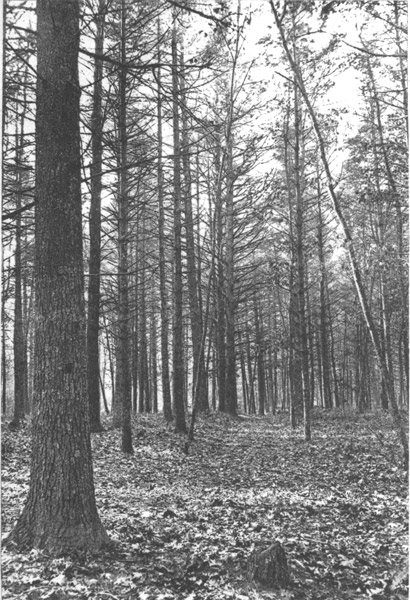
Fallen Leaves
THE SUGAR MAPLE
But think not that the splendor of the year is over;
for as one leaf does not make a summer, neither does
one falling leaf make an autumn. The smallest sugar
maples in our streets make a great show as early as the
fifth of October, more than any other trees there. As
I look up the main street, they appear like painted
screens standing before the houses; yet many are green.
But now, or generally by the seventeenth of October,
when almost all red maples and some white maples
are bare, the large sugar maples also are in their glory,
glowing with yellow and red, and show unexpectedly
bright and delicate tints. They are remarkable for the
contrast they often afford of deep blushing red on one
half and green on the other. They become at length
dense masses of rich yellow with a deep scarlet blush,
or more than blush, on the exposed surfaces. They
are the brightest trees now in the street.
The large ones on our Common are particularly
beautiful. A delicate but warmer than golden yellow
is now the prevailing color, with scarlet cheeks. Yet,
standing on the east side of the Common just before
sundown, when the western light is transmitted through
them, I see that their yellow even, compared with the
pale lemon yellow of an elm close by, amounts to a
scarlet, without noticing the bright scarlet portions.
Generally, they are great regular oval masses of yellow
and scarlet. All the sunny warmth of the season, the
Indian summer, seems to be absorbed in their leaves.
The lowest and inmost leaves next the bole are, as
usual, of the most delicate yellow and green, like the
complexion of young men brought up in the house.
There is an auction on the Common to-day, but its red
flag is hard to be discerned amid this blaze of color.
Little did the fathers of the town anticipate this
brilliant success, when they caused to be imported from
farther in the country some straight poles with their
tops cut off, which they called sugar maples; and, as I
remember, after they were set out, a neighboring merchant's
clerk, by way of jest, planted beans about them.
Those which were then jestingly called bean-poles are
to-day far the most beautiful objects noticeable in our
streets. They are worth all and more than they have
cost,—though one of the selectmen, while setting them
out, took the cold which occasioned his death,—if
only because they have filled the open eyes of children
with their rich color unstintedly so many Octobers. We
will not ask them to yield us sugar in the spring,
while they afford us so fair a prospect in the autumn.
Wealth indoors may be the inheritance of few, but it is
equally distributed on the Common. All children alike
can revel in this golden harvest.
Surely trees should be set in our streets with a view
to their October splendor, though I doubt whether
this is ever considered by the "Tree Society." Do you
not think it will make some odds to these children that
they were brought up under the maples? Hundreds of
eyes are steadily drinking in this color, and by these
teachers even the truants are caught and educated the
moment they step abroad. Indeed, neither the truant
nor the studious is at present taught color in the schools.
These are instead of the bright colors in apothecaries'
shops and city windows. It is a pity that we have no
more red maples, and some hickories, in our streets as
well. Our paint-box is very imperfectly filled. Instead
of, or beside, supplying such paint-boxes as we do, we
might supply these natural colors to the young. Where
else will they study color under greater advantages?
What School of Design can vie with this? Think how
much the eyes of painters of all kinds, and of manufacturers
of cloth and paper, and paper-stainers, and
countless others, are to be educated by these autumnal
colors. The stationer's envelopes may be of very
various tints, yet not so various as those of the leaves
of a single tree. If you want a different shade or tint of
a particular color, you have only to look farther within
or without the tree or the wood. These leaves are not
many dipped in one dye, as at the dye-house, but they
are dyed in light of infinitely various degrees of strength
and left to set and dry there.
Shall the names of so many of our colors continue
to be derived from those of obscure foreign localities, as
Naples yellow, Prussian blue, raw Sienna, burnt Umber,
Gamboge? (surely the Tyrian purple must have
faded by this time), or from comparatively trivial articles
of commerce,—chocolate, lemon, coffee, cinnamon,
claret? (shall we compare our hickory to a lemon,
or a lemon to a hickory?) or from ores and oxides
which few ever see? Shall we so often, when describing
to our neighbors the color of something we have seen,
refer them, not to some natural object in our neighborhood,
but perchance to a bit of earth fetched from the
other side of the planet, which possibly they may find
at the apothecary's, but which probably neither they
nor we ever saw? Have we not an earth under our feet,—aye,
and a sky over our heads? Or is the last all
ultramarine? What do we know of sapphire, amethyst,
emerald, ruby, amber, and the like,—most of us
who take these names in vain? Leave these precious
words to cabinet-keepers, virtuosos, and maids-of-honor,—to
the Nabobs, Begums, and Chobdars of Hindostan,
or wherever else. I do not see why, since America and
her autumn woods have been discovered, our leaves
should not compete with the precious stones in giving
names to colors; and, indeed, I believe that in course
of time the names of some of our trees and shrubs, as
well as flowers, will get into our popular chromatic
nomenclature.
But of much more importance than a knowledge of
the names and distinctions of color is the joy and exhilaration
which these colored leaves excite. Already
these brilliant trees throughout the street, without any
more variety, are at least equal to an annual festival
and holiday, or a week of such. These are cheap and
innocent gala-days, celebrated by one and all without
the aid of committees or marshals, such a show as may
safely be licensed, not attracting gamblers or rum-sellers,
not requiring any special police to keep the peace.
And poor indeed must be that New England village's
October which has not the maple in its streets. This
October festival costs no powder, nor ringing of bells,
but every tree is a living liberty-pole on which a thousand
bright flags are waving.
No wonder that we must have our annual cattle-show,
and fall training, and perhaps cornwallis, our
September courts, and the like. Nature herself holds
her annual fair in October, not only in the streets, but
in every hollow and on every hillside. When lately we
looked into that red maple swamp all ablaze, where
the trees were clothed in their vestures of most dazzling
tints, did it not suggest a thousand gypsies beneath,—a
race capable of wild delight,—or even the fabled
fauns, satyrs, and wood-nymphs come back to earth?
Or was it only a congregation of wearied woodchoppers,
or of proprietors come to inspect their lots, that we
thought of? Or, earlier still, when we paddled on the
river through that fine-grained September air, did there
not appear to be something new going on under the
sparkling surface of the stream, a shaking of props, at
least, so that we made haste in order to be up in time?
Did not the rows of yellowing willows and button-bushes
on each side seem like rows of booths, under
which, perhaps, some fluviatile egg-pop equally yellow
was effervescing? Did not all these suggest that man's
spirits should rise as high as Nature's,—should hang
out their flag, and the routine of his life be interrupted
by an analogous expression of joy and hilarity?
No annual training or muster of soldiery, no celebration
with its scarfs and banners, could import into the
town a hundredth part of the annual splendor of our
October. We have only to set the trees, or let them stand,
and Nature will find the colored drapery,—flags of
all her nations, some of whose private signals hardly
the botanist can read,—while we walk under the triumphal
arches of the elms. Leave it to Nature to appoint
the days, whether the same as in neighboring
States or not, and let the clergy read her proclamations,
if they can understand them. Behold what a brilliant
drapery is her woodbine flag! What public-spirited
merchant, think you, has contributed this part of the
show? There is no handsomer shingling and paint than
this vine, at present covering a whole side of some
houses. I do not believe that the ivy never sere is comparable
to it. No wonder it has been extensively introduced
into London. Let us have a good many maples
and hickories and scarlet oaks, then, I say. Blaze
away! Shall that dirty roll of bunting in the gun-house
be all the colors a village can display? A village is not
complete, unless it have these trees to mark the season
in it. They are important, like the town clock. A village
that has them not will not be found to work well. It
has a screw loose, an essential part is wanting. Let us
have willows for spring, elms for summer, maples and
walnuts and tupeloes for autumn, evergreens for winter,
and oaks for all seasons. What is a gallery in a
house to a gallery in the streets, which every market-man
rides through, whether he will or not? Of course,
there is not a picture-gallery in the country which would
be worth so much to us as is the western view at sunset
under the elms of our main street. They are the
frame to a picture which is daily painted behind them.
An avenue of elms as large as our largest and three
miles long would seem to lead to some admirable place,
though only C—— were at the end of it.
A village needs these innocent stimulants of bright
and cheering prospects to keep off melancholy and
superstition. Show me two villages, one embowered in
trees and blazing with all the glories of October, the
other a merely trivial and treeless waste, or with only
a single tree or two for suicides, and I shall be sure that
in the latter will be found the most starved and bigoted
religionists and the most desperate drinkers. Every
wash-tub and milk-can and gravestone will be exposed.
The inhabitants will disappear abruptly behind their
barns and houses, like desert Arabs amid their rocks,
and I shall look to see spears in their hands. They will
be ready to accept the most barren and forlorn doctrine,—as
that the world is speedily coming to an end, or
has already got to it, or that they themselves are turned
wrong side outward. They will perchance crack their
dry joints at one another and call it a spiritual communication.
But to confine ourselves to the maples. What if we
were to take half as much pains in protecting them as
we do in setting them out,—not stupidly tie our horses
to our dahlia stems?
What meant the fathers by establishing this perfectly
living institution before the church,—this institution
which needs no repairing nor repainting, which
is continually enlarged and repaired by its growth?
Surely they
"Wrought in a sad sincerity;
Themselves from God they could not free;
They planted better than they knew;—
The conscious trees to beauty grew."
Verily these maples are cheap preachers, permanently
settled, which preach their half-century, and century,
aye, and century-and-a-half sermons, with constantly
increasing unction and influence, ministering to many
generations of men; and the least we can do is to supply
them with suitable colleagues as they grow infirm.
THE SCARLET OAK
Belonging to a genus which is remarkable for the
beautiful form of its leaves, I suspect that some scarlet
oak leaves surpass those of all other oaks in the rich
and wild beauty of their outlines. I judge from an
acquaintance with twelve species, and from drawings
which I have seen of many others.
Stand under this tree and see how finely its leaves
are cut against the sky,—as it were, only a few sharp
points extending from a midrib. They look like double,
treble, or quadruple crosses. They are far more ethereal
than the less deeply scalloped oak leaves. They have
so little leafy terra firma that they appear melting away in
the light, and scarcely obstruct our view. The leaves of
very young plants are, like those of full-grown oaks of
other species, more entire, simple, and lumpish in their
outlines, but these, raised high on old trees, have solved
the leafy problem. Lifted higher and higher, and sublimated
more and more, putting off some earthiness and
cultivating more intimacy with the light each year, they
have at length the least possible amount of earthy matter,
and the greatest spread and grasp of skyey influences.
There they dance, arm in arm with the light,—tripping
it on fantastic points, fit partners in those
aerial halls. So intimately mingled are they with it,
that, what with their slenderness and their glossy surfaces,
you can hardly tell at last what in the dance is
leaf and what is light. And when no zephyr stirs, they
are at most but a rich tracery to the forest windows.
I am again struck with their beauty, when, a month
later, they thickly strew the ground in the woods, piled
one upon another under my feet. They are then brown
above, but purple beneath. With their narrow lobes
and their bold, deep scallops reaching almost to the
middle, they suggest that the material must be cheap, or
else there has been a lavish expense in their creation,
as if so much had been cut out. Or else they seem to us
the remnants of the stuff out of which leaves have been
cut with a die. Indeed, when they lie thus one upon
another, they remind me of a pile of scrap-tin.
Or bring one home, and study it closely at your leisure,
by the fireside. It is a type, not from any Oxford font,
not in the Basque nor the arrow-headed character, not
found on the Rosetta Stone, but destined to be copied
in sculpture one day, if they ever get to whittling stone
here. What a wild and pleasing outline, a combination
of graceful curves and angles! The eye rests with equal
delight on what is not leaf and on what is leaf,—on
the broad, free, open sinuses, and on the long, sharp,
bristle-pointed lobes. A simple oval outline would include
it all, if you connected the points of the leaf; but
how much richer is it than that, with its half-dozen deep
scallops, in which the eye and thought of the beholder
are embayed! If I were a drawing-master, I would set
my pupils to copying these leaves, that they might
learn to draw firmly and gracefully.
Regarded as water, it is like a pond with half a dozen
broad rounded promontories extending nearly to its
middle, half from each side, while its watery bays extend
far inland, like sharp friths, at each of whose heads
several fine streams empty in,—almost a leafy archipelago.
But it oftener suggests land, and, as Dionysius and
Pliny compared the form of the Morea to that of the
leaf of the Oriental plane tree, so this leaf reminds me
of some fair wild island in the ocean, whose extensive
coast, alternate rounded bays with smooth strands, and
sharp-pointed rocky capes, mark it as fitted for the
habitation of man, and destined to become a centre of
civilization at last. To the sailor's eye, it is a much
indented shore. Is it not, in fact, a shore to the aerial
ocean, on which the windy surf beats? At sight of this
leaf we are all mariners,—if not vikings, buccaneers,
and filibusters. Both our love of repose and our spirit of
adventure are addressed. In our most casual glance,
perchance, we think that if we succeed in doubling those
sharp capes we shall find deep, smooth, and secure
havens in the ample bays. How different from the
white oak leaf, with its rounded headlands, on which
no lighthouse need be placed! That is an England, with
its long civil history, that may be read. This is some still
unsettled New-found Island or Celebes. Shall we go and
be rajahs there?
By the twenty-sixth of October the large scarlet oaks
are in their prime, when other oaks are usually withered.
They have been kindling their fires for a week
past, and now generally burst into a blaze. This alone
of our indigenous deciduous trees (excepting the dogwood,
of which I do not know half a dozen, and they are
but large bushes) is now in its glory. The two aspens
and the sugar maple come nearest to it in date, but they
have lost the greater part of their leaves. Of evergreens,
only the pitch pine is still commonly bright.
But it requires a particular alertness, if not devotion
to these phenomena, to appreciate the wide-spread, but
late and unexpected glory of the scarlet oaks. I do not
speak here of the small trees and shrubs, which are
commonly observed, and which are now withered, but
of the large trees. Most go in and shut their doors,
thinking that bleak and colorless November has already
come, when some of the most brilliant and memorable
colors are not yet lit.
This very perfect and vigorous one, about forty feet
high, standing in an open pasture, which was quite
glossy green on the twelfth, is now, the twenty-sixth,
completely changed to bright dark-scarlet,—every leaf,
between you and the sun, as if it had been dipped into a
scarlet dye. The whole tree is much like a heart in form,
as well as color. Was not this worth waiting for? Little
did you think, ten days ago, that that cold green tree
would assume such color as this. Its leaves are still
firmly attached, while those of other trees are falling
around it. It seems to say: "I am the last to blush,
but I blush deeper than any of ye. I bring up the rear in
my red coat. We scarlet ones, alone of oaks, have not
given up the fight."
The sap is now, and even far into November, frequently
flowing fast in these trees, as in maples in the
spring; and apparently their bright tints, now that most
other oaks are withered, are connected with this phenomenon.
They are full of life. It has a pleasantly
astringent, acorn-like taste, this strong oak wine, as
I find on tapping them with my knife.
Looking across this woodland valley, a quarter of a
mile wide, how rich those scarlet oaks embosomed in
pines, their bright red branches intimately intermingled
with them! They have their full effect there. The pine
boughs are the green calyx to their red petals. Or, as we
go along a road in the woods, the sun striking endwise
through it, and lighting up the red tents of the oaks,
which on each side are mingled with the liquid green of
the pines, makes a very gorgeous scene. Indeed, without
the evergreens for contrast, the autumnal tints would
lose much of their effect.
The scarlet oak asks a clear sky and the brightness
of late October days. These bring out its colors. If the
sun goes into a cloud they become comparatively indistinct.
As I sit on a cliff in the southwest part of our town,
the sun is now getting low, and the woods in Lincoln,
south and east of me, are lit up by its more level rays;
and in the scarlet oaks, scattered so equally over the
forest, there is brought out a more brilliant redness than
I had believed was in them. Every tree of this species
which is visible in those directions, even to the horizon,
now stands out distinctly red. Some great ones lift their
red backs high above the woods, in the next town, like
huge roses with a myriad of fine petals; and some more
slender ones, in a small grove of white pines on Pine
Hill in the east, on the very verge of the horizon, alternating
with the pines on the edge of the grove, and
shouldering them with their red coats, look like soldiers
in red amid hunters in green. This time it is Lincoln
green, too. Till the sun got low, I did not believe that
there were so many redcoats in the forest army. Theirs
is an intense, burning red, which would lose some of
its strength, methinks, with every step you might take
toward them; for the shade that lurks amid their foliage
does not report itself at this distance, and they are unanimously
red. The focus of their reflected color is in the
atmosphere far on this side. Every such tree becomes a
nucleus of red, as it were, where, with the declining sun,
that color grows and glows. It is partly borrowed fire,
gathering strength from the sun on its way to your eye.
It has only some comparatively dull red leaves for a
rallying-point, or kindling-stuff, to start it, and it becomes
an intense scarlet or red mist, or fire, which finds
fuel for itself in the very atmosphere. So vivacious is
redness. The very rails reflect a rosy light at this hour
and season. You see a redder tree than exists.
If you wish to count the scarlet oaks, do it now.
In a clear day stand thus on a hilltop in the woods,
when the sun is an hour high, and every one within range
of your vision, excepting in the west, will be revealed.
You might live to the age of Methuselah and never find
a tithe of them, otherwise. Yet sometimes even in a dark
day I have thought them as bright as I ever saw them.
Looking westward, their colors are lost in a blaze of
light; but in other directions the whole forest is a flower-garden,
in which these late roses burn, alternating with
green, while the so-called "gardeners," walking here
and there, perchance, beneath, with spade and water-pot,
see only a few little asters amid withered leaves.
These are my China-asters, my late garden-flowers.
It costs me nothing for a gardener. The falling leaves,
all over the forest, are protecting the roots of my plants.
Only look at what is to be seen, and you will have garden
enough, without deepening the soil in your yard. We
have only to elevate our view a little, to see the whole
forest as a garden. The blossoming of the scarlet oak,—the
forest-flower, surpassing all in splendor (at least
since the maple)! I do not know but they interest me
more than the maples, they are so widely and equally
dispersed throughout the forest; they are so hardy, a
nobler tree on the whole; our chief November flower,
abiding the approach of winter with us, imparting
warmth to early November prospects. It is remarkable
that the latest bright color that is general should be this
deep, dark scarlet and red, the intensest of colors. The
ripest fruit of the year; like the cheek of a hard, glossy
red apple, from the cold Isle of Orleans, which will not
be mellow for eating till next spring! When I rise to a
hilltop, a thousand of these great oak roses, distributed
on every side, as far as the horizon! I admire them four
or five miles off! This my unfailing prospect for a fortnight
past! This late forest-flower surpasses all that
spring or summer could do. Their colors were but rare
and dainty specks comparatively (created for the near-sighted,
who walk amid the humblest herbs and underwoods),
and made no impression on a distant eye. Now
it is an extended forest or a mountain-side, through or
along which we journey from day to day, that bursts
into bloom. Comparatively, our gardening is on a petty
scale,—the gardener still nursing a few asters amid
dead weeds, ignorant of the gigantic asters and roses
which, as it were, overshadow him, and ask for none of
his care. It is like a little red paint ground on a saucer,
and held up against the sunset sky. Why not take more
elevated and broader views, walk in the great garden;
not skulk in a little "debauched" nook of it? consider
the beauty of the forest, and not merely of a few impounded
herbs?
Let your walks now be a little more adventurous;
ascend the hills. If, about the last of October, you
ascend any hill in the outskirts of our town, and probably
of yours, and look over the forest, you may see—well,
what I have endeavored to describe. All this you
surely will see, and much more, if you are prepared to
see it,—if you look for it. Otherwise, regular and universal
as this phenomenon is, whether you stand on the
hilltop or in the hollow, you will think for threescore
years and ten that all the wood is, at this season, sere and
brown. Objects are concealed from our view, not so
much because they are out of the course of our visual
ray as because we do not bring our minds and eyes to
bear on them; for there is no power to see in the eye
itself, any more than in any other jelly. We do not
realize how far and widely, or how near and narrowly,
we are to look. The greater part of the phenomena of
Nature are for this reason concealed from us all our
lives. The gardener sees only the gardener's garden.
Here, too, as in political economy, the supply answers
to the demand. Nature does not cast pearls before
swine. There is just as much beauty visible to us in the
landscape as we are prepared to appreciate,—not a
grain more. The actual objects which one man will see
from a particular hilltop are just as different from those
which another will see as the beholders are different.
The scarlet oak must, in a sense, be in your eye when
you go forth. We cannot see anything until we are possessed
with the idea of it, take it into our heads,—and
then we can hardly see anything else. In my botanical
rambles I find that, first, the idea, or image, of a plant
occupies my thoughts, though it may seem very foreign
to this locality,—no nearer than Hudson's Bay,—and
for some weeks or months I go thinking of it, and
expecting it, unconsciously, and at length I surely see it.
This is the history of my finding a score or more of rare
plants which I could name. A man sees only what concerns
him. A botanist absorbed in the study of grasses
does not distinguish the grandest pasture oaks. He, as
it were, tramples down oaks unwittingly in his walk,
or at most sees only their shadows. I have found that
it required a different intention of the eye, in the same
locality, to see different plants, even when they were
closely allied, as Juncaceae and Gramineae: when I was
looking for the former, I did not see the latter in the
midst of them. How much more, then, it requires different
intentions of the eye and of the mind to attend to
different departments of knowledge! How differently
the poet and the naturalist look at objects!
Take a New England selectman, and set him on the
highest of our hills, and tell him to look,—sharpening
his sight to the utmost, and putting on the glasses that
suit him best (aye, using a spy-glass, if he likes),—and
make a full report. What, probably, will he spy?—what
will he select to look at? Of course, he will see a
Brocken spectre of himself. He will see several meeting-houses,
at least, and, perhaps, that somebody ought to
be assessed higher than he is, since he has so handsome
a wood-lot. Now take Julius Cæsar, or Emanuel Swedenborg,
or a Fiji-Islander, and set him up there. Or
suppose all together, and let them compare notes afterward.
Will it appear that they have enjoyed the same
prospect? What they will see will be as different as
Rome was from heaven or hell, or the last from the
Fiji Islands. For aught we know, as strange a man as
any of these is always at our elbow.
Why, it takes a sharpshooter to bring down even
such trivial game as snipes and woodcocks; he must
take very particular aim, and know what he is aiming
at. He would stand a very small chance, if he fired at
random into the sky, being told that snipes were flying
there. And so is it with him that shoots at beauty;
though he wait till the sky falls, he will not bag any, if
he does not already know its seasons and haunts, and
the color of its wing,—if he has not dreamed of it, so
that he can anticipate it; then, indeed, he flushes it at
every step, shoots double and on the wing, with both
barrels, even in corn-fields. The sportsman trains himself,
dresses, and watches unweariedly, and loads and
primes for his particular game. He prays for it, and
offers sacrifices, and so he gets it. After due and long
preparation, schooling his eye and hand, dreaming
awake and asleep, with gun and paddle and boat, he
goes out after meadow-hens, which most of his townsmen
never saw nor dreamed of, and paddles for miles
against a head wind, and wades in water up to his
knees, being out all day without his dinner, and therefore
he gets them. He had them half-way into his bag
when he started, and has only to shove them down.
The true sportsman can shoot you almost any of his
game from his windows: what else has he windows or
eyes for? It comes and perches at last on the barrel of
his gun; but the rest of the world never see it with the
feathers on. The geese fly exactly under his zenith,
and honk when they get there, and he will keep himself
supplied by firing up his chimney; twenty musquash
have the refusal of each one of his traps before it is
empty. If he lives, and his game spirit increases, heaven
and earth shall fail him sooner than game; and when
he dies, he will go to more extensive and, perchance,
happier hunting-grounds. The fisherman, too, dreams
of fish, sees a bobbing cork in his dreams, till he can
almost catch them in his sink-spout. I knew a girl who,
being sent to pick huckleberries, picked wild gooseberries
by the quart, where no one else knew that there
were any, because she was accustomed to pick them up-country
where she came from. The astronomer knows
where to go star-gathering, and sees one clearly in his
mind before any have seen it with a glass. The hen
scratches and finds her food right under where she
stands; but such is not the way with the hawk.
These bright leaves which I have mentioned are not
the exception, but the rule; for I believe that all leaves,
even grasses and mosses, acquire brighter colors just
before their fall. When you come to observe faithfully
the changes of each humblest plant, you find that each
has, sooner or later, its peculiar autumnal tint; and if
you undertake to make a complete list of the bright
tints, it will be nearly as long as a catalogue of the
plants in your vicinity.
THE HISTORY OF THE APPLE TREE
It is remarkable how closely the history of the apple
tree is connected with that of man. The geologist tells
us that the order of the Rosaceae, which includes the
apple, also the true grasses, and the Labiatae, or mints,
were introduced only a short time previous to the appearance
of man on the globe.
It appears that apples made a part of the food of that
unknown primitive people whose traces have lately
been found at the bottom of the Swiss lakes, supposed
to be older than the foundation of Rome, so old that
they had no metallic implements. An entire black and
shriveled crab-apple has been recovered from their
stores.
Tacitus says of the ancient Germans that they satisfied
their hunger with wild apples (agrestia poma),
among other things.
Niebuhr observes that "the words for a house, a field,
a plow, plowing, wine, oil, milk, sheep, apples, and
others relating to agriculture and the gentler way of life,
agree in Latin and Greek, while the Latin words for all
objects pertaining to war or the chase are utterly alien
from the Greek." Thus the apple tree may be considered
a symbol of peace no less than the olive.
The apple was early so important, and generally distributed,
that its name traced to its root in many languages
signifies fruit in general. Μῆλον, in Greek, means
an apple, also the fruit of other trees, also a sheep and
any cattle, and finally riches in general.
The apple tree has been celebrated by the Hebrews,
Greeks, Romans, and Scandinavians. Some have
thought that the first human pair were tempted by its
fruit. Goddesses are fabled to have contended for it,
dragons were set to watch it, and heroes were employed
to pluck it.
The tree is mentioned in at least three places in the
Old Testament, and its fruit in two or three more.
Solomon sings, "As the apple-tree among the trees
of the wood, so is my beloved among the sons." And
again, "Stay me with flagons, comfort me with apples."
The noblest part of man's noblest feature is
named from this fruit, "the apple of the eye."
The apple tree is also mentioned by Homer and
Herodotus. Ulysses saw in the glorious garden of Alcinoûs
"pears and pomegranates, and apple trees bearing
beautiful fruit" (καὶ μηλέαι ἀγλαόκαρποι). And according
to Homer, apples were among the fruits which
Tantalus could not pluck, the wind ever blowing their
boughs away from him. Theophrastus knew and described
the apple tree as a botanist.
According to the Prose Edda, "Iduna keeps in a box
the apples which the gods, when they feel old age approaching,
have only to taste of to become young again.
It is in this manner that they will be kept in renovated
youth until Ragnarôk" (or the destruction of the gods).
I learn from Loudon that "the ancient Welsh bards
were rewarded for excelling in song by the token of the
apple-spray;" and "in the Highlands of Scotland the
apple-tree is the badge of the clan Lamont."
The apple tree (Pyrus malus) belongs chiefly to the
northern temperate zone. Loudon says that "it grows
spontaneously in every part of Europe except the frigid
zone, and throughout Western Asia, China, and Japan."
We have also two or three varieties of the apple indigenous
in North America. The cultivated apple tree was
first introduced into this country by the earliest settlers,
and is thought to do as well or better here than anywhere
else. Probably some of the varieties which are
now cultivated were first introduced into Britain by the
Romans.
Pliny, adopting the distinction of Theophrastus, says,
"Of trees there are some which are altogether wild
(sylvestres), some more civilized (urbaniores)." Theophrastus
includes the apple among the last; and, indeed,
it is in this sense the most civilized of all trees.
It is as harmless as a dove, as beautiful as a rose, and as
valuable as flocks and herds. It has been longer cultivated
than any other, and so is more humanized; and
who knows but, like the dog, it will at length be no
longer traceable to its wild original? It migrates with
man, like the dog and horse and cow: first, perchance,
from Greece to Italy, thence to England, thence to
America; and our Western emigrant is still marching
steadily toward the setting sun with the seeds of the
apple in his pocket, or perhaps a few young trees
strapped to his load. At least a million apple trees are
thus set farther westward this year than any cultivated
ones grew last year. Consider how the Blossom Week,
like the Sabbath, is thus annually spreading over the
prairies; for when man migrates, he carries with him
not only his birds, quadrupeds, insects, vegetables,
and his very sward, but his orchard also.
The leaves and tender twigs are an agreeable food to
many domestic animals, as the cow, horse, sheep, and
goat; and the fruit is sought after by the first, as well
as by the hog. Thus there appears to have existed a
natural alliance between these animals and this tree
from the first. "The fruit of the crab in the forests of
France" is said to be "a great resource for the wild
boar."
Not only the Indian, but many indigenous insects,
birds, and quadrupeds, welcomed the apple tree to
these shores. The tent caterpillar saddled her eggs on
the very first twig that was formed, and it has since
shared her affections with the wild cherry; and the
canker-worm also in a measure abandoned the elm to
feed on it. As it grew apace, the bluebird, robin, cherry-bird,
kingbird, and many more came with haste and
built their nests and warbled in its boughs, and so became
orchard-birds, and multiplied more than ever.
It was an era in the history of their race. The downy
woodpecker found such a savory morsel under its bark
that he perforated it in a ring quite round the tree,
before he left it,—a thing which he had never done
before, to my knowledge. It did not take the partridge
long to find out how sweet its buds were, and every
winter eve she flew, and still flies, from the wood, to
pluck them, much to the farmer's sorrow. The rabbit,
too, was not slow to learn the taste of its twigs and bark;
and when the fruit was ripe, the squirrel half rolled,
half carried it to his hole; and even the musquash crept
up the bank from the brook at evening, and greedily
devoured it, until he had worn a path in the grass there;
and when it was frozen and thawed, the crow and the
jay were glad to taste it occasionally. The owl crept
into the first apple tree that became hollow, and fairly
hooted with delight, finding it just the place for him; so,
settling down into it, he has remained there ever since.
My theme being the Wild Apple, I will merely glance
at some of the seasons in the annual growth of the cultivated
apple, and pass on to my special province.
The flowers of the apple are perhaps the most beautiful
of any tree's, so copious and so delicious to both
sight and scent. The walker is frequently tempted to
turn and linger near some more than usually handsome
one, whose blossoms are two-thirds expanded. How
superior it is in these respects to the pear, whose blossoms
are neither colored nor fragrant!
By the middle of July, green apples are so large as to
remind us of coddling, and of the autumn. The sward
is commonly strewed with little ones which fall stillborn,
as it were,—Nature thus thinning them for
us. The Roman writer Palladius said, "If apples are
inclined to fall before their time, a stone placed in a
split root will retain them." Some such notion, still
surviving, may account for some of the stones which
we see placed, to be overgrown, in the forks of trees.
They have a saying in Suffolk, England,—
"At Michaelmas time, or a little before,
Half an apple goes to the core."
Early apples begin to be ripe about the first of August;
but I think that none of them are so good to eat as some
to smell. One is worth more to scent your handkerchief
with than any perfume which they sell in the shops.
The fragrance of some fruits is not to be forgotten,
along with that of flowers. Some gnarly apple which I
pick up in the road reminds me by its fragrance of all
the wealth of Pomona,—carrying me forward to those
days when they will be collected in golden and ruddy
heaps in the orchards and about the cider-mills.
A week or two later, as you are going by orchards or
gardens, especially in the evenings, you pass through
a little region possessed by the fragrance of ripe apples,
and thus enjoy them without price, and without robbing
anybody.
There is thus about all natural products a certain
volatile and ethereal quality which represents their
highest value, and which cannot be vulgarized, or
bought and sold. No mortal has ever enjoyed the perfect
flavor of any fruit, and only the godlike among men
begin to taste its ambrosial qualities. For nectar and
ambrosia are only those fine flavors of every earthly
fruit which our coarse palates fail to perceive,—just
as we occupy the heaven of the gods without knowing
it. When I see a particularly mean man carrying a load
of fair and fragrant early apples to market, I seem to
see a contest going on between him and his horse, on
the one side, and the apples on the other, and, to my
mind, the apples always gain it. Pliny says that apples
are the heaviest of all things, and that the oxen begin
to sweat at the mere sight of a load of them. Our driver
begins to lose his load the moment he tries to transport
them to where they do not belong, that is, to any but
the most beautiful. Though he gets out from time to
time, and feels of them, and thinks they are all there,
I see the stream of their evanescent and celestial qualities
going to heaven from his cart, while the pulp and
skin and core only are going to market. They are not
apples, but pomace. Are not these still Iduna's apples,
the taste of which keeps the gods forever young? and
think you that they will let Loki or Thjassi carry them
off to Jötunheim, while they grow wrinkled and gray?
No, for Ragnarök, or the destruction of the gods, is not
yet.
There is another thinning of the fruit, commonly
near the end of August or in September, when the ground
is strewn with windfalls; and this happens especially
when high winds occur after rain. In some orchards
you may see fully three quarters of the whole crop on
the ground, lying in a circular form beneath the trees,
yet hard and green, or, if it is a hillside, rolled far down
the hill. However, it is an ill wind that blows nobody
any good. All the country over, people are busy picking
up the windfalls, and this will make them cheap for
early apple pies.
In October, the leaves falling, the apples are more
distinct on the trees. I saw one year in a neighboring
town some trees fuller of fruit than I remember to have
ever seen before, small yellow apples hanging over the
road. The branches were gracefully drooping with their
weight, like a barberry bush, so that the whole tree
acquired a new character. Even the topmost branches,
instead of standing erect, spread and drooped in all directions;
and there were so many poles supporting the
lower ones that they looked like pictures of banyan
trees. As an old English manuscript says, "The mo
appelen the tree bereth the more sche boweth to the
folk."
Surely the apple is the noblest of fruits. Let the most
beautiful or the swiftest have it. That should be the
"going" price of apples.
Between the 5th and 20th of October I see the barrels
lie under the trees. And perhaps I talk with one who
is selecting some choice barrels to fulfill an order. He
turns a specked one over many times before he leaves it
out. If I were to tell what is passing in my mind, I
should say that every one was specked which he had
handled; for he rubs off all the bloom, and those fugacious
ethereal qualities leave it. Cool evenings prompt
the farmers to make haste, and at length I see only the
ladders here and there left leaning against the trees.
It would be well, if we accepted these gifts with more
joy and gratitude, and did not think it enough simply
to put a fresh load of compost about the tree. Some
old English customs are suggestive at least. I find them
described chiefly in Brand's "Popular Antiquities."
It appears that "on Christmas Eve the farmers and
their men in Devonshire take a large bowl of cider,
with a toast in it, and carrying it in state to the orchard,
they salute the apple-trees with much ceremony, in
order to make them bear well the next season." This
salutation consists in "throwing some of the cider
about the roots of the tree, placing bits of the toast on
the branches," and then, "encircling one of the best
bearing trees in the orchard, they drink the following
toast three several times:—
'Here's to thee, old apple tree,
Whence thou mayst bud, and whence thou mayst blow,
And whence thou mayst bear apples enow!
Hats-full! caps-full!
Bushel, bushel, sacks-full!
And my pockets full, too! Hurra!'"
Also what was called "apple-howling" used to be
practiced in various counties of England on New Year's
Eve. A troop of boys visited the different orchards,
and, encircling the apple trees, repeated the following
words:—
"Stand fast, root! bear well, top!
Pray God send us a good howling crop:
Every twig, apples big;
Every bough, apples enow!"
"They then shout in chorus, one of the boys accompanying
them on a cow's horn. During this ceremony
they rap the trees with their sticks." This is called
"wassailing" the trees, and is thought by some to be
"a relic of the heathen sacrifice to Pomona."
Herrick sings,—
"Wassaile the trees that they may beare
You many a plum and many a peare;
For more or less fruits they will bring
As you so give them wassailing."
Our poets have as yet a better right to sing of cider
than of wine; but it behooves them to sing better than
English Phillips did, else they will do no credit to their
Muse.
THE WILD APPLE
So much for the more civilized apple trees (urbaniores,
as Pliny calls them). I love better to go through
the old orchards of ungrafted apple trees, at what ever
season of the year,—so irregularly planted: sometimes
two trees standing close together; and the rows
so devious that you would think that they not only had
grown while the owner was sleeping, but had been set
out by him in a somnambulic state. The rows of grafted
fruit will never tempt me to wander amid them like
these. But I now, alas, speak rather from memory than
from any recent experience, such ravages have been
made!
Some soils, like a rocky tract called the Easterbrooks
Country in my neighborhood, are so suited to the apple,
that it will grow faster in them without any care, or
if only the ground is broken up once a year, than it will
in many places with any amount of care. The owners
of this tract allow that the soil is excellent for fruit, but
they say that it is so rocky that they have not patience
to plow it, and that, together with the distance, is
the reason why it is not cultivated. There are, or were
recently, extensive orchards there standing without
order. Nay, they spring up wild and bear well there
in the midst of pines, birches, maples, and oaks. I am
often surprised to see rising amid these trees the rounded
tops of apple trees glowing with red or yellow fruit, in
harmony with the autumnal tints of the forest.
Going up the side of a cliff about the first of November,
I saw a vigorous young apple tree, which, planted
by birds or cows, had shot up amid the rocks and open
woods there, and had now much fruit on it, uninjured
by the frosts, when all cultivated apples were gathered.
It was a rank, wild growth, with many green leaves on
it still, and made an impression of thorniness. The
fruit was hard and green, but looked as if it would be
palatable in the winter. Some was dangling on the twigs,
but more half buried in the wet leaves under the tree,
or rolled far down the hill amid the rocks. The owner
knows nothing of it. The day was not observed when
it first blossomed, nor when it first bore fruit, unless by
the chickadee. There was no dancing on the green beneath
it in its honor, and now there is no hand to pluck
its fruit,—which is only gnawed by squirrels, as I perceive.
It has done double duty,—not only borne this
crop, but each twig has grown a foot into the air. And
this is such fruit! bigger than many berries, we must
admit, and carried home will be sound and palatable
next spring. What care I for Iduna's apples so long as
I can get these?
When I go by this shrub thus late and hardy, and see
its dangling fruit, I respect the tree, and I am grateful
for Nature's bounty, even though I cannot eat it. Here
on this rugged and woody hillside has grown an apple
tree, not planted by man, no relic of a former orchard,
but a natural growth, like the pines and oaks. Most
fruits which we prize and use depend entirely on our
care. Corn and grain, potatoes, peaches, melons, etc.,
depend altogether on our planting; but the apple emulates
man's independence and enterprise. It is not simply
carried, as I have said, but, like him, to some extent,
it has migrated to this New World, and is even, here
and there, making its way amid the aboriginal trees;
just as the ox and dog and horse sometimes run wild
and maintain themselves.
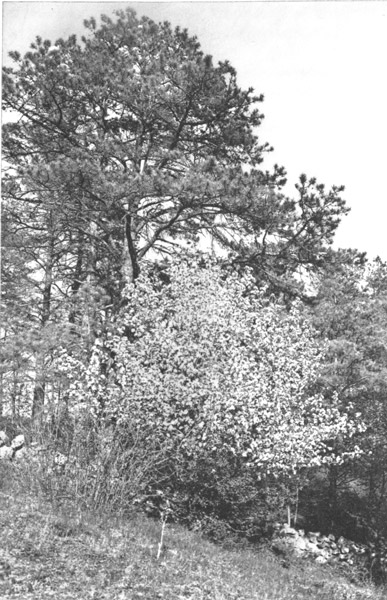
Wild Apple Tree
Even the sourest and crabbedest apple, growing in
the most unfavorable position, suggests such thoughts
as these, it is so noble a fruit.
THE CRAB
Nevertheless, our wild apple is wild only like myself,
perchance, who belong not to the aboriginal race here,
but have strayed into the woods from the cultivated
stock. Wilder still, as I have said, there grows elsewhere
in this country a native and aboriginal crab-apple,
Malus coronaria, "whose nature has not yet been modified
by cultivation." It is found from western New
York to Minnesota, and southward. Michaux says
that its ordinary height "is fifteen or eighteen feet, but
it is sometimes found twenty-five or thirty feet high,"
and that the large ones "exactly resemble the common
apple tree." "The flowers are white mingled with rose
color, and are collected in corymbs." They are remarkable
for their delicious odor. The fruit, according to
him, is about an inch and a half in diameter, and is intensely
acid. Yet they make fine sweetmeats and also
cider of them. He concludes that "if, on being cultivated,
it does not yield new and palatable varieties, it
will at least be celebrated for the beauty of its flowers,
and for the sweetness of its perfume."
I never saw the crab-apple till May, 1861. I had
heard of it through Michaux, but more modern botanists,
so far as I know, have not treated it as of any
peculiar importance. Thus it was a half-fabulous tree
to me. I contemplated a pilgrimage to the "Glades,"
a portion of Pennsylvania where it was said to grow to
perfection. I thought of sending to a nursery for it, but
doubted if they had it, or would distinguish it from
European varieties. At last I had occasion to go to
Minnesota, and on entering Michigan I began to notice
from the cars a tree with handsome rose-colored flowers.
At first I thought it some variety of thorn; but it was
not long before the truth flashed on me, that this
was my long-sought crab-apple. It was the prevailing
flowering shrub or tree to be seen from the cars at that
season of the year,—about the middle of May. But
the cars never stopped before one, and so I was launched
on the bosom of the Mississippi without having touched
one, experiencing the fate of Tantalus. On arriving at
St. Anthony's Falls, I was sorry to be told that I was
too far north for the crab-apple. Nevertheless I succeeded
in finding it about eight miles west of the Falls;
touched it and smelled it, and secured a lingering
corymb of flowers for my herbarium. This must have
been near its northern limit.
HOW THE WILD APPLE GROWS
But though these are indigenous, like the Indians, I
doubt whether they are any hardier than those backwoodsmen
among the apple trees, which, though descended
from cultivated stocks, plant themselves in
distant fields and forests, where the soil is favorable to
them. I know of no trees which have more difficulties
to contend with, and which more sturdily resist their
foes. These are the ones whose story we have to tell. It
oftentimes reads thus:—
Near the beginning of May, we notice little thickets
of apple trees just springing up in the pastures where
cattle have been,—as the rocky ones of our Easterbrooks
Country, or the top of Nobscot Hill, in Sudbury.
One or two of these, perhaps, survive the drought
and other accidents,—their very birthplace defending
them against the encroaching grass and some other dangers,
at first.
In two years' time 't had thus
Reached the level of the rocks,
Admired the stretching world,
Nor feared the wandering flocks.
But at this tender age
Its sufferings began:
There came a browsing ox
And cut it down a span.
This time, perhaps, the ox does not notice it amid the
grass; but the next year, when it has grown more stout,
he recognizes it for a fellow-emigrant from the old
country, the flavor of whose leaves and twigs he well
knows; and though at first he pauses to welcome it,
and express his surprise, and gets for answer, "The
same cause that brought you here brought me," he
nevertheless browses it again, reflecting, it may be, that
he has some title to it.
Thus cut down annually, it does not despair; but,
putting forth two short twigs for every one cut off, it
spreads out low along the ground in the hollows or
between the rocks, growing more stout and scrubby,
until it forms, not a tree as yet, but a little pyramidal,
stiff, twiggy mass, almost as solid and impenetrable as
a rock. Some of the densest and most impenetrable
clumps of bushes that I have ever seen, as well on account
of the closeness and stubbornness of their branches
as of their thorns, have been these wild apple scrubs.
They are more like the scrubby fir and black spruce on
which you stand, and sometimes walk, on the tops of
mountains, where cold is the demon they contend with,
than anything else. No wonder they are prompted to
grow thorns at last, to defend themselves against such
foes. In their thorniness, however, there is no malice,
only some malic acid.
The rocky pastures of the tract I have referred to—for
they maintain their ground best in a rocky field—are
thickly sprinkled with these little tufts, reminding
you often of some rigid gray mosses or lichens, and you
see thousands of little trees just springing up between
them, with the seed still attached to them.
Being regularly clipped all around each year by the
cows, as a hedge with shears, they are often of a perfect
conical or pyramidal form, from one to four feet high,
and more or less sharp, as if trimmed by the gardener's
art. In the pastures on Nobscot Hill and its spurs, they
make fine dark shadows when the sun is low. They
are also an excellent covert from hawks for many small
birds that roost and build in them. Whole flocks perch
in them at night, and I have seen three robins' nests in
one which was six feet in diameter.
No doubt many of these are already old trees, if you
reckon from the day they were planted, but infants still
when you consider their development and the long life
before them. I counted the annual rings of some which
were just one foot high, and as wide as high, and found
that they were about twelve years old, but quite sound
and thrifty! They were so low that they were unnoticed
by the walker, while many of their contemporaries from
the nurseries were already bearing considerable crops.
But what you gain in time is perhaps in this case, too,
lost in power,—that is, in the vigor of the tree. This
is their pyramidal state.
The cows continue to browse them thus for twenty
years or more, keeping them down and compelling
them to spread, until at last they are so broad that they
become their own fence, when some interior shoot,
which their foes cannot reach, darts upward with joy:
for it has not forgotten its high calling, and bears its
own peculiar fruit in triumph.
Such are the tactics by which it finally defeats its
bovine foes. Now, if you have watched the progress
of a particular shrub, you will see that it is no longer a
simple pyramid or cone, but that out of its apex there
rises a sprig or two, growing more lustily perchance
than an orchard-tree, since the plant now devotes the
whole of its repressed energy to these upright parts.
In a short time these become a small tree, an inverted
pyramid resting on the apex of the other, so that the
whole has now the form of a vast hour-glass. The
spreading bottom, having served its purpose, finally
disappears, and the generous tree permits the now
harmless cows to come in and stand in its shade, and
rub against and redden its trunk, which has grown
in spite of them, and even to taste a part of its fruit, and
so disperse the seed.
Thus the cows create their own shade and food; and
the tree, its hour-glass being inverted, lives a second life,
as it were.
It is an important question with some nowadays,
whether you should trim young apple trees as high as
your nose or as high as your eyes. The ox trims them
up as high as he can reach, and that is about the right
height, I think.
In spite of wandering kine, and other adverse circumstances,
that despised shrub, valued only by small
birds as a covert and shelter from hawks, has its blossom
week at last, and in course of time its harvest, sincere,
though small.
By the end of some October, when its leaves have
fallen, I frequently see such a central sprig, whose
progress I have watched, when I thought it had forgotten
its destiny, as I had, bearing its first crop of small
green or yellow or rosy fruit, which the cows cannot get
at over the bushy and thorny hedge which surrounds it,
and I make haste to taste the new and undescribed variety.
We have all heard of the numerous varieties of
fruit invented by Van Mons and Knight. This is the
system of Van Cow, and she has invented far more and
more memorable varieties than both of them.
Through what hardships it may attain to bear a
sweet fruit! Though somewhat small, it may prove
equal, if not superior, in flavor to that which has grown
in a garden,—will perchance be all the sweeter and
more palatable for the very difficulties it has had to
contend with. Who knows but this chance wild fruit,
planted by a cow or a bird on some remote and rocky
hillside, where it is as yet unobserved by man, may
be the choicest of all its kind, and foreign potentates
shall hear of it, and royal societies seek to propagate it,
though the virtues of the perhaps truly crabbed owner
of the soil may never be heard of,—at least, beyond
the limits of his village? It was thus the Porter and
the Baldwin grew.
Every wild apple shrub excites our expectation thus,
somewhat as every wild child. It is, perhaps, a prince
in disguise. What a lesson to man! So are human beings,
referred to the highest standard, the celestial fruit
which they suggest and aspire to bear, browsed on by
fate; and only the most persistent and strongest genius
defends itself and prevails, sends a tender scion upward
at last, and drops its perfect fruit on the ungrateful
earth. Poets and philosophers and statesmen thus
spring up in the country pastures, and outlast the hosts
of unoriginal men.
Such is always the pursuit of knowledge. The celestial
fruits, the golden apples of the Hesperides, are
ever guarded by a hundred-headed dragon which never
sleeps, so that it is an Herculean labor to pluck them.
This is one, and the most remarkable way in which
the wild apple is propagated; but commonly it springs
up at wide intervals in woods and swamp, and by the
sides of roads, as the soil may suit it, and grows with
comparative rapidity. Those which grow in dense
woods are very tall and slender. I frequently pluck
from these trees a perfectly mild and tamed fruit. As
Palladius says, "Et injussu consternitur ubere mali:"
And the ground is strewn with the fruit of an unbidden
apple tree.
It is an old notion that, if these wild trees do not bear
a valuable fruit of their own, they are the best stocks
by which to transmit to posterity the most highly prized
qualities of others. However, I am not in search of
stocks, but the wild fruit itself, whose fierce gust has
suffered no "inteneration." It is not my
"highest plot
To plant the Bergamot."
THE FRUIT, AND ITS FLAVOR
The time for wild apples is the last of October and
the first of November. They then get to be palatable,
for they ripen late, and they are still perhaps as beautiful
as ever. I make a great account of these fruits, which
the farmers do not think it worth the while to gather,—wild
flavors of the Muse, vivacious and inspiriting.
The farmer thinks that he has better in his barrels, but
he is mistaken, unless he has a walker's appetite and
imagination, neither of which can he have.
Such as grow quite wild, and are left out till the first
of November, I presume that the owner does not mean
to gather. They belong to children as wild as themselves,—to
certain active boys that I know,—to the
wild-eyed woman of the fields, to whom nothing comes
amiss, who gleans after all the world, and, moreover, to
us walkers. We have met with them, and they are ours.
These rights, long enough insisted upon, have come
to be an institution in some old countries, where they
have learned how to live. I hear that "the custom of
grippling, which may be called apple-gleaning, is, or
was formerly, practiced in Herefordshire. It consists in
leaving a few apples, which are called the gripples, on
every tree, after the general gathering, for the boys, who
go with climbing-poles and bags to collect them."
As for those I speak of, I pluck them as a wild fruit,
native to this quarter of the earth,—fruit of old trees
that have been dying ever since I was a boy and are not
yet dead, frequented only by the woodpecker and the
squirrel, deserted now by the owner, who has not faith
enough to look under their boughs. From the appearance
of the tree-top, at a little distance, you would expect
nothing but lichens to drop from it, but your faith
is rewarded by finding the ground strewn with spirited
fruit,—some of it, perhaps, collected at squirrel-holes,
with the marks of their teeth by which they carried
them,—some containing a cricket or two silently feeding
within, and some, especially in damp days, a shell-less
snail. The very sticks and stones lodged in the tree-top
might have convinced you of the savoriness of the
fruit which has been so eagerly sought after in past
years.
I have seen no account of these among the "Fruits
and Fruit-Trees of America," though they are more
memorable to my taste than the grafted kinds; more
racy and wild American flavors do they possess when
October and November, when December and January,
and perhaps February and March even, have assuaged
them somewhat. An old farmer in my neighborhood,
who always selects the right word, says that "they have
a kind of bow-arrow tang."
Apples for grafting appear to have been selected
commonly, not so much for their spirited flavor, as for
their mildness, their size, and bearing qualities,—not
so much for their beauty, as for their fairness and
soundness. Indeed, I have no faith in the selected lists
of pomological gentlemen. Their "Favorites" and
"None-suches" and "Seek-no-farthers," when I have
fruited them, commonly turn out very tame and forgettable.
They are eaten with comparatively little zest,
and have no real tang nor smack to them.
What if some of these wildings are acrid and puckery,
genuine verjuice, do they not still belong to the Pomaceæ,
which are uniformly innocent and kind to our race?
I still begrudge them to the cider-mill. Perhaps they are
not fairly ripe yet.
No wonder that these small and high-colored apples
are thought to make the best cider. Loudon quotes
from the "Herefordshire Report," that "apples of a
small size are always, if equal in quality, to be preferred
to those of a larger size, in order that the rind and kernel
may bear the greatest proportion to the pulp, which
affords the weakest and most watery juice." And he says
that, "to prove this, Dr. Symonds, of Hereford, about the
year 1800, made one hogshead of cider entirely from the
rinds and cores of apples, and another from the pulp
only, when the first was found of extraordinary strength
and flavor, while the latter was sweet and insipid."
Evelyn says that the "Red-strake" was the favorite
cider-apple in his day; and he quotes one Dr. Newburg
as saying, "In Jersey 'tis a general observation, as I
hear, that the more of red any apple has in its rind, the
more proper it is for this use. Pale-faced apples they
exclude as much as may be from their cider-vat."
This opinion still prevails.
All apples are good in November. Those which the
farmer leaves out as unsalable and unpalatable to those
who frequent the markets are choicest fruit to the
walker. But it is remarkable that the wild apple, which
I praise as so spirited and racy when eaten in the fields
or woods, being brought into the house has frequently
a harsh and crabbed taste. The Saunterer's Apple not
even the saunterer can eat in the house. The palate
rejects it there, as it does haws and acorns, and demands
a tamed one; for there you miss the November
air, which is the sauce it is to be eaten with. Accordingly,
when Tityrus, seeing the lengthening shadows,
invites Melibœus to go home and pass the night with
him, he promises him mild apples and soft chestnuts,—mitia
poma, castaneæ molles. I frequently pluck wild
apples of so rich and spicy a flavor that I wonder all
orchardists do not get a scion from that tree, and I fail
not to bring home my pockets full. But perchance,
when I take one out of my desk and taste it in my chamber,
I find it unexpectedly crude,—sour enough to set
a squirrel's teeth on edge and make a jay scream.
These apples have hung in the wind and frost and
rain till they have absorbed the qualities of the weather
or season, and thus are highly seasoned, and they pierce
and sting and permeate us with their spirit. They must
be eaten in season, accordingly,—that is, out-of-doors.
To appreciate the wild and sharp flavors of these October
fruits, it is necessary that you be breathing the
sharp October or November air. The outdoor air and
exercise which the walker gets give a different tone to
his palate, and he craves a fruit which the sedentary
would call harsh and crabbed. They must be eaten in
the fields, when your system is all aglow with exercise,
when the frosty weather nips your fingers, the wind
rattles the bare boughs or rustles the few remaining
leaves, and the jay is heard screaming around. What
is sour in the house a bracing walk makes sweet. Some
of these apples might be labeled, "To be eaten in the
wind."
Of course no flavors are thrown away; they are intended
for the taste that is up to them. Some apples
have two distinct flavors, and perhaps one half of them
must be eaten in the house, the other outdoors. One
Peter Whitney wrote from Northborough in 1782, for
the Proceedings of the Boston Academy, describing an
apple tree in that town "producing fruit of opposite
qualities, part of the same apple being frequently sour
and the other sweet;" also some all sour, and others
all sweet, and this diversity on all parts of the tree.
There is a wild apple on Nawshawtuct Hill in my
town which has to me a peculiarly pleasant bitter tang,
not perceived till it is three-quarters tasted. It remains
on the tongue. As you eat it, it smells exactly like a
squash-bug. It is a sort of triumph to eat and relish it.
I hear that the fruit of a kind of plum tree in Provence
is "called Prunes sibarelles, because it is impossible to
whistle after having eaten them, from their sourness."
But perhaps they were only eaten in the house and in
summer, and if tried out-of-doors in a stinging atmosphere,
who knows but you could whistle an octave
higher and clearer?
In the fields only are the sours and bitters of Nature
appreciated; just as the woodchopper eats his meal in
a sunny glade, in the middle of a winter day, with content,
basks in a sunny ray there, and dreams of summer
in a degree of cold which, experienced in a chamber,
would make a student miserable. They who are at work
abroad are not cold, but rather it is they who sit shivering
in houses. As with temperatures, so with flavors;
as with cold and heat, so with sour and sweet. This
natural raciness, the sours and bitters which the diseased
palate refuses, are the true condiments.
Let your condiments be in the condition of your
senses. To appreciate the flavor of these wild apples
requires vigorous and healthy senses, papillæ firm and
erect on the tongue and palate, not easily flattened and
tamed.
From my experience with wild apples, I can understand
that there may be reason for a savage's preferring
many kinds of food which the civilized man rejects.
The former has the palate of an outdoor man. It takes
a savage or wild taste to appreciate a wild fruit.
What a healthy out-of-door appetite it takes to relish
the apple of life, the apple of the world, then!
"Nor is it every apple I desire,
Nor that which pleases every palate best;
'Tis not the lasting Deuxan I require,
Nor yet the red-cheeked Greening I request,
Nor that which first beshrewed the name of wife,
Nor that whose beauty caused the golden strife:
No, no! bring me an apple from the tree of life."
So there is one thought for the field, another for the
house. I would have my thoughts, like wild apples, to
be food for walkers, and will not warrant them to be
palatable if tasted in the house.
THEIR BEAUTY
Almost all wild apples are handsome. They cannot
be too gnarly and crabbed and rusty to look at. The
gnarliest will have some redeeming traits even to the
eye. You will discover some evening redness dashed or
sprinkled on some protuberance or in some cavity. It is
rare that the summer lets an apple go without streaking
or spotting it on some part of its sphere. It will have
some red stains, commemorating the mornings and
evenings it has witnessed; some dark and rusty blotches,
in memory of the clouds and foggy, mildewy days that
have passed over it; and a spacious field of green reflecting
the general face of nature,—green even as the
fields; or a yellow ground, which implies a milder flavor,—yellow
as the harvest, or russet as the hills.
Apples, these I mean, unspeakably fair,—apples not
of Discord, but of Concord! Yet not so rare but that the
homeliest may have a share. Painted by the frosts, some
a uniform clear bright yellow, or red, or crimson, as if
their spheres had regularly revolved, and enjoyed the
influence of the sun on all sides alike,—some with the
faintest pink blush imaginable,—some brindled with
deep red streaks like a cow, or with hundreds of fine
blood-red rays running regularly from the stem-dimple
to the blossom end, like meridional lines, on a straw-colored
ground,—some touched with a greenish rust,
like a fine lichen, here and there, with crimson blotches
or eyes more or less confluent and fiery when wet,—and
others gnarly, and freckled or peppered all over on
the stem side with fine crimson spots on a white ground,
as if accidentally sprinkled from the brush of Him who
paints the autumn leaves. Others, again, are sometimes
red inside, perfused with a beautiful blush, fairy food,
too beautiful to eat,—apple of the Hesperides, apple of
the evening sky! But like shells and pebbles on the seashore,
they must be seen as they sparkle amid the withering
leaves in some dell in the woods, in the autumnal air,
or as they lie in the wet grass, and not when they have
wilted and faded in the house.
THE NAMING OF THEM
It would be a pleasant pastime to find suitable names
for the hundred varieties which go to a single heap at
the cider-mill. Would it not tax a man's invention,—no
one to be named after a man, and all in the lingua
vernacula? Who shall stand godfather at the christening
of the wild apples? It would exhaust the Latin
and Greek languages, if they were used, and make
the lingua vernacula flag. We should have to call in the
sunrise and the sunset, the rainbow and the autumn
woods and the wild-flowers, and the woodpecker and
the purple finch and the squirrel and the jay and the
butterfly, the November traveler and the truant boy, to
our aid.
In 1836 there were in the garden of the London
Horticultural Society more than fourteen hundred
distinct sorts. But here are species which they have not
in their catalogue, not to mention the varieties which our
crab might yield to cultivation.
Let us enumerate a few of these. I find myself compelled,
after all, to give the Latin names of some for the
benefit of those who live where English is not spoken,—for
they are likely to have a world-wide reputation.
There is, first of all, the Wood Apple (Malus sylvatica);
the Blue-Jay Apple; the Apple which grows
in Dells in the Woods (sylvestrivallis), also in Hollows
in Pastures (campestrivallis); the Apple that grows in
an old Cellar-Hole (Malus cellaris); the Meadow Apple;
the Partridge Apple; the Truant's Apple (cessatoris),
which no boy will ever go by without knocking
off some, however late it may be; the Saunterer's Apple,—you
must lose yourself before you can find the
way to that; the Beauty of the Air (decus aëris);
December-Eating; the Frozen-Thawed (gelato-soluta),
good only in that state; the Concord Apple, possibly
the same with the Musketaquidensis; the Assabet Apple;
the Brindled Apple; Wine of New England; the
Chickaree Apple; the Green Apple (Malus viridis),—this
has many synonyms: in an imperfect state, it is the
choleramorbifera aut dysenterifera, puerulis dilectissima;
the Apple which Atalanta stopped to pick up; the
Hedge Apple (Malus sepium); the Slug Apple (limacea);
the Railroad Apple, which perhaps came from
a core thrown out of the cars; the Apple whose Fruit
we tasted in our Youth; our Particular Apple, not to
be found in any catalogue; pedestrium solatium; also
the Apple where hangs the Forgotten Scythe; Iduna's
Apples, and the Apples which Loki found in the Wood;
and a great many more I have on my list, too numerous
to mention,—all of them good. As Bodæus exclaims,
referring to the cultivated kinds, and adapting Virgil to
his case, so I, adapting Bodæus,—
"Not if I had a hundred tongues, a hundred mouths,
An iron voice, could I describe all the forms
And reckon up all the names of these wild apples."
THE LAST GLEANING
By the middle of November the wild apples have lost
some of their brilliancy, and have chiefly fallen. A great
part are decayed on the ground, and the sound ones are
more palatable than before. The note of the chickadee
sounds now more distinct, as you wander amid the old
trees, and the autumnal dandelion is half closed and
tearful. But still, if you are a skillful gleaner, you may
get many a pocketful even of grafted fruit, long after
apples are supposed to be gone out-of-doors. I know
a Blue Pearmain tree, growing within the edge of a
swamp, almost as good as wild. You would not suppose
that there was any fruit left there, on the first survey,
but you must look according to system. Those
which lie exposed are quite brown and rotten now, or
perchance a few still show one blooming cheek here and
there amid the wet leaves. Nevertheless, with experienced
eyes, I explore amid the bare alders and the
huckleberry bushes and the withered sedge, and in the
crevices of the rocks, which are full of leaves, and pry
under the fallen and decaying ferns, which, with apple
and alder leaves, thickly strew the ground. For I know
that they lie concealed, fallen into hollows long since
and covered up by the leaves of the tree itself,—a
proper kind of packing. From these lurking-places,
anywhere within the circumference of the tree, I draw
forth the fruit, all wet and glossy, maybe nibbled by
rabbits and hollowed out by crickets, and perhaps with
a leaf or two cemented to it (as Curzon an old manuscript
from a monastery's mouldy cellar), but still with
a rich bloom on it, and at least as ripe and well-kept,
if not better than those in barrels, more crisp and lively
than they. If these resources fail to yield anything, I
have learned to look between the bases of the suckers
which spring thickly from some horizontal limb, for
now and then one lodges there, or in the very midst of
an alder-clump, where they are covered by leaves, safe
from cows which may have smelled them out. If I am
sharp-set, for I do not refuse the Blue Pearmain, I fill
my pockets on each side; and as I retrace my steps in
the frosty eve, being perhaps four or five miles from
home, I eat one first from this side, and then from that,
to keep my balance.
I learn from Topsell's Gesner, whose authority appears
to be Albertus, that the following is the way in
which the hedgehog collects and carries home his apples.
He says,—"His meat is apples, worms, or grapes:
when he findeth apples or grapes on the earth, he rolleth
himself upon them, until he have filled all his prickles,
and then carrieth them home to his den, never bearing
above one in his mouth; and if it fortune that one of
them fall off by the way, he likewise shaketh off all the
residue, and walloweth upon them afresh, until they
be all settled upon his back again. So, forth he goeth,
making a noise like a cart-wheel; and if he have any
young ones in his nest, they pull off his load wherewithal
he is loaded, eating thereof what they please, and
laying up the residue for the time to come."
THE "FROZEN-THAWED" APPLE
Toward the end of November, though some of the
sound ones are yet more mellow and perhaps more
edible, they have generally, like the leaves, lost their
beauty, and are beginning to freeze. It is finger-cold,
and prudent farmers get in their barreled apples, and
bring you the apples and cider which they have engaged;
for it is time to put them into the cellar. Perhaps
a few on the ground show their red cheeks above
the early snow, and occasionally some even preserve
their color and soundness under the snow throughout
the winter. But generally at the beginning of the winter
they freeze hard, and soon, though undecayed, acquire
the color of a baked apple.
Before the end of December, generally, they experience
their first thawing. Those which a month ago were
sour, crabbed, and quite unpalatable to the civilized
taste, such at least as were frozen while sound, let a
warmer sun come to thaw them,—for they are extremely
sensitive to its rays,—are found to be filled with a rich,
sweet cider, better than any bottled cider that I know
of, and with which I am better acquainted than with
wine. All apples are good in this state, and your jaws
are the cider-press. Others, which have more substance,
are a sweet and luscious food,—in my opinion of more
worth than the pineapples which are imported from the
West Indies. Those which lately even I tasted only
to repent of it,—for I am semicivilized,—which the
farmer willingly left on the tree, I am now glad to find
have the property of hanging on like the leaves of the
young oaks. It is a way to keep cider sweet without
boiling. Let the frost come to freeze them first, solid as
stones, and then the rain or a warm winter day to thaw
them, and they will seem to have borrowed a flavor from
heaven through the medium of the air in which they
hang. Or perchance you find, when you get home,
that those which rattled in your pocket have thawed,
and the ice is turned to cider. But after the third or
fourth freezing and thawing they will not be found so
good.
What are the imported half-ripe fruits of the torrid
south, to this fruit matured by the cold of the frigid
north? These are those crabbed apples with which I
cheated my companion, and kept a smooth face that
I might tempt him to eat. Now we both greedily fill
our pockets with them,—bending to drink the cup
and save our lappets from the overflowing juice,—and
grow more social with their wine. Was there one that
hung so high and sheltered by the tangled branches
that our sticks could not dislodge it?
It is a fruit never carried to market, that I am aware
of,—quite distinct from the apple of the markets, as
from dried apple and cider,—and it is not every winter
that produces it in perfection.
The era of the Wild Apple will soon be past. It is a
fruit which will probably become extinct in New England.
You may still wander through old orchards of
native fruit of great extent, which for the most part
went to the cider-mill, now all gone to decay. I have
heard of an orchard in a distant town, on the side of a
hill, where the apples rolled down and lay four feet
deep against a wall on the lower side, and this the owner
cut down for fear they should be made into cider. Since
the temperance reform and the general introduction of
grafted fruit, no native apple trees, such as I see everywhere
in deserted pastures, and where the woods have
grown up around them, are set out. I fear that he who
walks over these fields a century hence will not know
the pleasure of knocking off wild apples. Ah, poor man,
there are many pleasures which he will not know! Notwithstanding
the prevalence of the Baldwin and the
Porter, I doubt if so extensive orchards are set out to-day
in my town as there were a century ago, when those
vast straggling cider-orchards were planted, when men
both ate and drank apples, when the pomace-heap was
the only nursery, and trees cost nothing but the trouble
of setting them out. Men could afford then to stick a
tree by every wall-side and let it take its chance. I see
nobody planting trees to-day in such out of the way
places, along the lonely roads and lanes, and at the bottom
of dells in the wood. Now that they have grafted
trees, and pay a price for them, they collect them into
a plat by their houses, and fence them in,—and the
end of it all will be that we shall be compelled to look
for our apples in a barrel.
This is "The word of the Lord that came to Joel the
son of Pethuel.
"Hear this, ye old men, and give ear, all ye inhabitants
of the land! Hath this been in your days, or even
in the days of your fathers?...
"That which the palmerworm hath left hath the
locust eaten; and that which the locust hath left hath
the cankerworm eaten; and that which the cankerworm
hath left hath the caterpillar eaten.
"Awake, ye drunkards, and weep; and howl, all ye
drinkers of wine, because of the new wine; for it is cut
off from your mouth.
"For a nation is come up upon my land, strong, and
without number, whose teeth are the teeth of a lion, and
he hath the cheek teeth of a great lion.
"He hath laid my vine waste, and barked my fig
tree: he hath made it clean bare, and cast it away; the
branches thereof are made white....
"Be ye ashamed, O ye husbandmen; howl, O ye
vinedressers....
"The vine is dried up, and the fig tree languisheth;
the pomegranate tree, the palm tree also, and the apple
tree, even all the trees of the field, are withered: because
joy is withered away from the sons of men."
Chancing to take a memorable walk by moonlight
some years ago, I resolved to take more such walks, and
make acquaintance with another side of nature: I have
done so.
According to Pliny, there is a stone in Arabia called
Selenites, "wherein is a white, which increases and decreases
with the moon." My journal for the last year
or two has been selenitic in this sense.
Is not the midnight like Central Africa to most of
us? Are we not tempted to explore it,—to penetrate to
the shores of its Lake Tchad, and discover the source
of its Nile, perchance the Mountains of the Moon?
Who knows what fertility and beauty, moral and natural,
are there to be found? In the Mountains of the
Moon, in the Central Africa of the night, there is where
all Niles have their hidden heads. The expeditions up
the Nile as yet extend but to the Cataracts, or perchance
to the mouth of the White Nile; but it is the Black Nile
that concerns us.
I shall be a benefactor if I conquer some realms from
the night, if I report to the gazettes anything transpiring
about us at that season worthy of their attention,—if
I can show men that there is some beauty awake while
they are asleep,—if I add to the domains of poetry.
Night is certainly more novel and less profane than
day. I soon discovered that I was acquainted only with
its complexion, and as for the moon, I had seen her only
as it were through a crevice in a shutter, occasionally.
Why not walk a little way in her light?
Suppose you attend to the suggestions which the
moon makes for one month, commonly in vain, will
it not be very different from anything in literature or
religion? But why not study this Sanskrit? What if
one moon has come and gone with its world of poetry,
its weird teachings, its oracular suggestions,—so divine
a creature freighted with hints for me, and I have
not used her? One moon gone by unnoticed?
I think it was Dr. Chalmers who said, criticising
Coleridge, that for his part he wanted ideas which he
could see all round, and not such as he must look at
away up in the heavens. Such a man, one would say,
would never look at the moon, because she never turns
her other side to us. The light which comes from ideas
which have their orbit as distant from the earth, and
which is no less cheering and enlightening to the benighted
traveler than that of the moon and stars, is
naturally reproached or nicknamed as moonshine by
such. They are moonshine, are they? Well, then, do
your night traveling when there is no moon to light you;
but I will be thankful for the light that reaches me from
the star of least magnitude. Stars are lesser or greater
only as they appear to us so. I will be thankful that I
see so much as one side of a celestial idea, one side
of the rainbow and the sunset sky.
Men talk glibly enough about moonshine, as if they
knew its qualities very well, and despised them; as
owls might talk of sunshine,—none of your sunshine!—but
this word commonly means merely something which
they do not understand,—which they are abed and
asleep to, however much it may be worth their while to
be up and awake to it.
It must be allowed that the light of the moon,
sufficient though it is for the pensive walker, and not
disproportionate to the inner light we have, is very
inferior in quality and intensity to that of the sun. But
the moon is not to be judged alone by the quantity of
light she sends to us, but also by her influence on the
earth and its inhabitants. "The moon gravitates toward
the earth, and the earth reciprocally toward the moon."
The poet who walks by moonlight is conscious of a
tide in his thought which is to be referred to lunar
influence. I will endeavor to separate the tide in my
thoughts from the current distractions of the day. I
would warn my hearers that they must not try my
thoughts by a daylight standard, but endeavor to
realize that I speak out of the night. All depends on
your point of view. In Drake's "Collection of Voyages,"
Wafer says of some albinos among the Indians
of Darien: "They are quite white, but their whiteness
is like that of a horse, quite different from the fair or
pale European, as they have not the least tincture of a
blush or sanguine complexion.... Their eyebrows
are milk-white, as is likewise the hair of their heads,
which is very fine.... They seldom go abroad in the
daytime, the sun being disagreeable to them, and causing
their eyes, which are weak and poring, to water,
especially if it shines towards them, yet they see very
well by moonlight, from which we call them moon-eyed."
Neither in our thoughts in these moonlight walks,
methinks, is there "the least tincture of a blush or sanguine
complexion," but we are intellectually and morally
albinos, children of Endymion, such is the effect of conversing
much with the moon.
I complain of arctic voyagers that they do not enough
remind us of the constant peculiar dreariness of the
scenery, and the perpetual twilight of the arctic night.
So he whose theme is moonlight, though he may find
it difficult, must, as it were, illustrate it with the light
of the moon alone.
Many men walk by day; few walk by night. It is a
very different season. Take a July night, for instance.
About ten o'clock,—when man is asleep, and day
fairly forgotten,—the beauty of moonlight is seen over
lonely pastures where cattle are silently feeding. On
all sides novelties present themselves. Instead of the
sun there are the moon and stars; instead of the wood
thrush there is the whip-poor-will; instead of butterflies
in the meadows, fireflies, winged sparks of fire!
who would have believed it? What kind of cool deliberate
life dwells in those dewy abodes associated with
a spark of fire? So man has fire in his eyes, or blood,
or brain. Instead of singing birds, the half-throttled
note of a cuckoo flying over, the croaking of frogs, and
the intenser dream of crickets. But above all, the wonderful
trump of the bullfrog, ringing from Maine to
Georgia. The potato vines stand upright, the corn
grows apace, the bushes loom, the grain-fields are
boundless. On our open river terraces once cultivated
by the Indian, they appear to occupy the ground like
an army, their heads nodding in the breeze. Small
trees and shrubs are seen in the midst overwhelmed as
by an inundation. The shadows of rocks and trees,
and shrubs and hills, are more conspicuous than the
objects themselves. The slightest irregularities in the
ground are revealed by the shadows, and what the
feet find comparatively smooth appears rough and
diversified in consequence. For the same reason the
whole landscape is more variegated and picturesque
than by day. The smallest recesses in the rocks are
dim and cavernous; the ferns in the wood appear of
tropical size. The sweet-fern and indigo in overgrown
wood-paths wet you with dew up to your middle. The
leaves of the shrub oak are shining as if a liquid were
flowing over them. The pools seen through the trees are
as full of light as the sky. "The light of the day takes
refuge in their bosoms," as the Purana says of the
ocean. All white objects are more remarkable than by
day. A distant cliff looks like a phosphorescent space
on a hillside. The woods are heavy and dark. Nature
slumbers. You see the moonlight reflected from particular
stumps in the recesses of the forest, as if she
selected what to shine on. These small fractions of her
light remind one of the plant called moonseed,—as
if the moon were sowing it in such places.
In the night the eyes are partly closed or retire into
the head. Other senses take the lead. The walker is
guided as well by the sense of smell. Every plant and
field and forest emits its odor now, swamp-pink in the
meadow and tansy in the road; and there is the peculiar
dry scent of corn which has begun to show its
tassels. The senses both of hearing and smelling are
more alert. We hear the tinkling of rills which we never
detected before. From time to time, high up on the sides
of hills, you pass through a stratum of warm air, a
blast which has come up from the sultry plains of noon.
It tells of the day, of sunny noontide hours and banks,
of the laborer wiping his brow and the bee humming
amid flowers. It is an air in which work has been done,—which
men have breathed. It circulates about from
woodside to hillside like a dog that has lost its master,
now that the sun is gone. The rocks retain all night
the warmth of the sun which they have absorbed. And
so does the sand. If you dig a few inches into it you
find a warm bed. You lie on your back on a rock in a
pasture on the top of some bare hill at midnight, and
speculate on the height of the starry canopy. The stars
are the jewels of the night, and perchance surpass anything
which day has to show. A companion with whom
I was sailing one very windy but bright moonlight night,
when the stars were few and faint, thought that a man
could get along with them, though he was considerably
reduced in his circumstances,—that they were a kind
of bread and cheese that never failed.
No wonder that there have been astrologers, that
some have conceived that they were personally related
to particular stars. Dubartas, as translated by Sylvester,
says he'll
"not believe that the great architect
With all these fires the heavenly arches decked
Only for show, and with these glistering shields,
T' awake poor shepherds, watching in the fields."
He'll "not believe that the least flower which pranks
Our garden borders, or our common banks,
And the least stone, that in her warming lap
Our mother earth doth covetously wrap,
Hath some peculiar virtue of its own,
And that the glorious stars of heav'n have none."
And Sir Walter Raleigh well says, "The stars are
instruments of far greater use than to give an obscure
light, and for men to gaze on after sunset;" and he
quotes Plotinus as affirming that they "are significant,
but not efficient;" and also Augustine as saying, "Deus
regit inferiora corpora per superiora:" God rules the
bodies below by those above. But best of all is this
which another writer has expressed: "Sapiens adjuvabit
opus astrorum quemadmodum agricola terrae naturam:"
a wise man assisteth the work of the stars as the husbandman
helpeth the nature of the soil.
It does not concern men who are asleep in their beds,
but it is very important to the traveler, whether the
moon shines brightly or is obscured. It is not easy to
realize the serene joy of all the earth, when she commences
to shine unobstructedly, unless you have often
been abroad alone in moonlight nights. She seems to be
waging continual war with the clouds in your behalf.
Yet we fancy the clouds to be her foes also. She comes
on magnifying her dangers by her light, revealing, displaying
them in all their hugeness and blackness, then
suddenly casts them behind into the light concealed,
and goes her way triumphant through a small space of
clear sky.
In short, the moon traversing, or appearing to traverse,
the small clouds which lie in her way, now obscured
by them, now easily dissipating and shining
through them, makes the drama of the moonlight night
to all watchers and night-travelers. Sailors speak of it
as the moon eating up the clouds. The traveler all alone,
the moon all alone, except for his sympathy, overcoming
with incessant victory whole squadrons of clouds
above the forests and lakes and hills. When she is obscured
he so sympathizes with her that he could whip a
dog for her relief, as Indians do. When she enters on
a clear field of great extent in the heavens, and shines
unobstructedly, he is glad. And when she has fought
her way through all the squadron of her foes, and rides
majestic in a clear sky unscathed, and there are no more
any obstructions in her path, he cheerfully and confidently
pursues his way, and rejoices in his heart, and
the cricket also seems to express joy in its song.
How insupportable would be the days, if the night
with its dews and darkness did not come to restore the
drooping world. As the shades begin to gather around
us, our primeval instincts are aroused, and we steal
forth from our lairs, like the inhabitants of the jungle,
in search of those silent and brooding thoughts which
are the natural prey of the intellect.
Richter says that "the earth is every day overspread
with the veil of night for the same reason as the cages
of birds are darkened, viz., that we may the more
readily apprehend the higher harmonies of thought in
the hush and quiet of darkness. Thoughts which day
turns into smoke and mist stand about us in the night
as light and flames; even as the column which fluctuates
above the crater of Vesuvius, in the daytime appears
a pillar of cloud, but by night a pillar of fire."
There are nights in this climate of such serene and
majestic beauty, so medicinal and fertilizing to the
spirit, that methinks a sensitive nature would not devote
them to oblivion, and perhaps there is no man but
would be better and wiser for spending them out-of-doors,
though he should sleep all the next day to pay for
it,—should sleep an Endymion sleep, as the ancients expressed
it,—nights which warrant the Grecian epithet
ambrosial, when, as in the land of Beulah, the atmosphere
is charged with dewy fragrance, and with music,
and we take our repose and have our dreams awake,—when
the moon, not secondary to the sun,—
"gives us his blaze again,
Void of its flame, and sheds a softer day.
Now through the passing cloud she seems to stoop,
Now up the pure cerulean rides sublime."
Diana still hunts in the New England sky.
"In Heaven queen she is among the spheres.
She, mistress-like, makes all things to be pure.
Eternity in her oft change she bears;
She Beauty is; by her the fair endure.
"Time wears her not; she doth his chariot guide;
Mortality below her orb is placed;
By her the virtues of the stars down slide;
By her is Virtue's perfect image cast."
The Hindoos compare the moon to a saintly being
who has reached the last stage of bodily existence.
Great restorer of antiquity, great enchanter! In a
mild night when the harvest or hunter's moon shines
unobstructedly, the houses in our village, whatever
architect they may have had by day, acknowledge only
a master. The village street is then as wild as the forest.
New and old things are confounded. I know not
whether I am sitting on the ruins of a wall, or on the
material which is to compose a new one. Nature is an
instructed and impartial teacher, spreading no crude
opinions, and flattering none; she will be neither radical
nor conservative. Consider the moonlight, so civil, yet
so savage!
The light is more proportionate to our knowledge
than that of day. It is no more dusky in ordinary nights
than our mind's habitual atmosphere, and the moonlight
is as bright as our most illuminated moments are.
"In such a night let me abroad remain
Till morning breaks, and all's confused again."
Of what significance the light of day, if it is not the
reflection of an inward dawn?—to what purpose is
the veil of night withdrawn, if the morning reveals
nothing to the soul? It is merely garish and glaring.
When Ossian, in his address to the sun, exclaims,—
"Where has darkness its dwelling?
Where is the cavernous home of the stars,
When thou quickly followest their steps,
Pursuing them like a hunter in the sky,—
Thou climbing the lofty hills,
They descending on barren mountains?"
who does not in his thought accompany the stars to
their "cavernous home," "descending" with them "on
barren mountains"?
Nevertheless, even by night the sky is blue and not
black, for we see through the shadow of the earth into
the distant atmosphere of day, where the sunbeams are
reveling.