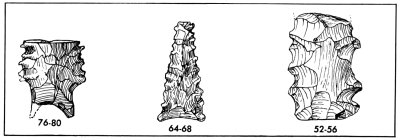
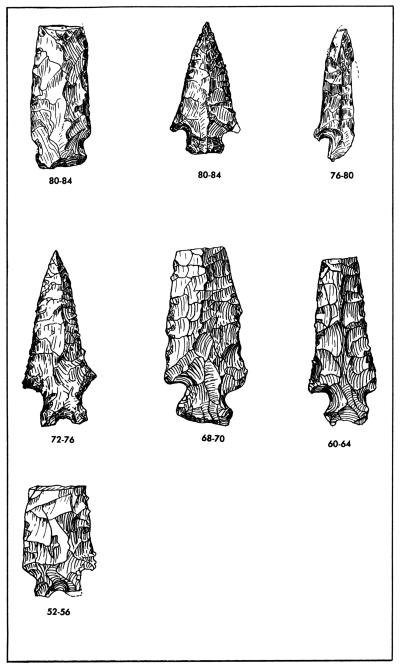
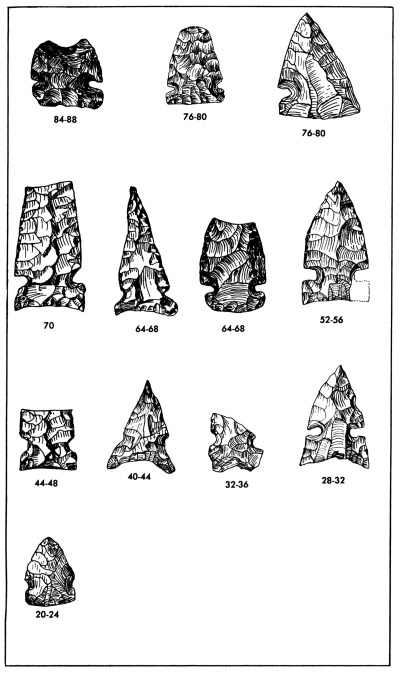
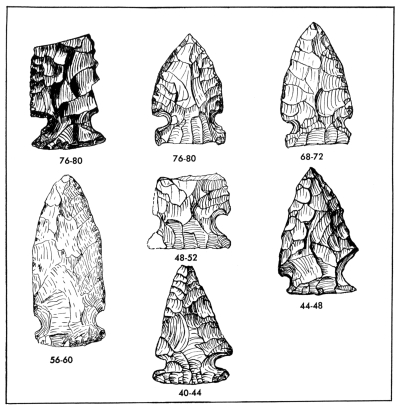
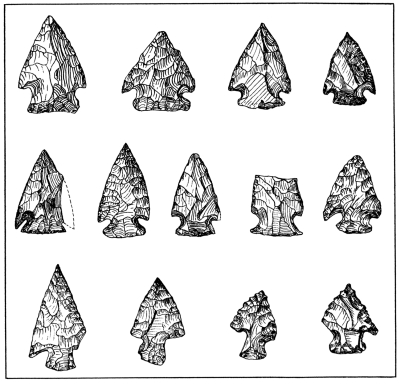
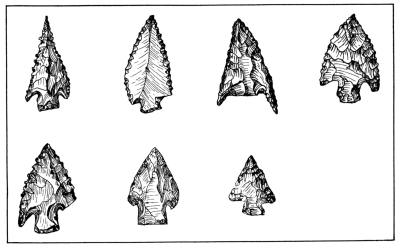
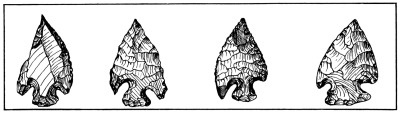
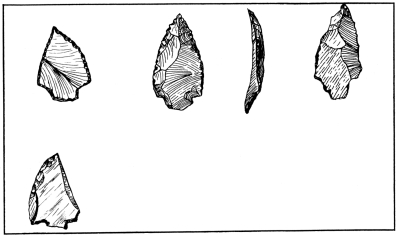
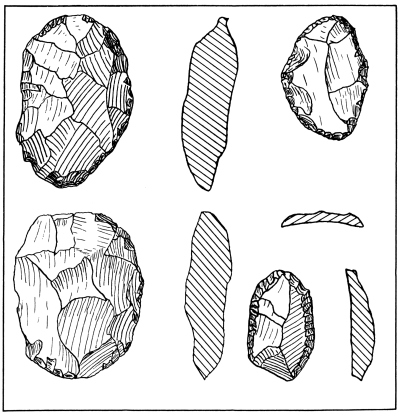
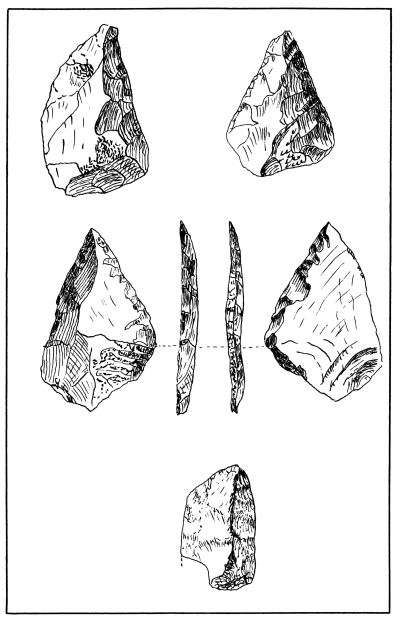
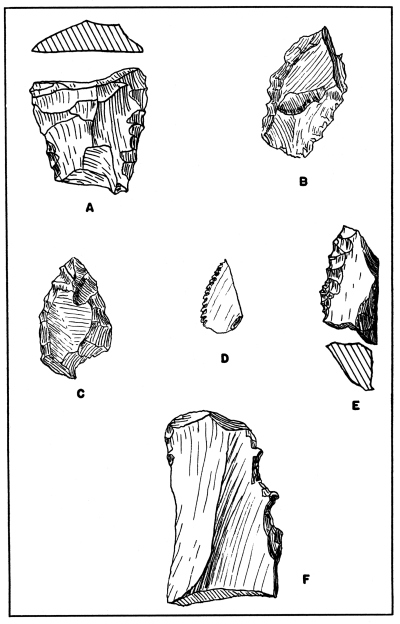
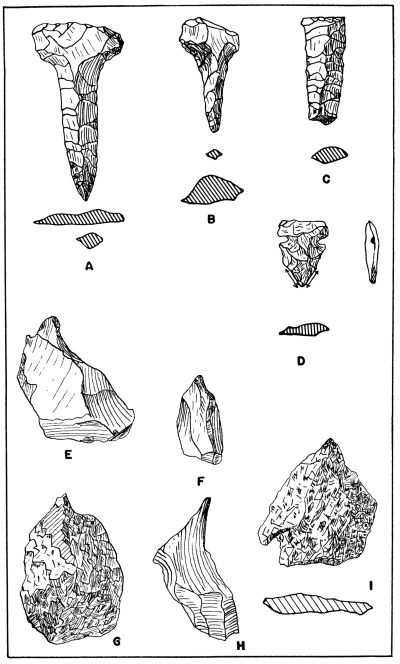
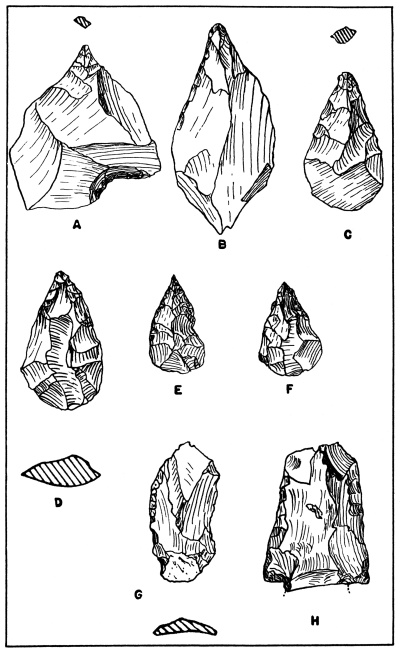
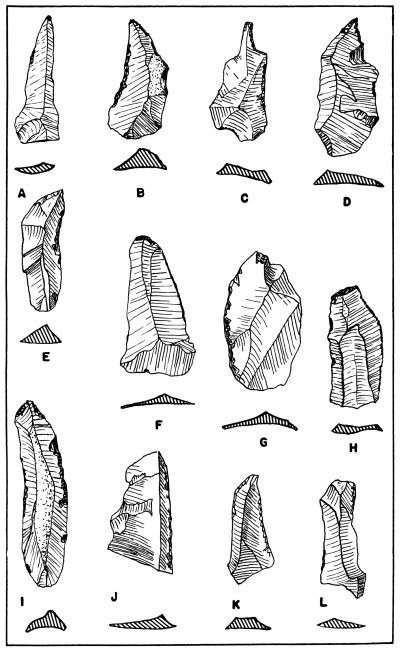
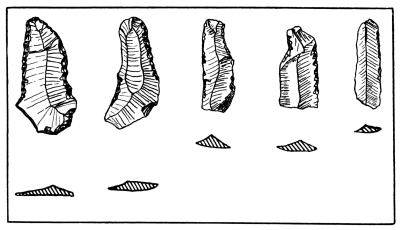
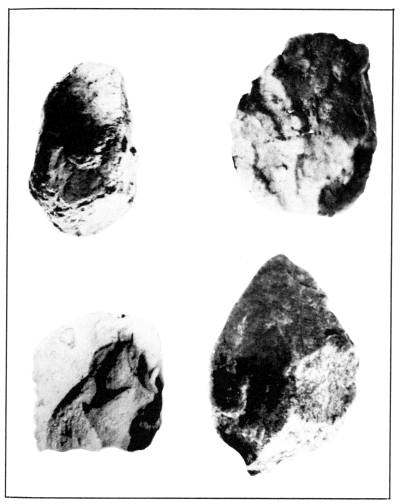
TABLE V — Shaft-smoother — Pigment Stones ( Fig. 48 ) — BONE ARTIFACTS — Beads ( Fig. 49 ) — Used Bone Fragments — Notched Bone — Rib-scapula Cutting Tools ( Fig. 50 ) — Gaming Pieces ( Figs. 51 , 52 ) — Awls ( Figs. 49 , 53 and 54 ) — Cut Bone — Tools of Antler and Bone — Flakers ( Fig. 55 ) — Problematical Objects ( Fig. 51 ) — Mica Fragments ( Fig. 51 ) — Crystal ( Fig. 56 ) — Clay Ball ( Fig. 57 ) — Wood Fragments ( Fig. 58 ) — Leather — Cordage — POTTERY — Plain Pottery ( Figs. 59 and 60 ) — Surface Roughened Pottery ( Figs. 61-65 )
Handstones
| |
| Igneous |
Sandstone |
| Biface |
Uniface |
Biface |
Uniface |
Four
Plane |
Four
Plane |
Four
Plane
Pecked |
|
| Pecked |
|
Pecked |
|
|
|
Pecked |
|
|
|
Pecked |
|
|
|
| |
28 |
| |
32 |
| |
36 |
| 1 | | |
| | |
| 1 | |
| | |
1 | 40 |
| | | |
2 | | |
| | |
| | |
| 44 |
| | | |
| | |
| | |
| | |
| 48 |
| | | |
6 | | |
1 | | 3 |
| | |
| 52 |
| | | |
2 | 2 | |
| | |
| | |
| 56 |
| 1 | 2 | |
2 | | 1 |
1 | | |
| | |
2 | 60 |
| | | |
| | |
| | 1 |
1 | | |
| 64 |
| 1 | 1 | |
| | |
4 | | |
| | |
| 68 |
| | 1 | |
| | |
1 | 1 | |
| | |
| 72 |
| | | |
| | |
| | |
| | |
| 76 |
| | | |
| | |
| | |
| | |
1 | 80 |
| | | |
| | |
| | |
1 | | |
| 84 |
| | | |
2 | | |
| 2 | |
| | |
| 88 |
| 1 | | |
2 | | |
| | |
| | |
| 92 |
| | | |
| | |
| | 1 |
| | |
| 96 |
| | | 1 |
| | |
| | |
| | |
| 100 |
| |
104 |
| |
108 |
| | | |
| | |
1 | | |
| | |
| 112 |
| |
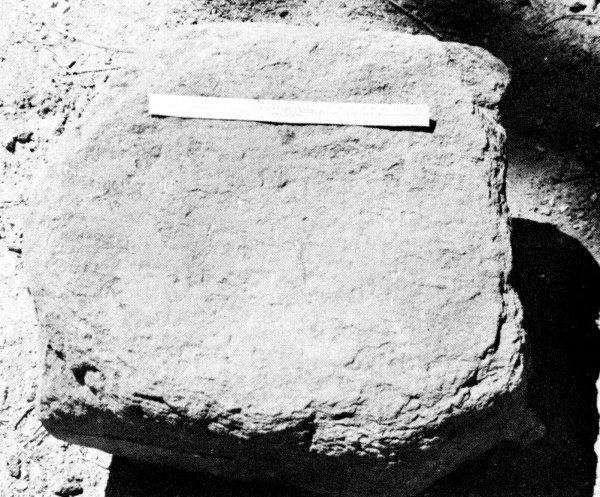
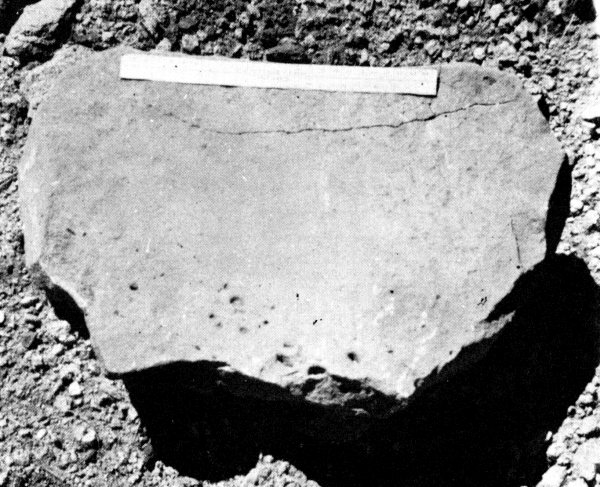
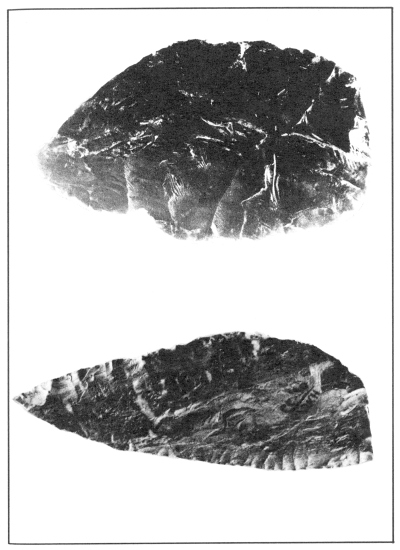
Figure 43—
Large milling stones.
Above, granite. Below, sandstone.
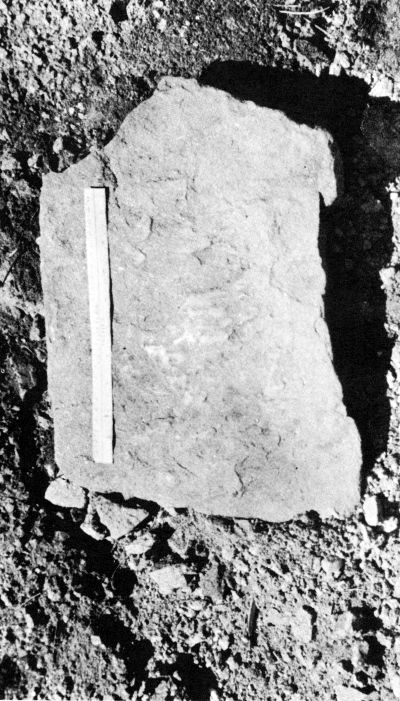
Figure 44—
Flat granite milling stone.
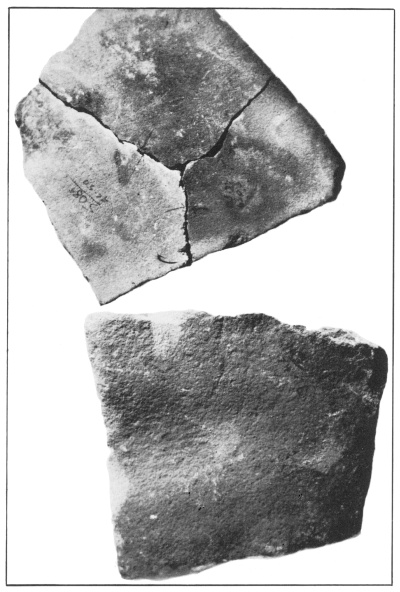
Figure 45—
Sandstone milling slabs, ½ actual size.
Above, flat without depression. 1 inch thick.
Below, with depression.
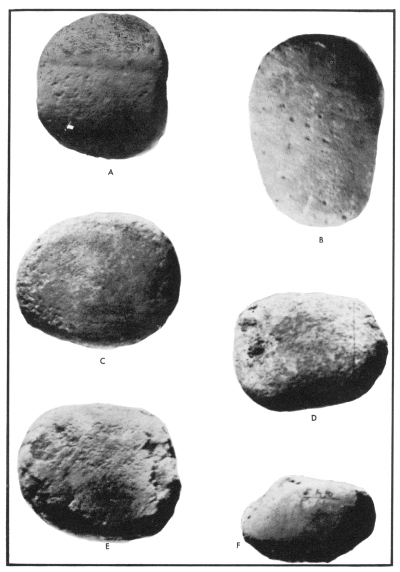
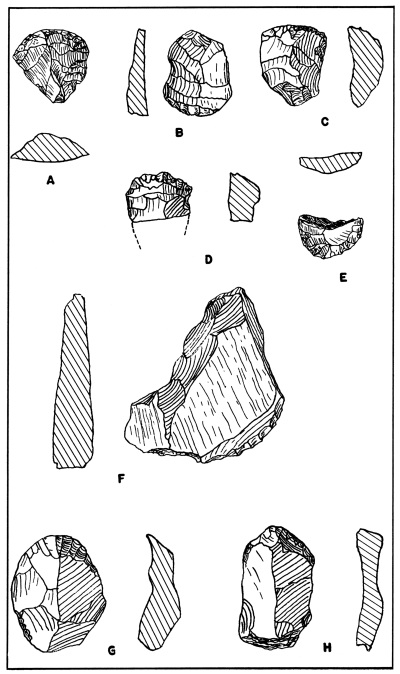
Figure 46—
Handstones. A-B, four-plane. ½ actual size.
One shaft-smoother was found, with lengthwise grooves on both faces.
The lower is very shallow; the upper is clearly formed, and measures
³/₁₆-⁴/₁₆ inches wide and ⅛ inch deep (see Fig. 47).
Eleven objects are classified as pigment stones. Four are lumps of
red ochre. There is no proof that they were used for paint, but as
Coon (1950) has noted, the use of some sort of paint is practically
universal among primitive people. The largest weighs about three
ounces, the smallest about two. Three pieces of yellow ochre were
found. One is a great lump weighing about two pounds. The other two are
flat ground palettes, slightly irregular, one about 1 × 2, the other 3
× 4 inches and both about ¼ inch thick.
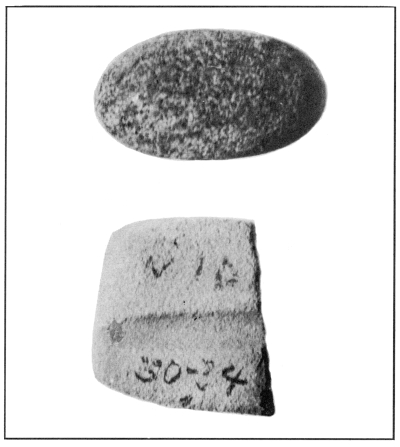
Figure 47—
Above, “Atlatl weight”. Below, abrader.
Actual size.
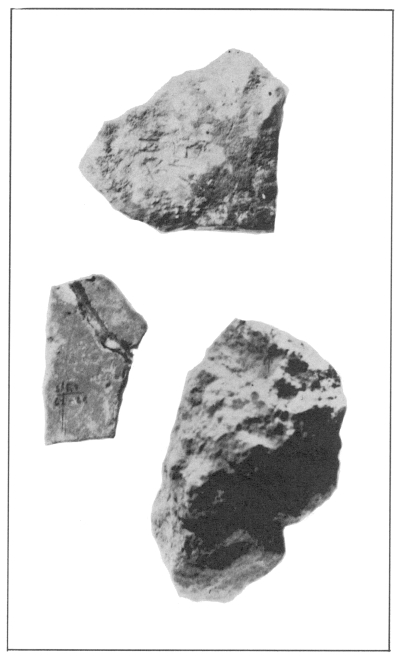
Figure 48—
Pigment stones, ½ actual size.
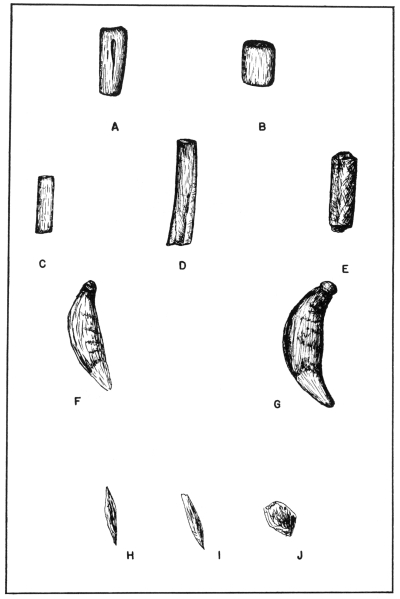
Figure 49—
A-G, Beads. H-J, Awls type four.
There are numerous tubular beads of bird and small mammal bones. These
range in length from 1⅜ inches to ½ inch; most are of the shorter
variety. Apparently the bone was polished and prepared, then a groove
or series of grooves was cut, the sections broken out, and the ends
smoothed.
Two lower canine teeth, (one of badger, taxidea, the other
unidentified), were evidently used as ornaments. Both show a lustrous
polish. At the end of the root a small groove, or series of parallel
incisions, was cut out for suspension. One is ¼ inch, the other 1 inch
in length. A small (1 inch × ½ inch) piece of bone (Fig. 51,
top left) with a groove cut at the top may have been used as a pendant.
There are ten other fragments of bone which show use. The largest of
these measures 4¼ × ¾ inches, the smallest, 3¼ × ⅝ inches. One or more
edges are worn, suggesting use as a scraper or cutting edge. Bones of
large animals, probably long bones, appear to be represented. On most,
the working edge is concave, although on a few it is flat.
One bone is similar to those described above but has a series of
notches along one edge. It is 4 inches long and ⅝ inches wide.
There are nine rib and one scapula fragment that show wear along a
sharp edge. These appear to have been used as cutting implements. Some
are polished along the flat face, perhaps from use in some kind of
smoothing. Many Southwestern tribes, e.g. the Papago, use similar tools
to remove hair from fresh hides. It is difficult to know whether these
represent complete tools or fragments. The largest is 7 inches long,
the smallest 2½ inches long. The identifiable specimens are of bison or
mule deer (Odocoileus hemionus).
Seven specimens of worked bone are thought to have been used as
gaming pieces. For three of these, this designation is relatively
certain. These are small flat oblong objects with a series of parallel
striations on the edges of one face. In addition, two have a line of
indentations running up the center. These depressions were probably
drilled (see Fig. 52).
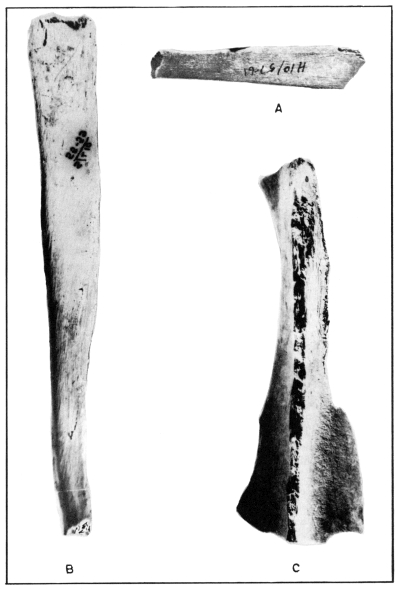
Figure 50—
Rib-scapula cutting implements. ¾ actual size.
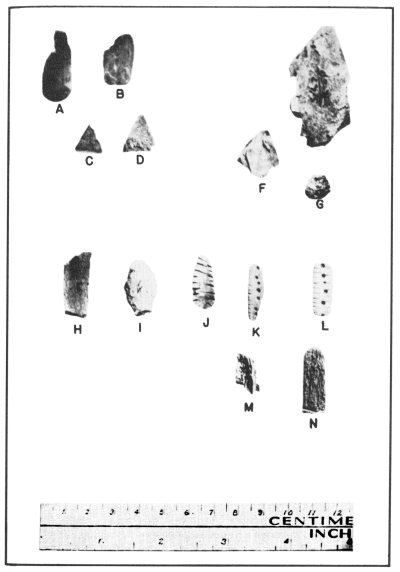
Figure 51—
A-D, problematical pieces.
E-G, worked mica. H-N, gaming pieces.
A fourth piece appears to be an unfinished example, and provides some
data on the method of manufacture. Apparently, the length of bone
(rib?) to be utilized was cut to the desired width and partially
smoothed; the ends were rounded and also partially finished; then
several sections of the length of the proposed gaming piece were cut
off by grooving and fracturing. The piece was then smoothed to the
proper shape, the striations cut, and the indentations drilled.
The other three specimens included here are somewhat problematical.
One approximates the shape of the unfinished gaming piece. The second
is a piece of skull cap, (species unidentified) of the same general
shape as the above; two of the sides are formed by suture lines, the
ends by polishing. The third fragment is in the same size range and has
serrated edges. The dimensions of the gaming pieces can be seen in Fig. 51.
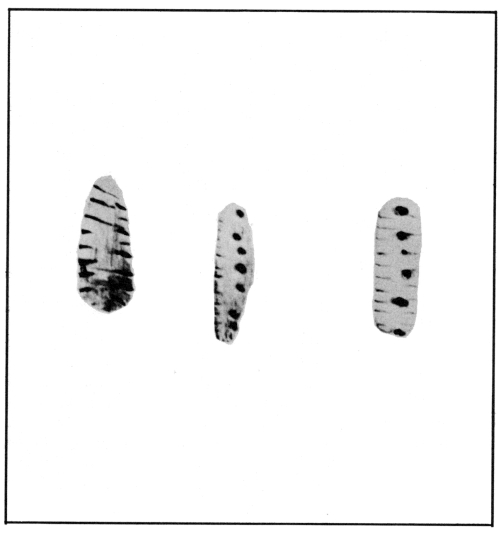
Figure 52—
Gaming pieces, 2× actual size.
Forty-one specimens, fragmentary and complete, were classified as awls.
These were segregated into four principal types, classified on the
basis of form, type of bone utilized, size, and extent of polish. The
most numerous type are those which retained the head or epiphesis of
the bone (see Kidder, 1932). It is probable
that two subtypes of this category may be recognized on the basis of
size and extent of polish. The first comprises one complete and seven
broken specimens (see Fig. 53). The former is a
long slender implement of deer metatarsal, tapering to a fine point
with a circular-section. It is 8⅜ inches in length and ¾ inches in its
greatest diameter. Polish extends the full length and circumference,
and the “head” has been altered by four intersecting V-shaped grooves,
forming a cross. The remaining seven include two with the head intact,
and five points and midsections classified with the above because of
the overall workmanship. The most complete measures 6¼ inches in length
without the head. Technologically this group is marked by primary
abrasion parallel to the long axis and secondary work at right angles
to it. There are numerous instances of the transverse cutting across
the longitudinal striae, suggesting that the former was the finishing
process. Though positive identification is in several instances
impossible, most appear to have been made from deer metatarsals. All
except one were located below 84 inches. The exception is of interest.
It is a specimen about three inches long, subjected to calcination and
subsequent patination all over, except for a section midway along its
length that retains its natural color. It seems possible that this area
had been bound with leather or some foreign substance which affected
the weathering of the specimen.
The second subdivision of the type retaining the head is characterized
by a greater width relative to length, and the more restricted extent
of polish. The three complete specimens range from 3⅞ to 5¼ inches
in length, and up to 1⅛ inches in greatest diameter. Polish extends
only a short distance beyond the point, which has an oval flattened
cross-section. All abrasion scratches are parallel to the short axis.
These were manufactured respectively from a bison rib, a metapodial and
metatarsal of mule deer (Odocoileus hemionus).
The second major type is that of “splinter awls”; it also may be
subdivided. The first subdivision consists of 5 splinters of large
mammal bone, sharpened at one end. Complete pieces range from 3½ to 4⅜
inches in length and from ⅜ to ¾ inches in greatest width. The second
group of six pieces is similar, but the working end is rounded and
flattened rather than sharp. They range from 2⅞ inches to 3½ inches
long and from ⅜ to 1 inch in width. Abrasion in both groups was at a high
angle to the long axis, and in some cases produced a faceted appearance.
The third type comprises three awls made of small mammal bones, two
retaining the heads, the third without. These exhibit sharpened points.
The longest is 4 inches, the smallest, one inch long.
The final type comprises five very small splinters of bone from ⅝ to
one inch in length. One is of bird bone, the others of small mammal
bones. Each is sharpened on one end, blunted or rounded on the other.
It is possible that these were hafted. Their size and shape makes it
unlikely that they could have been employed in the hand alone.
There was undoubtedly some difference in the use of these different
types of tools. Perhaps the longer finer ones were employed in the
manufacture of basketry, while the sharpened splinters served best as
hide perforators.
There is one fragmentary bone about 7 inches long, that was evidently
left over from the production of a splinter awl. It illustrates the
technique of bone cutting that was probably employed for producing
tools. A groove about ¹/₁₆ of an inch deep was cut encircling the
bone, and it was shaped into two pieces. Apparently some preliminary
smoothing had already been done, as suggested by additional scoring
marks. The authors tested various tools to determine which might be
most efficient in cutting such a groove. Flat sharp flakes or knives
could be used, but usually not enough pressure could be brought to
bear without breaking the tool. However, certain implements, called
“gravers” in this paper, were rather well adapted for such work.
The tool could be used as a plane for cutting. The two techniques
mentioned, in fact, could be compared to the cutting of wood with a
knife and with a saw whose teeth act as a multiple plane.
A problematical artifact is the base of an elk (Cervus
canadensis) antler shown in Fig. 55. The working end of this
is a tapering blade which ends in a flat chisel-like tool about ¾ inch broad.
There are four fragments of horn that appear to have been flakers.
Two are pointed implements 1¼ inches long, two are fragments that
lack tips. These are about 3½ inches long. All are of deer antler
(Odocoileus hemionus), and show various gouges and worn places.
One bone 7¼ inches long also appears to have been used as a flaker.
The blunt point has been shaped, but other modification seems to have
been unintentional and consists of irregular worn and scored areas.
Distribution of this scoring suggests that the tool was used in the left hand.
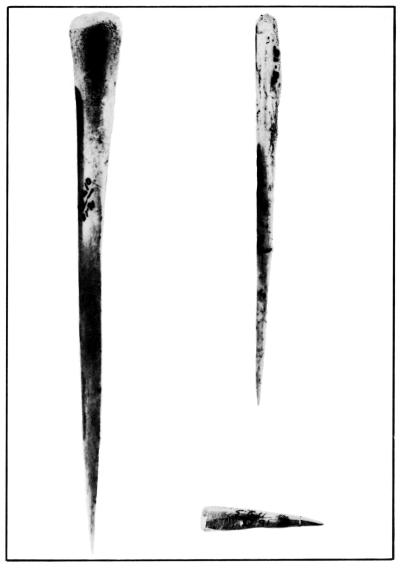
Figure 53—
Awls, type one, ¾ actual size.
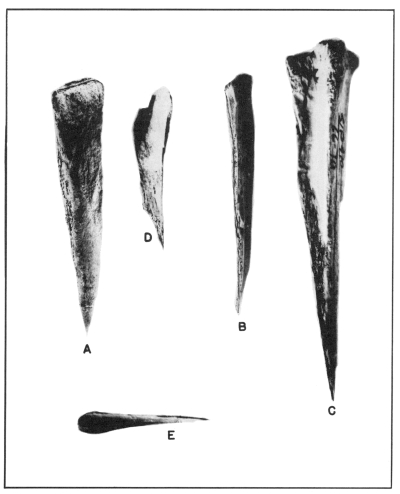
Figure 54—
Awls, A-C, type one. D, type two. E, type three,
⅔ actual size.
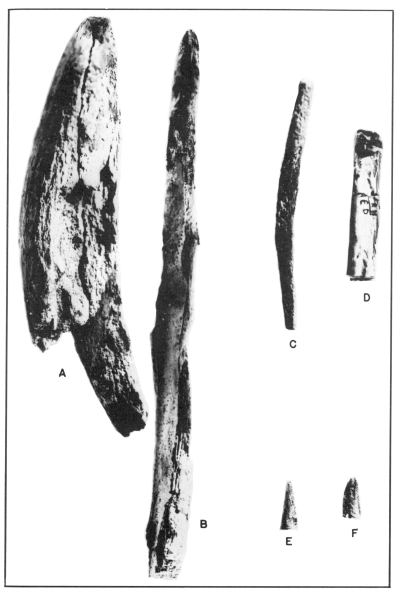
Figure 55—
A, elk antler tool. B, long bone flaker.
C, antler flaker. D, cut bone. E-F, antler flaker points.
½ actual size.
MISCELLANEOUS ARTIFACTS
There are four stones of problematical use. Three of these have the
form of an isosceles triangle. The two smallest measure about ½ inch
on a side. Perhaps these were gaming counters or ornaments. The larger
piece is about 1¾ inch on a side with one broken corner, and has 2
small notches on either side of the apex. This was very probably a
pendant. The fourth specimen in this class is more or less oval, very
thin, with ground edges. It is about 1½ inches long and may have been
an ornament or gaming counter. The first two pieces are of sandstone,
the third of limestone, and the last of feldspar.
An ovoid piece of granite measures 2⅛ × 1¼ inches, and appears to have
been ground into its present shape. It has a smoothed flattened area
on one side, and may well have been an atlatl weight. This cannot
be proven since there are no further indications, such as a groove.
However, there are similar ungrooved stones in place on atlatl throwers
from the Southwest, in the Peabody Museum collections, which the
authors have examined.
There are six fragments of mica that apparently were shaped for some
reason. Four of these were cut into figures more or less like arrow
points. The largest is 2 × 1 inch, the smallest complete piece, ¾ ×
¾ inch. They may have had ceremonial significance. A fifth specimen
is square, ¾ × ½ inch in width and length; and the sixth more or less
round, about ½ inch in diameter. There were other pieces of mica found
at the site, but these were unshaped.
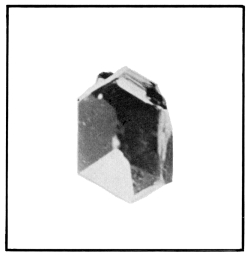
Figure 56—
Quartz crystal.
Actual size.
A well formed quartz crystal was found; it is topaz in color and about
an inch square in cross-section. Such crystals have an extensive
history in some Archaic sites, such as those in California. They
probably had some ceremonial purpose perhaps as a part of a shaman’s
paraphernalia.
A small round ball of clay about 1¼ inches in diameter was recovered.
Around the circumference is a raised ridge such as would have been
produced if the clay had filled a skin sack with the seams on the
outside. If such were the case it might have served as a bolas weight.
There are several fragments of wood that appear to have been modified
by the inhabitants. Two of these could easily have been pieces of
arrow shafts. One is ³/₁₆ inch in diameter, 2½ inches long; the other ¼
inch in diameter, and 1¾ inches long. Both show no remnants of bark and
appear to have been scraped smooth. There are two similar specimens,
1 and 2 inches long, and ⁵/₁₆ and ⁷/₁₆ inch in diameter respectively.
Observations of ethnological materials suggest that these were too
large and heavy to shoot with an ordinary bow and arrow. Perhaps these
are fragments of atlatl foreshafts. The fifth specimen is also ⁷/₁₆
inch in diameter, 2¼ inches long, and is pointed. It was probably the
butt end of a foreshaft. Ethnologic parallels indicate that it was too
sharp to be the point of a firedrill (see Fig. 58).
A sixth wood specimen is a flat piece 3½ × ³/₁₆ inches in maximum
dimensions. Its use is unknown.
A seventh specimen is a short piece 2 inches long, shaped all around,
and tapering to a point at one end. It was cut from a tree gnarl, and
probably served as an awl.
There are two small pieces of leather. One is probably part of a thong
or cord; the use of the other is unknown.
A piece of twisted fiber was found. It appears to have been one strand
of a multi-strand cord. The fiber is made from yucca leaves.
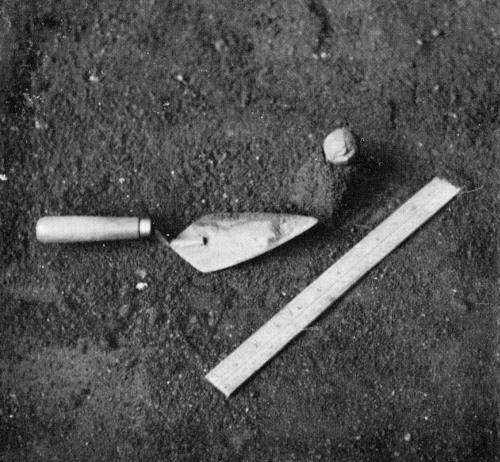
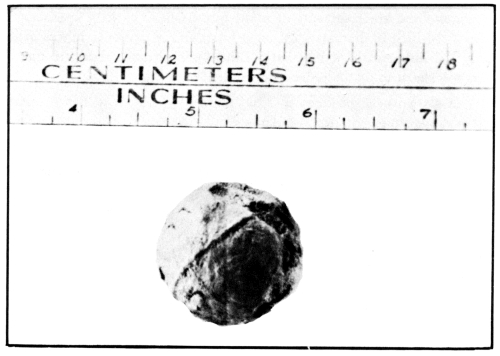
Figure 57—
Clay ball. Above, in situ.
Below, note raised central ridge.
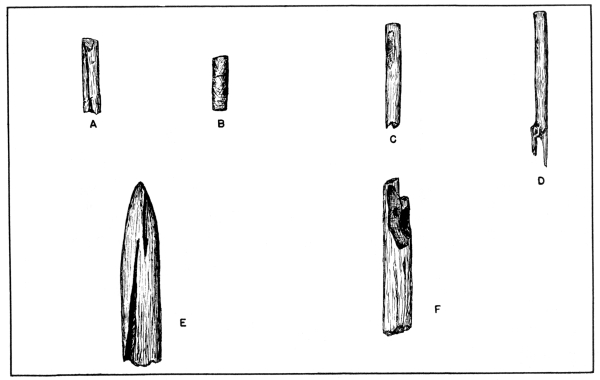
Figure 58—
Wood fragments. A-D, arrowshaft fragments(?)
E, butt end of dart foreshaft. F, dart shaft fragments(?)
Actual size.
Plain pottery includes one restorable bowl and eight additional sherds.
Construction is hard to determine from so small a number of sherds,
but indications suggest coiling and scraping. Coils were fairly wide
(see Fig. 60). Core color is usually grey to black
though one sherd is oxidized to a brick red. Firing was done in a
“reducing atmosphere”, with some scattered spots oxidized. The temper
is angular with occasional mica fragments visible; it is probably
crushed granite. Some sherds may contain a small amount of quartz sand.
The size of the temper is variable, usually fine with a few large
granules mixed in. Vessel walls are usually fairly strong. The pottery
is friable, not flaky. Both surfaces are unslipped, and smoothed on all
specimens. The exterior is a brownish black, the interior is black.
One sherd, however, is dull grey. Thickness is from ¼-⁵/₁₆ inch, one
sherd ³/₁₆ inch. The only partially complete form observed is a bowl.
However, another large sherd (about 8 inches square) suggests part of
the wall of a pot, perhaps with an incurving shoulder. The bowl has a
mouth diameter of 5½ inches, and in vertical cross-section resembles
a parabolic curve 3¼ inches high. Rims in general are gradually tapered.
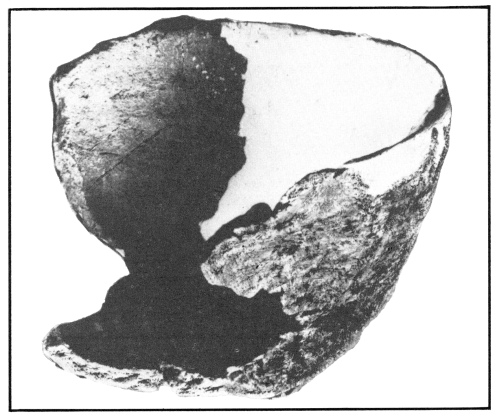
Figure 59—
Plain pottery bowl.
White portions restored,
⅔ actual size.
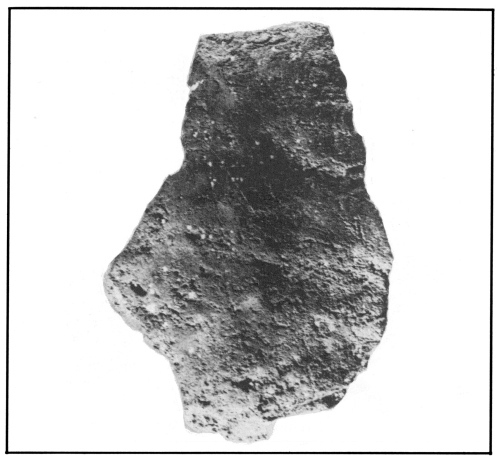
Figure 60—
Plain pottery sherd, showing coiled construction.
Actual size.
Pottery in this category is divided into three classes. Pottery of
Class I includes 7 sherds. These were manufactured by the paddle and
anvil technique. Temper is sand, and is not too abundant. The clay is
micaceous and the texture somewhat granular, tending to shatter along
fairly regular lines. Hardness is 3.5-4.5; color grey to brownish
continuous all the way through. Exterior surfaces all show parallel
lines of cord-marks, about five to the inch. Impressions of individual
strands can be seen in the clay, somewhat flattened and slightly
smoothed. Interior surfaces were smoothed and scraped. One rim sherd
has diagonal impressions that extend to ¼ inch of the flattened lip.
There is no decoration. Vessel size cannot be determined. Thickness is
from ⁵/₁₆-⁶/₁₆ inch. One sherd from near the base suggests a conoidal bottom.
Two sherds of this class have different exterior treatment. One of
these appears to have been impressed by basketry, apparently coiled with
a simple rod foundation. The other has been impressed with an unknown fabric.
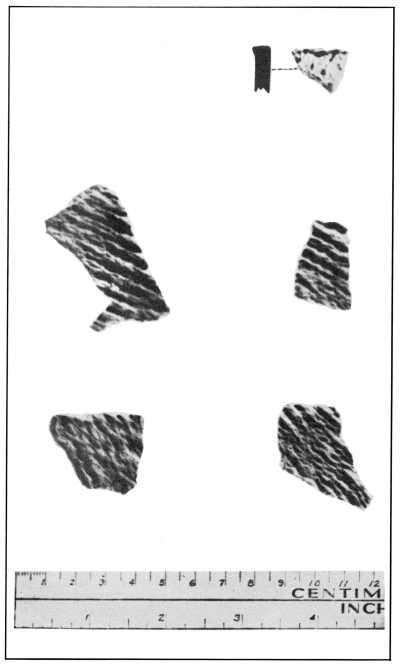
Figure 61—
Surface roughened pottery, Class I.
Class II includes 15 sherds. These resemble those of I in many
respects: The manufacture was by paddle and anvil; the temper is of
sand or possibly crushed rock, generally fine and not too abundant, and
the clay is micaceous. The texture, however, is flaky with a tendency
to fracture along irregular lines. Hardness is about 3.5, color grey to
brown generally continuous through the sherd. A few have blacker cores.
Exterior surfaces were treated with parallel lines of cord impressions
10-15 to the inch with very little smoothing. Interiors were smoothed,
but do not show the evidences of scraping as with I. There is one rim
sherd; vertical impressions on this extend over the lip which has been
flattened. No decoration occurs. The thickness ranges from ³/₁₆-⁴/₁₆
inch. One large sherd about 4 × 3 inches suggests vessels of
considerable size.
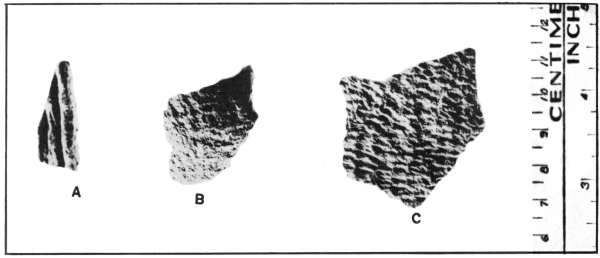
Figure 62—
Surface roughened pottery, A, Class I. B and C, Class I variant.
Pottery of Class III in most aspects resembles that of Class II: paddle
and anvil technique in manufacture, temper of sand or crushed rock,
fine, not abundant, micaceous clay. The texture is very flaky tending
to fracture along irregular lines. Color grey to brown, usually the
latter, generally continuous through the sherd; some, however, have
blacker cores. Exterior surfaces were treated with two sets of parallel
cord marks one extending vertically from the rim, the other at an
angle of about 45 degrees. This gives a sort of criss-cross effect,
different, however, from the random application of Upper Republican
sherds (see Wedel 1934, Strong 1935). Interior
surfaces were smoothed. On one large rimsherd cord marks extend over
the flattened lip. No shoulder is in evidence, and indications suggest
fairly large pots with mouth diameter of about 10 inches, height 12
inches. The camber of the sherds indicates forms with pointed bottoms.
Thickness is from ³/₁₆-⁴/₁₆ inches. There is no decoration. Hardness is about 3.5.
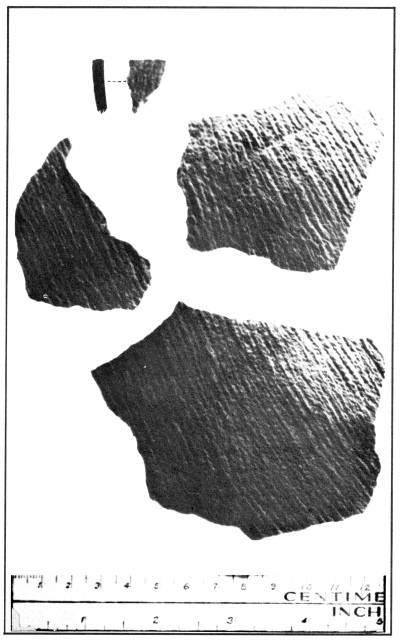
Figure 63—
Surface roughened pottery, Class II.
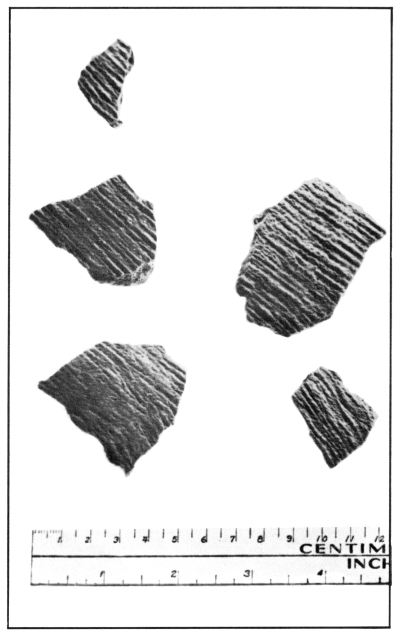
Figure 64—
Surface roughened pottery, Class II.
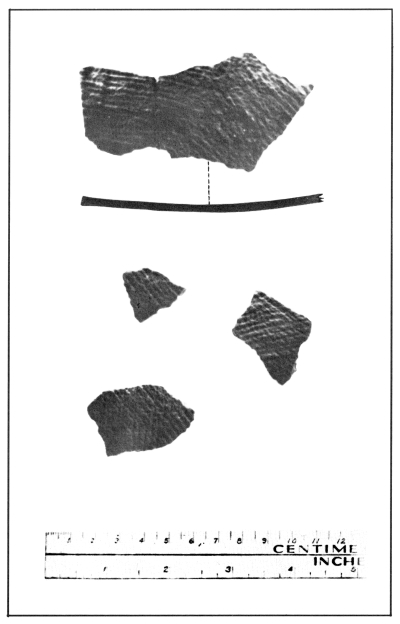
Figure 65—
Surface roughened pottery, Class III.
Fossil Pollen and Spores from the LoDaisKa Site, Colorado — Introduction — Techniques — Identification of Large Grass Pollen — Sampling (Author’s Note) — Discussion — ETHNOGRAPHIC COMPARISONS — On the Ethnology of the Ute — Subsistence Pattern — Hunting and Gathering — Food Preparation — Shelter — Fire Making and Other Technologies — Pottery — Skin Preparation and Other Technology — Dress — Games and Dances — Social Organization — Religion — Language — Disposal of the Dead — On the Ethnology of the Pawnee — Subsistence Agriculture — Hunting — Food Preparation — Shelter — Clothing — Technology — Trade — Social and Political Organization — Religion — DATING THE LoDaisKa REMAINS — RECONSTRUCTION AND INTERPRETATION — Culture Complex A — Cultural Reconstruction — Culture Complex B — Cultural Reconstruction — Complex C — Cultural Reconstruction — Complex D — Cultural Reconstruction — Other Remains — DISCUSSION — Traditions at LoDaisKa — The Site in a Larger Context
By Donald R. Whitehead
A preliminary pollen analytical investigation has been attempted on
material from the LoDaisKa Site in order to determine the feasibility
of working with such sediments, and to see what culturally significant
plants might be represented. Due to the extremely poor preservation
in all but the lowermost levels no pollen diagram has been prepared.
Such a diagram would be misleading, because many of the original
constituents of the pollen flora might have been destroyed by
differential degradation. A brief description of the investigation
follows, with a discussion of the potentially significant grass pollen.
All samples were prepared by boiling for six minutes in 10% KOH,
washing with 10% HCI to remove carbonates, boiling for ten minutes in
about 30% HF, actolysing for one minute, staining with fuchsin, and
mounting in silicone oil. For each sample a total of four slides was
counted by making traverses at one millimeter intervals.
In order to attempt an identification of the various large grass
pollen encountered, the long axis of each grain and the pore diameter
(including annulus) were measured, and the ratio between the two
plotted. Barghoorn, Wolfe, and Clisby (1954) have suggested that this
ratio can be used to supplement size measurements in attempting to
identify fossil pollen of the tribe Maydeae. However, one can not
compare directly the size data from the LoDaisKa fossils with the data
from modern pollen assembled by Barghoorn, Wolfe, and Clisby (l.c.).
Christensen (1945) has shown that not only do recent and fossil grains
of the same species differ in size (depending partly upon the type
of sediment in which the pollen is preserved), but also, different
methods of preparation greatly affect the size, often differentially
with respect to fossil and modern pollen. The recent pollen measured
by Barghoorn, Wolfe, and Clisby (l.c.) was prepared by acetolysis and
mounted in glycerine jelly. By comparing the size of modern Corylus
avellana pollen prepared and mounted in this manner (ca. 28,
Christensen, 1945) with the size of fossil Corylus avellana
pollen from a variety of sediment types prepared and mounted by the
technique used in the present investigation (ca. 24, S. T. Andersen,
pers. comm.), one can arrive at a factor (7/6) by which the size of the
fossils can be multiplied in order to compare more directly with the
data presented by Barghoorn, Wolfe, and Clisby (l.c.). It should be
emphasized that such an absolute comparison is dangerous, because there
is no way of determining precisely how the environment of preservation
at LoDaisKa has affected the pollen, and there is no guarantee that size
changes of Corylus and Gramineae pollen are absolutely proportional.
For each grass grain both the long axis measurement and the pore axis
ratio are tabulated in the results below. Only fully expanded grains
were measured.
The provenience of the samples analyzed below is as follows:
All samples were taken at 6 inch intervals.
Samples W 1-10 were collected in Square
J8, starting at 38 inches below baseline.
Samples E₁ 1-6 were collected in Square
M11, starting at 38 inches below baseline.
Samples E₂ 3-7 were collected in Square P
9-10, starting at 62 inches below baseline.
Samples E₁ 1 - E₁ 5 (38-68″)
Preservation extremely poor, only badly corroded pine pollen, a
few Compositae grains, and many plant fragments (mostly coniferous tracheids).
- Sample E₁ 6 (68-74″)
- Pinus—9
- Gramineae—2, (70,21ₘ, pore obscured by detritus), (40.46ₘ, 1:4.9)
- Sample E₂ 3 (62-68″)
- Pinus—10
- Sample E₂ 4 (68-74″)
- Pinus—19
- Picea—2
- Fern spore—1
- Gramineae—-1, (71.40ₘ, pore distorted)
- unknowns—2
- Sample E₂ 5 (74-80″)
- Pinus—66
- Picea—1
- Juniperus—2
- Quercus—1
- Compositae (total)—24, (Artemisia—11,
- Ambrosia type—2, Liguliflorae—1)
- Chenopodiaceae—11 Caryophyllaceae—4
- Allium—3 Geranium—1
- Polygonum, sect. Pericaria—3
- Gramineae—5, (53.55ₘ, 1:3.8), (70.21ₘ, pore obscured),
- (46.41ₘ, 1:4.3), (58.30ₘ, 1:5.5), (45.22ₘ, 1:3.5) unknowns—5
- Sample E₂ 6 (80-86″)
- Pinus—60
- Quercus—2
- Compositae (total)—22, (Artemisia—14, Liguliflorae—1)
- Convolvulaceae—1 (fragment of a large periporate type)
- Caryophyllaceae—5
- Chenopodiaceae—4
- cf. Cruciferae—3
- Polygonum, sect. Pericaria—1
- Allium—1
- Gramineae—6, (40.46ₘ, 1:4.2), (61.88ₘ, 1:4.0),
- (52.36ₘ, pore distorted),
- (50.35ₘ, pore greatly enlongated),
- (46.41ₘ, 1:4.9),
- (45.22ₘ, 1:5.4). unknowns—10
- Sample E₂ 7 (86-92″)
- Pinus—54
- Picea—2
- Juniperus—1
- Compositae (total)—20, (Artemisia—11,
- Ambrosia type—1, Liguliflorae—2)
- Caryophyllaceae—2
- Chenopodiaceae—2
- Geranium—1
- Lonicera—2
- Onagraceae—2
- Gramineae—3, (50.35ₘ, pore obscured),
- (29.75ₘ, 1:4.1), (39.75ₘ, pore distorted)
- unknowns—6
- Samples W1 - W8 (38-86″)
- Preservation extremely poor, only corroded pine, composite,
- and chenopod pollen. Abundant coniferous wood fragments.
- Sample W9 (86-92″)
- Pinus—14
- Chenopodiaceae—2
- Artemisia—1
- Caryophyllaceae—1
- Gramineae—1, (51.17ₘ, 1:3.9)
- unknowns—3
- Sample W10 (92″-base)
- Pinus—13
- Picea—1
- Quercus—5
- Compositae (total)—6, (Artemisia—5,
- Ambrosia type—1, Liguliflorae—1)
- Chenopodiaceae—1
- Polygonum, sect. (Pericaria—1)
- Lonicera—1
- Gramineae—6, (49.98ₘ, 1:4.2), (52.36ₘ, 1:40), (49.98ₘ, 1:4.2),
- (58.30ₘ, 1:4.5), (57.12ₘ, 1:4.0), (54.74ₘ, 1:4.2)
- unknowns—4
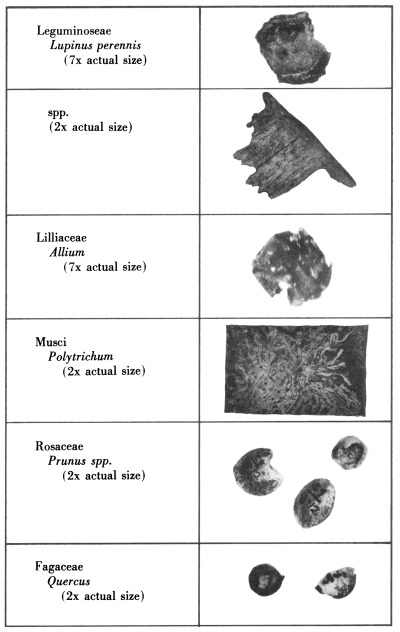
It is interesting to note that many of the plants identified from their
megascopic remains by Walton C. Galinat are likewise represented in the
pollen flora (e.g., Allium, Quercus, Juniperus
and chenopods). As Galinat has also identified several fragments of
Zea Mays, it was hoped that pollen of Zea might be found
in some of the oldest levels. Unfortunately, none of the fossil grass
pollen can be definitely identified as that of Zea. It seems
obvious that the three largest grass grains (over 70ₘ) are too large
to be Tripsacum, but whether they represent teosinte
or Zea can not be established. The pore of two of these was
obscured by detritus, and that of the third was greatly distorted. Thus
no ratio could be established.
The remainder of the grass grains seem to fall within the limits of the
genus Tripsacum (size extremes 33.6ₘ to 64ₘ, and ratio extremes
1:3.0 to 1:4.8), although the pore-axis ratio of some appears to be too
large. However, the possibility must be left open that these smaller
grains might not be Tripsacum. As yet there is very little
pollen size data available for the grasses of North America. Geisler
(1945) has measured pollen from 32 species and of these, Zizania
aquatica has the largest grains (range 38ₘ-50ₘ). It is important
to note that she did not employ acetolysis, so that this range is on
the small side. In Europe, Firbes (1936) has presented pollen size data
for 103 species of grasses, and of those he studied, Avena,
Secale, Triticum, Hordeum, and Elymus
possess pollen as large as that of Tripsacum. Hence it would
appear to be necessary to study intensively the pollen of most of our
native grasses in order to establish size and other morphological
criteria for identifying the smaller LoDaisKa grass pollen.
As the preservation is distinctly better in the lower levels of the
deposit, a careful and detailed pollen analytical investigation, with
recourse to adequate reference material might be profitable.
Acknowledgments
The present investigation was carried out in the Laboratories of the
Geological Survey of Denmark while the author was sponsored by a
Fulbright Fellowship. The author is particularly indebted to Svend Th.
Andersen for his suggestions and helpful criticisms of the manuscript.
Bibliography
Barghoorn, E. S., M. K. Wolfe, and K. H. Clisby,
1954.
Fossil Maize from the Valley of Mexico.
Bot. Mus. Leaflets,
Harvard University 16: 229-240.
Christensen, B. Brorson, 1945.
Measurements as a
Means of Identifying Fossil Pollen.
Danmarke Geologiske Undersgelse IV
R., Bd. 3, Nr, 2.
Firbes, F., 1937.
Der pollenanalytische Nachweis
dos Getreidebaus.
Zeitschrift für Botanik, Bd. 31: 447-478.
Geisler, F., 1945.
A study of Pollen Grains of
Thirty-two Species of Grasses.
Butler Univ. Bot. Studies 7: 65-73.
Below we shall summarize the life habits of two ethnographically known
groups who lived near the Plains-Great Basin fringe. This is done in
an effort to present a brief outline of the type of life people in the
Morrison area could have lived. It is designed to serve as a guide
for interpretation of the archaeological remains, and should provide
insight into areas of social and religious action. The first group, the
Ute, are known to have lived for a time in the region; the second, the
Pawnee, were never in the area proper, but do represent the sort of
pottery-using, corn-growing Indians that had occupied it in the past.
This use of comparative ethnology and the reconstruction which follows
are in the nature of a theory, a theory of methodology. Too often,
as J. O. Brew (1946) has pointed out, archaeological fact gathering
has run riot ahead of the interpretation of these facts. Brew quoted
C. C. Kluckhohn in this respect: “In any case the alternative is not
between theory and no theory or a minimum of theory, but between
adequate and inadequate theories.... For I am afraid that many of our
anthropologists who are most distrustful of theory are like Molière’s
character who spoke prose without knowing it, for a complex theoretical
viewpoint is usually implicit in some of the most apparently innocent
statements of facts.” (Brew, 1946, p. 45; but for full context see
Kluckhohn 1939). We have striven, however, to remain aware of the
assumptions involved.
The Ute were among the first Indians to get horses from the Spanish.
Subsequently they moved about rather freely and were rather quick to
adopt the white man’s culture whenever this was present in their area.
There are almost no early accounts of the Ute. They had neither the
spectacular aspects of the true Plains Indians, nor lands close to
the trails frequented by pioneers and early explorers. On the other
hand, they did not enjoy the isolation of many of the Great Basin
tribes which preserved their ways of life into comparatively recent
times. Thus ethnography of the Ute is relatively scant except for a few
accounts and short articles. There are three principal works. The first
is Robert Lowie’s Notes on Shoshonean Ethnography (1924), based
primarily on observations at Ignacio, Navajo Springs and White Rock.
The second is Omer Stewart’s “Culture Element Distribution: XVIII,
Ute, Southern Paiute”, (1942), while the third is Edward Gifford’s
Culture Element Distribution XII: Apache-Pueblo (1940). Another
short paper by Ralph Beals (1935) on the ethnology of Rocky Mountain
National Park adds to the picture, though he draws heavily on Lowie’s
work. Finally there is a collection of articles gathered by the Durango
Public Library and edited by H. S. Daniels (1941). This is composed of
a series of interesting papers by people intimately connected with the
area surrounding the present Ute reservation. J. Alden Mason’s article
“Myths of the Uintah Utes” (1940) contains numerous myths which may
yield scraps of ethnographic material if care is used in selection.
Other short works can be found in the bibliography and will be referred
to in the text.
One of the greatest problems facing the Ute and Shoshone on mountain
fringes was adaptation to several different ecological biomes. Their
success is attested to by the fact that the Ute spread all over
Colorado and southern Wyoming except the Plains.
The adoption of the horse resulted in significant changes in Ute
culture. In general, the use of horses affected hunting methods and
locomotion. Where it brought the Ute into intimate contact with Plains
Indian cultures, many of their old Basin traits were replaced by
borrowed artifacts and techniques. For example, articles of rawhide
replaced basketry in most cases (Steward, 1940, p. 422). However, very
little is known about the quasi-Plains Ute, as mountain lands were
quickly appropriated by whites. Buffalo were exterminated from mountain
parks in Colorado by 1870. The works cited refer to isolated groups on
the western fringe which retained an essentially pre-horse culture.
The people we deal with then have the “gathering small game” traits
of Steward’s Western Subarea of the Intermontane Region. In addition,
uplands and mountain regions afforded some larger game. This dual
economy was probably a great factor in their adaptability, and it
was undoubtedly a close approximation of that of protohistoric and
prehistoric inhabitants of the area.
Except for the ecologic variation cited above, Ute culture was fairly
uniform over a wide area. Because of this and the general limitation of
data, it will be treated as a whole.
Seeds and berries of almost every description were gathered, mainly
by the women of the camps. According to Lowie, among the neighboring
Paviotso, men often participated in gathering piñon nuts, a fundamental
element in the diet. Stewart’s data suggests that this was probably
true of the Ute. Sunflower seeds were boiled; acorns were gathered and
treated to render them edible. Fruits were exploited where available.
These products were gathered in large baskets, certain of them being
reserved for storage. Edible roots were dug up with the aid of a
digging stick. Other gathering devices included notched poles, throwing
sticks, and seed beaters.
Among the animals hunted, Lowie mentions buffalo, elk, deer, and
rabbits; eagles were snared from pits. In Mason’s Myths moose
and bear are mentioned particularly. Possibly mountain sheep and
antelope should be included in this list. Small game was important,
such as quail and rodents, i.e., prairie dogs and squirrels. Stewart
lists a number of insects eaten as part of the diet, which were roasted
and parched then often stored.
Buffalo were surrounded by a circle of men and shot. Deer were
often driven into a deep pit between converging arms of a sagebrush
enclosure. Deer, antelope and buffalo decoy masks were often used.
Rabbits and other small game were hunted by driving them into nets of
bark fiber. Rodents were smudged out, and special blunt arrows were
often used in shooting prairie dogs. Mountain sheep were pursued until
cornered and then shot with arrows.
Fish were also undoubtedly a common article of diet. John Dewey, a Ute,
told Mason about taking fish by means of arrows and fish lines, while
Lowie mentions fish shooting and describes grass rafts for the Uintah,
and Ute fish weirs.
For all hunting and fishing, ritual observances and purification were
important. Gifford mentions ceremonial sweat houses in this connection,
while Stewart lists a number of important taboos.
Hand stones and grinding slabs were employed for preparing seeds and
berries. Some pounding was done. Seeds could be roasted underground or
could be made into a kind of gruel. Meat, according to McCall (Daniels,
ed., 1941), was roasted over the fire or jerked. In this connection
some statements of E. G. Palmer concerning the Paiute are of interest.
The Paiute were very similar in culture to the Ute and before 1700 were
probably indistinguishable from them (Schroeder, 1953). In particular
Palmer mentions cooking by heating rocks, covering the desired edibles
with wet grass and sprinkling them with water to create a kind of steam
bake. About their food in general Palmer says, “As to food the Pah Utes
will eat anything that will not prove absolutely poisonous soon after
being swallowed.”
Gifford notes roasting and eating of both yucca and cacti. He also
lists the use of surface salt and clay for flavoring. Small animals
were pounded up whole and cooked. Bone was cracked for marrow or ground
up and eaten if possible.
Prior to the use of small skin tepees, the Eastern Ute used a conical
or domed-shaped shelter of brush. These were used even after white
contact, but usually only for summer habitation. The door faced east.
Gifford and Stewart both note that the Ute used available rockshelters
and lean-tos on hunting trips. C. T. Hurst in 1943 excavated an
overhang containing evidence of Ute habitation. According to several
sources, sweat houses were built.
Lowie reports that the Ute used fire drills only rarely though an
informant told Mason that they did not use such devices. Obviously
every effort was made to keep the fire going but apparently if one’s
fire went out, one borrowed a light from a neighbor. Perhaps in an
emergency fire tools could have been made.
Concerning the stone technology of the Ute we will quote a section from
Powell (1875; noted in Lowie, 1924). “Obsidian or other stone of which
the implement is to be made is first selected by breaking up larger
masses of the rock and choosing those which exhibited the fracture
desired; then the pieces are baked or steamed—perhaps I might say
annealed—by placing them in a damp earth covered with a brush fire for
twenty-four hours, then with sharp blows they are still further broken
down into flakes approximately the shape desired. For more complete
fashioning a tool of ... horn is used.” He also states that a small
skin cushion was employed in the hand, and that often a few especially
skilled people would exchange their products for other items. Barber
(1876) notes that a Ute hunter could differentiate between the types
of stone projectile points used by various tribes. This is of special
interest to the archaeologist for it indicates that point styles for
such a group were intentional and fairly consistent over a period of
time. Stone knives, scrapers, rough flakes and drills are listed by
Gifford and Stewart in addition. According to Gifford’s informant,
stone axes were polished. Arrowheads were stemmed or stemless, while
the shafts were marked by rills engraved along the length. These were
feathered and painted.
Lowie reports that the Ute made some pottery, and Opler (1941) found
further evidence to support the claim. However, the production appears
largely limited to cooking vessels, and stone boiling was popular.
Stewart notes the occurrence of unfired figurines made for children.
In skin preparation, the flesh was first removed with a serrated
scraper. For especially tough hides an adze-shaped scraper was used.
Hair was removed with a split bone, the skin then moistened, stretched
and smoked. According to Stewart this was done by the women. Some skins
were painted with designs. Gifford and Stewart both report the use of
skin shields.
Before white contact, an informant told Mason, the Ute used juniper
bark and sagebrush fiber for blankets. Sinew was employed for thread,
while pine pitch and horn served for glue. Baskets made by coiling
were manufactured, as were twined mats. Important types were conical
gathering baskets, water bottles, flat trays and dippers. Willow was
the principal material used.
The Ute used rabbitskin and deerskin blankets as well as those of
fiber. Men wore moccasins, a loincloth and some kind of garment for
the upper part of the body, and possibly leggings in the winter. Women
wore a type of skirt, moccasins, and possibly a shirt. Some Shoshones,
probably including the Ute, wore sandals. However, these would be
less suitable in rocky uplands than in mesa country. Various carrying
devices such as bags or blankets were used. Cradles of two types were
listed by Gifford.
Barber (1876) notes the extensive use by both sexes of ornaments and
charm bags of red powder, possibly hematite. Gifford and Stewart both
mention the use of paints and list beads, feather decoration and bone
ornaments. Some people were tattooed and some had their ears pierced.
Lowie mentions one game played by the Ute. This is a hand game with
guessing sticks and counters. Douglas and Jeancon (1930) cite others
such as a hoop and stuffed ball game. Juggling games seem to have been
popular also. Stewart lists a number of additional games. There were
dances for both sexes accompanied by drums and notch-stick vibrators.
Other musical instruments used may have included rattles of deer
hooves, whistles, and possibly musical bows.
Society was probably arranged in bilateral exogamus kin groups.
Inheritance may have been patrilineal. Marriage was a rather casual
arrangement, the ceremony simple. Immediate residence was patrilocal,
or at the father’s hut. Later, the couple built their own shelter.
There was some polygamy, Steward (1938) notes that society was
organized bilaterally in most places in the Intermontane Area. Relative
equality of the sexes resulted from their approximately equal economic
importance. If bison hunting and warfare tended to give northern
Shoshone and Ute men an advantage, no formal institutions had developed
to indicate it. Social organization was Neo-Hawaiian (Murdock, 1949)
according to Stewart’s kin term list.
Some Ute recognized one especially powerful god represented by the sun,
and many lesser gods and spirits. Individuals attempted to win their
favor through magic. Myths and legends which featured these beings
were told at night around low camp fires, but only during the winter
according to Gifford. He also notes the naming of the sky as female,
the earth as male, while various constellations were also designated.
There was some development of the culture-hero idea in the person of
Coyote among the Uintah Ute. Various tales of how Coyote obtained fire
for man and helped him in other ways were related to Mason (1940).
Ceremonies or rituals were probably held in open places, most likely
in the form of dances. Medicine men or shamans were important figures.
They were learned in the myths, and practiced as healers, using charms
and herbs, some of which had true medicinal value. In addition the
shamans were skilled at setting bones. They may have gotten their power
from dreams or trances. During certain of what are termed life crises,
birth, puberty, marriage, death, there were taboo observances. Certain
foods were not eaten during pregnancy, while both Gifford and Stewart
mention a special hut where girls were secluded during the first menses.
The Ute considered certain deeds to be “right or wrong” but there was
no formal set of laws or authority to support moral judgment.
The Ute language forms part of the Ute-Chemehuevi division, the
southernmost of three divisions constituting the Plateau Branch of the
Shoshonean stock of the Uto-Aztecan family. This northern orientation
of language agrees well with certain cultural traits. There is very
little structural resemblance with neighboring groups such as would be
of interest in cultural interpretation. The language is characterized
by an impression of phonetic softness rather than harshness; but of
vagueness and lack of distinctness. (See Kroeber, 1910;
Sapir, 1931; Stewart, 1957).
The dead were usually buried in rock crevices or were cremated.
Supposedly their possessions were destroyed at this time, and their
name became taboo in common usage.
The Pawnee of Nebraska are commonly regarded as characteristic of the
semi-sedentary agricultural peoples of the Central Plains. However,
ethnographic material about them is surprisingly sparse. Because they
already had the horse by the late 17th century there is no record of
them in completely aboriginal conditions. The most complete work is
a monograph by J. B. Dunbar published in 1880, based on a series of
articles in the Magazine of American History. Besides this
there are the early accounts of the Lewis and Clark Expedition
(see Grass, 1904) and that of J. T. Irving (1835).
More specialized works are those of G. B. Grinnell (1912) and A. Lesser
(1933). Subsequent studies are brief, and for the most part oriented
toward nineteenth century historical events (e.g., Hyde, 1951). Wedel
has included some information in his works on Pawnee archaeology (1938)
and Central Plains subsistence (1941). Further brief articles may be
found in the bibliography.
Maize played an important part in the economic life of the Pawnee. Most
of the infrequent tillage was done by hoes consisting of bison scapulae
lashed to bent or forked sticks. Hoeing was done only once or twice a
year. The small cultivated patches, ranging in size from one-fourth
to four acres, were usually located in the loose alluvium along creek
bottoms. In addition to corn, beans, squash and watermelon were grown.
All agricultural work was done by the women. They also gathered a large
number of tubers, plants, berries, and fruits to supplement the diet.
These included wild plum, huckleberry, chokecherry, sand cherry, wild
potato, ground-bean and others.
The products of the chase were also of great importance. The principal
animal sought was the bison. One or two large scale hunting trips were
organized yearly. The entire population of the earth lodge village
moved to designated hunting areas. In pre-horse times the main method
of hunting was the surround, although some hunters probably also worked
singly, as they did in later times. The only weapon regularly used was
the bow and arrow. The most important of these hunts was conducted in
the early summer and ended just in time to harvest the crops.
Although the bison was the major subsistence animal, many other animals
were hunted, especially for skins. Elk, deer, and antelope were taken
by surrounds and “still hunting” or stalking. Beaver and otter were
snared for their pelts; bears, cougars, and skunks were valued for both
meat and hides. Prairie chickens and quails were hunted by boys with
long withes.
After the harvest, maize was cut from the cobs, boiled, roasted, or
dried, and stored in large bell-shaped pits. Other vegetable foods were
similarly treated. Meat was dried and/or smoked.
Corn was often pulverized in a wooden mortar. It was then boiled, or
made into cakes cooked in the ashes or on hot flat stones. Fresh corn
was also parched or boiled as hominy. Corn, beans and squash, fresh or
dry, were prepared by boiling and seasoned with tallow. Fresh meat was
either cooked in the ashes, broiled, or boiled with vegetables. Dried
meat was eaten raw or boiled. Most of the cooking was done in large
pottery vessels manufactured locally.
During the winter the Pawnee inhabited large villages of stationary
earth covered lodges. These measured 40 feet in diameter and 16 feet
in height at the maximum. Such structures housed several related
families. They were constructed as follows: the topsoil was removed
and a framework erected. Inclined short poles were placed to form
walls. Poles set on the inner and outer framework circles came to a
blunt peak, forming the roof. Brush and willow were used for horizontal
filling. Finally, hay and sod were heaped over the structure. Entrance
was by means of a passage some 12 feet long. In the center was a fire
basin about three feet in diameter. The floor was hardened by trampling
and beating, and mats were spread over it. Sleeping places were near
the walls on slightly raised platforms of willow rods, and were often
partitioned off with skins or mats.
Summer dwellings were tepees, 12-17 feet in diameter. Twelve to 20
poles formed the framework, and the cover was of bison hide, with
openings for the entrance and smokehole. On the ground around the
central hearth were laid mats and hides. Sweat houses were used in all
seasons. These consisted of a frame of willow withes about six feet in
diameter, covered with skins. Heated stones were sprinkled with water
to produce steam.
The man’s costume was relatively simple, consisting primarily of
breechclout and moccasins, with an additional skin robe in cold
weather. For special occasions, the men wore elaborate shirts and
headdresses of eagle feathers. Women wore moccasins, tight skin
leggings, a skirt and a shirt suspended from the shoulders by thongs.
Women wore their hair braided; the men had a horn-like scalp-lock.
Paint was the main form of personal adornment. The types preferred were
ochre, red and white clay, and yellow coloring obtained from flowers
of a species solidago. These pigments were commonly mixed with
bison fat or water.
There is very little descriptive material on the technology of the
Pawnee. The manufacture of most of the utilitarian objects devolved on
the women. Pottery was manufactured by the paddle and anvil technique.
According to Grinnell (1912) a wooden or basketry mold was sometimes
used for the base. Temper was of crushed rock. They wove mats of
rushes, baskets of bark, and ropes of buffalo hair. Wooden mortars,
pestles, bowls, dippers and spoons were shaped by burning and scraping.
Bison horn was also employed for spoons. A stiff grass (Stipa
funcea) was used for necklaces. Hide dressing and the making of
clothing occupied a considerable portion of their time. A needle of
deer metacarpal was used. Canoes were seldom made.
The men confined their technological interests to weapons for
hunting and war. Bows were commonly four feet long and were made of
“bois d’arc” (Maciura canadensis), hickory, “coffee bean”
(Gymnocladus canadensis) and juniper. Formerly bison rib and
elk-horn bows were also in use. Sinew backing was common. Arrow shafts
were usually of dogwood (Cornus stolonifera). These had a series
of three grooves running their length, which were variously explained
as helping the flow of blood and keeping the arrow in the wound.
These grooves were made with a very small chisel-like instrument. No
information is available concerning flint working, but each tribe or
large sub-group made a distinctive type of projectile point. Much care
was lavished on this equipment and the accompanying skin quiver. Spears
and rawhide shields were also manufactured.
Trade was not extensive among the Pawnee themselves, or between them
and neighboring tribes. However, this situation may be relatively
recent in origin, due to the hostilities arising from increased white
pressure. The main articles traded were “bois d’arc”, eagle feathers,
pipe stone, and corn.
The Pawnee were divided into four sub-tribes or bands. Each of these
consisted of a number of villages, and each village was also an
endogamous matrilineal clan. Authority was vested in a hereditary
chief and council of “leading men”. Band unity was maintained by large
scale religious ceremonies and meetings of band councils, composed of
the village chiefs. Similar mechanisms operated at a higher level to
achieve a loose tribal organization.
The religious organization of the Pawnee was more highly developed and
more sophisticated than that of most of the other Plains tribes. At
the top of the supernatural pantheon was Tirawa, the creator. Below
him were two classes of spirits—those of the earth and those of the
heavens. The former were usually identified with animals and were the
guardians of the people as a whole; the latter represented natural
phenomena and were usually identified with stars. Foremost among these
were the Morning and Evening Stars, representing the male and female
principles, and parents of the first earth being.
Ceremonial action centered around collections of sacred
objects—medicine bundles—which were believed to have been presented
to the people in ancient times by the “gods”. Ceremonies connected
with these usually involved a sacrifice or offering, or a ritual
dramatization of the mythical receipt of the bundle. The most famous
of these ceremonies was the annual sacrifice of a young girl to the
Morning Star. Other important ceremonies revolved around the ever
important corn and buffalo.
Shamans were organized into a secret society and power was received
through instruction by an elder member. They were mediums and diviners
and officiated in ceremonies. Each owned an ornate medicine bundle
containing herbs and charms, such as fossil bones, etc. There were
also “medicine men” who specialized in healing. Sickness was believed
to be caused by intrusion of a foreign object or malign spirit, which
was removed by sucking and chanting. Various plants were utilized for
medicine, including Artemisia bedoviciana, Acorus calamus,
Monarda fistulosa, and fructata, Mentha canadensia
and Argemona mexicana.
The Pawnee language is a branch of the Caddoan
family of the Hokan-Siouan stock.
Willey and Phillips (1958) have pointed out the difficulty and
illogicality of attempting to date artifacts exclusively by their
affiliation. Of course, if distinct horizon-markers such as special
forms of pottery are present, perhaps the technique is warranted.
The remains at the LoDaisKa Site do not contain any such limited
horizon markers. Moreover, dating of much of the associated materials
in adjoining areas has, unfortunately, not progressed far enough to
establish chronological limits for any forms. Therefore, it was felt
that geological interpretation might be warranted. This was kindly
undertaken by Mr. C. B. Hunt whose report appears above.
The pre-ceramic levels appear to correlate with the Piney Creek
alluvium (see Hunt, 1954) and deposits
equivalent geologically with the Tsegi Creek alluvium in the Southwest.
Elsewhere, Hunt has stated that the Piney Creek may date about 1-2
millenia B.C., but is possibly older, (Hunt, 1955).
The soil studies (this report) may indicate a somewhat
greater age. Hunt feels that the ceramic levels for the most part
correlate with a period of arroyo-cutting and washing that is assumed
to be later than 1 A.D.
A series of samples for radiocarbon measurement was collected. These
were taken from various areas of the site, some in relatively dry
areas, others from more moist regions. Materials varied from seeds or
plant fragments to charcoal. It was felt that these different materials
would be helpful in indicating the effect of various factors in the C
14 method. The samples were then submitted to Dr. J. B. Griffin, of the
University of Michigan. He kindly accepted the series. The outcome of
the tests and those observations that accrue from the information will
be published as soon as the data are available. A report should be due
in a year. By this study it is hoped to establish fairly exact limits
for certain cultures in the area. In the interpretations of these dates
valuable evidence concerning cultural chronology and diffusion on the
Plains may be gained.
The authors believe culture Complex A is related to what has been
termed the Fremont Culture of western Colorado and eastern Utah.
Complex A appears to manifest itself between the surface (the erosional
surface below a cow dung layer) and 44-48 inches below baseline.
Complex A and the Fremont culture have a number of similarities.
Foremost among these is pottery. All the plainware found is assignable
to this complex. Although the total number of sherds is not large, one
restorable vessel is represented. In shape, method of manufacture,
temper, paste, color, and firing, this specimen approximated
Wormington’s Turner Grey Variety II (Wormington, 1955). There are two
points of difference between this and classic Fremont ceramics. First,
it is a bowl, while most Fremont vessels are handled jugs. This is
offset by the possibility that a second large sherd does come from a
small pot or jug. Also Wormington (1955) and Taylor (1957) note the
presence of bowl-forms at their sites. Second, much Fremont pottery
is calcite tempered (Burgh and Scoggin, 1948; Wormington, 1955).
However, Gunnerson (1956) has recently shown that choice of temper for
the Fremont Culture is more a function of locality than of cultural preference.
A second correlation is found in the gaming pieces assignable to
Complex A. The three decorated pieces illustrated are almost duplicated
in some of Wormington’s illustrations and descriptions. Similar items
have had a long history in the Southwest (Morris and Burgh, 1954).
Third, there is a similarity between class bb projectile points and
certain Fremont points, particularly at Castle Park (Lister, 1951).
Features include concavity of the edges, general narrowness, straight
short bases, and frequent serrations. One of the points of Complex A
is made on a curved flake, chipped only on one face. This is a rather
distinctive type occurring also in Fremont sites. Wormington (1955),
found some peculiar asymmetrical points like Fig. 27.
She found no evidence of utilization as knives which their shape suggests.
The presence of dent corn, similar to that grown in Fremont localities
is significant in indicating similarities in the ecologic orientation
of the two groups.
Other artifacts included in the levels of Complex A are: Leaf-shaped
and triangular knives, side, discoidal and serrated scrapers, expanding
base drills, perforators, prismatic flakes?, 1 graver, small ovoid
bifaces, utilized flakes, choppers/hammerstones, paint stones,
splinter, sliver and headed awls, rib or scapulae knives, antler
flakers, tubular beads, 1 tooth ornament, leather fragments, 1 wood
arrow shaft, handstones and grinding slabs. End scrapers, perforators,
prismatic flakes, small ovoid bifaces, sliver awls, perhaps antler
flakers, and the tooth ornament are either extremely uncommon or absent
at Fremont sites. These artifacts may be associated with culture
Complex B. None are confined to the interval between the surface and
44-48 inches below baseline. Evidently they were present before the
occupation of the site by people of Complex A.
A word of caution is in order. Relatively speaking there are few
artifact types assignable to Complex A. Pottery is especially scarce.
However, projectile points of the type believed to be associated with
it make up at least 40 percent of the total in the 44″-surface levels.
We have tentatively identified it with the Fremont Culture on the basis
of the evidence above. However, since so many distinctive traits of
this culture are in the realms of architecture and perishable goods, we
are necessarily dealing with a partial inventory. Without such features
we can suggest but cannot prove.
One item of interest is the evidence that the Fremont people did reach
eastern Colorado or at least trade with people of that area. A rather
spectacular headband found in Castle Park (Burgh and Scoggin, 1948),
was made from the feathers of a yellow flicker (Colaptes anratus
luteus) which occurs only east of the mountains.
Since Complex A largely overlapped B, cultural reconstruction will
have to be considered in the light of evidence from sites affiliated
with it. This reconstruction will be based however, on evidence from
LoDaisKa.
The economic life of the people probably revolved mainly about
hunting and gathering. Animals hunted included birds, prairie dog,
chipmunk, bighorn sheep, bison, and above all deer. The large
number of projectile points attests to the importance of hunting.
Gathering placed an emphasis on plum, acorn, and grass seeds such
as Muhlenbergia. Corn also appears to have been grown.
Characteristics of preservation have precluded the possibility of
determining its importance in the diet of the people. One bone of the
genus Canis was found. This may represent coyote or dog. Wormington
(1955) found a bone of genus Canis which also could have been from
a domestic dog. Since dogs were known in the Southwest from
Basketmaker times, this is not an impossibility (Kidder and Guernsey,
1931). Pieces of leather suggest that this was used for clothing. There
were also beads attesting to ornamentation. Necklaces and elaborate
dress were characteristic of the Fremont people, as revealed by
petroglyphs and various discoveries of clothing.
Amusement, or at least recreation, is indicated by the presence of
gaming pieces. Considering the care used in making one of these objects
they must have been fairly important in the cultural pattern. Great
Basin people were often inveterate gamblers (Steward, 1940). Wormington
(1955) has recorded a Cheyenne woman’s description of a game played
with bone gaming pieces.
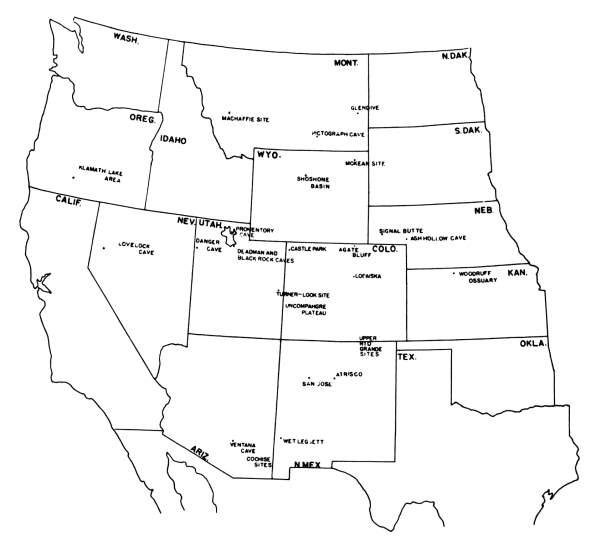
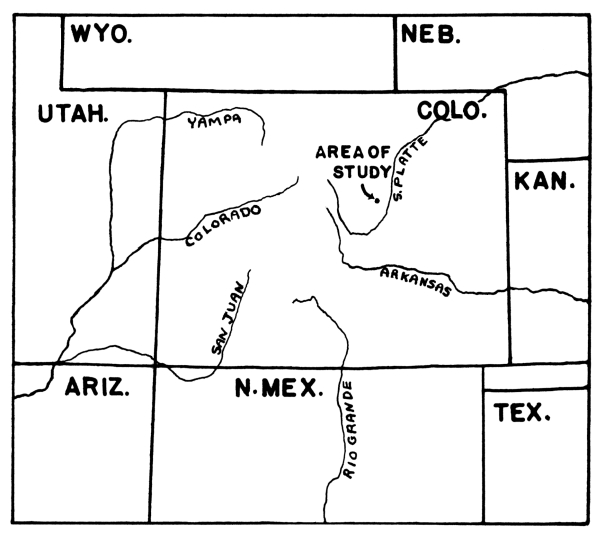
FIGURE 74—
LOCATION OF PRINCIPAL SITES
AND LOCALITIES
REFERRED TO IN THE TEXT.
People of this complex appear to have been rather skilled in stone
working. Chipped projectile points are usually executed with care,
often achieving slender finely flaked forms. It is interesting to note
that stone scrapers were apparently little used by Fremont people.
Perhaps hides were prepared in other ways. Baskets were undoubtedly
made and were probably important. The awls found can attest either
to sewing or basket-making; the long slender awls would have been
especially suited for the latter. Tubular beads were made by a process
widespread in the West: incising and splitting. Pottery was roughly
made and fairly thick, but not more so than some of Wormington’s
(average thickness 5 mm.). Pottery of this rougher type is widespread
in northern Fremont locales.
Concerning the possible socio-political situation some conjecture can
be recorded. First, as Wormington (1955) pointed out, using data from
Murdock (1949), “hunting is normally a male activity and it seems
probable that agricultural pursuits were left to the women, and the
corn plots may have belonged to them. The inheritance of corn plots by
women may have served to unite nuclear families into extended families
with matrilineal descent and matri-local residence. However, emphasis
on hunting and possible warfare would tend to enhance the status of
men and descent may have been bilateral or patrilineal.” For Complex A
the latter would be especially important if the absence of quantities
of pottery indicates less emphasis on agriculture and more on hunting.
Certainly, however, the wild foods at both the LoDaisKa Site and in
Castle Park show the continued importance of gathering activities
usually associated with women.
The culture complex represented between roughly 24 and 53 inches
below baseline appears to be a manifestation of the Woodland Culture,
Orleans Aspect. The authors excavated several single component sites of
this manifestation in the area (Irwin and Irwin, n.d.). The following
artifacts, occurring in these sites and also in this depth range at
LoDaisKa, appear characteristic of the culture: cordmarked pottery,
corner-notched projectile points similar to those in Fig. 75,
end scrapers, drills, small ovoid knives, spoke-shaves, awls (splinter
or extremely small sliver types), large hafted “knives.” Large
projectile types could have been used with a spear-thrower. There are
also tubular beads, small stone triangles (possibly gaming pieces),
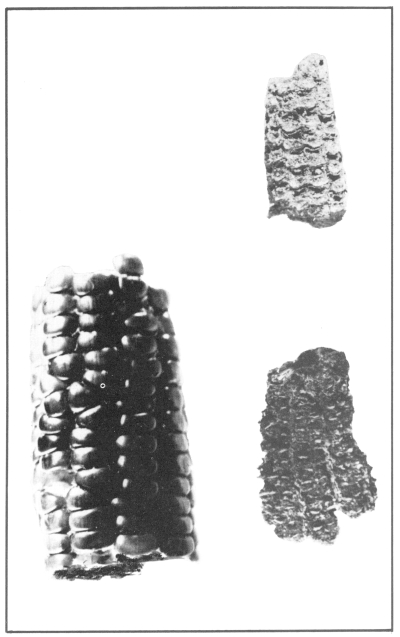
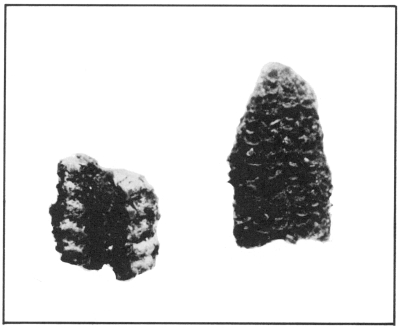
1 shaft-smoother, handstones and milling slabs. One decayed corn cob
was found at 53-57 inches and may belong to the Woodland levels at
LoDaisKa. This was a popcorn (see above).
Dent corn has been found at other Woodland sites in the Morrison area
(Irwin and Irwin, n.d.). Especially characteristic
of this occupation was the pottery, small ovoid knives, and sliver awls.
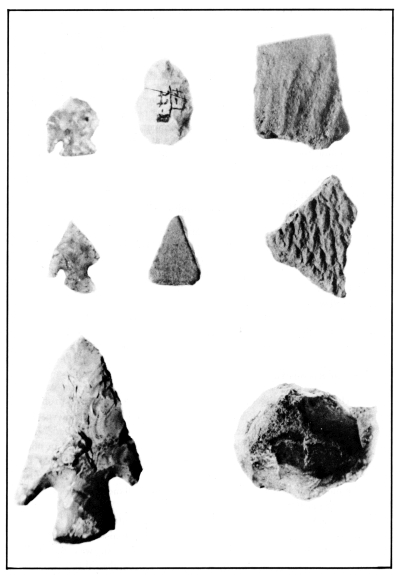
Figure 75—
Artifacts from single component Woodland sites
in the Morrison area. Actual size.
Establishing a closer affiliation is more difficult. In essence, much
of the material resembles that of Ash Hollow focus established in
Western Nebraska and Northern Colorado (Kivett, 1952a; Irwin and Irwin,
1957). Specifically, pottery of Class I is similar in composition, cord
application, thickness, rim styles, and absence of decoration. However,
Class II has several features reminiscent of the Keith focus pottery
(Kivett, 1952b) being a thicker ware with a more granular structure.
However, the Harlan cord-roughened pottery, assigned by Kivett to the
Keith focus, is calcite tempered and has no diagonal cord-marking.
Kivett has pointed out that clastics may have been used in areas where
calcite does not occur, or more desirable temper is at hand. The
absence of side-notched points in Woodland levels at LoDaisKa contrasts
with Ash Hollow focus sites where 30% are usually of this variety.
This constitutes another similarity to Keith focus sites, such as the
Woodruff Ossuary, where such forms do not occur. Class III pottery is
not present in Plains Woodland sites. It may be a local variation since
it is similar to II in all but cord application.
In connection with this complex, there is a C 14 date for Keith
materials of 611 ± 240 A.D. (Wedel and Kivett, 1956). For Ash Hollow
Cave tree ring estimates (Champe, 1946) place occupation at 1000-1150
A.D. However, a carbon sample from Woodland materials in the Denver
area yielded a date of 800 ± 150 A.D. (Hunt, 1954). Ash Hollow Focus
materials appear to share traits with both Valley (Hill and Kivett,
1940, Kivett 1952a, 1952b and Keith Foci). The authors feel the
manifestation at Morrison is basically similar to Ash Hollow but with a
few more traits in common with the Keith Focus.
The economic life of the people of culture Complex B probably revolved
around hunting, limited agriculture, and gathering of specific foods,
mainly plums and acorns. Foods were ground on milling slabs with
handstones and perhaps, as with the Pawnee, were cooked in pots, or
made into cakes fried on a hot slab. Agriculture is indicated by
remains of corn at LoDaisKa and at nearby sites of the same culture.
In the more classic manifestations of Plains Woodland Culture evidence
is slim. Squash remains occurred at Sterns Creek (Strong, 1935)
and popcorn at the Lawson Site (Kivett, 1952a). Wedel (1934) felt
corn could not grow west of the 99th meridian in prehistoric times.
For the Upper Republican Culture an example of corn was found in
northern Colorado by the authors, (1957). In the Morrison area several
occurrences were noted (see above) in connection with the Woodland Culture.
Animals hunted were mainly deer and bison, with smaller animals such
as prairie dogs, gophers and birds also represented. Perhaps the
importance of bison at the site is misrepresented because in dealing
with such large animals it is possible that only the meat was brought
into camp (for an example of this see Clark, 1952).
Clothing was probably of skin. Numerous scrapers attest to the
importance of hide dressing. Tubular beads and a tooth pendant provide
evidence of interest in self-ornamentation. Paint stones may have
served for pigment. Mixed with grease this could have been used for
bodily decoration, though ethnologic parallels suggest other objects
were also painted (see above).
A considerable amount of skill in stone working must have been
necessary to produce the small delicate projectile points, presumably
used with arrows. Some much larger points suggest a continued
dependence on the spear or spear-thrower. Drills may have been used to
manufacture ornaments or perform more utilitarian functions. Pottery
was durable and primarily utilitarian. Variation in pattern was
practically non-existent, but the fineness of cord-marking shows some
noticeable difference. Bone awls were mostly of the splinter type and
rather poorly made. Perhaps baskets were made, but these may not have
been too important. Awls could have been used in their manufacture or
for sewing.
Concerning the socio-political organization, some inferences can be
made. A possible sketch of the “way of life” can be found by examining
Pawnee culture as outlined above. Cultivation may have been in small
patches worked by women. Hoeing and weeding were probably spasmodic.
In view of the absence of bell-shaped storage pits or other such
facilities, we can probably infer that crop supplies were consumed in
a few seasonal feasts in the characteristic Basin style rather than
stored in the Plains manner to conserve for future needs. Despite
this, corn plots must have anchored the population to some extent. The
presence of pottery suggests a more or less settled way of life. Plains
social structure tended to be patrilocal, though there were exceptions.
A greater emphasis on hunting, such as was apparently present at
LoDaisKa, would increase the chance of such a development.
Despite the fact that the site was fairly small, there is a good deal
of evidence of Plains Woodland Culture in the area, and we can assume
some kind of inter-component interaction.
Cultural Complex C occurs primarily between the depths of 50 to 72
inches below baseline. The definition is based on the occurrence of a
cluster of traits similar to those found in a previously defined unmixed
culture. A certain amount of the apparent overlap is due to the
telescoped nature of the stratigraphy, which aggravates the effects
of trampling and other disturbances. It is not possible on the basis
of the available evidence to determine the relationship of Complex C
to those traits which are not consistent with the culture. They may
represent traits adopted by the C people, or they could be remains of
intermittent occupation by other groups, (see above).
The closest affiliation of Complex C is to the lower level of the
McKean Site, (Mulloy, 1954a), Signal Butte I, and related sites. The
most significant typological similarities occur in the projectile point
categories. The most numerous type at the site is the shouldered,
concave based point, (24 examples), designated “Duncan” by Wheeler
(1952). “Duncan” points are very common at the McKean Site. Somewhat
less well represented at the LoDaisKa are the McKean lanceolate
types. Though the general similarity to the McKean type material is
undeniable, certain differences occur uniformly. Most noticeable is
the discrepancy in size, McKean specimens being consistently larger.
The largest LoDaisKa examples approximate the smaller or medium-sized
McKean points. The small LoDaisKa points are completely out of the
range of McKean specimens, but certain of them do resemble types from
Signal Butte I, (Strong, 1935). Such differences and similarities may
reflect distance and local stylistic variation, functions of the points
in different economies, or perhaps chronological difference.
A second trait which was found to be useful in defining Complex C
is the end scraper. Though common at all depths above 72 inches, it
is almost completely absent below and aids in segregation of the
complexes, especially C and D. Many such scrapers were found at McKean
and Signal Butte.
The third important trait of technological as well as typological
significance is the striking of prismatic flakes, presumably from
prepared cores. As in the case of projectile points, most of the
examples are smaller than those which occur at McKean. On the other
hand, they appear to be more regular with a greater percentage that
have trapezoidal sections and roughly parallel sides. Some of these
have been worked and utilized as gravers, cutting edges, and possibly
scrapers. In this respect they approach, though do not equal, the
classic northern prismatic flake assemblages. For example, they
approximate the lower part of the size range and the slightly rougher
section of the material from Anangula Island, (Laughlin and Marsh, 1954).
The vertical distribution of stone-filled hearths is not confined to
the limits of Complex C. However, those features may be related to
those at McKean where they are large and well-defined. Grinding stones
were also important at both sites.
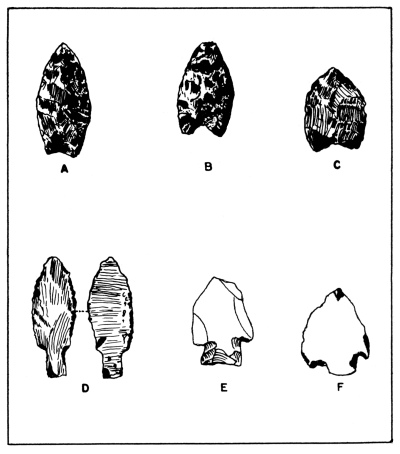
Figure 76—
Projectile points from Signal Butte illustrated for comparison. A-C.
Signal Butte I, presumably IA. D-F, flake points, presumably IC. A-D,
drawn from photostats courtesy of R. Forbis, E-F by R. G. Forbis.
Relations with Signal Butte I are most evident in the projectile point
category, especially in the size average. A communication received from
R. G. Forbis, to whom we are deeply indebted, indicates that the modal
weight of the Signal Butte McKean points is about .56 that of those at
the McKean Site. Further, the collections from Signal Butte contain
three flake points. One striking example of a flake point in the shape
of a “Duncan” was found at LoDaisKa, (Fig. 15, type A).
Other flake points of varying form (listed as xx) occur in Complex C levels.
Some of these are not dissimilar to that of Signal Butte I, but Dr.
Forbis feels that these may belong to a later phase than the McKean
points. The main differences lie in the relative scarcity or perhaps
absence of straight stemmed or “Duncan” types at Signal Butte I[9],
and the occurrence of flared stemmed varieties or “Hanna” points. The
former are numerous at LoDaisKa, the latter absent. There is a good
possibility that Signal Butte I should be divided into two or three
phases, with McKean points earliest, (Bliss, 1950b, and R. G. Forbis,
personal communication).
Relations to other known sites may also be noted. Not only the stemmed
and lanceolate points, but side-notched and certain corner-notched
types are found in Deadman Cave, Stansbury Island, and Danger Cave
(Smith, 1952; Jameson, 1958; Jennings, 1957). The total range, however,
differs considerably. There is also some similarity to materials of the
earlier levels of Birdshead Cave, (Bliss, 1950a).
The stemmed “Duncan” types have rather wide morphological similarities.
As far away as Texas, middle levels of certain sites yield similar
materials (Pearce, 1932, pp. 46-47). Pedernales points of the Edwards
Plateau Aspect are roughly comparable (Suhm, Krieger, Jelks, 1954, p.
468; Kelley, 1947, 1959). At the other extreme, Thomas Kehoe (1955)
reports finding “Duncan-like” points at the Billy Big Springs Site
in Montana. Lister (1953) has suggested that a generalized form of
indented-based, stemmed point is a horizon marker in the West and
Southwest.
A large number of the artifacts that occur with the above are of
little diagnostic value. However, some of them are probably associated
culturally and formed part of the total artifact inventory. These
include: leaf-shaped and triangular knives, end and side scrapers, and
discoidal and serrated forms, one expanding base drill, perforators,
a few small ovoid bifaces, utilized flakes, chopper/hammerstones, one
bone ornament, paint stones, headed and splintered awls, used bone
splinters, one bone knife, and one wood shaft.
The economy of the people of Complex C was probably oriented toward a
combination of hunting and gathering. The former is evidenced by the
presence of animal bones and the frequency of projectile points. The
mule deer, Odocoileus hemionus, which represented nearly 75% of
the faunal remains, appears to have been the animal most hunted. The
projectile points are considered to have been used in connection with
atlatls. Stalking and snaring were probably prevalent methods, although
a surround or drive might have been practical in certain seasons when
the animals gathered into larger herds. The small number of bison
bones indicate that bison were also occasionally hunted. There is a
surprising lack of bones of small game, these being even less numerous
than in Complex D. Other animals included an undetermined carnivore and
some bird bones.
Numerous milling stones and hand stones as well as plant remains
attest to the continued importance of vegetable products in the diet.
The plants utilized include acorns, sedges, wild plums, chenopods and
Umbellifereae. Wads of moss may have been used for padding etc.
There is no information on any structures. Probably none were used
since the overhang provided rather good shelter. Large stone-filled
hearths may have been used for large scale roasting, as Mulloy (1954a)
hypothesized for the McKean Site.
Technologically the Complex C occupants possessed sufficient skill to
adapt to the environment with little evidence of elaboration. Clothing
was probably scant except for cold weather, and was possibly of skins.
In stone work, projectile points were functional, and made rather
roughly with little pressure retouch. A proliferation of scraping
tools and utilized flakes was probably a by-product of the emphasis on
hunting, and suggests that many skins were prepared. A certain amount
of technological “know-how” was required to manufacture the relatively
fine prismatic flakes. In bone work the commonest tools were awls made
on a splinter of bone worked only on the functional end. One bone
appears to have been used for flint flaking.
Despite the apparent emphasis on utility there is a certain amount of
evidence on the aesthetic side. The people had beads for adornment,
made of sections of bird bone. Fragments of hematite and limonite
indicate that they also practiced painting of some sort, perhaps on
their bodies and tools or hides.
The occurrence of pieces of worked mica may have some magico-religious
significance. Similar specimens were found in Danger Cave (Jennings,
1957) and the pieces may indicate Great Basin affiliation. However,
the greatest concentration of these is between 50 and 72 inches. These
might have been used as charms, or have been part of shamanistic
paraphernalia. Other inferences drawn from ethnology would suggest the
importance of beliefs connected with hunting.
There is no direct evidence of a socio-political nature. The size of
the site and the type economy represented indicate a small semi-nomadic
group. The possible overlap in cultural groups suggests either
intermittent occupations alternating between groups of different
cultural complexes, or the close proximity and strong influence
of such groups. In the field of social organization, many modern
hunting-gathering groups exhibit bilateral kin organization. On the
other hand the especial importance of large game would render the men’s
position of greater consequence, and the affiliation of the material
culture is oriented toward the Plains where patrilineal organization is
rather common.
The authors believe that the culture (Complex D) represented at
LoDaisKa from 55 inches below baseline to the top of the late Wisconsin
Alluvium (erosional surface), is a manifestation of the Desert Culture
as described by Jennings (Jennings and Norbeck, 1955; Jennings,
1957). This exists in its purest form below 72 inches but there is a
persistence of some forms during the beginning of Complex C. Certain
types characteristic of the complex continue above 55 inches; they
occur, however, in diminishing quantities. There are two possible
reasons for this: 1) that the shelter continued to be occupied by
people of this affiliation; 2) that the materials worked up by the
process of re-use or trampling and mixing of the floor. There is
ethnological evidence that different tribes recognized each other’s
projectile points and often collected them (Brew, 1946). To avoid
confusion we shall treat this culture as it is manifested in its purest
form below 72 inches. Where specific shift or other phenomenon does
occur between 72-55 inches, it will be noted.
Traits characteristic of this complex are the following: projectile
points of various forms, (to be discussed below), triangular knives,
especially the second type described above, a few flake knives, side,
discoidal, serrated, and a very few end scrapers, Uncompahgre scrapers,
drills, perforators, utilized flakes, chopper/hammerstones, paint
stones, splinter awls, awls with heads (especially some very large
forms), a notched rib, used bone splinters, antler flakers, gaming
pieces (undecorated), tubular beads, a tooth pendant, worked mica,
wood shafts (large), a limestone pendant, one quartz crystal and one
clay ball. Other artifacts found in the level include a few prismatic
flakes perhaps fortuitous or intrusive, and above 60 inches a few small
projectile points that are, by any criterion (e.g. Fenenga 1953),
arrowheads. Typologically these show the greatest resemblance to forms
found in Level 3 in Hells Midden (Lister, 1951). However, since there
appear to be no allied traits they are felt to be intrusive. At least
they provide no proof of the presence of this culture.
We will discuss cultural affinities in terms of projectile points
with an eye to establishing possible lines of cultural influence from
various geographical areas. We do not suggest that in most cases more
than an idea was transmitted.
The Desert Cultures represent, according to Jennings, a “life way”, a
specific economic approach to living in a certain environment. Though
the Morrison biome differs in some respects from that of the classic
“Desert Cultures”, the nature of the problems faced and the kinds
of cultural response invoked are remarkably similar. Typological
similarities to Danger Cave materials include a high degree of
correspondence between class D projectile points and Jennings’ category
W31. This form is also found at Medicine Rock Cave, Oregon (Cressman,
1956, Fig. 41) and Kawumkan Springs Midden (type 7a, Ibid.).
It was also present at Deadman Cave, (Smith, 1952) and at Wormington
and Lister’s (1956) Uncompahgre sites (Fig. 42 ff).
Hurst (1944, 1945) named points of this type Tabeguache points. Points of
a rather similar form occur in Ventana Cave in the Chiricahua-Amagosa II level
(Haury, 1950) as a minor type, and become more common in the San Pedro materials.
Below we shall compare the LoDaisKa materials of this complex to three
archaeological manifestations, since cultural ties seem to be closest
with these. These are: Ventana Cave, Danger Cave, and sites of the
Uncompahgre Complex, especially the Taylor Site. Reference will be made
to other areas for specific items.
The similarities between type D projectile points and class W31 at
Danger Cave have already been noted. Other similar forms include Class
E forms and W25, 26. Class J may or may not be identified with W18
and W19; since large corner-notched forms are widespread they may not
have enough distinctive features to be of value in site correlation.
They are also present at Deadman Cave. There are five points (Class G)
very similar to W38 (distribution Levels DIII-V at Danger Cave). If W8
and W10 are connected with McKean lanceolate and Duncan forms this is
a good correlation point with the overlapping Complex C at LoDaisKa.
There is a similarity between W16 and Class C, and W22 resembles Class I forms.
The only important projectile point category of Danger Cave Levels
DIII-IV which is lacking at LoDaisKa is the series W28, 29, 30,
corner-notched forms with deep basal notches.
In other tool types there is an amazing similarity between the
triangular knives of Type I rather characteristic of Complex D at
LoDaisKa and Jennings’ W48 and especially W52. Since one of those at
LoDaisKa is obsidian, it is conceivable that it was traded from Utah
or the surrounding area. At both Danger Cave and LoDaisKa the relative
scarcity of end scrapers is noticeable. Other shared traits include
flake knives, straight drills, a few gravers, the possible foreshaft
from LoDaisKa, splinter awls and “headed” awls (it is interesting to
note that DIV types were less well made than LoDaisKa or DIII types).
One-hand manos and slab milling stones are found at both localities.
However, the peculiar four-plane type does not occur at Danger Cave.
Abrading stones, present at Danger Cave, are not found in Complex D. It
is of interest to note that both sites contained worked mica, ochre and
paint pigments. Nothing is known concerning basketry at LoDaisKa.
There are numerous similarities between the projectile points of
Ventana Cave and those of LoDaisKa. Type H resembles Haury’s expanding
stemmed, round tanged, convex based form. These are distributed
vertically throughout the levels of both Ventana and LoDaisKa, but
are almost entirely absent at Danger Cave. Points of Class C very
closely resemble Haury’s expanding stemmed sharp tanged convex based
or straight based types. These are the second most numerous type as
low as level VI at Ventana. There are some points with oblique tangs
that may be related to Class I or J. However, the best marker is Class
C2. The first point figured in the group is identical with points of
the class loosely termed Pinto Basin. Both this and the second two
can be duplicated in Ventana Cave, or at the San Jose Site (Bryan and
Toulouse, 1943). Nearer to LoDaisKa, Renaud (1942, 1946) has found
similar points in the Upper Rio Grande.
In both LoDaisKa Complex D and Ventana Levels II-III there are
triangular, convex-edged blades, side and discoidal scrapers. End
scrapers, especially snub-nosed forms are comparatively rare at both
sites. There are drills and/or perforators, including what we have
termed gravers, choppers, and utilized flakes. Hematite appears
together with quartz crystals. Awls are found: both headed and splinter
forms are represented. At both sites the former are the most numerous
type during the interval under discussion. At LoDaisKa there was no
category of “sawed” awls as at Ventana. Rib scrapers or knives are
also an interesting feature. There are in addition, tubular beads of
bird and mammal bone, and antler flakers. One additional and notable
similarity is to be found in handstones. These are all of the one
hand variety. Due to a peculiarity of usage, a median line developed
creating four grinding planes. This was probably caused in rocking the
mano when pushing it forward and then back. Occasionally a specimen is
noted where the user had rotated it 90° when reversing it, creating
median lines on opposite faces perpendicular to each other. As Haury
(1950) pointed out, this phenomenon is a special feature of the Cochise
Culture. It occurs at Ventana Cave and in the LoDaisKa Site. Both flat
slab milling stones and those with slight basins are found.
A third comparison can be made with the nearby Uncompahgre Complex
(Wormington and Lister, 1956). Similarities to Danger Cave, sites
of the Middle Horizon of the Plains and to the Cochise Culture are
reflected in the Uncompahgre Complex, as summarized by the authors.
Certain forms of projectile points, especially the type called
Tabeguache by Hurst, are found in the Taylor Site in levels 4, 8, and
10. Another similar form is the round based, round barbed type (Class
II), also found in Ventana Cave. There are certain small points from
these levels, possibly arrowheads, which bear resemblance to projectile
points of levels 1-3 at the Taylor Site, and forms of Level 2 at Hells
Midden.
Generally asymmetrical large ovoid bifaces or knives are common in the
Uncompahgre Complex, as they are here. The stemmed drills, straight
drills, gravers, and perforators of the general class that we have
called awls, are common in both the Uncompahgre and Complex D. There
are other similarities in serrated scrapers, and the rarity of end
scrapers. A triangular notched pendant found at LoDaisKa is probably
analogous to certain flat pieces of soft stone that were used as
ornaments on the Plateau. The four-planed manos noted above are also
found here. An interesting artifact, the Uncompahgre scraper, was first
described by Wormington and Lister in their report. Such pieces also
occur at LoDaisKa. Whether they occur elsewhere is not known, since
it is possible they were present in other areas but have not been
recognized. At the Taylor Site there were storage pits as at LoDaisKa.
One notable discrepancy is the lack of awls with heads at sites of the
Uncompahgre Complex.
Before closing this discussion, we should take note of a possible
broader relationship of Complex D, that is within the continent-wide
framework of an Archaic horizon. While we have limited specific
correlation to Desert cultures, other similarities do exist in total
tool assemblage and specific point types with a number of Eastern
Archaic sites, such as Modoc Rock Shelter (Fowler, 1959). Jennings
(1957) has admirably summarized the relations of manifestations of the
Desert cultures with sites of the Eastern Archaic, and further inquiry
should be made in this direction. Perhaps when Archaic sites between
LoDaisKa and the Mississippi are discovered, a gradual blending of
Eastern Archaic-Desert Culture will be noted. A recent publication
for Oklahoma by R. Bell (1958) gives hope in this regard. Since corn
was present at Bat Cave (Dick, 1952), a site with certain Chiricahua
Cochise affinities, it is not unreasonable to assume corn diffused to
LoDaisKa from New Mexico or Arizona.
There can be little doubt that the people of Complex D led a life
similar to that described by Jennings for the Desert Cultures. The term
“Desert” is a little misleading, since the Morrison Biome is not in any
sense of the word a desert. However, the vegetation is of the Sonoran
type, a type with great variation characterized by fairly low rainfall,
scrubby bushes and few trees. The proximity of the mountain forest
biome supporting deer and other large animals, probably led the
people to greater dependence on these at the expense of small game.
This hypothesis is supported by the faunal charts. The multitude of
grinding stones, and the presence of edible floral remains attest to
the continued importance of gathering. Another factor is present,
for floral remains and the pollen record indicate the presence of
maize in early times at LoDaisKa. At another site in southwestern
New Mexico, Bat Cave (Dick, n.d.) was recorded one of the earliest
occurrences of maize in North America. At Bat Cave preservation was
better than at LoDaisKa and a more complete record was found. There
is a clear resemblance between certain projectile points of Bat Cave
(e.g. Datil points) and Chiricahua and Ventana forms, and those of
LoDaisKa mentioned above. Perhaps maize was grown by the people of
Ventana Cave also. It remains to be seen, however, how much difference
the cultivation of small amounts of corn made in social and economic
life. We are inclined to agree with Willey and Phillips (1958), who
suggest that it was indeed little. In their hunting and gathering
activities these people must have lived a life very similar to that
of the Ute, outlined above. For theoretical considerations, the light
shed on prehistoric life by these primitive cultures of the historic
period cannot be overemphasized. The characters are different, but all
the evidence suggests that the play was much the same with only minor
variations.
Cists from Complex D suggest that seeds and perhaps corn were stored.
Fire areas are sometimes large and deep. Perhaps these were traditional
cooking areas. The many rocks scattered in the pits suggest that
stone boiling or baking was practiced, and flat slabs may have been
used for cooking cakes. Food was ground on basin or flat metates with
one-hand manos. Lowie (1924) cites ethnological evidence for the use
of different kinds of grinding stones for different foods in the Great
Basin cultures. Perhaps a similar custom gave rise to the peculiar
four-plane and ordinary type manos in equal proportions at LoDaisKa.
Hunting methods included the use of the atlatl, or spear-thrower, and
possibly, though no evidence is at hand, snares. Perhaps the use of
bolas is recorded by the clay ball described above. Long bone awls
suggest that basketry was important.
In technology the people had rather well formed projectile points. The
flaking technique employed was probably largely percussion supplemented
by pressure. In general, tools were smaller than those from other sites
that exhibit typological parallels. This could have been partly due
to ecologic conditions or perhaps to a scarcity of stone. Wide use of
rough quartz and metamorphic rock suggest that the latter factor was
operative. Obsidian was obtained through trade or visits to other
areas. For sources of obsidian, one must look either to the vulcanism
of northern Wyoming, Southwestern Colorado, New Mexico or Utah. Peoples
occupying other sites of this time period also appear to have engaged
in trade (see Jennings, 1957; Haury, 1950).
Bone was widely used for scraping, cutting and piercing. The exact
method of cutting bone is not known; but there are gravers and utilized
flakes that could have been used.
Ornaments suggest that interest in self adornment was not lacking.
Hematite and ochre indicate that there was some use of paints and
pigments. A piece of chlorite was found that, if ground and mixed with
grease, could have made a spectacular kind of paint. Worked mica again
may have had ornamental or ceremonial uses.
In the magico-religious field, one can probably infer some of the
religious practices of the Basin hunters and gatherers, from those of
the recent Ute. An interesting feature is the occurrence of a rather
large, well formed, smokey colored quartz crystal. Perhaps as Haury
suggested (1950), such crystals were picked up for beauty, but another
possibility is that they were a part of a shaman’s paraphernalia.
Certain California and Louisiana Archaic sites contain many of these,
and they are assumed to have had some sort of magico-religious
function. It would be surprising not to find at least a part time
shaman in such a culture, although regalia such as sucking tubes are
lacking.
Conjectures concerning social organization can be briefly set forth.
It is probable that the people had a more or less bilateral form of
kinship. As Murdock (1949) and others have noted, where economic
division of labor is nearly even, a more or less bilateral organization
tends to develop, with at most only mild matri-or patrilineality.
From ethnologic parallels for Basin peoples this seems plausible. But
use of ethnological evidence for single traits at this chronological
level is extra-hazardous. What effect the little agriculture practised
had is a moot question. As we have pointed out concerning the people
of Complex A, small plots of corn would have required at least
semi-annual gatherings, and would have temporarily placed the society
on a relatively stable footing. Possibly the proceeds of a harvest were
used for a gala feast or ceremony. However, the presence of cache pits
suggests that something at least was stored.
Two oblong pieces of bone which appear to have been gaming pieces
suggest that gambling existed as a form of recreation. Certainly,
as Steward (1940) has noted, gaming was a constant feature of Basin
cultures.
Just within sands and gravels attributed by Hunt to Late or
Post-Wisconsin outwash, one fragmentary point and a few flakes were
found. Some charcoal, ash and burned bone occurred at the same level,
extending in a lens about 2 inches lower. The point appears to the
authors to be the basal section of what might be called morphologically
a Plainview point (Krieger, in Sellards, Evans and Meade, 1947).
Flaking was parallel. Another parallel-flaked point of a similar type
was found higher up in the fill, and was undoubtedly a re-used piece
(see Fig. 25). Both points are of quartzite, and
both have ground edges. Five of the associated flakes were of a flinty
material, 2 of grainy quartzite.
These artifacts probably represent a culture
of the early Lithic Stage in the area, and are perhaps the earliest
evidence of its occupation. The fill was so sparse, however, that no
further evidence could be obtained.
Willey and Phillips (1958) have stated that traditions are culture
elements extending over long periods of time and often transgressing
various culture boundaries present in an area. Traditions are not
horizon-markers but may serve to unify a given series of occupations in
a locality (e.g. painted pottery is a tradition in the Southwest.)
At LoDaisKa there are few such distinctive elements that transgress
cultural periods other than rather common functional tools such as
scrapers, but these few may be worth noting. One of these concerns a
special type of handstone with four working planes as described above.
These are present from complex A through D. Another tradition concerns
the use of local stone. In general finer flinty types were used for
knives, gravers and some types of scrapers, while grainy quartzite was
most often used for projectile points. Distance from sources probably
influenced the use of flinty types. The nearest quarry area appears
to be about fifteen miles away; beds of quartzite are found somewhat
closer. It is probable that access to both supplies led the people to
use flinty type where a good cutting edge was important, but grainy
varieties for tipping weapons. The grainy structure of quartzite makes
it break less cleanly on the edges but renders it less likely to snap
on sudden impact.
Another tradition lies in the use of small points. Many of the
projectile point forms may be identical in general characteristics with
points from other areas which are apparently culturally connected, but
they are consistently a little smaller. Perhaps such a phenomenon was a
by-product of the scarcity of material. In this connection one should
note that in all the cultures common native rock quartz was almost
invariably employed for large chopping tools. Another point of interest
is the almost total absence of cores. Raw material when found was
usually in the form of large flat flakes. The initial roughing out must
have taken place at the source.
Another tradition is the use of mica for “ornaments” extending from
Complex B through D. A tradition for the area was the cultivation from
early times of a certain amount of corn, as revealed by pollen analysis
and a few specimens of seeds or cobs. However, the type of corn used
was not the same throughout. Three major varieties were present.
There are two explanations for these local traditions: either a
tradition was handed down from one cultural group to another through
long periods of time, or the peculiar ecological position of the
Morrison biome dictated such a course. Probably the answer lies in
the combination of these; certainly for stone use the environment was
an important factor, but for the handstone type, the environmental
explanation does not seem entirely adequate.
Placed in a larger context, the sequence at LoDaisKa seems to reflect
the interaction of geographical, cultural and environmental factors.
Their relation poses a series of interesting questions.
The region is located geographically on the fringe between two
well-known culture areas, the Great Basin and the Plains. At the same
time, it is environmentally distinct from either, combining some
characteristics of each, while preserving its own sub-montane biome.
These factors determine the essentially marginal character of the area.
For the same reasons, it should be especially sensitive to the forces
of cultural dynamics and to changes in environment.
The sequence at the LoDaisKa Site reflects this situation. The shifting
orientation of the cultures represented alternates between the Plains
and Basin. This shifting may be an essentially cultural phenomenon,
possibly reflecting events in the nuclear culture areas. Alternatively,
there may be evidence of climatic fluctuation at the site, and
environmental change could have been an important factor.
It remains a question whether this was, at least briefly, a contact
area for Plains and Basin cultures. From the available material it
is not possible to determine whether groups of divergent affiliation
ever inhabited the area synchronously. The considerable overlapping of
the culture units seems to point in this direction; but, as indicated
above, this phenomenon may be partially due to the telescoping of the
stratigraphy. This plus certain traditional continuums provide possible
evidence of the influence of these groups on each other.
Further research may provide answers for some of these questions.
Accurate dating by Carbon 14 will of course be invaluable in setting
the LoDaisKa sequence in proper relation to known Recent developments
in the West. Continued paleobotanical and geological study will help
clarify the chronological and environmental situation. Investigation of
single component sites in the area should provide a concrete regional
sequence and supply more data on the kind of cultural phenomena
represented here.
This suggests a few of the problems to be solved and indicates the
great amount of research which remains to be done.
BIBLIOGRAPHY
ANDERSON, E.
1948 Racial Identity of the Corn from Castle
Park. In Burgh and Scoggin, the Archaeology of Castle Park
Dinosaur National Monument. Univ. of Colorado Series in Anthropology,
No. 2. Boulder.
1954 Personal communication in Wormington. A
Reappraisal of the Fremont Culture. Denver Museum of Natural History
Proceedings, No. 1. Denver.
ANTEVS, E.
1955 Geologic-climatic Dating in the West.
American Antiquity, Vol. 20, No. 4, Part 1, pp. 3, 17, 35.
Salt Lake City.
BARBER, E. A.
1876 Language and Utensils of the Utes.
Bulletin, U. S. Geologic and Geographic Survey of the Territories. Vol.
11, No. 3. Washington.
BARGHOORN, E. S., M. K. WOLFE, and K. H. CLISBY
1954 Fossil Maize from the Valley of Mexico.
Bot. Mus. Leaflet Harvard Univ. 16, pp. 229-264. Cambridge.
BEALS, R.
1935 Ethnology of the Rocky Mountain National
Park, the Ute and Arapaho. National Park Service, Berkeley.
BELL, R. E.
1958 Guide to the Identification of Certain
American Indian Projectile Points. Oklahoma Anthropological Society,
Special Bulletin No. 1. Oklahoma City.
BLISS, WESLEY
1950a Birdshead Cave, a Stratified Site in Wind
River Basin, Wyoming. American Antiquity, Vol. 15, No. 3, pp. 187-96.
Menasha.
1950b Early and Late Lithic Horizons in the
Plains Anthropological Papers. University of Utah, No. 11, Salt Lake City.
BREW, J. O.
1946 Archaeology of Alkalai Ridge, Southwestern
Utah. Peabody Museum Papers, Vol. XXI. Cambridge.
BROECKER, W. S. and J. L. KULP
1956 The Radio Carbon Method of Age
Determination. American Antiquity, Vol. 22, No. 1, pp. 1-11. Salt Lake City.
BRYAN, K., and J. TOULOUSE
1943 The San Jose Non-Ceramic Culture and its
Relation to a Puebloan Culture in New Mexico. American Antiquity, Vol.
8, No. 3, pp. 269-80. Menasha.
BURGH, R. and C. SCOGGIN
1948 Archaeology of Castle Park, Dinosaur
National Monument, University of Colorado Series in Anthropology, No.
2. Boulder.
CARTER, G.
1945 Plant Geography and Culture History in the
American Southwest, Viking Fund Publications in Anthropology, No. 5.
New York.
CARY, MERRIT
1911 Biological Survey of Colorado. Biological
Survey Bureau, North American Fauna. Washington.
CHAMBERLAIN, R. V.
1911 The Ethnobotany of the Gosiute Indians.
American Anthropologist. Memoir 2, Part 5. Menasha.
CHAMPE, J.
1946 Ash Hollow Cave, A Study of Stratigraphic
Sequence in the Central Plains. University of Nebraska Studies, No. 1.
Lincoln.
CLARK, J. D. C.
1952 Star Carr, A Mesolithic Site. Cambridge
University Press. Cambridge.
1957 Archaeology and Society, Harvard University
Press. Cambridge.
COON, C. S.
1950 A Reader in General Anthropology. New York.
CRESSMAN, L. S.
1942 Archaeological Researches in the Northern
Great Basin. Carnegie Institution of Washington Publication No. 538.
Washington.
1956 Klamath Prehistory. Transactions of
the American Philosophical Society, New Series, Vol. 46, Part 4.
Philadelphia.
DANIELS, H. S.
1941 The Ute Indians of Southwestern Colorado.
Durango Public Library Museum. Durango.
DAUGHERTY, R. D.
1956 Early Man in the Columbia Intermontane
Province. University of Utah Anthropological Papers, No. 24. Salt Lake City.
DAVIS, E. M.
1956 Archaeological Survey of the Big Sandy
Reservoir Area, Southwestern Wyoming. Notebook No. 2, Laboratory of
Anthropology, University of Nebraska. Lincoln.
DICK, H. W.
n.d. Archaeology of Bat Cave. Ph.D.
Dissertation, Harvard University (manuscript). (Cambridge.)
1952 Evidences of Early Man in Bat Cave and on the
Plains of San Augustine, New Mexico. In Selected Papers of the
29th International Congress of Americanists, pp. 158-63. Chicago.
DOUGLAS, F. H. and J. JEANCON
1930 The Ute Indians. Leaflet No. 10, Denver Art
Museum. Denver.
DUNBAR, J. B.
1880 The Pawnee Indians, Their History and
Ethnography. Magazine of American History, Vol. 4, No. 4, pp. 241-281.
FENENGA, F.
1953 The Weights of Chipped Stone Points: A Clue
to Their Functions. Southwestern Journal of Anthropology, Vol. 9, No. 3,
pp. 309-323. Albuquerque.
FENNEMAN, N. M.
1931 Physiography of Western United States.
McGraw-Hill. New York.
FLINT, R. F.
1957 Glacial Geology of the Pleistocene Epoch.
Wiley and Sons. New York.
FORBES, LITTON
1882 Les Utes du Colorado. Bulletin de La
Societé D’ anthropologie (L.C.) de Paris. Tome cinquieme, troisieme
serié. Paris.
FORBIS, R. G.
1959 Personal communication.
FORBIS, R. G., and J. SPERRY
1952. An Early Man Site in Montana. American
Antiquity, Vol. 18, No. 2, pp. 127-33. Salt Lake City.
FOWLER, MELVIN L.
1959 Modoc Rock Shelter: An Early Archaic
Site in Southern Illinois. American Antiquity, Vol. XXIV, No. 3, pp. 257-270.
GALINAT, W. C.
1958 Maize Genetics Cooperation—News
Letter, No. 32 for March 15, 1958.
GIFFORD, E. W.
1940 Apache-Pueblo, Culture Element Distribution
IV, Anthropological Records. Berkeley.
GILMORE, M. R.
1913 The Aboriginal Geography of the Nebraska
Country. Mississippi Historical Association, Vol. 6, pp. 317-31.
1919 Uses of Plants by the Indians of the
Missouri-River Region. 33rd Annual Report, Bureau of American
Ethnology. Washington.
GRASS, P.
1904 Grass’s Journal of the Lewis and Clarke
Expedition (reported from the 1811 edition. J. K. Hosmer, ed.) A. C.
McClury and Co. Chicago.
GRIFFIN, J. B.
1953 Archaeology of the Eastern United States.
University of Chicago Press. Chicago.
GRINNELL, G. B.
1912 Pawnee Hero Stories and Folk Tales.
New York.
GUNNERSON, J.
1954 Fremont Ceramics. In Papers of
the Third Great Basin Archaeological Conference. Utah University
Anthropological Papers, No. 22. Salt Lake City.
1956 Plains-Promontory Relationships.
American Antiquity, Vol. 22, No. 1, pp. 69-72. Salt Lake City.
HARRINGTON, H. D.
1954 Manual of the Plants of Colorado.
Sage Books. Denver.
HAURY, E. W.
1950 The Stratigraphy and Archaeology of Ventana
Cave, Arizona. University of Arizona, University of New Mexico Presses.
Tucson and Albuquerque.
HEIZER, H. F.
1958 Guide to Archaeological Field Methods.
Third Revised Edition, National Press. Palo Alto.
HEWES, GORDON W.
1952 California Flicker-Quill Headbands in the
Light of an Ancient Colorado Cave Specimen. American Antiquity,
Vol. 18, No. 2, pp. 147-54. Salt Lake City.
HILL, A. T. and M. F. KIVETT
1940 Woodland-like Manifestations in Nebraska.
Nebraska History, Vol. XXI, No. 3, pp. 146-243.
HUNT, C. B.
1954 Pleistocene and Recent Deposits in the
Denver Area. Colorado Geological Survey Bulletin, 996-C. Washington.
1955 Geology of the Taylor Site.
In Wormington and Lister, 1956, op. cit.
HURST, C. T.
1944 Excavation in Cave II, Tabeguache Canyon,
Montrose County, Colorado, 1943. Southwestern Lore, Vol. 10, No. 1, pp.
2-14, Gunnison.
1945 Completion of Excavation of Tabeguache Cave
No. II. Southwestern Lore, Vol. 11, No. 1, pp. 7-12. Gunnison.
HURST, C. T., and E. ANDERSON
1949 A Corn Cache from Western Colorado. Am.
Antiq., Vol. XIV, No. 3, pp. 161-167.
HYDE, G. E.
1951 Pawnee Indians. University of Denver Press.
Denver.
IRVING, J. T.
1835 Indian Sketches, Taken During an Expedition
to the Pawnee Tribes. Carey, Lea and Blanchard. Philadelphia.
IRWIN, C., and H. IRWIN
1957 Archaeology of the Agate Bluff Area. Plains
Anthropologist, No. 8. Lincoln.
n.d. Woodland Cultures of the Denver Area.
JAMES, E.
1932 The Archaeology of East Texas. American
Anthropologist, N. S., Vol. 34, pp. 607-687. Menasha.
JAMESON, SYDNEY J. S.
1958 Archaeological Notes on Stansbury Island.
University of Utah Press. Salt Lake City.
JENNINGS, J. D.
1957 Danger Cave. Memoirs of the Society for
American Antiquity, No. 14. Salt Lake City.
JENNINGS, J. D. and E. NORBECK
1955 Great Basin Prehistory: A Review. American
Antiquity, Vol. 21, No. 1, pp. 1-11. Salt Lake City.
KEHOE, T.
1955 (Billy Big Springs Site). In Museum
Notes and News, Museum of the Plains Indian. Browning.
KELLEY, J. C.
1947 The Cultural Affiliations and Chronologic
Position of the Clear Fork Focus. American Antiquity, Vol. 13, No. 2,
pp. 97-109. Menasha.
1959 The Desert Cultures and the Balcones Phase:
Archaic Manifestations in the Southwest and Texas. American Antiquity,
Vol. XXIV, No. 3. Salt Lake City.
KELLEY, J. C., T. N. CAMPBELL, and D. J. LEHMER
1940 The Association of Archaeological Material
with Geological Deposits in the Big Bend Region of Texas. Bulletin Sul
Ross Teachers College. Vol. XXI, No. 3. Alpine.
KIDDER, A. V.
1932 The Artifacts of Pecos. R. S. Peabody
Foundation Papers, Yale University Press. New Haven.
KIDDER, A. V., and S. J. GUERNSEY
1931 Archaeological Exploration in Northeastern
Arizona. Bureau of American Ethnology, Bulletin 65. Washington.
KIVETT, M. F.
1952a Woodland Sites in Nebraska. Nebraska State
Historical Society Publications in Anthropology, No. 1. Lincoln.
1952b The Woodruff Ossuary, a Prehistoric Burial
Site in Phillips County, Kansas. River Basin Survey Papers, No. 3
Bureau of American Ethnology, Smithsonian Bulletin 154. Washington.
KLUCKHOHN, C. K.
1939 The Place of Theory in Anthropological
Studies. Philosophy of Science, Vol. 6, No. 3, pp. 328-344.
KRIEGER, A. D.
1944 The Typological Concept. American
Antiquity, Vol. 9, No. 3, pp. 271-88. Menasha.
KROEBER, A. L.
1910 Notes on the Ute Language. American
Anthropologist, N. S., Vol. X. pp. 74-87. Lancaster.
1939 Cultural and Natural Areas of Native North
America. University of California Publications in American Archaeology
and Ethnology, Vol. 38. Berkeley.
1953 (ed.) Anthropology Today: an Encyclopedic
Inventory.
LAUGHLIN, W. S. and GORDON H. MARSH
1954 The Lamellar Flake Manufacturing Site on
Anangula Island, in the Aleutians. American Antiquity, Vol. XX, No. 1,
pp. 27-39. Salt Lake City.
LESSER, A.
1933 The Pawnee Ghost Dance. Hand Game. Columbia
University Contributions to Anthropology, No. XVI, pp. 1-337. New York.
LINTON, RALPH
1922a The Thunder Ceremony of the Pawnee. Field
Museum Papers, Leaflet No. 5. Chicago.
1922b The Sacrifice of the Morning Star by the
Skidh Pawnee. Field Museum Papers, Leaflet No. 6. Chicago.
LISTER, R. H.
1951 Excavations at Hells Midden, Dinosaur
National Monument. University of Colorado Studies, Series in
Anthropology, No. 3. Boulder.
1953. The Stemmed Indented Base Point, a
Possible Horizon Marker. American Antiquity, Vol. 18, No. 3, pp. 264-5.
Salt Lake City.
LOUD, L. L. and M. R. HARRINGTON
1929 Lovelock Cave. University of California
Publications in American Archaeology and Ethnology, Vol. 25.
Berkeley.
LOWIE, R. H.
1924 Notes on Shoshonean Ethnography.
Anthropological Papers of the American Museum of Natural History. Vol.
XX, Part II. New York.
MacWHITE, EOIN
1956 On the Interpretation of Archaeological
Evidence in Historical and Sociologist Terms. American Anthropologist,
Vol. 58, No. 1, pp. 2-26. Menasha.
MALOUF, CARLING
1940 Prehistoric Exchange in the Northern
Periphery of the Southwest. American Antiquity, Vol. 16, No. 2,
pp. 115-122. Salt Lake City.
MANGELSDORF, P. C. and R. G. REEVES
1939 The origin of Indian Corn and its
relatives. Texas Agricultural Experiment Station, Bulletin 574.
MANGELSDORF, P. C. and C. E. SMITH, JR.
1949 New Archaeological Evidence on Evolution in
Maize. Bot. Mus. Leaflet. Harvard University 13: 213 247. Cambridge.
MANGELSDORF, P. C. and R. H. LISTER
1956 Archaeological Evidence on the Evolution of
Maize in Northwestern Mexico. Bot. Mus. Leaflet, Harvard University 17:
151 178. Cambridge.
MANGELSDORF, P. C.
1959 Personal Communication.
MARTIN, P. J. B., E. BLOEHM, HUGH C. CUTLER, R. GRANGE, JR.
1952 Mogollon Cultural Continuity and Change:
The Stratigraphic Analysis of Tularosa and Cordova Caves. Fieldiana:
Anthropology, Vol. 40. Chicago Natural History Museum. Chicago.
MASON, J. A.
1940 Myths of the Uintah Utes. Journal of
American Folklore, Vol. XXIII, No. LXXXIX.
MORRIS, E. and R. BURGH
1954 Basketmaker II Sites Near Durango,
Colorado. Carnegie Institution of Washington, Publication 604.
Washington.
MORSS, NOEL
1931 The Ancient Culture of the Fremont River in
Utah. Peabody Museum Papers, Vol. 12, No. 3. Cambridge.
MULLOY, W.
1952 The Northern Plains. In Archaeology
of the Eastern United States. Edited by J. B. Griffin, pp. 124-380.
Chicago.
1954a The McKean Site in Northeastern Wyoming.
Southwestern Journal of Anthropology, Vol. 10, No. 4, pp. 432-460.
Albuquerque.
1954b Archaeological Investigations in the
Shoshone Basin, University of Wyoming Publications, Vol. 16, No. 1,
pp. 1-70. Laramie.
MURDOCK, G. P.
1949 Social Structure. Macmillin, New York.
NICKERSON, N. H.
1953 Variation in Corn Cob Morphology Among
Certain Archaeological and Ethnological Races of Maize. Ann. Missouri
Bot. Garden, No. 40, pp. 79-111. St. Louis.
1954 Personal Communication in Wormington, A
Reappraisal of the Fremont Culture. Denver Museum of Natural History
Proceedings, No. 1. Denver.
OPLER, M. K.
1939 Southern Ute Pottery Types. The Master Key,
Vol. XIII, No. 1, pp. 161-63. Southwest Museum, Los Angeles.
1941 The Southern Utes of Colorado. In Linton,
R. (ed.), Acculturation in Seven American Indian Tribes, pp. 119-203.
New York.
PALMER, E. G.
1866-1877 The Utah Utes, ed. by R. Heizer. Utah
University Anthropological Papers, No. 17. Salt Lake City.
PEARCE, J. E.
1932 The Present Status of Texas Archeology.
Bull. of the Texas Archeological and Paleontological Society, Vol. 4,
pp. 44-54. Austin.
POWELL, J. W.
1875 Exploration of the Colorado River.
Smithsonian Institution, Washington.
RENAUD, E. B.
1931 Archaeological Survey of Eastern Colorado.
University of Denver. Denver.
1932 Archaeological Survey of Eastern Colorado,
Second Report. University of Denver. Denver.
1942 Reconnaissance in the Upper Rio Grande
Valley, Colorado and Northern New Mexico. University of Denver
Archaeological Series, No. 3. Denver.
1946 Archaeology of the Upper Rio Grande Basin
in Southern Colorado and Northern New Mexico. University of Denver,
Archaeological Series, No. 5. Denver.
ROCKWELL, WILSON
1956 The Utes—A Forgotten People.
Sage Books. Denver.
SAPIR, E.
1931 Southern Paiute. American Academy of Arts
and Sciences. Boston.
SAYLES, E. B. and E. ANTEVS
1941 The Cochise Culture. Medallion Papers,
No. 29, Gila Pueblo, Globe.
SCHROEDER, A. H.
1953 Statement on the Early History and
Archaeology of the Gunnison River Basin. Southwestern Lore, Vol. XIX.
No. 3, pp. 3-11. Boulder.
SELLARDS, E. H., GLEN L. EVANS and GRAYSON MEADE
1947 Fossil Bison and Associated Artifacts from
Plainview, Texas, with Description of Artifacts by Alex D. Krieger.
Bulletin Geological Society of America, Vol. 58, pp. 927-954.
SHAPIRO, MEYER
1954 Styles. In Kroeber, 1953, op. cit.
SMITH, E. R.
1952 Archaeology of Deadman Cave; A Revision.
University of Utah Anthropological Papers, No. 10. Salt Lake City.
STEWARD, J. H.
1937 Ancient Caves of the Great Salt Lake
Region. Bureau of American Ethnology, Bulletin 116. Washington.
1938 Basin-Plateau Aboriginal Socio-political
Groups. Bureau of American Ethnology, Bulletin 120. Washington.
1940 Native Cultures of the Intermontane (Great
Basin) Area. Smithsonian Miscellaneous Collections, Vol. 100,
pp. 445-503. Washington.
STEWART, O. C.
1942 Ute—Southern Paiute, Culture Element
Distribution, VI Anthropological Records. Berkeley.
1957 Shoshonean Indians. The Encyclopedia Americana,
pp. 754-55. New York.
STRONG, W. D.
1935 An Introduction to Nebraska Archaeology,
Smithsonian Miscellaneous Collections, Vol. 93, No. 10. Washington.
SUHM, D. A., A. D. KRIEGER and E. B. JELKS
1954 An Introductory Handbook of Texas
Archaeology. Bulletin Texas Archaeological Society, Vol. 25. Austin.
TAYLOR, D. C.
1957 Two Fremont Sites and Their Position in
Southwestern Prehistory. Utah University Anthropological Papers,
No. 29, Salt Lake City.
TAYLOR, W. W.
1943 A Study of Archaeology. American
Anthropological Association Memoir No. 69. Menasha.
TRAIN, P., J. R. HENRICKS, W. A. ARCHER
1941 Medicinal Uses of Plants. Bureau of Plant
Industry, U. S. Department of Agriculture. Washington.
UNDERHILL, RUTH M.
1953 Red Man’s America. University of Chicago
Press. Chicago. 1958 Personal Communication.
VESTAL, P. A.
1940 Notes on a Collection of Plants from the
Hopi Indian Region of Arizona. Botanical Leaflets, Harvard University,
Vol. 8, No. 8. Cambridge.
VESTAL, P. A.
1952 Ethnobotany of the Ramah Navajo. Peabody
Museum Papers, Vol. 40, No. 4. Cambridge.
WARREN, E. R.
1942 Mammals of Colorado. Kansas University
Publications.
WEDEL, W. R.
1934 Contributions to the Archaeology of the
Upper Republican Valley, Nebraska. Nebraska Historical Magazine,
Vol. XV, pp. 132-290. Lincoln.
1938 The Direct-Historical Approach in Pawnee
Archaeology. Smithsonian Miscellaneous Collections, Vol. 97, No. 3,
Washington.
1941 Environment and Native Subsistence Ecology
in the Central Great Plains. Smithsonian Miscellaneous Collections,
Vol. 101, No. 3. Washington.
WEDEL, W. R. and M. F. KIVETT
1956 Additional Data on the Woodruff Ossuary,
Kansas. American Antiquity. Vol. 21, No. 4, pp. 414-416. Salt Lake City.
WELLHAUSEN, E. S., L. M. ROBERTS
and E. HERNANDEZ X.
in collaboration with P. C. MANGELSDORF.
1952 Races of Maize in Mexico.
The Bussey Institution of Harvard University. Cambridge.
WHEELER, R. P.
1952. A Note on the “McKean” Lanceolate Point.
Plains Archaeological Conference News Letter, Vol. 4, No. 4, pp. 45-50.
Lincoln.
1957 Duncan and Hanna Points. Plains
Anthropologist, No. 1, pp. 7-14. Lincoln.
WHITING, A. F.
1939 Ethnobotany of the Hopi. Museum of Northern
Arizona, Bulletin No. 15. Flagstaff.
WILLEY G. R. and PHILLIP PHILLIPS
1958 Method and Theory in American Archaeology.
University of Chicago Press. Chicago.
WORMINGTON, H. M.
1955 A Reappraisal of the Fremont Culture.
Proceedings, No. 1, Denver Museum of Natural History. Denver.
1957 Ancient Man in North America. Fourth
Revised Edition. Popular Series, No. 4, Denver Museum of Natural
History. Denver.
WORMINGTON, H. M. and R. H. LISTER
1956 Archaeological Investigations on the
Uncompahgre Plateau in West Central Colorado. Proceedings No. 2,
Denver Museum of Natural History. Denver.
ZINGG, H. M.
1939 The Ute Indians in Historical Relation to
Proto-Azteco-Tanoan Culture. University of Denver Contributions to
Ethnography, No. 2. Denver.