As already stated, page 40, the use of the method
of experiment in the field of biology is, unfortunately,
very limited. Nevertheless, it is already beginning to
be used more and more in the department of physiology,
and may be used also, to a limited extent, in
the department of morphology. It is true that direct
scientific experiments, for the express purpose of producing
permanent modifications of form, and thus testing
the theory of evolution, are of comparatively little
value as yet, because the all-important element of time
is wanting. The steps of evolution are so slow, and
the time necessary to produce any sensible effect is usually
so great, that, in comparison, man’s individual
lifetime is almost a vanishing quantity. But, from
time immemorial, experiments have been unconsciously
made by man on domestic animals and food-plants,
which bear directly on this subject. All domestic animals
and food-plants, and many ornamental flowering
plants, have been subjected for ages to a process of
artificial selection acting upon natural variation of offspring.
As wild species are modified, we believe, indefinitely
by divergent variation and natural selection,
so domestic species are modifiable certainly largely,
perhaps indefinitely, by divergent variation and artificial
selection by man. We all know the extraordinary
modifications which have thus been gradually brought
about in domestic animals, such as dogs, horses, sheep,
pigeons, etc.; in food-plants, as cereal grains, garden-vegetables,
etc., and in ornamental plants, as roses,
dahlias, pinks, etc. We can only give very briefly the
principles of the process by which these extreme modifications
are produced, referring the reader to works
specially devoted to this subject for more complete accounts.
Let it be borne in mind, then (a), that inheritance
is not only from the immediate parents, but from the
whole line of ancestry. The inheritance from the immediate
parents is, doubtless, usually greater than from
any other one term of the ancestral series—the effect
on the offspring of any previous generation becomes,
doubtless, less and less as the distance from the offspring
increases—yet the sum of the ancestral inheritance
is far greater than the immediate parental. Let
it also be borne in mind (b) that true breeding from
one form for many generations creates a fund of heredity
in that form, and thus tends to produce fixity,
rigidity, or permanence in that form.
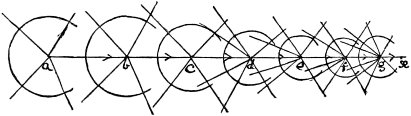
Fig. 68.
Now, the method of producing artificial breeds, sometimes
consciously, sometimes unconsciously, is, briefly,
as follows: Suppose it be desired to obtain a variety
of an animal, say a dog, having a certain character.
We start from a common type, a (Fig. 68). If this type
were allowed to breed naturally, the slight divergent
variation of offspring represented by the radiating lines
would neutralize one another by interbreeding, the individual
differences would be “pooled” in a common
stock, and the species would remain substantially constant.
But if among all these slightly divergent varieties
we select one, b, which seems in the right direction,
and ruthlessly destroy all the others (indicated by
crossing them out by the circular line), and breed this
variety, b, only, we shall get again a number of divergent
varieties. It may be that the larger number
of these will be backward, in the direction of the original
type a, on account of the ancestral heredity in
that direction, but some will again be in the desired
direction. Let all the varieties other than the desired
one, but especially the backward-going or reverting
ones, be again destroyed, and the one kind only selected
which seems to be in the right direction, viz., c. As
we push the form thus from generation to generation
in the desired direction, especially if we attempt to
hasten too much the process, the resistance to movement—if
I may use the expression—in that direction
becomes greater and greater (shown by the decreasing
distances between the successive points of divergence,
a, b, c, d, etc.), and the tendency to reversion becomes
stronger (shown by the greater number and length of
the backward-going lines), until finally it is almost
impossible to push any farther. We will suppose that
x is such a limit. But if, now, we breed true on the
point x, destroying the reversions or backward variations
for many generations, we will gradually accumulate
a fund of ancestral heredity on this point which
increases with every added generation, until finally the
tendency to reversion becomes small. The variety
breeds true without further interference, or with only
very general superintendence. Such a permanent variety
is called a race. After a race is firmly established
for a sufficient length of time, and the tendency to
reversion is lost, it may itself become a new point of
departure for the formation of new varieties or races,
in the same or other directions. Thus, during even the
brief history of man, have been formed races of the
different domestic animals, and useful and ornamental
plants, differing so greatly from each other that, if found
in the wild state, they would unhesitatingly be called
different species, or even in some cases different genera.
Now, if art can vary form so greatly, and in so
short time, why may not Nature in limitless time? If
art by artificial selection, why not Nature by natural
selection? Nature is as rigid in selection and as ruthless
in destruction: why may we not expect similar or
even much greater results? The process is similar in
the two cases—i. e., selection among varieties in offspring,
only that the selection is natural instead of
artificial, and the process is so slow that there is little
tendency to reversion in the latter case. Suppose,
then, we have a gradually changing physical environment,
or climate. Among the divergent varieties of
any species in each generation, those would be preserved
which are most in accordance with the new
climate, and the others would perish. This is natural
selection, or survival of the fittest. Add to this the
effect of the change in the organic environment. All
species are modified by the changing physical environment;
but these modified species again all affect one
another in the competitive struggle for life, and the
strongest or swiftest, or most cunning, survive (natural
selection). Add to this, again, the struggle among
the males for possession of the females—for reproductive
opportunities—by which only the strongest and most
courageous, or the most beautiful and attractive, leave
progeny which inherit their peculiarities (sexual selection).
Add to these, finally, migrations, voluntary
among higher and involuntary dispersals among lower
animals and plants, and the consequent mingling of
faunas and floras—the migrations subjecting them to
great change of environment, both physical and organic,
and the mingling producing fiercer struggle for
life—and we have in powerful operation many causes
of modification. Add, I say, all these causes of modification
together, and then make the process slow and
continuous through unlimited time, and where is the
limit to the degree of change? Commencing in any
species, from any point of departure, there are formed
first slight modifications which would be called varieties;
then these modifications, continuing in the same
direction, form races; these races by wider separation
become species, and species in their turn become genera,
etc. Comparing, again, to a growing tree, varieties
are swelling buds; when they grow into twigs,
they are species; when they branch again into different
species, the branching stem becomes a genus, etc.
We have thus far spoken only of the various forms
of one factor, viz., the Darwinian factor of selection,
whether natural or artificial. We have dwelt upon this
one, because the natural and the artificial processes are
so similar, and the artificial is so controllable. But there
are other factors in operation, in art as well as in nature.
We have already spoken (p. 73) of other factors
of natural change. We have shown how changing
physical environment affects function, and function
affects form and structure, and how these slight
changes are integrated by heredity through many generations.
We have also shown how use or disuse increases
or diminishes the size and change the form of
parts, and these changes, also, however slight, are integrated
by heredity.
Now, these factors are operative also in domestication
of animals and cultivation of plants. No environment
is so new and peculiar as domestication and cultivation.
The soil and temperature in plants, food and housing of
domesticated animals, tend to change form and structure
of the offspring, although in a way which it is difficult
intelligently to control, and thus are prolific of varieties
from which to select. In fact, they often give rise to
great and unexpected modifications, called sports, which
form points of departure for new varieties and races.
Now, in nature, not only are all these causes and factors
of change in constant operation, but they act together in
a peculiarly complex way. All the members of a fauna
and flora, and the physical environment of any locality,
constitute together a most complex and delicately adjusted
system of correlated parts. A change in one part
is propagated through the whole system; also, a change
in one factor affects all other factors. When we add to
this the large amount of time, in comparison with individual
human life and observation, necessary to produce
visible change of form, we can easily understand why the
process is still imperfectly understood, although the fact
is certain.
But it will be asked, Are there, then, no differences
between the artificially made extreme varieties equivalent,
so far as difference of form is concerned, to species,
and real natural species? There are. If there were not,
there would never have been any doubt about the derivative
origin of natural species. But if it be asked, Are
not these differences fundamental, and therefore fatal to
the argument for evolution derived from this source?
we answer, we think not. We will deal frankly and
fairly with these differences.
First Difference, Reversion.—The strong tendency
of artificial varieties to reversion, even during the process
of formation, and especially their complete reversion to
the original type if the hand of man be withdrawn—i. e.,
if left to themselves, or become wild—is supposed to show
an essential difference between such varieties, however
extreme, and true species—is supposed, in fact, to prove
an indestructible permanency of specific types. Nature
disowns these artificial forms, and as it were brands them
with bastardy. Not only so, she strives ever to destroy
them. The supporting hand of man is necessary to
sustain them. Left to themselves and to Nature, they
quickly revert to the original type. If all the extreme
varieties of dogs, from the greyhound and Newfoundland,
on the one hand, to the terrier and lap-dog on the other,
were turned loose on an isolated island, uninhabited by
man but full of other animals, and left there to shift for
themselves—and the island were visited again after a
lapse of a hundred or a thousand years—it is probable
that a uniform species, something like to, though perhaps
not identical with, the wolf, would be found. They
would have reverted to the original or nearly the original
wild type from which they were produced by domestication.
All or nearly all that was done by man would
have been undone by Nature. This reversion is one test
of species.
But the reason of this tendency to reversion is obvious:
First, the time was too short, the rate of change
was too rapid, in the artificial formation of these varieties.
There was not time enough to accumulate a fund of heredity
on each successive stage of the change. Therefore
the form is unstable and the tendency to revert is strong.
Compare the fleeting days and the hurrying impatience
of man with the infinite time and the divine patience of
Nature! But mere instability is not the principal cause
of reversion. Secondly, in the case of artificial forms in
a wild state, natural selection compels reversion. Every
species in a wild state must of course be in harmony with
the environment. But artificially made forms are in
harmony with the artificial environment of domestication,
but not with the environment of nature. In nature
the fittest survive, but artificial breeds are not fit to survive
in a state of nature. They are therefore quickly
destroyed in the struggle for life, or must be modified.
Nature immediately begins to select the fittest, and
gradually in the course of time produces one or more
uniform species, similar to that from which they came,
or perhaps to what they would have been by this time if
left to the operation of natural causes under the conditions
supposed. But natural species, if they are formed,
as the derivationists suppose, by the operation of natural
causes, can not revert unless the conditions revert; for
the same causes which operated to produce, still continue
to operate to keep, the species. Take an example:
The form, the habits, and the instincts of the pointer
have been made by a slow process of artificial selection
of divergent varieties of offspring, and by training of
individuals continued and its effects accumulated through
many generations. But this form and these habits and
instincts, so laboriously produced, would be quickly destroyed
by Nature. The pointer, left to himself, must
either change or become extinct, because not adapted
to the wild state. Such instincts and habits would
not only be of no use, but would be incompatible with
success in the struggle for life. But suppose for a moment
that these habits and instincts were useful to
the animal in a wild state; evidently they would be instantly
seized upon by natural selection, and not only
perpetuated but intensified until a very distinct species
would be produced. The same is true of all other races
of dogs. If the Newfoundland, the greyhound, and the
pug were all turned loose in a forest, and if each of these
kinds were admirably adapted to some place in the economy
of Nature—for some special mode of food-getting
without corresponding disabilities in other directions (as
must be the case if made by natural selection)—there can
be no doubt they would each survive, and their characters
intensified; intermediate forms would disappear (for
reasons which we shall see presently), and we would soon
have three distinct species, or perhaps we would even
call them distinct genera.
Second Difference, Intermediate Forms.—Natural species
are distinct—marked out with hard and fast lines—while
artificially-made races, even though in their typical
forms they differ as much or more than natural species,
shade into one another by insensible gradations. In answer
and explanation of this difference we remark: If
species or modified forms of any kind, whether natural
or artificial, are made by natural causes, and not at once
out of hand by supernatural creation, then of course
there must have been gradations in the process of making.
Now, in the artificial case, the whole process as
well as the result lies within the limits of observation,
while in the natural case only the final result. But it
will be asked, Why are the gradations not seen also in
the final result? We answer, because the intermediate
forms are eliminated in the struggle for life, and not reproduced
by cross-breeding. If artificial races always
bred true—i. e., without crossing, as natural species do—they
would probably soon be as sharply demarked. Cross-breeding
is the great cause of the shadings between domestic
races. This brings me to the third and most important
difference.
Third Difference, Cross-Fertility.—Artificially-made
races breed freely and without repugnance with one another,
and the offspring of such cross-breeding is indefinitely
fertile. Natural species will not usually unite
with one another, being prevented by sexual repugnance
and other causes. Or, if they do sexually unite, there
is either no offspring, or else the offspring is sterile,
and therefore the intermediate form dies out in the
first generation; or else the offspring is imperfectly
fertile, and therefore the intermediate form is eliminated
in a few generations, and the species remain
distinct; or else the offspring is more fertile with the
parent stocks, and therefore revert to the parent stocks,
and still the species remain distinct. Such infertile, or
imperfectly fertile, offspring—the result of crossing of
species—are called hybrids.
This is regarded as a most important test of true
species, as contrasted with varieties or races. There
are two bases on which species may be founded. Species
may be based on form, morphological species; or
they may be based on reproductive functions, physiological
species. By the one method a certain amount
of difference of form, structure, and habit, constitutes
species; according to the other, if the two kinds breed
freely with each other and the offspring is indefinitely
fertile, the kinds are called varieties, but if they do
not they are called species. The two tests, however,
do not always accord. Every now and then we find
undoubted morphological species which may be crossed
and produce indefinitely fertile offspring. Yet it is
certainly true that species are usually cross-sterile, while
varieties, whether natural or artificial, are cross-fertile.
In explanation of this important difference, let it
be observed that there are here two things which must
be kept distinct in the mind, although they are, doubtless,
closely allied—viz., sexual repugnance (psychological
element) and cross-sterility (physiological element).
The former is found, of course, only in the higher
animals, where fertilization is voluntary. The latter is
universal among all living things. This latter, therefore,
is the more fundamental and essential element,
and the former may be regarded as its psychical sign
in the higher animals. It is of this latter, therefore—i. e.,
cross-sterility—that we shall speak mainly.
Suppose, then, we have growing together in the same
locality many species of pines or oaks, or other anemophilous
trees. The whole air is filled with the pollen
of many species, and every germ-cell must receive many
kinds of male cells, and yet there are no hybrids, but,
on the contrary, the species remain distinct. So also
in case of hermaphrodite animals, where the fertilization
is involuntary; many aquatic species are found together
in the same locality, and the water is filled with sperm-cells
of many different species. Many kinds of sperm-cells
must fall on each germ-cell, and yet there are no
hybrids; the species remain distinct. In all such cases
we must suppose that there is, among the different kinds
of male cells, a struggle for the possession of the germ
or female cell, or a sort of sexual selection by the female
cell among the competing male cells, and the fittest—the
most in accord; i. e., those of the same species—prevail.
This is universal. But in the higher animals,
in addition to the prepotency of male cells of the
same species, and comparative infertility in case of union
of those of different species, sexual attraction and sexual
repugnance contribute to the same result, and species
are thus doubly separated. Thus sexual selection is of
two kinds: selection of individuals for union (psychical),
and selection of sperm-cells for fertilization (physiological).
The one kind is usually the sign of the other—attraction
the sign of fertility, and repugnance of sterility.
But in the domestic state it is all otherwise. Free
competition between individuals or between cells is not
allowed. Thus, for example, among plants, crossings
may be forced and hybrids made in gardens which would
never occur in Nature. The florist prevents fertilization
in the same kind and compels fertilization of a different
kind. If male cells of the same kind were allowed to
compete, the result would be different. Doubtless the
same method would succeed in many lower animals.
So also in higher animals free competition and sexual
selection for union are often not allowed, and therefore
animals of different species, such as the horse and the
ass, unite, which would not do so if they were free to
select as in the wild state. These two are widely distinct
species, sometimes even called genera, and therefore
the offspring is infertile; but two closely allied
species, such as two species of wolf, or of the fox, in a
domestic state would probably not only unite but produce
indefinitely fertile offspring. In fact, it is almost
certain that the dog was made by a mixture of several
species of wolf, most, perhaps all, of them now extinct.30
On the other hand, it is not at all certain that the
extreme varieties of dogs have not passed the limit of
greatest attraction, and therefore of greatest cross-fertility,
and that, if allowed free choice, as in Nature,
they would not breed true, or tend to breed true, with
their own kind, and intermediate kinds die out in the
struggle for life.
Law of Cross-breeding.—Before going any further in
this discussion, it is necessary to bring out another
point of extreme importance in the formation of varieties,
both natural and artificial—a point which I believe
throws light upon the very significance of sex
itself—I refer to the effect of cross-breeding.
It is a curious and most significant fact that different
varieties, both natural and artificial, are, up to
a certain limit, not only cross-fertile and cross-attractive,
but even more so than individuals of the same
variety. Long experience has shown that very close
breeding of the same variety for a long time fixes the
kind but weakens the stock, especially in fertility, while
judicious crossing of varieties strengthens the stock,
increasing its fertility, and especially producing plasticity
or variability. Therefore breeders, if they wish
to preserve a valuable variety, breed close; but, if they
wish to make new varieties, cross-breed. But we have
already seen that species are usually cross-sterile. Therefore
there must be some regular law of increase to a
maximum, and again decrease to zero. It is this law
that I now wish to investigate.
In the lowest animals and plants multiplication of
individuals and the continuance of the kind are independent
of sex, and therefore in such there may be no
sex at all. The sexual elements are not yet differentiated.
An individual divides itself into two; each
grows to the original size and again divides into two,
and so on, it may be indefinitely. In this lowest form
of reproduction the individual is sacrificed to the kind,
or else we may regard the kind as an extension of the
individual, and reproduction as a modification of growth.
But there are other sexless modes of reproduction, found
in nearly all plants and many lower animals, in which
the individuality is not sacrificed. The next step in
the ascending scale is reproduction by budding. In
this case a bud is formed which grows into a perfect
individual, and may remain attached to the parent
stalk, forming together a compound individual, as in
most plants and many lower animals, such as the coral;
or it may separate and assume independent life, as in
some plants and many lower animals. In still other
animals, as in many hydrozoa, the budding function is
relegated to a special part, which thus becomes a reproductive
organ. The next step is the placing of the
budding organ, for greater safety, in an interior cavity.
This is the case with aphids. Now, why would not
this be an excellent mode of reproduction for all animals,
man included? Why was sex introduced at all?
There are very sufficient reasons, of many kinds, which
may come up later; but the fundamental reason, in
connection with evolution, is the funding of individual
differences in a common offspring, thereby giving to the
offspring a tendency to divergent variation.
Now, non-sexual reproduction is absolute true breeding.
The law of like producing like is absolute. Heredity
is all-powerful, and tendency to variation is nil.
These modes of reproduction are in fact but a modification
of growth and an extension of the individual. Evolution-changes
in animals produced in this way only
must be very slow, since the most powerful factor of
evolution, viz., natural selection among divergent varieties
of offspring, would be wanting. In the earliest times,
therefore, before sex was yet declared, we may imagine
that physical environment was the great and only factor
of change. Sexual reproduction introduces the new element
of variation of offspring from which Nature makes
her selections; and this element of variation is apparently
the result of the union of diverse individuals, and
the funding of these differences in a common offspring,
and thus a double inheritance of individual characteristics
from the parents and a multiple inheritance of the
same from the ancestry. See, then, with this end in view,
the pains Nature has taken to make the difference between
the uniting individuals and the diversity of inheritance
by the offspring as great as possible, and yet the
gradual way in which she has accomplished it. As already
said, the lowest form of reproduction is that by
fission. Next comes budding in any part indifferently.
Next comes the relegation of the budding function to a
particular part. This is the first appearance of a reproductive
organ. Next comes the placing of this organ,
for greater safety, within. Thus far all is non-sexual
reproduction—all a modification of growth—an extension
of the individual, like the propagation of plants by cuttings
and by buds. Then comes sexual reproduction in
its lowest forms.
It may be well to stop here, to show the entire difference
between this and non-sexual modes. The latter, we
have seen, is only a modification of growth, an extension
of the individual. Now, sexual reproduction is the opposite
of all this. Growth is a constant multiplication
of cells. One cell is ever becoming two similar cells—or,
if we call them individuals, one individual is ever becoming
two similar individuals. But in sexual reproduction
we have an exactly reverse process. Reduced to its simplest
terms, sexual reproduction is the fusion of two diverse
cells, sperm-cell and the germ-cell, to form one cell,
the ovule—literally, a diverse twain forming one flesh.
In its higher forms it is the union of diverse individuals
to bring about the same result. Instead of one cell becoming
two, it is two cells becoming one; instead of one
individual becoming two in the offspring, it is two individuals
becoming one in the offspring. But this great
change was not brought about at once, but only in the
most gradual manner. First, the sexual elements—sperm-cell
and germ-cell—are separated, but in the same organ.
Then the organs—spermary and ovary—are separated,
but in the same individual. This is the condition of self-fertilizing
hermaphroditism so common among plants
and lower animals. Then comes cross-fertilizing hermaphroditism;
and Nature takes much pains and uses
many ingenious devices to prevent self-fertilization and
insure cross-fertilization. Now, for the first time, we
have slight individual differences funded in a common
offspring. Then, in order to absolutely forbid self-fertilization,
and at the same time allow greater differences in
the crossing individuals than could be attained in hermaphroditic
individuals, the sex organs are separated in
different individuals, and fertilization can only take
place by voluntary union. Then, to insure the union of
suitable individuals, and forbid the ban between unsuitable,
there are introduced sexual attraction and repulsion.
Then, last of all, the difference between the two sex-individuals
becomes greater and greater as we go up. It
is conspicuous only in vertebrates and some insects, and
very conspicuous only in birds and mammals.
We see, then, as we go up the taxonomic, and undoubtedly
also the phylogenic series, that there is a cross-breeding
of more and more diverse individuals, a funding
of more and more divergent characteristics in a common
offspring. Why is this? I answer, for the sake of better
results in the offspring. This is abundantly shown
by direct experiment. In hermaphroditic plants in which
there may be either self-fertilization or else cross-fertilization
with other individuals of the same species, the latter
produces better results in number and vigor of offspring.
But there are other advantages, more difficult to prove
but none the less certain, and of the greatest importance
in evolution: First, as already stated, complexity of inheritance,
like complexity of composition in a chemical
substance, gives instability to the embryo, and thus liability
to variation in the offspring; and this in its turn
furnishes the material for selection of the fittest. Again,
it seems to me that there is a direct tendency to improve
the offspring by a sort of struggle in the embryo among
the various qualities inherited from both sides, and a
survival of the best and strongest—a sort of pre-potency
of strong qualities.
Can divergence of uniting individuals and the funding
of diverse characteristics go any further? It may.
The differences of the uniting individual may be still further
increased, and the resulting offspring still further
improved by the cross-breeding of different varieties of
the same species, for we thus add varietal differences to
sexual differences in the uniting individuals. It is well
known that too close breeding, or consanguineous breeding,
or breeding in and in, as it is variously called, if
continued long, has a bad effect on the offspring, weakening
the stock, while judicious crossing of varieties within
certain limits of difference has a good effect, strengthening
the stock and increasing its fertility. It probably
does so in two ways: one direct, by funding many diverse
qualities from both sides, and the survival in the offspring
of the strongest and best; the other indirect, by
giving plasticity, instability to the embryo, and variability
to the offspring, and therefore abundant material
for the operation of selection, either by man or by Nature.
We said, “within certain limits of difference.” If
the difference is extreme, as in extreme varieties and
races, then the effect becomes again bad, and more and
more so as the limit of specific difference is approached;
at which limit at last Nature shuts down and forbids the
bans. Thus, then, there is in cross-breeding a regular law
of effect, increasing to a maximum and again decreasing,
which may be graphically represented by a curve (Fig. 69).
In this figure the horizontal line represents the ordinary
level of the type; distances on this line represent
differences, individual, varietal, or specific; ordinates
above or below represent the effect, good or bad, of crossing.
Thus s s′ represent two species, and the line between
represents their specific differences; r r′ represent different
races or permanent varieties; v v′ two strong varieties;
d d′ ordinary individual differences; c c′ close resembling
or consanguineous individuals. The undulating line represents
the effect of crossing these various kinds. It is
seen that “in-and-in breeding,” c c′, produces bad effect
(negative ordinates); breeding of ordinary individual
differences, d d′, keeps the stock at the ordinary level—in
its typical form; crossing two strong varieties, v v′, produces
maximum good effect (positive ordinates); crossing
decided races produces again bad effects, which become
infinitely bad as we approach species, S S′.31
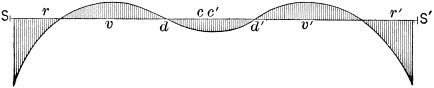
Fig. 69.
It is generally admitted that long-continued very close
breeding has a bad effect. Even in plants, Darwin has
shown that cross-fertilization has better effect than self-fertilization,
this last being of course the closest possible
breeding. But it is probable that the principal bad effect
is not on the stock but on the process of evolution. Very
close breeding weakens the stock, ordinary breeding of
individual differences maintains the stock at the ordinary
level and fixes it. Cross-breeding of varieties
strengthens the stock, and also (and this is its main
advantage) produces plasticity in the stock, gives rise to
strong divergent variations, or even sports, and thus becomes
a main agent in evolution. It is probable, moreover,
that the higher the function the more sensitive is it
to these effects of breeding. Therefore, the effect is greater
in man than in any other animal. It is true that many
have doubted the bad effect of close breeding in man,
and have brought forward formidable statistics to substantiate
their position; but these doubtless take no account
of the most important function, the psychic, and especially
the most important element in every function, so
far as evolution or progress is concerned, viz., plasticity
or capability of progressive improvement. The tendency
of consanguineous breeding, or even the breeding of persons
of like character and experiences, as in an isolated
community, is, if not to deteriorate the physique, at least
to fix, stereotype the character, and thus to check social
progress. Contrarily, the crossing of varieties of the
same race seems not only to strengthen but, by the diverse
inheritance, to produce plasticity of character and capacity
for progress. But the difference between the primary
races seems too great for crossing with advantage.
Some degree of sexual repugnance which undoubtedly
exists between the primary races is the psychical sign of
this fact.32
If, now, we go back to what we said before taking up
this subject of the effect of cross-breeding, we at once see
that there is an apparent flaw in all our reasonings. If
close in-and-in breeding produced better and more numerous
offspring than cross-breeding between slight varieties,
then, indeed, such varieties would be preserved,
and increase in divergence from generation to generation
until they became species. Or, in any case, if, in
any way, divergence could reach the point of extreme
varieties or races, or what are called sub-species, then
commencing cross-sterility would complete the separation,
and thus form true species. But how can the process
of progressive divergence begin, when slight varieties
are even more fertile by cross-breeding than by close
breeding? Is it not evident that, with every generation,
the slight varieties would cross-breed with one another
and with the parent stock, and thus all varietal differences
would be funded into a common stock, and the
type would be preserved unchanged? This, as already
pointed out (p. 76), has always been the chief difficulty
in the way of imagining how varieties can grow into species;
and the difficulty is only increased by our discussion
of the law of cross-breeding. Now, just here, Dr.
Romanes’s most important and prolific idea comes to our
help, and, as it seems to us, completely solves the difficulty.
According to Dr. Romanes, no organ is so subject
to variation as the reproductive, and this in no respect
so much as in degrees and kinds of fertility—we might
almost say so subject to freaks of cross-sterility. Now,
suppose we start with any well-defined species in a state
of nature. With every generation there are many
slightly divergent individual varieties, some greater and
some less; but these are all immediately swamped by
crossing with one another and with the parent stock,
and the species remains unchanged. But suppose among
these divergent variations there arise, from time to
time, some which affect the reproductive organs in such
wise that the variety, though perfectly fertile with its
own kind, is infertile, or imperfectly fertile, with other
varieties, and especially with the parent stock. The
change may be only in the time of flowering in plants,
or season of heat in animals, or it may be actual infertility
in sexual union. Right here we have the beginning
of a new species. The variety is sexually isolated
from the parent stock by cross-sterility, and
therefore all its peculiarities, however trivial, are preserved
by true breeding. Cross-breeding is necessary to
make species, but true breeding preserves them. Cross-breeding
tends ever to make varieties, but immediately
destroys them again. This constant forming and swamping,
separating and again merging of varieties, like
mixing of dough, makes the whole mass (stock) more
and more plastic and subject to variety. This plasticity
finally gives rise to varieties of the kind which
produces species by sexual isolation. By continued
merging the centrifugal forces continually increase, but
are continually repressed by crossing, until finally varieties
break away to form species.
Now it is easy to see, from this point of view, why
artificial varieties are cross-fertile. It is because in
artificial breeding we are intent only on making varieties
in form, size, color, etc., and not at all on making
any characterized by cross-sterility with the parent
stock. Cross-sterility with the parent stock, or with
other varieties, would be of no advantage, because we
control the breeding, and can breed true if we desire.
Sexual isolation is not necessary, because we can use
physical isolation. On the contrary, such cross-sterility
would be a positive disadvantage to the breeder, by
limiting the range of his experiments just where they
would be most prolific in making new varieties. Hence,
as might be expected, all domestic varieties are cross-fertile,
unless it be the extreme varieties, which may,
in some instances, have passed the limit of greatest
fertility.
If this idea be true, then species which have originated
in the same locality ought to be always cross-sterile,
but species which have grown up apart, in widely
separated geographical regions, ought to be sometimes
cross-fertile, because they were isolated by physical not
by sexual barriers. Such, Dr. Romanes thinks, is a fact.
It is, however, a very important point, which ought to
be carefully investigated. We say “sometimes.” It is
probable that most geographical species also are cross-sterile;
for, although the isolation by cross-sterility of
slight varieties be the main cause of the origin of species,
yet a species formed by isolation of any other kind
will gradually become cross-sterile with other species.
Although cross-sterility be the main cause of divergence,
yet divergence beyond a certain limit, however caused,
will bring about cross-sterility, because the reproductive
organs will partake of the general change going on in
every part.
Application.—Suppose, then, a species breeding naturally
in a wild state. Individual varieties are constantly
being formed and again funded back into the common
stock by cross-breeding. If the varieties thus formed
be decided, the cross-breeding will strengthen the stock,
and especially will preserve and increase its plasticity or
tendency to variation. Finally, among the widely divergent
varieties there is one affecting the reproductive
organs of several individuals in such wise that they are
infertile, or imperfectly fertile, with the parent stock,
though perfectly fertile among themselves. These form
a new species, which continue to increase indefinitely.
Objection answered.—This view completes the answer
to an objection which is often made to evolution: “If
natural species are formed by transmutation, why is it
we do not find intermediate links? Why is not organic
nature made up only of individual forms, shading insensibly
into each other in such wise that classification
becomes a mere device to handle more conveniently
complex material? Why is it that groups, especially
species, are marked out with hard and fast lines?”
We have heretofore answered this by saying that intermediate
forms are eliminated. So they are, but how?
Dr. Romanes’s idea of physiological selection largely
answers this. It is by the funding of ordinary varieties
into a common parental stock by crossing, and
separating specific varieties by cross-sterility. Thus the
organic field is broken up into points about which
variations oscillate. As every mass of matter, when
closely examined, is found to consist of aggregations
about centers of cohesive attraction as discrete granules
or crystals, and only exceptionally do we find a homogeneous
vitreous structure; even so organic forms aggregate
about points of sexual attraction, and the whole
mass consists of discrete species, and only exceptionally—i. e.,
in domestication—do we find insensible shadings.
Now, species are the smallest aggregate of individuals,
as granules are of molecules. Species are more
distinctly marked out by hard and fast lines than are
other taxonomic groups only because they are the last,
going downward, that are cross-sterile—because right
here is the change from cross-sterility to cross-fertility.
If this view be true, then in the same locality species
ought to be always distinct and without shadings.
If we find shadings at all, it ought to be in intermediate
geographical regions, where isolation is not sexual
but physical. Now, this is exactly what we find to be
the fact. Innumerable examples of such intermediate
forms in intermediate geographical regions are now
known, especially among birds and reptiles, and examples
have so increased in modern times, by closer study,
that naturalists, especially ornithologists, have been compelled
to resort to a trinomial nomenclature in order
to designate these geographical sub-species.33
If any further explanation is necessary, it will probably
be found in the following suggestions:
1. The number of individual varieties constantly
being formed is almost infinite, but the number of
places in nature is very limited. Now, among the infinite
number of slight individual varieties formed with
every generation, the competitive struggle will be severest
between those most nearly alike, because they are
competitors for the same place. Only one kind succeeds,
viz., the fittest. Intermediate forms are, therefore,
exactly those which are eliminated in the most
wholesale way. 2. Add to this the fact that, as soon
as divergence, from whatsoever cause, reaches a certain
point, sexual repugnance or cross-sterility, or both, come
in to perpetuate and increase the separation already
commenced. 3. Add to this, again, that migrations in
higher animals, and involuntary dispersals in lower animals
and in plants, and the mingling together of different
faunas and floras, produces a still fiercer struggle
for life, especially between natives and invaders, and
thus great numbers of forms are destroyed; all but the
fittest are weeded out, and therefore the distinctness of
the remainder is greatly increased. Periods of great
changes of physical geography and of climate, and therefore
of wide and general migrations, are also periods
of great weedings-out of unfit forms. Thus it happens
that existing faunas and floras are little else than isolated
remnants.
To illustrate, again, by a growing tree: If all the
buds of a tree lived and grew, they would soon become
so numerous that they would together form a solid
hemispherical mass, like a coral-head, with no room
between for leaf or light or air. But ninety-nine one-hundredths
of buds die in the struggle for light and
air, and therefore the survivors are distinct growing
points, widely separated from each other. Species are
such extreme, but separated, twiglets of the tree of life.
Objection.—But it will be objected, again: The twig-points
are, indeed, separate, but the twigs themselves
must meet somewhere lower down, where they began
to grow. Intermediate links may be wanting now, but
they must, of course, have existed once—i. e., in previous
geological times, and therefore ought to be found
fossil. In distribution in space or geographically, organic
kinds may be marked off by hard-and-fast lines, but,
if their derivative origin be true, in their distribution
in time or geologically, there ought to be many examples
of insensible shadings between them. In fact, if we
only had all the extinct forms, the organic kingdom,
taken as a whole and throughout all time, ought to
consist not of species at all, but simply of individual
forms, shading insensibly into each other, like the colors
of the spectrum, and our classification ought to be a mere
matter of convenience, having no counterpart in nature.
But this is not the fact. On the contrary, the law of
distribution in time is apparently similar in this respect
to the law of distribution in space, already given (page 169).
As in the case of contiguous geographical faunas,
the change is apparently by substitution of one species
for another, and not by transmutation of one species
into another. So also in successive geological faunas,
the change seems rather by substitution than by transmutation.
In both cases species seem to come in suddenly,
with all their specific characters perfect, remain
substantially unchanged as long as they last, and then
die out and are replaced by others. Certainly this
looks much like immutability of specific forms, and
supernaturalism of specific origin. We have, we believe,
satisfactorily explained this in the case of geographical
distribution (page 201), but how can we explain
it in the case of geological distribution?
Answer.—1. The reason for this, given by Darwin
and other evolutionists, is the extremely fragmentary
character of the geological record. If the existing
faunas and floras are but isolated remnants, the rest
having been destroyed by migrations and conflicts, how
much more are fossil faunas and floras but fragmentary
remnants, the rest having been lost, partly because never
preserved, and partly by destruction of the record! If
from this cause existing species are widely separated,
how much more ought we to expect to find fossil species
distinct and widely separated!
This is undoubtedly in most cases a true and sufficient
answer, yet we think the fragmentariness of the
geological record has been overstated. While it is true
that there are many and wide gaps in the record; while
it is true, also, that even where the record is continuous
many forms may not have been preserved, yet there are
some cases, especially in the Tertiary fresh-water deposits,
where the record is not only continuous for hundreds
of feet in thickness, but the abundance of life
was very great, and the conditions necessary for preservation
exceptionally good. In such cases the number
of fossil species found on each horizon seems to be as
great as in existing faunas over equal space. The record
in these cases seems to be continuous and without
break, and crowded with fossil forms; and yet, although
the species change greatly, and perhaps many times, in
passing from the lowest to the highest strata, we do
not usually, it must be acknowledged, find the gradual
transitions we would naturally expect, if the change
were effected by gradual transformations. The incompleteness
of the record, therefore, although a true and
important cause, is not the whole cause.
In further and completer answer to this greatest of
all objections, we will throw out the following suggestions:
2. We must remember that considerable latitude is
allowed by the anti-derivationists to variation of species;
so much so, indeed, that it is often difficult to draw the
line between well-marked varieties and closely-allied species.
Now, according to the derivationist, these strong
varieties, breeding usually true, are naught else than
commencing species.
3. On every side and everywhere, both in existing
faunas and in fossil forms, but especially in the latter,
we find innumerable examples of transitions, or intermediate
forms, between all the higher groups, such as
genera, families, orders, and classes. It is, in fact, by
means of these that the great law of differentiation
from generalized types has been established. It is,
therefore, only between species that such intermediate
forms are rare.
4. But even between species such intermediate forms,
though rare, have been pointed out, both in existing
and in extinct faunas. But the opposition contend that,
in all such cases, the previously supposed species are
only varieties. We have already (page 61) spoken of
the obvious fallacy involved in this position. Species
are first defined as forms distinct and without intermediate
links, and then we are challenged to find such
links; and when, with much labor, we find them, they
say the supposed species are not species, but only varieties.
But there are some cases in which this subterfuge
will not do. There are cases in which the transitions
are between forms so extreme that they can not, by any
stretch of the term, be called varieties. We will select
and dwell upon but one striking example, viz., the fossil
forms of the Tertiary fresh-water deposits of Steinheim.
In Würtemberg, near the little village of Steinheim,
are found certain strata of sand and lime, which are evidently
deposits from a small lake of Tertiary times. The
deposits are extremely rich in fossil shells, especially of
the different species of the genus Planorbis. As the deposits
seem to have been continuous for ages, and the
fossil shells very abundant, this seemed to be an excellent
opportunity to test the theory of derivation. With
this end in view, they have been made the subject of exhaustive
study by Hilgendorf in 1866,34 and by Hyatt in
1880.35 In passing from the lowest to the highest strata
the species change greatly and many times, the extreme
forms being so different that were it not for the intermediate
forms they would be called not only different
species but different genera. And yet the gradations are
so insensible that the whole series is nothing less than a
demonstration, in this case at least, of origin of species
by derivation with modifications. The accompanying
plate of successive forms (Fig. 70), which we take from
Prof. Hyatt’s admirable memoir, will show this better
than any mere verbal explanation. It will be observed
that, commencing with four slight varieties—probably
sexually isolated varieties—of one species, each series
shows a gradual transformation as we go upward in the
strata—i. e., onward in time. Series I branches into
three sub-series, in two of which the change of form is
extreme. Series IV is remarkable for great increase in
size as well as change in form. In the plate we give only
selected stages, but in the fuller plates of the memoir,
and still more in the shells themselves, the subtilest gradations
are found.
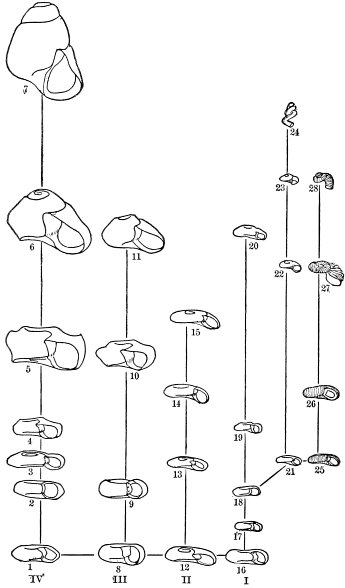
Fig. 70.—Transformations of Planorbis (after Hyatt).
Series IV. 1, Pl. levis: Undorf. 2, Pl. Steinheimensis; 3, tenuis-Steinheimensis;
4, tenuis; 5, discoideus; 6, trochiformis-discoideus; 7,
trochiformis: Steinheim.
Series III. 8, Pl. levis: Undorf. 9, Pl. oxystomus; 10, supremus; 11,
supremus var. turrita: Steinheim.
Series II. 12, Pl. levis: Undorf. 13, Pl. crescens-parvus; 14, 15, crescens:
Steinheim.
Series I. Sub-series 3. 16, Pl. levis: Undorf. 17, Pl. minutus-levis;
18, minutus; 19, 20, triquetrus: Steinheim. Sub-series 2. 21, Pl.
minutus; 22, 23, denudatus-minutus; 24, denudatus var. distortus:
Steinheim. Sub-series 1. 25, Pl. costatus-minutus; 26, costatus;
27, 28, costatus var—: Steinheim.
The specimens from Undorf all belong to an older Tertiary period than
that at Steinheim.
This case is striking, partly because it is a very favorable
one, but mainly because it has been so carefully
studied. There can be no doubt that equally careful
study would reveal the same transition in many other
cases. Nor are such transitions confined to the lower
forms of life, though they are probably more abundant
there. According to Cope, the nicest gradations may be
traced between some of the extinct mammalian species
so abundant in the Tertiary deposits of the West—especially
between the species of the extinct generalized family
of Oredontidæ36 The same is probably true of the
many extinct species of the horse family.
It is interesting to observe that the details of the process
of change in the forms of Planorbis are in accord
with Dr. Romanes’s views. The change does not seem
to have been uniform but somewhat paroxysmal. The
forms seem to remain stable for a long time, and then a
few break into several different forms, while the more
rigid die out. It is as if cross-breeding had kept the
type true, but at the same time increased its tendency to
variation, until finally one or more varieties became sexually
isolated and thus formed new species.
5. But still the question remains: Why are transitional
forms rare in all cases, especially between species—so
rare that they are eagerly sought and highly prized?
I believe that the true reason of this is that the steps of
evolution are not always uniform.
Nearly all evolutionists have assumed and even insisted
on uniformity, as the opposite of catastrophism
and of supernaturalism, and therefore as essential to the
idea of evolution. They say that the constancy of the
action of the forces of change necessitates the uniformity
of the rate of change. But, in fact, this is not always
nor even usually true. Causes or forces are constant, but
phenomena everywhere and in every department of Nature
are paroxysmal. The forces producing storms and
lightning, and volcanoes and earthquakes, are or may be
constant; yet the phenomena are in the highest degree
paroxysmal. Wherever in nature we have a constant
force and a strong resistance, we find more or less paroxysmal
action. For this reason the wind blows in puffs,
the friction of wind on water produces waves, water running
in small pipes issues in pulses. The reason is obvious,
as may be seen by the following examples: Suppose
lifting forces within the earth are resisted by crust-rigidity.
The forces accumulate uniformly until the
resistance gives way, and suddenly we have an earthquake.
Water running with great resistance in small
pipes is checked, but soon accumulates additional force,
which overcomes the resistance, only to be again checked,
and so on, and therefore runs in pulses. Now, the course
of evolution of the whole earth may be likened to such a
current; there are forces of movement and forces of resistance—progressive
forces and conservative forces. The
progressive force is accumulative, the resisting force is
constant. Thus, in all evolution or history, whether of the
earth or of society, there are periods of comparative quiet,
during which the forces of change are gathering strength,
and periods of revolution or rapid change, during which
these forces show themselves in conspicuous effects.
Now, that there have been such periods of rapid revolutionary
change in the history of the earth, there can be
no doubt. The history of the earth is marked by periods
of comparative quiet, during which life was exceptionally
abundant and prosperous, and change of organic
forms slow and uniform—separated by periods of disturbance,
revolution, rapid changes of physical geography
and climate, and consequently of comparatively rapid
and sweeping changes in organic forms. These form the
division-lines between great eras of the earth’s history,
and are always marked by extensive unconformity of the
strata, showing the changes of physical geography above
spoken of, and by apparently sudden and sweeping
change in life-forms, showing the great changes of climate
and other physical conditions. Unfortunately, in
all cases of unconformity of strata, there is, of course, a
break in the continuity of the record; and when the unconformity
is very general a portion of the record may
be irrecoverably lost. The consequence is, that there is
an apparent break also in the continuity of life-forms. It
looks, at first sight, like wholesale extermination of old
and recreation of new forms. But undoubtedly the break
in the continuity of life is apparent only, as is shown by
the loss in the record. If we could recover the whole
record, as indeed we sometimes do, we should find in all
cases that there is no break in the continuity of evolution,
but only more rapid rate of change at these times.
But to this cause of rapid rate of progress—i. e., change
of physical environment—we must add change of organic
environment induced by the physical. We have already
seen (p. 179) that extensive changes in physical geography
and climate are always accompanied by wide migrations
and dispersals of species, the mingling of faunas
and floras, and the severer struggle for life, and the
sweeping weeding-out of all but the fittest, and the
change of these latter, making them still fitter. These
two causes of rapid change, viz., change of climate and
migrations, together with the loss of record, we believe
completely account for those sweeping changes, not only
of species but even of genera, families, and orders which
characterize the passage from one great era to another.
But this does not yet explain the apparent discontinuity
between consecutive species in the same locality in
continuous, conformable strata, or the rarity of transitional
forms when one species takes the place of another
in an apparently continuous record. In such continuous
deposits the successive faunas do indeed gradate insensibly
into one another, but apparently as in contiguous geographical
regions (p. 200) by substitution, not by transmutation.
How shall we explain this?
On this point I throw out some suggestions: 1. In
the modification of species, too, as well as in other progressive
changes, we may imagine two forces operating,
one progressive, the other conservative—the one external,
the other internal. The external progressive force consists
of all the factors of change already mentioned, the
internal conservative is the law of heredity, of like producing
like. A changing environment tends continually
and increasingly to change of organisms, but change is
resisted by heredity, which tends to adhere, within narrow
limits, to the same form. But since the external force
or tendency to change increases constantly—since
the discord between the environment and the organism
becomes ever greater, there must come a time when either
the species is destroyed, or else the resistance of heredity
gives way, and rapid change takes place. The alternative
is presented to the species to transform or perish; and in
one or perhaps in two or three generations we have an
amount of change which, under other circumstances,
might take a hundred generations to accomplish. These
rapid changes are in fact exactly what in artificial varieties
we call sports. We do not know all the conditions
which determine sports in domestication, and still less
what determines large and widely-divergent variations,
and therefore rapid origin of many divergent species, in
geological history. But one thing seems probable, viz.,
that, when a species begins to change, it continues to
change easily and in many directions. When resistance
gives way it takes some time, many generations, for heredity
to gather force again. Hence, young species are
plastic, fluent, because heredity, on any one point, has
not yet accumulated. But as soon as a stable form is
again reached, then, by accumulating a fund of heredity,
the form tends to become more and more rigid, until
often it becomes too rigid to yield to modifying influences,
and therefore becomes extinct. By far the greater
number of species do thus become extinct and leave no
progeny, while the few more plastic forms are modified
in several directions, and the number of forms may, after
a little time, be undiminished or even increased.
2. As to the cause of rapid changes of form during
revolutionary or critical periods in the earth’s history,
Brooks has introduced an idea which is very suggestive,
and deserves serious attention. We have above spoken
of the progressive element as external. Brooks regards
both elements as internal, and represented by the two
sexes. The male represents the progressive, the female
the conservative element. The one tends to divergent
variation, the other to fixity of type by heredity. I
think we will all admit that, as a general rule, in man
(and probably all the higher animals) the male is more
highly differentiated into many divergent forms—the
female is more like the type-form of the species. In
man, the male is certainly more diversified in form, in
expression, and in character. If they have the keenest
ear for musical pitch, they are also most often music-deaf;
if they have the sharpest perception of color, they
are also most often color-blind; if among them we find
the brightest intellects, we also find the dullest and
most stupid; if there are among them more geniuses,
so, also, there are more cranks. The same is also, probably,
true of other animals, in proportion to their grade
of organization. The operation of these two equally
necessary elements is well shown in every advancing
society. The initiative of every movement, in all directions,
good or bad, is determined by the male; the conservation
of whatever balance of good there may be,
seems to be mainly by the female. The male tries all
things, the female holds fast that which is good. By
the one society gains a little in each generation; by the
other the gain is conserved and made a new point of
departure. The one is ever building hastily a scaffolding
and platform; the other ever consolidating into a
permanent structure. Now, according to Brooks, what
is true in the plane of social progress is true also in
the lower plane of organic evolution. In sexual union,
and in the resulting offspring, the sperm-cell is the
element which tends to divergent variation, and the
germ-cell to fixity of type, through heredity. In artificial
breeding, then, we ought to make new varieties by
proper use of the sire; we ought to preserve them true
by proper management of the dam.
But, again, it is believed that in many lower animals,
especially insects, the high-feeding of the mother,
and consequent good condition of the ovum, tends to
the production of female offspring. It seems almost
certain that, in butterflies, the sex is not yet declared
in the caterpillar stage. According to the careful experiments
of Mrs. Treat,37 if the caterpillars be well fed,
they become female butterflies; but, if poorly fed, they
make males. One purpose of this provision of Nature
is, doubtless, to provide for the greater draught on the
vitality of the female in reproduction.
Now for the application. In good times in the history
of a species, when everything is prosperous, external
conditions are favorable, and food is abundant, females
are in excess, and individuals are greatly multiplied.
Under these conditions, evolution would be slow and
uniform. But in bad times in the history of a species,
when external conditions were unfavorable, not only
would there be excess of males, but these, through the
influence of the changing environment, as well as through
the dominance of the male element, would be more than
usually varied in character. Among the strongly divergent
varieties thus formed, the fittest—i. e., those most
in accord with the changing environment—would survive
and leave offspring partaking of their character.
We have already repeatedly said that the severer pressure
of a rapidly-changing environment determines correspondingly
rapid changes in organic forms. It may do
so in many ways; but, according to Brooks, one of the
most important ways is by determining an excess of the
male element.
In brief, then, the causes of rarity of transitional
forms among fossils are—1. The change being, for the
reasons given, comparatively rapid, the number of generations
between consecutive species are few, perhaps
only one. 2. Times of rapid change are also times of
unfavorable conditions, and therefore the number of
individuals in each generation is small, and all the
smaller—in Brooks’s view—because of the fewness of
females. When we remember that fossils are but a
small fraction of the actual faunas and floras of the
time, surely these two causes go far toward explaining
the rarity of links between species. 3. Add to these
the existence of periods of wide-spread changes in physical
geography and climate, and consequent wide migrations
and dispersals of species, and we sufficiently account
for those sweeping changes in species, genera,
families, and orders, which mark the limits of the great
eras, and which are made still more abrupt, and apparently
supernatural, by the loss of record at these times.38
Objection.—There is still one more objection which
will be made. We have drawings of plants, animals,
and men, by Egyptian artists, who lived at least three
thousand years ago, and the species of the one and the
races of the other are still the same. Still better, we
have among the wrappings of Egyptian mummies the
very plants themselves, leaves and flowers perfectly
preserved, and even colors almost perfect. Yet the
species are exactly the same as grow in Egypt to-day.
If species are made by gradual transmutation, surely
there ought to have been some change in three thousand
years.
Answer.—It may be well to note that this apparent
permanence is true of races of men as well as of species
of animals and plants. But the very men who
insist on permanence of species are equally insistent on
the variability of varieties and races. The objection,
therefore, proves too much. We shall not insist on this,
however, because as derivationists we regard races as
naught else than commencing species, and therefore
subject to the same laws. We are not striving for triumph
in debate, but only for truth. The true answer
will, we believe, be found among the following suggestions:
1. Three thousand years seems a long time in human
history, but in geological history it is but a day. This,
the usual answer, is no doubt a true one, but hardly,
we think, sufficient. When we remember the enormous
change which has taken place in faunas and floras since
the end of the Tertiary, if change still continues at the
same rate, surely it ought to be distinctly perceptible
in three thousand years.
2. But we must remember that such changes are
usually more or less paroxysmal; not, indeed, so sudden
as to break the continuity of life, but far more
rapid at some times than at others. The last critical
or revolutionary period of rapid change was the Glacial
epoch. Since that time—i. e., during the human period—a
new equilibrium has been established, and the
changes in organic forms have been very slow.
3. Remember, again, that in evolution all species
do not change. On the contrary, most become rigid,
and either remain unchanged, almost indefinitely, or
else die out and leave no descendants. Only the more
plastic forms change into other species, but usually
into several other species, and thus the number of forms
may be undiminished, even though the larger number
of old forms leave no descendants. It is true, therefore,
of this as well as of other epochs, that the greater
number of species are permanent.
4. It is not impossible—indeed, it is in exact accordance
with the laws of evolution—that organic forms
are more permanent now than ever before. Evolution
is a growth; the forces of growth must exhaust themselves.
Evolution proceeds by constant differentiation
and specialization, but extreme specialization always
arrests evolution. In ontogenic evolution, for example,
cell-structure becomes more and more specialized, but
also thereby more and more rigid, and, when specialization
is complete, evolution stops, and cell-forms are
permanent. It is this which limits the cycle of every
evolution. So is it precisely with evolution of the organic
kingdom, except that the cycle is much longer.
Here, also, every step is by specialization, and yet specialization
fixes the form, and finally arrests the advance
on that line. Thus, throughout the whole geological
history of the earth, the larger number of forms, by
specialization, become rigid and perish, while the fewer,
more generalized, and more plastic forms take up the
march and carry it forward a step, only to be themselves
specialized and fixed. If we compare, again, to a
tree: each twig finishes its growth, flowers, fruits, and
dies; other buds take up the growth and carry it forward.
By specialization the highest condition of a certain
form of life is attained, but other possibilities are
shut off. Extreme specialization is the flowering and
fruiting—the end and completion of twig-life. Now,
obviously, this specialization and respecialization can
not go on forever. When it is complete in every direction
it must cease, and forms become permanent, or else
perish. When it flowers it must die.
Now, is not the advent of man in many ways a sign
of the completeness of organic evolution? Certain it
is that with man there begins an entirely new form of
evolution. Certain it is that with man evolution is
transferred from the organic to the social plane, from
the material to the psychical. Certain it is that the
forces, the conditions and results of this evolution, are
wholly different from those of the other. In organic evolution
the organism must conform to the environment;
in human evolution the environment is made to conform
to the wants of the organism. The one is unconscious
and involuntary, passive under the dominating laws of
Nature; the other is conscious, voluntary progress toward
an ideal, by the use, among other means, of the laws of
Nature. The one is by change of external form—i. e.,
change of species—the other by change of brain-structure.
Now, does not the commencing of the cycle of
this new evolution imply the closing of that of the old?
The two may overlap somewhat now, but it is evident
that, when the cycle of human evolution culminates,
when highly civilized man shall have taken possession
of the whole earth, the whole organic kingdom must
be readjusted to his wants. All organic forms must be
either domesticated or destroyed. Organic forms will
no longer be modified by natural but wholly by artificial
selection.
* * * * *
There are many other supposed objections which have
been urged, but these are mostly not objections to evolution,
but only to some special theory of evolution—Darwinian,
Spencerian, Lamarckian, or other.
Origin of Beauty.—For example, it has been urged
that natural selection can only account for useful structures;
but beauty is as universal and as conspicuous in
nature as use. In many cases Darwin has shown that
beauty is useful, and in such cases it is, of course,
seized upon by selection and intensified. Thus, the
gorgeous coloring of birds and insects is largely due
to sexual selection. Beauty is attractive, and therefore
the most beautiful prevail in securing reproductive opportunities.
This character is, therefore, perpetuated
in the offspring, and intensified from generation to generation.
But, of course, this can apply only to higher
animals, in which the sexes are separate and sexual
union voluntary. It can not apply to self-fertilizing
hermaphrodites; and yet in these, also, we often find
the most gorgeous coloring. Again, Darwin has very
ingeniously and successfully explained the case of the
beauty and fragrance of flowers of hermaphroditic plants
by another principle, viz., that of insect-selection. Insects
are attracted by the most showy and fragrant
flowers, and thus become the means of carrying pollen
from flower to flower, insuring fertilization, and especially
cross-fertilization. The most beautiful and fragrant
flowers are most certain to be fertilized, and thus
beauty and fragrance become useful to the plant, and
therefore are selected and intensified.
These and many other cases of beauty may doubtless
be explained by showing that it is useful; but beauty
which is without any use can not be explained by natural
selection. Now, as already said, the most gorgeous
beauty is lavishly distributed even among the lowest
animals, such as marine shells and polyps, where no such
explanation is possible. The process by which such
beauty is originated and intensified is wholly unknown
to us.
Incipient Organs.—Again, Mivart has drawn attention
to another difficulty in the way of natural selection as an
explanation even of useful organs. Darwin does not, of
course, attempt to account for the origin of varieties.
As we have already seen, he assumes divergent variation
of offspring as the necessary material on which natural
selection operates. He who shall explain the origin of
varieties will have made another great step in completing
the theory of evolution. But not only does not natural
selection explain the origin of varieties, but neither can
it explain the first steps of advance toward usefulness.
An organ must be already useful before natural selection
can take hold of it to improve it. It can not make it
useful, but only more useful. For example, if fins commenced
as buds from the trunk, it is difficult to see how
they could be of any use, and therefore how they could
be improved by natural selection until they were of considerable
size, and especially until muscles were developed
to move them. Until that time they would seem to be
a hindrance to be removed by natural selection, instead
of a use to be preserved and improved. It would seem
that many organs must have passed through this incipient
stage, in which their use was prospective.
Much that is very interesting might be said on these
and similar points of difficulty, but all this lies entirely
aside from the scope of this work. As already said, these
are not objections to evolution or derivation, but only
to Darwinism, or any other special theory, as a sufficient
explanation of the process of evolution. They only show
that we do not yet fully understand this process; that
there are still other and perhaps greater factors of evolution
than is yet dreamed of in our philosophy.
In the foregoing chapters on special evidences, and
especially in the last two, the reader will observe many
points of doubt, discussion, and difference of opinion.
Let it not be concluded on that account that the law of
evolution is still in the region of uncertainty. It can
not be too strongly insisted on that the fact of evolution
as a universal law must be kept distinct from the causes,
the factors, the conditions, the processes, of evolution.
The former is certain, the latter are still imperfectly understood.