Having sketched the main features of the decorative art
of a definite locality, I now pass on to a different field, and
will select examples from every age and clime, in order to
illustrate the life-histories of a number of designs. In this
I have a twofold object. First, I wish to indicate in this
section the material out of which designs and patterns are
formed—the objective originals which become gradually
transformed into æsthetic conceptions; and, secondly, I
also wish to illustrate the fact that this process of transformation
is confined to no one people.
We shall see that the originals of decorative art are mainly
either natural or artificial objects, and the latter will first
claim our attention.
Dr. H. Colley March has introduced the term “Skeuomorph”[18]
for the forms of ornament demonstrably due to
structure. Professor G. Semper[19] “was the first to show that
the basket-maker, the weaver, and the potter originated
those combinations of line and colour which the ornamentist
turned to his own use when he had to decorate walls,
cornices, and ceilings.” So write MM. Perrot and Chipiez;[20]
but this statement is too sweeping. A considerable amount
of ornamentation is doubtless due to technique, but in
Europe, Western Asia, and North Africa plant forms have
had a great influence in the origin of designs, some of
which have been modified by passing through a textile
technique.
Given any object, two forces, so to speak, attack it—the
utilitarian and the æsthetic. The resultant may be an implement
which is solely useful and has little or no beauty to
recommend it; or while retaining a full measure of utility, it
may be beautified in form or in surface decoration; or, lastly,
the object may become so glorified by the artist as to be
translated from earthly use into the realm of æsthetics.
There are numerous examples of the annihilation of the useful
by the beautiful. One instance came under my notice
at the Murray Islands, in Torres Straits. Formerly when a
girl was engaged to be married, in addition to numerous
petticoats she wore a number of ornaments suspended from
her neck and hanging down her back. The more important
of these were white triangular pieces of shell, o, cut out of
Conus millepunctatus; turtle-shell (“tortoise-shell”) bodkins
(ter), used for shredding the leaves of which their petticoats
were made, and for piercing the septum of the nose
of infants; turtle-shell fish-hooks, and curious turtle-shell
ornaments which are called sabagorar. These latter
vary considerably in size, form, and amount of decoration;
but by placing a number of them together a sequence
can be obtained which illustrates the evolution of the
sabagorar from the fish-hook (Fig. 44). Some hook-like
objects are slightly ornamented with incised lines, and they
might very well serve as fish-hooks; others are clearly totally
unfitted for practical use, and may be quite plain or decorated.
Fish-hooks (Fig. 44, A) are used in pairs, being
fastened at each end of a piece of fine string, which, in its
turn, is tied at its middle to the fishing-line proper.
When the piece of twine with its hooks was thrown
round a girl’s neck, the two hooks would often hang down
her back shank to shank. Two sabagorar similarly
arranged occur in the British Museum collections. What
more natural than that this should be noticed, and to save
the trouble of making two sabagorar a double one should be
cut out of one piece of turtle-shell. The more remotely
from the fish-hook did the sabagorar vary, the larger it
became, and in some instances the double form became of
considerable size, and the hook portion acquired a slight
spiral curvature (Fig. 44, K). In one modified specimen the
hooks are actually fused with the shank (Fig. 44, L). It will
be also seen that divergent Λ-like processes often occur on
the sabagorar, but are never found on the fish-hook.
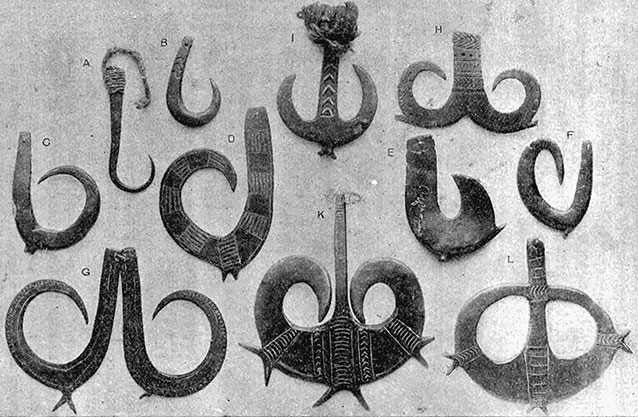
Fig. 44.—Turtle-shell ornaments worn in Torres Straits. The ratio of size of the illustrations to the originals
is as 4:15. A. Ordinary fish-hook, made of turtle-shell. B-L. Series of ornaments, probably
derived from fish-hooks, made of turtle shell. All in the British Museum, from a photograph by
Mr. H. Oldland, of the British Museum.
The betrothal equipment of a girl thus consisted in the
main of objects of utility which had reference to her future
condition. The turtle-shell objects being easily cut, afforded
a convenient field for ornamentation, and most of the ter
implements exhibit a little decoration. The comparatively
slender fish-hooks provided insufficient surface for ornamentation;
the broadening of them for decorative purposes
reduced their efficiency, so that in time the latter was
sacrificed and a mere ornament resulted.
In the chain of islands which stretch away from the
south-eastern end of New Guinea, one finds an interesting
metamorphosis of the stone axe. The stone axe was very
precious among these people, to whom the art of working in
metals is still unknown. A large fine axe would have very
considerable value, and the exhibition of it would be a
symbol of wealth, and consequently of power. The desire
to be recognised as wealthy has resulted in the development
of a stone axe of which the stone is very large, often remarkably
thin and beautifully polished, and is hafted to an unwieldy
handle which may be carved and decorated with
shell-money and other ornaments. The value of such an
object seems to depend upon the amount of work required
to produce it; its inutility enhances the reputation of the
wealth of its possessor; thus we appear to arrive at certain
primitive conceptions. Work done gives ownership or property.
One form of wealth is the possession of unnecessary
or useless property; the exhibition of this gives power to the
owner.
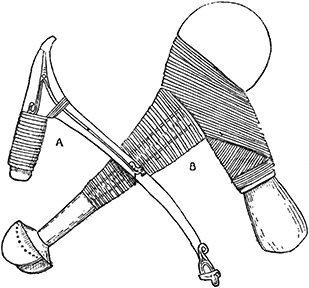
Fig. 45.—Sketches of two axes from the South-east Peninsula of
New Guinea in the possession of the author; about one-tenth
natural size.
I have made sketches (Fig. 45) of two axes in my possession.
The first (A) is decorated with characteristic ornamentation,
consisting in the upper part of birds’ heads and
at the handle of the bird and crocodile design; but it is
still a useful implement. The second axe (B) has a large thin
stone, and is an unwieldy and probably quite useless object.
The late Mr. H. H. Romilly[21] tells us that at Utian
(Brooker Island), in the Louisiades, “The stone implements
made here are very fine. I got some axes of enormous size,
which I am sure could not be intended for use. They seemed
rather to be a common possession; perhaps two or three
belonged to the village, and were exhibited on state occasions.”
The Rev. Dr. W. Wyatt Gill,[22] at South Cape, saw
“two axes solemnly carried by the chiefs as a preliminary
to peace ... a glance at the slight artistic hafting will
convince any one that they are not intended for cleaving
timber.” This is all the information we have concerning
these axes. It appears that they have come to be recognised
as symbols of authority, but it is extremely doubtful whether
they are anywhere held as a common possession.
A still more wonderful change has affected certain adzes
in the Hervey Islands. (Fig. 46.) The stone blade is a
carefully cut and polished piece of
basalt, and it has every appearance
of being perfectly serviceable; but
the elaborately carved handles preclude
the idea that in their present
state they could be used for practical
purposes. In form the handles
may be quadrangular, gradually
diminishing from the base to the
blade, or conical, or polygonal or
cylindrical. When short the handles
are thick, even to the extent that
they can scarcely be grasped by
the two hands; these forms too
are often perforated by quadrangular
holes. One specimen in
the Archæological and Ethnological
Museum at Cambridge is six feet
three inches in length.
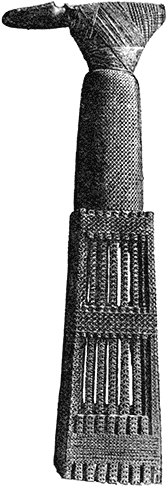
Fig. 46.—Mangaian symbolic
adze in the Copenhagen
Museum; from
Dr. C. March.
Later on (p. 83) I shall describe
the ornamentation on these adzes;
at present we are merely concerned
with the fact that for some reason
or another they have become functionless
through increase in the
size of the handle, and by reason
of the weakness caused by deep
carving. We have now to trace
the meaning of this vagary.
Dr. W. Wyatt Gill, who resided for twenty-two years
in the Hervey Islands, and who has been a very careful
observer and recorder of Polynesian customs and beliefs,
informs us that “The adzes of the Hervey Islanders are
frequently hafted with carved ‘pua’ wood. The carving,
which is often admirable, was formerly executed with
sharks’ teeth, and was primarily intended for the adorning
of their gods. The fine-pointed pattern is known as ‘the
sharks’ teeth pattern’ (‘nio mango’). Other figures are
each supposed, by a stretch of the imagination, to represent
a man squatting down (‘tikitiki tangata’). Some patterns
are of recent introduction, and being mere imitations of
European designs, are destitute of the significations which
invariably are attached to ancient Polynesian carving.
The large square holes are known as ‘eel-borings’ (‘ai
tuna’); the lateral openings are naturally enough called
‘clefts’ (‘kavava’). To carve was the employment of
sacred men.” Dr. Hjalmar Stolpe, of Stockholm, who
has made a special study[23] of the ornamental art of these
people, found in the museum in Chambéry an adze of this
kind; according to the account on the label the stone had
belonged to a chief, and it was after the owner’s death
shafted in this manner that it might be preserved by his
family as a remembrance. Dr. Stolpe continues, “The
internal probability of the story confirms the truth of the
account. Ancestor worship is a characteristic feature
of Polynesian religion. The souls of the departed become
the guardian spirits of the survivors. Their worship demanded
a visible form, under which offerings could be
enjoyed by them, and this was found sometimes in the
skull itself of the deceased, which was preserved in the
house, sometimes in some article of his property. In the
latter case scarcely anything could be more suitable than
the stone adze, which was the deceased’s most important
implement, and which it required so much toil to make.
On the Hervey Islands the transition was easier, as there
the stone adze itself is considered as a god. Even the fine
plait of coco-nut fibre with which the adze is fastened to the
shaft was a god, and the method of binding it had, in
Mangaia, been taught by the gods. Both during the
operation of plaiting and during the decoration of the
adze-shaft songs were sung in a low voice to the gods,
that they might further the work. The ‘pua’ wood
(Fagræa Berteriana) of which the carved adze-shafts are
made may also have a religious significance, for Gill speaks
of ‘its long branches being regarded as the road by which
the spirits of the dead descended to Hades.’”
The following conclusions of Dr. Stolpe’s appear to be
warranted:—“From these researches it appears to me to
follow that the peculiarly shafted stone adzes of the Hervey
Islands have a religious signification, that they are especially
connected with ancestor worship, and that they were probably
the very symbols under which this worship was
performed.”
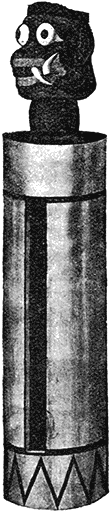
Fig. 47.—An erect
drum (Kaara), surmounted
by the head
of a god from Java,
in the Copenhagen
Museum; from Dr.
C. March.
Dr. H. Colley March[24] has gone a step further, and tries
to account for the very remarkable form of the handle of
the sacred adze. He says, “It is remarkable that the
typical Mangaian axe [adze] was exclusively associated
with ‘Tane, the royal-visaged.’ This god was widely
venerated over the Pacific; in Mangaia he was especially
the drum-god and the axe-god; he presided over the erotic
dance as well as over the war dance ... it is evident that
the drum was not only associated with a Tane cult in the
erotic dance, but was regarded as Tane’s embodiment;
when the drum was beaten, it was Tane that was struck,
and from the fissure in the drum it was Tane’s voice that
issued.” Dr. March quotes a number of extracts from early
voyagers, etc., descriptive of various Polynesian drums, and
he comes to the conclusion that the upright drums, which
were hollowed out of a single piece of wood, were originally
derived from bamboo instruments. He figures a drum
(Fig. 47) said to have come from Java, which, with the exception
of the terminal head, corresponds closely with the drum
called naffa which Captain Cook describes at Tonga. He
concludes that after the drum “had passed
from bamboo to wood, the horizontal
instrument assumed the erect form, more
appropriate to the god, and was then
surmounted, as in the so-called Javan
example, by Tane’s head, which subsequently
gave place to Tane’s adze. As
the cult differentiated, the symbolism
differentiated too.” Without going into
further detail, in the short thick form of
the Mangaian adze, such as Fig. 46, the
upper portion of the handle is usually
cylindrical. The lower portion is usually
quadrangular, or may be polygonal, and
looks as if it might be a pedestal for the
former. According to Dr. March’s interpretation,
the stone implement represents
the head of Tane; the upper cylindrical
part of the handle is his neck. The lower
part of the handle is an artistic analogue
of the sacred drum; “the useless transverse
closings represent the original bamboo
joints, as well as the solid ends of the
wooden drum. In spite of the fact that
their presence increased the difficulty of
hollowing out the shaft, they were reproduced
in obedience to a well-recognised
law. The square and oblong rectangular
openings have an analogous explanation.
They indicate the original aperture,
whether the slit in the bamboo, or the
single or double chink in the wooden
drum which was excavated through the
drum in order to secure its resonance. The great increase
in the number of apertures, helped by rectangular designs on
horizontal instruments, took place as an evolution of ornament
that largely consists in a multiplication of functionless
details.”
It is possible that the adzes from the Hervey Islands,
with long, unperforated carved handles, may have a different
history from the form illustrated in Fig. 46; they may
merely be decorated but useless adze handles. In any
case, the above-quoted conclusions of Dr. Stolpe may be
accepted.
In the three examples of the metamorphosis of a practical
object into an unpractical one just recorded, we have an
illustration of the effects of three dominant human forces
on these several implements, art, display or wealth, and
religion. The result is practically the same in all cases, but
the motive leading to it is different. Analogous modifications
are everywhere to be met with.
One of the earliest handicrafts was to fasten two
things together. To quote from Dr. H. Colley March,[25]
“As soon as man began to make things, to fasten
a handle to a stone implement, to construct a wattled roof,
to weave a mat, skeuomorphs became an inseparable part of
his brain, and ultimately occasioned a mental craving or
expectancy.”
In order to securely fasten two objects together, such as
splicing wood or fastening a handle to a stone implement, a
lashing is necessary, and the nature of the latter varies more
or less according to the conditions under which the artificers
live. Where mammals are abundant, their sinews afford a
readily procured and very strong, fine lashing, but it occurs
only in short lengths. The hide of a newly-killed animal is
pliant, strong, and can be so cut as to produce long thongs.
Owing to the rarity of mammals in New Guinea, and their
absence from the Great Ocean, the Papuans, Melanesians,
and Polynesians make no use of skins or thongs; sinews
may be employed, but the great bulk of all fastening is
accomplished by the employment of vegetable fibres. The
inner bark of various trees supplies bast and tapa, several
vegetables have long fibres which are utilised, but the most
widespread and important of all lashings in Oceania is the
twisted or plaited string made from the fibres of the husk
coco-nut. The latter is known as sinnet, and there are
many degrees of excellence in its manufacture; for rough
work it is coarsely plaited, but nothing can exceed the delicacy
and beauty of the finest sinnet work, such, for example,
as occurs on the symbolic adzes of the Hervey Islands,
where it was even regarded as a god.
Most of the stone implements of primitive man were
fastened in various ways into handles, and an inspection of
almost any ethnological collection will demonstrate the
diverse methods of lashing employed by even the most
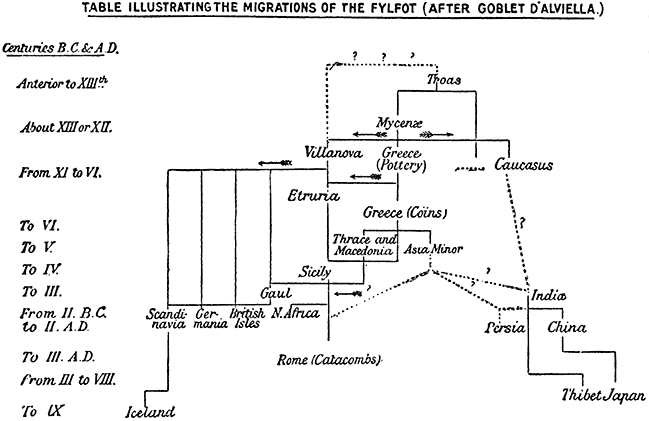
backward peoples. For example, we have in Plate I.,
Fig. 1, an illustration of the fastening of the stone axe of
Montezuma II., now in the Ambras Museum at Vienna,[26]
but analogous figures will be found in numerous books of
travel, or in ethnographical journals and treatises.
The even serving of the lashing gives rise to geometrical
figures. One might in some cases describe them as patterns,
whose symmetrical disposition gives a pleasing effect.
In process of time the stone spear points of our ancestors
were replaced by bronze, and during the evolution of the
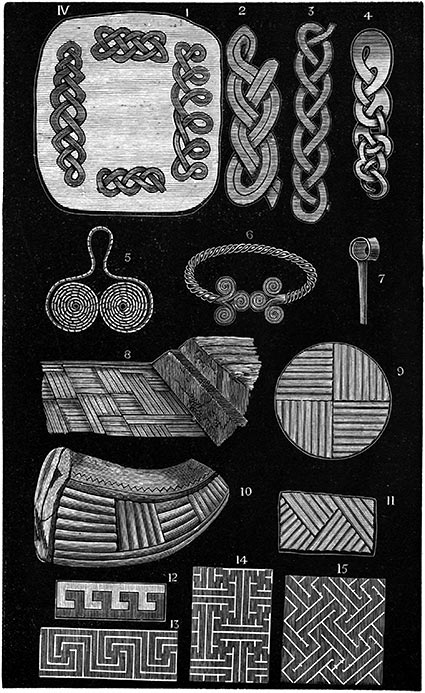
palstave, or socketed bronze celt (Plate I., Figs. 4, 10, 11),
from the flat bronze celt, the method of fastening also
changed. But by this time the old style of binding had
become so associated in men’s mind with the implement, that
it was engraved on the socket of the bronze head as a pattern.
Hence most of the ornamentation of bronze implements.
(Plate I., Figs. 2-4.) On socketed bronze celts one frequently
finds (Plate I., Figs. 10, 11) two, three, or more ridges running
from the base to some distance towards the end; three
is the most common number of these ridges. They may fade
away at their ends, or terminate in slight knobs or annular
prominences. The meaning of these characteristic markings
is at present obscure, but they appear to be skeuomorphs of
lashing.
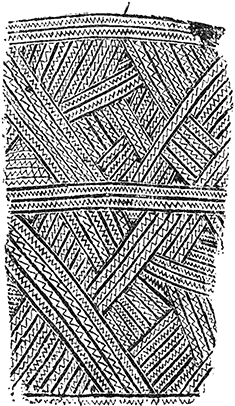
Fig. 48.—Rubbing of part of the decoration of a Tongan club in the
Norwich Museum; one-third natural size.
What are known as “beads” have frequently the same
origin; that is, they are reminiscences of fastenings. This
is especially evident when the bead is decorated with a
twisted design, as occurs in the zonal decoration of a bronze
vessel from a Swiss lake-dwelling. (Plate I., Fig. 5.) There
is no reason to believe that lashing was actually employed
on older forms of Assyrian combs, or prehistoric bone
needles or bronze knives, nevertheless the patterns shown
in Plate I., Figs. 6, 8, and 9, have doubtless been derived
from ligatures; more from the fact that such patterns were
familiar, and a feeling for a need of decoration, than for any
special appropriateness.
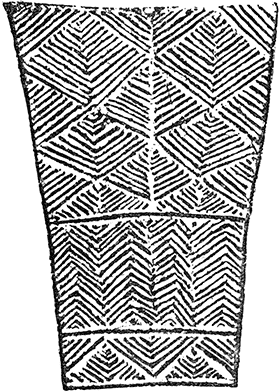
Fig. 49.—Rubbing of part of the decoration of a Tongan club in the
Norwich Museum; one-half natural size.
One frequently finds designs in the ornamentation of
objects from Oceania which are evidently based upon sinnet
lashings. To take a few out of many examples now before
me, in Fig. 48 we have a reduced rubbing of a carved
cylindrical club, said to come from the Friendly Islands
(Tonga); the same kind of club also occurs in Fiji. The
decoration of this club irresistibly suggests bands of
plaited sinnet irregularly bound round the club.
In these two groups of islands sinnet is often worked
into a design that is also copied on the upper part of a
carved wooden club. (Fig. 49.) The same kind of lashing
is seen in Plate I., Fig. 1. Occasionally, instead of being
angular, this pattern is carved in curved lines, and so gives
rise to an imbricate pattern, which might be mistaken for a
scale pattern.
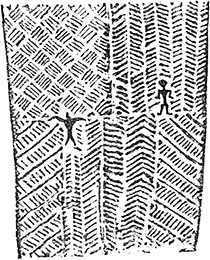
Fig. 50.—Rubbing of part of the decoration of a Tongan club in the
Norwich Museum; one-half natural size.
Other sinnet patterns perhaps occur in the lower part
of the decoration of a Tongan club. (Fig. 50.) The
design on the upper left-hand corner is evidently copied
from matting, and it frequently occurs on these clubs.
This figure also illustrates the Tongan peculiarity of
inserting little figures into designs, in this case a man
and probably a frigate-bird.
I do not wish to suggest that all zigzags included within
parallel lines, as in Fig. 48, or such simple designs as those
of Fig. 50, are everywhere sinnet derivatives, or otherwise
skeuomorphic; some, at least, in the Pacific certainly are.
We have seen that birds’ head designs may degenerate into
zigzags (Figs. 30, 36), and we shall see that frogs’ legs
(Fig. 122, B), snakes (Fig. 103, G, H, K), alligators (Fig.
97, E, F), and even the human form (Fig. 125, A) may pass
into zigzags. There are many other possible origins of
the zigzag, but in many cases it is probably only a purely
decorative motive of no further significance. The simple
zigzag can be traced in ancient Egyptian art as far
back as 4000 B.C., and, according to Professor Flinders
Petrie, it continued popular with a few modifications for
about 2000 years, when spots were associated with it, but
these were adopted from foreign art. About the eighteenth
dynasty the use of the zigzag was discarded in favour of
the wavy line and various scroll designs. In all cases it
is necessary to study each pattern locally.
In Europe a very early form of fabric was wattle-work,
formed by the interlacing of flexible boughs and wands.
The most ancient huts were doubtless made of wattle-work
daubed over with clay. Only very exceptionally are traces
of these structures found, as, for example at Ebersberg, where
Dr. Keller[27] found, among the débris of a lake-village which
had been destroyed by fire, fragments of the clay daubing,
“smooth on one side, and marked on the other, with deep
depressions of the basket-work.” The pattern thus impressed
on the clay is one of repeated straight lines crossed by a
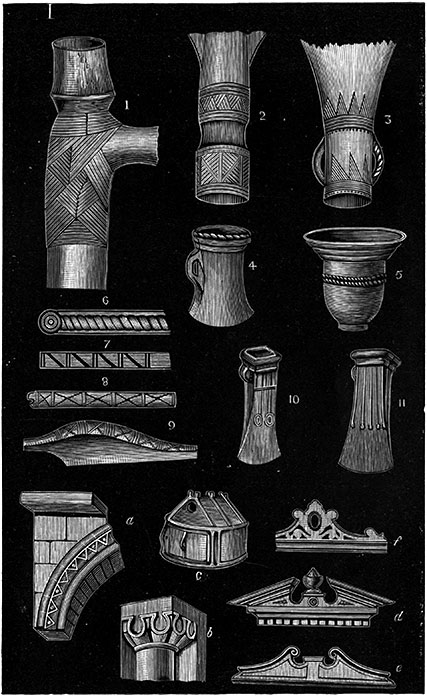
contrasted series of curved ones. (Plate II., Fig. 1.) Thus
the fire which consumed the house baked its clayey coating,
and in this way preserved for us a record of what it
destroyed.
I do not know whether the wattle-work has been
perpetuated on any object as a skeuomorph, but it is
possible that the shape of similarly constructed huts has
been continued, as Mr. Charles de Kay suggests,[28] into
the round towers of Ireland. He says, “Seeing how the
Irish kept heathen ideas in other things, we can perceive
how the round wicker house of the Kelt, such as we see
it carved on the column of Antoninus at Rome, developed
into the wood and wicker outlook tower and beacon, and
in skilful hands became the Irish round tower. Christian
in usage, they are pagan in design.”
The predatory expeditions of the Scandinavians created
a demand for watch-towers and places of temporary refuge;
the pattern for these was supplied by the traditional
erections of the Gauls, but their translation into “towers
more durable, useful, simple yet stately, than anything
Ireland had seen before or has seen since,” was due to the
skill and experience of “Byzantine craftsmen driven from
the East by the bigotry of the image-breaking emperors.”
Mr. de Kay also calls attention to the encircling stone
bands, or “string-courses,” as in the round tower at Ardmore,
“which repeat, without any useful object in stone, the horizontal
bands that strengthened the tall wicker house of the
Gauls. Such apparently trivial points weigh heavily in
favour of the indigenous character of the round tower of
Ireland.”
The interlacing of flexible bands, such as strips of bast,
entire leaves as of grass, or shreds of large leaves, is known
to almost every people, and is employed in making mats.
When the elements employed are all of one size, and when
the plaiting is straight, the intersections form regular equilateral
rectangles or squares. (Plate II., Fig. 3, and compare
the transferred design in Fig. 50.) If the material consists
of two colours simple patterns are readily produced, but of
necessity the patterns must consist of straight, slanting, or
zigzag lines; curves are an impossibility. The same holds
good for nearly all forms of matting and basketry which is
made of strips of one material, but the constructional
surface marking may be rectangles of various shapes and
sizes instead of simple squares. (Plate II., Fig. 4.) When
one series of the components is twisted, as in Plate II.,
Fig. 5, there is a kind of flow effect in the intersections.
The making of baskets by laying down the material in a
spiral gives rise to different effects, especially when coloured
strips are interwoven for decorative purposes—as, for example,
in some African baskets and the baskets made by
the natives of South Australia, in the neighbourhood of
Adelaide. Dr. Keller found in the Lake of Robenhausen
a kind of basketry formed by bast, the fibre of the lime-tree,
intertwisted among a series of willow rods, the strips
“running concentrically in such a way that both together
form a structure like that called ‘herring-bone.’”[29] (Plate
II., Fig. 2.) It is possible that the pattern in the middle
band of Fig. 49, and some of those in Fig. 50, may have
been suggested by basketry or plaited fans.
An early type of basket is seen in the Roman corbula
(Plate II., Fig. 6), in which the osier rods are placed
rectangularly; another, in an ivory plaque from Boulak
(Plate II., Fig. 7), in which there is a chevron arrangement.
The latter is the more common skeuomorph on
European prehistoric pottery, but the rectangular type
often occurs, and it may be seen on a Danish food-vessel
of the Stone Age. (Plate II., Fig. 8.)
The bottom of a basket, with a cruciform arrangement
of the bands, due to the method of weaving, was discovered
by Dr. Keller in the Terramara marl-pits of Northern Italy
(Plate II., Fig. 9); and a piece of pottery from the same
deposit is ornamented with a corresponding skeuomorph
(Plate II., Fig. 10).
Dr. Colley March has further developed this subject, and,
while I cannot commit myself to several of his conclusions,
I do not hesitate to give an exposition of his ingenious
views, as they are very suggestive, and even if they are
not finally accepted, they will lead to a further examination
of the problems:—
“The perpetual concentration of attention, the strain of
hand and eye and brain upon the forms of wattle-work and
basketry produced an important decorative result. The
mind acquired an expectancy of a special mode of curved
repetitions. This particular skeuomorph is composed of a
band that winds in and out among a row of rods or discs.”
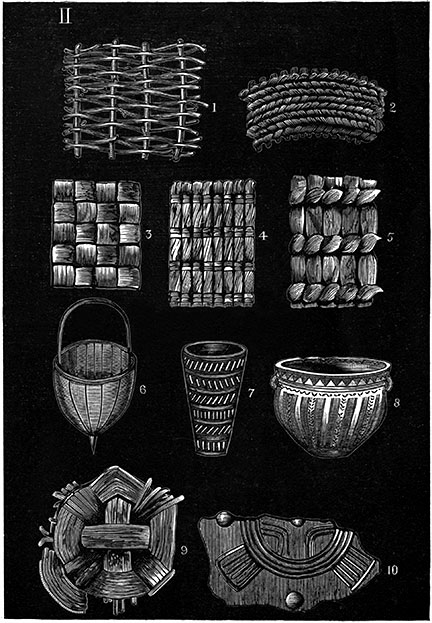
(Plate III., Fig. A.)
The “discs” are naturally the cross sections of the
vertical elements of the wattle-work—that is the “rods.”
“The device underwent a change in opposite directions.
The discs grew, or they vanished. In the latter case the
band left by itself is the meander, and may be called a
curvilinear zigzag. In the former case the discs often
became the seat of phyllomorphic invasion, and were transformed
into leaves or flowers.
“Examples may be seen on the margin of a bronze
shield from Cyprus (Plate III., Fig. 2); on a vessel of
terra-cotta from the third sepulchre of Mycenæ (Plate III.,
Fig. 8); and on an enamelled Roman vase found on Bartlow
Hill (Plate III., Fig. 5); whilst a twin-form, which
presents both contrast and repetition, occurs on another
bronze shield from the Mediterranean (Plate III., Fig. 1)
and is the basis of the Assyrian ornament and its Greek
variant called the guilloche. (Plate III., Figs. 4, 3.)
“A different skeuomorph is derived from a different
method of basketry, in which a single fibre is turned round
a row of osier-sticks, so as to produce a wave repetition
(Plate III., Fig. B), as may be seen on the pottery of the
ancient Pueblos (Plate III., Fig. 6). When these discs
disappear, the fibre by itself resembles the Vitruvian scroll,
and may be called a curvilinear fret. (Plate III., Fig. B.)
“Whenever the pattern has a stepped form, as on many
of the Pueblo vases (Plate III., Fig. 7), it indicates that the
methods of textile manufacture had already influenced the
eye and mind of the race before the invention or introduction
of pottery.”
The scroll-patterns illustrated by Dr. March may at one
time and place have had the origin supposed by Dr. March,
but it does not appear to me to be probable that they
would have arisen in this way both in South Europe and
in Mexico. I have shown (p. 51, Fig. 27) how a simple
guilloche has arisen from interlocking birds’ heads. The
Vitruvian scroll design occurs among the Tugeri head-hunters
of New Guinea, and it is most improbable that it
owes its origin to basketry. It is probable that the
Pueblo pottery with curvilinear patterns, such as Plate III.,
Fig. 6, is more recent than that with angular designs; but
I shall return to this later on. In fact, I would feel inclined
to state that Dr. March’s view is possible for the origin of
the patterns in question, once and in a restricted locality, but
highly improbable for wide application.
There is a great tendency for spirals to degenerate into
concentric circles; examples could be given from New
Guinea, America, Europe, and elsewhere. In fact, one
usually finds the two figures associated together, and the
sequence is one of decadence, never the evolution of spirals
from circles. The intermediate stage has been aptly termed
a “bastard spiral” by Dr. Montelius, “that is to say, concentric
circles to which the recurved junction-lines give, to
a casual glance, the appearance of true spirals.”[30]
“The strangest skeuomorph of all,” writes Dr. March,
“was that common to the early inhabitants of Northern
Europe. They were adepts in basketry, and in wattle-work
for walls and ramparts. Moreover, the pliant bark of the
birch was ever ready to the hand for a thousand purposes
of life. The Norwegian still makes hinges for gates and
loops for the oar out of the entwisted fibre. The old
Norseman spoke of the rudder withy, for the earliest rudder
was an oar; and leather thongs were also used to keep the
oar against the thole-pin. The skeuomorph consists of a
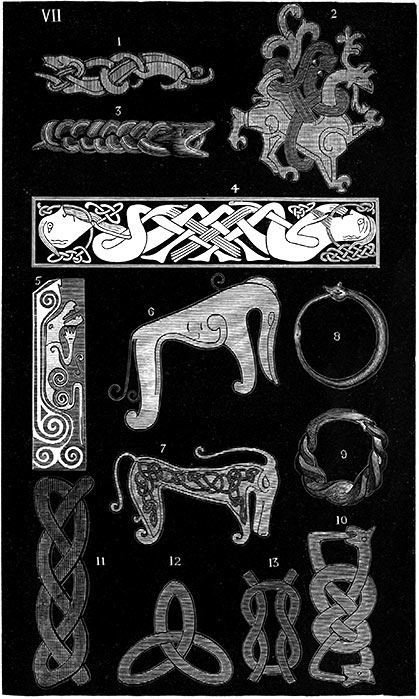
withy wound upon itself. (Plate VII., Fig. 11.) This device,
wrongly called a rope-pattern, gained such an ascendency
over the northern mind that it was employed sometimes as
a symbol (Plate VII., Fig. 12), like the reefing knot on
Roman altars. (Plate VII., Fig. 13.) It was used also by
the ancient Hittites. (Plate IV., Fig. 1.)
“It is evident that the withy skeuomorph (Plate IV., Figs.
2, 3), the Scandinavian worm-knot, established itself as a
necessity of the mind before those men who were dominated
by it had discarded a covering of skins for one of cloth; for
its type is antagonistic to the regular intersections and the
stepped designs of textile fabrics, and no trace of these
appears on their early pottery.
“When weaving was at last introduced, so as to be
practised by these people, it was probably along with the
introduction of metals. But for a while the use of metal
only increased the number of twisted things. The words,
wire, wicker, and withy are all from the root WI, to plait,
and the Teutonic WIRA means filigree, an ornament of
twisted filaments of metal; and as the simplest manner of
terminating a wire is to coil its end, the earliest filigree is
preponderantly spiral. (Plate IV., Figs. 5, 6, 7.) Thus was
the way prepared,” concludes Dr. March, “for the advent
of the serpent zoomorph, so much affected by Teutons and
Scandinavians.”
In early times wooden bands were interwoven to form
flat surfaces, as, for example, in the floor of a lake-dwelling at
Niederwyl, in Switzerland (Plate IV., Fig. 8), but few traces
of the art of “fascining,” as Dr. March points out, remain to
us from antiquity, since wood-work rapidly perishes by decay,
and is easily destroyed by fire. This art produces a bold
decorative effect which appears to have been perpetuated in
various ways. Amongst others may be mentioned the interior
decoration of an earthen vessel from Ueberlingen See
(Plate IV., Fig. 9), a crescent of red sandstone from Ebersberg
(Plate IV., Fig. 10), and an incised stone from
Hadrian’s Wall, in Northumberland. (Plate IV., Fig. 11.)
So far we have only considered the type of ornamentation
which occurs on plaited or woven objects, and these
are seen to be conditioned by that particular technique. We
have now to see what occurs when a new material is substituted
for the old.
There are many varieties of tapa in the Pacific, some of
which are coarse and others of extreme fineness and softness.
The process of making and decorating tapa has often
been described; sometimes the tapa is ribbed, having been
beaten with more or less finely corrugated wooden mallets,
occasionally it is marked with squares which give it an
appearance of having been stamped by a simply plaited mat,
but many pieces are quite smooth. There is nothing in
the texture or manufacture of tapa to prevent its being
ornamented with intricate and involved patterns. As a
general rule, all over the Pacific we find that tapa patterns
are largely geometrical—that is, they are formed of straight
and angled lines; bowed lines, which are grouped into leaf-like
designs, are not infrequent, but doubly curved lines and
scroll-like designs are extremely rare. The evidence clearly
points to a time anterior to the employment of tapa, and
when mats and other textiles were the only fabrics; the decoration
of these was necessarily angular in style. When tapa
became general the older designs were transferred to the
new material, and quite irrespective of its capabilities. Only
gradually has it been found that the smooth surface of tapa
lends itself to a more elaborate decorative treatment. The
essential conservatism of the savage precludes rapid emancipation
from long existent thralls, especially as the æsthetic
mind has, so to speak, become set in angularities.
It is probable that the practice of beating tapa with
wooden mallets led to the discovery of printing in colours.
The transitions are slight between finding the natural
graining of wood impressing itself on the soft tapa, of so
cutting the mallets as to produce a regularly grooved surface,
and of colouring the blocks, and lastly of making the great
printing blocks on which the pattern stands up in relief,
which were made in Fiji. Sometimes the lines in relief of
printing blocks are made by fastening the mid ribs of palm
leaves on to a stout piece of tapa.
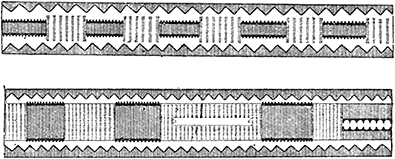
Fig. 51.—Sketches of tapa belts from Kerepunu, British New Guinea;
about three-quarters natural size.
In certain islands it has been discovered that fern fronds
covered with pigment can be used for printing, and thus
what is known in this country as “nature-printing” has
been independently arrived at.
What has happened in the Great Ocean apparently also
took place in New Guinea. In the south-eastern peninsula
the men wear tapa belts which are often painted. About
the district of Kerepunu, in British New Guinea, tapa belts
are worn by the men which are painted in a peculiar
manner with grey and orange pigments. In Fig. 51 we
have two typical patterns. It is obvious that the interlaced
design would be easily arrived at in a plaited belt, but it is
highly improbable that it is, so to speak, indigenous to the
tapa.
In all the other examples of painted tapa known to me
from British New Guinea, angular designs alone occur.
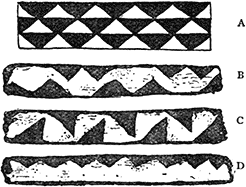
Fig. 52.—Designs derived from uluri
(women’s covering); A, B, C,
Bakaïri tribe, Central Brazil; D,
Auetö tribe, Central Brazil.
After Von den Steinen; greatly
reduced.
Professor von den
Steinen discovered in
Central Brazil some patterns,
which most people
would designate as “geometrical,”
painted on
pieces of bark which
formed a frieze round a
chief’s house. These patterns
(Fig. 52) are derived
from serial repetitions of
the minute triangular garment
which constitutes the
sole clothing of the women.
This is a good example of
the necessity for local information
concerning the significance of designs. I would
refer the reader to later pages for further examples of analogous
patterns from the same district.
Perhaps no manufacture is of such importance to anthropologists
as pottery. In Europe pottery first appeared in
what is termed by archæologists the Neolithic Age, or that
period of human history when man had learnt to neatly
chip and to polish his stone implements, but had not as yet
discovered metal. Amongst living people the Australians
and the Polynesians are the only great groups among whom
pottery is unknown.[31] There can be little doubt that the
ceramic art has been independently discovered in various
parts of the world, and Mr. Cushing believes that this has
been the case even in America.
Earthen vessels are comparatively easy to make, and
though they are brittle, their fragments, when properly
baked, are almost indestructible. The history of man is unconsciously
written largely on shards, and the elucidation of
these unwritten records is as interesting and important as the
deciphering of the cuneiform inscriptions on the clay tablets
of Assyria. The Book of Pots has yet to be written, but
materials for its compilation lie scattered throughout the
great literature of archæology, anthropology, and ceramics,
and in the specimens in a multitude of museums and
collections. The scientific treatment of the subject has
been sketched out mainly by W. H. Holmes and F. H.
Cushing, and I have not hesitated to borrow largely from
the publications of these American anthropologists.
There are three principal methods of making clay vessels—1,
by coiling; 2, by modelling; or 3, by casting.
In the first method longer or shorter rope-like pieces
of clay are formed. These are laid down in a spiral,
and the vessel is built up by a continuation of the same
process.
In modelling, or moulding, a lump of clay is taken, and
this is first worked with the hands, and then the clay is
gradually beaten into the desired shape and thickness by
means of a wooden mallet, which hits against a stone or
other object that is held inside the incipient vessel.
The third method, by casting, is very rarely employed
except by quite civilised peoples. It was a comparatively
late discovery that clay vessels could be cast within hollow
moulds if the paste was made thin enough.
The coiling and moulding processes are in some places
employed side by side, and a vessel may be commenced in
the latter method and finished by coiling. (Fig. 55.) This
is done by the Nicobarese,[32] Pueblo Indians, and other
peoples.
The subject of the forms and decoration of pottery is so
important for our study that it will be advisable to quote
at considerable length some of the American investigations
which bear upon it. Nowhere than in that continent are
conditions more favourable to a scientific study of the
evolution of ceramics, and our American colleagues happily
are fully alive to this fact. Their researches afford valuable
sidelights upon the probable history of European prehistoric
ceramics.
Mr. J. D. Hunter,[33] writing of the Mississippi tribes in
1823, says that they spread the clay “over blocks of wood,
which have been formed into shapes to suit their convenience
or fancy. When sufficiently dried they are
removed from the moulds, placed in proper situations, and
burned to a hardness suitable to their intended uses.
Another method practised by them is to coat the inner
surface of baskets, made of rushes or willows, with clay, to
any required thickness, and when dry, to burn them as
above described.”
Messrs. Squier and Davis,[34] referring to the vessels of the
Gulf Indians, say:—“In the construction of those of large
size, it was customary to model them in baskets of willow
or splints, which at the proper period were burned off,
leaving the vessel perfect in form, and retaining the somewhat
ornamental markings of their moulds. Some of those
found on the Ohio seem to have been modelled in bags
or nettings of coarse thread or twisted bark. These
practices are still retained by some of the remote western
tribes.”
Mr. W. H. Holmes[35] points out that “clay has no inherent
qualities of a nature to impose a given form or class
of forms upon its products, as have wood, bark, bone, or
stone. It is so mobile as to be quite free to take form
from surroundings.... In early stages of culture the
processes of art are closely akin to those of nature, the
human agent hardly ranking as more than a part of the
environment. The primitive artist does not proceed by
methods identical with our own. He does not deliberately
and freely examine all departments of nature or art, and
select for models those things most convenient or most
agreeable to fancy; neither does he experiment with the
view of inventing new forms. What he attempts depends
almost absolutely upon what happens to be suggested by
preceding forms.
“The range of models in the ceramic art is at first very
limited, and includes only those utensils devoted to the
particular use to which the clay vessels are to be applied;
later, closely associated objects and utensils are copied.
In the first stages of art, when a savage makes a weapon,
he modifies or copies a weapon; when he makes a vessel
he modifies or copies a vessel” (pp. 445, 446).
The discovery of the art of making pottery was probably
in all cases adventitious, the clay being first used for
some other purpose. “The use of clay as a cement in
repairing utensils, in protecting combustible vessels from
injury by fire, or in building up the walls of shallow vessels,
may also have led to the formation of discs or cups, afterwards
independently constructed. In any case the objects
or utensils with which the clay was associated in its earliest
use would impress their forms upon it. Thus, if clay were
used in deepening or mending vessels of stone by a given
people, it would, when used independently by that people,
tend to assume shapes suggested by stone vessels. The
same may be said of its use in connection with wood and
wicker, or with vessels of other materials. Forms of vessels
so derived may be said to have an adventitious origin, yet
they are essentially copies, although not so by design”
(p. 445). In other words, such pottery is primitively
skeuomorphic. Ceramic biomorphs will be dealt with in a
later chapter.
Mr. Holmes further points out that the shapes first
assumed by vessels in clay depend upon the shape of the
vessels employed at the time of the introduction of the art,
and these depend, to a great extent, upon the kind and
grade of culture of the people acquiring the art, and upon
the resources of the country in which they live.
A few examples will suffice. Mr. Holmes (loc. cit., pp. 383,
448) figures an oblong wooden vessel with a projecting
rim, which is narrow at the sides but broad at the ends;
it is in fact a sort of winged trough; this is sometimes
copied in clay. It is evident that the elongated terminal
shelf-like projections are more suited to a wooden than to
an earthen vessel.
In Fig. 53 we have an Iroquois bark-vessel. Mr. Cushing[36]
informs us that in order to produce this form of utensil
from a single piece of bark, it is necessary to cut pieces
out of the margin and fold it. Each fold, when stitched
together in the shaping of the vessel, forms a corner at
the rim. These corners, and the borders which they form,
are decorated with short lines and combinations of lines,
composed of coarse embroideries
with dyed porcupine quills.
Clay vessels (Fig. 54), which
strikingly resemble the shape and
decoration of these birch or
linden bark vessels, are of common
occurrence in the lake
regions of the United States.
There can be but little doubt
that the clay vessels are directly
derived from the bark vessels.
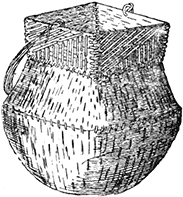
Fig. 53.—Iroquois bark vessel;
after Cushing.
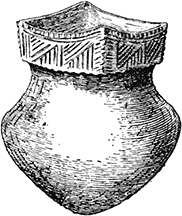
Fig. 54.—Rectangular, or
Iroquois, type of earthen
vessel; after Cushing.
Mr. Cushing’s long and intimate
knowledge of the Zuñi
Indians has enabled him to speak
with authority on matters which
might be merely happy suggestions
by other anthropologists.
Any one can guess at origins
and meanings, but there are few
who know at first-hand, and who
therefore can act as interpreters
to the student at home. The
following account of Zuñi pottery
is taken from Mr. Cushing’s
paper, entitled “A Study of
Pueblo Pottery as illustrative of
Zuñi Culture Growth.”
So far as language indicates, the earliest Zuñi water vessels
were tubes of wood or sections of cane. The latter must
speedily have given way to the use of gourds. While the
gourd was large and convenient in form, it was difficult of
transportation, owing to its fragility. To overcome this it
was encased in a coarse sort of wicker-work. Of this there
is evidence among the Zuñis, in the shape of a series of
rudely encased gourd vessels into which the sacred water is
said to have been transferred from the tubes.
This crude beginning of the wicker-art in connection
with water vessels points towards the development of the
wonderful water-tight baskets of the south-west, explaining,
too, the resemblance of many of its typical forms to the
shapes of gourd vessels. The name for these vessels also
supports this view.
Mr. Cushing suggests that water-tight osiery, once known,
however difficult of manufacture, would displace the general
use of gourd vessels. While the growth of the gourd was
restricted to limited areas, the materials for basketry were
anywhere at hand. Basket vessels were far stronger and
more durable than gourds.
“We may conclude, then,” continues Mr. Cushing,
“that so long as the Pueblo ancestry were semi-nomadic,
basketry supplied the place of pottery, as it still does for
the less advanced tribes of the south-west, except in
cookery.” Thus the Ha va su paí, or Coçoninos of Cataract
Cañon, Arizona, in 1881, “had not yet forgotten how to
boil food in water-tight basketry, by means of hot stones,
and continued to roast seeds, crickets, and bits of meat in
wicker-trays, coated inside with gritty clay. A round
basket-tray, either loosely or closely woven, is evenly coated
inside with clay, into which has been kneaded a very large
proportion of sand, to prevent contraction and consequent
cracking from drying. This lining of clay is pressed, while
still soft, into the basket as closely as possible with the
hands, and then allowed to dry. The tray thus made is
ready for use. The seeds or other substances to be parched
are placed inside of it, together with a quantity of glowing
wood coals;” these are made to rapidly revolve. “That
this clay lining should grow hard from continual heating,
and in some instances separate from its matrix of osiers,
is apparent. The clay form thus detached would itself
be a perfect roasting vessel” (pp. 484, 485). The modern
Zuñi name for a parching pan indicates that the shallow
vessel of twigs coated with clay for roasting had given birth
to the parching pan of earthenware.
In the ancient Zuñi country are found vessels of the
same form as the basket-pot or boiling basket, still
surviving among the Havasupaí. These baskets are good
examples of the spirally-coiled type of basket.
“Seizing the suggestion afforded by the rude tray-moulded
parching-bowls, particularly after it was discovered
that if well burned they resisted the effects of water as well
as of heat, the ancient potter would naturally attempt in
time to reproduce the boiling-basket in clay. She would
find that to accomplish this she could not use as a mould
the inside of the boiling-basket, as she had the inside of
the tray, because its neck was smaller than its body. Nor
could she form the vase by plastering the clay outside of
the vessel, not only for the same reason, but also because
the clay in drying would contract so much that it would
crack or scale off. Naturally, then, she pursued the
process she was accustomed to in the manufacture of the
basket-bottle. That is, she formed a thin rope of soft clay,
which, like the wisp of the basket, she coiled around and
around a centre to form the bottom, then spirally upon
itself, now widening the diameter of each coil more and
more, then contracting as she progressed upward until
the desired height and form were attained. As the clay
was adhesive, each coil was attached to the one already
formed by pinching or pressing together the connecting
edges at short intervals as the widening went on. This
produced corrugations or indentations marvellously resembling
the stitches of basket-work. Hence accidentally the
vessels thus built up appeared so similar to the basket
which had served for its model that evidently it did not
seem complete until this feature had been heightened by
art. At any rate, the majority of specimens belonging to
this type of pottery, especially those of the older periods
during which it was predominant, are distinguished by
an indented or incised decoration exactly reproducing the
zigzags, serrations, chevrons, terraces, and other characteristic
devices of water-tight basketry. Evidently, with a like
intention, two little cone-like projections were attached to
the neck near the rim of the vessel, which may hence be
regarded as survivals of the loops whereby the ends of the
strap-handle were attached to the boiling-basket. Although
varied in later times to form scrolls, rosettes, and other
ornate figures, they continued ever after quite faithful
features of the spiral type of pot, and may even sometimes
be seen on the cooking vessels of modern Zuñi.”
Corroborative evidence of the connection between the two
kinds of receptacles is found in their names, the translation
being “coiled cooking-basket” and “coiled earthenware
cooking-basket” (pp. 489-491).
Other earthenware vessels had a somewhat different
evolutionary history, but they had for their starting-point
the food-trencher of coiled wicker-work. When by a
perfectly natural sequence of events ornamentation by painting
came to be applied to the surface of the bowls a smooth
surface was found preferable to a corrugated one, not only
because it took paint more readily, but because it formed
a far handsomer utensil for household use than if simply
decorated by the older methods.
Later the building up of large vessels was no longer
accomplished by the spiral method exclusively. “A lump
of clay, hollowed out, was shaped how rudely so ever on the
bottom of the basket or in the hand, then placed inside of
a hemispherical basket-bowl, and stroked until pressed
outward to conform with the shape, and to project a little
above the edges of its temporary mould, whence it was built
up spirally (Fig. 55) until the desired form had been
attained, after which it was smoothed by scraping.”
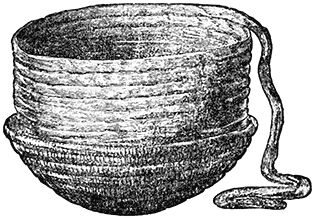
Fig. 55.—Clay nucleus in base mould, with beginning of spiral building;
a stage in the formation of a Zuñi vessel; after Cushing.
With regard to the employment of textile supports by the
ancient peoples of North America for the clay vessels
during the process of manufacture, Mr. Holmes[37] writes:—“Nets
or sacks of pliable materials have been almost
exclusively employed. These have been applied to the
surface of the vessel, sometimes covering the exterior
entirely, and at others only the body or a part of the body.
The nets or other fabrics used have generally been removed
before the vessel was burned or even dried.... I have
observed in many cases that handles and ornaments have
been added, and that impressed and incised designs have
been made in the soft clay after the removal of the woven
fabric. There would be no need of the support of a net
after the vessel had been fully finished and slightly hardened.
Furthermore, I have no doubt that these textilia were
employed as much for the purpose of enhancing the
appearance of the vessel as for supporting it during the
process of construction. In support of the idea that
ornament was a leading consideration in the employment of
these coarse fabrics, we have the well-known fact that
simple cord-markings, arranged to form patterns, have been
employed by many peoples for embellishment alone. This
was a common practice of the ancient inhabitants of Great
Britain”[38] (p. 398).
The value of the bearing of such observations as the
foregoing on the study of the prehistoric pottery of Europe
is obvious. In America the record is unbroken; with us,
like the great majority of our archæological finds, we are
dealing with fragments, and it is only by careful piecing
together that a symmetrical whole can be restored.
Dr. Klemm,[39] some half-century ago, wrote:—“The imitation
(of natural vessels) in clay presupposes numerous trials.
In the Friendly Islands [Tonga[40]] we find vessels which are
still in an early stage; they are made of clay, slightly burnt,
and enclosed in plaited work; so also the oldest German
vessels seem to have been, for we observe on those which
remain an ornamentation in which plaiting is imitated by
incised lines. What was no longer wanted as a necessity
was kept up as an ornament.”
Dr. Daniel Wilson[41] says that the early British urns may
have been “strengthened at first by being surrounded with
a plaiting of cords or rushes.... It is certain that very
many of the indented patterns on British pottery have been
produced by the impress of twisted cords on the wet clay—the
intentional imitation it may be of undesigned indentations
originally made up by the plaited network on
ruder sun-dried urns.”
Professor Tylor[42] refers to Mr. G. J. French’s experiments.[43]
“He coated baskets with clay, and found the wicker
patterns came out on all the earthen vessels thus made;
and he seems to think that some ancient urns still preserved
were actually moulded in this way, judging from the lip
being marked as if the wicker-work had been turned in over
the clay coating inside.”
“On the surface of a few ancient vases or urns found
in Germany,” Mr. Charles Rau[44] says, “I noticed those
markings which present the appearance of basket-work; I
was, however, in doubt whether they were impressions produced
by the inside of baskets, or simply ornamental lines
traced on the wet clay. Yet, even in the latter case, it
would seem that this kind of ornamentation was suggested
by the former practice of modelling vessels in baskets.”
It may be taken as proved that in a number of cases
the forms of pots are taken from natural objects, or from
receptacles made of different materials. We cannot demonstrate
this in all cases, nor should we expect to, for even
assuming this to have been the universal origin, we cannot
hope to have the earlier stages preserved to us. The record
is imperfect, the evidence of origin is clear in some cases,
and probable in others; in some the evidence is lacking.
What applies to the form of pottery applies equally to its
decoration; often it is impossible to disassociate them. The
actual or primitive technique of manufacture, too, may
exhibit itself in and as an ornament, as, for example, the
spiral markings in pottery made in the coil method. We
have seen that in some places plaited or woven fabrics have
been used to support the soft clay, and these have left their
impress. If not previously destroyed, these marks become
indelible after the burning of the pottery. These markings
being due to the process of manufacture, are repeated in the
manufacture of every vessel, and if not purposely smoothed
out, expectancy comes into operation, and they may be
imitated in a slightly conventional manner even when they
may no longer occur in construction, as, for example, when
the supports are no longer employed, or in pottery turned
on a wheel.
Various methods of plaiting, intertwining, netting, and so
forth may thus be transferred as skeuomorphic decoration to
pottery. These are at first produced by means of incisions,
puckerings of the clay by the fingers, application of accessory
coils or pieces of clay, etc. Even the accidental imprints of
nails or finger-tips, or of implements, may have suggested
certain decoration.
Later on, when pottery was decorated by painting, the
same kind of ornamentation was reproduced in the new
medium, and as the changed conditions evoked freer treatment,
the designs underwent various transformations.
Mr. Holmes[45] discusses the modification of ornament (1)
through material, (2) through form, (3) through methods of
realisation (p. 458).
(1.) The material of which an object is made must have
a very definite effect upon its decoration, and the material is
to a very large extent dependent upon the locality. Metal,
stone, clay, wood, bone, skins, and textiles are so varied in
their structure that they require different artistic treatment,
and it has usually taken a considerable time for a people to
discover what is the most suitable form of decoration for an
object made of a particular substance.
(2.) The forms of decorated objects exercise a strong
influence upon the decorative designs employed. An ornament,
as Mr. Holmes remarks, applied originally to a vessel
of a given form, accommodates itself to that form pretty
much as a costume becomes adjusted to the individual.
When it came to be required for another form of vessel,
very decided changes might be necessary.
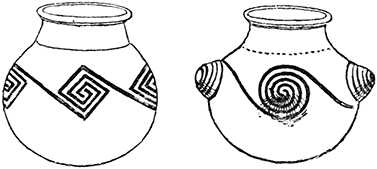
Figs. 56 and 57.—Variations in a motive through the influence of
form. Pueblo pottery; after Holmes.
The ancient Pueblo peoples were very fond of rectilinear
forms of meander patterns, and many earthen vessels are
found girdled with a beautiful angular pattern. (Fig. 56.)
When, however, the artist has to decorate a vessel which has
rounded prominences in its central zone, he finds it very
difficult to apply his favourite device, and he is practically
compelled to convert his angled into a spiral meander.
(Fig. 57.)
(3.) Ornament is modified by the method of its execution,
whether by incising, modelling, painting, or stamping;
closely associated with these are the peculiarities of construction.
Nearly all woven fabrics encourage, even to compulsion,
the use of straight lines in their decoration. Curved lines
are rendered as stepped or broken lines. Fig. 58 illustrates,
in a diagrammatic manner, two forms of the same motive as
expressed in different arts. The curvilinear freehand scroll,
which is readily painted, incised, or moulded in relief, is
forced by the constructional character of textiles into square
forms, and a rectangular meander or fret will result. Brickwork,
mosaics, or whole-coloured tiles also lead to similar
results. In the small panel to the left of Fig. 59 it will be
observed that careless or hurried work has resulted in the
rounding of an angular hook, which has been transmitted to
pottery from a textile source. I have noticed the angularisation
of spirals occurring in New Guinea; this was due,
not to change in the material employed, but to the preference
which the natives of the Papuan Gulf have to straight
and angled lines. (Cf. Figs. 11, 12.) Primitive spirals have
been copied by these people, and have gradually become
angularised into a rectilinear meander.
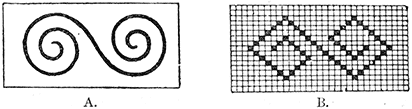
Fig. 58.—A, Freehand form; B, Form imposed by fabric. Forms of
the same motive expressed in different arts; after Holmes.
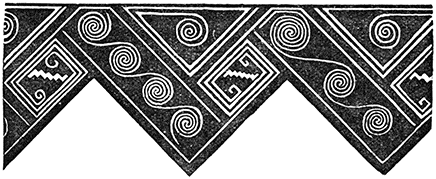
Fig. 59.—Design of Fig. 60; after Holmes.
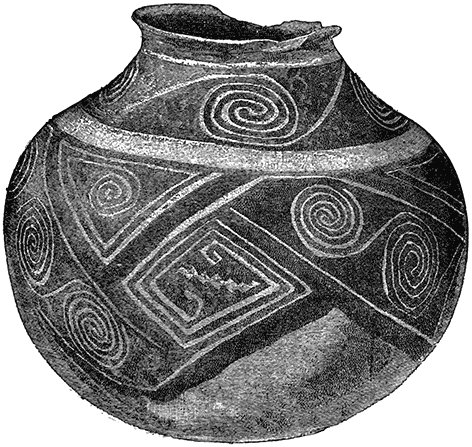
Fig. 60.—Ancient Pueblo vase, province of Tusayan. The height and
width of the vase are 14 inches; after Holmes.
Fig. 60 is a drawing of the painted design of a large
earthen vessel from the province of Tusayan, in the district
of the Colorado Chiquito. From the occurrence of an
isolated stepped line in the decoration, Mr. Holmes suggests
that the ornamentation had a textile ancestry. The design
is made by leaving the white colour of the pot and painting a
black background. The “unit of the design,” as interpreted
by Mr. Holmes, is given in black in Fig. 61. Judging from
Fig. 60, which is a representation of the vessel itself, Fig. 59
is a fairly faithful copy of the design; but there is no warrant
on this vase for his joining the scroll pattern at each end
with its enclosing line, as in Fig. 61. It is obvious that if
this design were logically worked out, it would appear as in
the last figure; it may be so on other vases, but Mr. Holmes
apparently is concerned with this one. Professor Grünwedel[46]
has drawn attention to the mistake of rectifying aboriginal
drawings, as we are thereby preventing ourselves from
studying the psychology of the natives. According to the
method we are employing, we are concerned with what
actually occurs, and not with what might be.
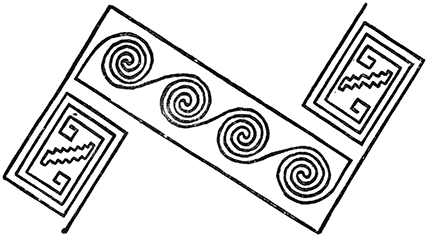
Fig. 61.—“Unit of the design” of Fig. 60; after Holmes.
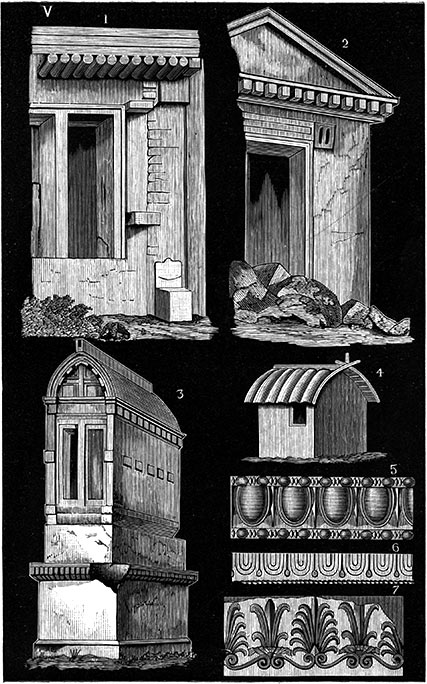
Sir C. Fellows,[47] in his interesting account of his travels in
Asia Minor, draws attention to the remarkable rock-tombs
which he discovered in Lycia, and which clearly prove that
these tombs were models in stone of wooden dwellings. At
Antiphellus (Plate V., Fig. 1) the timbering is reproduced
to every detail of mortise and tenon. The stems of trees,
laid horizontally to cover the chamber, are imitated in
masonry. They project beyond the wall, and show their
ends, as a row of circular sections, in the middle of the
entablature. The tree trunk at each extremity of the row
was larger than the rest, and has been squared. Sometimes
all the trunks are squared, as may be seen at Xanthus (Plate
V., Fig. 2); and we witness, as Dr. March points out, the
origin of the well-known Greek ornament called “guttæ.”
He also calls attention to the fact that skeuomorphs of
timbering were much affected by the Normans, as in their
various billet patterns; whilst their capitals often show
sections, not alone of branches springing from a tree trunk,
but of the enveloping bark also. (Plate I., Fig. B.)
Another rock tomb at Antiphellus (Plate V., Fig. 3) shows
a row of squared trunks projecting beyond the side of the
building, as would be a natural arrangement in any wooden
house that had a length greater than its width. In the
same building are external indications of a second story.
They are indications only, for the story does not exist. The
device is a skeuomorph, because it is functionless. “But
we understand,” to again quote from Dr. March, “the origin
of our ‘string-course,’ and we recognise one of the many
reasons, in the ancestral training of the eye of our race,
why the sight of a large unbroken surface produces in the
mind a sense of disappointment, a feeling of unsatisfied
expectancy, the anguish that Hood sings—
“‘A wall so blank
That my shadow I thank
For sometimes falling there!’”
The gables of the roof of the old-time houses were often
formed by the bent boughs of trees crossing each other at
the ridge, as witnessed by an Etruscan hut-urn from Monte
Albano (Plate I., Fig. C), and Pompeian wall-paintings.
(Plate V., Fig. 4.) A finished treatment of the bent bough
gable is seen in a tomb at Antiphellus. (Plate V., Fig. 3.)
In the wooden originals of the rock-tombs of Asia Minor
(Plate V., Figs. 2, 3) one sees the birth of the gable which,
arising as a structural necessity, was perpetuated in stone as
the crowning glory of Grecian temples, and ever since has
remained as a decorative adjunct to buildings, or the functionless
adornment of the humblest household furniture.
(Plate I., Figs. D-F.)
We have seen that as the bronze implement replaced
the neolithic celt, so the lashing of the latter became a
skeuomorphic decoration on the former. As tapa replaced
matting the conditioned ornamentation of the early fabric
was transmitted to a material which in itself imposed few
artistic limitations. The same also with pottery when it was
derived from or suggested by baskets; basketry impressed
itself on the clay, literally or figuratively as the case may
be, and thenceforward pots were doomed to basket-like
ornamentation until the possibilities of clay worked out the
freedom of the pot from the limitations of the basket. In
all the above we have a continuity in function, and it is
not very surprising that indications of structure stubbornly
persisted.
Everywhere the human mind has become accustomed to
certain local patterns, designs, and structures. These are
bound up with the sacred associations of family and religion,
with the green memories of childhood, and have become as
it were indented into the consciousness of the individual.
To many minds new designs are unvalued; they awaken no
sympathy, they are devoid of associations; like alien plants,
they pine away and die.
The pleasure which people take in beauty prompts them
to ornament almost everything which admits of decoration,
and it is the old patterns and designs which are most frequently
copied. So it comes about that these are scattered
with an impartial hand, and often without any regard to
appropriateness. By inappropriateness I do not wish to
imply that the ornament may not be suitable, but merely
that it has no meaning so far as the decorated object is
concerned. As a rule the decorative art of the less advanced
peoples is far more appropriate[48] than that of civilised. We
may not have the clue, but the more we do know the more
suitable do we find the decoration to be. The symbols of
religious ceremonies are usually depicted on the utensils
employed in that rite; the transference of such symbols to
purely secular objects would clearly be inappropriate decoration.
Our knowledge of the precise use of objects in
ethnological collections, and the significance of their form
and decoration is in many cases so imperfect that we are
not in a position to criticise their appropriateness; but we
have only to look around us at the objects of everyday life
to see that ornamentation is quite as often inappropriate as
appropriate. It will afford continual pleasure to attempt to
trace the skeuomorphic (or “technical,” as it is sometimes
called) origin of many patterns which have wandered far, and
have at last found themselves in strange company.
From things made by hands I now pass to natural objects,
that we may see how these too are seized upon and modified
by primitive folk.
Natural objects fall naturally into two main classes—inanimate
and animate subjects; in other words, physical
phenomena and living beings.
Under the term of “physicomorph”[49] I propose to describe
any representation of an object or operation in the physical
world. The heavens and all the powers therein have been
depicted in every age and by diverse peoples—usually, but
not invariably, with some mystical or religious significance.
Chief of the dreaded powers of the air were the thunder-storm,
with its concomitants, the thunder and lightning.
These have impressed themselves upon the imagination of
man, not only on account of their majesty, but also because
of man’s impotence. The thunder is the voice of the god,
the lightning his destructive and blasting energy.
The most obvious sign for lightning, a zigzag line, is
practically ubiquitous. Similarly the sun is variously depicted
as a star with few or many rays; as a circle, with a
cross or star inscribed within it, or with rays projecting
from its periphery. A plain disc, or more often a crescent,
stands for the moon.
As the heavenly powers are so generally associated with
the heavens, the celestial phenomena and bodies come to
represent these cosmical deities, and symbolism is born.
In the following pages I touch upon some of the symbolism
of physicomorphs in America; later, in dealing with religion
and its symbolism, I shall discuss similar symbols in the
Old World.
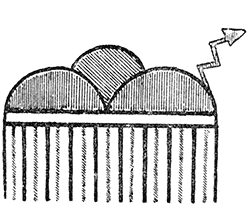
Fig. 62.—Modern Moki rain symbol;
after Holmes.
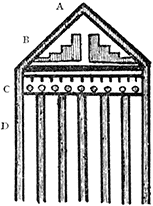
Fig. 63.—Decorative detail
from an ancient Pueblo
medicine-jar; after Holmes.
The symbolism of their autocthones
has been, and is still actively and sympathetically
studied by American anthropologists, as in a valuable paper[50]
by F. H. Cushing, who remarks:—“The semi-circle is
classed as emblematic of the rainbow; the obtuse angle as
of the sky; the zigzag as lightning; terraces as the sky
horizons, and modifications of the latter as the mythic
‘ancient sacred place of the spaces,’” and so on.
By combining several of these elementary symbols in a
single device, sometimes a mythic idea was beautifully expressed.
For example, Fig. 62 is the totem-badge Major
J. W. Powell received from the Moki Pueblos of Arizona
as a token of his induction into the rain gens of that people.
An earlier and simpler form of this occurs on a very ancient
sacred medicine jar. (Fig. 63.) The sky (A), the ancient
place of the spaces—region of the sky gods—(B), the cloud-lines
(C), and the falling rain (D), are combined, and depicted
to symbolise the storm, which was the objective of the
exhortations, rituals, and ceremonials to which the jar was
an appurtenance.
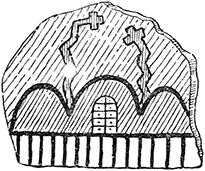
Fig. 64.—Rain-cloud tile of the
South House in a Tusayan
ceremony; after Fewkes.
Dr. J. Walter Fewkes, in a more recent paper entitled
“A few Summer Ceremonials at the Tusayan Pueblos,”[51]
gives an interesting account of
the Flute Ceremony. Several
ancient rain-cloud tiles are
described; one of them (Fig.
64) was in the room of the
South House, which contained
the altar. “Like its fellow, this
tile had an O’-mow-uh [cloud]
symbol, with falling rain and
the two lightning snakes depicted
upon it. There were
also fourteen broad black
parallel lines on a white ground representing falling rain.
Three rain-cloud semi-circles were outlined by a broad
black band above the falling rain. The field of the clouds
was brown, and the middle cloud, which was the largest,
had a conventionalised half-ear of corn,[52] consisting of two
parallel rows of rectangular kernels, each with a dot in the
middle. A field of green occupied the whole face of the
tile above the figures of the rain-clouds. On this region,
rising from the depression which separates the lateral from
the medial rain-cloud, one on each side, there was a brown
zigzag lightning figure outlined in black. Each of these
bore a simple terraced nā’k-tci [a terraced tablet placed on
the head of certain figures] on the head” (p. 121).
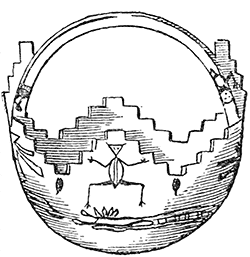
Fig. 65.—Zuñi prayer-meal-bowl; after
Cushing.
Mr. Cushing[53] has drawn attention to a bowl of which
the form as well as its decoration is symbolic. He says,
“Thus, upon all sacred vessels, from the drums of the
esoteric medicine societies of the priesthood and all vases
pertaining to them, to the keramic appurtenances of the
sacred dance or Kâ’kâ, all decorations were intentionally
emblematic. Of this numerous class of vessels I will choose
but one for illustration—the
prayer-meal-bowl
of the Kâ’kâ. (Fig. 65.)
In this both form and
ornamentation are significant.
In explaining
how the form of this
vessel is held to be symbolic,
I will quote a
passage from the ‘creation
myth,’ as I rendered
it in an article on the
origin of corn, belonging
to a series on ‘Zuñi
Bread-stuff,’ published
this year [?1882] in the Millstone of Indianapolis,
Indiana. ‘Is not the bowl the emblem of the earth
our mother? For from her we draw both food and
drink, as a babe draws nourishment from the breast of
its mother; and round, as is the rim of a bowl, so is the
horizon, terraced with mountains, whence rise the clouds.’
This alludes to a medicine bowl, not to one of the handled
kind, but I will apply it as far as it goes to the latter. The
two terraces on either side of the handle are in representation
of the ‘ancient sacred place of the spaces,’ the handle
being the line of the sky, and sometimes painted with the
rainbow figure. Now the decorations are a trifle more complex.
We may readily perceive that they represent tadpoles,
dragon-flies, with also the frog or toad. All this is of easy
interpretation. As the tadpole frequents the pools of springtime
he has been adopted as the symbol of spring rains;
the dragon-fly hovers over pools in summer, hence typifies
the rains of summer; and the frog, maturing in them later,
symbolises the rains of the later seasons; for all these pools
are due to rainfall. When, sometimes, the figure of the
sacred butterfly replaces that of the dragon-fly, or alternates
with it, it symbolises the beneficence of summer; since, by
a reverse order of reasoning, the Zuñis think that the butterflies
and migratory birds bring the warm season from the
‘Land of everlasting summer.’
“Upon vessels of special function, like these we have
just noticed, peculiar figures may be regarded as emblematic.
On other classes, no matter how evidently conventional
and expressive decorations may seem (excepting
always totemic designs), it is wise to use great caution in
their interpretation as intentional and not merely imitative.”
The study of symbols is a peculiarly difficult one, and
there is no branch of our subject which contains so many
pitfalls for the unwary. The two following paragraphs,
respectively by Messrs. Holmes and Cushing,[54] afford a
useful warning:—
“There are those who, seeing these forms already endowed
with symbolism, begin at what I conceive to be the wrong
end of the process. They derive the form of the symbol
directly from the thing symbolised. Thus the current scroll
is, with many races, found to be a symbol of water, and its origin
is attributed to a literal rendering of the sweep and curl of the
waves. It is more probable that the scroll became the symbol
of the sea long after its development through agencies similar
to those described above, and that the association resulted
from the observation of incidental resemblances. This
same figure, in use by the Indians of the interior of the
continent, is regarded as symbolic of the whirlwind, and it
is probable that any symbol-using people will find in the
features and phenomena of their environment, whatever it
may be, sufficient resemblance to any of their decorative
devices to lead to a symbolic association” (p. 460).
“To both the scroll or volute and the fret, and modifications
of them ages later, the Pueblo has attached meanings.
Those who have visited the South-west and ridden over the
wide, barren plains during late autumn or early spring have
been astonished to find traced on the sand, by no visible
agency, perfect concentric circles and scrolls or volutes
yards long, and as regular as though drawn by a skilled
artist. The circles are made by the wind driving partly
broken weed-stalks around and around their places of attachment
until the fibres by which they are anchored sever and
the stalks are blown away. The volutes are formed by the
stems of red-top grass and of a round-topped variety of the
Chenopodium drifted onward by the whirlwind, yet around
and around their bushy adhesive tops. The Pueblos, observing
these marks, especially that they are abundant after
a wind storm, have wondered at their similarity to the
printed scrolls on the pottery of their ancestors. Even to-day
they believe the sand marks to be the tracks of the whirlwind,
which is a god in their mythology of such distinctive
personality that the circling eagle is supposed to be related
to him. They have naturally, therefore, explained the
analogy above noted by the inference that their ancestors,
in painting the volute, had intended to symbolise the whirlwind
by representing his tracks. Thenceforward the scroll
was drawn on certain classes of pottery to represent the
whirlwind and modifications of it (for instance, by the
colour-sign belonging to any one of the ‘six regions’) to
signify other personified winds” (p. 515).
It is interesting to note that colours are often symbolic.
Thus in a footnote to p. 111, loc. cit., Dr. Fewkes says:—“Red
is the colour of the south, yellow of the north, blue
of the west, and white of the east. For the west the available
pigment used has, however, a green colour, although
blue is the colour corresponding to west.” A correspondence
on the colours of the winds was carried on in the Academy
in 1883. Dr. Whitley Stokes points out (p. 114) that
among the Mayas of Yucatan red was associated with the
east, white with the north, black with the west, and yellow
with the south. (Cf. Brinton, Folk-Lore Journal, i. p. 246.)
In Ireland, east was purple; south, white; north, black;
and west, dun; the sub-winds between S. and E. were red
and yellow respectively; between S. and W., green and
blue; between N. and W., grey and dark brown; between
N. and E., dark grey and speckled. Professor Max Müller
(p. 302) notes that among the Navajos E. is dark; S.,
blue; W., yellow; N., white (cf. Mathews, Amer. Anth.,
April 1883); and in the Veda E. was red; S., white; W.,
dark or dark blue; and N., very dark. Lastly, Mr.
Hilderic Friend (p. 318) says that in China and ancient
Java there were five deities or rules—(1) black, water, N.;
(2) red, fire, S.; (3) green, wood, E.; (4) white, metal, W.;
(5) yellow, earth, middle. Colonel Garrick Mallery has
also some notes on this subject, Fourth Ann. Rep. Bureau
Ethnol., Washington, p. 53, and Tenth Ann. Rep., p. 618.
It is very rarely that landscapes are drawn by savages
purely for decorative purposes. Maps or plans, or diagrams
which are virtually a kind of elevation section, or even a
sort of bird’s-eye view, may be limned for mnemonic or
directive purposes (p. 209); but pictorial views are so rare
that it is worth while giving an illustration of one (Fig. 66)
which I found etched on a bamboo tobacco-pipe, from
Torres Straits, in the Museum für Völkerkunde, in Berlin.
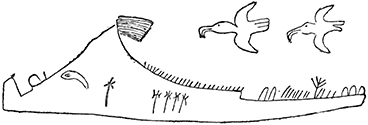
Fig. 66.—Tracing of a landscape etched on a bamboo tobacco-pipe, in
Berlin; three-eighths natural size.
I have little doubt that the island of Mer is here intended,
on account of the shape of the hill and the presence of
dome-shaped structures, which I take to be the beehive
huts which characterise the eastern tribe of Torres Straits. I
add for comparison a rough sketch (Fig. 67) I took of this
island, as seen from the south-west by west.

Fig. 67.—Sketch of Mer (Murray Island), by the author, from the
south-west-by-west, showing the hill Gelam.
The natives have a legend that this hill, “Gelam,” was
originally a dugong; and I believe the eye-mark in the
native’s drawing is intended for the eye of Gelam, “Gelam
dan,” and the projection to the extreme left to indicate
Gelam’s nose, “Gelam pit,” a small jutting rocky escarpment
at the head end of the island, which is enormously
exaggerated in the drawing. I take it that the break in the
ground of Fig. 66, below the first bird, indicates the hill
“Korkor,” which forms the tail of the dugong in my sketch,
and which is one end of the horse-shoe shaped crater of a
volcano. The part extending beyond this is the lava-flow
which forms the north-eastern half of the island.[55] The
vegetation is suggested in a very perfunctory manner. I
do not know what the lines that stream from the apex of
the hill are intended for. I should add that to make it
approximately topographically accurate, the native picture
should be reversed,[56] assuming my identification to be
correct. What I imagine to have occurred is as follows:—The
artist intended to represent Mer (Murray Island), and
he drew the peak of the principal hill, Gelam, from a very
characteristic point of view (I have sketches of my own
similar to this); in order to give a realistic touch he inserted
the eye, which is a prominent block of volcanic ash, and
added the nose. The view is suggestive, but it is an
impossible one, and it appears to me that this is characteristic
of a great deal of the pictorial art of savages.
The terms “zoomorph” and “phyllomorph” have been
employed for the representations in art of plants and
animals. Although man is, zoologically considered, only
a higher animal, it is convenient to retain the term
“anthropomorph,” which has been used by some writers
to express representations of the human form. All three
terms have reference to living beings, hence the appropriateness
of classing them under the general designation
of “biomorph.” The biomorph is the representation of
anything living in contradistinction to the skeuomorph,
which, as we have seen, is the representation of anything
made, or of the physicomorph which is the representation
of an object or operation in the physical world.
The fact that there is life in the original of the biomorph
appears in most cases to exert an influence on the biomorph
itself, so that it comes to have what might almost be
described as a borrowed vitality.
The distinctive activities or qualities of any living being,
more especially in the case of animals, very often cause
them to be taken as symbolic of that particular quality.
For example, the harmless, gentle, and affectionate dove,
which only busies itself with parental cares, has come to be
symbolic of peace. There are other reasons to which
allusion will be made which have conspired to render
biomorphs very important in decorative art.
Biomorphs partake of one characteristic of their originals.
They have a life-history. All organisms are born, they
grow, they die. During their growth they all pass through
greater or less changes. Sometimes these changes, as in the
metamorphoses of most insects, have attracted the attention
of the least observant, and have appeared to be of such
significance as to have been utilised for the illustration of
religious doctrines. Whether taking place in full daylight,
open to casual observation, or hidden in obscurity, or encapsuled
within an egg-shell, marvellous transformations
invariably accompany the earlier stages of the development
of animals, from the egg stage. The development records
an evolution, the history of which is being worked out in
detail by the patient investigators of one of the most
fascinating of all branches of study—embryology.
We have now to trace the birth, the evolution, and the
decay of biomorphs, and we shall find that the subject is
scarcely less suggestive and interesting than that of the very
animals themselves.
Biomorphs are represented for varied purposes, and with
other representations may be classified according to the
diagram given in the introductory section (p. 8).
A. Representation of Abstract Ideas of Life.
Even such an abstract idea as the Principle of Life, or
Vital Energy, has been indicated in decorative art. “On
every class of food- and water-vessels, in collections of both
ancient and modern Pueblo pottery (except on pitchers and
some sacred receptacles), it may be observed as a singular,
yet almost constant feature, that encircling lines, often even
ornamental zones, are
left open or not, as it
were, closed at the
ends,” writes Cushing[57]
(p. 510), who adds, “I
asked the Indian women,
when I saw them making
these little spaces with
great care, why they took
so much pains to leave
them open. They replied
that to close them
was ‘fearful!’—that this
little space through the line or zone on a vessel was the
‘exit trail of life or being.’ How it came to be first left
open, and why regarded as the ‘exit trail,’ they could not
tell. When a woman has made and painted a vessel she
will tell you with an air of relief that it is a ‘Made Being’;
as she places the vessel in the kiln, she also places in and
beside it food. The noise made by a pot when struck or
when simmering on the fire is supposed to be the voice of
its associated being. The clang of a pot when it breaks
or suddenly cracks in burning is the cry of this being as it
escapes or separates from the vessel. That it has departed
is argued from the fact that the vase when cracked never
resounds as it did when whole. This vague existence
never cries out violently unprovoked; but it is supposed
to acquire the power of doing so by imitation; hence,
no one sings, whistles, or makes other strange or musical
sounds resembling those of earthenware under the circumstances
above described during the smoothing, polishing,
painting, or other processes of finishing. The being
thus incited, they think, would surely strive to come out,
and would break the vessel in so doing.” In their native
philosophy and worship of water, the latter is supposed
to contain the source of continued life, hence life also dwells
in a vessel containing water, and having once held water,
and in virtue of having done so, it contains the source of
life. “If the encircling lines inside of the eating bowl,
outside of the water jar, were closed, there would be no
exit trail for this invisible source of life, or for its influence
or breath.” In attempting to arrive at the origin of this,
Cushing points out that it is very “difficult to smoothly
join a line incised around a clay pot while still soft, and
that this difficulty is greater when the ornamental band is
laid on in relief. It would be a natural outgrowth of this
predicament to leave the ends unjoined, which indeed the
savage often did. When paint instead of incision or relief
come to be the decorative agent, the lines or bands would
be left unjoined in imitation. As those acquainted with
Tylor’s Early History of Mankind will realise, a ‘myth of
observation’ like the above would come to be assigned in
after ages.”
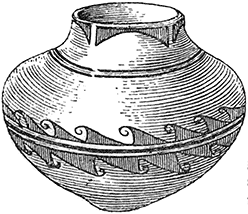
Fig. 68.—Pueblo water-jar; after
Cushing.
The soul or spirit as it is supposed to emerge from a
person at death is often represented in Christian art as
a miniature man or as a winged monstrosity, as a
butterfly by the ancient Greeks, or in various ways by
different peoples. Souls of deceased persons may be enshrined
in living fruit-eating bats,[58] frigate-birds,[59] crocodiles,[60]
lizards,[61] sharks,[62] or other animals. Under certain
conditions the representation of any of these forms would
be emblematic of the soul.
The dove, flames (or tongues) of fire, wind, and other
emblems are symbolic of spirit in Christian art.
B. Phyllomorphs.
It has been frequently remarked that plant forms are
rarely represented by savages. A possible explanation may
be found in the fact that plant life is so passive, it does
nothing actively or aggressively as compared with the
irrepressible vitality of animals. Thus it does not impress
itself on the imagination of backward peoples.
Another explanation has been suggested to me by Dr.
Colley March. The need of ornament is based on expectancy.
The eye is so accustomed to something in a certain
association, that when this is not seen there is experienced
a sense of loss. Among savage peoples the eye is
accustomed to dwell on vegetal forms which are always
present. It is only when they cease to be present, as in the
exceptional circumstances of desert places, or walled towns,
that the sense of loss can arise.

Fig. 69.—Design based on a
palmito leaf, Bakaïri tribe,
Central Brazil; after Von
den Steinen.
It is very probable that the reputed paucity of ornamentation
derived from the vegetable world amongst primitive
folk may be partly due to
our not recognising it as
such. Their conventions are
not the same as ours, and
they are often satisfied with
what appears to us to be a
very imperfect realism. Who,
for example, would recognise in Fig. 69 the leaves of a small
“cabbage”-bearing wild palm? Yet the pattern on this
painted bark-tablet of the Bakaïri tribe of Central Brazil
has this significance, according to Professor von den Steinen
(cf. p. 175).
Backward people have to be taught to see beauty in
nature, and it is very doubtful if the elegance of the form of
flower or leaf appeals to them. Bright colours we know
please all, and it is the colour or scent of flowers and leaves
which causes them to be worn or used in decoration.
One of the very few instances known to me in which
vegetable forms are employed in ornamentation by the
natives of British New Guinea occurs along the Fly River
(Figs. 4, 8). These natives are fond of decorating their
drums with leaves, hence it may happen that, on the principle
of expectancy, leaves become mentally associated with drum
decoration, and in consequence often carved upon drums,
and thence, by the constraint of the feeling of expectancy
transferred to pipes and other objects; the casual decoration
becomes an engraved ornament. On the other hand, the Fly
River appears to have been a culture route (pp. 28, 70), and
the employment of plant motives (if the majority of these
devices are really such) may be partly due to influence from
Malaysia. Dr. M. Uhle[63] points out that “The influences of
the plant ornamentation of the East Indian Archipelago are
also found in Western New Guinea. Although essentially
peculiar to the western portion of the East Indian Archipelago
it is not wanting in isolated cases in the eastern.
Plant ornamentations in perforated carving are known from
Halmahera which form a precise parallel with the carvings
from Geelvink Bay. Further, the plant ornamentation
occurs in Geelvink Bay also in isolated four-petalled
flowers, as in Celebes, Halmahera, Timor, and Borneo.
[Plant garlands are found on objects from the neighbourhood
of Geelvink and Humboldt Bays.] A complete
tendril with four-rayed leaves [or flowers] occurs as a
pattern on a pottery-beater from Humboldt Bay.[64] Trustworthy
examples from further east in North New Guinea
are either absent or are as yet unrecorded. The influence
of the western plant ornament is also felt in South-west
New Guinea in the district between Kamrao and Etna
Bays. The formation of a cruciform pattern through the
arrangement of four Nassa shells, which occurs not only in
Geelvink Bay but also in South-west New Guinea at Wamuka
River, appears to be due to the influence of a plant pattern,
the frequent four-petalled flower.”
In the central district of British New Guinea plant forms
appear to be again met with (Fig. 21). I say “appear,”
as unless there is direct information from natives it is
always risky to hazard a guess as to the meaning of a
particular design. The reason for these designs is at
present quite obscure, but there can be no doubt that there
is a reason for them, and a good one too.
Where plants are represented by savage peoples we shall
probably find that as a rule their employment is primarily
due to other causes than the selection of beautiful forms
and graceful curves for their own sakes. A very good
example of this is found among the magic patterns on the
combs of the Negritos of Malacca, and I would refer the
reader to the section on Sympathetic Magic (p. 235), where
this is dealt with at considerable length. It may be that
this four-rayed flower which is credited with magical
properties is the same which, as Dr. Uhle has pointed
out, is so widely spread in the decorative art of the Malay
Archipelago and Northern New Guinea.
Few plants have penetrated into the psychical life of man
to the same extent as the lotus. The food-plants, which
afford sustenance to his body, rarely, as such, enter the
portals of art. Even those used in fermentation do not
necessarily fare much better. The chief exception is the
vine, which from its graceful habit of growth and its
decorative leaves and clusters of grapes readily lends itself
to artistic treatment, but in this case it was probably on
account of the “wine that maketh glad the heart of man,”
rather than the beauty of the vine, that this creeper became
a favourite motive in decorative art. Having once effected
an entrance by appealing to the lower senses, the vine
retained its position by gratifying the higher. This chapter
in the history of art has, however, yet to be written.
Neither mere utility nor intrinsic beauty appear to be a
necessary qualification for the establishing of plant-life in
decorative art. It is only, so to speak, when plants are
provided with a soul, when an inner meaning is read into
them, that they become immortalised.
The best example of this is found in the history of the
lotus in decorative art. Religion introduced it, symbolism
established it, and habit or expectancy retained it.
The Lotus and its Wanderings.
As many mistakes have arisen from the confusion of the
Egyptian lotus with the rose water-lily it is necessary to
clearly distinguish between them.
The White lotus (Nymphæa lotus) and the Blue lotus (N.
cœrulea), which is only a colour variety of the former, have
a disc-like leaf, cleft nearly to its centre, which floats on the
surface of the water. The calyx has only four coarse sepals
which are dark green in colour, and which entirely encase
the bud until it begins to open. As it expands the delicate
white or sapphire blue petals offer a marked contrast to the
sepals. From four points of view of the open flower a
central and two lateral sepals will be evident, often when
the flower begins to fade the sepals bend downwards, but
the petals do not expand to a greater extent than is shown
in the accompanying figure (Fig. 70), in which will also be
seen the characteristic seed-capsule with its rosette-like
apex.
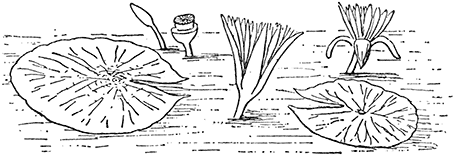
Fig. 70.—Rough sketch of the Egyptian lotus (Nymphæa lotus); after
original drawings by Professor Goodyear.
The rose water-lily, or water-bean (Nelumbium speciosum),
according to Professor Goodyear,[65] is not represented in Egyptian
pattern ornament. Its leaves (Fig. 71), standing erect
out of the water, are bell-shaped and not slit. The calyx has
numerous, over-lapping, scale-like sepals. The flower opens
widely and the broad petals disappear from view by the
expansion of the blossom. The seed-pod resembles the
spout of a watering-pot. Sir J. G. Wilkinson says,[66] “The
Nelumbium, common in India, grows no longer in Egypt,
and the care taken in planting it formerly seems to show
it was not indigenous in Egypt.”
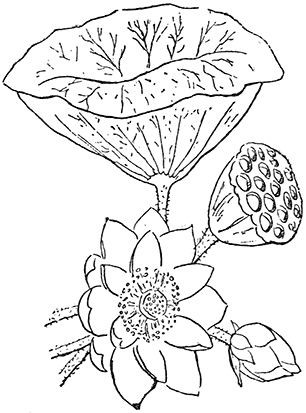
Fig. 71.—Sketch of the Indian lotus (Nelumbium speciosum); after
Description de l’Egypt: Histoire Naturelle, from Goodyear.
In every book dealing with Ancient Egypt numerous
figures of the lotus will be noticed either in scenes illustrating
the cult of some divinity and as sacred symbols, or in
later times employed merely for decorative effect. The
same remark applies, though to a less extent, to the art of
Chaldea, Assyria, Persia, India, Phœnicia, and several of
the Mediterranean countries.
Why should this motive be so widely spread? The most
obvious answer has already been suggested. Religion introduced
the lotus to art. We have already noticed the
earthly original, now allusion must be briefly made to its
symbolism; then its original home must be sought; and
finally, some of its wanderings traced, and a few of its
variations and transformations noted.
It appears that in Ancient Egypt the lotus was symbolic
of the sun; a text at Denderah says, “The Sun, which was
from the beginning, rises like a hawk from the midst of its
lotus bud. When the doors of its leaves open in sapphire-coloured
brilliancy, it has divided the night from the day.”[67]
At Denderah a king makes an offering of the lotus to the Sun-god,
Horus, with the words, “I offer thee the flower which
was in the beginning, the glorious lily of the Great Water.”[68]
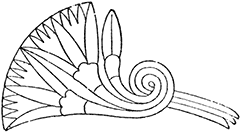
Fig. 72.—Lotus flowers and bud, painted
on the coffin of a mummy from the
Necropolis of Thebes, Twentieth
Dynasty; after Prisse d’Avennes.
Fig. 72 is a detail
taken from a plate in the
second volume of the
magnificent atlas by
Prisse d’Avennes;[69] it is
part of the offerings on
an altar before Osiris,
who is crowned with the
solar disc. Osiris is the
sun in the Lower World—i.e.,
during the night,
and the father of Horus. Horus is sometimes depicted
seated on a lotus.
The various animals which were symbolic of the sun or
associated with sun-divinities are also placed in direct
connection with the lotus, as if to emphasise its solar
significance; for example—
The solar-bull is well recognised in Egyptian mythology,
the Bull-god Apis being an incarnation of Osiris, and an
offspring of the Sun-god, Ptah of Memphis. Similarly also
for Assyria, Merodach, “the Bull of Light,” was originally
a Sun-god; his Syrian equivalent was Baal. The Phœnician
Moon-goddess, Astarte, had the bull as her symbol, and the
bull of Europa was its counterpart. The Taurus of the
Chaldean Zodiac commenced the year.
The lion was another sun-animal both in Egypt and in
Chaldea and Assyria.
Among birds the hawk and the eagle were sun symbols,
especially the former, and it is sometimes depicted standing
on a lotus. The solar-goose is also important in its association
with the lotus. (Fig. 129, G.)
In early Cyprian pottery we find lotus derivatives grouped
with the solar cross and other symbols of the sun. (Fig. 129, F.)
The association of the lotus with the sun probably led to
its other symbolic relations, and these latter have rather
drawn attention away from what is here regarded as the
more primitive symbol.
The lotus was a well recognised symbol of life, resurrection,
and immortality. It was largely employed in funeral
rites in Egypt, and is constantly associated with mummies,
and also symbolised the resurrection, but this latter idea
was associated in the Egyptian mind with reproductive
power, and hence the relation of this also to the lotus.
Professor Maspero says:[70] “The assimilation and occasional
complete identity of the Supreme God with the
sun being once admitted, the assimilation and complete
identity of the secondary divine beings with Ra (the sun)
were a matter of course. Amon, Osiris, Horus, Ptah, were
regarded sometimes as the living soul of Ra, sometimes
as Ra himself.” From this would result a mingling and
extension of symbolism; but upon these troubled waters
the lotus calmly rides supreme. Its association with the
sun, its connection with reproductive energy, its descent
into the grave, and its symbolism of a resurrection have
given to the lotus that immortality which it symbolised.
Although lotus designs are profusely scattered up and
down in Egyptian art there is no reason for believing that
the Egyptians regarded it as a national emblem, but it was
a universally recognised symbol. At the beginning of the
year it sprouted from its slimy bed and floated beautiful
and pure on the surface of the waters. At sunrise the buds
opened and studded the water with white or cerulean asters,
which closed when night fell. Every autumn it died its
annual death only as prelude to the vernal resurrection.
The intensely religious mind of the Ancient Egyptians
was permeated with the problems of death and elevated
by the prospect of immortality. Resurrection and future
bliss were articles of firm faith, not merely a pious hope.
What wonder then, with this religious saturation of immortality,
that the flower which symbolised the resurrection
should be depicted in such profusion in their tombs and
elsewhere!
If the reader will take the trouble to compare lotus
representations in books on Egyptology it will be beyond
dispute that it is the white or blue lotus (Nymphæa), and
not the rose water-lily (Nelumbium), which is so ubiquitously
delineated.
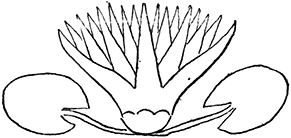
Fig. 73.—Lotus flower with two leaves, on a
vase from the Necropolis of Memphis,
Fourth to Fifth Dynasties; after Prisse
d’Avennes.
A slightly conventionalised
lotus with two of
its leaves (Fig. 73)
is drawn on a vase
contemporaneous
with the pyramids,
from the Necropolis
of Memphis
(Fourth and Fifth
Dynasties, 3998-3503
B.C.).
The same lotus flower (Fig. 72) appears some two
thousand years later in a representation of an offering to
Osiris from the Necropolis of Thebes belonging to the
Twentieth Dynasty. Indeed, it was painted and carved so
frequently for thousands of years that it would be impossible
to describe its variations and applications. I must,
however, permit myself to allude to one or two examples
which are interesting from other points of view. In Plate
VIII., Fig. 12, we see single lotus flowers employed in an
isolated manner in a border pattern, and alternating with
these is another device. The separation of the elements
of a border pattern is by no means universal in Egyptian
decorative art; for example, the scroll pattern (Fig. 74)
from the Necropolis of
Thebes is a good example
of a pattern which
gives an idea of flow,
but even here there is
a lack of continuity in
the spiral band which
creates a feeling of dissatisfaction when one attempts to
trace out the construction of the design. It is evident
that in such patterns the spiral is quite a secondary motive,
and it thus has not been worked out
logically; the lotus flowers and the rosettes
are the essential elements of the pattern.
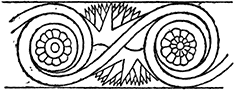
Fig. 74.—Lotus border; from Goodyear,
after Prisse d’Avennes.
With the last figure we may compare
the scroll detail (Fig. 75) from a Melian
vase, the lotus flower being represented
by four black marks, and the scroll has
acquired that development which is so
characteristic of Ægean art.

Fig. 75.—Lotus
scroll detail on
a Melian vase;
from Goodyear,
after Conze.
Various causes may lead to the
evolution of a recognised scheme
of decoration of certain objects,
but when a new class of objects
is to be decorated the artist has a
chance to exhibit his originality; even
so this is about the last thing which
decorative artists do manifest. The
constraint of custom appears to exert
an influence too potent to be readily
snapped, and so the Egyptian decorator,
being further tied by religious
sentiment, ornamented even extensive
areas, such as the ceilings of
tombs, with lotus designs, the main
elements of which had been elaborated elsewhere.
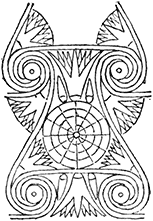
Fig. 76.—Pattern from
the ceiling of a tomb,
Necropolis of Thebes,
Eighteenth Dynasty;
from Coffey, after
Prisse d’Avennes.
In Fig. 76 we have a ceiling design in which the lotus is
very apparent both in flower and bud; the rosettes, like
spiders’ webs, may possibly represent
the leaves of the lotus
(Fig. 70), and we have the same
interlocking but discontinuous
spirals that occur in Fig. 74.
A different treatment of the
same motive is seen in Fig. 77,
but here only the lotus flowers
and the interlocking scrolls are
employed. Below each flower
is a fan-like portion apparently
tied on to the former; this may
have some significance or it may
be merely a convenient method
of finishing off the flower.
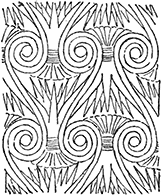
Fig. 77.—Pattern from the
ceiling of a tomb, Necropolis
of Thebes, Eighteenth
to Nineteenth Dynasties;
from Coffey, after Prisse
d’Avennes.
In these old Egyptian designs
the rosette is often associated with the lotus and lotus derivatives,
as in Fig. 74; and it may happen, as in Fig. 78, that the
former is the most prominent motive. The lotus is here
represented solely by the black triangles which occupy the
angles of the quadrangular spaces which contain the rosettes;
at all events there is good evidence to support this view.
The angularisation of the last pattern gives us Fig. 79,
which many people would imagine to be Greek, although,
as a matter of fact, it is ancient Egyptian. The rosettes and
the angled scrolls alone persist. We cannot speak with
certainty as to the reason for the modification of the scrolls,
but it is probable that it resulted from an attempt to copy
such a painted design as Fig. 78 in textiles, and the pattern
metamorphosed by the new conditions was painted on the
tomb ceilings along with its more flowing progenitor. For
further examples of analogous transference of designs from
one technique to another, and their consequent transformation,
the reader is referred to p. 112.
Fig. 78.—Pattern from the
ceiling of tomb No. 33,
Abd-el-Kourneh, Thebes,
Seventeenth to Twentieth
Dynasties; from Coffey,
after Prisse d’Avennes
and Goodyear.
Fig. 79.—Pattern from the ceiling
of a tomb from Thebes,
Seventeenth to Twentieth
Dynasties; from Coffey,
after Prisse d’Avennes.
Professor Flinders Petrie has stated that the scroll or
spiral was one of the greatest factors in the early development
of ornament, and only second to the lotus in the part
it played in the decorative ideas of the ancient world.
What it symbolised, if symbolise anything it did, we know
not. Some affect to see in it a representation of the
wanderings of the soul, but why, as Professor Petrie
suggests, some souls should come to the end of their
wanderings in a spiral and others in an oval is not
explained. Its oldest use was on the scarabs, where it was
clearly used first as “filling-in” ornament. We can first
trace it about 3,500 B.C. At first in loose unconnected
“C” and “S” links, and afterwards in every variety of
combination, continuous as well as unconnected, the scroll
line winds its way for ages through the records of Egyptian
decoration. Yet there is a clear margin of 1000 years at
least between any Egyptian date of its use and its appearance
in the art of other ancient countries. From the fact
that it is generally coloured yellow in Egyptian designs,
Professor Petrie infers that gold was used in these forms
to enclose gems, cloisonné and coloured stones; indeed
Schliemann found such work in his explorations at Mycenæ.
Mr. Arthur Evans remarks:[71]—“On the twelfth dynasty
[about between 2778 and 2565 B.C.] scarabs the returning
spiral motive, as is well known to Egyptologists, was developed
to an extraordinary degree. These purely spiral types,
like the twelfth dynasty motives, were also copied by the
native Cretan engravers. From Crete, where we find these
Aegean forms in actual juxtaposition with their Egyptian
prototypes, we can trace them to the early cemeteries of
Amorgos, and here and in other Aegean islands like Melos
can see them taking before our eyes more elaborate developments.
Reinforced a thousand years later by renewed
intimacy of contact between the Aegean peoples and the
Egypt of Amenophis III., the same system was to regain a
fresh vitality as the principal motive of the Mycenæan goldsmith’s
work. But though this later influence reacted on
Mycenæan art [about 1500 B.C.], as can be seen by the
Orchomenos ceiling, the root of its spiral decoration is to
be found in the earlier ‘Aegean’ system engrafted long
before, in the days of the twelfth dynasty.
“In the wake of early commerce the same spiraliform
motives were to spread still further afield to the Danubian
basin, and thence in turn by the valley of the Elbe to the
Amber Coast of the North Sea, there to supply the Scandinavian
Bronze Age population with their leading decorative
designs. Adopted by the Celtic tribes in the Central European
area, they took at a somewhat later date a westerly turn,
reached Britain with the invading Belgae, and finally survived
in Irish Art.”[72]
Among the most frequent of the decorative designs
employed by the Assyrians are the knop (or bud) and
flower pattern and the rosette, and usually these are found
in combination. For the former design I shall employ the
Greek term “Anthemion.”
“That flower,” write MM. Perrot and Chipiez,[73] “has
been recognised as the Egyptian lotus, but Layard believes
its type to have been furnished, perhaps, by a scarlet tulip
which is very common towards the beginning of spring in
Mesopotamia.[74] We ourselves believe rather in the imitation
of a motive from the stuffs, the jewels, the furniture,
and the pottery that Mesopotamia drew from Egypt at a
very early date through the intermediary of the Phœnicians.
The Phœnicians themselves appropriated the same motive
and introduced it with their own manufactures, not only
into Mesopotamia but into every country washed by the
Mediterranean. Our conjecture is to some extent confirmed
by an observation of Sir H. Layard’s. This lotus
flower is only to be found, he says, in the most recent of
Assyrian monuments, in those, namely, that date from the
eighth and seventh centuries B.C., centuries during which
the Assyrian kings more than once invaded Phœnicia and
occupied Egypt.[75] In the more ancient bas-reliefs, flowers
with a very different aspect—copied in all probability direct
from nature—are alone to be found.
“The lotus flower is to be found, moreover, in monuments
much older than those of the Sargonids, but that
does not in any way disprove the hypothesis of a direct
plagiarism. The commercial relations between the valleys
of the Nile and the Euphrates date from a much more
remote epoch, and about the commencement of the eighteenth
dynasty the Egyptians seem to have occupied in force
the basin of the Khabour, the principal affluent of the
Euphrates. Layard found many traces of their passage
over and sojourn in that district, among them a series
of scarabs, many of which bore the superscription of
Thothmes III. [1481-1449 B.C.]. So that the points of
contact were numerous enough, and the mutual intercourse
sufficiently intimate and prolonged, to account for the
assimilation by Mesopotamian artists of a motive taken
from the flora of Egypt, and to be seen on almost every
object imported from the Nile Valley. This imitation
appears all the more probable as in the paintings of Theban
tombs, dating from a much more remote period than the
oldest Ninevite remains, the pattern with its alternate bud
and flower is complete (Plate VIII., Fig. 12).
“The Assyrians borrowed their motive from Egypt, but
they gave it more than Egyptian perfection. They gave it
the definite shapes that even Greece did not disdain to copy.
In the Egyptian frieze the cones and flowers are disjointed;
their isolation is unsatisfactory both to the eye and the
reason. In the Assyrian pattern they are attached to a
continuous undulating stem, whose sinuous lines add greatly
to the elegance of the composition.”
While admitting that the lotus motive overran Assyrian
art, there is reason to believe that it did so only because
there was an antecedent style upon which it could be
engrafted. The pattern shown in Fig. 10, Plate VIII., is an
example of an Assyrian anthemion engraved on an ivory
panel in the British Museum, and of purely Assyrian
workmanship. It is worth while attempting to trace this
back as far as possible. In Fig. 4, Plate VIII., we have a
pattern painted in red, blue, white, and yellow upon
plaster, discovered by Sir Henry Layard in Nebuchadnezzar’s
palace in Nineveh. In this there is a serial
repetition of a disc, or sphere, which is pendant; all the
pendants are connected by a single cord, which appears as
if it were drawn into loops by their weight.
In Fig. 7, Plate VIII., we have a representation from a
stone carving of an Assyrian pavilion, and in Fig. 2 a
“tabernacle” from the famous bronze gates of Balawat,
which were made for Shalmaneser II., and are now in the
British Museum. Yet more simple is the tasselled canopy
(Fig. 6) from an enamelled brick from Nimroud, a king
who is standing under this canopy has a fringe (Fig. 5) to
his robe which is composed of alternate white and yellow
tassels. King Sargon (about 722 B.C.) is also represented
on a relief from Khorsabad in the Louvre, with a similar
fringe (Fig. 1) to the hem of his robe.
Any one who has done any plaiting in bands of two
colours knows that if the intersections be truly alternate the
fringe along the opposite borders will all be of the same
colour as in A, Plate VIII., but if the colours run in stripes
the fringe all round will be composed of alternate patches
of colour. When bands composed of several threads are
employed, it is necessary to knot the strands together at the
edge to prevent fraying. A more pleasing border is formed
by taking half the strands of one band and tying them to
half the strands of the next band of the same colour, and so
on (B, Plate VIII.). By this means we naturally obtain a
structural root-like origin for each tassel in the fringe, which
may be termed the connecting strand. This appears to
have been the common method of finishing off the edge of
Assyrian textiles.
There is thus no difficulty in accounting for a fringe of
tassels (Figs. 1, 5, Plate VIII.). Awnings (Fig. 6) as a
protection from the blazing sun were a very common
feature in Assyrian life. When the king went out on warlike
or hunting expeditions he took with him a large royal
tent or pavilion made of “slender columns with rich capitals
and a domed roof, made, no doubt, of several skins
sewn together, and kept in place by metal weights.[76]
The pavilion (Fig. 7) was a civil edifice, the temporary
resting-place of the sovereign. The same materials were
employed in the same spirit in the erection of religious
tabernacles” (Fig. 2). It is, however, probable that brightly-woven
rugs or mats were employed for the smaller canopies;
these would even more require the employment of weights
to prevent the wind from blowing about the covering. One
can hardly interpret the pendants on the royal pavilion
(Fig. 7) in any other manner than as weights to steady the
awning. The pendants would in the case of textiles be
fastened on to the tassels, probably they would sometimes
be placed on alternate tassels. In the pavilion so often
referred to the weight pendants are of two shapes, in this
also carrying out that alternate arrangement which manifests
itself structurally in most textiles, and which consequently
gives rise to the feeling of expectancy in other
objects. Another example of this is seen in the representation
of the vine in Assyrian art, for the decorative sentiment
has so possessed the artists as to cause them to depict the
branches with a leaf and a bunch of grapes in regular
succession.
There is no need to go further than this for the origin
of the Assyrian anthemion. We find a fringe of tassels in
alternate colours, we find a fringe of canopy weights of
alternate design, we assume an occasional alternation of
fringe and weight. In all cases these must be serially
united by the “connecting strand.” How can the stone-carver
or the wall-decorator represent these three alternatives?
Clearly they would indicate rather than imitate
them. What greater realism could we expect than that
which we have?
There are many ways of making tassels—for example,
each one may be allowed to splay out fan-wise, or it may
be tightly tied round the middle, or bound round so as to
form a kind of cone or spindle.
Whether as variously tied, or differently coloured tassels,
or as alternate tassel and weight, a border of alternate
members organically springing from a common base was
constantly before the sight of the artists of this great textile
manufacturing people. The conventionalising tendency of
decorative art did the rest, and the various forms of Assyrian
anthemion would easily follow.
A triple alternation (Fig. 9, Plate VIII.) occurs on an
enamelled brick tile from Nimroud in the British Museum.
It is characteristically Assyrian in style, but it does not give
that effect of repose and satisfied expectancy which we
demand from a pattern, and in this respect we cannot
regard it as eminently successful.
If this hypothesis of Dr. March’s of the evolution of the
Assyrian anthemion be correct, this pattern is essentially a
skeuomorph, but at the same time certain local plant-forms
were probably associated with it.
Let us now turn to the border pattern (Fig. 8, Plate VIII.)
of the carved stone thresholds, which are occasionally found
in a marvellous state of preservation. Here we have a “knop
and flower pattern” which differs as much from the Assyrian
style as it resembles that of Egypt. A comparison of this
figure with Fig. 12, Plate VIII., will convince most people
that borrowing has taken place. It is not always easy to
determine how far the Assyrian anthemion has been influenced
by native foliage or by conventional designs derived
from the local flora. In these threshold borders, however,
the Egyptian phyllomorph has grown, as Dr. March points
out, like a floral parasite on a skeuomorphic basis. As
introduced plants frequently overrun a new country and
crowd out native forms, so the lusty lotus invaded the field
of Assyrian art, and largely supplanted pre-existing phyllomorphs.
To return for a moment to the Egyptian pattern, the
“proto-anthemion,” as one may term it, is characterised by
the absence of a connecting strand, the buds and flowers
springing from a basal line. My friend, Dr. March, with
his usual ingenuity, has suggested to me a very plausible
explanation of this fact. The Egyptian pattern was phyllomorphic
from the beginning, originating in symbolism it
was primitively a realistic representation of an erect water-plant.
Maspero says the decoration of each part of the Egyptian
temple was in consonance with its position. The lower parts
of the walls were adorned with long stems of lotus or papyrus—bouquets
of water-plants emerging from the water.
This then is the solution of the difficulty. The Egyptian
anthemion, derived from plants emerging from the
water, has as a rule no connecting strand. The Assyrian
variety, derived from a tassel-skeuomorph, is never without
its looped base line, is primarily pendant, and consists in
the earliest stage of plants that are non-aquatic.
The rosette (Plate VIII., Figs. 4, 8, 10) is usually
stated to be an essentially Mesopotamian device, but it is
scattered up and down in Egyptian and Mediterranean
art. (Figs. 74, 78, 79, 84.) It may be characteristic of
Assyria, but it is by no means peculiar to it.
The rosette in Egypt is probably mainly a lotus-motive;
the upper end of the yellow-rayed seed-vessel may be
regarded as the chief original, but some are undoubtedly
fully expanded lotus flowers seen from above or below, or
a group of buds or of flowers arranged radially. However
conventionalised it may become, the rosette is most constantly
associated with the lotus in Egypt, the land of its
birth. Their association elsewhere is only to be expected,
as there would naturally be a tendency for the rosette to
accompany the knop and flower in their migrations.
According to Professor Flinders Petrie,[77] it is even doubtful
whether the rosette was truly of vegetable origin. The
use of leather-work seemed to have greatly modified the
rosette. Its primitive form did not look floral at all, merely
a circle with white dotted lines radiating across. Later,
there were concentric rings of colours, with the same white
dotted lines. The stitched leather theory explained a whole
host of peculiar ornaments that could hardly otherwise be
understood.
Goodyear[78] points out (p. 101) that no dated example of
the rosette is known in Assyria or Chaldea before the
twelfth century B.C.—i.e., on the dress of Merodach-idin-akhi,
King of Babylon. It occurs with other lotuses in
Egypt on the head-dress of Nefert, a statue of the Fourth
Dynasty, 3998-3721 B.C. As previously stated, the earlier
Egyptian kings of the Eighteenth Dynasty conquered
Assyria. The reign of Thothmes III., who, according to
a contemporary expression, “drew his frontiers where he
pleased,” is placed by Professor Flinders Petrie[79] from 1481-1449
B.C. The Egyptian empire then comprised Abyssinia,
the Soudan, Nubia, Syria, Mesopotamia, part of Arabia,
Khurdistan, and Armenia.[80]
In answer to the question, How is it that the fact has
been overlooked that the rosette is as familiar a feature of
Egyptian ornament as the earliest dated remains of other
ornaments? Goodyear (p. 102) says that the answer
apparently is that the rosette is very abundantly known on
carved slabs from Nineveh, while the architectural surface
carvings in Egypt are almost absolutely destitute of rosette
ornament, but it is very frequently represented in tomb
paintings.
Those who have argued for the Assyrian origin of the
rosette appear to have only compared the stone carvings of
the two countries in question, but it is well known that no
borrowing of architecture took place. There is evidence
that portable objects were traded from Egypt to Mesopotamia,
and there is no doubt that the purely decorative
mural paintings of Egyptian tombs were analogous to the
patterns on Egyptian textiles, and these were traded to the
East. The thresholds from Assyria were undoubtedly
carved in imitation of rugs; from the monuments we may
suppose that the walls were often decorated with woven
stuffs, the ornamentation of which was transferred to stone
and glazed bricks. We may then come to the conclusion
that the mural decoration of Assyria was affected by the
designs of textiles and other portable articles of merchandise,
the idiosyncrasy of this country making itself felt in the
selection and adaptation of Egyptian originals.
In dealing with rosettes we must be very careful not to
fall into the common error of imagining that things which
are similar are necessarily the same. In the course of this
book there are several examples of the facility with which
such a mistake could arise, and sometimes has arisen.
Patterns and designs must primarily be studied in situ,
and the wandering “from Dan to Beersheba” is to be
deprecated as a method. It is only when the indigenous
material is insufficient, or fails in its results, that the comparative
method should be employed, and then only when
history, tradition, or other lines of evidence warrant its use.
Rosettes undoubtedly occur in Egyptian decoration as
well as in Assyrian. Goodyear makes a special pleading
for the derivation of the latter from the former. The
question really is—Are all Assyrian rosettes lotus-motives
which originally had their source in Egypt? Few will
doubt that Egyptian rosettes may have travelled with other
lotus derivatives to Assyria, but it is improbable that a
wholly foreign ornament should stud itself so profusely and
ubiquitously over Assyrian architecture and manufactures.
I do not profess to be able to suggest what may be the
original, or originals, of the primitive Assyrian rosette; but
it does seem as if its vitality was increased and its employment
further perpetuated by the cross-fertilisation, to speak
figuratively, of the immigrant Egyptian variety.
In studying the influence of the lotus in decorative art
we have to travel far afield, as it has left its trace even in
India. The art of modern India is, so to speak, a medley
composed of foreign motives and influences associated with
native designs and religion. Under the term “native”
must be included all the artistic influences which have been
afforded by the mixed races of that vast peninsula. A very
brief and limited survey of some of the historical aspects of
the question must suffice.
In very early days “the Chaldeans, whose cry is in their
ships,” voyaged to India for commercial purposes. Proof
of this is found in the discovery of teak wood among the
ruins of Mugheir. It is agreed also that there are distinct
traces of Assyrian influences in Indian art.
Sir George Birdwood[81] (ii. p. 162) says, “The researches of
Mr. Fergusson have shown that stone architecture in India
does not begin before the end of the third century B.C.;”
and again (i. p. 99), “There is no known Hindu temple
older than the sixth or fifth century of the Christian era;
and all the earlier stone buildings are Buddhist.”
The same author has come to the conclusion (i. p. 146)
“that the remarkable European character of the Buddhistic
sculptures in the Panjab and Afghanistan is due, not to
Byzantine, but to Greek influence. They are unmistakably
Buddhistic sculptures, and may therefore date from
B.C. 250 to about A.D. 700; and any of them which are later
than the fourth century A.D. may have been executed under
Byzantine influence.... Dr. Leitner was the first to insist
on describing (the Buddhistic remains in the neighbourhood
of Peshawar in the Panjab) as Græco-Buddhistic sculptures....
Their resemblance is probably due to their having
been executed by Indian workmen from Greek designs or
models.”
Goodyear remarks, “At a later date Hindu art became
saturated with Mahommedan lotus patterns. These were
all originally borrowed in the countries conquered by the
Mohammedan Arabs, during the seventh century A.D.,
Syria, Egypt, North Africa, and Persia.” Islam swept into
her net the decorative art of the countries she conquered,
and as realism was denied to her owing to the Prophet’s
injunction against depicting human or animal forms, she
had to fall back on patterns, but, unknown to her, many of
these were lotus derivatives. It was these patterns that the
Arabs brought with them to India.[82]
“The history of India,” continues Goodyear, “thus
explains why its apparently favourite water-lily [the
Nelumbium] has had so little influence on its ornamental
patterns. Although naturalistic rendering of the rose water-lily
is found in ancient and modern Oriental art, it must be
remembered that this has nothing to do with the dominance
of a pattern, which is a matter of technical tradition. It
appears that the famous Indian water-lily exercised no
visible influence on the art of Egypt, and that Egyptian
patterns have invaded its own home by many paths, at many
times, borne by waves of historic influence which are admitted
to have determined the character of Hindu art since the
third century B.C., which is the first century in which this
art is known to us.”
Examples of Indian forms of the anthemion will be
found on Sindh pottery (Plate VIII., Fig. 11), on Delhi and
Cashmere shawls, and on innumerable other objects and
temple carvings. If one compares the anthemion combined
with an “astragal” moulding in Fig. 80, which is from the
Lât at Allahabad, with Figs. 7 and 5, Plate V., which are
purely Greek, it will be evident that borrowing has taken
place. One cannot follow Sir George Birdwood[83] when he
says this “necking immediately below the capital represents
with considerable purity the honeysuckle ornament of the
Assyrians, which the Greeks borrowed from them with the
Ionic order. Its form is derived originally from the Date
Hom, but it really represents, conventionally, a flowery
lotus, as the Bharhut sculptures enable us to determine.
The ‘reel and bead’ pattern running along the lower
border of the necking represents the lotus stalks.” This
author does not state which lotus he refers to, probably it is
the Nelumbium or Rose water-lily, but the stalked flowers
added on each side of the central anthemion have no
distinctive character, nor can I see that the figures he gives
of the Bharhut sculptures are any more definite.
Fig. 80.—Anthemion and astragal moulding from the Lât (stone
column) at Allahabad; from Birdwood, after Fergusson.
The Buddhist missionaries carried this pattern with them
to China, where on some of the pottery unmistakable lotus
derivatives occur, and those too of the anthemion series.
From the Orient we must retrace our steps westward.
Persian art may be left on one side, as it was largely a
legacy of Assyrian.
Among the Mediterranean peoples the Phœnicians claim
first attention on account of their early assumed rôle of
middle-men. But as Perrot and Chipiez remark, “In the
true sense of the word we can hardly say that Phœnicia had
a national art. She built much and sculptured much, so
we cannot say she had no art at all; but if we attempt to
define it, it eludes us. Like an unstable chemical compound
it dissolves into its elements, and we recognise one as
Egyptian, another as Assyrian, and yet another, in its later
years, as purely Greek. The only thing that the Phœnicians
can claim as their own is the recipe, so to speak, for the
mixture.” Herodotus tells us that the Phœnicians had in
their ship “Egyptian and Assyrian goods.”[84]
Not only did the Phœnicians barter in foreign objects,
but they manufactured articles for trade, and were expert
craftsmen. At the funeral games in honour of Patroklos
“the son of Peleus set forth other prizes for fleetness of
foot; a mixing-bowl of silver, chased; six measures it held,
and in beauty it was far the best in all the earth, for artificers
of Sidon wrought it cunningly, and men of the Phœnicians
brought it over the misty sea.”[85] As their home-made goods
were intended for foreign markets, they probably copied
more or less exactly from Egyptian and Assyrian sources.
They were artificers rather than original artists, their object
was gain.
On the whole it appears that the Egyptian influence was
more patent on Phœnician art than that of Assyrian, but on
the other hand, the Phœnician religion was Semitic, and
by this they were far more closely allied to Chaldea and
Assyrian than to Egypt.
Through far wanderings and endless trafficking the
“Phœnician, practised in deceit, a greedy knave,” as
Homer dubs him, introduced numberless objects into the
Mediterranean littoral which were ornamented with lotus
designs or with patterns of lotus origin.
The great skill of the Chaldeans and Assyrians in weaving
and embroidery enabled them to produce textiles which were
highly valued wherever they found their way. The appropriation
of “a goodly Babylonish garment” from the loot of
Jericho by the unfortunate Achan shows how much these
fabrics were prized. We know that the decoration of these
beautiful and precious commodities reacted on the designs
of Phœnician manufacturers, and directly or indirectly had
some effect in guiding the nascent art of Europe.
When the Greeks were a young and growing people they,
like most of their neighbours, were forced to trade with the
Phœnicians they so despised, and were thus acquainted with
trade goods from Mesopotamia and Egypt. The Ionic
Greeks were more particularly influenced by Oriental art.
The designs from early Greek tombs and the spoils recovered
by the spade in recent excavations clearly show the nationality
of the foster-mothers of Greek art.
The lessons learnt in childhood are hard to forget, and so,
following the traditions of their fathers, the decorators continued
to employ the same general patterns and designs
that they saw around them and which they had inherited.
For centuries we see the anthemion reproduced in architecture
(Fig. 82 and Pl. V., Fig. 7), painting, pottery, varied
it may be in detail, but essentially the same pattern. Rarely
going direct to nature for inspiration, the Greeks were content
with endless repetitions of slight variants of the one eternal
and highly unconventional design. The mental unrest of
the Greeks, which was always seeking something new, was
in marked contrast to their decorative conservatism.
When the trade of Europe was taken up by Greeks they
further disseminated this dominant motive. In less chaste
form we find it in Roman art. The Renaissance gave it,
with other matters classical, a new lease of life.
But Europe was not dependent on Greek and Roman
influences alone for the spread of the anthemion. The
Crusaders brought away with them many Oriental goods,
and that, too, from the meeting-place of Europe, Asia, and
Africa. Later the Moors invaded Spain, and left as the
jetsam of their retreat a wealth of matchless decorative art,
amongst which our old patterns may also be traced.
Fig. 81.—Saracenic Algerian detail;
from Goodyear, after
Ravoisié.
By this time it is often flamboyant. (Fig. 81.) The
isolated elements of the design may have been the origin
of the fleur de lis, of which
the Prince of Wales’ Feathers
appear to be a variant.[86]
Throughout the art of the
civilised world of to-day we find
repeated, again and again, the
misnamed honeysuckle pattern,
or the anthemion, as it is preferable
to call it. Most of our
modern examples can be traced
to Ancient Greece, but even
there it had a hoary antiquity
and probably a multiple ancestry.
It is not improbable
that future research will demonstrate that the history of this
pattern is far more complex than that which I have endeavoured
to sketch out. Its amazing longevity may be
due to the fact that it arose from various radicles, and when
the branches met their differences were not too great to
counterbalance their resemblances, and so a fusion or
mingling of elements could easily and naturally result.
Fig. 82.—Ionic capital of the eastern portico of the Erechtheium.
Fig. 83.—Early form of Ionic
capital from Neandreia; after
Clarke.
Mr. Goodyear has an elaborate study of the evolution of
the Ionic capital (Fig. 82) from the anthemion. A German
architect and critic, Semper,[87] appears to have been the
first to derive the Ionic capital from the volutes of the
Assyrian palmette (Pl. VIII., Figs. 9, 10) by a process of
gradual suppression of the leafy portion and increase of the
scroll. Dr. J. T. Clarke[88] supported and elaborated this
theory. At Neandreia, near
Assos, in Asia Minor, he
discovered an Ionic capital
(Fig. 83) which is a valuable
“missing link.” But, according
to Mr. Goodyear, there is no
need to seek an Assyrian origin
for this capital when all the
intermediate stages can be found
in Egypt and in the Greek Islands.
Fig. 84.--Lotus design from a “geometric” vase from Cyprus;
after Goodyear.
In Fig. 84 and Fig. 130, F, we have a lotus with curling
sepals on pots from Cyprus; no one can dispute that these
are really lotuses. The curling sepals become more spiral
in Rhodian (Fig. 130, G), and especially in Melian pottery (Fig.
85). The central rosette has now become more leaf-like,
but there are numerous true Egyptian examples of this, as
in a compound flower (Fig. 86) from a tomb ceiling, or
again (Fig. 87), on a blue-glazed lotus pendant from a necklace
in the British Museum, of the Nineteenth Dynasty. In
the Owens College Museum, Manchester, there is a somewhat
similar enamel tomb amulet of the Twelfth Dynasty
(2778-2565 B.C.). The transition from these to the stone
or terra-cotta anthemion of the Parthenon (Fig. 88) is very
gradual.
Fig. 85.—Lotus derivative on
a vase of the seventh century
B.C., from Melos;
from Goodyear, after
Conze.
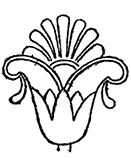
Fig. 86.—Compound flower,
based on the lotus, Thebes,
Eighteenth to Twentieth
Dynasties; from Goodyear,
after Prisse d’Avennes.
Thus, according to this view, the volute of the Ionic
capital is merely a drooping lotus sepal, which became
spiral in the Grecian Archipelago. Many of the Ionic
capitals, especially the earlier ones, exhibit distinct traces
of the central palmette, but eventually only the spirals
persisted, and the cleft between the curling sepals was
gradually reduced so that their stems came to appear as a
transverse band ending in volutes.
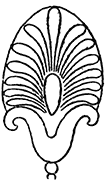
Fig. 87.—Lotus pendant from
an Egyptian necklace of
the Nineteenth Dynasty;
after Goodyear.
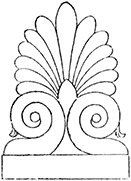
Fig. 88.—Anthemion from the
Parthenon.
In following this view of the history of the Ionic capital
we have practically traversed that of the anthemion. The
more typical examples of this pattern not only present us
with the element which we have already briefly studied, but
alternating with it is a trefoil. For this again there are
any number of Egyptian originals in which the trefoil
indicates a lotus flower; in this case all the petals have
been eliminated and only the sepals persist.
Lack of time prevents me from attempting to follow the
fascinating evolution of various patterns and designs which
adorn Grecian temples and vases; but I must permit myself
to indicate a probable origin of an exceedingly common
pattern which has also overrun our own art. I refer to the
so-called egg-and-dart moulding of Greek entablatures (Plate
V., Fig. 5), and the same motive painted on vases or
moulded on the later Samian ware (Plate V., Fig. 6). In
these two figures the pattern is drawn in its usual position,
but, the better to follow the argument, a typical variety is
figured (Fig. 89) reversed. There are many varieties, from
a series of U-shaped figures with alternating dots, as many
Greek vases (Fig. 89, E), through the Samian device (Plate
V., Fig. 6) and Erechtheium variety (Fig. 82 and Plate V.,
Fig. 5), to others in which there is greater complexity and
more floral forms (Fig. 89, D).
With any given series of designs it is possible to begin at
either end—in the one case there is an ascending evolution,
in the other a degeneration. Students of the biological
method of treating decorative art will recognise that the
latter is by far the most general order in the evolution of
patterns, and by adopting it in this case Professor Goodyear
has been able to demonstrate the life-history of this pattern
to the satisfaction of many students.
In Fig. 89, A, we have a typical lotus flower and bud
pattern or Greek pattern from Rhodes; the same design
occurs in a simplified form on a fragment of Greek pottery
from Naukratis (Fig. 89, B),[89] in which the lotus flower is now
a lotus trefoil; and in Fig. 89, C, the pattern is disrupted.
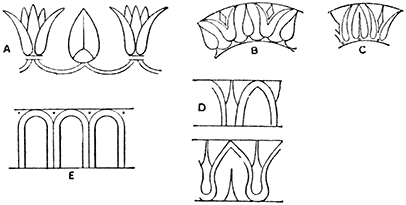
Fig. 89.—Hypothetical derivation of the “egg-and-dart” moulding
from a lotus pattern; according to Goodyear.
- A. Lotus anthemion on a vessel from Rhodes; after Salzmann.
- B, C. Lotus anthemia on pottery from Naukratis; after Flinders
Petrie.
- D. Egg-and-dart moulding from the Erechtheium.
- E. Degraded egg-and-dart pattern painted on a Grecian vase.
In Greek vases we usually find that decoration has been
made with a fine feeling for appropriateness; thus the erect
anthemion occurs when the vase is swelling, but where it is
contracting an inverted anthemion is placed, because the
decorative lines thus widen to correspond with the expansion
of the vase. Again, in Egyptian tomb ceilings the
bordering lotus pattern is inverted, as the base line of the
design naturally is made to correspond with the peripheral
line of the ceiling—in other words, the lotus anthemion was
inverted.
We have then a painted lotus bud and trefoil pattern
which was often inverted and as often a simple design.
According to this view, the egg of the egg-and-dart pattern is
simply a semi-oval left between two lotus trefoils, the dart
being the central sepal. When this design came to be incised
in stone, the new technique very slightly modified the
pattern, and the flat oval areas necessarily came to be carved
as rounded or leaf-shaped projections. On these latter
occasionally appear reminiscences of the intervening buds,
as on the Erechtheium leaf-and-dart moulding. Many variants
occur in this device, especially in Roman sculpture.
Professor Goodyear points out that the egg-and-dart
moulding as such is unknown to Egyptian patterns, owing to
the almost entire absence in Egyptian art of carved or incised
lotus borders of any kind, a preference for flat ornament in
colour being the rule. Stone carved patterns of any kind
in Egyptian art are quite rare before the Ptolemaic period.
In Greek art the absence of patterns in projected carving is
also a general rule down to the time of the Erechtheium.
In Greek art also colour decoration on flat surfaces was the
rule in architecture for earlier periods; for example, a leaf-and-dart
pattern was painted on a Doric capital in Ægina.[90]
“The Ionic capital, the ‘honey-suckle,’ the egg-and-dart
moulding, the meander, the various forms of spiral
ornament, the guilloche and the rosette, and some few other
motives, belong to one ornamental system, and have never
been used in Europe, apart from historic connections with
their original system, since the Greeks, and have never
been used in Europe since prehistoric ages, without distinct
dependance on the Greeks. As found with the Greeks they
can all be traced back to Egyptian sources; except the
guilloche, which is only the later variant of the spiral scroll.
The guilloche pattern has been found in Egypt on pottery
dated to the Twelfth Dynasty (2700 B.C.), which was probably
made by foreigners resident in the country, but it may
easily be an Egyptian pattern which has not yet been
specified as such.
“The Egyptian rosette can be dated to the Fourth
Dynasty, 3998-3721 B.C. Since that time its history has
been continuous. Since its first transmission to Europe it
has never been reinvented in Europe, for there was never an
occasion or a chance to reinvent it there.
“The spiral scroll is dated to the Fifth Dynasty, and the
meander (at present) to the Thirteenth Dynasty, about 2500-2000
B.C. The Egyptian Ionic capital is dated to the
Eighteenth Dynasty, 1587-1327 B.C. The Egyptian anthemion
(‘honey-suckle’ original) is dated to the Twelfth
Dynasty (2778-2565 B.C.). A considerably higher antiquity
than the given date must be assumed in all cases.”[91]
This in brief is Professor Goodyear’s theory;[92] it is ingenious,
but time will show how far it will convince students
of this subject. It is quite possible that the egg-and-dart
pattern may have had a multiple origin. Dr. Colley March
is still inclined to see in it a kind of artistic reminiscence of
the ends of beams (Plate V., Fig. 1) of earlier wooden
buildings; but it is highly improbable that the conclusion
arrived at by Mr. Hulme is the correct one. He says:
“The echinus, or horse-chestnut, is also called the egg-and-tongue
or egg-and-dart moulding, a variety of names that
may be taken as conclusive of the fact that it bears no great
resemblance to anything at all, but is a purely arbitrary
form.”[93] The variety of names is conclusive only of the
ignorance of the name-givers as to what the pattern
originated from. In future those who write on decorative
art will have to prove that any pattern or design is a
purely arbitrary form; that assumption is no longer permissible.
We have left the lotus far behind, and though it is hard to
believe that the multitudinous designs of so many ages and
of such diverse countries are all derived from the sacred
flower of Ancient Egypt, yet it may well be that the oldest
stock was a lotus derivative, and that the symbolism of that
flower gave to it sufficient vitality to spread and multiply
and replenish the earth.
C. Zoomorphs.
It is a matter of common observation that our children
very early take delight in pictures of animals and in making
delineations of them. It is further noticeable that the
quality of the drawing makes no difference to children, and
they are as pleased with the crudest representation of an
animal as their elders are with a life-like portrait. In all
this the child closely resembles the folk, whether they be
the backward classes among ourselves or the less advanced
peoples. All these agree in being satisfied with diagrammatic
realism.
Savages, however, vary greatly in their power of representing
animal forms. In Fig. 3 we have a number of
outlines of animals which were etched on bamboo pipes or
carved on wooden drums by the Papuan natives of the
islands of Torres Straits or of the adjacent coast of New
Guinea. The figures are all reduced to the same scale by
photography from tracings of the original delineations, and
are therefore faithful copies of the originals. A glance at
the figure will show that the animals are drawn with a
very fair degree of accuracy, so that in most cases it is
perfectly easy to identify the genus of the animal intended.
There are numerous little touches which appeal to the eye
of the naturalist as indicating keen observation on the part
of the artists; for example, the sharks (C, D) are always
drawn with unequally lobed tails, the tail of the dugong (M)
is accurately rendered; several characteristic details are, as
a rule, well brought out in the drawings of the cassowaries
(K). On the other hand, there are several anatomical
mistakes, as for instance, giving shark-like gill-slits to a bony-fish,
or even to a crocodile. The mouth is represented in a
sucker-fish (F) as being on the upper side of the head,
whereas it should be underneath, and the view of that fish’s
tail would be impossible from that particular point of view;
but these and numerous other similar examples which I
could name are merely due to a desire to express several
salient features, without regard to the possibility of their
being all seen at once. The artists’ aim was to give a
recognisable representation of animals, and in this they have
as a rule succeeded perfectly; it is captious to expect more
from them.
On other parts of the mainland of New Guinea one
rarely meets with representations so life-like as these,[94] and
nowhere else on that largest of islands are so many kinds
of animals drawn. Animals are often depicted by the
Australians, but usually these are very poor as works of art;
they are also employed in pictography.
Although animals are so frequently drawn by the Torres
Straits Islanders, they never arrange them in groups or in
series. They are pictures of individuals, drawn for decorative
effect, but they have no story to tell. The only
exception to this rule occurs in the case of certain animals,
two of which are sometimes placed symmetrically on the
decorated object.
Representations of animals are not uncommon in
Melanesia, but they are distinctly of rare occurrence in
Polynesia. They occur in great profusion in America from
north to south, but here they are predominantly religious
or pictographic in significance. Animal forms are not
characteristic of African art, except among the Bushmen,
and there we find pictures of animals which are comparable
with those of the Eskimo or the natives of Torres Straits.
As far back as the time when men hunted the reindeer
and wild horse in Western Europe do we find drawings of
animals. This was at the time period when the glacial cold
was abating and when men lived in caves, used chipped,
unpolished stone implements, and were unacquainted with
pottery. In archæological nomenclature this is known as
the Epoque Magdalénienne of the Cave Period in the
Palæolithic Age. The figures of the mammoth, reindeer,
horse (Fig. 90), etc., are usually cleverly etched on bone or
ivory, and sometimes they are wonderfully life-like and
accurate; the representation of human beings are as a rule
very weak indeed.
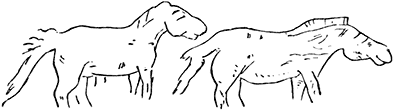
Fig. 90.—Horses etched on an antler from La Madelaine;
from Taylor.
“The wild horse roamed in immense herds over Europe,
and formed the chief food of the palæolithic hunters. In
some of the caverns in France the remains of the horse are
more abundant than those of any other animal, more even
than those of the wild ox. Thus at Solutré, near Macon,
the bones of horses, which had formed the food of the
inhabitants of this station, form a deposit nearly 10 feet in
depth and more than 300 feet in length, the number of
skeletons represented being estimated at from 20,000 to
40,000. This primitive horse was a diminutive animal, not
much larger than an ass, standing about 13 hands high, the
largest specimens not exceeding 14 hands. But the head
was of disproportionate size, and the teeth were very
powerful. He resembles the tarpan or wild horse of the
Caspian steppes. A spirited representation of two of these
wild horses is engraved on an antler found at the station of
La Madelaine in the Department of the Dordogne.”[95]
It is impossible for me to do more than just touch on the
subject of the relation of animals to decorative and pictorial
art; the few examples I can offer will, however, demonstrate
its importance.
Wherever it occurs the crocodile or the alligator, as the
case may be, almost invariably finds its way into the decorative
art of the district. From north to south the crocodile
asserts itself in the decorative art of New Guinea; for further
information the reader is referred to Dr. Uhle,[96] who has
made an elaborate study of the crocodile in Malayo-Papuan
art, has noted the strange metamorphoses to which it is
subjected in north-west New Guinea; he also draws attention
to the cult of the reptile in these parts. The belief of
a relationship between the crocodile and man occurs among
the Malays of Sumatra, Batta, Java, Makassar and the
Bugis, Tagals, in Banka, Timor, Bouru, Aru, and the south-western
islands. The Javanese have no fear of the crocodile
when bathing, they believe that their “grandfathers” and
“fathers” could do them no harm. The crocodile is
reverenced in Borneo and killed only when the blood-revenge
demands it; their teeth are used as talismans all
over the island. The inhabitants of Kupang and Timor
have an unconquerable fear of the killing of crocodiles and
pray by dead ones. Even the Malays (Hovas) of Madagascar
are afraid to kill crocodiles, since they would
revenge themselves.
From Melanesia we will pass to Central America and
take advantage of Mr. W. H. Holmes’s masterly study of
the ancient art of the province of Chiriqui in the Isthmus
of Panama.[97]
Wherever it occurs, the crocodile or the alligator, as the
case may be, almost invariably finds its way into the decorative
art of the district. From north to south the crocodile
asserts itself in the decorative art of New Guinea; and,
although associated with other animals, the alligator predominates
among the zoomorphs of the Chiriqui.
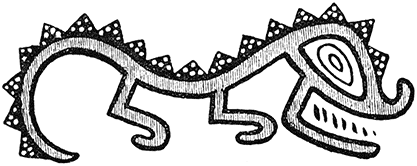
Fig. 91.—Conventional alligator from the “lost colour” ware of
Chiriqui; after Holmes.
In Fig. 91, we have a highly conventionalised representation
of an alligator. The scutes (or scales) are represented
by spotted triangles and run along the entire length of the
back; a row of dashes in the mouth indicates the teeth.
In another class of ware the treatment is quite different,
more clumsy, but prominence is given to a number of
corresponding features; the strong curve of the back, the
triangles, dots, the muzzle, and mouth. In Fig. 92 all the
leading features are recognisable, but are very much
simplified, and the body is without indication of scales, the
head is without eyes, the jaws are without teeth, and the
upward curve of the tip of the upper jaw in the last figure is
greatly exaggerated, but this is a common feature in these
representations.
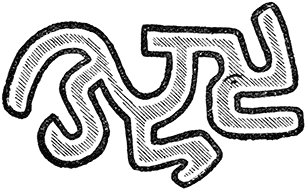
Fig. 92.—Simplified figure of an alligator from the “alligator”
ware of Chiriqui; after Holmes.
The spaces to be decorated
also largely determine
the lines of modification.
In Fig. 93 we have an
example crowding an elongated
figure into a short
rectangular space. The
head is turned back over
the body, the sunken curve of the back is enormously
exaggerated, and the tail is thrown down along the side
of the panel.
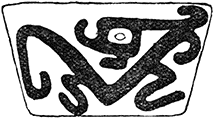
Fig. 93.—Alligator design, Chiriqui;
after Holmes.
It often happens that the animal form, literally rendered,
does not fill the panels satisfactorily. The head and tail do
not correspond, and there is a lack of balance. In such
cases, as Mr. Holmes points out, two heads have been
preferred. The body is given a uniform double curve and
the heads are turned down, as in Fig. 94. This figure “is
extremely interesting on account of its complexity and the
novel treatment of the various features. The two feet are
placed close together near the middle of the curved body,
and on either side of these are the under jaws turned back
and armed with dental projections for teeth. The characteristic
scale symbols occur at intervals along the back; and
very curiously at one place, where there is scant room,
simple dots are employed, showing the identity of these two
characters. Some curious auxiliary devices, the origin of which
is obscure, are used to fill in marginal spaces.” Judging from
some of the figures in Fig. 100 we may regard the upper supplementary
device as another alligator derivative.
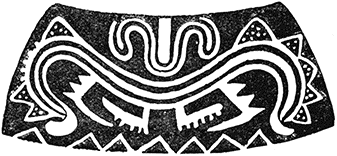
Fig. 94.—Alligator delineation, greatly modified, Chiriqui;
after Holmes.
Fig. 95 is an extreme
form of conventionalised
alligator which has become
metamorphosed
into an apparently meaningless
design which is
intended to be symmetrical.
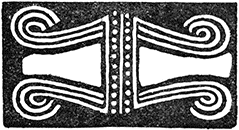
Fig. 95.—Highly conventionalised
alligator derivative, Chiriqui;
after Holmes.
In Fig. 96 we have a
series showing the degeneration
of the alligator
into a curved line and a spot. The series shown in
Fig. 97 illustrate the tendency of linear bands not only to
cramp the original in a vertical direction, but to force it
into a serial pattern. Fig. 97, A, is a simplification of such
a two-headed form as Fig. 94. One might be tempted
to regard it as a doubly tailed form, but such do not
appear to have been recognised by Mr. Holmes. The
transition from this undoubted alligator derivative to the
broad chevron of Fig. 97, E, is quite obvious, the conventional
scutes, dotted triangles, together with the zigzag
body alone forming the pattern, and in Fig. 97, F, the latter
has disappeared. Mr. Holmes states “there is little doubt
that the series continues further, ending with simple curved
lines and even with straight lines unaccompanied by
auxiliary devices.”

Fig. 96.—Series of derivatives of the alligator, showing stages of
simplification, Chiriqui; after Holmes.
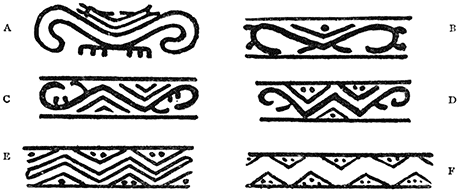
Fig. 97.—Series of alligator derivatives, showing modification through
use in narrow zones, Chiriqui; after Holmes.
Mr. Holmes also points out that the Chiriqui have
arrived at the scroll and fret by way of the alligator. I
can here illustrate only two of these (Figs. 98, 99); in these
the body of the reptile is the element of the design. In
other cases Mr. Holmes finds that parts of the creature,
such as head, feet, eye, or scales, assume the role of radicles,
and pass through a series of modification ending in purely
geometrical devices.
Fig. 98.—Scroll derived from
the body-line of the alligator,
Chiriqui; after Holmes.

Fig. 99.—Fret derived from
the body-line of the alligator,
Chiriqui; after Holmes.
The designs in Fig. 100 are painted upon low rounded
prominences on vases, and hence are enclosed in circles.
In Fig. 100, A, the alligator is coiled up, but still preserves
some of the well-known characters of that reptile. In B, we
have the double hook modification of the alligator’s body,
but the triangles are placed separately against the encircling
line. In the next figure the body-line is omitted, and three
dotted scutes alone represent the animal. The four scutes
of the next designs assume a symmetrical position, and the
central crossed line may represent the alligator’s body. In
the last figure of this series the cross has become the predominating
feature, and the spots have migrated into it, so
that the triangles have become mere interspaces.
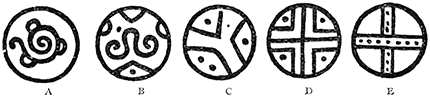
Fig. 100.—Series of alligator derivatives, showing modification through
use within a circular area, Chiriqui; after Holmes.
Finally, Fig. 101 is a zone pattern, painted on an earthen
drum, the central zigzag line represents the body of the
alligator, and the notched hooks its extremities; these are
here arranged with perfect regularity, but sometimes only
the latter occur in patterns, and then they are often somewhat
irregularly disposed.
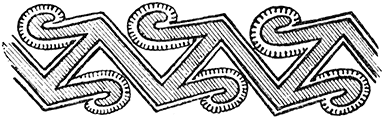
Fig. 101.—Pattern composed of alligator derivatives, from a clay
drum painted in the style of the “lost colour group,” Chiriqui;
after Holmes.
From his prolonged study of ancient American art, Mr.
Holmes formulates the following generalisation:—“The
agencies of modification inherent in the art in its practice
are such that any particular animal form extensively employed
in decoration is capable of changing into or giving
rise to any or to all of the highly conventional decorative
devices upon which our leading ornaments, such as the
meander, the scroll, the fret, the chevron, and the guilloche,
are based” (p. 187). The importance of the following conclusion
is obvious:—“We are absolutely certain that no
race, no art, no motive or element in nature or in art can
claim the exclusive origination of any one of the well-known
or standard conventional devices, and that any race, art, or
individual motive is capable of giving rise to any and to all
such devices. Nothing can be more absurd than to suppose
that the signification or symbolism attaching to a given
form is uniform the world over, as the ideas associated with
each must vary with the channels through which they were
developed” (p. 183).
The investigations of Dr. P. Ehrenreich and Professor
Karl von den Steinen on the decorative art of various tribes
in Central Brazil have led to results which may, without
exaggeration, be termed startling. The patterns employed
by these people typically belong to the class which is popularly
described as geometrical. On page 176 I have selected
examples of these patterns which will give a fair idea of the
style of design.
Dr. Ehrenreich[98] informs us that in the Bakaïri chiefs’
huts a frieze of blackened bark tablets run along the wall
which are painted in white clay with very characteristic
figures and patterns of fish. All the geometric figures are
in reality diagrammatic representations of concrete objects,
mostly animals. “Thus a wavy line with alternating spots
denotes a large, dark-spotted colossal snake, the Anaconda
(Eunectes murinus); a rhomboidal mark signifies a lagoon-fish,
whereas a triangle does not by any means indicate
that simple geometrical figure, but the small, three-cornered
article of women’s clothing” (p. 98).
The following quotation is also translated from Dr. Ehrenreich[99]:—“The
ornaments of the Karaya consist of patterns
of zigzag lines, crosses, dots, lozenges, and peculiar interrupted
meanders, whereas the quadrate and triangle occur
only incidentally (that is, owing to the filling up of other
figures), and circles are entirely absent. As in the ornamentation
of the Xingus tribes, so also here occur those
apparently entirely arbitrary geometrical combinations fundamentally
of wholly defined concrete presentments, of which
the most characteristic traits are therein reproduced. Unfortunately
it is not always possible to correctly ascertain the
respective natural objects. The frequently occurring cross
(Fig. 102, A), which in America has so often given occasion
for amusing hypotheses, is here nothing but a kind of lizard....
Also peculiarly characteristic are the extensive wings
of a bat (Fig. 102, B), as well as
the frequently occurring snake
pattern, such as Fig. 102, C,
which represents the rattlesnake,
while another snake is
represented in Fig. 102, D.
Accurate representations of
men and animals, as we know
them to be done so excellently
by the Bushmen and Eskimo,
do not appear to be forthcoming
among the Karaya.”
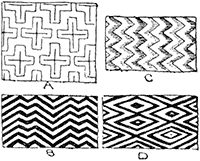
Fig. 102.—Patterns of the Karaya,
Central Brazil; after
Ehrenreich. A. Lizards; B.
Flying bats; C. A rattlesnake;
D. A snake. A. Incised on a
grave-post; B, C, D. Plaited
on the handles of combs.
Professor von den Steinen[100]
describes the above-mentioned
frieze more fully. The pieces
of bark, which were from 15 cm. to 40 cm. (6 to 16 inches)
broad, were blackened with soot, and the white or yellowish
lime applied with the fingers. The frieze itself was over
56 m. (over 184 feet) in length.
I would ask the reader to refer back to Fig. 52, p. 97,
although this motive is not a zoomorph, in order to show
that triangular designs, or resulting zigzags, may have various
origins.
Only one tablet represented a plant. (Fig. 69.) It indicates
the leaves of a small “cabbage”-bearing wild palm.
The bulk of the motives for the decorative art of these
people, the Schingú tribes (the Xingu tribes of Ehrenreich),
are drawn from the animal world; Fig. 103 A, H, I, K, are
Bakaïri patterns, and Figs. 103 B-F those of the Auetö.
The pattern to the right in Fig. 103, H, indicates a kind of
ray, the characteristic rings and dots which ornament the
skin of this fish are here represented.
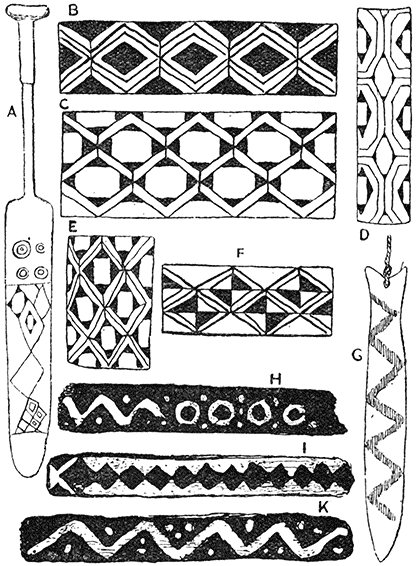
Fig. 103.—Patterns from Central Brazil, after Von den Steinen. A.
Bakaïri paddle; B-E. Mereschu (fish) patterns of the Auetö;
F. Locust design, Bakaïri; G. Fish-shaped bull-roarer, Nahuquá;
H. Sukuri (snake) and ray patterns; I. Jiboya (snake); K.
Agau (snake); H-I. Bakaïri tribe.
Common to all the tribes of the Schingú stock is the
employment of conventionalised representations of the
mereschu. This is a small compressed lagoon-fish, about
19 cm. (7½ inches) long, and 9.5 cm. (3¾ inches) deep;
its colour is silver-grey with brown spots. The mereschu
belongs to the genus Serrasalmo or Myletes; the figure on
p. 260, given by Von den Steinen, looks as if it were drawn
from a badly-preserved spirit specimen, and one fails to see
how Fig. 103, C, for example, could by any stretch of the
imagination be considered to suggest that fish. On
p. 613 of Dr. Günther’s Introduction to the Study of Fishes
(Edinburgh, 1880) is an outline figure of Serrasalmo
scapularis; the contour of this fish is approximately
rhomboidal, the head, the dorsal fin, and the tail fin
occupy three of its angles, and the anal fin practically
runs up to the fourth angle. Von den Steinen points out
that in most cases representations of these animal-forms
are incisions, not paintings, and the diagrammatic rendering
of curved lines by angles is due to this fact. The patterns
which I am about to describe are common to numerous
allied tribes, and everywhere these patterns bear the name
by which this kind of fish is locally known.
Sometimes the mereschu fish is employed singly, but most
frequently a number of them are evenly distributed over the
decorated surface, and between the fishes single, double, or
even several lines may be drawn, as in Fig. 103, B, C, E;
these latter represent the net by means of which these fish
are caught. Thus we may have a fish-pattern or a fishes-in-net
pattern. These patterns are delineated on masks,
posts, spinning-whorls, and other objects. Fig. 103, B, is a
pattern of the mereschu fishes-in-net group, but the fishes
themselves are entirely filled up with black, and not their
angles only.
The Auetö pattern drawn in Fig. 103, F, is intended for a
mailed- or armadillo-fish.
On a Bakaïri paddle (Fig. 103, A) are incised four circles,
which are the ring-markings of a ray, pinukái, on the other
side of a transverse line follow two mereschu in the meshes
of a net, then a pakú, and finally several kuómi fish.
Professor von den Steinen believes that the object of this
decoration is simply to bring fish close to the paddle.
“But it is extremely instructive to see,” he continues,[101]
“that concerning these scribblings, though they certainly
do not denote anything in their order of arrangement, consequently
are not picture-writing; however, every single one
is by no means a casual flourish, but the diagram of a well-defined
object, and consequently, in fact, represents the
element of a picture-writing.”
Zigzags and waved lines are snakes. Fig. 103, K, represents
common land-snake, the agau, or cobra of Brazil; to the left
is the tail, the head is simply rendered, and as the skin of
the snake is marked the artist characterised it by adding
spots. Very similar is the sukuri water-snake or anaconda
(Boa scytale), drawn to the left of Fig. 103, H. A boa-constrictor
is indicated in Fig. 103, I; the row of diamonds left
on the dark background, between the two rows of triangles,
represents the marking of the snake’s skin. The larger
terminal diamond to the left is probably the boa’s head. A
snake is also painted on a Nahuquá bull-roarer (Fig. 103, G).
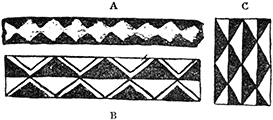
Fig. 104.—Patterns derived from bats;
after Von den Steinen. A. Bakaïri;
B, C. Auetö.
We have seen that
rows of horizontal
triangles are uluris,
women’s triangles, but
when they are margined
above by a line,
as in Fig. 104, B, they
are bats; but rows
of triangles vertically
disposed, as in Fig.
104, C, are hanging bats; Fig. 104, A, is also a bat device.
Another triangular ornament (Fig. 105) represents small
birds, called by the Bakaïri natives yaritamáze, that is,
they are a particular kind of bird, not birds in general.
Finally, one would naturally consider that the ornament
engraved on the post, Fig. 103, D, is simply the favourite
mereschu pattern; but Von den Steinen assures us that
the central design is not composed of mereschu, in which
the angles are only slightly filled up, but that it is a locust,
the lines arising from the angles of the lozenge being the
legs. This locust pattern is, however, associated
with true mereschus, which may be seen
between the legs of the locust.

Fig. 105.—Bird
design, Bakaïri,
Central Brazil;
after Von den
Steinen.
In Europe and in our own country we can
study analogous transformations.
More or less recognisable animals break
out, as it were into scrolls and floral devices,
as on Samian vases (Plate VI., Fig. 1), on
Gaulish swords (Fig. 2), on Pompeian walls
(Fig. 3), and on the gold ornaments of Tuscany
(Fig. 5). In Fig. 4, Plate VI., we have on an
ancient pot from New Mexico a decorative
treatment of birds which recalls that of the
mural paintings of Pompeii.
Often in Greece and Italy symmetrical scrolls are associated
with a head. (Plate VI., Fig. 6.) The scrolls themselves
may, in some cases, be an animal form which has
ended in a flourish, as is taking place in Plate VI., Fig. 5;
or in others they may be the remnants of plant motive.
Dr. Colley March calls attention to old bench-ends of
English churches, notably those in Cornwall, which are
frequently surmounted by a crouching quadruped; at a later
period this appears to be converted into a single scroll like
that which adorned the old pews in Ormskirk Church.
(Plate VI., Fig. 7.)
An ancient silver plate (Plate VI., Fig. 8), found in a
tumulus at Largo, Fifeshire, is decorated with the distorted
fore-half of an animal. The transformation is advanced to
flamboyant curves in the zoomorph of the Dunnichen Stone
(Plate VI., Fig. 9); but the head and ear and legs can still
be distinguished. It is not quite certain what animal this is
intended to represent. Earl Southesk[102] believes it to be the
horse, which was sacred to Frey, and is a special symbol of
the sun. The second figure is very remarkable, but it seems
to be an extreme and foliated form of the same zoomorph.
There are numerous examples of linear series of animals
in the early art of Egypt, Assyria, Greece, and other artistic
centres, but these do not appear to have developed into
patterns, possibly because the units were readily recognisable,
on the other hand, serially repeated conventionalised zoomorphs
frequently metamorphose into patterns. These
patterns by repeated copying tend to become simplified till
finally not only is all trace of the original long lost, but the
resultant pattern may so resemble other simple patterns as
to be indistinguishable from them. This may easily lead to
confusion and cause the designs to be classed as one. We
thus come to the conclusion that before any pattern can be
termed the same as another, its life-history must be studied,
otherwise analogy may be confused with homology, and false
relationships erected. Things which are similar are not
necessarily the same.
At the extreme south-east end of New Guinea and in the
adjacent archipelago the most frequent designs are beautiful
scroll patterns, which are subject to many variations. I have
already[103] described many of these, and so there is no need
to again repeat what I have said, except to remind the
reader that all these patterns are variations of serially repeated
conventionalised heads of the frigate-bird. I shall
again allude to this bird when I deal with the relation of
religion to art.
In the same district one occasionally meets with a pattern
(Fig. 106) which in some respects resembles the former and
appears in some cases to have been confounded with it.
This one clearly arises from the serial repetition of conventionalised
heads of crocodiles. The illustration is part of
the carved rim of a wooden bowl in my possession, which
probably came from the Trobriands or the Woodlarks. The
triangles above the crocodiles’ snouts are coloured black,
those bounded by their jaws are painted red.
There is yet another method of representing animals
which consists in grouping them so as to tell a story, or, in
other words, to make a picture.
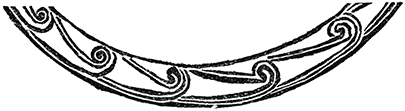
Fig. 106.—Rubbing of part of the carved rim of a wooden bowl in the
author’s collection. Probably from the Woodlarks or Trobriands,
British New Guinea. One third natural size.
Grouped animals rarely occur by themselves in decorative
art; men, houses, implements, and even vegetation are
frequently associated with them. The Arctic peoples, such
as the Lapps, Eskimo, etc., greatly affect this form of art.
The bulk of these pictures are representations of hunting
scenes, and many incidents in the lives of these hyperboreans
are depicted on bone and ivory. There is reason
for regarding these as records of particular events (cf. p. 207);
but they are also very useful to us as illustrations of native
life and industry. Animals are sometimes drawn foreshortened,
and confused herds of reindeer are often figured;
but the grouping is mainly linear, without effects of perspective
being attempted.
This kind of art is extremely rare amongst savage peoples,
in fact its presence may be regarded as one of the proofs
that the people practising it have passed from a purely
savage condition, and have made some advance towards
civilisation. It has reached its highest point in the works
of the great animal painters of the present day, and thus has
been one of the last forms of graphic art to be perfected.
As a general rule the inferior representations of animals
in groups, and of animal pictures generally, are not due to
the process of decay. They are the bad workmanship of
inferior craftsmen. It is the imperfection of immaturity,
not the symptom of decadence.
The last stage of the life-cycle of this class of zoomorphs
occurs when incompetent draughtsmen copy the work of a
master; when, for example, we see on the walls of country
inns cheap and badly-drawn copies of Landseer’s pictures.
Animals also play a large part in mythology, and it is
often very difficult to determine the limits of totemism in
this direction. There are, however, numberless instances of
legendary communications and relationships, of friendliness
and enmity between animals and men, which have no connection
with totemism, and these often form the subject of
decorative art. Sometimes the animal alone is represented,
at other times both man and animal are depicted, and according
to their artistic treatment we may have pictures, or
should the zoomorph and anthropomorph be rendered
schematically, heteromorphism may result. At present we
have to deal with representations of animals which illustrate
some belief, myth, or folk-tale. The sacred art of the
Hebrews was almost free from zoomorphs, and that of
Islam totally so; with these exceptions there has scarcely
been a religion in which zoomorphs have not played a
greater or less part.
I need only remind the reader of the numerous examples
in which animals are depicted in illustration of, or as a kind
of mnemonic of a folk-tale, a legend, or myth, and of some
sacred tradition or belief. There are so many intermediate
stages between these different phases that it is often impossible
to draw the line between them. The religious
belief, with its sacred tradition of one age, becomes the
myth or the legend of a later period, subsequently it is perpetuated
as a folk-tale; later it may serve to amuse children,
and lastly it becomes the object of scientific study.
What I have termed the æsthetic life-history may occur
to the zoomorph at any or all of these stages of religious
decadence. There is no correlation between an extreme or
medium phase in the æsthetic cycle and a corresponding
stage in the religious series. To take a homely example,
the illustrations of the most recently published fairy-tales
are as a whole of greater artistic merit than has been the
average illustration of sacred narratives during any period of
the world’s history.
D. Anthropomorphs.
As a general rule, savages are less skilful in the delineation
of the human form than they are with representations of
animals, nor is it usually employed so frequently as might
be expected.
It is for religious purposes that the human form is most
frequently represented, and I refer the reader to the section
in which religion is dealt with for illustrations of this
fact. I employ the term “human form” advisedly, as this
includes the images of both gods and men. At one stage
of its evolution in the human mind, deity, like the Spectre
of Brocken, is the shadowy image of man projected on the
clouds. So the gods are most naturally represented as men,
but often with special attributes. Now, these attributes are
worthy of special study as being the milestones which
indicate the distance which any given religious conception
has traversed.
In the distant vista of time we can dimly perceive the
transformation of the totem animal into the god. In the
highest period of Greek sculpture the evolution was, for
example, perfected in “ox-eyed lady Hera,” consort of
Olympian Zeus, and in the Cnidian statue of Demeter,
“Mother-Earth,” whose archaic representation was a
wooden image of a woman with a mare’s head and mane.
For thousands of years the Egyptian pantheon was peopled
by gods arrested in the process—gorgonised tadpoles of
divinity. Still earlier stages may even now be noted among
savage peoples.
I know of no example of the preponderating employment
of the human face for decorative purposes to be compared
with what I have established for the natives of the Papuan
Gulf. Illustrations of this will be found in Figs. 10-19, and
in my Memoir on Papuan Art, but only an examination of
a large number of objects from this district of British
New Guinea will bring home to the student the remarkable
ubiquity of the motive. We have no information concerning
the reason for copying human faces; my impression
is that it is related to the initiation ceremonies, which we
know from the accounts of the Rev. James Chalmers to be
very prolonged and important. One would expect to find
more animal representations among these people than
appear on objects in our ethnographical collections.
Possibly these people are passing from the totemistic into
the anthropomorphic phase of religion, and the latter finds
most expression in their art. However, such speculations
are futile until we obtain far more detailed and extended
information of their religion than we at present possess.
Human beings are comparatively rarely represented
merely for decorative purposes. In pictographs they have
no predominating position. But when we come to portraiture
the matter is very different; here we have an
adequate motive for the delineation of the human form and
face; it is, however, very noteworthy that portraiture, as
such, only occurs amongst civilised communities. Possibly
the explanation of this may be found in the widespread
savage philosophy of sympathetic magic. According to
this system a portrait has a very vital connection with the
subject, and any damage done to the counterfeit would
be experienced by the original. Portraiture then would
be too hazardous to health, or even life, to be lightly undertaken.
What we have seen happening to plants and animals is
also the fate of men in decorative art. A few examples
here will suffice.
New Zealand is one of the places where anthropomorphs
abound, due in this case to ancestor cult. The short series
of three clubs (Plate VI., Figs. 10-12) illustrates the metamorphosis
of the limbs into curvilinear forms. In dealing
with the religion of Polynesia I give examples (Figs. 124-128)
of the degradation of the human form into “geometrical”
patterns.
In the various illustrations which have been given representations
of the human form may be isolated, as in Melanesia
(Fig. 3, O), Mangaia (Fig. 124), and New Zealand
(Plate VI., Figs. 10, 12), or they may be double; for example,
one frequently finds in Polynesia two god-figures placed back
to back, and these may strangely degenerate, as in the
examples given by Stolpe[104] and Read.[105] Human forms
placed in linear series are frequent in Mangaian wood-carving
(Figs. 127 and 125, A). Fig. 126 illustrates the
decoration of a broader area.
We get examples of the selection of one portion of the
man in the face patterns of the Papuan Gulf. (Figs. 10-19.)
These are undoubtedly conscious selections from the very
commencement, but we find various parts of the body come
to be perpetuated, with the elimination of the remainder,
owing to differing causes.
The reason for the simplification of the body and the
disappearance of the head in the Mangaian art is probably
partly due to the fact that savage peoples are usually quite
content with suggestions of objects, they do not demand
what we term realism. By conventionalising their representations
the Mangaians were better able to multiply them,
and at the same time to appropriately decorate the object
with which they were concerned. It could not be with a
view of economising time or labour. “Time,” as Stolpe
says, “is for them of no importance, they have plenty
of it, and usually they are not able even to reckon it.”
Judging by the skill exhibited by these clever carvers in
wood, we cannot put down the simplification of the human
body to careless copying.
We have seen that the face may be represented to the
exclusion of any other part of the body, but there are
examples of parts of the face becoming predominant.
Professor Moseley[106] was, I believe, the first to indicate the
evolution which occurred in the images of gods in the
Hawaian group. In some instances the hollow crescent
form, which came to represent a face, seems to have been
arrived at by an enormous increase in the size of the mouth;
in others, as in the case of some wicker images, by a hollowing
out of the face altogether; the mouth in the latter,
though large, not being widened so as to encroach upon
the whole area of the face. Since, in the worship of the
gods, food was placed in the mouths, the mouths may have
been gradually enlarged as the development of the religion
proceeded, in order to contain larger and larger offerings,
and the head in the wicker-work image may have been
hollowed out for a similar purpose. Moseley traced the
degeneration of the human (or god’s) face down to a hook-shaped
ornament cut out of a sperm whale’s tooth.
Some of the carvings of the human face from New
Zealand bear a general resemblance to those from Hawaii;
but a very noticeable feature in the art of the former island
is the protruding tongue. The most interesting development
of this member occurs in the Maori hani, or staff of
office. At the upper end is what appears, at first sight,
to be a spear-point. “This portion, however, does not
serve the purpose of offence, but is simply a conventional
representation of the human tongue, which, when thrust
forth to its utmost conveys, according to Maori ideas, the
most bitter insult and defiance. When the chief wishes
to make war against any tribe, he calls his own people
together, makes a fiery oration, and repeatedly thrusts
his hani in the direction of the enemy, each such thrust
being accepted as a putting forth of the tongue in defiance.
In order to show that the point of the hani is really
intended to represent the human tongue, the remainder of
it is carved into a grotesque and far-fetched resemblance of
the human face, the chief features of which are two enormous
circular eyes made of haliotis shell.”[107]
My friend, S. Tsuboi, has made a special study[108] of the
protruding tongue in New Zealand art. He gives illustrations
of thirty-one specimens, and with characteristic Japanese
ingenuity he has drawn figures of half-a-dozen models
which he has constructed which illustrate the various
possible variations, and the lines they may have taken.
He has also made numerical tables of possible varieties.
I allude to, this paper in order to draw the attention of
students to graphic methods. I regret that my ignorance
of the Japanese language precludes my giving the results of
this investigation.
In Ancient Egypt the eye was symbolic, and numberless
amulets are found which exhibit one, two, or numerous eyes
in varying stages of degeneracy, or in strange modifications.
These, too, have been studied and described by Tsuboi.[109]
E. Biomorphic Pottery.
In the description of the primitive methods of pottery
manufacture, allusion was made to the fact that vegetable and
animal forms were copied by the early artificers.
Although the immediate originals of many kinds of clay
vessels were baskets of various kinds, we must not forget
that these also were often textile imitations of natural
objects. Gourds which are of almost ubiquitous occurrence
undoubtedly were early and independently utilised as
vessels. For the more convenient porterage of them they
would be enclosed in netting or basketry. The better the
accessories became, the less need for the original foundations,
especially as the latter were brittle. From the fact
that the shape of certain baskets in a district resemble
those of the gourds of that district, we may assume that
this process of evolution has operated spontaneously in
diverse places. Clay vessels which were modelled from
the suggestion of such baskets would thus remotely be
phyllomorphs but having an intermediate skeuomorphic
stage.
Instead of this indirect mode of origin a more direct
one has often occurred. Messrs. Squier and Davis[110] record:
“In some of the southern states (of North America), it is
said, the kilns, in which the ancient pottery was baked,
are now occasionally to be met with. Some are represented
still to contain the ware, partially burned, and retaining the
rinds of the gourds, etc., over which they were modelled,
and which had not been entirely removed by the fire.”
They also state that the Indians along the Gulf moulded
their vessels “over gourds and other models and baked
them in ovens.”
It is not necessary to believe that this has everywhere
been the original ceramic gourd-derivatives, even among
savage peoples. Once the power of working in clay was
acquired, intentional copying of gourds (Figs. 107, 108), or
other vegetable vessels, may very well have occurred. This
is rendered all the more probable from the fact that animal
forms are modelled as earthen vessels. I am not here
alluding to figures of men or of totem, sacred, or familiar
animals which may belong to a somewhat higher stage of
culture than that which we are now more particularly
considering; but to clay utensils which are copied from
receptacles which are the shells or other parts of animals.
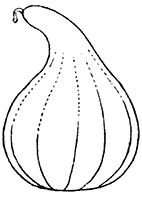
Fig. 107.—Gourd; after Holmes.
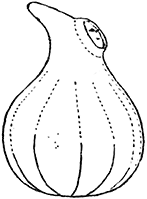
Fig. 108.—Clay vessel, made in
imitation of a gourd, from a
mound in South-eastern Missouri;
after Holmes.
Wherever shells of sufficient size are found they are
utilised as food and water vessels, and there are numerous
instances in various parts of the world of vessels being
modelled so as to represent the ancient and familiar
utensils.
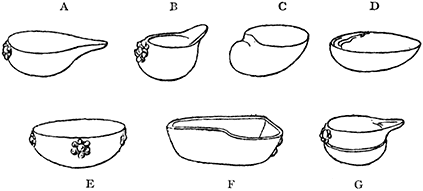
Fig. 109.—Clay vessels imitated from shells, from the mounds and
graves of the Mississippi Valley; after Holmes.
Clay vessels imitating both marine and fresh-water shells
are occasionally obtained from the mounds and graves of
the Mississippi Valley. The conch-shell appears to have
been a favourite model (Fig. 109, A and B). A clam shell
is imitated in C and D. The more conventional forms of
these vessels are exceedingly interesting, as they point out
the tendencies and possibilities of modification. The bowl
(E) has four rosettes, each consisting of a large central boss
with four or five smaller ones surrounding it. The central
boss, as in A, is derived from the spire of the conch shell,
and the encircling knobs from the nodulated rim of the
outer whorl of the shell. Mr. Holmes suggests that in this
case the conception is that of four conch shells united in
one vessel, the spouts being turned inwards and the spires
outwards. With all possible respect to Mr. Holmes, I
venture to demur to this interpretation. The fusion of
elements which are essentially isolated is rare amongst
primitive peoples; it is difficult to imagine how they could
conceive of the structural union and fusion of four conch
shells. This is very different from the amalgamation of
the clay imitations of such vessels as gourds or coco-nuts,
for these are frequently fastened in pairs or in small groups
to a common string handle, and there is already the idea
of multiplicity and the apposition of the vessels. Again,
Mr. Holmes does not present us with any intermediate
stages of this or similar clay vessels; until such evidence
is forthcoming it would be safer to regard this as an
example of transference. According to my interpretation,
the rosette derived from the spire of a conch shell was a
pleasing motive, and it was applied to and repeated upon
a circular bowl, which may, as Mr. Holmes elsewhere[111]
suggests, be derived from the lower half of a gourd.
A single conch derivative would be entitled to one rosette
only, and the association of ideas would operate in favour
of only one being moulded, at all events until a very
extreme stage of degeneration had been attained; but in
the case of transference there would be no continuity of
custom to control the potter, and consequently more scope
could be given to his fancy.
A highly conventionalised form is shown in F (Fig. 109).
The cup is unsymmetrical in outline, and has a few imperfect
bosses near one corner, but its resemblance to a
shell would hardly be recognised by one unacquainted with
more realistic renderings of similar subjects. In G we
have an imitation of a shell cup placed within a plain cup.
The skins, bladders, and stomachs of animals are very
frequently employed as water-carriers. The characteristic
forms of these may often be traced in the pottery of the
same districts, odd details of form or of surface marking
usually persist to a surprising degree.
In Fiji and elsewhere the image of a turtle has been
modelled in clay, doubtless because the carapace is often
used as a vessel.
While the use of an animal or the part of an animal as a
vessel has often led to the imitation of that animal in clay
or other material, owing to an association of ideas, we must
be very careful not to run to the extreme and to say that
there was a primitively utilitarian origin for all zoomorphic
vessels. Sympathetic magic and religion are responsible
for many, and we must admit that mere fancy must sometimes
come into play, and when this is the case theorising
is necessarily at fault.
As previously stated, I propose to adopt the term Heteromorph
for a confusion with one another of two or more
different skeuomorphs, or with the amalgamation of any
two or more biomorphs, or with the combination of any
skeuomorph with any biomorph. We may thus have (1)
Heteromorphs of skeuomorphs, (2) Heteromorphs of biomorphs,
and (3) Heteromorphs of skeuo-biomorphs.
To speak somewhat figuratively, heteromorphism is a
sort of disease that may attack the skeuomorph or the
biomorph. Whereas the final term of the life-history of
the biomorph is, so to speak, senile decay, the result of
heteromorphism is a teratological transformation. Accepting
this view of the subject, the present section might be
entitled “The Pathology of Decorative Art.”
Any stage of the life-history of a biomorph, whether it is
the expression of decorative or religious art, is liable to be
infected by heteromorphism. The only section of graphic
art which must from the nature of the case be free from it
is pictorial art. Where heteromorphs are introduced into
pictures they form one of the subjects of those pictures, the
picture itself is not subject to this modifying influence; for
example, the introduction of the representation of a sphinx
or a gryphon into a picture does not constitute the latter a
heteromorph.
A. Heteromorphs of Skeuomorphs.
The combination of two different kinds of skeuomorphs
does not appear to be of very frequent occurrence, or, at
all events, we have not yet trained ourselves to appreciate
them.
In Fig. 50 we have an example, which, however, is not
particularly satisfactory. It will be noticed that various
kinds of plaiting are indicated on this Tongan club; as a
matter of fact, if it had really been covered with plaited
work, the latter would have been uniform in its character,
although diverse patterns might have been worked into it.
If this club had been decorated in a consistent manner the
simple in-and-out plaiting of the broad band, as in the
middle of the figure to the left, could not occur along with
the finer oblique plaiting in other parts of the object.
B. Heteromorphs of Biomorphs.
Wherever two or more animals or plants are represented
in association there is a tendency for them to amalgamate
in process of time. I have shown numerous examples of
this in the bird and crocodile motive in Papuan art, and it
would be easy to multiply illustrations.
Heteromorphism is especially characteristic of that style
of decoration which we call arabesque, or grotesque. This
is said to have been the invention of a painter named
Ludius in the reign of the Emperor Augustus. That
sovereign is said by Pliny to have been the first who
thought of covering whole walls with pictures and landscapes.
The fashion for the grotesque spread rapidly, for
all the buildings of about that date which have been found
in good preservation afford numerous and beautiful examples
of it. Vitruvius was entirely out of conceit with this sort
of ornament, and declares that such fanciful paintings as
are not founded in truth cannot be beautiful; but the
general voice, both in ancient and modern times, has pronounced
a very different opinion. It was from the paintings
found in the baths of Rome that Raphael derived
the idea of those famous frescoes in the gallery of the
Vatican. His example was immediately followed by other
distinguished artists. This style derived its name grotesque
from the subterranean rooms (grotte) in which the originals
were usually found—rooms not built below the surface of
the ground, but buried by the gradual accumulation of soil
and ruined buildings.
A typical example of Pompeian treatment is seen in
Plate VI., Fig. 3, where a bird’s tail passes into a floral
scroll.
The representations of such mythical monsters of antiquity
as the Sphinx, Chimæra, the Harpies, and so forth, are
familiar to all. Originally these embodied distinct conceptions
which were familiar to the initiated, if not to all.
They were symbols and their origin in art was religious; their
retention was due to their decorative quality.
C. Complex Heteromorphs.
We have now to consider the complications arising from
a combination of skeuomorphs and biomorphs.
Again I have recourse to Dr. Colley March’s suggestive
essay. He points out that in the north of Europe animals
were strangled by the withy-band, as occurs on an
incised stone from Gosforth (Plate VII., Fig. 3). Mr.
Hildebrand endeavours to show that the so-called Scandinavian
sun-snake was produced by the breaking down into
curves of the figure of a lion rampant, copied by a succession
of artificers, all ignorant of the appearance of a lion.
But in the first place, points out Dr. March, the Norse
Wurm is found long ago in prehistoric rock-sculptures. In
the next place, the serpent of the north was symbolic of the
sea and not of the sun. And then, it was not the unfamiliar
lion that alone broke up into serpentine forms; the
skeuomorph assailed the stag, as on King Gorm’s stone in
Denmark (Plate VII., Fig. 2). Eikthysnir, the stag of the
sun, who was an attendant and attribute of Frey, is here
seen being strangled by the “laidly worm” of Scandinavia.
Dr. March suggests that perhaps we may recognise the
walrus in rock-sculptures at Crichie in Scotland (Plate VII.,
Figs. 6, 7). That the walrus was well known to the Northmen,
and highly prized both for its hide, from which ships’
ropes were made (Plate IV., Fig. 4), and for its tusks, which
were a source of ivory, is proved by the Orosian story
(I. Orosius, i. 14). “He went thither chiefly for walruses,
because they have noble bone in their teeth, and their skin
is very good for ships’ ropes.” The Earl of Southesk,[112] however,
brings forward a considerable body of evidence in
favour of the view that this “elephant” symbol, as it has
been absurdly termed, is the sun-boar—a symbol of Frey.
No animal held a higher place in Scandinavia, and at an
early period it was adopted as the national emblem in
Denmark, and borne on the standard.
One frequently finds on early Christian sculptured stones
that the field on each side of the central cross is occupied
by a writhing animal; of these numerous examples occur in
the Isle of Man, where they are undoubtedly due to
Scandinavian influence. This animal may be recognised
in some cases as being a wolf, as on a cross at Michael
(Plate VII., Fig. 5).
Two skeuomorphs attack the wolf. The influence of
thong-work is seen in Plate VII., Fig. 1; this may be compared
with Plate IV., Fig. 4, which is copied from a
sculptured stone at Malew, also in the Isle of Man. The
latter is one of several Manx skeuomorphs of leather or
strap-work.
The withy-band is even more frequently depicted, and on
a cross at Gosforth (Plate VII., Fig. 3) the wolf is being
strangled by it.
The serpent or dragon also is frequently represented,
indeed it seems as if the wolf and the serpent passed
insensibly into one another, and nothing is easier than to
confound the latter with twisted bands. So the animal
fades away, till finally the skeuomorph triumphs, and only
the ghost of a zoomorph remains in what, to ordinary eyes,
is only an entwisted fibre (Plate VII., Fig. 11).
What then is the significance of this remarkable cycle?
The explanation must be sought in the pagan-Christian
overlap, at the time when the symbols of Norse mythology
were being homologised with those of the Christian faith.
“Three mighty children to my father Lok
Did Angerbode, the giantess, bring forth—
Fenris the wolf, the serpent huge, and me.
Of these the serpent in the sea ye cast,
Who since in your despite hath wax’d amain,
And now with gleaming ring enfolds the world.
Me on this cheerless nether world he threw,
And gave me nine unlighted realms to rule.
While, on his island in the lake, afar,
Made fast to the bored crag, by wile not strength
Subdued, with limber chains lives Fenris bound.”
So, in the words of Matthew Arnold, spoke Hela to
Hermod on his quest for the restoration of the slain Balder.
At the crack of doom, the Ragnaroks, Frey, Woden, Thor,
and Tyr, are predestined to perish. A wolf shall devour the
sun, and another shall swallow the moon, and the stars shall
vanish out of heaven. Woden shall go first, and shall encounter
Fenriswolf, but the wise, one-eyed god shall die.
The hammer of the “friend of man” shall not avail against
the sea-dragon, and though Thor fights Midgarthsorm, and
shall slay him, he himself shall fall dead from the serpent’s
venom. Garm, the hell-hound, shall fasten upon the one-handed
Tyr, and each shall kill the other. Frey shall fall
before Swart, the giant with the flaming sword. Then shall
Vidar spring forward, the mighty son of the Father of
Victory, and shall rend the wolf asunder. “Vidar shall
inhabit the city of the gods when all is over,” as the giant
said to Woden. “Vidar, who outlived the earth-fall,
became,” says Professor Stephens,[113] “a fitting emblem for
that Almighty Lord who overcame Sin and Death,” and he
is represented on some sculptured stones as a divine Hart,
trampling on Fenriswolf and Midgarthsorm.
These strangled wolves and writhing snakes of Scandinavian
art represent the portentous struggle of the
powers of darkness with the gods when “the Wolf shall
devour the Sire of Men; but Vid shall avenge him, and
shall rend the cold jaws of the Beast.” But the new
religion possessed a somewhat analogous imagery, and
the symbolism of the one readily passed into that of the
other. Whether pagan or Christian, the symbolic animal
was attacked by the plaited thong or twisted fibres, and the
secular handicraft choked the religious idea. Such a hold
had this technique on the mind of the people that it
predominated all their art, and even led to the extinction
of religious symbolism.
There was, however, another means by which the pagan
dragon crept into Christian art. I refer to the legend of
Sigurd and Fafni, which was introduced into sepulchral
and ecclesiastical carving as late as the fourteenth century
by followers of the new faith. I cannot now detail the
foundation story of the Nibelungen Lied; the point which
at present concerns us is the slaying of Fafni in the form of
a dragon or serpent by Sigurd with his magic sword.
This and other incidents of the legend are carved on
wooden portals or door-pillars of churches, on fonts, and on
Christian crosses of stone in many parts of Sweden and
Norway, and also in some parts of England, as on the
Hatton Cross in Lancaster.
Fafni is often seen passing into a maze of beautiful
scroll-work, and in the Hatton Cross he is solely represented
by a twisted knot.
Under monkish influence, no doubt, the whole story came
by degrees to be looked upon as containing types and
proofs of the younger religion. Sigurd became the
Christian soldier, forging the sword of the spirit, and his
defeat of the serpent could readily be adopted into
Christian symbolism.[114]
“When the Anglo-Saxon had almost forgotten Midgarth’s
Orm, and the ancient Egyptian snake-symbol, as old as the
Rameside period, had been introduced as a new design
(Plate VII., Fig. 8), this itself fell a prey to the dominant
skeuomorph, and was doubled and entangled in obedience
to the over-mastering expectancy of the day.”
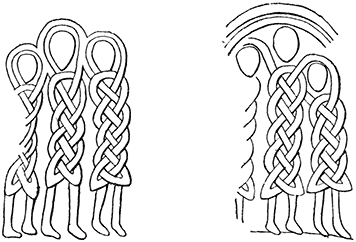
Figs. 110, 111.—Modified human figures on the shaft of a cross at
Ilam, near Ashbourne; after Browne.
“It must be clear,” continues Dr. Colley March, “that
such transformations as these were due to something more
than the successive copying of a copy by ignorant and
slovenly artificers, as in those degenerate changes wrought
by Gaulish imitators of the stater of Philip of Macedon. In
that case the original coin was not before them; they had
no artistic impulse or intention, their only object was to
fabricate passable pieces of money. But the men whose
‘taste’ is disclosed by the work we have just considered
were swayed by an influence they could not have understood.
The expectancy that controlled them they inherited.
The withy-band had wrapped itself round all their conceptions.”
But the result was enrichment and not degradation,
and the curious designs their art produced show us the
only portal through which the animal form can enter into
ornament, by resolving itself, namely, into the angles,
curves, and scrolls of symmetrical repetition.
“Many pauses took place ere the process was completed.
Now one part of the body was surrendered to the skeuomorph
and anon another. Conventionalism established a
temporary truce, but the war of structure against nature
broke out afresh, and the grotesque appeared. We look
upon the death-grasp of a writhing quadruped, the knotted
convolutions of a serpent, the spectral gleam of a vanishing
face. And then, when all was over, when the battle on the
ornamental field was lost and won, nothing was left but a
zoomorph of contrasted curves and symmetrical scrolls.”
The human form is not exempt from the skeuomorphic
inroad. The two men in Fig. 4, Plate VII., which is taken
from an illuminated page of the Gospel of Mac Regol, at
Oxford, are suffering from but a mild attack, but the men
on the Pre-Norman font at Checkley, near Uttoxeter, and
similar figures (Figs. 110, 111) on a cross at Ilam, five
miles from Ashbourne, have all but succumbed.







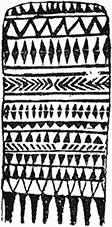
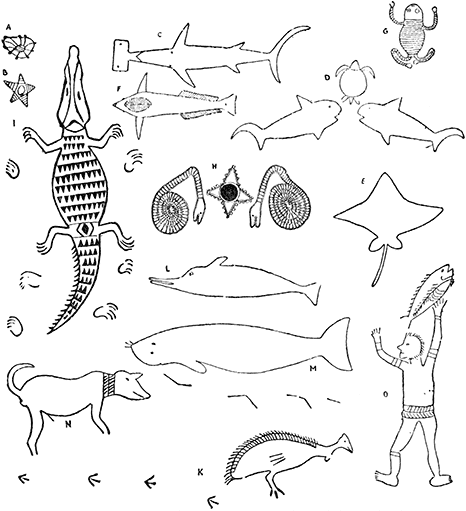
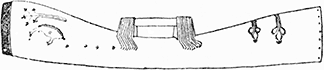
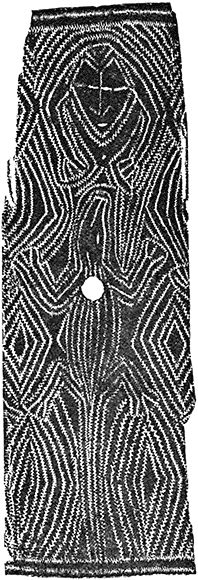
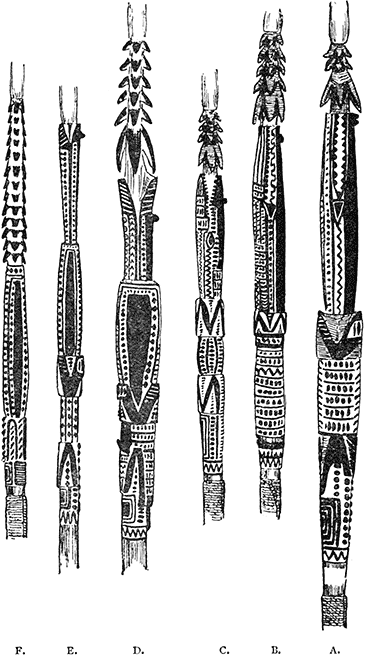

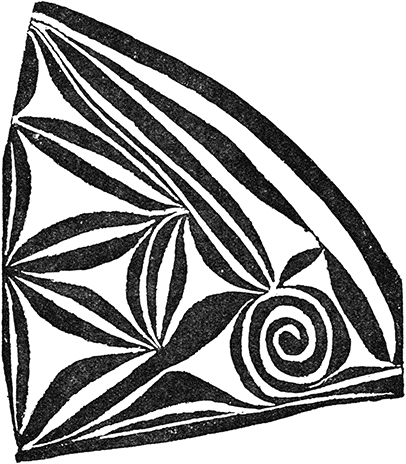
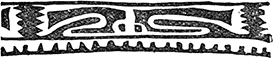

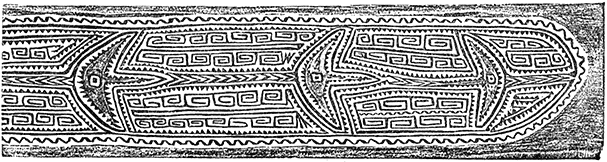
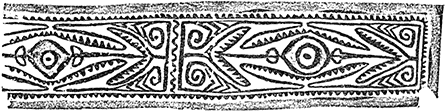
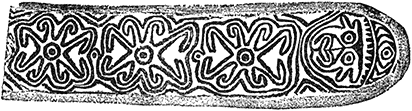
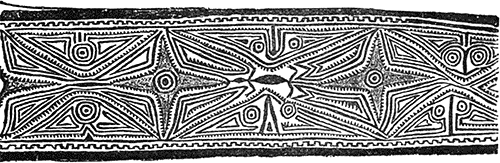
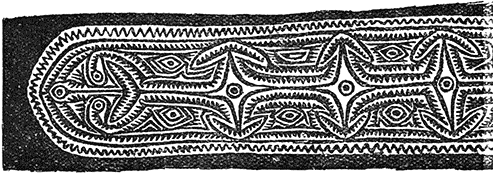
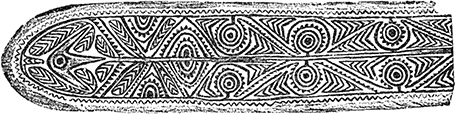
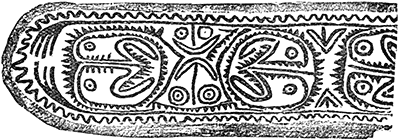
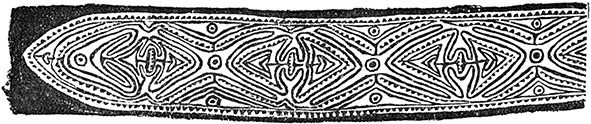
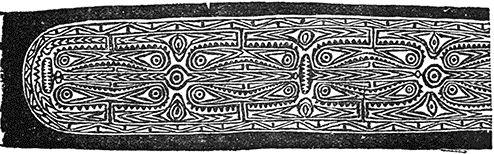
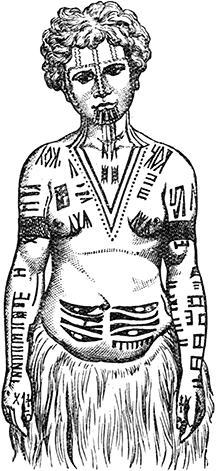
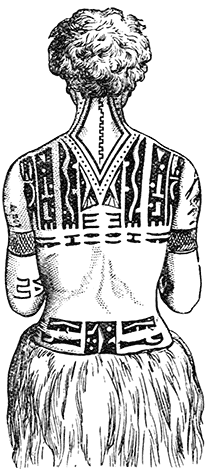
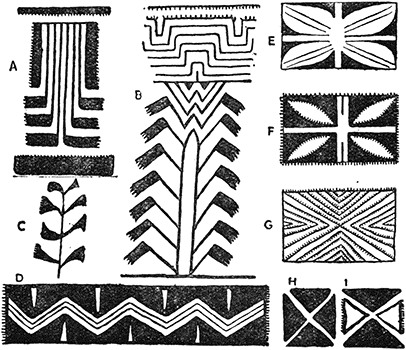

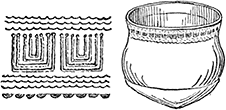

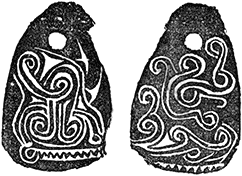
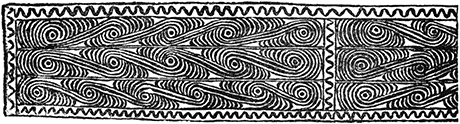
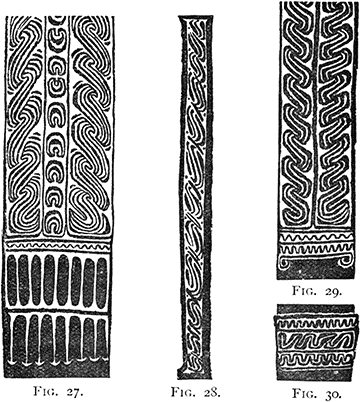

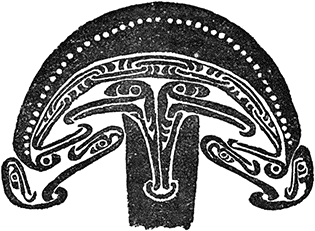
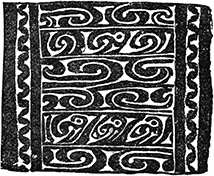

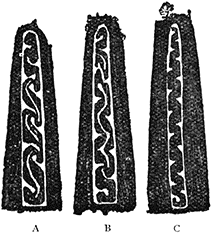
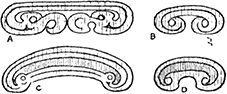
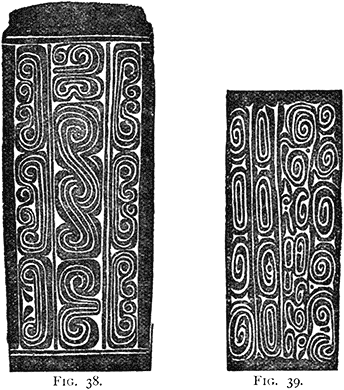

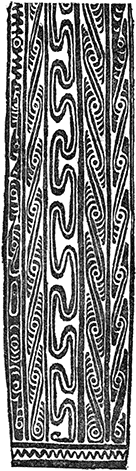
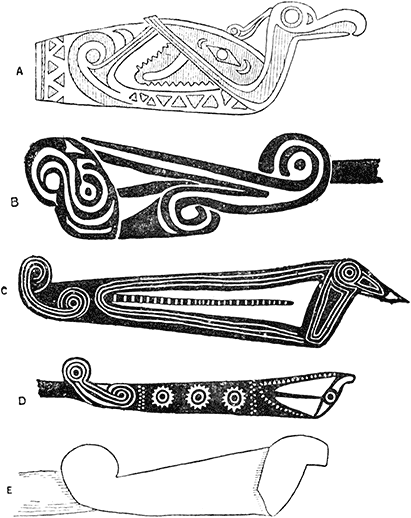
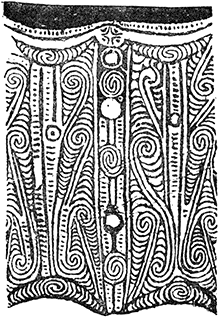


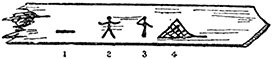
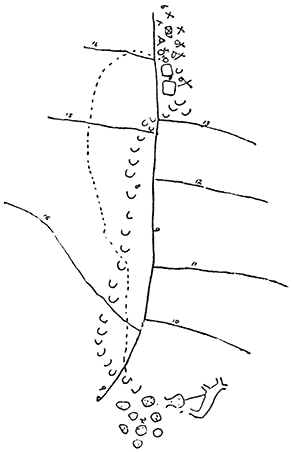
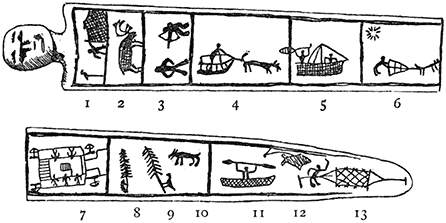
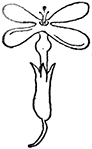
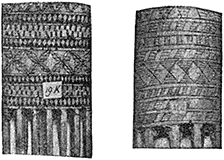
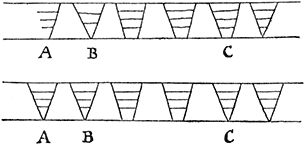
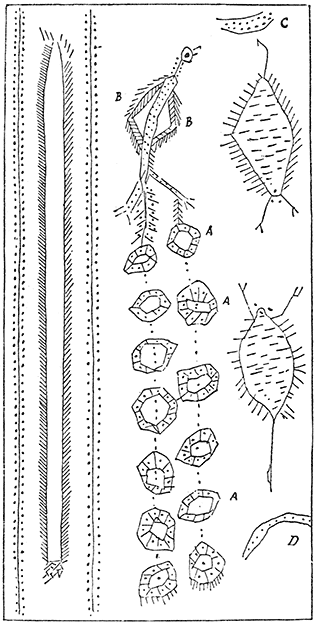
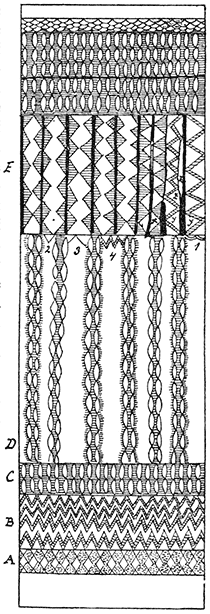
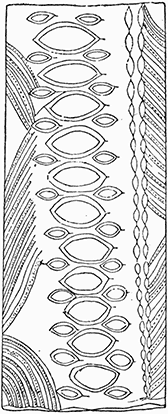
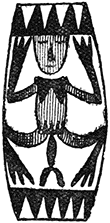
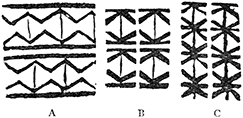
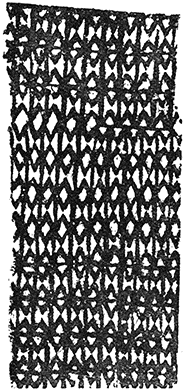
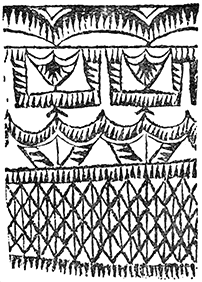
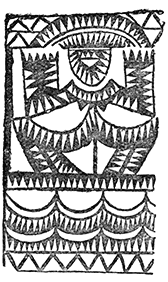
 is the symbol
for an enclosed space of earth, and that the simple cross +
occurs as a sign for earth in certain ideographic groups.
is the symbol
for an enclosed space of earth, and that the simple cross +
occurs as a sign for earth in certain ideographic groups.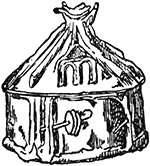
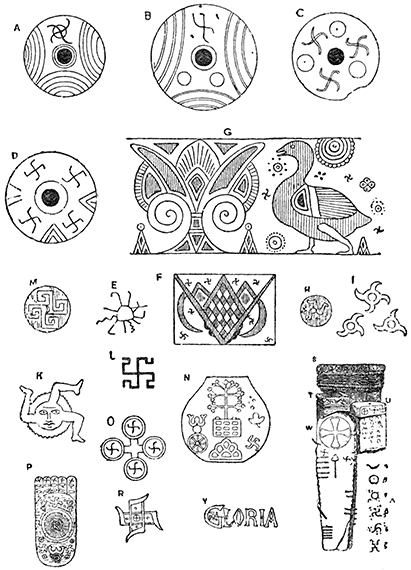
 .”
Five-rayed and three-rayed (triskele) sun symbols were
associated with Apollo on coins of Megara, now Mesembria
was founded by a colony of Megarians.
.”
Five-rayed and three-rayed (triskele) sun symbols were
associated with Apollo on coins of Megara, now Mesembria
was founded by a colony of Megarians.