A thousand and a thousand years ago, seven saints hid from heathen
persecutors among the cold mountains which circle Ephesus. The
multitude who cried, “Great is Diana of the Ephesians!” are drifting
dust, and the vast city itself but a mass of half-buried ruins. Yet
somewhere in a lonely cave sleep those seven holy men, unvexed by
sorrow, untouched by time, until Christ comes again. So runs the
legend.
It is a far cry to Ephesus, and whether the Seven still sleep there,
who may say? Yet here and now seven other Sleepers live with us, who
slumber through our winters, with hunger and cold and danger but a
dream. Their names I once rhymed for some children of my acquaintance.
As I am credibly advised that the progress of a camel through the eye
of a needle is an easy process compared to having a poem printed by
the Atlantic Press, I hasten to include in this chapter the following
exquisite bit of free verse (I call it free because I don’t get
anything extra for it).
The Bat and the Bear, they never care
What winter winds may blow;
The Jumping-Mouse in his cozy house
Is safe from ice and snow.
The Chipmunk and the Woodchuck,
The Skunk, who’s slow but sure,
The ringed Raccoon, who hates the moon,
Have found for cold the cure.
Something of the lives of these our brethren of the wild I have tried
to set forth here—because I care for them all.
First comes the slyest, the shyest, and the stillest of the Seven—the
blackbear, who yet dwells among men when his old-time companions, the
timber-wolf and the panther, have been long gone. Silent as a shadow,
he is with us far oftener than we know. Only a few years ago bears
were found in New Jersey, in dense cedar-swamps, unsuspected by a
generation of near-by farmers. In Pennsylvania and New York they are
increasing, and I have no doubt that they can still be found in parts
of New England, from which they are supposed to have disappeared a
half-century ago. In fact, it is always unsafe to say that any of the
wild-folk have gone forever. I have lived to see a herd of seven
Virginia deer feeding in my neighbor’s cabbage-patch in Connecticut,
although neither my father nor my grandfather ever saw a wild deer in
that state. In that same township I once had a fleeting glimpse of an
otter, and only last winter, within thirty miles of Philadelphia, I
located a colony of beaver.
The blackbear is nearly as black as a blacksnake, whose color is as
perfect a standard of absolute black on earth as El Nath is of white
among the stars. He has a brownish muzzle and a white diamond-shaped
patch on his breast. Sometimes he is brown, or red, or yellow, or even
white. Not so wise as the wolf, or so fierce as the panther, yet the
blackbear has outlived them both. “When in doubt, run!” is his
motto; and like Descartes, the wise blackbear founds his life on the
doctrine of doubt. As for the unwise—they are dead. To be sure, even
this saving rule of conduct would not keep him alive in these days of
repeating rifles, were it not for his natural abilities. A bear can
hear a hunter a quarter of a mile away, and scent one for over a mile
if the wind be right. He may weigh three hundred pounds and be over
two feet wide, yet he will slip like a shadow through tangled
underbrush without a sound.
Bear-cubs are born in January, after the mother bear has gone into
winter quarters, blind and bare and pink, and so small that two of
them can be held at once on a man’s hand. Bears mate every other year,
and the half-grown cubs hibernate with the mother during their second
winter.
The blackbear is a good swimmer, and may sometimes be seen crossing
lonely lakes in the northern woods. At such times he is an ugly
customer to tackle without a gun, as he will swim straight at a canoe
and tip it over if possible. A friend of mine, while fishing in upper
Canada, on a sluggish river between two lakes, saw a bear swimming
well ahead of the canoe. He began to paddle with all his might to
overtake him, but to his surprise seemed to be moving backwards.
Looking around, he saw his guide, who was more experienced in
bear-ways, backing water desperately. Just then the swimming animal
turned his head and saw the canoe. Instantly the hair on his back
bristled and stood up in a long stiff ridge, and he stopped
swimming—whereupon my friend found himself instantaneously,
automatically, and enthusiastically assisting the guide.
Even where the blackbear is common, one may spend a long lifetime
without sight or sound of him. There may be half a dozen bear feeding
in a berry-patch. You may find signs that they are close at hand and
all about. Yet no matter how you may hide and skulk and hunt, never a
glimpse of one of them will you get. In bear country you will more
often smell the hot, strong, unmistakable scent of a bear who is
watching you close at hand, than see the bear himself. In fact the
sight of a wild blackbear is an adventure worth remembering.
Personally, I am ashamed to say that, although I have tramped and
camped and fished and hunted on both sides of the continent, I have
never really seen a bear. Twice I have had glimpses of one. The first
time was in what was then the Territory of Washington. I was walking
with a friend through a bit of virgin forest. The narrow path was
walled in on both sides by impenetrable wind-breaks and underbrush. As
we suddenly and silently came around a sharp bend, there was a crash
through a mass of fallen trees, and I almost saw what caused it. At
least I saw the bushes move. Right ahead of us, in the mould of a torn
and rotted stump, was a foot-print like that of a broad, short, bare
human foot. It was none other than the paw-mark of Mr. Bear, who is a
plantigrade and walks flat-footed. Although I was sorry to miss seeing
him, yet I was glad that it was the bear and not the man who had to
dive through that underbrush.
Another time I was camping in Maine. Not far from our tent, which we
had cunningly concealed on a little knoll near the edge of a lonely
lake, I found a tiny brook which trickled down a hillside. Although it
ran through dense underbrush, it was possible to fish it, and every
afternoon I would bring back half a dozen jeweled trout to broil for
supper. One day I had gone farther in than usual, and was standing
silently, up to my waist in water and brush, trying to cast over an
exasperating bush into a little pool beyond. Suddenly I smelt bear.
Not far from me there sounded a very faint crackling in the bushes on
a little ridge, about as loud as a squirrel would make. As I leaned
forward to look, my knee came squarely against a nest of enthusiastic
and able-bodied yellow-jackets. Instantly a cloud of them burst over
me like shrapnel, stinging my unprotected face unendurably. As I
struck at them with my hand, I caught just one glimpse of a patch of
black fur through the brush on the ridge above me. The next second my
hand struck my eye-glasses, and they went spinning into the brush,
lost forever, and I was stricken blind. Thereafter I dived and hopped
like a frog through the brush and water, until I came out beyond that
yellow-jacket barrage. I never saw that bear again. Probably he
laughed himself to death.
The blackbear is undoubtedly leather-lined, for he will dig up and eat
the bulbs of the jack-in-the-pulpit, which affect a human tongue—I
speak from knowledge—like a mixture of nitric acid and powdered
glass. Moreover, he is the only animal which can swallow the
tight-rolled green cigars of the skunk-cabbage in the early spring. An
entry in my nature-notes reads as follows:—
“Only a fool or a bear would taste skunk-cabbage.”
My lips were blistered and my tongue swollen when I wrote it. The fact
that the blackbear and the blackcat or fisher are the only two mammals
which can eat Old Man Quill-Pig, alias porcupine, and swallow his
quills, confirms my belief as to the bear’s lining. The dog, the lynx,
the wild cat, and the wolf have all tried—and died.
Last spring, in northern Pennsylvania I found myself on the top of a
mountain, by the side of one of those trembling bogs locally known as
bear-sloughs. There I had highly resolved to find the nest of a nearby
Nashville warbler, which kept singing its song, which begins like a
black-and-white warbler and ends like a chipping sparrow. I did not
suppose that there was a bear within fifty miles of me. Suddenly I
came upon a large, quaking-aspen tree set back in the woods by the
side of the bog. Its smooth bark was furrowed by a score of deep
scratches and ridges about five feet from the ground, while above them
the tree had apparently been repeatedly chewed. I recognized it as a
bear-tree. In the spring and well through the summer certain trees are
selected by all the he-bears of a territory as a signpost whereon they
carve messages for friend and foe. No male bear of any real bearhood
would think of passing such a tree without cutting his initials wide,
deep, and high, for all the world to see.
The first flurries of snow mean bed-time for Bruin. He is not afraid
of the cold, for he wears a coat of fur four inches thick over a
waistcoat of fat of the same thickness. He has found, however, that
rent is cheaper than board. Unless there comes some great acorn year,
when the oak trees are covered with nuts, he goes to bed when the snow
flies. One of the rarest adventures in wood-craft is the finding of a
bear-hole where Bruin sleeps rolled up in a big, black ball until
spring. It is always selected and concealed with the utmost care, for
the blackbear takes no chances of being attacked in his sleep. The
last bear-hole of which I have heard was not far from home. Two
friends of mine were shooting in the Pocono Mountains with a dog,
about the middle of November, 1914. Suddenly the dog started up a
blackbear on a wooded slope. After running a short distance, the bear
turned and popped into a hole under an overhanging bank. Almost
immediately he started to come out again, growling savagely. I am
sorry to say that my friends shot him. Then they explored the hole
which he was preparing for his winter-quarters. It was beautifully
constructed. The entrance was under an overhanging bank, shielded by
bushes, and it seemed unbelievable that so large an animal could have
forced his shoulders through so small a hole. The burrow was
jug-shaped, spreading out inside and sloping up, while a dry shelf had
been dug out in the bank. This was covered with layers of dry leaves
and a big blanket of withered grass. In the top of the bank a tiny
hole had been dug, which opened out in some thick bushes and was
probably an air-hole. Just outside the entrance, a bear had piled an
armful of dry sticks, evidently intending, when he had finally entered
the hole, to pull them over the entrance and entirely hide it. The
bear itself turned out to be a young one. A veteran would have died
fighting before giving up the secret of his winter castle.
The opal water was all glimmering green and gold and crimson, as it
whirled under overhanging boughs aflame with the fires of fall. The
air tasted of frost, and had the color of pale gold. Around sudden
curves, through twisted channels, and down gleaming vistas, our canoe
followed the crooked stream as it ran through the pine-barrens. The
woods on either side were glories of color. There was the scarlet of
the mountain sumac, with its winged leaves, and the deep purple of the
star-leaved sweet-gum. Sassafras trees were lemon-yellow or wine-red.
The persimmon was the color of gold, while the poison sumac, with its
death-pale bark, and venomous leaves up-curled as if ready to sting,
flaunted the regal red-and-yellow of Spain.
At last, we beached our canoe in a little grove and landed for lunch.
By the edge of the smoky, golden cedar-water, in the pure white sand,
was a deep footprint, like that made by a baby’s bare foot with a
pointed heel. I recognized the hand and seal of Lotor, the Washer, who
believes firmly in that old proverb about cleanliness. That is about
as near, however, as Lotor ever gets to godliness. He is the
grizzled-gray raccoon, who wears a black mask on his funny, foxy face,
and has a ringed tail shaped like a bâton, and sets his hind feet
flat, like his second-cousin the bear, while his menu-card covers
almost as wide a range. Whatever he eats—frogs, crawfish, chicken,
and even fresh eggs and snakes—he always washes. Two, three, and even
four times, he rinses and rubs his food if he can find water.
That footprint in the sand carried me back more years than I like to
count. It was on the same kind of fall day that I first entered the
fastnesses of Rolfe’s Woods. First there came Little Woods, close at
home, where one could play after school, and where the spotted leaves
of the adder’s-tongue grew everywhere. Then came Big Woods, which
required a full Saturday afternoon to do it justice. It was there that
I accumulated by degrees the twenty-two spotted turtles, the five
young gray squirrels, and the three garter-snakes, which gladdened my
home.
Far beyond Big Woods was a wilderness of swamps and thickets known to
us as Rolfe’s Woods. This was only to be visited in company with some
of the big boys and on a full holiday. That day, Boots Lockwood and
Buck Thompson, patriarchs who must have been all of fourteen years
old, were planning to visit these woods. Four of us little chaps
tagged along until it was too late to send us back. We found that the
perils of the place had not been overstated. In a dark thicket Boots
showed us wolf-tracks. At least he said they were, and he ought to
have known, for he had read “Frank in the Woods,” “The
Gorilla-Hunters,” and other standard authorities on such subjects.
Farther on we heard a squalling note, which Buck at once recognized as
the scream of a panther. Boots confirmed his diagnosis, and showed the
reckless bravery of his nature by laughing so heartily at our scared
faces that he had to lean against a tree for some time before he could
go on. In later years I have heard the same note made by a blue jay, a
curious coincidence which should have the attention of some of our
prominent naturalists.
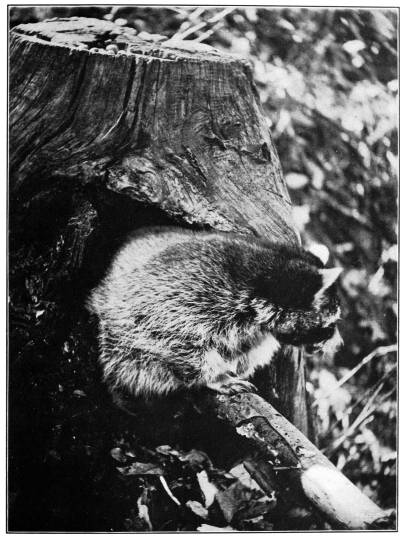
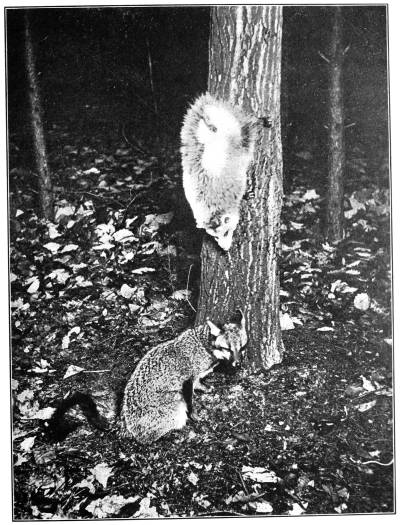
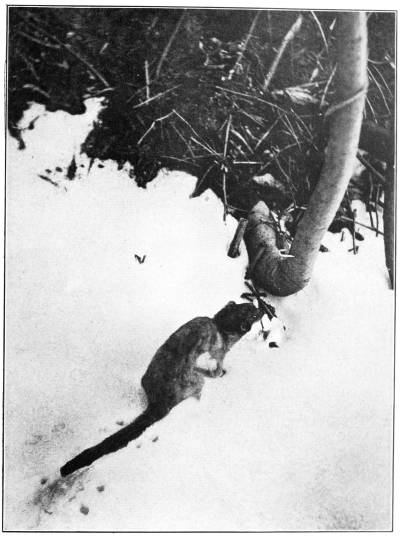
LOTOR, THE COON
Finally, we came to a little clearing with a vast oak-tree in the
centre. As we neared it, suddenly Buck gave a yell and pointed
overhead. There on a hollow dead limb crouched a strange beast. It was
gray in color, with a black-masked face, and was ten times larger than
any gray squirrel, the wildest animal which we had met personally.
There was a hasty and whispered consultation between the two leaders,
after which Buck announced that the stranger was none other than a
Canada lynx, according to him an animal of almost supernatural
ferocity and cunning. Furthermore, he stated that he, assisted by
Boots, intended to climb the tree and attack said lynx with a club.
Our part was to encircle the tree and help Boots if the lynx elected
to fight on land instead of aloft. If so be that he sprang on any one
of us, the rest were to attack him instantly, before he had time to
lap the blood of his victim—a distressing habit which Buck advised us
was characteristic of all Canada lynxes.
This masterly plan was somewhat marred by the actions of Robbie Crane.
Robbie was of a gentle nature, and one whose manners and ideals were
far superior to the rough boys with whom he occasionally consorted.
Mrs. Crane said so herself. After reflecting a moment on the lynx’s
unrestrained and sanguinary traits, he suddenly disappeared down the
back-track with loud sobbings, and never stopped running until he
reached home an hour later. Thereafter our names were stricken from
Robbie’s calling-list by Mrs. Crane.
As Buck, boosted by Boots, started up the tree, the perfidious lynx
disappeared in an unsuspected hole beneath a branch, from which he
refused to come out in spite of all that Buck and Boots could do. One
member, at least, of that hunting-party was immensely relieved by his
unexpected retreat. It was many years later before I learned that even
such masters of woodcraft as Buck and Boots could be mistaken, and
that the Canada lynx was really a Connecticut coon.
It was not until recently that I ever met Lotor by daylight. Three
years ago I was walking down a hillside after a sudden November
snowstorm. My way led past two gray-squirrel nests, well thatched and
chinked with the leaves by which they can always be told from crows’
nests. From one of them I saw peering down at me the funny face of a
coon. When I pounded on the other tree, another coon stared sleepily
down at me. Probably the unexpected snowstorm had sent them both to
bed in the first lodgings which they could find; or it may be that
they had decided to try the open-air sleeping-rooms of the squirrels
rather than the hollow-tree houses in which the coon family usually
spend their winters.
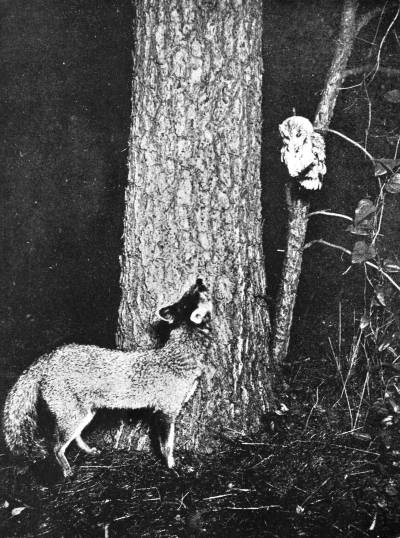
Sometimes at night you may hear near the edge of the woods a
plaintive, tremulous call floating from out of the dark
trees—“Whoo-oo-oo-oo, whoo-oo-oo-oo.” It is one of the night-notes of
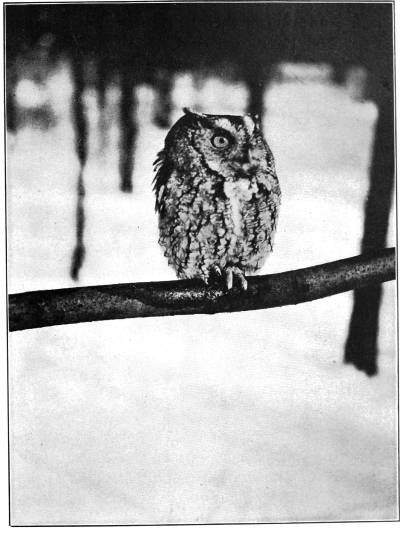
the coon. It sounds almost like the wail of the little screech-owl,
save that there is a certain animal quality to the note. Moreover, the
screech-owl will always answer, when one imitates the call, and will
generally come floating over on noiseless wings to investigate. The
coon, however, instantly detects the imitation and calls no more that
night.
Unlike the bears, Mr. and Mrs. Coon and all the little coons,
averaging from three to six, hibernate together soon after the first
snowstorm of the year. One of the few legends of the long-lost
Connecticut Indians which I can remember is that of an old Indian
hunter, who would appear on my great-grandfather’s farm in the depths
of winter and, after obtaining permission, would go unerringly to one
or more coon-trees, which he would locate by signs unknown to any
white hunter. In each tree he would find from four to six fat coons,
whose fur and flesh he would exchange for gunpowder, tobacco, hard
cider, and other necessities of life.
Mr. and Mrs. Coon are good parents. They keep their children with them
until the arrival of a new family, which occurs with commendable
regularity every spring. A friend of mine once saw a young coon fall
into the water from its tree in the depths of a swamp. At the splash,
the mother coon came out of the den, forty feet up the trunk, and
climbed down to help. Master Coon, wet, shaken, and miserable, managed
to get back to the tree-trunk and clung there whimpering. Mother Coon
gripped him by the scruff of his neck and marched him up the tree to
the den, giving him a gentle nip whenever he stopped to cry.
In spite of his funny face and playful ways, Mr. Coon is a cheerful,
desperate, scientific fighter. In a fair fight, or an unfair one for
that matter, he will best a dog double his size, and he fears no
living animal of his own weight, save only that versatile weasel, the
blackcat. I became convinced of this one dark November morning many
years ago, when I foolishly used to kill animals instead of making
friends of them. All night long, with a pack of alleged coon dogs, we
had hunted invisible and elusive coons through thick woods. I had
scratched myself all over with greenbrier, and, while running through
the dark, had plunged head first into the coldest known brook on the
continent. Four separate times I had been persuaded by false and
flattering words to climb slippery trees after imaginary coons, with a
lantern fastened round my neck.
This time my friends assured me there could be no mistake. Both Grip
and Gyp, the experts of the pack, had their fore-paws against an
enormous tulip tree which stood apart from all others. In order that
there might be no possible mistake, black Uncle Zeke, the leader of
the hunt, who knew most of the coons in those woods by their first
names, agreed to “shine” this particular coon. Lighting a lantern, he
held it behind his head, staring fixedly up into the tree as he did
so. Sure enough, in a minute, far up along the branches gleamed two
green spots. Those were the eyes of the coon, staring down at the
light. It was impossible to climb this tree, so we built a fire and
waited for daylight.
Dawn found us regarding a monster coon crouched in the branches some
forty or fifty feet up. Uncle Zeke produced a cherished shot-gun. The
barrel had once burst, by reason of the muzzle being accidentally
plugged with mud, and had been thereafter cut down, so that it was
less than a foot in length. In spite of its misfortune, Uncle Zeke
assured us that it was still a wonderful shooter. We scattered and
gave him a free field. In a properly conducted coonhunt, a coon, like
a fox, must be killed by dogs or not at all. Uncle Zeke told us that
this one, as soon as he heard the shot, although uninjured, would come
down, like Davy Crockett’s coon.
Sure enough, when the shot cut through the branches well above the
animal, he started slowly down the trunk, head-foremost, like a
squirrel, and never stopped until he reached a branch some twenty feet
above the yelping pack. Then, with hardly a pause, he launched himself
right into their midst. As he came through the air, we could see him
slashing with his claws, evidently limbering up. He struck the ground,
only to disappear in a wave of dogs. In a minute he fought himself
clear, and managed to get his back against the tree. Then followed a
great exhibition of scientific fighting. The coon was perfectly
balanced on all four feet, and did wonderful execution with his
flexible fore-paws, armed with sharp, curved claws. He went through
that mongrel pack like a light-weight champion in a street fight.
Ducking, side-stepping, slashing and biting fiercely in the clinches,
he broke entirely through the circle, and started off at a brisk trot
toward the thick woods. The pack followed after him, baying
ferociously, but doing nothing more. Not one of them would venture
again into close quarters. Though we came back empty-handed, not even
Uncle Zeke grudged that coon his life.
The motto of the next sleeper is, “Don’t hurry, others will.” If you
meet in your wanderings a black-and-white animal wearing a pointed
nose, a bushy tail, and an air of justified confidence, avoid any
altercation with him. The skunk discovered the secret of the
gas-attack a million years before the Boche. He is one of the best
friends of the farmer—and the worst treated. Given a fair chance,
every week he will eat several times his weight in mice and insects.
Moreover, with the muskrat he contributes divers furs to the market,
whose high-sounding names disguise their lowly origin. During the
coldest part of the winter he retires to his burrow and sleeps
fitfully. He is the last to go to bed and the first to get up; and on
any warm day in late winter you may see his close-set, alternate,
stitch-like tracks in the snow. The black-and-white banner of
skunk-kind is a huge bushy resplendent tail, sometimes as wide as it
is long. At the very tip is set a tuft like the white plume of Henry
of Navarre. When it stands straight up, the battle is on, and wise
wild-folk remove themselves elsewhere with exceeding swiftness. As for
the simple—they wish they had.
The armament of this Seventh Sleeper is simple but effective. It
consists of two scent glands located near the base of the tail, which
empty into a movable duct or pipe which can be protruded some
distance. Through this duct, by means of large contractile muscles, a
stream of liquid musk can be propelled with incredible accuracy, and
with a range of from six to ten feet. Moreover the skunk’s accurate
breech-loading and repeating weapon has one device not yet found in
any man-made artillery. Each gland, besides the hole for long-range
purposes, is pierced with a circle of smaller holes through which the
deadly gas can be sprayed in a cloud for work at close quarters. The
skunk’s battery can be operated over the bow or from port or
starboard, but rarely astern.
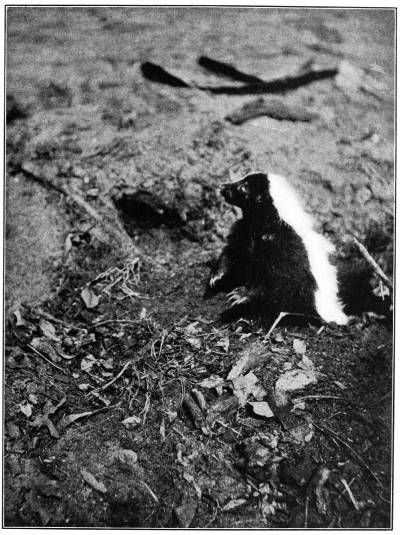
THE SEVENTH SLEEPER—THE SKUNK
The liquid musk itself is a clear, golden-yellow fluid full of little
bubbles of the devastating gas, and curiously enough is almost
identical in appearance with the venom of the rattlesnake. As to its
odor, it has been described feelingly as a mixture of perfume-musk,
essence of garlic, burning sulphur, and sewer-gas, raised to the
thousandth power. Its effect is very much like that produced by the
fumes of ammonia, another animal product, or the mustard-gas of modern
warfare. It may cause blindness, convulsions, and such constriction
and congestion of the breathing passages as even to bring about death.
Some individuals and animals, however, seem to be more or less immune
to the effects of this secretion. I remember once attending by
invitation a possum hunt conducted by a number of noted possumists of
color. We were accompanied by a bevy of miscellaneous dogs. The
possums were generally found wandering here and there among the
thickets, or located in low persimmon trees. Every now and then one of
the dogs would bring to bay a strolling skunk. As the skins had a
considerable market value, these skunks were regarded as the special
prizes of the chase. The hunters dispatched them by a quick blow
across the back which broke the spine. Such a blow paralyzed the
muscles and effectually prevented any further artillery practice on
the part of the skunk which received it. Before it could be delivered,
both the hunter and the dog were usually exposed to an unerring
barrage, which however seemed to cause them no especial inconvenience.
Before long every hunter, except myself, had one or more skunks tucked
away in his pockets.
It was a long, strong night. Before it was over I was in some doubt as
to whether I had been attending a possum hunt or had taken part in a
skunk chase. My family had no doubt whatever on the subject when I
reached home the next morning. I was earnestly invited to tarry in the
wilderness until such time as I could obtain a complete change of
raiment. Thereafter I tried to give my hunting clothes away to the
worthy poor. Said poor, however, would have none of them, and they
repose in a lonely grave in a Philadelphia back-yard even unto this
day.
I saw him last fall sitting up like a little post in the Half-Moon Lot
where the blind blue gentian grows. Every once in a while he would
drop down and begin to nibble again, only to stop and sit up stiff and
straight on sentry duty. For the gray, grizzled woodchuck is as wary
as he is fat. Watchfulness is the price of his life.
Once I spied him far out in a clover-patch, nibbling away at the pink
sweet blossoms as I passed along the road. At the bar-way a chipmunk
leaped into the wall with a sharp squeak. Without even stopping to
raise his head, Mr. Woodchuck scuttled through the clover, and dived
into his burrow. It was a bit of animal team-work such as takes place
when a fox or a deer uses a far-away crow or a jay as a picket, and
dashes away at its warning of the coming of an enemy.
Soon afterwards I was on my way to a spring down in the pasture. As I
passed near a stone wall half hidden in a tangle of chokecherries and
bittersweet, there was a piercing whistle, followed by a scrambling
and a scuffling as the woodchuck dived down among the stones, and I
understood why, below Mason and Dixon’s Line, he is always called the
“whistlepig.” It is a good name, for he whistles, and he is certainly
like a little pig in that he eats and eats and eats until he seems
mostly quivering paunch. According to the farmers of Connecticut, he
eats to get strength enough to dig, and then digs to get an appetite
to eat, and so passes his life in a vicious circle of eating and
digging and digging and eating. In spite of his unwieldy weight, the
woodchuck is a bitter, brave fighter when fight he must.
I once watched a bull-terrier named Paddy tackle a big chuck near a
shallow brook. Round and round the dog circled, trying for the fatal
throat-hold. Round and round whirled the brave old chuck, chattering
with his great chisel-like teeth, which could bite through dog-hide
and dog-flesh and bone just as easily as they gnawed through stolen
apples. Every once in a while Paddy would clinch, but the woodchuck
saved himself every time by hunching his neck down between his round
shoulders and punishing the dog so terribly with his sharp teeth that
the latter would at last retreat, yelping with pain. They would whirl
in circles, and roll over and over in the clinches; but always the old
chuck would be found with his squat figure on its legs at the end of
each round. His thick grizzled coat was more of a protection, too,
than the thin skin of the short-haired terrier.
At last both of them were tired out. As if by agreement, both drew
back and lay down, panting and watching each other’s every movement
like two boxers. Finally, the woodchuck, who was nearer the brook,
began to drag himself along until he reached the edge of the water.
Then he lowered his head, still watching his opponent, and sucked in
deep, cool, satisfying drinks.
It was too much for Paddy. He started for the brook also. The old
chuck stopped drinking, and pulled himself together; but Paddy wanted
water, not blood. In a moment he had his nose in the brook. There the
two lay, not a couple of yards apart, and drank until they could drink
no more.
The whistlepig was the first out. Slowly and watchfully he waddled
away from the brook and toward the stone wall, that refuge of all
hunted little animals. Paddy gave a fierce growl, but the water tasted
too good, and he stayed for another long drink. Then he darted out
after the woodchuck, barking ferociously all the time, as if he could
hardly wait to begin the battle again. The woodchuck watched him
steadily, ready to stop and fight at any moment.
Somehow, although Paddy barked and growled and rushed at his
retreating opponent with exceeding fierceness, there were always a few
yards between them, until Mr. Chuck disappeared at last down between
two great stones in the wall. Then indeed Paddy dashed in, and
growled, and tore up the turf, and stuck his nose deep down between
the stones, and told the world all the terrible things he would do to
that woodchuck if he could only catch him. From the bowels of the old
wall, between barks, sounded now and then the muffled but defiant
whistle of the unconquered whistlepig.
Finally, Paddy, with an air of having done all that could be expected,
gave some fierce farewell barks and trotted off toward the farmhouse.
Some people claim to have dug woodchucks out of their holes.
Personally I believe that it is about as easy to dig a woodchuck out
of its hole as it is to catch a squirrel in its tree. They have a
network of holes, and have a habit of starting digging on their own
account when molested, and sealing up the new hole after them, so that
they leave no trace.
Once, in company with another amateur naturalist, we tried to dig an
old chuck out of its burrow. After first stopping up all the spare
holes we could find, the naturalist dug and dug and dug and dug. Then
we enlisted two other men, and they dug and dug and dug. After a while
we came to a mass of great boulders. Then we pressed into service a
yoke of oxen, and they tugged and tugged and tugged. Said digging and
tugging and tugging and digging lasted the half of a long summer day.
All together, it was an exceeding great digging—but we never got
that woodchuck.
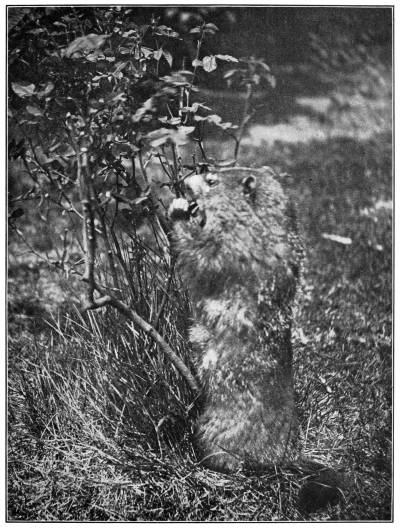
THE WHISTLEPIG
In September and October the woodchuck devotes all of his time to
eating. The consequence is that, by the time the first frost comes, he
is a big gray bag of fat. Mr. Woodchuck does not believe in storing up
food in his burrow, like the chipmunk. He prefers to be the
storehouse. Soon after the first frost he disappears in his hole, and
far down underground, at the end of a network of intersecting
passages, rolls himself up in a round, warm ball, and sleeps until
spring.
According to the legend, on Candlemas, or Ground-Hog Day,—which comes
on February second,—he peeps out, and, if he can see his shadow, goes
in again for six more weeks of cold weather. So far this day has not
yet been made a legal holiday. It probably will be some time, along
with Columbus Day, Labor Day, and other equally important days. I will
not vouch for the fact that the weather depends on the shadow; but
there is no doubt that the woodchuck does come out of his burrow in a
February thaw and looks around, as his tracks prove; but he is not
interested in his shadow. No indeed! What he comes out for is to look
for the future Mrs. Woodchuck, and when he finds her he goes in again.
Sometimes you read in nature-books that the woodchuck is good to eat.
Don’t believe it. I ought to know. I ate one once. Anyone is welcome
to my share of the world’s supply of woodchucks. When I camped out as
a boy, we had to eat everything that we shot: and one summer I ate a
part of a woodchuck, a crow, a green heron, and a blue jay. The chuck
was about in the crow’s class.
We humans have different feelings toward the different Sleepers. One
may respect the bear, and have a certain tempered regard for the coon,
or even the skunk. Everyone, however, loves that confiding, gentle
little Sleeper, the striped chipmunk—“Chippy Nipmunk,” as certain
children of my acquaintance have named him. He is that little squirrel
who lives in the ground and has two big pockets in his cheeks.
Sometimes in the fall you may think that he has the mumps. Really it
is only acorns. He can carry four of them in each cheek. Once I met a
greedy chipmunk who had his pockets so full of nuts that he could not
enter his own burrow. Although he tried with his head sideways, and
even upside-down, he could not get in. When he saw me coming, he
rapidly removed two hickory nuts from which he had nibbled the sharp
points at each end, and popped into his hole, leaving the nuts high,
but not dry, outside. When I carried them off, he stuck his head out
of the hole, and shouted, “Thief! Thief!” after me in chipmunk
language, so loudly that, in order not to be arrested, I carried them
back again.
Almost the first wild animal of my acquaintance was the chipmunk.
During one of my very early summers, probably the fourth or fifth, a
wave of chipmunks swept over the old farm where I happened to be. They
swarmed everywhere, and every stone wall seemed to be alive with
them. It was probably one of the rare chipmunk migrations, which,
although denied by some naturalists, actually do occur.
Chippy usually goes to bed in late October, and sleeps until late
March. He takes with him a light lunch of nuts and seeds, in case he
may wake up and be hungry during the long night. Moreover, these come
in very handy along about breakfast-time, for when he gets up there is
little to eat. Then, too, he is very busy during those early spring
weeks. In the first place, he has to sing his spring song for hours.
It is a loud, rolling “Chuck-a-chuck-a-chuck,” almost like a
bird-song, and Chippy is very proud of it. Then, too, he has to find a
suitable Miss Chipmunk and persuade her to become Mrs. Chipmunk, all
of which takes a great deal of time. So the nuts which he stores up
are probably intended rather for an early breakfast than a late
supper.
An Indian writer tells how the boys of his tribe used to take
advantage of the chipmunk’s spring serenade. The first warm day in
March they would all start out armed with bows and arrows, and at the
nearest chipmunk-hole one would imitate the loud chirrup of the
chipmunk. Instantly every chipmunk within hearing would pop out of his
hole and join the chorus, until sometimes as many as fifty would be
singing at the same time, too busily to dodge the blunt arrows of the
boy-hunters.
Besides his song the chipmunk has another high-pitched note, and an
alarm-squeal which he gives as he dives into his burrow. There are two
phases of Eastern chipmunks, the Northern and the Southern, besides
the Oregon, the painted, and the magnificent golden chipmunk of the
West. All of them have the same dear, gentle ways.
When I was a boy, a chipmunk was a favorite pet. Flying squirrels were
too sleepy, red squirrels too restless, and gray squirrels too bitey
for petting purposes. Chippy is easily tamed, and moreover does not
have to be kept in a cage, which is no place for any wild animal. I
knew one once who used to go to school in a boy’s pocket every day;
and he behaved quite as well as the boy, which is not saying much.
Sometimes he would come out and sit on the desk beside the boy’s book,
so as to help him over the particularly hard places.
The chipmunk, like most of the Sleepers, has a varied diet. He eats
all kinds of nuts and weed-seeds, and also has a pretty taste in
mushrooms. It was a chipmunk who once taught me the difference between
a good and a bad mushroom. I saw him sitting on a stump, nibbling what
seemed to be a red russula, which tastes like red pepper and acts like
an emetic if one is foolish enough to swallow much of it. When I came
near, he ran away, leaving his lunch behind. On tasting the mushroom I
found that, although it was a red russula, it was not the emetica,
and I learned to recognize the delicious alutacea.
Sometimes, sad to say, Chippy eats forbidden food. A friend of mine
found him once on a low limb, nibbling a tiny, green grass-snake. The
chipmunk had eaten about half of the snake, when he suddenly stopped
and let the remainder drop, and then sat and reflected for a full
minute. At the end of that time he became actively ill, and after
losing all of that fresh snake-lunch, scampered away, an emptier, if
not a wiser, chipmunk.
In spite of his gentle ways Chippy lives in a world of enemies. Hawks,
snakes, cats, boys, and dogs, all are his foes. More than all the rest
put together, however, he fears the devilish red weasel, which runs
him down relentlessly above and below the ground alike. Only in the
water has the chipmunk a chance to escape. Although the weasel can
hold him for a few yards, yet in a long swim the chipmunk will draw
away so far from his pursuer that he will generally escape.
Underground, if given a few seconds’ time, he also escapes by a method
known to a number of the underground folk. Dashing through a series of
the main burrows, he runs into a side gallery, and instantly walls
himself in so neatly that his pursuer rushes past without suspecting
his presence.
For many years one of the out-of-door problems to which I was unable
to find the answer was how a chipmunk could dig a burrow and leave no
trace of any fresh earth. I examined scores of new chipmunk-holes, but
never found the least trace of fresh earth near the entrance. His
secret is to start at the other end. This sounds like a joke, but it
is exactly what he does. He will run a shaft for many feet, coming up
in some convenient thicket or beneath the slope of an overhanging
bank. All the earth will be taken out through the first hole, which is
then plugged up. This accounts for the heaps of fresh earth which I
have frequently seen near chipmunk colonies, but with no burrow
anywhere in sight.
The Band was on the march. The evening before, at story-time, Sergeant
Henny-Penny and Corporal Alice-Palace had listened spellbound while
the Captain told them of the adventures of trustful Chippy-Nipmunk
when he tried to get change for a horse-chestnut from Mr. G. Squirrel,
who it seems was of a grasping and over-reaching disposition, and how
Chippy wrote home about the transaction signing himself “Butternutly
yours.” The story had made such a sensation that the flattered Captain
had promised, on the next day, which was a half-holiday, to take the
whole Band up to Chipmunk Hill, where old Mr. Prindle had named and
tamed a chipmunk colony.
Late afternoon found them plodding up the grass-grown road which led
to the lonely little house on top of the hill, where Mr. Prindle had
lived since days before which the memory of the Band ran not. They
found the old man seated on the porch in a great Boston rocker, and
glad enough to see them all. The Captain introduced them in due form,
from First Lieutenant Trottie down to Corporal Alice-Palace.
“’Tain’t everybody,” said Mr. Prindle, pulling Second Lieutenant
Honey’s ear reflectively, “that would climb five miles up-hill to see
an old man. How would a few fried cakes and some cider go?”
There was an instantaneous vote in favor of this resolution, in which
Alice-Palace’s good-time noise easily soared like a siren-whistle
above all the other expressions of assent.
“Be careful and don’t swallow the holes,” Mr. Prindle warned them a
few moments later, as he brought out a big panful of brownish-red,
spicy fried cakes cooked in twisted rings.
The Band promised to use every precaution, and there was an
adjournment of all other business until the pan and the pitcher were
alike empty.
“Are your chipmunks still alive?” queried the Captain, as they all sat
down on the vast, squatty-legged settee next to Mr. Prindle’s rocker.
“Yes, indeed,” replied the latter, “they’ve been with me nigh on to
four years now.”
Alice-Palace’s eyes became very big.
“Not Chippy-Nipmunk?” she whispered to the Captain.
“Exactly,” replied that official, “and then some.”
Thereafter, at Mr. Prindle’s suggestion, they all sat stony-still and
mousy-quiet while he made a funny little hissing, whistling noise.
From under the porch there came a scurrying rush, and the two bright
eyes of a big striped chipmunk popped up over the edge of the
porch-step. A minute later, from two holes in a near-by bank, two
other chipmunks dashed out. They all had ashy-gray backs, with five
stripes of such dark brown as to look almost like black. Their tails
had a black, white-tipped fringe, while the gray color of the back
changed into clear orange-brown on their flanks and legs.
“This one is James,” announced Mr. Prindle, as the first chipmunk
hurried across the porch toward his chair. “His full name is James
William Francis,” he explained, “after a second-cousin of mine who
looked a good deal like him. I generally call him James for short. The
other two are Nip and Tuck,” he went on. “Old Bill will be along in a
minute. You see,” he continued, “he’s an old bachelor and lives all by
himself quite a ways off.”
“What about James?” inquired Honey.
“He’s been a widower,” said Mr. Prindle, sadly, “ever since his wife
stayed out one day to get a good look at a hawk.”
As he spoke, another chipmunk came around the end of the porch and
hastened to join the other three.
“Here’s Bill now,” announced Mr. Prindle.
Then the old man reached into his pocket and took out a handful of
butternuts and gave two to each of the Band.
“Hold one in your closed hand and the other between your thumb and
finger where they can see it,” he advised them.
A moment later there was a chorus of delighted squeals. Each chipmunk
had run up and taken the nut which was in sight, and was burrowing and
scrabbling with soft little paws and sniffling little noses into four
sets of clenched fingers, in an attempt to secure the other hidden
nuts. When the last of them had disappeared, looking as if he had an
attack of mumps, the Band thanked Mr. Prindle and started for home.
“Butternutly yours,” quoted Alice-Palace as they hurried down the long
hill.
Have you ever dreamed of writing a wonderful poem, and then waked up
and found that you had forgotten it; or, worse still, that it wasn’t
wonderful at all? That is what happened to me the other night. All
that was left of the lost masterpiece was the following alleged
verse:—
After dark everybody’s house
Belongs to the little brown Flittermouse.
I admit that the mystery and pathos and beauty which that verse seemed
to have in dreamland have some way evaporated in daylight. So as I
can’t give to the world any poetry in praise of my friend the
Flittermouse, I must do what I can for him in prose. In the first
place, his everyday name is Bat. Our forebears knew him as the flying
or “flitter” mouse. Probably, too, he is the original of the Brownie,
that ugly brown elf that used to flit about in the twilight.
He is perhaps the best equipped of all of our mammals, for he flies
better than any bird, is a strong though unwilling swimmer, and is
also fairly active on the ground. In addition, he has such an
exquisite sense of feeling, that he is able to fly at full speed in
the dark, steering his course and instantly avoiding any obstacle by
the mere feel of the air-currents. In fact, the bat’s whole body,
including the ribs and edges of its wings, may be said to be full of
eyes. These are highly developed nerve-endings, which are so
sensitive that they are instantly aware of the presence of any body
met in flight, by the difference in the air-pressure.
As early as 1793 an Italian naturalist found that a blinded bat could
fly as well as one with sight. They were able to avoid all parts of a
room, and even to fly through silken threads stretched in such a
manner as to leave just space enough for them to pass with their wings
expanded. When the threads were placed closer together, the blind bats
would contract their wings in order to pass between them without
touching.
An English naturalist put wax over a bat’s closed eyes and then let it
loose in a room. It flew under chairs, of which there were twelve in
the room, without touching anything, even with the tips of its wings.
When he attempted to catch it, the bat dodged; nor could it be taken
even when resting, as it seemed to feel with its wings the approach of
the hand stretched out to seize it.
When it comes to flying, the bat is the swallow of the night.
Sometimes it may be confused with a chimney-swift at twilight, but it
can always be told by its dodging, lonely flight, while the swifts fly
in companies and without zigzagging through the air. It is doubtful
whether even the swallow or the swiftest of the hawks, such as the
sharp-shinned or the duck hawk, perhaps the fastest bird that flies,
can equal the speed of the great hoary bat. Moreover, the flight of
the bat is absolutely silent. He may dart and turn a foot away from
you, but you will hear absolutely nothing. A hoary bat, the largest
of all the family, has been seen to overtake and fly past a flock of
migrating swallows, while a red bat has been watched carrying four
young clinging to her, which together weighed more than she did, and
yet she flew and hunted and captured insects in mid-air as usual.
There is no bird which can give such an exhibition of strong flying.
The hoary bat has even been found on the Bermuda Islands in autumn and
early winter. As these islands are five hundred and forty storm-swept
miles from the nearest land, this is evidence of an extraordinarily
high grade of wing-power.
When it comes to personal habits, bats of all kinds are perhaps the
most useful mammals that we have. No American bat eats anything but
insects, and insects of the most disagreeable kind, such as
cockroaches, mosquitoes, and June-bugs. A house-bat has been seen to
eat twenty-one June-bugs in a single night; while another young bat
would eat from thirty-four to thirty-seven cockroaches in the same
time, beginning this commendable work before it was two months old.
Moreover, bats do not bring into houses any noxious insects, like
bedbugs or lice, despite their bad reputation. They are unfortunately
afflicted with numerous parasites, but none of them are of a kind to
attack man. All bats are great drinkers, and twice a day skim over the
nearest water, drinking copiously on the wing. Sometimes, where trout
are large enough, bats fall victims to their drinking habits, being
seized on the wing like huge moths by leaping trout, as they approach
the water to drink.
Bats also feed twice a day at regular periods, once at sundown and
once at sunrise, always capturing and eating their insect food on the
wing. Some of them have a curious habit of using a pouch, which is
made of the membrane stretched between their hind legs, as a kind of
net to hold the captured insect until it can be firmly gripped and
eaten. In this same pouch the young are carried as soon as they are
born, and until they are strong enough to nurse. After that, like
young jumping mice, they cling to the teats of the mother bat, and are
carried everywhere in this way. When they get too large to be so
conveyed in comfort, the mother bat hangs them up in some secret place
until her return.
Moreover a mother bat is just as devoted to her babies as any other
mammal. She takes entire charge of them, with never any help from the
father bat. Young bats are blind at birth, but their eyes open on the
fifth day, and on the thirteenth day the baby bat no longer clings to
its mother, but roosts beside her. The bat has from two to four young,
depending on the species. Most young bats can fly and forage for
themselves when they are about three months old, although the silvery
bat begins to fly when it is three weeks old. No bat makes a nest.
Titian Peale, of Philadelphia, in an early natural history, tells a
story of a boy who, in 1823, caught a young red bat and took it home.
Three hours later, in the evening, he started to take it to the
museum, carrying it in his hand. As he passed near the place where it
was caught, the mother bat appeared and followed the boy for two
squares, flying around him and finally lighting on his breast, until
the boy allowed her to take charge of her little one.
The bat has but few enemies. They are occasionally caught by owls,
probably taken unawares or when hanging in some dark tree. In fact,
virtually the only enemies a bat has are fur-lice, which breed upon
them in enormous quantities. It is this misfortune, and the fact that
a bat has a strong rank smell like that of a skunk, which keep it from
being popular as a pet.
A friend of mine once, however, kept a little brown bat, which had
been drowned out from a tree by a thunder-storm, for a long time under
a sieve as a pet. The bat became tame and would accept food, and it
was most interesting to see the deft, speedy way in which he husked
millers and other minute insects, rejecting their wings, skinning
their bodies, and devouring the flesh only after it had been prepared
entirely to its liking. He would wash himself with his tongue and his
paw, like a cat, using the little thumb-nail at the bend of his wing,
and stretching the rubbery membrane into all kinds of shapes, until it
seemed as if he would tear it in his zeal for cleanliness.
A bat always alights first by catching the little hooks on its wings.
As soon as it has a firm grip with these, it at once turns over, head
downward, and hangs by the long, recurved nails of the hind feet, and
in this position sleeps through the daylight. It sleeps through the
winter in the top of some warm steeple or, far more often than we
suspect, in dark corners of our houses, and sometimes in hollow trees
and deserted buildings and caves. Only when caught by the cold does
the bat hibernate. Often it migrates like the birds.
One of the strangest things about the flittermouse is its voice. It is
a penetrating, shrill squeak, so high that many people cannot hear it
at all. The chirp of a sparrow is about five octaves above the middle
E of the piano, while the cry of the bat is a full octave above that.
In England there is a saying that no person more than forty years old
can hear the cry of a bat. This is founded probably on the fact that
the ears of many of us, especially as we approach middle age, are
unable to distinguish sounds more than four octaves above middle E.
Some naturalists believe that the shrill squeak which most of us do
hear is only one of many notes of the bat, and that the various
species have different calls, like those of birds, and probably even
have a love-song during the mating season, in late August or early
September, which can never be heard by human ears.
Most bats found in the Eastern States are either large brown
house-bats, one of two kinds of little brown bats, black bats, red or
tree bats, pigmy bats, or, last, largest and most beautiful of all,
hoary bats. The big brown bat, or house-bat, is the commonest. This is
the last of the bats to come out in the evening, for each has a
certain fixed hour when it begins to hunt, which varies only with the
light. When the big brown bat starts, the twilight has almost turned
to dark.
The two kinds of little brown bat, Leconte’s and Say’s, cannot be told
apart in flight. Both of them are much smaller than the big brown bat,
and the ear of a Leconte’s bat barely reaches the end of the nose,
while that of a Say’s bat is considerably longer. All bats have large
ears, each of which contains a curious inner ear known as the
“antitragus.” Both of these little bats are country bats and prefer
caves and hollow trees to houses and outbuildings.
The black bat can be told from all other American bats by its deep
black-brown color touched with silvery white. This bat likes to hunt
and hawk over water, skimming across ponds like swallows. Some of the
black-bat colonies, or “batteries,” are very large, one by actual
count including 9,640 bats.
Next comes the Georgia pigmy bat, so called to distinguish it from the
very rare New York pigmy bat. This little bat can be told by its small
size, for it is the smallest of all of our eastern bats, by its
yellowish pale color, and especially by its flight, which is weak and
fluttering, like that of a large butterfly.
The red bat is a tree bat, spending the daytime in the foliage of
trees, and rarely, if ever, being found in caves or houses. It can be
told at a glance by its red color. It is the greatest of all the bats
except the last, the hoary bat, the largest of them all, with a
wing-spread of from fifteen to seventeen inches. This great bat soars
high, well above the tree-tops, where it can prey upon the high-flying
great moths. It is one of the most beautiful, as well as the rarest,
of our bats, being found in the East only in the spring or fall
migration. It wears a magnificent furry coat as beautiful as that of
the silver fox, but, like all of its race, it is cursed with the
homeliest face ever worn by an animal. It is this hobgoblin face
which, in spite of a blameless life and useful habits, makes the
flittermouse, whatever its species, universally hated.
However, handsome is as handsome does, and the boy who kills a bat has
killed one of our most useful animals and deserves to be bitten by all
the mosquitoes, and bumped by all the June bugs, and crawled over by
all the cockroaches, and to have his clothes corrupted by all the
moths, that the dead bat would have eaten if it had been allowed to
live.
After I had supposedly finished this chapter I was reading it aloud at
the dinner-table to the defenceless Band, one Sunday afternoon about
two o’clock, on a freezing day in December. Just as I was in the midst
of the masterpiece, one of my audience suddenly woke up and said,
“There’s a bat!” Sure enough, outside, in the glass-enclosed porch,
was flying a large brown house-bat. Back and forth it went through the
freezing air, as swiftly as if it were summer. I was much touched by
this beautiful tribute to my authorship, and went out and managed to
catch my visitor when he alighted. The bat however was ungrateful
enough to bite the hand that had praised him, and I will end this
account by writing of knowledge that a bat’s tiny teeth are as sharp
as needles and that he is always willing to use them.
Not dangerous like the skunk, or brave like the raccoon, or big like
the bear, the least of the Sleepers is the best-looking of them all.
Shy and solitary, the gentle little jumping mouse is as dainty as he
looks. His fur is lead, overlaid with gold deepening to a dark brown
on the back, and like the deer-mouse he wears a snowy silk waistcoat
and stockings. His strength is in his powerful crooked hind-legs, and
his length in his silky tail, which occupies five of his eight inches.
Given one jump ahead of any foe that runs, springs, flies, or crawls,
and Mr. Jumping Mouse is safe. He patters through the grass by the
edge of thickets and weed-patches, like any other mouse, until
alarmed. Then with a bound he shoots high into the air, in a leap that
will cover from two to twelve feet. It is in this that his long tail
plays its part. In a graceful curve, with tip upturned, it balances
and guides him through the air in a jump which will cover over forty
times his own length, equivalent to a performance of two hundred and
forty feet by a human jumper. The instant he strikes, the jumper soars
away again like a bird, at right angles to his first jump, and zigzags
here and there through the air, so fast and so far as to baffle even
the swift hawk and the dogged weasel.
Every day Mr. Jumping Mouse washes and polishes his immaculate self,
and draws his long silky tail through his mouth until every hair
shines. Mrs. Jumping Mouse is a good mother, and never deserts her
babies. If alarmed while feeding them, she will spring through the air
with from three to five of them clinging to her for dear life, and
carry them safely through all her series of lofty leaps.
The first frost rings the bed-time bell for the jumping mouse. Three
feet underground he builds a round nest of dried grass, and lines it
with feathers, hair, and down. Then he rolls himself into a round
bundle, which he ties up with two wraps of his long tail, and goes to
sleep until spring. Of all the Sleepers he is the soundest. Dig him up
and he shows no sign of life; but if brought in to a fire, he wakes up
and becomes his own lively self once more. Put him out in the cold,
and he rolls up and falls asleep again.
One of the Band who holds high office is by way of being a naturalist
instead of an explorer or an aviator, as he originally intended. Last
summer, in a bit of dried-up marshland near the roadside, he heard
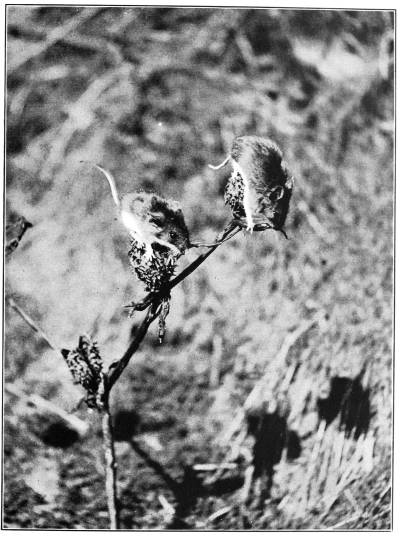
strange rustlings. On investigating, he found a family of young
jumping mice moving through the grass and feeding on the buds of
alder-bushes. They were quite tame, and as they ran out on the ends of
the branches, he had a good view of them and finally managed to catch
one by the end of his long tail. The mouse bit the boy, but did not
even draw blood. Afterwards he seemed to become tamer, although
shaking continually. Given a bit of bread, he sat up and nibbled it
like a little squirrel; but even as he ate he suddenly had a spasm of
fright and died. This death from fright occurs among a number of the
more highly strung of the mice-folk, even when they seem to have
become perfectly tame. This same young naturalist observed another
jumping mouse which, contrary to all the books, took to the water when
pursued, and swam nearly as expertly as a muskrat.
So endeth the Chronicle of the Seven Sleepers.