Geraniums—Pelargoniums—The Difference between the two Plants—Their Culture
and Varieties—Double Geraniums—The Zonale Geraniums—The Liliputian Tribe—Lists
of Desirables and Novelties
Immortelles, or Everlasting Flowers and Ornamental Grasses—Acroliniums—Globe
Amaranths—Helicrysums—Helipterium Sanfordii—Rodanthes—Xeranthemums—and
a Select List of Grasses, Annual and Perennial
General Management of the Garden—The Soil—Selection of Seeds—Weeding—Watering—Planting
out—Pruning, etc.—Saving of Seeds—Preparing Pots—Taking up
and Preserving Flowers in Winter—Sleep of Flowers—Insects—Cultivate the
Beautiful everywhere—Lines of Mrs. Howitts—Let us Teach our Children to Love
Flowers rather than Fashion
139
CHAPTER I.
The Flower-Garden—Its Romance and Reality.
“There’s not a flower can grow upon the earth
Without a flower upon the spiritual side;
All that we see is pattern of what shall be in the mount,
Related royally, and built up to eterne significance.
There’s nothing small;
No lily, muffled hum of summer bee,
But finds its coupling in the spinning stars;
No pebble at your feet but proves a sphere;
No chaffinch but implies a cherubim;
Earth is full of heaven,
And every common bush a-fire with God.”
A beautiful garden, tastefully laid out, and well kept, is a certain
evidence of taste, refinement and culture. It makes a lowly cottage
attractive, and lends a charm to the stateliest palace.
An English writer, lately visiting our country, writes:
“I can conceive of nothing more dreary than to live in the country
and have no garden. To have no garden is to take the poetry, and
nearly all the charms away from country life. To have a garden, is to
have many friends continually near.
“What a difference between what Mr. Carlyle calls an ‘umbrageous
man’s rest, in which a king might wish to sit and smoke, and call it
his,’ with its roses, and honeysuckles, and fuchsias clambering in
through the very windows in crowds, and the dreary, arid prospect
around thousands of American houses!”
This hardly seems a fair criticism upon our homes. Having been
an enthusiastic lover of flowers from childhood, and having cultivated
them ever since the use of the hands was learned, I cannot recognize
its truth;—have never known of many such houses, as he describes. Yet
many American writers will declare that slender porticos, fanciful
verandas, sculptured gables, and deep bay windows are often seen in
this country, without a vestige of a flower or climbing vine about them;
while in England, the poorest laborer’s cot is a bower of greenery; and
his little plat of flowers, often vies with that of his employer.
It is not always wealth or art that gives to English homes their
beauty and picturesqueness, but it is the attention of their inmates, to
the cultivation of the “Green things of the earth.”
It is not the latticed casement nor the high gable that attracts the
notice of the traveler, but the brilliant flowers and the trailing vines
that drape and embower them.
American women live in-doors too much, and thus sacrifice their
health and spirits. They cultivate neuralgia, dyspepsia, and all their
attendant ills—rather than the beautiful and glorious flowers which
God has scattered so abundantly all over the world.
This little pamphlet is written for the purpose of coaxing them to
come out into the sunshine, and begging them to
“List to Nature’s teachings.”
A little garden, all one’s own, is a real Eden! Earth possesses no
greater charm; and there is no cosmetic equal to the fresh, sweet morning
air, and the cheerful sunshine.
You can make no investment which will give you such interest;
health, happiness, and pure enjoyment will be the coin in which it is
paid; and the returns are not made semi-annually, but daily.
With what intense delight one watches the first tiny leaves of the
seeds one has planted; and what pleasure one takes in the unfolding
of the first flower! A grand garden cared for by a gardener, can never
give its possessor as much delight as one in which nearly all the work
is done by one’s own hands.
To be sure, Pat O’Shovelem’s aid is needful to prepare the ground, lay
out the beds, and harden the walks; but, gentler, smaller hands can
plant the seeds and roots, can keep down the weeds, tie up, stake, train,
water and prune.
I have little faith in American women becoming farmers,—holding
the plow—wielding the spade or the shovel; but I do know from long
experience, that all the rest of the work can be accomplished by women,
if they possess a love for the beautiful. There lies the trouble; few of
our children are taught to garden; if they possess a natural taste for
the pursuit, sometimes it is gratified, but not always.
Mrs. Japonica and Miss McFlimsey hold up their hands in holy
horror at the very idea of any of their kindred soiling their hands with
the work.
“Flora work among her namesakes!” they exclaim; “forbid it all
Japonicadom!”
Yet how much harder do they work at the crowded party or ball!
To dance the “German,” requires quite as much physical strength as to
plant a flower-garden, and rake off the weeds;—but that is the fashion,
and beef tea and stimulants must be resorted to, to sustain the feeble
knees, uplift the nerveless fingers. Women can find strength to cultivate
a garden successfully, if they will commence by degrees. If their
muscles and sinews are not accustomed to the work, they will soon
rebel against it when forced to attend to it for several hours at once.
Garden by degrees, my friends, and cultivate your muscles, with your
plants!
An hour, or even half an hour, is long enough for a commencement,
and the next day extend the time ten minutes, and so on, until you can
work for three, or even six hours in succession.
But take it easy; provide an old piece of carpeting to kneel upon
while planting, or weeding with a fork; and if your knees are not
accustomed to that position, humor them by placing an empty raisin or
soap box upon the carpet, and sit upon that;—and if a cushion would
also be agreeable, cover a small pillow with some dark chintz, and
place that on the box. Now you will have a luxurious seat, and can
garden without a sense of pain; yet don’t stay too long, nor become too
much heated. The carpeting protects the skirts from the dampness of
the soil, and should always be used. It can be kept conveniently at
hand, with the box and the cushion.
Of course, flounces, puffs, and furbelows, with their accompanying
upper skirts, are not suitable for such occupations. A dark chintz
dress is the best, for it can go into the wash-tub when it is in need of
cleansing. A woolen bathing dress makes an excellent garden costume—for
skirts are always in the way. If it is admissible on the beach,
where wealth and fashion do congregate, why not in the garden, surrounding
one’s house?
A large shade hat, and a pair of old kid gloves are indispensable. Rubber
gloves are often recommended, but are far too clumsy for the fingers.
Now, the dress is bespoken, and we must purchase the tools required.
A large three-pronged iron fork, with a short handle, is needful for
loosening the ground, removing plants and uprooting weeds. I should
rather do without a trowel than such a fork. They can be purchased
of all hardware dealers.
A small set of tools, comprising a rake and hoe on one handle, a
trowel, and a spade, are very essential. With their aid much light work
can be accomplished without calling upon Mr. O’Shovelem.
A watering pot, with a large nozzle, and a fine sprinkler, is also
required.
With these implements, every woman can be her own gardener—and
not only raise all the flowers she may desire, but also contribute a large
share of the vegetables that are always welcomed at the table, during
both summer and winter.
The cultivation of the soil possesses a wonderful fascination; its very
odor, after a refreshing shower, is inspiring; and as you gather your
flowers, you will also gather improvement in many ways.
“He made them all, and what He designs, can ne’er be deemed
unworthy of our study, and our love.” If we see a pot of flowers in a
window, it gives us respect for the inmates of the dwelling—but if we
see a beauteous garden, “A brilliant carpet of unnumbered dyes,” we
know that there is taste and refinement within that home.
On the European continent, women work in the fields with the men,
and become beasts of burden. I hope never to see them thus, in this
more favored land, but I do desire to have them take a daily interval
from the labor and care of the house, and breathe into their hearts the
oxygen and iron contained in the fresh air; taste the balm and the
tonic of the sunlight and the garden.
Every day there is some work to be done, if the garden is well kept.
There is no need of having a “weeding-day,” like a “washing-day,”—for
the weeds can be kept down, daily. Every morning dig over one or two
beds, according to their size,—and continue the work until all are
cleaned up. Then commence again, and thus prevent the soil from
becoming baked; and let the air and moisture enter the earth, and
nourish the tender roots.
That is my way of gardening. After the beds are made, the walks
prepared, no man’s hand or foot enters the sacred precinct, excepting
to admire, and to receive the flowers.
In the early spring time a half hour may suffice to exhaust the little
strength one possesses, but before October comes, with its autumnal
glories, several hours can be passed in out-door work without much
sense of fatigue.
All the delights of a garden are not comprised in gathering nosegays,
and arranging bouquets, vases or festal garlands;—there is great enjoyment
in watching the vegetating of the seeds; the developing of the
tiny leaves, the forming of the minute buds—and then comes at last—
“The bright, consummate flower!”
Floriculture has been called the gem of all cultures. Its influence
makes us more courteous, if not more intelligent; and what can we
find in nature so emblematical of bloom, decay, and death?
It has been said that “as domestic floriculture and gardening has been
the inclination of beings, and the choice of philosophers, so it has been
the favorite of public and private men, a pleasure of the greatest, and
the care of the meanest: and indeed an employment and a possession,
for which no man is too high nor too low. Flowers are the relics of
Eden’s bowers.”
And there is no pastime that can give as much pleasure, with so
small an expenditure. Gray, the poet, and also a skillful naturalist,
tells us that the enjoyment of life depends upon “having always something
going forward;” and exclaims: “Happy are they who can create
a rose-tree, or erect a honeysuckle!”
It is indeed this very “having always something going forward” that
produces the enjoyment experienced by the amateur gardener; the
glory and fragrance of the flowers forming the crowning gratification.
There is a pride—a most pleasing pride—in culling a bouquet for a
friend, from flowers raised by one’s own hand.
The creation of a beautiful object is certainly “a great fact,” of which
any of us may be justly and honestly proud.
Few of us possess the talent to transfer and perpetuate on canvas, or in
marble, the glorious hues and forms of nature, but the lowest and
humblest can raise flowers which Solomon, in all his glory, could not
have eclipsed!
Why does not everybody have a Geranium, a Rose, a Fuchsia, or
some other flower in a window, if they do not own land enough to
plant a garden? They are very cheap—next to nothing, if raised from
a cutting, and of small price if purchased from the florist; and there is
companionship in them, as well as grace and beauty.
Charming Leigh Hunt, whom I love to quote, says:
“Flowers sweeten the air, rejoice the eye, link you with nature and
innocence, and are something to love. If they cannot love you in return,
they cannot hate you; cannot utter hateful words even if neglected;
for, though they are all beauty, they possess no vanity; and living, as
they do, to do you good, and afford you pleasure, how can you neglect
them!”
There are few dwellers in the country who are so destitute as not to
be able to indulge in a love for flowers. The garden may be of the
smallest size—a mere tiny circle—and it will often be loved the more for
its smallness, and receive more care and attention.
It will not do to care for it a week, and then neglect it for two
weeks. It demands constant care, daily attendance, waterings, and
weedings.
Nothing destroys its beauty like the noxious weeds that will grow up,
like Jonah’s gourd, if not constantly uprooted. The tenacity of their
life is wonderful; uprooting will not always kill them, and they will
mature their seeds, and prepare for another struggle with you in an
ensuing summer, even when their roots lie withering in the sun.
“What hidden virtue is in these things, that it is granted to sow themselves
with the wind, and to grapple the earth with this unmitigable
stubbornness, and to flourish in spite of obstacles, and never to suffer
blight beneath any sun or shade, but always to mock their enemies, with
the same wicked luxuriance?”
Thus enquires Hawthorne, while sturdily waging a warfare against
them, in the garden of the “Old Manse,” at Concord, Mass., and no one
can “make reply.” Animal manures, though very stimulating to vegetable
life, are the sources whence many of the grassy weeds spring.
Artificial manures do not introduce so many of these pests into the
beds and borders, yet some of them are so highly charged with noxious
exhalations that one dislikes to apply them.
Mineral fertilizers are not open to these objections, and I have found
them preferable to others on that account.
Guano is always beneficial, if not applied in too large quantities. An
iron spoonful of it dug into the ground two or three inches from the
stems of the plants will increase their growth and beauty. A less quantity
should be given to tender annuals, and small plants.
Liquid animal manures are also easily applied, and give to the plant
an immediate stimulant. In pouring it on, avoid touching the leaves or
the stems of the plants, but give the earth a copious supply of a weak
solution. Guano applied in this manner is very beneficial. I have
used all of these with decided success; and always feed my garden
bountifully; and receive in return a bountiful supply of flowers and
vegetables.
Plant with care and skill; water when needful; feed plenty of nourishment;
keep clear from all weeds; tie, stake, prune and cultivate
daily, and you will never regret the small investment required to commence
and continue a garden; but will become more and more enamored
with the occupation; and will yearly increase your stock, and multiply
your labors, and will be ready to say with Thomson, the poet of nature:
“I care not, Fortune, what you me deny,
You cannot rob me of free Nature’s grace;
You cannot shut the windows of the sky,
Through which Aurora shows her brightening face;
You cannot bar my constant feet to trace
The woods and lawns by living streams at eve:
Let health my nerves and finer fibres brace,
And I their toys to the great children leave;
Of fancy, reason, virtue, nought can me bereave.”
CHAPTER II.
Construction of Beds, Beds in Lawn, Ribbon Gardening,
Rockeries.
“Oh! who can speak his joys, when Spring’s young morn,
From wood and pasture open’d on his view;
When tender green buds blush upon the thorn,
And the first primrose dips its leaves in dew.”
In preparing gardens to receive our flowers, it is better to avoid raised
beds, with deep walks. They suffer from the intense heat of our summers;
and the rains wash them down, often exposing the roots of the
plants. Grass edgings are objectionable, on account of the labor
required to keep the sods from spreading.
Beds that are artistically cut in the grass-plat produce a better effect;
and the brilliant hues of the flowers contrast perfectly with the soft,
shaven, emerald tint of the grass. One of the most attractive features
about a house, is a garden tastefully cut in the lawn. It is open to but
one objection—the dew upon the grass makes it rather unapproachable
in the early morning, when its owner desires to feast her eyes upon its
beauties.
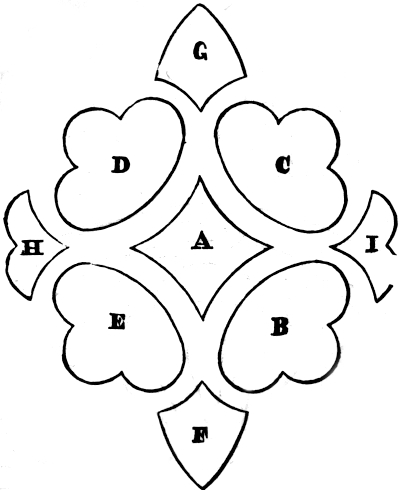
Three designs are given for cutting beds in the grassy lawn, and an
artistic eye will enable our gardeners to vary them as they please. The
walks can be well trodden down, and hardened with sifted coal ashes or
clay. Gravel is not so desirable, as it clings to the feet. The grass can
be left between the beds, or cut out, but if the latter is done, they
can receive more care in the early hours of the day.
Diagram No. 1.
In the center, A, place a stocky plant of Scarlet Salvia; at B, Scarlet Geraniums; D, White
Perfection Geranium; C, Heliotropes; E, Carnations; G, Asters; F, Zinnias; H and I, Stocks.
Diagram No. 2.
A, Ricinus, Sanvitalia procumbens round it; B, Scarlet Verbenas;
C, White Verbenas; D, Purple; E, Striped, Pink and White; F, Richest
Crimson; G, Pure White; H, Brightest Pink; I, Darkest Maroon. The
outer beds can be each of one kind of plant, Heliotropes, Carnations,
Geraniums, Pelargoniums, Asters, Balsams, Zinnias, and Stocks, or
any flowers that suit the owner’s taste.
Diagram No 3.
In the center mound, plant a fine specimen of Arundo donax, or one
of the Pampas Grass. In each of the pear-shaped beds, put a different
colored geranium, the tallest species at the stem end, and the Tom
Thumb varieties at the broadest edge. In the circles plant some white
flowers that will retain their beauty. In the crescents, brilliant scarlet
flowers; and in the bordering of the half moon, either try ribbon
gardening, or fill up with a mosaic in squares of scarlet, white, purple,
orange, blue, bright pink, crimson, and all the numberless shades that
flowers afford. These beds furnish a great scope for exercising one’s taste
in arranging colors; and very brilliant effects may be produced without
a great outlay of time or money.
The crescent-shaped garden can be approached from the main walk,
and if the walks are hardened with ashes, it can be easily tended. All
flower beds should be dug a foot deep; well enriched with animal or
mineral manures; the lumps all finely pulverized, and the surface of
the beds raked as smoothly as possible.
Portulacca, Nemophila, Thrift, Gypsophila and Dwarf Asters make
very pretty edgings.
Ribbon Gardening.
Flowers may be planted in ribbon fashion, that is, by employing those
of primary colors, and arranging them with the tallest for the background,
or in the center. If sowed in a circular bed, be sure to have a
brilliant scarlet or white flower in the center, which should be taller
than all the rest. A Scarlet Geranium (Gen. Grant), for the center,
White Feverfew surrounding that; Blue Larkspur should come next;
Yellow Calceolarias next; and then the Dwarf Asters, of a rich crimson
color, bordering on purple, would contrast well. For borderings to the
plans given in this chapter, the Hyacinth-flowered Stocks would ribbon
beautifully. Plant a row of the Scarlet, then White, next Lilac, then
Canary Colored, then Bright Pink. They will grow to the same height,
and produce a fine effect. Verbenas are also excellent for this purpose,
and can be planted in concentric circles or in parallelograms, with six
or seven colors, arranging them as a rainbow. A narrow semi-circle
thus planted could be called the rainbow garden. Phlox Drummondii,
Candytuft, Lobelias and Zonale Geraniums can all be employed in
ribbon gardening. Take care to arrange the colors with vivid contrasts—orange
and purple, white and scarlet, but do not let blue and purple
mingle. The arrangement of the ribboning must depend, of course,
upon the stock of plants you possess, and after one year’s trial you will,
doubtless, succeed in producing a fine effect. The only requisite rules
are, to arrange the plants according to their height and coloring, always
planting the outer edges with some dwarf plant that contrasts strongly.
The Alternantheras, ornamental foliaged plants that grow but four or
five inches high, are unsurpassed for edgings. They will receive due
attention in the chapter devoted to Variegated Leaved Plants.
For planting in masses of coloring, Truffanto Asters, Smith’s Prize
Balsam, Dianthus florepleno, Linum coccineum, Schizanthus atropurpureus,
Calceolaria and Centranthus macrosiphon make a fine show.
Plant a small bed of each.
A bed of miniature flowers is always charming. Lobelia marmorata,
Leptosiphon hybridus, Clintonia azurea grandiflora, Fenzleria dianthiflora
and Grammanthes gentianoides are all dwarfs, and planted together
with a bordering of Gypsophylla muralis, the effect is lovely! A bed of
Mignonette is indispensable, and it will flourish in the shade, and in
damp places, blooming luxuriantly.
Rockeries.
There are many plants which thrive much better in a sheltered, rocky
situation, and thence has sprung up the fashion for constructing “Rockeries.”
Or it happens that some large rocks crop out on a portion of
ground which is within view of the house, and it is desirable to ornament
them. In the latter case, you have only to plant strong growing
vines with large foliage, such as the Wild Grape Vine; the Clematis, or
Virgin’s Bower, that trails its white, starry blossoms, and its puffy,
wooly seed pods all over the forests of this country. These two vines
will render the offending rocks most picturesque. Southern ladies can
entwine among them the lovely Yellow Jessamine of their woods, which
throws a golden hue over all their forests. The Ampelopsis (or Virginia
Creeper), or Five Fingered Ivy, and the Aristolochia (or Dutchman’s
Pipe), are also desirable for this purpose; also the Periplo cagræca,
or Silk Vine of the Southern States.
One, or all of these vines, will soon render the obnoxious rocks a joy
forever! Artificial Rockeries are usually constructed of stones of various
sizes, with the soil firmly embedded betwixt them. They can be made
very easily from the clinkers of the coal furnace. If large pieces can
be obtained, whitewash some of them to increase their picturesqueness.
Boulders, stones from brooks, or hill sides, can all be used advantageously.
Commence with the largest-sized stones, and build it up in an irregular,
jagged shape to imitate nature. A Rockery can be made as a
receptacle of Mineralogical Specimens, which would increase its value.
If you send to the woods and brooks for the stones, bring the soil
thence, and, if not rich enough, add a little compost, but native Ferns
and Vines do not require a large supply of stimulants. Plant the Ferns
and Mosses on the shadiest side, and trail over the stones small vines,
like the Lysimachia numerlaria, Vinca, minor and major, Moneywort,
Lobelias, varieties of the Sedums, and the various Annuals mentioned
under that head, as desirable for rock work. The varieties of the Saxifragora,
with their broad leaves, and large clusters of bright pink or
red flowers, are very effective among the trailing vines and ferns.
A small Evergreen tree will show to advantage from some rocky
point.
The Alpine Plants are also lovely for such constructions.
Crocus bulbs can be planted among the smaller stones, and in the
early Spring will make a fine show. After they have bloomed, their
places can be filled with Dwarf Asters and Dwarf Stocks, Phlox Drummondii
and Pinks.
Rockeries can be rendered very ornamental additions to the lawn or
shrubbery, but they require a tasteful eye to construct them, and a
loving hand to tend them; without these they can never be eye-sweet.
CHAPTER III.
Annuals—Their Culture and Treatment.
“Come, ye soft sylphs,
Teach the fine seed, instinct with life, to shoot
In earth’s cold bosom, its descending root;
With pith elastic, stretch its rising stem,
Part the twin lobes, expand the throbbing gem;
Clasp in your airy arms the aspiring plume,
Fan with your balmy breath its kindling bloom;
Each widening scale, and bursting film unfold,
Swell the green cup, and tint the flower with gold.”
Annuals are considered the chief ornaments of the flower garden
throughout the summer and autumn, and many of them are desirable
for house culture.
They have great claims upon our attention, and should be more
extensively cultivated in every garden. It is impossible to plant, in a
private plat of ground, all the kinds and varieties that are offered to us
in the Seedsmen’s Catalogues, but a judicious selection of the best kinds
will give a charming assortment of brilliant flowers.
It is almost superfluous to mention that annuals are plants which
spring from seed, and perfect their growth and seed, and perish with the
autumn; though their life may be prolonged by cutting off the flowers,
not allowing the seed-pods to form, and keeping them housed in the
winter.
They are divided into hardy; half-hardy and tender; and are natives
of various lands. Many of them have been greatly improved, by the
care and patience of the florist, from their normal state, and transformed
into flowers of the most gorgeous hues, and the most perfect shape.
Asters, Balsams, Larkspurs, Petunias, Portulaccas, Stocks and Zinnias
have all become exceedingly double and of every brilliant hue; while
many others have had their flowers much increased in size, and otherwise
improved.
These flowers are more generally cultivated than any other class of
flowers, and they, alike, adorn the yard of the cottage, and the parterre
of the palace.
They will grow almost anywhere, and in any kind of soil, but thrive
much better if heed is paid to their wants, and they are provided with
a sunny location, well drained, and are well supplied with rich sandy
loam; though there are some kinds which prefer a clayey soil. There
are only a few which require a very rich soil, yet, most of them will
reward you with a brighter show of flowers if well fed. It does not pay
to starve plants, any more than to starve animals.
It is very desirable to locate your garden where it can be in constant
view from the windows of the house; flowers are our bosom friends and
we desire to have them always in sight; when weary they refresh one,
when happy they add to one’s happiness, and when sad and gloomy they
give to one pleasant thoughts, smooth the care-worn brow, and uplift
the heart to the Giver of all good things.
To prepare the soil, let Mr. O’Shovelem dig up the grass-plat, if needful,
and prepare the beds in front of the piazza, porch or sitting room,
if it has a southeast direction; if not, take the next best, a southwestern
location. Few plants will thrive well in a northern exposure, though
Pansies love the shade, and will flourish there. If you can procure a
compost of sand (not sea sand), leaf mould, loam and manure—a quarter
of each—you will have as good soil as you can desire; but if not
within reach, take what offers, and if it is heavy and stiff, add sand to
lighten it; if friable and light, add ashes, muck or soil from old pastures,
taken from under the sods. This is always desirable. Sand is
also an essential.
Laying out the Beds.
Have the garden well spaded over, and then lay out the beds. If you
have a geometrical eye, you can mark out circles, semi-circles, triangles,
stars, diamonds and all sorts of curved beds; and if you can have all
the assistance you desire from “men-folks,” border their edges with narrow
strips of turf, which must be kept closely shaven, and not allowed
to encroach upon the beds.
If you depend upon your own exertions, avoid the turf; for it exacts
too much hard muscular work for women to encounter.
A bordering is now manufactured of Terra Cotta, which is highly
praised; and it is said to withstand the frost and snow of the coldest
regions. The Drain Pipe and Terra Cotta works in New York, make
several styles. Tiles are also introduced with good effect. Box edgings
are always tasteful and pretty. If you can possess none of these, you can,
at least, border the beds with Dwarf Annuals and Perennials. The
Tom Thumb plants of every kind are very pretty for this purpose; the
stone-crop and, indeed, all the varieties of Sedums, make effective
edgings. Gypsophila muralis is also beautiful for an edging, and its
spray-like flowers are indispensable for both vase and bouquet. They
cover the flowers like a mist, increasing their charms by partly veiling
them.
Sowing the Seed, etc.
The hardy varieties, like Candytuft, Phlox Drummondii, Sweet
Alyssum, Sweet Peas, etc., can be sown as soon as the ground becomes a little
warm, and the weather is in a degree settled. Indeed, all these kinds,
and many others, will bloom earlier in the summer if they are planted
in the autumn. The frost and snow does not disturb their rest. Sweet
Peas are very essential for all gardens. Their fragrance is grateful to
all; and a bunch of the new colored ones, mingled with the old favorites,
equals the soft and liquid tints of the sunset cloud. But don’t put
Scarlet Geraniums or Verbenas among them; their vivid hues will pale
and dim the beauteous Peas.
They bloom much more profusely, if planted four or five inches in
depth, and are not so apt to mildew.
The half-hardy annuals should not be sown, excepting in the South,
before the middle of May; and the tender ones, not until June, if one
desires good success in their vegetation and growth.
A large amount of vexation might be avoided if amateur florists would
pay a little heed to natural laws.
For both half-hardy and tender Annuals, planting in-doors, or under
glass, is very needful. If this is done, they can be brought forward so
as to bloom by the last of June, or the first of July, and one is fully
repaid for the extra trouble by their graceful, lovely flowers. All these
varieties of Annuals require transplanting. No Aster, Petunia, Stock
or Zinnia will show its beauty if not allowed plenty of room in which
to grow and bloom. So, it is as well to transplant them from boxes, or
hotbeds, early in the summer, when all fear of frost is past, as to do it
later from the garden beds.
Seeds of various sizes require different depths of covering. The
smaller the seed, the less the soil it needs to plant it, and the finer the
soil should be.
Portulaccas, Petunias, and all tiny seeds, should be mixed with sand,
and sprinkled or sifted on to the earth prepared for them, and then
gently pressed down with the flat of the trowel or the hoe. The general
rule for planting has been to the depth of three times the diameter of
the seed.
Too deep planting is a fruitful source of the usual loss of seeds, so
much complained of by amateur gardeners.
The several essentials to successful germination of seeds of all kinds
are suitable soil, suitable moisture and warmth; if these are in excess,
or not sufficient, some, if not all, of the seeds will fail.
In planting seeds in the open border, the soil must be thoroughly
pulverized, no little lumps left in it to destroy plant life.
Rake in the seeds, scattering them thinly around; or, a better way is
to tie a string to two small sticks; plant one of them firmly in the earth,
and with the other draw a circle of the dimensions you may desire;
wind up the string until you have it of the right length, then plant the
seeds in the circle, and label them. Don’t trust to your memory for the
names, and then say “this pink flower, that red one, and the other blue
or yellow one,” but learn their names, and call them by them.
One often rebels at the many-syllabled word that is applied to a tiny
mite of a flower; yet, that same Latin word tells to every botanist its
class and order, while the common, familiar, local name is recognized
only by one language.
Miss Mitford says: “One is never thoroughly sociable with flowers
until they are naturalized, as it were, christened, provided with decent,
homely, well-wearing English names.”
The practice of giving Latin names to flowers and plants has been
styled pedantic. It is not so; for it conveys an idea of the flower to every
student of Botany and Gardening in every nation.
Leigh Hunt thus writes upon the names of flowers:
“Pink is not by itself a pretty name, but we have associated it since
our first dawnings of infancy, with the sweetness of the flower, so now
the name and flower are one, and the poor monosyllable becomes rich in
sweetness and appropriateness.”
And again:
“Browallia is a pretty name, and was given to a Peruvian flower by
Linnæus in honor of a friend of his by the name of Browall; yet the
name gives no idea of the flower which is remarkably attractive;” and,
he suggests that Browall’s Beauty would have immortalized both the
friend and the flower, and have advertised its claims to the regard of the
florist.
A short digression from seed planting, fair friends, which it is to be
hoped you will pardon and overlook.
When your seeds are planted, unless the day is cloudy and showery,
they will require shading from the heat of the sun.
I find old newspapers are the best protection; but, if the patches are
small, flower pots can be inverted over them. The newspapers must be
laid over the seeds, after they have been well watered, and fastened at
the corners by small stones or a handful of the earth. At night they
should be removed to let the dew moisten the ground, and put back
before it is dried up in the morning. Continue this until the tiny leaflets
appear; then remove them entirely. If the ground is dry the seeds
must be thoroughly wet every night. Moisture is very needful to germinate
seeds; without its aid they cannot sprout. The would-be florists
often plant their seeds as the Catalogues direct and then give no farther
heed to them. You will often hear it said, “I can’t make annuals grow.
I planted fifty to sixty varieties, and not half a dozen of them ever
sprouted. I have no faith in the seedsmen; they send out old seeds and
keep all the new for their own gardens.”
“Did you water them well, and shade them from the noontide heat?”
is asked. “Why, no! I never thought of that. I planted them, and
supposed that was enough.”
My fair friends, unless the clouds favor you and drop rain, or hide the
sun for three or four days, your seeds will become baked and shriveled,
and you cannot expect them to grow.
The thin-skinned seeds will germinate most quickly, while those that
are shrouded in horny textures, vegetate more slowly. It is always well
to soak all such seeds. Verbena seeds require twenty-four hours soaking
in warm water, and the seeds of the lovely, graceful Cypress vine
will not germinate unless boiling water is poured upon them.
Transplanting Seedlings.
When the tiny plants have put forth the fourth or fifth leaf, it is time
to provide them with permanent homes. If this is done in the early
morning of a warm day—or even later in the forenoon—you may be
sure that you will lose your plants. But select a showery, cloudy day,
following a dry season, or plant after night-fall, and then water, and
shade from the sun of the next day, and you will hardly lose one plant,
or even have a leaf curl.
Annuals of most kinds must have plenty of space to grow in. There
are few that are not improved by transplanting. Salpiglossis will grow
to better advantage thickly planted; also, Erysimum Peroffskianum,
whose brilliant orange flowers render it desirable to every garden.
Mignonette, Larkspurs and Poppies will not bear transplanting; they
grow from a tap root, and do not easily attach themselves to a new home
after their growth is once started.
If Annuals are not planted anew after germinating, their growth is
weak and spindling, and they soon cease flowering; while, on the other
hand, they will grow luxuriantly, and blossom until the frost withers
their fair bloom, if their quarters are ample. Asters should be planted
a foot asunder each way; and Stocks, Balsams, Zinnias and Petunias
require as much room, if not more, to bring them to a state of perfection;
and, if mulched with fine manure early in July, they will bloom
magnificently.
What Shall We Plant?
This is the query of many women who examine the Illustrated Catalogues,
and are not familiar with the high-sounding names, and, therefore,
totally at loss to know what are desirable and needful out of the
thousands of varieties, illustrated and described therein.
I will give a list of those whose beauties are familiar to me, and whose
names are household words:
Asters, Truffauts, Rose Asters, Imbrique, Pompone, Chrysanthemum
Flowered, Bouquet, in all their varied colorings and shapes. No garden
can afford to be without one or all of these varieties; and they take
chief rank in the tribe of Annuals.
Amaranthus melancholicus, variegated leaves.
Anagallis.
Abrobra, a lovely climber.
Abronia, very effective for rock-work.
Ageratum, lavender blue and white.
Acroclinium, white and pink.
Balsams, Smith’s Prize and Camellia flowered.
Bartonia aurea, golden yellow.
Browallia, blue with white center, white.
Cacalia, orange scarlet, and yellow.
Calandrinia, crimson, white, pink and lilac.
Coreopsis Burridgii, and coronata.
Canary Bird Flower, beautiful vine.
Candytuft, white, purple and crimson.
Celosia spicata rosea, everlasting flower.
Centranthus, white, flesh colored and pink.
Cerastium, ornamental foliage, for edgings on rock-work.
Chlora grandiflora, bright orange changing to red.
Chrysanthemum coronarium, flore pleno.
Clarkia integripetela, magenta crimson, rich.
Clianthus Dampierii.
Clintonia azurea grandiflora, desirable for rock-work and baskets.
Cobæa scandens, a climber of rapid growth.
Collinsia, various colors, pretty for ribbon borders.
Convolvulus aureus superbus, a golden yellow variety.
Convolvulus mauritanicus, perfect for roses and baskets.
Cyanus (Ladies’ Delight).
Cypress Vine, the most graceful of climbers.
Eschscholtzia Californica, several colors.
Euphorbia variegata.
Fenzlia, dwarf growth, effective in rustic decorations.
Gilia, various colors.
Godetia, useful in ribbons.
Gypsophylla muralis and elegans.
Helliophila araboides, bright blue, useful for edgings.
Inopsidium acaule, sky blue, loves the shade.
Ipomœa hederacea superba, a beautiful vine.
Kaulfussia atroviolacea.
Larkspur (Hyacinth flowered).
Leptosiphon hybridus, dwarf edgings.
Linum, in several colors.
Lobelia, blue, white and rose color, dwarf.
Lupins, of all colors.
Machæranthera tanaceifolia, bright purple, golden center.
Marigolds, new varieties are very attractive.
Mignonette, Parson’s new white and the crimson flowered.
Nasturtiums, of all varieties.
Nemesia compacta elegans.
Nemophila, delicate flowers, very dwarf, love the shade.
Nigella Tonlanesiena.
Oxyura, golden yellow, edged with white.
Sweet Peas of all colors.
Perilla Nankinensis, dark rich foliaged plant.
Phlox Drummondii, of every shade.
Poppy, carnation colored.
Portulacca, double and single.
Ricinus, ornamental foliaged.
Salpiglossis, very beautiful.
Salvia splendens.
Sanvitalia procumbens, suitable for edgings and rock-work.
Saponaria acymoides, lovely for borderings.
Scabiosa (or Mourning Bride), flore pleno.
Schizanthus, all colors.
Statice hybrida.
Stocks, German Dwarf, pyramidal, new hybrid.
Tagetes pumila, marigold of beautiful foliage and flower.
Trifolium (ornamental clover).
Tropæolum, finest mixed varieties.
Viscaria elegans picta.
Vittadina (Australian Daisy), a good edging.
Whitlavia, blue and white.
Zea Japonica (Japanese Maize), ornamental foliage.
Zinnia Elegans, flore pleno, all colors.
Zinnia Mexicana pumila, very double and brilliant.
Among this list of Annuals several climbers have been included; for
other species, consult the chapter on Vines and Climbers.
Training and Watering Annuals.
There are few plants that are not benefited by judicious training and
pruning.
Balsams are greatly improved by pinching off the side shoots, and
allowing only the stalks to grow; or the main shoot may be left to
itself, and all the strength of the plant thrown into it, producing an
upright stem loaded with gorgeous chalices of bloom. Manure water
will increase the size of the flowers, and, thus grown, they make splendid
pot plants.
The scissors are useful about many other plants; and their side growth
should be checked, and less latitude allowed to their branches.
Zinnias, Stocks and Asters should have the laterals trimmed off;
their beauty is improved, if they are kept within bounds.
In watering Annuals, and all flowers, care should be taken to apply
it after the sun has set; if water is given in the morning, when the sun
is hastening forward to drink up every drop, it is of but little use to
the plant; and, if it is given at noon-tide, when the sunbeams fall fiercely
hot, it scorches the plants as though Jack Frost had bitten them. The
cold drops, falling on the heated surface of the soil, produce the same
effect as a chill.
Water slightly warmed to the hand is far more efficacious than that
drawn directly from aqueducts or cisterns. If it sets in the sun all day,
it will be of the right temperature to apply at night.
English books on gardening, often denounce the practice of frequent
watering; but they are no guides for American gardens. Their misty,
moisty island, enveloped in clouds, promotes moisture sufficient for their
needs; while our heated atmosphere drinks up every drop from the soil.
If it has rained during the day the watering pot can hang upon its peg;
but if not, its attendance is highly essential for the growth of all tender
Annuals, and delicate bedding-out plants.
Many ladies complain of their ill luck in floriculture; no plant
thrives with them. Why is this?
Because they neglect the floral darlings. They are assiduous in their
attention to them while planting or transplanting them; but then their
energy fails; they think that the sun, rain and dew will do the necessary
work, and they can rest from their labors.
They never fail to do their appointed work; but you must cultivate
in season and out of season if you would raise—
“Bright gems of earth in which, perchance, we see
What Eden was—what Paradise may be.”
CHAPTER IV.
Perennials and Biennials.
“Well they reward the toil.
The sight is pleased, the scent regaled;
Each opening blossom freely breathes around
Its gratitude, and thanks us with its sweets.”
Perennial plants are those which live and blossom through many
successive seasons. If planted very early in the border, or brought forward
in the hotbed or in window gardens, they bloom the first season,
and many of them are hardy enough to withstand the coldest winters of
northern New England, while others require protection, and the tender
ones must be housed in the cellar to await the return of spring.
Perennials die down every year, but the faithful old roots live, and
when the sun awakes them from their wintry sleep, they spring up anew,
and delight our senses.
These plants are very deserving of the attention of the amateur florist.
They ask but little at one’s hands, and will grow and bloom for many
years under great neglect. Yet if their roots are not divided, and their
food renewed—after a few years they will dwindle away, and finally
perish.
Many kinds are raised from seeds. Others by cuttings or increase of
the roots; and once in three or four years they require to be taken up,
divided, and reset. They flourish best in a light, rich soil.
Dicentra spectabilis, an importation from China, stands at the head
of the list for its beauty, grace and hardy qualities. Linnæus knew of
its loveliness, and named it Corydalis formosa. Mr. Fortune introduced
it into England less than twenty years ago, and it has been called
Dilytra, Diclytra, and Dicentra, which are its proper names.
It seeds sparingly, but a white variety has been introduced, whether
from seed or from China, I know not. It multiplies rapidly by the
roots; the foliage resembles that of a Pæony, and its flowers are rose
colored, tipped with white, and hang from long racemes. As a lawn
plant, for early spring and summer blooming, it is unsurpassed.
Perennial Flax (Linum perenne), is a native from beyond the Mississippi,
and is beautiful in color and shape. Its flowers are celestial blue,
and they are very abundant. The plant continues in bloom all summer,
and is an addition to every garden.
Missouri Evening Primrose (Œnothera macrocarpa), also blooms all
summer; its flowers are a golden yellow, and the plant is dwarf in habit,
but the flowers do not open until the sun’s rays are declining.
Petunias are half hardy Perennials, which usually rank with Annuals
in the northern part of the United States. They are desirable for the
smallest plat of ground—as they grow luxuriantly and flower profusely.
They take front rank now, and their curious blotchings and veinings
render them very beautiful. The double varieties possess a spicy fragrance,
and many of them are as beautifully striped and mottled as a
carnation.
Columbines, Lychnis, French Honeysuckles, Phlox, Pinks, Achillea
and Campanula are all very beautiful, and if raised from seeds will
increase rapidly from the roots.
The Perennial Larkspurs have received great additions to their numbers
of late years, and are greatly improved in coloring and the size
of the flowers. The blue species possess the most perfect tints—vie
with the hues of a cloudless sky!
There are no directions needful for preparing the soil, or planting the
seeds, as they are given so fully in the previous chapter.
October is the best month for dividing and transplanting the roots.
All perennial plants admit of dividing and transplanting, and it greatly
increases the size and beauty of the flowers, and enhances their colors.
The roots of those kinds not found in the seed catalogues, can be
purchased at the florist’s at slight expense, excepting the rarer kinds
and the novelties.
Trees and Shrubs, and nearly all the so-called bedding-out plants,
are strictly speaking perennials; yet the term is more particularly applied
to those flowers whose stems and leaves annually decay, the roots retaining
their vitality. I shall treat more fully of them under the chapter on
Pæonies and Herbaceous plants.
I append a list of the most desirable grown from seed:—
These are plants which, like Annuals, generally die after producing
their flowers and seeds, but are two years in perfecting these, and in
some instances may be induced to flower for two or three successive
seasons by preventing them from going to seed; their general culture
is the same as for Annuals.
One of the most beautiful is the German Brompton Stock. The
greatest improvements have been made in these flowers, and they are
now very desirable plants for border or lawn. They are half hardy, will
require protection during the winter in northern climates—but will
fully repay the care they demand. Any particularly fine plant can be
propagated by cuttings, yet they do not always flower as well as those
raised from seeds.
Among the Biennials most deserving of culture are:—
Canterbury Bells, double and single varieties, hardy.
Carduus, hardy.
Humea, elegant, half hardy.
Hollyhocks, half hardy.
Hyoscyamus, hardy.
Ipomopsis, half hardy, orange, scarlet, rose.
Silene ornata, hardy biennial.
Silylum elurnium (Ivory Thistle), hardy.
German Stocks, new dwarf bouquet.
Stocks, French winter, or Cocardean.
Scarlet Giant Cape.
Trachelium cœruleum, hardy.
CHAPTER V.
Geraniums and Pelargoniums.
“A brilliant carpet of unnumbered dyes,
With sweet variety enchants the eyes.”
These well-known flowers have adorned the gardens, and been florists’
favorites for many years. Their pleasing foliage, and brilliant bloom,
well merit the estimation in which they are held. Leigh Hunt, the
genial Essayist, says:—“Everything about the geranium is handsome,
not excepting its name, which cannot be said of all flowers, though we
get to love ugly words when associated with pleasing ideas. The word
Geranium is soft and elegant; the meaning is poor, for it comes from a
Greek word signifying a Crane, the fruit, or seed pod, resembling the
form of a crane’s bill. But what a reason for naming the flower! as if
the fruit were anything in comparison, or any one cared about it. It
would be far better to invent joyous and beautiful names for these
images of joy and beauty.”
Linnæus named the Geranium from Geranos, a crane, for the reason
that Mr. Hunt gives. The plant is often confounded with the Pelargonium,
which differs from it in size, shape and coloring of its flowers,
and it is strictly exotic. It was named from Pelargos, a stork, on account
of the resemblance of its capsules to the bill and head of that bird.
They are placed in the same class of the Linnæan system as the
Geranium (Monadelphia), but in the fourth order (Heptandria), while
the other is in the sixth order (Decandria).
There has been a good deal of confusion with regard to the names of
the two plants, and their numerous varieties, but the derivation of their
titles settles the vexed question.
The careful and patient hybridization of the French, English and
American florists have brought these flowers to a high standard of
perfection.
The Double Geraniums.
Lemoine, the chief of the Geranium culturists, introduced the new
double varieties, which have become a decided acquisition. They do
not drop their leaves, like the single varieties, and their clusters of
flowers are of an immense size. They are of all shades of scarlet and
bright rosy pink; some have produced heads bearing from sixty to eighty
perfect flowerets. They outrank all other kinds of Geraniums, and
yearly their number increases. They flourish better if partially shaded
from the intense heat of the noonday sun, and will bloom until the
frost comes, in the greatest perfection.
No white variety has yet been introduced, but M. Lemoine will succeed
in procuring one, if skill and patience can produce it.
Gloire de Nancy is a brilliant scarlet, much admired.
Marie Lemoine is a dwarf variety, of a bright rosy-pink hue, very
elegant.
Emile Lemoine is of a cherry-carmine.
Gloire de Doubles is a novelty for 1871; of the richest cerise tint,
with a distinct white center; far superior to the other varieties.
Crown Prince is of a dwarf habit, and of the brightest rose color.
The Zonale Geraniums.
But the double varieties are not the only ones which should claim our
attention. Some of the new Zonale species are admirable in coloring,
and of very free growth; their trusses of flowers are five to six inches
in diameter; and they are found in all shades, from the most dazzling
crimson and the brightest rose to the purest white.
The most desirable are:—
King of the Roses, a most brilliant scarlet, shaded to magenta.
Geant de Battailles, a dark, rich crimson.
Mrs. Keeler, of a rosy, peach-blossom hue.
Among the older varieties, and less costly, are:—
Christine, a lovely rosy-pink.
Gen. Grant, a dazzling scarlet, and decidedly the most profuse blower
of the red varieties.
Incomparable has striped flowers, white on a clear salmon ground.
Maid of Kent, richest shade of pink.
Madame Werle, white, with a pink center.
Reine des Vierges, purest white.
Warrior, large clusters of the most intense scarlet; very superior.
Blue Bells, a rich shade of magenta pink, each blossom of immense
size.
Coleshill, enormous scarlet truss, and blows freely.
Liliputian Zonales, or Tom Thumb Geraniums.
These comprise a dwarf section of this species, and grow from six to
ten or twelve inches high; are very stocky, and their flowers equal in
size and beauty of coloring those of larger growth. They are a very
attractive plant, and make pretty borderings for beds or mounds of the
taller kinds.
Baby Boy, scarlet, with white eye.
Little Dear, a delicate rose, spotted with white.
Little Gem, brilliant vermillion, with white center.
Christabel, very dwarf, rosy pink.
Cupid, a salmon color, with white eye.
Pretty Jemima, dazzling scarlet, white center.
Golden and Silver Tri-Color Geraniums.
These varieties are noticed under the head “Ornamental” Foliaged
Plants; and the Ivy-Leaved Geraniums are embraced under the same
heading.
The Sweet Scented Geraniums.
These plants are indispensable for bouquets and vases, their fragrance
being agreeable to all lovers of flowers.
Formerly, the Rose and the Oak-Leaved were the only kinds commonly
cultivated, but now there are a dozen varieties from which to make a
selection, and all of them are desirable and beautiful, indeed, are quite
essential, for there are few plants which afford such graceful backgrounds
for borders or bouquets.
Denticulatum is a rose-scented variety, with finely cut foliage.
Lady Plymouth is also rose-scented, and its leaves are prettily margined
with white.
Shrubland Pet is of dwarf growth, and very sweet scented.
Odoratissimum possesses a spicy apple perfume.
Graveolens is of a pleasant scent, with bright flowers.
All these plants will grow luxuriantly with but little care. Any one
can raise Geraniums. They delight in a good, rich loam, with a mulch
of manure; have a special fancy for “barn-yard coffee,” or liquid
manure. If watered with it, twice a week during the summer, will bloom
profusely. If your plants are old, prune them closely, cutting the
branches well in, and they will reward you for the sacrifice. If they are
taken from pots, you should also prune the roots, cutting away all the
largest roots to within five or six inches of the main stalk. After this
vigorous pruning, the plants should not be exposed to the heat of the
day, but must be shaded for a day or two, until they recover from their
loss; but thus treated they will speedily put forth new roots, leaves and
buds.
If the bed is shaded a little during the hottest part of the day, they
will bloom the better.
To produce the largest clusters of flowers, the stalk above the buds
should be pinched off, thus throwing all the strength of the plant into
the formation of flowers.
A rich, light loam will grow Geraniums to perfection, and the soil
fresh from the woods and pastures, if enriched with well-rotted cow
manure, is the best that can be obtained. Plants delight in a virgin
soil, and those who live in the country can provide themselves with it
by lifting the sods from cow or sheep pastures, and taking the earth
from under them.
If cuttings are desired from the Geraniums, they should be taken in
July, from the healthiest plants, and planted in small pots filled with a
compost of loam and sand, having one or two inches of the former on
top of the pot. Insert the cutting firmly, and keep the sand sopping
wet until it has rooted. When one or two leaves are developed, transplant
it into a larger pot, with a compost of one-third rotted cow manure,
one-third black loam, and one-third sand, and by November you will
have vigorous plants for house culture. The large roots can be lifted
from the ground before the frost blights their leaves, and after cutting
away all the tender shoots and buds, and shaking the earth from their
roots, hang them up in a dark, cool, dry, but frost-proof cellar, heads
downward. In the Spring they can be brought to the light, the
branches cut in, and though they will look shabby enough, yet, if
planted in boxes in a warm kitchen, they will put forth leaves and vegetate
rapidly, and can then be transplanted into the borders. The tender
branches and buds should be cut off, else they will continue for awhile
to grow in the cellar, and thus lose their lives.
Cuttings can be started in the open borders, but they are not as sure
to live. It is no more trouble to grow a Geranium than a cabbage,
yet one is far more desirable than the other, unless hunger is at the
door.
Geraniums are never attacked by the aphis, or red spider, and this is
a great attribute; one is not forced to fight for their lives.
The Pelargonium.
The flowers of this plant are much sought after on account of their
perfect coloring and blotches. There are all shades of scarlet, crimson,
pink, purple and white; the lower leaves, and frequently the upper, are
veined and blotched with the darkest crimson, purple and red, beautifully
veined with the lighter shades. The leaves of the plant are more
pleasantly perfumed than those of the Geranium, and have no zonale,
or horse-shoe markings, but are of a rich, vivid green. No description
can convey any idea of the beauty of the flowers. They bloom in border
or bed all the summer, and are to be had in hundreds of varieties. They
are propagated both from cuttings and seeds, and the “novelties” are
produced by careful hybridization. They require a light, sandy loam,
well enriched with cow manure, and if they are not plentifully supplied
with water, their buds will wither away. They need more sunlight
than the Geranium to bloom in perfection. Some of them are tall in
growth, and produce a good effect planted singly on the lawn. They
are the most showy-flowered of all the bedding-out plants, excepting the
Scarlet Salvia, and their varied tints and exquisite colors make them
very desirable in the smallest garden.
Their habit is not always compact, but they can be cut and trimmed
to a fine shape, and the older plants require such treatment to bloom
well, the second year.
Among the many varieties offered for our selection, the most desirable
ones are:—
Gen. Taylor, of a rich crimson, blotched with the darkest tint of red.
Niagara, white, striped and blotched with crimson.
Competitor, black, edged with rose.
Emperor of Pelargonium, very large flower of snowy whiteness,
spotted with violet, tinged with rose; petals finely fringed.
Eligible, a pink crimson, with white edges, and violet blotches and
veins.
Dr. Andre, pink and white, petals fringed.
Cloth of Silver, petals of silvery whiteness, blotched with delicate
rose.
Crimson King, a rich crimson, beautifully veined and blotched.
Princess Hortense, orange-salmon, edged with pink.
Eclipse, clear white petals, marked with maroon.
Belle of Paris, rich violet crimson, upper petals spotted; an immense
cluster of flowers.
CHAPTER VI.
Bedding-out Plants, Pansies, Verbenas, Heliotropes,
Feverfews, Etc.
“Your voiceless lips, O flowers, are living preachers!
Each cup a pulpit, every leaf a book!
Supplying to my fancy numerous teachers
From loneliest nook.”
The varieties of plants called by florists bedding-out plants, are very
popular—and deservedly so. Their flowers present a brilliant mess of
coloring all the summer, and their hues are richer than those of most
other flowers.
Pansies are great favorites—they will grow in shady nooks where no
other flower can bloom—and their flowers continue from the earliest
spring until the latest autumn. Various and familiar are the names by
which the Pansy has been known for centuries.
Gerard, who wrote a long description of it, says it was known
as Love-in-idleness, Jump-up-and-kiss-me, Three-faces-under-a-hood,
Heart’s-ease, and Pansy. The Italians named it Nola farfalla (Violet
Butterfly).
Lady Mary Bennet of England, afterwards Lady Monck, first introduced
the Pansy to the attention of the florists. Early in the present
century, she planted all the varieties of the Heart’s-ease which she could
procure, and with the skillful aid of her gardener, new varieties were
produced from seed.
About 1813, the well-known florist, Mr. Lee, of Vineyard Nursery, at
Hammersmith, saw Lady Mary’s collection, and immediately perceived
the profit that would accrue from the cultivation of this flower. His
skill and patience were rewarded by the production of still more beautiful
varieties. Other nurserymen followed his example, and in a few
years the unpretending Heart’s-ease took its place as a florist’s flower of
no small pretensions. The French name Pensées was the origin of the
English word Pansy.
Milton alludes to it as the “pansy freak’d with jet” amongst those
“vernal flowers,” whose “quaint enamel’d eyes a sad embroidery wear.”
Another writer says:—
“Are not Pansies emblems meet for thought?
The pure, the chequered—gay and deep by turns;
A line for every mood the bright things wear,
In their soft, velvety coats.”
One must not suppose that rich soil or careful culture have wrought
such wonderful changes in the Pansey. This is only the first step in
the march of improvement.
The seeds of the finest flowers were carefully preserved, and the finest
of the young seedlings were selected for seed. Hybrids were also obtained
by fertilizing the stigma of one rarely colored flower, with the
pollen of another of a larger variety. These hybrids generally possess
in a great degree the peculiar qualities of each parent, and retain their
peculiar markings.
Innumerable are the varieties now cultivated; there are upwards of a
thousand named kinds catalogued by the English nurserymen.
Mrs. Loudon says in her book upon “Floriculture,” that “the varieties
of forms and colors which appear in the plants raised from seed are so
great that few floricultural pursuits can be more interesting than to sow
a bed of Pansies, and watch when they flower for the varieties most
desirable to perpetuate.”
By judicious management, a successive bloom can be retained for
eight months in the year, and even a slight attention to their needs is
rewarded by a profusion of beautiful flowers. There is no bedding-out
plant which gives a more liberal supply of flowers—from the earliest
spring to the latest autumn.
Plants from seed blossom finely the first year, and give much larger
flowers when the plant is small, for as it increases in size, the blooms
though abundant are smaller and inferior in coloring.
A constant succession of flowering plants should be brought forward
daring the spring and summer months, and the plants kept young and
vigorous. This is often done by cuttings as well as seedlings. They
can be grown more rapidly, and are certain to produce fine flowers.
The cuttings should be taken from the points of the shoots, and cut
about three inches long, and immediately below a joint. Strip off the
lower leaves, and plant them in sand, pressing the soil closely around
the stem. If planted on the north side of a fence or hedge in a sheltered
location, with an inch of sand covering the cuttings, they will strike
rapidly. If in pots, they should be covered with glass. In about six
weeks they will be well rooted, and fit to transplant into the flowering
beds, or into pots for window gardening.
Pansies are often layered, by pegging down the young shoots with a
hair pin, and covering all but an inch or two of the point with fine
sand.
An incision can be made at the joint, as is done in layering roses,
but frequently they will make root equally as well without using the
knife.
When rooted, which can be told by the growth of new leaves—separate
from the old plant, and either plant out in borders or in pots.
They can also be increased by dividing the old roots, and the divisions
will soon make fine plants.
Seed can be sown early in the season, in a hot-bed—following directions
given for planting seed, in Chapter II, and when the fourth or fifth leaves
are formed, the plants can be put into the borders, and planted a foot
apart each way to allow them room to grow.
Pansies are very gross feeders, delighting in the richest soil, with
plenty of liquid manure. If large blossoms are desired, the soil must
be of the richest description.
The best compost for them is one-third leaf mould, one-third thoroughly
decayed barn-yard manure, and one-third light loam. In this soil they
will blossom most gorgeously. The location should be on the north-west
side of the house, and shaded from the noonday sun. They will
not grow to advantage in either light, sandy soil, or much sunlight, but
require moisture and shade, and copious waterings to produce perfect
flowers. They are also great deteriorators of the soil, and will soon run
out unless it is renewed. New beds do much better than old ones.
After they have blossomed freely until July, cut down the branches several
inches, mulch with well-rotted cow manure, and by September they will
be in a blaze of glory.
If the amateur florist desires to sow the seed from some especially rare
flowers, they should be carefully tied up, and no other flower be allowed
to go to seed on the same plant.
The seed may be sown in spring, summer or autumn; in the two
former seasons it can be planted in the open ground; in the latter in
pots, so that the tender seedlings can be protected from the damp.
Pansies are hardy perennials, but will wither away if water settles on the
bed. They do not like either the wintry ice, or the excessive heat of
summer.
Violets, Sweet Violets.
These flowers cannot compare with their beauteous sisters—the Pansies—in
size or colorings; they cannot boast such varied blotchings and
veinings, but they possess a higher attribute in their rarely delicious
odor—their perfume is unsurpassed by that of any other flower. They
are always in demand, and are very easily raised. With slight protection
they will live in the coldest climate, and before the Snow-drop hangs
its pearly bell, they will be in full bloom.
The Viola odorissima is the English variety most extensively cultivated.
Several new varieties have been introduced; among them the
double blue Neapolitan is the most popular. The King of Violets has
a very large flower, and is much cultivated for window gardens. The
Czar is a fine variety; and the Schœnbrun is a single variety, very sweet.
There are white varieties, that are also much used by florists, but the
blues are the greatest favorites.
The Violet is the emblematic flower of the Bonapartes, as the Lily is
of the Bourbons. Dame Rumor tells us that Eugenie expressed her
willingness to accept the offer of becoming Louis Napoleon’s wife by
dressing in an exquisite violet toilet—violets in her hair, about her dress,
and a bouquet of them in her hand, which were perfectly significant to
the wooer. The great Napoleon selected it as his flower, through
Josephine’s requesting it as a birthday gift.
He cultivated them in large quantities in his garden at St. Helena,
and they were planted over the grave of Josephine, and when he was
buried, his coffin was covered with the flowers he loved so well.
Louis Napoleon is said to have made himself acquainted with those
who were friendly to his interests, while carefully feeling his way to the
throne, by a cautious display of violets. Sweet violets!
The Heliotrope.
Heliotropes fill an important place among “bedding-out” plants,
giving us a plentiful supply of flowers from June to October. They are
desirable for their fragrance, as well as for their profusion of flowers.
They were introduced into England from Peru in 1757, and the cottagers
called it “Cherry Pie,” from a fancied resemblance in its fragrance to
the odor of that esteemed dish. It has also been called the “Vanilla
Plant.” The flower first introduced was of a light lavender shade, and
for many years no change of color was effected, but now it is offered
from the darkest purple to the faintest shade of lavender.
They make very fine standards, trained from a single stem, from one
to four feet high, with a head of several feet in diameter.
The older the plant, the more profuse are its clusters of fragrant
flowers. A cutting in the first year will grow very rank, but if cut back
and pruned into one stem, it becomes woody, and will make a fine
shrub. In California, they bloom as plentifully at Christmas as at
Fourth of July, and it is not uncommon to see large trellises and walls
covered with its branches and exquisite flowers—perfect bouquets of
beauty, being always covered with flowers. The main stems of the plant
are trained to the wall, and the branches droop gracefully. Any kind of
turfy loam will grow it perfectly. It is propagated from cuttings with
great ease.
Of the very dark varieties, Etoile de Marseilles ranks first; flowers of
a deep violet with white center.
Duc de Lavendry is of a rich blush, with a dark eye.
Incomparable is of a lovely bluish-lilac.
Garibaldi is nearly white.
Leopold 1st, of a deep violet blue.
Madame Facilon, a clear violet tint.
Malulatie is of the most delicate lilac.
Verbenas.
Among all the variety of “bedding-out” plants, which contribute to
the gay and lively appearance of a garden, the Verbena is the most
generally cultivated, and claims the first rank among brilliant flowers.
Some of its varieties are sweet scented, but most of them depend for
their merit upon their showy, gorgeous coloring, and their wonderful
profusion of blossoms, which render them of the greatest value. There
have been some splendid, new varieties introduced in the few past years,
whose wondrous stripes and eyes are not approached by any of the older
sorts. They are selected from many thousand seedlings, and are both
rich and rare.
But any one can raise new varieties from seed, and good culture will
produce magnificent blooms. Seedlings will seed much more plentifully
than flowers from cuttings, and the older the cutting the less seed it
will give.
Verbenas do not sprout readily from seed; they are encased in a
horny substance, and should be soaked in warm water for twenty-four
hours, and then planted in a light sandy loam, with a good bottom heat.
Thus treated they will germinate, and when the fourth leaf is formed,
should be potted into thumb pots in sandy loam.
Verbenas are natives of Brazil, and love the hot sun and sand. If
the bed in which they are planted is covered two or three inches deep
with common sand, they will bloom most perfectly.
I once raised seventy verbenas from seed, and planted them in a very
sandy soil. Such growth I never witnessed—they were magnificent!
As the plant sends out its first shoots, they should be pegged down with
hair-pins, and thus coaxed to grow. When watered they desire a copious
supply, and the suds from washing-day are very beneficial to them.
Guano is also a good manure for them; dig an iron spoonful around
each plant, not touching the stems. The green lice, or aphis, are their
plague in pot culture, but they are destroyed by smoking them with
tobacco. Put the plants together, and throw some tobacco on hot coals
in a pot saucer; cover the whole with a wash tub, and let them smoke
for ten or fifteen minutes, and the lice can be swept up and burned.
Place the coals as far as possible from the plants, under the tubs, so
as not to injure them with their heat.
If plants are well showered, no lice will appear—they do not love
moisture.
If cuttings are desired for winter bloom, they should be taken off in
August, so as to become well rooted. It never pays to take up old plants
for winter blooming.
Among the new Verbenas for 1871, are:—
Annie, white, crimson striped.
Black Bedder, richest maroon.
Conspicua, ruby-scarlet, white eye.
Cupid, very large, white, tinted with pink.
Distinction, solferino, dark eye.
Gazelle, deep blue, clear white eye.
Iona, large scarlet, yellow eye.
Muriel, ruby-pink, white eye.
Punctata, spotted and striped with carmine.
Rising Sun, crimson, white eye.
Sensation, waxy white, carmine eye.
Snow Storm, pure white, large and fine.
Spot, carmine, white eye.
Tricolor, carmine, crimson and orange.
Unique, white, carmine spot.
All these varieties originated with Peter Henderson, the Prince
of American Floriculture, and are sure to be true to description. Any
one can raise a Verbena, and no garden can be complete without some
of the hundreds of varieties offered by all florists.
Salvias.
These plants are the most gorgeous of all the fall-flowering plants;
they grow from four to five feet high; and the small plant, you purchase
in the spring of the florist, will become by September a beautiful, symmetrical
bush, covered with tassels of the brightest scarlet flowers. They
are unequaled for planting in masses, but are very tender, the first
frost rendering them a blackened mass.
Salvia splendens variegata is a novelty possessing finely variegated
foliage, with flowers as brilliant as the common kind. The roots can
be hung up in the cellar in the winter—like the Geraniums.
Salvia patens is of a deep blue color, of the most perfect shade. It
has a tuberous root, which can be kept like a Dahlia through the winter,
in sand.
The Ageratum.
These plants are excellent for beds and borders, on account of their
constant bloom. Their flowers are of light porcelain blue, in large
clusters.
Ageratum Mexicanum is of a light blue.
A, variegatum has leaves variegated with yellow, shading with
crimson.
A, Tom Thumb variety, growing from six to eight inches, is desirable
for ribbon gardening; contrasting beautifully with dark crimson leaves.
Carnations, Calceolarias, Gazanias, Feverfews, Lobelias, Lantanas,
Neirembergias, Vincas, etc., etc., are all desirable for bedding-out plants,
and can all be raised from cuttings or seeds, but the former is the surest
mode of propagation.
How to Grow Cuttings of Geraniums, Verbenas, etc., etc.
To prepare pots for raising cuttings, fill them two-thirds full, with
rich loam, dark and porous, not clayey and heavy; then pour on an inch
or two of yellow sand. Wet this thoroughly, and place the cuttings
close to the edge of the pot; the contact of the pottery promotes the
growth of the cutting. Cuttings should be taken from the young and
newly-formed wood of the plant; but the lower extremity of it should
not be too young and soft, else it will absorb too much moisture and
decay; neither should it be too old and hard, for then it will not imbibe
moisture enough to enable it to throw out roots. Therefore, cuttings
should be taken off at the junction of the old and new wood, so that
these extremes will be avoided. They should be cut off just below a
joint or bud, as the roots start from that point; and, if a bud is not
left at the base, it is liable to decay; the cut should be made smooth
across the stem, taking care not to bruise the bark, or leave it jagged.
Most of the hardy, wooded shrubs and plants are easily propagated by
cuttings planted in the open air; but the tender, watery-stemmed plants
like Verbenas, Heliotropes, Fuchsias, etc., should be covered with a
hand glass, or raised in a hot-bed. A certain amount of heat, moisture
and shade is required to enable cuttings to strike roots. Shade is needful,
because an exposure to the sun or strong light evaporates the little
moisture contained in the cuttings, and causes them to wither away.
So, for three days, or until the cutting becomes wonted to its location,
shade from exclusive sunlight.
Peter Henderson recommends saucer propagation.
Take a common saucer or shallow dish, fill it with wet sand and
insert the cuttings, pressing the sand close about them. Keep it sopping
wet; if allowed to dry it will check the growth; when the old leaves
have dropped, and new ones appear at the point of the cutting, roots
have formed; and the plant may be carefully potted in light, sandy
loam shaded for a day, and then have all the sunshine it desires, if it
has also sufficient water, but you must not let it dry up.
Cuttings of many plants can be readily started in water; and, in the
early spring, if you have not a green-house or hot-bed, it is the safest
plan.
Fill small bottles or vials, with warmish water, remove the lower
leaves of the cuttings (be sure to have a bud at the base), and put them
in the water; hang up the vial to the window sash, tying a string about
the mouth, for this purpose. If cotton wool is put around the mouth
of the vial, it will prevent the evaporation of the water, and make the
roots sprout more quickly by keeping up a more even temperature.
Oleanders can be rooted in this manner; also Heliotropes, Verbenas,
Roses, Fuchsias, and all kinds bedding-out plants.
The process is so simple that a mere child can succeed with it. As
soon as the roots are an inch long, the cutting should be transplanted,
taking care to spread out the tiny rootlets as they grow in the water.
Some fill up the bottle with rich earth, let it dry off for two or three
days and then break the glass, and pot or plant out the cutting without
disturbing its roots in the least degree. This is the most certain way
of obtaining plants from cuttings.
CHAPTER VII.
The Fuchsia.
“Thou graceful flower, on graceful stem,
Of Flora’s gifts a fav’rite gem!
From tropic fields thou cam’st to cheer
The natives of a climate drear;
And grateful for our fostering care,
Has learn’d the wintry blast to bear.”
Although Fuchsias, on their first introduction into England, seventy-three
or four years ago, were treated as stove plants; they scarcely come
under the head of Window Gardening, as many of the species live in
sheltered gardens throughout the year, both in England and in this
country. In California, they bloom for twelve months in the year, and
grow into large bushes, perfectly covered with brilliant flowers. Their
light and graceful appearance renders them desirable in the smallest
garden. Their gorgeous pendant flowers, with petals of the richest
scarlet dye, shading down to the palest pink, or the purest white, with
corollas of glowing purple, scarlet, pink or white, produce a most
attractive whole, and entitle them to a chapter by themselves, for they
are the chief among “bedding-out” plants.
To their glorious beauty, Fuchsias add three other desirable requisites:
their free growth, their general hardiness, and the ease with which they
are propagated.
In bedding them out, a moist, shady position is the most suitable;
our noonday sun scorches the tender buds, and causes them to fall.
Their native home is in Brazil, where Darwin saw large thickets of
them, and they choose moist locations in the woods. In rich, loamy
soil, well mixed with leaf mould and rotted cow manure, the growth of
a young cutting is very rapid, and will make a large plant by the
autumn. When it has commenced to grow, don’t check it by neglect,
but during the Summer months water twice a day with tepid water, and,
if possible, give it liquid manure water, either from the barn-yard, or by
dissolving one table-spoonful of guano in one gallon of warm water;
water with this twice a week, and its growth will astonish you. Fuchsias
are as gross feeders as the Pansy, and luxuriate in the richest soil; thus
treated, some kinds will send out shoots from four to five feet in length
in six or eight months.
They show to great advantage when trained as standards; to do this,
the side shoots of a young plant must be nipped off, and the stem trained
up a straight stick. When the plant grows high enough for your
purpose, let the side shoots branch out, and you can grow a fine tree.
They can also be trained to walls, or planted in masses in beds. If the
young plant does not branch out, pinch off the terminal shoot, and side
branches will appear, and the most central shoot can be trained up for
a leader. If plants are set near the cooling spray of a fountain, they
thrive well, but must not be so near as to keep their roots constantly wet.
Culture.
Many gardeners prefer to have new plants every season, but if old
ones are judiciously cared for, they will produce a finer effect, and bloom
more profusely. Large plants can be kept in frost-proof, dry cellars
during the winter, either in pots or in boxes; or they can be pulled up
by the roots, the soil shaken from them, and packed in layers in sand
which is thoroughly dry, first cutting off all the tender shoots. In March
or April they can be brought to the light, and planted in good, rich
soil, pruning not only the top, but the roots. In cutting the top back,
have an eye to its shape, and prune accordingly.
Some of the Fuchsias are of much taller growth than others. Speciosa
will grow six to eight feet in height; Pride of England is a small bush
compared to it; while Souvenir de Cheswick will readily train into a
fine standard.
Plants must be allowed to follow their natural habits in some respects.
To Grow Cuttings.
Fuchsias will strike root as rapidly as Geraniums. Take the cuttings
either in February, March or April, from three to four inches long
Plant in clear sand, keep “sopping wet,” and in three weeks they will
be well rooted. Pot in three-inch pots, in the richest of soil, with a
little sand to keep it mellow; let them grow until the pot is well filled
with roots, which will be in three or four weeks, then repot in six to
eight inch pots, if designed to grow in them; but if raised to bed out,
plant in five-inch pots, and when all fear of frost is passed, plant in the
open borders.
Be sure not to let the summer heat kill your plants. They will grow
well under trees, if the branches are fifteen feet or more from the ground,
so that the air can circulate freely. These plants are liable to lose their
leaves and buds if the soil is not rich enough to their taste, and red
spiders often infest them, ruining their growth. For the poverty of the
soil, either repot entirely, or give a top dressing of manure; for the
spiders, sprinkle daily, and they may be driven off—they do not love
water; but if this remedy fails, dip the whole plant into water quite
warm to the hand. A dusting of sulphur will kill them, but it often
kills the leaves also.
I was much troubled with spiders last season, on fine plants of
Marksman and Carl Halt. I dusted them over with “Grafton Mineral
Fertilizer,” and destroyed every one. I scattered the same powder over
the soil, digging in a teaspoonful to each pot (size eight inches), and in
September the plants were in a blaze of glory, the admiration of every
passer-by!
The Double Flowering Fuchsias.
By careful culture from seed, these brilliant varieties were produced,
and are unsurpassed for beauty and elegance by any plant in the floral
world. Studded all over with their bright wealth of jewels, they far
outshine their single brethren.
Elm City held front rank for some years, but Marksman far surpasses
it now, and Warrior is said to eclipse all others. It has a scarlet tube and
sepals, with a rich violet-purple corolla, and possesses a vigorous habit.
So numerous are the varieties of these charming flowers, that one can
hardly make a selection, when all are so desirable, but from the lists of
English and American florists I cull the following, to add to those above
mentioned:—
Select List of Double Fuchsias.
Tower of London, scarlet sepals, violet-blue corolla.
Surpasse V. de Puebla, scarlet sepals, double white corolla.
Monstrosa, bright rose sepals, double white corolla.
Norfolk Giant, crimson sepals, violet corolla.
Nonpareil, two corollas, the stamens forming a second corolla of a
purplish blue; very elegant.
E. G. Henderson, scarlet sepals, rich violet corolla.
Wilhelm Pfitzer, rosy-carmine sepals, corolla lavender-blue.
Symbol, crimson tube and sepals, creamy-white corolla.
Emperor of the Fuchsias, sepals crimson, white corolla.
Grand Duke, crimson, violet-purple corolla.
Picturata, scarlet sepals, double white corolla.
Snowdrop, sepals bright scarlet, semi-double white corolla.
Select List of Single Fuchsias.
Charming, violet corolla, crimson sepals, immense clusters.
Annie, tube and sepals white, corolla deep pink.
Arabella, white sepals, corolla richest pink; earliest variety.
Jules Calot, sepals of an orange red, orange-crimson corolla.
Lustre, vermillion corolla, waxy-white sepals; early.
Prince Imperial, scarlet sepals, large violet corolla.
Father Ignatius, carmine sepals, blue corolla, bell shaped.
Fairest of the Fair, violet-rose corolla, white tube and sepals.
Land of Plenty, rich red sepals, violet-black corolla.
Marginata, white sepals, pink corolla, shaded to bright rose color.
Rose of Castile, violet corolla, sepals white.
Souvenir de Cheswick, rosy-crimson sepals, violet corolla.
Striped Unique, purple corolla, striped with scarlet.
Tagliona, white reflexed sepals, dark violet corolla.
Wave of Life, violet-blue corolla, scarlet sepals, gold tinted foliage.
Weeping Beauty, scarlet sepals, large blue corolla.
The Golden Leaved Fuchsias.
Of this variety there have been but two specimens, Cloth of Gold and
Golden Fleece, until the importation of 1871, when several more were
added to the list which have attracted much attention in England for
their beautiful foliage and graceful habit.
Crown of Jewels, leaves clear yellow, tipped with rich red crimson,
ornamental at all seasons.
Golden Mantle, golden yellow leaves, flowers coral red.
Golden Treasure, very attractive, gold colored leaves tinted with
bronze.
Orange Boven, the smallest variety grown; golden leaves tipped with
bronze.
The Winter Flowering Fuchsias.
These are few in number—only two varieties, which are sure to bloom
from December to May.
Speciosa is well known; it produces flowers two inches in length,
tubes and sepals are a waxen peach-blossom color, with crimson corolla.
Serratifolia is an equally valuable variety; the flowers are distinct
from any other Fuchsia. The tube of the flower is crimson, the tips of
the sepals shading to green, corolla light crimson, with white stamens.
Both these plants are extensively cultivated, and, if well fed, will bloom
profusely when flowers are a rarity.
CHAPTER VIII.
Cultivation of the Rose.
“Nymphs who haunt th’ embowering shades,
Poesy’s enchanting maids,
Woo thee, Rose! Thy charms inspire
All the raptures of the lyre;
Cull we straight the inviting Rose,
Shielded by the thorn it grows;
Cull the Rose! what boots the smart?
Countless sweets regale the heart.”
Thus sang Anacreon, the Greek poet, hundreds of years ago, in praise
of the Queen of Flowers, which was used to decorate the temple and
the palace—the solemn rites of religion, and the festal gayety of the
banquet.
France excels all other nations in the production of new varieties of
this lovely flower. The Empress Josephine collected every variety then
cultivated, for a rosary at Malmaison; and, under her patronage, the
culture of roses became speedily the fashion. The skill and patience of
the florists produced more beautiful varieties, under the stimulus thus
given to their trade; and they have continued to give us yearly many
rich and rare roses; but have not yet succeeded in producing a blue
rose. The English florists are but little behind the French, in their
attention to this charming flower; and our own nurserymen yearly produce
many beautiful varieties.
Thousands of named sorts are offered to us; and it is very hard to
make a selection when all possess so much merit. It is usually best, in
purchasing plants, to leave the selection to the florist, merely stating the
climate, and soil in which they will grow.
It is also best to grow roses on their roots, unless “standards” are
desired, for the old roots will throw up strong suckers, and thus assert
their rights to the detriment of their nursling; unless these are constantly
watched for, and cut off, they will destroy the graft.
The varieties of the rose have increased with such rapidity in the last
twelve years, and they have produced so many new races, that it is
scarcely possible for the most skillful botanist to refer each variety to its
proper parent species. There are Hybrid Perpetuals, Bourbons, Bengal,
Chinese or Daily Rose; Tea-scented, Noisette, Perpetual Moss, Annual
Moss, Prairie Rose as climbers; Scotch, Damask and all the old varieties
of Garden Roses.
From the thousands of names offered in the catalogues, lists of those
most desirable will be given; but, of course, every one has his own pet
fancies.
There is no plant which requires a richer soil or better repays the
cultivator for attending to its wants; when grown in a congenial soil
its blossoms are perfect.
The best soil is fresh loam enriched with well-rotted cow manure,
with a little sand. If a top dressing of this compost is given every
spring before the buds start, the branches will make fine growth.
The finest clusters of flowers are always produced on new wood, and
close pruning will cause more new wood to grow, and ensure you a more
splendid show of flowers. Use the knife freely, though it does make
you ache to do so; cut all the old growth out, and prune in last year’s
branches a little; thus pruned, the roots will throw up new shoots, from
whence will come the finest roses of the garden.
As soon as the plants have done flowering, thin out the weak shoots,
and even some of the stronger ones, if they are too crowded; each
shoot left, should be exposed on every side to air and sun. The summer
flowering kinds thus treated will continue their growth from the main
shoots, and bloom much finer another year; while the autumnal flowers
push forth their buds the entire length of the stalk, and the second
flowering is perfected.
The roses are improved in both varieties; for shoots grown at that
period of the year invariably produce the finest flowers.
It has been recommended by some writers, to destroy the first bloom
of those roses which bloom twice in the season; because there is an
abundance of roses in June, and by so doing a finer bloom is obtained
in the autumn. Too many roses! Has any one ever witnessed such a
season? Let them bloom when they will, and cut off the stems as soon
as the leaves fall; then remove the soil to the depth of three or four
inches, and spread over it, almost close to the stem, a spadeful of cow
manure well decayed; throw back the soil that was removed, and, if the
weather is hot and dry, water occasionally, and you will have a vigorous
growth and a profuse flowering.
The flower stalk should always be cut off; it exhausts the plant to
form seeds, and consumes the strength which should go to forming new
shoots. When roses are planted in lawns, they should have no sods near
the roots; for the grass will absorb all the moisture, and also prevent
the air from reaching the soil.
The best time to plant hardy roses is in October or November, according
to the climate.
Spring months are better for planting half-hardy and tender roses,
as their roots will not get started before winter sets in. Of course, in
the mild climates of the Southern States, they can also be planted in
the late autumn. When first set out they should be mulched with
coarse manure, and watered occasionally, if the weather is warm and dry.
Cuttings of Roses.
Roses are propagated chiefly by cuttings, layers and buds. Cuttings
of the hardy kind of roses, will strike easily in July and August.
Hybrid Perpetual, Chinese and Bourbon, with all the other kinds will
grow readily, if the cutting has, what gardeners term, a heel; that is,
cut off close to the old wood. Three, four or even six eyes can be left
above ground.
Plant them as recommended in chapter six; in wet sand. A dozen
cuttings can be set an inch apart, close to the pot; and the sand should
not be allowed to dry at all. If covered with a “cloche,” or hand-glass,
a moist temperature will be kept up, and, in two or three weeks, they
will commence to grow.
Layering Roses.
Roses grown as dwarfs or bushes are the kind that will layer advantageously.
Loosen the soil about the plant, then choose a good shoot,
strip off a few leaves from six inches to two feet from the point of
the shoot; insert a sharp knife just behind an eye, on the upper side
of the shoot, and pass it carefully upwards cutting about half through
the stem, and from an inch to two inches in length. Open the soil,
bend down the shoots and press it in; peg it down with a hair pin or a
bit of wood, two or three inches beneath the soil, and cover it firmly.
Each layer should be tied to a stake to prevent the wind from disturbing
the roots.
June, July and August are the best months for layering. If the
weather is dry and hot, water frequently. Don’t let the layers dry up;
about October or November they will be large enough to take away.
Cut them off within two inches of the root, and transplant them wherever
they are desired. In the spring prune the stem down to three or
four eyes, and they will bloom finely.
The Chinese method of layering is often more successful than any
other.
At the end of July or beginning of August, they select a strong shoot
of the same year’s growth, tongue it, as described above, and put in a
small stone to keep the slit open, and bind a handful of fresh green
moss around the tongue. This must be kept constantly wet, and the
tiny roots will shoot forth into the moss so rapidly, that in five or six
weeks the layer can be removed from the parent stalk. The roots can
be planted without disturbing the moss, and fine plants are thus procured.
Budding Roses.
Budding roses is a very simple process, and an old razor can do duty
for a budding knife, and the handle of an old toothbrush, if scraped
down smooth, will answer for a wedge.
The latter part of June to the middle of August, is the best season
for budding; or, when the bark of the stalk can be easily raised from
the wood, this is a sure sign that one can bud with success.
Take a smooth part of the stem at the height you desire, and on the
side least exposed to the sun; with the razor make a horizontal cut
across the bark through to the wood, but not in to it; from the center
of this cross-cut make one straight down the stem, an inch or more in
length; these two cuts should be in the form of a T.
Now prepare the bud, or shield, as it is termed. Slice it off from the
rose you desire to bud from at one cut, and the shoot must be cut off
close to the main stalk; then the bud is sliced off, with a portion of
the old wood adhering to it; most of this should be picked out, but a
little at the back of the bud is essential to life; if you make a hole
through its bark throw it away, it will not grow.
Now, with the thin edge of the toothbrush handle, turn back the
stem on each side of the straight cut, and insert the bud close to the
wood, and fit it accurately and firmly to the cross-cut in the turned-back
bark; on this close contact of the two barks will depend the success
of your operation.
Lay the turned-back bark closely over the bud, or shield, and with
woolen yarn, or a bit of bass-wood, bind it down, leaving the point of
the bud clear.
Common adhesive plaster is said to be better for this purpose than
either yarn or bass. A handful of damp moss should be tied around
the whole, leaving the tiny point of the bud exposed to the air.
In six weeks at the farthest these ties can be removed.
All other shoots on that stem should be cut off, so as to throw the
strength of the plant into the support of the new comer.
By budding you may produce several kinds of roses upon the same
plant. Take a common wild rose, cut down all its suckers, and trim
in its branches, and bud with white, pink, crimson and yellow roses.
As soon as the buds commence to grow, cut off all the wild shoots,
and you will have a beautiful show of flowers.
Variegated shrubs can be budded in this manner upon the plain green
stocks. Grafting roses is not so popular as formerly; but the operation
is easily performed. Any one who can graft a tree, can graft a rose.
The stock to be grafted should be more forward than the scion, and the
operation should be performed when the sap is rising. April or May
are the best months.
The most important points in a good rose are, that its “constitution
should be hardy, and vigorous, with a robust habit of growth, good
foliage and profuse bloom. The flower should be fine in form, large in
size, decided in color. The form of the flower, whether it be globular,
cupped, or widely expanded, should be symmetrical; the petals even and
regular in their arrangement, full but not too crowded; the outer range
broad and firmly set, rendering the flower more lasting. In texture
they should be firm and thick, not thin and flimsy. Fragrance, and a
firm upright stem are desirable points. A green or yellow center to a
flower when fully open, is a great fault. There is no kind of shrub in
existence so well adapted to take various forms as the rose. It can be
used as a dwarf to fill the smallest beds; as a shrub to plant among
evergreens; and as a tall standard to form avenues of roses on each side
of a walk.
It can be planted in groups with a climber in the center, half standards
around it, and dwarfs for an edging; again, as climbers to adorn
a villa or a cottage, also to cover bare walls and trellises. Yet none of
these forms will show off its beauty and elegance as effectually as training
it to a pillar.
Pillar Roses.
Iron rods with arches of the same material, or small chains hung
loosely from pillar to pillar so as to form festoons, will produce a charming
effect, making a lovely bower.
The pillars can be made either of a single upright post, or four rods
can be set at about nine inches distant from each other, thus forming a
square pillar, fastened with interlacings of strong copper wire.
The rose can be planted in the center, and the branches trained to
each corner rod, the small shoots twined between them. Bring all the
shoots to the outside, and do not let any twine round the rods, but tie
them to each with strings; and whenever they require painting, which
is needful to protect the iron from rusting, or, if the plants are tender,
and need protection, they are easily loosened from their support. Poles
of oak, ash or pine can supply the places of the iron rods; and, by
fixing them firmly into the ground in a triangular shape, three feet apart
at the base, and fastening the tops together with strong copper wire, a
pyramid of different colors can be formed, by planting three different
roses at the foot of the poles, and training them so that the various
hues will be seen.
Weeping Roses.
These form beautiful objects when planted singly on lawns. Roses
of a pendulous habit must be used, such as the Aryshire and Evergreen.
Bud them on stocks four feet or upwards in height; the main shoots,
after the second year, should not be shortened until they touch the
ground; prune only the side branches, and the flowers will be produced
from all along the branches from the head to the ground.
When they attain their full size a hoop shall be attached to prevent
the branches from blowing about in the wind.
Slugs on Rose Bushes.
For several years past these pests have ruined the glory of the “Queen
of Flowers,” and turned her beauty into deformity, changing the ornaments
of the garden with unsightly bushes, sparsely covered with skeleton
leaves.
Before the buds are formed, minute white spots appear on the under
surface of the leaves; these change rapidly into horrid green worms
which devour all the green part of the leaves, and also the buds and flowers.
If taken in season they can be destroyed. I used “Grafton Mineral Fertilizer”
with great effect last season, keeping the foliage of a tall pink
Moss Rose entirely free from their ravages; while directly across the path,
a yellow Harrison was left to them, and was utterly ruined.
The powder is inodorous; can be scattered over the leaves before the
dew is dried off, and will drive them away. I made the first application
in May, a second one early in June, and a third after the roses had
fled. Not a green worm was seen on the leaves. The foliage was
perfect.
Powdered lime, if scattered over the leaves while wet with dew, will
also keep them off.
A few years ago I saw a most beautiful rose garden at Plattsburgh,
N. Y., not a slug had touched the leaves, and it was early in July. The
lady owner told me that the bushes were syringed with ten gallons of
warm water, in which one pint of soft soap, and one pint of common
fine salt had been dissolved. This mixture killed them all. It was
applied in May, and again in June.
Other preparations are used; white hellebore, sprinkled on through a
dredging box, and flour of sulphur, similarly applied, are found efficacious.
There are two crops of the slugs; the first comes in May, and
when the worms are fully developed they burrow in the ground, and
lie in a chrysalis state until August, when they appear with wings, and
lay a crop of eggs for the ensuing summer. If the first crop are not
entirely destroyed, it is well to repeat the application in August, so as
to diminish the supply for the next season.
The following comprises a good collection of Hybrid Perpetuals:—
Achille Gonaud, bright carmine.
Alex. Bachmeteff, deep, brilliant rose, large and fine.
Baron Prevost, rich rose color.
Cardinal Patrizzi, dark, velvety crimson.
Comte Litta, velvety purple.
Caroline de Sansal, pale flesh color.
Eugene Appert, scarlet crimson.
Gen. Jacqueminot, brilliant red, very large.
John Hopper, rosy-crimson, extra.
Jules Margottin, carmine, shaded to purple.
La Reine, clear rose, large cupped, superb.
Lady Emily Peel, white, edged with rose.
Mad’lle Bonnaire, pure white, tinged with rose at the center.
Mad. Freeman, white, with yellowish shade.
Pœonia, deep brilliant crimson.
Reine des Violets, reddish violet.
Victor Verdier, large, full carmine, one of the best.
Bourbon Roses.
Archduke Charles, rosy crimson.
Bourbon Queen, rich blush.
Blanche Lafitte, pale flesh color, beautiful.
Duchesse Furringe, white.
Empress Eugene, deep rose.
Jupiter, dark purple.
Hermosa Pink, a profuse bloomer, with lovely buds.
Malmaison, blush, large and fine.
Omar Pasha, deep carmine.
Paxton, bright rose, crimson shaded.
Sombreuil, white.
Bengal or China Roses.
Agrippina, deep crimson.
Archduke Charles, changeable.
Eugene Beauharnais, rich crimson.
Indica Alba, white daily.
Madam Preon, fine rose.
Lucullus, dark crimson.
Pink Daily.
Louis Philippe, crimson and rose.
Sanguinea, blood-red.
Noisette Roses.
Augusta, pale yellow.
Amie Vibert, pure white.
Beauty of Green Mount, deep rose color.
Gloire de Dijon, bronze yellow, with orange center.
Lamarque, large, pure white.
La Pactole, pale yellow.
Setina, bright pink.
Solfaterre, yellowish white.
Souvenir de Anselm, clear carmine, very fragrant.
Washington, clear white.
Tea Scented Roses.
Alba Rosea, white, with rose center.
Amabilis, rose color.
Belle Alamande, blush.
Bougere, salmon rose, bronzed.
Bon Silene, purple, shaded to carmine.
Marechal Niel, golden yellow, sweetest of the sweet.
Cornelia Cook, canary yellow.
Devoniensis, creamy white.
Leveson Gower, rosy salmon.
Madame Falcot, nankeen yellow.
Madame de Vatrey, carmine rose.
Pauline Lebonte, light blush.
Safrano, bright buff, very free bloomer.
Triomphe de Luxembourg, rose color.
White Tea, pure white, blooms freely.
Moss Roses.—Perpetual.
Perpetual White, very fine.
Madame Edward Ory, deep rose.
Maupertius, velvety-red, very dark.
Raphael, blush, large clusters.
Salet, bright rose.
Souvenir de Pierre Vibert, dark red, shaded with violet.
Annual Moss Roses.
English Moss, old variety, very mossy.
Adelaide, crimson.
Glory of Mosses, rose color; fine.
Alice Leroy, pale lilac.
Luxembourg, crimson.
Henry Martin, brilliant carmine.
Prairie Roses.—Hardy Climbers.
Baltimore Belle, nearly white.
Queen of the Prairie, rosy red.
Seven Sisters, crimson, shading to white.
Gem of the Prairies, a hybrid between the Queen of the Prairie and
Madame Laffay; a strong, vigorous grower, flowers rich rosy crimson,
and of delicious fragrance. A great acquisition to climbing roses.
The oldest Rose Bush in the world is said to be one which is trained
upon one side of the Cathedral of Hildesheim, in Germany. Its age is
unknown, but documents exist which prove that a Bishop Hezelio,
nearly a thousand years ago, protected it by a stone roof, which is still
in existence. The largest Rose Bush is a white Banksia, in the Marine
Garden at London, which was sent there, the first of its kind, in 1813,
by Bonpland. Its numerous branches, some of which measure eighteen
inches in circumference, cover an immense wall to a width of nearly
sixty feet, and at times, in early Spring, as many as fifty thousand flowers
have been counted on this Queen of all Roses!
They are linked with life’s sweetest and sunniest hours;
Like stars about our pathway
They shine so pure and fair,
Blooming in rich profusion,
Greeting us everywhere.”
Trees and flowers are not enough with which to adorn and beautify
our surroundings; we must have vines, an abundance of vines. A
house without vines is like a bird without a mate; it wears a look of
desolation. Vines grow so thriftily, bloom so profusely, and can be
twined into so many beautiful forms—are so fresh, blooming and
fragrant—that they should be trained about every house. The most
modest little cot can be transformed into a flowery bower by the aid of
a few climbing plants. Your homes may lack the paint, gilding and
tapestry that adorn those of your neighbors, but if vines are trained
over the doors and windows, they will present a fresh beauty and glory
every Summer’s morn, which the products of art cannot surpass.
Nature has given us the means of adorning our surroundings, and
they are innocent, animating, and contribute to our piety towards her.
We do not half avail ourselves of the cheap riches wherewith she adorns
the earth. A few seeds, for instance, and a little trouble, would clothe
our houses every Summer as high as we choose, with draperies of green
and scarlet, and after admiring the beauty we might eat the produce.
But then this produce is a bean, and beans are vulgar. Nobody despises
a vine in front of a house, for vines are polite, and the grapes seldom
good enough to be of use. Hops are like vines, yet who thinks of
adorning his house with them? No, they also are vulgar! Thus writes
Leigh Hunt in his flowery “Essays.” There are many despised things
that are, if properly cultivated, capable of great beauty; but I should
prefer the Scarlet Bean as a covering to my pantry windows, and the
Hop and Grape Vine to trail over the kitchen garden wall, while the
Morning Glory, with all its wealth of entangled vines and flowers,
should throw its radiance around the dining-room piazza, and shield its
windows from the scorching sun at noonday. These same Morning
Glories are glories indeed, and are not half appreciated. The delicate
Japonica receives far more attention than its coarser parent, but it is
infested with bugs, which make it a nuisance, while none dare as yet to
molest my “Glories.”
We pay high prices for exotic vines and climbing roses, and let the
lovely vines of our own woods remain uncultivated in their wildness.
There is no country that does not possess rarely beautiful vines, which
well reward the cultivator with their luxuriant beauty. They are
scattered from the White Mountains to the Gulf of Mexico, and all
through the Western States on to the Pacific Slope.
Climbing roses are bowers of beauty for a few weeks, but after that
are only briars, wormy and miserable. There is little beauty in
their foliage; it is all compressed in their flowers; yet the Prairie Rose
is more commonly used to twine over a verandah, while the Wistaria,
Jasmine, Woodbine, Honeysuckle, etc., are planted in less conspicuous
places, or not at all.
I delight in Climbing Roses—do not think I would disparage them—but
they are far prettier the greater part of the year, if trained to pillars
rather than to piazzas. Ampelopsis quinquefolia (Virginia Creeper or
Five-Fingered Ivy), is a very hardy vine that will withstand the coldest
New England winter. It grows most rapidly, and its dark green foliage,
which changes to scarlet and brown in the Autumn, makes it very
desirable for piazzas, rustic arbors, or trellis work. It will cling to
brick walls as readily as the English Ivy; it is perfectly free from
insects, and so flexible that it can be trained to any position.
Akebia quinata is an imported vine from Japan, with gracefully cut
foliage, and large clusters of very fragrant, chocolate colored flowers.
It is perfectly hardy.
Aristolochia Sipho (or Dutchman’s Pipe), is a handsome climber for
verandahs; its flowers resemble a short-stemmed pipe, are of a brownish
hue, and the leaves are very large and of a bright green. It requires a
rich soil to grow well.
Bignonia radicans (or Trumpet Creeper), is a very showy, robust
plant, and produces a profusion of reddish-orange flowers. It is well
adapted to plant against old trees, or to cover unsightly walls.
Bignonia grandiflora is fine for pillars or trellises, being of a more
graceful habit than the radicans.
Bignonia Venusta is a very beautiful half-hardy climber, but requires
age to perfect its blossoms, which are of a beautiful orange scarlet. For
the Southern States it is unsurpassed in beauty, but for the Northern
it needs the protection of a greenhouse.
Jasminum nudiflorum (or Carolina Jessamine), is tender north of
Maryland, but is one of the most attractive vines in the United States.
Its plentiful yellow flowers are rarely fragrant, and it grows in profusion
all through the South, turning its luxuriant branches among the forests.
No matter whether it is located in the piney barrens, or the rich swamp
lands, it is a bower of beauty.
Celastrus scandens (or Bitter-sweet), is a very attractive climber,
particularly in the Autumn, when its orange berries are very handsome.
The scarlet seed-covers are surrounded with orange-colored capsules,
which open as the seeds become ripe, and make it very ornamental. It
twines so close to the trees that it will frequently choke out the life of
young saplings. In Massachusetts it is called Roxbury Wax Work. It
grows abundantly all through New England, and bears transplanting
and cultivating with good effect.
Cocculus Carolinus is a native of the Carolinas, and has bright red
fruit, resembling the common currant.
Of Honeysuckles (or Loniceras), we have a numerous variety. The
scarlet or coral species are well-known, and the fragrant pink and white
monthly is very popular. Of late years different varieties have been
imported from China and Japan, which are very desirable. Among the
Chinese, the Golden Leaved Lonicera is one of the finest. It is a rapid
grower, with small wiry stems, the foliage is netted with gold, the flowers
are white and very fragrant.
Lonicera Halliana is evergreen; its flowers pure white, turning to
yellow; perfectly hardy, and flowers monthly in profuse clusters.
Lonicera brachypoda, or Japan Honeysuckle, is a very beautiful vine;
its flowers are of the most delicious fragrance, and there is no hardy
vine that can excel it; its leaves are evergreen, and very glossy.
The Clematis are rapid growers, the native varieties flowering in
August when other vines are not always in beauty. Great improvements
have been made in them by the English florists, and there are no lovelier
vines for piazzas and verandahs. The following are the most
prominent of the cultivated varieties, flowering from June onward:
Clematis Fortuni has very large, double-white flowers.
Clematis Jackmanii is a profuse bloomer, with large, violet-colored
blossoms.
Clematis Standishii is blue, and flowers finely.
Clematis Rubella has rich purple blossoms.
All of these varieties are new hybrids, and cannot fail to give satisfaction
to the cultivator.
Hedera helix (or English Ivy), is the most popular of evergreen vines,
and very suitable for covering rock work, fences, walls, trees or arbors.
It adheres readily to a tree or to stone, but does not take as kindly to
brick, requiring some slight support, frequently to keep it attached to
the walls. It is much used for covering houses, but in climates where
it will live throughout the year it is unequaled for a bordering to flower
beds. Grass will force its tiny roots into the borders, but the Ivy is
contented to twine its branches along the edges. A quantity of strong
young plants are desirable to commence with, and they should be planted
rather thickly and kept well mingled together. In the Summer, their
fresh green leaves contrast perfectly with the darker foliage, and all
through the winter their verdure is pleasing. Such edgings form a
beautiful setting for flowers, while they are so charming as to make it
desirable to cultivate the “dainty plant” for its own worth.
After the edging has once become established, by pinching off and
cutting back the young shoots, it can be easily kept in perfect order.
Nearly every courtyard in Paris displays the English Ivy, either covering
trellises as a dark background to brilliant thickets of Geraniums, or
trained over a bower.
The plants are grown in large boxes, filled with a rich turfy soil, and
thus supplied they make rapid growth. At the French Exposition, the
garden was filled with all that was richest and rarest, yet Mr. Robinson
tells us, in his book upon “French Gardens,” that a pretty circular
bower covered with Ivy attracted first the attention of every passer-by.
It was composed of a wire frame, shaped like an umbrella, with the
handle inserted in a huge tub of very rich earth, in which the roots
were planted. Boards were laid over the tub, which formed a circular
seat, and with these simple means a most lovely bower was produced.
The Ivy was trained so as to cover every part of it, and entirely shade
the seat. Any ingenious boy could make a similar one, and, with proper
appliances, some girls could accomplish it.
As a screen, this plant is in great demand in France, and entire garden
walls are often covered with it, making a most perfect background for
the brilliant hues of the flowers.
Those of us who live in colder climates could substitute the German
Ivy for edgings. I tried it last season, and it grew beautifully, but it
will winter kill. An old umbrella frame, stripped of its dilapidated
covering, will make a fine trellis for delicate vines like the Canary Bird
Flower, Thunbergia, Maurandya, and Cypress Vine.
Sharpen the handle to a point, and fix it firmly in the ground, pressing
in the ivory tip of each end, so that the wind cannot disturb it. It will
look prettily on the lawn, or in the center bed of the garden, when the
graceful twining vines have covered it with their beautiful flowers and
foliage, and almost every garret can furnish the skeleton, if the closet
cannot provide one.
A worn-out sunshade will make a baby trellis that will be very
charming, when covered with the gorgeous hues of the Tropæolum,
which should not be neglected in a chapter upon Vines. They grow
readily from seed, and their butterfly-colored flowers are always beautiful.
If branches are broken off in the Autumn, and put into vases filled with
water, the flowers will bloom for a long time; the roots starting out at
each joint will furnish a support for them.
Cobæa scandens is a rapid growing vine, with large purple bell-shaped
flowers. It is not hardy in the Northern States, but can be kept
in pots during the Winter, and will twine over the windows.
Cobæa scandens variegata is like the former, only its leaves are
margined with yellowish-white. If planted in rich soil, these vines can
be made to grow thirty feet in a season.
Glycine Sinensis (or Chinese Wistaria), is a very elegant vine of quick
growth; it has long, pendulous clusters of pale blue flowers both in the
Spring and Autumn, and will soon cover a large surface.
Wistaria Sinensis Alba is a white variety, not so robust as the blue.
Wistaria Frutescens (or American Glycine), is more of a dwarf habit
than the above-mentioned.
Passiflora Incarnata (Half Hardy Passion Vine), is very beautiful.
Its flower is supposed to represent the Crucifixion of Christ, and thence
its name.
Periploca Græca (Virginia Silk Vine), is another native climber that
deserves attention, in preference to many that are tender. It is a hardy
grower, and will soon cover an arbor or wall. A native of Syria.
Care and attention must be given to the training and fastening of all
climbers, as their beauty is greatly injured by allowing them to grow in
a wild and neglected manner; it also gives a wild look to a house, which
does not add to its general appearance.
Wherever there is an unsightly fence, there is the opportunity to try
your hand at cultivating vines which grow wild in your woods, or which
can be raised from seeds at a trifling expense. Wreath all such places
with climbing vines, and let their ugliness be hid under the delicate
foliage and brilliant flowers of the climbers. Your wood, brick, or
stone houses are bare in their angular outlines, and lack the graceful
elegance which ornamental vines will give them. Twine over them some
climbing plant, and architecture and nature will combine to produce
the most picturesque effect; and you will learn that—
“The flowers in silence seem to breathe
Such thoughts as language cannot tell.”
And when the outside is beautiful, let the inside be replete with
comfort, order, taste, virtue, peace, good-will and love.
The following diagrams will furnish designs for supports for Ornamental
Vines. They can be made from six to eight feet high. The
center piece of each trellis should be thicker than the outer or main
supports, at least three-quarters of an inch thick, and from an inch to
an inch-and-a-half wide. These frames should be painted green or
white, according to one’s preference.
Fig. 1.Fig. 2.Fig. 3.
Fig. 4.Fig. 5.Fig. 6.
CHAPTER X.
Ornamental Shrubs for Garden and Lawn.
“Thank God for the beautiful Flowers
That blossom so sweetly and fair;
They garnish this strange life of ours,
And brighten our paths every where;
They speak of the heaven above us,
Where angels are singing His praise,
Where dwell the dear ones who love us,
Who faded from earth’s thorny ways.”
Shrubs are indispensable in the smallest collection of plants. Many
of them are early risers, and bloom as soon as the frost and ice have
disappeared. Once obtained and planted out in good, rich soil, they
require but little attention, and will bloom for years in the same locality.
Yet their foliage and flowers will be more luxuriant and beautiful, if
they are treated to a few shovelsful of compost or manure, yearly. If it
is given to them in the autumn, it acts as a protection from the frost,
and can be dug into their roots early in the spring. When they are
first planted, it is better to take the autumn rather than the spring for
the operation; but if done in March or April (according to the climate),
be sure to mulch the roots with long stable litter, or a few inches deep
of hay; this will keep them from drying up during the heat of summer.
The Flowering Almond takes first rank, because it blooms so early,
and though very common, is always popular. If it is neglected it will
grow ill-shaped and scraggy, but if it is cut back as soon as its blossoms
are fallen, its increased growth will soon repay their sacrifice.
The Flowering Plum is called by some the White Flowering Almond,
and is equally hardy, its flowers being as double as those of the Almond,
and of a snowy whiteness.
The Lilac is always admired, will always be cultivated; every house
must have at least one or more of these shrubs. The purple variety is
seen everywhere; the white is not quite as common, and is not as sickishly
sweet as the purple.
The Persian and Chinese Lilacs are more beautiful than the common
kinds. The former is a small tree of graceful habit, and its flowers are
of a lighter lilac color. The latter is especially desirable, the flowers
are much darker than the other varieties, and its foliage is of a dark
glossy green, very rich. These shrubs are perfectly hardy, and are
usually grown without any care, yet if pruned and manured their beauty
will be much increased.
Cydonia Japonica, or Scarlet-flowered Japan Quince, is also a well-known
shrub, producing quantities of the richest scarlet flowers close
to its branches; it is indispensable in every garden.
Calycanthus floridus, or Allspice Flower, is an old favorite, not so often
cultivated in these latter days. Its foliage is of a light glossy green, and its
flowers are of the darkest maroon, and very fragrant; both blossoms
and branches possess a strong spicy flavor, and it is sometimes called the
Strawberry Shrub, from a fancied resemblance to the odor of that berry.
Forsythia viridissima is one of the earliest of all shrubs in blossoming;
its bright golden-lined flowers appear before the leaves are hardly visible,
and completely cover the branches.
Flowering Acacia, with its profusion of pink and white pea-shaped
blossoms, is always welcome. Its foliage is deeply serrated like the
Locust leaves; its habit is straggling, which detracts from its beauty.
Hydrangea quercifolia, or Oak-leaved Hydrangea, has strongly marked
foliage, and its blossoms are in large panicles of white flowers. It blooms
in July, and is a great attraction on a lawn.
Hydrangea deutziafolia is a recent importation from Japan. Its
leaves resemble those of the Deutzia; it blooms in August, bearing very
large panicles of snowy white flowers, which change to pink, and finally
to a brownish purple. It is a valuable addition to a garden or lawn.
The Deutzias are generally cultivated, and are always beautiful.
Deutzia gracilis is perfectly hardy, and has plentiful clusters of pure
white flowers. Deutzia scrabra is of larger growth, often attains to five
or six feet, and is covered with clusters of blossoms, which resemble the
Orange flower without its fragrance.
Deutzia crenata flore pleno produces double flowers, white in the
center, and red in the outer leaves. It is of a strong habit, desires plenty
of room to grow in, and will often be seen over six feet high, and when
in flower is “a thing of beauty.” All these species of Deutzias are
hardy, but at the far north require a little protection in winter.
Mahonia Aquifolium is an elegant, evergreen shrub. Its foliage is
evergreen, and of a dark rich purplish green. Its flowers are bright
yellow, and appear early in the spring.
The Privet or Prim is also desirable, its foliage is attractive, and its
small clusters of white flowers add much to its beauty.
Philadelphus inodorus, or Mock Orange, is a more delicate species of
the Syringa. It bears large, pure white flowers with rich yellow stamens,
along its slender stems, covering the shrub with a wealth of bloom.
It will grow eight feet high, and blossoms in June.
The Wiegelas are well established favorites, and deservedly so; for their
brightly colored flowers, intermixed with the glossy green foliage,
produce a fine effect either in the flower bed or on the lawn.
Wiegela nivea produces pure white flowers, very beautiful for large
bouquets and vases.
Wiegela rosea bears apple-blossom colored flowers, blending pink and
white in a lovely intermingling.
Wiegela alba has white flowers, which change to a pale rose tint.
Spiræas are of a most numerous family. The florists have cultivated
them with great success, and wherever the Lilac and the Syringa flourish
they will grow and bloom in perfection.
Their flowers are of various shades of color, from pure white, white
tinged with pink, yellowish white, purple rose, lilac, pink, etc.
Spiræa salicifolia grows from two to five feet high; is white, tinted
with rose, and blooms in June and July.
Spiræa opulifolia, five to seven feet high; white flowers, with rosy tint.
Spiræa Reevesii, one of the most beautiful of its family, flowers in
June in pure white clusters.
Spiræa Bella, dwarf; pink flowers.
Spiræa Japonica is also dwarf, and bears feather plumes of white flowers
in June.
Tartarian Honeysuckles are large shrubs of much beauty, whether
covered with their pink or white flowers, or with scarlet berries. They
will grow from cuttings or seeds, and require little care. The two
varieties planted together make a fine wall for a garden, and serve as a
protection from the north winds. There are several shrubs which bear
brightly-colored berries, which make them conspicuous objects in garden
or lawn; so in making up a collection of shrubs we should not forget them.
Euonymus, or Strawberry Tree, is very handsome, with its purple
flowers, succeeded by brilliant scarlet berries curiously shaped, which
remain on the branches late into the Autumn. The Burning Bush is
the common name for it in many localities. A variety of this shrub or
tree grows in most of the Middle, Western and Southern States.
Euonymus atropurpureus, or Spindle Tree, is its proper title. It is a
very beautiful addition to every lawn. The European Burning Bush is
much inferior to our native variety. The Broad-Leaved Burning Bush
is a native of Austria; its botanical name is Euonymus latifolius, and
it is not commonly grown in this country, but is very desirable.
The Black Alder bears berries of a flame-like scarlet, close to its
branches, and is a beautiful shrub.
I have endeavored to mention a few of the flowering shrubs that will
not fail to give satisfaction to all amateur gardeners. Many of them
are old-time flowers, which possess a charm to me, as childish associations
of delight linger about them, and render them doubly dear.
The Rhododendrons are extensively cultivated, and greatly improved
from those which grow wild in the Middle States. The English florists
have brought these beautiful shrubs to the highest state of perfection.
The Rose of Sharon is one of the most beautiful foreign shrubs. Its
blossoms are bell-shaped, and of many mingled hues. In Syria, Judea
and Arabia it is a sacred flower, and they have adopted it as the emblem
of the Resurrection. The dried flower is placed by the inhabitants of
Judea in a vase of water beside the beds of the sick; if it expands, the
omen is favorable, but if not, death is considered inevitable.
The Yucca Filamentosa, rather a hardy herbaceous plant, though a
shrub, is very ornamental and hardy, its foliage resembling that of the Aloe.
It blooms in August and September, and the flower stem rises to the height
of five or six feet, surmounted with white, bell-shaped flowers. It grows well
in common garden soil, and is very desirable as a single plant on the lawn.
All of these shrubs are most agreeable additions to every flower garden,
but if you cannot find room for all, be sure to select a few of them, for
no other plants will give you as large a supply of flowers with so little
attention expended on them. Most of them will readily grow from
cuttings, all of them will layer easily, and many of them increase by
suckers from the roots.
CHAPTER XI.
The Carnation, and Picotee Pinks.
“Ye are the Scriptures of the earth,
Sweet flowers, fair and frail;
A sermon speaks in every bud,
That woos the summer gale.”
The Carnation has been cultivated from time immemorial in Europe,
and from Gerard, the herbalist of Queen Elizabeth’s time, we learn some
of its quaint old English names, such as “Sops in Wine” (very expressive
of the variegated red and white flower), “Pagaiants,” “Horseflesh,”
“Blunkets,” etc.
The most common varieties of the Carnation sprung from the Clove
Gilliflower, or Clove Pink, and in former days was much used to distil
Clove Gilliflower Water, which was in great repute as a restorative.
The florists divide them into three classes now—flakes, bizarres and
picotees.
The flakes, on a pure yellow or white ground, have only one color,
disposed in broad flashes or stripes, and extending the length of the
petal.
The bizarres, on a pure white or yellow ground, have two or more
colors in irregular stripes of pink, or scarlet and purple, sometimes
running from the base to the margin of the petal, sometimes broken
irregularly into spots.
The Picotee was formerly spotted with purple, red or scarlet spots, on
a white or yellow ground; modern improvements have changed its
character; it is no longer a spotted carnation, but one with the colorings
confined to a bordering of each petal.
Each of these three classes are sub-denominated, according to their
colors, as scarlet-flake, pink-flake, scarlet-bizarre, etc., etc.
The stripes or spots in Carnations are usually in shades of scarlet,
pink and purple, on a white, pink, red or yellow ground.
The word “Carnation” is fully significant of the flesh-color which
characterized the original and earlier cultivated varieties.
Of all the flowers that adorn the garden, whether they charm the eye
by their beauty, or regale the sense of smelling by their fragrance, the
Carnation may justly rank next to the Rose.
The Flemish weavers, who sought a refuge in England from the
religious persecutions of Philip II, and the cruelty of the Duke of Alva,
were renowned for their Carnations, Roses, and Gilliflowers, and they
introduced many of the rarest varieties of these flowers, often superior
to the specimens produced by professional gardeners. Mr. Hogg, a
celebrated florist, and also a writer upon Floriculture, declares that “it
is not every gardener who knows how to grow a Carnation, and there is
not one in ten whose assistance I would claim on the most pressing
occasion, and leave the operation of layering to them unlooked after;
whereas I would implicitly trust it to any weaver, cobbler or barber who
had had the least practice with his own flowers.”
There is hardly any plant grown by florists to which they consider a
congenial soil is of so much importance. It should be composed of one-half
rotten horse manure, not less than a year old; that which has
been used in a hot-bed is just the article for composing the soil for
Carnations. Add to it one-third fresh loam, and one-third coarse river
sand. If these ingredients are mixed together in the Autumn, and
allowed to freeze, and in the Spring are thoroughly mixed up, a good compost
will be obtained. Those of our readers who live near a florist had better
buy the compost for their plants. Large piles of it are always kept on
hand, and sold cheaply. It is better to supply the soil for all pot plants
in this way. Carnations are propagated by seed, layers and cuttings.
The seed should be sown in April or May, in pots filled with rich
compost, and a little fine sand, barely sufficient to cover them, sprinkled
over the seeds. As soon as the young plants are three inches high, they
should be planted out into a bed of rich soil. They will not bloom
until the following Summer, but the plants can be protected in cold
climates by laying sods of grass over them, or by keeping the plants in
the cellar in boxes.
The best time to layer is when the plant is in full bloom, which will
be about the middle of July, or according to the season. The shoot to
be layered may be four or five joints in length; all the lower leaves next
to the root must be stripped off, leaving only those on the two or three
upper joints. The surface of the soil should be stirred up to the depth
of an inch; then take the shoot in the finger and thumb of the left
hand, and bend it upwards, so that the knife can enter a quarter of an
inch below the second or third joint from the top, and on the side of
the shoot next the ground; cut upwards through the center of the joint,
slantingly for about half an inch. Now cut off the tip of the portion
underneath close to the joint. If it breaks off it is worthless as a layer,
so handle it very carefully, and lay the shoot into the soil, pegging it
down with a large hair pin. The root fibres are soonest formed when
the joint is but lightly covered with earth, not more than a quarter of
an inch. No more of the stem of the layer than just close to the joint,
nor any of the leaves should be buried in the soil, for the dampness will
cause them to decay, and the whole layer will then damp off or decay.
When the layer is pegged down, give it a gentle watering, taking care
not to wash off the soil.
It is of no consequence if the layer does not stand straight at first.
It will soon grow so.
If the plants are kept moist, and well shaded from the noonday heat,
the layers will be rooted in three or four weeks. They should then be
cut away from the plant, with about half an inch of the stem which
connects them to it, and planted in five-inch pots.
Great care must be taken not to injure the tiny roots, nor break the
part of the stem above the incision.
In raising Carnations from cuttings, good healthy shoots should be
selected, and they should be treated as described for other cuttings.
Layering and raising from cuttings are the surest modes of propagating
fine varieties. It is said that the chance of obtaining a good Carnation
from seed is one to a hundred.
The culture of the Picotee, or Paisley Pink, is the same as that of the
Carnation. The Picotee is the hardier of the two, and will endure the
cold winters without covering, excepting at the extreme north.
When the flower stems are ten or more inches high, they should be
supported with stakes, and when the flowers appear, if there is danger of
their bursting the calyx, and thus spoiling their symmetry, it is well to
tie a bit of colored worsted yarn about them; this gives support, and
retains the leaves in place. Monthly Carnations are the most desirable
of all kinds, as they bloom during the winter.
A select list of monthly varieties:—
Admirable, creamy white.
Astoria, yellow, flaked with scarlet.
Attraction, white, striped with maroon.
Betsey, brilliant scarlet.
Blondin, buff and rose.
D’Fontana, buff, striped with cherry.
Donadi’s Pride, white, edged with pink; fine.
Edwardsii, pure white; extra.
Grant, rich crimson, striped with slate color.
Grand Conde, white, blotched with rose.
La Purite, bright rosy pink.
Ma Gloire, sulphur yellow, striped scarlet.
Queen of Whites, purest white.
Radetzky, rose color with broad purple stripes.
Star, carmine, splashed with white.
Gen. Von Moltke, orange salmon, flaked with scarlet.
Rosaline, bright buff, blotched with crimson.
Vaillante, scarlet fringed, dwarf, profuse bloomer.
Welcome, brightest red, perfect shape.
CHAPTER XII
Herbaceous Plants, Pæonies, Phloxes, Chrysanthemums,
Delphiniums, and a select list of Desirables.
“There is a lesson in each flower,
A story in each stream and bower;
On every herb on which you tread
Are written words which, rightly read,
Will lead you from earth’s fragrant sod,
To hope, and holiness, and God.”
Herbaceous Plants are Perennials, which die down to the roots every
winter, but in the spring, send up fresh stems and blossoms from the
roots, thereby furnishing the easiest means of adorning a garden. They
require but very little care, as the most of them are hardy, while others
require a slight protection. The soil should be kept in good order, free
from weeds, and a yearly dressing of good compost will make them
bloom luxuriantly, and some species are so vigorous that they will
continue to bloom annually, even in a neglected grass sod. Many of
them bloom early in the season, as soon as the Snowdrop. Crocus and
Hyacinth have passed away; and by a judicious selection, a profuse and
gorgeous supply of flowers may be obtained from a bed of these plants,
until the garden is brilliant with the brightly tinted Annuals, etc.
A list of the most desirable of these plants will be given, with their
time of flowering; but I must first call your attention to the Herbaceous
Pæonies, which form a large family of most beautiful flowers,
some of which are indispensable in the smallest collection of plants.
Herbaceous Pæonies.
The common red Pæony, or, as it is usually called in the old-fashioned
parlance among those of an older generation, Piny, used to grow in
every country garden; its large and brilliant red flowers rendering it
very conspicuous, and delighting all lovers of gorgeous colorings. Well
do I remember the furore caused among amateur florists by the introduction
of a white Pæony, and every one must have a root of it, to
contrast with their fiery-red flowers.
Then the fragrant pink variety was introduced and much admired;
and for many years no other novelty appeared in their ranks; but the
English and French florists were busily engaged in cultivating these
flowers, and now over one hundred varieties are given in the catalogues,
and described as distinct in shape, hue, time of flowering, etc.
The Pæony is very showy when planted by itself, yet when grown en
masse, the effect is truly magnificent. The darkest shades should be
arranged in the center of the bed, and the colors shaded out to pure
white; thus planted, a beautiful show can be obtained.
Alba Plenaia, very double flower, white.
Whitleyi, older variety, very fragrant, white with yellow center.
Virginalis, of the purest white.
Baron Rothschild, flower large, pale rose.
Queen Victoria, rose color.
Amabilis, outer petals rose color, and the inner a delicate, creamy white.
Festiva, white, shaded to carmine red in the center.
Albicans Plena, rosy pink, and blooms early and late.
Maiden’s Blush, fine and large, bright pink.
Duchesse d’Orleans, outside petals violet-rose, and deep salmon buff
at the center.
Pomponia, of a purplish pink, with salmon colored center.
Pattsii, very rich, darkest purplish crimson.
Duchesse de Nemours, rosy lilac.
Tenuifolia, funnel-shaped leaves, flowers deep crimson.
Pompadoura, dark crimson, inner petals delicately cut.
Rubra Striata, richest rosy crimson.
The Moutan or Tree Pæonies are very beautiful; they are perfectly
hardy, excepting in northern New England, where, to bloom in perfection,
they should be covered with a barrel filled with leaves. They do
not die down to the roots every winter, and are more properly called shrubs.
Phloxes.
The beauty of these Herbaceous Plants is not fully appreciated.
They are perfectly hardy, and their brilliant clusters of flowers, comprising
all colors from white to crimson and purple, striped and mottled,
have few superiors among hardy plants. They will thrive in almost any
soil, but enjoy fresh loam, and new quarters every two or three years.
They increase rapidly from the roots, will also grow easily from cuttings
or layers.
Select list of varieties:—
Albert Cameron, large white flower, with carmine eye.
Alexandrine Bellet de Varenne, carmine, with scarlet center.
Augustine Lierval, white, pink center.
Chloris, vivid red.
Countess of Home, white, dark crimson center.
L’Orientale, amoranth, large flower, extra.
Madame Thaman, rich carmine, crimson center.
Madame d’Argent, rose colored, purple center.
Madame Henricq, velvety rose, carmine eye.
Mademoiselle Lemichez, white, scarlet center.
Monsieur Audry, very bright red.
Roi Leopold, striped rose and white, very showy.
Raphael, rose, crimson eye.
White Lady, new, pure white, with clusters of flowers six inches in
diameter.
Surpasse Marie Belanger, large, white, purple eye.
Chrysanthemums.
These come into bloom so late in the season that they are frequently
called the “Christmas flower”; and, as they fill a place occupied by no
other flower, should therefore be cultivated in every garden.
They are most easily propagated from cuttings, taken in August, or
from the shoots sent up from the roots after blooming. They are very
hardy excepting at the extreme north, and can be wintered there under
sods. Good specimens should have but one stem, with short, thick-set
branches, which may be made to grow by pinching off the end shoots,
thus encouraging the side branches. They grow very vigorously in a
rich light soil.
There are three varieties or species; the large flowered, most suitable
for out-door culture; the dwarf or Pompone, which blooms beautifully,
in-doors, and their different colors will form a choice bouquet; and the
Japan Chrysanthemums. All of these species are beautiful objects in
the open garden in November and December.
Large flowering varieties:—
Boule d’Or, fine, large, golden yellow.
Boule d’Neige, large, pure white.
Captivation, light purple, splendid.
Erecta Superba, clear sulphur-yellow.
Lord Derby, deep purple, petals incurved.
Guernsey Nugget, light yellow.
Princess Teck, creamy white.
Prince Albert, crimson, red.
Queen of England, blush.
Mount Ætna, fiery crimson.
Princess of Wales, purest white.
Temple of Solomon, golden yellow.
Pompone or Liliputian Chrysanthemums.
Acton, golden yellow.
Countesse de Mons, pale rose.
Iris, white tipped with rose.
Sinbad, light crimson.
Mad. De Soulangis, pure rose.
Trevenna, purest white.
Roi de Liliput, maroon.
Theresita, fine, lilac.
Ragozza, yellow, tipped with rose.
Japan Chrysanthemums.
These flowers are novelties, from Japan—with tasselled or quilled
flowers.
Laciniatus, is creamy white, fine for bouquets and vases.
Mons. Bonnet, amber, fine large flowers.
These plants are of an elegant appearance, and by pinching off the
first flower buds, can be made to bloom in January and February.
Delphiniums, or Hardy Perennial Larkspurs,
Are among the finest of this class of plants, and if the seed-pods are cut
off, will continue in flower from July to November. They will also
flower the first year if sown early in hot-bed, and are very desirable
for late blooming. They grow readily from seed or from the increase
of the root. The shades of blue are unsurpassed by any other flower
of similar color.
Delphinium Formosum is of the brightest blue with a white center.
D. Mons. Neuner, pale blue.
D. Chinensi Pumilum, azure blue.
D. Alba, paper white.
D. Belladonna, finest sky blue.
A list of Herbaceous Plants that will give a succession of flowers.
Achillea Millefolium Rubrum, deep red, one foot high, blooms from
June to September.
Achillea Ptarmica Plena, pure white double flowers, in bloom from
July to October.
Aconitum Napellus (Monkshood), dark blue; four to six feet; June
to August.
Aconitum Versicolor, variegated, blue and white; three to five feet;
July to August.
Arabis Alpina, pure white flowers, eight inches; May.
Asclepias tuberosa, orange colored flowers; two feet; July.
Amsonia salicifolia, lavender blue, in clusters; three feet; June.
Anemone Japonica, purplish rose; eighteen inches; September.
Aquilegia jocunda (Columbine), dark blue, white center; two feet;
June.
Aquilegia striata, striped, blue and white.
Aquilegia Sibirica, dark bluish-black flowers, very double; one foot;
June.
Baptisia cerulea, brightest blue; two feet; June.
Baptisia alba, flowers pure white; two feet; June.
Bocconia cordata, very showy, large foliage, spikes of whitish flowers;
six to eight feet; July.
Callirrhoe involucrata, trailing plant with bright crimson flowers;
June.
Hollyhocks, very double flowers, all colors; July to October.
Lupinus polyphyllus, flowers of various colors, from pure white to the
darkest purple; two to three feet; July.
Lychnis albo pleno, double, white; a foot and a half high; May and
June.
Lychnis Chalcedonica pleno, double, scarlet; two to three feet; June
and July.
Lychnis Haagena, all colors from white to scarlet.
Orobus vernus, reddish purple; one foot; April and May.
Papaver Orientale, brilliant scarlet flowers; three feet; June and July.
Penstemon grandiflora; there are many varieties from the Prairies;
three feet; June.
Phalangium Liliago, flowers pure white, in loose spikes, elegant; two
to three feet; July.
Saxifraga crassifolia, deep pink, in large clusters; six inches; blooms
early in April.
Scutellaria Japonica, deep purplish blue; eight inches; July.
Lamium Maculatum album et Rubrum, flowers in short round spikes,
red and white; June.
Zauschneria Californica, flowers of a bright scarlet, blossoms in July;
hardy in middle States.
The varieties of the Funkia, or Day Lily, should not be omitted.
The common variety is of a rare fragrance, and its flowers are produced
in large clusters; only two or three of the pure white lilies opening at
once. It is perfectly hardy in all climates. The variegated species has
blueish-white flowers without the delicious odor of the white variety.
Its leaves are prettily variegated, and are its chief attraction.
CHAPTER XIII.
Immortelles, or Everlasting Flowers, and Ornamental
Grasses.
“There is religion in a flower:
Its still small voice is as the voice of conscience.
Mountains and oceans, planets, suns and systems,
Bear not the impress of Almighty power
In characters more legible than those
Which He hath written on the tiniest flower
Whose light bell bends beneath the dew-drop’s weight.”
No collection of flowers is complete without some few varieties of
Immortelles, or Everlasting Flowers. When ice and snow abound, they
serve to brighten our in-door surroundings. Mingled with dried grasses
and branches of Arbor Vitæ, or some other evergreen, they make good
substitutes for their more delicate sisters who are faded and gone.
My sitting room is always adorned, in the wintry season, with vases
of these bright flowers, which retain their places until forced to yield
them to the fragile flowers of the early spring.
So in ordering your seeds, don’t forget to write down an assortment
of these flowers, whose beauty is not evanescent.
They are invaluable decorations for home and church, and can be
made into crowns, crosses and bouquets.
Their flowers should be gathered while in the bud; if allowed to
expand, they will not be as handsome when dried. The stems should
be tied together, and the bunches hung up in a dark, dry closet, taking
care not to tie them up in too large quantities, to dry quickly, else they
may mildew or mould. When well dried, put away in boxes until
desired for use.
To save seeds from them, it is best to let the first blossoms remain
uncut, and mature. When ripe, cut them off, and preserve until another
season.
These plants will grow in any common garden soil. They are not particularly
ornamental, as their flowers are kept well cut off, and it is better
to plant a bed of them among the vegetables, or in some out-of-the-way
corner, as they will not add to the beauty of your flower beds or lawns.
In the large cities, quite a trade is carried on in the way of these
flowers, and thousands of them are yearly imported to supply the
demand for crowns and crosses for the decoration of the cemeteries.
At all seasons of the year they are appropriate there, for neither rain
nor sun injures them, when well dried; while they, in their unfading
brightness, fully corroborate their claims to the title of Immortelles.
The florists’ catalogues offer us a good variety to select from, and at
the head of the list stand the Acrocliniums—perhaps not quite as beautiful
as Rhodanthe Manglesii, but easier of cultivation, as they are quite
hardy, and not as delicate in habit.
They grow a foot high, and are of two kinds—a bright rose color, and
pure white—each with a yellow center. The flowers are fragile enough
to pass for “artificials,” and they have been used in decorating ladies’
hats, with good effect. Vases filled with them, and mingled with animated
oats and grasses, are very ornamental. No garden should be
without them.
Ammobium alatum is a white flower, which is very pretty in arranging
memorial wreaths or crosses.
Globe Amaranth, or Gomphrena is commonly cultivated. It is found
in shades from a bright orange to a purplish crimson, and pure white.
The flowers should be gathered as soon as the colors are well developed.
Helichrysums are very desirable. They are in all varieties of color,
from the brightest yellow, the purest white, to the richest shades of red.
The minimum, or dwarf species, are the prettiest for wreaths, etc. Be
sure to cut the buds, and they will dry into perfect flowers.
Helipterum Sanfordi is a later importation. Its flowers are of a
bright golden yellow, and grow in small clusters of fine flowers, making
an agreeable variety. Another kind produces snowy white flowers.
Rhodanthe is a charming everlasting. Its bright, bell shaped flowers
and graceful habit make it an addition to the flower beds, as well as for
winter decorations. There are four varieties.
Rhodanthe alba is of silvery whiteness, and the finest white Immortelle
grown.
Rhodanthe atrosanguinea has dark crimson flowers, with a violet disc
or center.
Rhodanthe Maculata has larger blossoms of a bright rose color, tinged
with violet purple, with a yellow center. It is a fine plant for window
gardening.
Rhodanthe Manglesii is the oldest variety. Its blossoms are rose colored,
suffused with white. All these flowers are the most desirable of
their kind. The silvery scales on the outside of the flower contrast
charmingly with the brighter colors of the petals.
Waitzia aurea and grandiflora have flowers of a brilliant gold color,
and produce a fine effect, when mingled with others. They bloom in
clusters, and if left too long on the plant, become dingy and discolored.
Xeranthemums are very easily cultivated. The seeds vegetate as
quickly as those of the Aster or Balsam. They are of various colors,
and grow about one foot high, blooming very freely.
All of these plants require some space to grow in, and the plants must
be transplanted at least a foot apart to bloom advantageously.
These Everlasting Flowers can be dyed into various colors. Last
autumn some bright yellow Helichrysums fell into a solution of borax,
and turned their petals to the most glorious sunset hue, with a fine
metallic lustre. It oxydized the color, and my vases are still resplendent
with the flowers. I tried its effect upon crimson and pink flowers,
but it failed to beautify them, but faded out all their original brightness.
The yellow flowers are of a wonderful golden-scarlet hue, rarely seen in
any flower that grows. Dip the flowers into a cup of water into which
as much borax as will dissolve has been added, and see for yourself the
perfect shade of color. Family dyes can be used to dye purple, scarlet and
green, and mosses can be thus prepared to arrange among the bright-hued
flowers, making prettier objects for home adornment than can be purchased
at the shops. Purple dye can be made at home from one ounce
of ground logwood, one tablespoonful of powdered alum, and one pint of
soft water; boil for twenty minutes; when cool, put in the flowers.
Yellow dye can be made with one ounce of quercitron bark; same
proportions of alum and water as above; boil twenty minutes. Mix
indigo with the yellow dye, and a beautiful green is formed, which will
dye mosses or grasses perfectly.
Ornamental Grasses.
The varieties of grasses are almost innumerable. There are already
known and described three thousand species in the world, and in America
alone there are six hundred. On a small bit of turf, not a foot
square, you may often find five or six different kinds. Our prairies
abound in numerous varieties—some radiated, and variegated purple
and green, like the peacock’s plumage—others pinnated and feathery, as
the marabout’s plume; but all exceedingly beautiful!
The Durva grass of the Hindoos is one of the most perfect that is
known.
Sir William Jones remarks that:—
“The flowers in their perfect state afford the loveliest object in creation;
and when examined with a microscope, they resemble emeralds
and rubies trembling in the slightest breath of air. Nor is the Durva
less esteemed for its valuable qualities. It affords the sweetest and most
nutritious pasturage for cattle; and its usefulness and beauty induced
the Hindoos, even in the earliest ages, to believe that it was the dwelling
place of a presiding and benevolent nymph, who loved to listen to the
cropping of dewy herbage by flocks and herds in meadows, and beside
clear streams. Poets feigned that looking forth from her diverging
spike, adorned with purple flowers and ranged in two close, alternate
rows, wherever she presided blights and mildews were unknown, and
that the air was loaded with fragrance, as if from bowers of balm,
although neither roses, citrons, richly scented magnolias, nor orange
trees grew contiguous.”
The Veda celebrates this inimitable grass in the following sentence
of the A. E. harvana:—
“May the Durva, which arose from the waters of life, and which hath
a hundred roots and a hundred stems, prolong my existence on earth
for a hundred years.”
Linnæus kneeled beside the northern holy grass, and thanked the
Lord for having made it. Paley, the great moralist, loved the grasses,
and delighted in the inspection of their tiny florets. And Christ taught
us a lesson of faith from them, saying:—
“Wherefore, if God so clothe the grass of the field, which to-day is,
and to-morrow is cast into the oven; shall He not much more clothe
you, O ye of little faith?”
By grasses are meant all those plants which have a round, jointed,
and hollow stem, surrounded at each joint with a single leaf, long,
narrow and pointed, and whose seeds are contained in chaffy husks.
This numerous family embraces even the tall Bamboo of India and the
tropical climates, which affords building material for houses, furniture
and carriages, and yet is brother to the meadow fox-tail grass.
The Ornamental Grasses are attracting more attention every year,
and they are especially adapted to planting en masse, or in single beds
on the lawn.
They are easily grown from seeds, which cost but a trifle. The perennial
kinds are more desirable on account of their permanency; but
there are many annual and biennial species well worthy of cultivation,
even in the smallest garden. They add much to the attractiveness of
bouquet or vase, and are truly numbered among the indispensables.
Andropogon Argenteum has silvery colored leaves and plumes of
flowers; is quite hardy, grows four feet high, and is raised either from
seeds or the division of its roots.
Andropogon bombycinus is a lovely novelty; with plumes covered
with silky hairs of a metallic whiteness. It is a hardy perennial from
Persia, growing one foot high.
Arundo donax versicolor has striped foliage, and is one of the most
beautiful of grasses. It is not quite hardy, but should be covered with
sods, or placed in a dry cellar during winter.
Chloropsis Blanchardia is a very elegant species, with rose colored
spikes. It is also tender, requires protection in a northern climate.
Bromus brizæformis is a hardy species, with drooping panicles; grows
one foot high.
Chascolytrum erectum is also hardy, and very ornamental; is a native
of Chili; grows eighteen inches.
Chloris myriostachies is a new variety, with velvety flower heads;
hardy; grows three feet.
Cyperus Paramatta belongs to the sedge family, and is very attractive.
Erianthus Ravennal is one of the most desirable species cultivated.
It is quite hardy, and forms large clumps from which the stems rise to
the height of ten to twelve feet, and are crowned with silvery plumes of
twenty inches in length. A clump of this beautiful grass in full bloom,
is an object of universal admiration. Its flowers are pure white, with a
silvery lustre.
Gynerium argenteum (Pampas grass), is truly the “Queen of Ornamental
Grasses.” It must be seen to be appreciated. It is tender in the
northern States, but its roots can be kept in boxes in the cellar during
winter.
Panicum capilaceum is hardy, and very rich in foliage of rosy hue.
Pepragmites communis grows commonly along the banks of our
northern rivers, but it is beautiful, and deserves a place among its
foreign brethren. Its spikes of flowers are covered with long, white,
silky hairs.
Stipa pennata (Feather grass), is very ornamental, the seeds vegetate
slowly, and should be started under glass.
Trypsacum dactyloides is a very handsome and hardy grass.
Among the annual varieties I should select—
Agrostis retrafracta, an extremely graceful species; a great addition to
bouquets and vases.
Agrostis Steveni, with beautiful, feathery panicles.
Avena sterilis (Animated Oats), with large drooping spikes of flowers.
Briza maxima (Quaking grass), very beautiful.
Briza geniculata, dwarf habit; very graceful.
Chloris radiata, a curious variety; very desirable.
Chloris truncata, silvery plumes.
Eleusine barcinonensis, a novelty with out-spreading plumes of
flowers; lovely for house culture.
Hordeum jubatum (Squirrel-tail grass), lovely green and purplish
plumes.
Lagurus ovatus (Hare’s-tail grass), very pleasing.
Panicum variegatum, one of the most graceful and ornamental plants
for baskets or vases.
Paspalum elegans, white flower.
CHAPTER XIV.
Ornamental Foliaged Plants.
“Oh! who that has an eye to see,
A heart to feel, a tongue to bless,
Can ever undelighted be,
With nature’s magic loveliness.”
Variegated leaved plants are quite the fashion at this time, and are
becoming more popular every year. They produce a fine effect when
planted in oval or circular beds. The furore for these plants has produced
a great variety; the whole world has been searched for rare
specimens, and these have been hybridized, and greatly improved. A
bed of them, well arranged as to color, is a most gorgeous sight, equal
to any display of flowers.
A recent writer speaks of them thus:—
“Do not these curious plants, that among their leaves of light have
no need of flowers, resemble those rare human plants that develop all
the beauties of mind and character at an exceptionally early age, and
rapidly ripen for the tomb? They do not live to bring forth the flowers
and fruits of life’s vigorous prime, and therefore God converts their
foliage into leaves, crowns the initial stage with the glories of the final,
and makes their very leaves beautiful. By the transfiguration of His
grace, by the light that never was on sea or land, He adorns even their
tender years with all the loveliness which in other cases comes only with
full maturity.”
A very pretty bed of Ornamental Plants can be sown from seed. In
the center, plant the Striped-leaved Japanese Corn. A foot from it on
all sides, sow seeds of the Cannas; soak the seeds in boiling water for
an hour, and pour boiling water on the ground after the seeds are
planted. If planted about the 10th of May, they will grow finely.
For the next row, sow Amaranthus melancholicus, and thin out the
plants a foot apart. Next to these put the Silvery-leaved Cineraria
maritima; and border the whole with Perilla Nankinensis. A row of
white Candytuft could come after the Perilla, but it must be pulled up as
soon as its flowers are past, or it will destroy the beauty of the bed.
Such a bed could be obtained at a slight expense, not exceeding one
dollar; while for a bed of Coleus—Achyranthus, Caladiums, Cineraria
Acanthifolia, Alternantheras, Centaureas and Gnaphalium, sixty to
seventy-five dollars is often paid. Of course, a bed of the latter description
is far more recherche than one of the former; but only those whom
Fortune has favored, can possess it; while you and I can delight our
eyes daily with the bed of our own planting from seeds.
Coleus.
These plants take first rank among variegated plants. Coleus Verschaffeltii,
with rich crimson leaves, veined with bronze and margined
with green, was considered a rare wonder; but the Golden Coleus far
surpass the early varieties. The American and English florists have
been very successful with these lovely plants. They offer us this
year:—
Beauty of Widmore, olive green, stained with pink, white edge.
Eclat, bronzy crimson, golden edge.
Acis, crimson, shaded carmine, golden edge.
Brilliant, bronzy crimson, broad golden margin.
Model, pinkish bronze, narrow golden border.
Princess Louise, reddish bronze, light yellow edge.
Golden Beauty, dark crimson, wavy and golden, fringed edge.
Setting Sun, rich bronze center, bright yellow edge.
Sunbeam, bronzy crimson, dark veins, yellow margin.
Unique, reddish crimson, deep golden border.
Of the older kinds the most noted are:—
Albert Victor, center purplish red, broad yellow margin.
Her Majesty, bronzy red center, greenish yellow margin.
Princess Royal, center reddish bronze, light yellow margin.
All of these make fine bedding-out plants; will grow in any rich
sandy loam; they are very tender, the first frost blackens their beauty;
and they require much heat in the winter. A slight chill is death to
them. I had fine plants of several kinds last winter, but a cold night
in December killed every one; green-house culture is needful for them.
Achyranthus.
These plants rank next to the Coleus in richness of coloring, and
beauty of veining.
A. Acuminata has dark red leaves, marked with a salmon-red midrib,
and light crimson under-surface. It contrasts charmingly with silvery-leaved
plants.
Aureus Reticulatus has light green foliage, veined with yellow;
stems crimson, very effective.
Achyranthus Lindenii is of a bushy growth, foliage rich, deep crimson.
All of these are very tender, but make good house plants during the
winter.
Alternantheras.
These are dwarf plants from Brazil, with leaves tinted with crimson,
pink, brown and green.
A. Amœna, crimson shaded to pink, and amber brown.
A. Amabilis, orange, crimson and dark green.
A. Leatifolia, foliage large, green, orange and crimson.
A. Versicolor, olive, crimson and chocolate.
These varieties are all used for edgings, and if they are closely cut,
the fresh growth assumes most brilliant hues. They will not outlive
our cold winters without protection.
Caladiums.
One of the most beautiful of the Ornamental Foliaged Plants for
planting on the lawn, or as a center for oval or circular beds. They
will grow five feet high, with immense leaves of a light green color,
beautifully veined with various colors. They are bulbous roots, and
must be taken up with the first frosts.
The bulbs should be kept in sand in a dry temperature, not below 50°.
Caladium Chatini, green ground, red and white spots.
Duc de Nassau, clear red leaf, beautifully shaded.
Emperor Napoleon, brilliant crimson, with rich blood-red ribs.
C. Houlletii, spotted and veined, with various shades of green.
Madame Houllet, pink spots towards the center, with white spots on
the margin.
C. Sedeni, clouded, green and rose.
C. Splendens, rich crimson, shaded to a green margin.
C. Verschaffeltii, green ground, with pink spots.
The oldest and best known variety is the Caladium Esculeatum, the
leaves are of immense size, often two feet long and six inches broad. It
will thrive when the other tender varieties fail.
Begonias.
This class are remarkable for the diversity of their markings, and
their rich crimson stems and edgings. Some of the leaves are of an
immense size, with broad silvery zones and snowy spots, which contrast
perfectly with the rich crimson-tinted, emerald-hued leaves.
Begonia Rex was the first variety; from it have sprung many rare kinds.
Begonia Hybrida Multiflora is valuable, especially for flowering during
the winter months, blooming almost continually; has small ovate,
glossy leaves, and a profusion of gracefully drooping racemes of rosy
pink blossoms.
Cannas.
These are highly ornamental and effective; their broad, bright-hued
leaves resemble those of the Banana; and their flowers are produced in
racemes of scarlet, crimson, orange-red, and buff. They are tender, and
must be removed to a dry cellar as soon as the frost comes. In spring
start them in boxes, or in a warm climate, in the open border. They
are grown from seed, as directed in this chapter; but one is not certain
of procuring the best varieties. The bulbs can always be purchased at
the florists at a small price.
Atropurpurea has fine dark leaves, with orange-scarlet flowers.
Insignis, leaves banded and rayed with purples; flowers reddish-orange.
Premices de Nice, large foliage, bright yellow flowers, spotted with
salmon.
Rubra Superbissima, stalks crimson, leaves red, with a metallic shade,
flowers clear orange-red.
Nigricans, leaves green with a dark bronze shade, flowers bright vermillion.
Ne plus ultra, leaves rich purple, flowers crimson-scarlet.
Musæfolia, foliage large and handsome.
Silver Foliage Plants
Are very desirable to plant in rows with the brightly hued Coleus, Achyranthus,
etc.
Artemisia Stelleriana is a pretty dwarf plant.
Cineraria Acanthifolia has velvety white leaves, and is the most
desirable of its kind.
Centaurea Gymnocarpa, very elegant, silvery leaves, with narrow,
pointed lobes.
Centaurea Candidissima has snowy white leaves, with a frosted
appearance.
Centaurea Clementei surpasses all its family in the elegance of its
foliage. Its young leaves are like velvet, and, when fully developed,
retain a silvery effect.
Gnaphalium Lanatum is of a dwarf, creeping habit, very desirable as
a bordering.
Gnaphalium Tomentosum has long, narrow, silvery foliage.
Glaucium Corniculatum has long, velvety leaves, of a silvery white
hue; leaves deeply pinnated; flowers of bell shape, orange yellow. It
is a novelty introduced last season, and is much admired.
Achyrocline Saundersonii is dwarf and densely branched, with pure
white leaves.
Coprosma Baneriana Variegata, a fine dwarf plant, with green oval
leaves, flecked and veined with yellow; is a novelty from New
Zealand.
Sinclairea Discolor has large, oval leaves, bright green on the upper
side, but lined with a downy, snowy whiteness, producing a fine effect.
Wigandia Caraccasana is a stately, ornamental plant, whose large,
bright green leaves are covered with hairy spines. Its flowers are of
rich purple, borne on a large spike.
Fittonia Argyroneura is lovely for vases, hanging baskets, or ferneries.
Its leaves are of bright green, netted with pearly white veins.
Acorus Gramineus Variegata is also desirable for baskets, etc. Its
narrow, grass-like leaves are margined with bright yellow.
Panicum Variegatum is also a grass, striped with white and rose; will
grow two or three feet in a season; is very elegant.
Abutilon Thompsonii is a prettily variegated shrub, with leaves marbled
with yellow.
Sedum Carneum Variegatum is of dwarf growth, with lance-shaped
green leaves, margined with white. Beautiful for rock work, but will
not endure the winter of the Northern States.
I cannot close a chapter on Variegated Plants, without mention
of the
Golden Bronze and the Silver Margined Geraniums.
This class form most beautiful groups or beds, very effective either on
the lawn or in the garden.
Mrs. Pollock is one of the best known of these varieties, but Lady
Cullum surpasses it in the beauty of its zone.
Sir Robert Napier is said to possess the handsomest coloring of all.
Its zone is deeply indented with brilliant scarlet; flowers flesh colored.
Sophie Dumaresque has a dark crimson zone, with broad yellow
margin.
Black Prince, dark bronze zone, on a yellow ground.
Beauty of Oulton, broad yellow leaf, with a wide bronze zone.
Bronze Queen, yellowish bronze, with a dark chocolate zone; contrasts
perfectly with the silver-edged varieties.
Southern Belle, golden yellow ground, brilliant crimson zone.
E. G. Henderson, light yellow ground, fine dark bronzy zone.
Beauty of Calderdale, reddish brown zone on a golden green ground.
Crystal Palace Gem, golden margin, green center.
Perilla, broad dark zone.
Queen Victoria, rich maroon zone, golden yellow margin.
Silver Margined Geraniums.
Cherub, silver margined, carmine zone, dwarf.
Burning Bush, sulphur white, with bronze zone of rosy crimson tint.
Beauty of Guestwick, zone bronze and rosy carmine, creamy white
margin.
Castlemilk, pea-green center, well defined white edge, the whitest of
its class.
Countess of Warwick, broad white margin, zone dark bronze, banded
with pink.
May Queen, fine broad silver edge.
Kenilworth, white margin, rich crimson zone.
Mt. of Snow, pure white, broad edge.
Rainbow, silvery white margin, red zone.
Snow Storm, fine white edge.
Italia Unita, silver edge, dark zone shaded to carmine.
Little Pet, pink zone, silver edge.
Snow Drop, fine silvery white edge.
Perfection, broad white margin, fine.
Variegated Ivy-Leaved Geraniums.
These flowers are very lovely, from their drooping growth, for vases,
rustic baskets and rock work. They grow readily from slips, are quite
tender, and must be housed during the winter months.
L’Elegante has deep pea-green leaves, with a clear white margin running
into pink. Its flowers are pure white, borne in large clusters. It
is unsurpassed for ornamental purposes, where vines are required.
Duke of Edinburgh is beautifully variegated, and of very vigorous
growth.
Holly Wreath has leaves of deep green, with a creamy margin, white
flowers.
Peltatum Floribunda, leaves bright glossy green, flowers of a rosy
pink.
Fairy Bells, rich green leaves, flowers a light blush.
All these Variegated Geraniums grow readily from cuttings, and will
bloom in almost any common garden soil. They show their bright
markings at better advantage if located so that they are shaded from
the heat of the noonday sun. Planted together, en masse, they produce
a gorgeous effect. All of them have brilliant colored flowers, but they
are not as large and handsome as those of the Zonale tribe. If planted
on a graduated mound, with a tall Zonale or Double Geranium for the
apex, they show in perfect contrast. They require watering at night, if
the season is hot and dry. They can be wintered in a warm window, or
placed in sandy soil, in boxes, and kept in a frost-proof cellar.
Of course the leaves will fall, but the roots will remain alive, and will
not require water more than once or twice all winter, unless they are
kept in a warm place near the furnace fire; but this is not a good location
for them; far better to keep them in a cool, dark cellar, where
vegetation can sleep quietly.
CHAPTER XV.
Spring Flowering Bulbs.
“Odors of spring, my senses ye charm!
Methinks with purpose soft ye come,
To tell of brighter hours;
Of May’s blue skies, abundant bloom,
And sunny gales and showers.”
In October and November we must plant the Spring Flowering Bulbs,
which are the first flowers in the spring that gladden our eyes. As
soon as the sun’s rays have strength enough to pierce the stony ground,
they send up their leaves closely sheathed together to withstand the icy
touch of the north wind. With the first sweet whistle of the robin, and
the clear treble notes of the blue bird, they stand ready to burst forth
into gorgeous splendor. The pearly white Snowdrop, white as the
snow-drift which has nourished her buds, is the pale leader of the gloriously
clad procession which follows the spring’s footsteps.
Clusters of these roots can be planted among the grass nearest the
house, and early in March and April they will appear in full bloom.
They will grow in any soil; but will run out if new homes are not provided
for them every three or four years. They multiply rapidly. The
great Snowdrop is double the size of the common kind, but does not
blossom so early. The small sorts can be planted an inch apart and two
inches deep, but the larger kinds should be planted five inches asunder,
and four inches in depth.
The Crocus
Comes next in order, clothed in purple, yellow and white, lilac and blue;
striped and plain; cloth of gold and cloth of silver. They are of easy
culture, and increase rapidly by offsets; they can remain in the ground
three years, but may be taken up every year, when their leaves have
become yellow. October is the best season for replanting them, but
November will do in warm climates. They should be planted two inches
deep, and an inch or two apart. The new varieties are raised from seed.
These bulbs are perfectly hardy, but will come forward better in the
spring, if the ground is covered with a bed of leaves or evergreen boughs.
Among the new varieties are:—
Albion, blue, striped with white.
Caroline Chisholm, purest white.
Cloth of Gold, yellow, striped with black.
Cloth of Silver, white, striped with purple.
David Rizzio, dark purple.
Elise, light shaded.
Ivanhoe, blue and white.
Ne plus ultra, blue bordered.
Miss Nightingale, light striped.
Queen Victoria, pure white.
Scotch, yellow, with purple stripes.
Sir Walter Scott, pencilled lilac.
Van Speyk, violet striped.
The Hyacinth.
This plant, though a native of the desert, has been domesticated for
many centuries, and is aptly styled the “Domestic Flower,” for it is
dearly loved in many homes.
Haarlem is the great focus of bulbous cultivation; its soil consists of
light vegetable mould mixed with sand, and under this is a substrata of
sand which drains off the heavy spring rains. Florists of other countries
have imitated this soil, thereby producing as fine bulbs as can be raised
in Holland.
All new varieties are raised from seeds, but much care and patience
are required, and often not more than six fine flowers will be found in
a thousand seedlings; so it is the best to content ourselves with raising
them from the bulbs, which multiply rapidly by offsets, which should
be planted out by themselves, in a dry, sunny location; if they attempt
to flower the first spring, pick off the buds, for the root needs all its
strength; but the next spring they will flower well, and after that can
be treated like grown-up bulbs.
If the beds in which the Hyacinths and other bulbs have flowered are
needed before the roots have fully matured, they can be taken up and
laid in ridges, covering the roots with sandy earth, but leaving the stems
and leaves fully exposed to the air; they will soon decay, and the bulbs
will swell to full maturity. If the ground is not required for other
plants, the beds can remain for two or three years undisturbed, but
larger flowers are produced by yearly transplantings. The seed-pods
should be broken off before they have had time to develop, as ripening
the seed would tend to exhaust the strength of the bulb, but the leaves
are needful to prepare the pulp for maturing the bulb for another season;
therefore they must not be cut off until they are wholly dried up.
When quite dry, separate the offsets, and place by themselves in paper
bags or boxes, and keep in a dark, dry closet, until time to replant them.
Their roots will strike through a mellow soil, from ten to even twelve
inches; therefore to raise the finest blossoms, the soil should be removed
at least one foot in depth, and the earth well broken up; then spread
over it a layer of three or four inches of leaf mould, well mixed with
sand, and fill up with a compost of one-third well-rotted cow manure,
and two-thirds sandy loam, well mingled. If the soil under the pine
trees of the woods can be obtained, you will make your bulbs blossom
in perfection; it is a dark, sandy loam, excellently fitted for flowering
all bulbs. Scouring sand, which can be found in nearly every kitchen,
is very useful in planting bulbs; put a table-spoonful into each hole, and
set the bulb upon it. Plant in concentric circles, straight rows, or clusters,
and cover the largest sized bulbs, at least three to four inches. A liberal
top dressing of sand will draw the sun’s rays early in the season. As soon
as the ground freezes hard, cover the beds with four or five inches of straw,
leaves, or coarse stable litter; but don’t cover them too early, else the
ground mouse may burrow in the warm bed, and feed upon your bulbs.
As soon as the green sheathed leaves appear, remove part of the covering,
and press the earth tightly around the bulbs, else they will crack
the earth, and let the chilling winds into the roots. In ten days or a
fortnight, if the weather is warm, remove all the coverings.
The florists’ catalogues are issued every autumn, and offer us a large
variety of roots with high-sounding names. In the selection of bulbs,
choose those that are compact, solid, and firm at the base of the root.
The double varieties are usually the most desirable for out-door culture,
and they will often cover at least half of the stem with lovely bells,
forming a compact cone, terminated at the top by an upright flower.
The single varieties are better for window gardening, and some of them
are indispensable to every collection.
A bed of Hyacinths in full bloom is a glory and a joy, but in planting
them due deference must be paid to their height, and time of blooming,
or the whole effect may be spoiled; and some catalogues properly mention,
not only the names, but the seasons and height of the flowers.
A select list of double and single varieties:—
Double, Dark and Light Blue.
Albion, late, low.
King of Wurtemburg, early, tall, very fine.
A la Mode, early, low, a perfect blue.
Pasquin, early, tall, a light blue.
Globe Terrestre, late, low, perfect flower.
Laurens Coster, low, early.
Koning Ascingaris, tall, early.
Bloksberg, late, low.
Lord Raglan, low, early.
Richard Steele, low, early.
Single, Blue of all shades,
L’Amie de Cœur, tall, early, very dark.
L’Unique, tall, early, rich purplish blue.
Bleu Mourant, late, low, deep blue.
Charles Dickens, tall, early, perfect flower.
Porcelaine Scepter, low, early, light blue.
La Peyrouse, low, early, porcelaine blue.
Double, White.
Duc de Berry, late, tall.
Duchess of Bedford, late, low.
La Deese, late, low.
La Virginitie, low, early.
Virgo, tall, early.
Lord Anson, low, early.
Single, White.
Alba Superbissima, low, early.
Bella Donna, late, low.
Blanchard, tall, early.
La Candeur, low, early.
Queen Victoria, low, early.
Queen of the Netherlands, tall, early.
Double, Red and Rose.
Belle Marie, late, tall.
Bouquet Constant, low, early.
La Gaiete, low, early.
Mars, late, low.
Sir Thomas Grey, late, low.
Czar Nicholas, low, early.
Lord Wellington, low, early, fine.
Perruque Royale, late, tall.
Single, Red and Rose.
Belle Corrinne, low, early.
Madame Hodson, tall, early.
Robert Steiger, tall, early.
Princess Victoria, late, low.
Jenny Lind, low, early.
Duchess of Richmond, tall, early.
Double, Yellow.
Bouquet d’Orange, low, early.
Crœsus, late, low.
Jaune Supreme, tall, early.
La Grandeur, late, low.
Van Spek, tall, early.
Single, Yellow.
Alida Jacobea, low, early.
Anna Carolina, late, low.
Fleur d’Or, low, early.
Koning Van Holland, low, early.
La Pluie d’Or, tall, early.
Prit Hein, low, early.
Rhinosceros, tall, early.
The Tulip.
This bulbous plant has been aptly styled “The Fop of Flowers,” for
it is the most gorgeous of all the spring flowers, and its variety of colors,
most delicately blended, are almost beyond the power of imagination.
Their culture is so simple, that no one can well afford to be without
a bed of them, for an early display of gorgeous bloom.
They are natives of Persia, and the name is derived from tulipan, a
turban, the calyx of the flower resembling that Eastern head-dress.
The Turks first cultivated them, and from thence they were sent to
Vienna. At first they were supposed to be eatable, like onions, but
were found unpalatable; then they were preserved in sugar, but their
taste was not improved, so they were thrown out upon a refuse heap as
worthless trash; here they bloomed, and thus revealed the beauty of the
flower.
Conrad Gesner, the Swiss botanist, first saw the flower in 1559, and
described it scientifically. Many years afterwards, Linnæus gave the
flower the specific name of Gesneriana, in honor of Gesner.
Linnæus styles bulbs, “The hybernacle, or winter lodge, of the young
plants.” Darwin says, “These bulbs in every respect resemble buds,
except in their being produced under ground, and include the leaves
and flowers in minature which are to be expanded in the ensuing spring.
By cautiously cutting in winter through the concentric coats of a Tulip
root, longitudinally from the top to the base, and taking them off successively,
the whole flower of the next summer’s Tulip is beautifully
seen by the naked eye, with its petals, pistils, and stamens. The flowers
exist in other bulbs in the same manner, but their individual flowers
being of less size, they are not so easily dissected, or so conspicuous to
the naked eye. The poet thus describes the bulb:—
“Quick flies fair Tulipa the loud alarms,
And folds her infant closer in her arms;
In some lone cave’s secure pavilion lies,
And waits the courtship of serener skies.”
In the first half of the 17th century the historical episode of the
tulipomania occurred. It commenced in Holland, thence spread to
France, and England would have felt its influence had she not been fully
occupied with the more sanguinary mania of civil war. The almost
incredible extravagances of this mania are usually laid to the Dutch;
but this is erroneous. As well attribute the deeds of reckless stock speculators
in railways, to the scientific engineers who planned and constructed
them.
The high esteem in which the Dutch held the flower, doubtless sowed
the seeds of the disease; but the immense prices given for single roots,
had no reference to their floral value. It was the love of gambling, and
not the love of flowers, which created them. Speculators bought or sold
tulip roots at a certain price, to be delivered at a specified time, just as the
frequenters of the stock exchange speculate by time bargains in stock.
Thus the tulip king of the era would possess himself of a certain variety
of Tulip, and then offer to purchase more; other dealers, supposing they
could procure them easily, would undertake to deliver a certain quantity
at such a time, at an agreed price; that variety would rise in value,
and so the artful speculator could obtain almost any price he pleased for
his roots, purchased at a low price.
“Bulls,” “bears,” “ducks,” “gulls” and other like animals, well
known to those who frequent the stock markets, are not a modern
invention; but centuries ago existed in Holland and France. The
Dutch amateurs loved their Tulip roots as they loved their own houses
and lands, and Crabbe tells us that:—
“With all his phlegm, it broke a Dutchman’s heart,
At a vast price, with one loved root to part.”
Some individuals gave all they possessed for the coveted bulbs, and
we read that one root was exchanged for four fat oxen.
In England, as late as 1835, a root named “Fanny Kemble” sold at
auction for $225.
Tulips do not bloom quickly from the seed; five years at least must
elapse before “the bright, consummate flower” appears, and its bloom is
usually a self, or mere ground color, and is termed a breeder; but in a
few years the calyx will become variegated, and it is termed broken; so
when a really choice variety is produced, its annual offsets is its only
means of propagation, and it must command a high price for some years.
The late variety of Tulip mostly cultivated is T. Gesneriana, and is
divided into three classes, viz.:—roses, byblomens, and bizarres. The
“roses” are marked with cherry, scarlet, pink and crimson stripes or
veins, on a white ground. They are usually eighteen inches high, and
their cups are large and well formed. The “byblomens” are marked
with black, lilac or purple, on a white ground; and the “bizarres” are
feathered with purple, pink, cherry, scarlet, etc., on a yellow ground.
These classes are still divided into flamed and feathered. A Tulip has
neither corolla or petal, but a calyx of colored sepals. A feathered
Tulip has a dark colored edge, growing lighter toward the margin.
Those of our readers who have never seen a bed of these Tulips cannot
even imagine the brilliancy of their colorings and gorgeous featherings.
When planted in diamonds, ovals, stars or circles, on a well kept
lawn, the effect is splendid!
The “Duc Van Thol” varieties are a very early kind, blossoming in
temperate climates early in March. They are dwarfs, their stems not
over six inches high, and they are excellent for winter flowering in window
gardens. There are white, yellow, scarlet, red, rose and striped
varieties, and small beds of them scattered over a lawn, present at a distance
the appearance of brilliant butterflies hovering over the grass.
They are perfectly hardy, but will flower more plentifully if taken up
every spring, when the leaves have decayed.
The “Tournesol” species come into bloom next to the “Van Thols,”
and are double and only in two kinds; the red and yellow, and the clear,
pure yellow. In mixed beds they are very gorgeous.
The Double Tulips gain in favor yearly; their flowers are very brilliant
and large.
Crown of Roses is of the richest rose color.
Belle Alliance, white, striped, and feathered with violet.
Gloria Mundi, delicate primrose, striped with crimson.
La Candeur, of the purest white and perfect shape.
Poupre Agreable, white and violet, late.
Marriage de ma Fille, pure white, striped with cerise, late.
Pæony Gold, yellow, beautifully shaded, late.
Lord Wellington, blue, very showy, late.
Amsterdam, brown and red, curiously blended, late.
The Parrot Tulips are the most curious and unique of all the varieties.
The flowers are magnificently striped and feathered, with many
colors, most picturesquely mingled, while the edges of the sepals are
fringed like fretted lace work. They are very desirable for groups and
clumps, and, if planted around low evergreens, will stand out finely
against the dark, green background.
The most distinct varieties are:—
Constantinople, a bright yellow and red.
Glorieuse, a brilliant scarlet.
Markgraf, striped, red and yellow.
Monstre Rouge, large, crimson.
Belle Jaune, large yellow, feathered with red and green.
Cultivation of the Tulip.
Fresh, sandy loam, such as is obtained from upland pastures, is the
best soil. Remove the sods from sheep or cow pastures, and take the
virgin soil. The late blooming Tulips should be planted four inches in
depth; the “Van Thols,” etc., from two to three inches, according to
their size, and their roots will strike down from five to six inches. Good
garden soil, mixed with cow manure, two years-old, and a plentiful
sprinkling of sand, will grow them to advantage. Never put fresh
barnyard compost near them; it will burn up the bulbs.
They should be planted in November, and be firmly set in the soil,
six inches apart for the tall varieties, and four inches for the “Van
Thols.” Sprinkle sand, as directed for Hyacinths, into each hole; this
will keep the bulbs from rotting at the base. After the ground freezes,
cover with straw, or leaves, for the freezing and thawing of the ground
injures the blooms of the next spring.
When the leaves fall, cut off the stems, and when the leaves are dried
up the bulbs can be removed, the offsets separated, and treated just like
Hyacinths.
In selecting the bulbs, choose those that are solid, a little pointed,
and the skin entire.
These flowers will richly repay the little care expended upon them,
and I especially desire to call the attention of lady florists to their merits.
As I write this chapter, I feast my eyes on a small bed of “Van
Thols” that are perfectly gorgeous, and attract the attention of every
passer-by. The cold north wind whistles around the windows, and
bends the brilliant calyx of their blooms, but does not mar their beauty.
By their side sweet Hyacinths bloom, and they are all the flowers which
my garden can boast in this young spring-time.
The Daffodils.
These are hardy bulbs, which are common in old-fashioned gardens,
and our grandmothers loved to cherish them. They will bloom in out-of-the-way
places for years and years, and ask no care or attention. The
flowers are of a brilliant yellow.
The Jonquils.
Their creamy, rose-tipped, chalices are always lovely, and the double
varieties are fair and white as roses; but some of them lack the fragrance
of their sister bulbs.
The Narcissus.
This is an extensive family which grows freely in any good garden
loam. The Daffodil and Jonquil belong to the family, and there are
many varieties of the Polyanthus Narcissus, which are the most lovely
bulbs of the class. Their flowers are formed in clusters of six to twelve
flowers on a single stem, and of every shade from purest white to deepest
orange. The cup of the white varieties is always yellow, and of the yellow,
a deep orange. These bulbs flower finely in the window garden,
and three or four bulbs can be grown in a small pot. The Double Narcissus
is very desirable for its perfect flower and spicy fragrance. They
all require the same treatment as Hyacinths, and should be planted four
inches deep, and set out in clumps, ten inches apart.
Anemones.
These are very lovely bulbs; their colors are gorgeous, and the markings,
belts and stripes very charming. Double and single are both
beautiful. The bulbs are tender in our north countries, and can be kept
in the house until spring, in a dry, cool place, and set out as soon as the
ground is well thawed. In mild climates they can be planted in October
or November. They bloom after the earlier bulbs are gone, and
their flowers last a long time. When the leaves turn yellow, take up
the roots, dry in the shade, and pack away in sand until autumn.
The Lily of the Valley
Must not be forgotten among Spring Flowering Bulbs, though her roots
partake more of the nature of small, thin tubers. She hangs her pearly
bells like so many fragrant censers, and is ever welcome and ever lovely—a
true home flower, sanctified to many hearts by both festive and
funeral occasions. No garden is complete without a bed of them!
There are both double and single varieties, but the latter are the most
common. These sweet flowers require no care, will bloom for years in
the same bed, and throw out their pure white tuberous roots far into the
pathways. They love the shade, and flourish best in an out-of-the-way
corner, where the soil is moist and rich. Are perfectly hardy, requiring
no protection in the coldest winter. There is no bulb that flourishes so
perfectly under neglect; and no flower which is more perfect in form
and fragrance.
The Ranunculus.
There are two kinds of these bulbs—the Double Persian, and the
Turban; they form a fine contrast when planted together. They require
a rich soil, at least a foot and a half in depth of friable, rich earth; that
taken from a marshy wood—deep and dark, and mixed with very old
decomposed manure—is the best for them. They need to be frequently
watered; drought will kill their blossoms, and they are too tender to
endure the cold of northern winters, but must be kept in dry sand, and
planted out three inches deep, early in the spring. The hot sun will
fade out their bright colors, so it is best to plant them in the shade.
Ixias, Scillas, Irises, Colchicums and Crown Imperials are all good
border plants, and add variety to a bed of bulbous roots.
Generally, any well-drained garden soil will answer for them; if clay,
a good sprinkling of sand, and a top dressing of well decayed manure
will make them bloom more freely.
CHAPTER XVI.
Bulbs for Summer Flowering.
“‘Look at the Lilies, how they grow!’
’Twas thus the Saviour said, that we,
E’en in the simplest flowers that blow,
God’s ever watchful care might see.
Shall He who paints the Lily’s leaf,
Who gives the Rose its scented breath,
Love all His works, except the chief,
And leave His image, man, to death?”
The Japan Lilies.
Bulbs that can be preserved in the house in a dry state during the
winter, and planted in the ground in the spring, or those which live out
during the winter and bloom in the house, are called Summer Bulbs.
To this class belong the Japan Lilies, Gladiolus, Dahlias, Tuberoses,
Tigridias, Amaryllis formosissima, Valotta purpurea superba, and Tritomas.
These flowers are of very easy cultivation, and contribute largely to
the beauty of the garden; their magnificent bloom well repaying the
little attention they require. The peculiar nature of a bulb is not generally
well understood; it really partakes more of the properties of a
seed, for, when in the act of vegetating it sends down into the soil roots,
and into the air a living stem, and the matter contained in the bulb
decomposes and nourishes the young plant, while the seed decays in
giving birth to the plant; but the bulb is renewed, and from the roots
another bulb is composed which appears to be the same one planted,
yet it is its offspring, and the offsets or young bulbs are its suckers, and
are distinct from the parent bulb. Thus like the myth of the Phenix
springing from the ashes of the parent bulb, the offspring is formed.
This formation is readily seen in the Gladiolus and the Crocus.
The rarely beautiful Lilies which have been imported from Japan are
great additions to the list of summer flowers. They are shaped like the
old-fashioned Tiger Lily, always seen in old gardens, but entirely surpass
it in the beauty of their coloring.
They were first treated as “stove plants,” and did not show forth their
glories, but now they will survive the coldest northern winter with a
slight covering of leaves, and have proved themselves indispensable.
They grow readily in any good soil, but like all other flowers, will
repay their cultivator if supplied with a rich, loamy soil, mixed with
sandy peat; this is their native soil, and they will produce many more
flowers upon one stalk if attention is paid to their wants. They require
much moisture when in flower, and if the season is very hot and dry,
will bloom much longer if mulched with moist manure.
We are indebted to the enterprising and scientific traveler, Dr. Siebold,
for the introduction of the Japan Lilies to our gardens.
Lilium speciosum has been thus described:—“The clear, deep rose-color
of its petals are all rugged with rubies and garnets, sparkling with
crystal points. Indeed, the diamond bouquets, the Queen of Spain’s
jewels, and even the far-famed Koh-i-noor itself, must pale their ineffectual
fires, when compared with this gorgeous flower. The jeweler who
wishes to produce a most exquisitely tasteful, as well as dazzling and
brilliant ornament, should take one of these Lilies as his model.”
Lilium lancifolium album has pure white flowers; sometimes the
lower part of the petals are washed with violet.
Lilium lancifolium punctatum has flowers of a flesh color, with spots
of delicate rose.
Lilium lancifolium rubrum possesses very large flowers of rose-color,
suffused with carmine, and purplish colored papilla.
Lilium longiflorum is a very beautiful species, growing nearly two
feet high, and producing from one to five flowers, according to the size
of the bulb; the flowers are of a pure, waxy white, trumpet shaped, and
from six to eight inches long. It blooms early in July, while the above-named
varieties do not bloom until August.
Lilium eximium is another handsome variety, resembling L. longiflorum,
but the flowers are larger and their color is of a sating whiteness.
Lilium Brownii possesses many of the characteristics of the two preceding,
but the outside of the flower is striped with deep brownish-violet
lines.
All these Lilies will grow and blossom luxuriantly for several weeks.
They increase rapidly by small bulbs below the soil, and it is well to
remove them every autumn, and plant them separately. Thus treated,
they will often bloom the second season. The small bulbs should be
planted in a light, sandy soil, and covered two inches deep. The soil
should not be made too rich with manure, as it tends to rot the bulbs.
A Double Japan Lily has been produced, but as yet the bulbs are very
rare and high priced.
And Mr. Fortune has introduced from China, Lilium tigrinum Fortunei,
which is remarkable for its vigorous growth, and its immense
cluster of flowers which branch out in three successive series from the
main stem, thus prolonging its season of bloom.
Another novelty is Lilium tigrinum splendens, introduced by M. Van
Houtte, which resembles the Fortunei in many respects, but differs from
it in color, and has more prominent spots on the perianth. Both of
them are considered gorgeous additions to the family of bulbous
plants.
Lilium auratum is styled the “Queen of the Japanese Lilies.” To its
perfect form and rare coloring, it adds the most delicious fragrance.
Its blossoms are very large, and each petal is decorated with a golden
band running through its center. It is perfectly hardy, and often produces
from fifteen to twenty-five blossoms on a single stalk. Good
flowering bulbs are now held at a low price. It flowers in August,
but by planting in pots its time of blossoming can be forestalled. Like
the other Lilies, it delights in a sandy loam. The Japan Lilies make
fine lawn plants. If planted in a circular bed, with the tallest in the
center, the effect is very pleasing.
The Gladiolus.
The Gladiolus has become the chief favorite among its class. Its
name is derived from its sword-shaped leaves; it possesses upwards of
sixty species, divided by hybridization into an immense number of
varieties. In nearly all the species the flowers retain the same form, but
they differ in colorings and markings. These bulbs are mostly natives
of Cape of Good Hope, Madagascar and Southern Africa. They will not
survive our northern climate, and must always be kept in a cool, dry
place during the winter.
In their native land, they bloom during the wet season, which shows
us that they require a good supply of moisture to bloom in perfection in
our dry, hot summers.
These flowers were not much known until 1795, when the Cape
Colony was ceded to England, and her botanists and collectors of rare
plants seized upon them with delight. Since then they have become
“Florists’ Flowers,” and their successful hybridizations have greatly
increased their beauty and colorings.
To grow the bulbs in perfection, they should be planted in a sandy
loam, enriched with leaf mould and peat. A mixture of one-half loam,
one-quarter peat, and one-quarter leaf mould will suit them perfectly.
They may be planted in the open air during April or May.
If strong manures are used in the soil, it causes the colors of the
flowers to run into each other, and gives them a muddy appearance.
The bulbs can be planted in groups or singly. Groups of three or five
are the most usual way of planting them. They should be set from
two to four inches deep, according to the size of the bulbs. As they
grow up, they should be tied to a light stake, from three to four feet long.
When the frost has killed the leaves, dig up the bulbs, dry them in
the sun, cut off the leaves an inch from the stem, and put the bulbs in
a paper bag. Kept in a frost-proof cellar, they will retain all their life.
From one bulb, two or three bulbs will spring; they increase rapidly,
and can be purchased cheaply.
The high prices in the catalogues are no criterion of their beauty, but
only mark them as “novelties.”
Many bulbs are held at four dollars a root, but that shows their
scarcity.
Low priced varieties will often please us quite as well, and are not
surpassed by the colors of the “novelties.”
Among the most beautiful of the Gladiolus, are:—
Belle Gabrielle, a perfectly shaped flower, fine lilac-colored rose,
marked with a bright rose-color.
Charles Dickens, delicate rose, tinted with chamois, striped with a
rosy carmine.
Comte de Morny, rosy scarlet flecked with rich crimson, lower petals
shaded with crimson.
Dr. Lindley, very large flower of perfect shape, rose-color petals of a
brighter shade, feathered with cherry-color; very showy.
Lady Franklin, white, slightly tinged with rose, striped and blazed
with carminate rose.
La Français, flower pure white, and very large, with small bluish
violet blotches; very fine.
Moliere, flower very large; a bright cherry-red with large, pure white
stains.
Mozart, bright rose, tinted with violet, blazed with dark carmine, with
pure white stains; a very beautiful variety.
Roi Leopold, bright rose, tinged with orange, and stained with white.
Stephenson, large flower, cherry-colored, striped with white lines;
splendid spike of flowers.
Stella, perfect shaped flower, white ground, slightly tinged with yellow
and rose; very brilliant and showy.
Sir Walter Scott, very bright rose-color on a white ground, striped
with carmine; very fine.
Vicomtesse de Belleval, delicate blush, stained with violet.
Good varieties can be purchased from $1.50 to $2.00 per dozen.
Gladioli show to good advantage if planted around rose bushes, or
among herbaceous perennials. They bloom late in the season, when
most of these flowers are past, and if well trained to stakes, which should
be set when the flower is planted, they will produce a charming effect.
They make very nice house plants for window gardens; six or eight
bulbs can be grown in a twelve-inch pot, and each kind tied to a thin
stake. They will bloom finely. If the stalks are cut off for vases or
bouquets, they will continue to bloom for a week or two, sending forth
fresh flowers daily.
There is no bulbous root which gives a greater variety of colors in its
flowers, or better repays the care and attention bestowed upon it. All
lovers of flowers must cultivate a few of these desirable bulbs.
The Dahlia.
The great variety and beauty of its blossoms, and their profusion in
the later summer and autumn, when many of our handsomest flowers
are gone, make it well worthy of good culture. The Dahlia is a native
of Mexico, and was found by Baron Humboldt growing on the elevated,
sandy plains of Mexico, five thousand feet above the level of the sea.
He gathered the seeds and sent them to the Abbe Cavanilles, Professor
of Botany at the Royal Garden of Madrid, who succeeded in flowering
a plant in October, 1789, to which he gave the name of Dahlia pinnata,
in honor of Dahl, a Swedish botanist, a pupil of Linnæus. Objections
were made to this name because it resembled Dalea, a name given to an
entirely different plant, in honor of Dale, an Englishman. Professor
Wildenow, in his “Species Plantarum,” calls it Georgina, after Georgi,
a Russian botanist. De Candolle and other eminent writers adopted
that title; but the original name was the favorite, and still exists. In
1790, the Marchioness of Bute received some seeds from Spain, which
flowered finely, but not knowing how to treat the tubers in the winter,
the plants were lost. In 1804, Lady Holland sent seeds to M. Buonainti,
a practical gardner and skillful botanist; he cultivated them successfully,
and from those seeds almost all the various kinds of Dahlias have sprung.
De Candolle obtained seeds, and in 1810 he describes only five varieties
of Variabilis, and three of Frustranea; but he had no double flower.
The first double Dahlia was sent from Stuttgard to Mons. Von Otto,
who raised one similar, in the Royal Garden at Berlin, in 1809. He
labored patiently to improve the varieties, and by 1816 had three more
double flowers; but not until 1820 could he show six double flowering
kinds. Now they are counted by the hundreds and thousands; and it
would seem as if there were no limits to the improvement of it. Mr.
Paxton asks, “Who would have supposed, that from one comparatively
insignificant plant, such endless, innumerable, beautiful varieties could
have been produced; and what may we not anticipate? It is not unreasonable
to expect still a greater improvement. May we not have combinations
of those clear, rich, and exquisitely beautiful colors for which
the Tulip has been so long admired? Perhaps, ere long, our fancy may
be gratified by seeing Dahlias with the shades of black and white associated
in the same flower; and the popular taste may be also gratified
with globular shaped flowers.”
A blue Dahlia was the ne plus ultra for which the florists strove, and
many watered their young seedlings with an infusion of indigo, hoping
thereby to give the desired cerulean hue.
Mons. de Candolle considers yellow and blue to be the fundamental
types of colors in flowers, and that they are antagonistic, i. e., mutually
exclude each other; the blue flowers can by cultivation be changed into
all shades of red, purple and white, while the yellow will pass into the
same shades, but never into blue. For many years the Dahlia showed
only the shades of purple and crimson, and it was not believed that any
other color could be produced. A pure white flower at length was
produced, and caused a great sensation; and the yellow was greeted
with much delight The growing of Dahlias was a passion in England
and the United States, twenty years ago; and new varieties were much
sought for. Large sums of money were paid for them.
The Liliputian or Pompone Dahlias are very lovely for bouquets and
vases. The flowers are of the desired globular shape, and each petal is
perfectly cupped and tinted. They grow about eighteen inches to two
feet high, and are desirable for the smallest garden. Some of the flowers
are no larger than a Ranunculus; the plant is perfectly covered with
buds and flowers that produce a charming effect.
Dahlias will grow in almost any kind of soil, excepting wet, heavy clay
loam; but a moderately rich, light loam is the best. A clear, open location,
well exposed to the sun, is indispensable for the finest blooms. They
grow finely on the southwestern side of a fence, making a hedge of
unsurpassed beauty. The plants should be set three feet apart; if grown
en masse, they should have as much room as that, and they will grow
so bushy, that at a little distance, they will appear closely grouped. As
borderings on each side of a walk, they show to great advantage, and can
be planted once in two and a half feet.
Dahlias can be trained by pegging down the tender shoots, so that
they will cover a bed; the branches must be pegged down as the plants
grow, until the bed is entirely covered, and will present an uniform mass
of flowers and foliage. Plants for this purpose should be set only two
feet apart. Some train them in the espalier form, by allowing three or
four stems to grow from each root, laying them diagonally on both sides,
and filling up the center with the lateral shoots.
These flowers are propagated by seeds, division of the tubers, and by
cuttings. Few, but experienced florists, succeed in growing them in
the last-named manner, but all of us can raise them from the two former.
It is no more work to grow a Dahlia than a potato.
Keeping Dahlias through the Winter.
The tubers need not be dug up until just before the ground freezes;
then remove them to a dry out-house for a day or two to dry off. Don’t
break the tubers apart, but cut the stem down to within a few inches
of them, and use it as a handle by which to lift them. All the flowering
stems of another season are situated on or near the point of junction
between the tubers and the stem. When they are so dried that the soil
will all shake off, pack them in barrels or boxes and fill up with sand
that has been dried in the sun especially for them. If you put them in
damp sand they will decay. After they are carefully packed, put them
in a dry cellar—frost-proof, and they will come out in March and April
fresh and vigorous. In planting them, it is considered best to set out
the cluster of tubers, and after the shoots have sprouted two or three
inches, to separate them, leaving two shoots to a tuber. When planted
out into the border, put the root at least three inches under ground,
and water carefully, shading from the sun for two or three days. A
stake must be inserted close by the stem when the tuber is planted, and
as the shoots advance, tie them to it. If placed there after the plant is
growing, you may injure the roots.
It is from seeds alone that new varieties spring. They should be
sown early in the spring, in shallow boxes in a window or hot-bed, in a
rich, light soil, with a good sprinkling of sand; as soon as the third and
fourth leaves are well developed, plant them in two-inch pots, or in boxes
three inches apart; shade them from the light for two days or so, as the
seedlings are very tender. They can be planted into the border when all
danger of frost is past; and if the soil is enriched with well-rotted cow-manure,
the blooms will be finer. Until the buds show their coloring,
there is no way of ascertaining it with certainty, though plants with
pure green stems will usually produce white flowers, those with reddish-brown
stems the darkest colored flowers, and those with light brown
stems, pale or blush-colored flowers. Such plants as are not handsome
should be pulled up, as soon as the flowers have fully shown their character;
and give more room for the beautiful ones to grow in.
If the finest blooms are desired, the side branches should all be
pinched off, and only the three or four strongest shoots allowed to grow,
and on these the buds must be thinned out, leaving only three or four
to come to perfection. The hot sun is injurious to the more delicate
shades, and careful cultivators suspend an oiled paper, to protect their
rare plants from it, also from heavy, drenching rains.
Soapsuds make an excellent fertilizer, and it is well to give the roots
a thorough drenching with it, at least once a week. Much of the success
in growing fine Dahlias depends upon training them carefully, and
fastening the shoots with soft yarn to the stake every few days. By protecting
from the first frosts, the blossoms may be prolonged late into the
autumn, after the death of most flowers of the garden, and if gathered
and kept in fresh water, the flowers will last a fortnight, or even longer.
A select list of varieties:—
America, raised by Mr. Gerhard Schmitz, of Philadelphia, who has
been very successful in producing fine varieties; white ground, striped
and splashed with rosy-crimson, perfect globular shade, and cupped
petals. Received first prize from Pennsylvania Horticultural Society.
Amazon, scarlet margins, yellow center.
Alba multiflora, pure white.
Ali Baba, deep scarlet.
Amorette, light rose, edged with lilac.
Antiope, buff, shaded with carmine.
Autumn Glow, orange-salmon, buff edge.
Bird of Passage, white, tipped with carmine.
Colossus, large yellow.
Carnation striped, buff, striped with crimson and lilac.
Charivari, yellow striped and blotched with carmine.
Conqueror of the whites, purest white.
Duchess of Cambridge, pink, edged with crimson.
Ebene, rosy-buff, mottled with white.
Gem, scarlet, tipped with white.
Glowing Coal, crimson-scarlet.
Hebe, white, edged with yellow, tipped with red.
Koh-i-noor, canary-yellow.
Maude, white, tipped with lilac.
Murillo, salmon, shaded lilac and carmine.
Oullet Parfait, buff, striped with scarlet.
Queen Mab, scarlet tipped with white.
Striata, lilac, striped with maroon.
Talisman, rose, striped with crimson.
Tiger, maroon-purple.
Startler, maroon, tipped with white.
Select List of Liliputian or Pompone Dahlias.
Arndt, magenta, with brown stripes and spots.
Alba Floribunda nana, pure white, very dwarf.
Black Diamond, maroon.
Guiding Star, pure white, fimbriated.
Exquisite, rich golden yellow, tipped with scarlet.
Kind and True, straw-color, tipped with purple.
Little Nymph, white, shaded with rose.
Little Kate, dark crimson.
Little Willie, richest deep pink.
Little Agnes, brightest of scarlets.
Little Dear, blush, marbled with white.
Little Herman, the finest Liliput Dahlia in cultivation; cherry-pink,
tipped with white.
Otto Weilbacher, yellow, striped with scarlet.
Rachel, salmon, tipped with crimson.
Rose of Gold, finest vermillion.
Tansenblitz, deep maroon, shaded with rose.
Utz, dark maroon.
Tuberoses.
One of the most beautiful of all the summer-flowering bulbs, and
unequaled in fragrance by any flower that grows. The flowers are in
much request upon all festive occasions, and are also in use for funeral
wreaths, crosses, etc. It is said that a million of roots are grown about
the environs of New York, and they can be purchased from a single
flower, with a scented leaf of geranium, to immense dishes or baskets of
them, arranged with other flowers. Fifty flowers have been raised on a
single stem, but from sixteen to twenty is the average number. The
bulbs never bloom but once, but numerous small offsets form round
the parent root, which, if kept over winter in a dry place, not less than
fifty degrees in temperature, will bloom in two years. In latitudes north
of New York city, the bulbs must be started early in March, to bloom
before the frost touches them. There are few plants grown in the garden
which give more perfect satisfaction.
The Double Tuberose is considered the most desirable flower, but the
single possesses the same delicious perfume, and blooms earlier than the
double. A new variety, with variegated leaves striped with light yellow,
is admired for its novelty. They bloom best in a sandy soil, well enriched
with concentrated manures; Guano water, prepared as before
described, will hasten their flowering, and increase the number of buds.
It can be given twice a week, if the bulbs are in the open ground or in
large boxes.
The Tigridia.
The Tiger-flower, or Tigridia, is a very showy Mexican bulb, growing
about eighteen inches high; its flowers are four inches in diameter, and
of most gorgeous coloring, and curious form. They require the same
culture as the Gladiolus; will not live out of doors in cold latitudes.
There are as yet but four or five varieties, which bloom from July to
October.
T. pavonia, scarlet, spotted and tipped with yellow.
T. conchiflora, orange and yellow, with black spots.
T. conchiflora grandiflora, lemon-color, spotted with crimson.
T. speciosa, orange, with deep, maroon-colored spots.
Amaryllis formosissima.
The Jacobean Lily, or Amaryllis formosissima, is a dwarf-growing
plant, and each bulb will usually produce two flowers of the richest
crimson-violet hue, and of remarkably beautiful form; the flowers have
six petals, three erect and reflexed, and three drooping, giving the flower
a peculiarly graceful appearance. If planted early, in the house or hot-bed,
it will bloom in June or July. The bulbs must be preserved like
those of the Tigridia.
Vallota Purpurea Superba.
This plant is of the easiest culture, and no summer flowering bulb
surpasses it in richness of coloring. It is a native of the Cape of Good
Hope; and its leaves do not die down after the flowering season, so it
cannot be packed away like other bulbs, but must be kept at rest in the
earth, in a dry state. The leaves are flat and of a rich green, and spread
out like a fan. The flower stalk rises about a foot in height, and bears
a cluster of from six to eight scarlet, lily-shaped flowers. The bulbs
are increased by numerous offsets, which will bloom in three years, at
the latest. Botanists class this flower with the genus Amaryllis, and it
is called in some books Amaryllis speciosa; but it is more commonly
known as Valotta purpurea, though there is no shade of purple about it,
for the flowers are of the brightest scarlet, with bright yellow stamens
and anthers. The bulbs can be planted out in the open border, and
repotted when the frost comes. It is such a showy and elegant plant,
that it should be cultivated by all who delight in Flowering Bulbs.
Tritoma Uvaria Grandiflora.
This is a splendid plant, with a magnificent spike of rich orange-red
flowers; from its glowing color it has been called “Red Hot Poker.”
It will bloom freely in any good garden soil, and is hardy in the latitude
of New York city, but farther north, the roots require to be kept in sand
during the winter. The flower-stem will often grow from four to five
feet in height, and it produces a very fine effect. To bloom before the
frost, they require to be started in March or April, and should not be
planted out until there is settled warm weather.
The Summer Flowering Bulbs form a distinct class of flowers, and
will, of themselves, make a gloriously gorgeous garden, requiring but
little attention, as their bulbous roots do not usually demand the frequent
waterings that annuals and bedding-out plants must have in this
hot, dry climate. These bulbs, with the exception of the Lilies which
head the chapter, must be housed in the winter, in cold climates; but
our southern sisters can plant them out, and they will only ask to be
removed to new quarters, as their offspring multiply and crowd them
out.
The florists’ catalogues offer them all at small cost, and it is impossible
for those who have not feasted their eyes upon their glowing beauties, to
even imagine their glories!
CHAPTER XVII.
Old Fashioned Flowers.
“O, Father, Lord!
The All-beneficent! I bless thy name,
That thou hast mantled the green earth with flowers,
Linking our hearts to nature! The old man’s eye
Falls on the kindling blossoms, and his soul
Remembers youth and love, and hopefully
Turns unto Thee, who call’st earth’s buried germs
From dust to splendor; as the mortal seed
Shall, at thy summons, from the grave spring up,
To put on glory, to be girt with power,
And fill’d with immortality.”
“Common in old country gardens,” is the term we often hear applied
to flowers that are a little old-fashioned; yet to many hearts they are
very dear. Not all the boasted glories of Verbenas, Coleus, Achyranthus,
and all the newer kinds of bedding-out plants can wean us from the
flowers our grandmothers loved to cherish. Their colors, markings and
veinings may be far surpassed by the flowers of the present day, yet
loved hands once tended them; bright eyes grew brighter at the sight
of them; and they are associated with all that is holy, pure, and of good
report. Who does not like to remember the days of childhood, when
the gathering of old-fashioned flowers in grandmother’s garden was one
of the highest pleasures of life? Cowper says, that “it is a pity that a
kitten should ever become a staid, old cat,” and there certainly are individuals
who are tempted to wish that they had ever continued to be
children. Do you remember the delicious fragrance of the white Lilac
bushes that grew beside the door step, at the old farm house, and the
handsful of Lilies of the Valley, that you used to gather under the old
pear trees, beside the garden beds, where grew Sweet Rocket, Violets,
Columbines, Spiderwort, Fleur de Luce, Daffodils, Sweet Williams,
Gilliflowers, Larkspurs, Lychnis, and Nasturtiums, bright as butterflies?
To be sure you do, and never will forget them while memory
serves to furnish pictures for the mind’s eye to view. Perhaps you
gathered them to adorn a fair sister, when she gave her hand to the lover
whom all considered tried and true; or, with fast dropping, blinding
tears, they were plucked to wither in the chilling embrace of the reaper,
Death, who had gathered the fairest flower of the hearthstone—the
dearly loved baby—the youngest of the home circle! All these associations,
and hundreds of others, are linked to the “old-fashioned flowers”
of the past; so let us make room for them in the garden, and cherish
them fondly for the sake of those who once loved them so well.
I have a great fondness for the older annuals and hardy perennials,
which are now too often despised and neglected; many of them are certainly
more beautiful than those which are so much praised.
A well-pruned “Snowball,” in full bloom, is surely a thing of beauty!
And I am certain that there are many discarded flowers which would
amply repay cultivation.
The tendency of the age is to run after all that is rare and new, and
to neglect that which every one possesses, forgetting the divine command
to the chief of apostles, not to despise anything that God had made, nor
to esteem it common. The first Dandelion possesses a great charm to
me, is always gathered, and kept in water as long as a trace of its beauty
remains. If it were a rare Japanese or Chinese novelty, how we should
cherish it! but, no, it grows commonly by the road side, and in every
pasture, so we pass it by.
There is no sweeter flower than the old, neglected Wall-flower, yet
who cultivates it now? A recent writer says: “These old-fashioned
flowers have a sweet fragrance which does not belong to modern favorites;
and however much the last may delight us, they do not make us
call to mind those delightful passages of our older poets that made our
imaginations paint scenes of simple rural, floral beauty and loveliness
that no artistic pencil can realize; but these ‘old ladies’ flowers,’ or
‘flowers of the poets,’ often unveil to us some lovely picture or scene
that long since, in our earlier readings, we had painted in the chambers
of our heart, and from which memory, thus assisted, removes a pile of
rubbish that had well nigh buried it in oblivion.”
So we plead for the “flowers of the poets.” They are all of easy cultivation,
requiring little care, and blooming in endless profusion and
beauty, and possessing a charm and loveliness fully equal to those which
their modern sisters lay claim to.
To be sure the Tiger Lily, which was supposed to be the
“Emblem of human pride that fades away,
Of earthly joy that blooms but to decay,”
has been forced to feel the truth of the lines, and vacate its high estate
for the more beauteous families imported from Japan; but the Hollyhock,
of whom it was said,
“How high his haughty honor holds his head,”
has grown in elegance and gorgeousness of coloring, and has attained
to the front rank among “florists’ flowers.” And the Aster and the
Balsam have increased in beauty, and now take precedence of most other
annuals; and the Gilliflower, like a real friend, attends us through all
the vicissitudes and alterations of a century, even growing more beautiful.
But the Marigold is almost superseded by its more brilliant sister,
Tagetes signata pumila, which, in spite of its high-sounding name, is
nothing but a single Marigold.
But if we read the seedsmen’s catalogues attentively, we shall find the
seeds of all of these “old-fashioned flowers” advertised, and can supply
ourselves with a goodly show of them.
CHAPTER XVIII.
Vegetables—What shall we Plant? Hot-bed—Its
Culture, etc.
The changes which the art of the florist has produced in double and
variegated flowers, are not to be compared with the effects of cultivation
on vegetables which have been for ages man’s peculiar property. In
their wild state, they are now scarcely recognizable.
From the Colewort, whose scanty leaves do not weigh half an ounce,
come the sixty pound cabbages which are often seen in the markets.
From a small, bitter root, comes the potatoes, Early Rose and Peerless,
which exhibit the wondrous changes which have been wrought in them.
And so on to the end of the catalogue of vegetables! What encouragement
do not these facts afford to the cultivator who desires to make
improvements in some classes of vegetables. If he is a benefactor to his
race who can make two blades of grass grow in the place of one, surely
he is one who gives to us a “Trophy” Tomato or a Brezee’s “Peerless!”
Leigh Hunt, speaking of vegetables, says:—
“What a perpetual reproduction of the marvelous is carried on by
nature, and how utterly ignorant we are of the causes of the least and
most disesteemed of the commonest vegetables; and what a quantity of
life and beauty, and mystery, and use, and enjoyment is to be found in
them, composed out of all sorts of elements, and shaped as if by the
hands of fairies! What workmanship, with no apparent workman!
What consummate elegance, though the result is but a radish or an
onion!”
The care and oversight of the vegetable as well as the flower garden,
frequently devolves upon women, and as it costs no more time and
labor to grow the most choice kinds, I propose to give a selection of the
varieties which are the best for home culture.
The seedsmen’s catalogues present us with numerous varieties, which
appear quite bewildering, but I have long cared for home vegetables, and
have learned what are the most desirable for my table.
In buying your seeds, do not depend upon those purchased from
peddlers’ carts, or from country stores; they are not so certain to be pure
and fresh. Seeds from selected stocks are far superior to those gathered
at hap-hazard from fields and gardens. So be sure, and provide yourself
with a catalogue from a reliable source, and send thither for all you may
desire.
Asparagus heads the list of early vegetables; it is almost the first
green thing to show itself in the spring. Conover’s Colossal is very
superior to the common kinds; it will frequently send up from twenty
to twenty-five stalks, as large as a man’s thumb, from one plant. But it
requires high culture, and much room to do this. The plants should
be set three to four feet apart each way, and be thoroughly manured,
and salted in November. Early in March and April, the soil should be
stirred up with a three-pronged iron hand-fork. Thus treated, you can
grow Asparagus as fine as any seen in Fulton market, New York.
Bush Beans.
The Newington Wonder and the Refugee have been my dependence;
but last season I tried the Dwarf Wax—a waxen-yellow, stringless pod,
and consider it far ahead of any other kind for table use. It makes a
delicious dish—nearly equal to green peas. Among Pole Beans, the
Lima is not surpassed by any other kind; but in northern New England
the summers are too short to grow it in perfection, so I substitute the
Dutch Case-knife, which is hardy and productive. Butter Beans are
also very good, making the best succotash of any kind of Bean.
Giant Wax Beans will keep up the supply of string beans until frost
comes; their waxy yellow, succulent pods, if stripped up in small bits,
and boiled two hours, will provide a most excellent dish for the table,
for many weeks.
Beets.
Early Flat Bassano has been the earliest variety grown; but the Dark
Red Egyptian Beet has proved to be ten days earlier than any other.
Its color is of the deepest red, and its flavor delicious.
The Swiss Chard, or Sea-Kale Beet, is a very desirable vegetable, as its
leaves can be boiled for greens all the season. The thick, white midribs
of the leaves are said to be a good substitute for Asparagus. If cut frequently,
the leaves keep shooting up afresh until autumn.
Cauliflower.
The best early variety is the Early Erfurt, a compact, dwarf kind.
Le Normand is of much larger growth, and later in blooming.
These vegetables should have a place in every garden, and it is vastly
superior to the cabbage. Dr. Johnson, of literary fame, pronounced it
the finest flower that ever bloomed.
Cabbage.
The Early Jersey Wakefield is considered the best among the early
kinds, as it rarely fails to head. Early Winningstadt is the best for
intermediate use; and the Premium Flat Dutch is considered unequaled
for winter use. The Green Globe Savoy is the most tender, and the
finest flavored, as a general rule; the larger the head of cabbage, the
coarser is its flavor.
Be sure and plant some cabbages for winter salad. They are unsurpassed
for this purpose, and are far more nutritious if eaten uncooked.
Cucumbers.
Early Russian Cluster is the earliest kind one can grow; but their
flavor is not equal to the Early White Spine, and the pickles made from
the latter, are superior. The Long Green Prickly is the firmest and
best flavored; but will not be ready for the table as soon as the others.
Celery.
This vegetable demands more attention. It can be easily raised by
growing in rows, and blanching in ridges, if trenching is too much
trouble.
Incomparable Dwarf White is the first; of a very dwarf habit, and
solid. Boston Market is very fine; White Solid is also desirable for its
large size, and crisp, fine flavor.
Carrots.
One must have a bed of these for seasoning soups, and for the feathery
green leaves to mingle with dishes of flowers, and vases.
Bliss’ Improved Long Orange is a great improvement on the older
kinds; is better flavored, and of the richest color. Large White Belgian
is fine for those who like the vegetable served like squashes.
Corn.
Farmer’s Club Sweet possesses a delicious flavor; very tender and
sweet.
Moore’s Early Concord Sweet is a new variety, obtained from crossing
Crosby’s Early with Burr’s Improved, and is said to be unsurpassed by
any other kind, either early or late. Trimble’s Sugar is a very fine
variety for late purposes.
Egg Plant.
Pekin New Black is a variety from China, which grows to the height
of two feet, with very ornamental foliage; the fruit weighs from three
to six pounds; it is very prolific, and of delicious flavor, decidedly
superior to any other kind known. Seed must be sown in a hot-bed, in
cold climates.
Kohl Rabi, or Turnip-rooted Cabbage.
This vegetable is a cross between a Turnip and a Cabbage in its flavor
and makes a nice dish. The Early White Vienna is the best variety.
Lettuce.
The Early Curled Simpson is the best for spring use, and is largely
grown in the neighborhood of New York. The Large Curled India is
better for later use; it does not run to seed so quickly as other kinds,
and will bear the sun better. The Green Paris Cos is the best of these
varieties. Dickson’s “All the Year Round” is a valuable novelty.
Melons.
Skillman’s Fine Netted takes first rank; and for later use, the White
Japan, Pine Apple and Green Citron are the best.
Black Spanish Water Melon is of a thin rind, and rich flavor. Mountain
Sprout is a larger and later variety.
The Long Persian, imported by Bayard Taylor, is a great acquisition
to the middle and southern States; is very large and of the most delicious
flavor.
Joe Johnston Water Melon is also very desirable at the south; its
flesh is deep red, and remarkably rich.
Okra.
The Improved Dwarf Green is better for home culture than the common
variety usually grown; it is also earlier, and is equally productive.
The green pods of this vegetable are used in making the famous “Gumbo”
of the southern States; and are always desirable for every kind of soup.
Onions.
Yellow Danvers has long held first rank for family use; but now the
seedsmen offer us rare imported varieties from Italy. Early White Naples
is a distinct variety, of mild flavor; often the bulbs will weigh a pound;
white skins, and very tender. New Giant Rocca, of Naples, has a brown
skin, delicate flavor, and bulbs were exhibited in England which weighed
three and a half pounds. Large Italian Red Tripoli, flavor mild and
pleasant; bulbs have grown to weigh two and a half pounds.
Peas.
Landreth’s Extra Early is said to be the earliest for garden use, and
the best. Philadelphia Extra Early is also desirable; but with some
seedsmen only another name for Landreth’s. Little Gem is very dwarf,
and of fine flavor; grows only one foot high. Hundred-fold, or Cook’s
Favorite, is a first-class variety; early, and very prolific. Laxton’s
Supreme is the earliest wrinkled pea, and has the largest pods of any
kind. The Champion is a late variety, but very luxuriant, and much
the best family sort raised.
Parsnips.
A new variety of these vegetables, called the Student, is much sweeter,
and pleasanter in flavor, than the older kinds.
Potatoes.
Early Rose is as yet unsurpassed for table purposes, both in its early
ripening, and its prolificness. Peerless is decidedly the best late potato
in cultivation; grows a very large size, is of pearly whiteness, and very
delicious flavor; it surely is the ne plus ultra of Potatoes. Jersey
Peach Blows are always good, but do not yield so plentifully.
Peppers.
Sweet Mountain Peppers should be grown in every garden, to flavor
the pickles. Large Bell are early and not as acrid as other kinds.
Cayenne are quite small, cone-shaped, coral-red when ripe. Good for
pepper sauce.
Radishes.
Of the Early Turnip-rooted varieties, the Scarlet olive-shaped and
the White Turnip-rooted are the best. The Long Scarlet Short Top,
and the Long White Naples, are the most desirable of the long-rooted
sorts. The Rose-colored Chinese is good for winter forcing.
Spinach.
This vegetable comes so early that every garden should have a bed of
it. The Flanders is the most desirable kind, its leaves are the largest
and the most succulent. The New Zealand Spinach thrives best during
the heat of summer.
Sweet Potatoes.
The Nansemond has been the best kind to cultivate at the north; but
the Queen of the South is now considered its superior.
Squashes.
The summer varieties are the Scolloped Bush and the Crook Neck.
Of the winter, the Boston Marrow is the best early sort. Yokohama is
also good; but the Hubbard excels them all, and if kept in a dry place
will not decay until June.
Tomatoes.
General Grant, Charter Oak, Crimson Cluster, and the Tilden have
been held in high esteem; but last year the Trophy exceeded them all,
and is expected to hold the first rank. The White Apple Tomato is of
very delicious flavor, and desirable to be eaten raw.
Turnips.
The Red Top Strap-leaved, and the White Strap-leaved are the best
white-fleshed turnips, either for early summer or winter purposes.
Among the yellow-fleshed, Robertson’s Golden Ball, and Early Yellow
Finland are considered the finest grained, and the most delicate flavored.
Sweet Herbs.
A bed of Sage, Sweet Marjoram, Lavender and Caraway must not be
forgotten; all of them will grow readily from seeds, if sown in beds of
well-prepared garden soil. The seeds are so small, that they will not
grow unless the earth is very finely pulverized.
Excepting in the middle and southern States, a hot-bed is required to
start early plants, both for flower and vegetable gardens.
Boxes in the kitchen windows will do their work, but a hot-bed is by
all odds the easiest method of forcing plants for early vegetables.
Directions for Making and Planting a Hot-bed.
Horse manure is the best for this purpose, because its heating properties
are more intense; cow manure will do, but the growth of the plants
will not be as rapid. For a week before using it, turn it over every two
or three days, and if the sun is not hot enough to cause it to ferment,
pour pailsful of hot water over it, the first time it is stirred up; the next
time throw out all the coarsest part of the litter. When the whole heap
smokes like a river on a frosty morning, it is ready for use.
Select a southeastern exposure, where the north wind will not strike
upon it; a board fence at the north is a good protection. Build up the
manure two or three feet in depth, and from four to six inches longer
and wider than the frame. This can be made of boards fastened tightly
together, and should be higher at the back than in front, so that it will
present a slanting surface. Set the frame securely into the manure,
leaving enough outside to bank it up well from the frost. Add four to
five inches of sandy loam, thoroughly pulverized. If it can be baked in
the kitchen oven, and then sifted, it will be in a perfect condition, and
no weeds will grow in it. Place the sashes over it, and let it heat up
for two, three or four days, according to the warmth of the sun. Put
your hand in to test the soil; if it feels warm it is ready to receive the
seeds. The glass is now-a-days fitted into side sashes, lapping at the
edges, without transverse sash; one pane covers the other half an inch.
This gives less shade upon the plants from the sashes.
Have your papers of seeds in a basket, with little sticks split at the
top to hold either the printed papers or written labels; thus, when your
seeds are up, you can tell an early or a late cabbage, tomato, etc. Also
have a pan of common or scouring sand, well warmed in the oven. This
is to scatter over the seeds, and it will make them grow more quickly
than loam.
Plant your seeds in regular rows, an inch, at least, apart. Thus
planted, you need not transplant all of them, some can grow in the bed
all summer. Radishes should be planted three inches apart. Scatter
the warm sand over the seeds, water thoroughly with a fine rose sprinkler,
with warmish water; don’t use cold at any time, always treat your
plants to a slightly warm shower. Rain never falls chilly cold.
When thoroughly wet, spread newspapers all over them, and for two
or three days sprinkle the seeds every night through the newspapers.
This keeps the soil moist, and the seeds will sprout very quickly. In
two days lettuce will show itself; and as soon as the tiny seedlings are
up, the papers must be removed directly, else they will damp off.
Planting in sods has been recommended for those vegetables which,
having a top root, would not transplant readily. I have tried it with
great success, with melons and cucumbers. Sods can be cut from the
orchard around the apple trees, or from the road sides. Put them grass
side down in the hot-bed, and plant the seeds in the soil clinging to
their roots. Cover them with sand. Water and shade with papers.
Squashes, Corn and Egg plants can be planted in the same way. The
sods can be put into, or near a window in the barn, and the seeds will
sprout soon. To transplant, the sods can be cut into pieces, and the
plants in them placed in the holes prepared for them. For Melons and
Cucumbers, they should be made very rich with manure; the grass will
soon decay, and the vines will grow most rapidly.
Transplanting.
This should always be done after sunset. If the plants are removed
at this time, they will never know that they have changed their quarters.
I have transplanted tomatoes, peppers, lettuce, etc., after seven o’clock
in the evening, and not a leaf has wilted the next day. Rhubarb leaves
are excellent to cover young plants that are planted by daylight; they
are a better protection from the sun than newspapers, as they wilt, and
do not blow off.
Care of Hot-bed.
Any one can make and plant a hot-bed, but it requires more brains
than a common laborer always possesses, to take care of one. One hour’s
neglect at noontime will scorch every tender plant; the same time, at
night, may freeze it. Every morning, noon and night, it should be
visited. If the night is chilly, cover it tightly with old carpets, mattings
or boards; and let them remain until the sun strikes clear and warm
upon the sashes. If the morning air is warm, lift the glasses a little,
and by noontime admit more air. Don’t keep the plants so warm that
they will spindle up—nor so cool that they will chill. You must exercise
your common sense, and thereby learn to keep just the right heat;
a little experience will soon teach you how to manage the sashes. The
weeds must not be allowed to grow, and on a sunny day when the sashes
can be removed, pull them all up.
The Gardener’s Monthly recommends the following plan for a miniature
hot-bed, for raising slips in the summer time: “Get two or three
boxes, eighteen inches long and ten or twelve inches wide, with a pane
of glass to cover one exactly; have a hole dug deep enough, in a sunny
location, to place the boxes in on a level with the ground, first taking
off the bottoms of the boxes, and fitting one closely on to the other;
fill up the first with fresh stable manure; in the second, place three or
four inches of earth, allowing space enough between the earth and the
top of the box to set in the pots and leave three or four inches of space
above it; pour in a bucket of warm water, and set on the glass; let it
ferment two or three days, then fill the flower pots with yellow or silver
sand, and plant your cuttings; whitewash, or smear with whitening and
water, the under side of the glass; set in the pots, and cover with the
glass.”
Of course, some of the slips will die, and they will need to be watered
daily and aired. I intend to try the process this season in raising plants
for window gardening.
A dry-goods box will make a good small hot-bed. Saw off the side
boards and the front one, so that the sash will slide in obliquely; put
cleats on all sides to support the sash; sink two feet into the ground;
fill up with fermenting manure and good sandy soil, and you will find
it large enough to raise tomatoes and peppers, with a large supply of
flower seeds and cuttings. An old window sash can do duty for the
glass. A little ingenuity will help one greatly in making hot-beds out
of little material. A good kitchen garden is a capital investment for
every family. It requires labor and some brains to run it—but children
will often supply the former, and the housewife must not lack the latter.
It should not be left entirely to the mercies of Sambo or Patrick, unless
they have been well trained in its culture. As I have said before, do
not expect that women can do the hard work of a garden—but they
can plant the seed, and pull the weeds—if they will not let them get
the start early in the season. “One year’s weeding makes seven years’
seeding,” is an old but trite proverb. Hoe up the weeds when only
three or four leaves at the most are visible, and the hot sun will kill
them off.
Men must take care of the paths, and prepare the soil. We, of the
weaker sex, can surely do the rest—if we please so to do. One of the
finest-vegetable gardens I ever saw, was tended by a lady over sixty
years of age, and so crippled, by an accident, that she could not walk
without a crutch. Yet, she planted corn and cucumbers; beets and
beans; potatoes and peppers; tomatoes and turnips; squashes and
spinach; and her garden was always ahead of all her neighbors. She
kept her beds without a weed, and her walks were as hard as if rolled—no
weed dared show its tiny head long enough to mar their surface.
She was a lady, delicate, refined and lovely, and her flowers and strawberries
fully equaled her vegetables. Will not our fair sisters strive to
imitate her example?
CHAPTER XIX.
Arrangement of Bouquets and Vases.
Flowers in Churches.
It has been said that a person must possess the “knack”—must
have a taste, an eye for colors—in order to arrange flowers in bouquets,
baskets, etc., artistically. And, doubtless, there is a great deal of truth
in the remark. One who does possess this “knack” can walk through
a garden, gathering the flowers here and there, and arranging them
with a perfect blending of color, which will result in a faultless bouquet;
while another, with the same flowers, fails utterly to produce a
charming effect. So, one sees that the art of flower arranging is too
fine and delicate to be reduced to rules. Yet, there are a few which
may be of use to flower lovers who are not gifted with a truly artistic
eye. All flowers will not mix readily, but are only seen in perfection
when arranged by themselves. Wild flowers will not mingle tastefully
with their cultivated brethren, but must be arranged by themselves. A
bouquet of Laurel is very beautiful; but mingle with it the coral and
topaz bells of the Columbine and you spoil its effect. And Gentians,
Azaleas, May-flowers, and last, but not least, the pearly white Water
Lily, are seen to the best advantage when in clusters by themselves.
Lilies of the Valley require only a background of their own green
leaves, to show forth most charmingly their perfect beauty. Balsams
can only be arranged in flat dishes, with a mingling of Rose Geranium
leaves to add the fragrance which they lack. Sweet Peas, so soft and
liquid in tint, with their exquisite rose colors, purple and browns, and
pearly whites, are ruined if mingled with dazzling Geraniums or Verbenas.
Put them in a tall stemmed glass, and cover them with the
feathery mist of the Oliver, or Gypsophila Muralis, then they will glow
like a sun-set cloud at eve.
Royal Lilies must be placed in tall vases or glasses, and Roses blend
perfectly with them, while Fuchsias will droop lovingly between them.
Give Pansies and Anemones a tiny vase by themselves, and see
how glorious they are. When you have a large basket of flowers to
arrange, make a harmonious blending. Put the celestial blues of the
Larkspurs beside the brilliant scarlets of the Verbenas and Geraniums;
then add the snowy whiteness of some Phlox or Candytuft, and judge
for yourself of the effectiveness of the tri-color. Yellow is very useful
in the vivid arrangement of bouquets and vases. Place it beside the
ruby-red Fuchsias, near to the royal purple Verbenas, and see how it
enhances the brightness of their hues. Among the white Roses, mingle
pink Verbenas or Geraniums; and with royal purple add cream-colored
Stocks or Roses; then fill in with the neutral tints of the
Mignonette, Ageratum, Heliotrope, etc., etc.,—soft and sweet—and
they will heighten the contrast of the more gorgeous hues, yet do not
conflict with them. A Sofrano rose bud, a sprig of Mignonette, a Tuberose,
and a bit of scarlet Verbena, mingled with Heliotrope and sweet
Verbena, and some feathery green leaves, make as perfect a bouquet as
one can desire to see.
If flowers could only pose themselves, it would be a great saving of
trouble to many flower raisers—and doubtless the effect would be very
charming; but this pleasure is denied to them, and our ignorant fingers
put them hither and thither, often in most horrid contrasts and shadings.
Remember this one rule—never put blue and purple together; never
let crimson and scarlet be in juxtaposition; nor bright pink and scarlet.
Arrange your flowers in shadings of the same color, or in contrasts,
with a plentiful mixture of white and neutral tints. In shading flat
dishes of flowers, place the darkest in the center and shade out to
white.
The present fashion among florists is to arrange bouquets, baskets,
etc., so as to consume as many flowers as possible; and the crowding
together of such quantities produces stiffness and formality—where
lightness and gracefulness should be especially sought for.
The foliage belonging to each plant is, usually, the best adapted to
its peculiar beauty. The Camellia, without its leaves, is a chilly, cold
flower; but combined with its rich, glossy foliage, it produces a charming
effect. The contrast of their perfectly curved lines and their harmonious
substance, reveal the pure beauty of the flower.
Bouquets for the hand should not be composed of solid, heavy flowers,
but of those of delicate structure, and of exquisite fragrance. Such
bouquets naturally undergo close inspection, and they should consist of
rare ferns and bright flowers, intermingled with those that are sweet as
well as lovely. Always place the most gorgeous colors in the center of
bouquet, vase or basket, and shade out into perfect whiteness, relieved
by green foliage.
If you desire to arrange a central piece for a dinner or supper table,
at its base place the feathery leaves of ferns, lycopods, etc., and twine
around the vase light, graceful vines. In the center arrange scarlet
flowers, mingled with blue and white, and edge the vase with the veined
leaves of the Ornamental Foliage Plants. These plants are very useful
in arranging floral devices; they provide the snowy whiteness and the
rich wine-red colors of flowers.
Experience is the best teacher in directing us to arrange our flowers
most advantageously. And we need to heed her teachings in every
department of life.
A lovely dish of flowers can be made out of soup, oyster and preserve
plates. Take the largest sized deep plate your pantry will give, fill it
with scouring sand, thoroughly wet; edge it with the leaves of some tri-colored
Geranium, or with the bright-hued Achyranthus, mingled with
some white flowers—Feverfew, Candytuft, or Sweet Alyssum will do—cover
the stems with another soup plate, not so large, so that the flowers
and leaves will project beyond it; fill it as before directed, and edge it
with some yellow flowers, Chlora, Oxura, Calceolaria—or any you can
select. If the Geranium leaves were used before, mingle with these the
wine-red leaves of the Variegated Plants. Proceed as before, and place
on the edge of the dish bright blue Delphiniums, Blue Salvia, or the
lovely Forget-Me-Not, mingled with sweet-scented Geranium leaves.
In the center add a large cluster of scarlet Geraniums, Verbenas, etc.,
mingled with white flowers. A vase of Sweet Peas can crown the whole;
and over it all, mingle the misty Oliver or Gypsophila Muralis, whose
soft veil I deem indispensable. The effect is truly artistic! Purple
flowers can be substituted for the blue, and you can make your own
selection of colors and flowers. The fairy bells of the Fuchsias are very
lovely among the silvery-edged leaves. Tropæolums mingle prettily
with the darker leaves.
A dish of flowers thus arranged will be “a thing of joy” for two or
three days. The sand can be wet every day with tepid water. It will
make a beautiful ornament for a dinner or supper table. Flowers are
always delightful when arranged in the dining room. The wise man of
Queen Elizabeth’s court—the immortal Bacon—never sat at his table
without flowers. In his “Essays,” Leigh Hunt says: “What ornament
is there—what supply of light or beauty could we discover, at once so
exquisite and so cheap, that should furnish our table with a grace
precious in the eyes of the most intelligent?” Set flowers on your table,
a whole nosegay if you can get it, or but two or three, or a single flower—a
rose, a pink, even a daisy, ay, or a bunch of clover and a handful of
flowering grasses, one of the most elegant as well as the cheapest of
nature’s productions—and you will have something on your table that will
remind you of the beauties of God’s creation, and give you a link with
the poets and sages that have done it most honor. Put but a rose, or a
lily, or a violet on your table, and you and Lord Bacon have a custom
in common, for he was in the habit of having the flowers in season set
upon his table, morning, noon and night. The fashions of the
garments of heaven and earth endure forever, and you may adorn your
table with specimens of their drapery—with flowers out of the fields and
golden beams out of the blue ether.
The first new boughs in spring, plucked and put into a vase, have
often an effect that may compete with flowers themselves, considering
their novelty; and indeed, “leaves would be counted flowers if earth
had none.” Does any reader fancy that to help himself to comforts like
these, would be “trifling”? Oh, let him not so condescend to the
ignorance of the proud or envious. If this were trifling, then was Bacon
a trifler, also the great Condé, and the old republican Ludlow, and all
the great and good spirits that have loved flowers, and Milton’s Adam,
nay heaven itself, for heaven made these harmless elegancies, and blessed
them with the universal good-will of the wise and innocent.
And surely there is nothing more interesting than the world of
flowers. Earth, with seemingly careless prodigality, throws them out,
masterpieces of infinite finish—all different, each perfect.
Nothing in life has afforded so much delight to so many hearts; and
nothing has gladdened and brightened so many eyes!
Cutting and Preserving Flowers.
Flowers should never be cut during the intense heat of the day, but
either while wet with dew in the early morn, or after sunset, when the
falling dew has revived them.
Do not break them off harshly, but cut them with a knife or scissors;
the former is the best, as it cuts the cleanest, and does not lacerate the
minute tubes which draw up the water that nourishes the flower; if
these pores or tubes are closed up the flower soon withers. I find sand
far cleaner to place them in than pure water; that soon becomes disagreeable,
while the sand can be thoroughly wet every morn, and keep
for weeks with no unpleasant odor about it. If flowers are desired to
be kept a great while, the ends of the stalks should be cut off a little
every time you change the water, and a pinch of saltpetre and salt tends
to prevent their decay. Soap suds, which have been widely recommended,
spoil the flowers very quickly. Warm water will revive wilted flowers;
put the bouquet into water warm to the hand, let it remain for an hour
or more, then cut off the stalks a little and put into fresh warm water,
only lukewarm, and they will brighten wonderfully.
A few drops of liquid ammonia added to the water are said to revive
faded flowers, but I have never tried the remedy.
If sand cannot be obtained, put a few bits of charcoal in the water,
or fill the vase with them and water, and put the stalks between them;
add fresh water every day, turning out the old, and your flowers will
keep a week or more. Never turn ice water into the vases, it chills the
life out of the flowers—is murder in the first degree. To be sure, the
ice pitcher is always at hand, but keep its contents away from your
vases. Rain water is always the best for watering plants, or for keeping
fresh flowers, and it should be given a little warm, even if the tea-kettle
has to be resorted to to render it so.
While gathering flowers, don’t pick such quantities that some will
wither before they can be placed in water. If you have too many to
care for directly, put them on a tray and sprinkle them with water, then
they will not wither and become limp. Geranium leaves once withered
never regain their fresh beauty, and Pansies once curled up will never
unroll in perfect loveliness. Don’t be chary of picking your flowers—the
more you gather the more you will have. Give them to all your
friends—a bounteous giver is always rewarded. In selecting vases, don’t
buy the gorgeous flowered china ware, or the brilliant Bohemian glass,
but the pure, transparent glass that shows the twining stems of the
flowers, and the ivory white Parian marble, around which the graceful
vines will clasp so tenderly.
Silver and bronze are always beautiful, but a tasteful straw basket,
holding a glass dish filled with flowers, will often produce as lovely an
effect as the precious metals.
Flowers in Churches.
In adorning the Communion Table or the Font with flowers, we
should select those that are bright and gorgeous, as such colors were
used by the artists of the middle ages, and from time immemorial there
has been a symbolism, especially in religious ceremonies and decorations.
Red is the symbol of Divine love; white, of Divine wisdom; yellow is
a symbol of the revelation of the love and wisdom of God; blue, of
Divine eternity and of human immortality.
Our Puritan forefathers, in fleeing from the persecutions and ceremonies
of an established Church, cast from them all outward adornments;
we, of these later days, desire to see our churches adorned with
the “Green Things of the Earth,” and the practice of adorning our
churches with vases and baskets of flowers is becoming quite universal.
I hope it will spread, until every little village church can boast of its
sweet floral adornments, from the earliest May flowers of the Spring to
the crosses and crowns of “Christmas Greens.”
It is but little labor for several ladies in each congregation to agree
to furnish the flowers. A large marble “tazza” can be purchased either
out of the church funds, or through the benevolence of the rich of the
parish. To fill these every Sunday morn with all that is lovely and
sweet, cannot but be a work of love.
I recall a village church which I once attended, whose pulpit was
made beautiful with large vases of Roses and Spireas, mingled with the
trailing vines of the Money Wort. The old deacon brought them in,
with an half-concealed air of pride, and placed them on each side of the
pulpit cushion, upon which lay the Bible. His daughter arranged them
from the flowers that were in season every week, and he delighted to
carry her floral offering to the Lord, and lay it upon His altar.
“If there is any kind of adornment which more than another seems
fitted to God’s house, it is that thoughtful use of the ‘Green Things
of the Earth.’”
Flowers are the painted sculpturings of nature—the shapes and colors
of beauty, which the Creator has lavished upon the world—and surely
they can never be employed for a better purpose. In the church, flowers
suggest thoughts that are in unison with the occasion, and the time
and care thus bestowed on the adornment of the church are not without
their reward.
Pious thoughts arise while skillful fingers are busy with the work
which, as it is done for the sake of God’s honor, must, from its very
nature, be linked with good to all concerned in it. “Whoso offereth
me praise, glorifieth me.”
“Bring flowers to the shrine where we kneel in prayer,
They are nature’s offering, their place is there!
They speak of hope, to the fainting heart,
With a voice of comfort they come and part;
They sleep in dust through the wintry hours,
They break forth in glory—bring flowers, bright flowers.”
CHAPTER XX.
General Management of the Garden.
The Soil Best Adapted to its Growth.
The most desirable soil for flowers, particularly for Annuals, Perennials,
etc., is a mellow loam, that will not bake down and crack open
under the influence of hard showers and hot suns. If you do not possess
a good soil, why, of course, you must do the best you can, and you
can improve a stiff, clayey soil by adding sand or ashes and manure.
A flower garden must have good drainage; if water settles upon its
surface, and freezes and thaws during the winter, you may be sure that
your plants will not survive. There is no use in trying to grow flowers
in poor soil; but every one can make a small compost heap, in an out-of-the-way
corner, and give it all the soap suds on washing days that are
not needed on the borders. When the leaves fall, secure all you can;
hire a small boy to gather them for you, and put them on the pile; they
are said to be the very poetry of manure—certainly, they contain the
best elements of flower food. Add to this heap the weeds that are collected,
but don’t have any seed-pods among them; throw upon it all the
slops from the house, and, by the next year, you will have good plant
food. It must be turned over several times so as to expose it to the
action of the air. A load of grass sods from the meadow is the best
foundation for such a “bank.” To use this season, procure a large barrel,
and fill it up with as good soil as your garden can boast, then turn
into it, every morning, the slops from the chambers. No disagreeable
odor will arise from it, but a rich soil will be made. Use it carefully,
putting a few tablespoonsful about the roots of the plants, and digging
them in, so as not to touch the stems. Dig this about the roots of your
Geraniums, Roses, Verbenas, Pansies, etc., not letting it come in direct
contact with the tender roots, and you need not complain of the poverty
of the soil; while the rich blooms of your flowers will fully repay the
extra labor. The barrel can be hid away under vines; and, as the earth
is used up, add more to it. The Japanese and Chinese gardeners can
teach us a lesson in these matters. Nothing is wasted in their country,
and their flower gardens are wonderfully beautiful and gorgeous.
“Eternal vigilance,” Gen. Jackson’s pet phrase, applies particularly to
gardening. One cannot grow fine flowers without some labor; and you
will soon learn that constant efforts are needed to make the flowers grow
into fine-shaped plants, filled with blossoms. You cannot garden one
week, and let it alone the next; but you must watch it, and water it, and
weed it, daily, if you would be successful. It requires as much care to
cultivate a handsome garden, as to grow cabbages, melons and tomatoes,
and no more.
An open exposure is desirable, where the sun will have free access to
the plants; there are some flowers like Fuchsias, Primroses, Daisies,
Pansies, etc., which bloom far better in beds that are sheltered from the
noonday sun; and their tastes should be gratified. Yet nearly all plants
love the sun, and grow better, if directly under its influence.
Selection and Sowing of Seeds.
This is a matter of importance to amateur gardeners, who usually
desire the handsomest kinds that can be grown. It takes no more time
and care to grow a small, poor, single flower than a rich, double variety;
and the cost is but little more. Always purchase your seeds of reliable,
well-known seedsmen, and do not content yourself with those offered by
small traders.
Seed raisers who make it a business, raise only the finest kinds; the
poorer sorts do not pay. Hundreds of dollars worth of good seeds are
annually wasted because the growers do not know how to plant them.
They require a very finely pulverized soil; and, if the coarser particles
are sifted out, the seeds will germinate more surely. In the Chapter
on Annuals, minute directions are given for sowing seeds. Since writing
it, I have sowed sixty, or more, different varieties, and hardly one
has failed to germinate. Every seed of some varieties has come “up.”
There is no difficulty in their culture, if you will only take a little pains
in planting them, and shield them from the sun, with newspapers, for
two or three days.
Weeding.
This is usually considered a terror; but if you will use a small rake
and hoe, as heretofore advised, every morning, for a few minutes, you
will keep the upperhand of them. The first leaves of weeds or plants
are their sole nourishment; cut them off and the young weeds must
die, however tenacious of life they may be.
Watering.
Leaves absorb and give out moisture, and inhale and exhale air; they
are the lungs of every plant, and if they are destroyed the whole plant
suffers. The pores in the leaves of all plants, by which they transmit
air and moisture, are exceedingly small, and liable to be filled up if
exposed to smoke and dust; therefore, if there are not plentiful showers,
you must water them freely every evening. It is of but little use to
give water after the sun has risen. In this hot, dry climate the watering
pot is a necessity, and tubs of water should be drawn from hydrant
or pump every morning, and allowed to set in the sun, to take off the
chill; then, after seven o’clock P. M., apply it.
Planting Out, Pruning, etc.
The branches and leaves of plants rarely touch one another while
growing, and you should learn from them not to crowd your plants in
bed or border; for air and light are quite as needful as water and good
soil.
When shrubs produce an abundance of foliage and no flowers, either
remove them to a purer soil, or cut through some of the principal roots.
Root-shortening is often resorted to, by florists, to force plants to bloom.
By checking the growth of plants, you throw strength into the flowers.
All shrubs produce their flowers on the terminal points of the
branches; after the bloom is past, if these are pinched off, you will have
two or three branches for one in the succeeding year.
All plants are in their most vigorous growth while in flower, and
should never be transplanted at that time, for it will check their growth,
if it does not kill them. This is the time for taking cuttings, as they
are then most ready to send forth roots. The throwing off of its leaves
by a newly planted cutting, is a sign that it has begun to grow, while
if the leaves wither on the stem, it shows that the cutting had not
strength enough to send forth shoots.
You can train a plant into any shape you please, by pinching off the
shoots, for the plant will avenge itself by sending forth two or three
more, in lieu of the one you pinched in. A plant pinched in June will
flower in July; if pinched in July, it will flower in August. All buds
proceed from the tips, and by pinching in Carnations, Bouvardias, Fuchsias,
etc., their flowers will be put back and they need not be allowed to
bloom until autumn. This method of training will produce thick,
bushy plants, filled with many small shoots, which, when left unmolested,
will produce hundreds of buds and flowers.
To procure a succession of Roses, prune down to three eyes on all
the branches of some bushes, as soon as the buds begin to expand;
defer the same operation with others, until the leaves are expanding; on
the former bushes the three buds will bear early flowers; in the latter,
they will not begin to expand until the others are in full foliage, and
will bloom later in the season.
Dry, east winds are very injurious to plant life, by absorbing the
moisture from the leaves of the plants more quickly than they are able
to give it out; they will often wither the plants as badly as a frost, and
should be guarded against in the same way. Cover all your plants with
papers, boxes, etc., if they are so unfortunate as to be exposed to it. I
have seen an east wind nearly ruin a flourishing bed of Verbenas and
Heliotropes in the month of May. If your grass-plat becomes overrun
with moss, manure the surface, and the grass will soon catch in and
expel the intruder.
Plants, when in bloom, have all their juices in the most perfect state;
therefore cut all aromatic and medicinal herbs just as they begin to send
up flowering stalks.
Profuse flowering exhausts the strength of plants; therefore remove
all seed pods that are not especially desired for seed. Do this to all
perennials, and you will have much finer blossoms the ensuing season.
Saving of Seeds.
Though the gathering of seeds reminds us that the beauty of the
flower is gone, it is a pleasing occupation, because it promises us pleasure
for another year. As an usual thing it is better to depend upon the
seedsmen for your supply, but if you have very fine flowers, choose two
or three plants and pick off all the side buds, sending the whole strength
of the plant into two or three blossoms at the most; frequently one is
quite enough. Tie up the plants with colored yarn, so that no one will
pick them; pull up all the single flowers that might mix with them,
and you may be quite sure of saving good seed. Gather them on a dry
day, when the seeds are thoroughly dry. Seeds preserved in the seed vessel
are more clumsy to pack away than those which are cleaned, but they
are said to keep fresher. When ready to sow them, clean them by passing
them through sieves, having holes large enough to let the dust
escape and retain the seeds. Small sieves can be made of a thin bit of
pasteboard cut in a circular form, and the edges turned up, then pierce
the bottom of it with holes made with a pin or a darning needle. Make
several different sized sieves, and rub the seeds through the different ones.
A lady can make a small cabinet of pasteboard, with as many drawers
in it as there are letters of the alphabet, and as she ties up the packets,
each can be put into its corresponding drawer; or a paper bag with each
letter of the alphabet marked upon it, can hold the seeds until desired
for planting.
Preparing Pots.
If new pots are used for any kind of seeds or plants, they should be
soaked in water for a few hours, as they will otherwise suck away the
moisture from the earth, and nothing is worse than to water seeds too
often, or let them become dried up. All empty pots should be washed
and cleaned before using again.
Taking up and Preserving Flowers in Winter.
One is often in a great quandary to know what to do with large bushes
of Geraniums, Roses, Feverfews, Heliotropes, etc., that have grown so
finely all summer, and now the frost threatens to lay them low forever.
All the plants that have a woody nature, can be preserved in a dry,
cool, perfectly dark cellar. Last autumn, I had a splendid bed of Zonale
Geraniums—every color and hue, and some fifteen plants. What should
I do with them? I could not bear to lose them forever! So I took a
large box, and filled it with a light soil, and planted the roots in it, first
cutting off all the tender branches, and leaving none over twelve or
fifteen inches long; on these the leaves were left, but every blossom was
cut away. The box was placed in a cold, damp, perfectly dark cellar,
where potatoes never freeze; no water was given it the whole winter,
and the first of May it was brought up with every root alive. The leaves
had all fallen, and the stems were dead down three or more inches. I
cut them back six inches, and bright leaves are now starting from every
branch.
I live in the coldest climate in New England, where one has to fight
for flowers or fruits. “Nine months of winter, and three months of
spring,” describes the rigorous climate, and all Roses excepting the
tender Teas, will live under sods. They are cut from the meadows or
road sides early in November; then the bushes are carefully laid down;
and the sods are placed over them grass side up. Last winter there was
but little snow, but my roses kept finely. A large shovelful of manure
was thrown around the roots before the branches were laid down. As
the sods were being placed over the Roses, I laid a small piece over two
Feverfews that grew near, and they are both alive. They will live out
in milder climates, but are rarely known to do so in this frigid zone,
under Mt. Washington’s shadow. Fuchsias and Heliotropes can be kept
in boxes in the same manner. Also Oleanders, Sweet Verbenas, and
nearly all flowers but Verbenas; they require light, heat and moisture to
live.
Zonale Geraniums can be wintered in most cellars, if the earth is
shaken from the roots, and they are tied up by them to the beams of
the cellar. All blossoms should be cut off, or the sap that is in the
branches will cause them to bloom, and thus rob the roots of the
strength they need to live on through the winter. A damp cellar will
cause them to decay. Scarlet Salvias can be kept in the same way.
Roses and Geraniums, etc., can be buried in trenches. Dig it two
and a-half feet in depth, and where the water will not settle; lay in the
plants, first throwing in a few shovelsful of dried leaves, or boards can
be laid over the plants; fill in with sandy loam, and finish off with a
ridge that will carry off the water. If the trench is lined with straw
before the plants are laid in, they are less liable to decay. It is no use
trying to make “window gardens” out of plants that have flowered all
summer. They must have a season of rest, and they are only desirable
for another summer after they have slept away the winter in the cool,
dark cellar.
Sleep of Flowers.
It is said that nearly all flowers sleep at night. The Marigold goes
to sleep with the sun, and awakes at its bidding. The Dandelion shuts
tightly its bright blossoms before nine in the evening, and does not fully
open them until at six in the morning. The Daisy closes its flowers in
the evening, and opens its “day’s eye” to meet the earliest beams of the
rising sun. The Goat’s Beard wakes at three in the morning, and goes
to sleep by five or six in the afternoon. The Crocus, Tulip and many
others sleep peacefully at night. The Ivy-leaved Lettuce awakes at
eight in the morn, and closes forever by four in the afternoon. The
Night Blooming Cereus turns night into day; it expands its magnificent
fragrant chalices in the twilight, is fully blown at midnight, and sleeps
never to awake again at the dawn of the morning. In a Clover field,
not a leaf opens until touched by the sun’s rays. An English florist
has closely watched the habits of the flowers, and thus reports concerning
them.
Insects.
Insects abound in every month of the year, but they are especially
annoying in Summer time. With the first warm days they appear in
numbers, and cover the Roses, etc. Rain causes them to disappear, but a
dry, east wind increases them. A small painter’s brush, dipped in quassia
or aloes water, will brush them off and destroy them.
The caterpillars of many moths and butterflies are destructive in the
garden, and one death in the Spring will save much warfare; so if you
see one resting on a stem or leaf, with folded wings, it is probably a
female and should be killed directly. If one is found dead on a plant,
she has doubtless laid her eggs, and you must search for them underneath
the leaves and burn them. A garden syringe or engine is the best
weapon with which to wage warfare against both aphides and caterpillars.
You must hold the pipe close to the plant, and pump hard, so as to
bring a considerable stream upon it, and it will soon be free from them.
Every time you use it, you should rake the earth away from under the
plants, and trample upon the insects you have washed off.
Earwigs are very destructive insects. Their favorite food is the petals
of roses, pinks, fuchsias, dahlias, etc. They eat at night, and in the
daytime hide away in the dark vegetation. They can be caught by
driving stakes into the ground and inverting a flower-pot directly over
them, leaving just room for them to crawl under, and then look for
and destroy them every morning.
Grubs on orchard trees and small fruits, will sometimes spoil the
whole harvest; but if a bonfire is made with dry sticks and weeds on
the windward side of the orchard, the smoke will blow among the trees
and destroy hundreds, while the flames will attract many moths. Make
the fire after nightfall.
Wasps destroy a quantity of fruit, and all that you can kill in the
spring will save a swarm in the autumn. But be careful about letting
them sting you, for the smart is severe. If stung, get out the blue-bag
from the laundry, and rub it well into the sting, or cover the spot
with soft soap, or liquid ammonia, to neutralize the acid of the poison.
Saleratus wet and rubbed on the wound will also mitigate the
pain.
Cherish the little black and red lady-bug, for it will destroy many
green lice, or aphides. They are often to be found on the currant
bushes, and I always catch them and give them a home among my roses
and geraniums.
Toads are among the best friends that we can cultivate, so be sure to
treat them with kindness. They may eat a few strawberries, but let
them have that privilege in return for the immense quantities of insects
they will also eat. If you can have none in your garden, it is well to
seek for them in your walks, and bring them home, handling them
carefully, for though they have no power to injure you, being perfectly
harmless, you can easily kill them. I have a portly couple of them who
live under my front door-step, and nightly come forth to feed upon my
enemies—the noxious insects—eating bugs, grubs, moths, millipedes,
and caterpillars.
Bees, of various kinds, are useful in spreading the pollen, so be
sure to bid them welcome to all the hidden sweets your flowers contain.
Cultivate the Beautiful.
“Flowers seem intended for the solace of ordinary humanity. Children
love them; quiet, tender, contented, ordinary people love them as
they grow; luxurious and disorderly people rejoice in them gathered.
They are the cottager’s treasure, and, in the crowded town, mark, as
with a little broken fragment of rainbow, the windows of the workers,
in whose hearts rests the covenant of peace. To the child and the girl,
to the peasant and manufacturing operative, to the grisette and the nun,
the lover and the monk, they are precious always.” Thus writes Ruskin,
the prose poet of the century.
The cultivation of “The Beautiful” should be the desire of every
woman’s heart. Gœthe’s sentiment, “We should do our utmost to
encourage the Beautiful, for the useful encourages itself,” should be our
watchword. There are few women who do not take delight in flowers,
and the object of this little book is to encourage them to cultivate them
around and about their own homes, where their fragrance will delight
every one that passes by them.
They speak to us of love and joy; of hope and peace; of humility
and confidence; and also of bitter sorrow and grief—for they are associated
with those who have passed away, and whose loss has darkened
the horizon of our lives. They also teach us of the resurrection of the
dead, and the life immortal that fadeth not away. They adorn the soldier’s
grave; they circle the brow of loveliness; they crown the festive
hall; they are everywhere, and are closely mingled with both joy and
sorrow.
They are not a necessity to many of us; but they teach us to live
nearer to God. Truly Mrs. Howitt writes of them:
“Our outward life requires them not,
Then wherefore have they birth?
To minister delight to man,
To beautify the earth!
To comfort man—to whisper hope,
Where’er his faith is dim,
For whoso careth for the flowers,
Will much more care for Him!”
I truly pity those who cannot turn from the hurry of business with
all its corroding cares, from the pomp of wealth, and the gay devices of
fashion, and feast their senses and their souls upon the sight and perfume
of a flower!
Far better to teach our daughters to cultivate roses on the cheeks,
and in their gardens, to ornament their rooms with the fragrance and
beauty of roses and lilies, and all the gorgeous sisterhood of flowers, than
to make ruffles, and puffs, and plaits and endless puckers wherewith to
adorn themselves. Children can easily be taught to love flowers, and
the taste can never be used to deteriorate the character.
Linnæus, the renowned Swedish botanist, was the son of a poor
country clergyman, who had a small flower-garden, in which he cultivated
all the flowers which he could procure, and his means would
permit.
From the earliest childhood he taught his son to love them, cultivate
them, and rejoice with intense delight in their rich and varied colorings.
In this way he created in him the tastes and desires which made
him the first botanist and naturalist of his age.
FINIS.
Transcriber’s Notes:
Variations in spelling and hyphenation are retained.