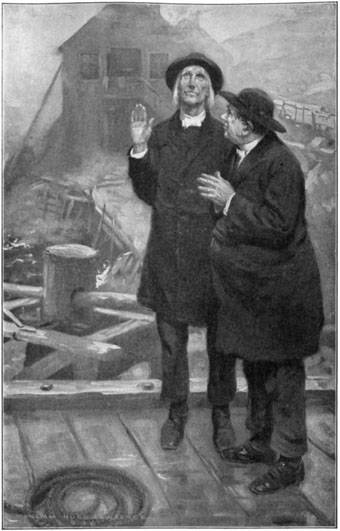
Jehoshaphat Rudd of Satan’s Trap was
shy—able-bodied, to be sure, if a gigantic
frame means anything, and mature, if a family
of nine is competent evidence, but still as shy as
a child. Moreover, he had the sad habit of anxiety:
whence tense eyelids, an absent, poignant
gaze, a perpetual pucker between the brows.
His face was brown and big, framed in tawny,
soft hair and beard, and spread with a delicate
web of wrinkles, spun by the weather—a round
countenance, simple, kindly, apathetic. The
wind had inflamed the whites of his eyes and
turned the rims blood red; but the wells in the
midst were deep and clear and cool. Reserve,
courageous and methodical diligence at the fishing,
a quick, tremulous concern upon salutation—by
these signs the folk of his harbor had long
ago been persuaded that he was a fool; and a fool
232
he was, according to the convention of the Newfoundland
outports: a shy, dull fellow, whose
interests were confined to his punt, his gear, the
grounds off the Tombstone, and the bellies of his
young ones. He had no part with the disputatious
of Satan’s Trap: no voice, for example, in the
rancorous discussions of the purposes and ways
of the Lord God Almighty, believing the purposes
to be wise and kind, and the ways the Lord’s own
business. He was shy, anxious, and preoccupied;
wherefore he was called a fool, and made no answer:
for doubtless he was a fool. And what did
it matter? He would fare neither better nor worse.
Nor would Jehoshaphat wag a tongue with the
public-spirited men of Satan’s Trap: the times
and the customs had no interest, no significance,
for him; he was troubled with his own concerns.
Old John Wull, the trader, with whom (and no
other) the folk might barter their fish, personified
all the abuses, as a matter of course. But—
“I ’low I’m too busy t’ think,” Jehoshaphat
would reply, uneasily. “I’m too busy. I—I—why,
I got t’ tend my fish!”
This was the quality of his folly.
It chanced one summer dawn, however, when
the sky was flushed with tender light, and the
233
shadows were trooping westward, and the sea
was placid, that the punts of Timothy Yule and
Jehoshaphat Rudd went side by side to the Tombstone
grounds. It was dim and very still upon
the water, and solemn, too, in that indifferent
vastness between the gloom and the rosy, swelling
light. Satan’s Trap lay behind in the shelter
and shadow of great hills laid waste—a lean, impoverished,
listless home of men.
“You dunderhead!” Timothy Yule assured
Jehoshaphat. “He’ve been robbin’ you.”
“Maybe,” said Jehoshaphat, listlessly. “I been
givin’ the back kitchen a coat o’ lime, an’ I isn’t
had no time t’ give t’ thinkin’.”
“An’ he’ve been robbin’ this harbor for forty
year.”
“Dear man!” Jehoshaphat exclaimed, in dull
surprise. “Have he told you that?”
“Told me!” cried Timothy. “No,” he added,
with bitter restraint; “he’ve not.”
Jehoshaphat was puzzled. “Then,” said he,
“how come you t’ know?”
“Why, they says so.”
Jehoshaphat’s reply was gently spoken, a compassionate
rebuke. “An I was you, Timothy,”
said he, “I wouldn’t be harsh in judgment. ’Tisn’t
quite Christian.”
234
“My God!” ejaculated the disgusted Timothy.
After that they pulled in silence for a time.
Jehoshaphat’s face was averted, and Timothy
was aware of having, in a moment of impatience,
not only committed a strategic indiscretion, but
of having betrayed his innermost habit of profanity.
The light grew and widened and yellowed;
the cottages of Satan’s Trap took definite
outline, the hills their ancient form, the sea
its familiar aspect. Sea and sky and distant
rock were wide awake and companionably smiling.
The earth was blue and green and yellow,
a glittering place.
“Look you! Jehoshaphat,” Timothy demanded;
“is you in debt?”
“I is.”
“An’ is you ever been out o’ debt?”
“I isn’t.”
“How come you t’ know?”
“Why,” Jehoshaphat explained, “Mister Wull
told me so. An’ whatever,” he qualified, “father
was in debt when he died, an’ Mister Wull told
me I ought t’ pay. Father was my father,”
Jehoshaphat argued, “an’ I ’lowed I would pay.
For,” he concluded, “’twas right.”
“Is he ever give you an account?”
“Well, no—no, he haven’t. But it wouldn’t
235
do no good, for I’ve no learnin’, an’ can’t
read.”
“No,” Timothy burst out, “an’ he isn’t give
nobody no accounts.”
“Well,” Jehoshaphat apologized, “he’ve a good
deal on his mind, lookin’ out for the wants of
us folk. He’ve a wonderful lot o’ brain labor.
He’ve all them letters t’ write t’ St. John’s, an’
he’ve got a power of ’rithmetic t’ do, an’ he’ve got
the writin’ in them big books t’ trouble un, an’—”
Timothy sneered.
“Ah, well,” sighed Jehoshaphat, “an I was
you, Timothy, I wouldn’t be harsh in judgment.”
Timothy laughed uproariously.
“Not harsh,” Jehoshaphat repeated, quietly—“not
in judgment.”
“Damn un!” Timothy cursed between his
teeth. “The greedy squid, the devil-fish’s spawn,
with his garden an’ his sheep an’ his cow! You
got a cow, Jehoshaphat? You got turnips an’
carrots? You got ol’ Bill Lutt t’ gather soil, an’
plant, an’ dig, an’ weed, while you smokes plug-cut
in the sunshine? Where’s your garden, Jehoshaphat?
Where’s your onions? The green
lumpfish! An’ where do he get his onions, an’
where do he get his soup, an’ where do he get his
cheese an’ raisins? ’Tis out o’ you an’ me an’
236
all the other poor folk o’ Satan’s Trap. ’Tis
from the fish, an’ he never cast a line. ’Tis
from the fish that we takes from the grounds while
he squats like a lobster in the red house an’ in
the shop. An’ he gives less for the fish ’n he
gets, an’ he gets more for the goods an’ grub ’n
he gives. The thief, the robber, the whale’s
pup! Is you able, Jehoshaphat, t’ have the doctor
from Sniffle’s Arm for your woman! Is you
able t’ feed your kids with cow’s milk an’ baby-food?”
Jehoshaphat mildly protested that he had not
known the necessity.
“An’ what,” Timothy proceeded, “is you ever
got from the grounds but rheumatiz an’ salt-water
sores?”
“I got enough t’ eat,” said Jehoshaphat.
Timothy was scornful.
“Well,” Jehoshaphat argued, in defence of
himself, “the world have been goin’ for’ard a
wonderful long time at Satan’s Trap, an’ nobody
else haven’t got no more’n just enough.”
“Enough!” Timothy fumed. “’Tis kind o’
the Satan’s Trap trader t’ give you that! I’ll tell
un,” he exploded; “I’ll give un a piece o’ my
mind afore I dies.”
“Don’t!” Jehoshaphat pleaded.
237
Timothy snorted his indignation.
“I wouldn’t be rash,” said Jehoshaphat.
“Maybe,” he warned, “he’d not take your fish
no more. An’ maybe he’d close the shop an’ go
away.”
“Jus’ you wait,” said Timothy.
“Don’t you do it, lad!” Jehoshaphat begged.
“’Twould make such a wonderful fuss in the
world!”
“An’ would you think o’ that?”
“I isn’t got time t’ think,” Jehoshaphat complained.
“I’m busy. I ’low I got my fish t’ cotch
an’ cure. I isn’t got time. I—I—I’m too busy.”
They were on the grounds. The day had
broken, a blue, serene day, knowing no disquietude.
They cast their grapnels overside, and
they fished until the shadows had fled around the
world and were hurrying out of the east. And
they reeled their lines, and stowed the fish, and
patiently pulled toward the harbor tickler, talking
not at all of the Satan’s Trap trader, but only of
certain agreeable expectations which the young
Timothy had been informed he might entertain
with reasonable certainty.
“I ’low,” said Jehoshaphat, when they were
within the harbor, “I understand. I got the hang
of it,” he repeated, with a little smile, “now.”
238
“Of what?” Timothy wondered.
“Well,” Jehoshaphat explained, “’tis your
first.”
This was a sufficient explanation of Timothy’s
discontent. Jehoshaphat remembered that he,
too, had been troubled, fifteen years ago, when
the first of the nine had brought the future to his
attention. He was more at ease when this enlightenment
came.
Old John Wull was a gray, lean little widower,
with a bald head, bowed legs, a wide, straight,
thin-lipped mouth, and shaven, ashy cheeks. His
eyes were young enough, blue and strong and
quick, often peering masterfully through the
bushy brows, which he could let drop like a curtain.
In contrast with the rugged hills and
illimitable sea and stout men of Satan’s Trap, his
body was withered and contemptibly diminutive.
His premises occupied a point of shore within the
harbor—a wharf, a storehouse, a shop, a red
dwelling, broad drying-flakes, and a group of
out-buildings, all of which were self-sufficient and
proud, and looked askance at the cottages that
lined the harbor shore and strayed upon the hills
beyond.
It was his business to supply the needs of the
239
folk in exchange for the fish they took from the
sea—the barest need, the whole of the catch.
Upon this he insisted, because he conscientiously
believed, in his own way, that upon the fruits of
toil commercial enterprise should feed to satiety,
and cast the peelings and cores into the back
yard for the folk to nose like swine.
Thus he was accustomed to allow the fifty
illiterate, credulous families of Satan’s Trap
sufficient to keep them warm and to quiet their
stomachs, but no more; for, he complained:
“Isn’t they got enough on their backs?” and,
“Isn’t they got enough t’ eat?” and, “Lord!”
said he, “they’ll be wantin’ figs an’ joolry next.”
There were times when he trembled for the
fortune he had gathered in this way—in years
when there were no fish, and he must feed the
men and women and human litters of the Trap
for nothing at all, through which he was courageous,
if niggardly. When the folk complained
against him, he wondered, with a righteous wag
of the head, what would become of them if he
should vanish with his property and leave them
to fend for themselves. Sometimes he reminded
them of this possibility; and then they got afraid,
and thought of their young ones, and begged him
to forget their complaint. His only disquietude was
240
the fear of hell: whereby he was led to
pay the wage of a succession of parsons, if they
preached comforting doctrine and blue-pencilled
the needle’s eye from the Testament; but not
otherwise. By some wayward, compelling sense
of moral obligation, he paid the school-teacher,
invariably, generously, so that the little folk of
Satan’s Trap might learn to read and write in
the winter months. ’Rithmetic he condemned,
but tolerated, as being some part of that unholy,
imperative thing called l’arnin’; but he had no
feeling against readin’ and writin’.
There was no other trader within thirty miles.
“They’ll trade with me,” John Wull would
say to himself, and be comforted, “or they’ll
starve.”
It was literally true.
In that winter certain gigantic forces, with
which old John Wull had nothing whatever to
do, were inscrutably passionate. They went their
way, in some vast, appalling quarrel, indifferent
to the consequences. John Wull’s soul, money,
philosophy, the hopes of Satan’s Trap, the various
agonies of the young, were insignificant.
Currents and winds and frost had no knowledge
of them. It was a late season: the days were
241
gray and bitter, the air was frosty, the snow lay
crisp and deep in the valleys, the harbor water
was frozen. Long after the time for blue winds
and yellow hills the world was still sullen and
white. Easterly gales, blowing long and strong,
swept the far outer sea of drift-ice—drove it in
upon the land, pans and bergs, and heaped it
against the cliffs. There was no safe exit from
Satan’s Trap. The folk were shut in by ice and
an impassable wilderness. This was not by the
power or contriving of John Wull: the old man had
nothing to do with it; but he compelled the season,
impiously, it may be, into conspiracy with
him. By-and-by, in the cottages, the store of
food, which had seemed sufficient when the first
snow flew, was exhausted. The flour-barrels of
Satan’s Trap were empty. Full barrels were in
the storehouse of John Wull, but in no other
place. So it chanced that one day, in a swirling
fall of snow, Jehoshaphat Rudd came across the
harbor with a dog and a sled.
John Wull, from the little office at the back of
the shop, where it was warm and still, watched
the fisherman breast the white wind.
“Mister Wull,” said Jehoshaphat, when he
stood in the office, “I ’low I’ll be havin’ another
barrel o’ flour.”
242
Wull frowned.
“Ay,” Jehoshaphat repeated, perplexed; “another
barrel.”
Wull pursed his lips.
“O’ flour,” said Jehoshaphat, staring.
The trader drummed on the desk and gazed
out of the window. He seemed to forget that
Jehoshaphat Rudd stood waiting. Jehoshaphat
felt awkward and out of place; he smoothed his
tawny beard, cracked his fingers, scratched his
head, shifted from one foot to the other. Some
wonder troubled him, then some strange alarm.
He had never before realized that the lives of his
young were in the keeping of this man.
“Flour,” he ventured, weakly—“one barrel.”
Wull turned. “It’s gone up,” said he.
“Have it, now!” Jehoshaphat exclaimed. “I
’lowed last fall, when I paid eight,” he proceeded,
“that she’d clumb as high as she could get
’ithout fallin’. But she’ve gone up, says you?
Dear man!”
“Sky high,” said the trader.
“Dear man!”
The stove was serene and of good conscience.
It labored joyously in response to the clean-souled
wind. For a moment, while the trader
watched the snow through his bushy brows and
243
Jehoshaphat Rudd hopelessly scratched his head,
its hearty, honest roar was the only voice lifted
in the little office at the back of John Wull’s
shop.
“An’ why?” Jehoshaphat timidly asked.
“Scarcity.”
“Oh,” said Jehoshaphat, as though he understood.
He paused. “Isn’t you got as much
as you had?” he inquired.
The trader nodded.
“Isn’t you got enough in the storehouse t’ last
till the mail-boat runs?”
“Plenty, thank God!”
“Scarcity,” Jehoshaphat mused. “Mm-m-m!
Oh, I sees,” he added, vacantly. “Well, Mister
Wull,” he sighed, “I ’low I’ll take one of Early
Rose an’ pay the rise.”
Wull whistled absently.
“Early Rose,” Jehoshaphat repeated, with a
quick, keen glance of alarm.
The trader frowned.
“Rose,” Jehoshaphat muttered. He licked
his lips. “Of Early,” he reiterated, in a gasp,
“Rose.”
“All right, Jehoshaphat.”
Down came the big key from the nail. Jehoshaphat’s
round face beamed. The trader
244
slapped his ledger shut, moved toward the door,
but stopped dead, and gazed out of the window,
while his brows fell over his eyes, and he fingered
the big key.
“Gone up t’ eighteen,” said he, without turning.
Jehoshaphat stared aghast.
“Wonderful high for flour,” the trader continued,
in apologetic explanation; “but flour’s
wonderful scarce.”
“Tisn’t right!” Jehoshaphat declared. “Eighteen
dollars a barrel for Early Rose? ’Tisn’t
right!”
The key was restored to the nail.
“I can’t pay it, Mister Wull. No, no, man,
I can’t do it. Eighteen! Mercy o’ God! ’Tisn’t
right! ’Tis too much for Early Rose.”
The trader wheeled.
“An’ I won’t pay it,” said Jehoshaphat.
“You don’t have to,” was the placid reply.
Jehoshaphat started. Alarm—a sudden vision
of his children—quieted his indignation. “But,
Mister Wull, sir,” he pleaded, “I got t’ have it.
I—why—I just got t’ have it!”
The trader was unmoved.
“Eighteen!” cried Jehoshaphat, flushing.
“Mercy o’ God! I says ’tisn’t right.”
245
“Tis the price.”
“’Tisn’t right!”
Wull’s eyes were how flashing. His lips were
drawn thin over his teeth. His brows had fallen
again. From the ambush they made he glared
at Jehoshaphat.
“I say,” said he, in a passionless voice, “that
the price o’ flour at Satan’s Trap is this day
eighteen.”
Jehoshaphat was in woful perplexity.
“Eighteen,” snapped Wull. “Hear me?”
They looked into each other’s eyes. Outside
the storm raged, a clean, frank passion; for nature
is a fair and honest foe. In the little office
at the back of John Wull’s shop the withered
body of the trader shook with vicious anger.
Jehoshaphat’s round, brown, simple face was
gloriously flushed; his head was thrown back,
his shoulders were squared, his eyes were sure
and fearless.
“’Tis robbery!” he burst out.
Wull’s wrath exploded. “You bay-noddy!”
he began; “you pig of a punt-fisherman; you
penniless, ragged fool; you man without a copper;
you sore-handed idiot! What you whinin’ about?
What right you got t’ yelp in my office?”
Of habit Jehoshaphat quailed.
246
“If you don’t want my flour,” roared Wull,
fetching the counter a thwack with his white fist,
“leave it be! ’Tis mine, isn’t it? I paid for it.
I got it. There’s a law in this land, you pauper,
that says so. There’s a law. Hear me? There’s
a law, Mine, mine!” he cried, in a frenzy, lifting
his lean arms. “What I got is mine. I’ll eat
it,” he fumed, “or I’ll feed my pigs with it, or
I’ll spill it for the fishes. They isn’t no law t’
make me sell t’ you. An’ you’ll pay what I’m
askin’, or you’ll starve.”
“You wouldn’t do that, sir,” Jehoshaphat
gently protested. “Oh no—no! Ah, now, you
wouldn’t do that. You wouldn’t throw it t’ the
fishes, would you? Not flour! ’Twould be a
sinful waste.”
“Tis my right.”
“Ay,’ Mister Wull,” Jehoshaphat argued, with
a little smile, “’tis yours, I’ll admit; but we been
sort o’ dependin’ on you t’ lay in enough t’ get
us through the winter.”
WUll’s response was instant and angry. “Get
you out o’ my shop,” said he, “an’ come back
with a civil tongue!”
“I’ll go, Mister Wull,” said Jehoshaphat,
quietly, picking at a thread in his faded cap.
“I’ll go. Ay, I’ll go. But—I got t’ have the
247
flour. I—I—just got to. But I won’t pay,” he
concluded, “no eighteen dollars a barrel.”
The trader laughed.
“For,” said Jehoshaphat, “’tisn’t right.”
Jehoshaphat went home without the flour,
complaining of the injustice.
Jehoshaphat Rudd would have no laughter in
the house, no weeping, no questions, no noise of
play. For two days he sat brooding by the
kitchen fire. His past of toil and unfailing recompense,
the tranquil routine of life, was
strangely like a dream, far off, half forgot. As a
reality it had vanished. Hitherto there had been
no future; there was now no past, no ground for
expectation. He must, at least, take time to
think, have courage to judge, the will to retaliate.
It was more important, more needful, to sit in
thought, with idle hands, than to mend the rent
in his herring seine. He was mystified and deeply
troubled.
Sometimes by day Jehoshaphat strode to the
window and looked out over the harbor ice to
the point of shore where stood the storehouse and
shop and red dwelling of old John Wull. By
night he drew close to the fire, and there sat
with his face in his hands; nor would he go
248
to bed, nor would he speak, nor would he
move.
In the night of the third day the children awoke
and cried for food. Jehoshaphat rose from his
chair, and stood shaking, with breath suspended,
hands clinched, eyes wide. He heard their
mother rise and go crooning from cot to cot.
Presently the noise was hushed: sobs turned to
whimpers, and whimpers to plaintive whispers,
and these complaints to silence. The house was
still; but Jehoshaphat seemed all the while to hear
the children crying in the little rooms above,
He began to pace the floor, back and forth, back
and forth, now slow, now in a fury, now with listless
tread. And because his children had cried
for food in the night the heart of Jehoshaphat
Rudd was changed. From the passion of those
hours, at dawn, he emerged serene, and went to
bed.
At noon of that day Jehoshaphat Rudd was
in the little office at the back of the shop. John
Wull was alone, perched on a high stool at the
desk, a pen in hand, a huge book open before
him.
“I’m come, sir,” said Jehoshaphat, “for the
barrel o’ flour.”
249
The trader gave him no attention.
“I’m come, sir,” Jehoshaphat repeated, his
voice rising a little, “for the flour.”
The trader dipped his pen in ink.
“I says, sir,” said Jehoshaphat, laying a hand
with some passion upon the counter, “that I’m
come for that there barrel o’ flour.”
“An’ I s’pose,” the trader softly inquired,
eying the page of his ledger more closely, “that
you thinks you’ll get it, eh?”
“Ay, sir.”
Wull dipped his pen and scratched away.
“Mister Wull!”
The trader turned a leaf.
“Mister Wull,” Jehoshaphat cried, angrily, “I
wants flour. Is you gone deaf overnight?”
Impertinent question and tone of voice made
old John Wull wheel on the stool. In the forty
years he had traded at Satan’s Trap he had never
before met with impertinence that was not
timidly offered. He bent a scowling face upon
Jehoshaphat. “An’ you thinks,” said he, “that
you’ll get it?”
“I does.”
“Oh, you does, does you?”
Jehoshaphat nodded.
“It all depends,” said Wull. “You’re wonderful deep
250
in debt, Jehoshaphat.” The trader
had now command of himself. “I been lookin’
up your account,” he went on, softly. “You’re so
wonderful far behind, Jehoshaphat, on account
o’ high livin’ an’ Christmas presents, that I been
thinkin’ I might do the business a injury by givin’
you more credit. I can’t think o’ myself, Jehoshaphat,
in this matter. ’Tis a business matter;
an’ I got t’ think o’ the business. You sees,
Jehoshaphat, eighteen dollars more credit—”
“Eight,” Jehoshaphat corrected.
“Eighteen,” the trader insisted.
Jehoshaphat said nothing, nor did his face express
feeling. He was looking stolidly at the
big key of the storehouse.
“The flour depends,” Wull proceeded, after
a thoughtful pause, through which he had regarded
the gigantic Jehoshaphat with startled curiosity,
“on what I thinks the business will stand in
the way o’ givin’ more credit t’ you.”
“No, sir,” said Jehoshaphat.
Wull put down his pen, slipped from the high
stool, and came close to Jehoshaphat. He was
mechanical and slow in these movements, as
though all at once perplexed, given some new
view, which disclosed many and strange possibilities.
For a moment he leaned against the counter, legs crossed,
251
staring at the floor, with his
long, scrawny right hand smoothing his cheek
and chin. It was quiet in the office, and warm,
and well-disposed, and sunlight came in at the
window.
Soon the trader stirred, as though awakening.
“You was sayin’ eight, wasn’t you?” he asked,
without looking up.
“Eight, sir.”
The trader pondered this. “An’ how,” he
inquired, at last, “was you makin’ that out?”
“Tis a fair price.”
Wull smoothed his cheek and chin. “Ah!”
he murmured. He mused, staring at the floor,
his restless fingers beating a tattoo on his teeth.
He had turned woebegone and very pale. “Jehoshaphat,”
he asked, turning upon the man,
“would you mind tellin’ me just how you’re
’lowin’ t’ get my flour against my will?”
Jehoshaphat looked away.
“I’d like t’ know,” said Wull, “if you wouldn’t
mind tellin’ me.”
“No,” Jehoshaphat answered. “No, Mister
Wull—I wouldn’t mind tellin’.”
“Then,” Wull demanded, “how?”
“Mister Wull,” Jehoshaphat explained, “I’m
a bigger man than you.”
252
It was very quiet in the office. The wind had
gone down in the night, the wood in the stove was
burned to glowing coals. It was very, very
still in old John Wull’s office at the back of the
shop, and old John Wull turned away, and went
absently to the desk, where he fingered the
leaves of his ledger, and dipped his pen in ink,
but did not write. There was a broad window
over the desk, looking out upon the harbor;
through this, blankly, he watched the children at
play on the ice, but did not see them. By-and-by,
when he had closed the book and put the
desk in order, he came back to the counter, leaned
against it, crossed his legs, began to smooth his
chin, while he mused, staring at the square of sunlight
on the floor. Jehoshaphat could not look
at him. The old man’s face was so gray and
drawn, so empty of pride and power, his hand
so thin and unsteady, his eyes so dull, so deep
in troubled shadows, that Jehoshaphat’s heart
ached. He wished that the world had gone on
in peace, that the evil practices of the great were
still hid from his knowledge, that there had been
no vision, no call to revolution; he rebelled against
the obligation upon him, though it had come to
him as a thing that was holy. He regretted his
power, had shame, indeed, because of the ease
253
with which the mighty could be put down. He
felt that he must be generous, tender, that he
must not misuse his strength.
The patch of yellow light had perceptibly
moved before the trader spoke. “Jehoshaphat,”
he asked, “you know much about law?”
“Well, no, Mister Wull,” Jehoshaphat answered,
with simple candor; “not too much.”
“The law will put you in jail for this.”
Constables and jails were like superstitious
terrors to Jehoshaphat. He had never set eyes
on the brass buttons and stone walls of the law.
“Oh no—no!” he protested. “He wouldn’t!
Not in jail!”
“The law,” Wull warned, with grim delight,
“will put you in jail.”
“He couldn’t!” Jehoshaphat complained. “As I
takes it, the law sees fair play atween men. That’s
what he was made for. I ’low he ought t’ put you
in jail for raisin’ the price o’ flour t’ eighteen; but
not me—not for what I’m bound t’ do, Mister
Wull, law or no law, as God lives! ’Twouldn’t
be right, sir, if he put me in jail for that.”
“The law will.”
“But,” Jehoshaphat still persisted, doggedly,
“’twouldn’t be right!’
The trader fell into a muse.
254
“I’m come,” Jehoshaphat reminded him, “for
the flour.”
“You can’t have it.”
“Oh, dear!” Jehoshaphat sighed. “My, my!
Pshaw! I ’low, then, us’ll just have t’ take it.”
Jehoshaphat went to the door of the shop.
It was cold and gloomy in the shop. He opened
the door. The public of Satan’s Trap, in the
persons of ten men of the place, fathers of families
(with the exception of Timothy Yule, who had
qualified upon his expectations), trooped over the
greasy floor, their breath cloudy in the frosty air,
and crowded into the little office, in the wake of
Jehoshaphat Rudd. They had the gravity of
mien, the set faces, the compassionate eyes, the
merciless purpose, of a jury. The shuffling subsided.
It was once more quiet in the little office.
Timothy Yule’s hatred got the better of his sense
of propriety: he laughed, but the laugh expired
suddenly, for Jehoshaphat Rudd’s hand fell with
unmistakable meaning upon his shoulder.
John Wull faced them.
“I ’low, Mister Wull,” said Jehoshaphat, diffidently,
“that we wants the storehouse key.”
The trader put the key in his pocket.
“The key,” Jehoshaphat objected; “we wants
that there key.”
255
“By the Almighty!” old John Wull snarled,
“you’ll all go t’ jail for this, if they’s a law in
Newfoundland.”
The threat was ignored.
“Don’t hurt un, lads,” Jehoshaphat cautioned;
“for he’s so wonderful tender. He’ve not been
bred the way we was. He’s wonderful old an’
lean an’ brittle,” he added, gently; “so I ’low
we’d best be careful.”
John Wull’s resistance was merely technical.
“Now, Mister Wull,” said Jehoshaphat, when
the big key was in his hand and the body of the
trader had been tenderly deposited in his chair
by the stove, “don’t you go an’ fret. We isn’t
the thieves that break in an’ steal nor the moths
that go an’ corrupt. We isn’t robbers, an’ we
isn’t mean men. We’re the public,” he explained,
impressively, “o’ Satan’s Trap. We got
together, Mister Wull,” he continued, feeling
some delight in the oratory which had been thrust
upon him, “an’ we ’lowed that flour was worth
about eight; but we’ll pay nine, for we got thinkin’
that if flour goes up an’ down, accordin’ t’ the
will o’ God, it ought t’ go up now, if ever, the
will o’ God bein’ a mystery, anyhow. We don’t
want you t’ close up the shop an’ go away, after
this, Mister Wull; for we got t’ have you, or some
256
one like you, t’ do what you been doin’, so as we
can have minds free o’ care for the fishin’. If
they was anybody at Satan’s Trap that could read
an’ write like you, an’ knowed about money an’
prices—if they was anybody like that at Satan’s
Trap, willin’ t’ do woman’s work, which I doubts,
we wouldn’t care whether you went or stayed;
but they isn’t, an’ we can’t do ’ithout you. So
don’t you fret,” Jehoshaphat concluded. “You
set right there by the fire in this little office o’
yours. Tom Lower’ll put more billets on the
fire for you, an’ you’ll be wonderful comfortable
till we gets through. I’ll see that account is
kep’ by Tim Yule of all we takes. You can put
it on the books just when you likes. No hurry,
Mister Wull—no hurry. The prices will be
them that held in the fall o’ the year, ’cept flour,
which is gone up t’ nine by the barrel. An’, ah,
now, Mister Wull,” Jehoshaphat pleaded, “don’t
you have no hard feelin’. ’Twouldn’t be right;
We’re the public; so please don’t you go an’ have
no hard feelin’.”
The trader would say nothing.
“Now, lads,” said Jehoshaphat, “us’ll go.”
In the storehouse there were two interruptions
to the transaction of business in an orderly
fashion. Tom Lower, who was a lazy fellow and
257
wasteful, as Jehoshaphat knew, demanded thirty
pounds of pork, and Jehoshaphat knocked him
down. Timothy Yule, the anarchist, proposed
to sack the place, and him Jehoshaphat knocked
down twice. There was no further difficulty.
“Now, Mister Wull,” said Jehoshaphat, as he
laid the key and the account on the trader’s
desk, “the public o’ Satan’s Trap is wonderful
sorry; but the thing had t’ be done.”
The trader would not look up.
“It makes such a wonderful fuss in the world,”
Jehoshaphat complained, “that the crew hadn’t
no love for the job. But it—it—it jus’ had t’ be
done.”
Old John Wull scowled.
For a long time, if days may be long, Jehoshaphat
Rudd lived in the fear of constables and
jails, which were the law, to be commanded by
the wealth of old John Wull; and for the self-same
period—the days being longer because of the
impatience of hate—old John Wull lived in expectation
of his revenge. Jehoshaphat Rudd
lowed he’d stand by, anyhow, an’ go t’ jail, if
’twas needful t’ maintain the rights o’ man. Ay,
he’d go t’ jail, an’ be whipped an’ starved, as the
imagination promised, but he’d be jiggered if
258
he’d “’pologize.” Old John Wull kept grim
watch upon the winds; for upon the way the wind
blew depended the movement of the ice, and the
clearing of the sea, and the first voyage of the
mail-boat. He was glad that he had been robbed;
so glad that he rubbed his lean, transparent
hands until the flush of life appeared to surprise
him; so glad that he chuckled until his housekeeper
feared his false teeth would by some
dreadful mischance vanish within him. Jail? ay,
he’d put Jehoshaphat Rudd in jail; but he would
forgive the others, that they might continue to
fish and to consume food. In jail, ecod! t’ be
fed on bread an’ water, t’ be locked up, t’ wear
stripes, t’ make brooms, t’ lie there so long that
the last little Rudd would find its own father
a stranger when ’twas all over with. ’Twould
be fair warning t’ the malcontent o’ the folk;
they would bide quiet hereafter. All the people
would toil and trade; they would complain no
more. John Wull was glad that the imprudence
of Jehoshaphat Rudd had provided him with
power to restore the ancient peace to Satan’s
Trap.
One day in the spring, when the bergs and
great floes of the open had been blown to sea,
259
and the snow was gone from the slopes of the
hills, and the sun was out, and the earth was
warm and yellow and merrily dripping, old John
Wull attempted a passage of the harbor by the
ice, which there had lingered, confined. It was
only to cross the narrows from Haul-Away Head
to Daddy Tool’s Point, no more than a stone’s
throw for a stout lad. The ice had been broken
into pans by a stiff breeze from the west, and was
then moving with the wind, close-packed, bound
out to sea, there to be dispersed and dissolved.
It ran sluggishly through the narrows, scraping
the rocks of the head and of the point; the heave
of the sea slipped underneath and billowed the
way, and the outermost pans of ice broke from
the press and went off with the waves. But the
feet of old John Wull were practised; he essayed
the crossing without concern—indeed, with an
absent mind. Presently he stopped to rest; and
he stared out to sea, musing; and when again he
looked about, the sea had softly torn the pan
from the pack.
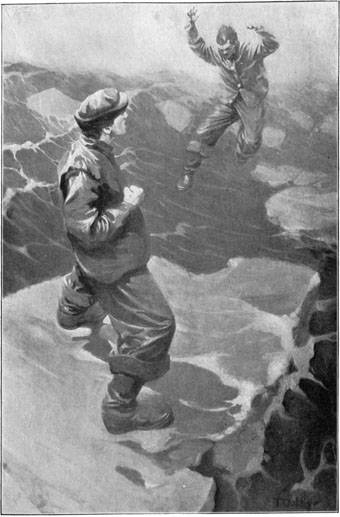
Old John Wull was adrift, and bound out.
“Ahoy, you, Jehoshaphat!” he shouted. “Jehoshaphat!
Oh, Jehoshaphat!”
Jehoshaphat came to the door of his cottage
on Daddy Tool’s Point.
260
“Launch that rodney,”[1] Wull directed, “an’
put me on shore. An’ lively, man,” he complained.
“I’ll be cotchin’ cold out here.”
With the help of Timothy Yule, who chanced
to be gossiping in the kitchen, Jehoshaphat Rudd
got the rodney in the open water by the stage-head.
What with paddling and much hearty
hauling and pushing, they had the little craft
across the barrier of ice in the narrows before
the wind had blown old John Wull a generous
rod out to sea.
“Timothy, lad,” Jehoshaphat whispered, “I
’low you better stay here.”
Timothy kept to the ice.
“You been wonderful slow,” growled Wull.
“Come ’round t’ the lee side, you dunderhead!
Think I wants t’ get my feet wet?”
“No, sir,” Jehoshaphat protested. “Oh no;
I wouldn’t have you do that an I could help
it.”
The harbor folk were congregating on Haul-Away
Head and Daddy Tool’s Point. ’Twas
an agreeable excitement to see John Wull in a
mess—in a ludicrous predicament, which made
him helpless before their eyes. They whispered,
261
they smiled behind their hands, they chuckled
inwardly.
Jehoshaphat pulled to the lee side of the pan.
“Come ’longside,” said Wull.
Jehoshaphat dawdled.
“Come ’longside, you fool!” Wull roared.
“Think I can leap three fathom?”
“No, sir; oh no; no, indeed.”
“Then come ’longside.”
Jehoshaphat sighed.
“Come in here, you crazy pauper!” Wull
screamed, stamping his rage. “Come in here
an’ put me ashore!”
“Mister Wull!”
Wull eyed the man in amazement.
“Labor,” said Jehoshaphat, gently, “is gone
up.”
Timothy Yule laughed, but on Haul-Away
Head and Daddy Tool’s Point the folk kept
silent; nor did old John Wull, on the departing
pan, utter a sound.
“Sky high,” Jehoshaphat concluded.
The sun was broadly, warmly shining, the sky
was blue; but the wind was rising smartly, and
far off over the hills of Satan’s Trap, beyond the
wilderness that was known, it was turning gray
and tumultuous. Old John Wull scowled, wheeled, and
262
looked away to sea; he did not see the
ominous color and writhing in the west.
“We don’t want no law, Mister Wull,” Jehoshaphat
continued, “at Satan’s Trap.”
Wull would not attend.
“Not law,” Jehoshaphat repeated; “for we
knows well enough at Satan’s Trap,” said he,
“what’s fair as atween men. You jus’ leave the
law stay t’ St. John’s, sir, where he’s t’ home.
He isn’t fair, by no means; an’ we don’t want un
here t’ make trouble.”
The trader’s back was still turned.
“An’, Mister Wull,” Jehoshaphat entreated,
his face falling like a child’s, “don’t you have no
hard feelin’ over this. Ah, now, don’t!” he
pleaded. “You won’t, will you? For we isn’t
got no hate for you, Mister Wull, an’ we isn’t
got no greed for ourselves. We just wants what’s
fair—just what’s fair.” He added: “Just on’y
that. We likes t’ see you have your milk an’
butter an’ fresh beef an’ nuts an’ whiskey. We
don’t want them things, for they isn’t ours by
rights. All we wants is just on’y fair play. We
don’t want no law, sir: for, ecod!” Jehoshaphat
declared, scratching his head in bewilderment,
“the law looks after them that has, so far as I
knows, sir, an’ don’t know nothin’ about them
263
that hasn’t. An’ we don’t want un here at Satan’s
Trap. We won’t have un! We—we—why,
ecod! we—we can’t ’low it! We’d be ashamed
of ourselves an we ’lowed you t’ fetch the law t’
Satan’s Trap t’ wrong us. We’re free men, isn’t
we?” he demanded, indignantly. “Isn’t we?
Ecod! I ’low we is! You think, John Wull,”
he continued, in wrath, “that you can do what you
like with we just because you an’ the likes o’ you
is gone an’ got a law? You can’t! You can’t!
An’ you can’t, just because we won’t ’low it.”
It was an incendiary speech.
“No, you can’t!” Timothy Yule screamed
from the ice, “you robber, you thief, you whale’s
pup! I’ll tell you what I thinks o’ you. You
can’t scare me. I wants that meadow you stole
from my father. I wants that meadow—”
“Timothy,” Jehoshaphat interrupted, quietly,
“you’re a fool. Shut your mouth!”
Tom Lower, the lazy, wasteful Tom Lower,
ran down to the shore of Haul-Away Head, and
stamped his feet, and shook his fist. “I wants
your cow an’ your raisins an’ your candy! We
got you down, you robber! An’ I’ll have your
red house; I’ll have your wool blankets; I’ll have
your—”
“Tom Lower,” Jehoshaphat roared, rising in
264
wrath, “I’ll floor you for that! That I will—next
time I cotch you out.”
John Wull turned half-way around and grinned.
“Mister Wull,” Jehoshaphat asked, propitiatingly,
“won’t you be put ashore?”
“Not at the price.”
“I ’low, then, sir,” said Jehoshaphat, in some
impatience, “that you might as well be comfortable
while you makes up your mind. Here!”
He cast a square of tarpaulin on the ice, and
chancing to discover Timothy Yule’s jacket, he
added that. “There!” he grunted, with satisfaction;
“you’ll be sittin’ soft an’ dry while you
does your thinkin’. Don’t be long, sir—not
overlong. Please don’t, sir,” he begged; “for
it looks t’ me—it looks wonderful t’ me—like
a spurt o’ weather.”
John Wull spread the tarpaulin.
“An’ when you gets through considerin’ of the
question,” said Jehoshaphat, suggestively, “an’
is come t’ my way o’ thinkin’, why all you got t’
do is lift your little finger, an’ I’ll put you ashore”—a
gust of wind whipped past—“if I’m able,”
Jehoshaphat added.
Pan and boat drifted out from the coast, a
slow course, which in an hour had reduced the
harbor folk to black pygmies on the low rocks to
265
windward. Jehoshaphat paddled patiently in the
wake of the ice. Often he raised his head, in apprehension,
to read the signs in the west; and he
sighed a deal, and sometimes muttered to himself.
Old John Wull was squatted on the tarpaulin,
with Timothy Yule’s jacket for a cushion,
his great-coat wrapped close about him, his cap
pulled over his ears, his arms folded. The withered
old fellow was as lean and blue and rigid and
staring as a frozen corpse.
The wind had freshened. The look and smell
of the world foreboded a gale. Overhead the sky
turned gray. There came a shadow on the sea,
sullen and ominous. Gusts of wind ran offshore
and went hissing out to sea; and they left the
waters rippling black and flecked with froth
wherever they touched. In the west the sky,
far away, changed from gray to deepest black
and purple; and high up, midway, masses of
cloud, with torn and streaming edges, rose
swiftly toward the zenith. It turned cold. A
great flake of snow fell on Jehoshaphat’s cheek,
and melted; but Jehoshaphat was pondering
upon justice. He wiped the drop of water away
with the back of his hand, because it tickled him,
but gave the sign no heed.
“I ’low, Mister Wull,” said he, doggedly,
266
“that you better give Timothy Yule back his
father’s meadow. For nobody knows, sir,” he
argued, “why Timothy Yule’s father went an’
signed his name t’ that there writin’ just afore he
died. ’Twasn’t right. He didn’t ought t’ sign
it. An’ you got t’ give the meadow back.”
John Wull was unmoved.
“An’, look you! Mister Wull,” Jehoshaphat
continued, pulling closer to the pan, addressing
the bowed back of the trader, “you better not
press young Isaac Lower for that cod-trap money.
He’ve too much trouble with that wife o’ his t’
be bothered by debt. Anyhow, you ought t’
give un a chance. An’, look you! you better let
ol’ Misses Jowl have back her garden t’ Green
Cove. The way you got that, Mister Wull, is
queer. I don’t know, but I ’low you better give
it back, anyhow. You got to, Mister Wull;
an’, ecod! you got t’ give the ol’ woman a pound
o’ cheese an’ five cents’ worth—no, ten—ten
cents’ worth o’ sweets t’ make her feel good.
She likes cheese. She ’lows she never could get
enough o’ cheese. She ’lows she wished she could
have her fill afore she dies. An’ you got t’ give
her a whole pound for herself.”
They were drifting over the Tombstone grounds.
“Whenever you makes up your mind,” Jehoshaphat suggested,
267
diffidently, “you lift your
little finger—jus’ your little finger.”
There was no response.
“Your little finger,” Jehoshaphat repeated.
“Jus’ your little finger—on’y that.”
Wull faced about. “Jehoshaphat,” said he,
with a grin, “you wouldn’t leave me.”
“Jus’ wouldn’t I!”
“You wouldn’t.”
“You jus’ wait and see.”
“You wouldn’t leave me,” said Wull, “because
you couldn’t. I knows you, Jehoshaphat—I
knows you.”
“You better look out.”
“Come, now, Jehoshaphat, is you goin’ t’
leave an old man drift out t’ sea an’ die?”
Jehoshaphat was embarrassed.
“Eh, Jehoshaphat?”
“Well, no,” Jehoshaphat admitted, frankly.
“I isn’t; leastways, not alone.”
“Not alone?” anxiously.
“No; not alone. I’ll go with you, Mister
Wull, if you’re lonesome, an’ wants company.
You sees, sir, I can’t give in. I jus’ can’t! I’m
here, Mister Wull, in this here cranky rodney,
beyond the Tombstone grounds, with a dirty
gale from a point or two south o’ west about t’
268
break, because I’m the public o’ Satan’s Trap.
I can die, sir, t’ save gossip; but I sim-plee jus’
isn’t able t’ give in. ’Twouldn’t be right.”
“Well, I won’t give in.”
“Nor I, sir. So here we is—out here beyond
the Tombstone grounds, you on a pan an’ me
in a rodney. An’ the weather isn’t—well—not
quite kind.”
It was not. The black clouds, torn, streaming,
had possessed the sky, and the night was
near come. Haul-Away Head and Daddy Tool’s
Point had melted with the black line of coast.
Return—safe passage through the narrows to the
quiet water and warm lights of Satan’s Trap—was
almost beyond the most courageous hope.
The wind broke from the shore in straight lines—a
stout, agile wind, loosed for riot upon the sea.
The sea was black, with a wind-lop upon the
grave swell—a black-and-white sea, with spume
in the gray air. The west was black, with no
hint of other color—without the pity of purple or
red. Roundabout the sea was breaking, troubled
by the wind, indifferent to the white little rodney
and the lives o’ men.
“You better give in,” old John Wull warned.
“No,” Jehoshaphat answered; “no; oh no!
I won’t give in. Not in.”
269
A gust turned the black sea white.
“You better give in,” said Jehoshaphat.
John Wull shrugged his shoulders and turned
his back.
“Now, Mister Wull,” said Jehoshaphat, firmly,
“I ’low I can’t stand this much longer. I
’low we can’t be fools much longer an’ get back
t’ Satan’s Trap. I got a sail, here, Mister Wull;
but, ecod! the beat t’ harbor isn’t pleasant t’
think about.”
“You better go home,” sneered old John
Wull.
“I ’low I will,” Jehoshaphat declared.
Old John Wull came to the windward edge of
the ice, and there stood frowning, with his feet
submerged. “What was you sayin’?” he asked.
“That you’d go home?”
Jehoshaphat looked away.
“An’ leave me?” demanded John Wull.
“Leave me? Me?”
“I got t’ think o’ my kids.”
“An’ you’d leave me t’ die?”
“Well,” Jehoshaphat complained, “’tis long
past supper-time. You better give in.”
“I won’t!”
The coast was hard to distinguish from the
black sky in the west. It began to snow. Snow
270
and night, allied, would bring Jehoshaphat Rudd
and old John Wull to cold death.
“Mister Wull,” Jehoshaphat objected, “’tis
long past supper-time, an’ I wants t’ go home.”
“Go—an’ be damned!”
“I’ll count ten,” Jehoshaphat threatened.
“You dassn’t!”
“I don’t know whether I’ll go or not,” said
Jehoshaphat. “Maybe not. Anyhow, I’ll count
ten, an’ see what happens. Is you ready?”
Wull sat down on the tarpaulin.
“One,” Jehoshaphat began.
John Wull seemed not to hear.
“Two,” said Jehoshaphat. “Three—four—five—six—seven.”
John Wull did not turn.
“Eight.”
There was no sign of relenting.
“Nine.”
Jehoshaphat paused. “God’s mercy!” he
groaned, “don’t you be a fool, Mister Wull,” he
pleaded. “Doesn’t you know what the weather is?”
A wave—the lop raised by the wind—broke
over the pan. John Wull stood up. There
came a shower of snow.
“Eh?” Jehoshaphat demanded, in agony.
“I won’t give in,” said old John Wull.
271
“Then I got t’ say ten. I jus’ got to.”
“I dare you.”
“I will, Mister Wull. Honest, I will! I’ll
say ten an you don’t look out.”
“Why don’t you do it?”
“In a minute, Mister Wull. I’ll say it just
so soon as I get up the sail. I will, Mister Wull,
honest t’ God!”
The coast had vanished.
“Look,” cried Jehoshaphat, “we’re doomed
men!”
The squall, then first observed, sent the sea
curling over the ice. Jehoshaphat’s rodney
shipped the water it raised. Snow came in a
blinding cloud.
“Say ten, you fool!” screamed old John Wull.
“Ten!”
John Wull came to the edge of the pan.
’Twas hard for the old man to breast the gust.
He put his hands to his mouth that he might
be heard in the wind.
“I give in!” he shouted.
Jehoshaphat managed to save the lives of both.
Old John Wull, with his lean feet in a tub of
hot water, with a gray blanket over his shoulders,
with a fire sputtering in the stove, with his housekeeper
272
hovering near—old John Wull chuckled.
The room was warm and his stomach was full,
and the wind, blowing horribly in the night, could
work him no harm. There he sat, sipping herb
tea to please his housekeeper, drinking whiskey
to please himself. He had no chill, no fever,
no pain; perceived no warning of illness. So he
chuckled away. It was all for the best. There
would now surely be peace at Satan’s Trap. Had
he not yielded? What more could they ask?
They would be content with this victory. For a
long, long time they would not complain. He
had yielded; very well: Timothy Yule should
have his father’s meadow, Dame Jowl her garden
and sweets and cheese, the young Lower be left
in possession of the cod-trap, and there would
be no law. Very well; the folk would neither
pry nor complain for a long, long time: that was
triumph enough for John Wull. So he chuckled
away, with his feet in hot water, and a gray
blanket about him, bald and withered and
ghastly, but still feeling the comfort of fire and
hot water and whiskey, the pride of power.
And within three years John Wull possessed
again all that he had yielded, and the world of
Satan’s Trap wagged on as in the days before
the revolution.
273 X—THE SURPLUS
To the east was the illimitable ocean, laid
thick with moonlight and luminous mist;
to the west, beyond a stretch of black, slow heaving
water, was the low line of Newfoundland, an
illusion of kindliness, the malignant character of
its jagged rock and barren interior transformed by
the gentle magic of the night. Tumm, the clerk,
had the wheel of the schooner, and had been
staring in a rapture at the stars.
“Jus’ readin’, sir,” he explained.
I wondered what he read.
“Oh,” he answered, turning again to contemplate
the starlit sky, “jus’ a little psa’m from
my Bible.”
I left him to read on, myself engaged with a
perusal of the serene and comforting text-book
of philosophy spread overhead. The night was
favorably inclined and radiant: a soft southerly
274
wind blowing without menace, a sky of infinite
depth and tender shadow, the sea asleep under
the moon. With a gentle, aimlessly wandering
wind astern—an idle, dawdling, contemptuous
breeze, following the old craft lazily, now and
again whipping her nose under water to remind
her of suspended strength—the trader Good
Samaritan ran on, wing and wing, through the
moonlight, bound across from Sinners’ Tickle to
Afterward Bight, there to deal for the first of the
catch.
“Them little stars jus’ will wink!” Tumm
complained.
I saw them wink in despite.
“Ecod!” Tumm growled.
The amusement of the stars was not by this
altered to a more serious regard: everywhere they
winked.
“I’ve seed un peep through a gale o’ wind, a
slit in the black sky, a cruel, cold time,” Tumm
continued, a pretence of indignation in his voice,
“when ’twas a mean hard matter t’ keep a schooner
afloat in a dirty sea, with all hands wore out
along o’ labor an’ the fear o’ death an’ hell; an’,
ecod! them little cusses was winkin’ still. Eh?
What d’ye make o’ that?—winkin’ still, the
heartless little cusses!”
275
There were other crises, I recalled—knowing
little enough of the labor of the sea—upon which
they winked.
“Ay,” Tumm agreed; “they winks when lovers
kiss on the roads; an’ they winks jus’ the
same,” he added, softly, “when a heart breaks.”
“They’re humorous little beggars,” I observed.
Tumm laughed. “They been lookin’ at this
here damned thing so long,” he drawled—meaning,
no doubt, upon the spectacle of the world—“that
no wonder they winks!”
This prefaced a tale.
“Somehow,” Tumm began, his voice fallen
rather despondent, I fancied, but yet continuing
most curiously genial, “it always made me think
o’ dust an’ ashes t’ clap eyes on ol’ Bill Hulk o’
Gingerbread Cove. Ay, b’y; but I could jus’
fair hear the parson singsong that mean truth o’
life: ‘Dust t’ dust; ashes t’ ashes’—an’ make the
best of it, ye sinners an’ young folk! When ol’
Bill hove alongside, poor man! I’d think no
more o’ maids an’ trade, o’ which I’m fair sinful
fond, but on’y o’ coffins an’ graves an’ ground.
For, look you! the ol’ feller was so white an’
wheezy—so fishy-eyed an’ crooked an’ shaky
along o’ age. ’Tis a queer thing, sir, but, truth
276
o’ God, so old was Bill Hulk that when he’d
board me I’d remember somehow the warm
breast o’ my mother, an’ then think, an’ couldn’t
help it, o’ the bosom o’ dust where my head must
lie.”
Tumm paused.
“Seemed t’ me, somehow,” he continued,
“when the Quick as Wink was lyin’ of a Sunday
t’ Gingerbread Cove—seemed t’ me somehow,
when I’d hear the church bell ring an’ echo
across the water an’ far into the hills—when I’d
cotch sight o’ ol’ Bill Hulk, with his staff an’ braw
black coat, crawlin’ down the hill t’ meetin’—ay,
an’ when the sun was out, warm an’ yellow, an’
the maids an’ lads was flirtin’ over the roads t’
hear the parson thunder agin their hellish levity—seemed
t’ me then, somehow, that ol’ Bill was
all the time jus’ dodgin’ along among open
graves; for, look you! the ol’ feller had such
trouble with his legs. An’ I’d wish by times that
he’d stumble an’ fall in, an’ be covered up in a
comfortable an’ decent sort o’ fashion, an’ stowed
away for good an’ all in the bed where he belonged.
“‘Uncle Bill,’ says I, ‘you at it yet?’
“‘Hangin’ on, Tumm,’ says he. ‘I isn’t quite
through.’
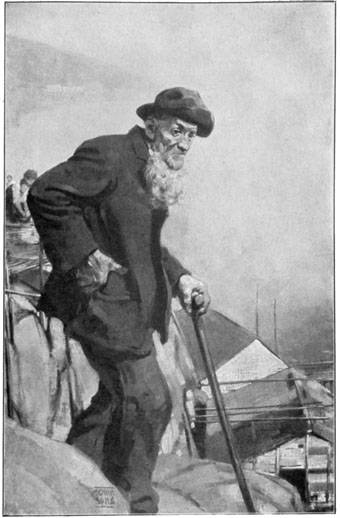 “OL’ BILL HULK CRAWLIN’ DOWN THE HILL T’ MEETIN’”
“‘Accordin’ t’ the signs,’ says I, ‘you isn’t got
much of a grip left.’
“‘Yes, I is!’ says he. ‘I got all my fishin’
fingers exceptin’ two, an’ I ’low they’ll last me
till I’m through.’
“Ecod! sir, but it made me think so mean o’
the world that I ’lowed I’d look away.
“‘No, Tumm,’ says he, ‘I isn’t quite through.’
“‘Well,’ says I, ‘you must be tired.’
“‘Tired,’ says he. ‘Oh no, b’y! Tired? Not
me! I got a little spurt o’ labor t’ do afore I
goes.’
“‘An’ what’s that, Uncle Bill?’ says I.
“‘Nothin’ much,’ says he.
“‘But what is it?’
“‘Nothin’ much,’ says he; ‘jus’ a little spurt
o’ labor.’
“The ol’ feller lived all alone, under Seven
Stars Head, in a bit of a white house with black
trimmin’s, jus’ within the Tickle, where ’twas
nice an’ warm an’ still; an’ he kep’ his house as
neat an’ white as a ol’ maid with a gray tomcat
an’ a window-garden o’ geraniums, an’, like all
the ol’ maids, made the best fish on fifty mile o’
coast. ’Twas said by the ol’ folks o’ Gingerbread
Cove that their fathers knowed the time when
Bill Hulk had a partner; but the partner got lost
278
on the Labrador, an’ then Bill Hulk jus’ held on
cotchin’ fish an’ keepin’ house all alone, till he
got the habit an’ couldn’t leave off. Was a time,
I’m told, a time when he had his strength—was a
time, I’m told, afore he wore out—was a time
when Bill Hulk had a bit o’ money stowed away
in a bank t’ St. John’s. Always ’lowed, I’m told,
that ’twas plenty t’ see un through when he got
past his labor. ‘I got enough put by,’ says he.
‘I got more’n enough. I’m jus’ fishin’ along,’
says he, ‘t’ give t’ the poor. Store in your
youth,’ says he, ‘an’ you’ll not want in your age.’
But somehow some o’ them St. John’s gentlemen
managed t’ discover expensive ways o’ delightin’
theirselves; an’ what with bank failures an’ lean
seasons an’ lumbago, ol’ Bill was fallen poor
when first I traded Gingerbread Cove. About
nine year after that, bein’ then used t’ the trade o’
that shore, I ’lowed that Bill had better knock
off an’ lie in the sun till ’twas time for un t’ go t’
his last berth. ‘’Twon’t be long,’ thinks I, ’an’
I ’low my owners can stand it. Anyhow,’ thinks
I, ‘’tis high time the world done something for
Bill.’
“But—
“‘Tumm,’ says he, ‘how many books is kep’
by traders in Newf’un’land?’
279
“I ’lowed I didn’t know.
“‘Call it a round million,’ says he.
“‘What of it?’ says I.
“‘Nothin’ much,’ says he.
“‘But what of it?’ says I.
“‘Well,’ says he, ‘if you was t’ look them million
books over, goin’ as easy as you please an’
markin’ off every line o’ every page with your
forefinger, what d’ye think would come t’ pass?’
“I ’lowed I couldn’t tell.
“‘Eh?’ says he. ‘Come, now! give a guess.’
“‘I don’t know, Bill,’ says I.
“‘Why, Tumm,’ says he, ‘you wouldn’t find
a copper agin the name o’ ol’ Bill Hulk!’
“‘That’s good livin’,’ says I.
“‘Not a copper!’ says he. ‘No, sir; not if
you looked with spectacles. An’ so,’ says he, ‘I
’low I’ll jus’ keep on payin’ my passage for the
little time that’s left. If my back on’y holds
out,’ says he, ‘I’ll manage it till I’m through.
’Twon’t be any more than twenty year. Jus’ a
little spurt o’ labor t’ do, Tumm,’ says he, ‘afore
I goes.’
“‘More labor, Uncle Bill?’ says I. ‘God’s
sake!’
“‘Nothin’ much,’ says he; ‘jus’ a little spurt
afore I goes in peace.’
280
“Ah, well! he’d labored long enough, lived
long enough, t’ leave other hands clean up the
litter an’ sweep the room o’ his life. I didn’t
know what that little spurt o’ labor was meant t’
win for his peace o’ mind—didn’t know what he’d
left undone—didn’t know what his wish or his
conscience urged un t’ labor for. I jus’ wanted
un t’ quit an’ lie down in the sun. ‘For,’ thinks I,
‘the world looks wonderful greedy an’ harsh t’
me when I hears ol’ Bill Hulk’s bones rattle over
the roads or come squeakin’ through the Tickle
in his punt. ‘Leave un go in peace!’ thinks I.
‘I isn’t got no love for a world that sends them
bones t’ sea in an easterly wind. Ecod!’ thinks I;
‘but he’ve earned quiet passage by jus’ livin’ t’
that ghastly age—jus’ by hangin’ on off a lee
shore in the mean gales o’ life.’ Seemed t’ me,
too, no matter how Bill felt about it, that he
might be obligin’ an’ quit afore he was through.
Seemed t’ me he might jus’ stop where he was an’
leave the friends an’ neighbors finish up. ’Tisn’t
fair t’ ask a man t’ have his labor done in a ship-shape
way—t’ be through with the splittin’ an’
all cleaned up—when the Skipper sings out,
‘Knock off, ye dunderhead!’ Seems t’ me a
man might leave the crew t’ wash the table an’
swab the deck an’ throw the livers in the cask.
281
“‘You be obligin’, Bill,’ says I, ‘an’ quit.’
“‘Isn’t able,’ says he, ’till I’m through.’
“So the bones o’ ol’ Bill Hulk rattled an’
squeaked right on till it made me fair ache when
I thunk o’ Gingerbread Cove.
“About four year after that I made the Cove
in the spring o’ the year with supplies. ‘Well,’
thinks I, ‘they won’t be no Bill Hulk this season.
With that pain in his back an’ starboard leg, this
winter have finished he; an’ I’ll lay a deal on
that.’ ’Twas afore dawn when we dropped
anchor, an’ a dirty dawn, too, with fog an’ rain,
the wind sharp, an’ the harbor in a tumble for
small craft; but the first man over the side was
ol’ Bill Hulk.
“‘It can’t be you, Uncle Bill!’ says I.
“‘Tumm,’ says he, ‘I isn’t quite through—yet.’
“‘You isn’t goin’ at it this season, is you?’
“‘Ay,’ says he; ‘goin’ at it again, Tumm.’
“‘What for?’ says I.
“‘Nothin’ much,’ says he.
“‘But what for?’
“‘Well,’ says he, ‘I’m savin’ up.’
“‘Savin’ up?’ says I. ‘Shame to you! What
you savin’ up for?’
282
“‘Oh,’ says he, ‘jus’ savin’ up.’
“‘But what for?’ says I. ‘What’s the sense
of it?’
“‘Bit o’ prope’ty,’ says he. ‘I’m thinkin’ o’
makin’ a small investment.’
“‘At your age, Uncle Bill!’ says I. ‘An’ a
childless man!’
“‘Jus’ a small piece,’ says he. ‘Nothin’ much,
Tumm.’
“‘But it won’t do you no good,’ says I.
“‘Well, Tumm,’ says he, ‘I’m sort o’ wantin’
it, an’ I ’low she won’t go t’ waste. I been
fishin’ from Gingerbread Cove for three hundred
year,’ says he, ‘an’ when I knocks off I wants t’
have things ship-shape. Isn’t no comfort, Tumm,’
says he, ‘in knockin’ off no other way.’
“Three hundred year he ’lowed he’d fished
from that there harbor, a hook-an’-line man
through it all; an’ as they wasn’t none o’ us abroad
on the coast when he come in, he’d stick to it,
spite o’ parsons. They was a mean little red-headed
parson came near churchin’ un for the
whopper; but Bill Hulk wouldn’t repent. ‘You
isn’t been here long enough t’ know, parson,’ says
he. ‘’Tis goin’ on three hundred year, I tells
you! I’ll haul into my fourth hundred,’ says he,
‘come forty-three year from Friday fortnight.’
283
Anyhow, he’d been castin’ lines on the Gingerbread
grounds quite long enough. ’Twas like
t’ make a man’s back ache—t’ make his head spin
an’ his stomach shudder—jus’ t’ think o’ the
years o’ labor an’ hardship Bill Hulk had weathered.
Seemed t’ me the very stars must o’ got
fair disgusted t’ watch un put out through the
Tickle afore dawn an’ pull in after dark.
“‘Lord!’ says they. ‘If there ain’t Bill Hulk
puttin’ out again! Won’t nothin’ ever happen
t’ he?’”
I thought it an unkind imputation.
“Well,” Tumm explained, “the little beggars
is used t’ change; an’ I wouldn’t wonder if they
was bored a bit by ol’ Bill Hulk.”
It might have been.
“Four or five year after that,” Tumm proceeded,
“the tail of a sou’east gale slapped me
into Gingerbread Cove, an’ I ’lowed t’ hang the
ol’ girl up till the weather turned civil. Thinks
I, ‘’Tis wonderful dark an’ wet, but ’tis also
wonderful early, an’ I’ll jus’ take a run ashore
t’ yarn an’ darn along o’ ol’ Bill Hulk.’ So I
put a bottle in my pocket t’ warm the ol’ ghost’s
marrow, an’ put out for Seven Stars Head in the
rodney. ’Twas mean pullin’ agin the wind, but
I fetched the stage-head ’t last, an’ went crawlin’
284
up the hill. Thinks I, ‘They’s no sense in knockin’
in a gale o’ wind like this, for Bill Hulk’s so
wonderful hard o’ hearin’ in a sou’east blow.’
“So I drove on in.
“‘Lord’s sake, Bill!’ says I, ‘what you up to?’
“‘Nothin’ much, Tumm,’ says he.
“‘It don’t look right,’ says I. ‘What is it?’
“‘Nothin’ much,’ says he; ‘jus’ countin’ up
my money.’
“’Twas true enough: there he sot—playin’
with his fortune. They was pounds of it:
coppers an’ big round pennies an’ silver an’ one
lone gold piece.
“‘You been gettin’ rich?’ says I.
“‘Tumm,’ says he, ‘you got any clear idea o’
how much hard cash they is lyin’ right there on
that plain deal table in this here very kitchen
you is in?’
“‘I isn’t,’ says I.
“‘Well,’ says he, ‘they’s as much as fourteen
dollar! An’ what d’ye think o’ that?’
“I ’lowed I’d hold my tongue; so I jus’ lifted
my eyebrow, an’ then sort o’ whistled, ‘Whew!’
“‘Fourteen,’ says he, ‘an’ more!’
“‘Whew!’ says I.
“‘An’, Tumm,’ says he, ‘I had twenty-four
sixty once—about eighteen year ago.’
285
“‘You got a heap now,’ says I. ‘Fourteen
dollar! Whew!’
“‘No, Tumm!’ cries he, all of a sudden. ‘No,
no! I been lyin’ t’ you. I been lyin’!’ says he.
‘Lyin’!’
“‘I don’t care,’ says I; ‘you go right ahead an’
lie.’
“‘They isn’t fourteen dollar there,’ says he.
‘I jus’ been makin’ believe they was. See that
there little pile o’ pennies t’ the nor’east? I been
sittin’ here countin’ in them pennies twice. They
isn’t fourteen dollar,’ says he; ‘they’s on’y thirteen
eighty-four! But I wisht they was fourteen.’
“‘Never you mind,’ says I; ‘you’ll get that bit
o’ prope’ty yet.’
“‘I got to,’ says he, ‘afore I goes.’
“‘Where does it lie?’ says I.
“‘Oh, ’tisn’t nothin’ much, Tumm,’ says he.
“‘But what is it?’
“‘Nothin’ much,’ says he; ‘jus’ a small piece.’
“‘Is it meadow?’ says I.
“‘No,’ says he; ‘tisn’t what you might call
meadow an’ be right, though the grass grows
there, in spots, knee high.’
“‘Is it a potato-patch?’
“‘No,’ says he; ‘nor yet a patch.’
“‘’Tisn’t a flower garden, is it?’ says I.
286
“‘N-no,’ says he; ‘you couldn’t rightly say so—though
they grows there, in spots, quite free
an’ nice.’
“‘Uncle Bill,’ says I, ‘you isn’t never told me
nothin’ about that there bit o’ prope’ty. What’s
it held at?’
“‘The prope’ty isn’t much, Tumm,’ says he.
‘Jus’ a small piece.’
“‘But how much is it?’
“‘Tom Neverbudge,’ says he, ‘is holdin’ it at
twenty-four dollar; he’ve come down one in the
las’ seven year. But I’m on’y ’lowin’ t’ pay
twenty-one; you sees I’ve come up one in the las’
four year.’
“‘’Twould not be hard t’ split the difference,’
says I.
“‘Ay,’ says he; ‘but they’s a wonderful good
reason for not payin’ more’n twenty-one for that
there special bit o’ land.’
“‘What’s that?’ says I.
“‘Well,’ says he, ‘’tis second-handed.’
“‘Second-handed!’ says I. ‘That’s queer!’
“‘Been used,’ says he.
“‘Used, Uncle Bill?’
“‘Ay,’ says he; ‘been used—been used, now,
for nigh sixty year.’
“‘She’s all wore out?’ says I.
287
“‘No,’ says he; ‘not wore out.’
“‘She’d grow nothin’?’ says I.
“‘Well,’ says he, ‘nothin’ much is expected,
Tumm,’ says he, ‘in that line.’
“I give a tug at my pocket, an’, ecod! out
jumped the bottle o’ Scotch.
“‘Well, well!’ says he. ‘Dear man! But I
bet ye,’ says he, ‘that you isn’t fetched no pain-killer.’
“‘That I is!’ says I.
“‘Then,’ says he, ‘about half an’ half, Tumm,
with a dash o’ water; that’s the way I likes it
when I takes it.’
“So we fell to, ol’ Bill Hulk an’ me, on the
Scotch an’ the pain-killer.
“Well, now, after that,” Tumm resumed,
presently, “I went deep sea for four year in the
South American fish trade; an’ then, my ol’ berth
on the Quick as Wink bein’ free of incumbrance—’twas
a saucy young clerk o’ the name o’ Bullyworth—I
’lowed t’ blow the fever out o’ my
system with the gales o’ this here coast. ‘A
whiff or two o’ real wind an’ a sight o’ Mother
Burke,’ thinks I, ‘will fix me.’ ’Twas a fine
Sunday mornin’ in June when I fetched Gingerbread
Cove in the ol’ craft—warm an’ blue an’
288
still an’ sweet t’ smell. ‘They’ll be no Bill Hulk,
thank God!’ thinks I, ‘t’ be crawlin’ up the hill t’
meetin’ this day; he’ve got through an’ gone t’
his berth for all time. I’d like t’ yarn with un
on this fine civil Sunday,’ thinks I; ‘but I ’low
he’s jus’ as glad as I is that he’ve been stowed
away nice an’ comfortable at last.’ But from
the deck, ecod! when I looked up from shavin’,
an’ Skipper Jim was washin’ up in the forecastle,
I cotched sight o’ ol’ Bill Hulk, bound up
the hill through the sunshine, makin’ tolerable
weather of it, with the wind astern, a staff in his
hand, and the braw black coat on his back.
“‘Skipper Jim,’ sings I, t’ the skipper below,
‘you hear a queer noise?’
“‘No,’ says he.
“‘Nothin’ like a squeak or a rattle?’
“‘No,’ says he. ‘What’s awry?’
“‘Oh, nothin’ says I:’ on’y ol’ Bill Hulk’s on
the road.’
“I watched un crawl through the little door on
Meetin’-house Hill long after ol’ Sammy Street
had knocked off pullin’ the bell; an’ if I didn’t
hear neither squeak nor rattle as he crep’ along,
why, I felt un, anyhow, which is jus’ as hard to
bear. ‘Well,’ thinks I, ‘he’ve kep’ them bones
above ground, poor man! but he’s never at it
289
yet. He’ve knocked off for good,’ thinks I; ‘he’ll
stumble t’ meetin’ of a fine Sunday mornin’, an’
sit in the sun for a spell; an’ then,’ thinks I,
‘they’ll stow un away where he belongs.’ So I
went aboard of un that evenin’ for a last bit
of a yarn afore his poor ol’ throat rattled an’
quit.
“‘So,’ says I, ‘you is at it yet?’
“‘Ay, Tumm,’ says he; ‘isn’t quite through—yet.
But,’ says he, ‘I’m ’lowin’ t’ be.’
“‘Hard at it, Uncle Bill?’ says I.
“‘Well, no, Tumm,’ says he; ‘not hard. Back
give warnin’ a couple o’ year ago,’ says he, ‘an’
I been sort o’ easin’ off for fear o’ accident. I’ve
quit the Far Away grounds,’ says he, ‘but I been
doin’ very fair on Widows’ Shoal. They’s on’y
one o’ them fishin’ there nowadays, ah’ she
’lowed she didn’t care.’
“‘An’ when,’ says I, ‘is you ’lowin’ t’ knock
off?’
“‘Jus’ as soon as I gets through, Tumm,’ says
he. ‘I won’t be a minute longer.’
“Then along come the lean-cheeked, pig-eyed,
scrawny-whiskered son of a squid which owned
the bit o’ prope’ty that Bill Hulk had coveted for
thirty year. Man o’ the name o’ Tom Budge;
but as he seldom done it, they called un Neverbudge;
290
an’ Gingerbread Cove is full o’ Never-budges
t’ this day. Bill ’lowed I might as well
go along o’ he an’ Tom t’ overhaul the bit o’ land
they was tryin’ t’ trade; so out we put on the
inland road—round Burnt Bight, over the crest
o’ Knock Hill, an’ along the alder-fringed path.
’Twas in a green, still, soft-breasted little valley—a
little pool o’ sunshine an’ grass among the
hills—with Ragged Ridge t’ break the winds from
the sea, an’ the wooded slope o’ the Hog’s Back
t’ stop the nor’westerly gales. ’Twas a lovely
spot, sir, believe me, an’ a gentle-hearted one,
too, lyin’ deep in the warmth an’ glory o’ sunshine,
where a man might lay his head on the
young grass an’ go t’ sleep, not mindin’ about
nothin’ no more. Ol’ Bill Hulk liked it wonderful
well. Wasn’t no square o’ ground on that
coast that he’d rather own, says he, than the little
plot in the sou’east corner o’ that graveyard.
“‘Sight rather have that, Tumm,’ says he,
‘than a half-acre farm.’
“’Twas so soft an’ snug an’ sleepy an’ still in
that little graveyard that I couldn’t blame un
for wantin’ t’ stretch out somewheres an’ stay
there forever.
“‘Ay,’ says he, ‘an’ a thirty-foot potato-patch
throwed in!’
291
“‘‘’Tis yours at the price,’ says Tom Neverbudge.
“‘If,’ says Bill Hulk, ‘’twasn’t a second-handed
plot. See them graves in the sou’west corner,
Tumm?’
“Graves o’ two children, sir: jus’ on’y that—laid
side by side, sir, where the sunlight lingered
afore the shadow o’ Hog’s Back fell.
“‘Been there nigh sixty year,’ says Bill. ‘Pity,’
says he; ‘wonderful pity.’
“‘They won’t do you no harm,’ says Neverbudge.
“‘Ay,’ says Bill; ‘but I’m a bachelor, Tom,
used t’ sleepin’ alone,’ says he, ‘an’ I’m ’lowin’ I
wouldn’t take so wonderful quick t’ any other
habit. I’m told,’ says he, ‘that sleepin’ along o’
children isn’t what you might call a easy berth.’
“‘You’d soon get used t’ that,’ says Neverbudge.
‘Any family man’ll tell you so.’
“‘Ay,’ says Bill; ‘but they isn’t kin o’ mine.
Why,’ says he, ‘they isn’t even friends!’
“‘That don’t matter,’ says Neverbudge.
“‘Not matter!’ says he. ‘Can you tell me,
Tom Neverbudge, the names o’ them children?’
“‘Not me.’
“‘Nor yet their father’s name?’
“‘No, sir.’
292
“‘Then,’ says Bill, ‘as a religious man, is you
able t’ tell me they was born in a proper an’
perfeckly religious manner?’
“‘I isn’t,’ says Neverbudge. ‘I guarantees
nothin’.’
“‘An’ yet, as a religious man,’ says Bill, ‘you
stands there an’ says it doesn’t matter?’
“‘Anyhow,’ says Neverbudge, ‘it doesn’t matter
much’
“‘Not much!’ cries Bill. ‘An’ you a religious
man! Not much t’ lie for good an’ all,’ says he,
‘in the company o’ the damned?’
“With that Tom Neverbudge put off in a rage.
“‘Uncle Billy,’ says I, ‘what you wantin’
that plot for, anyhow? ’Tis so damp ’tis fair
swampy.’
“‘Nothin’ much,’ says he.
“‘But what for?’ says I.
“‘Well,’ says he, ‘I wants it.’
“‘An’ ’tis on a side-hill,’ says I. ‘If the
dunderheads doesn’t dig with care, you’ll find
yourself with your feet higher’n your head.’
“‘Well,’ says he, ‘I wants it.’
“‘You isn’t got no friends in this neighborhood,’
says I; ‘they’re all put away on the north
side. An’ the sun,’ says I, ‘doesn’t strike here
last.’
293
“‘I wants it,’ says he.
“‘What for?’ says I.
“‘Nothin’ much,’ says he; ‘but I wants it.’
“‘But what for?’ says I.
“‘Well,’ says he, in a temper, ‘I got a hankerin’
for it!’
“‘Then, Uncle Bill,’ says I, for it made me
sad,’ I wouldn’t mind them little graves. They’re
poor wee things,’ says I, ‘an’ they wouldn’t disturb
your rest.’
“‘Hush!’ says he. ‘Don’t—don’t say that!’
“‘Graves o’ children,’ says I.
“‘Don’t say no more, Tumm,’ says he.
“‘Jus’ on’y poor little kids,’ says I.
“‘Stop!’ says he. ‘Doesn’t you see I’m
cryin’?’
“Then up come Tom Neverbudge. ‘Look
you, Bill Hulk!’ says he, ‘you can take that plot
or leave it. I’ll knock off seventy-five cents on
account o’ the risk you take in them children.
Come now!’ says he; ‘you take it or leave it.’
“‘Twenty-one fifty,’ says Bill. ‘That’s a raise
o’ fifty, Tom.’
“‘Then,’ says Tom, ‘I’ll use that plot meself.’
“Bill Hulk jumped. ‘You!’ says he. ‘Nothin’
gone wrong along o’ you, is they, Tom?’
“‘Not yet,’ says Tom; ‘but they might.’
294
“‘No chill,’ says Bill, ‘an’ no fever? No ache
in your back, is they, Tom?’
“‘Nar a ache.’
“‘An’ you isn’t give up the Labrador?’
“‘Not me!’
“‘Oh, well,’ says Bill, feelin’ easy again, ‘I
’low you won’t never need no graveyard.’
“Tom Neverbudge up canvas an’ went off
afore the wind in a wonderful temper; an’ then
ol’ Bill Hulk an’ me took the homeward road.
I remembers the day quite well—the low, warm
sun, the long shadows, the fresh youth an’ green
o’ leaves an’ grass, the tinkle o’ bells on the hills,
the reaches o’ sea, the peace o’ weather an’
Sabbath day. I remembers it well: the wheeze
an’ groan o’ ol’ Bill—crawlin’ home, sunk deep
in the thought o’ graves—an’ the tender, bedtime
twitter o’ the new-mated birds in the alders.
When we rounded Fish Head Rock—’tis half-way
from the graveyard—I seed a lad an’ a maid
flit back from the path t’ hide whilst we crep’ by;
an’ they was a laugh on the lad’s lips, an’ a smile
an’ a sweet blush on the maid’s young face, as
maids will blush an’ lads will laugh when love
lifts un high. ’Twas at that spot I cotched ear
of a sound I knowed quite well, havin’ made it
meself, thank God! many a time an’ gladly.
295
“Bill Hulk stopped dead in the path. ‘What’s
that?’ says he.
“‘Is you not knowin’?’ says I.
“‘I’ve heared it afore,’ says he, ‘somewheres.’
“Twas a kiss,’ says I.
“‘Tumm,’ says he, in a sort o’ scared whisper,
‘is they at that yet in the world?’
“‘Jus’ as they used t’ be,’ says I, ‘when you
was young.’
“‘Well,’ says he, ‘jig me!’
“Then I knowed, somehow, jus’ how old ol’
Bill Hulk must be.
“Well, thereafter,” Tumm continued, with a
sigh and a genial little smile, “they come lean
years an’ they come fat ones, as always, by the
mystery o’ God. Ol’ Bill Hulk drove along
afore the wind, with his last rags o’ sail all spread,
his fortune lean or fat as the Lord’s own seasons
’lowed. He’d fall behind or crawl ahead jus’
accordin’ t’ the way a careful hand might divide
fish by hunger; but I ’lowed, by an’ all, he
was overhaulin’ Tom Neverbudge’s twenty-three
twenty-five, an’ would surely make it if the wind
held true a few years longer. ‘Twelve thirty
more, Tumm,’ says he, ‘an’ if ’twasn’t for the
pork I might manage it this season. The longer
296
you lives, Tumm,’ says he, ‘the more expensive
it gets. Cost me four fifty las’ season for
Dr. Hook’s Surecure Egyptian Lumbago Oil,
an’ one fifty, Tumm, for a pair o’ green glasses
t’ fend off blindness from the aged. An’ I jus’ got
t’ have pork t’ keep my ol’ bones warm. I don’t
want no pork,’ says he; ‘but they isn’t no heat in
flour, an’, anyhow, I got t’ build my shoulder
muscles up. You take a ol’ hulk like mine,’ says
he, ‘an’ you’ll find it a wonderful expensive craft
t’ keep in sailin’ order.’
“‘You stick t’ pork,’ says I.
“‘I was thinkin’,’ says he, ‘o’ makin’ a small
investment in a few bottles o’ Hook’s Vigor.
Clerk o’ the Free for All,’ says he, ‘’lows ’tis a
wonderful nostrum t’ make the old feel young.’
“‘You stick t’ pork,’ says I, ‘an’ be damned
t’ the clerk o’ the Free for All.’
“‘Maybe I better,’ says he, ‘an’ build up my
shoulders. They jus’ got t’ be humored.’
“Ol’ Bill Hulk always ’lowed that if by God’s
chance they’d on’y come a fair fishin’ season
afore his shoulders give out he’d make a self-respectin’
haul an’ be through. ‘Back give out
about thirteen year ago,’ says he, ‘the time I got
cotched by a dirty nor’easter on the Bull’s Horn
grounds. One o’ them strings back there sort
297
o’ went an’ snapped,’ says he, ‘jus’ as I was
pullin’ in the Tickle, an’ she isn’t been o’ much
use t’ me since. Been rowin’ with my shoulders
for a little bit past,’ says he, ‘an’ doin’ very fair in
southerly weather; but I got a saucy warnin’,’
says he, ‘that they won’t stand nothin’ from the
nor’east. “No, sir,” says they; “nothin’ from
the nor’east for we, Bill Hulk, an’ don’t you put
us to it!” I’m jus’ a bit afeared,’ says he, ‘that
they might get out o’ temper in a southerly tumble;
an’ if they done that, why, I’d jus’ have t’ stop,
dear Lord!’ says he, ‘’ithout bein’ through! Isn’t
got no legs t’ speak of,’ says he, ‘but I don’t need
none. I got my arms runnin’ free,’ says he,’ an’
I got one thumb an’ all my fishin’ fingers ’ceptin’
two. Lungs,’ says he, ‘is so-so; they wheezes,
Tumm, as you knows, an’ they labors in a fog,
an’ aches all the time, but chances is they’ll last,
an’ a fair man can’t ask no more. As for liver,
Tumm,’ says he, ‘they isn’t a liver on these here
coasts t’ touch the liver I got. Why,’ says he, ‘I
never knowed I had one till I was told!’
“‘Liver,’ says I, ‘is a ticklish business.’
“‘’Lowin’ a man didn’t overeat,’ says he,
‘think he could spurt along for a spell on his
liver?’
“‘I does,’ says I.
298
“‘That’s good,’ says he; ‘for I’m countin’ a
deal on she.’
“‘Never you fear,’ says I. ‘She’ll stand
you.’
“‘Think she will?’ says he, jus’ like a child.
‘Maybe, then,’ says he, ‘with my own labor,
Tumm, I’ll buy my own grave at last!’
“But the season bore hard on the ol’ man, an’
when I balanced un up in the fall o’ the year,
the twelve thirty he’d been t’ leeward o’ the twenty-three
twenty-five Tom Neverbudge wanted for
the plot where the two little graves lay side by
side had growed t’ fifteen ninety-three.
“‘Jus’ where I was nine year ago,’ says he,
‘lackin’ thirty-four cents.’
“‘Never you fear,’ says I
“‘My God! Tumm,’ says he, ‘I got t’ do better
nex’ season.’”
Tumm paused to gaze at the stars.
“Still there,” I ventured.
“Winkin’ away,” he answered, “the wise little
beggars!”
The Good Samaritan dawdled onward.
“Well, now, sir,” Tumm continued, “winter
tumbled down on Gingerbread Cove, thick an’
heavy, with nor’east gales an’ mountains o’ snow;
299
but ol’ Bill Hulk weathered it out on his own
hook, an’ by March o’ that season, I’m told, had
got so far along with his shoulder muscles that
he went swilin’ [sealing] with the Gingerbread
men at the first offshore sign. ’Twas a big pack,
four mile out on the floe, with rough ice, a drear
gray day, an’ the wind in a nasty temper. He
done very well, I’m told, what with the legs he
had, an’ was hard at it when the wind changed
to a westerly gale an’ drove the ice t’ sea. They
wasn’t no hope for Bill, with four mile o’ ice
atween him an’ the shore, an’ every chunk an’
pan o’ the floe in a mad hurry under the wind:
they knowed it an’ he knowed it. ‘Lads,’ says
he, ‘you jus’ run along home or you’ll miss your
supper. As for me,’ says he, ‘why, I’ll jus’
keep on swilin’. Might as well make a haul,’
says he, ‘whatever comes of it.’ The last they
seed o’ Bill, I’m told, he was still hard at it,
gettin’ his swiles on a likely pan; an’ they all
come safe t’ land, every man o’ them, ’ceptin’
two young fellers, I’m told, which was lost in
a jam off the Madman’s Head. Wind blowed
westerly all that night, I’m told, but fell jus’ after
dawn; an’ then they nosed poor ol’ Bill out o’ the
floe, where they found un buried t’ the neck in
his own dead swiles, for the warmth of the life
300
they’d had, but hard put to it t’ keep the spark
alight in his own chilled breast.
“‘Maybe I’m through,’ says he, when they’d
got un ashore; ‘but I’ll hang on so long as I’m
able.’
“‘Uncle Billy,’ says they, ‘you’re good for
twenty year yet.’
“‘No tellin’,’ says he.
“‘Oh, sure!’ says they; ‘you’ll do it.’
“‘Anyhow,’ says he, ‘now that you’ve fetched
me t’ land,’ says he, ‘I got t’ hang on till the
Quick as Wink comes in.’
“‘What for?’ says they.
“‘Nothin’ much,’ says he; ‘but I jus’ got to.’
“‘You go t’ bed,’ says they, ‘an’ we’ll stow
them swile in the stage.’
“‘I’ll lie down an’ warm up,’ says he, ‘an’ rest
for a spell. Jus’ a little spurt,’ says he, ‘jus’ a
little spurt—o’ rest.’
“‘You’ve made a wonderful haul,’ says they.
“‘At last!’ says he.
“‘Rest easy,’ says they, ‘as t’ that.’
“’Twas the women that put un t’ bed.
“‘Seems t’ me,’ says he, ‘that the frost has bit
my heart.’
“So ol’ Bill Hulk was flat on his back when
I made Gingerbread Cove with supplies in the
301
first o’ that season—anchored there in bed, sir,
at last, with no mortal hope o’ makin’ the
open sea again. Lord! how white an’ withered
an’ cold he was! From what a far-off place
in age an’ pain an’ weariness he looked back
at me!
“‘I been waitin’, Tumm,’ says he. ‘Does
you hear?’
“I bent close t’ hear.
“‘I’m in a hurry,’ says he. ‘Isn’t got no
chance t’ pass the time o’ day. Does you hear?’
“‘Ay,’ says I.
“‘I got hopes,’ says he. ‘Tom Neverbudge
haves come down t’ twenty-two seventy-five.
You’ll find a old sock in the corner locker,
Tumm,’ says he, ‘with my fortune in the toe.
Pass un here. An’ hurry, Tumm, hurry, for I
isn’t got much of a grip left! Now, Tumm,’
says he, ‘measure the swile oil in the stage an’
balance me up for the las’ time.’
“‘How much you got in that sock?’ says I.
“‘Nothin’ much,’ says he. ‘Jus’ a little left
over.’
“‘But how much?’
“‘I’m not wantin’ t’ tell,’ says he, ‘lest you
cheat me with kindness. I’d have you treat me
as a man, come what will.’
302
“‘So help me God! then, Bill Hulk,’ says I,
‘I’ll strike that balance fair.’
“‘Tumm!’ he called.
“I turned in the door.
“‘Oh, make haste!’ says he.
“I measured the swile oil, neither givin’ nor
takin’ a drop, an’ I boarded the Quick as Wink,
where I struck ol’ Bill Hulk’s las’ balance, fair t’
the penny, as atween a man an’ a man. Ah!
but ’twas hard, sir, t’ add no copper t’ the mean
small total that faced me from the page: for the
fortune in the toe o’ Bill Hulk’s ol’ sock was
light enough, God knows! when I passed un
over.
“‘Tumm,’ says he, ‘is it a honest balance?’
“‘It is,’ says I.
“‘Wait a minute!’ says he. ‘Jus’ a minute
afore you tells me. I isn’t quite ready.’
“I watched the sun drop into the sea while I
waited.
“‘Now,’ says he, ‘tell me quick!’
“‘Nine eighty-three,’ says I.
“’Add t’ that,’ says he, ‘the twelve ninety-three
in the sock. Quick, Tumm!’ says he.
“I scribbled it out.
“‘Wait!’ says he. ‘Just a minute, Tumm,
till I gets a better grip.’
303
“I seed ’twas growin’ quite gray in the west.
“‘Now!’ says he.
“‘Uncle Billy,’ roars I, ‘tis twenty-two seventy-six!’
“‘Send for Tom Neverbudge!’ cries he: ‘for
I done it—thank God, I done it!’
“I fetched Tom Neverbudge with me own
hands t’ trade that grave for the fortune o’ ol’
Bill Hulk,” Tumm proceeded, “an’ I seed for
meself, as atween a party o’ the first part an’ a
party o’ the second, that ’twas all aboveboard an’
ship-shape, makin’ what haste I was able, for
Bill Hulk’s anchor chain showed fearful signs
o’ givin’ out.
“‘Is it done?’ says he.
“‘All fast,’ says I.
“‘A plot an’ a penny left over!’ says he.
“‘A plot an’ a penny,’ says I.
“‘Tumm,’ says he, with a little smile, ‘I needs
the plot, but you take the penny. ’Tis sort o’
surprisin’,’ says he, ‘an’ wonderful nice, too, t’
be able t’ make a bequest. I’d like t’ do it,
Tumm,’ says he, ‘jus’ for the feel of it, if you
don’t mind the size.’
“I ’lowed I’d take it an’ be glad.
“‘Look you! Bill Hulk,’ says Neverbudge,
304
‘if them graves is goin’ t’ trouble you, I’ll move
un an’ pay the cost o’ labor. There, now!’ says
he; ‘that’s kind enough.’
“Bill Hulk got up on his elbow. ‘What’ll
you do along o’ my plot?’ says he.
“‘Move them graves,’ says Neverbudge.
“‘You leave my plot be, Tom Neverbudge!’
says Bill. ‘What you think I been wantin’ t’ lie
in that plot for, anyhow?’
“Tom Neverbudge ’lowed he didn’t know.
“‘Why,’ says ol’ Bill Hulk, ‘jus’ t’ lie alongside
them poor lonely little kids!’
“I let un fall back on the pillow.
“‘I’m through, Tumm,’ says he, ‘an’ I ’low
I’ll quit.’
“Straightway he quit....”
Wind astern, moonlight and mist upon the
sea, a serene and tender sky, with a multitude of
stars benignantly peeping from its mystery: and
the Good Samaritan dawdled on, wing and wing
to the breeze, bound across from Sinners’ Tickle
to Afterward Bight, there to deal for the first of
the catch. Tumm looked up to the sky. He was
smiling in a gentle, wistful way. A little psa’m
from his Bible? Again I wondered concerning
the lesson. “Wink away,” said he, “you little
305
beggars! Wink away—wink away! You been
lookin’ at this damned thing so long that no
wonder you winks. Wink away! I’m glad
you’ve the heart t’ do it. I’m not troubled by
fears when you winks down, you’re so wonderful
wiser’n we. Wink on, you knowin’ little
beggars!”
This, then, it seemed, was the lesson.