One great fundamental advantage that man has won over the other
animals is that although by nature a diurnal animal he has made night
almost equally subject to his dominion through the use of artificial
light. He thus establishes an average day of sixteen or eighteen
hours in place of the twelve-hour day within which his activities
would otherwise be restricted. Of course this conquest of the night
began at an early stage of the human development, since a certain
familiarity with the uses of fire was attained long before man came out
of the ages of savagery. But when the transition had been made from
the primitive torch to the simplest type of lamp, there was for many
centuries a cessation of progress in this direction, and it remained
for comparatively recent generations to provide more efficient methods
of lighting. Indeed, the culminating achievements are matters which
make the most recent history. It is the purpose of the ensuing pages
to narrate the story of the successive practical achievements through
which man has been enabled virtually to turn night into day.
To moderns, in an age when even the time-honored gas jets and kerosene
lamps are regarded as obsolescent, that ancient form of illuminant,
the candle, seems about the most primitive form of light-producing
apparatus. In point of fact, however, the candle holds no such place
in the chronological order of lighting-device discovery, being a
relatively late innovation. Indeed, lamps of various kinds, even those
burning petroleum, were used thousands of years before the relatively
clean and effective candle was invented.
The camp fires of primitive man must have suggested the use of a
fire-brand for lighting purposes almost as soon as the discovery of
fire itself; but the development of any means of lighting his caves or
rude huts, even in the form of torches, was probably a slow process.
For our earliest ancestors were not the nocturnal creatures their
descendants became early in the history of civilization. To them the
period of darkness was the time for sleeping, and their waking hours
were those between dawn and dusk. It was only when man had reached a
relatively high plane above the other members of the animal kingdom,
therefore, that he would wish to prolong the daylight, and then the use
of the torch made of some resinous wood would naturally suggest itself.
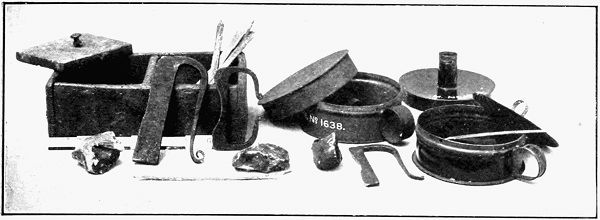
Just when the ancient lamp was invented in the form of a vessel
filled with oil into which some kind of wick was dipped, cannot be
ascertained, but its invention certainly antedated the Christian Era
by several centuries. And it is equally certain that once this smoky,
foul-smelling lamp had been discovered, it remained in use, practically
without change or improvement, until the end of the twelfth century,
the date of the invention of the candle. Such lamps were used by the
Greeks and Romans, great quantities of them being still preserved. They
were simply shallow, saucer-like vessels for holding the oil, into
which the wick was laid, so arranged that the upper end rested against
the edge of the vessel. Here the oil burned and smoked, capillarity
supplying oil to the burning end of the wick, which was pulled up from
time to time as it became shortened by burning, either with pincers
made for the purpose, or perhaps more frequently by the ever useful
hairpin of the matron.
As the thick wick did not allow the air to penetrate to burn the carbon
of the oil completely, a nauseous smoke was given off constantly which
was stifling when a draught of air prevented its escape through the
hole in the roof—the only chimney used by the Greeks. And since this
was the only kind of lamp known at the time, the palace of the Roman
Emperor and hut of the Roman peasant were necessarily alike in their
methods of lighting if in little else. The Emperor's lamps might be
modeled of gold and set with precious stones, while those of the
peasant were of rudely modeled clay; but each must have evoked, along
with its dim light, an unwholesome modicum of smoke and malodor.
It was this form of lamp, practically unaltered except occasionally in
design, that remained in common use during the Middle Ages; and when,
at the close of the twelfth century, the "tallow candle" was invented,
that now despised device must have been almost as revolutionary in its
effect as the incandescent burner and the electric bulb were destined
to be in a more recent generation. It burned with dazzling brilliancy
in comparison with the oil lamp; it gave off no smoke and little smell;
it needed no care, and it occupied little space. Then for the first
time in the history of the world reasonably good house illumination
became possible. Several additional centuries elapsed, however, before
the idea was developed of placing a candle in a covered glass-sided
receptacle, to form a lantern or a street lamp.
For generations the candle held supreme place, though its cost made it
something of a luxury; doubly so if wax was substituted for tallow in
its composition. But toward the close of the eighteenth century, when
the action of combustion had begun to be better understood, attempts
were made to improve the wicks and burners of oil lamps. In 1783, an
inventor named Leger, of Paris, produced a burner using a broad, flat,
ribbonlike wick in which practically every part of the oil supply was
brought into contact with the air, producing, therefore, a steady flame
relatively free from smoke. The flame, while broad, was extremely thin,
and its light was consequently radiated very unevenly. Portions of a
room lying in the direction of the long axis of the flame were but
poorly lighted. To overcome this difficulty, a curved form of burner
was adopted; and this led eventually to the invention of the circular
Argand burner, the prototype of the best modern lamp-burners.
Stated in scientific terms, the problem of the ideal lamp-wick resolves
itself into a question of how to supply oxygen to every portion of
the flame in sufficient quantities to bring all the carbon particles
to a temperature at which they are luminous. It occurred to Argand
that this could be done by giving the wick a circular form like a
cylindrical tube, giving the air free access to the centre of the tube
as well as to its outer surface. In his lamp the reservoir of oil was
placed at a little distance from, and slightly above, the tube holding
the burner, connected with it by a small tube much as the tank of
the modern "student lamp" connects with the burner. In this manner a
fairly good lamp was produced,—a decided improvement over any made
heretofore,—and when, in 1765, Quinquet added a glass chimney to this
lamp a new epoch of artificial lighting was inaugurated. "This date is
of as much importance in artificial lighting as is 1789 in politics,"
says one writer. "Between the ancient lamps and the lamps of Quinquet
there is as much difference as between the chimney-place of our parlors
and the fireplaces of our original Aryan ancestors, formed by a hole
dug in the ground in the centre of their cabins."
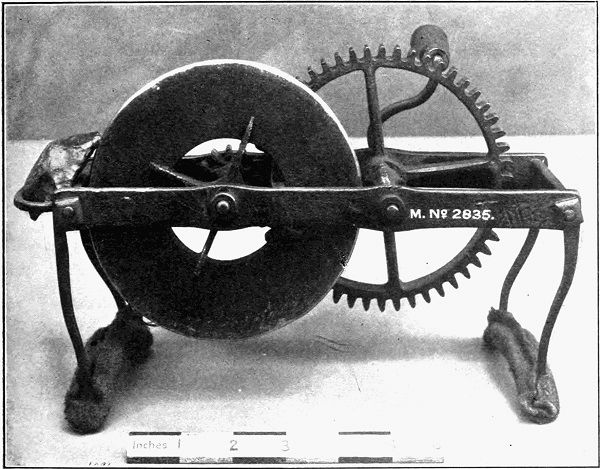
A little later Carcel still further improved the Quinquet lamp by
adapting a clock movement that forced the oil to rise to the wick,
so that it was no longer necessary to have the burner and the
reservoir separated by a tube. This was still further improved upon
by substituting a spring for the clockwork, the result being a lamp
of great simplicity, yet one which gave such results that it replaced
the candle as a unit for measuring the illuminating power of different
sources of light.
These various burners should not be confused with the modern burners of
the ordinary kerosene lamps. Mineral oils had not as yet come into use
for illuminating purposes, except as torches or in simple lamps like
those of the Romans, as refining processes had not been perfected, and
the smoke and odors from crude petroleum were absolutely intolerable in
closed rooms.
Many other substances were tried in place of the heavy oils, such as
the volatile hydrocarbons and alcohols, but with no great success.
Early in the nineteenth century a lamp burning turpentine, under
the name of "camphine," was invented that gave a good light and was
smokeless; but like most others of its type, it was dangerous owing
to its liability to explode. And it was not until methods of refining
petroleum had been improved that "mineral-oil lamps"—the predecessors
of the modern type of lamps—came into use.
The invention of this type of lamp was a relatively easy task—a
simple transition and adaptation as processes of refining the oil were
perfected. The principle of combustion was, of course, the same as in
the Argand type of lamps burning animal and vegetable oils; but mineral
oils are of such consistency that capillarity causes an abundant supply
of oil to rise in the wick, so that clockwork and spring devices, such
as were used in the Carcel lamps, could be dispensed with.
While the rivalry between the candle and the new forms of lamps was at
its height, and just as the lamp was gaining complete supremacy, a new
method of artificial illumination was discovered that was destined to
eclipse all others for half a century, and then finally to succumb to a
still better form. As early as the beginning of the eighteenth century
the Rev. Joseph Clayton, in England, had made experiments in the
distillation of coal, producing a gas that was inflammable. A little
later Dr. Stephen Hales published his work on Vegetable Staticks, in
which he described the process of distilling coal in which a definite
amount of gas could be obtained from a given quantity of coal.
No practical use was made of this discovery, however, until over
half a century later. But just at the close of the century a Scot,
William Murdoch, became interested in the possibilities of gases
as illuminants, and finally demonstrated that coal gas could be
put to practical use. In 1798, being employed in the workshops of
Boulton and Watt in Birmingham, he fitted up an apparatus in which he
manufactured gas, lighting the workshops by means of jets connected by
tubes with this primitive plant. Shortly after this, a Frenchman, M.
Lebon, lighted his house in Paris with gas distilled from wood, and
the Parisians soon became interested in the new illuminant. England
seems to have been the first country to use it extensively in public
buildings, however, the London Lyceum Theatre being lighted with gas
in 1803. By 1810 the great Gas-Light and Coke Company was formed, and
within the next five years gas street-lamps had become familiar objects
in the streets of London, and house illumination by this means a common
thing among the wealthier classes.
In the early days of gas-lighting the results were frequently
disappointing, because no suitable and efficient type of burner had
been devised; but in 1820 Neilson of Glasgow discovered the principle
of the now familiar flat burner, of which more examples still remain
in use the world over than of all other kinds combined. Indeed, this
simple, but as we now regard it, inefficient burner, would probably
have remained the best-known type for many years longer than it did
had not the possibilities of lighting by electricity aroused persons
interested in the great gas-plants to the fact that the new illuminant
was jeopardizing their enormous investments; making it clear that they
must bestir themselves and improve their flat burners if they would
arrest disaster. To be sure, several modifications of the round Argand
burner had been introduced from time to time, some of them being a
distinct improvement over the flat burner, but these did not by any
means seriously compete with electric light. And it was not until the
incandescent mantle was perfected that gas as a brilliant illuminant
was able to make a stand against its new competitor.
It has been known almost since the beginnings of civilization that all
solids can be made to emit light when heated to certain temperatures.
Some substances were known to be peculiarly adapted to this purpose,
such as lumps of lime, and for many years the calcium light or
"lime-light" as it is popularly called, had been in use for special
purposes, and was the most intense light known. This light is made by
heating a block of lime to the highest practicable temperature by means
of a blast of oxygen and coal gas; but such lights were too complicated
and expensive for general purposes. It had been determined even as
early as the beginning of the nineteenth century, however, that the
high temperature necessary for producing this light was due in part at
least to the fact that such a large amount of material had to be raised
to incandescence. It was evident, therefore, that if a small amount
of some such substance as lime and magnesia could be spread out so as
to present a large surface in a small space, such as is represented
by basket-work, sufficient heat for making it incandescent might be
obtained from an ordinary gas-and-air blowpipe.
Here then was the germ of the "mantle" idea; and such an apparatus,
known as the Clamond mantle, which was made of threads of calcined
magnesia, was shown at the Crystal Palace Exhibition, in London, in
1882. Curiously enough, this mantle and burner worked in an inverted
position, the mantle being suspended bottom upwards below the burner
through which the blast of gas was forced. The light given by this
mantle was most brilliant—little short of the older calcium light,
in fact—but the device itself was too complicated to be of service
for ordinary lighting purposes. The principle was correct, but the
construction of the mantle was defective.
Meanwhile a German scientist, Dr. Auer von Welsbach, who had become
famous in the scientific world for his researches on rare metals, was
experimenting with certain oxides of different metals, and developing
a method of handling them that finally resulted in the perfected
incandescent burner in use at present. His process, which in theory at
least was not entirely original with him, was to dip an open fabric
of cotton into a solution of the nitrates of the metals to be used,
drying it, and converting the nitrates into oxides by burning; the
cotton fabric disappearing but leaving the skeleton of the oxide, which
retained its original shape.
At the same time corresponding improvements were made in the type of
burner, which is quite as essential to success as the mantle itself.
It had been found that it was absolutely essential for such a burner
to give a practically non-luminous flame, as otherwise the deposit of
carbon particles will ruin the mantle. Two ways of obtaining this are
possible; one by mixing a certain quantity of air with the gas before
combustion, the other to burn the gas in so thin a flame that the air
permeates it freely. Several burners of both types were used at first,
but gradually the burners in which the air is mixed with the gas became
the more popular, and most of the incandescent burners now on the
market are of this type.
In the construction of mantles at the present time, while the principle
of their use remains the same as that of the lime-light, lime itself
is not used, the oxides of certain other metals having proved better
adapted for the purpose. Thus the Welsbach patent of 1886 covered the
use of thoria, either alone or mixed with other substances such as
zirconia, alumina, magnesia, etc.; thoria being considered as having
a very high power of light emission. Later it was discovered that
pure thoria emits very little light by itself, although it possesses
a refractory nature that gives a stability to the mantle unequalled
by any other material as yet discovered. When combined with a small
trace of the oxides of certain rare metals, however, such as uranium,
terbium, or cerium, thoria mantles have a very high power of light
emission, most modern mantles being composed of about ninety-nine per
cent. thoria with one per cent. cerium.
In the ordinary method of manufacturing such mantles, a cotton-net
cylinder about eight inches long, more or less according to the size
of mantle required, is made, one end being contracted by an asbestos
thread. A loop of the same material, or in some cases a platinum wire,
is fastened across the opening, to be used for suspending the mantle
when in use. The cotton-thread cylinder is soaked in a solution of
the nitrates of the metals thorium and cerium, and is then wrung out
to remove the excess, stretched on a conical mold, and dried. The
flame of an atmospheric burner being applied to the upper part at the
constricted position, the burning extends downward, converting the
nitrates into oxides, and removing the organic matter. Considerable
skill is required in this part of the process, as the regular shape of
the mantle is largely dependent upon the regularity of the burning.
As a finishing process a flame is applied to the inside of the mantle
after it has cooled, to remove all traces of carbon that may remain.
The mantle is now ready for use, but is so fragile that it can scarcely
be touched without breaking, and such handling as would be necessary
for shipment would be out of the question. It is therefore strengthened
temporarily by being dipped into a mixture of collodion and castor oil,
which, when dry, forms a firm but elastic jacket surrounding all parts.
It is this collodion jacket that is burned away when the new mantle is
placed on the burner before the gas is turned on.
Quite recently the method of manufacturing mantles used by Clamond has
been revived. In this method the cotton thread is dispensed with, the
thread used being made from a paste containing the mantle material
itself. The paste is placed in a proper receptacle the bottom of
which is perforated with minute openings, and subjected to pressure,
squeezing out the material in long filaments. When dry these are wound
on bobbins, and, after being treated by certain chemical processes, are
ready for weaving into mantles. It is claimed for mantles made on this
principle that they last much longer and retain their light-emitting
power more uniformly than mantles made by the older process.
When the incandescent mantle had been perfected so as to be an
economical as well an as efficient light-giver, the position of coal
gas as an illuminant seemed again secured against the encroachments
of its rivals, the arc and incandescent electric lights. But just at
this time another rival appeared in the field that not only menaced
the mantle lamp but the arc and incandescent light as well. Curiously
enough, this new rival, acetylene gas, had been brought into existence
commercially by the electric arc itself. For although it had been
known as a possible illuminant for many years, the calcium carbide for
producing it could not be manufactured economically until the advent of
the electric furnace, itself the outcome of Davy's arc light.
Even as early as 1836 an English chemist had made the discovery that
one of the by-products of the manufacture of metallic potassium would
decompose water and evolve a gas containing acetylene; and this was
later observed independently from time to time by several chemists in
different countries. No importance was attached to these discoveries,
however, and nothing was done with acetylene as an illuminant until the
last decade of the nineteenth century. By this time electric furnaces
had come into general use, and it was while working with one of these
furnaces in 1892 that Mr. Thomas F. Wilson, in preparing metallic
calcium from a mixture of lime and coal, produced a peculiar mass of
dark-colored material, calcium carbide, which, when thrown into water,
evolved a gas with an extremely disagreeable odor. When lighted, this
gas burned with astonishing brilliancy, and, as its cost of production
was extremely small, the idea of utilizing it for illuminating was at
once conceived and put into practice.
The secret of the cheap manufacture of the carbide lies in the
fact that the extremely high temperature required—about 4500°
Fahrenheit—can be obtained economically in the electric furnace,
but not otherwise. Thus electricity created its own greatest rival
as an illuminant. It followed naturally that the ideal place for
manufacturing the carbide would be at the source of the cheapest supply
of electricity, and as the "harnessed" Niagara Falls represented the
cheapest source of electric supply, this place soon became the centre
of the carbide industry. Here the process of manufacture is carried out
on an enormous scale. In practice, lime and ground coke are thoroughly
mixed in the proportion of about fifty-six parts of lime to thirty-six
parts of coke. When this mixture has been subjected to the heat of the
electric furnace for a short time an ingot of pure calcium carbide is
formed, surrounded by a crust of less pure material. The ingot and
crust together represent sixty-four parts of the original ninety-two
parts of lime and coke, the remaining twenty-eight parts being
liberated as carbon-monoxide gas.
Calcium carbide as produced by this process is a dark-brown crystalline
substance which may be heated to redness without danger or change. It
will not burn except when heated in oxygen, and will keep indefinitely
if sealed from the air. Chemically it consists of one atom of lime
combined with two atoms of carbon (CaC2); and to produce acetylene
gas, which is a combination of carbon and hydrogen (C2H2) it is
only necessary to bring it into contact with water, acetylene gas and
slaked lime being formed. One pound of pure carbide will produce five
and one half cubic feet of gas of greater illuminating power than
any other known gas. The flame is absolutely white and of blinding
brilliancy, giving a spectrum closely approximating that of sunlight.
The light is so strongly actinic that it is excellent for photography.
Here was a gas that could be made in any desired quantities simply by
adding water to a substance costing only about three cents a pound;
its cost of production, therefore, representing only about one sixth
of the dollar-per-thousand-feet rate usually charged for illuminating
gas in our cities. It could be used in lamps and lanterns made with
special burners and with the simple mechanism of a small water tank
which allowed water to drip into a receptacle holding the carbide;
or—reversing the process—an apparatus that dropped pieces of carbide
into the water tanks. It was, in short, the cheapest illuminant known,
generated by an apparatus that was simplicity itself.
There were, however, two defects in this gas: its odor was
intolerable—the "smell of decayed garlic," it has been aptly
called—and when mixed with air it was highly explosive. The first of
these defects could be overcome easily; when the burner consumed all
the gas there was no odor. The second, the explosive quality, presented
greater difficulties. These were emphasized and magnified by the number
of defective lamps that soon flooded the market, many of these being so
badly constructed that explosions were inevitable. As a result a strong
prejudice quickly arose against the gas, some countries passing laws
prohibiting its use.
But further inquiry into the cause of the frequent disasters revealed
the fact that when the burner of a lamp was constructed so that the air
for combustion was supplied after the gas issued from the jet, there
was no danger of explosion. And as lamps carefully constructed on this
principle replaced the early ones of faulty construction, confidence
in acetylene was restored. Methods were devised for supplying the gas
for house-illumination like ordinary gas, and the occupants of country
houses were afforded a means of lighting their houses on a scale of
brilliancy hitherto unapproached, yet with economy and relative safety.
It was found also that the brilliancy of the acetylene flame was of
such intensity that it could be used, like the electric arc light, as a
search-light. It thus furnished a simple means of supplying small boats
and vehicles with such lights, which they could not otherwise have
had. It also supplied army signal-corps with an apparatus for flashing
messages—an apparatus that was ideal on account of its simplicity and
small size.
At the Pan-American Exhibition at Buffalo the various illuminating
exhibits were among the most conspicuous and attractive features. But
even amid the dazzling electrical displays the Acetylene Building was
a noteworthy object. "It was the most brilliantly and beautifully
lighted building in the grounds," declared one observer. "It sparkled
like a diamond, and was the admiration of all visitors. In it were
generators of all types—most of them supplying the gas for their own
exhibits—several being the latest exponents of the art, so simple that
they can be safely managed by unskilled labor; in fact, 'the brains are
in the machines,' and when the attendant has charged them with carbide
and filled them with water—given them food and drink—they will work
steadily until they need another meal." Indeed, these exhibits at the
Pan-American Exhibition demonstrated conclusively that acetylene gas
occupies a field by itself as a practical illuminant.
At the same exposition a standard was established for good stationary
acetylene generators for house-lighting, and the fact that a large
number of generators fulfilled the requirements of the set of rules
laid down showed how thoroughly the problem of handling this gas has
been solved. Some of these rules used as tests are instructive to
anyone interested in the subject, and a few of them are given here.
They specified, for example, that—
"The carbide should be dropped into the water," the reverse process of
letting the water drip on the carbide, as was done in most of the early
generators, being condemned. "There must be no possibility of mixing
air with the acetylene gas. Construction must be such that an addition
to the charge of carbide can be made at any time without affecting the
lights. Generators must be entirely automatic in their action—that is
to say: after a generator has been charged, it must need no further
attention until the carbide has been entirely exhausted. The various
operations of discharging the refuse, filling with fresh water,
charging with carbide, and starting the generator must be so simple
that the generator can be tended by an unskilled workman without danger
of accident. When the lights are out, the generation of gas should
cease. The carbide should be fed automatically into the water in
proportion to the gas consumed."
Perhaps the most significant thing, showing the stage of progress that
has been made in overcoming the danger of explosions from acetylene
gas, is that the use of generators meeting some such requirements as
the above is not prohibited by fire underwriters. This in itself is
very convincing evidence of their safety.
Throughout the ages primitive man had had constantly before him two
sources of light other than that of the sun, moon, and stars. One
of these, the fire of ordinary combustion, he could understand and
utilize; the other, more powerful and more terrible, which flashed
across the heavens at times, he could not even vaguely understand, and,
naturally, did not attempt to utilize. But early in the seventeenth
century some scientific discoveries were made which, although their
destination was not even imagined at the time, pointed the way that
eventually led to man's imitating in the most striking manner Nature's
electrical illumination.
About this time Otto von Guericke, the burgomaster-philosopher of
Magdeburg, in the course of his numerous experiments, had discovered
some of the properties of electricity, by rubbing a sulphur ball, and
among other things had noticed that when the ball was rubbed in a
darkened room, a faint glow of light was produced. He was aware, also,
that in some way this was connected with the generation of electricity,
but in what manner he had no conception. In the opening years of the
following century Francis Hauksbee obtained somewhat similar results
with glass globes and tubes, and made several important discoveries
as to the properties of electricity that stimulated an interest in
the subject among the philosophers of the time. Gray in England, and
Dufay in France, who became enthusiastic workers in the field, soon
established important facts regarding conduction and insulation, and
by the middle of the eighteenth century the production of an electric
spark had become a commonplace demonstration.
But until this time it had not been demonstrated that this electric
spark was actual fire, although there was no disputing the fact that
it produced light. In 1744, however, this point was settled definitely
by the German, Christian Friedrich Ludolff, who projected a spark
from a rubbed glass rod upon the surface of a bowl of ether, causing
the liquid to burst into flame. A few years later Benjamin Franklin
demonstrated with his kite and key that lightning is a manifestation of
electricity.
But neither the galvanic cell nor the dynamo had been invented at
that time, and there was no possibility of producing anything like a
sustained artificial light with the static electrical machines then
in use. It was not until the classic discovery of Galvani and the
resulting invention of the voltaic, or galvanic, cell shortly after,
that the electric light, in the sense of a sustained light, became
possible. And even then, as we shall see in a moment, such a light was
too expensive to be of any use commercially.
As soon as Volta's great invention was made known a new wave of
enthusiasm in the field of electricity swept over the world, for the
constant and relatively tractable current of the galvanic battery
suggested possibilities not conceivable with the older friction
machines. Batteries containing large numbers of cells were devised; one
having two thousand such elements being constructed for Sir Humphry
Davy at the Royal Institution, of London. By bringing two points of
carbon, representing the two poles of the battery, close together, Davy
caused a jet of flame to play between them—not a momentary spark, but
a continuous light—a true voltaic arc, like that seen in the modern
street-light to-day.
"When pieces of charcoal about an inch long and one-sixth of an inch in
diameter were brought near each other (within the thirtieth or fortieth
of an inch)," wrote Davy in describing this experiment, "a bright
spark was produced, and more than half the volume of charcoal became
ignited to whiteness; and, by withdrawing the points from each other, a
constant discharge took place through the heated air, in a space equal
to at least four inches, producing a most brilliant ascending arch of
light, broad and conical in form in the middle. When any substance was
introduced into this arch, it instantly became ignited; platina melted
in it as readily as wax in a common candle; quartz, the sapphire,
magnesia, lime, all entered into fusion; fragments of diamond and
points of charcoal and plumbago seemed to evaporate in it, even when
the connection was made in the receiver of an air-pump; but there was
no evidence of their having previously undergone fusion. When the
communication between the points positively and negatively electrified
was made in the air rarefied in the receiver of the air-pump, the
distance at which the discharge took place increased as the exhaustion
was made; and when the atmosphere in the vessel supported only
one-fourth of an inch of mercury in the barometrical gauge, the sparks
passed through a space of nearly half an inch; and, by withdrawing the
points from each other, the discharge was made through six or seven
inches, producing a most brilliant coruscation of purple light; the
charcoal became intensely ignited, and some platina wire attached to
it fused with brilliant scintillations and fell in large globules upon
the plate of the pump. All the phenomena of chemical decomposition were
produced with intense rapidity by this combination."
It will be seen from this that as far as the actual lighting-part of
Davy's apparatus was concerned, it was completely successful. But the
source of the current—the most essential part of the apparatus—was
such that even the wealthy could hardly afford to indulge in it as a
luxury. The initial cost of two thousand cells was only a small item of
expense compared with the cost of maintaining them in working order,
and paying skilled operators to care for them. So that for the moment
no practical results came from this demonstration, conclusive though
it was, and the introduction of a commercial electric light was of
necessity deferred until a cheaper method of generating electricity
should be discovered.
This discovery was not made for another generation, but then, as
seems entirely fitting, it was made by Davy's successor and former
assistant at the Royal Institution, Sir Michael Faraday. His discovery
of electromagnetic induction in 1831 for the first time made possible
the electric dynamo, although still another generation passed before
this invention took practical form. In the meantime, however, the
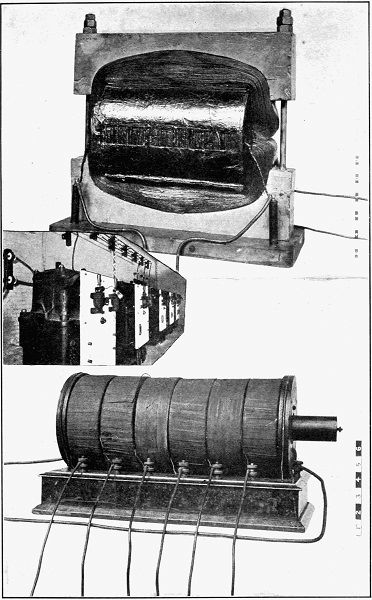
magneto-electric machine of Nollet was used for generating an electric
current for illuminating purposes as early as 1863; and when finally
the dynamo-electric machine was produced by Gramme in 1870, engineers
and inventors had at their disposal everything necessary for producing
a practical electric illuminant.
It must not be supposed, however, that inventors stood by patiently
with folded hands waiting for the coming of a machine that would
furnish them with an adequate current without attempting to produce
electric lamps. On the contrary, they were constantly wrestling with
the problem, in some instances being fairly successful, even before the
invention of the magneto-electric machine. Great advances had been made
in batteries and cell construction over the primitive cells of the time
of Davy, and for exhibition purposes, and even for lighting factories
and large buildings, fairly good electric lights had been used before
1863.
The first practical application of electric lighting seems to have
been made in France in 1849. During the production of the opera "The
Prophet" the sun was to appear, and for this purpose an electric arc
light was used. The success of this effort—an artificial sun being
produced that seemed almost as dazzling to the astonished audience as
Old Sol himself—stimulated further efforts in the same direction. The
previous year W. E. Staite in England made experiments along similar
lines in the large hall of the hotel of Sunderland. He generated a
light "resembling the sun, or the light of day, and making candles
appear as obscure as they do by daylight," according to the Times of
the following morning. The electric light was therefore proved to be a
practical illuminator, although it was not until the introduction of
the Gramme dynamo-electric machine that its great economic utility was
demonstrated.
In Sir Humphry Davy's experiments with his arc light he was led to
believe that the light between the two points of carbon would be
produced even in an absolute vacuum, if it were possible to create one.
Several scientists at the time disputed this contention, and M. Masson,
Professor of Physics in the École Centrale des Arts et Manufactures
in Paris was particularly active in combatting the idea, maintaining
that the arc had the same cause as the electric spark—the transport
by electricity of the incandescent particles of the electrodes through
the atmosphere. It was certain, at any rate, that no light was produced
when the opposing carbons were brought into contact with each other,
or were, on the other hand, separated too widely; and since there
was a constant wearing away and shortening of the points, and thus
a constantly increasing space between them, the great difficulty in
making a practical lamp lay in regulating this distance automatically.
It was finally accomplished, however, by the invention of a Russian
officer, M. Jablochkoff, in 1876. The "Jablochkoff candle," as his
lamp was called, marked an epoch in the history of electric lighting.
One great merit of this invention was its simplicity, and while it
has long since gone out of use, having been superseded by still
simpler and better devices, it must always be recalled as an important
stepping-stone in the progress of artificial illumination.
The name "candle" for Jablochkoff's lamp was suggested by the fact
that the two carbons were placed side by side, instead of point to
point, the light at the top thus suggesting a candle. Between these
two carbons, and extending their whole length except at the very tips,
was an insulating material that the arc could not pierce, but which
burned away at a rate commensurate with the shortening of the carbons.
In this manner the points were kept constantly at the proper distance
without regulating-machinery of any kind. This ingenious apparatus
had the additional advantage that it could be placed on any kind of a
bracket or chandelier that was properly wired, thus dispensing with the
cumbersome frames and machines of the point-to-point carbon arc lights
then being introduced.
One difficulty at first encountered in using the Jablochkoff candle was
the starting of the voltaic arc. In doing this it was necessary that
contact be made between two carbon points, whether they lie parallel or
point to point, and the necessary slight separation for producing the
light effected later. To accomplish this Jablochkoff joined the tips of
the carbons of his candle with a thin strip of carbon, which quickly
burned away when the current was turned on, leaving the necessary space
between the points for the arc.
There was one difficulty with the "candle" that seemed insurmountable
for a time—the wasting of the two carbons was unequal, as in any arc
light, the points thus gradually drawing apart until the passage of the
current was no longer possible. To overcome this the rapidly wasting
positive carbon was made double the thickness of its mate; but while
this answered fairly well the thinner negative carbon gradually became
heated by the increased resistance, and burned up too rapidly. The
difficulty was finally overcome by the simple expedient of alternating
the flow of the current, so that each carbon was alternately a
positive and a negative pole. As the magneto-electric machines then in
use produced alternating currents it was only necessary to use such
machines for generating the current to produce an equal destruction of
both carbons.
The simplicity and excellence of the light of these "candles" brought
them at once into general popularity, not only in the large cities of
Europe, but in many out-of-the-way places. Greece, Portugal, and other
obscure European countries adopted them, and even Brazil, La Plata,
and Mexico installed many plants. But stranger still, they were soon
used for illuminating the palaces of the Shah of Persia and the King
of Cambodia, and a little later were introduced into the residence of
the savage King of Burma. In short, their use became universal almost
immediately.
About the time that Jablochkoff's candles were making such a sensation
in Europe, Charles F. Brush, of Cleveland, Ohio, invented an arc light
in which the carbons were set point to point, the distance being
maintained and the necessary feed produced automatically in much the
same manner as in the lamps used at present. Other inventions soon
followed, some of the lamps being regulated by clockwork, some by
electricity and magnetism.
The advantage of this type of arc lamp over the candle type—an
advantage that led to its general adoption—was largely that of
efficiency, a far greater amount of light being obtainable from the
same expenditure of power by the point-to-point type of lamp.
In this lamp it is necessary that the points of carbon shall come in
contact when the current is off, but be drawn apart a moment after the
current is turned on, and remain at this fixed distance. To accomplish
this, the lower carbon is usually made stationary, the feeding being
regulated by the position of the upper carbon. In the usual type of
modern lamp the passage of the current causes the points to separate
the required distance through the action of an electromagnet the coils
of which are traversed by the current. A clutch holds the carbon in
place, the position of this being also determined by an electromagnet.
The action is regulated by the difference in the resistance to the
passage of the current caused by the increase in the separation of the
points.
In the older type of arc lamp it was necessary to "trim" the lights by
replacing the carbons every day; but recently lamps have been perfected
in which the carbons last from one hundred to one hundred and twenty
hours. In these the arc is enclosed in a glass globe which is made as
nearly air-tight as possible with the necessary feed devices. This
closed chamber is fitted with a valve opening outward, which allows
the air to be forced out by the heat of the lamp, but does not admit a
return current. In this manner a rarefied chamber is produced in which
the carbons are oxidized very slowly; yet there is no diminution in the
brilliancy of the light.
Early in the history of electric lighting it became apparent that the
proper construction of the carbon electrodes was a highly important
item in the manufacture of a lighting apparatus. The value of carbons
depends largely upon their purity and freedom from ash in burning, and
it required a countless number of experiments to develop the highly
efficient carbons now in general use. Davy made use of pieces of wood
charcoal in his experiments, but these were too fragile to be of
practical value, even if their other qualities had been ideal. Later
experimenters tried various compounds, and in 1876 Carré in France
produced excellent carbons made of coke, lampblack, and syrup. From
these were developed the present carbons, usually made by mixing some
finely divided form of carbon, such as soot or lampblack made from
burning paraffin or tar, with gum or syrup to form a paste. Rods of
proper size and shape are made by forcing this paste through dies by
hydraulic pressure, subsequently baking them at a high temperature.
Sometimes they are given a coating of copper, a thin layer of the metal
being deposited upon them by electrolysis.
The familiar incandescent electric-light bulb seems such a simple
apparatus to-day, being nothing apparently but a small wire enclosed in
an ordinary glass bulb, that it is almost impossible to realize what
an enormous amount of money, energy, and that particular quality of
mentality which we call "genius" has been required to produce it. First
and foremost among the names of the men of genius who finally evolved
this lamp is that of Thomas A. Edison; and only second to this foremost
name are those of Swan, Lane-Fox, and Hiram Maxim. But Edison's name
must stand preeminent; and there are probably very few, even among
Europeans, who would attempt or wish to deny him the enviable place as
the actual perfecter of the incandescent-light bulb.
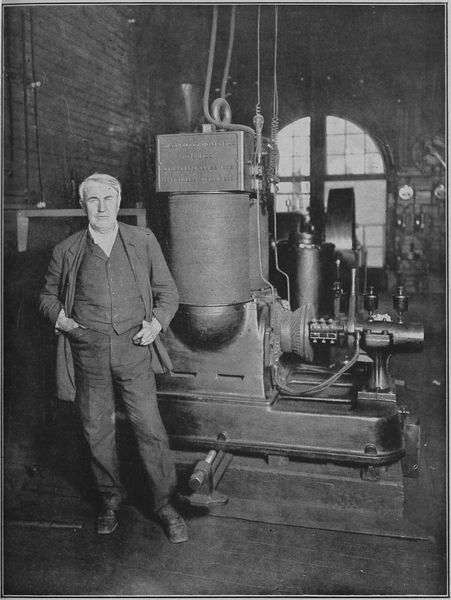
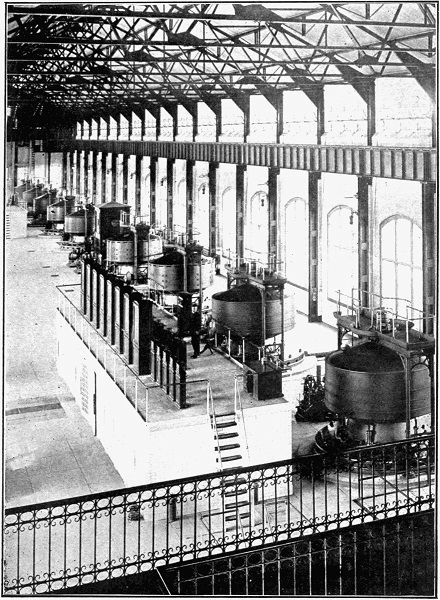
THOMAS A. EDISON AND THE DYNAMO THAT GENERATED THE FIRST
COMMERCIAL ELECTRIC LIGHT.
It is said that Edison first conceived the idea of an incandescent
electric light while on a trip to the Rocky Mountains in company
with Draper, in 1878. Be this as it may, he certainly set to work
immediately after completing this journey, and never relaxed or ceased
his efforts until a practical incandescent lamp had been produced. His
idea was to perfect a lamp that would do everything that gas could do,
and more; a lamp that would give a clear, steady light, without odor,
or excessive heat such as was given by the arc lights—in short, a
household lamp.
Early in his experiments he abandoned the voltaic arc, deciding that
a successful lamp must be one in which incandescence is produced by a
strong current in a conductor, the heat caused by the resistance to
the current producing the glow and light. But when search was made for
a suitable substance possessing the necessary properties to be the
incandescent material, the inventor was confronted by a vast array of
difficulties. It was of course essential that the substance must remain
incandescent without burning, and at the same time offer a resistance
to the passage of the current precisely such as would bring about
the heating that produced incandescence. It should be infusible even
under this high degree of heat, or otherwise it would soon disappear;
and it must not be readily oxidizable, or it would be destroyed as
by ordinary combustion. It should also be of material reducible to
a filament as fine as hair, but capable of preserving a rigid form.
These, among others, were the qualities to be considered in selecting
this apparently simple filament for the incandescent lamp. It was not a
task for the tyro, therefore, that Edison undertook when he began his
experiments for producing an "ideal lamp."
The substance in nature that seemed to possess most of the necessary
qualities just enumerated was the metal platinum, and Edison began
at once experimenting with this. He made a small spiral of very fine
platinum wire, which he enclosed in a glass globe about the size of an
ordinary baseball. The two ends of the wires connected with outside
conducting wires, which were sealed into the base of the bulb. The air
in the bulb had to be exhausted and a vacuum maintained to diminish the
loss of heat and of electricity and to prevent the oxidation of the
platinum. But when the current was passed through the spiral wire in
this vacuum a peculiar change took place in the platinum itself. The
gases retained in the pores of the metal at once escaped, and the wire
took on such peculiar physical properties that it was supposed for a
time by some physicists that a new metal had been produced. The metal
acquired a very high degree of elasticity and became susceptible of a
high polish like silver, at the same time becoming almost as hard as
steel. It also acquired a greater calorific capacity so that it could
be made much more luminous without fusing. To diminish the loss of
heat the wire was coated with some metallic oxide, and the slope of
the spiral also aided in this as each turn of the spiral radiated heat
upon its neighbor, thus utilizing a certain amount that would otherwise
have been lost. But despite all this, Edison found, after tedious
experimenting, that platinum did not fulfil the requirements of a
practical filament for his lamp; it either melted or disintegrated in a
short time and became useless; and the other experimenters had met with
the same obstacles to its use, and were forced to the same conclusion.
Some other substance must be found. The use of carbon for arc lights
and Edison's own experiments with carbon in his work on the telephone
naturally suggested this substance as a possibility. It is said that
this idea was brought forcibly to the inventor's attention by noticing
the delicate spiral of vegetable carbon left in his hand after using
a twisted bit of paper, one day, for lighting a cigar. This spiral of
carbon was, of course, too fragile to be of use in its ordinary form.
But it occurred to Edison that if a means of consolidating it could
be found, there was reason to hope that it would answer the purpose.
Experiments were begun at once, therefore, not only with processes of
consolidation but also with various kinds of paper, and neither effort
nor expense was spared to test every known variety of paper. Moreover,
many new varieties of paper were manufactured at great expense from
substances having peculiar fibres. One of these, made from a delicate
cotton grown on some little islands off South Carolina, gave a carbon
free from ash, and seemed to promise good results; but later it was
found that the current of electricity did not circulate through this
substance with sufficient regularity to get protracted and uniform
effects. Nevertheless, since many things pointed to this fibre carbon
as the ideal substance, Edison set about determining the cause of the
irregularity in the circulation of the current in the filament, and a
number of other experimenters soon became interested in the problem.
It was soon determined that the arrangement of the fibres themselves
were directly responsible for the difficulty. In ordinary paper the
fibres are pressed together without any special arrangement, like wool
fibres in felting. In passing through such a substance, therefore, the
current cannot travel along a continuous fibre, but must jump from
fibre to fibre, "like a man crossing a brook on stepping-stones." Each
piece of fibre constitutes a lamp or miniature voltaic arc, so that the
current is no longer a continuous one; and the little interior sparks
thus generated quickly destroy the filament. This discovery made it
apparent that such an artificial, feltlike substance as paper could not
be made to answer the purpose, and Edison set about searching for some
natural substance having fibres sufficiently long to give the necessary
homogeneity for the passage of the current.
For this purpose specimens of all the woods and fibre-substances of
all countries were examined. Special agents were sent to India, China,
Japan, South America, in quest of peculiar fibrous substances. The
various woods thus secured were despatched to the Edison plant at Menlo
Park and there carefully examined and tested. Without dwelling on the
endless details of this tedious task, it may be said at once that only
three substances out of all the mass withstood the tests reasonably
well. Of these, a species of Japanese bamboo was found to answer the
purpose best. Thus the practical incandescent lamp, which had cost so
much time, ingenuity, and money, came into existence, fulfilling the
expectation of the most sanguine dream of its inventor.
In using these bamboo carbon filaments the original spiral form of
filament was abandoned, the now familiar elongated horseshoe being
adopted, as the carbon could not be bent into the tortuous shapes
possible with platinum. Later various modifications in the shape of the
filament were made, usually as adaptations to changes in the shape of
the bulbs.
At the same time that Edison was succeeding with his bamboo carbon
filaments, J. W. Swan had been almost as successful with a filament
formed by treating cotton thread with sulphuric acid, thus producing a
"parchmentized thread," which was afterwards carbonized. A modification
of this process eventually supplanted the Edison bamboo filament; and
the filament now in common use—the successor of the "parchmentized
thread"—is made of a form of soluble cellulose prepared by dissolving
purified cotton wool in a solution of zinc chloride, and then pressing
the material out into long threads by pressing it through a die.
The long thread so obtained is a semi-transparent substance, resembling
catgut, which when carbonized at a high temperature forms a very
elastic form of carbon filament. To prepare the filament the cellulose
threads are cut into the proper lengths, bent into horseshoe shape,
double loops, or any desired form, and then folded round carbon formers
and immersed in plumbago crucibles. On heating these crucibles to a
high temperature the organic matter of the filaments is destroyed,
the carbon filaments remaining. These filaments are then ready for
attachment to the platinum leading-in wires, which is accomplished
either by means of a carbon cement or by a carbon-depositing process.
They are then placed in the glass bulbs and the wires hermetically
sealed, after which the bulbs are exhausted, tested, fitted with the
familiar brass collars, and are ready for use.
The combined discoveries of all experimenters had made it evident
that certain conditions were necessary to success, regardless of
the structure of the carbon filament. It was essential that the
vessel containing the filament should be entirely of glass; that the
current should be conveyed in and out this by means of platinum wires
hermetically sealed through the glass; and that the glass globe must
be as thoroughly exhausted as possible. This last requirement proved
a difficult one for a time, but by improved methods it finally became
possible to produce almost a perfect vacuum in the bulbs, with a
corresponding increase in the efficiency of the lamps.
For twenty years the carbon-filament lamp stood without a rival.
But meanwhile the science of chemistry was making rapid strides and
putting at the disposal of practical inventors many substances hitherto
unknown, or not available in commercial quantities. Among these were
three metals, osmium, tantalum, and tungsten, and these metals soon
menaced the apparently secure position of the highly satisfactory,
although expensive, Edison lamp.
It will be recalled that the early experimenters had used two metals,
platinum and iridium, for lamp filaments; and that these two, although
unsatisfactory, were the only ones that had given even a promise
of success. But in 1898 Dr. Auer von Welsbach took out patents, and
in 1903 produced a lamp using an osmium filament. Its advent marked
the beginning of the return to metal-filament lamps, although the
lamp itself did not prove to be very satisfactory and was quickly
displaced by a lamp invented by Messrs. Siemens and Halske, having
a tantalum filament. On account of its ease to manufacture, its
brilliant light, and relatively low consumption of power, this lamp
gained great popularity at once, and for a single year was practically
without a rival. Then, in 1904, patents were taken out by Just and
Hanaman, Kuzel, and Welsbach, for lamps using filaments of tungsten,
and the superiority of these lamps over the tantalum lamps gave
them an immediate popularity never attained by either of the other
metal-filament lamps.
Needless to say there is good ground for this popularity, which may be
explained by the simple statement that the tungsten lamp gives more
light with much less consumption of power per candle power than any of
its predecessors. Unlike the carbon filament, which projects in the
familiar elongated horse-shoe loop, or double loop, into the exhausted
bulb, the tungsten filament is wound on a frame, so that several
filaments (usually eight or more) are used for producing the light
in each bulb. The chief defect of this lamp is the fragility of the
filament, which breaks easily when subjected to mechanical vibration.
On the other hand, tungsten lamps can be used in places at a long
distance from the central generating plant, where the electric current
is too weak for carbon-filament lamps.
"On an evening in January, 1902, a great crowd was attracted to the
entrance of the Engineers' Club in New York city. Over the doorway
a narrow glass tube gleamed with a strange blue-green light of such
intensity that print was easily readable across the street, and yet
so softly radiant that one could look directly at it without the
sensation of blinding discomfort which accompanies nearly all brilliant
artificial lights. The hall within, where Mr. Hewitt was making the
first public announcement of his great discovery, was also illuminated
by the wonderful new tubes. The light was different from anything ever
seen before, grateful to the eyes, much like daylight, only giving the
face a curious, pale-green, unearthly appearance. The cause of this
phenomenon was soon evident; the tubes were seen to give forth all the
rays except red,—orange, yellow, green, blue, violet,—so that under
its illumination the room and the street without, the faces of the
spectators, the clothing of the women, lost all their shades of red;
indeed, changing the face of the world to a pale green-blue.
"The extraordinary appearance of this lamp and its profound
significance as a scientific discovery at once awakened a wide
public interest, especially among electricians who best understood
its importance. Here was an entirely new sort of electric light.
The familiar incandescent lamp, though the best of all methods of
illumination, is also the most expensive. Mr. Hewitt's lamp, though
not yet adapted to all the purposes served by the Edison lamp, on
account of its peculiar color, produces eight times as much light with
the same amount of power. It is also practically indestructible, there
being no filament to burn out; and it requires no special wiring. By
means of this invention electricity, instead of being the most costly
means of illumination becomes the cheapest—cheaper even than kerosene.
No further explanation than this is necessary to show the enormous
importance of this invention."
As just stated, the defect of the Edison incandescent lamp is its
cost, due to its utilizing only a small fraction of the power used
in producing the incandescence, and, of much less importance, the
relatively short life of the filament itself. Only about three per
cent. of the actual power is utilized by the light, the remaining
ninety-seven per cent. being absolutely wasted; and it was this
enormous waste of energy that first attracted the attention of Mr.
Hewitt, and led him to direct his energies to finding a substitute that
would be more economical. A large part of the waste in the Edison bulb
is known to be due to the conversion of the energy into useless heat,
instead of light, as shown by the heated glass. Mr. Hewitt attempted to
produce a light that would use up the power in light alone—to produce
a cool light, in short.
Instead of directing his efforts to the solids, Mr. Hewitt turned his
attention to gaseous bodies, believing that an incandescent gas would
prove the more nearly ideal substance for a cool light. The field of
the passage of electricity through gases was by no means a virgin
one, but was nevertheless relatively unexplored: and Mr. Hewitt was,
therefore, for the most part obliged to depend upon his own researches
and experiments. In these experiments hundreds of gases were examined,
some of them giving encouraging results, but most of them presenting
insurmountable difficulties. Finally mercury vapor was tried, with the
result that the light just referred to was produced.
The possibilities of mercury-vapor gas had long been vaguely
suspected—suspected, in fact, since the early days of electrical
investigation, two centuries before. The English philosopher, Francis
Hauksbee, as early as 1705 had shown that light could be produced by
passing air through mercury in an exhausted receiver. He had discovered
that when a blast of air was driven up against the sides of the glass
receiver, it appeared "all round like a body of fire, consisting of an
abundance of glowing globules," and continuing until the receiver was
about half full of air. Hauksbee called this his "mercurial fountain,"
and although he was unable to account for the production of this
peculiar light, which he remarked "resembled lightning," he attributed
it to the action of electricity.
Between Hauksbee's "mercurial fountain" and Hewitt's mercury-vapor
light, however, there is a wide gap, and, as it happened, this gap
is practically unbridged by intermediate experiments, for Mr. Hewitt
had never chanced to hear anything of Hauksbee's early experiments,
or of any of the tentative ones of later scientists. But this, on the
whole, may have been rather advantageous than otherwise, as, being
ignorant, he was perhaps in a more receptive state of mind than if
hampered by false or prejudicial conceptions. Be this as it may, he
began experimenting with mercury confined in a glass tube from which
the air had been exhausted, the mercury being vaporized either by
heating, or by a current of electricity. No results of any importance
came of his numerous experiments for a time, but at last he made the
all-important discovery that once the high resistance of the cold
mercury was overcome, a comparatively weak current would then be
conducted, producing a brilliant light from the glow of the mercury
vapor. Here, then, was the secret of the use of mercury vapor for
lighting—a powerful current of electricity for a fraction of a second
passed through the vapor to overcome the initial resistance, and then
the passage of an ordinary current to produce the light.
In practice this apparent difficulty in overcoming the initial
resistance with a strong current is easily overcome by the use of a
"boosting coil," which supplies the strong current for an instant, and
is then shut off automatically, the ordinary current continuing for
producing the light. The mechanism is hardly more complex than that of
the ordinary incandescent light, but the current of ordinary strength
produces an illumination about eight times as intense as the ordinary
incandescent bulb of equal candle-power.
The form of lamp used is that of a long, horizontal tube suspended
overhead in the room, a brilliant light being diffused, which, lacking
the red rays of ordinary lights, gives a bluish-green tone to objects,
and a particularly ghastly and unpleasant appearance to faces and
hands, as referred to a moment ago. In many ways this feature of the
light is really a peculiarity rather than a defect, and for practical
purposes in work requiring continued eye-strain the absence of the
red rays is frequently advantageous. In such close work as that of
pen-drawing, for example, some artists find it advantageous to use
globes filled with water tinted a faint green color, placed between
the lamps and their paper, the effect produced being somewhat the same
as that of the mercury-vapor light. For such work the absence of the
red rays of the Hewitt light would not be considered a defect; and in
workshops and offices where Mr. Hewitt's lamps are used the workmen
have become enthusiastic over them.
On the other hand, the fact that the color-values of objects are so
completely changed makes this light objectionable for ordinary use;
so much so, in fact, that the inventor was led to take up the problem
of introducing red rays in some manner so as to produce a pure white
light. He has partly accomplished this by means of pink cloth colored
with rhodium thrown around the glass; but this causes a distinct loss
of brilliancy.
The most natural method of introducing the red rays, it would seem,
would be to use globes of red glass; but a moment's reflection will
show that this would not solve the difficulty. Red glass does not
change light waves, but simply suppresses all but the red rays; and
since there are no red rays in the mercury-vapor light the result of
the red globe would be to suppress all the light. Obviously, therefore,
this apparently simple method does not solve the difficulty; but those
familiar with Mr. Hewitt's work will not be surprised any day to hear
that he has finally overcome all obstacles, and produced a perfectly
white light. In the meantime the relatively expensive arc light and
the incandescent bulb with its filament of carbon or metal hold
unchallenged supremacy in the commercial field.