IF it were possible to regard all medieval literature
without more than a grain of doubt, we
must believe that aerial flight by human beings
was accomplished long before science had risen even to
the dignity of acquiring its name. Thus, it is recorded
by a medieval historian that during the reign of Charlemagne
some mysterious persons having acquired some
knowledge of aerostatics from the astrologers, who were
credited with numerous supernatural powers, constructed
a flying-machine, and compelling a few peasants to
enter it, sent them off on an aerial voyage. Unfortunately
for the unwilling voyagers, so the story runs,
they landed in the city of Lyons, where they were immediately
seized and condemned to death as sorcerers.
But the wise bishop of the city, doubting the story of
their aerial journey, pardoned them and allowed them
to escape.
That such a fabulous tale could gain credence is explained
by the prevailing belief in the powers of the
astrologers and sorcerers at that time. People who
could seriously believe that an alchemist could create
gold and prolong life and youth indefinitely, would find
nothing startling in the announcement that he could also
perform the relatively simple feat of flying—a thing that
birds and bats accomplish with such obvious facility.
And nothing is more certain than that attempts at aerial
flight have been made at various times since the beginning
of history.
As with almost everything else in the matter of modern
scientific advancement, the mysterious writings of the
monk, Roger Bacon, are supposed to contain passages
to show that the worthy friar had an inkling of the secret
of air navigation. But he himself admits that he had
only a theoretical knowledge of the subject, and had
never seen a flying-machine of any kind in actual flight.
Much more definite and tangible are the designs of
possible flying-machines still extant in the sketch-book
of Leonardo da Vinci, made in the fifteenth century.
From Leonardo's sketches it appears that the artist had
conceived the idea of constructing jointed wings to be
worked with strings and pulleys, the motive power to be
that of a man's arms and legs. It appears also that
later he had very definite ideas as to the possibilities
of an aerial screw, and he is believed to have constructed
one of these screws made on the same general plan as
that of the ordinary type of windmill in use at that time.
But nothing of practical importance came of any of
Leonardo's experiments.
It is probable that his abandonment of the project of
flying by means of wings worked by muscular force was
due to the discovery that the strength of the muscles of
even the strongest man was relatively slight as compared
with the corresponding muscle of birds. Leonardo was
peculiarly capable of discerning this discrepancy in
strength, since he himself was one of the strongest men
of his time. It is said that he could bend and straighten
horseshoes with his hands. But in his experiments with
the aerial screw he probably discovered very soon that
even such muscular force as he was capable of exerting
was entirely inadequate; and there being no other mode
of producing power at that time, the idea of aerial navigation
by this means was also abandoned.
About this time some imaginative persons, realizing
the possibilities of muscular development when begun in
childhood and persistently practiced, attempted the
development of a race of men whose abnormally strong
pectoral muscles would enable them to use artificial
wings for flying. For this purpose a certain number of
young boys were selected and constantly drilled in exercises
of flapping the arms, to which broad sails were
attached. These attempts were persisted in for several
years, and it is said that some of these boys became so
expert that by skipping along the surface of the ground
and vigorously flapping their wing-attachments, they
could travel at incredible speed, although never able
actually to rise from the ground.
In 1678, a Frenchman named Besnier invented a
flying-machine that is credited with being more successful
than any hitherto attempted. His machine consisted
of two bars of wood which were so hinged to a
man's shoulders that they could be worked up and down
by movements of the hands and feet. At the ends of
these two bars were muslin wings made like shutters, so
arranged that they were opened by a downward stroke
and closed automatically by a reverse motion. The
general appearance presented by these wings was that
of four book-covers fastened by their backs to the ends
of the bars, opening and closing alternately as the bars
were worked up and down.
The inventor began his experiments in a modest way.
His first attempt at flight was by jumping from a chair;
next he tried a table; and finally, emboldened by his
success, he made flights from window-sills and even
house-tops. On one occasion he is said to have sailed
from his attic window over the roof of a neighboring
cottage, alighting, without injury, some distance beyond.
It was even rumored at one time that he would try to
fly across the Seine, but if such a feat was ever contemplated,
it was never attempted.
Half a century later, however, the Marquis de Bacqueville
actually made such an attempt with a machine
somewhat similar to that of Besnier. The marquis
had practiced in private with his machine with such encouraging
results that he felt confident the feat was not
an impossible one—in fact, that he was sure of accomplishing
it. He therefore announced publicly that at a
certain time the attempt would be made, and on the
appointed day an immense crowd of people gathered on
the banks of the river to witness the spectacle. Starting
from a building some little distance away from the
stream, the marquis made good progress at first, but just
as he reached the river-bank his machine collapsed and
he was tumbled out, alighting on a barge moored at the
edge of the stream. Fortunately, the only injury he
sustained was a broken leg; but this single attempt
seems to have satisfied his aeronautic ambitions.
Until this time all attempts made at aerial flight had
been those in imitation of birds; but during the early
part of the eighteenth century the idea of the balloon
was developed. This was the result of the numerous
important discoveries made about that time as to the
qualities of the atmosphere, and also several other
"airs," as gases were called, such as their expansion
and contraction under different conditions of temperature.
In 1766 the English philosopher, Henry Cavendish,
discovered that hydrogen gas has only about one-seventh
the weight of an equal bulk of air, this scientific
discovery pointing naturally to balloon construction,
since obviously if such a light gas were confined in a
suitable receptacle, the device would rise to a certain
height through the heavier atmosphere, as a cork rises
through water. At the same time the experiments of
the chemist, Dr. Joseph Black, and those of his younger
contemporary, Doctor Priestly, were directed along the
same lines, all of them pointing to the possibility of constructing
an aerostat with buoyancy and lifting-power,
and Priestly's Experiments Relating to the Different
Kinds of Air is said to have been directly responsible
for stimulating the efforts of Stephen and Joseph Montgolfier,
the French paper manufacturers, who finally
invented and sent up the first balloon.
Even before Montgolfier's invention, Tiberius Cavallo,
an Italian living in England, had demonstrated the
possibility of making toy-balloons. But the balloons of
Cavallo were small affairs made of bladders or paper
bags filled with hydrogen gas. One of these materials
being too heavy and the other too porous for successful
balloon construction, the performances of these toy-balloons
were not conclusively demonstrative.
Throughout the entire spring of 1783, all Auvergne, in
France, was kept in breathless expectancy by constant
rumors that the two Montgolfiers had really solved the
problem of aerial flight, and would soon be seen soaring
over the country in a strange birdlike machine. Rumor
pictured this machine in various forms and sizes, but in
point of fact there was really very little secrecy on the
part of the inventors themselves, who frankly explained
the principle of the balloon they were constructing. It
was hardly to be expected, however, that most persons
would believe the plain truth that so simple a device as
a bag filled with hot air would do what had long been
considered impossible.
Spring advanced and lapsed into summer, however,
and as no flying-machine made its appearance, public
clamor became so loud that the Montgolfiers felt they
could postpone their demonstration no longer, although
the balloon they were working on was not completed to
their entire satisfaction. Nevertheless, they fixed on the
definite date of June 5, (1783) as the day and Annonay
as the place for making the trial, and their faith
in their invention was shown by the fact that special invitations
were sent to the leading persons in the vicinity,
and a general invitation extended to the world at large.
But in place of some complicated and birdlike
machine, as rumor had pictured the flying-machine, the
multitude that gathered about the starting-point found
only an immense cloth bag about thirty-five feet in
diameter, without machinery or wings, and capable of
containing some twenty-two thousand cubic feet of air,
which the Montgolfier brothers and their assistants
were inflating with heated air. As the bag filled,
one of the brothers announced with all seriousness,
that as soon as it was completely filled it would "rise to
the clouds," carrying with it a frame weighing some
three hundred pounds.
This announcement was not received with the same
seriousness with which it was given. The idea of expecting
anyone to believe that an ordinary cloth bag
would fly excited the risibilities even of the more serious
members of the crowd. Nevertheless, as the great globe
filled it became evident to the spectators that it was
tugging at the restraining ropes in efforts to rise, in
a most extraordinary manner; and when, at a signal
from the inventors, the ropes were cast off and the
monster shot skyward, the crowd's smiles were turned
to expressions of gaping astonishment. Straight into
the air the monster mounted, and then, wafted by a
gentle breeze, it continued to soar and rise until in ten
minutes it had reached an altitude of six thousand feet,
sailing easily in a horizontal direction for a short distance,
then gradually descending and alighting some
eight thousand feet from the starting-point.
The news of this triumph travelled quickly to Paris,
and the Parisians clamored to see the wonderful performance
repeated in the capital. The king and court
were as interested as the savants and the populace, and
an order was sent at once by his Majesty, bidding the
brothers bring their balloon to the city.
In the meantime, however, a savant named Charles
had started the construction of a balloon that was to be
filled with hydrogen gas instead of heated air. This
was a much more expensive undertaking, as a thousand
pounds of iron filings and five hundred pounds of sulphuric
acid were necessary to manufacture a sufficient
quantity of gas to fill the varnished silk bag. But by
the 23rd of August everything was in readiness for the
filling process, and the following day this first gas-balloon
rose from the Champs de Mars to a distance of
three thousand feet and disappeared into the clouds.
Three-quarters of an hour later it descended in a field
near the little village of Gonesse, to the great consternation
of the inhabitants of the neighborhood, who supposed
it to be some monster bird, animal, or flying
dragon. Arming themselves with scythes and pitchforks,
therefore, but keeping at a safe distance, the
boldest of the peasants sallied out and surrounded the
field in which the creature had alighted. As it made
no offensive movement, however, one bold huntsman
armed with his trusty fowling-piece, crept cautiously
within range and fired, tearing a hole in the monster's
side and causing it to writhe and collapse, giving off
what appeared to be a foul-smelling, poisonous gas in
its death-struggles. When finally it lay flat and still the
villagers became emboldened, and rushing upon it cut
and tore it to shreds, ending the performance by tying
the fragments to a horse's tail and sending the animal
scurrying across the fields.
In anticipation of some such demonstration as this,
the French Government had sent out a proclamation on
the day of the ascent. "Anyone who should see in the
sky a globe, resembling the moon in an eclipse," the
proclamation ran, "should be aware that far from being
an alarming phenomenon, it is only a machine, made of
taffeta, or light canvas covered with paper, that cannot
possibly cause any harm, and will some day prove
serviceable to the wants of society." But apparently
none of the villagers of Gonesse had seen this proclamation.
The success of these balloon ascensions sent a wave
of enthusiastic interest in aeronautics all over France.
The novelty and possibilities of ballooning appealed to
the French temperament, just as the possibilities of
submarine navigation and automobiling did a century
later. As a result, France became at once the centre
of ballooning, the whole nation being eagerly absorbed
in the subject of navigating the air. In the theatre of
action, the Montgolfiers continued to occupy the centre
of the stage, and at all times showed themselves worthy
of the leading rôle. Pursuant to the order of the king,
M. Montgolfier had come to the capital, and on September
19th, before Louis XVI and his queen and the
court at Versailles, sent up another hot-air balloon, or
"Montgolfier," as this kind of balloon had come to be
called.
A novel and important feature of this exhibition, however,
was the substitution of living animals for sand-bags
or other ballast, as used heretofore. In a wicker cage
a cock, a duck, and a sheep were fastened, and these
were carried some fifteen hundred feet into the air,
descending uninjured, two miles from the starting-point,
a few minutes later. The cage was broken open in the
descent, but its occupants escaped injury, and the sheep
was found quietly grazing when the rescue party arrived.
The successful voyage of these caged animals stimulated
the balloonists to attempt the crucial test of sending
up a balloon carrying a human passenger. But from
this perilous undertaking the boldest spirits recoiled,
even the Montgolfiers refusing to venture. In those
days, however, there was always a means of securing
human beings, willing or otherwise, for any undertaking.
Where gold would not tempt, it needed but a word of
the monarch to commute the death-sentence of some
criminal, placing him at the disposal of the scientists
for a better or worse fate than the gallows, as the case
might be. And so when Louis XVI heard of the plight
of the balloon-makers, he came to their assistance with
the offer of two condemned prisoners to be sent on the
first aerial voyage. This offer had an unexpected effect.
The pride of a certain high-minded aeronaut named
Rozier, who had hitherto refused to risk his life, was
touched at the thought of criminals performing an act
that all honest men refused. "What! are vile criminals
to have the glory of being the first to ascend into the
air?" he exclaimed. "No, no, that must not be."
And forthwith he offered his own services for the hazardous
undertaking.
The royal decree was accordingly repealed, to the
chagrin of the criminals, no doubt, and preparations
made for the momentous attempt. Montgolfier was
engaged to construct a large balloon, and on the 15th
of October, 1783, the trial was made in a garden in the
Faubourg St. Antoine. Let no one suppose, however,
that this first man-carrying balloon was cut loose from
the earth and sent skyward to shift for itself, as might
be gathered from the reluctance of persons to make the
ascent. On the contrary, the balloon was held by strong
cables, and allowed to rise only to a height of eighty feet—to
the level of some of the lower windows of a modern
sky-scraper—the aeronaut keeping it afloat for about
five minutes by burning wool and straw in a grate
made for the purpose.
Those who have witnessed the reckless manner in
which the modern balloonist mounts thousands of feet
into the air, seated on a trapeze or clinging to flying
rings attached to an old balloon, patched and frequently
rotten, may be inclined to sneer at the brave Rozier.
But it should be remembered that in 1783 people had
not learned nineteenth-century contempt for altitude.
Furthermore, no one could tell what might be the effect
upon the human system of ascending to a great height
when away from a building or other terrestrial object.
Fainting, hemorrhages, heart-failure, and death had
been predicted, and could not be practically refuted.
In short, it was an absolutely new and untried field;
and it required far greater courage on the part of Rozier
to mount eighty feet in a captive balloon than for a
modern aeronaut to sail thousands of feet skyward. In
proof of this is Rozier's subsequent record of ascents in
free balloons, and dangerous voyages, in the last of
which he lost his life.
To France, therefore, belongs the honor of inventing
the balloon and being first to test it with a human passenger.
On this last point, however, France only eclipsed
America by a few days. For while the craze for balloon-making
was at its height in France during the summer
of 1783, a somewhat similar craze on a small scale had
started in some of the American cities. Two members
of the Philosophical Academy of Philadelphia, Rittenhouse
and Hopkins, constructed a peculiar balloon
having forty-seven small bags inflated with hydrogen
attached to a car. On November 28th, six weeks after
Rozier's ascent, this balloon was sent up, with James
Wilcox, a carpenter of Philadelphia, as passenger.
Everything was going well with the voyager until he
suddenly discovered that the wind was wafting him
toward the Schuylkill River, which so alarmed him that
in attempting to descend quickly he punctured the bags
so freely that he came to the ground with considerable
force, escaping, however, with a dislocated wrist.
Meanwhile, in Europe, a new danger to balloonists
had arisen. Fanaticism was rife, particularly in the
vicinity of Paris, and many members of the cloth were
tireless in denouncing this "tampering with God's laws
by invading the inviolability of the firmament." Fortunately,
the king took a broader view, and his soldiers
were supplied freely for protecting balloonists and their
property; but even with this protection both were
roughly handled at times.
By this time England had become aroused; balloon-making
became popular across the Channel, and some
new records for time and distance were soon made.
One balloon sent up in London landed in Sussex, forty-eight
miles away, making the voyage in two hours and a
half. A few days later a small balloon sent up in Kent
was blown across the Channel and landed in Flanders.
But neither of these balloons carried passengers.
As yet there had been few serious attempts at constructing
dirigible balloons, but now Jean-Pierre Blanchard
opened a new era of experiments by combining
an ordinary balloon for obtaining the lifting power with
wings and rudder. In this balloon there was also placed
an umbrella-shaped sail interposed horizontally between
the car and the body of the balloon, which was to act as
a sort of parachute in case of accident. On the first
voyage in this balloon Blanchard was to have had for
companion a Benedictine monk; but as the machine
began to rise from the ground the monk was seized with
fear, turned deadly pale, crossed himself, and seemed
about to collapse. Fortunately at this moment a leak
was discovered in the balloon and it was accordingly
lowered for repairs. When these were completed the
aeronaut decided to dispense with the company of the
monk, who was only too willing to gratify his wish.
But just as the car was again ready to start, a stripling
student from the Military Academy forced his way
through the crowd, jumped into the car, and announced
his intention of making the ascent. Being ordered
from the car by Blanchard, he declared that he had the
king's license, and when asked to produce it he drew his
sword, declaring that this was the license he referred to.
By this time the crowd had lost patience; some one
seized the young man unceremoniously by the collar,
hauled him from the car, and turned him over to the
police.
A few years later particular attention was called to
this incident by a rumor, which finally grew into a fixed
belief in France, that the young military student in
question was none other than the youthful Napoleon
Bonaparte, then a student at the Academy. Throughout
the entire reign of the emperor this was the general
belief, and if it was denied at all by Napoleon, the denial
was not made with due emphasis. At St. Helena,
however, the captive emperor finally stated definitely
that he was not the hero of this escapade, who is now
known to have been a student by the name of Chambon.
Nothing of importance came of Blanchard's first
attempt at guiding a balloon with rudder and wings,
except perhaps to emphasize the fact that wings of an
oarlike type were useless for propulsion; but nevertheless
Blanchard soon prepared a somewhat similar
balloon in which he proposed to steer himself across the
English Channel. Before this time, as will be remembered,
several balloons had crossed the Channel, but
none of them had carried passengers. On this voyage
Blanchard proposed to make the attempt, taking with
him as companion an American physician named
Jeffries. On January 7, 1785, these two embarked
from the cliffs of Dover, a strong wind at the time setting
toward the French coast. Before their journey was half
completed they discovered that an insufficient amount of
ballast had been shipped, and that the balloon was
gradually descending at a rate which would land them
in the Channel several miles from shore. To avert this
calamity they were obliged to throw out everything in
the car—books, provisions, anchors, ropes, the "wings"
that were intended for guiding, and also most of their
garments. They were, indeed, about to cut loose the
car itself, and climb into the shrouds, when suddenly the
balloon, caught by a fresh current of air, began to rise,
and was wafted to a safe landing place. This was the
most daring exploit as yet performed by the aeronauts.
Although at least fifty different persons had made
more or less extended aerial voyages during the two
years that had intervened since the invention of the first
balloon, no one of them had been seriously injured.
Indeed, this apparently most dangerous undertaking
had been relegated to the grade of commonplace in
popular opinion, owing to these fortunate results. But
the world was soon to learn that its first estimates of the
dangers of ballooning had not been exaggerated.
Since the invention of the Montgolfier balloon two
distinct schools of balloonists had arisen, one of which
favored the hot-air, and the other the hydrogen balloon.
By the advocates of the hot-air balloon it was claimed
that the relatively small expense, and the fact that the
balloonist could descend at any time and renew his
supply of fuel, made this the most desirable type, at
least for long-distance voyages. By the advocates of
the hydrogen balloon it was shown that the hot-air
balloon must be constructed much larger to obtain the
same amount of lifting power, could be maintained in
the air for a comparatively short time at most, and was
in constant danger from the fire that must be kept burning
in the grate. In reply to this last charge the hot-air
advocates pointed out that a tiny spark of electricity,
which would not affect the hot-air balloon, might
explode the hydrogen balloon, thus introducing an
element of danger quite as great as that of the fire in
the hot-air balloons.
As an outcome of these disputes, Pilatre de Rozier,
the first man ever to make an ascent, proposed to
attempt to cross the Channel in a new-type balloon, a
combination of hot-air and hydrogen machine, which
was supposed to represent the good qualities of both
types. Several months were consumed in constructing
it, and when finally completed he and a companion
attempted to cross the Channel, as had been done by
Blanchard and Jeffries a short time previously. All
went well at first and the balloon was several miles on
its journey when suddenly the wind changed, the balloon
was blown back over the heads of the anxious watchers
below, and when a short distance inland, suddenly burst
into flames. At first it descended with an oscillating
movement, and then, freed from the restraining silk and
canvas, it shot downward, striking the earth with terrible
force, the two occupants being killed. Thus the man
to make the first ascent in a balloon was also the first to
lose his life. Rozier himself seems to have expected
some such ending to his voyages, and just before making
his last ascent he remarked to a friend that, whatever the
outcome, "one had lived long enough when one had
added something to humanity."
The fate of Rozier and his companion being known,
and the awful dangers of balloon ascensions thus forcibly
brought home, there was a popular outcry against such
attempts and efforts were made to pass laws forbidding
them. But no such demand or suggestion came from
the balloonists themselves. They could point to the
fact that, while as yet the balloon had been of no importance
commercially, it had at least been turned to
some account in the field of science, which was simply a
stepping-stone to commercial advancement. It had
been the means of settling forever the question of temperature
and rarefaction at different altitudes, besides
numerous less important although no less interesting
subjects.
While it was true that many of the experiments of the
aeronauts had added largely to human knowledge, some
of them were both dangerous and foolhardy. An exhibition
of this kind of folly was given by the Frenchman,
Testu-Bressy, who, wishing to test his theory that large
animals would bleed from the nose at a much lower
elevation than man, despite the thicker consistency of
their blood, made an ascent mounted on the back of a
horse. On this occasion the aeronaut did not, even take
the simple precaution of tying the horse's feet to the car;
and what seems most remarkable, the animal made the
journey without moving or showing any sign of fear.
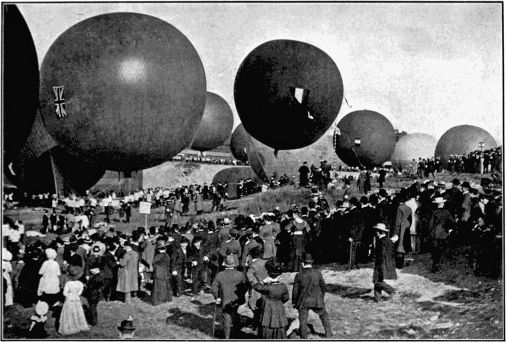
AN INTERNATIONAL BALLOON RACE.
This view was taken before the start of an international balloon race near Berlin. The balloons are of the
ordinary non-dirigible type.
The time was at hand, however, when Montgolfier,
who had always maintained that the true usefulness of
the balloon would be in warfare, was given the opportunity
of seeing his contention verified. On the breaking
out of the French Revolution, balloon corps were at
once pressed into the service of the army. Napoleon
Bonaparte carried with him some balloons on his
Egyptian campaign, partly for the purpose of making
observations, and partly to impress the Arabs with the
superiority of Christian armies. A school of aeronautics
was established at Meudon, and some fifty young men,
sworn to secrecy, assigned to it. Balloons were constructed,
tested, and distributed among the different
divisions of the army, and one of these was used for reconnoitering
the position of the Austrian forces just
before the battle of Fleurus. In the course of the day
two ascents were made in this balloon, which was held
captive by several thousand feet of cable. The second
ascent drew the fire of the enemy's cannon, but the
range was too great and no harm was done. Meanwhile
the French general, Jourdain, was furnished most
valuable information by these aerial voyages.
The Revolutionary wars were also responsible, indirectly,
for the invention of the parachute. It will be
recalled that even as early as the fifteenth century,
Leonardo da Vinci had conceived the idea of a kind of
parachute; and that Blanchard had a spread-canvas
arrangement to produce a similar effect attached to some
of his balloons. It was not until 1799, however, that
the folding umbrella-like parachute was invented, the
inventor, Garnerin, having developed the idea in trying
to devise some means of escape from the fortress of
Buda, Hungary, where he was being kept prisoner after
one of the battles in the North between the Revolutionary
forces and the Austrians and Prussians. Although
he did not actually effect his escape in this dramatic
manner, he finally proved that he had not dreamed in
vain during his imprisonment by demonstrating the
entire practicality of the parachute.
Garnerin's first practical test of his invention was
made in October, 1797, when he ascended to the height
of six thousand feet in a balloon to which was attached
a parachute of the ordinary umbrella type still used.
At that altitude he cut loose the balloon which rushed
upward until it exploded, while the parachute, dropping
rapidly at first, finally settled slowly and gently to the
earth, without injury to the inventor.
The attempts at navigating a balloon having proved
thus far so unsuccessful, many inventors now returned
to the idea of producing a flying-machine which was independent
of the inflated balloon. It was evident that
the resistance presented by the great surface necessary
in a balloon of sufficient size to have the required lifting
power was such that no known efforts of propulsion
could overcome this resistance even in the face of a
slight breeze, to say nothing of a strong wind. The
balloon was by no means abandoned, however, and two
definite schools of aeronauts gradually came into existence,
each having ardent advocates.
As early as 1784, the aeronaut Gérard had proposed
a flying-machine which was to be made with body, wings,
and steering apparatus, in which propulsion was to be
accomplished by the use of escaping gas and gun-cotton.
The inventor himself was so sanguine of the results, and
so many contemporary inventors were of the same opinion,
that when this machine proved to be an utter failure,
the blow to the advocates of the flying-machine was so
great that they did not rally from it for something like a
quarter of a century. In 1809, however, a Viennese
watchmaker named Degen revived interest in attempts
at mechanical flight by inventing a flying-machine which
consisted essentially of two parachutes. These were
worked by hand, and the inventor was said to have been
able to rise to a height of over fifty feet from the ground
"moving in any desired direction."
These claims were not borne out in fact, but they
stimulated an interest in the possibilities of mechanical
flight, and in the parachute, which had never come into
popular favor despite its successful use by the inventor,
Garnerin. Hopes were again entertained that a modification
of this device might be utilized in solving the
problem of aerial flight, and in 1837 an aeronaut, Henry
Cocking, invented a new type in which he proposed to
descend from a balloon. The parachute of Garnerin,
as we know, had been constructed like a huge umbrella,
whereas Cocking's parachute had the general appearance
of an umbrella held upside down. An unusual
interest was aroused in the prospective experiment from
the fact that a great majority of scientists did not consider
that this parachute was constructed on correct
scientific principles, and predicted that the aeronaut
would be killed when he attempted to use it. Before
the day of the trial arrived numerous articles had been
published, presenting arguments for and against Cocking's
device, and on the very day itself one of the newspapers
contained a long article by a leading authority
on aerostatics, reviewing the numerous reasons why the
attempt would surely prove a failure.
Despite the protests of the majority of interested
persons, however, Cocking and a companion named
Green made the ascent at the appointed time. After
rising to a certain height the parachute was cast off, the
parachute's car containing the inventor, while Green
remained in the balloon. Instead of sailing slowly
toward the earth, however, the parachute fell rapidly,
with an oscillating movement, gaining speed and jerking
violently as it descended, until finally when several
hundred feet in the air, Cocking was thrown from the
car and dashed to pieces, while the wreck of the parachute
landed a few yards away. Thus the predictions
of the majority came true, although as we know now, the
cause of the tragedy was due to faulty material rather
than the design of the machine. For the American
aeronaut, Wise, demonstrated a little later that parachutes
built on the same principle as that of Cocking
could be used successfully.
As we have seen, most of the flying-machines attempted
heretofore took for their model the bird with flapping
wings. There were certain persons, however, who had
observed that this flapping movement was not essential
to flight—that certain large-winged birds, such as buzzards
and hawks, were able to soar in any direction at
will, holding their wings rigidly. It was evident, therefore,
that shape, position, and construction of the bird's
wing played quite as important a part as the flapping
movement. The lifting power of plane surfaces, or
aeroplanes, was also carefully studied in this connection
and in 1842 the inventor, Henson, constructed a flying-machine
utilizing this aeroplane principle, his machine
having thin, fixed surfaces, slightly inclined to the line of
motion, and supported by the upward pressure of the
air due to the forward movement.
Everyone will remember the distance to which a skilful
juggler can project an ordinary playing-card by
giving it a certain inclination in throwing. It will
travel upward or on a level, and continue this direction
until the force of the movement of throwing is exhausted.
Obviously, if this force were self-contained in the card—if
it could continue rotating and moving forward—it
could fly indefinitely. Henson had studied and experimented
with these miniature aeroplanes, and was
convinced that if the same principle that governed their
flight were to be applied to larger machines, practical
flying-machines could be made.
"If any light and flat, or nearly flat, article," he wrote,
"be projected edgeways in a slightly inclined position,
the same will rise on the air till the force exerted is expended,
when the article so thrown or projected will
descend; and it will readily be conceived that if the
article possessed in itself a continuous power or force
equal to that used in throwing or projecting it, the article
would continue to ascend so long as the forward part of
the surface was upward in respect to its hinder part, and
that such article, when the power was stopped, or when
the inclination was recovered, would descend by gravity
only if the power was stopped, or by gravity, aided by
the force of the power contained in the article, if the
power be contained, thus imitating the flight of a bird."
But when Henson attempted to fly in his elaborately
planned and constructed flying-machine, it proved a
complete failure. It showed a tendency to rise, but its
lifting power was insufficient for the weight of the engine
driving the propellers. It was evident, however, that if
the power of the engine could be sufficiently increased,
or, what amounts to the same thing, its weight sufficiently
lightened, a machine built on the aeroplane principle
could be made to fly. But at that time the lightest
type of engine was a crude, heavy machine, and for the
moment nothing more was attempted in producing a
mechanical flying-machine propelled by steam.
Meanwhile the possibility of producing a dirigible
balloon was again brought into prominence by the suggestion
of two aeronauts, Scott and Martainville, to
change the shape of the envelope of the balloon. Hitherto,
all balloons had been made globular or pear-shaped—shapes
that offered great resisting surfaces to the atmosphere.
Now it was proposed to make them in the form
of long, horizontal cylinders, with pointed ends, these
cigar-shaped, or boat-shaped balloons offering much
less resistance. But here, as in the case of the flying-machine,
engines that were sufficiently strong to work
the propellers were found to be too heavy for the balloon
to lift. Meanwhile the aeroplane idea was brought into
prominence from an unexpected quarter.
Among the numerous observers in the middle of the
century who had noted the soaring power of birds, was
a French sea-captain named Le Bris. On his long
voyages he had studied the movements of the great
albatross, which, with wings rigidly distended, outsailed
the swiftest ship without any apparent exertion. Anxious
to study the wing-mechanism of this bird, the captain,
overcoming the scruples of the mariner against killing
the sacred sea-rover, shot one of the birds. On removing
a wing and spreading it in the wind he thought that
it had a very appreciable tendency to pull forward into
the breeze, and tended to rise when the wind was strong.
Convinced that by duplicating the shape of the bird he
could construct a successful flying-machine, Le Bris set
to work and succeeded in producing a most remarkable
"air-ship."
The body of this machine, which was supposed to
correspond to the body of the bird, was made boat-shaped,
and was about thirteen feet long and four feet
wide, being broadest at its prow, in imitation of the
breast of the bird. The front part was decked over,
something like the bow of the modern torpedo-boat,
and through this deck protruded a small mast which
was used for supporting the pulleys and cords used in
working the machinery of the wings. Each wing was
about twenty-five feet long, so that the entire spread of
the machine was fifty feet. There was a tail-like
structure so hinged that it could be used for steering up,
down, and sidewise, the total area of surface presented
to the atmosphere being something over two hundred
square feet, although the entire "albatross" weighed
something less than a hundred pounds.
The front edges of the wings were made of pieces of
wood fashioned like the wings of the albatross, and
feathers were imitated by a frame structure covered
with canton flannel. The front edges of the wings
could be given a rotary motion to fix them at any desired
angle by an ingenious device worked by two levers. In
operating this artificial bird the captain proposed to
stand in the boat and control its flight by these sets of
levers and by balancing his body.
Having full confidence in the ability of his invention
to soar once it had been given an initial velocity, the
captain selected a morning when a good breeze was
blowing and hired a cart-driver to carry him out into
the neighboring fields. The machine was placed horizontally
upon the cart and fastened to it with a rope
which could be loosened by the pulling of a slip-knot
held by the captain, who took his position in the boat.
On reaching the open country the driver put his horse
into a brisk trot when, the levers controlling the wings
being set, the machine rose gracefully into the air and
travelled forward a distance of perhaps a hundred yards.
At this moment the running-rope in some unaccountable
manner became wound about the body of the driver,
hauling him unceremoniously from his seat, and dangling
him writhing and shrieking at the end of the rope,
several feet above the ground. As it happened, his
weight was just sufficient to counterbalance the wind,
so that acting in the capacity of the tail of a kite, he
assisted materially, if involuntarily, in keeping the
artificial bird in flight.
When the captain became aware of what was going
on below, he altered the angle of the wings and came
slowly to the earth, descending without accident either
to himself or to his machine. All things considered,
this was a remarkable performance, and it was so considered
by people in the neighborhood, who made a hero
of the gallant mariner. His next attempt, however,
was less successful. Something went wrong with the
machine shortly after starting, landing the inventor in a
stone-quarry with a broken leg and a shattered machine.
This accident also shook the courage of the captain,
and for several years he made no more attempts at
flight, confining his attention to sailing a coasting-vessel.
But his faith in his "albatross" never wavered, even if
his courage did for a time, and in 1867 he began building
a more elaborate machine, aided by public subscriptions.
The outlook for this new device seemed very
promising, several fairly successful flights of perhaps
two hundred yards having been made, when a sudden
gust of wind catching up the machine one day during
the momentary absence of the inventor, dashed it to
pieces upon the ground. This was the final blow to the
hopes of Captain Le Bris, who made no further attempts,
his means and his energies being entirely
exhausted.
Meanwhile the advocates of the dirigible balloon had
not remained idle, many of them attempting to utilize
the principle of the aeroplane in connection with a
balloon. Some of these machines were of most fantastic
design, but one in particular, that of Mr. Henri Giffard,
succeeded so well, and proved to be dirigible to such an
extent, that Giffard is sometimes referred to by enthusiastic
admirers as "the Fulton of aerial navigation." In
principle, and indeed in general appearance, this
balloon was not unlike some of the balloons built by
Santos-Dumont fifty years later. It had the now-familiar
cigar shape, common to most modern dirigible
balloons; and beneath was suspended a car carrying a
steam-engine that worked a screw propeller. The
rudder, placed at the stern just below the balloon in a
position corresponding to the rudder of a ship, was a
large canvas sail set in a frame. The envelope of the
balloon was one hundred and fifty feet long and forty
feet in diameter and contained about ninety thousand
cubic feet of coal-gas. To lessen the danger of igniting
this from the engine, Giffard arranged the chimney so
that it pointed downward, and suspended it some forty
feet below the envelope.
On September 24, 1852, he rose from the Paris Hippodrome,
and succeeded in making a headway of from
five to seven miles an hour in the face of a strong wind.
In response to the rudder his balloon performed some
difficult evolutions, turning right or left at the will of
the operator. He continued his maneuvers for some
time, and then extinguishing his fire, opened the valve
and returned safely to the ground. This was a great
victory for the advocates of the dirigible balloon, and
was indeed a performance that has not until recently
been surpassed in the fifty years that have intervened
since that time. But despite this initial success, Giffard
soon renounced the field of aeronautics, and no worthy
successor appeared to take his place for more than a
quarter of a century.
One of the most remarkable balloons ever constructed,
and one of the most remarkable voyages ever made in
any balloon, was that of the mammoth aerostat constructed
by the noted Parisian photographer, Nadar, in
1863. Nadar belonged to the school of aviators who
opposed the principle of the balloon as against that of
the aeroplane, and his idea in constructing this leviathan
balloon was simply for the purpose of raising money so
that he might build a practical flying-machine, constructed
on the aeroplane principle, and which, he declared,
would revolutionize air navigation. The Giant,
he said, would be the last balloon ever constructed, as
thereafter air-ships, made on the principle of the one he
was about to construct, would supplant balloons entirely.
His plan was to make the ascent in the Giant from some
large enclosed field near Paris, and the admission price
of one franc to be charged for entering the field was
to supply funds for defraying the expense of building
the Giant, the surplus to be used in constructing his
flying-machine.
In making the Giant twenty-one thousand yards of
silk were used, the balloon being over two hundred feet
in height, with a lifting capacity of nine thousand pounds.
It was built as a double balloon, one within the other,
this being the idea of the aeronaut, Louis Godard, as a
means of preserving the excess of gas produced by dilation
at different altitudes, instead of losing this excess
as was usual with balloons constructed in the ordinary
manner. But perhaps the most interesting thing about
this balloon was the structure of the car and its contents.
Like the ordinary car it was constructed of wicker work,
but was of the proportions of a small house, being built
two stories high, with an upper platform like the deck
of a ship, on which the passengers could stand. In
the two floors below were a saloon, compartments for
scientific instruments, sleeping-cabins, and practically
all the conveniences of a small, modern house. In the
car and suspended about it were wheels, guns, a printing-press,
cameras, cages of carrier-pigeons, baskets of wine
and provisions, games, and an "abundant supply of
confectionery."
The first ascent was made from the Champs de Mars,
and twenty-five thousand persons paid the admission
fee to witness it. This did not by any means represent
the number of persons on the field, as the barriers were
broken down in many places early in the day, and a
majority of the spectators thus gained free admission.
Fifteen persons made the ascent upon this occasion,
but instead of making a protracted voyage as intended
at first, the balloon was brought to the earth at nine
o'clock in the evening only a few leagues from Paris.
It is said that this landing was made contrary to the
wishes of Nadar, but in deference to the opinion of the
Godard brothers, who believed that the balloon was
being carried out to sea, whereas, in point of fact it was
travelling due east, directly away from the Atlantic.
Three weeks later the second ascent was made, on
this occasion eight instead of fifteen persons starting on
the voyage. These were under the immediate command
of Nadar, whose position was that of the captain
of a ship on the high seas, and whose authority none
might presume to question. A set of rules governing
the conduct of those on board and setting forth explicitly
the authority of the captain was posted in the
cabin, the nature of some of these giving a cue to the
peculiar attitude of mind of the originator of the scheme.
For example, it was ordered that "Silence must be
absolutely observed when ordered by the captain."
"All gambling is expressly prohibited." "On landing
no passenger must quit the balloon without permission
duly acquired from the captain."
The ascent was again successful, the balloon travelling
in a northeasterly direction during the night, all the
passengers remaining awake and alert, having constantly
in mind the danger of falling into the sea. The
following morning on descending to a lower altitude
through the clouds, the voyagers found that they were
passing the border of Holland, near the sea. At this
point an attempt was made to land, but a violent gale
having arisen, the anchor cables were broken, and the
car was dragged along the surface of the ground at
terrific speed, striking and rebounding into the air,
dragging through marshes and rivers, bruising and
battering the occupants who were unable either to leave
the balloon or to check its flight. As they were whirling
across the country in this manner an immense forest
came into view directly in their path, and believing that
when this was reached every occupant of the car would
be dashed to pieces against the trees, they decided to
take their chances by leaping. One after another they
jumped, striking the earth and turning over and over,
breaking bones, and mangling faces and bodies. The
only female occupant of the car, Mrs. Nadar, was fortunate
in alighting in a river without serious injury.
Others received only slight bruises or a severe jolting
while the most unfortunate, M. St. Felix, had a broken
arm, a dislocated ankle, and numerous cuts and
bruises.
Later the Giant was captured many miles farther on
and returned to its owners in Paris. Subsequently it
made numerous voyages, none of which was particularly
profitable, however, so that the purpose for which it
was designed was not fulfilled, and Nadar's proposed
air-ship was never constructed.
While the Giant was the largest balloon hitherto
constructed, it broke no records either for speed attained
or distance travelled, and much more notable performances
in this respect had been made before its time and
have been made since. Thus, one of Coxwell's balloons
traveled from Berlin in the direction of Dantzig, covering
the distance of one hundred and seventy miles in
three hours. This was in 1849; and in the same year
M. Arban crossed the Alps from Marseilles to Turin,
covering the distance of four hundred miles in eight
hours. In July, 1859, the American aeronaut, John
Wise, sailed from St. Louis, Missouri, to Henderson, in
New York State, in nineteen hours, travelling eight
hundred and fifty miles at the rate of forty-six miles an
hour. This was the longest voyage ever made until
the time of the balloon-races started from the Paris
Exposition, in 1900. On this occasion Conte de la
Vaux, starting from Paris, remained in the air thirty-five
hours and forty-five minutes, landing at Korosticheff,
in Russia, 1193 miles from the starting-point, thus breaking
all previous records.
Despite the fact that the "aviators"—the aeronauts
whose efforts were directed to flight by mechanical
means in imitation of birds, or by the use of what are
now called aeroplanes—were in the field centuries before
the balloon was invented, from the time of the first
Montgolfier balloon until very recently, the balloonists
had shown their rivals a clean pair of heels in practical
results. A dirigible, man-carrying balloon that can be
guided under favorable conditions, and can maintain
itself in the air for any considerable length of time, was
an accomplished fact at least five years before the practical
aeroplane flying-machine. Yet the majority of
scientists had become convinced several years before
their convictions were verified by actual demonstration,
that some type of mechanical flying-machine—a
machine that is heavier than the atmosphere and that
maintains itself by some mechanical means—was the
only one likely to solve the question of aerial flight.
Yet thus far balloons have rendered more actual service
to man than flying-machines.
It will be recalled that balloons were used for making
military observations during the French Revolution;
and they were used for similar purposes in several of the
Continental wars during the first half of the nineteenth
century. After that time, however, interest in their
use for this purpose flagged somewhat until the time
of the Crimean War, when their usefulness was again
demonstrated, as it was in the American Civil War
which followed shortly after.
But it was not until the Franco-Prussian War that
the one thing for which the Montgolfiers had predicted
their usefulness in warfare—that of sending messages
out from a closely besieged city—was put to practical
test. During the siege of Paris by the Germans in
1870–71, when every other possible means of communication
had been cut off, the Parisians still kept in communication
with the outside world by means of balloons
and carrier-pigeons. On September 23rd, the first
ascent of the siege was made by the aeronaut Durouf,
who carried a large number of despatches from the city,
landing near Evreux, after being in the air about three
hours. The success of this journey and several others
that quickly followed led the French Government to
establish a regular balloon-post, and to undertake the
manufacture of balloons for this purpose. The mere
matter of balloon construction offered no difficulty but
a more serious one was met in the lack of experienced
aeronauts. In this emergency, however, it occurred to
the authorities that sailors, accustomed to climbing
about at dizzy heights, might be taught to take the place
of trained aeronauts. This experiment proved most
successful, and in subsequent voyages these mariners
maintained their reputation for daring undertakings.
Between September and January sixty-four balloons
were sent up, all but seven of which fulfilled their mission
and delivered their despatches; and the total number
of persons leaving Paris in balloons during the siege
was one hundred and fifty-five. These carried with
them a total of nine tons of despatches and something
like three million letters, the speed with which these
journeys were made ranging from a minimum of twenty
miles an hour to a maximum velocity, in one instance, of
eighty miles.
Shortly after this balloon-post was established, the
Germans came into possession of the new Krupp long-range
rifle, with which they succeeded in bringing down
several of the balloons. Companies of Uhlans, the
swiftest cavalry of Germany, scoured the country constantly,
and kept such a sharp lookout that, as the
German lines were extended, it became difficult for the
balloons to make their way over them in daylight.
Night voyages, therefore, became necessary; but naturally
these were extremely dangerous, and many of them
had dramatic and tragic terminations. One of the
longest and most famous of these voyages was that of
the balloon named the Ville d'Orléans, which left Paris
about midnight of November 24th. As a strong wind
was blowing from the north at the time, it was hoped
that the balloon would descend in the vicinity of Tours.
The first intimation that the voyagers had that there
was a deviation from this course was the sound of the
waves breaking against the shore beneath them. At
this time they were in a thick mist, and it was not until
some time after daybreak that this mist cleared away
sufficiently for them to get an idea of their surroundings.
Then they found, to their horror, that they were over
a large body of water, out of sight of land, in what part
of the world they had not the slightest idea. The
balloon appeared to be drifting rapidly, and from time
to time they passed over vessels, which were frantically
signaled by the voyagers. No notice was taken of these
signals except by one vessel, which responded by firing
several shots which went wide of the mark. The
balloon continued on its course northward until late in
the day when land was sighted lying to the northeast.
By this time the ballast in the car had been entirely
expended, and the balloon, which had been sinking
gradually for several hours, seemed about to plunge into
the ocean. In this extremity a heavy bag of despatches
was thrown out, and the balloon thus lightened again
rose to a considerable height, where another current of
air carried it over the land.
A successful landing was made in Norway, in a desolate
but friendly region, where the balloonists were
treated with the greatest kindness. The balloon and
its contents were subsequently secured, and all the despatches
delivered to their proper destinations, except,
of course, the one package that had been thrown out as
ballast.
A week after the eventful voyage of the Ville d'Orléans
a still more unfortunate ascent was made by a
sailor named Prince, in the balloon called the Jacquard.
As the ropes releasing this balloon were cut, the enthusiastic
mariner, standing in his car and extending
his hand toward the crowd, shouted dramatically, "I
go upon a great voyage!" He did—and on one much
greater than he anticipated—for the balloon was blown
out to sea and lost. As he was passing over England
after successfully crossing the Channel, he threw out his
package of despatches, but this so lightened his balloon
that it mounted quickly and was soon far out over the
Atlantic. It was never heard of again. But the life of
the enthusiastic voyager was not given in vain, for most
of the despatches eventually reached their destination.
Although, as has been seen, the balloons sent out of
Paris were not of the dirigible kind, and were entirely
dependent upon the caprice of the winds, they fulfilled
their missions quite as well as could be expected under
the circumstances. In fact, there was small chance of
failure, starting as they did from a central point, and
being almost certain of success no matter what direction
was taken, except, indeed, the one that would blow them
over the German frontier. But the other part of the
problem—the sending of balloons from the outside into
Paris—was an entirely different proposition. So different,
and so difficult, in fact, that it was never accomplished,
although attempted several times.
But the millions of people in Paris, shut off completely
from the outside world, were just as anxious to
receive news as to send it. In attempting to establish
communication from without, therefore, one balloon leaving
the city in the early days of the siege, carried with it
some trained dogs in the hope that they would make their
way back to the city through the German lines. But
either they lost their way, or were captured by the enemy,
for nothing was ever heard of them after starting on the
return trip. In this extremity the members of the
"Société Colombophile" came forward with the offer
of the use of their homing-pigeons. The society had a
large number of these birds, trained to return to their
cotes from long distances, and the experiment of sending
return despatches with them was tried at once. Three
birds were first sent out in one of the despatch-balloons,
and within sixteen hours after starting these had all returned
to the capital, bearing despatches. During the
next few days a score more pigeons were sent out, eighteen
of which returned safely with their messages; and
thereafter a regular pigeon-post was organized.
As the weight that a pigeon is able to carry in its
flight is extremely small, microscopic photography was
resorted to, so that, although each bird carried only a
single quill in which were rolled thin collodion leaves,
the whole weighing only fifteen grains, the amount of
printed matter thus carried was sometimes more than
is contained in an ordinary volume.
By photographic methods, thirty-two thousand words,
or about half an ordinary volume, were crowded upon a
pellicule two inches long by one and one-quarter inches
wide, and weighing about three-quarters of a grain!
Twenty of these, representing six thousand words, or
twice the amount of printed matter contained in such a
book as Scott's Ivanhoe, or Prescott's Conquest of
Mexico, were carried by each pigeon. One bird carried
forty thousand complete messages on a single trip.
When the bird arrived at its cote, the quill was secured
and taken to the government office, where the little
leaflets were carefully removed, placed in an enlarging
optical apparatus, thrown upon a screen with a magic
lantern, and copied. The messages were then distributed
to their destination about the city.
By this war, France, the home of the balloon, was
brought keenly to realize the advantages and the limitations
of such flying-machines; and it was but natural,
under the circumstances, that as soon as peace was
restored, efforts should be made there to produce a dirigible
balloon, or some other form of dirigible flying-machine.
Giffard, as we have seen, had been fairly
successful; and now M. Dupuy de Lome, chief naval
constructor of France, took up the problem. He constructed
a balloon with a cigar-shaped envelope one
hundred and twenty feet long and fifty feet in diameter.
Beneath this was a rudder placed in the same position
as that of a ship; and suspended still further below was
a large car fitted with a two-bladed screw-propeller,
thirty feet in diameter. Manual labor was to be used
for turning this screw, two relays of four men each relieving
each other at the work. An ascent was made in
February, 1872, with fourteen persons in the car, who,
by working in relays, demonstrated that a speed of about
seven miles an hour could be maintained in any direction
in still air. As the wind was blowing about thirty
miles an hour at the time, however, the course of the
balloon could only be deflected, and the main object of
the ascent—the return to Paris—could not be accomplished.
In short, De Lome's balloon demonstrated
little more than had been accomplished by Giffard with
his steam-driven balloon. Both had shown that with
sufficient power the balloon could be made to travel in
any direction in still air, but neither had been able to
make headway against a strong wind.
It was estimated at the time of Dupuy de Lome's
ascent, that had a steam-engine of a weight corresponding
to that of the eight workmen been used, at least
twice the power could have been obtained. But steam
was considered too dangerous, and some other motive
power which combined lightness with power seemed
absolutely essential. The electric motor gave promise
of success in this direction, and in 1883 the two Tissandier
brothers in France applied such a motor to a
balloon that was able to make headway against a seven-mile
breeze, but was still far from fulfilling the requirements
of an entirely dirigible balloon. Two years later
the motor-driven balloon La France, of Renard and
Krebs, attained a speed of fourteen miles an hour, and
showed a distinct advance over all preceding models.
Meanwhile motors were being reduced in weight and
increased in power, and the hearts of aviators and
balloonists were cheered by the fact that the light metal,
aluminum, was steadily growing cheaper. Visions of
an all-aluminum balloon were constantly before the
minds of the inventors, and in 1894 such dreams took
practical form in a balloon whose construction was
begun by Herr Schwartz, under the auspices of the
German Government. This balloon was of most complicated
construction, depending for its lifting power
upon the gas-filled aluminum tank, but utilizing for its
steering-gear many of the features of the aeroplane.
It was essentially a balloon, not a flying-machine, however,
with a ten to twelve horse-power benzine-engine
actuating four propelling screws.
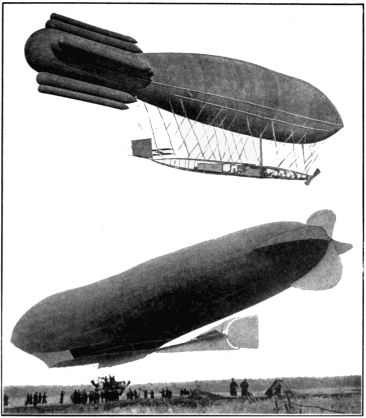
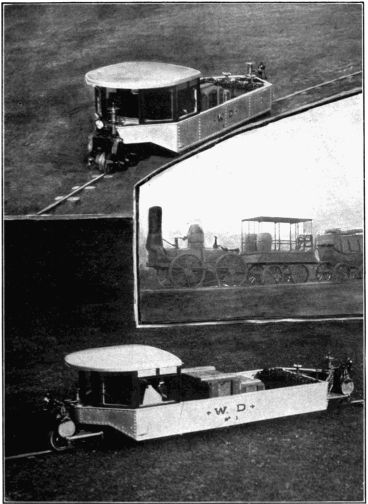
TWO FAMOUS FRENCH WAR BALLOONS.
The lower figure the dirigible war balloon "La Patrie," which manœuvered
on the Eastern boundary of France, and which was blown away and lost taking
a northwesterly direction which probably landed it ultimately in the Arctic Sea—in
1908. The upper figure represents M. Deutsch's dirigible balloon "Ville de
Paris" which was sent to the frontier to take the place of the lost "Patrie."
Before the balloon was completed Herr Schwartz
died, but his plans were known to his wife, and, although
considerably altered, were carried to completion. When
all was finished, Herr Jaegels, an engineer who had had
no experience as an aeronaut, volunteered to make an
ascent and this metal ship-of-promise was launched.
At first it rose rapidly and appeared to be making good
progress against a strong wind; but suddenly it stopped,
descended rapidly, and was smashed to pieces, the
aeronaut saving himself by jumping just before it
touched the ground. It developed later that he had
lost control of the machine, simply because the machinery
was too complicated for a single operator to handle.
On discovering this, Herr Jaegels, confused for the
moment, threw open the valve, causing the balloon to
descend too rapidly. Thus the fruit of years of study
and labor and the expenditure of fifty thousand dollars
in money resulted in only about six minutes of actual
flight.
To most persons this experiment of the aluminum
balloon would seem to have been a dismal failure, but
it was not so regarded by the advocates of the dirigible
balloon. The flight of the balloon, to be sure, was far
from a success; but this was attributed to improper
management rather than to any inherent defect in the
balloon itself, or in the principle upon which it was
constructed. Instead of being discouraged, therefore,
the school of balloonists, who had lost some of
their prestige of late by the performances of the flying-machines
of Maxim and Langley, undertook, through
their enthusiastic representative, Count Zeppelin, the
construction of the largest, most expensive, and most
carefully built dirigible balloon heretofore constructed.
This balloon was of proportions warranting the name
of "air-ship." The great cigar-shaped body was almost
four hundred feet in length, and thirty feet in
diameter—the proportions of a fair-sized ocean liner—and
like the hull of its ocean prototype, was divided
into compartments—seventeen in number, and gas-tight.
Its frame-work was of aluminum rods and wires,
and the skin of the envelope was made of silk, coated
with india-rubber. It was equipped with four aluminum
screws, and two aluminum cars were placed below
the body at a considerable distance apart. The
motive power was supplied by benzine motors, selected
because of their lightness.
The company for constructing this balloon was capitalized
at about two hundred thousand dollars, the cost
of the shed alone, which rested on ninety-five pontoons
on the surface of the lake of Constance, near the town
of Manzell, being fifty thousand dollars. July 2nd, 1910,
the count and four assistants in the cars, started on the
maiden voyage. The balloon rose and made headway
at the rate of eighteen miles an hour, responding
readily to the rudder, but soon broke or deranged
some of the steering-gear so that it became unmanageable
and descended at Immerstaad, a little over three
miles from the starting-point. Considering the amount
of thought, care, and money that had been expended
upon it, its performance could hardly be looked upon
as a startling success. By the advocates of the aeroplane
principle it was considered an utter failure.
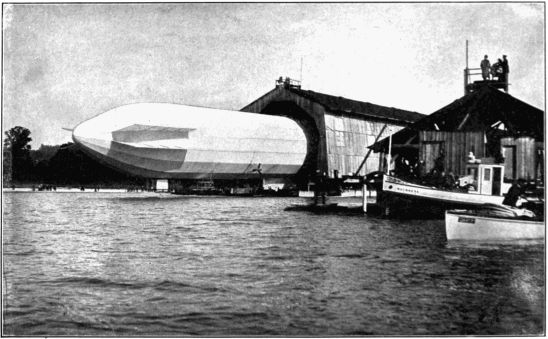
THE ZEPPELIN DIRIGIBLE BALLOON.
Count Zeppelin's famous balloons are of the semi-rigid type, being cased in thin loops of aluminum. The wing-like
projections at the sides add greatly to the stability and dirigibility of the balloon. The problem of housing has been met
by erecting a structure over the water. It is planned to have a balloon house that will revolve and thus facilitate the introduction
of the balloon whatever the direction of the wind. With the above stationary house this is a difficult manœuvre
if the wind chances to blow laterally.
But while Count Zeppelin was experimenting with
his ponderous leviathan air-ship, a kindred spirit, the
young Brazilian, M. Santos-Dumont, was making experiments
along similar lines, but with balloons that were
mere cockle-shells as compared with the German monster.
The young inventor had come to Paris from his home
in South America backed by an immense fortune, and
by a fund of enthusiasm, courage, and determination
unsurpassed by any aerial experimenter in any age. He
began at once experimenting with balloons of different
shapes, with screws and paddles, and, perhaps most
important of all, with the new, light petroleum-motors
just then being introduced for use on automobiles,
electricity not having proved a success in aerial experiments.
His first balloon, No. 1, built in 1898, was devoid of
any particularly novel features. His No. 2 showed
some advancement, and his No. 3, while a decided improvement,
still came far short of answering the requirements
of a dirigible balloon. But the young experimenter
was learning and profiting by his failures—and,
incidentally, was having hairbreadth escapes from death,
meeting with many accidents, and being severely injured
on occasion.
About this time a prize of one hundred thousand
francs was offered by M. Deutsch to the aeronaut who
should ascend from a specified place in a park in Paris,
make the circuit of the Eiffel Tower, and return to the
starting-point within half an hour. With the honor of
capturing this prize as an additional incentive, Santos-Dumont
began the construction of his fourth balloon,
the Santos-Dumont No. 4. In this balloon everything
but bare essentials was sacrificed to lightness, even the
car being done away with, the aeronaut controlling the
machinery and directing the movements of the balloon
from a bamboo saddle. But an accident soon
destroyed this balloon, and a fifth was hastily constructed.
With this the enthusiastic aeronaut showed
that he was almost within grasping distance of the prize
in a series of sensational flights between the first part of
July and the first week in August. The tower was
actually rounded, but on the return trip the balloon
collided with a high building in the Rue Alboni and was
wrecked, the escape of the aeronaut without a scratch
being little short of miraculous.
Nothing daunted, the inventor began the construction
of Santos-Dumont No. 6 immediately, finishing
it just twenty-eight days after the construction of
No. 5. A peculiarity of this balloon was that it was
barely self-sustaining except when forced through the
air by the propeller. The long cigar-shaped gas-bag
was relatively small, and was filled to its limit of capacity
with gas, while the lifting power was counterbalanced
by the operator, car, engine, and ballast, so that the
entire structure weighed practically the same as the air
it displaced. At the stern was a powerful propeller.
Obviously, then, if the long spindle-shaped machine
was tilted upward at the forward end, and the propeller
started, it would be driven upward; while if the forward
end was lowered the propeller would drive it
downward. If it was balanced so as to be perfectly
horizontal, it would be forced forward in a horizontal
direction. Deflections to right and to left were obtained
by the ordinary type of vertical rudder; and thus any
direction could be taken.
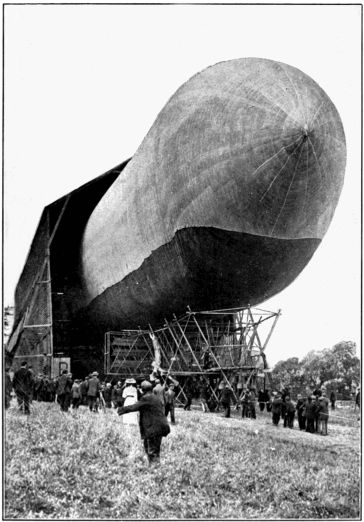
AN ENGLISH DIRIGIBLE BALLOON.
The photograph here reproduced gives a very vivid impression of the cumbersome
nature of balloons of this modern type, and suggests the difficulties to be met
in housing them safely when not in use.
To obtain the desired angle of inclination, Santos-Dumont
made use of a sliding weight, and with this he
guided his balloon upward and downward by shifting
its position. Thus, although this balloon was a veritable
balloon rather than a "flying-machine" proper, it
really lacked the one essential common to balloons:
it would not rise until propelled by mechanical means.
It lacked the requisite of the flying-machine, however,
in that it was not "many times heavier than the air."
After giving this new balloon several preliminary trials,
which included such exciting incidents as collisions
with a tree in the Bois du Boulogne, an official attempt
was made on October 29th, 1800. Above the heads of
the gaping thousands, who, to a man, wished the daring
navigator success, the balloon rounded the tower, and
in twenty-nine minutes and thirty seconds from the
moment of starting—thirty seconds less than the
prescribed time-limit—the trip was successfully terminated.
This voyage must be considered as marking an epoch
in aerial navigation. The dirigible balloon was accomplished.
A decided step forward in the conquest of the
air had been made, although from a practical standpoint
this step was confessedly a short one. For while No.
6 could be propelled in any direction under ordinary
conditions, carrying a single passenger, it was on the
whole more of a toy ship than a practical sailing-craft.
Nevertheless, its performance was a decided victory for
the balloon over the flying-machine. No flying-machine
of whatever type had ever even approached the performance
of Santos-Dumont No. 6, which had carried a
man on a voyage in the air, traveling with the wind,
against it, and with the wind on either quarter at every
possible angle at various times during the journey. And
yet there were few scientists, indeed, if any, who considered
that the problem of aerial navigation was
solved; and to a large number Santos-Dumont's performance
seemed little more than an extension of
Giffard's idea, made possible by improved machinery
not available half a century ago. To them it was the
triumph of the energy, skill, and courage of an individual,
not the triumph of a principle—which, after all,
is the absolute essential.
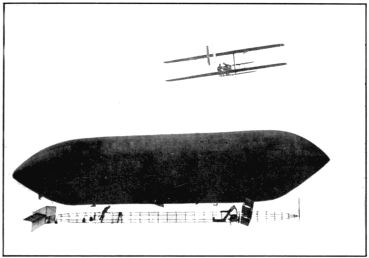
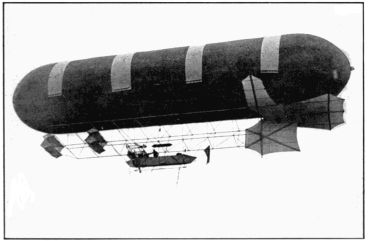
ENGLISH (LOWER FIGURE) AND AMERICAN DIRIGIBLE WAR BALLOONS AND A
WRIGHT AEROPLANE.
The above figures are introduced on one page for the purpose of comparison
and contrast. The American balloon is the Baldwin airship. The essential clumsiness
of a lighter-than-air craft, as contrasted with the relative gracefulness and
manageableness of the aeroplane, is strikingly suggested by this illustration.
Since the successful performance of Santos-Dumont
in rounding the Eiffel Tower many other dirigible balloons
have been constructed, not only in America and
in Europe by various inventors, but by the Brazilian
aeronaut himself. The most remarkable of these is
the Zeppelin II, the fifth creation of the indomitable
Count Zeppelin. In principle and general lines of
construction this balloon closely resembles the one
described a few pages back. Its best performance,
however, is more remarkable. Starting from Lake
Constance on the night of May 29th, 1909, and sailing
almost directly northward regardless of air currents, the
balloon reached Bitterfield, a few miles beyond Leipzig,
four hundred and sixty-five miles from the starting-point,
the following evening. Turning back at this
point, without alighting, it had almost completed its
return trip, when on coming to the ground for a supply
of fuel it was injured by collision with the branches of a
tree. The injury sustained, while delaying and marring
the voyage, did not prevent the balloon from completing
its eight-hundred-and-fifty mile voyage, and establishing
a new record for dirigibles.
This and sundry other flights amply demonstrated
the dirigibility and relative safety of the balloon under
varying atmospheric conditions. But the difficulties
that attend the management of such a craft when not
high in air were again vividly illustrated when, in April,
1910, the Zeppelin II., was totally wrecked while at
anchor by the force of a gale which it might easily have
outridden had it been beyond the reach of terrestrial
obstacles.