When the ‘Company of Death’ repulsed the German army
of Frederick Barbarossa on the field of Legnano41 it raised
aloft before the eyes of Europe not only the banner of democracy
but also of nationality. Others, as we have seen, followed these
banners once displayed: the Swiss Cantons shook off the
Habsburg yoke: the Flemish towns defied their counts and
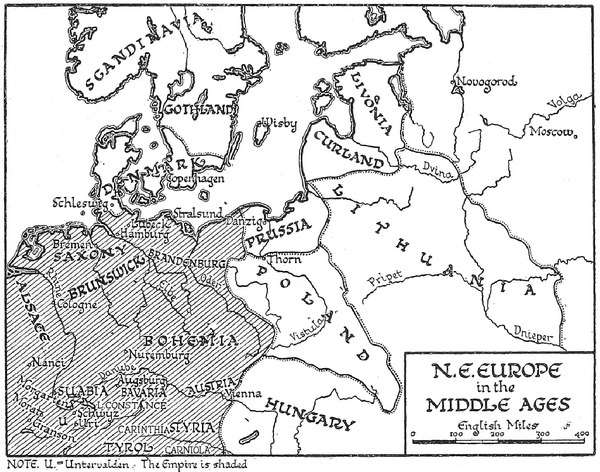
French overlords: the Hanse cities formed political as well as
commercial leagues against Scandinavia: France, England, and
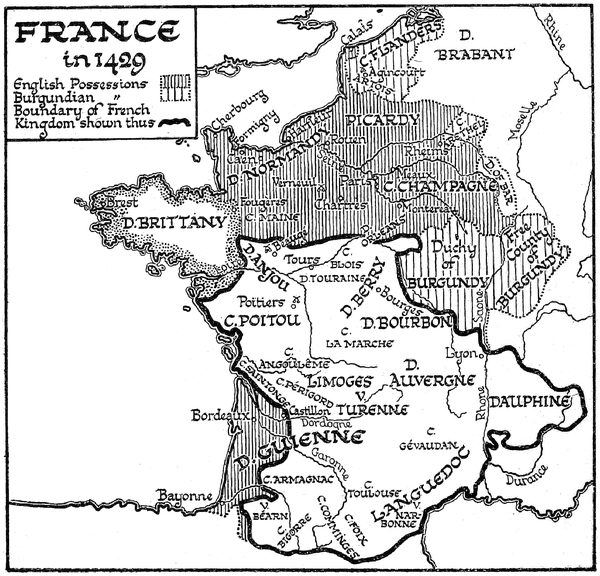
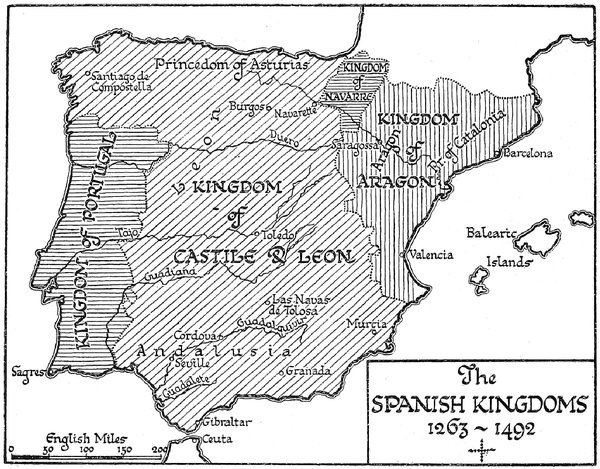
Spain emerged, through war and anarchy, modern states
conscious of a national destiny.
This slow evolution of nations and classes is the history of the
later Middle Ages; but in Italy there is no steady progress to
record; rather, a retrogression that proves her early efforts to
secure freedom were little understood even by those who made
them.
Frederick II had ruled Lombardy in the thirteenth century
through tyrants; but, long after the Hohenstaufen had disappeared,
and the quarrels of Welfs and Waiblingen had
dwindled into a memory in Germany, the feuds of Guelfs and
Ghibellines were still a monstrous reality in towns south of the
Alps, where petty despots enslaved the Communes and reduced
the country to perpetual warfare.
At length from this welter of lost hopes and evil deeds there
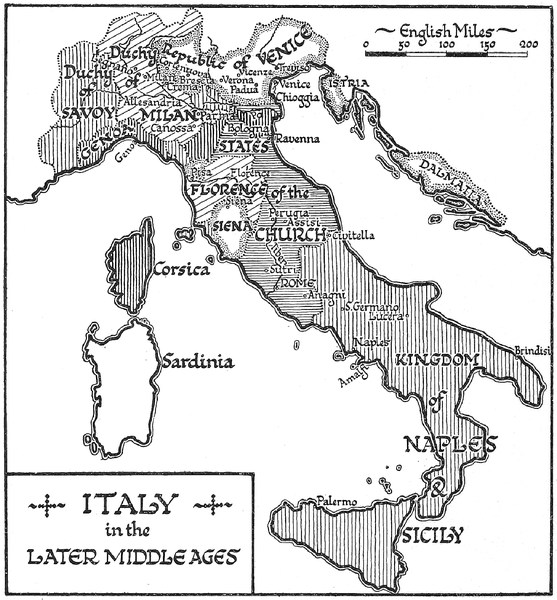
emerged, not Italy a nation, but five Italian states of pre-eminence
in the peninsula, namely, Milan, Venice, Florence,
Naples, and Rome. Each was more jealous of the other than
of foreign intervention, so that on the slightest pretext one
would appeal to France to support her ambitions, another to
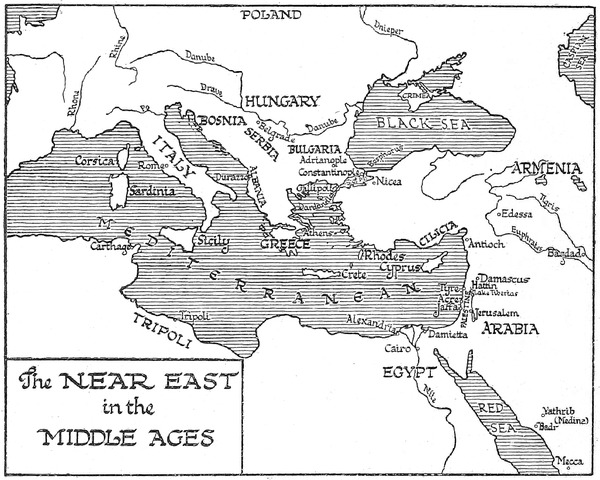
Spain or the Empire, and yet a third to Hungary or the Greeks.
If Italy, as a result, became at a later date ‘the cockpit of
Europe’, where strangers fought their battles and settled their
fortunes, it was largely her lack of any national foresight in
mediaeval times that brought on her this misery.
ITALY
in the LATER MIDDLE AGES
The history of Milan, first as a Commune fighting for her
own liberty and destroying her neighbour’s, then as the battle-ground
of a struggle between two of her chief families, and finally
as the slave of the victor, is the tale of many a north Italian
town, only that position and wealth gave to the fate of this
famous city a more than local interest.
The Visconti
The lords of Milan in the fourteenth and early fifteenth
centuries were the Visconti, typical tyrants of the Italy of their
day, quick with their swords, but still more ready with poison or
a dagger, profligate and luxurious, patrons of literature and art,
bad enemies and still worse friends, false and cruel, subtle as the
serpent they so fittingly bore as an emblem. No bond but fear
compelled their subject’s loyalty, and deliberate cruelty to
inspire fear they had made a part of their system.
Bernabò Visconti permitted no one but himself to enjoy the
pleasures of the chase; but for this purpose he kept some five
thousand savage hounds fed on flesh, and into their kennels his
soldiers cast such hapless peasants as had accidentally killed
their lord’s game or dared to poach on his preserves.
No sense of the sanctity of an envoy’s person disturbed
this grim Visconti’s sense of humour, when he demanded of
messengers sent by the Pope with unpleasant tidings whether
they would rather drink or eat. As he put the question he
pointed towards the river, rushing in a torrent beneath the
bridge on which he stood, and the envoys, casting horrified eyes
in that direction, replied, ‘Sir, we will eat.’ ‘Eat this, then,’
said Bernabò sternly, handing them the papal letter with its
leaden seals and thick parchment, and before they left his
presence the whole had been consumed.
Galeazzo Visconti, an elder brother of Bernabò, bore an even
worse reputation for cruelty. Those he condemned to death
had their suffering prolonged on a deliberate programme during
forty-one days, losing now an eye, and now a foot or a hand,
were beaten, forced to swallow nauseous drinks, and then, when
the agony could be prolonged no further, broken on the wheel.
The scene of this torture was a scaffold set in the public gaze that
Milan might read what was the anger of the Visconti and
tremble.
The most famous of this infamous family was Gian Galeazzo,
son of Galeazzo, a youth so timid by nature that he would shake
and turn white at the sudden closing of a door, or at a noise in
the street below. His uncle, Bernabò, believed him half-witted,
and foolishly accepted an invitation to visit him after his father’s
death, intending to manage the young man’s affairs for him
and to keep him in terrified submission. The wily old man was
to find himself outmatched, however, for Gian Galeazzo came to
their meeting-place with an armed guard, arrested his uncle,
and imprisoned him in a castle, where he died by slow poison.
After this Gian Galeazzo reigned alone in Milan, with no law
save his ruthless ambition; and by this and his skill in creating
political opportunities, and making use of them at his neighbour’s
expense, he succeeded in stretching his tyranny over the plains
of Lombardy and southwards amongst the hill cities of Tuscany.
Near at home he beat down resistance by force of arms, while
farther away he secured by bribery or fraud the allegiance of
cities too weak to stand alone, yet less afraid of distant Milan
than of Venice or Florence that lay nearer to their walls.
It was Gian Galeazzo’s aim to found a kingdom in North Italy,
and he went far towards realizing his project, stretching his
dominion at one time to Verona and Vicenza at the very gates
of Venice, while in the south he absorbed as subject-towns Pisa
and Siena, the two arch-enemies of Florence. This territory,
acquired by war, bribery, murder, and fraud, he persuaded the
Emperor to recognize as a duchy hereditary in his family, and
at once proceeded to form alliances with the royal houses of
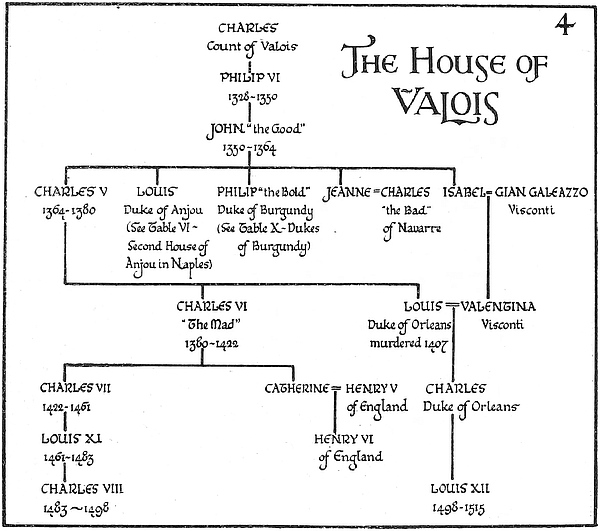
Europe. The marriage of his daughter Valentina with the young
and weak-minded Duke of Orleans, brother of the French king,
though hardly an attractive union for the bride, proved fraught
with importance for the whole of Italy, since at the very end
of the fifteenth century, Louis, Duke of Orleans, a grandson of
Valentina Visconti, succeeded to the French crown as Louis XII,
and also laid claim to the duchy of Milan, as a descendant of
the Visconti.42
At first sight it seems strange that any race so cruel and
unprincipled as the Visconti should continue to maintain their
tyranny over men and women naturally independent like the
inhabitants of North Italy. Certainly, if their rulers had been
forced to rely on municipal levies they would not have kept their
power even for a generation; but unfortunately the old plan of
expecting every citizen of military age to appear at the sound of
a bell in order to defend his town had practically disappeared.
Instead the professional soldier had taken the citizen’s place—the
type of man who, as long as he received high wages and
frequent booty, did not care who was his master, nor to what
ugly job of carnage or intimidation he was bidden to bring his
sword.
This system of hiring soldiers, condottieri, as they were called
in Italy, had arisen partly from the laziness of the townsmen
themselves, who did not wish to leave their business in order to
drill and fight, and were therefore quite willing to pay volunteers
to serve instead of them. Partly it was due to the reluctance
of tyrants to arm and employ as soldiers the people over whom
they ruled. From the point of view of the Visconti, for instance,
it was much safer to enrol strangers who would not have any
patriotic scruples in carrying out a massacre, or any other orders
equally harsh.
For such ruffians Italy herself supplied a wide recruiting-ground,
namely, the numberless small towns, once independent
but now swallowed up by bigger states, who treated the conquered
as perpetual enemies to be bullied and suppressed; allowing
them no share in the government nor voice in their future
destiny. Wide experience has taught the world that such
tyranny breeds merely hatred and disloyalty, and the continual
local warfare from which mediaeval Italy suffered could be largely
traced to the failure to recognize this political truth. With no
legitimate outlet for their energies, the young men of the conquered
towns found in the formation of a company of adventurers,
or in the service of some prince, the only path to renown, possibly
a way of revenge.
The ‘Condottieri’ System
To Italian condottieri were added German soldiers whom
Emperors visiting Italy had brought in their train, and who afterwards
remained behind, looking on the cities of Italy as a happy
hunting-ground for loot and adventure. Yet a third source of
supply were freebooters from France, released by one of the
truces of the Hundred Years’ War, and hastily sent by those
who had employed them to seek their fortunes elsewhere.
Amongst those who came to Italy in the fourteenth century,
and built for himself a name of terror and renown, was an English
captain, Sir John Hawkwood, the son of an Essex tailor, knighted
by Edward III for his prowess on the battle-fields of France.
Here is what a Florentine chronicler says of him:
‘He endured under arms longer than any one, for he endured
sixty years: and he well knew how to manage that there should
be little peace in Italy in his time.... For men and Communes
and all cities live by peace, but these men live and increase
by war, which is the undoing of cities, for they fight and become
of naught. In such men there is neither love nor faith.’
One tale of the day records how some Franciscans, meeting
Sir John Hawkwood, exclaimed as was their custom, ‘Peace
be with you.’ To their astonishment he answered, ‘God take
away your alms.’ When they asked him the reason for wishing
them so ill, he replied, ‘You also wished that God might make
me die of hunger. Know you not that I live on war, and that
peace would ruin me? I therefore returned your greeting in
like sort.’
Sir John Hawkwood spent most of his time in the service
of Florence; and, whatever his cruelty and greed, he does not
seem to have been as false as other captains of his time. Indeed,
when he died, the Florentines buried him in their cathedral, and
raised an effigy in grateful memory of his deeds on behalf of
the city.
Returning to the history of Milan and her condottieri, Gian
Galeazzo, though timid and unwarlike himself, was a shrewd
judge of character, and his captains, while they struck terror
into his enemies, remained faithful to himself. When he died
in 1402, however, many of them tried to establish independent
states; and it was some years before his son, Filippo Maria,
could master them and regain control over the greater part of
the Duchy.
Even more cowardly than his father, Filippo Maria lived, like
Louis XI of France, shut off from the sight of men. Sismondi,
the historian, describes him as ‘a strange, dingy, creature, with
protruding eyeballs and furtive glance.’ He hated to hear the
word ‘death’ mentioned, and for fear of assassination would
change his bedroom every night. When news was brought him
of defeat he would tremble in the expectation that his condottieri
might desert him: when messengers arrived flushed with victory
he was scarcely less aghast, believing that the successful general
might become his rival.
Such was the penalty paid by despots, save by those of iron
nerve, in return for their luxury and power: the dread that the
most servile of condottieri might be bribed into a relentless
enemy, poison lurk in the seasoned dish or wine-cup, a dagger
pierce the strongest mesh of a steel tunic. So night and day
was the great Visconti haunted by fear, while his hired armies
forced Genoa to acknowledge his suzerainty, and plunged his
Duchy into rivalry with Venice along the line of the River Adige.
* * * * *
Venice
The history of Venice differs in many ways from that of other
Italian states. Built on a network of islands that destined her
geographically for a great sea-power, she had looked from earliest
times not to territorial aggrandisement, but to commercial expansion
for the satisfaction of her ambitions. In this way she
had avoided the strife of feudal landowners, and even the Guelf
and Ghibelline factions that had reduced her neighbours to
slavery.
Elsewhere in Italy the names of cities and states are bound
up with the histories of mediaeval families; Naples with the
quarrels of Hohenstaufen, Angevins, and Aragonese: Rome
with the Barons of the Campagna, the Orsini and Colonna:
Milan with the Visconti, and later with the Sforza: Florence
with the Medici: but in Venice the state was everything,
demanding of her sons and daughters not the startling qualities
and vices of the successful soldier of fortune, but obedience,
self-effacement, and hard work.
The Doge, or Duke, the chief magistrate of Venice, has been
compared to a king; but he was in reality merely a president
elected for life, and that by a system rendered as complicated
as possible in order to prevent wire-pulling. Once chosen and
presented to the people with the old formula, ‘This is your
Doge an’ it please you!’ the new ruler of the city found himself
hedged about by a hundred constitutional checks, that compelled
him to act only on the well-considered advice of his six Ducal
Councillors, forbade him to raise any of his family to a public
office or to divest himself of a rank that he might with years
find more burdensome than pleasant. He was also made aware
that the respect with which his commands were received was
paid not to himself but to his office, and through his office to
Venice, a royal mistress before whom even a haughty aristocracy
willingly bent the knee.
In early days all important matters in Venice were decided
by a General Assembly of the people; but as the population
grew, this unwieldy body was replaced by a ‘Grand Council’
of leading citizens. In the early fourteenth century another
and still more important change was made, for the ranks of the
Grand Council were closed, and only members of those families
who had been in the habit of attending its meetings were allowed
to do so in future. Thus a privileged aristocracy was created,
and the majority of Venetians excluded from any share in their
government; but because this government aimed not at the
advantage of any particular family but of the whole state, people
forgave its despotic character. Even the famous Council of Ten
that, like the Court of Star Chamber under the Tudors, had
power to seize and examine citizens secretly, in the interests of
the state, was admired by the Venetians over whom it exerted its
sway, because of its reputation for even-handed justice, that
drew no distinctions between the son of a Doge, a merchant, or
a beggar. ‘The Venetian Republic’, says a modern writer on
mediaeval times, ‘was the one stable element in all North Italy,’
and this condition of political calm was the wonder and admiration
of contemporaries.
Sometimes to-day it seems difficult to admire mediaeval Venice
because of her selfishness and frank commercialism. She had
no sense of patriotism either towards Italy or Christendom;
witness the Fourth Crusade,43 where nothing but her insistent
desire to protect her trading position in the East had influenced
her diplomacy.
This accusation of selfishness is true; but we must remember
that the word ‘patriotism’ has a much wider scope in modern
times than was possible to the limited outlook of the Middle
Ages. Venice might be unmoved by the words ‘Italy’ or
‘Christendom’, but the whole of her life and ideals was centred
in the word ‘Venice’. Her sailors and merchants, who laid the
foundations of her greatness, were no hired mercenaries, but
citizens willing to lay down their lives for the Republic who was
their mother and their queen. Thus narrowing the term
‘patriotism’, we see that of all the Italian Powers Venice alone
understood what the word meant, in that her sons and daughters
were willing to sacrifice as a matter of course not merely life but
family ambitions, class, and even individuality to the interests of
their state.
The ambitions of Venice were bound up with the shipping and
commerce that had gained for her the carrying-trade of the world.
To take, for example, the wool manufacture, of such vital interest
to English and Flemings, we find that at one time this depended
largely on Venetian merchants, who would carry sugar and spices
to England from the East, replace their cargo with wool, unload
this in its turn in the harbours of Flanders, and then laden with
bales of manufactured cloth return to dispose of them in Italian
markets.
Besides the carrying-trade, which depended on her neighbour’s
industry, Venice had her own manufactures such as silk and
glass; but in either case both her sailors and workmen found
one thing absolutely vital to their interests, namely, the command
of the Adriatic. Like the British Isles to-day, Venice could not
feed her thriving population from home-produce, and yet, with
enemies or pirates hiding along the Dalmatian coast, safety for
her richly-laden vessels passing to and fro could not be
guaranteed. These are some of the reasons why from earliest
times the Republic had embarked on an aggressive maritime
policy that brought her into clash with other Mediterranean
ports, and especially with Genoa, her rival in Eastern waters.
When, at the end of the Fourth Crusade, Venice forced
Constantinople to accept a Latin dynasty, she secured for herself
for the time being especial privileges in that world-market;
Genoa, who adopted the cause of the exiled Greeks, achieved
a signal triumph in her turn when in 1261 with her assistance
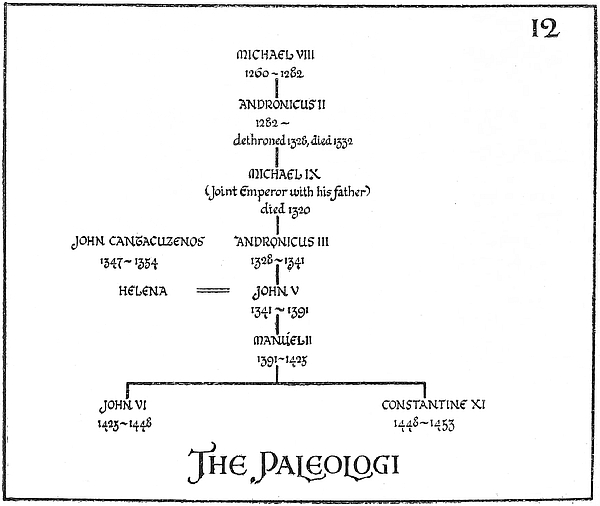
Michael Paleologus, a Greek general, restored the Byzantine
Empire amid public rejoicings.
Open warfare was now almost continuous between the
republics; there was street-fighting in Constantinople and in the
ports of Palestine, sea-battles off the Italian and Greek coasts,
encounters in which varying fortunes gave at first the mastery
of the Mediterranean to neither Venice nor Genoa, but which
disastrously weakened the whole resistance of Christendom to
the Mahometans.
At length in 1380 a decisive battle was fought off Chioggia,
one of the cities of the Venetian Lagoons, whither the Genoese
fleet, triumphant on the open seas, had taken up its quarters
determined to blockade the enemy into surrender. ‘Let us man
every vessel in Venice and go and fight the foe’, was the general
cry; and a popular leader, Pisani, imprisoned on account of his
share in a recent naval disaster, was released on the public
demand and made captain of the enterprise. ‘Long live Pisani!’
the citizens shouted in their joy, but their hero, true to the spirit
of Venice, answered them, ‘Venetians cry only, “Long live
St. Mark!”’
With the few ships and men at his disposal, Pisani recognized
that it was out of the question to lead a successful attack; but
he knew that if he could defer the issue there was a Venetian
fleet in the eastern Mediterranean which, learning his straits,
would return with all possible speed to his aid. He therefore
determined to force the enemy to remain where they were without
offering open battle, and this manœuvre he carried out with
great boldness and skill, sinking heavy vessels loaded with stones
in the channels that led to Chioggia, while placing his own fleet
across the main entrance to prevent Genoese reinforcements.
The blockaders were now blockaded; and through long winter
days and nights the rivals, worn out by their bitter vigil, starving
and short of ammunition, watched one another and searched the
horizon anxiously. At length a shout arose, for distant sails
had been sighted; then as the Venetian flag floated proudly into
view the shout of Pisani and his men became a song of triumph:
the Republic was saved. Venice was not only saved from ruin,
her future as Queen of the Adriatic was assured, for the Genoese
admiral was compelled to surrender, and his Republic to
acknowledge her rival’s supremacy of the seas.
The sea-policy of Venice was the inevitable result of her
geographical position; but as the centuries passed she developed
a much more debatable land-policy. Many mediaeval Venetians
declared that since land was the source of all political trouble,
therefore Venice should only maintain enough command over the
immediate mainland to secure the city from a surprise attack.
Others replied that such an argument was dictated by narrow-minded
prejudice, a point of view suitable to the days when
Lombardy had been divided amongst a number of weak city states,
but impracticable with powerful tyrants, such as the
Visconti, masters of North Italy. Unless Venice could secure
the territories lying at the foot of the Alps, and also a wide
stretch of eastern Lombardy, she would find that she had no
command over the passes in the mountains by means of which
she carried on her commerce with Germany and Austria.
The advocates of a land-empire policy received confirmation
of their warnings when in the early part of the fourteenth
century Mastino della Scala, lord of Vicenza, Padua, and Treviso,
attempted to levy taxes on Venetian goods passing through his
territories. The Republic, roused by what she considered an
insult to her commercial supremacy, promptly formed a league
with Milan and Florence against Mastino, and obtained Treviso
and other towns as the result of a victorious war.
This campaign might, of course, be called merely a part of
Venice’s commercial policy, defence not aggression; but later,
in 1423, the Florentines persuaded the Republic to join with
them in a war against the Visconti, declaring that they were
weary of struggling alone against such tyrants, and that if
Venice did not help them they would be compelled to make
Filippo Maria ‘King of North Italy.’ The result of the war that
followed was a treaty securing Venice a temporary increase of
power on the mainland, and may be taken as the first decisive step
in her deliberate scheme of building up a land-empire in Italy.
Machiavelli, a student of politics in the sixteenth century, who
wrote a handbook of advice for rulers called The Prince, as well
as the history of Florence, his native city, declares that the decline
of the Venetians ‘dated from the time when they became
ambitious of conquests by land and of adopting the manners and
customs of the other states of Italy’. This may be true; but it
is doubtful whether the great Republic could have remained in
glorious isolation with the Visconti knocking at her gates.
* * * * *
Florence
From Venice we must turn to Florence, which, by the
fifteenth century, emerged from petty rivalries as the first city
in Tuscany. Like Milan, Florence fell a prey to Guelfs and
Ghibellines; but these feuds, instead of becoming a family rivalry
between would-be despots, developed into a bitter class-war.
On the fall of Frederick II the Guelfs, who in Florence at
this date may be taken as representing the populo grasso, or rich
merchants, as opposed to the grandi, or nobles, succeeded in
driving the majority of their enemies out of the city. They then
remodelled the constitution in their own favour.
The chief power in the city was now the ‘Signory’, composed of
the ‘Gonfalonier of Justice’ and a number of ‘Priors’, representatives
of the arti, or guilds of lawyers, physicians, clothiers,
&c.: to name but a few. No aristocrat might stand for any public
office unless he became a member of one of the guilds, and in
order to ensure that he did not merely write down his name on
their registers it was later enacted that every candidate for
office must show proof that he really worked at the trade of
the guild to which he claimed to belong.
Other and sterner measures of proscription followed with
successive generations. The noble who injured a citizen of
lesser rank, whether on purpose or by accident, was liable to
have his house levelled with the dust: the towers, from which
in old days his ancestors had poured boiling oil or stones upon
their rivals, were reduced by law to a height that could be
easily scaled; in the case of a riot no aristocrat, however
innocent his intentions, might have access to the streets.
The grande was, in fact, both in regard to politics and justice,
placed at such an obvious disadvantage that to ennoble an
ambitious enemy was a favourite Florentine method of rendering
him harmless.
The Guelf triumph of the thirteenth century did not, in spite of
its completeness, bring peace to Florence. New parties sprang
up; and the government in its efforts to keep clear of class or
family influence introduced so many complicated checks that
great injury was done to individual action, and all hope of
a steady policy removed. Members of the ‘Signory’, for
instance, served only for two months at a time: the twelve
‘Buonomini’, or ‘Good men’, elected to give them advice only
for six. What was most in contrast to the ideal of ‘the right
man for the right job’ was the practice of first making a list of
all citizens considered suitable to hold office, then putting the
names in a bag, and afterwards picking them out haphazard as
vacancies occurred. Even this precaution against favouritism—and,
one is inclined to add, also against efficiency—was checked
by another law, the summoning of a parlamento in cases of
emergency. This parlamento was an informal gathering of the
people collected by the ringing of a bell in the big square, where it
was then asked to decide whether a special committee should be
appointed with free power to alter the existing constitution.
Politicians argued that here in the last resort was a direct appeal
to the people, but in reality by placing armed men at the
entrances to the square a docile crowd could be manœuvred
at the mercy of any mob-orator set up by those behind the
scenes.
Power remained in Florence in the hands of the prosperous
burghers and merchants, and these in time developed their own
feuds under the names of ‘Whites’ and ‘Blacks’, adopted by
the partisans in a family quarrel.
Dante Alighieri
The greatest of Italian poets, Dante Alighieri, was a ‘White’,
and was exiled from his city in 1302 owing to the triumph of his
rivals. When pardon was suggested on the payment of a large
sum of money, Dante, who had tried to serve his city faithfully,
refused to comply, feeling that this would be an open acknowledgement
of his guilt. ‘If another way can be found ... which
shall not taint Dante’s fame and honour’, he wrote proudly,
‘that way I will accept and with no reluctant steps ... but if
Florence is not to be entered by any such way never will I enter
Florence.’
Dante’s mental outlook was typical of mediaeval times in its
stern prejudices and hatreds, but it was also clearer and nobler
in its scope. An enthusiastic Ghibelline in politics, he believed
that it was the first duty of Holy Roman Emperors to exert their
authority over Italy, but this vision was not narrowed, as with
many Italians, into the mere hope of restoration to home and
power, with a sequel of revenge on private enemies. Dearer to
Dante than any personal ambitions was the desire for the
salvation of both Church and state from tyranny and corruption;
and this he believed could only be achieved by bestowing
supreme power on a world-emperor.
One attempt at reform had been made in 1294, when the
conclave of Cardinals, suddenly stung with the contrast between
the character of the Catholic Church and its professions, chose
as their Vicar a hermit noted for his privations and holy life.
Celestine V, as he was afterwards called, was a small man, pale
and feeble, with tousled hair and garments of sackcloth. When
a deputation of splendidly dressed cardinals came to find him, he
fled in terror, and it was almost by force that he was at last
persuaded to go with them and put on the pontifical robes. The
men and women who longed for reform now waited eagerly for
this new Pope’s mandates; but their expectations were doomed
to failure. Celestine V had neither the originality nor the
strength of will to withstand his change of fortunes. Terrified
by his surroundings, he became an easy prey to those who were
unscrupulous and ambitious, giving away benefices sometimes
twice over because he dared not refuse them to importunate
courtiers, and creating new cardinals almost as fast as he
was asked to do so. At last he was allowed to abdicate,
and hurried back to his cell, but only to be seized by his successor,
the fierce Boniface VIII,44 and shut up in a castle, where
he died.
Dante hated Boniface as a ruler who debased his spiritual
opportunities in order to obtain material rewards, but he had
hardly less scorn for Celestine V, who was given power to reform
the Church of Christ and ‘made the great refusal’. Reform, in
the Florentine’s eyes, could not be looked for from Rome, but,
when the Emperor Henry VII crossed the Alps,45 his hopes rose
high that here at last was the saviour of Italy, and it is probable
that at this time the poet wrote his political treatise called the De
Monarchia, embodying his views. He himself went out to meet
his champion, but Henry was not destined to be a second
Charlemagne or Otto the Great, and his death closed all
expectations built on his chivalrous character and ideals.
Dante’s greatest work is his long poem the Divina Commedia,
divided into three parts, the Inferno, the Purgatorio, and the
Paradiso. It tells how on Good Friday of the year of Jubilee
1300 the Florentine, meeting with the spirit of Virgil whom he had
chosen as his master, was led by him through the realms
of everlasting punishment and of penance, and from there was
borne by another guide, Beatrice, the idealized vision of a woman
he had loved on earth, up through the ‘Nine Heavens’ to the very
throne of God. As a summary of mediaeval theories as to the
life eternal, and also as the reflection of a fourteenth-century
mind on politics of the day, the Divine Comedy is indeed
an historical treasury as well as a masterpiece of Italian literature.
It is, however, a great deal more—the revelation of the development
of a human soul. Dante’s journey is told with a mastery
of atmosphere and detail that holds our imaginations to-day with
the sense of reality. It was obviously still more real to himself
and expresses the agonized endeavour of a soul, alive to the
corruption and nerve-weariness of the world around him, to find
the way of salvation, a pilgrimage crowned at last by the
realization of a Civitas Dei so supreme in its beauty and peace as
to surpass the prophecies of St. Augustine.
Now ‘Glory to the Father, to the Son,
And to the Holy Spirit’ rang aloud
Throughout all Paradise; that with the song
My spirit reel’d, so passing sweet the strain.
And what I saw was equal ecstasy:
One universal smile it seemed of all things;
Joy past compare; gladness unutterable;
Imperishable life of peace and love;
Exhaustless riches and unmeasured bliss.
Dante himself did not live to fulfil his earthly dream of returning
to Florence, but died at Ravenna in 1321. On his tomb is
an inscription in Latin containing the words, ‘Whom Florence
bore, the mother that did little love him’; while his portrait has
the proud motto so typical of his whole life, ‘I yield not to
misfortune’. In later centuries Florence recalled with shame her
repudiation of this the greatest of her sons; but while he lived,
and for some years after his death, political prejudices blinded
her eyes. In the Emperor Henry VII, to whom Dante referred
as ‘King of the earth and servant of God’, Florence saw an
enemy so hateful that she was willing to forgo her boasted
democracy, and to accept as master any prince powerful enough
to oppose him. Thus she granted the Signoria, or ‘overlordship’
of the city, for five years to King Robert of Naples, the head of
the Guelf party in Italy during the early years of the fourteenth
century.
* * * * *
Naples
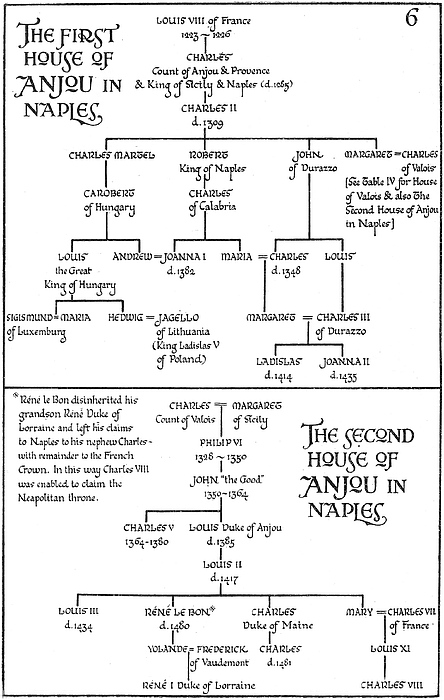
King Robert of Naples was a grandson of Charles, Count
of Anjou, brother of St. Louis, and, true to the tradition of his
house, stood as the champion of the Popes against imperial
claims over Italy. Outwardly he was by far the most powerful
of the Italian princes of his day; but in reality he sat uneasily
on his throne. The Neapolitans had not learned with time
to love their Angevin rulers, but even after the death of Conradin
remembered the Hohenstaufen, and envied Sicily that dared to
throw off the French yoke and give herself to a Spanish
dynasty.
It is difficult to provide a short and at the same time connected
account of the history of Naples from the death of King Robert
in 1343 until 1435, when it was conquered by the House of
Aragon. For nearly a century there is a dismal record of murders
and plots, with scarcely an illuminating glimpse of patriotism or
of any heroic figure. It is like a ‘dance of death’, with ever-changing
partners, and nothing achieved save crimes and
revolutions.
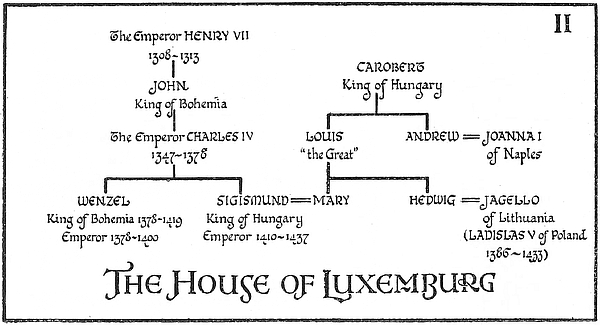
King Robert’s successor was a granddaughter, Joanna I,
a political personage from her cradle, and married at the age of
five to a boy cousin two years her senior, Andrew of Hungary,
brother of Louis the Great. We cannot tell if, left to themselves,
this young couple, each partner so passionate and self-willed,
could have learned to work together in double harness. What
is certain is that no one in that corrupt court gave them the
chance, one party of intriguers continually whispering in Joanna’s
ear that as queen it was beneath her dignity to accept any interference
from her husband, while their rivals reminded the young
Prince Andrew that he was descended from King Robert’s
elder brother, and therefore had as great a right to the throne as
his wife. Frequent quarrels as to whose will should prevail shook
the council-chamber, and then at last came tragedy.
In 1345 Joanna and Andrew, then respectively eighteen and
twenty, set out together into the country on an apparently
amicable hunting-expedition. As they slept one night in the
guest-room of a convent the Prince heard himself called by
voices in the next room. Suspecting no harm he rose and went
to see which of his friends had summoned him, only to find himself
attacked by a group of armed men. He turned to re-enter
the bedroom, but the door was locked behind him. With the
odds now wholly against him, Andrew fought bravely for his life,
but at length two of his assassins succeeded in throwing a rope
round his neck, and with this they strangled him and hung his
body from the balcony outside.
Attendants came at last, and, forcing the door, told Joanna of
the murder; on which she declared that she had been so soundly
asleep that she had heard nothing, though she was never able
to explain satisfactorily how in that case the door of her bedroom
had become locked behind the young king. Naturally the
greater part of Europe believed that she was guilty of connivance
in the crime, and King Louis of Hungary brought an army to
Italy to avenge his brother’s death. He succeeded in driving
Joanna from Naples, which he claimed as his rightful inheritance,
but he was not sufficiently supported to make a permanent
conquest, and in the end he was forced to hurry away to
Hungary, where his throne was threatened, leaving the question
of his sister-in-law’s guilt to be decided by the Pope.
The Pope at this time looked to the Angevin rulers of Naples
as his chief supporters, and at once proclaimed Joanna innocent.
It is worthy of note that three princes were found brave enough
to become her husband in turn; but, though four times married,
Joanna had but one son, who died as a boy.
At first she was quite willing to accept as her heir a cousin,
Charles of Durazzo, who was married to her niece, but soon she
had quarrelled violently with him and offered the throne instead
to a member of the French royal house, Louis, Duke of Anjou.
This is a very bewildering moment for students of history, because
it introduces into Italian politics a second Angevin dynasty only
distantly connected with the first, yet both laying claim to
Naples and waging war against one another as if each belonged
to a different race.
Joanna in the end was punished for her capriciousness, for in
the course of the civil wars she had introduced she fell into the
hands of Charles of Durazzo, who, indignant at his repudiation,
shut her up in a castle, where she died. One report says that
she was smothered with a feather-bed; another that she was
strangled with a silken cord—perhaps in memory of Prince
Andrew’s murder.
After this act of retribution, Charles of Durazzo maintained
his power in Naples for four years, though he was forced to
surrender the County of Provence to his Angevin rival. Not
content with his Italian kingdom, he set off with an army to
Hungary as soon as he heard of the death of Louis the Great,
hoping to enforce his claims on that warrior’s lands. Instead
he was assassinated, and succeeded in Naples by his son
Ladislas, a youth of fifteen.
Ladislas proved a born soldier of unflagging energy and
purpose, so that he not only conquered his unruly baronage but
made himself master of southern Italy, including Rome, from
which with unusual Angevin hostility he drove the Pope. Here
was a chance for bringing about the union of Italy under one
ruler, and Ladislas certainly aimed at such an achievement, but
apart from his military genius he was a typical despot of his
day—cruel, unscrupulous, and pleasure-seeking as the Visconti—and
when he died, still a young man, in 1414 few mourned his
passing.
His sister, Joanna II, who succeeded him, lacked his strength
while exhibiting many of his vices. Like Joanna I she was
false and fickle; like Joanna I she had no direct heirs, so that
the original House of Anjou in Naples came to an end when
she died. Many negotiations as to her successor took place
during the latter years of her reign, and for some time it seemed
as if the old queen would be content to accept Louis III of
Anjou, at this time the representative of the Second Angevin
House, but in a moment of caprice and anger she suddenly
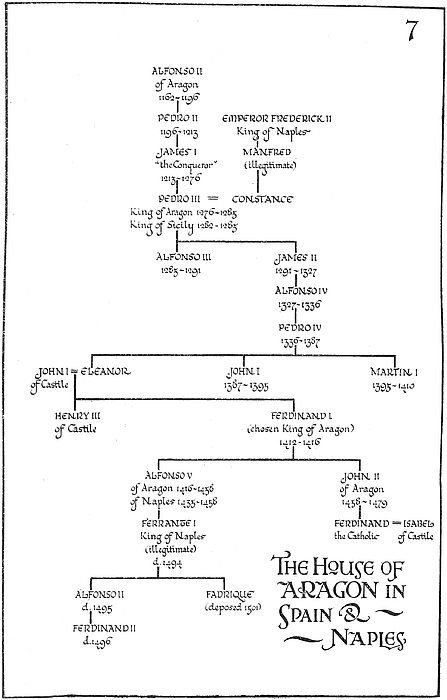
bestowed her favour instead on Alfonso V of Aragon and Sicily,
and adopted him as her heir. Of course, being Joanna, she
again changed her mind; but, though Alfonso pretended to
accept his repudiation, the hard-headed Spaniard was not to be
turned so easily from an acquisition that would forward Aragonese
ambitions in the Mediterranean.
Directly Joanna II died, Alfonso appeared off Naples with
a fleet, and though he was taken prisoner in battle and sent as
a prisoner to Filippo Maria Visconti at Milan, he acted with
such diplomacy that he persuaded that despot, hitherto an ally
of the Angevins, that it was much safer for Milan to have
a Spanish rather than a French House reigning in Naples.
This was the beginning of a firm alliance between Milan and
Naples, for Alfonso, released from his captivity, succeeded in
establishing himself in ‘the Kingdom’, where withdrawing his
court from Aragon he founded a new capital that became
a centre for learned and cultured Italians as of old in the days
of Frederick II.
We have dealt now with four of the five principal Italian
states during the later Middle Ages. In Rome, to pick up the
political threads, we must go back to the effects of the removal
of the papal court to Avignon in 1308.46
From the point of view of the Popes themselves, many of
them Frenchmen by birth, there were considerable advantages
to be gained by this change—not only safety from the invasions
of Holy Roman Emperors aspiring to rule Italy, but also from
the turbulence of Roman citizens and barons of the Campagna.
Avignon was near enough to France to claim her king’s
protection, but far enough outside her boundaries to evade
obedience to her laws. It stood in the County of Provence, part
of the French estates of the Angevin House of Naples, but during
her exile Joanna I, penniless and in need of papal support,
was induced to sell the city, and it remained an independent
possession of the Holy See until the eighteenth century.
From the immediate advantages caused by the ‘Babylonish
Captivity’, as these years of papal residence in Avignon were
called, we turn to the ultimate disadvantages, and these were
serious. Inevitably there was a lowering of papal prestige in
the eyes of Europe. In Rome, that since classic times had been
the recognized capital of the Western world, the Pope had
seemed indeed a world-wide potentate, on whom the mantle both
of St. Peter and of the Caesars might well have fallen. Transferred
to a city of Provence he shrank almost to the measure of
a petty sovereign.
During the Hundred Years’ War, for instance, there was
widespread grumbling in England at the obedience owed to
Avignon. The Popes, ran popular complaint, were more than
half French in political outlook and sympathy, so that an Englishman
who wished for a successful decision to his suit in a papal
law-court must pay double the sums proffered by men of any
other race in order to obtain justice. What was more, he knew
that any money he sent to the papal treasury helped to provide
the sinews of war for his most hated enemies.
The Papacy had been disliked across the Channel in the days
of Innocent IV, when England was taxed to pay for wars against
the Hohenstaufen: now, more than a century later, grumbling
had begun to crystallize in the dangerous shape of a resistance
not merely to papal supremacy, but to papal doctrine on which
that supremacy was based. Thus Wycliffe, the first great English
heretic, who began to proclaim his views during the later years of
Edward III’s reign, was popularly regarded as a patriot, and his
sermons denouncing Catholic doctrine widely read and discussed.
In the thirteenth century it had been possible to suppress
heresy in Languedoc; but in the fourteenth century there were
no longer Popes like Innocent III who could persuade men to
fight the battles of Avignon, and so the practice of criticism and
independent thought grew, and by the fifteenth century many
of the doctrines taught by Wycliffe had spread across Europe
and found a home in Bohemia.
Rome
With the history of Bohemian heresy we shall deal later,
but, having treated its development as partly arising from the
change in papal fortunes, we must notice the effect of the
Babylonish Captivity on Rome herself, and this, indeed, was
disastrous.
‘The absence of the Pope’, says Gregorovius, a modern
German historian, ‘left the nobility more unbridled than ever;
these hereditary Houses now regarded themselves as masters
of Rome left without her master. Their mercenaries encamped
on every road; travellers and pilgrims were robbed; places of
worship remained empty. The entire circumstances of the city
were reduced to a meaner level. No prince, nobleman, or envoy
of a foreign power, any longer made his appearance.... Vicars
replaced the cardinals absent from their titular churches, while
the Pope himself was represented in the Vatican, as by a shadow,
by some bishop of the neighbourhood, Nepi, Viterbo, or Orvieto.’
The wealth and pomp that had made the papal court a source
of revenue to the Romans were transferred to Provence: the
Orsini and Colonna battled in the streets with no High Pontiff
to hold them in check. Only his agents remained, who were
there mainly to collect his rents and revenues, so that the city
seemed once again threatened with political extinction as when
Constantine had removed his capital to the Bosporus.
Cola di Rienzi
One short period of glory there was in seventy years of gloom—the
realized vision of a Roman, Cola di Rienzi, a youth of the
people, who, steeped in the writings of classical times, hoped to
bring back to the city the freedom and greatness of republican
days. From contemporary accounts Rienzi had a wonderful
personality, striking looks, and an eloquence that rarely failed
to move those who heard him. At Avignon, as a Roman envoy,
he gained papal consent to some measures earnestly desired at
Rome, and this success won him a large and enthusiastic following
amongst the citizens, who applauded all that he said, and
offered to uphold his ambitions with their swords.
The first step to the greatness of Rome was obviously to
restore order to her streets, and Rienzi therefore determined to
overthrow the nobles, who with their retainers were always
brawling, and above all the proud family of Colonna, one of
whom without any provocation had killed his younger brother
in a fit of rage.
The revolution took place in May 1347, when, with the Papal
Vicar standing at his side, and banners representing liberty,
justice, and peace floating above his head, Rienzi proclaimed
a new constitution to the populace, and invested himself as chief
magistrate with the title of ‘Tribune, Illustrious Redeemer of
the Holy Roman Republic’.
At first there was laughter amongst the Roman nobles when
they heard of this proclamation. ‘If the fool provokes me
further,’ exclaimed Stephen Colonna, the head of that powerful
clan, ‘I will throw him from the Capitol’; but his contempt was
turned to dismay when he heard that a citizen army was guarding
the bridges, and confining the aristocratic families to their houses.
In the end Stephen fled to his country estates, while the younger
members of his household came to terms with the Tribune, and
swore allegiance to the new Republic.
Rienzi was now triumphant, and his letters to all the rulers
of Europe announced that Rome had found peace and law, while
he exhorted the other cities of Italy to throw off the yoke of
tyrants and join a ‘national brotherhood’.
It would seem that Rienzi alone of his contemporaries saw a
vision of a united Italy; but unfortunately the common sense
and balance that are necessary to secure the practical realization
of a visionary’s dreams were lacking. The Tribune was
undoubtedly great, but not great enough to stand success. The
child of peasants, he began to boast that he was really a son of
the Emperor Henry VII, and the pageantry that he had first
employed to dazzle the Romans grew more and more elaborate
as he himself became ensnared by a false sense of his own dignity.
Clad in a toga of white silk edged with a golden fringe, he would
ride through the streets on a white horse, amid a cavalcade of
horsemen splendidly equipped. In order to celebrate his accession
to power he instituted a festival, where, amid scenes of
lavish pomp, he was knighted in the Lateran with a golden girdle
and spurs, after bathing in the porphyry font in which tradition
declared that Constantine had been cleansed from leprosy.
The people, as is the way with crowds, clapped their hands
and shouted while the trumpets blew, and they scrambled for
the gold Rienzi’s servants threw broadcast; but long afterwards,
when they had forgotten the even-handed justice their Tribune
had secured them, they remembered his foolish extravagance
and display, and resented the taxes that he found it necessary to
impose in order to maintain his government and state.
The history of Rienzi’s later years is a tale of brilliant opportunities,
created in the first place by his genius, and then lost by
his timidity or lack of balance. On one occasion, when he learned
that the very nobles who had sworn on oath to uphold his constitution
were plotting its overthrow, he invited the leaders of
the conspiracy to a banquet, arrested them, and sent them under
guard to prison. The next morning the prison-bell tolled, and
the nobles within were led out apparently to the death their
treachery had richly deserved. At the last moment, however,
when each had given up hope, the Tribune came before the
scaffold, and, after a sermon on the forgiveness of sins, ordered
those who were condemned to be set free.
If he had wished to win their allegiance by this act of clemency
Rienzi had ill-judged his enemies. They had disliked him before
as a peasant upstart; now they hated him far more bitterly as a
man who had been able to humble them in the public gaze,
believing, whether rightly or wrongly, that it was not forgiveness
but fear of the powerful families to which they belonged that had
finally moved him to mercy. From this moment the Orsini, the
Colonna, and their friends had but one object in life—to pull the
Tribune from his throne. By bribery and the spreading of false
rumours they set themselves to undermine his influence, telling
tales everywhere of his extravagance and luxury as contrasted
with the heavy taxes, until at last in 1354 a tumult broke out in
the city, and a mob collected that stormed the palace where
Rienzi lodged, shouting ‘Death to the Traitor!’ As the Tribune
attempted to escape he was seen against the flames of his burning
walls and cut down.
St. Catherine of Siena
With the fall of Rienzi died the idea of a restored and reformed
Italy through the medium of a Holy Roman Republic, just as
Dante’s hope of a new and more perfect Roman Empire had
been shattered by the death of Henry VII. Was there then
no hope for Italy in mediaeval minds? The next answer that
there was hope, indeed, came from Siena, one of the hill towns
not far south of Florence, and its author was a peasant girl,
Catherine Benincasa, who, like Jeanne d’Arc, looking round
upon the misery of her country, believed that she was called by
God to show her fellow countrymen the way of salvation.
St. Catherine, for she was afterwards canonized, was one of
the twenty-five children of a Sienese dyer, who was at first very
angry that his daughter refused to marry and instead joined the
Order of Dominican Tertiaries—that is, of women who, still
remaining in their own homes, bound themselves by vows to
obey a religious rule.
In time, not only the dyer but all Siena came to realize that
Catherine possessed a mind and spirit far above ordinary
standards, so that, while in her simplicity she would accept the
meanest household tasks, she had yet so great an understanding
of the larger issues of life that she could read the cause of each
man or woman’s trouble who came to her, and suggest the remedy
they needed to give them fresh courage or hope.
During an outbreak of plague in Siena it was Catherine who,
undismayed and tireless, went everywhere amongst the sick and
dying, infusing new heart into the weary doctors and energy
into patients succumbing helplessly to the disease.
When one of the wild young nobles of the town was condemned
to death according to the harsh law of the day for having dared
to criticize his government, Catherine visited him in prison. She
found him raging up and down his cell like some trapped wild
animal, refusing all comfort; but her presence and sympathy
brought him so great a sense of peace and even of thanksgiving
that he went to the scaffold at last joyfully, we are told, calling
it ‘the holy place of justice’. Here, not shrinking from the
scene of death itself, Catherine awaited him, kneeling before the
block, and received his head in her lap when it was severed from
his body. ‘When he was at rest,’ she wrote afterwards, showing
what the strain had been, ‘my soul also rested in peace and quiet.’
St. Catherine was not alarmed when ambassadors from other
cities, and even messengers from the Pope at Avignon, came to
ask her advice on thorny problems. She believed that she was a
messenger of God, ‘servant and slave of the servants of Jesus
Christ’, as she styled herself in her letters, and that God intended
the regeneration of Italy to be brought about neither by Emperor,
nor by a Holy Roman Republic, but by the Pope himself. No
longer must he live at Avignon, but return to Rome, and, once
established there, begin the work of reform so sorely needed both
by Church and State. Then would follow a call to the world
that, recognizing by his just and generous acts that he was indeed
the ‘Father of Christendom’, would joyfully come to offer its
allegiance.
This high ideal touched the hearts and imaginations of even
the least spiritual of Catherine’s contemporaries. One of her
letters was addressed to that firebrand Sir John Hawkwood,
whom she besought to turn his sword away from Italy against
the Turks; and it is said that on reading it he took an oath that
if other captains would go on a crusade he would do so also.
St. Catherine herself went to Avignon and saw Pope Gregory
XI—a timid man, who loved luxury and peace of mind, fearing
greatly the turbulence of Rome. At this time all the barons of
the Campagna and most of the cities on the papal estates were
up in arms, and Gregory had been warned that unless he went
in person to pacify the combatants he was likely to lose all his
temporal possessions. Catherine, when consulted, told him
sternly that he should certainly return to Italy, but not for this
reason.
‘Open the eyes of your intelligence,’ she said, ‘and look
steadily at this matter. You will then see, Holy Father, that ...
it is more needful for you to win back souls than to reconquer
your earthly possessions.’
In January 1377 St. Catherine gained her most signal triumph,
for Gregory XI, at her persuasion, appeared in Rome and took
up his quarters there, so bringing to an end the ‘Babylonish
Captivity’. Not long afterwards he died; and the Romans who
had rejoiced at his coming were overwhelmed with fear that his
successor might be a Frenchman and return to Avignon. ‘Give
us a Roman!’ they howled, surging round the palace where the
College of Cardinals, or Consistory, as it was called, was holding
the election; and the cardinals, believing that they would be
torn in pieces unless they at least chose an Italian, hastily elected
a Neapolitan, the Archbishop of Bari, who took the name of
Urban VI.
It was an unfortunate choice. Urban honestly wished to
reform the Church, but of Christian charity, without which good
deeds are of no avail, he possessed nothing. Arrogant, passionate,
and fierce in his frequent hatreds, blind to either tact or
moderation, he tried to force the cardinals by threats and insults
into surrendering their riches and pomp. ‘I tell you in truth,’
exclaimed one of them, when he had listened to the Pope’s first
fiery denunciations, ‘you have not treated the Cardinals to-day
with the respect they received from your predecessors. If you
diminish our honour we shall diminish yours.’
Rome was soon aflame with the plots of the rebellious college,
whose members finally withdrew from the city, declared that
they had been intimidated in their choice by the mob, that the
election of Urban was therefore invalid, and that they intended
to appoint some one else. As a result of this new conclave there
appeared a rival Pope, Clement VII, who after a short civil
war fled from Italy and took up his residence at Avignon.
The Great Schism
The period that followed is called the Great Schism, one of
the times of deepest humiliation into which the papal power
ever descended. From Rome and Avignon two sets of bulls,
claiming divine sanction and the necessity of human obedience,
went forth to Christendom, their authors each declaring himself
the one lawful successor of St. Peter, and Father of the Holy
Catholic Church.
With Clement VII sided France, her ally Scotland, Spain,
and Naples; with Urban VI, Germany, England, and most of
the northern kingdoms; and when these Popes died the
cardinals they had elected perpetuated the schism by choosing
fresh rivals to rend the unity of the Church. Thus in the
struggle for temporal supremacy reform was forgotten, and the
growing spirit of doubt and scepticism given a fair field in
which to sow her seed.
St. Catherine had realized her desire, the return of the Pope to
Rome, only, we see, to find it fail in achieving the purpose for
which she had prayed and planned. The Popes of the fourteenth
century were men of the age in which they lived, not
great souls like the saint of Siena herself, who called them to
a task of which they were spiritually incapable. With her
death her ideal faded, and another gradually took shape in the
minds of men, namely, ‘an appeal from the Vicar of Christ
on earth to Christ Himself, residing in the whole body of the
Church’.
Christendom remembered that in the early days of her
history it had been Councils of the Fathers, sitting at Nicea
and elsewhere, that had defined the Faith and made laws for
the Catholic Church. Now it was suggested that once more
a large world-council should be called from every Catholic
nation, composed of Cardinals, Archbishops, Bishops, the
Heads of the Friars and of the Monastic and Military Orders,
together with Doctors of Theology and Law. This council was
to be given power by the whole of Christendom to end the
schism, condemn heresy, and reform the Church.
The person who was chiefly responsible for the summoning
of this council, that met at Constance in 1414, was Sigismund,
King of the Romans, a son of the Emperor Charles IV, and
brother and heir to the Emperor Wenzel, a drunken sot, who
was also King of Bohemia, but quite incapable of playing an
intelligent part in public affairs. Sigismund was King of
Hungary by election and through his marriage with a daughter
of Louis the Great47; but his subjects had little respect for his
ability, and were usually in a state of chronic rebellion. In spite
of the fact that he had no money and had been decisively and ingloriously
defeated in battle by the Turks, he continued to hold
high ambitions, desiring above all things to appear as the arbiter
of European destinies who would reform both Church and State.
The Council of Constance gave him his opportunity, and
certainly no other man worked as hard to make it a success.
Sometimes he presided in person at the meetings, which dragged
out their weary discussions for about four years: at other times
he would visit the courts of Europe, trying to persuade rival
Popes to resign, or, if they were obstinate, civil sovereigns
to refuse them patronage and protection. He even tried, though
in vain, to act as mediator in the Hundred Years’ War, in order
that the political quarrels of French and English might not
bring friction to the council board.
John Huss
It is unfortunate for Sigismund’s memory that his share in
the Council of Constance was marred by treachery. As heir
to the throne of Bohemia and the incapable Wenzel he was
often led to interfere in the affairs of that kingdom, and felt it
his duty to take some steps with regard to the spread of
Wycliffe’s doctrines amongst his future subjects, especially in
the national University of Prague. Here heretical views were
daily expounded by a clever priest and teacher, John Huss.
Now the orthodox Catholics in the university were mainly
Germans, and hated by the ordinary Bohemians, who were
Slavs, and these therefore admired and followed Huss for
national as well as from religious convictions.
Sigismund agreed with Huss in desiring a drastic reform
of the Church, suitable means for ensuring which he hoped to
see devised at Constance. At the same time he trusted that
the representatives of Christendom would come to some kind
of a compromise with the Bohemian teacher on his religious
views, and persuade him by their arguments to withdraw some
of his most unorthodox opinions. With this end in view he
therefore invited Huss to appear at the Council, offering him
a safe-conduct.
Many of the Bohemians suspected treachery and shook their
heads when their national hero insisted that he was bound in
honour to make profession of his faith when summoned. ‘God
be with you!’ exclaimed one, ‘for I fear greatly that you will
never return to us.’ This prophecy was fulfilled; for Huss,
when he arrived at Constance, found that Sigismund was
absent, and the attitude of the Council definitely hostile to anything
he might say. After a prolonged examination he was
called upon to recant his errors, and, refusing to yield, was
condemned to death as a heretic; Sigismund, on his return to
Constance shortly after this sentence had been passed, was
persuaded that unless he consented to withdraw his safe-conduct
the whole gathering would break up in wrath.
Herod, he was told, had made a bad oath in agreeing to
fulfil the wish of Herodias’s daughter and should have refused
her demand for the head of John the Baptist. To pledge faith
to a heretic was equally wrong, for as an example and warning
to Christendom all heretics should be burned. It was imperative
therefore for the good of the Church that such a safe-conduct
should be withdrawn. Sigismund at last sullenly yielded,
conscious of the stain on his honour, yet still more fearful lest
the council he had called together with so great an effort should
melt away, its tasks unfulfilled, as his many enemies hoped.
In July 1415 Huss was burned alive, crying aloud with steadfast
courage as those about him urged him to recant, ‘Lo! I am
prepared to die in that truth of the Gospel which I taught and
wrote.’ Lest he should be revered as a martyr, the ashes of
Huss were flung into the river, his very clothes destroyed;
but measures that had prevailed when an Arnold of Brescia
preached to a few, some two centuries before, were unavailing
when a John Huss died for the faith of a nation. Sigismund
kept his council together, but he paid for his broken word in
the flame of hatred that his accession in 1419 aroused in Bohemia,
and which lasted during the seventeen years of what are usually
called the Hussite Wars.
The Council of Constance had condemned heresy: it succeeded
in deposing three rival popes, and by its united choice
of a new pope, Martin V, it put an end to the long schism that had
divided the Church. The question of reform, the most vital
of all the problems discussed, resulted in such controversy that
men grew weary, and it was postponed for settlement to another
council that the new pope pledged himself to call in five years.
Such were the practical results of the first real attempt of
the Church to solve the problems of mediaeval times, not by
the decision of one man, whether pope or emperor, but by the
voice of Christendom at large. If the attempt failed the difficulties
in the way were so great that failure was inevitable.
The Conciliar Movement was modern in the sense that it was
an appeal to the judgement of the many rather than of a single
autocrat; but it proved too mediaeval in actual construction
and working for the growing spirit of nationality that brought
its prejudices and misunderstandings to the council hall.
English and French, Germans and Bohemians, Italians and
men from beyond the Alps, were too mutually suspicious, too
assured of the righteousness of their own outlook, to be able
to sacrifice their individual, or still more their national,
convictions to traditional authority. The day for world-rule,
as mediaeval statesmen understood the term, had passed; and
the Council of Constance was a witness to its passing.
| Dante Alighieri |
1265–1321 |
| King Robert of Naples |
1309–43 |
| Joanna I of Naples |
1343–82 |
| Ladislas of Naples |
1386–1414 |
| Joanna II of Naples |
1414–35 |
| St. Catherine of Siena |
1347–80 |
| Pope Gregory XI |
1371–8 |
| Pope Urban VI |
1378–89 |
| Pope Clement VII |
1378–94 |
| Pope Martin V |
1417–31 |