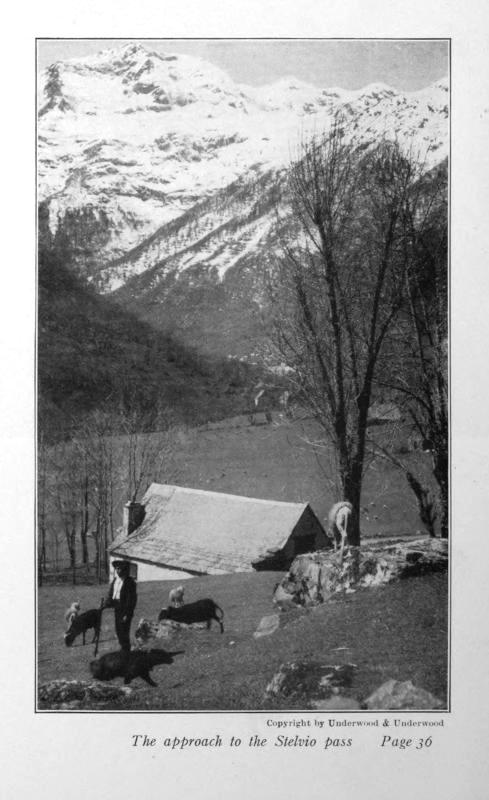
It was before seven that we started on the long
climb. An early start is important when
the main care is to keep the engine cool. Cloudless
skies favored our attempt. Across the
gorge we saw the towering Weiskugel, its snows
turned to radiant silver while the valley was
still in shadow. The Ortler was transfigured,
the Madatsch dazzling—almost blinding until
our eyes had grown wonted to the brilliant
spectacle. Slowly the long grades sank behind
us. It seemed better to set a steady, even
though slow pace, and maintain it until the
summit was reached. So we were forced to use
second speed. The sides of the engine bonnet
had been tied back to give the engine every
possible bit of cool air. From "hairpin" to
"hairpin" we went, these curves so sharp that
at first it seemed impossible to make them without
backing. How they twisted above us like
the loops of a gigantic lasso flung far up the
mountain, into the region of eternal snow!
Imagine it! Forty-six of them! Only on one
turn were we forced to back, but with a large,
powerful car this record would have been impossible.
Any car that cannot turn easily in
a fifty-foot circle would better find some other
way of reaching Italy. It is not pleasant to
back up when the edge of the precipice is a
matter of inches.
When the Austrians built this road, a century
ago, they were not thinking about motor cars.
This masterpiece of road construction was
intended for armies, not for automobiles. The
makers of those curves, cut through heights
of solid rock, never anticipated the luxurious
modes of modern travel. If then they had
only foreseen the coming of motor warfare, how
much inconvenience would have been spared
the impetuous motorist who to-day attempts to
climb the Stelvio in a long, powerful car which
cannot quite make the turns without backing.
Surely, a few feet would have been added to
those tantalizing, agonizing curves. How little
the Austrians realized that their military invasion
would be followed by the more peaceful
motor invasion of our day.
With every turn, our admiration for this perfect
road increased. One marvels at such
matchless feats of engineering, at such gigantic
obstacles so completely overcome. Here, high
retaining walls have been built to keep the road
from crumbling away; there, mountain torrents
that would have washed it away have been
diverted. Turn after turn, and still higher to
go! Pine woods gave way to stunted shrubbery,
and then vegetation ceased altogether.
We were above the clouds. Nothing but the
sun above us. Snow banks appeared on either
side; we could put out our hands and touch
them. Then through Franzenshöhe, formerly
the seat of the Austrian customhouse, to Ferdinandshöhe
and the summit of Stelvio, 9,041
feet above the sea, the highest point of motor
or carriage travel in Europe.
It is impossible to describe the thrill, the
intoxication, of the moment as we stood there
watching the ice fields roll away in great waves,
as if the ocean, in a moment of wild upheaval,
had been frozen. Leaving the car near the
little Ferdinandshöhe hotel, we climbed an
elevation of one hundred and fifty feet to the
Hotel Dreisprachenspitze, where one stands at
the apex of three countries. We could look
down into Italy. The ice floods of Switzerland
swept to the horizon; a hundred snow peaks
flashed in the morning sun. In the other
direction yawned the mighty gorge of the
Stelvio, where it had taken us two hours and
seven minutes to make eight miles. The wind
was of razor keenness.
On descending to arrange customhouse details
with the Austrian officials, we found the
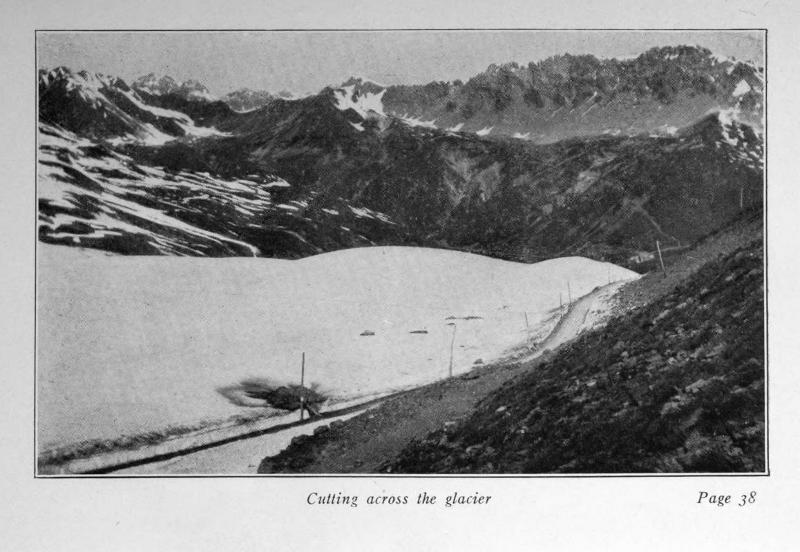
car frozen in the ice. The hot steel-studded
tires had melted a deep groove, and were now
held fast in the prison of their own making.
Even on the Stelvio we had not expected to be
frozen fast on the first of August. In vain we
opened wide the throttle. The wheels turned
furiously without gaining an inch. Austrian
soldiers came to our rescue. Half a dozen of us
pushed from behind. Two American tourists
who had just climbed the Stelvio from the
Italian side in a Cadillac, also gave generous
aid. With the additional help of pickaxes and
quantities of sawdust, the car finally shook off
its icy fetters.
Meanwhile we had succeeded in snapping
some kodak pictures without attracting the
notice of the Austrian officers. The Stelvio
is a military road, various forts are in the neighborhood,
and the government regulations forbid
the taking of photographs. In securing these
pictures we ran the risk of heavier penalties
than the confiscation of the camera and films.
Fortune did not smile so cheerfully at the
Italian dogana, two miles farther down.
Hardly had we touched the kodak when Italian
soldiers and customhouse officers rushed toward
us. We were not sure whether we would be
shot on the spot or simply left to languish in an
Italian prison. One of the officers seized the
camera, tied a red string around it, and sealed
it. Observing that our ignorance of military
regulations was fully equal to our ignorance of
Italian, he instructed us in French not to open
the camera until we were beyond Tirano,
seventy miles away, the frontier town of the
military zone.
During the ascent the engine bore the chief
strain. It had worked heroically without once
faltering. Now, upon the long down grades of
the Italian slope, we were forced to rely upon
the brakes. The road descended with a continuous
and fairly steep gradient for almost
fourteen miles. It was dangerous, difficult
work. We not only had to make the turns,
which were just as sharp as on the Austrian side,
but it was necessary to watch the straining
brakes, releasing them when the grade permitted
and alternating the emergency brake
with compression. This was a feat demanding
all the qualities of motormanship. Coolness
and good judgment were indispensable at every
curve of the descent. The road turned icy
corners and edged along precipitous cliffs. If
the brakes had refused to work, it would have
been fatal; the downward plunge of the car
would have been beyond control in a few seconds.
But at that moment we were not thinking
of danger. The thrill of the descent, the
feeling of flying down from a great height, the
ice peaks that rose higher above us, the stupendous
chasm that at every curve opened
newer and more savage depths—these were all
a part of our exhilarating experience.
We were coasting much of the time; gasoline
and ignition had been cut off. Rocky walls
hurled back the blast of our motor horn as we
entered the slippery winter galleries of the
Diroccamento defile. According to law, no
vehicle may enter a tunnel if it is occupied.
Farther down, the road looped like the coils of
a great serpent, twisting, disappearing, only to
reappear farther down as a faint streak of
shimmering roadway. It was curious, that
sensation of falling, always sinking lower and
yet never reaching the bottom. One more
sweep through the Braulio Valley, and we
stopped for lunch before the luxurious hotel
Bagni-Nuovi, that popular watering place for
the leisure rich of Italy.
Our first repast upon Italian soil very fittingly
included macaroni and a generous bottiglia di vino
italiano. After lunch we went into the terraced
garden, fragrant with orange trees, overlooking
dreamy Bormio, the gateway of Italy. The
warm sunshine was delightful after having so
recently faced the icy winds of the Stelvio.
Here we joined an American party from
Detroit, Mr. and Mrs. ——, who were chaperoning
two attractive American girls on a motor
trip through Italy and the Tyrol. They had
rented an Italian car in Rome, but had not
found the investment altogether satisfactory,
the usual story of rented cars in Europe. These
chance meetings with other Americans en route
were among the pleasantest features of our trip.
We would gladly have prolonged the visit, had
it not been necessary to leave early in the afternoon
if we were to reach Menaggio on Lake
Como before dark.
After descending into Bormio, one motors for
some distance between high, vine-clad slopes, and
then passes through two or three villages, typically
Italian with their dilapidated churches and
narrow, cobbled streets swarming with dirty
children, many of whom took a special delight in
darting across our track just as we were passing.
Northern Italy is wonderfully picturesque.
The long defile of S. Antonio Morignone, the
antiquated towns, the slender campaniles standing
out so clearly in the misty, dreamy landscape,
the plains of Lombardy with their
scenes of peasant life,—these were all interesting
details to be duly jotted down in the
notebook of memory.
It was haying time. The farming methods
seemed so primitive; everything was hand
work. We did not see a single labor-saving
machine. The International Harvester Company
would not have done a profitable business
here. The hayricks were very small, and
even these were often lacking, for barefooted
women staggered under large bundles of hay.
Yet these backward farmers make stalwart
soldiers. Sturdy and frugal, they are, as in
France, the backbone and hope of the nation.
Europe recognizes the fine horsemanship of
the Italian cavalry. The "Corazzieri," or
royal bodyguard, is a magnificent corps. It
is difficult to believe that most of these men
are peasants.
There was no need of a compass to learn
that we were going west, for the afternoon sun
shone full in our faces. This steady glare,
and the dazzling reflection from the white,
dusty road, became almost unbearable. It
was constantly necessary to shield the eyes.
There was no winding or turning. Often we
overtook a hayrick occupying most of the
highway. The driver was usually invisible
in the soft depths of the hay, and so drowsy
from the sun or liberal drafts of chianti
that persistent blasts of the motor horn were
necessary to attract his attention. Tresenda
was passed, and then Sondrio, the capital of
the fertile Val Tellina, noted for its wines.
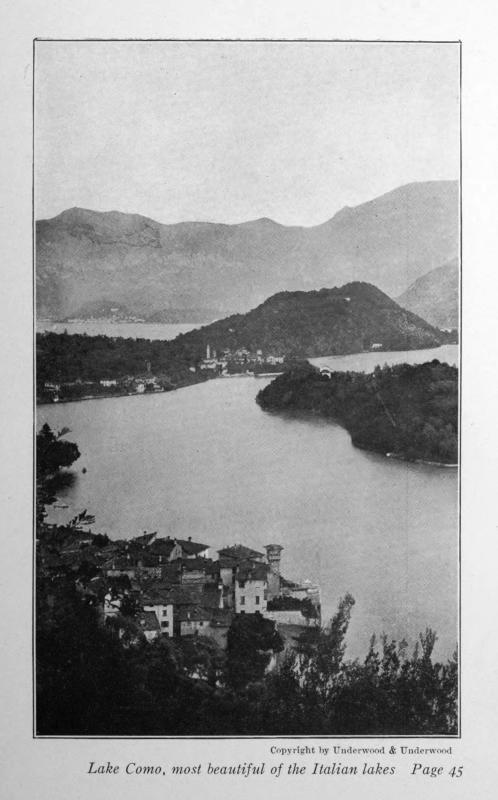
Lake Como, most beautiful of the Italian lakes Page 45
Copyright by Underwood & Underwood
The sun was a glowing disk upon the horizon
when we reached Colico upon Lake Como,
most beautiful of the Italian lakes. There
was a crimson light on the water. Red sails
drifted lazily toward the shore. Across the
lake the high mountains rose cone-like to a
peak, like extinct volcanoes. From a distant
bell tower floated the clear, sweet tones of the
angelus. Before some of the houses, young
Italians were playing melodies on guitars.
Twilight was falling, that wonderful twilight
so full of color and feeling, of the romance and
sentiment of northern Italy. After several
miles along the shore, through these fascinating
scenes, we reached Menaggio.
The evening in the cool lake garden of the
Grand Hotel was a refreshing sequel to the
afternoon's hot ride. We could see the government
searchlight sweeping its bright rays in
search of smugglers. The Italian lakes are
partly in Italy and partly in Switzerland.
Salt and tobacco are state monopolies in Italy.
The poor people are forbidden even to pick
up from the docks the few grains of salt which
may have fallen during the loading and unloading
of ships. Guards patrol the beaches to
compel those who use the sea for a washtub,
thoroughly to wring the salt water from the
clothes. In spite of all the government's
precautions, large quantities of salt and tobacco
are smuggled in from Switzerland over the
Italian lakes. The Italian officials are poorly
paid. The operator of the searchlight which
we saw received only eight dollars a month.
The small salaries breed bribery and corruption,
and it often happens, therefore, that on
a dark night the government searchlight fails
to discover a rowboat that goes out from the
Swiss shore. The smugglers escape the vigilance
of the swift revenue cutters, and make
a successful landing on the Italian side.
The next day was so hot that it seemed best
to pass the time quietly at Menaggio, in our
restful retreat. The rooms were large and
airy, and open to the fresh lake breezes. The
hotel had once been a villa, and with its private
garden of thick plane trees was just such a
spot as the dusty motorist delights to stumble
upon after a long ride over the hot Italian
roads.
Our gasoline was running low, so noticing
a sign with the words Benzino-Lubrificanti, we
entered. The commercianti spoke as much
English as we spoke Italian. We compromised
on gestures. In Italy it is a safe rule to pay
about half the price asked. After half an hour
of bargaining we obtained five liters of gasoline
for forty-five centesimi a liter. The price
demanded at first was ninety-five centesimi.
Our change included a couple of five-lira notes
so dirty, greasy, and mangled that they looked
in the last stages of the plague. We would
have felt safer to have handled them with
tongs. Within a few days we had received
kronen, heller, marks, pfennigs, lira, centesimi.
It was quite an education in the currency
systems of Europe.
On the way back to the hotel we entered
the cathedral. To find so imposing an edifice
amid so much poverty was a surprise. Equally
astonishing was the way the steep hills behind
the town were terraced and cultivated, as
though the very rocks themselves had been
made to blossom and bear fruit. An Italian
woman across the street was filling her jug
at a fountain. The nozzle, crumpled into a
trefoil, was of the same style as that used by
the Roman matrons twenty-five centuries
ago. Little things like this show how slowly
time has marched in these lake towns of
northern Italy.
The cool fragrance of early morning filled
the air when we waved addio to our padrone
and followed the curves of the shore toward
Como at the end of the lake. There is much
in favor of an early start before the heat begins
to quiver above the road and the air to resemble
a continuous cloud of dust. Every foot of
the way was interesting. There were bright-colored
villas half smothered in vines; crumbling
bell towers flung their shadows across
our path; dizzy cliffs hung above us; the lake
was constantly within view.
At one of the turns a bicycle rider shot by.
We missed him by an inch. He was followed
by many others, scattered over the distance
of a mile. They were all riding recklessly,
rounding the corners at top speed and with
heads bent low over the handle bars. Different
numbers were pinned on their backs. This
was evidently a long-distance bicycle race.
It was nerve racking to meet so many curves
and not to know whether the riders would
pass us on the right or on the left. There is
no fixed rule of the road in Italy. In towns
having a tram, one turns to the left. Southern
Italy is still more confusing, since each town
has its own rule. In Como we motored down
two or three streets before finally discovering,
after many inquiries, the road running northward
to Aosta in the Italian Alps.
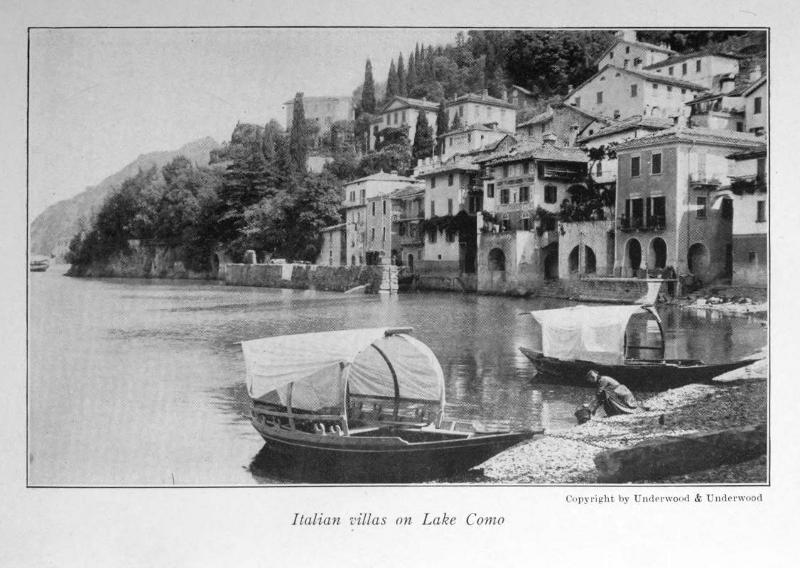
Italian villas on Lake Como
Copyright by Underwood & Underwood
We regretted our last glimpse of the lake.
Instead of hazy mountains, blue sparkling
waters, red sails, and pretty villas, the scenery
changed to flat, uninteresting country. Novara
was reached by noon, its streets baking
in the fierce August sun. At the Hotel Italia
the flies covered table and dishes. The ménu
card presented difficulties; it was written in
a very illegible Italian. We guessed at most
of the courses, but macaroni was the only dish
of which we were sure. But our plight was
not quite so discouraging as that of another
motorist who found that for three of his courses
he had ordered eggs cooked in three different
ways. The early afternoon was so hot that
we had thought of taking a siesta, but soon
gave up the idea. There were too many flies.
The inmates of the garage were all fast asleep,
and the two blinking men whom we aroused
could not conceal their surprise at our unseasonable
departure.
Once out in the country, the dust invaded
and pervaded everything. It was real Italian
dust, that sifted into us and all but blinded
us. The heat was terrific. For fear of bursting
a tire, we halted in a drowsy village to let
the car cool off under a shady chestnut tree.
As if by magic, a score of dirty, ragged Italian
children surrounded us, and begged for centesimi.
We threw them a few coppers, but this
vision of riches only served to redouble the
clamor. Flight seemed the only price of
tranquillity.
A little way outside the village, a cloud
rolled swiftly toward us. The motor car did
not appear to be much more than a cloud when
it passed us, so thick was the dust. If there
is anything hotter or dustier than an Italian
highway on the third of August, we do not
wish to see it. The drivers of most of the
small carts were curled up, content to let the
patient mule take its own pace, provided their
siesta was undisturbed. The shrill call of our
horn often caused them to move a little; there
would be a slight twitching of the reins, and
then they would relax again into slumber.
The mule never changed its course.
Beyond Ivrea the country became more
rolling and broken, and the Alps, which an
hour before had appeared as blue, shadowy
cloud masses, now lifted bold, distinct outlines.
This contrast in scenery was as abrupt as it
was impressive. Perhaps it was a ruined
castle perched like an eagle's nest amid high
crags. Within the same view, the eye beheld
the vineyards, not planted in the usual manner
of row above row, but arbor above arbor,
supported by white stone pillars, and these
arbors rising to the very summit of lofty hills.
The road which had been winding and rising
above the magnificent valley of Aosta now
ran into a level stretch. We had opened wide
the throttle, when all at once a motor car
flashed around a curve two hundred yards
ahead of us. An officer in the back seat
waved to attract our attention, and kept
pointing back to the curve. The warning
was just in time, for as we waited within the
shadow of the bend, another motor car shot
at racing speed around the curve. She was
a French racer. There had been no warning
shriek of her horns; the road was so narrow
at this point that a collision could hardly
have been avoided without that precious second
of warning.
Every year in Europe reckless driving causes
more accidents than all the steep roads of the
Alps. This is the chief danger of motoring
on the Continent. The roads are so good that
there is the constant temptation to disregard
the still small voice of prudence.
The old Roman town of Aosta was in sight.
This "Rome of the Alps" is a perfect treasure
house of antiquities. Passing under ancient
Roman arches, we rode down the quaint main
streets to the Hotel Royal Victoria, situated,
according to our Michelin Guide, "près de la
gare." The hotel, although small, was clean.
This fact of cleanliness speaks much for any
hotel located in a small Italian town.
Our morning promenade revealed much that
was interesting. The middle of some of the
streets was traversed by a mountain stream,
the above-ground sewage system of Aosta.
It was curious to notice how a part of the
ancient Roman theater had become the supporting
wall of a crowded tenement house.
Aosta remains to-day almost undiscovered to
the American tourist world. Yet there are
few places where antiquity speaks more vividly.
The market place was a scene of activity.
This is the starting point for the crossing of
the Petit St. Bernard pass. Here tourists
were climbing into large excursion automobiles,
and German mountain climbers were setting
out, well equipped with long, iron-pointed
poles, ice picks, ropes, and heavy spiked shoes
for their battle with snow and ice.
It was ideal weather for our second conquest
of the Alps over the Petit St. Bernard,
which is closed eight months out of the year.
While very dangerous in places, the pass is
free from the restrictions which the motorist
finds on the Simplon. There, one has to give
notice in writing of intention to cross. It is
also necessary to pay five francs for a permit.
The speed limit of six miles an hour is rigidly
enforced. Nevertheless, as one experienced
motorist told us, if the Simplon pass compels
a speed of six miles an hour on the straight
course, and one and three-fourths miles at
the curves, the Petit St. Bernard ought to
have a special speed-limit of three miles an
hour on the straight and two guards at every
corner. Except the Stelvio, there is probably
not a more difficult mountain pass in Europe.
We left Aosta to its memories of Roman
days, threaded for some distance the tortuous
windings of the Val d'Aosta, and crossed the
Pont de la Salle above a high gorge. Near
the ancient village of Pré St. Didier a rocky
tunnel buried us temporarily from the outer
world. Here the ascent began, and continued
for some miles to La Thuile, the Italian dogana.
As we climbed out of the valley the panorama
included a sublime view of Mont Blanc,
highest of the Alps.
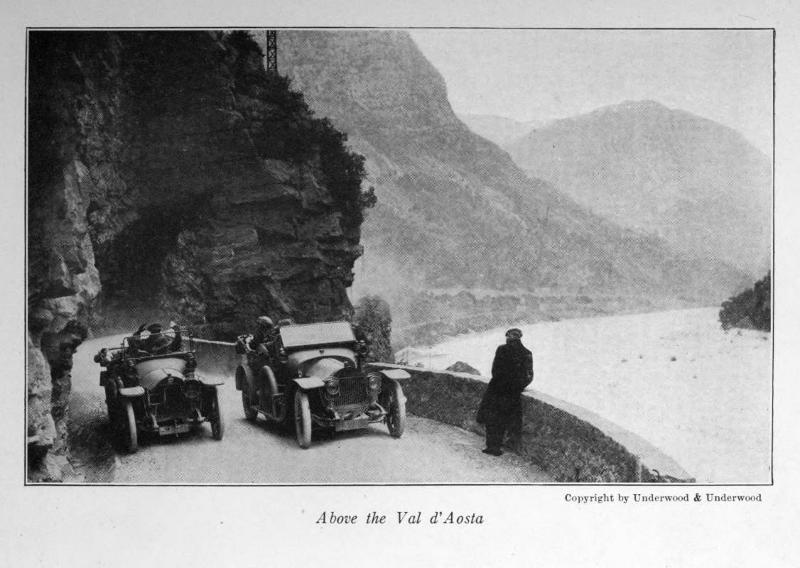
Above the Val d'Aosta
Copyright by Underwood & Underwood
At La Thuile, two Frenchmen, about to make
the ascent on motor cycles, cautioned us about
the dangers of the climb. The customhouse
officials were unusually affable, and were
delighted to be included in a group picture.
Then the long climb of six miles to the summit
began to reveal dangers and difficulties.
One sharp curve followed another. We soon
overtook the French motor cyclists. They were
walking, having found the ascent too steep. It
was thrilling to be able to look down into the
sunshine and fertility of Italy and then to
observe the barren world of rock and snow into
which we had risen. The engine proved equal
to the severe test. We used the same tactics
which were so successful on the Stelvio, keeping
the same pace until the summit was gained,
where we let the car rest near the world-famous
Hospice du Petit St. Bernard. Other
cars had halted in succession, having made the
ascent from the French side en tour to Italy.
There was missing one interesting personality
who had greeted visitors to the hospice in
other years, the Abbé Chanoux, for fifty years
rector of the hospice and the last patriarch
of that legendary region of the Alps. The
hospices of the Grand St. Bernard, and of the
Simplon in Swiss territory, are managed by
priests, but the Abbé Chanoux reigned alone
in his mountain hospital, assisted by a few
helpers and by his dogs. For half a century
it was always a joy, when he saw some traveler
less hurried than the others, to offer him a
glass of muscat in his workshop and then,
after having shown his garden of Alpine
plants, to point out the shortest road to La
Thuile. To-day the tourist can see the
Alpine garden and the grave where, at the
age of eighty-one years, Abbé Chanoux was
buried. The resting place is where he wished
it to be, in view of Italy, France, Mont Blanc,
and his beloved hospice.
Just beyond the hospice is a Roman column
of rough marble bearing the statue of St.
Bernard. One also sees, close by, a circle of
large stones marking the spot where Hannibal
is supposed to have held a council of war.
A simple slab by the roadside designates the
boundary line between Italy and France.
As if to emphasize the fact that we were in
France, a group of French soldiers were on
duty close to the frontier. The cuisine of the
restaurant Belvedere, with its attractive carte
du jour, took us into the real atmosphere of
the country.
The descent of nearly eighteen miles from
the summit to the French douane at Séez, was
like passing from mid-winter to mid-summer.
What a superb stretch of motoring it was!
The panorama, one of those marvelous masterpieces
which nature rarely spreads before
the eyes even of fortunate motorists! From
our point of observation, on a level with the ice
peaks, we could look for miles down into the
plains of Savoy. Mont Blanc glistened like
burnished silver. We could trace the mountain
streams from their cradle in the glacier to
their wild leaping from cascade to cascade
and to the more peaceful flow through the
valley. Pine forests mantled the lower part
of the mountain.
Ignition was cut off, and the car left to
her own momentum. The grades were much
steeper than on the Italian slope, and the
curves without railing or protection of any
kind. The slightest carelessness in steering
would have been fatal. Flowers and grass
began to cover the meadows. Pine forests
surrounded us. Then we entered on the long,
sharp descent to Séez, stopping at the douane
where the French officials came out to receive
us.
The following incident will sound almost too
incredible even to be included in a story of
motor experiences. There was a small duty
to be paid on the gasoline which we were
carrying. Our wealth consisted of American
express checks, a few Italian coins, and some
French change, insufficient by twenty centimes
to pay the duty. One of the officials advanced
the twenty centimes from his own pocket, thus
saving us the inconvenience of trying to cash
the express checks somewhere in the town.
We wished to "snap" his picture, but his
modesty was too great. He also refused the
Italian coins which we tried to press upon
him as a souvenir of the occasion. One
associates customhouse officials with so many
things that are unpleasant, that the incident
naturally made a great impression on us.
Our difficulties were by no means over.
The winding road with its sharp grades required
the greatest caution. Near the Pont
St. Martin it appeared to run straight over a
precipice, and then turned sharply to the right.
This was the place where only a few weeks
later an American party suffered a terrible
accident. Their machine swerved while making
the slippery turn, and fell nearly seventy
feet among the rocks.
For a distance of seventeen miles from Bourg
St. Maurice to Mouthiers the road was in
an appalling condition, any speed over ten
miles an hour being at the risk of breaking
the springs. A railroad was being constructed,
and the heavy teams had raised havoc. We
were creeping through this traffic, when the
sudden halt of the wagon in front compelled
us to stop. Two big teams, drawing stone,
closed in on either side. The drivers, intent
only on looking ahead, did not notice that
their heavy wheels were in danger of smashing
the car. We finally attracted their attention,
but barely in time to avoid trouble. From
Albertville our course was over the splendid
Nationale, which runs from Paris to Italy.
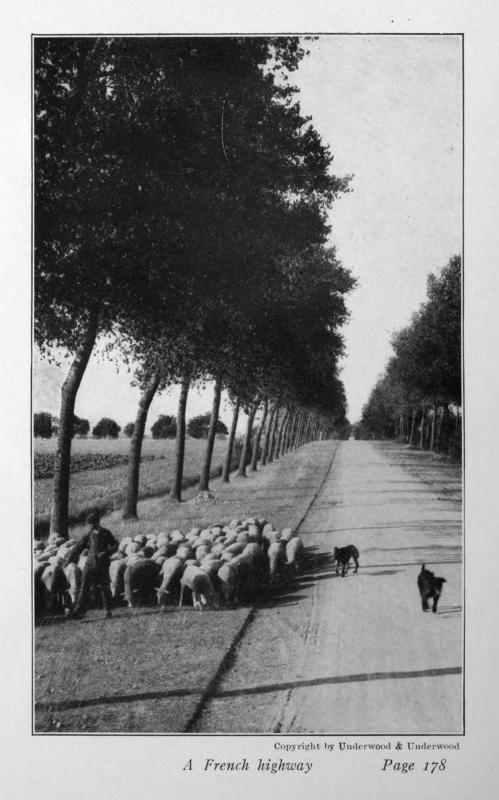
It is always a pleasant experience to motor
on these famous highways, to observe the
governmental system of tree planting, and
to study what trees have been found most
suitable in certain regions to protect the road
and the traveler. The ornamental horse chestnut
and maple greeted us most often in the
small towns of eastern and northern France.
Long rows of plane trees formed one of the
familiar and beautiful sights of Provençe. We
often saw these trees fringing the fields to
give shelter and protection from the blasts
of the mistral. It was also interesting to
notice how fruit trees have in many places
replaced forest trees along the road. These
national highways, so much improved by
Napoleon, were for us like open books for the
study of the French trees.
It has been well noted that "while the state
has the right to plant along the national roads,
at any distance it pleases from the adjoining
property, it exercises this right with judicious
moderation and leaves, as a rule, two meters—six
and one-half feet—between the trees and
the outside edge of the roadway.
"Tree planting is let in small contracts,
sometimes as low as five thousand francs apiece.
The object of this is to promote competition
and to attract specialists, such as gardeners
and nurserymen, who are hardly likely to have
the means for undertaking large contracts.
"Government inspectors see that the contractor
plants well-formed trees, free from disease
and in every way first class.
"As the best planting season is short, a fine
is imposed for every day's delay. When the
contractor gets his pay, a certain sum is retained
as a guarantee; and for two years he is
responsible for the care of the trees and for the
replacing of any that died or that proved defective.
The sum held back until the final
acceptance of his work, protects the government
from danger of loss."[3]
There was no hurry about reaching Chambéry,
our headquarters for the night. The
distance of a few miles could easily be covered
before dark, so we halted for a little while by
the roadside. The car was in remarkably good
condition after the tremendous strain of the
day's ride. Dimly, in the distance, towered
the snow-clad heights where we had been motoring
only a short time before. By thus tarrying
a while we enjoyed dazzling retrospect,
present beauty, and alluring prospect.
A big Peugot tore by. These wide, smooth
highways of crushed stone invite speed. There
is a speed limit of eighteen miles in the open
country, but it has long been a dead letter.
The French system is to allow the motorist to
choose his own pace, but to make him fully
responsible for accidents. By thus heavily
penalizing careless driving, the law works to
develop the driver's discretion and does not
impose farcical speed limits. This absence of
burdensome regulations eliminates an endless
amount of friction, and is one of many conditions
in France which have contributed to
the pleasure and comfort of foreign motorists.
Now we were in Savoy, celebrated for its
mountain scenery, its lakes, and curious peasant
villages. There was a home feeling in our
return to this beautiful French province, for
we had motored here a previous summer.
Many a delightful motor ramble was associated
with the names of Chamonix, at the foot of
Mont Blanc; Evian-les-Bains, on Lake Geneva;
Annecy, on the lake of the same name, that
quaint city which so charmed the Prince of
Wales, a few years ago, with its arcaded, winding
streets and old-world charm; Aix-les-Bains,
the noted and popular watering place; and
there, only a few miles away, Chambéry,
historic city of the dukes of Savoy and of the
kings of Italy. It was fine to see that same blue
atmosphere about us again, and, above all, to
think that for weeks our motor wanderings
were to be in France, the one country on the
continent of Europe where an American can
feel most at home, and where the motorist can
find, amid diversity of scenery, a provincial life
charming alike for its hospitality and old-fashioned
customs. Riding through the twilight
to Chambéry, we hunted up the Hôtel de
France. This hotel could hardly have been
described as luxurious, but it was comfortable,
as are most of the hotels in the provinces.
The chief interest of Chambéry centers about
the Rue des Arcades. At one end of the
arcaded street is the curious Fontaine des
Elephants. This monument, on four bronze
elephants, is dedicated "to the Comte de
Boigne, who settled here after his romantic life
of soldiering in India and bestowed much of the
fruit of the pagoda-tree upon the town." At
the other end of the street are the high, massive
walls which protect the château where the dukes
of Savoy lived and where some of the kings
of Italy were born. There is little enough to
recall the glamour and glitter of those proud
days. The city, with its more prosaic emblems
of civil and military authority, now occupies
the château.