Ever since the Brothers Grimm in 1812 made for the first time a fairly
complete collection of the folk-tales of a definite local or national
area in Europe, the resemblance of many of these tales, not alone in
isolated incidents but in continuous plots, has struck inquirers into
these delightful little novels for children, as the Italians call them
(Novelline). Wilhelm Grimm, in the comparative notes which he added
to successive editions of the Mährchen up to 1859, drew attention to
many of these parallels and especially emphasized the resemblances of
different incidents to similar ones in the Teutonic myths and sagas
which he and his brother were investigating. Indeed it may be said
that the very considerable amount of attention that was paid to the
collection of folk tales throughout Europe for the half century
between 1840 and 1890 was due to the hope that they would throw some
light upon the origins of mythology. The stories and incidents common
to all the European field were thought likely to be original
mythopœic productions of the Indo-European peoples just in the same
manner as the common roots of the various Aryan languages indicated
their original linguistic store.
In 1864 J. G. von Hahn, Austrian Consul for Eastern Greece, in the
introduction to his collection of Greek and Albanian folk tales, made
the first attempt to bring together in systematic form this common
story-store of Europe and gave an analysis of forty folk-tale and saga
"formulæ," which outlined the plots of the stories found scattered
through the German, Greek, Italian, Servian, Roumanian, Lithuanian,
and Indian myth and folk-tale areas. These formulæ were translated and
adapted by the Rev. S. Baring-Gould in an appendix to Henderson's
Folk-Lore of the Northern Counties of England (London, 1866), and he
expanded them into fifty-two formulæ. Those were the days when Max
Müller's solar and lunar explanations of myths were in the ascendant
and Mr. Baring-Gould applied his views to the explanation of folk
tales. I have myself expanded Hahn's and Baring-Gould's formulæ into a
list of seventy-two given in the English Folk-Lore Society's
Hand-Book of Folk-Lore, London, 1891 (repeated in the second
edition, 1912).
Meanwhile the erudition of Theodor Benfey, in his introduction to the
Indian story book, Pantschatantra (Leipzig, 1859), had suggested
another explanation of the similarities of European folk-tales. For
many of the incidents and several of the complete tales Benfey showed
Indian parallels, and suggested that the stories had originated in
India and had been transferred by oral tradition to the different
countries of Europe. This entirely undermined the mythological
theories of the Grimms and Max Müller and considerably reduced the
importance of folk tales as throwing light upon the primitive
psychology of the Aryan peoples. Benfey's researches were followed up
by E. Cosquin who, in the elaborate notes to his Contes de Lorraine,
Paris, 1886, largely increased the evidence both for the common
European popularity of many of the tales and incidents as well as for
the parallels to be found in Oriental collections.
Still a third theory to account for the similarity of folk-tale
incidents was started by James A. Farrer and elaborated by Andrew Lang
in connection with the general movement initiated by Sir Edward Tylor
to explain mythology and superstition by the similar processes of
savage psychology at definite stages of primitive culture. In
introductions to Perrault and Grimm and elsewhere, Andrew Lang
pointed out the similarity of some of the incidents of folk
tales—speaking of animals, transference of human feeling to inanimate
objects and the like—with the mental processes of contemporary
savages. He drew the conclusion that the original composers of fairy
tales were themselves in a savage state of mind and, by inference,
explained the similarities found in folk tales as due to the
similarity of the states of minds. In a rather elaborate controversy
on the subject between Mr. Lang and myself, carried through the
transactions of the Folk-Lore Congress of 1891, the introduction to
Miss Roalfe Cox's "Cinderella," and in various numbers of "Folk-Lore,"
I urged the improbability of this explanation as applied to the
plots of fairy tales. Similar states of mind might account for
similar incidents arising in different areas independently, but not
for whole series of incidents artistically woven together to form a
definite plot which must, I contended, arise in a single artist mind.
The similarities in plot would thus be simply due to borrowing from
one nation to another, though incidents or series of incidents might
be inserted or omitted during the process. Mr. Lang ultimately yielded
this point and indeed insisted that he had never denied the
possibility of the transmission of complete folk-tale formulæ from one
nation and language to another.
During all this discussion as to the causes of the similarity of
folk-tale plots no attempt has been made to reconstitute any of these
formulæ in their original shape. Inquirers have been content to point
out the parallelisms to be found in the various folk-tale collections,
and of course these parallelisms have bred and mustered with the
growth of the collections. In some cases the parallels have run into
the hundreds. (See "Reynard and Bruin.") In only one case have
practically all the parallels been brought together in a single volume
by Miss Roalfe Cox on Cinderella (Folk-Lore Society Publication for
1893; see notes on "Cinder-Maid"). These variants of incidents
obviously resemble the variæ lectiones of MSS. and naturally suggest
the possibility of getting what may be termed the original readings.
In 1889 the following suggestion was made by Mr. (now Sir) James G.
Frazer in an essay on the "Language of Animals," in the Archæological
Review, i., p. 84:
"In the case of authors who wrote before the invention of printing,
scholars are familiar with the process of comparing the various MSS.
of a single work in order from such a comparison to reconstruct the
archetype or original MS., from which the various existing MSS. are
derived. Similarly in Folk-Lore, by comparing the different versions
of a single tale, it may be possible to arrive, with tolerable
certainty, at the original story, of which the different versions are
more or less imperfect and incorrect representations."
Independently of Sir James Frazer's suggestion, which I have only
recently come across, I have endeavoured in the present book to carry
it out as applied to a considerable number of the common formulas of
European folk-tales, and I hope in a succeeding volume to complete the
task and thus give to the students of the folk-tale as close approach
as possible to the original form of the common folk-tales of Europe as
the materials at our disposal permit.
My procedure has been entirely similar to that of an editor of a text.
Having collected together all the variants, I have reduced them to
families of types and from these families have conjectured the
original concatenation of incidents into plot. I have assumed that the
original teller of the tale was animated by the same artistic logic as
the contemporary writers of Contes (see notes on "Cinder-Maid,"
"Language of Animals"), and have thus occasionally introduced an
incident which seemed vital to the plot, though it occurs only in some
of the families of the variants. My procedure can only be justified by
the success of my versions and their internal coherence. As regards
the actual form of the narrative, this does not profess to be European
but follows the general style of the English fairy tale, of which I
have published two collections (English Fairy Tales, 1890; More
English Fairy Tales, 1894).
In the following notes I have not wasted space on proving the European
character of the various tales by enumerating the different variants,
being content for the most part to give references to special
discussions of the story where the requisite bibliography is given.
With the more serious tales I have rather concerned myself with trying
to restore the original formula and to establish its artistic
coherence. Though I have occasionally discussed an incident of
primitive character, I have not made a point of drawing attention to
savage parallels, nor again have I systematically given references to
the appearance of whole tales or separate incidents in mediæval
literature or in the Indian collections. For the time being I have
concentrated myself on the task of getting back as near as possible to
the original form of the fairy tales common to all Europe. Only when
that has been done satisfactorily can we begin to argue as to the
causes or origin of the separate items in these originals. It must, of
course, always be remembered that, outside this common nucleus, each
country or linguistic area has its own story-store, which is equally
deserving of special investigation by the serious student of the
folk-tale. I have myself dealt with some of these non-European or
national folk-tales for the English, Celtic and Indian areas and hope
in the near future to treat of other folk-tale districts, like the
French, the Scandinavian, the Teutonic or the Slavonian.
I had gone through three-quarters of the tales and notes contained in
the present book before I became acquainted with the modestly named
Anmerkungen zu Grimm's Mährchen, 2 vols., 1913-15, by J. Bolte and
E. Polivka. This is one of those works of colossal erudition of which
German savants alone seem to have the secret. It sums up the enormous
amount of research that has been going on in Europe for the last
hundred years, on the parallelism and provenance of the folk-tales of
Europe, and in a measure does for all the Grimm stories what Miss
Roalfe Cox did for Cinderella. Only two volumes have as yet appeared
dealing with the first 120 numbers of the Grimm collection in over a
thousand pages crammed with references and filled with details as to
variants. The book has obviously been planned and worked out by Dr.
Bolte, who had previously edited the collected works of his chief
predecessor, R. Koehler. Dr. Polivka's contribution mainly consists in
the collection and collation of the Slavonic variants, which are here
made accessible for the first time. I therefore refer to the volume
henceforth by Dr. Bolte's name. The book is indispensable for the
serious students of the folk-tale, and would have saved me an immense
amount of trouble if I had become acquainted with it earlier.
In thirty-eight or nearly a third of the tales Dr. Bolte gives a
formula, or radicle, summing up the "common form" of the story, and I
am happy to find that in those cases, which occur in the early part of
the present volume, my own formulæ, agree with his, though of course
for the purposes of this book I have had to go into more detail. Dr.
Bolte has not as yet expounded any theory of the origin of the Folk
Tale, but, with true scientific caution, judges each case on its
merits. But his whole treatment assumes the organic unity of each
particular formula, and one cannot conceive him regarding the
similarities of the tales as due to similar mental workings of the
folk mind at a particular stage of social development.
Finally, I should perhaps explain that in my selection of typical
folk-tales for the present volume, I have included not only those
which could possibly be traced back to real primitive times and mental
conditions, like the "Cupid and Psyche" formula, but others of more
recent date and composition, provided they have spread throughout
Europe, which is my criterion. For instance "Beauty and the Beast" in
its current shape was composed in the eighteenth century, but has
found its place in the story-store of European children. A couple,
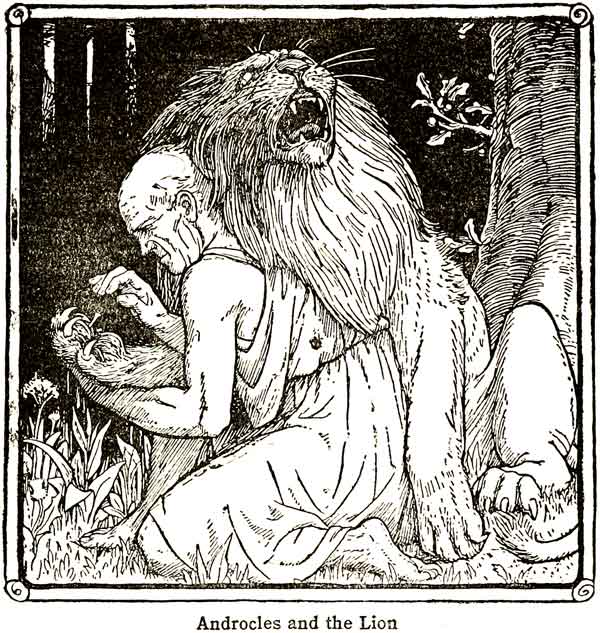
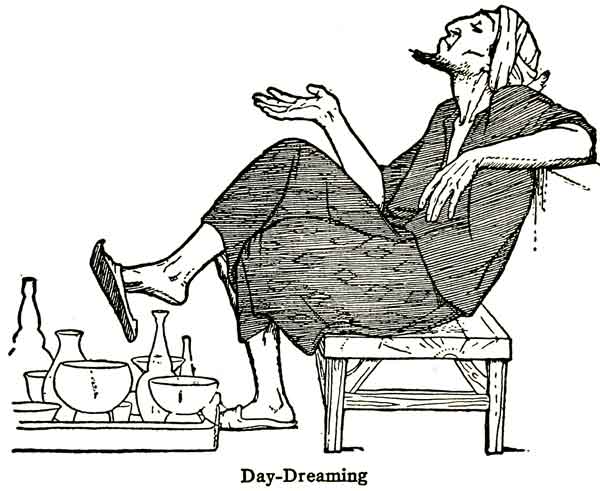
like "Androcles and the Lion" and "Day Dreaming," owe a similar spread
to literary communication even though in the latter case it is the
popular literature of the Arabian Nights. These must be regarded as
specimens only of a large class of stories that are found among the
folk and can be traced in the popular mediæval collections like
Alfonsi's Disciplina-Clericalis or Jacques de Vitry's Exempla, not
to speak of the Fables of Bidpai or The Seven Wise Masters of
Rome. These form quite a class by themselves and though they have
come to be in many cases Folk-Lore of European spread, they differ in
quality from the ordinary folk-tale which is characterized by its
tendency to variation as it passes from mouth to mouth. Still one has
to recognize that they are now European and take their place among the
folk and for that reason I have given a couple of specimens of them,
but of course my main attention has been directed to attempting to
reconstruct the original form of the true folk-tale from the
innumerable variants now current among the folk.
Source.—Miss Roalfe Cox's volume on Cinderella, published by the
Folk-Lore Society (London: David Nutt, 1893), contains 130 abstracts
and tabulations of the pure Cinderella "formula," found in Finland,
the Riviera, Scotland, Italy, Armenia, Iceland, Norway and Sweden,
France, Greece, Germany, Spain, Calcutta, Ireland, Servia, Poland,
Russia, Denmark, Albania, Cyprus, Galicia Lithuania, Catalonia,
Portugal, Sicily, Hungary, Martinique, Holland, Bohemia, Bulgaria,
and the Tyrol. Besides these there are 31 intermediate stories
approximating to the Cinderella type, from Russia, Asia Minor, Italy,
Lorraine, The Deccan, Poland, Hungary, Catalonia, Corsica, Finland,
Switzerland, and in Basque, Spain. The earliest form in which the pure
type occurs is in Basile's Pentamerone, 1634, and of the
indeterminate type in Bonaventure des Periers Nouvelles Récréations,
1557, though the latter seems more cognate to the Catskin formula.
In many of the variants there is an introductory series of incidents
in which the heroine, after the loss of her mother, is set tasks by
the envious step-mother and sisters, which she is aided to perform by
means of an animal helper, mainly sheep or cow, which, in some of the
versions, is clearly identified with her mother either in a
transformed or a natural state. In these versions the magic dresses,
for example, are taken out of the ear of the cow or sheep! These
incidents however seem to me to be incongruous with the rest of the
story, which involves a monogamous society with fairly fixed social
grades and with the wearing of shoes at least among the upper strata
of society. They belong rather to the type of story represented by the
Grimm's "One eye, Two eyes, Three eyes"; and I have therefore reserved
them for my retelling of this formula. In a similar way, in some of
the Celtic versions, a long series of incidents is inserted, clearly
taken from the Sea Maiden story (see Celtic Fairy Tales, xvii.).
The central incident of the Cinder-Maid formula is clearly the Shoe
Marriage Test, up to which everything leads and upon which the
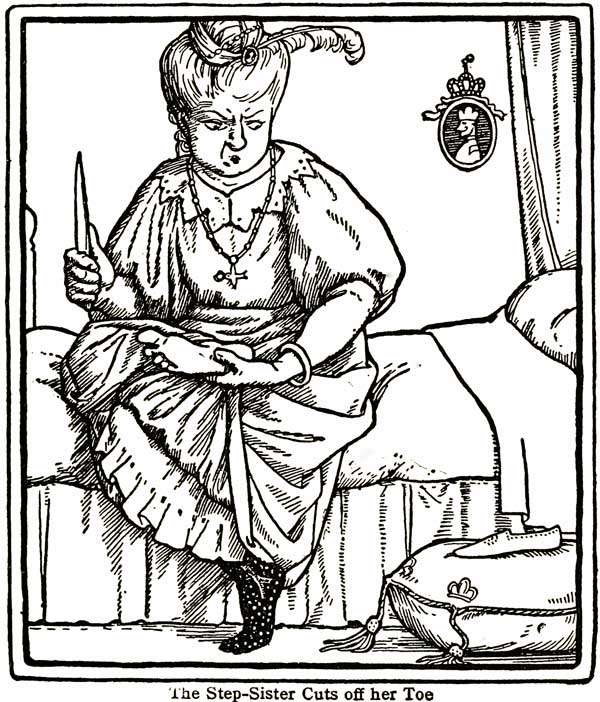
mutilation incidents at the end depends. The mutilation again implies
that the shoe in question must have been of a hard or metallic
substance which could not be pressed out of shape. In the form
endeared to most European children of the upper classes by Charles
Perrault, the slipper is made of glass. It was first suggested by
Balzac that Perrault's pantoffles de verre was due to his
misunderstanding of the pantoffles de vair, or fur (the word vair
is still used to indicate this in heraldry), which he had heard from
his nurse or other folk-tale informant. But the step-sisters would not
have been compelled to hack their heels to get inside a fur slipper,
and, from this point of view, the glass shoe would be preferable. I
have had, however, to reject it because it occurs in only six of the
variants obviously derived directly, or indirectly, from Perrault. The
majority of the versions prefer gold (see Miss Roalfe Cox's
enumeration p. 342).
The Shoe Marriage Test again involves the previous meetings of the
high-born lover and the menial heroine, transformed for the nonce by
her dress into a dame of equal standing. In some of the variants these
meetings are in church and not at a ball, royal or otherwise. But the
Shoe Marriage Test involves a highly desirable parti who can
practically command any wife he desires; this points to some
super-chief or king. I have, therefore, reserved the church meetings
for the Catskin type of story in which the heroine is scullery-maid in
the young lord's own household. The obtaining of the dresses needed
for the Royal Balls involves some animal or supernatural aid (in
Perrault it is, of course, a fairy god-mother, unknown to the folk
mind), while the menial condition of the heroine is best explained in
the usual folk-tale manner by the envious step-mother or sisters.
I have pointed out in English Fairy Tales (Note to "Childe Rowland")
that in most folk-tales of a romantic type the mode of telling is by
prose narrative interspersed with rhyming formulæ analogous to the
cante-fable as in "Aucassin and Nicolete." The Cinderella formula
shows clear traces of such rhymes, especially at the stages of the
narrative where incidents are repeated—the appeal for aid at the
mother's grave (Dress Rhyme), the avoidance of pursuit by the guards
(Pursuit Rhyme), and the calling attention of the Prince to the
mutilated feet of the step-sisters (Feet Rhyme).
Now some of these rhymes are found in similar and almost identical
shape in collections made in different countries and different
languages; thus the Tree Rhyme is found in the Archivio (Cox, p.
139) and in Ive (p. 265), in Bechstein (p. 166), and in Grimm (p.
222), and in Hahn (p. 244), and Moe (p. 322), each pair having
practically identical rhymes. Thus we have the existence of a Tree
Rhyme, shown in Italy and Germany, Greece and Denmark. So, too, the
Feet Rhyme is found in Scotland and Denmark, Germany and Brittany. It
is scarcely possible to doubt that all these came from one original
form of the story in which similar rhymes occurred at the same stage
of the narrative. The possibility of such coincidences arising
casually may fairly be regarded as out of the question.
The subordinate incidents growing out of these essential elements of
the formula are of course more flexible, but the Shoe Marriage Test
itself involves some remarkable dresses used to disguise the identity
of the Cinder Maid at her meetings with the hero, and this again
involves, though not so directly, a series of metal carriages. The
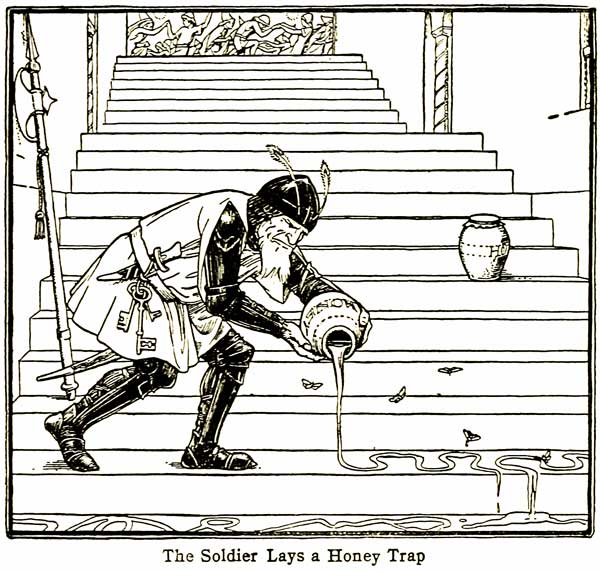
Pursuit Rhyme might easily give rise to the expedients of the Honey
and Tar Traps though these do not occur in very many of the variants.
I have never-the-less inserted them for the sake of the children if
not for that of Folk-Lore Science.
Thus, from what may be called the artistic logic of the Cinderella
story, one is enabled to reconstitute its original formula somewhat as
follows:
Noble Father—Single Daughter—Mother's Death—Tree Planted on
Mother's Grave—Second Marriage—Two Ugly Step-Sisters—Menial
Heroine—Cinder-Maid—Prince Coming of Age—Royal Ball—Step-Sisters
Dressing—Tree Rhyme—Bird Aid—Magic Dress (blue heaven with
stars)—Copper Chariot from Tree—Copper Shoes—Caution Rhyme—Ball
Success—Pursuit Rhyme—Step-Sisters' Envy—Second Ball—Magic Dress
(golden brown earth with flowers)—Silver Chariot—Silver Shoes—Honey
trap—Pursuit Rhyme—Third Ball—Magic Dress (green sea with
waves)—Golden Chariot—Golden Slippers—Tar Trap (lost shoe)—Time
Expired—Shoe Marriage Test—Mutilated Foot—Feet Rhyme (bis)—Happy
Marriage.
It is in accordance with the above formula that the version presented
in the preceding pages has been written, the rhymes being, in most
cases, compounded from the various renderings given in Miss Cox's
volume. I have only added the Caution Rhyme about returning at
midnight, which is in prose in the versions; it would be incongruous
for the little bird to change her mode of diction so suddenly. I can
only hope I will not remind the reader of the guide's description of
Wallenstein's horse at Prague: "The head, neck, forelegs, left
hind-leg, and part of the back and tail have been restored; all the
rest is the original horse."
Parallels.—Miss Cox's volume contains all the parallels of the
Cinder-Maid formulæ, to which reference has been made above, and she
has supplemented these by a few additional ones in Folk-Lore for
1907, pages xviii; 191-6. In addition, she gives, in her notes,
parallels to the different incidents:
Note 4. (Help by dead parent.) Note 6. (Pursuit checked by mist.) Note
7. (Magic tree on buried mother's grave.) Note 8. (Substituted bride.)
Note 26. (Sitting on ashes.) Note 32. (Birds' language.) Note 38.
(Tree or rock treasures.) Note 48. (Lost shoe.) Note 50. (Iron shoes,)
and further notes on, Helpful, animals, p. 526. Fairy god-mother, p.
527 and Talking birds, p. 527-9.
Of these the most important for our present purposes is the 48th note
dealing with the Lost Shoe, which we have suggested is the central
incident in the "original." In Strabo xvii. and in Ælian xiii.—33,
the myth of Rhodope informs us that, while she was bathing, an eagle
snatched one of her sandals and dropped it in the lap of Psammetichus
who, struck by its neatness, had all Egypt search for its owner, whom
he then took to wife. In other Egyptian and in Indian stories a
severed lock of hair of the heroine leads to the same result. Jacob
Grimm drew attention to the old German custom of using a shoe at
betrothals, which was placed on the bride's foot as a sign of her
being subjected to the groom's authority. King Rother had two shoes
forged, a silver and a golden one, which he fitted on the feet of his
bride, placed on his knee for that purpose. (See Deutsche
Rechts-Alterthumer, Göttingen, 1828, p. 155.) It is, of course,
possible that some reminiscence of the Rhodope myth had spread among
the folk to which the original teller of Cinder-Maid belonged, and if
the shoe betrothal was confined to German custom this would seem to
give a clue to the original home of the Cinder-Maid.
Remarks.—The hazardous character of the reconstruction process
involved in the restoration of the original Cinder-Maid formula
cannot, of course, be exaggerated. It is even more precarious than the
similar procedure gone through by scholars to restore the original
reading of MSS. or by the Higher Critics in recovering the J.
narrative of Joseph or the E. narrative of Lot. But I think I have
shown that the incidents selected by me are those which are
necessitated by the artistic logic of the Shoe Marriage Test which
forms the decisive incident in the Cinder-Maid formula. Where the
majority of the incidents contained in the reconstruction occurred in
the same order in far distant countries it is practically impossible
to imagine that the resemblance is due to chance. Nor is it pertinent
to point out that the separate incidents occur equally widespread in
connection with other formulæ, since it must not be forgotten that no
folk teller ever indulges in a single incident; he tells a tale of
many incidents. At the same time it is obvious that a series of
incidents may be transferred appropriately (or inappropriately) from
one tale to another; and this has occurred with the Cinderella tales,
as is shown abundantly in Miss Cox's notes. It is thus quite easy for
a folk teller, who is familiar with other stories, to introduce an
analogous set of incidents in the Cinder-Maid formula, just as Rob
Roy's son can introduce variations of an air when playing the
bagpipes; but the air remains the same throughout.
If the formula I have reconstructed for the Cinder-Maid compares at
all with the original, one ought to be able to take any variant and
see where the teller of it has diverged from the original, inserted
new incidents or adopted new ones to local conditions. When one reads
over Miss Cox's variants one can often discern such additions or
variations introduced by the fancy of the teller. It is even possible
that in Cinderella itself the original folk artist who conceived it
made use of the Catskin formula to embellish the details of the three
meetings of the lovers; even in my own telling I fear there may be
traces of the same process. There is still doubt whether the bird in
the hazel tree was meant to represent the soul of the mother in whom,
we may even say, there is a double identification involved, as in the
Golden Bough. The tree rising from the mother's grave is obviously
connected spiritually with her; the relation of the bird in the tree
to the Cinder-Maid also implies a similar relation to the mother. In
my telling of the tale I have purposely avoided emphasizing this,
which might lead to inconvenient questionings from the little ones. In
the scheme of the story the guardian influence of the mother-soul is
prominent throughout but need not be too much emphasized for modern
children.
This nonsense story is found widely spread, especially in Romance
tongues, French, Italian, Provencal, and Portuguese; but it is also
found in Ireland (see Celtic Fairy Tales), Hanover, Transylvania,
Esthonia, and Russia; so that it has claims to be included in the
fairy book of all Europe. Cosquin, ii., 209-14, gives a number of
Oriental stories, Annamite, Kalmuk, Kaffir, which contain the incident
of the girl in the bag, and Indian and Kabyle stories, which go
through the same exchanges as our story. In the latter case it is an
animal story in which the jackal has a thorn picked out of his paws by
an old woman, and gets an egg out of her in exchange for the thorn
which he has "lost." In this form the jackal helps considerably in the
disappearance of the successive exchanges. It is difficult to say
whether the European or the Indian form was the earlier. The animal
dramatis personæ seem less incongruous and turn the scale in favour
of India.
This is practically the Perseus legend of antiquity, which has been
made the subject of an elaborate study by Mr. E. Sidney Hartland, The
Legend of Perseus, 3 vols., London, 1894-6. Mr. Hartland
distinguishes four chains of incidents in the story:
- 1. The Supernatural Birth.
- 2. The Life Token.
- 3. The Rescue of Andromeda.
- 4. The Medusa Witch.
Not all the variants, which are very numerous, running from Ireland to
Cambodia, include all these four incidents. The Greek Perseus legend,
for instance, has not the Life Token. Cosquin, i., 67, knows of only
eighteen which have the full contingent, one in Brittany, two in
Greece, one in Sicily, four in Italy, one each—Basque, Spanish,
Catalan, Portuguese, Danish, and Swedish; two German; one Lithuanian;
and a Russian variant. There must be many more in Bolte's notes to
Grimm, 60. These are sufficient to prove that the whole concatenation
of incident is European, though it is difficult to understand how the
Medusa incident got tacked on to the preceding three, with which it is
very loosely combined, the only point of connection being with the
Life Token. Strangely enough, in the ancient form of the folk-tale,
the Gorgon is an almost essential part of the story, though the Life
Token has disappeared, and the Supernatural Birth only applies to the
hero and not to his animal companions. In the modern European
folk-tales these animal friends are rather supernumeraries and are
occasionally replaced by the formula of the Grateful Animals, to whom
the hero does some service during his wanderings, in reward for which
they rescue him from some extremity. In some ancient variants of the
Perseus legend there are traces of the Substituted Champion in the
form of Pentheus, a former suitor of Andromeda, who had failed to meet
the dragon.
It would be impossible here to consider the folk-lore analogies of the
four chief incidents of the tale which have occupied Mr. Hartland for
three fairly large volumes to develop, out of which have grown two
more (Primitive Paternity, London, 1910). It is only necessary here
to refer to a few points in their relation to the tale itself. The
Supernatural Birth, which is also treated by M. Saintyves (?) is found
attributed to heroes among all nations; it is only of significance in
the story here in its bearing upon the Life Token of the hero, which
is connected with it. With regard to the Life Token, Major Temple has
a full analysis in the notes to Wide Awake Stories, 1884, pp. 404-5,
under the title of the "Life Index," and is closely connected with
the idea of the External Soul, which Sir James G. Frazer has studied
in his Balder, London, 1913, pp. 95-152. The Fight with the Dragon
is celebrated outside folk-tales in the lives of the saints (whence
St. George, the titular saint of England, gets his emblem) in the saga
of Siegfried, and in the poetry of Schiller, where it is made the
subject of a moral apologue. The Medusa-witch, who transforms into
stone, or destroys life in other ways, is quite a familiar figure in
folk tales, but is usually thwarted, as here, by some means of cure.
The chief interest, however, of the "King of the Fishes," from a
folk-tale point of view, is the remarkable similarity of the later
folk-tales with the Greek legend, from which they are separated by so
many centuries. The absence of the Life Token in the Greek version and
the comparative insignificance of Medusa in the modern tales are
sufficient evidence that these latter are not directly derived from
the former. Yet even Mr. Hartland, who is a strong adherent of the
anthropological treatment of folk-tales, fully agrees that this
particular tale must have, at one time, been composed in artistic
unity, if not containing all the four chains of incidents at least
containing two of them (Legend of Perseus, iii., 151). It should be
added that Rassmann and the Grimms connect the folk-tales with the
Siegfried saga (Bolte, i., 547, 555).
This familiar story is found as early as Pauli, "Schimpf und Ernst,"
No. 595. It is frequent in Italy, especially in Pitre's Selections.
Koehler has references to the other European versions in Bladé, p.
155. Crane, Italian Popular Tales, No. xcvi, has rendered one of
Pitre's versions.
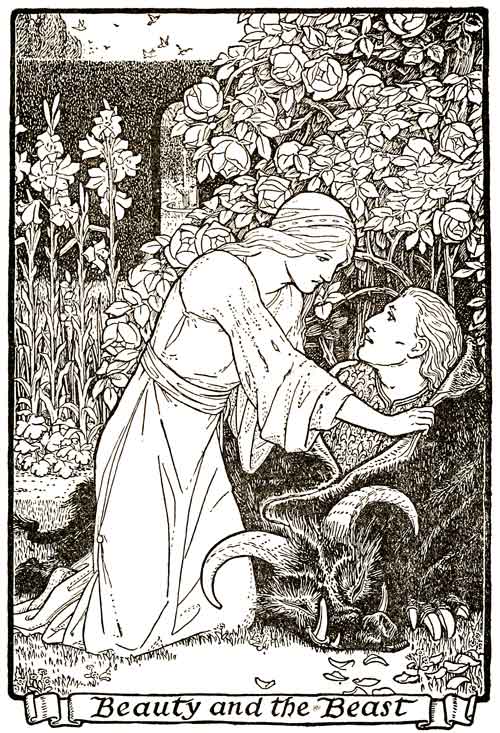
This rather artificial tale has never-the-less spread through all
Europe. One finds it in Italy almost in the same form as in the
original French by the Princesse de Beaumont, from whom it has got
into the ordinary fairy books of England, France and Germany. See
Crane II., "Zelinda and the Monster," pp. 7-11, with note 6, p. 324,
which contain a reference to Miss Stokes's Indian Fairy Tales, p.
292. The Grimm story No. 108, "Hans the Hedgehog," is more primitive
in character, and we get there the story how the Beast obtained his
terrible form. I have, however, rejected this form of it as it is not
so widespread as "Beauty and the Beast," which is one of the few
stories that we can trace, spreading through Europe practically within
our own time. The artificiality of the leading motive is sufficient
proof of the late origin of the tale. But, after all, tradition does
not distinguish between primitive or later strata. Ralston dealt with
the whole formula from the sun-moon point of view in Nineteenth
Century, Dec., 1878.
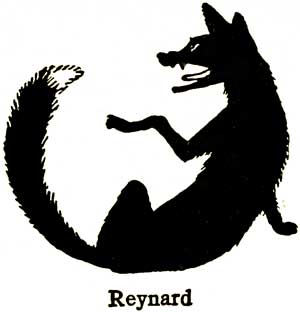
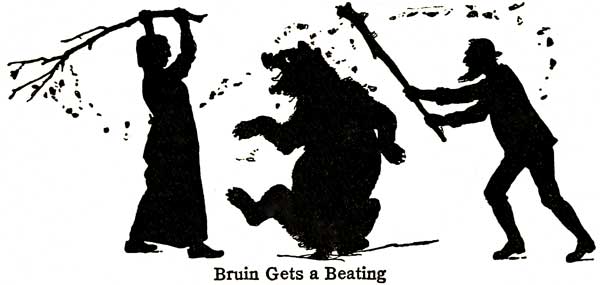
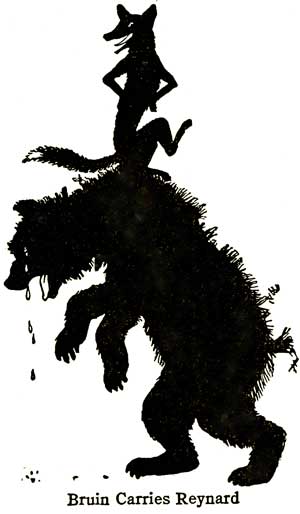
The main incidents of "Reynard the Fox" occur in folk-tales throughout
Europe, and it has often been discussed whether the folk-tales were
the foundation of the beast epic or vice versa. Since, however, it has
been proven that many other incidents besides those used in the beast
satire are found among the folk, it is generally allowed nowadays
that, apart from a few Æsopic fables included in the satire, the main
incidents were derived from the folk. On this subject see my
introduction to "Reynard the Fox" in the Cranford Series.
I have selected a number of the most characteristic of these
folk-tales relating to the former friendship and later enmity of the
Fox and the Bear, basing my compilation on the admirable monographs
of Prof. K. Krohn of Helsingfors, "Mann und Fuchs," 1891, "Baer (Wolf)
und Fuchs; eine nordische Tiermärchenkette," in Journal de la Société
Finno-Ougrienne, vi., Helsingissa, 1889, and "Die geografische
Verbreitung einer nordischen in Finnland," in Fennia, iv., 4. The
latter monograph is accompanied by an interesting map of Finland,
showing the distribution of the Scandinavian form of these stories, in
which the Bear is the opponent of the Fox, and the Slavonic form in
which the Wolf takes that position. As there is obviously a
mythological tendency at the root of the stories, intending to account
for the shortness of the Bear's tail and the white tip of the Fox's,
it is clear that the Scandinavian form is the more original.
I have tried to collect together in a logical narrative:
- (a) Fox and Bear in partnership—(Top-off, Half-gone, All-gone).
- (b) Fox in fish cart.
- (c) Iced Bear's tail.
- (d) Fox and cream jug.
- (e) Fox on Bear's back.
- (f) Fox in briar bush.
- (g) Man promises Fox two geese for freeing him from Bear.
- (h) Gives him two dogs.
- (k) Fox and limbs; sacrifices tail.
In his article in Fennia, Prof. Krohn refers to no less than 708
variants of these different episodes, of which, however, 362 are from
the enormous Finnish collections of folk lore in possession of the
Finnish Literary Society at Helsingfors. The others include the
majority of European folk-tale collections with a goodly sprinkling of
Asiatic, African and American ones, the last, however, being confined
to "Uncle Remus," in which four out of the ten incidents occur in
isolated adventures of Brer Rabbit.
Many of the incidents occur separately in early literature; (g) (h)
(k) for example, which form one sequence, are found not alone in
Renard but also in Alfonsi, 1115, and Waldis. (c) The iced bear's tail
occurs in the Latin Ysengrimus, of the twelfth century, in the
Renart of the thirteenth, and, strangely enough, in the Hebrew Fox
Fables of Berachyah ha-Nakadan, whom I have identified with an Oxford
Jew late in the twelfth century. See my edition of Caxton, Fables of
Europe, i., p. 176. The fact that ice is referred to in the last case
would seem to preclude an Indian origin for this part of the
collection.
It is not quite certain however that all the above incidents were
necessarily connected together originally. The fish cart (b), and the
iced bear's tail (c), are so closely allied that they probably formed
a unity in the original conception, though they are often found
separately nowadays among the folk. Bear and Fox in partnership (a),
is found elsewhere told of other animals, notably of the firm of Cat
and Mouse in Grimm No. 2. It is difficult to determine at present
whether stories relating to other animals, or even to associations of
men, have been applied by peasant narrators to the general opposition
of the sly versus the strong animal, which they have dramatized in
the beast satire of Reynard and Bruin.
For a discussion of the whole subject, see A. Gerber, Great Russian
Animal Tales, Baltimore, 1891, who discusses the incidents included
in the above compilation in his notes on v. (a), i. (b), ii. (c), iii.
(d), iv. (e), iva. (f), ix. (g), x. (h), xi. (k). It will be found
that few of the other incidents contained in Gerber can be traced
throughout Europe except when they are evidently derived from Æsop.
This story has the peculiarity, that it occurs in the Arabian Nights
as well as in so many European folk-tales. Hahn includes it under his
formula No. 4, Genoveva (add Gonz. 5, Dozon 2, Denton 238, Day xix.),
H. Coote, in Folk-Lore Record, vol. iii., part 2, in a paper on
"Folk-Lore, the Source of some of M. Galland's Tales," contends that
the "Tale of the Two Sisters who Envied their Cadette," as well as Ali
Baba, Aladdin, and Ahmed and Paribanou, were derived from Arabic
folk-lore rather than from any Arabic manuscript version. We know now
that this is not true of Aladdin; and Zotenberg has traced all these
extra tales of Galland to the oral recitation of his Christian
dragoman Hanna. Coote finds the two envious sisters to be an enormous
favorite in Italy and Sicily, being found in Pitre, Berti, Imbriani,
Nerucci, and Comparetti. The story of the girl is sometimes told
separately as a fiaba. Coote remarks that Leon Bruno is Greek (see
Hahn, p. 131 and F. L. R., i., 209), and is derived from the Arabian
Nights in the story of the princess of the islands of Wakwak; it also
occurs in Straparola and Madame D'Aulnoy; Brueyre has something
similar in Brittany, p. 93; Kohler in Melusine, pp. 213, 214,
compares the Breton tale, given there, with the Arabian Nights.
The boy with the moon or the sun on his forehead is a frequent
character in Indian folk-tales (see Temple, Wide Awake Stories). The
possibility of Galland's version having passed into the East from
Europe does not seem to have been considered till I suggested it in my
Introduction to the Arabian Nights. There is little doubt that Open
Sesame is European, and similarly this story occurs in Straparola
early enough to prevent any possibility of doubt on the subject. The
sequel of incidents appears to be as follows:
Overheard Boasting—Three Marriages—Substituted Children—Quest
Tasks—Life Token—Speech Taboo—Brother's Failure—Sister's
Success—Guilt Revelation—Punishment of Envious Sisters. Some of
these incidents, like the Life Token, occur in other collocations but
are sufficiently appropriate here; Imbriani has three versions, vi.,
vii., viii., with notes.
I have mostly followed Crane, pp. 17-25 (see also his notes, pp.
325-6).
Source.—Sir J. G. Frazer, in Archæological Review, i., 81-91,
161-81, who made an attempt, the first of its kind, to restore the
original archetype of the story of "The Boy Who Became Pope," on the
same principle as classical scholars restore readings from families of
MSS. He uses Grimm, xxxiii.; Crane, xliii.; Sebillot, 2d series xxv.;
and Fleury, 123 seq. I have, on the whole, followed his
reconstruction, but have introduced, from the version in the "Seven
Wise Masters," the motive for the father's anger when learning that he
would have, some day, to offer his son water to wash in; Sir James, in
a private communication, concurs in the insertion. The folk versions
are, in this instance, peculiarly poor, and I have therefore had
largely to rewrite, preserving, however, the common incidents.
Formula.—The following formula gives the common elements of the
four parallels used by Sir James Frazer, with my insertion of the bird
prophecy (father-water, mother-towel):
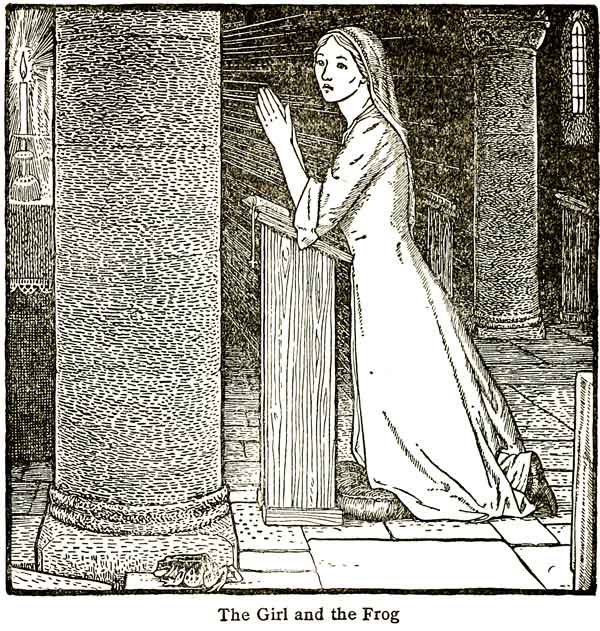
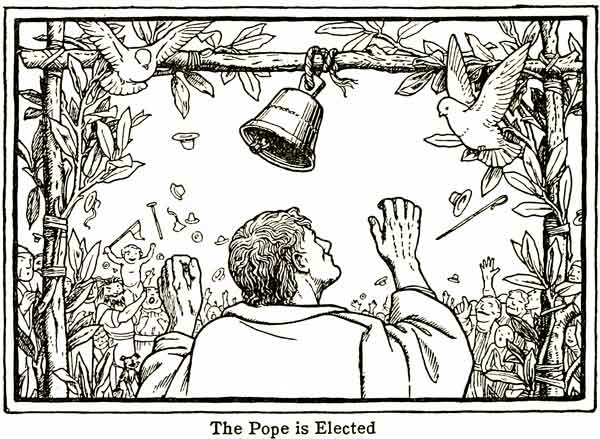
Simple Boy—Sent to School—Learns Language of Dogs, Frogs and
Birds—Bird Prophecy (Father-Water, Mother-Towel)—Hero
Exposed—Intended Murderer Brings Back Deer's Heart—Three adventures
on Road—Dogs Warn Burglary—Frog Restores Host to Sick Girl—Bird
Prophesies Papacy (one of three companions)—Pope Election—Heavenly
Sign (dove and bell)—Bird Prophecy Fulfilled—Father Repentance.
Parallels.—Besides the four sources used by Sir James Frazer, he
gives two variants of the Breton from Melusine, i., cols. 300, 374,
and the "Seven Wise Masters" version, with six variants: Russian,
Masurian, two Basques, and a Turkish one. In the Russian version the
father-water, mother-towel prophecy occurs, which could not have
arisen independently. In the Masurian version the prophecy is more
primitive ("Your mother will wash your feet, and your father will
drink the water"). In the remaining versions the prophecy is more
vague, that the parents shall be the son's servants. In the
Pentamerone there is a story in which a father has five simple sons
whom he sends into the world to learn experience. The younger returns
with a knowledge of the language of birds. But the rest of the story
is not of our type.
Remarks.—In his second paper (Arch. Rev. i., 161 seq.) Sir
James Frazer has many interesting remarks upon the folk conception of
the means of acquiring a knowledge of the language of animals. This is
generally done by a gift of magic rings, or by eating magic plants
(mainly fern) or eating serpents (generally white). Sir James Frazer
connects the rings with serpents by suggesting that serpents are
supposed to have stones in their head which confer magic powers (As
You Like It, iv., 2.) He further connects the notion of eating
serpents with acquiring the language of birds by referring to the
views of Democritus that serpents are generated from the mixed blood
of diverse birds and are therefore in a strict sense blood relations
of them; this idea, he suggests, may have arisen from the fact that
serpents eat birds' eggs. It would be an easy transition in
folk-thought to consider that serpents would understand the language
of the birds they ate and that persons eating serpents would
understand the language of both. So Sigurd understands the language of
birds, after eating the blood of Fafnir the Worm. But all this throws
little light upon the story itself.
Bolte gives, i., 323-4, many folk-tales in which the hero becomes not
a pope but a king and compares the story of Joseph in the Bible as
possibly a source of the Prophetic Dream of the father and mother
waiting upon the son. The transference to the pope may have been
influenced by the tradition given by Vincent of Beauvais (Spec.
Hist., xxiv., 98) that Sylvester II. learned at Seville the language
of birds. There was also the tradition that at the election of
Innocent III., 1198, three doves flew about the cathedral, one of
which, a white one, at last settled down upon his shoulder. Raumer,
Gesch. d. Hohenstaufen, ii., 595.
This tale is widely spread through Europe, being found from Ireland to
Greece, from Esthonia to Catalonia. It is generally told of three
soldiers, or often brothers, but more frequently casual comrades. In
Kohler's notes on Imbriani, p. 356-7, he points out that there are
three different forms, in the first of which the fairy's gifts are
recovered by means of a defect produced, which only one of the
soldiers can cure. In the second form the latter part is wanting, and
in the third the two gifts are restored by means of the third, which
is generally in the form of a stick. See English Fairy Tales, No.
32. In my reconstruction I have followed the first form. Cosquin, XI.,
has a fairly good variant of this, with comparative notes. Crane,
XXXI., gives, from Gonzenbach, the story of the shepherd boy who makes
the princess laugh, which is allied to our formula, mainly by its
second part. And it is curious to find the three soldiers reproduced
in Campbell's Gaelic, No. 10. In this version the magic gifts are
wheedled out of the soldiers by the princess, but they get them back
and go back to their "girls."
In the Chinese version of the Buddhist Tripitaka, a monk presents a
man who has befriended him with a copper jug, which gives him all he
wishes. The king gets this from the monk, but has to return it when he
gets another jar which is full of sticks and stones. Aarne in
Fennia, xxvii., 1-96, 1909, after a careful study of the numerous
variants of the East and West, declares that the original contained
three gifts and arose in southern Europe. From the three gifts came
three persons and afterwards the form in which only two gifts occur.
Against this is the earliest of the Tripitaka versions, 516 a.d.,
which has only two magic gifts. Albertus Magnus was credited with a
bag out of which used to spring lads with cudgels to assail his
enemies.
This story is familiar to English-speaking children as Jack the Giant
Killer, but it is equally widespread abroad as told of a little tailor
or cobbler. In the former case there is almost invariably the
introduction of the ingenious incident, "Seven at a Blow," the number
varying from three to twenty-seven. I have adopted a fair average. The
latter part of the story is found very early in M. Montanus,
Wegfuehrer, Strassburg, 1557, though most of the incidents occur in
folk tales scattered throughout the European area. Bolte even suggests
that the source of the whole formula is to be found in Montanus and
gives references to early chapbook visions in German, Dutch, Danish,
Swedish and English (i., 154-6). But the very numerous versions in
East Europe must in that case have been derived from oral tradition
from these. Something similar has even spread to Greenland, where the
story of the Giant and the boy is told by Rae, Great White
Peninsula. (See Grimm, tr. Hunt, i., 364.) The Dutch version is told
of Kobis the Dauntless. Cosquin, who has two versions (8 and 25), has
more difficulty than usual in finding the full plot in Oriental
sources, though various incidents have obviously trickled through to
the East, as for example the hero Nasnai Bahadur in the Caucasus, who
overcomes his three narts, or giants, very much in the same manner as
our tailor.
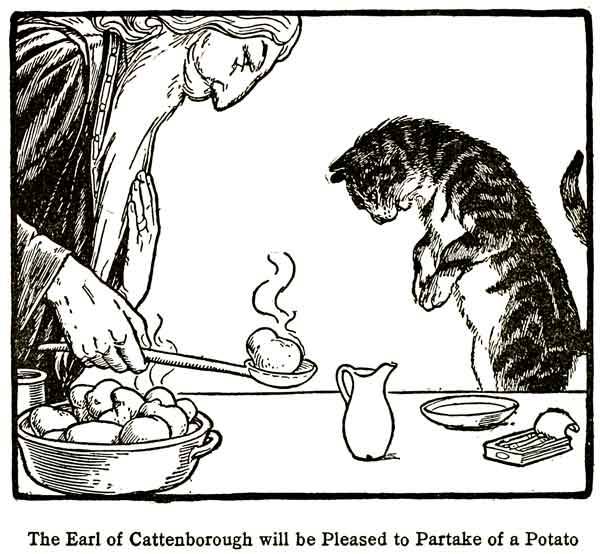
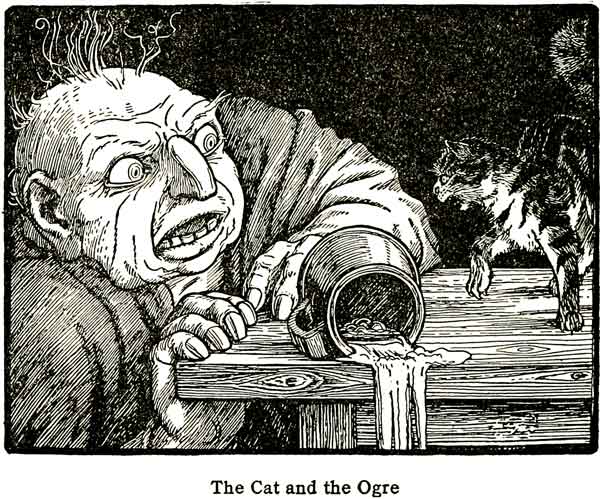
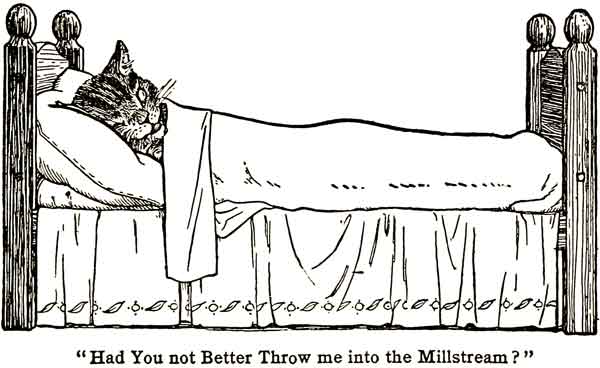
This Puss-in-Boots formula has become universally European from
Perrault's version, to whom we owe the boots that occur in no other
version, so that I have been reluctantly obliged to take them off. But
apart from this the story in its entirety existed earlier in
Straparola, xi., 1, and in the Pentamerone, and is found widely
spread through Italy (Pitre, 88; Imbriani, 10; Gonzenbach, 65, etc.),
as well as in Hungary (Jones and Kropf, No. 1), Germany (Grimm, 33a),
and even in Finland (see Jones and Kropf, p. 305). In some of these
cases the cat is a vixen (or female fox), and the incident of the
false bathing and the marriage occurs before reaching the ogre's
castle, as is indeed more natural. I have, therefore, so far amended
Perrault. In most of the folk versions the miller's son betrays
ingratitude towards his animal protector, who sometimes reduces him to
his original state. This final incident, unknown to Perrault, shows
the independence of these versions from that contained in his Mother
Goose Stories. In Sweden the hero, if one may speak Hibernically, is a
girl, who turns up her nose at everything in the palace as not being
so good as in her castle of Cattenburg (Thorpe quoted by Lang,
Perrault, p. lxxi.). In India it is found in Day, Folk Tales of
Bengal, under the title of "The Matchmaking Jackal," which has
numerous Indian touches; thus the jackal remembers the grandeur of the
weaver's forefathers and rolls himself in betel leaves. Sultan Darai,
in the Swahili version (Steere), has the stripping incident and the
no-talking trick, as well as the ingratitude at end. Lang argues
elaborately that it is impossible to determine the original home of
Puss-in-Boots, though he seems to own that it had one. His criterion
is the absence or presence of a moral in the story, in this case the
incident showing the ingratitude of the Marquis. This occurs, as we
have seen, as far south as Madagascar, and as far east as India, but,
after all, does not seem to be the essence of the story, though in one
of the versions the cat does his tricks for the miller because he had
previously saved him from the hunters. The late Mr. Ralston has an
interesting article on Puss-in-Boots in the Nineteenth Century,
August, 1883, though in his days there was a tendency to explain all
fairy tales as variants of the Sun and Moon myths.
It is right that I should add that the servant's evening salute has
nothing to do with the story but is a tradition in my own family,
where my grandfather's servant used to utter this rhyme in a sort of
chant when bidding the family good-night.
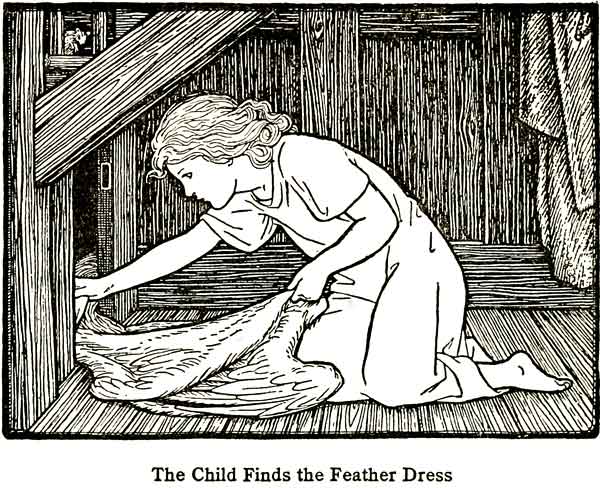
The Swan Maidens occur very widely spread and have been studied with
great diligence by Mr. E. S. Hartland in two chapters (x., xi.) of his
Science of Fairy Tales (pp. 255-347). In consonance with his general
principle of interpretation, Mr. Hartland is mainly concerned with the
traces of primitive thought and custom to be seen in the Swan Maidens.
Originally these were, according to him, probably regarded as actual
swans, the feathery robe being a later symbolic euphemism, though I
would incidentally remark that the whole of the story as a story
depends upon the seizure of a separate dress involving the capture of
the swan bride. Mr. Hartland is inclined to believe partly with F.
Liebrecht in Zur Volkskunde, pp. 54-65, that these mysterious
visitors from another world are really the souls of deceased persons
(probably regarded as totemistic ancestresses). In some forms of the
story, enumerated by Mr. Hartland, the captured wife returns to her
original home, not when she recovers her robe of feathers but when the
husband breaks some tabu (strikes her, chides her, refers to her
sisters, sees her nude, etc.).
From the standpoint of "storyology" from which we are mainly
considering the stories here purely as stories, the Swan Maidens
formula is especially interesting as showing the ease with which a
simple theme can be elaborated and contaminated by analogous ones. The
essence of the story is the capture of a bride by a young man who
seizes her garment and thus gets her in manu, as the Roman lawyers
say. She bears him children, but, on recovering her garment, flies
away and is no more heard of. Sometimes she superfluously imposes a
tabu upon her husband, which he breaks and she disappears (Melusine
variant; compare Lohengrin). This is the effective and affecting
incident of which Matthew Arnold makes such good use in his Merman.
It could obviously be used, as Mr. Hartland points out, in a
quasi-mythological manner to account for supernatural ancestry, as in
the cases of the physicians of Myddvai in Wales, or of the Counts of
Lusignan. But on this simple basis folk tellers have developed
elaborations derived from other formulæ. In several cases, notably in
the Arabian Nights (Jamshah and Hasan of Bassora), the capture of
the swan maiden is preceded by the Forbidden Chamber formula. Then
when the bride flies away there is the Bride-Quest, which is often
helped by Thankful Animals and aided by the Magical Weapons. When the
hero reaches the home of the bride he has often to undergo a
Recognition-Test, or even is made to undertake Acquisition Tasks
derived from the Jason formula; and even when he obtains his wishes in
many versions of the story there is the Pursuit with Obstacles also
familiar from the same formula.
Cosquin, ii., 16, has, with his usual analytical grasp, seen the
separable character of these various series of incidents. He, however,
attempts to show that all of them, including the germ of the Swan
Maidens, are to be found in the East, and is successful in affiliating
the Greek of Hahn, No. 15, with the two stories of the Arabian
Nights mentioned above, as well as the Siberian version given by
Radloff, iv., 321, the hero of which has even derived his name from
the Jamshah of the Thousand and One Nights.
In my own version I have utilized a few of these incidents but reserve
most of them for their proper story environment. I have introduced,
from the Campbell version, the phrase "seven Bens, and seven Glens,
and seven Mountain Moors," which so attracted Stevenson's Catriona, in
order to point out as a remarkable coincidence that Hasan of Bassora,
in the Arabian Nights, flies over "seven Waddys, seven Seas, and
seven Mountains." It is difficult to understand that such a remarkable
phrase should recur accidentally in Bagdad and in the West Highlands.
Without some actual intermediation, oral or literary, the hypothesis
of universal human tendency can scarcely explain such a coincidence.
This well-known story occurs first in the fables of Phædrus, though
not in the extant form, only being preserved in the mediæval prose
version known as Romulus. It is also referred to in Appian, Aulus
Gellius, and Seneca (see the references in my History of Æsop, p.
243, Ro. III., i.). It is told in Caxton's Esope, p. 62, from whom I
have borrowed a few touches. He calls his hero Androclus, whereas
Painter, in his Palace of Pleasure, ed. Jacobs, i., 89-90, calls the
slave Androdus. We moderns, including Mr. Bernard Shaw, get our
"Androcles" from Day's Sanford and Merton. It also occurs in Gesta
Romanorum, 104, edit., Oesterley, who gives a long list of parallels
in almost all the countries of Europe.
Benfey, in the introduction to his edition of Pantschatantra, i.,
112, contends that the story is of Oriental origin, showing Buddhistic
traits in the kindly relations between the slave and the lion; but the
parallels he gives are by no means convincing, though the general
evidence for Oriental provenance of many of Phædrus' fables gives a
certain plausibility to this derivation. From our present standpoint
this is of less importance since Androcles, though it has spread
through Europe and is current among the folk, is clearly of literary
origin and is one of the few examples where we can trace such literary
spread.
I have given the story of the barber's fifth brother from the Arabian
Nights as another example of the rare instances of tales that have
become current among the folk, but which can be definitely traced to
literary sources, though possibly, in the far-off past, it was a folk
tale arising in the East. The various stages by which the story came
into Europe have been traced by Benfey in the introduction to his
edition of Pantschatantra, § 209, and after him by Max Mueller in
his essay "On the Migration of Fables" (Chips from a German
Workshop, iv., 145-209; it was thus a chip from another German's
workshop). It came to Europe before the Arabian Nights and became
popular in La Fontaine's fable of Perrette who counted her chickens
before they were hatched, as the popular phrase puts it. In such a
case one can only give a reproduction of the literary source, and it
is a problem which of the various forms which appear in the folk books
should be chosen. I have selected that from the Thousand and One
Nights because I have given elsewhere the story of Perrette (Jacobs,
Æsop's Fables, No. 45), and did not care to repeat it in this place.
I have made my version a sort of composite from those of Mr. Payne and
Sir Richard Burton, and have made the few changes necessary to fit the
tale to youthful minds. It is from the quasi-literary spread of
stories like this that the claim for an Oriental origin of all folk
tales has received its chief strength, and it was necessary,
therefore, to include one or two of them in Europa's Fairy Book
(Androcles is another). But the mode of transmission is quite
different and definitely traceable and, for the most part, the tales
remain entirely unchanged; whereas, in the true folk tale, the popular
story-tellers exercised their choice, modifying incidents and giving
local colour.
There is no doubt about the European character of this tale, which is
found in Brittany, Picardy, Lorraine, among the Basques, in Spain,
Corsica, Italy, Tyrol, Germany (though not in Grimm), among
Lithuanians, Moravians, Roumanians, Greeks, Irish, Scotch, Danes,
Norwegians (Cosquin, ii., 50). The central idea of the Rage-Wager is
retained throughout, and in many places the punishment is the
same—the loss of a strip of skin. In all but three instances the
story is told of three brothers, which practically proves its
identity. I have given the Irish version in More Celtic Fairy Tales.
The "sells" however change considerably, though in most of them the
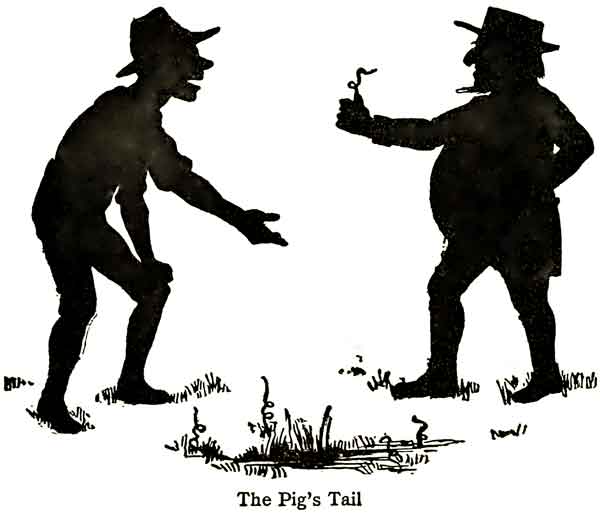
final dénoument comes with the death or wounding of the wife. The
pigs' tails incident is also very common and is indeed found in
another set of tales, more of the Master Thief type. Campbell's No. 45
had an entirely different set, some of them very amusing.
Mac-A-Rusgaich has all three meals at once and lies down. He holds the
plough and does nothing else; he sees after the mountain; literally
casts ox-eyes at the master, and makes a sheep foot-path out of
sheep's feet. I have taken from Campbell the direction to wash horses
and stable within and without, though it does not occur elsewhere. Yet
Mac-A-Rusgaich has a bout with a giant, in which he slits an
artificial stomach, like Jack the Giant Killer; and this incident
occurs in four other of the European tales, again showing identity.
"Keep cool" is thus an interesting example of identity of framework,
with variation of incident.
The sneaking regard of the folk-mind for the clever rogue who can
outwit the guardians of order (the ever-present enemy of the folk) was
shown in early days by the myth of Rhampsinitus in Herodotus, ii.,
121, which is found to this day among the Italians (see Crane, No. 44,
and S. Prato, La Leggenda del Tesoro di Rampsinite, Como, 1882). But
the more usual European form is that I have chosen for the text, the
formula of which might be summed up as follows:
Apprenticeship in thievery—Purse or life—Hanging "sell"—Master
Thief—Three Tests—Horse from Stable—Sheet off bed—Priest in
bag—Horse from under (Thumb-Bung).
Almost the whole of this is found as early as Straparola i., 2, where
Cassandrino is ordered by the provost of Perugia to steal his bed and
his horse and to bring to him in a sack the rector of the village.
The purse incident occurs in Brittany, Piedmont, Tuscany, and Tyrol;
in Iceland (Arnason, p. 609) occurs the man twice hanged which also
occurs in Norway, Ireland, Saxony, Tuscany, and in Germany (Kuhn and
Schwartz, 362); in Servia (Vuk, 46) the Master Thief steals sheep by
throwing two shoes successively in the road, which also occurs in
Bengal (Day, xi.); the theft of the horse occurs in Brittany, Norway,
Ireland, Tuscany, Scotland (Campbell, 40), Flanders, in Basque and
Catalan, Russia and Servia. The third test of kidnapping the priest
occurs in Brittany, Flanders, Norway, Basque, Catalan, Scotland,
Ireland, Lithuania, Tuscany. In Iceland the persons carried away are a
king and a queen.
The three tests of the Master Thief, the stealing of bed, horse, and
priest, occur as early as Straparola, i., 2, who also has a somewhat
similar story of the "Scholar in Magic," viii., 5, which contains the
zigzag transformation of the Arabian Nights. Both forms occur in
Grimm, 68, 192. While the three tests are fairly uniform throughout
Europe, the introduction by which the lad becomes a thief and proves
himself a Master Thief varies considerably; and I have had to make a
selection rather than a collation.
In some forms the farmer has three sons, of whom the youngest adopts
thievery as a profession, which indeed it was in the Middle Ages (as
we know from the Cul-le-jatte of The Cloister and the Hearth). In
Hahn, 3, the Master Thief has to bring a "Drakos" instead of a priest.
Curiously enough, in Gonzenbach, 83, the Master Thief has to bring
back a "dragu."
In many of the variants the Master Thief executes his tricks in order
to gain the King's daughter by a sort of Bride Wager. But in most
cases he does them in order to escape the natural consequences of his
thievery.
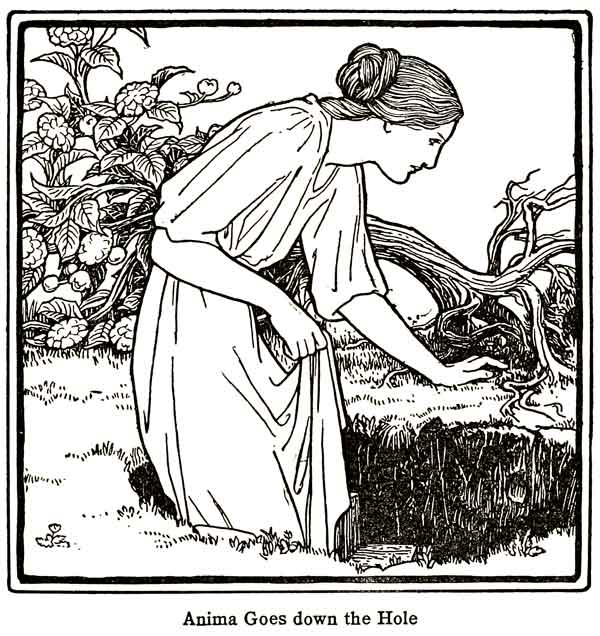
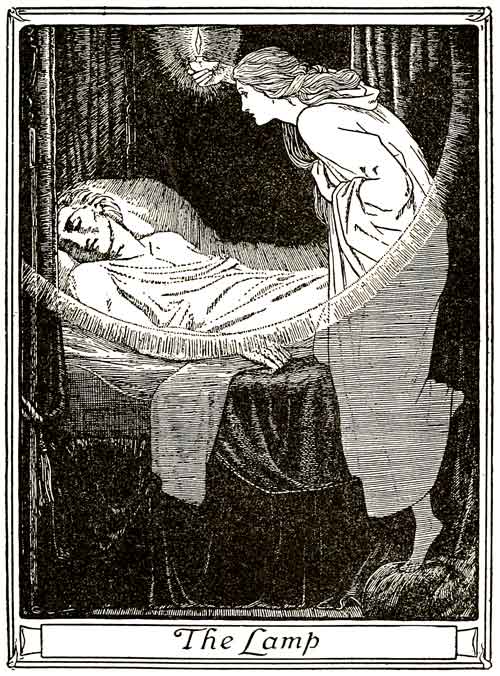
The adult reader will of course recognize that this is the story of
Cupid and Psyche, as told by Apuleius, and translated with such
felicity by Pater in his Marius, Pt. i., ch. 5. Though the names of
the gods and goddesses—Venus, Mercury, Jupiter, Juno, Proserpine,
etc.—are scattered through the tale, it is now acknowledged on all
hands that it has nothing to do with mythology but is a fairy tale
pure and simple, as indeed is acknowledged by Apuleius who calls it a
"fabella anilis." From this point of view it is of extreme interest to
the student of the folk-tale as practically the same tale, with the
Unseen Bridegroom, the Sight Taboo, the Jealous Mother-in-law, the
Tasks, and the Visit to the Nether-World, occur in contemporary
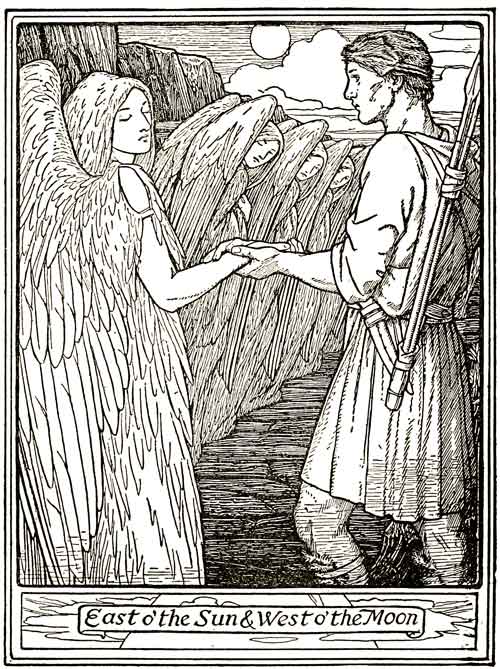
folk-tales scattered throughout Europe, from Norway (Dasent, "East o'
the Sun and West o' the Moon") to Italy (Gonzenbach No. 15, Pitre No.
18 given in Crane No. 1, King of Love); for the variants elsewhere
see Koehler on Gonzenbach. The earliest form of the modern versions is
found in Basile (1637), Pentamerone v., 4, The Golden Root.
Now there are several circumstances showing the identity of the
ancient and modern forms of this story. All of them contain the
punishment for curiosity motive, which is doubled both in Apuleius
(with the coffer at the end) and in Basile and Crane. In several of
the folk-tales the Ant-Help occurs in the performance of the tasks,
and in Apuleius the successive visits to Juno and Ceres evidently
represent the visits to the Queen-mother's sisters, often known as
ogresses, found in Dasent, Basile, and in Grimm 88. It is possible, of
course, that in some cases dim memories of Apuleius have percolated
down to the folk, as is shown by the name of the hero in Pitre's
version Il Re d'Amore. Kawczynski (Abh. d. Krakauer Akad. 1909, xlv.
1) declares for the derivation of the whole series of folk-tales from
Apuleius but against this is the doubt whether this author was at all
known during the Middle Ages.
But, to prove that the folk-tales were not derived directly or solely
from the classical romance they, in almost every case, had a series of
adventures not found there, including the incidents, Obstacles to
Pursuit, False Bride, and Sale of Bed. Now these incidents really
belong to another formula, that of the Master-Maid, in which an ogre's
or giant's daughter, helps the hero to perform tasks, flees away with
him, is pursued by the ogre, loses her beloved through an Oblivion
Kiss and has to win him again from his False Bride by purchasing the
right of spending three nights with him. These incidents come in
logically in the Master-Maid formula but are dragged in without real
relevance into Cupid and Psyche; yet they occur as early as Basile
where there is a dim reminiscence of the Oblivion Kiss. In
reconstructing the formula I have therefore omitted these incidents,
reserving them for their proper place (see Master-Maid).
Cupid and Psyche is of special interest to the student of the
folk-tale since it is a means of testing the mythological, the
anthropological, and the Indian theories of its origin. The
mythological interpretation is nowadays so discredited that it is
needless to discuss it, especially as we have seen that the
mythological names given by Apuleius are only dragged in perforce. The
anthropological explanation, given most fully by Andrew Lang in his
admirable introduction to Addington's translation of Apuleius in the
Bibliotheque de Carabas, gives savage parallels from all quarters of
the globe to the seven chief incidents making up the tale, but leaves
altogether out of account the artistic concatenation of the incidents
in the tale itself and does not consider the later complications of
the European folk-tales connected with it. M. Cosquin and others bring
in the Vedic myth of Urvasi and Pururavas, but we have seen reason to
reject the notion that the tale is, in its essence, mythological, and
therefore need not consider its relation to Indian mythology. Cosquin,
however, gives reference to the tale of Tulisa taken down from a
washerwoman of Benares in 1833 (Asiatic Journal, new series, vol.
2), which has the invisible husband and the breaking of taboo, the
jealous mother-in-law, and the tasks. This is indeed a close
parallelism sufficient to raise the general question of relation
between the Indian and the European folk-tale. But the earlier
existence of the tale in Apuleius and Basile would give the preference
to European influence on India rather than vice versa.
I should add that I have followed Apuleius in giving a symbolic name
to the heroine of the tale, in order to suggest its relation to the
classical folk-tale of Cupid and Psyche, but not of course to indicate
that it is in any sense mythological. The Descent-to-hell incident,
which is found both in the classical and in the modern European forms
and therefore in my reconstruction is only, after all, the application
of a common form to the notion of difficult Tasks, which is of the
essence of the story.
This is one of the oldest and widest spread tales of the world, and
the resultant formula was, therefore, more than usually difficult to
reconstruct. The essence of the tale consists in the Menial
Hero—Three Tasks—Master-Maid Help—Obstacles to Pursuit—Oblivion
Kiss—False Bride—Sale of Bed—Happy Marriage. In essentials this is
the story of Jason and Medea, where we have the Tasks, the Pursuit,
and the False Bride, though the dramatic genius of the Greeks has
given a tragic ending to the tale. Lang, in his Custom and Myth, pp.
87-102, has pointed out parallels, not alone in modern folk-tales,
like Grimm 92, Campbell 2, Dasent 11, and Basile 11, but even in
Madagascar (Folk-Lore Journal, Aug., 1883), and Samoa (Turner 102)
while the Flight and Obstacles are found in Japan and Zululand. Even
in America there is the Algonquin form of the Tasks (School-craft,
Algic Researches ii., 94-104), and the Flight is given in an
interesting article in the Century Magazine, 1884. According to
Lang's general views, he seems to regard these incidents as being
universally human and having no affiliation with one another, though
he entitles his essay, "A Far Travelled Tale."
The modern Folk-Tales, however, make it practically impossible that
these at least could have arisen independently. Many of them have an
introductory set of incidents, Jephtha-Vow, Herd-Boy, Shepherd-Boy,
Prince; this I have adopted in my version. But besides this the Tasks
are often identical, Cleaning Stable (Dasent, Campbell), Finger-Ladder
(Campbell, trace in Cosquin 32), Building Castle (Grimm 113, Hahn 54);
the Oblivion Kiss occurs in Scotland, Germany, Spain, Tyrol, Tuscany,
Sicily, and Rome, all in connection with similar stories.
The tale has been especially popular in Celtdom. I have enumerated no
less than fourteen versions in my notes on the "Battle of the Birds"
(Celtic Fairy Tales, p. 265). There we have the Obstacles to Pursuit
mainly in the form of forest, mountain, and river, which the late Mr.
Alfred Nutt pointed out to be the natural boundaries of the
Nether-World in Teutonic Paganism. It is, therefore, possible that our
story has been "contaminated" or influenced by the notion of the
"Descent to Hell."
Here, as in the parallel case of Cupid and Psyche, we find a classical
story, with many of the incidents clearly reproduced in modern
Folk-Tales, while others have been inserted to make the tale longer or
more of the folk-tale character.
At the same time the story as a whole is found spread from America
to Samoa, from India to Scotland, with indubitable signs of being the
same story dressed up according to local requirements. The Master-Maid
is, accordingly, one of the most instructive of all folk-tales, from
the point of view of the problem of diffusion.
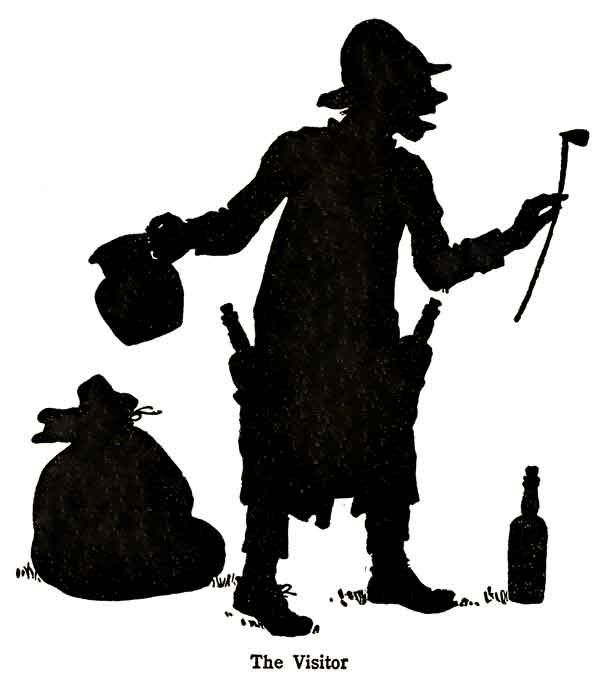
This droll, in its two parts, occurs throughout Europe as has been
shown by Cosquin in his elaborate Notes to No. 22. The Visitor from
Paradise, for example, occurs in Brittany, Germany, Norway, and
Sweden, England, Roumania, Tyrol, and Ireland. In some of the versions
the silly wife gives some household treasure to a passer-by because
her husband had said that he was keeping this for Christmas, for
Easter, or for "Hereafterthis" and the Visitor claims it in that name.
(See More English Fairy Tales.) The idea also occurs in the
literature of jests in Pauli, 1519, Hans Sachs, and in Trésor du
Ridicule, Paris, 1644. Cosquin has also traced it to Ceylon,
Orientalist, 1884, p. 62.
The adventure of the door and the robbers is equally widely spread in
Normandy, Germany, Austria, Bosnia, Rome, Catalonia, and Sicily.
(Gonz., i., 251-2.) It forms part of the tale of "Mr. Vinegar" in
English Fairy Tales. The two adventures are, however, rarely
combined; Cosquin knows of only two instances. I have, however,
ventured to combine them here instead of making two separate tales of
them.
In telling the story one has to slur over the pronunciation of
"Paradise," making the last vowel short, so as to explain the
misunderstanding about "Paris." I have retained the Paris motif as
all through the Middle Ages, wayfarers from and to Paris (wandering
scholars or clerics) would be familiar sights to the peasantry
throughout Europe.
Bolte gives in full (ii., 441-6) a Latin poem by Wickram in 1509
entitled, "De Barta et marito eius per studentem Parisiensem
subtiliter deceptis," which is practically identical with the early
part of our story and has this misunderstanding about Paris and
Paradise. It accordingly occurs in most of the German books of Drolls
as those by Bebel and Pauli, and it is possible that the folk
versions were derived from this, though they stretch as far as Cairo
and North India. See Clouston, Book of Noodles, pp. 205, 214. In
some of the folk-tales, there is an introduction in which the Foolish
Wife sells three cows, but keeps one of the three as a pledge.
Thereupon her husband leaves her until he can find any one as silly,
which he does by posing as a Visitor from Paradise. This is more
suitable for an introduction for "The Three Sillies."
This story is one of the most interesting in the study of the popular
diffusion of tales, and I therefore give it here though I have given
an excellent version from Temple and Steel in Indian Fairy Tales,
ix., "The Tiger, the Brahman, and the Jackal," and have there
discussed the original form. Its interest, from the point of view of
diffusion, lies in the fact that it occurs in India, both early (see
Benfey, i., 117) and late (Temple, 12, Frere, 14), in Greece, both
classical (Æsopic fable of the serpent in the bosom) and modern (Hahn,
87, Schmidt, p. 3), and in the earliest mediæval collection of popular
tales by Petrus Alfonsi (Disciplina clericalis, vii.), as well as in
the Reynard cycle. Besides these quasi-literary sources ranging over
more than two thousand years, there are innumerable folk-versions
collected in the last century and ranging from Burmah (Semeaton, The
Karens, 128) to America (Harris, Uncle Remus, 86). These are all
enumerated by Professor Krohn in an elaborate dissertation, "Mann und
Fuchs" (Helsingfors, 1891). In essentials the trick by which the
fisherman gets the djin inside the bottle again, in the first story
within the frame of the Arabian Nights (adapted so admirably by Mr.
Anstey in his Brass Bottle), is practically the same device. Richard
I. is said, by Matthew Paris (ed. Luard, ii., 413-16), to have told
the nobles of England, after his return from captivity in the East, a
similar apologue proving the innate ingratitude of man. This is
derived from the Karma Jataka, which was possibly the ultimate source
of the whole series of tales.
Amid all these hundred variants there is one common idea, that of the
ingratitude of a rescued animal (crocodile, snake, tiger, etc.), which
is thwarted by its being placed back in the situation from which it
was rescued. In some cases the bystander who restores equilibrium is
alone; in most instances there are three of them; the first two having
suffered from man's ingratitude see no reason for interfering. This is
the "common form" which I have adopted in my version. In India the
sufferer from ingratitude is sometimes a tree (a mulberry tree, in
Indian Fairy Tales), but the European versions prefer horses or
dogs.
Now it is obvious that such an artificial apologue on man's
ingratitude could not have been invented twice for that particular
purpose; and thus the hundred different versions (to which Dr. Bolte
could probably add another century) must all, in the last resort, have
emanated from a single source. When and where that original was
concocted is one of the most interesting problems of folk-tale
diffusion; the moralizing tendency of the tale, the animistic note
underlying it, all point to India, where we find it in the Bidpai
literature before the Christian era and current among the folk at the
present day. The case for Indian origin is strongest for drolls of
this kind.
I may add that the ingratitude of the man towards the fox at the end
is not so universal a tail piece to the story as the rest of it, and
is ultimately derived from the Reynard cycle, in which I have also
introduced it (see "Bruin and Reynard").
But it occurs in many of the variants and comes in so appropriately
that I thought it desirable to add it also here. The substitution of
a dog for something else desired also occurs in the story of the
Hobyahs in More English Fairy Tales, where Mr. Batten's released dog
is so fierce (p. 125) that it drives one of the Hobyahs over on to the
next page belonging to altogether another story.
I have followed Bolte's formula "Anmerkungen" 45, keeping however as
far as possible to the alternatives nearest to Basile, iv., 9, and
where that fails making use of the Grimms' "Faithful John," No. 6, one
of their best told tales. The story is popular in Italy where Crane,
344, refers to six other versions. It is also found in Greece (Hahn
29), and Roumania (Schott, p. 144), and indeed throughout the east of
Europe. Traces of it in British Isles are but slight.
In India, however, there are a number of very close parallels (Day,
17-52; Knowles, 421-41; Frere, 98; and Somadeva; edit. Tawney, i.,
519, ii., 251, which contains the similar story of Vivara the True);
Benfey, i., 417, draws attention to other Oriental traits in the story
and aptly compares the half-marble figure of the King of the Black
Islands in the Arabian Nights. The probabilities of an Indian origin
for this formula are rendered greater by the early age of the
Pantschatantra and Somadeva parallels.
On the other hand the sacrifice of the children for the faithful
servant has its closest parallel in the old French romance of Amis and
Amilun, where Amis smears Amilun with the blood of his child to cure
him of leprosy. The analogy is so close as almost to force the
assumption of derivation. Koehler accordingly in his Aufsaetze,
1894, pp. 24-35, regards the tale as a development of the Indian story
influenced by the romance of Amis.
I have followed Bolte's formula s. v. Hansel and Gretel, 15, i., 115,
though with some misgivings. Very few of his variants have his section
F, which he divides into three variants: F 1. Ducks or angels carry
the children over the stream. F 2. Or they throw out obstacles to
pursuit. F 3. Or the witch drinks up the stream and bursts. F 2 is
obviously "contaminated" by the similar incident in the Master Maid,
and the existence of such alternatives indicates, to my mind, an
absence of a consistent tradition as to the ending of the story, which
obviously ended with the baking of the witch in the oven. I have
combined, in my ending F 1 and F 2, the former from the Grimms'
"Hansel and Gretel"; I have also adapted their title, with a
reminiscence of Sir James Barrie.
The predicament of the farmer must have often really occurred in the
Middle Ages when famine was the rule rather than the exception; and
the decision to "expose" the children recalls the general practice in
ancient Greece and Rome and in Arabia. A touch of comedy, however, is
given to this grim beginning of our tale by the house made of cookies
and sweetmeats, probably derived from the myth of a Schlarafenland of
the Germans and similar imaginations of the Celts (see More Celtic
Fairy Tales).
The beginning of the tale occurs early in Basile, v., 8, "Nennillo and
Nennila," in which the three kings' children find their way home twice
by similar devices, but at the third time scatter peas, which the
birds eat up. Perrault has the same beginning in his "Petit Poucet,"
which has been Englished as "Hop o' my Thumb," who shares some of the
adventures of Tom Thumb, as well as of the valiant Tailor. Lang has an
interesting but, as usual, inconclusive discussion of the incidents of
our tale in his Perrault civ.-cxi., and finds many of the incidents
among the Kaffirs, Zulus, and other savage tribes, but scarcely the
whole set of incidents from A to F, and that is what we want to find
in studying the story. Dr. Bolte finds several instances where the
full formula still exists in popular tradition. It is surely easiest
to assume that they were once brought together by a folk artist whose
bright little tale has spread among various folks, with the
alterations suggested by the divergent fancy of the different folk
minds.
The Clever Lass is of exceptional interest to the student of the
Folk-Tale because of its exceptionally wide spread throughout Europe
and Asia, and also because it is one of those tales which have been
made the basis of the theory of the Eastern origin of all Folk-Tales.
Bolte, in his elaborate monograph on the formula ("Anmerkungen,"
ii., 349-73), enumerates no less than eighty-six variants, twelve in
Germany, six in other Teutonic lands, thirteen in Romance countries,
no less than thirty-seven in Slavonic dialects, seven in Finnish,
Hungarian and Tartar, six in the Semitic tongues, and also five in
India, though there the parallelism is only partial. But in the
European variants the parallels are so close and the riddles answered
by the Clever Lass are in so many cases identical, and the order of
incidents is so uniform that none can doubt the practical identity of
the story throughout the Western area. There occurs some variation in
the opening which, at times, takes the form of the father of the
Clever Girl finding a golden mortar and giving it to the King, against
the advice of his daughter who foresees that the monarch will demand
the accompanying pestle. This seems however to be confined to the
Teutonic lands or those in immediate cultural connection with them.
The riddles about strongest, richest, most beautiful, form the opening
elsewhere, and I have therefore chosen this alternative. The
variations, both in questions and answers, are many, as is perhaps
natural considering the popularity of the riddle in the folk mind,
which would make it easy for a story-teller to make changes.
The King or Prince, in some of the variants, discovers the cleverness
of the farmer's daughter on a visit to the farmer, when he elaborately
carves and divides a chicken on a method which the Clever Lass
discerns. This however does not occur so frequently except in Italy,
and I have therefore omitted it. The discovery of the theft by the
King's messenger is much more widely spread. (See Crane, 382, and
compare "Gobborn Seer," in More English Fairy Tales.)
The Grimms, in their notes, point to a remarkable parallel in the Saga
of Aslaug, the daughter of Brunhild and Sigurd. Here the King Ragnar
demands that Aslaug should come to him naked yet clothed, eating yet
not eating, not alone but without companion. She uses the fish-net as
in the Folk-Tale, bites into an onion, and takes her dog along with
her. From the last incident some of the Folk-Tales have possibly taken
the awkward attitude of limping along with one of her feet on the back
of a dog. But the first incident, being dragged along in a fish-net,
is so unlikely to occur to anybody's mind without prompting, that one
cannot help agreeing with the Grimms that the incident was taken into
the Folk-Tale from the Saga, or that both were derived from a common
source. On the whole subject of the curious ride, R. Kohler has an
elaborate treatment in his Gesammelte Schriften, i., 446-56.
The attraction of the riddle for the folk mind is well known, and
before the spread of cards appears to have been one of the chief forms
of gambling in which even life was staked, as in the case of Samson or
the Sphinx. In the Folk-Tale it often occurs in the form of the
Riddle-Bride-Wager, in which a princess is married to him that can
guess some elaborate conundrum. The first two of Child's Ballads deal
with similar riddles, and his notes are a mine of erudition on the
subject: on the Clever Lass herself see his elaborate treatment,
English Ballads, i., 485 seq.
It is perhaps worthy of note that the questions as to the strongest,
most beautiful, and richest occur in Plutarch's Symposium, 152 a, and
it is a striking coincidence that, in the same treatise, 151 b, occurs
another practical riddle, how to drink up the ocean, which occurs in
several variants of the Clever Lass. But there is no evidence of any
story connection between the two riddles in Plutarch, and one can
easily imagine this sort of verbal amusement spreading from the
learned to the folk.
The plan by which the Clever Lass becomes reconciled to the King, by
carrying off what is dearest to her, is found in the Midrash probably
as early as the eighth century. A still more remarkable parallel is
that of the True Wives of Weinsberg who, when that town was invested,
were allowed by the besiegers to carry off with them whatever they
liked best. When the town gate was opened they tottered forth, each of
them carrying her husband on her shoulders. But whether the incident
ever really occurred, and if it occurred, whether the ruse was
suggested by the Folk-Tale, cannot now be ascertained.
Benfey, in an elaborate dissertation, first communicated to "Ausland"
in 1859, but now included in his Kleinere Schriften, ii., 156-223,
argues for the Eastern origin of the whole cycle, which he traces back
to the "Seventy Tales of the Parrot" (Suka Saptati) probably as early
as the sixth century. Here the vizier Sakatala of the King Nanda is
released from prison in order to determine which of two identical
horses is mare and which is foal, and which part of a truncated log is
root or branch. Benfey traces this and similar riddlesome difficulties
to a good deal of Eastern literature in Tibet, Mongolia and Persia,
and Arabia. But he fails to find any very exact parallels in the
European area which, at that time, was very little explored. He finds
the nearest parallel in Wuk, No. 25, but this is by no means a full
variant of the other European tales and may have even been
"contaminated" from the East. Benfey notices the Saga parallel but
goes so far as even to claim this as being influenced by Eastern
stories. Since his time a much closer parallel has been found in
Kashmir by Knowles' Folk Tales of Kashmir, pages 484-90, repeated in
Indian Fairy Tales, No. xxiv., "Why the Fish Laughed." But the
parallelism here extends only to the cleverness of the girl and the
ingenuity of her answers to the riddles, not to the actual plot of the
story which is so uniform in Europe. Altogether we must reject
Benfey's contention, at any rate for this particular story.
I have followed, for the most part, Bolte's reconstruction, which
practically consists of a combination of Grimm, 37 and 45. But in
combining the two I have found it necessary to omit sections D and E
of Bolte's formula which form the beginning of Grimm, 45, "Thumbkin as
Journeyman."
The notion of a baby the size of a doll might be regarded as
"universally human"; even the Greeks knew of manikins no bigger than
their thumbs and weighing not more than an obolus (Athenæus, xii.,
77); there is an epigram of the same subject in the Greek Anthology,
ii., 350. But the particular adventures of Thumbkin are so
consistently identical throughout Europe, especially with regard to
the adventures in the cow's stomach, that it is impossible to consider
the stories as independent. Cosquin, 53, has more difficulty than
usual in finding real parallels in the Orient. In England, of course,
Thumbkin is known as Tom Thumb (see English Fairy Tales). In the
days when mythological explanations of folk-tales were popular, Gaston
Paris, in a special monograph ("Petit Poucet," Paris 1875) tried to
prove that Tom Thumb was a stellar hero because his French name was
given to the smallest star in the Great Bear. But it is more likely
that the name came from the tale than the tale from the star.
According to Gaston Paris, the chief variants known to him were
Teutonic and Slav. Those of the Roumanians, Albanians, and Greeks were
derived from the Slavs. He concludes that the French form must have
been borrowed from the Germans, and declares that it is not found in
Italy or Spain, but Cosquin, ii., gives Basque and Catalan variants,
as well as a Portuguese one, and Crane gives a Tuscan variant, 242,
with other occurrences in Italy in note 3, p. 372. This only shows the
danger of deciding questions of origin on an imperfect induction.
The opening is not found in Grimm; I have taken it from Andrews; for
which an excellent parallel is given in Crane, lxxvii., "Little
Chick-pea." A similar beginning occurs in Hahn, 56, "Pepper-corn."
Snowwhite is of special interest to the students of the folk-tale as
being obviously a late product combining many motifs from different,
more primitive, or at least earlier formulæ. E. Boeklen, in his
Schneewitchen Studien, I, Leipzig 1910, suggests influence by Hansel
and Gretel; The Seven Ravens; The Sleeping Beauty; The Maiden without
Hands; One Eye, Two Eyes, Three Eyes; False Bride, etc.; and Bolte,
i., 453, appears to agree with him. Certainly almost every one of the
incidents can be paralleled in other sets of folk-tales. The
combination "white as snow," "red as blood," "black as ebony," has
already been given in the present volume (see p. 173). Bringing back
an animal's heart instead of the proposed victim's is common form as
early as the Book of Genesis; and the trial of the three beds is
familiar to English children in Southey's "Three Bears." It would seem
that a story something like "Snowwhite" was known in Shakespeare's
time, as there appears to be a reference to it in the main plot of
"Cymbeline" (see Germania, ix., 458).
The form I have given to the formula follows very closely that of the
Grimms' 53. It is one of their best stories and occurs widely spread
throughout Germany. Whether that implies original composition in
Central Europe cannot at present be determined, but it certainly looks
that way. I have, however, omitted Bolte's F referring to the
punishment of the Queen, which is wanting in the majority of the
variants. No editor of a text would under similar circumstances take
account of so rare a variant.