Two eager heads bent over a small, square,
black object that stood on the stone post at the
foot of the doorsteps.
“‘Hold the camera steady and push the
lever,’” read the brown-eyed girl with the long,
dark braid, from the little pamphlet she held in
her hand. “Look down in the little round
hole, Cricket; you can see the picture perfectly.
Isn’t it the cutest thing?”
Cricket squinted down critically.
“It’s going to be perfectly jolly,” she cried
enthusiastically. “Now stand still as mice,
children, while I count three.”
“Stand still as a mice, Helen,” immediately
admonished the small girl in the dark red coat,
giving a great pinch to the little golden-haired,
12brown-clad lassie who stood beside her, by way
of emphasising her older sister’s words. “Stand
still as a mice, Johnnie-goat,” giving the third
member of the group a tickle on the back that
made him drop his curved horns for more.
“Keep still ‘as a mice,’ yourself,” said Cricket,
tapping Miss Red-coat briskly on the head. “All
ready, Eunice. ‘You push the button, and we’ll
do the rest,’” she quoted, clapping her hands
in her favourite fashion. “Hooray! there she
goes! Oh, I hope it will be good! That’s all,
Zaidie and Helen. You stood beautifully. Run
along now. Can’t you go around to the stable
and take Johnnie-goat back, ’Liza?”
Eunice swept the trio a low bow.
“Thank you, Mr. Johnnie-goat, for standing
still so long,” she said, addressing the horned
member of the party. “I hope your picture
will be very good,” she added, picking up the
camera with a highly professional air.
“Take me again,” demanded Zaidie instantly,
when Cricket told her once more that they were
through with this wonderful process, and that
they might go. “I like having my picture
tooken. Don’t you, Helen? Let’s sit on Johnnie-goat,
and be tooken again,” and Zaidie tried
13to climb upon the goat’s white back. This,
however, was a familiarity which Johnnie could
not think of permitting, even from his best
friends. He instantly sidled off, not wishing
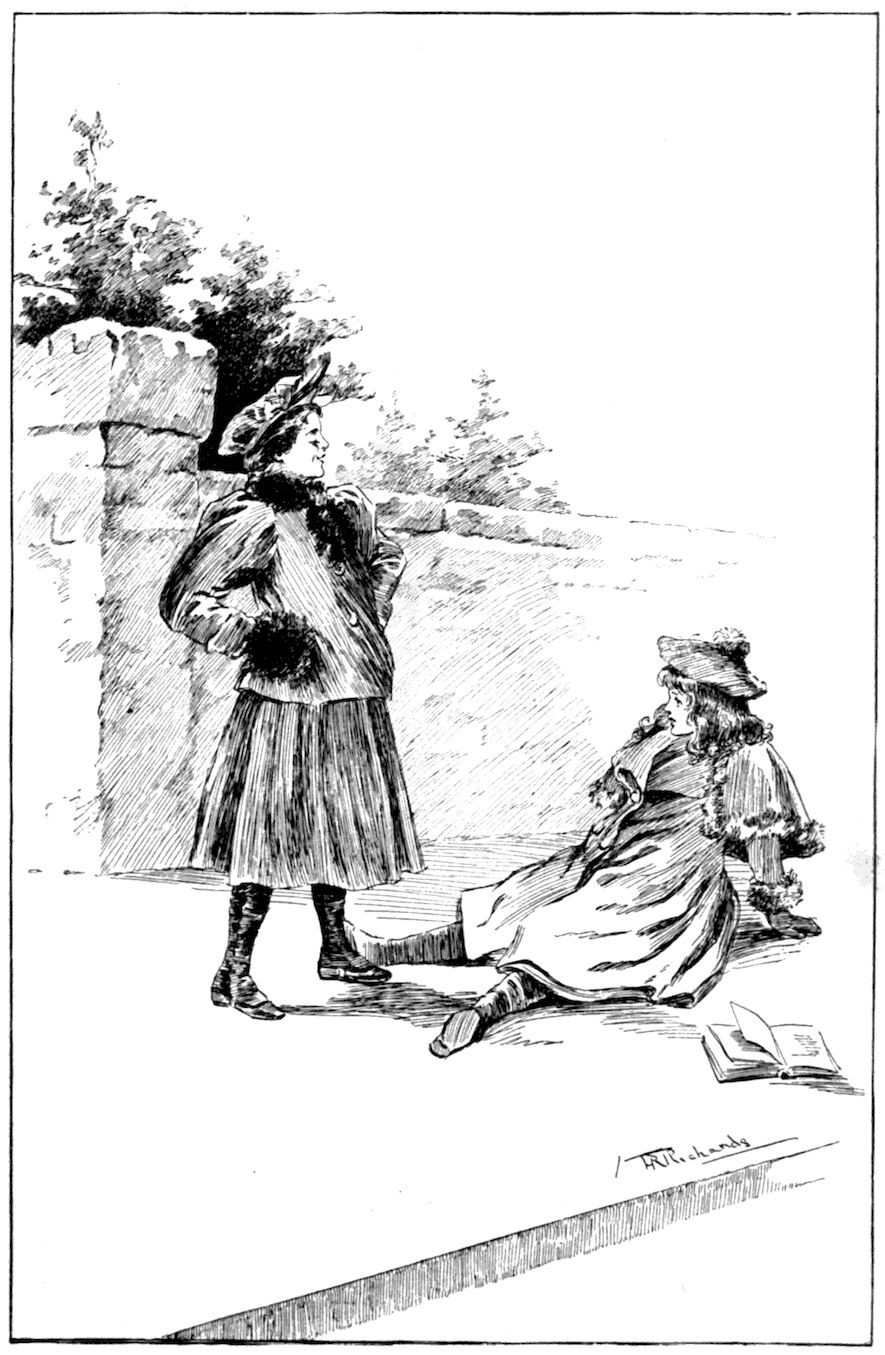
to hurt her feelings by a direct butt. Zaidie
unexpectedly sat down on the ground.
“No, we don’t want any more pictures of you
now, thank you,” said Eunice, examining her
Kodak, while Zaidie demanded a view of the one
already taken.
“She thinks it’s like putting a penny in the
slot and a picture drops out. This isn’t that
kind, my dear. There’s a lot of hard, hard
work before you see that picture,” said Cricket
importantly.
The day before had been Eunice’s birthday,
and this Kodak, which had been a long-desired
possession, was a birthday present. As it was
given to them entirely ready for use, they had
literally nothing to do but “press the button.”
Papa had been too busy that morning to explain
the mysterious little affair very particularly,
but he told the children to study the pamphlet
carefully, and follow directions closely. Eunice
and Cricket promptly sat down and read the
pamphlet from title-page to finis.
14Both looked a little blank when they had
finished. Could they ever remember all those
instructions?
“It’s all plain enough,” said Eunice meditatively,
“but the question is, how are we going
to remember it all at important times? Now,
for instance, about the stops. Listen: ‘Snapshots
can only be made when the largest stop is
in the lens.’ Will you remember that, Cricket?”
“We might just sit down and learn the whole
thing off by heart,” suggested Cricket, wrinkling
her forehead thoughtfully.
“Horrors, no!” returned Eunice. “Learn
all that? Let’s just carry the pamphlet around
with us all the time. If we take the camera
anywhere, we can certainly take the book, too.
Now let’s go and take a picture.”
“It’s easier to take them out doors, everybody
says,” answered Cricket, jumping up. “There’s
’Liza starting out to walk with the twins. Let’s
go and take them sitting on the front doorsteps.”
The twins, of course, were perfectly delighted
at the idea of having their pictures taken.
Zaidie straightway sat herself down on the lowest
step, with her hands firmly folded in her
15lap, and her feet out straight before her, trying
vainly to keep the smile out of her dimpled
face.
“I don’t want you that way,” said Eunice,
laughing, as she turned around. “You must
get in some romantic attitude. No, I don’t
mean romantic, but picturesque.”
“Couldn’t I be sliding down the railing?”
suggested Zaidie eagerly, thinking she saw a
chance to indulge in her favourite amusement.
“Wouldn’t that be pick-chesk?”
“You can’t slide down no railings, pick-chesk
or no pick-chesk,” put in Eliza, promptly.
“You couldn’t, anyway,” said Cricket, “because
you have to sit still, Zaidie. You can’t
hop around when you have your picture taken.
Don’t you remember?”
“Zaidie, you stand up by the post,” began
Eunice, when Cricket interrupted her.
“Look! There’s Johnnie-goat trotting up the
street. Do let’s have him in. He would be
picturesque.”
“S’pose he’d stand still?” asked Eunice
doubtfully. “I don’t want to spoil my picture.”
Johnnie-goat was a very celebrated character
in the neighbourhood. He belonged to a livery-stable
16that was on the square back of the Wards.
He was famous for eating off his rope and running
away. He was a big white goat, with
unusually long horns, and a very inquiring disposition.
He was such a ridiculous fellow, too,
sometimes munching sedately at a stray banana-skin
or orange-peel, then kicking up his heels
as if an invisible imp had tickled him, and
walking off on his forefeet. He was a very
discerning goat, also, and knew perfectly well
his friends from his enemies. He had goodwill
for the one, and butts for the other. One
way that he knew his friends was that they
always wore dresses, while his enemies were
clad in trousers. That was one invariable mark.
Then, his friends gave him apples to eat, and
scratched the sensitive place between his horns
that he couldn’t possibly reach himself, and
which, therefore, was seldom properly scratched.
His enemies usually saluted him with stones,
and offered him tin cans to eat. Now Johnnie-goat
was perfectly willing to acknowledge that
he could eat tin cans on occasions, but they
were not his favourite diet, and he didn’t care
much for them. He regarded it as something
of an insult to be constantly offered them. It
17was one thing, if he chose occasionally to pick
one up himself and see if he liked the brand,
but he decidedly objected to having them so
often forced on his attention.
The result of all this was, that Johnnie-goat’s
disposition was somewhat mixed. Like some
people whom we have known, when he was good
he was very good indeed, but when he was bad
he was simply terrific. He seemed to know no
middle course.
I do not know why he was not called Billy,
in accordance with all traditions. His full title
was John O’Rafferty, Esq., and on many occasions
he got the whole benefit of it.
He was great friends with all the Ward children,
who, from having so many pets of their
own at Kayuna, had a special predilection for
any stray animal. Johnnie-goat perfectly understood
this fact—for any one who thinks that a
goat is not a highly discriminating creature, is
not acquainted with his peculiarities.
On this particular morning, Johnnie-goat was
quite willing to be treated to some banana-skins,
which the cook brought out to tempt him with.
He fully realised that it was a very solemn
occasion, for he stood like a sentinel, and only
blinked once.
18“We must take all sorts of things, Cricket,”
said Eunice, when the children had trooped
away down the street, with Johnnie-goat marching
sedately behind them, with now and then a
sudden frisk of his hind legs in the air, and then
such an instant return of his composure, that
you doubted the evidence of your eyes.
“There are only a dozen pictures on one roll,
you know, and we want a good variety. Aren’t
you just wild to develop them? I am. It
sounds so grown-up to talk of the chemicals and
the ‘hypo.’”
“What is the ‘hypo?’” asked Cricket, as they
went down the street in search of a good subject.
“Why, just hypo, I suppose. I don’t believe
it’s anything in particular,” said Eunice vaguely.
“Donald said Marjorie had the hypo yesterday,”
said Cricket thoughtfully, “when she was
sort of dumpy all day. But I suppose it isn’t
the same kind.”
“No, of course not, goosie. The hypo is that
white powder that comes with all the things.
Didn’t you notice it? Perhaps Donald meant
that Marjorie had been taking some. Oh, look!
wouldn’t that corner of the little park make
the sweetest picture? Let’s take it!”
19“Yes, let’s! and that’s two,” added Cricket,
when the picture was secured. “Isn’t this exciting?
Can’t I take the next one, Eunice? Just
let me look at the pamphlet a moment to see
something.”
Cricket buried herself in the book of instructions
for a moment, then darted tragically at
the camera.
“Oh, Eunice! See! the pamphlet says that
after you take a picture, you must turn the key
around three or four times, till the next number
appears before the little window, and that will
put a new film ready; and we never did it!
What do you s’pose it will be?”
The two girls stared at each other in dismay.
“Oh, dear! dear!” exclaimed Eunice. “Then
we’ve taken another picture right on top of
Johnnie-goat and the twins, and they were so
cunning!”
“There isn’t any way to untake it, is there?”
asked Cricket, in real Mrs. Peterkin fashion.
“I’m afraid not. I wonder what it will look
like! It will be a composite photograph, I
suppose, like Marjorie’s class picture.”
“Perhaps it won’t be bad,” said Cricket, the
hopeful. “You see, this last picture is trees and
20shrubbery, and there may be a glimpse of Johnnie-goat
and the twins behind them. It may
look as if we did it on purpose. I shouldn’t
wonder if it would be lovely. Perhaps we’ll
want to take more that way.”
“Perhaps,” assented Eunice, doubtfully. “It
makes me think of Kenneth this morning. I
was in mamma’s room while you were practising,
and Kenneth was there too. He brought a
piece of paper to mamma and asked her to draw
a man, and she drew the side face of one—and
Kenneth asked her where the other side of his
face was, and if it was on the other side of
the paper. Mamma told him the other side
of the face was there, but he couldn’t see it; and
then she turned him her side face to show him.
Well, Kenneth took the paper and ran off, but
came back in a moment with some straight lines
across it, and told mamma that that was a kitty
and a fence, and mamma said she saw the fence,
but where was the kitten? And what do you
think the baby said?—that the kitten was behind
the fence! That it was really there, only
she couldn’t see it. Wasn’t that cute?”
“He’s just the dearest, smartest baby that
ever was!” cried Cricket, always enthusiastical
21over her beloved small brother. “We’ll just
tell people, then, that the children are behind
the trees, even if they can’t see them. There,
now, I’ve turned the film ready, this time. See!
there’s the figure 2 in the little window at the
back. Now, we are all ready. What shall we
take?”
“Let’s take each other,” suggested Eunice.
“I’ll stand here by the park fence. Am I all
right?”
The picture-taking went on merrily after
that. They got a fine snap at papa just getting
out of his buggy, and one of mamma, as she
came home from market. They got another
dear little picture of the twins as they came
down the street hand in hand. It did not take
long to use up all the films at this rate, and at
luncheon they were able to announce, triumphantly,
that they were ready to develop their
pictures that afternoon.
“But you don’t know how,” objected papa;
“and I have to be out all the afternoon and can’t
help you.”
“Please let us try it by ourselves,” pleaded
Eunice. “We can read the directions, and
they’re terribly plain. A cat could use them.
Do let us!”
22“Better not do it alone, youngsters,” advised
Donald. “I’d show you, myself, if I were going
to be home, but I can’t wait.”
Donald was in college this year, but, being so
near, he often came home to lunch on Saturday,
and sometimes spent Sunday there also.
“Of course we can do it,” returned Cricket,
confidently. “We’ve read the directions a million
times already, and I pretty nearly know them
by heart. Listen: ‘Open one of the developer
powders, then put the contents (two chemicals)
into the beaker and fill it up to the brim with
water. Stir, till dissolved, with wooden stirring
spoon. Next take—’”
“Spare us,” begged Marjorie. “We’re willing
to take your knowledge for granted.”
“We can use the linen closet for a dark
room,” said Eunice.
“By no manner of means,” put in mamma
promptly. “I don’t fancy having every sheet
and pillow-case I own deluged with chemicals.
You can have the bathroom closet, though, if
you’ll promise to put everything you take out of
it back very carefully. But children, I decidedly
think you should wait for papa or Don
to show you how.”
23“Do let them, mamma,” advised Marjorie.
“Of course they will make a frightful mess,
and ruin the whole roll, but they will have the
experience.”
“The idea!” cried Eunice, much injured.
“We’ve done everything right thus far—or
almost right,” with a sudden, guilty recollection
of the double exposure of the first film.
“Almost everything!” laughed Donald. “Considering
you only have to aim the thing and
press the button, it would be strange if you
hadn’t. Did you aim the wrong end of it and
try to take something out of the little back
window?”
“Of course we didn’t,” said Eunice and
Cricket, in an indignant breath. Then they
exchanged guilty, conscious glances.
“We’ll promise about the closet,” said Eunice
hastily, to prevent further inconvenient questions.
“We’ll take the things out carefully;
and may we take the little nursery table to lay
our trays on? It’s just large enough to fit.”
These matters being settled, the two girls, as
soon as luncheon was over, eagerly began their
preparations. They had a free field, for mamma
and Marjorie had gone to a matinée, and
24Eliza had taken the children to the park for the
afternoon. The housemaid’s closet in the bathroom
was soon cleared of its brooms and dustpans,
and the small, low table from the nursery
was brought in. The little trays that came with
the outfit, the bottles of chemicals and “hypo”
were duly arranged on it.
“There!” said Eunice, surveying the preparations
with a professional eye. “Everything
is ready, I think. Let me see,” consulting the
pamphlet. “‘Also provide a pair of shears, a
pitcher of cold water, and a dark room having a
shelf or table’—yes, all here. Trays, stirring
rod, chemicals, and when we shut the door we
have our dark room—why, Cricket!” with a
sudden exclamation of dismay.
CHAPTER II. A DISCOVERY IN FILMS.
25
Eunice’s exclamation was caused by the fact
that when she suited the action to the word, and
shut the door, they were, of course, in total
darkness.
“I should say so,” returned Cricket, blankly.
“Not being cats, we can’t see in ’Gyptian darkness.
Do open the door. We’ll have to get a
lamp.”
“No, we mustn’t,” answered Eunice, opening
the door, and consulting the pamphlet. “It
says, ‘neither daylight nor lamplight.’ It ought
to be a red light, like this one in the picture.”
Although the children did not know it, such
a lamp had come with the outfit, but when Donald
unpacked the things he had left it in his own
room.
“We might get a lantern from the kitchen,”
went on Eunice, “and wrap it with a red cloth.
26That will do. Will you go for the lantern while
I get the red cloth?”
Cricket flew off, and returned in two minutes
with the lantern.
“Cook says,” she announced, breathlessly,
“that if we put anything over it, we must be
careful not to cover up the breathing-holes at
the top.”
“Isn’t this fine for the cover!” said Eunice,
displaying a small turkey-red laundry-bag. Its
contents lay on the floor under the table.
“Now, we’re all ready,” announced Eunice
once more, with much satisfaction. “What do
we do first?—where’s the book?” when the
lantern was carefully covered, with a due regard
for the breathing-holes.
“The book? why it’s—I do believe we left
it in mamma’s room. No, here it is. And—goodness
gracious! Cricket, we’ve forgotten to
take the roll of pictures out of the camera!”
“Aren’t we lunatics?” exclaimed Cricket, with
her bubbling laugh, as she threw open the
door. “How do we get the things out, anyway?
Everything is so tight,” she added, turning it
upside down. “I can’t see where anything
comes out. Where does it come to pieces?”
27“I’ll read the directions. ‘No dark room is
required to take out the spool of films, but you
must take your position as far from the window
as possible.’ So glad we needn’t stay in this
dark closet to do it! Read the directions very
slowly, Cricket, and I’ll do the things.”
“All ready,” said Cricket. “‘Unclose the
catch at the bottom, holding the camera taut.’
What in the world is taut?”
Eunice knit her brows.
“Can’t imagine, unless it means carefully,”
she said, thoughtfully.
“Shan’t run any risks,” cried Cricket, jumping
up and flying away. “I’ll look it up in the
dictionary.”
She came back in a moment, looking rather
disgusted.
“It only means ‘tight,’ ‘firmly.’ Why in
creation didn’t they say so?”
Fortunately, the remaining directions were
sufficiently simple, and in a few minutes the
roll of exposures was in Eunice’s hand. The
children went back into the closet, to make ready
the chemicals.
The careful measuring and mixing of the powder
with the required amount of water went on.
28The trays were arranged in due order, and Eunice
announced, for the third time:
“Everything is positively ready now, so we
can begin to cut apart the pictures,” taking up
the roll of thick, black paper. “How can we
tell where to cut them? Oh, here are little
white lines on the back. Can you see to cut,
Cricket?”
“Yes. What’s all this white stuff between
for? It looks like paraffin paper something,
only it smells like fury.”
“It’s just to keep the other paper from rubbing
when it’s rolled over the spool,” said
Eunice, sniffling at the paper, which, you all
know, was really the film, on which the picture
had been taken. “I should say it does smell.
Throw it on the floor after you have cut off the
black pieces.”
“Here’s one,” said Cricket. “Oh, I’m so
excited, Eunice. Listen: ‘Put it in the water,
edge down, to prevent air bubbles.’”
“Done,” said Eunice. “Next.”
Cricket read on under the dim red light, till
she came to “In about one minute the film
will begin to darken in spots.”
“There, we have not any watch,” interrupted
29Eunice. “Cut out and get the nursery clock,
Cricket. Cover the roll all up, because you
know the leastest bit of light will spoil it.”
Cricket obediently “cut out,” and then resumed
her reading.
“‘The films will begin to darken in spots,
representing the lights.’ Isn’t that the funniest!
how can black paper darken in spots, I’d
like to know?”
“Can’t imagine; but I know that chemicals
make things do all sorts of queer things,”
answered Eunice, lucidly. “Cut some more to
be soaking while these go into the developer.”
“That first one’s been in more than a minute.
Hold it up, Eunice, and let’s see it darken in
spots. It hasn’t changed a bit, yet,” she added,
disgustedly, after a moment. “Isn’t this waiting
going to be slow work?”
The waiting did prove tiresome. Again and
again the children took the thick, black squares
of carbon paper from their bath in the developer,
eagerly scanning the opaque substance, which
naturally showed no trace of change.
Five—ten—fifteen minutes ticked slowly
away.
“Goodness gracious me!” groaned Eunice at
30last. “I should think we had been here for
five hours. Isn’t this poky?”
“This black paper can never darken,” cried
Cricket, despairingly. “There’s some mistake.
If it was that white lining paper there would be
some sense.”
There was a moment’s pause, and then both
girls exclaimed, in a breath:
“Eunice!”
“Cricket!”
“We’ve gone and—”
“Soaked the wrong thing!”
“We’ve soaked the carbon paper—”
“And thrown away the film!”
“Of course that white paraffiny-looking paper
was the film!”
“Of course this thick stuff is the carbon
paper to wrap around the other and keep out
the light.”
“Aren’t we geeses?”
“We just are! Don’t let’s ever tell. Now,
where are the films?”
“Just dropped around anywhere,” said
Cricket, dolefully.
“Scrabble around carefully, and we’ll find
them. Oh! aren’t we the idioticest girls?”
31“We’ll have to mix some more developer,
and change the water in the first tray, too. It’s
all black, for the colour in that old carbon paper
leaked out. Have you found all the films?”
“I had only cut six, and here they are. I’ll
cover them up while you open the door and fix
some more developer.”
At last, everything was under way again.
“Four o’clock,” said Eunice, soberly, “and to
think that we haven’t developed a single one
yet!”
“But, oh, see!” cried Cricket, joyfully, holding
up the film, after a moment. “It really is
beginning to darken in spots. Hooray! See,
Eunice, that actually looks like an arm sticking
out there! What is it, do you suppose?”
“I don’t know. Looks like a ghost’s arm,
doesn’t it? Put it to soak again. Let’s look
at this one.”
“Nothing here. Eunice, what makes all
these scratches across it?”
“Probably we stepped on them. You know
you threw them down any way. Probably the
scratches won’t show through. Oh, I do believe
this is mamma! Isn’t that her bonnet that
begins to show?”
32“Yes—no—I think it’s the one where we
tried to take that runaway horse. Seems to me
that looks like a leg down there.”
It was a curious effect to watch the films as
they eagerly held one after another up, for the
different parts came out in a ghostly, unattached
way. Here one lonely-looking leg was plainly
to be seen. Then a head, and again a branch of
a tree or an arm.
“But look at this one,” cried Cricket, surveying
one in deep disgust. “Isn’t this the smallpoxiest-looking
thing?”
It was pretty liberally sprinkled with dark
spots, but one of them was unmistakably Johnnie-goat’s
head and horns.
“This must be the one we took on top of
Johnnie-goat and the twins, shouldn’t you
think? I do believe it is them—it is they—which
is right?”
“I do believe it is,” answered Eunice, ignoring
the grammatical appeal. “It’s spotty
enough to be anything. It’s certainly like
Kenneth and his cat, for I can see Johnnie-goat
behind the trees.”
“So we can. Look at this one, Cricket.
What we thought was mamma’s bonnet or a
33runaway horse isn’t either. You held it upside
down. See! it’s this one where papa was
getting out of his buggy. What we thought
was mamma’s bonnet is papa’s foot. I guess
they are ready for the last tray now. Go on
with the directions.”
Long after five o’clock, two very sober and
tired-looking children emerged from the bathroom
closet, and proceeded to set things to
rights.
“Do you know,” said Eunice, breaking a long
silence as they cleared trays and wiped off the
table, “the book says it only costs five cents
apiece to get the things developed at a photographer’s.
Don’t you really think it would be
worth while to save up our money for a time
and have some done? Of course we could learn
to do it all right after a time, but—”
“Yes,” broke in Cricket emphatically, “I do.
I don’t vote to stay in every Saturday afternoon
and develop smallpoxy pictures, with smelly old
chemicals and nasty, sticky films, and put my
eyes out with red calico lamps. This picture of
papa is the only single one that is going to be
half-way decent; and the horse looks more like
the ghost of a rhinoceros than anything else.
34That post sticks up by his nose just like a
horn.”
“Cricket, don’t let’s ever tell that we soaked
the carbon paper and thought it was the film
that the pictures were taken on,” said Eunice,
scrubbing with much soap and energy at the
dull yellow stains on her hands that stubbornly
grew brighter, instead of fading. “We’d never
hear the last of it; and we were geeses,” she
added thoughtfully.
“Indeed, I’ll never tell,” returned Cricket
with emphasis. “Papa and Donald would tease
us out of our boots.”
But at dinner-time there were many inquiries
concerning the success of the amateur photography.
“It was a little tiresome,” confessed Eunice.
“Marjorie, was the matinée good?”
“Yes, very. How many pictures did you
develop?”
“Only one really good one. Papa, don’t you
think you could drive us out to Kayuna next
Saturday?”
“Yes, if it’s pleasant. So only one picture
developed?”
“Oh, they all developed,” put in Cricket,
35“only we couldn’t always tell exactly what they
were meant for. Marjorie, wasn’t May Chester
at the matinée? I thought I saw her going.”
“But we want to know about the pictures,”
persisted papa, much amused at the children’s
fencing. “When will the gallery be opened?
The twins said you took them with Johnnie-goat.”
“Yes, we did, and it would have been fine,
only we took another picture on top of it,” said
Cricket, regretfully. “We should have turned
the little key around every time we took a new
picture, but we didn’t, and they got a little
mixed up.”
“We took some trees on top of Johnnie-goat,”
broke in Eunice, “and we hoped that it would
look as if he and the children were behind them.
Really, I think that would be a pretty good plan,
any way, if they would only develop right.”
“So they didn’t, eh?”
“Papa, you needn’t tease us. Developing
pictures isn’t a bit of fun, and I’m not going to
do it any more,” burst out Cricket desperately.
“It isn’t right to take money from the photographers
anyway, for it’s their business, and they
lose so much if we do it ourselves.”
36“I think so, too,” chimed in Eunice. “We
staid in all this lovely Saturday, shut up in a
hot, smelly closet, and wasted a lot of stuff, and
got our hands all stained, and spoiled a whole
lot of films.”
“But had your experience,” put in papa.
“Experience is a hard school, but wise men
learn in no other way. How’s that, my Lady
Jane? And now about Kayuna on Saturday,” he
went on, kindly changing the subject.
“Cricket, don’t ever tell about the film,”
whispered Eunice as they left the table. “Don’t
ever tell any one.”
And they never have told but one person, and
she has never told till just now. Don’t you tell,
will you?
CHAPTER III. A “MUMPFUL” PARTY.
37
Certain dainty blue billets were causing a
wild flutter of excitement among the ranks of
Miss Lyon’s school, for every girl in “our set”
received one of the fascinating things.
“Miss Emily Drayton requests the pleasure
of—” How deliciously grown up! Emily’s
parties were always simply perfect. Emily did
not go to school with the others, for she was a
delicate little girl, and had her lessons with a
governess at home. Her friends rather envied
her at times, since she had short hours and not
half the Latin and arithmetic to do that they
did, and an entire holiday whenever she did not
feel quite well; but, in her turn, Emily often
looked wistfully at the others, and longed with
all her heart for the dear delights of school life.
She always felt “out of it” when her little
friends laughed and chattered and compared
notes over school doings that she knew nothing
38of. They would kindly explain the jokes and
references, but when she did not know dear
Miss Bates and cross Miss Raymond and slipshod
Susie Dane and stupid Jessie Moore, the things
that the girls laughed over till their sides ached
did not seem very funny to her. It made her
rather a lonely little girl, and, for this reason,
her mother was always getting up some simple
little party or company for her, and having
Emily’s friends to luncheon.
But this special party was to be a particularly
fine affair, for it was not only Emily’s birthday,
but Hallowe’en as well, which double event Mrs.
Drayton always celebrated more elaborately than
any other.
Such an excitement among the children, then,
when the blue notes began to circulate! Such
jabbering at recess, such comparing of notes,
such arrangements for going, such questions
about each other’s dress! Alas! the party was
a whole week off. Could breakfast, and luncheon,
and dinner, and going to bed and getting up, and
school and lessons, ever fill up this long stretch
between?
“I suppose there are new gowns for this important
occasion,” said Donald, who had strolled
39in to dinner, one night. The family were all in
the back parlour.
“No,” said mamma. “Their organdies are
fresh and nice, fortunately, and new sashes are
all they need.”
“Fortunately! Unfortunately, I say,” said
Donald, teasingly. “I was going to bring
Cricket a dress of porcelain,” referring to a joke
of last summer, when Cricket had arrayed a
heroine in flowing robes of white porcelain.
Cricket coloured, but answered serenely, as
usual:
“If I was a great big boy, eighteen years old,
and a Freshman, too, I’d be ashamed of an old
chestnut joke like that. I described to auntie
what I meant, and she said I meant chiffon—that
gauzy, filmy stuff, you know.”
“Filmy stuff would be appropriate,” murmured
Marjorie. “With a sash of black carbon
ribbon you would be very swell.”
“This family is absolutely disgusting,” said
Eunice, looking aggrieved. “Mamma, I should
think you would be ashamed of such perfectly
impolite, teasy children as Donald and Marjorie.”
“I ’xpect God picked out the bestest children
40he had around then,” piped up Zaidie, who
always put her oar in.
“Indeed, he didn’t,” said Cricket emphatically.
“The good ones were all gone, and
mamma was in a hurry, and He just sent any
He had on hand.”
“Good for you, Cricket!” cried Eunice approvingly,
thumping her sister on the back.
“Now, Mr. Donald, who has come out the little
end of the horn?”
“Eunice, your slang is simply disgusting. Of
course, we men talk it, but girls should never
think of it.”
“Hark, oh, hark, to the lordly Freshman!”
chanted Eunice, clasping her hands and rolling
up her eyes.
“Notice everything he says, Eunice, so we’ll
know how to behave when we go to college, and
are dear, cunning little Freshmen,” chimed in
Cricket.
“No more words of wisdom to-night,” announced
Donald, getting up. “I’m off.”
“The supply exhausted so soon?” murmured
Marjorie, beginning a new corner in her embroidery.
Donald kissed his mother, ignoring Marjorie.
41“I’ll order you a Dresden China gown, my
Lady Jane,” he said, twisting Cricket’s brown
curls as he passed her.
On the eventful Tuesday morning, Cricket
awoke bright and early—or rather, I should
say, early but by no means bright. She had had
a most unpleasant dream of having exchanged
heads with an elephant, and her neck was, consequently,
so much larger, that she could not
fasten her collar around it. Eunice suggested
they should make a new collar of the sail of
the Gentle Jane, which she said would be just
large enough. That seemed a good suggestion,
but as they went to get it, they saw the Gentle
Jane being taken out to sea by some playful
seals.
“Dear! dear!” said Cricket in her dreams.
“Now I’ll have to go to the party without
anything around my neck, because there isn’t
anything else big enough to make a collar of,
and my throat is getting bigger all the time.”
Just then she awoke, clutching her neck. Sure
enough, it did feel queer, and was very stiff
on one side. She swallowed, experimentally.
“I don’t like that pretty well,” she announced
to herself as the result of her attempt. “I wonder
42if I have the lumbago in my throat,—and
to-night is Emily’s party! I won’t have a sore
throat. I never did in my life before, and I
won’t begin to-night—provoking old thing!”
She swallowed vigorously several times, and
winked back the tears.
“There! that didn’t hurt much. Wonder if
it’s swollen.” She hopped out of bed quickly, and
ran to the glass. She opened the neck of her
night-dress and examined her round, white throat
critically. It certainly was a trifle larger on
one side, and was sore, as she pressed it a
little.
“Oh, my patience, if it should be lumbago!”
she groaned tragically. She hadn’t the faintest
idea what lumbago is, but the name sounded to
her as if it might be something that could come
in the throat. “Wonder how long it would take
lumbago to come on. I won’t have it begin till
after to-night, anyway. How queer my head
feels! I guess I’ll look inside my throat.”
Cricket turned quickly to draw up the shade,
that she might see better what inroads the
“lumbago” had already made. The quick
movement made her aching head dizzy. She
stumbled forward, tripped over her long night-dress,
43and sat down, hitting the water pitcher
which she had left the night before standing
by the wash-stand. Over went the pitcher, and
out came a deluge of water, almost setting bewildered
Cricket afloat, as she lay huddled up
on the floor.
“Cricket, what an awful racket you’re
making,” said Eunice sleepily, from her bed.
“Don’t get up yet. It isn’t time. It isn’t light
enough.”
“Don’t get up? Do you think I’m going to
lie here and drown?” asked Cricket indignantly,
getting rather weakly on her feet. “I’ve knocked
over the water pitcher.” She pulled the towels
off the rack, and began mopping up the flood
that crawled in every direction. “I’m wet
through to my bones, I do believe, and there
isn’t a dry inch in my night-dress.”
“Put on another one, and get on your bedroom
slippers. Don’t hop around there another
minute with your bare feet,” ordered Eunice,
sleepily, but sensibly.
Cricket mopped dejectedly. “The water
tipped straight into my slippers. There! That
will do till Jane gets at it. Ugh! my feet are
as cold as chopsticks. I’ll change my night-dress,
44and then I’m going to get into bed with
you, Eunice, and get warm.”
By breakfast time, Cricket felt very queer
indeed. At any other time her mother would
have noticed her lack of appetite and flushed
cheeks; but just now it was, of course, put
down to the excitement of the coming event.
Her throat was stiffer than ever. She managed
to slip down a little oatmeal, but the other things
hurt too much to attempt.
“I won’t have lumbago in my throat till after
this party,” Cricket repeated grimly, to herself,
as she went up-stairs to get ready for school.
“Only—I do wish the party was last night, and
I could go into mamma’s room and lie down all
day, instead of going to school. My throat gets
sweller and sweller. Do you suppose it could
swell up so that I couldn’t eat anything, and
would starve to death?”
At this cheerful thought, Cricket groaned so
deep a groan that Eunice looked around in
amazement.
“Was that you, Cricket? Did you hurt
yourself?”
“No, I was only thinking. Do you know those
irregular French verbs? Aren’t they awful?”
45“I should think they were. They are enough
to make a cow groan. Ready? Come on. Why,
aren’t you ready?”
Cricket swallowed an unhappy lump in her
throat, and winked back a tear. How her throat
did hurt, and how her head ached!
“I’m not quite ready. I didn’t have ’Liza
brush my hair out, and it’s all full of bones, as
Zaidie says. Upsetting that water pitcher, and
mopping it up, took up so much time. There!
that must do. Where are my books? Oh, here.
I’m ready. Come on,” and Cricket ran out first,
lest Eunice should see her face.
The keen, fresh air seemed to do her head
good, and by the time she reached school, she
felt a little better. All the girls were chattering
so hard about the party that night, that, for the
time being, Cricket forgot her throat.
Under any other circumstances her manner
and appearance would have attracted notice and
comment. But it must be confessed that from
a school point of view, the day was a general
failure, and among the many flushed faces, hers
passed unnoticed. She was sometimes languid
and dull, and then excited and inattentive, making
all kinds of queer blunders. She finally distinguished
46herself by announcing in her history
class that Tecumseh, the Indian chief, died of a
severe attack of lumbago, exclaiming as he fell,
“Don’t give up the ship.”
“Really, Jean, it is fortunate that parties do
not come every day,” said her long-suffering
teacher, rather surprised that it should be
Cricket who said this, for the child’s quick
memory rarely failed her. Cricket sat scarlet
and mortified, and did not recover even when
that stupid Mary Blair wrote on the board in
the grammar class, “Troy was concord by the
Greasians.”
However, the day slipped away. By dinner-time,
her throat felt as if a good-sized potato
had taken up its residence there. Her head
ached and her bones ached, and down in one
corner of her heart she began to wish that
some one would say positively that she could not
go to the party.
Meantime, after luncheon Eunice had begun
to feel heavy-headed and stiff-necked herself.
Like Cricket, she carefully concealed the fact,
and resolutely put on a bright face and a very
“smily” smile, if any one looked in her direction.
Each child was so absorbed in concealing
47her own feelings that neither noticed the
other.
At dinner, both being rather exhausted by
such unusual exertions, they were so silent that
papa asked them finally whether this was the
night they were going to Emily Drayton’s party,
or the night they were going to be hanged. He
himself had forgotten, he said, and he couldn’t
tell by their faces.
“They have been going to this party every
day and night for a week,” said mamma, looking
rather anxiously at each flushed face. “No
wonder they are all tired out beforehand. I
had them both lie down for an hour this
afternoon, also. My chickens, you must eat
a little more dinner than that, if you are
excited.”
“I positively can’t, mamma,” said Cricket,
feeling every moment that the tears would come
if she forced another morsel past that awful
lump, that now felt the size of a watermelon to
her. Eunice resolutely choked down another
bit of mashed potato.
“I’m too excited,” she remarked, with a great
assumption of cheerfulness. “Mamma, will
you excuse Cricket and me, and let us go up-stairs
48now? I don’t want any dessert, do you,
Cricket?”
Cricket jumped up briskly.
“No, indeed. Please ’scuse us, mamma,”
and equally glad to escape, the two children
flew up-stairs. Each began to make conversation
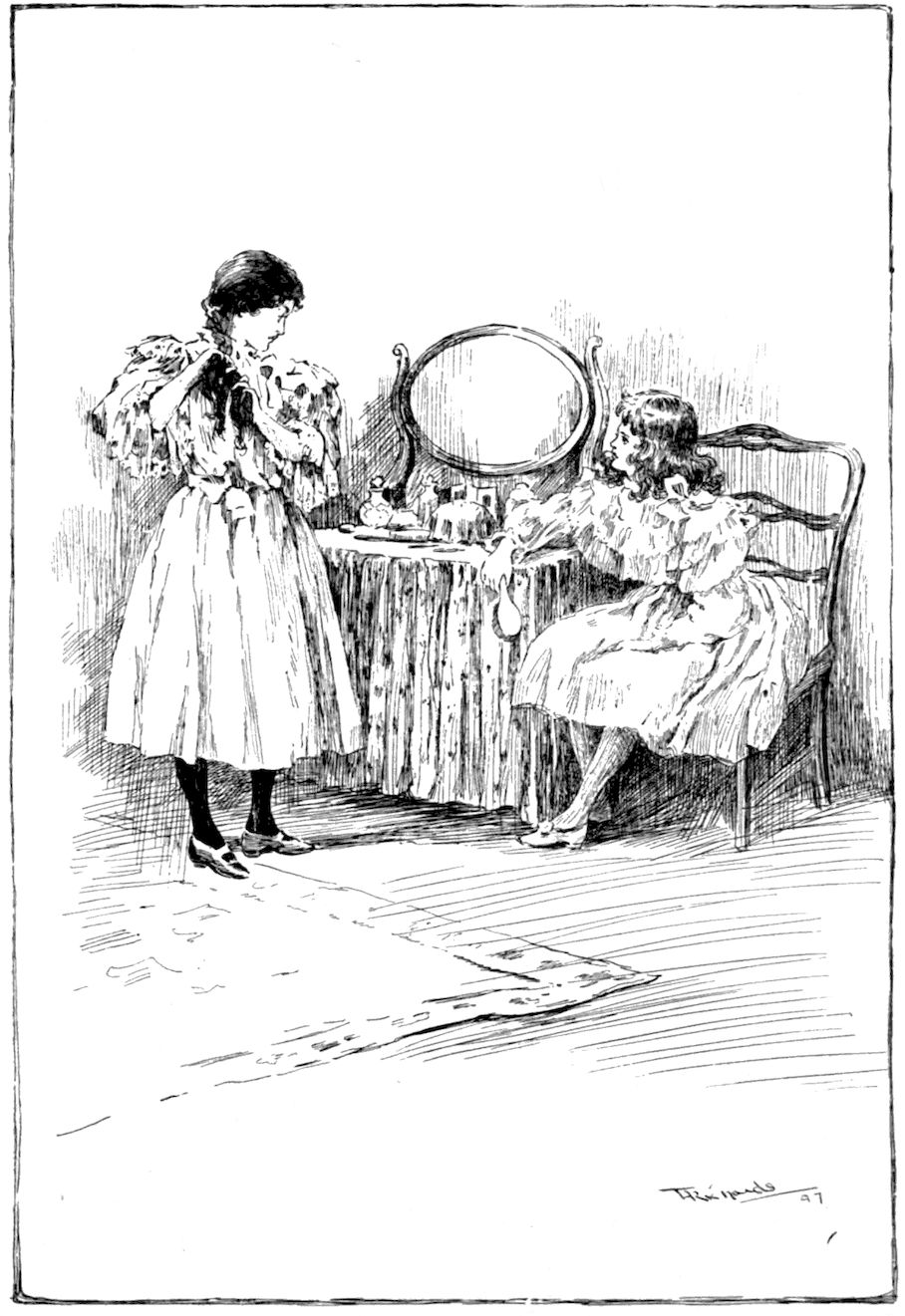
as they dressed. Eliza was there, waiting
to help them.
“Lawks, how hot your face is!” said Eliza,
her hand touching Cricket’s cheek, as she
brushed the brown curls till the gold light in
them shone out.
“It’s excitement,” said Eunice. “Mine’s
hot, too; just feel. Ouch!” with an undignified
exclamation, as Eliza’s hand touched the
lower part of her cheek rather heavily.
Cricket suddenly flashed a quick glance at her.
“Eunice,” she said hastily, as Eliza left the
room for a moment, “does your throat feel
queer?”
“Yes. How do you know?” answered Eunice,
surprised.
“’Cause mine does, awfully. It has all day.
And my head aches.”
“So does mine!”
“And I’m so hot—”
49
GETTING READY FOR THE PARTY.
51“So am I.”
“And I feel so queer all over.”
“So do I. What can be the matter? It
can’t be the party!”
“A party we haven’t been to can’t make us
sick. No; I’m afraid we’re going to have the
lumbago in our throats, and I think that’s something
dreadful.”
“Lumbago? It sounds dreadful. Why, I
never heard of it. What is it?”
“Oh, I’ve heard of it. I heard papa telling
mamma that May Chester’s grandmother had
it, and you know how sick she’s been this fall.”
“This lump in my throat is bad enough for
anything,” sighed Eunice, putting her hand to
it. “But let’s stand it till the party is over,
Cricket.”
“I’ll stick it out,” said Cricket, with grim
determination.
Mamma came in just here and put the finishing
touches to the dainty dresses, and then they
went down to the back parlour to exhibit themselves
in all their bravery to papa and Marjorie.
Donald sauntered in as they were being duly
admired.
“Hollo, kids! What giddy-looking girls!
52I am proud of you. Be sure and be good girls.
Don’t forget to ‘open your eyes and look very
wise, although you feel very silly.’”
“But we don’t feel very silly,” returned
Eunice with dignity. “We’re not Freshmen
in college.”
“Been polishing your wits for the party, I
see. Good plan, my Lady Greasewrister, and
Madame Van Twister, your ladyship’s sister.”
“You always did call us names, and I s’pose
you always will,” said Cricket tolerantly. “But
it amuses you, and we don’t care—do we,
Eunice? Isn’t it time to go, mamma?”
“Yes, the carriage is waiting. Put on my
cloak for me, Donald. Thank you, dear. All
ready, my little maids.”
It was some distance to Emily Drayton’s, and
during the drive the children were so silent
that mamma was a little worried. So little
excitement of this kind was allowed them, that
generally they were as merry as grigs.
“What is the matter, girls? I never saw
such sober little faces bound for a party. Is
anything wrong?”
Cricket longed to confess that her throat felt
like a boiled pudding, that the skin of her neck
53was queer and stretched, that the lights danced
confusedly before her eyes, and that she wanted
to turn around, go home, and go to bed. However,
since she had borne it all day, she did not
exactly like to sacrifice so much resolution, and
giving Eunice’s hand a tight squeeze, she said:
“No, it’s nothing much; only a joke we’re
going to tell you after the party.”
“A joke,” said mamma suspiciously. “Hadn’t
you better tell me now?”
“No, really,” said Cricket earnestly. “It
doesn’t have anything to do with anybody but
ourselves, truly, mamma,” quite believing her
words.
“I don’t like jokes that make you look so
sober, my chickens. Cricket, are you very warm,
dear? Your cheeks are so red that they are
almost purple.”
“It’s warm in the carriage. Don’t you think
so?” struck in Eunice. And then mamma, to
take up their minds, began to talk brightly about
some funny occurrence that she had seen that
morning while she was marketing, and the children
almost forgot their respective woes.
When they arrived at the Drayton’s, most of
the children were already there. The lovely
54house presented a gay scene. Emily greeted
Eunice and Cricket rapturously.
“I was so afraid that something had happened,
and you weren’t coming,” she said. “We are
just going to play ‘Quack,’ and Cricket is always
so funny in that. Come over here.”
The classic game of “Quack” was started.
All of you know it, do you not? A large circle
is formed, and one person, blindfolded, stands
in the middle with a cane in her hand. The
circle moves slowly around till the person in the
centre thumps the cane as a signal to stop, and
then it is pointed at some one. This person
takes the other end of the cane, and the blindfolded
one asks any question, which must be
answered by the word “Quack,” uttered in a
disguised voice. The one in the centre must
guess the speaker, and is allowed three questions.
Cricket was always in demand for the centre,
because her quick wits supplied her with funny
questions. To-night, however, she rather lost
her reputation, for her tired little brain could
concoct nothing more original than, “What is
your name?” “Do you like butter?” and all
the other stupid questions that everybody asked.
55One game succeeded another, but somehow nothing
went very briskly. Presently Mrs. Drayton
drew Mrs. Ward aside, anxiously.
“What is the matter with these children? It
is so hard to get them started at anything.
They don’t seem to be having a good time.”
“I’ve noticed something wrong,” said Mrs.
Ward, looking about her. “I never knew it so
before, especially at this house. I’ve been watching
my own two pretty closely, and something is
certainly wrong.”
“See!” said Mrs. Drayton, “that is the eighth
child that has dropped out of that game, and
it is so with everything we have started.”
“There is something in the air,” Mrs. Ward
said to her friend. “And look! there is
Cricket actually sitting all alone behind that
palm, with her head in her hand. I asked her
a few minutes ago what is the matter, but she
insists there is nothing. Why not hasten supper?”
“That’s always a good suggestion,” answered
Mrs. Drayton. “Will you set them to playing
‘Going to Jerusalem,’ then they will be all
ready to march out. Mrs. Fleming will play
for them.”
56Even “Going to Jerusalem” was not a
brilliant success. Most of the children marched
rather listlessly around, dropping into chairs
when the music stopped, without the usual
scramble. Many of the little faces were flushed
a dark red, and eyes were heavy-lidded. The
announcement of supper was a relief, but Mrs.
Drayton’s quick eyes noticed, to her perplexity,
that many of the dainty dishes were passed
by untouched, and that on many a plate
the luscious creams and ices were scarcely
tasted.
Directly after supper Cricket sought Eunice.
“Eunice, I can’t stand it any longer. The
party is most out, and I must tell mamma that
I have lumbago in my throat. If I don’t, it may
get so bad it can’t be mended. I mean cured.
Do you mind very much if I ask mamma to
take us home? The party isn’t half as nice as
I thought it was going to be.”
“I don’t mind a bit,” said Eunice, with an
unexpected readiness. “I feel too queer for
anything. Do you suppose it’s something awful
we’ve got, Cricket?”
“I don’t know. I feel as if I were two
persons plastered together. There’s so much
57of me. My eyes are pulled sideways down to
my ears. I feel so queer and big,” finished
Cricket, dolefully.
So a few minutes later Mrs. Ward heard a
dilapidated little voice behind her:
“Mamma dear, we’re ready to go home
whenever you are.”
Mamma was absolutely paralysed by this
unexpected remark.
“Cricket! is it you? What is the matter,
dear? Are you ill?”
“No-o. At least I think not. But—well—my
head aches a little and my throat is stiff
and hot, and my eyes are leaky and I’m sort of
dizzy, and—”
“My darling child! your throat is sore?
Why didn’t you tell me before? Where’s
Eunice? We will go immediately. Find Eunice,
and both of you slip away to the dressing-room
without speaking to any one. I’ll say
good-by for you to Emily and Mrs. Drayton.”
“Eunice is ready, mamma. She feels queer,
too.”
Mrs. Ward’s heart, mother-like, jumped into
her mouth. Cricket’s description of her feelings
might mean any one of so many things! However,
58she kept a calm face, and hastened to
explain matters to Mrs. Drayton.
“Do you know, I almost believe that all the
children are coming down with something,” said
Mrs. Drayton, anxiously. “That would account
for their all being so heavy and dull, and hard
to amuse. Poor little Emily is in despair. She
has looked forward to this so long!”
The next day, seventeen of the children who
had been at the party were down with the
mumps.
CHAPTER IV. IN QUARANTINE.
59
“So it’s only the mumps!” sighed Cricket,
with much relief, after papa’s visit to their
respective bedsides the next morning. “Papa,
do you know I was dreadfully afraid that I had
lumbago in my throat all day yesterday, when
it was all swelly-feeling and hurt so to swallow.
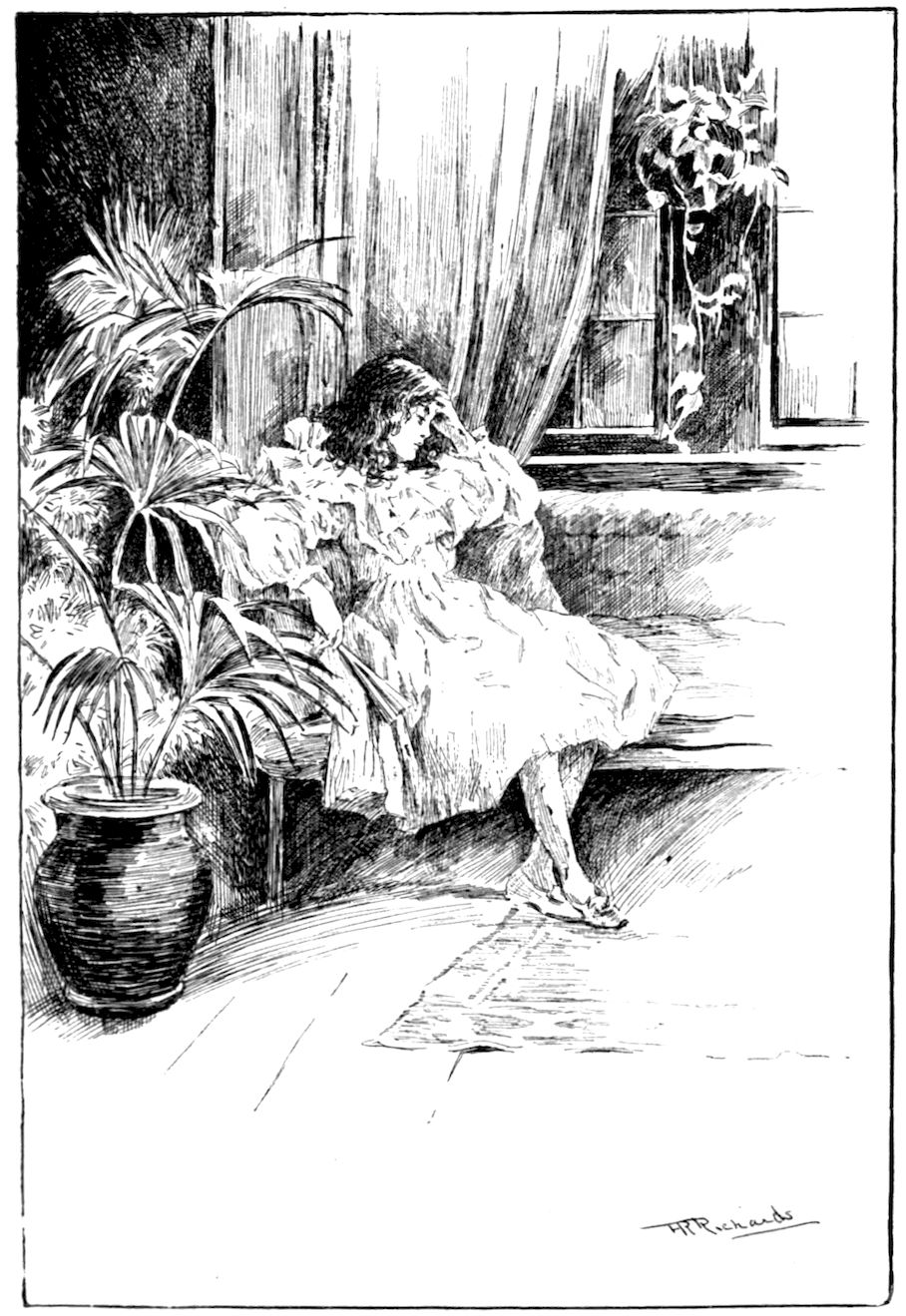
That would have killed me, wouldn’t it?”
Papa laughed hard.
“It might be a serious matter if you had it
in your throat, but you are in no more danger
of its getting there than you are of having
toothache in your toes, my Lady Jane. Will
you take a look at yourself this morning?” and
papa held up a hand mirror.
All resemblance to Cricket had totally disappeared
from the swollen-faced little maid on the
bed, and the child stared in blank astonishment.
“Is that me?” she gasped.
“It is you, grammar and all,” laughed papa,
60turning to Eunice, who lay in her cot on the
other side of the room. “Admire each other
to your heart’s content, for you are just alike,
my blooming little beauties.”
“It’s bad enough to be sick without being such
frights,” said Eunice dolefully. “Cricket, you
look so funny. I want to laugh at you all the
time, and I can’t laugh for my face is so stiff
that I can’t seem to manage it.”
“I’ve been wanting to laugh at you ever since
we woke up, but I didn’t want to hurt your feelings,”
said Cricket, politely. “I didn’t know
I looked just as worse.”
“You look ‘just as worser,’ if anything, little
Lindley Murray,” said papa, rising to go.
“But I don’t feel so very sick to-day, excepting
my head. Couldn’t I get up by-and-by,
papa? My legs feel so kicky.”
“Yes, you may get up, but don’t leave this
room, remember. Here comes mamma now.
Have you given Eliza directions about the children,
dear?”
“Yes, she will keep them on the nursery
floor. So these two can get up? That’s nice.
Mumps may not be very comfortable, my chickens,
but it is nothing dangerous, if you don’t
61take cold. Think of you two going to the party
last night in that condition!”
“I guess it was the mumpfulest party there
ever was,” said Cricket musingly. “I don’t
believe there was a single unmumpful child
there. Good-by papa; be sure and stop and see
if Emily has the mumps—and if she hasn’t,
I’ll send her some.”
“It might be a good plan to have an auction
sale of them,” laughed papa, as he left the room.
The day was a long and weary one, and in
spite of mamma’s company and of many amusements,
Eunice and Cricket were glad to creep
back into bed again early in the afternoon.
Cricket was much the sicker of the two children,
for she had taken a little cold from her
unexpected plunge the morning before.
Just before dinner Donald came in, and went
directly to his father’s office.
“Father, I feel confoundedly queer,” he said.
“I wish you’d give me something. My throat
is thick and I can scarcely swallow, and I’ve a
splitting headache, and a toothache around my
entire jaw. Please patch me up, for I have
to go to a society meeting to-night.”
Doctor Ward lay back in his office-chair
62and looked up at his tall son with a quizzical
smile.
“H’m! lumbago in your throat too, eh? Sit
down here, old boy, and let me have a look at
you.”
Donald sat down, while his father asked him
a question or two. Then Doctor Ward burst
out laughing. Donald looked injured.
“I presume it is nothing serious then,” he
said, with so precisely the same air of dignity
that the younger children often assumed when
he teased them, that his father laughed harder.
“It’s serious or not, as you take it,” he said.
“For my part, I think it’s decidedly serious. My
dear fellow, you have the mumps.”
Donald jumped about two feet.
“Mumps!” he ejaculated. “That baby-disease
at my age! Great Cæsar’s ghost! how
the fellows will guy me!” He dropped down in
a chair, with his feet straight out in front of him—a
comical picture of despair.
“It was considerate of you to come home
to have them,” said Doctor Ward comfortingly.
“Eunice and Cricket are just down with them.
We’ll quarantine you all together, and then you
can amuse each other.”
63“The kids, too?” groaned Donald. “See
here! Did they give ’em to me? I’ll wallop
them!”
Doctor Ward laughed harder.
“I don’t know where they came from, yet.
I’ve had twenty cases to-day. Most of the children
at the Drayton party are down. ‘A mumpful
affair,’ as Cricket says. You may have
picked them up on the street-cars. You could
not have gotten them from our children.”
“Then I’ll stay home till the confounded
things are over,” said Donald, rising. “I suppose
I mustn’t go to dinner? Are the kidlets
down? No? Well, I’ll go to my room and
stay there. Since Eunice and Cricket are next
door to it, that’s all right. Is mother with the
kids? I’ll look in on them.”
So, just as mamma was cudgelling her distracted
brain for more stories to tell her two
forlorn children, a knock was heard at the door,
and Donald’s curly head poked itself in.
“Hollo, Lady Greasewrister, and Madame
Van Twister, her ladyship’s sister! How are
your noble mumpships?”
“Go ’way, Don,” called Cricket dolefully.
“We’re all mumpy in here. You’ll get them.”
64But Donald boldly advanced. “Your humble
servant, Madame Van Twister. Your gracious
majesty was pleased to smile on me last night, and
your native generosity shares even your ailments
with me. Behold, thy servant also is mumpy.”
“You, too, Donald,” shrieked Eunice delightedly.
“Oh, don’t make me laugh,” holding her
hands to her throat. “Isn’t it funny, mamma?
I didn’t know Freshmen ever had mumps and
things.”
“Are you going to stay here with us, Don,
really?” said Cricket interestedly.
“Yes, Miss Scricket, I am. Any objections?
That is, in my cell next door. And as we are
jointly quarantined from the rest of the family,
I foresee we’ll have some high old times. Oh,
how they’ll wish they had the mumps!”
“Poor boy!” said Mrs. Ward, sympathetically.
“What a nuisance for you!”
For a week the mumps held high carnival
at the Ward’s. Imagine, if you can, the effect
of all those swollen faces in a group. If Eunice
and Cricket looked funny, they were nothing to
lordly Donald, whose face was extended to the
funniest possible proportions, for he had the
affliction only on one side.
65“We’ve a regular fat man’s picnic,” said
Cricket the day that Zaidie joined the up-stairs
party. For by the usual law of contraries,
Zaidie, who was always strong and well, succumbed
after two days, and delicate little Helen,
as well as Kenneth, entirely escaped.
After Zaidie was promoted to the third floor,
the original occupants had all the delights of
a bear-garden. It was fortunate for her long-suffering
family that Zaidie was seldom ill, for
she was the hardest possible child to take care
of when she was. When she was well, she was
sunny-tempered, like the rest. She was harder
now than she would have been otherwise, for
really the poor little thing was dismally homesick
for her little twin, her other self, from
whom she had scarcely ever been separated an
hour in her life.
After two days of Zaidie’s confinement up-stairs,
Eunice and Cricket were in such a state
of exasperation and excitement over the poor
little thing’s constant wailing and fretting for
Helen, her refusing to be comforted or amused,
that it was plain she must have a room to herself.
Marjorie was detailed to look after her
especially.
66Marjorie, it fortunately chanced, had had the
mumps when she was small. Moreover, Zaidie
was passionately attached to this eldest sister of
hers. When the little twins were born, Marjorie,
aged nine, had eagerly begged that, since
mamma had two babies now, she might have
one of these to “call hers.” Mamma let her
choose, and her selection instantly fell upon the
big, black-eyed baby, which appealed to her
childish heart much more than the tiny, violet-eyed
one, that was so delicate that for a year it
was scarcely out of its mother’s or its nurse’s
arms.
Marjorie had always petted Zaidie after that,
and made much of her and called her “her
baby,” and the strong-willed little maid obeyed
Marjorie better than any one but her father and
mother. Marjorie delighted in her, because she
was such a fine, noble-looking child, with her
erect, firmly-knit little figure, her short, silky
black hair, her great, dark eyes, and peachy
complexion. She loved to take her to walk, for
strangers would turn and look after her, or perhaps
stop and ask whose child she was.
Helen, with her dainty beauty, her fluffy
golden hair, and tiny figure, was not nearly so
67striking-looking, though, after all, her caressing,
lovable little ways made her rather the family
pet and baby, even more than Kenneth, with his
sturdy boy-ways. It is very apt to be the case,
however, in a large family, that each one of the
older ones takes a younger one under his or her
special charge. Thus, as Marjorie had adopted
Zaidie, Eunice laid claim to Helen as her baby.
In this same way, Cricket felt that Kenneth was
her particular property.
Therefore, it came about that Marjorie was
quite willing to undertake Zaidie’s amusement,
but she soon discovered that a “mumpy” Zaidie
tried her resources to the uttermost. Mamma
was with her also, all she could be, but with the
other girls needing her also, and with Helen
down with an unusually bad attack of the croup
and fretting for Zaidie quite as much as her
little twin did for her, poor mamma said that
she needed to be three people, in order to satisfy
all the demands upon her. Donald, in spite of
his own mumps, came bravely to the rescue, but
Zaidie managed to keep them all busy.
CHAPTER V. AN UNEXPECTED VISITOR.
68
On the fourth day of imprisonment, Doctor
Ward came up after luncheon and carried mamma,
somewhat against her will, off for a drive, as
she had not been out of the house for a breath
of fresh air since the Drayton party. Marjorie
was left in charge. Zaidie, just in the state
where she wanted whoever she didn’t happen to
have with her, wailed disconsolately, as she
stood at the window watching her father and
mother drive off.
“I want something to ’muse me with, Margie.
Mamma’s gone and I can’t—see—Helen,
and I hasn’t anything—to ’muse me—with,”
she sobbed, flattening her nose against the window-pane.
“You ungrateful little wretch,” said Donald,
trying to make a face at her, but not succeeding
in twisting his features much more than they
were already. “Here are two people devoting
69their days and nights to keeping your highness
serene—though I must say that I prefer to
be paid according to my efforts rather than my
success.”
“If we were paid according to our success,
we wouldn’t go to Europe on the proceeds,”
sighed Marjorie. “See, Zaidie, there’s Johnnie-goat
trotting down the street—I do believe his
tail has grown a little longer. Don’t you think
so?”
Zaidie dried one eye and peered out. Instantly
she conceived an idea.
“I want to see Johnnie-goat. I hasn’t seen
him for seventy-ten years, Marjorie. I want
him to come up here and see me.”
“You can see him out of the window, pet.
He couldn’t come up here—goats don’t know
anything about houses, you know.”
Zaidie instantly shrieked. Three days of immediate
obedience to her demands had spoiled
her.
“I want him! I want him! My throat’s
hurted me drefful, an’ I want Johnnie-goat.
I want him—up—here!”
“Great Scott, Zaidie! stop howling. Let’s
have him up, Meg. Anything for a diversion.”
70“But, Don! the goat up here? We can’t.”
“In the bright lexicon of youth, there’s no
such word as ‘can’t.’ I’ll whistle down the
speaking-tube to Sarah to entice him into the
area, and I’ll go down and bring him up somehow.
He can’t do any harm, and if it quiets the
kidlet for a moment, it’s worth trying. Hollo,
there, Sarah!”
Sarah responded, and the order was given.
Zaidie stopped sniffling, and watched the proceedings
eagerly from the window.
Sarah—much amazed, but too well trained
to question any order of Master Don’s, however
peculiar—ran out to induce Johnnie-goat, by
every blandishment in her power, to enter the
basement door. But wary Johnnie-goat, much
more accustomed to being driven away from
doors by the application of broom-sticks than
being politely entreated to enter, suspected
treachery, and backed off, moving his lowered
head from side to side.
The whole “mumpy” tribe eagerly watched the
manœuvres from above. Sarah would approach
him with an indifferent, abstracted air, as if she
didn’t see him at all, and then would suddenly
make a grasp at his horns. Johnnie-goat would
71stand with an equally abstracted gaze as she
came nearer; then, at the last instant, up would
go his heels skittishly, and off he would go, to a
convenient distance, and again await Sarah’s
approach. She displayed banana-skins temptingly,
and drew him, by means of them, almost
to the area door, when the same performance
would be repeated. All the time she kept up
an uncomplimentary tirade under her breath,
mingled with her enticing words to him.
“Come, Johnnie! Johnnie! good Johnnie!
Oh, yer dirty blackguard! yer wretched spalpeen,
you! It’s a clubbin’ with a big shillaly
I’d be after givin’ you! Come here, yer good
goaty! Come and see the purty little gal what’s
waitin’ fur ye! Oh, the capers! takin’ that son-of-a
gun up-stairs! You murtherin’ wretch, I’d
drown yer fur a cint! Come here, good old
goaty! come to Sarah! Ach, murther, howly
saints! git yer evil eye off me!” as Johnnie
suddenly reared and waltzed around on his hind
legs, in a way peculiar to goats, presenting a
low-bent head threateningly in her direction.
“Get hold of him now, Sarah,” shouted
Donald, throwing up the window for a moment.
“He won’t really hurt you. Grab his horns!”
72Here Marjorie slammed down the window
indignantly. Sarah, quaking with terror, but
feeling she must obey Mr. Donald though the
heavens fell, made a desperate rush and really
grabbed the threatening horns with a heavy
hand. She was big and strong, and as soon as
she actually touched him, her Irish blood was
up for a scrimmage. Even Johnnie-goat, to his
own intense surprise and indignation, was as
wax in her hands. Tucking his head well under
her arm, by main strength she dragged him
along, protesting with all his legs, to the area door.
By that time Johnnie had recovered
his presence of mind, and then ensued a tremendous
racket that brought the waitress to the
rescue.
Johnnie-goat, of course, was filled with amazement
at these strange proceedings, and his shrill
“ba-a’s” went all over the house. Sarah and
Jane dragged him, struggling fiercely, along the
basement hall to the stairs. Then Sarah, getting
him by his wrathful horns, and Jane pushing
from behind, wherever she could get hold,
puffing and panting, they propelled bewildered
Johnnie-goat remorselessly up the stairway, his
sharp little hoofs beating a strongly rebellious
73tattoo as he went, bleating like a whole ranch
of goats.
Over the stair-railing, on the upper floor,
hung five eager faces, each of the older ones
calling out different suggestions, while Zaidie,
her mumps all forgotten, shrieked hoarse applause
to them all. As Eliza was out with
Helen and Kenneth, they missed all this exciting
time.
Arriving on the second floor, panting Sarah
was obliged to sit down on the stairs to rest.
She threw her apron over Johnnie-goat’s head,
thereby reducing him to a still wilder state of
amazement, and hugged his neck tightly under
her arm to keep him quiet.
“Hould on to his hinder-legs, Jane,” she directed,
and Jane immediately got hold of each
wildly kicking hind leg. As Johnnie-goat was
obliged to use his fore legs to stand on, he was,
for the first time in his life, reduced to a condition
of ignominious surrender. His vociferous
cries filled the house.
The children, up-stairs, were in shrieks of
laughter. Sarah looked as grimly determined
as if she were attacking a tramp. She strongly
disapproved of the whole proceeding, but, as is
74often the case with the servants in a large household
of children, she was absolute devotion to
the whole tribe, and if they had ordered it,
would have attempted to walk up the side of
the house. Jane was doubled up with laughter,
and with difficulty held on to her end of the
captive. Sarah kept up a running comment.
“Be still, you slathery spalpeen; stop kickin’
me. Ye’ve kicked me till the futs uv me is
black till the knee, I’ll be bound. Rest yerself
the while; nobody’s going to hurt yer. Come,
then, if yer wants to go, we’ll be off wid yer
now. Take another h’ist, Jane. Shure, Masther
Don, it’s hopin’ ye’ve got a rope up there I am,
else it’s tearin’ yez all to pieces he’ll be.”
“Come on,” shouted Donald, boyishly; “bring
on your plunder. I’ve got a trunk-strap to
fasten him with.” Donald dived into the trunk-room,
and reappeared with a long strap.
“Oh, my goodness, how he wiggles!” cried
Zaidie, clapping her hands ecstatically, as the
procession started up-stairs again. “Johnnie-goat!
Johnnie-goat! keep still, and let Sarah
carry you, there’s a good goatie!”
And thus, pushed and pulled, Johnnie-goat,
bewildered and indignant, was delivered into
75Donald’s hands, and the hot and panting maids
returned down-stairs.
Donald fastened the long strap to his collar,
and then to the balustrade. Being released
from durance vile—that is, from his enforced
retreat under Sarah’s strong arm,—he shook
himself vigorously, and then straightway executed
a war-dance, first on his hind legs and
then on his fore legs, and then, apparently, on
one at a time, alternating the performance with
a succession of dives and butts that sent the
children shrieking and laughing in all directions
out of his way.
“Oh, my throat!” sighed Cricket, wiping the
tears from her eyes. “I’ve certainly split my
mumps! Don’t make me laugh so, Johnnie-goat.
Don’t you know your friends?”
Apparently Johnnie didn’t, for he instantly
butted fiercely in Cricket’s direction.
“I do b’lieve he’s hungry,” said Zaidie, hospitably
offering him a newspaper. In the midst
of his wrath, Johnnie-goat recognised this familiar
object, and, after eying it a moment, he
suddenly dropped his warlike demeanour, accepted
the paper as a peace-offering, and fell
to chewing as placidly as if he stood on his
76native heath—that is, the livery stableman’s
back yard. Under the calming influence of this
familiar occupation, he soon dropped every appearance
of resentment, and finally ducked his
head in his usual friendly fashion, to let Zaidie
scratch him between the horns.
One of Johnnie-goat’s accomplishments was
jumping over a rope held a foot from the ground.
Cricket now proposed to make him do it, as the
hall was long enough to give him a good run for
it. As they did not dare to let him go entirely,
Donald tied a long, stout cord to each side of
his collar, so that somebody could drive him and
jump the rope with him. Of course that somebody
was Cricket. When the reins were ready,
and Cricket had them well in hand, Donald unfastened
the trunk-strap, and Eunice and Zaidie
each held an end of it in place, so that Johnnie-goat
could jump over it.
He knew the programme perfectly well, and
stood quietly while the arrangements were being
made.
“All ready,” cried Donald, as much a boy at
heart as ever, in spite of his eighteen years and
his Freshman dignity. “Let him go, Gallagher!”
77“Get up, sir!” cried Cricket, shaking her
string reins. Johnnie-goat stood provokingly
still, gazing abstractedly out of the window.
“Get up, sir,” repeated Cricket, giving him a
gentle push in the rear with her foot.
The touch gave Johnnie-goat the excuse he
had been waiting for. He gave one of his sudden
darts, dragging the strings from Cricket’s
hand, and was free. He pranced forward, escaping
Donald’s hands, knocked down Zaidie,
who promptly howled, and dashed into Eunice’s
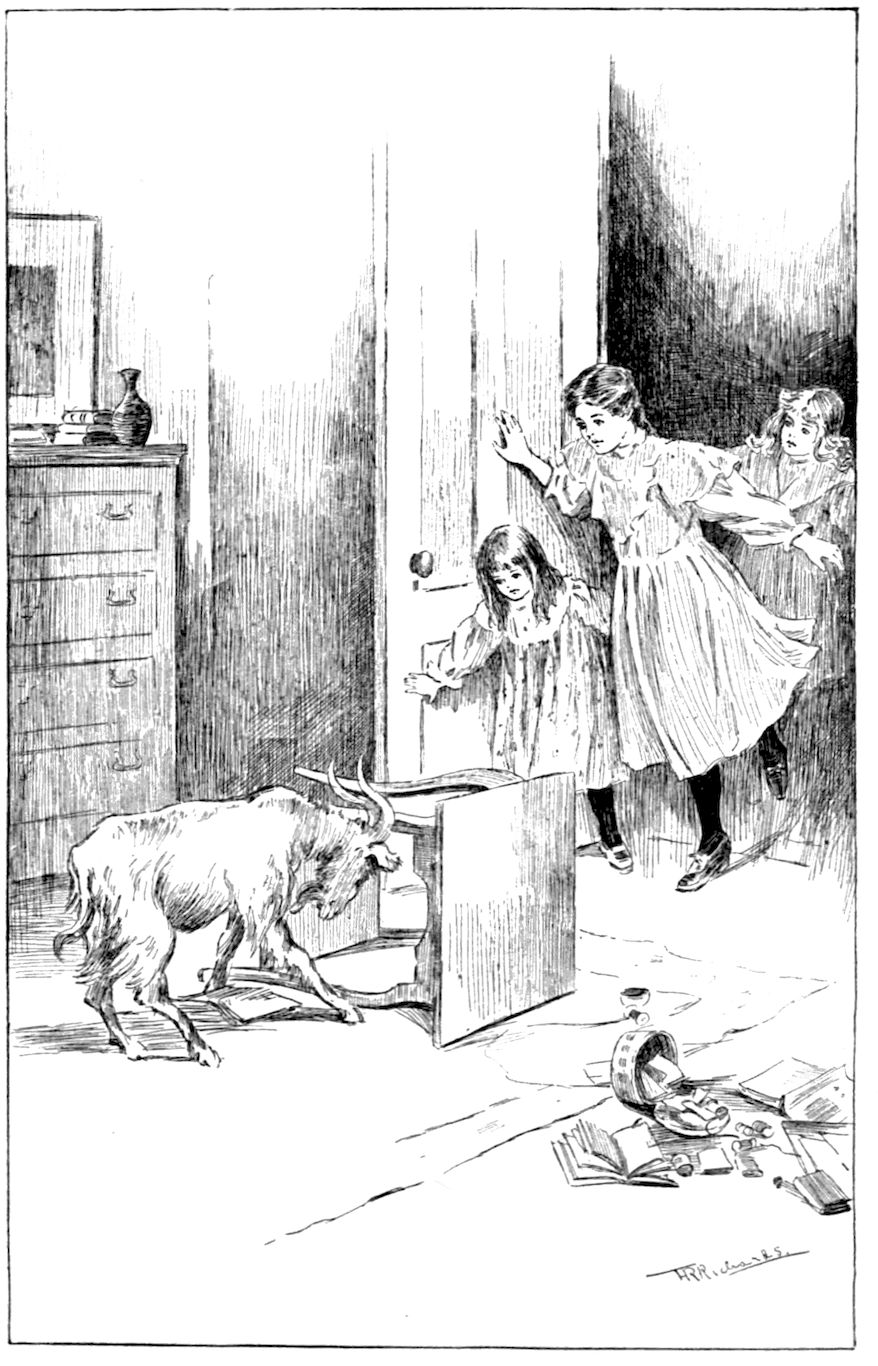
room. There he encountered a small table, the
contents of which were instantly strewed over
the floor, while the children ran screaming after
him.
“My work-basket!” shrieked Eunice, darting
forward to rescue it, as Johnnie-goat stopped,
with one foot through the pretty straw cover,
and nibbled inquisitively at a tape measure.
He kicked out behind and butted in front
when the children tried to catch him, and then
turned his attention to a little silver-topped
emery.
“Oh, Don! do get it!” cried Eunice, clasping
her hands tragically, as the emery went into
the capacious mouth, and Johnnie-goat meditatively
78rolled it over with his tongue, to get its
full flavour.
Don deftly seized Johnnie-goat’s horns with
one hand, and bent back his head with the
other, pulling at the silk cord that drooped
gracefully out from his mouth—thus rescuing
the emery from its Jonah-like retreat.
“Oh! oh!” wailed Eunice, taking the wet
and dirty object daintily by thumb and finger,
“it’s all spoiled! You bad Johnnie-goat! Box
his ears, Don. Look out, Cricket, there he goes
at your new shoes. Do get him down stairs
now. Ow! there goes my Dresden pin-tray!”
with a shriek of despair. Johnnie-goat, whisking
from side to side of the room, in search of
new excitement, had swept his bearded chin
over the low dressing-table, among the array
of pin-cushions, trays, bottles, photographs, and
brushes. Smash went the dainty Dresden pin-tray
on the floor as Eunice spoke, and Johnnie-goat
danced off.
“Come, you young bull in a china shop, we’ve
had enough of you,” said Donald, diving after
him, and catching him by whatever was nearest.
It happened to be his tail, which was a
short but firm handle. Johnnie-goat whipped
around indignantly, and Donald grabbed at his
horns.
79
AN UNEXPECTED VISITOR.
81“Whistle down the tube for Sarah to take
him, Meg,” he called. “No, stop; I’ll take him
down myself, the kids are out of the way. Come
this way, young chap,” and Donald pulled and
hauled Johnnie, vigorously rebelling, to the top
of the staircase. As Johnnie looked down to
the floor below, possibly he regarded the stairs
as some curious kind of mountains, which his
inherited instinct made familiar, for he suddenly
plunged headlong down them so fast that Donald
lost his balance, and went heels-over-head after
him, goat and Freshman arriving at the bottom
at the same moment, in an inextricably mixed-up
condition. Overhead the excited girls watched
and screamed.
Donald unwound his long length slowly.
He and the goat had mutually broken each
other’s fall, and nearly each other’s necks. As
it happened, neither was hurt. At least, Donald
discovered that he was not, and as for Johnnie-goat,
he seemed as much alive as ever, but in
such a state of amazement at all the strange experiences
that he was going through, that he
quietly submitted to let Don lay hold of his
82collar, and escort him at a slow and dignified
walk down the next flight.
They were half-way down when there was a
quick click of a latch-key, and the front door
opened. Doctor Ward and a stranger entered.
Both stared in amazement.
“How under the canopy—” began Doctor
Ward; but Donald interrupted him, explaining
calmly:
“Goat ran away from the Odd-Fellow’s Lodge,
over there. The poor creature is nearly starved;
I’m taking it back.”
CHAPTER VI. A PHILANTHROPIC SCHEME.
83
One morning, when the mumps were a thing
of the past, Eunice and Cricket walked along to
school arm-in-arm. Cricket swung her books,
as usual, by the long strap, and Eunice had hers
snugly tucked under her arm. Both were chattering
as fast as their busy tongues could wag.
As they turned around the corner into a quiet
street, the sound of a crying child attracted
their attention, though at first there was nothing
to be seen.
“There it is,” said Cricket. “See that mite
up there.”
The “mite” was a funny-looking little thing
about three years old, poorly dressed, bareheaded,
with a little flaxen pig-tail sticking out
behind each ear. The child stood at the top of
some steps, wailing steadily, and beating its little
blue fists against the door.
“It’s been shut out, poor little thing,” said
84Eunice, running up the steps and ringing the
bell, vigorously. “Wait a moment, Cricket, till
someone comes to the door.”
The baby stopped crying and surveyed her
new friend with a pair of staring, pale-blue eyes.
It was certainly a very dirty baby, and Eunice
wondered at its belonging to such a nice-looking
house. Then a trim maid opened the door.
“I found this baby, here, trying to get in,”
began Eunice, civilly, “so I rang the bell for
her, and waited till you came to take her in.”
The trim maid surveyed the baby in indignant
scorn.
“It don’t belong here, miss, for sure. The
likes o’ that!”
“Doesn’t belong here? The poor little thing!
Then she must be lost. She was pounding on
your door and crying dreadfully. What shall
I do with her?”
“’Deed, I don’t know, miss,” answered the
maid, backing away and partly shutting the
door, as if afraid that Eunice would insist on
leaving the interesting infant there. It had
immediately adopted Eunice as its protector,
apparently, for it grasped her skirt with one
hand, and with a thumb tucked deep into its
mouth, it stood passively staring from one to
the other. Somebody must do something, that
was clear.
85
THE LOST BABY.
87“Come on,” called Cricket, who had walked
slowly on. “Won’t she go in?”
“Come back a minute. The maid says she
doesn’t belong here. What shall we do with
her? I suppose she’s lost. Can’t I leave her
here? I have to go to school,” added Eunice,
turning to the girl, who had now left only a
crack of door open.
“’Deed, no. We didn’t find her,” said the
girl, impertinently. “It doesn’t belong anywhere
about here. Take her to the police
station. We can’t take care of beggar’s brats,”
and with that she shut the door, leaving Eunice
staring as blankly at the door as the baby did
at her dress.
“What a horrid, cross girl!” said Eunice,
indignantly, at last, descending the steps slowly
to accommodate her steps to the short, fat legs
beside her. The child still clung closely to a
fold of her dress.
“What shall we do with it? We’ll be dreadfully
late for school.”
“Let’s take it to school,” suggested Cricket.
88“How could we? Baby, what is your name,
and where do you live?”
Baby uttered a gurgle that doubtless meant
volumes, but which the girls could not interpret.
She was a Dutchy-looking little thing, with a
wide, chubby face and squat little figure. Her
little flaxen pig-tails were about an inch and a
half long, and were tied with white string.
“Shall we take her to the police station?
Let’s hurry, whatever we do. It’s ’most nine.”
“The police station? and have the poor little
atom locked up in a big, black cell?” exclaimed
Eunice, indignantly. “Never!” for her ideas
as to the exact advantage of taking a lost child
to a police station were somewhat vague.
“Let’s take her to the little bake-shop woman
by the school, and leave her there for the
morning, anyway. I’m sure she’ll take care
of her. We’ll take her home after school, and
papa will see about her.”
Eunice assenting to this proposal, they now
took up the line of march. People glanced and
smiled at the funny, dirty baby, with the handkerchief
that Eunice tied over its head, and
the two well-dressed children, but they did not
notice it.
89“Eunice, we might adopt it!” cried Cricket
suddenly. “Wouldn’t that be fun? It could
play with Kenneth, and ’Liza wouldn’t mind
one more child to take care of.”
“What fun!” exclaimed Eunice. “And if
’Liza didn’t want the trouble we could do it ourselves.
It could sleep in a crib in our room.
I’d wash it one morning, and you could the
next.”
“Yes, and we’d spend Saturday mornings
making its clothes.”
“And we’d take it to walk when we got home
from school—”
“And we’d teach it its letters—”
“And put it to bed—”
“Would we have to spank her if she was
naughty?”
“Oh, do let’s beg them to let us have it for
our very own, and bring it up ourselves. Would
you like to live with us, baby?”
The possibility of a distracted mother, searching
around for the child, somehow never occurred
to the girls, in their planning about the little
waif, and they chattered on, in their eagerness,
till they reached the shop of the little baker,
with whom they meant to leave the child.
90The good-natured little woman, who knew
the children well by sight, was quite interested
in their story, and was entirely willing to take
charge of the lost baby till one o’clock. She
was an ignorant little German woman, and she
never thought of telling the girls to send it to
the police station to be kept till its friends could
look it up.
The thought of the baby kept the girls excited
all the morning. After school they started
off immediately, without waiting, as usual, for
their friends. The baby recognised Eunice as
soon as she appeared, and pulled her dress
delightedly.
“Could you lend us something to put on her
head?” asked Eunice, eyeing the flaxen pig-tails
doubtfully. “My handkerchief makes her look
so queer, and I’m afraid she’ll take cold without
anything over her head.”
The little bake-shop woman good-naturedly
produced a very remarkable-looking cap of her
own baby’s, and tied it on the little waif’s head.
“I haf ask her the name,” she said, as she
tied the strings, “but I no unnerstan’ her. She
try to talk, but she yust—”
“Jabbers,” said Cricket. “I should say she
91did. Good-by! Thank you ever so much for
taking care of her for us.”
When the girls arrived at home they found a
free field. Mamma had gone to Marbury to
spend the day with grandma, and had taken
Kenneth with her. Marjorie was out to lunch
with a friend; and papa, Jane said, had been
unexpectedly called out of town an hour ago,
and would not be back that night. They took
the baby up to the nursery, and introduced their
prize to astonished ’Liza and the twins.
“But you can’t keep it,” said ’Liza. “I jest
guess its poor mother is running all around the
streets looking for it.”
“Oh, do you think so?” said Eunice surprised.
“Why, I never thought of her. Well, of
course, papa will advertise the baby, and do
everything about it, but if we don’t find anyone
belonging to her, we are going to keep her,
Cricket and I.”
Whereupon ’Liza pretended to faint away.
The twins were perfectly delighted with the
addition to the family.
“It’s just like the little boy we finded once,”
piped up Zaidie, “only it’s a girl. Auntie
wouldn’t let us keep it.”
92“This is a really, truly, losted baby, though,
and Phelps wasn’t,” explained Helen. “He had
only runned away.”
The “losted baby” here took its thumb out
of its mouth, and suddenly began to cry.
“It’s hungry!” announced Cricket, with the
air of one discovering America. “What do you
s’pose it can eat, ’Liza?”
“’Most anything it can get, I rather guess,”
said ’Liza. “That kind generally does, and is
glad to get it, too.”
“She isn’t ‘that kind,’” said Cricket indignantly,
resenting the tone. “Come, baby; we’ll
go down-stairs and get some bread and milk.
You ’ittle tunnin’ sing!” as the baby stopped in
its howl as suddenly as it had begun, and trotted
away contentedly with the girls.
Cook duly exclaimed over “the find,” but she
reiterated the advice of the cross maid, and
recommended them to take the baby to the
police station.
“Why does everybody want to send this poor
little mite to the police station?” cried Eunice.
“It hasn’t done a thing, only got lost, and
prob’ly it didn’t want to do that; and everybody
wants to shut it up in a big, black cell. Papa
93can advertise it when he gets home, if he likes,
and if anybody comes for it they can have it.
If no one does come, we’ll keep you ourselves;
won’t we, baby? Drink the milk, now.”
“Wish we knew its name,” said Cricket.
“Let’s name it something ourselves,” suggested
Eunice.
“To be sure. Don’t you know when Pharaoh’s
daughter found Moses she named him Moses,
herself? Oh, Eunice, let’s call her Mosina!”
“Oh, Cricket, how lovely! Just the thing!
We didn’t find her in the bulrushes, but we
did find her on some steps. Oh, you darling
Mosina! I hope your mother won’t come for
you!”
When the new arrival had finished her
luncheon, and the children had had theirs, they
carried Mosina off to their room. Zaidie and
Helen immediately came toiling up from the
nursery, to help entertain their guest. Fortunately
she was not at all shy, and jabbered and
gurgled in her unintelligible baby talk, showing
the greatest readiness to be amused.
“La! she’s awful dirty,” said Eliza, looking
in on them presently. “I wouldn’t touch her
with a ten-foot pole.”
94“Let’s wash her, and dress her up in Kenneth’s
things,” cried Cricket, straightway catching
hold of Mosina, who speedily stood arrayed
only in her own rosy skin; for the dirt which
’Liza had exclaimed at, was really chiefly on her
hands and face.
Eunice drew the water in the bath-tub, and all
four, with great laughing and excitement, superintended
a very thorough scrubbing process, to
the infinite amazement of the small child, who
had probably never been so scrubbed before since
she was born.
There was a small bruise on one side of the
round, dimpled thigh, that presently caught
Zaidie’s attention.
“Here’s another dirt-spot, Eunice,” she said,
with an air of much importance at the discovery.
It was so delightful to be the scrubber instead
of the scrubbee. She seized the nail-brush, and
squeezing in under Eunice’s arm, began vigorously
applying it to the baby’s soft flesh. That
small person instantly howled again.
“Stop, Zaidie! that isn’t dirt, it’s a bruise,”
said Eunice, taking the nail-brush away. “Can’t
you tell the difference?”
“Not unlets I poke ’em,” said Zaidie, looking
95surprised. “When I have one I always poke it,
and if it hurts I know it’s a bruise. If it doesn’t
I guess it’s dirt. I couldn’t tell it on the baby,
could I?”
“You had better experiment on yourself,”
said Cricket, laughing. “There, Miss Mosina,
you’re pretty clean now, I think. Let’s take
her out, Eunice. Put down the big bath-towel,
Zaidie.”
Baby had endured the process in awed silence
thus far, but when she stood dripping like a
little cupid on the bath-towel, she patted her
round, fat legs with every appearance of delight,
and even attempted to climb back into the
tub. It was probably her first experience of a
plunge.
“You cunning thing!” cried Eunice, as rapturously
as if she had never seen a small child
tubbed before. “Cricket, won’t you run and ask
’Liza for some of Kenneth’s clothes? I don’t
want to put her dirty ones on her again.”
Cricket ran off and presently came back,
laughing.
“’Liza says she couldn’t dress such little
beggars in gentlemen-folkses’ children’s clothes,
but finally she let me have these old ones, that
96mamma had put by to give away. Let me see;
where do you begin?”
“I know,” said Zaidie; and by the united
efforts of all four, Mosina was presently arrayed.
This process had taken up a great part of the
afternoon, and at this moment, Marjorie, who
had just returned, came running up-stairs.
“Oh, have mamma and Kenneth come back
so early?” she said, catching sight of a tiny
figure in a familiar blue dress.
“No, but this is our new baby, and we’re
going to adopt it, if its mother doesn’t come
for it; and I don’t much believe she will, for it
was pretty dirty, and probably she doesn’t care
for it much, so Eunice and I are going to keep
it,” poured out Cricket in a breath.
Marjorie dropped against the newel-post.
“Adopt it? What, in the name of common
sense, are you talking about, Cricket? Where
did the atom come from?”
“We found her in the street this morning,”
explained Eunice, “and we couldn’t find anybody
that belonged to her, so we had to bring
her home, Marjorie. We couldn’t leave her to
starve, could we? Poor little mite! she was
freezing cold.”
97Mosina, quite aware that she was under discussion,
clung to the dress of her first friend,
sucking her thumb, and staring from one to the
other with her solemn blue eyes.
“But, my dear children,” began Marjorie, in
a very superior, elder-sisterly tone, “that is perfectly
absurd. With all the raft of children we
have now, we can’t adopt a whole orphan asylum.
Besides, her mother will be looking for her;
probably she is nearly frantic. You must send
her to the police station.”
“There!” cried Eunice, aggrieved, “that old
police station again! Everybody says that. As
if I would have this cunning thing, that loves me
so, shut up in a horrid old black cell. Why,
she’d be as afraid as anything.”
“They don’t put lost children in cells,” began
Marjorie, and then stopped, not quite certain
what they did do with them. “At any rate,
you ought to take her there. People always
do.”
“I shan’t do it,” said Eunice, stoutly.
“And, Marjorie, she’d be frightened to death
among all those big men,” expostulated Cricket.
“We have just got to keep her.”
“Then I’ll tell you what I’ll do,” compromised
98Marjorie. “I’ll send Jane around to the
police station, and tell them she’s here, and describe
her, and leave our address. If any one
comes, they can send here.”
Just then the door-bell rang.
CHAPTER VII. MOSINA.
99
In a moment, Jane came up with a telegram
from mamma, saying that she would stay in
Marbury all night, as it looked like rain, and
Kenneth had a slight cold.
The children looked at each other in blank
dismay. Mamma’s absence, for one night, really
made no difference at all, but they felt as if the
bottom had dropped out of the house. Of course
mamma had not known of papa’s absence for the
night, as he had been telegraphed for after she
had left in the morning.
Conscientious Marjorie looked as if the affairs
of the nation rested on her shoulders.
“Oh, dear me!” she sighed. “And this baby
on my hands.” And then she explained to Jane
about the police station, and what she wanted.
“Now, if the child is to stay here to-night, we
must arrange about its sleeping,” she added.
“In Kenneth’s bed,” piped up Zaidie.
100“I’ll see ’Liza about it,” said Marjorie, turning
to the nursery. “Take her up-stairs, Eunice,
do, and keep her amused till dinner.”
“I’ll tell you, Miss Marjorie,” said ’Liza in
confidence, “them children have the notion of
adopting that baby. Of course it’s all nonsense,
but you let ’em have her in their room to-night,
and they’ll get off the notion. Tell ’em I can’t
have the bother of it here. ’Course I’ll sleep
with one ear open, and if they get into trouble,
I’ll go up.”
“Very well, ’Liza, I’ll do that,” said Marjorie,
turning away.
Eunice and Cricket proclaimed themselves
perfectly delighted with the arrangement. It
was just what they meant to do, anyway.
“Of course, Marjorie, if we adopt the baby,
we’d expect to take all the care of it, you
know,” said Cricket. “’Liza has enough to do
with the younger ones; ’course she’ll sleep here.
Eunice, you can have her half the night, and I’ll
take her the other half.”
“I may forget to wake up,” objected Eunice.
“Suppose I take her to-night into my bed,
Cricket, and you take her to-morrow night.
There’s the dinner-bell. She can stay in the
101nursery with ’Liza and the twins, and get her
supper, while we’re at dinner.”
“Come, Mosina,” said Cricket. “Oh, Marjorie,
I forgot to tell you, we named her Mosina,
after Moses.”
“You are the most ridiculous children about
names,” said Marjorie, laughing. “Come to
dinner now. After dinner let us try that duet,
Eunice.”
Marjorie and Eunice were both musical, and
each played exceedingly well for their respective
years. Although Cricket loved music, she had
no aptitude for the piano, and her lessons had
been discontinued. Instead, her talent for her
pencil was being cultivated. But all the children
were more or less musical. Marjorie and
Eunice both had very good voices, and, with
Donald’s aid, they often practised trios, as well
as duets by themselves.
After dinner, Marjorie and Eunice played
duets for a time, but Eunice was so impatient
to get back to her adopted baby, and made so
many mistakes, that presently Marjorie, in disgust,
sent her off. The two younger girls immediately
flew up to the nursery.
’Liza was getting the twins ready for bed,
102and gave Eunice some night-things of Kenneth’s
for her charge, together with a shower of instructions
for the night. Then the children carried
off the baby, nodding and heavy-eyed, but
quiet and stolid still.
With much giggling and fun, and a feeling of
immense importance, the two girls finally had
Mosina undressed and ready for bed. By this
time she was almost asleep on their hands.
“Just see this room!” exclaimed Eunice,
looking about her, after the infant was safely
tucked away in her cot. “Doesn’t it look as if
a cyclone had struck it? It’s more mussed up
than the nursery ever gets with all three children
there.”
“We’ll put it in order to-morrow, for it’s
Saturday, and we’ll have plenty of time,” said
Cricket, gathering up the baby’s things with a
sweep of her arm, and putting them on a chair.
“Come on down-stairs again. Doesn’t it seem
grown-up and motherly just to turn down the gas
and go down and leave the baby asleep? Won’t
mamma be surprised when she comes home?”
“We must listen to see if she cries,” said
Eunice, beginning to feel the responsibility of a
family.
103The children went down-stairs again, to the
back parlour, where Marjorie was deep in to-morrow’s
trigonometry. They each took a book
and pretended to read, but each found herself
starting up at every sound, and asking each
other if that was the baby’s voice. A dozen
times Eunice tiptoed to the front hall and stood
listening at the foot of the stairs, with a queer
feeling of the necessity of keeping very quiet,
although she certainly had never felt that necessity
with the twins or her small brother. A
dozen times Cricket started up, fancying she
heard a little wail from above.
“Dear me!” sighed the latter, at last, “I
know now what mamma means by saying she
sleeps with her ears open. I have one ear up-stairs,
and the other on my book, and I’ve read
this page six times, and I have forgotten to turn
over.”
“It shows your distracted condition, if you
are trying to read with your ears,” Marjorie
stopped her studying to observe. “Don’t bother
about that infant, girls. She’s all right. I’m
only thinking about her poor mother. Jane
said there had been no inquiries at the police
station.”
104“Everybody’s been firing that police station at
our heads all day,” said Eunice, “but I couldn’t
bear to have the poor little thing put in a cell.”
“But they don’t put lost children in cells,
goosie,” said Marjorie. “I suppose they have a
woman to take care of them. They send to the
Central Office and tell them they have a lost
child there. Then anybody who has lost a child
goes to the nearest station and tells about it.
Then they send to the Central and ask if a lost
child has been reported there, and then they telegraph
back if it has, and the parents go and
find it, wherever it is. You know I sent to the
station to say it is here.”
“How very simple,” said Eunice, thoughtfully.
“I wish we had known that this morning. I
didn’t think about the mother’s part of it, as I
do now. How we would feel if Kenneth was
lost for even an hour.”
“Come, Eunice,” said Cricket, shutting her
book with a slam. “Let’s go to bed. I’ve had
such an exciting day that I’m just reeking with
sleep. Good night, Meg.”
“Good night, and take care of your infant.”
The children tiptoed into their room, and
turned up the gas a very little.
105“Do look at that child,” said Eunice, stopping
short.
Certainly if Mosina was quiet by day she
plainly made up for it at night. She had twisted,
and wiggled, and kicked, till the clothes were
lying in every direction, and she herself was
curled into a little ball at the foot of the bed,
with her beloved thumb tucked into her mouth
as far as it would go.
“How shall we get her back again without
waking her? Would you dare lift her?”
“We’ll have to. You can’t sleep without any
clothes over you, can you? Come up here, you
rascal,” and Cricket lifted the small round ball
gently in her arms and laid her, right side up, at
the other end of the bed. Baby settled down
with a gurgle.
After the girls were in bed, and silence and
darkness had reigned for ten minutes, Eunice
suddenly remarked:
“Do you know, Cricket, I never realised
before how small this cot is. This midget
seems to take up all the room. She slips right
down into the middle.”
“Sleep on the other side,” murmured Cricket,
drowsily.
106“I can’t very well sleep on both sides of her
at once; I’ll move her along once more.”
Silence again, broken by a sudden grunt from
Eunice.
“Ugh! she’s planted her feet whack in my
stomach. Cricket, she flops just like a little
fish. I never know where she’s going to land
next; and she’s a regular windmill with her
arms. There she comes, whack, on my nose
again.”
“Tell—her—to—stop,” advised Cricket, in
far-away tones.
“Much good that would do! Now, you midget,
get over on your own side, and stay there;”
and Eunice, having lost all fears of awakening
her protegé, placed her with much firmness
back on the other side.
Poor Eunice! As the cot was only three feet
wide, and as she was entirely unaccustomed to
sleeping with any one, much less a wriggling,
squirming baby, she naturally found her present
experience rather a trying one. She listened
enviously to Cricket’s even breathing, which
showed that she was safe in the Land of Nod;
but when she herself was almost there, a tiny
foot or hand was suddenly planted on her, or
107the soft, round little body came rolling over,
and landed plump upon her.
“Oh, DEAR!” cried Eunice at last, in despairing
capitals, “how do mothers ever sleep at
night, if their babies sleep with them?”
She stretched herself on the outermost limit
of her cot, after pushing Mosina well along to
the other side. For a time quiet reigned, and
Eunice’s heavy eyelids fell. She was peacefully
sailing away to dreamland, when suddenly a
thud and a roar awakened them. Of course
Mosina had fallen out of bed.
“Cricket! Cricket! do get up and light the
gas! I’m afraid to get out for fear I’ll step on
her. Do hurry, Cricket!”
Cricket tumbled sleepily out of bed and
groped for the matches, which hung in a little
swinging receiver on the gas-jet. She hit it
accidentally, and every match went flying to the
floor. Meanwhile Mosina steadily roared. Eunice
leaned over the edge and felt around for
her.
“Where have every one of those plaguey
matches gone?” demanded Cricket, with emphasis,
groping around on her hands and knees,
and hitting every kind of object save a match.
108Just at that moment Eliza, aroused by the uproar,
appeared, carrying a candle.
“The baby fell out of bed,” explained Eunice,
somewhat unnecessarily, springing out of bed
herself as the welcome light appeared. Mosina
lay sprawled on her back, kicking her fat legs,
and screaming lustily.
“’Tain’t hurt, by the way it cries,” said
Eliza, picking up the baby with a practised
hand. “It’s mad. There now! ’sh! hushaby!
Where was it sleeping, Miss Eunice?”
“Here in my bed. Cricket, perhaps it would
be better to take half a night apiece instead
of every other night. I want some sleep. She
thrashes like a whale. I’m all black and blue
where she has punched me.”
By this time Mosina, hushed in Eliza’s arms,
had gradually ceased crying and was shutting
her sleepy eyes again.
“Yes, give her to me,” said Cricket, hopping
into bed, and holding out her arms. “Isn’t she
soft and warm, though. She’s just like a little
hot-water bag. I’ll put you on the side next the
wall, you cunning thing, so you can’t fall out
again.”
Eunice jumped into bed and drew up the
109blankets with a perfect groan of relief, and Eliza
departed, leaving them in darkness and quiet
again.
“If she kicks very hard, Cricket, I’ll take her
back, after I’ve had a little—snooze—but—I’m
so—” and Eunice dropped off, even as she
spoke. Cricket cuddled the baby in her arms,
where it actually lay still for a minute or two,
and Cricket improved the opportunity to go to
sleep herself.
CHAPTER VIII. A BEDFELLOW.
110
Two or three hours passed, and the household
were all asleep; Cricket, in the intervals of her
disturbed dreams, had fished her little charge
up from her feet, and extricated her from an
amazing tangle of sheets and blankets. She had
awakened from an oppressive dream of drowning
to find the baby sprawling over her chest, with
both legs around her neck. She had patiently
restored her each time to her own corner. At
last, thoroughly tired out with this unaccustomed
wakefulness and responsibility, she fell into a
sleep much heavier than usual, regardless of
Mosina’s continued antics.
At last a strange, new sound slowly penetrated
her consciousness, and she gradually awakened
to the fact that there had been a queer, wheezing
noise close to her ear for some time. Still
dazed with sleep; she lay bewildered for a moment
or two, till it suddenly dawned on her
111that the queer noise came from the small atom
at her side. Mosina was wheezing and choking
in a way that became more alarming every
moment.
“Eunice! Eunice!” cried Cricket, suddenly
realising that something was seriously wrong;
“for goodness sake, wake up! Something’s the
matter with the baby!”
“In a moment,” answered Eunice, sleepily,
thinking that she was being called to breakfast.
“Eunice, get up! Run for ’Liza! Baby’s
dying!”
“What?” cried Eunice, startled into full
wakefulness. “Oh, Cricket! What is it? What
awful noises!”
“I don’t know what’s the matter,” said
Cricket, feeling her way to the gas again.
“Oh, do hurry! Here, you light it, and I’ll
go.” And Cricket flew away barefooted.
In a moment she was back again, and directly
after ’Liza appeared, in a trailing flannel wrapper
and felt shoes.
“Croup!” she had exclaimed to herself, as
she heard the wheezing noises away down-stairs.
“A bad case, too,” she added to herself, as she
entered the room.
112Eunice had the gas lighted, and the two
shivering, frightened little girls hung over the
cot, where the baby lay fighting for breath,
with that dreadful, whooping noise that mothers
know and dread. Eliza came forward quickly;
although she had not much head for any emergencies
out of her own line, she was a good
and efficient nurse where children’s ordinary ailments
were concerned.
“Put on your dressing-gowns and slippers,”
she ordered the children, she herself flying to
the wash-stand, and wringing out a towel in cold
water. “Run up-stairs, Miss Eunice, and wake
Jane, and tell her to go for Dr. Townsend.
Pass me a flannel petticoat out of your drawer,
Cricket, please. I dasn’t wait to go to the
nursery for things.”
The children flew on their respective orders,
and in a twinkling Eliza had a cold compress
on the baby’s chest, well protected by Cricket’s
blue flannel petticoat.
Jane appeared a few moments later, ready
to go for the doctor, and Marjorie, aroused by
the voices and general commotion, came flying
up-stairs.
“Them big, fat children always has croup
113dretful,” said Jane cheerfully. “Like as not
she’ll die.”
“Die!” echoed ’Liza, scowling at her. “You
get along, Jane Lackett, and bring that doctor,
and tell him Doctor Ward’s away; and don’t let
the grass grow under your feet, neither.”
“Oh, ’Liza, will she die?” whispered Cricket,
clinging to Eliza’s hand.
“Oh, lawks! I guess not, honey; but she’s
fair to middlin’ sick. Helen ain’t nothin’ to her.
Never heard a worse wheezin’. S’pose she’s took
a fine cold this morning, runnin’ round without
any hat on.”
It was dreadful to the girls, who had never
seen a bad attack of croup before, to stand there
helplessly, and watch the little creature fighting
for breath, every respiration coming with a
long whoop that seemed to tear the little frame
apart.
“Can’t you do anything, ’Liza?” begged Marjorie.
“It’s dreadful to see her suffer so.
Aren’t there any medicines to give her?”
“Yes, Miss Marjorie; there’s syrup of squills.
It’s in your ma’s medicine chest. No; it’s all
out, I know. I’ll give her some vaseline, if
you’ll get some.”
114“Make her eat that stuff!” exclaimed
Cricket. “Why, it will choke her! Don’t
do it. It’s cruel!”
But Eliza, unheeding, took a spoonful of vaseline,
and opening the baby’s already gasping
mouth still further, put the soft, slippery mass
down the poor little throat.
Presently the doctor came, and to the children’s
amazement, he nodded approvingly over
the vaseline. Then he ordered them all off to bed.
“Go and finish the night in mamma’s bed,
you and Cricket,” suggested Marjorie. “’Liza,
I’ll be on the lookout for our children, since my
room is next to theirs, and you must stay here.
Is the baby very sick, doctor?”
“It’s a pretty bad attack, but nothing to
be frightened about,” said the doctor cheerily.
“But who in the world is the youngster?”
While Marjorie explained, Eunice and Cricket
crept off to mamma’s room, and tucked themselves
into her wide bed, feeling as if they had
been through a lifetime’s experience since nine
o’clock that night. How delightfully peaceful
and care-free it seemed to settle down without
anyone to look after but themselves.
“Really, Cricket, it may sound funny to you,”
115said Eunice, squeezing her sister, “but I feel as
if I had had babies in my bed for years. It
actually seems funny not to feel her squirming
around.”
“And I’m very sure, for my part, that adopting
babies is not what it’s cracked up to be,”
returned Cricket, decidedly. “Eunice, don’t let
us adopt her, even if her mother doesn’t come
for her. Mamma can, if she wants to, or papa
can find somebody else to. I think we have
enough children, anyway.”
“She would take a lot of time,” asserted
Eunice.
“Yes; and think of dressing her every morning!”
added Cricket.
“And having her sleep with us, and kicking
us black and blue every night!” said Eunice
feelingly.
“Yes, and keeping us awake. Wonder how
the poor little thing is.”
“The doctor and ’Liza will take care of her.
Listen, Cricket! There’s the clock actually
striking two o’clock! Mercy! were we ever
awake so late before?”
“Never. I feel forty-six years older than I
did last night, don’t you, Eunice?”
116But a grunt was Eunice’s only answer, and
Cricket speedily followed her to the Land o’
Nod.
The doctor and Eliza had a busy hour over
the baby, and at the end of that time it was
sleeping quietly, and the night was finished in
peace and quiet.
It was very fortunate that Eliza was the
most patient, long-suffering nurse imaginable,
for she accepted Mosina as a temporary inmate
of the nursery the next day as a matter of
course, and looked after her as carefully as
after the other children. Jane made another
visit to the police station, after breakfast, but
only brought back the information that no lost
child had yet been reported.
Papa returned about luncheon time, and to
his great amazement, was presented to the new
member of his family.
“We thought at first we’d like to adopt her,
but we’ve come to the conclusion we don’t care
much about it,” confessed Eunice frankly, at the
end of her tale; “at least, we don’t if she has to
sleep with us.”
“Because, papa,” chimed in Cricket, “you
see, she’s the restlessest, squirmiest child you
117ever saw. Oh, yes; she looks mild enough
now, but if you felt her wiggle just one night,
you’d believe it.”
“You both of you look as if you had been on
a prolonged spree,” said Doctor Ward, pinching
the rather pale cheeks of his two ex-philanthropists.
“Never mind, I’ll look out for the baby.
Somebody will be sure to turn up for her.”
And somebody did. About seven o’clock
that evening, the somebody marched up the
steps and rang the bell furiously. It was a
distracted little Dutch woman, who in broken
English demanded her baby. Mosina was
brought down, but after the first little gurgle
of pleasure at seeing her mother, sucked her
thumb as placidly as ever, while her mother
hugged and kissed her rapturously, pouring
forth a stream of mingled Dutch and English.
It was some time before she was calm enough
to explain the situation.
She went out to work by the day, when she
could, and, when she was at work, would often
leave the baby at her married sister’s for two
days at a time, as the sister lived at a distance,
and she would sometimes be too tired to go for
her at night. The day before, she had taken
118her there as usual. However, the little thing
must have slipped out and run after her, and
the sister thought the mother had taken her,
after all. She had to go to work at a place
on the other side of the city for two days, and
so had not gone for the child the night before,
thinking, of course, she was safe, as usual. She
was wild with terror when she went there and
found that her sister thought she had the child
with her. They went immediately to a police
station, and soon had the necessary information
of the baby’s whereabouts.
The little Dutch mother was overwhelmed
with gratitude at the kindness and care her
baby had received. She said that the little
thing often had croup, and very bad attacks,
too.
Mamma, who had returned from Marbury
just before dinner, began to talk quietly to the
excited little woman, and learned her story. It
was very short and very simple. They had
come over to this country two years before, and
did well till her husband was killed by an
accident a few months previous. She spoke so
little English that it was hard for her to get
work, and their little savings slipped away
119quickly. Now she was anxious for all the work
by the day she could get.
Mrs. Ward listened sympathisingly, promised
to speak to her friends about her, and gave her
a bundle of Kenneth’s clothes to take home,
besides the ones that Mosina was then arrayed
in.
“So you don’t want to go into the orphan
asylum business?” said papa, pulling Cricket’s
curls, when the excitement was all over, and
Mosina and her mother had departed, laden
down with bundles.
“I think I might like it,” said Cricket, meditatively,
“if only I didn’t have to sleep with the
orphans.”
CHAPTER IX. CHRISTMAS HOLIDAYS.
120
Christmas time was approaching, and the
Wards’ house was to be full to overflowing of
young people for a week or two. Donald was
to have a college friend of his with him for
several days. Eunice and Cricket were to have
their little Kayuna friends, Edith Craig and
Hilda Mason, to visit them; and, at the last
moment, Mrs. Somers had written, begging that
Will and Archie might be taken in, if possible,
as Edna had just come down with scarlet
fever, and they had to go away. Five extra
people in an already rather full house made a
great deal of planning and arranging necessary,
but I almost think that the children enjoyed
the bustle it all made as much as the expected
visit.
Donald had an extra bed put up in his room
for his friend. Eunice was to share the spare
room with Edith Craig, and Hilda was to have
121Eunice’s cot, according to the first plan; but
when Will and Archie had to be arranged for,
mamma could think of nothing else to do but to
give them the girls’ room, and put up two more
cots in the spare room—fortunately a large one—so
that all four girls could sleep there. The
children were ready to stand on their heads
with delight at this arrangement.
“So boarding-school-y!” beamed Cricket,
surveying the room, when the beds were all
ready. It looked, for all the world, like a hospital
ward. “Oh, what fun we’ll have! You
were such an angel, mamma, to arrange for us
all to be together.”
“I hope I won’t regret it,” said mamma,
laughing, but looking a little dubious.
“Indeed, you won’t,” promised Eunice.
“We’ll be good, truly. Only it will be such
fun to plan jokes on the boys; and they can’t
do much to us when we are all together, you
see.”
“Remember, I don’t like practical jokes,
dear,” said mamma. “They are dangerous
things.”
“Oh, we’ll tell you all the things we do,”
promised Cricket, “and we truly won’t do anything
122you think we’d better not. Please don’t
say we can’t play any jokes.”
Christmas fell on Thursday, and the guests
were to arrive the next day. Christmas itself
was the gala day it always is in a house full of
happy young people. It began, of course, with
the usual excitement over the stockings, big and
little, that hung on the back-parlour mantel.
Then there were the presents that were too big
to go into stockings to be oh-ed and ah-ed over.
Then came the church service and the Christmas
dinner, and in the evening, a little party at
a neighbouring house.
The girls from Kayuna arrived Friday afternoon.
Doctor Ward took Eunice and Cricket to
the station to meet them, and in due time four
broadly smiling girls walked into the house,
where the little guests were warmly welcomed
by mamma and Marjorie.
Edith Craig was a tall, fine-looking girl, a
year older than Eunice, and, being the eldest of
five children, she was very mature for her years.
She was really very companionable for Marjorie
as well as for Eunice. Cricket she regarded as
a mere infant, and her motherly ways towards
that young lady were very amusing. All the
123family were very fond of Edith, however; she
was a bright, jolly, sensible girl, who seemed
equally happy whether she was exchanging confidences
with Eunice, or sitting with Mrs. Ward
and chatting over her embroidery, or romping
with Cricket, or giving Doctor Ward intelligent
attention when he was talking of some late medical
discovery, or playing duets with Marjorie, or
frolicking with the children in the nursery. A
well-bred, adaptable girl is always charming.
Cricket thought that Hilda had grown very
much in the four months since she had seen her,
but her bronze curls were as smooth, and her
clothes as trim, and she was as plump and
pretty as ever.
The little hostesses had planned enough for
the ten days’ visit to fill a month, as children
generally do; but that was very much better
than not having enough to do. Saturday, the
first day, was a lovely beginning, for Mrs. Drayton
had planned one of Emily’s pleasant little
matinée parties. Ten children, including the
four of the Ward party, were invited to lunch
with Emily and go to the matinée afterwards, to
see “Robin Hood.” This was an especially great
treat for Eunice and Cricket, for they were
124seldom allowed to go to the theatre, and their
little guests rarely had the chance. The lunch
was perfect; Mrs. Drayton and Emily were as
delightful as they always were; “Robin Hood”
was charmingly given, and the day was a perfect
success.
They found when they reached home that
Will and Archie had just arrived, and as Donald’s
friend had come also, the whole party collected
around the dinner table.
Doctor Ward looked around beamingly on the
flock, as he flourished his knife over the big
turkey.
“Cricket, this is an improvement on your
orphan asylum, I think,” he said. “How is it?
Do you prefer the babies?”
“I really think, now that I’ve had experience,”
said Cricket reflectively, “that I like
middle-aged people, like ourselves, better. We
aren’t so much trouble, I’m sure.”
There was a shout at Cricket’s “middle-aged
people.”
“I mean people who aren’t little things, like
Zaidie and Helen, or grown up, like mamma,”
explained Cricket defensively. “Just scattered
along, like all of us, I mean.”
125The days flew by on wings. Edith was sufficiently
companionable to Marjorie for the
latter to be included in many of the little doings
that mamma planned for the younger girls.
Will and Archie sometimes accompanied them
also, and sometimes were off on their own
account.
Archie was as much of a tease as ever, and
with the four girls right under his thumb, so to
speak, he had a most congenial employment in
tormenting them. Indeed, the various tricks
on both sides formed a large part of the entertainment.
The second night of his arrival, Archie carefully
made apple-pie beds, in which he was an
adept, for the occupants of the spare room, and
the girls soon found it wisest not to go to bed
on any night without carefully examining everything
in the room. One night all the sheets
were thickly strewn with salt, which, being white,
did not show at a casual glance, but was painfully
apparent when they lay down. Again,
he cut up the splints of a number of whisk
brooms, and the straws he scattered on the
mattress under the sheet. Did you ever go to
bed under the same circumstances? It is not
126comfortable. Another night, he lined the pillow-cases
with white paper, carefully basted on
the ticking. Once, by an ingenious arrangement
of some nails tied together with string and hung
outside the window one windy night, a weird
sound, like a clanking chain, was made, and the
girls had a lively hunt for the mysterious noises
that kept them all awake.
Mamma watched the fun carefully, but let
them go on, as long as it was all good-natured.
And indeed, the girls found many a way to repay
their ingenious tormentor. They sewed up
the sleeves of his night-shirt securely, not only
of the one he was wearing, but of all he had
with him, and Will’s also, lest Archie should
borrow. They filled his tooth-powder bottle
with soda, and stuffed the fingers of his best
gloves with cotton.
One night, when Archie had been particularly
bad all day, Cricket took her revenge by creeping
stealthily into his room after he was asleep—having
been kept awake herself, for the purpose,
by the united efforts of the other three—and
very cautiously pasted postage stamps over
his eyelids. Like most boys, when once asleep,
he rivalled the “Seven Sleepers,” and he never
127stirred during the performance. Adorned with
the stamps, he peacefully slept on all night, while
Cricket jubilantly crept back to bed. By morning,
the stamps stuck as tightly as if they had
been nailed there.
When Archie awoke, to his horror, he could
not open his eyes. He felt of them, but the
stamps stuck so close that he could not imagine
what was the matter, and called out in alarm to
Will. Will, of course, when he once opened his
own sleepy eyes, was nearly in convulsions of
laughter over the blue one-cent stamp adornment
on Archie, but, in pretended fright, advised
him not to touch his eyes till he could call his
uncle. He summoned Doctor Ward in hot haste.
Archie, really much disturbed in mind over this
strange disorder, was lying perfectly still when
his uncle entered. The doctor, entering into
the joke, told him that it was nothing serious
yet, only a strange growth that had come during
the night—perhaps from cold—and he would
get his surgical instruments and remove it.
Archie groaned at the sound, but his uncle assured
him that it would not hurt him much,
if he kept perfectly quiet and did not touch his
eyes, while he got his instruments. Then the
128doctor stepped to the bathroom, and came back
with a sponge and warm water, and, after much
preparation, he began swabbing Archie’s eyes,
talking all the time, till Archie was nearly
frantic.
“By Jupiter, uncle! How long will I have
to keep my eyes bandaged after this operation?
What ails the confounded things, anyway? They
feel all right, now, if only I could get them
open.”
“There!” said his uncle at last, “now try,
very carefully, if you can open your eyes.
Slowly, mind.”
Archie raised his eyelids, and looked about
him.
“Why, they’re all right,” he cried in great
surprise. “They don’t hurt a bit. Did you
cut something off, uncle? Didn’t it bleed?
Here, you idiot,”—to Will, who was rolling
on the floor in convulsions of laughter,—“what’s
the matter with you?”
“Oh! oh!” gasped Will. “Did it bleed,
uncle? That’s too much! The dear, brave little
boy! He never whimpered.”
Archie, in a state of raging indignation, flung
a pillow at him.
129“You old lunatic!”
Doctor Ward held up one of the stamps by
a pair of nippers.
“A nocturnal visit of a certain household
insect, usually harmless, is plainly the cause
of your trouble, my boy,” he said, “but as I
told you, I do not consider it serious. Bathe
your eyes in warm water. Also, I recommend
temporary seclusion, and the cultivation of a
calm and forgiving frame of mind.”
Another pillow went whack at Will, as a
partial relief to Archie’s helpless rage. He
only wished he dared throw one at his uncle,
as Doctor Ward went out, laughing.
No remarks were made at breakfast time
relative to the situation. Archie gazed haughtily
past Cricket, and devoted himself ostentatiously
to Hilda, whom, usually, he rather
snubbed. Like most people who love to tease,
he could not easily endure a joke on himself.
So he scorned Cricket’s overtures of peace, and
even meditated refusing to join the skating party
planned for that day. The skating party, however,
had been in prospect for several days, and
as even Donald and his friend, Mr. Herrick, were
to join it, Archie could not quite make up his
130mind to this sacrifice, even for the sake of punishing
Cricket. In this trait Zaidie and Archie
were comically alike. Both usually took revenge
by making themselves thoroughly uncomfortable.
“I suppose Archie will treat me with an air
of cold familiarity all day,” said Cricket, in
confidence to Will, as he took her skates, and
Archie walked on ahead with Hilda. Hilda
was delighted. Archie had usually so little to
say to her.
Will went off in a shout of laughter at Cricket’s
remark. She thought it was at the memory
of the morning.
“I don’t think he ought to mind just a little
joke like that, when he just piles jokes on other
people,” went on Cricket, in an injured tone.
“Look at all the things he’s done to us, and we
smile at him just the same.”
The skating party was a grand success. They
went out of town, on the street cars for several
miles, to the lake, which was a glittering sheet
of ice. The day was clear and not too cold.
Everybody skated well, but Archie particularly
excelled. He was up in every kind of fancy
figure, and in the delight of showing off, his
131wounded feelings were gradually soothed—at
least outwardly.
“But I’ll get even with that little minx,” he
said, grimly, to himself. “She’s altogether too
fresh,” forgetting, as practical jokers generally
do, that he had had the first innings.
They returned home in time for half-past one
luncheon, with the appetites of anacondas. No
one noticed that Archie whipped into the dining-room,
instead of going up-stairs with the others,
when they first came in, chattering, and laughing,
and glowing with exercise. In ten minutes
time the luncheon-bell rang.
“Waffles! hurrah!” cried Will, boyishly, as
Jane brought in his favourite dish.
“Auntie, you’re a brick!” chimed in Archie.
“Miss Scricket, don’t you take all this syrup on
yours, for I want some myself, and there isn’t
much in the syrup jug,” and Archie peered in.
“You don’t need any, being so sweet yourself,”
returned Cricket, pouring out a liberal
supply of the clear, delicious-looking syrup from
the jug that stood by her plate.
The next instant the family were startled by
a most unmannerly gulp from Cricket, who
clapped her hands over her mouth and bolted
132from the table without the ceremony of an
“Excuse me” to mamma. Everybody looked
after her in surprise; then mamma, excusing
herself, hastily followed her to the butler’s
pantry, whither she had retired. The sickest,
forlornest-looking child imaginable held up a
white face.
“It was—the—syrup,” she managed to say
“It’s sour or something. Oh, I’m so sick at
my stomach!”
Not waiting to investigate the matter at that
moment, mamma called Sarah, who carried poor
little Cricket up-stairs in her arms. A very
unhappy hour followed. As soon as mamma
could be spared, she flew down-stairs to the
dining-room.
Archie stood by the window, drumming on the
window-pane. He turned around as his aunt
entered.
“Yes, I did it,” he said. “It’s castor-oil.
I slipped in and emptied the syrup jug just before
luncheon, and put some castor-oil in, out
of a bottle in uncle’s office. It won’t hurt her,
will it? I didn’t think she’d get more than a
taste of the stuff.”
“It’s nothing serious, only you’ve given poor
133little Cricket a pretty bad quarter of an hour,
my boy. It chances that oil of any kind, even
salad oil, makes her deathly sick. She never
eats salad or lettuce, if it is dressed; but of
course you did not know that.”
Archie looked uncomfortable.
“Of course I didn’t, auntie, or I wouldn’t
have been such a brute.”
“Surely not. It was just the ‘chances of
war.’ It is always so with practical joking.
Each goes a step farther than the other, till
some one—generally the weaker party—gets
the worst of it. Suppose you drop it now,
dear?”
“See here, auntie,” said Archie, awkwardly,
“I—you know—well, Cricket really owes me
one now. Let her go on and do me up, if she
wants to. I’d a jolly lot rather she would;
and I won’t do another single thing after that.
Did she bluster much?”
“No,” said Mrs. Ward, smiling. “Cricket is
always ‘game,’ as you boys say, and would not
let me blame you. But let me say one more
word, my lad. Since you love to play jokes and
tease people, as well as you do, don’t you think
you might be a little generous, and let them
134have the same sport with you, without losing
your temper? Turn about is always fair play,
my boy.”
Archie looked slightly shame-faced—a most
unusual state of affairs for him. But, as Mrs.
Ward never nagged the children, a few words
from her always had their due weight.
In a couple of hours, Cricket was ready to
join the girls, who were clustered about the
cosy open fire in mamma’s room, laughing and
chattering over their embroidery. Now that
the violent nausea, which the least taste of oil
always gave her, was over, Cricket was rather
disposed to look upon the whole thing as very
funny, after all. She was really rather amazed
when the girls sympathised with her and energetically
heaped abuse upon Archie.
“It wasn’t anything,” she insisted. “I’d
have done it myself, if I’d have thought of it.
Of course it isn’t very pleasant to have your
stomach sick at itself; but he didn’t know I
don’t like oil. But, oh, mamma, I’ve thought
of such a nice little trick to play on him now!”
“It’s time to stop, dear,” said Mrs. Ward.
“Don’t let’s carry it any further.”
“Please, mamma, it’s such a little joke, and it
135wouldn’t hurt him a bit; and I do think he deserves
a good taking-down,” pleaded Cricket.
“He’ll crow over me, always, if I don’t; he’ll
call me ‘’fraid cat,’ and I’m not a ‘’fraid cat;’
I’ll leave it to anybody.”
“Let’s hear the joke,” said mamma judicially,
remembering Archie’s own words; and Cricket
unfolded her little scheme.
“I thought of that when I was sickest,” she
finished triumphantly. And mamma said she
might do it.
That evening the boys had planned to go and
make a formal call on May Chester. Formal
calls were rather a new experience for both of
them, and each felt as important as a little dog
with a new collar. They went up-stairs, to get
ready, directly after dinner, and were gone an
unconscionably long time.
“I know those boys will try to sneak down-stairs,
and get out without being seen,” said
Eunice, getting impatient for their appearance.
“They can’t do it. I’m on the lookout with
my little eye,” chirped Cricket, from the portières.
“Isn’t it funny how ashamed boys always
are of being dressed up! ’Sh! there they come
now. Edith, you know you’re to go out and
136ask them to come in a moment. They won’t
suspect you.”
“Slip out in the hall as if you were looking
for something, and meet them by accident,”
advised Eunice.
Edith obediently sauntered out into the hall,
and met the boys as directed. After a moment’s
conversation, she succeeded in coaxing them
into the parlour, for approval from the family.
Archie came in with a lofty expression, as if
making formal calls on young ladies, with pale
yellow kid gloves on, was an every-night affair.
Will looked somewhat conscious.
“Is that your new suit, Archie?” asked Mrs.
Ward. “How well it fits!”
“Seems to me,” said Cricket, screwing up her
face critically, “it sort of wrinkles across the
shoulders,” patting his back patronisingly.
Archie wheeled around to a mirror hastily.
“Wrinkles, Miss Scricket! You ought to be
wrinkled yourself! It fits like a—a house-afire,”
he said indignantly, nearly twisting his
neck off.
“And we all know how perfectly a house-afire
fits,” observed Marjorie.
Cricket continued patting Archie’s back, and
137smoothing out imaginary wrinkles. By the time
he had reached the doorway she had succeeded
in what she was trying to do, for as he went
out, after waving a light yellow hand patronisingly
to the girls, there was pinned across his
back a broad slip of paper with good-sized
printed letters on it:
“I’m such a little boy; please to send me
home early.”
“There!” remarked Cricket with much satisfaction,
as the front door shut, “I think Archie
will be pleased to have May Chester see that. I
winked at Will—he won’t tell; and he helped
him on with his overcoat very carefully. I
peeked to see.”
“I’d like to see his face when he finds it out,”
said Hilda.
“Oh, wouldn’t I!” cried Cricket fervently.
“And, mamma, Archie can do anything he likes
to me now—I won’t pay him off again. I’ll
tell him so.”
Half an hour later, Donald came in.
“Here’s something I picked up on the doorstep,”
he said. “Probably a circular or something
thrown down. Why, what’s this?”
He held it up. A burst of laughter from the
138girls greeted it. It was that identical paper,
which had probably been rubbed off by the overcoat,
and had worked down.
Cricket looked perfectly blank for a moment,
and then joined in the laughter.
“If Archie only knew it,” she cried,
“wouldn’t he crow! Joke’s on me now, for
sure!”
CHAPTER X. THE BOY.
139
Mrs. Ward came to the luncheon table the
next day, holding up three pink tickets.
“A treat for the musical ones,” she said,
gaily. “Mrs. Chester has just sent around these
tickets for the matinée performance of that little
musical wonder, this afternoon. For some
reason they are unable to use them.”
“Hurrah!” said Marjorie, clapping her hands
in true Cricket fashion, “I’ve been dying to
hear him. Oh, Edith, people say he’s the
greatest dear!”
“I thought you and Edith and Eunice could
go, dear,” said Mrs. Ward. “You will enjoy it
better than the younger ones.”
“But don’t you want to go yourself, mamma?”
asked Eunice, quickly.
“No; for you know papa and I heard him,
two weeks ago, when we were in New York.
He certainly is a wonder, Edith. I don’t care
140much about prodigies, as a rule, but his playing
is very wonderful. New York was wild over
him.”
“I’ve wanted to hear him so much,” said
Edith, enthusiastically. “It’s perfectly lovely!”
“Then I’ll take you two down-town with
me,” said Mrs. Ward to Cricket and Hilda.
“Will it be too cold for ice-cream?”
The three matinée girls got off in good time.
As they entered the lobby, they encountered
Mrs. Drayton.
“I’m so glad to see you, girls,” she said, in
her cordial way. “I came early, and have been
waiting here in hope of seeing some of you. I
am going to the dressing-room, to see the little
pianist, during the intermission, and I thought if
I could find any of you, you would like to go
too.”
The girls fairly gasped. To go behind the
scenes into that wonderful, mystical dressing-room,
and actually see and touch a real, live
individual that came out on the stage and
played! Could it be true?
“Oh, Mrs. Drayton!” they all cried, breathlessly.
“I have seen him several times,” Mrs. Drayton
141went on. “The little fellow, with his father
and some others, lunched with us yesterday.
He is a perfect little dear. Just as childlike
and sweet as if he never had been before the
public at all.”
Mrs. Drayton’s husband, though a prominent
lawyer, was a fine amateur violinist, and he
kept closely in touch with all musical matters.
His house was always a centre for amateur
musicians, and he often entertained professionals.
“How lovely of you, Mrs. Drayton!” exclaimed
Marjorie, enthusiastically. “It will be
just delightful to see that cunning thing off the
stage!”
This bit of thoughtfulness was just like Mrs.
Drayton.
“I have a little box of toys for him,” she
went on, showing the corner of a white paper
parcel under her long cloak. “We will take
them in to him during the intermission. Where
are your seats, Marjorie? Let me see your
tickets. Oh, yes. Fortunately, they are near
mine. You can get up and come out into the
aisle when I do.”
In due course of the programme, the marvellous
ten-year-old came forward to take his place at
142the piano, looking ludicrously tiny among the
big German musicians. The grand piano seemed
to swallow him up as he stood by it for a
moment, bowing in a grave, self-possessed, yet
childlike manner, in response to the applause
that greeted him. He had a sweet, serene
little face, with dark brown hair falling over
his forehead. His broad lace collar made him
look still younger than he really was.
He turned, after his bow, and climbed upon
the piano-stool, settling himself with his small
hands folded in his lap. Then he awaited the
signal to begin, as composedly as if no large
audience listened breathlessly for his first notes.
When the number was finished, he turned
sidewise on the stool, and bowed to the audience,
with his little feet swinging. At the
renewed applause, he slipped down, bowing with
a funny, quaint little gesture of his hands, and
then turned and climbed to his perch again.
Some one had started to lift him up, but he had
put him aside with a dignified little motion.
After the third number, his last in the first
part, he slipped down again, made a hasty little
bow, and scampered away like a flash, amid
mingled laughter and applause.
143At last came the intermission. Mrs. Drayton,
followed by the girls, made her way to the
dressing-room. She was well-known to the
attendants, so she had no difficulty.
The Boy, the marvellous little musician, sat
on the floor playing with a little train of cars
that went choo-choo-ing over the carpet, propelled
by steam made from real water in the
tiny boiler.
“Look out for my cars there,” he exclaimed,
with a funny, foreign accent, as his visitors
entered, not even glancing up at them in his
absorbed interest. The lad’s father stood by
the door.
“Get up, my son, and greet these gracious
ladies,” said the father, in German, as he
turned and spoke to Mrs. Drayton, himself.
The Boy got up lingeringly, with a most bored
expression, but his face changed and brightened
as he recognised his kind friend, with whom he
felt quite well acquainted. He sprang forward
quickly, and, throwing his arms about her neck,
he kissed her repeatedly in his pretty, foreign
fashion. The girls looked on, amazed enough
that he proved to be just an ordinary, every-day
little boy.
144“I thought we’d find him reading Beethoven’s
life, or, at least, studying the score,” whispered
Marjorie to Edith. “Just imagine that genius
sitting down on the floor and playing cars!”
“I’ve brought these young ladies to see you,”
said Mrs. Drayton, putting the little fellow
down. “Will you kiss them, dear?”
Marjorie and Edith and Eunice, all awe-struck
at the idea of kissing a genius, bent down to the
dear little boy, who dutifully kissed each one of
them, first upon one cheek and then upon the
other, in foreign fashion, as if it were a performance
he was very used to.
“What have you brought me?” he demanded,
in German, of Mrs. Drayton, standing before her
in boy fashion, with his small feet somewhat
apart, and his hands deep in his pocket.
“We all spoil him by always bringing him
something, I suppose,” said Mrs. Drayton to the
girls, laughing at his tone, as she laid the box
she had brought in his hands. He eagerly tore
off the paper and the cover. The box contained
a curious mechanical toy, which the Boy seized
with delight. He immediately sat down on the
floor to examine it.
Just at this moment, the strains of the violins
145sounded again, and the call-boy came to say
that he must go in a moment.
The Boy uttered an impatient exclamation
that was equal to “Oh, bother!” in English,
but he paid no other attention to his summons.
His father was talking to Mrs. Drayton, and
did not hear the call-boy enter or leave.
In a moment, the call-boy came again.
“Can’t they wait a minute?” the Boy demanded
impatiently, in English, which he spoke
very well. “I must get this together. It’s
almost done.”
The applause of the audience came to their
ears. The call-boy repeated the summons in
great impatience, knowing that he would be
scolded for presumably not having given long
enough notice.
“Very well,” said the Boy, getting up reluctantly.
“Please go not till I return, gracious
ladies. I will play fast. I do so much wish to
see this strange thing together,” and off the
child scampered, leaving the three girls staring
in amazement at the remarkable manners of a
prodigy.
“He’s a real little boy,” said Edith, drawing
a long breath of surprise. “To see him playing
146with these toys, and then imagine what he can
do with those wonderful little fingers of his!
Listen!” as the wonderful strains floated in.
“Isn’t he a darling?” exclaimed Marjorie
enthusiastically. “He isn’t spoiled a bit!”
The boy’s father had left the room, and Mrs.
Drayton joined the girls.
“He is very carefully managed and trained,”
she said. “He is allowed to see very few people,
on the whole, and as he has played before
an audience ever since he was five years old, it
is nothing to him. They want to keep him
simple and unspoiled.”
If the girls had been in their seats, they would
have been amused to see the Boy come half running
on the stage. He made a funny little sidewise
bow, and climbed upon the piano-stool.
He had already kept the audience waiting a full
minute, but he placidly took up a programme that
lay on the piano, ran down it with his finger,
found the place, creased the paper across, laid
it down, and instantly was the inspired little
musician again. It was a magnificent concerted
piece, and the programme announced that
the child had seen it, for the first time, the day
before, but his tiny fingers interpreted the large,
147grave measures in a way that held the great
audience breathless. In a long, elaborate bit,
that belonged to the first violin, he would soundlessly
follow the notes with the fingers of one
hand, as if in pure enjoyment of the swift
motion.
The selection came to an end at last, with a
grand succession of chords. The instant the last
notes had died away, the child slipped down, and
ran away without his bow, before any one could
stop him. He darted into the dressing-room.
“Are you here yet, gracious ladies?” he said,
breathlessly. “I’m so glad! Now I want to
get this together; I don’t play next time. Do
you hear the clapping? They want me to come
back and play again, but I shan’t till it’s time.
See! this is the way it goes!”
Just then, amid the prolonged applause of the
audience, some one came to lead him back to
make his acknowledgments, and play again.
“I don’t want to, now, and I shan’t,” he said,
positively. “It isn’t my turn. Let the next one
play.”
Another messenger arrived, here, with orders
for him to come at once, as the applause renewed
itself, growing still more insistent.
148“I’m busy,” the Boy said, sitting still. Just
then his father came in, and bade him go at
once. Reluctantly he put down his plaything,
and went off to the stage. He made his way
down the centre, between the musicians, bowing
this way and that, and making his funny little
foreign gestures with his hands. The applause
redoubled at the sight of him, and a shower of
flowers fell about him. He picked up a big bouquet
of roses, that fell at his feet, and then saying
perfectly distinctly to the first violin:
“There! that’s all I’m going to do,” he
marched off again. Everybody laughed and
applauded, although, of course, only the nearest
musicians heard what he said. The conductor
gave the signal for the next number, and the
performance went on. By this time, Mrs. Drayton
had taken the girls back to their seats.
After the last regular number of the programme,
some musician was invited to come
from the audience and give the Boy a simple
theme for him to improvise upon. At this
request, a well-known amateur musician, an old
resident of the city, came forward, and went
upon the stage. He was a tall, peculiar-looking
man, with long hair lying on his shoulders. He
149sat down on the piano-stool with an odd little
mannerism, which he always had while playing,
bending his head forward in a funny, rather
affected way. For a theme, he played “Home,
Sweet Home,” very slowly. The Boy listened,
with his head on one side, in his little, bird-like
manner. When Professor Sands had played
the air through once, he repeated it more rapidly.
As he began, the boy put out his hand
impatiently to stop him, but the professor played
on. Whereupon, the Boy gave the pedal a petulant
little kick, as if to say:
“What in the world is he playing that easy
thing over again for? How many times does
he think I need to hear a theme?”
But the professor finished it, and then
resigned his seat to the child. As soon as
he was seated, he placed his fingers stiffly
on the keys, with his head bent forward, in an
irresistibly funny imitation of the professor’s
manner, and played the theme through just as
slowly as he had; then he straightened up,
and darted through it again at lightning speed.
Next he wove it into the most elaborate improvisations,
recurring constantly to the theme.
Whenever he played, even a dozen notes of it,
150he instantly dropped into Professor Sands’s
mannerism. The audience were soon in convulsions
of laughter, and even the professor
himself, recognising the joke, laughed till the
tears rolled down his cheeks. Not a muscle
of the Boy’s face moved. At last he flashed
into “Yankee Doodle,” slipped again to “Home,
Sweet Home,” playing it so swiftly that it was
only a ripple of melody, dropped, then, into his
imitation of Professor Sands again, and finished
with a series of chords so rich and full that it
seemed scarcely possible those tiny fingers could
evoke them.
Between laughter and applause the audience
made the roof ring. The Boy stood, still grave
and demure as always, with his folded hands
hanging in front of him, but those nearest caught
the wicked little twinkle in the dark eyes. Of
course, the three girls clapped their gloves into
rags.
“Did you ever see such a perfectly fascinating
darling?” sighed Marjorie, in pure delight,
as the child was finally allowed to leave the
stage.
“Marjorie, do you feel that you can ever
touch the piano again, when you think of that
151little mouse sitting up there and playing like
that, without half trying?” said Edith mournfully.
“It’s just—just presumptuous to try!”
This was said as they were coming down the
steps, on the way out.
“Indeed, that is never the way to feel after
listening to a genius,” said Mrs. Drayton, cheerily.
“Certainly you cannot expect to rival
playing like that, but it should be an inspiration
to you, to lift you up, and make you do your
very best yourself.”
“But one’s very bestest is poor and weak after
that,” said Marjorie, earnestly. “I’m simply
ashamed to look at a piano.”
“Do not feel that. Do your best faithfully,
and be patient with yourself. One need never
be ashamed of one’s best. Fortunately, it’s no
disgrace not to be a genius, which is a great consolation
for all of us commonplace people. You
need only be ashamed of a low standard. Aim
high, and keep your eyes fixed on your goal, my
girls. That’s the secret of success.”
CHAPTER XI A VISIT TO MOSINA.
152
“Mamma, may I take Hilda to see Mosina this
morning?” asked Cricket, the next day at breakfast.
“The girls are going to the Museum, and
we don’t want to go very much, and I do want
Hilda to see our cunning Mosina.”
“Oh, I’m rather afraid, dear,” hesitated
mamma. “You’ve never been there alone,
you know. I’m not quite sure that it’s perfectly
safe for you to go by yourselves. Is it,
papa?”
“Down in——Street? Why—yes—I think
so. Are you sure you know the way, Cricket?”
“Perfectly sure, papa. What harm could
come to us? Do let us! I know Mosina is
just wild to see us. Oh, Hilda, she is the cutest
thing! She’s just like a little roll of butter,
with blue buttons for eyes; they’re so round.”
“Hilda, if you ever feel any inclination to
153adopt a little sister—” began Doctor Ward, with
twinkling eyes, but Cricket went straight on:
“She’s the fattest thing you ever saw. She’s
all creases. She looks just as if she had strings
tied around her legs and arms—regular corduroy
arms.”
“I’d love to see her. Do let us go, Mrs.
Ward. We’ll be very careful and not get lost.”
“I think I will let you. Keep your wits
about you, Cricket, and don’t go wandering off
anywhere. And I’ll send a little bundle of
things down to Mosina’s mother. By the way,
tell her to come up on Saturday, and I’ll have a
big bundle ready for her. You can carry a few
cookies down in a little box, couldn’t you, Hilda,
if Cricket carries the parcel?”
The children set off on their expedition, in
great glee, about ten o’clock. To be sure,
Cricket had never been there alone before, but
the way was very direct and simple, and the
neighbourhood where Mosina’s mother lived,
though poor, was perfectly respectable. Mrs.
Ward had fulfilled her promise to little Mrs.
Brummagen—had given her work, and told her
friends about her, and moreover, had been to see
her, herself, several times. The children still
154called the baby “Mosina,” and the child had
already learned to use the name herself. As
the children walked along, Cricket rehearsed,
for the third or fourth time, the story of the
finding and the temporary adoption of Mosina.
“She’s awfully cunning, but I’m glad we
didn’t adopt her,” concluded Cricket. “She
would have been a lot of work. Children always
are, I guess. I’ve thought, ever since that
night, that I wonder how mothers stand it.”
“Oh, mothers are made so!” said Hilda, comfortably.
“I wonder if that makes it really any easier
for them,” meditated Cricket, thoughtfully.
“Mamma says that I had colic just steadily
till I was about six months old, and cried all
the time, and would scarcely stay with the nurse
at all. Mamma was up with me most every
night. Think of it! And one night just used
me up.”
“Mothers don’t mind,” repeated Hilda.
“Mamma just loves to do things for me, so I
always let her,” she added, superbly.
Cricket knit her brows a little, but as they
were already at Mosina’s home, she put the
question away, to think over at her leisure.
155Mosina and her mother were delighted to
see their visitors. Mrs. Brummagen was hard
at work, washing, and Mosina was tied to the
door-knob by a string. This, at first sight, did
not seem a necessary precaution, for she was
sitting perfectly still, upon the floor, staring into
space, when the girls entered. This one little
room was the whole of Mrs. Brummagen’s residence.
Here she slept and washed clothes and
did her bit of cooking, but it was all clean and
tidy as Dutch neatness could make it. The
girls delivered the box of cookies and the other
things, and gave Mrs. Ward’s message.
Hilda stared about her. She had never, before,
been in the home of the very poor.
“Why, that’s a bed! Does she sleep in the
kitchen?” she whispered to Cricket, as Mrs.
Brummagen went back to her washing, and
Cricket lifted Mosina in her arms.
“This isn’t the kitchen; it’s all she has,”
responded Cricket, in an equally low voice.
“Lots of people have only one room.”
“Do they like it? Don’t they want more
room?” said Hilda, amazed; for she always
found it difficult to realise that people occasionally
did things that they did not like to do.
156Her own experience, in that way, was very
limited.
“They have to do it, goosie,” said Cricket,
who had often been with her mother to see her
poor people. “I like to come here. Isn’t it
story-booky? See this cunning thing? Isn’t
she clean?”
“She is awfully fat. Can she talk?”
“Just jabbers; you can’t understand her.
Say ‘How do you do?’ baby.”
Mosina was a fine plaything, for she was
exactly like a big wax doll. The children could
do anything they pleased with her.
“You wouldn’t think this child could be such
a torment at night,” said Cricket, feelingly.
“In the daytime she is just like a lump of
dough. She stays just where you put her.
But at night—oh, goodness! she was just as if
she had yeast in her. I was black and blue for
a week after she slept with me that night. Oh,
weren’t you bad!” addressing Mosina, with uplifted
finger.
Just then a sharp knock came at the door,
and Mrs. Brummagen, drying her hands on her
apron, hurried to open it. A messenger stood
there, saying that she was wanted immediately
157for a little extra work at the house of one of
her regular employers. Some servant had unexpectedly
left, and company was expected, and
Mrs. Brummagen was requested to come back
with the messenger for a few hours’ work.
“Ach, himmel!” cried little Mrs. Brummagen,
uncertainly. “What I do? Mine vash
in ze wassa iss, und mine leetle babby alone vill
be. I cannot.”
“But you must,” said the boy, impatiently.
“She tole me not to come back widout yer.
Leave de kid wid de naybors. Yer’ll be back
at four o’clock, she said.”
“Oh, Mrs. Brummagen,” said Cricket, eagerly,
“you go, and I’ll stay with the baby. I can
as well as not. Mrs. Whitby lives near us, and
you just stop and tell mamma about it, please.
We’d like to, wouldn’t we, Hilda?”
Poor little Mrs. Brummagen, overwhelmed by
the thought of the young ladies staying and
taking care of her baby, and distracted by the
boy, who instantly urged the plan, hardly knew
which way to turn. Cricket and Hilda both
insisted loudly, the boy announced that she must
go anyway, and so, before she really knew what
she was about, she had on her bonnet and shawl,
158and was borne away triumphantly by the boy,
protesting, all the time, that she mustn’t leave
the clothes in soak.
Hilda and Cricket looked at each other, with
broadly smiling faces, when they were left in
possession.
“Isn’t this fun?” beamed Cricket. “I’ve
always wondered how it would seem to live in
one room. Just like a baby-house, isn’t it?”
executing a war-dance around the solemn little
Mosina, who watched the proceedings with calm
interest.
“Lots of fun!” assented Hilda. “What will
we do about lunch?”
“Lunch!” replied Cricket, blankly, at this
practical suggestion; “I forgot about lunch.
Oh, I guess there’ll be something to eat in
the ice-box. Why, there isn’t any ice-box!
Well, in the cupboard then! We’ll find something
and cook it! Oh, ‘wot larks!’ as Archie
says;” and Cricket danced gaily around Mosina
again.
“Let’s play we live here all the time,” she
added, stopping, with one foot up. “I’ll be
Mrs. Brummagen. No, I won’t; I can talk
Irish better than Dutch, so I’ll be Mrs. O’Flanagan,
159sure. You can be—let me see—you
can be my daughter or my sister.”
“No, I won’t be either,” said Hilda with dignity.
“I’ll be your mother, and wear a cap,
and say ‘Arrah go bragh,’ and all those things.”
“Oh, splendid! you always do the old lady
parts so well,” said Cricket, approvingly. “Let’s
see what we can find for a cap. See! here’s a
little white skirt of Mosina’s; guess it’s her
best one. Have you any pins? We can pin
the belt together and double the skirt, and
here’s a beautiful cap with a ruffle and all, and
so becoming!” adjusting the big cap, admiringly,
and tucking up Hilda’s long curls.
“Now pin this funny little shawl around your
shoulders. What a lovely grandma you always
make!”
No wonder Hilda got on so well with Cricket,
who always made things easy for her, and loved
and admired her with all her unselfish little
soul.
“You must pin up your skirts like a washerwoman,”
said the old lady, quite delighted with
her own appearance. “Now roll your sleeves
up. Mosina is your baby, you know, and I’m
her grandma. Now, what let’s do?”
160“I wonder what Mrs. Brummagen does when
she isn’t washing? Do you s’pose she reads?
Why, Hilda, there isn’t a book around! Don’t
you s’pose she ever reads?” with the greatest
astonishment.
“Probably she gets books from the public
library,” suggested Hilda. “Anyway, I dare
say she hasn’t much time to read. I shouldn’t
think washerwomen people would have. Perhaps
she sews.”
“There isn’t a sign of a work-basket,” said
Cricket, looking around with increased astonishment.
“Do you suppose this is all she sews
with?” pointing to a spool of coarse white thread
with a big needle sticking in it, and a brass
thimble standing by it.
“It must be. No books and no sewing!
What do you suppose she does in the evening?”
exclaimed Hilda.
“It’s very queer,” said Cricket, thoughtfully.
Neither child, of course, had much more idea
of the life of the very poor than they had of the
habits of a kangaroo.
“But we must do something. We can’t sit
around all day,” added Cricket briskly. “Oh,
let’s finish the washing!”
161“Do you think that’ll be fun?” asked Hilda,
doubtfully. “The clothes are all wet.”
“Well, Hilda, of course they are! Who ever
heard of washing clothes in dry water? Come
on! We needn’t splash much, if we’re careful.
Yes, I really think we ought to do it. You
know she didn’t want to go and leave her
clothes in the water. Perhaps they would get
rancid, or mildewed, or something.”
“I don’t believe I want to,” objected Hilda.
“Ugh! think of putting your hands into that
messy water! I wouldn’t do it for anything!”
peering into the tub disgustedly.
“It doesn’t look very—appetising,” said
Cricket, hesitating for a word. “But see!
here’s the wringer on this tub. She was ready
to wring them out. That’s fun, anyway. We
can fish up the things with this stick, and poke
them in, and turn the handle and they come out
dry. Then we could iron them, and they’ll be
all done when she comes home.”
Hilda still looked doubtful about this form of
amusement, and, with her ruffled cap very much
to one side, she silently watched Cricket experiment
with a stick.
“These clothes are the funniest! They don’t
162seem to have any ends; they’re all muddly,”
she said, fishing, vainly, to bring something out
of the wet mass. “Oh, I see! They’re sheets,”
bringing one up slowly. “Shouldn’t you think
it was for a giant’s bed? Look!” raising the
sheet on the stick as far up as she could stretch,
while some of its slippery folds still lay in the
water. “Doesn’t it make a good banner?”
waving it slightly, to and fro.
“Look out, Cricket! you’re spattering me!
Ow! look out!” and Hilda dodged hastily, for
the big banner overbalanced itself, and the heavy
sheet fell, with a splash, outside the tub on the
floor.
“Just like me!” lamented Cricket. “Oh,
Hilda, pick up the baby! she’ll be drowned in
all this water. How can I get this thing up?”
struggling with the stick to raise the unwieldy
mass. This proving impossible, she picked it
up in her arms, getting herself delightfully wet,
and bundled it back into the tub.
“Your dress is a perfect mess,” remarked
Hilda, who had put the baby on the table, and
was sitting on a chair beside it, with her feet
tucked under her, to get out of the way of the
water.
163“I know it,” said Cricket, cheerfully. “Can’t
help it. Hilda, you’ll have to sit there till the
water dries on the floor, for there isn’t anything
to wipe it up with. Anyway, I’ve found the
end of this sheet, now, and I’m going to wring
it. Isn’t this fun! It’s just like a hand-organ;”
and Cricket turned the handle gaily.
It was fun till the heavy folds were suddenly
all drawn up in a bunch in the wringer, and the
machine stuck.
“Come and help me, Hilda. Tiptoe over
here. Oh, you can’t leave the baby. Well, I’ll
scatter it out a little.”
“Scattering the sheet out” was effective, and
Cricket turned the crank with all her might,
not noticing that the long squeezed end was
piling up on the floor till the last corner slipped
through and fell down.
“It’s all on the floor,” observed Hilda from
her perch. “Won’t it get all dirty and wet
again?”
“So it has,” cried Cricket, disappointedly,
picking the sheet up. “Won’t it brush off?”
rubbing at the dirt that had collected on it, and
thereby making it ten times worse. “I should
have put something there to catch it. Why do
164I always think behindhand better than beforehand?
How can people think of everything at
once? Never mind; I guess it will come off
when I iron it. I’ll squeeze another; there’s
a pan for it to go into. Don’t you want to come
and help me? Tie Mosina to that chair over in
that corner; it’s dry over there.”
Fishing out the ends of the sheets and turning
the wringer was really great fun, and in their
zeal the children quite forgot Mosina for a time.
Suddenly a roar, behind them, startled them.
Mosina seldom cried, but when she did it was
with a ponderousness that was quite in keeping
with her plump body.
CHAPTER XII. KEEPING HOUSE.
165
Poor little Mosina had crawled around her
chair till her length of string had given out, and
then, endeavouring to crawl between the chair-legs,
had fallen forward on her face, and lay
sprawled out like a little turtle. The girls flew
for her, and rescued her by drawing her out by
the heels. She refused to be comforted, however,
and continued to roar.
“I suppose she’s hungry,” said Cricket, at last,
in a tone of despair. “Hilda, please look in the
closet and see what there is for her luncheon.
Mosina, do hush, baby! What, Hilda?”
“I said that there isn’t a thing in the closet
but two plates and a stone mug, and such things,—not
a single thing to eat.”
“Look in that little cupboard by the chimney,
then. Shouldn’t you think she must have something
to eat around? What shall we do if there
166isn’t anything to eat anywhere?” in deeper
despair.
“There is something here,” announced Hilda,
joyfully, having climbed upon a chair to look in
the little chimney-closet. After a moment she
got down, soberly, and proclaimed the contents
of the larder to be two dried herrings, a half
loaf of stale bread, some doubtful-looking butter,
and a piece of very dry cheese.
The children looked at each other in dismay.
Luncheon to them seemed a very serious and
pressing matter, especially as Mosina was still
roaring, and they knew she was hungry.
“What shall we do?” said Cricket, mournfully;
“I feel as hungry as a bear, myself.
Oh, Hilda, those cookies!”
Hilda flew across the room for them, with
her cap flopping.
Cricket popped a big piece of a cookie into Mosina’s
open mouth, and put another in her hand.
“Sit down on the floor now, and be a good
baby,” she said, putting her charge down. “It’s
dry enough. Now, Hilda, what will we eat?
I want something more than cookies.”
“I can’t eat dried herring,” said Hilda, decidedly,
her fastidious nose going up in disgust.
167“We might toast the bread, I suppose,” said
Cricket. “Do you think they don’t ever have
anything but dried herring? I’ve always wondered
why mamma is always sending things to
eat to poor people, and now I know.”
“Can’t they cook, do you suppose, or do they
spend all their time washing?” wondered Hilda.
“Don’t you think they ever have anything to
eat except what people send them?” in an awe-struck
tone.
“I don’t believe they do. Can you cut bread,
Hilda?”
“Of course. Anybody can cut bread, I
should think; where’s the knife?”
“I can’t find any regular bread-knife,” said
Cricket, rummaging in the cupboard. “Here’s
one, take this; it’s awfully dull, though. While
you’re cutting it, I’ll look for a gridiron to toast
the bread on.”
Hilda took the loaf and the knife confidently,
but soon discovered that cutting bread is a fine
art, and not by any means so easy as it looks.
“What is the matter?” she said in despair,
at last. “Well, nobody could cut bread with
this old knife, that’s as dull as a hoe,” she
added, surveying the jagged, uneven wedges,
168which were all she could manage. “Have
you found the gridiron?”
“No. She doesn’t seem to have anything
except a teakettle and a saucepan. And here’s
a flat thing like what cook fries potatoes in, and
here’s a tin pan, and that’s every single thing I
can find. What do you suppose she cooks
with?” asked Cricket, with increasing surprise,
and with a vision before her eyes of the quantities
of shining utensils that lined the kitchen
closets at home.
“Toast the bread on a fork, then,” said
Hilda; “and can’t we cook the herring in some
way? I’m getting hungry enough to eat nails
now.”
“I suppose we might fry them. Then we
could toast the cheese. I know how to do
that.”
“All right! we’ll fry the herring in the
spider,” said Hilda, brightening; “I believe it
will be real good. But what will Mosina eat?
Ought she to have herring and toasted cheese?”
“Oh, here’s some milk out on the window
ledge!” cried Cricket, joyfully. “We can crumble
some of this dry bread in it, and feed
Mosina with it. That will be fine for her.
169Bless the child! she’s as good as a lamb
now.”
“Isn’t she! I’ll toast the bread, and you can
set the table, Cricket.”
Cricket assented; but after rummaging a
while, asked Hilda where she supposed Mrs.
Brummagen kept her table-cloths and napkins.
“In that cupboard drawer, probably,” said
Hilda, trying to make the uneven chunks of
bread balance on the two-tined steel fork which
she had found.
“I don’t suppose we ought to look in her
drawers, even if we do want a table-cloth. Well,
I’ll just peek in. No; there’s nothing there but
a dress of Mosina’s,” after a hasty “peek.”
“I can’t eat off that faded pink thing on
the table,” said Hilda, with decision. “At
least, I don’t believe I can,” she added, more
doubtfully, as the empty place in her stomach
began to protest against waiting much longer
for something to put in it. “Ow! there goes
the bread into the fire again!”
She prodded the scorched wedge of bread
with the fork, and brought it up successfully.
She was growing quite expert in rescuing the
pieces and blowing off the ashes.
170“Cricket, this bread is simply roasted, instead
of toasted.”
“It does smell pretty scorchy,” said Cricket,
looking at it anxiously. “We can’t waste it,
though, for there isn’t much of it. Hilda, I
can’t find a single thing to put on for a table-cloth,
excepting a sheet. Wouldn’t you rather
have the pink cloth? It looks clean, anyway.
Probably her white cloths are all in the wash.”
“I’d eat it on the floor now,” said Hilda,
with a decided change of base. “The bread’s
done. Now for the herring.”
Cricket proceeded to set the table, by putting
the knives and forks and the two plates on.
“There’s the table set. Looks sort of bare,
though. What will you do with the herrings?
Put them in the spider and let them frizzle?”
“I think so,” said Hilda, doubtfully. “I never
saw any cooked, but how else could we eat them?
This fire doesn’t seem very hot, Cricket. Can’t
we do something to it?”
Considering that the stove lids had been off
for fifteen minutes during the bread-toasting, it
was not surprising that the top of the fire was a
mass of gray ashes.
“Put on coal,” said Cricket, with the air of
171the lady from Philadelphia. “But do let’s cook
the herring first. I’m hungry enough to eat
Mosina. Oh, you fatty! aren’t you happy with
your cookies!”
“Oh, Cricket, here are some cold boiled potatoes,”
cried Hilda, as joyfully as if she had discovered
a gold mine. “They were back in this
corner. Can’t we fry them?”
“We can,” returned Cricket, promptly. “I’ll
fry them in the saucepan while you do the herring.
I’ll cut them up.”
Ten minutes later, the two little cooks stood
looking at each other in despair. The thin iron
of the spider and saucepan heated immediately,
even over the dying fire, and the potatoes and
herring being put in without any lard, or fat of
any kind, naturally stuck fast to the bottom of
the pan, and scorched. Most unpleasant odours
filled the air.
“Did you ever imagine it was so hard to
cook?” sighed Cricket. “That toast was
stone-cold long ago. Look at these messy
things!”
“The worst of it is that we can’t eat the
burned parts,” said Hilda, hungrily, “and
there’ll be so little left.”
172“Hilda, let’s eat what we can of it right
now,” proposed Cricket. “If we cook any more
we’ll never get anything to eat.”
“I could eat fried boards,” said Hilda. “Yes,
let’s scrape out what of the potatoes isn’t burned
tight down, and eat it up fast;” and Hilda picked
up the saucepan.
“Oh, Hilda, I forgot about Mosina! Aren’t
you the bestest baby! She ought to have her
milk, Hilda, and I’ll give her some while you’re
fixing luncheon on the table.”
Cricket poured some of the ice-cold milk out
into a bowl, and crumbled some dry bread in it.
Mosina received each mouthful with a series
of solemn smacks.
“I’m ready when you are, Cricket,” announced
Hilda at length, surveying the somewhat scanty
board with a hungry eye.
“There goes the last mouthful, Mosina,” said
Cricket, stuffing the spoon so hastily into Mosina’s
open mouth that the baby choked.
“There! never mind, baby! it didn’t hurt.
Now I’m ready, Hilda. Oh, just think! we’ve
been so busy with washing and cooking that
we’ve forgotten to play for ever so long.”
173
KEEPING HOUSE.
175“Yes, but don’t let’s play now, for goodness
sake! I’m too starving hungry! Sit down and
begin.”
Cricket and Hilda drew up their chairs to the
delicious banquet. On one plate lay a curious-looking
heap of what Hilda called toast. It
consisted of wedges of bread an inch and a half
thick on one side, and nothing at all on the
other, burnt crisp on the thin edges, and
scorched on the thick ones, with the dust of
the ashes which it had collected in its numerous
descents into the fire still sticking to it. It was
perfectly cold, so that the small lumps of white
butter stuck to it unmelted. Two herrings, burnt
perfectly black on one side, and, of course, as
hard as a piece of coal, reposed side by side on
a saucer. Potatoes cut in little chunks, each
very black as to one side and very white as to
the other, were heaped up on another saucer.
These dainties comprised all the meal.
Cricket and Hilda looked at each other a
moment in silence, then Cricket said briskly:
“Isn’t this fun? Let’s play this is roast
turkey. Shall I carve? or perhaps I’d better
give you a whole turkey, seeing we are wealthy
enough to have two,” transferring one of the
herrings to Hilda’s plate. “Will you have
176some scalloped oysters?” passing the potatoes.
“They’re done by a new recipe,” she added,
laughing, and attacking her herring with knife
and fork. Hilda followed her example. Of
course they might as well have tried to cut
their stone plates.
“I’m desperate! please excuse me,” cried
Cricket, lifting her herring, head and tail, with
her fingers, and attacking it this time with her
teeth. She desisted after a vain effort.
“It’s no use,” she sighed. “I got off a few
splinters, but they are not so very good. They
do taste burned, and if there’s one thing I hate,
it’s burn. Well, let’s have some toast.”
“That’s burned a little, too,” said Hilda, apologetically.
“Perhaps we can scrape it off where
it’s thicker and eat the inside. Cricket, these—these
oysters seem to need something. They
don’t taste like fried potatoes a bit.”
“Of course they don’t, for they’re oysters.
How could oysters taste fried potatoes? But
they do taste queer, even for oysters,” said
Cricket. “The toast is a little burned, isn’t it?”
nibbling first around one scorched place and
then around another. Finally she laid the piece
down in despair.
177“Hilda, the more I eat, the hungrier I get!
I think I’ll try some plain bread.”
“There isn’t any more. I toasted all I cut,
and the rest you gave to Mosina.”
The two girls sat hungrily surveying the
remains of their luncheon. The herring had
been abandoned as hopeless. The white top of
each little chunk of potato was eaten, though
every one knows that scorched potato, without
either salt or butter, is not exactly appetising.
The inside of the thick ends of the
bread had been devoured also, but their fragments
were not very satisfying to hearty little
appetites.
“There are the cookies,” said Hilda, suddenly.
Cricket sprang for them eagerly, at the suggestion.
“It seems sort of mean to eat the very things
we brought,” she said, hesitating a moment.
“Oh, well, mamma will send some more things
down to-morrow, when I tell her how we eat up
everything Mrs. Brummagen had in the house.
Don’t these taste good? I feel as if I were at
home again now,” attacking a thin, crisp ginger-snap,
and making way with it almost in one
mouthful. In a minute there was nothing left
178but the crumbs of the whole supply. Mosina sat
staring wistfully at them.
“The poor dear!” said Hilda. “We’ve
eaten up every single thing now, and she looks
hungry still.”
“There’s a little more milk,” said Cricket,
getting it. “Drink this, baby. Hilda, do you
suppose the burned bread would hurt her if we
crumbled it into the milk for her? Perhaps she
won’t taste it.”
Apparently Mosina did not mind it, for she
eat it eagerly.
“What let’s do now?” asked Hilda. “When
will Mrs. Brummagen be home, do you think?”
“I don’t know. Let’s clear the table and
iron these sheets. You know we were going to
get them all done.”
Flat-irons had been standing on the stove all
the morning, though the girls had pushed them
back in their attempts at cooking. Hilda looked
resigned at Cricket’s proposal, but said nothing.
The two cleared the table of the remains of
their banquet, and piled up the scanty array
of dishes.
The sheets were still lying in damp, flattened
coils in the basket, where they had put them.
179Cricket found the ironing-board and put it between
the table and a chair, as she had seen the
laundress do at home. They unfolded a sheet
and spread it out carefully, wrinkled and wet,
over the board, not noticing that half of it lay
on the floor behind.
Cricket, with a professional air, tested one of
the irons, again imitating the laundress.
“Pretty hot,” she said. It was really barely
warm, for the fire was fast dying, but to her unaccustomed
finger it felt hot.
“Now, I’m really Mrs. O’Flanagan. We
mustn’t forget to play. You take care of the
baby, mother, and I’ll iron. And—Hilda!”
with a sudden change of tone, “Look here!”
for the half-warm flat-iron on the damp sheet
had left a long, black smooch. “What in the
world is the matter? It keeps doing it;” for
Cricket tried different places, with the result of
producing a smallpox of black spots. “Did
you ever?”
“Perhaps the iron is too hot, and scorches it,”
suggested Hilda, surveying the places critically.
“I never want to hear the word ‘scorched’
again,” said Cricket, setting down her iron with
a thump. “If it’s being scorched, I shan’t iron
180any more. That’s one thing sure;” and Cricket
hastily bundled the sheet back into the basket.
Between lying on the floor and the smooches
from the iron, the colour of the sheet was fast
becoming African.
“It’s the queerest thing! I thought that
ironing was as easy as falling off a log,” using
her favourite comparison, which long experience
had shown her was very easy indeed.
“When Sarah irons, she leaves smooth streaks
everywhere the iron touches. I thought anybody
could iron.”
“I thought anybody could fry potatoes.
Cricket, what time do you suppose it is? I
think it must be nearly dinner-time. Don’t
you feel as if you’d been here a week?”
“Yes, a month. Don’t eat that string, Mosina.
You’re as bad as Johnnie-goat.”
“And, Cricket, just suppose she shouldn’t get
home before dark!”
“Oh, papa would send for us,” said Cricket,
securely. “He knows we’re here. But I do
wish Mrs. Brummagen would come home. I’m
getting dreadfully tired of playing I’m poor.
What do you want, Mosina?” picking up the
plump baby that crawled up to her, pulling at
181her dress. She sat down on the floor, taking
her little charge in her arms.
“What you get fat on, Mosina, I don’t know,
unless it’s fattening not to eat much. Mosina,
I used to think it would be fun to live in one
room, and get your own meals, and play housekeeping,
but I’ve changed my mind. When you
have to live on burnt herring—”
“And stale bread,” burst in Hilda.
“And burned potatoes—”
“And iron with irons that won’t iron—”
“And have messy washing around all the
time—”
“And nothing to sew with—”
“And nothing to cook with, and nothing to
cook in it—”
“And only wooden chairs to sit down on—”
“And nothing to read—”
“Oh, goodness, gracious me! I do believe
I won’t ever scold again at home, and say I
hate things,” said Hilda, drawing a long breath.
“I never thought before how perfectly horrid it
would be never to have anything nice. I wonder
if poor people mind it.”
“Oh, dear, I hope not!” said Cricket, looking
troubled. “When I’m rich, Hilda,”—with
182the confidence of childhood that such a time
is surely coming,—“I’ll give everything I have
to poor people, so they won’t have to work so
hard, and can get books to read.”
“But you couldn’t do that,” objected Hilda,
practically, “for you would not have anything
left for yourself, and you’d be poor. And if
nobody was poor, who’d do our cooking, and all
those things?”
This problem was too deep for Cricket’s
troubled little brain.
“It’s a puzzle,” she sighed; then she added,
brightening, “I’ll ask papa; he’ll fix it, when
he’s rich. But—I don’t see why—” she pondered,
struck by another thought, “why I should
have a nice home and such a dear family, and
books, and everything I want, and Mosina have
only this little room and not much to eat. Suppose
I’d happened to be Mosina, and Mosina had
been me! Oh, dear! it gets worse and worse!”
And Cricket, with a sigh of puzzlement over
this problem of all ages, dropped a kiss on
Mosina’s placid cheek.
But Mosina, herself, suddenly put an end to
the consideration of all hard questions, by setting
up one of her unexpected roars, as she
183doubled herself up like a little jack-knife. Poor
little thing! the ice-cold milk had naturally
given her a severe attack of colic.
“What is the matter, baby?” cried Cricket,
in dismay, cuddling Mosina in her arms, in her
motherly little fashion. Mosina roared on, alternately
doubling herself up and straightening
herself out. Cricket and Hilda began to get
thoroughly frightened.
“Cricket, she isn’t dying, is she?” whispered
Hilda, trembling. Not having any brothers or
sisters, she was perfectly helpless with children.
“I don’t know, but I guess not,” said Cricket,
feeling rather disturbed, herself. “There, baby!
hush, dear! What shall I do for you? Mercy,
Hilda, she’s getting black in the face! Do
go for somebody.”
“Where shall I go?” asked Hilda helplessly,
wringing her hands.
“Anywhere—down-stairs—in the next
room. Find somebody quickly.”
Hilda flew for the door, and ran plump into
Mrs. Brummagen, who rushed in breathlessly.
In a twinkling, the baby was in her arms.
Mosina was holding her breath, and was purple
in the face. Her mother promptly blew down
184her throat, and thumped her on the back, and
in a moment the roar began again, but rather
less vehemently. The colic was evidently passing
over.
Poor little Mrs. Brummagen was in a state
of excitement and apology bordering on distraction,
at the idea of the young ladies staying
there all day long, and taking care of Mosina
all that time.
“An’ you eat—vat?” she demanded, tragically.
“Der vas noding to eat. An’ you
been here—four—five—six—hour!”
“We couldn’t find much to eat,” admitted
Cricket, honestly. “We tried to cook the herrings,
but they were rather tough, and we fried
potatoes, only they wouldn’t fry. They seemed
to burn, somehow.”
Mrs. Brummagen poured out a string of
mingled German and English ejaculations, expressive
of her distress.
“And, Mrs. Brummagen, we thought we’d
help you a little and get your sheets all washed
and ironed, but somehow it didn’t go right, and
we made a dreadful mess of it. I guess you
have to know how, if you wash and iron. It
looks so easy, I thought any one could do it.
185The sheet is dreadfully dirty—the one we did, I
mean,—and it’s all smoochy, too. Will it come
out?” and Cricket shook out the damp sheet
from the basket, and anxiously displayed it.
Mrs. Brummagen was more overcome than
before.
“Ach, the dear chilt!” she cried. “Ya, it
vill come out, ven I vash him mit soap.”
“I’m so glad,” said Cricket, greatly relieved.
“Of course, mamma would have given you
another one, though. Now, we must go, I think.
Oh, Hilda! we forgot your cap! Mrs. Brummagen,
we dressed up to play keeping house,
but we were so busy doing it, that we forgot to
play much.”
Mrs. Brummagen helped them on with their
things, talking all the time, in her broken English,
and telling them how she ought not have
gone at all, and how she hardly knew what she
was doing, and how she couldn’t get away
sooner, and how she had worried all day about
their getting something to eat.
“Never mind,” said Cricket. “We enjoyed
it ever so much. Good-bye, Mosina. Bring her
up on Saturday, when you come for the bundle,
won’t you? Good-bye.”
186It was getting well into the dusk of the short
winter day, when the children arrived at home.
Cricket flew into her mother’s arms and kissed
her as if she had been gone six weeks.
“My little girl, where have you been, and
what have you been doing? I was just sending
Eliza down for you. Somebody left word at
the basement door that you were going to stay
at Mrs. Brummagen’s all day, but I expected
you home long ago.”
“Mamma, we’ve been playing poor, and I
don’t—like—it—one—bit,” said Cricket,
slowly, with her head on her mother’s neck.
“I always thought it would be rather fun to
be poor, but it isn’t. It’s just perfectly horrid.
And I’m so hungry, you can’t think! And
oh, mamma dearest! suppose—just suppose—that
I’d been Mrs. Brummagen’s little girl,
instead of yours!”
CHAPTER XIII. THE DIAMOND RING.
187
The short days of the girls’ visit flew by on
wings.
“Only till to-morrow!” sighed Cricket, as
they got up from the luncheon table. “This
time to-morrow you’ll be gone, and we’ll be
left forlorn! I wish people who come here
to visit would stay for always, and never go
away.”
“What an India-rubber house you’d have to
have,” said Archie, sweeping all her curls over
her face with a nourish of his arm, as he passed
her.
“Archie, when you get to heaven, you won’t
be happy unless you can muss my hair up,” said
Cricket, resignedly, shaking it back.
“Don’t get riled, Miss Scricket,” returned
Archie, whirling her around. “That’s only a
love-pat.”
“A love-pat!” said Cricket, scornfully. “I
188shouldn’t like to feel one of your hate-pats, then.
Mamma, what can Hilda and I do this afternoon?”
“We girls are going to the museum again,”
said Eunice. “Come with us.”
“No, we don’t want to. You like to see such
disinteresting things. Mummies and all that.
I only like the pictures and marbles, anyway.”
“We want something very nice,” put in Hilda,
“because we kept house all day yesterday, and
did very hard work.”
“Yes,” sighed Cricket, “I’ve learned two
things lately. I don’t want to adopt a baby and
have it keep me awake at night, and I don’t
want to be poor and not have any books to read.
Mamma, what can we do?”
“There is one thing I want you to do,” said
mamma, promptly, knowing by long experience
that when children are begging for something
to do, nothing seems very attractive, if offered
as a choice. The same thing, given as something
from which there is no appeal, will be
done cheerfully.
“I want you both to go and see Emily Drayton
for a little while this afternoon. It is
Hilda’s last chance. Eunice and Edith went
189yesterday. Go about three o’clock. She’ll be
delighted to see you, if she is at home.”
“That will be jolly. I hope she’ll be in.
Must we make a regular call, mamma, or can
we plain go and see her?”
“‘Plain go and see her,’” said mamma, smiling.
“Only go and put on your Sunday dress. It
will be more polite to dress especially for it,”
added wise mamma, knowing the process of dressing
would help fill up the afternoon. Papa had
planned to take all the children for a long drive
this afternoon, but as he was unexpectedly called
away, it had to be given up, and the girls were
thrown on their own resources.
At three, the two younger girls, in their Sunday
best, started in high feather for their call.
It was a long walk to Emily Drayton’s, but the
children enjoyed the crisp, cold day and the
brisk exercise. Unfortunately, when they arrived
at their destination, they found that Emily
was out with her mother, and would not be
home till late in the afternoon. Therefore there
was nothing to be done but to turn around and
travel home again.
“This isn’t very exciting, after all,” said
Cricket, mournfully. “Here it’s nearly four
190o’clock, and most of your last afternoon is gone
already. What let’s do next, Hilda?”
“Oh, I don’t know. I wish we’d gone to the
museum with the girls. What’s the matter,
Cricket?”
Cricket had suddenly stopped, and was poking
at a crack in the sidewalk.
“I thought I caught a glimpse of something
shiny in that crack. I did! See, Hilda!” and
Cricket extricated something, triumphantly, and
held it up.
Her own amazement grew as she looked.
“What? Not really, Cricket?” cried Hilda,
and the two heads clashed over the treasure-trove.
It was a ring with a fairly good-sized diamond.
Cricket whooped, there and then, in her excitement.
Fortunately the street was a quiet one,
and no one was near.
“A diamond ring, Hilda! A really, truly
diamond! Hooray! It’s as big as the one papa
gave mamma on her birthday. I wonder if he’ll
let me wear it.”
“But somebody has lost it,” said Hilda, in
her practical way. “You’ll have to find the
owner.”
191
THE DIAMOND RING.
193“Why, so I will! How silly of me. I suppose
papa will advertise it. It’s just like our
finding Mosina; we never thought that somebody
owned her. Let’s hurry home and show
papa.”
The children skipped home briskly, in the
excitement of so great a discovery, and burst
into Doctor Ward’s office eagerly. He had just
come in for something he needed, and was on
the point of going out again.
“Found what? A diamond ring?” he asked,
putting down his hat, and taking the ring that
Cricket put in his hand.
“H’m. Where did you find this?” he asked,
turning it to the light.
Cricket told him about it. Doctor Ward, as
he listened, took down a tiny vial from one of his
shelves, and put a drop of its contents on the
ring, watching the effect.
“It’s gold, but I’m a little uncertain about
the diamond,” he said. “It’s not worth advertising,
if it’s not real,” he said, putting back the
bottle. “You may take it to the jeweller’s, if
you like, and get his opinion.”
“Not a diamond?” cried the disappointed
children, in a breath.
194“I think it’s only paste, my dear. However,
you can run around to the jeweller’s and find
out. I must go now.”
“Oh, dear me!” sighed Cricket, sorrowfully;
“I thought we surely had found some excitement.
Well, come on, Hilda; let’s go to
Spencer’s and find out. If it isn’t a real diamond,
may we have it, papa?”
“Yes,” answered Doctor Ward, absentmindedly,
turning to find something else he
wanted.
At Spencer’s the clerk took the ring with a
smile.
“No, it isn’t a diamond,” he said, after giving
it a careless glance. “Found it? No, it isn’t
worth advertising.”
The two girls, who had still clung to the hope
that they had found a diamond, looked immensely
disappointed at this decision. They
took the ring and walked slowly homeward,
discussing the affair.
“If it isn’t a real diamond, and if it isn’t
worth advertising, we might sell it for what it
is worth,” suggested Hilda, brilliantly, at last.
“Let’s go into the first jeweller’s store we come
to, and ask him to buy it.”
195“Could we?” said Cricket, doubtfully. “Is
it ours enough for that?”
“Of course, goosie. Your father said we
might have it, didn’t he? Of course we have
a right to sell it and keep the money. He
wouldn’t care,” urged Hilda.
“No, I s’pose not,” returned Cricket, hesitating.
“How much do you suppose we’d get
for it?”
“Oh, twenty or thirty dollars, I suppose, or
something like that. Rings cost a lot,” answered
Hilda, vaguely. “What shall we do
with the money?”
“Buy a bicycle,” said Cricket, promptly.
“Let’s each buy one. I’m crazy for a ‘bikachine,’
as Kenneth says.”
“So am I. What kind would you get?”
“They say the Humber is a pretty nice
wheel,” said Cricket, reflectively; “but I
guess that they cost too much, for I heard
Donald say that he wanted one but couldn’t
afford it. Perhaps we couldn’t get one of them,
but we might each get a Columbia. Archie
and Will have Columbias. Do you know how
much they cost?” asked Cricket, who never
had any more idea of the value of things than
196a cat. She had probably heard the price of a
good bicycle mentioned scores of times, without
its making the slightest impression upon her.
Hilda, who, living alone with her mother and
grandmother, never heard bicycles talked about,
really did not know.
“I think the Columbias would do for us to
learn on,” she said, patronisingly. “You can’t
ride, can you?”
“Yes, I learned last fall on some of the girls’
wheels at school. It’s just as easy as pie. It’s
so funny that people make so much fuss about
learning. I like a boy’s wheel best, though.
Wish I was on one this minute,” said Cricket,
with a little skip.
“Now what else shall we get with the rest of
the money?” asked Hilda.
“A bicycle for Eunice,” answered Cricket
immediately. “Of course, mine would be part
hers, but we couldn’t both ride at a time, unless
I hung on behind, somehow. I suppose I might
get a tandem.”
“Then you never could ride without somebody
on behind,” said Hilda, sensibly; “and
you might not always want it. No, I’d get a
single wheel, if I were you. I think I’ll get
197a gold thimble with the rest of my half of the
money.”
“I want a lot of new books,” said Cricket,
characteristically. “I wish somebody would
invent a book, that as fast as you read it
would turn into another book that you haven’t
read. Then you’d always have a new book to
read. Will you get anything else?”
“I want a lot of things more, but I guess I’ll
put the rest of my money into the savings bank.
I’ve got three hundred dollars in the savings
bank already.”
“I tried to make money, once, to buy a bicycle,”
said Cricket, meditatively. “I had a store
on the dock at Marbury for one day. Sold peanuts
and lemonade. It was pretty tiresome though,
and I didn’t make very much. Auntie said I
didn’t make anything, but I never could understand
it, somehow. I had twenty-one cents to
put in my bank at night. I had fifty cents in
the morning, but we spent it buying things to
sell. Business is so queer. I should think
men’s heads would burst, finding out whether
they are making money or losing it.”
“It’s a great deal nicer not to make money,
but have somebody leave you plenty, then you
198don’t have to bother,” said Hilda. “Here’s a
store; let’s go in here.”
The two little girls marched up to the first
clerk they saw.
“We want to see if you’ll buy this ring of
us,” said Cricket, holding it out. “We want to
sell it, please, and please give us all you can for
it.”
The clerk stared and smiled.
“I’ll have to see the old gentleman about
buying the ring,” he said. “You wait here a
moment,” and with that he went off with the
ring, leaving the children looking after him
hungrily, and a little uncertain whether they
would see their treasure again. However, the
clerk returned in a moment.
“Mr. Elton says he can’t buy it unless you
bring a note from your father or somebody, saying
it’s all right about your selling the ring, for
he doesn’t want to be let in for receiving stolen
property.”
The clerk meant this for a joke, but the horror-stricken
children did not understand this
kind of humour.
“I said I found it,” said indignant Cricket at
last, finding her voice.
199“Oh, it’s all right, I dare say,” said the clerk
carelessly; “you run along and get a note from
somebody, and that will do.”
The children walked out of the store in a
state divided between indignation and bewilderment.
“I said I found it,” repeated Cricket. “I
don’t see what he wants a note for.”
“Let’s go somewhere else and sell it, and then
they’ll be sorry,” said Hilda, tossing her head.
“Yes, we’ll go somewhere else, but first we
had better go home and get a note from papa.
Somebody else might ask for one,” returned
Cricket, learning wisdom by experience. “You
see, papa said we could have it if it wasn’t a real
diamond, and it isn’t.”
They rushed up to the library and to the
office, but papa was still out, and would not be
back until dinner-time, the waitress told them.
Then they went for mamma, but she had not
returned either.
“Let’s write a note ourselves,” said Hilda.
“Any kind of a note will do, I suppose. You
see, it’s really ours. Your father said so.”
“Yes, I suppose it is. What shall we say?
Let’s make up something.”
200“All right! You take the ring,—now give it
to me, and I’ll put in the note that a friend gave
it to me, and I don’t like it, or something, and
that we want to sell it. That will be regularly
story-booky.”
After much writing and giggling and rewriting,
the following note was concocted:
Dear Sir: I received this ring from a friend and it’s
too big for me, and I send my daughter with it; and
what will you give me for it?
Your friend,
J. Jones.
The “J. Jones” was actually a flight of fancy
on Hilda’s part. She thought it would be still
more “story-booky” to sign an assumed name,
and Cricket finally consented.
“It looks very well,” said Cricket, surveying
the effusion with much pride, when it was neatly
copied in Hilda’s pretty writing on mamma’s
best note paper. “And ‘J. Jones’ might be
anybody, you know. Oh, Hilda! I hope we’ll
get lots of money for it!”
“We ought to. The gold is worth a good
deal, I suppose.”
“When we get the money, we might go
201straight down to the bicycle place, and buy a
bicycle right away, this very day,” proposed
Cricket, with a skip of delight, as the children
went out again. “Just think of calmly walking
into the house at dinner-time, with a bicycle
under our arms! I mean, of course—well,
you know what I mean.”
“Wouldn’t everybody be surprised? Where
will you keep your wheel, Cricket?”
“In the basement hall, probably. What
shall you name yours, Hilda?”
“Name it?” queried Hilda.
“Yes. I don’t see why they shouldn’t be
named as well as a horse. Don’t you think
Angelica is a good name? Oh, bicycle, so nice
and dear! I wish you were this minute here!
Why, that’s a rhyme, isn’t it?”
“Here’s a jeweller’s,” said Hilda, glancing at
the window of a store they were passing. “It
isn’t very big, but it looks pretty nice.”
A clerk with very black hair and a very big
nose came forward to wait on them.
Cricket produced the ring for his inspection.
“It isn’t a really-truly diamond,” she said,
lifting her honest eyes to his face, “but we’d like
to sell it for what it’s worth. And here’s a
202note,” she added, producing it with a fluttering
heart. Would he just say it was a joke, and
not do anything about it? They waited breathlessly.
“Not a diamond?” said the clerk, taking it
carelessly. He turned it over and looked at it
closely, glanced at the children, read the note,
and then said:
“No, it isn’t a diamond. I should say not.
We’ll give you—let me see—well, I’ll have to
ask the boss,” and he went off.
“They always have to ask somebody. Oh,
Hilda, how much do you think they’ll give?”
whispered Cricket, eagerly, squeezing Hilda’s
hand.
“Probably thirty dollars, at least,” answered
Hilda, returning the squeeze. “Hush! here he
comes.”
“Boss says,” began the clerk deliberately,
“that the diamond isn’t real, but if it’s all
right about the note,”—the children gasped,—“that
he can allow you, well, as much as seventy-five
cents for the ring.”
Two wide-open mouths was all the clerk
could see as he glanced down. The children
were too amazed to speak for a moment.
203“Seventy-five cents!” faltered Cricket, at
last.
“Seventy-five cents!” echoed Hilda, blankly.
And they turned and stared at each other, not
knowing what to say next.
“Come, do you want it?” asked the clerk,
yawning. “Don’t be all night about deciding.”
“Is—is that all it’s worth?” at last ventured
Cricket, her round little face really long
with the disappointment.
“Really, now, that’s a pretty liberal offer,”
said the clerk, assuming a confidential air.
“Come, decide,” tapping the ring indifferently
on the counter.
“Wouldn’t any one give me any more for
it?” persisted Cricket.
“Hardly think it. Why, like as not the next
person you go to might not offer you a cent
more than fifty. We always do things of honour
here. Liberal old bird, the boss is,” with a sly
wink that half frightened the children. “Highest
prices paid here for second-hand jewelry.
Don’t you see the sign?” with a backward wave
of his hand toward a placard on the wall.
Hilda and Cricket exchanged glances. Hilda
204nodded, and Cricket said, with a sigh that came
from her very boots:
“Very well, we’ll take the seventy-five cents,
if that’s all you can give us for it.”
“Positively all. Fortunate you came here, or
you wouldn’t have gotten that,” said the clerk,
counting out three new quarters into Cricket’s
hand.
“Shine’s thrown in,” he said, facetiously, as
the children soberly thanked him and walked out
of the store, feeling very uncomfortable somehow.
“What a horrid man!” exclaimed Cricket, as
they reached the sidewalk and drew a long
breath. “Wasn’t he the most winkable creature
you ever saw? I suppose he thought he was
funny.”
“Greasy old thing!” returned Hilda, both
children being glad to vent their disappointment
on some convenient object. “His finger-nails
were as black as ink.”
But Cricket could not stay crushed long. In
a moment the smiles began to creep up to her
eyes, and spill over on to her cheeks, and finally
reached her mouth.
“Oh, Hilda! it’s too funny,” she cried, with
her rippling laugh. “We were going to take
205our bicycles home under our arms all so grand!
Shall we order them to-night?”
“I’m just too mad for anything,” answered
Hilda, whose sense of humour never equalled
Cricket’s. “Seventy-five cents! the idea! for
that beautiful gold ring!”
“I’ve another idea,” said Cricket, stopping
short suddenly. “It isn’t worth putting seventy-five
cents in the bank, is it? Let’s stop at that
old peanut-woman’s stand and get some peanuts
with the money. I think we’ll get a good many
for seventy-five cents.”
And they certainly did. The old woman
stared at the munificent order, but began to
count out bags with great speed, lest they
should change their minds.
“Five cents a bag,” she said; “seven—eight—that
makes quite a many bags—nine—ten—where
will I put this?—eleven—twelve—here,
little miss, tuck it in here,—thirteen—can you
hold it up here?”
“We have enough, I think,” said Cricket,
rather amazed at the quantity of peanuts you
can get for seventy-five cents.
“That ain’t but thirteen, honey. Here, put
this ’un under your arm. Got to go fur?”
206“Not very. Well, Hilda, I never had all the
peanuts I wanted at one time before, I do believe.
I should think these would last a year. Oh, that
one’s slipping off! Fix it, please. Thank you,
ever so much.”
“Hollo, Madame Van Twister! Are you
buying out the whole establishment?” said
a familiar voice behind them, and turning they
saw Donald.
“I guess she’s pretty glad to sell out,” said
Cricket, seriously. “I know, for I kept a peanut-stand
once in Marbury; the one I was telling
you about, Hilda. It wasn’t much fun. It looks
so, but it isn’t.”
“Buying her out from philanthropic motives?”
queried Donald.
“No, we’ve been selling diamond rings,” said
Cricket, carelessly, “and we had a lot of money,
so we thought we’d buy peanuts. Want a bag,
Don? we have plenty.”
“You’re a regular circus, you kid,” laughed
Donald. “Where do you get your diamond
rings?”
Cricket told him the whole story. Donald
laughed till he had to hold on to the peanut-stand.
207“J. Jones! Well, you certainly showed great
originality in the name!” he said. “Sorry I
can’t escort you home, youngster, and carry a
few dozen of those bags for you, but I’m due
elsewhere,” and Donald went off, still laughing.
If you want to know whether the family had
enough peanuts, I will simply remark that by
bedtime, that night, there were only two bags
left,—and shells.
“After all, we girls didn’t eat so many,” said
Cricket, meditatively. “Will and Archie ate
ten bags. I counted. Boys are so queer! The
more they eat, the more they want.”
Doctor Ward was out to dinner, and did not
hear the end of the story of the ring till the
next day.
“Do you mean you actually sold it, you little
Jews?” he said. “Then I shall be obliged to
go and buy it back.”
“Papa! why, we’ve spent the money!” cried
Cricket, alarmed. “Besides, you said we could
have it, didn’t you? I thought we could do
anything we liked with it,” entirely forgetting
that the proposition to sell it had not come from
her.
“I believe I did say something about your
208having it if we couldn’t find an owner, or if the
diamond was not real. However, I want to be
sure on that point for myself. Sometimes mistakes
are made. I must see about it.”
“Suppose they won’t sell it back,” suggested
Cricket, looking uncomfortable.
“Perhaps they won’t, but I think I can induce
them.”
“But we haven’t the seventy-five cents,”
repeated Cricket, piteously, “and we’ve eaten
up all the peanuts, so we can’t send them back
and get the money.”
“Where are the peanuts, which we got for the
seventy-five cents, which we got for the diamond
ring, which we found on the street! Now, Miss
Scricket, you’ve got to go to jail,” said Archie,
cheerfully. “Where is the jail, which holds
Miss Scricket, which ate the peanuts, which cost
seventy-five cents, which she got for a diamond
ring, what belonged to somebody else! Regular
House that Jack Built.”
“You can pay for the peanuts you ate, then,”
retorted Cricket. “That will be pretty nearly
seventy-five cents.”
“That identical seventy-five cents it will not
be necessary to return,” said Doctor Ward, pinching
209her cheek. “I’ll supply the money, and
report at luncheon.”
At luncheon Doctor Ward held up the ring.
“I went, I saw, I got the ring, after an hour’s
hard work. I suspected it was really a diamond
as soon as the old Jew opened his lips.”
“It is a diamond?” cried every one, in
chorus.
“I won’t keep you in suspicion, as Cricket
used to say. It is a diamond, though not of
the first water. The old fellow first pretended
he knew nothing about the matter. I had the
clerks called up. He only had two. One of
them—”
“Did he have a big nose?” interrupted Cricket,
eagerly.
“And greasy hair and black finger-nails?”
added Hilda.
“All those,” said Doctor Ward. “Well, it
took an hour, but finally I got it back. Then I
took it to Spencer’s—”
“The very place we went to,” interrupted
Cricket again.
“Yes, and I happened to see the very clerk.
The moment I held it out he looked surprised;
I told him I wanted it tested,—not merely
210glanced at. He took it off, and came back,
presently, looking very sheepish, and told me, as
I said before, that it is a diamond, though not a
very valuable one for its size.”
“Why didn’t he look at it more carefully at
first?” asked Mrs. Ward.
“He said something about thinking it was a
joke that the children were putting up, and—”
“As if we would put up a joke on a perfect
stranger!” cried Cricket, indignantly.
“Of course not, pet, but he didn’t know that.
It was no excuse for him, though. He should
have given it the proper attention. However,
we have the ring safe now, after all its adventures,
and we’ll advertise it.”
“Papa,” asked Cricket, dimpling suddenly,
“if nobody ever claims it, may I have it for
my own,—not to sell it, I mean,—but just to
wear it when I’m grown-up?”
“Can’t promise. You’d probably pawn it
the first time you wanted peanuts,” teased Doctor
Ward.
That was several years ago, but the ring, which
is still in mamma’s jewel-box, is now called
Cricket’s.
CHAPTER XIV. SCHOOL THEATRICALS.
211
It seemed very lonely the next day, when
Edith and Hilda had gone. The spare room
was shorn of its two cots, and was restored to its
usual dainty order. Will and Archie left also,
as their school began the next Monday, and
they went to board, in the neighbourhood of
their house, till Edna was sufficiently recovered
for them to be at home. She had had a very
light attack of scarlet fever, fortunately, and was
already improving. As soon as the boys left,
Eunice and Cricket returned to their own domains.
College opened and Don was off. On
Tuesday, the girls’ school, St. Agatha’s, was in
session again, so now they all settled down to
the busy time that lies between Christmas and
Easter.
At the close of the half-year at St. Agatha’s,
early in February, came the great excitement of
the year. This was an exhibition, consisting of
212a play, given in French by some of the older
girls, and a short play in English by some of
the children in the junior department. As only
the girls whose scholarship was high, and deportment
uniformly good, were allowed to take
part in the plays, of course it was one of the
chief honours of the year to be selected. The
announcement of the favoured girls was eagerly
awaited.
The French play was learned as class work
during the fall term by all the senior girls in
the French classes. The list of those chosen to
give the plays was read on the first day of school
after the Christmas holidays.
Much rehearsing and genuine hard work on
the part of the actors, as well as of the teachers,
went into this yearly exhibition, but the honour
paid for all the extra hours, and the names of
the girls who took the parts were preserved in
the school year-book.
As Marjorie had been in the French play the
year before, she could not be in it again, this
year, although her marks were well up. Since
Eunice and Cricket had only entered St. Agatha’s
this year, they never thought of the possibility
of either of them being in the play. Therefore
213you can imagine Eunice’s blank amazement
when her name was read among the others:
“Miss Eunice Ward is assigned the part of
Sallie, the maid.”
“Eunice?” said Cricket, right out loud, her
eyes shining like two stars. “Oh, do you think
she can?”
Apparently Eunice’s teachers thought she
could, for they had given her the very good part
of a little housemaid. The “cast” were requested
to wait after school, to be given their
books and be instructed in their parts.
Cricket was on tiptoe with excitement when
Eunice came home, trying to look unconcerned
and every-day-ish. Cricket flew at her with a
little shriek of delight, and squeezed her eagerly.
“Eunice! Eunice! think of your being given
a part in a real play! What will you wear?
Will it be hard to learn? When do you have
to know it? Do they begin rehearsing soon?
Could I go to the rehearsals, do you think?”
“I don’t know everything yet, Cricket. I
don’t know what I’m to wear. We must know
our parts perfectly in one week, and next Tuesday
will be our first rehearsal. I don’t know
about their letting you in, but I’m afraid they
214won’t. I don’t think they let anybody be there
but Miss Raymond and Miss Emmet, and us
actors,” with supreme importance.
“How horrid! I’ll just go somewhere and
peek, then. I must see you.”
“I’ll ask Miss Emmet if you can’t come,
though. She knows we are always together.
But, you see, if they let in one outside girl,
any number may want to come in,” said Eunice,
wisely.
“That’s so,” said Cricket, with a sigh. “You
tell them I’ll make myself very small and not
get in anybody’s way. Where’s your book?”
“Here it is. Sallie is my part, you know.”
Cricket took the book and dropped down on
the window-seat.
“Isn’t this delicious? ‘Curtain rising, discloses
Sallie dusting.’ Oh, what cunning little
short sentences you have to say!” After a
moment’s silence: “Eunice, this won’t be anything
to learn. I just about know the first page
already,” and Cricket rattled it off.
For a week the family had to lunch and dine
on the famous play. A stranger could not have
told which was to take part, Eunice or Cricket,
for the two knew it equally well. Indeed, in
215a week’s time, Cricket knew the whole play by
heart, from reading the other characters, when
she was hearing Eunice. The play was short,
of course, only being about twenty-five minutes
in length. The children declaimed it on the
stairs; they spouted it in the parlour after
dinner, and they interlarded their conversation
with quotations from it. They talked professionally
of entrances and exits, of wings and
flies and scenery and cues, till their long-suffering
family protested in a body.
Eunice had a private interview with Miss
Emmet, the principal, regarding Cricket’s presence
at the rehearsals. At first Miss Emmet
said positively, as Eunice had feared she would,
that it was against the rules for any one to be
present save herself and the teacher who drilled
the girls. But Eunice’s pleading face, as she
urged that she and Cricket were always together
in everything, and she could do it so
much better if Cricket were there, because she
could rehearse it with her at home, finally made
Miss Emmet say, smiling:
“Well, my dear, on second thoughts, we’ll
admit Jean. Only please do not tell the girls
that you asked for her to be present.”
216Eunice promised, radiantly, and flew off to
Cricket with the coveted permission.
The rehearsals went on swimmingly for a
time. Then, after the novelty was over, the
little actors began to realise that the extra
time required of them interfered, now and then,
with their own plans for amusement. There
began to be absences from rehearsals. The
rehearsals themselves began to be a bore, for
any one who has ever trained children for any
exhibition knows the tiresome repetition of
scenes and sentences that is necessary to ensure
success in the simplest performance.
Eunice and Cricket felt it, with the others.
They wanted to go skating, to go down-town
with mamma, or made plans with their schoolmates,
only to remember, at the last minute,
that there was a rehearsal that afternoon.
Eunice was very faithful, however, for her
mother would not permit anything to interfere
with these rehearsals. Cricket, of course, was
free, but, as her father said, she would “never
desert Mr. Micawber.”
“No; you agreed to take a part in the play,
dear,” said mamma firmly, when the children
begged to “cut just once, for the other girls did
217sometimes,” since something unusual had come
up; “what you agreed to do, you must do, at
any cost of inconvenience or disappointment to
yourself. No amusements, of any kind, must
prevent your being punctual at every rehearsal.”
“Just sometimes, mamma,” begged Eunice.
“Not even once. Your teachers are taking
all this trouble for your benefit, and the least
you can do is to be depended upon for your
punctual presence. You know how provoking
you say it is when any one is absent, and how
badly the rehearsal goes on then.”
“That’s so: like a chicken on one leg,”
said Cricket, thoughtfully. “Everything hitches.
But I do wish I were in the play. I know all
Isabel Fleming’s part much better than she does.
Miss Raymond scolds her all the time.”
“How did she get in if she is stupid?”
asked Marjorie.
“She isn’t stupid. I believe she’s lazy. She
just stumbles along, and it makes me so mad
when she gets all mixed up in her best speeches.
There’s one part, with Eunice, that she spoils
entirely, every time. That about the bonnet,
Eunice, when you come in and find her trying
it on. She’s all alone before the glass first, and
218she has some awfully funny things to say, and
she just forgets half of them, every time.”
“You do it lots better, Cricket,” said Eunice.
“She really does, mamma. She’s practised it
with me, you know, up-stairs. Let’s do it now,
Cricket.”
And Cricket, nothing loath, jumped up, and
the children went through the scene. Cricket
was always such an enthusiastic little soul about
everything she did, that she made herself literally
the character she was acting.
“Oh, I’m just pining away to be in the play,”
she said, sinking down on a couch and fanning
herself, amid the applause of the family.
“You look pretty healthy for one who is in
that state,” said Doctor Ward.
They were all in the parlour for the jolly half-hour
after dinner.
“I don’t show it much, I suppose,” said
Cricket thoughtfully, “but, really, it just pines
inside all the time.”
“Do you remember, mamma,” put in Marjorie,
“how Eunice, when she was a little thing,
used to like to sit up at the piano and sing, and
pretend to play her accompaniments? There
was one particular song she always tried. It
219had a chorus, ‘Maggie, dear Maggie, I’m pinning
for thee!’ as Eunice used to say it. Cricket
might sing now, ‘Oh, Nancy, dear Nancy, I’m
pining for thee!’”
“By the way, what is that ghostly song you
are so fond of singing about the house, Marjorie?”
asked Doctor Ward, looking up from his
evening paper. “I only can make out the
chorus, ‘Repack, repack, repack my body to
me,—to me.’”
There was a shout of laughter that nearly
drowned Marjorie’s astonished protest that she
never sang anything so sepulchral.
“You certainly do, often,” insisted Doctor
Ward. “This very afternoon, not long before dinner,
I heard you and two or three of your friends,
in the music-room, singing, and one of the things
you sang was that very song, only you sang it
this way: ‘Repack my body to me,—same old
body.’”
There was another shout.
“Oh, papa, you funny!” cried Marjorie.
“It isn’t body at all. It’s ‘Bring back my
Bonny to me.’ It’s a girl’s name. The first
line is, ‘My Bonny lies over the ocean!’”
“That’s it,” said the doctor. “When you
220sang, ‘My body lies over the ocean,’ I thought
it was a strange thing to mislay.”
Whereupon Marjorie went to the piano and
insisted on playing the whole thing through,
and having Eunice join her in singing it.
The next rehearsal day, Eunice and Cricket
were promptly on hand. Presently all the girls
were there but Isabel Fleming. Miss Raymond,
the elocution teacher, came in, herself, at the
last moment.
“I was unexpectedly detained. All here? Isabel
Fleming isn’t missing again to-day, is she?
What a provoking child! This is the third
time she has been absent, and she really needs
more drill than any one of you, for she is so
careless.” Miss Raymond’s black eyes snapped
impatiently, and the girls were glad they were
not the delinquent Isabel. “Wouldn’t she catch
it the next day?” the girls’ silent exchange of
glances said.
“Here I leave pressing work to come here
and drill you, for your own benefit and advantage,
outside of school hours,” went on Miss
Raymond, indignantly; “I often give up engagements
that I wish to make, for ungrateful girls
who are not even responsible for what they
221undertake. You ought to be as ashamed to
break an engagement as you would be to tell
a lie.”
“That is very true,” said Miss Emmet quietly.
“However, we won’t scold the girls who are
here, on account of those who are not. I will
see Isabel to-morrow.”
“They all need a talking-to, though,” cried
irate Miss Raymond. “They all happen to be
here to-day; but I believe every one of them
has missed rehearsals, with the exception of
Eunice Ward.”
“Mamma won’t let me,” said Eunice honestly.
“Your mother’s a sensible woman, then,” said
Miss Raymond. “Now, Miss Emmet, what are
we to do? It spoils the play so, to have me
read Isabel’s part. I can’t drill them properly,
and they don’t do justice to their own parts.”
“If you like, Miss Emmet, I will take Isabel’s
part,” said Cricket, in her bright, unconscious
way, after a telegraphic despatch to Eunice,
with her eyebrows.
“But you don’t know it, child, and it’s the
reading it at all that I object to. Not acting
it, puts the others out,” said Miss Raymond,
pulling off her gloves.
222“I mean, I can say it,” explained Cricket.
“I can’t act it very well, of course, but perhaps
it would do. I know all the part.”
“Do you? Well, then, you can try it. It
won’t be worse, at any rate, than my reading
it, and keeping my eye on the girls at the same
time. Stand here, and be ready for your
cue.”
The speech was ungracious, for Miss Raymond
was always sharp-tongued, but she patted
Cricket’s cheek, approvingly.
The rehearsal began. Cricket was excited,
but she had her wits about her, for this work
was what she loved.
“You are doing very well, child,” said Miss
Raymond, when she went off the stage. Cricket
was so eager to fill in just right, that she never
thought of herself. The little play was rehearsed
twice through, and the second time
Cricket did still better. Of course not as well
as the girls who had been drilling for two weeks
already, for she did not always get the right
position on the stage, sometimes turned her
back to the imaginary audience, did not leave
at the right moment, every time, and never
spoke loud enough.
223Nevertheless, on the whole, the rehearsal was
very satisfactory.
Miss Raymond said a few words to Miss
Emmet while the children were resting. Miss
Emmet nodded assent. When the girls were
leaving, Miss Emmet detained Eunice and
Cricket a moment.
“Miss Raymond and I spoke of replacing
Isabel Fleming two or three days ago,” she said.
“I told her, the last time she was absent, that I
should fill her place if she failed again. Now,
Jean, I wish you would ask your mother if she
has any objection to your taking the part of
Nancy. You know the part already, and we
can soon train you in the acting.”
Cricket’s eyes grew bigger and bigger. To
act a part in that wonderful play!
“Will your mother permit her, do you
think?” Miss Emmet asked Eunice. “Jean
is rather younger than the girls are when they
first take part, usually, but I think she will do.”
“Yes, indeed, I think mamma will be willing,”
beamed Eunice.
“I come to all the rehearsals now,” said
Cricket, eagerly, “and I know the part perfectly,
and I am sure mamma will let me.”
224The girls almost danced down the street.
“I’d rehearse every day in the week, and all
night too,” said Cricket, fervently, to mamma,
when the latter warned her again that she
must not let anything interfere with rehearsing.
“We will not ask to shirk it once, no matter
what we want to do.”
“That’s the only condition you can undertake
it on,” said mamma. “If you do it at all, you
must do it thoroughly, you know.”
The condition seemed a very small one to the
children, as only a week remained before the
eventful Friday night. The rehearsals were
never more than an hour long, and generally
not more than three-quarters of an hour at a
time, but they came every other day.
It was Monday afternoon,—the Monday before
the play. A rehearsal was appointed for three
o’clock. As the girls came out into the street
from school, one of their friends joined them, begging
them to come and see her in the afternoon.
Her mother, she said, had just come home from
New York, and brought her many pretty things,
as well as a great box of Huyler’s candy. She
wanted Eunice and Cricket to see the things
and help eat the candy. Eunice, remembering
225the rehearsal, said no very firmly, though her
resolution was somewhat shaken when she
learned that most of the candy was chocolate.
“It’s so far over there that we wouldn’t have
time to come before rehearsal, but we might go
over at four, couldn’t we, Eunice?” asked
Cricket, hopefully.
“Oh, how provoking! You see, I have a
music lesson at four, and Mr. Schwarz is so
cross if I’m a minute late; and I know there
won’t be anything left of that candy to offer
you, after the children get hold of it. Can’t you
skip rehearsal, just once?”
“No, we’ve engaged not to,” said Eunice.
“It would be nice, but we mustn’t, Elsie.
Good-bye. Cricket, we’ll be late to luncheon
if we don’t hurry.”
It chanced that mamma had an engagement
at the dentist’s, and had to hurry away from the
luncheon table.
“And I shan’t be home till late in the afternoon,
girls,” she added, “for, after I leave the
dentist, I have several people to see on Guild
business. Be prompt with Miss Raymond, my
little maids, and do well.”
She was hardly out of sight when a group of
226little school friends trooped up the steps. Eunice
and Cricket, standing in the window, saw them
coming, and flew down to the hall to meet them.
“Get your things on right away,” they cried,
in a chorus. “They say there is splendid skating
on the lake, and we’re all going out there.
It will probably be gone by to-morrow, they say.
Do hurry, girls!”
“Oh, jolly!” cried Cricket, flying away.
Then she stopped short, and looked at Eunice.
“We can’t go, girls,” said Eunice, soberly.
“We have rehearsal at three.”
“Oh, cut for once! All the girls have cut
sometime, you know. You can’t be there
always.”
“It’s such a nuisance when everybody isn’t
there, though. But I’m just dying for a skate,”
said Cricket, wistfully. “How I wish we could
go!”
“Come, do cut,” some one urged. “Let Miss
Raymond scold. Ask your mother. She’ll let
you.” Eunice wavered. Wouldn’t mamma let
her if she only knew about this? Such a very
special occasion! They had been so very punctual
and regular,—not a single time had they
missed rehearsal, and they knew their parts
227perfectly. Indeed, this was an extra rehearsal,
appointed for the special benefit of some girl
who had been absent twice. Could not they let
it go for once? Eunice and Cricket looked at
each other wistfully.
“I believe—” began Eunice, slowly.
“Oh, goody! fly up-stairs fast, and get your
things on. It’s getting awfully late, now, to get
off.”
Eunice still hesitated; then she suddenly
braced herself.
“No,” she said, backing off, with her hands
behind her back, as though there were something
she was forbidden to touch. Then she
spoke very fast, lest her determination should
waver again.
“We can’t possibly go. We’ve promised
mamma we wouldn’t shirk once, no matter
what came up, and we can’t. We’re awfully
sorry, but we can’t. You go on, girls. It’s
getting late.”
It certainly required much resolution to say
this, in the face of those glittering skates and
beseeching eyes, but Eunice’s tone was so firm
that the girls wasted no further coaxing, and
went off with many an expression of regret.
228Eunice and Cricket each drew a long breath,
and looked at each other resignedly.
“Now let’s get ready to go straight off before
anything else happens,” said Eunice, with
assumed briskness.
“I don’t feel as if the self-denying part of me
could do that again. It’s most worn out,” said
Cricket, mournfully, as they went up-stairs.
“Think! the skating will surely be gone to-morrow!
It never lasts but two or three days.”
As they finally shut the front door behind
them and went down the steps, Mrs. Drayton’s
carriage drew up before the house, and Emily’s
eager head popped itself forward.
“Girls! girls! where are you going? I’m so
glad I’m in time to catch you. I want you to
go for a drive.”
“Oh, Emily!” cried Eunice, despairingly.
“Don’t say one word about anything. I’m just
about crazy! Everything nice is happening
this afternoon, when we’ve just got to go to
rehearsal.”
“Must you go?” said Emily, disappointedly.
“I’d made up my mind to have a nice, long
drive. I’ve had such a cold that I have not
been out for a week, but to-day is so clear and
229bright that mamma said I might come out and
get you both, and I want you so much!”
“I’m just as much disappointed as you,
Emily,” sighed Eunice. “I’m tired to death of
rehearsals, but we must go, because we promised
mamma we wouldn’t shirk.”
“You can get some one else to go with you,
Emily,” said Cricket, who had waited, younger-sister
fashion, for Eunice to decide the matter.
“Of course I can get plenty of people,” said
Emily, petulantly; “but I want you. Oh, do
come! We’ll stop at the school and say I
wouldn’t let you get out.”
Emily was very used to having her own way.
Eunice opened her eyes wide.
“Oh, we couldn’t tell Miss Raymond that!”
she exclaimed, in great surprise. “Please don’t
coax, Emily. It makes it so hard.”
“There’s three o’clock now,” put in Cricket,
as the hour struck from a neighbouring tower.
“Rehearsal is at three, and we’ve never been
late before.”
Emily looked ready to cry.
“It’s too bad of you. You might come if
you wanted to. You’d rather go to a mean old rehearsal
than come with me. I know you would.”
230“Emily, how silly!” cried Cricket, in despair.
“As if we wouldn’t rather go with you
a billion times,—yes, a virgintillion. Don’t
you see? We’ve promised.”
“Please don’t be cross about it,” begged
Eunice. “You can get somebody and have
a lovely drive, and we have to miss everything
and be scolded for being late, besides. We
must go, Cricket, or we’ll have our heads taken
off.” And Eunice, as she spoke, sprang up on
the carriage steps and kissed her little friend,
coaxingly.
Emily sighed.
“Can you drive to-morrow then? I’ll come
early.”
“If we don’t have rehearsal. We’ll ride with
you now as far as the school, if you’ll take us.”
“All this trial and temptation,” sighed Cricket,
soberly, as they went up the school steps, “and
probably being scolded for being late into the
bargain.”
Fortunately, however, when they reached the
room, Miss Raymond herself was late, having
been detained by some lesson. All the girls
were already there, and soon they were at
work.
231“This has been a thoroughly satisfactory
rehearsal,” said Miss Raymond, with unusual
cordiality. “Everybody is on hand, and you’ve
all done well. I thought last Saturday you
would have to rehearse every day this week,
but now we will do no more till the dress-rehearsal
on Thursday. You’ve done splendidly.”
Praise from Miss Raymond was so rare that
the girls beamed.
“Isn’t it fortunate that we didn’t cut?” said
Eunice, as they went homewards. “Now we can
go to-morrow with a clear conscience, and this
afternoon we would have felt guilty all the
time.”
“Yes, and had to rehearse to-morrow, too, if
we’d cut this afternoon.”
The eventful Friday evening arrived in due
course of time, and an enthusiastic and expectant
audience crowded the schoolroom at St.
Agatha’s. The juniors’ play was first on the
programme. Eunice, in her part of maid, was
very taking in her becoming costume, with its
little mob-cap and jaunty apron. Cricket, as
saucy Nancy, who was always listening behind
doors, and getting into trouble, made a decided
232hit. The other girls were all so good in their
parts that it was hard to say, after all, which
was best. Everything went smoothly, as it should
with a well-trained, well-disciplined set of girls.
The French play was beautifully given by the
seniors.
The programme closed with some pretty drills
and marches, for which they had been trained
by their teacher of physical culture, as part of
their school work. For this they had had no
other preparation than their regular daily half-hour
in the gymnasium.
“All this means much work on your part,
Miss Emmet,” Mrs. Ward said, appreciatively, to
the head of the school, as people were congratulating
her on her beautifully trained girls.
“And much on the girls’ part, as well,”
answered Miss Emmet, cordially. “They learn
many valuable lessons, during the time we
take to prepare all this, besides their school
work.”
“Certainly lessons in self-denial and persistency
and promptness,” said Mrs. Ward, smiling.
“My little girls have certainly learned the necessity
of keeping engagements, no matter what
more interesting things come up.” And she
233told Miss Emmet of the Monday before, and its
accumulation of disappointments.
Miss Emmet laughed, but she looked sympathising,
also.
“That’s exactly what I mean. It all goes
into character-building.”
CHAPTER XV. A DAY IN THE NURSERY.
234
Have I said that George Washington—and,
of course, Martha—had accompanied the children
to town when they returned home? He
became as much an institution at No. 25——Street
as at Marbury. He had his apartments
in the nursery, and behaved himself very haughtily
to the kitchen cat, when the latter was occasionally
brought up from the regions below for
a visit.
George Washington had grown up to be a big,
black, lustrous creature, with emerald eyes, and
a bit of white fur under his chin, just like a
cravat. The boys called him the bishop for his
stateliness. He no longer played with Martha,
nor chased her around. Unmolested, she waved
proudly over his back in a stately curve.
George Washington was moderately obedient,
but went his own way just often enough to assert
his perfect independence. He submitted with
235quiet dignity to the many performances that the
children put him through, yet if they went a step
too far, he would look at them so severely with his
emerald eyes that the mere glance would immediately
make them change their minds and pretend
they meant something altogether different.
Thursday was Eliza’s afternoon out. On this
particular Thursday, Marjorie was left in charge
of the nursery. Mamma was obliged to attend
some important club meeting, and Eunice and
Cricket had gone to see Emily Drayton. It
was a damp, drizzling day, so that the little
nursery people could not get their usual walk,
and they all missed it. Zaidie, particularly,
was always very dependent upon the out-of-door
exercise, which her vigorous little body needed.
Marjorie, who often took charge of the nursery
in Eliza’s off-days, sat reading by the broad
window, curled up on the window-seat, while the
children played about the room. As they were
always used to entertaining themselves, and were
usually left, as far as possible, to their own devices,
the person in charge only needed to keep
a general oversight.
The twins were playing church, which was
one of their favourite amusements. George
236Washington was the minister. He was clad
in a doll’s petticoat, fastened about his neck
for a surplice, and a black ribbon for a stole.
He was sitting up in state behind a pile of
books that served for a lectern. He knew his
part perfectly, and sat as still as any bishop.
By pinching his tail very slightly and carefully,
he could be made to mew at the proper moments,
without disturbing him much.
Helen played the mother, bringing her child,
Zaidie, to church. Zaidie, of course, pretended
she was a naughty girl, and talked out loud in
service. Kenneth played the father, who was to
take Zaidie out of church, when she grew too
naughty. It was also his business to pinch
George Washington’s tail at the right time,—which
was whenever Zaidie gave him orders.
Just a little pinch, most carefully given, was
all that was required, but now and then Kenneth
forgot, and gave too hard a squeeze.
When this happened, George Washington turned
and slapped at them with his paw, with a very
emphatic mew, which plainly meant, “I am
quite willing to do my part towards your amusement,
but if you take too many liberties, I won’t
play.”
237On one of these occasions, Zaidie suddenly
stopped in the midst of a pretended roar at having
her ears boxed by Helen,—very tenderly
boxed,—and listened.
“I don’t think that George Washington has
his usual kind of mew to-day,” she said, criticisingly.
“Don’t you think he squeaks a little?”
Helen listened, with her head on one side.
“Pinch him again, Kenneth,” she said. “Just
a little, very carefully. Yes, I think he does
squeak. Do you think he is getting rusty inside?
He drinks a lot of water, and it made
the sewing-machine all rusty when you poured
water over it.”
Here George Washington mewed again vigorously,
in response to Kenneth’s invitation.
“Where does the mew come from, I wonder,”
said Zaidie, thoughtfully, surveying the
cat. “Is it in his mouth, or down in his
throat?”
She poked her fingers in his mouth, and
felt around a little. George Washington rebelled.
“Don’t scratch me, George. I aren’t hurting
you a bit,” said Zaidie, reprovingly. “I want
to know where your mew is, cause, if it’s getting
238rusty, I’m going to oil you, same as ’Liza does
the machine.”
“Can cats be oiled?” asked Helen, doubtfully.
“Oh, yes, I ’xpect so,” returned Zaidie, cheerfully.
“Don’t you think so? Don’t you s’pose
they get dried up inside sometimes? Kenneth’s
little squeaky lamb does. I’ll get the machine-oiler.”
Marjorie, curled up on the window-seat, did
not heed the children’s chatter. Zaidie got the
little machine-can, which once, in an evil hour,
Eliza had shown her how to use.
“Mew again, George Washington,” ordered
Zaidie, “so I can find out where it comes from.
If he mews in his mouth, I can put the oil on
his tongue.”
A slight pinch immediately brought an answer
from George Washington. Zaidie listened
carefully, with her ear close at his head.
“It isn’t in his mouth,” she said, positively.
“I think it’s down his throat. How can I oil
him down there? I’m afraid I’ll hurt him if I
stick this long end down.”
“Do you s’pose those little holes in his ears
are oil-holes?” asked Helen, brightening.
239
IN THE NURSERY.
241Zaidie immediately experimented with her
tiny finger, much to George Washington’s disgust.
“They go pretty far down,” she said, soothing
and petting him.
“Never mind, I’m not going to hurt you,”
she said, reassuringly. “I’m just going to put
some nice, soft oil down your little oil-holes,
and then you’ll feel so better, you can’t think!
Your voice is all rusty. ’Liza says things won’t
go if they’re rusty, and bimeby your voice won’t
go, and you’d be sorry, for you like to talk,
you know.”
As she spoke, Zaidie tried to poke the oil-can
down his ears. George Washington jerked
away.
“Here, Helen, you hold his hands, and Kenneth,
you hold his feet tight. That’s right.
Don’t let go,” ordered Zaidie, getting her assistants
into place. “Now, George, I won’t hurt you
much, and it’s for your own good, you know,”
with a funny imitation of Eliza’s tone.
Zaidie tipped the little oil-can and poked it
carefully down into George Washington’s unwilling
ear. It tickled him, and he shook his head
impatiently. The children held him rigidly,
242and Zaidie let the cold oil trickle down. At
the first touch of it, George Washington gave a
wild yelp, and with extended claws and uprising
fur, he sprang from the children’s grasp, leaving
such a dig in Kenneth’s soft little hand that he
immediately set up an unearthly howl, which
brought Marjorie to the rescue.
The astonished twins stood staring at each
other. Marjorie took up Kenneth in her arms,
kissed the hurt place, and asked the children
what they had been doing to excite George
Washington to such an unusual pitch of wrath.
“We only tried to oil him in his little oil-holes
in his ears, ’cause he squeaked so, Marjorie,”
explained bewildered Zaidie, “and I
don’t believe he liked it. But his voice was
dreffully rusty,—truly it was.”
“Oil him?” said Marjorie. “You absurd
child! Animals don’t need oiling.”
“Yes, they do,” insisted Zaidie. “’Liza oiled
Kenneth’s baa-lamb the other day. The big
woolly one, up there, you know. She oiled it
down in its squeaks. And she rubbed something
greasy on my chest when I had the croup.
Don’t you remember how my breath squeaked?
She said she oiled me. There!”
243“Oh, you funny little things!” said Marjorie,
laughing at them. “Well, don’t try it again,
anyway, on George Washington. He doesn’t
like it, you see, and you don’t want to be
scratched, do you? Don’t cry any more, baby,
dear. You’re a little man, and men don’t cry
for a scratch like that, you know.”
Marjorie set the children playing something
else, and then returned to her book. She was
usually a capable and efficient guardian in the
nursery, eldest-daughter fashion, but this afternoon
she was deep in a fascinating book that
must go back to the library to-morrow. In two
minutes she was absorbed in it again, to the
exclusion of her little charges.
Zaidie looked around for pastures new. The
children were not usually a mischievous set, but
now and then, like grown people, they delighted
in the unexpected.
As Helen wanted a drink, all three trooped
into the nursery bathroom, which opened off
the nursery. It was a pretty bathroom, with
the walls covered with blue and white sanitary
paper, in a pretty tile-pattern, each tile having
on it a Mother-Goose figure. A big, white, fur
rug lay by the white porcelain bath-tub. A
244small water-cooler stood on a shelf, low enough
for the children to help themselves to water.
After the little flock had been watered all
around, Zaidie’s quick eyes spied a bottle of
vaseline on the wash-stand. It had been left
there by mistake. All those things were generally
put away in a little medicine closet, safely
out of the children’s reach. It was quite a
good-sized jar, and entirely full. Zaidie took
out the cork.
“I think I’ve got a sore spot on me somewhere,”
she said, feeling carefully all over her
face. “I think I need some vasling on it. Do
you see a sore spot on me, Helen?”
Helen looked, but could not find any place
that seemed to need vaseline, even after the
closest study of Zaidie’s round, satin-cheeked
little face.
“Put it on anywhere,” she advised. “Perhaps
it may get sore, and then the vasling will
be already on.”
Smearing vaseline all over Zaidie’s face led, of
course, to bedaubing Helen and Kenneth, also,
with a liberal plaster of the sticky stuff.
“Doesn’t it stay on beautifully? Let’s paint
the bathroom with it?” suggested Zaidie, “and
245make it all pretty. We can take our teeth-brushes.”
This idea was an inspiration. In a moment,
arming themselves with their tooth-brushes, the
children fell energetically to work. In five minutes
the bathroom was a perfect bower of vaseline,
and the small workers were sticky from
head to foot.
Meanwhile Marjorie read on, obliviously.
“Doesn’t it make the room look beautiful?”
cried Zaidie, rapturously. “I guess ’Liza’ll be
pleased when she sees how pretty we’ve made it.
And see the wood, too. It shines splendidly.”
Here an unguarded flourish on Kenneth’s part
left a long smear of vaseline on Zaidie’s short,
smooth locks.
“Oh, it makes it look like mine!” exclaimed
Helen, struck by the yellow gleam on Zaidie’s
black hair.
“Does it?” asked Zaidie, eagerly. Each little
girl was smitten with a boundless admiration of
the other’s hair, for Helen’s fluffy corn-silk mop
was a great trial to her quiet little soul, and she
admired Zaidie’s smooth, silky black hair, with
all her heart; while Zaidie, on the other hand,
longed to possess Helen’s golden tangle.
246“Put vasling thick all over my head,” she
demanded, instantly, “to make it yellow. Perhaps
mamma will let me wear it all the time,
and then perhaps it will grow yellow like yours.
I’d love that.”
“Then I wish I could make mine black like
yours,” sighed Helen, wistfully. “Couldn’t I
paint it, do you suppose?”
Zaidie clapped her hands over this delightful
idea.
“Then we would have changed hairs! What
fun! Let’s find something to paint it with,
Helen. Here’s ’Liza’s shoe-blacking. Wouldn’t
that do? It makes her shoes so shiny and
black.”
At the sight of the black liquid, dainty Helen
shrunk back a little.
“It—it wouldn’t get on my face, would it?”
she asked, doubtfully. “I’d like to paint my
hair, but I don’t want my face painted too.”
“Pooh, no!” said Zaidie, drawing out the
sponge. “We’ll be careful. Now hold very
still, Helen.”
The little hair-dresser drew a long dab with
the dripping sponge over Helen’s yellow curls.
Helen held her breath. Zaidie repeated the
247dabs, growing more reckless, till a careless flirt
of the sponge sent a liberal spatter down Helen’s
face, and on her white apron.
“Ow! ow!” wailed Helen, who could bear a
scratch better than dirt, or a stain. She instinctively
put up her hands to her face, to rub
it dry, and, of course, her hands were all
streaked, also.
“There, Zaidie!” she half sobbed, “you have
painted my face, too, ‘n’ I’m afraid it won’t come
off, and I’ll have to go round looking like a little
nigger-girl!”
At this tragic picture, Zaidie looked frightened,
and instantly applied her wee handkerchief,
with dire results to the handkerchief, and
no good effect on the face.
“See how her looks!” cried Kenneth, gleefully,
with his hands deep in his small trousers’
pockets.
Helen wailed. There were large tracts of
shoe-polish on her pearly skin, and her tears
chased little furrows along them. Zaidie
scrubbed harder and harder with her handkerchief,
but she began to grow rather frightened
at the results of her painting.
“It doesn’t come off very well,” she admitted
248at last, pausing in some dismay. “And I don’t
think I like your hair painted, anyway, Helen.
It looks so mixy, you know.”
Truly, poor little Helen was a spectacle. Her
soft hair was plastered down in black patches on
her forehead, and big drops of blacking, gathering
on the end of each plastered lock, dropped
down on her nose and cheeks. Of course it did
not stick where the vaseline had been rubbed, so
her face was well smeared with a mixture of
greasiness and shoe-polish. Her white apron was
well spattered, and her hands were, by this time,
like a little blackamoor’s.
“Her won’t ever get white any more, I
’xpect,” said Kenneth, cheerfully. “I blacked
my Noah’s Ark once, and it didn’t ever come
off. Don’t you remember?”
Here the children’s feelings completely overcame
them, and Zaidie and Helen set up a
shriek in concert that brought Marjorie to the
bathroom.
“Oh, you naughty, naughty children!” she
cried, in blank despair. “How shall I ever get
you clean? Shoe-polish? Oh, horrors!”
Marjorie was really frightened lest the stain
should not come out of Helen’s hair.
249Zaidie roared louder, and Helen sobbed, while
Kenneth, suddenly overcome by sympathy, added
his voice to the uproar.
“Children, how could you?” said Marjorie
again, walking around Helen, and wondering
where to get hold of her best.
“You ought to have come here and told us
to don’t,” sobbed Zaidie. “We always don’t
when ’Liza tells us to. You readed and readed
all the time, and you never told us to don’t.”
“Don’t shriek so, Zaidie; I’m not deaf,”
said Marjorie, ignoring the other point for the
present. “Don’t cry so, Helen. You may get
the blacking in your eyes. Stand still, and I’ll
try to strip your clothes off. Don’t touch me,
dear, or you’ll stain my things.”
“Whatever’s the matter, Miss Marjorie?”
said Eliza’s voice from the doorway. “Oh,
you naughty children! How have you been and
gone and gotten yourselves into such a mess?”
“Oh, ’Liza!” cried Marjorie, thankfully.
“I’m so glad you’ve come! Will this black
ever come out of her hair?”
“Land knows! Did I ever see such a place
in all my born days?” casting a hurried glance
around at the sticky, shiny bathroom.
250“She readed all the time, and she didn’t ever
tell us to don’t,” said Zaidie, pointing a reproachful
finger at Marjorie, and thereby easing
her own small conscience of a load.
“I jest guess you knew better’n that yourself,”
said ’Liza. “But how could you let ’em
do so, Miss Marjorie?”
“I was so interested in my book,” stammered
conscience-stricken Marjorie. “They’re usually
so good, you know.”
“When you take care of children, you’ve got
to take care of children,” returned Eliza, somewhat
tartly. “’Taint all their badness. I dunno
what their mother will say to it all. You go on,
Miss Marjorie. I’ll tend right up to ’em now,
myself. Shoe-polish, of all things! Hope to
goodness I’ll get it out of that child’s hair.”
Eliza’s deft, experienced fingers flew while
she talked. Only stopping to throw off her out-of-door
things, she had turned the water on in
the bath-tub, had taken a cloth and wiped off
the sides of the tub, which were reeking with
vaseline, and had gotten hold of Helen at arm’s
length and stripped her clothes off. She
plunged the sobbing, frightened child in the
tub, and began scrubbing her vigorously.
251Marjorie retreated, feeling very low in her
mind, because she had so neglected her little
charges in the nursery. Mrs. Ward was always
strict about the thorough, conscientious performance
of any duty, and would never overlook
any carelessness or neglect, either from children
or servants. Besides the thought of her
mother’s displeasure because she had not been
faithful, she was really dreadfully worried lest
the black stain should not come out of Helen’s
hair. Kenneth was only just beginning to look
like himself again, after his last-summer experience
with the fire. It would be such a
shame if Helen had to lose her lovely hair, too.
An hour later the nursery door opened and
Helen, fresh and sweet and clean, ran joyfully
across to Marjorie’s room.
“See! I’m all un-painted, Marjie! I’m never
going to try to get black hair again,” she cried.
“Look! it’s all out!” holding up with both
hands her silken topknot, which, washed and
dried, was shining again like spun gold.
“’Liza said she scrubbed me nearly out of the
roots, but it’s all dry now, and the vasling is all off
too. ’Liza doesn’t like the bathroom that way,
either. She’s scrubbing the vasling off that now.
252I can’t stay any longer, ’cause ’Liza said only
stay two minutes, else I’d get into some mischief
here,—but I wouldn’t, truly.”
Marjorie winced, but there was nothing to
be said. She kissed Helen and sent her back.
CHAPTER XVI. A GOAT EPISODE.
253
Eunice sat curled up in a little bunch on the
floor. Her forehead was very much knit, and
her eyes were very much screwed up. She was
fussing busily with a piece of red ribbon and a
red Tam o’Shanter.
“What are you doing, Eunice?” asked Marjorie,
looking in, in passing the door.
“I’m fixing my Tam,” Eunice replied, cocking
her head critically on one side, and surveying
the cap as she held it up on her fist. “It
doesn’t fit my head very well, and I thought
I’d poke it up on one side with a red ribbon bow
and this red quill, like May Chester’s.”
“I don’t think Eunice has a very Tammy
head,” struck in Cricket, from the window-seat.
“Her Tam never stays on a minute; her hair’s
so slippery. Frousy hair like mine has one
advantage.”
Cricket’s curly topknot kept her scarlet skating-cap
254always in the right place, but Eunice’s
satin-smooth hair did not afford a good foundation
for her hats.
“I can’t get it right, though,” said Eunice,
despairingly. She was hot and tired, and if the
truth must be told, a little cross. “This ribbon
won’t go in the right place, somehow.”
“I tried to make a rosette, but it wouldn’t
rosettate,” said Cricket, putting down her book
and coming forward to help look on. “Let
Marjorie do it, Eunice. It looks so un-stylish
the way you have it.”
“No, I don’t want to,” said Eunice, holding
on to her cap. “I want to do it myself. Marjorie
doesn’t know what I want.”
“Yes, I do, child,” said Marjorie, trying to
take the ribbon. “I can do it in a moment.
Let me have it.”
“No, I won’t,” said Eunice, decidedly. “I can
do it myself.”
“But why won’t you let me?” urged Marjorie.
“I haven’t any reason. I just want to won’t,”
answered Eunice, half laughing. “There, go
away, Marjorie. I’m so cross that I want to
bite nails.”
Eunice was always an independent little body,
255so Marjorie, with a pat on her head, left her
struggling with the Tam. Cricket went back to
her book, and Eunice worked on for ten minutes
in silence.
“There!” she said at last, in a tone of triumph,
holding up her cap on her hand. “It’s
done. That looks all right, too, doesn’t it, when
I put it on? You see, when it’s on crooked, then
it’s straight. Do you see that quirk? That’s
very stylish,” and Eunice paraded up and down
before the glass.
“Isn’t it quirky?” said Cricket, admiringly.
“Let’s go down to the library now for mamma.
You know she wanted us to go before this afternoon
with those books. You can wear your cap.”
“Exactly what I meant to do, Miss Scricket.
Get the books and come on.”
It was Saturday morning. The night before
had been rainy, but it had cleared off bright and
very cold, leaving all the sidewalks covered with
a glare of ice. Ashes and sand were liberally
sprinkled, but walking was, nevertheless, a matter
needing some care.
The girls went carefully down the front steps,
which were somewhat slippery, although they
had already been scraped.
256“And there comes Johnnie-goat, prancing
along as if he were on his native rocks,” said
Eunice, looking personally injured, as the big,
white goat came sauntering abstractedly down
the street, in the distance.
“I don’t think he looks as goatified as usual,
though,” said Cricket, glancing over her shoulder.
“Poor old Johnnie! I haven’t seen him
for ages. Let’s get another picture of him,
sometime, Eunice.”
The camera had by no means been forgotten
all winter. Many pictures had been taken,
although the girls had never developed any
more by themselves. They had taken many
pretty views of different things. They had the
twins in nearly every possible attitude, and
numberless pictures of each other. Only the
out-door views were much of a success, though,
and they were looking forward with great anticipation
to Kayuna, next summer, where they
meant to photograph every stick and stone.
Eunice and Cricket walked along rather
slowly, swinging hands. Each had a library
book under the outside arm. Cricket was describing
very vividly something she had seen on
the street, the day before.
257“It was the funniest thing! Those two
ladies, all dressed to kill, came flying out of
the house and down the steps, signalling to the
street-car to stop; and just at the same time a
cart was going by, with some long planks on it
that waved way out behind. And the lady was
looking so hard at the car that she never noticed
the planks out behind, and as soon as the cart
itself was past her, she rushed for the car, and
then she struck the planks just plump, and went
right over them, and hung there. Her head
and arms were waving on one side—just waving—and
her legs on the other, and she hung over
it; and the cart man didn’t know it, and just
went on serenely. I felt awfully sorry for her,
but oh, she looked so funny! just like a turtle.”
“Didn’t she hurt herself dreadfully?” asked
Eunice, with interest.
“I don’t know. Well, the car stopped, and
then it went on, for I suppose the conductor
saw that the lady couldn’t get unhitched from
the cart right off, and the cart trundled on, and
the other lady ran after it, calling the man to
stop, and he thought they were calling to the
car all the time, and he waved too, and called
out, ‘Hi, there! lady wants yer to stop!’ and
258the conductor called back, ‘Stop yourself, you
old lummox, and let off your passenger,’ and
all this time the poor lady just sprawled over
those planks. I was so sorry for her! but the
sorrier I got, the more I laughed, but I ran
after the cart, too, and called it to stop, and
some small boys ran after it, and called to the
man, too, and the other lady kept calling—”
But just here, without a word of warning,
Cricket suddenly went down with a thump on
her knees, to her intense surprise. It was not
icy just there, and there was no apparent reason
for Cricket’s sudden humility.
“Upon my word, wasn’t that queer?” she
said, getting up slowly, and ruefully rubbing
her knees.
Eunice had gone off into fits of laughter,
after a glance behind her.
“I never saw anything funnier,” she gasped.
“Talk of your lady! she isn’t a circumstance to
you. Oh, dear!” and Eunice fairly doubled up.
“What could have been the matter? I went
down as quick as a wink, and it isn’t icy here,
either,” said bewildered Cricket. “Somehow
my knees just went forward. I should think
they had hinges on them. I just—”
259
A SUDDEN DOWNFALL.
261And here she straightway went down on her
knees again. Eunice leaned against a lamppost,
breathless with laughing.
“Oh, oh! don’t you see? It’s only—oh,
dear! my sides ache so! it’s—” and Eunice
went off again into a peal of laughter.
Cricket was up by this time, more puzzled
than ever.
“Do you suppose I’ve got anything the matter
with me? I declare my knees feel cracked.
Do you suppose I’ve got to go all the way to
the library bumping along on my knees? Something
seemed to whang into my back knees, and
I—oh, Johnnie-goat! was it you? Eunice, was
it Johnnie-goat?”
Eunice nodded weakly. She had no breath
left for words. Johnnie-goat stood placidly behind
Cricket, wagging his long beard socially,
and making little corner-wise motions of his
solemn head, as he always did when he was
playfully inclined.
“He just walked right up and bunted you
under the knees, and down you went. I believe
he did it for a joke,” gasped Eunice. “See! he
doesn’t seem angry a bit.”
“He doesn’t seem angry?” asked Cricket,
262somewhat indignantly. “I should say he’d
better not. I don’t know what should have
spoiled his temper. I’m the one to be angry, I
should say. You wretched old Johnnie-goat!
breaking my knee-pans, and making everybody
laugh at me,—only there isn’t anybody around.”
“Yes, there are three children up in that window,
across the street,” said Eunice. “They’re
laughing as if they’d kill themselves.”
“I’m glad there’s something to amuse them,”
said Cricket, cheerfully. “Oh, Eunice! that’s
the very house my lady came out of yesterday!
Well, I laughed at her, and those children are
welcome to laugh at me. Tell me how he did
it.”
“Just as I told you,” said Eunice, breaking
out into a peal of laughter again, as they walked
along. “He simply came up and bunted you
under the knees, and the first thing I knew, you
were on the ground, and then he did it again.”
“Go home, Johnnie-goat,” said Cricket, turning
and shaking her finger reproachfully at the
goat, who was stalking solemnly on behind, trailing
his bit of rope, which, as usual, he had eaten
through, in order to make his escape. “You’ve
distinguished yourself enough for to-day.”
263“If we wanted to, I could call a policeman
and have you arrested,” added Eunice.
“I’m ashamed of you, Johnnie-goat, when
we’ve always been such friends,” went on
Cricket, “and I’ve scratched your head between
your horns lots of times, where you can’t reach
it yourself. Go straight home and think how
sorry you are, and maybe I’ll forgive you,—only
you’ll have to behave yourself pretty well,
else you won’t stay forgiven.”
Johnnie-goat stood still and meditated a moment.
Then, with the air of one who is somewhat
bored by circumstances, he turned and
wandered slowly back, with a meditative cock to
his short tail.
“He always means mischief when he looks
mildly and meekly playful like that,” Cricket
said, turning to watch him, and to guard against
another attack in her rear.
“Cricket, where is your library book?” asked
Eunice, presently.
“I don’t know,” said Cricket, stopping short.
“Oh, that Johnnie-goat! I dropped it when he
butted me, I suppose. We’ll have to go back.
It was just around the corner. I hope nobody
has picked it up.”
264The children turned and quickened their steps.
As they went around the corner they saw a
knot of little gamins collected further down the
street, an evidently excited crowd, but the book
lay where Cricket had dropped it a few minutes
before.
“What are these boys doing?” asked Cricket,
curiously. “I wonder if anything has happened.
Just hear them hoot!”
“They’re up to some mischief, probably,”
said Eunice. “Come on, Cricket.”
But Cricket lingered, with her head over her
shoulder.
“They’re certainly teasing something, Eunice,”
she said, in sudden excitement. “Some animal,—perhaps
it is a cat—no, it isn’t—it’s Johnnie-goat!
Those horrid wretches!” as an unmistakable
bleat rose long and loud. “Eunice,
I must stop them!”
Bang went the book on the pavement, and off
darted Cricket.
“Come back, Cricket! Don’t go there,” called
Eunice, urgently. “They might hurt you. You
can’t stop them. Cricket!”
But she called to deaf ears, for Cricket flew
on, and Eunice, with the instinct never to desert
265Mr. Micawber, picked up the library book, and
followed in much trepidation.
Cricket dashed into the centre of the group
like a small cyclone, and the little gamins fell
back, right and left, in sheer amazement. Her
scarlet Tam was on the back of her head,
her curls were rampant with the wind, and her
eyes were blazing with indignation like two
stars.
Poor Johnnie-goat was indeed in trouble. A
tin can dangled from his short tail, and on his
horns were two similar ornaments, which bumped
and clattered as he made ineffective plunges at
his enemies. Besides these, stout strings were
tied to each horn, so that his head could be
jerked this way and that, as he jumped about,
half frantic with rage and terror. One of the
boys prodded him with a sharp stick.
“You shameful wretches!” rang out Cricket’s
clear tones. “I wish some big giant would
come and torment you, so! How dare you!”
she snatched the strings from the boy’s hands,
and held them firmly in her own strong little
fingers.
“Where is your knife?” she said, imperiously,
to the biggest boy.
266He took it from his pocket and awkwardly
held it out to her.
“No, open it, and cut those cans off. You,
boy, hold his head still. Gently, mind. Poor
Johnnie-goat!” With one hand she grasped a
jerking horn, and with the other she rubbed the
sensitive little place on his head. Johnnie-goat
almost instantly stood quiet, with drooped head.
“A fine thing for you great boys to torment
a poor, helpless animal,” Cricket said, scornfully.
She flung the tin cans into the street.
“Now, be off with you, every one,” she
ordered. “I’ll take Johnnie-goat home. Go,
I say,” stamping her foot imperiously, as the
boys showed signs of lingering. They had
actually said not a single word, so amazed were
they all at the valiant onslaught of the little
maid.
Her finger still pointed unwaveringly down a
neighbouring alleyway, and slowly the boys, one
after another, slouched off. Any sign of indecision
on the part of Cricket, and they would
have refused to go. But, with her shoulders
well back, and her head erect, she stood steadily
pointing down the alley. She watched them
round a corner, and never stirred till the last
267one, with many a sheepish glance backward,
had disappeared.
“Got my book, Eunice?” said Cricket, briskly.
“I’m going to take Johnnie-goat home myself,
and can’t we go to the library round that way?
’Tisn’t much further. Gracious! how hot I
am!” and Cricket unbuttoned her long coat
and threw it open. “Do you mind carrying
my book for me, Eunice? I’d better hold Johnnie-goat
with both hands. He seems sort of
excited.”
CHAPTER XVII. A SCRAPE.
268
One Saturday morning towards the end of
March, Marjorie and Eunice and Cricket were
all in mamma’s room. Mrs. Ward had not
come home from market yet, and Cricket was
watching for her from the window, eager to
ask permission for something she wanted to do.
“There’s Donald!” she suddenly exclaimed.
“How funny! What can he be doing here at
this time?”
She ran to the hall, and hung over the banister,
calling down a greeting as Donald let
himself in. To her surprise, he made her no
answer, but with a curt word to Jane to tell
his father that he was in the study and wanted
to see him as soon as he came in, he bolted into
his father’s private room behind the office, and
shut the door.
Cricket came back and reported, with much
amazement.
269“I hope he isn’t going to have mumps again,”
said Eunice, anxiously. “Or, perhaps it’s scarlet
fever. Did Donald ever have scarlet fever,
Marjorie?”
“Yes, I think so. Oh, I don’t suppose he’s
going to have any more baby diseases,” said
Marjorie. “There’s papa now!”
Doctor Ward entered the house, and the listening
girls heard the maid deliver Donald’s
message. He removed his coat in his leisurely
way, whistling softly in a fashion he had, and
went into his office for a moment. Then they
heard him go into his study.
The girls waited, breathlessly, but they only
heard their father’s cheery:
“Well, my son?” and then the door
closed.
The room was directly under them, and they
could hear the faint, steady murmur of voices,
but nothing more.
Presently Mrs. Ward came home, and the
children flew to meet her.
“Donald here, and talking with his father?
Well, my little maids, what is the mystery in
that? Sick? Oh, I dare say not. Probably he
only wants advice from your father about something.
270Whatever it is, we’ll know presently, if
it’s any importance.”
A little later, mamma was called into the
conference. She did not stay very long, however,
and she soon came out, leaving the door
open. The girls, who were now down in the
back parlour, could hear their father’s voice
distinctly.
“There’s nothing to do but stand it, my son.
I’d rather you’d be suspended for a year than
have you clear yourself at others’ expense.
Loyalty is paramount in this instance, and I’ll
support you in the stand you’ve taken.”
“Jove! father, you’re a brick!” said Donald,
gratefully. “I was jolly afraid you’d cut up
rough, for it’s pretty tough on you to have your
son rusticated.”
“A trifle tough on you, my lad,” returned
Doctor Ward. “But there are worse things
than rusticating for a time. One is—deserving
it.”
“The Faculty think I do,” answered Donald.
“Never mind that. Suppose those of you
who can, do clear yourselves. That fastens
the blame definitely on the few, where now it
is distributed among twenty. And the whole
271thing is not serious in itself, only the Faculty
had promised to suspend the next offenders and
to expel the ringleaders, if they could be found.”
“This is the next time, as it happens,” said
Donald, gloomily. “Worse luck!”
“Yes, worse luck for you. But you are
entirely right. Don’t prove your alibi. Do
you all stand by the others; you fellows can,
as you say, stand three months’ rusticating
better than the half-dozen could stand expulsion.”
Donald drummed his heels together. He was
seated on a corner of the library table, throwing
up a paper-weight, and catching it carefully.
“Oh, we’ll stand by the men,” he said.
“See here, dad, you know I didn’t mean to
let on all this even to you. I only meant to
tell you that your promising son is suspended.
But,” he added, ruefully, “somehow I forgot you
weren’t one of the fellows.”
Doctor Ward gave his big son a crack on the
shoulder that nearly sent him under the table.
“I am one of the fellows, old boy. I wasn’t
a college man for nothing; and though it’s
twenty-one years since I graduated, I haven’t
forgotten college-feeling.”
272“And yet,—I did hate to have you think
I’d disgraced you,” said Donald, lifting honest
eyes to his father’s. “I haven’t done wonders,
I know, but still I haven’t done so very badly.
And I suppose this will spoil my chances of
getting on the team. Hang it all!”
“I’d like to see Professor Croft casually in a
day or two, and find out the attitude of the
Faculty in the matter. This morning was the
sentence read?” And here the door shut
again.
The girls looked at each other in horror.
What dreadful thing had happened to this
big, handsome Donald of theirs, of whom they
were so proud? They did not understand all
that had passed; and that their father plainly
sympathised with Donald did not remove the stubborn
fact that he was in some dreadful disgrace.
Eunice and Cricket looked at each other with
bated breath. Marjorie flew to her mother.
“Did he say he was going to be—suspended?”
faltered Eunice.
“Yes,—or rusty-coated,” said Cricket, her
eyes getting large and dark. “Eunice, do you
suppose it hurts?”
“I don’t know. Oh, Cricket, isn’t it too273dreadful! What can he have done? But papa
doesn’t seem to think he’s to blame, anyway,”
added Eunice, hopefully. “He said he’d stand
by him.”
“But—suspended, Eunice!” repeated Cricket,
with a direful vision of a dangling rope. “It—it
wouldn’t be by the neck, would it? How
long would they keep him there? Oh, Eunice!
my heart is all jumpy.”
“It couldn’t be by the neck,” said Eunice,
positively. “Because then he’d be regularly—hung,
and they only hang people for murder
and those things. I’m sure of that.”
“But papa said he might be rusty-coated,
and he said that wasn’t the worst thing that
could happen. What is it, Eunice?”
“I don’t know,” answered Eunice, miserably.
“Do you suppose it could be like being tarred
and feathered like Floyd Ireson?” she added,
almost below her breath.
“Eunice, I won’t let them!” cried Cricket,
springing up furiously. “Don’t let them dare
to touch my brother! I’d scratch them and I’d
bite them and—oh, Eunice! papa wouldn’t let
them, would he?”
“Perhaps he couldn’t help it. If the President
274said he had to be rusty-coated, perhaps it
would have to be done,” said Eunice, wretchedly,
for she had an exalted idea of the authority
of the powers that be. Eunice was a born
Tory.
“I don’t care if five billion presidents said
so,” cried Cricket, defiantly. She was a born
Radical, though her sweet temper and wise
training had saved her from any desire to revolt.
Now all the love and loyalty of her
stanch little soul surged up.
“I’d kick him and I’d bite him,” repeated
Cricket, “and I’d—don’t you remember that
I made those big boys stop teasing Johnnie-goat?”
“Yes, I know,” returned Eunice, who had
been very much impressed by that short scene.
“What can Don have done?” queried Cricket,
recurring to the starting-point. “Oh, dear! I
wish Faculties would be reasonable!” With this
modest desire, she pounded viciously on the
window-sill.
“I’ll be so ashamed to have the girls know,”
said Eunice. “There’s May Chester. Her
brother is in the same class.”
“Perhaps he’ll be suspended, too,” said
275Cricket, hopefully. Misery loves company.
“But—suspended, Eunice,” with a fresh wave
of dejection. “And I’m so afraid it will hurt.”
Here the luncheon-bell rang. Directly after,
the study door was thrown open, and Doctor
Ward and Donald came out. The father’s arm
was thrown across his tall son’s shoulder, in a
boyish fashion that the doctor often used.
“Don’t tell the kids more than you can help,”
said Donald, hurriedly, as they came out, not
aware that the children knew anything.
“Well, Lady Greasewrister and Madam Van
Twister, her ladyship’s sister,” he called out, as
he entered the dining-room, with the assumption
of his usual teasing manner. Doctor Ward had
stepped into his office for a moment, and the
others had not yet come down. To his immense
surprise and embarrassment, Eunice instantly
burst out crying.
“Hallo, Waterworks! what’s wrong?” he
exclaimed, in dismay. Tears were rare with any
of the children.
“Oh, Donald, I can’t stand it! Will it hurt
you?” wailed Eunice, completely overcome by
the sight of the big, handsome fellow, and associating
him suddenly with Cricket’s image of a
276dangling rope. “How long will you have to do
it?”
“Do what?” stared Donald.
“And will you have to be rusty-coated, too?”
burst in Cricket, very red as to her cheeks and
very shiny as to her eyes. “How do they put
it on? Donald, I don’t care if the President
himself does it, I’ll bite him till he’s all chewed
up!”
“Hal-lo!” whistled Donald. The others not
having arrived yet, the three were still alone.
“What have you two kids got in your
heads?”
“We heard what father said when the door
was open,” confessed Eunice, honestly. “We
couldn’t help it. He said you’d have to be
suspended—”
“Or rusty-coated,” put in Cricket.
“And what is it all about? and will it hurt?
Oh, Don, tell us!” and Eunice threw a pair of
imploring arms around his neck, while Cricket,
with a gush of defensive affection, hugged one
of his legs.
“We’ll stand by you, too, Don, whatever it is,
and papa will, for he said so. Don, don’t go
back to that nasty old college, ever. Go to
277Princeton. It has such pretty colors. I always
loved that black and orange,” urged Eunice,
tightening her clasp.
Donald, much touched, swept both his loyal
little sisters into his muscular arms, and sat
down on the window-seat.
“See here, you monkeys, I didn’t mean to
tell you, but I must now. There was a jolly
row on Wednesday night, and one of the professors
caught on, and about twenty of us were
hauled up. We’re suspended for the rest of
the year,—that is, can’t go back till college
opens in the fall. We’re not going to be hung,
as you evidently think, if that’s what you’re
fussing about.”
“Oh, is that all?”
“But Don, you didn’t do anything?”
“And if you’re rusty-coated, will that hurt
you?”
“We thought maybe you’d be tarred and
feathered.”
“And suspended! I did think it was some
kind of hanging up.”
“Why don’t you tell the President you didn’t
do anything?”
Donald put his hands over his ears as the girls
278poured out their chorus, one on each side. Just
then the rest of the family arrived.
“It’s very nice for Donald to have a vacation
again,” said mamma, patting her big boy’s
shoulder as she passed him. The younger fry
fell on him rapturously. Donald was always
popular among them.
CHAPTER XVIII. AN EXPEDITION.
279
But Eunice and Cricket were not altogether
satisfied yet. They were very silent during
luncheon, which was rather an uncomfortable
meal, in spite of the older people’s efforts to
make it as usual.
Whatever face he put on it, to be rusticated
under any circumstances was a hard thing for
a proud fellow like Donald, to say nothing of
his athletic aspirations.
After luncheon, Donald stepped into his
father’s office for another word or two, while
the others went up-stairs. A few minutes after,
Mrs. Ward sent Cricket back to the kitchen with
a message to the cook. The office door was
still open, and Donald’s voice was plainly
audible.
“Yes, this is terribly hard on Chester, for he
has had the reputation of being a regular daredevil,
and the Faculty immediately put him down
280for one of the ringleaders, whereas, you see, he
wasn’t in it at all. A great chum of his was
concerned, and the Faculty have pretty well got
hold of that, and there’s still a chance that
three or four of them may be expelled. Of
course he won’t peach, for the only thing that
will save anybody is for us all to hold our
tongues.”
“And Chester was with you, you said?”
“Yes. We were especially lamb-like that
night,—calling on Miss Vassar. It was so
pleasant that we started to walk home, and met
another fellow who rooms in town, and turned
in for a smoke. We left him about twelve.
We fell in with some others on the way out,
who had likewise been in town, and then we
suddenly got into the crowd of the others, and
were all pounced upon together. Of course, sir,
I can’t give the names of those who were really
guilty.”
“By no means. And old Chester takes it
hard, you say?”
“He will, when he knows of it. I’m sorry
for Chester. He’s a good fellow,—first-rate
stuff,—but he’s chuck-full of mere mischief.
You see, after that other row in the winter, his
281father swore that if he got into any rumpus
again, he’d take him out of college, and put him
in the office; and Chester hates that like poison.
And old Chester isn’t like you, dad. He never
was a college man, and he doesn’t understand.”
“I suppose not. H’m! I’m sorry for Chester.
I like the lad. It would be rough on him
to spoil his career.”
Here Cricket suddenly awoke to the fact that
she was hanging on to the banisters, listening
with all her might. Much mortified, she flew
on to the kitchen and delivered her message,
and then darted up-stairs to share her story
with Eunice.
“Eunice, something must be done about it.
Sidney Chester is awfully in it, and Don says
he didn’t do a thing, either. They were both
calling on Miss Gwendoline Vassar, the pretty
one with red hair,—what Donald calls Tissue
hair,—he’s awfully struck on her, you know,—and
the boys were both there that very night.”
“Then they have only to tell the President
so,” said Eunice, much relieved.
“That’s just it. They won’t say so, and some
others who were caught, and didn’t really do
anything, won’t say so either, because then the
282President would know just who did it, and expel
those very ones.”
“It’s all dreadfully muddled, seems to me,”
sighed Eunice. “College things are always so
funny.”
“I think they’re very unsensible, myself,”
said Cricket, decidedly. “I think they ought
to tell. If the other fellows did it, let them
say so, and be expelled. It’s like Zaidie, the
other day. I was in the nursery, and mamma told
her not to run the sewing-machine, and Zaidie
did, and mamma tied a handkerchief around her
hands. And yesterday, Zaidie got at the machine
again, when ’Liza wasn’t there, and then
she went and twisted a handkerchief around her
own hands, and sat down in the corner, and
wouldn’t play with Helen and Kenneth for a long
time. ‘I just wanted to run that machine again,’
she said, ‘and now I’ve got to tie my hands up,
’cause I was naughty; but it was fun, anyway.’”
“That’s the way those boys ought to do,”
said Eunice. “If they want to go and do bad
things, they ought to speak up like a man and
say so. Think of Don and Sidney Chester and
the others being expelled, and they just calling
on Miss Vassar!”
283“And Don’s just crazy to get in the team!”
added Eunice, almost in tears again. “Oh,
Cricket, I wish the President could know about
it. I’m sure he’d do something.”
Cricket sprang up with sparkling eyes.
“Eunice, let’s go and tell him! Come on,
straight off, and don’t let’s tell anybody till we
get back, ’cause they wouldn’t let us, I suppose.
Grown people are so funny. And somebody
ought to tell.”
Eunice stared helplessly at Cricket, aghast
at this daring proposal. Her younger sister’s
rapidity of thought and action often took her
breath away.
“Go to the President’s house? Oh, Cricket,
would you dare?”
“Of course I would,” answered Cricket, boldly.
“He’s only a man. He couldn’t eat us, could
he? We’ll just tell him we’re Doctor Ward’s
daughters, ’cause he knows papa. Don’t you
remember that papa dined with him last week?
And we’ll just tell him that Don and Sidney
Chester were calling on Miss Vassar, and that
some of the others weren’t in it, too, and
ask him please to give them all another
chance.”
284Cricket was flying out of one dress and into
another all the time she talked. Eunice still
stared.
“Would papa like it?” she hesitated.
“It won’t make any difference after it’s done;
and if he doesn’t like it, why,—I’ll never do it
again. I’ll have the satisfaction of doing it
once, though. Come on, you old slowpoke.
I’m nearly ready.”
“We don’t know where he lives,” objected
Eunice, feebly, but getting up and going to the
closet.
“I do. Or rather, I know the house when I
see it, and anybody will tell us the way. I know
what cars to take from here, and the conductors
can tell us where to change. We’ll be all right,”
finished Cricket, confidently. “Do hurry, Eunice,”
and Eunice hurried, feeling as if she were
pursued by a small cyclone.
A little later, the two girls went quietly down-stairs,
and slipped out of the front door.
“Will mamma be anxious, do you think?”
asked Eunice, suddenly, feeling very guilty, for
the girls never thought of going out for a whole
afternoon without asking permission.
“Guess not. She’ll think we’ve gone to
285Emily Drayton’s. She said this morning we
might go, you know. There’s our car.”
The two girls, with fluttering hearts and excited
faces, got on the car, feeling as if they
were bound for Japan or the North Pole.
Cricket’s buoyant, hopeful nature was serenely
confident of gaining her end, while Eunice’s
more apprehensive temperament made her quake
at the process.
“What shall we say, Cricket?” said Eunice,
doubtfully.
“Just tell the President all about it,” answered
Cricket, easily. “I hope we can get him
to let the other boys off, too. Perhaps he could
just rusty-coat them for just a week or two.
They ought to be willing to stand that; for, after
all, what could you expect of Freshmen?” with a
tolerant air and accent that amused some ladies
sitting by them immensely.
“We change here. Come on,” and Cricket
jumped up briskly. Eunice followed more
slowly. Generally, she was the leader in their
joint doings, even if Cricket was, as usually happened,
the originator. To-day both felt that
Cricket was in command of the expedition.
They reached the house at last. Eunice
286quaked more and more, but Cricket, though in a
quiver of excitement, was as bold as a lion.
The feeling that she was going to rescue her
beloved brother from the clutches of that hawklike
Faculty, who always hovered about, lying
in wait to tear unsuspecting Freshmen to bits,
gave her unbounded courage. Donald was in
difficulty, and some curious code of honour kept
him from saving himself. Somebody else must
do it, then. That was very simple; and she
was the person to do it. With this small
maiden, as we know, to think and to act were
always in close connection,—so close that often
there was some apparent confusion of precedent.
But now she was sure she was right, and she
valiantly went ahead.
Eunice was white with excitement. She,
forming the rank and file of the attacking
army, had less to sustain her courage than
General Cricket had. Definite action is always
easier than to await an issue. Then, also,
Cricket’s sublime unconsciousness that any one
was particularly interested or concerned in what
she did, saved her from the wonder, “What will
people think?” which so often nips one’s finest
projects in the bud.
287“What shall we do if the President is out?”
it suddenly occurred to Eunice to wonder, as
they rang the bell.
“Wait till he comes in,” answered Cricket,
instantly. Having made her plans, she proposed
to fight it out on that line, if it took all summer.
“Suppose he doesn’t get home till evening?
We would be afraid to go home alone then.”
“He could get a carriage, and send us home,”
said Cricket, magnificently.
Eunice gasped. The children seemed to have
changed places. Eunice was generally the one
who had the practical resources.
The maid opened the door. “Yes, he was in,”
was the welcome answer to the eager question.
“But it’s afraid I am that he can’t see any one
this afternoon. He’s particular engaged.”
Dismay filled the children’s hearts. So near
to their goal and not to be able to reach it!
“Oh, please tell him we must see him!” cried
Cricket, imploringly. “It’s dreadfully, awfully
important, and we’ve come a long way; but we’ll
wait as long as he likes, till he’s quite through,
but we can’t go away without seeing him.”
The maid hesitated. Her orders were strict,
but this was plainly something out of the ordinary
288course. “I don’t know if I can tell him,”
she hesitated.
“We won’t take but just a few minutes.
We’ll be very quick, and something must be
done, and there’s nobody else to do it. Please
ask him to let us come in, and we’ll talk very
fast, and tell him all about Donald and the
others, and—and I can’t go away without seeing
him!”
Cricket’s earnest voice grew almost to a wail
as she ended, clasping her hands entreatingly.
A door in the distance opened, and a gentleman
came out.
“What’s the matter, Mary?” he asked.
“I want to see the President so much,”
pleaded Cricket, twisting her fingers in her
eagerness. “I know he must be awfully busy,
for I suppose presidenting is very hard, and
takes lots of time, but won’t you tell him we’ll
be very quick? And it’s terribly important.”
The gentleman looked first amused, then interested.
“Come in, my little friends. I am the President,
and I will very willingly hear what you
have to say, and help you if I can.”
At this announcement, Cricket, finding that
289she was really in the much desired presence,
drew a quick breath, feeling, for the first time,
the importance of what she was doing. The two
girls, holding each other’s hands tightly, followed
their kindly guide to the pleasant library.
“My legs wobble so, I can hardly walk,”
whispered Cricket to Eunice, “and there’s such
a hole in my stomach! It feels all gone.”
The gentleman placed chairs for his little
guests, with the utmost courtesy of manner, and
then seated himself.
“Now, what can I do for you?” he asked,
pleasantly.
Cricket gripped her fast-retreating courage
with both hands, drew a long breath and plunged
head foremost in her subject, as one might jump
from a burning steamer into the ice-cold ocean.
“It’s about Donald, and he can’t tell, because
it wouldn’t be quite honourable to the others, and
I found it out accidentally, and papa says he’ll
stand by him, though really Donald wasn’t in it
at all, for he and Sidney Chester were calling on
Miss Gwendoline Vassar, that very night,—that
pretty Miss Vassar that all the boys are so stuck
on, you know,—and they stopped and smoked
with another man coming home, and then they
290met some other men, who hadn’t being doing
anything either, and then they all got mixed up
with the ones who did do something, but I don’t
know what, and they were all caught together,
and none of them would say a word, ’cause perhaps
the right ones would be expelled if they
were known, and so they’re all going to be rusty-coated,
or suspended, or something, and that’s
dreadful; and poor Sidney Chester, who didn’t
really do a thing this time, may have to leave
college entirely and go into his father’s office,
and he hates it so, and he really isn’t bad, only
full of fun, and papa understands things better
than old Mr. Chester does, because he was at
college himself, you know, and he says he’ll stand
by Don, for he must be loyal to the others, only
now perhaps Don can’t get on the team, and he
hasn’t done wonders, but he hasn’t done so badly
in his work, and he’s such a dear fellow.”
Cricket drew a long breath here, and dashed
on.
“And you see he didn’t really do anything
himself, and nobody knows we’ve come to you,
and I guess papa would take my head off if
he knew it, but I knew somebody ought to do
something, and you’d feel so badly to punish
291somebody who didn’t do anything, and Donald
didn’t even mean to tell papa about it, but papa
always understands, and, oh, dear, if he’s—rusty-coated—I—can’t—bear—it!”
And here Cricket, perfectly unstrung by the
nervous tension and the long strain, suddenly
surprised herself, and paralysed Eunice, by bursting
into convulsive sobs.
In a moment she was on the presidential
knees, and her head was on the august shoulder,
where she wept a perfect flood of tears into a big
collegiate handkerchief which speedily replaced
her small, drenched one. Eunice was so overcome
by the astonishing spectacle of Cricket in
tears that she sat wide-eyed with amazement,
staring at her with bated breath.
CHAPTER XIX. THE RESULT.
292
But so far as any surprise or discomfiture
showed itself on his face, the President seemed
to be perfectly accustomed to having strange
little girls invade his sanctum, break in on his
sacred quiet, pour forth an incoherent tale, and
end up by bursting into a flood of tears, and
submitting to be taken into his arms to be
comforted. He mopped away Cricket’s tears
most scientifically, and presently pulled still
another handkerchief from some other pocket.
Soon the storm passed, and Cricket, spent
with fatigue, found her curly head nestled as
confidingly against the President’s shoulder as
if it had been her father’s, with only a long-drawn,
sobbing breath now and then.
“Now, my little girl, I want to know more
about all this,” said the kindly voice, when she
was quite calm and quiet again. “You see, I
don’t know who my little friend is, yet, either,”
293he added, smiling down into the gray eyes, in
which all the usual mischief and light were
nearly drowned out.
“Oh, I quite forgot,” exclaimed Cricket, apologetically,
instantly sitting up. “I beg your
pardon, if you please. I meant to tell you the
very first thing that we are Doctor Ward’s
daughters, and then I went and cried, and I’m
so ashamed, for, indeed, I’m not a cry-baby, truly
I’m not, and I don’t see what made me cry.”
The earnest little voice and wistful eyes emphasised
the words.
The President hid a smile.
“I’m sure you’re not, my little friend. So
you are Doctor Ward’s little daughters.” He
held out his hand to Eunice, also, who immediately
found herself within the kind shelter of
his encircling arm.
“Doctor Ward of——Street? Then I know
your father very well indeed, and am very glad
to know the children of a friend I value so
much; but I wish it had been in some way
pleasanter to them. But now let’s talk business
first,” with a smile. “Suppose I ask you
some questions and you answer them. That
will be best.”
294Every qualm gone now, and sure that they
were in the presence of a kindly judge, Cricket,
who was still spokesman, answered the few
clear, direct questions that the President put.
He was soon convinced of the fact that the
children’s own impulse was at the bottom of
the expedition,—that no older person had
any knowledge of it, and that the loving,
loyal little hearts had carried out their
undertaking, instinctively feeling that here
was a case where weakness was stronger than
strength.
Then came a few minutes of silence, during
which the President meditated, knitting his
brow, and Eunice and Cricket gazed breathlessly
at him. What would he say? Donald’s
fate seemed hanging in the balance.
At last the President opened his lips:
“Won’t you have a cup of tea with me? I
usually take one about this time, if I am at
home.”
That was all. The girls exchanged startled
glances.
The President intercepted them, and smiled
down at the eager little faces so tender and
reassuring a smile that they felt the load roll
295off their hearts. It was all right, somehow,
they instantly felt.
Cricket smiled back with such glad confidence
and good comradeship that the President suddenly
stooped and kissed the sweet, upturned
little face.
“Yes, we’ll make it all right somehow,” he
said, answering her unspoken thought; and then,
gently putting her down, he went across the
room and rang a bell. The trim maid presently
responded to the order given, with a tray
containing tea and fancy cakes.
The President put his little guests in low
chairs, and served them himself, talking all
the time as if he were one of their intimate
friends. They soon chattered away fearlessly
in response, telling him about their school life
and the theatricals, and their mother and brother
and sisters, and repeating some of the twin’s
funny sayings and doings, as if he had no other
interests than theirs.
“Zaidie is the funniest child,” said Cricket,
confidentially. “She has the queerest ideas.
The other day, ’Liza said to her, ‘Don’t wiggle
so when I’m dressing you, because I can’t get
on your dress.’ And Zaidie said, ‘If you’re
296dressing me when you put on my dress, when
God puts skin on people, is that called skinning
them?’”
“She is young to be interested in etymology,”
said the President, laughing; “but that is certainly
logical.”
“And the other day,” chimed in Eunice,
“mamma had been reading the first chapter
of Genesis to the twins, and she asked Zaidie
what God made the world out of, and Zaidie
said, ‘Out of words,’ and mamma asked her
what she meant, and Zaidie said, ‘He made it
out of words, because He said, “Let there be
light and there was light,” and everything else
like that, so He must have made it out of the
words, ’cause there wasn’t anything else to make
it out of.’”
“I want to make Zaidie’s acquaintance,” said
the President. “She should have a chair in a
theological seminary one of these days. Now,
my little friends, it’s nearly five o’clock, entirely
too late for you to go home alone. I’ll send
somebody with you—or stay—I’ll go myself.
Could I see your father a few minutes, do you
think?”
“Couldn’t you come home to dinner?” said
297Cricket, eagerly. “You could see papa, anyway,
for he’s always home at half-past five.
He doesn’t see any office people then, either.”
“Some other day I shall hope to have the
pleasure of dining with you, and making acquaintance
with those interesting brothers and
sisters of yours,” said the President, smiling his
delightful smile, as he rose. “To-night, however,
I’ll just see your father for five minutes,
as I have an engagement, later.”
So, escorted by the President of the great
university, homeward went two ecstatic little
maids, in a perfect tumult of triumph and happiness.
Cricket could hardly keep her elastic
feet on the pavement.
“The hole in my stomach is all gone,” she
confided to Eunice’s ear, “and I’m so happy
that I could walk straight up the side of that
house.”
Mrs. Ward, who was watching from the parlour
window for their arrival,—not anxiously,
however, as she supposed they were safe with
Emily Drayton,—was filled with amazement
at the sight of their escort.
“Your little daughters have given me the
great pleasure of a call,” he said, courteously.
298“They will perhaps explain better than I can,
but I cordially hope it was a pleasure that may
be soon repeated. And now, may I see your
husband for five minutes or so?”
And then, when the President was safely in
papa’s study, the eager children poured out the
story of the afternoon to mamma’s astonished
ears.
CHAPTER XX. OLD MR. CHESTER.
299
With the clue that the children had given
the President, the affair was more closely investigated.
Donald was furiously angry at the
children’s exploit at first, as it certainly compromised
him, but, with a little management,
the source of information was kept entirely a
private matter between the President, one or
two of the Faculty, Doctor Ward, Donald, and
Sidney Chester. Donald and some of the others
whom Cricket had named were called up at a
special meeting of the Faculty, but they still
steadily refused to say a word at the expense of
their classmates. At last, by much quiet management,
the whole sentence was conditionally
repealed, and private interviews were held with
those now pretty well known to be the ringleaders.
They knew that they owed their escape
to some private influence, and were well
300warned that the next offence would give them
the weight of this one also.
A few days later, old Mr. Chester came over
to see Doctor Ward. He was a stern old man,
who had made his own way in the world, and
he wanted his son to have the education he had
so sorely longed for and never had.
He had been puzzled and distressed that
Sidney did not regard his college course as a
sacred privilege, and had been cut to the heart
by some of the lad’s previous escapades. He
could not comprehend that the boy was really
doing good work, and was only working off his
animal spirits by all sorts of what his father
called “Tom-fool tricks.” He scowled upon
athletics, which to his mind involved only an
infinite waste of time and money. That classroom
lore is but half the value of college life
he could not in the least comprehend. At the
last of Sidney’s escapades, Mr. Chester had
raged furiously, and vowed that the next time
the boy was caught in anything of the sort,
it should end his college career, and land him
in the hated office.
When the old gentleman learned of the little
girls’ part in the affair, he came to Doctor
301Ward to express his gratitude that they had
saved his lad, as he put it.
“The obstinate young donkey would tell me
nothing about the matter,” he growled. “He
would actually have let me take him out and
put him to work, without saying a word.”
But for all his scolding, the old man secretly
felt a thrill of pride at the loyalty—whether
mistaken or not, it is not the place here to discuss—which
made this possible.
“Now, as for your little girls,” Mr. Chester
said to Doctor Ward, “I would like to do something
for them—something they will remember
this by. I thought this might do, if you
have no objections.”
“This” was a small morocco case which he
slowly drew from a side pocket. Then he
produced a similar one from the other pocket,
and laid them both on the desk in front of
Doctor Ward. Then he touched the springs,
in his deliberate way, first of one case and then
of the other. The covers flew back, and on the
satin linings there lay two exquisite little
watches. Two little hunting-cases they were,
with graceful monograms on the respective
covers.
302“For my little piccaninnies?” exclaimed Doctor
Ward, in astonishment. “Indeed, Chester,
that’s too munificent altogether. Why, I
haven’t quite settled in my own mind yet
but that the little witches ought to be sent
supperless to bed for such a daring performance,
without consulting anybody. The accident
of its having turned out well does not
by any means make up for their having taken
matters into their own hands. Under some
circumstances, they might have done unbounded
mischief. It’s too serious a matter for such
small hands to meddle with the affairs of state,
so to speak.”
The doctor laughed as he spoke, but he had
been seriously in doubt, as he said, whether to
reprove or commend. He had finally compromised
by a long, serious talk with his little
daughters, and they had promised that, after
this, they would duly consult the powers that
be.
“All that is your affair,” answered Mr.
Chester, grimly smiling. “I can’t undertake
to say what discipline other people’s children
should have. But on my own account, and
because I like pluck wherever I see it, I would
303like the children to have these watches. It was
a plucky performance, doctor, you must admit
that.”
“They certainly bearded the lion in his den,”
answered Doctor Ward, smiling also. “Yes, I
think they are plucky little women. But, my
dear Chester, some very much more trifling
things will show your appreciation just as well,
and make me more comfortable.”
“Tut! tut! This is all in the trade, you
know. I know my May was crazy for a watch
like these, so I thought they would suit your
girls also. And you must remember that,
since I deal in these things, they are no more
to me than a bottle of physic would be to
you.”
Doctor Ward admitted the truth of this
argument, as Mr. Chester was at the head
of one of the largest jeweller’s stores in town,
and he finally agreed to accept the watches
for the children, subject to his wife’s approval.
Everything being satisfactorily settled, and
Mr. Chester utterly refusing to deliver the
watches himself, the next morning, when Eunice
and Cricket came down to the breakfast-table,
304each viewed with astonishment the little
morocco case at her plate.
“Why, it isn’t our birthdays or anything,” said
Cricket, wonderingly. “Has anybody else anything?”
“This is your special celebration,” said mamma,
gaily. “Open and see.”
The speechless children stared at what the
little morocco cases held.
“What—where—why—” stammered Eunice
at last, and their mother explained, while
the rest of the family looked on beamingly.
“A momentum!” shrieked Cricket, snatching
up the golden, gleaming thing from its pink
satin pillow, and dancing around the room with
a perfect whoop of delight. “Mine? ours? that
dear old duck! Eunice, let’s go and thank
him straight off. I want to hug him and kiss
him, and I always used to be so scared of
him.”
She was bolting for the door, but her father
called her back.
“He’d be ‘scared’ of you if you did. Write
him a nice little note after breakfast. He would
much prefer that.”
“Aren’t they too deliciously sweet for
305words?” murmured Eunice, hugging her treasure
to her heart.
“See those dear little curly letters on the
cover,” said Cricket, rapturously examining
them. “J. M. W.,—Jean Maxwell Ward.
And inside,—oh, Eunice! do you see? Here’s
a date! It’s the day we went to the President!
Isn’t this the very loveliest momentum
he could have given us?”
“Memento, dear,” suggested mamma.
“Yes, memento. What did I say?”
“And Donald wants to give you the gold pins
to wear them with. He is going to take you
down-town to-morrow afternoon,—to choose
them yourselves,—if you have no previous
engagements.” Doctor Ward’s eyes twinkled.
“Don’t tease, papa! Isn’t that lovely of Don.
What fun to choose our own pins, Eunice! And
I love to go down-town with Don, anyway.
He’s such a treaty fellow. He always gives us
ice-cream and candy.”
The pins were duly selected, after much comparing,
choosing, and rejecting. Donald quietly
slipped a card into Cricket’s case, and when she
reached home and displayed their final choice,
she found Donald’s inscription with it.
306To
Lady Greasewrister
and
Madame Van Twister
Her
Ladyship’s Sister.
This little “momentum”
For thanks have I sent ’em,
In closest resemblance to
Bright glaring brass;
For Brass it was took ’em
(Nor ever forsook ’em)
To give to the President
Some of their “sass.”
CHAPTER XXI. BREAKING UP.
307
The June days had come again, and the
children were beginning to look forward to the
summer exodus to Kayuna. Their school closed
the second week in June, and the flitting was to
take place on the 11th. Eunice and Cricket
were to go to Marbury in July for a two weeks’
visit to their grandmother. The Somers family
were to be there, as usual, and Edna had written
imploring letters that the girls might be
with her there for a little while. Then Edna
was to be with them in Kayuna the entire
month of August.
“Doesn’t it seem six years since last June,
when we were all flying around, and mamma
was getting ready to go to Europe?” said
Cricket on the last night at the house in town.
“Seems to me I was such a little girl then.”
Indeed, Cricket, as well as Eunice, had grown
much older in the last year, and was more
308responsible and self-reliant in every way. Both
girls had grown tall, Cricket especially, for she
had shot up within half an inch of Eunice this
winter.
Cricket was very proud of this, and was
hugely delighted when people took her to be
Eunice’s twin, as they quite often had of late.
But her curly hair was getting to be a great
grievance, as it still tumbled about her shoulders,
and wouldn’t grow long.
“Do you suppose my hair will always stay
short and curly?” she asked, anxiously. She
was sitting perched on her father’s knee. The
younger children were in bed, and the others
were all in the back parlour. The furniture
was in its summer dress of brown holland, the
pictures had retired behind mosquito nets, and
everything wore a shut-up-for-the-summer expression,
except the family.
“Just think how I’ll look when I’m eighty,”
went on Cricket, in an aggrieved tone, “going
about with little flippy-floppy curls all over my
head, like old Mrs. Crazy-Beecher, round on
Jones Street. Don’t you know how her curls
always jiggle up and down, because she nods all
the time like a Chinese mandolin?”
309“Mandarin, dear. Yes. You might wear a
wig then,” suggested mamma.
“Ugh! I’d hate to wear store hair.”
“Did you hear Kenneth’s latest? He watched
Eliza this morning putting on that funny jute
braid she wears, and it seemed to strike him
for the first time, so he said, ‘’Liza, what makes
you wear cloth hair? Mamma doesn’t.’”
“I don’t want cloth hair, either,” said Cricket,
decidedly. “Papa, can’t anything be done to
straighten my curls out? Couldn’t you give
me some medicine for it? I’d like to put it
up in plaster of Paris. Wouldn’t that do it?
It straightened out the little Smith boy’s leg.”
“We might put your mind up in plaster of
Paris, to take some of the kinks out of that,”
observed Donald.
“My mind’s the best I’ve got, and you’ll
please be respectful to it,” said Cricket, with
dignity. “You’re a model of sarcasticity, I
suppose you think. Anyway, I do wish I had
‘plain hair,’ as Zaidie says. Eunice just gives
hers a good brushing in the morning, and braids
it up all smooth and nice, and there it stays.
While mine!”—a gesture of despair finished the
sentence.
310“I don’t know what I can do for you, little
Gloriana McQuirk,” said her father, tumbling the
obnoxious curls affectionately over her face.
“There!” exclaimed Cricket. “Nobody would
ever think of throwing Eunice’s braid over her
face, and it wouldn’t disturb it a bit if they did,
and nobody minds tossing mine every which
way, as if I hadn’t a feeling to my name.”
“Cricket’s trials with her hair are like Amy
March’s with her nose,” said Marjorie.
“Good idea,” said Donald. “Braid your hair
into pig-tails, and put a patent clothes-pin at the
end of each one, Miss Scricket,” and only the
fact that none were to be found in the kitchen
regions, whither Cricket instantly repaired, prevented
the suggestion from being carried out.
“How different things will be when we come
back next fall,” Mrs. Ward said, presently, when
Cricket had resumed her place on her father’s
knee. “It will seem strange to have Marjorie
gone, and the little ones in school.”
For the next year was to see several changes.
For one thing, Marjorie was to go to boarding-school
for a year. She would soon be seventeen,
and her father and mother wished her to have
the training in self-reliance and independence
311that a year away would give her. Marjorie did
not aspire to college life, but was eager to cultivate
her musical talent especially. Later, she
was to have a year in Germany for that purpose.
Eunice and Cricket were to be collegians,
however, and were already planning with regard
to Wellesley days.
Next year, also, the twins were to be launched
on their school career. They had never been
even to a kindergarten, for Helen had been too
delicate, and Mrs. Ward did not wish to separate
the children. Now Helen seemed to be
growing stronger all the time, and Doctor Ward
thought that school would be quite feasible the
next fall. Even Kenneth was to begin at the
kindergarten, and it was no wonder that Mrs.
Ward, as she said, began to feel that she really
had a grown-up family.
The girls would miss Marjorie immensely
next year, but, by way of compensation, Eunice
thought she would enjoy the dignity of being
the oldest daughter at home.
“And I think people really ought to begin to
call me Miss Ward,” she said, meditatively.
THE END.
312
THE
“Queen Hildegarde” Series.
By Laura E. Richards.
HILDEGARDE’S HARVEST.
The fifth volume of the Hildegarde Series. Illustrated with
eight full-page cuts. Square 16mo, cloth, $1.25.
A new volume in the “Hildegarde” series, some of the best
and most deservedly popular books for girls issued in recent
years. This new volume is fully equal to its predecessors in
point of interest, and is sure to renew the popularity of the
entire series.
HILDEGARDE’S NEIGHBORS.
Fourth volume. Illustrated from original designs. Illustrated
by L. J. Bridgman. Square 16mo, cloth, $1.25.
HILDEGARDE’S HOME.
Third volume. Illustrated with original designs by Merrill.
Square 16mo, cloth, $1.25.
HILDEGARDE’S HOLIDAY.
Second volume. Illustrated with full-page plates by Copeland.
Square 16mo, cloth, $1.25.
QUEEN HILDEGARDE.
First volume. Illustrated from original designs by Garrett
(292 pp.). Square 16mo, cloth, $1.25.
“We would like to see the sensible, heroine-loving girl in
her early teens who would not like this book. Not to like it
would simply argue a screw loose somewhere.”—Boston Post.
THE HILDEGARDE SERIES.
as above. 5 vols., square 16mo, put up in a neat box, $6.25.
⁂ Next to Miss Alcott’s famous “Little Women” series
they easily rank, and no books that have appeared in recent
times may be more safely put into the hands of a bright, intelligent
girl than these five “Queen Hildegarde” books.
A charming story of one of the pleasant islands on the rugged
Maine coast, told in the author’s most graceful manner.
WHEN I WAS YOUR AGE.
Quarto, cloth, gilt top. Illustrated, $1.25.
A series of papers which has already delighted the many
readers of St. Nicholas, now revised and published in book
form, with many additions. The title most happily introduces
the reader to the charming home life of Dr. Howe and Mrs.
Julia Ward Howe during the childhood of the author, and one
is young again in reading the delightful sketches of happy child
life in this most interesting family.
GLIMPSES OF THE FRENCH COURT.
Sketches from French History. Handsomely illustrated
with a series of portraits in etching and photogravure.
Square 12mo, cloth, neat cover design, gilt top, $1.50.
SAME.
Handsomely bound in celluloid, boxed, $2.00.
The History of France, during the eighteenth century, is a
treasure-house of romantic interest, from which the author has
drawn a series of papers which will appeal to all who care for
the picturesque in history. With true literary touch, she gives
us the story of some of the salient figures of this remarkable
period.
Estes & Lauriat, Publishers, Boston.
TRANSCRIBER’S NOTES
Silently corrected obvious typographical errors and variations in spelling.
Retained archaic, non-standard, and uncertain spellings as printed.