I, Lewellyn Drury, had been so absorbed in the fantastic
story the old man read so fluently from the execrably written
manuscript, and in the metaphysical argument which followed
his account of the vision he had introduced so artfully as to lead
me to think it was a part of his narrative, that I scarcely noted
the passage of time. Upon seeing him suspend his reading,
fold the manuscript, and place it in his pocket, I reverted to
material things, and glancing at the clock, perceived that the
hands pointed to bed-time.
"To-morrow evening," said he, "I will return at nine o'clock.
In the interim, if you still question any part of the story, or
wish further information on any subject connected with my
journey, I will be prepared to answer your queries. Since, however,
that will be your last opportunity, I suggest that you make
notes of all subjects that you wish to discuss."
Then, in his usual self-possessed, exquisitely polite manner,
he bowed himself out.
I spent the next day reviewing the most questionable features
of his history, recalling the several statements that had been
made. Remembering the humiliation I had experienced in my
previous attempts to confute him, I determined to select such
subjects as would appear the most difficult to explain, and to
attack the old man with vehemence.
I confess, that notwithstanding my several failures, and his
successful and constant elucidation and minute details in regard
to occurrences which he related, and which anticipated many
points I had once had in mind to question, misgivings still
possessed me concerning the truthfulness of the story. If
these remarkable episodes were true, could there be such a
thing as fiction? If not all true, where did fact end and fancy
begin?
Accordingly I devoted the following day to meditating my
plan of attack, for I felt that I had been challenged to a final
contest. Late the next day, I felt confident of my own ability to
dispossess him, and in order further to test his power, when night
came I doubly locked the door to my room, first with the key
and next with the inside bolt. I had determined to force him
again to induce inert material to obey his command, as he had
done at our first interview. The reader will remember that
Prof. Chickering had deemed that occurrence an illusion, and I
confess that time had dimmed the vividness of the scene in my
own mind. Hence I proposed to verify the matter. Therefore,
at the approach of nine o'clock, the evening following, I sat with
my gaze riveted on the bolt of the door, determined not to
answer his knock.
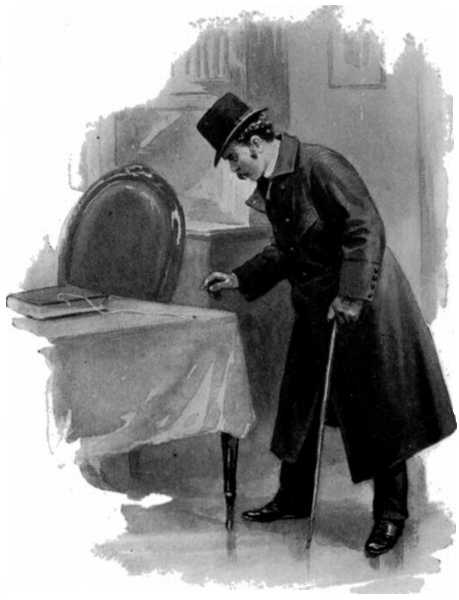
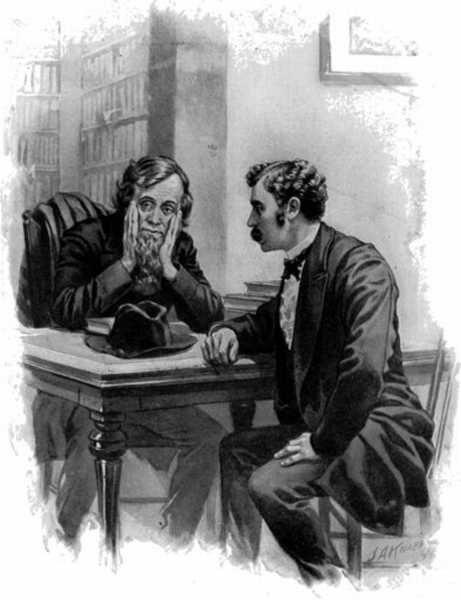
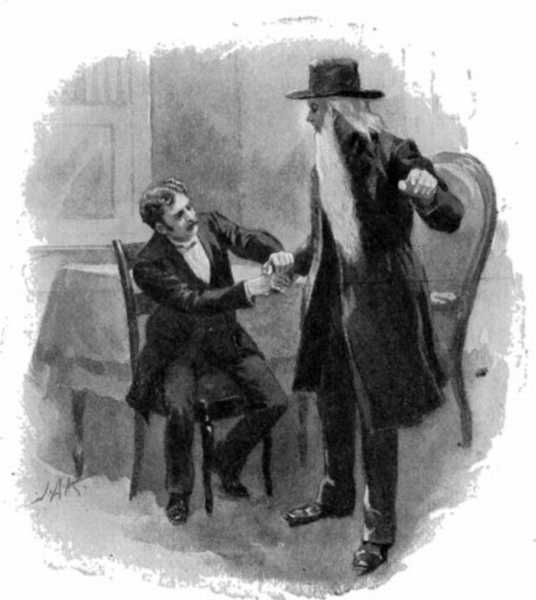
He gave me no chance to neglect a response to his rap.
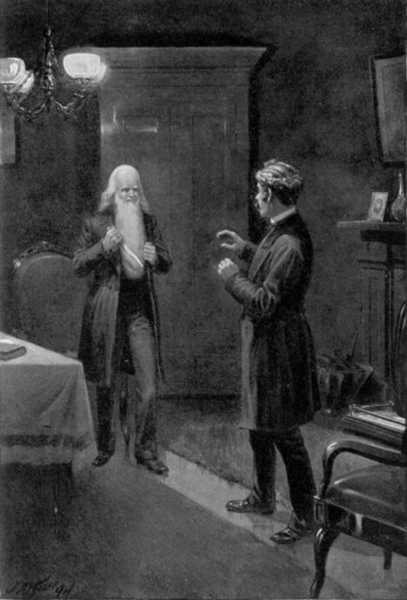
Exactly at the stroke of nine the door swung noiselessly on its
hinges, the wizard entered, and the door closed again. The bolt
had not moved, the knob did not turn. The bar passed through
the catch and back to its seat,—I sprung from my chair, and
excitedly and rudely rushed past my guest. I grasped the knob,
wrenched it with all my might. Vainly; the door was locked,
the bolt was fastened. Then I turned to my visitor. He was
quietly seated in his accustomed place, and apparently failed to
notice my discomposure, although he must have realized that he
had withstood my first test.
This pronounced defeat, at the very beginning of our proposed
contest, produced a depressing effect; nevertheless I made an
effort at self-control, and seating myself opposite, looked my
antagonist in the face. Calm, dignified, with the brow of a
philosopher, and the countenance of a philanthropist, a perfect
type of the exquisite gentleman, and the cultured scholar, my
guest, as serene and complacent as though, instead of an intruder,
he were an invited participant of the comforts of my fireside, or
even the host himself, laid his hat upon the table, stroked his
silvery, translucent beard, and said:
"Well?"
I accepted the challenge, for the word, as he emphasized it,
was a challenge, and hurled at him, in hopes to catch him
unprepared, the following abrupt sentence:
"I doubt the possibility of the existence of a great cavern
such as you have described. The superincumbent mass of earth
would crush the strongest metal. No material known to man
could withstand a pressure so great as would overlie an arch as
large as that you depict; material would succumb even if the
roof were made of steel."
"Do not be so positive," he replied. "By what authority do
you make this assertion?"
"By the authority of common sense as opposed to an unreasonable
hypothesis. You should know that there is a limit to
the strength of all things, and that no substance is capable of
making an arch of thousands of miles, which, according to your
assertion, must have been the diameter of the roof of your
inland sea."
"Ah," he replied, "and so you again crush my facts with
your theory. Well, let me ask a question."
"Proceed."
"Did you ever observe a bubble resting on a bubble?"
"Yes."
"Did you ever place a pipe-stem in a partly filled bowl of
soap water, and by blowing through it fill the bowl with
bubbles?"
"Yes."
"Did you ever calculate the tensile strength of the material
from which you blew the bubble?"
"No; for soap water has no appreciable strength."
"And yet you know that a bubble made of suds has not only
strength, but elasticity. Suppose a bubble of energy floating in
space were to be covered to the depth of the thickness of a
sheet of tissue paper with the dust of space, would that surprise
you?"
"No."
"Suppose two such globes of energy, covered with dust, were
to be telescoped or attached together, would you marvel at the
fact?"
"No."
He drew a picture on a piece of paper, in which one line was
inclosed by another, and remarked:
"The pencil mark on this paper is proportionately thicker
than the crust of the earth over the earth cavern I have
described. Even if it were made of soap suds, it could revolve
through space and maintain its contour."
"But the earth is a globe," I interjected.
"You do not mean an exact globe?"
"No; it is flattened at the poles."
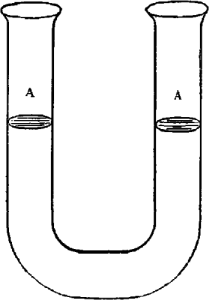
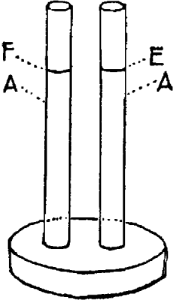
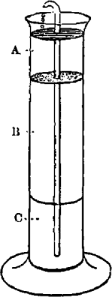
He took from his pocket two thin rubber balls, one slightly
larger than the other. With his knife he divided the larger ball,
cutting it into halves. He then placed
one of the sections upon the perfect
ball, and held the arrangement between
the gas light and the wall.
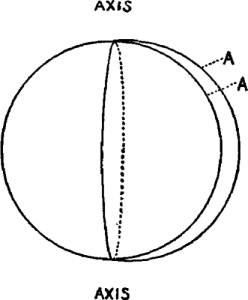 Fig. 33.
A A, telescoped energy spheres.
"See; is not the shadow flattened,
as your earth is, at the poles?"
"Yes; but the earth is not a shadow."
"We will not argue that point now,"
he replied, and then asked: "Suppose
such a compound shell as this were to
revolve through space and continuously
collect dust, most of it of the earth's
temperature, forming a fluid (water),
would not that dust be propelled naturally from the poles?"
"Yes; according to our theory."
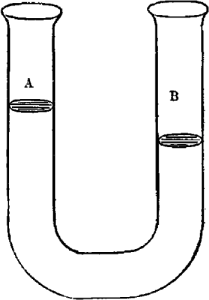
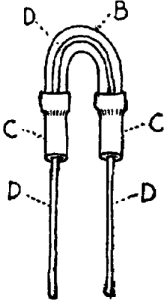
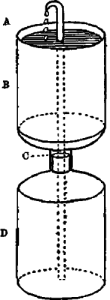
"Perhaps," said he, "the contact edge of the invisible
spheres of energy which compose your earth bubbles, for planets
are bubbles, that have been covered with water and soil
during the time the energy bubble, which is the real bone of
the globe, has been revolving through space; perhaps, could
you reach the foundation of the earth dust, you would find it
not a perfect sphere, but a compound skeleton, as of two bubbles
locked, or rather telescoped together. [See Fig. 34.]
"Are you sure that my guide did not lead me through the
space between the bubbles?"
Then he continued:
"Do not be shocked at what I am about to assert, for, as a
member of materialistic humanity, you will surely consider me
irrational when I say that matter, materials, ponderous substances,
one and all, so far as the ponderous part is concerned
have no strength."
"What! no strength?"
"None whatever."
I grasped the poker.
"Is not this matter?"
"Yes."
"I can not break it."
"No."
"Have not I strength?"
"Confine your argument now
to the poker; we will consider you
next. You can not break it."
"I can break this pencil,
though," and I snapped it in his
face.
"Yes."
I curled my lip in disdain.
"You carry this argument too far."
"Why?"
"I can break the pencil, I can not break the poker; had
these materials not different strengths there could be no distinction;
had I no strength I could not have broken either."
"Are you ready to listen?" he replied.
"Yes; but do not exasperate me."
"I did not say that the combination you call a poker had
no strength, neither did I assert that you could not break a
pencil."
"A distinction without a difference; you play upon words."
"I said that matter, the ponderous side of material substances,
has no strength."
"And I say differently."
He thrust the end of the poker into the fire, and soon drew
it forth red-hot.
"Is it as strong as before?"
"No."
"Heat it to whiteness and it becomes plastic."
"Yes."
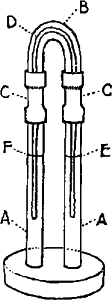
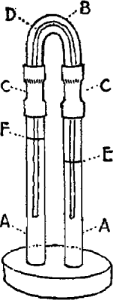
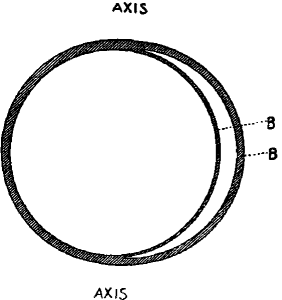 Fig. 34.
B B, telescoped energy spheres covered
with space dirt, inclosing space
between.
"Heat it still more and it changes to a liquid."
"Yes."
"Has liquid iron strength?"
"Very little, if any."
"Is it still matter?"
"Yes."
"Is it the material of the iron, or is it the energy called heat
that qualifies the strength of the metal? It seems to me that
were I in your place I would now argue that absence of heat
constitutes strength," he sarcastically continued.
"Go on."
"Cool this red-hot poker by thrusting it into a pail of cold
water, and it becomes very hard and brittle."
"Yes."
"Cool it slowly, and it is comparatively soft and plastic."
"Yes."
"The material is the same, is it not?"
"Go on."
"What strength has charcoal?"
"Scarcely any."
"Crystallize it, and the diamond results."
"I did not speak of diamond."
"Ah! and is not the same amount of the same material
present in each, a grain of diamond and a grain of charcoal?
What is present in a grain of diamond that is not present in a
grain of charcoal?"
"Go on."
"Answer my question."
"I can not."
"Why does brittle, cold zinc, when heated, become first
ductile, and then, at an increased temperature, become brittle
again? In each case the same material is present."
"I do not know; but this I do know: I am an organized
being, and I have strength of body."
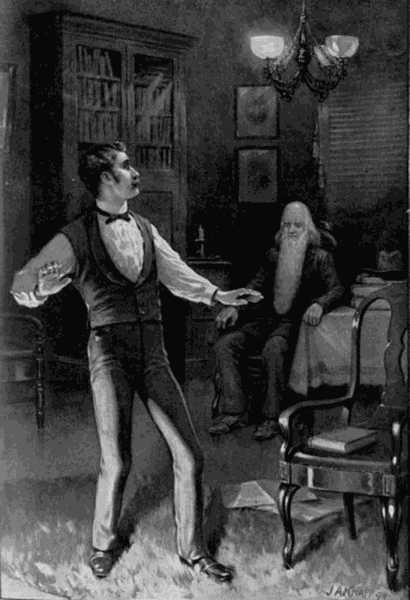
The old man grasped the heavy iron poker with both hands,
and suddenly rising to his full height, swung it about his head,
then with a motion so menacing that I shrunk back into my
chair and cried out in alarm, seemed about to strike, with full
force, my defenseless brow.
"My God," I shouted, "what have I done that you should
murder me?"
He lowered the weapon, and calmly asked:
"Suppose that I had crushed your skull—where then would
be your vaunted strength?"
I made no reply, for as yet I had not recovered from the
mental shock.
"Could you then have snapped a pencil? Could you have
broken a reed? Could you even have blown the down from a
thistle bloom?"
"No."
"Would not your material body have been intact?"
"Yes."
"Listen," said he. "Matter has no strength, matter obeys
spirit, and spirit dominates all things material. Energy in some
form holds particles of matter together, and energy in other
forms loosens them. 'Tis this imponderable force that gives
strength to substances, not the ponderable side of the material.
Granite crushed is still granite, but destitute of rigidity. Creatures
dead are still organic structures, but devoid of strength or
motion. The spirit that pervades all material things gives to
them form and existence. Take from your earth its vital spirit,
the energy that subjects matter, and your so-called adamantine
rocks would disintegrate, and sift as dust into the interstices of
space. Your so-called rigid globe, a shell of space dust, would
dissolve, collapse, and as the spray of a burst bubble, its ponderous
side would vanish in the depths of force."
I sat motionless.
"Listen," he repeated. "You wrong your own common
sense when you place dead matter above the spirit of matter.
Atoms come and go in their ceaseless transmigrations, worlds
move, universes circulate, not because they are material bodies,
but because as points of matter, in a flood of force, they obey
the spirit that can blot out a sun, or dissolve the earth, as easily
as it can unlink two atoms. Matter is an illusion, spirit is the
reality."
I felt that he had silenced me against my will, and although
I could not gainsay his assertions, I determined to study the
subject carefully, at my leisure.
"As you please," he interjected into my musings; "but since
you are so determined, you would better study from books that
are written by authors who know whereof they write, and who
are not obliged to theorize from speculative data concerning the
intrastructural earth crust."
"But where can I find such works? I do not know of any."
"Then," said he, "perhaps it would be better to cease doubting
the word of one who has acquired the knowledge to write
such a book, and who has no object in misleading you."
"Still other questions arise," I said.
"Well?"
"I consider the account of the intra-earth fungus intoxicant
beyond the realm of fact."
"In what respect?"
"The perfect loss of self that resulted immediately, in an
instant, after swallowing the juice of the fungous fruit, so that
you could not distinguish between the real guide at your side
and the phantom that sprung into existence, is incredible. [See
p. 234.] An element of time is a factor in the operation of
nerve impressions."[12]
"Have you investigated all possible anæsthetics?" he asked.
"Of course not."
"Or all possible narcotics?"
"No."
"How long does it require for pure prussic acid to produce
its physiological action?"
"I do not know."
He ignored my reply, and continued:
"Since there exists a relative difference between the time that
is required for ether and chloroform to produce insensibility, and
between the actions and resultant effects of all known anæsthetics,
intoxicants, and narcotics, I think you are hypercritical. Some
nerve excitants known to you act slowly, others quickly; why
not others still instantaneously? If you can rest your assertion
on any good basis, I will gladly meet your questions, but I do
not accept such evidence as you now introduce, and I do not
care to argue for both parties."
Again I was becoming irritated, for I was not satisfied with
the manner in which I upheld my part of the argument, and
naturally, as is usually the case with the defeated party, became
incensed at my invincible antagonist.
"Well," I said, "I criticise your credulity. The drunkards
of the drunkards' cavern were beyond all credence. I can not
conceive of such abnormal creations, even in illusion. Had I
met with your experiences I would not have supposed, for an
instant, that the fantastic shapes could have been aught but a
dream, or the result of hallucination, while, without a question,
you considered them real."
"You are certainly pressed for subjects about which to complain
when you resort to criticising the possibilities in creations
of a mind under the influence of a more powerful intoxicant
than is known to surface earth," he remarked. "However, I
will show you that nature fashions animals in forms more
fantastic than I saw, and that even these figures were not
overdrawn"—
Without heeding his remark, I interrupted his discourse,
determined to have my say:
"And I furthermore question the uncouth personage you
describe as your guide. Would you have me believe that such a
being has an existence outside an abnormal thought-creation?"
"Ah," he replied, "you have done well to ask these two
questions in succession, for you permit me to answer both at
once. Listen: The Monkey, of all animals, seems to approach
closest to man in figure, the Siamang Gibon of Asia, the Bald-headed
Saki of South America, with its stub of a tail, being
nearest. From these types we have great deviations as in the
Wanderer of India, with its whiskered face, and the Black
Macaque of the Island of Celebes, with its hairy topknot, and
hairless stub of a tail, or the well-known Squirrel Monkey, with
its long supple tail, and the Thumbless Spider Monkey, of South
America. Between these types we have among monkeys, nearly
every conceivable shape of limb and figure, and in color of their
faces and bodies, all the shades of the rainbow.
"Some Squirrels jump and then sail through the air. The
Sloth can barely move on the earth. Ant-eaters have no teeth at
all, while the Grizzly Bear can crush a gun barrel with its molars.
"The Duck-billed Platypus of South Australia has the body
of a mole, the tail of a raccoon, the flat bill of a duck, and the
flipper of a seal, combined with the feet of a rat. It lays eggs
as birds do, but suckles its young as do other mammalia. The
Opossum has a prehensile tail, as have some monkeys, and in
addition a living bag or pouch in which the female carries her
tiny young. The young of a kind of tree frog of the genus
Hylodes, breathe through a special organ in their tails; the
young of the Pipa, a great South American toad, burrow into
the skin of the mother, and still another from Chili, as soon as
hatched, creep down the throat of the father frog, and find below
the jaw an opening into a false membrane covering the entire
abdomen, in which they repose in safety. Three species of
frogs and toads have no tongue at all, while in all the others the
tongue is attached by its tip to the end of the mouth, and is free
behind. The ordinary Bullfrog has conspicuous great legs,
while a relative, the Cœcilia (and others as well) have a head
reminding of the frog, but neither tail nor legs, the body being
elongated as if it were a worm. The long, slender fingers of a
Bat are united by means of a membrane that enables it to fly
like a bird, while as a contrast, the fingers of a Mole, its near
cousin, are short and stubby, and massive as compared with its
frame. The former flies through the air, the latter burrows
(almost flies) through the earth. The Great Ant-eater has a
curved head which is drawn out into a slender snout, no teeth, a
long, slender tongue, a great bushy tail, and claws that neither
allow the creature to burrow in the earth nor climb into trees,
but which are admirably adapted to tear an ant-hill into fragments.
Its close relatives, the Apar and Armadillo, have a
round body covered with bony plates, and a short, horny, curved
tail, while another relative, the Long-tailed Pangolin, has a
great alligator-like tail which, together with its body, is covered
with horny, overlapping scales.
"The Greenland Whale has an enormous head occupying more
than one-third its length, no teeth, and a throat scarcely larger
than that of a sucker fish. The Golden Mole has a body so
nearly symmetrical that, were it not for the snout, it would be
difficult to determine the location of the head without close
inspection, and it has legs so short that, were it not for the
powerful claws, they would not be observed at all. The Narwhal
has a straight, twisted tusk, a"—
"Hold, hold," I interrupted; "do you think that I am concerned
in these well known contrasts in animal structure?"
"Did you not question the possibility of the description I
gave of my grotesque drunkards, and of the form of my subterranean
guide?" my guest retorted.
"Yes; but I spoke of men, you describe animals."
"Man is an animal, and between the various species of
animals that you say are well known, greater distinctions can be
drawn than between my guide and surface-earth man. Besides,
had you allowed me to proceed to a description of animal life
beneath the surface of the earth, I would have shown you that
my guide partook of their attributes. Of the creatures described,
one only was of the intra-earth origin—the Mole,—and like my
guide, it is practically eyeless."
"Go on," I said; "'tis useless for me to resist. And yet"—
"And yet what?"
"And yet I have other subjects to discuss."
"Proceed."
"I do not like the way in which you constantly criticise
science, especially in referring thereto the responsibilities of the
crazed anatomist.[13]
It seems to me that he was a monomaniac,
gifted, but crazed, and that science was unfortunate in being
burdened with such an incubus."
"True, and yet science advances largely by the work of such
apparently heartless creatures. Were it not for investigators
who overstep the bounds of established methods, and thus criticise
their predecessors, science would rust and disintegrate.
Besides, why should not science be judged by the rule she applies
to others?"
"What do you mean?"
"Who is more free to criticise religion than the materialistic
man of science?"
"But a religious man is not cruel."
"Have you not read history? Have you not shuddered at
the crimes recorded in the name of the religions of man?"
"Yes; but these cruelties were committed by misguided men
under the cloak of the church, or of false religions, during the
dark ages. Do not blame religion, but the men who abused
the cause."
"Yes," he added, "you are right; they were fanatics, crazed
beings, men; yes, even communities, raving mad. Crazed
leaders can infuse the minds of the people with their fallacies,
and thus become leaders of crazed nations. Not, as I have
depicted in my scientific enthusiast, one man alone in the
privacy of his home torturing a single child, but whole nations
pillaging, burning, torturing, and destroying. But this is foreign
to our subject. Beware, I reiterate, of the science of human
biology. The man who enters the field can not foresee the end,
the man who studies the science of life, and records his experiments,
can not know the extremes to which a fanatical follower
may carry the thought-current of his leader. I have not overdrawn
the lesson. Besides, science is now really torturing,
burning, maiming, and destroying humanity. The act of
destruction has been transferred from barbarians and the fanatic
in religion to the follower of the devotees of science."
"No; I say, no."
"Who created the steam engine? Who evolves improved
machinery? Who creates improved artillery, and explosives?
Scientific men."
He hesitated.
"Go on."
"Accumulate the maimed and destroyed each year; add
together the miseries and sorrows that result from the explosions,
accidents, and catastrophes resulting from science
improvements, and the dark ages scarcely offer a parallel. Add
thereto the fearful destruction that follows a war among nations
scientific, and it will be seen that the scientific enthusiast of the
present has taken the place of the misguided fanatic of the past.
Let us be just. Place to the credit of religion the good that
religion has done, place to the credit of science the good that
science is doing, and yet do not mistake, both leave in their
wake an atmosphere saturated with misery, a road whitened
with humanity's bones. Neither the young nor the old are
spared, and so far as the sufferer is concerned it matters not
whether the person has been racked by the tortures of an inquisition,
or the sword of an infidel, is shrieking in the agony of a
scald by super-heated steam, or is mangled by an explosion of
nitroglycerin."
Again he hesitated.
"Go on."
"One of science's most serious responsibilities, from which
religion has nearly escaped, is that of supplying thought-food to
fanatics, and from this science can not escape."
"Explain yourself."
"Who places the infidel in possession of arguments to combat
sacred teachings? Who deliberately tortures animals, and
suggests that biological experimentation in the name of science,
before cultured audiences even, is legitimate, such as making
public dissections of living creatures?"
"Enough, enough," I cried, thinking of his crazed anatomist,
and covering my face with my hands; "you make my
blood creep."
"Yes," he added sarcastically; "you shudder now and criticise
my truthful study, and to-morrow you will forget the lesson,
and perhaps for dinner you will relish your dish of veal, the
favorite food of mothers, the nearest approach to the flesh of
babies."
Then his manner changed, and in his usual mild, pleasant
way, he said:
"Take what I have said kindly; I wish only to induce your
religious part to have more charity for your scientific self, and
the reverse. Both religion and science are working towards the
good of man, although their devotees are human, and by human
errors bring privations, sufferings, and sorrows to men. Neither
can fill the place of the other; each should extend a helping
hand, and have charity for the shortcomings of the other; they
are not antagonists, but workers in one field; both must stand
the criticisms of mutual antagonists, and both have cause to fear
the evils of fanaticism within their own ranks more than the
attacks of opponents from without. Let the religious enthusiast
exercise care; his burning, earnest words may lead a weak-minded
father to murder an innocent family, and yet 'tis not
religion that commits the crime. Let the zealous scientific man
hesitate; he piles up fuel by which minds unbalanced, or dispositions
perverted, seek to burn and destroy hopes that have
long served the yearnings of humanity's soul. Neither pure
religion nor true science is to blame for the acts of its devotees,
and yet each must share the responsibility of its human
agents."
"We will discuss the subject no further," I said; "it is not
agreeable."
Then I continued:
"The idea of eternity without time is not quite clear to me,
although I catch an imperfect conception of the argument
advanced. Do you mean to say that when a soul leaves the
body, the earth life of the individual, dominated by the soul, is
thrown off from it as is the snap of a whip-lash, and that into
the point between life and death, the hereafter of that mortal
may be concentrated?"
"I simply give you the words of my guide," he replied, "but
you have expressed the idea about as well as your word language
will admit. Such a conception of eternity is more rational to
one who, like myself, has lived through an instant that covered,
so far as mind is concerned, a million years of time, than is an
attempt to grasp a conception of an eternity, without beginning
or end, by basing an argument on conditions governing material
substances, as these substances are known to man. You have
the germ of the idea which may be simply a thought for you
to ponder over; you can study the problem at your leisure.
Do not, however, I warn you, attempt to comprehend the notion
of eternity by throwing into it the conception of time as men
accept that term, for the very word time, as men define it,
demands that there be both a beginning and an end. With the
sense of time in one's mind, there can be no conception of the
term eternity."
Then, as I had so often done before, I unwarily gave him an
opportunity to enlarge on his theme, to my disadvantage. I had
determined not to ask any questions concerning his replies to my
criticism, for whenever I had previously done so, the result had
been disastrous to me. In this case I unwittingly said:
"Why do you say that our language will not permit of clearer
conceptions than you give?"
"Because your education does not permit you to think outside
of words; you are word-bound."
"You astonish me by making such an arrogant assertion. Do
you mean to assert that I can not think without using words?"
"Yes. Every thought you indulge in is circumscribed. You
presumably attempt to throw a thought-line forward, and yet
you step backward and spin it in words that have been handed
you from the past, and, struggle as you may, you can not liberate
yourself from the dead incubus. Attempt to originate an idea,
and see if you can escape your word-master?"
"Go on; I am listening."
"Men scientific think in language scientific. Men poetical
think in language poetic. All educated men use words in thinking
of their subjects, words that came to them from the past, and
enslave their intellect. Thus it is that the novelist can not
make fiction less real than is fact; that scientists can not
commence at the outside, and build a theory back to phenomena
understood. In each case the foundation of a thought is a word
that in the very beginning carries to the mind a meaning, a
something from the past. Each thought ramification is an
offshoot from words that express ideas and govern ideas, yes,
create ideas, even dominating the mind. Men speak of ideas
when they intend to refer to an image in the mind, but in reality
they have no ideas outside of the word sentences they unconsciously
reformulate. Define the term idea correctly, and it will
be shown that an idea is a sentence, and if a sentence is made of
words already created, there can be no new idea, for every word
has a fixed meaning. Hence, when men think, they only
rearrange words that carry with themselves networks of ideas,
and thus play upon their several established meanings. How
can men so circumscribed construct a new idea or teach a new
science?"
"New words are being created."
"Language is slowly progressing, but no new word adds
itself to a language; it is linked to thought-chains that precede.
In order to create a word, as a rule, roots are used that are as
established in philology as are building materials in architecture.
When a new sound is thrust into a language, its intent must
be introduced by words already known, after which it conveys
a meaning derived from the past, and becomes a part of mind
sentences already constructed, as it does of spoken language.
Language has thus been painfully and slowly evolved and is
still being enlarged, but while new impressions may be felt by
an educated person, the formulated feeling is inseparable, from
well-known surviving words."
"Some men are dumb."
"Yes; and yet they frame mind-impressions into unspoken
words of their own, otherwise they would be scarcely more than
animals. Place an uneducated dumb person in a room with a
complicated instrument, and although he may comprehend its
uses, he can not do so unless he frames sense-impressions into,
what is to him, a formulated mind-word sequence."
"But he can think about it."
"No; unless he has already constructed previous impressions
into word-meanings of his own, he can not think about it at all.
Words, whether spoken or unspoken, underlie all ideas. Try, if
you believe I am mistaken, try to think of any subject outside
of words?"
I sat a moment, and mentally attempted the task, and shook
my head.
"Then," said the old man, "how can I use words with established
meanings to convey to your senses an entirely new
idea? If I use new sounds, strung together, they are not words
to you, and convey no meaning; if I use words familiar, they
reach backward as well as forward. Thus it is possible to
instruct you, by a laborious course of reasoning, concerning
a phenomenon that is connected with phenomena already
understood by you, for your word-language can be thrust out
from the parent stalk, and can thus follow the outreaching
branches. However, in the case of phenomena that exist
on other planes, or are separated from any known material,
or force, as is the true conception that envelops the word
eternity, there being neither connecting materials, forces, nor
words to unite the outside with the inside, the known with the
unknown, how can I tell you more than I have done? You are
word-bound."
"Nevertheless, I still believe that I can think outside of
words."
"Well, perhaps after you attempt to do so, and fail again and
again, you will appreciate that a truth is a truth, humiliating as
it may be to acknowledge the fact."
"A Digger Indian has scarcely a word-language," I asserted,
loth to relinquish the argument.
"You can go farther back if you desire, back to primitive man;
man without language at all, and with ideas as circumscribed as
those of the brutes, and still you have not strengthened your
argument concerning civilized man. But you are tired, I see."
"Yes; tired of endeavoring to combat your assertions. You
invariably lead me into the realms of speculation, and then
throw me upon the defensive by asking me to prove my own
theories, or with apparent sincerity, you advance an unreasonable
hypothesis, and then, before I am aware of your purpose, force
me to acquiesce because I can not find facts to confute you.
You very artfully throw the burden of proof on me in all cases,
for either by physical comparisons that I can not make, I
must demonstrate the falsity of your metaphysical assertions,
or by abstract reasonings disprove statements you assert to
be facts."
"You are peevish and exhausted, or you would perceive that
I have generally allowed you to make the issue, and more than
once have endeavored to dissuade you from doing so. Besides,
did I not several times in the past bring experimental proof to
dispel your incredulity? Have I not been courteous?"
"Yes," I petulantly admitted; "yes."
Then I determined to imitate his artful methods, and throw
him upon the defensive as often as he had done with me. I had
finally become familiar with his process of arguing a question,
for, instead of coming immediately to his subject, he invariably
led by circuitous route to the matter under discussion. Before
reaching the point he would manage to commit me to his own
side of the subject, or place me in a defenseless position. So
with covert aim I began:
"I believe that friction is one method of producing heat."
"Yes."
"I have been told that the North American Indians make
fires by rubbing together two pieces of dry wood."
"True."
"I have understood that the light of a shooting star results
from the heat of friction, producing combustion of its particles."
"Partly," he answered.
"That when the meteoric fragment of space dust strikes the
air, the friction resulting from its velocity heats it to redness,
fuses its surface, or even burns its very substance into ashes."
"Yes."
"I have seen the spindle of a wheel charred by friction."
"Yes."
"I have drawn a wire rapidly through a handkerchief tightly
grasped in my hands, and have warmed the wire considerably
in doing so."
"Yes."
I felt that I had him committed to my side of the question,
and I prepared to force him to disprove the possibility of one
assertion that he had made concerning his journey.
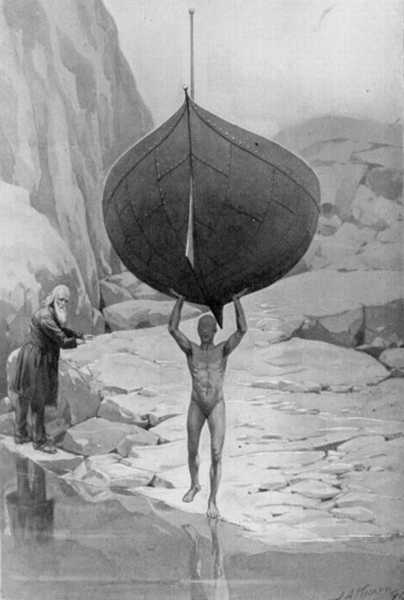
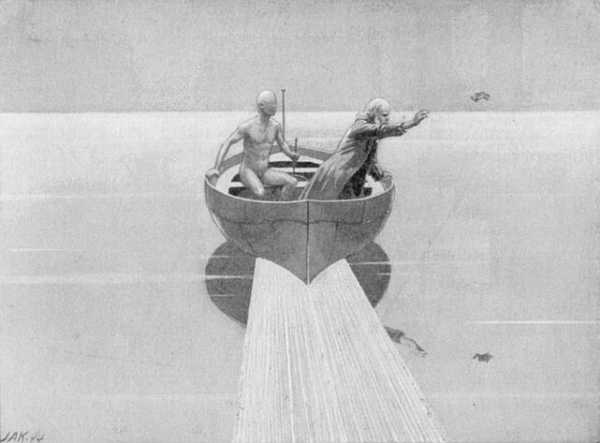
"You stated that you rode in a boat on the underground lake."
"Yes."
"With great rapidity?"
"Yes."
"Rapid motion produces friction, I believe?"
"Yes."
"And heat?"
"Yes."
"Why did not your boat become heated even to redness? You
rode at the rate of nine hundred miles an hour," I cried exultingly.
"For two reasons," he calmly replied; "two natural causes
prevented such a catastrophe."
And again he warned me, as he had done before, by saying:
"While you should not seek for supernatural agencies to
account for any phenomena in life, for all that is is natural,
neither should you fail to study the differences that varying
conditions produce in results already known. A miracle ceases
to be a miracle when we understand the scientific cause underlying
the wonder; occultism is natural, for if there be occult
phenomena they must be governed by natural law; mystery is
not mysterious if the veil of ignorance that envelops the investigator
is lifted. What you have said is true concerning the heat
that results from friction, but—
"First, the attraction of gravitation was inconsiderable
where the boat, to which you refer, rested on the water.
"Second, the changing water carried away the heat as fast as
it was produced. While it is true that a cannon ball becomes
heated in its motion through the air, its surface is cooled when it
strikes a body of water, notwithstanding that its great velocity is
altogether overcome by the water. The friction between the water
and the iron does not result in heated iron, but the contrary.
The water above the rapids of a river has practically the temperature
of the water below the rapids, regardless of the friction
that ensues between these points. Admit, however, that heat
is liberated as the result of the friction of solids with water,
and still it does not follow that this heat will perceptibly affect
the solid. With a boat each particle of water carries the heat
away, each succeeding portion of water takes up the heat liberated
by that preceding it. Thus the great body of water, over
which our boat sped, in obedience to the ordinary law, became
slightly warmed, but its effect upon the boat was scarcely perceptible.
Your comparison of the motion of a meteor, with that of
our boat, was unhappy. We moved rapidly, it is true, in comparison
with the motion of vessels such as you know, but comparison
can not be easily drawn between the velocity of a boat and that of
a meteor. While we moved at the rate of many miles a minute,
a meteor moves many times faster, perhaps as many miles in a
second. Then you must remember that the force of gravitation
was so slight in our position that"—
"Enough," I interrupted. "We will pass the subject. It
seems that you draw upon science for knowledge to support your
arguments, however irrational they may be, and then you sneer
at this same method of argument when I employ it."
He replied to my peevish complaint with the utmost respect
by calling to my attention the fact that my own forced argument
had led to the answer, and that he had simply replied to my
attacks. Said he:
"If I am wrong in my philosophy, based on your science
thought, I am right in my facts, and science thought is thus in
the wrong, for facts overbalance theory. I ask you only to give
me the attention that my statements merit. I am sincere, and
aim to serve your interests. Should investigation lead you
hereafter to infer that I am in error, at our final interview you
can have my considerate attention. Be more charitable, please."
Then he added:
"Is there any other subject you wish to argue?"
"Yes," I answered, and again my combativeness arose; "yes.
One of the truly edifying features of your narrative is that of
the intelligent guide," and I emphasized the word intelligent,
and curled up my lip in a sarcastic manner.
"Proceed."
"He was verily a wonderful being; an eyeless creature, and
yet possessed of sight and perception beyond that of mortal
man; a creature who had been locked in the earth, and yet was
more familiar with its surface than a philosopher; a cavern-bred
monstrosity, and yet possessed of the mind of a sage; he was a
scientific expert, a naturalist, a metaphysical reasoner, a critic
of religion, and a prophet. He could see in absolute darkness
as well as in daylight; without a compass he could guide a boat
over a trackless sea, and could accomplish feats that throw Gulliver
and Munchausen into disrepute."
In perfect composure my aged guest listened to my cynical,
and almost insulting tirade. He made no effort to restrain my
impetuous sentences, and when I had finished replied in the
polished language of a scholarly gentleman.
"You state truly, construe my words properly, as well as
understand correctly."
Then he continued musingly, as though speaking to himself:
"I would be at fault and deserve censure did I permit doubts
to be thrown upon so clear a subject, or discredit on so magnanimous
a person."
Turning to me he continued:
"Certainly I did not intend to mislead or to be misunderstood,
and am pleased to find you so earnest a scholar."
And then in his soft, mild manner, he commenced his detail
reply, pouring oil upon the waters of my troubled soul, his sweet,
melodious voice being so in contrast to my rash harangue. He
began with his expressive and often repeated word, "listen."
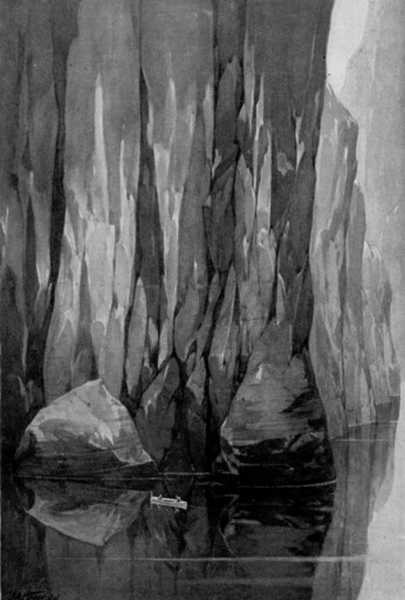
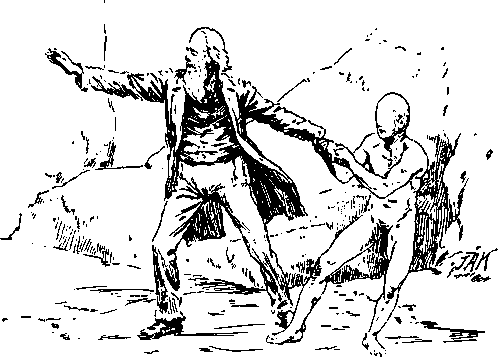
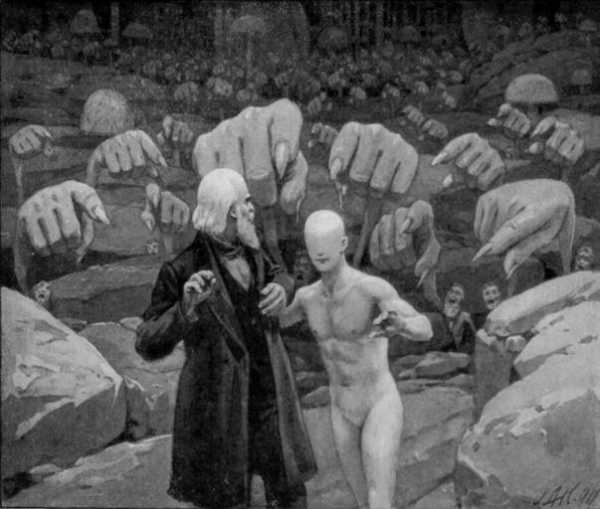
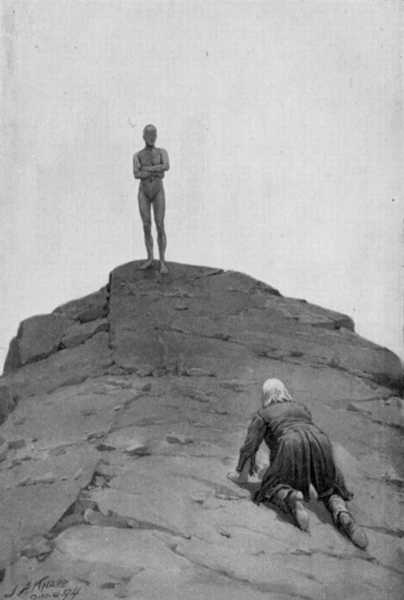
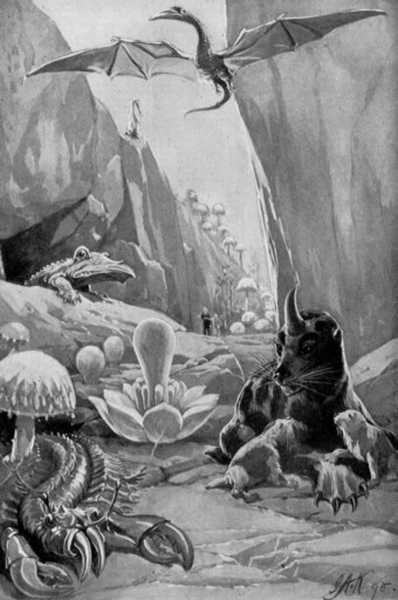 "WE PASSED THROUGH CAVERNS FILLED WITH CREEPING
REPTILES."
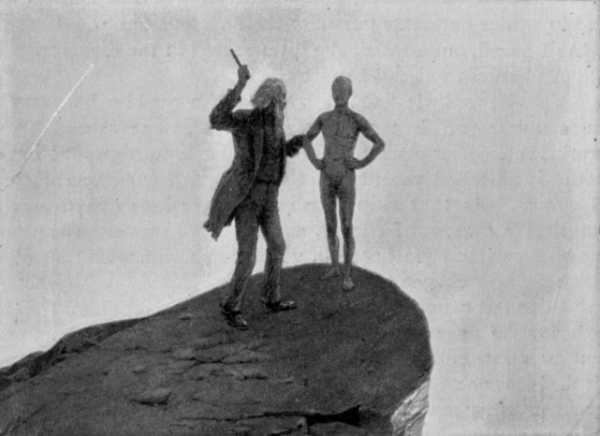
"WE PASSED THROUGH CAVERNS FILLED WITH CREEPING
REPTILES."
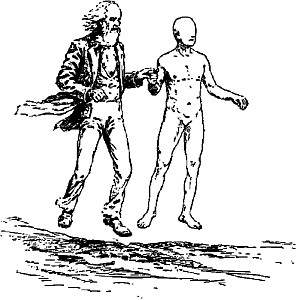
"Listen. You are right, my guide was a being wonderful to
mortals. He was eyeless, but as I have shown you before, and
now swear to the fact, was not sightless; surely," he said,
"surely you have not forgotten that long ago I considered the
phenomenal instinct at length. He predicted the future by
means of his knowledge of the past—there is nothing wonderful
in that. Can not a civil engineer continue a line into the
beyond, and predict where the projection of that line will strike;
can he not also calculate the effect that a curve will have on his
line's destiny? Why should a being conversant with the lines
and curves of humanity's journey for ages past not be able to
indicate the lines that men must follow in the future? Of course
he could guide the boat, in what was to me a trackless waste of
water, but you err in asserting that I had said he did not have a
guide, even if it were not a compass. Many details concerning
this journey have not been explained to you; indeed, I have
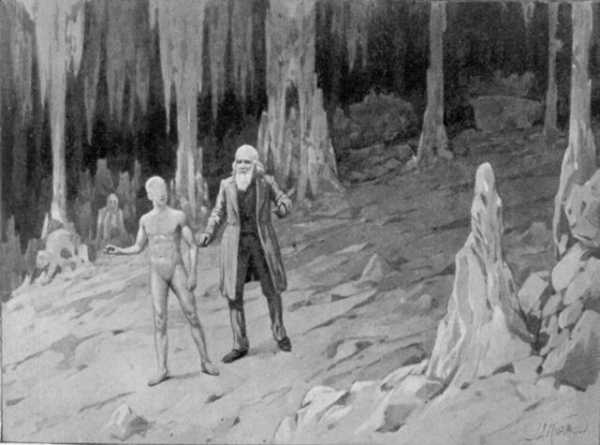
acquainted you with but little that I experienced. Near surface
earth we passed through caverns filled with creeping reptiles;
through others we were surrounded by flying creatures, neither
beast nor bird; we passed through passages of ooze and labyrinths
of apparently interminable intra-earth structures; to have
disported on such features of my journey would have been
impracticable. From time to time I experienced strains of melody,
such as never before had I conceived, seemingly choruses of
angels were singing in and to my very soul. From empty space
about me, from out the crevices beyond and behind me, from the
depths of my spirit within me, came these strains in notes clear
and distinct, but yet indescribable. Did I fancy, or was it real?
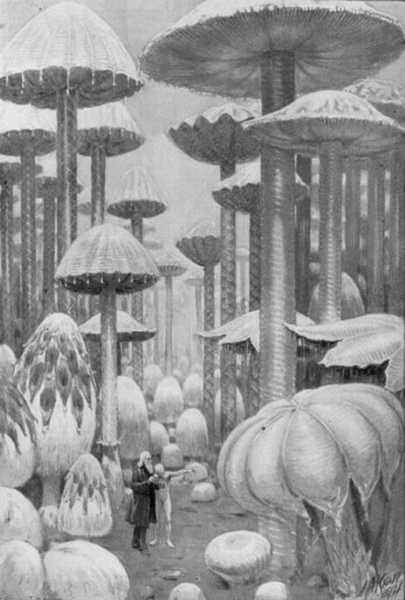
I will not pretend to say. Flowers and structures beautiful,
insects gorgeous and inexplicable were spread before me. Figures
and forms I can not attempt to indicate in word descriptions,
ever and anon surrounded, accompanied, and passed me by.
The canvas conceptions of earth-bred artists bring to mind no
forms so strange and weird and yet so beautiful as were these
compound beings. Restful beyond description was it to drink in
the indescribable strains of poetry of motion that I appreciated
in the movements of fair creatures I have not mentioned, and it
was no less soothing to experience the soul relief wrought by the
sounds about me, for musicians know no notes so sweet and
entrancing.
"There were also, in side caverns to which I was led, combinations
of sounds and scenes in which floating strains and
fleeting figures were interwoven and interlaced so closely that
the senses of both sight and hearing became blended into a
single sense, new, weird, strange, and inexpressible. As flavor
is the combination of odor and taste, and is neither taste nor
odor, so these sounds and scenes combined were neither scenes
nor sounds, but a complex sensation, new, delicious. Sometimes
I begged to be permitted to stop and live forever 'mid
those heavenly charms, but with as firm a hand as when helping
me through the chambers of mire, ooze, and creeping reptiles,
my guide drew me onward.
"But to return to the subject. As to my guide being a cavern-bred
monstrosity, I do not remember to have said that he was
cavern-bred, and if I have forgotten a fact, I regret my short
memory. Did I say that he was always a cavern being? Did I
assert that he had never lived among mortals of upper earth?
If so, I do not remember our conversation on that subject. He
was surely a sage in knowledge, as you have experienced from
my feeble efforts in explaining the nature of phenomena that
were to you unknown, and yet have been gained by me largely
through his instruction. He was a metaphysician, as you assert;
you are surely right; he was a sincere, earnest reasoner and
teacher. He was a conscientious student, and did not by any
word lead me to feel that he did not respect all religions, and
bow to the Creator of the universe, its sciences, and its religions.
His demeanor was most considerate, his methods faultless, his
love of nature deep, his patience inexhaustible, his sincerity
unimpeachable. Yes," the old man said; "you are right in your
admiration of this lovely personage, and when you come to meet
this being as you are destined yet to do—for know now that you
too will some day pass from surface earth, and leave only your
name in connection with this story of myself—you will surely
then form a still greater love and a deeper respect for one so
gifted, and yet so self-sacrificing."
"Old man," I cried, "you mock me. I spoke facetiously, and
you answer literally. Know that I have no confidence in your
sailor-like tales, your Marco Polo history."
"Ah! You discredit Marco Polo? And why do you doubt?"
"Because I have never seen such phenomena, I have never
witnessed such occurrences. I must see a thing to believe it."
"And so you believe only what you see?" he queried.
"Yes."
"Now answer promptly," he commanded, and his manner
changed as by magic to that of a master. "Did you ever see
Greenland?"
"No."
"Iceland?"
"No."
"A geyser?"
"No."
"A whale?"
"No."
"England?"
"No."
"France?"
"No."
"A walrus?"
"No."
"Then you do not believe that these conditions, countries,
and animals have an existence?"
"Of course they have."
"Why?"
"Others have seen them."
"Ah," he said; "then you wish to modify your assertion—you
only believe what others have seen?"
"Excepting one person," I retorted.
Then he continued, seemingly not having noticed my personal
allusion:
"Have you ever seen your heart?"
I hesitated.
"Answer," he commanded.
"No."
"Your stomach?"
"No."
"Have you seen the stomach of any of your friends?"
"No."
"The back of your head?"
I became irritated, and made no reply.
"Answer," he again commanded.
"I have seen its reflection in a glass."
"I say no," he replied; "you have not."
"You are impudent," I exclaimed.
"Not at all," he said, good humoredly; "how easy it is to
make a mistake. I venture to say that you have never seen the
reflection of the back of your head in a mirror."
"Your presumption astounds me."
"I will leave it to yourself."
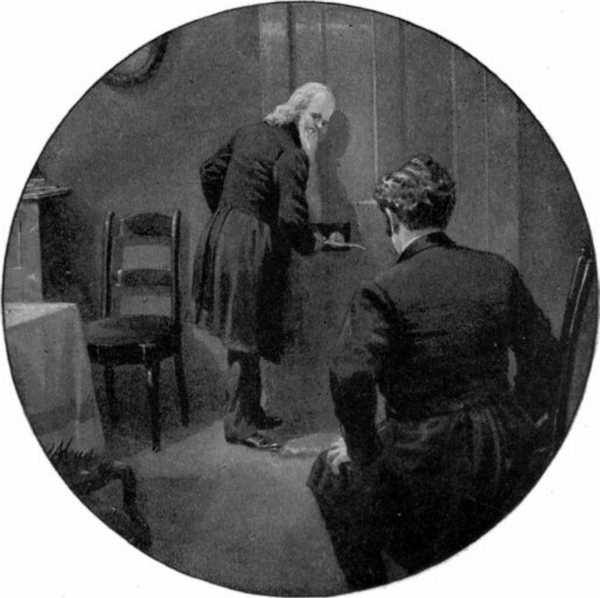
He took a hand-glass from the table and held it behind my
head.
"Now, do you see the reflection?"
"No; the glass is behind me."
"Ah, yes; and so is the back of your head."
"Look," I said, pointing to the great mirror on the bureau;
"look, there is the reflection of the back of my head."
"No; it is the reflection of the reflection in my hand-glass."
"You have tricked me; you quibble!"
"Well," he said, ignoring my remark; "what do you believe?"
"I believe what others have seen, and what I can do."
"Excluding myself as to what others have seen," he said
facetiously.
"Perhaps," I answered, relenting somewhat.
"Has any man of your acquaintance seen the middle of
Africa?"
"No."
"The center of the earth?"
"No."
"The opposite side of the moon?"
"No."
"The soul of man?"
"No."
"Heat, light, electricity?"
"No."
"Then you do not believe that Africa has a midland, the earth a
center, the moon an opposite side, man a soul, force an existence?"
"You distort my meaning."
"Well, I ask questions in accord with your suggestions, and
you defeat yourself. You have now only one point left. You
believe only what you can do?"
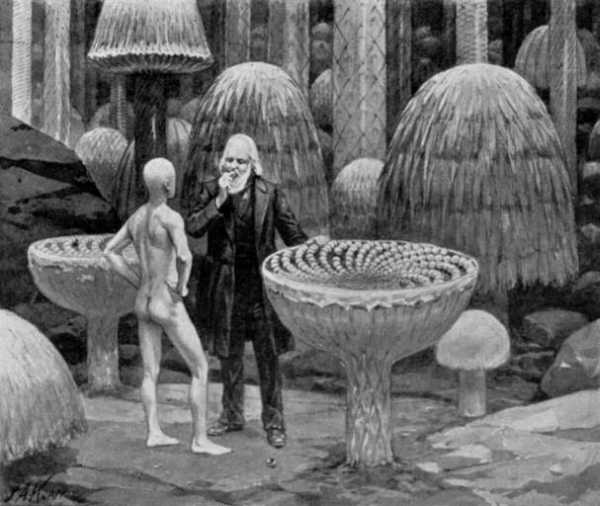
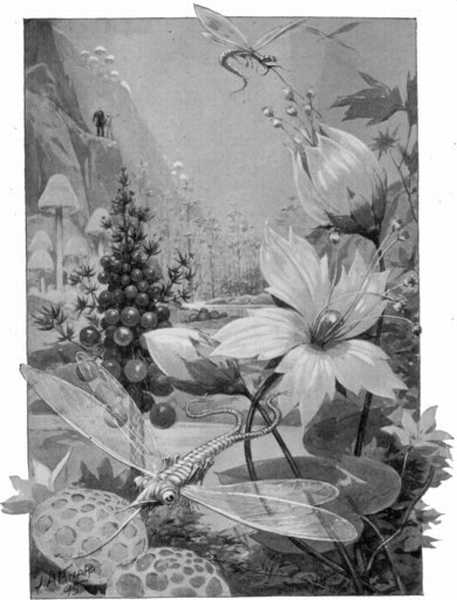 "FLOWERS AND STRUCTURES BEAUTIFUL, INSECTS GORGEOUS."
"Yes."
"I will rest this case on one statement, then, and you may be
the judge."
"Agreed."
"You can not do what any child in Cincinnati can accomplish.
I assert that any other man, any other woman in the city
can do more than you can. No cripple is so helpless, no invalid
so feeble as not, in this respect, to be your superior."
"You insult me," I again retorted, almost viciously.
"Do you dispute the assertion seriously?"
"Yes."
"Well, let me see you kiss your elbow."
Involuntarily I twisted my arm so as to bring the elbow
towards my mouth, then, as I caught the full force of his meaning,
the ridiculous result of my passionate wager came over me,
and I laughed aloud. It was a change of thought from the
sublime to the ludicrous.
The white-haired guest smiled in return, and kindly said:
"It pleases me to find you in good humor at last. I will
return to-morrow evening and resume the reading of my manuscript.
In the meantime take good exercise, eat heartily, and
become more cheerful."
He rose and bowed himself out.