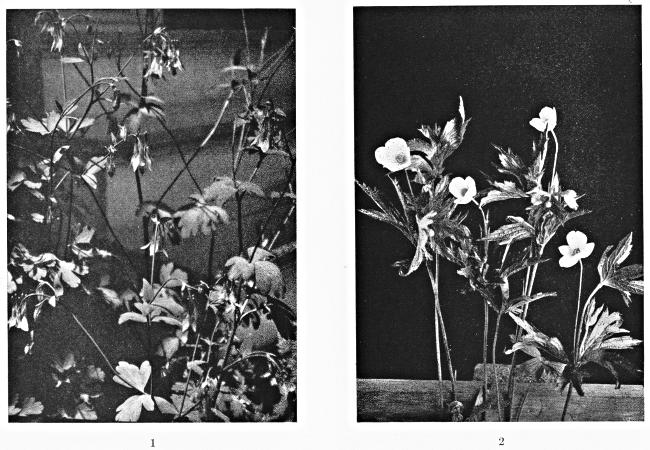
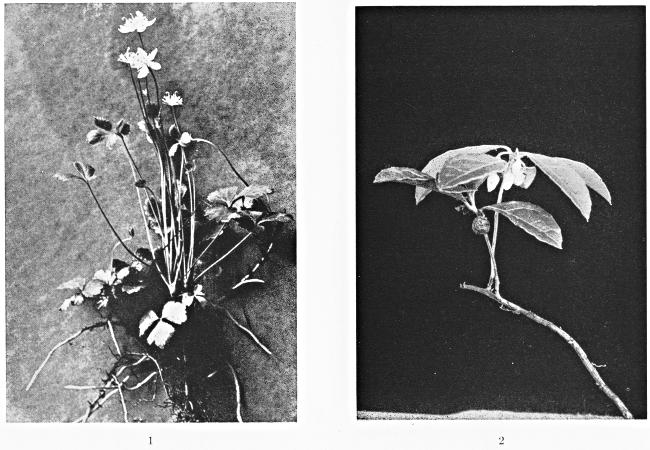
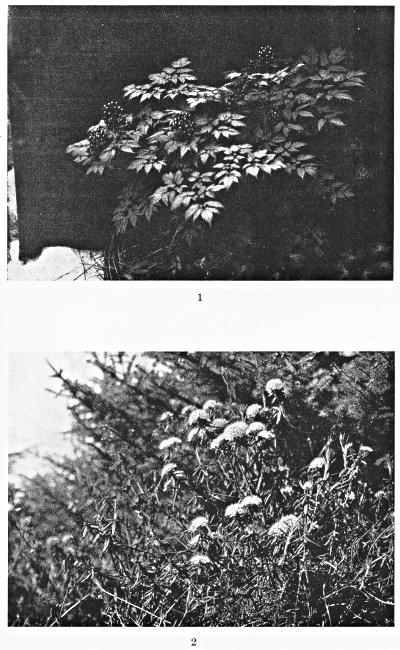
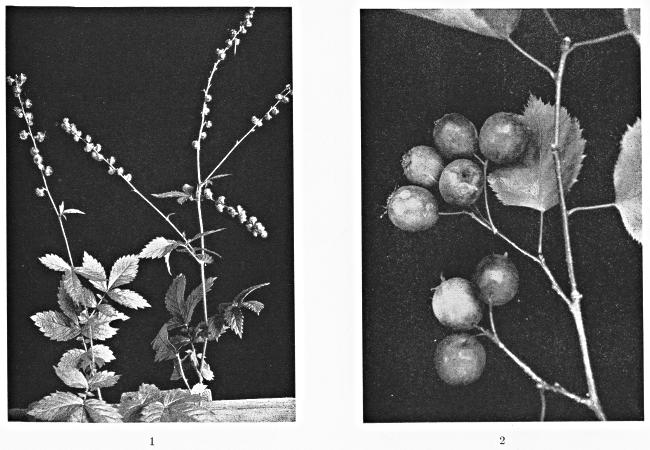
The Ojibwe are probably the best informed and the strictest
observers of the medicine lodge ceremonies in the country. Their
knowledge of plants both in their own environment and far away is
probably the best of any group of Indians. While their flora is not
so rich in species as that of Indians farther south, they make trips
far away from their home to obtain necessary plants.
As among the white people, one plant may bear several common
names, according to different individuals in different sections of the
country, and again, one name may be given to several plants, as in
the case of plants used as “revivers”. Yet, there is an agreement in
names of Lac du Flambeau and Leech Lake Ojibwe, that well checks
information received. The name is usually descriptive, just as their
names for animals usually are either descriptive or representative of
the cry or note uttered by the animal, like “ko-ko-ko-o”, the hoot
owl, or “ka-ka-ka”, the raven or crow. The medicine name usually
tells what the plant looks like, where it may be found, some peculiar
taste or property, or its chief use. Often a termination is added
signifying the plural of a noun or the part of the plant used, such as
the wood, the leaf, the flower, the root, or the berry or fruit.
It is worth noting that they understand the proper time to gather
the plant part. At times, the medicinal qualities are inert, undeveloped
or dispersed by being too old. Much of the knowledge of white
men originated from studying the Indian plant uses, in the early
days. Eclectic practitioners sought the Indian herbs and observed
carefully what parts of the plant were used. This mass of early information
was sifted scientifically by the students of medicine, and
finally tested physiologically on animals. Perhaps sixty-five per cent
of their remedies were found to be potent and are included in our
pharmacopoeas; the other thirty-five per cent were discovered to be
valueless medicinally. All of the references to uses of the plants by
white men were obtained from the 1916 edition of the National
Standard Dispensatory, by Hare, Caspari & Rusby.
The medicine man depended largely upon his reputation and often
cured fancied diseases by shamanistic suggestions. His peculiar
incantations to the patient to inspire confidence and induce the patient
to think he was getting well, often worked, as it works in the case
of quack doctors and credulous white men. The young man who
had the proper dream following the period of fasting in his youth,
predicting his predilection towards the medicine man’s profession,
was taken through a rigorous course of training. Individual knowledge
was handed down through the family. Instruction to boys and
girls usually comes from the uncle or aunt, and if they have no natural
uncle or aunt, then one is assigned to them. This is considered the
closest relationship among Wisconsin Indians, and when one is adopted
into the tribe and given a medicine bag, it will be through the sponsorship
of an uncle for his nephew. Among the Ojibwe, both at Lac du
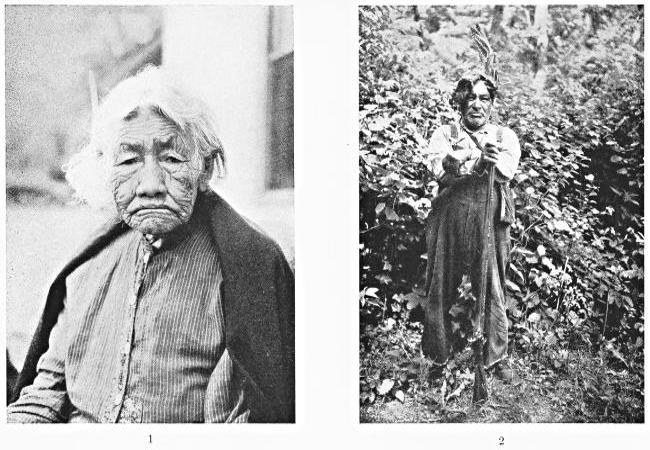
Flambeau and at Lac Court Oreilles, the writer is known as Shagashkandawe
“Flying Squirrel,” which they say was the name of a
famous old chief and medicine man.
The Ojibwe still use the songs essential to digging medicine roots.
Jack Doud, the old scout captain of the Civil War, of the old Flambeau
village, told the writer that Winabojo, their deity, had received the
seeds of all plants from Dzhe Manido, the creator of the universe,
and that Winabojo had given them to Nokomis, grandmother, the
Earth, to keep in her bosom, for the use of the Indians. Jack Doud
also said that Winabojo took some of the native foods from his own
body. He said that Winabojo pulled out a little pinch of flesh and
threw it on the ground telling it to grow there as mandamin or corn
for the Indians. Another pinch yielded squash, another beans and
so on until Winabojo had very little flesh left on his body. In other
words, the Indians did not know the sources of their cultivated crops,
and had invented this tradition to attempt to explain their presence.
As with other Algonkians, the Ojibwe place tobacco in the
cavity from which they dig the root, as an offering to Grandmother
Earth, to Winabojo, and to Dzhe Manido, praying in song to
these deities to make their chosen medicine potent. The medicine
man or woman is usually distinguished by two long braids of hair
over either shoulder. They are usually shrewd diagnosticians, and
depend upon their senses for discovering the ailment. They feel the
pulse rate, look at the pupils of the eyes, at the condition of the tongue,
at the complexion variation, feel the body temperature and inquire
where the pain is felt. From these symptoms they diagnose the disease.
Usually they want time to dream over the case, and drink a
draught of their own dream-inducing medicine before going to sleep.
In a vision or dream, they are directed to the proper medicine to use,
and concoct it the following day. External afflictions are treated with
lotions or poultices, while internal troubles are almost invariably
treated with a medicinal tea. The ingredients are steeped in lukewarm
water, and copious draughts are prescribed several times a day.
The writer has taken such draughts of various medicines and finds
them not unpleasant to the taste. Bitter and nauseous ingredients are
usually disguised by “seasoners” which they add to make them taste
good. The time alloted for a cure is usually four days, their sacred
number, and unless there is marked improvement in the patient at
the end of that period, the medicine man will change the treatment.
Some of the medicine men have “tattooing outfits”, which are
not really tattooing outfits as we understand the term, but rather
blood-letting instruments. Sharp fish teeth are mounted at the end
of a four or five-inch stick, and with a quick stroke on the upper side
of the elbow or near the collar bone the blood is caused to gush out.
The patient holds the arm out tensely while lying down and when the
artery is tapped the blood spurts out rapidly. A tourniquet is applied
to the upper arm when the medicine man thinks enough blood has
flowed and the medicine man then sucks out the residue. The wound
is then bandaged and the tourniquet removed. It is the thought of
the medicine man that it is necessary to let out a certain amount of
bad blood, so that the remaining blood in the patient’s body can be
more easily purified by his heart and his breathing.
The Ojibwe also believe that the medicine man can make bad
medicine as well as good, and can prescribe certain medicines from
his medicine bundle that will enable him to get the better of his
enemies. They had many hunting charms which were supposed to
help them get game. The hunter in using these would often trace
the outline of the desired game upon the ground drawing a line to its
heart. He would then pierce the heart with the line and put the proper
medicine on the heart puncture indicated. A similar procedure might
be followed against human enemies. Such practices were always
kept a deep secret, becoming valueless should anyone see the perpetrator
making the figure. They were likewise deprecated and resented
by the tribe and punishment was apt to follow anyone caught in
such a practice, which all agreed was a perversion of the grand medicine
society teachings.
Most of the remedies of the medicine men were kept tied in little
bits of cloth, compounded and ready to steep for use. Combinations
of nine to twelve herbs are common. These have been ground
with a mortar and pestle until it would be difficult to identify the
ingredients of the prepared medicines. Even if one knew all of the
ingredients, the amounts of each herb would be difficult to ascertain.
Often, as in the case of Sweet Flag (Acorus calamus), the amount
must be very limited since the medicinal effect is so severe.
The medicine men are taught that their medicines have a great
value and will not be efficacious if disposed of cheaply. Since money
is not so plentiful they are quite willing to accept pay in valuable
goods. This may be a pony, so many blankets, so much wild rice or
whatever the patient has of value. The patient usually calls the
medicine man for ailments that have not responded to his own individual
treatment. When the patient pays what the medicine man
thinks is proper, then he may be told what was used to effect the cure,
and how and when to gather the ingredients and how to administer
the remedy. The recipient is admonished to see that he does not impart
the knowledge unless he is well paid for it, as he paid the medicine
man. This explains the difficulty one encounters when he tries to
get medicinal information. Only by completely securing the confidence
of the Indians, can a white man get this information without
pay, and then it must be thoroughly understood that the investigator
is not copying their medicines to take commercial advantage of
this knowledge. The Indian is quick to appreciate favors and to
acknowledge the respect that is given to him by the white man, and
becomes quite confident when he realizes that his confidence is not
abused.
While the Ojibwe use a few remedies outside the plant kingdom,
they are not of such great importance as among some other tribes.
These are here considered first, the plants following under the proper
families alphabetically.
REPTILES
Rattlesnake, “jicigwe”. The flesh of the rattlesnake commonly
known as the massasauga rattler, is sometimes used in combination
with other medicines, for its lubricant effect, similar to Russian mineral
oil. The Plains Indians and those farther south in the United
States consider rattlesnake meat quite efficient in making childbirth
easier.
FISH
Sturgeon, “namê”. Fine teeth of the sturgeon were said to be
used to make the “tattooing” tool employed by the medicine man in
blood-letting. Large fish bladders, “pîkwadj”, were sometimes used as
syringes; a hollow duck bone bound with sinew in the end of it, being
used for anal applications.
MINERALS
White Clay, “wabaˈbîgan”. White clay was sometimes mixed
with medicinal powders to make them into pellets or pills, and the
clay was supposed to be a medicine, too, but for what purpose we
were unable to discover. Red Clay “osaˈman” was also used in
fabricating poultices and was supposed to help draw out the inflammation.
MAMMALS
Bear, “mûkwo”. Bear’s fat was used in several compounds.
Melted alone and swallowed it became a drastic physic. Buds of the
Balsam Poplar (Populus balsamifera) and the Large-toothed Poplar
(Populus grandidentata) stewed in bear fat, yielded an aromatic
salve that was used in curing ear-ache, soothing boils, and healing
wounds and ulcers.
ACERACEAE (MAPLE FAMILY)
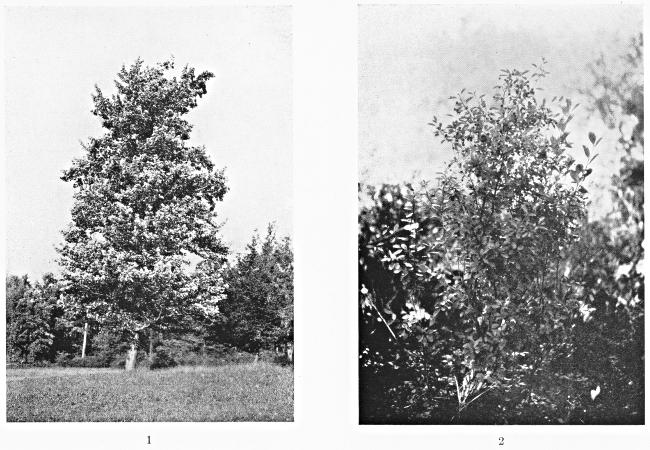
Box Elder (Acer negundo L.), “adjagobiˈmûk”, shown in plate 68,
fig. 2. The Pillager Band of Ojibwe reported that the inner bark
of the box-elder is steeped to make an emetic. There is no record of
its use by the whites.
Red Maple (Acer rubrum L.) “cicigîmeˈwîc”, shown in plate 65,
fig. 1. The Flambeau Ojibwe boil the bark of the red maple to
obtain a tea with which to wash and cure sore eyes. There is no record
of its use by the whites.
Mountain Maple (Acer spicatum Lam.) “cacagobiˈmûk”
[emetic bark]. The Pillager Ojibwe extract the pith of the twig and
pinch off small particles which are put into the eye like flax seed to
remove foreign matter. It becomes sticky and holds foreign matter
which can then be removed with the pith. The pith is also soaked in
water to make a lotion for treating sore eyes. Among the whites,
Mountain Maple bark is often gathered and sold for Cramp Bark
(Viburnum opulus L. var. americanum [Mill.] Ait.) In fact, it has
often been wholly substituted for it, and seems about as effective
as a uterine sedative and preventative of abortion.
ALISMACEAE (WATER-PLANTAIN FAMILY)
Arum-leaved Arrowhead (Sagittaria arifolia Nutt.) “wabasiˈ
pîn” [white potato].[92] Upon short lateral rootlets, amongst the mass
of fibrous roots of the arrowhead, firm corms develop, pinkish-white
and bulb-shaped, but solid and composed of a sweetish, starchy
texture. These are the choice Indian potatoes. These corms
break away from the root mass very easily so that the utmost care
is necessary in digging to get them in situ. Muskrats are very fond
of them, as are beavers, and sometimes store up large covered
caches, which the Indian recognizes and appropriates. They will
also dig for them, if they cannot be more easily obtained. While they
are chiefly prized for food, they are also taken to be a remedy for
indigestion among the Pillager Ojibwe.
ANACARDIACEAE (SUMAC FAMILY)
Smooth Sumac (Rhus glabra L.) “bakwaˈ nak” [binding tree].
According to Jack Doud and other Flambeau Ojibwe all parts of
the Smooth Sumac are suitable for medicine, the root bark, trunk
bark, twig bark, leaves, flowers and fruit. The root bark tea is used as a
hemostatic. Trunk and twig innerbark are used in combination
with other medicine for their astringent qualities. Blossoms are
sometimes steeped for sore eyes, leaves are used in poultices, and the
fruit is considered a throat cleanser as well as being the basis of a
beverage. Eclectic practitioners, or the old time herbalists, used the
berries of Rhus glabra because of the malic acid in the skin, claiming
it to be a good gargle in acute throat inflammation.
Staghorn Sumac (Rhus typhina L.) “bakwanaˈ tîg” [binding
tree].[93] The Staghorn Sumac was absent from the Flambeau Ojibwe
territory, but plentiful around Leech Lake, Minnesota, while the
Smooth Sumac was not found near Leech Lake. The Pillager Ojibwe
only used the root as a medicine to stop a hemorrhage. They suggested
that they had heard of it being used in medicinal combinations
but did not know how to make or use them.
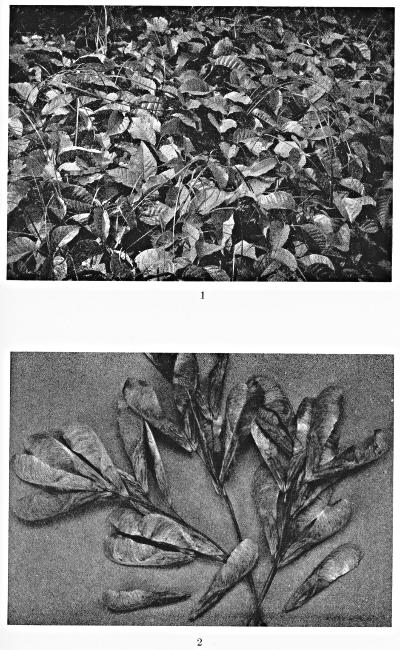
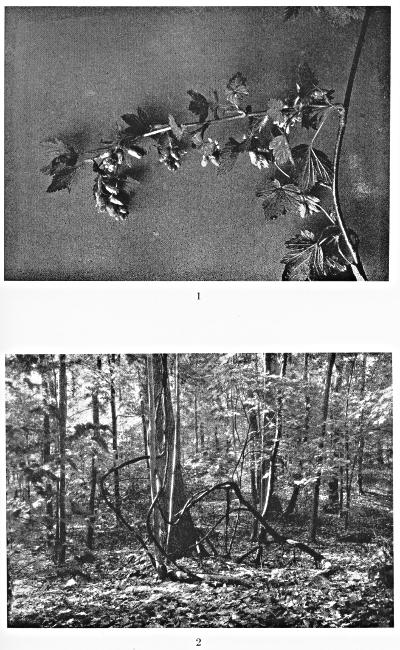
Poison Ivy (Rhus toxicodendron L.) “anîmîkiˈbûg” [cloud], shown
in plate 68, fig. 1. Mukwean (Bearskin), Flambeau medicine man,
called this a poison to the skin and said that the Ojibwe have no distinctive
name for it. John Peper, one of the Bear Island Pillager
Indians, gave us the Indian name and said that no one now alive there
knew how to use it. Since Kepeosatok, Meskwaki medicine man, at
Tama, Iowa, used it in a certain manner for poulticing some kinds
of swellings, the writer thinks this may be the use to which John
Peper referred.
APOCYNACEAE (DOGBANE FAMILY)
Spreading Dogbane (Apocynum androsaemifolium L.) “wesaˈ
wûckwûn” [nearly blue flowers] or “magosîñeˈ cnakwûk” [needle-like].[94]
Bearskin, Flambeau medicine man, said that the stalk and
root of this plant are steeped to make a tea for women to drink. It
keeps the kidneys free during pregnancy. Other Flambeau Ojibwe
agreed with the use but cited the second name as more correct for it.
Under the Ojibwe name of “mîdewîdjiˈbîk” [medicine lodge root], the
Pillager Ojibwe declared it to be one of the sacred roots that is eaten
during the medicine lodge ceremony. They use it also for throat
trouble. When one has a coated tongue and is afflicted with headache,
the root is also used. In the case of headache, the root is placed
upon live coals and the incense is inhaled.
AQUIFOLIACEAE (HOLLY FAMILY)
Winterberry (Ilex verticillata [L.] Gray), “aweˈnîsibûg” [wintergreen
leaf], and “anîmûˈcîmînûn” [dog berry]. The bark of this
native holly is medicine among the Flambeau Ojibwe, but the use
could not be discovered, other than that it might be used for diarrhea.
Winterberry has been employed by eclectic practitioners as a tonic
and astringent. It has been substituted for quinine in the treatment
of periodical fevers, and also used in the treatment of diarrhea. The
eclectic practitioner has also used it in treating malignant ulcers and
chronic skin eruptions.
Mountain Holly (Nemopanthus mucronata [L.] Trel.), “mîckimînûˈ
nîmîc” [red berry tree], shown in plate 65, fig. 2. This bush
is very common around the reservation of the Flambeau Ojibwe and
the berries are used as medicine, but the writer was unable to discover
for what disease or how used. There is no record of its use
among the whites.
ARACEAE (ARUM FAMILY)
Sweet Flag (Acorus calamus L.) “naˈ bûgûck” [something flat].
The root of Sweet Flag is a quick acting physic, supposed to act in
half a day. Bearskin cautioned the writer that no more than one
and a half inches was to be used, as more would make one ill, and even
this much is quite harsh. The Pillager Ojibwe recognize the Sweet Flag
under the name “weˈke”, which is the same word used by another tribe
for the Yellow Water-lily, and by another for the Blue Flag. John Peper
said that the root was used for curing a cold in the throat or for curing
a cramp in the stomach. In earlier days, among the whites, slices
were candied to create a more popular form of medication. It was
formerly used among the white men as a tonic for dyspepsia and for
correcting flatulent colic. It was also supposed to be beneficial as a
mild stimulant in typhoid cases.
Indian Turnip (Arisaema triphyllum [L.] Schott.), “cacaˈ gomîn.”[95]
The root of Indian Turnip was said by John Peper, Bear Island
Ojibwe, to be used in treating sore eyes, but he did not know how to
use it. One wonders if the calcium oxalate crystals so firefull to the
mouth lining were equally so to the delicate membranes of the eye.
Small doses of the partially dried root have been used by the
white man in the treatment of chronic bronchitis, asthma, flatulent
colic and rheumatism, certainly widely different maladies. The juice
of the fresh corm in lard has been used by the white man as a local
application to cure ringworm.
ARALIACEAE (GINSENG FAMILY)
Wild Sarsaparilla (Aralia nudicaulis L.) “bebamabiˈ k” [root
runs far through the ground]. The Flambeau Ojibwe recognize the
root of this plant as a strong medicine, but do not steep it to make tea.
The fresh root is pounded and applied as a poultice to bring a boil
to a head or to cure a carbuncle. Among the Pillager Ojibwe, the
writer found two names applied to this, one of which he thinks to be a
case of mistaken identification by the informant. “O kadak” [wild
carrot] is more likely to refer to Aralia racemosa though no specimens
were found there. They used it under this name as a special squaw
remedy for blood purification during pregnancy. The root was
pounded in a mortar, then boiled in hot water. Under their name
“waboˈ s ûskwe” [rabbit] the root was prepared the same way and
the tea was used to cure a cough.
Among the white men, this root has the same properties and uses
as the Indian Spikenard (Aralia racemosa); namely, stimulant, diaphoretic,
and alterative.
Ginseng (Panax quinquefolium L.) “jîssêˈns.” Evidently the
word they used was an attempt to pronounce the white man’s term
for it. The writer was unable to discover any medical use made
of it by the Ojibwe, though they gathered it assiduously for sale to the
traders. Their method of gathering was a thoughtful one. Although
they undoubtedly recognized it in any stage of growth, they only
gathered the root when the red berries were mature, but before they
were ready to drop. Into the hole from whence the root came, they
would thrust the whole fruiting top, and carefully firm the soil upon
it. Knowing the location well, they would revisit the place in three
to five years and find more roots than they harvested in the first
instance.
According to our pharmacopoeia, the medicinal value of ginseng
is almost nothing, but there is a great market for it in China, where it
is worshipped as a sort of fetish, and is acclaimed as a panacea for
sexual impotency, nervousness, vomiting and dyspepsia. The more
nearly the root approximates the human torso, the more valuable
it is to the Chinese. Thus one root in a six hundred-pound bale may
be worth many times the entire remainder of the bale, and when ten
dollars a pound is the price, one can realize the extreme value of such
a piece.
ARISTOLOCHIACEAE (BIRTHWORT FAMILY)
Wild Ginger (Asarum canadense L. var. acuminatum Ashe.)
“nameˈ pîn” [sturgeon potato].[96] The Pillager Ojibwe called this a
potato for sick people. They are supposed to chew the root, and then
they can eat anything they desire.
The white man calls this Canada Snakeroot in his dispensatories,
considering it a feeble remedy with tonic, aromatic and diuretic
properties. Cases of convalescent acute febrile infections are sometimes
given the extract of wild ginger root.
ASCLEPIADACEAE (MILKWEED FAMILY)
Common Milkweed (Asclepias syriaca L.) “caboˈ sîkûn” [milk]
or “înîniˈwûnj” [Indian plant], according to Flambeau Ojibwe.[97] Although
the Pillager Ojibwe used this chiefly for food, the root was
also used as a female remedy, but for what phase of illness, we were
not able to discover. Eclectic practitioners have used the roots as
counter-irritants or internally as stomachics, carminatives, or anti-spasmodics
of the stimulating class.
BALSAMINACEAE (TOUCH-ME-NOT FAMILY)
Spotted Touch-me-not (Impatiens biflora Walt.) “wesaˈ wûs
gaˈskonêk” [yellow light]. Bearskin, Flambeau medicine man said
that the fresh juice of this plant rubbed on the head would cure a
headache. The leaves are steeped for a medicinal tea, but the ailment
was undiscovered.
The herbage of this plant, under the name Wild Celadine, has
been largely employed by homoeopathic physicians and eclectics. The
chemical constituents are not known though the leaves apparently
contain tannin. The medicinal value is questionable, though fresh
applications of the juice appear to relieve skin irritations of various
kinds, especially that of Poison Ivy.
BERBERIDACEAE (BARBERRY FAMILY)
Blue Cohosh (Caulophyllum thalictroides [L.] Michx). “ociˈ
gîmîc”.[98] The Pillager Ojibwe use the root for female troubles especially
for cramps in the stomach during painful menstruation. The
fine roots are also boiled to make a tea for emetic purposes. White
people seldom use it. Eclectics have used it in the treatment of
hysteria and uterine diseases. They have claimed that it will prevent
abortion, by causing uterine contraction when uterine inertia
is present.
BETULACEAE (BIRCH FAMILY)
Speckled Alder (Alnus incana [L.] Moench.) “wadoˈ bîn” [root
to sew a canoe]. The Flambeau Ojibwe use the root for its hemostatic
qualities. When one passes blood in his stools, the root tea will act
as an astringent and coagulant.
The white man has also used alder bark for its mild astringent
properties. The eclectic practitioner in the United States and
Canada employed it in a powdered condition for dusting upon chafed
body surfaces.
Paper Birch (Betula alba [L.] var. papyrifera [Marsh.] Spach.)
“wîgwas”. From “wîgwas” comes the word “wigwam” or house, because
birch bark was used in covering the house, furnishing a waterproof
roof. The root of the Paper Birch was used in medicines as a seasoner.
Its sweetish, aromatic, wintergreen flavor disguised less pleasant
doses. The root bark and maple sugar cooked together made a soothing
syrup to alleviate cramps in the stomach. The white man has
employed only the leaves medicinally as a diuretic.
Low Birch (Betula pumila L. var. glandulifera Regel.) “bîneˈ
mîcins” [partridge tips]. Among the Pillager Ojibwe, the Low Birch is a
valued source of medicine. Although it is plentiful around the Flambeau
Reservation, none of them seemed to consider it medicine, although
their name agreed, “bîneˈ mîc”, without the diminutive. The
Pillager Ojibwe use the tiny cones upon a plate of coals as an incense
to cure catarrh. No doubt the resinous covering of the twigs and
cones in this variety causes the aromatic incense. Also a tea made
from the cones is drunk by women in their menses. Such tea is also
accounted strengthening when the patient is enfeebled by childbirth.
The leaves probably possess diuretic properties as do other species
of Betula. No record of its use by white men has been discovered.
Hazelnut (Corylus americana Walt.) “mûkwobagaˈ nak” [bear
nut].[99] Bearskin said that the bark of the hazelnut bush is medicine.
It is boiled and used as a poultice on cuts to close and heal them. No
record of its medical use by white men has been discovered.
Beaked Hazelnut (Corylus rostrata Ait.), “bagaˈn” or “bagaˈnak”
[nut] Flambeau names, and “bagaˈnamijic” [nut tree], Pillager name.
Bearskin assigned the same properties and uses to the bark of the
Beaked Hazelnut as to the Hazelnut. The Pillager Ojibwe used only
the hairs of the hazelnut husk as a medicine to expel worms. Eclectic
practitioners have used it in the same manner as an anthelmintic,
depending probably on the irritant effect of the tiny stickers.
BORAGINACEAE (BORAGE FAMILY)
Hound’s Tongue (Cynoglossum boreale Fernald), “masaˈn”.
Three terms are used to denote the action of such plants as this,
which are burned upon live coals that the patient may inhale the
fumes. They are: “abaˈ bûson”,—to revive or “head standing by
smoke”; “sasaˈ bîkwat”,—to snuff it; and “nokweˈ sîkûn”,—“smell as
it comes”. They are used interchangeably in designating the use of
the plant. Hound’s Tongue is specifically fumed to cure a headache.
Among the whites, Hound’s Tongue has been recommended as
a sedative and demulcent in the treatment of bronchial and pulmonary
affections. It is said to be of value also in dysentery. The fresh
leaves are used locally as a remedy for superficial burns and abraded
surfaces.
CAMPANULACEAE (BELLFLOWER FAMILY)
Marsh Bellflower (Campanula aparinoides Pursh.) Although
plentiful around the Lac du Flambeau region, our informants said
that this is not used.
Harebell (Campanula rotundifolia L.) “adotaˈgons” [little bell].
The Pillager Ojibwe use the root of the Harebell combined with three
other unnamed roots for lung troubles. There is no record of its
use by whites.
CAPRIFOLIACEAE (HONEYSUCKLE FAMILY)
Bush Honeysuckle (Diervilla lonicera Mill.), “osawaˈ skanet”
[yellow fluid]. The Flambeau Ojibwe use the root together with
other plants such as the Ground Pine, for their most valued urinary
remedy. It is also known among white men as a diuretic and a remedy
to relieve itching.
Red Elderberry (Sambucus racemosa L.), “papaskatcîksiˈganaˈtîg”
[popgun wood]. According to the Pillager Ojibwe, this
bark is an emetic or a purgative, depending upon how it is prepared
for use. It is a last resort purgative to be used when other remedies
for the same complaint are of no avail. It may be said that the Ojibwe
have more plants for physic than for any other purpose, thus the Red
Elder will be seen to be their most important one.
Four internodes of the stalk are taken, because four is their magic
number. These sections are measured carefully from the point of
the ulna to the point of the humerus. The inner bark is secured by
peeling downward. This is steeped and boiled, and the resulting
liquid is drunk for constipation. It is supposed to thus save the life
of one threatened with serious constipation. It is reserved for extreme
cases, because of the many other physics they employ, and they consider
it drastic and dangerous otherwise. If these same four sticks
had been peeled upwards and the resulting tea drunk, then it would
have acted as a powerful emetic. The writer can testify to its strength,
but notes that it works both ways at once, no matter how prepared,
so that the method of preparation is doubtless superstitious.
Among the whites only the elder flowers are recognized in the
New Formulary, but the inner bark has been known to produce death
in children, a short time after being eaten, with symptoms similar to
Poison Hemlock (Cicuta). In moderate doses, it is also known to
produce vomiting and purging. The active alkaloid evidently works
only in the fresh state, as it loses its potency in a dried state.
Snowberry (Symphoricarpos racemosus Michx.) “anîgomijiˈ mînagaˈwûnj”
[little crow bush]. Among the Pillager Ojibwe, the root
of the Snowberry is used to make a tea to clear up the afterbirth, and
enable quicker convalescence. Among the Meskwaki Indians the
same use is ascribed to the Wolfberry (Symphoricarpos occidentalis).
There is no record of its use by white men.
Nannyberry (Viburnum lentago L.), “atîteˈ tamînûn” or “atîteˈ
tamînagaˈwûnj.”[100] The Pillager Ojibwe collect the inner bark of
the trunk, down low next to the ground, to yield a tea which is used
as a diuretic.
Among the white men, Nannyberry is often sold as Viburnum
prunifolium which is official in our pharmacopoeia. The virtues assigned
to this class of medicine are as feeble as they are numerous.
It has been used as a nervine, astringent, tonic, diuretic and has been
said to have value as an uterine sedative and preventive of abortion.
Highbush Cranberry (Viburnum opulus L. var. americanum
[Mill.] Ait.) “aˈnibîmîˈnûgaˈwûck” [anib means elm, berries, bush].[101]
The Pillager Ojibwe used the inner bark as a physic, and also drank
the tea to cure cramps in the stomach.
Among the white men, Viburnum opulus is considered to be the
same as Viburnum prunifolium, only less potent. It is recommended
as an antispasmodic in asthma, hysteria, puerperal convulsions, and
dysmenorrhea.
CARYOPHYLLACEAE (PINK FAMILY)
White Campion (Lychnis alba Mill.) “basiˈ bûgûk” [small leaf].
The Flambeau Ojibwe use the root of this for a tea to physic a patient.
There is no record of its use by white men.
CELASTRACEAE (STAFF TREE FAMILY)
Climbing Bittersweet (Celastrus scandens L.) “manîdobimaˈ
kwît” [spirit-twisted]. The Pillager Ojibwe use the red berries of
this plant for stomach trouble.
The white man uses the berries for decorative purposes, and has
used the bark for emetic, diaphoretic and antisyphilitic purposes.
COMPOSITAE (COMPOSITE FAMILY)
The composite family is represented by many species in northern
Wisconsin and also in northern Minnesota. There are probably three
times as many plants in this family as in any other, hence it furnishes
numerous medicines.
Woolly Yarrow (Achillea lanulosa Nutt.), “waˈ bîgwûn” [white-flower].
The Flambeau Ojibwe, under the name given, use the leaves
of this plant as a poultice to cure the bite of a spider. The dried
flowering heads are smoked in mixture with other things, much as
kinnikinnik, not for pleasure, but more for ceremonial purposes.
It has not been distinguished by the eclectic practitioner from the
Common Yarrow, which was used for its bitter and aromatic principles.
It was used as an emmenagogue and for various ailments of the reproductive
organs. It was sometimes used to cure diseased conditions
of the entire gastro-intestinal tract.
Yarrow (Achillea millefolium L.), “adjidamoˈ anûk” [squirrel
tail].[102] The Pillager Ojibwe used the florets in ceremonial smoking
and placed them on a bed of coals inhaling the smoke to break a
fever.
Yarrow has always been a home remedy of the white man, and
the Germans still use the dried flowers in a tea, called “schafesgarbetee”,
to break a fever. Other uses are the same as above.
Pearly Everlasting (Anaphalis margaritacea [L.] B. & H.), “basiˈ
bagûk” [small leaf]. The Flambeau Ojibwe use the flowers of this
plant, calling attention to the fact that it smells like acorns, reducing
them to a powder which is sprinkled on live coals as a “nokweˈ sîgûn”
or perfume. This is inhaled by a party who has had a stroke of paralysis
and is said to revive him.
The Pearly Everlasting has never been properly analyzed by white
men, but the flowers have been locally used by them as soothing expectorants
and are known to have more or less marked stomachic
properties.
Lesser Cat’s-Foot (Antennaria neodioica Greene) “gagîgeˈ bûg”
[everlasting leaf]. The Flambeau Ojibwe use the whole herb as a
valued remedy to make a tea to be given to the mother after child
birth. It is to purge the afterbirth and heal them internally.
Eclectic practitioners have used this plant as a hemostatic.
Common Burdock (Arctium minus Bernh.), “giˈ masan” [big
stickers]. The Flambeau Ojibwe use the root of burdock as one of
the ingredients of a medicine for pain in the stomach. It is also supposed
to have a tonic effect.
Burdock root has quite a reputation among home practitioners
among the white men as a diaphoretic, diuretic, alterative, aperient
and depurative. It has been used for rheumatism, gout, pulmonary
catarrh, chronic skin diseases such as scrofula and syphilis, and to
dissolve urinary deposits. Externally it has been used as a salve or
wash for eruptions, burns, wounds, hemorrhoids and swelling.
White Sage (Artemisia ludoviciana Nutt.) “îmbjîˈgoa” according
to White Cloud, Bear Island Ojibwe, but “wîngûskw” or “bebejiˈgogaˈnji”
[horse medicine] by John Peper, another Bear Islander.
Peper said the Pillager Ojibwe used it as a horse medicine, but the
Sioux smoked it.
Miners and frontiersmen prized it in their treatment of “mountain
fevers.”
Large-leaved Aster (Aster macrophyllus L.), “naskosiˈ îcûs”.
The Flambeau Ojibwe consider this a feeble remedy but also good as
a charm in hunting. Young roots were used to make a tea to bathe
the head for headache. The informant giving this latter use called it
“megîsiˈ bûg” [eagle leaf]. There is no record of its use by the whites.
Ox-eye Daisy (Chrysanthemum leucanthemum L.). The Flambeau
Ojibwe had no name for this, as they said it was from the south,
and they do not use it.
Canada Thistle (Cirsium arvense [L.] Scop.) “masaˈ nûck”
[prickly]. The Flambeau Ojibwe use the plant for a bowel tonic.
Canada Thistle is one of the worst American weeds, and white men
have used the dried plant for a diuretic and tonic.
Common Thistle (Cirsium lanceolatum [L.] Hill), “jiˈ masaˈnûck”.
The Flambeau Ojibwe use the root of this for alleviating
stomach cramps in both men and women. The dried plant has been
used by the whites as a diuretic and tonic.
Philadelphia Fleabane (Erigeron philadelphicus L.) “mîcaoˈgacan”
[odor of deer hoof]. The Pillager Ojibwe use the flowers
to make a tea to break fevers. The smoke of the dried flowers is
inhaled to cure a cold in the head. The disk flowers, pulverized, were
snuffed up the nostrils to cause the patient to sneeze and thus loosen
a cold in the head. The whites have used the Canada Fleabane as a
remedy in the pharmacopoeia, and also have used the Philadelphia
Fleabane locally, but for different purposes. It is diuretic rather
than astringent.
Daisy Fleabane (Erigeron ramosus [Walt.] BSP). The Flambeau
Ojibwe do not assign this plant a special name but class it as a “nokweˈ
sîgûn” or perfume for curing sick headache. Several species of Erigeron
have been substituted by white men for the Canada Fleabane, which
is used as a diaphoretic and expectorant.
Joe-Pye Weed (Eupatorium purpureum L.), “bûˈ gîsowe” [bathing].
The Flambeau Ojibwe make a strong solution of the root, with
which to wash a papoose up till the time he is six years old. This is
supposed to strengthen him.
Joe-Pye is officinal but not official among white men. Official
designates that it is authorized by the U. S. Pharmacopoeia while
officinal means that it is regularly kept for sale in drug stores. Officinal
remedies are much used by eclectic practitioners. The root has
the odor of old hay and is diuretic, stimulant, astringent and tonic.
It has been used in chronic urinary disorders, gout, rheumatism, and
hematuria.
Tall Blue Lettuce (Lactuca spicata [Lam.] Hitchc.), “dadocaˈbo”
[milk]. The Flambeau Ojibwe employ the plant to make a tea given
to women with caked breasts to render lactation easier. A dog whisker
hair is used to pierce the teat. Among white men Lactuca was formerly
employed as a soporific and sedative.
White Lettuce (Prenanthus alba L.), “wecaˈ wûs waˈ ckwînêsk”
[yellow light]. The Flambeau Ojibwe use the milk of the White Lettuce
as a diuretic, especially in female diseases. The root is also used as a
female remedy.
White men have used the root decoction internally for dysentery.
Old time herb doctors gave the milk of the plant internally, and used
the leaves, steeped in hot water, as a poultice for the bite of a snake.
Black-eyed Susan (Rudbeckia hirta L.). The Flambeau Ojibwe
claim that this plant is adventive from the south and have no name
or use for it. It has been used by the white men as a diuretic.
Golden Ragwort (Senecio aureus L.).
Entire-leaved Groundsel (Senecio integerrimus Nutt.) Both
of these plants are considered adventive by the Pillager Ojibwe and
neither was named nor used.
Under the name squaw weed, white men have exploited the Golden
Ragwort as a female regulator, claiming diuretic, pectoral, diaphoretic
and tonic properties. It is also said to be useful in treating gravel
and other urinary affections.
Indian Cup Plant (Silphium perfoliatum L.), “asasaˈ weskûk”
[square stem]. According to John White Feather, of the Flambeau
Ojibwe, this root was carried from Iowa and transplanted on the Lac
du Flambeau Ojibwe Reservation. They all accept it as great medicine.
A tea is made from the root for lumbago and some other kinds of
rheumatic pains in the back. John Peper, Pillager Ojibwe, gave it the
same Indian name and said that an old Indian had brought it to Bear
Island from Iowa a hundred years ago, and had planted it in his field,
whence it escaped to the south end of the island. He said they use it
for stomach trouble, and hemorrhage. White men have used the Indian
Cup Plant root for its tonic, diaphoretic and alterative properties.
It has also been used in intermittent fevers, ulcers, liver affections and
debility. The resinous gum collected from the stem has been used by
the whites as a stimulant and antispasmodic.
Fragrant Golden-rod (Solidago graminifolia [L.] Salisb.), “wasaˈ
waskwûneˈk” [yellow light]. Besides being of use in hunting medicine,
the flowers in infusion were used by the Flambeau Ojibwe for a pain in
the chest.
Golden-rod leaves and flowers have at times held a rather important
place in materia medica, for their carminative, and antispasmodic
properties. They have also been used as an intestinal
astringent.
Tansy (Tanacetum vulgare L.) “muckikiˈwît” [medicine]. The
Flambeau Ojibwe have no distinctive name for this plant, claiming
it came from the south and they were told it was good for fevers.
Among white men, it is deemed tonic, emmenagogue and diaphoretic.
It has been used in a cold infusion in convalescence from
exhausting diseases, dyspepsia, hysteria and jaundice.
Dandelion (Taraxacum officinale Weber) “wesaˈusakwûnek” [yellow
light].[103] While the Flambeau Ojibwe do not use this plant, the
Pillager Ojibwe give it a name and use the root for a tea for heartburn.
It was found growing at the north end of Bear Island in Leech
Lake, Minnesota.
Among the whites, the virtues of the root are much overrated. The
dried root is steeped in boiling water and is used as a stomachic and
tonic, with slight diuretic and aperient action.
Cocklebur (Xanthium commune Britton), “sakatiˈkomûk”
[stickers]. Although giving it a name, the Flambeau Ojibwe did not
use it. It has been used by white men in intermittent fevers, also as a
diuretic, diaphoretic and sialagogue.
CORNACEAE (DOGWOOD FAMILY)
Alternate-leaved Dogwood (Cornus alternifolia L. f.) “mosoˈmîc”
[moose tree].[104] The Pillager Ojibwe use the inner bark for an
emetic. Although other species of Cornus are officinal with white
men, there is no record of the use of this species.
Bunchberry (Cornus canadensis L.) “odeˈ imînîdjiˈ bîk” [strawberry
root, or heart-berry root]. The Bunchberry or Dwarf Cornel
somewhat resembles the Wild Strawberry. The Flambeau Ojibwe
make a tea from the root, which is used to cure babies of colic. There
is no record of its medicinal use by the whites, though it has been eaten
by them.
Panicled Dogwood (Cornus paniculata L’Her.), “meskwabiˈ
mîc” [red bush]. It is peculiar that the Flambeau Ojibwe would call
this a red bush, for the branches are distinctly gray. Only the fruit
stalks or pedicels are bright red. The bark is used as a tea for flux. An
aggregate of this bark compressed into a stopper shape is forced
into the anus as a treatment for piles. There is no record of its use by
the whites.
CRUCIFERAE (MUSTARD FAMILY)
Tower Mustard (Arabis glabra [L.] Bernh.), “misodjidamoˈ
anûk” [black squirrel tail]. Although the Pillager Ojibwe have a
name for this plant, they say it is from the south, and they do not
use it. There is no record of its use by white men.
Marsh Cress (Radicula palustris [L.] var. hispida [Desv.] Robinson),
“wabîgwûn” [yellow flower]. The Flambeau Ojibwe name for
Marsh Cress is not very distinctive although it does have yellowish
flowers. They have no use for the plant as it came in from the south,
according to them. Neither have white men.
Tansy-mustard (Sisymbrium canescens Nutt.) The Pillager
Ojibwe do not know this plant, which they consider to be adventive
from the south and do not use it. Aside from the fact that the seeds
have a volatile oil similar to mustard seed, the whites do not use it.
CUCURBITACEAE (GOURD FAMILY)
Squash (Cucurbita maxima Duchesne.) “ogwîssiˈmaun oˈwasokwûneˈk”
[threads like hair; yellow light]. The Flambeau Ojibwe used
the seed tea as a diuretic. There is no distinctive medicinal use of
squash among the whites.
Wild Balsam-apple (Echinocystis lobata [Michx.] T. & G.) “nîgîtîniˈ
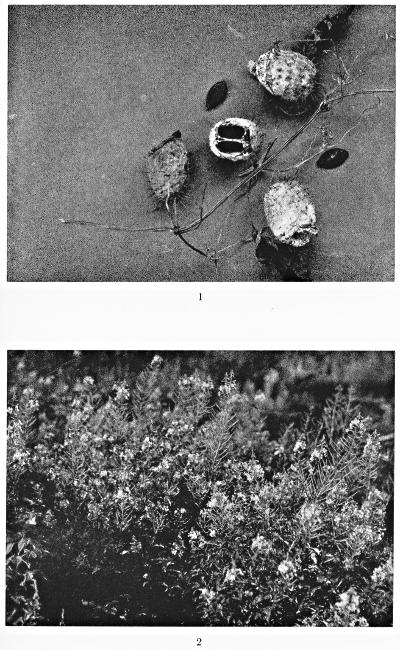
gûnûk” or “mîtcigiˈ mênûk” [man in the ground], shown in
plate 69, fig. 1. The Flambeau Ojibwe use the root tea as a bitter
medicine for stomach troubles and as a tonic. The root is certainly
bitter enough. On the west coast, the root has been employed by
white men as a simple bitter.
CYPERACEAE (SEDGE FAMILY)
Hare’s Tail (Eriophorum callitrix Cham.) “bîweeˈ ckînûk” [fuzz
of fruit]. The Flambeau Ojibwe use the matted fuzz as a hemostatic.
Under the name “mesadiˈ wackons” [little catkins from
popple], the Pillager Ojibwe refer to it, but none of them knew any
use for it. There has been a limited use of its tannic properties as an
astringent by white men.
EQUISETACEAE (HORSETAIL FAMILY)
Field Horsetail (Equisetum arvense L.) “gîjiˈ bînûsk,” [duck
round].[105] The Pillager Ojibwe use the whole plant to make a tea
to cure the dropsy. The plant has been used indefinitely chiefly
in domestic practice by the whites.
Wood Horsetail (Equisetum sylvaticum L.), “sibaˈ mûckûn”.
The Pillager Ojibwe use the whole plant to make a tea to cure kidney
trouble and dropsy. It has not been much used by the whites, except
as a domestic remedy for gravel.
ERICACEAE (HEATH FAMILY)
Bog Rosemary (Andromeda glaucophylla Link.), “bîneˈ mîkci”
[swamp partridge berry]. The plant was found on the Flambeau
Ojibwe Reservation, but was not used medicinally. Among the whites,
it is credited with poisonous properties.
Prince’s Pine (Chimaphila umbellata [L.] Nutt.), “gaˈ gîgeˈbûg”
[everlasting leaf].[106] The Flambeau Ojibwe pronounce the name of
Prince’s Pine nearly the same as the Menomini Indians, and use it
for the same purposes, namely a tea for treating stomach troubles.
Chimaphila is official with white men as a tonic and diuretic. It
stimulates the mucous membrane of the genito-urinary tract, and
has been used in renal dropsy, scrofulous conditions, chronic ulcers
and skin lesions. It is employed both internally and as an embrocation.
Wintergreen (Gaultheria procumbens L.), “wînîsiˈ bûgûd”, [dirty
leaves], shown in plate 75, fig. 2. The Flambeau Ojibwe use the
leaves to brew a tea to cure rheumatism and “to make one feel good.”
The white man discovered the properties of this plant from the Indians,
and originally wintergreen was the chief source of methyl salicylate.
Aspirin is synthetically the same thing. Birch twigs were later used
as a source and finally it was made from coal tar dye. Like other
volatile oils, methyl salicylate was used as an antiseptic, analgesic,
carminative and flavoring agent. It was added to liniments for rubbing
muscular rheumatism, and similar complaints. Overdoses of
the pure oil on the skin produce drowsiness, congestion and delirium.
Cranberry (Vaccinium oxycoccus L.) “mûckiˈ mînagaˈ wûnj”
[swamp berry bush]. A tea for a person who is slightly ill with nausea.
White men have used the bitter, astringent leaves in diarrhea and
diabetes and for purifying the blood.
Blueberry (Vaccinium pennsylvanicum Lam.), “minûgaˈ wûnj”
[berry bush]. The Flambeau Ojibwe use the leaves of this common
blueberry for a medicinal tea as a blood purifier. White men have
employed it in the same manner.
EUPHORBIACEAE (SPURGE FAMILY)
Flowering Spurge (Euphorbia corollata L.), “cabosîˈ kûn” [milky
bitter root]. The Flambeau Ojibwe use the root for a physic. A half
inch of the root is pounded and steeped in a cup of water, which is
drunk before eating. The resinous, milky juice of the root has been
employed by eclectic practitioners as an emetic, but its use has been
practically abandoned because of its irritant and uncertain qualities.
FAGACEAE (BEECH FAMILY)
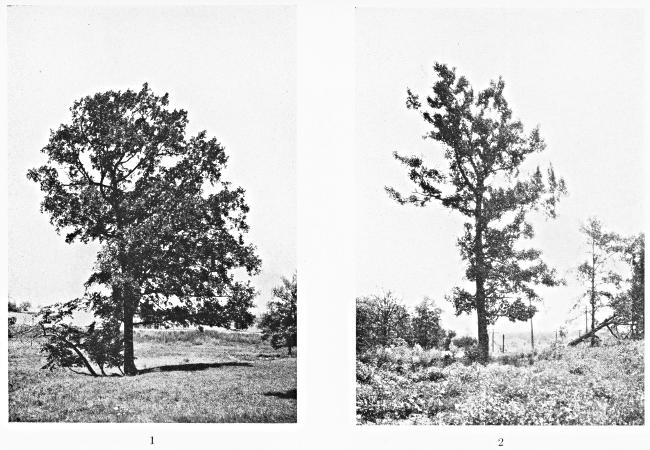
Bur Oak (Quercus macrocarpa Michx.), “mîtîgoˈ mîc” [wooden
tree], shown in plate 64, fig. 1. The bark is an astringent medicine
to the Pillager Ojibwe. They also use it to bandage a broken foot
or leg. All oaks are noted among the whites for their astringent properties.
Eclectic practitioners used it for gargles in cases of inflammation
of the tonsils and pharynx. It was also used in treating leucorrhea
and piles.
Red Oak (Quercus rubra L.), “mîtîgoˈ mîc”, [wooden tree], shown
in plate 64, fig. 2. The bark,—“mîtîgoˈ mîc wenaˈ gêk”. The bark is a
medicine for heart troubles and bronchial affections among the Flambeau
Ojibwe. Its use by white men was approximately the same as
Bur Oak.
FUMARIACEAE (FUMITORY FAMILY)
Golden Corydalis (Corydalis aurea Willd.), “tîpotîeˈ kwason,”
[looks like pants]. The Pillager Ojibwe place the root on coals and inhale
the smoke for clearing the head and reviving the patient. There is
no record of its use by white men.
FUNGI
The Ojibwe have evidently had disastrous experiences with mushrooms
in the past and do not use them as a food. The children often
gather the common brackets (Fomes applanatus) and draw pictures
on them, using them as toys.
Giant Puffball (Calvatia craniiformis Schw.) shown in plate 61,
fig. 2, “oskweˈtûk”. This is kept on hand in the mature stage. The
inner part has an organized mass of threads and does not break down
entirely into spores as do the smaller puffballs. The substance is
snuffed up the nose to stop nose bleed.
The Ojibwe also made use of an unidentified fungus matte material,
found in the windshake spaces of down timber. This is the matted
vegetating mycelium of some timber fungus, such as Fomes, Trametes,
Polyporus or Pholiota. This made a good tinder for use in the fire
base block, and when the fire stick was rapidly twirled against this
material, it caught fire and was blown into a blaze that became the
basis of their fire. In all medicine lodge ceremonials, the fire was
kindled in this manner and thus deemed a sacred fire. Things cooked
over this fire were ceremonial, and the calumet or pipe used in the
ceremonies was always lighted from a coal of the sacred fire.
GERANIACEAE (GERANIUM FAMILY)
Wild Geranium (Geranium maculatum L.), “oˈ sawaskwîniˈ s”
[yellow light].[107] The Pillager Ojibwe use the astringent root for
the treatment of flux, and also for healing a sore mouth. Eclectic
practitioners have also used it as a mild internal astringent, useful
for infants and people who have a delicate stomach, because it is not
irritating. It is valuable in serious diarrheas. It has also been used
by white men for rectal and vaginal injections to tone up weak
muscles.
GRAMINEAE (GRASS FAMILY)
Rattlesnake Grass (Glyceria canadensis [Michx.] Trin.), “anagoneˈ
wûck” [fern]. The Flambeau Ojibwe use the roots of this as a
female remedy, but it is difficult to understand why they call it a
fern. There is no record of its use by white men.
HYDROPHYLLACEAE (WATERLEAF FAMILY)
Virginia Waterleaf (Hydrophyllum virginianum L.),[108] “neˈ
bîneankweˈ ûk” according to the Pillager Ojibwe White Cloud on
Bear Island, Leech Lake, Minnesota, but “anîmûcîdeˈ bîgons” [dog
feet medicine], according to John Peper, of the same island. It
furnishes a root that may be used to keep flux in check. He states that
it is good for man, woman or child. It was used for the same purpose
among the Meskwaki Indians, but there is no record of its use by
whites.
IRIDACEAE (IRIS FAMILY)
Blue Flag (Iris versicolor L.), “naˈ bûkûck”.[109] The Flambeau
Ojibwe use a half inch of the root boiled in water as a quick physic. Under
the name “caboˈsîkûn” [milk root], the Pillager Ojibwe use a little
piece of the root in boiling water, drinking a tablespoonful and a half
as an emetic and physic.
Blue Flag root has been accounted one of the most valuable remedies
by the eclectic practitioner. It is alterative, cathartic, sialagogue,
vermifuge and diuretic. It has been used in scrofula and syphilis,
chronic hepatic, renal and splenitic affections.
LABIATAE (MINT FAMILY)
Wild Mint (Mentha arvensis L. var. canadensis [L.] Briquet),
“nameˈ wûckons” [little sturgeon plant].[110] Among the Flambeau
Ojibwe a tea is brewed from the entire plant, to be taken as a blood
remedy. It is also used by them in the sweat bath, “akûskati”. John
Peper, Pillager Ojibwe, made an especial trip to find this on the lake
shore but calls it “andegoˈ bîgons” [little crow leaf] and says that they
use it as a tea to break fevers. This species of mint was rarely used by
white men for carminative, stimulant and anodyne affects.
Wild Bergamot (Monarda fistulosa L.), “wecaˈ wûs wackwîˈ nek”
[yellow light].[111] The Flambeau Ojibwe gather and dry the whole
plant, boiling it in a vessel to obtain the volatile oil to inhale to cure
catarrh and bronchial affections. In some sections, the whites use
it as a domestic antiperiodic and diaphoretic.
Catnip (Nepeta cataria L.) “tciˈ nameˈ wûck” [big sturgeon
plant].[112] The Flambeau Ojibwe brew a tea of catnip leaves for a
blood purifier. The mint water obtained by steeping the herb in
lukewarm water is used to bathe a patient, to raise the body
temperature. The plant is employed by the whites as an emmenagogue
and antispasmodic. It has been used as a carminative to allay
flatulent colic in infants, and is supposed to be useful in allaying hysteria.
Heal-all (Prunella vulgaris L.), “basiˈ bûgûk” [partridge leaf].
The root is used by the Flambeau Ojibwe in combination with others
for a female remedy. It has been used by eclectic practitioners as a
pungent and bitter tonic and antispasmodic. It has vermifuge properties
and is slightly diuretic. It has also been used for obstructions
of the liver, cramps and fits.
Marsh Skullcap (Scutellaria galericulata L.), “tcatcabonûˈ
ksîk” [refers to the way the stem comes up through the leaves]. The
Flambeau Ojibwe use this for medicine, having something to do with
heart trouble, but we could get no definite information upon it. There
is no record of its use by white men, although a similar species, S.
lateriflora has been used as a nervine, tonic and antispasmodic
in chorea, convulsions, fits, delirium tremens and all nervous affections.
LEGUMINOSAE (PULSE FAMILY)
Creamy Vetchling (Lathyrus ochroleucus Hook.) “bûgwaˈ dj ûk
pîniˈ k mîneˈ bûg” [unusual potato, berry, leaf]. John Peper, Pillager
Ojibwe, said that the foliage was fed to a pony to make him lively
for a race. The Flambeau Ojibwe call it “basiˈ bûgûk” [partridge
leaf], in common with several other plants, and say that the Creamy
Vetch is used for stomach trouble. By the white men, it is considered
one of the loco weeds, bad for horses.
Marsh Vetchling (Lathyrus palustris L.), “bebejîgogaˈnji mackiˈ
ki” [horse medicine]. The Pillager Ojibwe feed this to a pony that
is sick and claim it will make him fat. There is no record of its use as
medicine by white men.
White Sweet Clover (Melilotus alba Desr.). The Flambeau
Ojibwe claim that this plant is adventive and so they do not use it.
There is no record of its use as medicine by white men.
LICHENS
Reindeer Moss (Cladonia rangiferina [L.] Hoffm.) “asaˈ gûniñkˈ”
[moss].
The Ojibwe boil this moss and use the water to wash a new born
baby. They declare it is the same as if you were putting salt into the
water. So far as is known, it has never been utilized as a medicine by
the white man.
LILIACEAE (LILY FAMILY)
Northern Clintonia (Clintonia borealis [Ait.] Raf.), “gînoseˈ
wibûg” [muskellunge leaf].[113] The Flambeau Ojibwe use the root
tea as a remedy to help parturition. John Peper, Pillager Ojibwe
called it “adotaˈgons” [little bell] and said that the dogs use it to
poison their teeth so that they can kill their prey. Should they bite
a person, then it would be necessary to procure the same root and
put it on the bite to draw out the poison. This curious superstition
was also encountered in another tribe,—the Menomini. There is no
record of its medicinal use by white men.
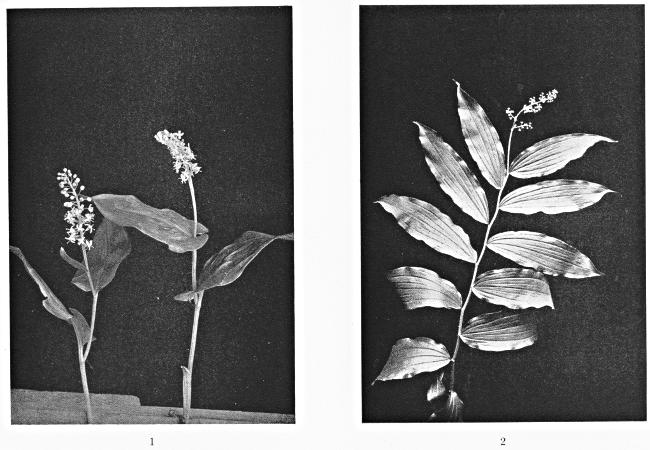
Canada Mayflower (Maianthemum canadense Desf.), “agoñgosiˈ
mînûn” [chipmunk berries], shown in plate 71, fig. 1. The
Flambeau Ojibwe recognize that this is somewhat different from
Spikenard (Smilacina racemosa), but give it the same name and
uses, namely to keep the kidneys open during pregnancy, to cure sore
throat and headaches. It is also used to make smoke for inhaling.
The Pillager Ojibwe do not know or use it.
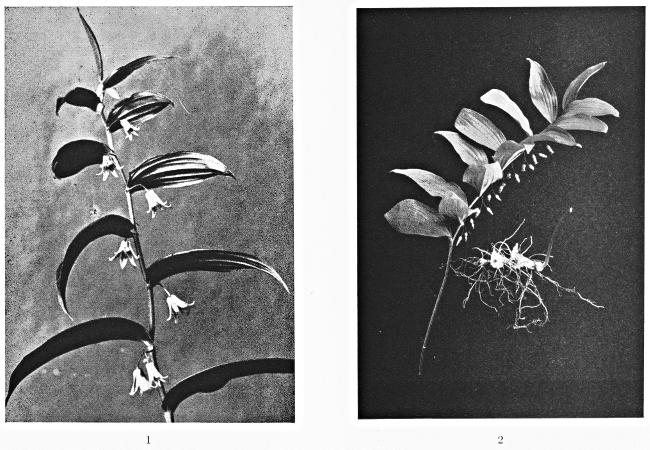
Small Solomon’s Seal (Polygonatum biflorum [Walt.] Ell.)
“nanîbîteˈodeˈkîn”, [grows in a row], shown in plate 72, fig. 2. The
Pillager Ojibwe use the root as a physic and it is also cooked to yield
a tea to treat a cough. White men have used it as a substitute for
Convallaria for the same purposes, namely the treatment of dropsy.
False Spikenard (Smilacina racemosa [L.] Desf.), “agoñgoˈ
sîmînûn” [chipmunk berries], shown in plate 71, fig. 2. The Flambeau
Ojibwe use this root in combination with Spreading Dogbane (Apocynum
androsaemifolium) to keep the kidneys open during pregnancy,
to cure sore throat and headache. It is also used as a reviver,
“abaˈbûsûn”. Convallarin is the important constituent of Spikenard
and it is classed the same as Solomon’s Seal and Canada Mayflower.
Star-flowered Solomon’s Seal (Smilacina stellata [L.] Desf.)
The Pillager Ojibwe have no name nor use for this root.
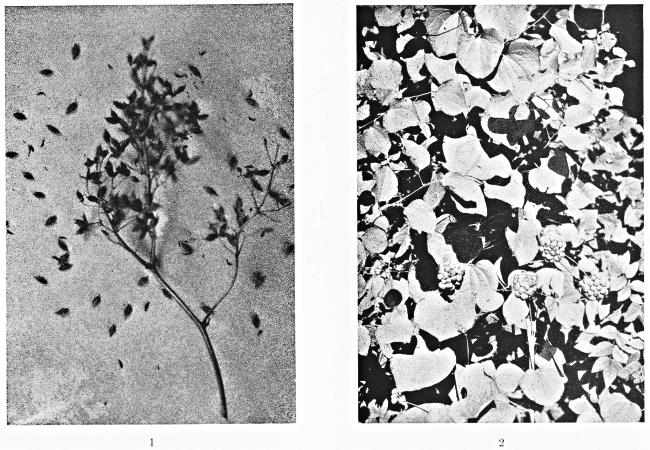
Carrion-flower (Smilax herbacea L.), “gîneˈ bîgomînagaˈwûnj”
[snake berry bush], shown in plate 73, fig. 2. The root of this plant
was used in lung troubles according to the Pillager Ojibwe. It has
been used by eclectic practitioners as an alterative.
Twisted Stalk (Streptopus roseus Michx.), “nanibîteˈ odeˈ kîn”,
[grows in a row], shown in plate 72, fig. 1. This plant is called by the
same name as Polygonatum biflorum among the Pillager Ojibwe, but
this particular one is always referred to as the squaw, while Polygonatum
has always been called the man. It is used for a physic or to
make tea for a cough. There is no record of its medicinal use by
white men.
Large Flowered Bellwort (Uvularia grandiflora Sm.), “wesawabiˈ
kwonêk” [yellow light][114], the name applied to the plant, but
the root is called “wabûckadjiˈ bîk” [white root]. The Pillager Ojibwe
use the root for stomach trouble. The trouble is described as a pain
in the solar plexus, which may mean pleurisy. It has been used by
eclectic practitioners for erysipelas, ulcerated mouth, etc.
LYCOPODIACEAE (CLUB MOSS FAMILY)
Ground Pine (Lycopodium complanatum L.), “gîjiˈk gandoˈ
gûng” [cedar-like]. The dried leaves are used by the Flambeau Ojibwe
as a “nokweˈsîkûn” or reviver. Lycopodium spores are used by the
white man as a surgical dusting powder.
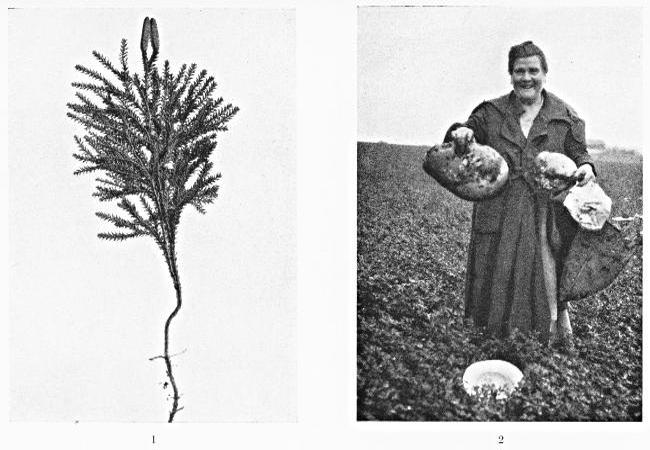
Ground Pine (Lycopodium obscurum L. var. dendroideum [Michx.]
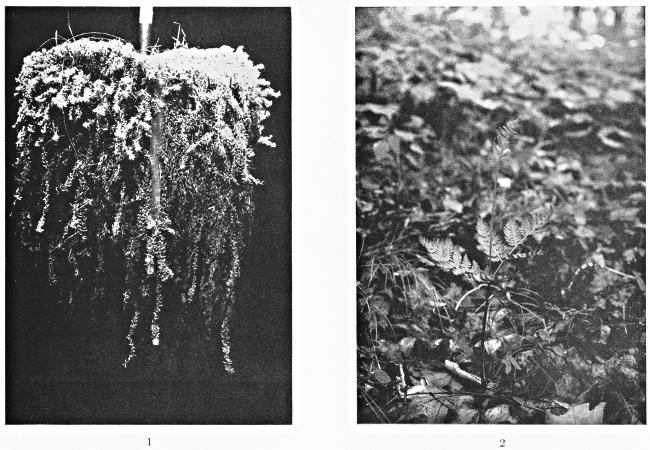
D. C. Eaton) “cigonaˈ gan” [evergreen], shown in plate 61, fig. 1.
The Flambeau Ojibwe use this plant in combination with Bush Honeysuckle
roots (Diervilla lonicera) as a diuretic. The spores are the
only part used by the white man for medicine. They are an antiseptic
dusting powder.
MENISPERMACEAE (MOONSEED FAMILY)
Canada Moonseed (Menispermum canadense L.), “bîmaˈ kwît
waˈ bîgons” [twisted pod or stick]. White Cloud, Pillager Ojibwe of
Bear Island, did not know the use of this root, but assured the writer
that other Ojibwe knew it and used it. Moonseed root is used by
eclectic practitioners as a tonic and alterative, and has been employed
as a substitute for Sarsaparilla.
MYRICACEAE (BAYBERRY FAMILY)
Sweet Fern (Myrica asplenifolia L.), “gibaimeˈ nûnaˈgwûs” [coverer].
Sweet fern is called “a coverer,” because it is used to line the
blueberry pails and cover the berries to keep them from spoiling. The
word is almost the same as that used by the Menomini and means
the same. The Flambeau Ojibwe consider the leaves too strong for a
beverage tea, but make a medicinal tea to cure the flux and cramps in
the stomach. The white man uses Sweet Fern as a stimulant and
astringent; sometimes using it to relieve colic and check diarrhea.
It has also been used in a fomentation to relieve rheumatic pains.
NYCTAGINACEAE (FOUR-O’CLOCK FAMILY)
Heart-leaved Umbrella-wort (Oxybaphus nyctagineus [Michx.]
Sweet) “gokoˈ coadjiˈ bîk” (pig root). The Pillager Ojibwe say that
the pig is fond of the roots of this plant because they are large and
succulent, hence call it “pig root”. The root is used by them to
reduce sprains and swellings. There is no record of its use among
the whites.
NYMPHAEACEAE (WATER LILY FAMILY)
Sweet White Water Lily (Castalia odorata [Ait.] Woodville &
Wood.), “odîteˈabûg waˈ bîgwûn” [flat heart leaf, white flower]. The
Flambeau Ojibwe use the root as a cough medicine for those who have
tuberculosis. The roots have been used by white men in the treatment
of diarrhea, dysentery and leucorrhea.
Yellow Water Lily (Nymphaea advena Ait.), “ogaˈ da mûn”
[standing on legs]. The Flambeau Ojibwe word is a bit different in
spelling but means the same as the Menomini word for this plant. The
Ojibwe call the leaves, “odîteˈabûg” [flat heart leaf]. The root is the
only medicinal part and is grated to make a poultice for sores. Other
ingredients such as Skunk Cabbage root are added to this poultice.
The Ojibwe gather goodly quantities of the large underwater stems;
which we are prone to call roots, dry them and reduce them to powder.
The powder alone is supposed to heal cuts and swellings. The roots
have been used by white men in the treatment of diarrhea, dysentery
and leucorrhea.
OLEACEAE (OLIVE FAMILY)
Red Ash (Fraxinus pennsylvanica Marsh), “aˈ gîmaˈk” [snow-shoe
wood]. The Pillager Ojibwe use the inner bark in combination with
other things for a tonic. The inner bark is official with white men as a
bitter tonic and astringent. It is also said to be valuable as an antiperiodic.
ONAGRACEAE (EVENING PRIMROSE FAMILY)
Great Willow-herb (Epilobium angustifolium L.), “oˈ ca cadjiˈ
bîkes” [slippery or soap root], shown in plate 69, fig. 2. The Flambeau
Ojibwe say that the outer rind of this root lathers in water and they
pound it to make a poultice. This is used to draw out inflammation
from a boil or a carbuncle. With white men, it is a demulcent, tonic
and astringent. It has been used internally for its tonic effect on
mucous surfaces and its value in intestinal disorders.
Evening Primrose (Oenothera biennis L.) While the Flambeau
Ojibwe have no Indian name for this, still they use the whole plant
soaked in warm water to make a poultice to heal bruises. Because
of its antispasmodic properties, the white man has used it internally
in the treatment of whooping cough, hiccough and spasmodic asthma.
OPHIOGLOSSACEAE (ADDER’S TONGUE FAMILY)
Virginia Grape Fern (Botrychium virginianum [L.] Sw.), “gîckênsîneˈ
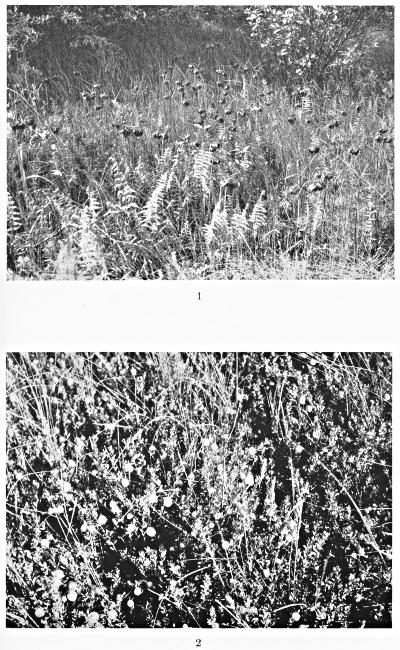
namûkûk” [man, squaw and baby], shown in plate 66, fig. 2.
John Peper, Pillager Ojibwe, hunted a long time for this plant around
Leech Lake, Minnesota, because his mother said it was good for lung
trouble and consumption. He called attention to the fact that one
always finds two stems together in the proper plant to use, which he
described as the man and squaw, with the little one or fruiting frond,
in the center. There is no record of its use by white men.
ORCHIDACEAE (ORCHIS FAMILY)
Yellow Ladies’ Slipper (Cypripedium parviflorum Salisb. var.
pubescens [Willd.] Knight), “maˈ kasîn” [moccasin].[115] Among the
Pillager Ojibwe, the root of this species is said to be a good remedy for
female troubles of all kinds. The white man has used it as a gentle
tonic for the nerves, a stimulant and antispasmodic, similar to Valerian,
only less powerful.
Rein Orchis (Habenaria bracteata [Willd.] R. Br.), “gokoˈcgûnda
mînêskweˈ mîn” [pig-woman enticer root]. The Ojibwe Pillager
would smuggle this into food as an aphrodisiac, which they considered
a bad use and not to be talked about or countenanced. There is no
record of its use by the white men.
Adder’s Mouth (Microstylis unifolia [Michx.] BSP.) “aîaˈ
nîkotciˈ mîn” [twisted berry]. The Flambeau Ojibwe use the tiny
root of this plant to mix with Bush Honeysuckle bark (Diervilla
lonicera) as a diuretic. There is no record of its use by white men.
PAPAVERACEAE (POPPY FAMILY)
Bloodroot (Sanguinaria canadensis L.)[116] “meskwaˈ djiˈ bîkûk”
[red root]. The Pillager Ojibwe use the orange-red juice of the Bloodroot
to cure sore throat. The juice is squeezed out on a lump of maple
sugar, and this is retained in the mouth until it has melted away. They
also use the juice to paint the face for the medicine lodge ceremony
or when on the warpath.
Sanguinaria is official only in the U. S. Pharmacopoeia, and in
small doses it produces a sense of warmth in the stomach and stimulates
gastric secretion. It is given as an expectorant and in larger
doses as an emetic.
PINACEAE (PINE FAMILY)
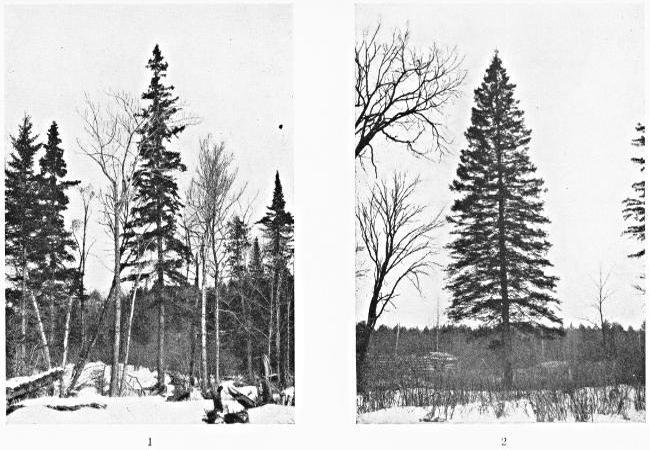
Balsam Fir (Abies balsamea [L.] Mill), “jîngoˈ b” [any kind of fir
tree name], shown in plate 62, fig. 1. While the Flambeau Ojibwe
call the tree “jîngoˈ b” as a short term, the full name of the Balsam
Fir according to them is “jîngoˈ b pîkewaˈ ndag”. They claim that the
liquid balsam is used direct from the bark blister upon the eyes, for
sore eyes. The leaves are a reviver or “abaˈ bûsûn” and are also used
in combinations as a wash. The Pillager Ojibwe call it “jîngoˈ bandag”,
and use the balsam gum for colds and to heal sores. This corresponds
to the way the Hudson Bay Indians use the bark. The
needle-like leaves are placed upon live coals and the smoke is inhaled
for colds. They are also used as a part of the medicine for the
sweat bath.
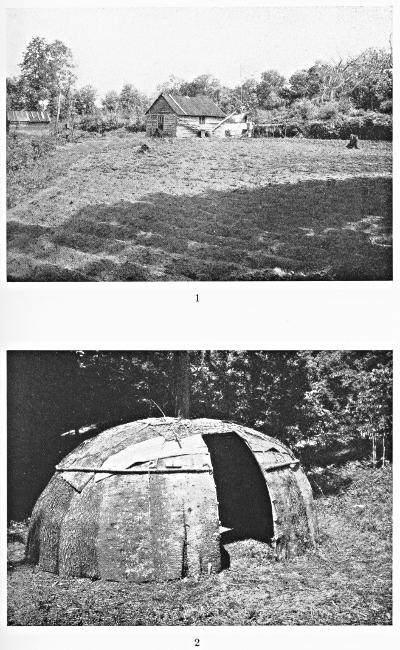
The sweat bath is taken in a small hemispherical wigwam, like
the regular abode, but entirely covered with mats or nowadays with
canvas. The medicines are coiled into wreaths to fit into large iron
kettles. Water is added and finally hot rocks which cause steam. The
Indian taking the sweat bath may be taking it for ceremonial reasons,
for cleansing, but most likely as a medicated steam bath. He sits
naked within until there is no more steam and his body is entirely
dried again. He then puts on all clean clothes and will not wear the
discarded clothes until they have all been thoroughly washed. The
candidate for degrees in the medicine lodge, must undergo the sweat
bath in a ceremonial way. Usual plants employed to medicate the
steam are White Pine leaves, Hemlock leaves, Arbor Vitae leaves,
Wild Bergamot plant, Balsam needles, Peppermint plants, and the like.
They are undoubtedly very beneficial to the health. Canada balsam
is accounted the same medicinally as turpentine, but its principal
value to the white man today is its perfect transparency and peculiar
optical properties, which fit it for use in mounting microscopic specimens.
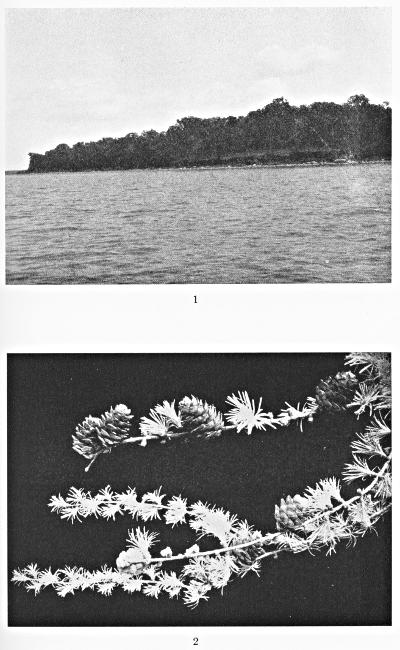
Tamarack (Larix laricina [Du Roi] Koch), “mûckîgwaˈ tîg”
[swamp tree], shown in plate 60, fig. 2. The Flambeau Ojibwe use the
dried leaves as an inhalant and fumigator, “nokweˈsîkûn”. Larch
bark has been highly valued in the past in chronic bronchitis with profuse
expectoration, in chronic inflammation of the urinary passages,
and in phases of hemorrhage.
White Spruce (Picea canadensis [Mill.] BSP.), “gawaˈ ndag”,
shown in plate 62, fig. 2. The leaves of White Spruce are used in the
same manner as Larch, as a “nokweˈsîkûn”, an inhalant or fumigator.
The needle oil is considered about the same as turpentine, by white
men.
Black Spruce (Picea mariana [Mill.] BSP.), “jingwûp”. If the
bark is meant as a medicinal salt, then its name is “jingwûˈ p gawaˈ
ndag” but if the leaves are the part meant for a reviver, “aba busun”,
then it carries only the name “jingwup”. The needle oil is used by
white men the same as turpentine.
Jack Pine (Pinus banksiana Lamb.), “gîgaˈ ndag”. The leaves
are used as a reviver,—“nokweˈ sîkûn” according to the Flambeau
Ojibwe. There is no record of its medicinal use by the white men.
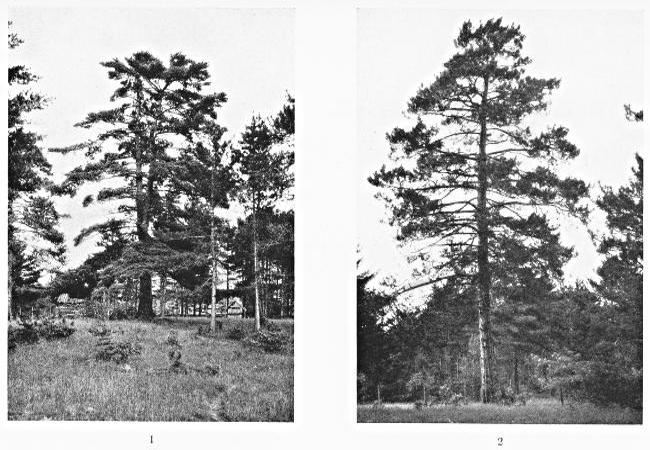
Norway Pine (Pinus resinosa Ait.), “abakwanûg iˈmûg” [bark
in plates], shown in plate 63, fig. 2. The Norway Pine is used in all
particulars by the Flambeau Ojibwe, just as the White Pine.
White Pine (Pinus strobus L.), “jîngwak kweseskweˈ tûk” according
to Bearskin of the Flambeau Ojibwe, shown in plate 63, fig. 1,
“jîngwak waceskweˈdo” according to Charley Burns of the Flambeau
Ojibwe. The bark medicine is, “jîngwak onaˈ gêk” and is gathered
in the same manner as by the Menomini, with a song to grandmother
Earth, and the placing of tobacco on the ground. The cones, when
boiled and likewise the bark of the young tree trunk yield a
pitch which is medicine, called “jîngwak bûgîo.” The dried leaves
are powdered and used as a reviver or inhalant. There are three names
referring to this sort of treatment, as said before,—“nokweˈ sîkûn”,
“sasaˈ bîkwat” and “abaˈ bûsûn”. Of these three terms, “sasaˈ bîkwat”
is the proper one to use when White Pine needles are employed in this
manner. White Pine is a very valuable remedy with all Ojibwe, but
Norway Pine is sometimes substituted for it. White Pine bark is
used in making cough syrup, by white men, but it possesses only
feeble properties as an expectorant.
Arbor Vitae (Thuja occidentalis L.), “giˈ jîkandag” [sky or cedar
tree].[117] The Flambeau Ojibwe use the leaves as a perfume, “abaˈ
bûsûn” and also as a tea for headache. During ceremonies of the
medicine lodge, it is necessary to purify sacred objects and the hands
and persons of participants. A plate of live coals is used and dried
Arbor Vitae leaves placed upon them. The servitor wafts the incense
over sacred objects by fanning the smoke with his hands. Others
hold their hands over and in the smoke, waving it upon their persons.
The Pillager Ojibwe call it by the simple name “giˈ jîk” [sky or
cedar]. They also use it as a purifying incense, and as an ingredient
for the sweat bath with White Pine, Balsam, Hemlock and other
plants. They drink the boiled leaves claiming that the steam goes
through the blood and purifies it. This treatment cures coughs.
The U. S. Pharmacopoeia formerly required that leaves for medicinal
use be in a fresh state but the new formulary only requires them
to be recently dried and leafy. Internally it has been used for an
emmenagogue, for fevers, bronchial catarrh, rheumatism and to remove
intestinal worms. Externally it is applied in ointment to treat
ulcers, warts and cancerous growths.
Hemlock (Tsuga canadensis [L.] Carr.), “gagagiˈ wîc” [raven
tree]. The Flambeau Ojibwe medicine man puts the leaves in his
medicinal tea to disguise the taste. The bark is used for healing
cuts and wounds, and for stopping the flow of blood from a wound.
The bark is rich in tannin and naturally quite astringent. White men
have used the bark and its resulting pitch as substitutes for burgundy
pitch in making plasters. These have been used as external remedies
for lumbago, chronic rheumatic pains, chronic bronchitis and pleurisy.
PLANTAGINACEAE (PLANTAIN FAMILY)
Common Plantain (Plantago major L.), “cecaˈ gûskiˈ bûge
sînk” [leaves grow up and also lie flat on the ground].[118] The Flambeau
Ojibwe soak the leaves in warm water then bind them on bruises,
sprains or sores as a poultice. It is also a healing and soothing remedy
for burns, scalds, bee stings, and snake bites. The Flambeau Ojibwe
also refer to it as “pakwan”. The Pillager Ojibwe use it in the same
manner but call it “jimûckiˈ gobûg” [sort of swamp leaf]. Although
plantain is a feeble remedy, it has been ascribed potency in many
diseases by eclectic practitioners. They still use it to some extent
in treating inflammation of the skin, malignant ulcers, intermittent
fevers, etc. The leaves are of some value in arresting hemorrhages
when applied to the bleeding surfaces. The writer cured a badly
swollen and lacerated hand, which swelled to three times its normal
size, probably because dirt from a sewer was ground into it, with the
simple leaf bound upon the hand.
POLYGONACEAE (BUCKWHEAT FAMILY)
Carey’s Persicaria (Polygonum careyi Olney). The Ojibwe have
no name or use for this, nor have white men.
Swamp Persicaria (Polygonum muhlenbergii [Meisn.] Wats.),
“agoñgoˈ simînûn” [chipmunk berries]. The Flambeau Ojibwe use
this plant for a tea to cure a pain in the stomach. It is also hunting
medicine. Several of the polygonums have been used by eclectic
practitioners for their astringent properties.
Curled Dock (Rumex crispus L.) “ciˈobûg” [twisted leaf]. The
Flambeau Ojibwe use the root, which contains considerable tannin,
for closing and healing cuts. White men have used it for its astringent
properties.
POLYPODIACEAE (FERN FAMILY)
Shield Fern (Aspidium cristatum [L.] Sw.), “anaˈ ganûck” [fern].
The Flambeau Ojibwe use the root tea for stomach trouble. Among
the white men, this fern has been found to have almost the same value
as Male Fern as a teniafuge. Great care is exercised in the size of the
dose and to see that no part of the drug remains in the system after
it has performed its task of killing intestinal worms, as fatalities have
been known to occur.
Female Fern (Asplenium filix-femina [L.] Bernh.), “anaˈ ganûck”
[fern]. The Flambeau Ojibwe grate the dry root into a powder which
is used as a healing powder for sores. The Pillager Ojibwe call it
“nokomiˈ skînûn” [grandmother?]. The root is made into a tea to
cause milk flow in patients with caked breast. There is a record of
its medicinal use by white men to alleviate backache.
Sensitive Fern (Onoclea sensibilis L.), “aˈ nanaˈ ganûck” [fern].
The Pillager Ojibwe powder the dry root, and make a tea to give the
patient whose breasts are caked, to stimulate the flow of milk. There
is no record of its medicinal use by white men.
Brake (Pteris aquilina L.), “anaˈ ganûck” [general fern name].
This is the general name of the bracken fern, where used for food.
When used for medicine, it is called by the Flambeau Ojibwe—“makateˈ
wa anaˈ ganûck” [black fern], and the root is made into tea to
alleviate cramps in the stomach. It is only used by the women for
this purpose. The dried leaves are smoked upon live coals to relieve
a headache. Under the name “aˈ nanaganaˈ wûck” the root is used
by the Pillager Ojibwe in the same manner as by the Flambeau Ojibwe.
White men have considered this root to be pectoral, demulcent, purgative
and anthelmintic. A syrup solution is used in pulmonary and
hepatic diseases. A strong decoction is used to expel worms.
PRIMULACEAE (PRIMROSE FAMILY)
So far as is known, none of the Primrose family is used by the
Ojibwe for medicine. The Pillager Ojibwe did not know the Tufted
Loosestrife (Lysimachia thyrsiflora L.).
RANUNCULACEAE (CROWFOOT FAMILY)
Red Baneberry (Actaea rubra [Ait.] Willd.), “wîckobidjiˈbîk”
[sweet root], shown in plate 76, fig. 1. The Pillager Ojibwe make a
tea from the root, to be drunk by women after childbirth. It is to
clear up the system. A man also eats the root for stomach troubles.
White men use the root as a substitute for Black Cohosh (Cimicifuga
racemosa), which it resembles in appearances and properties. It has
been used in treating ovarian neuralgia, uterine tenderness, subinvolution,
and amenorrhea. It has also been used as a substitute for
digitalis in fatty or irritable heart, but only after other remedies
have failed. Headache due to eyestrain has also been cured by this
root.
Canada Anemone (Anemone canadensis L.), “mîdewidjiˈ bîk”
[medicine lodge root], shown in plate 74, fig. 2. The Pillager Ojibwe
eat the root of this plant to clear the throat so they can sing well in
the medicine lodge ceremony,—a sort of throat lozenge. Most of the
anemones have been substituted for Pulsatilla and used for the same
host of diseases by eclectic practitioners. Included in these ailments
are: cataract, paralysis, rheumatism, melancholia, syphilis, dysmenorrhea,
and many other morbid conditions.
Thimble-weed (Anemone cylindrica Gray.), “gande gwaˈ soninkeˈ
cînagwûk” [looks like tumble-weed]. The Flambeau Ojibwe
use the root for making a tea to relieve lung congestion and tuberculosis.
Among the white men it has the same uses as Canada Anemone.
Wild Columbine (Aquilegia canadensis L.), shown in plate 74,
fig. 1. The Pillager Ojibwe have no name for this plant, but the root
is considered a good medicine for stomach trouble. Eclectic practitioners
consider it a diuretic, diaphoretic, and antiscorbutic, using
it in jaundice, in smallpox to promote eruption, and in scurvy.
Goldthread (Coptis trifolia [L.] Salisb.), “wesa waˈ nikweˈak”
[yellow?] and “wesa wadjiˈbîkweˈak” [yellow root], shown in plate 75,
fig. 1. The Flambeau Ojibwe use the decoction of the root to soothe
and heal the baby’s gums while it is teething. It is also used as a
mouth wash for adults when their mouths are sore. This use has
been adopted by white men, who also use it in dyspepsia and chronic
inflammation of the stomach.
Bristly Crowfoot (Ranunculus pennsylvanicus L. f.), “manweˈ
gons”. The seeds are a hunting medicine with the Flambeau Ojibwe.
Several of the Ranunculaceae have been used as counter-irritants by
the white men.
Cursed Crowfoot (Ranunculus sceleratus L.). The Pillager Ojibwe
do not know this plant, and have no name for it. Eclectic practitioners
have used it as a counter-irritant.
Purple Meadow Rue (Thalictrum dasycarpum Fisch. & Lall.),
shown in plate 73, fig. 1. The Pillager Ojibwe have no Indian name for
this, but use the root to make a tea to reduce fever. The properties
of this root are considered almost identical with Berberis, which is
used by white men as a tonic, stimulant and antiperiodic.
ROSACEAE (ROSE FAMILY)
Agrimony (Agrimonia gryposepala Wallr.), “sagaˈ tîgans” [seeds
stick], shown in plate 77, fig. 1. The Flambeau Ojibwe use the root
with other ingredients as a medicine for urinary troubles. It is not
much valued now by white men, although it has been used for its
bitter astringent properties.
Smooth Juneberry (Amelanchier laevis Wiegand), “gozigaˈgominagaˈwûnj”
[thorny wood][119] according to John Whitefeather,
Flambeau Ojibwe, and “bîsegaˈgomînagaˈwûnj” according to Charley
Burns, another Flambeau Ojibwe who said that the bark was used
for medicine, but he did not know what it was to treat. The Pillager
Ojibwe call it “gozigaˈgomînûk” and say that the bark is to make a
tea for the expectant mother. There is no record of its medicinal use
by white men.
Hawthorn (Crataegus sp.), “mînesagaˈ wûnj” [berries and thorn
bush], shown in plate 77, fig. 2. The Flambeau Ojibwe use both the
fruit and the bark for medicine, a kind not made now, other than for
women. Eclectic practitioners have used the berries for their astringent
and reputed cardiac properties.
Wild Strawberry (Fragaria virginiana Duchesne), “odeˈ imînîdjiˈ
bîk,” [heart berry root].[120] The root of the common Wild Strawberry
is used to make a tea good for the stomach-ache, and especially
for babies. The white man uses the herb as an astringent and tonic
for convalescents and especially for children having bowel and bladder
weakness.
Large-leaved Avens (Geum macrophyllum Willd.), “wicaˈwasaˈ
konek” [yellow light]. The Flambeau Ojibwe use this for a female
remedy. Eclectic practitioners consider the root tonic and astringent.
Rough Cinquefoil (Potentilla monspeliensis L.), “tcodeˈ imînagaˈ
wûnj” [like a strawberry]. This plant seemed to be known to all the
Pillager Ojibwe, even the eight-year-old girls, as a physic. There
is no record of its use as a medicine by white men.
Marsh Five-finger (Potentilla palustris [L.] Scop.), “bebaˈ akwûndek”
[floats about]. This was dug from the water by John Whitefeather’s
wife, Flambeau Ojibwe, who said it was a cure for cramps
in the stomach, and is used alone as one medicine. Under the Pillager
Ojibwe name of “mûckiˈ godjiˈbîk” [swamp root], John Peper
said that it was medicine with them, but he did not know how to use
it. There is no record of its use as medicine by white men.
Pin Cherry (Prunus pennsylvanica L. f.), “baeˈwimînûn”. The
inner bark is a valued remedy for coughs. Most of the species of
cherry have been used by white men for the bitter principle contained,
which suits it for use as a stomachic and bitter tonic in gastric atony
and general debility. The syrup of wild cherry has been used as a
pleasant vehicle for other drugs.
Wild Cherry (Prunus serotina Ehrh.) “okweˈ mîn” [worm out of
a fly’s egg; refers to the little worms in a cherry when it is ripe].[121] The
Flambeau Ojibwe value the bark of this species to make a tea as a
remedy for coughs and colds. It is used the same as Pin Cherry by
white men.
Choke Cherry (Prunus virginiana L.), “aˈ sasaweˈ mînagaˈ
wûnj.”[122] The Pillager Ojibwe make a tea for lung trouble from the
inner bark. This is the official bark in the pharmacopoeia, which is
used as a stomachic and bitter tonic useful in gastric atony and general
debility. Wild cherry syrup is used to mask other unpleasant drugs.
Smooth Rose (Rosa blanda Ait.), “ogîneˈ mînagaˈ ons” [rose
berries].[123] The Pillager Ojibwe use the skin of the fruit or “rose hip”
for stomach trouble. The Flambeau Ojibwe call it “ogîni” or “ogîniˈ
gawûnj” [rose berries]. They dry and powder the flowers for use in relieving
heartburn. The skin of the rose hips is a medicine for indigestion.
Rose hips are described by white men as refrigerant and astringent,
but are only used in medicine to prepare the confection of hips. Roses
are used almost wholly today to impart their pleasant odor to pharmaceutical
preparations.
High Bush Blackberry (Rubus allegheniensis Porter), “oˈdatagaˈ
gomîc” [its name].[124] The Flambeau Ojibwe boil the canes to obtain
a tea that is used as a diuretic. The roots furnish a tea for arresting
flux. Blackberry and Dewberry root are official in the U. S. Pharmacopoeia
because of their tonic and astringent properties. They are
favorite household remedies among white men in the treatment of summer
diarrhea of children and adults. Blackberry cordial is often used
for the same purpose.
Red Raspberry (Rubus idaeus L. aculeatissimus [C. A. Mey]
Regel & Tiling) “meskwaˈ mînagaˈ wûnj” [red bush berry]. The
Flambeau Ojibwe value the berries as a seasoner for their medicines.
That is, the flavor is used to disguise less pleasant ingredients. The
root bark makes a tea for healing sore eyes. Under the name Rubi
Idei Fructus, N. F. white men use the berries for making an agreeable
syrup as a vehicle for less pleasant tasting medicines. When the
Red Raspberry is not readily available the Black Cap Raspberry
is used in the same manner.
Meadow-sweet (Spiraea salicifolia L.), “wabûckîkiˈ bug” [rabbit
leaf]. The Flambeau Ojibwe use the root as a trapping medicine.
There is no record of its use by the white man.
Steeple Bush (Spiraea tomentosa L.), “memîsgwûˈnagûg” [squaws’
drink]. The Flambeau Ojibwe make a tea from the leaves and flowers
of the Steeple Bush to drink for the sickness of pregnancy and to act
as an easy parturient. The whites have used the root and the leaves as
an astringent and tonic, in diarrhea, hemorrhages, gonorrhea, ulcers,
etc.
RUBIACEAE (MADDER FAMILY)
Goose Grass (Galium aparine L.), “sakateˈ bwi” [stickers].
The whole plant is used by the Pillager Ojibwe to make a tea used for
a diuretic, in kidney trouble, gravel, stoppage of urine, and allied
ailments. Other species are used in much the same way and for the
same purposes. White men have recognized it as a valuable refrigerant
and diuretic, and have found it useful in diseases of the urinary
organs. It is not recommended for diseases of a passive character,
on account of its refrigerant and sedative effects, but is used freely
in fevers and all acute diseases.
Small Cleaver (Galium tinctorium L.), “waboskîkiˈ mînûn”
[rabbit swamp berries]. The Flambeau Ojibwe make a medicinal
tea from the whole plant, for its beneficial effect upon the respiratory
organs. Eclectic practitioners have used it for its nervine, antispasmodic,
expectorant and diaphoretic properties. It has been successfully
used in asthma, cough, and chronic bronchitis. The plant has a
pungent, aromatic, pleasant, persistent taste.
Small Bedstraw (Galium trifidum L.), “ojîbweˈ oweˈ cûwûn”,
[ojibwe male genitalia]. The Pillager Ojibwe make a medicinal tea
of this species for skin diseases such as eczema, ringworm and scrofula.
White men undoubtedly use it in much the same way as the preceding
species through error in identifying it correctly.
RUTACEAE (RUE FAMILY)
Prickly Ash (Zanthoxylum americanum Mill.), “gawaˈ kumîc”,[125]
[its name]. Both Flambeau and Pillager Ojibwe make trips further
south to get this bark, since none of the trees grow near them. They
want it for treating quinsy and sore throat. They say that even the
berries are good for a hot tea to treat sore throat, and also to use as a
spray on the chest to cool and relieve congestion in bronchitis. Among
the white men, it is considered a stimulant, tonic, alterative and
sialagogue and is used for chronic rheumatism, colic, syphilis, and
hepatic derangements.
SALICACEAE (WILLOW FAMILY)
Balsam Poplar (Populus balsamifera L.), “manasaˈ di” [perfume
poplar]. The Pillager Ojibwe cook the buds of the Balsam Poplar
in lard or bear fat, and use the cold product for a salve on cuts, wounds
or bruises. They also rub it on the inside of the nostrils, so that the
balsamic odors can course through the respiratory passages and open
them in case of congestion from cold, catarrh or bronchitis. Poplar
buds are also official with white men who use them as a stimulating
expectorant, and in the form of an ointment in treating sluggish ulcers
and sores. Eclectic practitioners have used tinctures of the buds for
stomach and kidney treatment and in scurvy and rheumatism, and
sometimes, apply it to the chest. The bark is used by white men for
a tonic and cathartic, of service in gout and rheumatism.
Large-toothed Aspen (Populus grandidentata Michx.), “asadi”
[bitter bark]. The Flambeau Ojibwe use the young roots of this tree in
a tea as a hemostatic. There is no record of its use by the whites.
Quaking Aspen (Populus tremuloides Michx.), “asadi” [poplar].
The Flambeau Ojibwe give this tree the same name as the Large-toothed
Aspen. They use the bark of a young trunk for poulticing cuts and
wounds. The astringent salacin in the inner bark undoubtedly draws
the cuts together and causes healing. The Pillager Ojibwe distinguish
the tree with a slightly different name, “asadins”, the diminutive of
“asadi”, meaning “little poplar”. They use the inner bark for poulticing
a sore arm or leg, and make the inner layer of their splints
of the inner bark so that a broken limb may heal healthily.
Eclectic practitioners use both bark and leaves in treating acute
rheumatism, also to lower the temperature in fevers, to relieve pain
and reduce arterial swellings, colds, hay fever, influenza, neuralgia
and diabetes. Externally the whites have used it as a wash for gangrenous
wounds, eczema, cancer, burns, and body odor.
Crack Willow (Salix fragilis L.), “sizigoˈ bimîc” [willow name].
This tree has escaped from cultivation around the water-courses of
the Flambeau Reservation and has been accepted by the Ojibwe there
as efficacious along with the native willows. The bark is astringent
from its salacin content and is used as a styptic and poultice for sores.
Willow bark was formerly employed by physicians among the whites
as a stomachic and antiperiodic in the treatment of intermittents,
but is rarely used today.
Shining Willow (Salix lucida Muhl.), “zigoˈ bamîc”. The Pillager
Ojibwe use the bark of this species as an external remedy for
sores. The Ojibwe do not generally distinguish any particular willow
with any other name, but Whitefeather, Flambeau Ojibwe, called this
species “mûckigoˈ bamîc” [swamp tree] and said it was used on a
cut to stop the bleeding, and that the bark was also a poultice material
for sores. Other Flambeau Ojibwe called it “sizigoˈ bamîc”, but it
was generally noticed that in that latitude the Shining Willow was invariably
found in swamps, and not along streams, so there is justification
for Whitefeather’s name. Among the whites, this bark was
used formerly as a stomachic and antiperiodic.
Bog Willow (Salix pedicellaris Pursh.), “sizigoˈ bamîc”. This
is a species of the cold bogs and meadows found far up toward the
Arctic Circle. While the Pillager Ojibwe did not give it a distinctive
name, they said it was not used for bark to smoke, but for bark to
treat stomach trouble. There is no record of its use by whites.
SARRACENIACEAE (PITCHER-PLANT FAMILY)
Pitcher-plant (Sarracenia purpurea L.), “oˈ makakiˈ wîdass”
[frog’s leggins], as shown in plate 67, fig. 1. Bearskin, Flambeau
Ojibwe medicine man had a slight variant in pronouncing this—“oˈ
makakiˈ odass”. He said that the root is used to make a tea to
help a woman accomplish parturition. Eclectic practitioners used
the whole plant to make a tea for a tonic, stimulant, diuretic and
laxative.
SAXIFRAGACEAE (SAXIFRAGE FAMILY)
Wild Red Currant (Ribes triste Pall.), “mîciˈ tcimînûk.” The
Flambeau Ojibwe use the leaves as some sort of a female remedy.
There is no record of its use by the whites.
SCROPHULARIACEAE (FIGWORT FAMILY)
Butter and Eggs (Linaria vulgaris Hill.), “owacawaˈ skwûneg”
[yellow light]. The whole plant is dried by the Flambeau Ojibwe and
used in the kettle with other foliage and twigs as a bronchial inhalant
in the sweat lodge. The Ojibwe name for medicine to be inhaled is
“nokweˈsîkûn” which sounds much like the Menomini Indian name
for the same thing,—“naˈ sîkon”. The eclectic practitioners claimed
that the plant is diuretic, and cathartic, using it in dropsy, jaundice,
and cutaneous eruptions. The fresh plant was sometimes used as a
poultice for hemorrhoidal tumors, and an ointment was made of
the fresh flowers for the same purpose and to use locally in diseases
of the skin. In Germany, the flowers were used for a yellow dye.
Cow Wheat (Melampyrum lineare Lam.), “agoñgasiˈ mînûk”
[chipmunk berries]. The Flambeau Ojibwe say that this plant is
made into a tea, which is a “little medicine for the eyes”. There is
no record of its medicinal use by the whites.
Wood Betony (Pedicularis canadensis L.), “mandamîˈ nîodjiˈ
bîkîns” [little corn root]. According to John Peper, Pillager Ojibwe,
this root was a bad kind of medicine, an aphrodisiac, when cut fine
and placed in some dish of food without the knowledge of those who
were going to eat it. There is no record of its medicinal use by the
whites.
Mullein (Verbascum thapsus L.). The Flambeau Ojibwe have
no name for this since it has come into their territory from the south
and they do not use it. The writer has gathered this for his grandmother
who smoked the leaves for relieving asthma and bronchitis.
The flowers are supposed to have diuretic properties and have been
used in the treatment of tuberculosis.
THYMELEACEAE (MEZEREUM FAMILY)
Moosewood (Dirca palustris L.), “djibeˈ gûb” [djibe means a
dead person, or ghost or spirit]. The bark of Moosewood is very soft,
strong and elastic, so that twigs can be tied into knots. The Pillager
Ojibwe say that all their people use it as a tea for a diuretic. The
bark is sometimes substituted for Mezereum bark, which is official in
the U. S. pharmacopoeia. It is usually used in a compound decoction
with sarsaparilla for chronic skin diseases, and syphilitic, rheumatic
and scrofulous conditions. As an external ointment, it was used for a
stimulant to foul or ill-conditioned ulcers.
TYPHACEAE (CAT-TAIL FAMILY)
Cat-tail (Typha latifolia L.), “bebamasûˈn” [it flies around]. The
Flambeau Ojibwe used the fuzz of the fruit for a war medicine. They
claim that the fuzz thrown into an enemy’s face will blind him.
UMBELLIFERAE (PARSLEY FAMILY)
Musquash Root (Cicuta maculata L.), “apagwasîˈgons”. The
Pillager Ojibwe say that this root is used a little in their medicine,
but did not know just how. It was smoked in hunting.
Cow Parsnip (Heracleum lanatum Michx.) “piˈ pîgweˈ wanûck”
[flute stem].[126] The Pillager Ojibwe pound the fresh root and apply
it as a poultice to cure sores. The fresh leaves and root are known to
produce vesication or blisters by the whites, and therefore have been
used by them as counter-irritants. The root has been used by eclectic
practitioners to cure epilepsy. In infusions, it is thought to cure
dyspeptic disorders.
Sweet Cicely (Osmorhiza longistylis [Torr.] D. C.), “osagaˈ tîkûm”
[interlaced twigs]. The same name was applied by the Pillager Ojibwe
to O. claytoni, and evidently they did not distinguish between the
two species. A tea for making parturition easier is prepared from the
roots. The liquorice flavor of the tea is said to be good for a sore
throat.
Wild Parsnip (Pastinaca sativa L.), “pigweˈwûnûsk” [flute stem].
The Pillager Ojibwe are quite cautious in using this poisonous root.
They claim that a little bit is very powerful, while much is poisonous.
They use a very minute quantity mixed with four other kinds of
roots to make a medicinal tea for female troubles. There is no record
of its medicinal use by the whites.
Black Snakeroot (Sanicula marilandica L.), “masan” [from the
woods]. The Flambeau Ojibwe use the root pounded as a poultice
to cure rattlesnake bite or any snake bite. Bearskin, chief Flambeau
medicine man said that if this root be chewed, it would cause eruptions
on the epithelial lining of the mouth. They consider it a very
potent remedy. The Pillager Ojibwe call it “gîneˈbîg odjiˈ bîk”
[snake root] and make a root tea that is used to cure fevers of various
kinds. Eclectic practitioners have accredited it with active aromatic,
bitter principles. They have used it in intermittent fevers, sore throat,
erysipelas and cutaneous affections. It has been also used for St.
Vitus dance and other nervous affections.
URTICACEAE (NETTLE FAMILY)
Hop (Humulus lupulus L.), “jiwîˈcgoniˈbûg”. The Pillager Ojibwe
use the common hop to make a tea which acts like saleratus on
the system, increasing the excresence of urine and reducing its acidity.
It is official in the U. S. pharmacopoeia as a tonic, diuretic, sedative
and somewhat anaphrodisiac.
Wood Nettle (Laportea canadensis [L.] Gaud.), “masaˈnatîk”
[forest wood]. The Pillager Ojibwe use the root to make a medicinal
tea for its diuretic properties. It is said to cure various urinary ailments.
Eclectic practitioners have considered it tonic, astringent
and diuretic. They use both roots and leaves. The seeds and flowers
are given in wine for the ague.
Slippery Elm (Ulmus fulva Michx.), “anib”. The Pillager Ojibwe
use the slippery inner bark for sore throat, especially when the
throat is apt to be dry. Slippery Elm is official in the U. S. pharmacopoeia
as a demulcent, emollient and nutritive. It is considered
useful internally for dysentery, diarrhea and bronchitis. Pounded
bark for poultices has been used for boils and inflammations, and in
compounding suppositories.
Lyall’s Nettle (Urtica lyallii Wats.), “masan” [woods]. The
Flambeau Ojibwe use only the leaves as medicine. These are soaked
in warm water and used as a poultice for heat rashes. It is something
like fighting fire with fire. Among the whites, nettles are known for
their powerful and peculiar diuretic properties.
VIOLACEAE (VIOLET FAMILY)
Canada Violet (Viola canadensis L.) Although a common
violet in the territory of the Pillager Ojibwe, they claimed to have no
name or use for it. It was formerly used by eclectic practitioners as a
blood purifier and as a remedy in chronic affections of the lungs, and
in skin diseases, but is no longer used.
American Dog Violet (Viola conspersa Reichenb.), “wewaîeˈ
bûgûg”. The whole plant is used by the Flambeau Ojibwe to make
a tea for heart trouble. The whole plants have been used among the
whites as alterative and expectorant remedies. They were said to be
useful in skin diseases, scrofula, syphilis and bronchitis.
VITACEAE (VINE FAMILY)
River-bank Grape (Vitis vulpina L.), “ciˈwî mînûn” or “ciwî
mînaga wûnj”, shown in plate 70, fig. 2. The Pillager Ojibwe used a
tea of boiled twigs for women to drink to clear up afterbirth and enable
it to pass easily. They use the sap as a medicine for stomach and
bowel trouble. Among the whites, the tender branchlets and leaves
were sometimes employed for their agreeable acidulous flavor.