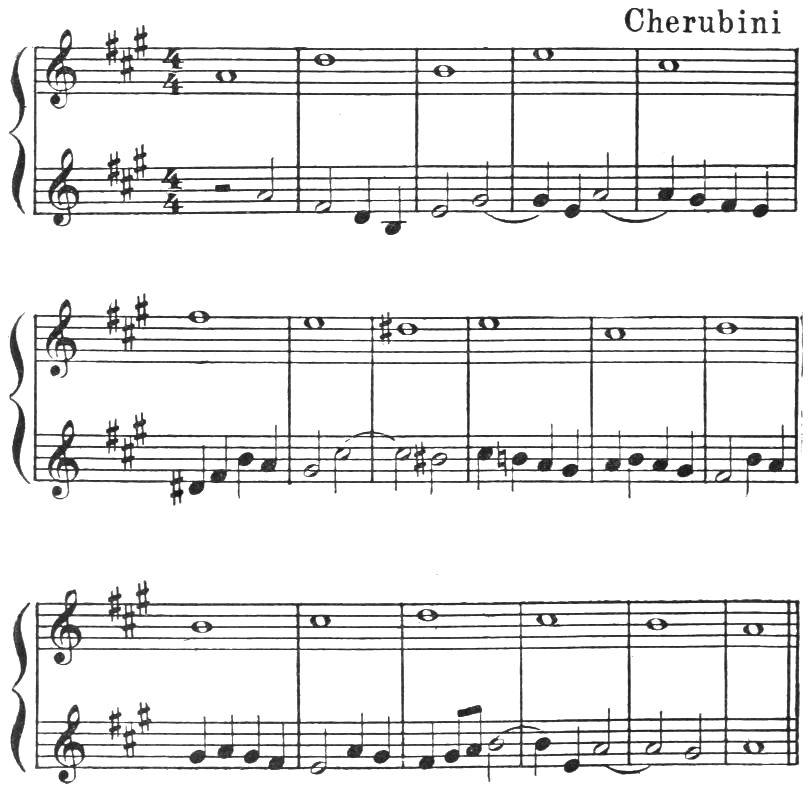
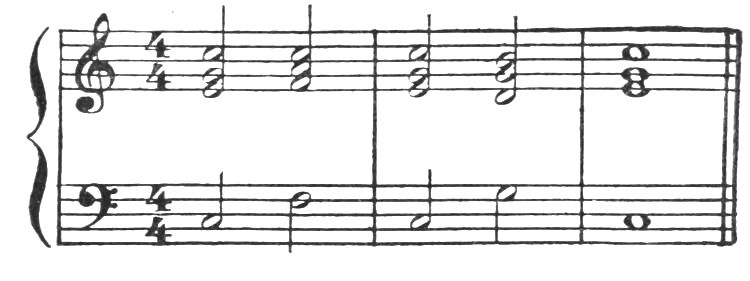
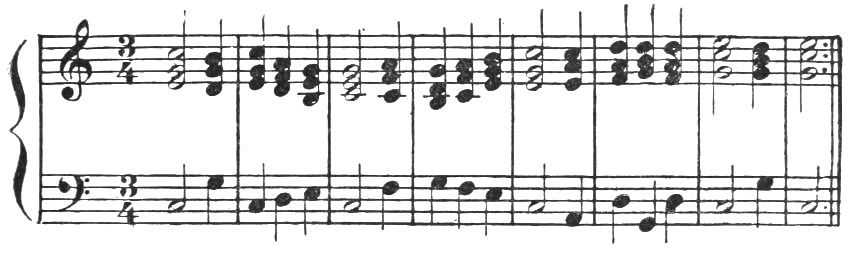
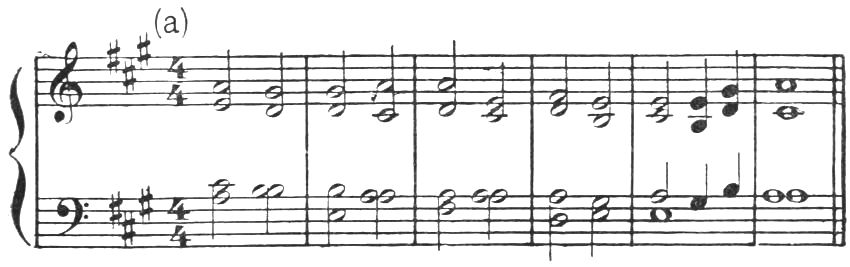
The natural sign inline does not appear in ADE readers, so I have used the ⊄ mathematical symbol instead. Flats and sharps have been created for the ADE reader for inline use. Mathematical symbols have been used instead of the ties and square shapes as shown in the book.
BY
CARL E. GARDNER
AUTHOROF "MUSIC COMPOSITION"
NEW YORK
CARL FISCHER
1912
COPYRIGHT, 1912,
BY
CARL FISCHER
International Copyright Secured
PREFACE.
THE primary object in the following pages is to supply
the teacher and student with a text book to accompany
the work on instrumental or vocal technic. Because
of the great amount of time required to obtain proficient
technic, text books are often neglected, and, if exhaustive,
are usually ignored. Brevity and conciseness characterize
this volume and it is planned to meet the needs of the busy
teacher and student.
Many pupils may not see the importance of some of the
following text, such as the research for theoretical keys; but
the results thus obtained are nothing more than the natural
outcome of simple mathematical reasoning, and are inevitable
if the structure of the scales is understood. Pupils
should be impressed with the structure of scales rather than
be taught their keys and signatures by rote. Rote methods
have little to recommend them in modern pedagogical ideals,
and are used principally in teaching the young. The lack
of knowledge of the whys and wherefores of scales, intervals,
and chords among instrumentalists and singers is appalling,
and is due partly to the neglect of text books and partly to
incompetent teachers.
A further object of the text is to offer a course of preparation
for the study of harmony, composition, and appreciation.
Music Appreciation, as a cultural course of study, is growing
in popularity and large enthusiastic classes in this subject
are to be found in all our colleges. These students
are frequently handicapped by poor preparation in the
essential rudiments of music such as are treated in this
volume.
The author's gratitude for valuable aid, criticisms, and
suggestions is due his wife, Marion Dillon Gardner, and his
sisters, Mabel Gardner Bankart and Lena Gardner Lewis.
Sound is the effect produced by propagated atmospheric
waves which affect the sense of hearing. Irregular impulses,
propagated through the air, produce noise. Regular impulses
produce musical tone.
The duration of tone is indicated by symbols called notes.
Following is a list of notes:—
or
Double whole note or Breve.
Whole note or Semibreve.
Half note or Minim.
Quarter note or Crotchet.
Eighth note or Quaver.
Sixteenth note or Semiquaver.
Thirty-second note or Demisemiquaver.
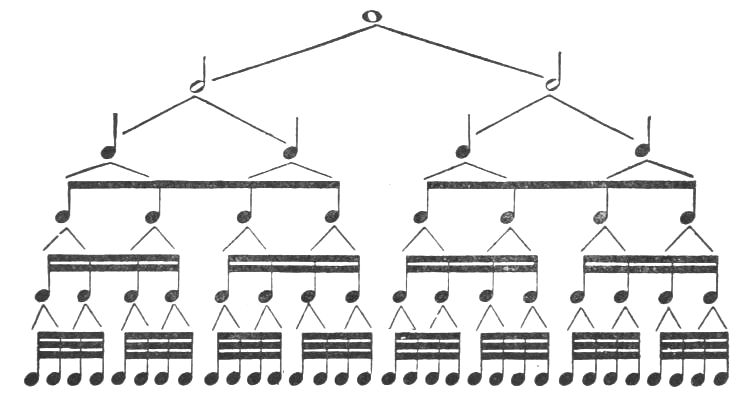
Occasionally the sixty-fourth note is used. Following
is a table of the relative value of notes:—
The breve or double whole note is not given in this table
as it is but seldom used. The value of it is twice the whole
note, four times the half, etc.
The whole note is represented by an open oval; the half,
by an open oval and stem; the quarter, by a closed head and
stem; the eighth note is the same as the quarter with a flag;
the sixteenth, the same with two flags; the thirty-second, the
same with three flags. As is seen in the table, the eighth, sixteenth
and thirty-second notes are often grouped when more
than one occurs in succession.
Suspension of tone is indicated by symbols called rests.
Each note has its equivalent rest. Following is a list of
rests:—
Double whole rest.
Whole rest.
Half rest.
Quarter rest.
Eighth rest.
Sixteenth rest.
Thirty-second rest.
The rate of vibration is called pitch. Rapid vibrations
produce "high" (shrill) tones. Slow vibrations produce
"low" tones. More complete information on sound, tone
and pitch is given later under the heading "Acoustics."
The notes are written on the staff which consists of five
horizontal lines together with their spaces. The duration of
a tone is determined by the note used; the pitch, by the note's
position on the staff.
A dot placed after a note or rest adds one half its value.
A "tie" is a curved line connecting two notes of the same
pitch. Examples of dots and ties:—
equals
or 1 + 12.
equals
or 12 + 14. equals
or 14 + 18.
etc., etc.
A double dot adds one half and one fourth its value, thus:—
equals
or 1 + 12 + 14. equals
or 12 + 14 + 18. equals
or 14 + 18 + 116.
etc., etc.
Bars are lines drawn vertically across the staff dividing
music into measures. The contents of the measure is determined
by the fraction at the beginning. The denominator of
the fraction shows the kind of notes, and the numerator, the
number of that kind contained in a measure. Each measure
must contain the number and kind of notes or rests designated
by the fraction, or their equivalents.
Artificial groups are groups of notes played and summed in
other than their fractional value. The most common artificial
groups are the triplet and sextuplet. A triplet is a group
of three notes played in the time and summed in the value of
two of its own kind. A sextuplet is a group of six notes
played in the time and summed in the value of four of its
own kind. A group of five notes is played in the time and
summed in the value of four of its own kind. A group of seven
notes is played in the time and summed in the value of six of
its own kind. Occasionally a group of two notes occurs.
This group differs from other artificial groups inasmuch as it
is played more slowly than the tempo notes. A group of
two notes is played in the time and summed in the value of
three of its own kind. Artificial groups are designated by a
curved line over or under the notes with a figure showing the
kind of group, thus:—
triplet
sextuplet
group of two notes
In "counting" music, it is customary to give as many
counts to each measure as the numerator of the fraction
indicates. Each of these counts is called a pulse. Pulses
should occur regularly unless otherwise marked. Irregularities
in the occurrence of pulses are marked in various ways.
The ritardando, the hold (), and the accelerando are the
principal marks of irregularities. The ritardando (abbreviated
ritard. or rit.) means to lessen the speed, the accelerando
(abbreviated accel.) to quicken the speed, and the hold () to
hold the note, over or under which it is placed, as long as
musical taste dictates.
This occurrence of pulses is called rhythm. The most
common rhythms are 44 or , 34,
24, 68,
38, 48,
98, 128, and
22 or
also called alla breve. Other rhythms not so common are
64,
84,
14,
28,
12,
62,
32,
42,
316,
and less often 11,
54,
58 and
516, etc.
On the first pulse of all kinds of rhythm is a primary
accent called thesis. Secondary accents, called arsis, occur in
44 on the third count and in 68 on the fourth count. These
natural accents give a "swing" to the music. They can only
be displaced or overshadowed by artificial accents which are
designated in various ways. The most common artificial accents
are the forzando (designated thus: >, ^, or fz), meaning
a sudden strong accent to the note or chord over or under
which it is placed; the rinforzando (which is not quite so
marked as the forzando); the staccato (designated by a dot
placed over or under the note or chord) which makes the note
thus indicated short and crisp, and the syncopation, which is a
form of rhythm displacing the natural accent by the note's
entrance on an unaccented part of the measure and its sustentation
through the pulse.
The rapidity of the occurrence of pulses is called tempo,
which is indicated at the beginning of a movement by Italian
words usually, the most common of which are as follows:—
Grave, slow and solemn (the slowest tempo).
Largo, slow, a trifle faster than Grave.
Larghetto, a trifle faster than Largo.
Adagio, a trifle faster than Larghetto.
Lento, slow.
Andante, moderately slow.
Andantino, translated literally means slower than Andante,
but it is more often used incorrectly meaning faster than
Andante.
Moderato, moderate; the mediate between fast and slow.
Allegretto, cheerful.
Allegro, quick.
Vivo, quick.
Presto, very quick.
To many of the above words is added the ending issimo
which gives the word to which it is added its superlative degree.
Other terms are oftentimes combined with the above
words to characterize the movement. Every pupil should
have a dictionary of musical terms for constant reference.
The majority of piano students have an absolute disregard
for note values and tempo marks which are so important
that the pupils fail to gain any good results from their study
unless they understand and pay strict attention to these
marks. The incompetency of so many teachers is somewhat
responsible for this state of affairs, but the majority of piano
studies and methods is more largely responsible. In second
grade studies, there are many which, if written in a judicious
manner, would be excellent second grade work, but when
played as they are written and as their tempo mark demands
require a virtuoso to execute them correctly. These studies
have led pupils to playing allegro movements in largo tempo.
At the end of a week's practice a moderato tempo may be the
result. Continued enforced disregard can produce nothing
but habitual disregard for tempo marks. The teacher
should constantly remind the student of these facts and, in as
far as possible, omit such studies as cannot be played a tempo.
Many exercises may be rewritten in a playable manner by
the teacher, who, by so doing, would not only impress the
pupil with the importance of tempo marks, but would develop
his ability to read from manuscript, an ability which,
unfortunately, is almost universally lacking in pupils.
ORALAND WRITTEN.
1. What is sound?
2. Tell the difference between noise and musical tone.
3. What is a note?
4. Describe the most common notes.
5. Write a table of the relative value of notes commencing
with the whole note.
6. Write a table of the relative value of notes commencing
with the dotted half note.
7. Describe the rests.
8. For each dotted note, show its equivalent by two
tied notes.
9. For each double dotted note, show its equivalent by
three tied notes.
10. Describe measure and bar and upon what the
measure's contents depends.
11. Describe the manner of counting the different
rhythms.
12. Name the marks that designate irregularities in
rhythms and describe the character of each mark.
13. Describe the natural accent.
14. Name the most common artificial accents and describe
the character of each.
15. What is meant by tempo?
16. Name and define twelve different tempo marks.
17. Explain and notate artificial groups.
CHAPTER II. — T HE M AJOR S CALE . — T HE M INOR S CALE . — EXERCISES
THEORY OF SCALES.
MAJORAND MINOR.
As stated before (Chapter I, page 4), the rate of vibration
is called pitch. Tones vibrating an equal number of
times produce an unison which is a perfect concordance and
is pleasant to the ear. Equally as pleasant to the ear is the
ratio of two vibrations against one. A tone vibrating twice
as fast as a given tone is called the given tone's octave. Between
these two tones many tones may be found. For
example, suppose a note vibrating two hundred times in a
second, its octave would vibrate four hundred times in the
second. Between these two tones there would be (avoiding
fractions which would produce more different pitches) one
hundred and ninety-nine tones of different pitch. The ear
is incapable of locating all these tones and modern custom
has divided all octaves into twelve parts, each part being
called a half step or, literally incorrect, a semi-tone. These
semi-tones sounded successively upwards or downwards from
any tone to its octave produce the chromatic scale.[A]
A diatonic scale is a progression from any tone to its octave
in which certain chromatic steps are omitted. In modern
music there are three forms of diatonic scales, called:—
1. Major.
2. Harmonic minor.
3. Melodic minor.
All three forms have eight tones, the eighth being the
octave of the first and is given the same name.
The tones of the diatonic scale are named in four different
ways:—
1. by numerals (Arabic and Roman),
2. by the first seven letters of the alphabet,
3. by the Italian syllables (do, re, mi, fa, sol, la, si,) and
4. by the theory names (tonic, supertonic, mediant, subdominant, dominant, submediant and subtonic).
The key-tone is the tone from which a diatonic scale is built.
The numerical system is a movable system which means
that 1 is always the key-tone. The theory name system is
a movable system, the tonic being always the key-tone or 1.
The alphabet system is a fixed system which means that a
letter is always the same tone or its octave. The Italian
system is treated as both a fixed system and a movable
system. This book treats of the movable do, do always being
the key-tone, 1 and tonic.
A major scale is a progression from any tone to its octave
in which chromatic steps are omitted between 1 and 2,—2
and 3,—4 and 5,—5 and 6,—6 and 7; from 3 to 4 and
from 7 to 8 half steps are made.
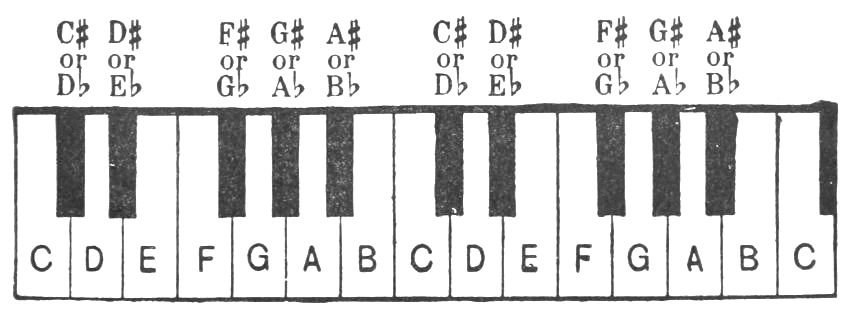
Following is a diagram of a two octave keyboard:—
The keyboard shows white and black keys. The black
keys are in groups of two and three. As can be seen in the
diagram, the white key next to the left of the group of two
black keys is c. The white keys in order to the right of c are
respectively d, e, f, g, a and b. Following b is a repetition of
c at the distance of an octave. Notice that between e and f
there is no black key as is also the case between b and c. In
these two cases, where no black key separates the white keys,
the white keys are one semi-tone apart. Two white keys separated
by a black key are one whole step apart. A black key
is at the distance of a semi-tone from an adjoining white key.
The black keys derive their letter names from the white
keys. A black key is named from either of the white keys
between which it is situated. The black key between c and d
is named c sharp (#) or d flat (b).
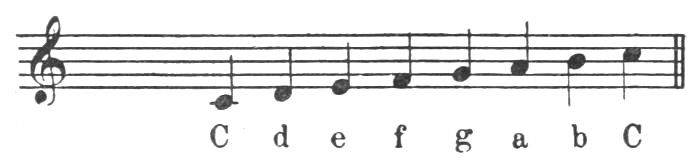
Starting at c and sounding the white keys in order to
the right as far as the octave produces the ascending major
scale of C; sounding in order to the left produces the descending
major scale of C. Notice that no black keys are
necessary in the case of the C major scale, the whole and
half steps being in their proper places; namely, whole steps
between 1 and 2, 2 and 3, 4 and 5, 5 and 6, 6 and 7, and
half steps between 3 and 4 and between 7 and 8. The student
must constantly keep in mind the order of whole and
half steps in all scales explained. In each scale explained
the letters will be numbered and a curved line will connect
those figures representing tones one half step apart.
All major keys except C major require one or more black
keys. The number of sharps or flats required for a key is
placed at the beginning of the staff and this is called the
signature.
A sharp (#) placed before a note raises the tone one half
step and a flat (b) lowers a tone one half step.
The sharp keys will be considered first and a sharp major
scale will be built from each of the twelve tones.
Rule 1. The Fifth of a Scale is the Tonic (or 1) of the Scale
having the next Number of Sharps.
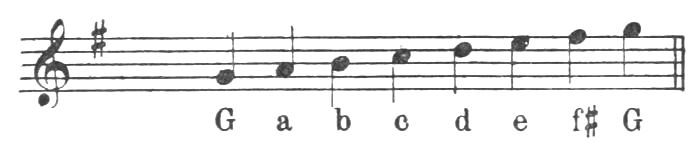
C has no sharps, the fifth of C is g and therefore by following
the rule, we find that G has one sharp. The scale of G
is as follows:—
G a b c d e f# G
1 2 3∼4 5 6 7∼8
Notice that the seventh of the scale is a black key.
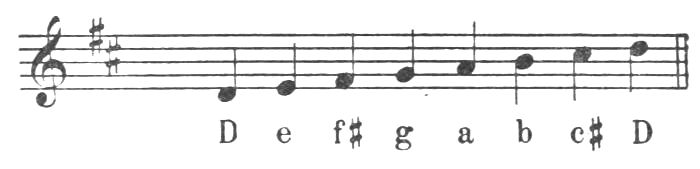
The fifth of G is d and has two sharps:—
D e f# g a b c# D
1 2 3∼4 5 6 7∼8
Notice that f remains sharped and the added sharp is the
seventh of the scale. This is always the case, the added
sharp is the seventh of the new scale.
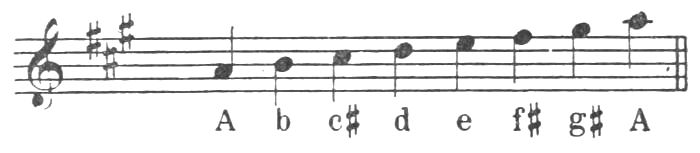
The fifth of D is a and has three sharps:—
A b c# d e f# g# A
1 2 3∼ 4 5 6 7∼8
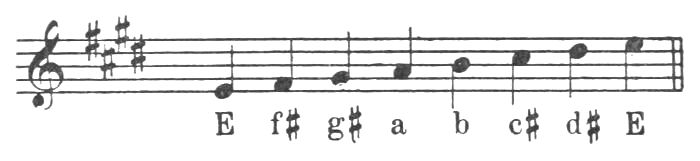
The fifth of A is e and has four sharps:—
E f# g# a b c# d# E
1 2 3∼4 5 6 7∼8
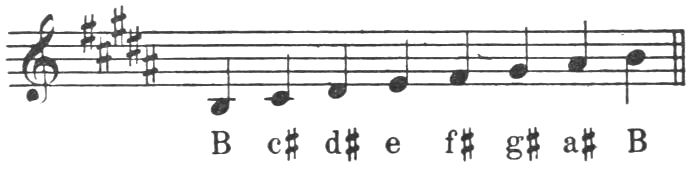
The fifth of E is b and has five sharps:—
B c# d# e f# g# a# B
1 2 3∼4 5 6 7∼ 8
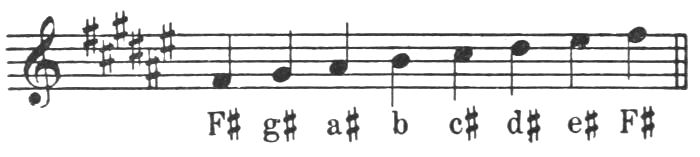
The fifth of B is f# and has six sharps:—
F# g# a# b c# d# e# F#
1 2 3∼4 5 6 7∼ 8
Notice that e# is not a black key but the white key which
has been previously considered as f. It must be called e#
to retain the alphabetical order.
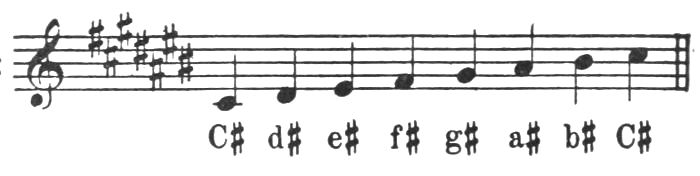
The fifth of F# is c# and has seven sharps:—
C# d# e# f# g# a# b# C#
1 2 3∼4 5 6 7∼ 8
In this scale all the notes are sharped. The b# as well as
the e# is a white key.
The fifth of C# is g# and has eight sharps. This key
necessitates one double sharp and f is double sharped. The
double sharps are added in the same order that the single
sharps are. The double sharp (designated thus: x) raises
a tone one whole step.
G# a# b# c# d# e# fx G#
1 2 3∼ 4 5 6 7∼8
The fifth of G# is d# and has nine sharps (two double
sharps, f and c):—
D# e# fx g# a# b# cx D#
1 2 3∼4 5 6 7∼8
The fifth of D# is a# and has ten sharps (three double
sharps, f, c and g):—
A# b# cx d# e# fx gx A#
1 2 3∼4 5 6 7∼ 8
The fifth of A# is e# and has eleven sharps (four double
sharps, f, c, g and d):—
E# fx gx a# b# cx dx E#
1 2 3∼4 5 6 7∼ 8
The fifth of E# is b# and has twelve sharps (five double
sharps, f, c, g, d and a):—
B# cx dx e# fx gx ax B#
1 2 3∼4 5 6 7∼ 8
B# has taken us back to our starting key called by a different
name.
All twelve keys have now been named with their sharp
signatures. To continue counting five would take us over
the same keys called by different names. The student is
advised to do a little of this for mental discipline. If this is
done beyond fourteen sharps, it will be necessary to add triple
sharps. Of course, triple sharps are never used in musical
notation and such a research would be entirely arithmetical.
The order of the letters in the sharp signature which follows
should be committed to memory:—
F C G D A E B.
All keys having one double sharp or more would be difficult
to read, and so instead of using the sharp signatures on
such keys, the flat signatures are used. All twelve keys with
their flat signatures will now be given.
Rule 2. The Fourth of a Scale is the Tonic of the Scale having
the Next Number of Flats.
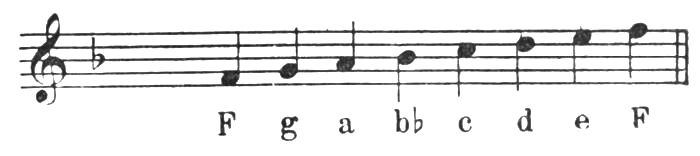
C has no flats; the fourth of C is f; therefore, by following
the rule, we find that F has one flat:—
F g a bb c d e F
1 2 3∼4 5 6 7∼ 8
Notice the fourth of the scale is a black key.
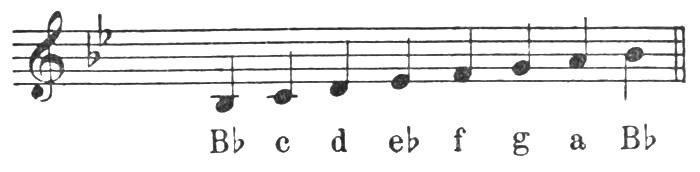
The fourth of F is bb and has two flats:—
Bb c d eb f g a Bb
1 2 3∼4 5 6 7∼8
Notice that the b remains flat and that the added flat is the
fourth of the scale. This is always the case—the added
flat is the fourth of the new scale.
The fourth of Bb is eb and has three flats:—
Eb f g ab bb c d Eb
1 2 3∼4 5 6 7∼ 8
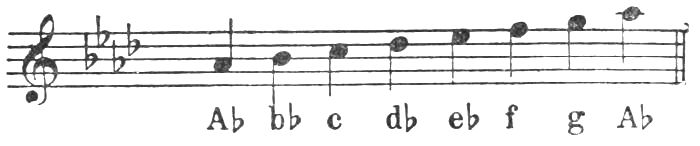
The fourth of Eb is ab and has four flats:—
Ab bb c db eb f g Ab
1 2 3∼4 5 6 7∼8
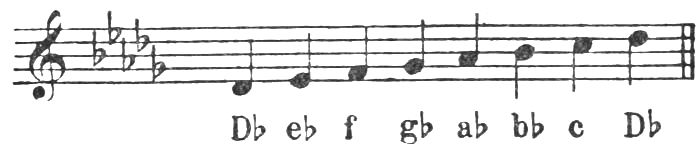
The fourth of Ab is db and has five flats:—
Db eb f gb ab bb c Db
1 2 3∼4 5 6 7∼ 8
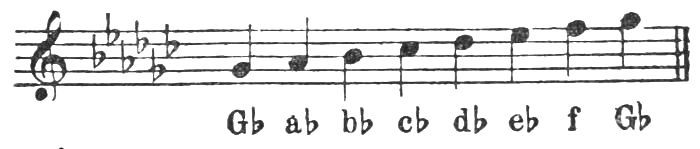
The fourth of Db is gb and has six flats:—
Gb ab bb cb db eb f Gb
1 2 3∼4 5 6 7∼8
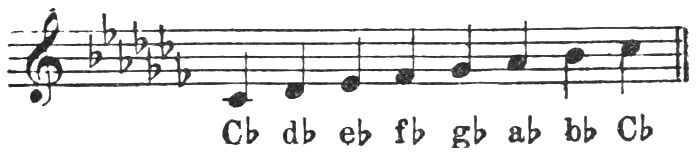
The fourth of Gb is cb and has seven flats:—
Cb db eb fb gb ab bb Cb
1 2 3∼4 5 6 7∼ 8
The fourth of Cb is fb and has eight flats. This key necessitates
one double flat and b has the double flat. The
double flats are added in the same order that the single flats
are. The double flat (designated: bb) lowers a tone one
whole step.
Fb gb ab bbb cb db eb Fb
1 2 3∼4 5 6 7∼ 8
The fourth of Fb is bbb and has nine flats (two double
flats, bbb and ebb):—
Bbb cb db ebb fb gb ab Bbb
1 2 3∼ 4 5 6 7∼ 8
The fourth of Bbb is ebb and has ten flats (three double
flats, bbb, ebb and abb):—
Ebb fb gb abb bbb cb db Ebb
1 2 3∼4 5 6 7 ∼ 8
The fourth of Ebb is abb and has eleven flats (four double
flats, bbb, ebb, abb and dbb):—
Abb bbb cb dbb ebb fb gb Abb
1 2 3∼ 4 5 6 7∼ 8
The fourth of Abb is dbb and has twelve flats (five
double flats, bbb, ebb, abb, dbb, and gbb):—
Dbb ebb fb gbb abb bbb, cb Dbb
1 2 3∼4 5 6 7 ∼ 8
Dbb has taken us back to our starting key called by a
different name as was the case when we had twelve sharps.
To continue counting four would take us over the same keys
called by different names. As was advised in the sharp
keys, this research should be continued by the student. If
more than fourteen flats are considered, it will be necessary
to add triple flats.
The order of the letters in the flat signature which follows
should be committed to memory:—
B E A D G C F.
By comparing the order of the letters in the flat signature
with that of the sharp signature, it will be seen that the order
of the letters in the flat signature is that of the sharp signature
reversed.
Notice that each key has more than one name; for example,
the white key next to the left of the group of two
black keys has been called C, Dbb and B#.
Rule 3. An Enharmonic Change is the Change of a Name
of a Tone without Altering its Pitch.
Two or more scales played from the same pitched tone
but called by different names are called enharmonic scales.
In practice,[B] fifteen major scales are used, three of which are
enharmonic scales. Following is a list of the major scales
used in practice together with their signatures:—
C no sharps or flats
G 1 sharp (f)
D 2 sharps (f and c)
A 3 sharps (f, c and g)
E 4 sharps (f, c, g and d)
B 5 sharps (f, c, g, d and a)
F# 6 sharps (f, c, g, d, a and e)
C# 7 sharps (f, c, g, d, a, e and b)
F 1 flat (b)
Bb 2 flats (b and e)
Eb 3 flats (b, e and a)
Ab 4 flats (b, e, a and d)
Db 5 flats (b, e, a, d and g) enharmonical to C#
Gb 6 flats (b, e, a, d, g and c) enharmonical to F#
Cb 7 flats (b, e, a, d, g, c and f) enharmonical to B
The enharmonic keys used in practice are:—
B (five sharps) enharmonical to Cb (seven flats)
F# (six sharps) enharmonical to Gb (six flats)
C# (seven sharps) enharmonical to Db (five flats)
Rule 4. The Sum of the Enharmonic Flat and Sharp Signatures
is Twelve. Notice that this is true in the above three
keys.
By this rule the theoretical keys (that is, those having more
than seven sharps or flats) are easily found. For example:—to
find the key having eleven flats; the key having eleven
flats is enharmonical to the key having one sharp (11 + 1 = 12).
G has one sharp and changing its name to the enharmonic
flat key, we obtain Abb which, therefore, has eleven flats.
This process should be applied to all keys having eight to
eleven sharps and eight to eleven flats inclusive.
As stated in the first chapter, the pitch of a tone is
determined by the note's position on the staff. The staff of
five lines with its spaces allows of the designation of but one octave
and one step, whereas, in modern music, there is need of
the notation of at least six octaves. This necessitates the use
of symbols called clefs, and lines added to the staff called ledger
lines. Ledger lines are short lines parallel to the staff lines
added above or below the staff lines.
There are three clefs:—
1. the treble or G clef,
2. the tenor, movable or C clef,
3. the bass or F clef.
Middle C is the tone which all voices can sing. It is in
the lower register of the high female voice and in the upper
register of the low male voice.
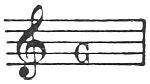
The G clef (treble clef) is for high voices or instruments.
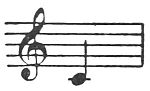
Its symbol shows the position of the G next above middle C
thus: . Middle C is found on the first ledger
line below the G clef, thus: .
The tenor or C clef is for the use of medium voices or instruments.
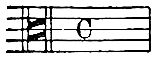
Its symbol shows the position of middle C. This
clef is movable and may place middle C on any line or space
of the staff. Its most common position is on the third line of
the staff, thus: . It is not uncommon, however,
to find it on the second or fourth line. For vocal music
it is often written in the third space.
The bass or F clef is for the use of low voices or instruments.
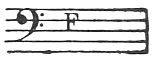
Its symbol shows the position of the F next below middle C,
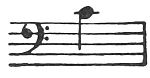
thus: . Middle C is found on the first ledger
line above the F clef, thus: .
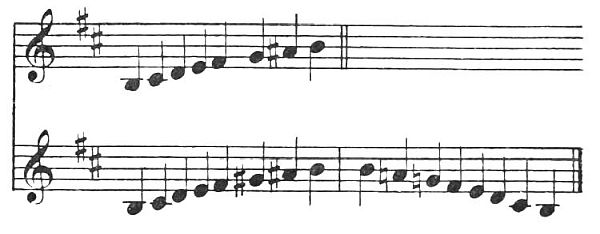
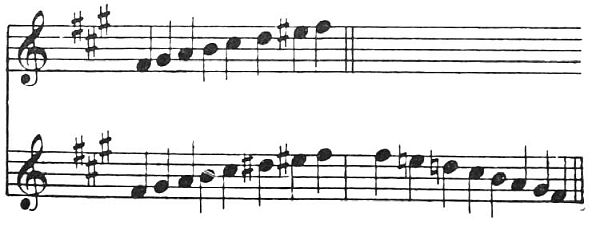
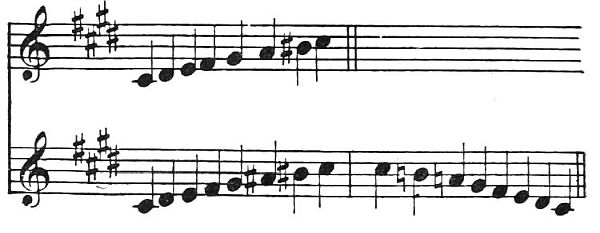
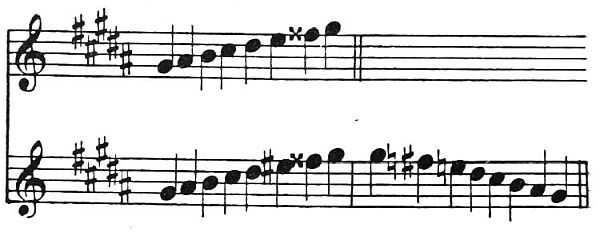
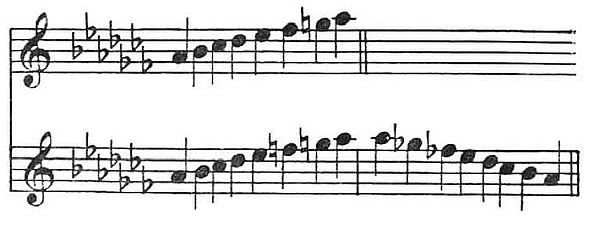
The notation in the treble clef of all the major scales used in
practice follows:
There are two forms of minor scales, harmonic and melodic,
both differing in construction from the major form.
The minor key having no sharps or flats in the signature
is a. Starting at a and sounding the seven white keys in
order to the right produces a form of scale with whole steps
between 1 and 2, 3 and 4, 4 and 5, 6 and 7, 7 and 8, and half
steps between 2 and 3 and between 5 and 6. This scale is
unsatisfactory to the ear as its subtonic is not a leading tone.
The effect of a leading tone should be urgent, restless, and
demand its tonic in order to obtain a restful effect. This
urgent effect can only be obtained by the subtonic being one
half step below the tonic. This may be obtained by simply
raising the seventh one semi-tone in the above scale formation
and thus is produced the so-called harmonic minor scale.
The symbols for raising a note are the sharp (#), the double
sharp (x), and the cancel (⊄) (also called natural) when placed
before a note that has been previously affected by a flat. The
symbols for lowering a note are the flat (b), the double flat
(bb), and the cancel when placed before a note that has been
previously affected by a sharp. By these statements it can be
seen that the cancel (⊄) is both a lowering and a raising symbol.
The cancel lowers a tone when it cancels a sharp and
raises a tone when it cancels a flat.
The harmonic minor scale is formed by whole steps between
1 and 2,—3 and 4,—4 and 5,—half steps between 2 and 3,—5 and 6,—7 and 8, and an interval of one and one-half steps
(called an augmented step) between 6 and 7. In demonstrating
the minor keys, a curved line will be used to connect
those figures representing tones one half step apart and a
bracket to connect those figures representing tones an augmented
step apart.
The key of a minor (harmonic form) is as follows:—
a b c d e f g# a
1 2 3∼4 5∼6∪7∼ 8
The student will notice that this scale has one sharp (g).
Nevertheless, the a minor is the minor key which has neither
sharps nor flats in its signature. The raised seventh of all
minor keys is never present in the signature, but appears as
accidental.
When a sharp, double sharp, flat, double flat or cancel,
which is not present in the signature, is placed before a note,
it is called an accidental. If the raised seventh were present
in the signature, uniform signatures in the minor would be
impossible. It may also be remarked here that the seventh
is not always raised during the course of a composition and
is necessarily raised only when the composer desires the
listener's ear to come at rest on the tonic, in which case the
tonic must be preceded by the raised seventh, if the subtonic
precedes the tonic in the melody or harmony.
The same rules (pages 13 and 15) used in the major for
finding the key having the next number of sharps and the
key having the next number of flats are applicable in the
minor. The order of the letters in both the sharp and flat
signatures is the same in the minor as in the major.
A minor has no sharps, the fifth of a is e and has one
sharp (f):—
e f# g a b c d# e
1 2∼3 4 5∼6∪7∼8
The fifth of e is b and has two sharps (f and c):—
b c# d e f# g a# b
1 2∼3 4 5∼6∪7∼8
The fifth of b is f# and has three sharps (f, c and g):—
f# g# a b c# d e# f#
1 2∼3 4 5∼6∪7∼8
The fifth of f# is c# and has four sharps (f, c, g and d):—
c# d# e f# g# a b# c#
1 2∼3 4 5∼6∪7∼8
The fifth of c# is g# and has five sharps (f, c, g, d and
a):—
g# a# b c# d# e fx g#
1 2∼3 4 5∼6∪7∼8
The student will notice that in this key, f is double sharped.
F is sharped in the signature, but because the subtonic
requires raising, f demands a double sharp.
The fifth of g# is d# and has six sharps (f, c, g, d, a and
e):—
d# e# f# g# a# b cx d#
1 2∼3 4 5∼6∪7∼8
The fifth of d# is a# and has seven sharps (f, c, g, d, a, e
and b):—
a# b# c# d# e# f# gx a#
1 2∼ 3 4 5∼6∪7 ∼8
The minor keys having more than seven sharps should
be found by the student and submitted to the teacher for
correction. For the sake of brevity, they are not given
here, but the student should be thoroughly capable, by this
time, of finding them all.
A minor has no flats, the fourth of a is d and has one flat
(b):—
d e f g a bb c# d
1 2∼3 4 5∼6∪7∼8
The fourth of d is g and has two flats (b and e):—
g a bb c d eb f# g
1 2∼3 4 5∼6∪7∼8
The fourth of g is c and has three flats (b, e and a):—
c d eb f g ab b⊄ c
1 2∼3 4 5∼6∪7∼8
The student will notice a contradiction in the above scale;
it is stated that c has three flats and in the example, b is
cancelled. This cancel, however, appears as accidental (the
raised seventh) and must be a flat in the signature.
The fourth of c is f and has four flats (b, e, a and d):—
f g ab bb c db e⊄ f
1 2∼3 4 5∼6∪7∼8
The fourth of f is bb and has five flats (b, e, a, d and
g):—
bb c db eb f gb a⊄ bb
1 2∼3 4 5∼ 6∪7∼8
The fourth of bb is eb and has six flats (b, e, a, d, g and
c):—
eb f gb ab bb cb d⊄ eb
1 2∼3 4 5∼6∪7∼8
The fourth of eb is ab and has seven flats (b, e, a, d, g, c
and f):—
ab bb cb db eb fb g⊄ ab
1 2∼ 3 4 5∼6∪7∼ 8
The student should find the minor keys having more than
seven flats.
The harmonic minor scale is awkward in formation on
account of the augmented second step between steps six and
seven. All augmented intervals sound harsh and are difficult
to sing tunefully. For this reason, another form of minor
scale is sometimes used which eliminates the augmented second
step. This form is called melodic minor and is used,
as its name implies, only for melodic purposes. It defies
harmonization for the obvious reason that its ascending form
differs from its descending form.
The melodic minor scale has the sixth as well as the seventh
raised by accidental in ascending, but in descending, both
the sixth and seventh are restored. The ascending form has
whole steps between 1 and 2,—3 and 4,—4 and 5,—5
and 6,—6 and 7, and half steps between 2 and 3 and between
7 and 8. The descending form has its half steps between
6 and 5 and between 3 and 2. Notice that the
descending form is as its signature dictates.
The ascending form of the melodic minor is nearly the same
as the major scale, and for this reason it is best not to retain
the raised sixth and seventh in descending. The subtonic
in a descending scale does not lead (progress) to the tonic
and therefore need not necessarily be situated one half step
below the tonic.
Any minor key is called the relative of the major key
having the same signature; therefore, the relative minor of C
major is a[C] as they both have neither sharps nor flats.
Rule 5. The Relative Minor is found on the Sixth of the
Major Scale.
Rule 6. The Relative Major is found on the Third of the
Minor Scale.
Some writers have called the relative minor parallel minor,
using relative and parallel synonymously. This is a usage
to be regretted as it causes considerable confusion. By most
writers, the parallel minor is treated as the scale commencing
on the same key-note as the major and will thus be treated
in this book, therefore:—
the relative minor of C is a;
the parallel minor of C is c.
The parallel minor scale has three more flats or three less
sharps in its signature than the major scale. In other words,
by lowering steps 3, 6 and 7 of the major scale one semi-tone,
the signature of the parallel minor is obtained.
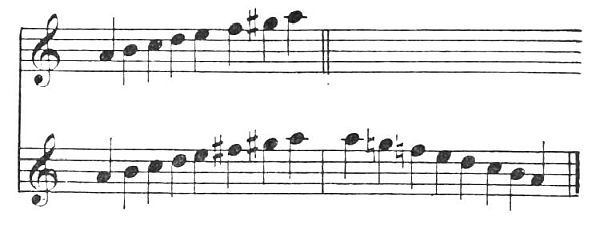
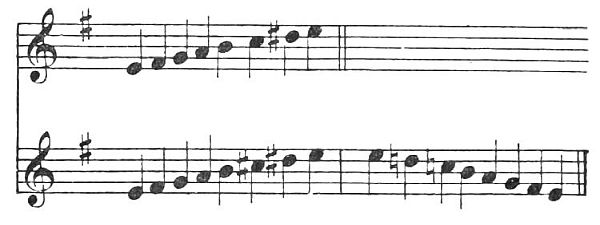
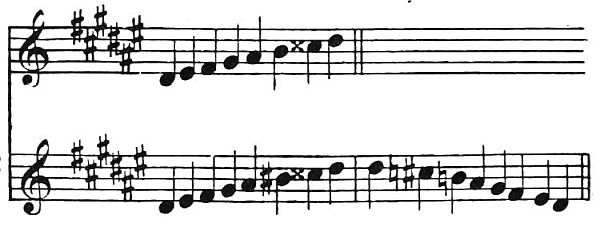
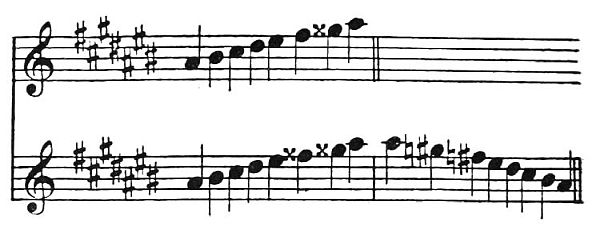
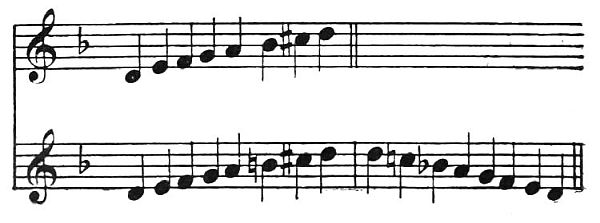
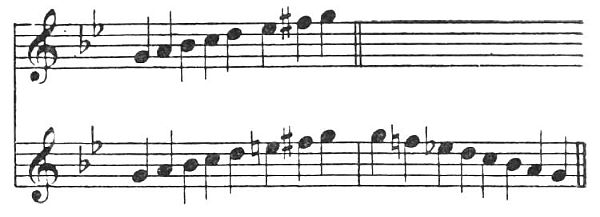
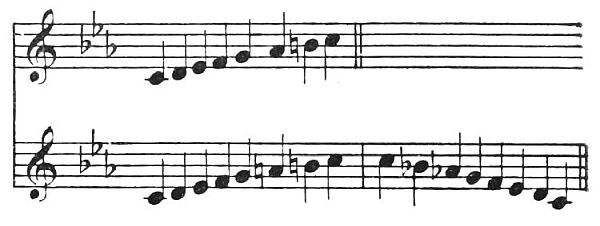
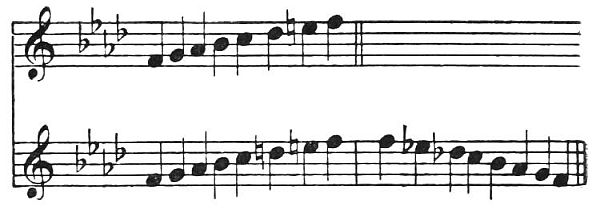
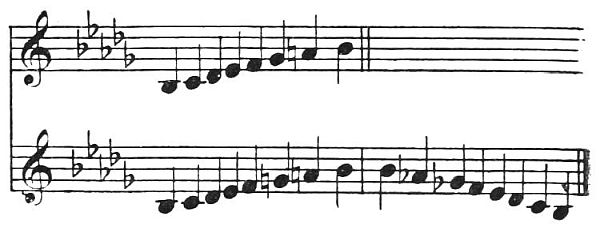
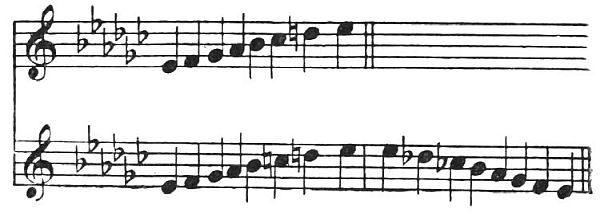
The notation in the treble clef of all the minor scales (harmonic
and melodic) follows:—
1. Into how many parts does modern custom divide
an octave?
2. What is each part called?
3. What is the difference between a chromatic scale
and a diatonic scale?
4. How many forms of diatonic scales are there and
what are their names?
5. Name and define the four ways in which the tones
of the diatonic scales are named.
6. What is the key-tone?
7. Describe the movable and fixed systems.
8. Describe the major scale.
9. Describe the effect of a sharp; of a double sharp;
of a flat; of a double flat; of a cancel.
10. State the rule for finding the key having the next
number of sharps and the rule for finding the key having the
next number of flats.
11. Write on the staff, using the treble clef, all the
major keys to eleven sharps and eleven flats. Write several
scales (the teacher deciding the number) using the bass and
tenor clefs. (Show by curved line those notes situated one
semi-tone apart.)
12. What is the order of the letters in the sharp signature?
In the flat signature?
13. What is meant by enharmonic?
14. What are the enharmonic scales used in practice?
15. Give enharmonic letter names for each of the twelve
keys.
16. What is the sum of sharp and flat signatures of
enharmonic keys?
17. By the use of this enharmonic sum, find all the
theoretical keys.
18. What is the construction of the harmonic minor
scale? Of the melodic minor?
19. Write on the staff all the minor scales (both harmonic
and melodic) to eleven sharps and eleven flats, letting
the teacher determine which clef or clefs to use.
20. What is the reason for raising the seventh in harmonic minor?
21. What is the reason for raising the sixth in melodic
minor?
22. Why does the descending form of melodic minor
differ from the ascending form?
23. Why does not the raised sixth or seventh appear
in the signature?
24. What is an accidental?
25. What is the relative minor and how is it found?
26. What is the parallel minor and how does its signature
differ from its parallel major?
N. B. Before proceeding to the next chapter all these
exercises should be properly answered and corrected by the
teacher.
CHAPTER III. — I NVERSION OF I NTERVALS . — EXERCISES.
INTERVALS AND INTRODUCTION TO CHORD BUILDING.
An interval is the distance between two tones; intervals
are named by the ordinals. The number of letters comprised
in the notation of two tones determines the ordinal name of
the interval. Example: c to d is an interval
of a second because two letters are comprised. It makes
no difference whether or not either or both of the above tones
is affected by an accidental, the interval still comprises two
letters and is a second.
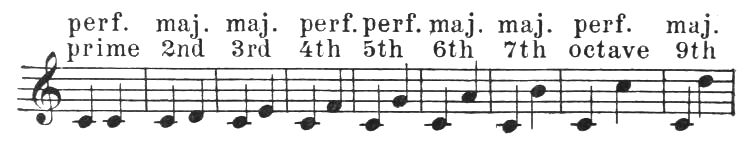
Reckoning from the tonic of the major scale to each degree
of the scale produces the following intervals:—
8th or
prime. 2nd 3rd 4th 5th 6th 7th octave 9th
The interval of the ninth is often called a second, the
octave not being considered.
These intervals are the normal intervals of the major scale.
These normal intervals are qualified in two ways. The
prime, fourth, fifth and octave are called perfect. The
second, third, sixth and seventh are called major; thus:—
All intervals should be reckoned from the lower note,
which is considered a major key-note. If the upper note is
in the major scale of the lower note, the interval is normal;
that is, either perfect or major. If the upper note is not in
the major scale of the lower note, the interval is a derivative
interval. The derivative intervals are called minor, diminished
and augmented.
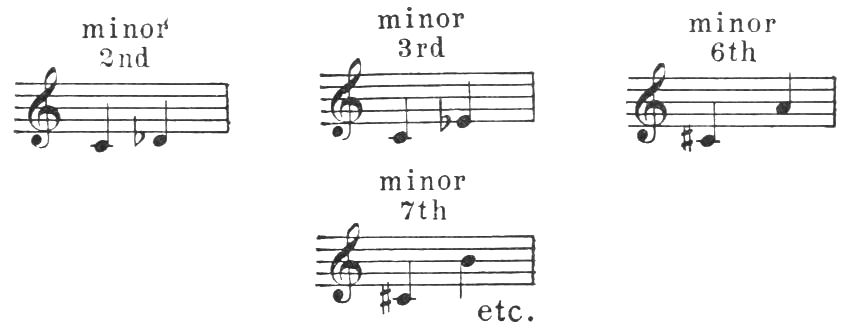
A minor interval is derived from a major interval and is
one semi-tone smaller. By lowering the upper tone of any
major interval one half step or by raising the lower tone of
any major interval one half step (not altering the letter name
in either case) a minor interval is formed, thus:—
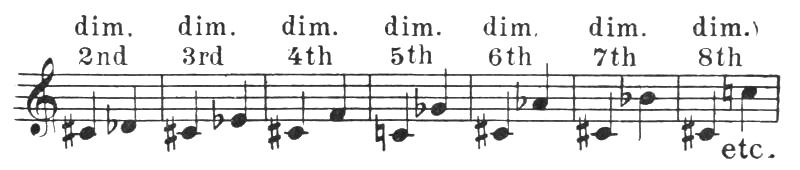
A diminished interval is one half step smaller than a minor
or a perfect interval. By lowering the upper tone of any
minor or any perfect interval one half step, or by raising the
lower tone of any minor or any perfect interval one half step
(not altering the letter name in either case) a diminished interval
is formed, thus:—
The tones of the diminished second are the same pitch, but
must be called a second because two letters are comprised.
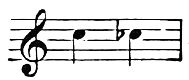
The diminished prime is possible melodically, but harmonically,
only in theory. It is .
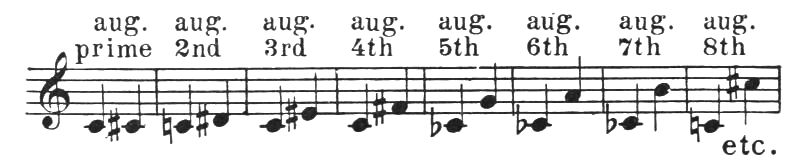
An augmented interval is one half step larger than a major
or a perfect interval. By raising the upper tone of any major
or perfect interval one half step, or by lowering the lower
tone of any major or perfect interval one half step (not
altering the letter name in either case) an augmented interval
is formed, thus:—
Notice that the tones of the augmented seventh are the same
pitch, but must be called a seventh as seven letters are
comprised.
The following intervals are the same in sound, but not in
name:—
perfect prime
sounds
the
same
as
diminished 2nd
augmented prime
"
"
"
"
minor 2nd
diminished prime
"
"
"
"
minor 2nd
major 2nd
"
"
"
"
diminished 3rd
minor 3rd
"
"
"
"
augmented 2nd
major 3rd
"
"
"
"
diminished 4th
perfect 4th
"
"
"
"
augmented 3rd
augmented 4th
"
"
"
"
diminished 5th
perfect 5th
"
"
"
"
diminished 6th
minor 6th
"
"
"
"
augmented 5th
major 6th
"
"
"
"
diminished 7th
minor 7th
"
"
"
"
augmented 6th
major 7th
"
"
"
"
diminished 8th
perfect octave
"
"
"
"
augmented 7th
From the preceding list the following rule is apparent:—
Rule 7. By Changing Enharmonically Either or Both of
the Tones of an Interval, a Different Interval is Obtained Which
Sounds the Same as the Original Interval.
The distance in semi-tones of all the intervals to an octave
is as follows:—
prime
=
unison
comprises
1
letter
augmented prime
= 1
semi-tone
"
1
"
diminished 2nd
=
unison
"
2
letters
minor 2nd
= 1
semi-tone
"
2
"
major 2nd
= 2
semi-tones
"
2
"
augmented 2nd
= 3
"
"
2
"
diminished 3rd
= 2
"
"
3
"
minor 3rd
= 3
"
"
3
"
major 3rd
= 4
"
"
3
"
augmented 3rd
= 5
"
"
3
"
diminished 4th
= 4
"
"
4
"
perfect 4th
= 5
"
"
4
"
augmented 4th
= 6
"
"
4
"
diminished 5th
= 6
"
"
5
"
perfect 5th
= 7
"
"
5
"
augmented 5th
= 8
"
"
5
"
diminished 6th
= 7
"
"
6
"
minor 6th
= 8
"
"
6
"
major 6th
= 9
"
"
6
"
augmented 6th
= 10
"
"
6
"
diminished 7th
= 9
"
"
7
"
minor 7th
= 10
"
"
7
"
major 7th
= 11
"
"
7
"
augmented 7th
= 12
"
"
7
"
diminished 8th
= 11
"
"
8
"
perfect 8th
= 12
"
"
8
"
A quicker and better method of determining an interval
than by committing to memory the above table is to consider
the lower note the tonic of the major scale. If the upper
note is in the major scale of the lower note, the interval is
normal (major or perfect). After a little practice the number
of letters in an interval can be determined at a glance.
If the upper note is not in the major scale of the lower note
the interval is derivative and is determined by the information
heretofore given.
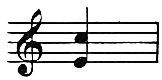
Intervals are said to be inverted when the lower note of
the original interval is placed an octave higher, thereby becoming
the upper note of the interval thus formed. Example:
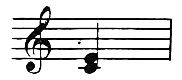
the inversion of
is .
The same letters are in both intervals, but the first interval
is a third and the inverted interval is a sixth.
Rule 8. The Sum of an Interval and Its Inversion is Nine.
The above rule, therefore, gives the following inversions:—
a prime
inverts
to
an octave
(1 + 8 = 9)
a second
"
"
a seventh
(2 + 7 = 9)
a third
"
"
a sixth
(3 + 6 = 9)
a fourth
"
"
a fifth
(4 + 5 = 9)
a fifth
"
"
a fourth
(5 + 4 = 9)
a sixth
"
"
a third
(6 + 3 = 9)
a seventh
"
"
a second
(7 + 2 =9)
an octave
"
"
a prime
(8 + 1 = 9)
To find to what intervals ninths, tenths, elevenths, twelfths,
etc., invert, consider them respectively as seconds, thirds,
fourths, fifths, etc., and consider the lower note placed two
octaves higher instead of one octave.
Qualifications invert in the following manner:—
major
intervals
invert
to
minor
intervals
minor
"
"
"
major
"
perfect
"
"
"
perfect
"
diminished
"
"
"
augmented
"
augmented
"
"
"
diminished
"
By the use of the above table and rule 8, all inversions may
be determined. Examples:—
major 2nd
inverts to
minor 7th
major 6th
" "
minor 3rd
perf. prime
" "
perf. 8th
perf. 4th
" "
perf. 5th
aug. 4th
" "
dim. 5th
dim. 7th
" "
aug. 2nd
etc.
etc.
The prime is also called an unison, but in speaking of intervals,
it should always be called a prime. Correctly speaking,
a perfect prime is not an interval, but in the theory of
music it is so called. There is good reason for making this
error, but none for calling a diminished prime a diminished
unison. Notice that the diminished second as well as the perfect
prime is an unison.
Intervals are considered both harmonically and melodically,
or in other words, both when sounded together or separately.
In either case, the lower note is the one from which
to determine the interval.
CHORD CONSTRUCTION.
A chord is a combination of two or more tones sounded
simultaneously. All chords are constructed in thirds. The
fundamental tone of a chord is the tone on which the chord
is constructed.
A chord of three tones is a triad which consists of a fundamental
together with its third and its fifth. Triads are
divided into two classes, independent and dependent. The independent
triads have no dissonant intervals and may end a composition.
The dependent chords have one or more dissonant
intervals and are "restless" chords and demand another
chord to follow. The progression of a dependent chord to
an independent chord, thereby obtaining a restful effect, is
called resolution.
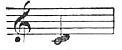
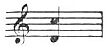
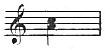
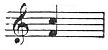
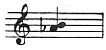
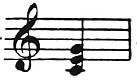
There are two kinds of independent triads, major and
minor. A major triad consists of the fundamental, the
major third, and the perfect fifth. Example:— .
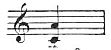
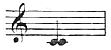
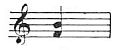
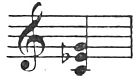
A minor triad consists of the fundamental, the minor third,
and the perfect fifth. Example:— .
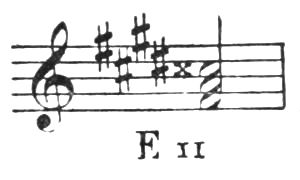
If the fifth of a triad is augmented or diminished, the triad
is a dependent. Dependent triads are found constructed on
the subtonic of major keys; on the subtonic, supertonic, and
mediant of the minor keys. The triad on the mediant of the
minor key is an augmented triad and the first three mentioned
triads are diminished.
Music written for four voices necessitates the doubling of
one of the factors of the triad. Any factor of the triad
may be doubled. The factor most frequently doubled is the
fundamental in the octave, double octave, or unison. The
four voices are soprano (high female voice), alto (low female
voice), tenor (high male voice), and bass (low male
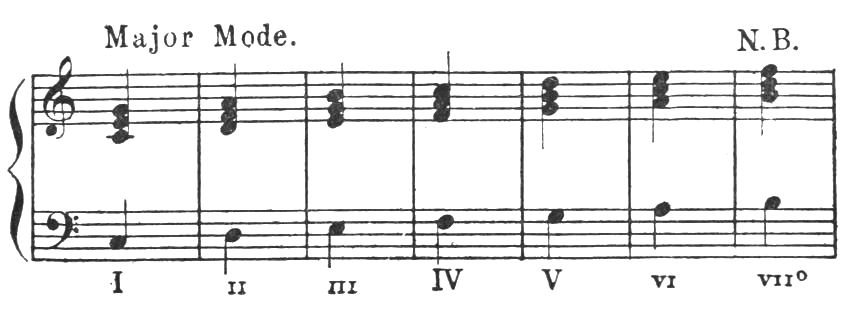
voice). Chords are figured under the bass by Roman numerals.
Large numerals designate major triads; small numerals
designate minor triads; large numerals with the mark
(´) affixed designate augmented triads; small numerals with a
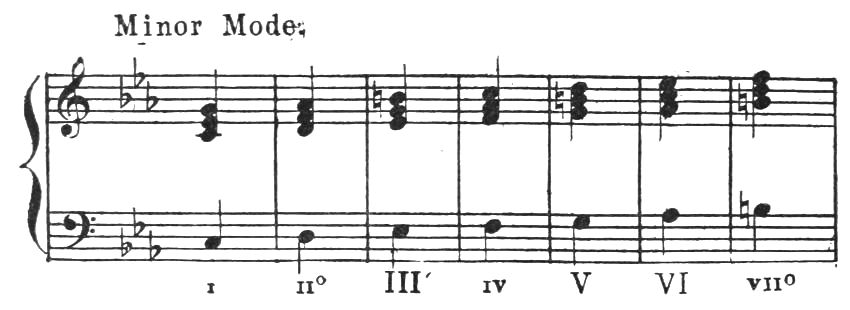
cipher affixed designate diminished triads. The notation of
the triads on each degree of the major and minor scales
follows:—
N. B. Although doubled in the above examples, the
fundamental of the subtonic triad is seldom doubled in four
voice writing and if doubled, a bad progression results in
many cases.
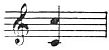
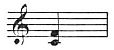
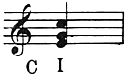
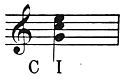
The three upper voices in a fundamental chord may be
arranged in a different manner:—
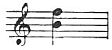
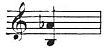
With the fundamental in the soprano:— .
With the third in the soprano:— .
If the three upper voices do not exceed the compass of an
octave, the chord is said to be in "close position." If the
three upper voices exceed the compass of an octave, the
chord is said to be in "open position."
INVERSIONOF TRIADS.
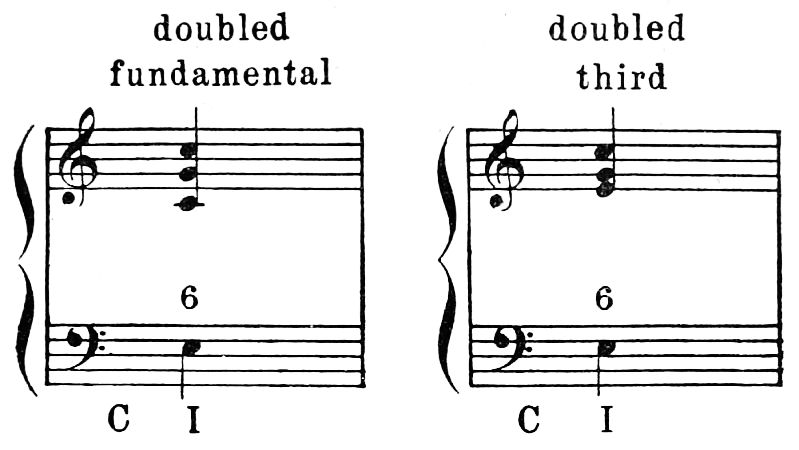
A chord is inverted when a factor other than the fundamental
is in the bass. The first inversion of the triad is
where we have the third in the bass. It is called the chord
of the sixth, because the fundamental is the sixth of the bass.
This chord is figured by a small Arabic figure (⁶) over the
bass note, the Roman numeral under the bass showing the
fundamental. Examples:—
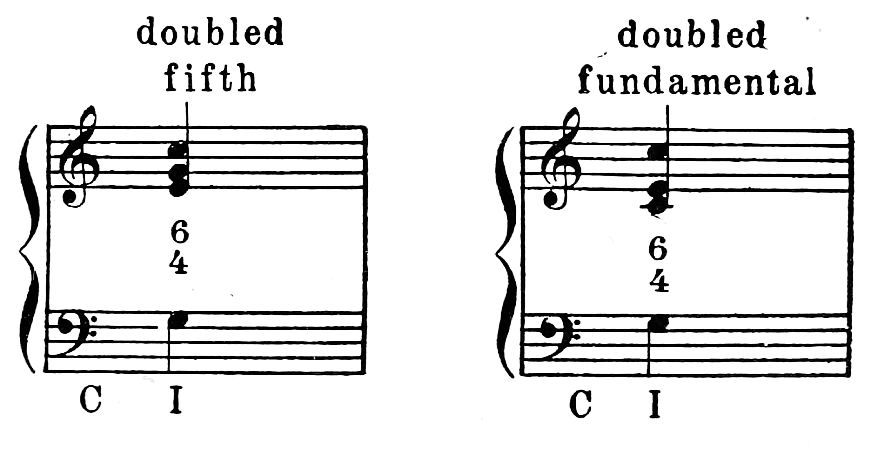
The second inversion of the triad has the fifth in the bass
and is called the chord of the sixth and fourth, or six-four
chord, because the fundamental is the fourth of the bass.
This chord is figured by the small Arabic figures (64) over the
bass, the Roman numeral under the bass showing the fundamental.
Examples:—
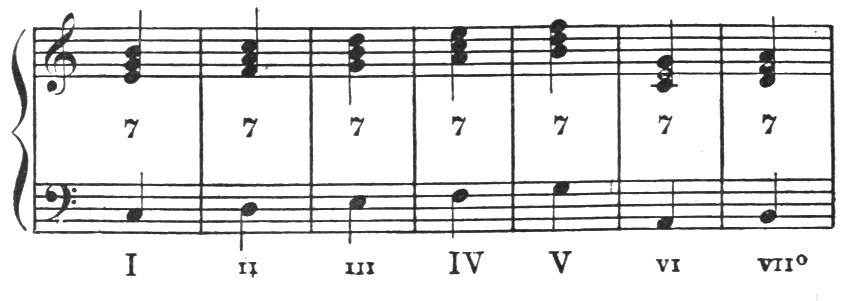
The seventh chord is obtained by adding the seventh of
the fundamental to any triad. A seventh chord may be
formed on each degree of the major and minor scales. It is
figured with the Roman numerals below the bass and a small
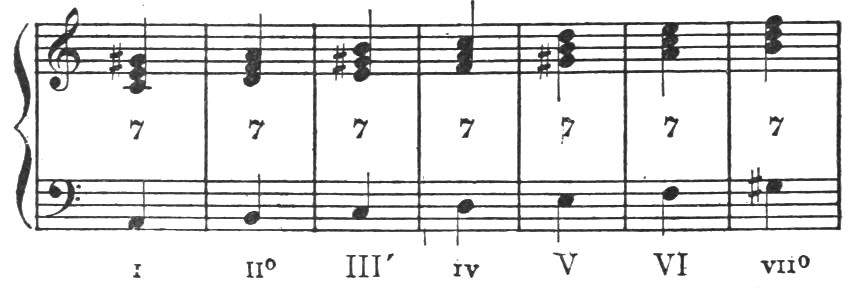
Arabic (7) over the bass. The notation of the seventh chords
on each degree of the major and minor scales follows:—
The tonic and subdominant of the major mode and the submediant
of the minor mode are formed with the major triad
and the major seventh. The dominant seventh in both modes
is formed with the major triad and the minor seventh. The
seventh chords on II, III and VI in the major mode and on
IV of the minor mode are formed with the minor triad and
the minor seventh. The seventh chords on VII° in the major
mode and on II° in the minor mode are formed with the
diminished triad and the minor seventh. The subtonic
seventh chord in the minor mode is called the diminished
seventh and is formed with the diminished triad and the diminished
seventh. The seventh chord on the mediant in the
minor mode is formed with the augmented triad and the major
seventh. The seventh chord on the tonic of the minor mode
is formed with the minor triad and the major seventh. In
four voice writing, all the seventh chords with the exception
of those on the subtonic of both modes are often written without
the fifth and with the doubled fundamental. All seventh
chords are dependent chords and their natural resolution is
to the chord the fundamental of which is situated a fourth
above or a fifth below the fundamental of the seventh chord.
This progression is called "cadencing resolution." The subtonic
seventh chord of both modes may also naturally resolve
to the tonic. The most important seventh chord is the dominant,
which resolves to the tonic. This progression is called
the authentic close. Another method of ending a composition
is by the plagal close which is a progression from subdominant
harmony (triad) to tonic. The plagal close is preceded by
the authentic close and is also called the after cadence and
the Amen cadence.
INVERSIONOF SEVENTH CHORDS.
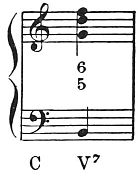
The first inversion of the seventh chord is called the chord
of the fifth and sixth (six-five chord). The chord is figured
by the Roman numeral below the bass note and the Arabic
figures (65) over the bass. Example:—
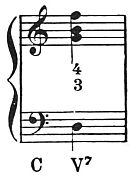
The second inversion is called the chord of the third,
fourth and sixth (four-three chord). It is figured by the
Roman numeral below the bass and the Arabic figures (643)
or simply (43) over the bass. Example:—
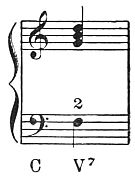
The third inversion is called the chord of the second and
fourth. It is figured by the Roman numeral below the bass
and the Arabic figures (642), (42), or simply (2) over the bass.
Example:—
The study of chord progression, altered chords, melody
writing, passing tones, etc., belongs properly to the study of
harmony and counterpoint which is not the subject of this
volume.
ORALAND WRITTEN.
1. What is an interval?
2. How are intervals named?
3. What are the normal intervals?
4. Qualify the derived intervals; from what is each
derived?
5. Notate all the normal intervals and all the derivative
intervals.
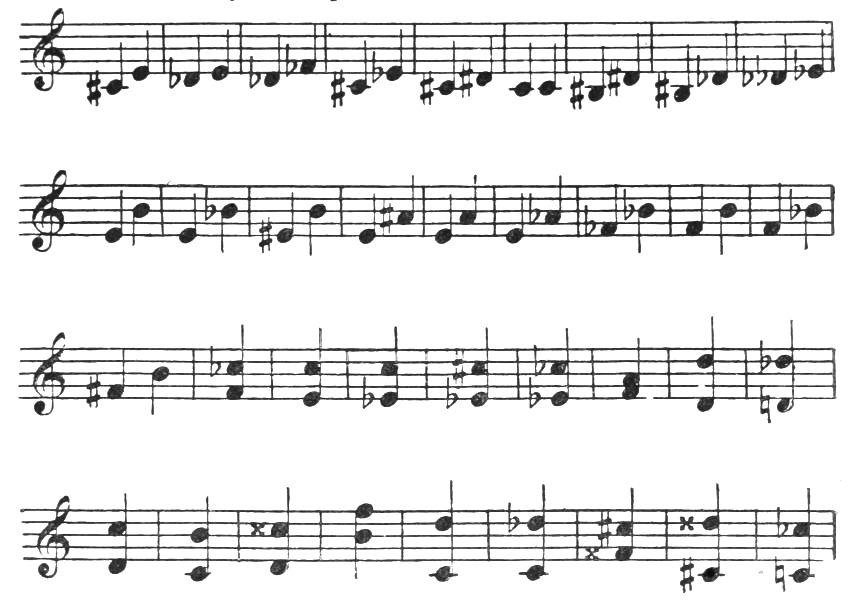
6. Name all the following intervals:—
(Accidentals affect only those notes before
which they are placed.)
7. Name several intervals (the teacher to determine
the number) having different names, but sounding the same.
8. What is the sum of inversions?
9. State the manner in which qualifications invert.
10. Invert all the intervals given in exercise 6.
11. Notate and figure all the triads in several different
major and minor keys. Which are dependent and which are
independent?
12. Describe a dependent triad.
13. Describe open and close position.
14. Notate and figure several sixth chords; several
six-four chords.
15. Notate and figure all the seventh chords in several
different major and minor keys.
16. What is the most important seventh chord?
17. What is the authentic close?
18. What is the plagal close?
19. Notate and figure a six-five dominant chord in several
major and minor keys.
20. Notate and figure a four-three dominant chord in
several major and minor keys.
21. Notate and figure a four-two dominant chord in
several major and minor keys.
22. Choose some standard chorals (Bach's are advised)
and analyze the chords therein.
CHAPTER IV.
EPITOMIZED ACOUSTICS.
The science of sound, including its cause and effect and the
manner, velocity, and intensity of its conveyance through different
media, is called acoustics.
The medium through which sound is most commonly propagated
is air. Through this medium, at a temperature of
32° Fahrenheit, sound travels at a rate of 1090 feet per second.
The quality and intensity of sound do not alter the rate of
speed. If this were not true, ensemble music would be impossible.
Intensity of sound is greater in condensed air; velocity
of sound is greater in a warm temperature.
Many experiments have been made to determine the velocity
of sound, the most reliable of which vary not over seven
feet per second. The average of six of the best experiments,
made in the early part of the nineteenth century, is 1089.7
feet per second at 32° Fahrenheit. Ten hundred and ninety
feet per second is the rate now generally adopted.
Wind and temperature are the only circumstances affecting
the velocity of sound in the air to any extent. Sound travels
about four times faster through water than through air, and
about ten times faster through solids such as metals and wood
than through air. A sudden displacement of the molecules
of a medium produces sound which travels in waves at an
equal velocity in all directions. An idea of the manner in
which sound waves travel may be obtained by throwing a
stone in water; small waves are propagated from the point
of impact which, if the water be still, spread equally in all
directions, but if it be running water, the waves extend a
greater distance down stream than up stream. The effect of
wind on sound waves may be compared to the effect of running
water on the waves propagated by the impact of the
stone.
Musical tone is produced by regular vibrations; noise by
irregular vibrations. The tones of the tempered chromatic
scale have the following number of vibrations per second:—
Middle
c
258.6
c# or
db
274.
d
290.3
d# or
eb
307.6
e
325.9
f
345.2
f# or
gb
365.8
g
387.5
g# or
ab
410.5
a
435.
a# or
bb
460.8
b
488.2
The preceding figures represent the vibrations of the
"International Pitch" which was adopted by the Piano
Manufacturers' meeting in 1891. A is the standard pitch
having 435 double vibrations per second at a temperature of
68° Fahrenheit. Many pitches have prevailed in different
countries at different times. At the time of Handel and
Mozart, the pitch was lower (422.5 and 421.6). England
has had the pitch run as high 454.7 and the United States
as high as 460.8.
Sounds vibrating below a certain number lose the character
of musical tones as do those vibrating above a certain number.
Great discrepancies of opinion exist among theorists on this
subject. Savart claims the lowest audible sound has eight
vibrations per second; Helmholtz claims that there is no
definite pitch of sounds having less than forty vibrations per
second; Herr Appum claims to hear fifteen vibrations by
the use of specially loaded tongues in reed pipes. He claims
the character of tone commences at twenty vibrations, but the
musical character of bass tones does not exist until frequencies
exceed twenty-four vibrations per second. On the subject
of the audibility of acute sounds, opinions are advanced
ranging from 6,400 to 36,000 vibrations per second.
The limits of the human voices are tabulated below:—
Bass
E
81.5
D
290.3
Baritone
F
86.3
F#
365.8
Tenor
A
108.7
A
435.0
Contralto
E
163.0
F
690.5
Mezzo Soprano
F
172.6
A
870.0
Soprano
A
217.5
C
1034.6
Occasionally there are exceptional voices having a wider
range than the above scale indicates.
Ratio of Intervals:—
Octave
1— 2
Perfect fifth
2— 3
Perfect fourth
3— 4
Major third
4— 5
Minor third
5— 6
Major sixth
3— 5
Minor sixth
5— 8
Major second
8— 9
Minor second
15—16
Major seventh
8—15
Minor seventh
9—16
Each tone generates "over tones" called harmonics. These
harmonics are the octave, the twelfth (perfect fifth), the seventeenth
(major third), the twenty-first (minor seventh) and the
twenty-third (minor ninth). Other harmonics than the above
exist but are not used at the present time in chord construction.
The old theorists treated chords of the eleventh and thirteenth,
but modern theorists treat these intervals as suspensions,
anticipations, etc.[D] The origin of chord construction
may be seen from these harmonics. These over tones, generated
from a fundamental, are the pure (untempered) intervals.
The tempered intervals, with the exception of the octave, are
slightly out of tune but not enough so to shock the ear.
The pure (untempered) scale of C has the following
number of vibrations per second:—
Middle c
261.0
d
293.6
e
326.2
f
348.0
g
391.5
a
435.0
b
489.3
An entire volume would be necessary to explain completely
the science of acoustics. All ambitious students should consult
books on acoustics. The author recommends the books
on sound by the following writers:—
Appum
G. B. Airy
Pietro Blaserno
Helmholtz
Pole
Benjamin Peirce
Rodolphe Radau
Savart
Tyndall
J. August Zahn
CHAPTER V.
EAR TRAINING.
A person with an untrained ear can appreciate music
comparatively little, even though he is well educated in the
theory of music. Absolute pitch is the ability to recognize
and intonate any tone indicated. Very few persons possess
naturally absolute pitch, but it may be acquired by a systematic
study of ear training. Relative pitch is the ability to recognize
a tone by comparison with a known tone. Advancement
in relative pitch eventually leads to the attainment of
absolute pitch.
In practicing ear training, only a few minutes at a sitting
are advised. Too much time at once devoted to this practice
tires the ear and does more harm than good. On the other
hand, these sittings should be many each day. Students who
do not have a teacher daily, should have a member of the
household play the exercises in ear training and correct the
mistakes. If no member of the household is musical, the student
should co-operate with another student.
Each exercise should be thoroughly learned before proceeding
to the following exercise. It may be recognizable
and properly intonated at once or it may take several sittings.
The pitch A at 435 is the standard for orchestral tuning
and is recommended to the student for a fundamental. The
student should carry upon his person a tuning fork of this
pitch and sound it as often as an opportunity permits, and
thereby fix this fundamental thoroughly in his mind. Eventually,
the student will recognize this pitch whenever he hears
it. Other tones will be recognizable by comparison with
this fundamental. Any other pitch for a fundamental may
be chosen with equally good results. The argument is in
favor of A because of its use in orchestral tuning.
Many systems of ear training, which produce the desired
results, exist. The following system has been found the
most satisfactory by the author.[E] Deviations from and additions
to this system do no harm and are advisable in certain
individual cases.
The Italian syllables should be used in singing the exercises.
Movable do is advised. Any instrument may be
used by the teacher or co-operator to play the exercises.
For low voices, the exercises should be played two octaves
lower than indicated, and for medium voices, one octave
lower. The teacher, after having played an exercise, should
explain the interval or intervals therein. The student should
sing the exercise first with the instrument and then without.
Each exercise should be faultlessly intonated before proceeding
to the following exercise.
The teacher should combine these intervals in various
ways and in several different rhythms and the student should
notate the exercise. The teacher may also choose some melody
free from accidentals and play it slowly while the student
notates. Such practice accomplishes a two-fold result,
ability to notate rhythm as well as intervals.
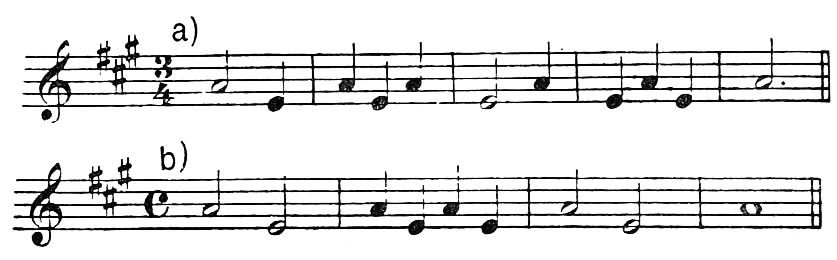
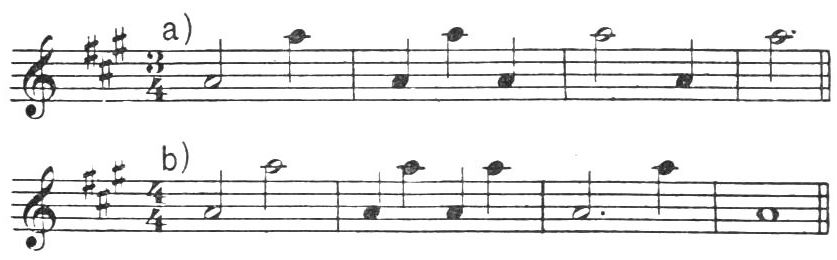
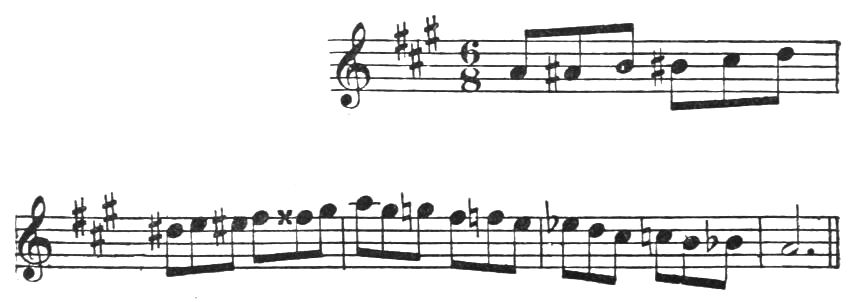
The first measure of exercise 2 contains the major second
which is an easily recognized interval. The last measure
but two of exercise 2 contains the major seventh. This interval
is ordinarily a difficult interval to intonate but coming
as it does in exercise 2 it is easy to intonate because of the
ascending scale on the second half of the measures. For
the present, it is not advisable to practice the major seventh
except in some such sequence as exercise 2. All other normal
intervals may be practiced separately and in combinations.
After the student has become thoroughly proficient
in recognizing and properly intonating all the intervals in
group I, he may proceed to the intervals of the minor scale
found in group II.
If the student finds difficulty in singing the harmonic form
with the awkward augmented step, the singing of this scale
may be postponed.
3. Play alternatively the major scale and both forms
of minor, and require the student to distinguish between
them. Do not proceed until the student is capable of recognizing
and distinguishing between all diatonic scales.
11. Play slowly several minor melodies free from modulations
and require the student to notate.
The teacher should now play melodies in which are transitions
from major to parallel minor and vice versa. Great
familiarity with the normal intervals is necessary before
studying altered intervals. It is hoped that the major seventh
may now be properly intonated.
The student may experience considerable difficulty with
the following group, in which case it is advisable to postpone
this group until the ear is more thoroughly trained. The
object of its following the normal intervals is to fix firmly the
fundamental and all intervals by comparison with this fundamental.
In syllabicating the chromatic scale or any of the altered intervals,
the syllable ah may be used on each tone. To those
wishing to adhere to the Italian syllables, the tonic sol-fa syllables,
invented by Miss Sarah Ann Glover, may be used
which are as follows: ascending chromatic scale—doh, de,
ray, re, me, fah, fe, soh, se, lah, le, te, doh; descending
chromatic scale—doh, te, ta, lah, la, soh, sa, fah, me, ma,
ray, ra, doh. Miss Glover changed the spelling of the Italian
syllables to coincide with the English pronunciation. She
also changed the subtonic from si to te.
2. The augmented fourth is found as a scale interval
between the fourth and seventh steps of the major scale (fah
to te). It is more difficult to conceive and intonate properly
the augmented fourth when it is constructed upon the tonic.
In order to make this interval less difficult, the following exercise
contains the intermediate scale steps previous to the
skip of an augmented fourth:—
It may be necessary with some students to interpolate some
or all the intermediate steps previous to skips to all altered
intervals. It may not be amiss to state here that in correct
melody writing augmented and diminished intervals are usually
avoided. Singers almost invariably intonate them out
of tune. When these intervals exist as constituent parts of
an arpeggio chord progression, they are comparatively easy.
As altered intervals these skips are given to instruments (instruments
being capable of properly intonating all skips)
when a dramatic effect is desired.
3. The diminished fifth is analogous to the augmented
fourth. Being the inversion of the augmented fourth, it is
found as a scale interval between the seventh and fourth
steps (te to fah). The following exercise contains the
diminished fifth built upon the tonic:—
4. The augmented fifth is analogous to the minor sixth.
It is found as a scale interval between the third and seventh
steps of the harmonic minor scale and ascending melodic
minor scale. The following exercise contains the augmented
fifth built upon the major tonic:—
6. The augmented second is analogous to the minor
third. It is found as a scale interval between the sixth and
seventh steps of the harmonic minor. The following exercise
contains the augmented second built upon the major tonic:—
8. The augmented third is analogous to the perfect
fourth. This interval is found in the altered minor triad between
the third and the raised fifth of the triad. Derivation
of the augmented third:—
The diminished sixth, which is the inversion of the augmented
third and analogous to the perfect fifth, is not used
melodically. The diminished third, which is the inversion of
the augmented sixth and analogous to the major second, is
but seldom used melodically.
If the singing of the harmonic minor scale has been postponed,
it should now be practiced. Exercises containing the
major seventh may now be given.
GROUP IV.
ARPEGGIO CHORDS.
If the fundamental is not yet fixed in the student's mind
exercises pertaining to groups I and II should be given before
proceeding. The intervals already given should be expanded,
the major second to a major ninth, the major third
to a major tenth, etc., etc.
In practicing the following exercises, the student should
name the intervals between consecutive notes and between
each note of the chord and the fundamental.
A great many exercises on these chords should be given
together with the natural resolution of the dependent chords.
Exercises on the inversions of these chords may be given
when the student has obtained proficiency on the fundamental
position. The inversions may be found in Chapter
III.
GROUP V.
TWO VOICED CHORDS.
The student should name the interval that one voice forms
with the other. The upper melody should then be sung as
the exercise is played. Repeat the exercise, the student singing
the lower melody this time. If the student experiences
difficulty in naming the intervals, the chords should be played
in arpeggio style.
The chorals that were chosen for analysis in Chapter III
should now be played for ear training. The teacher's judgment
is very necessary in deciding the limitations of each
individual student. At the proper time modulations may be
made. Before the student may be called proficient, he must
be capable of instantly recognizing and properly intonating
any and all chords sounded.
Can You Compose Music? — MUSIC COMPOSITION A NEW METHOD OF HARMONY — OPINION OF THE PRESS — FOOTNOTES
In this, the latest of methods for the study of Harmony, the author,
Carl E. Gardner, presents a system of training which, both in purpose and
plan, provides, what up to the present has frequently been hinted at, but
never practically accomplished—a "direct" method for the teaching of
music composition.
In the writing of the work the student's practical development has been
uppermost in the author's mind and to this end he has provided not a
mere treatise on musical grammar, along conventional, hackneyed lines,
but a new method which will allow and encourage the student to compose as
he advances and develops.
BY
CARL E. GARDNER
Author of "Essentials of Music Theory."
Price, $1.50
"His work—numbering 161 small pages—is of necessity simply an abbreviated affair.
It is soundly done, the work of a man who knows his subject through and through, and
it is capitally written." MUSICAL AMERICA.
"The author calls his method the direct method, in that he makes the pupil begin
to compose from the beginning instead of after a long and tedious course of technical
rules. Time will tell whether this new method will make better composers than the old
way or not, but the new method will certainly make the way of the pupil less thorny.
The average student will probably enjoy learning composition according to the method
by Carl E. Gardner. There is no reason whatever why this method should not be as
useful as the long established methods of Jadassohn, Prout, Richter and others who
believe in keeping the pupil's nose to the grindstone for several years before furnishing
him with wings." MUSICAL COURIER.
"'Music Composition,' a 'new method of harmony,' by Carl E. Gardner, published
by Carl Fischer, New York, is a meritorious text book which seeks to combine, in efficient
manner, the teaching of simple forms with the customary guidance in chord connection.
The abandoning of the isolated manner in which harmony is generally taught
and the stimulus of life it undoubtedly receives by joining to it symmetry, rhythm and
melody, is undeniably a progress." CANADIAN JOURNAL OF MUSIC.
PUBLISHED BY
CARL FISCHER
BOSTON NEW YORK CHICAGO
[A] All references to scales, intervals and enharmonic changes treat of the tempered
scale.
[B] Theoretical keys appear in many compositions during transitions, but they are not
obvious (except by analysis) because of the fact that their signatures do not appear.
[C] Capital letters are used to designate major keys and small letters to designate
minor keys.
[D] Composers of the present day often use these intervals as chord factors.
[E] Many young children find difficulty in intonating small intervals and it is necessary
in such cases to commence with large intervals and work toward the smaller intervals.
 or


 is used. Following
is a table of the relative value of notes:—


 equals
 or 1 +
 equals
 or
 equals
 or
 equals
 or 1 +
 equals
 or
 equals
 or


 ), and the accelerando are the
principal marks of irregularities. The ritardando (abbreviated
ritard. or rit.) means to lessen the speed, the accelerando
(abbreviated accel.) to quicken the speed, and the hold (
 ) to
hold the note, over or under which it is placed, as long as
musical taste dictates.
 ,
 also called alla breve. Other rhythms not so common are
 . Middle C is found on the first ledger
line below the G clef, thus:
 .
 . It is not uncommon, however,
to find it on the second or fourth line. For vocal music
it is often written in the third space.
 . Middle C is found on the first ledger
line above the F clef, thus:
 .

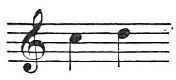 c to d is an interval
of a second because two letters are comprised. It makes
no difference whether or not either or both of the above tones
is affected by an accidental, the interval still comprises two
letters and is a second.

 .
 is
 .
The same letters are in both intervals, but the first interval
is a third and the inverted interval is a sixth.
 .
A minor triad consists of the fundamental, the minor third,
and the perfect fifth. Example:—
 .
 .
 .