(Synonym: Tetter; Salt Rheum.)
What is eczema?
An acute, subacute or chronic inflammatory disease, characterized
in the beginning by the appearance of erythema, papules, vesicles or
pustules, or a combination of these lesions, with a variable amount
of infiltration and thickening, terminating either in discharge with
the formation of crusts, in absorption, or in desquamation, and
accompanied by more or less intense itching and a feeling of heat or
burning.
What are the several primary types of eczema?
Erythematous, papular, vesicular and pustular; all cases begin as
one or more of these types, but not infrequently lose these characters
and develop into the common clinical or secondary types—eczema
rubrum and eczema squamosum.
Fig. 20.
Papular Eczema (leg).
What other types are met with clinically?
Eczema rubrum, eczema squamosum, eczema fissum, eczema sclerosum
and eczema verrucosum. Eczema seborrhoicum is probably
a closely allied disease, occupying a middle position between ordinary
eczema and seborrhœa.
Describe the symptoms of erythematous eczema.
Erythematous eczema (eczema erythematosum) begins as one or
more small or large, irregularly outlined hyperæmic macules or
patches, with or without slight or marked swelling, and with more
or less itching or burning. At first it may be ill-defined, but it
tends to spread and its features to become more pronounced. It
may be limited to a certain region, or it may be more or less general.
When fully developed, the skin is harsh and dry, of a mottled, reddish
or violaceous color, thickened, infiltrated and usually slightly
scaly, with, at times, a tendency toward the formation of oozing
areas. Punctate and linear scratch-marks may usually be seen scattered
over the affected region.
Its most common site is the face, but it is not infrequent upon
other parts.
Fig. 21.
Eczema Rubrum.
What course does erythematous eczema pursue?
It tends to chronicity, continuing as the erythematous form, or
the skin may become considerably thickened and markedly scaly,
constituting eczema squamosum; or a moist oozing surface, with
more or less crusting, may take its place—eczema rubrum.
Describe the symptoms of papular eczema.
Papular eczema (eczema papulosum) is characterized by the appearance,
usually in numbers, of discrete, aggregated or closely-crowded,
reddish, pin-head-sized acuminated or rounded papules.
Vesicles and vesico-papules are often intermingled. The itching is
commonly intense, as often attested by the presence of scratch-marks
and blood crusts.
It is seen most frequently upon the extremities, especially the
flexor surfaces.
Fig. 22.
Eczema Squamosum et tissum.
What course does papular eczema pursue?
The lesions tend, sooner or later, to disappear, but are usually replaced
by others, the disease thus persisting for weeks or months;
in places where closely crowded, a solid, thickened, scaly sheet of
eruption may result—eczema squamosum.
Describe the symptoms of vesicular eczema.
Vesicular eczema (Eczema vesiculosum) usually appears, on one
or several regions, as more or less diffused inflammatory reddened
patches, upon which rapidly develop numerous closely-crowded
pin-point to pin-head-sized vesicles, which tend to become
confluent and form a solid sheet of eruption. The vesicles soon
mature and rupture, the discharge drying to yellowish, honeycomb-like
crusts. The oozing is usually more or less continuous, or the
disease may decline, the crusts be cast off, to be quickly followed by
a new crop of vesicles. In those cases in which the process is
markedly acute, considerable swelling and œdema are present.
Scattered papules, vesico-papules and pustules may usually be seen
upon the involved area or about the border.
The face in infants (crusta lactea, or milk crust, of older writers),
the neck, flexor surfaces and the fingers are its favorite localities.
What course does vesicular eczema pursue?
Usually chronic, with acute exacerbations. Not infrequently it
passes into eczema rubrum.
Describe the symptoms of pustular eczema.
Pustular eczema (eczema pustulosum, eczema impetiginosum) is
probably the least common of all the varieties. It is similar,
although usually less actively inflammatory, in its symptoms to eczema
vesiculosum, the lesions being pustular from the start or developing
from preëxisting vesicles; not infrequently the eruption is mixed,
the pustules predominating. There is a marked tendency to rupturing
of the lesions, the discharge drying to thick, yellowish, brownish
or greenish crusts.
Its most common sites are the scalp and face, especially in young
people and in those who are ill-nourished and strumous.
What course does pustular eczema pursue?
Usually chronic, continuing as the same type, or passing into
eczema rubrum.
Describe the symptoms of squamous eczema.
Squamous eczema (eczema squamosum) may be defined as a
clinical variety, the chief symptoms of which are a variable degree
of scaliness, more or less thickening, infiltration, and redness, with
commonly a tendency to cracking or fissuring of the skin, especially
when the disease is seated about the joints. It is developed, as a
rule, from the erythematous or papular type. Itching is slight or
intense.
The disease is not uncommon upon the scalp.
What is the course of squamous eczema?
Essentially chronic.
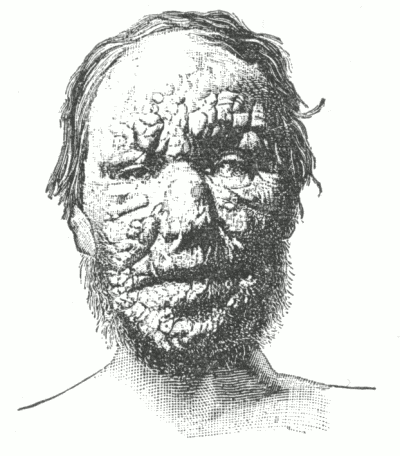
Fig. 23.
Eczema of the Face and Scalp.
Describe the symptoms of eczema rubrum.
Eczema rubrum is characterized by a red, raw-looking, weeping,
oozing or discharging surface, attended with more or less inflammatory
thickening, infiltration and swelling; the exudation, consisting
of serum, sometimes bloody, dries into thick yellowish or reddish-brown
crusts. At one time the whole diseased area may be hidden
under a mass of crusting, at other times a red, raw-looking, weeping
surface (eczema madidans) is the most striking feature. Itching is
slight or intense, or the subjective symptom may be a feeling of
burning, It is an important clinical type, usually developing from
the vesicular, pustular or other primary variety.
It is common about the face and scalp in children, and the middle
and lower part of the leg in elderly people.
What is the course of eczema rubrum?
Chronic, varying in intensity from time to time.
Describe the symptoms of fissured eczema.
The conspicuous symptom is a marked tendency to fissuring or
cracking of the skin (eczema fissum; eczema rimosum). This tendency
is usually a part of an erythematous or squamous eczema,
the fissuring constituting the most conspicuous and troublesome
symptom. Chapping is an extremely mild but familiar example
of this type.
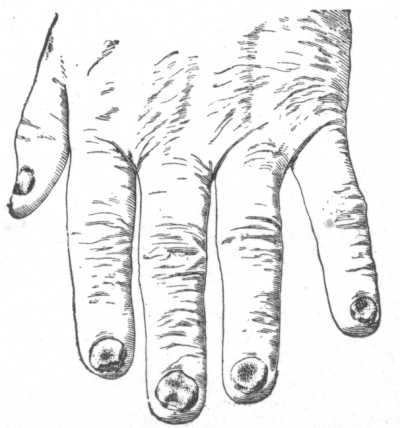
It is especially common about the hands and fingers.
What is the course of fissured eczema?
It is more or less persistent, the tendency to fissuring varying considerably
according to the state of the weather, often disappearing
spontaneously in the summer months.
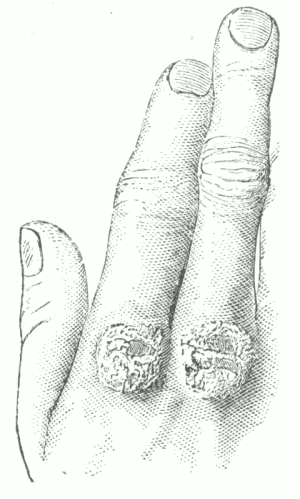
Describe eczema sclerosum and eczema verrucosum.
In eczema sclerosum the skin is thickened, infiltrated, hard, and
almost horny. Eczema verrucosum presents similar conditions, but,
in addition, displays a tendency to papillary or wart-like hypertrophy.
In both varieties the disease is usually seated about the
ankle or the foot, developing from the papular or squamous type.
They are uncommon, and obstinately chronic.
State the nature of the subjective symptoms in eczema.
Itching, commonly intense, is usually a conspicuous symptom; it
may be more or less paroxysmal. In some cases burning and heat
constitute the main subjective phenomena.
Is eczema accompanied by febrile or systemic symptoms?
No. In rare instances, in acute universal eczema, slight febrile
action, or other systemic disturbance, may be noted at the time of
the outbreak.
Is the eczematous eruption (patch or patches) sharply defined
against the neighboring sound skin?
No. In almost all instances the diseased area merges gradually
and imperceptibly into the surrounding healthy integument.
What is the character of eczema as regards the degree of
inflammatory action?
The inflammatory action may be acute, subacute or sluggish in
character, and may be so from the start and so continue throughout
its whole course; or it may, as is usually the case, vary in intensity
from time to time.
State the character of eczema as regards duration.
As a rule, it is a persistent disease, showing little, if any, tendency
to spontaneous disappearance.
Is eczema influenced by the seasons?
Yes. With comparatively few exceptions the disease is most common
and much worse in cold, windy, winter weather.
To what may eczema be ascribed?
Eczema may be due to constitutional or local causes, or to both.
It may be considered, in fact, as a reaction of the skin tissues against
some irritant, and the latter may have its origin from within or
without.
Name some of the important constitutional or predisposing
causes.
Gouty diathesis, rheumatic diathesis, disorders of the digestive
tract, general debility or lack of tone, an exhausted state of the nervous
system, dentition and struma.
Is a constitutional cause sufficient to provoke an attack?
Yes; but often the attack is brought about in those so predisposed
by some local or external irritant.
Mention some of the external causes.
Heat and cold, sharp, biting winds, excessive use of water, strong
soaps, vaccination, dyes and dyestuffs, chemical irritants, and the
like. There is a growing belief that some cases presenting eczematous
aspects are probably parasitic in origin. In fact, some observers
hold to the microbic view of all cases of eczema.
Contact with the rhus plants, while producing a peculiar dermatitis,
usually running an acute course terminating in recovery, may,
in those predisposed, provoke a veritable and persistent eczema. In
fact, in our examination as to causes in a given case, especially of
the hands and face, all possible exciting factors should be inquired
into, such as the handling of plants, chemicals, dyes, etc.
Fig. 24.
Eczema of Face.
Is eczema contagious?
No. The acceptance of a parasitic cause for the disease, however,
necessarily carries with it the possibility of contagiousness under
favoring conditions. Such is not supported, however, by practical
experience.
What is the pathology?
The process is an inflammatory one, characterized in all cases
by hyperæmia and exudation, varying in degree according to the
intensity and duration of the disease. The rete and papillary layer
are especially involved, although in severe and chronic cases the
lower part of the corium and even the subcutaneous tissue may
share in the process.
Do the cutaneous manifestations of the eruptive fevers bear
resemblance to the erythematous type of eczema?
Scarlatina and erysipelas may, to a slight extent, but the presence
or absence of febrile and other constitutional symptoms will usually
serve to differentiate.
What common skin diseases resemble some phases of eczema?
Psoriasis, seborrhœa, sycosis, scabies and ringworm.
How would you exclude psoriasis in a suspected case of eczema
(squamous eczema)?
Psoriasis occurs in variously-sized, rounded, sharply-defined
patches, usually scattered irregularly over the general surface, with
special predilection for the elbows and knees. They are covered
more or less abundantly with whitish, silvery or mother-of-pearl colored
imbricated scales. The patches are always dry, and itching is,
as a rule, slight, or may be entirely absent. Eczema, on the contrary,
is often localized, appearing as one or more large, irregularly
diffused patches; it merges imperceptibly into the sound skin, and
there is often a history of characteristic serous or gummy oozing;
the scaling is usually slight and itching almost invariably a prominent
symptom.
How would you exclude seborrhœa (eczema seborrhoicum)
in a suspected case of eczema?
Seborrhœa of the scalp is more commonly over the whole of that
region and is relatively free from inflammatory symptoms; the scales
are of a greasy character and the itching is usually slight or nil.
On the other hand, in eczema of this region the parts are rarely
invaded in their entirety; there may be at times the characteristic
serous or gummy oozing; inflammatory symptoms are usually well-marked,
the scales are dry and the itching is, as a rule, a prominent
symptom. These same differences serve to differentiate the diseases
in other regions.
How does scabies differ from eczema?
Scabies differs from eczema in its peculiar distribution, the presence
of the burrows, the absence of any tendency to patch formation,
and usually by a clear history of contagion.
How would you exclude ringworm in a suspected case of
eczema?
Ringworm is to be distinguished by its circular form, its fading
in the centre, and in doubtful cases by microscopic examination of
the scrapings.
How does eczema differ from sycosis?
Sycosis is limited to the hairy region of the face, is distinctly a
follicular inflammation, and is rarely very itchy; eczema is diffused,
usually involves other parts of the face, and itching is an annoying
symptom.
State the general prognosis of eczema.
The disease is, under favorable circumstances, curable, some cases
yielding more or less readily, others proving exceedingly rebellious.
The length of time to bring about a result is always uncertain, and
an opinion on this point should be guarded.
Upon what would you base your prognosis in the individual
case?
The extent of disease, its duration and previous behavior, the
removability of the exciting and predisposing causes, and the attention
the patient can give to the treatment.
In eczema involving the lips, face, scrotum, and leg, and especially
when this last-named exhibits a varicose condition of the veins, a
cure is effected, as a rule, only through persistent and prolonged
treatment.
Does eczema ever leave scars?
No. Upon the legs, in long-continued cases, more or less pigmentation
usually remains.
How is eczema treated?
As a rule, eczema requires for its removal both constitutional and
external treatment.
Certain cases, however, seem to be entirely local in their nature,
and in these cases external treatment alone will have satisfactory
results.
What general measures as to hygiene and diet are commonly
advisable?
Fresh air, exercise, moderate indulgence in calisthenics, regular
habits, a plain, nutritious diet; abstention from such articles of food
as pork, salted meat, acid fruits, pastry, gravies, sauces, cheese,
pickles, condiments, excessive coffee or tea drinking, etc. As a rule,
also, beer, wine, and other stimulants are to be interdicted.
Upon what grounds is the line or plan of constitutional treatment
to be based?
Upon indications in the individual case. A careful examination
into the patient's general health will usually give the cue to the line
of treatment to be adopted.
Mention the important remedies variously employed in the
constitutional treatment.
Tonics—such as cod-liver oil, quinine, nux vomica, the vegetable
bitters, iron, arsenic, malt, etc.
Alkalies—sodium salicylate, potassium bicarbonate, liquor potassæ,
and lithium carbonate.
Alteratives—calomel, colchicum, arsenic, and potassium iodide.
Diuretics—potassium acetate, potassium citrate, and oil of copaiba.
Laxatives—the various salines, aperient spring waters, castor oil,
cascara sagrada, aloes and other vegetable cathartics.
Digestives—pepsin, pancreatin, muriatic acid and the various bitter
tonics.
Are there any remedies which have a specific influence?
No; although arsenic, in exceptional instances, seems to exert
a special action. Cod-liver oil is also of great value in some cases.
Upon the whole the most important remedies are those which
keep in view the maintenance of a proper and healthful condition
of the gastro-intestinal tract, and especially with regular and rather
free action of the bowels.
In what class of cases does arsenic often prove of service?
In the sluggish, dry, erythematous, scaly and papular types.
In what cases is arsenic usually contraindicated?
It should never be employed in acute cases; nor in any instance
(unless its action is watched), in which the degree of inflammatory
action is marked, as an aggravation of the disease usually results.
What should be the character of the external treatment?
It depends mainly upon the degree of inflammatory action; but
the stage of the disease, the extent involved, and the ability of the
patient to carry out the details of treatment, also have a bearing
upon the selection of the plan to be advised.
What is to be said about the use of soap and water in eczema?
In acute and subacute conditions soap and water are to be employed,
as a rule, as infrequently and as sparingly as possible, as
the disease is often aggravated by their too free use. Washing is
necessary, however, for cleanliness and occasionally, also, for the
removal of the crusts. On the other hand, in chronic, sluggish
types the use of soap and water frequently has a therapeutic value.
How often should remedial applications be made?
Usually twice daily, although in some case, and especially those
of an acute type, applications should be made every few hours.
Mention several remedies or plans of treatment to be used
in the acute or actively inflammatory cases.
Black wash and oxide-of-zinc ointment conjointly, the wash thoroughly
dabbed on, allowed to dry, the parts gently smeared with
ointment; or the ointment may be applied spread on lint as a plaster.
Boric-acid wash (15 grains to the ounce) and oxide-of-zinc ointment,
applied in the same manner as the above.
A lotion containing calamine and zinc oxide, the sediment drying
and coating over the affected surface:—
  ℞ Calaminæ,

    Zinci oxidi, .................āā.................. ʒ ij-ʒ iij
    Glycerinæ,
    Alcoholis, ...................āā................. fʒss
    Liq. calcis, .................................... f℥ij
    Aquæ, .............. q.s. ... ad ................ f℥vj.   M.
Another excellent lotion somewhat similar to the last, but of
oily character, is made up of three drachms each of calamine
and zinc oxide, one drachm of boric acid, ten to thirty drops of
carbolic acid, and three ounces each of lime-water and oil of sweet
almonds.
Carbolic-acid lotion, about two drachms to the pint of water, to
which may be added two or three drachms each of glycerin and
alcohol; or, if there is intense itching, carbolic acid may be added
to the several washes already mentioned.
A lotion made of one or two drachms of liquor carbonis detergens[A]
to four ounces of water.
The following wash, especially in the dry form of the disease:—
  ℞ Ac. borici, ...................................... ʒiv
    Ac. carbolici, ................................... ʒj
    Glycerinæ, ....................................... ʒij
    Alcoholis, ....................................... ʒij
    Aquæ, ............... q.s. ad. ................... Oj.  M.
Dusting-powders, of starch, zinc oxide and Venetian talc, alone or
severally combined, applied freely and often, so as to afford protection
to the inflamed surface:—
  ℞ Talci venet,
    Zinci oxidi, ...............āā.................... ʒiv
    Amyli, ........................................... ℥j.   M.
If washes or dusting-powders should disagree or are not desirable
or practicable, ointments may be employed, such as—
Oxide-of-zinc ointment, cold cream, petrolatum, plain or carbolated,
diachylon ointment (if fresh and well prepared), and a paste-like
ointment, as the following, usually called “salicylic-acid paste”;
in markedly itchy cases, five to fifteen grains of carbolic may be
added to each ounce:
  ℞ Ac. salicylici, .................................. gr. v-x
    Pulv. amyli,
    Pulv. zinci oxidi, ...............āā.............. ʒij
    Petrolati, ....................................... ʒiv   M.
Or the following ointment:—
  ℞ Calaminæ, ........................................ ʒj
    Ungt. zinci oxidi, ............................... ʒvij.   M.
Name several external remedies and combinations useful in
eczema of a subacute or mildly inflammatory type.
The various remedies and combinations useful when the symptoms
are acute or markedly inflammatory (mentioned above), and more
especially the several following:—
  ℞ Zinci oxidi, ..................................... ʒij
    Liq. plumbi subacetat. dilut., .................. fʒvj
    Glycerinæ, ...................................... fʒij
    Infus. picis liq., .............................. f℥iij   M.
A lotion containing resorcin, five to thirty grains to the ounce.
Solution of zinc sulphate, one-half to three grains to the ounce.
An ointment containing calomel or ammoniated mercury, as in
the annexed formula:—
  ℞ Hydrargyri ammoniat. seu Hydrargyri
      chloridi mit., ................................. gr. x-xxx
    Ac. carbolici, ................................... gr. v-x
    Ungt. zinci oxidi, ............................... ℥j.   M.
Another formula, more especially useful in eczema of the hands
and legs, is the following:—
  ℞ Ac. salicylici, .................................. gr. xxx
    Emp. plumbi,
    Emp. saponis,
    Petrolati, ...................āā.................. ℥j.   M.
(This is to be applied as a plaster, spread on strips of lint, and
changed every twelve or twenty-four hours.)
The paste-like ointment, referred to as useful in acute eczema,
may also be used with a larger proportion (20 to 60 grains to the
ounce) of salicylic acid.
The following, containing tar, may often be employed with advantage:—
  ℞ Ungt. picis liq., ................................ ʒj
    Ungt. zinci oxidi, ............................... ʒvij.   M.
What is to be said in regard to the use of tarry applications?
Ointments or lotions containing tar should always be tried at first
upon a limited surface, as occasionally skins are met with upon
which this remedy acts as a more or less violent irritant. The coal
tar lotion (liquor carbonis detergens) is the least likely to disagree
and may be used as a mild ointment, one or two drachms to the
ounce, or it may be diluted and used as a weak lotion as already
referred to.
What external remedies are to be employed in eczema of a
sluggish type?
The various remedies and combinations (mentioned above) useful
in acute and subacute eczema may often be employed with
benefit, but, as a rule, stronger applications are necessary, especially
in the thick and leathery patches. The following are the
most valuable:—
An ointment of calomel or ammoniated mercury; forty to sixty
grains to the ounce.
Strong salicylic-acid ointment; a half to one drachm of salicylic
acid to the ounce of lard.
Tar ointment, official strength; or the various tar oils, alone or
with alcohol, as a lotion, or in ointment form.
Liquor picis alkalinus[B] is a valuable remedy in chronic thickened,
hard and verrucous patches, but is a strong preparation and must be
used with caution. It is applied diluted, one part with from eight
to thirty-two parts of water; or in ointment, one or two drachms to
the ounce. In such cases, also, the following is useful:—
  ℞ Saponis viridis,
    Picis liq.,
    Alcoholis, ....................āā................. ʒiij.   M.
  SIG. To be well rubbed in.
In similar cases, also, the parts may be thoroughly washed or
scrubbed with sapo viridis and hot water until somewhat tender,
rinsed off, dried, and a mild ointment applied as a plaster.
Lactic acid, applied with one to ten or more parts of water is also
of value in the sclerous and verrucous types. Caustic potash solutions,
used cautiously, may also be occasionally employed to advantage
in these cases.
Another remedy of value in these cases, as well as in others
of more or less limited nature, is the x-ray. Exposures every
few days, of short duration and 4 to 10 inches distance, with
medium vacuum tube. This method has served me well in
occasional cases; caution is necessary, and it should not be
pushed further than the production of the mildest reaction. The
repeated application of a high-frequency current, by means of the
vacuum electrodes, is a safer and sometimes an equally beneficial
method.
Is there any method of treating eczema with fixed dressings?
Several plans have been advised from time to time; some are costly,
and some require too great attention to details, and are therefore
impracticable for general employment. The following are those in
more common use:—
The gelatin dressing, as originally ordered, is made by melting over
a water-bath one part of gelatin in two parts of water—quickly painting
it over the diseased area; it dries rapidly, and to prevent cracking
glycerine is brushed over the surface. Or the glycerine may
be incorporated with the gelatin and water in the following proportion:
glycerine, one part; gelatin, four parts, and water eight parts.
Medicinal substances may be incorporated with the gelatin mixture.
A good formula is the following:—
  ℞ Gelatin, ......................................... ℥j
    Zinci oxidi, ..................................... ℥ss
    Glycerini, ....................................... ℥iss
    Aquæ, ............................................ ℥ii-℥iij.
This should be prepared over a water-bath, and two per cent.
ichthyol added. A thin gauze bandage can be applied to the
parts over which this dressing is painted, before it is completely
dry; it makes a comfortable fixed dressing and may remain on
several days.
Plaster-mull and gutta-percha plaster. The plaster-mull, consisting
of muslin incorporated with a layer of stiff ointment, and the
gutta-percha plaster, consisting of muslin faced with a thin layer
of India-rubber, the medication being spread upon the rubber
coating.
Rubber plasters. These are medicated with the various drugs
used in the external treatment of skin diseases, and are often of
service in chronic patches.
Two new excipients for fixed dressings have recently been introduced—bassorin
and plasment; the former is made from gum tragacanth,
and the latter from Irish moss.
The following is a satisfactory formula for a tragacanth dressing:
  ℞ Tragacanth, ...................................... gr. lxxv
    Glycerini, ....................................... ♏ xxx
    Ac. carbolici, ................................... gr. x-xx
    Zinci oxidi, ..................................... ʒiss-ʒiiss.   M.
This is painted over the parts and allowed to dry, and a mild dusting
powder sprinkled over. It cannot be used in warm weather
or in folds, as it is apt to get sticky. The following is a bassorin
paste which may be variously medicated.
  ℞ Bassorin, ........................................ ʒx
    Dextrin, ......................................... ʒvj
    Glycerini, ....................................... ℥ij.
    Aquæ, ................................... q.s. ad. ℥iij.
It should be prepared cold.
Another “drying dressing” which may be used in cool weather is:
  ℞ Zinci oxidi, ..................................... ℥j
    Glycerini, ....................................... ℥ss
    Mucilag. acaciæ, ................................. ℥ii-℥iv.
It may be variously medicated.
The plaster-mull is used in all types, especially the acute; the gelatin
dressing, and the gutta-percha plaster, in the subacute and
chronic; and the rubber plaster in chronic, sluggish patches only.
Acacia, tragacanth, bassorin and plasment applications are used in
cases of a subacute and chronic character.