THE BATON ITSELF
Before giving actual directions for the manipulation of the
conductor's baton, it may be well to state that the stick itself
should be light in weight, light in color, and from sixteen to twenty
inches long. It must be thin and flexible, and should taper gradually
from the end held in the hand to the point. Batons of this kind can be
manufactured easily at any ordinary planing mill where there is a
lathe. The kinds sold at stores are usually altogether too thick and
too heavy. If at any time some adulating chorus or choir should
present the conductor with an ebony baton with silver mountings, he
must not feel that courtesy demands that it should be used in
conducting. The proper thing to do with such an instrument is to tie a
ribbon around one end and hang it on the wall as a decoration.
THE CONDUCTOR'S MUSIC STAND
A word about the music desk may also be in order at this time. It
should be made of wood or heavy metal so that in conducting one need
not constantly feel that it is likely to be knocked over. The ordinary
folding music stand made of light metal is altogether unsuitable for a
conductor's use. A good substantial stand with a metal base and
standard and wood top can be purchased for from three to five dollars
from any dealer in musical instruments. If no money is available and
the stand is constructed at home, it may be well to note that the base
should be heavy, the upright about three and a half feet high, and
the top or desk about fourteen by twenty inches. This top should tilt
only slightly, so that the conductor may glance from it to his
performers without too much change of focus. Our reason for mentioning
apparently trivial matters of this kind is to guard against any
possible distraction of the conductor's mind by unimportant things. If
these details are well provided for in advance, he will be able while
conducting to give his entire attention to the real work in hand.
HOLDING AND WIELDING THE BATON
The baton is ordinarily held between the thumb and first, second and
third fingers, but the conductor's grasp upon it varies with the
emotional quality of the music. Thus in a dainty pianissimo passage,
it is often held very lightly between the thumb and the first two
fingers, while in a fortissimo one it is grasped tightly in the
closed fist, the tension of the muscles being symbolic of the
excitement expressed in the music at that point. All muscles must be
relaxed unless a contraction occurs because of the conductor's
response to emotional tension in the music. The wrist should be loose
and flexible, and the entire beat so full of grace that the attention
of the audience is never for an instant distracted from listening to
the music by the conspicuous awkwardness of the conductor's hand
movements. This grace in baton-manipulation need not interfere in any
way with the definiteness or precision of the beat. In fact an easy,
graceful beat usually results in a firmer rhythmic response than a
jerky, awkward one. For the first beat of the measure the entire arm
(upper as well as lower) moves vigorously downward, but for the
remaining beats the movement is mostly confined to the elbow and
wrist. In the case of a divided beat (see pages 23 and 24) the
movement comes almost entirely from the wrist.
POSITION OF THE BATON
The hand manipulating the baton must always be held sufficiently high
so as to be easily seen by all performers, the elbow being kept well
away from the body, almost level with the shoulder. The elevation of
the baton, of course, depends upon the size of the group being
conducted, upon the manner in which the performers are arranged, and
upon whether they are sitting or standing. The conductor will
accordingly vary its position according to the exigencies of the
occasion, always remembering that a beat that cannot be easily seen
will not be readily followed.
PRINCIPLES AND METHODS OF TIME BEATING
If one observes the work of a number of conductors, it soon becomes
evident that, although at first they appear to have absolutely
different methods, there are nevertheless certain fundamental
underlying principles in accordance with which each beats time, and it
is these general principles that we are to deal with in the remainder
of this chapter. It should be noted that principles rather than
methods are to be discussed, since principles are universal, while
methods are individual and usually only local in their application.
DIAGRAMS OF BATON MOVEMENTS
The general direction of the baton movements now in universal use is
shown in the following figures.
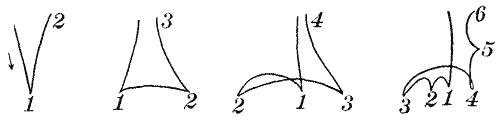
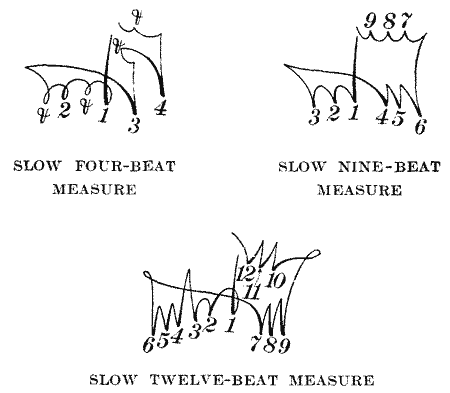
In actual practice however, the baton moves from point to point in a
very much more complex fashion, and in order to aid the learner still
further in his analysis of time beating an elaborated version of the
foregoing figures is supplied. It is of course understood that such
diagrams are of value only in giving a general idea of these more
complex movements and that they are not to be followed minutely.
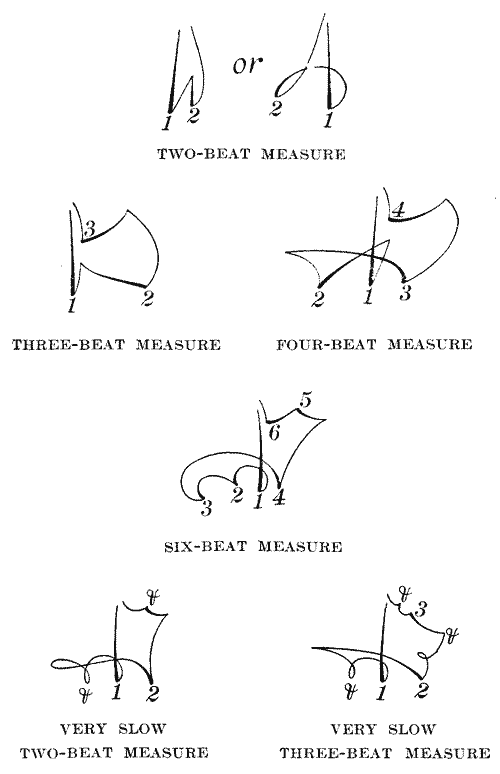
An examination of these figures will show that all baton movements are
based upon four general principles:
1. The strongest pulse of a measure (the first one) is
always marked by a down-beat. This principle is merely a
specific application of the general fact that a downward
stroke is stronger than an upward one (cf. driving a
nail).
2. The last pulse of a measure is always marked by an
up-beat, since it is generally the weakest part of the
measure.
3. In three- and four-beat measures, the beats are so
planned that there is never any danger of the hands
colliding in conducting vigorous movements that call for the
use of the free hand as well as the one holding the baton.
4. In compound measures the secondary accent is marked by a
beat almost as strong as that given the primary accent.
NUMBER OF BEATS DETERMINED BY TEMPO
The fact that a composition is in 4-4 measure does not necessarily
mean that every measure is to be directed by being given four actual
beats, and one of the things that the conductor must learn is when to
give more beats and when fewer.
If the tempo is very rapid, the 4-4 measure will probably be given
only two beats, but in an adagio movement, as, e.g., the first
part of the Messiah overture, it may be necessary to beat eight for
each measure in order to insure rhythmic continuity. There are many
examples of triple measure in which the movement is so rapid as to
make it impracticable to beat three in a measure, and the conductor is
therefore content merely to give a down-beat at the beginning of each
measure; waltzes are commonly conducted by giving a down-beat for the
first measure, an up-beat for the second, et cetera; a six-part
measure in rapid tempo receives but two beats; while 9-8 and 12-8 are
ordinarily given but three and four beats respectively.
It is not only annoying but absolutely fatiguing to see a conductor go
through all manner of contortions in trying to give a separate beat to
each pulse of the measure in rapid tempos; and the effect upon the
performers is even worse than upon the audience, for a stronger
rhythmic reaction will always be stimulated if the rhythm is felt in
larger units rather than in smaller ones. But on the other hand, the
tempo is sometimes so very slow that no sense of continuity can be
aroused by giving only one beat for each pulse; hence, as already
noted, it is often best to give double the number of beats indicated
by the measure sign. In general, these two ideas may be summarized in
the following rule: As the tempo becomes more rapid, decrease the
number of beats; but as it becomes slower, increase the number, at the
same time elaborating the beat so as to express more tangibly the idea
of a steady forward movement.
By carefully studying the second series of figures given on pages 23
and 24 and by making certain that the principle of "continuous
movement" explained on page 28 is observed, the student will be able
to learn the more highly elaborated beats employed in slower tempos
without very much difficulty. These diagrams, like the first set, are,
of course, intended to be suggestive only.
SHALL WE BEAT THE RHYTHM OR THE PULSE?
In this same connection, the amateur may perhaps raise the question as
to whether it is wise to beat the rhythm or the pulse in such a
measure as
 . In other words, is it well to give a
down-beat on 1, two small beats toward the left for 2, while 3 and 4
are treated in the ordinary way? This question may be answered by
referring to the rule given on page 25, but perhaps it will be safer
to make the application more specific by advising the young conductor
to adhere fairly closely to beating the pulse unless a much slower
tempo makes extra beats necessary. The additional movements may be of
some service in certain cases, but in general they tend to confuse
rather than to clarify, this being especially true in the case of
syncopated rhythms. The only exceptions to this principle are:
. In other words, is it well to give a
down-beat on 1, two small beats toward the left for 2, while 3 and 4
are treated in the ordinary way? This question may be answered by
referring to the rule given on page 25, but perhaps it will be safer
to make the application more specific by advising the young conductor
to adhere fairly closely to beating the pulse unless a much slower
tempo makes extra beats necessary. The additional movements may be of
some service in certain cases, but in general they tend to confuse
rather than to clarify, this being especially true in the case of
syncopated rhythms. The only exceptions to this principle are:
1. When a phrase begins with a tone that is on a fractional
part of the beat; e.g., if the preceding phrase ends with
an eighth, thus:
 ; for in this case the
phrasing cannot be indicated clearly without dividing the
beat.
; for in this case the
phrasing cannot be indicated clearly without dividing the
beat.
2. When there is a ritardando and it becomes necessary to
give a larger number of beats in order to show just how much
slower the tempo is to be. The second point is of course
covered by the general rule already referred to.
The conductor must train himself to change instantly from two beats in
the measure to four or six; from one to three, et cetera, so that he
may be able at any time to suit the number of beats to the character
of the music at that particular point. This is particularly necessary
in places where a ritardando makes it desirable from the standpoint
of the performers to have a larger number of beats.
THE DOTTED-QUARTER AS A BEAT NOTE
Although covered in general by the preceding discussion, it may
perhaps be well to state specifically that the compound measures 6-8,
9-8, and 12-8 are ordinarily taken as duple, triple, and quadruple
measures, respectively. In other words, the dotted-quarter-note
( ) is thought of as the beat note, some
modern editors going so far as to write
) is thought of as the beat note, some
modern editors going so far as to write
 in place of 6-8 as the measure sign;
 in
place of 9-8; and
in
place of 9-8; and
 in place of 12-8. In
conducting these various types of measure, the general principle given
on page 25 again applies, and if the tempo is very slow, the conductor
beats 6, 9, or 12, to the measure, but if it is rapid, the flow of the
rhythm is much better indicated by 2, 3, and 4 beats respectively.
in place of 12-8. In
conducting these various types of measure, the general principle given
on page 25 again applies, and if the tempo is very slow, the conductor
beats 6, 9, or 12, to the measure, but if it is rapid, the flow of the
rhythm is much better indicated by 2, 3, and 4 beats respectively.
FIVE- AND SEVEN-BEAT MEASURES
Although only occasionally encountered by the amateur, five- and
seven-beat measures are now made use of frequently enough by composers
to make some explanation of their treatment appropriate. A five-beat
measure (quintuple) is a compound measure comprising a two-beat and a
three-beat one. Sometimes the two-beat group is first, and sometimes
the three-beat one. If the former, then the conductor's beat will be
down-up, down-right-up. But if it is the other way about, then the
beat will naturally be down-right-up, down-up. "But how am I to know
which comes first?" asks the tyro. And our answer is, "Study the
music, and if you cannot find out in this way, you ought not to be
conducting the composition."
Just as quintuple measure is a compound measure comprising two
pulse-groups, one of three and the other of two beats, so seven-beat
measure (septuple) consists of a four-beat group plus a three-beat
one. If the four-beat measure is first, the conductor's beat will be
down-left-right-up, down-right-up; i.e., the regular movements for
quadruple measure followed by those for triple; but if the combination
is three plus four, it will be the other way about. Sometimes the
composer helps the conductor by placing a dotted bar between the two
parts of the septuple measure, thus:
 .
.
AN IMPORTANT PRINCIPLE OF TIME BEATING
The most fundamental principle of time beating, and the one concerning
which the young conductor is apt to be most ignorant, is the
following: The baton must not usually come to a standstill at the
points marking the beats, neither must it move in a straight line from
one point to another, except in the case of the down beat; for it is
the free and varying movement of the baton between any two beats that
gives the singers or players their cue as to where the second of the
two is to come. We may go further and say that the preliminary
movement made before the baton arrives at what might be termed the
"bottom" of the beat is actually more important than the "bottom" of
the beat itself. When the baton is brought down for the first beat of
the measure, the muscles contract until the imaginary point which the
baton is to strike has been reached, relaxing while the hand moves on
to the next point (i.e., the second beat) gradually contracting
again as this point is reached, and relaxing immediately afterward as
the hand moves on to the third beat. In the diagrams of baton
movements given on preceding pages, the accumulating force of muscular
contraction is shown by the gradually increasing thickness of the
line, proceeding from the initial part of the stroke to its
culmination; while the light curved line immediately following this
culmination indicates the so-called "back-stroke," the muscular
relaxation. It is easy to see that this muscular contraction is what
gives the beat its definiteness, its "bottom," while the relaxation is
what gives the effect of continuity or flow. It will be noticed that
when the baton is brought down on an accented beat, the beginning of
the back-stroke is felt by the conductor as a sort of "rebound" of the
baton from the bottom of the beat, and this sensation of rebounding
helps greatly in giving "point" to these accented beats.
In order to understand fully the principle that we have just been
discussing, it must be recalled that rhythm is not a succession of
jerks, but is basically a steady flow, a regular succession of similar
impulses, the word rhythm itself coming from a Greek stem meaning
"flow." Like all other good things, this theory of continuous movement
may be carried to excess, and one occasionally sees conducting that
has so much "back-stroke" that there is no definiteness of beat
whatsoever; in other words there is no "bottom" to the beat, and
consequently no precision in the conducting. But on the other hand,
there is to be observed also a great deal of conducting in which the
beats seem to be thought of as imaginary points, the conductor
apparently feeling that it is his business to get from one to another
of these points in as straight a line as possible, and with no
relaxation of muscle whatever. Such conductors often imagine that they
are being very definite and very precise indeed in their directing,
and have sometimes been heard to remark that the singers or players
whom they were leading seemed exceedingly stupid about following the
beat, especially in the attacks. The real reason for sluggish rhythmic
response and poor attacks is, however, more often to be laid at the
door of a poorly executed beat by the conductor than to the stupidity
of the chorus or orchestra.[7]
HOW TO SECURE A FIRM ATTACK
Coordinate with the discussion of continuous movement and back-stroke,
the following principle should be noted: A preliminary movement
sufficiently ample to be easily followed by the eye must be made
before actually giving the beat upon which the singers or players are
to begin the tone, if the attack is to be delivered with precision and
confidence. Thus in the case of a composition beginning upon the
first beat of a measure, the conductor holds the baton poised in full
view of all performers, then, before actually bringing it down for the
attack, he raises it slightly, this upward movement often
corresponding to the back-stroke between an imaginary preceding beat
and the actual beat with which the composition begins. When a
composition begins upon the weak beat (e.g., the fourth beat of a
four-pulse measure), the preceding strong beat itself, together with
the back-stroke accompanying it, is often given as the preparation for
the actual initial beat. In case this is done the conductor must guard
against making this preliminary strong beat so prominent as to cause
the performers to mistake it for the actual signal to begin. If the
first phrase begins with an eighth-note ( ), give a
short beat for 4 and an extra up-beat for the first note of the
phrase. If it begins with a sixteenth-note, do the same thing, but
make the extra up-beat with which the first tone is to be coincident
shorter and quicker. If a good attack cannot be secured in any other
way, beat an entire preliminary measure until the attack goes well,
then adopt some such plan as has just been suggested.
), give a
short beat for 4 and an extra up-beat for the first note of the
phrase. If it begins with a sixteenth-note, do the same thing, but
make the extra up-beat with which the first tone is to be coincident
shorter and quicker. If a good attack cannot be secured in any other
way, beat an entire preliminary measure until the attack goes well,
then adopt some such plan as has just been suggested.
THE RELEASE
The preliminary up-beat which has just been discussed is equally
valuable as a preparation for the "release" or "cut-off." The movement
for the release is usually a down stroke to right or left, or even
upward. It is customary not to beat out the final measure of a
composition or a complete final section of a composition, but to
bring the baton down a few inches for the first beat of the measure,
and then to hold it poised in this position, either counting the beats
mentally, or trusting to feeling to determine the time for stopping. A
slight upward movement is then made just before the tone is to be
released, and it is the warning conveyed by this preliminary movement
that enables the performers to release the tone at the precise instant
when the baton is brought down for the cut-off. It should be noted
that the release must come at the end of the duration value of the
final note. In 4-4 a final
 would therefore
be held up to the beginning of the fourth beat, i.e., until one is
on the point of counting four; a final
would therefore
be held up to the beginning of the fourth beat, i.e., until one is
on the point of counting four; a final
 , until
the beginning of the first beat of the following measure. It is
because of carelessness or ignorance on this point that composers now
sometimes resort to such devices as
, until
the beginning of the first beat of the following measure. It is
because of carelessness or ignorance on this point that composers now
sometimes resort to such devices as
 to show that the
final tone has four full beats. In such a case, the ending
means exactly the same thing as
to show that the
final tone has four full beats. In such a case, the ending
means exactly the same thing as
 , the tone
being released precisely on one of the following measure, in either
case.
, the tone
being released precisely on one of the following measure, in either
case.
THE HOLD
In the case of a hold (fermata), the movement for the cut-off
depends upon the nature of what follows. If the tone to be prolonged
forms the end of a phrase or section, the baton is brought down
vigorously as at the end of a composition; but if the hold occurs at
the end of a phrase in such a way as not to form a decided closing
point, or if it occurs in the midst of the phrase itself, the cut-off
is not nearly so pronounced, and the conductor must exercise care to
move his baton in such a direction as to insure its being ready to
give a clear signal for the attack of the tone following the hold.
Thus, with a hold on the third beat,
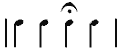 the cut-off
would probably be toward the right and upward, this movement then
serving also as a preliminary for the fourth beat to follow.
the cut-off
would probably be toward the right and upward, this movement then
serving also as a preliminary for the fourth beat to follow.
THE ATTACK IN READING NEW MUSIC
For working in rehearsal it is convenient to use some such exclamation
as "Ready—Sing," or "Ready—Play," in order that amateur musicians
may be enabled to attack the first chord promptly, even in reading new
music. In this case the word "Ready" comes just before the preliminary
movement; the word "Sing" or "Play" being coincident with the actual
preliminary movement. In preparing for a public performance, however,
the conductor should be careful not to use these words so much in
rehearsing that his musicians will have difficulty in making their
attacks without hearing them.
LENGTH OF THE STROKE
The length and general character of the baton movement depend upon the
emotional quality of the music being conducted. A bright, snappy
Scherzo in rapid tempo will demand a short, vigorous beat, with
almost no elaboration of back-stroke; while for a slow and stately
Choral, a long, flowing beat with a highly-elaborated back-stroke
will be appropriate. The first beat of the phrase in any kind of music
is usually longer and more prominent, in order that the various
divisions of the design may be clearly marked. It is in the length of
the stroke that the greatest diversity in time beating will occur in
the case of various individual conductors, and it is neither possible
nor advisable to give specific directions to the amateur. Suffice it
to say, that if he understands clearly the foregoing principles of
handling the baton, and if his musical feeling is genuine, there will
be little difficulty at this point.
NON-MEASURED MUSIC
The directions for beating time thus far given have, of course,
referred exclusively to what is termed "measured music," i.e., music
in which the rhythm consists of groups of regularly spaced beats, the
size and general characteristics of the group depending upon the
number and position of the accents in each measure. There exists,
however, a certain amount of non-measured vocal music, and a word
concerning the most common varieties (recitative and Anglican chant)
will perhaps be in order before closing our discussion of beating
time.
RECITATIVE
In conducting the accompaniment of a vocal solo of the recitative
style, and particularly that variety referred to as recitativo
secco, the most important baton movement is a down-beat after each
bar. The conductor usually follows the soloist through the group of
words found between two bars with the conventional baton movements,
but this does not imply regularly spaced pulses as in the case of
measured music, and the beats do not correspond in any way to those of
the ordinary measure of rhythmic music. They merely enable the
accompanying players to tell at approximately what point in the
measure the singer is at any given time, the up-beat at the end of the
group giving warning of the near approach of the next group.
THE ANGLICAN CHANT
In the case of the Anglican chant, it should be noted that there are
two parts to each verse: one, a reciting portion in which there is no
measured rhythm; the other, a rhythmic portion in which the pulses
occur as in measured music. In the reciting portion of the chant, the
rhythm is that of ordinary prose speech, punctuation marks being
observed as in conventional language reading. This makes it far more
difficult to keep the singers together, and in order to secure
uniformity, some conductors give a slight movement of the baton for
each syllable; others depend upon a down-beat at the beginning of each
measure together with the lip movements made by the conductor himself
and followed minutely by the chorus.
The beginning of the second part of the chant is indicated by printing
its first syllable in italics, by placing an accent mark over it, or
by some other similar device. This syllable is then regarded as the
first accented tone of the metrical division of the chant, and,
beginning with it, the conductor beats time as in ordinary measured
music. If no other syllable follows the accented one before a bar
occurs, it is understood that the accented syllable is to be held for
two beats, i.e., a measure's duration. Final ed is always
pronounced as a separate syllable.
The most important thing for an amateur to learn about conducting the
Anglican chant is that before he can successfully direct others in
singing this type of choral music, he must himself practically
memorize each chant. The amateur should perhaps also be warned not to
have the words of the first part of the chant recited too rapidly. All
too frequently there is so much hurrying that only a few of the most
prominent words are distinguishable, most of the connecting words
being entirely lost. A more deliberate style of chanting than that in
ordinary use would be much more in keeping with the idea of dignified
worship. Before asking the choir to sing a new chant, it is often well
to have the members recite it, thus emphasizing the fact that the
meaning of the text must be brought out in the singing. In
inaugurating chanting in churches where this form of music has not
previously formed a part of the service, it will be well to have both
choir and congregation sing the melody in unison for a considerable
period before attempting to chant in parts.
THE NECESSITY OF PRACTICE IN HANDLING THE BATON
Now that we have laid down the principles upon the basis of which our
prospective conductor is to beat time, let us warn him once more that
here, as in other things, it is intelligent practice that makes
perfect, and that if he is to learn to handle the baton successfully,
and particularly if he is to learn to do it so well that he need never
give the slightest thought to his baton while actually conducting,
hours of practice in beating time will be necessary. This practising
should sometimes take place before a mirror, or better still, in the
presence of some critical friend, so that a graceful rather than a
grotesque style of handling the baton may result; it should also be
done with the metronome clicking or with some one playing the piano
much of the time, in order that the habit of maintaining an absolutely
steady, even tempo may evolve. The phonograph may also be utilized for
this purpose, and may well become an indispensable factor in training
conductors in the future, it being possible in this way to study the
elements of interpretation as well as to practise beating time.
BATON TECHNIQUE NOT SUFFICIENT FOR SUCCESS IN CONDUCTING
It must not be imagined that if one is fortunate enough to acquire the
style of handling the baton which we have been advocating one will at
once achieve success as a conductor. The factors of musical
scholarship, personal magnetism, et cetera, mentioned in preceding
pages, must still constitute the real foundation of conducting. But
granting the presence of these other factors of endowment and
preparation, one may often achieve a higher degree of success if one
has developed also a well-defined and easily-followed beat. It is for
this reason that the technique of time beating is worthy of some
degree of serious investigation and of a reasonable amount of time
spent in practice upon it.

 = 84 means that the sliding
weight is to be set at the point marked 84, the metronome then
clicking eighty-four times per minute, each of these clicks indicating
a quarter-note. But if the marking is
= 84 means that the sliding
weight is to be set at the point marked 84, the metronome then
clicking eighty-four times per minute, each of these clicks indicating
a quarter-note. But if the marking is
 = 64, this means
that sixty-four half-notes are to be performed in a minute,—a tempo
equal to one hundred and twenty-eight quarter-notes in the same
composition. In compound measures such as 6-8, 9-8, et cetera, the
tempo indication shows the number of eighth-notes per minute if the
composition is in slow tempo; but in moderate and rapid tempos the
direction is usually given by taking the dotted-quarter-note as the
beat unit, thus:
= 64, this means
that sixty-four half-notes are to be performed in a minute,—a tempo
equal to one hundred and twenty-eight quarter-notes in the same
composition. In compound measures such as 6-8, 9-8, et cetera, the
tempo indication shows the number of eighth-notes per minute if the
composition is in slow tempo; but in moderate and rapid tempos the
direction is usually given by taking the dotted-quarter-note as the
beat unit, thus:
 or
or

 )
) )
) ) the hands are usually close together
at the beginning, are then gradually separated as far as possible,
coming together again at the end of the decrescendo.
) the hands are usually close together
at the beginning, are then gradually separated as far as possible,
coming together again at the end of the decrescendo.




 or
or
 ) means a long quick stroke, either up or down as the case may
be. The absence of slurs indicates a separate stroke of the bow for
each tone. Sometimes the player is directed to use the lower half, the
upper half, or the middle of the bow, such directions being given by
printing the words "lower half," et cetera, above the passage, or by
giving the initials of these words (sometimes in German). When no
bowing is indicated, a phrase beginning with a weak beat commonly has
an up-bow for the first tone, while one beginning on a strong beat
has a down-bow; but this principle has many exceptions. It is perhaps
needless to state that correct phrasing in the case of the stringed
instruments depends upon the employment of suitable bowing; and since
the first violin part is most prominent and most important in
orchestral music, it becomes the business of the conductor to observe
most carefully the bowing of his concert-master and to confer with him
about possible changes in bowing wherever necessary. It will save a
great deal of confusion if players understand that the bowing is to be
exactly as indicated in the score unless a change is definitely made.
The first player in each group in point of position on the platform is
called the "principal," and is supposed to be the most skilful
performer in that section; and he is responsible, in conference with
the conductor when necessary, for selecting the best bowing, et
cetera, all others in the group watching him, and all phrasing as he
does. In actual practice, this means that the players at the second
desk bow like those at the first, those at the third desk follow those
at the second, et cetera. Absolute uniformity is thus secured in
each section. It should perhaps be remarked at this point that when
different groups are playing the same phrase, e.g., violoncellos and
basses, or second violins and violas, the bowing must be uniform in
the two sections, if absolute uniformity of phrasing is to result.
) means a long quick stroke, either up or down as the case may
be. The absence of slurs indicates a separate stroke of the bow for
each tone. Sometimes the player is directed to use the lower half, the
upper half, or the middle of the bow, such directions being given by
printing the words "lower half," et cetera, above the passage, or by
giving the initials of these words (sometimes in German). When no
bowing is indicated, a phrase beginning with a weak beat commonly has
an up-bow for the first tone, while one beginning on a strong beat
has a down-bow; but this principle has many exceptions. It is perhaps
needless to state that correct phrasing in the case of the stringed
instruments depends upon the employment of suitable bowing; and since
the first violin part is most prominent and most important in
orchestral music, it becomes the business of the conductor to observe
most carefully the bowing of his concert-master and to confer with him
about possible changes in bowing wherever necessary. It will save a
great deal of confusion if players understand that the bowing is to be
exactly as indicated in the score unless a change is definitely made.
The first player in each group in point of position on the platform is
called the "principal," and is supposed to be the most skilful
performer in that section; and he is responsible, in conference with
the conductor when necessary, for selecting the best bowing, et
cetera, all others in the group watching him, and all phrasing as he
does. In actual practice, this means that the players at the second
desk bow like those at the first, those at the third desk follow those
at the second, et cetera. Absolute uniformity is thus secured in
each section. It should perhaps be remarked at this point that when
different groups are playing the same phrase, e.g., violoncellos and
basses, or second violins and violas, the bowing must be uniform in
the two sections, if absolute uniformity of phrasing is to result.
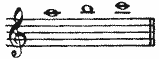 will at first
seem unbelievable. This is nevertheless the case, and the first thing
to be learned by the trainer of a boy choir is therefore to keep the
boys singing high, beginning with the higher tones
will at first
seem unbelievable. This is nevertheless the case, and the first thing
to be learned by the trainer of a boy choir is therefore to keep the
boys singing high, beginning with the higher tones
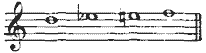 and vocalizing downward, instead of vice versa. The main reason for
the necessity of this downward vocalization is what is known as the
movable break. In an adult voice, the change from a low register to
a higher one always takes place at approximately the same place in the
scale; but the child's voice is immature, his vocal organs have not
formed definitely established habits, and the chest register is often
pushed upward to c´´, d´´, or even e´´
and vocalizing downward, instead of vice versa. The main reason for
the necessity of this downward vocalization is what is known as the
movable break. In an adult voice, the change from a low register to
a higher one always takes place at approximately the same place in the
scale; but the child's voice is immature, his vocal organs have not
formed definitely established habits, and the chest register is often
pushed upward to c´´, d´´, or even e´´
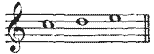 . This is
practically always done in singing an ascending scale loudly, and the
result is not only distressing to the listener, but ruinous to the
voice. In former days this type of singing was common in our public
schools, the result being that most boys honestly thought it
impossible to sing higher than c´´ or d´´
. This is
practically always done in singing an ascending scale loudly, and the
result is not only distressing to the listener, but ruinous to the
voice. In former days this type of singing was common in our public
schools, the result being that most boys honestly thought it
impossible to sing higher than c´´ or d´´
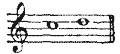 this being
the limit beyond which it was difficult to push the chest voice. The
head voice was thus not used at all, and the singing of public school
children in the past has in most cases been anything but satisfactory
from the standpoint of tonal beauty. But most supervisors of music
have now become somewhat familiar with the child voice, and are
insisting upon high-pitched songs, soft singing, and downward
vocalization, these being the three indispensable factors in the
proper training of children's voices. The result is that in many
places school children are at the present time singing very well
indeed, and the present growing tendency to encourage public
performance by large groups of them makes available a new color to the
composer of choral and orchestral music, and promises many a thrill to
the concert-goer of the future.
this being
the limit beyond which it was difficult to push the chest voice. The
head voice was thus not used at all, and the singing of public school
children in the past has in most cases been anything but satisfactory
from the standpoint of tonal beauty. But most supervisors of music
have now become somewhat familiar with the child voice, and are
insisting upon high-pitched songs, soft singing, and downward
vocalization, these being the three indispensable factors in the
proper training of children's voices. The result is that in many
places school children are at the present time singing very well
indeed, and the present growing tendency to encourage public
performance by large groups of them makes available a new color to the
composer of choral and orchestral music, and promises many a thrill to
the concert-goer of the future.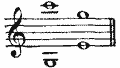 . An occasional a´´ or b´´ or a d´ or c´ will do no
harm, but the voice must not remain outside of the range
e´—g´´ for long at a time.
. An occasional a´´ or b´´ or a d´ or c´ will do no
harm, but the voice must not remain outside of the range
e´—g´´ for long at a time.