Mr. President and Gentlemen—I am sure that the feeling
that is uppermost in the minds of all here assembled is regret
at the cause which has placed me before you on this occasion.
Of the able and distinguished men who have filled this chair
since it was instituted in the commencement of the century,
not one was more able or more distinguished than its last
occupant, either as an original investigator in the branch of
science he adorns or as a facile expositor of its truths. The
loss of Professor Huxley’s services to this Institution is indeed
to be deplored. The only consolation is that what is loss to
us may be gain to others. He but leaves us that he may
concentrate his time, his energies, his genius, elsewhere.
Feeling as deeply as I do the responsibilities of the
Hunterian professorship, and my incapacity to discharge
its duties in a manner worthy of its dignity and importance,
I should certainly have declined to undertake it when it was
proposed to me, if it had not been for the thought that these
lectures are emphatically museum lectures, intended to illustrate
and explain the treasures of our noble collection, and that from
these has been derived almost all I know of the great subject
that I am now called upon to teach. I shall, therefore, perhaps
more than another might, speak to you directly from those
specimens. I am, as it were, their mouthpiece. Having
lovingly dwelt and worked among them so long, I felt that
I could hardly refuse to tell you something of what they are
always telling me—to endeavour to put their silent eloquence
in some sort of articulate language. If I can only succeed in
awakening an interest in them, and lead any one who may
chance to come into this theatre to continue his studies in the
museum, where he will meet with far greater return for his
time and his attention than here, the delivery of these lectures
will not have been altogether in vain.
I have just mentioned the museum. It is impossible to
do so without recalling the circumstance that this day is the
one on which we have been accustomed to celebrate the
anniversary of the birth of the illustrious founder of that
collection.
The 14th of February is a red-letter day in our calendar.
On this day a series of eloquent tributes have been paid to
the merits of that great man by successive Hunterian orators.
I will not delay the commencement of the proper subject of
this course by endeavouring to speak of Hunter either as a
philosopher, a physiologist, or a surgeon, but I cannot
refrain from making a passing allusion to his work in
relation to the special subject of these lectures—Comparative
Anatomy. And even this would have been superfluous, after
the able analysis of Hunter’s work in this branch of science
contributed by Professor Owen to the fourth volume of Palmer’s
edition of his collected writings, if it had not been for the vast
elucidation of the nature and amount of that work by the
subsequent publication of the two closely-printed octavo
volumes of Essays and Observations on Natural History,
Anatomy, Physiology, Psychology, and Geology, by John Hunter,
being his Posthumous Papers on those Subjects, arranged and
revised by Professor Owen (1861).
Hunter’s reputation has suffered grievously from the
extreme difficulty he always met with in giving adequate
expression to his ideas. Mr. Clift, who acted for a time
as his amanuensis, has told us how he has often “written
the same page for him at least half a dozen times over, with
corrections and transpositions almost without end;” and those
who are familiar with his writings must own that, after all this
labour, the result was often far from satisfactory. Hunter was
himself painfully aware of the deficiency. This it is which
has detracted much from the estimate in which many of his
published works are held, and it is this which was, I suspect,
the reason why his published writings bear so small a proportion
to the vast mass of rough manuscript which he left
behind him, especially on the subjects with which we are at
present engaged.
The perusal of the work just mentioned will show how,
while occupied with a large and anxious practice—in itself
labour enough for ordinary men—while cultivating with what
I might describe as a passionate energy the sciences of physiology
and pathology, while collecting and arranging a museum
such as never has been formed before or since by a single
individual, he had also carefully recorded a series of dissections
of different species of animals which, as his learned editor
justly says, if “published seriatim, would not only have vied
with the labours of Daubenton as recorded in the Histoire
Naturelle of Buffon, or with the Comparative Dissections of
Vicq d’Azyr, which are inserted in the early volumes of the
Encyclopédie Méthodique and in the Mémoires de l’Académie
Royale de France, but they would have exceeded them both
together.”[16] In fact they would have established Hunter’s fame
as by far the greatest contributor to the knowledge of animal
structure of his time, and, what is more important, would have
aided most materially in the advancement and diffusion of that
knowledge.
The work as now published contains notes of dissections,
more or less complete, of no less than 129 species of mammalia,
80 species of birds, 20 species of reptiles, 9 of amphibia, and
19 of fishes, besides numerous invertebrated animals of various
classes; and these appear to be by no means the entire series
of dissections left by Hunter.
The fate of the original manuscripts forms a sad page in
the history of our science, and, I must also add, in the history
of a man whom our Profession, and this College especially,
might otherwise have regarded with feelings of respect and
gratitude. Exactly thirty years after Hunter’s death, his
brother-in-law and executor, Sir Everard Home, who had
retained possession of them when the collection was transferred
to the College, committed them all to the flames. The
use that he had made of them in composing the lectures which
he delivered from this chair, though often previously surmised,
has become but too obvious since the publication of this
work.[17]
Happily, Hunter’s devoted assistant and friend, the
assiduous and excellent custodian of his collection for nearly
fifty years, William Clift, had occupied himself in the interval
between Hunter’s death and the removal of the manuscripts to
Sir Everard Home’s house, in making copious extracts from
these precious documents. The publication of these extracts,
nearly seventy years after their author had passed away,
however meritorious a labour on the part of their editor, can
unfortunately do little to regain for Hunter that place among
the leaders of science which his own untimely death, and the
negligence, or worse, of his executor had deprived him.
Highly original and valuable as are the observations contained
in these volumes, they have by this time been nearly all
anticipated by others. A crowd of workers in the same field,
pressing in from all directions, have covered the ground which
ought to have been occupied by the figure of Hunter, and from
which no tardy recognition of his merits can ever dispossess
them. We shall still continue to look to Cuvier and to Meckel
as the main sources of our modern knowledge of comparative
anatomy, and not to Hunter. Let us, though, never forget
that our illustrious countryman had, before their time, collected
materials for a work which needed but the finishing touches to
have made it one of the greatest, most durable, and valuable
contributions ever made by any one man to the advancement
of the science of comparative anatomy.
The present course of lectures, as just said, are intimately
associated with the museum; their annual delivery was one
of the conditions on which the care of the Hunterian collection
was entrusted by the Government to our College, and it was
expressly stipulated that they should be “illustrated by the
preparations.” I am bound, therefore, in my choice of subjects
to consider what the museum teaches, and what it does not
teach. The museum teaches one subject, and, primarily, only
one subject—namely, the variations in the form and relations
of the different parts or organs of which the bodies of various
animals are composed. In brief, it teaches Animal Morphology,
which is nearly synonymous with Comparative Anatomy.
Now, morphology, I need hardly say, is not physiology,
though it may be one of the foundations on which that
complex science is based. But, contrary as it may seem to
some of the most cherished notions of the founder of the
collection, an anatomical museum can scarcely do more in
teaching physiology than a collection of minerals can in
teaching chemistry. The physiologist should certainly be
well versed in the nature of the materials and organs by which
the functions of which he treats are carried on—having,
indeed, need of all the help he can obtain from all quarters in
the solution of the difficult problems which come before him;
but his science is, in the main, experimental. Whether it be
from the inherent difficulties that attend such inductions, or
from the hasty and illogical way in which they have often
been made, hitherto a large proportion of the attempts to
solve physiological inquiries by an appeal to morphology alone
have ended in failure, often of a mortifying character. We
still have to confess our ignorance of the purpose and application
of innumerable most obvious and striking modifications
of structure, which no amount of reasoning or guessing, without
actual observation on the living organism, seems able to
remove. I am speaking of physiology in the sense in which
the term is ordinarily restricted. There is a more general and
higher physiology, to which I shall refer presently, to elucidate
which morphology is one of the most essential aids.
When morphology was first cultivated with anything like
scientific precision, views since called “teleological,” exclusively
prevailed. Every animal was looked upon as an isolated
machine; every part of that animal was supposed to have
been formed expressly for carrying on the economy of that
particular species or individual in the most efficient manner,
without any reference to other species or individuals. If anything
further was looked for in anatomising an animal beyond
the mere gratification of curiosity or love of knowledge for its
own sake, it was direct adaptation to purpose.
Many, indeed, are the curious speculations indulged in by
anatomists of this school, impelled, as they appear always to
have been, to find an immediate use for every modification of
form. In numerous instances these were mere conjectures,
which an enlarged knowledge of the habits and economy of
the animal treated of, or of kindred species, showed to be
fallacious.
As time went on, however, and men began to obtain a
deeper insight into these subjects, resemblances either between
the whole structure or between particular parts of different
animals, which could not be explained on the utilitarian
principle, became strikingly obvious. Moreover, such things
as rudimentary and functionless organs in one animal, representing
developed or functional organs in another, became
known in the further prosecution of morphology. Then the
idea gradually dawned that there was some “secret bond”
which linked creature to creature, and which permitted
deviation only to a certain point from a certain given pattern
of construction.
This was the doctrine of type or common plan. A “type”
or a “common plan” for each natural group of the animal
kingdom was supposed to have influenced, or to have been
held in view at, the creation of every different species composing
that group, the deviations from this type being related
to the special exigencies of the particular species.
This was a great step in advance when regarded as a mere
exposition of the facts of morphology, and when the idea was
not carried out by fanciful imaginations beyond the point
warranted by these facts. Upon this view many anatomists of
great eminence seemed to rest. But still it explained nothing,
accounted for nothing. It gave not even a shadow of a reason
for the resemblances amid diversity found everywhere. It
only asserted that the Creator had imposed certain apparently
quite arbitrary restrictions to His power; but, beyond this
almost paradoxical assertion, it gave no clue to elucidate anything
like a theory of creation.
In the meanwhile, however, the great results arrived at in
other branches of science, the increasing accumulation of facts
from various sources, all tending to show that the orderly and
harmonious working of the whole universe was due to constantly
acting causes or laws, acting now, having acted for
immeasurable time past, and, as far as we can see, about to
act for immeasurable time to come,—the great work of the
astronomers and the geologists, leading to “the general conception
of some great principle of orderly evolution, according to
which the present as well as past systems of existence have
been produced out of preceding orders of things,”[18]—could not
pass unnoticed by the biologists.
First with a faint and uncertain sound, but in later times
more boldly and confidently, an hypothesis has been propounded
which does profess to account for some, at least, of the facts of
animal creation, and to afford a guide to the solution of the
problem, if not of the original beginnings, at least of the
present diversities, as well as resemblances, among the animal
and vegetable life on the globe.
This theory has for its basis that the secret bond of union
is not “conformity to type,” is no ideal to which the operations
of Creation were limited, but is one of actual consanguinity,
or, as otherwise expressed, “genetic affinity.”
The fundamental part of the theory is that, as individuals
are known to come into being by a process of generation
acting according to fixed and certain laws, the same to-day and
yesterday and to-morrow, in like manner have races, varieties,
species, and other larger groups of animals and plants come
into being—that the species existing at any one period on
the earth’s surface are, in fact, the direct descendants, modified
according to definite laws, of the creatures inhabiting the earth
in previous periods.
The theory of orderly evolution already applied to most
of the phenomena of the physical world has thus been also
applied to organic nature.
This hypothesis, originally promulgated in a comparatively
crude form by De Maillet, Erasmus Darwin, and Lamarck,
and more recently advocated by the author of the Vestiges
of Creation,[19] for a long time found little favour with English
naturalists of eminence. Indeed, so late as 1856, Baden
Powell, in his masterly essay “On the Philosophy of
Creation,” arguing with great force “that one grand overruling
principle, the universality of law, order, and continuity,
presiding as powerfully over the earlier stages of creation
as during its continuance at the present moment, applies
equally to organic as to inorganic existence,” can find little
support from the writings of any who had made the
diversities of organic life their special study. It was, in fact,
in opposition to the views then held by most naturalists, and
chiefly from a profound and philosophical analysis of the laws
which govern the physical universe, that, reasoning from the
general to the special, he came to the conclusion that “at
least, as a philosophical conjecture, the idea of transmutation of
species under adequate changes of condition, and in incalculably
long periods of time, seems supported by fair analogy and
probability.”
Very shortly after, however, these views received an
immense stimulus by the working out of a necessary complement
to the main theory, one which was absolutely essential
to its general reception—namely, a suggestion of a possible
and intelligible modus operandi—almost simultaneously by
the studies of Wallace amid the exuberant displays of nature
in the unexplored forests of the Malayan archipelago, and by
the patient accumulation and careful and candid examination
of fact upon fact, drawn from every branch of biological
science, and all converging on the theory of “the origin of
species by means of natural selection,” by the great naturalist[20]
whose name is now so thoroughly identified with the entire
transmutation hypothesis, that already in the German booksellers’
catalogues “Darwinismus” is made a prominent
subdivision in their classification of scientific literature; and
in this country “Darwinism” is the term popularly, if not
quite correctly, applied to the general doctrine of “organic
evolution.”
In reference to the effect which the publication of these
researches has produced, the learned and judicious President of
the Linnæan Society, Mr. Bentham, in his last anniversary
address, says that “the investigation of the origin, development,
and life history of species or races has been termed the great
problem of the day”; and the impulse they have given to the
study of biology in general, and to our special branch in
particular, is not exaggerated by the eminent German anatomist
Gegenbaur in stating, in a work just published, that “the
theory of descent will begin a new period in the history of comparative
anatomy.”
On the other hand, it happened rather unfortunately that
popular views of natural theology, probably through the great
influence of a famous work published during what I have
described as the first or “utility” stage of morphology, have
attached themselves more or less to the ideas of that period,
and well-meaning but mistaken persons regard with aversion
and alarm the modern theories which are, to a certain extent,
subversive of those ideas. I have no hesitation in saying
mistaken, for it is perfectly evident that all arguments as to
“the power, wisdom, and goodness of the Creator,” derived
from an animal structure not miraculously created, but
produced by the ordinary laws of generation, as all known
animal structures are, must be entirely and equally valid,
whether the laws producing that structure have been operating
for a shorter or longer period.
As Professor Asa Gray has well put it, “If the argument
from structure to design is convincing when drawn from a
particular animal, say a Newfoundland dog, and is not
weakened by the knowledge that this dog came from similar
parents, would it be weakened if, in tracing his genealogy,
it were ascertained that he was a remote descendant of the
mastiff or some other breed, or that both these and other
breeds came (as is suspected) from some wolf? If not, how
is the argument for design in the structure of our particular
dog affected by the supposition that his wolfish progenitor
came from a post-tertiary wolf, perhaps less unlike an existing
one than the dog in question is to some other of the numerous
existing races of dogs, and that this post-tertiary came from
an equally or more different tertiary wolf? And if the
argument from structure to design is not invalidated by our
present knowledge that our individual dog was developed from
a single organic cell, how is it invalidated by the supposition
of an analogous natural descent, through a long line of
connected forms, from a cell, or from some simple animal
existing ages before there were any dogs?”[21]
Those who recognise that the ebb and flow of the tides,
the thunderstorms, the rains, and frosts, are beneficent in
their effects, although the result not of direct miraculous
interference, but of unchanging cosmical laws, have not the
right to accuse of want of reverence the men who affirm that
the wonderfully complex and beautifully adjusted contrivances
of animal structure may also have been brought about through
the intervention of agencies of similar nature.
This opposition, moreover, may have done harm in another
manner, by evoking the natural tendency that exists in many
earnest and intensely truth-loving minds to recoil against any
display of unphilosophical dogmatism, and any appeal to
passions and prejudices, where reason alone ought to have
sway, and may thus have led in some cases to a too warm and
partial adoption of theories condemned on such grounds.
The rising school of biologists are destined to live in
troublous times. There can be no doubt that many of the
questions now opening consequent upon the rapid and widespread
acceptance of the evolution theory, will give more
disquiet to a large class of persons otherwise not indisposed to
welcome the advances of scientific discovery, than was ever
given by the promulgation of the astronomical revelations of
the sixteenth century, or the more recent establishment of the
high antiquity of the earth, and are likely to lead to equally
active reprisals.
The astronomers and geologists have in their turn had to
confront the storm—they and their sciences have survived
and triumphed; and, on the other hand, the faith and
morality of the world have not suffered. Now the biologists
are standing in the breach. As a part of or necessary sequel
to the great doctrine of organic evolution, the question of the
origin and position of Man will inevitably obtrude itself. In
the coming discussion on this subject, all who take part in it,
or alarm themselves about it, would do well calmly to consider
this point. It is one similar to that just mentioned with
regard to the so-called “natural theology.”
Whatever man’s place may be either in or out of nature,
whatever hopes, or fears, or feelings about himself or his
race he may have, we all of us admit that these are quite
uninfluenced by our knowledge of the fact that each individual
man comes into the world by the ordinary processes of
generation, according to the same laws which apply to the
development of all organic beings whatever,—that every part of
him which can come under the scrutiny of the anatomist or
naturalist has been evolved according to these regular laws
from a simple minute ovum, indistinguishable to our senses
from that of any of the inferior animals. If this be so—if
man is what he is, notwithstanding the corporeal mode of
origin of the individual man, so he will assuredly be neither
less nor more than man, whatever may be shown regarding
the corporeal origin of the whole race, whether this
was from the dust of the earth, or by the modification of
some pre-existing animal form. This, I conceive, is the
ground on which those who would maintain unimpaired
the spiritual and moral dignity of the human race may safely
stand.[22]
In 1861 one of the most distinguished of American
naturalists wrote: “Those, if any there be, who regard the
derivative hypothesis as satisfactorily proved must have loose
notions as to what proof is. Those who imagine it can be
easily refuted and cast aside must, we think, have imperfect
or very prejudiced conceptions of the facts concerned and of
the questions at issue.” The experience of nine years leaves
the case precisely, in my judgment, as thus stated by Professor
Asa Gray. Anything which assists to throw light upon it,
to lead us nearer either to its acceptance or rejection, is of
primary importance to the biologist. We must not refuse to
take it into earnest consideration.
I think, therefore, that it may be worth while to devote a
few words to two objections which are frequently urged, not
indeed against this theory, but against the prominent place I
would assign to its consideration by all who would enter
deeply into the philosophy of biology. Both of these objections
are founded upon misconceptions as to the real nature
of the present aspect of the theory of development.
The first, taking its leading idea from the title of Mr.
Darwin’s book, is that it is unprofitable work to trouble
ourselves about the origin of species, or, indeed, of anything
else. These events of the very remote past, it is said, are
quite beyond our ken; we really can never know anything
certain about them, and had far better occupy ourselves with
things of the present—things which we can really hope to
know much about.
The other, akin to this, has lately been put forth on high
authority. Let the “derivative hypothesis” be granted, the
studies of the zoologist are not thereby in any way affected.
“For all intents and purposes of the descriptive and recording
naturalist,” it is said, “species are constant; they will last
our time. When the existing binomial units of botanical
and zoological specific lists cease to show their present distinctive
characters, the homo sapiens of Linnæus will have
merged into another, probably a higher specific form.”[23]
As I have said, both these objections are founded on an
entire misconception of the main question at issue. If the
developmental theory as held by Darwin, Wallace, and their
followers is true, the origin of species is as much a thing
of the present as of the past. It is an essential part of the
theory that the laws which have produced the diversity of
organic forms in the world are those by which the world not
only has been, but is governed. They are as constant, ever-acting,
and unchanging as the laws which direct the movements
of the clouds or cause the torrents to flow down from
the mountain side. There is no proof whatever that the laws
of variation and natural selection, if such be the laws which
lead to the introduction of new forms and the extinction of
old ones, were ever more potent than they are at present.
A large class of the arguments by which the theory is
supported is derived from observation upon the present
phenomena of life. According to the hypothesis, transitional
forms and incipient species are to be met with everywhere
around us. It is this, in fact, which has given rise to the
difficulty zoologists and botanists always meet with in defining
the limits of the various so-called species composing so many
groups both of animals and plants. Until it is settled whether
there is an insensible blending in the conditions expressed by
the terms “variety,” “race,” “subspecies,” “species,” or whether
the old idea of the immutability of species is to be maintained,
zoology can hardly be said to have a philosophical basis.
The second objection just named appears to suppose a
simultaneous march of all organic beings from form to form—a
transmutation en masse of the whole—so that to any one
among them they would all appear stationary. Such a view
is utterly opposed to the greater number of zoological and
palæontological facts, and to all the necessities of the Darwinian
hypothesis. One species, either with little inherent
capacity for variation, or so circumstanced that such variation
as may have occurred in different individuals has never been
accumulated by selection, may remain without alteration for
ages, while other species differently constituted or circumstanced
may have undergone vast transmutations during the same
period. In fact, the derivative hypothesis is not a theory of
things long ago; it is not a curious speculation into the
beginnings of the present condition of things. It may be
appealed to every day in the solution of constantly occurring
problems in morphology.
I will give an example from the subject of our present
course. There is in Australia an animal, the koala (Phascolarctos
cinereus), rather larger than a cat, but having more the aspect
of a small bear (Fig. 1). It is covered with a soft woolly fur,
and lives entirely among the boughs of trees, on the leaves
of which it feeds. Its tail is a mere rudiment. Its feet are
admirably adapted for grasping the branches on which it
climbs. The hind feet especially are remarkably modified for
this end, being very broad, and having a strong prehensile
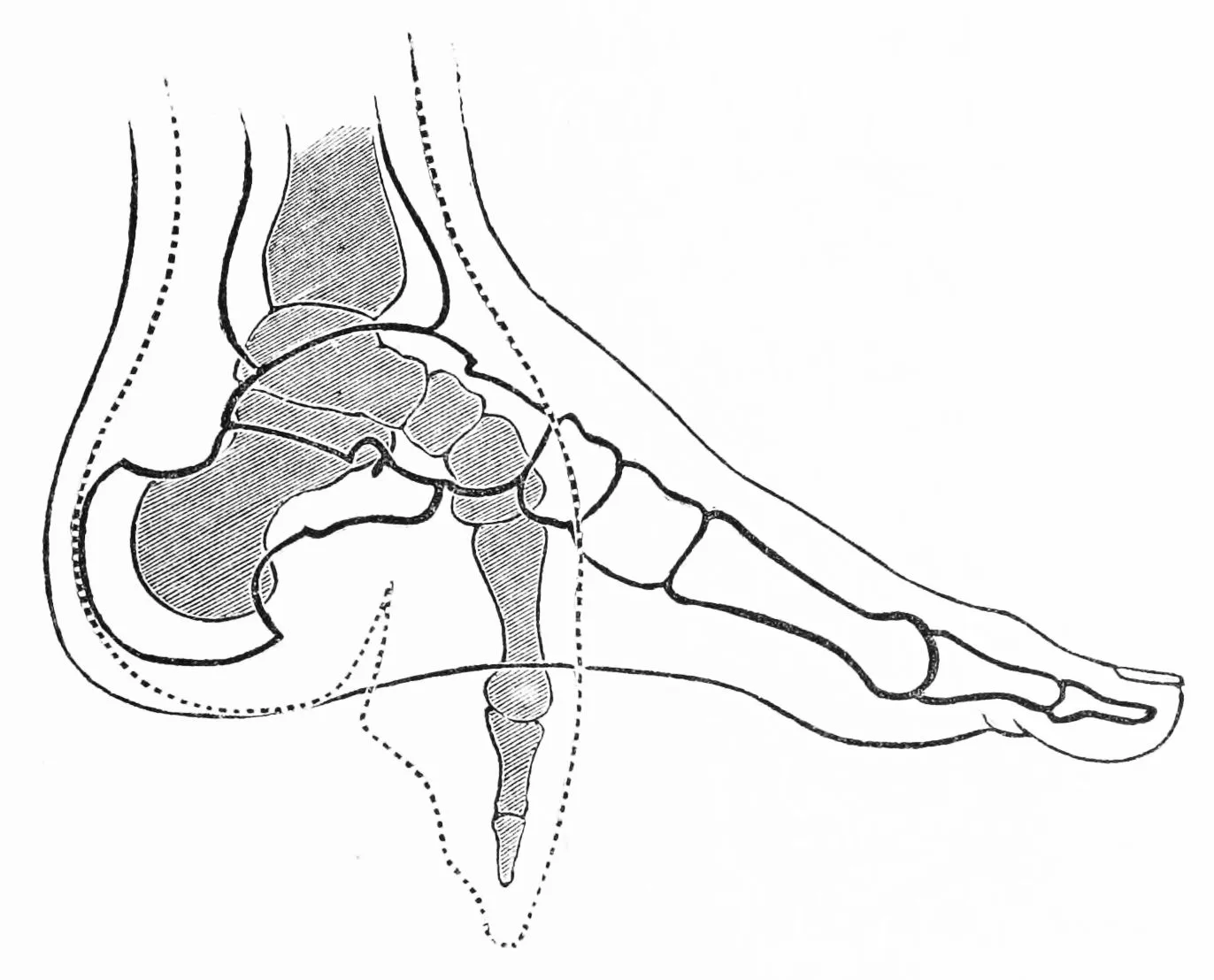
or opposable inner toe or hallux, like a thumb. The skeleton
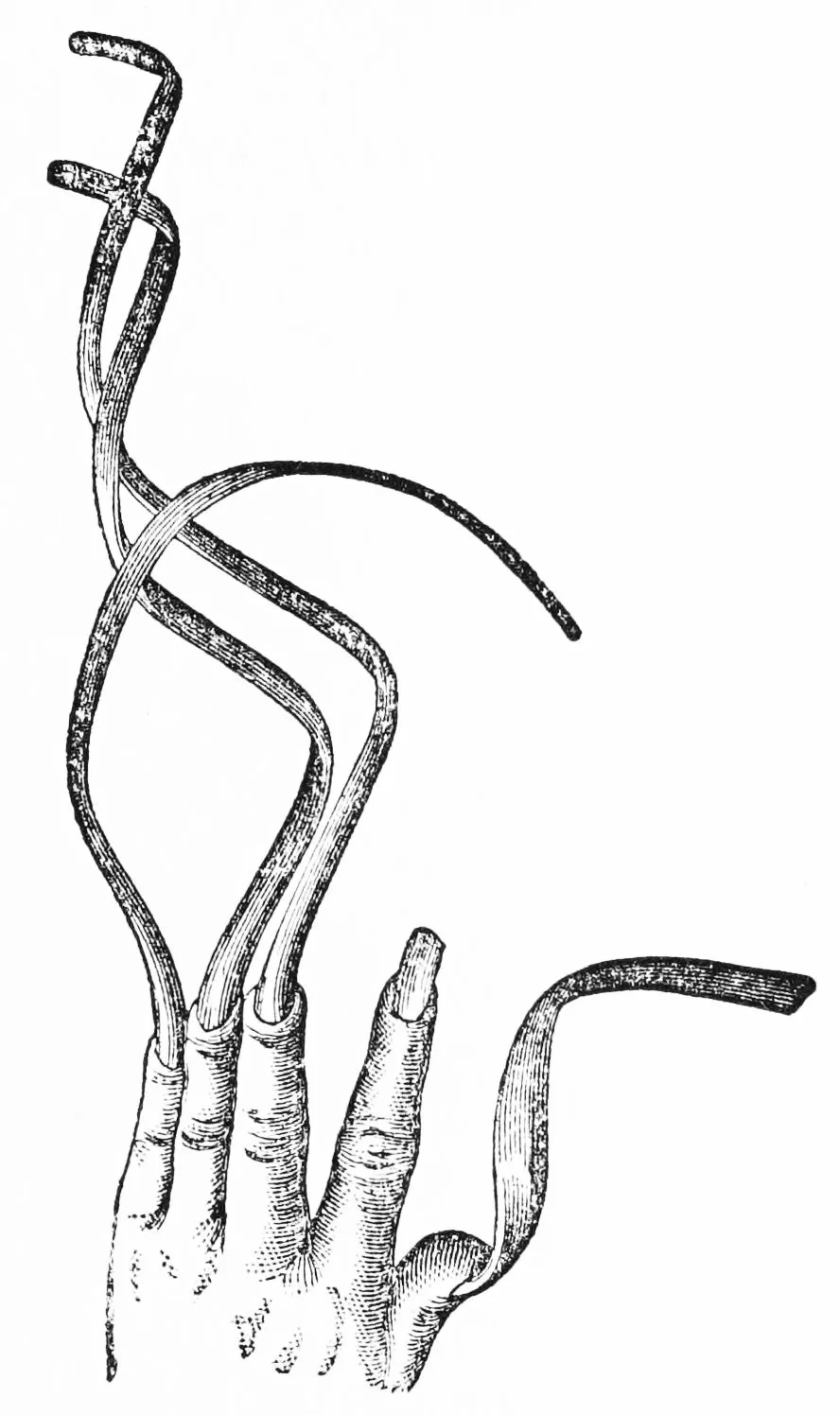
of that foot is very singular (see Fig. 2). The hallux is stout,
and placed nearly at a right angle with the other toes. The
next two digits are rather slender, placed close together, and
in the living animal are united almost to the claws in a
common integument. The two outer toes are free and much
stouter than the others, the fourth especially so.
Now, a naturalist of the last century would have looked
upon this foot simply as a piece of machinery beautifully
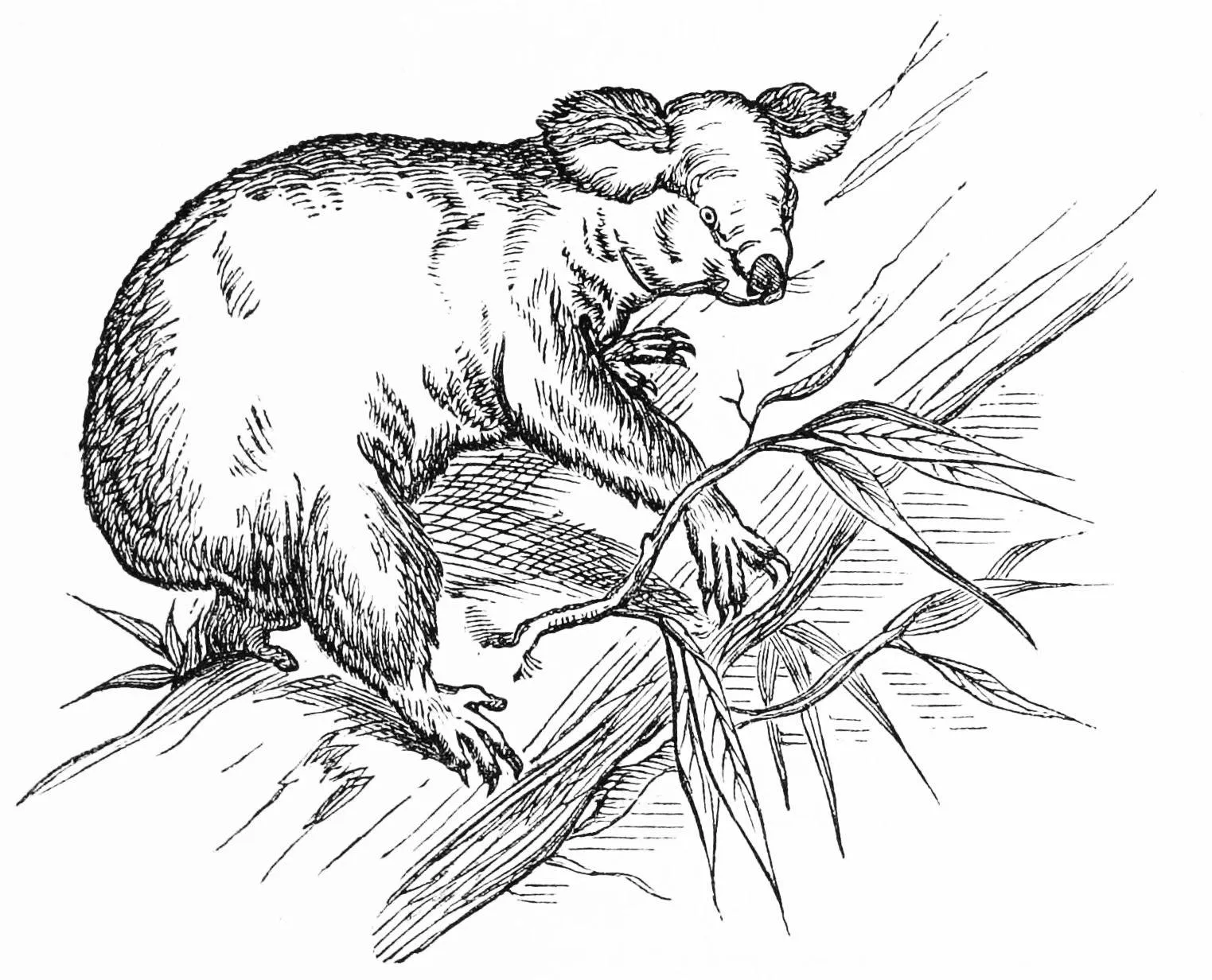 Fig. 1.—The Koala (Phascolarctos cinereus). From Gould’s Mammals
of Australia.
adapted for the particular work it had to perform in the
animal’s life. He would have pointed to the broad palm, the
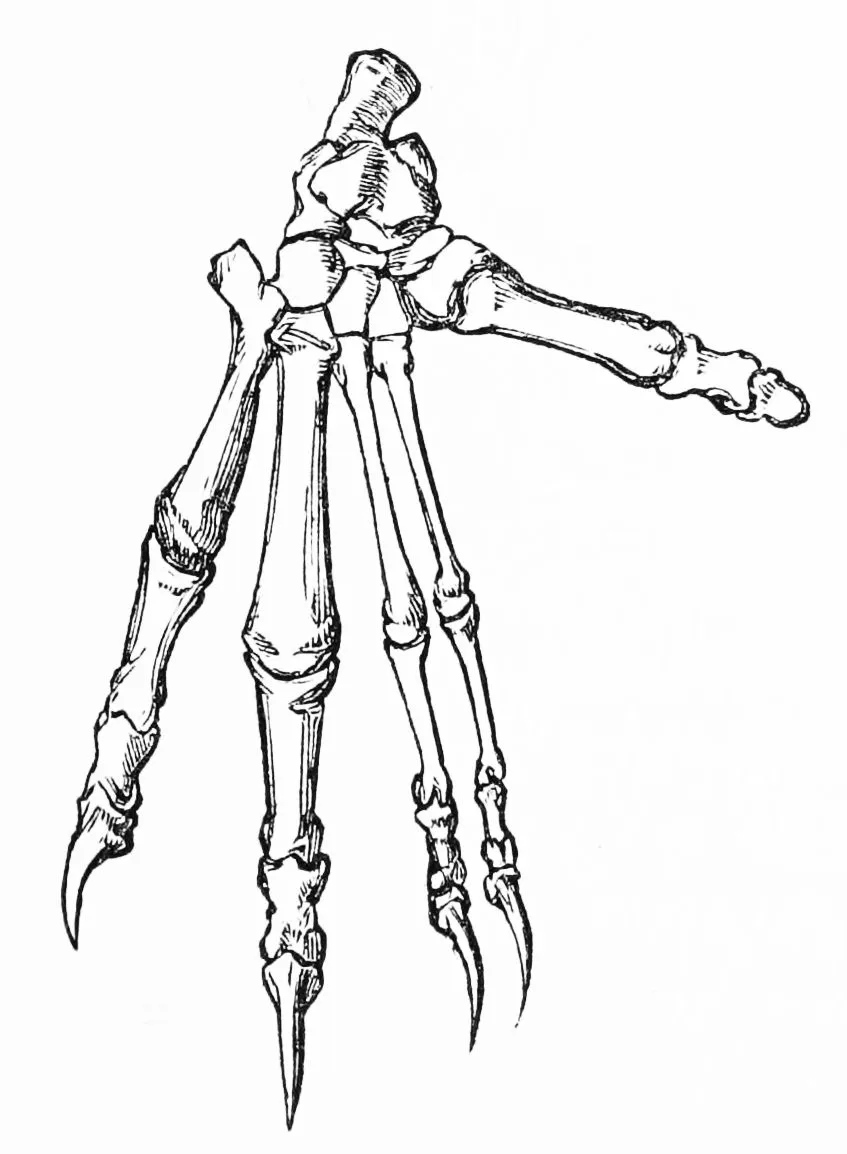 Fig. 2.—Skeleton of the hind foot of the Koala (Phascolarctos cinereus).
opposable great toe, and would doubtless, if a worthy representative
of his school, have developed some ingenious theory
to show that the smaller size of the second and third toes,
and that being wrapped up to their ends in skin, added to
the efficiency of the foot as a climbing organ, though indeed
he might be at a loss to say why the American opossums, of
precisely similar habits, and with similarly opposable great
toes, have all their other four toes free and equal.
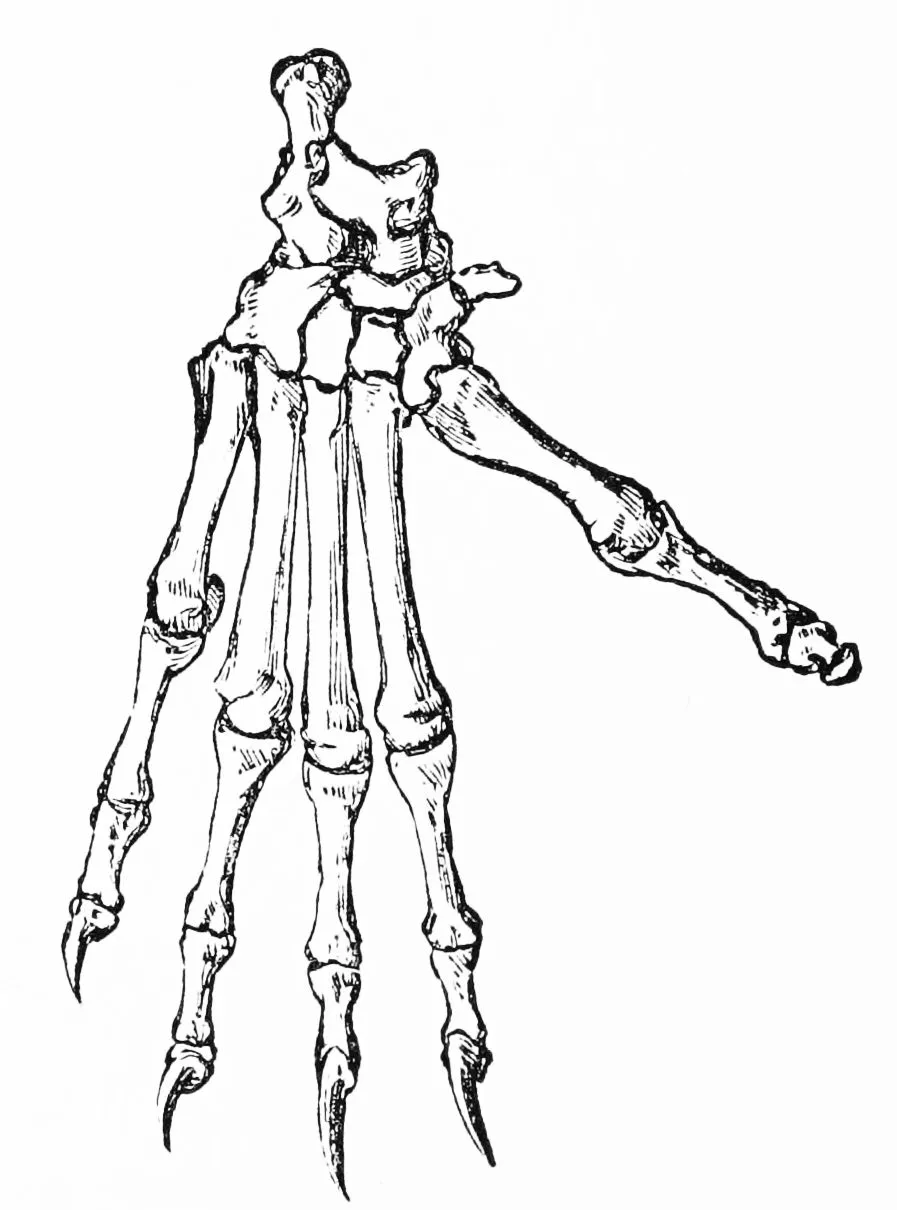 Fig. 3.—Skeleton of the hind foot of the Virginian Opossum (Didelphys
Virginiana).
The philosophical naturalist of the second of the types that
I have sketched out, in investigating this structure, will
institute a careful comparison between the foot of the koala
and that of other animals belonging to the same group.
Among the marsupial animals of Australia, few are so well
known as the kangaroo. Like the koala, it is a vegetable
feeder, and these two forms have some dental and other
structural characters in common. But the mode of progression,
and the limbs which effect this, offer the greatest possible
contrast.
In the kangaroo the hind legs are disproportionately large.
The foot especially is long and narrow, and at first sight
appears composed of a single large toe. Its motion along the
ground consists of a series of leaps or hops effected entirely
by these powerful hind limbs. On looking more closely at
the foot (see Fig. 4), it will be seen that the first digit or
hallux is entirely wanting, but the other four
toes are present with their complete number of
phalanges. The fourth is immensely developed,
the fifth moderately so, but the second and
third are reduced to the most slender rudiments,
and are so united in life by a common
integument, that they look like a single toe
with a double claw.
Now, here are two feet as unlike as possible
in their functions—the one formed for rapidly
hopping along over the arid plains, the other
for slowly and securely climbing among the
boughs of the forests—yet presenting a deep-seated
resemblance in a character not found in
the feet of any other known mammal except
the immediate allies of these two.
We may call this “conformity to type”
without getting much nearer to an explanation
of the phenomenon. Perhaps it is safest to
rest at this stage.
>
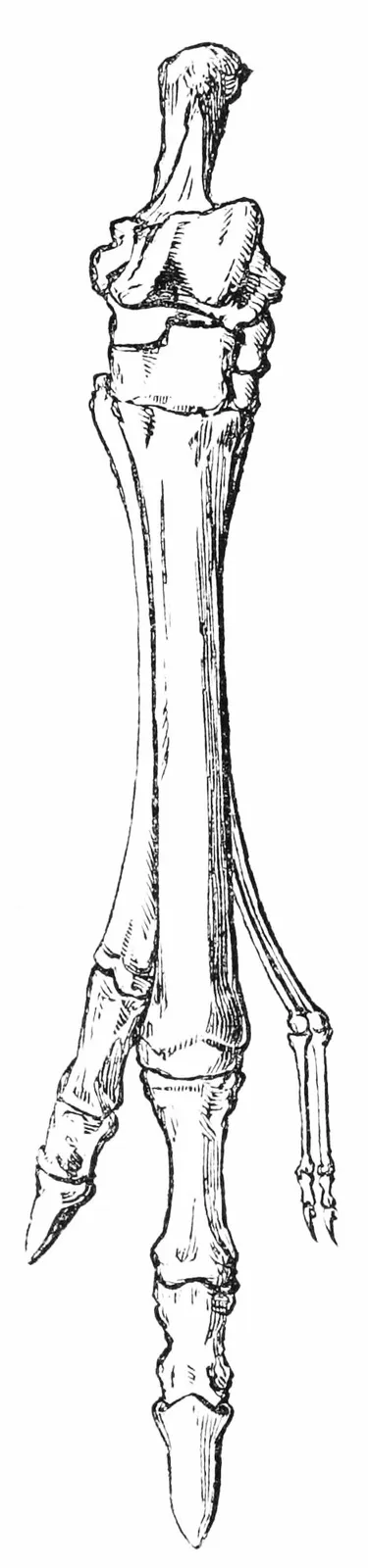 Fig. 4.—Skeleton
of the hind foot of
the kangaroo (Macropus
major).
But is it not powerfully suggestive—I will
not say more, for, of course, by itself it cannot
be considered as a proof—of true relationship,
of inheritance from a common ancestor? We
can easily see that in some manner the great
preponderance of the one toe in the kangaroo,
and the reduction of the others, would be
advantageous in its mode of progression, reducing
the foot to a narrow spring-board as it
were; and we can see that this attenuation of the second and
third toes, after the first had quite disappeared, might be a
stage in the direction of their total disappearance. But while
this was taking place, let us suppose that one branch of the
family took to climbing trees (I must not enter fully into all
that might be supposed on this subject, as I am merely
introducing this as an example of the mode in which morphological
problems are illustrated by these general views), and
the variations in a particular direction, tending towards better
climbing, were preserved and accumulated on the Darwinian
hypothesis, the hallux (a common part in all mammals, only
in abeyance when not wanted) was redeveloped in a form best
adapted for its actual purposes, the other digits gradually
resuming their normal condition; these two, however, still
preserving strong reminiscences of the ancestral state.[24]
It is certainly significant that all the Australian vegetable-feeding
climbing opossums have feet constructed on this type,
one that is similar to that of the kangaroos of the same
country, while the American opossums, further removed
geographically, and therefore, in all probability, in actual
relationship, with feet functionally the same, show no trace
of this deep-seated structural peculiarity—a peculiarity most
important for the consideration of the philosophical anatomist,
as it evidently depends on some more far-reaching cause than
mere adaptation to purpose.
In considering a little more fully the application of such
views to the study of morphology, I must say a few words on
classification. It was felt at the very outset of the study of
natural history that without some system of classification the
subject was little more than a hopeless chaotic confusion.
The first instinct of a zoologist is to arrange in some sort of
order the multitudinous objects with which he has to deal.
In the beginning of science, with little sound knowledge, such
classifications were often mere arbitrary arrangements, founded
on some easily accessible peculiarities, and forming nothing
more than a means by which the distinction between certain
objects and certain other objects could be grasped by the mind
of the founder and communicated to others. Classifications
based on such characters became so general, and were often so
carelessly and ignorantly put together, that they threatened to
bring the whole system into disrepute; whereas I have little
hesitation in saying that, in reality, classification is one of the,
if not the, most important aims and ends of the study of
morphology. It is the best contribution which we can make
towards the solution of the great biological problem, for a true
classification, viewed by the light of the derivative hypothesis,
is nothing more or less than an expression of the actual
amount of affinity between different objects. An order, a
family, or a genus is no longer a group of animals linked
together by some arbitrarily selected characters, but a group
supposed to have been descended from a common ancestor, and
to have become, by whatever process, gradually differentiated
from other groups of animals.[25]
As in such groups, when once established, there can be
no crossing with other groups (as in human families, to which
they are sometimes compared), all the resemblances which are
found between members of different groups must either be
characters inherited from the common ancestor, perhaps lost
through many generations and reappearing at a subsequent
period by the process of “reversion,” or they must be characters
having merely analogical resemblances—i.e. characters developed
by variation, but which, owing to similarity of conditions
of existence or other causes, have become similar to each other.
To discriminate between these two classes of characters,—namely,
those that are essential and fundamental, or, in the
language of one school, are dependent on conformity to type,
or, according to the derivative hypothesis, are inherited from
remote ancestors, and those that are modifications to suit the
conditions of existence to which the animal is exposed, or, in
other words, adaptive characters,—is a constantly recurring
problem to the systematic morphologist; and the difficulties
that encompass the solution of this problem are the main
causes of the little progress hitherto made towards a general
agreement as to classification otherwise than in the main
groups. Let me illustrate this point by a single and, as it
happens, by no means difficult example.
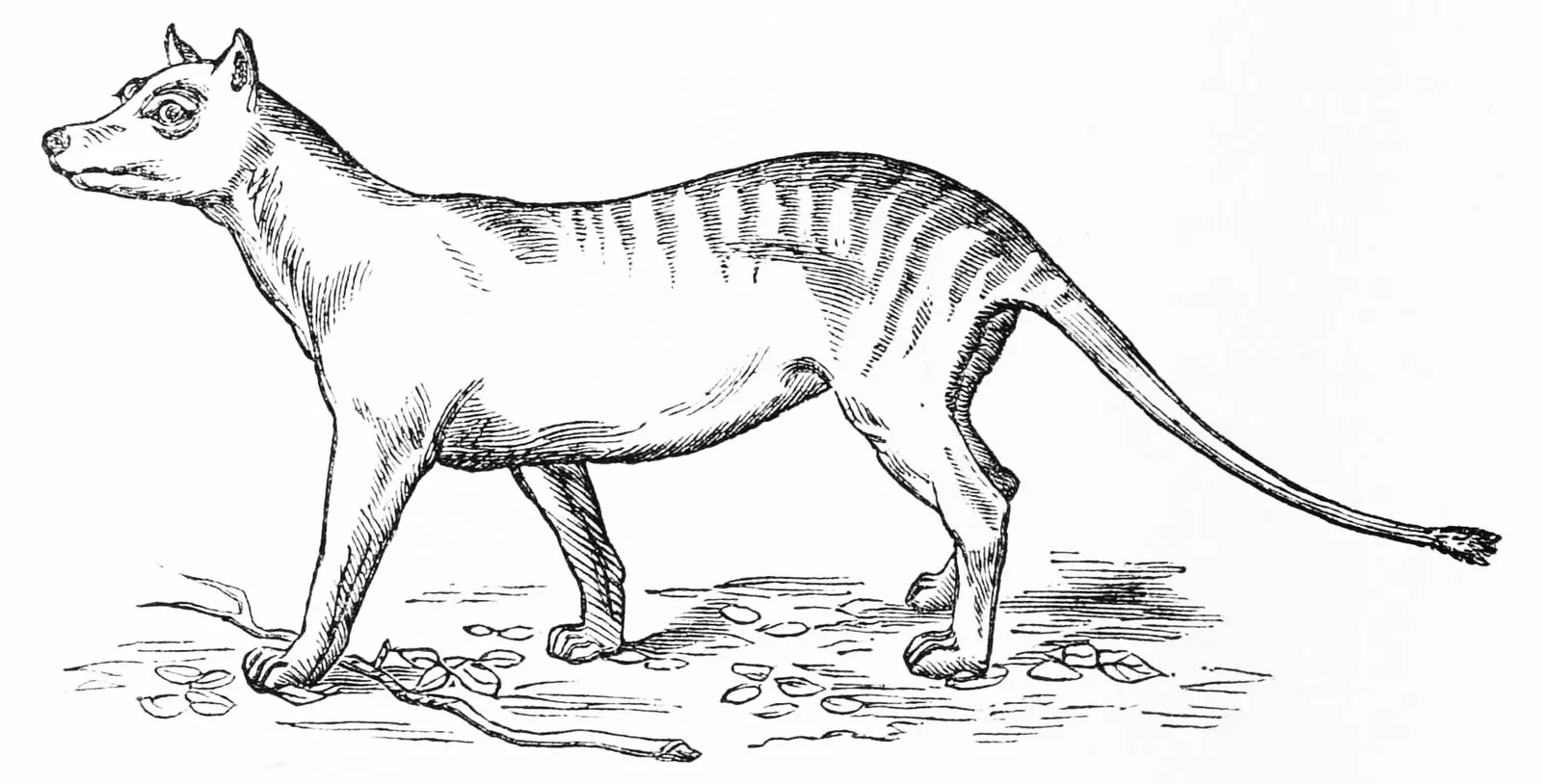 Fig. 5.—The Thylacine (Thylacinus cynocephalus). From Wolf’s Zoological
Sketches.
You have before you the skeletons of two animals very
similar in their general or superficial characters—one is the
common dog, the other the carnivorous marsupial, the thylacine,
sometimes called “Tasmanian wolf.” These animals, when wild,
have very similar habits. You will see that, in the general
characters of the skeleton, the structure of the limbs, and the
arrangement of the teeth, a remarkable similarity prevails. You
might easily conclude that these animals were related. They
were, indeed, formerly placed near together by systematists.
Now, if I place by the dog another well-known animal, a
sheep, you will see that in many characters of its bones, its
feet, its teeth, etc., it differs far more from the dog than the
latter does from the thylacine. Yet zoologists affirm, without
the slightest hesitation, that the sheep and the dog are far
more nearly related to each other than either is to the thylacine.
This assertion is founded on a discrimination of the essential
from the adaptive characters. The dog and the sheep belong
to one great branch of the mammalian class, although they
represent different stocks of that branch. The thylacine
belongs to another primary branch, but in that branch it has
taken the place, functionally, of the dog in the other; its
organs have become adapted to perform the same work.[26]
It has been asserted, in a recent very able pamphlet by an
anonymous writer, “On the Difficulties of the Theory of
Natural Selection,”[27] “that on the theory of ‘natural selection’
it is all but impossible, such are the probabilities against it,
that identical structures should have arisen independently.
Yet many structures undeniably exist which, to all appearance,
must have so arisen.” And the “remarkable identity of
structure between certain of the teeth of the large predatory
marsupial, the thylacine, or Tasmanian wolf, and those of the
common dog,” is cited as a case in point. Now, though I am
fully willing to admit difficulties in the theory, quite
inexplicable with our present knowledge, as many almost as
the author quoted, I cannot see this one in the same light. It
appears to me that the probabilities, instead of being against
the independent origin of such similar structures (erroneously
called identical) as those just mentioned, are exceedingly in
their favour. I cannot in the least see why a marsupial
animal should not be carnivorous and predaceous as well as a
placental animal, and if so, why its teeth should not have
come to possess the general attributes essential to animals of
such habits—namely, large, pointed, recurved fangs at each of
the anterior angles of the jaw; the teeth between them much
reduced, so as not to interfere with the piercing and holding
action of the canines; the molars more or less scissor-shaped.
These are plainly adaptive characters, and whatever process
has produced them in the one case is just as likely to have
produced them in the other—I might almost say, must have
produced them in the other. So far, however, are the teeth of
the thylacine and the dog from being essentially “identical,”
that in numerous non-adaptive and non-functional characters,
as the number of the incisors, premolars, and molars, the mode
of succession, and the minute structure (all which will be
spoken of at a later period of the course), they widely differ, the
dog conforming in all these points with the ordinary placental
mammals, the thylacine with the remaining marsupials. Such
characters, underlying, in large groups of animals, the various
modifications in relation to use, cannot be too diligently sought
out as the true landmarks to guide our steps through the
intricacies that beset our path in tracing affinities.
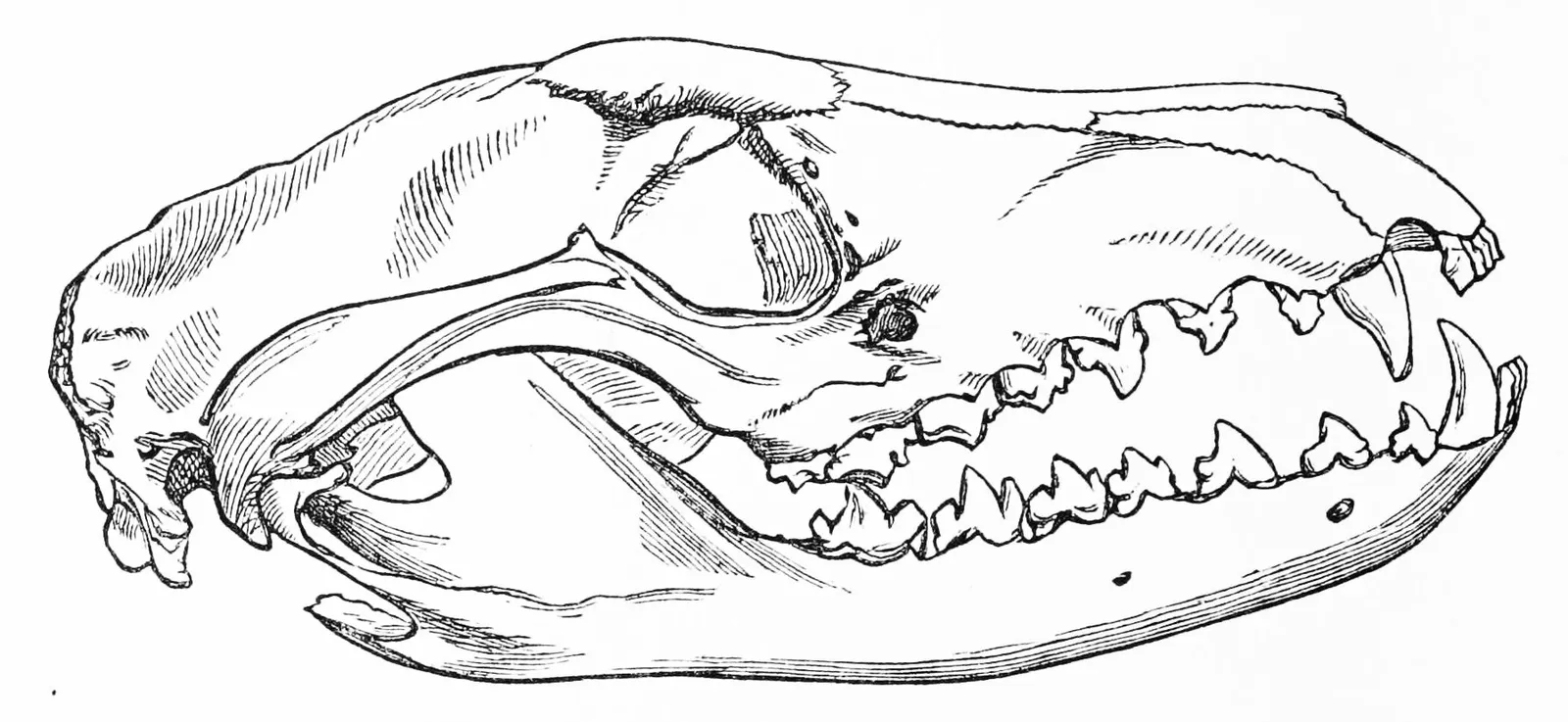 Fig. 6.—Skull of Thylacine.
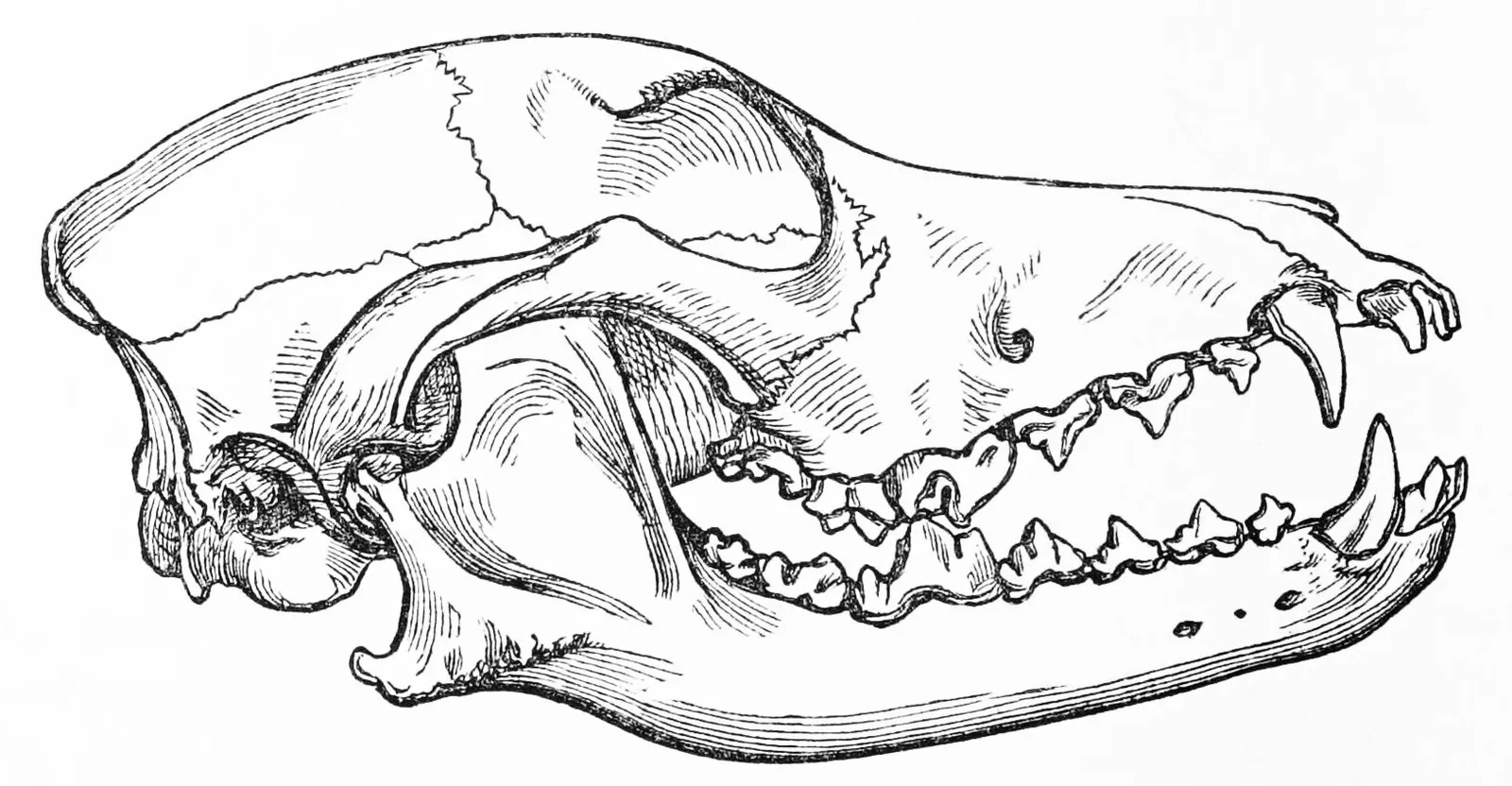 Fig. 7.—Skull of Shepherd’s Dog.
Another valuable guiding principle in morphological studies
is this. It is a remark of Gegenbaur’s, in his valuable work
“On the Structure of the Carpus and Tarsus,” but it must
have occurred to any one who has given much thought to
these problems. When we wish to discover the distinguishing
characters between different organisms, it is necessary to
examine them in their most fully developed condition. If, on
the other hand, our object is to trace their resemblance, their
intimate relationships, we must study them in their early
embryonic stages. By these methods we can do much to
separate what is secondary or superadded from what is fundamental
or essential in the character of an animal. The
farther back we can carry our researches, the more prominent
do the characters, common to the whole group to which the
animal belongs, become. The more completely mature the
specimen, the more do the special characters of the species or
even of the individual predominate.
It is not my province in these lectures to indulge much in
speculations. Indeed, as students of morphology, we are as
yet little in a position to do so. I shall not say much more
even on the general views to which I have lately referred, for
I feel that the acquisition of a sound basis of fact to work
with is what is, at present, most needed in comparative
anatomy. The difficulties which beset the beginner, and
indeed the more advanced student, in this subject are very
great. As regards the branch to which I propose more particularly
to direct your attention, the anatomy of the class
Mammalia, which, we might suppose, was better worked out
than any other, the information to be found in books is
scattered, fragmentary, unequal, and often untrustworthy;
even good elementary treatises are wanting, much more
anything like an exhaustive work. Moreover, our museum—superior
as I believe it to be to any other of the kind—is, as
yet, far from adequate to supply the knowledge frequently
sought for in it.
In considering the special subject for these lectures, I have
often thought that the greatest permanent benefit would be
conferred on our science by collecting together in a systematic
form all the available information upon limited groups of
the animal kingdom, supplementing, as far as possible, the
deficiencies of knowledge by fresh observations, and illustrating
the subject by a complete series of preparations. At the
present day it is only by working out a definite branch of
limited extent monographically, that any solid advances in
detailed knowledge can be attained. Courses of lectures on
this principle, especially if they were published so as to reach a
wider circle of students than this theatre is apt to contain,
may do much to advance knowledge; but, on the other hand,
they might do less than more elementary lectures, giving a
general outline of a larger variety of topics, to diffuse knowledge,
for it is probable that they would be attractive to only
a limited number of auditors or of readers.
I think it therefore advisable, in the first course I have the
honour of addressing to you, to confine my subject to a survey
of the structure of the animals of the highest class of organised
beings; and I think that this will prove of the greater
importance and interest to the audience assembled here,
because it may be presumed that all have already either
commenced or completed the acquisition of a knowledge of
the structural anatomy of one, the most elevated member, of
that class. I propose, therefore, to take human anatomy as a
point of departure, and, presuming on your acquaintance with
its details, shall refer only to some of its general outlines, and
shall point out the deviations from and resemblance to the
mammalian structure as we know it in man, in descending
throughout the series of animals composing the class.
I trust that some further interest may be given thereby
to the daily work of the student of our profession. Human
anatomy is too often learned as a mere collection of hard
names applied to a complicated network of structures, the
form, position, and relation of which have to be got up, probably
to be forgotten soon afterwards. It might, however, be
made a far more attractive and useful subject if taught by the
light of a wider morphology. But I am afraid that very little
of our anatomical teaching, either by books or lectures, is
of this class at present. If any comparative anatomy is
introduced, instead of enlightening and illustrating the
subject, it often only adds another load to the already over-burdened
memory—for instance, after the usual dry, detailed
and technical description of the part treated of, a disquisition
is added on what is called its “transcendental” anatomy,
extremely incomprehensible to most minds, and consisting
chiefly in the imposition of a new set of names to parts of
which the student has just succeeded in mastering the old
ones.
All this ought to be reversed; the essential nature of the
part in question, as deduced from comparative anatomy, should
be first announced with a glance at its principal modifications;
then its special characters as seen in man will be a subject
of intelligent interest. I know from experience that after
studying and teaching human anatomy for many years on the
ordinary methods, there were many parts the meaning and
nature of which I never understood until I began to dissect
animals; and increase of knowledge in this direction constantly
throws light on apparently unmeaning or incomprehensible
parts of human structure.
One word more by way of introduction. I began with the
mention of my immediate predecessor in this chair. To him I
must once again return. The subject matter of the present
course will embrace many points treated of by him, more or
less fully, in some of his lectures delivered in this theatre, and
many on which I have had the advantage of his conversation
and counsel. His teaching has entered so deeply into, and
mingled so closely with, observations and reflections that may
have suggested themselves in the course of my work in the
museum, that in many cases it would be difficult to trace the
sources of information that I may have to impart, and I may,
perhaps, appear guilty of appropriating what should belong to
another. Let me acknowledge then, once for all, how deeply
I am indebted to Professor Huxley, not only for the information
conveyed in the public manner of lectures and books, but
also for the generous way in which, on all occasions, his time,
his knowledge, his thoughts, have been freely given to me.
And I say this the more willingly, because I know that I am
but one of many whose labours have been lightened, whose
efforts have been stimulated, whose difficulties have been
smoothed, by his encouragement and support, by his candid
and judicious criticism, and by the example of his often self-sacrificing
devotion to the advancement of scientific truth.
I also desire, in conclusion, Mr. President, to take this
opportunity of publicly expressing the obligations which I, as
well as numbers of others, feel towards you and your predecessors
in that chair, as well as to the former and present members
of the Council of the College, individually and collectively, for
the immense aid that you have given to the progress of philosophical
biology in this country, and I may say, in the whole
world, by the maintenance and augmentation of John Hunter’s
Museum. An epoch of revolution appears to be at hand in
our profession, which may lead to a material alteration in the
respective positions and opportunities of the various corporate
bodies. Whatever changes may take place, the College of
Surgeons will always look back with satisfaction to the fact
that, for the first seventy years of the century, when these
studies were less appreciated than they are now, or will be
hereafter, it has, with scanty aid from the national resources,
cherished the growth of a truly national institution, the benefits
of which are not confined to any one class or profession, but
are freely open to the whole community. I can say, moreover,
with perfect assurance, speaking both from my own experience
and from knowledge of the history of the museum, as recorded
in its archives, that any deficiencies which exist in the condition
of the collection, any needs which it does not supply,
must be due to other causes than want of encouragement to
the officers of the establishment, or want of liberality in
supplying the requisite funds, on the part of the Council of
the College.
I have been requested by the Subjects Committee of the
Congress to place before you a brief statement of some of the
advances which have recently been made in natural science,
with a view to open a discussion upon their relations, real or
supposed, to religious belief. The particular advances which,
as I am given to understand, were especially in the minds of the
Committee in proposing this question, are those which have
resulted in the more or less general adoption by scientific men
of the view of the sequence of events which have taken place
and are still taking place in the universe, to which the term
“evolution” is now commonly applied.
All that is embraced by this term, the various realms of
nature in which its manifestations are traced, the various
shades of meaning attached to it by different persons, would
constitute far too large and complex a subject to be treated of
in the time to which addresses to this meeting are wisely
restricted. I will therefore select for special consideration the
only point in the application of the theory upon which I can
speak with any practical knowledge—one which is, however,
in the eyes of many of very vital interest. It is the one,
at all events, which at the present moment attracts most
attention; the new ideas upon it being received with enthusiasm
by some, and with distrust, if not with abhorrence,
by others.
The doctrine of continuity, or of direct relation of event
to some preceding event according to a natural and orderly
sequence is now generally recognised in the inorganic world;
and although the modern expansion of this doctrine as applied
to the living inhabitants of the earth appears to many so
startling, and has met with so much opposition, it is, in a more
restricted application, a very old and widespread article of
scientific as well as of popular faith.
Putting aside, as quite immaterial to the present discussion,
the still controverted question of the evidences of the production
of the lowest and most rudimentary forms of life from inorganic
matter, it may be stated as certain that there is no rational and
educated person, whatever his religious beliefs or philosophical
views, who is not convinced that every individual animal or
plant, sufficiently highly organised to deserve such distinctive
appellation, now existing upon the world, has been produced
from pre-existing parents by the operation of a series of
processes of the order to which the term natural is commonly
applied. These processes are also fundamentally the same
throughout the whole range of living beings, however much
modified in detail to suit the various manifestations under
which those beings are presented to us. We feel absolutely
certain, when we see a horse, a bird, a butterfly, or an oak-tree,
that each was derived from pre-existing parents, more or less
closely resembling itself. Though we may have no direct
evidence of the fact in each individual case, the knowledge
derived from the combined observations of an overwhelming
number of analogous cases is of such a positive character that
we should entirely refuse to credit any one who made the
contrary assertion, and should feel satisfied that he had been
deluded by some error of observation. We cannot, indeed,
conceive of the sudden beginning of any such creatures, either
from nothing, from inorganic matter, or even from other
animals or plants totally unlike themselves.
To persons whose opportunities of observation of animal
and plant life are limited to a comparatively few kinds,
existing under comparatively similar circumstances, and which
observations moreover only extend over a comparatively limited
period of time, it appears that in each kind of animal or plant
such as those just mentioned, individuals of various succeeding
generations present a very close resemblance to each other.
That they often vary a little cannot escape careful observation,
but the deviations from the common characters of the kind to be
noticed by persons whose range of vision is thus limited are not
striking, and usually appear not to pass beyond certain bounds.
Hence arose the common idea, natural enough under such
circumstances, but which gradually developed itself, not only
into a scientific hypothesis, but even, it would appear, almost
into an article of religious belief, that the different kinds or
“species,” as they are technically called, of animals and plants,
had each its separate origin, its fixed limits of variation, and
could not under any circumstances become modified or changed
into any other form.
This idea became deeply rooted in the human mind, in
consequence of the very long period during which it prevailed,
the horizon of observation having remained practically
stationary from the time man first began to observe and record
the phenomena of nature, until little more than a century ago,
when commenced that sudden expansion of knowledge of the
facts of the animal and vegetable world, which has been
steadily widening ever since. Now it is important to observe
that it is strictly pari passu with the growth of knowledge of
the facts, that the theoretical views of nature have changed,
and the older hypothesis of species to which I have referred
has gradually given way to a new and different one.
The expansion of the special branches of knowledge affecting
our views upon this subject has taken place in many
different directions, of which I can here only indicate the
most striking.
1. The discovery of enormous numbers of forms of life, the
existence of which was entirely unknown a hundred years ago.
The increase of knowledge in this respect is something inconceivable
to those who have not followed its progress. Not
only has the number of well-defined species known multiplied
prodigiously, but infinite series of gradations between what
were formerly supposed to be distinct species are being constantly
brought to light. The difficulty of giving any satisfactory
definition of what is meant by the term “species”
is increasingly felt day by day by practical zoologists, as
evidenced by the introduction of such terms as “sub-species,”
“permanent local variety,” etc., into general use, and especially
by the wide differences of opinion as to the number or limits
of the species included in any given group of animals or plants
among naturalists who have made such group their special
study.
2. Vast increase in the knowledge of the intimate structure
of organic bodies, both as revealed by ordinary dissection, and
by microscopic examination, a method of investigation only
brought to perfection in very recent years. By the knowledge
thus acquired has been demonstrated the unity of plan
pervading, under diverse modifications, the different members
of each natural group of organisms, at one time attributed to
“conformity to type,” a so-called explanation which explained
nothing, but for which a vera causa may be found in descent
from a common ancestor. Wonderful gradations in the
perfection to which different structures have attained in the
progress of their adaptation to their respective purposes have
also been shown, and of still greater importance and interest,
the numerous cases of apparently useless or rudimentary
organs in both animals and plants, which were absolutely
unaccounted for under the older hypothesis.
3. The comparatively new study of the geographical
distribution of living things, which has only become possible
since the prosecution of the systematic and scientific explorations
of the earth’s surface, which have distinguished the
present century. The results of this branch of inquiry alone
have been sufficient to convince many naturalists of the
unsoundness of the old view of the distinct origin of species,
whether created each in the region of the globe to which it is
now confined, or, as many still imagine, all in one spot, from
which they have spread themselves unchanged in form, colour,
or other essential attributes to their present abodes, however
diverse in climate and other environments or conditions of
existence.
4. Lastly, though most important of all, must be mentioned
the entirely new science of palæolontology, opening up worlds
of organic life before unknown, also showing infinite gradations
of structure, but mainly important as increasing our horizon
of observation to an extent not previously dreamt of in the
direction of time. Powers of observation formerly limited to
the brief space of a few generations are now extended over
ages, which the concurrent testimony of various branches of
knowledge, of astronomy, cosmogony, and geology, show are
immeasurable compared with any periods of which we hitherto
had cognisance. We are enabled to trace, and every year, as
discovery succeeds discovery, with increasing distinctness,
numerous cases of sequences of modification running through
groups of animals in successive periods of time, such as the
gradual progress in the development and perfection of the
antlers of deer, from their entire absence in the earliest known
representatives of the type, through the simple conical or
bifurcated form, increasing in complexity as time advanced to
the magnificent many-branched appendages which adorn the
heads of some species of recent stags; such also as the
progressive modifications, so often described, beginning in the
short-necked, heavy-limbed, many-toed tapir-like animal of the
Eocene period, and ending in the graceful, long-necked, light-limbed,
single-toed horse of our own age, and numerous others
which time will not allow me even to mention.
It would be impossible here to trace the history of the
effect of this enormous influx of knowledge upon the doctrine
of the separate origin and fixed characters of species; to
narrate the scattered efforts of philosophical minds, discontented
with the former views, but not yet clearly seeing
the light; to describe the slow and struggling growth of the
new views, amid difficulties arising from imperfections of knowledge
and the opposition of prejudice, or to apportion to each
of those who by their labours have contributed to the final
result, his exact share in bringing it about. How much, for
instance, is due to the work and the writings of our illustrious
countryman, Darwin? and how much to those who have
preceded or followed him? All this forms an episode in the
history of the progress of human knowledge, which has been
abundantly chronicled elsewhere.
The result may, however, be briefly stated to be, that the
opinion now almost, if not quite, universal among skilled and
thoughtful naturalists of all countries, and whatever their
beliefs upon other subjects, is that the various forms of life
which we see around us, and the existence of which we know
from their fossil remains, are the product, not of independent
creations, but of descent with gradual modification from pre-existing
forms. In short, the law of the natural descent of
individuals, of varieties, races, or breeds (which being within
the limits of the previous powers of observation, was already
universally admitted), has been extended to the still greater
modifications constituting what we call species, and consequently
to the higher groups called genera, families, and
orders. The barrier fancied to exist between so-called varieties
and so-called species has broken down.
Any one commencing the study of the subject at the
present time without prejudice, and carefully investigating the
evidence upon which to form his conclusions, bearing in mind
that he must look for his proofs, not so much in direct
experiments or absolute demonstrations, which from the nature
of the case are impossible, but in the convergence of the
indications furnished by the interpretations of multitudinous
facts of most diverse kinds, must find it extremely difficult to
place himself in the position of those who held the older view,
so much more reasonable, so much more in accordance with
all that we know of the general phenomena of nature, does
this new one seem. In fact the onus probandi now appears
entirely to lie with those who make the assertion that species
have been separately created. Where, it may be asked, is the
shadow of a scientific proof that the first individual of any
species has come into being without pre-existing parents?
Has any competent observer at any time witnessed such an
occurrence? The apparent advent of a new species in geological
history, a common event enough, has certainly been
cited as such. As well might the presence of a horse in a
field, with no sign of other animals of the same kind near it,
be quoted as evidence of the fallacy of the common view of
the descent of individuals. Ordinary observation tells us of
the numerous causes which may have isolated that horse from
its parents and kindred. Geologists know equally well how
slight the chances of more than a stray individual or fragment
of an individual here and there being first preserved and
afterwards discovered to give any indication of the existence
of the race. Those who object to the new view complain
sometimes of the frequency with which its advocates take
refuge, as they call it, in the “imperfection of the geological
record.” I think, on the contrary, the difficulty is always to
allow sufficiently for this imperfection. When we contrast
the present knowledge of palæolontology with what it was fifty
or even ten years ago—when we see by what mere accident
as it were, a railway driven through a new country, a quarry
worked for commercial purposes, a city newly fortified, so many
of the most important discoveries of extinct animals have been
made—we must be convinced that all arguments drawn from
the absence of the required links are utterly valueless. The
study of palæolontology is as yet in its merest infancy, the
wonder is that it has already furnished so much, not so little,
corroboration of the doctrine of transmutation of species.
Direct proof is, then, equally absent from both theories.
For the old view it may be said that it has been held for a
very long time by persons whose knowledge of the facts of
nature which bear upon it was extremely limited. On the
other hand, the new view is continually receiving more
support as that knowledge increases, and furnishes a key to a
vast number of otherwise inexplicable facts in every branch of
natural history, in geological and geographical distribution,
in the habits of animals, in their development and growth,
and especially in their structure. I will take one instance
from the last named—the anatomy of the whale. How is it
possible, upon any other supposition than that it is the
descendant of some land animal, with completely developed
limbs and teeth, which has become gradually modified to suit
an aquatic mode of existence, to explain the presence of the
numerous rudimentary, and to their present possessors
absolutely useless, structures found in its body. Amongst
others, a complete set of teeth, existing only in embryonic life,
entirely disappearing even before birth, and rudimentary hind
legs, with their various bones, joints, and muscles, of which
no trace is seen externally. It may be asserted that the
whale was originally created so, as it was asserted, and long
maintained, that fossil shells and bones were originally
created as such in the rocks in which they are found. It
took more than two centuries of continuous and most acrimonious
discussion to convince the world, especially the
theological world, that these were the actual remains of
animals which had once lived in a former period of the earth’s
history. Their evidence is now, however, universally admitted
as supplying knowledge of the changed conditions of the
surface of the earth, and with equal clearness do these rudimentary
organs, hidden in the secret recesses of the whale’s
body, furnish, to those who inquire, indications that the
animal has passed through phases of existence unlike those
in which we now see it.
I do not for a moment assert that the new view explains
everything that we students of nature are longing to know,
or that we do not everywhere meet with obscure problems
and perplexing difficulties, facts that we cannot account for,
and breaks in the chain of evidence. As to the details and
mode of operation of the secondary laws by which variation
and modification have been brought about, we are far from
being in accord. Happy for us that it is so, or our work
would be at an end. I only maintain that the transmutation
view removes more difficulties, requires fewer assumptions,
and presents so much more consistency with observed facts,
than that which it seeks to supersede, and is, therefore, so
generally accepted, that there is no more probability of its
being abandoned, and the old doctrine of the fixity of species
revived, than that we should revert to the old astronomical
theories which placed the earth in the centre of the universe,
and limited the date of its creation to six ordinary days.
The question of the fixity or the transmutation of species
is a purely scientific one, only to be discussed and decided
on scientific grounds. To the naturalist, it is clearly one of
extreme importance, as it gives him for the first time a key
to the interpretation of the phenomena with which he has
to deal. It may seem to many that a question like this is
entirely beside the business of a Church Congress, as it is
one with which only those expert in the ways of scientific
investigation, and deeply imbued with knowledge of scientific
facts, could be called upon to deal. This would certainly
have been my view, if it had not been that some who, from
their capacities and education, should have been onlookers in
such a controversy, awaiting the issues of the conflict while
the lists are being fought out by the trained knights, have
rushed into the fray, and by their unskilful interposition have
only confused the issues, casting about dust instead of light.
In the hope of clearing away some of this dust the present
discussion has been decided upon.
It is self-evident that a solid advance of any branch of
knowledge must, in some way or other, and to a greater or
less degree, influence many others, even those not directly
connected with it, and therefore the rapid simultaneous strides
of so many branches of knowledge as may be embraced under
the term of “Recent Advances in Natural Science,” will be
very likely to have some bearing upon theological beliefs.
Whether in the direction of expanding, improving, purifying,
elevating, or in the direction of contracting, hardening, and
destroying, depends not upon those engaged in contributing
to the advance of science, but upon those whose special duty
it is to show the bearing of these advances upon hitherto
received theological dogmas. The scientific questions themselves
may well be left to experts. If the new doctrines are
not true, there are plenty of keen critics among men of science
ready to sift the sound from the unsound. Error in scientific
subjects has its day, but it is certain not long to survive the
ordeal, yearly increasing in severity, to which it is subjected
by those devoted to its cultivation. On the other hand, the
advances of truth, though they may be retarded, will never
be stopped by the opposition of those who are incompetent
by the nature of their education to deal with the evidence on
which it rests. There is no position so dangerous to religion
as that which binds it up essentially with this or that
scientific doctrine, with which it must either stand or fall.
The history of the reception of the greatest discoveries in
Astronomy and Geology, the passionate clinging to the
exploded pseudo-scientific views on those subjects supposed to
be bound up with religious faith, the fierce denunciations of
the advocates of the then new, but now universally accepted
ideas, are well-worn subjects, and would not be alluded to but
for the repetition, almost literal repetition in some cases, of
that reception which has been accorded to the new views of
biology.
Ought not the history of those discoveries and the controversies
to which they gave rise, to be both a warning and an
encouragement? Those who hoped and those who feared that
faith would be destroyed by them, have been equally mistaken;
and is it not probable that the same result will follow
the great biological discoveries and controversies of the present
day?
In stating thus briefly what is the issue of these discoveries,
as generally understood and accepted by men of
science, I have done all that I promised, and must leave, in
far more competent hands, the part of the subject especially
appropriate for discussion at this meeting. I may, however,
perhaps be allowed to put a few plain and simple considerations
before you, which may have some bearing upon the subject, and
which have no pretensions to novelty, though being often lost
sight of, their repetition may do no harm.
I said at the commencement of this paper that it has long
been admitted by all educated persons, whatever their religious
faith may be, that that very universal, but still most wonderful
process, the commencement and gradual development of a new
individual of whatever living form, whether plant, animal, or
man, takes place according to definite and regularly acting
laws, without miraculous interposition. Further than this, I
believe that every one will admit that the production of the
various races or breeds of domestic animals is brought about
by similar means. We do not think it necessary to call in
any special intervention of creative power to produce a short-horned
race of cattle, or to account for the difference between
a bull dog and a greyhound, a Dorking and a Cochin-China
fowl. The gradual modifications by which these races were
produced, having taken place under our own eyes as it were,
we are satisfied that they are the consequence of what we call
natural laws, modified and directed in these particular cases
by man’s agency. We have even gone farther, having long
admitted, without the slightest fear of producing a collision
with religious faith, that variation has taken place among
animals in a wild state, producing local races of more or less
stable and permanent character, and brought about by the
influence of food, climate, and other surrounding circumstances.
The evidences of the Divine government of the world, and
of the Christian faith, have been sufficient for us, notwithstanding
our knowledge that the individual was created
according to law, and that the race or variety was also
created according to law. In what way then can they be
affected by the knowledge that the somewhat greater modifications,
which we call species, were also created according to
law? The difficulties, which to some minds seem insuperable,
remain exactly as they were; the proofs, which to others are
so convincing, are entirely unaffected by this widening of
scientific knowledge.
Even to what is to many the supreme difficulty of all, the
origin of man, the same considerations are applicable. Believe
everything you will about man in his highest intellectual and
moral development, about the nature, origin, existence, and
destiny of the human soul; you have long been able to reconcile
all this with the knowledge of his individual material
origin according to law, in no whit different in principle from
that of the beasts of the field, passing through all the phases
they go through, and existing long before possessing, except
potentially, any of the special attributes of humanity. At
what exact period and by what means the great transformation
takes place no one can tell. If the most Godlike of men
have passed through the stages which physiologists recognise
in human development without prejudice to the noblest,
highest, most divine part of their nature, why should not
the race of mankind, as a whole, have had a similar origin,
followed by similar progress and development, equally without
prejudice to its present condition and future destiny? Can it
be of real consequence at the present time, either to our faith
or our practice, whether the first man had such an extremely
lowly beginning as the dust of the earth, in the literal sense
of the words, or whether he was formed through the intervention
of various progressive stages of animal life?
The reign of order and law in the government of the
world has been so far admitted that all these questions have
really become questions of a little more or a little less order
and law. Science may well be left to work out the details as
it may. Science has thrown some light, little enough at present,
but ever increasing, and for which we should all be thankful,
upon the processes or methods by which the world in which
we dwell has been brought into its present condition. The
wonder and mystery of Creation remain as wonderful and
mysterious as before. Of the origin of the whole, science
tells us nothing. It is still as impossible as ever to conceive
that such a world, governed by laws, the operations of which
have led to such mighty results, and are attended by such
future promise, could have originated without the intervention
of some power external to itself. If the succession of small
miracles, formerly supposed to regulate the operations of
nature, no longer satisfies us, have we not substituted for
them one of immeasurable greatness and grandeur?
In the name of the British Association for the Advancement
of Science, I beg to thank you, and those societies which have
joined together in presenting this address, for the kind terms
in which it is expressed and has been delivered to me. It is
most gratifying to us—who believe in the beneficial results
upon human life conferred by the diffusion of scientific
knowledge, as all members of this great association must do—to
find that our work, and the objects of our meeting are so
highly appreciated by such a wide circle as that represented
by the signatories to this address. It is, moreover, particularly
satisfactory to find such a recognition—where, perhaps,
at first sight, we might hardly have expected it—of the
advantages of pure or abstract science apart from its practical
application to the material welfare of mankind. You have
recognised what is certainly known to those who have
followed most closely the history of science, but what is not
so generally known or appreciated by others, that nearly all
the marvellous benefits which have been conferred on man by
the application of scientific knowledge have been the results
of the discoveries of philosophers who are pursuing knowledge
solely for its own sake—without any hope of reward, without
any hope of benefit to themselves or to others, and, very often,
amid the indifference, the neglect, and even the scorn of their
contemporaries. The particular branch of science which it
is my lot to represent is, at first sight, very little specially
connected with the general welfare of man, and is looked upon
by many as little more than idle speculation or mere curiosity.
I well remember—though it is certainly many years ago now—one
who, more than any one else living in this country,
has advanced that branch of science—Professor Huxley—in a
lecture delivered at the Royal Institution, saying that the
common idea of a naturalist was “a wet, dirty man poking
about the sea-shore with a net in one hand and a bottle in the
other—an innocent and perhaps harmless individual, but a very
useless one.” Well, I may say that the description was made
some thirty years ago, before Professor Huxley himself had
done so much to raise the character of naturalists and natural
history in this country, yet it still holds good in the opinion
of many at the present time. You must recollect, however,
that the researches of naturalists of that class, men who have
occupied themselves in closely observing the ways and habits,
and studying the structure of animals of a low type of organisation,
have produced already marvellous results upon the happiness
and welfare of mankind. Through researches of this kind
we are obtaining knowledge of the causes and prevention of
disease, which, when further advanced, for they are only
beginning now, will, I have no doubt, lead to an enormous
saving of health and of life. Moreover, through the researches
of such naturalists greater results still have been produced.
They have produced effects upon our mode of thinking on
many subjects—on our relations to each other and to the
universe—effects the end of which we hardly see at present.
And they have taught us one great lesson, one that I alluded
to in the address which I had the honour of giving here last
Wednesday—namely, that progress in living nature has been
due in great measure to the principle which Darwin most
popularised, if he did not first enunciate, which he, at all events,
brought into the condition in which we now know it—that of
the survival of the fittest in the struggle for existence. Now,
it is a law in nature that there should be a certain amount
of individual differences or variations in the different animals
and plants inhabiting the earth, and that the progress from
the lower to the higher forms of animals and plants has been
due to the opportunity of those individuals who are a little
superior in some respects to their fellows of asserting that
superiority, of continuing to live, and of propagating that
superiority as an inheritance to their descendants. That law,
established in nature, is, I believe, equally applicable to
ourselves; and this is the message which pure and abstract
biological research has sent to help us on in some of the
commonest problems of human life. The lesson is this—that
there is always a certain amount of variability, that there is
no such thing as equality—equality in powers of work,
equality in powers of endurance, or equality in the powers of
men for doing great things in the world; and that progress
depends on giving full liberty to that inequality, wherever it
asserts itself, having full play. Now, supposing this law did
not exist in the animal kingdom, instead of the world being
filled with all the diversity and beauty which it now possesses,
every living thing would have been in the condition of slimy
polyps at the bottom of the sea, and if it did not exist in mankind,
we should all still be in the condition of flint-chipping
savages. I will leave it to you to apply to yourselves, in
your own social condition and social life, the application of
that law. I will not press it any further at present, but
leave you to think it out afterwards. You will, however, easily
see that it means that, as there is no such thing as equality
among yourselves, if you are to have progress there must be no
attempt whatever to keep down the capacities of the superior
to the level of the inferior. Any man who gets a little rise
above his fellows helps on the progress of the world, and
brings all the others on with him. Now, having merely
mentioned an application of abstract science from a quarter
where, perhaps, you little expect it, I will conclude by once
more thanking you, Mr. Girling, and those who have forwarded
the address in the name of the Association. I am sure it will
give the Association great pleasure to hear what you have
done, and how you have sympathised with their work, and to
assure you that the hopes and wishes expressed at the end of
the address are, as far as possible, most fully realised.
I need scarcely say that one of the greatest, if not absolutely
the greatest problem which has ever exercised the minds of
naturalists is that of the fixity or the mutability of species.
Are the various specific forms under which animal and
vegetable life exist upon earth, now and in all times past,
fixed within certain narrow limits of variation, and did each
originally appear upon the earth without genetic connection
with any previously existing forms, having been created de
novo in fact? or have these different species been produced by
gradual modification from pre-existing living forms, under the
influence of certain laws, at present very imperfectly understood,
acting through vast and indefinite periods of time?
It is clear that these two views are strongly opposed to
each other. Both have been held and still are held by men
who are justly considered masters in the branch of knowledge
to which they relate; and the solution of the question will
exercise so important an influence on the progress of zoology
that any real contribution towards it should be one of the
most welcome additions to science that a naturalist of the
present day can make.
The question is, indeed, so far-reaching, so all-pervading,
that it meets us everywhere in the study of every group of
animal or vegetable life, and in almost every aspect in which
the study can be carried out.
It bears largely upon, and is greatly illustrated by, descriptive
zoology or botany. It adds vastly to the interest
of the pursuit of anatomy, by calling out the meaning of
rudimentary structures and so-called typical resemblances; it
elucidates obscure questions relating to the habits and instincts
of animals; it brings into prominence the signification of
various facts of geographical distribution, and the life it throws
into the study of palæontology is too obvious to need remark.
Evidences bearing upon, either for or against, the theory
of evolution or descent can be collected from all these sources.
I need only refer to Mr. Darwin’s works, which must be
familiar to you all, in illustration of the great variety and
number of the branches of science which can be brought to
throw light upon it. Indeed, in a subject like this, where
direct observation can count for little, in consequence of the
extreme shortness of the observing time of any individual
compared with the enormous period required for the assumed
changes, it is only by the accumulation of a vast number of
facts from various sources, and observing the direction in
which they all point, that anything like proof can be obtained.
Leaving aside, for the present occasion, all other sources
of evidence in favour of either of these views, I propose this
evening to enter only upon one which is in some respects, as
all must admit, the most important, as it comes nearer than
any other to show what actually has been the history of our
existing species in times past; for as the most natural and
conclusive way of ascertaining the method by which a nation
has arrived at its present condition of society, customs, laws,
etc., would certainly be to examine into the preserved records
of its past history, so it must be with the present condition of
animal and vegetable life.
We all know that such records have been preserved, that
the solid rocks beneath our feet in many places teem with the
actual remains of creatures which lived and died thousands or
millions of years ago.
Why should they not yield to us the knowledge we are all
so eager to acquire?
If species are and ever have been immutable, shall we not
find the same hard and fast lines surrounding each as we do
now? Shall we not find long series of similar forms following
without change on an abrupt commencement? If the other
alternative be correct, ought we not to find specimens of all
the various stages through which the wonderful variety we
meet with now has been brought about? Every gap which
now so widely separates group from group ought to be filled
up, and the various phases of modification should follow
through the successive eras of geological time.
Now, there can be no hesitation in saying that the evidence
of palæontology, in the present state of the science, does not
reveal the last-described condition of things. Notwithstanding
the vast increase of our knowledge in recent years, very many
large groups of animals stand completely isolated, and the
more nearly allied forms are mostly separated from each other
by tolerably definite intervals.
Is, then, the question decisively answered against evolution
or derivation by palæontology?
We must pause before we can join in the assertion that it
is. The subject is far more complex than it may seem at
first.
Before going further, a proper estimate must be arrived at
of the nature and value of our evidence, and in doing this we
must give full weight to the considerations derived from the
“imperfection of the geological record” so strikingly elucidated
in Mr. Darwin’s chapter on the subject.
To those who have not fully considered this question, it is
difficult to conceive how immense is the interval between our
excessively fragmentary knowledge of extinct animals, and
that perfect palæontological record which would imply evidence,
first, of every form of life that has ever existed, and, secondly,
of the period at which it existed.
If there were time, I might dwell long upon this part of
the subject, but I must leave you to imagine (1) What the
chances are against the fossilisation of any animal that dies.
(2) What the chances of the stratum in which some fossil
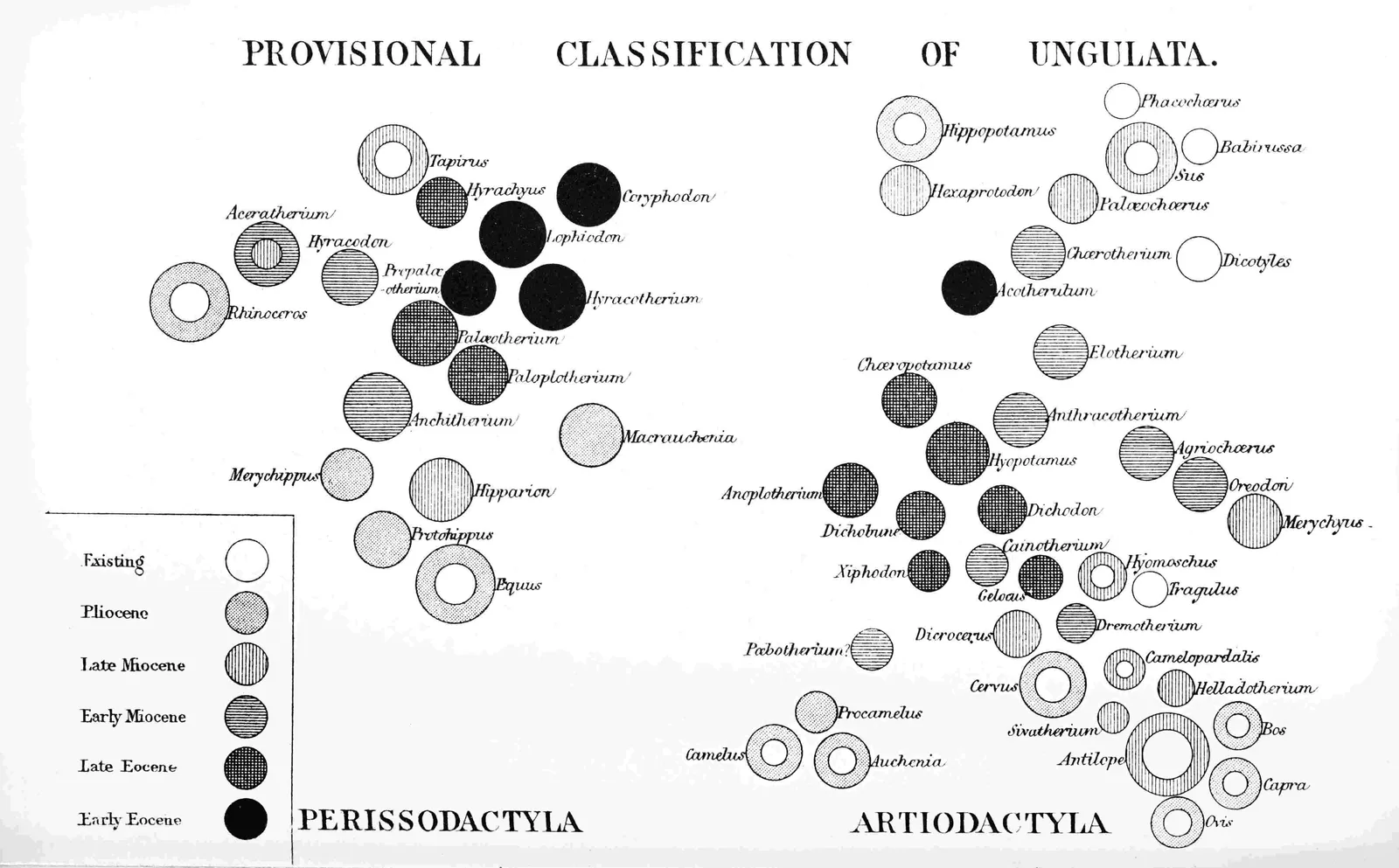
PROVISIONAL CLASSIFICATION OF UNGULATA.
remains have been embedded being itself preserved during
the constant changes going on on the earth’s surface, and
ultimately appearing in a situation accessible to man’s research.
(3) What the further chances against their being
so found, even if they should have been preserved in an
accessible locality.
I might refer you to the exceedingly minute portion of
the earth’s surface which has yet been really explored
palæontologically; to the cases that are occurring every day
of new and most unexpected forms and of whole species
or orders, known only by an isolated individual, as the
Archæopteryx of the Solenhofen oolite; to say nothing of
more recondite speculations in the work above referred to, on
the improbability of preservation of intermediate forms, owing
to variation having usually been most rife during periods of
elevation, when fossilisation is less likely to occur.
All these show in such a striking manner the extremely
small value of negative evidence in palæontology, that I am
quite justified in asking you to leave it altogether out of
consideration in thinking of, or reasoning on, what is to
follow.
Such being the material with which we have to deal, it
will be seen that we must go to work upon it in a most
careful and circumspect manner. We cannot rush at conclusions,
but must be content cautiously, and often with much
labour and anxiety, to piece together our facts, scrupulously
observing the minutest hints, and following out the direction
indicated by often very obscure signs, before we can reconstruct
even an outline of the fabric from which we hope to gain
an idea of the past history of the beings of which we treat.
I have selected for illustration of the subject this evening
the division or order of Mammals called by naturalists
Ungulata, or hoofed animals, chiefly because it is the one
of which the palæontological history—at least in the tertiary
period (for beyond that we cannot trace it)—is better known
than any other, and as that of which the classification,—that
is, the relations of its various sub-groups to each other,—is
on the whole better understood than in most other zoological
divisions.
The order includes the most familiar of our domestic
animals, and with the general appearance of the rest we are
most of us well acquainted, thanks to the Zoological Gardens.
They are the various forms of horses, asses, and zebras, the
rhinoceroses and the tapirs, the pigs, hippopotamus, camels,
deer, antelopes, sheep, oxen, and goats.
They are essentially herbivorous (though some few may be
more or less omnivorous), and their teeth are modified
accordingly. Their limbs are adapted for carrying the body
in ordinary terrestrial progression, and are of very little use for
any other purpose, such as climbing, seizing prey, or carrying
food to the mouth. They never have clavicles or collar-bones,
and their toes never exceed four in number (the digit which
corresponds to the first of the complete pentadactyle foot being
always wanting), and have the ends encased in hoofs instead
of nails or claws. The species at present existing are very
numerous, and widely diffused over the earth’s surface, being
wanting only in the Australian province. These Ungulate
animals are divided into two natural groups, each having very
many characters in common, the establishment of which, though
contrary to the views of the great naturalists of the beginning
of this century, has been a great gain to zoological science,
especially as this division pervades all the known extinct as
well as recent forms; and although some forms of either group
may present some partial approximation to the other, no
directly intermediate species are known. It is important,
therefore, to apprehend thoroughly the distinction between
these groups, which have received from Professor Owen the
names of Perissodactyle, or odd-toed, and Artiodactyle, or even-toed,
from one of their most striking external characteristics.
The first have the toes of both feet arranged symmetrically
to a line drawn through the middle of what would be the
third toe of the typical pentadactyle foot, which toe is always
the largest, and in some cases the only one fully developed.
In the second, the toes are arranged symmetrically to a line
drawn between the third and fourth toes, so that these two
toes are equally developed, and may be alone present, or may
be supplemented by an outer pair (the second and fifth), often
in a more or less rudimentary condition. Besides these distinctions
in the limbs, there are so many others correlated with
them in the number of the vertebræ, the structure of the cranial
bones, of the teeth, of the digestive organs, etc., that there can
be no question about their forming natural divisions, very
important to palæontologists, as it often happens that the
position of an extinct and little-known form can be determined
from a very small fragment of bone.
Each of these groups is further divided into genera, the
names of which in what appears, in the present state of
knowledge, to be their natural position and relation to each
other are indicated on the diagram. From this it will be
seen that the existing Perissodactyles (excluding Hyrax, the
position of which is doubtful, though I am inclined to consider
it as an aberrant member of this group) consist of three
groups, the tapirs, the rhinoceroses, and the horses, each
represented by but few species, and (except in the case of
the horse, through the agency of man) of rather restricted
geographical distribution.
These groups at present are separated by very decided
intervals, so much so, that one of them, containing the horses,
has been considered by many naturalists as forming an order
apart, the Solidungula.
The existing Artiodactyles range themselves around two
principal types, the tubercular-toothed, or bunodont, and the
crescentic-toothed, or selenodont. To the former belong the
pigs in all their modifications, including the babirussa and
wart-hogs, and the hippopotamus and peccary. To the latter
the ruminants, i.e. vast numbers of species of animals included
under the general designation of sheep, oxen, goats, antelopes,
deer, musks, giraffes, and the two allied though aberrant
forms, the camels, and the Tragulidæ or chevrotains, an
interesting little group long confounded with the musk deer.
The two extremes of this division, represented by the pigs
and the hollow-horned ruminants, seem to have very little in
common at first sight, and if we were acquainted with the
organisation only of the existing species, we might be justified
in treating them as belonging to very distinct groups. But
even among existing forms there are some examples, which may
almost be called intercalary types, so widely do they depart
from the group to which they are most nearly relative in the
direction of the other.
These are among the bunodonts, the little South American
peccaries (Dicotyles), and among the selenodonts, in a far
greater degree, the chevrotains (Tragulus). The latter in
many remarkable characters deviate strongly from the
ruminants, and approach the pigs, or rather, as will be shown
presently, to the generalised type of the entire group.
Such being the present condition of the order, what does
palæontology reveal of its past history?
In the first place, it is most necessary to bear in mind the
provisional character of all classifications of extinct animals,
because of our imperfect knowledge of their structure; but
endeavouring to make the best use of what little we possess,
I have added in the scheme opposite all the best-known extinct
forms somewhere near the position, in relation to the existing
forms and each other, in which their affinities would place
them, and have shown by the different shading their relation
as regards time.
The tertiary period, with which we are now alone
concerned, has here been divided for convenience into six
epochs. Of course, it were possible to have gone into minute
details and made many more divisions, but it would have
made the diagram less clear, and it is best, perhaps, not to
attempt to refine too much in this somewhat tentative
exposition of a biological history, especially as there is still
much uncertainty as to the exact relative age of many of our
fossiliferous strata.
The epochs chosen are the recent (including the pleistocene),
the pliocene, late and early miocene, and late and early eocene,
each represented by a different shading. It is not meant that
if a genus or group is here assigned to one of these epochs,
that some of its members may not have extended in some
degree beyond its limits (as it must be always remembered
that the boundaries of these epochs are quite artificial), either
before or after, but that the period assigned to it was that in
which it most chiefly flourished. When two shadings are
represented, one within another, it signifies that the group
existed in both, and of course in all intervening periods.
To begin with the Perissodactyles. The earliest known
forms constitute a family called Lophiodontidæ, composed of
the genera Lophiodon, Coryphodon, and Hyracotherium. Of
these animals little is known except the teeth, which, however,
indicate rather a primitive or root form, from which, by
modification, all the other teeth of Perissodactyles can be
derived. The elevations and depressions of the molar teeth of
Lophiodon, for instance, are arranged on a pattern which is
the best key to that of all others of the sub-order; and it is
by going back, as it were, to it that we can understand and
compare all the other variously modified, and often more complicated,
forms. Moreover, these Lophiodonts possess a dental
character which distinguishes them from all other Perissodactyles,
and brings them into a more generalised ungulate type,
for which reason I place them nearest to the earlier forms
of artiodactyles—that is, that all the premolars are smaller
and of a simpler form than the true molars. Whether they
possessed any modification of the limbs or other structures which
bear them out in this position, we unfortunately cannot say.
At a somewhat later epoch in the earth’s history appeared
on the scene the Palæotheriidæ, an important group, containing
animals the osseous structure and dentition of which are
completely known, chiefly through the famous researches of
Cuvier into the fossils found in the gypsum quarries at
Montmartre. These were animals something like existing
tapirs, with three toes on each foot, complete and distinct
radius and ulna and tibia and fibula, complete typical number
of teeth, i.e. i 3/3 c 1/1 p 4/4 m 3/3 = 44; but the molar teeth
modified in pattern from that of the Lophiodonts. They
flourished in the later eocene, after which period they are no
longer met with. They have been divided into several genera,
but Gaudry has shown that these are united by transitional
forms, and present a gradual series of modifications, corresponding
with successive geological epochs. Another offset,
from the ancient Lophiodont stock (with which it appears
to be connected through the American eocene Hyracahyus),
constitutes the family Tapiridæ, first known in the miocene
and continued with scarcely any modification to our own day,
and therefore a most interesting form to contemplate in its
living state, as it brings back, in the most striking way, the
general facies of the fauna of those ancient times. In one
respect the tapir is remarkable among Perissodactyles, as it has
on its fore-feet as many as four toes, thus retaining a primitive
or generalised character. The other two existing forms, the
rhinoceros and the horse, appear to be more direct modifications
of the Palæotherium type, though in different directions. The
existing rhinoceros closely resembles the Palæotherium in the
general structure of its skeleton, limbs, number of toes, etc.,
and in the general pattern of the molar teeth; it differs,
however, in the greatly reduced number of front teeth, incisors
and canines, which in the African two-horned species are often
absolutely wanting; and also in the possession of those
singular epidermal appendages to the face, the well-known
horns, either one or two in number. Now palæontology
points out with tolerable precision the intermediate steps by
which these modifications have been brought about. A small
ancient rhinoceros has been found in the early miocene of
North America, to which Leidy has given the name of
Hyracodon, which had no horn, and had the complete number
of incisor and canine teeth, and was in many ways, at least as
far as the skull and teeth are concerned, intermediate between
Palæotherium and Rhinoceros proper. The earlier known
European rhinoceroses have had the name Aceratherium given
to them, the small size of the nasal bones being apparently
quite unfitted to support such a weapon as a horn. The
resemblance of their skull to Palæotherium has been pointed
out by H. v. Meyer.
The more recent fossil rhinoceroses present wonderfully
intermediate forms between some of the existing species, as
R. pachygnathus of Pikermi, as Gaudry has shown, is about
equally related to the two species of modern African rhinoceros,
and might have been (upon the derivative hypothesis)
the ancestor of both. In the same way the Himalayan R.
sivalensis appears to be related to the modern R. indicus and
sondiacus, and the R. schleirmacheri to the Asiatic two-horned
species. One special line of variation indicated chiefly by the
ossification of the nasal septum culminated in the R. tichorhinus,
which became extinct only in the most recent geological
epoch. The history of this small group alone in its bearings
upon evolution might occupy many lectures; I must content
myself now only with one observation, borrowed from Mr.
Boyd Dawkins, that in all modern rhinoceroses the molar
teeth have deeper crowns than in those which existed prior
to a certain epoch, so that the height of these teeth alone will
serve to distinguish a pleistocene from a pliocene form, in
other respects closely allied. The value of this observation
will be illustrated in the sequel.
The next line of modification from Palæotherium, is that
which culminates in the most specialised of mammals, the
modern horse, an animal we are so accustomed to look at
that we scarcely ever notice the most remarkably adaptive
character of its structure for its special mode of life. If
we were not acquainted with the horse (and here of course I
include its immediate allies, the asses and zebras) we could
scarcely conceive of an animal whose only support was the
tip of a single toe on each extremity, to say nothing of the
singular conformation of its teeth and other organs. So
striking have these characters appeared to many zoologists
that the animals possessing them have been reckoned as an
order apart called Solidungula; but palæontology has revealed
that in the structure of its skull, its teeth, its limbs, the horse
is nothing more than a modified Palæotherium; and though
still with gaps in certain places, many of the intermediate
stages of these modifications are already known to us, being
the Paloplotherium, Anchitherium, Merychippus, and Hipparion.
On this very interesting point, which looks more like a real
genealogical history than any other known, however, I need
not dwell, as it was so fully treated of in a lecture delivered
in this theatre three years ago by Professor Huxley—a lecture
entitled the “Pedigree of the Horse.”
Lastly, there is Macrauchenia, a curiously modified Perissodactyle
found in pleistocene times in South America, apparently
another derivative of the palæotherium type, presenting
resemblances (though perhaps only analogical) to some of the
artiodactyles, especially the camels.
Directly intermediate forms between Macrauchenia and
the other animals of its group are not yet known; but
considering how little evidence we have of the animal life of
the middle or older tertiaries of South America, this is not to
be wondered at.
On the whole it will be seen that, taking actual anatomical
characters alone, palæontological research, even so far as it
has yet been carried, bridges over most of the gaps existing
between the modern forms of Perissodactyles, entirely abolishing,
for instance, the order Solipedia, as it is impossible to draw
a satisfactory line where the animal ceases to be equine and
becomes a palæotheroid; some drawing it between Anchitherium
and Palæotherium, some between Anchitherium and
Hipparion. Moreover, and this is most important, the lines
from the modern more specialised forms converge towards the
ancient more generalised forms; so that if we could get a
side-view of what is shown in the diagram, the earliest forms
at the bottom and the latest at the top, we should have lines
(broken, it is true, here and there) diverging from a common,
or near a common centre, towards a circumference above—a
view, in fact, of the conventional genealogical tree.
We turn now to the Artiodactyles, represented at present
by the scattered groups before spoken of, clustering round two
type-forms so widely sundered in their structure and habits
as the pig and the ox; but the former history of this division
yields a totally different state of things. Of early eocene
Artiodactyles we know very little at present; but in the
later divisions of the same epoch forms appeared, such as
Anoplotherium, Dichobune, Chœropotamus, and Hyopotamus,
which were certainly neither pigs nor ruminants, but which
partook remarkably of the characters of both. They had
the complete number of teeth, i.e. incisors and canines, like
modern pigs, but molars with indications of the crescentic
pattern so characteristic of ruminants. They had two or four
toes; but the metacarpals and metatarsals were not united to
form a cannon bone as in ruminants, and they wanted the
horny appendages to the head, so usually met with in the
modern representatives of that group. From some of these
central forms, or more probably from a still earlier allied
group indicated by the genus Acotherulum, or by some other
still undescribed remains from Mauremont, transitions can be
traced with few breaks, through the successively modified
miocene genera Chærotherium and Palæochærus to the genus
Sus, or true pig, in which the dentition undergoes some
remarkable specialisations, as the upturning of the upper
canines, and great development and extremely tuberculated
character of the posterior molars, which are both singularly
exaggerated in some modern offsets of the pig family, the first
in the babirussa, and the second in the wart-hog (Phacochærus).
More distantly related to the true pigs are the hippopotamus
on the one hand, and the peccary on the other. In relation
to the first, not found anteriorly to the latest miocene, it is
significant that the earliest known forms had the more
generalised number of incisor teeth (six) instead of four as
in the modern hippopotamus, and hence has been made into a
genus by itself, called Hexaprotodon.
The researches of Leidy into the ancient (miocene and
early pliocene) fauna of Nebraska have furnished evidence of
a remarkable group of animals now entirely extinct, the
Oreodontidæ, the characters of which are perfectly intermediate
between those of the pigs and the ruminants;
animals with pig-like feet and complete number of incisors,
canines, and molars, but with the latter important set of
teeth, formed precisely on the same type as those of the
deer. Within this particular group Leidy has noted a
curious series of slight modifications coinciding with the
successive age of the strata, in which the remains were found.
Agriochærus, the most ancient, approaches nearer to Chæropotamus,
has orbits open behind and very shallow-crowned
teeth. Then follows Oreodon proper, and lastly Merychyus,
more like the modern ruminants.
To return to the European forms, in the genus Gelocus,
where the union of the two principal bones of the metapodium
first occurs, Kowalevsky has noticed the gradual way in
which this change seems to have been brought about in
successive epochs of eocene and early miocene strata, at first
free in the young, and only coalescing in old animals, afterwards
coalescing at a much earlier age. The gradual perfecting of
the foot by the development of the ridge round the lower
articular end of the metapodium in later forms, the ridge
being quite wanting in early forms of the same group, has
been noticed by the same author in many different series of
Ungulates.
During the miocene period the peculiar dental characteristics
of the modern ruminants, especially the loss of the upper
incisors, were developed, all selenodont artiodactyles henceforth
showing it. Of this early race of imperfect ruminants,
still retaining many generalised characters, especially in the
skull, the cervical vertebræ, fibula, stomach, etc., the chevrotains
(Tragulidæ) are the survivors, especially the West African
Hyomoschus, which has existed almost unchanged since the
late miocene of Sansans and Steinheim. Then for the first
time the appendages called antlers were introduced, but only
in a comparatively rudimentary condition, with long pedicles
and few branches, as in the modern Muntjaks. It was
not till pliocene and especially pleistocene epochs that the
wonderful and luxuriant variety of cervine antlers reached
their full development. As offsets of the deer group, the
giraffe, the gigantic Siwalik Sivaitherium, and the Helladotherium
of Greece may be mentioned, the two latter having
become extinct, apparently without descendants.
Later still, the yet more specialised forms of hollow-horned
ruminants appear—forms which now dominate the earth,
being of all Ungulates the most widely diffused and most
numerous in species, in individuals, and in outward variety,
though in essential structure all alike. One of their principal
characteristics is the modification of their molar teeth in the
same way as in the modern horses, to which in some respects
they seem to form a parallel group. The difference between
the molar tooth of a hollow-horned ruminant and that of a
deer consists in the great lengthening of the crown without
any change in the pattern of the enamel folds, and in the
addition of cement to support these folds. This alteration
did not take place suddenly, and the crowns of teeth of the
artiodactyles before the time of deer were still shorter than in
those animals.
Among the deer themselves, as Lartet observed, the most
ancient have very short-crowned molars, and the depressions
on the surface are so shallow that the bottom is always
visible, while in the Cervidæ of the more recent tertiary
periods, and especially the pleistocene and living species,
these same cavities are so deep that, whatever be the state of
dentition, the bottom cannot be seen. This (he says) is a
perfectly reliable rule for distinguishing the ancient from the
more modern forms of deer, and can be applied to other
animals as well as the Cervidæ. From it he surmises that
the duration of the life of modern is greater than that of
ancient deer. The same careful observer also remarks that in
many natural groups a gradual progress is observed in the
volume of the brain and complexity of its surface, as deduced
from casts of the interior of the skull, from which fact he
concludes that a gradual growth of vital energy and intelligence
has occurred as the effect of the tendency towards
improvement, of which the cause is always acting, and the
limits indefinite.
Thus the history of the Even-toed Ungulates tells the
same story as that of the Perissodactyles. The modern forms
are placed along lines which converge towards a common
centre. Moreover, the lines of both groups, to a certain extent,
approximate; but within the limits of our knowledge they
do not meet. Both artiodactyles and perissodactyles existed
low down in the eocene, just as Carnivores, Insectivores, bats,
rodents, and other great groups then existed with boundary
lines as distinctly marked as now.
Was the order, according to which the introduction of
new forms seems to have taken place since that epoch, then
entirely changed? or did it continue as far back as the period
when these lines would have been gradually fused into a
common centre?
Here we are landed in the region of pure speculation; but
bolder travellers than I have endeavoured to penetrate its
mysteries, as may be seen by a perusal of Professor Huxley’s
presidential address to the Geological Society for 1870.
I have so far confined myself within the region of the
known, and shown that at least in one group of animals the
facts which we have as yet acquired point to the former
existence of intermediate forms, so numerous that they go far
to discredit the view of the sudden introduction of new species.
They also show many cases of gradual modification of
particular organs, probably always to the benefit of the race,
and also a general progress from lower to higher or more
specialised types: though, as in all other cases of progress
(human civilisation, for instance), attended with many exceptions,
some local and temporary, some only apparent.
Whether the inferences which seem to me to follow from
these facts are true or not may still be an open question; for
the sake of the stimulus that an open question of this sort
lends to scientific research I am very glad that it is so; but
if true, if we are led by them to the conclusion that the
world we live in is a world of gradual growth and progress,
and orderly evolution, what grander view of the Creation and
the history of that world can we have opened to us?
On the 10th of January 1778 died the great Swedish
naturalist, Charles Linné, more commonly known as Linnæus,
a name which will ever be mentioned with respect and regard
in an assembly devoted to the cultivation of the sciences of
Zoology and Botany, as, whatever may be the future progress
of those sciences, the numerous writings of Linnæus, and
especially the publication of the Systema Naturæ, can never
cease to be looked upon as marking an era in their development.
That work contained a systematic exposition of all
that was known on these subjects expressed in language the
most terse and precise. The accumulated knowledge of all the
workers at Zoology, Botany, and Mineralogy since the world
began, was here collected together by patient industry, and
welded into a complete and harmonious whole by penetrating
genius.
Exactly a century has passed since Linnæus died. What
of the progress of the subjects to which he devoted his long
and laborious life? This one century is a brief space
compared with the ages which have passed since man began
to dwell upon the earth, surrounded by living objects, which
have, more and more as time rolled on, awakened his curiosity,
stimulated his faculties to observe, and impelled him to record
the knowledge so gained for the benefit of those to come.
How does it stand in comparison with those which preceded
it, in the contributions it has thus acquired and recorded?
It may be not without interest in commencing our work at
this meeting to cast our eyes back and take stock, as it were,
of the knowledge of a hundred years ago, and of that of the
present time, and see what advances have been made; to look
at the living world as it was known to Linnæus and as it is
known to ourselves. The Systema Naturæ, the last edition of
which, revised by the author, was published in 1766, will be
a convenient basis for the comparison; but as the subject is
one which, even in a most superficial outline, might reach such
lengths as would well tire out the most patient of audiences,
and absorb time which will be more profitably occupied by
the valuable contributions which are forthcoming from other
members of the Association, I will merely take a small section
of the work, about 100 pages out of the first of the four
volumes, those devoted to the first class Mammalia. The
comparison of this part is perhaps the easiest, as the contrast
is the least striking, and the progress has been comparatively
the slowest. The knowledge of large, accessible, and attractive-looking
animals had naturally preceded that of minute and
obscure organisms, and hence, while in many other departments
the advance has altogether revolutionised the knowledge
of Linnæus, in the Vertebrated Classes, especially the
one of which I shall now speak, it has only extended and
reformed it.
In taking the Systema Naturæ of Linnæus, the comparison
is certainly carried back somewhat beyond the hundred years
which have elapsed since his death, and the brilliant contributions
to the knowledge of the Mammalia of Buffon and
Daubenton, just then beginning to be known, and the
systematic compilation of Erxleben (published in 1777), are
ignored; but for the present purpose, especially considering
the limited time at my disposal, it will be best not to go beyond
the actual text of the work in question.
Before considering systematically the different groups into
which Linnæus divides the class, I must remark in passing
upon what is the greatest, and indeed most marvellous
difference between the knowledge of Zoology of our time and
that of Linnæus. Now we know that the animals at present
existing upon the earth are merely the survivors of an
immensity of others, different in form, characters, and mode
of life, which have peopled the earth through vast ages of
time, and to which numerically our existing forms are but
infinitesimally small, and that the knowledge we already
possess of great numbers fully justifies the expectation of an
enormous further advance in this direction. In the time of
Linnæus the existence in any past time of a species having
no longer living representatives on the earth, though perhaps
the speculation of a few philosophical minds, had not been
received among the certainties of science, and at all events
found no place in the great work we are now considering.
In the twelfth edition of the Systema Naturæ we find the
class Mammalia divided into seven orders: I. Primates,
II. Bruta, III. Feræ, IV. Glires, V. Pecora, VI. Belluæ,
VII. Cete. These orders contain forty genera without any
intermediate subdivisions. The genera are again divided into
species, of which the total number is 220.
The first order, Primates, contains four genera: Homo,
Simia, Lemur, and Vespertilio.
The vexed question of man’s place in the zoological system
was thus settled by Linnæus. He belongs to the class
Mammalia, and the order Primates, the same order which
includes all known monkeys, lemurs, and bats: he differs only
generically from these animals. But then we must remember
that the Linnæan genera were not our genera; they correspond
usually to what we call families, sometimes to entire orders.
So that practically man’s position is much the same as that to
which, after several vicissitudes, as his separation as an order
by Blumenbach and Cuvier, or as a sub-class by Owen, he has
returned in the systems of nearly all the zoologists of the
present day who treat of him as a subject for classification upon
zoological and not metaphysical grounds.
Yet since the time of Linnæus the whole science of
Anthropology has been created. There is certainly an
attempt at the division of the species Homo sapiens into six
varieties in the Systema Naturæ, but it has scarcely any
scientific basis. Zoological Anthropology may be said to have
commenced with Blumenbach, who, it is interesting to recall
as an evidence of the rapid growth of the science, was a
contemporary with most of us in this room, for he died as
lately as 1840, although his first work on the subject, De
generis humani varietate nativa, was published three years
before the death of Linnæus, too late, however, to influence
the work we are now speaking of. The scientific study of
the natural history of man is therefore, we may say, but one
century old. To what it has grown during that time you are
probably aware. Scarcely an important centre of civilisation
in the world but has a special Society devoted to its cultivation.
It forms by itself a special department of the Biological
Section of our Association—a department of such importance
that on this occasion no less distinguished a person than a
former most eminent President of the whole Association was
thought fit to take charge of it. From him you will doubtless
hear what is its present scope, aim, and compass. I need only
remind you that except the one cardinal point of the zoological
relation of man to other forms of life, which Linnæus appears
to have appreciated with intuitive perception, all else that
you will now hear in that department was not dreamt of in
his philosophy.
As might naturally be supposed, apes and monkeys have,
for various reasons, attracted the attention of observers of
nature from very early times, and consequently Linnæus was
able to give rather a goodly list of species of these animals,
amounting to thirty-three; but of their mutual affinities, and
of the important structural differences which exist between
many of them, he seems to have had no idea, his three
divisions being simply regulated by the condition of the tail,
whether absent, short, or long.
We now know that the so-called Anthropoid or man-like
apes, the gorilla, chimpanzee, orang, and gibbons, form a
group apart from all the others of such importance that
everything related to their history, structure, and habits has
been most assiduously studied, and there is now an immense
literature devoted to this group alone. Nothing could better
illustrate the advances we have made in a hundred years, than
the contrast of our present knowledge of these forms with that
of Linnæus. It is true that, as shown in the most interesting
story of the gradual development of our knowledge relating to
them in the first chapter of Huxley’s Man’s Place in Nature,
the animal now called gorilla was, without doubt, the pongo,
well known to and clearly described by our countryman,
Andrew Battle, a contemporary of Shakespeare; and that a
really accurate and scientific account of the anatomy of the
chimpanzee had been published as far back as 1699 by Dr.
Edward Tyson, who, as the first English comparative anatomist,
I am proud to claim as in some sort a predecessor in the chair
I have the honour to hold in London, as he is described on
the title-page of his work as “Reader of Anatomy at Chirurgeons’
Hall.”
Linnæus was, however, not acquainted with these, and his
second species of the genus Homo, H. troglodytes, and his first
of the genus Simia, S. satyrus, were both made up of vague
and semi-fabulous accounts of the animals now known as
chimpanzees and orangs, but hopelessly confounded together.
Of the gorilla, and what is stranger still, of any of the large
genus of gibbons, or long-armed apes of South-eastern Asia, he
had at the time he revised the Systema no idea.
The remaining monkeys, we now know, fall into three
very distinct sections: the Cercopithecidæ of the Old World,
and the Cebidæ and Hapalidæ of the New, or by whatever
other names we may like to designate them. Although
members of all three groups appear in the list in the Systema,
they are all confusedly mixed together. Even that the
American monkeys belong to a totally different stock from
those of the Old World does not seem to have been suspected.
The genus Lemur of Linnæus comprehends five species, of
which the first four were all the then known forms of a most
interesting section of the Mammalia. These animals, mostly
inhabitants of the great island of Madagascar, though some
are found in the African continent, and others in some of the
Southern and Eastern parts of Asia, constitute a well-defined
group, but one of which the relations are very uncertain. At
one time, as in the system of Linnæus, they were closely
associated with the monkeys. As more complete knowledge
of their organisation has been gradually attained, the interval
which separates them structurally from those animals has
become continually more evident, and since they cannot be
placed within the limits of any of the previously constituted
orders, it has been considered advisable by some naturalists to
increase the ordinal divisions in their behalf and to allow
them to take rank as a distinct group, related to the Primates
on the one hand, and to the Carnivora and Insectivora on the
other. The knowledge of their relations, however, bids fair to
be greatly increased by the discoveries of fossil forms lately
made both in France and America, some of which seem to
carry their affinities even to the Ungulata.
Existing upon the earth at present, besides the more
ordinary lemurs to which the species known to Linnæus
belong, there are two aberrant forms, each represented by a
single species. These are the little Tarsius of Borneo and
Celebes, and the singular Chiromys, or Aye-aye, which, though
an inhabitant of the headquarters of the group, Madagascar,
and living in the same forests and under the same conditions
as the most typical lemurs, exhibits a most remarkable degree
of specialisation in the structure both of limbs and teeth, the
latter being modified so as to resemble, at least superficially,
those of the Rodents, a group with which in fact it was once
placed. It was discovered by Sonnerat in Madagascar in
1780, two years after the death of Linnæus. The specimen
brought to Paris by this traveller was the only one known
until 1860. Since that date, however, its native land has
been more freely open than before to explorers, and many
specimens have been obtained, one having lived for several
years in the Gardens of the London Zoological Society.
The history of a name is often not a little curious. Linnæus
applied the term Lemures, i.e. the departed spirits of men, to
these animals on account of their nocturnal habits and ghost-like
aspect. The hypothetical continent in the Indian Ocean,
supposed to have connected Madagascar with the Malayan
Archipelago is called by Mr. Sclater, Lemuria, as the presumed
original home of the lemur-like animals. Although the
steps are not numerous, it might puzzle a classical scholar,
ignorant of Zoology, to explain the connection between this
continent and the Roman festival of the same name.
The fifth animal which Linnæus places in his genus Lemur,
under the name of L. volans, is the very singular creature to
which the generic term Galeopithecus has since been applied.
It is one of those completely aberrant forms which, having no
near existing relations, and none yet discovered among extinct
forms, are perfect puzzles to systematic zoologists. It is
certainly not a lemur, and not a bat, as has been supposed by
some. We shrink from multiplying the orders for the sake of
single genera containing only two closely-allied species; so we
have generally allowed it to take refuge among the Insectivora,
though without being able to show to which of that somewhat
heterogeneous group it has any near affinities.
The fourth genus of the Primates is Vespertilio, comprising
six species of bats. This genus has now by universal consent
expanded into an order, and one of the best characterised and
distinctly circumscribed of any in the class: indeed, those
who have worked most at the details of the structure of bats
find so much diversity in the characters of the skull, teeth,
digestive organs, etc., associated with the modification of the
fore-limbs for flight common to all, as almost to entitle them
to be regarded rather as a sub-class. Anatomical as well as
palæontological evidence shows that they must have diverged
from the ordinary mammalian type at a very far distant date,
as the earliest known forms, from the Eocene strata, are
quite as specialised as any now existing, and no trace has
hitherto been discovered of forms linking them to any of the
non-volant orders. By the publication within the last few
weeks of a valuable monograph on the existing species of the
group, entitled “A Catalogue of the Chiroptera in the Collection
of the British Museum,” by G. E. Dobson, we are enabled
to contrast our present knowledge with that of the time of
Linnæus. Although the author has suppressed a large number
of nominal species which formerly encumbered our catalogues,
and wisely abstained from the tendency of most monographists
to multiply genera, he describes four hundred species, arranged
in eighty genera; nearly double the number of species, and
exactly double the number of genera, of the whole class
Mammalia in the Systema Naturæ, and these Dr. Günther
remarks in his Preface are probably only a portion of those
existing. The small size, nocturnal habits, and difficulty of
capture of these animals, are sufficient reasons for the supposition
that there are still large numbers unknown to science.
In the list of Linnæus, the first primary group of Dobson, the
Megachiroptera, now containing seventy species, is represented
by a single one, V. vampyrus, obviously a Pteropus, to which
the bloodthirsty habits of the fabulous Vampyre are attributed,
but which is not absolutely identified with any one of the
known species. The other species described by Linnæus can
almost all be identified with bats at present well known.
A curious example of the results of basing classification
upon a few, and those somewhat artificial characters, is afforded
by one of the true bats, now called Noctilio leporinus, though
admitted by Linnæus to be “simillimus vespertilionibus,
similiter pedibus alatus, being separated from the others, not
only generically, but even placed in another order, that of the
Glires or Rodents, because it did not, or was supposed not to
fall under the definition of the order Primates, which begins
“Dentes primores incisores superiores IV. paralleli.” In reality
this bat has four upper incisors, but the outer ones are so
small as to have been overlooked when first examined. But
even if this were not so, no one would now dream of basing
an animal’s position upon such a trivial character when
opposed to the totality of its organisation and habits.
The characters of the incisor teeth are placed in the first
rank in the definitions of all the orders in the Systema Naturæ,
and hence the next order called Bruta, characterised by
“dentes primores nulli superius aut inferius,” contains a curious
mixture of heterogeneous animals, as the names of the genera
Elephas, Trichechus, Bradypus, Myrmecophaga, Manis, and
Dasypus will indicate. It contains, in fact, all the animals
then known comprised in the modern orders of Proboscidea,
Sirenia, and Edentata, together with the walrus, one of the
Carnivora. The name Bruta has been revived for one of
these orders, that more generally called Edentata, but I think
very inappropriately, for it was certainly not equivalent, and
if retained at all, should rather belong to the Proboscidea, as
Elephas stands first in the list of genera which Linnæus
assigned to the group.
It is curious to find that the striking differences between
the African and the Indian elephants, now so well understood
by every beginner in Zoology, and all the facts which have
already been accumulated relating to the numerous extinct
forms of Proboscideans, whether Mammoths, Mastodons, or
Dinotheria, were quite unknown to Linnæus. One species
only, Elephas maximus, represented in the zoology of a hundred
years ago all that was known of the elephants or elephant-like
animals.
The genus Trichechus of this edition exhibits a very curious
phase of zoological knowledge. It contains two species—1.
T. rosmarus, the walrus, now known to be a modified seal,
and therefore a member of the Linnæan order Feræ, and 2.
T. manatus, a name under which were included all the known
forms of manatees and dugongs, in fact the whole of the
modern order Sirenia,—animals widely removed in all essential
points of their organisation from the walrus, with which they
are here generically united. Their position, however, between
the elephant on the one hand and the sloths on the other,
is far better than their association with the Cetacea, as in
Cuvier’s system, an association from which it has been most
difficult to disengage them, notwithstanding their total dissimilarity
except in a few external characters. Although the
discovery of many fossil forms has done much to link together
the few existing species and to show the essential unity of the
group, it has thrown no light upon their origin, or their
affinities to other mammals. They still stand, both by their
structure and their habits, in a strangely isolated position, and
it baffles conjecture to say whence they have been derived, or
how they have attained their present singular organisation.
The remaining genera of the Linnæan order Bruta constitute
the group out of which Cuvier, following Blumenbach,
formed his order Edentata, a name certainly not happily
chosen for a division which includes species like the great
armadillo, having a larger number of teeth than any other
land mammal, but which, nevertheless, has been so generally
adopted, and is so well understood, that to attempt to change
it would only introduce an element of confusion. Four out
of five of the principal modifications of form in the group at
present known are indicated by the four Linnæan genera,
Bradypus or sloth, Myrmecophaga or ant-eater, Manis or
pangolin, and Dasypus or armadillo. The advances during
the century have consisted in the accumulation of a great
mass of details respecting these groups; the addition of a
fifth and very distinct existing form, the Orycteropus or Cape
ant-eater; and the discovery of numerous and very remarkable
extinct forms, such as the Megatheriums and Glyptodons of
South America, now so fully known by their well-preserved
osseous remains. There is, however, still much to be done in
working out the real relationship of the somewhat isolated
members of the order, if it be a natural order, both to each
other, and to the rest of the Mammalia, from which they
stand widely removed in many points of organisation.
The third order of Linnæus, Feræ, contained all the then
known animals, which, with whatever diversities of general
structure, agreed in their predatory habits, and possessed
certain general characters of teeth and claws to correspond,
though the terse definition of “Dentes primores superiores sex,
acutiusculi canini solitarii,” is by no means universally
applicable to them. This order was broken up by Cuvier into
the orders Carnivora and Insectivora, and the genus Didelphys,
included in it by Linnæus, has been since by universal assent
removed to another group.
The first six genera belong to the very well-defined and
probably natural group now called Carnivora. The one placed
at the head of the list, Phoca, is equivalent to the large and
important modern sub-order Pinnipedia,—the walrus, however,
though essentially a seal, having been, as before mentioned,
relegated by Linnæus to another order, on account of its
aberrant dentition. But three species are recorded in the
genus; P. ursina, the sea-bear of the North Pacific (now
Otaria ursina); P. leonina, founded on Anson’s sea-lion, now
commonly called the elephant seal, or sea-elephant (Macrorhinus
proboseideus, or more properly leoninus); and P. vitulina, the
common seal of our coasts.
The terrestrial sub-order of Carnivora is represented by
five genera: 1. Canis, including the dog, wolf, hyæna, fox,
arctic fox, jackal, etc. 2. Felis, with only six species, but
still one of the few Linnæan genera, which covers exactly the
same ground as at present in the opinion of the majority of
zoologists, although it may be mentioned as an example of the
tendency towards excessive and unnecessary multiplication of
generic names which exists in some quarters, that it has been
divided into as many as fourteen. 3. Viverra, a heterogeneous
group, containing ichneumons, coatis, and skunks, animals
belonging to three very distinct families, according to modern
ideas. 4. Mustela, a far more natural group, being nearly
equivalent to the modern family Mustelidæ; and, lastly, a
very comprehensive genus Ursus, consisting of U. meles, the
badger, U. lotor, the raccoon, U. luscus, the wolverene, and all
the true bears known, comprised in the single species U. arctos.
Many interesting forms of Carnivora, as Cryptoprocta, Proteles,
Eupleres, Ailurus, and Ailuropus, have no place in the
Linnæan system, being comparatively modern discoveries.
The very recent date (1869) at which the last-named remarkable
animal was made known to science by the enterprising
researches of the Abbé David into the Fauna of Eastern
Thibet, gives hope that we may not yet be at the end of the
discovery of even large and hitherto unsuspected forms of
existing mammals.
Next in the Linnæan system comes the genus Didelphys,
constituted for the reception of five species of American
opossums. This is a very interesting landmark in the history
of the progress of the knowledge of the animal life of the
world, as these five opossums, forming a genus in the midst
of the order Feræ, were all that was then known of the great
sub-class Marsupialia, now constituting a group entirely apart
from the ordinary members of the class. It is difficult now
to imagine an animal world without kangaroos, without wombats,
without phalangers, without thylacines, without dasyures,
and so many other familiar forms, and yet such was the
animal world known to Linnæus. It is true that a species
of kangaroo from one of the islands of the Austro-Malayan
Archipelago was described as long ago as 1714 by De Bruyn,
who saw it alive at the house of the Dutch governor of
Batavia, and that Captain Cook and Sir Joseph Banks saw
and killed kangaroos on the east coast of Australia in 1770,
and had published figures and descriptions of them in 1773,
or five years before the death of Linnæus; but the work
we are now considering contains no traces of knowledge of
the existence of such a remarkable and now so well-known
animal.
The three remaining genera of Feræ, Talpa, Sorex, and
Erinaceus, contained all the known species of the present order
Insectivora, which now embraces many and very varied forms,
quite unsuspected a century ago, and to which it is probable
that many others will be added by the time the exploration
of the animal products of the world is completed.
The fourth order, Glires, has remained practically unchanged
to our day, although the name Rodentia has generally
superseded that bestowed upon it by Linnæus. The five
genera of the Systema Naturæ, Hystrix, Lepus, Castor, Mus,
and Sciurus, have been vastly increased, partly by subdivision
and partly by the discovery of new forms. Noctilio is, as
before mentioned, removed to the Chiroptera, but its loss is
well compensated for by Hydrochærus, the well-known Capybara,
the largest existing member of the group, which in the
Linnæan system is placed among the Belluæ, in the same
genus with the pigs.
The fifth Linnæan order, Pecora, is a fairly natural group,
equivalent to Cuvier’s Ruminantia; but it is no longer considered
of the value of an order, since the animals composing
it have now been shown to be as closely related to certain of
those belonging to the next order as they are to each other.
The first genus, Camelus, contains both the American lamas
and the Old World camels, the demonstration of the common
origin and close affinities of which has been one of the important
results of the recent discoveries in the palæontology
of the Western continent. In the next genus, Moschus, were
placed the well-known musk deer of the highlands of Central
Asia, and two small African antelopes, which have no special
affinity with it. The subsequent inclusion in the same genus
of the small chevrotains (Tragulinæ), which was very natural
at the time, as they agree perfectly with the musk in the
absence of horns and the presence of large canine tusks, by
which artificial characters the genus was defined by Linnæus,
was one of those unfortunate associations which have greatly
retarded the progress of knowledge of the true affinities of the
group. Judging by the popular works on Zoology, it is still
as difficult to apprehend that a chevrotain is not a musk deer,
as it is that a manatee is not a cetacean,—both errors of the
same kind, if not quite so gross, as that of regarding a whale
as a fish, or a bat as a bird. The Linnean genus Cervus
contains six species of true deer, including the moose, reindeer,
red deer, fallow, and roe, associated with the giraffe.
The twenty-one species of the great group of hollow-horned
Ruminants, at that time recognised, are distributed quite
arbitrarily in three genera, Capra, Ovis, and Bos. Though
subsequent investigations have greatly increased the number
of species known, we are still in much uncertainty about their
mutual affinities and generic distinctions. Being a group of
comparatively modern origin, and only just attaining its
complete development, variation has chiefly affected the less
essential and superficial organs. Moreover, the process of
extinction of intermediate forms has not operated sufficiently
long to break it up into distinctly-separated natural minor
groups, as is the case with many of the older families, which
lend themselves, therefore, far more readily to systematic classification,
especially as long as the extinct forms are unknown
or ignored.
The sixth order of land mammals, Belluæ, corresponding
to the Pachydermata of Cuvier, contains what is now known
to be a heterogeneous collection, viz. the horses, the hippopotamus,
the pigs, rhinoceroses, and the rodent capybara. The
abolition of these two last orders and the entire rearrangement
of the ungulate mammals into two different natural groups,
now called Artiodactyla and Perissodactyla, first indicated by
Cuvier in the “Ossemens fossiles,” from the structure of the
limbs alone, and afterwards confirmed by Owen from comparison
of every part of the organisation, has been one of the most
solid advances made in our knowledge of the classification of
the Mammalia during the present century.
The past history of this, as of so many other groups of
vertebrated animals, has been brought to light in an unexpected
manner by the wonderful discoveries of fossil remains made
during the last ten years in the Rocky Mountains of
America,—discoveries, the importance of which will only be
fully appreciated when the elaborate and beautifully illustrated
work which Professor Marsh has now in progress is completed.
The last Linnæan order, Cete, is exactly conterminous
with the order so named, or rather more generally modified
to Cetacea, in the best modern systems, for Linnæus did not
commit the error of Cuvier and others, of including the Sirenia
among the whales. His knowledge of the animals composing
the group was necessarily very imperfect; indeed it is only
within the last few years, especially since the impulse given
to their study by Eschricht of Copenhagen, that the great
difficulties which surround the investigation of the structure
and habits of these denizens of the open sea have been so far
surmounted that we have begun to obtain clear views of their
organisation, affinities, and geographical distribution.
Two most remarkable forms of mammals, so abnormal in
their organisation as now to be generally considered deserving
the rank of a distinct sub-class, the Echidna and Ornithorhynchus,
were first made known to science in 1792 and
1799 respectively, and consequently have no place in the
Systema Naturæ. The very recent discovery of a third form
to this group, or at least a very striking modification of one
of the forms, the large New Guinea echidna (Acanthoglossus
bruynïi), is the last important acquisition to our knowledge
of the class.
In this brief review of the progress of one small section of
one branch of zoological knowledge, it will be seen that it is
chiefly of systems of arrangement, of classification, and of
names, that I have been treating. By many biologists of the
present day these are looked upon as the least attractive and
least profitable branches of the subject. The interest of
classification, though it has lost much in some senses by
the modern advances of scientific biology, has, however,
gained vastly in others. The idea that has now, chiefly
in consequence of the writings of Darwin, taken such strong
hold upon all working naturalists—the idea of a gradual
growth and progressive evolution, and therefore genetic
connection between all living things—breaks down the
artificial barriers which zoologists raise around their groups,
and shows that such names as species, genera, families,
orders, etc., are merely more or less clumsy attempts to express
various shades of differences among creatures connected by
infinite gradations, and in this sense destroys the importance
attached to them by our predecessors. On the other hand,
it immensely increases the interest contained in the word
“relationship,” as it implies that the word is used in a real
and not, as formerly, in a metaphorical sense. There is a kind
of classification, such as we might apply to inanimate substances
or manufactured articles. We may say, for instance,
that a tumbler, a wine-glass, and a tea-cup are more closely
related to each other than either one is to a chair or a
table, and that they might be formed into one group, and
the last-named objects be placed in a second. This kind of
classification is certainly useful in its way for methodical
arrangement and descriptive purposes. It is the kind of
arrangement which Linnæus and his contemporaries applied
to animals. It is, however, a very different classification from
that which supposes that the members of a group having
common essential characters are descended from a common
ancestor, and have gradually, by whatever cause or means,
become differentiated from other groups. On this view a
true classification, if it could be obtained, would be a
revelation of the whole secret of the evolution of animal
life, and it is no wonder that many are willing to devote
so large a share of their energies in an endeavour to attain it.
The right application of the principles of nomenclature,
first clearly established by Linnæus, to the groups we form
is, again, by no means to be despised, as laxity and carelessness
in this respect are becoming more and more the
greatest hindrances to the study of Zoology. The introduction
of any new term, especially a generic name, and
indeed the use of an old one by any person whose authority
carries weight, has an appreciable effect upon the progress of
science, and should never be made without a full sense of the
responsibility incurred. All beginners are puzzled and often
repelled by the confused state of zoological nomenclature to
an extent to which those who have advanced so far as only
to care for the things, and to whom the actual names by
which they are called are comparatively indifferent, have little
idea. Those whose special gift or inclination leads them to
the pursuit of other branches of Biology, as Morphology,
Physiology, or Embryology, must have definite names for the
objects they observe, depict, or describe, and are dependent
upon the researches of the systematic zoologist for supplying
them, and should not neglect to take his counsel, otherwise
much of their work will lose its value.
Several times has the British Association thought this
a worthy subject for the consideration of its members, and
through the instrumentality of a committee of working
naturalists an excellent code of regulations and suggestions on
the subject of zoological nomenclature was drawn up in 1842.
These rules were revised and reprinted in 1865; and in
accordance with a resolution adopted at the last annual
meeting at Plymouth they have been again republished at
the cost of the Association during the present year. The
mere issue of such rules must have had a beneficial effect,
as they have undoubtedly been a guide to many careful and
conscientious workers. Unfortunately no means exist of enforcing
them upon those of a different class, but there is
still something wanting, short of enforcing them, which
possibly may be within the power of the Association to effect.
In the administration of the judicial affairs of a nation,
besides the makers of the laws, we have an equally essential
body to interpret or apply the law to particular cases—the
judges. However carefully compiled or excellent a code of
regulations may be, dubious and difficult cases will arise, to
which the application of the law is not always clear, and
about which individual opinions will differ. The necessary
permission given in the Association rules to change names
which are either “glaringly false,” or “not clearly defined,”
opens the door to considerable latitude of private interpretation.
As what we are aiming at is simply convenience and general
accord, and not absolute justice or truth, there are also cases
in which the rigid law of priority, even if it can be ascertained,
requires qualification, and others in which it may be advisable
to put up with a small error or inconvenience to avoid falling
into a larger one. I may name such cases as the propriety
or the reverse of reviving an obselete or almost unknown name
for one which, if not strictly legitimate, has been universally
accepted, or the retention of a name when already applied to
a different genus, instead of the institution of another in its
place. For instance, should the name Echidna, by which the
well-known Monotrematous Mammal is known in every
text-book and catalogue in every language, be superseded
by Tachyglossus, because the former name had previously been
applied to a genus of snakes? or should the chimpanzee be
no longer called Troglodytes lest it should be confounded with
a wren? Should Chiromys be discarded for Daubentonia,
Trichechus for Odobenus, and Tapirus for Hydrochœrus?
Should the Java slow lemur be called Loris, Stenops, or
Nycticebus? Should Sowerby’s whale be placed in the
genus Physeter, Delphinus, Delphinorhynchus, Heterodon,
Diodon, Aodon, Nodus, Ziphius, Micropterus, Micropteron,
Mesodiodon, Dioplodon, or Mesoplodon, in all of which it may
be found in various systematic lists? Should one of the
largest and best known of the Cetaceans of our seas be called
Balænoptera musculus, Physalus antiquorum, or Pterobalæna
communis, all names used for it by authors of high authority?
Should the smallest British seal be called Phoca hispida,
fœtida, or anellata?
I might go on indefinitely multiplying instances which
will be answered differently by different naturalists, the
arguments for one or the other name being often nicely
balanced. What is wanted, therefore, is some kind of
judicial authority for deciding which should in future be
used. If a committee of eminent naturalists, selected from
various nations, and divided into several sections, according to
the subjects with which each member is most familiar, could
be prevailed upon to take up the task of revising the whole
of our existing nomenclature upon the basis of the laws issued
by the Association in 1842, occasionally tempering their
strictly legal decisions with a little discretion and common
sense, and with a view, as much as possible, of avoiding
confusion and promoting general convenience,—and if the
working zoologists of the world generally would agree to
accept the decisions of such a committee as final,—we should
dispose of many of the difficulties with which we are now
troubled. There seems to me no more reason why the nomenclature
of such a committee, if it were composed of men in
whose judgment their fellow-workers would have confidence,
should not be as universally accepted as is the nomenclature
of the last edition of the Systema Naturæ of Linnæus. We
have agreed not to look beyond that work for evidence of
priority, and why should we not agree in the same way to
accept decisions which would probably be arrived at with even
fuller knowledge and greater sense of responsibility?
Whether this suggestion will be received with favour or
not, it appeared to me that it was one not inappropriate for
the consideration of this Section, which has already dealt with
the question in a manner so advantageous to science, and also
for this year, which has witnessed the hundredth anniversary of
the death of the great teacher of systematic zoology.
Our knowledge of the living inhabitants of the earth has
indeed changed since that time. Our views of their relations
to the universe, to each other, and to ourselves, have undergone
great revolutions. The knowledge of Linnæus far surpassed
that of any of his contemporaries; but yet of what we now
know he knew but an infinitesimal amount. Much that he
thought he knew we now deem false. Nevertheless, some of
the oldest words to be found in all his writings contain
sentiments which still claim a response in the hearts of many.
Although we are less accustomed to see such words in works
of science, that is no proof that their significance has been
impaired by the marvellous progress of knowledge. With the
words which Linnæus selected to place at the head of his great
work I will conclude—
O Jehova,
Quam ampla sunt tua opera!
Quam sapienter ea fecisti!
Quam plena est terra possessione tua!
Nowhere has the progress which the world has made during
the fifty years of Her Majesty’s reign, the completion of
which we are now happily celebrating, been more strikingly
manifested than in the advance of that so-called “natural
knowledge” for the improvement of which our Royal Society
was instituted more than two centuries ago. Although there
have been, without doubt, immense strides in other directions—in
morals, in art, in historical and literary criticism—I
venture to say that none of these can be compared with the
marvellous progress that has been made in scientific knowledge
and scientific methods.
The tangible results that have followed the practical
applications of mechanics, physics, and chemistry have so
deeply affected the material interests of mankind, that the
progress of these branches of knowledge may seem to put into
the shade the wonderful changes that have taken place in the
kindred sciences. Nevertheless, I think we may safely say
that Zoology, in a certain sense one of the oldest of human
studies, has in these latter times undergone a new birth,
which has not only changed the standpoint from which we
view the special objects of our studies, but has also spread its
influence far and wide, and profoundly modified our conceptions
on many questions at first sight entirely remote from its
sphere. The universal abandonment of the doctrine of fixity
of species, which was an article of faith with almost every
zoologist in 1837, has introduced new interests, as well, it
must be confessed, as new difficulties, the extent of which
we are only beginning to appreciate. The definite systems
of classification and methods of nomenclature on which our
fathers relied utterly fail before the wider field of vision which
it is the privilege, as well as the embarrassment, of the present
generation of zoologists to realise.
But it is no part of my intention, in the brief space of
time for which I shall ask your patience, to attempt to give a
history of the recent advances of zoological science in general,
but only, as requested by your Council, to say a few words on
the progress of the particular Institution established for its
cultivation in which we are personally interested, and the
duration of which is so nearly contemporaneous with that of
Her Majesty’s reign.
Before this Society was founded there was no distinct
organisation in the country devoted solely to collecting,
recording, and discussing the facts upon which zoological
science rests. The dignified parent of all our scientific
societies, the Royal, certainly undertook, as it does still, the
discussion of many zoological subjects; but it could not be
expected to treat them in any detail. The Linnæan was
a society of great respectability, devoted solely to biological
research, both zoological and botanical, already nearly forty
years of age, and possessed of all the usual appurtenances of a
scientific organisation—meetings, library, and collections for
reference. I cannot help thinking that if its leading Fellows
had, at that time, displayed more energy, it might have kept
in its hands the principal direction of the biological studies
of the country, instead of allowing what has since proved so
formidable a rival to spring up, and to absorb so large a
portion of its useful functions. However, for reasons which
it is perhaps not worth while to inquire into now, it did not
supply all the needs of the lovers of Zoology; and in the
year 1826 an active and zealous band united together, and,
as the Charter tells us, “subscribed and expended considerable
sums of money for the purpose” of founding the Zoological
Society of London.
The leading spirit of this band was Sir Stamford Raffles,
then just returned from the administration of those Eastern
islands of which the history, both natural and political, will
ever be intimately associated with his name. He was chosen
for the office of President, but his death, on the 5th of July
1826, deprived the Society, while yet in its infancy, of his
valuable services even some years before it acquired its Charter
of Incorporation. In this deed, dated 27th March 1829,
Henry, Marquis of Lansdowne, is named as the first President
of the chartered Society, Joseph Sabine as the first Treasurer,
and Nicholas Aylward Vigors the first Secretary.
The Society appears to have acquired great popularity in
a surprisingly short time. The first printed list of members
that I can discover (dated 1st January 1829) contains the
names of 1294 ordinary Fellows and 40 honorary and
corresponding members. The list is an interesting one, from
the number of names it includes of persons eminent either in
science, art, literature, politics, or social life; indeed, there
were not many people of distinction in the country at that
time who are not to be found in it.
A piece of ground in the Regent’s Park having been
obtained from the Government at little more than a nominal
rent, the Gardens were laid out, and opened in 1828, during
which year 98,605 visitors are recorded as having entered.
In the following (the first complete) year there were as many
as 189,913 visitors, and this number was increased in 1831
to 262,193.
While the menagerie of living animals was being formed
in the Regent’s Park, the Officers and Fellows of the Society
were also engaged in establishing a museum of preserved
specimens, which soon assumed very considerable dimensions.
A catalogue printed as early as the year 1828 contains a
classified list of 450 specimens of Mammalia alone; and it
continued for many years to attract donations from travellers
and collectors in all parts of the world, and became of great
scientific importance, inasmuch as it contained very many
types of species described for the first time in the publications
of the Society. It was at first lodged in rooms in the society’s
house in Bruton Street; but these becoming so crowded
as to present the “confused air of a store rather than the
appearance of an arranged museum,” premises were taken
in 1836 in Leicester Square, the same which were formerly
occupied by the museum of John Hunter before its removal
to the College of Surgeons. At this time the museum is
reported to have contained as many as 6720 specimens of
vertebrated animals, and numerous additions were still being
made both by donations and by purchase. The rooms in
Leicester Square being found inconvenient for the purpose, it
was finally resolved, after considerable discussion of various
sites, to transfer the collection to the Gardens in the Regent’s
Park; and in 1843 the building which is now occupied as a
lecture-room on the upper floor and a storeroom below was
constructed and fitted up for its reception.
Although the museum was at one time looked upon as a
very important part of the Society’s operations, being spoken
of as “the centre of the Society’s scientific usefulness” (Report
of Council, 1837), and one upon which considerable sums of
money were spent, it was afterwards a cause of embarrassment,
from the difficulty and expense of keeping it up in a state of
efficiency; and when the Zoological Department of the British
Museum acquired such a development as to fulfil all the objects
proposed by the Society’s collection, the uselessness of endeavouring
to maintain a second and inferior zoological
museum in the same city became apparent, and in 1856 it
was, as I think very wisely, determined to part with the
collection, the whole of the types being transferred to the
National Museum, and the remaining specimens to other
institutions, where it was thought their value would be most
appreciated.
Another enterprise in which the Fellows of the Society
were much interested in its early days was the farm at
Kingston, the special object of which was thus defined:
“It will be useful in receiving animals which may require
a greater range and more quiet than the Gardens at the
Regent’s Park can afford. It is absolutely necessary for the
purpose of breeding and rearing young animals and giving
facilities for observations on matters of physiological interest
and research, and, above all, in making attempts to naturalise
such species as are hitherto rare or unknown in this country.”
The farm, however, apparently not fulfilling the objects
expected of it, and being a source of expense which the
Society could not then well afford, was gradually allowed to
fall into neglect, and finally abandoned in 1834.
The mention of this establishment, however, causes me
to allude to one of the objects on which the Society laid
considerable stress at its foundation, and which is defined in
the Charter as “the introduction of new and curious subjects
of the Animal Kingdom,” but which, as may be gathered from
the Annual Reports of the Council and from other documents,
meant not only the temporary introduction of individuals for
the purpose of satisfying curiosity about their external
characters and structure, but also the permanent domestication
of foreign animals which might become of value to man, either
for their utility in adding to our food-supplies or for the
pleasure they afford by their beauty.
Abundant illustrations of the vanity of human expectations
are afforded by the details of the hopes and disappointments
recorded in the reports of the Society relating to this subject.
It is mentioned in the report of the year 1832 that “the
armadillo has three times produced young, and hopes are
entertained of this animal, so valuable as an article of food,
being naturalised in this country.” More than fifty years
have passed, and British-grown armadillo has not yet appeared
upon the menu-cards of our dinner-tables. At one time the
South American curassows and guans were confidently looked
upon as future rivals to our barn-door fowls and turkeys.
Various species of pheasants and other game birds from
Northern India, collected and imported at great expense, were
to add zest and variety to the battue of the English sportsman.
The great success which for many years attended the breeding
of giraffes in the Gardens not unnaturally led to the expectation
that these beautiful creatures might become denizens of
our parks, or at all events a source of continued profit to the
Society; and it is possible that some who are here now may
have been present at the feast, for which an eland was
sacrificed, amid loudly-uttered prognostications that the ready
acclimatisation of these animals would result, if not in superseding,
at least in providing a change from our monotonous
round of mutton, beef, and pork. Unfortunately for these
anticipations, no giraffe has been born in the Gardens during
the last twenty years, and elands are still far too scarce to be
killed for food of man in England.
It is well that these experiments should have been tried;
it may be well, perhaps, that some of them should be tried
again when favourable opportunities occur; but it is also well
that we should recognise the almost insuperable difficulties
that must attend the attempt to introduce a new animal able
to compete in useful qualities with those which, as is the
case of all of our limited number of domestic animals, have
gradually acquired the peculiarities making them valuable to
man, by the accumulation of slight improvements through
countless generations of ancestors. While all our pressing
wants are so well supplied by the animals we already possess,
it can no longer pay to begin again at the beginning with a
new species. This appears to be the solution of the singular
fact, scarcely sufficiently appreciated, that no addition of any
practical importance has been made to our stock of truly
domestic animals since the commencement of the historic
period of man’s life upon earth.
I now turn to the history of one of the most important
features of the Society, the scientific meetings. In the early
days of the Society there was only one class of general
meetings for business of all kinds; and the exhibition of
specimens and the communication of notices on subjects of
zoological interest formed part of the ordinary proceedings at
those meetings. The great extent, however, of the general
business was soon found to interfere with such an arrangement.
The number of the elections and of the recommendations
of candidates, the reports on the progress of the Society
in its several branches during each month, and other business,
were found to require so much time as to leave little
for scientific communications, and the Council saw with regret
that these were frequently and necessarily postponed to
matters of more pressing but less permanent interest. To
obviate this inconvenience and to afford opportunities for the
reception and discussion of communications upon zoological
subjects, the Council had recourse to the institution of a
“Committee of Science and Correspondence,” composed of such
members of the Society as had principally applied themselves
to science,—at the meetings of which communications upon
zoological subjects might be received and discussed, and
occasional selections made for the purpose of publication.
The first meeting of the Committee took place on the
evening of Tuesday, 9th November 1830, at the Society’s
house in Bruton Street, when a communication was received
upon the anatomy of the uran-utan by a young and then
unknown naturalist, Richard Owen by name. This was the
first of that long series of memoirs, extending over a period
of more than fifty years, the publication of which in our
Transactions has done so much to advance the knowledge of
comparative anatomy and to give an illustrious place to their
author in the annals of science.
Among the names of others who are mentioned as having
taken part in the business of the Committee during the first
year of its existence, either by their actual presence or by
forwarding communications, are N. A. Vigors, W. Yarrell, J.
E. Gray, J. Gould, E. T. Bennett, Andrew Smith, Bryan H.
Hodgson,[33] T. Bell, W. Martin, Joshua Brookes, W. Kirby, W.
H. Sykes, Marshall Hall, W. Ogilby, and John Richardson.
The Committee continued in existence for two years,
having met for the last time on 11th December 1832. The
success of its meetings was so great that it was thought
desirable to make an alteration in the by-laws, by which the
meetings of the Committee were replaced by the “General
Meetings of the Society for Scientific Business.” The first
of these meetings took place on Tuesday, the 8th of January
1833, and they have continued to be held on two Tuesdays in
each month during the season to the present time. As long
as the Society retained its house in Bruton Street, the
meetings were held there. In 1843 the Society took another
house, which it occupied for forty-one years, No. 11 Hanover
Square; but its needs having outgrown the accommodation
afforded there, it removed in 1884 to the far more spacious
and commodious premises in No. 3 of the same square,
which we at present occupy. These meetings of the Society,
which are open to all the Fellows and to friends introduced
by them, have exercised a considerable influence upon the
progress of zoological knowledge, not only by the reading and
discussing of communications formally brought before them,
but also by the interchange of ideas at the informal social
gatherings over the coffee-table in the Library afterwards,
which have great value as affording a common meeting-ground
and bond of union for all the working zoologists of the
country, as well as for many visitors from foreign lands.
The more important scientific communications to these
meetings have from the commencement been published in
the form of quarto Transactions and octavo Proceedings,
which constitute a series of inestimable importance both for
the value of the material contained in them and for the
excellence of the illustrations of new or rare forms of animal
life with which they are embellished. In later times they
have also formed a vehicle for communicating to the world the
important results obtained from the dissection of animals
which have died at the Gardens, and which, since the
establishment of the office of Prosector in 1865, have been
systematically used for this purpose.
In connection with the scientific meetings must be mentioned
the Library, the first formation of which is described
in the report of the Council for the year 1837, and which
has been steadily growing ever since by donations of books,
by exchange of publications with other learned Societies, and
by judicious annual expenditure of money, until it has become
one of the best-selected, well-arranged, and most accessible collection
of works of reference that it is possible for the zoological
student to enjoy. Its value has been greatly increased by the
publication within the past month of an excellent catalogue,
which contains the titles of about 6560 works.
The most recent addition to the functions that the Society
has undertaken with a view to carry out the purposes of
its foundation is the publication of an Annual Record of
Zoological Literature, containing a summary of the work done
by British and Foreign naturalists in the various branches of
Zoology in each year, a publication of the utmost value to the
working zoologist. Such a Record has been carried on for
some years past by a voluntary association of naturalists, but,
owing to the difficulties met with in obtaining sufficient
support, it was in danger of being abandoned, until the
Council, after the full consideration which the importance of
the subject deserved, resolved to take it in hand as part of the
operations of the Society.
The Society has, however, not only been mindful of
advancing scientific knowledge—it has also endeavoured to
spread some of this knowledge in a popular manner by means
of lectures. In former years these were only given in an
occasional manner; but the liberal bequest of Mr. Alfred
Davis to the Society in 1870 has enabled the Council to
undertake a more regular and systematic method of instruction;
and the Fellows and others have had every summer
for several years past the opportunity of hearing many of our
most eminent naturalists and able expositors upon subjects
which they have made especially their own. I regret, however,
to add that the interest taken by the Society generally in
these lectures has not quite equalled the expectations that
were raised when the question of establishing them was first
brought before the notice of the Council.
Although, as will be seen by a consideration of the various
subjects which I have already referred to, the Society has a
wide sphere of operation and many methods by which the
objects of its founders are carried out, it is undoubtedly the
maintenance of the menagerie of living animals in the Gardens
where we are now assembled by which it is best known both
to the public as well as to a large number of our Fellows. It
will be well, therefore, before concluding, to add a few words
upon some points of interest connected with the past history
and present condition of this branch of the Society’s operations,
the one which is at the same time the largest source of its
revenue and cause of expenditure.
The collection and exhibition of rare and little known
living animals has long been a subject of interest and instruction
in civilised communities, and in many countries either
the State or the Sovereign has considered it as part of their
duty or privilege to maintain a more or less perfect establishment
of the kind.
Before the Zoological Society was formed the “lions” at
the Tower had been for centuries a national institution; and
it may be interesting to those who derive pleasure in tracing
the links between the present and the past, to be reminded
that our collection is in some measure a lineal continuation of
that time-honoured institution, as it appears from the Reports
of the Council that in the year 1831 His Majesty King
William the Fourth “was graciously pleased to present to the
Society all the animals belonging to the Crown lately maintained
at the Tower.” It is also recorded that in the previous
year His Majesty had made a munificent donation of the
whole of the animals belonging to the Royal Menagerie kept
in Windsor Park. This may perhaps be the place to mention
that in the Report read April 1837 the Council “had the
gratification to call the special attention of the members to
a donation from Her Royal Highness the Princess Victoria,”
consisting of a pair of those pretty and interesting little
animals, the Stanley musk-deer. During the fifty years that
have elapsed since this first-recorded mark of interest in the
society on the part of her present Majesty, the Queen and
her family have never failed to show their regard for its
welfare whenever any opportunity has arisen, of which the
acceptance of the Presidency by the late Prince Consort, on
the death of the Earl of Derby in 1851, was one of the
most signal instances. The advantages which the Society has
received from the numerous donations to the Menagerie, and
the constant kindly interest shown in its general progress by
H.R.H. the Prince of Wales, are so continually before the
observation of the Fellows, that I need scarcely do more than
allude to them here, beyond stating that in no year of the
Society’s existence has the number of visitors to the Gardens
or the Society’s income been so great as in 1876, when the
large collection of animals brought from India by His Royal
Highness formed the special object of attraction.
Except for the collection, necessarily of limited extent,
exhibited in the Tower, and a few others having their origin
in commercial enterprise, as Mr. Crosse’s menagerie at Exeter
Change and the various itinerant wild-beast shows, there were,
before the foundation of the Society’s Gardens, little means in
the country of gaining knowledge of the strange forms of
exotic animal life with which the world abounds. An extensive,
well-arranged, and well-kept collection, where the
circumstances of exhibition were more favourable than in the
institutions just referred to, seemed then to fulfil a national
need, as the rapidly-acquired popularity of the Society already
alluded to testifies. Indeed, when we consider the amount of
enjoyment and instruction which has been afforded to the
24,572,405 visitors who are registered as having entered our
Gardens from their first opening in 1828 to the end of last
year, it is easy to realise what a loss the country would have
sustained if they had not existed. There was a period, it is
true, in which they fell rather low in popular favour, the
record of 1847 showing both the smallest number of visitors
and the lowest income of any year in the Society’s existence.
A new era of activity in the management of the Society’s
affairs was then happily inaugurated, which resulted in a
prosperity which has continued ever since, with only slight
fluctuations, arising from causes easy to be understood—a
prosperity to which the scientific knowledge, zeal, and devotion
to the affairs of the Society of our present Secretary, ably
seconded in all matters of detail by the Resident Superintendent,
have greatly contributed.
Among the great improvements which have been gradually
effected in the Gardens in recent years is the erection
of larger, more commodious, and more substantial buildings for
the accommodation of the animals than those that existed before.
A few examples will suffice to illustrate the successive steps
that have been taken in this direction. The primary habitation
of the lions and other large feline animals was the
building near the north-east corner of the Gardens, which many
of us may remember as a Reptile-house, and which has been
lately restored as a dwelling-place for the smaller Carnivora.
The Council Reports of the period frequently speak of the bad
accommodation it afforded to the inmates, the consequent injury
to their health, and the disagreeable effects on visitors from
the closeness of the atmosphere. In September 1843 the
terrace, with its double row of cages beneath, was completed;
and the report of the following spring, speaking of this as
“one of the most important works ever undertaken at the
Gardens,” congratulates the Society upon the fact that the
anticipations of the increased health of this interesting portion
of the collection, resulting from a free exposure to the external
air and total absence of artificial heat, have been fully realised.
The effects of more air and greater exercise were indeed said
to have become visible almost immediately. Animals which
were emaciated and sickly before their removal became plump
and sleek in a fortnight after, and the appetites of all were
so materially increased that they began to kill and eat each
other. This, however, led to an immediate increase in their
allowance of food, since which time, it is stated, no further
accidents of the kind have occurred. As this structure,
looked upon at that period as so great an improvement upon
its predecessors, still remains, though adapted for other
inmates, we all have an opportunity of contrasting the size
of its dens and the provision it affords generally for the
health and comfort of the animals and the convenience of
visitors, with those of the magnificent building which superseded
it in 1876.
In the report of the year 1840 it is stated that the only
work of considerable magnitude undertaken since the last
anniversary was the erection of the “New Monkey-house,”
and the Council speak with great satisfaction of the substantial
nature of the structure and the superior accommodation
which its internal arrangements were calculated to afford to
its inmates.
Many of us may remember this building, which stood on
the space now cleared in the centre of the Gardens. Twenty-four
years after its erection, in their report, dated April
1864, we find the Council speaking of it as “what is at
present perhaps the most defective portion of the Society’s
Garden establishment,” and the erection of a second “New
Monkey-house” was determined upon. This is the present
light and comparatively airy and spacious building, the
superiority of which over the old one in every respect is
incontestable.
Up to the year 1848 the only attempt which had been
made to familiarise the visitors with the structure and habits
of animals of the class Reptilia was by the occasional display
of a pair of pythons, which were kept closely covered in a
box of limited dimensions in one of the smaller Carnivora-houses.
In 1849 the building which had been rendered
vacant by the removal of the lions to the new terrace was
fitted up with cases with plate-glass fronts on a plan entirely
novel in this country, and which for many years afforded an
instructive exhibition of the forms, colours, and movements
of many species of serpents, lizards, and crocodiles. This
house was a vast improvement upon anything of the kind
ever seen before; but the contrast between it and the present
handsome and spacious building so recently erected in the
south-eastern corner of the grounds affords another illustration
of the great progress we are making.
If time allowed I might also refer to the Elephant-house,
completed in 1870, to the Insect-house, opened in 1881, and
to various others of less importance.
The erection of these houses has necessarily been a very
costly undertaking; in fact, since what may be called the
reconstruction of the permanent buildings of the Gardens,
which commenced in the year 1860, more than £50,000 has
been expended upon them. It is only in years of great
prosperity, when the Society’s income has considerably exceeded
its necessarily large permanent expenditure, that works such
as these can be undertaken.
Much as has been done in this direction, we must all admit
that there is still more required. The buildings of to-day
will, we may even hope, some day seem to our successors what
the former ones appear to us. The old idea of keeping
animals in small cramped cages and dens, inherited from the
Tower and travelling wild-beast shows, still lingers in many
places. We have a responsibility to our captive animals,
brought from their native wilds to minister to our pleasure
and instruction, beyond that of merely supplying them with
food and shelter. The more their comfort can be studied, the
roomier their place of captivity, the more they are surrounded
by conditions reproducing those of their native haunts, the
happier they will be, and the more enjoyment and instruction
we shall obtain when looking at them. Many of our newest
improvements are markedly in this direction. I may especially
mention the new inclosure for wild sheep near the Lion-house
in the South Garden, with its picturesque rockwork and
fall of water, and the large Aviary for herons and similar
birds just completed on what used to be called the Water-Fowls’
Lawn.
All such improvements can, however, only be carried out
by the continued aid of the public, either by becoming permanently
attached to the Society as Fellows or by visiting
the Gardens. I trust that this brief record of the principal
events of the Society’s history will show that such support
is not undeserved by those who have had the management of
its affairs.
When asked by your Council to lecture upon some subject
connected with natural history, it occurred to me that the
great link between Britain and all her Colonies was the ocean,
and that, therefore, something concerning its animal inhabitants
might be interesting to those whose avocations and situation
in life call them to traverse its pathless ways. Even in an
ordinary voyage, such as is necessitated by any intercourse
between a Colony and the Mother Country, some familiarity
may be acquired with the gigantic denizens of the deep; but
the knowledge of them so gained is generally so slight and
superficial that I venture to think that some more accurate
and definite information about them would be welcome. The
subject I have chosen is, however, so large that I can only, in
the limited time allowed on one evening, select a few of the
more interesting features in the history of these remarkable
animals, both from the point of view of the naturalist and in
their relation to human civilisation and commerce.
In the admirable sketch, by our greatest living naturalist,
of the history of the science of comparative anatomy during
the present century, appended to the recently published Life
of Sir Richard Owen, Professor Huxley says: “Take, for
example, the question whether a whale is a fish or not, which,
I observe, is not yet quite settled for some people. As the whale
is not a little like a fish outside, and lives permanently in the
sea, why should it not be classed with the fishes?” Before
proceeding to answer this question, I must ask another. In
what sense do you use the term “fish”? It happened to me
a few years ago to receive a semi-official inquiry from the
Colonial Office, as to whether a lobster was a fish, because
an important point in the dispute between the French and
English about the Newfoundland fisheries depended upon the
interpretation of an old treaty in which the word “fish”
occurs. After giving the modern naturalists’ definition of a
fish, by which a lobster is clearly excluded from the class, of
course I felt it necessary to remind my correspondents that in
such a case the real answer to the question lay in the sense in
which the word was used at the time of the treaty, and by
those who were parties to drawing it up, and if that could be
ascertained it would be more to the point than the strictest of
scientific definitions. Now, on turning to what was, in the
beginning of the present century, our greatest authority on
the meaning of words, I find in Johnson’s Dictionary (I now
quote from Todd’s edition, 1818) “fish” defined as “an animal
that inhabits the water.” Without doubt this was the general
and popular view, as the universally used expressions shell-fish,
lobster and oyster fisheries, whale fisheries, and even seal
fisheries, abundantly testify. I therefore cannot say that in
a certain vague and antiquated sense of the word, “fish” may
not be applied to the animals of which I propose to speak
to you this evening. This must not, however, cause us to
forget that, tested by the light of modern scientific knowledge,
a whale is in everything essential in its structure entirely
removed from the class of animals to which zoologists now
restrict the term “fish,” a very clearly defined group of cold-blooded
creatures, breathing by means of gills the air which
is dissolved in the water in which they swim, with lowly
organised brain, and producing their young from eggs, and
after they are born not nourishing them by the mother’s milk—in
all of which, and many other important characters,
whales are entirely removed from them. In fact, as Professor
Huxley continues, in response to the question with which I
stopped the quotation:—
The answer, of course is, that the moment one compares a whale with
any one of the thousands of ordinary fishes, the two are seen to differ in
almost every particular of structure and, moreover, in all those points
in which the whale differs from the fish, it agrees with ordinary mammals.
Therefore the zoologists put the whales into the same class with the mammals,
and not into that of the fishes. But this conclusion implies the
assumption that animals should be arranged according to the totality of
their resemblances. It means that the likenesses in structure of whales
and mammals are greatly more numerous and more close than the likenesses
between whales and fishes.
It also means, if the derivative hypothesis of animal species is
true, that the whale is far more nearly related to, say, a horse
or a cow than it is to a cod or a shark.
It is decided, then, that, from the point of view of a
zoologist at all events (whatever the fisherman and the man
of business may continue to say), the whales and their allies
belong to the class Mammalia, and not to that of Pisces. We
can easily fix their place in that class as constituting a distinct
and clearly defined order, the Cetacea, derived from the Latin
word cetus = a whale. Although the term “whale” is
generally, if somewhat vaguely, restricted to the larger and
middle-sized members of the order, the smaller ones, commonly
called “dolphins” and “porpoises,” to all intents and purposes
belong to it, and no line can be drawn to separate them except
size; and even in this respect there is a regular gradation
between the colossal rorqual of 80 feet in length to the
pontoporia, or dolphin of the estuary of the La Plata, which
scarcely exceeds a yard from snout to tail. On this occasion,
after a few general observations on the group, I propose to
limit myself almost entirely to the larger species, to which
the term “whale” is most especially appropriate, and which
have the greatest interest to man, on account of the industries
to which the commercial value of their products gives rise.
Taken altogether, as I have mentioned, the Cetacea
constitute a perfectly distinct and natural order of mammals,
characterised by their purely aquatic mode of life
and external fish-like form. Their body passes anteriorly
into the head without any distinct constriction or neck, and
posteriorly tapers off gradually to the tail, which is provided
with a pair of lateral pointed expansions of skin, supported
by dense fibrous tissue, called “flukes,” forming together a
horizontally placed triangular propelling organ, quite different
from the vertically-placed tail-fin of a fish. The fore limbs
are reduced to the condition of flattened paddles, encased in a
continuous skin, showing no external sign of division into
arm, forearm, hand, or fingers, and without any trace of
nails. There are no vestiges of hind limbs visible externally,
although in many species rudiments of the hip and thigh bones,
and of the muscles and joints connecting them, are found
buried far away below the surface. The general surface of the
body is smooth and glistening and devoid of hair, the absence
of which, as a preserver of the animal heat, is compensated for
by the remarkable layer of dense fat or “blubber” immediately
beneath the skin. The whole organisation necessitates their
life being passed entirely in the water, as on land they are
absolutely helpless; but they have to rise very frequently to
the surface for the purpose of respiration. The position of the
respiratory orifice, nostril, or “blowhole” on the highest part
of the head is very important for this mode of life, since it is
the only part of the body of which the exposure above the
surface is absolutely necessary. Of the numerous erroneous
ideas connected with natural history, few are so widespread
and still so firmly believed, notwithstanding repeated expositions
of its falsity, as that whales spout out through their
blowholes water taken in at their mouth. The fact is, the
“spouting,” or more properly “blowing,” of the whale is
nothing more than the ordinary act of breathing, which,
taking place at longer intervals than in land animals, is
performed with a greater amount of emphasis. The moment
the animal rises to the surface it forcibly expels from its lungs
the air taken in at the last inspiration, which of course is
highly charged with watery vapour in consequence of the
natural respiratory changes. This, rapidly condensing in the
cold atmosphere in which the phenomenon is generally observed,
forms a column of steam or spray, which has been
erroneously taken for water.
It also often happens, especially when the surface of the
ocean is agitated into waves, that the animal commences its
expiratory puff before the orifice has quite cleared the top of
the water, some of which may thus be driven upwards with
the blast, tending to complete the illusion. In hunting whales
the harpoon often pierces the lungs or air passages of the unfortunate
victim, and then fountains of blood may be forced
high in the air through the blow-holes, as commonly depicted
in scenes of Arctic adventure; but this is nothing more
(allowance being made for the whale’s peculiar mode of
breathing) than what always follows severe wounds of the
respiratory organs of other warm-blooded animals.
The Cetacea all subsist on animal food of some kind. One
genus alone (the killers, Orca) eat other warm-blooded animals,
as seals, and even members of their own order, both large and
small. Some feed on fish, others on small floating crustacea,
pteropods, and medusæ; while the staple food of many is
constituted of the various species of cephalopods (squid and
cuttlefish), which abound in some seas in vast quantities.
With some exceptions they are generally timid, inoffensive
animals, active in their movements, sociable and gregarious
in their habits. They are remarkable for the great care and
affection with which they treat their young.
Among the existing members of the order there are two
very distinct types—the toothed whales (Odontoceti) and the
whalebone or baleen whales (Mystacoceti), which present
throughout their organisation markedly distinct structural
characters, and have no transitional forms between them.
The giants of the order, of which I am about to speak,
contain representatives of both groups.
The whales that have teeth and no whalebone are far the
most numerous, and include all the smaller members of the
order, the various kinds of dolphins and porpoises, among
which are the fresh-water dolphins of the great rivers of
India and South America. Some of the moderate-sized
animals of this group, especially those spoken of by sailors
under the vague designations of “grampuses,” “bottle-noses,” and
“black fish” (Orca, Hyperoodon, and Globicephalus of zoologists),
may be classed as whales, and some of them, as well as the
narwhal and beluga or white whale of the Arctic Seas, are
objects of pursuit by man, and when captured yield products,
mainly oil, of commercial value. But time will only allow
me now to speak in any detail of one species, which
greatly surpasses all the others, not only in size, but in value
and interest, as having long afforded material for a regular
and important branch of human industry. This is the
animal commonly called the “sperm whale,” known in books
by its French name of cachalot, or its scientific designation
of Physeter macrocephalus, which, taken altogether—not in
length, but in bulk and weight—is the most colossal of all
animals.
Although a contrary opinion prevailed at one time, it is
now fairly well established that there is but one species of
sperm whale, which has a remarkably wide geographical
distribution, being met with, usually in herds, or “schools”
as they are termed, in almost all tropical or subtropical seas,
but not occurring, except accidentally, in the Polar regions.
Not unfrequently specimens appear on the coasts of Great
Britain, but only as solitary stragglers, or as dead carcasses
floated northwards by the Gulf Stream. It is remarkable
that every case of these of which we have an accurate record
has been an old male. The females and young appear never
to wander so far from their usual haunts, although they have
been met with in the Mediterranean, and even on the Atlantic
coast of France. The sperm whale (Fig. 8) is a strange-looking
animal, and cannot be mistaken for any other
cetacean. The head is about one-third of the whole length
of the animal, very massive, high, and truncated in front, and
owes its huge size and remarkable form mainly to the great
accumulation of a peculiar form of oily matter, contained in
great cells, connected with the nasal passages, and filling the
large hollow on the upper surface of the skull. This oily
matter, liquid at the natural temperature of the body,
crystallises when cold, and yields when refined the spermaceti
of commerce, so valuable in the manufacture of surgical
ointments and candles. The nostril or “blowhole” is single,
in the form of a longitudinal slit, and placed, not near the
top of the head, as in most other cetaceans, but near the
front end of the great snout, and rather to the left of the
middle line. Consequently the “blowing” of the sperm
whale is so different from that of all other species that the
whalers can recognise it at any distance. The steamy jet,
instead of being double and projected directly upwards, as in
an ordinary fountain, which is the case with all the large
whalebone whales, is single and directed obliquely forwards.
The opening of the mouth is on the under side of the head,
considerably behind the end of the snout. The lower jaw
is extremely narrow, and has on each side from twenty to
twenty-five stout conical teeth, which furnish ivory of good
quality, though not in sufficient bulk for most of the purposes
for which that article is required. The upper teeth are quite
rudimentary and buried in the gum. The pectoral fin, or
flipper, is short and broad, and on the back, where many
whales have a dorsal fin, there is a series of low, rounded
protuberances, scarcely to be called fins. The general colour
of the surface is black above and gray below, the colours
gradually shading into each other. The food of the sperm
whale consists mainly of various species of cephalopods (squid
and cuttlefish), but they also eat fish of considerable size.
The length of the sperm whale has been, as is always the
case in which size is the most striking characteristic, greatly
exaggerated. Giants are always said to be much larger than
they really are, as tested by rigid measurements. To say
nothing of the fabulous dimensions given by older writers,
even Beale, who had immense opportunities of actual observation,
says that one captured in the Japan seas measured 84
feet in length. Such statements, however intended in good
faith, can never be relied upon; the difficulties and sources of
fallacy in making such measurements are very great, and we
are not assured whether the length is taken, as it should be,
in a straight line between the front end of the head and the
middle of the end of the tail, or following the curves of the
surface of the body, which of course would give a considerably
greater length. I have taken pains to obtain careful
measurements of all the skeletons available of perfectly adult
or even aged animals in various museums which I have visited,
and it is curious how nearly alike they are. Allowing for
the distance between the vertebræ and for the soft parts
at either end, about 55 feet seems to be the usual length of
the male sperm whale, and I have never been able to find any
substantial proof that any one has even attained the length
of 60 feet, fairly measured. The skeleton at Burton
Constable, prepared from a whale which came ashore on the
Yorkshire coast in 1825, is that of a very aged animal, and
now measures 48 feet 4 inches in length, the vertebræ being
articulated in close apposition, but even if 10 feet are allowed
in addition, this would not bring it up to 60 feet. In the
museum of the Royal College of Surgeons is a lower jaw
presented by the late Mr. W. L. Crowther, of Hobart Town,
which was considered as that of the largest sperm whale ever
killed in the Tasmanian seas, and quite unique on account of
its size. It only measures one inch more than the jaw of
the Yorkshire specimen. The female of this species, contrary
to what occurs among the whalebone whales, is very much
smaller than the male.
The products of the sperm whale which render it
commercially valuable when killed are (1) sperm oil, obtained
by boiling the thick coating of blubber which everywhere
envelops the body of the animal; (2) spermaceti, contained
in the great cavity on the top of the head; (3) ambergris,
formerly used in medicine, and now in perfumery—a concretion
formed in the intestine of this whale, and often found
floating on the surface of the seas it inhabits. Its genuineness
is proved by the presence of the horny beaks of the
cephalopods on which the whale feeds.
The capture or “fishery” of the sperm whale will be
spoken of later on in conjunction with that of the other species
of whales.
All the other large whales which are of importance to man
belong to the group called “whalebone whales,” because they
are provided with a remarkable apparatus in the mouth for
the purpose of obtaining their food, to which the rather
misleading name of “whalebone” has been given,—a name for
which naturalists have substituted “baleen”; but the former
is so completely engrafted into our language, especially in all
commercial transactions connected with the subject, that it
will probably last as long as the material itself, although
it is now well known that it has nothing to do with “bone”
in the ordinary acceptation of the word. What whalebone
actually is was apparently a mystery to our forefathers.
Belon in 1551 hazarded the conjecture that it was the eyebrows
of the whale; but others thought that it was the
apparatus by which it steered itself through the water. This
notion is probably connected with the old feudal law cited
by Blackstone (vol. i. p. 233), that the tails of all whales
belonged to the Queen as a perquisite to furnish her Majesty’s
wardrobe with whalebone. The whalebone whales have no
teeth in either jaw (except some of a most rudimentary
nature, which disappear even before birth), but in the place
teeth usually occupy in the upper jaw, or rather upon each
side of the palate, the whalebone grows. This consists of
flattened horny plates, several hundred in number on each
side, separated by a narrow bare interval along the middle
line. The chemical composition and general character of
these plates resemble those of hair, horn, or hoof. In minute
structure they more nearly resemble the horn of the rhinoceros
than any other similar growth. They are placed transversely
to the long axis of the palate, with very short spaces
between them. Each plate or blade is somewhat triangular
in form, with the base attached to the palate and the apex
hanging downwards. The outer edge of the blade is hard and
smooth, but the inner edge and apex fray out into long bristly
fibres, so that the roof of the whale’s mouth looks as if
covered with hair, as described by Aristotle. As the bony
palate is more or less arched from before backwards, the
blades are longest near the middle of the series, and gradually
diminish towards the front and back of the mouth.
The use of the whalebone to the whale is to strain the
water from the small marine molluscs, crustaceans, or fish
upon which the whales subsist. In feeding they fill the
immense mouth with water containing shoals of these small
creatures, and then on their closing the jaws and raising the
tongue, so as to diminish the cavity of the mouth, the water
streams out through the narrow intervals between the hairy
fringe of the whalebone blades, and escapes through the lips,
leaving the living prey to be swallowed. In the different
kinds of whales, which I shall now speak of, there are great
differences in the character of the baleen. In the Californian
grey whale (Rachianectes glaucus), an animal which attains a
length of from 30 to 40 feet, the baleen blades are fewer than
two hundred on each side, and far apart, very short (the
longest being from 14 to 16 inches in length), coarse, and
inelastic, light brown or nearly white in colour. From this
there is a gradual transition, through the rorquals or finners,
the humpbacks, the southern right whales, up to the Greenland
whale, which exhibits this structure in its greatest perfection,
both for the purposes it serves in the animal economy, and for
the uses to which it has been applied by man.
All the known whalebone whales may be divided into five
different groups or genera, as they are called by naturalists,
the first of which (genus Balæna) have long been distinguished
by practical whalers as “right whales,” as they are, compared
to all the others, the right whales to catch, being of far
the greater commercial value. They are readily distinguished
externally by the perfectly smooth back, without any
trace of a dorsal fin, and by the skin of the throat and
chest being also smooth, whereas in most of the other forms this
region presents a number of deep longitudinal plaits or furrows.
Of the right whales there are two perfectly distinct forms,
though whether each of these represents a single species, or
can be subdivided into several, is still a matter of uncertainty,
and for our present purpose of little importance, as if minute
investigation can prove that they are separable, they are most
closely allied and perfectly similar to all ordinary observation.
The two forms, which I shall speak of as species or kinds, are
the Greenland or rather Arctic right whale (Balæna mysticetus)
and the southern right whale (Balæna australis).
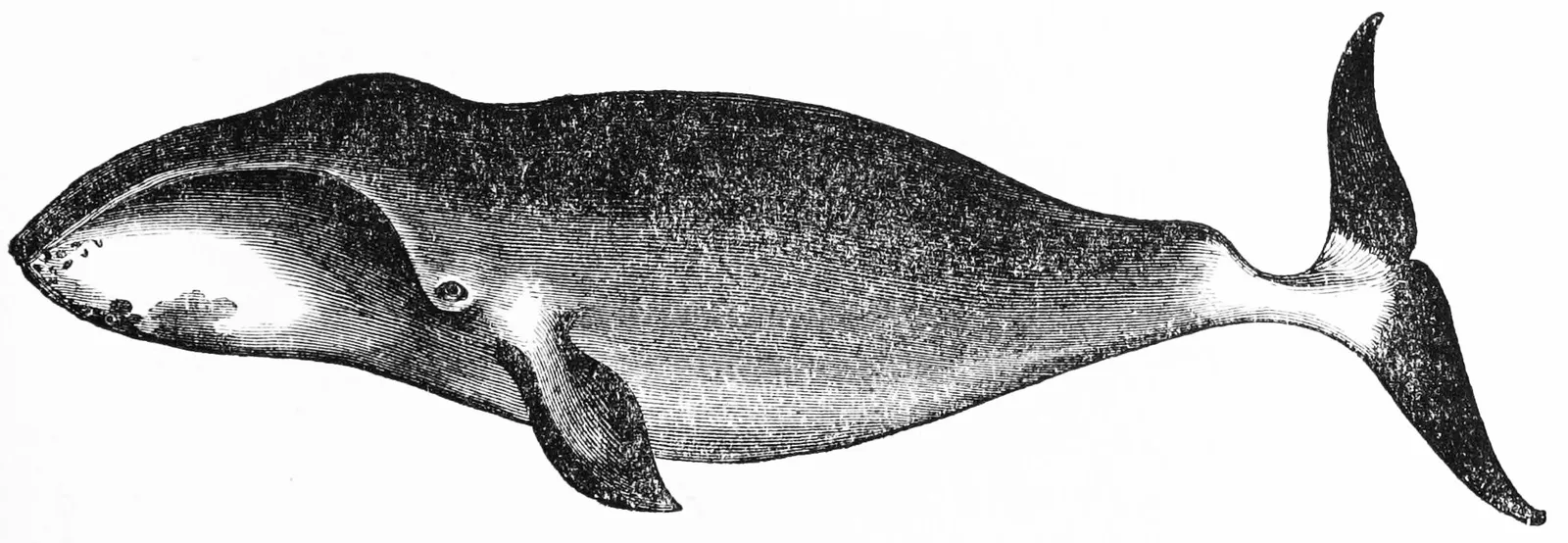 Fig. 9.
The Arctic right whale (Fig. 9), when full grown, attains
the length of from 45 to 50 feet, a size which, as in the case
of the sperm whale, has generally been greatly exaggerated in
old descriptions. As is apparently the case in all whalebone
whales, but contrary to what occurs in the sperm whale, the
female is rather larger than the male. Its external form is
shown in Fig. 9, from a careful drawing by Mr. Robert Gray.
In this species all the peculiarities which distinguish the head
and mouth of the whales from those of other mammals have
attained their greatest development. The head is of enormous
size, exceeding one-third of the whole length of the creature.
The cavity of the mouth is fully as large as that of the body,
chest and abdomen together. The upper jaw is very narrow
but greatly arched from before backwards, to increase the
height of the cavity and allow for the great length of the
baleen or “whalebone” blades. The enormous rami of the
lower jaw are widely separated behind, and have a still farther
outward sweep before they meet in front, giving the floor of
the mouth the shape of an immense spoon. The baleen blades
attain the number of 380 or more on each side, and those in
the middle of the series have a length of 10 or sometimes 12
feet. They are black in colour, fine, and highly elastic in
texture, and fray out at the inner edge and ends into long,
delicate, soft, almost silky, but very tough hairs. The
remarkable development of the mouth, and of the structures in
connection with it, which distinguishes the right whale among
its allies is entirely in relation to the nature of its food. It
is by this apparatus that it is enabled to avail itself of the
minute but highly nutritious crustaceans and pteropods which
swarm in immense shoals in the seas it frequents. The large
mouth enables it to take in at one time a sufficient quantity
of water filled with these small organisms, and the length and
delicate structure of the baleen provide a sufficient strainer or
hair-sieve by which the water can be drained off. If the
baleen were rigid, and only as long as is the aperture between
the upper and lower jaws when the mouth is shut, a space
would be left beneath it when the jaws are separated, through
which the water and the minute particles of food would escape
together. But instead of this, the long, slender, brush-like,
elastic ends of the whalebone blades fold back when the
mouth is closed, the front ones passing below the hinder ones
in a channel lying between the tongue and the lower jaw.
When the mouth is opened their elasticity causes them to
straighten out like a bow unbent, so that at whatever distance
the jaws are separated the strainer remains in perfect action,
filling the whole of the interval. The mechanical perfection
of the arrangement is completed by the great development of
the lower lip, which rises stiffly above the jawbone, and
prevents the long, slender, flexible ends of the baleen from
being carried outwards by the rush of water from the mouth,
when its cavity is being diminished by the closure of the
jaws and raising of the tongue.
If, as appears highly probable, the “bowhead” or right
whale of the Okhotsk Sea and Behring Strait belongs to this
species, its range is circumpolar, but it is strictly limited to
the icy seas of the north. “Though,” as Scammon says, “it
is true that these animals are pursued in the open water
during the summer months, in no instance have we learned of
their being captured south of where winter ice-fields are
occasionally met with.” In the Behring Sea it is seldom seen
south of the 55th parallel, and the southern limit of its range
in the North Sea has been ascertained by Eschricht and
Reinhardt to be from the east coast of Greenland at 64° N. lat.
along the north of Iceland towards Spitzbergen. Though
found in the seas on both sides of Greenland, and passing
freely from one to the other, it is never seen so far south as
Cape Farewell; but on the Labrador coast, where a cold
stream sets down from the north, its range is somewhat
further. There is no authentic instance of its having been
seen or captured upon any European coast.
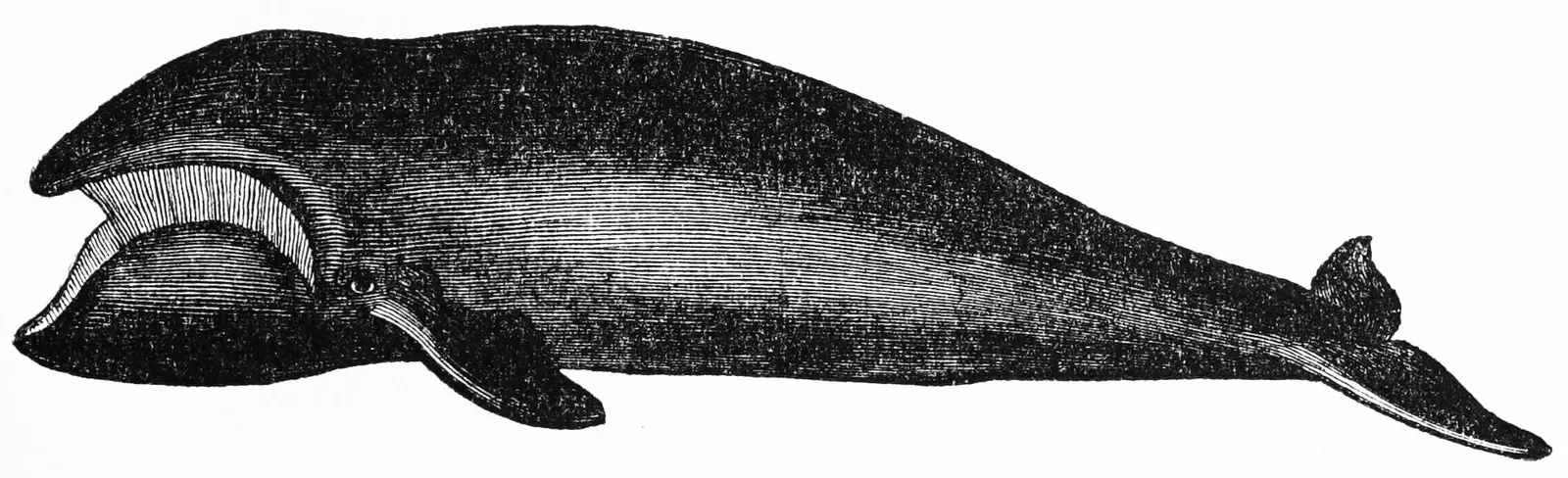 Fig. 10.
The southern right whale, or “black whale” (Fig. 10), as it
is often called by whalers, attains about the same length as
the last, but differs in being more slender in form, in possessing
a smaller head in proportion to the body, shorter baleen
(scarcely more than half the length), a differently shaped
contour of the upper margin of the lower lip, and a greater
number of vertebræ. Animals of this group closely resembling
each other have been found abundantly in the temperate seas
of both hemispheres, North Atlantic and North Pacific (where
they are regularly hunted by the Japanese), and in the
neighbourhood of the Cape of Good Hope, Kerguelen’s Island,
Australia, and New Zealand, but according to Captain Maury’s
charts they are never or rarely seen in the tropical seas. It is
chiefly this supposed isolation of distribution rather than any
constant distinctive characters which has given rise to the
idea that the North Atlantic whale (called Balæna biscayensis),
the Japanese (B. japonica), the Cape whale (B. australis), and
the New Zealand whale (B. antipodarum), must be of different
species. Until more numerous specimens of skeletons are
procured for our museums, or more accurate descriptions can
be obtained, the question cannot be satisfactorily determined.
The whalebone whales, not called right whales, are (1) the
humpback (Megaptera), or “hunchback” (Fig. 11), so called by
whalers on account of the low hump-like form of the dorsal
fin. In Dudley’s account of the whales of the New England
coast (Phil. Trans. 1725), the fourth species is “The bunch
or humpback whale, distinguished from the right whale by
having a bunch standing in the place where the fin does in
the finback. This bunch is as big as a man’s head, and a foot
high, shaped like a plug pointing backwards.” A better
distinction from all other whalebone whales is the immense
length of the pectoral fins or flippers, which are indented or
scalloped along their margins. The usual length of the adult
ranges from 45 to 50 feet. The baleen plates are short and
broad, and of a deep black colour. This whale has a very
wide range, being found, with no important differences, in both
the North and South Atlantic and Pacific Oceans, and from
Greenland to South Georgia. When caught it yields a fair
supply of oil, but much less than the right whales, and its
whalebone is of very inferior quality.
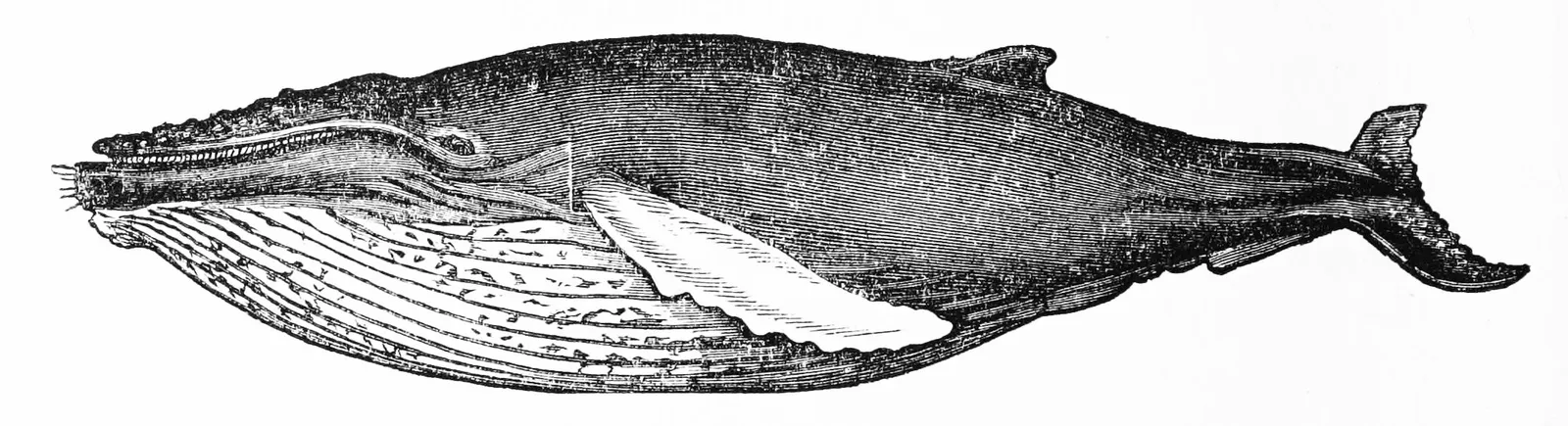 Fig. 11.
 Fig. 12.
(2) The rorquals, or finners (Balænoptera) (Fig. 12). These
have the plicated skin of the throat like that of the humpback,
the furrows being more numerous and close set, but the
pectoral fins are comparatively small, and the dorsal fin
distinct, compressed, and triangular. The head is comparatively
small and flat, and pointed in front, the whalebone
short and coarse, the body long and slender, and the tail very
much compressed before it expands into the “flukes.” The
rorquals are perhaps the most abundant and widely distributed
of all the whales, being found in all seas, except the extreme
Arctic and probably Antarctic regions. Owing to the small
quantity and inferior quality of their whalebone, the comparatively
limited amount of blubber or subcutaneous fat, their
great activity, and the difficulty of capturing them by the old
methods, these whales were not until recently an object of
pursuit by whale-fishers; but since the introduction of steam-vessels,
and especially of explosive harpoons fired from guns in
the place of those hurled by the human hand, a regular fishery
of “finbacks” has been established on the coast of Finmark,
where many hundreds are killed every year, their bodies being
towed to shore for the purpose of flensing. Some of the
rorquals attain the largest size of any of the Cetacea, the blue
whale (Balænoptera sibbaldii), not unfrequent in the British
Seas, reaching a length of 80 or perhaps 85 feet when fully
adult. On the other hand, one common species (B. rostrata)
never exceeds 30 feet in length.
(3) Besides these there are other two forms of whalebone
whales not reckoned as right whales, the grey whale of the
North Pacific (Rhachianectes glaucus), and a small and very
peculiar species from the seas around New Zealand and
Australia (Neobalæna marginata); but these being very local
in distribution, and of little value except for museums, are
more interesting from a scientific than from a commercial
point of view.
I now proceed to the next part of my subject—the pursuit
and capture of whales by man for the sake of the materials
they yield, which are of value in commerce. The method
universally followed is attacking the animal when it comes to
the surface of the water to breathe by means of a weapon called
a harpoon, with an iron sharp-pointed barbed head, and to
the shaft of which is attached a strong line. In former days
this was always thrown by the hand, and to do so effectually
required great skill on the part of the man who wielded it.
Now the harpoon is generally projected from a gun, which
carries a considerably greater distance than could be traversed
by a hand-thrown weapon, and the necessity of approaching
so closely to the animal is avoided. Various methods to
increase the efficacy of harpoons have also been introduced
including devices by which they explode within the body of
the victim. Long straight spears or lances are also used to
despatch the animal when it has been secured by the line
attached to the harpoon. The whale is always approached
by rowing in a boat as closely to it as necessary. These boats
may be directly connected with a station on the coast or with
a ship out at sea. This gives rise to the primary division of
whale fishing into two principal methods: shore fishing and
open-sea fishing, both of which are extensively practised in
various parts of the world. In the first, a look out is kept
from a station on some projecting headland, and when a whale
appears within sight signals are given on which the boats go
out in pursuit, and when a capture takes place the body is
towed to shore for the purpose of obtaining its valuable
products. In the second, the ships sail to some distant part
of the open sea, where it is supposed that whales are likely to
be met with. The look out is kept from the “crow’s nest”
on the masthead, and the boats being all in readiness row out
in pursuit the moment a whale is sighted, and if successful
tow their prey to the side of the vessel.
As I mentioned before, all cetaceans have immediately
beneath their skin, and closely connected with it, a very
dense layer of what is called “blubber,” in large whales as
much as a foot in thickness, composed of a network of cellular
tissue, the interspaces of which are filled with oil. This
layer, though so adherent to the outer skin as to be separated
from it with difficulty, is only connected with the flesh or
muscles which lie below by loose tissue, and so is easily
stripped off. With a large whale this process, called “flensing,”
is effected as follows. If the animal is caught at sea,
the carcass is lashed alongside the ship, and men with spikes
in their shoes, descend upon the slippery surface, and with
large sharp-edged spades perform the cutting part of the
operation, having first fixed, by means of a hook, a strong rope
into the blubber at the junction of the head and the body.
This rope runs over pulleys fixed to the rigging of the ship,
and the blubber, separated by the spades into strips about
two or three feet broad, is gradually hauled up on to the
deck of the ship. The cuts being made in a spiral direction
round the body of the whale, the blubber is stripped off
from head to tail, much as a spiral roller or bandage might
be, the body of the whale meanwhile performing a rotatory
motion. When the blubber is brought on board, it is cut up
into smaller pieces, and either stowed in casks or tanks to be
brought home to undergo the next process, that of “trying
out,” or if the voyage is of lengthened duration, as in the case
of the South Sea whalers hailing from European or American
ports, this is done on board the ship. It simply consists of
boiling the blubber in large iron pots until the oil is separated
from the mesh of cellular tissue which contained it, the latter
being generally used for fuel in subsequent boilings. In the
case of the sperm whale the upper surface of the great head is
opened, and the liquid spermaceti is baled out of the cavities
which contain it, and in the case of the whalebone whales the
whalebone is removed from the mouth. All the rest of the
animal being useless is turned adrift into the sea, and speedily
becomes the prey of voracious sharks and other fish and sea
birds. When whales are caught near the shore, as in many of
the “fisheries,” from boats without the intervention of sea-going
vessels, they are towed into shallow water for the
purpose of flensing and removing the whalebone.
The earliest known regular whale fishery is that which took
place from the Basque towns of France and Spain, Bayonne,
Biarritz, St. Jean de Luz, Fuenterrabia, St. Sebastian, Guetaria,
Ondarroa, and many others. From the tenth century onwards
the hardy fishermen of the towns and villages of this coast
pursued the Atlantic right whales in the Bay of Biscay, at
first only catching them from open boats near the shore,
but afterwards, as the whales became more scarce and the
whalers more adventurous, following them in ships across the
Atlantic to the Bermudas, Newfoundland, and Iceland. From
this source all the whale oil and all the whalebone used by
our forefathers down to the year 1600 was derived. Queen
Elizabeth and all her court depended upon the Basque fishermen
for the most prominent characteristics of their costume.
The supply was, however, diminishing when the attempt to
discover the North-East route to China, about the close of the
sixteenth century, led to the opening up of the sea between
Greenland and Spitzbergen, and the discovery of the Arctic
right whale, an animal up to that time practically unknown
to man. This being much more valuable, both on account of
the larger quantity and finer quality of the whalebone it
produced, and also the larger amount of oil, for many years
attracted the principal attention of the whaling ships of
Europe. The English entered into the business at a very
early period, but, being unacquainted with the methods of
capturing whales, engaged Basque harpooners for all their
earliest voyages, and closely followed their methods. The very
word “harpoon” is said to be Basque. The Dutch also took
the fishing up on a very extensive scale, and established a
permanent settlement upon the northern shore of Spitzbergen,
which they named “Smeeremberg,” which was the rendezvous
of the whaling fleet during the summer, and to which the
blubber was brought for boiling. In its most flourishing
period, about the year 1680, the Dutch whale fishery employed
as many as 260 ships and 14,000 men. When, however, the
whales became scarcer in the neighbourhood of the coast, and
the ships had to seek them further in the open sea, it was
found more economical to bring the blubber direct to Holland,
and Smeeremberg was deserted. The great war at the end of
the last century, in which England kept possession of the
North Sea, put an end to the whale fishery, not only of
Holland, but of France and of all other countries which had
engaged in it, and henceforth we maintained a monopoly of the
trade. From the year 1732 to 1824, our government paid
bounties, amounting altogether, it is calculated, to £2,500,000,
to vessels engaged in the northern whaling business, with a
view to encourage the enterprise. The ships at first sailed
from London, then Hull, Yarmouth, and Whitby entered
into the field. In 1819 as many as sixty-five ships went
to the north from Hull. Since 1836 no ship has gone
from London, and now Dundee and Peterhead are the only
ports in the British Islands which keep up the northern
whale fishery, though on a much more limited scale than
formerly.
The fishery between Greenland and Spitzbergen, which in
the last century proved so productive, is almost played out,
but that of Davis Straits and Lancaster Sound is still remunerative,
owing to the very high price that whalebone has
lately been fetching. At the beginning of the century the
average value was from £70 to £90 a ton, but a few years
ago a sale was effected at the enormous sum of £2650 per
ton; this is the highest price which has ever been given for
it, and recently it has somewhat declined. In 1893 four
Dundee vessels secured between them twenty-seven whales.
An average-sized Greenland whale will produce about fifteen
hundredweight of whalebone and about fifteen tons of oil.
The Greenland fishery begins early in May, and goes on to
the end of September. A few vessels remain all winter in
Cumberland Inlet, ready to take advantage of the opening of
the ice in the following spring. The Arctic right whale,
called locally by the American whalers the “bowhead,” has
since 1848 been regularly hunted in the neighbourhood of
Behring Strait and the Okhotsk Sea, where its southern limit,
according to Scammon, is about 54°.
Although doubtless individual sperm whales approaching
near the shore, especially in the neighbourhood of the right
whale fisheries, had often fallen a prey to man, the systematic
capture of this species is of recent date compared to that of
some other kinds. It began about the end of the seventeenth
century, from the Atlantic coasts of North America, especially
the part then called New England, at first only from the
shore, but afterwards in sea-going vessels from Nantucket,
New Bedford, and other ports, which gradually extended their
voyages into the Indian and Pacific Oceans. From the year
1775 vessels engaged in this trade (assisted for a time by
Government bounties) regularly left the mouth of the Thames
for the South Seas, making voyages of three or four years’
duration; but since 1853 the business has been abandoned by
the English, and what little remains of it has almost entirely
reverted into the hands of the Americans. At one time our
Australian Colonies had a considerable number of ships
engaged in the sperm whale fishery, and a few still sail
every year from Hobart Town. Sperm oil has fallen so
greatly in price that its production is now hardly a
remunerative industry, and it has found a rival, possessing
all the qualities which render it of special value, in the
oil of an allied but much smaller species of whale, the
bottlenose (Hyperoodon), which has consequently become the
object of a regular fishery in the North Sea, especially by the
Norwegians.
Let me now return to the whales of the Basques, the North
Atlantic right whale. It is a singular fact that its existence
was quite overlooked by naturalists till lately, all accounts of
it which are to be found in the numerous records of European
whale fishing having been attributed to the Greenland whale,
which was supposed by Cuvier, for instance, to have had
formerly a much wider distribution than now, and to have
been driven by the persecution of man to its present circumpolar
haunts. To the two Danish naturalists Eschricht and
Reinhardt is due the credit of having proved its existence as
a distinct species from a careful collation of numerous historical
notices of its structure, distribution, and habits, and, although
they were at one time disposed to think that the species had
become extinct, they were able to show that this was not the
case, an actual specimen having been captured in the harbour
of San Sebastian in January 1854, the skeleton of which
Eschricht was fortunate enough to secure for the Copenhagen
Museum. More recently other specimens have been captured
on the Spanish coast, the Mediterranean, North America, and
Norway. A skeleton has fortunately been secured for the
British Museum, the exhibition of which is only delayed by
the want of a proper room in which it can be mounted. In
the North Pacific a very similar if not identical whale is
regularly hunted by the Japanese, who tow the carcasses
ashore for the purpose of flensing and extracting the
whalebone. In the tropical seas, according to Captain
Maury’s whale charts, right whales are never or rarely seen,
but when the southern temperate seas were explored, they
were found to be abundantly inhabited by right whales
called “black whales,” so closely similar in character to the
Atlantic and Japanese species that, although described and
named as if distinct, at present no satisfactory and constant
characters have been pointed out by which they can be
separated. Of course this may arise from our very imperfect
knowledge of these animals, very few specimens[36] having been
preserved in museums, and still fewer accurate descriptions
and drawings have been made of recently killed individuals,
notwithstanding the hundreds of thousands which have been
slaughtered from British and American ships during the present
century. Just as its northern representative approached the
coasts during the winter, and left for the open seas in the
summer months, so these southern whales resorted to the bays
and inlets of the Cape of Good Hope, Australia, and New
Zealand during the southern winter (May to October), and
departed for higher latitudes during the remainder of the
year.
Though certain numbers of the southern right whales were
caught in the open sea by American or Colonial ships engaged
mainly in the sperm whale fishery, the principal fishery at
one time, as remunerative to those who pursued it as it was
destructive to the whales, was carried on from the shore, at
first at the Cape, then in Australia and Tasmania, and more
recently in New Zealand. Of the latter we have very detailed
accounts in many contemporary works, Wakefield, Dieffenbach,
and others, and a good epitome of its history will be found in
Sherrin’s Handbook of the Fishery of New Zealand (1886).
Whaling vessels from America and England were in the habit
of visiting the New Zealand seas for the purposes of their
trade ever since the beginning of the century, but the first
shore station was established in 1827 at Preservation Inlet, near
the south end of the Middle Island, and in a few years there
were twelve stations between that place and Banks Peninsula.
In 1833 Messrs. G. and E. Weller, merchants, of Sydney,
founded a whaling establishment at Otago, which was for a
short time the most successful and important of any on the coast.
In 1834 the whales caught yielded 310 tons of oil, besides
bone, and for several years there were on this station from
seventy-five to eighty Europeans constantly employed. In 1840
the oil fell off to fourteen tons, and the fishery was abandoned.
The value of “black oil” at this time was £8 to £12 a ton
in New Zealand, and as much as £30 in London. In other
parts of the islands the fishery was continued for a longer
period. It is stated that in 1843 the whale fishery on the
whole of the coast employed eighty-five boats and some 730
men, and the oil taken amounted to 1290 tons, valued at
£20,000, the whalebone being valued at £12,000. After
this period the decline in the take became very rapid, and the
stations with their great shears for hoisting the bodies of the
whales on shore for the purpose of flensing, the furnaces and
boiling pots for “trying out” the oil, and the bold and hardy,
but unhappily rough and dissolute, inhabitants entirely
disappeared from the scene. The cause of this is not
difficult to divine. The result was fully anticipated by
all who carefully observed what was going on. Almost
literally the goose that laid the golden egg was being killed.
The whales appeared in the month of May and remained till
October. Those that approached nearest to the coast and
were the easiest prey to the fishermen were females about to
bring forth their young. It was the regular habit of this
species of whale to seek at this season some quiet, sheltered
harbour, bay, or inlet, and there to remain with the new-born
young, until it acquired strength and vigour enough to
take care of itself in the open sea. The very affection of the
whale for her young thus became the principal cause of its
destruction. The whalers soon discovered that if the calf (as
they called it) was wounded or caught the mother would never
leave it, and they found that the calf, though of no value
in itself, being inexperienced and slow, was easily captured,
and then the mother became a sure prey. To the old code,
regulating the northern whale fisheries, which assigned the
whale to the boat which first fixed a harpoon securely in it,
they added: “The boat making fast to a calf has a right to
the cow, because the cow will not desert her young.” It should
be added that strong protests were made against this cruel and
in the end unprofitable mode of capture, but they all passed
unheeded. The result has been to the southern right whale
much the same as that which happened to its Atlantic ally
after its persecution by the Basques, although it was brought
about in a much shorter space of time. The whale not only
became scarce on the New Zealand coasts, but in all parts of
its range. To destroy it in its last remaining breeding haunts
was to destroy it everywhere. Although we have at present,
unfortunately, very little accurate information about the habits
and migrations of whales, there is every reason to believe that
in the Antarctic summer this species retired nearer the South
Pole. Sir James C. Ross in 1840, in lat. 64°, nearly due
south of New Zealand, and again in 1842 in nearly the
same latitude, south of the Falkland Islands, found right
whales very abundant in the month of December. On the
strength of this observation it has been thought that a whale
corresponding to the Arctic right whale might be a permanent
inhabitant of the Antarctic icy seas. Two years ago some
ships sailed from Dundee in the hope of meeting with it, but
they were completely disappointed. No trace of such whales
was found, for doubtless Sir James Ross had only come across
the summer haunts of the same whales which were then
undergoing the process of ruthless extermination in their
winter breeding places on the Australian and New Zealand
coasts. Such having been the fate of this species, and the
sperm whale not being habitually found in icy seas, the
probability of any large whale being again met with in
the Antarctic regions is very remote.
Our Colonial whale fisheries are practically extinct,
probably never to be revived, at all events with anything like
the success they met with formerly. Not that any species of
whale is likely to be completely exterminated by man. It is
only too easy to exterminate an animal whose habitat is confined
to land, especially if that land is of limited extent, as in the
case of an island; but the ocean is vast, and the possibilities
of escape from pursuers in it are great. When the numbers of
any species become so small that it no longer pays to hunt
them, they have a chance, as has been most strikingly shown
in the case of the North Atlantic or Biscay whale. Without
doubt, they would increase again in the southern seas, and if
means could be taken to give the whale an effectual close time,
the Australian and New Zealand black-whale fishery could be
revived, as it has been partially in Tasmania; but the difficulty
and expense of establishing any sufficient protection would
probably be greater than the value of the produce. Although
the better qualities of whalebone still maintain a very high
price, owing to their great scarcity, substitutes for it are being
gradually invented, and the competition of mineral oils, now
found in such abundance in so many parts of the world, and
the rapid advances of other methods of lighting have greatly
reduced the value of both sperm and train oil. Unless whales
can be caught easily and cheaply, they will not be worth
catching at all; and this indicates their best chance of
maintaining their place in the world, as experience shows
that if any profit can be made out of them, the cupidity of
man will give them no quarter.
Few natural groups present so many remarkable, very
obvious, and easily appreciated illustrations of several of the
most important general laws which appear to have determined
the structure of animal bodies, as that selected for my
lecture this evening. We shall find the effects of the two
opposing forces—that of heredity or conformation to ancestral
characters, and that of adaptation to changed environment,
whether brought about by the method of natural selection
or otherwise—distinctly written in almost every part of their
structure. Scarcely anywhere in the animal kingdom do we
see so many cases of the persistence of rudimentary and
apparently useless organs, those marvellous and suggestive
phenomena which at one time seemed hopeless enigmas,
causing despair to those who tried to unravel their meaning,
looked upon as mere will-of-the-wisps, but now eagerly
welcomed as beacons of true light, casting illuminating beams
upon the dark and otherwise impenetrable paths through
which the organism has travelled on its way to reach the goal
of its present condition of existence.
It is chiefly to these rudimentary organs of the Cetacea
and to what we may learn from them that I propose to call
your attention. In each case the question may well be asked,
granted that they are, as they appear to be, useless, or nearly
so, to their present possessors, insignificant, imperfect, in
fact rudimentary, as compared with the corresponding or
homologous parts of other animals, are they survivals,
or vestiges of a past condition, become useless owing to change
of circumstances and environment, and undergoing the process
of gradual degeneration, preparatory to their final removal
from an organism to which they are only, in however small a
degree, an incumbrance, or are they incipient structures,
beginnings of what may in future become functional and
important parts of the economy? These questions will call
for an attempt at least at solution in each case as we proceed.
Before entering upon details, it will be necessary to give
some general idea of the position, limits, and principal
modifications of the group of animals from which the special
illustrations will be drawn. The term “whale” is commonly
but vaguely applied to all the larger and middle-sized Cetacea,
and though such smaller species as the dolphins and porpoises
are not usually spoken of as whales, they may for all intents
and purposes of zoological science be included in the term,
and will come within the range of the present subject. Taken
altogether the Cetacea constitute a perfectly distinct and
natural order of mammals, characterised by their purely
aquatic mode of life and external fishlike form. The body is
fusiform, passing anteriorly into the head without any distinct
constriction or neck, and posteriorly tapering off gradually
towards the extremity of the tail, which is provided with a
pair of lateral pointed expansions of skin supported by dense
fibrous tissue, called “flukes,” forming together a horizontally-placed,
triangular propelling organ. The fore-limbs are
reduced to the condition of flattened ovoid paddles, incased
in a continuous integument, showing no external sign of
division into arm, forearm, and hand, or of separate digits,
and without any trace of nails. There are no vestiges of
hind-limbs visible externally. The general surface of the
body is smooth and glistening, and devoid of hair. In nearly
all species a compressed median dorsal fin is present. The
nostrils open separately or by a single crescentic valvular
aperture, not at the extremity of the snout, but near the vertex.
Animals of the order Cetacea abound in all known seas,
and some species are inhabitants of the larger rivers of South
America and Asia. Their organisation necessitates their life
being passed entirely in the water, as on the land they are
absolutely helpless; but they have to rise very frequently to
the surface for the purpose of respiration. They are all predaceous,
subsisting on living animal food of some kind. The
members of one genus alone (Orca) eat other warm-blooded
animals, as seals and even animals of their own order, both
large and small. Some feed on fish, others on small floating
crustacea, pteropods, and medusæ, while the staple food of many
is constituted of the various species of Cephalopods, chiefly
Loligo and other Teuthidæ, which must abound in some seas in
vast numbers, as they form almost the entire support of some
of the largest members of the order. The Cetacea are, with
some exceptions, timid, inoffensive animals. They are active in
their movements, and sociable and gregarious in their habits.
Among the existing members of the order there are two
very distinct types—the toothed whales, or Odontoceti, and
the baleen whales, or Mystacoceti, which present throughout
their organisation most markedly distinct structural characters,
and have in the existing state of nature no transitional forms.
The extinct Zeuglodon, so far as its characters are known,
does not fall into either of these groups as now constituted,
but is in some respects intermediate, and in others more
resembles the generalised mammalian type.
The important and interesting problems of the origin of
the Cetacea and their relations to other forms of life are at
present involved in the greatest obscurity. They present no
more signs of affinity with any of the lower classes of
vertebrated animals than do many of the members of their
own class. Indeed, in all that essentially distinguishes a
mammal from one of the oviparous vertebrates, whether in
the osseous, nervous, vascular, or reproductive systems, they
are as truly mammalian as any, even the highest, members of
the class. Any supposed signs of inferiority are, as we shall
see, simply modifications in adaptation to their peculiar mode
of life. Similar modifications are met with in another quite
distinct group of mammalia, the Sirenia (Dugongs and
Manatees), and also, though in a less complete degree, in the
aquatic Carnivora or seals. But these do not indicate any
community of origin between these groups and the Cetacea.
In fact, in the present state of our knowledge, the Cetacea are
absolutely isolated, and little satisfactory reason has ever been
given for deriving them from any one of the existing divisions
of the class rather than from any other. The question has
indeed often been mooted whether they have been derived
from land mammals at all, or whether they may not be the
survivors of a primitive aquatic form which was the ancestor
not only of the whales, but of all the other members of the
class. The materials for—I will not say solving—but for
throwing some light upon this problem, must be sought for
in two directions—in the structure of the existing members
of the order, and in its past history, as revealed by the
discovery of fossil remains. In the present state of science
it is chiefly on the former that we have to rely, and this
therefore will first occupy our attention.
One of the most obvious external characteristics by
which the mammalia are distinguished from other classes of
vertebrates is the more or less complete clothing of the
surface by the peculiar modification of epidermic tissue called
hair. The Cetacea alone appear to be exceptions to this
generalisation. Their smooth, glistening exterior is, in the
greater number of species, at all events in adult life, absolutely
bare, though the want of a hairy covering is compensated for
functionally by peculiar modifications of the structure of the
skin itself, the epidermis being greatly thickened, and a
remarkable layer of dense fat being closely incorporated with
the tissue of the derm or true skin; modifications admirably
adapted for retaining the warmth of the body, without any
roughness of surface which might occasion friction and so
interfere with perfect facility of gliding through the water.
Close examination, however, shows that the mammalian
character of hairiness is not entirely wanting in the Cetacea,
although it is reduced to a most rudimentary and apparently
functionless condition. Scattered, small, and generally delicate
hairs have been detected in many species, both of the toothed
and of the whalebone whales, but never in any situation but
on the face, either in a row along the upper lip, around the
blowholes or on the chin, apparently representing the large,
stiff “vibrissæ” or “whiskers” found in corresponding situations
in many land mammals. In some cases these seem to
persist throughout the life of the animal; more often they are
only found in the young or even the fœtal state. In some
species they have not been detected at any age.
Eschricht and Reinhardt counted in a new-born Greenland
right whale (Balæna mysticetus) sixty-six hairs near the
extremity of the upper jaw, and about fifty on each side of
the lower lip, as well as a few around the blowholes, where
they have also been seen in Megaptera longimana and
Balænoptera rostrata. In a large rorqual (Balænoptera
musculus), quite adult and sixty-seven feet in length, stranded
in Pevensey Bay in 1865, there were twenty-five white,
straight, stiff hairs about half an inch in length, scattered
somewhat irregularly on each side of the vertical ridge in
which the chin terminated, extending over a space of nine
inches in height and two and a half inches in breadth. The
existence of these rudimentary hairs must have some significance
beyond any possible utility they may be to the animal.
Perhaps some better explanation may ultimately be found for
them, but it must be admitted that they are extremely
suggestive that we have here a case of heredity or conformation
to a type of ancestor with a full hairy clothing, just on
the point of yielding to complete adaptation to the conditions
in which whales now dwell.
In the organs of the senses the Cetacea exhibit some
remarkable adaptive modifications of structures essentially
formed on the Mammalian type, and not on that characteristic
of the truly aquatic Vertebrates, the fishes, which, if function
were the only factor in the production of structure, they
might be supposed to resemble.
The modifications of the organs of sight do not so much
affect the eyeball as the accessory apparatus. To an animal
whose surface is always bathed with fluid, the complex
arrangement which mammals generally possess for keeping
the surface of the transparent cornea moist and protected, the
movable lids, the nictitating membrane, the lachrymal gland,
and the arrangements for collecting and removing the superfluous
tears when they have served their function, cannot be
needed, and hence we find these parts in a most rudimentary
condition or altogether absent. In the same way the organ
of hearing in its essential structure is entirely mammalian,
having not only the sacculi and semicircular canals common
to all but the lowest vertebrates, but the cochlea, and
tympanic cavity with its ossicles and membrane, all, however,
buried deep in the solid substance of the head; while the
parts specially belonging to terrestrial mammals,—those which
collect the vibrations of the sound travelling through air, the
pinna and the tube which conveys it to the sentient structures
within,—are entirely or practically wanting. Of the pinna
or external ear there is no trace. The meatus auditorius is
certainly there, reduced to a minute aperture in the skin like
a hole made by the prick of a pin, and leading to a tube so
fine and long that it cannot be a passage for either air or
water, and therefore can have no appreciable function in
connection with the organ of hearing, and must be classed
with the other numerous rudimentary structures that whales
exhibit.
The organ of smell, when it exists, offers still more
remarkable evidence of the origin of the Cetacea. In fishes
this organ is specially adapted for the perception of odorous
substances permeating the water; the terminations of the
olfactory nerves are spread over the inner plicated surface of
a cavity near the front part of the nose, to which the fluid
in which the animals swim has free access, although it is
quite unconnected with the respiratory passages. Mammals,
on the other hand, smell substances with which the atmosphere
they breathe is impregnated; their olfactory nerve is
distributed over the more or less complex foldings of the
lining of a cavity placed more deeply in the head, but in
immediate relation to the passages through which air is continually
driven to and fro on its way to the lungs in
respiration, and therefore in a most favourable position for
receiving impressions from substances floating in that air.
The whalebone whales have an organ of smell exactly on
the mammalian type, but in a rudimentary condition. The
perception of odorous substances diffused in the air, upon
which many land mammals depend so much for obtaining
their food, or for protection from danger, can be of little
importance to them. In the more completely modified
Odontocetes the olfactory apparatus, as well as that part of
the brain specially related to the function of smell, is entirely
wanting, but in neither group is there the slightest trace of
the specially aquatic olfactory organ of fishes. Its complete
absence and the presence of vestiges of the aerial organ of land
mammals in the Mystacocetes are the clearest possible indications
of the origin of the Cetacea from air-breathing and air-smelling
terrestrial mammalia. With their adaptation to an
aquatic mode of existence, organs fitted only for smelling in
air became useless, and so have dwindled or completely disappeared.
Time and circumstances do not seem to have permitted
the acquisition of anything analogous to the specially
aquatic smelling apparatus of fishes, the result being that
whales are practically deprived of whatever advantage this
sense may be to other animals.
It is characteristic of the greater number of mammalia to
have their jaws furnished with teeth having a definite
structure and mode of development. In all the most typical
forms these teeth are limited in number, not exceeding
eleven on each side of each jaw, or forty-four in all, and are
differentiated in shape in different parts of the series, being
more simple in front, broader and more complex behind. Such
a dentition is described as “heterodont.” In most cases also
there are two distinct sets of teeth during the lifetime of the
animal, constituting a condition technically called “diphyodont.”
All the Cetacea present some traces of teeth, which in
structure and mode of development resemble those of mammals,
and not those of the lower vertebrated classes, but they are
always found in a more or less imperfect state. In the first
place, at all events in existing species, they are never truly
heterodont, all the teeth of the series resembling each other
more or less, or belonging to the condition called “homodont,”
and not obeying the usual numerical rule, often falling short
of, but in many cases greatly exceeding it. The most typical
Odontocetes, or toothed whales, have a large number of
similar, simple, conical, recurved, pointed teeth, alike on both
sides and in the upper and under jaws, admirably adapted
for catching slippery, living prey, such as fish, which
are swallowed whole without mastication. In one genus
(Pontoporia) there may be as many as sixty of such teeth on
each side of each jaw, making 240 in all. The more usual
number is from twenty to thirty. These teeth are never
changed, being “monophyodont,” and they are, moreover, less
firmly implanted in the jaws than in land mammals, having
never more than one root, which is set in an alveolar socket,
generally wide and loosely fitting, though perfectly sufficient
for the simple purpose which the teeth have to serve.
Most singular modifications of this condition of dentition
are met with in different genera of toothed whales, chiefly the
result of suppression—sometimes of suppression of the greater
number, combined with excessive development of a single pair.
In one large group, the Ziphioids, although minute rudimentary
teeth are occasionally found in young individuals, and sometimes
throughout life, in both jaws, in the adults the upper
teeth are usually entirely absent, and those of the lower jaw
reduced to two, which may be very large and projecting like
tusks from the mouth, as in Mesoplodon, or minute and entirely
concealed beneath the gums, as in Hyperoodon,—an animal
which is for all practical purposes toothless, yet in which a
pair of perfectly formed though buried teeth remain throughout
life, wonderful examples of the persistence of rudimentary
and to all appearance absolutely useless organs. Among the
Delphinidæ similar cases are met with. In the genus Grampus
the teeth are entirely absent in the upper, and few and early
deciduous in the lower jaw. But the narwhal exceeds all
other Cetaceans, perhaps all other vertebrated animals, in
the specialisation of its dentition. Besides some irregular
rudimentary teeth found in the young state, the entire dentition
is reduced to a single pair, which lie horizontally in the
upper jaw, and both of which in the female remain permanently
concealed within the bone, so that this sex is practically
toothless, while in the male the right tooth usually remains
similarly concealed and abortive, and the left is immensely
developed, attaining a length equal to more than half that of
the entire animal, projecting horizontally from the head in the
form of a cylindrical or slightly tapering pointed tusk, with
the surface marked by spiral grooves and ridges.
The meaning and utility of some of these strange modifications
it is impossible, in the imperfect state of our knowledge
of the habits of the Cetacea, to explain, but the fact that in
almost every case a more full number of rudimentary teeth is
present in early stages of existence, which either disappear, or
remain as concealed and functionless organs, points to the
present condition in the aberrant and specialised forms as
being one derived from the more generalised type, in which
the teeth were numerous and equal.
The Mystacocetes, or whalebone whales, are distinguished
by entire absence of teeth, at all events after birth. But it is
a remarkable fact, first demonstrated by Geoffroy St. Hilaire,
and since amply confirmed by Cuvier, Eschricht, Julin, and
others, that in the fœtal state they have numerous minute
calcified teeth lying in the dental groove of both upper and
lower jaws. These attain their fullest development about the
middle of fœtal life, after which period they are absorbed, no
trace of them remaining at the time of birth. Their structure
and mode of development have been shown to be exactly that
characteristic of ordinary mammalian teeth, and it has also
been observed that those at the posterior part of the series are
larger, and have a bilobed form of crown, while those in front
are simple and conical, a fact of considerable interest in
connection with speculations as to the history of the group.
It is not until after the disappearance of these teeth that
the baleen, or whalebone, makes its appearance. This remarkable
structure, though, as will be presently shown, only a
modification of a part existing in all mammals, is, in its
specially developed condition as baleen, peculiar to one group
of whales. It is therefore perfectly in accord with what
might have been expected, that it is comparatively late in
making its appearance. Characters that are common to a
large number of species appear early—those that are special to
a few, at a late period, alike both in the history of the race
and of the individual.
Baleen consists of a series of flattened, horny plates, several
hundred in number, on each side of the palate, separated by a
bare interval along the middle line. They are placed transversely
to the long axis of the palate, with very short spaces
between them. Each plate or blade is somewhat triangular
in form, with the base attached to the palate, and the apex
hanging downwards. The outer edge of the blade is hard
and smooth, but the inner edge and apex fray out into long,
bristly fibres, so that the roof of the whale’s mouth looks as if
covered with hair, as described by Aristotle. The blades are
longest near the middle of the series, and gradually diminish
towards the front and back of the mouth. The horny plates
grow from a dense fibrous and highly vascular matrix, which
covers the palatal surface of the maxillæ, and which sends out
lamellar processes, one of which penetrates the base of each
blade. Moreover, the free edge of each of these processes is
covered with very long vascular thread-like papillæ, one of
which forms the central axis of each of the hair-like
epidermic fibres of which the blade is mainly composed.
A transverse section of fresh whalebone shows that it is
made up of numbers of these soft vascular papillæ, circular
in outline, each surrounded by concentrically arranged epidermic
cells, the whole bound together by other epidermic
cells, which constitute the smooth cortical (so-called “enamel”)
surface of the blade, and which, disintegrating at the free edge,
allows the individual fibres to become loose and to assume the
hair-like appearance spoken of before. These fibres differ from
hairs in not being formed in depressed follicles in the enderon,
but rather resemble those of which the horn of the rhinoceros
is composed. The blades are supported and bound together
for a certain distance from their base, by a mass of less
hardened epithelium, secreted by the surface of the palatal
membrane or matrix of the whalebone in the intervals of the
lamellar processes. This is the “intermediate substance” of
Hunter, the “gum” of the whalers.
The function of the whalebone is to strain the water from
the small marine molluscs, crustaceans, or fish upon which the
whales subsist. In feeding they fill the immense mouth with
water containing shoals of these small creatures, and then, on
their closing the jaws and raising the tongue, so as to diminish
the cavity of the mouth, the water streams out through the
narrow intervals between the hairy fringe of the whalebone
blades, and escapes through the lips, leaving the living prey
to be swallowed. Almost all the other structures to which I
am specially directing your attention, are, as I have mentioned,
in a more or less rudimentary state in the Cetacea; the baleen,
on the other hand, is an example of an exactly contrary condition,
but an equally instructive one, as illustrating the mode
in which nature works in producing the infinite variety we
see in animal structures. Although appearing at first sight
an entirely distinct and special formation, it evidently consists
of nothing more than the highly modified papillæ of the
lining membrane of the mouth, with an excessive and cornified
epithelial development.
The bony palate of all mammals is covered with a closely
adhering layer of fibro-vascular tissue, the surface of which is
protected by a coat of non-vascular epithelium, the former
exactly corresponding to the derm or true skin, and the latter
to the epiderm of the external surface of the body. Sometimes
this membrane is perfectly smooth, but it is more often raised
into ridges, which run in a direction transverse to the axis of
the head, and are curved with the concavity backwards; the
ridges, moreover, do not extend across the middle line, being
interrupted by a median depression or raphé. Indications of
these ridges are clearly seen in the human palate, but they
attain their greatest development in the Ungulata. In oxen,
and especially in the giraffe, they form distinct laminæ, and
their free edges develop a row of pointed papillæ, giving them
a pectinated appearance. Their epithelium is thick, hard, and
white, though not horny. Although the interval between the
structure of the ridges in the giraffe’s palate and the most
rudimentary form of baleen at present known is great, there
is no difficulty in seeing that the latter is essentially a
modification of the former, just as the hoof of the horse, with
its basis of highly developed vascular laminæ and papillæ, and
the resultant complex arrangement of the epidermic cells, is
a modification of the simple nail or claw of other mammals,
or as the horn of the rhinoceros is only a modification of
the ordinary derm and epiderm covering the animal’s body
differentiated by a local exuberance of growth.
Though the early stages by which whalebone has been
modified from more simple palate structures are entirely lost
to our sight, probably for ever, the conditions in which it now
exists in different species of whales, show very marked varieties
of progress, from a simple comparatively rudimental and imperfect
condition, to what is perhaps the most wonderful
example of mechanical adaptation to purpose known in
any organic structure. These variations are worth dwelling
upon for a few minutes, as they illustrate in an excellent
manner the gradual modifications that may take place in
an organ, evidently in adaptation to particular requirements,
the causation of which can be perfectly explained upon
Darwin’s principle of natural selection.
In the rorquals or fin-whales (genus Balænoptera, Fig. 12, p.
198), found in almost all seas, and so well known off our own
coasts, the largest blades in an animal 70 feet long do not exceed
2 feet in length, including their hairy terminations; they are in
most species of a pale horn colour, and their structure is coarse
and inelastic, separating into thick, stiff fibres, so that they are
of no value for the ordinary purposes to which whalebone is
applied in the arts. These animals feed on fish of considerable
size, from herrings up to cod, and for foraging among shoals
of these creatures the construction of their mouth and the
structure of their baleen is evidently sufficient. This is the
type of the earliest known extinct forms of whales, and it has
continued to exist, with several slight modifications, to this
day, because it has fulfilled one purpose in the economy of
nature. Other purposes for which it was not sufficient have
been supplied by gradual changes taking place, some of the
stages of which are seen in the intermediate conditions still
exhibited in the Megaptera and in the Atlantic and southern
right whales. Before describing the extreme modifications
in the direction of complexity, I may mention, to show the
range at present presented in the development of baleen, that
there has lately been discovered in the North Pacific a species
called by the whalers the Californian grey whale (Rachianectes
glaucus), which shows the opposite extreme of simplicity. The
animal is from 30 to 40 feet in length; the baleen blades are
only 182 on each side (according to Scammon) and far apart,
very short (the longest being from 14 to 16 inches in length),
light brown or nearly white in colour, and still more coarse in
grain and inelastic than that of the rorquals. The food of
these whales is not yet known with certainty. They have
been seen apparently seeking for it along soft bottoms of the
sea, and fuci and mussels have been found in their stomachs.
In the Greenland right whale of the circumpolar seas, the
bowhead of the American whalers (Balæna mysticetus, Fig. 9,
p. 195), all the peculiarities which distinguish the head and
mouth of the whales from other mammals have attained their
greatest development. The head is of enormous size, exceeding
one-third of the whole length of the creature. The cavity
of the mouth is actually larger than that of the body, thorax
and abdomen together. The upper jaw is very narrow, but
greatly arched from before backwards, to increase the height
of the cavity and allow for the great length of the baleen,
the enormous rami of the mandibles are widely separated
posteriorly, and have a still further outward sweep before
they meet at the symphysis in front, giving the floor of the
mouth the shape of an immense spoon. The baleen blades
attain the number of 350 or more on each side, and those in
the middle of the series have a length of ten or even twelve
feet. They are black in colour, fine and highly elastic in
texture, and fray out at the inner edge and ends into long,
delicate, soft, almost silky, but very tough hairs.
How these immensely long blades depending vertically
from the palate were packed into a mouth the height of
which was scarcely more than half their length was a mystery
not solved until a few years ago. Captain David Gray, of
Peterhead, at my request, first gave us a clear idea of the
arrangement of the baleen in the Greenland whale, and showed
that the purpose of its wonderful elasticity was not primarily
at least the benefit of the corset and umbrella makers, but
that it was essential for the correct performance of its
functions. It may here be mentioned that the modification
of the mouth structure of the right whale is entirely in relation
to the nature of its food. It is by this apparatus that it is
enabled to avail itself of the minute but highly nutritious
crustaceans and pteropods which swarm in immense shoals in
the seas it frequents. The large mouth enables it to take in
at one time a sufficient quantity of water filled with these
small organisms, and the length and delicate structure of the
baleen provides an efficient strainer or hair sieve by which the
water can be drained off. If the baleen were, as in the
rorquals, short and rigid, and only of the length of the
aperture between the upper and lower jaws when the mouth
was shut, when the jaws were separated a space would be left
beneath it through which the water and the minute particles
of food would escape together. But instead of this, the long,
slender, brush-like ends of the whalebone blades, when the
mouth is closed, fold back, the front ones passing below the
hinder ones in a channel lying between the tongue and the
bone of the lower jaw. When the mouth is opened their
elasticity causes them to straighten out like a bow that is
unbent, so that at whatever distance the jaws are separated,
the strainer remains in perfect action, filling the whole of the
interval. The mechanical perfection of the arrangement is
completed by the great development of the lower lip, which
rises stiffly above the jawbone, and prevents the long, slender,
flexible ends of the baleen being carried outwards by the rush
of water from the mouth, when its cavity is being diminished
by the closure of the jaws and raising of the tongue. The
interest and admiration excited by the contemplation of such a
beautifully adjusted piece of mechanism is certainly heightened
by the knowledge that it has been brought about by the
gradual adaptation and perfection of structures common to the
whole class of animals to which the whale belongs.
Few points of the structure of whales offer so great a
departure from the ordinary mammalian type as the limbs.
The fore-limbs are reduced to the condition of simple paddles
or oars, variously shaped, but always flattened and more or less
oval in outline. They are freely movable at the shoulder-joint,
where the humerus or upper-arm bone articulates with
the shoulder-blade in the usual manner, but beyond this point,
except a slight flexibility and elasticity, there is no motion
between the different segments. The bones are all there,
corresponding in number and general relations with those of
the human or any other mammalian arm, but they are
flattened out, and their contiguous ends, instead of presenting
hinge-like joints, come in contact by flat surfaces, united
together by strong ligamentous bands, and all wrapped up in an
undivided covering of skin, which allows externally of no sign
of the separate and many-jointed fingers seen in the skeleton.
Up to the year 1865 it was generally thought that there
was nothing to be found between this bony framework and the
covering skin, with its inner layer of blubber, except dense
fibrous tissue, with blood-vessels and nerves sufficient to
maintain its vitality. Dissecting a large rorqual, 67 feet in
length, upon the beach of Pevensey Bay in that year, I was
surprised to find lying upon the bones of the forearm well-developed
muscles, the red fibres of which reached nearly to
the lower end of these bones, ending in strong tendons,
passing to, and radiating out on, the palmar surface of the
hand. Circumstances then prevented me following out the
details of their arrangement and distribution, but not long
afterwards Professor Struthers, of Aberdeen, had an opportunity
of carefully dissecting the fore-limb of another whale of the
same species, and he has recorded and figured his observations
in the Journal of Anatomy for November 1871. He found
on the internal or palmar aspect of the limb three distinct
muscles corresponding in attachments to the flexor carpi
ulnaris, the flexor profundus digitorum, and the flexor longus
pollicis of man, and on the opposite side but one, the extensor
communis digitorum.[38] Large as these muscles actually are,
yet, compared with the size of the animal, they cannot but be
regarded as rudimentary, and being attached to bones without
regular joints and firmly held together by unyielding tissues,
their functions must be reduced almost to nothing. But
rudimentary as the muscles of the fin-whales are, lower stages
of degradation of the same structures are found in other
members of the group. In some they are indeed present in
form, but their muscular structure is gone, and they are
reduced in most of the toothed whales to mere fibrous bands,
scarcely distinguishable from the surrounding tissue which
connects the inner surface of the skin with the bone. It is
impossible to contemplate these structures without having the
conviction forced home that here are the remains of parts once
of use to their possessor, now, owing to the complete change of
purpose and mode of action of the limb, reduced to a condition
of atrophy verging on complete disappearance.
The changes that have taken place in the hind-limbs
are even more remarkable. In all known Cetacea (unless
Platanista be really an exception) a pair of slender bones are
found suspended a short distance below the vertebral column,
but not attached to it, about the part where the body and the
tail join. In museum skeletons these bones are often not
seen, as, unless special care has been taken in the preparation,
they are apt to get lost. They are, however, of much
importance and interest, as their relations to surrounding parts
show that they are the rudimentary representatives of the
pelvic or hip bones, which in other mammals play such an
important part in connecting the hind-limbs with the rest of
the skeleton. The pelvic arch is thus almost universally
present, but of the limb proper there is, as far as is yet known,
not a vestige in any of the large group of toothed whales, not
even in the great cachalot or sperm whale, although it should
be mentioned that it has never been looked for in that animal
with any sort of care. With the whalebone whales, however,
at least in some of the species, the case is different. In these
animals there are found, attached to the outer and lower side
of the pelvic bone, other elements, bony or only cartilaginous
as the case may be, clearly representing rudiments of the first,
and in some cases the second segment of the limb, the thigh
or femur, and the leg or tibia. In the small Balænoptera
rostrata a few thin fragments of cartilage, imbedded in fibrous
tissue attached to the side of the pelvic bone, constitute the
most rudimentary possible condition of a hind-limb, and could
not be recognised as such but for their analogy with other
allied cases. In the large rorqual, Balænoptera musculus, 67
feet long, previously spoken of, I was fortunate enough in
1865 to find attached by fibrous tissue to the side of the pelvic
bone (which was sixteen inches in length) a distinct femur,
consisting of a nodule of cartilage of a slightly compressed,
irregularly oval form, and not quite one inch and a half in
length. Other specimens of the same animal dissected by
Van Beneden and Professor Struthers have shown the same;
in one case, partial ossification had taken place. In the genus
Megaptera a similar femur has been described by Eschricht;
and the observations of Reinhardt have shown that the
Greenland right whale (Balæna mysticetus) has not only a
representative of the femur developed far more completely
than in the rorqual, being from six to eight inches in length
and completely ossified, but also a second smaller and
more irregularly formed bone, representing the tibia. Our
knowledge of these parts in this species has recently been
greatly extended by the researches of Dr. Struthers, who has
published in the Journal of Anatomy for 1881 a most careful
and detailed account of the dissection of several specimens,
showing the amount of variation to which these bones (as
with most rudimentary structures) are liable in different
individuals, and describing for the first time their distinct
articulation one with the other by synovial joints and capsular
ligaments, and also the most remarkable and unlooked-for
presence of muscles passing from one bone to the other,
representing the adductors and flexors of mammals with
completely developed limbs, but so situated that it is almost
impossible to conceive that they can be of any use; the whole
limb, such as it is, being buried deep below the surface, where
any movement, except of the most limited kind, must be
impossible. Indeed, that the movement is very limited and of
no particular importance to the animal was shown by the fact
that in two out of eleven whales dissected the hip-joint was
firmly anchylosed (or fixed by bony union), though without
any trace of disease. In the words of Dr. Struthers, “Nothing
can be imagined more useless to the animal than rudiments of
hind-legs entirely buried beneath the skin of a whale, so that
one is inclined to suspect that these structures must admit
of some other interpretation. Yet, approaching the inquiry
with the most sceptical determination, one cannot help being
convinced, as the dissection goes on, that these rudiments
really are femur and tibia. The functional point of view
fails to account for their presence. Altogether they present
for contemplation a most interesting instance of those
significant parts, rudimentary structures.”
We have here a case in which it is not difficult to answer
the question before alluded to, often asked with regard to
rudimentary parts, Are they disappearing or are they incipient
organs? We can have no hesitation in saying that they are
the former. All we know of the origin of limbs shows that
they commence as outgrowths upon the surface of the body,
and that the first-formed portions are the most distal segments.
The limb, as proved by its permanent state in the lowest
Vertebrates, and by its embryological condition in higher
forms, is at first a mere projection or outward fold of the skin,
which, in the course of development, as it becomes of use in
moving or supporting the animal, acquires the internal framework
which strengthens it and perfects its functions. It
would be impossible, on any theory of causation yet known, to
conceive of a limb gradually developed from within outwards.
On the other hand, its disappearance would naturally take
place in the opposite direction; projecting parts which had
become useless, being in the way, would, like all the other
prominences on the surface of the whales,—hair, ears, etc.,—be
removed, while the most internal, offering far less interference
with successful carrying on the purposes of life, would be the
last to disappear, lingering, as in the case of the Greenland
whale, long enough to reveal their wonderful history to the
anatomist who has been fortunate enough to possess the skill
and the insight to interpret it.
Time will not allow of more illustrations drawn from the
structure of existing Cetacea; we turn next to what the
researches of palæontology teach of the past history of the
order. Unfortunately this does not at present amount to very
much. As is the case with nearly all other orders of
mammals, we know nothing of their condition, if they existed,
in the mesozoic age. Even in the Cretaceous seas, the deposits
at the bottom of which are so well adapted to preserve the
remains of the creatures which swam in them, not a fragment
of any whale or whale-like animal has been found. The
earliest Cetaceans of whose organisation we have any good
evidence are the Zeuglodons of the Eocene formations of
North America. These were creatures whose structure, as
far as we know it, was intermediate between that of the
existing sub-orders of whales, having the elongated nasal bones
and anterior position of the nostrils of the Mystacocetes, with
the teeth of the Odontocetes, and with some characters more
like those of the generalised mammalian type than of any of
the existing forms. In fact Zeuglodon is precisely what we
might have expected a priori an ancestral form of whale to
have been. The remarkable smallness of its cerebral cavity,
compared with the jaws and the rest of the skull, so different
from that of modern Cetaceans, is exactly paralleled in the
primitive types of other groups of mammals. The teeth are
markedly differentiated in different parts of the series. In
the anterior part of both jaws they are simple, conical, or
slightly compressed and sharp pointed. The first three of the
upper jaw are distinctly implanted in the premaxillary bone,
and so may be reckoned as incisors. The tooth which succeeds,
or the canine, is also simple and conical, but it does not greatly
exceed the others in size. This is followed by five teeth with
two distinct roots and compressed pointed crowns, with
denticulated cutting edges. It has been thought that there
was evidence of a vertical succession of the molar teeth, as in
diphyodont mammals, but the proof of this is not quite satisfactory.
Unfortunately the structure of the limbs is most
imperfectly known. A mutilated humerus has given rise to
many conjectures; to some anatomists it appears to indicate
freedom of motion at the elbow-joint, while to others its
characters seem to be those of the ordinary Cetacea. Of the
structure of the pelvis and hind-limb we are at present in
ignorance.
From the middle Miocene period fossil Cetacea are abundant,
and distinctly divided into the two groups now existing. The
Mystacocetes, or whalebone whales, of the Miocene seas were,
as far as we know now, only Balænopteræ, some of which (as
the genus Cetotherium) were, in the elongated flattened form
of the nasal bones, the greater distance between the occipital
and frontal bones at the top of the head, and the greater
length of the cervical vertebræ, more generalised than any
now existing. In the shape of the mandible also, Van
Beneden, to whose researches we are chiefly indebted for a
knowledge of these forms, discerns some approximation to the
Odontocetes. Right whales (Balæna) have not been found
earlier than the Pliocene period, and it is interesting to note
that instead of the individuals diminishing in bulk as we
approach the times we live in, as with many other groups of
animals, the contrary has been the case, no known extinct
species of whales equalling in size those that are now to be
met with in the ocean. The size of whales, as of all other
things whose most striking attribute is magnitude, has been
greatly exaggerated; but when reduced to the limits of sober
fact, the Greenland right whale of 50 feet long, the sperm
whale of 60, and the great northern rorqual (Balænoptera
sibbaldii) of 80, exceed all other organic structures known,
past or present. Instead of living in an age of degeneracy of
physical growth, we are in an age of giants, but it may be at
the end of that age. For countless centuries impulses from
within and the forces of circumstances from without have been
gradually shaping the whales into their present wonderful
form and gigantic size; but the very perfection of their structure
and their magnitude combined, the rich supply of oil protecting
their internal parts from cold, the beautiful apparatus of
whalebone by which their nutrition is provided for, have
been fatal gifts, which, under the sudden revolution produced
on the surface of the globe by the development of the wants
and arts of civilised man, cannot but lead in a few years to
their partial if not complete extinction.
It does not need much foresight to divine the future
history of whales, but let us return to the question with
which we started, What was their probable origin?
In the first place, the evidence is absolutely conclusive
that they were not originally aquatic in habit, but are derived
from terrestrial mammals of fairly high organisation, belonging
to the placental division of the class,—animals in which
a hairy covering was developed, and with sense organs,
especially that of smell, adapted for living on land; animals,
moreover, with four completely-developed pairs of limbs on
the type of the higher vertebrata, and not of that of fishes.
Although their teeth are now of the simple homodont and
monophyodont type, there is much evidence to show that this
has taken place by the process of degradation from a more
perfect type, even the fœtal teeth of whalebone whales
showing signs of differentiation into molars and incisors,
and many extinct forms, not only the Zeuglodons, but also
true dolphins, as the Squalodons, having a distinct heterodont
dentition, the loss of which, though technically called a
“degradation,” has been a change in conformity to the habits
and needs of the individuals. So much may be considered
very nearly, if not quite, within the range of demonstrated
facts, but it is in determining the particular group of
mammals from which the Cetacea arose that greater difficulties
are met with.
One of the methods by which a land mammal may have
been changed into an aquatic one is clearly shown in the
stages which still survive among the Carnivora. The seals
are obviously modifications of the land Carnivora, the Otariæ,
or sea-lions and sea-bears, being curiously intermediate. Many
naturalists have been tempted to think that the whales
represent a still further stage of the same kind of modification.
So firmly has this idea taken root that in most
popular works on zoology in which an attempt has been
made to trace the pedigree of existing mammals, the Cetacea
are definitely placed as offshoots of the Pinnipedia, which in
their turn are derived from the Carnivora. But there is to
my mind a fatal objection to this view. The seal of course
has much in common with the whale, inasmuch as it is a
mammal adapted for an aquatic life, but it has been converted
to its general fish-like form by the peculiar development of
its hind-limbs into instruments of propulsion through the
water; for though the thighs and legs are small, the feet are
large and are the special organs of locomotion, the tail being
quite rudimentary. The two feet applied together form an
organ very like the tail of a fish or whale, and functionally
representing it, but only functionally, for the time has, I trust,
quite gone by when the Cetacea were defined as animals with
the “hinder limbs united, forming a forked horizontal tail.”
In the whales, as we have seen, the hind-limbs are aborted
and the tail developed into a powerful swimming organ. Now
it is very difficult to suppose that when the hind-limbs had
once become so well adapted to a function so essential to the
welfare of the animal as that of swimming, they could ever
have become reduced and their action transferred to the tail;—the
animal must have been in a too helpless condition to
maintain its existence during the transference, if it took
place, as we must believe, gradually. It is far more reasonable
to suppose that whales were derived from animals with
large tails, which were used in swimming, eventually with
such effect that the hind-limbs became no longer necessary,
and so gradually disappeared. The powerful tail, with lateral
cutaneous flanges, of an American species of otter (Pteronura
sandbachii), or the still more familiar tail of the beaver, may
give some idea of this member in the primitive Cetacea. I
think that this consideration disposes of the principal argument
in favour of the whales being related to the seals, as
most of the other resemblances, such as those in the characters
of their teeth, are evidently resemblances of analogy related
to similarity of habit.
As pointed out long ago by Hunter, there are numerous
points in the visceral organs of the Cetacea which far more
resemble those of the Ungulata than of the Carnivora. These
are the complex stomach, the simple liver, the respiratory
organs, and especially the reproductive organs and structures
relating to the development of the young. Even the skull of
Zeuglodon, which has been cited as presenting a great resemblance
to that of a seal, has quite as much likeness to one
of the primitive pig-like Ungulates, except in the purely
adaptive character of the form of the teeth.
Though there is, perhaps, generally more error than truth
in popular ideas on natural history, I cannot help thinking
that some insight has been shown in the common names
attached to one of the most familiar of Cetaceans by those
whose opportunities of knowing its nature have been greatest—“Sea-Hog,”
“Sea-Pig,” or “Herring-Hog” of our fishermen,
Meerschwein of the Germans, corrupted into the French
“Marsouin,” and also “Porcpoisson,” shortened into “Porpoise.”
The difficulty that might be suggested in the derivation
of the Cetacea from the Ungulata, arising from the latter
being at the present day mainly vegetable feeders, is not
great, as the primitive Ungulates were probably omnivorous,
as their least modified descendants, the pigs, are still; and
the aquatic branch might easily have gradually become more
and more piscivorous, as we know from the structure of their
bones and teeth, the purely terrestrial members have become
by degrees more exclusively graminivorous.
One other consideration may remove some of the difficulties
that may arise in contemplating the transition of land
mammals into whales. The gangetic dolphin (Platanista) and
the somewhat related Inia of South America, which retain
several rather generalised mammalian characters, and are related
to some of the earliest known European Miocene dolphins, are
both to the present day exclusively fluviatile, being found in
the rivers they inhabit almost up to their very sources, more
than a thousand miles from the sea. May this not point to
the freshwater origin of the whole group, and thus account for
their otherwise inexplicable absence from the Cretaceous seas?
We may conclude by picturing to ourselves some primitive
generalised, marsh-haunting animals with scanty covering of
hair like the modern hippopotamus, but with broad, swimming
tails and short limbs, omnivorous in their mode of feeding,
probably combining water-plants with mussels, worms, and
freshwater crustaceans, gradually becoming more and more
adapted to fill the void place ready for them on the aquatic
side of the borderland on which they dwelt, and so by degrees
being modified into dolphin-like creatures inhabiting lakes and
rivers, and ultimately finding their way into the ocean. Here
the disappearance of the huge Enaliosaurians, the Ichthyosauri
and Plesiosauri, which formerly played the part the Cetacea
do now, had left them ample scope. Favoured by various
conditions of temperature and climate, wealth of food supply,
almost complete immunity from deadly enemies, and illimitable
expanses in which to roam, they have undergone the various
modifications to which the Cetacean type has now arrived, and
gradually attained that colossal magnitude which we have seen
was not always an attribute of the animals of this group.
Please to recollect, however, that this is a mere speculation,
which may or may not be confirmed by subsequent palæontological
discovery. Such speculations are, I trust, not without
their use and interest, especially when it is distinctly understood
that they are offered only as speculations and not as
demonstrated facts.