The cover image was created by the transcriber and is placed in the public domain.
I.
Ethnologic and Archæologic.
II.
Mythology and Folk Lore.
III.
Graphic Systems and Literature.
IV.
Linguistic.
BY
DANIEL G. BRINTON. A. M., M. D.,
PROFESSOR OF AMERICAN ARCHÆOLOGY AND LINGUISTICS IN THE UNIVERSITY OF PENNSYLVANIA, PRESIDENT OF THE NUMISMATIC AND ANTIQUARIAN SOCIETY OF PHILADELPHIA, PRESIDENT OF THE AMERICAN FOLK-LORE SOCIETY, MEMBER OF THE AMERICAN ANTIQUARIAN SOCIETY, THE AMERICAN PHILOSOPHICAL SOCIETY, THE SOCIÉTÈ ROYALE DES ANTIQUAIRES DU NORD, THE SOCIÉTÈ AMÉRICAINE DE FRANCE, THE BERLINER ANTHROPOLOGISCHE GESELLSCHAFT, THE REAL ACADEMIA DE HISTORIA, MADRID, ETC., ETC.
PHILADELPHIA:
PORTER & COATES.
1890.
Copyright
By D. G. BRINTON.
PREFACE.
iii
The word “Essays” appears on the title of this book in
the sense in which old Montaigne employed it—attempts,
endeavors. The articles which make up the volume
have been collected from many scattered sources, to which I
have from time to time contributed them, for the definite
purpose of endeavoring to vindicate certain opinions about
debated subjects concerning the ancient population of the
American continent.
In a number of points, as for example in the antiquity of
man upon this continent, in the specific distinction of an
American race, in the generic similarity of its languages, in
recognizing its mythology as often abstract and symbolic, in
the phonetic character of some of its graphic methods, in believing
that its tribes possessed considerable poetic feeling,
in maintaining the absolute autochthony of their culture—in
these and in many other points referred to in the following
pages I am at variance with most modern anthropologists;
and these essays are to show more fully and connectedly
than could their separate publication, what are my grounds
for such opinions.
There is a prevailing tendency among ethnologists of to-day
ivto underrate the psychology of savage life. This error
arises partly from an unwillingness to go beyond merely
physical investigations, partly from judging of the ancient
condition of a tribe by that of its modern and degenerate
representatives, partly from inability to speak its tongue and
to gain the real sense of its expressions, partly from preconceived
theories as to what a savage might be expected to
know and feel. As against this error I have essayed to show
that among very rude tribes we find sentiments of a high
character, proving a mental nature of excellent capacity in
certain directions.
Several of the Essays have not previously appeared in
print, and others have been substantially re-written, so as to
bring them up to the latest researches in their special fields.
Nevertheless, the reader will find a certain amount of repetition
in several of them, a defect which I hope is compensated
by the greater clearness which this repetition gives to the
special subject discussed.
Classification of Data. I. Legendary: of northern tribes; of Peruvians, Mexicans and Mayas; limited range. II. Monumental: pueblos of New Mexico; stone and brick structures of Mexico, Central America and Peru; ruins of Tiahuanaco; artificial shell heaps; the sambaquis of Brazil. III. Industrial: palæolithic implements; early polished stone implements; dissemination of cultivated food plants. IV. Linguistic: multitude and extension of linguistic stocks; tenacity of linguistic form; similarities of internal form; study of internal form. V. Physical: racial classifications; traits of the American type; permanence of the type. VI. Geologic: date of the glacial epochs in North and South America; the earliest Americans immigrants; lines of migrations. Importance of archæological studies.
The cutting instrument as the standard of culture; the three “Ages” of Stone, Bronze and Iron; subdivisions of the Age of Stone into Palæolithic and Neolithic; a true “Palæolith”; subdivision of the Palæolithic period into the epochs of “simple” and “compound” implements; palæolithic finds along the Delaware river; the glacial period in America; earliest appearance of man in America.
On the Alleged Mongolian Affinities of the American Race
A practical question; Cuvier’s triple division of the human species; alleged Mongolian affinities in language; supposed affinities in culture; imagined physical resemblances, as color, cranial analogies, the oblique or “Mongoloid” eye, etc. Insufficiency of all these.
Who were the “Mound-builders”? Known tribes as constructors of mounds, the Iroquois, Algonkins, Cherokees and Chahta-Muskoki family. Descriptions from De Soto’s expedition; from Huguenots in Florida; from French writers on Louisiana; great size of the southern mounds; probable builders of Ohio mounds.
Statement of the question; the current opinion; the adverse opinion; Tula as an historic site; the Serpent-Hill; the Aztec legends about Tula; date of the desertion of Tula; meaning of the name Tula or Tollan; the mythical cyclus of Tula; birth of Huitzilopochtli; myth of Quetzalcoatl at Tula; his subjects, the Toltecs; purely fabulous narratives concerning them.
The Quiches of Guatemala, and their relationship; sources of information. Their Sacred Book, the Popol Vuh; its opening words; The name Hun-Ahpu-Vuch, the God of Light; Hun-Ahpu-Utiu; Nim-ak, the Great Hog; Nim-tzyiz; Tepeu; Gucumatz; Qux-cho and Qux-palo; Ah-raxa-lak and Ah-raxa-sel; Xpiyacoc and Xmucane, the primal pair; Cakulha; Huracan and Cabrakan; Chirakan, the god of the Storm and the Earthquake; Xbalanque and his journey to Xibalba, or the Descent into Hell.
General belief in a soul; Egyptian theory of its fate; it sinks and rises with the sun; invocation to Osiris; symbols of the river, the boat, the dog, and the sacred numbers; recurrence of these symbols in Greek, Vedantic and Norse beliefs; the Aztec account of the soul’s journey to Paradise. Origin of these symbolic narratives from the apparent daily course of the Sun.
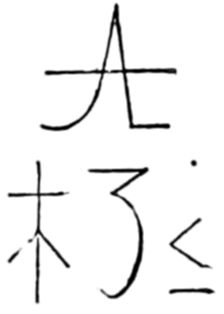
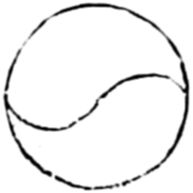
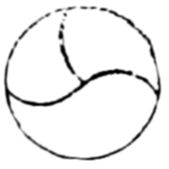
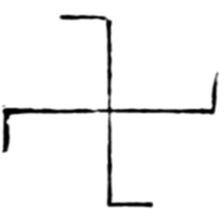
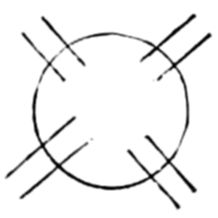
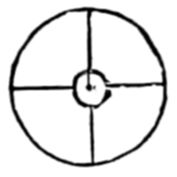
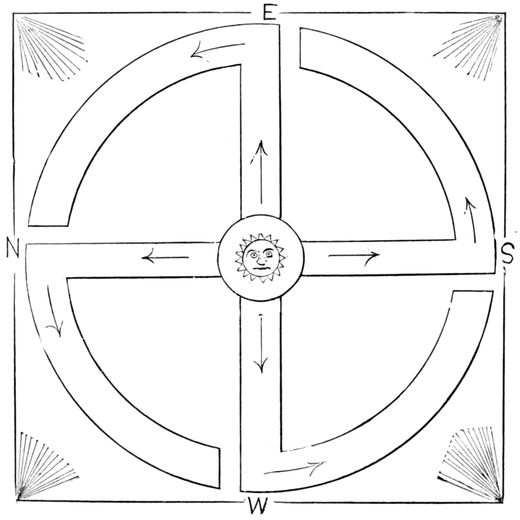
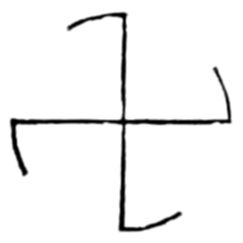
The four symbols of the Ta Ki, the Triskeles, the Svastika and the Cross; the prevalence of the Triskeles in the Old World; the meaning of the Ta Ki in Chinese philosophy; the Yin and Yang; the Svastika; origin illustrated from n picture-writing; the Copan stone; the earth-plain; the wheel-cross; winter-counts and year cycles; time-wheels and sun-motions; the Four Ages and Tree of Life.
Mental activity of the Mayas; the diviners; the “field mass”; invocation to the rain-gods; fire-worship; prognostics; transformations of sorcerers; nagualism; a Maya witch story; the Balams; the Man of the Woods; stories of dwarfs and imps; female deceivers; fabulous birds and snakes.
Source of information; reminiscences of the tribe; Messianic hopes; relics of the Stone Age; methods of hunting and fishing; utensils, boats and houses; the native games; the sweat-lodge; their canticos, and the derivation of the term; medical knowledge; cure for rattlesnake bites; native trephining; position of the Lenâpé as “grandfathers”; wampum belts; totemic divisions; peculiarities of the dialect; Lenâpé grammar.
Material for the study; were the native hieroglyphs phonetic? Character and arrangement of phonetic symbols; the failure of Landa’s alphabet; phonetic signs in Maya MSS.; hieroglyph of the firmament; phonetic terminals; signs of cardinal points; Mexican phonetic elements; principle of the rebus; examples; the ikonomatic system.
Thought-Writing and Sound-Writing; the ikonomatic method explained; illustrations from Egyptian inscriptions; from the canting arms in heraldry; from the Mexican picture-writing; values of position and colors; determinatives and ideograms in Aztec MSS.; further illustrations from Maya hieroglyphs; Chipeway pictography.
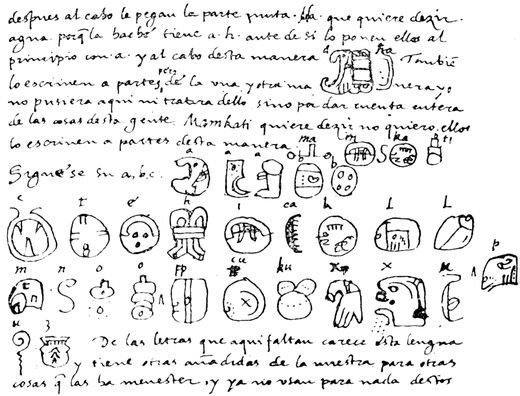
1. Introductory—Phoneticism in Maya and Aztec writing. 2. Descriptions by Spanish writers; by Peter Martyr; by Las Casas; by Alonso Ponce; by Lizana; by Aguilar; by Buena Ventura; by Cogolludo; by Soto-Mayor; by Landa; facsimile of Landa’s alphabet; critiques on it; conclusions. 3. References from native sources; Maya words for “writing,” “book,” “calendar,” etc.; a prophecy of Ahkul Chel translated. 4. The existing Codices; the Dresden Codex; the Codex Peresianus; the Codex Troano; the Codex Cortesianus; the mural paintings and inscriptions.
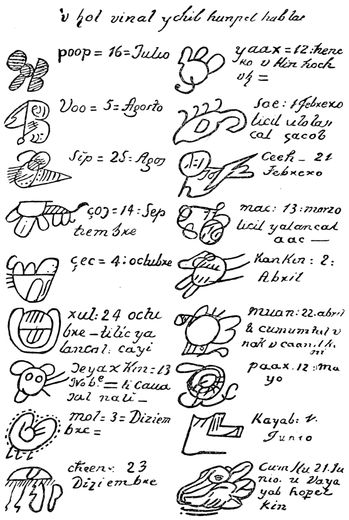
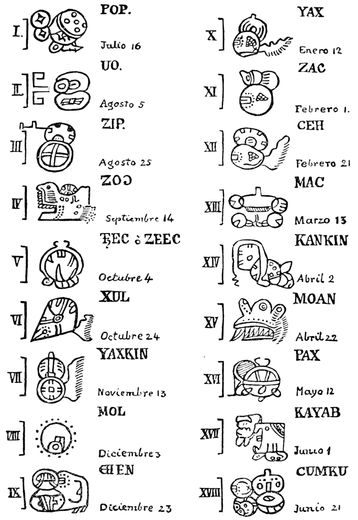
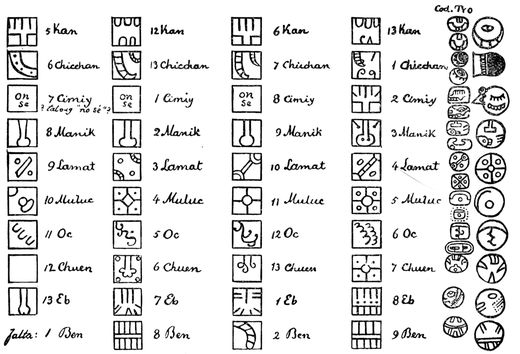
High civilization of ancient Mayas; destruction of their literature; modern Books of Chilan Balam; signification of this name; contents of the Books; specimen of the prophecies; linguistic value; opinion of Pio Perez; length of the Maya year-cycles; hieroglyphs of the months and days; the 13 ahau katuns; medical contents of the books.
Location of the Stone near Orizaba; its figures; refer to a date in February, 1502; translation of the hieroglyphs, and identification of the date as that of the death of the Emperor Ahuitzotzin; the stone a sepulchral tablet.
Nature of poetry; principle of repetition; Eskimo nith songs; other Eskimo songs; a Pawnee song; Kioway love songs; a Chipeway serenade; Aztec love songs; war-songs of the Otomis; of the Aztecs; of the Qquichuas; prophetic chants of the Mayas. Faculty of poetry universal.
Indian geographic names; language a guide to ethnology; reveals the growth of arts and the psychologic processes of a people; illustration from the Lenâpé tongue; structure of language best studied in savage tongues; rank of American tongues; characteristic traits; pronominal forms; idea of personality; polysynthesis; incorporation; holophrasis; origin of these; lucidity of American tongues; their vocabularies; power of expressing abstract ideas; conclusion.
Wilhelm von Humboldt’s Researches in American Languages
What led Humboldt toward the American tongues; progress of his studies; fundamental doctrine of his philosophy of language; his theory of the evolution of languages; opinion on American languages; his criterion of the relative perfection of languages; not abundance of forms, nor verbal richness; American tongues not degenerations; Humboldt’s classification of languages; psychological origin of Incorporation in language; its shortcomings; in simple sentences; in compound sentences; absence of true formal elements; the nature of the American verb.
Study of the human species on the geographic system; have American languages any common trait? Duponceau’s theory of polysynthesis; Humboldt on Polysynthesis and Incorporation; Francis Lieber on Holophrasis; Prof. Steinthal on the incorporative plan; Lucien Adam’s criticism of it; Prof. Müller’s inadequate statement; Major Powell’s omission to consider it; definitions of polysynthesis, incorporation and holophrasis; illustrations; critical application of the theory to the Othomi language; to the Bri-bri language; to the Tupi-Guarani dialects; to the Mutsun; conclusions; addendum; critique by M. Adam on this essay.
The Earliest Form of Human Speech as Revealed by American Tongues
The Homo alalus or speechless man, a romance; linguistic stocks; the phonetic elements significant; examples; but not of same significance in different stocks; notion of self and other; pronouns a late development; alternating consonants and permutable vowels; examples; phoneticism inadequate; difficulties thus created; counter-sense in language; notion of Being and Not-Being; incorporation; sentence-words; no dependent clauses; no tenses; no adjectives; no numerals; notion of Animate and Inanimate; classificatory particles; primitive man a visuaire.
Significance of love-words; various origins. I. Algonkin love-words; various senses; highest forms. II. Nahuatl love-words; poverty of the tongue; made up by terminations; words for friendship. III. Maya love-words; singular derivations; the Huasteca dialect; the Cakchiquel dialect; comparisons. IV. Qquichua love-words; abundant; various meanings. V. Tupi-Guarani love-words; meaning of. Conclusions.
xiiThe Lineal Measures of the Semi-Civilized Nations of Mexico and Central America
Metrical standards a criterion of progress; those of the Mayas; of the Cakchiquels; of the Mexicans or Aztecs; of the Mound-Builders of Ohio. Conclusions.
How it began; the deception exposed; absurdities of the invention; a wonderful calendar; a yet more wonderful marriage-song; a second Psalmanazar; rejoinder of the editor; reply to that; final verdict.
PART I. ETHNOLOGIC AND ARCHÆOLOGIC. — INTRODUCTORY. — A REVIEW OF THE DATA FOR THE STUDY OF THE PRE-HISTORIC CHRONOLOGY OF AMERICA. [2] — ON PALÆOLITHS, AMERICAN AND OTHER. [32] — ON THE ALLEGED MONGOLIAN AFFINITIES OF THE AMERICAN RACE. [35] — THE PROBABLE NATIONALITY OF THE “MOUND-BUILDERS.” — THE TOLTECS AND THEIR FABULOUS EMPIRE.
17
Ever since America was discovered, the question about
it which has excited the most general interest has been,
Whence came its inhabitants? The inquiry, Who are the
American Indians? has been the theme of many a ponderous
folio and labored dissertation, with answers nearly as
various as the number of debaters.
Few or none of them have reflected on the unphilosophical
character of the inquiry as thus crudely put. Take a
precisely analogous question, and this will be apparent—Whence
came the African Negroes? All will reply—From
Africa, of course. Originally? Yes, originally; they constitute
the African or Negro sub-species of Man.
The answer in the case of the American Indians is entirely
parallel—their origin is American; the racial type
was created and fixed on the American continent; they constitute
as true and distinct a sub-species as do the African
or the White Race.
18Each of the great continental areas moulded the plastic,
primitive man into a conformation of body and mind peculiar
to itself, in some special harmony with its own geographic
features, thus producing a race or sub-species,
subtly correlated in a thousand ways to its environment, but
never forfeiting its claim to humanity, never failing in its
parallel and progressive development with all other varieties
of the species.
America was no exception to this rule, and it is time to
dismiss as trivial all attempts to connect the American race
genealogically with any other, or to trace the typical culture
of this continent to the historic forms of the Old
World. My early studies inclined me to these opinions, and
they have been constantly strengthened by further research.
Yet they are not popularly accepted; the very latest writer
of competence on the pre-history of America says, “It is now
generally held that the earliest population (of the continent)
was intruded upon by other races, coming either from Asia
or from the Pacific Islands, from whom were descended the
various tribes which have occupied the soil down to the
present time.”[1]
It is true that this opinion is that generally held, and for
this reason I have selected for reprinting some articles intended
to show that it is utterly fallacious—devoid of any
respectable foundation.
The first two papers treat of the archæologic material, and
its value for ascertaining the pre-historic life of the American
race; the third, on its pretended affinities to Asiatic
19peoples. These are followed by two papers respectively on
the Toltecs and Mound-Builders, setting aright, I hope, the
position of these semi-mythical shapes in the culture-history
of North America, maintaining that for neither do we have
to call in as explanation migrations from Asia, Europe,
Oceanica or Africa, as has so often been attempted.
20
Early in this century the doubt was expressed by
Alexander von Humboldt[3] whether it is philosophical
to inquire into the origin of any of the human races or sub-species.
Although he expressed this doubt with particular
reference to the American race, I believe I am right in assuming
that the hesitancy he felt in pushing inquiry so far
should now diminish in view of new methods of research and
a wider range of observations. We may not, in fact we
shall not, be able to trace the American or any other sub-species
directly back to its origin in place or time; but by
reviewing all the data which have been offered in solution of
such a problem, we may perceptibly narrow the question,
and also estimate the relative value of the means proposed.
It is to such a review, applied to the American race, that I
now invite your attention.
The data upon which theories of the antiquity, the
genealogy and the affinities of this race have been constructed
are varied. For convenience of treatment I shall
class them under six heads. They are:
21I. Legendary, including the traditions of the native tribes
and their own statements of their history.
II. Monumental, where we have to do with those structures
whose age or character seems to throw light on the
question.
III. Industrial, under which heading we may inquire as
to the origin of both the useful and the decorative arts in the
New World.
IV. Linguistic, broaching the immense and important
questions as to the diversity and affinities of languages.
V. Physical, which takes into consideration the anatomic
and morphologic peculiarities of the American race; and
finally,
VI. Geologic, where its position in the geologic horizons is
to be determined, and the influence upon it of the physical
geography of the continent.
Legendary. Turning to the first of these, the legendary
data, I confess to a feeling of surprise that learned scholars
should still hold to the opinion that the native tribes, even
some of the most savage of them, retain to this day traditions
which they had brought from their supposed Asiatic
homes. Thus the missionaries, Bishop Henry Faraud and
the Abbé Emile Petitot, both entirely familiar with the Cree
and the Athapaskan languages and lore, insist that the
myths and legends of these tribes bear such strong resemblances
to the Semitic traditions that both must have
had a common origin.[4] No one can deny the resemblance;
22but the scientific student of mythology discovers such
identities too frequently, and at points too remote, to ask any
other explanation for them than the common nature of the
human mind.
The question has been often raised how long a savage
tribe, ignorant of writing, is likely to retain the memory of
past deeds. From a great many examples in America and
elsewhere, it is probable that the lapse of five generations,
or say two centuries, completely obliterates all recollection
of historic occurrences. Of course, there are certain events
of continuous influence which may be retained in memory
longer—for example, the federation of prominent tribes; and
perhaps a genealogy may run back farther. My friend,
Dr. Franz Boas, informs me that some tribes on Vancouver’s
Island pretend to preserve their genealogies for twelve
or fifteen generations back; but he adds that the remoter
names are clearly of mythical purport.
It appears obvious that all efforts to establish a pre-historic
chronology by means of the legends of savage tribes, are
and must be vain.
The case is not much better with those semi-civilized
American nations, the Mayas and Nahuas, who possessed a
partially phonetic alphabet, or with the Quichuas, who preserved
their records by the ingenious device of the quipu.
Manco Capac, the alleged founder of the Peruvian state,
floats before us as a vague and mythical figure, though he
is placed in time not earlier than the date when Leif, the son
of Erik, anchored his war-ship on the Nova Scotian coast.[5]23Historians are agreed that the long lists of Incas in the
pages of Montesinos, extending about two thousand years
anterior to the Conquest, are spurious, due to the imagination
or the easy credulity of that writer.
The annals of Mexico fare no better before the fire of criticism.
It is extremely doubtful that their earliest reminiscences
refer to any event outside the narrow valley parcelled
out between the petty states of Tenochtitlan, Tezcuco, and
Tlacopan.[6] The only fact that bears out the long and
mysterious journey from the land of the Seven Caves, Chicomoztoc,
in the distant northwest, by the great water, is
that the learned and indefatigable Buschmann has conclusively
shown that the four languages of Sonora and all the
dialects of the Shoshonian family reveal marks of continued
and deep impressions of the Nahuatl tongue.[7] But the
chronicles of Mexico proper contain no fixed date prior to
that of the founding of the city of Tenochtitlan, in the year
1325 of our era.
I am aware that there are still some writers who maintain
that both the Mexican and the Maya astronomic cycles
assume a commencement for their records centuries, even
thousands of years, before the beginning of our era. These
opinions, however, have not obtained the assent of other
students. We are too ignorant both of the astronomy and
the methods of writing of these nations to admit such claims;
and the facts advanced are capable of quite other interpretation.
24It is, on the whole, rare for the American tribes to declare
themselves autochthonous. The Mayas, on the peninsula
of Yucatan, stated that their earliest ancestors came there
from beyond the seas, some from the far east, others from
the west. So the Toltecs, under Quetzalcoatl, were fabled
to have entered Mexico from beyond the Eastern Ocean.
The Creeks and Choctaws pointed to the west, the Algonkins
generally to the east, as their primal home.[8] These
legends are chiefly mythical, not much truer than those of
other tribes who claimed to have climbed up from some
under-world. Sifting them all, we shall find in them little
to enlighten us as to the pre-historic chronology of the tribes,
though they may furnish interesting vistas in comparative
mythology.
That in which we may expect the legends of tribes to be
of most avail is their later history, the record of their wars,
migrations and social development within a few generations.
The spirit of the uncivilized man is, however, very careless
of the past. We have means of testing the exactness of
such traditions in some instances, and the result is rarely
such as to inspire confidence in verbal records. Those of
you who were present at the last meeting will remember
how diversely two able students of Iroquois tradition estimated
its value. Even when remarkable events are not forgotten,
the dates of their occurrence are generally vague.
The inference, therefore, is that very few data, dependent on
legendary evidence alone, can be accepted.
25Monumental. When we turn to the monumental data, to
the architecture and structural relics of the ancient Americans,
we naturally think first of the imposing stone-built
fortresses of Peru, the massive pyramids and temples of
Yucatan and Mexico, and the vast brick-piles of the Pueblo
Indians.
It is doubtful if any of these notable monuments supply
pre-historic dates of excessive antiquity. The pueblos, both
those now occupied and the vastly greater number whose
ruins lie scattered over the valleys and mesas of New Mexico
and Arizona, were constructed by the ancestors of the tribes
who still inhabit that region, and this at no distant day.
Though we cannot assign exact dates to the development of
this peculiar civilization, there are abundant reasons, drawn
from language, physical geography and the character of the
architecture, to include all these structures within the
period since the commencement of our era.[9]
There is every reason to suppose that the same is true of
all the stone and brick edifices of Mexico and Central America.
The majority of them were occupied at the period of
the Conquest; others were in process of building; and of
others the record of the date of their construction was clearly
in memory and was not distant. Thus, the famous temple
of Huitzilopochtli at Tenochtitlan, and the spacious palace—or,
if you prefer the word, “communal house”—of the
ruler of Tezcuco, had been completed within the lifetime of
many who met the Spaniards. To be sure, even then there
were once famous cities fallen to ruin and sunk to oblivion
26in the tropical forests. Such was Palenque, which could not
have failed to attract the attention of Cortes had it been
inhabited. Such also was T’Ho, on the site of the present
city of Mérida, Yucatan, where the earliest explorers
found lofty stone mounds and temples covered with
a forest as heavy as the primitive growth around it.[10] But
tradition and the present condition of such of these old cities
as have been examined, unite in the probability that they
do not antedate the Conquest more than a few centuries.
In the opinion of some observers, the enigmatical ruins
on the plain of Tiahuanaco, a few leagues from the shore of
Lake Titicaca, in Peru, carry us far, very far, beyond any
such modern date. “Even the memory of their builders,”
says one of the more recent visitors to these marvellous
relics, General Bartolomé Mitre, “even their memory was
lost thousands of years before the discovery of America.”[11]
Such a statement is neither more nor less than a confession
of ignorance. We have not discovered the period nor
the people concerned in the ruins of Tiahuanaco. It must
be remembered that they are not the remains of a populous
city, but merely the foundations and beginnings of some
vast religious edifice which was left incomplete, probably
owing to the death of the projector or to unforeseen difficulties.
If this is borne in mind, much of the obscurity about
the origin, the purpose and the position of these structures
will be removed. They do not justify a claim to an age of
27thousands of years before the Conquest; hundreds will suffice.
Nor is it necessary to assent to the opinion advanced
by General Mitre, and supported by some other archæologists,
that the most ancient monuments in America are
those of most perfect construction, and, therefore, that in
this continent there has been, in civilization, not progress
but failure, not advance but retrogression.
The uncertainty which rests over the age of the structures
at Tiahuanaco is scarcely greater than that which still
shrouds the origin of the mounds and earthworks of the
Ohio and Upper Mississippi valleys. Yet I venture to say
that the opinion is steadily gaining ground that these interesting
memorials of vanished nations are not older than the
mediæval period of European history. The condition of
the arts which they reveal indicates a date that we must
place among the more recent in American chronology. The
simple fact that tobacco and maize were cultivated plants is
evidence enough for this.[12]
There is, however, a class of monuments of much greater
antiquity than any I have mentioned. These are the artificial
shell-heaps which are found along the shores of both
oceans and of many rivers in both North and South America.
They correspond to the kitchen-middens of European
archæology.
In several parts of the continent they have been examined
by competent observers and the question of their date approximately
ascertained. I need not say this differs widely,
28for these refuse heaps of ancient villages or stations were of
course begun at wide intervals.
Long ago I called attention to the singular size and antiquity
of those I found in Florida and along the Tennessee
River;[13] and the later researches of Professor Jeffries
Wyman would, in his opinion, measure the age of some of
the former by tens of thousands of years.[14]
Further to the south, in Costa Rica, Dr. Earl Flint has
examined the extensive artificial shell deposits which are
found along the shores of that republic. They are many
feet in height, covered by a dense forest of primeval appearance,
and are undoubtedly of human origin.
In Brazil such shell-heaps are called sambaquis, and they
are of frequent occurrence along the bays and inlets of the
coast. Some of them are of extraordinary dimensions, rising
occasionally to more than a hundred feet in height. The
lower layers have been consolidated into a firm, stony breccia
of shells and bones, while the surface stratum, from six
to ten feet thick, is composed of sand and vegetable loam
supporting a growth of the largest trees. Yet even the
lowest layers of this breccia, or shell-conglomerate, yield
tokens of human industry, as stone axes, flint arrow-heads,
chisels, and fragments of very rude pottery, as well as
human bones, sometimes split to extract the marrow. The
shells are by no means all of modern type. Many are of
29species now wholly extinct, or extinct in the locality. This
fact alone carries us back to an antiquity which probably
should be counted by thousands of years before our era.
At that remote period not only did a fishing and hunting
race dwell along the Brazilian coast, but this race was fairly
advanced on the path to culture; it was acquainted with
pottery, with compound implements, and with the polishing
of stone. We further know that this race was not that
which occupied the land when the whites discovered it; for
the human skulls disinterred from the sambaquis are, craniologically,
almost diametrically opposite those of the Botocudos
and the Tupis. Yet if we can trust the researches of
Dr. Lund in the caverns of Brazil, the oldest skulls in these
deposits, found in immediate connection with the bones of
extinct mammalia, belonged to the ancestors of these tribes.
Markedly dolichocephalic, they present an entire contrast to
the brachycephalic type from the sambaquis.[15]
This class of monuments, therefore, supply us data which
prove man’s existence in America in what some call the
“diluvial,” others the “quaternary,” and others again the
“pleistocene” epoch—that characterized by the presence of
some extinct species.
Industrial. Let us now turn to the industrial activity of
the American race, and see whether it will furnish us other
data concerning the pre-historic life of the New World. We
may reasonably look in this direction for aid, since it is now
universally conceded that at no time did man spring into
being fully armed and equipped for the struggle for existence,
30but everywhere followed the same path of painful effort
from absolute ignorance and utter feebleness to knowledge
and power. At first, his only weapons or tools were such as
he possessed in common with the anthropoid apes: to wit,
an unshapen stone and a broken stick. Little by little, he
learned to fit his stone to his hand and to chip it to an edge,
and with this he could sharpen the end of his stick, thus
providing himself with a spear and an axe.
It was long before he learned to shape and adjust the
stone to the end of the stick, and to hurl this by means of a
cord attached to a second and elastic stick—in other words, a
bow; still longer before he discovered the art of fashioning
clay into vessels and of polishing and boring stones. These
simple arts are landmarks in the progress of the race: the
latter divides the history of culture into the palæolithic or
rough stone period, and the neolithic or polished stone
period; while the shaping of a stone for attachment to a
handle or shaft marks the difference between the epoch of
compound implements and the earlier epoch of simple implements,
both included in the older or palæolithic age.[16]
With these principles as guides, we may ask how far back
on this scale do the industrial relics in America carry us?
I have spoken of the great antiquity of some of the
American shell-heaps, how they carry us back to the diluvial
epoch, and that of numerous extinct species. Yet it is
generally true that in the oldest hitherto examined in Brazil,
31Guiana, Costa Rica and Florida, fragments of pottery,
of polished stone, and compound implements, occur even in
the lowest strata.[17] Venerable though they are, they supply
no date older than what in Europe we should call the neolithic
period. The arrow-heads which have been exhumed
from the loess of the ancient lake-beds of Nebraska, the net-sinkers
and celts which have been recovered from the auriferous
gravels of California, prove by their form and finish
that the tribes who fashioned them had already taken long
strides beyond the culture of the earlier palæolithic age.
The same is true, though in a less degree, of the chipped
stones and bones which Ameghino exhumed from the
lacrustine deposits of the Pampas, although he proves that
these relics were the products of tribes contemporary with
the extinct glyptodon and mylodon, as well as the fossil
horse and dog. In the very oldest station which he examined,
there appears to have been found a quartz arrow-head;
yet he argues that this station dated from the pliocene division
of the tertiary, long anterior to the austral glacial
epoch.[18] This leaves another such open conflict between
geology and the history of culture, as Professor Rau has
already pointed out as existing in Californian archæology.
There is, however, one station in America which has
furnished an ample line of specimens, and among them not
32one, so far as I know, indicating a knowledge of compound
implements. This is that of the “Trenton gravels,” New
Jersey. There we appear to be in face of a stage of culture
as primitive as that of the stations of Chelles and St. Acheul
in France, absolutely without pottery, without polished
stone, without compound implements.[19]
Assuming that these post-glacial gravels about Trenton
supply one of the earliest authentic starting points in the
history of culture on this continent, the later developments
of industry will furnish a number of other data. This first
date was long before the extinction of the native American
horse, the elephant, the mammoth, and other animals important
to early man. There is nothing unlikely therefore
in the reported discoveries of his pointed flints or his bones
in place along with the remains of these quadrupeds.
Not only the form but the material of implements supplies
us data. If man in his earliest stage was, as some maintain,
quite migratory, it is certain that he did not carry his stone
implements with him, nor did he obtain by barter or capture
those of other tribes. All the oldest implements are manufactured
from the rocks of the locality. When, therefore, we
find a weapon of a material not obtainable in the vicinity,
we have a sure indication that it belongs to a period of development
considerably later than the earliest. When the
obsidian of the Yellowstone Park is found in Ohio, when the
black slate of Vancouver’s Island is exhumed in Delaware,
it is obvious we must assume for such extensive transits a
very noticeable æsthetic and commercial development.
33I can but touch in the lightest manner on the data offered
by the vast realm of industrial activity. The return it offers
is abundant, but the harvesting delicate. In the dissemination
of certain kinds of arts, certain inventions, certain decorative
designs and æsthetic conceptions from one tribe to
another, we have a most valuable means of tracing the
pre-historic intercourse of nations: but we must sedulously
discriminate such borrowing from the synchronous and
similar development of independent culture under like conditions.
In one department of industry we shall be largely free
from this danger, that is, in the extension of agriculture.
One of America’s ablest ethnologists, Dr. Charles Pickering,
as the result of a lifetime devoted to his science, finally
settled upon the extension of cultivated plants as the safest
guide in the labyrinth of pre-historic migrations. Its value
is easily seen in America when we reflect that the two tropical
plants, maize and tobacco, extended their area in most
remote times from their limited local habitat about the
Isthmus of Tehuantepec to the north as far as the St. Lawrence
river and to the south quite to the Archipelago of
Chiloe. Their presence is easily traced by the stone or
earthen-ware implements required for their use. How many
ages it must have required for these plants to have thus
extended their domain, amid hostile and savage tribes,
through five thousand miles of space! The squash, the
bean, the potato and the mandioca, are native food-plants offering
in a less degree similar material for tracing ancient
commerce and migration. Humboldt and others have
claimed as much for the banana (Musa paradisiaca), but the
34recent researches of Dr. Karl von den Steinen have removed
that valued fruit from the list of native American plants.
Both species of banana (M. paradisiaca and M. sapientium)
were undoubtedly introduced into the New World after the
discovery.[20] Indeed, summing up the reply to an inquiry
which has often been addressed to the industrial evolution
of the indigenes of our continent, I should say that they did
not borrow a single art or invention nor a single cultivated
plant from any part of the Old World previous to the arrival
of Columbus. What they had was their own, developed
from their own soil, the outgrowth of their own lives and
needs.
Linguistic. This individuality of the race is still more
strongly expressed in their languages. You are all aware
that it is upon linguistic data almost exclusively that
American ethnology has been and must be based. The
study of the native tongues becomes therefore of transcendent
importance in the pre-historic chronology of the Continent.
But to obtain its best results, this study must be
conducted in a much more thorough manner than has
hitherto been the custom.
In America we are confronted with an astonishing multiplicity
of linguistic stocks. They have been placed at about
eighty in North and one hundred in South America. It
is stated that there are that many radically diverse in elements
and structure. To appreciate the vista in time that
this fact opens to our thoughts, we must recognize the
tenacity of life manifested by these tongues. Some of them
have scores of dialects, spoken by tribes wandering over the
35widest areas. Take the Athapascan or Tinné, for example,
found in its greatest purity amid the tribes who dwell on the
Arctic sea, and along the Mackenzie river, in British
America, but which is also the tongue of the Apaches who
carried it almost to the valley of Mexico. The Algonkin
was spoken from Hudson Bay to the Savannah river and
from Newfoundland to the Rocky Mountains. The Guarani
of the Rio de la Plata underlies dialects which were current
as far north as Florida.
How, then, in spite of such tenacity of American languages,
have so many stocks come into existence? This was the
question which my predecessor in this chair last year undertook
to answer. His suggestions appear to me extremely
valuable, and only in one point do I widely differ from him,
and that is, in the length of time required for these numerous
tongues to originate, to sever into dialects and to be
carried to distant regions.[21] According to the able linguist,
Dr. Stoll, the difference which is presented between the
Cakchiquel and Maya dialects could not have arisen in less
than two thousand years;[22] and any one who has carefully
compared the earliest grammars of an American tongue with
its present condition will acknowledge that the changes are
surprisingly few. To me the exceeding diversity of languages
in America and the many dialects into which these
have split, are cogent proofs of the vast antiquity of the race,
an antiquity stretching back tens of thousands of years.
36Nothing less can explain these multitudinous forms of
speech.
Underlying all these varied forms of expression, however,
I think future investigation will demonstrate some curious
identities of internal form, traits almost or entirely peculiar
to American languages, and never quite absent from any of
them.
Such was the opinion of the two earliest philosophical investigators
of these tongues, P. S. Duponceau and Wilhelm
von Humboldt. They called these traits polysynthesis and
incorporation, and it was proposed to apply the term incorporative
as a distinguishing adjective to all American languages.
Of late years this opinion has been earnestly combatted
by M. Lucien Adam and others; but my own studies
have led me to adopt the views of the older analysts against
these modern critics. I do not think that the student can
compare any two stocks on the continent without being impressed
with the resemblance of their expression of the relations
of Being, through the incorporative plan.
Along with this identity of plan, there coëxists the utmost
independence of expression. An American language is
usually perfectly transparent. Nothing is easier than to reduce
it to its ultimate elements, its fundamental radicals.
These are few in numbers and interjectional in character.
The Athapascan, the Algonkin, whose wide extension I
have referred to, have been reduced to half a dozen particles
or sounds expressive of the simplest conceptions.[23] Upon
these, by combination, repetition, imitation and other such
processes, the astonishing structure of the tongue has been
37erected, every portion of it displaying the mechanism of its
origin. It is this transparency which renders these tongues
so attractive to the philosophic student of human expression,
and so valuable to him who would obtain from them the
record of the progress of the nation.
A thorough study of such a language would embrace its
material, its formal and its psychologic contents. Its material
elements include the peculiarities of its vocabulary:
for example, its numerals and the system they indicate, its
words for weights and measures, for color and direction, for
relations of consanguinity and affinity, for articles of use
and ornament, for social and domestic conditions, and the
like.
Few studies of American languages go beyond this material
or lexicographic limit; but in truth these are merely
the externalities of a tongue, and have nothing to do with
linguistic science proper. This concerns itself with the
forms of the language, with the relation of parts of speech to
each other and to the sentence, and with the historical development
of the grammatical categories. Beyond this,
again, is the determination of the psychical character of
the tribe through the forms instinctively adopted for the expression
of its thoughts, and reciprocally the reaction exerted
by these forms on the later intellectual growth of those
who were taught them as their only means of articulate expression.
These are data of the highest value in the study of prehistoric
time; but so far as America is concerned, I could name
very few scholars who have pursued this promising line of
research.
38Physical. Much more attention has been paid to the
physical than the linguistic data of the native Americans,
but it may freely be said, with not more satisfactory results.
This failure is partly owing to the preconceived notions
which still govern the study of ethnology. Linnæus offered
the cautious division of the human species into races named
from the five great geographical areas it inhabited; Blumenbach
pointed out that this roughly corresponded with the
division into five colors, the white, black, yellow, brown and
red races, occupying respectively Europe, Africa, Asia, Polynesia
and America. Unfortunately, Cuvier chose to simplify
this scheme, by merging the brown and red races, the
Polynesian or Malayan and the American, into the yellow
or Mongolian. The latest writers of the French school, and
I am sorry to add various Americans, servilely follow this
groundless rejection of the older scheme, and speak of Malayans
and Americans alike as Mongolians or Mongoloids.
Neither in language nor ethnic anatomy is there any more
resemblance than between whites and Mongolians.
It is gratifying to see that the more accurate German investigators
decidedly reject the blunder of Cuvier, and declare
that the American race is as independent as any other
of those named. Thus Dr. Paul Ehrenreich, who has lately
published an admirable monograph on the Botocudos of
Brazil, a tribe often quoted for its so-called “Mongoloid”
aspect, declares that any such assertion must be contradicted
in positive terms. Both in osteology and anatomy, in formation
of the hair and shape of the skull, the differences are
marked, permanent and radical.
What is true of the Botocudos is not less so of the other
39American tribes which are claimed to present Mongolian
traits. Such assertions are based on the superficial observations
of travellers, most of whom do not know the first
principles of ethnic anatomy. This is sufficiently shown
by the importance they attach to the oblique eye, a slight
malformation of the skin of scarcely any weight.[24]
The anatomy and physiology of the various American
tribes present, indeed, great diversity, and yet, beneath it all
is a really remarkable fixedness of type. We observe this
diversity in the shape of the skull, which may be, as among
the Botocudos, strictly dolichocephalic, while the Araucanians
are brachycephalic; the nasal index varies more than
in the extremest members of the white race; the tint of the
skin may be a dark brown with an under-color of red, or of
so light a hue that a blush is easily perceptible. The beard
is usually absent, but D’Orbigny visited a tribe who wore
it full and long.[25] The height varies from an average of six
feet four inches for adult males in Patagonia to less than five
feet among the Warraus of Guiana; and so it is with all the
other traits of the race. There is not one which is not subject
to extensive variation.
On the other hand, these variations are not greater than
can be adduced in various members of the white or black
race. In spite of them all, there is a wonderful family likeness
among tribes of American origin. No observer well
acquainted with the type would err in taking it for another.
Darwin says that the Fuegians so closely resemble the Botocudos
40that they seem members of the same tribe. I
have seen Arawacks from Guiana who in the northwest
would have passed for Sioux.
In spite of the total dissimilarity of climate and other
physical surroundings, the tribes of the tropics differ no
more from those near the Arctic circle than they do among
themselves. This is a striking lesson how independent of
environment are the essential characteristics of a race, and
it is a sweeping refutation of those theories which make
such characteristics dependent upon external agencies.
A still more remarkable fact has been demonstrated by
Professor J. Kollmann of Bâle: to wit, that the essential
physical identity of the American race is as extended in
time as it is in space. This accurate student has analyzed
the cranioscopic formulas of the most ancient American
skulls, those from the alleged tertiary deposits of the Pampas,
those from the caverns of Lagoa Santa in Brazil, that
obtained from Rock Bluff, Illinois, the celebrated Calaveras
skull from California, and one from Pontemelo in Buenos
Ayres of geologic antiquity. His results are most interesting.
These very ancient remains prove that in all important
craniologic indicia the earliest Americans, those who
were contemporaries of the fossil horse and other long since
extinct quadrupeds, possessed the same racial character as
the natives of the present day, with similar skulls and a like
physiognomy.[26] We reach therefore the momentous conclusion
that the American race throughout the whole continent,
and from its earliest appearance in time, is and has been one,
as distinct in type as any other race, and from its isolation
41probably the purest of all in its racial traits. This is a fact
of the first order in establishing its prehistoric chronology.
Geologic. I have left the geologic data to the last, as it is
these which carry us with reasonable safety to the remotest
periods. No one who examines the evidence will now deny
that man lived in both North and South America during
and after the glacial epochs, and that he was the contemporary
of many species of animals now extinct. As you
are aware, the attempt has several times been made to fix
the date for the final retrocession of the glaciers of North
America. The estimates have varied from about 12,000
years ago up to 50,000, with a majority in favor of about
35,000 years.
There have also been various discoveries which are said to
place the human species in America previous to the appearance
of the glaciers. Some remains of man’s industry or of his
skeleton have been reported from interglacial, others from
tertiary deposits.[27] Unfortunately, these finds have not always
been sufficient, or not of a character to convince the
archæologist. I have before adverted to the impossibility,
for instance, of an archæologist accepting the discovery of
a finely-polished stone implement in a tertiary gravel, except
as an intrusive deposit. It is a violent anachronism,
which is without a parallel in other countries. Even the
discovery of a compound implement, as a stemmed arrowhead,
42in strata of tertiary date, is, with our present knowledge,
quite out of the question.
Although there are well recognized signs of glacial action
in South America, it is not certain that the glacial epoch
coincided in time in the two continents. That there was a
reasonable approximation is probable from the appearance
of later deposits. We may suppose therefore that the habitable
area of the New World was notably less at that period,
and that the existing tribes were confined to a much
narrower space. This would force them into closer relations,
and tend powerfully to the production of that uniformity of
type to which I have before referred.
We might also expect to discover in the tropical regions of
America more frequent evidence of the primitive Americans
than in either temperate zone. This has not been the case,
probably because the geologic deposits of the tropics have
been less investigated. Throughout the West Indies there
is an entire absence of palæolithic remains. Those islands
were first peopled by tribes in the polished stone stage of
culture. In the valley of Mexico human remains have been
disinterred from a volcanic deposit of supposed tertiary age,
and you have all heard of those human footprints which Dr.
Earl Flint has unearthed in Nicaragua. These are found
under layers of compact volcanic tufas, separated by strata
of sand and vegetable loam. There can be no doubt of their
human origin or of their great antiquity; but no geologist
need be informed of the difficulty of assigning an age to volcanic
strata, especially in a tropical country, subject to
earthquakes, subsidence and floods.[28]
43It would not be in accordance with my present purpose to
examine the numerous alleged finds of human remains in
the strata of the tertiary and quaternary. All such furnish
data for the pre-historic chronology of America, and should
be carefully scrutinized by him who would obtain further
light upon that chronology. I must hasten to some other
considerations which touch the remote events to which I am
now alluding.
Since a comparison of the fauna of South America and
Africa, and a survey of the sea-bottom between those continents,
have dispelled the dream of the ancient Atlantis, and
relegated that land connection at least to the eocene period
of the tertiary, no one can suppose the American man to
have migrated from Africa or southwestern Europe. For
other and equally solid reasons, no immigration of Polynesians
can be assumed. Yet zoölogists, perfectly willing to
derive man from an anthropoid, and polygenists to the utmost,
hesitate to consider man an autochthon in the New
World. There is too wide a gap between the highest monkeys
and the human species in this continent.[29] Discoveries
of fossil apes might bridge this, but none such has been reported.
If we accept the theory that man as a species spread from
one primal centre, and in the higher plasticity of his early
life separated into well defined races, which became unalterably
fixed not much later than the close of the glacial epoch—and
this theory appears to be that now most agreeable to
anthropologists—then the earliest Americans made their advent
44on this continent as immigrants. This is our first fact
in their pre-historic chronology; but before we can assign it
an accurate position on the scale of geologic time, we must
await more complete discoveries than we now have at our
command.
We must also wait until our friends the geologists have
come to some better understanding among themselves as to
what took place in the pleistocene age. You have heard me
talking freely about the glacial epoch and its extension in
America; but geologists are by no means of one mind as to
this extension, and a respectable minority of them, led by
Sir J. William Dawson, deny the existence or even possibility
of any continental glacier. What others point out as a
terminal moraine they explain to be “nothing but the
southern limit of the ice-drift of a period of submergence.”[30]
It is clear that when we speak about the migration of the
Americans at a time when the polar half of each continent
was either covered with a glacier thousands of feet thick, or
submerged to that depth beneath an arctic sea, we have to
do with geographical conditions totally unlike those of to-day.
I call attention to this obvious fact because it has not
been obvious to all writers.
In your archæological reading you will rarely come across
a prettier piece of theoretical history than Mr. Lewis A.
Morgan’s description of the gradual peopling of the two
Americas by tracing the lines of easiest subsistence. He
begins at the fishy rivers of the northwest coast, and follows
the original colony which he assumes landed at that point,
45all the way to Patagonia and Florida.[31] But how baseless
becomes this vision when we consider the geography of
America as it is shown by geology to have been at a period
contemporary with the earliest remains of man! We know
to a certainty that the human race had already spread far
and wide over both its continental areas before Mr. Morgan’s
lines of easiest nutrition had come into existence.
Properly employed, a study of those geologic features
of a country which determine its geography will prove of
vast advantage in ascertaining the events of pre-historic
time. These features undoubtedly fixed the lines of migration
and of early commerce. Man in his wanderings has
always been guided by the course of rivers, the trend of
mountain chains, the direction of ocean currents, the position
of deserts, passes and swamps. The railroad of to-day follows
the trail of the primitive man, and the rivers have
ever been the natural highways of nations. The theories of
Morgan therefore remain true as theories; only in their application
he fell into an error which was natural enough to
the science of twenty years ago. Perhaps when twenty
years more shall have elapsed, the post-tertiary geology of
our continent will have been so clearly defined that the
geography of its different epochs will be known sufficiently
to trace these lines of migration at the various epochs of
man’s residence in the western world, from his first arrival.
I have now set before you, in a superficial manner it is
true, the various sources from which we may derive aid in
establishing the pre-historic chronology of America. I have
46also endeavored, to a limited extent, to express myself as to
the relative value of these sources. None of them can be
neglected, and it will be only from an exhaustive study of
them all that we can expect to solve the numerous knotty
problems, and lift the veil which hangs so darkly on all
that concerns the existence of the American race before the
sixteenth century.
We are merely beginning the enormous labor which is
before us; we have yet to discover the methods by which we
can analyze fruitfully the facts we already know. But I
look forward with the utmost confidence to a rich return
from such investigations. The day is coming, and that
rapidly, when the pre-historic life of man in both the New
and the Old World will be revealed to us in a thousand unexpected
details. We have but to turn backward about
thirty years to reach a time when the science of pre-historic
archæology was unknown, and its early gropings were
jeered at as absurdities. Already it has established for itself
a position in the first rank of the sciences which have to do
with the highest of problems. It has cast a light upon the
pathway of the human race from the time that man first
deserved his name down to the commencement of recorded
history. Its conquests are but beginning. Year by year
masses of new facts are brought to knowledge from unexpected
quarters, current errors are corrected, and novel
methods of exploration devised.
As Americans by adoption, it should be our first interest
and duty to study the Americans by race, in both their present
and past development. The task is long and the opportunity
is fleeting. A century more, and the anthropologist
47will scarcely find a native of pure blood; the tribes and languages
of to-day will have been extinguished or corrupted.
Nor will the archæologist be in better case. Every day the
progress of civilization, ruthless of the monuments of barbarism,
is destroying the feeble vestiges of the ancient race;
mounds are levelled, embankments disappear, the stones of
temples are built into factories, the holy places desecrated.
We have assembled here to aid in recovering something
from this wreck of a race and its monuments: let me urge
upon you all the need of prompt action and earnest work,
inasmuch as the opportunities we enjoy will never again
present themselves in such fulness.
48
There has been much talk in scientific circles lately
about Palæoliths, and much misunderstanding about
them. Let me try to explain in a few words what they
are, what they tell, and what mistakes people make about
them.
Since man first appeared on this planet, his history has
been a slow progress from the most rudimentary arts up to
those which he now possesses. We know this, because in a
given locality those remains of his art which are found undisturbed
in strata geologically the oldest are always the
rudest. The exceptions to this rule are in appearance only,
as for instance when a given locality was not occupied by
men until they had already acquired considerable knowledge
of arts, or when a cultivated nation was overrun by a barbarous
one.
The general line of advance I have indicated shows,
wherever we can trace it, many similarities—similarities
not necessarily dependent on an ancient intercourse, but
simply because primitive man felt everywhere the same
wants, and satisfied them in pretty much the same manner.
49He felt the need of defence and attack, and everywhere a
stick and a stone offered themselves as the handiest and
most effective weapons; he used both wherever he was, and
adapted them to like shapes.
In casting about for some standard wherewith to measure
the long progress from this simple beginning to the present
day, antiquaries have hit upon a very excellent one—the
choice of a material employed at any given epoch for obtaining
a cutting edge—for manufacturing l’instrument tranchant.
Man conquers nature as he does his enemy—by
cutting her down. The world at present uses iron, or its
next product steel, for that purpose; before it came into
vogue many nations employed bronze; but in the earliest
periods of man’s history, and to-day in some savage tribes,
stone was the substance almost exclusively wrought for this
purpose. These distinctions divide the progress of man
into the three great periods; the Age of Iron, the Age of
Bronze, and the Age of Stone.
Do not make the mistake of supposing that the remains
of human art reveal this sequence in every locality; I have
already hinted that this is not the case. And do not make
that other mistake of supposing that all three are found in
chronologic sequence over the whole world. On the contrary,
they are synchronous even to-day, as there are now
tribes in Brazil in the Age of Stone and nations in Asia in
the Age of Bronze. The word “Age” in this connection
does not mean a definite period of time, but a recognized
condition of art.
In Western Europe, however, where these terms originated,
the three Ages were chronologic. Previous to
50about two thousand years before the Christian era, all the
nations in that region employed stone exclusively to manufacture
their cutting implements; later, bronze was preferred
for the same purpose; and still later, iron. I say “preferred,”
for do not imagine that the implement of stone or
of bronze was straightway discarded when the better material
was learned. We know that stone battle-axes were
used in Ireland and Germany down to the tenth century,
and bronze was employed by Romans and Egyptians long
after they became acquainted with iron.
Each of these three Ages has various subdivisions. Those
of the Age of Stone are particularly important. They are
two, based upon the manner in which the stone was brought
to an edge. All the specimens in geologically the oldest
deposits have been brought to an edge by a process of chipping
off small pieces, so as to produce a sharp line or crest
on a part or the whole of the border of the stone. This
artificial process leaves such peculiar traces that a practiced
eye cannot confound it with any accidental chipping which
natural means effect.
The later deposits of the Age of Stone show that the early
workmen had acquired another manner of dressing their
material; they rubbed one stone against another, thus grinding
it down to a sharp polished edge.
These two methods give the names to the two periods of
the Age of Stone, the Period of Chipped Stone and the
Period of Polished Stone. Do not suppose, however, that
the workmen in polished stone forgot the art of chipping
stone. On the contrary, they continued it side by side with
their new learning, and you will find on the sites of their
51workshops plenty of stone implements in form and technical
production like the chipped implements of the older period.
We know that the polished or ground-stone implements
came into use later than the earliest chipped implements,
for in the oldest beds the latter are found exclusively. Hence
the time when they were used exclusively is called the older
stone implement period or the Palæolithic period; while,
the time when both chipped and polished stones were used,
metals were yet unknown, is named the newer stone implement
period, or the Neolithic period. A true “Palæolith”
is a typical chipped stone implement, the position of which
when found leads us to believe that it was manufactured in
the older of these periods.
We are not entirely dependent on its position to decide
its antiquity. The kind of stone it is, the amount of
weather-wearing or patine it shows, certain characteristics of
shape and size, the indication that the chipping was done in
a peculiar manner, all these aid the skilled observer in pronouncing
definitely as to whether it is a true Palæolith.
Nor is position always a guarantee of antiquity. A genuine
Palæolith may have been washed into newer strata, or
be exposed by natural agencies on the surface of the ground,
and in such cases it may not be possible to distinguish it
from the products of Neolithic industry. A recent product
of art may have sunk or been buried in an ancient stratum,
and thus become what is termed an “intrusive deposit.”
The Palæolithic period itself is advantageously subdivided
further into two Epochs, an earlier one in which men made
“simple” implements only, and a later one in which they manufactured
“compound” implements as well. I was the first
52to point out this distinction, and as I have found it really useful,
and as others have also expressed to me the value which it
has been to them in this line of research, I will explain it further.[33]
A “compound” implement is one composed of several
parts adapted to each other, as the bow and the arrow, the
spear with its shaft and blade, or the axe with its head and
helve and the means of fastening the one to the other. These
were not early acquisitions. During long ages man contented
himself with such tools or weapons as he could frame
of a single piece of wood or stone, simply holding it in his
hand. When he found he could increase its effectiveness by
fitting it to a handle, the discovery marked an era in his
culture.
He may indeed in his rudest ages have lashed a stone to
the end of his club, or have inserted a spall of flint in the
split end of a stick; but these are not compound implements
in the proper sense of the term. The expression means an
art-product which clearly shows that it was but one part of
a mechanical apparatus. The arrow-head with its stem,
barbs and body, the stone axe with its grooves or drilled perforation
for the handle, are incomplete in themselves, they
disclose a preconceived plan for the adjustment of parts
which man in his earliest and rudest condition does not seem
to have possessed. The most ancient strata in which the
remains of human art have been found, either in Europe or
America, yield “simple” implements only; “compound”
implements are a conquest of his inventive faculty at a later
date.
53So far as America is concerned it is probable that the oldest
remains of man yet discovered on the northern continent
have been those exhumed in the valley of the Delaware
River, in the states of Pennsylvania, New Jersey and Delaware.
According to the most careful geological observers
that large deposit of gravel covering about five thousand
acres on both banks of the river below Trenton is a post-glacial
deposit not less than twelve or fifteen thousand years
old. Imbedded in this at various depths a large number of
true palæoliths have been discovered by Dr. C. C. Abbott,
Professor F. A. Putnam, myself and others. Every one of
them so far as I am aware belongs to the class of
“simple” implements, not an arrowhead nor grooved axe
nor stemmed scraper having been reported.
Another deposit of gravel further down the Delaware
River is much older: The best authorities in such matters
believe that it was deposited, not after the recession of the
great glacier which once covered Canada and the northern
portion of the United States, but while that tremendous
phenomena was at its height, and when all the streams of the
central United States were periodically choked with vast
masses of ice and snow. In this, which is called the Columbian
gravel, chipped stone implements have been found
by Mr. Cresson, all of the “simple” variety, and at such
depths as to preclude the theory of an intrusive deposit.
These discoveries carry the age of the appearance of man in
the Delaware valley back to a date which is possibly over a
hundred thousand years ago.
The great glacier left its mass of boulders, pebbles and
broken stone, which it pushed before it, or carried with it,
54in a long line of so-called “moraines,” extending, roughly
speaking, from New York to St. Louis. In this mass, at its
edges where the great wash from the melting ice poured
down, palæoliths have been found in undisturbed position,
proving that also there man had struggled with the inclemency
of the ice-age, and, poorly provided as he was, had
come out victorious. Here too all the implements he left
are of the “simple” type, indicating at once the vast
antiquity of the period and the presence of a race substantially
the same as that to the east at the same date.
No tribe has been known to history which was confined to
the knowledge of “simple” implements, or which manufactured
stone implements exclusively in the Palæolithic forms.
Wherever, therefore, these are found without the admixture
of artificially ground or polished stones we may be sure we face
the remains of a time whose antiquity cannot be measured
by any chronology applied to the historic records of humanity.
This enables us in a measure to define the limits of the region
known to the human race at this, its earliest epoch;
with our present deficient knowledge we can do so only partially
and by exclusion. It is safe to state that in Europe
Palæolithic man did not occupy the central alpine area of
Switzerland and its surroundings, nor the plains of Russia,
nor any part of the Scandinavian peninsula, Scotland, Ireland,
nor Iceland. In North America he had no habitations
north of the forty-first parallel of latitude except perhaps
close to the shores of the two great oceans;[34] it is not probable
55that his foot pressed the soil of any of the West Indian
Islands; but when the great Austral Glacier was in its recession
depositing the fertile loam of the pampas of Buenos
Ayres human beings with their rude Palæoliths were following
up the retreating line of ice, as in the Northern Hemisphere.
Ages uncounted and uncountable have passed since
then, but man has left indestructible evidences that even in
that early morn of his existence he had explored and conquered
that continent which a late generation has chosen to
call “the New World.”
56
Were the question I am about to discuss one of merely
theoretical bearings, I should not approach it; but the
widespread belief that the American tribes are genealogically
connected with the Mongolians is constantly directing and
coloring the studies of many Americanists, very much as did
at one time the belief that the red men are the present representatives
of the ten lost tribes of Israel. It is practically
worth while, therefore, to examine the grounds on which
the American race is classed by these anthropologists as a
branch of the Mongolian, and to inquire whether the ancient
culture of America betrayed any positive signs of Mongolian
influence.
You will permit me to avoid the discussion as to what
constitutes races in anthropology. To me they are zoölogical
sub-species, marked by fixed and correlated characteristics,
impressed so firmly that they have suffered no appreciable
alteration within the historic period either through time or
environment. In this sense, Blumenbach, in the last century,
recognized five races, corresponding to the five great
land-areas of the globe, and to their characteristic faunal and
57floral centres. This division was an eminently scientific
one, and still remains the most in accord with anatomical
and linguistic research. About twenty years after the appearance
of Blumenbach’s work, however, the eminent
naturalist Cuvier published his great work on “The Animal
Kingdom,” in which he rejected Blumenbach’s classification,
and proposed one dividing the human species into three
races,—the white or Caucasian, the black or Ethiopian, and
the yellow or Mongolian. In the latter he included the
Malays and the American Indians.
This triple division has been very popular in France, and
to some extent in other countries. It is not, and it was not
in its inception, a scientific deduction from observed facts,
but was a sort of a priori hypothesis based on the physiological
theories of Bichat, and at a later day derived support
from the philosophic dreams of Auguste Comte. Bichat,
for instance, had recognized three fundamental physiological
systems in man—the vegetative or visceral, the osso-muscular,
and the cerebro-spinal. The anthropologists, in turn,
considered it a happy thought to divide the human species
into three races, each of which should show the predominance
of one or other of these systems. Thus the black race
was to show the predominance of the vegetative system;
the yellow race, the osso-muscular system; the white race,
the nervous system.[36] As Bichat had not discovered any more
physiological systems, so there could be no more human
races on the earth: and thus the sacred triplets of the Comtian
philosophy could be vindicated.
How little value attaches to any such generalizations you
58will readily perceive, and you will be prepared, with me, to
dismiss them all, and to turn to the facts of the case, inquiring
whether there are any traits of the red race which justify
their being called “Mongolian” or “Mongoloid.”
Such affinities have been asserted to exist in language, in
culture, and in physical peculiarities, and I shall take these
up seriatim for examination.
First, as to language.
The great Mongolian stock is divided into the southern
branch, speaking monosyllabic, isolating languages, and the
northern branch, whose dialects are polysyllabic and agglutinating.
The latter are sometimes called Turanian or Ural-Altaic;
and as they are geographically contiguous to the
Eskimo, and almost to the Athabascans, we might reasonably
expect the linguistic kinship, if any exists, to be shown in
this branch of Mongol speech. Is such the case? Not in
the least. To prove it, I think it enough to quote the positive
statement of the best European authority on the Ural-Altaic
languages, Dr. Heinrich Winkler. He emphatically
says, that, in the present state of linguistic science, not only
is there no connection apparent between any Ural-Altaic
and any American language, but that such connection is
shown to be highly improbable. The evidence is all the
other way.[37]
I need not, therefore, delay over this part of my subject,
but will proceed to inquire whether there are any American
affinities to the monosyllabic, isolating languages of Asia.
59There is one prominent example, which has often been
put forward, of a supposed monosyllabic American language;
and its relationship to the Chinese has frequently been asserted—a
relationship, it has been said, extending both to its
vocabulary and its grammar. This is the Otomi, spoken in
and near the valley of Mexico. It requires, however, but a
brief analysis of the Otomi to see that it is not a monosyllabic
language in the linguistic sense, and that in its sentence-building
it is incorporative and polysynthetic, like the
great majority of American tongues, and totally unlike the
Chinese. I may refer to my own published study of the
Otomi, and to that of the Count de Charencey, as proving
what I say.[38]
Some have thought that the Maya of Yucatan has in its
vocabulary a certain number of Chinese elements; but all
these can readily be explained on the doctrine of coincidences.
The Mexican antiquary Mendoza has marshalled far
more coincidences of like character and equal worth to show
that the Nahuatl is an Aryan dialect descended from the
Sanscrit.[39] In fine, any, even the remotest, linguistic connection
between American and Mongolian languages has
yet to be shown; and any linguist who considers the radically
diverse genius of the two groups of tongues will not
expect to find such relationship.
I shall not detain you long with arguments touching supposed
60Mongolian elements of culture in ancient America.
Any one at all intimately conversant with the progress of
American archæology in the last twenty years must see how
rapidly has grown the conviction that American culture was
homebred, to the manor born: that it was wholly indigenous
and had borrowed nothing—nothing, from either Europe,
Asia, or Africa. The peculiarities of native American culture
are typical, and extend throughout the continent. Mr. Lewis
Morgan was perfectly right in the general outline of his
theory to this effect, though, like all persons enamored of a
theory, he carried it too far.
This typical, racial American culture is as far as possible,
in spirit and form, from the Mongolian. Compare the rich
theology of Mexico or Peru with the barren myths of China.
The theory of governments, the method of house-construction,
the position of woman, the art of war,[40] are all equally
diverse, equally un-Mongolian. It is useless to bring up
single art-products or devices, such as the calendar, and lay
stress on certain similarities. The doctrine of the parallelism
of human development explains far more satisfactorily
all these coincidences. The sooner that Americanists generally,
and especially those in Europe, recognize the absolute
autochthony of native American culture, the more
valuable will their studies become.
It is no longer in season to quote the opinions of Alexander
von Humboldt and his contemporaries on this subject,
61as I see is done in some recent works. The science of archæology
has virtually come into being since they wrote, and we
now know that the development of human culture is governed
by laws with which they were unacquainted. Civilization
sprang up in certain centres in both continents, widely remote
from each other; but, as the conditions of its origin
were everywhere the same, its early products were much
alike.
It is evident from what I have said, that the asserted
Mongolian or Mongoloid connection of the American race
finds no support either from linguistics or the history of culture.
If anywhere, it must be in physical resemblances.
In fact, it has been mainly from these that the arguments
have been drawn. Let us examine them.
Cuvier, who, as I have said, is responsible for the confusion
of the American with the Mongolian race, based his
racial scheme on the color of the skin, and included the
American within the limits of the yellow race. Cuvier had
seen very few pure Mongolians, and perhaps no pure-blooded
Americans; otherwise he would not have maintained
that the hue of the latter is yellow. Certainly it is
not. You may call it reddish, or coppery, or cinnamon, or
burnt sugar, but you cannot call it yellow. Some individuals
or small tribes may approach the peculiar dusky olive
of the Chinaman, but so do some of the European peoples of
Aryan descent; and there are not wanting anthropologists
who maintain that the Aryans are also Mongoloid. The
one position is just as defensible as the other on the ground
of color.
Several of the most prominent classifications of mankind
62are based upon the character of the hair; the three great
divisions being, as you know, into the straight, the curly,
and the woolly haired varieties. These external features of
the hair depend upon the form of the individual hairs as
seen in cross-section. The nearer this approaches a circle,
the straighter is the hair. It is true that both Mongolians
and Americans belong to the straight haired varieties; but
of the two, the American has the straighter hair, that
whose cross-section comes nearer to a perfect circle. So
that by all the rules of terminology and logic, if we are to
call either branch a variation from the other, we should say
that the Mongol is a variety of the American race, and call
it “Americanoid,” instead of vice versa.
The color of the hair of the two races is, moreover, distinctly
different. Although superficially both seem black,
yet, observed carefully by reflected light, it is seen that the
ground-tone of the Mongolian is bluish, while that of the
American is reddish.
Of positive cranial characteristics of the red race, I call
attention to the interparietal bone (the os Incæ), which is
found in its extreme development in the American, in its
greatest rarity among the Mongolians; also to the form of
the glabella, found most prominent in American crania,
least prominent in Altaic or northern Mongoloid crania;
and the peculiar American characteristics of the occipital
bone, flattened externally, and internally presenting in nearly
forty per cent. of cases the “Aymarian depression,” as it has
been termed, instead of the internal occipital protuberance.[41]
63The shape of the skull has been made another ground of
race-distinction; and, although we have learned of late
years that its value was greatly over-estimated by the
earlier craniologists, we have also learned that in the
average, and throughout large numbers of peoples, it is a
very persistent characteristic, and one potently indicative of
descent or relationship. Now, of all the peoples of the
world, the Mongols, especially the Turanian branch, are the
most brachycephalic; they have the roundest heads; and
it is in a high degree noteworthy that precisely the American
nation dwelling nearest to these, having undoubted contact
with them for unnumbered generations, are long-headed,
or dolichocephalic, in a marked degree. I mean the Eskimo,
and I cannot but be surprised that such an eminent
anthropologist as Virchow,[42] in spite of this anatomical fact,
and in defiance of the linguistic evidence, should have repeated
the assertion that the Eskimo are of Mongolian
descent.
Throughout the American continent generally, the natives
were not markedly brachycephalic. This was abundantly
illustrated more than twenty years ago by the late Prof.
James Aitkins Meigs, in his “Observations on the Cranial
Forms of the American Aborigines.” They certainly, in
this respect, show no greater Mongoloid affinities than do
their white successors on the soil of the United States.
If color, hair, and crania are thus shown to present such
feeble similarities, what is it that has given rise to a notion
of the Mongoloid origin of the American Indian? Is it the
so-called Mongolian eye, the oblique eye, with a seeming
64droop at its inner canthus? Yes, a good deal has been made
of this by certain writers, especially by travellers who are
not anatomists. The distinguished ethnologist Topinard
says the Chinese are very often found without it, and I can
confirm this opinion by those I have seen in this country.
It is, indeed, a slight deformity, affecting the skin of the
eyebrow only, and is not at all infrequent in the white race.
Surgeons know it under the name epicanthus, and, as with
us it is considered a disfigurement, it is usually removed in
infancy by a slight operation. In a few American tribes it
is rather prevalent, but in most of the pure Indians I have
seen, no trace of it was visible. It certainly does not rank
as a racial characteristic.[43]
The nasal index has been recommended by some anatomists
as one of the most persistent and trustworthy of racial
indications. The Mongolian origin of the red race derives
faint support from this quarter. From the measurements
given in the last edition of Topinard’s work[44] the Mongolian
index is 80, while that of the Eskimo and tribes of
the United States and Canada, as far as observed, is 70, that
of the average Parisian of to-day being 69 (omitting fractions).
According to this test, the American is much closer
to the white than to the yellow race.
Most of the writers (for instance, Avé-Lallemant, St.
Hilaire, Peschel, and Virchow) who have argued for the
65Mongoloid character of the Americans, have quoted some one
tribe which, it is asserted, shows marked Chinese traits.
This has especially been said of the natives of three localities,—the
Eskimo, the tribes of the North Pacific coast, and
the Botocudos of Brazil. So far as the last-mentioned are
concerned, the Botocudos, any such similarity has been categorically
denied by the latest and most scientific traveller
who has visited them, Dr. Paul Ehrenreich. It is enough
if I refer you to his paper in the Zeitschrift für Ethnologie for
1887, where he dismisses, I should say once for all, the notion
of any such resemblance existing. I have already
pointed out that the Eskimo are totally un-Mongolian in
cranial shape, in nasal index, and in linguistic character.
They do possess in some instances a general physiognomical
similarity, and this is all; and this is not worth much, as
against the dissimilarities mentioned. The same is true of the
differences and similarities of some tribes of the north-west
coast. In estimating the value of resemblances observed
in this part of our continent, we should remember that we
have sufficient evidence to believe that for many generations
some slight intercourse has been going on between the adjacent
mainlands and islands of the two continents in the regions
of their nearest proximity. The same train of events
led to a blending of the negro and the white races along the
shores of the Red Sea; but any one who recognizes the distinction
of races at all—and I am aware that certain eccentric
anthropologists do not—will not, on that account, claim
that the white race is negroid. With just as little reason, it
66seems to me, has it been argued that the native Americans
as a race are Mongoloid.[45]
An acute philosophical writer has stated that the superficial
observer is apt to be impressed with the similarities of objects;
while the profounder student finds his attention more
profitably attracted to their differences. By this maxim we
may explain this theory of the affinities of the American
race as well as many another which has been broached.
67
[The following Essay is reprinted without alteration. It appeared
in the American Antiquarian for October, 1881, and has a certain
degree of historic value as illustrating the progress of archæologic
study in the United States. It is, I believe, the first reasoned argument
that the constructors of the mounds of the Ohio Valley were
the ancestors of tribes known and resident not remote from the sites
of these ancient works. Though this opinion has not yet been fully
accepted, the tendency of later studies is unquestionably in its favor.]
The question, Who were the Mound-builders? is one that
still remains open in American archæology. Among the
most recent expressions of opinion I may quote Prof. John
T. Short, who thinks that one or two thousand years may
have elapsed since they deserted the Ohio valley, and probably
eight hundred since they finally retired from the Gulf
coast.[46] Mr. J. P. MacLean continues to believe them to
have been somehow related to the “Toltecs.”[47] Dr. J. W.
Foster, making a tremendous leap, connects them with a
tribe “who, in times far remote, flourished in Brazil,” and
adds: “a broad chasm is to be spanned before we can link
68the Mound-builders to the North American Indians. They
were essentially different in their form of government, their
habits and their daily pursuits. The latter were never
known to erect structures which should survive the lapse of
a generation.”[48]
On the other hand, we have the recent utterance of so
able an ethnologist as Major J. W. Powell to the effect that,
“With regard to the mounds so widely scattered between
the two oceans, it may be said that mound-building tribes
were known in the early history of discovery of this continent,
and that the vestiges of art discovered do not excel in
any respect the arts of the Indian tribes known to history.
There is, therefore, no reason for us to search for an extralimital
origin through lost tribes for the arts discovered in
the mounds of North America.”[49]
Between opinions so discrepant the student in archæology
may well be at a loss, and it will therefore be worth while
to inquire just how far the tribes who inhabited the Mississippi
valley and the Atlantic slope at the time of the discovery
were accustomed to heap up mounds, excavate trenches,
or in other ways leave upon the soil permanent marks of
their occupancy.
Beginning with the warlike northern invaders, the Iroquois,
it clearly appears that they were accustomed to construct
burial mounds. Colden states that the corpse was
placed in a large round hole and that “they then raise the
Earth in a round Hill over it.”[50] Further particulars are
69given by Lafitau: the grave was lined with bark, and the
body roofed in with bark and branches in the shape of an
arch, which was then covered with earth and stones so as to
form an agger or tumulus.[51] In these instances the mound
was erected over a single corpse; but it was also the custom
among the Hurons and Iroquois, as we are informed by
Charlevoix, to collect the bones of their dead every ten
years, and inter them in one mass together.[52] The slain in
a battle were also collected into one place and a large mound
heaped over them, as is stated by Mr. Paul Kane,[53] and that
such was an ancient custom of the Iroquois tribes, is further
shown by a tradition handed down from the last century,
according to which the Iroquois believed that the Ohio
mounds were the memorials of a war which in ancient times
they waged with the Cherokees.[54] Mr. E. G. Squier, who
carefully examined many of the earthworks in the country
of the ancient Iroquois, was inclined at first to suppose the
remains he found there were parts of “a system of defence
extending from the source of the Allegheny and Susquehanna
in New York, diagonally across the country through
central and northern Ohio to the Wabash,” and hence drew
the inference that “the pressure of hostilities [upon the
mound-builders] was from the north-east.”[55] This opinion
has been repeated by some recent writers; but Mr. Squier
70himself substantially retracted it in a later work, and reached
the conviction that whatever ancient remains there are in
Western New York and Pennsylvania are to be attributed to
the later Indian tribes and not to the Mound-builders.[56]
The neighbors of the Iroquois, the various Algonkin
tribes, were occasionally constructors of mounds. In comparatively
recent times we have a description of a “victory
mound” raised by the Chippeways after a successful encounter
with the Sioux. The women and children threw
up the adjacent surface soil into a heap about five feet high
and eight or ten feet in diameter, upon which a pole was
erected, and to it tufts of grass were hung, one for each
scalp taken.[57]
Robert Beverly, in his History of Virginia, first published
in 1705, describes some curious constructions by the tribes
there located. He tells us that they erected “pyramids and
columns” of stone, which they painted and decorated with
wampum, and paid them a sort of worship. They also constructed
stone altars on which to offer sacrifices.[58] This
adoration of stones and masses of rocks—or rather of the
genius which was supposed to reside in them—prevailed
also in Massachusetts and other Algonkin localities, and
easily led to erecting such piles.[59]
Another occasion for mound-building among the Virginian
Indians was to celebrate or make a memorial of a solemn
71treaty. On such an occasion they performed the time honored
ceremony of “burying the hatchet,” a tomahawk being
literally put in the ground, “and they raise a pile of
stones over it, as the Jews did over the body of Absalom.”[60]
I am not aware of any evidence that the Cherokees were
mound-builders: but they appreciated the conveniences
of such structures, and in one of their villages William
Bartram found their council house situated on a large
mound. He adds: “But it may be proper to observe that
this mount on which the rotunda stands is of a much ancienter
date than the building, and perhaps was raised for
another purpose.”[61] Lieutenant Timberlake is about our
best early authority on the Cherokees, and I believe he
nowhere mentions that they built upon mounds of artificial
construction. Adair, however, states that they were accustomed
to heap up and add to piles of loose stones in memory
of a departed chief, or as monuments of important events.[62]
The tribes who inhabited what we now call the Gulf
States, embracing the region between the eastern border of
Texas and the Atlantic Ocean south of the Savannah River,
belonged, with few and small exceptions, to the great
Chahta-Muskokee family, embracing the tribes known as
Choctaws, Chikasaws, Muskokees or Creeks, Seminoles,
Allibamons, Natchez and others. The languages of all
these have numerous and unmistakable affinities, the Choctaw
or Chahta presenting probably the most archaic form.
It is among them, if anywhere within our limits, that we
72must look for the descendants of the mysterious “Mound-builders.”
No other tribes can approach them in claims
for this distinction. Their own traditions, it is true, do not
point to a migration from the north, but from the west; nor
do they contain any reference to the construction of the
great works in question; but these people seem to have
been a building race, and to have reared tumuli not contemptible
in comparison even with the mightiest of the
Ohio Valley.
The first explorer who has left us an account of his
journey in this region was Cabeza de Vaca, who accompanied
the exposition of Pamfilo de Narvaez in 1527. He,
however, kept close to the coast for fear of losing his way,
and saw for the most part only the inferior fishing tribes.
These he describes as generally in a miserable condition.
Their huts were of mats erected on piles of oyster shells
(the shell heaps now so frequent along the southern coast).
Yet he mentions that in one part, which I judge to be somewhere
in Louisiana, the natives were accustomed to erect
their dwellings on steep hills and around their base to dig a
ditch, as a means of defence.[63]
Our next authorities are very important. They are the
narrators of Captain Hernando de Soto’s famous and ill
starred expedition. Of this we have the brief account of
Biedma, the longer story of “the gentleman of Elvas,” a
Portuguese soldier of fortune, intelligent and clear-headed,
and the poetical and brilliant composition of Garcilasso de la
73Vega. In all of these we find the southern tribes described
as constructing artificial mounds, using earthworks for defence,
excavating ditches and canals, etc. I quote the following
passage in illustration:
“The town and the house of the Cacique Ossachile are like
those of the other caciques in Florida. * * * The Indians
try to place their villages on elevated sites; but inasmuch
as in Florida there are not many sites of this kind where
they can conveniently build, they erect elevations themselves
in the following manner: They select the spot and
carry there a quantity of earth which they form into a kind
of platform two or three pikes in height, the summit of
which is large enough to give room for twelve, fifteen or
twenty houses, to lodge the cacique and his attendants. At
the foot of this elevation they mark out a square place according
to the size of the village, around which the leading
men have their houses. * * * To ascend the elevation
they have a straight passage way from bottom to top,
fifteen or twenty feet wide. Here steps are made by massive
beams, and others are planted firmly in the ground to
serve as walls. On all other sides of the platform, the sides
are cut steep.”[64]
Later on La Vega describes the village of Capaha:
“This village is situated on a small hill, and it has about
five hundred good houses, surrounded with a ditch ten or
twelve cubits (brazas) deep, and a width of fifty paces in
most places, in others forty. The ditch is filled with water
from a canal which has been cut from the town to Chicagua.
74The canal is three leagues in length, at least a pike in depth,
and so wide that two large boats could easily ascend or descend
it, side by side. The ditch which is filled with water
from this canal surrounds the town except in one spot,
which is closed by heavy beams planted in the earth.”[65]
Biedma remarks in one passage, speaking of the provinces
of Ycasqui and Pacaha: “The caciques of this region were
accustomed to erect near the house where they lived very
high mounds (tertres très-elevèes), and there were some who
placed their houses on the top of these mounds.”[66]
I cannot state precisely where these provinces and towns
were situated; the successful tracing of De Soto’s journey
has never yet been accomplished, but remains as an interesting
problem for future antiquaries to solve. One thing I
think is certain; that until he crossed the Mississippi he at
no time was outside the limits of the wide spread Chahta-Muskokee
tribes. The proper names preserved, and the
courses and distances given, both confirm this opinion. We
find them therefore in his time accustomed to erect lofty
mounds, terraces and platforms, and to protect their villages
by extensive circumvallations. I shall proceed to inquire
whether such statements are supported by later writers.
Our next authorities in point of time are the French
Huguenots, who undertook to make a settlement on the St.
John River near where St. Augustine now stands in Florida.
The short and sad history of this colony is familiar to all.
75The colonists have, however, left us some interesting descriptions
of the aborigines. In the neighborhood of St. Augustine
these belonged to the Timuquana tribe, specimens of
whose language have been preserved to us, but which, according
to the careful analysis recently published by Mr. A.
S. Gatschet,[67] has no relationship with the Chahta-Muskokee,
nor, for that matter, with any other known tongue.
Throughout the rest of the peninsula a Muskokee dialect
probably prevailed.
The “Portuguese gentleman” tells us that at the very
spot where De Soto landed, generally supposed to be somewhere
about Tampa Bay, at a town called Ucita, the house
of the chief “stood near the shore upon a very high mound
made by hand for strength.” Such mounds are also spoken
of by the Huguenot explorers. They served as the site of
the chieftain’s house in the villages, and from them led a
broad, smooth road through the village to the water.[68] These
descriptions correspond closely to those of the remains which
the botanists, John and William Bartram, discovered and
reported about a century ago.
It would also appear that the natives of the peninsula
erected mounds over their dead, as memorials. Thus the
artist Le Moyne de Morgues, writes: “Defuncto aliquo rege
ejus proviciæ, magna solemnitate sepelitur, et ejus tumulo
crater, e quo bibere solebat, imponitur, defixis circum ipsum
tumulum multis sagittis.”[69] The picture he gives of the
“tumulus” does not represent it as more than three or four
76feet in height; so that if this was intended as an accurate representation,
the structure scarcely rises to the dignity of a
mound.
After the destruction of the Huguenot colony in 1565, the
Spanish priests at once went to work to plant their missions.
The Jesuit fathers established themselves at various points
south of the Savannah River, but their narratives, which
have been preserved in full in a historic work of great rarity,
describe the natives as broken up into small clans, waging
constant wars, leading vagrant lives, and without fixed habitations.[70]
Of these same tribes, however, Richard Blomes,
an English traveler, who visited them about a century later,
says that they erected piles or pyramids of stones, on the
occasion of a successful conflict, or when they founded a
new village, for the purpose of keeping the fact in long remembrance.[71]
About the same time another English traveler,
by name Bristock, claimed to have visited the interior
of the country and to have found in “Apalacha” a half-civilized
nation, who constructed stone walls and had a
developed sun worship; but in a discussion of the authenticity
of his alleged narrative I have elsewhere shown that it
cannot be relied upon, and is largely a fabrication.[72] A correct
estimate of the constructive powers of the Creeks is
given by the botanist, William Bartram, who visited them
twice in the latter half of the last century. He found they
had “chunk yards” surrounded by low walls of earth, at
77one end of which, sometimes on a moderate artificial elevation,
was the chief’s dwelling and at the other end the public
council house.[73] His descriptions resemble so closely those
in La Vega that evidently the latter was describing the
same objects on a larger scale—or from magnified reports.
Within the present century the Seminoles of Florida are
said to have retained the custom of collecting the slain after
a battle and interring them in one large mound. The writer
on whose authority I state this, adds that he “observed on
the road from St. Augustine to Tomaka, one mound which
must have covered two acres of ground,”[74] but this must
surely have been a communal burial mound.
Passing to the tribes nearer the Mississippi, most of them
of Choctaw affiliation, we find considerable testimony in the
French writers to their use of mounds. Thus M. de la
Harpe says: “The cabins of the Yasous, Courous, Offogoula
and Ouspie are dispersed over the country on mounds of
earth made with their own hands.”[75] The Natchez were
mostly of Choctaw lineage. In one of their villages Dumont
notes that the cabin of the chief was elevated on a mound.[76]
Father Le Petit, a missionary who labored among them,
gives the particulars that the residence of the great chief or
“Brother of the Sun,” as he was called, was erected on a
mound (butte) of earth carried for that purpose. When the
chief died, the house was destroyed, and the same mound
was not used as the site of the mansion of his successor, but
78was left vacant and a new one was constructed.[77] This interesting
fact goes to explain the great number of mounds in
some localities; and it also teaches us the important truth
that we cannot form any correct estimate of the date when a
mound-building tribe left a locality by counting the rings in
trees, etc., because long before they departed, certain tumuli
or earthworks may have been deserted and tabooed from
superstitious notions, just as many were among the Natchez.
We have the size of the Natchez mounds given approximately
by M. Le Page du Pratz. He observes that the one
on which was the house of the Great Sun was “about eight
feet high and twenty feet over on the surface.”[78] He adds
that their temple, in which the perpetual fire was kept burning,
was on a mound about the same height.
The custom of communal burial has been adverted to.
At the time of the discovery it appears to have prevailed in
most of the tribes from the Great Lakes to the Gulf. The
bones of each phratry or gens—the former, probably—were
collected every eight or ten years and conveyed to the spot
where they were to be finally interred. A mound was
raised over them which gradually increased in size with each
additional interment. The particulars of this method of
burial have often been described, and it is enough that I
refer to a few authorities in the note.[79] Indeed it has not
79been pretended that such mounds necessarily date back to a
race anterior to that which occupied the soil at the advent of
the white man.
I have not included in the above survey the important
Dakota stock who once occupied an extended territory on
the upper Mississippi and its affluents, and scattered clans
of whom were resident on the Atlantic Coast in Virginia
and Carolina. But, in fact, I have nowhere found that they
erected earthworks of any pretentions whatever.
From what I have collected, therefore, it would appear
that the only resident Indians at the time of the discovery
who showed any evidence of mound-building comparable to
that found in the Ohio valley were the Chahta-Muskokees.
I believe that the evidence is sufficient to justify us in accepting
this race as the constructors of all those extensive
mounds, terraces, platforms, artificial lakes and circumvallations
which are scattered over the Gulf States, Georgia and
Florida. The earliest explorers distinctly state that such
were used and constructed by these nations in the sixteenth
century, and probably had been for many generations. Such
too, is the opinion arrived at by Col. C. C. Jones, than whom
no one is more competent to speak with authority on this
point. Referring to the earthworks found in Georgia he
writes: “We do not concur in the opinion so often expressed
that the mound-builders were a race distinct from
and superior in art, government, and religion, to the
Southern Indians of the fifteenth and sixteenth centuries.”
It is a Baconian rule which holds good in every department
of science that the simplest explanation of a given fact
or series of facts should always be accepted; therefore if we
80can point out a well known race of Indians who, at the time
of the discovery, raised mounds and other earthworks, not
wholly dissimilar in character and not much inferior in size
to those in the Ohio valley, and who resided not very far
away from that region and directly in the line which the
Mound-Builders are believed by all to have followed in their
emigration, then this rule constrains us to accept for the present
this race as the most probable descendants of the Mound
Tribes, and seek no further for Toltecs, Asiatics or Brazilians.
All these conditions are filled by the Chahta tribes.[80]
It is true, as I have already said, that the traditions of
their own origin do not point to the north but rather to the
west or northwest; but in one of these traditions it is noticeable
that they claim their origin to have been from a large
artificial mound, the celebrated Nanih Waiya, the Sloping
Hill, an immense pile in the valley of the Big Black River;[81]
and it may be that this is a vague reminiscence of their remote
migration from their majestic works in the north.
The size of the southern mounds is often worthy of the
descendants of those who raised the vast piles in the northern
valleys. Thus one in the Etowah Valley, Georgia, has
a cubical capacity of 1,000,000, cubic feet.[82] The Messier
Mound, near the Chatahoochee River, contains about 700,000
cubic feet.[83] Wholly artificial mounds 50 to 70 feet in height,
81with base areas of about 200 by 400 feet, are by no means
unusual in the river valleys of the Gulf States.
With these figures we may compare the dimensions of the
northern mounds. The massive one near Miamisburg, Ohio,
68 feet high, has been calculated to contain 311,350 cubic
feet—about half the size of the Messier Mound. At Clark’s
Works, Ohio, the embankments and mounds together contain
about 3,000,000 cubic feet;[84] but as the embankment is
three miles long, most of this is not in the mounds themselves.
Greater than any of these is the truncated pyramid
at Cahokia, Illinois, which has an altitude of 90 feet and a
base area of 700 by 500 feet. It is, however, doubtful whether
this is wholly an artificial construction. Professor Spencer
Smith has shown that the once famous “big mound” of St.
Louis was largely a natural formation; and he expresses the
opinion that many of the mounds in Missouri and Illinois,
popularly supposed to be artificial constructions, are wholly,
or in great part, of geologic origin.[85] There is apparently
therefore no such great difference between the earth structures
of the Chahta tribes, and those left us by the more
northern mound-builders, that we need suppose for the latter
any material superiority in culture over the former when first
they became known to the whites; nor is there any improbability
in assuming that the Mound-builders of the Ohio
were in fact the progenitors of the Chahta tribes, and were
driven south probably about three or four hundred years before
the discovery. Such is the conviction to which the
above reasoning leads us.
82In the course of it, I have said nothing about the condition
of the arts of the Mound-builders compared with that of
the early southern Indians; nor have I spoken of their supposed
peculiar religious beliefs which a recent writer thinks
to point to “Toltec” connections;[86] nor have I discussed the
comparative craniology of the Mound-builders, upon which
some very remarkable hypotheses have been erected; nor do
I think it worth while to do so, for in the present state of
anthropologic science, all the facts of these kinds relating
to the Mound-builders which we have as yet learned, can
have no appreciable weight to the investigator.
[Investigations conducted since the above Essay was printed require some modifications
in its statements. The researches of Professor Cyrus Thomas render it
likely that the Cherokees were also Mound-builders, and that they occupied portions
of Western Pennsylvania and Western Virginia less than two centuries ago.
(See also my work The Lenâpè and their Legends, pp. 16–18. Philadelphia, 1885.)
Probably the Ohio Valley Mound-builders were the ancestors of some of the Cherokees
as well as of the Chahta-Muskoki tribes. Craniologic data from the Ohio
mounds are still too vague to permit inferences from them.]
83
In the first addition of my Myths of the New World[87] published
in 1868, I asserted that the story of the city of Tula
and its inhabitants, the Toltecs, as currently related in ancient
Mexican history, is a myth, and not history. This
opinion I have since repeated in various publications,[88] but
writers on pre-Columbian American civilization have been
very unwilling to give up their Toltecs, and lately M.
Charnay has composed a laborious monograph to defend
them.[89]
Let me state the question squarely.
The orthodox opinion is that the Toltecs, coming from the
north (-west or -east), founded the city of Tula (about forty
84miles north of the present city of Mexico) in the sixth century,
A. D.; that their State flourished for about five hundred
years, until it numbered nearly four millions of inhabitants,
and extended its sway from ocean to ocean over the
whole of central Mexico;[90] that it reached a remarkably high
stage of culture in the arts; that in the tenth or eleventh
century it was almost totally destroyed by war and famine;[91]
and that its fragments, escaping in separate colonies, carried
the civilization of Tula to the south, to Tabasco (Palenque),
Yucatan, Guatemala and Nicaragua. Quetzalcoatl, the last
ruler of Tula, himself went to the south-east, and reappears
in Yucatan as the culture-hero Cukulkan, the traditional
founder of the Maya civilization.
This, I say, is the current opinion about the Toltecs. It
is found in the works of Ixtlilxochitl, Veitia, Clavigero,
Prescott, Brasseur de Bourbourg, Orozco y Berra, and scores
of other reputable writers. The dispersion of the Toltecs
has been offered as the easy solution of the origin of the
civilization not only of Central America, but of New Mexico
and the Mississippi valley.[92]
85The opinion that I oppose to this, and which I hope to
establish in this article, is as follows:
Tula was merely one of the towns built and occupied by
that tribe of the Nahuas known as Azteca or Mexica, whose
tribal god was Huitzilopochtli, and who finally settled at Mexico-Tenochtitlan
(the present city of Mexico); its inhabitants
were called Toltecs, but there was never any such distinct
tribe or nationality; they were merely the ancestors of this
branch of the Azteca, and when Tula was destroyed by civil
and foreign wars, these survivors removed to the valley of
Mexico and became merged with their kindred; they enjoyed
no supremacy, either in power or in the arts; and the
Toltec “empire” is a baseless fable. What gave them their
singular fame in later legend was partly the tendency of the
human mind to glorify the “good old times” and to merge
ancestors into divinities, and especially the significance of
the name Tula, “the Place of the Sun,” leading to the confounding
and identification of a half-forgotten legend with
the ever-living light-and-darkness myth of the gods Quetzalcoatl
and Tezcatlipoca.
To support this view, let us inquire what we know about
Tula as an historic site.
Its location is on one of the great ancient trails leading
from the north into the Valley of Mexico.[93] The ruins of
86the old town are upon an elevation about 100 feet in height,
whose summit presents a level surface in the shape of an
irregular triangle some 800 yards long, with a central width
of 300 yards, the apex to the south-east, where the face of
the hill is fortified by a rough stone wall.[94] It is a natural
hill, overlooking a small muddy creek, called the Rio de
Tula.[95] Yet this unpretending mound is the celebrated
Coatepetl, Serpent-Mount, or Snake-Hill, famous in Nahuatl
legend, and the central figure in all the wonderful stories
about the Toltecs.[96] The remains of the artificial tumuli and
87walls, which are abundantly scattered over the summit,
show that, like the pueblos of New Mexico, they were built
of large sun-baked bricks mingled with stones, rough or
trimmed, and both walls and floors were laid in a firm cement,
which was usually painted of different colors. Hence
probably the name Palpan, “amid the colors,” which tradition
says was applied to these structures on the Coatepetl.[97]
The stone-work, represented by a few broken fragments,
appears equal, but not superior, to that of the Valley of
Mexico. Both the free and the attached column occur, and
figure-carving was known, as a few weather-beaten relics
testify. The houses contained many rooms, on different
levels, and the roofs were flat. They were no doubt mostly
communal structures. At the foot of the Serpent-Hill is a
level plain, but little above the river, on which is the modern
village with its corn-fields.
These geographical particulars are necessary to understand
the ancient legend, and with them in mind its real
purport is evident.[98]
That legend is as follows: When the Azteca or Mexica—for
88these names were applied to the same tribe[99]—left
their early home in Aztlan—which Ramirez locates in Lake
Chalco in the Valley of Mexico, and Orozco y Berra in Lake
Chapallan in Michoacan[100]—they pursued their course for
some generations in harmony; but at a certain time, somewhere
between the eighth and the eleventh century of our
era, they fell out and separated. The legend refers to this
as a dispute between the followers of the tribal god Huitzilopochtli
and those of his sister Malinalxochitl. We may
understand it to have been the separation of two “totems.”
The latter entered at once the Valley of Mexico, while the
89followers of Huitzilopochtli passed on to the plain of Tula
and settled on the Coatepetl. Here, says the narrative,
they constructed houses of stones and of rushes, built a
temple for the worship of Huitzilopochtli, set up his image
and those of the fifteen divinities (gentes?) who were subject
to him, and erected a large altar of sculptured stone and a
court for their ball play.[101] The level ground at the foot of
the hill they partly flooded by damming the river, and used
the remainder for planting their crops. After an indeterminate
time they abandoned Tula and the Coatepetl, driven
out by civil strife and warlike neighbors, and journeyed
southward into the Valley of Mexico, there to found the
famous city of that name.
This is the simple narrative of Tulan, stripped of its contradictions,
metaphors and confusion, as handed down by
those highest authorities the Codex Ramirez, Tezozomoc
and Father Duran.[102] It is a plain statement that Tula and
its Snake-Hill were merely one of the stations of the Azteca
in their migrations—an important station, indeed, with natural
strength, and one that they fortified with care, where
for some generations, probably, they maintained an independent
90existence, and which the story-tellers of the tribe
recalled with pride and exaggeration.
How long they occupied the site is uncertain.[103] Ixtlilxochitl
gives a list of eight successive rulers of the “Toltecs,”
each of whom was computed to reign at least fifty-two years,
or one cycle; but it is noteworthy that he states these rulers
were not of “Toltec” blood, but imposed upon them by the
“Chichimecs.” This does not reflect creditably on the supposed
singular cultivation of the Toltecs. Probably the
warrior Aztecs subjected a number of neighboring tribes
and imposed upon them rulers.[104]
If we accept the date given by the Codex Ramirez for the
departure of the Aztecs from the Coatepetl—A. D. 1168—then
it is quite possible that they might have controlled the
site for a couple of centuries or longer, and that the number
of successive chieftains named by Ixtlilxochitl should not be
91far wrong. The destructive battles of which he speaks as
preceding their departure—battles resulting in the slaughter
of more than five million souls—we may regard as the
grossly overstated account of some really desperate conflicts.
That the warriors of the Azteca, on leaving Tula, scattered
over Mexico, Yucatan and Central America, is
directly contrary to the assertion of the high authorities I
have quoted, and also to most of the mythical descriptions
of the event, which declare they were all, or nearly all, massacred.[105]
The above I claim to be the real history of Tula and its
Serpent-Hill, of the Toltecs and their dynasty. Now comes
the question, if we accept this view, how did this ancient
town and its inhabitants come to have so wide a celebrity,
not merely in the myths of the Nahuas of Mexico, but in
the sacred stories of Yucatan and Guatemala as well—which
was unquestionably the case?
To explain this, I must have recourse to some of those
curious principles of language which have had such influence
in building the fabric of mythology. In such inquiries
we have more to do with words than with things, with
names than with persons, with phrases than with facts.
First about these names, Tula, Tollan, Toltec—what do
92they mean? They are evidently from the same root. What
idea did it convey?
We are first struck with the fact that the Tula I have been
describing was not the only one in the Nahuatl district of
Mexico. There are other Tulas and Tollans, one near Ococingo,
another, now San Pedro Tula, in the State of Mexico,
one in Guerrero, San Antonio Tula in Potosi,[106] etc. The name
must have been one of common import. Herrera, who spells
it Tulo, by an error, is just as erroneous in his suggestion of
a meaning. He says it means “place of the tuna,” this being
a term used for the prickly pear.[107] But tuna was not a
Nahuatl word; it belongs to the dialect of Haiti, and was
introduced into Mexico by the Spaniards. Therefore Herrera’s
derivation must be ruled out. Ixtlilxochitl pretends
that the name Tollan was that of the first chieftain of the
Toltecs, and that they were named after him; but elsewhere
himself contradicts this assertion.[108] Most writers follow
the Codex Ramirez, and maintain that Tollan—of which
Tula is but an abbreviation—is from tolin, the Nahuatl word
for rush, the kind of which they made mats, and means
“the place of rushes,” or where they grow.
The respectable authority of Buschmann is in favor of this
derivation; but according to the analogy of the Nahuatl language,
the “place of rushes” should be Toltitlan or Tolinan,
and there are localities with these names.[109]
93Without doubt, I think, we must accept the derivation of
Tollan given by Tezozomoc, in his Cronica Mexicana. This
writer, thoroughly familiar with his native tongue, conveys
to us its ancient form and real sense. Speaking of the early
Aztecs, he says: “They arrived at the spot called Coatepec,
on the borders of Tonalan, the place of the sun.”[110]
This name, Tonallan, is still not unusual in Mexico.
Buschmann enumerates four villages so called, besides a
mining town, Tonatlan.[111] “Place of the sun” is a literal
rendering, and it would be equally accurate to translate it
“sunny-spot,” or “warm place,” or “summer-place.”
There is nothing very peculiar or distinctive about these
meanings. The warm, sunny plain at the foot of the Snake-Hill
was called, naturally enough, Tonallan, syncopated to
Tollan, and thus to Tula.[112]
94But the literal meaning of Tollan—“Place of the Sun”—brought
it in later days into intimate connection with many
a myth of light and of solar divinities, until this ancient
Aztec pueblo became apotheosized, its inhabitants transformed
into magicians and demigods, and the corn-fields of
Tula stand forth as fruitful plains of Paradise.
In the historic fragments to which I have alluded there is
scant reference to miraculous events, and the gods play no
part in the sober chronicle. But in the mythical cyclus we
are at once translated into the sphere of the supernal. The
Snake-Hill Coatepetl becomes the Aztec Olympus. On it
dwells the great goddess “Our Mother amid the Serpents,”
Coatlan Tonan,[113] otherwise called “The Serpent-skirted,”
Coatlicue, with her children, The Myriad Sages, the Centzon
Huitznahua.[114] It was her duty to sweep the Snake-Hill
95every day, that it might be kept clean for her children. One
day while thus engaged, a little bunch of feathers fell upon
her, and she hid it under her robe. It was the descent of
the spirit, the divine Annunciation. When the Myriad
Sages saw that their mother was pregnant, they were enraged,
and set about to kill her. But the unborn babe spake
from her womb, and provided for her safety, until in due
time he came forth armed with a blue javelin, his flesh
painted blue, and with a blue shield. His left leg was thin
and covered with the plumage of the humming-bird. Hence
the name was given to him “On the left, a humming-bird,”
Huitzilopochtli.[115] Four times around the Serpent-Mountain
did he drive the Myriad Sages, until nearly all had fallen
dead before his dart, and the remainder fled far to the south.
Then all the Mexica chose Huitzilopochtli for their god, and
paid honors to the Serpent-Hill by Tula as his birthplace.[116]
96An equally ancient and authentic myth makes Huitzilopochtli
one of four brothers, born at one time of the uncreated,
bi-sexual divinity, the God of our Life, Tonacatecutli,
who looms dimly at the head of the Aztec Pantheon. His
brothers were the black and white Tezcatlipoca and the fair-skinned,
bearded Quetzalcoatl. Yet a third myth places
the birthplace of Quetzalcoatl directly in Tula, and names
his mother, Chimalman, a virgin, divinely impregnated,
like Coatlicue, by the descending spirit of the Father of All.[117]
Tula was not only the birthplace, but the scene of the
highest activity of all these greatest divinities of the ancient
Nahuas. Around the Coatepetl and on the shores of the
Tollanatl—“the Water of Tula”—as the stream is called
which laves the base of the hill, the mighty struggles of the
gods took place which form the themes of almost all Aztec
mythology. Tulan itself is no longer the hamlet of rush
houses at the foot of the Coatepec, surmounted by its pueblo
of rough stone and baked brick; it is a glorious city, founded
and governed by Quetzalcoatl himself, in his first avatar as
Hueman, the strong-handed. “All its structures were
97stately and gracious, abounding in ornaments. The walls
within were incrusted with precious stones or finished in
beautiful stucco, presenting the appearance of a rich mosaic.
Most wonderful of all was the temple of Quetzalcoatl. It
had four chambers, one toward the east finished in pure gold,
another toward the west lined with turquoise and emeralds,
a third toward the south decorated with all manner of delicate
sea-shells, and a fourth toward the north resplendent
with red jasper and shells.”[118] The descriptions of other
buildings, equally wondrous, have been lovingly preserved
by the ancient songs.[119] What a grief that our worthy friend,
M. Charnay, digging away in 1880 on the Coatepec, at the
head of a gang of forty-five men, as he tells us,[120] unearthed
no sign of these ancient glories, in which, for one, he fully
believed! But, alas! I fear that they are to be sought
nowhere out of the golden realm of fancy and mythical
dreaming.
Nor, in that happy age, was the land unworthy such a
glorious city. Where now the neglected corn-patches surround
98the shabby huts of Tula, in the good old time “the
crops of maize never failed, and each ear was as long as a
man’s arm; the cotton burst its pods, not white only, but
spontaneously ready dyed to the hand in brilliant scarlet,
green, blue and yellow; the gourds were so large that they
could not be clasped in the arms; and birds of brilliant
plumage nested on every tree!”
The subjects of Quetzalcoatl, the Toltecs, were not less
marvelously qualified. They knew the virtues of plants and
could read the forecast of the stars; they could trace the
veins of metals in the mountains, and discern the deposits of
precious stones by the fine vapor which they emit; they were
orators, poets and magicians; so swift were they that they
could at once be in the place they wished to reach; as
artisans their skill was unmatched, and they were not subject
to the attacks of disease.
The failure and end of all this goodly time came about by
a battle of the gods, by a contest between Tezcatlipoca and
Huitzilopochtli on the one hand, and Quetzalcoatl on
the other. Quetzalcoatl refused to make the sacrifices of
human beings as required by Huitzilopochtli, and the
latter, with Tezcatlipoca, set about the destruction of
Tula and its people. This was the chosen theme of the
later Aztec bards. What the siege of Troy was to the
Grecian poets, the fall of Tula was to the singers and story-tellers
of Anahuac—an inexhaustible field for imagination,
for glorification, for lamentation. It was placed in the remote
past—according to Sahagun, perhaps the best authority,
about the year 319 before Christ.[121] All arts and sciences,
99all knowledge and culture, were ascribed to this
wonderful mythical people; and wherever the natives were
asked concerning the origin of ancient and unknown structures,
they would reply; “The Toltecs built them.”[122]
They fixedly believed that some day the immortal Quetzalcoatl
would appear in another avatar, and would bring
again to the fields of Mexico the exuberant fertility of Tula,
the peace and happiness of his former reign, and that the
departed glories of the past should surround anew the homes
of his votaries.[123]
What I wish to point out in all this is the contrast
between the dry and scanty historic narrative which shows
Tula with its Snake-Hill to have been an early station of
the Azteca, occupied in the eleventh and twelfth century by
one of their clans, and the monstrous myth of the later
priests and poets, which makes of it a birthplace and abode
of the gods, and its inhabitants the semi-divine conquerors
and civilizers of Mexico and Central America. For this
latter fable there is not a vestige of solid foundation. The
references to Tula and the Toltecs in the Chronicles of the
100Mayas and the Annals of the Kakchiquels are loans from the
later mythology of the Nahuas. It is high time for this
talk about the Toltecs as a mighty people, precursors of the
Azteca, and their instructors in the arts of civilization, to
disappear from the pages of history. The residents of
ancient Tula, the Tolteca, were nothing more than a sept of
the Nahuas themselves, the ancestors of those Mexica who
built Tenochtitlan in 1325. This is stated as plainly as
can be in the Aztec records, and should now be conceded by
all. The mythical Tula, and all its rulers and inhabitants,
are the baseless dreams of poetic fancy, which we principally
owe to the Tezcucan poets.[124]
PART II. MYTHOLOGY AND FOLK-LORE. — INTRODUCTORY. — THE SACRED NAMES IN QUICHE MYTHOLOGY. [126] — THE HERO-GOD OF THE ALGONKINS AS A CHEAT AND LIAR. [162] — THE JOURNEY OF THE SOUL. [171] — THE SACRED SYMBOLS IN AMERICA. [172] — THE FOLK-LORE OF YUCATAN. [189] — FOLK-LORE OF THE MODERN LENAPE. [199]
101
Fashions in the study of mythology come and go with
something like the rapidity of change in costume feminine,
subject to the autocracy of a Parisian man-modiste.
Myths have been held in turn to be of some deep historical,
or moral, or physical purport, and their content has been
sought through psychologic or philologic analysis. Just
now, all these methods are out of fashion. The newest
theory is that myths generally mean nothing at all; that
they are merely funny or fearsome stories and never were
much more; and that at first they were not told of anybody
in particular nor about anything in particular.
As for philologic analysis, it is accused of failures and contradictory
results; the names which it makes its material are
alleged not to have belonged to the original story; and their
etymology casts no more light on the meaning or the source
of the myth than if they were Smith or Brown.
According to this facile method, the secret of all mythology
102is an open one, because there is no secret at all. No
painful preliminary study of language is necessary to the
science, no laborious tracing of names through their various
dialectic forms and phonetic changes to their first and original
sense, for neither their earlier nor later sense is to the
purpose.
This new method goes still further. Some former mythologists
had supposed that even in the savage state man feels
a sense of awe before the mighty forces of nature and the
terrible mysteries of life; that joy in light and existence,
dread of death and darkness, love of family and country, are
emotions so intimate, so native to the soul, as nowhere to be
absent—so potent as to find expressions in the highest imaginative
forms of thought and speech. Not so the latest
teachers. They sneer at the possibility of such inspiration
even in the divine legends of cultivated nations, and are
ready to brand them all as but the later growths of “myths,
cruel, puerile and obscene, like the fancies of the savage
myth-makers from which they sprang.”[125]
Like other fashions, this latest will also pass away, because
it is a fashion only, and not grounded on the permanent,
the verifiable facts of human nature. Etymology is
as yet far from an exact science, and comparative mythologists
in applying it have made many blunders: they have
often erred in asserting historical connections where none
existed; they have been slow in recognizing that primitive
man works with very limited materials, both physical and
mental, and as everywhere he has the same problems to
solve, his physical and mental productions are necessarily
103very similar. These are objections, not against the method,
but against the manner of its application.
Those who have studied savage races most intimately and
with most unbiased minds have never found their religious
fancies merely “puerile and obscene,” as some writers suppose,
but significant and didactic. Savage symbolism is
rich and is expressed both in object and word; and what appears
cruelty, puerility or obscenity assumes a very different
aspect when regarded from the correct, the native, point of
view, with a full knowledge of the surroundings and the
intentions of the myth-makers themselves.
In the sections which follow I have endeavored to illustrate
these opinions by some studies from American mythology.
I have chosen a series of unpromising names from
the sacred books of the Quiches of Guatemala, and endeavored
to ascertain their exact definition and original purport.
I have taken up the most unfavorable aspect of the Algonkin
hero-god, and shown how parallel it is to the tendencies
of the human mind everywhere; in the Journey of the Soul,
the striking analogies of Egyptian, Aryan and Aztec myth
have been brought together and an explanation offered,
which I believe will not be gainsaid by any competent student
of Egyptian symbolism. The Sacred Symbols found in
all continents are explained by a similar train of reasoning;
while the modern folk-lore of two tribes of semi-Christianized
Indians of to-day reveals some relics of the ancient usages.
104
Contents.—The Quiches of Guatemala, and their relationship—Their
Sacred Book, the Popol Vuh—Its opening words—The name
Hun-Ahpu-Vuch—Hun-Ahpu-Utiu—Nim-ak—Nim-tzyiz—Tepeu—Gucumatz—Qux-cho
and Qux-palo—Ah-raxa-lak and Ah-raxa-sel—Xpiyacoc
and Xmucane—Cakulha—Huracan—Chirakan—Xbalanque
and his Journey to Xibalba.
Of the ancient races of America, those which approached
the nearest to a civilized condition spoke related
dialects of a tongue, which from its principal members has
been called the “Maya-Quiche” linguistic stock. Even
to-day, it is estimated that about half a million persons use
these dialects. They are scattered over Yucatan, Guatemala
and the adjacent territory, and one branch formerly
occupied the hot lowlands on the Gulf of Mexico, north of
Vera Cruz.
The so-called “metropolitan” dialects are those spoken
relatively near the city of Guatemala, and include the Cakchiquel,
the Quiche, the Pokonchi and the Tzutuhil. They
are quite closely allied, and are mutually intelligible, resembling
each other about as much as did in ancient Greece
105the Attic, Ionic and Doric dialects. These closely related
members of the Maya-Quiche family will be referred to
under the sub-title of the Quiche-Cakchiquel dialects.
The civilization of these people was such that they used
various mnemonic signs, approaching our alphabet, to
record and recall their mythology and history. Fragments,
more or less complete, of these traditions have been preserved.
The most notable of them is the National Legend
of the Quiches of Guatemala, the so-called Popol Vuh. It
was written at an unknown date in the Quiche dialect, by a
native who was familiar with the ancient records. A
Spanish translation of it was made early in the last century
by a Spanish priest, Father Francisco Ximenez, and was
first published at Vienna, 1857.[127] In 1861 the original
text was printed in Paris, with a French translation by the
Abbé Brasseur (de Bourbourg). This original covers about
175 octavo pages, and is therefore highly important as a linguistic
as well as an archæologic monument.
Both these translations are open to censure. It needs but
little study to see that they are both strongly colored by the
views which the respective translators entertained of the purpose
of the original. Ximenez thought it was principally a
satire of the devil on Christianity, and a snare spread by
him to entrap souls; Brasseur believed it to be a history of
the ancient wars of the Quiches, and frequently carries his
euhemerism so far as to distort the sense of the original.
What has added to the difficulty of correcting these erroneous
impressions is the extreme paucity of material for
106studying the Quiche. A grammar written by Ximenez has
indeed been published, but no dictionary is available, if we
except a brief “Vocabulary of the Principal Roots” of
these dialects by the same author, which is almost useless
for critical purposes.
It is not surprising, therefore, that some writers have regarded
this legend with suspicion, and have spoken of it as
but little better than a late romance concocted by a shrewd
native, who borrowed many of his incidents from Christian
teachings. Such an opinion will pass away when the
original is accurately translated. To one familiar with
native American myths, this one bears undeniable marks of
its aboriginal origin. Its frequent obscurities and inanities,
its generally low and narrow range of thought and expression,
its occasional loftiness of both, its strange metaphors,
and the prominence of strictly heathen names and
potencies, bring it into unmistakable relationship to the
true native myth. This especially holds good of the first
two-thirds of it, which are entirely mythological.
As a contribution to the study of this interesting monument,
I shall undertake to analyze some of the proper names
of the divinities which appear in its pages. The especial
facilities that I have for doing so are furnished by two MS.
Vocabularies of the Cakchiquel dialect, presented to the
library of the American Philosophical Society by the Governor
of Guatemala in 1836. One of these was written in
1651, by Father Thomas Coto, and was based on the previous
work of Father Francisco Varea. It is Spanish-Cakchiquel
only, and the final pages, together with a grammar
and an essay on the native calendar, promised in a body of
107the work, are unfortunately missing. What remains, however,
makes a folio volume of 972 double columned pages,
and contains a mass of information about the language.
The second MS. is a copy of the Cakchiquel-Spanish Vocabulary
of Varea, made by Fray Francisco Ceron in 1699.
It is a quarto of 493 pages. I have also in my possession
copies of the Compendio de Nombres en Lengua Cakchiquel,
by P. F. Pantaleon de Guzman (1704), and of the Arte y
Vocabulario de la Lengua Cakchiquel, by the R. P. F. Benito
de Villacañas, composed about 1580.
Father Coto observes that the natives loved to tell long
stories, and to repeat chants, keeping time to them in their
dances. These chants were called nugum tzih, garlands of
words, from tzih, word, and nug, to fasten flowers into
wreaths, to set in order a dance, to arrange the heads of a
discourse, etc. As preserved to us in the Popol Vuh, the
rhythmical form is mostly lost, but here and there one finds
passages, retained intact by memory no doubt, where a distinct
balance in diction, and an effort at harmony are noted.
The name Popol Vuh given to this work is that applied
by the natives themselves. It is translated by Ximenez
“libro del comun,” by Brasseur “livre national.” The
word popol is applied to something held in common ownership
by a number; thus food belonging to a number is popol
naim; a task to be worked out by many, popol zamah; the
native council where the elders met to discuss public affairs
was popol tzih, the common speech or talk. The word pop
means the mat or rug of woven rushes or bark on which the
family or company sat, and from the community of interests
thus typified, the word came to mean anything in common.
108Vuh or uuh is in Quiche and Cakchiquel the word for
paper and book. It is an original term in these and connected
dialects, the Maya having nooh, a letter, writing;
uoch, to write.
There is a school of writers who deprecate such researches
as I am about to make. They are of opinion that the appellations
of the native gods were derived from trivial or accidental
circumstances, and had no recondite or symbolic
meaning. In fact, this assertion has been made with reference
to the very names which I am about to discuss.
I do not share this opinion. Many of the sacred names
among the American tribes I feel sure had occult and metaphorical
significance. This is proved by the profound researches
of Cushing among the Zuñis; of Dorsey among the
Dakotas; and others. But to reach this hidden purport, one
must study all the ideas which the name connotes, especially
those which are archaic.
I begin with the mysterious opening words of the Popol
Vuh. They introduce us at once to the mighty and manifold
divinity who is the source and cause of all things, and to the
original couple, male and female, who in their persons and
their powers typify the sexual and reproductive principles of
organic life. These words are as follows:
“Here begins the record of what happened in old times in the land
of the Quiches.
“Here will we begin and set forth the story of past time, the outset
and starting point of all that took place in the city of Quiche, in
the dwelling of the Quiche people.
“Here we shall bring to knowledge the explanation and the disclosure
of the Disappearance and the Reappearance through the might
109of the builders and creators, the bearers of children and the begetters
of children, whose names are Hun-ahpu-vuch, Hun-ahpu-utiu, Zaki-nima-tzyiz,
Tepeu, Gucumatz, u Qux-cho, u Qux-palo, Ah-raxa-lak,
Ah-raxa-tzel.
“And along with these it is sung and related of the grandmother-grandfather,
whose name is Xpiyacoc and Xmucane, the Concealer
and Protector; two-fold grandmother and two-fold grandfather are
they called in the legends of the Quiches.”[128]
It will be here observed that the declaration of the attributes
of the highest divinity sets forth distinctly sexual
ideas, and, as was often the case in Grecian, Egyptian and
Oriental mythology, this divinity is represented as embracing
the powers and functions of both sexes in his own
person; and it is curious that both here and in the second
paragraph, the female attributes are named first.
First in the specific names of divinity given is Hun-ahpu-vuch.
To derive any appropriate signification for this has
baffled students of this mythology. Hun is the numeral
one, but which also, as in most tongues, has the other meanings
of first, foremost, self, unique, most prominent, “the
one,” etc. Ah pu is derived both by Ximenez and Brasseur
from the prefix ah, which is used to signify knowledge or
possession of, or control over, mastership or skill in, origin
from or practice in that to which it is prefixed; and ub, or
pub, the sarbacana or blowpipe, which these Indians used to
employ as a weapon in war and the chase. Ah pu, therefore,
they take to mean, He who uses the sarbacane, a
110hunter. Vuch, the last member of this compound name, is
understood by both to mean the opossum.
In accordance with these derivations the name is translated
“an opossum hunter.”
Such a name bears little meaning in this relation; little
relevancy to the nature and functions of deity; and if a more
appropriate and not less plausible composition could be suggested,
it would have intrinsic claims for adoption. There
is such a composition, and it is this: The derivation of
Ahpu from ah-pub is not only unnecessary but hardly defensible.
In Cakchiquel the sarbacane is pub, but in Quiche
the initial p is dropped, as can be seen in many passages of
the Popol Vuh. The true composition of this word I take to
be ah-puz, for puz has a signification associated with the
mysteries of religion; it expressed the divine power which
the native priests and prophets claimed to have received
from the gods, and the essentially supernatural attributes of
divinity itself. It was the word which at first the natives
applied to the power of forgiving sins claimed by the Catholic
missionaries; but as it was associated with so many
heathen notions, the clergy decided to drop it altogether
from religious language, and to leave it the meaning of
necromancy and unholy power. Thus Coto gives it as the
Cakchiquel word for magic or necromancy.[129]
111The word puz is used in various passages of the Popol Vuh
to express the supernatural power of the gods and priests;
but probably by the time that Ximenez wrote, it had, in the
current dialect of his parish, lost its highest signification,
and hence it did not suggest itself to him as the true derivation
of the name I am discussing.
The third term, Vuch or Vugh, was chosen according to
Ximenez because this animal is notoriously cunning, “por su
astucia.” This may be correct, and we may have here a
reminiscence of an animal myth. But the word has several
other significations which should be considered. It was the
name of a sacred dance; it expressed the trembling in the
ague chill; the warmth of water; and the darkness which
comes before the dawn.[130]
Of these various meanings one is tempted to take the last,
and connect Hun-ahpu-vuch with the auroral gods, the forerunners
of the light, like the “Kichigouai, those who make
the day,” of Algonkin mythology.
There is a curious passage in the Popol Vuh which is in
support of such an opinion. It occurs at a certain period of
the history of the mythical hero Hunahpu. The text reads:
“Are cut ta chi r’ah zakiric,
“And now it was about to become white,
“Chi zaktarin,
And the dawn came,
“U xecah ca xaquinuchic.
The day opened.
“Ama x-u ch’ux ri Vuch?
‘Is the Vuch about to be?’
112“Ve, x-cha ri mama.
Yes, answered the old man.
“Ta chi xaquinic;
Then he spread apart his legs;
“Quate ta chi gekumar chic;
Again the darkness appeared;
“Cahmul xaquin ri mama.
Four times the old man spread his legs.
“Ca xaquin-Vuch,” ca cha vinak vacamic.
“Now the opossum (Vuch) spreads his legs,” say the people yet (meaning that the day approaches).
As the same word Vuch meant both the opossum and the
atmospheric change which in that climate precedes the
dawn, the text may be translated either way, and the homophony
would give rise to a double meaning of the name.
This homophony contains, indeed, rich material for the development
of an animal myth, identifying the Vuch with the
God of Light, just as the similarity of the Algonkin waubisch,
the dawn, and waubos, the rabbit, gave occasion to a
whole cycle of curious myths in which the Great Hare or
the Mighty Rabbit figures as the Creator of the world, the
Day Maker, and the chief God of the widely spread Algonkin
tribes.[131]
In the second name, Hun-ahpu-utiu, the last member utiu
means the coyote, the native wolf, an animal which plays
an important symbolic part in the cosmogonical myths of
Californian, Mexican and Central American tribes. It appears
113generally to represent the night, and I would render
the esoteric sense of the two names by “Master of the
Night,” and “Master of the Approaching Dawn.”
The same concealed sense seems to lurk in the next name,
Zaki-nima-tzyiz, literally, “The Great White Pisote,” the
pisote being the proboscidian known as Nasua narica, L.
These names are repeated in a later passage of the Popol
Vuh (p. 20).
“Make known your name, Hun-ahpu-vuch, Hun-ahpu-utiu, twofold
bearer of children, twofold begetter of children, Nim-ak, Nim-tzyiz,
master of the emerald, etc.”
The name Nim-ak is elsewhere given Zaki-nim-ak. The
former means “Great Hog,” the latter “White, Great
Hog.” Brasseur translates ak as wild boar (sanglier), but
it is the common name for the native hog, without distinction
of sex. In a later passage,[132] we are informed that it
was the name of an old man with white hair, and that Zaki-nima-tzyiz
was the name of an old woman, his wife, all bent
and doubled up with age, but both beings of marvelous
magic power. Thus we find here an almost unique example
of the deification of the hog; for once, this useful animal,
generally despised in mythology and anathematized in religion,
is given the highest pedestal in the Pantheon.
Perhaps we should understand these and nearly all similar
brute gods to be relics of a primitive form of totemic
worship, such as was found in vigor among some of the
northern tribes. Various other indications of this can be
discovered among the branches of the Maya family. The
114Cakchiquels were called “the people of the bat” (zoq’),
that animal being their national sign or token, and also the
symbol of their god.[133] The tucur owl, chan or cumatz serpent,
balam tiger, and geh deer, are other animals whose
names are applied to prominent families or tribes in these
nearly related myths.
The priests and rulers also assumed frequently the names
of animals, and some pretended to be able to transform themselves
into them at will. Thus it is said of Gucumatz
Cotuha, fifth king of the Quiches, that he transformed himself
into an eagle, into a tiger, into a serpent, and into
coagulated blood.[134] In their dances and other sacred ceremonies
they used hideous masks, carved, painted and ornamented
to represent the heads of eagles, tigers, etc. These
were called coh, as cohbal ruvi cot, the mask of an eagle;
cohbal ruvi balam, the mask of a tiger, etc. In Maya the
same word is found, koh, and in the Codex Troano, one of
few original Maya manuscripts we have left, these masks
are easily distinguished on the heads of many of the persons
represented. Recent observers tell us that in the more
remote parishes in Central America these brute-faced masks
are still worn by the Indians who dance in accompanying
the processions of the Church![135] Even yet, every new-born
child among the Quiches is solemnly named after some
beast by the native “medicine man” before he is baptized
by the padre.[136]
115This brings me to a name which has very curious meanings,
to wit, Tepeu. It is the ordinary word in these dialects
for lord, ruler, chief or king. Its form in Cakchiquel is
Tepex, in Maya Tepal, and it is probably from the adjective
root tep, filled up, supplied in abundance, satisfied. In
Quiche and Cakchiquel it is used synonymously with galel
or gagal and ahau, as a translation of Señor or Cacique. But
it has another definite meaning, and that is, the disease
syphilis; and what is not less curious, this meaning extends
also in a measure to gagal and ahau.
This extraordinary collocation of ideas did not escape the
notice of Ximenez, and he undertakes to explain it by suggestion
that as syphilis arises from cohabitation with many
different women, and this is a privilege only of the great and
powerful, so the name came to be applied to the chiefs and
nobles, and to their god.[137]
Of course, syphilis has no such origin; but if the Indians
thought it had, and considered it a proof of extraordinary
genetic power, it would be a plausible supposition that they
applied this term to their divinity as being the type of the
fecundating principle. But the original sense of the adjective
tep does not seem to bear this out, and it would rather appear
that the employment of the word as the name of the
disease was a later and secondary sense. Such is the opinion
of Father Coto, who says that the term was applied jestingly
to those suffering from syphilitic sores, because, like a chieftain
or a noble, they did no work, but had to sit still with
their hands in their laps, as it were, waiting to get well.[138]
116The same strange connection occurs in other American
mythologies. Thus in the Aztec tongue nanahuatl means a
person suffering from syphilis; it is also, in a myth preserved
by Sahagun, the name of the Sun-God, and it is related
of him that as a sacrifice, before becoming the sun, he
threw into the sacrificial flames, not precious gifts, as the
custom was, but the scabs from his sores.[139] So also Caracaracol,
a prominent figure in Haytian mythology, is represented
as suffering from sores or buboes.
The name Gucumatz is correctly stated by Ximenez to be
capable of two derivations. The first takes it from gugum,
a feather; tin gugumah, I embroider or cover with feathers.
The second derivation is from gug, feather, and cumatz, the
generic name for serpent. The first of these is that which
the writer of the Popol Vuh preferred, as appears from his
expression; “They are folded in the feathers (gug), the
green ones; therefore their name is Gugumatz; very wise
indeed are they” (p. 6). The brilliant plumage of the tropical
birds was constantly used by these tribes as an ornament
for their clothing and their idols, and the possession of many
of these exquisite feathers was a matter of pride.
The names u Qux cho, Qux palo, mean “the Heart of the
Lake, the Heart of the Sea.” To them may be added u Qux117cah, “the Heart of the Sky,” and u Qux uleu, “the Heart
of the Earth,” found elsewhere in the Popol Vuh, and applied
to divinity. The literal sense of the word heart was,
however, not that which was intended; in those dialects
this word had a much richer metaphorical meaning than in
our tongue; in them it stood for all the psychical powers,
the memory, will and reasoning faculties, the life, the spirit,
the soul.[140]
It would be more correct, therefore, to render these names
the “spirit” or “soul” of the lake, etc., than the “heart.”
They represent broadly the doctrine of “animism” as held
by these people, and generally by man in his early stages of
religious development. They indicate also a dimly understood
sense of the unity of spirit or energy in the different
manifestations of organic and inorganic existence.
This was not peculiar to the tribes under consideration.
The heart was very generally looked upon, not only as the
seat of life, but as the source of the feelings, intellect and
passions, the very soul itself.[141] Hence, in sacrificing victims
it was torn out and offered to the god as representing
the immaterial part of the individual, that which survived
the death of the body.
The two names Ah-raxa-lak and Ah-raxa-sel literally
118mean, “He of the green dish,” “He of the green cup.”
Thus Ximenez gives them, and adds that forms of speech
with rax signify things of beauty, fit for kings and lords, as
are brightly colored cups and dishes.
Rax is the name of the colors blue and green, which it is
said by many writers cannot be distinguished apart by
these Indians; or at least that they have no word to express
the difference. Rax, by extension, means new, strong,
rough, violent, etc.[142] Coming immediately after the names
“Soul of the Lake,” “Soul of the Sea,” it is possible that
the “blue plate” is the azure surface of the tropical sea.
In the second paragraph I have quoted, the narrator introduces
us to “the ancestress (iyom), the ancestor (mamom),
by name Xpiyacoc, Xmucane.” These were prominent
figures in Quiche mythology; they were the embodiments
of the paternal and maternal powers of organic life; they
were invoked elsewhere in the Popol Vuh to favor the germination
of seeds, and the creation of mankind; they are
addressed as “ancestress of the sun, ancestress of the light.”
The old man, Xpiyacoc, is spoken of as the master of divination
by the tzite, or sacred beans; the old woman, Xmucane,
as she who could forecast days and seasons (ahgih); they
were the parents of those mighty ones “whose name was
Ahpu,” masters of magic.[143] From this ancient couple,
Ximenez tells us the native magicians and medicine men of
his day claimed to draw their inspiration, and they were
especially consulted touching the birth of infants, in which
they were still called upon to assist in spite of the efforts of
119the padres. It is clear throughout that they represented
mainly the peculiar functions of the two sexes.
Their names perhaps belonged to an archaic dialect, and
the Quiches either could not or would not explain them.
All that Ximenez says is that Xmucane means tomb or
grave, deriving it from the verb tin muk, I bury.
In most or all of the languages of this stock the root muk
or muc means to cover or cover up. In Maya the passive
form of the verbal noun is mucaan, of which the Diccionario
de Motul[144] gives the translation “something covered or
buried,” the second meaning arising naturally from the custom
of covering the dead body with earth, and indicated
that the mortuary rites among them were by means of interment;
as, indeed, we are definitely informed by Bishop
Landa.[145] The feminine prefix and the terminal euphonic e
give precisely X-mucaan-e, meaning “She who is covered
up,” or buried.
But while etymologically satisfactory, the appropriateness
of this derivation is not at once apparent. Can it have
reference to the seed covered by the soil, the child buried in
the womb, the egg hidden in the nest, etc., and thus typify
one of the principles or phases of reproduction? For there
is no doubt, but that it is in the category of divinities presiding
over reproduction this deity belongs. Not only
is she called “primal mother of the sun and the light,”[146]120but it is she who cooks the pounded maize from which the
first of men were formed.
Both names may be interpreted with appropriateness to
the sphere and functions of their supposed powers, from
radicals common to the Maya and Quiche dialects. Xmucane
may be composed of the feminine prefix x (the same in
sound and meaning as the English pronominal adjective she
in such terms as she-bear, she-cat): and mukanil, vigor,
force, power.
Xpiyacoc is not so easy of solution, but I believe it to be a
derivative from the root xib, the male, whence xipbil,
masculinity,[147] and oc or ococ, to enter, to accouple in the act
of generation.[148]
We can readily see, with these meanings hidden in them,
the subtler sense of which the natives had probably lost,
that these names would be difficult of satisfactory explanation
to the missionaries, and that they would be left by
them as of undetermined origin.
The second fragment of Quiche mythology which I shall
analyze is one that relates to the Gods of the Storm. These
are introduced as the three manifestations of Qux-cha, the
Soul of the Sky, and collectively “their name is Hurakan:”
“Cakulha Hurakan is the first; Chipi-cakulha is the second; the
third is Raxa-cakulha; and these three are the Soul of the Sky.”
Elsewhere we read:
121“Speak therefore our name, honor your mother, your father; call
ye upon Hurakan, Chipi-cakulha, Raxa-cakulha, Soul of the Earth,
Soul of the Sky, Creator, Maker, Her who brings forth, Him who
begets; speak, call upon us, salute us.”[149]
Cakulha (Cakchiquel, cokolhay) is the ordinary word for
the lightning; Raxa-cakulha, is rendered by Coto as “the
flash of the lightning” (el resplandor del rayo); Chipi-cakulha
is stated by Brasseur to mean “le sillonnement de
l’eclair;” chip is used to designate the latest, youngest or
least of children, or fingers, etc., and the expression therefore
is “the track of the lightning.”
There remains the name Hurakan, and it is confessedly
difficult. Brasseur says that no explanation of it can be
found in the Quiche or Cakchiqùel dictionaries, and that it
must have been brought from the Antilles, where it was the
name applied to the terrible tornado of the West Indian
latitudes, and, borrowed from the Haytians by early navigators,
has under the forms ouragan, huracan, hurricane,
passed into European languages. I am convinced, however,
that the word Hurakan belongs in its etymology to the
Maya group of dialects, and must be analyzed by them.
One such etymology is indeed offered by Ximenez, but an
absurd one. He supposed the word was compounded of
hun, one; ru his; and rakan, foot, and translates it “of one
foot.” This has very properly been rejected.
On collating the proper names in the Popol Vuh there are
several of them which are evidently allied to Hurakan.
Thus we have Cabrakan, who is represented as the god of
the earthquake, he who shakes the solid earth in his might
122and topples over the lofty mountains. His name is the
common word for earthquake in these dialects. Again, one
of the titles of Xmucane is Chirakan Xmucane.
The terminal rakan in these names is a word used to express
greatness in size, height or bigness. Many examples
are found in Coto’s Vocabulario.[150]
For a person tall in stature he gives the expression togam
rakan: for large in body, the Cakchiqùel is naht rakan, and
for gigantic, or a giant, hu rakan.
This idea of strength and might is of course very appropriate
to the deity who presides over the appalling forces of
the tropical thunderstorm, who flashes the lightning and
hurls the thunderbolt.
It is also germane to the conception of the earthquake god.
The first syllable, cab, means twice, or two, or second; and
apparently has reference to hun, one or first, in hurakan.
As the thunderstorm was the most terrifying display of
power, so next in order came the earthquake.
The name Chirakan as applied to Xmucane may have
many meanings; chi in all these dialects means primarily
mouth; but it has a vast number of secondary meanings, as
in all languages. Thus, according to Coto, it is currently
123used to designate the mouth of a jar, the crater of a volcano,
the eye of a needle, the door of a house, a window, a gate to
a field, in fact, almost any opening whatever. I suspect
that as here used as part of the name of the mythical mother
of the race and the representation of the female principle, it
is to be understood as referring to the ostium vaginæ, from
which, as from an immeasurable vagina gentium, all animate
life was believed to have drawn its existence.
If the derivation of Hurakan here presented is correct, we
can hardly refuse to explain the word as it occurs elsewhere
with the same meaning as an evidence of the early influence
of the Maya race on other tribes. It would appear to have
been through the Caribs that it was carried to the West
India islands, where it was first heard by the European
navigators. Thus the Dictionaire Galibi (Paris, 1743,) gives
for “diable,” iroucan, jeroucan, hyorokan, precisely as Coto
gives the Cakchiquel equivalent of “diablo” as hurakan.
This god was said by the Caribs to have torn the islands of
the West Indian archipelago from the mainland, and to have
heaped up the sand hills and bluffs along the shores.[151] As
an associate or “captain” of the hurricane, they spoke of a
huge bird who makes the winds, by name Savacon, in the
middle syllable of which it is possible we may recognize the
bird vaku, which the Quiches spoke of as the messenger of
Hurakan.
I now pass to the myth of the descent of the hero-god,
Xbalanque, into the underworld, Xibalba, his victory over
124the inhabitants, and triumphant return to the realm of light.
The exploits of this demigod are the principal theme of the
earlier portion of the Popol Vuh.
It was the vague similarity of this myth to the narrative
of the descent of Christ into hell, and his ascent into heaven,
to which we owe the earliest reference to these religious
beliefs of the Guatemalan tribes; and it is a gratifying proof
of their genuine antiquity that we have this reference. Our
authority is the Bishop of Chiapas, Bartolome de las Casas,
with other contemporary writers. The Bishop writes that
the natives of Guatemala alleged that Xbalanque was born
at Utlatlan, the ancient Quiche capital, and having governed
it a certain time with success, went down to hell to fight the
devils. Having conquered them, he returned to the upper
world, but the Quiches refused to receive him, so he passed
on into another province.[152]
As related in the Popol Vuh, the myth runs thus:
The divine pair, Xpiyacoc and Xmucane had as sons
Hunhun-Ahpu and Vukub-Hun-Ahpu (Each-one-a-Magician
and Seven-times-a-Magician). They were invited to
visit Xibalba, the Underworld, by its lords, Hun-Came and
Vukub-Came (One-Death and Seven-Deaths), and accepting
the invitation, were treacherously murdered. The head of
Hunhun-Ahpu was cut off and suspended on a tree. A
maiden, by name Xquiq, (Blood,) passed that way, and looking
at the tree, longed for its fruit; then the head of Hunhun-Ahpu
cast forth spittle into the outstretched palm of
125the maiden, and forthwith she became pregnant. Angered
at her condition, her father set about to slay her, but she
escaped to the upper world and there brought forth the twins
Hun-Ahpu and Xbalanque. They grew in strength, and
performed various deeds of prowess, which are related at
length in the Popol Vuh, and were at last invited by the
lords of the Underworld to visit them. It was the intention
of the rulers of this dark land that the youths should meet
the same fate as their father and uncle. But, prepared by
warnings, and skilled in magic power, Xbalanque and his
brother foiled the murderous designs of the lords of Xibalba;
pretending to be burned, and their ashes cast into the river,
they rose from its waves unharmed, and by a stratagem slew
Hun-Came and Vukub-Came. Then the inhabitants of the
Underworld were terrified and fled, and Hun-Ahpu and
Xbalanque released the prisoners and restored to life those
who had been slain. The latter rose to the sky to become
its countless stars, while Hunhun-Ahpu and Vukub-Hun-Ahpu
ascended to dwell the one in the sun, the other in the
moon.
The portion of the legend which narrates the return of
Xbalanque to the upper world, and what befell him there,
as referred to in the myth preserved by Las Casas, is not
preserved in the Popol Vuh.
The faint resemblance which the early missionaries
noticed in this religious tradition to that of Christ would not
lead any one who has at all closely studied mythology to
assume that this is an echo of Christian teachings. Both in
America and the Orient the myths of the hero god, born of a
virgin, and that of the descent into Hades, are among the most
126common. Their explanation rests on the universality and
prominence of the processes of nature which are typified
under these narratives. It is unscientific to attempt to derive
one from the other, and it is not less so to endeavor to
invest them with the character of history, as has been done
in this instance by the Abbé Brasseur and various other
writers.
The Abbé maintained that Xibalba was the name of an
ancient State in the valley of the Usumasinta in Tabasco,
the capital of which was Palenque.[153] He inclined to the
belief that the original form was tzibalba, which would mean
painted mole, in the Tzendal dialect and might have reference
to a custom of painting the face. This far-fetched derivation
is unnecessary. The word Xibalba, (Cakchiquel
Xibalbay, Maya Xibalba, Xabalba, or Xubalba) was the common
term throughout the Maya stock of languages to denote
the abode of the spirits of the dead, or Hades, which
with them was held to be under the surface of the earth,
and not, as the Mexicans often supposed, in the far north.
Hence the Cakchiquels used as synonymous with it the
expression “the centre or heart of the earth.”[154]
After the conquest the word was and is in common use in
Guatemalan dialects to mean hell, and in Maya for the devil.
Cogolludo states that it was the original Maya term for the
127Evil Spirit, and that it means “He who disappears, or vanishes.”[155]
He evidently derived it from the Maya verb, xibil,
and I believe this derivation is correct; but the signification
he gives is incomplete. The original sense of the word was
“to melt,” hence “to disappear.”[156] This became connected
with the idea of disappearance in death, and of ghosts and
specters.
It is interesting to note how the mental processes of these
secluded and semi-barbarous tribes led them to the same
association of ideas which our greatest dramatist expresses
in Hamlet’s soliloquy:
“O, that this too, too solid flesh would melt,
Thaw, and resolve itself into a dew;”
and which Cicero records in the phrase dissolutio naturæ,
in the sense of death.[157]
The natural terror and fright with which death and ghosts
are everywhere regarded, and especially, as Landa remarks,
by this people, explain how this secondary meaning became
predominant in the word. The termination ba means
in the Guatemalan dialects, where, whence, whither, bey, a
path or road; Xibilbay thus signifies, in the locative sense,
“the place where they (i. e. the dead) disappear,” the
128Hades, the Invisible Realm, which was supposed to be
under the ground.
It was a common belief among many tribes in America,
that their earliest ancestors emerged from a world which
underlies this one on which we live, and in ancient Cakchiquel
legend, the same or a similar notion seems to have prevailed.
The name of the hero-god Xbalanque is explained by the
Abbé Brasseur as a compound of the diminutive prefix x,
balam, a tiger, and the plural termination que.[158] Like so
many of his derivations, this is quite incorrect. There is no
plural termination que, either in the Quiche or in any related
dialect; and the signification “tiger” (jaguar, Felix
unca Lin. in Mexican ocelotl), which he assigns to the word
balam, is only one of several which belong to it.
The name is compounded of the prefix, either feminine or
diminutive, x; balam, or, as given by Guzman, balan;[159] and
queh, deer. This is the composition given by Ximenez,
who translates it literally as “a diminutive form of tiger and
deer.”[160]
The name balam, was also that of a class of warriors: of a
congregation of priests or diviners; and of one of the inferior
orders of deities. In composition it was applied to a spotted
butterfly, as it is in our tongue to the “tiger-lily;” to the
king-bee; to certain rapacious birds of prey, etc.
None of the significations concerns us here; but we do see
our way when we learn that both balam and queh are names
129of days in the Quiche-Cakchiquel calendar. The former
stood for the twelfth, the latter for the seventh in their week
of twenty days.[161] Each of the days was sacred to a particular
divinity, but owing to the inadequate material preserved
for the study of the ancient calendars of Guatemala,
we are much in the dark as to the relationship of these
divinities.
Suffice it to say that the hero-god whose name is thus
compounded of two signs in the calendar, who is born of a
virgin, who performs many surprising feats of prowess on
the earth, who descends into the world of darkness and sets
free the sun, moon and stars to perform their daily and
nightly journeys through the heavens, presents in these and
other traits such numerous resemblances to the Divinity of
Light, reappearing in so many American myths, the Day-maker
of the northern hunting tribes, that I do not hesitate
to identify the narrative of Xbalanque and his deeds as one
of the presentations of this widespread, this well-nigh universal
myth—guarding my words by the distinct statement,
however, that the identity may be solely a psychological,
not a historical one.
130
In the pleasant volume which Mr. Charles G. Leland has
written on the surviving aboriginal folk-lore of New England,[163]
the chief divinity of the Micmacs and Penobscots appears
under what seems at first the outrageously incongruous
name of Gluskap, the Liar! This is the translation of the
name as given by the Rev. S. T. Rand, late missionary
among the Micmacs, and the best authority on that language.
From a comparison of the radicals of the name in
related dialects of the Algonkin stock, I should say that a
more strictly literal rendering would be “word-breaker,” or
“deceiver with words.” In the Penobscot dialect the word
is divided thus,—Glus-Gahbé, where the component parts are
more distinctly visible.[164]
The explanation of this epithet, as quoted from native
sources by Mr. Leland, is that he was called the liar because
“when he left earth, like King Arthur, for fairy land, he
promised to return, and has never done so.”
It is true that the Algonkian Hero-God, like all the American
culture-heroes, Ioskeha, Quetzalcoatl, Zamna, Bochica,
131Viracocha, and the rest, disappeared in some mysterious
way, promising again to visit his people, and has long delayed
his coming. But it was not for that reason that he
was called the “deceiver in words.” Had Mr. Leland made
himself acquainted with Algonkin mythology in general, he
would have found that this is but one of several, to our
thinking, opprobrious names they applied to their highest
divinity, their national hero, and the reputed saviour and
benefactor of their race.
The Crees, living northwest of the Micmacs, call this divine
personage, whom, as Father Lacombe tells us, they
regard as “The principal deity and the founder of these
nations,” by the name Wisakketjâk, which means “the
trickster,” “the deceiver.”[165] The Chipeways apply to him
a similar term, Nenaboj, or as it is usually written, Nanabojoo,
and Nanaboshoo, “the Cheat,” perhaps allied to Nanabanisi,
he is cheated.[166]
This is the same deity that reappears under the names
Manabozho, Michabo, and Messou, among the Chipeway
tribes; as Napiw among the Blackfeet; and as Wetucks
among the New England Indians where he is mentioned by
Roger Williams as “A man that wrought great miracles
among them, with some kind of broken resemblance to the
Sonne of God.”[167]
132These appellations have various significations. The last
mentioned is apparently from ock or ogh, father, with the
prefix wit, which conveys the sense “in common” or “general.”
Hence it would be “the common father.”
Michabo, constantly translated by writers “the Great
Hare,” as if derived from michi, great, and wabos, hare, is
really a verbal form from michi and wabi, white, and should
be translated, “the Great White One.” The reference is to
the white light of the dawn, he, like most of the other
American hero-gods, being an impersonation of the light.
The name Wisakketjâk, though entirely Algonkin in
aspect, offers serious etymological difficulties, so unmanageable
indeed that one of the best authorities, M. Cuoq,
abandons the attempt.[168] Its most apparent root is wisak,
which conveys the sense of annoyance, hurt or bitterness,
and the name would thus seem to be applied to one who
causes these disagreeable sensations.
In all the pure and ancient Algonkin cosmogonical
legends, this divinity creates the world by his magic powers,
peoples it with game and animals, places man upon it,
teaches his favorite people the arts of the chase, and gives
them the corn and beans. His work is disturbed by enemies
of various kinds, sometimes his own brothers, sometimes by
a formidable serpent and his minions.
These myths, when analyzed through the proper names
they contain, and compared with those of the better known
mythologies of the old world, show plainly that their original
purport was to recount, under metaphorical language, on the
133one hand the unceasing struggle of day with night, light
with darkness, and on the other, that no less important conflict
which is ever waging between the storm and sunshine,
the winter and summer, the rain and the clear sky.
Writers whose knowledge of religions was confined to
that of the Semitic race, as represented in our Bible, have
maintained that the story of Michabo’s battles with the serpent,
who is certainly represented as a master of magic and
subtlety, and hence dangerous to the human race, must have
come from contact with the missionaries. A careful study
of the myth will dispel all doubts on this point. Years ago,
Mr. E. G. Squier showed that this legend was unquestionably
of aboriginal source; but he failed to perceive its significance.[169]
The serpent, typical of the sinuous lightning,
symbolizes the storm, the rains and the water.
But to return to the class of names with which we began.
The struggles of Michabo with these various powerful
enemies I have just named, constitute the principal theme
of the countless tales which are told of him by the native
story-tellers, only a small part of which, and those much
disfigured, came under the notice of Mr. Leland, among the
long civilized eastern tribes. Mr. Schoolcraft frequently
refers to these “innumerable tales of personal achievement,
sagacity, endurance, miracle and trick which place him in
almost every scene of deep interest which can be imagined.”[170]
These words express the spirit of the greater number of these
legends. Michabo does not conquer his enemies by brute
134force, nor by superior strength, but by craft and ruses, by
transforming himself into unsuspected shapes, by cunning
and strategy. He thus comes to be represented as the arch-deceiver;
but in a good sense, as his enemies on whom he
practices these wiles are also those of the human race, and
he exercises his powers with a benevolent intention.
Thus it comes to pass that this highest divinity of these
nations, their chief god and culture-hero, bears in familiar
narrative the surprising titles, “the liar,” “the cheat,” and
“the deceiver.”
It would be an interesting literary and psychological study
to compare this form of the Michabo myth with some in the
old world, which closely resemble it in what artists call motive.
I would name particularly the story of the “wily
Ulysses” of the Greeks, the “transformations of Ebu Seid
of Serug” and the like in Arabic, and the famous tale of
Reynard the Fox in medieval literature. The same spirit
breathes in all of them; all minister to the delight with
which the mind contemplates mere physical strength beaten
in the struggle with intelligence. They are all peans sung
for the victory of mind over matter. In none of them is
there much nicety about the means used to accomplish the
ends. Deceit by word and action is the general resource of
the heroes. They all act on the Italian maxim:
“O per fortuna, o per ingano,
Il vencer sempre e laudabil cosa.”
135
I am about to invite your attention to one of the many
curious results of comparative mythology. This science,
which is still in its infancy, may be regarded by some of
you, as it is by the world at large, as one of little practical
importance, and quite remote from the interests of daily life
and thought. But some of the results it attains are so
startling, and throw such a singular light on various familiar
customs and popular beliefs, that the time is not far off
when it will be recognized as one of the most potent solvents
in the crucible of intelligence.
The point to which I shall address myself to-night is the
opinion entertained by three ancient nations, very wide apart
in space, time and blood, concerning the journey of the soul
when it leaves the body.
These nations are the ancient Egyptians, the ancient
Aryans, and the Aztecs or Nahua of Central Mexico.
All these people believed, with equal faith, in the existence
of a soul or spirit in man, and in its continuing life
after the death of the body. How they came by this belief
does not concern my present thesis; that they held it in
unquestioning faith none can deny who has studied even
superficially their surviving monuments. They supposed
136this assumed after-life was continued under varying conditions
in some other locality than this present world, and
that it required a journey of some length for the disembodied
spirit to reach its destined abode. It is the events
which were supposed to take place on this journey, and the
goals to which it led, that I am about to narrate. It will be
seen that there are several curious similarities in the opinions
of these widely diverse peoples, which can only be explained
by the supposition that they based their theories of the soul’s
journey and goal on some analogy familiar to them all.
I begin with the Egyptian theory. It appears in its most
complete form in the sepulchral records of the New Kingdom,
after the long period of anarchy of the Shepherd Kings had
passed, and when under the 18th, 19th and 20th dynasties,
Egypt may be said to have risen to the very pinnacle of her
greatness.
The collection of the sacred funerary texts into the famous
ritual known as “The Book of the Dead,” dates from this
time. Many of its chapters are, indeed, very much older;
but Egyptian religion, which was not stationary, but constantly
progressive toward higher intellectual forms and
purer ethical standards, can best be judged as it was in this
period, that of the Theban dynasties of the New Kingdom.
To assign a date, we may say in round numbers, two thousand
years before the Christian era.
From that invaluable document, therefore, the “Book of
the Dead,” we learn what this ancient people expected to
happen to the soul when it left the body. Of the millions
of mummies which were zealously prepared in those ages,
none was complete unless it had folded with it one or a
137number of chapters of this holy book, the formulas in which
were safeguards and passwords to the spirit on its perilous
journey.
The general statement is that the soul on leaving the
corpse passes toward the West, where it descends into the
divine inferior region called Amenti, over which presides
Osiris, “chief of chiefs divine,” who represents the Sun-god
in his absence, in other words the sun at night, the sun
which has sunk in the west and stays somewhere all night.
In this place of darkness the soul undergoes its various
tests. The deeds done in the flesh, the words spoken in
life, the thoughts of the heart, are brought up against it by
different accusers, who appear in the form of monsters of the
deep. As the sun has to combat the darkness of the night
and to overcome it before it can again rise, so the soul has
to combat the record of its sins, and conquer the frightful
images which represent them. This was to be done in the
Egyptian, as in almost all religions, by the power of magic
formulas, in other words by prayers, and the invocation of
holy names.
Having succeeded, the soul saw the nightly constellations
and the heavenly stars, and reached the great celestial
river, whose name was Nun. This was the self-created,
primordial element. From its green depths all created
things, even the gods themselves, took their origin. It is
called in the texts, “father of all gods.” From it rose Ra,
the Sun-god, in his brightness. In its dark depths lies
bound in chains of iron the serpent Refref, the symbol of
evil, otherwise called Apap. But, though bound, this
monster endeavors to seize each soul that crosses the river.
138The fortunate soul repels the serpent by blows and incantations
which destroy its power, but the unfortunate one is
swallowed up and annihilated.
This danger passed, the soul reaches the farther strand,
and rises from the waters, as Horus, who represents the sun
at dawn, rises from the eastern waves. This is the purpose
of all the rites and prayers—to have the soul, as the expression
is, “rise at day” or “rise in the daytime.” In other
words, to rise as the sun and with the sun, or, to use again
the constant formula of the “Book of the Dead,” to “enter
the boat of the Sun;” for the Sun was supposed to sail
through celestial and translucent waters on its grand journey
from horizon to zenith and zenith to horizon. Starting at
dawn as the child Horus, son of the slain and lost Osiris, the
orb of light became at midday the mighty Ra, and as evening
approached, was transformed into Khep-Ra or Harmachis,
again to become Osiris when it had sunk beneath
the western verge.
So strict and absolute was the analogy supposed by the
Egyptians to exist between the course of the sun and the
destiny of the soul, that every soul was said to become
Osiris at the moment of death, and in the copies of the
“Book of the Dead,” enclosed in a mummy, the proper
name of the defunct is always preceded by the name “Osiris,”
as we might say “Osiris Rameses” or “Osiris Sesostris.”
To illustrate further what I have said, I will translate a
few passages from the most recent and correct version of the
“Book of the Dead,” that published at Paris a few months
ago, and made by Prof. Paul Pierret, of the Egyptian
Museum of the Louvre.
139The following is an extract from the first chapter of this
Ritual:
“O ye who open the roads! O ye who make smooth the
paths to the souls in the abode of Osiris! Make smooth the
paths, open the roads to Osiris Such-a-one that he may enter,
by the aid of this chapter, into the abode of Osiris; that he
may enter with zeal and emerge with joy; that this Osiris
Such-a-one be not repulsed, nor miss his way, that he may
enter as he wishes and leave when he wills. Let his words
be made true and his orders executed in the abode of Osiris.
“This Osiris Such-a-one is journeying toward the west
with good fortune. When weighed in the balance he is
found to be without sin; of numerous mouths, none has
condemned him; his soul stands erect before Osiris; out of
his mouth when on earth no impurity proceeded.”
(Here the soul speaks:)
“I place myself before the master of the gods; I reach
the divine abode; I raise myself as a living god; I shine
among the gods of heaven; I am become as one of you, O
ye gods. I witness the progress of the holy stars. I cross
the river Nun. I am not far removed from the fellowship
of the gods. I eat of the food of the gods. I sit among
them. I am invoked as a divine being; I hear the prayers
offered to me; I enter the boat of the sun; my soul is not
far from its lord. Hail to thee, Osiris! Grant that I sail
joyously to the west, that I be received by the lords of the
west; that they say to me, ‘Adoration, adoration and peace
be thine;’ and that they prepare a place for me near to the
chief of chiefs divine.”
Through the rhetoric of this mystic rhapsody we see that
140the soul goes to the abode of Osiris, is judged and tested as
to its merits, and if approved crosses in safety the river Nun
and becomes as one of the gods themselves; a companion of
Osiris and Ra.
Such, in broad outline, was the orthodox Egyptian doctrine.
There was a vast amount of accessory matter and
mysticism added to this simple statement, but the foundation
is always the same.
To one or two points I will call attention for later reference
in this paper.
In the 13th Chapter of the “Book of the Dead,” the defunct
is supposed to repeat the following formula:
“I arrive as a hawk, I depart as a phenix. I am the
God of the morning. I have finished the journey and worshipped
the sun in the lower world. Heavily braided is the
hair of Osiris. I am one of the dogs of Horus. I have finished
the journey and worshipped Osiris.”
The reference to the hair of Osiris and the transformation
of the soul into a dog, are incidents to which I shall refer in
another connection.
Another interesting fact is the frequent recurrence of the
numbers four and eight in the Egyptian theories of the spiritual
world. In the 16th Chapter of the “Book of the
Dead,” it is prescribed that four pictures as set forth should
be painted on the sarcophagus, in order that the soul may
pass through the four apertures of the sky. The chapter
identifies these with the cardinal points from which blow the
four winds. In chapter 17, which is one of the oldest
texts in the book, reference is made to the eight gods of
Hermapolis; elsewhere the number is mentioned. This
141illustrates the easy transfer of the plan of terrestrial geography
to that of the spiritual world.
Passing now to the mythology of the Aryan nations, we
find that the three great cycles of its poetry, the Indian, the
Greek, and the Norse, agree closely in their opinions of the
destination of the soul.
After death, according to their belief, the soul descended
into a world below the surface of the earth. The Greeks
called it the realm of Hades, from the name of its ruler,
otherwise known as Pluto. The latter name signifies the
wealthy, because sooner or later all the children of men and
all their possessions come under his power. The meaning
of Hades is unknown, as its derivation from æidos, unseen,
is now generally doubted by the best Greek scholars.
The entrance to this realm was supposed to be guarded by
two dogs, the more famous of which, Cerberus in Greek, is
in the Vedas spoken of by the same name, Carvara. The
soul must pacify these dogs and pass them without injury if
it would enjoy the delights that lay beyond. Within the
gates stretched a broad desert through which flowed the
river Acheron, which in later myths came to have various
branches, the Styx, Lethe, Polyphegmon, etc. This was to
be crossed in the boat of Charon, the silent ferryman, who
spake no word but exacted of each ghost a toll.
The dark river crossed, the spirit appeared before the
judges, and by them its future fate was decided. An adverse
decision condemned it to wander lonely in the darkness,
but a favorable verdict authorized its entrance into the
happy fields of Elysium. This joyous abode was in the far
west, in that land beyond the shining waters and the purple
142sunset sea, where the orb of light goes to rest himself at
night. Its light is eternal, its joys perennial, its happiness
perfect.
With little difference, this faith was shared by ancient Indians
and ancient Norsemen. The latter often buried with
the dead a canoe or boat, destined to convey the soul across
the waves to the happy land beyond.
Even the ancient Kelt of Cornwall or Brittany had this
same myth of the Islands of the Blessed, lying somewhere
far out in the Western Sea. What to the Greek was the
Garden of the Hesperides with its fruit of golden quinces,
was to the Kelt the Isle of Avalon, with its orchards of
apples.
Thither was conveyed the noble Arthur when slain on the
field of Lyoness. He was borne away in a royal boat by the
fairy women of the strand. There Ogier the Dane, worn by
the wars of a hundred years, was carried by his divine godmother
to be restored to youth and strength, and to return
again to wield his battle-axe under the Oriflamme of France.
Wherever we turn, whether in the most ancient chants of
the Vedas, in the graceful forms of the Greek religious fancy,
in the gaunt and weird imaginings of the Norse poets, or in
the complex but brilliant pictures of mediæval romance, we
find the same distinct plan of this journey of the soul.
I pass now to the New World, almost to the antipodes of
India, and take up the doctrines of the Aztecs. We have
sufficiently ample accounts of their notions, preserved by
various early writers, especially by Father Sahagun, who
took down the words of the priests in their own tongue, and
at a date when their knowledge was not dimmed or distorted
143by Christian teaching. Something may also be learned from
Tezozomoc, a native chronicler, and others.
From these it appear that the Aztecs held that after death
the souls of all people pass downward into the under-world,
to the place called Mictlan. This is translated by the missionaries
as “hell” or “inferno,” but by derivation it means
simply “the place of the slain,” from an active verb meaning
“to kill.”
To explain this further, I add that in all primitive American
tribes, there is no notion of natural death. No man
“dies,” he is always “killed.” Death as a necessary incident
in the course of nature is entirely unknown to them. When
a person dies by disease, they suppose he has been killed by
some sorcery, or some unknown venomous creature.
The journey to Mictlan was long and perilous. The soul
first passed through a narrow defile between two mountains
which touched each other, where it was liable to be crushed;
it then reached a path by which lay in wait a serpent; next
was a spot where a huge green lizard whose name was
“The Flower of Heat,” was concealed. After this, eight
deserts stretched their wild wastes, and beyond these, eight
steep hills reared their toilsome sides into the region of
snow. Over their summits blew a wind so keen that it was
called “The Wind of Knives.” Much did the poor soul
suffer, exposed to this bitter cold, unless many coats of
cotton and other clothing were burnt upon his tomb for use
at this lofty pass.
These hills descended, the shivering ghost reached the
river called “By the Nine Waters.” It was broad, and deep,
and swift. Little chance had the soul of crossing its dark
144current, was the aid for this purpose forgotten during life, or
by the mourners. This aid was a dog, of the species trained
by the Aztecs and held in high esteem by them.
But the dog must be of a particular color; white would
not answer, else he would say, when brought to the brink,
“As for me, I am already washed.” Black would fail as
much, for the animal would say, “I am too black myself to
help another wash.” The only color was red, and for this
reason great numbers of reddish curs were fostered by the
Aztecs, and one was sacrificed at each funeral. Clinging to
it, the soul crossed the river and reached the further brink
in safety, being purged and cleansed in the transit of all
that would make it unfit for the worlds beyond.
These worlds were threefold. One was called “The nine
Abodes of the Dead,” where the ordinary mass of mankind
were said to go and forever abide. The second was paradise,
Tlalocan, the dwelling-place of the Tlalocs, the gods
of fertility and rain. It was full of roses and fruits. No
pain was there, and no sorrow. Scorching heat and cold
were alike unknown. Green fields, rippling brooks, balmy
airs and perpetual joy, filled the immortal days of the happy
souls in Tlalocan. Those who were destined for its Elysian
years were divinely designated by the diseases or accidents
of which they died. These were of singular variety. All
struck by lightning or wounded, the leprous, the gouty, the
dropsical, and what at first sight seems curious, all those
who died of the forms of venereal diseases, were believed to
pass directly to this Paradise.
The third and highest reward was reserved for the brave
who died upon the field of battle, or, as captives, perished by
145the malice of public enemies, and for women who died in
childbirth. These went to the sun in the sky, and dwelt up
in the bright heavens. After four years they returned to
earth, and under the form of bright-plumaged singing birds
rejoiced the hearts of men, and were again spectators of
human life.
In this Aztec doctrine the ruler of the underworld is
spoken of as Mictlantecutli, which the obtuse missionaries
persistently render as the devil.
The name means simply “Lord of the Abode of the
Slain,” or of the dead. In several of myths he is brought
into close relation with the Aztec national hero-god, Quetzalcoatl.
Like Osiris, Quetzalcoatl was said to be absent, to have
gone away to the home of the sun, that home where the sun
rests at night. More specifically, this was said to be under
the earth, and it was spoken of as a place of delights, like
Tlalocan. Its name was Cincalco, which means the House
of Abundance; for no want, no dearth, no hunger and no
suffering, were known there. With him dwelt the souls of
his disciples and the Toltecs, his people, and at some day or
other he and they would return to claim the land and to restore
it to its pristine state of perfection.
The thoughts in these faiths which I have described are
the same. In each of them the supposed history of the
destiny of the soul follows that of the sun and the stars. In
all of them the spirits are believed to descend into or under
the surface of the earth, and then, after a certain lapse of
time, some fortunate ones are released to rise like the orbs
of light into the heavens above.
146Striking analogies exist among them all. The river
which in each flows through the underworld, is nothing else
than the great world-stream which in the primitive geography
of every nation is believed to surround the habitable
land, and beyond which the sun sinks at night. To reach
the abode of the sun in the west this river must be crossed.
The numbers 4 and 8 which occur in the Egyptian and
Aztec geography of the underworld, are relics of the sacredness
attached to the cardinal points.
The ruler of the realm of shadows is not a malevolent
being. Osiris, Hades or Pluto, Mictlantecutli, Quetzalcoatl,
all originally represented the sun in its absence, and
none of them in any way corresponds to the mediæval or
modern notion of the devil. As Osiris, who is unquestionably
the departed Sun-god, was represented with heavy and
braided hair, so his Aztec correlative was also named Tzontemoc,
which means, he of the abundant falling hair. In
each case the analogy was to the long slanting rays of the
setting sun.
The role of the dog in these myths is a curious one. He
appears as a guardian and preserver. Even Cerberus is
good to the good soul. It has been argued by the eminent
Sanscrit antiquary Rajendalala, in his late volume on the
Indo-Aryans, that this is a reminiscence of an ancient custom
of throwing the dead bodies to the dogs to be consumed,
rather than have them decay. This to me is not a very
satisfactory explanation, but I have none other to offer in
its place, and I therefore merely call attention to this singular
similarity of notions.
Though I have confined my comparison to these three
147ancient nations, you would err widely if you imagine that it
is for lack of material to extend it. I could easily summon
numberless other analogies from classic, from Persian, from
Turanian, from Semitic sources, to show that these notions
were almost universal to the race of man.
They carried themselves into early Christian teachings,
and to-day the wording of this ancient Sun-myth is repeated
in most of the churches of Christendom. We have but to
mention the “river of death” which is supposed to limit
human life; we have but to look at the phraseology of the
Nicene Symbol, where it is said that Christ “descended
into hell (Hades),” and after three days rose from the dead
and ascended into heaven, to see how persistently the old
ideas have retained their sway over the religious sentiments
and expressions of man.
148
What I am about to say is, to a certain degree, polemical.
My intention is to combat the opinions of those
writers who, like Dr. Hamy, M. Beauvois and many others,[173]
assert that because certain well-known Oriental symbols, as
the Ta Ki, the Triskeles, the Svastika and the Cross, are
found among the American aborigines, they are evidence of
Mongolian, Buddhistic, Christian or Aryan immigrations,
previous to the discovery by Columbus; and I shall also try
to show that the position is erroneous of those who, like
William H. Holmes, of the Bureau of Ethnology, maintain
that “it is impossible to give a satisfactory explanation of
the religious significance of the cross as a religious symbol
in America.”[174]
In opposition to both these views I propose to show that
the primary significance of all these widely extended symbols
149is quite clear; and that they can be shown to have
arisen from certain fixed relations of man to his environment,
the same everywhere, and hence suggesting the same graphic
representations among tribes most divergent in location and
race; and, therefore, that such symbols are of little value in
tracing ethnic affinities or the currents of civilization; but
of much import in investigating the expressions of the religious
feelings.
Their wide prevalence in the Old World is familiar to all
students. The three legs diverging from one centre, which
is now the well-known arms of the Isle of Man, is the ancient
Triquetrum, or, as Olshausen more properly terms it,
the Triskeles,[175] seen on the oldest Sicilian coins and on those
of Lycia, in Asia Minor, struck more than five hundred
years before the beginning of our era. Yet, such is the persistence
of symbolic forms, the traveler in the latter region
still finds it recurring on the modern felt wraps used by the
native inhabitants.[176] As a decorative motive, or perhaps
with a deeper significance, it is repeatedly found on ancient
Slavic and Teutonic vases, disinterred from mounds of the
bronze age, or earlier, in Central and Northern Europe.
Frequently the figure is simply that of three straight or
curved lines springing from a central point and surrounded
by a circle, as:
150
Fig. 1.
Fig. 2.
In the latter we have the precise form of the Chinese Ta
Ki, a symbolic figure which plays a prominent part in the
mystical writing, the divination and the decorative art of
China.[177]
As it is this symbol which, according to Dr. Hamy, the
distinguished ethnologist and Director of the Museum of the
Trocadero, Paris, indicates the preaching of Buddhistic doctrines
in America, it merits close attention.
The Ta Ki, expressed by the signs:
Fig. 3.
is properly translated, “The Great Uniter” (ta, great; ki,
to join together, to make one, to unite); as in modern Chinese
philosophy, expressed in Platonic language, the One is
distinguished from the Many, and is regarded as the basis of
the numerical system. But as the Chinese believe in the
151mystic powers of numbers, and as that which reduces all
multiplicity to unity naturally controls or is the summit of all
things, therefore the Ta Ki expresses the completest and
highest creative force.
In Chinese philosophy, the Universe is made up of opposites,
heaven and earth, light and darkness, day and
night, land and water, concave and convex, male and female,
etc., the highest terms for which are Yin and Yang. These
are held to be brought into fructifying union by Ta Ki.
Abstractly, the latter would be regarded as the synthesis of
the two universal antitheses which make up all phenomena.[178]
The symbolic representation of Yin and Yang is a circle
divided by two arcs with opposite centres, while the symbol
of Ta Ki adds a third arc from above uniting these two.
Fig. 4.
Fig. 5.
It is possible that these symbols are of late origin, devised
to express the ideas above named. One Chinese scholar
(Mr. S. Culin) tells me that it is doubtful if they occur earlier
than the twelfth century, A. D., and that they were probably
introduced for purposes of divination. In this case, I
believe that they were introduced from the South, and that
they originally had another and concrete significance, as I
shall explain later.
152Others consider these symbols as essentially Mongolian.
The Ta Ki or Triskeles is to them the Mongolian, while the
Svastika is the ethnic Aryan symbol. Such writers suspect
Indo-European immigration where they discover the latter,
Chinese immigration were they find the former emblem.
The Svastika, I need hardly say, is the hooked cross or
gammated cross, usually represented as follows:
Fig. 6.
the four arms of equal length, the hook usually pointing
from left to right. In this form it occurs in India and on
very early (neolithic) Greco-Italic and Iberian remains. So
much has been written upon the Svastika, however, that I
need not enter upon its archæological distribution.
Its primary significance has been variously explained.
Some have regarded it as a graphic representation of the
lightning, others as of the two fire-sticks used in obtaining
fire by friction, and so on.
Whatever its significance, we are safe in considering it a
form of the Cross, and in its special form obtaining its symbolic
or sacred association from this origin.
The widely-spread mystic purport of the Cross symbol has
long been matter of comment. Undoubtedly in many parts
of America the natives regarded it with reverence anterior
to the arrival of Europeans; as in the Old World it was long
a sacred symbol before it became the distinctive emblem of
Christianity.
153As in previous writings I have brought together the evidence
of the veneration in which it was held in America, I
shall not repeat the references here.
I believe we may go a step further and regard all three of
these symbols, the Ta Ki or Triskeles, the Svastika, and the
Cross as originally the same in signification, or, at least,
closely allied in meaning. I believe, further, that this can
be shown from the relics of ancient American art so clearly
that no one, free from prejudice, and whose mind is open to
conviction, will deny its correctness.
My theory is that all of the symbols are graphic representations
of the movements of the sun with reference to the
figure of the earth, as understood by primitive man everywhere,
and hence that these symbols are found in various
parts of the globe without necessarily implying any historic
connections of the peoples using them.
This explanation of them is not entirely new. It has previously
been partly suggested by Professors Worsaae and Virchow;
but the demonstration I shall offer has not heretofore
been submitted to the scientific world, and its material is
novel.
Beginning with the Ta Ki, we find its primary elements
in the symbolic picture-writing of the North American Indians.
In that of the Ojibways, for example, we have the
following three characters:
Fig. 7.
Fig. 8.
Fig. 9.
Of these, the Fig. 7 represents the sunrise; Fig. 9, sunset;
154Fig. 8, noonday. The last-mentioned is the full day at
its height.[179] Where, in rock-writing or scratching on wood,
the curve could not conveniently be used, straight lines
would be adopted:
Fig. 10.
thus giving the ordinary form of the Triskeles. But the
identical form of the Ta Ki is found in the calendar scroll
attached to the Codex-Poinsett, an unpublished original
Mexican MS., on agave paper, in the library of the American
Philosophical Society. A line from this scroll is as follows:
Fig. 11.
Here each circle means a day, and those with the Triskeles,
culminating days.[180]
155Another form of representing days is seen in the Vatican
Mexican Codex, published in Kingsborough’s Mexico,
Vol. iii:
Fig. 12.
This is not far from the figure on the stone at Copan, described
in Dr. Hamy’s paper, where the design is as follows:
Fig. 13.
156This does not resemble the Ta Ki, as Dr. Hamy supposes,
but rather the Yin-Yang; yet differs from this in
having a central circle (apparently a cup-shaped depression).
This central circular figure, whether a boss or nave, or a
cup-shaped pit, has been explained by Worsaae as a conventionalized
form of the sun, and in this he is borne out
by primitive American art, as we shall see. The twenty
elevations which surround the stone, corresponding in number
to the twenty days of the Maya month, indicate at once
that we have here to do with a monument relating to the
calendar.
Turning now to the development of this class of figures in
primitive American art, I give first the simplest representations
of the sun, such as those painted on buffalo skins by the
Indians of the Plains, and scratched on the surface of rocks.
The examples are selected from many of the kind published
by Col. Garrick Mallery.[181]
Fig. 14.
The design is merely a rude device of the human face,
with four rays proceeding from it at right angles. These
four rays represent, according to the unanimous interpretation
of the Indians, the four directions defined by the apparent
157motions of the sun, the East and West, the North and
South. By these directions all travel and all alignments of
buildings, corpses, etc., were defined; and hence the earth
was regarded as four-sided or four-cornered; or, when it was
expressed as a circle, in accordance with the appearance of
the visible horizon, the four radia were drawn as impinging
on its four sides:
Fig. 15.
Fig. 16.
Fig. 15 is a design on a vase from Maraja, Brazil, and is of
common occurrence on the pottery of that region.[182] Fig. 16
represents the circle of the visible horizon, or the earth-plain,
with the four winds rushing into it when summoned
by a magician. It is a figure from the Meday Magic of the
Ojibways.[183] Dr. Ferraz de Macedo has claimed that such
devices as Fig. 16 “show Chinese or Egyptian inspiration.”[184]
It is certainly unnecessary to accept this alternative when
both the origin and significance of the symbol are so plain
in native American art.
When the symbol of the sun and the four directions was
inscribed within the circle of the visible horizon, we obtain
the figure representing the motions pf the sun with reference
to the earth, as in:
158
Fig. 17.
This is what German archæologists call the wheel-cross,
Radkreuz, distinguished, as Worsaae pointed out, by the
presence of the central boss, cup or nave, from the ring-cross,
Ringkreuz, Fig. 18:
Fig. 18.
Fig. 19.
in which, also, the arms of the cross do not reach to the circumference
of the wheel. Worsaae very justly laid much
stress on the presence of the central boss or cup, and correctly
explained it as indicative of the sun; but both he and
Virchow, who followed him in this explanation, are, I think,
in error in supposing that the circle or wheel represents the
rolling sun, die rollende Sonne. My proof of this is that this
same figure was a familiar symbol, with the signification
stated, in tribes who did not know the mechanical device of
the wheel, and could have had, therefore, no notion of such
an analogy as the rolling wheel of the sun.[185]
159When applied to time, the symbol of the circle in primitive
art referred to the return of the seasons, not to an idea of
motion in space. This is very plainly seen both in art and
language. In the year-counts or winter-counts of the American
tribes, the years were very generally signified by circles
arranged in rows or spirals. Fig. 20 shows the Dakota
winter-count, as depicted on their buffalo robes.[186]
Fig. 20.
This count is to be read from right to left, because it is
written from left to right, and hence the year last recorded
is at the end of the line.
Precisely similar series of circles occur on the Aztec and
Maya codices, with the same signification. Moreover, the
year-cycles of both these nations were represented by a circle
on the border of which the years were inscribed. In Maya
this was called uazlazon katun, the turning about again, or
revolution of the katuns.[187]
The Aztec figure of the year-cycle is so instructive that I
give a sketch of its principal elements (Fig. 21), as portrayed
in the atlas to Duran’s History of Mexico.[188]
160
Fig. 21.
In this remarkable figure we observe the development and
primary signification of those world-wide symbols, the
square, the cross, the wheel, the circle, and the svastika.
The last-mentioned is seen in the elements of the broken
circle, which are:
Fig. 22.
161These, conventionalized into rectilinear figures for scratching
on stone or wood, became:
Fig. 23.
In the Mexican time-wheel, the years are to be read from
right to left, as in the Dakota winter-counts; each of the
quarter circles represents thirteen years; and these, also, are
to be read from right to left, beginning with the top of the
figure, which is the East, and proceeding to the North,
South and West, as indicated.
The full analysis of this suggestive and authentic astronomical
figure will reveal the secret of most of the rich symbolism
and mythology of the American nations. It is easy
to see how from it was derived the Nahuatl doctrine of the
nahua ollin, or Four Motions of the Sun, with its accessories
of the Four Ages of the world. The Tree of Life, so constantly
recurring as a design in Maya and Mexican art, is
but another outgrowth of the same symbolic expression for
the same ideas.
That we find the same figurative symbolism in China,
India, Lycia, Assyria and the valley of the Nile, and on
ancient urns from Etruria, Iberia, Gallia, Sicilia and
Scythia, needs not surprise us, and ought not to prompt us
to assert any historic connection on this account between the
early development of man in the New and Old World. The
162path of culture is narrow, especially in its early stages, and
men everywhere have trodden unconsciously in each other’s
footsteps in advancing from the darkness of barbarism to the
light of civilization.
163
Yucatan presents a strange spectacle to the ethnologist.
The native race, which in nearly every other part of
the American continent has disappeared before the white
invaders or else become their acknowledged inferior, has
there gained the upper hand. The native language has
ousted the Spanish to that extent that whole villages of
whites speak Maya only, and the fortunes of war in the last
generation have sided so much with the native braves that
they have regained undisputed possession of by far the larger
part of the peninsula.
Is there to be recognized in this a revival of that inherent
energy which prompted their ancestors to the construction
of the most remarkable specimens of native architecture on
the continent, and to the development of a ripe social and
political fabric?
It can scarcely be doubted; but, however that may be,
such considerations cannot fail to excite our interest in all
that relates to a race of such plucky persistence.
As throwing a side-light on their mental constitution,
their superstitions and folk-lore merit attention. I happen
164to have some material on this which has never been published,
and some more which has only appeared in mediums
quite inaccessible even to diligent students. Of the former
are a manuscript by the Licentiate Zetina of Tabasco, a
native of Tihosuco, and some notes on the subject by Don
Jose Maria Lopez, of Merida, and the late Dr. Carl Hermann
Berendt; while of the latter a report by Don Bartholomé
Granado de Baeza, cura of Yaxcabá, written in 1813, and an
article of later date by the learned cura, Estanislao Carrillo,
are particularly noteworthy.[190] From these sources I have
gathered what I here present, arranging and studying the
facts they give with the aid of several dictionaries of the
tongue in my possession.
These Mayas, as the natives called themselves, were converted
at the epoch of the conquest (about 1550) to Christianity
in that summary way which the Spaniards delighted
in. If they would not be baptized they were hanged or
drowned; and, once baptized, they were flogged if they did
not attend mass, and burned if they slid back to idol-worship.
They were kept in the densest ignorance, for fear
they should learn enough to doubt. Their alleged Christianity
was therefore their ancient heathenism under a new
name, and brought neither spiritual enlightenment nor
intellectual progress. As a recent and able historian of
165Yucatan has said, “the only difference was that the natives
were changed from pagan idolaters to Christian idolaters.”[191]
To this day the belief in sorcerers, witchcraft and magic
is as strong as it ever was, and in various instances the very
same rites are observed as those which we know from early
authors obtained before the conquest.
The diviner is called h’men, a male personal form of the
verb men, to understand, to do. He is one who knows, and
who accomplishes. His main instrument is the zaztun, “the
clear stone” (zaz, clear, transparent; tun, stone). This is a
quartz crystal or other translucent stone, which has been
duly sanctified by burning before it gum copal as an incense,
and by the solemn recital of certain magic formulas in an
archaic dialect passed down from the wise ancients. It is
thus endowed with the power of reflecting the past and
future, and the soothsayer gazes into its clear depths and
sees where lost articles may be recovered, learns what is
happening to the absent, and by whose witchery sickness
and disaster have come upon those who call in his skill.
There is scarcely a village in Yucatan without one of these
wondrous stones.
The wise men have also great influence over the growing
crops, and in this direction their chiefest power is exercised.
By a strange mixture of Christian and pagan superstition,
they are called in to celebrate the misa milpera, the “field
mass” (misa, Spanish, “mass”; milpera, a word of Aztec
derivation, from milpa, “cornfield”). In the native tongue
166this is called the tich, which means the offering or sacrifice.
It is a distinct survival of a rite mentioned by Diego de
Landa, one of the earliest bishops of the diocese of Yucatan.[192]
The ceremony is as follows: On a sort of altar constructed
of sticks of equal length the native priest places a fowl, and,
having thrown on its beak some of the fermented liquor of
the country, the pitarrilla, he kills it, and his assistants
cook and serve it with certain maize cakes of large size and
special preparation. When the feast is ready, the priest
approaches the table, dips a branch of green leaves into a jar
of pitarrilla, and asperges the four cardinal points, at the
same time calling on the three persons of the Christian
Trinity, and the sacred four of his own ancient religion, the
Pah ah tun. These mysterious beings were before the conquest
and to this day remain in the native belief the gods of
rain, and hence of fertility. They are identical with the
winds, and the four cardinal points from which they blow.
To each is sacred a particular color, and in modern times
each has been identified with a saint in the Catholic calendar.
Thus Father Baeza tells us that the red Pahahtun is placed
at the East, and is known as Saint Dominic; to the North
the white one, who is Saint Gabriel; the black, toward the
West, is Saint James; the yellow is toward the South, and
is a female, called in the Maya tongue X’Kanleox, “the
yellow goddess,” and bears the Christian name of Mary
Magdalen.
The name Pahahtun is of difficult derivation, but it probably
means “stone, or pillar, set up or erected,” and this
167tallies quite exactly with a long description of the ancient
rites connected with the worship of these important divinities
in the old times. There are some discrepancies in the
colors assigned the different points of the compass, but this
appears to have varied considerably among the Central
American nations, though many of them united in having
some such symbolism. A curious study of it has been made
by the well-known archæologist, the Count de Charencey.[193]
The invocation to these four points of the compass in its
modern form was fortunately obtained and preserved in the
original tongue by that indefatigable student, the late Abbé
Brasseur de Bourbourg, while on a visit to the plantation of
Xcanchakan, in the interior of Yucatan.[194] The translation
of it runs as follows:—
“At the rising of the Sun, Lord of the East, my word
goes forth to the four corners of the heaven, to the four corners
of the earth, in the name of God the Father, God the
Son, and God the Holy Ghost.
“When the clouds rise in the east, when he comes who
sets in order the thirteen forms of the clouds, the yellow lord
of the hurricane, the hope of the lords to come, he who rules
the preparation of the divine liquor, he who loves the guardian
spirits of the fields, then I pray to him for his precious
favor; for I trust all in the hands of God the Father, God
the Son, and God the Holy Ghost.”
Such is an example of the strange mixture of heathen and
168Christian superstition which has been the outcome of three
centuries of so-called Christian instruction!
There still continue to be relics of an ancient form of fire-worship
which once prevailed commonly throughout the peninsula.
The missionaries refer to it as “the festival of
fire,”[195] but the exact rites performed were so carefully concealed
that we have no description of them. That they are
not yet out of date is apparent from a copy of a native
calendar for 1841–2, obtained by Mr. Stephens when in
Yucatan. In it the days are marked as lucky or unlucky,
and against certain ones such entries are made as “now the
burner lights his fire,” “the burner gives his fire scope,”
“the burner takes his fire,” “the burner puts out his fire.”
This burner, ah toc, is the modern representative of the ancient
priest of the fire, and we find a few obscure references to an
important rite, the tupp kak, extinction of the fire, which
was kept up long after the conquest, and probably is still
celebrated in the remoter villages. The sacred fire in ancient
Maya land is said to have been guarded by chosen virgins,
and it appears in some way to have been identified with the
force which gives life to the animal and vegetable world.
Another of the modern ceremonies which is imbued with
the old notion, common to them as to all primitive people,
of a soul with material wants, is that called “the feast of the
food of the soul.” Small cakes are made of the flesh of hens
and pounded maize, and are baked in an underground oven.
Of these as many are placed on the altar of the church as the
person making the offering has deceased relatives for whose
169well-being he is solicitous. These cakes are called hanal
pixan, “the food of the soul.” Evidently they are intended
to represent the nourishment destined for the soul on its
journey through the shadowy lands of death.
Along with these there are many minor superstitions connected
especially with the growth of crops and fruits. Thus
it is widely believed that the fruit known as the white zapote
(Sapota achras, in Maya, choch) will not ripen of itself. One
must tap it lightly several times as it approaches maturity,
repeating the formula:
Hoken, chechè; ocen, takan:
Depart, greenness: enter, ripeness.
The owl is looked upon as an uncanny bird, presaging
death or disease, if it alights on or even flies over a house.
Another bird, the cox, a species of pheasant, is said to
predict the approach of high northerly winds, when it calls
loudly and frequently in the woods; though this, according
to one writer, is not so much a superstition as an observation
of nature, and is usually correct.
A singular ceremony is at times performed to prevent the
death of those who are sick. The dread being who in
mediæval symbolism was represented by a skeleton, is known
to the Mayas as Yum Cimil, Lord of Death. He is supposed
to lurk around a house where a person is ill, ready to
enter and carry off his life when opportunity offers. He is,
however, willing to accept something in lieu thereof, and to
bring about this result the natives perform the rite called
kex, or “barter.” They hang jars and nets containing food
and drink on the trees around the house, repeating certain
170invocations, and they believe that often the Lord of Death
will be satisfied with these, and thus allow the invalid to
recover.
Those diviners to whom I have alluded are familiarly
known as Tat Ich, Daddy Face, and Tata Polin, Daddy
Head, a reference, I suspect, to a once familiar name of a
chief divinity, Kin ich, the face (or eye) of the day, i. e. the
Sun.
A power universally ascribed to these magicians is that of
transforming themselves into beasts. Were it not for so
many examples of delusions in enlightened lands, it would
be difficult to explain the unquestioning belief which prevails
on this subject throughout Central America. Father
Baeza relates that one of these old sorcerers declared in a
dying confession that he had repeatedly changed himself
into various wild beasts. The English priest, Thomas
Gage, who had a cure in Guatemala about 1630, tells with
all seriousness a number of such instances. Even in
our own days the learned Abbé Brasseur de Bourbourg is
not entirely satisfied that animal magnetism, ventriloquism,
and such trickery, can explain the mysteries of nagualism,
as the Central American system of the black arts is termed.
He is not certain that we ought to exclude the assistance of
the invisible diabolic agencies![196]
The sacred books of the Quiches, a tribe living in Guatemala
related to the Mayas, ascribe this power to one of their
171most celebrated kings. As an illustration the passage is
worth quoting:
“Truly this Gucumatz became a wonderful king. Every
seven days he ascended to the sky, and every seven days he
followed the path to the abode of the dead; every seven days
he put on the nature of a serpent and he became truly a serpent;
every seven days he put on the nature of an eagle and
again of a tiger, and he became truly an eagle and a tiger;
every seven days also he put on the nature of coagulated
blood, and then he was nothing else but coagulated blood.”[197]
Men and women alike might possess this magic power.
This is shown in a curious little native story heard by Dr.
Berendt in the wilds of Yucatan from a Maya woman, who
told it to prove the value of salt as a counter-charm to the
machinations of these mysterious beings. The doctor wrote
it down with scrupulous fidelity, and added a verbal translation.
As it has never been published, and as it is at once
an interesting bit of authentic folk-lore and a valuable example
of the Maya language, I give it here in the original
tongue with a literal, interlinear translation:—
A MAYA WITCH STORY.
Huntu hxib tsoocubel yetel huntul xchup; ma tu yoheltah uaix
A man married with a woman; not did he know (her) as
uay. Hunpe kin tu yalahti: “Huche capel mut tabb.” Tu
a witch. One day he said to her: “Mix two measures (of) salt.” She
huchah paibe, ca tu katah: “Baax tial tech?” Hunpel akab
mix’d (them) first, then she asked: “Why this (wishest) thou?” One night
pixaan hxibe ca tu yilah u hokol u yatan. Ca tu chaah u mazcabe
woke the man and he saw go out his wife. Then he took his axe
ca tu mucul thulbelah tu pach ti kax. Ca kuchioob ti chichan
and secretly followed behind (her) to the wood. When they arrived at a little
172chakan, yau u zazil uh, ca tu mucuba hxib tu booy nohoch
meadow, there being a bright moon, then hid himself the man in the shade of a great
yaxche. Ca tu pucah u nok xchup tu pach, uaan xmabuc tu
seiba tree. Then threw her garments the woman behind (her), standing naked in the
tan uh: ca tu sipah u yothel, ca culhi chembac. Ca
face of the moon: then she stripped off her skin, and remained mere bones. Then
naci ti caan. Ca emi tucaten, ca tu yalahi: “Zazaba
she rose to the sky. When she came down again, then she said to him: “Wouldst thou
xtac caan?” Hemac ma uchuc u nacal tucaten, tumen tu thootal
reach to the sky?” But not could she ascend again, because of the throwing
taab.
(of) salt.
To the Maya, the woods, the air, and the darkness are
filled with mysterious beings who are ever ready to do him
injury or service, but generally injury, as the greater number
of these creations of his fancy are malevolent sprites.
Of those which are well disposed, the most familiar are the
Balams (Maya, Hbalamob, masculine plural form of balam).
This word is the common name of the American tiger, and
as a title of distinction was applied to a class of priests and
to kings. The modern notions of the Balams are revealed
to us by the Licentiate Zetina of Tihosuco, in his manuscripts
to which I have previously referred.
He tells us that these beings are supposed to be certain
very ancient men who take charge of and guard the towns.
One stands north of the town, a second south, a third east,
and the fourth to the west. They are usually not visible
during the day, and if one does see them it is a sign of approaching
illness, which suggests that it is the disordered
vision of some impending tropical fever which may occasionally
lead to the belief in their apparition.
At night the Balams are awake and vigilant, and prevent
many an accident from befalling the village, such as violent
173rains, tornadoes, and pestilential diseases. They summon
each other by a loud, shrill whistle; and, though without
wings, they fly through the air with the swiftness of a bird.
Occasionally they have desperate conflicts with the evil
powers who would assail the town. The signs of these nocturnal
struggles are seen the next day in trees broken down
and uprooted, the ground torn up, and large stones split and
thrown around.
Another of their duties is to protect the corn-fields or milpas.
It seems probable, from comparing the authorities before me,
that the Balams in this capacity are identical with the Pa
ahtuns, whom I have referred to above, and that both are
lineal descendants of those agricultural deities of the ancient
Mayas, the Chac or Bacab, which are described by Bishop
Landa and others. No Indian on the peninsula neglects to
propitiate the Balam with a suitable offering at the time of
corn-planting. Were he so negligent as to forget it, the crop
would wither for lack of rain or otherwise be ruined.
An instance of this is told by Señor Zetina. An Indian
near Tihosuco had paid no attention to the usual offering,
perhaps being infected with evil modern skeptical views.
His crop grew fairly; and as the ears were about ripening
he visited his field to examine them. As he approached he
saw with some dismay a tall man among the stalks with a
large basket over his shoulders, in which he threw the ripening
ears as fast as he could pluck them. The Indian saluted
him hesitatingly. The stranger replied, “I am here gathering
in that which I sent.” Resting from his work, he drew
from his pocket an immense cigar, and, taking out a flint
and steel, began to strike a light. But the sparks he struck
174were flashes of lightning, and the sound of his blows was
terrible thunderclaps which shook the very earth. The poor
Indian fell to the ground unconscious with fright; and when
he came to himself a hail-storm had destroyed his corn, and
as soon as he reached home he himself was seized with a
fever which nigh cost him his life.
The Balams are great smokers, and it is a general belief
among the Indians that the shooting stars are nothing else
than the stumps of the huge cigars thrown down the sky by
these giant beings.
Sometimes they carry off children for purposes of their
own. When Dr. Berendt was exploring the east coast of
Yucatan he was told of such an occurrence on the Island of
San Pedro, north of Belize. A little boy of four years
wandered to some cacao bushes not more than fifty yards
from the house, and there all trace of him was lost. There
was no sign of wolf or tiger, no footprint of kidnapper. They
sought him the whole day in vain, and then gave up the
search, for they knew what had happened—the Balam had
taken him!
The Balams have also the reputation of inculcating a respect
for the proprieties of life. Zetina tells this story which
he heard among his native friends: One day an Indian and
his wife went to their corn-patch to gather ears. The man
left the field to get some water, and his wife threw off the
gown she wore lest it should be torn, and was naked. Suddenly
she heard some one call to her in a loud voice, Pixe
avito, xnoh cizin, which Zetina translates literally into Spanish,
Tapa ta culo, gran diablo! At the same time she received
two smart blows with a cane. She turned and beheld
175a tall man with a long beard, and a gown which reached to
his feet. This was the Balam. He gave her two more
smart blows on the part of the person to which he had referred,
and then disappeared; but the marks of the four
blows remained as long as she lived.
It is vain to attempt to persuade the Indian that such
notions are false and cannot be facts. He will not try to
reason with you. He contents himself with a patient gesture
and the despairing exclamation, Bix ma hahal? “How
can it be otherwise than true?” (Bix, how, ma, not, hahal,
true.)
These Balams are in fact the gods of the cardinal points
and of the winds and rains which proceed from them, and
are thus a survival of some of the central figures of the ancient
mythology. The wind still holds its pre-eminence as
a supernatural occurrence in the native mind. One day
Dr. Berendt was traveling with some natives through the
forests when the sound of a tropical tornado was heard approaching
with its formidable roar through the trees. In
awe-struck accents one of his guides said, “He catal nohoch
yikal nohoch tat: Here comes the mighty wind of the Great
Father.” But it is only in an unguarded moment that in the
presence of a white man the Indian betrays his beliefs, and
no questioning could elicit further information. A hint is
supplied by Señor Zetina. He mentions that the whistling
of the wind is called, or attributed to, tat acmo, words which
mean Father Strong-bird. This suggests many analogies
from the mythologies of other races; for the notion of the
primeval bird, at once lord of the winds and father of the
race, is found in numerous American tribes, and is distinctly
contained in the metaphors of the first chapter of Genesis.
176The balam, as I have said, is esteemed a kindly and protective
being; he is affectionately referred to as yum balam,
Father Balam. He is said to have a human form, that of an
old man with a long beard and ample flowing robes. But
there are other gigantic spectres of terrible aspect and truculent
humor. One of these is so tall that a man cannot
reach his knees. He stalks into the towns at midnight, and
planting his feet like a huge Colossus, one on each side of
the roadway, he seizes some incautious passer-by and breaks
his legs with his teeth, or conquers him with a sudden faintness.
The name of this terror of late walkers is Giant Grab,
Ua ua pach.
Another is the Che Vinic, the Man of the Woods, called
by the Spanish population the Salonge. He is a huge fellow
without bones or joints. For that reason if he lies down
he cannot rise without extreme difficulty; hence he sleeps
leaning against a tree. His feet are reversed, the heels in
front, the toes behind. He is larger and stronger than a
bull, and his color is red. In his long arms he carries a
stick the size of a tree-trunk. He is on the watch for those
who stray through the woods, and, if he can, will seize and
devour them. But a ready-witted man has always a means
of escape. All he has to do is to pluck a green branch from
a tree, and waving it before him, begin a lively dance.
This invariably throws the Wood Man into convulsions of
mirth. He laughs and laughs until he falls to the ground,
and once down, having no joints, he cannot rise, and the
hunter can proceed leisurely on his journey. It is singular,
says Dr. Berendt, how widely distributed is the belief in
this strange fancy. It recurs in precisely the same form
in Yucatan, in Peten, in Tabasco, around Palenque, etc.
177Another ugly customer is the Culcalkin. This word
means “the priest without a neck,” and the hobgoblin so
named is described as a being with head cut off even with
the shoulders, who wanders around the villages at night,
frightening men and children.
In contrast to the giants are the dwarfs and imps which
are ready in their malicious ways to sour the pleasures of
life. The most common of these are the h’lox, or more fully,
h’loxkatob, which means “the strong clay images.”[198] They
are, indeed, believed to be the actual idols and figures in
clay which are found about the old temples and tombs, and
hence an Indian breaks these in pieces whenever he finds
them, to the great detriment of archæological research.
They only appear after sunset, and then in the shape of a
child of three or four years, or sometimes not over a span in
height, naked except wearing a large hat. They are swift
of foot, and can run backwards as fast as forwards. Among
other pranks, they throw stones at the dogs and cause them
to howl. Their touch produces sickness, especially chills
and fever. It is best, therefore, not to attempt to catch
them.
Of similar malevolent disposition is the Chan Pal, Little
Boy, who lurks in the woods and is alleged to bring the
small-pox into the villages.
Others are merely teasing in character, and not positively
178harmful. Thus there is the X bolon thoroch who lives in the
house with the family, and repeats at night the various
sounds of domestic labor which have been made during the
day. The word thoroch is applied to the sound caused by
the native spindle revolving in its shaft; bolon is “nine,” a
number used to express the superlative degree in certain
phrases; while the initial X shows that the imp is of the
feminine gender. The name therefore signifies “the female
imp who magnifies the sound of the spindle.” Other such
household imps are the Bokol h’otoch, Stir-the-House, who
creeps under the floors and makes a noise like beating a cake
to scare the inmates; the Yancopek, Pitcher-Imp, who crawls
into jars and jugs; and the Way cot, Witch-bird, who lurks
on or behind walls and drops stones on passers by.
The female sex is further represented in the Maya folk-lore
by a personage who has a curious similarity to legendary
ladies of the old world, sirens, mermaids, the Lorelei,
and others. She is called X tabai, the (female) Deceiver.
Her home is under shady bowers in the forests, and there
the ardent hunter suddenly espies her, clothed, and combing
with a large comb (x ache) her long and beautiful hair. As
he approaches she turns and flees, but not with discouraging
haste, rather in such a manner and with such backward
glances as to invite pursuit. He soon overtakes her, but
just as he clasps her beauteous form in his strong embrace,
her body changes into a thorny bush, and her feet become
claws like those of a wild fowl. Tom and bleeding he turns
sadly homeward, and soon succumbs to an attack of fever
with delirium.
Another very similar creature is X Thoh Chaltun, Miss
179Pound-the-Stones. She slily waits around the villages, and
when she sees some attractive youth she awakes his attention
by tapping on the stones, or in default of these on an
empty jar which she carries for the purpose. Does the foolish
youth respond to the seductive invitation, she coyly
moves to the woods, where the amorous pursuer meets like
disappointment and a similar sad fate as the victim of the
X tabai.
As may be supposed, many superstitions cling around the
animal world. Each species of brute has its king, who
rules and protects it. Even the timid native hare may thus
assert its rights. An Indian told Dr. Berendt that once
upon a time a hunter with two dogs followed a hare into a
cave. There he found a large hole, leading under the
earth. He descended, and came to the town of the hares.
They seized him and his dogs, and brought him before the
king, and it was no easy matter for him to get off by dint of
protests and promises.
There are also tales of the Straw Bird or Phantom Bird.
The hunter unexpectedly sees a handsome bird on a branch
before him. He fires and misses. He repeats his shot in
vain. After a while it falls of itself, and proves to be nothing
but a colored feather. Then he knows that he has been
fooled by the Zohol chich.
An object of much dread is the Black Tail, Ekoneil, an
imaginary snake with a black, broad, and forked tail. He
glides into houses at night where a nursing mother is asleep;
and, covering her nostrils with his tail, sucks the milk
from her breasts.
These are probably but a small portion of the superstitions
180of the modern Mayas. They are too reticent to speak of
these subjects other than by accident to the white man. He
is quite certain either to ridicule or to reprove such confidences.
But what is above collected is a moderately complete,
and certainly, as far as it goes, an accurate notion of
their folk-lore.
181
In August 1886, and September 1887, I had many conversations
with the Rev. Albert Seqaqknind Anthony, an
educated Delaware Indian, then assistant missionary to the
Six Nations, in Ontario, Canada. Our immediate business
was the revision of the “Lenâpé-English Dictionary,”
which has since been published by the Historical Society of
Pennsylvania; but in the intervals of that rather arduous
and dry labor, we sought recreation in broader subjects of
thought, and our discourse often fell on the ancient traditions,
folk-lore, and customs of the Lenâpé, now fast disappearing.
Mr. Anthony was on his father’s side a Delaware, or Lenâpé,
of the Minsi tribe, while his grandmother was a
Shawnee. He himself was born on the Ontario Reservation,
and up to his thirteenth year spoke nothing but pure
Lenâpé. His memory carries him back to the fourth decade
of this century.
One of his earliest reminiscences was of the last surviving
emigrant from the native home of his ancestors in Eastern
Pennsylvania—a venerable squaw (ochquèu, woman, hen),
supposed to be a hundred years old. At the time her parents
left the mountains between the Lehigh and Susquehanna
182rivers, she was “old enough to carry a pack”—twelve
years, probably. This must have been about 1760, as after
the French War (1755) the natives rapidly deserted that
region.
I was surprised to find how correctly the old men of the
tribe had preserved and handed down reminiscences of their
former homes along the Delaware River. The flat marshy
“Neck,” south of Philadelphia, between the Delaware and
Schuylkill rivers, was pointed out to me by Mr. Anthony
(who had never seen it before) as the spot where the tribe
preferred to gather the rushes with which they manufactured
rugs and mats. He recognized various trees, not seen
in Canada, by the descriptions he had heard of them.
Such narratives formed the themes of many a long tale by
the winter fire in the olden time. Like most Indians, the
Lenâpé are, or rather were—for, alas! the good old customs
are nearly all gone—inexhaustible raconteurs. They had
not only semi-historic traditions, but numberless fanciful tales
of spirits and sprites, giants and dwarfs, with their kith and
kin. Such tales were called tomoacan, which means “tales
for leisure hours.” They relate the deeds of potent necromancers,
and their power over the machtanha, “those who
are bewitched.”
It greatly interested me to learn that several of these
tales referred distinctly to the culture-hero of the tribe, that
ancient man who taught them the arts of life, and on his
disappearance—these heroes do not die—promised to return
at some future day, and restore his favorite people to power
and happiness. This Messianic hope was often the central
idea in American native religions, as witness the worship of
183Quetzalcoatl in Mexico, of Kukulcan in Yucatan, of Viracocha
in Peru. Mr. Anthony assured me that it was perfectly
familiar to the old Delawares, and added that in his
opinion their very name, Lenâpé, conveys an esoteric meaning,
to wit, “the man comes,” with reference to the second
advent of their culture-hero.[200] This is singular confirmation
of the fragmentary myths collected by the Swedish engineer
Lindstrom in 1650, and by the Moravian Bishop Ettwein
about a century later. These I have collected in “The
Lenâpé and their Legends” (Philadelphia, 1885), and have
discussed the general subject at such length in my “American
Hero-Myths” (Philadelphia, 1882) that the reader will
probably be satisfied to escape further expansion of it here.
Only in traditions does the “Stone Age” survive among
the Delawares. In Mr. Anthony’s youth, the bow-and-arrow
was still occasionally in use for hunting; but he had
never seen employed arrow-points of stone. They were
either of deer’s horns or of sharpened bones. The name for
the compound instrument “bow-and-arrow” is manhtaht,
the first a being nasal; and from this word, Mr. Anthony
states, is derived the name Manhattan, properly manahah
tank, “the place where they gather the wood to make
bows.” The bow-string is tschipan: the arrow, allunth.
The generic name for stone weapon is still familiar, achsinhican,
and the word from which we derive “tomahawk,”
t’mahican, is strictly applied to a stone hatchet. War-clubs
were of several varieties, called apech'lit and mehitíqueth,
which were different from an ordinary stick or cane, alauwan.
184Though the war-whoop is heard no more, its name remains,
kowa'mo, and tradition still recalls their ancient contests with
the Iroquois, their cruel and hated enemies, to whom they
applied the opprobrious epithet mengwe (that is, glans penis).
Hunting is scarcely worth the name any longer on the
Canadian reservations. The debated question as to whether
the Lenâpé knew the buffalo attracted me. Mr. Anthony
assured me that they did. It was called sisiliti, which he
explained as “the animal that drops its excrement when in
motion,” walking or running; though he added that another
possible derivation is from siselamen, to butt against, from
which comes sisejahen, to break in pieces by butting.
In former times a favorite method of hunting in the autumn
was for a large number of hunters to form a line and drive
the game before them. This was called p’mochlapen. This
answered well for deer, but now little is left save the muskrat,
chuaskquis, the ground-hog, monachgen, the white rabbit,
wapachtques, the weasel, mani'tohumisch, and the little
chipmunk, pochqwapiith (literally, “he sits upright on
something”). For such small game, it is scarcely worth
while running the risk of the bite of the blow-adder, pethbotalwe,
and the much-feared “bloody-mouthed lizard,”
mokdomus; though I suspect both are more terrible in tale
than in fact.
In fishing, they appear to have known not only the brush-net
and the spear, but the hook-and-line as well. The line,
wendamakan, was twisted from the strands of the wild hemp,
achhallap, or of the milk-weed, pichtokenna; and the hook
was armed with a bait, awauchkon, which might be wecheeso,
the ground-worm, literally, “he who extends and retracts
185himself,” or the waukchelachees, grasshopper, literally, “one
that hops.” This corresponds with what the old Swedish
traveler, Peter Kalm, relates in the first half of the last
century. He describes the native hooks as made of bone or
of the spur of a fowl.
They still gather for food the ptukquim, walnut, literally,
“round nut;” the quinokquim, butternut, literally, “oblong
nut;” and various berries, as the lechlochhilleth, the red raspberry,
literally, “the berry that falls to pieces.”
Among utensils of ancient date and aboriginal invention
seem to have been wooden dishes or bowls, wollakanes,
made from the elm-tree, wollakanahungi; wooden mortars,
in which corn was pounded, taquachhakan; and peyind, cups
with handles. The art of pottery, which they once possessed,
has been entirely lost.
Although now resident inland, they remember the manufacture
and use of canoes, amochol. Some were of birch bark,
wiqua, and were called wiqua-amochol; others were dugouts,
for which they preferred the American sycamore, distinctively
named canoe-wood, amochol-he.
The ordinary word for house is still wikwam, wigwam,
while a brush-hut is called pimoakan. I was particular to
inquire if, as far as now known, the Lenâpé ever occupied
communal houses, as did the Iroquois. Mr. Anthony assured
me that this was never the custom of his nation, so far
as any recollection or tradition goes. Every family had its
own lodge. I called his attention to the discovery in ancient
village sites in New Jersey of two or three fire-places in
a row, and too close to belong to different lodges. This has
been adduced by Dr. C. C. Abbott as evidence of communal
186dwellings. He replied that these were the sites of the village
council-houses; he himself could remember some with
two or three fires; but their only permanent occupants were
the head chief with his wives and children.
Though most of the national games are no longer known
to the rising generation, in my informant’s boyhood they
still figured conspicuously by the native firesides, where
now “progressive euchre” and the like hold sway. One
such was qua'quallis. In this a hollow bone is attached by
a string to a pointed stick. The stick is held the hand, and
the bone is thrown up by a rapid movement, and the game
is to catch the bone, while in motion, on the pointed end of
the stick. It was a gambling game, often played by adults.
A very popular sport was with a hoop, tautmusq, and
spear or arrow, allunth. The players arranged themselves in
two parallel lines, some forty feet apart, each one armed with
a reed spear. A hoop was then rolled rapidly at an equal
distance between the lines. Each player hurled his spear at
it, the object being to stop the hoop by casting the spear
within its rim. When stopped, the shaft must lie within
the hoop, or the shot did not count.
A third game, occasionally seen, is maumun'di. This is
played with twelve flat bones, usually those of a deer, and a
bowl of wood, constructed for the purpose. One side of each
bone is white; the other, colored. They are placed in the
bowl, thrown into the air, and caught as they descend.
Those with the white side uppermost are the winning pieces.
Bets usually accompany this game, and it had, in the old
days, a place in the native religious rites; probably as a
means of telling fortunes.
187The Delawares on the Ontario Reservation have long since
been converted to Christianity, and there is little trace left of
their former pagan practices. If they remain anywhere, it
is in their medical rites. I inquired particularly if there are
any remnants of the curious adoration of the sacred twelve
stones, described by Zeisberger a century and a quarter ago.
I found that the custom of the “sweat-lodge,” a small hut
built for taking sweat-baths, still prevails. The steam is
generated by pouring water on hot stones. This is done by
the “medicine-man,” who is known as quechksa'pict. He
brings in one stone after another, and pours water upon it
until it ceases “to sing;” and invariably he uses precisely
twelve stones.
Probably some of the more benighted still seek to insure
the success of their crops by offering food to the m’sink.
This is a false face, or mask, rudely cut from wood to represent
the human visage, with a large mouth. The victuals
are pushed into the mouth, and the genius is supposed to be
thus fed.
Our word cantico, applied to a jollification, and by some
etymologists, naturally enough, traced to the Latin cantare,
in reality is derived from the Lenâpé gentkehn, to sing and
dance at the same time. This was their most usual religious
ceremony, and to this day gendtoma means “to begin
religious services,” either Christian or heathen; and gendtowen
signifies “to be a worshipper.” These dances were
often connected with sacred feasts, toward which each participant
contributed a portion of food. To express such a
communal religious banquet they used the term w’chindin,
and for inviting to one, wingindin; and they were clearly
188distinguished from an ordinary meal in common, an eating
together, tachquipuin or tachquipoagan.
My informant fully believes that there is yet much medical
knowledge held secretly by the old men and women.
He has known persons bitten by the rattlesnake who were
promptly and painlessly cured by a specific known to these
native practitioners. It is from the vegetable materia
medica, and is taken internally. They also have some surgical
skill. It was interesting to learn that an operation
similar to trephining has been practiced among the Lenâpé
time out of mind for severe headaches. The scalp on or
near the vertex is laid open by a crucial incision, and the
bone is scraped. This perhaps explains those trepanned
skulls which have been disinterred in Peru and other
parts of America.
The national legends have mostly faded out, but the
Lenâpé perfectly remember that they are the “grandfather”
of all the Algonkin tribes, and the fact is still recognized by
the Chipeways and some others, whose orators employ the
term numoh'homus, “my grandfather,” in their formal addresses
to the Lenâpé. The old men still relate with pride
that, in the good old times, before any white man had landed
on their shores, “the Lenâpé had a string of white wampum
beads, wapakeekq’, which stretched from the Atlantic to the
Pacific, and on this white road their envoys travelled from
one great ocean to the other, safe from attack.”
There are still a few among them who pretend to some
knowledge of the art of reading the wampum belts. The
beads themselves are called keekq’; a belt handed forth at a
treaty is nochkunduwoagan, literally, “an answering;” and
189after the treaty has been ratified the belt is called aptunwoagan,
the covenant.
The tribal and totemic divisions are barely remembered,
and the ancient prohibitions about endogamous marriage have
fallen completely into desuetude. Mr. Anthony’s term for
totem, or sub-tribe, is w’aloch'ke; as, tulpenaloch'ke, the
Turtle totem. The name Minsi, he believes, is an abbreviation
of minachsinink, the place of broken stones, referring to
the mountains north of the Lehigh river, where his ancestors
had their homes. The Wonalacht'go of the early historians
he identifies with the Nanticokes, and translates it “people
following the waves;” that is, living near the ocean.
The chieftaincy of the tribe is still, in theory, hereditary
in one family, and in the female line. The ordinary term
sakima, sachem, is not in use among the Minsi, who call
their chief kikay, or kitschikikay (kitschi, great; kikay, old,
or old man: the elderman, or alderman, of the Saxons).
Some peculiarities of the language deserve to be noted.
The German alphabet, employed by the Moravians to reduce
it to writing, answered so well that the Moravian missionary,
Rev. Mr. Hartmann, at present in charge of the
New Fairfield Reservation, Ontario, who does not understand
a word of Delaware, told me he had read the books
printed in the native tongue to his congregation, and they
understood him perfectly. But I soon detected two or three
sounds which had escaped Zeisberger and his followers.
There is a soft th which the German ear could not catch,
and a kth which was equally difficult, both of frequent
occurrence. There is also a slight breathing between the
possessives n’, my, k’, thy, w’, his, and the names of the
190things possessed, which the missionaries sometimes disregarded,
and sometimes wrote as a full vowel. But after a
little practice I had rarely any difficulty in pronouncing the
words in an intelligible manner. This I was obliged to do
with the whole dictionary, for although Mr. Anthony speaks
his language with perfect ease, he does not read or write it,
and has no acquaintance with German or its alphabet.
On one point I cross-examined him carefully. It is well-known
to linguists that in Algonkin grammar the verb
undergoes a vowel change of a peculiar character, which
usually throws the sentence into an indefinite or dubitative
form. This is a very marked trait, recognized early by the
missionary Eliot and others, and the omission of all reference
to it by Zeisberger in his Grammar of the Lenâpé has
been commented on as a serious oversight. Well, after all
my questions, and after explaining the point fully to Mr.
Anthony, he insisted that no such change takes place in
Delaware verbs. I read to him the forms in Zeisberger’s
Grammar which are supposed to indicate it, but he explained
them all by other reasons, mere irregularities or erroneous
expressions.
The intricacies of the Lenâpé verb have never yet been
solved, and it is now doubtful if they ever will be, for the
language is fast changing and disappearing, at least in both
reservations in Canada, and also among the representatives
of the tribe at their settlement in Kansas. It is not now,
and Mr. Anthony assured me that, so far as he knew, it
never was, a custom for parents to correct their children in
speaking the language. Probably this is true of most uncivilized
tribes. The children of such learn their exceedingly
191complicated languages with a facility and accuracy
which is surprising to the cultivated mind. I can say from
experience, that no child learns to speak pure English without
incessant correction from parents and teachers.
The general result of my conversations with Mr. Anthony
on the grammar of his language led me to estimate at a
lower value the knowledge of it displayed in the works of
Zeisberger, Ettwein, and Heckewelder. The first and last
named no doubt spoke it fluently in some fashion; but they
had not the power to analyze it, nor to detect its finer
shades of meaning, nor to appreciate many refinements in
its word-building, nor to catch many of its semi-notes.
To give an example:—
Heckewelder gave Duponceau a compound which has often
been quoted as a striking instance of verbal synthesis. It is
kuligatschis, and is analyzed by Duponceau thus: k, possessive
pronoun, second person singular; uli, abbreviation of
wulit, pretty; gat, last syllable of wichgat, foot or paw; chis,
diminutive termination; in all, “thy pretty little paw.”
Now, there is no such word in Lenâpé as wichgat. “His
foot” is w’uchsüt, where the initial w is the possessive, and
does not belong in the word for foot. But in all likelihood
this was not in the compound heard by Heckewelder. What
he heard was k’wulinachkgis, from, k, possessive; wulit,
pretty; nachk, hand, or paw of an animal; gis, diminutive
termination. He lost the peculiar whistled w and the nasalized
n, sounds unknown to Germans. Duponceau’s statement
that gat is the last syllable of the word for foot is
totally erroneous. I am convinced that much of the excessive
synthesis, so called, in the Lenâpé arises from a lack of
192appreciation on the part of the whites of delicate phonetic
elements. If I had heard many more of Mr. Anthony’s
analyses of compounds, I believe I should have reached the
conclusion that synthesis in Lenâpé means little beyond
juxtaposition with euphonic elision.
PART III. GRAPHIC SYSTEMS AND LITERATURE. — INTRODUCTORY. — THE PHONETIC ELEMENTS IN THE GRAPHIC SYSTEMS OF THE MAYAS AND MEXICANS. [201] — THE IKONOMATIC METHOD OF PHONETIC WRITING. [209] — THE WRITING AND RECORDS OF THE ANCIENT MAYAS. [215] — 1.—Introductory. — 2.—Descriptions by Spanish Writers. — 3.—References from Native Sources. — 4.—The Existing Codices. — THE BOOKS OF CHILAN BALAM. [236] — ON THE “STONE OF THE GIANTS.” [248] — NATIVE AMERICAN POETRY. [262]
193
The intellectual development of a nation attains its fullest
expression in language, oral or written. This “divine
art” as Plato calls it, claims therefore from the student of man
in the aggregate a prolonged attention and the most painstaking
analysis. Too frequently one hears among anthropologists
the claims of linguistics decried, and the many
blunders and over-hasty generalizations of philologists quoted
as good reasons for the neglect or distrust of their branch.
The real reason of this attitude I believe to be not so
much the mistakes of the linguists, as a strong aversion
which I have noticed in many distinguished teachers of
physical science to the study of language and the philosophy
of expression. The subject is difficult and distasteful to
them. Having no aptitude for it, nor real acquaintance
with it, they condemn it as of small value and of doubtful
results. I have never known a scientific man who was
really a well-read philologist who thus under-estimated the
194position of linguistics in the scheme of anthropology; but I
have known many who, not having such thorough knowledge,
depreciated its value in others.
The third and fourth parts of this volume are devoted to
language, the third as it appears especially in its written
forms, the fourth particularly to the profounder questions
of linguistic philosophy. Here again I shall be found in opposition
to the majority who have written on these subjects.
The claim I make for the largely phonetic character of the
Mexican and Maya hieroglyphs is not generally accepted;
and the poetical spirit which I argue exists in many productions
of the aboriginal muse will not be favored by those
who deny the higher sentiments of humanity to uncivilized
man.
I have endeavored by frequent illustration, and reference
to the best sources of information, to put the reader in the
position to judge for himself; and I shall feel highly gratified
if he is prompted to such investigations by what I may
say, whether his final conclusions agree with mine or not.
195
All who have read the wonderful story of the Spanish
conquest of Mexico and Central America will remember
that the European invaders came upon various nations who
were well acquainted with some method of writing, who
were skilled in the manufacture of parchment and paper, and
who filled thousands of volumes formed of these materials
with the records of their history, the theories of their sciences,
and the traditions of their theologies. Aiming at greater
permanence than these perishable materials would offer,
they also inscribed on plinths of stone, on slabs of hard
wood, and on terra cotta tablets, the designs and figures
which in the system they adopted served to convey the
ideas they wished to transmit to posterity.
In spite of the deliberate and wholesale destruction of
these records at the conquest, and their complete neglect for
centuries afterwards, there still remain enough, were they
collected, to form a respectably large Corpus Inscriptionum
Americanarum. Within the present century many Mexican
and Maya MSS. have for the first time been published, and
196the inscriptions on the temples of southern Mexico and
Yucatan have been brought to the tables of students by
photography and casts, methods which permit no doubt as
to their faithfulness.
Nor have there been lacking diligent students who have
availed themselves of these facilities to search for the lost
key to these mysterious records. It is a pleasure to mention
the names of Thomas and Holden in the United States, of
De Rosny, Aubin and de Charencey in France, of Förstemann,
Seler and Schellhas in Germany, of Ramirez and
Orozco in Mexico. But it must frankly be confessed that
the results obtained have been inadequate and unsatisfactory.
We have not yet passed the threshold of investigation.
The question which forces itself upon our attention as demanding
a reply at the very outset, is whether the Aztec and
Maya systems of writing were or were not, in whole or in
part, phonetic systems? Did they appeal, in the first instance,
to the meaning of the word, or to the sound of the
word? If to the latter—if, in other words, they were
phonetic, or even partially phonetic—then it is vain to attempt
any interpretation of these records without a preliminary
study of the languages of the nations who were the
writers. These languages must moreover be studied in the
form in which they were spoken at the period of the conquest,
and the course of native thought as expressed in the
primitive grammatical structure must be understood and
taken into account. I hasten to add that we have abundant
materials for such studies.
This essential preliminary question, as to the extent of the
phonetic element in the Mexican and Maya systems of writing,
197is that which I propose to put at present, and to answer
it, so far as may be. Hitherto, the greatest diversity of
opinion about it has prevailed. Some able writers, such as
Valentini and Holden, have questioned the existence of any
phonetic elements; but most have been willing to concede
that there are such present, though their quantity and
quality are by no means clearly defined.
We may assume that both systems under consideration are
partly ideographic. Every system of phonetic writing introduces
ideograms to some extent, our own among the
number. The question is, to what extent?
But before we are prepared to answer this question about
the extent of the phonetic element, we must seek to ascertain
its character. We are all aware that a phonetic symbol
may express the sound either of a whole word of several
syllables, or of a single syllable, or of a simple acoustic
element. Again, a single phonetic symbol may express
several quite diverse sounds, as is familiarly exemplified in
the first letter of the English alphabet, which represents three
very different sounds; and, on the other hand, we may find
three, four or more symbols, no wise alike in form or origin,
bearing one and the same phonetic value, a fact especially
familiar to Egyptologists.
We must further bear in mind that the arrangement to the
eye of phonetic symbols is altogether arbitrary. Because a
prefix is pronounced first in the order of time and a suffix
last, it by no means follows that the order in space of their
corresponding symbols shall bear any analogous relation.
The idea awakened by the sound of the word is a whole, and
one; and so that this sound is represented, the disposition of
198its component parts is, philosophically speaking, indifferent.
When it is remembered that in most American languages,
and notably in the Mexican or Nahuatl, there is a
tendency to consolidate each phrase into a single word, the
importance of this consideration is greatly increased.
As the position of the phonetic parts of the phrase-word
may thus be disregarded, yet more indifferent is the order of
sequence of the symbols. There is no a priori reason why
this should be from left to right as in English, or from right
to left as in Hebrew; alternately, as in the Boustrophedon
of the Greek; or from top to bottom, as in Chinese.
In such an examination as the present one, we must rid
our minds of the expectation of finding the phonetic elements
in some familiar form, and simply ask whether they
are to be found in any form.
We are not without a trustworthy guide in this quest. It
is agreed among those who have most carefully studied the
subject that there is but one path by which the human
mind could have originally proceeded from picture-writing
or thought-writing to phonetic or sound-writing. This
was through the existence of homophones and homoiophones
in a language, of words with the same or similar
sounds, but with diverse significations. The deliberate
analysis of a language back to its phonetic elements, and the
construction upon those of a series of symbols, as was accomplished
for the Cherokee by the half-breed Sequoyah,
has ever been the product of culture, not a process of primitive
evolution.
In this primitive process the sounds which were most frequently
repeated, or were otherwise most prominent to the
199ear, would be those first represented by a figure; and the
same figure would come to be employed as an equivalent
for this sound and others closely akin to it, even when they
had other connections and bore other significations. Hence
affixes, suffixes, and monosyllabic words, are those to which
we must look as offering the earliest evidences of a connection
of figure with sound.
According to the theory here very briefly indicated, I
shall examine the Maya and Nahuatl systems of writing, to
ascertain if they present any phonetic elements, and of what
nature these are.
Turning first to the Maya, I may in passing refer to the
disappointment which resulted from the publication of Landa’s
alphabet by the Abbé Brasseur in 1864. Here was what
seemed a complete phonetic alphabet, which should at once
unlock the mysteries of the inscriptions on the temples of
Yucatan and Chiapas, and enable us to interpret the script
of the Dresden and other Codices. Experience proved the
utter fallacy of any such hope. His work is no key to the
Maya script; but it does indicate that the Maya scribes were
able to assign a character to a sound, even a sound so meaningless
as that of a single letter.
The failure of the Landa alphabet left many scholars total
skeptics as to the phonetic values of any of the Maya characters.
To name a conspicuous and recent example, Prof.
Leon de Rosny, in his edition of the Codex Cortesianus,
published in 1883, appends a Vocabulary of the hieratic
signs as far as known; but does not include among them any
phonetic signs other than Landa’s.
But if we turn to the most recent and closest students of
200these records, we find among them a consensus of opinion
that a certain degree, though a small degree, of phoneticism
must be accepted. Thus our own able representative in this
branch, Prof. Cyrus Thomas, announced in 1882, in his Study
of the MS. Troano,[202] that several of the day and month characters
are, beyond doubt, occasionally phonetic.
Prof. Förstemann, of Dresden, whose work on the Dresden
Codex has appeared quite recently, announces his conclusion
that the Maya script is essentially ideographic;[203]
but immediately adds that the numerous small figures
attached to the main sign are to be considered phonetic, and
no matter in what local relation they may stand to this sign,
they are to be regarded either as prefixes or suffixes of the
word. He does not attempt to work out their possible meaning,
but, as he says, leaves that to the future.
Almost identical is the conclusion of Dr. Schellhas, whose
essay on the Dresden Codex[204] is a most meritorious
study. His final decision is in these words: “The Maya
writing is ideographic in principle, and probably avails
itself, in order to complete its ideographic hieroglyphs, of a
number of fixed phonetic signs.”
Fig. 1.—The Maya Hieroglyph of the Firmament.
Some of these signs have been so carefully scrutinized that
their phonetic value may be considered to have been determined
with reasonable certainty. An interesting example
is shown in Fig. 1, for the analysis of which we are indebted
to Dr. Schellhas. The quadrilateral figure at the top represents
the firmament. One of the squares into which it is
201divided portrays the sky in the day time, the other, the
starry sky at night. Beneath each are white and black objects,
signifying the clouds, from which falling rain is indicated
by long zigzag lines. Between the clouds on the left
of the figure is the well-known ideogram of the sun, on the
right that of the moon. In the Maya language the sun is
called kin, the moon u, and these figures are found elsewhere,
not indicating these celestial bodies, but merely the
phonetic values, the one of the syllable kin, the other of the
letter u. The two signs given in Landa’s alphabet for the
letter u are really one, separated in transcription, and a
variant of the figure for the moon with the wavy line beneath
it. The word u in Maya is the possessive adjective of the
202third person, and as such is employed in conjugating verbs,
the Maya verbal being really a possessive.
A very common terminal syllable in Maya is il. It is
called by grammarians “the determinative ending,” and is
employed to indicate the genitive and ablative relations.
Dr. Schellhas considers that this is represented by the signs
affixed to the main hieroglyphs shown on Fig. 2.[205]
Fig. 2.—Maya Phonetic Terminals.
The upper figure he reads kinil, the lower cim-il. The
two signs are the title to a picture in the Codex Troano
representing a storm with destruction of human life. The
two words kin-il cim-il maybe translated “At the time of
the killing.” The syllable cim is expressed in several
203variants in the Codices, examples of two of which, from the
Dresden Codex, are presented in Fig. 3.
Fig. 3.—Maya Phonetic Terminals.
The signs for the four cardinal points appear to be expressed
phonetically. They are represented in Figs. 4 and
5. The words are for North, xaman, East, lakin, South,
nohil, West, chikin. Of these the syllable kin appears in
lakin and chikin, and is represented as above described. The
word for North has not been analyzed; that for South has
been translated by Prof. Londe Rosny as ma ya, the word
ma meaning hands or arms, the lower as either a fruit or the
masculine sign, in either case the phonetic value being alone
intended. Both the name and the etymology are, however,
doubtful, resting upon late and imperfect authorities.
204By pursuing the plan here indicated, that is, by assuming
that a figure whose representative value is known, has also
a merely phonetic value in other combinations, a certain
number of phonetic elements of the Maya tongue have been
identified. Prof. Cyrus Thomas, in an article published in
one of our prominent journals, states that he has “interpreted
satisfactorily to himself twelve or fifteen compound
characters which appear to be phonetic.”[206]
Figs. 4 and 5.—Signs of the Cardinal Points in Maya.
It is obvious, however, that small progress has been made
in this direction compared to the labor expended. By far
205the greater number of the fixed symbols of the Maya are yet
undeciphered. It is acknowledged by all recent students
that they cannot be representative, as they recur too frequently.
To explain them, there is but one sure course,
and that is, by a close analysis of the Maya language to get
at the relations of ideas in the native mind as expressed in
their own phonetic system.
When we turn to the Mexican system of writing, much
more definite and extensive information as to its phonetic
elements awaits us. It is possible that at bottom it has
really no higher phonetic character, but several facts have
combined to give us a better understanding of its structure.
In the first place, more examples of it have been preserved,
some of these with more or less accurate translations. Again,
the earlier writers, those whom we look upon as our historical
authorities, have been more explicit and ample in their description
of Mexican native literature than of that of Yucatan.
Finally, and most important, the Mexican language, the
Nahuatl, was studied at an early date, and with surprising
thoroughness, by the Catholic priests. Within a generation
after the conquest they had completed a quite accurate
analysis of its grammatical structure, and had printed a
Nahuatl-Spanish dictionary containing more words than are
to be found in any English dictionary for a century later.
These intelligent missionaries acquainted themselves with
the principles of the Mexican script, and to a limited extent
made use of it in their religious instructions, as did also the
Spanish scriveners in their legal documents in transactions
with the natives. They found the native phonetic writing
partly syllabic and partly alphabetic; and it was easy for the
206priests to devise a wholly alphabetic script on the same
plan. An interesting example of this is preserved in the
work of Valades, entitled Rhetorica Christiana, written
about 1570. Familiar objects are represented, chiefly of
European introduction. Each has the phonetic value only
of the first letter of its Nahuatl name. The plan is extremely
simple, and indeed the forms and names of the Hebrew letters
seem to indicate that they arose in the same way. Applying
it to English, we should spell the word cat by a picture
of a chair, of an axe, and of a table, each of these being the
recognized symbol of its first phonetic element or initial letter.
Often any one of several objects whose names begin
with the same letter could be used, at choice. This is also
illustrated in Valades’ alphabet, where, for instance, the
letter E is represented by four different objects.
As I have observed, the native genius had not arrived at
a complete analysis of the phonetic elements of the language;
but it was distinctly progressing in that direction. Of the
five vowels and fourteen consonants which make up the
Nahuatl alphabet, three vowels certainly, and probably three
consonants, had reached the stage where they were often expressed
as simple letters by the method above described.
The vowels were a, for which the sign was atl, water; e represented
by a bean, etl; and o by a footprint, or path, otli;
the consonants were p, represented either by a flag, pan, or
a mat, petl; t, by a stone, tetl, or lips, tentli; and z, by a
lancet, zo. These are, however, exceptions. Most of the
Nahuatl phonetics were syllabic, sometimes one, sometimes
two syllables of the name of the object being employed.
When the whole name of an object or most of it was used as
207a phonetic value, the script remains truly phonetic, but becomes
of the nature of a rebus, and this is the character of
most of the phonetic Mexican writing.
Every one is familiar with the principle of the rebus. It
is where a phrase is represented by pictures of objects whose
names bear some resemblance in sound to the words employed.
A stock example is that of the gallant who to testify his devotion
to the lady of his heart, whose name was Rose Hill,
had embroidered on his gown the pictures of a rose, a hill,
an eye, a loaf of bread, and a well, which was to be interpreted,
“Rose Hill I love well.”
In medieval heraldry this system was in extensive use.
Armorial bearings were selected, the names of the elements
of which expressed that of the family who bore them. Thus
Pope Adrian IV, whose name was Nicolas Breakespeare,
carried the device of a spear with a broken shaft; the Boltons
of England wear arms representing a cask or tun pierced
by a cross-bow shaft or bolt; etc. Such arms were called
canting arms, the term being derived from the Latin cantare,
to sing or chant, the arms themselves chanting or announcing
the family surname.
We have, so far as I am aware, no scientific term to express
this manner of phonetic writing, and I propose for it
therefore the adjective ikonomatic, from the Greek eikon, a
figure or image, and onoma (genitive, onomatos) name,—a
writing by means of the names of the figures or images represented.
The corresponding noun would be ikonomatography.
It differs radically from picture-writing (Bilderschrift,)
for although it is composed of pictures, these were
208used solely with reference to the sound of their names, not
their objective significance.
Fig. 6.—Mexican Phonetic Hieroglyphics of the name of Montezuma.
The Mexicans, in their phonetic writing, were never far
removed from this ikonomatic stage of development. They
combined, however, with it certain clearly defined monosyllabic
signs, and the separate alphabetic elements which I have
already noted. An examination of the MSS. proves that
there was no special disposition of the parts of a word. In
other words, they might be arranged from right to left or
from left to right, from below upwards or from above downwards;
or the one may be placed within the other. It will
easily be seen that this greatly increases the difficulty of
deciphering these figures.
209As illustrations of the phoneticism of Mexican writing I
show two compounds, quoted by M. Aubin in his well-known
essay on the subject. The first is a proper noun,
that of the emperor Montezuma (Fig. 6). It should be read
from right to left. The picture at the right represents a
mouse trap, in Nahuatl, montli, with the phonetic value mo,
or mon; the head of the eagle has the value quauh, from
quauhtli; it is transfixed with a lancet, zo; and surmounted
with a hand, maitl, whose phonetic value is ma; and these
values combined give mo-quauh-zo-ma.
Fig. 7.—Mexican Phonetic Hieroglyphics of the name of a Serpent.
The second example is a common noun, the name of a serpent
tecuhtlacozauhqui (Fig. 7). It is also read from right
to left; the head with the peculiar band and frontal ornament
is that of one of the noble class, tecuhtli; at the base of
the left figure is a familiar sign for tla, and represents two
teeth, tlantli; they are surmounted by a jar, comitl with the
value co; and this in turn is pierced by a lancet, which here
210has only its alphabetic value z. The remainder of the word
was not expressed in the writing, the above signs being
deemed sufficient to convey the idea to the reader.
In presenting these examples I do not bring forward anything
new. They are from an essay which has been in print
nearly forty years.[207] Many other examples are to be seen in
the great work of Lord Kingsborough, and later in publications
in the city of Mexico. The learned Ramirez undertook
a dictionary of Nahuatl hieroglyphics which has in
part been published; Orozco y Berra in his “History of Ancient
Mexico” gathered a great many facts illustrative of the
phonetic character of the Mexican script; and within a year
Dr. Peñafiel has issued a quarto of considerable size giving
ancient local Mexican names with their phonetic representations.[208]
211With these aids at command, why has not our progress in
the interpretation of the ancient records on stone and paper
been more rapid? Why do we stand now almost at the same
point as in 1850?
There can be but one answer, and that will immediately
suggest itself from the nature of the phoneticism in the Mexican
writing. What I have called the ikonomatic system of
writing can be elucidated only by one who has a wide command
of the vocabulary of the language. Consider, for a
moment, the difficulty which we experience, with all our
knowledge of our native tongue, in solving one of the rebuses
which appear in the puzzle columns of periodicals for
children; or in interpreting the canting arms in armorial
bearings. Not only must we recall the various names of the
objects represented, and select from them such as the sense
of the context requires, but we must make allowance for extensive
omissions, as in one of the examples above quoted
(Fig. 7), and for mere similarities of sound, often quite remote,
as well as for the abbreviations and conventionalisms
of practiced scribes, familiar with their subject and with this
method of writing the sounds of their language.
Such difficulties as these can only be overcome by long-continued
application to the tongues themselves, and by acquainting
one’s self intimately with the forms, the methods,
and the variations of this truly puzzling graphic system.
Every identification is solving an enigma; but once solved,
each illustrates the method, confirms its accuracy, and facilitates
the learner’s progress, and at the same time stimulates
him with the joyous sense of difficulties conquered, and with
the vision of discovered truth illuminating his onward path.
212Although, as I have stated, the general principles of this
method were pointed out forty years ago, the prevailing
ignorance of the Nahuatl language has prevented any one
from successfully deciphering the Mexican script. This
ignorance has had even a worse effect. Men who did not
know a dozen words of Nahuatl, who were unable to construe
a single sentence in the language, have taken upon
themselves to condemn Aubin’s explanations as visionary
and untrue, and to deny wholly the phonetic elements of the
Mexican writing. Lacking the essential condition of testing
the accuracy of the statement, they have presumed blankly
to condemn it!
213
All methods of recording ideas have been divided into
two classes, Thought Writing and Sound Writing.
The first, simplest and oldest is Thought Writing. This
in turn is subdivided into two forms, Ikonographic and
Symbolic Writing. The former is also known as Imitative,
Representative or Picture Writing. The object to be held
in memory is represented by its picture, drawn with such
skill, or lack of skill, as the writer may possess. In Symbolic
Writing, a single characteristic part or trait serves to
represent the whole object; thus, the track of an animal
will stand for the animal itself; a representation of the
peculiar round impression of the wolf’s foot, or the three-lined
track of the wild turkey, being amply sufficient to
designate these creatures. Even the rudest savages practice
both these forms of writing, and make use of them to
scratch on rocks, and paint on bark and hides, the record of
their deeds.
It will be observed that Thought Writing has no reference
to spoken language; neither the picture of a wolf, nor
the representation of his footprint, conveys the slightest
214notion of the sound of the word wolf. How was the enormous
leap made from the thought to the sound—in other
words, from an ideographic to a phonetic method of writing?
This question has received considerable attention from
scholars with reference to the development of the two most
important alphabets of the world, the Egyptian and the
Chinese. Both these began as simple picture writing, and
both progressed to almost complete phoneticism. In both
cases, however, the earliest steps are lost, and can be retraced
only by indications remaining after a high degree of
phonetic power had been reached. On the other hand, in
the Mexican and probably in the Maya hieroglyphics, we
find a method of writing which is intermediate between the
two great classes I have mentioned, and which illustrates in
a striking manner the phases through which both the
Egyptian and Semitic alphabets passed somewhat before the
dawn of history.
To this method, which stands midway between the ikonographic
and the alphabetic methods of writing, I have given
the name ikonomatic, derived from the Greek εικων-ονος, an
image, a figure; ονομα-ατος, a name. That which the figure
or picture refers to is not the object represented, but the
name of that object—a sound, not a thing. But it does not
refer to that sound as the name of the object, but precisely
the contrary—it is the sound of the name of some other
object or idea. Many ideas have no objective representation,
and others are much more simply expressed by the use
of figures whose names are familiar and of similar sound.
Thus, to give a simple example, the infinitive “to hide”
could be written by a figure 2, and the picture of a skin or
215hide. It is this plan on which those familiar puzzles are
constructed which are called rebuses, and none other than
this which served to bridge over the wide gap between
Thought and Sound writing. It is, however, not correct to
say that it is a writing by things, “rebus;” but it is by the
names of things, and hence I have coined the word ikonomatic,
to express this clearly.
I shall select several illustrations from two widely diverse
sources, the one the hieroglyphs of Egypt, the other the
heraldry of the Middle Ages, and from these more familiar
fields obtain some hints of service in unraveling the intricacies
of the Mexican and Maya scrolls.
The general principle which underlies “ikonomatic writing”
is the presence in a language of words of different
meaning but with the same or similar sounds; that is, of
homophonous words. The figure which represents one of
these is used phonetically to signify the other. There are
homophones in all languages; but they abound in some
more than in others. For obvious reasons, they are more
abundant in languages which tend toward monosyllabism,
such as the Chinese and the Maya, and in a less degree
the ancient Coptic. In these it is no uncommon occurrence
to find four or five quite different meanings to the same
word; that is, the same sound has served as the radical for
that many different names of diverse objects. The picture
of any of these objects would, to the speaker of the language,
recall a sound which would have all these significations,
and could be employed indifferently for any of them.
This circle of meanings would be still more widely extended
when mere similarity, not strict identity, was aimed at.
216Such was plainly the origin of phoneticism in the Egyptian
hieroglyphic inscriptions. Take the word nefer. Its most
common concrete signification was “a lute,” and in the
picture writing proper the lute is represented by its figure.
But nefer had several other significations in Coptic. It
meant, a colt, a conscript soldier, a door, and the adjective
good. The picture of the lute therefore was used to signify
every one of these.
It will be observed that this is an example of a pure ikonograph—the
picture is that of the object in full, a lute; but
precisely in the same way the second class of figures in
picture writing, those which are wholly symbolic, may be
employed. This, too, finds ample illustration in the Egyptian
hieroglyphics. Instead of the picture of a house, the
figure of a square was employed, with one side incomplete.
Phonetically, this conveyed the sound per, which means
house, and several other things.
It will readily be seen that where a figure represents a
number of homophonous words, considerable confusion may
result from the difficulty of ascertaining which of these is
intended. To meet this, we find both in Egyptian and
Chinese writing series of signs which are written but not
pronounced, called “determinatives.” These indicate the
class to which a word has reference. They are ideographic,
and of fixed meaning. Thus, after the word nefer, when used
for conscript, the determinative is the picture of a man, etc.[210]
217There is little doubt but that all the Egyptian syllabic
and alphabetic writing was derived from this early phase,
where the governing principle was that of the rebus. At
the date of the earliest inscriptions, most of the phonetics
were monosyllabic; but in several instances, as nefer, above
given, neter, which represents a banner, and by homophony,
a god, and others, the full disyllabic name was preserved
to the latest times. The monosyllabic signs were derived
from the initial and the accented syllables of the homophones;
and the alphabet, so-called, but never recognized
as such, by the Egyptians, either from monoliteral words,
or from initial sounds. At no period of ancient Egyptian
history was one sound constantly represented by one sign.
In the so-called Egyptian alphabet, there are four quite different
signs for the M, four for the T, three for the N, and
so on. This is obviously owing to the independent derivation
of these phonetic elements from different figures employed
ikonomatically.
There are other peculiarities in the Egyptian script, which
are to be explained by the same historic reason. For instance,
certain phonetic signs can be used only in definite
combinations; others must be assigned fixed positions, as at
the beginning or at the end of a group; and, in other cases,
two or more different signs, with the same phonetic value,
follow one another, the scribe thinking that if the reader was
not acquainted with one, he would be with the other. I note
these peculiarities, because they may be expected to recur in
218other systems of ikonomatic writing, and may serve as hints
in interpreting them.
Evidently, one of the earliest stimuli to the development
of phonetics was the wish to record proper names, which in
themselves had no definite signification, such as those drawn
from a foreign language, or those which had lost through
time their original sense. In savage conditions every proper
name is significant; but in conditions of social life, as developed
as that of the Egyptians of the earlier dynasties, and
as that of the Mayas and Mexicans in the New World, there
are found many names without meaning in the current
tongue. These could not be represented by any mode of
picture writing. To be recorded at all, they must be written
phonetically; and to accomplish this the most obvious
plan was to select objects whose names had a similar sound,
and by portraying the latter, represent to the ear the former.
The Greek names, Alexander and Alexandria, occurring on
the Rosetta Stone, were wholly meaningless to the Egyptian
ear; but their scribes succeeded in expressing them very
nearly by a series of signs which in origin are rebuses.
This inception of the ikonomatic method, in the effort to
express phonetically proper names, is admirably illustrated
in mediæval heraldry. Very early in the history of armorial
bearings, we find a class of scutal devices called in Latin
arma cantantia, in English canting arms, in French armes
parlantes. The English term canting is from the Latin cantare,
in its later sense of chanting or announcing. Armorial
bearings of this character present charges, the names of which
resemble more or less closely in sound the proper names of
the family who carry them.
219Some writers on heraldry have asserted that bearings of
this character should be considered as what are known as
assumptive arms, those which have been assumed by families,
without just title. Excellent authorities, however, such as
Woodham and Lower, have shown that these devices were
frequent in the remotest ages of heraldry.[211] For instance, in
the earliest English Roll of Arms extant, recorded in the
reign of the third Henry, about the year 1240, nine such
charges occur, and still more in the Rolls of the time of
Edward the Second. They are also abundant in the heraldry
of Spain, of Italy and of Sweden; and analogous examples
have been adduced from ancient Rome. In fact, the plan is
so obvious that instances could be quoted from every quarter
of the globe. In later centuries, such punning allusions
to proper names became unpopular in heraldry, and are now
considered in bad taste.
To illustrate their character, I will mention a few which
are of ancient date. The well-known English family of
Dobells carry a hart passant, and three bells argent, thus expressing
very accurately their name, doe-bells. The equally
ancient family of Boltons carry a device representing a cask
or tun, transfixed by a cross-bow or bolt. Few canting arms,
however, are so perfect as these. The Swinburnes, who are
among those mentioned on the Roll of 1240, already referred
to, bear three boar-heads, symbolical of swine; the Boleynes
carry three bulls’ heads, which reminds us of Cardinal
Wolsey’s pronunciation of the name in Shakespeare’s Henry
VIII, Bullen:
220“Anne Bullen? No; I’ll no Anne Bullens for him;
There’s more in’t than fair visage.—Bullen!
No, we’ll no Bullens.”—King Henry VIII, Act III.
Not rarely the antiquity of such bearings is evidenced by
the loss of the allusion in the current language, and recourse
must be had to ancient and obsolete words to appreciate it.
The English Harrisons display in their shield a hedge-hog,
which is to be explained by the French hérisson, and testifies
to their Norman origin. The Sykes of the north of England
show a fountain in their shield, whose significance is first
ascertained on learning that in the Northumbrian dialect
syke means a flowing spring or stream. The celebrated
fleurs-de-lys of the royal house of France are traced back to
the first Louis, whose name was pronounced Loys, and from
the similarity of this to the common name of the flower, the
latter was adopted as the charge on his shield.
Hundreds of such examples could be adduced, and the
task of examining and analyzing them would not be an altogether
vain one, as the principles upon which they were
applied are the same which control the development of ikonomatic
writing wherever we find it. But I pass from the
consideration of these facts of general knowledge to the less
known and much misunderstood forms of this writing which
are presented in American archæology.
These are best exemplified in the so-called Mexican picture
writing. For many years scholars have been divided
in opinion whether this was purely ikonographic or partly
phonetic. About forty years ago M. Aubin wrote an essay
maintaining that it is chiefly phonetic, and laid down rules
for its interpretation on this theory. But neither he nor any
221who undertook to apply his teachings succeeded in offering
any acceptable renderings of the Aztec Codices. I am persuaded,
however, that the cause of this failure lay, not in
the theory of Aubin, but in the two facts, first, that not
one of the students who approached this subject was well
grounded in the Nahuatl language; and, secondly, that the
principles of the interpretation of ikonomatic writing have
never been carefully defined, and are extremely difficult,
ambiguous and obscure, enough so to discourage any one
not specially gifted in the solution of enigmas. At first,
every identification is as puzzling as the effort to decipher
an artificial rebus.
There are, indeed, some able scholars who still deny that
any such phoneticism is to be found in Mexican pictography.
To convince such of their error, and to illustrate the methods
employed by these native American scribes, I will present
and analyze several typical examples from Aztec manuscripts.
Beginning with proper names drawn from other languages,
we find that the Nahuas had a number of such,
which, of course, had no meaning in their own tongue.
One of their documents speaks of the town of the Huastecas,
called by that tribe Tamuch, which means in their tongue
“near the scorpions,” and by the Aztecs, in imitation,
Tamuoc.[212] As the Huasteca is a Maya dialect, totally distinct
from the Nahuatl, this word had no sense to the ears of
222the Aztecs. To convey its sound, they portrayed a man
holding in his hands a measuring stick, and in the act of
measuring. Now, in Nahuatl, the verb “to measure” is
tamachina; the measuring stick is octocatl; and to make the
latter plainer, several foot-prints, xoctli, are painted upon
the measuring stick, giving an example of the repetition of
the sound, such as we have already seen was common
among the Egyptian scribes.
Fig. 1.—Tamuoc.
Fig. 2.—Mapachtepec.
In another class of proper names, in their own tongue,
although they had a meaning in the Nahuatl, the scribe
preferred to express them by ikonomatic instead of ikonographic
devices. Thus, Mapachtepec, means literally,
“badger hill,” or “badger town,” but in place of depicting
a badger, the native writer made a drawing of a hand grasping
223a bunch of Spanish moss, the Tillandsia usneoides.
The hand or arm in Nahuatl is maitl, the moss pachtli; and
taking the first syllables of these two words we obtain ma
pach: the word tepec, locative form of tepetl, hill or village,
is expressed by the usual conventional ideographic or determinative
sign.
In other names, the relative positions of the objects are
significant, reminding us of the rebus of a well-known town
in Massachusetts, celebrated for its educational institutions:
&
Mass.
which is to be read, “Andover, Massachusetts;” so in the
Aztec scrolls, we have itzmiquilpan represented by an
obsidian knife, itztli, and an edible plant, quilitl, which are
placed above or over (pan), the sign for cultivated land,
milli, thus giving all the elements of the name, the last
syllable by position only.
Fig. 3.—Itzmiquilpan.
In one respect I believe the ikonomatic writing of the
Mexicans is peculiar; that is, in the phonetic value which
it assigns to colors. Like the Egyptian, it is polychromatic,
but, so far as I know, the Egyptian polychromes never had
a phonetic value; they were, in a general way, used by that
people as determinatives, from some supposed similarity of
hue; thus green indicates a vegetable substance or bronze,
224yellow, certain woods and some animals, and so on. In
heraldry the colors are very important and have well-defined
significations, but very seldom, if ever, phonetic ones.
Quite the contrary is the case with the Mexican script. It
presents abundant instances where the color of the object as
portrayed is an integral phonetic element of the sound
designed to be conveyed.
To quote examples, the Nahuatl word for yellow is cuztic
or coztic, and when the hieroglyphics express phonetically
such proper names as Acozpa, Cozamaloapan, Cozhuipilcan,
etc., the monosyllable coz is expressed solely by the yellow
color which the scribe lays upon his picture. Again, the
name Xiuhuacan, “the place of grass,” is represented by a
circle colored pale blue, xiuhtic. The name of this tint
supplies the phonetic desired. The name of the village
Tlapan is conveyed by a circle, whose interior is painted red,
tlapalli, containing the mark of a human foot-print. Such
examples are sufficient to prove that in undertaking to
decipher the Mexican writing we must regard the color as
well as the figure, and be prepared to allow to each a definite
phonetic value.
Fig. 4.—Acozpa. (A yellow center surrounded by water drops, atl, a.)
225
Fig. 5.—Tlamapa.
It must not be understood that all the Aztec writing is
made up of phonetic symbols. This is far from being the
case. We discover among the hundreds of curious figures
which it presents, determinatives, as in the Egyptian inscriptions,
and numerous ideograms. Sometimes the ideogram
is associated with the phonetic symbol, acting as a sort
of determinative to the latter. An interesting example of
this is given at the beginning of the “Manuscrito Hieratico,”
226recently published by the Spanish government.[213] It
is the more valuable as an example, as the picture writing is
translated into Nahuatl and written in Spanish characters.
The date of the document, 1526, leaves no doubt that it is in
the same style as the ancient Codices. The page is headed
with the picture of a church edifice; underneath is the outline
of a human arm, and the legend in Nahuatl is:
In Altepetl y Santa Cruz Tlamapa.
These words mean, “the town of Santa Cruz Tlamapa.”
The name “tlamapa” means “on the hill-side,” and doubtless
originally referred to the position in which the village
was situated. But the prefix “tlama” usually signifies,
“to do something with the arms or hands,” derived from
maitl, hand or arm. Hence, the figure of the extended arm
gives this disyllable, tlama, which was sufficient to recall
the name of the town.
The Aztecs by no means confined the ikonomatic system
to proper names. They composed in it words, sentences,
and treatises on various subjects. In proportion as it is applied
to these connected and lengthy compositions, its processes
become more recondite, curious and difficult of interpretation.
Without a knowledge of the spoken language
considerably more than rudimentary, it would be hopeless
for the student to attempt to solve the enigmas which he
meets at every step. Yet every well-directed effort will convince
him that he is on the right track, and he will constantly
227be cheered and stimulated to further endeavor by the
victories he will win day by day.
The analogy which is presented in so many particulars
between Mexican and Maya civilization would lead us to
infer that the Maya writing, of which we have a number of
examples well preserved, should be unlocked by the same
key which has been successfully applied to the Aztec
Codices. The latest writers on the Maya manuscripts,
while agreeing that they are in part, at least, in phonetic
characters, consider them mostly ideographic. But it is to
be noted that not one of these writers had any practical
acquaintance with the sounds of the Maya language, and
scarcely any with its vocabulary. From this it is evident
that even were these codices in ikonomatic writing, such
investigators could make very little progress in deciphering
them, and might readily come to the conclusion that the
figures are not phonetic in any sense. Precisely the same
position was taken by a number of students of Egyptian
antiquity long after the announcement of the discovery of
Champollion; and even within a few years works have been
printed denying all phoneticism to the Nilotic inscriptions.
What induces me to believe that much of the Maya script
is of the nature of the Mexican is the endeavor, undertaken
for a very different purpose, of Professor Valentini to explain
the origin of the so-called Maya alphabet, preserved
by Bishop Landa, and printed in the editions of his celebrated
“Description of Yucatan.”[214] Professor Valentini
228shows by arguments and illustrations, which I think are in
the main correct, that when the natives were asked to represent
the sounds of the Spanish letters in their method of
writing, they selected objects to depict, whose names, or initial
sounds, or first syllables, were the same, or akin, to the
sounds of the Spanish vowel or consonant heard by them.
Sometimes they would give several words, with their corresponding
pictures, for the same sound; just as I have shown
was the custom of the ancient Egyptians. Thus, for the
sound b they drew a foot-print, which in their tongue was
called be; for the sound a an obsidian knife, in Maya, ach,
etc. Valentini thinks also that the letter e was delineated
by black spots, in Maya eek, meaning black, which, if proved
by further research, would show that the Mayas, like the
Mexicans, attributed phonetic values to the colors they employed
in their painted scrolls.
Outside of the two nations mentioned, the natives of the
American continent made little advance toward a phonetic
system. We have no positive evidence that even the cultivated
Tarascas and Zapotecs had anything better than ikonographs;
and of the Quiches and Cakchiquels, both near
relatives of the Mayas, we only know that they had a written
literature of considerable extent, but of the plan by
which it was preserved we have only obscure hints. Next to
these we should probably place the Chipeway pictography,
as preserved on their meda sticks, bark records, and adjidjiatig
or grave-posts. I have examined a number of specimens
of these, but have failed to find any evidence that the
characters refer to sounds in the language; however, I
might not consider it improbable that further researches
229might disclose some germs of the ikonomatic method of
writing even in these primitive examples of the desire of the
human intellect to perpetuate its acquisitions, and hand them
down to generations yet unborn.
230
One of the ablest living ethnologists has classified the
means of recording knowledge under two general headings—Thought-writing
and Sound-writing.[216] The former
is again divided into two forms, the first and earliest of
which is by pictures, the second by picture-writing.
The superiority of picture-writing over the mere depicting
of an occurrence is that it analyzes the thought and expresses
separately its component parts, whereas the picture
presents it as a whole. The representations familiar among
the North American Indians are usually only pictures,
while most of the records of the Aztec communities are in
picture-writing.
The genealogical development of Sound-writing begins by
the substitution of the sign of one idea for that of another
whose sound is nearly or quite the same. Such was the
early graphic system of Egypt, and such substantially to-day
231is that of the Chinese. Above stands syllabic writing, this
as that of the Japanese, and the semi-syllabic signs of the
old Semitic alphabet; while, as the perfected result of these
various attempts, we reach at last the invention of a true
alphabet, in which a definite figure corresponds to a definite
elementary sound.
It is a primary question in American archæology, How
far did the most cultivated nations of the western continent
ascend this scale of graphic development? This question
is as yet unanswered. All agree, however, that the highest
evolution took place among the Nahuatl-speaking tribes of
Mexico and the Maya race of Yucatan.
I do not go too far in saying that it is proved that the
Aztecs used to a certain extent a phonetic system of writing,
one in which the figures refer not to the thought, but to the
sound of the thought as expressed in spoken language.
This has been demonstrated by the researches of M. Aubin,
and, of late, by the studies of Señor Orozco y Berra.[217]
Two evolutionary steps can be distinguished in the Aztec
writing. In the earlier the plan is that of the rebus in combination
with ideograms, which latter are nothing more
than the elements of picture-writing. Examples of this plan
are the familiar “tribute rolls” and the names of towns
and kings, as shown in several of the codices published by
Lord Kingsborough. The second step is where a conventional
image is employed to represent the sound of its first
232syllable. This advances actually to the level of the syllabic
alphabet; but it is doubtful if there are any Aztec records
entirely, or even largely, in this form of writing. They had
only reached the commencement of its development.
The graphic system of the Mayas of Yucatan was very
different from that of the Aztecs. No one at all familiar
with the two could fail at once to distinguish between the
manuscripts of the two nations. They are plainly independent
developments.
We know much more about the ancient civilization of
Mexico than of Yucatan; we have many more Aztec than
Maya manuscripts, and hence we are more at a loss to speak
with positiveness about the Maya system of writing than
about the Mexican. We must depend on the brief and unsatisfactory
statements of the early Spanish writers, and on
what little modern research has accomplished, for means to
form a correct opinion; and there is at present a justifiable
discrepancy of opinion about it among those who have given
the subject most attention.
The earliest exploration of the coast of Yucatan was that
of Francisco Hernandez de Cordova, in 1517. The year following
a second expedition, under Juan de Grijalva, visited
a number of points between the island of Cozumel and the
Bahia de Terminos.
Several accounts of Grijalva’s voyage have been preserved,
but they make no distinct reference to the method of writing
they found in use. Some native books were obtained, however,
233probably from the Mayas, and were sent to Spain,
where they were seen by the historian Peter Martyr. He
describes them in general terms, and compares the characters
in which they were written to the Egyptian hieroglyphics,
some of which he had seen in Rome. He supposes that they
contain the laws and ceremonies of the people, astronomical
calculations, the deeds of their kings, and other events of
their history. He also speaks in commendation of the neatness
of their general appearance, the skill with which the
drawing and painting were carried out. He further mentions
that the natives used this method of writing or drawing in
the affairs of common life.[218]
Although Yucatan became thus early known to the Spaniards,
it was not until 1541 that a permanent settlement was
effected, in which year Francisco de Montejo, the younger,
advanced into the central province of Ceh Pech, and established
a city on the site of the ancient town called Ichcanziho,
which means “the five (temples) of many oracles (or serpents),”
to which he gave the name Mérida, on account of
the magnificent ancient edifices he found there.
Previous to this date, however, in 1534, Father Jacobo de
Testera, with four other missionaries, proceeded from Tabasco
up the west coast to the neighborhood of the Bay of Campeachy.
They were received amicably by the natives, and
instructed them in the articles of the Christian faith. They
also obtained from the chiefs a submission to the King of
Spain; and I mention this early missionary expedition for
the fact stated that each chief signed this act of submission
“with a certain mark, like an autograph.” This document
234was subsequently taken to Spain by the celebrated Bishop
Las Casas.[219] It is clear from the account that some definite
form of signature was at that time in use among the chiefs.
It might be objected that these signatures were nothing
more than rude totem marks, such as were found even among
the hunting tribes of the Northern Mississippi Valley. But
Las Casas himself, in whose possession the documents were,
here comes to our aid to refute this opinion. He was familiar
with the picture-writing of Mexico, and recognized in
the hieroglyphics of the Mayas something different and
superior. He says expressly that these had inscriptions,
writings, in certain characters, the like of which were found
nowhere else.[220]
One of the early visitors to Yucatan after the conquest
was the Pope’s commissary-general, Father Alonzo Ponce,
who was there in 1588. Many natives who had grown to
adult years in heathenism must have been living then. He
makes the following interesting observation:
“The natives of Yucatan are, among all the inhabitants
of New Spain, especially deserving of praise for three things:
First, that before the Spaniards came they made use of characters
and letters, with which they wrote out their histories,
their ceremonies, the order of sacrifices to their idols, and
their calendars, in books made of bark of a certain tree.
235These were on very long strips, a quarter or a third (of a
yard) in width, doubled and folded, so that they resembled
a bound book in quarto, a little larger or smaller. These
letters and characters were understood only by the priests of
the idols (who in that language are called Ahkins) and a
few principal natives. Afterwards some of our friars learned
to understand and read them, and even wrote them.”[221]
The interesting fact here stated, that some of the early
missionaries not only learned to read these characters, but
employed them to instruct the Indians, has been authenticated
by a recent discovery of a devotional work written in
this way.
The earliest historian of Yucatan is Fr. Bernardo de
Lizana.[222] But I do not know of a single complete copy of
his work, and only one imperfect copy, which is, or was, in
the city of Mexico, from which the Abbé Brasseur (de
Bourbourg) copied and republished a few chapters. Lizana
was himself not much of an antiquary, but he had in his
hands the manuscripts left by Father Alonso de Solana, who
came to Yucatan in 1565, and remained there til his death,
in 1599. Solana was an able man, acquiring thoroughly
the Maya tongue, and left in his writings many notes on
the antiquities of the country.[223] Therefore we may put
236considerable confidence in what Lizana writes on these
matters.
The reference which I find in his work to the Maya writings
is as follows:
“The most celebrated and revered sanctuary in this land,
and that to which they resorted from all parts, was this
town and temples of Ytzamal, as they are now called; and
that it was founded in most ancient times, and that it is still
known who did found it, will be set forth in the next
chapter.
“III. The history and the authorities which we can cite
are certain ancient characters, scarcely understood by many,
and explained by some old Indians, sons of the priests of
their gods, who alone knew how to read and expound them,
and who were believed in and revered as much as the gods
themselves, etc.[224]”
We have here the positive statement that these hieroglyphic
inscriptions were used by the priests for recording
their national history, and that by means of them they preserved
the recollection of events which took place in a very
remote past.
Another valuable early witness, who testifies to the same
effect, is the Dr. Don Pedro Sanchez de Aguilar, who was
cura of Valladolid, in Yucatan, in 1596, and, later, dean of
the chapter of the cathedral at Merida. His book, too, is
extremely scarce, and I have never seen a copy; but I have
237copious extracts from it, made by the late Dr. C. Hermann
Berendt from a copy in Yucatan. Aguilar writes of the
Mayas:
“They had books made from the bark of trees, coated
with a white and durable varnish. They were ten or twelve
yards long, and were gathered together in folds, like a
palm leaf. On these they painted in colors the reckoning of
their years, wars, pestilences, hurricanes, inundations,
famines, and other events. From one of these books, which
I myself took from some of these idolaters, I saw and learned
that to one pestilence they gave the name Mayacimil, and to
another Ocnakuchil, which mean ‘sudden deaths’ and
‘times when the crows enter the houses to eat the corpses.’
And the inundation they called Hunyecil, the submersion of
trees.”[225]
The writer leaves it uncertain whether he learned these
words directly from the characters of the book or through
the explanations of some native.
It has sometimes been said that the early Spanish writers
drew a broad line between the picture-writing that they
found in America and an alphabetic script. This may be
true of other parts, but is not so of Yucatan. These signs,
or some of them, are repeatedly referred to as “letters,”
letras.
This is pointedly the case with Father Gabriel de San
Buenaventura, a French Franciscan who served in Yucatan
about 1670–'80. He published one of the earliest grammars
of the language, and also composed a dictionary in three
238large volumes, which was not printed. Father Beltran de
Santa Rosa quotes from it an interesting tradition preserved
by Buenaventura, that among the inventions of the mythical
hero-god of the natives, Itzamna or Kinich ahau, was that of
“the letters of the Maya language,” with which letters they
wrote their books.[226] Itzamna, of course, dates back to a
misty antiquity, but the legend is of value, as showing that
the characters used by the natives did, in the opinion of the
early missionaries, deserve the name of letters.
Father Diego Lopez Cogolludo is the best-known historian
of Yucatan. He lived about the middle of the seventeenth
century, and says himself that at that time there was little
more to be learned about the antiquities of the race. He
adds, therefore, substantially nothing to our knowledge of
the subject, although he repeats, with positiveness, the statement
that the natives “had characters by which they could
understand each other in writing, such as those yet seen in
great numbers on the ruins of their buildings.”[227]
This is not very full. Yet we know to a certainty that
there were quantities of these manuscripts in use in Yucatan
for a generation after Cogolludo wrote. To be sure, those
in the Christianized districts had been destroyed, wherever
the priests could lay their hands on them; but in the southern
part of the peninsula, on the islands of Lake Peten and
239adjoining territory, the powerful chief, Canek, ruled a large
independent tribe of Itzas. They had removed from the
northern provinces of the peninsula somewhere about 1450,
probably in consequence of the wars which followed the dissolution
of the confederacy whose capital was the ancient
city of Mayapan.
Their language was pure Maya, and they had brought
with them in their migration, as one of their greatest treasures,
the sacred books which contained their ancient history,
their calendar and ritual, and the prophecies of their
future fate. In the year 1697 they were attacked by the
Spaniards, under General Don Martin de Ursua; their capital,
on the island of Flores, in Lake Peten, taken by storm;
great numbers of them slaughtered or driven into the lake
to drown, and the twenty-one temples which were on the
island razed to the ground.
A minute and trustworthy account of these events has
been given by Don Juan de Villagutierre Soto-Mayor, in the
course of which occur several references to the sacred books,
which he calls Analtés.
The king Canek, he tells us, in reading in his Analtés,
had found notices of the northern provinces of Yucatan and
of the fact that his predecessors had come thence, and had
communicated these narratives to his chiefs.[228]
These books are described as showing “certain characters
and figures, painted on certain barks of trees, each leaf or
240tablet about a quarter (of a yard) wide, and of the thickness
of a piece of eight, folded at one edge and the other in the
manner of a screen, called by them Analtehes.”[229]
When the island of Flores was captured these books were
found stored in the house of the king Canek, containing the
account of all that had happened to the tribe.[230] What disposition
was made of them we are not informed.
I have reserved until now a discussion of the description
of the Maya writing presented in the well-known work of
Diego de Landa, the second bishop of Yucatan. Landa arrived
in the province in August, 1549, and died in April,
1579, having passed most of the intervening thirty years
there in the discharge of his religious duties. He became
well acquainted with the language, which, for that matter,
is a comparatively easy one, and though harsh, illiberal, and
bitterly fanatic, he paid a certain amount of attention to the
arts, religion, and history of the ancient inhabitants.
The notes that he made were copied after his death and
reached Spain, where they are now preserved in the library
of the Royal Academy of History, Madrid. In 1864 they
were published at Paris, with a French translation, by the
Abbé Brasseur (de Bourbourg).
Of all writers Landa comes the nearest telling us how the
Mayas used their system of writing; but, unfortunately, he
also is so superficial and obscure that his words have given
rise to very erroneous theories. His description runs as
follows:
241“This people also used certain characters or letters, with
which they wrote in their books their ancient matters and
their sciences, and with them (i. e., with their characters or
letters), and figures (i. e., drawings or pictures), and some
signs in the figures, they understood their matters, and
could explain them and teach them. We found great numbers
in these letters, but as they contained nothing that did
not savor of superstition and lies of the devil, we burnt them
all, at which the natives grieved most keenly and were
greatly pained.
“I will give here an a, b, c, as their clumsiness does not
allow more, because they use one character for all the aspirations
of the letters, and for marking the parts another, and
thus it could go on in infinitum, as may be seen in the following
example. Le means a noose and to hunt with one; to
write in their characters, after we had made them understand
that there are two letters, they wrote it with three, giving to
the aspiration of the l the vowel é, which it carries before it;
and in this they are not wrong so to use it, if they wish to,
in their curious manner. After this they add to the end the
compound part.”[231]
I need not pursue the quotation. The above words show
clearly that the natives did not in their method of writing
analyze a word to its primitive phonetic elements. “This,”
said the bishop, “we had to do for them.” Therefore they
did not have an alphabet in the sense of the word as we
use it.
On the other hand, it is equally clear, from his words and
examples, that they had figures which represented sounds,
242and that they combined these and added a determinative or
an ideogram to represent words or phrases.
Fig. 1.—Fac Simile of Landa’s Manuscript.
The alphabet which he inserts has been engraved and
printed several times, but nowhere with the fidelity desirable
for so important a monument in American archæology. For
that reason I insert a photographic reproduction of it from
the original MS. in the library of the Academia de la Historia
of Madrid.
A comparison of this with the alphabet as given in Brasseur’s
edition of Landa discloses several variations of importance.
243Thus the Abbé places the first form of the letter
C horizontally instead of upright. Again in the MS., the
two figures for the letter U stand, the first at the end of one
line, the second at the beginning of the next. From their
strong analogy with the sign of the sky at night, I am of
opinion that they belong together as members of one composite
sign, not separately as Brasseur gives them.
Both in it and in the inscriptions, manuscripts, and paintings
the forms of the letters are rounded, and a row of them
presents the outlines of a number of pebbles cut in two.
Hence the system of writing has been called “calculiform,”
from calculus, a pebble. The expression has been criticised,
but I agree with Dr. Förstemann in thinking it a very appropriate
one. It was suggested, I believe, by the Abbé
Brasseur (de Bourbourg).
This alphabet of course, can not be used as the Latin a, b, c.
It is surprising that any scholar should have ever thought so.
It would be an exception, even a contradiction, to the history
of the evolution of human intelligence, to find such an alphabet
among nations of the stage of cultivation of the Mayas
or Aztecs.
The severest criticism which Landa’s figures have met has
been from Dr. Phillip J. J. Valentini. He discovered that
many of the sounds of the Spanish alphabet were represented
by signs or pictures of objects whose names in the Maya
begin with that sound. Thus he supposes that Landa asked
an Indian to write in the native character the Spanish letter
a, and the Indian drew an obsidian knife, which, says Dr.
Valentini, is in the Maya ach; in other words, it begins with
the vowel a. So for the sound ki, the Indian gave the sign
of the day named kinich.
244Such is Dr. Valentini’s theory of the formation of Landa’s
alphabet; and not satisfied with lashing with considerable
sharpness those who have endeavored by its aid to decipher
the manuscripts and mural inscriptions, he goes so far as to
term it “a Spanish fabrication.”
I shall not enter into a close examination of Dr. Valentini’s
supposed identification of these figures. It is evident that
it has been done by running over the Maya dictionary to
find some word beginning with the letter under criticism,
the figurative representation of which word might bear some
resemblance to Landa’s letter. When the Maya fails, such
a word is sought for in the Kiche or other dialect of the
stock; and the resemblances of the pictures to the supposed
originals are sometimes greatly strained.
But I pass by these dubious methods of criticism, as well as
several lexicographic objections which might be raised. I
believe, indeed, that Dr. Valentini is not wrong in a number
of his identifications. But the conclusion I draw is a different
one. Instead of proving that this is picture-writing, it
indicates that the Mayas used the second or higher grade of
phonetic syllabic writing, which, as I have before observed,
has been shown by M. Aubin to have been developed to
some extent by the Aztecs in some of their histories and
connected compositions (see above, page 231). Therefore the
importance and authenticity of Landa’s alphabet are, I
think, vindicated by this attempt to treat it as a “fabrication.”[232]
245Landa also gives some interesting details about their
books. He writes:
“The sciences that they taught were the reckoning of the
years, months, and days, the feasts and ceremonies, the administration
of their sacraments, the fatal days and seasons,
their methods of divination and prophecies, events about to
happen, remedies for diseases, their ancient history, together
with the art of reading and writing their books with characters
which were written, and pictures which represented the
things written.
“They wrote their books on a large sheet doubled into
folds, which was afterwards inclosed between two boards,
which they decorated handsomely. They were written from
side to side in columns, as they were folded. They manufactured
this paper from the root of a tree and gave it a
white surface on which one could write. Some of the
principal nobles cultivated these sciences out of a taste for
them, and although they did not make public use of them,
as did the priests, yet they were the more highly esteemed
for this knowledge.”[233]
From the above extracts from Spanish writers we may infer
that—
1. The Maya graphic system was recognized from the first
to be distinct from the Mexican.
2. It was a hieroglyphic system, known only to the priests
and a few nobles.
2463. It was employed for a variety of purposes, prominent
among which was the preservation of their history and
calendar.
4. It was a composite system, containing pictures (figuras),
ideograms (caracteres), and phonetic signs (letras).
We might reasonably expect that the Maya language
should contain terms relating to their books and writings
which would throw light on their methods. So, no doubt,
it did. But it was a part of the narrow and crushing
policy of the missionaries not only to destroy everything
that related to the times of heathendom, but even to drop all
words which referred to ancient usages. Hence the dictionaries
are more sterile in this respect than we might have supposed.
The verb “to write” is dzib, which like the Greek
γράφειν, meant also to draw and to paint. From this are derived
the terms dziban, something written; dzibal, a signature,
etc.
Another word, meaning to write, or to paint in black, is
zabac. As a noun, this was in ancient times applied to a
black fluid extracted from the zabacche, a species of tree, and
used for dyeing and painting. In the sense of “to write,”
zabac is no longer found in the language, and instead of its
old meaning, it now refers to ordinary ink.
The word for letter or character is uooh. This is a primitive
root found with the same or a closely allied meaning in
other branches of this linguistic stock, as, for instance, in the
Kiché and Cakchiquel. As a verb, pret. uooth, fut. uooté, it
247also means to form letters, to write; and from the passive
form, uoohal, we have the participial noun, uoohan, something
written, a manuscript.
The ordinary word for book, paper, or letter, is huun, in
which the aspirate is almost mute, and is dropped in the
forms denoting possession, as u uun, my book, yuunil Dios,
the book of God, il being the so-called “determinative”
ending. It occurs to me as not unlikely that uun, book, is a
syncopated form of uoohan, something written, given above.
To read a book is xochun, literally to count a book.
According to Villagutierre Soto-Mayor, the name of the
sacred books of the Itzas was analté. In the printed Diccionario
de la Lengua Maya, by Don Juan Pio Perez, this is
spelled anahté, which seems to be a later form.
The term is not found in several early Maya dictionaries
in my possession, of dates previous to 1700. The Abbé Brasseur
indeed, in a note to Landa, explains it to mean “a
book of wood,” but it can have no such signification. Perhaps
it should read hunilté, this being composed of hunil,
the “determinative” form of huun, a book, and the termination
té, which added to nouns, gives them a specific sense,
e. g.amayté, a square figure, from amay, an angle; tzucublé,
a province, from tzuc, a portion separated from the rest. It
would mean especially the sacred or national books.
The particular class of books which were occupied with
the calendar and the ritual were called tzolanté, which is a
participial noun from the verb tzol, passive tzolal, to set in
order, to arrange, with the suffix té. By these books were
set in order and arranged the various festivals and fasts.
When the conquest was an accomplished fact and the
248priests had got the upper hand, the natives did not dare use
their ancient characters. They exposed themselves to the
suspicion of heresy and the risk of being burnt alive, as
more than once happened. But their strong passion for literature
remained, and they gratified it as far as they dared
by writing in their own tongue with the Spanish alphabet
volumes whose contents are very similar to those described
by Landa.
A number of these are still in existence, and offer an interesting
field for antiquarian and linguistic study. Although,
as I say, they are no longer in the Maya letters, they contain
quite a number of ideograms, as the signs of the days and
the months, and occasional cartouches and paintings, which
show that they were made to resemble the ancient manuscripts
as closely as possible.
They also contain not infrequent references to the “writing”
of the ancients, and what are alleged to be extracts
from the old records, chiefly of a mystic character. The
same terms are employed in speaking of the ancient graphic
system as of the present one. Thus in one of them, known
as “The Book of Chilan Balam of Chumayel,” occurs this
phrase: Bay dzibanil tumenel Evangelistas yetel profeta Balam—“as
it was written by the Evangelists, and also by the
prophet Balam,” this Balam being one of their own celebrated
ancient seers.
Among the predictions preserved from a time anterior to
the Conquest, there are occasional references to their books
and their contents. I quote, as an example, a short prophecy
attributed to Ahkul Chel, “priest of the idols.” It is found
in several of the oldest Maya manuscripts, and is in all probability
249authentic, as it contains nothing which would lead
us to suppose that it was one of the “pious frauds” of the
missionaries.
“Enhi cibte katune yume, maixtan à naaté;
Uatac u talel, mac bin ca ɔabac tu coɔ pop;
Katune yume bin uluc, holom uil tucal ya;
Tali ti xaman, tali ti chikine; ahkinob uil yane yume;
Mac to ahkin, mac to ahbobat, bin alic u than uoohe;
Yhcil Bolon Ahau, maixtan à naaté?”
“The lord of the cycle has been written down, but ye will not understand;
“He has come, who will give the enrolling of the years;
“The lord of the cycle will arrive, he will come on account of his love;
“He came from the north, from the west. There are priests, there are fathers,
“But what priest, what prophet, shall explain the words of the books,
“In the Ninth Ahau, which ye will not understand?”[234]
250From this designedly obscure chant we perceive that the
ancient priests inscribed their predictions in books, which
were afterward explained to the people. The expression bin
alic u than uoohe—literally, “he will speak the words of the
letters”—seems to point to a phonetic writing, but as it may
be used in a figurative sense, I shall not lay stress on it.[235]
The word Codex ought to be confined, in American archæology,
to manuscripts in the original writing of the natives.
Some writers have spoken of the “Codex Chimalpopoca,”
the “Codex Zumarraga,” and the “Codex Perez,”
which are nothing more than manuscripts either in the native
or Spanish tongues written with the Latin alphabet.
Of the Maya Codices known, only four have been published,
which I will mention in the order of their appearance.
The Dresden Codex.—This is an important Maya manuscript
preserved in the Royal Library at Dresden. How or
when it came to Europe is not known. It was obtained
from some unknown person in Vienna in 1739.
This Codex corresponds in size, appearance, and manner
of folding to the descriptions of the Maya books which I
have presented above from Spanish sources. It has thirty-nine
leaves, thirty-five of which are colored and inscribed on
251both sides, and four on one side only, so that there are only
seventy-four pages of matter. The total length of the sheet
is 3.5 meters, and the height of each page is 0.295 meter, the
width 0.085 meter.
The first publication of any portion of this Codex was by
Alexander von Humboldt, who had five pages of it copied
for his work, Vues des Cordillères et Monumens des Peuples
Indigenes de l’Amérique, issued at Paris in 1813 (not 1810, as
the title-page has it). It was next very carefully copied in
full by the Italian artist, Agostino Aglio, for the third
volume of Lord Kingsborough’s great work on Mexican
Antiquities, the first volume of which appeared in 1831.
From Kingsborough’s work a few pages of the Codex
have been from time to time republished in other books,
which call for no special mention; and two pages were
copied from the original in Wuttke’s Geschichte der Schrift,
Leipzig, 1872.
Finally, in 1880, the whole was very admirably chromo-photographed
by A. Naumaun’s establishment at Leipzig, to
the number of fifty copies, forty of which were placed on
sale. It is the first work which was ever published in
chromo-photography, and has, therefore, a high scientific as
well as antiquarian interest.
The editor was Dr. E. Förstemann, aulic counselor and
librarian-in-chief of the Royal Library. He wrote an introduction
(17 pp. 4to.) giving a history of the manuscript, and
bibliographical and other notes upon it of much value.
One opinion he defends must not be passed by in silence.
It is that the Dresden Codex is not one, but parts of two
original manuscripts written by different hands.
252It appears that it has always been in two unequal fragments,
which all previous writers have attributed to an
accidental injury to the original. Dr. Förstemann gives a
number of reasons for believing that this is not the correct
explanation, but that we have here portions of two different
books, having general similarity but also many points of
diversity.
This separation led to an erroneous (or perhaps erroneous)
sequence of the pages in Kingsborough’s edition. The
artist Aglio took first one fragment and copied both sides,
and then proceeded to the next one; and it is not certain
that in either case he begins with the first page in the
original order of the book.
The Codex Peresianus, or Codex Mexicanus, No. II, of the
Bibliothèque Nationale of Paris.—This fragment—for it is
unfortunately nothing more—was discovered in 1859 by
Prof. Leon de Rosny among a mass of old papers in the
National Library. It consists of eleven leaves, twenty-two
pages, each 9 inches long and 5¼ inches wide. The writing
is very much defaced, but was evidently of a highly
artistic character, probably the most so of any manuscript
known. It unquestionably belongs to the Maya manuscripts.
Its origin is unknown. The papers in which it was
wrapped bore the name “Perez,” in a Spanish hand of the
seventeenth century, and hence the name “Peresianus” was
given it. By order of the Minister of Public Instruction, ten
photographic copies of this Codex, without reduction, were
prepared for the use of scholars. None of them were placed
on sale, and so far as I know the only one which has found
253its way to the United States is that in my own library. An
ordinary lithographic reproduction was given in the Archives
paléographiques de l’Orient et de l’Amérique, tome I.
(Paris, 1869–'71).
The Codex Tro, or Troano.—The publication of this valuable
Codex we owe to the enthusiasm of the Abbé Brasseur
(de Bourbourg). On his return from Yucatan in 1864
he visited Madrid, and found this Manuscript in the possession
of Don Juan de Tro y Ortolano, professor of paleography,
and himself a descendent of Hernan Cortes. The abbé
named it Troano, as a compound of the two names of its
owner; but later writers often content themselves by referring
to it simply as the Codex Tro.
It consists of thirty-five leaves and seventy pages, each of
which is larger than a page of the Dresden Codex, but less
than one of the Codex Peresianus. It was published by
chromo-lithography at Paris, in 1869, prefaced by a study on
the graphic system of the Mayas by the abbé, and an attempt
at a translation. The reproduction, which was carried
out under the efficient care of M. Leonce Angrand, is extremely
accurate.
The Codex Cortesianus.—This Codex, published at Paris,
1883, under the editorship of Professor Leon de Rosny, presents
the closest analogy to the Codex Troano, of which, indeed,
it probably formed a part. It has forty-two leaves,
closely written in the calculiform character. There is no
evidence that it was brought to Spain by Cortes, but from
a tradition to that effect, it has received its name.
All four of these codices were written on paper manufactured
from the leaves of the maguey plant, such as that in
254common use in Mexico. In Maya the maguey is called ci,
the varieties being distinguished by various prefixes. It
grows luxuriantly in most parts of Yucatan, and although
the favorite tipple of the ancient inhabitants was mead, they
were not unacquainted with the intoxicating pulque, the
liquor from the maguey, if we can judge from their word for
a drunkard, ci-vinic (vinic==man). The old writers were
probably in error when they spoke of the books being made
of the barks of trees; or, at least, they were not all of that
material.
The above-mentioned Manuscripts are the only ones which
have been published. I shall not enumerate those which
are said to exist in private hands. So long as they are withheld
from the examination of scientific men they can add
nothing to the general stock of knowledge, and as statements
about them are not verifiable, it is useless to make any.
In addition to the Manuscripts, we have the mural paintings
and inscriptions found at Palenque, Copan, Chichen
Itza, and various ruined cities within the boundaries of the
Maya-speaking races. There is no mistaking these inscriptions.
They are unquestionably of the same character as
the Manuscripts, although it is also easy to perceive variations,
which are partly owing to the necessary differences in
technique between painting and sculpture: partly, no doubt,
to the separation of age and time.
Photographs and “squeezes” have reproduced many of
these inscriptions with entire fidelity. We can also depend
upon the accurate pencil of Catherwood, whose delineations
have never been equalled. But the pictures of Waldeck and
some other travelers do not deserve any confidence, and
should not be quoted in a discussion of the subject.
255
Civilization in ancient America rose to its highest
level among the Mayas of Yucatan. Not to speak of
the architectural monuments which still remain to attest
this, we have the evidence of the earliest missionaries to the
fact that they alone, of all the natives of the New World,
possess a literature written in “letters and characters,”
preserved in volumes neatly bound, the paper manufactured
from the material derived from fibrous plants, and sized with
a durable white varnish.[237]
256A few of these books still remain, preserved to us by accident
in the great European libraries; but most of them were
destroyed by the monks. Their contents were found to relate
chiefly to the pagan ritual, to traditions of the heathen
times, to astrological superstitions, and the like. Hence,
they were considered deleterious, and were burned wherever
discovered.
This annihilation of their sacred books affected the natives
most keenly, as we are pointedly informed by Bishop Landa,
himself one of the most ruthless of Vandals in this respect.[238]
But already some of the more intelligent had learned the
Spanish alphabet, and the missionaries had added a sufficient
number of signs to it to express with tolerable accuracy
the phonetics of the Maya tongue. Relying on their memories,
and no doubt aided by some manuscripts secretly
preserved, many natives set to work to write out in this new
alphabet the contents of their ancient records. Much was
added which had been brought in by the Europeans, and
much omitted which had become unintelligible or obsolete
since the Conquest; while, of course, the different writers,
varying in skill and knowledge, produced works of very
various merit.
Nevertheless, each of these books bore the same name.
257In whatever village it was written, or by whatever hand, it
always was, and to-day still is, called “The Book of Chilan
Balam.” To distinguish them apart, the name of the
village where a copy was found or written, is added. Probably,
in the last century, almost every village had one,
which was treasured with superstitious veneration. But the
opposition of the padres to this kind of literature, the decay
of ancient sympathies, and especially the long war of races,
which since 1847 has desolated so much of the peninsula,
have destroyed most of them. There remain, however,
either portions or descriptions of not less than sixteen of
these curious records. They are known from the names of
the villages respectively as the Book of Chilan Balam of
Nabula, of Chumayel, of Káua, of Mani, of Oxkutzcab, of
Ixil, of Tihosuco, of Tixcocob, etc., these being the names
of various native towns in the peninsula.
When I add that not a single one of these has ever been
printed, or even entirely translated into any European
tongue, it will be evident to every archæologist and linguist
what a rich and unexplored mine of information about this
interesting people they may present. It is my intention in
this article merely to touch upon a few salient points to
illustrate this, leaving a thorough discussion of their origin
and contents to the future editor who will bring them to the
knowledge of the learned world.
Turning first to the meaning of the name “Chilan
Balam,” it is not difficult to find its derivation. “Chilan,”
says Bishop Landa, the second bishop of Yucatan, whose
description of the native customs is an invaluable source to
us, “was the name of their priests, whose duty it was to
258teach the sciences, to appoint holy days, to treat the sick,
to offer sacrifices, and especially to utter the oracles of the
gods. They were so highly honored by the people that
usually they were carried on litters on the shoulders of the
devotees.”[239] Strictly speaking, in Maya “chilan” means
“interpreter,” “mouth-piece,” from “chij,” “the mouth,”
and in this ordinary sense frequently occurs in other writings.
The word, “balam”—literally, “tiger,”—was also
applied to a class of priests, and is still in use among the
natives of Yucatan as the designation of the protective
spirits of fields and towns, as I have shown at length in a
previous study of the word as it occurs in the native myths
of Guatemala.[240] “Chilan Balam,” therefore, is not a proper
name, but a title, and in ancient times designated the priest
who announced the will of the gods and explained the
sacred oracles. This accounts for the universality of the
name and the sacredness of its associations.
The dates of the books which have come down to us are
various. One of them, “The Book of Chilan Balam of
Mani,” was undoubtedly composed not later than 1595, as
is proved by internal evidence. Various passages in the
259works of Landa, Lizana, Sanchez Aguilar and Cogolludo—all
early historians of Yucatan—prove that many of these
native manuscripts existed in the sixteenth century. Several
rescripts date from the seventeenth century,—most from
the latter half of the eighteenth.
The names of the writers are generally not given, probably
because the books, as we have them, are all copies of older
manuscripts, with merely the occasional addition of current
items of note by the copyist; as, for instance, a malignant
epidemic which prevailed in the peninsula in 1673 is mentioned
as a present occurrence by the copyist of “The Book
of Chilan Balam of Nabula.”
I come now to the contents of these curious works. What
they contain may conveniently be classified under four
headings:
Astrological and prophetic matters;
Ancient chronology and history;
Medical recipes and directions;
Later history and Christian teachings.
The last-mentioned consist of translations of the “Doctrina,”
Bible stories, narratives of events after the Conquest,
etc., which I shall dismiss as of least interest.
The astrology appears partly to be reminiscences of that
of their ancient heathendom, partly that borrowed from the
European almanacs of the century 1550–1650. These, as is
well known, were crammed with predictions and divinations.
A careful analysis, based on a comparison with the Spanish
almanacs of that time, would doubtless reveal how much was
taken from them, and it would be fair to presume that the
remainder was a survival of ancient native theories.
260But there are not wanting actual prophecies of a much more
striking character. These were attributed to the ancient
priests and to a date long preceding the advent of Christianity.
Some of them have been printed in translations in the “Historias”
of Lizana and Cogolludo, and of some the originals
were published by the late Abbé Brasseur de Bourbourg,
in the second volume of the reports of the “Mission
Scientificque au Mexique et dans l’ Amérique Centrale.”
Their authenticity has been met with considerable skepticism
by Waitz and others, particularly as they seem to predict
the arrival of the Christians from the East and the introduction
of the worship of the cross.
It appears to me that this incredulity is uncalled for. It
is known that at the close of each of their larger divisions of
time (the so-called “katuns,”) a “chilan,” or inspired diviner,
uttered a prediction of the character of the year or
epoch which was about to begin. Like other would-be
prophets, he had doubtless learned that it is wiser to predict
evil than good, inasmuch as the probabilities of evil in this
worried world of ours outweigh those of good; and when
the evil comes his words are remembered to his credit,
while if, perchance, his gloomy forecasts are not realized,
no one will bear him a grudge that he has been at fault.
The temper of this people was, moreover, gloomy, and it
suited them to hear of threatened danger and destruction by
foreign foes. But, alas! for them. The worst that the boding
words of the oracle foretold was as nothing to the dire
event which overtook them—the destruction of their nation,
their temples and their freedom, ’neath the iron heel of the
Spanish conqueror. As the wise Gœthe says:
261“Seltsam ist Prophetenlied,
Doch mehr seltsam was geschieht.”
As to the supposed reference to the cross and its worship,
it may be remarked that the native word translated “cross”
by the missionaries, simply means “a piece of wood set upright,”
and may well have had a different and special signification
in the old days.
By way of a specimen of these prophecies, I quote one from
“The Book of Chilan Balam of Chumayel,” saying at once
that for the translation I have depended upon a comparison
of the Spanish version of Lizana, who was blindly prejudiced,
and that in French of the Abbé Brasseur de Bourbourg,
who knew next to nothing about Maya, with the
original. It will be easily understood, therefore, that it is
rather a paraphrase than a literal rendering. The original
is in short, aphoristic sentences, and was, no doubt, chanted
with a rude rhythm:
“What time the sun shall brightest shine,
Tearful will be the eyes of the king.
Four ages yet shall be inscribed,
Then shall come the holy priest, the holy god.
With grief I speak what now I see.
Watch well the road, ye dwellers of Itza.
The master of the earth shall come to us.
Thus prophesies Nahau Pech, the seer,
In the days of the fourth age,
At the time of its beginning.”
Such are the obscure and ominous words of the ancient
oracle. If the date is authentic, it would be about 1480—the
“fourth age” in the Maya system of computing time being
262a period of either twenty or twenty-four years at the close of
the fifteenth century.
It is, however, of little importance whether these are accurate
copies of the ancient prophecies; they remain, at least,
faithful imitations of them, composed in the same spirit and
form which the native priests were wont to employ. A number
are given much longer than the above, and containing
various curious references to ancient usages.
Another value they have in common with all the rest of
the text of these books, and it is one which will be properly
appreciated by any student of languages. They are, by
common consent of all competent authorities, the genuine
productions of native minds, cast in the idiomatic forms of
the native tongue by those born to its use. No matter how
fluent a foreigner becomes in a language not his own, he can
never use it as does one who has been familiar with it from
childhood. This general maxim is ten-fold true when we
apply it to a European learning an American language. The
flow of thought, as exhibited in these two linguistic families,
is in such different directions that no amount of practice can
render one equally accurate in both. Hence the importance
of studying a tongue as it is employed by natives; and hence
the very high estimate I place on these “Books of Chilan
Balam” as linguistic material—an estimate much increased
by the great rarity of independent compositions in their own
tongues by members of the native races of this continent.
I now approach what I consider the peculiar value of these
records, apart from the linguistic mould in which they are
cast; and that is the light they throw upon the chronological
system and ancient history of the Mayas. To a limited
263extent, this has already been brought before the public.
The late Don Pio Perez gave to Mr. Stephens, when in Yucatan,
an essay on the method of computing time among the
ancient Mayas, and also a brief synopsis of Maya history,
apparently going back to the third or fourth century of the
Christian era. Both were published by Mr. Stephens in the
appendix to his “Travels in Yucatan,” and have appeared
repeatedly since in English, Spanish and French.[241] They
have, up to the present, constituted almost our sole sources
of information on these interesting points. Don Pio Perez
was rather vague as to whence he derived his knowledge.
He refers to “ancient manuscripts,” “old authorities,” and
the like; but, as the Abbé Brasseur de Bourbourg justly complains,
he rarely quotes their words, and gives no descriptions
as to what they were or how he gained access to them.[242]
In fact, the whole of Señor Perez’s information was derived
from these “Books of Chilan Balam;” and without wishing
at all to detract from his reputation as an antiquary and a
Maya scholar, I am obliged to say that he has dealt with
them as scholars so often do with their authorities; that is,
having framed his theories, he quoted what he found in their
favor and neglected to refer to what he observed was against
them.
264Thus, it is a cardinal question in Yucatecan archæology
as to whether the epoch or age by which the great cycle (the
ahau katun,) was reckoned, embraced twenty or twenty-four
years. Contrary to all the Spanish authorities, Perez declared
for twenty-four years, supporting himself by “the
manuscripts.” It is true there are three of the “Books of
Chilan Balam”—those of Mani, Káua and Oxkutzcab,—which
are distinctly in favor of twenty-four years; but, on
the other hand, there are four or five others which are clearly
for the period of twenty years, and of these Don Perez said
nothing, although copies of more than one of them were in
his library. So of the epochs, or katuns, of Maya history;
there are three or more copies in these books which he does
not seem to have compared with the one he furnished
Stephens. His labor will have to be repeated according to
the methods of modern criticism, and with the additional
material obtained since he wrote.
Another valuable feature in these records is the hints they
furnish of the hieroglyphic system of the Mayas. Almost
our only authority heretofore has been the essay of Landa.
It has suffered somewhat in credit because we had no means
of verifying his statements and comparing the characters he
gives. Dr. Valentini has even gone so far as to attack some
of his assertions as “fabrications.” This is an amount of
skepticism which exceeds both justice and probability.
The chronological portions of the “Books of Chilan
Balam” are partly written with the ancient signs of the days,
months and epochs, and they furnish us, also, delineations
of the “wheels” which the natives used for computing time.
The former are so important to the student of Maya hieroglyphics,
265that I have added photographic reproductions of
them to this paper, giving also representations of those of
Landa for comparison. It will be observed that the signs of
the days are distinctly similar in the majority of cases, but
that those of the months are hardly alike.
The hieroglyphs of the days taken from the “Codex
Troano,” an ancient Maya book written before the Conquest,
probably about 1400, are also added to illustrate the variations
which occurred in the hands of different scribes.
Those from the “Books of Chilan Balam” are copied from
a manuscript known to Maya scholars as the “Codice Perez,”
of undoubted authenticity and antiquity.[243]
The result of the comparison I thus institute is a triumphant
refutation of the doubts and slurs which have been cast
on Bishop Landa’s work, and vindicate for it a very high
degree of accuracy.
The hieroglyphics for the months are quite complicated,
and in the “Books of Chilan Balam” are rudely drawn;
but, for all that, two or three of them are evidently identical
with those in the calendar preserved by Landa. Some years
ago, Professor de Rosny expressed himself in great doubt as
to the fidelity in the tracing of these hieroglyphs of the
months, principally because he could not find them in the
two codices at his command.[244] As he observes, they are
268composite signs, and this goes to explain the discrepancy;
for it may be regarded as established that the Maya script
permitted the use of several signs for the same sound, and
the sculptor or scribe was not obliged to represent the same
word always by the same figure.
Fig. 1.—Signs of the Months, from the Book of Chilan Balam of Chumayel.
Fig. 2.—Signs of the Months, as given by Bishop Landa.
In close relation to chronology is the system of numeration
and arithmetical signs. These are discussed with considerable
fulness, especially in the “Book of Chilan Balam
of Káua.” The numerals are represented by exactly the
same figures as we find in the Maya manuscripts of the
libraries of Dresden, Pesth, Paris and Madrid; that is, by
points or dots up to five, and the fives by single straight
lines, which may be indiscriminately drawn vertically or
horizontally. The same book contains a table of multiplication
in Spanish and Maya, which settles some disputed
points in the use of the vigesimal system by the Mayas.
A curious chapter in several of the books, especially those
of Káua and Mani, is that on the thirteen ahau katuns, or
epochs, of the greater cycle of the Mayas. This cycle embraced
thirteen periods, which, as I have before remarked,
are computed by some at twenty years each, by others at
twenty-four years each. Each of these katuns was presided
over by a chief or king, that being the meaning of the word
ahau. The books above mentioned give both the name and
the portrait, drawn and colored by the rude hand of the
native artist, of each of these kings, and they suggest several
interesting analogies.
They are, in the first place, identical, with one exception,
with those on an ancient native painting, an engraving of
which is given by Father Cogolludo in his “History of
269Yucatan,” and explained by him as the representation of an
occurrence which took place after the Spaniards arrived in
the peninsula. Evidently, the native in whose hands the
worthy father found it, fearing that he partook of the fanaticism
which had led the missionaries to the destruction of so
many records of their nation, deceived him as to its purport,
and gave him an explanation which imparted to the scroll
the character of a harmless history.
The one exception is the last or thirteenth chief. Cogolludo
appends to this the name of an Indian who probably
did fall a victim to his friendship to the Spaniards. This
name, as a sort of guarantee for the rest of his story, the
native scribe inserted in place of the genuine one. The
peculiarity of the figure is that it has an arrow or dagger
driven into its eye. Not only is this mentioned by Cogolludo’s
informant, but it is represented in the paintings in
both the “Books of Chilan Balam” above noted, and also,
by a fortunate coincidence, in one of the calendar pages of
the “Codex Troano,” plate xxiii., in a remarkable cartouche,
which, from a wholly independent course of reasoning, was
some time since identified by the well-known antiquary,
Professor Cyrus Thomas, of Illinois, as a cartouche of one
of the ahau katuns, and probably of the last of them. It
gives me much pleasure to add such conclusive proof of the
sagacity of his supposition.[245]
Fig. 3.—Signs of the Days.
The first column on the right is from Landa. The second is from the “Codex Troano.” The remaining four are from the Book of Chilan Balam of Káua.
There is other evidence to show that the engraving in
Cogolludo is a relic of the purest ancient Maya symbolism—one
272of the most interesting which have been preserved to us;
but to enter upon its explanation in this connection would
be too far from my present topic.
A favorite theme with the writers of the “Books of Chilan
Balam” was the cure of diseases. Bishop Landa explains
the “chilanes” as “sorcerers and doctors,” and adds that one
of their prominent duties was to diagnose diseases and point
out their appropriate remedies.[246] As we might expect,
therefore, considerable prominence is given to the description
of symptoms and suggestions for their alleviation.
Bleeding and the administration of preparations of native
plants are the usual prescriptions; but there are others
which have probably been borrowed from some domestic
medicine-book of European origin.
The late Don Pio Perez gave a great deal of attention to
collecting these native recipes, and his manuscripts were
carefully examined by Dr. Berendt, who combined all the
necessary knowledge, botanical, linguistic and medical, and
who has left a large manuscript, entitled “Recetarios de
Indios,” which presents the subject fully. He considers the
scientific value of these remedies to be next to nothing, and
the language in which they are recorded to be distinctly
inferior to that of the remainder of the “Books of Chilan
Balam.” Hence, he believes that this portion of the ancient
records was supplanted some time in the last century by
medical notions introduced from European sources. Such,
in fact, is the statement of the copyists of the books themselves,
273as these recipes, etc., are sometimes found in a separate
volume, entitled “The Book of the Jew,”—El Libro
del Judio. Who this alleged Jewish physician was, who
left so widespread and durable a renown among the
Yucatecan natives, none of the archæologists has been able
to find out.[247]
The language and style of most of these books are aphoristic,
elliptical and obscure. The Maya language has
naturally undergone considerable alteration since they were
written; therefore, even to competent readers of ordinary
Maya, they are not readily intelligible. Fortunately, however,
there are in existence excellent dictionaries, which,
were they published, would be sufficient for this purpose.
274
At the last meeting of this Society, a photograph was
received of the Piedra de los Gigantes, or “Stone of the
Giants,” now situated at Escamela, near the city of Orizaba,
Mexico. It was obligingly forwarded by the Mexican
antiquary, Father Damaso Sotomayor, and was referred by
the Society to me for a possible interpretation of the figures
represented.
The sender accompanied the envoy with a copy of a newspaper
published in Orizaba, entitled El Siglo que Acaba,
which contained a lengthy interpretation of the figure by
Father Sotomayor in accordance with the principles laid
down in his recently published work on the decipherment
of Aztec hieroglyphics.[249] The Father sees in the inscribed
figures a mystical allusion to the coming of Christ to the
Gentiles, and to the occurrences supposed in Hebrew myth
to have taken place in the Garden of Eden. As I cannot
agree in the remotest with his hypothesis, I shall say nothing
further about it, but proceed to give what I consider the
true significance of the inscribed figures.
I should preface my remarks by mentioning that this stone
275is not a recent discovery in Mexican archæology. It was
examined by Captain Dupaix in the year 1808, and is figured
in the illustrations to his voluminous narrative.[250] The figure
he gives is however so erroneous that it yields but a faint
idea of the real character and meaning of the drawing. It
omits the ornament on the breast, and also the lines along the
right of the giant’s face, which as I shall show are distinctive
traits. It gives him a girdle where none is delineated,
and the relative size and proportions of all the three figures
are quite distorted. Dupaix informs us, however, of several
particulars which the Rev. Sotomayor omitted to state.
From the former’s description we learn that the stone, or
rather rock, on which the inscription is found is roughly triangular
in shape, presenting a nearly straight border of thirty
feet on each side. It is hard and uniform in texture, and of
a dark color. The length or height of the principal figure is
twenty-seven feet, and the incised lines which designate the
various objects are deeply and clearly cut. In the present
position of the stone, which is the same as that stated by
Captain Dupaix, the head of the principal figure, called
“the giant,” lies toward the east, while the right hand is
extended toward the north and the left toward the west. It
is open to doubt whether this disposition was accidental or
intentional, as there is reason to believe that the stone is not
276now in its original position, or not in that for which it was
intended.
Along the base of the stone, which is in thickness some
five feet, at the feet of the giant, there are a series of figures
inscribed which are now almost obliterated; at least the
photographs sent the Society give no clear idea of them, and
the cuts of Dupaix are plainly for the most part fanciful.
Their presence there, however, proves that the block was not
intended to have been set up on edge, or inserted vertically
into a wall, as either of these arrangements would have
obscured these hieroglyphs.[251]
I now approach the decipherment of the inscriptions. Any
one versed in the signs of the Mexican calendar will at once
perceive that it contains the date of a certain year and day.
On the left of the giant is seen a rabbit surrounded with ten
circular depressions. These depressions are the well-known
Aztec marks for numerals, and the rabbit represents one of
the four astronomic signs by which they adjusted their chronologic
cycle of fifty-two years. The three others were a house,
a reed, and a flint. Each one of these recurred thirteen times
in their cycle, making, as I have said, a term of fifty-two
years in all. A year was designated by one of the four
names with its appropriate number; as “3 house,” “12
flint,” “4 reed,” etc., the sequence being regularly preserved.
The days were arranged in zones or weeks of twenty, the
different series being numbered, and also named from a
277sequence of eighteen astronomical signs called “wind,”
“lizard,” “snake,” “deer,” etc. The five days lacking to
complete the 365 were intercalated. A second or ritual system
had thirteen weeks of twenty days each; but as thirteen
times twenty makes only two hundred and sixty, in this
computation there remained 105 days to be named and numbered.
Their device to accomplish this was simple: they
merely recommenced the numbering and naming of the
weeks for this remainder, adding a third series of appellations
drawn from a list of nine signs, called “rulers of the
night.” At the close of the solar year they recommenced as
at the beginning of the previous year.[252]
With these facts in our mind, we can approach our task
with confidence. The stone bears a carefully dated record,
with the year and day clearly set forth. The year is represented
to the left of the figure, and is that numbered “ten”
under the sign of the rabbit, in Nahuatl, xihuitl matlacth
tochtli; the day of the year is numbered “one” under the sign
of the fish, ce cipactli.
These precise dates recurred once, and only once, every
fifty-two years; and had recurred only once between the
year of our era 1450 and the Spanish conquest of Mexico in
1519–20. We may begin our investigations with that one
epoch, as from other circumstances, such as local tradition[253]278and the character of the work, it is not likely that the inscription
was previous to the middle of the fifteenth century.
Within the period named, the year “10 rabbit” of the Aztec
calendar corresponded with the year 1502 of the Gregorian
calendar. It is more difficult to fix the day, as the mathematical
problems relating to the Aztec diurnal reckonings
are extremely complicated, and have not yet been satisfactorily
worked out; but it is, I think, safe to say, that according
to both the most probable computations the day “one
fish”—ce cipactli—occurred in the first month of the year
1502, which month coincided in whole or in part with our
February.
Such is the date on the inscription. Now, what is intimated
to have occurred on that date? The clue to this is
furnished by the figure of the giant.
On looking at it closely we perceive that it represents an
ogre of horrid mien with a death-head grin and formidable
teeth, his hair wild and long, the locks falling down upon
the neck; and suspended on the breast as an ornament is
the bone of a human lower jaw with its incisor teeth. The
left leg is thrown forward as in the act of walking, and the
arms are uplifted, the hands open, and the fingers extended,
as at the moment of seizing the prey or the victim. The
lines about the umbilicus represent the knot of the girdle
which supported the maxtli or breech-cloth.
Fig. 1. The Stone of the Giants.
There is no doubt as to which personage of the Aztec
pantheon this fear-inspiring figure represents; it is Tzontemoc
280Mictlantecutli, “the Lord of the Realm of the Dead,
He of the Falling Hair,” the dread god of death and the
dead.[254] His distinctive marks are there, the death-head,
the falling hair, the jaw bone, the terrible aspect, the giant
size.
There can be no question but that the Piedra de los Gigantes
establishes a date of death; that it is a necrological tablet,
a mortuary monument, and from its size and workmanship,
that it was intended as a memorial of the decease of some
very important personage in ancient Mexico.
Provided with these deductions from the stone itself, let
us turn to the records of old Mexico and see if they corroborate
the opinion stated. Fortunately we possess several
of these venerable documents, chronicles of the empire
before Cortes destroyed it, written in the hieroglyphs which
the inventive genius of the natives had devised. Taking
two of these chronicles, the one known as the Codex Telleriano-Remensis,
the other as the Codex Vaticanus,[255] and turning
to the year numbered “ten” under the sign of the rabbit,
I find that both present the same record, which I copy in
the following figure.
281
Fig. 2. Extract from the Vatican Codex.
You will observe the sign of the year, the rabbit, shown
merely by his head for brevity. The ten dots which
give its number are beside it. Immediately beneath is a
curious quadruped with what are intended as water-drops
dripping from him. The animal is the hedge-hog and the
figure is to be construed iconomatically, that is, it must be
read as a rebus through the medium of the Nahuatl language.
In that language water is atl, in composition a,
and hedge-hog is uitzotl. Combine these and you get
ahuitzotl, or, with the reverential termination, ahuitzotzin.
This was the name of the ruler or emperor, if you allow the
word, of ancient Mexico before the accession to the throne
282of that Montezuma whom the Spanish conquistador Cortes
put to death. His hieroglyph, as I have described it, is
well known in Mexican codices.[256]
Returning to the page from the chronicle, we observe that
the hieroglyph of Ahuitzotzin is placed immediately over a
corpse swathed in its mummy cloths, as was the custom of
interment with the highest classes in Mexico. This signifies
that the death of Ahuitzotzin took place in that year.
Adjacent to it is the figure of his successor, his name iconomatically
represented by the head-dress of the nobles; the
tecuhtli, giving the middle syllables of “Mo-tecuh-zoma.”[257]
Beneath is also the figure of the new ruler, with the outlines
of a flower and a house, which would be translated by the
iconomatic system xochicalli or xochicalco; but the significance
of these does not concern us here.
This page of the Codices gives us therefore a record of a
death in the year “10 tochtli”—1502—of the utmost importance.
No previous ruler had brought ancient Mexico to
such a height of glory and power. “In his reign,” says
Orozco y Berra, “Mexico reached its utmost extension.
Tributes were levied in all directions, and fabulous riches
poured into the capital city.”[258] The death of the ruler was
therefore an event of the profoundest national significance.
We may well believe that it would be commemorated by
some artistic work commensurate with its importance; and
283this I claim was the purpose of the Piedra de los Gigantes of
Escamela.
But we may add further and convincing testimony to this
interpretation. The day of the month ce cipactli, 1 Fish, is engraved
to the right of the figure as connected with the event
commemorated. Now, although I have not found in the records
the exact day of Ahuitzotzin’s death, I do find that the
native historian Ixtlilxochitl assigns this very day, ce cipactli,
1 Fish, as that of the accession of Montezuma;[259] and another
native historian, Chimalpahin, states distinctly that this
took place “immediately” after the death of his predecessor
on the throne.[260] It may possibly have been on the very day
of Ahuitzotzin’s decease, as still another native writer, Tezozomoc,
informs us that this was not sudden, but the slow
result of a wound on the head.[261]
It is indeed remarkable that we should find the precise
dates, the year and the day of the year, depicted on this
stone, and also recorded by various native writers, as connected
with the demise of the emperor Ahuitzotzin. These
coincidences are of such a nature that they leave no doubt
that La Piedra de los Gigantes of Escamela is a necrologic
tablet commemorating the death of the emperor Ahuitzotzin
some time in February, 1502.
284
In our modern civilization we are apt to consider that a
taste for poetry is a mark of high culture, something which
belongs exclusively to trained mental fibre and educated
perceptions. It causes us, therefore, some surprise when we
study the psychology of savage tribes, to find them almost
everywhere passionate lovers of verse and measure, of music
and song. This fact, well established by the researches of
ethnology, was recognized by more than one keen thinker
before ethnology was born. In the last century that erratic
genius, Hamann, known in German literature as “the
magician of the north,” penned the memorable words,
“Poetry is the common mother-tongue of the human race,”
and insisted that to attain its noblest flights, “we must return
to the infancy of the race, and to the simplicity of a
childlike faith,” a dictum warmly espoused by the philosophic
Herder and by the enthusiasm of the young Gœthe.
Later on, that profoundest of psychologists, Wilhelm von
Humboldt, reflecting on the problems presented by the
origin of languages, expressed his conviction that man as a
zoological species is a singing animal, like many birds; that
285his vocal organs turn to song as their appropriate function
with a like spontaneity as his mind turns to thought or his
eyes to the light.
If we inquire into the psychological principle which makes
rhythm agreeable to the ear, we shall find that this principle
is that of repetition. I could carry the analysis still further,
and demonstrate to you that the physiological principle of
all pleasure is expressed in the formula—“maximum action
with minimum effort;” and that the nerves of audition are
most successfully acted upon in accordance with this law by
limited repetitions with harmonious intervals. All metres,
all rhythm, all forms of alliteration and assonance, are but
varied applications of the principle of harmonious repetition;
and the poet, as a poet, as an artist, must be rated, and
practically always is rated, by the skill with which he employs
the resources of repetition. Lofty thoughts, beautiful
metaphors, delicate allusions, these are his extraneous aids,
and by no means his exclusive property; but the form is his
own, be it quantity, rhyme, alliteration or accent.
I have felt it necessary to state very briefly these general
principles, in order to place in its proper light that form of
poetry which is most prevalent among the native tribes of
America. You will not find among them any developed examples
of either rhyme or alliteration; their dialects do not
admit of fixed vocalic quantity, like the Latin; even accent
and assonance, which are the more imperfect resources of the
poetic art, are generally absent. What, then, in a literary
analysis, constitutes their poetic form?
I answer, repetition in its simplest expressions. These are
two. The same verse may be repeated over and over again;
286or the wording of the verses may be changed, but each may
be accompanied by a burden or refrain, which is repeated by
the singer or the chorus. These are the two fundamental
characteristics of aboriginal poetry, and are found everywhere
on the American continent. The refrain is usually
interjectional and meaningless; and the verses are often
repeated without alteration, four or five times over.
We may, if we choose, begin our survey of the continent
with its extreme northernmost inhabitants, the Eskimo,
whose abode is along the inhospitable shores of the Arctic
sea. One might think that the eternal snows which surround
them, the vast glaciers which chill the air for miles
beyond their limits, would also freeze out and kill all fire of
poesy. Quite the contrary. I doubt if throughout the American
continent I could quote you a more thoroughly poetic
people, one taking a greater delight in song, than these same
boreal, blubber-eating, ice-bound Eskimo. Their great delight
is in long tales of magic and adventure, and in improvisation.
An Eskimo hunter, with a ready power to string
together verse after verse of their peculiar poetry, soon extends
his fame beyond the confines of his native village, and
becomes known for many a league up and down the shore.
Often in the long winter nights, genuine tourneys of song
are organized between the champions of villages, not unlike
those which took place in fair Provence in the palmy days
of la gaye science. More than this, I have been assured by
Dr. Franz Boas, who recently passed two years among the
Eskimo of Baffin’s Land, living with them as one of them,
that it is nothing uncommon for downright hostile feelings,
personal grudges, to be settled by the opponents meeting on
287a fixed occasion and singing satirical and abusive songs at
each other. He who comes out best, raising the most laughter
at his antagonist’s expense, is considered to have conquered,
and his enemy accepts the defeat. These controversial
songs have been called by the Danish writers “nith
songs,” from the word nith, which is also old English, and
means cursing and contention.
The distinguished traveler, Dr. Heinrich Rink, who has
passed nineteen winters in Greenland, has furnished me the
originals, with translations, of several of these nith songs.
As an example, I will read you one which took place between
two rivals, Savdlat and Pulangit-Sissok. Savdlat
lived to the north, Pulangit-Sissok to the south. To appreciate
the satire, you must know that an Eskimo gentleman
prides himself chiefly on two points: first, that he
speaks his own tongue with precisely the right accent,
which, I need not say, he considers to be the accent of his
own village, wherever that may be; and secondly, that he is
a skillful boatman.
Savdlat begins the poetic duel in these words:
SAVDLAT AND PULANGIT-SISSOK.
SAVDLAT—
The South shore, O yes, the South shore, I know it;
Once I lived there and met Pulangit-Sissok,
A fat fellow who lived on halibut; O yes, I know him.
Those South-shore folk can’t talk;
They don’t know how to pronounce our language;
Truly they are dull fellows;
They don’t even talk alike;
Some have one accent, some another;
288Nobody can understand them;
They can scarcely understand each other.
PULANGIT-SISSOK—
O yes, Savdlat and I are old acquaintances;
He wished me extremely well at times;
Once I know he wished I was the best boatman on the shore;
It was a rough day, and I in mercy took his boat in tow;
Ha! ha! Savdlat, thou didst cry most pitiful;
Thou wast awfully afeared;
In truth, thou wast nearly upset;
And hadst to keep hold of my boat strings,
And give me part of thy load.
O yes, Savdlat and I are old acquaintances.
A similar humorous strain is very marked in most of the
Eskimo songs. Indeed, I know no other tribe in America
where the genuine fun-loving spirit bubbles forth so freely.
In Mexico and Central America, in the midst of beautiful
scenery and where the flowery earth basks in the lap of an
eternal spring, the tone of most of the songs is sad and
lugubrious; or, if humorous, with a satirical, bitter, unhealthy
humor, a Schadenfreude, which is far from wholesome
merriment. Dr. Berendt, who spent seventeen years
in studying the languages of Central America, has pointedly
called attention to the great predominance of words in them
expressing painful, over those expressing pleasurable emotions.
It teaches us how little the happiness of man depends
upon his environment, that the merriest of the American
nations is found precisely where according to our usual
notions almost every cheering and enlivening element is
withdrawn from life, where darkness, cold, and destitution
have undisputed rule.
289But I will not continue with such generalizations, attractive
though they are. Let me relieve their dryness by a
little Eskimo song, the full Eskimo text of which you will
find printed in Dr. Rink’s work entitled “Tales of the
Eskimo.” As usual, each line is followed by an interjectional
burden, which I shall repeat only in part. The song
is called
THE SONG OF KUK-OOK, THE BAD BOY.
This is the song of Kuk-ook, the bad boy.
Imakayah—hayah,
Imakayah—hah—hayah.
I am going to run away from home, hayah,
In a great big boat, hayah,
To hunt for a sweet little girl, hayah;
I shall get her some beads, hayah;
The kind that look like boiled ones, hayah;
Then after a while, hayah,
I shall come back home, hayah,
I shall call all my relations together, hayah,
And shall give them all a good thrashing, hayah;
Then I shall go and get married, hayah,
I shall marry two girls at once, hayah;
One of the sweet little darlings, hayah,
I shall dress in spotted seal-skins, hayah,
And the other dear little pet, hayah,
Shall wear skins of the hooded seal only, hayah.
But you must not derive the idea from these specimens
that the Eskimos are triflers and jesters only. Some of their
poetical productions reveal a true and deep appreciation
of the marvellous, the impressive, and the beautiful scenes
which their land and climate present. Prominent features
290in their tales and chants are the flashing, variegated aurora,
whose shooting streamers they fable to be the souls of
departed heroes; the milky way, gleaming in the still
Arctic night, which they regard as the bridge by which the
souls of the good and brave mount to the place of joy; the
vast, glittering, soundless snowfields; and the mighty,
crashing glacier, splintering from his shoreward cliffs the
ice mountains which float down to the great ocean.
As an instance of this appreciation of natural scenery I
shall read you a song obtained by Dr. Rink, at the small
trading station of Arsut on the southern coast of Greenland,
near Frederickshaab. Close to Arsut stands Mt. Koonak,
whose precipitous sides rise fully four thousand feet above the
billows of the Atlantic which dash against its foot. It is
the play of the clouds about the mountain which inspires the
poet:
MOUNT KOONAK: A SONG OF ARSUT.
I look toward the south, to great Mount Koonak,
To great Mount Koonak, there to the south;
I watch the clouds that gather round him;
I contemplate their shining brightness;
They spread abroad upon great Koonak;
They climb up his seaward flanks;
See how they shift and change;
Watch them there to the south;
How the one makes beautiful the other;
How they mount his southern slopes,
Hiding him from the stormy sea,
Each lending beauty to the other.
No doubt there were and are many historical or traditional
291songs among the natives; but I should have little hope of
deriving from them much information of a really historical
character. Their references to occurrences are very vague,
and rather in the form of suggestion than narration. The
auditors are supposed to be familiar with the story, and a
single name or prominent word is enough to recall it to their
minds.
I may illustrate this by a short Pawnee song sent me by
Mr. Dunbar, whose intimate acquaintance with the language
and customs of that tribe lends entire authority to all he
writes about them.
About 1820 the Pawnees captured a young girl from their
enemies the Paducas, and according to custom, prepared to
burn her alive. On the appointed day she was fastened to
the stake, and the village gathered around in order to commence
the tortures which were to precede her death. At
that moment a young Pawnee brave, by name Pitale-Sharu,
whose heart had been touched with pity and perhaps with
love, dashed madly into the ring with two fleet horses. In
a moment with his ready knife he had slit the thongs which
fastened the girl to the stake, had thrown her on one horse,
himself on the other, and was speeding away on the prairie
toward her father’s village. The Pawnees were literally
stricken dumb. They retired silently to their cabins, and
when, three days later, Pitale-Sharu returned to the village,
no man challenged his action. All regarded it as an act of
divine inspiration, even to inquire about which would be
sacrilege. This act is remembered to this day in the tribe,
and commemorated in the following song:
292A PAWNEE COMMEMORATIVE SONG.
Well, he foretold this,
Well, he foretold this,
Yes, he foretold this;
I, Pitale-Sharu,
Am arrived here.
Well, he foretold this,
Yes, he foretold this,
I, Pitale Sharu,
Am arrived here.
One of the Pawnee war-songs has a curious metaphysical
turn. It is one which is sung when a warrior undertakes to
perform some particularly daring individual exploit, which
may well cost him his life. The words seem to call upon
the gods to decide whether this mortal life is only an
illusion, or a divine truth under the guidance of divine
intelligence.
PAWNEE WAR-SONG.
Let us see, is this real,
Let us see, is this real,
Let us see, is this real,
Let us see, is this real,
This life I am living?
Ye gods, who dwell everywhere,
Let us see, is this real,
This life I am living?
The so-called Indian medicine-songs cannot be understood
without a thorough insight into the habits and superstitions
of these peoples, and it would only fatigue you were I to
repeat them to you.
I prefer to turn to some of the less esoteric productions of
293the native muse, to some of its expressions of those emotions
which are common to mankind everywhere, and which
everywhere seek their expression in meter and rhythm.
A recent German traveler, Mr. Theodore Baker, furnishes
me with a couple of simple, unpretending but genuinely
aboriginal songs which he heard among the Kioway Indians.
One is a
SONG OF A KIOWAY MOTHER WHOSE SON HAS GONE TO WAR.
Young men there are in plenty,
But I love only one;
Him I’ve not seen for long,
Though he is my only son.
When he comes, I’ll haste to meet him,
I think of him all night;
He too will be glad to see me,
His eyes will gleam with delight.
The second example from the Kioways is a song of true
love in the ordinary sense. Such are rare among the North
American Indians anywhere. Most of their chants in relation
to the other sex are erotic, not emotional; and this
holds equally true of those which in some tribes on certain
occasions are addressed by the women to the men. The
one I give you from the Kioway is not open to this censure
A KIOWAY LOVE-SONG.
I sat and wept on the hill-side,
I wept till the darkness fell
I wept for a maiden afar off
A maiden who loves me well
294The moons are passing, and some moon
I shall see my home long-lost,
And of all the greetings that meet me,
My maiden’s will gladden me most.
A specimen of a characteristic Chipeway love-song is
given in one of the works of the late Henry R. Schoolcraft.
It was chanted by the lover, at night, in front of the dwelling
of the girl he would captivate. The song is in four
verses, and it will be noticed that each verse approaches
nearer and nearer the final request. It should be understood
that each verse was to be repeated several times, so as
to give the fair one an opportunity to express her approval
or disapproval by some of those signs which belong to the
freemasonry of love the world over. If the sign was negative
and repelling, the singer abruptly ceased his chant and
retired, concealed by the darkness of the night; but if he
was encouraged, or heard without rebuke, he continued, in
hope that at the close of the song timid fingers would partially
draw aside the curtain which closes the lodge door,
and that his prayer would be granted.
The serenade runs as follows:
SERENADE SONG OF A CHIPEWAY LOVER TO HIS MISTRESS.
I would walk into somebody’s dwelling,
Into somebody’s dwelling would I walk.
Into thy darkened dwelling, my beloved,
Some night would I walk, would I walk.
Some night at this season, my beloved,
Into thy darkened dwelling would I walk.
295On this very night, my beloved,
Into thy darkened dwelling would I walk.
While dealing with these amatory effusions, I will add
one or two from another part of the map, from the tribes who
make their home in our sister republic, Mexico. You are
aware that there are many tribes there barely tinged with
European culture or religion. They retain the ancestral
tongues and modes of thought. The sword and whip of the
Spaniard compelled an external obedience to church and
state, but the deference to either was reluctant, and in the
minimum degree. Consequently, there also the field for
research is rich and practically uncultivated. To employ a
native metaphor, frequent in the Aztec poets, I will cause
you to smell the fragrance of a few of the flowers I have
gathered from those meads.
My late friend, Dr. Berendt, personally known, I doubt
not, to some present, obtained a curious Aztec love-song
from the lips of an Indian girl in the Sierra of Tamaulipas.
It is particularly noticeable from the strange, mystical conceit
it contains that to the person who truly loves, the mere
bodily presence or absence of the beloved object is unimportant,
nay, not even noticed. The literal translation of
this song is as follows:
I know not whether thou hast been absent:
I lie down with thee, I rise up with thee,
In my dreams thou art with me.
If my ear drops tremble in my ears,
I know it is thou moving within my heart.
This rough rendering has been put into metrical form as
follows:
296A MODERN AZTEC LOVE-SONG.
I knew it not that thou hadst absent been,
So full thy presence all my soul had left;
By night, by day, in quiet or changing scene,
’Tis thee alone I see, sense of all else bereft.
And when the tinkling pendants sway and ring,
’Tis thou who in my heart dost move and sing.
In another love-song in the same language I have met a
conceit which I distinctly remember to have read in some
old English poet, that of a lover who complains that his
heart has been gathered in along with her flowers by a
maiden picking roses.
The literal translation of this song reads thus:
On a certain mountain side,
Where they pluck flowers,
I saw a pretty maiden,
Who plucked from me my heart.
Whither thou goest,
There go I.
As a metrical expansion of this couplet the following has
been suggested:
AZTEC LOVE-SONG.
Do you know that mountain side
Where they gather roses?
There I strolled one eventide
In the garden closes.
Soon I met a lovely maid
Fairer than all fancies,
Quick she gathered in my heart
With her buds and pansies,
297But take heed, my pretty may,
In reaping and in sowing,
Once with thee, I’ll ever stay,
And go where thou art going.
Perhaps the refinement of some of these sentiments may
excite skepticism. It is a favorite doctrine among a certain
class of writers that delicacy of sexual feeling is quite unknown
among savage tribes, that, indeed, the universal law
is that mere bestiality prevails, more or less kept in bounds
by superstition and tribal law. I am well acquainted with
this theory of several popular philosophers, and do not in
the least accept it. Any such dogmatic assertion is unscientific.
Delicacy of sentiment bears no sort of constant
relation to culture. Every man present knows this. He
can name among his acquaintances men of unusual culture
who are coarse voluptuaries, and others of the humblest
education who have the delicacy of a refined woman. So it
is with families, and so it is with tribes. I have illustrated
this lately by an analysis of the words meaning “to love”
in all its senses in five leading American linguistic stocks,
and have shown by the irrefragable proof of language how
much they differ in this respect, and how much also the
same tribe may differ from itself at various periods of its
growth. As the result of this and similar studies I may
assure you that there is no occasion for questioning the
existence of highly delicate sentiments among some of the
American tribes.
As I found the Mexican love poems the most delicate, so
I have found their war songs the most stirring. We have a
number of specimens written down in the native tongue
298shortly after the conquest. They have never been translated
or published, but I will give you a rendering of one
in my possession which, from intrinsic evidence, was written
about 1510. I say written advisedly, for the nation who
sang these songs possessed a phonetic alphabet, and wrote
many volumes of poems by its aid. Their historian, Bernardino
de Sahagun, especially mentions that the works
used for the instruction of youth in their schools contained
“poems written in antique characters.”
The first of my selections is supposed to be addressed by
the poet to certain friends of his who were unwilling to go
to war.
A WAR-SONG OF THE OTOMIS.
1. It grieves me, dear friends, that you walk not with me in spirit,
that I have not your company in the scenes of joy and pleasure, that
never more in union do we seek the same paths.
2. Do you really see me, dear friends? Will no God take the blindness
from your eyes? What is life on earth? Can the dead return?
No, they live far within the heavens, in a place of joy.
3. The joy of the Lord, the Giver of Life, is where the warriors sing,
and the smoke of the war-fire rises up; where the flowers of the shields
spread abroad their leaves; where deeds of valor shake the earth;
where the fatal flowers of death cover the fields.
4. The battle is there, the beginning of the battle is there, in the
open fields, where the smoke of the war-fire winds around and curls
upward from the fatal war flowers which adorn you, ye friends and
warriors of the Chichimecs.
5. Let not my soul dread that open field; I earnestly desire the beginning
of the slaughter, my soul longs for the murderous fray.
6. O you who stand there in the battle, I earnestly desire the beginning
of the slaughter, my soul longs for the murderous fray.
2997. The war-cloud rises upward, it rises into the blue sky where
dwells the Giver of Life; in it blossom forth the flowers of prowess
and valor, beneath it, in the battle field, the children ripen to maturity.
8. Rejoice with me, dear friends, and do ye rejoice, ye children,
going forth to the open field of battle; let us rejoice and revel amid
these shields, flowers of the murderous fray.
The song which I have just read, like most which I bring
before you, has no name of author. The poet has passed to
an eternal oblivion, though his work remains. More fortunate
is the composer of the next one I shall read you. It is
a poem by an Aztec prince and bard who bore the sonorous
appellation, Tetlapan Quetzanitzin. I can tell you little
about him. At the time Cortes entered the City of Mexico,
Tetlapan Quetzanitzin was ruler of one of its suburbs,
Tlacopan or Tacuba. At the interview when the daring
Spaniard seized upon the person of Montezuma and made
him a captive, this Tetlapan was one of the attendants of
the Aztec monarch, and it is recorded of him that he made
his escape and disappeared. I have found no mention of
his subsequent adventures.
This war-song is one of two of his poems which have
survived the wreck of the ancient literature. It is highly
metaphorical. You might at first think it a drinking song;
but the drunkenness it refers to is the intoxication of battle,
the Berserkerwuth of the Norse Vikings; the flowers which
he sings are the war-shields with their gay ornaments; and
the fertile plains which he lauds are those which are
watered with the blood of heroes. Finally, I should tell you
that the white wine he speaks of was a sacred beverage
300among the Mexicans, set forth at certain solemn festivals.
Like the rest of their wine, it was manufactured from the
maguey.
A WAR-SONG OF TETLAPAN QUETZANITZIN (1519).
1. Why did it grieve you, O friends, why did it pain you, that you
were drunk with the wine? Arise from your stupor, O friends, come
hither and sing; let us seek for homes in some flowery land; forget
your drunkenness.
2. The precept is old that one should quaff the strong white wine
in the moment of difficulty, as when one enters the battle-plain, when
he goes forth to the place of shattered stones, where the precious
stones are splintered, the emeralds, the turquoises, the youths, the
children. Therefore, friends and brothers, quaff now the flowing
white wine.
3. Let us drink together amid the flowers, let us build our houses
among the flowers, where the fragrant blossoms cast abroad their
odors as a fountain its waters, where the breath of the dew-laden
flowers makes sweet the air; there it is that nobility and strength will
make glorious our houses, there the flowers of war bloom over a fertile
land.
4. O friends, do you not hear me? Let us go, let us go, let us pour
forth the white wine, the strong wine of battle; let us drink the wine
which is as sweet as the dew of roses, let it intoxicate our souls, let
our souls be steeped in its delights, let them be enriched as in some
opulent place, some fertile land. Why does it trouble you? Come
with me, and listen to my song.
Alongside of these specimens from Mexico, I put a war-song
of the Peruvians. It is from the drama of Ollanta, a
production dating from shortly before the conquest, and one
of the most interesting monuments of American native
literature. The hero, Ollanta, a warrior of renown but of
humble parentage, had, on the strength of his successes
301against the enemy, applied for the hand of the Inca’s
daughter, and had been rejected with scorn. All his loyalty
and allegiance turns to hatred, and he sings his war-song
against his native country and its ruler in these words:
A WAR-SONG OF OLLANTA.
O Cuzco, beautiful city,
Henceforward I shall be thy enemy.
I shall break the walls of thy bosom,
I shall tear out thy heart
And fling it to the vultures.
Thy cruel king shall witness
My thousands of warriors,
Armed and led by me,
Gather, like a cloud of curses,
Against thy citadel.
The sky shall be red with thy burning,
Bloody shall thy couch be,
And thy king shall perish with thee.
Gasping in death, with my hand on his throat,
We shall see if again he will say:
“Thou art unworthy of my daughter,
Never shall she be thine.”
A variety of poetic production of frequent occurrence
among the aborigines is the prophetic. You are aware that
it is by no means peculiar to them; the oracle at Delphi, the
sibylline leaves in the Capitol, the words of the Hebrew
seers, even the forecasts of Nostradamus, were usually cast
in poetic form. The effort to lift the veil of futurity is one
ineradicable from the human breast, and faith in its possibility
is universal. Those prophets who are wise, those
augurs who pass the wink to each other, favor great
302obscurity and ambiguity in their communications, or else
express themselves in such commonplaces as that man is
mortal; that all beauty fadeth; that power is transitory,
and the like. We find both kinds flourished in ancient
America. You may remember that Montezuma in his first
interview with Cortes told the Spanish invader that the
arrival of a white and bearded conqueror from the East had
long been predicted by Mexican soothsayers. Similar
prophecies were current in Yucatan, in Peru, and in other
portions of the continent. They are all easily explained,
and there is no occasion either to question the fact, or to
seek for them any supernatural inspiration. It would lead
me away from my theme to enter into a discussion of their
meaning, but I should like to read you two brief examples
of them. Both are from the Maya language of Yucatan,
and I have no doubt both antedate the conquest. The first,
according to an expression in the poem itself, was composed
in the year 1469. It was the prediction of a Maya priest at
the close of the indiction or cycle which terminated in that
year of our chronology.
THE PROPHECY OF PECH, PRIEST OF CHICHEN-ITZA (1469).
Ye men of Itzá, hearken to the tidings,
Listen to the forecaste of this cycle’s end;
Four have been the ages of the world’s progressing.
Now the fourth is ending, and its end is near.
A mighty lord is coming, see you give him honor;
A potent lord approaches, to whom all must bow;
I, the prophet, warn you, keep in mind my boding,
Men of Itzá, mark it, and await your lord.
303The second example of these mystic chants which I shall
give you is from a curious native production called, “The
Book of Chilan Balam,” a repertory of wild imaginings and
scraps of ancient and modern magical lore, which is the very
Bible of the Maya Indians. Although I have a copy of it, I
have been unable to translate any large portion of it, and my
correspondents in Yucatan, though some of them speak Maya
as readily as Spanish, find the expressions too archaic and
obscure to be intelligible. This particular song is that of
the priest and soothsayer Chilan, from whom the sacred
book takes its name. There is every reason to believe that
it dates from the fifteenth century.
RECITAL OF THE PRIEST CHILAN.
Eat, eat, while there is bread,
Drink, drink, while there is water;
A day comes when dust shall darken the air,
When a blight shall wither the land,
When a cloud shall arise,
When a mountain shall be lifted up,
When a strong man shall seize the city,
When ruin shall fall upon all things,
When the tender leaf shall be destroyed,
When eyes shall be closed in death;
When there shall be three signs on a tree,
Father, son and grandson hanging dead on the same tree;
When the battle flag shall be raised,
And the people scattered abroad in the forests.
Such poems properly belong to the mythologic class.
This class was fully represented in the productions of the
304primitive bards, but chiefly owing to the prejudices of the
early missionaries, the examples remaining are few.
I could continue to bring before you specimens of this
quaint and ancient lore. My garner is by no means emptied.
But probably I have said enough for my purpose.
You see that the study of the aboriginal poetry of our continent
opens up an unexpectedly rich field for investigation.
It throws a new light not only on the folk songs of other
nations, but on the general history of the growth of the
poetic faculty. More than this, it elevates our opinion of the
nations whom we are accustomed to call by the terms savage
and barbarous. We are taught that in much which we are
inclined to claim as our special prerogatives, they too have
an interest. In the most precious possessions of the race, in
its aspirations for the infinite and the forever true, they also
have a share. They likewise partake, and in no mean degree,
of that sweetest heritage of man, the glorious gift of
song, “the vision and the faculty divine.”
PART IV. LINGUISTIC. — INTRODUCTORY. — AMERICAN LANGUAGES, AND WHY WE SHOULD STUDY THEM. [263] — WILHELM VON HUMBOLDT’S RESEARCHES IN AMERICAN LANGUAGES. [266] — SOME CHARACTERISTICS OF AMERICAN LANGUAGES. [286] — THE OTHOMI. [301] — THE BRI-BRI LANGUAGE. — THE TUPI-GUARANI DIALECTS. — THE MUTSUN. — CONCLUSIONS. — [ADDENDUM. — THE EARLIEST FORM OF HUMAN SPEECH, AS REVEALED BY AMERICAN TONGUES. [329] — THE CONCEPTION OF LOVE IN SOME AMERICAN LANGUAGES. [358] — I. The Algonkin. — II. The Nahuatl. — III. The Maya. — IV. The Qquichua. — V. The Tupi-Guarani. — CONCLUSIONS. — THE LINEAL MEASURES OF THE SEMI-CIVILIZED NATIONS OF MEXICO AND CENTRAL AMERICA. [397] — THE MAYAS. — THE CAKCHIQUELS. — THE AZTECS. — THE CURIOUS HOAX OF THE TAENSA LANGUAGE. — THE TAENSA GRAMMAR AND DICTIONARY. — THE TAENSA GRAMMAR AND DICTIONARY.
305
The processes, psychical and logical, which lie at the
basis and modify the forms of articulate speech, have yet
to be defined and classified in a manner to secure the general
acceptance of scholars. While these processes are operative
and recognizable in all languages, it has ever seemed
to me that they are more apparent and transparent in the
unwritten tongues of savage tribes. As the stream is more
diaphanous near its source, as the problem of organic life is
more readily studied in the lowest groups of animals and
vegetables, by such analogies we are prompted to select the
uncultured speech of the rudest of our race to discover the
laws of growth in human expression.
Though such laws are not precisely the same throughout
space and time, they unquestionably partake of the same
uniformity as we note in other natural phenomena, and no
language has yet been reported which stands alone in its
formation.
Perhaps the general laws under which languages should
306be grouped have already been defined as closely as the subject
permits. The labors of Wilhelm von Humboldt, as
expanded by Professor Steinthal, would appear to present
the most comprehensive and satisfactory classification yet
attempted. Such is the conclusion to which my own studies
of the subject have led me, and in the first three essays of
this Part, I have set forth in considerable detail the application
of this opinion to the languages of America. Especially
in the second essay, I have attempted to popularize a
profounder philosophic analysis of these tongues than has
heretofore appeared in works on the subject.
The essay on “The Earliest Form of Human Speech”
offers a series of inferences drawn from the study of American
tongues as to the general characteristics of the articulate
utterances of the species when it first became possessed—by
some slow evolutionary process—of the power of conveying
ideas by intelligible sounds. It is an application of facts
drawn from a limited number of languages to the linguistic
status of the whole species at an indeterminately remote
period, but is, I think, a fair use of the materials offered.
The analysis of words for the affections is the theme of
the essay on “The Conception of Love in some American
Languages.” It is an example of the use to which linguistics
may be put in the science of racial psychology; while
the essay on the words for linear measures in certain tongues
illustrates what knowledge as to the condition of a nation’s
arts may be obtained by a scrutiny of its lexicon.
The next essay, on the curious hoax perpetrated on
some European and American linguists by the manufacture
of a novel American tongue by some French students, is an
307instance, not wholly unprecedented, of misplaced ingenuity
on the one side, and easy credulity on the other. It belongs
among the “curiosities of literature.”
Professional linguists will probably consider the most
important generalization debated in this Part that of the
identity or diversity of the agglutinative and incorporative
processes of tongues. These two processes are considered as
forms of but one by most of the present French school; but
I have maintained their radical distinction, following the
German writers above mentioned; and I have further insisted
that the incorporative plan is that especially prominent
in American languages.
308
Contents.—Indian geographic names—Language a guide to ethnology—Reveals
the growth of arts and the psychologic processes of a
people—Illustration from the Lenâpe tongue—Structure of language
best studied in savage tongues—Rank of American tongues—Characteristic
traits; pronominal forms; idea of personality; polysynthesis;
incorporation; holophrasis; origin of these—Lucidity of American
tongues; their vocabularies; power of expressing abstract ideas—Conclusion.
I appear before you this evening to enter a plea for one
of the most neglected branches of learning, for a study
usually considered hopelessly dry and unproductive—that
of American aboriginal languages.
It might be thought that such a topic, in America and
among Americans, would attract a reasonably large number
of students. The interest which attaches to our native soil
and to the homes of our ancestors might be supposed to
extend to the languages of those nations who for uncounted
generations possessed the land which we have occupied
relatively so short a time.
309This supposition would seem the more reasonable in view
of the fact that in one sense these languages have not died
out among us. True, they are no longer media of intercourse,
but they survive in thousands of geographical names
all over our land. In the state of Connecticut alone there
are over six hundred, and even more in Pennsylvania.
Certainly it would be a most legitimate anxiety which
should direct itself to the preservation of the correct forms
and precise meanings of these numerous and peculiarly
national designations. One would think that this alone
would not fail to excite something more than a languid
curiosity in American linguistics, at least in our institutions
of learning and societies for historical research.
That this subject has received so slight attention I attribute
to the comparatively recent understanding of the value
of the study of languages in general, and more particularly to
the fact that no one, so far as I know, has set forth the purposes
for which we should investigate these tongues, and the
results which we expect to reach by means of them. This
it is my present purpose to attempt, so far as it can be
accomplished in the scope of an evening address.
The time has not long passed when the only good reasons
for studying a language were held to be either that we might
thereby acquaint ourselves with its literature; or that certain
business, trading, or political interests might be subserved;
or that the nation speaking it might be made acquainted
with the blessings of civilization and Christianity. These
were all good and sufficient reasons, but I cannot adduce
any one of them in support of my plea to-night: for the languages
I shall speak of have no literature; all transactions
310with their people can be carried on as well or better in
European tongues; and, in fact, many of these peoples are
no longer in existence—they have died out or amalgamated
with others. What I have to argue for is the study
of the dead languages of extinct and barbarous tribes.
You will readily see that my arguments must be drawn
from other considerations than those of immediate utility.
I must seek them in the broader fields of ethnology and
philosophy; I must appeal to your interest in man as a race,
as a member of a common species, as possessing in all his
families and tribes the same mind, the same soul. Language
is almost our only clue to discover the kinship of
those countless scattered hordes who roamed the forests of
this broad continent. Their traditions are vague or lost,
written records they had none, their customs and arts are
misleading, their religions misunderstood; their languages
alone remain to testify to a oneness of blood often seemingly
repudiated by an internecine hostility.
I am well aware of the limits which a wise caution assigns
to the employment of linguistics in ethnology, and I am
only too familiar with the many foolish, unscientific attempts
to employ it with reference to the American race.
But in spite of all this, I repeat that it is the surest and
almost our only means to trace the ancient connection and
migrations of nations in America.
Through its aid alone we have reached a positive knowledge
that most of the area of South America, including the
whole of the West Indies, was occupied by three great
families of nations, not one of which had formed any important
settlement on the northern continent. By similar
311evidence we know that the tribe which greeted Penn, when
he landed on the site of this city where I now speak, was a
member of the one vast family—the great Algonkin stock—whose
various clans extended from the palmetto swamps of
Carolina to the snow-clad hills of Labrador, and from the
easternmost cape of Newfoundland to the peaks of the
Rocky Mountains, over 20° of latitude and 50° of longitude.
We also know that the general trend of migration in the
northern continent has been from north to south, and that
this is true not only of the more savage tribes, as the Algonkins,
Iroquois, and Athapascas, but also of those who,
in the favored southern lands, approached a form of civilization,
the Aztecs, the Mayas, and the Quiches. These and
many minor ethnologic facts have already been obtained by
the study of American languages.
But such external information is only a small part of what
they are capable of disclosing. We can turn them, like the
reflector of a microscope, on the secret and hidden mysteries
of the aboriginal man, and discover his inmost motives,
his impulses, his concealed hopes and fears, those that gave
rise to his customs and laws, his schemes of social life, his
superstitions and his religions.
Personal names, family names, titles, forms of salutation,
methods of address, terms of endearment, respect, and reproach,
words expressing the emotions, these are what infallibly
reveal the daily social family life of a community, and
the way in which its members regard one another. They
are precisely as correct when applied to the investigation of
the American race as elsewhere, and they are the more valuable
just there, because his deep-seated distrust of the
312white invaders—for which, let us acknowledge, he had abundant
cause—led the Indian to practice concealment and
equivocation on these personal topics.
In no other way can the history of the development of his
arts be reached. You are doubtless aware that diligent students
of the Aryan languages have succeeded in faithfully
depicting the arts and habits of that ancient community in
which the common ancestors of Greek and Roman, Persian
and Dane, Brahmin and Irishman, dwelt together as of one
blood and one speech. This has been done by ascertaining
what household words are common to all these tongues, and
therefore must have been in use among the primeval horde
from which they are all descended. The method is conclusive,
and yields positive results. There is no reason why it
should not be addressed to American languages, and we
may be sure that it would be most fruitful. How valuable
it would be to take even a few words, as maize, tobacco,
pipe, bow, arrow, and the like, each representing a widespread
art or custom, and trace their derivations and affinities
through the languages of the whole continent! We
may be sure that striking and unexpected results would be
obtained.
These languages also offer an entertaining field to the
psychologist.
On account of their transparency, as I may call it, the
clearness with which they retain the primitive forms of
their radicals, they allow us to trace out the growth of
words, and thus reveal the operations of the native mind
by a series of witnesses whose testimony cannot be questioned.
Often curious associations of ideas are thus disclosed,
313very instructive to the student of mankind. Many
illustrations of this could be given, but I do not wish to
assail your ears by a host of unknown sounds, so I shall content
myself with one, and that taken from the language of
the Lenāpé, or Delaware Indians.
I shall endeavor to trace out one single radical in that language,
and show you how many, and how strangely diverse
ideas were built up upon it.
The radical which I select is the personal pronoun of the
first person, I, Latin Ego. In Delaware this is a single
syllable, a slight nasal, Nē, or Ni.
Let me premise by informing you that this is both a personal
and a possessive pronoun; it means both I and mine.
It is both singular and plural, both I and we, mine and
our.
The changes of the application of this root are made by
adding suffixes to it.
I begin with ni'hillan, literally, “mine, it is so,” or “she,
it, is truly mine,” the accent being on the first syllable, ni',
mine. But the common meaning of this verb in Delaware
is more significant of ownership than this tame expression.
It is an active, animate verb, and means, “I beat, or strike,
somebody.” To the rude minds of the framers of that
tongue, ownership meant the right to beat what one owned.
We might hope this sense was confined to the lower
animals; but not so. Change the accent from the first to
the second syllable, ni'hillan, to nihil'lan, and you have the
animate active verb with an intensive force, which signifies
“to beat to death,” “to kill some person;” and from this,
by another suffix, you have nihil'lowen, to murder, and nihil'lowet,
314murderer. The bad sense of the root is here pushed
to its uttermost.
But the root also developed in a nobler direction. Add
to ni'hillan the termination ape, which means a male, and
you have nihillape, literally, “I, it is true, a man,” which,
as an adjective, means free, independent, one’s own master,
“I am my own man.” From this are derived the noun,
nihillapewit, a freeman; the verb nihillapewin, to be free; and
the abstract, nihillasowagan, freedom, liberty, independence.
These are glorious words; but I can go even farther. From
this same theme is derived the verb nihillape-wheu, to set
free, to liberate, to redeem; and from this the missionaries
framed the word nihillape-whoalid, the Redeemer, the
Saviour.
Here is an unexpected antithesis, the words for a murderer
and the Saviour both from one root! It illustrates
how strange is the concatenation of human thoughts.
These are by no means all the derivatives from the root
ni, I.
When reduplicated as nĕnĕ, it has a plural and strengthened
form, like “our own.” With a pardonable and well-nigh
universal weakness, which we share with them, the
nation who spoke the language believed themselves the first
created of mortals and the most favored by the Creator.
Hence whatever they designated as “ours” was both older
and better than others of its kind. Hence nenni came to
mean ancient, primordial, indigenous, and as such it is a
frequent prefix in the Delaware language. Again, as they
considered themselves the first and only true men, others
being barbarians, enemies, or strangers, nenno was understood
to be one of us, a man like ourselves, of our nation.
315In their different dialects the sounds of n, l, and r were
alternated, so that while Thomas Campanius, who translated
the Catechism into Delaware about 1645, wrote that
word rhennus, later writers have given it lenno, and translate
it “man.” This is the word which we find in the
name Lenni Lenape, which, by its derivation, means “we,
we men.” The antecedent lenni is superfluous. The proper
name of the Delaware nation was and still is Len âpé, “we
men,” or “our men,” and those critics who have maintained
that this was a misnomer, introduced by Mr. Heckewelder,
have been mistaken in their facts.[264]
I have not done with the root nē. I might go on and
show you how it is at the base of the demonstrative pronouns,
this, that, those, in Delaware; how it is the radical
of the words for thinking, reflecting, and meditating; how
it also gives rise to words expressing similarity and identity;
how it means to be foremost, to stand ahead of others; and
finally, how it signifies to come to me, to unify or congregate
together. But doubtless I have trespassed on your ears
long enough with unfamiliar words.
Such suggestions as these will give you some idea of the
value of American languages to American ethnology. But I
should be doing injustice to my subject were I to confine my
arguments in favor of their study to this horizon. If they
are essential to a comprehension of the red race, not less so
are they to the science of linguistics in general. This
science deals not with languages, but with language. It
looks at the idiom of a nation, not as a dry catalogue of
words and grammatical rules, but as the living expression
316of the thinking power of man, as the highest manifestation
of that spiritual energy which has lifted him from the level
of the brute, the complete definition of which, in its origin
and evolution, is the loftiest aim of universal history. As
the intention of all speech is the expression of thought, and
as the final purpose of all thinking is the discovery of truth,
so the ideal of language, the point toward which it strives,
is the absolute form for the realization of intellectual
function.
In this high quest no tongue can be overlooked, none can
be left out of account. One is just as important as another.
Gœthe once said that he who knows but one language
knows none; we may extend the apothegm, and say that so
long as there is a single language on the globe not understood
and analyzed, the science of language will be incomplete
and illusory. It has often proved the case that the
investigation of a single, narrow, obscure dialect has
changed the most important theories of history. What has
done more than anything else to overthrow, or, at least,
seriously to shake, the time-honored notion that the White
Race first came from Central Asia? It was the study of the
Lithuanian dialect on the Baltic Sea, a language of peasants,
without literature or culture, but which displays forms
more archaic than the Sanscrit. What has led to a complete
change of views as to the prehistoric population of Southern
Europe? The study of the Basque, a language unknown
out of a few secluded valleys in the Pyrenees.
There are many reasons why unwritten languages, like
those of America, are more interesting, more promising in
results, to the student of linguistics, than those which for
317generations have been cast in the conventional moulds of
written speech.
Their structure is more direct, simple, transparent; they
reveal more clearly the laws of the linguistic powers in their
daily exercise; they are less tied down to hereditary formulæ
and meaningless repetitions.
Would we explain the complicated structure of highly-organized
tongues like our own, would we learn the laws
which have assigned to it its material and formal elements,
we must turn to the naïve speech of savages, there to see in
their nakedness those processes which are too obscure in
our own.
If the much-debated question of the origin of language
engages us, we must seek its solution in the simple radicals
of savage idioms; and if we wish to institute a comparison
between the relative powers of languages, we can by no
means omit them from our list. They offer to us the raw
material, the essential and indispensable requisites of articulate
communication.
As the structure of a language reflects in a measure, and
as, on the other hand, it in a measure controls and directs
the mental workings of those who speak it, the student of
psychology must occupy himself with the speech of the most
illiterate races in order to understand their theory of things,
their notions of what is about them. They teach him the
undisturbed evolution of the untrained mind.
As the biologist in pursuit of that marvellous something
which we call “the vital principle” turns from the complex
organisms of the higher animals and plants to life in its
simplest expression in microbes and single cells, so in the
318future will the linguist find that he is nearest the solution of
the most weighty problems of his science when he directs
his attention to the least cultivated languages.
Convinced as I am of the correctness of this analogy, I
venture to predict that in the future the analysis of the
American languages will be regarded as one of the most
important fields in linguistic study, and will modify most
materially the findings of that science. And I make this
prediction the more confidently, as I am supported in it by
the great authority of Wilhelm von Humboldt, who for
twenty years devoted himself to their investigation.
As I am advocating so warmly that more attention should
be devoted to these languages, it is but fair that you should
require me to say something descriptive about them, to
explain some of their peculiarities of structure. To do this
properly I should require not the fag end of one lecture, but
a whole course of lectures. Yet perhaps I can say enough
now to show you how much there is in them worth
studying.
Before I turn to this, however, I should like to combat a
prejudice which I fear you may entertain. It is that same
ancient prejudice which led the old Greeks to call all those
who did not speak their sonorous idioms barbarians; for
that word meant nothing more nor less than babblers (βαλβαλοι),
people who spoke an unintelligible tongue. Modern
civilized nations hold that prejudice yet, in the sense that
each insists that his own language is the best one extant, the
highest in the scale, and that wherein others differ from it
in structure they are inferior.
So unfortunately placed is this prejudice with reference to
319my subject, that in the very volume issued by our government
at Washington to encourage the study of the Indian
languages, there is a long essay to prove that English is the
noblest, most perfect language in the world, while all the
native languages are, in comparison, of a very low grade
indeed![265]
The essayist draws his arguments chiefly from the absence
of inflections in English. Yet many of the profoundest
linguists of this century have maintained that a fully
inflected language, like the Greek or Latin, is for that
very reason ahead of all others. We may suspect that
when a writer lauds his native tongue at the expense of
others, he is influenced by a prejudice in its favor and an
absence of facility in the others.
Those best acquainted with American tongues praise
them most highly for flexibility, accuracy, and resources of
expression. They place some of them above any Aryan
language. But what is this to those who do not know them?
To him who cannot bend the bow of Ulysses it naturally
seems a useless and awkward weapon.
I do not ask you to accept this opinion either; but I do
ask that you rid your minds of bias, and that you do not
condemn a tongue because it differs widely from that which
you speak.
American tongues do, indeed, differ very widely from
those familiar to Aryan ears. Not that they are all alike in
structure. That was a hasty generalization, dating from a
time when they were less known. Yet the great majority
320of them have certain characteristics in common, sufficient to
place them in a linguistic class by themselves. I shall name
and explain some of these.
As of the first importance I would mention the prominence
they assign to pronouns and pronominal forms. Indeed,
an eminent linguist has been so impressed with this
feature that he has proposed to classify them distinctively as
“pronominal languages.” They have many classes of pronouns,
sometimes as many as eighteen, which is more than
twice as many as the Greek. There is often no distinction
between a noun and a verb other than the pronoun which
governs it. That is, if a word is employed with one form
of the pronoun it becomes a noun, if with another pronoun,
it becomes a verb.
We have something of the same kind in English. In the
phrase, “I love,” love is a verb; but in “my love,” it is a
noun. It is noteworthy that this treatment of words as
either nouns or verbs, as we please to employ them, was
carried further by Shakespeare than by any other English
writer. He seemed to divine in such a trait of language
vast resources for varied and pointed expression. If I may
venture a suggestion as to how it does confer peculiar
strength to expressions, it is that it brings into especial
prominence the idea of Personality; it directs all subjects of
discourse by the notion of an individual, a living, personal
unit. This imparts vividness to narratives, and directness
and life to propositions.
Of these pronouns, that of the first person is usually the
most developed. From it, in many dialects, are derived the
demonstratives and relatives, which in Aryan languages
321were taken from the third person. This prominence of the
Ego, this confidence in self, is a trait of the race as well as
of their speech. It forms part of that savage independence
of character which prevented them coalescing into great
nations, and led them to prefer death to servitude.
Another characteristic, which at one time was supposed to
be universal on this continent, is what Mr. Peter Du Ponceau
named polysynthesis. He meant by this a power of running
several words into one, dropping parts of them and retaining
only the significant syllables. Long descriptive names of all
objects of civilized life new to the Indians were thus coined
with the greatest ease. Some of these are curious enough.
The Pavant Indians call a school house by one word, which
means “a stopping-place where sorcery is practiced;” their
notion of book-learning being that it belongs to the uncanny
arts. The Delaware word for horse means “the four-footed
animal which carries on his back.”
This method of coining words is, however, by no means
universal in American languages. It prevails in most of
those in British America and the United States, in Aztec
and various South American idioms; but in others, as the
dialects found in Yucatan and Guatemala, and in the Tupi
of Brazil, the Otomi of Mexico, and the Klamath of the
Pacific coast, it is scarcely or not at all present.
Another trait, however, which was confounded with this
by Mr. Du Ponceau, but really belongs in a different category
of grammatical structure, is truly distinctive of the languages
of the continent, and I am not sure that any one of
them has been shown to be wholly devoid of it. This is
what is called incorporation. It includes in the verb, or in
the verbal expression, the object and manner of the action.
322This is effected by making the subject of the verb an inseparable
prefix, and by inserting between it and the verb
itself, or sometimes directly in the latter, between its syllables,
the object, direct or remote, and the particles indicating
mode. The time or tense particles, on the other hand,
will be placed at one end of this compound, either as prefixes
or suffixes, thus placing the whole expression strictly
within the limits of a verbal form of speech.
Both the above characteristics, I mean Polysynthesis and
Incorporation, are unconscious efforts to carry out a certain
theory of speech which has aptly enough been termed
holophrasis, or the putting the whole of a phrase into a single
word. This is the aim of each of them, though each endeavors
to accomplish it by different means. Incorporation
confines itself exclusively to verbal forms, while polysynthesis
embraces both nouns and verbs.
Suppose we carry the analysis further, and see if we can
obtain an answer to the query,—Why did this effort at
blending forms of speech obtain so widely? Such an inquiry
will indicate how valuable to linguistic search would prove
the study of this group of languages.
I think there is no doubt but that it points unmistakably
to that very ancient, to that primordial period of human
utterance when men had not yet learned to connect words
into sentences, when their utmost efforts at articulate speech
did not go beyond single words, which, aided by gestures
and signs, served to convey their limited intellectual converse.
Such single vocables did not belong to any particular
part of speech. There was no grammar to that antique
tongue. Its disconnected exclamations mean whole sentences
in themselves.
323A large part of the human race, notably, but not exclusively,
the aborigines of this continent, continued the tradition
of this mode of expression in the structure of their
tongues, long after the union of thought and sound in
audible speech had been brought to a high degree of perfection.
Although I thus regard one of the most prominent peculiarities
of American languages as a survival from an exceedingly
low stage of human development, it by no means
follows that this is an evidence of their inferiority.
The Chinese, who made no effort to combine the primitive
vocables into one, but range them nakedly side by
side, succeeded no better than the American Indians; and
there is not much beyond assertion to prove that the
Aryans, who, through their inflections, marked the relation
of each word in the sentence by numerous tags of case,
gender, number, etc., got any nearer the ideal perfection of
language.
If we apply what is certainly a very fair test, to wit: the
uses to which a language is and can be put, I cannot see
that a well-developed American tongue, such as the Aztec
or the Algonkin, in any way falls short of, say French or
English.
It is true that in many of these tongues there is no distinction
made between expressions, which with us are carefully
separated, and are so in thought. Thus, in the Tupi
of Brazil and elsewhere, there is but one word for the three
expressions, “his father,” “he is a father,” and “he has a
father;” in many, the simple form of the verb may convey
three different ideas, as in Ute, where the word for “he
324seizes” means also “the seizer,” and as a descriptive noun,
“a bear,” the animal which seizes.
This has been charged against these languages as a lack
of “differentiation.” Grammatically, this is so; but the
same charge applies with almost equal force to the English
language, where the same word may belong to any of four,
five, even six parts of speech, dependent entirely on the
connection in which it is used.
As a set-off, the American languages avoid confusions of
expression which prevail in European tongues.
Thus in none of these latter, when I say “the love of
God,” “l’amour de Dieu,” “amor Dei,” can you understand
what I mean. You do not know whether I intend
the love which we have or should have toward God, or
God’s love toward us. Yet in the Mexican language (and
many other American tongues) these two quite opposite
ideas are so clearly distinguished that, as Father Carochi
warns the readers of his Mexican Grammar, to confound
them would not merely be a grievous solecism in speech,
but a formidable heresy as well.
Another example. What can you make out of this sentence,
which is strictly correct by English grammar: “John
told Robert’s son that he must help him?” You can make
nothing out of it. It may have any one of six different
meanings, depending on the persons referred to by the pronouns
“he” and “him.” No such lamentable confusion
could occur in any American tongue known to me. The
Chippeway, for instance, has three pronouns of the third
person, which designate the near and the remote antecedents
with the most lucid accuracy.
325There is another point that I must mention in this connection,
because I find that it has almost always been overlooked
or misunderstood by critics of these languages.
These have been free in condemning the synthetic forms of
construction. But they seem to be ignorant that their use
is largely optional. Thus, in Mexican, one can arrange the
same sentence in an analytic or a synthetic form, and this is
also the case, in a less degree, in the Algonkin. By this
means a remarkable richness is added to the language.
The higher the grade of synthesis employed, the more
striking, elevated, and pointed becomes the expression. In
common life long compounds are rare, while in the native
Mexican poetry each line is often but one word.
Turning now from the structure of these languages to
their vocabularies, I must correct a widespread notion that
they are scanty in extent and deficient in the means to
express lofty or abstract ideas.
Of course, there are many tracts of thought and learning
familiar to us now which were utterly unknown to the
American aborigines, and not less so to our own forefathers
a few centuries ago. It would be very unfair to compare
the dictionary of an Indian language with the last edition of
Webster’s Unabridged. But take the English dictionaries
of the latter half of the sixteenth century, before Spenser
and Shakespeare wrote, and compare them with the Mexican
vocabulary of Molina, which contains about 13,000 words,
or with the Maya vocabulary of the convent of Motul, which
presents over 20,000, both prepared at that date, and your
procedure will be just, and you will find it not disadvantageous
to the American side of the question.
326The deficiency in abstract terms is generally true of these
languages. They did not have them, because they had no
use for them—and the more blessed was their condition.
European languages have been loaded with several thousand
such by metaphysics and mysticism, and it has required
many generations to discover that they are empty windbags,
full of sound and signifying nothing.
Yet it is well known to students that the power of forming
abstracts is possessed in a remarkable degree by many
native languages. The most recondite formulæ of dogmatic
religion, such as the definition of the Trinity and the difference
between consubstantiation and transubstantiation, have
been translated into many of them without introducing
foreign words, and in entire conformity with their grammatical
structure. Indeed, Dr. Augustin de la Rosa, of the
University of Guadalajara, says the Mexican is peculiarly
adapted to render these metaphysical subtleties.
I have been astonished that some writers should bring up
the primary meaning of a word in an American language in
order to infer the coarseness of its secondary meaning.
This is a strangely unfair proceeding, and could be directed
with equal effect against our own tongues. Thus, I read
lately a traveler who spoke hardly of an Indian tribe because
their word for “to love” was a derivative from that
meaning “to buy,” and thence “to prize.” But what did
the Latin amare, and the English to love, first mean? Carnally
living together is what they first meant, and this is
not a nobler derivation than that of the Indian. Even yet,
when the most polished of European nations, that one
which most exalts la grande passion, does not distinguish in
327language between loving their wives and liking their dinners,
but uses the same word for both emotions, it is scarcely
wise for us to indulge in much latitude of inference from
such etymologies.
Such is the general character of American languages, and
such are the reasons why they should be preserved and
studied. The field is vast and demands many laborers to
reap all the fruit that it promises. It is believed at present
that there are about two hundred wholly independent stocks
of languages among the aborigines of this continent. They
vary most widely in vocabulary, and seemingly scarcely less
so in grammar.
Besides this, each of these stocks is subdivided into dialects,
each distinguished by its own series of phonetic
changes, and its own new words. What an opportunity is
thus offered for the study of the natural evolution of language,
unfettered by the petrifying art of writing!
This is the case which I present to you, and for which I
earnestly solicit your consideration. And that I may add
weight to my appeal, I close by quoting the words of one of
America’s most distinguished scientists, Professor William
Dwight Whitney, of Yale College, who writes to this effect:
“The study of American languages is the most fruitful
and the most important branch of American Archæology.”
328
Contents.—What led Humboldt toward the American tongues—Progress
of his studies—Fundamental doctrine of his philosophy of
language—His theory of the evolution of languages—Opinion on
American languages—His criterion of the relative perfection of languages—Not
abundance of forms—Nor verbal richness—American
tongues not degenerations—Humboldt’s classification of languages—Psychological
origin of Incorporation in language—Its shortcomings—In
simple sentences—In compound sentences—Absence of true
formal elements—The nature of the American verb.
The foundations of the Philosophy of Language were
laid by Wilhelm von Humboldt (born June 22, 1767,
died April 8, 1835). The principles he advocated have
frequently been misunderstood, and some of them have been
329modified, or even controverted, by more extended research;
but a careful survey of the tendencies of modern thought in
this field will show that the philosophic scheme of the nature
and growth of languages which he set forth, is gradually
reasserting its sway after having been neglected and denied
through the preponderance of the so-called “naturalistic”
school during the last quarter of a century.
The time seems ripe, therefore, to bring the general principles
of his philosophy to the knowledge of American
scholars, as applied by himself to the analysis of American
languages.
These languages occupied Humboldt’s attention earnestly
and for many years. He was first led to their study by his
brother Alexander, who presented him with the large linguistic
collection amassed during his travels in South and
North America.
While Prussian Minister in Rome (1802–8) Wilhelm
ransacked the library of the Collegio Romano for rare or unpublished
works on American tongues; he obtained from
the ex-Jesuit Forneri all the information the latter could
give about the Yurari, a tongue spoken on the Meta river,
330New Granada;[267] and he secured accurate copies of all the
manuscript material on these idioms left by the diligent
collector and linguist, the Abbé Hervas.
A few years later, in 1812, we find him writing to his
friend Baron Alexander von Rennenkampff, then in St.
Petersburg: “I have selected the American languages as
the special subject of my investigations. They have the
closest relationship of any with the tongues of north-eastern
Asia; and I beg you therefore to obtain for me all the
dictionaries and grammars of the latter which you can.”[268]
It is probable from this extract that Humboldt was then
studying these languages from that limited, ethnographic
point of view, from which he wrote his essay on the Basque
tongue, the announcement of which appeared, indeed, in
that year, 1812, although the work itself was not issued
until 1821.
Ten years more of study and reflection taught him a far
loftier flight. He came to look upon each language as an
organism, all its parts bearing harmonious relations to each
other, standing in a definite connection with the intellectual
and emotional development of the nation speaking it. Each
language again bears the relation to language in general
that the species does to the genus, or the genus to the order,
and by a comprehensive process of analysis he hoped to
arrive at those fundamental laws of articulate speech which
331form the Philosophy of Language, and which, as they are
also the laws of human thought, at a certain point coincide,
he believed, with those of the Philosophy of History.
In the completion of this vast scheme, he continued to
attach the utmost importance to the American languages.
His illustrations were constantly drawn from them, and
they were ever the subject of his earnest studies. He prized
them as in certain respects the most valuable of all to the
philosophic student of human speech.
Thus, in 1826, he announced before the Berlin Academy
that he was preparing an exhaustive work on the “Organism
of Language,” for which he had selected the American
languages exclusively, as best suited for this purpose.
“The languages of a great continent,” he writes, “peopled
by numerous nationalities, probably never subject to foreign
influence, offer for this branch of linguistic study specially
favorable material. There are in America as many as thirty
little known languages for which we have means of study,
each of which is like a new natural species, besides many
others whose data are less ample.”[269]
In his memoir, read two years later, “On the Origin of
Grammatic Forms, and their Influence on the Development
of Ideas,” he chose most of his examples from the idioms of
the New World;[270] and the year following, he read the
monograph on the Verb in American languages, which I
refer to on a later page.
332In a subsequent communication, he announced his special
study of this group as still in preparation. It was, however,
never completed. His earnest desire to reach the fundamental
laws of language led him into a long series of investigations
into the systems of recorded speech, phonetic
hieroglyphics and alphabetic writing, on which he read
memoirs of great acuteness.
In one of these he again mentions his studies of the
American tongues, and takes occasion to vindicate them
from the current charge of being of a low grade in the linguistic
scale. “It is certainly unjust,” he writes, “to call
the American languages rude or savage, although their
structure is widely different from those perfectly formed.”[271]
In 1828, there is a published letter from him making an
appointment with the Abbé Thavenet, missionary to the
Canadian Algonkins, then in Paris, “to enjoy the pleasure
of conversing with him on his interesting studies of the
Algonkin language.”[272] And a private letter tells us that in
1831 he applied himself with new zeal to mastering the
intricacies of Mexican grammar.[273]
All these years he was working to complete the researches
which led him to the far-reaching generalization which is at
the basis of his linguistic philosophy.
Let me state in a few words what this philosophy teaches.
It aims to establish as a fundamental truth that the333diversity of structure in languages is both the necessary antecedent
and the necessary consequent of the evolution of the human
mind.[274]
In the establishment of this thesis he begins with a subtle
analysis of the nature of speech in general, and then proceeds
to define the reciprocal influences which thought
exerts upon it, and it upon thought.
It will readily be seen that a corollary of this theorem is
that the Science of Language is and must be the most instructive,
the indispensable guide in the study of the
mental evolution of the human race. Humboldt recognized
this fully. He taught that in its highest sense the philosophy
of language is one with the philosophy of history.
The science of language misses its purpose unless it seeks
its chief end in explaining the intellectual growth of the
race.[275]
Each separate tongue is “a thought-world in tones”
established between the minds of those who speak it and the
objective world without.[276] Each mirrors in itself the spirit
of the nation to which it belongs. But it has also an earlier
334and independent origin; it is the product of the conceptions
of antecedent generations, and thus exerts a formative and
directive influence on the national mind, an influence not
slight, but more potent than that which the national mind
exerts upon it.[277]
He fully recognized a progress, an organic growth, in
human speech. This growth may be from two sources, one
the cultivation of a tongue within the nation by enriching
its vocabulary, separating and classifying its elements, fixing
its expressions, and thus adapting it to wider uses; the
second, by forcible amalgamation with another tongue.
The latter exerts always a more profound and often a
more beneficial influence. The organism of both tongues
may be destroyed, but the dissolvent force is also an organic
and vital one, and from the ruins of both constructs a speech
of grander plans and with wider views. “The seemingly
aimless and confused interminglings of primitive tribes
sowed the seed for the flowers of speech and song which
flourished in centuries long posterior.”
The immediate causes of the improvement of a language
through forcible admixture with another, are: that it is
obliged to drop all unnecessary accessory elements in a
proposition; that the relations of ideas must be expressed
by conventional and not significant syllables; and that the
limitations of thought imposed by the genius of the language
are violently broken down, and the mind is thus given
wider play for its faculties.
Such influences, however, do not act in accordance with
335fixed laws of growth. There are no such laws which are of
universal application. The development of the Mongolian
or Aryan tongues is not at all that of the American. The
goal is one and the same, but the paths to it are infinite.
For this reason each group or class of languages must be
studied by itself, and its own peculiar developmental laws be
ascertained by searching its history.[278]
With reference to the growth of American languages, it
was Humboldt’s view that they manifest the utmost refractoriness
both to external influences and to internal modifications.
They reveal a marvellous tenacity of traditional
words and forms, not only in dialects, but even in particular
classes of the community, men having different expressions
from women, the old from the young, the higher from the
lower classes. These are maintained with scrupulous exactitude
through generations, and three centuries of daily
commingling with the white race have scarcely altered
their grammar or phonetics.
Nor is this referable to the contrast between an Aryan
and an American language. The same immiscibility is
shown between themselves. “Even where many radically
different languages are located closely together, as in Mexico,
I have not found a single example where one exercised a
constructive or formative influence on the other. But it is
by the encounter of great and contrasted differences that
languages gain strength, riches, and completeness. Only
thus are the perceptive powers, the imagination and the
feelings impelled to enrich and extend the means of expression,
336which, if left to the labors of the understanding alone,
are liable to be but meagre and arid.”[279]
Humboldt’s one criterion of a language was its tendency
to quicken and stimulate mental action. He maintained that
this is secured just in proportion as the grammatical structure
favors clear definition of the individual idea apart from
its relations; in other words, as it separates the material
from the inflectional elements of speech. Clear thinking, he
argued, means progressive thinking. Therefore he assigned
a lower position both to those tongues which inseparably
connect the idea with its relations, as most American languages,
and to those which, like the Chinese and in a less
degree the modern English, have scarcely any formal elements
at all, but depend upon the position of words (placement)
to signify their relations. But he warns us that it is
of importance to recognize fully “that grammatical principles
dwell rather in the mind of the speaker than in the
material and mechanism of his language,” and that the
power of expressing ideas in any tongue depends much more
on the intellectual capacity of the speaker than the structure
of the tongue itself.
He censures the common error (common now as it was in
his day) that the abundance and regularity of forms in a
language is a mark of excellence. This very multiplicity,
this excessive superfluity, is a burden and a drawback, and
obscures the integration of the thought by attaching to it a
quantity of needless qualifications. Thus, in the language
of the Abipones, the pronoun is different as the person
337spoken of is conceived as present, absent, sitting, walking,
lying or running—all quite unnecessary specifications.[280]
In some languages much appears as form which, on close
scrutiny, is nothing of the kind.
This misunderstanding has reigned almost universally in
the treatment of American tongues. The grammars which
have been written upon them proceed generally on the
principles of Latin, and apply a series of grammatical names
to the forms explained, entirely inappropriate to them, and
misleading. Our first duty in taking up such a grammar
as, for instance, that of an American language, is to dismiss
the whole of the arrangement of the “parts of speech,” and
by an analysis of words and phrases, to ascertain by what
collocation of elements they express logical, significant
relations.[281]
For example, in the Carib tongue, the grammars give
aveiridaco as the second person singular, subjunctive imperfect,
“if thou wert.” Analyze this, and we discover that
a is the possessive pronoun “thy;” veiri is “to be” or
“being” (in a place); and daco is a particle of definite time.
Hence, the literal rendering is “on the day of thy being.”
The so-called imperfect subjunctive turns out to be a verbal
noun with a preposition. In many American languages the
338hypothetical supposition expressed in the Latin subjunctive
is indicated by the same circumlocution.
Again, the infinitive, in its classical sense, is unknown in
most, probably in all, American languages. In the Tupi of
Brazil and frequently elsewhere it is simply a noun; caru is
both “to eat” and “food;” che caru ai-pota, “I wish to
eat,” literally “my food I wish.”
Many writers continue to maintain that a criterion of a
language is its lexicographic richness—the number of words
it possesses. Even recently, Prof. Max Müller has applied
such a test to American languages, and, finding that one of
the Fuegian dialects is reported to have nearly thirty thousand
words, he maintains that this is a proof that these savages
are a degenerate remnant of some much more highly
developed ancestry. Founding his opinion largely on similar
facts, Alexander von Humboldt applied the expression
to the American nations that they are “des débris échappés
à un naufrage commun.”
Such, however, was not the opinion of his brother Wilhelm.
He sounded the depths of linguistic philosophy far
more deeply than to accept mere abundance of words as
proof of richness in a language. Many savage languages
have twenty words signifying to eat particular things, but
no word meaning “to eat” in general; the Eskimo language
has different words for fishing for each kind of fish, but no
word “to fish,” in a general sense. Such apparent richness
is, in fact, actual poverty.
Humboldt taught that the quality, not merely the quantity,
of words was the decisive measure of verbal wealth.
Such quality depends on the relations of concrete words, on
339the one hand, to primitive objective perceptions at their
root, and, on the other, to the abstract general ideas of
which they are particular representatives; and besides this,
on the relations which the spoken word, the articulate sound,
bears to the philosophic laws of the formation of language
in general.[282]
In his letter to Abel-Remusat he discusses the theory that
the American languages point to a once higher condition of
civilization, and are the corrupted idioms of deteriorated
races. He denies that there is linguistic evidence of any
such theory. These languages, he says, possess a remarkable
regularity of structure, and very few anomalies. Their
grammar does not present any visible traces of corrupting
intermixtures.[283]
Humboldt’s classification of languages was based on the
relation of the word to the sentence, which, expressed in
logic, would mean the relation of the simple idea to the
proposition. He taught that the plans on which languages
combine words into sentences are a basic character of their
structure, and divide them into classes as distinct and as decisive
of their future, as those of vertebrate and invertebrate
animals in natural history.
These plans are four in number:
1. By Isolation.
The words are placed in juxtaposition, without change.
340Their relations are expressed by their location only (placement).
The typical example of this is the Chinese.
2. By Agglutination.
The sentence is formed by suffixing to the word expressive
of the main idea a number of others, more or less altered,
expressing the relations. Examples of this are the Eskimo
of North America, and the Northern Asiatic dialects.
3. By Incorporation.
The leading word of the sentence is divided, and the accessory
words either included in it or attached to it with
abbreviated forms, so that the whole sentence assumes the
form and sound of one word.
4. By Inflection.
Each word of the sentence indicates by its own form the
character and relation to the main proposition of the idea it
represents. Sanscrit, Greek and Latin are familiar examples
of inflected tongues.
It is possible to suppose that all four of these forms were
developed from some primitive condition of utterance unknown
to us, just as naturalists believe that all organic
species were developed out of a homogeneous protoplasmic
mass; but it is as hard to see how any one of them in its
present form could pass over into another, as to understand
how a radiate could change into a mollusk.
Of the four plans mentioned, Incorporation is that characteristic
of, though not confined to, American tongues.
The psychological origin of this plan is explained rather
curiously by Humboldt, as the result of an exaltation of the
imaginative over the intellectual elements of mind. By this
method, the linguistic faculty strives to present to the understanding
341the whole thought in the most compact form
possible, thus to facilitate its comprehension; and this it
does, because a thought presented in one word is more vivid
and stimulating to the imagination, more individual and
picturesque, than when narrated in a number of words.[284]
Incorporation may appear in a higher or a lower grade,
but its intention is everywhere the effort to convey in one
word the whole proposition. The verb, as that part of
speech which especially conveys the synthetic action of the
mental operation, is that which is selected as the stem of this
word-sentence; all the other parts are subordinate accessories,
devoid of syntactic value.
The higher grade of incorporation includes both subject,
object and verb in one word, and if for any reason the object
is not included, the scheme of the sentence is still maintained
in the verb, and the object is placed outside, as in apposition,
without case ending, and under a form different from
its original and simple one.
This will readily be understood from the following examples
from the Mexican language.
The sentence ni-naca-qua is one word, and means “I,
flesh, eat.” If it is desired to express the object independently,
the expression becomes ni-c-qua-in-nacatl, “I it eat,
the flesh.” The termination tl does not belong to the root
of the noun, but is added to show that it is in an external
and, as it were, unnatural position. Both the direct and
remote object can thus be incorporated, and if they are not,
342but separately appended, the scheme of the sentence is still
preserved; as ni-te-tla-maca, literally, “I, to somebody,
something, give.” How closely these accessories are incorporated
is illustrated by the fact that the tense-augments are
not added to the stem, but to the whole word; o-ni-c-temaca-e,
where the o is the prefix of the perfect.
In these languages, every element in the sentence which
is not incorporated in the verb has, in fact, no syntax at all.
The verbal exhausts all the formal portion of the language.
The relations of the other words are intimated by their position.
Thus ni-tlaçotlaz-nequia, I wished to love, is literally,
“I, I shall love, I wished.” Tlaçotlaz is the first person
singular of the future; ni-nequia, I wished; which is divided,
and the future form inserted. The same expression may
stand thus: ni-c-nequia-tlaço-tlaz, where the c is an intercalated
relative pronoun, and the literal rendering is, “I it
wished, I shall love.”
In the Lule language the construction with an infinitive is
simply that the two verbs follow each other in the same
person, as caic tucuec, “I am accustomed to eat,” literally,
“I am accustomed, I eat.”
None of these devices fulfils all the uses of the infinitive,
and hence they are all inferior to it.
In languages which lack formal elements, the deficiency
must be supplied by the mind. Words are merely placed in
juxtaposition, and their relationship guessed at. Thus,
when a language constructs its cases merely by prefixing
prepositions to the unaltered noun, there is no grammatical
form; in the Mbaya language e-tiboa is translated “through
me,” but it is really “I, through;” l’emani, is rendered “he
wishes,” but it is strictly, “he, wish.”
343In such languages the same collocation of words often corresponds
to quite different meanings, as the precise relation
of the thoughts is not defined by any formal elements. This
is well illustrated in the Tupi tongue. The word uba is
“father;” with the pronoun of the third person prefixed it
is tuba, literally “he, father.” This may mean either “his
father,” or “he is a father,” or “he has a father,” just as
the sense of the rest of the sentence requires.
Certainly a language which thus leaves confounded together
ideas so distinct as these, is inferior to one which discriminates
them; and this is why the formal elements of a
tongue are so important to intellectual growth. The Tupis
may be an energetic and skillful people, but with their language
they can never take a position as masters in the realm
of ideas.
The absence of the passive in most American tongues is
supplied by similar inadequate collocations of words. In
Huasteca, for example, nana tanin tahjal, is translated “I
am treated by him;” actually it is, “I, me, treats he.”
This is not a passive, but simply the idea of the Ego connected
with the idea of another acting upon it.
This is vastly below the level of inflected speech; for it
cannot be too strenuously maintained that the grammatical
relations of spoken language are the more perfect and favorable
to intellectual growth, the more closely they correspond
to the logical relations of thought.
Sometimes what appears as inflection turns out on examination
to be merely adjunction. Thus in the Mbaya tongue
there are such verbal forms as daladi, thou wilt throw,
nilabuite, he has spun, where the d is the sign of the future,
344and the n of the perfect. These look like inflections; but in
fact, d is simply a relic of quide, hereafter, later, and n stands
in the same relation to quine, which means “and also.”
To become true formal elements, all such adjuncts must
have completely lost their independent signification; because
if they retain it, their material content requires qualification
and relation just as any other stem-word.
A few American languages may have reached this stage.
In the Mexican there are the terminals ya or a in the imperfect,
the augment o in the preterit and others in the
future. In the Tamanaca the present ends in a, the preterit
in e, the future in c. “There is nothing in either of these
tongues to show that these tense-signs have independent
meaning, and therefore there is no reason why they should
not be classed with those of the Greek and Sanscrit as true
inflectional elements.”[285]
The theory of Incorporation, it will be noted, is to express
the whole proposition, as nearly as possible, in one word;
and what part of it cannot be thus expressed, is left without
any syntax whatever. Not only does this apply to individual
words in a sentence, but it extends to the various clauses
of a compound sentence, such as in Aryan languages show
their relation to the leading clauses by means of prepositions,
conjunctions and relative pronouns.
When the methods are analyzed by which the major and
minor clauses are assigned their respective values in these
tongues, it is very plain what difficulties of expression the
345system of Incorporation involves. Few of them have any
true connecting word of either of the three classes above
mentioned. They depend on scarcely veiled material words,
simply placed in juxtaposition.
It is probable that the prepositions and conjunctions of
all languages were at first significant words, and the degree
to which they have lost their primary significations and have
become purely formal elements expressing relation, is one of
the measures of the grammatical evolution of a tongue. In
most American idioms their origin from substantives is
readily recognizable. Frequently these substantives refer to
parts of the body, and this, in passing, suggests the antiquity
of this class of words and their value in comparison.
In Maya tan means in, toward, among; but it is also the
breast or front of the body. The Mexican has three classes
of prepositions—the first, whose origin from a substantive
cannot be detected; the second, where an unknown and a
known element are combined; the third, where the substantive
is perfectly clear. An example of the last mentioned is
itic, in, compounded of ite, belly, and the locative particle c;
the phrase ilhuicatl itic, in heaven, is literally “in the belly
of heaven.” Precisely the same is the Cakchiquel pamcah,
literally, “belly, heaven”==in heaven. In Mexican, notepotzco
is “behind me,” literally, “my back, at;” this corresponds
again to the Cakchiquel chuih, behind me, from chi,
at, u, my, vih, shoulder-blades. The Mixteca prepositions
present the crude nature of their origin without disguise,
chisi huahi, belly, house—that is, in front of the house; sata
huahi, back, house—behind the house.
The conjunctions are equally transparent. “And” in
346Maya is yetel, in Mexican ihuan. One would suppose that
such an indispensable connective would long since have been
worn down to an insoluble entity. On the contrary, both
these words retain their perfect material meaning. Yetel is
a compound of y, his, et, companion, and el, the definite
termination of nouns. Ihuan is the possessive, i, and huan,
associate companion, used also as a termination to form a
certain class of plurals.
The deficiency in true conjunctions and relative pronouns
is met in many American languages by a reversal of the plan
of expression with us. The relative clause becomes the
principal one. There is a certain logical justice in this; for
if we reflect, it will appear evident that the major proposition
is in our construction presented as one of the conditions
of the minor. “I shall drown, if I fall in the water,” means
that, of the various results of my falling in the water, one of
them will be that I shall drown. “I follow the road which
you described,” means that you described a road, and one
of the results of this act of yours was that I follow it.
This explains the plan of constructing compound sentences
in Qquichua. Instead of saying “I shall follow the road
which you describe,” the construction is, “You describe,
this road I shall follow;” and instead of “I shall drown if I
fall in the water,” it would be, “I fall in the water, I shall
drown.”
The Mexican language introduces the relative clause by
the word in, which is an article and demonstrative pronoun,
or, if the proposition is a conditional one, by intla, which
really signifies “within this,” and conveys the sense that the
major is included within the conditions of the minor clause.
347The Cakchiquel conditional particle is vue, if, which appears
to be simply the particle of affirmation “yes,” employed to
give extension to the minor clause, which, as a rule, is
placed first.
Or a conventional arrangement of words may be adopted
which will convey the idea of certain dependent clauses, as
those expressing similitude, as is often the case in Mexican.
About 1822 Humboldt read a memoir before the Berlin
Academy on “The American Verb,” which remained unpublished
either in German or English until I translated and
printed it in the Proceedings of the American Philosophical
Society in 1885. At its close he sums up his results, and
this summary will form an appropriate conclusion to the
present review of his labors in the field of American linguistics:
“If we reflect on the structure of the various verbal forms here
analyzed, certain general conclusions are reached, which are calculated
to throw light upon the whole organism of these languages.
“The leading and governing part of speech in them is the Pronoun;
every subject of discourse is connected with the idea of Personality.
“Noun and Verb are not separated; they first become so through
the pronoun attached to them.
“The employment of the Pronoun is two-fold, one applying to the
Noun, the other to the Verb. Both, however, convey the idea of belonging
to a person—in the noun appearing as Possession, in the verb
as Energy. But it is on this point, on whether these ideas are confused
and obscure, or whether they are defined and clear, that the
grammatical perfection of a language depends. The just discrimination
of the kinds of pronouns is therefore conclusive, and in this
respect we must yield the decided pre-eminence to the Mexican.
“It follows that the speaker must constantly make up his verbs,
348instead of using those already on hand; and also that the structure
of the verb must be identical throughout the language, that there
must be only one conjugation, and that the verbs, except a few irregular
ones, can possess no peculiarities.
“This is different in the Greek, Latin and ancient Indian. In these
tongues many verbs must be studied separately, as they have numerous
exceptions, phonetic changes, deficiencies, etc., and in other
respects carry with them a marked individuality.
“The difference between these cultivated and those rude languages
is chiefly merely one of time, and of the more or less fortunate mixture
of dialects; though it certainly also depends in a measure on the
original mental powers of the nations.
“Those whose languages we have here analyzed are, in speaking,
constantly putting together elementary parts; they connect nothing
firmly, because they follow the changing requirements of the moment,
joining together only what these requirements demand, and often
leave connected through habit that which clear thinking would necessarily
divide.
“Hence no just division of words can arise, such as is demanded by
accurate and appropriate thought, which requires that each word must
have a fixed and certain content and a defined grammatical form, and
as is also demanded by the highest phonetic laws.
“Nations richly endowed in mind and sense will have an instinct
for such correct divisions; the incessant moving to and fro of elementary
parts of speech will be distasteful to them; they will seek
true individuality in the words they use; therefore they will connect
them firmly, they will not accumulate too much in one, and they will
only leave that connected which is so in thought, and not merely in
usage or habit.”
349
Contents.—Study of the human species on the geographic system—Have
American languages any common trait?—Duponceau’s theory
of polysynthesis—Humboldt on Polysynthesis and Incorporation—Francis
Lieber on Holophrasis—Prof. Steinthal on the incorporative
plan—Lucien Adam’s criticism of it—Prof. Müller’s inadequate statement—Major
Powell’s omission to consider it—Definitions of polysynthesis,
incorporation and holophrasis—Illustrations—Critical application
of the theory to the Othomi language—To the Bri-bri
language—To the Tupi-Guarani dialects—To the Mutsun—Conclusions—Addendum:
critique by M. Adam on this essay.
As the careful study of the position of man toward his surroundings
advances, it becomes more and more evident
that like other members of the higher fauna, he bears many
and close correlations to the geographical area he inhabits.
Hence the present tendency of anthropology is to return to
the classification proposed by Linnæus, which, in a broad
way, subdivides the human species with reference to the
continental areas mainly inhabited by it in the earliest historic
times. This is found to accord with color, and to give
five sub-species or races, the White or European, the Black
350or African, the Yellow or Mongolian (Asiatic), the Brown or
Malayan (Oceanic), and the Red or American Races.
No ethnologist nowadays will seek to establish fixed and
absolute lines between these. They shade into one another
in all their peculiarities, and no one has traits entirely unknown
in the others. Yet, in the mass, the characteristics
of each are prominent, permanent and unmistakable; and
to deny them on account of occasional exceptions is to betray
an inability to estimate the relative value of scientific
facts.
Does this racial similarity extend to language? On the
surface, apparently not. Only one of the races named—the
Malayan—is monoglottic. All the others seem to speak
tongues with no genetic relationship, at least none indicated
by etymology. The profounder study of language, however,
leads to a different conclusion—to one which, as cautiously
expressed by a recent writer, teaches that “every large,
connected, terrestrial area developed only one, or scarcely
more than one, fundamental linguistic type, and this with
such marked individuality that rarely did any of its languages
depart from the general scheme.”[287]
This similarity is not to be looked for in likeness between
words, but in the inner structural development of tongues.
To ascertain and estimate such identities is a far more delicate
undertaking than to compare columns of words in
vocabularies; but it is proportionately more valuable.
351Nor should we expect it to be absolute. The example of
the Basque in a pure white nation in Western Europe warns
us that there are exceptions which, though they may find a
historic explanation, forbid us all dogmatic assertion. They
are so few, however, that I quote Dr. Winkler’s words as
the correct expression of the latest linguistic science, and I
wish that some investigator would make it the motto of his
study of American tongues.
The task—no light one—which such an investigator
would have, would be, first to ascertain what structural
traits form the ground plan or plans (if there are more than
one) of the languages of the New World. Upon this
ground-plan he would find very different edifices have been
erected, which, nevertheless, can be classified into groups,
each group marked by traits common to every member of it.
These traits and groups he must carefully define. Then
would come the separate question as to whether this community
of traits has a genetic explanation or not. If the
decision were affirmative, we might expect conclusions that
would carry us much further than etymological comparisons,
and might form a scientific basis for the classification
of American nations.
Possibly some one or two features might be discovered
which though not peculiar to American tongues, nor fully
present in every one of them, yet would extend an influence
over them all, and impart to them in the aggregate a certain
aspect which could fairly be called distinctive. Such features
are claimed to have been found in the grammatic
processes of polysynthesis and incorporation.
Peter Stephen Duponceau, at one time President of the
352American Philosophical Society, was the first to assert that
there was a prevailing unity of grammatic schemes in
American tongues. His first published utterance was in
1819, when he distinguished, though not with desirable
lucidity, between the two varieties of synthetic construction,
the one (incorporation) applicable to verbal forms of expression,
the other (polysynthesis) to nominal expressions.
His words are—
“A polysynthetic or syntactic construction of language is
that in which the greatest number of ideas are comprised in
the least number of words. This is done principally in two
ways. 1. By a mode of compounding locutions which is
not confined to joining two words together, as in Greek, or
varying the inflection or termination of a radical word as in
most European languages, but by interweaving together the
most significant sounds or syllables of each simple word, so
as to form a compound that will awaken in the mind at
once all the ideas singly expressed by the words from which
they are taken. 2. By an analogous combination [of] the
various parts of speech, particularly by means of the verb,
so that its various forms and inflections will express not
only the principal action, but the greatest possible number
of the moral ideas and physical objects connected with it,
and will combine itself to the greatest extent with those conceptions
which are the subject of other parts of speech, and
in other languages require to be expressed by separate and
distinct words. Such I take to be the general character of
the Indian languages.”[288]
353Duponceau’s opinion found an able supporter in Wilhelm
von Humboldt, who, as already shown, placed the American
languages among those acting on the incorporative
plan—das Einverleibungssystem. The spirit of this system
he defines to be, “to impress the unity of the sentence on
the understanding by treating it, not as a whole composed
of various words, but as one word.” A perfect type of incorporation
will group all the elements of the sentence in
and around the verbal, as this alone is the bond of union
between the several ideas. The designation of time and
manner, that is, the tense and mode signs, will include both
the object and subject of the verb, thus subordinating them
to the notion of action. It is “an indispensable basis” of
this system that there should be a difference in the form of
words when incorporated and when not. This applies in a
measure to nouns and verbals, but especially to pronouns,
and Humboldt names it as “the characteristic tendency” of
American languages, and one directly drawn from their incorporative
plan, that the personal pronouns, both subjective
and objective, used in connection with the verbs, are of a
different form from the independent personal pronouns,
either greatly abbreviated or from wholly different roots.
Outside of the verbal thus formed as the central point of the
sentence, there is no syntax, no inflections, no declension of
nouns or adjectives.[289]
Humboldt was far from saying that the incorporative
354system was exclusively seen in American languages, any
more than that of isolation in Chinese, or flexion in Aryan
speech. On the contrary, he distinctly states that every
language he had examined shows traces of all three plans;
but the preponderance of one plan over the other is so
marked and so distinctive that they afford us the best means
known for the morphological classification of languages,
especially as these traits arise from psychological operations
widely diverse, and of no small influence on the development
of the intellect.
Dr. Francis Lieber, in an essay on “The Plan of Thought
in American Languages,”[290] objected to the terms polysynthesis
and incorporation that “they begin at the wrong end; for
these names indicate that that which has been separated is
put together, as if man began with analysis, whereas he
ends with it.” He therefore proposed the noun holophrasis
with its adjective holophrastic, not as a substitute for the
terms he criticised, but to express the meaning or purpose
of these processes, which is, to convey the whole of a
sentence or proposition in one word. Polysynthesis, he
explains, indicates a purely etymological process, holophrasis
“refers to the meaning of the word considered in a
philosophical point of view.”
If we regard incorporation and polysynthesis as structural
processes of language aiming to accomplish a certain
theoretical form of speech, then it will be convenient to
have this word holophrasis to designate this theoretical
355form, which is, in short, the expression of the whole proposition
in a single word.
The eminent linguist Professor H. Steinthal, has developed
the theory of incorporation more fully than any other writer.
He expresses himself without reserve of the opinion that all
American languages are constructed on this same plan, more
or less developed.
I need not make long quotations from a work so well-known
as his Charakteristik der hauptsächlichsten Typen des
Sprachbaues, one section of which, about thirty pages in
length, is devoted to a searching and admirable presentation
of the characteristics of the incorporative plan as shown in
American languages. But I may give with brevity what
he regards as the most striking features of this plan. These
are especially three:—
1. The construction of words by a mixed system of derivation
and new formation.
2. The objective relation is treated as a species of possession;
and
3. The possessive relation is regarded as the leading and
substantial one, and controls the form of expression.
The first of these corresponds to what I should call polysynthesis;
the others to incorporation in the limited sense of
the term.
Some special studies on this subject have been published
by M. Lucien Adam, and he claims for them that they have
refuted and overturned the thesis of Duponceau, Humboldt,
and Steinthal, to the effect that there is a process called incorporative
or polysynthetic, which can be traced in all American
languages, and though not in all points confined to
356them, may fairly and profitably be taken as characteristic of
them, and indicative of the psychological processes which
underlie them. This opinion M. Adam speaks of as a
“stereotyped phrase which is absolutely false.”[291]
So rude an iconoclasm as this must attract our careful consideration.
Let us ask what M. Adam understands by the
terms polysynthesis and incorporation. To our surprise, we
shall find that in two works published in the same year, he
advances definitions by no means identical. Thus, in his
“Examination of Sixteen American Languages,” he says,
“Polysynthesis consists essentially in the affixing of subordinate
personal pronouns to the noun, the preposition and
the verb.” In his “Study of Six Languages,” he writes:
“By polysynthesis I understand the expression in one word
of the relations of cause and effect, or of subject and
object.”[292]
Certainly these two definitions are not convertible, and we
are almost constrained to suspect that the writer who gives
them was not clear in his own mind as to the nature of the
process. At any rate, they differ widely from the plan or
method set forth by Humboldt and Steinthal as characteristic
of American languages. M. Adam in showing that
357polysynthesis in his understanding of the term is not confined
to or characteristic of American tongues, missed the
point, and fell into an ignoratio elenchi.
Equally narrow is his definition of incorporation. He
writes, “When the object is intercalated between the subject
and the verbal theme, there is incorporation.” If this is to
be understood as an explanation of the German expression,
Einverleibung, then it has been pared down until nothing
but the stem is left.
As to Dr. Lieber’s suggestion of holophrastic as an adjective
expressing the plan of thought at the basis of polysynthesis
and incorporation, M. Adam summarily dismisses it as “a
pedantic succedaneum” to our linguistic vocabulary.
I cannot acknowledge that the propositions so carefully
worked up by Humboldt and Steinthal have been refuted by
M. Adam; I must say, indeed, that the jejune significance
he attaches to the incorporative process seems to show that
he did not grasp it as a structural motive in language, and a
wide-reaching psychologic process.
Professor Friedrich Müller, whose studies of American
languages are among the most extended and profitable of the
present time, has not given to this peculiar feature the attention
we might reasonably expect. Indeed, there appears
in the standard treatise on the science of language which he
has published, almost the same vagueness as to the nature
of incorporation which I have pointed out in the writings of
M. Adam. Thus, on one page he defines incorporating languages
as those which “do away with the distinction between
the word and the sentence;” while on another he explains
incorporation as “the including of the object within the body
358of the verb.”[293] He calls it “a peculiarity of most American
languages, but not of all.” That the structural process of
incorporation is by no means exhausted by the reception of
the object within the body of the verb, even that this is not
requisite to incorporation, I shall endeavor to show.
Finally, I may close this brief review of the history of
these doctrines with a reference to the fact that neither of
them appears anywhere mentioned in the official “Introduction
to the Study of Indian Languages,” issued by the
United States Bureau of Ethnology! How the author of
that work, Major J. W. Powell, Director of the Bureau,
could have written a treatise on the study of American languages,
and have not a word to say about these doctrines,
the most salient and characteristic features of the group, is
to me as inexplicable as it is extraordinary. He certainly
could not have supposed that Duponceau’s theory was completely
dead and laid to rest, for Steinthal, the most eminent
philosophic linguist of the age, still teaches in Berlin, and
teaches what I have already quoted from him about these
traits. What is more, Major Powell does not even refer to
this structural plan, nor include it in what he terms the
“grammatic processes” which he explains.[294] This is indeed
the play of “Hamlet” with the part of Hamlet omitted!
I believe that for the scientific study of language, and especially
of American languages, it will be profitable to
restore and clearly to differentiate the distinction between
359polysynthesis and incorporation, dimly perceived by Duponceau
and expressed by him in the words already quoted.
With these may be retained the neologism of Lieber, holophrasis,
and the three defined as follows:
Polysynthesis is a method of word-building, applicable
either to nominals or verbals, which not only employs juxtaposition
with aphæresis, syncope, apocope, etc., but also
words, forms of words and significant phonetic elements
which have no separate existence apart from such compounds.
This latter peculiarity marks it off altogether from
the processes of agglutination and collocation.
Incorporation, Einverleibung, is a structural process confined
to verbals, by which the nominal or pronominal elements
of the proposition are subordinated to the verbal elements,
either in form or position; in the former case having no
independent existence in the language in the form required
by the verb, and in the latter case being included within the
specific verbal signs of tense and mood. In a fully incorporative
language the verbal exhausts the syntax of the
grammar, all other parts of speech remaining in isolation
and without structural connection.
Holophrasis does not refer to structural peculiarities of language,
but to the psychologic impulse which lies at the
root of polysynthesis and incorporation. It is the same in
both instances—the effort to express the whole proposition
in one word. This in turn is instigated by the stronger
stimulus which the imagination receives from an idea conveyed
in one word rather than in many.
A few illustrations will aid in impressing these definitions
on the mind.
360As polysynthetic elements, we have the inseparable possessive
pronouns which in many languages are attached to the
names of the parts of the human body and to the words for
near relatives; also the so-called “generic formatives,”
particles which are prefixed, suffixed, or inserted to indicate
to what class or material objects belong; also the “numeral
terminations” affixed to the ordinal numbers to indicate the
nature of the objects counted; the negative, diminutive and
amplificative particles which convey certain conceptions of a
general character, and so on. These are constantly used in
word-building, but are generally not words themselves,
having no independent status in the language. They may
be single letters, or even merely vowel-changes and consonantal
substitutions; but they have well-defined significance.
In incorporation the object may be united to the verbal
theme either as a prefix, suffix or infix; or, as in Nahuatl,
etc., a pronominal representative of it may be thus attached
to the verb, while the object itself is placed in isolated apposition.
The subject is usually a pronoun inseparably connected,
or at least included within the tense-sign; to this the
nominal subject stands in apposition. Both subjective and
objective pronouns are apt to have a different form from
either the independent personals or possessives, and this
difference of form may be accepted as a priori evidence of
the incorporative plan of structure—though there are other
possible origins for it. The tense and mode signs are
generally separable, and, especially in the compound tense,
are seen to apply not only to the verb itself, but to the whole
361scope of its action, the tense sign for instance preceding the
subject.
Some further observations will set these peculiarities in a
yet clearer light.
Although in polysynthesis we speak of prefixes, suffixes,
and juxtaposition, we are not to understand these terms as
the same as in connection with the Aryan or with the
agglutinative languages. In polysynthetic tongues they
are not intended to form words, but sentences; not to express
an idea, but a proposition. This is a fundamental
logical distinction between the two classes of languages.
With certain prefixes, as those indicating possession, the
form of the word itself alters, as in Mexican, amatl, book,
no, mine, but namauh, my book. In a similar manner
suffixes or postpositions affect the form of the words to
which they are added.
As the holophrastic method makes no provision for the
syntax of the sentence outside of the expression of action
(i. e., the verbal and what it embraces), nouns and adjectives
are not declined. The “cases” which appear in many
grammars of American languages are usually indications of
space or direction, or of possession, and not case-endings in
the sense of Aryan grammar.
A further consequence of the same method is the absence
of true relative pronouns, of copulative conjunctions, and
generally of the machinery of dependent clauses. The
devices to introduce subordinate propositions I have referred
to in a previous essay (above, p. 346).
As the effort to speak in sentences rather than in words
entails constant variation in these word-sentences, there arise
362both an enormous increase in verbal forms and a multiplication
of expressions for ideas closely allied. This is the cause
of the apparently endless conjugations of many such tongues,
and also of the exuberance of their vocabularies in words of
closely similar signification. It is an ancient error—which,
however, I find repeated in the official “Introduction to the
Study of Indian Languages,” issued by our Bureau of Ethnology—that
the primitive condition of languages is one
“where few ideas are expressed by few words.” On the
contrary, languages structurally at the bottom of the scale
have an enormous and useless excess of words. The savage
tribes of the plains will call a color by three or four different
words as it appears on different objects. The Eskimo has
about twenty words for fishing, depending on the nature of
the fish pursued. All this arises from the “holophrastic”
plan of thought.
It will be seen from these explanations that the definition
of Incorporation as given by M. Lucien Adam (quoted
above) is erroneous, and that of Professor Müller is inadequate.
The former reduces it to a mere matter of position or
placement; the latter either does not distinguish it from
polysynthesis, or limits it to only one of its several expressions.
In fact, Incorporation may take place with any one of the
six possible modifications of the grammatical formula,
“subject + verb + object.” It is quite indifferent to its
theory which of these comes first, which last; although the
most usual formula is either,
subject + object + verb, or,
object + subject + verb;
363the verb being understood to be the verbal theme only—not
its tense and mode signs. Where either of the above arrangements
occurs, we may consider it to be an indication of
the incorporative tendency; but as mere position is insufficient
evidence, incorporation may be present in other arrangements
of the elements of the proposition.
As a fair example of polysynthesis in nouns, we may
select the word for “cross” in the Cree. The Indians render
it by “praying-stick” or “holy wood,” and their word for
“our praying-sticks” (crosses) is:
N't'ayamihewâttikuminânak.
This is analyzed as follows:
n't', possessive pronoun, ½ person plural.
ayami, something relating to religion.
he, indicative termination of the foregoing.
w, a connective.
âttik, suffix indicating wooden or of wood.
u, a connective.
m, sign of possession.
i, a connective.
nân, termination of ⅓ person plural.
ak, termination of animate plural (the cross is spoken of
as animate by a figure of speech).
Not a single one of the above elements can be employed as
an independent word. They are all only the raw material
to weave into and make up words.
As a characteristic specimen of incorporation we may
select this Nahuatl word-sentence:
onictemacac,
364I have given something to somebody:
which is analyzed as follows:
o, augment of the preterit, a tense sign.
ni, pronoun, subject, 1st person.
c, “semi-pronoun,” object, 3d person.
te, “inanimate semi-pronoun,” object, 3d person.
maca, theme of the verb, “to give.”
c, suffix of the preterit, a tense sign.
Here it will be observed that between the tense-signs,
which are logically the essential limitations of the action,
are included both the agent and the near and remote objects
of the action.
In the modifications of meaning they undergo, American
verbal themes may be divided into two great classes, either
as they express these modifications (1) by suffixes to an unchanging
radical, or (2) by internal changes of their radical.
The last mentioned are most characteristic of synthetic
tongues. In all pure dialects of the Algonkin the vowel of
the verbal root undergoes a peculiar change called “flattening”
when the proposition passes from the “positive” to
the “suppositive” mood.[295] The same principle is strikingly
illustrated in the Choctaw language, as the following
example will show:[296]
takchi, to tie (active, definite).
takchi, to be tying (active, distinctive).
365tak'chi, to tie (active, emphatic).
taiakchi, to tie tightly (active, intensive).
tahakchi, to keep tying (active, frequentative).
tahkchi, to tie at once (active, immediate).
tullakchi, to be tied (passive, definite).
tallakchi, to be the one tied (passive, distinctive), etc., etc.
This example is, however, left far behind by the Qquichua
of Peru, which by a series of so-called “verbal particles”
affixed to the verbal theme confers an almost endless variety
of modification on its verbs. Thus Anchorena in his
Grammar gives the form and shades of meaning of 675
modifications of the verb munay, to love.[297]
These verbal particles are not other words, as adverbs,
etc., qualifying the meaning of the verb and merely added
to it, but have no independent existence in the language.
Von Tschudi, whose admirable analysis of this interesting
tongue cannot be too highly praised, explains them as
“verbal roots which never reached independent development,
or fragments handed down from some earlier epoch of
the evolution of the language.”[298] They are therefore true
synthetic elements in the sense of Duponceau’s definition,
and not at all examples of collocation or juxtaposition.
While the genius of American languages is such that they
permit and many of them favor the formation of long compounds
which express the whole of a sentence in one word,
this is by no means necessary. Most of the examples of
words of ten, twenty or more syllables are not genuine
366native words, but novelties manufactured by the missionaries.
In ordinary intercourse such compounds are not in
use, and the speech is comparatively simple.
Of two of the most synthetic languages, the Algonkin and
the Nahuatl, we have express testimony from experts that
they can be employed in simple or compound forms, as the
speaker prefers. The Abbé Lacombe observes that in Cree
“sometimes one can employ very long words to express a
whole phrase, although the same ideas can be easily rendered
by periphrasis.”[299] In the syllabus of the lectures on
the Nahuatl by Prof. Agustin de la Rosa, of the University
of Guadalaxara, I note that he explains when the Nahuatl is
to be employed in a synthetic, and when in an analytic
form.[300]
I shall now proceed to examine those American tongues
which have been authoritatively declared to be exceptions
to the general rules of American grammar, as being devoid
of the incorporative and polysynthetic character.
As I have said, the Othomi was the stumbling block of
367Mr. Duponceau, and led him to abandon his theory of polysynthesis
as a characteristic of American tongues. Although
in his earlier writings he expressly names it as one of the
illustrations supporting his theory, later in life the information
he derived from Señor Emmanuel Naxera led him to
regard it as an isolating and monosyllabic language, quite
on a par with the Chinese. He expressed this change of
view in the frankest manner, and since that time writers
have spoken of the Othomi as a marked exception in structure
to the general rules of synthesis in American tongues.
This continues to be the case even in the latest writings, as,
for instance, in the recently published Anthropologie du
Mexique, of Dr. Hamy.[302]
Let us examine the grounds of this opinion.
The Othomis are an ancient and extended family, who
from the remotest traditional epochs occupied the central
valleys and mountains of Mexico north of the Aztecs and
Tezcucans. Their language, called by themselves nhiân368hiû, the fixed or current speech[303] (nhiân, speech, hiû, stable,
fixed), presents extraordinary phonetic difficulties on account
of its nasals, gutturals and explosives.
It is one of a group of related dialects which may be arranged
as follows:
{
The Othomi.
The Mazahua.
The Pame and its dialects.
The Meco or Jonaz.
It was the opinion of M. Charencey, that another member
of this group was the Pirinda or Matlazinca; a position combatted
by Señor Pimentel, who acknowledges some common
property in words, but considers them merely borrowed.[304]
Naxera made the statement that the Mazahua is monosyllabic,
an error in which his copyists have obediently followed
him; but Pimentel pointedly contradicts this assertion and
shows that it is a mistake, both for the Mazahua and for the
Pame and its dialects.[305]
We may begin our study of the language with an examination
of the
369
Tense-signs in Othomi.
PRESENT TENSE.
1. I wish,
di nee.
2. Thou wishest,
gui nee.
3. He wishes,
y nee.
PAST AORIST.
1. I wished,
da nee.
2. Thou wished,
ga nee.
3. He wished,
bi nee.
PERFECT.
1. I have wished,
xta nee.
2. Thou hast wished,
xca nee.
3. He has wished,
xpi nee.
PLUPERFECT.
1. I had wished,
xta nee hma.
2. Thou hadst wished,
xca nee hma.
3. He had wished,
xpi nee hma.
FIRST FUTURE.
1. I shall wish,
ga nee.
2. Thou wilt wish,
gui nee.
3. He will wish,
da nee.
SECOND FUTURE.
1. I shall have wished,
gua xta nee.
2. Thou wilt have wished,
gua xca nee.
3. He will have wished,
gua xpi nee.
The pronouns here employed are neither the ordinary
personals nor possessives (though the Othomi admits of a
possessive conjugation), but are verbal pronouns, strictly
analogous to those found in various other American languages.
The radicals are:
I,
d—.
Thou,
g—.
He, it,
b—.
In the present, the first and second are prefixed to what is
370really the simple concrete form of the verb, y-nee. In the
past tenses the personal signs are variously united with particles
denoting past time or the past, as a, the end, to finish,
ma and hma, yesterday, and the prefix x, which is very
noteworthy as being precisely the same in sound and use
which we find in the Cakchiquel past and future tenses. It
is pronounced sh (as in shove) and precedes the whole verbal,
including subject, object, and theme; while in the pluperfect,
the second sign of past time hma is a suffix to the
collective expression.
The future third person is given by Neve as da, but by
Perez as di, which latter is apparently from the future particle
ni given by Neve. In the second future, the distinctive
particle gua precedes the whole verbal, thus inclosing the
subject with the theme in the tense-sign, strictly according
to the principles of the incorporative conjugation.
This incorporative character is still more marked in the
objective conjugations, or “transitions.” The object, indeed,
follows the verb, but is not only incorporated with it,
but in the compound tense is included within the double
tense signs.
Thus, I find in Perez’s Catechism,
di
ûn-ba
magetzi,
He will
give-them
heaven.
In this sentence, di is the personal pronoun combined with
the future sign; and the verb is ûn-ni, to give to another,
which is compounded with the personal ba, them, drops its
final syllable, forming a true synthesis.
In the phrase,
xpi
ûn-ba
hma
magetzi,
he had
give them
(had)
heaven,
371both subject and object, the latter inclosed in a synthesis
with the radical of the theme, the former phonetically altered
and coalesced with a tense particle, are included in the double
tense-sign, x-hma. This is as real an example of incorporation
as can be found in any American language.
Ordinary synthesis of words, other than verbs, is by no
means rare in Othomi. Simple juxtaposition, which Naxera
states to be the rule, is not all universal. Such a statement
by him leads us to suspect that he had only that elementary
knowledge of the tongue which Neve refers to in a forcible
passage in his Reglas. He writes: “A good share of the
difficulty of this tongue lies in its custom of syncope; and
because the tyros who make use of it do not syncopate it,
their compositions are so rough and lacking in harmony
to the ears of the natives that the latter count their talk as
no better than that of horse-jockeys, as we would say.”[306]
The extent of this syncopation is occasionally to such a degree
that only a fragment of the original word is retained.
As:
The charcoal-vendor, na māthiâ.
Here na is a demonstrative particle like the Aztec in, and
māthiâ is a compound pà, to sell, and thêhñâ, charcoal.
The expression,
y mahny oqha, he loves God,
is to be analyzed,
372
y
mâhdî
nuny
oqha;
he
loves
him
God;
where we perceive not only synthesis, but the object standing
in apposition to the pronoun representing it which is incorporated
with the verb.
So: yot-gua, light here; from yotti, to light, nugua, here.
These examples from many given in Neve’s work seem to
me to prove beyond cavil that the Othomi exhibits, when
properly spoken, precisely the same theories of incorporation
and polysynthesis as the other American languages, although
undoubtedly its more monosyllabic character and the
extreme complexity of its phonetics do not permit of a development
of these peculiarities to the same degree as many.
Nor am I alone in this opinion. It has already been announced
by the Count de Charencey, as the result of his comparison
of this tongue with the Mazahua and Pirinda.
“The Othomi,” he writes, “has all the appearance of a language
which was at first incorporative, and which, worn
down by attrition and linguistic decay, has at length come
to simulate a language of juxtaposition.”[307]
Some other peculiarities of the language, though not
directly bearing on the question, point in the same direction.
A certain class of compound verbs are said by Neve to have
a possessive declension. Thus, of the two words puengui,
he draws, and hiâ, breath, is formed the verb buehiâ, which
is conjugated by using the verb in the indefinite third person
373and inserting the possessives ma, ni, na, my, thy, his;
thus,
Literally this would be “it-is-drawing, my breath,” etc.
In the Mazahua dialects there is a remarkable change in
the objective conjugations (transitions) where the whole
form of the verb appears to alter. In this language ti = I;
ki or khe = thou.
The last example is not fully explained by my authorities;
but it shows the verbal change.
Something like this occurs in the Pame dialects. They
reveal a manifest indifference to the integrity of the theme,
characteristic of polysynthetic languages. Thus, our only
authority on the Pame, Father Juan Guadalupe Soriano,
gives the preterit forms of the verb “to aid:”
A large number of such changes run through the conjugation.
374Pimentel calls them phonetic changes, but they are
certainly, in some instances, true syntheses.
All these traits of the Othomi and its related dialects
serve to place them unquestionably within the general plan
of structure of American languages.
The late Mr. Wm. M. Gabb, who was the first to furnish
any satisfactory information about it and its allied dialects
in Costa Rica, introduces the Bri-Bri language, spoken in
the highlands of that State, by quoting the words of
Alexander von Humboldt to the effect that “a multiplicity
of tenses characterizes the rudest American languages.”
On this, Mr. Gabb comments: “This certainly does not
apply to the Costa Rican family, which is equally remarkable
for the simplicity of its inflections.”[311]
This statement, offered with such confidence, has been
accepted and passed on without close examination by
several unusually careful linguists. Thus Professor Friedrich
Müller, in his brief description of the Bri-Bri (taken
exclusively from Gabb’s work), inserts the observation—“The
simple structure of this idiom is sufficient to contradict
the theories generally received about American languages.”[312]
And M. Lucien Adam has lately instanced its
verbs as notable examples of inflectional simplicity.[313] The
375study of this group of tongues becomes, therefore, of peculiar
importance to my present topic.
Since Mr. Gabb published his memoir, some independent
material, grammatical as well as lexicographical, has been
furnished by the Rt. Rev. B. A. Thiel, Bishop of Costa
Rica,[314] and I have obtained, in addition, several MS. vocabularies
and notes on the language prepared by Prof. P. J. J.
Valentini and others.
The stock is divided into three groups of related dialects,
as follows:—
I. The Brunka, Bronka or Boruca, now in southwestern
Costa Rica, but believed by Gabb to have been the earliest
of the stock to occupy the soil, and to have been crowded
out by later arrivals.
II. The Tiribi and Terraba, principally on the head-waters
of the Rio Telorio and south of the mountains.
III. The Bri-Bri and Cabecar on the head-waters of the
Rio Tiliri. The Biceitas (Vizeitas) or Cachis, near the
mouth of the same stream, are off-shoots of the Bri-Bris;
so also are the small tribes at Orosi and Tucurrique, who
were removed to those localities by the Spaniards.
The Bri-Bri and Cabecar, although dialects of the same
original speech, are not sufficiently alike to be mutually
intelligible. The Cabecars occupied the land before the
Bri-Bris, but were conquered and are now subject to them.
It is probable that their dialect is more archaic.
The Bri-Bri is a language of extreme poverty, and as
376spoken at present is plainly corrupt. Gabb estimates the
whole number of words it contains as probably not exceeding
fifteen hundred. Some of these, though Gabb thinks not
very many, are borrowed from the Spanish; but it is significant,
that among them is the pronoun “that,” the Spanish
ese.
Let us now examine the Bri-Bri verb, said to be so singularly
simple. We are at once struck by Mr. Gabb’s remark
(just after he has been speaking of their unparalleled simplicity)
that the inflections he gives “have been verified
with as much care as the difficulties of the case would admit.”
Evidently, then, there were difficulties. What they
are, becomes apparent when we attempt to analyze the forms
of the eighteen brief paradigms which he gives.
The personal pronouns are
je, I.
sa, we.
be, thou.
ha, you.
ye, he, etc.
ye-pa, they.
These are both nominative and objective, personal and,
with the suffix cha, possessives.
The tenses are usually, not always, indicated by suffixes
to the theme; but these vary, and no rule is given for them,
nor is it stated whether the same theme can be used with
them all. Thus,
To burn, ĭ-norka,
present,
i-nyor-ket-ke.
To cook, i-lu’.
“
ĭ-luk.
To start, i-be-te.
“
i-be-te.
Here are three forms for the present, not explained. Are
they three conjugations, or do they express three shades of
meaning, like the three English presents? I suspect the
377latter, for under ikiana, to want, Gabb remarks that the
form in -etke, means “he wants you,” i. e., is emphatic.
The past aorist has two terminations, one in -na, and one
in -e, about the uses and meanings of which we are left
equally in the dark.
The future is utterly inexplicable. Even Prof. Müller,
just after his note calling attention to the “great simplicity”
of the tongue, is obliged to give up this tense with the
observation, “the structural laws regulating the formation
of the future are still in obscurity!” Was it not somewhat
premature to dwell on the simplicity of a tongue whose
simplest tenses he acknowledges himself unable to analyze?
The futures of some verbs will reveal the difficulties of
this tense:—
To burn, i-nyor-ka;
future,
i-nyor-wane-ka.
To cook, i-lu’;
”
i-lu’.
To start, i-bete;
”
i-bete.
To want, i-ki-ana;
”
i-kie.
To count, ishtaung;
”
mia shta’we.
In the last example mia is the future of the verb imia, to
go, and is used as an auxiliary.
The explanation I have to suggest for these varying forms
is, either that they represent in fact that very “multiplicity
of tense-formations” which Humboldt alluded to, and
which were too subtle to be apprehended by Mr. Gabb
within the time he devoted to the study of the language; or
that they are in modern Bri-Bri, which I have shown is
noticeably corrupted, survivals of these formations, but are
now largely disregarded by the natives themselves.
Signs of the incorporative plan are not wanting in the
378tongue. Thus in the objective conjugation not only is the
object placed between subject and verb, but the latter may
undergo visible synthetic changes. Thus:
Je be sueng.
I thee see.
Ke je be wai su-na.
Not I thee (?) see-did.
In the latter sentence na is the sign of the past aorist, and
the verb in synthesis with it drops its last syllable. The wai
Gabb could not explain. It will be noticed that the negative
precedes the whole verbal form, thus indicating that it
is treated as a collective idea (holophrastically).
Prepositions always appear as suffixes to nouns, which,
in composition, may suffer elision. This is strictly similar
to the Nahuatl and other synthetic tongues.
Other examples of developed synthesis are not uncommon,
as—
away, imibak, from imia to go, jebak, already.
very hot, palina, from ba + ilinia.
The opinion that the Bri-Bri is at present a considerably
corrupted and worn-down dialect of a group of originally
highly synthetic tongues is borne out by an examination of
the scanty materials we have of its nearest relations.
Thus in the Terraba we find the same superfluous richness
of pronominal forms which occurs in many South American
tongues, one indicating that the person is sitting, another
that he is standing, a third that he is walking.[315]
The Brunka has several distinct forms in the present tense:
I eat, cha adeh, and atqui chan (atqui = I).
379Although Bishop Thiel supplies a number of verbal forms
from this dialect, the plan of their construction is not obvious.
This is seen from a comparison of the present and
perfect tenses in various words. The pronouns are—
⅓
atqui, I.
ique, he.
For instance:
Brunka Verbal Forms.
To kill (radical, ai).
Present, I kill, cha atqui i aíra.
Perfect, he has killed, iang i aíc.
To die (radical, cojt).
Present, I die, cójo drah.
Perfect, he has died, cojt crah.
To hear (radical, dój).
Present, I hear, aari dój ograh.
Perfect, I have heard, aqui dój crah.
To forget.
Present, I forget, asqui chita uringera.
Perfect, I have forgotten, ochita uringea.
These examples are sufficient to show that the Brunka
conjugations are neither regular nor simple, and such is the
emphatic statement of Bishop Thiel, both of it and all these
allied dialects. In his introduction he states that he is not
yet ready to offer a grammar of these tongues, though well
supplied with lexicographical materials, and that “their
verbs are especially difficult.”[316]
380The Cabecar dialect, in which he gives several native
funeral poems, without translations, is apparently more
complicated than the Bri-Bri. The words of the songs are
long and seem much syncopated.
Several writers of the highest position have asserted that
these dialects, spoken over so large a portion of the territory
of Brazil, are neither polysynthetic nor incorporative. Thus
the late Prof. Charles F. Hartt in his “Notes on the Lingoa
Geral or Modern Tupi,” expressed himself: “Unlike the
North American Indian tongues, the languages of the Tupi-Guarani
family are not polysynthetic in structure.”[317] With
scarcely less positiveness Professor Fredrich Müller writes:
“The objective conjugation of the Tupi-Guarani does not
show the incorporation usually seen in American languages,
but rather a mere collocation.”[318]
It is, I acknowledge, somewhat hazardous to venture an
opinion contrary to such excellent authorities. But I must
say, that while, no doubt, the Tupi in its structure differs
widely from the Algonkin or Nahuatl, it yet seems to present
unmistakable signs of an incorporative and polysynthetic
character, such as would be difficult to parallel outside
of America.
I am encouraged to maintain this by the recent example
of the erudite Dr. Amaro Cavalcanti, himself well and practically
381versed in the spoken Tupi of to-day, who has issued
a learned treatise to prove that “the Brazilian dialects present
undoubtedly all the supposed characteristics of an
agglutinative language, and belong to the same group as
the numerous other dialects or tongues of America.”[319] Dr.
Cavalcanti does not, indeed, distinguish so clearly between
agglutinative and incorporative languages as I should wish,
but the trend of his work is altogether parallel to the arguments
I am about to advance.
Fortunately, we do not suffer from a lack of materials to
study the Tupi, ancient and modern. There are plenty of
dictionaries, grammars and texts in it, and even an “Ollendorff’s
Method,” for those who prefer that intellectual (!)
system.[320]
All recent writers agree that the modern Tupi has been
materially changed by long contact with the whites. The
traders and missionaries have exerted a disintegrating
effect on its ancient forms, to some of which I shall have
occasion to refer.
O Selvagem i Curso da Lingua Geral. By Dr. Couto de Magalhaes (Rio de
Janeiro, 1876).
382Turning our attention first to its synthetic character, one
cannot but be surprised after reading Prof. Hartt’s opinion
above quoted to find him a few pages later introducing us to
the following example of “word-building of a more than
usually polysynthetic character.”[321]
akáyu, head; ayú, bad.
akayayú, crazy.
muakayayu, to seduce (make crazy).
xayumuakayayú, I make myself crazy, etc.
Such examples, however, are not rare, as may be seen by
turning over the leaves of Montoya’s Tesoro de la Lengua
Guarani. The most noticeable and most American peculiarity
of such compounds is that they are not collocations
of words, as are the agglutinative compounds of the Ural-Altaic
tongues, but of particles and phonetic elements which
have no separate life in the language.
Father Montoya calls special attention to this in the first
words of his Advertencia to his Tesoro. He says:—“The
foundation of this language consists of particles which frequently
have no meaning if taken alone; but when compounded
with the whole or parts of others (for they cut
them up a great deal in composition) they form significant
expressions; for this reason there are no independent verbs
in the language, as they are built up of these particles with
nouns or pronouns. Thus, ñemboé is composed of the three
particles ñe, mo, e. The ñe is reciprocal; mo an active particle;
e indicates skill; and the whole means ‘to exercise
oneself,’ which we translate, ‘to learn,’ or ‘to teach,’ indeterminately;
but with the personal sign added, anemboe,
‘I learn.’”
383This analysis, which Montoya carries much further,
reminds us forcibly of the extraordinarily acute analysis of
the Cree (Algonkin) by Mr. James Howse.[322] Undoubtedly
the two tongues have been built up from significant particles
(not words) in the same manner.
Some of these particles convey a peculiar turn to the
whole sentence, difficult to express in our tongues. Thus
the element é attached to the last syllable of a compound
gives an oppositive sense to the whole expression; for example,
ajur, “I come” simply; but if the question follows:
“Who ordered you to come?” the answer might be, ajuré,
“I come of my own accord; nobody ordered me.”[323]
Cavalcanti observes that many of these formative elements
which existed in the old Tupi have now fallen out of use.[324]
This is one of several evidences of a change in structure in
the language, a loss of its more pliable and creative powers.
This synthesis is also displayed in the Tupi, as in the
Cree, by the inseparable union of certain nouns with pronouns.
The latter are constantly united with terms of consanguinity
and generally with those of members of the body,
the form of the noun undergoing material modifications.
Thus:
tete, body; cete, his body; xerete, my body.
tuba, father; oguba, his father; xerub, my father.
mymbaba, domestic animal; gueymba, his domestic animal.
tera, name; guera, his name.
384Postpositions are in a similar manner sometimes merged
into the nouns or pronouns which they limit. Thus: tenonde,
before; guenonde, before him.
It appears to me that the substratum, the structural
theory, of such a tongue is decidedly polysynthetic and not
agglutinative, still less analytic.
Let us now inquire whether there are any signs of the incorporative
process in Tupi.
We are at once struck with the peculiarity that there are
two special sets of pronouns used with verbals, one set subjective,
and the other objective, several of which cannot be
employed in any other construction.[325] This is almost diagnostic
of the holophrastic method of speech. The pronouns
in such cases are evidently regarded by the language-faculty
as subordinate accessories to the verbal, and whether
they are phonetically merged in it or not is a secondary
question.
The Tupi pronouns (confining myself to the singular
number for the sake of brevity) are as follows:
Verbal affixes.
Independent personals.
Possessives.
Subject.
Object.
ixe or xe.
se or xe.
a.
xe.
inde or ne.
ne or re.
re, yepe.
oro.
ae or o.
ae or i.
o.
ae or i.
The verbal affixes are united to the theme with various
phonetic changes, and so intimately as to form one word.
The grammars give such example as:—
areco, I hold;
guereco, they hold him.
ahenoi, I call;
xerenoi, they call me.
ayaca, I dispute him;
oroaca, I dispute thee.
385In the first person singular, the two pronominal forms xe
and a are usually merged in the synthesis xa; as xamehen,
I love.
Another feature pointing to the incorporative plan is the
location of the object. The rule in the old language was to
place the object in all instances before the verb, that is, between
the verb and its subject when the latter was other
than a personal suffix. Dr. Cavalcanti says that this is now
in a measure changed, so that when the object is of the
third person it is placed after the verb, although in the first
and second persons the old rule still holds good.[326] Thus the
ancient Tupis would say:
boia
aè
o-sou,
snake
him
he-bites.
But in the modern tongue it is:
boia
o-sou
aé
snake
he-bites
him.
With the other persons the rule is still for the object to
precede and to be attached to the theme:
xeoroinca, I thee kill.
xepeinca, I you kill.
xeincayepe, me killest thou.
Many highly complex verbal forms seem to me to illustrate
a close incorporative tendency. Let us analyze for
instance the word,
xeremimboe,
which means “him whom I teach” or “that which I
teach.” Its theme is the verbal mboe, which in the extract
386I have above made from Montoya is shown to be a synthesis
of the three elementary particles ñe, mo, and e; xe is the
possessive form of the personal pronoun, “my”; it is
followed by the participial expression temi or tembi, which,
according to Montoya, is equivalent to “illud quod facio;”
its terminal vowel is syncopated with the relative y or i,
“him, it”; so the separate parts of the expression are:—
xe + tembi + y + ñe + mo + e.
I shall not pursue the examination of the Tupi further.
It were, of course, easy to multiply examples. But I am
willing to leave the case as it stands, and to ask linguists
whether, in view of the above, it was not a premature
judgment that pronounced it a tongue neither polysynthetic
nor incorporative.
This is also one of the languages which has been announced
as “neither polysynthetic nor incorporative,” and
the construction of its verb as “simple to the last degree.”[327]
We know the tongue only through the Grammar and
Phrase-Book of Father de la Cuesta, who acknowledges
himself to be very imperfectly acquainted with it.[328] With
its associated dialects, it was spoken near the site of the
present city of San Francisco, California.
387Looking first at the verb, its “extreme simplicity” is not
so apparent as the statements about it would lead us to
expect.
In the first place, the naked verbal theme undergoes a
variety of changes by insertion and suffixes, like those of
the Quiche and Qquichua, which modify its meaning.
Thus:
Ara,
to give.
Arsa,
to give to many, or to give much.
Arapu,
to give to oneself.
Arasi,
to order to give, etc., etc.
Again:
Oio,
to catch.
Oiñi,
to come to catch.
Oimu,
to catch another, etc.
The author enumerates thirty-one forms thus derived from
each verb, some conjugated like it, some irregularly. With
regard to tenses, he gives eight preterits and four futures;
and it cannot be said that they are formed simply by adding
adverbs of time, as the theme itself takes a different form in
several of them, aran, aras, aragts, etc. In the reflexive
conjugation the pronoun follows the verb and is united with
it: As,
aragneca, I give myself,
where ca is a suffixed form of can, I; ne represents nenissia,
oneself; the g is apparently a connective; and the theme is
ara. This is quite in the order of the polysynthetic theory
and is also incorporative.
Such syntheses are prominent in imperative forms. Thus
from the above-mentioned verb, oio, to catch, we have,
388oiomityuts, Gather thou for me,
in which mit is apparently the second person men, with a
postposition tsa, mintsa; while yuts is a verbal fragment
from yuyuts, which the author explains to mean “to set
about,” or “to get done.” This imperative, therefore, is a
verbal noun in synthesis with an interjection, “get done
with thy gathering.” It is a marked case of polysynthesis.
A number of such are found in the Mutsun phrases given,
as:
Rugemitithsyuts cannis, Give me arrows.
In this compound cannis, is for can + huas, me + for; yuts
is the imperative interjection for yuyuts; the remainder of
the word is not clear. The phrase is given elsewhere
Rugemitit, Give (thou) me arrows.
Without going further into this language, of which we know
so little, it will be evident that it is very far from simple, and
that it is certainly highly synthetic in various features.
The conclusions to which the above study leads may be
briefly summarized as follows:
1. The structural processes of incorporation and polysynthesis
are much more influential elements in the morphology
of language than has been conceded by some recent
writers.
2. They are clearly apparent in a number of American
languages where their presence has been heretofore denied.
3. Although so long as we are without the means of examining
all American tongues, it will be premature to assert that
these processes prevail in all, nevertheless it is safe to say
389that their absence has not been demonstrated in any of
which we have sufficient and authentic material on which to
base a decision.
4. The opinion of Duponceau and Humboldt, therefore,
that these processes belong to the ground-plan of American
languages, and are their leading characteristics, must still
be regarded as a correct generalization.
Critique by M. Lucien Adam on the above.
Shortly after the above essay appeared in the Proceedings of the
American Philosophical Society, its arguments and conclusions were
vigorously attacked by M. Lucien Adam in the Revue de Linguistique
et de Philologie Comparée, Tome XIX (Paris, 1886). He begins by
pointing out that examples of incorporation may be found in tongues
of the Old World—which has never been denied (see above, pp. 353–4).
Having acknowledged the incompleteness of his own definitions, he
intimates that those I give are calculated rather to sustain my theory
than to prove a linguistic trait. He then proceeds to lengthy and
minute criticisms of the analyses I have made of the examples given
under the several languages discussed. I am quite willing to concede
that with the imperfect grammars and lexicons of these tongues so
far published, I may have tripped at times in such analyses; but I am
far from acknowledging that all those of M. Adam are correct, and I
am quite certain that in some he is mistaken. The question, however,
is one not possible to discuss in this place, and I must leave it;
but I would refer the earnest student to the acute and learned article
of M. Adam, which is much the most thorough yet written on the
negative side of the debate.]
390
Archæologists tell us that the manufacturers of
those rude stone implements called palæoliths wandered
up and down the world while a period of something
like two hundred thousand years was unrolling its eventless
centuries. Many believe that these early artisans had not
the power of articulate expression to convey their emotions
or ideas; if such they had, they were confined to inarticulate
grunts and cries.
Haeckel proposed for the species at this period of its existence
the designation Homo alalus, speechless man. Anatomists
have come forward to show that the inferior maxillary
bones disinterred in the caves of La Naulette and
Schipka are so formed that their original possessors could
not have had the power of articulation.[330] But the latest investigators
of this point have reached an opposite conclusion.[331]
We must, however, concede that the oral communication
391of men during that long epoch was of a very
rudimentary character; it is contrary to every theory of intellectual
evolution to suppose that they possessed a speech
approaching anything near even the lowest organized of the
linguistic stocks now in existence. By an attentive consideration
of some of these lowest stocks, can we not form a
somewhat correct conception of what was the character of
the rudimentary utterances of the race? I think we can,
but, as I believe I am the first to attempt such a picture, I
offer it with becoming diffidence.
The physiological possibility that palæolithic man possessed
a language has, as I have said, been already vindicated;
and that he was intellectually capable of speech could,
I think, scarcely be denied by any one who will contemplate
the conceptions of symmetry, the technical skill, and the wise
adaptation to use, manifested in some of the oldest specimens
of his art; as for example the axes disinterred from
the ancient strata of San Isidro, near Madrid, those found
forty feet deep in the post-glacial gravels near Trenton, New
Jersey, or some of those figured by De Mortillet as derived
from the beds of the Somme in France.[332] We have evidence
that at that period man made use of fire; that he raised shelters
to protect himself from the weather; that he possessed
some means of navigating the streams; that he could occasionally
overcome powerful and ferocious beasts; that he
already paid some attention to ornamenting his person; that
he lived in communities; and that his migrations were extensive.[333]392In view of all this, is it not highly improbable
that he was destitute of any vocal powers of expressing his
plans and desires? I maintain that we should dismiss the
Homo alalus, as a scientific romance which has served its
time.
More than this, I believe that by a judicious study of existing
languages, especially those which have suffered little
by admixture or by distant removals, we can picture with
reasonable fidelity the character of the earliest tongues
spoken by man, the speech of the Palæolithic Age.
This primitive utterance was, of course, not the same
everywhere. It varied indefinitely. But for all that it is
almost certain that in all localities it proceeded on analogous
lines of development, just as languages have everywhere
and at all times since. By studying simple and isolated
languages, those which have suffered least by contact
with others, or by alterations in conditions of culture, we
can catch some glimpses of the character of man’s earliest
significant expression, the “baby-talk of the race,” if I may
use the expression. I have gleaned a certain number of
such traits in the field of American linguistics, and present
them to you as curiosities, which, like other curiosities,
have considerable significance to those who will master their
full purport.
The question I am about to consider, is, you will observe,
quite different from that which concerns itself with the
origin of linguistic stocks. Many of these unquestionably
arose long after man had acquired well-developed languages,
393and when the cerebral convolutions whose activity
is manifested in articulate expression had acquired a high
grade of development through hereditary training. How
such stocks may have arisen has been lucidly set forth by
my learned friend Mr. Horatio Hale. He demonstrates by
many examples that in the present cerebral evolution of
man, infants develop an articulate language with the same
natural facility that any other species of animal does the
vocal utterances peculiar to its kind.[334]
But in this essay I am contemplating man as he was
before hundreds of generations of speaking ancestors had
evolved such cerebral powers.
I begin with some observations on the phonetic elements.
These are no other than what we call the alphabet, the simple
sounds which combined together make up the words of
a language. In all European tongues, the mere letters of
the alphabet, by themselves, have no meaning and convey
no idea; furthermore, their value in a word is fixed; and,
thirdly, arranged in a word, they are sufficient to convey its
sound and sense to one acquainted with their values.
Judged by certain American examples, all three of these
seemingly fundamental characteristics of the phonetic elements
were absent in primitive speech, and have become
stable only by a long process of growth. We find tongues
in which the primary sounds are themselves significant, and
yet at the same time are highly variable; and we find many
examples in which they are inadequate to convey the sense
of the articulate sound.
394As exemplifying these peculiarities I take the Tinné or
Athapascan, spoken widely in British America, and of which
the Apache and Navaho in the United States are branches.
You know that in English the vowels A, E, I, O, U, and
the consonants, as such, F, S, K, and the others, convey to
your mind no meaning, are not attached to any idea or train
of ideas. This is altogether different in the Tinné. We are
informed by Bishop Faraud,[335] a thorough master of that
tongue, that its significant radicals are the five primitive
vowel sounds, A, E, I, O, U. Of these A expresses matter,
E existence, I force or energy, O existence doubtful, and U
existence absent, non-existence, negation or succession.
These vowels are “put in action,” as he phrases it, by single
or double consonants, “which have more or less value
in proportion as the vowel is more or less strong.” These
consonantal sounds, as we learn at length from the works
on this language by Father Petitot, are also materially significant.
They are numerous, being sixty-three in all, and
are divided into nine different classes, each of which conveys
a series of related or associated ideas in the native mind.
Thus, the labials express the ideas of time and space,
as age, length, distance, and also whiteness, the last
mentioned, perhaps, through association with the white
hair of age, or the endless snowfields of their winter.
The dentals express all that relates to force terminating,
hence uselessness, inanity, privation, smallness, feebleness;
and also greatness, elevation, the motor power. The nasals
convey the general notion of motion in repetition; hence,
rotation, reduplication, gravitation, and, by a singularly
395logical association, organic life. The gutturals indicate
motion in curves; hence, sinuousness, flexibility, ebullition,
roundness, and by a linear figure different from that which
underlies the Latin rectitudo, justness, correctness. The H,
either as an aspirate or an hiatus, introduces the ideas of
command and subjection, elevation and prostration, and the
like.[336]
You will observe that in some of these cases the signification
of a sound includes both a notion and its opposite, as
greatness and smallness. This is an interesting feature, to
which I shall refer later.
Turn now to another language, the Cree. Geographically
it is contiguous to the Tinné; but, says Bishop Faraud, who
spoke them both fluently, they resemble each other no more
than the French does the Chinese. Nevertheless, we discover
this same peculiarity of materially significant phonetic
elements. Howse, in his Cree Grammar, observes that the
guttural K and the labial W constitute the essential part
of all intensive terms in that language, “whether the same
be attributive, formative, or personal accident.” Indeed, he
maintains that the articulate sounds of the Cree all express
relative powers, feebleness or force, independent of their
position with reference to other sounds.
You may inquire whether in the different groups of American
tongues the same or a similar signification is attached
to any one sound, or to the sounds of any one organ. If it
were so, it would give countenance to those theories which
maintain that there is some fixed relation between sound and
sense in the radicals of languages. I must reply that I have
396found very little evidence for this theory; and yet some.
For example, the N sound expresses the notion of the ego,
of myself-ness, in a great many tongues, far apart geographically
and linguistically. It is found at the basis of the personal
pronoun of the first person and of the words for man
in numerous dialects in North and South America. Again,
the K sound is almost as widely associated with the ideas of
otherness, and is at the base of the personal pronoun of the
second person singular and of the expressions for superhuman
personalities, the divine existence.[337] It is essentially
demonstrative in its power.
Again, in a long array of tongues in various parts of the
world, the subjective relation is expressed by the M sound,
as has been pointed out by Dr. Winkler; and other examples
could be added. Many of these it is impossible to attribute
to derivation from a common source. Some writers maintain
that sounds have a subjective and fixed relation to
ideas; others call such coincidences “blind chance,” but
these should remember that chance itself means merely the
action of laws not yet discovered.
You might suppose that this distinction, I mean that
between self and other, between I, thou and he, is fundamental,
that speech could not proceed without it. You
would be mistaken. American languages furnish conclusive
evidence that for unnumbered generations mankind got
along well enough without any such discrimination. One
397and the same monosyllable served for all three persons and
both numbers. The meaning of this monosyllable was
undoubtedly “any living human being.” Only after a
long time did it become differentiated by the addition
of locative particles into the notions, “I—living human
being,” “Thou—living human being,” “He—living human
being,” and so on. Even a language spoken by so cultured
a people as the ancient Peruvians bears unmistakable traces
of this process, as has been shown by Von Tschudi in his
admirable analysis of that tongue; and the language of the
Baures of Bolivia still presents examples of verbs conjugated
without pronouns or pronominal affixes.[338]
The extraordinary development of the pronouns in many
American languages—some have as many as eighteen different
forms, as the person is contemplated as standing, lying,
in motion, at rest, alone, in company, etc., etc.—this multiplicity
of forms, I say, is proof to the scientific linguist that
these tongues have but recently developed this grammatical
category. Wherever we find overgrowth, the soil is new
and the crop rank.
In spite of the significance attached to the phonetic elements,
they are, in many American languages, singularly
vague and fluctuating. If in English we were to pronounce
398three words, loll, nor, roll, indifferently as one or the other,
you see what violence we should do to the theory of our
alphabet. Yet analogous examples are constant in many
American languages. Their consonants are “alternating,”
in large groups, their vowels “permutable.” M. Petitot
calls this phenomenon “literal affinity,” and shows that in
the Tinné it takes place not only between consonants of the
same group, the labials for instance, but of different groups,
as labials with dentals, and dentals with nasals. These
differences are not merely dialectic; they are found in the
same village, the same family, the same person. They are
not peculiar to the Tinné; they recur in the Klamath. Dr.
Behrendt was puzzled with them in the Chapanec. “No
other language,” he writes, “has left me in such doubt as
this one. The same person pronounces the same word
differently; and when his attention is called to it, will insist
that it is the same. Thus, for devil he will give Tixambi
and Sisaimbui; for hell, Nakupaju and Nakapoti.”[339]
Speaking of the Guarani, Father Montoya says: “There is
in this language a constant changing of the letters, for which
no sufficient rules can be given.”[340] And Dr. Darapsky in
his recently published study of the Araucanian of Chile
gives the following equation of permutable letters in that
tongue:
The laws of the conversion of sounds of the one organ
into those of another have not yet been discovered; but the
399above examples, which are by no means isolated ones, serve
to admonish us that the phonetic elements of primitive
speech probably had no fixedness.
There is another oddity about some of these consonantal
sounds which I may notice in passing. Some of them are
not true elementary sounds; they cannot stand alone, but
must always have another consonant associated with them.
Thus, the labial B is common in Guarani; but it must
always be preceded by an M. In Nahuatl the liquid L is
frequent; but it is the initial of no word in that language.
The Nahuas apparently could not pronounce it, unless some
other articulate sound preceded it.
Albornoz, in his Grammar of the Chapanec Tongue,[342]
states that the natives cannot pronounce an initial B, G, Y,
or D, without uttering an N sound before it.
The third point in the phonology of these tongues to
which I alluded is the frequency with which the phonetic
elements, as graphically expressed, are inadequate to convey
the idea. I may quote a remark by Howse in his Cree
Grammar, which is true probably of all primitive speech,
“Emphasis, accent and modifications of vocal expression;
which are inadequately expressed in writing, seem to constitute
an essential, perhaps the vital part of Indian language.”
In such modifications I include tone, accent, stress, vocal
inflection, quantity and pause. These are with much
difficulty or not at all includable in a graphic method, and
yet are frequently significant. Take the pause or hiatus.
I have already mentioned that in Tinné it correlates a whole
series of ideas. M. Belcourt, in his Grammar of the
400Sauteux, an Algonkin dialect, states that the pause may
completely change the meaning of a word and place it in
another class; it is also essential in that language in the
formation of the tenses.[343] This is the case in the Guarani of
South America. Montoya illustrates it by the example:
Peru o’u, Peter ate it; but Peru ou, Peter came; quite
another thing, you will observe.[344]
The stress laid on a vowel-sound often alters its meaning.
In the Sauteux, Belcourt points out that this constitutes the
only distinction between the first and second persons in
participles. In the Nahuatl this alone distinguishes many
plural forms from their singulars; and many similar examples
could be cited.
With difficulties of this nature to encounter, a person
accustomed to the definite phonology of European tongues
is naturally at a loss. The Spanish scholar Uricoechea expresses
this in relating his efforts to learn the Chibcha of
New Granada, a tongue also characterized by these fluctuating
phonetics. He visited the region where it is still
spoken with a grammar and phrase-book in his hand, and
found to his disappointment that they could not understand
one word he said. He then employed a native who spoke
Spanish, and with him practiced some phrases until he believed
he had them perfect. Another disappointment—not
one of them was understood. He returned to his teacher
and again repeated them; but what was his dismay when
401not even his teacher recognized a single word! After that
Uricoechea gave up the attempt.[345]
Leaving now the domain of phonology and turning to
that of lexicography, I will point out to you a very curious
phenomenon in primitive speech. I have already alluded
to it in quoting M. Petitot’s remark that in Tinné a sound
often means both a notion and its opposite; that, for instance,
the same word may express good and bad, and
another both high and low. To use M. Petitot’s own
words, “a certain number of consonants have the power of
expressing a given order of ideas or things, and also the
contradictory of this order.” In Tinné, a great many
words for opposite ideas are the same or nearly the same,
derived from the same significant elements. Thus, son
good, sona bad; tezo, sweet, tezon bitter; ya immense, ya
very small; inla one time, inlasin every time; and so on.
This union of opposite significations reappears in the
ultimate radicals of the Cree language. These, says Mr.
Howse,[346] whose Grammar I again quote, express Being in
its positive and negative modes: “These opposite modes are
expressed by modifications of the same element, furnishing
two classes of terms widely different from each other in signification.”
In Cree the leading substantive radical is eth,
which originally meant both Being and Not-Being. In the
present language eth remains as the current positive, ith as
the current privative. It means within, ut without; and
like parallelisms run through many expressions, indicating
402that numerous series of opposite ideas are developments
from the same original sounds.
I have found a number of such examples in the Nahuatl
of Mexico, and I am persuaded that they are very usual in
American tongues. Dr. Carl Abel has pointed out many in
the ancient Coptic, and I doubt not they were characteristic
of all primitive speech.
To explain their presence we must reflect on the nature of
the human mind, and the ascertained laws of thought. One
of these fundamental and necessary laws of thought, that
usually called the second, was expressed by the older logicians
in the phrase Omnis determinatio est negatio, and by
their modern followers in the formula, “A is not not-A;” in
other words, a quality, an idea, an element of knowledge, can
rise into cognition only by being limited by that which it is
not. That by which it is limited is known in logic as its privative.
In a work published some years ago I pointed out that
this privative is not an independent thought, as some have
maintained, but that the positive and its privative are really
two aspects of the same thought.[347] This highly important
distinction explains how in primitive speech, before the idea
had risen into clear cognition, both it and its privative were
expressed by the same sound; and when it did rise into
such cognition, and then into expression, the original unity
403is exhibited by the identity of the radical. Thus it happens
that from such an unexpected quarter as an analysis of Cree
grammar do we obtain a confirmation of the starting point
of the logic of Hegel in his proposition that the identity of the
Being and the Not-being is the ultimate equation of thought.
The gradual development of grammar is strikingly illustrated
in these languages. Their most prominent trait is
what is called incorporation. Subject, verb, direct object
and remote object, are all expressed in one word. Some
have claimed that there are American languages of which
this is not true; but I think I have shown in an essay published
some time ago,[348] that this opinion arises from our
insufficient knowledge of the alleged exceptions. At any
rate, this incorporation was undoubtedly a trait of primitive
speech in America and elsewhere. Primitive man, said
Herder, was like a baby; he wanted to say all at once. He
condensed his whole sentence into a single word. Archdeacon
Hunter, in his Lecture on the Cree Language, gives
as an example the scriptural phrase, “I shall have you for
my disciples,” which, in that tongue, is expressed by one
word.[349]
So far as I have been able to analyze these primitive sentence-words,
they always express being in relation; and
hence they partake of the nature of verbs rather than nouns.
In this conclusion I am obliged to differ with the eminent
linguist Professor Steinthal, who, in his profound exposition
of the relations of psychology to grammar, maintains that
404while the primitive sentence was a single word, that word
was a noun, a name.[350]
It is evident that the primitive man did not connect his
sentences. One followed the other disjointedly, unconnectedly.
This is so plainly marked in American tongues
that the machinery for connecting sentences is absent. This
machinery consists properly of the relative pronoun and the
conjunction. You will be surprised to hear that there is no
American language, none that I know, which possesses
either of these parts of speech. That which does duty for
the conjunction in the Maya and Nahuatl, for instance, is
a noun meaning associate or companion, with a prefixed
possessive.[351]
Equally foreign to primitive speech was any expression of
time in connection with verbal forms; in other words, there
was no such thing as tenses. We are so accustomed to link
actions to time, past, present, or future, that it is a little difficult
to understand how this accessory can be omitted in
intelligible discourse. It is perfectly evident, however, from
the study of many American tongues, that at one period
of their growth they possessed for a long interval only
one tense, which served indifferently for past, present, and
future;[352] and even yet most of them form the past and future
405by purely material means, as the addition of an adverb of
time, by accent, quantity or repetition, and in others the
tense relation is still unknown.[353]
In some tongues, the Omagua of the upper Orinoco for
example, there is no sort of connection between the verbal
stem and its signs of tense, mode or person. They have not
even any fixed order. In such languages there is no difference
in sound between the words for “I marry,” and “my
wife;” “I eat,” and “my food;” between “Paul dies,”
“Paul died,” “Paul will die,” and “Paul is dead.”[354]
Through such tongues we can distinctly perceive a time
when the verb had neither tense, mode, nor person; when
it was not even a verb nor yet a verbal, but an epicene
sound which could be adapted to any service of speech.
It is also evident that things were not thought of, or talked
of, out of their natural relations. There are still in most
American tongues large classes of words, such as the parts
of the body and terms of kinship, which cannot stand alone.
They must always be accompanied by a pronoun expressing
relation.
Few American tongues have any adjectives, the Cree, for
instance, not a dozen in all. Prepositions are equally rare,
and articles are not found. These facts testify that what are
called “the grammatical categories” were wholly absent in
the primitive speech of man.
406So also were those adjectives which are called numerals.
There are American tongues which have no words for any
numerals whatever. The numerical concepts one, two,
three, four, cannot be expressed in these languages for lack
of terms with any such meaning.[355] This was a great puzzle
to the missionaries when they undertook to expound to their
flocks the doctrine of the Trinity. They were in worse case
even than the missionary to an Oregon tribe, who, to convey
the notion of soul to his hearers, could find no word in
their language nearer to it than one which meant “the lower
gut.”
A very interesting chapter in the study of these tongues is
that which reveals the evolution of specific distinctions, those
inductive generalizations under which primitive man classified
the objects of the universe about him. These distinctions
were either grammatical or logical, that is, either formal or
material. That most widely seen in America is a division
of all existence into those which are considered living and
those considered not living. This constitutes the second
great generalization of the primitive mind, the first, as I
have said, having been that into Being and Not-being.
The distinctions of Living and Not-living gave rise to the
animate and inanimate conjugations. A grammatical sex
distinction, which is the prevailing one in the grammars of
the Aryan tongues, does not exist in any American dialect
known to me.[356]
407It is true that abstract general terms are absent or rare in
the most primitive tongues. On the other hand, we find in
them a great many classificatory particles. These correspond
only remotely to anything known in Aryan speech,
and seem far more abstract than generic nouns. I will illustrate
what they are by an example taken from the Hidatsa,
a dialect of the Dakota.
The word for sled in that dialect is midu-maidutsada.
The first part of this compound, midu, means anything of
wood or into which wood enters. Fire is midé because it is
kept up with wood. With the phonetic laxity which I
have before noted, the first syllable mi may as correctly be
pronounced bi or wi. It is a common nominal prefix, of
vague significance, but seems to classify objects as distinctives.
Ma designates objects whose immediate use is not
expressed; i denotes instrument or material; du, conveys
that the cause of the action is not specified; tsa intimates the
action is that of separating; da, that this is done quickly
(tsa-da, to slide).[357]
Thus by the juxtaposition of one classificatory particle
after another, seven in number, all of them logical universals,
the savage makes up the name of the specific object.
This system was probably the first adopted by man when
he began to set in order his perceptions within the categories
of his understanding, with the aim of giving them vocal expression.
408It is a plan which we find most highly developed
in the rudest languages, and therefore we may reasonably
believe that it characterized prehistoric speech.
The question has been put by psychological grammarians,
which one of the senses most helped man in the creation of
language—or to express it in modern scientific parlance, was
primitive man a visuaire or an auditaire? Did he model
his sounds after what he heard, or what he saw? The
former opinion has been the more popular, and has given
rise to the imitative or “onomatopoetic” theory of language.
No doubt there is a certain degree of truth in this,
but the analysis of American tongues leans decidedly toward
classing primitive man among the visuaires. His earliest
significant sounds seem to have been expressive of motion
and rest, energy and its absence, space and direction, color
and form, and the like. A different opinion has been maintained
by Darwin and by many who have studied the problems
presented by the origin of words from a merely physical
or physiological standpoint, but a careful investigation
shows that it was the sense of sight rather than of hearing
which was the prompter to vocal utterance. But the consideration
of the source of primitive significant sounds lies
without the bounds of my present study.
It will be seen from these remarks that the primitive
speech of man was far more rudimentary than any language
known to us. It had no grammatical form; so fluctuating
were its phonetics, and so much depended on gesture, tone,
and stress, that its words could not have been reduced to
writing, nor arranged in alphabetic sequence; these words
often signified logical contradictories, and which of the antithetic
409meanings was intended could be guessed only from
the accent or sign; it possessed no prepositions nor conjunctions,
no numerals, no pronouns of any kind, no forms to
express singular or plural, male or female, past or present;
the different vowel-sounds and the different consonantal
groups conveyed specific significance, and were of more import
than the syllables which they formed. The concept
of time came much later than that of space, and for a long
while was absent.
410
“The words which denote love, describing a sentiment
at once powerful and delicate, reveal the inmost heart
of those who created them. The vital importance attached
to this sentiment renders these beautiful words especially
adapted to point out the exceeding value of language as
a true autobiography of nations.”
This quotation is from an essay by a thoughtful writer,
Dr. Carl Abel, in which he has gathered from four languages,
the Latin, English, Hebrew and Russian, their expressions
for this sweet emotion, and subjected them to a
careful analysis.[359] The perusal of his article has led me to
make some similar examinations of American languages;
but with this difference in method, that while Dr. Abel
takes the languages named in the fullness of their development
and does not occupy himself with the genesis of the
terms of affection, I shall give more particular attention to
their history and derivation as furnishing illustrations of
the origin and growth of those altruistic sentiments which
are revealed in their strongest expression in the emotions of
friendship and love.
411Upon these sentiments are based those acts which unite
man to man in amicable fellowship and mutual interchange
of kindly offices, thus creating a nobler social compact than
that which rests merely on increased power of defence or
aggression. These sentiments are those which bind parent
to child and child to parent, and thus supply the foundation
upon which the family in the true significance of the term
should rest. These are they which, directed toward the
ruler or the state, find expression in personal loyalty and
patriotic devotion. Surpassing all in fervor and potency,
these sentiments, when exhibited in love between the sexes,
direct the greater part of the activity of each individual
life, mould the forms of the social relations, and control the
perpetuation of the species. Finally, in their last and
highest manifestations, these sentiments are those which
have suggested to the purest and clearest intellects both the
most exalted intellectual condition of man, and the most
sublime definition of divinity.[360] These are good reasons,
therefore, why we should scan with more than usual closeness
the terms for the conception of love in the languages of
nations.
Another purpose which I shall have in view will be to
illustrate by these words the wonderful parallelism which
everywhere presents itself in the operations of the human
mind, and to show how it is governed by the same associations
of ideas both in the new and the old worlds.
412As a preparation for the latter object, let us take a glance
at the derivation of the principal words expressing love in
the Aryan languages. The most prominent of them may be
traced back to one of two ruling ideas, the one intimating a
similarity or likeness between the persons loving, the other
a wish or desire. The former conveys the notion that the
feeling is mutual, the latter that it is stronger on one side
than on the other.
These diverse origins are well illustrated by the French
aimer and the English love. Aimer, from the Latin amare,
brings us to the Greek αμα, ομος, both of which spring from the
Sanscrit som; from which in turn the Germans get their
words sammt, along with, and zusammen, together; while
we obtain from this root almost without change our words
similar and same. Etymologically, therefore, those who
love are alike; they are the same in such respects that they
are attracted to one another, on the proverbial principle that
“birds of a feather flock together.”
Now turning to the word love, German liebe, Russian
lubov, lubity, we find that it leads us quite a different road.
It is traced back without any material change to the Sanscrit
lobha, covetousness, the ancient Coptic λἰβε, to want, to desire.
In this origin we see the passion portrayed as a
yearning to possess the loved object; and in the higher
sense to enjoy the presence and sympathy of the beloved, to
hold sweet communion with him or her.
A class of ideas closely akin to this are conveyed in such
words as “attached to,” “attraction,” “affection,” and the
like, which make use of the figure of speech that the lover is
fastened to, drawn toward, or bound up with the beloved
413object. We often express this metaphor in full in such
phrases as “the bonds of friendship,” etc.
This third class of words, although in the history of language
they are frequently of later growth than the two
former, probably express the sentiment which underlies both
these, and that is a dim, unconscious sense of the unity
which is revealed to man most perfectly in the purest and
highest love, which at its sublimest height does away with
the antagonism of independent personality, and blends the I
and the thou in a oneness of existence.
Although in this, its completest expression, we must seek
examples solely between persons of opposite sex, it will be
well to consider in an examination like the present the love
between men, which is called friendship, that between parents
and children, and that toward the gods, the givers of all
good things. The words conveying such sentiments will
illustrate many features of the religious and social life of the
nations using them.
I begin with this group of dialects, once widely spread
throughout the St. Lawrence valley and the regions adjoining;
and among them I select especially the Cree and the
Chipeway, partly because we know more about them, and
partly because they probably represent the common tongue
in its oldest and purest type. They are closely allied, the
same roots appearing in both with slight phonetic variations.
In both of them the ordinary words for love and friendship
are derived from the same monosyllabic root, sak. On this,
according to the inflectional laws of the dialects, are built up
414the terms for the love of man to woman, a lover, love in the
abstract, friend, friendship, and the like. It is also occasionally
used by the missionaries for the love of man to God
and of God to man.[361]
In the Chipeway this root has but one form, sagi; but in
Cree it has two, a weak and a strong form, saki and sakk.
The meaning of the latter is more particularly to fasten to,
to attach to. From it are derived the words for string or
cord, the verbs “to tie,” “to fasten,” etc.; and also some of
the coarsest words to express the sexual relation.[362] Both
these roots are traced back to the primary element of the
Algonkin language expressed by the letters sak or s—k.
This conveys the generic notion of force or power exerted
by one over another,[363] and is apparently precisely identical
with the fundamental meaning of the Latin afficio, “to affect
one in some manner by active agency,”[364] from which word,
I need hardly add, were derived affectus and affectio and our
“affection;” thus we at once meet with an absolute parallelism
in the working of the Aryan Italic and the American
Algonkin mind.
The Cree has several words which are confined to parental
and filial love and that which the gods have for men. These
415are built up on the disyllabic radical espi or aspi, which is an
instrumental particle signifying “by means of, with the aid
of.”[365] Toward the gods, such words refer to those who aid
us; toward children those whom their parents aid; and from
children toward parents, again, those from whom aid is
received.
For love between men, friendship, the Cree employs some
words from the radical sâki; but more frequently those compounded
with the root wit or witch, which means “in company
with,”[366] and is the precise analogue of the syllable com
(Latin, con) in the English words companion, comrade, compeer,
confederate, etc.; it conveys the idea of association in
life and action, and that association a voluntary and pleasure-giving
one.
In the Chipeway there is a series of expressions for family
love and friendship which in their origin carry us back to
the same psychological process which developed the Latin
amare from the Sanscrit sam (see above). They may be
illustrated by the melodious term, which in that dialect
means both friendship and relationship, inawendawin. This
is an abstract verbal noun from the theme ni inawa, I resemble
him, which is built up from the radicle in. This particle
denotes a certain prevailing way or manner, and appears
both in Cree and Chipeway in a variety of words.[367] The
416principle of similarity is thus fully expressed as the basis of
friendship. To see how apparent this is we have but to remember
the English, “I like him,” i. e., there is something
in him like me.
The feebler sentiment of merely liking a person or thing is
expressed in the Chipeway by a derivative from the adjective
mino, good, well, and signifies that he or it seems good
to me.[368]
The highest form of love, however, that which embraces
all men and all beings, that whose conception is conveyed in
the Greek ἀγἀπη, we find expressed in both the dialects by
derivation from a root different from any I have mentioned.
It is in its dialectic forms kis, keche, or kiji, and in its origin
it is an intensive interjectional expression of pleasure, indicative
of what gives joy.[369] Concretely it signifies what is completed,
permanent, powerful, perfected, perfect. As friendship
and love yield the most exalted pleasure, from this root
the natives drew a fund of words to express fondness, attachment,
hospitality, charity; and from the same worthy
source they selected that adjective which they applied to the
greatest and most benevolent divinity.[370]
417
The Nahuatl, Mexican or Aztec language was spoken
extensively throughout Mexico and Central America, and
every tribe who used it could boast of a degree of culture
considerably above that of any of the Algonkin communities.
Such being the case, it is rather surprising to note
how extremely poor in comparison is the Nahuatl in independent
radicals denoting love or affection. In fact, there
is only one word in the language which positively has this
signification, and it, with its derivatives, is called upon to
express every variety of love, human and divine, carnal and
chaste, between men and between the sexes, and by human
beings toward inanimate things.
This word is tlazótla, he loves. It is no easy matter to
trace its history. By well known laws of Nahuatl etymology
we know that the root is zo. We have from this same root
several other words of curiously diverse meanings. Thus,
izo, to bleed, to draw blood, either for health, or, as was the
custom of those nations, as a sacrifice before idols; izolini, to
grow old, to wear out, applied to garments; tlazoti, to offer
for sale at a high price; and zozo, to string together, as the
natives did flowers, peppers, beads, etc. Now, what idea
served as the common starting-point of all these expressions?
The answer is that we find it in the word zo as applied to a
sharp-pointed instrument, a thorn, or a bone or stone awl,
used in the earliest times for puncturing or transfixing objects.
From this came zozo, to transfix with such an instrument,
and string on a cord; izoliui, to be full of holes, as if
repeatedly punctured, and thus worn out; and izo, to bleed,
418because that was done by puncturing the flesh with the
thorns of the maguey or sharp obsidian points.[371]
But how do we bring these into connection with the sentiment
of love and its verbal expression? We might indeed
seek an illustration of the transfer from classical mythology,
and adduce the keen-pointed arrows of Cupid, the darts of
love, as pointing out the connection. But I fear this would
be crediting the ancient Nahuas with finer feelings than
they deserve. I gravely doubt that they felt the shafts of
the tender passion with any such susceptibility as to employ
this metaphor. Much more likely is it that tlazótla, to love,
is derived directly from the noun tlazótl, which means something
strung with or fastened to another. This brings us
directly back to the sense of “attached to” in English, and
to that of the root saki in Algonkin, the idea of being bound
to another by ties of emotion and affection.
But there is one feature in this derivation which tells seriously
against the national psychology of the Nahuas; this,
their only word for love, is not derived, as is the Algonkin,
from the primary meaning of the root, but from a secondary
and later signification. This hints ominously at the probability
that the ancient tongue had for a long time no word
at all to express this, the highest and noblest emotion of the
419human heart, and that consequently this emotion itself had
not risen to consciousness in the national mind.
But the omissions of the fathers were more than atoned
for by the efforts of their children. I know no more instructive
instance in the history of language to illustrate how
original defects are amended in periods of higher culture by
the linguistic faculty, than this precise point in the genesis
of the Nahuatl tongue. The Nahuas, when they approached
the upper levels of emotional development, found
their tongue singularly poor in radicals conveying such conceptions.
As the literal and material portions of their
speech offered them such inadequate means of expression,
they turned toward its tropical and formal portions, and in
those realms reached a degree of development in this direction
which far surpasses that in any other language known
to me.
In the formal portion of the language they were not satisfied
with one, but adopted a variety of devices to this end.
Thus: all verbs expressing emotion may have an intensive
termination suffixed, imparting to them additional force;
again, certain prefixes indicating civility, respect and affection
may be employed in the imperative and optative
moods; again, a higher synthetic construction may be employed
in the sentence, by which the idea expressed is emphasized,
a device in constant use in their poetry; and
especially the strength of emotion is indicated by suffixing
a series of terminations expressing contempt, reverence or
love. The latter are wonderfully characteristic of Nahuatl
speech. They are not confined to verbs and nouns, but may
be added to adjectives, pronouns, participles, and even to
420adverbs and postpositions. Thus every word in the sentence
is made to carry its burden of affection to the ear of
the beloved object!
Add to these facilities the remarkable power of the
Nahuatl to impart tropical and figurative senses to words by
the employment of rhetorical resources, and to present them
as one idea by means of the peculiarities of its construction,
and we shall not consider as overdrawn the expression of
Professor De la Rosa when he writes: “There can be no
question but that in the manifestation in words of the
various emotions, the Nahuatl finds no rival, not only
among the languages of modern Europe, but in the Greek
itself.”[372]
The Nahuatl word for friendship is icniuhtli. This is a
compound of the preposition ic, with; the noun-ending tli;
and the adverbial yuh, or noyuh, which means “of the same
kind.” The word, therefore, has the same fundamental
conception as the Latin amicus and the Cree inawema, but it
was not developed into a verbal to express the suffering of
the passion itself.[373]
The whole peninsula of Yucatan was inhabited by
the Mayas, and tribes speaking related dialects of their
tongue lived in Guatemala, Chipapas, and on the Gulf Shore
421north of Vera Cruz. All these depended chiefly on agriculture
for subsistence, were builders of stone houses, and made
use of a system of written records. Their tongue, therefore,
deserves special consideration as that of a nation with strong
natural tendencies to development.
In turning to the word for love in the Maya vocabulary,
we are at once struck with the presence of a connected series
of words expressing this emotion, while at the same time
they, or others closely akin to them and from the same root,
mean pain, injury, difficulty, suffering, wounds and misery.
Both are formed by the usual rules from the monosyllable
ya.[374]
Were the ancient Mayas so sensitive to love’s wounds
and the pangs of passion as to derive their very words for
suffering from the name of this sentiment?
No; that solution is too unlikely for our acceptance. More
probable is it that we have here an illustration of the development
of language from interjectional cries. In fact, we
may be said to have the proof of it, for we discover that this
monosyllable ya is still retained in the language as a verb,
with the signification “to feel anything deeply, whether as
a pain or as a pleasure.”[375] Its derivatives were developed
422with both meanings, and as love and friendship are the
highest forms of pleasure, the word ya in its happier senses
became confined to them.
It seems to have sufficed to express the conception in all
its forms, for the writers in the language apply it to the love
of the sexes, to that between parents and children, that
among friends, also to that which men feel toward God, and
that which He is asserted to feel toward men.[376]
The Mayas, therefore, were superior to the Nahuas in
possessing a radical word which expressed the joy of love;
and they must be placed above even the early Aryans in
that this radical was in significance purely psychical, referring
strictly to a mental state, and neither to similarity nor
desire.
It is noteworthy that this interjectional root, although belonging
to the substructure of the language, does not appear
with the meaning of love in the dialects of the Maya stock.
In them the words for this sentiment are derived from other
roots.
Thus among the Huastecas, residing on the Gulf of Mexico,
north of Vera Cruz, the word for love is canezal. It is
employed for both human and divine love, and also means
anything precious and to be carefully guarded as of advantage
423to the possessor.[377] There is no difficulty in following its
development when we turn to the Maya, which preserves
the most numerous ancient forms and meanings of any dialect
of this stock. In it we discover that the verb can means
“to affect another in some way, to give another either by
physical contact or example a virtue, vice, disease or attribute.”[378]
Here again we come upon the precise correlative
of the Latin afficio, from which proceeds our “affection,” etc.
The Guatemalan tribes, the principal of which were and
are the Quiches and Cakchiquels, did not accept either ya
or can as the root from which to build their expressions for
the sentiment of love. In both these dialects the word for
to love is logoh. It also means “to buy,” and this has led
a recent writer to hold up to ridicule the Spanish missionaries
who chose this word to express both human and divine
love. Dr. Stoll, the writer referred to, intimates that it had
no other meaning than “to buy” in the pure original
tongue, and that the only word for the passion is ah, to
want, to desire.[379] In this he does not display his usual accuracy,
for we find logoh used in the sense “to like,” “to
love,” in the Annals of the Cakchiquels, written by a native
who had grown to manhood before the Spaniards first
entered his country.[380]
424That the verb logoh means, both in origin and later use,
“to buy,” as well as “to love,” is undoubtedly true. Its
root logh is identical with the Maya loh, which has the
meanings “to exchange, to buy, to redeem, to emancipate.”
It was the word selected by the Franciscan missionaries to
express the redemption of the world by Christ, and was
applied to the redemption of captives and slaves. It might
be suggested that it bears a reference to “marriage by purchase;”
but I think that “to buy,” and “to love,” may be
construed as developments of the same idea of prizing
highly. When we say that a person is appreciated, we really
say that he has had a proper price put upon him. The
Latin carus, which Cicero calls ipsum verbum amoris,[381] means
costly in price as well as beloved; and the tender English
“dear” means quite as often that the object is expensive to
buy, as that we dote very much upon it. Nor need we go
outside of American languages for illustrations; in Nahuatl
tlazóti means to offer for sale at a high price; and in Huasteca
canel, from the same root as canezal, to love, means
something precious in a pecuniary sense, as well as an object
of the affections. Other instances will present themselves
when we come to examine some of the South American
425tongues. But from what I have already given, it is evident
that there is nothing contradictory in the double meaning of
the verb logoh.
The ancient Peruvians who spoke the Qquichua language
had organized a system of government and a complex social
fabric unsurpassed by any on the continent. The numerous
specimens of their arts which have been preserved testify
strongly to the licentiousness of their manners, standing in
this respect in marked contrast to the Aztecs, whose art was
pure. It must be regarded as distinctly in connection with
this that we find a similar contrast in their languages. We
have seen that in the Nahuatl there appears to have been no
word with a primary signification “to love” or any such
conception. The Qquichua, on the contrary, is probably
the richest language on the continent, not only in separate
words denoting affection, but in modifications of these by
imparting to them delicate shades of meaning through the
addition of particles. As an evidence of the latter, it is
enough to cite the fact that Dr. Anchorena, in his grammar
of the tongue, sets forth nearly six hundred combinations of
the word munay, to love![382]
The Qquichua is fortunate in other respects; it has some
literature of its own, and its structure has been carefully
studied by competent scholars; it is possible, therefore, to
examine its locutions in a more satisfactory manner than is
the case with most American languages. Its most celebrated
literary monument is the drama of Ollanta, supposed
426to have been composed about the time of the conquest. It
has been repeatedly edited and translated, most accurately
by Pacheco Zegarra.[383] His text may be considered as the
standard of the pure ancient tongue.
Of Qquichua words for the affections, that in widest use
is the one above quoted, munay. It is as universal in its
application as its English equivalent, being applied to filial
and parental love as well as to that of the sexes, to affection
between persons of the same sex, and to the love of God.
No other word of the class has such a wide significance. It
ranges from an expression of the warmest emotion down to
that faint announcement of a preference which is conveyed
in the English, “I should prefer.”[384]
On looking for its earlier and concrete sense, we find that
munay expressed merely a sense of want, an appetite and the
accompanying desire of satisfying it, hence the will, or
the wish, not subjectively, but in the objective manifestation.[385]
Therefore it is in origin nearly equivalent to the
earliest meaning of “love,” as seen in the Sanscrit and the
Coptic.
427While munay is thus to love on reasonable grounds and
with definite purpose, blind, unreasoning, absorbing passion
is expressed by huaylluni. This is nearly always confined
to sexual love, and conveys the idea of the sentiment showing
itself in action by those sweet signs and marks of devotion
which are so highly prized by the loving heart. The
origin of this word indicates its sentient and spontaneous
character. Its radical is the interjection huay, which
among that people is an inarticulate cry of tenderness and
affection.[386]
The verb lluylluy means literally to be tender or soft, as
fruit, or the young of animals; and applied to the sentiments,
to love with tenderness, to have as a darling, to caress lovingly.
It has less of sexuality in it than the word last mentioned,
and is applied by girls to each other, and as a term
of family fondness. It is on a parallel with the English
“dear,” “to hold dear,” etc.[387]
In the later compositions in Qquichua the favorite word
for love is ccuyay. Originally this expression meant to pity,
and in this sense it occurs in the drama of Ollanta; but also
even there as a term signifying the passion of love apart
from any idea of compassion.[388] In the later songs, those
428whose composition may be placed in this century, it is preferred
to munay as the most appropriate term for the love
between the sexes.[389] From it also is derived the word for
charity and benevolence.
As munay is considered to refer to natural affection felt
within the mind, mayhuay is that ostentatious sentiment
which displays itself in words of tenderness and acts of endearment,
but leaves it an open question whether these are
anything more than simulated signs of emotion.[390]
This list is not exhaustive of the tender words in the
Qquichua; but it will serve to show that the tongue was
rich in them, and that the ancient Peruvians recognized
many degrees and forms of this moving sentiment.
What is also noteworthy is the presence in this language
of the most philosophical term for friendship in its widest
sense that can be quoted from any American language. It
is runaccuyay, compounded of ccuyani, mentioned above, and
runa, man—the love of mankind. This compound, however,
does not occur in the Ollanta drama, and it may have
been manufactured by the missionaries. The usual term is
maciy, which means merely “associate,” or kochomaciy, a
table-companion or convive.
The linguistic stock which has the widest extension in
South America is that which is represented in Southern
Brazil by the Guarani, and in Central and Northern by the
Tupi or Lingoa Geral. The latter is spoken along the Amazon
429and its tributaries for a distance of twenty-five hundred
miles. It is by no means identical with the Guarani, but
the near relationship of the two is unmistakable. The
Guarani presents the simpler and more primitive forms, and
may be held to present the more archaic type.
The word for love in the Guarani is aihu, in another form
haihu, the initial h being dropped in composition. This expression
is employed for all the varieties of the sentiment,
between men, between the sexes, and for that which is regarded
as divine.[391] For “a friend,” they have no other term
than one which means a visitor or guest; and from this their
expression for “friendship” is derived, which really means
“hospitality.”[392]
Verbal combinations in Guarani are visually simple, and I
do not think we can be far wrong in looking upon aihu as a
union of the two primary words ai and hu. The former, ai,
means self or the same; and the latter, hu, is the verb to
find, or, to be present.[393] “To love,” in Guarani, therefore,
would mean, “to find oneself in another,” or, less metaphysically,
“to discover in another a likeness to one’s self.”
This again is precisely the primary signification of the Latin
amare; and if the sentiment impressed in that way the barbarous
430ancient Aryans, there is no reason why it would not
have struck the Guaranis in the same manner.
In the Tupi or Lingua Geral the word for love is evidently
but a dialectic variation of that in Guarani. It is
given by some authors as çaiçu, plainly a form of haihu; and
by others as çauçu.[394] These forms cannot be analyzed in the
Tupi itself, which illustrates its more modern type.
There are other dialects of this widespread stem, but it
would not be worth while to follow this expression further
in its diverse forms. It is interesting, however, to note that
which appears in the Arawack, spoken in Guiana. In that
tongue to love is kanisin, in which the radical is ani or ansi.
Now we find that ani means “of a kind,” peculiar to, belonging
to, etc. Once more it is the notion of similarity, of
“birds of a feather,” which underlies the expression for the
conception of love.[395]
If, now, we review the ground we have gone over, and
classify the conception of love as revealed in the languages
under discussion, we find that their original modes of expression
were as follows:
4311. Inarticulate cries of emotion (Cree, Maya, Qquichua).
2. Assertions of sameness or similarity (Cree, Nahuatl,
Tupi, Arawack).
3. Assertions of conjunction or union (Cree, Nahuatl,
Maya).
4. Assertions of a wish, desire or longing (Cree, Cakchiquel,
Qquichua, Tupi).
These categories are not exhaustive of the words which I
have brought forward, but they include most of them, and
probably were this investigation extended to embrace numerous
other tongues, we should find that in them all the
principal expressions for the sentiment of love are drawn
from one or other of these fundamental notions. A most instructive
fact is that these notions are those which underlie
the majority of the words for love in the great Aryan family
of languages. They thus reveal the parallel paths which
the human mind everywhere pursued in giving articulate
expression to the passions and emotions of the soul. In this
sense there is a oneness in all languages, which speaks conclusively
for the oneness in the sentient and intellectual attributes
of the species.
We may also investigate these categories, thus shown to
be practically universal, from another point of view. We
may inquire which of them comes the nearest to the correct
expression of love in its highest philosophic meaning. Was
this meaning apprehended, however dimly, by man in the
very infancy of his speech-inventing faculty?
In another work, published some years ago, I have attempted
a philosophic analysis of the sentiment of love.
Quoting from some of the subtlest dissectors of human
432motive, I have shown that they pronounce love to be “the
volition of the end,” or “the resting in an object as an end.”
These rather obscure scholastic formulas I have attempted to
explain by the definition: “Love is the mental impression
of rational action whose end is in itself.”[396] As every end or
purpose of action implies the will or wish to that end, those
expressions for love are most truly philosophic which express the
will, the desire, the yearning after the object.
The fourth, therefore, of the above categories is that which
presents the highest forms of expression of this conception.
That it also expresses lower forms is true, but this merely
illustrates the evolution of the human mind as expressed in
language. Love is ever the wish; but while in lower races
and coarser natures this wish is for an object which in turn
is but a means to an end, for example, sensual gratification,
in the higher this object is the end itself, beyond which the
soul does not seek to go, in which it rests, and with which
both reason and emotion find the satisfaction of boundless
activity without incurring the danger of satiety.
433
Positive progress in constructive art can be accurately
estimated by the kind and perfection of the instruments
of precision employed by the artists. A correct theory of
architecture or of sculpture must have as its foundation a
correct system of weights and measures, and recognized
units and standards of gravity and extension. Where these
are not found, all is guess-work, and a more or less haphazard
rule-of-thumb.
In a study of the art-products of Mexico and Central
America, it has occurred to me that we may with advantage
call linguistics to our aid, and attempt to ascertain, by an
analysis of the words for weights and measures, what units,
if any, were employed by those who constructed the massive
works in that region, which still remain for our astonishment.
The tongues I shall examine are the Maya of Yucatan,
its related dialect the Cakchiquel of Guatemala, and the
Nahuatl or Aztec of Mexico. The most striking monuments
of art in North America are found in the territories where
these were spoken at the time of the Conquest. The Cakchiquel
may be considered to include the Quiche and the
434Tzutuhil, both of which are closely associated to it as dialects
of the same mother tongue.
The generic word in Maya for both measuring and
weighing, and for measures and weights, is at present
ppiz, the radical sense of which is “to put in order,”
“to arrange definite limits.” Its apparent similarity to the
Spanish pesar, French peser, etc., seems accidental, as it
is in Maya the root of various words meaning battle, to
fight, etc., from the “order of battle,” observed on such
occasions. Any weight or measure is spoken of as ppizib,
to measure land is ppiz-luum, a foot measure ppiz-oc etc.
But I am quite certain that the original scope of the
word did not include weight, as there is no evidence
that the ancient Mayas knew anything about a system of
estimating quantity by gravity. If the word is not from
the Spanish pesar, it has extended its meaning since the
conquest.
The Maya measures are derived directly, and almost exclusively,
from the human body, and largely from the hand
and foot.
Oc, the foot; chekoc, the footstep, the print or length of the
foot, is a measure of length. Other forms of the same are
chekel, chekeb, chekeb-oc, etc.; and this abundance of synonyms
would seem to show that the measure of a foot was
very familiar and frequent. The verb is chekoc (tah, té), as in
the phrase:
Chekoctè y-otoch Ku.
He measured by feet His house God.
435i. e. He measured by feet the church. From this was
distinguished—
Xukab, paces or strides, a word confined to the paces of man.
The verb is Xukab (tah, té), to step off, to measure by paces.
Quite a series of measures were recognized from the
ground (or, as some say, from the point of the foot) to the
upper portions of the body.
Hun cal coy u-xul (one to the neck of the ankle its-end),
extending from the ground to the narrowest portion of the
ankle.
Hun ppuloc u-xul (one calf-of-the-leg its-end), from the
ground to the highest portion of the calf of the leg. The
word xul means end or limit, and is used often adverbially,
as in the phrase uay u-xul, literally “here its end,” or
“thus far” (Span. hasta aqui).
Hun pixib, the distance from the ground (or point of the
toes) to the knee-cap, from piix, the knee. Also called
hun hol piix, from hol, head, the knee-cap being called “the
knee-head.”
Hun hachabex, one girdle, from the ground to the belt or
girdle, to which the skirt was fashioned (from hach, to tie, to
fasten). The same measure was called hun theth, the word
theth being applied to the knot of the girdle.
Hun tanam, from the ground to the border of the true
ribs; from tanam, the liver. The Diccionario de Motul gives
the example, hun tanam in ual, one tanam (is) my corn, i. e.,
my corn reaches to my chest. It adds that the measure is
from the point of the foot to the chest.
Hun tzem, a measure from the ground to a line drawn
from one mamma to the other.
436Hun cal u-xul, one neck its-end, from the ground to the
border (upper or lower) of the neck.
Hun chi, from the mouth, chi, to the ground.
Hun holom, one head, from the top of the head to the
ground. This is also called hun uallah, one time the stature
or height of a man, from a root meaning “to draw to a
point,” “to finish off.” The Spanish writers say that one
uallah was equal to about three varas, and was used as a
square measure in meting corn fields.[398] The Spanish vara
differed as much as the English ell, and to the writer in
question could not have represented quite two feet. Elsewhere
he defines the vara as half a braza or fathom. (See
below, betan.)
The hand in Maya is expressed by the word kab, which
also means the arm, and is more correctly therefore translated
by the anatomical term “upper extremity.” This is
not an uncommon example in American tongues. When it
is necessary to define the hand specifically the Mayas say u
cheel kab, “the branch of the arm,” and for the fingers u nii
kab, “the points (literally, noses) of the arm” or upper
extremity.
The shortest measurements known to them appear to have
been finger-breadths, which are expressed by the phrase
u nii kab. The thumb was called u nā kab, literally “the
mother of the hand” or arm, and as a measure of length the
distance from the first joint to the end of the nail was in use
and designated by the same term.
With the hand open and the fingers extended, there were
three different measures or spans recognized by the Mayas.
4371. The nāb, from the tip of the thumb to the tip of the
middle finger.
2. The oecnab, or little nāb, from the tip of the thumb to
the tip of the index finger. This is the span yet most in
use by the native inhabitants of Yucatan (Dr. Berendt).
3. The chi nāb, or the nāb which extends to the edge,
from the tip of the thumb to the tip of the little finger (Pio
Perez).
The kok was a hand measure formed by closing the fingers
and extending the thumb. Measuring from the outer border
of the hand to the end of the thumb, it would be about
seven inches.
The cuc or noch cuc (noch is a term applied to a bony prominence,
in this instance to the olecranon) was the cubit, and
was measured from the summit of the olecranon to the end
of the fingers, about eighteen inches.
The most important of the longer measures was the zap
or zapal. It was the distance between the extremities of the
extended arms, and is usually put down at a fathom or six
feet.
The half of it was called betan or pātan, meaning “to the
middle of the chest.” Canes and cords were cut of the
fixed length of the zap and bore the name xapalche, zapsticks,
as our yard-stiçk (che == stick), and hilppiz, measuring
rods (hil, a species of cane, and ppiz, to measure, Dicc.
Motul).
On this as a unit, the customary land measure was based.
It was the kaan, one shorter, hun kaan tah ox zapalche, a
kaan of three zap, and one longer, hun kaan tah can zapalche,
a kaan of four zap. The former is stated to be thirty-six
438fathoms square, the latter forty-eight fathoms square.
Twenty kaan made a vinic, man, that amount of land being
considered the area requisite to support one family in maize.
The uncertainty about this measure is increased by the
evident error of Bishop Landa, or more probably his copyist,
in making the vinic equal to 400 square feet, which even in
the most favored soils would never support a family. He
probably said “400 feet square,” which in that climate
would be sufficient. The kaan is said by Spanish writers to
be equal to the Mexican mecate, which contains 5184 square
feet. I acknowledge, however, that I have not reconciled
all the statements reported by authors about these land
measures.
Greater measures of length are rarely mentioned. Journeys
were measured by lub, which the Spaniards translated
“leagues,” but by derivation it means “resting places,”
and I have not ascertained that it had a fixed length.
The Mayas were given to the drawing of maps, and the
towns had the boundaries of their common lands laid out
in definite lines. I have manuscripts, some dated as early
in 1542, which describe these town lands. In most of them
only the courses are given, but not the distances. In one, a
title to a domain in Acanceh, there are distances given, but
in a measure quite unknown to me, sicina, preceded by the
numeral and its termination indicating measures, hulucppiz
sicina, eleven sicinas.[399]
The maps indicate relative position only, and were evidently
not designed by a scale, or laid off in proportion to
distance. The distinguished Yucatecan antiquary, the Rev.
439Don Crescencio Carrillo, in his essay on the cartography of
the ancient Mayas,[400] apparently came to the same conclusion,
as he does not mention any method of measurement.
I do not know of any measurements undertaken in Yucatan
to ascertain the metrical standard employed by the ancient
architects. It is true that Dr. Augustus LePlongeon
asserts positively that they knew and used the metric system,
and that the metre and its divisions are the only dimensions
that can be applied to the remains of the edifices.[401] But
apart from the eccentricity of this statement, I do not see
from Dr. LePlongeon’s own measurements that the metre is
in any sense a common divisor for them.
From the linguistic evidence, I incline to believe that the
oc, the foot, was their chief lineal unit. This name was also
applied to the seventh day of the series of twenty which
made up the Maya month; and there may be some connection
between these facts and the frequent recurrence of the
number seven in the details of their edifices.[402]
The root-word for measuring length is, in Cakchiquel, et.
Its primitive meaning is, a sign, a mark, a characteristic.
From this root are derived the verbal etah, to measure
length, to lay out a plan, to define limits; etal, a sign, mark,
440limit; etabal, measuring field; etamah, to know, i. e., to recognize
the signs and characters of things; etamanizah, to
cause to know, to teach, to instruct, etc.
My authorities do not furnish evidence that the Cakchiquels
used the foot as the unit of measurement, differing in
this from the Mayas. They had, however, like the latter, a
series of measurements from the ground to certain points of
the body, and they used a special terminal particle, bem (probably
from be, to go), “up to” to indicate such measurements,
as vexibem, up to the girdle (vex, girdle, i, connective,
bem, up to, or “it goes to”).
These body measures, as far as I have found them named,
are as follows:
quequebem, from the ground to the knee.
ru-vach a, from the ground to the middle of the thigh; literally
“its front, the thigh,” ru, its, vach, face, front, a, the
muscles of the thigh.
vexibem, from the ground to the girdle, vex.
qaalqaxibem, from the ground to the first true ribs.
kulim, from the ground to the neck (kul).
The more exact Cakchiquel measures were derived from
the upper extremity. The smallest was the finger breadth,
and was spoken of as one, two, three, four fingers, han ca, cay
ca, ox ca, cah ca (ca=finger). This was used in connection
with the measure called tuvic, the same that I have described
as the Maya kok, obtained by closing the hand and extending
the thumb. They combined these in such expressions as ca
tuvic raqin han ca, two tuvics with (plus) one finger breadth.[403]
441The span of the Cakchiquels was solely that obtained by
extending the thumb and fingers and including the space
between the extremities of the thumb and middle finger. It
was called qutu, from the radical qut, which means to show,
to make manifest, and is hence akin in meaning to the root
et, mentioned above.
The cubit, chumay, was measured from the point of the
elbow to the extremities of the fingers. We are expressly
informed by Father Coto that this was a customary building
measure. “When they build their houses they use this
cubit to measure the length of the logs. They also measure
ropes in the same manner, and say, Tin chumaih retaxic
riqam, I lay out in cubits the rope with which I am to
measure.”
The different measures drawn from the arms were:
chumay, from the elbow to the end of the fingers of the
same hand.
hahmehl, from the elbow to the ends of the fingers of the
opposite hand, the arms being outstretched.
telen, from the point of the shoulder of one side to the
ends of the fingers of the outstretched arm on the other side.
tzam telen, from the point of the shoulder to the ends of
the fingers on the same side. Tzam means nose, point,
beak, etc.
ru vach qux, from the middle of the breast to the end of
the outstretched hand.
hah, from the tips of the fingers of one hand to those of
the other, the arms outstretched.
Another measure was from the point of the shoulder to
the wrist.
442The hah, or fathom, was one of the units of land measure,
and the corn fields and cacao plantations were surveyed and
laid out with ropes, qam, marked off in fathoms. The
fields are described as of five ropes, ten ropes, etc., but I
have not found how many fathoms each rope contained.
Another unit of land measure in frequent use was the
maaoh. This was the circumference of the human figure.
A man stood erect, his feet together, and both arms extended.
The end of a rope was placed under his feet and its
slack passed over one hand, then on top of his head, then
over the other hand, and finally brought to touch the beginning.
This gives somewhat less than three times the
height. This singular unit is described by both Varea and
Coto as in common use by the natives.
There were no accurate measures of long distances. As
among the Mayas, journeys were counted by resting places,
called in Cakchiquel uxlanibal, literally “breathing places,”
from uxla, the breath, itself, a derivative of the radical ux,
to exist, to be, to live, the breath being taken as the most
evident sign of life.
There was originally no word in Cakchiquel meaning
“to weigh,” as in a balance, and therefore they adopted the
Spanish peso, as tin pesoih, I weigh. Nor, although they
constructed stone walls of considerable height, did they have
any knowledge of the plumb line or plummet. The name
they gave it even shows that they had no idea what its use
was, as they called it “the piece of metal for fastening together,”
supposing it to be an aid in cementing the stone
work, rather than in adjusting its lines.[404]
443
In turning to the Mexicans or Aztecs, some interesting
problems present themselves. As far as I can judge by the
Nahuatl language, measures drawn from the upper extremity
were of secondary importance, and were not the bases of
their metrical standards, and, as I shall show, this is borne
out by a series of proofs from other directions.
The fingers, mapilli, appear to have been customary
measures. They are mentioned in the early writers as one
equal to an inch. The name mapilli, is a synthesis of maitl,
hand, and pilli, child, offspring, addition, etc.
The span was called miztetl or miztitl, a word of obvious
derivation, meaning “between the finger nails,” from iztetl,
finger nail. This span, however, was not like ours, from the
extremity of the thumb to the extremity of the little finger,
nor yet like that of the Cakchiquels, from the extremity of
the thumb to that of the middle finger, but like that now in
use among the Mayas (see above), from the extremity of the
thumb to that of the index finger.[405]
There were four measures from the point of the elbow;
one to the wrist of the same arm, a second to the wrist of the
opposite arm, a third to the ends of the fingers of the same
arm, and the fourth to the ends of the fingers of the opposite
arm, the arms always considered as extended at right
angles to the body. The terms for these are given somewhat
confusedly in my authorities, but I believe the following
are correct.
1. From the elbow to the wrist of the same arm; cemmatzotzopatzli,
444“a little arm measure,” from ce, a, one, ma from
maitl, arm or hand, tzotzoca, small, inferior, patzoa, to make
small, to diminish.
2. From the elbow to the wrist of the opposite arm, cemmitl,
an arrow, a shaft, from ce, and mitl, arrow, this distance
being the approved length of an arrow. We may
compare the old English expression, a “cloth-yard shaft.”
3. From the elbow to the ends of the fingers of the same
arm, cemmolicpitl, one elbow, ce, one, molicpitl, elbow. This
is the cubit.
4. From the elbow to the ends of the fingers of the opposite
arm.
The following were the arm measures:
Cemaçolli, from the tip of the shoulder to the end of the
hand (ce, one, maçoa, to extend the arm).
Cemmatl, from the tip of the fingers of one hand to those
of the other. Although this word is apparently a synthesis
of ce, one, maitl, arm, and means “one arm,” it is uniformly
rendered by the early writers una braza, a fathom.
Cenyollotli, from the middle of the breast to the end of the
fingers (ce, one, yollotl, breast).
It is known that the Aztecs had a standard measure of
length which they employed in laying out grounds and constructing
buildings. It was called the octacatl, but neither
the derivation of this word, nor the exact length of the
measure it represented, has been positively ascertained. The
first syllable, oc, it will be noticed, is the same as the Maya
word for foot, and in Nahuatl xocopalli is “the sole of the
foot.” This was used as a measure by the decimal system,
and there were in Nahuatl two separate and apparently
445original words to express a measure of ten foot-lengths.
One was:
Matlaxocpallatamachiualoni, which formidable synthesis is
analyzed as follows: matla, from matlactli, ten, xocpal, from
xocpalli, foot-soles, tamachiuia, to measure (from machiotl, a
sign or mark, like the Cakchiquel etal) l, for lo, sign of the
passive, oni, a verbal termination “equivalent to the Latin
bilis or dus.”[406] Thus the word means that which is measurable
by ten foot-lengths.
The second word was matlacyxitlatamachiualoni.
The composition of this is similar to the former, except
that in the place of the perhaps foreign root xoc, foot, yxitl,
foot, is used, which seems to have been the proper Nahuatl
term.
As these words prove that the foot-length was one of the
standards of the Aztecs, it remains to be seen whether they
enlighten us as to the octacail. I quote in connection an interesting
passage by the native historian, Fernando de Alva
Ixtlilxochitl in his Historia Chichimeca, published in Lord
Kingsborough’s great work on Mexico (Vol. ix., p. 242).
Ixtlilxochitl is describing the vast communal dwelling built
by the Tezcucan chieftain Nezahualcoyotl, capable of accommodating
over two thousand persons. He writes: “These
houses were in length from east to west four hundred and
eleven and a half [native] measures, which reduced to our
[Spanish] measures make twelve hundred and thirty-four
and a half yards (varas), and in breadth, from north to south
three hundred and twenty-six measures, which are nine
hundred and seventy-eight yards.”
446This passage has been analyzed by the learned antiquary,
Señor Orozco y Berra.[407] The native measure referred to by
Ixtlilxochitl was that of Tezcuco, which was identical with
that of Mexico. The yard was the vara de Burgos, which
had been ordered to be adopted throughout the colony by
an ordinance of the viceroy Antonio de Mendoza. This
vara was in length 0.838 metre, and, as according to the
chronicler, the native measurement was just three times this
(411½ x 3 = 1234½, and 326 x 3 = 978), it must have
been 2.514 metre. This is equal in our measure to 9.842
feet, or, say, nine feet ten inches.
This would make the octacatl identical with those long-named
ten-foot measures, which, as I have shown, were
multiples of the length of the foot, as is proved by an analysis
of their component words.
This result is as interesting as it is new, since it demonstrates
that the metrical unit of ancient Mexico was the
same as that of ancient Rome—the length of the foot-print.
Some testimony of another kind may be brought to illustrate
this point.
In 1864, the Mexican government appointed a commission
to survey the celebrated ruins of Teotihuacan, under the
care of Don Ramon Almaraz. At the suggestion of Señor
Orozco, this able engineer ran a number of lines of construction
to determine what had been the metrical standard of
the builders. His decision was that it was “about” met.
0.8, or, say, 31½ inches.[408] This is very close to an even
447third of the octacatl, and would thus be a common divisor
of lengths laid off by it.
I may here turn aside from my immediate topic to compare
these metrical standards with that of the Mound-Builders
of the Ohio valley.
In the American Antiquarian, April, 1881, Prof. W. J.
McGee applied Mr. Petrie’s arithmetical system of “inductive
metrology” to a large number of measurements of
mounds and earthworks in Iowa, with the result of ascertaining
a common standard of 25.716 inches.
In 1883, Col. Charles Whittlesey, of Cleveland, analyzed
eighty-seven measurements of Ohio earthworks by the
method of even divisors and concluded that thirty inches
was about the length, or was one of the multiples, of their
metrical standard.[409]
Moreover, fifty-seven per cent of all the lines were divisible
without remainder by ten feet. How much of this may
have been owing to the tendency of hurried measurers to
average on fives and tens, I cannot say; but leaving this out
of the question, there is a probability that a ten foot-length
rule was used by the “mound-builders” to lay out their
works.
It may not be out of place to add a suggestion here as to
the applicability of the methods of inductive metrology to
American monuments. The proportions given above by
Ixtlilxochitl, it will be noted, are strikingly irregular
448(411½, 326). Was this accident or design? Very likely
the latter, based upon some superstitious or astrological
motive. It is far from a solitary example. It recurs everywhere
in the remarkable ruins of Mitla. “Careful attention,”
says Mr. Louis H. Aymé, “has been paid to make
the whole asymmetrical. * * * This asymmetry of
Mitla is not accidental, I am certain, but made designedly.
M. Desiré Charnay tells me he has observed the same thing
at Palenque.” These examples should be a warning against
placing implicit reliance on the mathematical procedures for
obtaining the lineal standards of these forgotten nations.[410]
Whatever the lineal standard of the Aztecs may have
been, we have ample evidence that it was widely recognized,
very exact, and officially defined and protected. In the
great market of Mexico, to which thousands flocked from
the neighboring country (seventy thousand in a day, says
Cortes, but we can cut this down one-half in allowance for
the exaggeration of an enthusiast), there were regularly appointed
government officers to examine the measures used
by the merchants and compare them with the correct standard.
Did they fall short, the measures were broken and the
merchant severely punished as an enemy to the public
weal.[411]
The road-measures of the Aztecs was by the stops of the
carriers, as we have seen was also the case in Guatemala.
In Nahuatl these were called neceuilli, resting places, or
449netlatolli, sitting places; and distances were reckoned numerically
by these, as one, two, three, etc., resting places.
Although this seems a vague and inaccurate method, usage
had attached comparatively definite ideas of distance to
these terms. Father Duran tells us that along the highways
there were posts or stones erected with marks upon them
showing how many of these stops there were to the next
market-towns—a sort of mile-stones, in fact. As the competition
between the various markets was very active, each
set up its own posts, giving its distance, and adding a curse
on all who did not attend, or were led away by the superior
attractions of its rivals.[412]
So far as I have learned, the lineal measures above mentioned
were those applied to estimate superficies. In some
of the plans of fields, etc., handed down, the size is marked
by the native numerals on one side of the plan, which are
understood to indicate the square measure of the included
tract. The word in Nahuatl meaning to survey or measure
lands is tlalpoa, literally “to count land,” from tlalli land,
poa to count.
The Aztecs were entirely ignorant of balances, scales or
weights. Cortes says distinctly that when he visited the
great market of Mexico-Tenochtitlan, he saw all articles
sold by number and measure, and nothing by weight.[413]450The historian Herrera confirms this from other authorities,
and adds that when grass or hay was sold, it was estimated
by the length of a cord which could be passed around the
bundle.[414]
The plumb-line must have been unknown to the Mexicans
also. Their called it temetztepilolli, “the piece of lead
which is hung from on high,” from temetzli, lead, and piloa,
to fasten something high up. Lead was not unknown to
the Aztecs before the conquest. They collected it in the
Provinces of Tlachco and Itzmiquilpan, but did not esteem
it of much value, and their first knowledge of it as a plummet
must have been when they saw it in the hands of the
Spaniards. Hence their knowledge of the instrument itself
could not have been earlier.
The conclusions to which the above facts tend are as follows:
1. In the Maya system of lineal measures, foot, hand,
and body measures were nearly equally prominent, but the
foot unit was the customary standard.
2. In the Cakchiquel system, hand and body measures
were almost exclusively used, and of these, those of the
hand prevailed.
3. In the Aztec system, body measurements were unimportant,
hand and arm measures held a secondary position,
while the foot measure was adopted as the official and obligatory
standard both in commerce and architecture.
4514. The Aztec terms for their lineal standard being apparently
of Maya origin, suggest that their standard was derived
from that nation.
5. Neither of the three nations was acquainted with a
system of estimation by weight, nor with the use of the
plumb-line, nor with an accurate measure of long distances.
452
One might think it a difficult task to manufacture a new
language “from the whole cloth;” but, in fact, it is
no great labor. We have but to remember that within the
last dozen years more than a dozen “world-languages” have
been framed and offered for acceptance, and we at once perceive
that a moderate knowledge of tongues and some linguistic
ingenuity are all that is required.
It is an innocent amusement so long as no fraudulent use
is made of the manufactured product; but the temptation to
play a practical joke, and to palm off a deception on overeager
linguists, is as great in languages as it is in archæology—and
every antiquary knows how suspiciously he has
to scrutinize each new specimen.
A curious hoax, which deceived some of the best linguists
of Europe and America, was perpetrated about a decade ago
by two young French seminarists, Jean Parisot and A.
Dejouy. Interested by reading Châteaubriand, and by various
publications on American languages which appeared in
France about that time, they made up a short grammar and
a list of words of what they called the Tansa language, from
a name they found in Châteaubriand’s Voyage en Amerique,
and into this invented tongue they translated the Lord’s
453Prayer, the Creed, an Algonkin hymn published in Paris,
and other material.
At first, the two students pursued this occupation merely
as an amusement, but it soon occurred to them that more
could be made of it; so M. Parisot sent a batch of the alleged
“fragments” of the “Tansa” to the publishers,
Maisonneuve et Cie, Paris, for publication. The manuscripts
were passed over to M. Julien Vinson, editor of the
Révue de Linguistique, who addressed the young author for
further particulars. M. Parisot replied that these pieces
were copies of originals obtained many years before by his
grandfather, from what source he knew not, and on the
strength of this vague statement, they duly appeared in the
Révue.
Their publication attracted the attention of the eminent
French linguist, M. Lucien Adam, who had long occupied
himself with American tongues, and he entered into correspondence
with M. Parisot. The latter’s stock meanwhile
had considerably increased. He and his friend had published
at Epinal, apparently privately, a small pamphlet,
with an introductory note in bad Spanish, containing a number
of “songs” in the “Taensa,” as they now called their
language. They claimed in the note that the songs had
been obtained by a traveler in America, in the year 1827 or
1828, “in the Taensa town, on the banks of the Mississippi
or the Alabama”(!)[415]
454With this abundant material at hand, young Parisot replied
cheerfully to M. Adam, and supplied that scientist
with “copy” from the alleged ancestral MSS. quite enough
to fill a goodly volume of grammar, songs, lexicon, and the
various paraphernalia of a linguistic apparatus, all of which
eager M. Adam and his collaborator, Mr. A. S. Gatschet, the
expert linguist attached to our Bureau of Ethnology, received
in good faith and without a suspicion of the joker
who victimized them; and what is more singular, without
having a doubt excited by the many and gross blunders of
the young seminarist.
Their joint work reached the United States in 1883, and
for two years was received both here and in Europe as a
genuine production. My attention was first attracted to it
in 1883, and then I referred to it as a “strange” production;
but I did not give it a close examination until the close of
1884. This examination led me to prepare the following
article, which was published in the American Antiquarian
for March, 1885:
A Deception Exposed.
The student of American languages is under many obligations
to the editors and publishers of the Bibliothéque Linguistique
Américaine, nine volumes of which have been issued
455by the firm of Maisonneuve et Cie., Paris. Most of
these contain valuable authentic original material, from approved
sources, and edited with judgment. The exception
to this rule is the volume last issued, which from its character
deserves more than a passing criticism.
This volume bears the following title: Grammaire et Vocabulaire
de la Langue Taensa, avec Textes Traduits et Commentés
par J. D. Haumonté, Parisot, L. Adam. Pp. 19,
III. It contains what professes to be a grammar of the
Taensas Indians, who lived near the banks of the lower
Mississippi, in the parish of that name in Louisiana, when
it was first discovered, but who have long since become extinct.
Following the grammar are the “Texts,” a remarkable
series of native songs in the alleged Taensa tongue,
with a French translation, accompanied by a commentary
and a vocabulary.
All this array has been received by scholars without question.
It looks so extremely scientific and satisfactory that
no one has dared assail its authenticity. Moreover, the
book appears with an historical introduction by Mr. Albert
S. Gatschet, of our Bureau of Ethnology, and one of the
editors is M. Lucien Adam, a gentleman who stands at the
head of European Americanists. Mr. Gatschet, moreover,
fully recognizes the authenticity of the whole in his latest
work, and up to the present I know of no one who has
doubted it, either in this country or in Europe.
It is, therefore, only after a great deal of consideration
and hesitation that I now give publicity to the opinion I
have long entertained, that a gross deception has been
somewhere practiced in the preparation of this book, and
456that it is not at all what it purports to be. Let it be understood
that I distinctly exculpate the gentlemen I have
named from any share in this; they can only be charged
with the venial error of allowing their enthusiasm for knowledge
to get the better of their critical acumen.
I shall proceed to give with as much brevity as possible
the reasons which have led me to reject the pretended character
of this work.
And first I may note that both the history of the alleged
original manuscript and the method in which it has been
presented are to the last degree unsatisfactory. About the
former, M. Haumonté tells us that among the papers of his
grandfather, who died as mayor of Plombères, in 1872, he
found a manuscript in Spanish, without date or name of
author, and that it is this manuscript “translated and arranged,”
which is the work before us. M. Adam adds that
for his part he had revised this translation and advised the
omission of certain passages not “profitable to science.”
I have been informed by a private source that M. Adam was
not shown the original Spanish manuscript, although he
asked to see it. We are deprived therefore of any expert
opinion as to the age of the manuscript, or its authorship.
We naturally ask, how did this manuscript come to be in
Spanish? No one has been able to point out in the voluminous
histories of the Spanish Missions a single reference to
any among the Taensas. Moreover, this tribe was constantly
under French observation from its first discovery by
La Salle in 1682, until its entire destruction and disappearance
about 1730–40, as is minutely recorded by Charlevoix,
who even adds the name of the planter who obtained the
457concession of their lands. With the knowledge we have of
the early Louisiana colony, it would have been next to impossible
for a Spanish monk to have lived with them long
enough to have acquired their language, and no mention to
have been made of him in the French accounts. That a
Spaniard, not a monk, should have attempted it, would
have excited still more attention from national distrust.
This preliminary ground of skepticism is not removed by
turning to the grammar itself. As M. Adam remarks, the
language is one “of extreme simplicity,” such simplicity
that it excites more than the feeling of astonishment. How
much liberty M. Haumonté allowed himself in his translation
he unfortunately does not inform us; but I suppose
that he scarcely went so far as to offer original opinions on
the pronunciation of a language which no man has heard
spoken for more than a century. If he did not, then the
writer of the original manuscript must have been a pretty
good linguist for his day, since he explains the pronunciation
of the Taensa by the French, the English, the German,
and the Spanish!! (p. 4). I suppose the references on p.
11, to the Nahuatl, Kechua and Algonkin tongues are by
the translator, though we are not so told; at any rate, they
are by some one who has given a certain amount of study to
American languages, and could get up one not wholly unlike
them. There is, however, just enough unlikeness to
all others in the so-called Taensa to make us accept it “with
all reserves,” as the French say. That an American language
should have a distinctively grammatical gender, that
it should have a true relative pronoun, that its numeral
system should be based on the nine units in the extraordinarily
458simple manner here proposed, that it should have
three forms of the plural, that its verbs should present the
singular simplicity of these,—these traits are indeed not impossible,
but they are too unusual not to demand the best of
evidence.
But the evidence which leaves no doubt as to the hum-buggery
in this whole business is found in the so-called
“Cancionero Taensa,” or Taensa Poems. There are eleven
of these, and according to M. Adam, “they give us unexpected
information about the manners, customs and social
condition of the Taensas.” If he had also added, still more
unexpected information about the physical geography of
Louisiana, he would have spoken yet more to the point.
For instance, our botanists will be charmed to learn that the
sugar maple flourishes in the Louisiana swamps, and that it
furnished a favorite food of the natives. It is repeatedly referred
to (pp. 31, 34, 45, 67). They will also learn that the
sugar cane was raised by the Taensas, although the books
say it was introduced into Louisiana by the Jesuits in 1761
(p. 45). The potato and rice, apples and bananas, were also
familiar to them, and the white birch and wild rice are described
as flourishing around the bayous of the lower Mississippi!
It may be urged that these are all mistranslations
of misunderstood native words. To this I reply, what sort
of editing is that which not only could commit such unpardonable
blunders, but send them forth to the scientific
world without a hint that they do not pretend to be anything
more than guesses?
But no such apology can be made. The author of this
fabrication had not taken the simplest precaution to make
459his statements coincide with facts. How dense was his
ignorance of the climate of Louisiana is manifested in the
pretended “Calendar of the Taensas,” which is printed on
p. 41 of his book. He tells us that their year began at the
vernal equinox and consisted of twelve or thirteen months
named as follows:
1. Moon of the sugar maples (April).
2. Moon of flowers (May).
3. Moon of strawberries (June).
4. Moon of heat (July).
5. Moon of fruits (August).
6. Moon of the summer hunts (September).
7. Moon of leaves, (falling leaves) (October).
8. Moon of cold (November).
9. Moon of whiteness (i. e. of snow) (December).
10. Moon of fogs (January).
11. Moon of winter hunts (February).
12. Moon of birds (returning). } (March).
13. Moon of green (returning green). }
How absurd on the face of it, such a calendar would be
for the climate of Tensas Parish, La., need not be urged.
The wonder is that any intelligent editor would pass it over
without hesitation. The not infrequent references to snow
and ice might and ought to have put him on his guard.
The text and vocabulary teem with such impossibilities;
while the style of the alleged original songs is utterly unlike
that reported from any other native tribe. It much more
closely resembles the stilted and tumid imitations of supposed
savage simplicity, common enough among French writers
of the eighteenth century.
460As a fair example of the nonsense of the whole, I will
translate the last song given in the book, that called
THE MARRIAGE SONG.
1. The chief of the Chactas has come to the land of the warriors
“I come.” “Thou comest.”
2. Around his body is a beautiful garment, he wears large leggings,
sandals, tablets of white wood, feathers behind his head and behind
his shoulders, on his head the antlers of a deer, a heavy war club in
his right hand.
3. What is the wish of the great warrior who has come?
4. He wishes to speak to the chief of the numerous and powerful
Taensas.
5. Let the warrior enter the house of the old men. The chief is
seated in the midst of the old men. He will certainly hear thee.
Enter the house of the old men.
6. Great chief, old man, I enter. Thou comest. Enter; bring
him in. What wishes the foreign warrior? Speak, thou who hast
come.
7. Old men, ancient men, I am the chief of many men; at ten
days’ journey up the river there lies the land of poplars, the land of
the wild rice, which belongs to the brave warriors, the brothers of the
Taensas.
8. They said to me—since thou hast not chosen a bride, go to the
Taensas our brothers, ask of them a bride; for the Chactas are
strong; we will ask a bride of the Taensas.
9. That is well; but speak, warrior, are the Chactas numerous?
10. Count; they are six hundred, and I am stronger than ten.
11. That is well; but speak, do they know how to hunt the buffalo
and the deer? does the squirrel run in your great forests?
12. The land of the wild rice has no great forests, but cows, stags
and elks dwell in our land in great numbers.
13. What plants grow in your country?
14. Poplars, the slupe tree, the myrtle grow there, we have the
461sugar maple, ebony to make collars, the oak from which to make war
clubs; our hills have magnolias whose shining leaves cover our
houses.
15. That is well; the Taensas have neither the slupe tree nor the
ebony, but they have the wax tree and the vine: has the land of the
wild rice these also?
16. The Taensas are strong and rich, the Chactas are strong also,
they are the brothers of the Taensas.
17. The Taensas love the brave Chactas, they will give you a bride;
but say, dost thou come alone? dost thou bring bridal presents.
18. Twenty warriors are with me, and bulls drag a wain.
19. Let six, seven, twenty Taensa warriors go forth to meet those
who come. For thee, we will let thee see the bride, she is my
daughter, of me, the great chief; she is young; she is beautiful as
the lily of the waters; she is straight as the white birch; her eyes are
like unto the tears of gum that distil from the trees; she knows how
to prepare the meats for the warriors and the sap of the sugar maple;
she knows how to knit the fishing nets and keep in order the weapons
of war—we will show thee the bride.
20. The strangers have arrived, the bulls have dragged up the wain.
The warrior offers his presents to the bride, paint for her eyes, fine
woven stuff, scalps of enemies, collars, beautiful bracelets, rings for
her feet, and swathing-bands for her first born.
21. The father of the bride and the old man receive skins, horns of
deer, solid bows and sharpened arrows.
22. Now let the people repose during the night; at sunrise there
shall be a feast; then you shall take the bride in marriage.
And this is the song of the marriage.
The assurance which has offered this as a genuine composition
of a Louisiana Indian is only equalled by the docility
with which it has been accepted by Americanists. The
marks of fraud upon it are like Falstaff’s lies—“gross as a
mountain, open, palpable.” The Choctaws are located ten
462days’ journey up the Mississippi in the wild rice region
about the head-waters of the stream, whereas they were the
immediate neighbors of the real Taensas, and dwelt when
first discovered in the middle and southern parts of the
present State of Mississippi. The sugar maple is made to
grow in the Louisiana swamps, the broad-leaved magnolia
and the ebony in Minnesota. The latter is described as the
land of the myrtle, and the former of the vine. The northern
warrior brings feet-rings and infant clothing as presents,
while the southern bride knows all about boiling maple sap,
and is like a white birch. But the author’s knowledge of
aboriginal customs stands out most prominently when he
has the up-river chief come with an ox-cart and boast of
his cows! After that passage I need say nothing more.
He is indeed ignorant who does not know that not a single
draft animal, and not one kept for its milk, was ever found
among the natives of the Mississippi valley.
I have made other notes tending in the same direction,
but it is scarcely necessary for me to proceed further. If
the whole of this pretended Taensa language has been fabricated,
it would not be the first time in literary history
that such a fraud has been perpetrated. In the last century,
George Psalmanazar framed a grammar of a fictitious
language in Formosa, which had no existence whatever.
So it seems to be with the Taensa; not a scrap of it can be
found elsewhere, not a trace of any such tongue remains in
Louisiana. What is more, all the old writers distinctly
deny that this tribe had any independent language. M. De
Montigny, who was among them in 1699, Father Gravier,
who was also at their towns, and Du Pratz, the historian,
463all say positively that the Taensas spoke the Natchez language,
and were part of the same people. We have ample
specimens of the Natchez, and it is nothing like this alleged
Taensa. Moreover, we have in old writers the names of the
Taensa villages furnished by the Taensas themselves, and
they are nowise akin to the matter of this grammar, but are
of Chahta-Muskoki derivation.
What I have now said is I think sufficient to brand this
grammar and its associated texts as deceptions practiced on
the scientific world. If it concerns the editors and introducers
of that work to discover who practiced and is responsible
for that deception, let the original manuscript be produced
and submitted to experts; if this is not done, let the
book be hereafter pilloried as an imposture.
As soon as I could obtain reprints of the above article I
forwarded them to M. Adam and others interested in American
languages, and M. Adam at once took measures to obtain
from the now “Abbé” Parisot the original MSS. That
young ecclesiastic, however, professed entire ignorance of
their whereabouts; he had wholly forgotten what disposition
he had made of this portion of his grandfather’s
papers! He also charged M. Adam with having worked
over (remanié) his material; and finally disclaimed all responsibility
concerning it.
In spite, however, of his very unsatisfactory statements,
M. Adam declined to recognize the fabrication of the
tongue, and expressed himself so at length in a brochure
entitled, Le Taensa a-t-il été forgé de toutes Pièces? Réponse
464à M. Daniel G. Brinton (pp. 22, Maissonneuve Frères et
Ch. Leclerc, Paris, 1885). The argument which he made
use of will be seen from the following reply which I published
in The American Antiquarian, September, 1885:
The criticism on the Taensa Grammar published in the
American Antiquarian last March has led to a reply from M.
Lucien Adam, the principal editor, under the following
title: “Le Taensa a-t-il-été forgé de toutes Piéces?” As the
question at issue is one of material importance to American
archæology, I shall state M. Adam’s arguments in defense
of the Grammar.
It will be remembered that the criticism published last
March closed with an urgent call for the production of the
original MS., which M. Adam himself had never seen. To
meet this, M. Adam as soon as practicable applied to M.
Parisot, who alleged that he had translated the Grammar
from the Spanish original, to produce that original. This
M. Parisot professed himself unable to do; although only
two or three years have elapsed, he cannot remember what
he did with it, and he thinks it possible that it is lost or
destroyed! The investigations, however, reveal two facts
quite clearly: first, that the original MS., if there was one,
was not in Spanish as asserted, and was not in the handwriting
of M. Parisot’s grandfather, as was also asserted, as
the latter was certainly not the kind of man to occupy himself
with any such document. He kept a sort of boardinghouse,
and the suggestion now is that one of his temporary
465guests left this supposed MS. at his house. As its existence
is still in doubt, this uncertainty about its origin need not
further concern us.
The more important question is whether the language as
presented in the Grammar and texts bears internal evidence
of authenticity or not.
M. Adam begins with the texts, the so-called poems. To
my surprise, M. Adam, so far as they pretend to be native
productions, tosses them overboard without the slightest
compunction. “In my own mind,” he writes, “I have always
considered them the work of some disciple of the Jesuit
Fathers, who had taken a fancy to the Taensa poetry.”
This emphatic rejection of their aboriginal origin has led me
to look over the volume again, as it seemed to me that if
such was the opinion of the learned editor he should certainly
have hinted it to his readers. Not the slightest intimation
of the kind can be found in its pages.
The original MS. having disappeared, and the texts having
been ruled out as at best the botch-work of some European,
M. Adam takes his stand on the Grammar and maintains
its authenticity with earnestness.
I named in my criticism six points in the grammatical
structure of the alleged Taensa, specifying them as so extremely
rare in American languages, that it demanded the
best evidence to suppose that they all were present in this
extraordinary tongue.
These points are discussed with much acuteness and fairness
by M. Adam, and his arguments within these limits are
considered convincing by so eminent an authority as Professor
Friederich Müller, of Vienna, to whom they were
466submitted, and whose letter concerning them he publishes.
What M. Adam does is to show that each of the peculiarities
named finds a parallel in other American tongues, or he
claims that the point is not properly taken. As I never
denied the former, but merely called attention to the rarity
of such features, the question is, whether the evidence is
sufficient to suppose that several of them existed in this
tongue; while as to the correctness of my characterization of
Taensa Grammar, scholars will decide that for themselves.
It will be seen from the above that, even if some substructure
will be shown to have existed for this Taensa
Grammar and texts (which, individually, I still deny), it
has been presented to the scientific world under conditions
which were far from adequate to the legitimate demands of
students.
M. Adam in the tone of his reply is very fair and uniformly
courteous, except in his last sentence, where he cannot
resist the temptation to have a fling at us for the supposed
trait which Barnum and his compeers have conferred
upon us among those who do not know us. “Permettezmoi
de vous dire,” he writes, “que la France n’est point la
terre classique du humbug.” Has M. Adam forgotten that
George Psalmanazar, he who in the last century manufactured
a language out of the whole cloth, grammar and
dictionary and all, was a Frenchman born and bred? And
that if the author of the Taensa volume has done the same,
his only predecessor in this peculiar industry is one of his
own nation?
467M. Adam continued his praiseworthy efforts to unearth
the imaginary originals of the Abbé Parisot’s hoax, but
with the results one can easily anticipate—they were not
forthcoming.[416]
The discussion continued in a desultory manner for some
time, and Mr. Gatschet made the most strenuous efforts during
his official journeys as government linguist in the southwest
and in the Indian territory to find evidence showing
that he had not been taken in by the ingenious French
seminarists; but his continued silence was evidence enough
that none such came to his ken.
In 1886 Professor Julien Vinson reviewed the question for
the Révue de Linguistique, and delivered what may be considered
the final verdict in the case. It is to the effect that
the whole alleged language of the Taensas,—grammar,
vocabulary, prose and poetry—is a fabrication by a couple
of artful students to impose on the learned. I may close
with the Professor’s own closing words:
“Que restera-t-il dutaensa? A mon avis, une mystification
sans grande portée etmuch ado about nothing.”
1. Prof. H. W. Haynes, in The Narrative and Critical History of America, p. 329.
Edited by Justin Winsor. Boston, 1889.
2. This paper was my address as vice-president of the American Association for
the Advancement of Science, before the Section of Anthropology, at the meeting in
1887. I have added the foot notes, and revised the text.
3. Vues des Cordillières, et Monumens des Peuples Indigènes de l’Amérique. Introduction.
4. See F. Michel, Dix-huit Ans chez les Sauvages. Voyages et Missions de Mgr.
Henry Faraud (Paris, 1866), and Emile Petitot, Monographie des Dènè-Dindjié?
(Paris, 1876).
5. Professor Gustav Storm has rendered it probable that the Vineland of the
Northmen was not further south than Nova Scotia. See his Studies on the Vineland
Voyages, in Mems. de la Société Royale des Antiquaires du Nord., 1888.
6. Such was the opinion of the late José Fernando Ramirez, one of the most acute
and learned of Mexican antiquaries. See his words in Orozco y Berra’s Introduction
to the Cronica of Tezozomoc, p. 213 (Mexico, 1878).
7. Die Spuren der Aztekischen Sprache in Nördlichen Mexiko, etc. (Berlin, 1859.)
8. I would refer the reader who cares to pursue this branch of the subject to my
analysis of these stories in The Myths of the New World (second ed., New York,
1876), and American Hero-Myths (Philadelphia, 1882).
9. The results of the recent “Hemenway South-western Exploring Expedition”
do not in the least invalidate this statement.
10. A brief but most interesting description of these monuments is preserved in a
letter to the Emperor Charles V. by the Friar Lorenzo de Bienvenida, written from
Yucatan in 1548.
11. Las Ruinas de Tiahuanaco. Por Bartolomé Mitre. (Buenos Ayres, 1879.)
12. This assertion was attacked by Dr. C. C. Abbott, in an address before the
American Association in 1888 (Proceedings, Vol. XXXVII, p. 308). But if we assume
the mediæval period of European history to have begun with the fall of the Western
Empire, I do not retire from my position.
13. D. G. Brinton, The Floridian Peninsula, its Literary History, Indian Tribes and
Antiquities, p. 177–181 (Philadelphia, 1859). The shell-heaps along the Tennessee
River I described in the Annual Report of the Smithsonian Institution, for 1866,
p. 356.
14. His accounts were principally in the Fourth and Seventh Reports of the Peabody
Museum.
15. See the Verhandlungen der Berliner Gesellschaft für Anthropologie, 1886, 1887,
1888.
16. I have brought out the distinction between the epoch of simple implements
and that of compound implements in an article which is reprinted in this collection.
The expressions “early” and “late” applied to these epochs do not refer to
absolute periods of time, but are relative to the progress of individual civilizations.
17. Exceptions are some of the Floridian shell-heaps and a limited number elsewhere.
18. Florentine Ameghino, La Antiguedad del Hombre en el Plata, Tomo II, p. 434, et
al. (Buenos Ayres, 1881.) The bow and arrow, being a compound implement, nowhere
belonged to the earliest stage of human culture. See also H. W. Haynes’
article, “The Bow and Arrow unknown to Palæolithic Man,” in Proceedings of
Boston Soc. Nat. History, Vol. XXIII.
19. Dr. C. C. Abbott, the discoverer and principal explorer of these gravels, reported
his discoveries in numerous papers, and especially in his work Primitive Industry,
chap. xxxii.
20. Expedition durch Central-Brasilien, pp. 310–314 (Leipzig, 1886).
21. The reference is to Mr. Horatio Hale’s Address “On the Origin of Language
and the Antiquity of Speaking Man.” See Proc. of the Am. Assoc. for the Adv. of
Science, vol. xxxv., p. 239, sq.
22. Ethnographie der Republik Guatemala, p. 157 (Zurich, 1884).
23. See Howse, Grammar of the Cree Language, p. 143, sqq.
24. This question is discussed in more detail in the next essay.
25. L’Homme Americain, Tome I, p. 126. The tribe is the Guarayos, an offshoot of
the Guaranis.
27. Since this address was delivered Mr. H. T. Cresson has reported the finding of
chipped implements made of argillite in a deposit of mid-glacial age on the banks
of the Delaware River—Proc. Boston Soc. Nat. Hist. vol. xxiv; and portions of two
skeletons completely converted into limonite have been exhibited at the Academy
of Natural Sciences, Philadelphia, from a deposit in Florida, below one containing
the remains of the extinct giant bison.
28. I have discussed this fully in a paper in the Proceedings of the Amer. Philosoph.
Soc. for 1887, entitled “On an Ancient Human Footprint from Nicaragua.”
29. Man must have descended from the catarrhine division of the anthropoids,
none of which occur in the New World. See Darwin, The Descent of Man, p. 153.
30. Address at the British Association for the Adv. of Science, 1887.
31. His article, which was first printed in the North American Review, 1870, may be
found in Beach’s Indian Miscellany, p. 158 (Albany, 1877).
32. The subject of an address before the American Association for the Advancement
of Science in 1888, with revision.
33. The earliest publication I made on this subject was in an article on Pre-historic
Archæology, contributed to The Iconographic Encyclopædia (Vol. II, p. 28, Philadelphia,
1886).
34. A possible exception may have been along the line of the Mississippi River,
where a palæolithic workshop appears to have been discovered above St. Paul, by
Miss Babbitt.
35. This Paper was read before the American Association for the Advancement of
Science, at its meeting in Cleveland, 1888.
36. See Foley, Des Trois Grandes Races Humaines, Paris, 1881.
37. Uralaltaische Völker und Sprachen, p. 167. I do not think that the verbal coincidences
pointed out by Petitot in his Monographie des Déné Dindjé, and by Platzmann
in his Amerikanisch-Asiatische Etymologien, merit serious consideration.
38. Brinton, in Proceedings of the American Philosophical Society, for 1885; Charencey,
Mélanges de Philologie et Palaéographie Américaine, p. 80 (Paris, 1883). See
also a later Essay in this volume.
39. This example of misdirected erudition may be seen in the Anales del Museo
Nacional de Mexico. Tomo I.
40. Prof. Morse has also pointed out to me that the Mongolian arrow-release—one
of the most characteristic of all releases—has been nowhere found on the American
continent. This is an important fact, proving that neither as hunters nor conquerors
did any stray Mongols leave a mark on American culture.
41. Hovelacque et Hervé, Anthropologie, pp. 231, 234, 236; and on the Inca bone,
see Dr. Washington Matthews in the American Anthropologist, vol. II., p. 337.
42. In Verhandlungen der Berliner Anthrop. Gesellschaft, 1881–82.
43. Dr. Franz Boas, whose accurate studies of the Indians of the Northwest coast
are well known, informs me that he has rarely or never noted the oblique eye
among them. Yet precisely on that coast we should look for it, if the Mongolian
theory has any foundation. Dr. Ranke’s recent studies have proved the oblique
eye to be merely an arrest of development.
45. When this paper appeared in Science (September 14th, 1888), it led to a reply
from Dr. H. F. C. Ten Kate, of Leyden, who had published various studies endeavoring
to prove the Mongoloid character of the American race. His arguments,
however, were merely a repetition of those which I believe I have refuted in the
above article, and for that reason I do not include the discussion.
46. The North Americans of Antiquity, p. 106, (1880.)
76. Memoires Historiques de la Louisiane, Tome ii, p. 109.
77. Letters Edifiantes et Curieuses, Tome. i, p. 261.
78. History of Louisiana, vol. ii, p. 188, (Eng. Trans., London, 1763.)
79. Adair, History of the North American Indians, pp. 184, 185:—William Bartram,
Travels, p. 561: Dumont, Memoires Historiques de la Louisiane, Tome i, pp. 246, 264,
et al.: Bernard Romans, Natural and Civil History of Florida, pp. 88–90, (a good account.)
The Relations des Jesuits describe the custom among the Northern Indians.
80. Antiquities of the Southern Indians, particularly the Georgian Tribes, p. 135,
(New York, 1873.)
81. For particulars of this see my Myths of the New World, pp. 241–2, (New York,
1876.)
82. C. C. Jones, Monumental Remains of Georgia, p. 32.
83. Ibid., Antiquities of the Southern Indians, p. 169.
84. Squier & Davis, Ancient Monuments of the Mississippi Valley, p. 29.
85. Origin of the Big Mound of St. Louis, a paper read before the St. Louis Academy
of Science.
86. Thomas E. Pickett, The Testimony of the Mounds: Considered with especial reference
to the Pre-historic Archæology of Kentucky and the Adjoining States, pp. 9, 28,
(Maysville, 1876.)
87. Myths of the New World. By D. G. Brinton, chap. vi. passim.
88. Especially in American Hero Myths, a study in the Native Religions of the Western
Continent, pp. 35, 64, 82, etc. (Philadelphia, 1882.)
89. M. Charnay, in his essay, La Civilisation Toltèque, published in the Revue
d’ Ethnographie, T. iv., p. 281, 1885, states his thesis as follows: “Je veux prouver
l’existence du Toltèque que certains ont niée; je veux prouver que les civilisations
Américaines ne sont qu’une seule et même civilisation; enfin, je veux prouver que
cette civilisation est toltèque.” I consider each of these statements an utter error.
In his Anciennes Villes du Nouveau Monde, M. Charnay has gone so far as to give
a map showing the migrations of the ancient Toltecs. As a translation of this
work, with this map, has recently been published in this country, it appears to
me the more needful that the baseless character of the Toltec legend be distinctly
stated.
90. Ixtlilxochitl, in his Relaciones Historicas (in Lord Kingsborough’s Antiquities
of Mexico, Vol. ix., p. 333), says that during the reign of Topiltzin, last king of
Tula, the Toltec sovereignty extended a thousand leagues from north to south and
eight hundred from east to west; and in the wars that attended its downfall five
million six hundred thousand persons were slain!!
91. Sahagun (Hist. de la Nueva España, Lib. viii, cap. 5) places the destruction of
Tula in the year 319 B. C.; Ixtlilxochitl (Historia Chichimeca, iii, cap. 4) brings it
down to 969 A. D.; the Codex Ramirez (p. 25) to 1168; and so on. There is an equal
variation about the date of founding the city.
92. Since writing the above I have received from the Comte de Charencey a reprint
of his article on Xibalba, in which he sets forth the theory of the late M. L. Angrand,
that all ancient American civilization was due to two “currents” of Toltecs,
the western, straight-headed Toltecs, who entered Anahuac by land from the
north-west, and the eastern, flat-headed Toltecs, who came by sea from Florida. It
is to criticise such vague theorizing that I have written this paper.
93. Motolinia, in his Historia de los Indios de Nueva España, p. 5, calls the locality
“el puerto llamado Tollan,” the pass or gate called Tollan. Through it, he states,
passed first the Colhua and later the Mexica, though he adds that some maintain
these were the same people. In fact, Colhua is a form of a word which means
“ancestors:” colli, forefather; no-col-huan, my forefathers; Colhuacan, “the place
of the forefathers,” where they lived. In Aztec picture-writing this is represented
by a hill with a bent top, on the “ikonomatic” system, the verb coloa, meaning to
bend, to stoop. Those Mexica who said the Colhua proceeded them at Tula, simply
meant that their own ancestors dwelt there. The Anales de Cuauhtitlan (pp. 29,
33) distinctly states that what Toltecs survived the wars which drove them southward
became merged in the Colhuas. As these wars largely arose from civil dissensions,
the account no doubt is correct which states that others settled in Acolhuacan,
on the eastern shore of the principal lake in the Valley of Mexico. The
name means “Colhuacan by the water,” and was the State of which the capital
was Tezcoco.
94. This description is taken from the map of the location in M. Charnay’s Anciennes
Villes du Nouveau Monde, p. 83. The measurements I have made from the
map do not agree with those stated in the text of the book, but are, I take it, more
accurate.
95. Sometimes called the Rio de Montezuma, and also the Tollanatl, water of Tula.
This stream plays a conspicuous part in the Quetzalcoatl myths. It appears to be
the same as the river Atoyac (= flowing or spreading water, alt, toyaua), or Xipacoyan
(= where precious stones are washed, from xiuitl, paca, yan), referred to by
Sahagun, Hist. de la Nueva España, Lib. ix., cap. 29. In it were the celebrated
“Baths of Quetzalcoatl,” called Atecpanamochco, “the water in the tin palace,”
probably from being adorned with this metal (Anales de Cuauhtitlan).
96. See the Codez Ramirez, p. 24. Why called Snake-Hill the legend says not. I
need not recall how prominent an object is the serpent in Aztec mythology. The
name is a compound of coatl, snake, and tepetl, hill or mountain, but which may
also may mean town or city, as such were usually built on elevations. The form
Coatepec is this word with the postposition c, and means “at the snake-hill,” or,
perhaps, “at Snake-town.”
97. Or to one of them. The name is preserved by Ixtlilxochitl, Relaciones Historicas,
in Kingsborough, Mexico, Vol. ix., p. 326. Its derivation is from palli, a
color (root pa), and the postposition pan. It is noteworthy that this legend states
that Quetzalcoatl in his avatar as Ce Acatl was born in the Palpan, “House of
Colors;” while the usual story was that he came from Tla-pallan, the place of
colors. This indicates that the two accounts are versions of the same myth.
98. There are two ancient Codices extant, giving in picture-writing the migrations
of the Mexi. They have been repeatedly published in part or in whole, with varying
degrees of accuracy. Orozco y Berra gives their bibliography in his Historia
Antigua de Mexico, Tom. iii. p. 61, note. These Codices differ widely, and seem
contradictory, but Orozco y Berra has reconciled them by the happy suggestion
that they refer to sequent and not synchronous events. There is, however, yet
much to do before their full meaning is ascertained.
99. The name Aztlan is that of a place and Mexitl that of a person, and from these
are derived Aztecatl, plural, Azteca, and Mexicatl, pl. Mexica. The Azteca are
said to have left Aztlan under the guidance of Mexitl (Codex Ramirez). The radicals
of both words have now become somewhat obscured in the Nahuatl. My
own opinion is that Father Duran (Hist. de Nueva España, Tom. i, p. 19) was right
in translating Aztlan as “the place of whiteness,” el lugar de blancura, from the
radical iztac, white. This may refer to the East, as the place of the dawn; but
there is also a temptation to look upon Aztlan as a syncope of a-izta-tlan, = “by
the salt water.”
Mexicatl is a nomen gentile derived from Mexitl, which was another name for the
tribal god or early leader Huitzilopochtli, as is positively stated by Torquemada
(Monarquia Indiana, Lib. viii, cap. xi). Sahagun explains Mexitl as a compound
of metl, the maguey, and citli, which means “hare” and “grandmother” (Hist. de
Nueva España, Lib. x. cap. 29). It is noteworthy that one of the names of Quetzalcoatl
is Meconetzin, son of the maguey (Ixtlilxochitl, Rel. Hist., in Kingsborough,
Vol. ix, p. 238). These two gods were originally brothers, though each had divers
mythical ancestors.
100. Orozco y Berra, Historia Antigua de Mexico, Tom. iii, cap. 4. But Albert Gallatin
was the first to place Aztlan no further west than Michoacan (Trans. American
Ethnolog. Society, Vol. ii, p. 202). Orozco thinks Aztlan was the small island
called Mexcalla in Lake Chapallan, apparently because he thinks this name means
“houses of the Mexi;” but it may also signify “where there is abundance of maguey
leaves,” this delicacy being called mexcalli in Nahuatl, and the terminal a
signifying location or abundance. (See Sahagun, Historia de Nueva España, Lib.
vii, cap. 9.) At present, one of the smaller species of maguey is called mexcalli.
101. It is quite likely that the stone image figured by Charnay, Anciennes Villes du
Nouveau Monde, p. 72, and the stone ring used in the tlachtli, ball play, which he
figures, p. 73, are those referred to in the historic legend.
102. The Codex Ramirez, p. 24, a most excellent authority, is quite clear. The picture-writing—which
is really phonetic, or, as I have termed it, ikonomatic—represents
the Coatepetl by the sign of a hill (tepetl) inclosing a serpent (coatl). Tezozomoc,
in his Cronica Mexicana, cap. 2, presents a more detailed but more confused
account. Duran, Historia de las Indias de Nueva España, cap. 3, is worthy of comparison.
The artificial inundation of the plain to which the accounts refer probably
means that a ditch or moat was constructed to protect the foot of the hill. Herrera
says: “Cercaron de agua el cerro llamado Coatepec.” Decadas de Indias,
Dec. iii, Lib. ii, cap. 11.
103. The Annals of Cuauhtitlan, a chronicle written in the Nahuatl language, gives
309 years from the founding to the destruction of Tula, but names a dynasty of only
four rulers. Veitia puts the founding of Tula in the year 713 A. D. (Historia de
Nueva España, cap. 23.) Let us suppose, with the laborious and critical Orozco y
Berra (notes to the Codex Ramirez, p. 210) that the Mexi left Aztlan A. D. 648.
These three dates would fit into a rational chronology, remembering that there is
an acknowledged hiatus of a number of years about the eleventh and twelfth centuries
in the Aztec records (Orozco y Berra, notes to Codex Ramirez, p. 213). The
Anales de Cuauhtitlan dates the founding of Tula after that of Tlaxcallan, Huexotzinco
and Cuauhtitlan (p. 29).
104. As usual, Ixtlilxochitl contradicts himself in his lists of rulers. Those given in
his Historia Chichimeca are by no means the same as those enumerated in his Relaciones
Historicas (Kingsborough, Mexico, Vol. ix, contains all of Ixtlilxochitl’s writings).
Entirely different from both is the list in the Anales de Cuauhtitlan. How
completely euhemeristic Ixtlilxochitl is in his interpretations of Mexican mythology
is shown by his speaking of the two leading Nahuatl divinities Tezcatlipoca
and Huitzilopochtli as “certain bold warriors” (“ciertos caballeros muy valerosos.”
Relaciones Historicas, in Kingsborough, Vol. ix, p. 326).
105. See the note to page 84. But it is not at all likely that Tula was absolutely deserted.
On the contrary, Herrera asserts that after the foundation of Mexico and
the adjacent cities (despues de la fundacion de Mexico i de toda la tierra) it reached
its greatest celebrity for skilled workmen. Decadas de Indias, Dec. iii, Lib. ii, cap.
11. The general statement is that the sites on the Coatepetl and the adjacent
meadows were unoccupied for a few years—the Anales de Cuauhtitlan says nine
years—after the civil strife and massacre, and then were settled again. The Historia
de los Mexicanos por sus Pinturas, cap. 11, says, “y ansi fueron muertos todos
los de Tula, que no quedó ninguno.”
106. See Buschmann, Ueber die Aztekischen Ortsnamen, ss. 682, 788. Orozco y Berra,
Geografia de las Lenguas de Mejico, pp. 248, 255.
107. Historia de las Indias Occidentales, Dec. iii, Lib. ii, cap. II.
108. Relaciones Historicas, in Kingsborough’s Mexico, Vol. ix, p. 392. Compare his
Historia Chichimeca.
109. Buschmann, Ueber die Aztekischen Ortsnamen, ss. 682, 797.
110. Cronica Mexicana, cap. 1, “Partieron de alli y vinieron á la parte que llaman
Coatepec, términos de Tonalan, lugar del sol.” In Nahuatl tonallan usually means
summer, sun-time. It is syncopated from tonalli and tlan; the latter is the locative
termination; tonalli means warmth, sunniness, akin to tonatiuh, sun; but it also
means soul, spirit, especially when combined with the possessive pronouns, as totonal,
our soul, our immaterial essence. By a further syncope tonallan was reduced
to Tollan or Tullan, and by the elision of the terminal semi-vowel, this again became
Tula. This name may therefore mean “the place of souls,” an accessory
signification which doubtless had its influence on the growth of the myths concerning
the locality.
It may be of some importance to note that Tula or Tollan was not at first the
name of the town, but of the locality—that is, of the warm and fertile meadow-lands
at the foot of the Coatepetl. The town was at first called Xocotitlan, the place of
fruit, from xocotl, fruit, ti, connective, and tlan, locative ending. (See Sahagun,
Historia de Nueva España, Lib. x, cap. 29, secs. 1 and 12.) This name was also
applied to one of the quarters of the city of Mexico when conquered by Cortes, as
we learn from the same authority.
112. The verbal radical is tona, to warm (hazer calor, Molina, Vocabulario de la
Lengua Mexicana, s. v.); from this root come many words signifying warmth, fertility,
abundance, the sun, the east, the summer, the day, and others expressing
the soul, the vital principle, etc. Siméon, Dict. de la Langue Nahuatl, s. v. tonalli.
As in the Algonkin dialects the words for cold, night and death are from the same
root, so in Nahuatl are those for warmth, day and life. (Comp. Duponceau,
Mémoire sur les Langues de l’Amérique du Nord, p. 327, Paris, 1836.)
113. Coatlan, to-nan, from coatl, serpent; tlan, among; to-nan, our mother. She was
the goddess of flowers, and the florists paid her especial devotion (Sahagun, Historia,
Lib. ii, cap. 22). A precinct of the city of Mexico was named after her, and
also one of the edifices in the great temple of the city. Here captives were sacrificed
to her and to the Huitznahua. (Ibid., Lib. ii. Appendix. See also Torquemada,
Monarquia Indiana, Lib. x. cap. 12.)
114. Centzon Huitznahua, “the Four Hundred Diviners with Thorns.” Four hundred,
however, in Nahuatl means any indeterminate large number, and hence is
properly translated myriad, legion. Nahuatl means wise, skillful, a diviner, but is
also the proper name of the Nahuatl-speaking tribes; and as the Nahuas derived
their word for south from huitzli, a thorn, the Huitznahua may mean “the southern
Nahuas.” Sahagun had this in his mind when he said the Huitznahua were
goddesses who dwelt in the south (Historia de Nueva España, Lib. vii, cap. 5). The
word is taken by Father Duran as the proper name of an individual, as we shall see
in a later note.
115. Huitzilopochtli, from huitzilin, humming-bird, opochtli, the left side or hand.
This is the usual derivation; but I am quite sure that it is an error arising from the
ikonomatic representation of the name. The name of his brother, Huitznahua, indicates
strongly that the prefix of both names is identical. This, I doubt not, is
from huitz-tlan, the south; ilo, is from iloa, to turn; this gives us the meaning “the
left hand turned toward the south.” Orozco y Berra has pointed out that the Mexica
regarded left-handed warriors as the more formidable (Historia Antigua de
Mexico, Tom. i, p. 125). Along with this let it be remembered that the legend states
that Huitzilopochtli was born in Tula, and insisted on leading the Mexica toward
the south, the opposition to which by his brother led to the massacre and to the
destruction of the town.
116. This myth is recorded by Sahagun, Historia de Nueva España, Lib. iii, cap. 1,
“On the Origin of the Gods.” It is preserved with some curious variations in the
Historia de los Mexicanos por sus Pinturas, cap. 11. When the gods created the sun
they also formed four hundred men and five women for him to eat. At the death
of the women their robes were preserved, and when the people carried these to the
Coatepec, the five women came again into being. One of these was Coatlicue, an
untouched virgin, who after four years of fasting placed a bunch of white feathers
in her bosom, and forthwith became pregnant. She brought forth Huitzilopochtli
completely armed, who at once destroyed the Huitznahua. Father Duran translates
all of this into plain history. His account is that when the Aztecs had occupied
Tollan for some time, and had fortified the hill and cultivated the plain, a dissension
arose. One party, followers of Huitzilopochtli, desired to move on; the other,
headed by a chieftain, Huitznahua, insisted on remaining. The former attacked
the latter at night, massacred them, destroyed the water-dams and buildings, and
marched away (Historia de las Indias de Nueva España, Tom. i, pp. 25, 26). According
to several accounts, Huitznahua was the brother of Huitzilopochtli. See my
American Hero Myths, p. 81.
117. I have discussed both these accounts in my American Hero Myths, chap. iii., and
need not repeat the authorities here.
118. The most highly-colored descriptions of the mythical Tula are to be found in the
third and tenth book of Sahagun’s Historia de Nueva España, in the Anales de
Cuauhtitlan, and in the various writings of Ixtlilxochitl. Later authors, such as
Veitia, Torquemada, etc., have copied from these. Ixtlilxochitl speaks of the
“legions of fables” about Tulan and Quetzalcoatl which even in his day were still
current (“otras trescientas fabulas que aun todavia corren.” Relaciones Historicas,
in Kingsborough, Mexico, Vol. ix, p. 332).
119. In the collection of Ancient Nahuatl Poems, which forms the seventh volume of
my Library of Aboriginal American Literature, p. 104, I have printed the original
text of one of the old songs recalling the glories of Tula, with its “house of beams,”
huapalcalli, and its “house of plumed serpents,” coatlaquetzalli, attributed to
Quetzalcoatl.
120. Les Anciennes Villes du Nouveau Monde, p. 84 (Paris, 1885).
122. Father Duran relates, “Even to this day, when I ask the Indians, ‘Who created
this pass in the mountains? Who opened this spring? Who discovered this cave?
or, Who built this edifice?’ they reply, ‘The Toltecs, the disciples of Papa.’” Historia
de las Indias de Nueva España, cap. 79. Papa, from papachtic, the bushy-haired
was one of the names of Quetzalcoatl. But the earlier missionary, Father Motilinia,
distinctly states that the Mexica invented their own arts, and owed nothing to any
imaginary teachers, Toltecs or others. “Hay entre todos los Indios muchos oficios,
y de todos dicen que fueron inventores los Mexicanos.” Historia de los Indios de la
Nueva España, Tratado iii, cap. viii.
123. Quetzalcoatl announced that his return should take place 5012 years after his final
departure, as is mentioned by Ixtlilxochitl (in Kingsborough, Mexico, Vol. ix, p.
332). This number has probably some mystic relation to the calendar.
124. American Hero Myths, p. 35. The only writer on ancient American history before
me who has wholly rejected the Toltecs is, I believe, Albert Gallatin. In his
able and critical study of the origin of American civilization (Transactions of the
American Ethnological Society, Vol. i, p. 203) he dismissed them entirely from historical
consideration with the words: “The tradition respecting the Toltecs ascends
to so remote a date, and is so obscure and intermixed with mythological fables, that
it is impossible to designate either the locality of their primitive abodes, the time
when they first appeared in the vicinity of the Valley of Mexico, or whether they
were preceded by nations speaking the same or different languages.” Had this
well-grounded skepticism gained the ears of writers since 1845, when it was published,
we should have been saved a vast amount of rubbish which has been heaped
up under the name of history.
Dr. Otto Stoll (Guatemala; Reisen und Schilderungen, ss, 408, 409, Leipzig, 1886)
has joined in rejecting the ethnic existence of the Toltecs. As in later Nahuatl the
word toltecatl meant not only “resident of Tollan,” but also “artificer” and
“trader,” Dr. Stoll thinks that the Central American legends which speak of
“Toltecs” should be interpreted merely as referring to foreign mechanics or pedlers,
and not to any particular nationality. I quite agree with this view.
126. Revised extracts from an article read before the American Philosophical Society
in 1881.
127. Las Historias del Origen de los Indios de esta Provincia de Guatemala. Por el R.
P. F. Francisco Ximenez.
128. See Dr. Otto Stoll, Ethnographie der Republik Guatemala, p. 118. I regret to
differ from this able writer, whose studies of the Quiche und Cakchiquel are the
most thorough yet made, and from whose version the above translation of the
opening lines of the Popol Vuh is taken.
129. In his MS. Dictionary is the following entry:
“Poder: vtziniçabal, vel vtzintaçibal; deste nombre usa la Cartilla en el Credo
para decir por obra vel poder del Spirito Santo. Al poder que tienen los Sacerdotes
de perdonar pecados y dar sacramentos, se llaman, o an llamado, puz, naual. Asi
el Ph. Varea en su Diccionario y el Sancto Vico en la Theologia Indorum usa en
muchas partes destos vocablos en este sentido. Ya no estan tan en uso, pues
entienden por el nombre poder y vtzintaçibal; y son vocablos que antiguamente
aplicaban a sus idolos, y oy se procura que vayan olbidando todo aquello con que se
les puede hacer memoria dellos.”
130. Coto says, “Vugh; nota que esta mesmo nombre tiene un genero de baile en que
con los pies dan bueltas a un palo; tambien signfica el temblor de cuerpo que da con
la terciana, o la misma cission; significa asi mesmo quando quiere ya amanescer
aquel ponerse escuro el cielo; tambien quando suele estar el agua del rio o laguna,
por antiparastassis, caliente, al tal calorsillo llaman Vugh.”
131. I have traced the growth of this myth in detail in The Myths of the New World, a
Treatise on the Symbolism and Mythology of the Red Race of America, chap. vi, (New
York, 1876.) Dr. Otto Stoll in his most recent discussion of the myth of Hunahpu
does not urge the meaning “opossum hunter,” and remarks that in the Pokonchi
dialect henahpo means “moon-man,” and “month,” referring therefore to a night-god.
Ethnologie der Indianer Stämme von Guatemala, p. 32, (Leyden, 1889.)
135. Die Indianer von Santa Catalina Istlavacan; ein Beitrag zur Culturgeschichte
der Urbewohner Central Amerikas. Von Dr. Karl Scherzer, p. 9 (Wien, 1856).
“Bubas: galel vel tepex. * * Quando an pasado dicenxin colah ahauarem,
id est, ya an dejado su señoria, porque el que las tiene se esta sentado, sin hacer
cosa, como si fuese señor ó señora.
“Señora: xogohau; Señoria, xogohauarem. * * Deste nombrexogohauvsan
metaphoricamente para decir que una muger moza tiene bubas; porque se esta sin
hacer cosa, mano sobre mano, * * y quando a anado de la enfermedad, dicen, si
es varón: xucolah rahauarem achi rumal tepex. Tepexes la enfermedad de bubas.”
139. Sahagun, Historia de Nueva España, Lib. vii, cap. 2. He translates Nanahuatzih,
“el buboso,” Comp. Boturini, Idea de una Nueua Historia de la America, pp.
37, 38.
140. The MS. Dictionary of Coto says, s. v. Corazon: “Attribuenle todos los affectos
de las potencias, memoria y entendimiento y voluntad, * * undeahgux, el cuidadoso,
entendido, memorioso * *; toman este nombreguxpor el alma de la
persona, y por el spirito vital de todo viviente, v. g.xel ru gux Pedro, murió Pedro,
vel, salio el alma de Pedro, * * deste nombreguxse forma el verbotin gux lah,
por pensar, cuidar, imaginar.”
141. “De adonde,” remarks Granados y Galvez, “viene que mis Otomites, de una
misma manera llaman à la alma que al corazon, aplicandoles à entrambos la voz
muy.” Tardes Americanas, Tarde iv, p. 101. (Mexico, 1778.)
142. Ximenez, Gramatica de la Lengua Quiche, p. 17.
144. “Cosa que esta encubierta ó enterrada.” The Diccionario de Motul is the most
complete dictionary of the Maya ever made. It dates from about 1590 and has its
name from the town of Motul, Yucatan, where it was written. The author is unknown.
Only two copies of it are in existence, one, very carefully made, with
numerous notes, by Dr. Berendt, is in my possession. It is a thick 4to of 1500 pages.
150. I take the following entries from Coto’s MSS.:
“Larga Cosa: Lo ordinario es poner rakan para significar la largura de palo,
cordel, etc.
“Gigante: hu rapah rakan chi vinak, hu chogah rakan chi vanak; este nombre
se usa de todo animal que en su specie es mas alto que los otros. Meo. Pe Saz,
serm. de circumsciss, dice del Gigante Golias:tugotic rogoric rakan chiachi Gigante
Golias.”
Ignorant, apparently, of this meaning, Dr. Stoll continues in his latest work to
interpret Hurakan “with one foot.” Die Ethnologie der Indianer Stämme von
Guatemala, p. 31, (Leiden, 1889.) The chapter on mythology is the least satisfactory
in this important work.
151. De la Borde, Relation de l’origine, etc., des Caraibes, p. 7. (Paris, 1674.)
152. Las Casas, Historia Apologetica de las Indias Occidentales, cap. cxxiv (Madrid
edition): P. F. Alonzo Fernandez, Historia Ecclesiastica de Nuestros Tiempos, p. 137
(Toledo, 1611).
153. Dissertation sur les Mythes de l’Antiquité Americane, § 8 (Paris, 1861); see also his
note to the Popol Vuh, p. 70.
154. Ch’u qux uleu, “in its heart the earth.” (Coto, Dicc. s. v.)
Coto adds that the ancient meaning of the word was a ghost or vision of a departed
spirit—“antiguamente este nombre Xibalbay significaba el demonio, vel los
diffuntos ô visiones que se les aperescian, y asi decian, y aun algunos ay que lo dicen
oyxuqutzii xibalbay ri cetzam chi nu vach, se me apereció el diffunto.”
155. “El Demonio se llamaba Xibilha, que quiere decir el que se desparece ó desbanece.”
Historia de Yucatan, Lib. iv, cap. vii. Cogolludo had lived in Yucatan
twenty-one years when he was making the final revision of his History, and was
moderately well acquainted with the Maya tongue.
“Xibil, xibi, xibic: cundir como gota de aceita; esparcirse la comida en la digestion,
y deshacerse la sal, nieve ô yelo, humo ô niebla. Item: desparecerse una
vision ô fantasma. Item: temblar de miedo y espantarse.”
158. “Les petits Tigres,” Mythes de l’Antiquité Americane, § viii, Popol Vuh, p. 34,
note.
159. Compendio de Nombres en Lengua Cakchiquel, MS.
160. Las Historias del Origen de los Indios, p. 16.
161. Father Varea, in his Calepino de la Lengua Cakchiquel. MS., gives the following
entries:
“Balam: el tigre, zakbalam, tigre pequeño de su naturelezo; gana balam, el
grande, tainbein siga un signo de los Indios. Maceval gih Po balam, ô Maria
xbalam. Balam se llama el echizero.”
“Queh: el venado. Siga un cierto dia; otras veces dos dias; otras veces es signo
de trece, otras veces cinco ó seis dias á la quenta de los Indios:xa hun queh vœ gih,
ô, cay queh, voo queh, vahaki, ó, oxlahuh queh.”
162. Published in the American Antiquarian, for May, 1885.
163. The Algonquin Legends of New England, (Boston, 1884.)
164. The Micmac word kĕlooskăbāwe, means “he is a cheat,” probably one who cheats
by lying. See Rand, Micmac Dictionary, s. v. A cheat.
165. Dictionnaire de la Langue des Cris, sub. voce Wisakketjâk. “Homme fabuleux des
différentes tribus du Nord, auquel elles attribuent une puissance surnaturelle, avec
un grand nombre de ruses, de tours, et de folies. Il est regardé comme le principal
génie et le fondateur de ces nations. Chez les Sauteux on l’appelle Nenaboj, chez
les Pieds-Noirs, Nâpiw. Wisakkeljakow, C’est un fourbe, un trompeur.”
171. An address delivered at the annual meeting of the Numismatic and Antiquarian
Society of Philadelphia, and published in its Proceedings for 1883.
172. This paper was read before the American Philosophical Society in December,
1888, and was printed in its Proceedings.
173. Dr. E. T. Hamy, An Interpretation of one of the Copan Monuments, in Journal of
the Anthropological Institute, February 1887; also, Revue d’ Ethnographie, 1886, p.
233; same author, Le Svastika et la Roue Solaire en Amérique, Revue d’ Ethnographie,
1885, p. 22. E. Beauvois, in Annales de Philosophie Chretienne, 1877, and in
various later publications. Ferraz de Macedo, Essai Critique sur les Ages Prehistorique
de Bresil, Lisbon, 1887, etc.
174. See his article, “Art in Shell of the Ancient Americans,” Second Annual Report
of the Bureau of Ethnology, p. 270.
175. See his article in Zeitschrift für Ethnologie, 1886, p. 223.
176. Von Luchan, in Zeitschrift für Ethnologie, 1886, p. 301.
177. See Dumoutier, Le Svastika et la Roue Solaire en Chine, in Revue d’ Ethnologie,
1885, pp. 333, sq.
178. I am indebted for some of these explanations to Mr. K. Sungimoto, an intelligent
Japanese gentleman, well acquainted with Chinese, late resident in Philadelphia.
179. George Copway, Traditional History of the Ojibway Nation, p. 134. It will be
noted that in the sign for sunrise the straight line meets the curve at its left extremity,
and for sunset at its right. This results from the superstitious preference
of facing the south rather than the north.
180. The triplicate constitution of things is a prominent feature of the ancient Mexican
philosophy, especially that of Tezcuco. The visible world was divided into
three parts, the earth below, the heavens above, and man’s abode between them.
The whole was represented by a circle divided into three parts, the upper part
painted blue, the lower brown, the centre white (See Duran, Historia, Lam. 15a, for
an example). Each of these three parts was subdivided into three parts, so that
when the Tezcucan king built a tower as a symbol of the universe, he called it
“The Tower of Nine Stories” (see my Ancient Nahuatl Poetry, Introduction, p. 36).
181. Mallery, Pictography of the North American Indians, in Fourth Annual Report of
the Bureau of Ethnology, p. 239.
182. Captivity and Adventures of John Tanner, pp. 359, 360.
183. Dr. Ferraz de Macedo, Essai Critique sur les Ages Prehistorique de Bresil, p. 38
(Lisbonne, 1887).
185. See Worsaae, Danish Arts, and Virchow, in various numbers of the Zeitschrift
für Ethnologie. The ring-cross is a common figure in American symbolism and
decorative art. It frequently occurs on the shields depicted in the Bologna Codex,
and the two codices of the Vatican (Kingsborough’s Antiquities of Mexico, Vols. ii.
and iii). Dr. Ferraz de Macedo says that the most common decorative design on
both ancient and modern native Brazilian pottery is the ring-cross in the form of a
double spiral, as in Fig. 19 (Essai Critique sur les Ages Prehistorique de Bresil, p. 40).
A very similar form will be found in the Bologna Codex, pl. xviii, in Kingsborough’s
Mexico, Vol. ii.
186. See Mallery, Pictography of the North American Indians, pp. 88, 89, 128, etc.
187. This name is given in Landa, Relacion de las Cosas de Yucatan, p. 313.
188. Historia de la Nueva España, Trat. III, cap. i.
189. Printed originally in The Folk-Lore Journal, London, 1883.
190. Informe del Señor Cura de Yaxcabà, Don Bartolomé del Granado Baeza, in the
Registro Yucateco, tomo i, pp. 165 et seq.
The Rev. Estanislao Carrillo was cura of Ticul, where he died in 1846. He was a
zealous archæologist, and is frequently mentioned by Mr. Stephens in his travels
in Yucatan. He is deservedly included in the Manual de Biografia Yucateca of Don
Francisco de P. Sosa (Merida, 1866). His article on the subject of the text appeared
in the Registro Yucateco, tomo iv. p. 103.
191. “De idolatras paganos que eran, solo se ha conseguido que se conviertan en
idolatras cristianos.”—Apolinar Garcia y Garcia, Historia de la Guerra de Castas en
Yucatan, Prologo, p. xxiv (Merida, 1865).
192. Landa, Relacion de las Cosas de Yucatan, pp. 208 et seq. The work of Landa was
first printed at Paris in 1864.
193. Charencey, Des Couleurs considérées comme Symboles des Points de l’Horizon chez
les Peuples du Nouveau-Monde, in the Actes de la Sociétè Philologique, tome vi (Octobre
1876).
194. Chrestomathie de Litérature Maya, p. 101, in the second volume of the Etudes sur
le Système Graphique et la Langue des Mayas (Paris, 1870).
195. “La fiesta de fuego, que hasta ahora en esta provincia se hacia.”—Fr. Diego
Lopez Cogolludo, Historia de Yucatan, tomo i, p. 483 (3d ed. Merida, 1867).
196. Thomas Gage, A New Survey of the West Indiès, pp. 377 et seq. (London, 1699).
The Abbé Brasseur is willing to consider these tales fictitious, “supposé qu’ils
n’eussent eu, en realité, aucune communication avec les puissances du monde invisible,”
about which, however, he is evidently not altogether sure.—Voyage sur
l’Isthme de Tehuantepec, p. 175 (Paris, 1862).
197. Popol Vuh, le Livre Sacré des Quiches, p. 315 (Paris, 1864).
198. The derivation of this word is from kat, which in the Diçcionario Maya-Español
del Convento de Motul, MS. of about 1580, is defined as “la tierra y barro de las
olleras,” but which Perez in his modern Maya dictionary translates “ollas ô figuras
de barro”; ob, is the plural termination; lox, is strong, or the strength of anything;
h’ or ah, as it is often written, is the rough breathing which in Maya indicates
the masculine gender.
199. From the Journal of American Folk-lore, 1888.
200. The form from which he derives it is lenni-peu.
201. Read before the Anthropological Section of the American Association for the
Advancement of Science, at Buffalo, August, 1886, and published in the American
Antiquarian in November of the same year.
207. The first of M. Aubin’s Memoirs appeared in 1849, and was the result of studies
begun in 1830. A new and enlarged edition has lately been edited by Dr. Hamy:
Mémoires sur la Peinture Didactique et l’Ecriture Figurative des Anciens Mexicains.
Par. J. M. A. Aubin (Paris 1885.) But Dr. Hamy has traveled very far beyond the limits
of a sober appreciation of M. Aubin’s results when he writes: “Les recherches
de M. Aubin ont réussi à resoudre presque toutes les difficultés que presentait la lecture
des hieroglyphes nahuas.” (Introduction, p. viii.) He is also in error in supposing
(in a note to same page) that Aubin’s theory is not well-known to Americanists.
Brasseur popularized it in his introductions to his Histoire du Mexique. Aubin,
in fact, guided by the Spanish writers of the 16th century and the annotators of the
Codices, first clearly expressed the general principles of the phonetic picture writing;
but his rules and identifications are entirely inadequate to its complete or even
partial interpretation.
208. Orozco y Berra, Historia Antigua de Mexico, (Mexico, 1880). The Atlas to this
work contains a large number of proposed identifications of hieroglyphics. See
also by the same writer, Ensayo de Descifracion Geroglifica in the Anales del Museo
Nacional, tom. II. Much of this is founded on Ramirez’s studies, who, however,
by his own admission, knew little or nothing of the Nahuatl language (as he states
in his introduction to the Codex Chimalpopoca or Anales de Quauhtitlan). Dr. Peñafiel’s
praiseworthy collection is entitled Catalogo Alfabetico de los nombres de Lugares
pertenecientes al Idioma Nahuatl, Estudio Jeroglifico. (Mexico, 1885.)
209. This paper was originally read before the American Philosophical Society in
October, 1886, and was published in their Proceedings.
210. The following elements occur in the old Egyptian writing:
1. Ideographic.—(a) Pictures or ikonographs.
(b) Symbols.
(c) Determinatives.
2. Phonetic.—(a) Words.
(b) Syllables.
(c) Letters.
211. See M. A. Lower, Curiosities of Heraldry, Chap. vi (London, 1845). An appropriate
motto of one of these bearings was: “Non verbis sed rebus loquimur.”
212. Tam, near; uch, scorpion. Diccionario Huasteca-Español, MS., in my possession.
This and most of the other instances quoted are to be found in Lord Kingsborough’s
great work on Mexico, and also in Dr. Peñafiel’s Catàlogo Alfabetico de
los Nombres de Lugares pertenecientes al Idioma Nahuatl (Mexico, 1885).
213. It is given in the appendix to the Ensayo sobre la Interpretacion de la Escritura
Hieratica de la America Central, by De Rosny, translated by D. Juan de Dios de la
Rada y Delgada (Madrid, 1884).
214. Valentini’s Essay appeared in the Proceedings of the American Antiquarian Society,
April, 1880. Landa’s work was originally published by the Abbé Brasseur (de
Bourbourg) at Paris, 1864, and more accurately at Madrid, 1884, under the supervision
of Don Juan de Dios de la Rada y Delgada.
215. Originally published as an introduction to Dr. Cyrus Thomas’ Study of the Manuscript
Troano, issued by the U. S. Geographical and Geological Survey of the
Rocky Mountain Region, Washington, 1882, (revised with additions for the present
volume).
216. Dr. Friedrich Müller, Grundriss der Sprachwissenschaft, Band i, pp. 151–156.
217. Aubin. Mémoire sur la Peinture didactique et l’Écriture figurative des anciens
Mexicains, in the introduction to Brasseur (de Bourbourg)'s Histoire des Nations
civilisées du Mexique et de l’Amérique Centrale, tom. i; Manuel Orozco y Berra Ensayo
de Descifracion geroglifica, in the Anales del Museo Nacional de México, tom.
i, ii.
219. “Se sujetaron de su propria voluntad al Señorio de los Reies de Castilla, recibiendo
al Emperador, como Rei de España, por Señor supremo y universal, e hicieron
ciertas señales, como Firmas; las quales, con testimonio de los Religiosos Franciscos,
que alli estaban, llevó consigo el buen Obispo de Chiapa, Don Fr. Bartolomé de
las Casas, amparo, y defensa de estos Indios, quando se fué á España.” Torquemada,
Monarquia Indiana, lib. xix, cap. xiii.
220. “Letreros de ciertos caracteres que en otra ninguna parte.” Las Casas, Historia
Apologetica de las Indias Occidentales, cap. cxxiii.
221. Relacion Breve y Verdadera de Algunas Cosas de las muchas que sucedieron al
Padre Fray Alonso Ponce, Commissario General, en las Provincias de la Nueva España,
in the Coleccion de Documentos para la Historia de España, tom. lviii, p. 392.
The other traits he praises in the natives of Yucatan are their freedom from sodomy
and cannibalism. (For the text see later, p. 255.)
222. Bernardo de Lizana, Historia de Yucatan. Devocionario de Nuestra Señora de
Izamal, y Conquista Espiritual, 8vo. Pinciæ (Valladolid), 1633.
223. For these facts see Diego Lopez Cogolludo, Historia de Yucatan, lib. ix, cap. xv.
Cogolludo adds that in his time (1650–'60) Solana’s MSS. could not be found; Lizana
may have sent them to Spain.
224. I add the original of the most important passage: “La historia y autores que
podemos alegar son unos antiguos caracteres, mal entendidos de muchos, y glossados
de unos indios antiguos, que son hijos de los sacerdotes de sus dioses, que son
los que solo sabian leer y adivinar, y a quien creian y reverenciavan como á Dioses
destos.”
225. Pedro Sanchez de Aguilar, Informe contra Idolorum cultores del Obispado de Yucatan.
4to. Madrid, 1639, ff. 124.
226. “El primero quo halló las letras de la lengua Maya é hizó el cómputo de los años,
meses y edades, y lo enseño todo a los Indios de esta Provincia, fué un Indios llamado
Kinchahau, y por otro nombre Tzamna.” Fr. Pedro Beltran de Santa Rosa
Maria, Arte del Idioma Maya, p. 16 (2d ed., Mérida de Yucatan, 1859).
227. Diego Lopez Cogolludo, Historia de Yucatan, lib. iv, cap. III. The original is:
“No acostumbraban escribir los pleitos, aunque tenian caracteres con que se entendian,
de que se ven muchos en las ruinas de los edificios.”
228. “Porque lo leia su Rey en sus Analtehes, tenian Noticias de aquellas Provincias
de Yucatan (que Analtehes, ò Historias, es una misma cosa) y de que sus Pasados
avian salido de ellas.” Historia de la Conquista de la Provincia de el Itza, Reduccion
y Progressos de la de el Lacandon, etc., (folio, Madrid, 1701) lib. vi, cap. iv.
230. “Y en su casa tambien tenia de estos Idolos, y Mesa de Sacrificios, y los Analtehes,
ò Historias de todo quanto los avia sucedido.” Ibid., lib. viii, cap. xiii.
231. Diego de Landa, Relacion de las Cosas de Yucatan, pp. 316, 318, seq.
232. Dr. Valentini’s article was published in the Proceedings of the American Antiquarian
Society, 1880. More recently Dr. Ed. Seler has condemned the Landa alphabet
as “ein Versuch von Ladinos, von in die Spanische Wissenschaft eingeweihten
Eingebornen in der Art, wie sie die Spanier ihre Lettern verwenden sahen, auch
mit den Eingebornen geläufigen Bildern und Charaktern zu hantiren.” Verhandlungen
der Berliner anthropologischen Gesellschaft, 1887, s. 227. I am far from
adopting this sweeping statement, which I believe is contradicted by the whole
tenor of Landa’s words and the testimony of other writers.
233. Diego de Landa, Relacion de las Cosas de Yucatan, p. 44.
Enhi is the preterit of the irregular verb, hal, to be, pret. enhi, fut. anac. Katun
yum, father or lord of the Katun or cycle. Each Katun was under the protection
of a special deity or lord, who controlled the events which occurred in it. Tu coɔ
pop, lit., “for the rolling up of Pop,” which was the first month in the Maya year.
Holom is an archaic future from hul; this form in om is mentioned by Buenaventura,
Arte de la Lengua Maya, 1684, and is frequent in the sacred language, but does
not occur elsewhere. Tucal ya, on account of his love; but ya means also “suffering,”
“wound,” and “strength,” and there is no clue which of these significations
is meant. Ahkinob; the original has lukinob, which I suspect is an error; it would
alter the phrase to mean “In that day there are fathers” or lords, the word yum,
father, being constantly used for lord or ruler. The ahkin was the priest; the
ahbobat was a diviner or prophet. The 9th Ahau Katun was the period of 20 years
which began in 1541, according to most native authors, but according to Landa’s
reckoning in the year 1561.
235. In quoting and explaining Maya words and phrases in this article, I have in all
instances followed the Diccionario Maya-Español del Convento de Motul (Yucatan);
a copy of which in manuscript (one of the only two in existence) is in my possession.
It was composed about 1580. The still older Maya dictionary of Father
Villalpando, printed in Mexico in 1571, is yet in existence in one or two copies, but
I have never seen it.
236. Read before the Numismatic and Antiquarian Society of Philadelphia, at its
twenty-fourth annual meeting, January 5th, 1882, and published in The Penn
Monthly.
237. Of the numerous authorities which could be quoted on this point, I shall give the
words of but one, Father Alonso Ponce, the Pope’s Commissary-General, who
traveled through Yucatan in 1586, when many natives were still living who had
been born before the Conquest (1541). Father Ponce had traveled through Mexico,
and, of course, had learned about the Aztec picture writing, which he distinctly
contrasts with the writing of the Mayas. Of the latter, he says: “Son alabados de
tres cosas entre todos los demas de la Nueva España, la una de que en su antiguedad
tenian caracteres y letras, con que escribian sus historias y las ceremonias y orden de
los sacrificios de sus idolos y su calendario, en libros hechos de corteza de cierto arbol,
los cuales eran unas tiras muy largas de quarta ó tercia en ancho, que se doblaban y
recogian, y venia á queder á manera de un libro encuardenado en cuartilla, poco mas
ó menos. Estas letras y caracteres no las entendian, sino los sacerdotes de los idolos.
(que en aquella lengua se llaman ‘ahkines,’) y algun indio principal. Despues las entendieron
y supieron léer algunos frailes nuestros y aun las escribien.”—(“Relacion
Breve y Verdadera de Algunas Cosas de las Muchas que Sucedieron al Padre Fray
Alonso Ponce, Comisario-General en las Provincias de la Nueva España,” page 392).
I know no other author who makes the interesting statement that these characters
were actually used by the missionaries to impart instruction to the natives; but I
have heard that an example of one such manuscript has been discovered, and is
now in the hands of a well-known Americanist.
238. “Se les quemamos todos,” he writes, “lo qual á maravilla sentian y les dava pena.”—“Relacion
de las Cosas de Yucatan,” page 316.
240. See above, pp. 128 and 172. The terminal letter in both these words—“chilan,”
“balam,”—may be either “n” or “m,” the change being one of dialect and
local pronunciation. I have followed the older authorities in writing “Chilan
Balam,” the modern preferring “Chilam Balam.” Señor Eligio Ancona, in his
recently published Historia de Yucatan, (Vol. i., page 240, note, Merida, 1878), offers
the absurd suggestion that the name “balam” was given to the native soothsayers
by the early missionaries in ridicule, deriving it from the well-known personage
in the Old Testament. It is surprising that Señor Ancona, writing in Merida, had
never acquainted himself with the Perez manuscripts, nor with those in possession
of Bishop Carrillo. Indeed, the most of his treatment of the ancient history of his
country is disappointingly superficial.
241. For example, in the Registro Yucateco, Tome III: Diccionario Universal de Historia
y Geografía, Tome VIII. (Mexico, 1855); Diccionario Historico de Yucatan,
Tome I. (Merida, 1866); in the appendix to Landa’s Cosas de Yucatan (Paris, 1864),
etc. The epochs, or katuns, of Maya history have been recently again analyzed
by Dr. Felipe Valentini, in an essay in the German and English languages, the
latter in the Proceedings of the American Antiquarian Society, 1880.
242. The Abbé’s criticism occurs in the note to page 406 of his edition of Landa’s
Cosas de Yucatan.
243. It is described at length by Don Crescencio Carrillo y Ancona, in his, ‘Disertacion
sobre la Historia de la Lengua Maya’ (Merida, 1870).
244. “Je dois déclarer que l’examen dans tous leurs détails du ‘Codex Troano’ et du
‘Codex Peresianus’ m’invite de la façon la plus sérieuse à n’accepter ces signes, tout au
moins au point de vue de l’exactitude de leur tracé, qu’ avec une certaine réserve.”—Leon
de Rosny’s Essai sur le Déchiffrement de l’Ecriture Hiératique de l’Amérique
Centrale, page 21 (Paris, 1876). By the “Codex Peresianus,” he does not mean the
“Codice Perez,” but the Maya manuscript in the Bibliothêque Nationale. The
identity of the names is confusing and unfortunate.
245. “The Manuscript Troano,” published in The American Naturalist, August, 1881,
page 640. This manuscript or codex was published in chrome-lithograph, Paris,
1879, by the French Government.
246. “Declarar las necesidades y sus remedios.”—Relacion de las Cosas de Yucatan,
page 160. Like much of Landa’s Spanish, this use of the word “necesidad” is colloquial,
and not classical.
247. A Medicina Domestica, under the name of “Don Ricardo Ossado, (alias, el
Judio,)” was published at Merida in 1834; but this appears to have been merely a
bookseller’s device to aid the sale of the book by attributing it to the “great unknown.”
248. Read before the Numismatic and Antiquarian Society of Philadelphia in 1889.
250. Dupaix, Antiquités Mexicaines. 1st Exped., p. 7, Pl. vi, vii, fig. 6, 7. At that
time the flat surface of the rock was the floor of a cabin built upon it. At present
the cabin has disappeared, Mr. Bandelier does not seem to have visited this stone
when he was at Orizaba, although he refers to Dupaix’s explorations. Report of an
Archæological Tour in Mexico in 1881, p. 26 (Boston, 1884). Nor does M. H. Strebel,
though he also refers to it, give any fresh information about it. See his Alt-Mexiko,
Band I, s. 30.
251. One appears to be a gigantic full face; another an animal like a frog, with extended
legs; two others are geometrical designs, the outlines of which have evidently
been recently freshened with a steel implement. Future observers should
be on their guard that this procedure shall not have mutilated the early workmanship.
252. It is needless to expand this explanation of the Aztec Calendar; but it is worth
while to warn the student of the subject that the problem is an intricate one and
has never yet been satisfactorily solved, because the information presented is both
incomplete and contradictory. I consider the most instructive discussion of the
Calendar is that in Orozco y Berra, Historia Antigua de Mexico, Lib. iv., Cap. 1–6.
253. Father Sotomayor, in the newspaper account above referred to, states that tradition
assigned the inscription to the time of Cortes’ march to the City of Mexico; a
date which he quite properly ridicules as impossible. The vicinity of Orizaba was,
moreover, not a part of the Mexican State until some time after the middle of the
15th century. See Bandelier, Archæological Tour in Mexico, pp. 22, sqq.
254. Tzontemoc, a compound of tzontli, hair, and temoa, to fall; mictlan, locative from
mictli, to die; tecutli, lord, noble. For a description of this deity see Sahagun,
Historia de la Nueva España, Lib. iii, Appendix, chap. I. I have elsewhere suggested
that the falling hair had reference to the long slanting rays of the setting
sun. See above, p. 146.
255. Both are reproduced in Kingsborough’s Mexican Antiquities. But I would warn
against the explanations in Spanish of the Codex Telleriano-Remensis. They are
the work of some ignorant and careless clerk, who often applies the explanation of
one plate and date to another, through sheer negligence.
256. I would refer to an explanation of this system published by me in the Proceedings
of the American Philosophical Society, for 1886.
257. The phonetic significance of this symbol is well established. See Aubin in the
Introduction to Brasseur, Histoire des Nations Civilisées de la Mexique, Tome I,
p. lxix.
258. Historia Antigua de Mexico, Tomo III, p. 426.
259. Ixtlilxochitl, Historia Chichimeca, cap. 70. He errs in assigning it to the year
1503, as all the other narratives of importance are against him.
260. Annales de Chimalpahin, p. 173 (Ed. Siméon, Paris, 1889). His words are “auh
ça niman ihcuac oncan in hual motlatocalli in Moteuhcçomatzin,” which Siméon
renders “Immédiatement apres,” etc.
261. Tezozomoc, Cronica Mexicana, cap. 81. This writer adds that the emperor expected
his approaching end, and made a number of preparations with regard to it.
The Anales de Cuauhtitlan, p. 80, places the events of 10 tochtli under the following
year 11 acatl, and the reverse. It reads “murio el señor de Tenochtitlan, Ahuitzotzin,
le sucedio immediatamente Moteuczomatzin.”
262. Selections from an Address read before the Numismatic and Antiquarian Society
of Philadelphia, in 1886.
263. An Address delivered by request before the Historical Societies of Pennsylvania
and New York, in 1885. It was printed in the Pennsylvania Magazine of History
and Biography for that year.
265. Introduction to the Study of Indian Languages. By J. W. Powell (second edition,
Washington, 1880).
266. This essay is extracted from a more general discussion of Humboldt’s linguistic
philosophy which I read before the American Philosophical Society in 1885, and
which was printed in their Proceedings for that year. Humboldt’s great work was
his Introduction to his essay on the Kawi language under the title: Ueber die Verschiedenheit
des menschlichen Sprachbaues und ihren Einfluss auf die geistige Entwickelung
des Menschengeschlechts. Prof. Adler translates this, “The Structural
Differences of Human Speech and their Influence on the Intellectual Development
of the Human Race.” The word geistige, however, includes emotional as well as
intellectual things. Of the many commentators on this masterly production, I
have used particularly the following:
Die Elemente der Philosophischen Sprachwissenschaft Wilhelm von Humboldt’s.
In systematischer Entwicklung dargestellt und kritisch erläutert, von Dr. Max Schasler,
Berlin, 1847.
Die Sprachwissenschaft Wilhelm von Humboldt’s und die Hegel’sche Philosophie,
von Dr. H. Steinthal, Berlin, 1848. The same eminent linguist treats especially of
Humboldt’s teachings in Grammatik, Logik und Psychologic, ihre Principien und
ihr Verhältniss zu einander, pp. 123–135 (Berlin, 1855); in his well-known volume
Characteristik der Hauptsächlichsten Typen des Sprachbaues, pp. 20–70 (Berlin, 1860);
in his oration Ueber Wilhelm von Humboldt (Berlin, 1883); and elsewhere.
Wilhelm von Humboldt’s Linguistical Studies. By C. J. Adler, A. M. (New York,
1866). This is the only attempt beside my own, so far as I know, to present Humboldt’s
philosophy of language to English readers. It is meritorious, but certainly
in some passages Prof. Adler failed to catch Humboldt’s meaning.
267. Ueber die Verschiedenheit, etc., Bd. vi, s. 271, note. I may say, once for all, that
my references, unless otherwise stated, are to the edition of Humboldt’s Gesammelte
Werke, edited by his brother, Berlin, 1841–1852.
268. Aus Wilhelm von Humboldt’s letzten Lebensjahren. Eine Mittheilung bisher unbekannter
Briefe, von Theodor Distel, p. 19 (Leipzig, 1883).
269. From his memoir Ueber das vergleichende Sprachstudium in Beziehung auf die
verschiedenen Epochen der Sprachentwicklung, Bd. iii, s. 249.
270. He draws examples from the Carib, Lule, Tupi, Mbaya, Huasteca, Nahuatl,
Tamanaca, Abipone, and Mixteca; Ueber das Entstehen der grammatischen Formen,
und ihren Einfluss auf die Ideenentwicklung, Bd. iii, ss. 269–306.
271. Ueber die Buchstabenschrift und ihren Zusammenhang mit dem Sprachbau, Bd.
vi, s. 526.
272. This letter is printed in the memoir of Prof. E. Teza, Intorno agli Studi del
Thavenet sulla Lingua Algonchina, in the Annali delle Universitá toscane, Tomo
xviii (Pisa, 1880).
273. Compare Prof. Adler’s Essay, above mentioned, p. 11.
274. This is found expressed nowhere else so clearly as at the beginning of § 13,
where the author writes: “Der Zweck dieser Einleitung, die Sprachen, in der Verschiedenartigkeit
ihres Baues, als die nothwendige Grundlage der Fortbildung des
menschlichen Geistes darzustellen, und den wechselseitigen Einfluss des Einen
auf das Andre zu erörtern, hat mich genöthigt, in die Natur der Sprache überhaupt
einzugehen.” Bd. vi, s. 106.
275. “Das Studium der verschiedenen Sprachen des Erdbodens verfehlt seine Bestimmung,
wenn es nicht immer den Gang der geistigen Bildung im Auge behält,
und darin seinen eigentlichen Zweck sucht.” Ueber den Zusammenhang der
Schrift mit der Sprache, Bd. vi, s. 428.
276. “Eine Gedankenwelt an Töne geheftet.” Ueber die Buchstabenschrift und ihre
Zusammenhang mit dem Sprachbau, Bd. vi, s. 530.
277. This cardinal point in Humboldt’s philosophy is very clearly set forth in his
essay, Ueber die Aufgabe des Geschichtschreibers. Bd. i, s. 23, and elsewhere.
278. This reasoning is developed in the essay, Ueber das Vergleichende Sprachstudium,
etc., Gesammelte Werke, Bd. iii, ss. 241–268; and see Ibid., s. 270.
279. See the essay Ueber die Buchstabenschrift und ihren Zusammenhang mit dem
Sprachbau, Ges. Werke, Bd. vi, ss. 551–2.
280. Ueber das Entstehen der grammatischen Formen, etc., Werke, Bd. iii, s. 292.
281. Speaking of such “imperfect” languages, he gives the following wise suggestion
for their study: “Ihr einfaches Geheimniss, welches den Weg anzeigt, auf
welchem man sie, mit gänzlicher Vergessenheit unserer Grammatik, immer zuerst
zu enträthseln versuchen muss, ist, das in sich Bedeutende unmittelbar an einander
zu reihen.” Ueber das Vergleichende Sprachstudium, etc., Werke, Bd. iii, s. 255;
and for a practical illustration of his method, see the essay, Ueber das Entstehen
der grammatischen Formen, etc., Bd. iii, s. 274.
282. His teachings on this point, of which I give the barest outline, are developed
in sections 12 and 13 of his Introduction, Ueber die Verschiedenheit, etc. Steinthal’s
critical remarks on these sections (in his Charakteristik der haupt. Typen
des Sprachbaues) seem to me unsatisfactory, and he even does not appear to grasp
the chain of Humboldt’s reasoning.
283. Lettre à M. Abel-Remusat, Werke, Bd. vii, s. 353.
284. “Daher ist das Einschliessen in Ein Wort mehr Sache der Einbildungskraft,
die Trennung mehr die des Verstandes.” Ueber die Verschiedenheit, etc., s. 327.
Compare also, s. 326 and 166.
285. “Der Mexikanischen kann man am Verbum, in welchem die Zeiten durch
einzelne Endbuchstaben und zum Theil offenbar symbolisch bezeichnet werden,
Flexionen und ein gewisses Streben nach Sanskritischer Worteinheit nicht absprechen.”
Ueber die Verschiedenheit, etc., Werke, Bd. vi, s. 176.
286. Read before the American Philosophical Society in 1885, and revised from the
Proceedings of that year.
287. “Diese thatsachen scheinen darauf hinzudeuten, dass jeder grössere in sich
zusammenhängende ländercomplex nur einen oder doch nur ganz wenige sprachgrundtypen
herausbildet, so eigenartig, dass selten eine spräche ganz aus dem
allgemeinen rahmen heraustritt.” Dr. Heinrich Winkler, Uralaltaische Völker
und Sprachen, s. 147 (Berlin, 1884).
288. Report of the Corresponding Secretary to the Committee, of his progress in the Investigation
committed to him of the General Character and Forms of the Languages
of the American Indians. Read (12th Jan., 1819) in the Transactions of the Historical
and Literary Committee of the American Philosophical Society. Vol. i, 1819, pp.
xxx, xxxi.
289. See Ueber die Verschiedenheit, etc., pp. 170–173, 325–6, etc.
290. Published in H. R. Schoolcraft’s History and Statistics of the Indian Tribes of
the United States. Vol. ii, pp. 346–349 (Washington, 1853).
291. “Je suis donc autorisé à conclure qu’il faut tenir pour absolument fausse cette
proposition devenue faute d’y avoir regardé de près, une sorte de clichè: que si les
langues Américaines diffèrent entre elles par la lexique, elles possedent néanmoins
en commun une seule et méme grammaire.” Examen grammatical comparé
de seize langues Américaines, in the Compte-rendu of the Congrès international
des Américanistes, 1877, Tome ii, p. 242. As no one ever maintained the unity of
American grammar outside of the Einverleibungssystem, it must be to this theory
only that M. Adam alludes.
292. Etudes sur Six Langues Américaines, p. 3 (Paris, 1878); and compare his Examen
Grammatical above quoted, p. 24, 243.
293. Grundriss der Sprachwissenschaft, Von Dr. Friedrich Müller. Compare Bd. i.,
s. 68, und Bd. ii, s. 182.
294. Introduction to the Study of Indian Languages. By J. W. Powell, p. 55, Second
edition. Washington, 1880.
295. This obscure feature in Algonkin Grammar has not yet been satisfactorily explained.
Compare Baraga, Grammar of the Otchipwe Language, p. 116 (Montreal,
1878), and A. Lacombe, Grammaire de la Langue des Cris, p. 155 (Montreal, 1874).
296. See Grammar of the Chòctaw Languages. By the Rev. Cyrus Byington. Edited
by D. G. Brinton, pp. 35, 36 (Philadelphia, 1870).
297. Gramática Quechua, ó del Idioma del Imperio de los Incas. Por el Dr. José
Dionisio Anchorena, pp. 163–177 (Lima, 1874).
298. Organismus der Khetsua Sprache. Von J. J. von Tschudi, p. 368 (Leipzig, 1884).
299. “Ces exemples font comprendre combien quelquefois on peut rendre des mots
tres longs, pour exprimer toute une phrase, quoiqu’ aussi on puisse facilement
rendre les mêmes ideés par des périphrases.” Lacombe, Grammaire de la Langue
des Cris, p. 11 (Montreal, 1874).
300. “Se explicara la razon filosófica de los dos modos de usar las palabras en Mexicano,
uno componiendo de varias palabras uno solo, y otro dejandolas separadas y
enlazandolas solo por regimen.” From the programme of Prof. A. de la Rosa’s
course in 1870.
301. The original authorities I have consulted on the Othomi are:
Reglas de Orthographia, Diccionario, y Arte del Idioma Othomi. By Luis de Neve
y Molina (Mexico, 1767).
De Lingúa Othomitorum Dissertatio. By Emmanuel Naxera (Philadelphia, 1835).
Catecismo en Lengua Otomi. By Francisco Perez (Mexico, 1834).
302. He speaks of the Othomi in these terms:—“Une langue aux allures toutes
spéciales, fondamentalement distincte de toutes les langues qui se parlent aujourd’
hui sur le continent américain.” Mission Scientifique au Mexique. Pt. i.
Anthropologie, p. 32 (Paris, 1884). This is the precise opinion, strongly expressed,
that it is my object to controvert. Many other writers have maintained it. Thus
Count Piccolomini in the Prolegomena to his version of Neve’s Othomi Grammar
says: “La loro lingua che con nessuna altra del mondo conosciuto ha la menoma
analogia, è semplice. * * * La formazione del loro verbi, nomi ed altri derivati
ha molta semplecitá,” etc. Grammatica della Lingua Otomi, p. 3 (Roma, 1841).
This writer also offers an illustration of how imperfectly Duponceau’s theory of
polysynthesis has been understood. Not only does Piccolomini deny it for the
Otomi, but he denies that it is anything more than merely running several words
together with some phonetic syncopation. See the Annotationi at the close of his
Othomi Grammar.
303. This is the orthography of Neve. The terminal vowels are both nasals; nhian
is from the radical hia, to breathe, breath.
304. See the “Comparacion del Othomi con el Mazahua y el Pirinda,” in the Cuadro
Descriptivo y Comparativo de las Lenguas Indigenas de Mexico, por Francisco
Pimentel. Tomo iii, pp. 431–445 (Mexico, 1875).
305. See Pimentel, Cuadro Descriptivo, etc. Tomo iii, pp. 426 and 455.
306. “Parte de la dificultad de este idioma consiste en la syncopa, pues el no
syncopar los principiantes artistas, es causa de que sus periodos y oraciones sean
tan rispidos, y faltos de harmonia, por cuyo motivo los nativos los murmuran, y
tienen (como vulgarmente decimos), por quartreros.” Reglas de Orthographia,
etc., p. 146.
307. “L’Othomi nous a tout l’air d’une langue primitivement incorporante, et qui,
parvenu au dernier degré d’usure et délabrement, a fini par prendre les allures
d’un dialecte à juxtaposition.” Melanges de Philologie et de Paléographie Américaine.Par le Comte de Charencey, p. 80 (Paris, 1883).
309. Pimentel, Cuadro Descriptivo, Tom. iii, p. 424.
310. Pimentel, Cuadro Descriptivo, Tomo iii, p. 462.
311. Wm. M. Gabb, On the Indian Tribes and Languages of Costa Rica, in the Proceedings
of the American Philosophical Society for 1875, p. 532.
312. “Dessen einfacher Bau die über die Amerikanischen Sprachen im Allgemeinen
verbreiteten Theorien zu widerlegen im Stande ist.” Grundriss der Sprachwissenschaft,
ii Band, s. 318 (Wien, 1882).
313. Le Taensa a-t-il été forgé de toutes Piéces? Réponse à M. Daniel G. Brinton,
Par Lucien Adam, p. 19 (Paris, Maisonneuve et Cie, 1885).
314. Apuntes Lexicograficos de las Lenguas y Dialectos de los Indios de Costa-Rica.Por Bernardo Augusto Thiel, Obispo de Costa-Rica, (San José de Costa-Rica, 1882.
Imprenta Nacional).
316. “Especial dificultad ofrecen los verbos.” Apuntes Lexicograficos, etc. Introd.
p. iv. This expression is conclusive as to the incorrectness of the opinion of M.
Adam, and Prof. Müller above quoted, and shows how easily even justly eminent
linguists may fall into error about tongues of which they have limited means of
knowledge. The proper course in such a case is evidently to be cautious about
venturing positive assertions.
317. Transactions of the American Philological Association, 1872, p. 58.
318. Grundriss der Sprachwissenschaft, Bd. ii, p. 387.
319. The Brazilian Language and its Agglutination. By Amaro Cavalcanti, LL. B.,
etc., p. 5 (Rio Janeiro, 1883).
320. The most valuable for linguistic researches are the following:
Arte de Grammatica da Lingua maís usada na Costa do Brazil. By Joseph de
Anchieta. This is the oldest authority, Anchieta having commenced as missionary
to the Tupis in 1556.
Arte, Vocabulario y Tesoro de la Lengua Guarani, ó mas bien Tupi. By Antonio
Ruiz de Montoya. An admirable work representing the southern Tupi as it was in
the first half of the seventeenth century.
Both the above have been republished in recent years. Of modern writings I
would particularly name:
Apontamentos sobre o Abañeénga tambem chamado Guarani on Tupi. By Dr. B. C.
D’A. Nogueira (Rio Janeiro, 1876).
322. James Howse, A Grammar of the Cree Language (London, 1844). A remarkable
production which has never received the attention from linguists which it merits.
327. “Kein polysynthesis und keine incorporation,” says Dr. Heinrich Winkler
(Uralaltaische Völker und Sprachen, p. 149), who apparently has obtained all his
knowledge of it from the two pages devoted to it by Professor Friedrich Müller,
who introduces it as “äusserst einfach.” Grundriss der Sprachwissenschaft, Bd. ii,
p. 257.
328. Grammatica Mutsun; Por el R. P. F. F. Arroyo de la Cuesta; and Vocabulario
Mutsun, by the same, both in Shea’s “Library of American Linguistics.”
329. Read before the American Philosophical Society in 1888, and published in their
Proceedings under the title “The Language of Palæolithic Man.”
330. “L’homme chelleen n’ avait pas la parole,” Mortillet, La Prehistorique Antiquité
de l’ Homme, p. 250 (Paris, 1883).
331. See Dr. H. Steinthal, Der Ursprung der Sprache, s. 264, et seq. (Berlin, 1888),
who rehearses the discussion of the point with sufficient fullness.
332. See, for instance, Plate X of Mortillet, Musée Préhistorique: Cartailhac, Ages
Préhistoriques de l’ Espagne, plate on p. 27.
333. I have collected the evidence for this in an Essay on Prehistoric Archæology, in
the Iconographic Encyclopedia, Vol. ii.
334. See his address on “The Origin of Languages and the Antiquity of Speaking
Man,” in the Proceedings of the American Association for the Advancement of
Science. Vol. xxxv, p. 279.
336. Petitot, Dictionnaire de la Langue Déné Dindjié, Introduction.
337. On the astonishingly wide distribution of the n and k sounds as primitive
demonstratives, compare H. Winkler, Uralaltaische Völker und Sprachen, s. 86, 87,
(Berlin, 1884). For other comparisons, see Tolmie and Dawson, Vocabularies of
Inds. of British Columbia, p. 128.
338. “Es hat offenbar eine Zeit gegeben, in der ka alleiniges Pron. pers. für alle drei
Personen war, erst allmählig entwickelten sich ño ka, ego, ka m, tu, ka y, ille.” J.
J. von Tschudi, Organismus der Khetsua Sprache, s. 184 (Leipzig, 1884). In the
language of the Baures of Bolivia when the verb takes the negative termination
apico, the pronominal signs are discarded; thus, era, to drink, a drink; erapico—I,
thou, he, we, you, they, do not drink. Magio, Arte de la Lengua de los Indios
Baures, p. 82 (Paris, 1880). This reveals a time when both affirmative and negative
verbals dispensed with pronouns altogether.
346. See Howse. Grammar of the Cree Language, pp. 16, 134, 135, 169, etc.
347. The Religious Sentiment; Its Source and Aim. A Contribution to the Science of
Religion. By D. G. Brinton, p. 31 (New York, 1876). The statement in the text can
be algebraically demonstrated in the mathematical form of logic as set forth by
Prof. Boole, thus: A=not (not-A); which, in its mathematical expression becomes,
x=x2. Whence by transposition and substitution we derive, x2=1; in
which equation 1=A. See Boole. An Investigation into the Laws of Thought
(London, 1854).
348. On Polysynthesis and Incorporation, in Proceedings of the American Philosophical
Society, 1885. (See the preceding essay.)
349. On the Grammatical Construction of the Cree Language, p. 12 (London, 1875).
350. Steinthal, Gramatik, Logik und Psychologie, s. 325.
351. In Maya the conjunction “and” is rendered by yetl, a compound of the possessive
pronoun, third person singular y, and etl, companion. The Nahuatl, ihuan,
is precisely the same in composition.
352. “Die meisten amerikanischen Sprachen haben die Eigenthümlichkeit, dass in
der Regel die Haupttempora in Auwendung kommen und unter diesen besonders
das Präsens, selbst wenn von einer bestimmten, besonders aber von einer unbestimmten
Vergangenheit gesprochen wird.” J. J. von Tschudi, Organismus der
Khetsua Sprache, s. 189. The same tense is also employed for future occurrences.
What classical grammarians call “the historical present,” will illustrate this employment
of a single tense for past and future time.
353. The Chiquita of Bolivia is an extreme example. “La distinction du passé, du
présent et du futur n’existe pas dans cette langue étrange.” Arte y Vocabulario de
la Lengua Chiquita. Por. L. Adam, y V. Henry, p. x.
354. On the Verb in American Languages. By Wilhelm von Humboldt. Translated
by D. G. Brinton, in Proceedings of the American Philosophical Society, 1885.
355. A striking example is the Chiquita of Bolivia. “No se puede en chiquito, ni
contar dos, tres, cuatro, etc., ni decir segundo, tercero, etc.” Arte y Vocabulario de
la Lengua Chiquita, p. 19 (Paris, 1880).
356. Those distinctions, apparently of sex, called by M. Lucien Adam anthropic and
metanthropic, arrhenic and metarrhenic, found in certain American tongues, belong
to the material, not the formal part of the language, and, strictly speaking, are
distinctions not really based on sexual considerations. See Adam, Du Genre dans
les Diverses Langues (Paris, 1883).
357. Washington Matthews, Grammar and Dictionary of the Language of the
Hidatsa (New York, 1873) In a letter received since the first publication of this
essay, Dr. Matthews writes that the analysis in the text is quite correct.
358. Extract from a paper read before the American Philosophical Society in 1886.
359. Linguistic Essays, by Carl Abel, Ph. D. (London, 1882).
360. I scarcely need say that I refer to the marvelous words of St. John: ὁ μη
αγαπων. ουκ εγνω τον θεον, οτι ὁ θεος αγαπμ εστιν (1 John iv, 8); and to the
amor intellectualis, the golden crown of the philosophy of Spinoza as developed in
the last book of his Ethica.
361. Chipeway: nin sagiiwin, I love; sagiiwewin, love; saiagiiwed, a lover.
Cree: sâkihituwin, friendship; manitowi sâkihewewin, the love of God. The words
from the Chipeway are from Baraga’s Otchipwe Dictionary; those from the Cree
from Lacombe’s Dictionnaire de la langue des Cris, except when otherwise noted.
Cree: sakkappitew, he fastens, he ties; sakkahigan, a nail; sakkistiwok, coeunt,
copulati sunt.
363. See Joseph Howse, Grammar of the Cree Language, p. 165.
364. See the remarks in Andrew’s Latin Lexicon, s. v.
365. Cree: espiteyimit kije-manito, for the love of God; espiteyimatijk, for the love of
the children.
366. Cree: ni wittjiwâgan, my friend; wi’chettuwin, a confraternity, or society.
367. Chipeway: inawema, I am his relative, or, his friend.
Cree: ijinákusiw, he has such an appearance. This particle of similarity is considered
by Howse to be “one of the four primary generic nouns” of the Algonkin
language. Grammar of the Cree Language, p. 135.
368. Chipeway: nin minenima, I like (him, her, it).
369. See Howse, Grammar of the Cree Lang., p. 157. Keche (kees) as an interjection
of pleasure, he considers in antithesis to ak (compare German ach!) as an interjection
of pain, and cites abundant examples.
370. Chipeway: nin kijewadis, I am amicable, benevolent; kijewadisiwin, charity,
benevolence, benignity, compassion; kije manitowin, God-head, divine nature.
Cree: kisatew, he is devoted to (him, her); kisew, she loves (her children);
kisewatisiwin, charity, the highest virtue; kise manito, “l’esprit charitable, Dieu,”
and numerous others.
371. The following words and meanings are from Carochi’s Grammar and Molina’s
Dictionary of this tongue:
ço, punzar, sangrar.
çoço, ensartar, como flores, cuentas, etc.
çotica, estar ensartada la cuenta, etc.
tlaçotl, cosa ensartada.
The original meaning of zo, a pointed tool or awl, is not given by Molina, but is
repeatedly expressed in the phonetic picture-writing of the Aztecs.
372. Estudio de la Filosofia y Riqueza de la Lengua Mexicana. Par Agostin de la
Rosa, p. 78 (Guadalajara, 1877).
373. There is another word in Nahuatl of similar derivation. It is pohui, to make
much of a person, to like one. The root is po, which carries with it the idea of
sameness, similarity or equality; as itelpocapo, a boy like himself. (Paredes,
Promptuario Manual Mexicano, p. 140.)
Diccionario Huasteca-Español, por Carlos de Tapia Zenteno (Mex., 1767).
378. A number of examples are given in the Diccionario de Motul (MS.).
379. “Der blosse Begriff derjenigen Liebe, welche das lateinische Zeitwort amare
ausdrückt, dem Cakchiquel Indianer fremd ist.” Zur Ethnographie der Republik
Guatemala. Von Otto Stoll, M. D., p. 146 (Zürich, 1884).
380. Xelogox ka chiri ruma Akahal vinak, “they were loved by the Akahal men.”
Annals of the Cakchiquels, p. 126 (Vol. VI of Brinton’s Library of Aboriginal American
Literature). In the Quiche Popol Vuh the word has the same meaning, as
(page 102):
chi log u vach, their beloved face.
In fact, the word Dr. Stoll gives as that now usual among the Cakchiquels for
“to love”—to desire, in the Popol Vuh is applied to the price paid for wives
(p. 304):
rahil pu mial, the price of their daughters.
This word may be a derivative from the Maya ya, above mentioned.
392. yecotiaha, friend; compounded of coti, a dwelling, and aha, to go,—a goer to a
dwelling, a visitor. This, and the other Guarani words given, are taken from Ruiz
de Montoya’s Tesoro de la Lengua Guarani (ed. Vienna, 1876).
393. Another possible derivation would be from ahii, desire, appetite (Spanish,
gana); and hu, in the sense of being present. This would express a longing, a lust,
like love (see above).
394. I find çaiçu given by Dr. Couto de Magalhaes in his Cours da Lingoa Geral
segundo Ollendorf (Rio de Janeiro, 1876); saisu by Dr. Amaro Cavalcanti in The
Brazilian Language and its Agglutination (Rio Janeiro, 1883); çauçub by Dias,
Diccionario da Lingua Tupy (Leipzig, 1858), and by Dr. E. F. França in his Chrestomathia
da Lingua Brasilica (Leipzig, 1859).
395. “Ani, es gehört, ist eigen; ta ani, nach seiner Art.” Arawackisch-Deutsches
Wörterbuch. This dictionary, published anonymously at Paris, in 1882, in Tome
viii of the Bibliotheque Linguistique Américaine, is the production of the Moravian
Missionary, Rev. T. S. Schuhmann. See The Literary Works of the Foreign Missionaries
of the Moravian Church. By the Rev. G. H. Reichelt. Translated and
annotated by Bishop Edmund de Schweinitz, p. 13 (Bethlehem, 1886).
396. The Religious Sentiment, its Source and Aim; a Contribution to the Science and
Philosophy of Religion, p. 60 (New York, 1876).
397. From the Proceedings of the American Philosophical Society for 1885.
398. Diccionario del Convento de Motul, MS., s. v.
399. Acanceh Cheltun. Titulo de un solar y Monte in Acanceh, 1767, MS.
400. Geografia Maya. Anales del Museo Nacional de Mexico, Tomo ii, p. 435.
401. “The metre is the only measure of dimension which agrees with that adopted by
these most ancient artists and architects.”—Dr. LePlongeon. Mayapan and Maya
Inscriptions, in Proceedings of the American Antiquarian Society, April, 1881.
402. “Nearly all the monuments of Yucatan bear evidence that the Mayas had a predilection
for the number seven,” etc. LePlongeon, Vestiges of the Mayas, p. 63
(New York, 1881). Of course, this may have other symbolic meanings also.
403. Coto, Diccionario de la Lengua Cakchiquel, MS.
404. Coto, Diccionario, MS., s. v. “Ploma de albañil.”
405. “Cuanto se mide con el pulgar y el indice.” Molina, Vocabulario de la Lengua
Mexicana.
407. Orozco y Berra, Historia Antigua de la Conquista de Mexico, Tomo i, pp. 557–8,
(Mexico, 1880).
408. Memoria de los Trabajos ejecutados por la comision scientifica de Pachuca en el año
de 1861, p. 357, quoted by Orozco. Almaraz’s words are not at all precise: “la
unidad lineal, con pequeñas modificaciones, debió ser cosa de o, m 8, ó cuatro
palmos próximamente.”
409. The Metrical Standard of the Mound-Builders. Reduced by the Method of Even
Divisors. By Col. Chas. Whittlesey (Cleveland, 1883).
410. Notes on Mitla, in Proceedings of the American Antiquarian Society, April, 1882,
p. 97.
411. See Herrera, Decadas de Indias, Dec. ii, Lib. vii, cap. xvi, and Dec. iii, Lib. iv.
cap. xvii. “Castigaban mucho alque falseaba medidas, diciendo que era enemigo
de todos i ladron publico,” etc.
412. “Habian terminos señalados de cuantas leguas habian de acudir á los mercados,”
etc. Diego Duran, Historia de la Nueva España, Vol. ii, pp, 215, 217. Both the
terms in the text are translated legua in Molina’s Vocabulary, so that it is probable
that the resting places were something near two and a half to three miles apart.
413. “Todo lo venden por cuenta y medida, excepto que fasta agora no se ha visto
vender cosa alguna por peso.” Cartas y Relaciones de Hernan Cortes, p. 105. (Ed.
Gayangos.)
414. “Tenian medida para todas las cosas; hasta la ierva, que era tanta, quanta se
podia atar con una cuerda de una braza por un tomin.” Herrera, Decadas de
Indias, Dec. ii, Lib. vii, cap. xvi. In another passage where this historian speaks
of weights (Dec. iii, Lib. iv, cap. xvii), it is one of his not infrequent slips of the pen.
415. A copy of this curious production called Cancionero Americano is in the Library
of the Bureau of Ethnology at Washington. The introductory note is as follows:
“Esos cantos, escogidos en el año mil y ocho cientos veinte y siete, ó veinte y
ocho, por un viagero en America, y despues hallados en sus papeles, no vinieron
jamás, siquiera por lo que podemos saber, conocidos del publico sabio. Estos son
los mismos cantos del Pueblo Taensa, para las orillas del Misisipi ó del Alabama,
todos escritos en el dulce y pulido dialecto de aquel pueblo. Todos los amigos de
la ciencia han de sentir el precio de esta pequeña colleccion.”
It will be noticed that the Spanish is full of errors, as esos for estos, hallados for
encontrados, para las orillas for por las orillas; and sentir el precio does not mean
appreciate, as the author would say, but “regret the price.”
416. The discussion elicited the following additional brochures from M. Adam:
Le Taensa n’a pas été forgé de toutes piecès. Lettre de M. Friedrich Müller á
Lucien Adam, pp. 4.
Dom Parisot ne produira pas le Manuscrit Taensa. Lettre á M. Victor Henry,
pp. 13.