Footnotes have been collected at the end of each chapter, and are
linked for ease of reference.
This text includes both the ten essays in the ‘First Series’ and the
nine essays of the ‘Second Series’. The Table of Contents numbers them
consectively from I. to XIX. However the essay headings for the second
series retain their original numbering from I. to IX. There is no distinguishing
separation between the two series, save by that. The headings have been
retained as printed.
Minor errors, attributable to the printer, have been corrected. Please
see the transcriber’s note at the end of this text
for details regarding the handling of any textual issues encountered
during its preparation.
Any corrections are indicated using an underline
highlight. Placing the cursor over the correction will produce the
original text in a small popup.
Any corrections are indicated as hyperlinks, which will navigate the
reader to the corresponding entry in the corrections table in the
note at the end of the text.
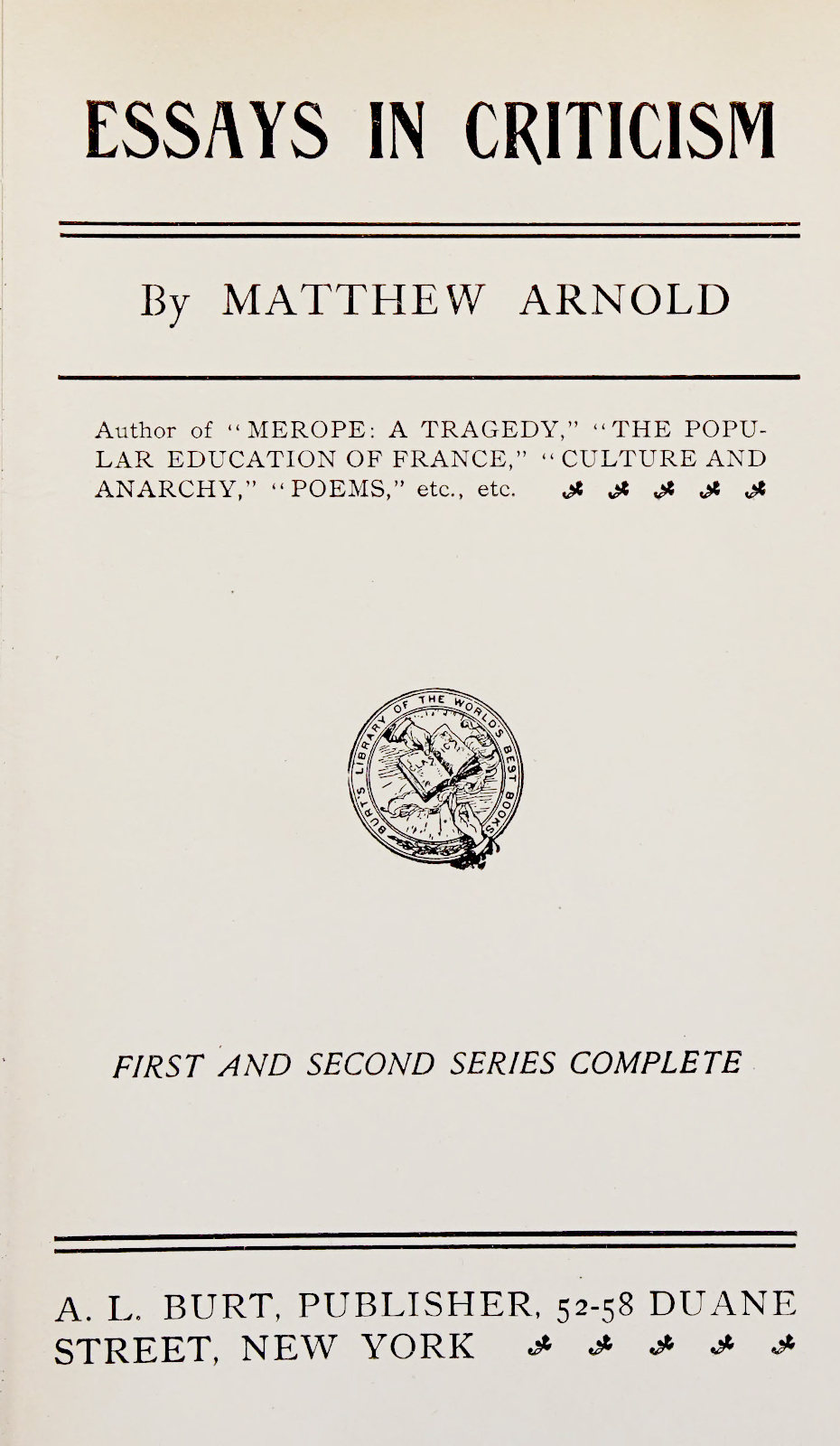
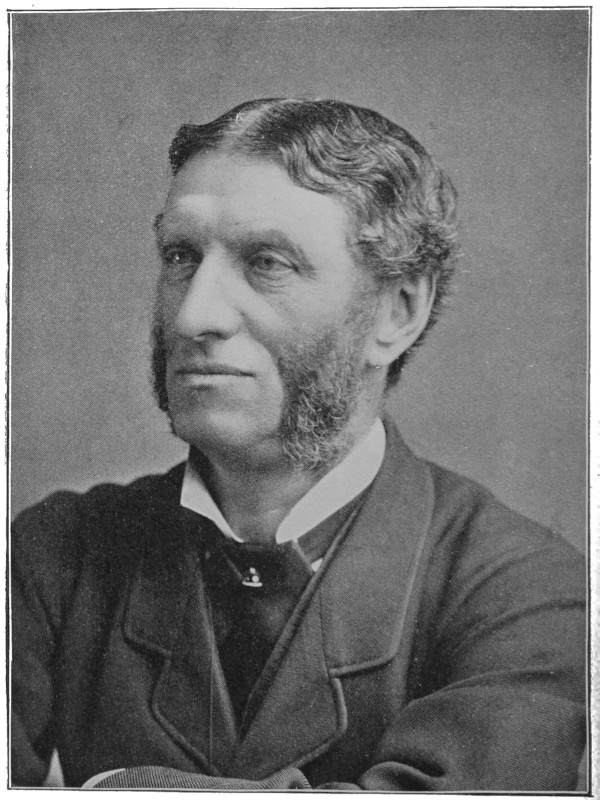
MATTHEW ARNOLD.
By MATTHEW ARNOLD
Author of “MEROPE: A TRAGEDY,” “THE POPULAR
EDUCATION OF FRANCE,” “CULTURE AND
ANARCHY,” “POEMS,” etc., etc.
FIRST AND SECOND SERIES COMPLETE
A. L. BURT, PUBLISHER, 52-58 DUANE
STREET, NEW YORK
PREFACE. (1865,)
v
Several of the Essays which are here collected and
reprinted had the good or the bad fortune to be much
criticized at the time of their first appearance. I am not
now going to inflict upon the reader a reply to those criticisms;
for one or two explanations which are desirable, I
shall elsewhere, perhaps, be able some day to find an opportunity;
but, indeed, it is not in my nature,—some of
my critics would rather say, not in my power,—to dispute
on behalf of any opinion, even my own, very obstinately.
To try and approach truth on one side after another, not
to strive or cry, nor to persist in pressing forward, on any
one side, with violence and self-will,—it is only thus, it
seems to me, that mortals may hope to gain any vision of
the mysterious Goddess, whom we shall never see except
in outline, but only thus even in outline. He who will
do nothing but fight impetuously towards her on his own,
one, favorite, particular line, is inevitably destined to run
his head into the folds of the black robe in which she is
wrapped.
So it is not to reply to my critics that I write this
preface, but to prevent a misunderstanding, of which
certain phrases that some of them use make me apprehensive.
Mr. Wright, one of the many translators of
Homer, has published a letter to the Dean of Canterbury,
complaining of some remarks of mine, uttered now a long
while ago, on his version of the Iliad. One cannot be always
studying one’s own works, and I was really under
the impression, till I saw Mr. Wright’s complaint, that I
vihad spoken of him with all respect. The reader may
judge of my astonishment, therefore, at finding, from Mr.
Wright’s pamphlet, that I had “declared with much solemnity
that there is not any proper reason for his existing.”
That I never said; but, on looking back at my
Lectures on translating Homer, I find that I did say, not
that Mr. Wright, but that Mr. Wright’s version of the
Iliad, repeating in the main the merits and defects of
Cowper’s version, as Mr. Sotheby’s repeated those of Pope’s
version, had, if I might be pardoned for saying so, no
proper reason for existing. Elsewhere I expressly spoke
of the merit of his version; but I confess that the phrase,
qualified as I have shown, about its want of a proper
reason for existing, I used. Well, the phrase had, perhaps,
too much vivacity; we have all of us a right to
exist, we and our works; an unpopular author should be
the last person to call in question this right. So I gladly
withdraw the offending phrase, and I am sorry for having
used it; Mr. Wright, however, would perhaps be more indulgent
to my vivacity, if he considered that we are none
of us likely to be lively much longer. My vivacity is but
the last sparkle of flame before we are all in the dark,
the last glimpse of color before we all go into drab,—the
drab of the earnest, prosaic, practical, austerely literal
future. Yes, the world will soon be the Philistines’! and
then, with every voice, not of thunder, silenced, and the
whole earth filled and ennobled every morning by the
magnificent roaring of the young lions of the Daily Telegraph,
we shall all yawn in one another’s faces with the
dismallest, the most unimpeachable gravity.
But I return to my design in writing this Preface.
That design was, after apologizing to Mr. Wright for my
vivacity of five years ago, to beg him and others to let me
bear my own burdens, without saddling the great and
famous University to which I have the honor to belong
with any portion of them. What I mean to deprecate is
such phrases as, “his professorial assault,” “his assertions
issued ex cathedrâ,” “the sanction of his name as the
representative of poetry,” and so on. Proud as I am of my
viiconnection with the University of Oxford,[1] I can truly
say, that knowing how unpopular a task one is undertaking
when one tries to pull out a few more stops in that
powerful but at present somewhat narrow-toned organ,
the modern Englishman, I have always sought to stand
by myself, and to compromise others as little as possible.
Besides this, my native modesty is such, that I have always
been shy of assuming the honorable style of Professor,
because this is a title I share with so many distinguished
men,—Professor Pepper, Professor Anderson, Professor
Frickel, and others,—who adorn it, I feel, much more
than I do.
However, it is not merely out of modesty that I prefer
to stand alone, and to concentrate on myself, as a plain
citizen of the republic of letters, and not as an office-bearer
in a hierarchy, the whole responsibility for all I
write; it is much more out of genuine devotion to the
University of Oxford, for which I feel, and always must
feel, the fondest, the most reverential attachment. In an
epoch of dissolution and transformation, such as that on
which we are now entered, habits, ties, and associations
are inevitably broken up, the action of individuals becomes
more distinct, the shortcomings, errors, heats, disputes,
which necessarily attend individual action, are brought
into greater prominence. Who would not gladly keep
clear, from all these passing clouds, an august institution
which was there before they arose, and which will be
there when they have blown over?
It is true, the Saturday Review maintains that our epoch
of transformation is finished; that we have found our philosophy;
that the British nation has searched all anchorages
for the spirit, and has finally anchored itself, in the
fulness of perfected knowledge, on Benthamism. This
idea at first made a great impression on me; not only because
it is so consoling in itself, but also because it explained
a phenomenon which in the summer of last year
had, I confess, a good deal troubled me. At that time
viiimy avocations led me travel almost daily on one of the
Great Eastern Lines,—the Woodford Branch. Every
one knows that the murderer, Müller, perpetrated his detestable
act on the North London Railway, close by. The
English middle class, of which I am myself a feeble unit,
travel on the Woodford Branch in large numbers. Well,
the demoralization of our class,—the class which (the
newspapers are constantly saying it, so I may repeat it
without vanity) has done all the great things which have
ever been done in England,—the demoralization, I say,
of our class, caused by the Bow tragedy, was something
bewildering. Myself a transcendentalist (as the Saturday
Review knows), I escaped the infection; and, day after
day, I used to ply my agitated fellow-travelers with all the
consolations which my transcendentalism would naturally
suggest to me. I reminded them how Cæsar refused to
take precautions against assassination, because life was
not worth having at the price of an ignoble solicitude for
it. I reminded them what insignificant atoms we all are
in the life of the world. “Suppose the worst to happen,”
I said, addressing a portly jeweler from Cheapside; “suppose
even yourself to be the victim; il n’y a pas d’homme
nécessaire. We should miss you for a day or two upon
the Woodford Branch; but the great mundane movement
would still go on, the gravel walks of your villa would still
be rolled, dividends would still be paid at the Bank, omnibuses
would still run, there would still be the old crush at
the corner of Fenchurch Street.” All was of no avail.
Nothing could moderate, in the bosom of the great English
middle-class, their passionate, absorbing, almost
bloodthirsty clinging to life. At the moment I thought
this over-concern a little unworthy; but the Saturday
Review suggests a touching explanation of it. What I
took for the ignoble clinging to life of a comfortable
worldling, was, perhaps, only the ardent longing of a
faithful Benthamite, traversing an age still dimmed by
the last mists of transcendentalism, to be spared long
enough to see his religion in the full and final blaze of its
triumph. This respectable man, whom I imagined to be
ixgoing up to London to serve his shop, or to buy shares, or
to attend an Exeter Hall meeting, or to assist at the deliberations
of the Marylebone Vestry, was even, perhaps,
in real truth, on a pious pilgrimage, to obtain from Mr.
Bentham’s executors a secret bone of his great, dissected
master.
And yet, after all, I cannot but think that the Saturday
Review has here, for once, fallen a victim to an
idea,—a beautiful but a deluding idea,—and that the
British nation has not yet, so entirely as the reviewer
seems to imagine, found the last word of its philosophy.
No, we are all seekers still! seekers often make mistakes,
and I wish mine to redound to my own discredit only, and
not to touch Oxford. Beautiful city! so venerable, so
lovely, so unravaged by the fierce intellectual life of our
century, so serene!
“There are our young barbarians, all at play!”
And yet, steeped in sentiment as she lies, spreading her
gardens to the moonlight, and whispering from her towers
the last enchantments of the Middle Age, who will deny
that Oxford, by her ineffable charm, keeps ever calling us
nearer to the true goal of all of us, to the ideal, to perfection,—to
beauty, in a word, which is only truth seen
from another side?—nearer, perhaps, than all the science
of Tübingen. Adorable dreamer, whose heart has been
so romantic! who hast given thyself so prodigally, given
thyself to sides and to heroes not mine, only never to the
Philistines! home of lost causes, and forsaken beliefs, and
unpopular names, and impossible loyalties! what example
could ever so inspire us to keep down the Philistine in
ourselves, what teacher could ever so save us from that
bondage to which we are all prone, that bondage which
Goethe, in his incomparable lines on the death of Schiller,
makes it his friend’s highest praise (and nobly did
Schiller deserve the praise) to have left miles out of sight
behind him;—the bondage of “was uns alle bändigt,
DAS GEMEINE!” She will forgive me, even if I have unwittingly
xdrawn upon her a shot or two aimed at her unworthy
son; for she is generous, and the cause in which
I fight is, after all, hers. Apparitions of a day, what is
our puny warfarewarfare against the Philistines, compared with
the warfare which this queen of romance has been waging
against them for centuries, and will wage after we are
gone?
Many objections have been made to a proposition
which, in some remarks of mine on translating Homer, I
ventured to put forth; a proposition about criticism, and
its importance at the present day. I said: “Of the literature
of France and Germany, as of the intellect of
Europe in general, the main effort, for now many years,
has been a critical effort; the endeavor, in all branches
of knowledge, theology, philosophy, history, art, science,
to see the object as in itself it really is.” I added, that
owing to the operation in English literature of certain
causes, “almost the last thing for which one would come
to English literature is just that very thing which now
Europe most desires,—criticism;” and that the power
and value of English literature was thereby impaired.
More than one rejoinder declared that the importance I
here assigned to criticism was excessive, and asserted the
inherent superiority of the creative effort of the human
spirit over its critical effort. And the other day, having
been led by a Mr. Shairp’s excellent notice of Wordsworth[2]
to turn again to his biography, I found, in the
2words of this great man, whom I, for one, must always
listen to with the profoundest respect, a sentence passed
on the critic’s business, which seems to justify every possible
disparagement of it. Wordsworth says in one of his
letters:—
“The writers in these publications” (the Reviews),
“while they prosecute their inglorious employment, cannot
be supposed to be in a state of mind very favorable
for being affected by the finer influences of a thing so
pure as genuine poetry.”
And a trustworthy reporter of his conversation quotes
a more elaborate judgment to the same effect:—
“Wordsworth holds the critical power very low, infinitely
lower than the inventive; and he said to-day that if
the quantity of time consumed in writing critiques on the
works of others were given to original composition, of
whatever kind it might be, it would be much better employed;
it would make a man find out sooner his own
level, and it would do infinitely less mischief. A false or
malicious criticism may do much injury to the minds of
others, a stupid invention, either in prose or verse, is
quite harmless.”
It is almost too much to expect of poor human nature,
that a man capable of producing some effect in one line of
literature, should, for the greater good of society, voluntarily
doom himself to impotence and obscurity in another.
Still less is this to be expected from men addicted
to the composition of the “false or malicious criticism”
of which Wordsworth speaks. However, everybody
would admit that a false or malicious criticism had better
never have been written. Everybody, too, would be willing
to admit, as a general proposition, that the critical
faculty is lower than the inventive. But is it true that
criticism is really, in itself, a baneful and injurious employment;
3is it true that all time given to writing critiques
on the works of others would be much better employed
if it were given to original composition, of whatever
kind this may be? Is it true that Johnson had
better have gone on producing more Irenes instead of
writing his Lives of the Poets; nay, is it certain that
Wordsworth himself was better employed in making his
Ecclesiastical Sonnets than when he made his celebrated
Preface, so full of criticism, and criticism of the works of
others? Wordsworth was himself a great critic, and it is
to be sincerely regretted that he has not left us more criticism;
Goethe was one of the greatest of critics, and we
may sincerely congratulate ourselves that he has left us so
much criticism. Without wasting time over the exaggeration
which Wordsworth’s judgment on criticism clearly
contains, or over an attempt to trace the causes,—not
difficult, I think, to be traced,—which may have led
Wordsworth to this exaggeration, a critic may with advantage
seize an occasion for trying his own conscience,
and for asking himself of what real service at any given
moment the practice of criticism either is or may be made
to his own mind and spirit, and to the minds and spirits
of others.
The critical power is of lower rank than the creative.
True; but in assenting to this proposition, one or two
things are to be kept in mind. It is undeniable that the
exercise of a creative power, that a free creative activity,
is the highest function of man; it is proved to be so by
man’s finding in it his true happiness. But it is undeniable,
also, that men may have the sense of exercising this
free creative activity in other ways than in producing
great works of literature or art; if it were not so, all but
a very few men would be shut out from the true happiness
of all men. They may have it in well-doing, they may
have it in learning, they may have it even in criticizing.
This is one thing to be kept in mind. Another is, that
the exercise of the creative power in the production of
great works of literature or art, however high this exercise
of it may rank, is not at all epochs and under all
4conditions possible; and that therefore labor may be
vainly spent in attempting it, which might with more
fruit be used in preparing for it, in rendering it possible.
This creative power works with elements, with
materials; what if it has not those materials, those
elements, ready for its use? In that case it must surely
wait till they are ready. Now, in literature,—I will limit
myself to literature, for it is about literature that the
question arises,—the elements with which the creative
power works are ideas; the best ideas on every matter
which literature touches, current at the time. At any
rate we may lay it down as certain that in modern literature
no manifestation of the creative power not working
with these can be very important or fruitful. And I say
current at the time, not merely accessible at the time; for
creative literary genius does not principally show itself in
discovering new ideas, that is rather the business of the
philosopher. The grand work of literary genius is a work
of synthesis and exposition, not of analysis and discovery;
its gift lies in the faculty of being happily inspired by a
certain intellectual and spiritual atmosphere, by a certain
order of ideas, when it finds itself in them; of dealing
divinely with these ideas, presenting them in the most
effective and attractive combinations,—making beautiful
works with them, in short. But it must have the atmosphere,
it must find itself amidst the order of ideas, in
order to work freely; and these it is not so easy to command.
This is why great creative epochs in literature are
so rare, this is why there is so much that is unsatisfactory
in the productions of many men of real genius; because,
for the creation of a master-work of literature two powers
must concur, the power of the man and the power of the
moment, and the man is not enough without the moment;
the creative power has, for its happy exercise, appointed
elements, and those elements are not in its own control.
Nay, they are more within the control of the critical
power. It is the business of the critical power, as I said
in the words already quoted, “in all branches of knowledge,
theology, philosophy, history, art, science, to see the object
5as in itself it really is.” Thus it tends, at last, to make
an intellectual situation of which the creative power can
profitably avail itself. It tends to establish an order of
ideas, if not absolutely true, yet true by comparison with
that which it displaces; to make the best ideas prevail.
Presently these new ideas reach society, the touch of truth
is the touch of life, and there is a stir and growth everywhere;
out of this stir and growth come the creative
epochs of literature.
Or, to narrow our range, and quit these considerations
of the general march of genius and of society,—considerations
which are apt to become too abstract and impalpable,—every
one can see that a poet, for instance, ought to
know life and the world before dealing with them in
poetry; and life and the world being in modern times very
complex things, the creation of a modern poet, to be worth
much, implies a great critical effort behind it; else it must
be a comparatively poor, barren, and short-lived affair.
This is why Byron’s poetry had so little endurance in it,
and Goethe’s so much; both Byron and Goethe had a great
productive power, but Goethe’s was nourished by a great
critical effort providing the true materials for it, and
Byron’s was not; Goethe knew life and the world, the
poet’s necessary subjects, much more comprehensively
and thoroughly than Byron. He knew a great deal more
of them, and he knew them much more as they really are.
It has long seemed to me that the burst of creative
activity in our literature, through the first quarter of this
century, had about it in fact something premature; and
that from this cause its productions are doomed, most of
them, in spite of the sanguine hopes which accompanied
and do still accompany them to prove hardly more lasting
than the productions of far less splendid epochs. And
this prematureness comes from its having proceeded without
having its proper data, without sufficient materials to
work with. In other words, the English poetry of the
first quarter of this century, with plenty of energy, plenty
of creative force, did not know enough. This makes Byron
so empty of matter, Shelley so incoherent, Wordsworth
6even, profound as he is, yet so wanting in completeness
and variety. Wordsworth cared little for books, and disparaged
Goethe. I admire Wordsworth, as he is, so much
that I cannot wish him different; and it is vain, no doubt,
to imagine such a man different from what he is, to suppose
that he could have been different. But surely the
one thing wanting to make Wordsworth an even greater
poet than he is,—his thought richer, and his influence of
wider application,—was that he should have read more
books, among them, no doubt, those of that Goethe whom
he disparaged without reading him.
But to speak of books and reading may easily lead to a
misunderstanding here. It was not really books and
reading that lacked to our poetry at this epoch; Shelley
had plenty of reading, Coleridge had immense reading.
Pindar and Sophocles—as we all say so glibly, and often
with so little discernment of the real import of what we
are saying—had not many books; Shakespeare was no deep
reader. True; but in the Greece of Pindar and Sophocles,
in the England of Shakespeare, the poet lived in a
current of ideas in the highest degree animating and
nourishing to the creative power; society was, in the
fullest measure, permeated by fresh thought, intelligent
and alive. And this state of things is the true basis for
the creative power’s exercise, in this it finds its data, its
materials, truly ready for its hand; all the books and
reading in the world are only valuable as they are helps
to this. Even when this does not actually exist, books
and reading may enable a man to construct a kind of
semblance of it in his own mind, a world of knowledge
and intelligence in which he may live and work. This is
by no means an equivalent to the artist for the nationally
diffused life and thought of the epochs of Sophocles or
Shakespeare; but, besides that it may be a means of preparation
for such epochs, it does really constitute, if many
share in it, a quickening and sustaining atmosphere of great
value. Such an atmosphere the many-sided learning and
the long and widely-combined critical effort of Germany
formed for Goethe, when he lived and worked. There
7was no national glow of life and thought there as in the
Athens of Pericles or the England of Elizabeth. That
was the poet’s weakness. But there was a sort of equivalent
for it in the complete culture and unfettered thinking
of a large body of Germans. That was his strength.
In the England of the first quarter of this century there
was neither a national glow of life and thought, such as
we had in the age of Elizabeth, nor yet a culture and a
force of learning and criticism such as were to be found
in Germany. Therefore the creative power of poetry
wanted, for success in the highest sense, materials and a
basis; a thorough interpretation of the world was necessarily
denied to it.
At first sight it seems strange that out of the immense
stir of the French Revolution and its age should not have
come a crop of works of genius equal to that which came
out of the stir of the great productive time of Greece, or
out of that of the Renascence, with its powerful episode
the Reformation. But the truth is that the stir of
the French Revolution took a character which essentially
distinguished it from such movements as these. These
were, in the main, disinterestedly intellectual and spiritual
movements; movements in which the human spirit looked
for its satisfaction in itself and in the increased play of its
own activity. The French Revolution took a political,
practical character. The movement, which went on in
France under the old régime from 1700 to 1789, was far
more really akin than that of the Revolution itself to the
movement of the Renascence; the France of Voltaire and
Rousseau told far more powerfully upon the mind of Europe
than the France of the Revolution. Goethe reproached
this last expressly with having “thrown quiet
culture back.” Nay, and the true key to how much in our
Byron, even in our Wordsworth, is this!—that they had
their source in a great movement of feeling, not in a
great movement of mind. The French Revolution, however,—that
object of so much blind love and so much blind
hatred,—found undoubtedly its motive-power in the intelligence
of men, and not in their practical sense; this
8is what distinguishes it from the English Revolution of
Charles the First’s time. This is what makes it a more
spiritual event than our Revolution, an event of much
more powerful and world-wide interest, though practically
less successful; it appeals to an order of ideas which are
universal, certain, permanent. 1789 asked of a thing, Is
it rational? 1642 asked of a thing, Is it legal? or, when
it went furthest, Is it according to conscience? This is
the English fashion, a fashion to be treated, within its
own sphere, with the highest respect; for its success,
within its own sphere, has been prodigious. But what
is law in one place is not law in another; what is law
here to-day is not law even here to-morrow; and as for
conscience, what is binding on one man’s conscience is
not binding on another’s. The old woman who threw her
stool at the head of the surpliced minister in St. Giles’s
Church at Edinburgh obeyed an impulse to which millions
of the human race may be permitted to remain
strangers. But the prescriptions ofof reason are absolute,
unchanging, of universal validity; to count by tens is the
easiest way of counting—that is a proposition of which
every one, from here to the Antipodes, feels the force; at
least I should say so if we did not live in a country where
it is not impossible that any morning we may find a letter
in the Times declaring that a decimal coinage is an
absurdity. That a whole nation should have been penetrated
with an enthusiasm for pure reason, and with an
ardent zeal for making its prescriptions triumph, is a
very remarkable thing, when we consider how little of
mind, or anything so worthy and quickening as mind, comes
into the motives which alone, in general, impel great
masses of men. In spite of the extravagant direction
given to this enthusiasm, in spite of the crimes and follies
in which it lost itself, the French Revolution derives
from the force, truth, and universality of the ideas which
it took for its law, and from the passion with which it
could inspire a multitude for these ideas, a unique and
still living power; it is—it will probably long remain—the
greatest, the most animating event in history. And
9as no sincere passion for the things of the mind, even
though it turn out in many respects an unfortunate passion,
is ever quite thrown away and quite barren of good, France
has reaped from tiers one fruit—the natural and legitimate
fruit though not precisely the grand fruit she expected:
she is the country in Europe where the people is most alive.
But the mania for giving an immediate political and
practical application to all these fine ideas of the reason
was fatal. Here an Englishman is in his element: on
this theme we can all go on for hours. And all we are
in the habit of saying on it has undoubtedly a great deal
of truth. Ideas cannot be too much prized in and for
themselves cannot be too much lived with; but to transport
them abruptly into the world of politics, and practice,
violently to revolutionize this world to their bidding,—that
is quite another thing. There is the world
of ideas and there is the world of practice; the French
are often for suppressing the one and the English the
other; but neither is to be suppressed. A member of the
House of Commons said to me the other day: “That a
thing is an anomaly, I consider to be no objection to it
whatever.” I venture to think he was wrong; that a
thing is an anomaly is an objection to it, but absolutely
and in the sphere of ideas: it is not necessarily, under
such and such circumstances, or at such and such a moment,
an objection to it in the sphere of politics and
practice. Joubert has said beautifully: “C’est la force et
le droit qui règlent toutes choses dans le monde; la force
en attendant le droit.” (Force and right are the governors
of this world; force till right is ready.) Force
till right is ready; and till right is ready, force, the existing
order of things, is justified, is the legitimate ruler.
But right is something moral, and implies inward recognition,
free assent of the will; we are not ready for right,—right,
so far as we are concerned, is not ready,—until
we have attained this sense of seeing it and willing it.
The way in which for us it may change and transform
force, the existing order of things, and become, in its
turn, the legitimate ruler of the world, should depend on
10the way in which, when our time comes, we see it and
will it. Therefore for other people enamored of their
own newly discerned right, to attempt to impose it upon
us as ours, and violently to substitute their right for our
force, is an act of tyranny, and to be resisted. It sets at
naught the second great half of our maxim, force till
right is ready. This was the grand error of the French
Revolution; and its movement of ideas, by quitting the
intellectual sphere and rushing furiously into the political
sphere, ran, indeed, a prodigious and memorable course,
but produced no such intellectual fruit as the movement
of ideas of the Renascence, and created, in opposition to
itself, what I may call an epoch of concentration. The
great force of that epoch of concentration was England;
and the great voice of that epoch of concentration was
Burke. It is the fashion to treat Burke’s writings on
the French Revolution as superannuated and conquered
by the event; as the eloquent but unphilosophical tirades
of bigotry and prejudice. I will not deny that they
are often disfigured by the violence and passion of the
moment, and that in some directions Burke’s view
was bounded, and his observation therefore at fault. But
on the whole, and for those who can make the needful
corrections, what distinguishes these writings is their
profound, permanent, fruitful, philosophical truth. They
contain the true philosophy of an epoch of concentration,
dissipate the heavy atmosphere which its own nature is
apt to engender round it, and make its resistance rational
instead of mechanical.
But Burke is so great because, almost alone in England,
he brings thought to bear upon politics, he saturates
politics with thought. It is his accident that his ideas
were at the service of an epoch of concentration, not of
an epoch of expansion; it is his characteristic that he so
lived by ideas, and had such a source of them welling up
within him, that he could float even an epoch of concentration
and English Tory politics with them. It does not
hurt him that Dr. Price and the Liberals were enraged
with him; it does not even hurt him that George the
11Third and the Tories were enchanted with him. His
greatness is that he lived in a world which neither English
Liberalism nor English Toryism is apt to enter;—the
world of ideas, not the world of catchwords and party
habits. So far is it from being really true of him that he
“to party gave up what was meant for mankind,” that at
the very end of his fierce struggle with the French Revolution,
after all his invectives against its false pretensions,
hollowness, and madness, with his sincere conviction
of its mischievousness, he can close a memorandum
on the best means of combating it, some of the last pages
he ever wrote,—the Thoughts on French Affairs, in December
1791,—with these striking words:—
“The evil is stated, in my opinion, as it exists. The
remedy must be where power, wisdom, and information,
I hope, are more united with good intentions than they
can be with me. I have done with this subject, I believe,
forever. It has given me many anxious moments for the
last two years. If a great change is to be made in human
affairs, the minds of men will be fitted to it; the general
opinions and feelings will draw that way. Every fear,
every hope will forward it; and then they who persist in
opposing this mighty current in human affairs, will appear
rather to resist the decrees of Providence itself, than
the mere designs of men. They will not be resolute and
firm, but perverse and obstinate.”
That return of Burke upon himself has always seemed
to me one of the finest things in English literature, or indeed
in any literature. That is what I call living by
ideas: when one side of a question has long had your
earnest support, when all your feelings are engaged, when
you hear all around you no language but one, when your
party talks this language like a steam-engine and can
imagine no other,—still to be able to think, still to be
irresistibly carried, if so it be, by the current of thought
to the opposite side of the question, and, like Balaam, to
be unable to speak anything but what the Lord has put in
your mouth. I know nothing more striking, and I must
add that I know nothing more un-English.
12For the Englishman in general is like my friend the
Member of Parliament, and believes, point-blank, that
for a thing to be an anomaly is absolutely no objection to
it whatever. He is like the Lord Auckland of Burke’s
day, who, in a memorandum on the French Revolution,
talks of “certain miscreants, assuming the name of
philosophers, who have presumed themselves capable of
establishing a new system of society.” The Englishman
has been called a political animal, and he values what is
political and practical so much that ideas easily become
objects of dislike in his eyes, and thinkers “miscreants,”
because ideas and thinkers have rashly meddled with
politics and practice. This would be all very well if the
dislike and neglect confined themselves to ideas transported
out of their own sphere, and meddling rashly with
practice; but they are inevitably extended to ideas as
such, and to the whole life of intelligence; practice is
everything, a free play of the mind is nothing. The
notion of the free play of the mind upon all subjects
being a pleasure in itself, being an object of desire, being
an essential provider of elements without which a nation’s
spirit, whatever compensations it may have for them,
must, in the long run, die of inanition, hardly enters into
an Englishman’s thoughts. It is noticeable that the word
curiosity, which in other languages is used in a good
sense, to mean, as a high and fine quality of man’s nature,
just this disinterested love of a free play of the mind on
all subjects, for its own sake,—it is noticeable, I say, that
this word has in our language no sense of the kind, no
sense but a rather bad and disparaging one. But criticism,
real criticism is essentially the exercise of this very quality.
It obeys an instinct prompting it to try to know the
best that is known and thought in the world, irrespectively
of practice, politics, and everything of the kind; and to
value knowledge and thought as they approach this best,
without the intrusion of any other considerations whatever.
This is an instinct for which there is, I think, little
original sympathy in the practical English nature, and
what there was of it has undergone a long benumbing
13period of blight and suppression in the epoch of concentration
which followed the French Revolution.
But epochs of concentration cannot well endure forever;
epochs of expansion, in the due course of things,
follow them. Such an epoch of expansion seems to be
opening in this country. In the first place all danger of a
hostile forcible pressure of foreign ideas upon our practice
has long disappeared; like the traveler in the fable,
therefore, we begin to wear our cloak a little more loosely.
Then, with a long peace, the ideas of Europe steal gradually
and amicably in, and mingle, though in infinitesimally
small quantities at a time, with our own notions. Then,
too, in spite of all that is said about the absorbing and
brutalizing influence of our passionate material progress,
it seems to me indisputable that this progress is likely,
though not certain, to lead in the end to an apparition of
intellectual life; and that man, after he has made himself
perfectly comfortable and has now to determine what to
do with himself next, may begin to remember that he has
a mind, and that the mind may be made the source of
great pleasure. I grant it is mainly the privilege of
faith, at present, to discern this end to our railways,
our business, and our fortune-making; but we shall see
if, here as elsewhere, faith is not in the end the true
prophet. Our ease, our traveling, and our unbounded
liberty to hold just as hard and securely as we please to
the practice to which our notions have given birth, all
tend to beget an inclination to deal a little more freely
with these notions themselves, to canvass them a little, to
penetrate a little into their real nature. Flutterings of
curiosity, in the foreign sense of the word, appear amongst
us, and it is in these that criticism must look to find its
account. Criticism first; a time of true creative activity,
perhaps,—which, as I have said, must inevitably be preceded
amongst us by a time of criticism,—hereafter, when
criticism has done its work.
It is of the last importance that English criticism should
clearly discern what rule for its course, in order to avail
itself of the field now opening to it, and to produce
14fruit for the future, it ought to take. The rule may be
summed up in one word,—disinterestedness. And how is
criticism to show disinterestedness? By keeping aloof
from what is called “the practical view of things;” by
resolutely following the law of its own nature, which is to
be a free play of the mind on all subjects which it touches.
By steadily refusing to lend itself to any of those ulterior,
political, practical considerations about ideas, which plenty
of people will be sure to attach to them, which perhaps
ought often to be attached to them, which in this country
at any rate are certain to be attached to them quite
sufficiently, but which criticism has really nothing to do
with. Its business is, as I have said, simply to know the
best that is known and thought in the world, and by in its
turn making this known, to create a current of true and
fresh ideas. Its business is to do this with inflexible
honesty, with due ability; but its business is to do no
more, and to leave alone all questions of practical consequences
and applications, questions which will never fail
to have due prominence given to them. Else criticism,
besides being really false to its own nature, merely continues
in the old rut which it has hitherto followed in this
country, and will certainly miss the chance now given to
it. For what is at present the bane of criticism in this
country? It is that practical considerations cling to it
and stifle it. It subserves interests not its own. Our
organs of criticism are organs of men and parties having
practical ends to serve, and with them those practical ends
are the first thing and the play of mind the second; so
much play of mind as is compatible with the prosecution
of those practical ends is all that is wanted. An organ
like the Révue des Deux Mondes, having for its main
function to understand and utter the best that is known
and thought in the world, existing, it may be said, as just
an organ for a free play of the mind, we have not. But
we have the Edinburgh Review, existing as an organ of
the old Whigs, and for as much play of the mind as
may suit its being that; we have the Quarterly Review,
existing as an organ of the Tories, and for as much play
15of mind as may suit its being that; we have the British
Quarterly Review, existing as an organ of the political
Dissenters, and for as much play of mind as may suit its
being that; we have the Times, existing as an organ of the
common, satisfied, well-to-do Englishman, and for as
much play of mind as may suit its being that. And so
on through all the various fractions, political and religious,
of our society; every fraction has, as such, its organ of
criticism, but the notion of combining all fractions in the
common pleasure of a free disinterested play of mind
meets with no favor. Directly this play of mind wants
to have more scope, and to forget the pressure of practical
considerations a little, it is checked, it is made to feel the
chain. We saw this the other day in the extinction, so
much to be regretted, of the Home and Foreign Review.
Perhaps in no organ of criticism in this country was there
so much knowledge, so much play of mind; but these
could not save it. The Dublin Review subordinates play
of mind to the practical business of English and Irish
Catholicism, and lives. It must needs be that men should
act in sects and parties, that each of these sects and parties
should have its organ, and should make this organ subserve
the interests of its action; but it would be well, too,
that there should be a criticism, not the minister of these
interests, not their enemy, but absolutely and entirely independent
of them. No other criticism will ever attain
any real authority or make any real way towards its end,—the
creating a current of true and fresh ideas.
It is because criticism has so little kept in the pure intellectual
sphere, has so little detached itself from practice,
has been so directly polemical and controversial, that it
has so ill accomplished, in this country, its best spiritual
work; which is to keep man from a self-satisfaction which
is retarding and vulgarizing, to lead him towards perfection,
by making his mind dwell upon what is excellent
in itself, and the absolute beauty and fitness of things. A
polemical practical criticism makes men blind even to the
ideal imperfection of their practice, makes them willingly
assert its ideal perfection, in order the better to secure it
16against attack: and clearly this is narrowing and baneful
for them. If they were reassured on the practical side,
speculative considerations of ideal perfection they might
be brought to entertain, and their spiritual horizon would
thus gradually widen. Sir Charles Adderly says to the
Warwickshire farmers:
“Talk of the improvement of breed! Why, the race
we ourselves represent, the men and women, the old
Anglo-Saxon race, are the best breed in the whole
world.... The absence of a too enervating climate, too
unclouded skies, and a too luxurious nature, has produced
so vigorous a race of people and has rendered us so superior
to all the world.”
Mr. Roebuck says to the Sheffield cutlers:
“I look around me and ask what is the state of England?
Is not property safe? Is not every man able to
say what he likes? Can you not walk from one end of
England to the other in perfect security? I ask you
whether, the world over or in past history, there is anything
like it? Nothing. I pray that our unrivaled happiness
may last.”
Now obviously there is a peril for poor human nature
in words and thoughts of such exuberant self-satisfaction,
until we find ourselves safe in the streets of the Celestial
City.
“Das wenige verschwindet leicht dem Blicke
Der vorwärts sieht, wie viel noch übrig bleibt—”
says Goethe; “the little that is done seems nothing when
we look forward and see how much we have yet to do.”
Clearly this is a better line of reflection for weak humanity,
so long as it remains on this earthly field of labor and trial.
But neither Sir Charles Adderley nor Mr. Roebuck is
by nature inaccessible to considerations of this sort. They
only lose sight of them owing to the controversial life we
all lead, and the practical form which all speculation takes
with us. They have in view opponents whose aim is not
ideal, but practical; and in their zeal to uphold their own
practice against these innovators, they go so far as even to
17attribute to this practice an ideal perfection. Somebody
has been wanting to introduce a six-pound franchise, or
to abolish church-rates, or to collect agricultural statistics
by force, or to diminish local self-government. How
natural, in reply to such proposals, very likely improper
or ill-timed, to go a little beyond the mark and to say
stoutly, “Such a race of people as we stand, so superior
to all the world! The old Anglo-Saxon race, the best
breed in the whole world! I pray that our unrivaled
happiness may last! I ask you whether, the world over
or in past history, there is anything like it?” And so
long as criticism answers this dithyramb by insisting that
the old Anglo-Saxon race would be still more superior to
all others if it had no church-rates, or that our unrivaled
happiness would last yet longer with a six-pound franchise,
so long will the strain, “The best breed in the whole
world!” swell louder and louder, everything ideal and
refining will be lost out of sight, and both the assailed
and their critics will remain in a sphere, to say the truth,
perfectly unvital, a sphere in which spiritual progression
is impossible. But let criticism leave church-rates and
the franchise alone, and in the most candid spirit, without
a single lurking thought of practical innovation, confront
with our dithyramb this paragraph on which I stumbled
in a newspaper immediately after reading Mr. Roebuck:—
“A shocking child murder has just been committed at
Nottingham. A girl named Wragg left the workhouse
there on Saturday morning with her young illegitimate
child. The child was soon afterwards found dead on
Mapperly Hills, having been strangled. Wragg is in
custody.”
Nothing but that; but, in juxtaposition with the absolute
eulogies of Sir Charles Adderley and Mr. Roebuck,
how eloquent, how suggestive are those few lines! “Our
old Anglo-Saxon breed, the best in the whole world!”—how
much that is harsh and ill-favored there is in this
best! Wragg! If we are to talk of ideal perfection, of
“the best in the whole world,” has any one reflected what
a touch of grossness in our race, what an original shortcoming
18in the more delicate spiritual perceptions, is
shown by the natural growth amongst us of such hideous
names,—Higginbottom, Stiggins, Bugg! In Ionia and
Attica they were luckier in this respect than “the best
race in the world;” by the Ilissus there was no Wragg,
poor thing! And “our unrivaled happiness;”—what
an element of grimness, bareness, and hideousness mixes
with it and blurs it; the workhouse, the dismal Mapperly
Hills,—how dismal those who have seen them will remember;—the
gloom, the smoke, the cold, the strangled illegimate
child! “I ask you whether, the world over or
in past history, there is anything like it?” Perhaps not,
one is inclined to answer; but at any rate, in that case,
the world is very much to be pitied. And the final
touch,—short, bleak and inhuman: Wragg is in custody.
The sex lost in the confusion of our unrivaled happiness;
or (shall I say?) the superfluous Christian name lopped off
by the straightforward vigor of our old Anglo-Saxon breed!
There is profit for the spirit in such contrasts as this; criticism
serves the cause of perfection by establishing them.
By eluding sterile conflict, by refusing to remain in the
sphere where alone narrow and relative conceptions have
any worth and validity, criticism may diminish its momentary
importance, but only in this way has it a chance
of gaining admittance for those wider and more perfect
conceptions to which all its duty is really owed. Mr.
Roebuck will have a poor opinion of an adversary who replies
to his defiant songs of triumph only by murmuring
under his breath, Wragg is in custody; but in no other
way will these songs of triumph be induced gradually to
moderate themselves, to get rid of what in them is excessive
and offensive, and to fall into a softer and truer key.
It will be said that it is a very subtle and indirect
action which I am thus prescribing for criticism, and that,
by embracing in this manner the Indian virtue of detachment
and abandoning the sphere of practical life, it
condemns itself to a slow and obscure work. Slow and
obscure it may be, but it is the only proper work of criticism.
The mass of mankind will never have any ardent
19zeal for seeing things as they are; very inadequate ideas
will always satisfy them. On these inadequate ideas reposes,
and must repose, the general practice of the world. That
is as much as saying that whoever sets himself to see things
as they are will find himself one of a very small circle; but
it is only by this small circle resolutely doing its own work
that adequate ideas will ever get current at all. The rush
and roar of practical life will always have a dizzying and
attracting effect upon the most collected spectator, and
tend to draw him into its vortex; most of all will this be
the case where that life is so powerful as it is in England.
But it is only by remaining collected, and refusing to lend
himself to the point of view of the practical man, that the
critic can do the practical man any service; and it is only
by the greatest sincerity in pursuing his own course, and
by at last convincing even the practical man of his sincerity,
that he can escape misunderstandings which perpetually
threaten him.
For the practical man is not apt for fine distinctions,
and yet in these distinctions truth and the highest culture
greatly find their account. But it is not easy to lead a
practical man,—unless you reassure him as to your practical
intentions, you have no chance of leading him,—to
see that a thing which he has always been used to look at
from one side only, which he greatly values, and which,
looked at from that side, quite deserves, perhaps, all the
prizing and admiring which he bestows upon it,—that
this thing, looked at from another side, may appear much
less beneficent and beautiful, and yet retain all its claims
to our practical allegiance. Where shall we find language
innocent enough, how shall we make the spotless purity
of our intentions evident enough, to enable us to say to
the political Englishman that the British Constitution itself,
which, seen from the practical side, looks such a
magnificent organ of progress and virtue, seen from the
speculative side,—with its compromises, its love of facts,
its horror of theory, its studied avoidance of clear
thoughts,—that, seen from this side, our august Constitution
sometimes looks,—forgive me, shade of Lord Somers!—a
20colossal machine for the manufacture of Philistines?
How is Cobbett to say this and not be misunderstood,
blackened as he is with the smoke of a lifelong conflict in
the field of political practice? how is Mr. Carlyle to say
it and not be misunderstood, after his furious raid into
this field with his Latter-day Pamphlets? how is Mr.
Ruskin, after his pugnacious political economy? I say,
the critic must keep out of the region of immediate practice
in the political, social, humanitarian sphere, if he
wants to make a beginning for that more free speculative
treatment of things, which may perhaps one day make its
benefits felt even in this sphere, but in a natural and
thence irresistible manner.
Do what he will, however, the critic will still remain exposed
to frequent misunderstandings, and nowhere so
much as in this country. For here people are particularly
indisposed even to comprehend that without this
free disinterested treatment of things, truth and the
highest culture are out of the question. So immersed are
they in practical life, so accustomed to take all their notions
from this life and its processes, that they are apt to
think that truth and culture themselves can be reached
by the processes of this life, and that it is an impertinent
singularity to think of reaching them in any other. “We
are all terræ filii,” cries their eloquent advocate; “all Philistines
together. Away with the notion of proceeding by
any other course than the course dear to the Philistines;
let us have a social movement, let us organize and combine
a party to pursue truth and new thought, let us call it the
liberal party, and let us all stick to each other, and back
each other up. Let us have no nonsense about independent
criticism, and intellectual delicacy, and the few and
the many. Don’t let us trouble ourselves about foreign
thought; we shall invent the whole thing for ourselves as
we go along. If one of us speaks well, applaud him;
if one of us speaks ill, applaud him too; we are all in the
same movement, we are all liberals, we are all in pursuit of
truth.” In this way the pursuit of truth becomes really
a social, practical, pleasurable affair, almost requiring a
21chairman, a secretary, and advertisements; with the excitement
of an occasional scandal, with a little resistance
to give the happy sense of difficulty overcome; but,
in general, plenty of bustle and very little thought. To
act is so easy, as Goethe says; to think is so hard! It
is true that the critic has many temptations to go with
the stream, to make one of the party movement, one of
these terræ filii; it seems ungracious to refuse to be a
terræ filius, when so many excellent people are; but the
critic’s duty is to refuse, or, if resistance is vain, at least
to cry with Obermann: Périssons en résistant.
How serious a matter it is to try and resist, I had ample
opportunity of experiencing when I ventured some time
ago to criticize the celebrated first volume of Bishop
Colenso.[3] The echoes of the storm which was then raised
I still, from time to time, hear grumbling around me.
That storm arose out of a misunderstanding almost inevitable.
It is a result of no little culture to attain to a
clear perception that science and religion are two wholly
different things. The multitude will for ever confuse
them; but happily that is of no great real importance, for
while the multitude imagines itself to live by its false
science, it does really live by its true religion. Dr.
Colenso, however, in his first volume did all he could
to strengthen the confusion,[4] and to make it dangerous.
22He did this with the best intentions, I freely admit,
and with the most candid ignorance that this was
the natural effect of what he was doing; but, says
Joubert, “Ignorance, which in matters of morals extenuates
the crime, is itself, in intellectual matters, a
crime of the first order.” I criticized Bishop Colenso’s
speculative confusion. Immediately there was a cry
raised: “What is this? here is a liberal attacking a
liberal. Do not you belong to the movement? are not
you a friend of truth? Is not Bishop Colenso in pursuit
of truth? then speak with proper respect of his book.
Dr. Stanley is another friend of truth, and you speak with
proper respect of his book; why make these invidious
differences? both books are excellent, admirable, liberal;
Bishop Colenso’s perhaps the most so, because it is the
boldest, and will have the best practical consequences for
the liberal cause. Do you want to encourage to the attack
of a brother liberal his, and your, and our implacable
enemies, the Church and State Review or the Record,—the
High Church rhinoceros and the Evangelical hyena? Be
silent, therefore; or rather speak, speak as loud as ever
you can! and go into ecstasies over the eighty and odd
pigeons.”
But criticism cannot follow this coarse and indiscriminate
method. It is unfortunately possible for a man in pursuit
of truth to write a book which reposes upon a false conception.
Even the practical consequences of a book are
to genuine criticism no recommendation of it, if the book
is, in the highest sense, blundering. I see that a lady
who herself, too, is in pursuit of truth, and who writes
with great ability, but a little too much, perhaps, under
the influence of the practical spirit of the English liberal
movement, classes Bishop Colenso’s book and M. Renan’s
together, in her survey of the religious state of Europe,
as facts of the same order, works, both of them, of “great
importance;” “great ability, power, and skill;” Bishop
Colenso’s, perhaps, the most powerful; at least, Miss
Cobbe gives special expression to her gratitude that to
Bishop Colenso “has been given the strength to grasp,
23and the courage to teach, truths of such deep import.”
In the same way, more than one popular writer has compared
him to Luther. Now it is just this kind of false
estimate which the critical spirit is, it seems to me, bound
to resist. It is really the strongest possible proof of the
low ebb at which, in England, the critical spirit is, that
while the critical hit in the religious literature of Germany
is Dr. Strauss’s book, in that of France M. Renan’s book,
the book of Bishop Colenso is the critical hit in the religious
literature of England. Bishop Colenso’s book reposes
on a total misconception of the essential elements of
the religious problem, as that problem is now presented
for solution. To criticism, therefore, which seeks to have
the best that is known and thought on this problem, it is,
however well meant, of no importance whatever. M.
Renan’s book attempts a new synthesis of the elements
furnished to us by the Four Gospels. It attempts, in my
opinion, a synthesis, perhaps premature, perhaps impossible,
certainly not successful. Up to the present time,
at any rate, we must acquiesce in Fleury’s sentence on
such recastings of the Gospel-story: Quiconque s’imagine
la pouvoir mieux écrire, ne l’entend pas. M. Renan had
himself passed by anticipation a like sentence on his own
work, when he said: “If a new presentation of the
character of Jesus were offered to me, I would not have it;
its very clearness would be, in my opinion, the best proof
of its insufficiency.” His friends may with perfect justice
rejoin that at the sight of the Holy Land, and of the
actual scene of the Gospel-story, all the current of M.
Renan’s thoughts may have naturally changed, and a new
casting of that story irresistibly suggested itself to him;
and that this is just a case for applying Cicero’s maxim:
Change of mind is not inconsistency—nemo doctus unquam
mutationem consilii inconstantiam dixit esse. Nevertheless,
for criticism, M. Renan’s first thought must still be
the truer one, as long as his new casting so fails more
fully to commend itself, more fully (to use Coleridge’s
happy phrase about the Bible) to find us. Still M.
Renan’s attempt is, for criticism, of the most real interest
24and importance, since, with all its difficulty, a fresh synthesis
of the New Testament data,—not a making war on
them, in Voltaire’s fashion, not a leaving them out of
mind, in the world’s fashion, but the putting a new construction
upon them, the taking them from under the
old, traditional, conventional point of view and placing
them under a new one,—is the very essence of the
religious problem, as now presented; and only by efforts
in this direction can it receive a solution.
Again, in the same spirit in which she judges Bishop
Colenso, Miss Cobbe, like so many earnest liberals of our
practical race, both here and in America, herself sets
vigorously about a positive reconstruction of religion, about
making a religion of the future out of hand, or at least
setting about making it. We must not rest, she and they
are always thinking and saying, in negative criticism,
we must be creative and constructive; hence we have
such works as her recent Religious Duty, and works still
more considerable, perhaps, by others, which will be in
every one’s mind. These works often have much ability;
they often spring out of sincere convictions, and a sincere
wish to do good; and they sometimes, perhaps, do good.
Their fault is (if I may be permitted to say so) one which
they have in common with the British College of Health,
in the New Road. Every one knows the British College
of Health; it is that building with the lion and the statue
of the Goddess Hygeia before it; at least I am sure about
the lion, though I am not absolutely certain about the
Goddess Hygeia. This building does credit, perhaps, to
the resources of Dr. Morrison and his disciples; but it
falls a good deal short of one’s idea of what a British
College of Health ought to be. In England, where we
hate public interference and love individual enterprise,
we have a whole crop of places like the British College of
Health; the grand name without the grand thing.
Unluckily, creditable to individual enterprise as they are,
they tend to impair our taste by making us forget what
more grandiose, noble, or beautiful character properly belongs
to a public institution. The same may be said of
25the religions of the future of Miss Cobbe and others.
Creditable, like the British College of Health, to the resources
of their authors, they yet tend to make us forget
what more grandiose, noble, or beautiful character properly
belongs to religious constructions. The historic religions,
with all their faults, have had this; it certainly belongs
to the religious sentiment, when it truly flowers, to have
this; and we impoverish our spirit if we allow a religion
of the future without it. What then is the duty of criticism
here? To take the practical point of view, to applaud
the liberal movement and all its works,—its New
Road religions of the future into the bargain,—for their
general utility’s sake? By no means; but to be perpetually
dissatisfied with these works, while they perpetually
fall short of a high and perfect ideal.
For criticism, these are elementary laws; but they never
can be popular, and in this country they have been very
little followed, and one meets with immense obstacles in
following them. That is a reason for asserting them again
and again. Criticism must maintain its independence of
the practical spirit and its aims. Even with well-meant
efforts of the practical spirit it must express dissatisfaction,
if in the sphere of the ideal they seem impoverishing
and limiting. It must not hurry on to the goal because
of its practical importance. It must be patient,
and know how to wait; and flexible, and know how to attach
itself to things and how to withdraw from them. It
must be apt to study and praise elements that for the fulness
of spiritual perfection are wanted, even though they
belong to a power which in the practical sphere may be
maleficent. It must be apt to discern the spiritual shortcomings
or illusions of powers that in the practical sphere
may be beneficent. And this without any notion of favoring
or injuring, in the practical sphere, one power or the
other; without any notion of playing off, in this sphere,
one power against the other. When one looks, for instance,
at the English Divorce Court—an institution
which perhaps has its practical conveniences, but which
in the ideal sphere is so hideous; an institution which
26neither makes divorce impossible nor makes it decent,
which allows a man to get rid of his wife, or a wife of her
husband, but makes them drag one another first, for the
public edification, through a mire of unutterable infamy,—when
one looks at this charming institution, I say, with
its crowded trials, its newspaper reports, and its money
compensations, this institution in which the gross unregenerate
British Philistine has indeed stamped an image
of himself,—one may be permitted to find the marriage
theory of Catholicism refreshing and elevating. Or when
Protestantism, in virtue of its supposed rational and intellectual
origin, gives the law to criticism too magisterially,
criticism may and must remind it that its pretensions,
in this respect, are illusive and do it harm; that
the Reformation was a moral rather than an intellectual
event; that Luther’s theory of grace no more exactly reflects
the mind of the spirit than Bossuet’s philosophy of
history reflects it; and that there is no more antecedent
probability of the Bishop of Durham’s stock of ideas being
agreeable to perfect reason than of Pope Pius the
Ninth’s. But criticism will not on that account forget
the achievements of Protestantism in the practical and
moral sphere; nor that, even in the intellectual sphere,
Protestantism, though in a blind and stumbling manner,
carried forward the Renascence, while Catholicism threw
itself violently across its path.
I lately heard a man of thought and energy contrasting
the want of ardor and movement which he now found
amongst young men in this country with what he remembered
in his own youth, twenty years ago. “What reformers
we were then!” he exclaimed; “What a zeal
we had! how we canvassed every institution in Church
and State, and were prepared to remodel them all on first
principles!” He was inclined to regret, as a spiritual
flagging, the lull which he saw. I am disposed rather to
regard it as a pause in which the turn to a new mode of
spiritual progress is being accomplished. Everything
was long seen, by the young and ardent amongst us, in
inseparable connection with politics and practical life.
27We have pretty well exhausted the benefits of seeing
things in this connection, we have got all that can be got
by so seeing them. Let us try a more disinterested mode
of seeing them; let us betake ourselves more to the
serener life of the mind and spirit. This life, too, may
have its excesses and dangers; but they are not for us at
present. Let us think of quietly enlarging our stock of
true and fresh ideas, and not, as soon as we get an idea
or half an idea, be running out with it into the street, and
trying to make it rule there. Our ideas will, in the end,
shape the world all the better for maturing a little. Perhaps
in fifty years’ time it will in the English House of
Commons be an objection to an institution that it is an
anomaly, and my friend the Member of Parliament will
shudder in his grave. But let us in the meanwhile rather
endeavor that in twenty years’ time it may, in English
literature, be an objection to a proposition that it is absurd.
That will be a change so vast, that the imagination
almost fails to grasp it. Ab integro sæclorum nascitur
ordo.
If I have insisted so much on the course which criticism
must take where politics and religion are concerned, it is
because, where these burning matters are in question, it is
most likely to go astray. I have wished, above all, to insist
on the attitude which criticism should adopt towards
things in general; on its right tone and temper of mind.
But then comes another question as to the subject-matter
which literary criticism should most seek. Here, in
general, its course is determined for it by the idea which is
the law of its being; the idea of a disinterested endeavor
to learn and propagate the best that is known and thought
in the world, and thus to establish a current of fresh and
true ideas. By the very nature of things, as England is
not all the world, much of the best that is known and
thought in the world cannot be of English growth, must
be foreign; by the nature of things, again, it is just this
that we are least likely to know, while English thought is
streaming in upon us from all sides, and takes excellent
care that we shall not be ignorant of its existence. The
28English critic of literature, therefore, must dwell much
on foreign thought, and with particular heed on any part
of it, which, while significant and fruitful in itself, is for
any reason specially likely to escape him. Again, judging
is often spoken of as the critic’s one business, and so
in some sense it is; but the judgment which almost insensibly
forms itself in a fair and clear mind, along with
fresh knowledge, is the valuable one; and thus knowledge,
and ever fresh knowledge, must be the critic’s
great concern for himself. And it is by communicating
fresh knowledge, and letting his own judgment pass
along with it,—but insensibly, and in the second place,
not the first, as a sort of companion and clue, not as an
abstract lawgiver,—that the critic will generally do most
good to his readers. Sometimes, no doubt, for the sake
of establishing an author’s place in literature, and his
relation to a central standard (and if this is not done, how
are we to get at our best in the world?) criticism may have
to deal with a subject-matter so familiar that fresh knowledge
is out of the question, and then it must be all judgment;
an enunciation and detailed application of principles.
Here the great safeguard is never to let oneself
become abstract, always to retain an intimate and lively
consciousness of the truth of what one is saying, and, the
moment this fails us, to be sure that something is wrong.
Still, under all circumstances, this mere judgment and
application of principles is, in itself, not the most satisfactory
work to the critic; like mathematics, it is tautological,
and cannot well give us, like fresh learning, the
sense of creative activity.
But stop, some one will say; all this talk is of no practical
use to us whatever; this criticism of yours is not
what we have in our minds when we speak of criticism;
when we speak of critics and criticism, we mean critics
and criticism of the current English literature of the day;
when you offer to tell criticism its function, it is to this
criticism that we expect you to address yourself. I am
sorry for it, for I am afraid I must disappoint these expectations.
I am bound by my own definition of criticism:
29a disinterested endeavor to learn and propagate the best
that is known and thought in the world. How much of
current English literature comes into this “best that is
known and thought in the world?” Not very much I
fear; certainly less, at this moment, than of the current
literature of France or Germany. Well, then, am I to
alter my definition of criticism, in order to meet the
requirements of a number of practising English critics,
who, after all, are free in their choice of a business?
That would be making criticism lend itself just to one of
those alien practical considerations, which, I have said,
are so fatal to it. One may say, indeed, to those who
have to deal with the mass—so much better disregarded—of
current English literature, that they may at all events
endeavor, in dealing with this, to try it, so far as they
can, by the standard of the best that is known and thought
in the world; one may say, that to get anywhere near
this standard, every critic should try and possess one
great literature, at least, besides his own; and the more
unlike his own, the better. But, after all, the criticism I
am really concerned with,—the criticism which alone can
much help us for the future, the criticism which, throughout
Europe, is at the present day meant, when so much
stress is laid on the importance of criticism and the critical
spirit,—is a criticism which regards Europe as being,
for intellectual and spiritual purposes, one great confederation,
bound to a joint action and working to a common
result; and whose members have, for their proper outfit,
a knowledge of Greek, Roman, and Eastern antiquity,
and of one another. Special, local, and temporary advantages
being put out of account, that modern nation
will in the intellectual and spiritual sphere make most
progress, which most thoroughly carries out this program.
And what is that but saying that we too, all of
us, as individuals, the more thoroughly we carry it out,
shall make the more progress?
There is so much inviting us!—what are we to take?
what will nourish us in growth towards perfection?
That is the question which, with the immense field of life
30and of literature lying before him, the critic has to answer;
for himself first, and afterwards for others. In
this idea of the critic’s business the essays brought together
in the following pages have had their origin; in
this idea, widely different as are their subjects, they have,
perhaps, their unity.
I conclude with what I said at the beginning: to have
the sense of creative activity is the great happiness and
the great proof of being alive, and it is not denied to criticism
to have it; but then criticism must be sincere, simple,
flexible, ardent, ever widening its knowledge. Then
it may have, in no contemptible measure, a joyful sense
of creative activity; a sense which a man of insight and
conscience will prefer to what he might derive from a poor,
starved, fragmentary, inadequate creation. And at some
epochs no other creation is possible.
Still, in full measure, the sense of creative activity belongs
only to genuine creation; in literature we must
never forget that. But what true man of letters ever can
forget it? It is no such common matter for a gifted nature
to come into possession of a current of true and living
ideas, and to produce amidst the inspiration of them, that
we are likely to underrate it. The epochs of Æschylus
and Shakespeare make us feel their pre-eminence. In an
epoch like those is, no doubt, the true life of literature;
there is the promised land, towards which criticism can only
beckon. That promised land it will not be ours to enter,
and we shall die in the wilderness: but to have desired
to enter it, to have saluted it from afar, is already, perhaps,
the best distinction among contemporaries; it will
certainly be the best title to esteem with posterity.
31II.
THE LITERARY INFLUENCE OF
ACADEMIES.
It is impossible to put down a book like the history of
the French Academy, by Pellisson and D’Olivet, which
M. Charles Livet has lately re-edited, without being led
to reflect upon the absence, in our own country, of any
institution like the French Academy, upon the probable
causes of this absence, and upon its results. A thousand
voices will be ready to tell us that this absence is a signal
mark of our national superiority; that it is in great part
owing to this absence that the exhilarating words of Lord
Macaulay, lately given to the world by his very clever
nephew, Mr. Trevelyan, are so profoundly true: “It
may safely be said that the literature now extant in the
English language is of far greater value than all the
literature which three hundred years ago was extant in
all the languages of the world together.” I dare say this
is so; only, remembering Spinoza’s maxim that the two
great banes of humanity are self-conceit and the laziness
coming from self-conceit, I think it may do us good, instead
of resting in our pre-eminence with perfect security,
to look a little more closely why this is so, and whether
it is so without any limitations.
But first of all I must give a very few words to the outward
history of the French Academy. About the year
1629, seven or eight persons in Paris, fond of literature,
formed themselves into a sort of little club to meet
at one another’s houses and discuss literary matters.
Their meetings got talked of, and Cardinal Richelieu,
then minister and all-powerful, heard of them. He himself
32had a noble passion for letters, and for all fine culture;
he was interested by what he heard of the nascent
society. Himself a man in the grand style, if ever man
was, he had the insight to perceive what a potent instrument
of the grand style was here to his hand. It was the
beginning of a great century for France, the seventeenth;
men’s minds were working, the French language was
forming. Richelieu sent to ask the members of the new
society whether they would be willing to become a body
with a public character, holding regular meetings. Not
without a little hesitation,—for apparently they found
themselves very well as they were, and these seven or
eight gentlemen of a social and literary turn were not
perfectly at their ease as to what the great and terrible
minister could want with them,—they consented. The
favors of a man like Richelieu are not easily refused,
whether they are honestly meant or no; but this favor of
Richelieu’s was meant quite honestly. The Parliament,
however, had its doubts of this. The Parliament had
none of Richelieu’s enthusiasm about letters and culture;
it was jealous of the apparition of a new public body in
the State; above all, of a body called into existence by
Richelieu. The King’s letters-patent, establishing and
authorizing the new society, were granted early in 1635;
but, by the old constitution of France, these letters-patent
required the verification of the Parliament. It was two
years and a half—towards the autumn of 1637—before the
Parliament would give it; and it then gave it only after
pressing solicitations, and earnest assurances of the innocent
intentions of the young Academy. Jocose people
said that this society, with its mission to purify and embellish
the language, filled with terror a body of lawyers
like the French Parliament, the stronghold of barbarous
jargon and of chicane.
This improvement of the language was in truth the declared
grand aim for the operations of the Academy. Its
statutes of foundation, approved by Richelieu before the
royal edict establishing it was issued, say expressly: “The
Academy’s principal function shall be to work with all the
33care and all the diligence possible at giving sure rules to
our language, and rendering it pure, eloquent, and
capable of treating the arts and sciences.” This zeal for
making a nation’s great instrument of thought,—its language,—correct
and worthy, is undoubtedly a sign full of
promise,—a weighty earnest of future power. It is said
that Richelieu had it in his mind that French should succeed
Latin in its general ascendency, as Latin had succeeded
Greek; if it was so, even this wish has to some
extent been fulfilled. But, at any rate, the ethical influences
of style in language,—its close relations, so often
pointed out, with character,—are most important.
Richelieu, a man of high culture, and, at the same time,
of great character felt them profoundly; and that he
should have sought to regularize, strengthen, and perpetuate
them by an institution for perfecting language, is
alone a striking proof of his governing spirit and of his
genius.
This was not all he had in his mind, however. The
new Academy, now enlarged to a body of forty members,
and meant to contain all the chief literary men of France,
was to be a literary tribunal. The works of its members
were to be brought before it previous to publication, were
to be criticized by it, and finally, if it saw fit, to be published
with its declared approbation. The works of other
writers, not members of the Academy, might also, at the
request of these writers themselves, be passed under the
Academy’s review. Besides this, in essays and discussions
the Academy examined and judged works already
published, whether by living or dead authors, and literary
matters in general. The celebrated opinion on Corneille’s
Cid, delivered in 1637 by the Academy at Richelieu’s
urgent request, when this poem, which strongly occupied
public attention, had been attacked by M. de Scudéry,
shows how fully Richelieu designed his new creation
to do duty as a supreme court of literature, and how early
it in fact began to exercise this function. One[5] who had
known Richelieu declared, after the Cardinal’s death,
34that he had projected a yet greater institution than the
Academy, a sort of grand European college of art, science,
and literature, a Prytaneum, where the chief authors of
all Europe should be gathered together in one central
home, there to live in security, leisure and honor;—that
was a dream which will not bear to be pulled about too
roughly. But the project of forming a high court of
letters for France was no dream; Richelieu in great measure
fulfilled it. This is what the Academy, by its idea,
really is; this is what it has always tended to become;
this is what it has, from time to time, really been; by being,
or tending to be this, far more than even by what it
has done for the language, it is of such importance in
France. To give the law, the tone to literature, and that
tone a high one, is its business. “Richelieu meant it,”
says M. Sainte-Beuve, “to be a haut jury,”—a jury the
most choice and authoritative that could be found on all
important literary matters in question before the public;
to be, as it in fact became in the latter half of the eighteenth
century, “a sovereign organ of opinion.” “The
duty of the Academy is,” says M. Renan, “maintenir la
délicatesse de l’esprit français”—to keep the fine quality
of the French spirit unimpaired; it represents a kind of
“maîtrise en fait de bon ton”—the authority of a recognized
master in matters of tone and taste. “All ages,” says
M. Renan again, “have had their inferior literature; but
the great danger of our time is that this inferior literature
tends more and more to get the upper place. No
one has the same advantage as the Academy for fighting
against this mischief;” the Academy, which, as he says
elsewhere, has even special facilities, for “creating a
form of intellectual culture which shall impose itself on
all around.” M. Sainte-Beuve and M. Renan are, both
of them, very keen-sighted critics; and they show it signally
by seizing and putting so prominently forward this
character of the French Academy.
Such an effort to set up a recognized authority, imposing
on us a high standard in matters of intellect and taste,
has many enemies in human nature. We all of us like to
35go our own way, and not to be forced out of the atmosphere
of commonplace habitual to most of us;—“was
uns alle bändigt,” says Goethe, “das Gemeine.” We like
to be suffered to lie comfortably in the old straw of our
habits, especially of our intellectual habits, even though
this straw may not be very clean and fine. But if the
effort to limit this freedom of our lower nature finds, as it
does and must find, enemies in human nature, it finds
also auxiliaries in it. Out of the four great parts, says
Cicero, of the honestum, or good, which forms the matter
on which officium, or human duty, finds employment, one
is the fixing of a modus and an ordo, a measure and an
order, to fashion and wholesomely constrain our action,
in order to lift it above the level it keeps if left to itself,
and to bring it nearer to perfection. Man alone of living
creatures, he says, goes feeling after “quid sit ordo,
quid sid quod deceat, in factis dictisque qui modus—the
discovery of an order, a law of good taste, a measure for his
words and actions.” Other creatures submissively follow
the law of their nature; man alone has an impulse leading
him to set up some other law to control the bent of his
nature.
This holds good, of course, as to moral matters, as well
as intellectual matters: and it is of moral matters that
we are generally thinking when we affirm it. But it
holds good as to intellectual matters too. Now, probably,
M. Sainte-Beuve had not these words of Cicero in his mind
when he made, about the French nation, the assertion I
am going to quote; but, for all that, the assertion leans
for support, one may say, upon the truth conveyed in
those words of Cicero, and wonderfully illustrates and
confirms them. “In France,” says M. Sainte-Beuve,
“the first consideration for us is not whether we are
amused and pleased by a work of art or mind, nor is it
whether we are touched by it. What we seek above all
to learn is, whether we were right in being amused with
it, and in applauding it, and in being moved by it.”
Those are very remarkable words, and they are, I
believe, in the main quite true. A Frenchman has, to a
36considerable degree, what one may call a conscience in
intellectual matters; he has an active belief that there is
a right and a wrong in them, that he is bound to honor
and obey the right, that he is disgraced by cleaving to the
wrong. All the world has, or professes to have, this
conscience in moral matters. The word conscience has
become almost confined, in popular use, to the moral
sphere, because this lively susceptibility of feeling is, in
the moral sphere, so far more common than in the intellectual
sphere; the livelier, in the moral sphere, this
susceptibility is, the greater becomes a man’s readiness to
admit a high standard of action, an ideal authoritatively
correcting his everyday moral habits; here, such willing
admission of authority is due to sensitiveness of conscience.
And a like deference to a standard higher than
one’s own habitual standard in intellectual matters, a like
respectful recognition of a superior ideal, is caused, in
the intellectual sphere, by sensitiveness of intelligence.
Those whose intelligence is quickest, openest, most sensitive,
are readiest with this deference; those whose intelligence
is less delicate and sensitive are less disposed to it.
Well, now we are on the road to see why the French have
their Academy and we have nothing of the kind.
What are the essential characteristics of the spirit of
our nation? Not, certainly, an open and clear mind,
not a quick and flexible intelligence. Our greatest admirers
would not claim for us that we have these in a preeminent
degree; they might say that we had more of them
than our detractors gave us credit for; but they would
not assert them to be our essential characteristics. They
would rather allege, as our chief spiritual characteristics,
energy and honesty; and, if we are judged favorably and
positively, not invidiously and negatively, our chief characteristics
are, no doubt, these:—energy and honesty, not
an open and clear mind, not a quick and flexible intelligence.
Openness of mind and flexibility of intelligence
were very signal characteristics of the Athenian people
in ancient times; everybody will feel that. Openness
of mind and flexibility of intelligence are remarkable
37characteristics of the French people in modern times; at
any rate, they strikingly characterize them as compared
with us; I think everybody, or almost everybody, will feel
that. I will not now ask what more the Athenian or the
French spirit has than this, nor what shortcomings either
of them may have as a set-off against this; all I want now
to point out is that they have this, and that we have it in
a much lesser degree.
Let me remark, however, that not only in the moral
sphere, but also in the intellectual and spiritual sphere,
energy and honesty are most important and fruitful
qualities; that, for instance, of what we call genius
energy is the most essential part. So, by assigning to a
nation energy and honesty as its chief spiritual characteristics,—by
refusing to it, as at all eminent characteristics,
openness of mind and flexibility of intelligence,—we do
not by any means, as some people might at first suppose,
relegate its importance and its power of manifesting itself
with effect from the intellectual to the moral sphere. We
only indicate its probable special line of successful activity
in the intellectual sphere, and, it is true, certain imperfections
and failings to which, in this sphere, it will always
be subject. Genius is mainly an affair of energy, and
poetry is mainly an affair of genius; therefore, a nation
whose spirit is characterized by energy may well be eminent
in poetry;—and we have Shakespeare. Again, the
highest reach of science is, one may say, an inventive
power, a faculty of divination, akin to the highest power
exercised in poetry; therefore, a nation whose spirit is
characterized by energy may well be eminent in science;—and
we have Newton. Shakespeare and Newton: in the intellectual
sphere there can be no higher names. And
what that energy, which is the life of genius, above everything
demands and insists upon, is freedom; entire independence
of all authority, prescription, and routine,—the
fullest room to expand as it will. Therefore, a nation
whose chief spiritual characteristic is energy, will not be
very apt to set up, in intellectual matters, a fixed standard,
an authority, like an academy. By this it certainly
38escapes certain real inconveniences and dangers, and it
can, at the same time, as we have seen, reach undeniably
splendid heights in poetry and science. On the other
hand, some of the requisites of intellectual work are specially
the affair of quickness of mind and flexibility of intelligence.
The form, the method of evolution, the precision,
the proportions, the relations of the parts to the
whole, in an intellectual work, depend mainly upon them.
And these are the elements of an intellectual work which
are really most communicable from it, which can most be
learned and adopted from it, which have, therefore, the
greatest effect upon the intellectual performance of
others. Even in poetry, these requisites are very important;
and the poetry of a nation, not eminent for the
gifts on which they depend, will, more or less, suffer by
this shortcoming. In poetry, however, they are, after
all, secondary, and energy is the first thing; but in prose
they are of first-rate importance. In its prose literature,
therefore, and in the routine of intellectual work generally,
a nation with no particular gifts for these will not
be so successful. These are what, as I have said, can to
a certain degree be learned and appropriated, while the
free activity of genius cannot. Academies consecrate
and maintain them, and, therefore, a nation with an
eminent turn for them naturally establishes academies.
So far as routine and authority tend to embarrass energy
and inventive genius, academies may be said to be obstructive
to energy and inventive genius, and, to this extent,
to the human spirit’s general advance. But then
this evil is so much compensated by the propagation, on a
large scale, of the mental aptitudes and demands which
an open mind and a flexible intelligence naturally engender,
genius itself, in the long run, so greatly finds its
account in this propagation, and bodies like the French
Academy have such power for promoting it, that the
general advance of the human spirit is perhaps, on the
whole, rather furthered than impeded by their existence.
How much greater is our nation in poetry than prose!
how much better, in general, do the productions of its
39spirit show in the qualities of genius than in the qualities
of intelligence! One may constantly remark this in the
work of individuals; how much more striking, in general,
does any Englishman,—of some vigor of mind, but by no
means a poet,—seem in his verse than in his prose! His
verse partly suffers from his not being really a poet, partly,
no doubt, from the very same defects which impair his prose,
and he cannot express himself with thorough success in it.
But how much more powerful a personage does he appear
in it, by dint of feeling, and of originality and movement
of ideas, than when he is writing prose! With a Frenchman
of like stamp, it is just the reverse: set him to write
poetry, he is limited, artificial, and impotent; set him to
write prose, he is free, natural, and effective. The power
of French literature is in its prose-writers, the power of
English literature is in its poets. Nay, many of the celebrated
French poets depend wholly for their fame upon
the qualities of intelligence which they exhibit,—qualities
which are the distinctive support of prose; many of the
celebrated English prose-writers depend wholly for their
fame upon the qualities of genius and imagination which
they exhibit,—qualities which are the distinctive support
of poetry. But, as I have said, the qualities of genius are
less transferable than the qualities of intelligence; less
can be immediately learned and appropriated from their
product; they are less direct and stringent intellectual
agencies, though they may be more beautiful and divine.
Shakspeare and our great Elizabethan group were certainly
more gifted writers than Corneille and his group; but
what was the sequel to this great literature, this literature
of genius, as we may call it, stretching from Marlow to
Milton? What did it lead up to in English literature?
To our provincial and second-rate literature of the eighteenth
century. What on the other hand, was the sequel
to the literature of the French “great century,” to this
literature of intelligence, as by comparison with our Elizabethan
literature, we may call it; what did it lead up
to? To the French literature of the eighteenth century,
one of the most powerful and pervasive intellectual agencies
40that have ever existed,—the greatest European force of the
eighteenth century. In science, again, we had Newton, a
genius of the very highest order, a type of genius in science,
if ever there was one. On the continent, as a sort of
counterpart to Newton, there was Leibnitz; a man, it
seems to me (though on these matters I speak under correction),
of much less creative energy of genius, much less
power of divination than Newton, but rather a man of
admirable intelligence, a type of intelligence in science, if
ever there was one. Well, and what did they each directly
lead up to in science? What was the intellectual generation
that sprang from each of them? I only repeat what
the men of science have themselves pointed out. The man
of genius was continued by the English analysts of the
eighteenth century, comparatively powerless and obscure
followers of the renowned master. The man of intelligence
was continued by successors like Bernouilli, Euler, Lagrange,
and Laplace, the greatest names in modern mathematics.
What I want the reader to see is, that the question as
to the utility of academies to the intellectual life of a nation
is not settled when we say, for instance: “Oh, we have
never had an academy and yet we have, confessedly, a
very great literature.” It still remains to be asked:
“What sort of a great literature? a literature great in the
special qualities of genius, or great in the special qualities
of intelligence?” If in the former, it is by no means
sure that either our literature, or the general intellectual
life of our nation, has got already, without academics, all
that academics can give. Both the one and the other may
very well be somewhat wanting in those qualities of intelligence
out of a lively sense for which a body like the French
Academy, as I have said, springs, and which such a body
does a great deal to spread and confirm. Our literature,
in spite of the genius manifested in it, may fall short in
form, method, precision, proportions, arrangement,—all
of them, I have said, things where intelligence proper
comes in. It may be comparatively weak in prose, that
branch of literature where intelligence proper is, so to
41speak, all in all. In this branch it may show many grave
faults to which the want of a quick, flexible intelligence,
and of the strict standard which such an intelligence tends
to impose, makes it liable; it may be full of haphazard,
crudeness, provincialism, eccentricity, violence, blundering.
It may be a less stringent and effective intellectual
agency, both upon our own nation and upon the world at
large, than other literatures which show less genius, perhaps,
but more intelligence.
The right conclusion certainly is that we should try, so
far as we can, to make up our shortcomings; and that to
this end, instead of always fixing our thoughts upon the
points in which our literature, and our intellectual life
generally, are strong, we should from time to time, fix
them upon those in which they are weak, and so learn to
perceive clearlyclearly what we have to amend. What is our
second great spiritual characteristic,—our honesty,—good
for, if it is not good for this? But it will,—I am sure it
will,—more and more, as time goes on, be found good for
this.
Well, then, an institution like the French Academy,—an
institution owing its existence to a national bent towards
the things of the mind, towards culture, towards clearness,
correctness, and propriety in thinking and speaking, and,
in its turn, promoting this bent,—sets standards in a
number of directions, and creates, in all these directions,
a force of educated opinion, checking and rebuking those
who fall below these standards, or who set them at nought.
Educated opinion exists here as in France; but in France
the Academy serves as a sort of center and rallying-point
to it, and gives it a force which it has not got here. Why
is all the journeyman-work of literature, as I may call it,
so much worse done here than it is in France? I do not
wish to hurt any one’s feelings; but surely this is so.
Think of the difference between our books of reference and
those of the French, between our biographical dictionaries
(to take a striking instance) and theirs; think of the difference
between the translations of the classics turned out
for Mr. Bohn’s library and those turned out for M. Nisard’s
42collection! As a general rule, hardly any one amongst us,
who knows French and German well, would use an English
book of reference when he could get a French or German
one; or would look at an English prose translation
of an ancient author when he could get a French or German
one. It is not that there do not exist in England, as
in France, a number of people perfectly well able to discern
what is good, in these things, from what is bad, and preferring
what is good; but they are isolated, they form no
powerful body of opinion, they are not strong enough to
set a standard, up to which even the journeyman-work of
literature must be brought, if it is to be vendible. Ignorance
and charlatanism in work of this kind are always
trying to pass off their wares as excellent, and to cry down
criticism as the voice of an insignificant, over-fastidious
minority; they easily persuade the multitude that this is
so when the minority is scattered about as it is here; not
so easily when it is banded together as in the French
Academy. So, again, with freaks in dealing with language;
certainly all such freaks tend to impair the power and
beauty of language; and how far more common they are
with us than with the French! To take a very familiar
instance. Every one has noticed the way in which the
Times chooses to spell the word “diocese;” it always
spells it diocess,[6] deriving it, I suppose, from Zeus and
census. The Journal des Débats might just as well write
“diocess” instead of “diocèse,” but imagine the Journal
des Débats doing so! Imagine an educated Frenchman
indulging himself in an orthographical antic of this sort,
in face of the grave respect with which the Academy and
its dictionary invest the French language! Some people
will say these are little things; they are not; they are of
bad example. They tend to spread the baneful notion
that there is no such thing as a high, correct standard in
intellectual matters; that every one may as well take his
own way; they are at variance with the severe discipline
43necessary for all real culture; they confirm us in habits of
wilfulness and eccentricity, which hurt our minds, and
damage our credit with serious people. The late Mr.
Donaldson was certainly a man of great ability, and I,
who am not an Orientalist, do not pretend to judge his
Jashar: but let the reader observe the form which a foreign
Orientalist’s judgment of it naturally takes. M.
Renan calls it a tentative malheureuse, a failure, in short;
this it may be, or it may not be; I am no judge. But he
goes on: “It is astonishing that a recent article” (in a
French periodical, he means) “should have brought forward
as the last word of German exegesis a work like this,
composed by a doctor of the University of Cambridge,
and universally condemned by German critics.” You see
what he means to imply: an extravagance of this sort
could never have come from Germany, where there is a
great force of critical opinion controlling a learned man’s
vagaries, and keeping him straight; it comes from the
native home of intellectual eccentricity of all kinds,[7]—from
England, from a doctor of the University of Cambridge:—and
I dare say he would not expect much better
things from a doctor of the University of Oxford. Again,
after speaking of what Germany and France have done
for the history of Mahomet: “America and England,”
M. Renan goes on, “have also occupied themselves with
Mahomet.” He mentions Washington Irving’s Life of
Mahomet, which does not, he says, evince much of an historical
sense, a sentiment historique fort élevé; “but,” he
proceeds, “this book shows a real progress, when one
thinks that in 1829 Mr. Charles Forster published two
thick volumes, which enchanted the English révérends,
to make out that Mahomet was the little horn of the he-goat
that figures in the eighth chapter of Daniel, and that
the Pope was the great horn. Mr. Forster founded on this
44ingenious parallel a whole philosophy of history, according
to which the Pope represented the Western corruption
of Christianity, and Mahomet the Eastern; thence the
striking resemblances between Mahometanism and Popery.”
And in a note M. Renan adds: “This is the same
Mr. Charles Forster who is the author of a mystification
about the Sinaitic inscriptions, in which he declares he
finds the primitive language.” As much as to say: “It
is an Englishman, be surprised at no extravagance.” If
these innuendoes had no ground, and were made in hatred
and malice, they would not be worth a moment’s attention;
but they come from a grave Orientalist, on his own subject,
and they point to a real fact;—the absence, in this
country, of any force of educated literary and scientific
opinion, making aberrations like those of the author of
The One Primeval Language out of the question. Not
only the author of such aberrations, often a very clever
man, suffers by the want of check, by the not being kept
straight, and spends force in vain on a false road, which,
under better discipline, he might have used with profit
on a true one; but all his adherents, both “reverends”
and others, suffer too, and the general rate of information
and judgment is in this way kept low.
In a production which we have all been reading lately,
a production stamped throughout with a literary quality
very rare in this country, and of which I shall have a
word to say presently—urbanity; in this production, the
work of a man never to be named by any son of Oxford
without sympathy, a man who alone in Oxford of his
generation, alone of many generations, conveyed to us in
his genius that same charm, that same ineffable sentiment
which this exquisite place itself conveys,—I mean Dr.
Newman,—an expression is frequently used which is more
common in theological than in literary language, but
which seems to me fitted to be of general service; the note
of so and so, the note of catholicity, the note of antiquity,
the note of sanctity, and so on. Adopting this expressive
word, I say that in the bulk of the intellectual work of a
nation which has no center, no intellectual metropolis like
45an academy, like M. Sainte-Beuve’s “sovereign organ of
opinion,” like M. Renan’s “recognized authority in matters
of tone and taste,”—there is observable a note of
provinciality. Now to get rid of provinciality is a certain
stage of culture; a stage the positive result of which we
must not make of too much importance, but which is,
nevertheless, indispensable, for it brings us on to the
platform where alone the best and highest intellectual
work can be said fairly to begin. Work done after men
have reached this platform is classical; and that is the
only work which, in the long run, can stand. All the
scoriæ in the work of men of great genius who have not
lived on this platform are due to their not having lived on
it. Genius raises them to it by moments, and the portions
of their work which are immortal are done at these moments;
but more of it would have been immortal if they
had not reached this platform at moments only, if they
had had the culture which makes men live there.
The less a literature has felt the influence of a supposed
center of correct information, correct judgment, correct
taste, the more we shall find in it this note of provinciality.
I have shown the note of provinciality as caused by remoteness
from a center of correct information. Of course
the note of provinciality from the want of a center of correct
taste is still more visible, and it is also still more common.
For here great—even the greatest—powers of mind
most fail a man. Great powers of mind will make him
inform himself thoroughly, great powers of mind will
make him think profoundly, even with ignorance and
platitude all round him; but not even great powers of
mind will keep his taste and style perfectly sound and
sure, if he is left too much to himself, with no “sovereign
organ of opinion” in these matters near him. Even men
like Jeremy Taylor and Burke suffer here. Take this passage
from Taylor’s funeral sermon on Lady Carbery:—
“So have I seen a river, deep and smooth, passing with
a still foot and a sober face, and paying to the fiscus, the
great exchequer of the sea, a tribute large and full; and
hard by it a little brook, skipping and making a noise
46upon its unequal and neighbor bottom; and after all its
talking and bragged motion, it paid to its common audit
no more than the revenues of a little cloud or a contemptible
vessel: so have I sometimes compared the issues of her
religion to the solemnities and famed outsides of another’s
piety.”
That passage has been much admired, and, indeed, the
genius in it is undeniable. I should say, for my part, that
genius, the ruling divinity of poetry, had been too busy in
it, and intelligence, the ruling divinity of prose, not busy
enough. But can any one, with the best models of style
in his head, help feeling the note of provinciality there,
the want of simplicity, the want of measure, the want of
just the qualities that make prose classical? If he does
not feel what I mean, let him place beside the passage of
Taylor this passage from the Panegyric of St. Paul, by
Taylor’s contemporary, Bossuet:—
“Il ira, cet ignorant dans l’art de bien dire, avec cette
locution rude, avec cette phrase qui sent l’étranger il ira
en cette Grèce polie, la mère des philosophes et des
orateurs; et malgré la résistance du monde, il y établira
plus d’Eglises que Platon n’y a gagné de disciples par cette
éloquence qu’on a crue divine.”
There we have prose without the note of provinciality—classical
prose, prose of the center.
Or take Burke, our greatest English prose-writer, as I
think; take expressions like this:—
“Blindfold themselves, like bulls that shut their eyes
when they push, they drive, by the point of their bayonets,
their slaves, blindfolded, indeed, no worse than their
lords, to take their fictions for currencies, and to swallow
down paper pills by thirty-four millions sterling at a dose.”
Or this:—
“They used it” (the royal name) “as a sort of navel-string,
to nourish their unnatural offspring from the
bowels of royalty itself. Now that the monster can purvey
for its own subsistence, it will only carry the mark
about it, as a token of its having torn the womb it came
from.”
47Or this:—
“Without one natural pang, he” (Rousseau) “casts
away, as a sort of offal and excrement, the spawn of his
disgustful amours, and sends his children to the hospital
of foundlings.”
Or this:—
“I confess I never liked this continual talk of resistance
and revolution, or the practice of making the extreme
medicine of the constitution its daily bread. It renders
the habit of society dangerously valetudinary; it is taking
periodical doses of mercury sublimate, and swallowing
down repeated provocatives of cantharides to our love of
liberty.”
I say that is extravagant prose; prose too much suffered
to indulge its caprices; prose at too great a distance from
the center of good taste; prose, in short, with the note of
provinciality. People may reply, it is rich and imaginative;
yes, that is just it, it is Asiatic prose, as the ancient
critics would have said; prose somewhat barbarously rich
and overloaded. But the true prose is Attic prose.
Well, but Addison’s prose is Attic prose. Where, then,
it may be asked, is the note of provinciality in Addison?
I answer, in the commonplace of his ideas.[8] This is a
matter worth remarking. Addison claims to take leading
rank as a moralist. To do that, you must have ideas of
48the first order on your subject—the best ideas, at any rate,
attainable in your time—as well as to be able to express
them in a perfectly sound and sure style. Else you show
your distance from the center of ideas by your matter;
you are provincial by your matter, though you may not be
provincial by your style. It is comparatively a small matter
to express oneself well, if one will be content with not expressing
much, with expressing only trite ideas; the problem
is to express new and profound ideas in a perfectly
sound and classical style. He is the true classic, in every
age, who does that. Now Addison has not, on his subject
of morals, the force of ideas of the moralists of the first
class—the classical moralists; he has not the best ideas
attainable in or about his time, and which were, so to
speak, in the air then, to be seized by the finest spirits;
he is not to be compared for power, searchingness, or delicacy
of thought to Pascal or La Bruyère or Vauvenargues;
he is rather on a level, in this respect, with a man
like Marmontel. Therefore, I say, he has the note of provinciality
as a moralist; he is provincial by his matter,
though not by his style.
To illustrate what I mean by an example. Addison,
writing as a moralist on fixedness in religious faith,
says:—
“Those who delight in reading books of controversy do
very seldom arrive at a fixed and settled habit of faith.
The doubt which was laid revives again, and shows itself
in new difficulties; and that generally for this reason,—because
the mind, which is perpetually tossed in controversies
and disputes, is apt to forget the reasons which
had once set it at rest, and to be disquieted with any
former perplexity when it appears in a new shape, or is
started by a different hand.”
It may be said, that is classical English, perfect in
lucidity, measure, and propriety. I make no objection;
but, in my turn, I say that the idea expressed is perfectly
trite and barren, and that it is a note of provinciality in
Addison, in a man whom a nation puts forward as one of
its great moralists, to have no profounder and more striking
49idea to produce on this great subject. Compare, on
the same subject, these words of a moralist really of the
first order, really at the center by his ideas,—Joubert:—
“L’expérience de beaucoup d’opinions donne à l’esprit
beaucoup de flexibilité et l’affermit dans celles qu’il croit
les meilleures.”
With what a flash of light that touches the subject!
how it sets us thinking! What a genuine contribution to
moral science it is!
In short, where there is no center like an academy, if
you have genius and powerful ideas, you are apt not to
have the best style going; if you have precision of style
and not genius, you are apt not to have the best ideas
going.
The provincial spirit, again, exaggerates the value of
its ideas for want of a high standard at hand by which to
try them. Or rather, for want of such a standard, it gives
one idea too much prominence at the expense of others; it
orders its ideas amiss; it is hurried away by fancies; it likes
and dislikes too passionately, too exclusively. Its admiration
weeps hysterical tears, and its disapprobation foams
at the mouth. So we get the eruptive and the aggressive
manner in literature; the former prevails most in our criticism,
the latter in our newspapers. For, not having the
lucidity of a large and centrally placed intelligence, the provincial
spirit has not its graciousness; it does not persuade,
it makes war; it has not urbanity, the tone of the city, of
the center, the tone which always aims at a spiritual and intellectual
effect, and not excluding the use of banter, never
disjoins banter itself from politeness, from felicity. But
the provincial tone is more violent, and seems to aim
rather at an effect upon the blood and senses than upon
the spirit and intellect; it loves hard-hitting rather than
persuading. The newspaper, with its party spirit, its
thorough-goingness, its resolute avoidance of shades and
distinctions, its short, highly-charged, heavy-shotted articles,
its style so unlike that style lenis minimèque pertinax—easy
and not too violently insisting,—which the
ancients so much admired, is its true literature; the provincial
50spirit likes in the newspaper just what makes the
newspaper such bad food for it,—just what made Goethe
say, when he was pressed hard about the immorality of
Byron’s poems, that, after all, they were not so immoral
as the newspapers. The French talk of the brutalité des
journaux anglais. What strikes them comes from the
necessary inherent tendencies of newspaper-writing not
being checked in England by any center of intelligent
and urbane spirit, but rather stimulated by coming in
contact with a provincial spirit. Even a newspaper
like the Saturday Review, that old friend of all of us,
a newspaper expressly aiming at an immunity from
the common newspaper-spirit, aiming at being a sort of
organ of reason,—and, by thus aiming, it merits great
gratitude and has done great good,—even the Saturday
Review, replying to some foreign criticism on our precautions
against invasion, falls into a strain of this kind:—
“To do this” (to take these precautions) “seems to us
eminently worthy of a great nation, and to talk of it as
unworthy of a great nation, seems to us eminently worthy
of a great fool.”
There is what the French mean when they talk of the
brutalité des journaux anglais; there is a style certainly
as far removed from urbanity as possible,—a style with
what I call the note of provinciality. And the same note
may not unfrequently be observed even in the ideas of this
newspaper, full as it is of thought and cleverness: certain
ideas allowed to become fixed ideas, to prevail too absolutely.
I will not speak of the immediate present, but, to
go a little while back, it had the critic who so disliked the
Emperor of the French; it had the critic who so disliked
the subject of my present remarks—academies; it had the
critic who was so fond of the German element in our
nation, and, indeed, everywhere; who ground his teeth
if one said Charlemagne instead of Charles the Great, and,
in short, saw all things in Teutonism, as Malebranche
saw all things in God. Certainly any one may fairly find
faults in the Emperor Napoleon or in academies, and merit
in the German element; but it is a note of the provincial
51spirit not to hold ideas of this kind a little more easily,
to be so devoured by them, to suffer them to become
crotchets.
In England there needs a miracle of genius like Shakspeare’s
to produce balance of mind, and a miracle of
intellectual delicacy like Dr. Newman’s to produce urbanity
of style. How prevalent all round us is the want
of balance of mind and urbanity of style! How much,
doubtless, it is to be found in ourselves,—in each of us!
but, as human nature is constituted, every one can see it
clearest in his contemporaries. There, above all, we
should consider it, because they and we are exposed to the
same influences; and it is in the best of one’s contemporaries
that it is most worth considering, because one then
most feels the harm it does, when one sees what they
would be without it. Think of the difference between
Mr. Ruskin exercising his genius, and Mr. Ruskin exercising
his intelligence; consider the truth and beauty of
this:—
“Go out, in the spring-time, among the meadows that
slope from the shores of the Swiss lakes to the roots of
their lower mountains. There, mingled with the taller
gentians and the white narcissus, the grass grows deep
and free; and as you follow the winding mountain paths,
beneath arching boughs all veiled and dim with blossom,—paths
that forever droop and rise over the green banks
and mounds sweeping down in scented undulation, steep to
the blue water studded here and there with new-mown
heaps, filling all the air with fainter sweetness,—look up
towards the higher hills, where the waves of everlasting
green roll silently into their long inlets among the shadows
of the pines....”
There is what the genius, the feeling, the temperament
in Mr. Ruskin, the original and incommunicable part, has
to do with; and how exquisite it is! All the critic could
possibly suggest, in the way of objection, would be, perhaps,
that Mr. Ruskin is there trying to make prose do
more than it can perfectly do; that what he is there
attempting he will never, except in poetry, be able to
52accomplish to his own entire satisfaction: but he accomplishes
so much that the critic may well hesitate to suggest
even this. Place beside this charming passage another,—a
passage about Shakspeare’s names, where the
intelligence and judgment of Mr. Ruskin, the acquired,
trained, communicable part in him, are brought into
play,—and see the difference:—
“Of Shakspeare’s names I will afterwards speak at more
length; they are curiously—often barbarously—mixed
out of various traditions and languages. Three of the
clearest in meaning have been already noticed. Desdemona—‘δυσδαιμονία,’
miserable fortune—is also plain
enough. Othello is, I believe, ‘the careful;’ all the
calamity of the tragedy arising from the single flaw and
error in his magnificently collected strength. Ophelia,
‘serviceableness,’ the true, lost wife of Hamlet, is marked
as having a Greek name by that of her brother, Laertes;
and its signification is once exquisitely alluded to in that
brother’s last word of her, where her gentle preciousness
is opposed to the uselessness of the churlish clergy:—‘A
ministering angel shall my sister be, when thou liest
howling.’ Hamlet is, I believe, connected in some way
with ‘homely,’ the entire event of the tragedy turning
on betrayal of home duty. Hermione (ἕρμο), ‘pillar-like’
(ἥ εἶδος ἕχε χρυσῆς Ἀφροδίτης); Titania (τιτήνη), ‘the
queen;’ Benedick and Beatrice, ‘blessed and blessing;’
Valentine and Proteus, ‘enduring or strong’ (valens),
and ‘changeful.’ Iago and Iachimo have evidently the
same root—probably the Spanish Iago, Jacob, ‘the supplanter.’”
Now, really, what a piecepiece of extravagance all that is! I
will not say that the meaning of Shakspeare’s names (I
put aside the question as to the correctness of Mr. Ruskin’s
etymologies) has no effect at all, may be entirely
lost sight of; but to give it that degree of prominence is
to throw the reins to one’s whim, to forget all moderation
and proportion, to lose the balance of one’s mind altogether.
It is to show in one’s criticism, to the highest
excess, the note of provinciality.
53Again there is Mr. Palgrave, certainly endowed with a
very fine critical tact: his Golden Treasury abundantly
proves it. The plan of arrangement which he devised
for that work, the mode in which he followed his plan
out, nay, one might even say, merely the juxtaposition,
in pursuance of it, of two such pieces as those of Wordsworth
and Shelley which form the 285th and 286th in his
collection, show a delicacy of feeling in these matters
which is quite indisputable and very rare. And his notes
are full of remarks which show it too. All the more
striking, conjoined with so much justness of perception,
are certain freaks and violences in Mr. Palgrave’s criticism,
mainly imputable, I think, to the critic’s isolated
position in this country, to his feeling himself too much
left to take his own way, too much without any central
authority representing high culture and sound judgment,
by which he may be, on the one hand, confirmed as against
the ignorant, on the other, held in respect when he himself
is inclined to the liberties. I mean such things as
this note on Milton’s line,—
“The great Emathian conqueror bade spare”....
“When Thebes was destroyed, Alexander ordered the
house of Pindar to be spared. He was as incapable of appreciating
the poet as Louis XIV. of appreciating Racine;
but even the narrow and barbarian mind of Alexander
could understand the advantage of a showy act of homage
to poetry.” A note like that I call a freak or a violence;
if this disparaging view of Alexander and Louis XIV.,
so unlike the current view, is wrong,—if the current
view is, after all, the truer one of them,—the note is a
freak. But, even if its disparaging view is right, the
note is a violence; for, abandoning the true mode of intellectual
action—persuasion, the instilment of conviction,—it
simply astounds and irritates the hearer by contradicting
without a word of proof or preparation, his fixed and
familiar notions; and this is mere violence. In either
case, the fitness, the measure, the centrality, which is
54the soul of all good criticism, is lost, and the note of
provinciality shows itself.
Thus, in the famous Handbook, marks of a fine
power of perception are everywhere discernible, but
so, too, are marks of the want of sure balance, of the
check and support afforded by knowing one speaks
before good and severe judges. When Mr. Palgrave dislikes
a thing, he feels no pressure constraining him either
to try his dislike closely or to express it moderately; he
does not mince matters, he gives his dislike all its own
way; both his judgments and his style would gain if he
were under more restraint. “The style which has filled
London with the dead monotony of Gower or Harley
Streets, or the pale commonplace of Belgravia, Tyburnia,
and Kensington; which has pierced Paris and Madrid
with the feeble frivolities of the Rue Rivoli and the Strada
de Toledo.” He dislikes the architecture of the Rue
Rivoli, and he puts it on a level with the architecture of
Belgravia and Gower Street; he lumps them all together
in one condemnation, he loses sight of the shade, the distinction,
which is everything here; the distinction, namely,
that the architecture of the Rue Rivoli expresses show,
splendor, pleasure,—unworthy things, perhaps, to express
alone and for their own sakes, but it expresses them;
whereas the architecture of Gower Street and Belgravia
merely expresses the impotence of the architect to express
anything. Then, as to style: “sculpture which stands in
a contrast with Woolner hardly more shameful than diverting.” ...
“passing from Davy or Faraday to the art of
the mountebank or the science of the spirit-rapper.” ...
“it is the old, old story with Marochetti, the frog trying
to blow himself out to bull dimensions. He may puff and
he puffed, but he will never do it.” We all remember
that shower of amenities on poor M. Marochetti. Now,
here Mr. Palgrave himself enables us to form a contrast
which lets us see just what the presence of an academy
does for style; for he quotes a criticism by M. Gustave
Planche on this very M. Marochetti. M. Gustave Planche
was a critic of the very first order, a man of strong opinions,
55which he expressed with severity; he, too, condemns
M. Marochetti’s work, and Mr. Palgrave calls him as a
witness to back what he has himself said; certainly Mr.
Palgrave’s translation will not exaggerate M. Planche’s
urbanity in dealing with M. Marochetti, but, even in this
translation, see the difference in sobriety, in measure,
between the critic writing in Paris and the critic writing
in London:—
“These conditions are so elementary, that I am at a
perfect loss to comprehend how M. Marochetti has neglected
them. There are soldiers here like the leaden
playthings of the nursery: it is almost impossible to guess
whether there is a body beneath the dress. We have here
no question of style, not even of grammar; it is nothing
beyond mere matter of the alphabet of art. To break
these conditions is the same as to be ignorant of spelling.”
That is really more formidable criticism than Mr. Palgrave’s,
and yet in how perfectly temperate a style! M.
Planche’s advantage is, that he feels himself to be speaking
before competent judges, that there is a force of cultivated
opinion for him to appeal to. Therefore, he must
not be extravagant, and he need not storm; he must
satisfy the reason and taste,—that is his business. Mr.
Palgrave, on the other hand, feels himself to be speaking
before a promiscuous multitude, with the few good judges
so scattered through it as to be powerless; therefore, he
has no calm confidence and no self-control; he relies on
the strength of his lungs; he knows that big words impose
on the mob, and that, even if he is outrageous, most of his
audience are apt to be a great deal more so.[9]
Again, the first two volumes of Mr. Kinglake’s Invasion
of the Crimea were certainly among the most successful
and renowned English books of our time. Their style
was one of the most renowned things about them, and yet
how conspicuous a fault in Mr. Kinglake’s style is this
56over-charge of which I have been speaking! Mr. James
Gordon Bennett, of the New York Herald, says, I believe,
that the highest achievement of the human intellect is
what he calls “a good editorial.” This is not quite so;
but, if it were so, on what a height would these two volumes
by Mr. Kinglake stand! I have already spoken of
the Attic and the Asiatic styles; besides these, there is
the Corinthian style. That is the style for “a good editorial,”
and Mr. Kinglake has really reached perfection
in it. It has not the warm glow, blithe movement, and
soft pliancy of life, as the Attic style has; it has not the
over-heavy richness and encumbered gait of the Asiatic
style; it has glitter without warmth, rapidity without
ease, effectiveness without charm. Its characteristic is,
that it has no soul; all it exists for, is to get its ends, to
make its points, to damage its adversaries, to be admired,
to triumph. A style so bent on effect at the expense of
soul, simplicity, and delicacy; a style so little studious
of the charm of the great models; so far from classic
truth and grace, must surely be said to have the note of
provinciality. Yet Mr. Kinglake’s talent is a really eminent
one, and so in harmony with our intellectual habits
and tendencies, that to the great bulk of English people,
the faults of his style seem its merits; all the more needful
that criticism should not be dazzled by them.
We must not compare a man of Mr. Kinglake’s literary
talent with French writers like M. de Bazancourt. We
must compare him with M. Thiers. And what a superiority
in style has M. Thiers from being formed in a good
school, with severe traditions, wholesome restraining
influences! Even in this age of Mr. James Gordon Bennett,
his style has nothing Corinthian about it, its lightness
and brightness make it almost Attic. It is not quite
Attic, however; it has not the infallible sureness of Attic
taste. Sometimes his head gets a little hot with the
fumes of patriotism, and then he crosses the line, he loses
perfect measure, he declaims, he raises a momentary smile.
France condemned ‘à être l’effroi du monde dont elle
pourrait être l’amour,’—Cæsar, whose exquisite simplicity
57M. Thiers so much admires, would not have written like
that. There is, if I may be allowed to say so, the slightest
possible touch of fatuity in such language,—of that
failure in good sense which comes from too warm a self-satisfaction.
But compare this language with Mr. Kinglake’s
Marshal St. Arnaud—“dismissed from the presence”
of Lord Raglan or Lord Stratford, “cowed and pressed
down” under their “stern reproofs,” or under “the
majesty of the great Elchi’s Canning brow and tight,
merciless lips!” The failure in good sense and good
taste there reaches far beyond what the French mean by
fatuity; they would call it by another word, a word
expressing blank defect of intelligence, a word for which
we have no exact equivalent in English,—bête. It is
the difference between a venial, momentary, good-tempered
excess, in a man of the world, of an amiable and
social weakness,—vanity; and a serious, settled, fierce,
narrow, provincial misconception of the whole relative
value of one’s own things and the things of others. So
baneful to the style of even the cleverest man may be the
total want of checks.
In all I have said, I do not pretend that the examples
given prove my rule as to the influence of academies; they
only illustrate it. Examples in plenty might very likely
be found to set against them; the truth of the rule depends,
no doubt, on whether the balance of all the examples
is in its favor or not; but actually to strike this balance
is always out of the question. Here, as everywhere else,
the rule, the idea, if true, commends itself to the judicious,
and then the examples make it clearer still to them. This
is the real use of examples, and this alone is the purpose
which I have meant mine to serve. There is also another
side to the whole question,—as to the limiting and prejudicial
operation which academies may have; but this side of
the question it rather behoves the FrenchFrench, not us, to
study.
The reader will ask for some practical conclusion about
the establishment of an Academy in this country, and perhaps
I shall hardly give him the one he expects. But
58nations have their own modes of acting, and these modes
are not easily changed; they are even consecrated, when
great things have been done in them. When a literature
has produced Shakspeare and Milton, when it has even
produced Barrow and Burke, it cannot well abandon its
traditions; it can hardly begin, at this late time of day,
with an institution like the French Academy. I think
academies with a limited, special, scientific scope, in the
various lines of intellectual work,—academies like that of
Berlin, for instance,—we with time may, and probably
shall, establish. And no doubt they will do good; no
doubt the presence of such influential centers of correct
information will tend to raise the standard amongst us for
what I have called the journeyman-work of literature, and
to free us from the scandal of such biographical dictionaries
as Chalmers’s, or such translations as a recent one
of Spinoza, or perhaps, such philological freaks as Mr.
Forster’s about the one primeval language. But an academy
quite like the French Academy, a sovereign organ of
the highest literary opinion, a recognized authority in
matters of intellectual tone and taste, we shall hardly have,
and perhaps we ought not to wish to have it. But then
every one amongst us with any turn for literature will do
well to remember to what shortcomings and excesses, which
such an academy tends to correct, we are liable; and the
more liable, of course, for not having it. He will do well
constantly to try himself in respect of these, steadily to
widen his culture, severely to check in himself the provincial
spirit; and he will do this the better the more he
keeps in mind that all mere glorification by ourselves of
ourselves or our literature, in the strain of what, at the
beginning of these remarks I quoted from Lord Macaulay,
is both vulgar, and, besides being vulgar retarding.
III. MAURICE DE GUÉRIN.
59
I will not presume to say that I now know the French
language well; but at a time when I knew it even less well
than at present,—some fifteen years ago,—I remember pestering
those about me with this sentence, the rhythm of
which had lodged itself in my head, and which, with the
strangest pronunciation possible, I kept perpetually declaiming:
“Les dieux jaloux ont enfoui quelque part les
témoignages de la descendance des choses; mais au bord de
quel Océan ont-ils roulé la pierre qui les couvre, ô
Macarée!”
These words came from a short composition called the
Centaur, of which the author, Georges-Maurice de Guérin,
died in the year 1839, at the age of twenty-eight, without
having published anything. In 1840, Madame Sand
brought out the Centaur in the Revue des Deux Mondes,
with a short notice of its author, and a few extracts from
his letters. A year or two afterwards she reprinted these
at the end of a volume of her novels; and there it was
that I fell in with them. I was so much struck with the
Centaur that I waited anxiously to hear something more
of its author, and of what he had left; but it was not till
the other day—twenty years after the first publication ofof
the Centaur in the Revue des Deux Mondes, that my
anxiety was satisfied. At the end of 1860 appeared two
volumes with the title Maurice de Guérin, Reliquiæ, containing
the Centaur, several poems of Guérin, his journals,
and a number of his letters, collected and edited by a devoted
friend, M. Trebutien, and preceded by a notice of
Guérin by the first of living critics, M. Sainte-Beuve.
60The grand power of poetry is its interpretative power;
by which I mean, not a power of drawing out in black and
white an explanation of the mystery of the universe, but
the power of so dealing with things as to awaken in us a
wonderfully full, new, and intimate sense of them, and of
our relations with them. When this sense is awakened in
us, as to objects without us, we feel ourselves to be in
contact with the essential nature of those objects, to be
no longer bewildered and oppressed by them, but to have
their secret, and to be in harmony with them; and this
feeling calms and satisfies us as no other can. Poetry,
indeed, interprets in another way besides this; but one of
its two ways of interpreting, of exercising its highest
power, is by awakening this sense in us. I will not now
inquire whether this sense is illusive, whether it can be
proved not to be illusive, whether it does absolutely make
us possess the real nature of things; all I say is, that
poetry can awaken it in us, and that to awaken it is one
of the highest powers of poetry. The interpretations of
science do not give us this intimate sense of objects as the
interpretations of poetry give it; they appeal to a limited
faculty, and not to the whole man. It is not Linnæus or
Cavendish or Cuvier who gives us the true sense of
animals, or water, or plants, who seizes their secret for us,
who makes us participate in their life; it is Shakspeare,
with his
“daffodils
That come before the swallow dares, and take
The winds of March with beauty;”
it is Wordsworth, with his
“voice ... heard
In spring-time from the cuckoo-bird
Breaking the silence of the seas
Among the farthest Hebrides;”
it is Keats, with his
“moving waters at their priestlike task
Of cold ablution round Earth’s human shores;”
61it is Chateaubriand, with his, “cîme indéterminée des
forêts;” it is Senancour, with his mountain birch-tree:
“Cette écorce blanche, lisse et crevassée; cette tige agreste;
ces branches qui s’inclinent vers la terre; la mobilité des
feuilles, et tout cet abandon, simplicité de la nature, attitude
des déserts.”
Eminent manifestations of this magical power of poetry
are very rare and very precious; the compositions of
Guérin manifest it, I think, in singular eminence. Not
his poems, strictly so called,—his verse,—so much as his
prose; his poems in general take for their vehicle that
favorite meter of French poetry, the Alexandrine; and,
in my judgment, I confess they have thus, as compared
with his prose, a great disadvantage to start with. In
prose, the character of the vehicle for the composer’s
thoughts is not determined beforehand; every composer
has to make his own vehicle; and who has ever done this
more admirably than the great prose-writers of France,—Pascal,
Bossuet, Fénelon, Voltaire? But in verse the
composer has (with comparatively narrow liberty of
modification) to accept his vehicle ready-made; it is
therefore of vital importance to him that he should find
at his disposal a vehicle adequate to convey the highest
matters of poetry. We may even get a decisive test of the
poetical power of a language and nation by ascertaining
how far the principal poetical vehicle which they have
employed, how far (in plainer words) the established
national meter for high poetry, is adequate or inadequate.
It seems to me that the established meter of this kind in
France,—the Alexandrine,—is inadequate; that as a
vehicle for high poetry it is greatly inferior to the
hexameter or to the iambics of Greece (for example), or to
the blank verse of England. Therefore the man of genius
who uses it is at a disadvantage as compared with the man
of genius who has for conveying his thoughts a more
adequate vehicle, metrical or not. Racine is at a disadvantage
as compared with Sophocles or Shakspeare, and
he is likewise at a disadvantage as compared with Bossuet.
The same may be said of our own poets of the eighteenth
62century, a century which gave them as the main vehicle for
their high poetry a meter inadequate (as much as the
French Alexandrine, and nearly in the same way) for this
poetry,—the ten-syllable couplet. It is worth remarking,
that the English poet of the eighteenth century whose
compositions wear best and give one the most entire
satisfaction,—Gray,—hardly uses that couplet at all: this
abstinence, however, limits Gray’s productions to a few
short compositions, and (exquisite as these are) he is a
poetical nature repressed and without free issue. For
English poetical production on a great scale, for an English
poet deploying all the forces of his genius, the ten-syllable
couplet was, in the eighteenth century, the established,
one may almost say the inevitable, channel. Now this
couplet, admirable (as Chaucer uses it) for story-telling
not of the epic pitch, and often admirable for a few lines
even in poetry of a very high pitch, is for continuous use in
poetry of this latter kind inadequate. Pope, in his Essay
on Man, is thus at a disadvantage compared with
Lucretius in his poem on Nature: Lucretius has an
adequate vehicle, Pope has not. Nay, though Pope’s
genius for didactic poetry was not less than that of
Horace, while his satirical power was certainly greater, still
one’s taste receives, I cannot but think, a certain satisfaction
when one reads the Epistles and Satires of Horace,
which it fails to receive when one reads the Satires and
Epistles of Pope. Of such avail is the superior adequacy
of the vehicle used to compensate even an inferiority of
genius in the user! In the same way Pope is at a disadvantage
as compared with Addison. The best of Addison’s
composition (the “Coverley Papers” in the Spectator,
for instance) wears better than the best of Pope’s, because
Addison has in his prose an intrinsically better vehicle for
his genius than Pope in his couplet. But Bacon has no
such advantage over Shakspeare; nor has Milton, writing
prose (for no contemporary English prose-writer must be
matched with Milton except Milton himself), any such
advantage over Milton writing verse: indeed, the advantage
here is all the other way.
63It is in the prose remains of Guérin,—his journals, his
letters, and the striking composition which I have already
mentioned, the Centaur,—that his extraordinary gift
manifests itself. He has a truly interpretative faculty;
the most profound and delicate sense of the life of Nature,
and the most exquisite felicity in finding expressions to
render that sense. To all who love poetry, Guérin deserves
to be something more than a name; and I shall try,
in spite of the impossibility of doing justice to such a
master of expression by translations, to make English
readers see for themselves how gifted an organization his
was, and how few artists have received from Nature a more
magical faculty of interpreting her.
In the winter of the year 1832 there was collected in
Brittany, around the well-known Abbé Lamennais, a
singular gathering. At a lonely place, La Chênaie, he
had founded a religious retreat, to which disciples, attracted
by his powers or by his reputation, repaired.
Some came with the intention of preparing themselves for
the ecclesiastical profession; others merely to profit by
the society and discourse of so distinguished a master.
Among the inmates were men whose names have since become
known to all Europe,—Lacordaire and M. de Montalembert;
there were others, who have acquired a reputation,
not European, indeed, but considerable,—the Abbé
Gerbet, the Abbé Rohrbacher; others, who have never
quitted the shade of private life. The winter of 1832 was
a period of crisis in the religious world of France: Lamennais’s
rupture with Rome, the condemnation of his opinions
by the Pope, and his revolt against that condemnation,
were imminent. Some of his followers, like Lacordaire,
had already resolved not to cross the Rubicon with their
leader, not to go into rebellion against Rome; they were
preparing to separate from him. The society of La
Chênaie was soon to dissolve; but, such as it is shown to
us for a moment, with its voluntary character, its simple
and severe life in common, its mixture of lay and clerical
members, the genius of its chiefs, the sincerity of its
64disciples,—above all, its paramount fervent interest in matters
of spiritual and religious concernment,—it offers a
most instructive spectacle. It is not the spectacle we
most of us think to find in France, the France we have
imagined from common English notions, from the streets
of Paris, from novels; it shows us how, wherever there is
greatness like that of France, there are, as its foundation,
treasures of fervor, pure-mindedness, and spirituality
somewhere, whether we know of them or not;—a store of
that which Goethe calls Halt;—since greatness can never
be founded upon frivolity and corruption.
On the evening of the 18th of December in this year
1832, M. de Lamennais was talking to those assembled in
the sitting-room of La Chênaie of his recent journey to
Italy. He talked with all his usual animation; “but,”
writes one of his hearers, a Breton gentleman, M. de Marzan,
“I soon became inattentive and absent, being struck
with the reserved attitude of a young stranger some
twenty-two years old, pale in face, his black hair already
thin over his temples, with a southern eye, in which
brightness and melancholy were mingled. He kept himself
somewhat aloof, seeming to avoid notice rather than
to court it. All the old faces of friends which I found
about me at this my re-entry into the circle of La Chênaie
failed to occupy me so much as the sight of this stranger,
looking on, listening, observing, and saying nothing.”
The unknown was Maurice de Guérin. Of a noble but
poor family, having lost his mother at six years old, he
had been brought up by his father, a man saddened by his
wife’s death, and austerely religious, at the château of Le
Cayla, in Languedoc. His childhood was not gay; he
had not the society of other boys; and solitude, the sight
of his father’s gloom, and the habit of accompanying the
curé of the parish on his rounds among the sick and dying,
made him prematurely grave and familiar with sorrow.
He went to school first at Toulouse, then at the Collège
Stanislas at Paris, with a temperament almost as unfit as
Shelley’s for common school life. His youth was ardent,
sensitive, agitated, and unhappy. In 1832 he procured
65admission to La Chênaie to brace his spirit by the teaching
of Lamennais, and to decide whether his religious feelings
would determine themselves into a distinct religious
vocation. Strong and deep religious feelings he had, implanted
in him by nature, developed in him by the circumstances
of his childhood; but he had also (and here is the
key to his character) that temperament which opposes itself
to the fixedness of a religious vocation, or of any vocation
of which fixedness is an essential attribute; a temperament
mobile, inconstant, eager, thirsting for new impressions,
abhorring rules, aspiring to a “renovation without
end;” a temperament common enough among artists, but
with which few artists, who have it to the same degree as
Guérin, unite a seriousness and a sad intensity like his.
After leaving school, and before going to La Chênaie, he
had been at home at Le Cayla with his sister Eugénie (a
wonderfully gifted person, whose genius so competent a
judge as M. Sainte-Beuve is inclined to pronounce even
superior to her brother’s) and his sister Eugénie’s friends.
With one of these friends he had fallen in love,—a slight
and transient fancy, but which had already called his
poetical powers into exercise; and his poems and fragments,
in a certain green note-book (le Cahier Vert)
which he long continued to make the depository of his
thoughts, and which became famous among his friends,
he brought with him to La Chênaie. There he found
among the younger members of the Society several who,
like himself, had a secret passion for poetry and literature;
with these he became intimate, and in his letters and
journal we find him occupied, now with a literary commerce
established with these friends, now with the fortunes,
fast coming to a crisis, of the Society, and now with
that for the sake of which he came to La Chênaie,—his
religious progress and the state of his soul.
On Christmas-day, 1832, having been then three weeks
at La Chênaie, he writes thus of it to a friend of his family,
M. de Bayne:—
“La Chênaie is a sort of oasis in the midst of the steppes
of Brittany. In front of the château stretches a very
66large garden cut in two by a terrace with a lime avenue,
at the end of which is a tiny chapel. I am extremely fond
of this little oratory, where one breathes a twofold peace,—the
peace of solitude and the peace of the Lord. When
spring comes we shall walk to prayers between two borders
of flowers. On the east side, and only a few yards from
the château, sleeps a small mere between two woods,
where the birds in warm weather sing all day long; and
then,—right, left, on all sides,—woods, woods, everywhere
woods. It looks desolate just now that all is bare and the
woods are rust-color, and under this Brittany sky, which is
always clouded and so low that it seems as if it were going
to fall on your head; but as soon as spring comes the
sky raises itself up, the woods come to life again, and
everything will be full of charm.”
Of what La Chênaie will be when spring comes he has
a foretaste on the 3d of March.
“To-day” (he writes in his journal) “has enchanted
me. For the first time for a long while the sun has shown
himself in all his beauty. He has made the buds of the
leaves and flowers swell, and he has waked up in me a
thousand happy thoughts. The clouds assume more and
more their light and graceful shapes, and are sketching,
over the blue sky, the most charming fancies. The woods
have not yet got their leaves, but they are taking an indescribable
air of life and gaiety, which gives them quite
a new physiognomy. Everything is getting ready for the
great festival of Nature.”
Storm and snow adjourn this festival a little longer.
On the 11th of March he writes:—
“It has snowed all night. I have been to look at our
primroses; each of them has its small load of snow, and
was bowing its head under its burden. These pretty
flowers, with their rich yellow color, had a charming effect
under their white hoods. I saw whole tufts of them
roofed over by a single block of snow; all these laughing
flowers thus shrouded and leaning one upon another, made
one think of a group of young girls surprised by a shower,
and sheltering under a white apron.”
67The burst of spring comes at last, though late. On the
5th of April we find Guérin “sitting in the sun to penetrate
himself to the very marrow with the divine spring.”
On the 3d of May, “one can actually see the progress of
the green; it has made a start from the garden to the
shrubberies, it is getting the upper hand all along the
mere; it leaps, one may say, from tree to tree, from thicket
to thicket, in the fields and on the hillsides; and I can see it
already arrived at the forest edge and beginning to spread
itself over the broad back of the forest. Soon it will have
overrun everything as far as the eye can reach, and all
those wide spaces between here and the horizon will be
moving and sounding like one vast sea, a sea of emerald.”
Finally, on the 16th of May, he writes to M. de Bayne
that “the gloomy and bad days,—bad because they bring
temptation by their gloom,—are, thanks to God and the
spring, over; and I see approaching a long file of shining
and happy days, to do me all the good in the world. This
Brittany of ours,” he continues, “gives one the idea of
the grayest and most wrinkled old woman possible suddenly
changed back by the touch of a fairy’s wand into a
girl of twenty, and one of the loveliest in the world; the
fine weather has so decked and beautified the dear old
country.” He felt, however, the cloudiness and cold of
the “dear old country” with all the sensitiveness of a
child of the South. “What a difference,” he cries,
“between the sky of Brittany, even on the finest day,
and the sky of our South! Here the summer has, even
on its highdays and holidays, something mournful, overcast,
and stinted about it. It is like a miser who is making
a show; there is a niggardliness in his magnificence.
Give me our Languedoc sky, so bountiful of light, so
blue, so largely vaulted!” And somewhat later, complaining
of the short and dim sunlight of a February day
in Paris, “What a sunshine,” he exclaims, “to gladden
eyes accustomed to all the wealth of light of the South!—aux
larges et libérales effusions de lumière du ciel du Midi.”
In the long winter of La Chênaie his great resource
was literature. One has often heard that an educated
68Frenchman’s reading seldom goes much beyond French
and Latin, and that he makes the authors in these two
languages his sole literary standard. This may or may
not be true of Frenchmen in general, but there can be no
question as to the width of the reading of Guérin and his
friends, and as to the range of their literary sympathies.
One of the circle, Hippolyte la Morvonnais,—a poet who
published a volume of verse, and died in the prime of
life,—had a passionate admiration for Wordsworth, and
had even, it is said, made a pilgrimage to Rydal Mount to
visit him; and in Guérin’s own reading I find, besides
the French names of Bernardin de St. Pierre, Chateaubriand,
Lamartine, and Victor Hugo, the names of Homer,
Dante, Shakspeare, Milton, and Goethe; and he quotes
both from Greek and from English authors in the
original. His literary tact is beautifully fine and true.
“Every poet,” he writes to his sister, “has his own art
of poetry written on the ground of his own soul; there is
no other. Be constantly observing Nature in her smallest
details, and then write as the current of your thoughts
guides you;—that is all.” But with all this freedom from
the bondage of forms and rules, Guérin marks with perfect
precision the faults of the free French literature of
his time,—the littérature facile,—and judges the romantic
school and its prospects like a master: “that youthful
literature which has put forth all its blossom prematurely,
and has left itself a helpless prey to the returning frost,
stimulated as it has been by the burning sun of our century,
by this atmosphere charged with a perilous heat,
which has overhastened every sort of development, and will
most likely reduce to a handful of grains the harvest of our
age.” And the popular authors,—those “whose name
appears once and disappears forever, whose books, unwelcome
to all serious people, welcome to the rest of the
world, to novelty-hunters and novel-readers, fill with
vanity these vain souls, and then, falling from hands heavy
with the languor of satiety, drop forever into the gulf of
oblivion;” and those, more noteworthy, “the writers of
books celebrated, and, as works of art, deserving celebrity,
69but which have in them not one grain of that hidden
manna, not one of those sweet and wholesome thoughts
which nourish the human soul and refresh it when it is
weary,”—these he treats with such severity that he may
in some sense be described, as he describes himself, as
“invoking with his whole heart a classical restoration.”
He is best described, however, not as a partisan of any
school, but as an ardent seeker for that mode of expression
which is the most natural, happy, and true. He
writes to his sister Eugénie:—
“I want you to reform your system of composition;
it is too loose, too vague, too Lamartinian. Your verse
is too sing-song; it does not talk enough. Form for
yourself a style of your own, which shall be your real expression.
Study the French language by attentive reading,
making it your care to remark constructions, turns
of expression, delicacies of style, but without ever adopting
the manner of any master. In the works of these
masters we must learn our language, but we must use it
each in our own fashion.”[10]
It was not, however, to perfect his literary judgment
that Guérin came to La Chênaie. The religious feeling,
which was as much a part of his essence as the passion
for Nature and the literary instinct, shows itself at moments
jealous of these its rivals, and alarmed at their predominance.
Like all powerful feelings, it wants to
exclude every other feeling and to be absolute. One
Friday in April, after he has been delighting himself
with the shapes of the clouds and the progress of the
spring, he suddenly bethinks himself that the day is Good
Friday, and exclaims in his diary:—
“My God, what is my soul about that it can thus go
running after such fugitive delights on Good Friday, on
this day all filled with thy death and our redemption?
There is in me I know not what damnable spirit, that
70awakens in me strong discontents, and is forever prompting
me to rebel against the holy exercises and the devout
collectedness of soul which are the meet preparation for
these great solemnities of our faith. Oh how well can I
trace here the old leaven, from which I have not yet perfectly
cleared my soul!”
And again, in a letter to M. de Marzan: “Of what, my
God, are we made,” he cries, “that a little verdure and
a few trees should be enough to rob us of our tranquillity
and to distract us from thy love?” And writing, three
days after Easter Sunday, in his journal he records the
reception at La Chênaie of a fervent neophyte, in words
which seem to convey a covert blame of his own want of
fervency:—
“Three days have passed over our heads since the
great festival. One anniversary the less for us yet to
spend of the death and resurrection of our Saviour!
Every year thus bears away with it its solemn festivals;
when will the everlasting festival be here? I have been
witness of a most touching sight; François has brought
us one of his friends whom he has gained to the faith.
This neophyte joined us in our exercises during the Holy
week, and on Easter day he received the communion with
us. François was in raptures. It is a truly good work
which he has thus done. François is quite young, hardly
twenty years old; M. de la M. is thirty, and is married.
There is something most touching and beautifully simple
in M. de la M. letting himself thus be brought to God by
quite a young man; and to see friendship, on François’s
side, thus doing the work of an Apostle, is not less
beautiful and touching.”
Admiration for Lamennais worked in the same direction
with this feeling. Lamennais never appreciated Guérin;
his combative, rigid, despotic nature, of which the characteristic
was energy, had no affinity with Guérin’s elusive,
undulating, impalpable nature, of which the characteristic
was delicacy. He set little store by his new disciple,
and could hardly bring himself to understand what others
found so remarkable in him, his own genuine feeling
71towards him being one of indulgent compassion. But the
intuition of Guérin, more discerning than the logic of
his master, instinctively felt what there was commanding
and tragic in Lamennais’s character, different as this was
from his own; and some of his notes are among the most
interesting records of Lamennais which remain.
“‘Do you know what it is,’ M. Féli[11] said to us on the
evening of the day before yesterday, ‘which makes man
the most suffering of all creatures? It is that he has one
foot in the finite and the other in the infinite, and that
he is torn asunder, not by four horses, as in the horrible
old times, but between two worlds.’ Again he said to us
as we heard the clock strike: ‘If that clock knew that it
was to be destroyed the next instant, it would still keep
striking its hour until that instant arrived. My children,
be as the clock; whatever may be going to happen to you,
strike always your hour.’”
Another time Guérin writes:
“To-day M. Féli startled us. He was sitting behind
the chapel, under the two Scotch firs; he took his stick
and marked out a grave on the turf, and said to Elie, ‘It
is there I wish to be buried, but no tombstone! only a
simple hillock of grass. Oh, how well I shall be there!’
Elie thought he had a presentiment that his end was near.
This is not the first time he has been visited by such a
presentiment; when he was setting out for Rome, he said
to those here: ‘I do not expect ever to come back to
you; you must do the good which I have failed to do.’ He
is impatient for death.”
Overpowered by the ascendency of Lamennais, Guérin,
in spite of his hesitations, in spite of his confession to
himself that, “after a three weeks’ close scrutiny of his
soul, in the hope of finding the pearl of a religious vocation
hidden in some corner of it,” he had failed to find
what he sought, took, at the end of August 1833, a decisive
step. He joined the religious order which Lamennais
72had founded. But at this very moment the deepening
displeasure of Rome with Lamennais determined the
Bishop of Rennes to break up, in so far as it was a religious
congregation, the Society of La Chênaie, to transfer
the novices to Ploërmel, and to place them under other
superintendence. In September, Lamennais, “who had
not yet ceased,” writes M. de Marzan, a faithful Catholic,
“to be a Christian and a priest, took leave of his beloved
colony of La Chênaie, with the anguish of a general who
disbands his army down to the last recruit, and withdraws
annihilated from the field of battle.” Guérin went to
Ploërmel. But here, in the seclusion of a real religious
house, he instantly perceived how alien to a spirit like
his,—a spirit which, as he himself says somewhere, “had
need of the open air, wanted to see the sun and the
flowers,”—was the constraint and the monotony of a monastic
life, when Lamennais’s genius was no longer present
to enliven this life for him. On the 7th of October he
renounced the novitiate, believing himself a partisan of
Lamennais in his quarrel with Rome, reproaching the life
he had left with demanding passive obedience instead of
trying “to put in practice the admirable alliance of order
with liberty, and of variety with unity,” and declaring
that, for his part, he preferred taking the chances of a
life of adventure to submitting himself to be “garotté par
un réglement,—tied hand and foot by a set of rules.” In
real truth, a life of adventure, or rather a life free to
wander at its own will, was that to which his nature irresistibly
impelled him.
For a career of adventure, the inevitable field was Paris.
But before this career began, there came a stage, the
smoothest, perhaps, and the most happy in the short life
of Guérin. M. la Morvonnais, one of his La Chênaie
friends,—some years older than Guérin, and married to a
wife of singular sweetness and charm,—had a house by
the seaside at the mouth of one of the beautiful rivers of
Brittany, the Arguenon. He asked Guérin, when he left
Ploërmel, to come and stay with him at this place, called
Le Val de l’Arguenon, and Guérin spent the winter of
731833-4 there. I grudge every word about Le Val and its
inmates which is not Guérin’s own, so charming is the
picture drawn of them, so truly does his talent find itself
in its best vein as he draws it.
“How full of goodness” (he writes in his journal of
the 7th of December) “is Providence to me! For fear
the sudden passage from the mild and temperate air of a
religious life to the torrid clime of the world should be
too trying to my soul, it has conducted me, after I have
left my sacred shelter, to a house planted on the frontier
between the two regions, where, without being in solitude,
one is not yet in the world; a house whose windows look
on the one side towards the plain where the tumult of
men is rocking, on the other towards the wilderness where
the servants of God are chanting. I intend to write down
the record of my sojourn here, for the days here spent
are full of happiness, and I know that in the time to come
I shall often turn back to the story of these past felicities.
A man, pious, and a poet; a woman, whose spirit is in
such perfect sympathy with his that you would say they
had but one being between them; a child, called Marie
like her mother, and who sends, like a star, the first rays
of her love and thought through the white cloud of infancy;
a simple life in an old-fashioned house; the ocean,
which comes morning and evening to bring us its harmonies;
and lastly, a wanderer who descends from Carmel
and is going to Babylon, and who has laid down at this
threshold his staff and his sandals, to take his seat at the
hospitable table;—here is matter to make a biblical poem
of, if I could only describe things as I can feel them!”
Every line written by Guérin during this stay at Le
Val is worth quoting, but I have only room for one extract
more:
“Never” (he writes, a fortnight later, on the 20th of
December), “never have I tasted so inwardly and deeply
the happiness of home-life. All the little details of this
life, which in their succession makes up the day, are to
me so many stages of a continuous charm carried from
one end of the day to the other. The morning greeting,
74which in some sort renews the pleasure of the first arrival,
for the words with which one meets are almost the same,
and the separation at night, through the hours of darkness
and uncertainty, does not ill represent longer separations;
then breakfast, during which you have the fresh
enjoyment of having met together again; the stroll afterwards,
when we go out and bid Nature good morning;
the return and setting to work in an old paneled chamber
looking out on the sea, inaccessible to all the stir of the
house, a perfect sanctuary of labor; dinner, to which we
are called, not by a bell, which reminds one too much of
school or a great house, but by a pleasant voice; the
gaiety, the merriment, the talk flitting from one subject
to another and never dropping so long as the meal lasts;
the crackling fire of dry branches to which we draw our
chairs directly afterwards, the kind words that are spoken
round the warm flame which sings while we talk; and
then, if it is fine, the walk by the seaside, when the sea has
for its visitors a mother with her child in her arms, this
child’s father and a stranger, each of these two last with a
stick in his hand; the rosy lips of the little girl, which
keep talking at the same time with the waves,—now and
then tears shed by her and cries of childish fright at the
edge of the sea; our thoughts, the father’s and mine, as
we stand and look at the mother and child smiling at one
another, or at the child in tears and the mother trying to
comfort it by her caresses and exhortations; the Ocean,
going on all the while rolling up his waves and noises;
the dead boughs which we go and cut, here and there,
out of the copse-wood, to make a quick and bright fire
when we get home,—this little taste of the woodman’s
calling which brings us closer to Nature and makes us
think of M. Féli’s eager fondness for the same work; the
hours of study and poetical flow which carry us to supper-time;
this meal, which summons us by the same gentle
voice as its predecessor, and which is passed amid the same
joys, only less loud, because evening sobers everything,
tones everything down; then our evening, ushered in by
the blaze of a cheerful fire, and which with its alternations
75of reading and talking brings us at last to bed-time:—to
all the charms of a day so spent add the dreams which
follow it, and your imagination will still fall far short of
these home-joys in their delightful reality.”
I said the foregoing should be my last extract, but who
could resist this picture of a January evening on the coast
of Brittany?—
“All the sky is covered over with gray clouds just
silvered at the edges. The sun, who departed a few minutes
ago, has left behind him enough light to temper for
awhile the black shadows, and to soften down, as it were,
the approach of night. The winds are hushed, and the
tranquil ocean sends up to me, when I go out on the
doorstep to listen, only a melodious murmur, which dies
away in the soul like a beautiful wave on the beach. The
birds, the first to obey the nocturnal influence, make their
way towards the woods, and you hear the rustle of their
wings in the clouds. The copses which cover the whole
hillside of Le Val, which all the day-time are alive with
the chirp of the wren, the laughing whistle of the woodpecker,woodpecker,[12]
and the different notes of a multitude of birds,
have no longer any sound in their paths and thickets, unless
it be the prolonged high call of the blackbirds at play
with one another and chasing one another, after all the
other birds have their heads safe under their wings. The
noise of man, always the last to be silent, dies gradually
out over the face of the fields. The general murmur
fades away, and one hears hardly a sound except what
comes from the villages and hamlets, in which, up till far
into the night, there are cries of children and barking of
dogs. Silence wraps me round; everything seeks repose
except this pen of mine, which perhaps disturbs the rest
of some living atom asleep in a crease of my note-book,
for it makes its light scratching as it puts down these idle
thoughts. Let it stop, then! for all I write, have written,
or shall write, will never be worth setting against the sleep
of an atom.”
76On the 1st of February we find him in a lodging at
Paris. “I enter the world” (such are the last words
written in his journal at Le Val) “with a secret horror.”
His outward history for the next five years is soon told.
He found himself in Paris, poor, fastidious, and with
health which already, no doubt, felt the obscure presence
of the malady of which he died—consumption. One of
his Brittany acquaintances introduced him to editors, tried
to engage him in the periodical literature of Paris; and
so unmistakable was Guérin’s talent that even his first
essays were immediately accepted. But Guérin’s genius
was of a kind which unfitted him to get his bread
in this manner. At first he was pleased with the notion
of living by his pen; “je n’ai qu’à écrire,” he says to his
sister,—“I have only got to write.” But to a nature like
his, endued with the passion for perfection, the necessity
to produce, to produce constantly, to produce whether in
the vein or out of the vein, to produce something good or
bad or middling, as it may happen, but at all events something,—is
the most intolerable of tortures. To escape
from it he betook himself to that common but most perfidious
refuge of men of letters, that refuge to which Goldsmith
and poor Hartley Coleridge had betaken themselves
before him,—the profession of teaching. In September,
1834, he procured an engagement at the Collège Stanislas,
where he had himself been educated. It was vacation-time,
and all he had to do was to teach a small class composed
of boys who did not go home for the holidays,—in
his own words, “scholars left like sick sheep in the fold,
while the rest of the flock are frisking in the fields.”
After the vacation he was kept on at the college as a supernumerary.
“The master of the fifth class has asked
for a month’s leave of absence; I am taking his place, and
by this work I get one hundred francs (£4). I have been
looking about for pupils to give private lessons to, and I
have found three or four. Schoolwork and private lessons
together fill my day from half-past seven in the morning
till half-past nine at night. The college dinner serves
me for breakfast, and I go and dine in the evening at
77twenty-four sous, as a young man beginning life should.”
To better his position in the hierarchy of public teachers
it was necessary that he should take the degree of agrégé-èslettres,
corresponding to our degree of Master of Arts;
and to his heavy work in teaching, there was thus added
that of preparing for a severe examination. The drudgery
of this life was very irksome to him, although less
insupportable than the drudgery of the profession of
letters; inasmuch as to a sensitive man like Guérin, to
silence his genius is more tolerable than to hackney it.
Still the yoke wore him deeply, and he had moments of
bitter revolt; he continued, however, to bear it with resolution,
and on the whole with patience, for four years.
On the 15th of November, 1838, he married a young Creole
lady of some fortune, Mademoiselle Caroline de Gervain,
“whom,” to use his own words, “Destiny, who loves
these surprises, has wafted from the farthest Indies into
my arms.” The marriage was happy, and it insured to
Guérin liberty and leisure; but now “the blind Fury
with the abhorred shears” was hard at hand. Consumption
declared itself in him: “I pass my life,” he writes,
with his old playfulness and calm, to his sister on the 8th
of April, 1839, “within my bed-curtains, and wait patiently
enough, thanks to Caro’s[13] goodness, books, and dreams,
for the recovery which the sunshine is to bring with it.”
In search of this sunshine he was taken to his native country,
Languedoc, but in vain. He died at Le Cayla on the
19th of July, 1839.
The vicissitudes of his inward life during these five
years were more considerable. His opinions and tastes
underwent great, or what seem to be great, changes. He
came to Paris the ardent partisan of Lamennais: even in
April, 1834, after Rome had finally condemned Lamennais,—“To-night
there will go forth from Paris,” he writes,
“with his face set to the west, a man whose every step I
would fain follow, and who returns to the desert for
which I sigh. M. Féli departs this evening for La
Chênaie.” But in October, 1835,—“I assure you,” he
78writes to his sister, “I am at last weaned from M. de Lamennais;
one does not remain a babe and suckling for
ever; I am perfectly freed from his influence.” There
was a greater change than this. In 1834 the main cause
of Guérin’s aversion to the literature of the French romantic
school, was that this literature, having had a religious
origin, had ceased to be religious: “it has forgotten,”
he says, “the house and the admonitions of its Father.”
But his friend M. de Marzan tells us of a “deplorable
revolution” which, by 1836, had taken place in him.
Guérin had become intimate with the chiefs of this very
literature; he no longer went to church; “the bond of
a common faith, in which our friendship had its birth,
existed between us no longer.” Then, again, “this interregnum
was not destined to last.” Reconverted to his
old faith by suffering and by the pious efforts of his sister
Eugénie, Guérin died a Catholic. His feelings about
society underwent a like change. After “entering the
world with a secret horror,” after congratulating himself
when he had been some months at Paris on being “disengaged
from the social tumult, out of the reach of those
blows which, when I live in the thick of the world, bruise
me, irritate me, or utterly crush me,” M. Sainte-Beuve
tells us of him, two years afterwards, appearing in society
“a man of the world, elegant, even fashionable; a talker
who could hold his own against the most brilliant talkers
of Paris.”
In few natures, however, is there really such essential
consistency as in Guérin’s. He says of himself, in the
very beginning of his journal: “I owe everything to
poetry, for there is no other name to give to the sum total
of my thoughts; I owe to it whatever I now have pure,
lofty and solid in my soul; I owe to it all my consolations
in the past; I shall probably owe to it my future.”
Poetry, the poetical instinct, was indeed the basis of his
nature; but to say so thus absolutely is not quite enough.
One aspect of poetry fascinated Guérin’s imagination and
held it prisoner. Poetry is the interpretress of the natural
world, and she is the interpretress of the moral world; it
79was as the interpretress of the natural world that she had
Guérin for her mouthpiece. To make magically near
and real the life of Nature, and man’s life only so far as
it is a part of that Nature, was his faculty; a faculty of
naturalistic, not of moral interpretation. This faculty
always has for its basis a peculiar temperament, an extraordinary
delicacy of organization and susceptibility to impressions;
in exercising it the poet is in a great degree
passive (Wordsworth thus speaks of a wise passiveness);
he aspires to be a sort of human Æolian harp, catching
and rendering every rustle of Nature. To assist at the
evolution of the whole life of the world is his craving, and
intimately to feel it all:
... “The glow, the thrill of life,
Where, where do these abound?”
is what he asks: he resists being riveted and held stationary
by any single impression, but would be borne on forever
down an enchanted stream. He goes into religion
and out of religion into society and out of society, not from
the motives which impel men in general, but to feel what
it is all like; he is thus hardly a moral agent, and, like the
passive and ineffectual Uranus of Keats’s poempoem, he may
say:
... “I am but a voice;
My life is but the life of winds and tides;
No more than winds and tides can I avail.”
He hovers over the tumult of life, but does not really put
his hand to it.
No one has expressed the aspirations of this temperament
better than Guérin himself. In the last year of his
life he writes:—
“I return, as you see, to my old brooding over the
world of Nature, that line which my thoughts, irresistibly
take; a sort of passion which gives me enthusiasm, tears,
bursts of joy, and an eternal food for musing; and yet I
am neither philosopher nor naturalist, nor anything
learned whatsoever. There is one word which is the God
80of my imagination, the tyrant, I ought rather to say, that
fascinates it, lures it onward, gives it work to do without
ceasing, and will finally carry it I know not where; the
word life.”
And in one place in his journal he says:—
“My imagination welcomes every dream, every impression,
without attaching itself to any, and goes on forever
seeking something new.”
And again in another:—
“The longer I live, and the clearer I discern between
true and false in society, the more does the inclination to
live, not as a savage or a misanthrope, but as a solitary
man on the frontiers of society, on the outskirts of the
world, gain strength and grow in me. The birds come
and go and make nests around our habitations, they are
fellow-citizens of our farms and hamlets with us; but they
take their flight in a heaven which is boundless, but the
hand of God alone gives and measures to them their daily
food, but they build their nests in the heart of the thick
bushes, or hang them in the height of the trees. So
would I, too, live, hovering round society, and having
always at my back a field of liberty vast as the sky.”
In the same spirit he longed for travel. “When one is
a wanderer,” he writes to his sister, “one feels that one
fulfils the true condition of humanity.” And the last
entry in his journal is,—“The stream of travel is full of
delight. Oh, who will set me adrift on this Nile!”
Assuredly it is not in this temperament that the active
virtues have their rise. On the contrary, this temperament,
considered in itself alone, indisposes for the discharge
of them. Something morbid and excessive, as
manifested in Guérin, it undoubtedly has. In him, as in
Keats, and as in another youth of genius, whose name,
but the other day unheard of, Lord Houghton has so gracefully
written in the history of English poetry,—David
Gray,—the temperament, the talent itself, is deeply influenced
by their mysterious malady; the temperament
is devouring; it uses vital power too hard and too fast,
paying the penalty in long hours of unutterable exhaustion
81and in premature death. The intensity of Guérin’s
depression is described to us by Guérin himself with the
same incomparable touch with which he describes happier
feelings; far oftener than any pleasurable sense of his
gift he has “the sense profound, near, immense, of my
misery, of my inward poverty.” And again: “My inward
misery gains upon me; I no longer dare look within.”
And on another day of gloom he does look within, and
here is the terrible analysis:—
“Craving, unquiet, seeing only by glimpses, my spirit
is stricken by all those ills which are the sure fruit of a
youth doomed never to ripen into manhood. I grow old
and wear myself out in the most futile mental strainings,
and make no progress. My head seems dying, and when
the wind blows I fancy I feel it, as if I were a tree, blowing
through a number of withered branches in my top.
Study is intolerable to me, or rather it is quite out of
my power. Mental work brings on, not drowsiness, but an
irritable and nervous disgust which drives me out, I know
not where, into the streets and public places. The
Spring, whose delights used to come every year stealthily
and mysteriously to charm me in my retreat, crushes me
this year under a weight of sudden hotness. I should
be glad of any event which delivered me from the situation
in which I am. If I were free I would embark for some
distant country where I could begin life anew.”
Such is this temperament in the frequent hours when
the sense of its own weakness and isolation crushes it to
the ground. Certainly it was not for Guérin’s happiness,
or for Keats’s, as men count happiness, to be as they were.
Still the very excess and predominance of their temperament
has given to the fruits of their genius a unique brilliancy
and flavor. I have said that poetry interprets in
two ways; it interprets by expressing with magical felicity
the physiognomy and movement of the outward world, and
it interprets by expressing, with inspired conviction, the
ideas and laws of the inward world of man’s moral and
spiritual nature. In other words, poetry is interpretative
both by having natural magic in it, and by having moral
82profundity. In both ways it illuminates man; it gives
him a satisfying sense of reality; it reconciles him with
himself and the universe. Thus Æschylus’s “δράσαντι
παθεῖν” and his “ὰνήριθμον γέλασμα” are alike interpretative.
Shakspeare interprets both when he says,
“Full many a glorious morning have I seen,
Flatter the mountain-tops with sovran eye;”
and when he says,
“There’s a divinity that shapes our ends,
Rough-hew them as we will.”
These great poets unite in themselves the faculty of both
kinds of interpretation, the naturalistic and the moral.
But it is observable that in the poets who unite both
kinds, the latter (the moral) usually ends by making itself
the master. In Shakspeare the two kinds seem wonderfully
to balance one another; but even in him the balance
leans; his expression tends to become too little sensuous
and simple, too much intellectualized. The same thing
may be yet more strongly affirmed of Lucretius and of
Wordsworth. In Shelley there is not a balance of the
two gifts, nor even a co-existence of them, but there is a
passionate straining after them both, and this is what
makes Shelley, as a man, so interesting: I will not now
inquire how much Shelley achieves as a poet, but whatever
he achieves, he in general fails to achieve natural
magic in his expression; in Mr. Palgrave’s charming
Treasury may be seen a gallery of his failures.[14] But in
83Keats and Guérin, in whom the faculty of naturalistic interpretation
is overpoweringly predominant, the natural
magic is perfect; when they speak of the world they
speak like Adam naming by divine inspiration the creatures;
their expression corresponds with the thing’s essential
reality. Even between Keats and Guérin, however,
there is a distinction to be drawn. Keats has, above all,
a sense of what is pleasurable and open in the life of
nature; for him she is the Alma Parens: his expression
has, therefore, more than Guérin’s, something genial, outward,
and sensuous. Guérin has, above all, a sense of
what there is adorable and secret in the life of Nature;
for him she is the Magna Parens; his expression has,
therefore, more than Keats’s, something mystic, inward,
and profound.
So he lived like a man possessed; with his eye not on
his own career, not on the public, not on fame, but on the
Isis whose veil he had uplifted. He published nothing:
“There is more power and beauty,” he writes, “in the
well-kept secret of one’s-self and one’s thoughts, than in
the display of a whole heaven that one may have inside
one.” “My spirit,” he answers the friends who urge him
to write, “is of the home-keeping order, and has no fancy
for adventure; literary adventure is above all distasteful
to it; for this, indeed (let me say so without the least
self-sufficiency), it has a contempt. The literary career
seems to me unreal, both in its own essence and in the rewards
which one seeks from it, and therefore fatally
marred by a secret absurdity.” His acquaintances, and
among them distinguished men of letters, full of admiration
for the originality and delicacy of his talent, laughed
at his self-depreciation, warmly assured him of his powers.
He received their assurances with a mournful incredulity,
which contrasts curiously with the self-assertion of poor
David Gray, whom I just now mentioned. “It seems to
me intolerable,” he writes, “to appear to men other than
one appears to God. My worst torture at this moment is
the over-estimate which generous friends form of me.
We are told that at the last judgment the secret of all
84consciences will be laid bare to the universe; would that
mine were so this day, and that every passer-by could see
me as I am!” “High above my head,” he says at another
time, “far, far away, I seem to hear the murmur of
that world of thought and feeling to which I aspire so
often, but where I can never attain. I think of those of
my own age who have wings strong enough to reach it,
but I think of them without jealousy, and as men on earth
contemplate the elect and their felicity.” And, criticising
his own composition, “When I begin a subject, my
self-conceit” (says this exquisite artist) “imagines I am
doing wonders; and when I have finished, I see nothing
but a wretched made-up imitation, composed of odds and
ends of color stolen from other people’s palettes, and
tastelessly mixed together on mine.” Such was his passion
for perfection, his disdain for all poetical work not perfectly
adequate and felicitous. The magic of expression,
to which by the force of this passion he won his way, will
make the name of Maurice de Guérin remembered in
literature.
I have already mentioned the Centaur, a sort of prose
poem by Guérin, which Madame Sand published after his
death. The idea of this composition came to him, M.
Sainte-Beuve says, in the course of some visits which he
made with his friend, M. Trebutien, a learned antiquarian,
to the Museum of Antiquities in the Louvre. The free
and wild life which the Greeks expressed by such creations
as the Centaur had, as we might well expect, a strong
charm for him; under the same inspiration he composed
a Bacchante, which was meant by him to form part of a
prose poem on the adventures of Bacchus in India. Real
as was the affinity which Guérin’s nature had for these
subjects, I doubt whether, in treating them, he would
have found the full and final employment of his talent.
But the beauty of his Centaur is extraordinary; in its
whole conception and expression this piece has in a
wonderful degree that natural magic of which I have said
so much, and the rhythm has a charm which bewitches
even a foreigner. An old Centaur on his mountain is
85supposed to relate to Melampus, a human questioner, the
life of his youth. Untranslatable as the piece is, I shall
conclude with some extractsextracts from it:—
“The Centaur.
“I had my birth in the caves of these mountains. Like
the stream of this valley, whose first drops trickle from
some weeping rock in a deep cavern, the first moment of
my life fell in the darkness of a remote abode, and without
breaking the silence. When our mothers draw near
to the time of their delivery, they withdraw to the caverns,
and in the depth of the loneliest of them, in the thickest
of its gloom, bring forth, without uttering a plaint, a fruit
silent as themselves. Their puissant milk makes us surmount,
without weakness or dubious struggle, the first
difficulties of life; and yet we leave our caverns later than
you your cradles. The reason is that we have a doctrine
that the early days of existence should be kept apart and
enshrouded, as days filled with the presence of the gods.
Nearly the whole term of my growth was passed in the
darkness where I was born. The recesses of my dwelling
ran so far under the mountain that I should not have
known on which side was the exit, had not the winds,
when they sometimes made their way through the opening,
sent fresh airs in, and a sudden trouble. Sometimes, too,
my mother came back to me, having about her the odors
of the valleys, or streaming from the waters which were
her haunt. Her returning thus, without a word said of
the valleys or the rivers, but with the emanations from
them hanging about her, troubled my spirit, and I moved
up and down restlessly in my darkness. ‘What is it,’ I
cried, ‘this outside world whither my mother is borne,
and what reigns there in it so potent as to attract her so
often?’often?’ At these moments my own force began to make
me unquiet. I felt in it a power which could not remain
idle; and betaking myself either to toss my arms or to
gallop backwards and forwards in the spacious darkness of
the cavern, I tried to make out from the blows which I
dealt in the empty space, or from the transport of my
86course through it, in what direction my arms were meant
to reach, or my feet to bear me. Since that day, I have
wound my arms round the bust of Centaurs, and round
the body of heroes, and round the trunk of oaks; my
hands have assayed the rocks, the waters, plants without
number, and the subtlest impressions of the air,—for I
uplift them in the dark and still nights to catch the
breaths of wind, and to draw signs whereby I may augur
my road; my feet,—look, O Melampus, how worn they
are! And yet, all benumbed as I am in this extremity of
age, there are days when, in broad sunlight, on the mountain-tops,
I renew these gallopings of my youth in the
cavern, and with the same object, brandishing my arms
and employing all the fleetness which yet is left to me.
. . . . . . . .
“O Melampus, thou who wouldst know the life of the
Centaurs, wherefore have the gods willed that thy steps
should lead thee to me, the oldest and most forlorn of
them all? It is long since I have ceased to practise any
part of their life. I quit no more this mountain summit
to which age has confined me. The point of my arrows
now serves me only to uproot some tough-fibred plant;
the tranquil lakes know me still, but the rivers have forgotten
me. I will tell thee a little of my youth; but these
recollections, issuing from a worn memory, come like the
drops of a niggardly libation poured from a damaged urn.
“The course of my youth was rapid and full of agitation.
Movement was my life, and my steps knew no
bound. One day when I was following the course of a
valley seldom entered by the Centaurs, I discovered a man
making his way up the stream-side on the opposite bank.
He was the first whom my eyes had lighted on: I despised
him. ‘Behold,’ I cried, ‘at the utmost but the half of
what I am! How short are his steps! and his movement
how full of labor! Doubtless he is a Centaur overthrown
by the gods, and reduced by them to drag himself along
thus.’
. . . . . . . .
87“Wandering along at my own will like the rivers, feeling
wherever I went the presence of Cybele, whether in
the bed of the valleys, or on the height of the mountains,
I bounded whither I would, like a blind and chainless life.
But when Night, filled with the charm of the gods, overtook
me on the slopes of the mountain, she guided me to
the mouth of the caverns, and there tranquillized me as she
tranquillizes the billows of the sea. Stretched across the
threshold of my retreat, my flanks hidden within the cave,
and my head under the open sky, I watched the spectacle
of the dark. The sea-gods, it is said, quit during the
hours of darkness their palaces under the deep; they seat
themselves on the promontories, and their eyes wander
over the expanse of the waves. Even so I kept watch,
having at my feet an expanse of life like the hushed sea.
My regards had free range, and traveled to the most distant
points. Like sea beaches which never lose their wetness,
the line of mountains to the west retained the imprint
of gleams not perfectly wiped out by the shadows. In
that quarter still survived, in pale clearness, mountain-summits
naked and pure. There I beheld at one time the
god Pan descend, ever solitary; at another, the choir of
the mystic divinities; or I saw pass some mountain nymph
charm-struck by the night. Sometimes the eagles of
Mount Olympus traversed the upper sky, and were lost to
view among the far-off constellations, or in the shade of
the dreaming forests.
“Thou pursuest after wisdom, O Melampus, which is
the science of the will of the gods; and thou roamest from
people to people like a mortal driven by the destinies. In
the times whenwhen I kept my night-watches before the caverns,
I have sometimes believed thatthat I was about to surprise the
thought of the sleeping Cybele, and that the mother of
the gods, betrayed by her dreams, would let fall some of
her secrets; but I have never made out more than sounds
which faded away in the murmur of night, or words inarticulate
as the bubbling of the rivers.
“‘O Macareus,’ one day said the great Chiron to me,
whose old age I tended; ‘we are, both of us, Centaurs of
88the mountain; but how different are our lives! Of my
days all the study is (thou seest it) the search for plants;
thou, thou art like those mortals who have picked up on
the waters or in the woods, and carried to their lips, some
pieces of the reed-pipe thrown away by the god Pan.
From that hour these mortals, having caught from their
relics of the god a passion for wild life, or perhaps smitten
with some secret madness, enter into the wilderness,
plunge among the forests, follow the course of the streams,
bury themselves in the heart of the mountains, restless,
and haunted by an unknown purpose. The mares beloved
of the winds in the farthest Scythia are not wilder than
thou, nor more cast down at nightfall, when the North
Wind has departed. Seekest thou to know the gods. O
Macareus, and from what source men, animals, and the
elements of the universal fire have their origin? But the
aged Ocean, the father of all things, keeps locked within
his own breast these secrets; and the nymphs, who stand
around, sing as they weave their eternal dance before
him, to cover any sound which might escape from his lips
half-opened by slumber. The mortals, dear to the gods
for their virtue, have received from their hands lyres to
give delight to man, or the seeds of new plants to make
him rich; but from their inexorable lips, nothing!’
. . . . . . . .
“Such were the lessons which the old Chiron gave me.
Waned to the very extremity of life, the Centaur yet nourished
in his spirit the most lofty discourse.
. . . . . . . .
“For me, O Melampus, I decline into my last days,
calm as the setting of the constellations. I still retain
enterprise enough to climb to the top of the rocks, and
there I linger late, either gazing on the wild and restless
clouds, or to see come up from the horizon the rainy
Hyades, the Pleiades, or the great Orion; but I feel myself
perishing and passing quickly away, like a snow-wreath
floating on the stream; and soon shall I be mingled with
the waters which flow in the vast bosom of Earth.”
IV. EUGÉNIE DE GUÉRIN.
89
Who that had spoken of Maurice de Guérin could
refrain from speaking of his sister Eugénie, the most
devoted of sisters, one of the rarest and most beautiful of
souls? “There is nothing fixed, no duration, no vitality
in the sentiments of women towards one another; their
attachments are mere pretty knots of ribbon, and no more.
In all the friendships of women I observe this slightness of
the tie. I know no instance to the contrary, even in history.
Orestes and Pylades have no sisters.” So she herself
speaks of the friendships of her own sex. But Electra
can attach herself to Orestes, if not to Chrysothemis. And
to her brother Maurice, Eugénie de Guérin was Pylades
and Electra in one.
The name of Maurice de Guérin,—that young man so
gifted, so attractive, so careless of fame, and so early
snatched away; who died at twenty-nine; who, says his
sister, “let what he did be lost with a carelessness so unjust
to himself, set no value on any of his own productions,
and departed hence without reaping the rich harvest
which seemed his due;” who, in spite of his immaturity,
in spite of his fragility, exercised such a charm, “furnished
to others so much of that which all live by,” that
some years after his death his sister found in a country-house
where he used to stay, in the journal of a young
girl who had not known him, but who heard her family
speak of him, his name, the date of his death, and these
words, “it était leur vie” (he was their life); whose talent,
exquisite as that of Keats, with much less of sunlight,
abundance, inventiveness, and facility in it than that of
Keats, but with more of distinction and power, had “that
90winning, delicate, and beautifully happy turn of expression”
which is the stamp of the master,—is beginning to
be well known to all lovers of literature. This establishment
of Maurice’s name was an object for which his sister
Eugénie passionately labored. While he was alive, she
placed her whole joy in the flowering of this gifted nature;
when he was dead, she had no other thought than to
make the world know him as she knew him. She outlived
him nine years, and her cherished task for those years was
to rescue the fragments of her brother’s composition, to
collect them, to get them published. In pursuing this
task she had at first cheering hopes of success; she had at
last baffling and bitter disappointment. Her earthly business
was at an end; she died. Ten years afterwards, it
was permitted to the love of a friend, M. Trebutien, to
effect for Maurice’s memory what the love of a sister had
failed to accomplish. But those who read, with delight
and admiration, the journal and letters of Maurice de
Guérin, could not but be attracted and touched by this
sister Eugénie, who met them at every page. She seemed
hardly less gifted, hardly less interesting, than Maurice
himself. And presently Mr. Trebutien did for the sister
what he had done for the brother. He published the
journal of Mdlle. Eugénie de Guérin, and a few (too few,
alas!) of her letters.[15] The book has made a profound impression
in France; and the fame which she sought only
for her brother now crowns the sister also.
Parts of Mdlle. de Guérin’s journal were several years
ago printed for private circulation, and a writer in the
National Review had the good fortune to fall in with them.
The bees of our English criticism do not often roam so far
afield for their honey, and this critic deserves thanks for
having flitted upon in his quest of blossom to foreign parts,
and for having settled upon a beautiful flower found there.
He had the discernment to see that Mdlle. de Guérin was
well worth speaking of, and he spoke of her with feeling
91and appreciation. But that, as I have said, was several
years ago; even a true and feeling homage needs to be
from time to time renewed, if the memory of its object is
to endure; and criticism must not lose the occasion offered
by Mdlle. de Guérin’s journal being for the first time published
to the world, of directing notice once more to this
religious and beautiful character.
Eugénie de Guérin was born in 1805, at the château
of Le Cayla, in Languedoc. Her family, though reduced
in circumstances, was noble; and even when one is a saint
one cannot quite forget that one comes of the stock of the
Guarini of Italy, or that one counts among one’s ancestors
a Bishop of Senlis, who had the marshaling of the French
order of battle on the day of Bouvines. Le Cayla was a
solitary place, with its terrace looking down upon a stream-bed
and valley; “one may pass days there without seeing
any living thing but the sheep, without hearing any living
thing but the birds.” M. de Guérin, Eugénie’s father,
lost his wife when Eugénie was thirteen years old, and
Maurice seven; he was left with four children,—Eugénie,
Marie, Erembert, and Maurice,—of whom Eugénie was
the eldest, and Maurice was the youngest. This youngest
child, whose beauty and delicacy had made him the object
of his mother’s most anxious fondness, was commended
by her in dying to the care of his sister Eugénie. Maurice
at eleven years old went to school at Toulouse; then he
went to the Collège Stanislas at Paris; then he became a
member of the religious society which M. de Lamennais
had formed at La Chênaie in Brittany; afterwards he
lived chiefly at Paris, returning to Le Cayla, at the age of
twenty-nine, to die. Distance, in those days, was a great
obstacle to frequent meetings of the separated members
of a French family of narrow means. Maurice de Guérin
was seldom at Le Cayla after he had once quitted it, though
his few visits to his home were long ones; but he passed
five years,—the period of his sojourn in Brittany, and of
his first settlement in Paris,—without coming home at all.
In spite of the check from these absences, in spite of the
more serious check from a temporary alteration in Maurice’s
92religious feelings, the union between the brother and
sister was wonderfully close and firm. For they were knit
together, not only by the tie of blood and early attachment,
but also by the tie of a common genius. “We
were,” says Eugénie, “two eyes looking out of one head.”
She, on her part, brought to her love for her brother the
devotedness of a woman, the intensity of a recluse, almost
the solicitude of a mother. Her home duties prevented
her from following the wish, which often arose in her, to
join a religious sisterhood. There is a trace,—just a trace,—of
an early attachment to a cousin; but he died when
she was twenty-four. After that, she lived for Maurice.
It was for Maurice that, in addition to her constant correspondence
with him by letter, she began in 1834 her
journal, which was sent to him by portions as it was finished.
After his death she tried to continue it, addressing
it to “Maurice in heaven.” But the effort was beyond
her strength; gradually the entries become rarer and
rarer; and on the last day of December 1840 the pen
dropped from her hand: the journal ends.
Other sisters have loved their brothers, and it is not her
affection for Maurice, admirable as this was, which alone
could have made Eugénie de Guérin celebrated. I have
said that both brother and sister had genius: M. Sainte-Beuve
goes so far as to say that the sister’s genius was
equal, if not superior, to her brother’s. No one has a more
profound respect for M. Sainte-Beuve’s critical judgments
than I have, but it seems to me that this particular judgment
needs to be a little explained and guarded. In
Maurice’s special talent, which was a talent for interpreting
nature, for finding words which incomparably render
the subtlest impressions which nature makes upon us,
which bring the intimate life of nature wonderfully near
to us, it seems to me that his sister was by no means his
equal. She never, indeed, expresses herself without grace
and intelligence; but her words, when she speaks of the
life and appearances of nature, are in general but intellectual
signs; they are not like her brother’s—symbols equivalent
with the thing symbolized. They bring the notion
93of the thing described to the mind, they do not bring the
feeling of it to the imagination. Writing from the Nivernais,
that region of vast woodlands in the center of France:
“It does one good,” says Eugénie, “to be going about in
the midst of this enchanting nature, with flowers, birds,
and verdure all round one, under this large and blue sky
of the Nivernais. How I love the gracious form of it, and
those little white clouds here and there, like cushions of
cotton, hung aloft to rest the eye in this immensity!” It
is pretty and graceful, but how different from the grave
and pregnant strokes of Maurice’s pencil! “I have been
along the Loire, and seen on its banks the plains where
nature is puissant and gay; I have seen royal and antique
dwellings, all marked by memories which have their place
in the mournful legend of humanity,—Chambord, Blois,
Amboise, Chenonceaux; then the towns on the two banks
of the river,—Orleans, Tours, Saumur, Nantes; and at
the end of it all, the Ocean rumbling. From these I passed
back into the interior of the country, as far as Bourges
and Nevers, a region of vast woodlands, in which murmurs
of an immense range and fulness” (ce beau torrent de rumeurs,
as, with an expression worthy of Wordsworth, he
elsewhere calls them) “prevail and never cease.” Words
whose charm is like that of the sounds of the murmuring
forest itself, and whose reverberations, like theirs, die
away in the infinite distance of the soul.
Maurice’s life was in the life of nature, and the passion
for it consumed him; it would have been strange if his
accent had not caught more of the soul of nature than
Eugénie’s accent, whose life was elsewhere. “You will
find in him,” Maurice says to his sister of a friend whom
he was recommending to her, “you will find in him that
which you love, and which suits you better than anything
else,—l’onction, l’effusion, la mysticité.” Unction, the
pouring out of the soul, the rapture of the mystic, were
dear to Maurice also; but in him the bent of his genius
gave even to those a special direction of its own. In
Eugénie they took the direction most native and familiar
to them; their object was the religious life.
94And yet, if one analyzes this beautiful and most interesting
character quite to the bottom, it is not exactly as a
saint that Eugénie de Guérin is remarkable. The ideal
saint is a nature like Saint François de Sales or Fénelon;
a nature of ineffable sweetness and serenity, a nature in
which struggle and revolt is over, and the whole man (so
far as is possible to human infirmity) swallowed up in love.
Saint Theresa (it is Mdlle. de Guérin herself who reminds
us of it) endured twenty years of unacceptance and of repulse
in her prayers; yes, but the Saint Theresa whom
Christendom knows isis Saint Theresa repulsed no longer!
it is Saint Theresa accepted, rejoicing in love, radiant with
ecstasy. Mdlle. de Guérin is not one of these saints
arrived at perfect sweetness and calm, steeped in ecstasy;
there is something primitive, indomitable in her, which
she governs, indeed, but which chafes, which revolts.
Somewhere in the depths of that strong nature there
is a struggle, an impatience, an inquietude, an ennui,
which endures to the end, and which leaves one, when
one finally closes her journal, with an impression of
profound melancholy. “There are days,” she writes to
her brother, “when one’s nature rolls itself up, and becomes
a hedgehog. If I had you here at this moment,
here close by me, how I should prick you! how sharp and
hard!” “Poor soul, poor soul,” she cries out to herself
another day, “what is the matter, what would you have?
Where is that which will do you good? Everything is
green, everything is in bloom, all the air has a breath of
flowers. How beautiful it is! well, I will go out. No, I
should be alone, and all this beauty, when one is alone,
is worth nothing. What shall I do then? Read, write,
pray, take a basket of sand on my head like that hermit-saint,
and walk with it? Yes, work, work! keep busy
the body which does mischief to the soul! I have been
too little occupied to-day, and that is bad for one, and it
gives a certain ennui which I have in me time to ferment.”
A certain ennui which I have in me: her wound is there.
In vain she follows the counsel of Fénelon: “If God tires
you, tell him that he tires you.” No doubt she obtained
95great and frequent solace and restoration from prayer:
“This morning I was suffering; well, at present I am
calm, and this I owe to faith simply to faith, to an act of
faith. I can think of death and eternity without trouble,
without alarm. Over a deep of sorrow there floats a divine
calm, a suavity which is the work of God only. In vain
have I tried other things at a time like this: nothing
human comforts the soul, nothing human upholds it:—
‘A l’enfant il faut sa mère,
A mon âme il faut mon Dieu.’”
Still the ennui reappears, bringing with it hours of unutterable
forlornness, and making her cling to her one great
earthly happiness,—her affection for her brother,—with
an intenseness, an anxiety, a desperation in which there is
something morbid, and by which she is occasionally carried
into an irritability, a jealousy which she herself is the first,
indeed, to censure, which she severely represses, but which
nevertheless leaves a sense of pain.
Mdlle. de Guérin’s admirers have compared her to
Pascal, and in some respects the comparison is just. But
she cannot exactly be classed with Pascal, any more than
with Saint Francois de Sales. Pascal is a man, and the
inexhaustible power and activity of his mind leave him no
leisure for ennui. He has not the sweetness and serenity
of the perfect saint; he is, perhaps, “der strenge, kranke
Pascal—the severe, morbid Pascal,”—as Goethe (and,
strange to say, Goethe at twenty-three, an age which
usually feels Pascal’s charm most profoundly) calls him.
But the stress and movement of the lifelong conflict waged
in him between his soul and his reason keep him full of
fire, full of agitation, and keep his reader, who witnesses
this conflict, animated and excited; the sense of forlornness
and dejected weariness which clings to Eugénie de
Guérin does not belong to Pascal. Eugénie de Guérin is
a woman, and longs for a state of firm happiness, for an
affection in which she may repose. The inward bliss of
Saint Theresa or Fénelon would have satisfied her; denied
96this, she cannot rest satisfied with the triumphs of self-abasement,
with the somber joy of trampling the pride of
life and of reason underfoot, of reducing all human hope
and joy to insignificance; she repeats the magnificent
words of Bossuet, words which both Catholicism and Protestantism
have uttered with indefatigable iteration: “On
trouve au fond de tout le vide et le néant—at the bottom of
everything one finds emptiness and nothingness,” but she
feels, as every one but the true mystic must ever feel, their
incurable sterility.
She resembles Pascal, however, by the clearness and
firmness of her intelligence, going straight and instinctively
to the bottom of any matter she is dealing with, and
expressing herself about it with incomparable precision;
never fumbling with what she has to say, never imperfectly
seizing or imperfectly presenting her thought. And to
this admirable precision she joins a lightness of touch, a
feminine ease and grace, a flowing facility which are her
own. “I do not say,” writes her brother Maurice, an excellent
judge, “that I find in myself a dearth of expression;
but I have not this abundance of yours, this productiveness
of soul which streams forth, which courses along
without ever failing, and always with an infinite charm.”
And writing to her of some composition of hers, produced
after her religious scruples had for a long time kept her
from the exercise of her talent: “You see, my dear Tortoise,”
he writes, “that your talent is no illusion, since
after a period, I know not how long, of poetical inaction,—a
trial to which any half-talent would have succumbed,—it
rears its head again more vigorous than ever. It is
really heart-breaking to see you repress and bind down,
with I know not what scruples, your spirit, which tends
with all the force of its nature to develop itself in this
direction. Others have made it a case of conscience for
you to resist this impulse, and I make it one for you to
follow it.” And she says of herself, on one of her freer
days: “It is the instinct of my life to write, as it is the
instinct of the fountain to flow.” The charm of her expression
is not a sensuous and imaginative charm like that
97of Maurice, but rather an intellectual charm; it comes
from the texture of the style rather than from its elements;
it is not so much in the words as in the turn of the phrase,
in the happy cast and flow of the sentence. Recluse as
she was, she had a great correspondence: every one wished
to have letters from her; and no wonder.
To this strength of intelligence and talent of expression
sheshe joined a great force of character. Religion had early
possessed itself of this force of charactercharacter, and reinforced
it: in the shadow of the Cevennes, in the sharp and tonic
nature of this region of Southern France, which has seen
the Albigensians, which has seen the Camisards, Catholicism
too is fervent and intense. Eugénie de Guérin was
brought up amidst strong religious influences, and they
found in her a nature on which they could lay firm hold.
I have said that she was not a saint of the order of Saint
François de Sales or Fénelon; perhaps she had too keen
an intelligence to suffer her to be this, too forcible and
impetuous a character. But I did not mean to imply the
least doubt of the reality, the profoundness, of her religiousreligious
life. She was penetrated by the power of religion;
religion was the master-influence of her life; she derived
immense consolations from religion, she earnestly strove
to conform her whole nature to it; if there was an element
in her which religion could not perfectly reach, perfectly
transmute, she groaned over this element in her, she chid
it, she made it bow. Almost every thought in her was
brought into harmony with religion; and what few
thoughts were not thus brought into harmony were brought
into subjection.
Then she had her affection for her brother; and this,
too, though perhaps there might be in it something a little
over-eager, a little too absolute, a little too susceptible,
was a pure, a devoted affection. It was not only passionate,
it was tender. It was tender, pliant, and self-sacrificing
to a degree that not in one nature out of a thousand,—of
natures with a mind and will like hers,—is found attainable.
She thus united extraordinary power of intelligence,
extraordinary force of character, and extraordinary
98strength of affection; and all these under the control of a
deep religious feeling.
This is what makes her so remarkable, so interesting.
I shall try and make her speak for herself, that she may
show us the characteristic sides of her rare nature with
her own inimitable touch.
It must be remembered that her journal is written for
Maurice only; in her lifetime no eye but his ever saw it.
“Ceci n’est pas pour le public,” she writes; “c’est de l’intime,
c’est de l’âme, c’est pour un.” “This is not for the
public; it contains my inmost thoughts, my very soul; it
is for one.” And Maurice, this one, was a kind of second
self to her. “We see things with the same eyes; what
you find beautiful, I find beautiful; God has made our
souls of one piece.” And this genuine confidence in her
brother’s sympathy gives to the entries in her journal a
naturalness and simple freedom rare in such compositions.
She felt that he would understand her, and be interested
in all that she wrote.
One of the first pages of her journal relates an incident
of the home-life of Le Cayla, the smallest detail of which
Maurice liked to hear; and in relating it she brings this
simple life before us. She is writing in November,
1834:—
“I am furious with the gray cat. The mischievous
beast has made away with a little half-frozen pigeon,
which I was trying to thaw by the side of the fire. The
poor little thing was just beginning to come round; I
meant to tame him; he would have grown fond of me;
and there is my whole scheme eaten up by a cat! This
event, and all the rest of to-day’s history, has passed in
the kitchen. Here I take up my abode all the morning
and a part of the evening, ever since I am without Mimi.[16]
I have to superintend the cook; sometimes papa comes
down, and I read to him by the oven, or by the fireside,
some bits out of the Antiquities of the Anglo-Saxon Church.
This book struck Pierril[17] with astonishment. Que de
99mouts aqui dédins! What a lot of words there are inside
it!’ This boy is a real original. One evening he asked
me if the soul was immortal; then afterwards, what a
philosopher was? We had got upon great questions, as
you see. When I told him that a philosopher was a
person who was wise and learned: ‘Then, mademoiselle,
you are a philosopher.’ This was said with an air of simplicity
and sincerity which might have made even Socrates
take it as a compliment; but it made me laugh so much
that my gravity as catechist was gone for that evening.
A day or two ago Pierril left us, to his great sorrow: his
time with us was up on Saint Brice’s day. Now he goes
about with his little dog, truffle-hunting. If he comes
this way I shall go and ask him if he still thinks I look
like a philosopher.”
Her good sense and spirit made her discharge with
alacrity her household tasks in this patriarchal life of
Le Cayla, and treat them as the most natural thing in the
world. She sometimes complains, to be sure, of burning
her fingers at the kitchen-fire. But when a literary friend
of her brother expresses enthusiasm about her and her
poetical nature: “The poetess,” she says, “whom this
gentleman believes me to be, is an ideal being, infinitely
removed from the life which is actually mine—a life of
occupations, a life of household-business, which takes up
all my time. How could I make it otherwise? I am
sure I do not know; and, besides, my duty is in this sort
of life, and I have no wish to escape from it.”it.”
Among these occupations of the patriarchal life of the
châtelaine of Le Cayla intercourse with the poor fills a
prominent place:—
“To-day,” she writes on the 9th of December, 1834, “I
have been warming myself at every fireside in the village.
It is a round which Mimi and I often make, and in which
I take pleasure. To-day we have been seeing sick people,
and holding forth on doses and sick-room drinks. ‘Take
this, do that;’ and they attend to us just as if we were
the doctor. We prescribed shoes for a little thing who
was amiss from having gone barefoot; to the brother,
100who, with a bad headache, was lying quite flat, we prescribed
a pillow; the pillow did him good, but I am afraid
it will hardly cure him. He is at the beginning of a bad
feverish cold: and these poor people live in the filth of
their hovels like animals in their stable; the bad air
poisons them. When I come home to Le Cayla I seem to
be in a palace.”
She had books, too; not in abundance, not for the
fancying them; the list of her library is small, and it is
enlarged slowly and with difficulty. The Letters of Saint
Theresa, which she had long wished to get, she sees in the
hands of a poor servant girl, before she can procure them
for herself. “What then?” is her comment: “very
likely she makes a better use of them than I could.” But
she has the Imitation, the Spiritual Works of Bossuet
and Fénelon, the Lives of the Saints, Corneille, Racine,
André Chénier, and Lamartine; Madame de Staël’s book
on Germany, and French translations of Shakspeare’s
plays, Ossian, the Vicar of Wakefield, Scott’s Old Mortality
and Redgauntlet, and the Promessi Sposi of Manzoni.
Above all, she has her own mind; her meditations
in the lonely fields, on the oak-grown hill-side of “The
Seven Springs;” her meditations and writing in her own
room, her chambrette, her délicieux chez moi, where every
night, before she goes to bed, she opens the window to
look out upon the sky,—the balmy moonlit sky of Languedoc.
This life of reading, thinking, and writing was
the life she liked best, the life that most truly suited her.
“I find writing has become almost a necessity to me.
Whence does it arise, this impulse to give utterance to the
voice of one’s spirit, to pour out my thoughts before God
and one human being? I say one human being, because
I always imagine that you are present, that you see what
I write. In the stillness of a life like this my spirit is
happy, and, as it were, dead to all that goes on up-stairs
or down-stairs, in the house or out of the house. But this
does not last long. ‘Come, my poor spirit,’ I then say to
myself, ‘we must go back to the things of this world.’
And I take my spinning, or a book, or a saucepan, or I
101play with Wolf or Trilby. Such a life as this I call heaven
upon earth.”
Tastes like these, joined with a talent like Mdlle. de
Guérin’s, naturally inspire thoughts of literary composition.
Such thoughts she had, and perhaps she would
have been happier if she had followed them; but she
never could satisfy herself that to follow them was quite
consistent with the religious life, and her projects of composition
were gradually relinquished:—
“Would to God that my thoughts, my spirit, had never
taken their flight beyond the narrow round in which it is
my lot to live! In spite of all that people say to the contrary,
I feel that I cannot go beyond my needlework and
my spinning without going too far: I feel it, I believe it:
well, then I will keep in my proper sphere; however much
I am tempted, my spirit shall not be allowed to occupy itself
with great matters until it occupies itself with them
in Heaven.”
And again:—
“My journal has been untouched for a long while.
Do you want to know why? It is because the time seems
to me misspent which I spend in writing it. We owe God
an account of every minute; and is it not a wrong use of
our minutes to employ them in writing a history of our
transitory days?”
She overcomes her scruples, and goes on writing the
journal; but again and again they return to her. Her
brother tells her of the pleasure and comfort something she
has written gives to a friend of his in affliction. She
answers:—
“It is from the Cross that those thoughts come, which
your friend finds so soothing, so unspeakably tender.
None of them come from me. I feel my own aridity; but
I feel, too, that God, when he will, can make an ocean
flow upon this bed of sand. It is the same with so many
simple souls, from which proceed the most admirable
things; because they are in direct relation with God,
without false science and without pride. And thus I am
gradually losing my taste for books; I say to myself:
102‘What can they teach me which I shall not one day know
in Heaven? let God be my master and my study here!’
I try to make him so, and I find myself the better for it.
I read little; I go out little; I plunge myself in the inward
life. How infinite are the sayings, doings, feelings,
events of that life! Oh, if you could but see them! But
what avails it to make them known? God alone should
be admitted to the sanctuary of the soul.”
Beautifully as she says all this, one cannot, I think,
read it without a sense of disquietude, without a presentiment
that this ardent spirit is forcing itself from its
natural bent, that the beatitude of the true mystic will
never be its earthly portion. And yet how simple and
charming is her picture of the life of religion which she
chose as her ark of refuge, and in which she desired to
place all her happiness:—
“Cloaks, clogs, umbrellas, all the apparatus of winter,
went with us this morning to Andillac, where we have
passed the whole day; some of it at the curé’s house, the
rest in church. How I like this life of a country Sunday,
with its activity, its journeys to church, its liveliness!
You find all your neighbors on the road; you have a
curtsey from every woman you meet, and then, as you go
along, such a talk about the poultry, the sheep and cows,
the good man and the children! My great delight is to
give a kiss to these children, and see them run away and
hide their blushing faces in their mother’s gown. They
are alarmed at las doumaϊsèlos,[18] as at a being of another
world. One of these little things said the other day to its
grandmother, who was talking of coming to see us:
‘Minino, you mustn’t go to that castle; there is a black
hole there.’ What is the reason that in all ages the
noble’s château has been an object of terror? Is it
because of the horrors that were committed there in old
times? I suppose so.”
This vague horror of the château, still lingering in the
mind of the French peasant fifty years after he has stormed
it, is indeed curious, and is one of the thousand indications
103how unlike aristocracy on the Continent has been to aristocracy
in England. But this is one of the great matters
with which Mdlle. de Guérin would not have us occupied;
let us pass to the subject of Christmas in Languedoc:—
“Christmas is come; the beautiful festival, the one I
love most, and which gives me the same joy as it gave the
shepherds of Bethlehem. In real truth, one’s whole soul
sings with joy at this beautiful coming of God upon
earth,—a coming which here is announced on all sides of
us by music and by our charming nadalet.[19] Nothing at
Paris can give you a notion of what Christmas is with us.
You have not even the midnight-mass. We all of us went
to it, papa at our head, on the most perfect night possible.
Never was there a finer sky than ours was that midnight;
so fine that papa kept perpetually throwing back
the hood of his cloak, that he might look up at the sky.
The ground was white with hoar-frost, but we were not
cold; besides, the air, as we met it, was warmed by the
bundles of blazing torchwood which our servants carried
in front of us to light us on our way. It was delightful,
I do assure you; and I should like you to have seen us
there on our road to church, in those lanes with the bushes
along their banks as white as if they were in flower. The
hoar-frost makes the most lovely flowers. We saw a long
spray so beautiful that we wanted to take it with us as a
garland for the communion-table, but it melted in ourour
hands: all flowers fade so soon! I was very sorry
about my garland; it was mournful to see it drip away,
and get smaller and smaller every minute!”
The religious life is at bottom everywhere alike; but it
is curious to note the variousness of its setting and outward
circumstance. Catholicism has these so different from
Protestantism! and in Catholicism these accessories have,
it cannot be denied, a nobleness and amplitude which in
Protestantism is often wanting to them. In Catholicism
they have, from the antiquity of this form of religion,
from its pretensions to universality, from its really
widespread prevalence, from its sensuousness, something
104European, august, and imaginative: in Protestantism
they often have, from its inferiority in all these
respects, something provincial, mean, and prosaic. In
revenge, Protestantism has a future before it, a prospect
of growth in alliance with the vital movement of modern
society; while Catholicism appears to be bent on widening
the breach between itself and the modern spirit, to be fatally
losing itself in the multiplication of dogmas, Mariolatry,
and miracle-mongering. But the style and circumstance
of actual Catholicism is grander than its present tendency,
and the style and circumstance of Protestantism is meaner
than its tendency. While I was reading the journal of
Mdle. de Guérin there came into my hands the memoir
and poems of a young Englishwoman, Miss Emma Tatham;
and one could not but be struck with the singular contrast
which the two lives,—in their setting rather than in their
inherent quality,—present. Miss Tatham had not, certainly,
Mdlle. de Guérin’s talent, but she had a sincere
vein of poetic feeling, a genuine aptitude for composition.
Both were fervent Christians, and, so far, the two lives
have a real resemblance; but, in the setting of them, what
a difference! The Frenchwoman is a Catholic in Languedoc;
the Englishwoman is a Protestant at Margate;
Margate, that brick-and-mortar image of English Protestantism,
representing it in all its prose, all its uncomeliness,—let
me add, all its salubrity. Between the external form
and fashion of these two lives, between the Catholic
Mdle. de Guérin’s nadalet at the Languedoc Christmas,
her chapel of moss at Easter-time, her daily reading of the
life of a saint, carrying her to the most diverse times,
places, and peoples,—her quoting, when she wants to fix
her mind upon the staunchness which the religious
aspirant needs, the words of Saint Macedonius to a hunter
whom he met in the mountains, “I pursue after God, as
you pursue after game,”—her quoting, when she wants to
break a village girl of disobedience to her mother, the
story of the ten disobedient children whom at Hippo Saint
Augustine saw palsied;—between all this and the bare,
blank, narrowly English setting of Miss Tatham’s Protestantism,
105her “union in church-fellowship with the
worshipers at Hawley Square Chapel, Margate;” her
“singing with soft, sweet voice, the animating lines—
‘My Jesus to know, and feel His blood flow,
’Tis life everlasting, ’tis heaven below;’”
her “young female teachers belonging to the Sunday-school,”
and her “Mr. Thomas Rowe, a venerable class-leader,”—what
a dissimilarity! In the ground of the two
lives, a likeness; in all their circumstance, what unlikeness!
An unlikeness, it will be said, in that which is
non-essential and indifferent. Non-essential,—yes; indifferent,—no.
The signal want of grace and charm in
English Protestantism’s setting of its religious life is not
an indifferent matter; it is a real weakness. This ought
ye to have done, and not to have left the other undone.
I have said that the present tendency of Catholicism,—the
Catholicism of the main body of the Catholic clergy
and laity,—seems likely to exaggerate rather than to
remove all that in this form of religion is most repugnant
to reason; but this Catholicism was not that of Mdlle. de
Guérin. The insufficiency of her Catholicism comes from
a doctrine which Protestantism, too, has adopted, although
Protestantism, from its inherent element of freedom, may
find it easier to escape from it; a doctrine with a certain
attraction for all noble natures, but, in the modern world
at any rate, incurably sterile,—the doctrine of the emptiness
and nothingness of human life, of the superiority of
renouncement to activity, of quietism to energy; the
doctrine which makes effort for things on this side of the
grave a folly, and joy in things on this side of the grave a
sin. But her Catholicism is remarkably free from the
faults which Protestants commonly think inseparable from
Catholicism; the relation to the priest, the practice of
confession, assume, when she speaks of them, an aspect
which is not that under which Exeter Hall knows them,
but which,—unless one is of the number of those who
prefer regarding that by which men and nations die to
regarding that by which they live,—one is glad to study.
106“La confession,” she says twice in her journal, “n’est
qu’une expansion du repentir dans l’amour;” and her
weekly journey to the confessional in the little church of
Cahuzac is her “cher pélerinage;” the little church is the
place where she has “laissé tant de misères.”
“This morning,” she writes on 28th of November, “I
was up before daylight, dressed quickly, said my prayers,
and started with Marie for Cahuzac. When we got there,
the chapel was occupied, which I was not sorry for. I like
not to be hurried, and to have time, before I go in, to lay
bare my soul before God. This often takes me a long
time, because my thoughts are apt to be flying about like
these autumn leaves. At ten o’clock I was on my knees,
listening to words the most salutary that were ever spoken;
and I went away, feeling myself a better being. Every
burden thrown off leaves us with a sense of brightness;
and when the soul has lain down the load of its sins at God’s
feet, it feels as if it had wings. What an admirable thing
is confession! What comfort, what light, what strength
is given me every time after I have said, I have sinned.”
This blessing of confession is the greater, she says, “the
more the heart of the priest to whom we confide our
repentance is like that divine heart which ‘has so loved
us.’ This is what attaches me to M. Bories.” M. Bories
was the curé of her parish, a man no longer young, and of
whose loss, when he was about to leave them, she thus
speaks:—
“What a grief for me! how much I lose in losing this
faithful guide of my conscience, heart, and mind, of my
whole self, which God has appointed to be in his charge,
and which let itself be in his charge so gladly! He knew
the resolves which God had put in my heart, and I had
need of his help to follow them. Our new curé cannot
supply his place: he is so young! and then he seems so
inexperienced, so undecided! It needs firmness to pluck
a soul out of the midst of the world, and to uphold it
against the assaults of flesh and blood. It is Saturday, my
day for going to Cahuzac; I am just going there, perhaps
I shall come back more tranquil. God has always given
107me some good thing there, in that chapel where I have
left behind me so many miseries.”
Such is confession for her when the priest is worthy;
and, when he is not worthy, she knows how to separate
the man from the office:—
“To-day I am going to do something which I dislike;
but I will do it, with God’s help. Do not think I am on
my way to the stake; it is only that I am going to confess
to a priest in whom I have not confidence, but who is the
only one here. In this act of religion the man must always
be separated from the priest, and sometimes the man must
be annihilated.”
The same clear sense, the same freedom from superstition,
shows itself in all her religious life. She tells us, to
be sure, how once, when she was a little girl, she stained
a new frock, and on praying, in her alarm, to an image of
the Virgin which hung in her room, saw the stains vanish:
even the austerest Protestant will not judge such Mariolatry
as this very harshly. But, in general, the Virgin
Mary fills in the religious parts of her journal no prominent
place; it is Jesus, not Mary. “Oh, how well has
Jesus said: ‘Come unto me, all ye that labor and are
heavy laden.’ It is only there, only in the bosom of God,
that we can rightly weep, rightly rid ourselves of our
burden.” And again: “The mystery of suffering makes
one grasp the belief of something to be expiated, something
to be won. I see it in Jesus Christ, the Man of Sorrow.
It was necessary that the Son of Man should suffer. That
is all we know in the troubles and calamities of life.”
And who has ever spoken of justification more impressively
and piously than Mdlle. de Guérin speaks of it, when,
after reckoning the number of minutes she has lived, she
exclaims:—
“My God, what have we done with all these minutes of
ours, which thou, too, wilt one day reckon? Will there
be any of them to count for eternal life? will there be
many of them? will there be one of them? ‘If thou,
O Lord, wilt be extreme to mark what is done amiss, O
Lord, who may abide it!’ This close scrutiny of our
108time may well make us tremble, all of us who have advanced
more than a few steps in life; for God will judge
us otherwise than as he judges the lilies of the field. I
have never been able to understand the security of those
who placed their whole reliance, in presenting themselves
before God, upon a good conduct in the ordinary relations
of human life. As if all our duties were confined
within the narrow sphere of this world! To be a good
parent, a good child, a good citizen, a good brother or
sister, is not enough to procure entrance into the kingdom
of heaven. God demands other things besides these
kindly social virtues of him whom he means to crown with
an eternity of glory.”
And, with this zeal for the spirit and power of religion,
what prudence in her counsels of religious practice; what
discernment, what measure! She has been speaking of
the charm of the Lives of the Saints, and she goes on:—
“Notwithstanding this, the Lives of the Saints seem to
me, for a great many people, dangerous reading. I would
not recommend them to a young girl, or even to some
women who are no longer young. What one reads has such
power over one’s feelings; and these, even in seeking God,
sometimes go astray. Alas, we have seen it in poor C.’s
case. What care one ought to take with a young person;
with what she reads, what she writes, her society, her
prayers,—all of them matters which demand a mother’s tender
watchfulness! I remember many things I did at fourteen,
which my mother, had she lived, would not have let
me do. I would have done anything for God’s sake; I
would have cast myself into an oven, and assuredly things
like that are not God’s will; He is not pleased by the hurt
one does to one’s health through that ardent but ill-regulated
piety which, while it impairs the body, often leaves
many a fault flourishing. And, therefore, Saint François
de Sales used to say to the nuns who asked his leave to
go bare-foot: ‘Change‘Change your brains and keep your shoes.’”
Meanwhile Maurice, in a five years’ absence, and amid
the distractions of Paris, lost, or seemed to his sister to
loselose, something of his fondness for his home and its inmates:
109he certainly lost his early religious habits and feelings.
It is on this latter loss that Mdlle. de Guérin’s
journal oftenest touches,—with infinite delicacy, but with
infinite anguish:—
“Oh, the agony of being in fear for a soul’s salvation,
who can describe it! That which caused our Saviour the
keenest suffering, in the agony of his Passion, was not so
much the thought of the torments he was to endure, as the
thought that these torments would be of no avail for a
multitude of sinners; for all those who set themselves
against their redemption, or who do not care for it. The
mere anticipation of this obstinacy and this heedlessness
has power to make sorrowful, even unto death, the divine
Son of Man. And this feeling all Christian souls, according
to the measure of faith and love granted them, more
or less share.”
Maurice returned to Le Cayla in the summer of 1837, and
passed six months there. This meeting entirely restored
the union between him and his family. “These six months
with us,” writes his sister, “he ill, and finding himself
so loved by us all, had entirely reattached him to us.
Five years without seeing us, had perhaps made him a
little lose sight of our affection for him; having found it
again, he met it with all the strength of his own. He had
so firmly renewed, before he left us, all family-ties, that
nothing but death could have broken them.” The separation
in religious matters between the brother and sister
gradually diminished, and before Maurice died it had
ceased. I have elsewhere spoken of Maurice’s religious
feeling and his character. It is probable that his divergence
from his sister in this sphere of religion was never
so wide as she feared, and that his reunion with her was
never so complete as she hoped. “His errors were
passed,” she says, “his illusions were cleared away; by
the call of his nature, by original disposition, he had
come back to sentiments of order. I knew all, I followed
each of his steps; out of the fiery sphere of the passions
(which held him but a little moment) I saw him pass into
the sphere of the Christian life. It was a beautiful soul,
110the soul of Maurice.” But the illness which had caused
his return to Le Cayla reappeared after he got back to
Paris in the winter of 1837-8. Again he seemed to recover;
and his marriage with a young Creole lady, Mdlle. Caroline
de Gervain, took place in the autumn of 1838. At the
end of September in that year Mdlle. de Guérin had
joined her brother in Paris; she was present at his marriage,
and stayed with him and his wife for some months
afterwards. Her journal recommences in April 1839.
Zealously as she promoted her brother’s marriage, cordial
as were her relations with her sister-in-law, it is evident
that a sense of loss, of loneliness, invades her, and sometimes
weighs her down. She writes in her journal on the
4th of May:—
“God knows when we shall see one another again! My
own Maurice, must it be our lot to live apart, to find
that this marriage which I had so much share in bringing
about, which I hoped would keep us so much together,
leaves us more asunder than ever? For the present and
for the future, this troubles me more than I can say. My
sympathies, my inclinations, carry me more towards you
than towards any other member of our family. I have the
misfortune to be fonder of you than of anything else in the
world, and my heart had from of old built in you its
happiness. Youth gone and life declining, I looked forward
to quitting the scene with Maurice. At any time of
life a great affection is a great happiness; the spirit comes
to take refuge in it entirely. O delight and joy which will
never be your sister’s portion! Only in the direction of
God shall I find an issue for my heart to love as it has the
notion of loving, as it has the power of loving.”
For such complainings, in which there is undoubtedly
something morbid,—complainings which she herself
blamed, to which she seldom gave way, but which, in presenting
her character, it is not just to put wholly out of
sight,—she was called by the news of an alarming return
of her brother’s illness. For some days the entries in the
journal show her agony of apprehension. “He coughs,
he coughs still! Those words keep echoing forever in my
111ears, and pursue me wherever I go; I cannot look at the
leaves on the trees without thinking that the winter will
come, and then the consumptive die.” She went to
him, and brought him back by slow stages to Le Cayla,
dying. He died on the 19th of July 1839.
Thenceforward the energy of life ebbed in her; but the
main chords of her being, the chord of affection, the chord
of religious longing, the chord of intelligence, the chord
of sorrow, gave, so long as they answered to the touch at
all, a deeper and finer sound than ever. Always she saw
before her, “that beloved pale face;” “that beautiful
head, with all its different expressions, smiling, suffering,
dying,” regarded her always:—
“I have seen his coffin in the same room, in the same
spot where I remember seeing, when I was a very little
girl, his cradle, when I was brought home from Gaillac,
where I was then staying, for his christening. This christening
was a grand one, full of rejoicing, more than that
of any of the rest of us; specially marked. I enjoyed
myself greatly, and went back to Gaillac next day, charmed
with my new little brother. Two years afterwards I
came home, and brought with me a frock for him of my
own making. I dressed him in the frock, and took
him out with me along by the warren at the north of the
house, and there he walked a few steps alone,—his first
walking alone,—and I ran with delight to tell my mother
the news: ‘Maurice, Maurice has begun to walk by himself!’—Recollections
which, coming back to-day, break
one’s heart.”
The shortness and suffering of her brother’s life filled
her with an agony of pity. “Poor beloved soul, you have
had hardly any happiness here below; your life has been
so short, your repose so rare. O God, uphold me, establish
my heart in thy faith! Alas, I have too little of this supporting
me! How we have gazed at him and loved him,
and kissed him,—his wife, and we, his sisters; he lying
lifeless in his bed, his head on the pillow as if he were
asleep! Then we followed him to the churchyard, to the
grave, to his last resting-place, and prayed over him, and
112wept over him; and we are here again, and I am writing
to him again, as if he were staying away from home, as if
he were in Paris. My beloved one, can it be, shall we
never see one another again on earth?”
But in heaven?—and here, though love and hope finally
prevailed, the very passion of the sister’s longing sometimes
inspired torturing inquietudes:—
“I am broken down with misery. I want to see him.
Every moment I pray to God to grant me this grace.
Heaven, the world of spiritsspirits, is it so far from us? O depth,
O mystery of the other life which separates us! I, who
was so eagerly anxious about him, who wanted so to know
all that happened to him,—wherever he may be now, it is
over! I follow him unto the three abodes; I stop wistfully
before the place of bliss, I pass on to the place of suffering,—to
the gulf of fire. My God, my God, no! Not
there let my brother be! not there! And he is not: his
soul, the soul of Maurice, among the lost ... horrible
fear, no! But in purgatory, where the soul is cleansed by
suffering, where the failings of the heart are expiated, the
doubtings of the spirit, the half-yieldings to evil? Perhaps
my brother is there and suffers, and calls to us amidst
his anguish of repentance, as he used to call to us amidst
his bodily suffering: ‘Help me, you who love me.’ Yes,
beloved one, by prayer. I will go and pray; prayer hashas
been such a power to me, and I will pray to the end.
Prayer! Oh! and prayer for the dead; it is the dew of
purgatory.”
Often, alas, the gracious dew would not fall; the air
of her soul was parched; the arid wind, which was somewhere
in the depths of her being, blew. She marks in
her journal the 1st of May, “this return of the loveliest
month in the year,” only to keep up the old habit; even
the mouth of May can no longer give her any pleasure:
“Tout est changé—all is changed.” She is crushed by
“the misery which has nothing good in it, the tearless,
dry misery, which bruises the heart like a hammer.”
“I am dying to everything. I am dying of a slow moral
agony, a condition of unutterable suffering. Lie there,
113my poor journal! be forgotten with all this world which
is fading away from me. I will write here no more until
I come to life again, until God re-awakens me out of this
tomb in which my soul lies buried. Maurice, my beloved!
it was not thus with me when I had you! The thought
of Maurice could revive me from the most profound depression:
to have him in the world was enough for me.
With Maurice, to be buried alive would have not seemed
dull to me.”
And, as a burden to this funeral strain, the old vide et
néant of Bossuet, profound, solemn, sterile:—
“So beautiful in the morning, and in the evening, that!
how the thought disenchants one, and turns one from the
world! I can understand that Spanish grandee who,
after lifting up the winding-sheet of a beautiful queen,
threw himself into the cloister and became a great saint.
I would have all my friends at La Trappe, in the interest
of their eternal welfare. Not that in the world one cannot
be saved, not that there are not in the world duties to
be discharged as sacred and as beautiful as there are in the
cloister, but....”
And there she stops, and a day or two afterwards her
journal comes to an end. A few fragments, a few letters
carry us on a little later, but after the 22d of August 1845
there is nothing. To make known her brother’s genius to
the world was the one task she set herself after his death;
in 1840 came Madame Sand’s noble tribute to him in the
Révue des Deux Mondes; then followed projects of raising
a yet more enduring monument to his fame, by collecting
and publishing his scattered compositions; these projects
I have already said, were baffled;—Mdlle. de Guérin’s
letter of the 22d of August 1845 relates to this disappointment.
In silence, during nearly three years more,
she faded away at Le Cayla. She died on the 31st of May
1848.
M. Trebutien has accomplished the pious task in which
Mdlle. de Guérin was baffled, and has established Maurice’s
fame; by publishing this journal he has established
Eugénie’s also. She was very different from her brother;
114but she too, like him, had that in her which preserves a
reputation. Her soul had the same characteristic quality
as his talent,—distinction. Of this quality the world is
impatient; it chafes against it, rails at it, insults it, hates
it;—it ends by receiving its influence, and by undergoing
its law. This quality at last inexorably corrects the world’s
blunders, and fixes the world’s ideals. It procures that
the popular poet shall not finally pass for a Pindar, nor
the popular historian for a Tacitus, nor the popular
preacher for a Bossuet. To the circle of spirits marked
by this rare quality, Maurice and Eugénie de Guérin belong;
they will take their place in the sky which these
inhabit, and shine close to one another, lucida sidera.
V. HEINRICH HEINE.
115
“I know not if I deserve that a laurel-wreath should
one day be laid on my coffin. Poetry, dearly as I have
loved it, has always been to me but a divine plaything. I
have never attached any great value to poetical fame; and
I trouble myself very little whether people praise my
verses or blame them. But lay on my coffin a sword; for
I was a brave soldier in the Liberation War of humanity.”
Heine had his full share of love of fame, and cared quite
as much as his brethren of the genus irritabile whether
people praised his verses or blamed them. And he was
very little of a hero. Posterity will certainly decorate his
tomb with the emblem of the laurel rather than with the
emblem of the sword. Still, for his contemporaries, for
us, for the Europe of the present century, he is significant
chiefly for the reason which he himself in the words just
quoted assigns. He is significant because he was, if not
pre-eminently a brave, yet a brilliant, a most effective soldier
in the Liberation War of humanity.
To ascertain the master-current in the literature of an
epoch, and to distinguish this from all minor currents, is
one of the critic’s highest functions; in discharging it he
shows how far he possesses the most indispensable quality
of his office,—justness of spirit. The living writer who
has done most to make England acquainted with German
authors, a man of genius, but to whom precisely this one
quality of justness of spirit is perhaps wanting,—I mean
Mr. Carlyle,—seems to me in the result of his labors on
German literature to afford a proof how very necessary to
the critic this quality is. Mr. Carlyle has spoken admirably
of Goethe; but then Goethe stands before all men’s
116eyes, the manifest center of German literature; and from
this central source many rivers flow. Which of these rivers
is the main stream? which of the courses of spirit which
we see active in Goethe is the course which will most influence
the future, and attract and be continued by the
most powerful of Goethe’s successors?—that is the question.
Mr. Carlyle attaches, it seems to me, far too much importance
to the romantic school of Germany,—Tieck, Novalis,
Jean Paul Richter,—and gives to these writers, really
gifted as two, at any rate, of them are, an undue prominence.
These writers, and others with aims and a general
tendency the same as theirs, are not the real inheritors
and continuators of Goethe’s power; the current of their
activity is not the main current of German literature after
Goethe. Far more in Heine’s works flows this main current,
Heine, far more than Tieck or Jean Paul Richter, is
the continuator of that which, in Goethe’s varied activity,
is the most powerful and vital; on Heine, of all German
authors who survived Goethe, incomparably the largest
portion of Goethe’s mantle fell. I do not forget that when
Mr. Carlyle was dealing with German literature, Heine,
though he was clearly risen above the horizon, had not
shone forth with all his strength; I do not forget, too,
that after ten or twenty years many things may come out
plain before the critic which before were hard to be discerned
by him; and assuredly no one would dream of imputing
it as a fault to Mr. Carlyle that twenty years ago
he mistook the central current in German literature, overlooked
the rising Heine, and attached undue importance
to that romantic school which Heine was to destroy; one
may rather note it as a misfortune, sent perhaps as a delicate
chastisement to a critic, who,—man of genius as he
is, and no one recognizes his genius more admirably than
I do,—has, for the functions of the critic, a little too much
of the self-will and eccentricity of a genuine son of Great
Britain.
Heine is noteworthy, because he is the most important
German successor and continuator of Goethe in Goethe’s
most important line of activity. And which of Goethe’s
117lines of activity is this?—His line of activity as “a soldier
in the war of liberation of humanity.”
Heine himself would hardly have admitted this affiliation,
though he was far too powerful-minded a man to decry,
with some of the vulgar German liberals, Goethe’s genius.
“The wind of the Paris Revolution,” he writes after the
three days of 1830, “blew about the candles a little in the
dark night of Germany, so that the red curtains of a German
throne or two caught fire; but the old watchmen,
who do the police of the German kingdoms, are already
bringing out the fire engines, and will keep the candles
closer snuffed for the future. Poor, fast-bound German
people, lose not all heart in thy bonds! The fashionable
coating of ice melts off from my heart, my soul quivers
and my eyes burn, and that is a disadvantageous state of
things for a writer, who should control his subject-matter
and keep himself beautifully objective, as the artistic
school would have us, and as Goethe has done; he has
come to be eighty years old doing this, and minister, and
in good condition:—poor German people! that is thy
greatest man!”
But hear Goethe himself: “If I were to say what I had
really been to the Germans in general, and to the young
German poets in particular, I should say I had been their
liberator.”
Modern times find themselves with an immense system
of institutions, established facts, accredited dogmas, customs,
rules, which have come to them from times not
modern. In this system their life has to be carried forward;
yet they have a sense that this system is not of their
own creation, that it by no means corresponds exactly with
the wants of their actual life, that, for them, it is customary,
not rational. The awakening of this sense is the
awakening of the modern spirit. The modern spirit is
now awake almost everywhere; the sense of want of correspondence
between the forms of modern Europe and its
spirit, between the new wine of the eighteenth and nineteenth
centuries, and the old bottles of the eleventh and
twelfth centuries, or even of the sixteenth and seventeenth,
118almost every one now perceives; it is no longer dangerous
to affirm that this want of correspondence exists; people
are even beginning to be shy of denying it. To remove
this want of correspondence is beginning to be the settled
endeavor of most persons of good sense. Dissolvents of
the old European system of dominant ideas and facts we
must all be, all of us who have any power of working;
what we have to study is that we may not be acrid dissolvents
of it.
And how did Goethe, that grand dissolvent in an age
when there were fewer of them than at present, proceed
in his task of dissolution, of liberation of the modern
European from the old routine? He shall tell us himself.
“Through me the German poets have become aware that,
as man must live from within outwards, so the artist must
work from within outwards, seeing that, make what contortions
he will, he can only bring to light his own individuality.
I can clearly mark where this influence of mine
has made itself felt; there arises out of it a kind of poetry
of nature, and only in this way is it possible to be original.”
My voice shall never be joined to those which decry
Goethe, and if it is said that the foregoing is a lame
and impotent conclusion to Goethe’s declaration that
he had been the liberator of the Germans in general,
and of the young German poets in particular, I say it is
not. Goethe’s profound, imperturbable naturalism is
absolutely fatal to all routine thinking, he puts the
standard, once for all, inside every man instead of outside
him; when he is told, such a thing must be so, there is immense
authority and custom in favor of its being so, it has
been held to be so for a thousand years, he answers with
Olympian politeness, “But is it so? is it so to me?” Nothing
could be more really subversive of the foundations
on which the old European order rested; and it may be
remarked that no persons are so radically detached from
this order, no persons so thoroughly modern, as those
who have felt Goethe’s influence most deeply. If it is
said that Goethe professes to have in this way deeply influenced
but a few persons, and those persons poets, one
119may answer that he could have taken no better way to
secure, in the end, the ear of the world; for poetry is
simply the most beautiful, impressive, and widely effective
mode of saying things, and hence its importance. Nevertheless
the process of liberation, as Goethe worked it, though
sure, is undoubtedly slow; he came, as Heine says, to be
eighty years old in thus working it, and at the end of that
time the old Middle-Age machine was still creaking on,
the thirty German courts and their chamberlains subsisted
in all their glory; Goethe himself was a minister, and the
visible triumph of the modern spirit over prescription and
routine seemed as far off as ever. It was the year 1830; the
German sovereigns had passed the preceding fifteen years in
breaking the promises of freedom they had made to their
subjects when they wanted their help in the final struggle
with Napoleon. Great events were happening in France;
the revolution, defeated in 1815, had arisen from its defeat,
and was wresting from its adversaries the power. Heinrich
Heine, a young man of genius, born at Hamburg,[20]
and with all the culture of Germany, but by race a Jew;
with warm sympathies for France, whose revolution had
given to his race the rights of citizenship, and whose rule
had been, as is well known, popular in the Rhine provinces,
where he passed his youth; with a passionate admiration
for the great French Emperor, with a passionate contempt
for the sovereigns who had overthrown him, for their
agents, and for their policy,—Heinrich Heine was in 1830
in no humor for any such gradual process of liberation
from the old order of things as that which Goethe had
followed. His counsel was for open war. Taking that
terrible modern weapon, the pen, in his hand, he passed
the remainder of his life in one fierce battle. What was
that battle? the reader will ask. It was a life and death
battle with Philistinism.Philistinism.
Philistinism!—we have not the expression in English.
Perhaps we have not the word because we have so much
of the thing. At Soli, I imagine, they did not talk of
solecisms; and here, at the very headquarters of Goliath,
120nobody talks of Philistinism. The French have adopted
the term épicier (grocer), to designate the sort of being
whom the Germans designate by the Philistine; but the
French term,—besides that it casts a slur upon a respectable
class, composed of living and susceptible members,
while the original Philistines are dead and buried long
ago,—is really, I think, in itself much less apt and expressive
than the German term. Efforts have been made
to obtain in English some term equivalent to Philister
or épicier; Mr. Carlyle has made several such efforts:
“respectability with its thousand gigs,” he says;—well,
the occupant of every one of these gigs is, Mr. Carlyle
means, a Philistine. However, the word respectable is
far too valuable a word to be thus perverted from its
proper meaning; if the English are ever to have a word for
the thing we are speaking of,—and so prodigious are the
changes which the modern spirit is introducing, that even
we English shall perhaps one day come to want such a
word,—I think we had much better take the term Philistine
itself.
Philistine must have originally meant, in the mind of
those who invented the nickname, a strong, dogged, unenlightened
opponent of the chosen people, of the children
of the light. The party of change, the would-be remodelers
of the old traditional European order, the invokers
of reason against custom, the representatives of the modern
spirit in every sphere where it is applicable, regarded
themselves, with the robust self-confidence natural to reformers
as a chosen people, as children of the light. They
regarded their adversaries as humdrum people, slaves to
routine, enemies to light; stupid and oppressive, but at
the same time very strong. This explains the love which
Heine, that Paladin of the modern spirit, has for France;
it explains the preference which he gives to France over
Germany: “the French,” he says, “are the chosen
people of the new religion, its first gospels and dogmas
have been drawn up in their language; Paris is the
new Jerusalem, and the Rhine is the Jordan which divides
the consecrated land of freedom from the land of the
121Philistines.” He means that the French, as a people,
have shown more accessibility to ideas than any other
people; that prescription and routine have had less hold
upon them than upon any other people; that they have
shown most readiness to move and to alter at the bidding
(real or supposed) of reason. This explains, too,
the detestation which Heine had for the English: “I
might settle in England,” he says, in his exile, “if it
were not that I should find there two things, coal-smoke and
Englishmen; I cannot abide either.” What he hated in
English was the “ächtbrittische Beschränktheit,” as he
calls it,—the genuine British narrowness. In truth, the
English, profoundly as they have modified the old Middle-Age
order, great as is the liberty which they have
secured for themselves, have in all their changes proceeded,
to use a familiar expression, by the rule of thumb;
what was intolerably inconvenient to them they have
suppressed, and as they have suppressed it, not because
it was irrational, but because it was practically inconvenient,
they have seldom in suppressing it appealed
to reason, but always, if possible, to some precedent,
or form, or letter, which served as a convenient
instrument for their purpose, and which saved them
from the necessity of recurring to general principles.
They have thus become, in a certain sense, of all people
the most inaccessible to ideas and the most impatient of
them; inaccessible to them, because of their want of
familiarity with them; and impatient of them because
they have got on so well without them, that they despise
those who, not having got on as well as themselves, still
make a fuss for what they themselves have done so well
without. But there has certainly followed from hence,
in this country, somewhat of a general depression of pure
intelligence: Philistia has come to be thought by us the
true Land of Promise, and it is anything but that; the
born lover of ideas, the born hater of commonplaces, must
feel in this country, that the sky over his head is of brass
and iron. The enthusiast for the idea, for reason, values
reason, the idea, in and for themselves; he values them,
122irrespectively of the practical conveniences which their
triumph may obtain for him; and the man who regards
the possession of these practical conveniences as something
sufficient in itself, something which compensates for the
absence or surrender of the idea, of reason, is, in his eyes,
a Philistine. This is why Heine so often and so mercilessly
attacks the liberals; much as he hates conservatism he
hates Philistinism even more, and whoever attacks conservatism
itself ignobly, not as a child of light, not in the
name of the idea, is a Philistine. Our Cobbett is thus
for him, much as he disliked our clergy and aristocracy
whom Cobbett attacked, a Philistine with six fingers on
every hand and on every foot six toes, four-and-twenty
in number: a Philistine, the staff of whose spear is like a
weaver’s beam. Thus he speaks of him:—
“While I translate Cobbett’s words, the man himself
comes bodily before my mind’s eye, as I saw him at that
uproarious dinner at the Crown and Anchor Tavern, with
his scolding red face and his radical laugh, in which venomous
hate mingles with a mocking exultation at his enemies’
surely approaching downfall. He is a chained cur, who
falls with equal fury on every one whom he does not know,
often bites the best friend of the house in his calves, barks
incessantly, and just because of this incessantness of his
barking cannot get listened to, even when he barks at a
real thief. Therefore the distinguished thieves who plunder
England do not think it necessary to throw the growling
Cobbett a bone to stop his mouth. This makes the
dog furiously savage, and he shows all his hungry teeth.
Poor old Cobbett! England’s dog! I have no love for
thee, for every vulgar nature my soul abhors; but thou
touchest me to the inmost soul with pity, as I see how
thou strainest in vain to break loose and to get at those
thieves, who make off with their booty before thy very
eyes, and mock at thy fruitless springs and thine impotent
howling.”
There is balm in Philistia as well as in Gilead. A chosen
circle of children of the modern spirit, perfectly emancipated
from prejudice and commonplace, regarding the
123ideal side of things in all its efforts for change, passionately
despising half-measures and condescension to human folly
and obstinacy,—with a bewildered, timid, torpid multitude
behind,—conducts a country to the government of
Herr von Bismarck. A nation regarding the practical side
of things in its efforts for change, attacking not what is
irrational, but what is pressingly inconvenient, and attacking
this as one body, “moving altogether if it move at
all,” and treating children of light like the very harshest
of stepmothers, comes to the prosperity and liberty of
modern England. For all that, however, Philistia (let me
say it again) is not the true promised land, as we English
commonly imagine it to be; and our excessive neglect of
the idea, and consequent inaptitude for it, threatens us,
at a moment when the idea is beginning to exercise a real
power in human society, with serious future inconvenience,
and, in the meanwhile, cuts us off from the sympathy of
other nations, which feel its power more than we do.
But, in 1830, Heine very soon found that the fire-engines
of the German governments were too much for
his direct efforts at incendiarism. “What demon drove
me,” he cries, “to write my Reisebilder, to edit a newspaper,
to plague myself with our time and its interests, to
try and shake the poor German Hodge out of his thousand
years’ sleep in his hole? What good did I get by it?
Hodge opened his eyes, only to shut them again immediately;
he yawned, only to begin snoring again the next
minute louder than ever; he stretched his stiff ungainly
limbs, only to sink down again directly afterwards, and
lie like a dead man in the old bed of his accustomed habits.
I must have rest; but where am I to find a resting-place?
In Germany I can no longer stay.”
This is Heine’s jesting account of his own efforts to
rouse Germany: now for his pathetic account of them; it
is because he unites so much wit with so much pathos that
he is so effective a writer:—
“The Emperor Charles the Fifth sate in sore straits,
in the Tyrol, encompassed by his enemies. All his knights
and courtiers had forsaken him; not one came to his help.
124I know not if he had at that time the cheese face with which
Holbein has painted him for us. But I am sure that
under lip of his, with its contempt for mankind, stuck out
even more than it does in his portraits. How could he but
contemn the tribe which in the sunshine of his prosperity
had fawned on him so devotedly, and now, in his
dark distress, left him all alone? Then suddenly his door
opened, and there came in a man in disguise, and, as he
threw back his cloak, the Kaiser recognized in him his faithful
Conrad von der Rosen, the court jester. This man
brought him comfort and counsel, and he was the court
jester!
“O German fatherland! dear German people! I am
thy Conrad von der Rosen. The man whose proper business
was to amuse thee, and who in good times should have
catered only for thy mirth, makes his way into thy prison
in time of need; here, under my cloak, I bring thee thy
scepter and crown; dost thou not recognize me, my
Kaiser? If I cannot free thee, I will at least comfort thee,
and thou shalt at least have one with thee who will prattle
with thee about thy sorest affliction, and whisper courage
to thee, and love thee, and whose best joke and best
blood shall be at thy service. For thou, my people, art
the true Kaiser, the true lord of the land; thy will is sovereign,
and more legitimate far than that purple Tel est
notre plaisir, which invokes a divine right with no better
warrant than the anointings of shaven and shorn jugglers;
thy will, my people, is the sole rightful source of power.
Though now thou liest down in thy bonds, yet in the end
will thy rightful cause prevail; the day of deliverance is
at hand, a new time is beginning. My Kaiser, the night
is over, and out there glows the ruddy dawn.
“‘Conrad von der Rosen, my fool, thou art mistaken;
perhaps thou takest a headsman’s gleaming axe for the
sun, and the red of dawn is only blood.’
“‘No, my Kaiser, it is the sun, though it is rising in
the west; these six thousand years it has always risen in
the east; it is high time there should come a change.’
“‘Conrad von der Rosen, my fool, thou hast lost the
125bells out of thy red cap, and it has now such an odd look,
that red cap of thine!’
“‘Ah, my Kaiser, thy distress has made me shake my
head so hard and fierce, that the fool’s bells have dropped
off my cap; the cap is none the worse for that.’
“‘Conrad von der Rosen, my fool, what is that noise
of breaking and cracking outside there?’
“‘Hush! that is the saw and the carpenter’s axe, and
soon the doors of thy prison will be burst open, and thou
wilt be free, my Kaiser!’
“‘Am I then really Kaiser? Ah, I forgot, it is the
fool who tells me so!’
“‘Oh, sigh not, my dear master, the air of thy prison
makes thee so desponding! when once thou hast got thy
rights again, thou wilt feel once more the bold imperial
blood in thy veins, and thou wilt be proud like a Kaiser,
and violent, and gracious, and unjust, and smiling, and
ungrateful, as princes are.’
“‘Conrad von der Rosen, my fool, when I am free,
what wilt thou do then?’
“‘I will then sew new bells on to my cap.’
“‘And how shall I recompense thy fidelity?’fidelity?’
“‘Ah, dear master, by not leaving me to die in a
ditch!’”
I wish to mark Heine’s place in modern European literature,
the scope of his activity, and his value. I cannot
attempt to give here a detailed account of his life, or a
description of his separate works. In May 1831 he went
over his Jordan, the Rhine, and fixed himself in his new
Jerusalem, Paris. There, henceforward, he lived, going
in general to some French watering-place in the summer,
but making only one or two short visits to Germany during
the rest of his life. His works, in verse and prose, succeeded
each other without stopping; a collected edition
of them, filling seven closely-printed octavo volumes, has
been published in America;[21] in the collected editions of
few people’s works is there so little to skip. Those who
wish for a single good specimen of him should read his
126first important work, the work which made his reputation,
the Reisebilder, or “Traveling Sketches:” prose and
verse, wit and seriousness, are mingled in it, and the
mingling of these is characteristic of Heine, and is nowhere
to be seen practised more naturally and happily
than in his Reisebilder. In 1847 his health, which till
then had always been perfectly good, gave way. He had
a kind of paralytic stroke. His malady proved to be a
softening of the spinal marrow: it was incurable; it made
rapid progress. In May 1848, not a year after his first
attack, he went out of doors for the last time; but his
disease took more than eight years to kill him. For
nearly eight years he lay helpless on a couch, with the use
of his limbs gone, wasted almost to the proportions of a
child, wasted so that a woman could carry him about;
the sight of one eye lost, that of the other greatly dimmed,
and requiring, that it might be exercised, to have the
palsied eyelid lifted and held up by the finger; all this,
and, besides this, suffering at short intervals paroxysms
of nervous agony. I have said he was not pre-eminently
brave; but in the astonishing force of spirit with which
he retained his activity of mind, even his gayety, amid all
his suffering, and went on composing with undiminished
fire to the last, he was truly brave. Nothing could clog
that aërial lightness. “Pouvez-vous siffler?” his doctor
asked him one day, when he was almost at his last gasp;—“siffler,”
as every one knows, has the double meaning of
to whistle and to hiss:—“Hélas! non,” was his whispered
answer; “pas même une comédie de M. Scribe!” Μ.
Scribe is, or was, the favorite dramatist of the French
Philistine. “My nerves,” he said to some one who asked
him about them in 1855, the year of the great Exhibition
in Paris, “my nerves are of that quite singularly remarkable
miserableness of nature, that I am convinced they
would get at the Exhibition the grand medal for pain and
misery.” He read all the medical books which treated of
his complaint. “But,” said he to some one who found
him thus engaged, “what good this reading is to do me I
don’t know, except that it will qualify me to give lectures
127in heaven on the ignorance of doctors on earth about
diseases of the spinal marrow.” What a matter of grim
seriousness are our own ailments to most of us! yet with
this gayety Heine treated his to the end. That end, so
long in coming, came at last. Heine died on the 17th of
February, 1856, at the age of fifty-eight. By his will he
forbade that his remains should be transported to Germany.
He lies buried in the cemetery of Montmartre, at
Paris.
His direct political action was null, and this is neither
to be wondered at nor regretted; direct political action is
not the true function of literature, and Heine was a born
man of letters. Even in his favorite France the turn
taken by public affairs was not at all what he wished,
though he read French politics by no means as we in
England, most of us, read them. He thought things
were tending there to the triumph of communism; and to
a champion of the idea like Heine, what there is gross and
narrow in communism was very repulsive, “It is all of
no use,” he cried on his death-bed, “the future belongs
to our enemies, the Communists, and Louis Napoleon is
their John the Baptist.” “And yet,”—he added with all
his old love for that remarkable entity, so full of attraction
for him, so profoundly unknown in England, the
French people,—“do not believe that God lets all this go
forward merely as a grand comedy. Even though the
Communists deny him to-day, he knows better than they
do, that a time will come when they will learn to believe
in him.” After 1831, his hopes of soon upsetting the
German Governments had died away, and his propagandism
took another, a more truly literary, character. It
took the character of an intrepid application of the modern
spirit to literature. To the ideas with which the burning
questions of modern life filled him, he made all his subject-matter
minister. He touched all the great points in the
career of the human race, and here he but followed the
tendency of the wide culture of Germany; but he touched
them with a wand which brought them all under a light
where the modern eye cares most to see them, and here he
128gave a lesson to the culture of Germany,—so wide, so impartial,
that it is apt to become slack and powerless, and
to lose itself in its materials for want of a strong central
idea round which to group all its other ideas. So the
mystic and romantic school of Germany lost itself in the
Middle Ages, was overpowered by their influence, came to
ruin by its vain dreams of renewing them. Heine, with a
far profounder sense of the mystic and romantic charm of
the Middle Age than Gœrres, or Brentano, or Arnim,
Heine the chief romantic poet of Germany, is yet also
much more than a romantic poet; he is a great modern
poet, he is not conquered by the Middle Age, he has a
talisman by which he can feel,—along with but above the
power of the fascinating Middle Age itself,—the power of
modern ideas.
A French critic of Heine thinks he has said enough in
saying that Heine proclaimed in German countries, with
beat of drum, the ideas of 1789, and that at the cheerful
noise of his drum the ghosts of the Middle Age took to
flight. But this is rather too French an account of the
matter. Germany, that vast mine of ideas, had no need
to import ideas, as such, from any foreign country; and
if Heine had carried ideas, as such, from France into
Germany, he would but have been carrying coals to Newcastle.
But that for which France, far less meditative
than Germany, is eminent, is the prompt, ardent, and
practical application of an idea, when she seizes it, in all
departments of human activity which admit it. And that
in which Germany most fails, and by failing in which she
appears so helpless and impotent, is just the practical
application of her innumerable ideas. “When Candide,”
says Heine himself, “came to Eldorado, he saw in the
streets a number of boys who were playing with gold-nuggets
instead of marbles. This degree of luxury made
him imagine that they must be the king’s children, and
he was not a little astonished when he found that in
Eldorado gold-nuggets are of no more value than marbles
are with us, and that the schoolboys play with them. A
similar thing happened to a friend of mine, a foreigner,
129when he came to Germany and first read German books.
He was perfectly astounded at the wealth of ideas which
he found in them; but he soon remarked that ideas in
Germany are as plentiful as gold-nuggets in Eldorado, and
that those writers whom he had taken for intellectual
princes, were in reality only common schoolboys.”
Heine was, as he called himself, a “Child of the French
Revolution,” an “Initiator,” because he vigorously assured
the Germans that ideas were not counters or marbles, to
be played with for their own sake; because he exhibited
in literature modern ideas applied with the utmost freedom,
clearness, and originality. And therefore he declared
that the great task of his life had been the endeavor
to establish a cordial relation between France and Germany.
It is because he thus operates a junction between
the French spirit, and German ideas and German culture,
that he founds something new, opens a fresh period, and
deserves the attention of criticism far more than the German
poets his contemporaries, who merely continue an
old period till it expires. It may be predicted that in the
literature of other countries, too, the French spirit is
destined to make its influence felt,—as an element, in
alliance with the native spirit, of novelty and movement,—as
it has made its influence felt in German literature;
fifty years hence a critic will be demonstrating to our
grandchildren how this phenomenon has come to pass.
We in England, in our great burst of literature during
the first thirty years of the present century, had no manifestation
of the modern spirit, as this spirit manifests
itself in Goethe’s works or Heine’s. And the reason is
not far to seek. We had neither the German wealth of
ideas, nor the French enthusiasm for applying ideas.
There reigned in the mass of the nation that inveterate
inaccessibility to ideas, that Philistinism,—to use the
German nickname,—which reacts even on the individual
genius that is exempt from it. In our greatest literary
epoch, that of the Elizabethan age, English society at
large was accessible to ideas, was permeated by them, was
vivified by them, to a degree which has never been reached
130in England since. Hence the unique greatness in English
literature of Shakspeare and his contemporaries. They
were powerfully upheld by the intellectual life of their
nation; they applied freely in literature the then modern
ideas,—the ideas of the Renascence and the Reformation.
A few years afterwards the great English middle class, the
kernel of the nation, the class whose intelligent sympathy
had upheld a Shakspeare, entered the prison of Puritanism,
and had the key turned on its spirit there for two
hundred years. He enlargeth a nation, says Job, and
straiteneth it again.
In the literary movement of the beginning of the nineteenth
century the signal attempt to apply freely the
modern spirit was made in England by two members of
the aristocratic class, Byron and Shelley. Aristocracies
are, as such, naturally impenetrable by ideas; but their
individual members have a high courage and a turn for
breaking bounds; and a man of genius, who is the born
child of the idea, happening to be born in the aristocratic
ranks, chafes against the obstacles which prevent him
from freely developing it. But Byron and Shelley did not
succeed in their attempt freely to apply the modern spirit
in English literature; they could not succeed in it; the
resistance to baffle them, the want of intelligent sympathy
to guide and uphold them, were too great. Their literary
creation, compared with the literary creation of Shakspeare
and Spenser, compared with the literary creation
of Goethe and Heine, is a failure. The best literary creation
of that time in England proceeded from men who
did not make the same bold attempt as Byron and Shelley.
What, in fact, was the career of the chief English men of
letters, their contemporaries? The gravest of them,
Wordsworth, retired (in Middle-Age phrase) into a monastery.
I mean, he plunged himself in the inward life, he
voluntarily cut himself off from the modern spirit. Coleridge
took to opium. Scott became the historiographer-royal
of feudalism. Keats passionately gave himself up to
a sensuous genius, to his faculty for interpreting nature;
and he died of consumption at twenty-five. Wordsworth,
131Scott, and Keats have left admirable works; far more
solid and complete works than those which Byron and
Shelley have left. But their works have this defect,—they
do not belong to that which is the main current of
the literature of modern epochs, they do not apply modern
ideas to life; they constitute, therefore, minor currents,
and all other literary work of our day, however popular,
which has the same defect, also constitutes but a minor
current. Byron and Shelley will long be remembered,
long after the inadequacy of their actual work is clearly
recognized for their passionate, their Titanic effort to flow
in the main stream of modern literature; their names will
be greater than their writings; stat magni nominis umbra.
Heine’s literary good fortune was superior to that of
Byron and Shelley. His theater of operations was Germany,
whose Philistinism does not consist in her want of
ideas, or in her inaccessibility to ideas, for she teems with
them and loves them, but, as I have said, in her feeble
and hesitating application of modern ideas to life. Heine’s
intense modernism, his absolute freedom, his utter rejection
of stock classicism and stock romanticism, his bringing
all things under the point of view of the nineteenth
century, were understood and laid to heart by Germany,
through virtue of her immense, tolerant intellectualism,
much as there was in all Heine said to affront
and wound Germany. The wit and ardent modern spirit
of France Heine joined to the culture, the sentiment, the
thought of Germany. This is what makes him so remarkable;
his wonderful clearness, lightness, and freedom,
united with such power of feeling, and width of range.
Is there anywhere keener wit than in his story of the
French abbé who was his tutor, and who wanted to get
from him that la religion is French for der Glaube: “Six
times did he ask me the question: ‘Henry, what is der
Glaube in French?’ and six times, and each time with a
greater burst of tears, did I answer him—‘It is le crédit.’
And at the seventh time, his face purple with rage, the
infuriated questioner screamed out: ‘It is la religion;’
and a rain of cuffs descended upon me, and all the other
132boys burst out laughing. Since that day I have never
been able to hear la religion mentioned, without feeling a
tremor run through my back, and my cheeks grow red
with shame.” Or in that comment on the fate of Professor
Saalfeld, who had been addicted to writing furious
pamphlets against Napoleon, and who was a professor at
Göttingen, a great seat, according to Heine, of pedantry
and Philistinism: “It is curious,” says Heine, “the
three greatest adversaries of Napoleon have all of them
ended miserably. Castlereagh cut his own throat; Louis
the Eighteenth rotted upon his throne; and Professor
Saalfeld is still a professor at Göttingen.” It is impossible
to go beyond that.
What wit, again, in that saying which every one has
heard: “The Englishman loves liberty like his lawful
wife, the Frenchman loves her like his mistress, the
German loves her like his old grandmother.” But the
turn Heine gives to this incomparable saying is not so
well known; and it is by that turn he shows himself the
born poet he is,—full of delicacy and tenderness, of inexhaustible
resource, infinitely new and striking:—
“And yet, after all, no one can ever tell how things
may turn out. The grumpy Englishman, in an ill-temper
with his wife, is capable of some day putting a rope round
her neck, and taking her to be sold at Smithfield. The
inconstant Frenchman may become unfaithful to his
adored mistress, and be seen fluttering about the Palais
Royal after another. But the German will never quite
abandon his old grandmother; he will always keep for her
a nook by the chimney-corner, where she can tell her fairy
stories to the listening children.”
Is it possible to touch more delicately and happily both
the weakness and the strength of Germany;—pedantic,
simple, enslaved, free, ridiculous, admirable Germany?
And Heine’s verse,—his Lieder? Oh, the comfort,
after dealing with French people of genius, irresistibly
impelled to try and express themselves in verse, launching
out into a deed which destiny has sown with so many
rocks for them,—the comfort of coming to a man of
133genius, who finds in verse his freest and most perfect expression,
whose voyage over the deep of poetry destiny
makes smooth! After the rhythm, to us, at any rate,
with the German paste in our composition, so deeply unsatisfying,
of—
“Ah! que me dites-vous, et que vous dit mon âme?
Que dit le ciel à l’aube et la flamme à la flamme?”
what a blessing to arrive at rhythms like—
“Take, oh, take those lips away,
That so sweetly were forsworn—”
or—
“Siehst sehr sterbeblässlich aus,
Doch getrost! du bist zu Haus—”
in which one’s soul can take pleasure! The magic of
Heine’s poetical form is incomparable; he chiefly uses a
form of old German popular poetry, a ballad-form which
has more rapidity and grace than any ballad-form of ours;
he employs this form with the most exquisite lightness
and ease, and yet it has at the same time the inborn fulness,
pathos, and old-world charm of all true forms of
popular poetry. Thus in Heine’s poetry, too, one perpetually
blends the impression of French modernism and
clearness, with that of German sentiment and fulness;
and to give this blended impression is, as I have said,
Heine’s great characteristic. To feel it, one must read
him; he gives it in his form as well as in his contents,
and by translation I can only reproduce it so far as his
contents give it. But even the contents of many of his
poems are capable of giving a certain sense of it. Here,
for instance, is a poem in which he makes his profession
of faith to an innocent beautiful soul, a sort of Gretchen,
the child of some simple mining people having their hut
among the pines at the foot of the Hartz Mountains, who
reproaches him with not holding the old articles of the
Christian creed:—
“Ah, my child, while I was yet a little boy, while I yet
134sate upon my mother’s knee, I believed in God the Father,
who rules up there in Heaven, good and great;
“Who created the beautiful earth, and the beautiful
men and women thereon; who ordained for sun, moon,
and stars their courses.
“When I got bigger, my child, I comprehended yet a
great deal more than this, and comprehended, and grew
intelligent; and I believe on the Son also;
“On the beloved Son, who loved us, and revealed love
to us; and, for his reward, as always happens, was crucified
by the people.
“Now, when I am grown up, have read much, have
traveled much, my heart swells within me, and with my
whole heart I believe on the Holy Ghost.
“The greatest miracles were of his working, and still
greater miracles doth he even now work; he burst in
sunder the oppressor’s stronghold, and he burst in sunder
the bondsman’s yoke.
“He heals old death-wounds, and renews the old right;
all mankind are one race of noble equals before him.
“He chases away the evil clouds and the dark cobwebs
of the brain, which have spoilt love and joy for us, which
day and night have loured on us.
“A thousand knights, well harnessed, has the Holy
Ghost chosen out to fulfil his will, and he has put courage
into their souls.
“Their good swords flash, their bright banners wave;
what, thou wouldst give much, my child, to look upon
such gallant knights?
“Well, on me, my child, look! kiss me, and look boldly
upon me! one of those knights of the Holy Ghost am I.”
One has only to turn over the pages of his Romancero,—a
collection of poems written in the first years of his illness,
with his whole power and charm still in them, and
not, like his latest poems of all, painfully touched by the
air of his Matrazzen-gruft, his “mattress-grave,”—to see
Heine’s width of range; the most varied figures succeed
one another,—Rhampsinitus, Edith with the Swan Neck,
Charles the First, Marie Antoinette, King David, a heroine
135of Mabille, Melisanda of Tripoli, Richard Cœur de Lion,
Pedro the Cruel, Firdusi, Cortes, Dr. Döllinger;—but
never does Heine attempt to be hübsch objectiv, “beautifully
objective,” to become in spirit an old Egyptian, or
an old Hebrew, or a Middle-Age knight, or a Spanish adventurer,
or an English royalist; he always remains Heinrich
Heine, a son of the nineteenth century. To give a
notion of his tone, I will quote a few stanzas at the end of
the Spanish Atridæ, in which he describes, in the character
of a visitor at the court of Henry of Transtamare at
Segovia, Henry’s treatment of the children of his brother,
Pedro the Cruel. Don Diego Albuquerque, his neighbor,
strolls after dinner through the castle with him:
“In the cloister-passage, which leads to the kennels
where are kept the king’s hounds, that with their growling
and yelping let you know a long way off where they
are.
“There I saw, built into the wall, and with a strong
iron grating for its outer face, a cell like a cage.
“Two human figures sate therein, two young boys;
chained by the leg, they crouched in the dirty straw.
“Hardly twelve years old seemed the one, the other
not much older; their faces fair and noble, but pale and
wan with sickness.
“They were all in rags, almost naked; and their lean
bodies showed wounds, the marks of ill-usage; both of
them shivered with fever.
“They looked up at me out of the depth of their
misery; ‘who,’ I cried in horror to Don Diego, ‘are these
pictures of wretchedness?’
“Don Diego seemed embarrassed; he looked round to
see that no one was listening; then he gave a deep sigh;
and at last, putting on the easy tone of a man of the world,
he said:
“‘These are a pair of king’s sons, who were early left
orphans; the name of their father was King Pedro, the
name of their mother, Maria de Padilla.
“‘After the great battle of Navarette, when Henry of
136Transtamare had relieved his brother, King Pedro, of the
troublesome burden of the crown.
“‘And likewise of that still more troublesome burden,
which is called life, then Don Henry’s victorious magnanimity
had to deal with his brother’s children.
“‘He has adopted them, as an uncle should; and he
has given them free quarters in his own castle.
“‘The room which he has assigned to them is certainly
rather small, but then it is cool in summer, and not intolerably
cold in winter.
“‘Their fare is rye-bread, which tastes as sweet as if
the goddess Ceres had baked it express for her beloved
Proserpine.
“‘Not unfrequently, too, he sends a scullion to them
with garbanzos, and then the young gentlemen know that
it is Sunday in Spain.
“‘But it is not Sunday every day, and garbanzos do
not come every day; and the master of the hounds gives
them the treat of his whip.
“‘For the master of the hounds, who has under his
superintendence the kennels and the pack, and the nephews’
cage also.
“‘Is the unfortunate husband of that lemon-faced
woman with the white ruff, whom we remarked to-day at
dinner.
“‘And she scolds so sharp, that often her husband
snatches his whip, and rushes down here, and gives it to
the dogs and to the poor little boys.
“‘But his majesty has expressed his disapproval of
such proceedings, and has given orders that for the
future his nephews are to be treated differently from the
dogs.
“‘He has determined no longer to entrust the disciplining
of his nephews to a mercenary stranger, but to carry
it out with his own hands.’
“Don Diego stopped abruptly; for the seneschal of the
castle joined us, and politely expressed his hope that we
had dined to our satisfaction.”
Observe how the irony of the whole of that, finishing
137with the grim innuendo of the last stanza but one, is at
once truly masterly and truly modern.
No account of Heine is complete which does not notice
the Jewish element in him. His race he treated with the
same freedom with which he treated everything else, but
he derived a great force from it, and no one knew this
better than he himself. He has excellently pointed out
how in the sixteenth century there was a double renascence,—a
Hellenic renascence and a Hebrew renascence,—and
how both have been great powers ever since. He
himself had in him both the spirit of Greece and the spirit
of Judæa; both these spirits reach the infinite, which is
the true goal of all poetry and all art,—the Greek spirit by
beauty, the Hebrew spirit by sublimity. By his perfection
of literary form, by his love of clearness, by his love of
beauty, Heine is Greek; by his intensity, by his untamableness,
by his “longing which cannot be uttered,” he is
Hebrew. Yet what Hebrew ever treated the things of the
Hebrews like this?—
“There lives at Hamburg, in a one-roomed lodging in
the Baker’s Broad Walk, a man whose name is Moses
Lump; all the week he goes about in wind and rain, with
his pack on his back, to earn his few shillings; but when
on Friday evening he comes home, he finds the candlestick
with seven candles lighted, and the table covered with a
fair white cloth, and he puts away from him his pack andand
his cares, and he sits down to table with his squinting
wife and yet more squinting daughter, and eats fish with
them, fish which has been dressed in beautiful white garlic
sauce, sings therewith the grandest psalms of King
David, rejoices with his whole heart over the deliverance
of the children of Israel out of Egypt, rejoices, too, that
all the wicked ones who have done the children of Israel
hurt, have ended by taking themselves off; that King
Pharaoh, Nebuchadnezzar, Haman, Antiochus, Titus, and
all such people, are well dead, while he, Moses Lump, is
yet alive, and eating fish with wife and daughter; and I
can tell you, Doctor, the fish is delicate and the man is
happy, he has no call to torment himself about culture, he
138sits contented in his religion and in his green bedgown,
like Diogenes in his tub, he contemplates with satisfaction
his candles, which he on no account will snuff for himself;
and I can tell you, if the candles burn a little dim, and
the snuffers-woman, whose business it is to snuff them, is
not at hand, and Rothschild the Great were at that moment
to come in, with all his brokers, bill discounters,
agents, and chief clerks, with whom he conquers the world,
and Rothschild were to say: ‘Moses Lump, ask of me what
favor you will, and it shall be granted you;’—Doctor, I
am convinced, Moses Lump would quietly answer: ‘Snuff
me those candles!’ and Rothschild the Great would exclaim
with admiration: ‘If I were not Rothschild, I would be
Moses Lump.’”
There Heine shows us his own people by its comic side;
in the poem of the Princess Sabbath he shows it to us by a
more serious side. The Princess Sabbath, “the tranquil
Princess, pearl and flower of all beauty, fair as the Queen
of Sheba, Solomon’s bosom friend, that blue stocking from
Ethiopia, who wanted to shine by her esprit, and with her
wise riddles made herself in the long run a bore” (with
Heine the sarcastic turn is never far off), this princess has
for her betrothed a prince whom sorcery has transformed
into an animal of lower race, the Prince Israel.
“A dog with the desires of a dog, he wallows all the
week long in the filth and refuse of life, amidst the jeers
of the boys in the street.
“But every Friday evening, at the twilight hour, suddenly
the magic passes off, and the dog becomes once more
a human being.
“A man with the feelings of a man, with head and
heart raised aloft, in festal garb, in almost clean garb, he
enters the halls of his Father.
“Hail, beloved halls of my royal Father! Ye tents of
Jacob, I kiss with my lips your holy door-posts!”
Still more he shows us this serious side in his beautiful
poem on Jehuda ben Halevy, a poet belonging to “the
great golden age of the Arabian, Old-Spanish, Jewish school
of poets,” a contemporary of the troubadours:—
139“He, too,—the hero whom we sing,—Jehuda ben
Halevy, too, had his lady-love; but she was of a special
sort.
“She was no Laura, whose eyes, mortal stars, in the
cathedral on Good Friday kindled that world-renowned
flame.
“She was no châtelaine, who in the blooming glory of
her youth presided at tourneys, and awarded the victor’s
crown.
“No casuistess in the Gay Science was she, no lady doctrinaire,
who delivered her oracles in the judgment-chamber
of a Court of Love.
“She, whom the Rabbi loved, was a woe-begone poor
darling, a mourning picture of desolation ... and her
name was Jerusalem.”
Jehuda ben Halevy, like the Crusaders, makes his
pilgrimage to Jerusalem; and there, amid the ruins, sings
a song of Sion which has become famous among his people:—
“That lay of pearled tears is the wide-famed Lament,
which is sung in all the scattered tents of Jacob throughout
the world.
“On the ninth day of the month which is called Ab,
on the anniversary of Jerusalem’s destruction by Titus
Vespasianus.
“Yes, that is the song of Sion, which Jehuda ben
Halevy sang with his dying breath amid the holy ruins of
Jerusalem.
“Barefoot, and in penitential weeds, he sate there upon
the fragment of a fallen column; down to his breast fell,
“Like a gray forest, his hair; and cast a weird shadow
on the face which looked out through it,—his troubled
pale face, with the spiritual eyes.
“So he sate and sang, like unto a seer out of the foretime
to look upon; Jeremiah, the Ancient, seemed to have
risen out of his grave.
“But a bold Saracen came riding that way, aloft on his
barb, lolling in his saddle, and brandishing a naked
javelin;
140“Into the breast of the poor singer he plunged his
deadly shaft, and shot away like a winged shadow.
“Quietly flowed the Rabbi’s life-blood, quietly he sang
his song to an end; and his last dying sigh was Jerusalem!”
But, most of all, Heine shows us this side in a strange
poem describing a public dispute, before King Pedro and
his Court, between a Jewish and a Christian champion, on
the merits of their respective faiths. In the strain of the
Jew all the fierceness of the old Hebrew genius, all its
rigid defiant Monotheism, appear:—
“Our God has not died like a poor innocent lamb for
mankind; he is no gushing philanthropist, no declaimer.
“Our God is not love, caressing is not his line; but he
is a God of thunder, and he is a God of revenge.
“The lightnings of his wrath strike inexorably every
sinner, and the sins of the fathers are often visited upon
their remote posterity.
“Our God, he is alive, and in his hall of heaven he goes
on existing away, throughout all the eternities.
“Our God, too is a God in robust health, no myth, pale
and thin as sacrificial wafers, or as shadows by Cocytus.
“Our God is strong. In his hand he upholds sun,
moon, and stars; thrones break, nations reel to and fro,
when he knits his forehead.
“Our God loves music, the voice of the harp and the
song of feasting; but the sound of church-bells he hates,
as he hates the grunting of pigs.”
Nor must Heine’s sweetest note be unheard,—his plaintive
note, his note of melancholy. Here is a strain which
came from him as he lay, in the winter night, on his “mattress-grave”
at Paris, and let his thoughts wander home to
Germany, “the great child, entertaining herself with her
Christmas-tree.” “Thou tookest,”—he cries to the
German exile,—
“Thou tookest thy flight towards sunshine and happiness;
naked and poor returnest thou back. German
truth, German shirts,—one gets them worn to tatters in
foreign parts.
141“Deadly pale are thy looks, but take comfort, thou art
at home! one lies warm in German earth, warm as by the
old pleasant fireside.
“Many a one, alas, became crippled, and could get home
no more! longingly he stretches out his arms; God have
mercy upon him!”
God have mercy upon him! for what remain of the
days of the years of his life are few and evil. “Can it be
that I still actually exist? My body is so shrunk that
there is hardly anything of me left but my voice, and my
bed makes me think of the melodious grave of the
enchanter Merlin, which is in the forest of Broceliand in
Brittany, under high oaks whose tops shine like green
flames to heaven. Ah, I envy thee those trees, brother
Merlin, and their fresh waving! for over my mattress-grave
here in Paris no green leaves rustle; and early and late I
hear nothing but the rattle of carriages, hammering, scolding,
and the jingle of the piano. A grave without rest,
death without the privileges of the departed, who have no
longer any need to spend money, or to write letters, or to
compose books. What a melancholy situation!”
He died, and has left a blemished name; with his crying
faults,—his intemperate susceptibility, his unscrupulousness
in passion, his inconceivable attacks on his enemies,
his still more inconceivable attacks on his friends, his want
of generosity, his sensuality, his incessant mocking,—how
could it be otherwise? Not only was he not one of Mr.
Carlyle’s “respectable” people, he was profoundly disrespectable;
and not even the merit of not being a Philistine
can make up for a man’s being that. To his intellectual
deliverance there was an addition of something else wanting,
and that something else was something immense; the
old-fashioned, laborious, eternally needful moral deliverance.
Goethe says that he was deficient in love; to me his
weakness seems to be not so much a deficiency in love as a
deficiency in self-respect, in true dignity of character.
But on this negative side of one’s criticism of a man of
great genius, I for my part, when I have once clearly
marked that this negative side is and must be there, have
142no pleasure in dwelling. I prefer to say of Heine something
positive. He is not an adequate interpreter of the
modern world. He is only a brilliant soldier in the
Liberation War of humanity. But, such as he is, he is
(and posterity too, I am quite sure, will say this), in the
European poetry of that quarter of a century which follows
the death of Goethe, incomparably the most important
figure.
What a spendthrift, one is tempted to cry, is Nature!
With what prodigality, in the march of generations, she
employs human power, content to gather almost always
little result from it, sometimes none! Look at Byron,
that Byron whom the present generation of Englishmen
are forgetting; Byron, the greatest natural force, the
greatest elementary power, I cannot but think which has
appeared in our literature since Shakspeare. And what
became of this wonderful production of nature? He
shattered himself, he inevitably shattered himself to pieces
against the huge, black, cloud-topped, interminable precipice
of British Philistinism. But Byron, it may be said,
was eminent only by his genius, only by his inborn force
and fire; he had not the intellectual equipment of a supreme
modern poet; except for his genius he was an
ordinary nineteenth-century English gentleman, with
little culture and with no ideas. Well, then, look at
Heine. Heine had all the culture of Germany; in his head
fermented all the ideas of modern Europe. And what
have we got from Heine? A half-result, for want of
moral balance, and of nobleness of soul and character.
That is what I say; there is so much power, so many seem
able to run well, so many give promise of running well;—so
few reach the goal, so few are chosen. Many are called,
few chosen.
VI. PAGAN AND MEDIÆVAL RELIGIOUS SENTIMENT.
143
I read the other day in the Dublin Review:—“We
Catholic are apt to be cowed and scared by the lordly oppression
of public opinion, and not to bear ourselves as
men in the face of the anti-Catholic society of England.
It is good to have an habitual consciousness that the public
opinion of Catholic Europe looks upon Protestant England
with a mixture of impatience and compassion, which more
than balances the arrogance of the English people towards
the Catholic Church in these countries.”
The Holy Catholic Church, Apostolic and Roman, can
take very good care of herself, and I am not going to defend
her against the scorn of Exeter Hall. Catholicism is
not a great visible force in this country, and the mass of
mankind will always treat lightly even things the most
venerable, if they do not present themselves as visible
forces before its eyes. In Catholic countries, as the Dublin
Review itself says with triumph, they make very little account
of the greatness of Exeter Hall. The majority has
eyes only for the things of the majority, and in England
the immense majority is Protestant. And yet, in spite of
all the shocks which the feeling of a good Catholic, like the
writer in the Dublin Review, has in this Protestant country
inevitably to undergo, in spite of the contemptuous
insensibility to the grandeur of Rome which he finds so
general and so hard to bear, how much has he to console
him, how many acts of homage to the greatness of his religion
may he see if he has his eyes open! I will tell him of
one of them. Let him go in London to that delightful
spot, that Happy Island in Bloomsbury, the reading-room
144of the British Museum. Let him visit its sacred quarter,
the region where its theological books are placed. I am
almost afraid to say what he will find there, for fear Mr.
Spurgeon, like a second Caliph Omar, should give the
library to the flames. He will find an immense Catholic
work, the collection of the Abbé Migne, lording it over
that whole region, reducing to insignificance the feeble
Protestant forces which hang upon its skirts. Protestantism
is duly represented, indeed: the librarian knows his
business too well to suffer it to be otherwise; all the varieties
of Protestantism are there; there is the Library of
Anglo-Catholic Theology, learned, decorous, exemplary,
but a little uninteresting; there are the works of Calvin,
rigid, militant, menacing; there are the works of Dr.
Chalmers, the Scotch thistle valiantly doing duty as the
rose of Sharon, but keeping something very Scotch about
it all the time; there are the works of Dr. Channing, the
last word of religious philosophy in a land where every one
has some culture, and where superiorities are discountenanced,—the
flower of moral and intelligent mediocrity.
But how are all these divided against one another, and
how, though they were all united, are they dwarfed by
the Catholic Leviathan, their neighbor! Majestic in its
blue and gold unity, this fills shelf after shelf and compartment
after compartment, its right mounting up into
heaven among the white folios of the Acta Sanctorum, its
left plunging down into hell among the yellow octavos of
the Law Digest. Everything is there, in that immense
Patrologiæ Cursus Completus, in that Encyclopédie Théologique,
that Nouvelle Encyclopédie Théologique, that
Troisième Encyclopédie Théologique; religion, philosophy,
history, biography, arts, sciences, bibliography, gossip.
The work embraces the whole range of human interests;
like one of the great Middle-Age Cathedrals, it is in itself
a study for a life. Like the net in Scripture, it drags
everything to land, bad and good, lay and ecclesiastical,
sacred and profane, so that it be but matter of human
concern. Wide-embracing as the power whose product it
is! a power, for history at any rate, eminently the Church;
145not, perhaps, the Church of the future, but indisputably
the Church of the past and, in the past, the Church of
the multitude.
This is why the man of imagination—nay, and the philosopher
too, in spite of her propensity to burn him—will
always have a weakness for the Catholic Church; because
of the rich treasures of human life which have been stored
within her pale. The mention of other religious bodies,
or of their leaders, at once calls up in our mind the thought
of men of a definite type as their adherents; the mention
of Catholicism suggests no such special following. Anglicanism
suggests the English episcopate; Calvin’s name
suggests Dr. Candlish; Chalmers’s, the Duke of Argyll;
Channing’s, Boston society; but Catholicism suggests,—what
shall I say?—all the pell-mell of the men and women
of Shakspeare’s plays. This abundance the Abbé Migne’s
collection faithfully reflects. People talk of this or that
work which they would choose, if they were to pass their
life with only one; for my part I think I would choose the
Abbé Migne’s collection. Quicquid agunt homines,—everything,
as I have said, is there. Do not seek in it
splendor of form, perfection of editing; its paper is common,
its type ugly, its editing indifferent, its printing careless.
The greatest and most baffling crowd of misprints I
ever met in my life occurs in a very important page of the
introduction to the Dictionnaire des Apocryphes. But
this is just what you have in the world,—quantity rather
than quality. Do not seek in it impartiality, the critical
spirit; in reading it you must do the criticism for yourself;
it loves criticism as little as the world loves it. Like
the world, it chooses to have things all its own way, to
abuse its adversary, to back its own notion through thick
and thin, to put forward all the pros for its own notion, to
suppress all the contras; it does just all that the world
does, and all that the critical shrinks from. Open the
Dictionnaire des Erreurs Sociales: “The religious persecutions
of Henry the Eighth’s and Edward the Sixth’s
time abated a little in the reign of Mary, to break out
again with new fury in the reign of Elizabeth.” There is
146a summary of the history of religious persecution under
the Tudors! But how unreasonable to reproach the Abbé
Migne’s work with wanting a criticism, which, by the very
nature of things, it cannot have, and not rather to be
grateful to it for its abundance, its variety, its infinite suggestiveness,
its happy adoption, in many a delicate circumstance,
of the urbane tone and temper of the man of
the world, instead of the acrid tone and temper of the
fanatic!
Still, in spite of their fascinations, the contents of this
collection sometimes rouse the critical spirit within one.
It happened that lately, after I had been thinking much of
Marcus Aurelius and his times, I took down the Dictionnaire
des Origines du Christianisme, to see what it had
to say about paganism and pagans. I found much what I
expected. I read the article, Révélation Évangélique, sa
Nécessité. There I found what a sink of iniquity was the
whole pagan world; how one Roman fed his oysters on his
slaves, how another put a slave to death that a curious
friend might see what dying was like; how Galen’s
mother tore and bit her waiting-women when she was in a
passion with them. I found this account of the religion
of paganism: “Paganism invented a mob of divinities
with the most hateful character, and attributed to them
the most monstrous and abominable crimes. It personified
in them drunkenness, incest, kidnapping, adultery, sensuality,
knavery, cruelty, and rage.” And I found that
from this religion there followed such practice as was to
be expected: “What must naturally have been the state
of morals under the influence of such a religion, which
penetrated with its own spirit the public life, the family
life, and the individual life of antiquity?”
The colors in this picture are laid on very thick, and I
for my part cannot believe that any human societies, with
a religion and practice such as those just described, could
ever have endured as the societies of Greece and Rome
endured, still less have done what the societies of Greece and
Rome did. We are not brought far by descriptions of the
vices of great cities, or even of individuals driven mad by
147unbounded means of self-indulgence. Feudal and aristocratic
life in Christendom has produced horrors of selfishness
and cruelty not surpassed by the grandee of pagan
Rome; and then, again, in antiquity there is Marcus
Aurelius’s mother to set against Galen’s. Eminent examples
of vice and virtue in individuals prove little as to
the state of societies. What, under the first emperors,
was the condition of the Roman poor upon the Aventine
compared with that of our poor in Spitalfields and Bethnal
Green? What, in comfort, morals, and happiness, were
the rural population of the Sabine country under Augustus’s
rule, compared with the rural population of Hertfordshire
and Buckinghamshire under the rule of Queen Victoria?
But these great questions are not now for me. Without
trying to answer them, I ask myself, when I read such
declamation as the foregoing, if I can find anything that
will give me a near, distinct sense of the real difference in
spirit and sentiment between paganism and Christianity,
and of the natural effect of this difference upon people in
general. I take a representative religious poem of paganism,—of
the paganism which all the world has in its mind
when it speaks of paganism. To be a representative poem,
it must be one for popular use, one that the multitude
listens to. Such a religious poem may be at the end of one
of the best and happiest of Theocritus’s idylls, the fifteenth.
In order that the reader may the better go along with me
in the line of thought I am following, I will translate it;
and, that he may see the medium in which religious poetry
of this sort is found existing, the society out of which it
grows, the people who form it and are formed by it, I will
translate the whole, or nearly the whole, of the idyll (it is
not long) in which the poem occurs.
The idyll is dramatic. Somewhere about two hundred
and eighty years before the Christian era, a couple of
Syracusan women, staying at Alexandria, agreed on the
occasion of a great religious solemnity,—the feast of
Adonis,—to go together to the palace of King Ptolemy
Philadelphus, to see the image of Adonis, which the
queen Arsinoe, Ptolemy’s wife, had had decorated with
148peculiar magnificence. A hymn, by a celebrated performer,
was to be recited over the image. The names of the two
women are Gorgo and Praxinoe; their maids, who are
mentioned in the poem, are called Eunoe and Eutychis.
Gorgo comes by appointment to Praxinoe’s house to fetch
her, and there the dialogue begins:—
Gorgo.—Is Praxinoe at home?
Praxinoe.—My dear Gorgo, at last! Yes, here I am.
Eunoe, find a chair,—get a cushion for it.
Gorgo.—It will do beautifully as it is.
Praxinoe.—Do sit down.
Gorgo.—Oh, this gad-about spirit! I could hardly get
to you, Praxinoe, through all the crowd and all the
carriages. Nothing but heavy boots, nothing but men in
uniform. And what a journey it is! My dear child, you
really live too far off.
Praxinoe.—It is all that insane husband of mine. He
has chosen to come out here to the end of the world, and
take a hole of a place,—for a house it is not,—on purpose
that you and I might not be neighbors. He is always just
the same; anything to quarrel with one! anything for
spite!
Gorgo.—My dear, don’t talk so of your husband before
the little fellow. Just see how astonished he looks at you.
Never mind, Zopyrio, my pet, she is not talking about
papa.
Praxinoe.—Good heavens! the child does really understand.
Gorgo.—Pretty papa!
Praxinoe.—That pretty papa of his the other day
(though I told him beforehand to mind what he was about),
when I sent him to a shop to buy soap and rouge, brought
me home salt instead;—stupid, great, big, interminable
animal!
Gorgo.—Mine is just the fellow to him.... But never
mind now, get on your things and let us be off to the
palace to see the Adonis. I hear the Queen’s decorations
are something splendid.
Praxinoe.—In grand people’s houses everything is grand.
149What things you have seen in Alexandria! What a deal
you will have to tell to anybody who has never been here!
Gorgo.—Come, we ought to be going.
Praxinoe.—Every day is holiday to people who have
nothing to do. Eunoe, pick up your work; and take care,
lazy girl, how you leave it lying about again; the cats find
it just the bed they like. Come, stir yourself, fetch me
some water, quick! I wanted the water first, and the girl
brings me the soap. Never mind; give it me. Not all
that, extravagant! Now pour out the water;—stupid!
why don’t you take care of my dress? That will do. I
have got my hands washed as it pleased God. Where is
the key of the large wardrobe? Bring it here;—quick!
Gorgo.—Praxinoe, you can’t think how well that dress,
made full, as you have got it, suits you. Tell me, how
much did it cost?—the dress by itself, I mean.
Praxinoe.—Don’t talk of it, Gorgo: more than eight
guineas of good hard money. And about the work on it
I have almost worn my life out.
Gorgo.—Well, you couldn’t have done better.
Praxinoe.—Thank you. Bring me my shawl, and put
my hat properly on my head;—properly. No, child (to
her little boy), I am not going to take you; there’s a bogy
on horseback, who bites. Cry as much as you like; I’m
not going to have you lamed for life. Now we’ll start.
Nurse, take the little one and amuse him; call the dog
in, and shut the street-door. (They go out.) Good
heavens! what a crowd of people! How on earth are we
ever to get through all this? They are like ants: you
can’t count them. My dearest Gorgo, what will become
of us? here are the royal Horse Guards. My good man,
don’t ride over me! Look at that bay horse rearing bolt
upright; what a vicious one! Eunoe, you mad girl, do
take care!—that horse will certainly be the death of the
man on his back. How glad I am now, that I left the
child safe at home!
Gorgo.—All right, Praxinoe, we are safe behind them;
and they have gone on to where they are stationed.
Praxinoe.Praxinoe.—Well, yes, I begin to revive again. From
150the time I was a little girl I have had more horror of
horses and snakes than of anything in the world. Let us
get on; here’s a great crowd coming this way upon us.
Gorgo (to an old woman).—Mother, are you from the
palace?
Old Woman.—Yes, my dears.
Gorgo.—Has one a tolerable chance of getting there?
Old Woman.—My pretty young lady, the Greeks got
to Troy by dint of trying hard; trying will do anything
in this world.
Gorgo.—The old creature has delivered herself of an
oracle and departed.
Praxinoe.—Women can tell you everything about everything,
Jupiter’s marriage with Juno not excepted.
Gorgo.—Look, Praxinoe, what a squeeze at the palace
gates!
Praxinoe.—Tremendous! Take hold of me, Gorgo;
and you, Eunoe, take hold of Eutychis!—tight hold, or
you’ll be lost. Here we go in all together. Hold tight to
us, Eunoe! Oh, dear! oh, dear! Gorgo, there’s my
scarf torn right in two. For heaven’s sake, my good man,
as you hope to be saved, take care of my dress!
Stranger.—I’ll do what I can, but it doesn’t depend
upon me.
Praxinoe.—What heaps of people! They push like a
drove of pigs.
Stranger.—Don’t be frightened, ma’am, we are all
right.
Praxinoe.—May you be all right, my dear sir, to the
last day you live, for the care you have taken of us!
What a kind, considerate man! There is Eunoe jammed
in a squeeze. Push, you goose, push! Capital! We are
all of us the right side of the door, as the bridegroom
said when he had locked himself in with the bride.
Gorgo.—Praxinoe, come this way. Do but look at
that work, how delicate it is!—how exquisite! Why,
they might wear it in heaven.
Praxinoe.—Heavenly patroness of needlewomen, what
hands were hired to do that work? Who designed those
151beautiful patterns? They seem to stand up and move
about, as if they were real;—as if they were living things,
and not needlework. Well, man is a wonderful creature!
And look, look, how charming he lies there on his silver
couch, with just a soft down on his cheeks, that beloved
Adonis,—Adonis, whom one loves even though he is
dead!
Another Stranger.—You wretched women, do stop your
incessant chatter! Like turtles, you go on forever. They
are enough to kill one with their broad lingo—nothing
but a, a, a.
Gorgo.—Lord, where does the man come from? What
is it to you if we are chatterboxes? Order about your
own servants! Do you give orders to Syracusan women?
If you want to know, we came originally from Corinth, as
Bellerophon did; we speak Peloponnesian. I suppose
Dorian women may be allowed to have a Dorian accent.
Praxinoe.—Oh, honey-sweet Proserpine, let us have no
more masters than the one we’ve got! We don’t the least
care for you; pray don’t trouble yourself for nothing.
Gorgo.—Be quiet, Praxinoe! That first-rate singer,
the Argive woman’s daughter, is going to sing the Adonis
hymn. She is the same who was chosen to sing the dirge
last year. We are sure to have something first-rate from
her. She is going through her airs and graces ready to
begin.—
So far the dialogue; and, as it stands in the original, it
can hardly be praised too highly. It is a page torn fresh
out of the book of human life. What freedom! What
animation! What gaiety! What naturalness! It is
said that Theocritus, in composing this poem, borrowed
from a work of Sophron, a poet of an earlier and better
time; but, even if this is so, the form is still Theocritus’s
own, and how excellent is that form, how masterly! And
this in a Greek poem of the decadence!—for Theocritus’s
poetry, after all, is poetry of the decadence. When such
is Greek poetry of the decadence, what must be Greek
poetry of the prime?
Then the singer begins her hymn:—
152“Mistress, who loveth the haunts of Golgi, and Idalium,
and high-peaked Eryx, Aphrodite that playest with gold!
how have the delicate-footed Hours, after twelve months,
brought thy Adonis back to thee from the ever-flowing
Acheron! Tardiest of the immortals are the boon Hours,
but all mankind wait their approach with longing, for
they ever bring something with them. O Cypris, Dione’s
child! thou didst change—so is the story among men—Berenice
from mortal to immortal, by dropping ambrosia
into her fair bosom; and in gratitude to thee for this, O
thou of many names and many temples! Berenice’s
daughter, Arsinoe, lovely Helen’s living counterpart, makes
much of Adonis with all manner of braveries.
“All fruits that the tree bears are laid before him, all
treasures of the garden in silver baskets, and alabaster
boxes, gold-inlaid, of Syrian ointment; and all confectionery
that cunning women make on their kneading-tray,
kneading up every sort of flowers with white meal, and
all that they make of sweet honey and delicate oil, and all
winged and creeping things are here set before him. And
there are built for him green bowers with wealth of tender
anise, and little boy-loves flutter about over them, like
young nightingales trying their new wings on the tree,
from bough to bough. Oh, the ebony, the gold, the eagle
of white ivory that bears aloft his cup-bearer to Cronos-born
Zeus! And up there, see! a second couch strewn
for lovely Adonis, scarlet coverlets softer than sleep itself
(so Miletus and the Samian wool-grower will say); Cypris
has hers, and the rosy-armed Adonis has his, that eighteen
or nineteen-year-old bridegroom. His kisses will not
wound, the hair on his lip is yet light.
“Now, Cypris, good-night, we leave thee with thy bridegroom;
but to-morrow morning, with the earliest dew,
we will one and all bear him forth to where the waves
splash upon the sea-strand, and letting loose our locks,
and letting fall our robes, with bosoms bare, we will set
up this, our melodious strain:
“‘Beloved Adonis, alone of the demigods (so men say)
thou art permitted to visit both us and Acheron! This
153lot had neither Agamemnon, nor the mighty moon-struck
hero Ajax, nor Hector the first-born of Hecuba’s twenty
children, nor Patroclus, nor Pyrrhus who came home from
Troy, nor those yet earlier Lapithæ and the sons of Deucalion,
nor the Pelasgians, the root of Argos and of Pelop’s
isle. Be gracious to us now, loved Adonis, and be favorable
to us for the year to come! Dear to us hast thou
been at this coming, dear to us shalt thou be when thou
comest again.’”
The poem concludes with a characteristic speech from
Gorgo:—
“Praxinoe, certainly women are wonderful things.
That lucky woman to know all that! and luckier still to
have such a splendid voice! And now we must see about
getting home. My husband has not had his dinner. That
man is all vinegar, and nothing else; and if you keep him
waiting for his dinner, he’s dangerous to go near. Adieu,
precious Adonis, and may you find us all well when you
come next year!”
So, with the hymn still in her ears, says the incorrigible
Gorgo.
But what a hymn that is! Of religious emotion, in our
acceptation of the words, and of the comfort springing
from religious emotion, not a particle. And yet many
elements of religious emotion are contained in the beautiful
story of Adonis. Symbolically treated, as the thoughtful
man might treat it, as the Greek mysteries undoubtedly
treated it, this story was capable of a noble and touching
application, and could lead the soul to elevating and consoling
thoughts. Adonis was the sun in his summer and
in his winter course, in his time of triumph and his time
of defeat; but in his time of triumph still moving towards
his defeat, in his time of defeat still returning towards his
triumph. Thus he became an emblem of the power of life
and the bloom of beauty, the power of human life and
the bloom of human beauty, hastening inevitably to diminution
and decay, yet in that very decay finding
“Hope, and a renovation without end.”
154But nothing of this appears in the story as prepared for
popular religious use, as presented to the multitude in a
popular religious ceremony. Its treatment is not devoid
of a certain grace and beauty, but it has nothing whatever
that is elevating, nothing that is consoling, nothing that
is in our sense of the word religious. The religious ceremonies
of Christendom, even on occasion of the most joyful
and mundane matters, present the multitude with
strains of profoundly religious character, such as the Kyrie
eleison and the Te Deum. But this Greek hymn to Adonis
adapts itself exactly to the tone and temper of a gay and
pleasure-loving multitude,—of light-hearted people, like
Gorgo and Praxinoe, whose moral nature is much of the
same caliber as that of Phillina in Goethe’s Wilhelm
Meister, people who seem never made to be serious, never
made to be sick or sorry. And, if they happen to be
sick or sorry, what will they do then? But that we have
no right to ask. Phillina, within the enchanted bounds
of Goethe’s novel, Gorgo and Praxinoe, within the enchanted
bounds of Theocritus’s poem, never will be sick
and sorry, never can be sick and sorry. The ideal, cheerful,
sensuous, pagan life is not sick or sorry. No; yet
its natural end is in the sort of life which Pompeii
and Herculaneum bring so vividly before us,—a life which
by no means in itself suggests the thought of horror and
misery, which even, in many ways, gratifies the senses and
the understanding; but by the very intensity and unremittingness
of its appeal to the senses and the understanding,
by its stimulating a single side of us too absolutely,
ends by fatiguing and revolting us; ends by leaving us
with a sense of confinement, of oppression,—with a desire
for an utter change, for clouds, storms, effusion, and relief.
In the beginning of the thirteenth century, when the
clouds and storms had come, when the gay sensuous pagan
life was gone, when men were not living by the senses and
understanding, when they were looking for the speedy
coming of Antichrist, there appeared in Italy, to the north
of Rome, in the beautiful Umbrian country at the foot of
155the Apennines, a figure of the most magical power and
charm, St. Francis. His century is, I think, the most
interesting in the history of Christianity after its primitive
age, more interesting than even the century of the Reformation;
and one of the chief figures, perhaps the very
chief, to which this interest attaches itself, is St. Francis.
And why? Because of the profound popular instinct
which enabled him, more than any man since the primitive
age, to fit religion for popular use. He brought religion
to the people. He founded the most popular body of
ministers of religion that has ever existed in the Church.
He transformed monachism by uprooting the stationary
monk, delivering him from the bondage of property, and
sending him, as a mendicant friar, to be a stranger and
sojourner, not in the wilderness, but in the most crowded
haunts of men, to console them and to do them good.
This popular instinct of his is at the bottom of his famous
marriage with poverty. Poverty and suffering are the
condition of the people, the multitude, the immense
majority of mankind; and it was towards this people that
his soul yearned. “He listens,” it was said of him, “to
those to whom God himself will not listen.”
So in return, as no other man he was listened to.
When an Umbrian town or village heard of his approach,
the whole population went out in joyful procession to
meet him, with green boughs, flags, music, and songs of
gladness. The master, who began with two disciples,
could in his own lifetime (and he died at forty-four) collect
to keep Whitsuntide with him, in presence of an immense
multitude, five thousand of his Minorites. And thus he
found fulfilment to his prophetic cry: “I hear in my ears
the sound of the tongues of all the nations who shall come
unto us; Frenchmen, Spaniards, Germans, Englishmen.
The Lord will make of us a great people, even unto the
ends of the earth.”
Prose could not satisfy this ardent soul, and he made
poetry. Latin was too learned for this simple, popular
nature, and he composed in his mother tongue, in Italian.
The beginnings of the mundane poetry of the Italians are
156in Sicily, at the court of kings; the beginnings of their
religious poetry are in Umbria, with St. Francis. His are
the humble upper waters of a mighty stream; at the
beginning of the thirteenth century it is St. Francis, at
the end, Dante. Now it happens that St. Francis, too,
like the Alexandrian songstress, has his hymn for the sun,
for Adonis. Canticle of the Sun, Canticle of the Creatures,—the
poem goes by both names. Like the Alexandrian
hymn, it is designed for popular use, but not for use by
King Ptolemy’s people; artless in language, irregular in
rhythm, it matches with the childlike genius that produced
it, and the simple natures that loved and repeated it:—
“O most high, almighty, good Lord God, to thee belong
praise, glory, honor, and all blessing!
“Praised be my Lord God with all his creatures; and
specially our brother the sun, who brings us the day,
and who brings us the light; fair is he, and shining
with a very great splendor: O Lord, he signifies to us
thee!
“Praised be my Lord for our sister the moon, and for
the stars, the which he has set clear and lovely in heaven.
“Praised be my Lord for our brother the wind, and for
air and cloud, calms and all weather, by the which thou
upholdest in life all creatures.
“Praised be my Lord for our sister water, who is very
serviceable unto us, and humble, and precious, and clean.
“Praised be my Lord for our brother fire, through whom
thou givest us light in the darkness; and he is bright, and
pleasant, and very mighty, and strong.
“Praised be my Lord for our mother the earth, the
which doth sustain us and keep us, and bringeth forth
divers fruits, and flowers of many colors, and grass.
“Praised be my Lord for all those who pardon one
another for his love’s sake, and who endure weakness and
tribulation; blessed are they who peaceably shall endure,
for thou, O most Highest, shalt give them a crown!
“Praised be my Lord for our sister, the death of the
body, from whom no man escapeth. Woe to him who
dieth in mortal sin! Blessed are they who are found
157walking by thy most holy will, for the second death shall
have no power to do them harm.
“Praise ye, and bless ye the Lord, and give thanks
unto him, and serve him with great humility.”
It is natural that man should take pleasure in his senses.
But it is natural, also, that he should take refuge in his
heart and imagination from his misery. And when one
thinks what human life is for the vast majority of mankind,
how little of a feast for their senses it can possibly be, one
understands the charm for them of a refuge offered in the
heart and imagination. Above all, when one thinks what
human life was in the Middle Ages, one understands the
charm of such a refuge.
Now, the poetry of Theocritus’s hymn is poetry treating
the world according to the demand of the senses; the
poetry of St. Francis’s hymn is poetry treating the world
according to the demand of the heart and imagination.
The first takes the world by its outward, sensible side;
the second by its inward, symbolical side. The first admits
as much of the world as is pleasure-giving; the second
admits the whole world, rough and smooth, painful and
pleasure-giving, all alike, but all transfigured by the power
of a spiritual emotion, all brought under a law of super-sensual
love, having its seat in the soul. It can thus even
say: “Praised be my Lord for our sister, the death of the
body.”
But these very words are, perhaps, an indication that we
are touching upon an extreme. When we see Pompeii,
we can put our finger upon the pagan sentiment in its
extreme. And when we read of Monte Alverno and the
stigmata; when we read of the repulsive, because self-caused,
sufferings of the end of St. Francis’s life; when
we find him even saying, “I have sinned against my
brother the ass,” meaning by these words that he had been
too hard upon his own body; when we find him assailed,
even himself, by the doubt “whether he who had destroyed
himself by the severity of his penances could find mercy
in eternity,” we can put our finger on the mediæval
Christian sentiment in its extreme. Human nature is
158neither all senses and understanding, nor all heart and
imagination. Pompeii was a sign that for humanity at
large the measure of sensualism had been overpassed; St.
Francis’s doubt was a sign that for humanity at large the
measure of spiritualism had been overpassed. Humanity,
in its violent rebound from one extreme, had swung from
Pompeii to Monte Alverno; but it was sure not to stay
there.
The Renascence is, in part, a return towards the pagan
spirit, in the special sense in which I have been using the
word pagan; a return towards the life of the senses and
the understanding. The Reformation, on the other hand,
is the very opposite to this; in Luther there is nothing
Greek or pagan; vehemently as he attacked the adoration of
St. Francis, Luther had himself something of St. Francis
in him; he was a thousand times more akin to St. Francis
than to Theocritus or to Voltaire. The Reformation—I
do not mean the inferior piece given under that name, by
Henry the Eighth and a second-rate company, in this
island, but the real Reformation, the German Reformation,
Luther’s Reformation—was a reaction of the moral and
spiritual sense against the carnal and pagan sense; it was
a religious revival like St. Francis’s, but this time against
the Church of Rome, not within her; for the carnal and
pagan sense had now, in the government of the Church
of Rome herself, its prime representative. But the grand
reaction against the rule of the heart and imagination, the
strong return towards the rule of the senses and understanding,
is in the eighteenth century. And this reaction
has had no more brilliant champion than a man of the
nineteenth, of whom I have already spoken; a man who
could feel not only the pleasurableness but the poetry of
the life of the senses (and the life of the senses has its
deep poetry); a man who, in his very last poem, divided
the whole world into “barbarians and Greeks,”—Heinrich
Heine. No man has reproached the Monte Alverno
extreme in sentiment, the Christian extreme, the heart
and imagination subjugating the senses and understanding,
more bitterly than Heine; no man has
159extolled the Pompeii extreme, the pagan extreme, more
rapturously.
“All through the Middle Age these sufferings, this
fever, this over-tension lasted; and we moderns still feel
in all our limbs the pain and weakness from them. Even
those of us who are cured have still to live with a hospital
atmosphere all around us, and find ourselves as wretched
in it as a strong man among the sick. Some day or other,
when humanity shall have got quite well again, when the
body and soul shall have made their peace together, the
fictitious quarrel which Christianity has cooked up between
them will appear something hardly comprehensible. The
fairer and happier generations, offspring of unfettered
unions, that will rise up and bloom in the atmosphere of
a religion of pleasure, will smile sadly when they think of
their poor ancestors, whose life was passed in melancholy
abstinence from the joys of this beautiful earth, and who
faded away into specters, from the mortal compression
which they put upon the warm and glowing emotions of
sense. Yes, with assurance, I say it, our descendants will
be fairer and happier than we are; for I am a believer in
progress, and I hold God to be a kind being who has
intended man to be happy.”
That is Heine’s sentiment, in the prime of life, in the
glow of activity, amid the brilliant whirl of Paris. I will
no more blame it than I blamed the sentiment of the
Greek hymn to Adonis. I wish to decide nothing as of
my own authority; the great art of criticism is to get
oneself out of the way and to let humanity decide. Well,
the sentiment of the “religion of pleasure” has much
that is natural in it; humanity will gladly accept it if it
can live by it; to live by it one must never be sick or
sorry, and the old, ideal, limited, pagan world never, I
have said, was sick or sorry, never at least shows itself
to us sick or sorry:—
“What pipes and timbrels! What wild ecstasy!”
For our imagination, Gorgo and Praxinoe cross the
160human stage chattering in their blithe Doric,—like turtles,
as the cross stranger said,—and keep gaily chattering on
till they disappear. But in the new, real, immense, post-pagan
world,—in the barbarian world,—the shock of
accident is unceasing, the serenity of existence is perpetually
troubled, not even a Greek like Heine can get
across the mortal stage without bitter calamity. How
does the sentiment of the “religion of pleasure” serve
then? does it help, does it console? Can a man live by
it? Heine again shall answer; Heine just twenty years
older, stricken with incurable disease, waiting for death:—
“The great pot stands smoking before me, but I have
no spoon to help myself. What does it profit me that my
health is drunk at banquets out of gold cups and in most
exquisite wines, if I myself, while these ovations are going
on, lonely and cut off from the pleasures of the world,
can only just wet my lips with barley-water? What good
does it do me that all the roses of Shiraz open their leaves
and burn for me with passionate tenderness? Alas!
Shiraz is some two thousand leagues from the Rue d’Amsterdam,
where in the solitude of my sick chamber all the
perfume I smell is that of hot towels. Alas! the mockery
of God is heavy upon me! The great author of the
universe, the Aristophanes of Heaven, has determined to
make the petty earthly author, the so-called Aristophanes
of Germany, feel to his heart’s core what pitiful needle-pricks
his cleverest sarcasms have been, compared with
the thunderbolts which his divine humor can launch
against feeble mortals!...
“In the year 1340, says the Chronicle of Limburg, all
over Germany everybody was strumming and humming
certain songs more lovely and delightful than any which
had ever yet been known in German countries; and all
people, old and young, the women particularly, were
perfectly mad about them, so that from morning till night
you heard nothing else. Only the Chronicle adds, the
author of these songs happened to be a young clerk,
afflicted with leprosy, and living apart from all the world
in a desolate place. The excellent reader does not require
161to be told how horrible a complaint was leprosy in the
Middle Ages, and how the poor wretches who had this
incurable plague were banished from society, and had to
keep at a distance from every human being. Like living
corpses, in a gray gown reaching down to the feet, and
with the hood brought over their face, they went about,
carrying in their hands an enormous rattle, called Saint
Lazarus’s rattle. With this rattle they gave notice of
their approach, that every one might have time to get out
of their way. This poor clerk, then, whose poetical gift
the Limburg Chronicle extols, was a leper, and he sate
moping in the dismal deserts of his misery, whilst all
Germany, gay and tuneful, was praising his songs.
“Sometimes, in my somber visions of the night, I
imagine that I see before me the poor leprosy-stricken
clerk of the Limburg Chronicle, and then from under his
gray hood his distressed eyes look out upon me in a fixed
and strange fashion; but the next instant he disappears,
and I hear dying away in the distance, like the echo of a
dream, the dull creak of Saint Lazarus’s rattle.”
We have come a long way from Theocritus there? the
expression of that has nothing of the clear, positive, happy,
pagan character; it has much more the character of one
of the indeterminate grotesques of the suffering Middle
Age. Profoundness and power it has, though at the same
time it is not truly poetical; it is not natural enough for
that, there is too much waywardness in it, too much bravado.
But as a condition of sentiment to be popular,—to
be a comfort for the mass of mankind, under the pressure
of calamity, to live by,—what a manifest failure is
this last word of the religion of pleasure! One man in
many millions, a Heine, may console himself, and keep
himself erect in suffering, by a colossal irony of this sort,
by covering himself and the universe with the red fire of
this sinister mockery; but the many millions cannot,—cannot
if they would. That is where the sentiment of a
religion of sorrow has such a vast advantage over the sentiment
of a religion of pleasure; in its power to be a
general, popular, religious sentiment, a stay for the mass
162of mankind, whose lives are full of hardship. It really
succeedssucceeds in conveying far more joy, far more of what the
mass of mankind are so much without, than its rival. I
do not mean joy in prospect only, but joy in possession,
actual enjoyment of the world. Mediæval Christianity is
reproached with its gloom and austerities; it assigns the
material world, says Heine, to the devil. But yet what a
fulness of delight does St. Francis manage to draw from
this material world itself, and from its commonest and
most universally enjoyed elements,—sun, air, earth, water,
plants! His hymn expresses a far more cordial sense of
happiness, even in the material world, than the hymn of
Theocritus. It is this which made the fortune of Christianity,—its
gladness, not its sorrow; not its assigning the
spiritual world to Christ, and the material world to the
devil, but its drawing from the spiritual world a source of
joy so abundant that it ran over upon the material world
and transfigured it.
I have said a great deal of harm of paganism; and,
taking paganism to mean a state of things which it is
commonly taken to mean, and which did really exist, no
more harm than it well deserved. Yet I must not end
without reminding the reader, that before this state of
things appeared, there was an epoch in Greek life,—in
pagan life,—of the highest possible beauty and value.
That epoch by itself goes far towards making Greece the
Greece we mean when we speak of Greece,—a country
hardly less important to mankind than Judæa. The
poetry of later paganism lived by the senses and understanding;
the poetry of mediæval Christianity lived by
the heart and imagination. But the main element of the
modern spirit’s life is neither the senses and understanding,
nor the heart and imagination; it is the imaginative
reason. And there is a century in Greek life,—the
century preceding the Peloponnesian war, from about the
year 530 to the year 430 B. C.,—in which poetry made, it
seems to me, the noblest, the most successful effort she
has ever made as the priestess of the imaginative reason,
of the element by which the modern spirit, if it would
163live right, has chiefly to live. Of this effort, of which the
four great names are Simonides, Pindar, Æschylus, Sophocles,
I must not now attempt more than the bare mention;
but it is right, it is necessary, after all I have said, to
indicate it. No doubt that effort was imperfect. Perhaps
everything, take it at what point in its existence
you will, carries within itself the fatal law of its own
ulterior development. Perhaps, even of the life of Pindar’s
time, Pompeii was the inevitable bourne. Perhaps
the life of their beautiful Greece could not afford to its
poets all that fulness of varied experience, all that power
of emotion, which
affords the poet of after-times. Perhaps in Sophocles the
thinking-power a little overbalances the religious sense, as
in Dante the religious sense overbalances the thinking-power.
The present has to make its own poetry, and not
even Sophocles and his compeers, any more than Dante and
Shakspeare, are enough for it. That I will not dispute; nor
will I set up the Greek poets, from Pindar to Sophocles, as
objects of blind worship. But no other poets so well show
to the poetry of the present the way it must take; no
other poets have lived so much by the imaginative reason;
no other poets have made their work so well balanced; no
other poets, who have so well satisfied the thinking-power,
have so well satisfied, the religious sense:—
“Oh! that my lot may lead me in the path of holy innocence
of word and deed, the path which august laws ordain,
laws that in the highest empyrean had their birth,
of which Heaven is the father alone, neither did the race
of mortal men beget them, nor shall oblivion ever put them
to sleep. The power of God is mighty in them, and
groweth not old.”
Let St. Francis,—nay, or Luther either,—beat that!
164VII.
A PERSIAN PASSION PLAY.
Everybody has this last autumn[22] been either seeing the
Ammergau Passion Play or hearing about it; and to find
any one who has seen it and not been deeply interested
and moved by it, is very rare. The peasants of the neighboring
country, the great and fashionable world, the
ordinary tourist, were all at Ammergau, and were all delighted;
but what is said to have been especially remarkable
was the affluence there of ministers of religion of all
kinds. That Catholic peasants, whose religion has accustomed
them to show and spectacle, should be attracted
by an admirable scenic representation of the great moments
in the history of their religion, was natural; that tourists
and the fashionable world should be attracted by what was
at once the fashion and a new sensation of a powerful sort,
was natural; that many of the ecclesiastics present should
be attracted there, was natural too. Roman Catholic
priests mustered strong, of course. The Protestantism of
a great number of the Anglican clergy is supposed to be
but languid, and Anglican ministers at Ammergau were
sympathizers to be expected. But Protestant ministers of
the most unimpeachable sort, Protestant Dissenting ministers,
were there, too, and showing favor and sympathy;
and this, to any one who remembers the almost universal
feeling of Protestant Dissenters in this country, not many
years ago, towards Rome and her religion,—the sheer abhorrence
of Papists and all their practices,—could not
but be striking. It agrees with what is seen also in literature,
in the writings of Dissenters of the younger and
more progressive sort, who show a disposition for regarding
165the Church of Rome historically rather than polemically,
a wish to do justice to the undoubted grandeur of certain
institutions and men produced by that Church, quite novel,
and quite alien to the simple belief of earlier times, that
between Protestants and Rome there was a measureless
gulf fixed. Something of this may, no doubt, be due to
that keen eye for Nonconformist business in which our
great bodies of Protestant Dissenters, to do them justice,
are never wanting; to a perception that the case against
the Church of England may be yet further improved by
contrasting her with the genuine article in her own ecclesiastical
line, by pointing out that she is neither one thing
nor the other to much purpose, by dilating on the magnitude,
reach, and impressiveness, on the great place in history,
of her rival, as compared with anything she can herself
pretend to. Something of this there is, no doubt, in some
of the modern Protestant sympathy for things Catholic.
But in general that sympathy springs, in Churchmen and
Dissenters alike, from another and a better cause,—from
the spread of larger conceptions of religion, of man, and of
history, than were current formerly. We have seen lately
in the newspapers, that a clergyman, who in a popular
lecture gave an account of the Passion Play at Ammergau,
and enlarged on its impressiveness, was admonished by
certain remonstrants, who told him it was his business,
instead of occupying himself with these sensuous shows,
to learn to walk by faith, not by sight, and to teach his
fellow-men to do the same. But this severity seems to
have excited wonder rather than praise; so far had those
wider notions about religion and about the range of our
interest in religion, of which I have just spoken, conducted
us. To this interest I propose to appeal in what
I am going to relate. The Passion Play at Ammergau,
with its immense audiences, the seriousness of its actors,
the passionate emotion of its spectators, brought to my
mind something of which I had read an account lately;
something produced, not in Bavaria nor in Christendom
at all, but far away in that wonderful East, from which,
whatever airs of superiority Europe may justly give itself,
166all our religion has come and where religion, of some sort
or other, has still an empire over men’s feelings such as it
has nowhere else. This product of the remote East I wish
to exhibit while the remembrance of what has been seen
at Ammergau is still fresh; and we will see whether that
bringing together of strangers and enemies who once
seemed to be as far as the poles asunder, which Ammergau
in such a remarkable way effected, does not hold good and
find a parallel even in Persia.
Count Gobineau, formerly Minister of France at Teheran
and at Athens, published, a few years ago, an interesting
book on the present state of religion and philosophy in
Central Asia. He is favorably known also by his studies
in ethnology. His accomplishments and intelligence deserve
all respect, and in his book on religion and philosophy
in Central Asia he has the great advantage of writing
about things which he has followed with his own observation
and inquiry in the countries where they happened.
The chief purpose of his book is to give a history of the
career of Mirza Ali Mahommed, a Persian religious reformer,
the original Bâb, and the founder of Bâbism, of
which most people in England have at least heard the name.
Bab means gate, the door or gate of life; and in the ferment
which now works in the Mahometan East, Mirza Ali Mahommed,—who
seems to have been made acquainted by
Protestant missionaries with our Scriptures and by the
Jews of Shiraz with Jewish traditions, to have studied, besides,
the religion of the Ghebers, the old national religion
of Persia, and to have made a sort of amalgam of the whole
with Mahometanism,—presented himself, about five-and-twenty
twenty years ago, as the door, the gate of life; found disciples,
sent forth writings, and finally became the cause of
disturbances which led to his being executed on the 19th
of July, 1849, in the citadel of Tabriz. The Bâb and his
doctrines are a theme on which much might be said; but
I pass them by, except for one incident in the Bâb’s life,
which I will notice. Like all religious Mahometans, he
made the pilgrimage to Mecca; and his meditations at
that center of his religion first suggested his mission to
167him. But soon after his return to Bagdad he made another
pilgrimage; and it was in this pilgrimage that his mission
became clear to him, and that his life was fixed. “He
desired”—I will give an abridgment of Count Gobineau’s
own words—“to complete his impressions by going to
Kufa, that he might visit the ruined mosque where Ali
was assassinated, and where the place of his murder is still
shown. He passed several days there in meditation. The
place appears to have made a great impression on him;
he was entering on a course which might and must lead
to some such catastrophe as had happened on the very
spot where he stood, and where his mind’s eye showed him
the Imam Ali lying at his feet, with his body pierced and
bleeding. His followers say that he then passed through
a sort of moral agony which put an end to all the hesitations
of the natural man within him. It is certain that
when he arrived at Shiraz, on his return, he was a changed
man. No doubts troubled him any more: he was penetrated
and persuaded; his part was taken.”
This Ali also, at whose tomb the Bâb went through the
spiritual crisis here recorded, is a familiar name to most of
us. In general our knowledge of the East goes but a very
little way; yet almost every one has at least heard the
name of Ali, the Lion of God, Mahomet’s young cousin,
the first person, after his wife, who believed in him, and
who was declared by Mahomet in his gratitude his brother,
delegate, and vicar. Ali was one of Mahomet’s best and
most successful captains. He married Fatima, the
daughter of the Prophet; his sons, Hassan and Hussein,
were, as children, favorites with Mahomet, who had no
son of his own to succeed him, and was expected to name
Ali as his successor. He named no successor. At his
death (the year 632 of our era) Ali was passed over, and
the first caliph, or vicar and lieutenant of Mahomet in
the government of the state, was Abu-Bekr; only the
spiritual inheritance of Mahomet, the dignity of Imam,
or Primate, devolved by right on Ali and his children.
Ali, lion of God as in war he was, held aloof from politics
and political intrigue, loved retirement and prayer, was
168the most pious and disinterested of men. At Abu-Bekr’s
death he was again passed over in favor of Omar.
Omar was succeeded by Othman, and still Ali remained
tranquil. Othman was assassinated, and then Ali, chiefly
to prevent disturbance and bloodshed, accepted (A. D.
655) the caliphate. Meanwhile, the Mahometan armies
had conquered Persia, Syria, and Egypt; the Governor of
Syria, Moawiyah, an able and ambitious man, set himself
up as caliph, his title was recognized by Amrou, the
Governor of Egypt, and a bloody and indecisive battle
was fought in Mesopotamia between Ali’s army and
Moawiyah’s. Gibbon shall tell the rest:—“In the temple
of Mecca three Charegites or enthusiasts discoursed of
the disorders of the church and state; they soon agreed
that the deaths of Ali, of Moawiyah, and of his friend
Amrou, the Viceroy of Egypt, would restore the peace and
unity of religion. Each of the assassins chose his victim,
poisoned his dagger, devoted his life, and secretly repaired
to the scene of action. Their resolution was
equally desperate; but the first mistook the person of
Amrou, and stabbed the deputy who occupied his seat;
the prince of Damascus was dangerously hurt by the
second; Ali, the lawful caliph, in the mosque of Kufa,
received a mortal wound from the hand of the third.”
The events through which we have thus rapidly run
ought to be kept in mind, for they are the elements of
Mahometan history: any right understanding of the state
of the Mahometan world is impossible without them. For
that world is divided into the two great sects of Shiahs
and Sunis. The Shiahs are those who reject the first three
caliphs as usurpers, and begin with Ali as the first lawful
successor of Mahomet; the Sunis recognize Abu-Bekr,
Omar, and Othman, as well as Ali, and regard the Shiahs
as impious heretics. The Persians are Shiahs, and the
Arabs and Turks are Sunis. Hussein, one of Ali’s two
sons, married a Persian princess, the daughter of Yezdejerd
the last of the Sassanian kings, the king whom the
Mahometan conquest of Persia expelled; and Persia,
through this marriage, became specially connected with
169the house of Ali. “In the fourth age of the Hegira,”
says Gibbon, “a tomb, a temple, a city, arose near the
ruins of Kufa. Many thousands of the Shiahs repose in
holy ground at the feet of the vicar of God; and the
desert is vivified by the numerous and annual visits of the
Persians, who esteem their devotion not less meritorious
than the pilgrimage of Mecca.”
But to comprehend what I am going to relate from
Count Gobineau, we must push our researches into Mahometan
history a little further than the assassination of
Ali. Moawiyah died in the year 680 of our era, nearly
fifty years after the death of Mahomet. His son Yezid
succeeded him on the throne of the caliphs at Damascus.
During the reign of Moawiyah Ali’s two sons, the Imams,
Hassan and Hussein, lived with their families in religious
retirement at Medina, where their grandfather Mahomet
was buried. In them the character of abstention and renouncement,
which we have noticed in Ali himself, was
marked yet more strongly; but, when Moawiyah died, the
people of Kufa, the city on the lower Euphrates where Ali
had been assassinated, sent offers to make Hussein caliph
if he would come among them, and to support him against
the Syrian troops of Yezid. Hussein seems to have
thought himself bound to accept the proposal. He left
Medina, and, with his family and relations, to the number
of about eighty persons, set out on his way to Kufa.
Then ensued the tragedy so familiar to every Mahometan,
and to us so little known, the tragedy of Kerbela. “O
death,” cries the bandit-minstrel of Persia, Kurroglou, in
his last song before his execution, “O death, whom didst
thou spare? Were even Hassan and Hussein, those footstools
of the throne of God on the seventh heaven, spared
by thee. No! thou madest them martyrs at Kerbela.”
We cannot do better than again have recourse to Gibbon’s
history for an account of this famous tragedy.
“Hussein traversed the desert of Arabia with a timorous
retinue of women and children; but, as he approached
the confines of Irak, he was alarmed by the solitary or
hostile face of the country, and suspected either the defection
170or the ruin of his party. His fears were just;
Obeidallah, the governor of Kufa, had extinguished the
first sparks of an insurrection; and Hussein, in the plain
of Kerbela, was encompassed by a body of 5000 horse, who
intercepted his communication with the city and the
river. In a conference with the chief of the enemy he
proposed the option of three conditions:—that he should
be allowed to return to Medina, or be stationed in a frontier
garrison against the Turks, or safely conducted to the
presence of Yezid. But the commands of the caliph or
his lieutenant were stern and absolute, and Hussein was
informed that he must either submit as a captive and a
criminal to the Commander of the Faithful, or expect the
consequences of his rebellion. “Do you think,” replied
he, “to terrify me with death?” And during the short
respite of a night he prepared, with calm and solemn
resignation, to encounter his fate. He checked the
lamentations of his sister Fatima, who deplored the impending
ruin of his house. “Our trust,” said Hussein,
“is in God alone. All things, both in heaven and earth,
must perish and return to their Creator. My brother, my
father, my mother, were better than I, and every Mussulman
has an example in the Prophet.” He pressed his
friends to consult their safety by a timely flight; they
unanimously refused to desert or survive their beloved
master, and their courage was fortified by a fervent prayer
and the assurance of paradise. On the morning of the
fatal day he mounted on horseback, with his sword in one
hand and the Koran in the other; the flanks and rear of
his party were secured by the tent-ropes and by a deep
trench, which they had filled with lighted fagots, according
to the practice of the Arabs. The enemy advanced
with reluctance; and one of their chiefs deserted, with
thirty followers, to claim the partnership of inevitable
death. In every close onset or single combat the despair
of the Fatimites was invincible; but the surrounding
multitudes galled them from a distance with a cloud of
arrows, and the horses and men were successively slain.
A truce was allowed on both sides for the hour of prayer;
171and the battle at length expired by the death of the last
of the companions of Hussein.”
The details of Hussein’s own death will come better
presently; suffice it at this moment to say he was slain,
and that the women and children of his family were taken
in chains to the Caliph Yezid at Damascus. Gibbon concludes
the story thus: “In a distant age and climate, the
tragic scene of the death of Hussein will awaken the sympathy
of the coldest reader. On the annual festival of his
martyrdom, in the devout pilgrimage to his sepulcher, his
Persian votaries abandon their souls to the religious
phrenzy of sorrow and indignation.”
Thus the tombs of Ali and of his son, the Meshed Ali
and the Meshed Hussein, standing some thirty miles apart
from one another in the plain of the Euphrates, had,
when Gibbon wrote, their yearly pilgrims and their tribute
of enthusiastic mourning. But Count Gobineau relates,
in his book of which I have spoken, a development of
these solemnities which was unknown to Gibbon. Within
the present century there has arisen, on the basis of this
story of the martyrs of Kerbela, a drama, a Persian national
drama, which Count Gobineau, who has seen and
heard it, is bold enough to rank with the Greek drama as
a great and serious affair, engaging the heart and life of
the people who have given birth to it; while the Latin,
English, French, and German drama is, he says, in comparison
a mere pastime or amusement, more or less intellectual
and elegant. To me it seems that the Persian
tazyas—for so these pieces are called—find a better parallel
in the Ammergau Passion Play than in the Greek
drama. They turn entirely on one subject—the sufferings
of the Family of the Tent, as the Imam Hussein and the
company of persons gathered around him at Kerbela are
called. The subject is sometimes introduced by a prologue,
which may perhaps one day, as the need of variety
is more felt, become a piece by itself; but at present the
prologue leads invariably to the martyrs. For instance:
the Emperor Tamerlane, in his conquering progress
through the world, arrives at Damascus. The keys of the
172city are brought to him by the governor; but the governor
is a descendant of one of the murderers of the Imam Hussein;
Tamerlane is informed of it, loads him with reproaches,
and drives him from his presence. The emperor
presently sees the governor’s daughter splendidly dressed,
thinks of the sufferings of the holy women of the Family
of the Tent, and upbraids and drives her away as he did
her father. But after this he is haunted by the great
tragedy which has been thus brought to his mind, and he
cannot sleep and cannot be comforted. He calls his
vizier, and his vizier tells him that the only way to soothe
his troubled spirit is to see a tazya. And so the tazya
commences. Or, again (and this will show how strangely,
in the religious world which is now occupying us, what is
most familiar to us is blended with that of which we
know nothing): Joseph and his brethren appear on the
stage, and the old Bible story is transacted. Joseph is
thrown into the pit and sold to the merchants, and his
blood-stained coat is carried by his brothers to Jacob;
Jacob is then left alone, weeping and bewailing himself;
the angel Gabriel enters, and reproves him for his want
of faith and constancy, telling him that what he suffers is
not a hundredth part of what Ali, Hussein, and the
children of Hussein will one day suffer. Jacob seems to
doubt it; Gabriel, to convince him, orders the angels to
perform a tazya of what will one day happen at Kerbela.
And so the tazya commences.
These pieces are given in the first ten days of the month
of Moharrem, the anniversary of the martyrdom at Kerbela.
They are so popular that they now invade other
seasons of the year also; but this is the season when the
world is given up to them. King and people, every one
is in mourning; and at night and while the tazyas are
not going on, processions keep passing, the air resounds
with the beating of breasts and with litanies of “O Hassan!
Hussein!” while the Seyids,—a kind of popular
friars claiming to be descendants of Mahomet, and in
whose incessant popularizing and amplifying of the legend
of Kerbela in their homilies during pilgrimages and at the
173tombs of the martyrs, the tazyas, no doubt, had their
origin,—keep up by their sermons and hymns the enthusiasm
which the drama of the day has excited. It seems as
if no one went to bed; and certainly no one who went to
bed could sleep. Confraternities go in procession with a
black flag and torches, every man with his shirt torn open,
and beating himself with the right hand on the left
shoulder in a kind of measured cadence to accompany a
canticle in honor of the martyrs. These processions come
and take post in the theaters where the Seyids are preaching.
Still more noisy are the companies of dancers, striking
a kind of wooden castanets together, at one time in
front of their breasts, at an other time behind their heads,
and marking time with music and dance to a dirge set up
by the bystanders, in which the names of the Imams
perpetually recur as a burden. Noisiest of all are the
Berbers, men of a darker skin and another race, their feet
and the upper part of their body naked, who carry, some
of them tambourines and cymbals, others iron chains and
long needles. One of their race is said to have formerly
derided the Imams in their affliction, and the Berbers now
appear in expiation of that crime. At first their music
and their march proceed slowly together, but presently
the music quickens, the chain and needle-bearing Berbers
move violently round, and begin to beat themselves
with their chains and to prick their arms and cheeks with
the needles—first gently, then with more vehemence; till
suddenly the music ceases, and all stops. So we are
carried back, on this old Asiatic soil, where beliefs and
usages are heaped layer upon layer and ruin upon ruin,
far past the martyred Imams, past Mahometanism, past
Christianity, to the priests of Baal gashing themselves
with knives and to the worship of Adonis.
The tekyas, or theaters for the drama which calls forth
these celebrations, are constantly multiplying. The
king, the great functionaries, the towns, wealthy citizens
like the king’s goldsmith, or any private person who has
the means and the desire, provide them. Every one sends
contributions; it is a religious act to furnish a box or to
174give decorations for a tekya; and as religious offerings, all
gifts down to the smallest are accepted. There are tekyas
for not more than three or four hundred spectators, and
there are tekyas for three or four thousand. At Ispahan
there are representations which bring together more than
twenty thousand people. At Teheran, the Persian capital,
each quarter of the town has its tekyas, every square and
open place is turned to account for establishing them, and
spaces have been expressly cleared, besides, for fresh tekyas.
Count Gobineau describes particularly one of these
theaters,—a tekya of the best class, to hold an audience
of about four thousand,—at Teheran. The arrangements
are very simple. The tekya is a walled parallelogram,
with a brick platform, sakou, in the center of it; this
sakou is surrounded with black poles at some distance
from each other, the poles are joined at the top by horizontal
rods of the same color, and from these rods hang
colored lamps, which are lighted for the praying and
preaching at night when the representation is over. The
sakou, or central platform, makes the stage; in connection
with it, at one of the opposite extremities of the parallelogram
lengthwise, is a reserved box, tâgnumâ, higher than
the sakou. This box is splendidly decorated, and is used
for peculiarly interesting and magnificent tableaux,—the
court of the Caliph, for example—which occur in the
course of the piece. A passage of a few feet wide is left
free between the stage and this box; all the rest of the
space is for the spectators, of whom the foremost rows are
sitting on their heels close up to this passage, so that they
help the actors to mount and descend the high steps of the
tâgnumâ when they have to pass between that and the
sakou. On each side of the tâgnumâ are boxes, and along
one wall of the enclosure are other boxes with fronts of
elaborate woodwork, which are left to stand as a permanent
part of the construction; facing these, with the floor and
stage between, rise tiers of seats as in an amphitheater.
All places are free; the great people have generally provided
and furnished the boxes, and take care to fill them;
but if a box is not occupied when the performance begins,
175any ragged street-urchin or beggar may walk in and seat
himself there. A row of gigantic masts runs across the
middle of the space, one or two of them being fixed in the
sakou itself; and from these masts is stretched an immense
awning which protects the whole audience. Up to a certain
height these masts are hung with tiger and panther
skins, to indicate the violent character of the scenes to be
represented. Shields of steel and of hippopotamus skin,
flags, and naked swords, are also attached to these masts.
A sea of color and splendor meets the eye all round.
Woodwork and brickwork disappear under cushions, rich
carpets, silk hangings, India muslin embroidered with
silver and gold, shawls from Kerman and from Cashmere.
There are lamps, lusters of colored crystal, mirrors, Bohemian
and Venetian glass, porcelain vases of all degrees of
magnitude from China and from Europe, paintings and
engravings, displayed in profusion everywhere. The taste
may not always be soberly correct, but the whole spectacle
has just the effect of prodigality, color, and sumptuousness
which we are accustomed to associate with the splendors
of the Arabian Nights.
In marked contrast with this display is the poverty of
scenic contrivance and stage illusion. The subject is far
too interesting and too solemn to need them. The actors
are visible on all sides, and the exits, entrances, and stage-play
of our theaters are impossible; the imagination of
the spectator fills up all gaps and meets all requirements.
On the Ammergau arrangements one feels that the archæologists
and artists of Munich have laid their correct finger;
at Teheran there has been no schooling of this sort. A
copper basin of water represents the Euphrates; a heap of
chopped straw in a corner is the sand of the desert of
Kerbela, and the actor goes and takes up a handful of it,
when his part requires him to throw, in Oriental fashion,
dust upon his head. There is no attempt at proper costume;
all that is sought is to do honor to the personages
of chief interest by dresses and jewels which would pass
for rich and handsome things to wear in modern Persian
life. The power of the actors is in their genuine sense of
176the seriousness of the business they are engaged in. They
are, like the public around them, penetrated with this, and
so the actor throws his whole soul into what he is about,
the public meets the actor halfway, and effects of extraordinary
impressiveness are the result. “The actor is
under a charm,” says Count Gobineau; “he is under it
so strongly and completely that almost always one sees
Yezid himself (the usurping caliph), the wretched Ibn-Said
(Yezid’s general), the infamous Shemer (Ibn-Said’s
lieutenant), at the moment they vent the cruellest insults
against the Imams whom they are going to massacre, or
against the women of the Imam’s family whom they are
ill-using, burst into tears and repeat their part with sobs.
The public is neither surprised nor displeased at this; on
the contrary, it beats its breast at the sight, throws up its
arms towards heaven with invocations of God, and redoubles
its groans. So it often happens that the actor
identifies himself with the personage he represents to such
a degree that, when the situation carries him away, he cannot
be said to act, he is with such truth, such complete
enthusiasm, such utter self-forgetfulness, what he represents,
that he reaches a reality at one time sublime, at another
terrible, and produces impressions on his audience
which it would be simply absurd to look for from our more
artificial performances. There is nothing stilted, nothing
false, nothing conventional; nature, and the facts represented,
themselves speak.”
The actors are men and boys, the parts of angels and
women being filled by boys. The children who appear in
the piece are often the children of the principal families
of Teheran; their appearance in this religious solemnity
(for such it is thought) being supposed to bring a blessing
upon them and their parents. “Nothing is more touching,”
says Count Gobineau, “than to see these little things
of three or four years old, dressed in black gauze frocks
with large sleeves, and having on their heads small round
black caps embroidered with silver and gold, kneeling
beside the body of the actor who represents the martyr of
the day, embracing him, and with their little hands covering
177themselves with chopped straw for sand in sign of
grief. These children evidently,” he continues, “do not
consider themselves to be acting; they are full of the feeling
that what they are about is something of deep seriousness
and importance; and though they are too young to
comprehend fully the story, they know, in general, that it
is a matter sad and solemn. They are not distracted by
the audience, and they are not shy, but go through their
prescribed part with the utmost attention and seriousness,
always crossing their arms respectfully to receive the blessing
of the Imam Hussein; the public beholds them with
emotions of the liveliest satisfaction and sympathy.”
The dramatic pieces themselves are without any author’s
name. They are in popular language, such as the commonest
and most ignorant of the Persian people can understand,
free from learned Arabic words,—free, comparatively
speaking, from Oriental fantasticality and hyperbole.
The Seyids, or popular friars, already spoken of, have
probably had a hand in the composition of many of them.
The Moollahs, or regular ecclesiastical authorities, condemn
the whole thing. It is an innovation which they
disapprove and think dangerous; it is addressed to the
eye, and their religion forbids to represent religious things
to the eye; it departs from the limits of what is revealed
and appointed to be taught as the truth, and brings in
novelties and heresies;—for these dramas keep growing
under the pressure of the actor’s imagination and emotion,
and of the imagination and emotion of the public, and
receive new developments every day. The learned, again,
say that these pieces are a heap of lies, the production of
ignorant people, and have no words strong enough to express
their contempt for them. Still, so irresistible is
the vogue of these sacred dramas that, from the king on
the throne to the beggar in the street, every one, except
perhaps the Moollahs, attends them, and is carried away
by them. The Imams and their families speak always in
a kind of lyrical chant, said to have rhythmical effects,
often of great pathos and beauty; their persecutors, the
villains of the piece, speak always in prose.
178The stage is under the direction of a choragus, called
oostad, or “master,” who is a sacred personage by reason
of the functions which he performs. Sometimes he addresses
to the audience a commentary on what is passing
before them, and asks their compassion and tears for the
martyrs; sometimes in default of a Seyid, he prays and
preaches. He is always listened to with veneration, for
it is he who arranges the whole sacred spectacle which so
deeply moves everybody. With no attempt at concealment,
with the book of the piece in his hand, he remains
constantly on the stage, gives the actors their cue, puts
the children and any inexperienced actor in their right
places, dresses the martyr in his winding-sheet when he
is going to his death, holds the stirrup for him to mount
his horse, and inserts a supply of chopped straw into the
hands of those who are about to want it. Let us now see
him at work.
The theater is filled, and the heat is great; young men
of rank, the king’s pages, officers of the army, smart
functionaries of State, move through the crowd with water-skins
slung on their backs, dealing out water all round,
in memory of the thirst which on these solemn days the
Imams suffered in the sands of Kerbela. Wild chants and
litanies, such as we have already described, are from time
to time set up, by a dervish, a soldier, a workman in the
crowd. These chants are taken up, more or less, by the
audience: sometimes they flag and die away for want of
support, sometimes they are continued till they reach a
paroxysm, and then abruptly stop. Presently a strange,
insignificant figure in a green cotton garment, looking like
a petty tradesman of one of the Teheran bazaars, mounts
upon the sakou. He beckons with his hand to the audienceaudience,
who are silent directly, and addresses them in a tone
of lecture and expostulation, thus:—
“Well, you seem happy enough, Mussulmans, sitting
there at your ease under the awning; and you imagine
Paradise already wide open to you. Do you know what
Paradise is? It is a garden, doubtless, but such a garden
as you have no idea of. You will say to me: ‘Friend,
179tell us what it is like.’like.’ I have never been there, certainly;
but plenty of prophets have described it, and angels have
brought news of it. However, all I will tell you is, that
there is room for all good people there, for it is 330,000
cubits long. If you do not believe, inquire. As for getting
to be one of the good people, let me tell you it is not
enough to read the Koran of the Prophet (the salvation
and blessing of God be upon him!); it is not enough to do
everything which this divine book enjoins; it is not enough
to come and weep at the tazyas, as you do every day, you
sons of dogs you, who know nothing which is of any use;
it behoves, besides, that your good works (if you ever do
any, which I greatly doubt) should be done in the name
and for the love of Hussein. It is Hussein, Mussulmans,
who is the door to Paradise; it is Hussein, Mussulmans,
who upholds the world; it is Hussein, Mussulmans, by
whom comes salvation! Cry, Hassan, Hussein!”
And all the multitude cry: “O Hassan! O Hussein!”
“That is well; and now cry again.” And again all cry:
“O Hassan! O Hussein!” “And now,” the strange
speaker goes on, “pray to God to keep you continually in
the love of Hussein. Come, make your cry to God.”
Then the multitude, as one man, throwthrow up their arms into
the air, and with a deep and long-drawn cry exclaim:
“Ya Allah! O God!”
Fifes, drums, and trumpets break out; the kernas,
great copper trumpets five or six feet long, give notice
that the actors are ready and that the tazya is to commence.
The preacher descends from the sakou, and the
actors occupy it.
To give a clear notion of the cycle which these dramas
fill, we should begin, as on the first day of the Moharrem
the actors begin, with some piece relating to the childhood
of the Imams, such as, for instance, the piece called The
Children Digging. Ali and Fatima are living at Medina
with their little sons Hassan and Hussein. The simple
home and occupations of the pious family are exhibited;
it is morning, Fatima is seated with the little Hussein on
180her lap, dressing him. She combs his hair, talking caressingly
to him all the while. A hair comes out with the
comb; the child starts. Fatima is in distress at having
given the child even this momentary uneasiness, and stops
to gaze upon him tenderly. She falls into an anxious
reverie, thinking of her fondness for the child, and of the
unknown future in store for him. While she muses, the
angel Gabriel stands before her. He reproves her weakness:
“A hair falls from the child’s head,” he says,
“and you weep; what would you do if you knew the
destiny that awaits him, the countless wounds with which
that body shall one day be pierced, the agony that shall
rend your own soul!” Fatima, in despair, is comforted
by her husband Ali, and they go together into the town
to hear Mahomet preach. The boys and some of their
little friends begin to play; every one makes a great deal
of Hussein; he is at once the most spirited and the most
amiable child of them all. The party amuse themselves
with digging, with making holes in the ground and building
mounds. Ali returns from the sermon and asks what
they are about; and Hussein is made to reply in ambiguous
and prophetic answers, which convey that by these
holes and mounds in the earth are prefigured interments
and tombs. Ali departs again; there rush in a number
of big and fierce boys, and begin to pelt the little Imams
with stones. A companion shields Hussein with his own
body, but he is struck down with a stone, and with
another stone Hussein, too, is stretched on the ground
senseless. Who are those boy-tyrants and persecutors?
They are Ibn-Said, and Shemer, and others, the future
murderers at Kerbela. The audience perceive it with
a shudder; the hateful assailants go off in triumph; Ali
re-enters, picks up the stunned and wounded children,
brings them round, and takes Hussein back to his mother
Fatima.
But let us now come at once to the days of martyrdom
and to Kerbela. One of the most famous pieces of the
cycle is a piece called the Marriage of Kassem, which
brings us into the very middle of these crowning days.
181Count Gobineau has given a translation of it, and from
this translation we will take a few extracts. Kassem is
the son of Hussein’s elder brother, the Imam Hassan, who
had been poisoned by Yezid’s instigation at Medina. Kassem
and his mother are with the Imam Hussein at Kerbela;
there, too, are the women and children of the holy
family, Omm-Leyla, Hussein’s wife, the Persian princess,
the last child of Yezdejerd the last of the Sassanides;
Zeyneb, Hussein’s sister, the offspring, like himself, of Ali
and Fatima, and the granddaughter of Mahomet; his
nephew Abdallah, still a little child; finally, his beautiful
daughter Zobeyda. When the piece begins, the Imam’s
camp in the desert has already been cut off from the Euphrates
and besieged several days by the Syrian troops
under Ibn-Said and Shemer, and by the treacherous men
of Kufa. The Family of the Tent were suffering torments
of thirst. One of the children had brought an empty
water-bottle, and thrown it, a silent token of distress, before
the feet of Abbas, the uncle of Hussein; Abbas had sallied
out to cut his way to the river, and had been slain.
Afterwards Ali-Akber, Hussein’s eldest son, had made
the same attempt and met with the same fate. Two
younger brothers of Ali-Akber followed his example, and
were likewise slain. The Imam Hussein had rushed amidst
the enemy, beaten them from the body of Ali-Akber, and
brought the body back to his tent; but the river was still
inaccessible. At this point the action of the Marriage of
Kassem begins. Kassem, a youth of sixteen, is burning
to go out and avenge his cousin. At one end of the sakou
is the Imam Hussein seated on his throne; in the middle
are grouped all the members of his family; at the other
end lies the body of Ali-Akber, with his mother Omm-Leyla,
clothed and veiled in black, bending over it. The
kernas sound, and Kassem, after a solemn appeal from
Hussein and his sister Zeyneb to God and to the founders
of their house to look upon their great distress, rises and
speaks to himself:
Kassem.—“Separate thyself from the women of the
harem, Kassem. Consider within thyself for a little;
182here thou sittest, and presently thou wilt see the body of
Hussein, that body like a flower, torn by arrows and lances
like thorns, Kassem.
“Thou sawest Ali-Akber’s head severed from his body
on the field of battle, and yet thou livedst!
“Arise, obey that which is written of thee by thy father;
to be slain, that is thy lot, Kassem!
“Go, get leave from the son of Fatima, most honorable
among women, and submit thyself to thy fate, Kassem.”
Hussein sees him approach. “Alas,” he says, “it is
the orphan nightingale of the garden of Hassan, my
brother!” Then Kassem speaks:
Kassem.—“O God, what shall I do beneath this load of
affliction? My eyes are wet with tears, my lips are dried up
with thirst. To live is worse than to die. What shall I
do, seeing what hath befallen Ali-Akber? If Hussein
suffereth me not to go forth, oh misery! For then what
shall I do, O God, in the day of the resurrection, when I
see my father Hassan? When I see my mother in the day
of the resurrection, what shall I do, O God, in my sorrow
and shame before her? All my kinsmen are gone to
appear before the Prophet: shall not I also one day stand
before the Prophet; and what shall I do, O God, in that
day?”
Then he addresses the Imam:—
“Hail, threshold of the honor and majesty on high,
threshold of heaven, threshold of God! In the roll of
martyrs thou art the chief; in the book of creation thy
story will live for ever. An orphan, a fatherless child,
downcast and weeping, comes to prefer a request to thee.”
Hussein bids him tell it, and he answers:—
“O light of the eyes of Mahomet the mighty, O lieutenant
of Ali the lion! Abbas has perished, Ali-Akber has
suffered martyrdom. O my uncle, thou hast no warriors
left, and no standard-bearer! The roses are gone and gone
are their buds; the jessamine is gone, the poppies are gone.
I alone, I am still left in the garden of the Faith, a thorn,
and miserable. If thou hast any kindness for the orphan,
suffer me to go forth and fight.”
183Hussein refuses. “My child,” he says, “thou wast
the light of the eyes of the Imam Hassan, thou art my
beloved remembrance of him; ask me not this; urge me
not, entreat me not; to have lost Ali-Akber is enough.”
Kassem answers:—“That Kassem should live and Ali-Akber
be marytred—sooner let the earth cover me! O
king, be generous to the beggar at thy gate. See how my
eyes run over with tears and my lips are dried up with
thirst. Cast thine eyes toward the waters of the heavenly
Euphrates! I die of thirst; grant me, O thou marked of
God, a full pitcher of the water of life! it flows in the
Paradise which awaits me.”
Hussein still refuses; Kassem breaks forth in complaints
and lamentations, his mother comes to him and learns the
reason. She then says:—
“Complain not against the Imam, light of my eyes;
only by his order can the commission of martyrdom be
given. In that commission are sealed two-and-seventy
witnesses, all righteous, and among the two-and-seventy is
thy name. Know that thy destiny of death is commanded
in the writing which thou wearest on thine arm.”
This writing is the testament of his father Hassan. He
bears it in triumph to the Imam Hussein, who finds
written there that he should, on the death-plain of Kerbela,
suffer Kassem to have his will, but that he should
marry him first to his daughter Zobeyda. Kassem consents,
though in astonishment. “Consider,” he says, “there
lies Ali-Akber, mangled by the enemies’ hands! Under
this sky of ebon blackness, how can joy show her face?
Nevertheless if thou commandest it, what have I to do
but obey? Thy commandment is that of the Prophet, and
his voice is that of God.” But Hussein has also to overcome
the reluctance of the intended bride and of all the
women of his family.
“Heir of the vicar of God,” says Kassem’s mother to
the Imam, “bid me die, but speak not to me of a bridal.
If Zobeyda is to be a bride and Kassem a bridegroom,
where is the henna to tinge their hands, where is the
bridal chamber?” “Mother of Kassem,” answers the
184Imam solemnly, “yet a few moments, and in this field of
anguish the tomb shall be for marriage-bed, and the winding-sheet
for bridal garment!” All give way to the will
of their sacred Head. The women and children surround
Kassem, sprinkle him with rose-water, hang bracelets and
necklaces on him, and scatter bon-bons around; and then
the marriage procession is formed. Suddenly drums and
trumpets are heard, and the Syrian troops appear. Ibn-Said
and Shemer are at their head. “The Prince of the
Faith celebrates a marriage in the desert,” they exclaim
tauntingly; “we will soon change his festivity into
mourning.” They pass by, and Kassem takes leave of his
bride. “God keep thee, my bride,” he says, embracing
her, “for I must forsake thee!” “One moment,” she
says, “remain in thy place one moment! thy countenance
is as the lamp which giveth us light; suffer me to turn
around thee as the butterfly turneth, gently, gently!”
And making a turn around him, she performs the ancient
Eastern rites of respect from a new-married wife to her
husband. Troubled, he rises to go: “The reins of my
will are slipping away from me!” he murmurs. She lays
hold of his robe: “Take off thy hand,” he cries, “we belong
not to ourselves!”
Then he asks the Imam to array him in his winding-sheet.
“O nightingale of the divine orchard of martyrdom,”
says Hussein, as he complies with his wish, “I
clothe thee with thy winding-sheet, I kiss thy face; there
is no fear, and no hope, but of God!” Kassem commits
his little brother Abdallah to the Imam’s care. Omm-Leyla
looks up from her son’s corpse, and says to Kassem:
“When thou enterest the garden of Paradise, kiss for me
the head of Ali-Akber!”
The Syrian troops again appear. Kassem rushes upon
them and they all go off fighting. The Family of the
Tent, at Hussein’s command, put the Koran on their heads
and pray, covering themselves with sand. Kassem reappears
victorious. He has slain Azrek, a chief captain of
the Syrians, but his thirst is intolerable. “Uncle,” he
says to the Imam, who asks him what reward he wishes for
185his valor, “my tongue cleaves to the roof of my mouth;
the reward I wish is water.” “Thou coverest me with
shame, Kassem,” his uncle answers; “what can I do?
Thou askest water; there is no water!”
Kassem.—“If I might but wet my mouth, I could presently
make an end of the men of Kufa.”
Hussein.—“As I live, I have not one drop of
water!”
Kassem.—“Were it but lawful, I would wet my mouth
with my own blood.”
Hussein.—“Beloved child, what the Prophet forbids,
that cannot I make lawful.”
Kassem.—“I beseech thee, let my lips be but once
moistened, and I will vanquish thine enemies!”
Hussein presses his own lips to those of Kassem, who, refreshed,
again rushes forth, and returns bleeding and
stuck with darts, to die at the Imam’s feet in the tent.
So ends the marriage of Kassem.
But the great day is the tenth day of the Moharrem,
when comes the death of the Imam himself. The narrative
of Gibbon well sums up the events of this great
tenth day. “The battle at length expired by the death
of the last of the companions of Hussein. Alone, weary,
and wounded, he seated himself at the door of his tent.
He was pierced in the mouth with a dart. He lifted his
hands to heaven—they were full of blood—and he uttered
a funeral prayer for the living and the dead. In a transport
of despair, his sister issued from the tent, and adjured
the general of the Kufians that he would not suffer
Hussein to be murdered before his eyes. A tear trickled
down the soldier’s venerable beard; and the boldest of his
men fell back on every side as the dying Imam threw himself
among them. The remorseless Shemer—a name detested
by the faithful—reproached their cowardice; and
the grandson of Mahomet was slain with three and thirty
strokes of lances and swords. After they had trampled on
his body, they carried his head to the castle of Kufa, and
the inhuman Obeidallah (the governor) struck him on the
mouth with a cane. ‘Alas!’ exclaimed an aged Mussulman,
186‘on those lips have I seen the lips of the Apostle
of God!’”
For this catastrophe no one tazya suffices; all the companies
of actors unite in a vast open space; booths and
tents are pitched round the outside circle for the spectators;
in the center is the Imam’s camp, and the day ends with
its conflagration.
Nor are there wanting pieces which carry on the story
beyond the death of Hussein. One which produces an
extraordinary effect is The Christian Damsel. The carnage
is over, the enemy are gone. To the awe-struck beholders,
the scene shows the silent plain of Kerbela and
the tombs of the martyrs. Their bodies, full of wounds,
and with weapons sticking in them still, are exposed to
view; but around them all are crowns of burning candles,
circles of light, to show that they have entered into glory.
At one end of the sakou is a high tomb by itself; it is the
tomb of the Imam Hussein, and his pierced body is seen
stretched out upon it. A brilliant caravan enters, with
camels, soldiers, servants, and a young lady on horseback,
in European costume, or what passes in Persia for
European costume. She halts near the tombs and proposes
to encamp. Her servants try to pitch a tent; but
wherever they drive a pole into the ground, blood springs
up, and a groan of horror bursts from the audience. Then
the fair traveler, instead of encamping, mounts into the
tâgnumâ, lies down to rest there, and falls asleep. Jesus
Christ appears to her, and makes known that this is Kerbela,
and what has happened here. Meanwhile, an Arab
of the desert, a Bedouin who had formerly received
Hussein’s bounty, comes stealthily, intent on plunder,
upon the sakou. He finds nothing, and in a paroxysm of
brutal fury he begins to ill-treat the corpses. Blood flows.
The feeling of Asiatics about their dead is well known, and
the horror of the audience rises to its height. Presently
the ruffian assails and wounds the corpse of the Imam himself,
over whom white doves are hovering; the voice of
Hussein, deep and mournful, calls from his tomb: “There
is no God but God!” The robber flies in terror; the
187angels, the prophets, Mahomet, Jesus Christ, Moses, the
Imams, the holy women, all come upon the sakou, press
round Hussein, load him with honors. The Christian
damsel wakes, and embraces Islam, the Islam of the sect
of the Shiahs.
Another piece closes the whole story, by bringing the
captive women and children of the Iman’s family to
Damascus, to the presence of the Caliph Yezid. It is in
this piece that there comes the magnificent tableau, already
mentioned, of the court of the caliph. The crown jewels
are lent for it, and the dresses of the ladies of Yezid’s
court, represented by boys chosen for their good looks, are
said to be worth thousands and thousands of pounds; but
the audience see them without favor, for this brilliant
court of Yezid is cruel to the captives of Kerbela. The
captives are thrust into a wretched dungeon under the
palace walls; but the Caliph’s wife had formerly been a
slave of Mahomet’s daughter Fatima, the mother of
Hussein and Zeyneb. She goes to see Zeyneb in prison,
her heart is touched, she passes into an agony of repentance,
returns to her husband, upbraids him with his crimes, and
intercedes for the women of the holy family, and for the
children, who keep calling for the Imam Hussein. Yezid
orders his wife to be put to death, and sends the head of
Hussein to the children. Sekyna, the Imam’s youngest
daughter, a child of four years old, takes the beloved head
in her arms, kisses it, and lies down beside it. Then
Hussein appears to her as in life: “Oh! my father,” she
cries, “where wast thou? I was hungry, I was cold, I
was beaten—where wast thou?” But now she sees him
again, and is happy. In the vision of her happiness she
passes away out of this troublesome life, she enters into
rest, and the piece ends with her mother and her aunts
burying her.
These are the martyrs of Kerbela; and these are the
sufferings which awaken in an Asiatic audience sympathy
so deep and serious, transports so genuine of pity, love,
and gratitude, that to match them at all one must take
the feelings raised at Ammergau. And now, where are
188we to look, in the subject-matter of the Persian passion-play,
for the source of all this emotion?
Count Gobineau suggests that it is to be found in the
feeling of patriotism; and that our Indo-European kinsmen,
the Persians, conquered by the Semitic Arabians,
find in the sufferings of Hussein a portrait of their own
martyrdom. “Hussein,” says Count Gobineau, “is not
only the son of Ali, he is the husband of a princess of the
blood of the Persian kings; he, his father Ali, the whole
body of Imams taken together, represent the nation,
represent Persia, invaded, ill-treated, despoiled, stripped
of its inhabitants, by the Arabians. The right which is
insulted and violated in Hussein, is identified with the
right of Persia. The Arabians, the Turks, the Afghans,—Persia’s
implacable and hereditary enemies,—recognize
Yezid as legitimate caliph; Persia finds therein an excuse
for hating them the more, and identifies herself the more
with the usurper’s victims. It is patriotism therefore,
which has taken the form, here, of the drama to express
itself.” No doubt there is much truth in what Count
Gobineau thus says; and it is certain that the division of
Shiahs and Sunis has its true cause in a division of races,
rather than in a difference of religious belief.
But I confess that if the interest of the Persian passion-plays
had seemed to me to lie solely in the curious evidence
they afford of the workings of patriotic feeling in a
conquered people, I should hardly have occupied myself
with them at all this length. I believe that they point to
something much more interesting. What this is, I cannot
do more than simply indicate; but indicate it I will,
in conclusion, and then leave the student of human nature
to follow it out for himself.
When Mahomet’s cousin Jaffer, and others of his first
converts, persecuted by the idolaters of Mecca, fled in the
year of our era 615, seven years before the Hegira, into
Abyssinia, and took refuge with the King of that country,
the people of Mecca sent after the fugitives to demand
that they should be given up to them. Abyssinia was
then already Christian. The king asked Jaffer and his
189companions what was this new religion for which they
had left their country. Jaffer answered: “We were
plunged in the darkness of ignorance, we were worshipers
of idols. Given over to all our passions, we knew no law
but that of the strongest, when God raised up among us a
man of our own race, of noble descent, and long held in
esteem by us for his virtues. This apostle called us to
believe in one God, to worship God only, to reject the
superstitions of our fathers, to despise divinities of wood
and stone. He commanded us to eschew wickedness, to
be truthful in speech, faithful to our engagements, kind
and helpful to our relations and neighbors. He bade us
respect the chastity of women, and not to rob the orphan.
He exhorted us to prayer, alms-giving, and fasting. We
believed in his mission, and we accepted the doctrines and
the rule of life which he brought to us from God. For
this our countrymen have persecuted us; and now they
want to make us return to their idolatry.” The king of
Abyssinia refused to surrender the fugitives, and then,
turning again to Jaffer, after a few more explanations, he
picked up a straw from the ground, and said to him:
“Between your religion and ours there is not the thickness
of this straw difference.”
That is not quite so; yet thus much we may affirm,
that Jaffer’s account of the religion of Mahomet is a great
deal truer than the accounts of it which are commonly
current amongst us. Indeed, for the credit of humanity,
as more than a hundred millions of men are said to profess
the Mahometan religion, one is glad to think so. To
popular opinion everywhere, religion is proved by miracles.
All religions but a man’s own are utterly false and vain;
the authors of them are mere impostors; and the miracles
which are said to attest them, fictitious. We forget that
this is a game which two can play at; although the believer
of each religion always imagines the prodigies which
attest his own religion to be fenced by a guard granted to
them alone. Yet how much more safe is it, as well as
more fruitful, to look for the main confirmation of a religion
in its intrinsic correspondence with urgent wants of
190human nature, in its profound necessity! Differing
religions will then be found to have much in common, but
this will be an additional proof of the value of that religion
which does most for that which is thus commonly recognized
as salutary and necessary. In Christendom one
need not go about to establish that the religion of the
Hebrews is a better religion than the religion of the Arabs,
or that the Bible is a greater book than the Koran. The
Bible grew, the Koran was made; there lies the immense
difference in depth and truth between them! This very
inferiority may make the Koran, for certain purposes and
for people at a low stage of mental growth, a more powerful
instrument than the Bible. From the circumstances
of its origin, the Koran has the intensely dogmatic character,
it has the perpetual insistence on the motive of future
rewards and punishments, the palpable exhibition of paradise
and hell, which the Bible has not. Among the little
known and little advanced races of the great African continent,
the Mahometan missionaries, by reason of the sort
of power which this character of the Koran gives, are said
to be more successful than ours. Nevertheless even in
Africa it will assuredly one day be manifest, that whereas
the Bible-people trace themselves to Abraham through
Isaac, and the Koran-people trace themselves to Abraham
through Ishmael, the difference between the religion of
the Bible and the religion of the Koran is almost as the
difference between Isaac and Ishmael. I mean that the
seriousness about righteousness, which is what the hatred
of idolatry really means, and the profound and inexhaustible
doctrines that the righteous Eternal loveth
righteousness, that there is no peace for the wicked, that
the righteous is an everlasting foundation, are exhibited
and inculcated in the Old Testament with an authority,
majesty, and truth which leave the Koran immeasurably
behind, and which, the more mankind grows and gains
light, the more will be felt to have no fellows. Mahomet
was no doubt acquainted with the Jews and their documents,
and gained something from this source for his
religion. But his religion is not a mere plagiarism from
191Judea, any more than it is a mere mass of falsehood. No;
in the seriousness, elevation, and moral energy of himself
and of that Semitic race from which he sprang and to
which he spoke, Mahomet mainly found that scorn and
hatred of idolatry, that sense of the worth and truth of
righteousness, judgment, and justice, which make the
real greatness of him and his Koran, and which are thus
rather an independent testimony to the essential doctrines
of the Old Testament, than a plagiarism from them.
The world needs righteousness, and the Bible is the grand
teacher of it, but for certain times and certain men Mahomet
too, in his way, was a teacher of righteousness.
But we know how the Old Testament conception of
righteousness ceased with time to have the freshness and
force of an intuition, became something petrified, narrow,
and formal, needed renewing. We know how Christianity
renewed it, carrying into these hard waters of Judaism a
sort of warm gulf-stream of tender emotion, due chiefly to
qualities which may be summed up as those of inwardness,
mildness, and self-renouncement. Mahometanism had no
such renewing. It began with a conception of righteousness,
lofty indeed, but narrow, and which we may call old
Jewish; and there it remained. It is not a feeling religion.
No one would say that the virtues of gentleness,
mildness, and self-sacrifice were its virtues; and the more
it went on, the more the faults of its original narrow basis
became visible, more and more it became fierce and militant,
less and less was it amiable. Now, what are Ali,
and Hassan, and Hussein and the Imams, but an insurrection
of noble and pious natures against this hardness
and aridity of the religion round them? an insurrection
making its authors seem weak, helpless, and unsuccessful
to the world and amidst the struggles of the world, but
enabling them to know the joy and peace for which the
world thirsts in vain, and inspiring in the heart of mankind
an irresistible sympathy. “The twelve Imams,”
says Gibbon, “Ali, Hassan, Hussein, and the lineal descendants
of Hussein, to the ninth generation, without
arms, or treasures, or subjects, successively enjoyed the
192veneration of the people. Their names were often the
pretense of sedition and civil war; but these royal saints
despised the pomp of the world, submitted to the will of
God and the injustice of man, and devoted their innocent
lives to the study and practice of religion.”
Abnegation and mildness, based on the depth of the
inner life, and visited by unmerited misfortune, made the
power of the first and famous Imams, Ali, Hassan, and
Hussein, over the popular imagination. “O brother,”
said Hassan, as he was dying of poison, to Hussein who
sought to find out and punish his murderer, “O brother,
let him alone till he and I meet together before God!”
So his father Ali had stood back from his rights instead of
snatching at them. So of Hussein himself it was said by
his successful rival, the usurping Caliph Yezid: “God
loved Hussein, but he would not suffer him to attain to
anything.” They might attain to nothing, they were too
pure, these great ones of the world as by birth they were;
but the people, which itself also can attain to so little,
loved them all the better on that account, loved them for
their abnegation and mildness, felt that they were dear to
God, that God loved them, and that they and their lives
filled a void in the severe religion of Mahomet. These
saintly self-deniers, these resigned sufferers, who would
not strive nor cry, supplied a tender and pathetic side in
Islam. The conquered Persians, a more mobile, more impressionable,
and gentler race than their concentrated,
narrow, and austere Semitic conquerors, felt the need of it
most, and gave most prominence to the ideals which satisfied
the need; but in Arabs and Turks also, and in all the
Mahometan world, Ali and his sons excite enthusiasm and
affection. Round the central sufferer, Hussein, has come
to group itself everything which is most tender and touching.
His person brings to the Mussulman’s mind the
most human side of Mahomet himself, his fondness for
children,—for Mahomet had loved to nurse the little
Hussein on his knee, and to show him from the pulpit to
his people. The Family of the Tent is full of women
and children, and their devotion and sufferings,—blameless
193and saintly women, lovely and innocent children.
There, too, are lovers with their story, the beauty and the
love of youth; and all follow the attraction of the pure
and resigned Imam, all die for him. The tender pathos
from all these flows into the pathos from him and enhances
it, until finally there arises for the popular imagination
an immense ideal of mildness and self-sacrifice,
melting and overpowering the soul.
Even for us, to whom almost all the names are strange,
whose interest in the places and persons is faint, who have
them before us for a moment to-day, to see them again,
probably, no more forever,—even for us, unless I err
greatly, the power and pathos of this ideal are recognizable.
What must they be for those to whom every name
is familiar, and calls up the most solemn and cherished
associations; who have had their adoring gaze fixed all
their lives upon this exemplar of self-denial and gentleness,
and who have no other? If it was superfluous to
say to English people that the religion of the Koran has
not the value of the religion of the Old Testament, still
more is it superfluous to say that the religion of the Imams
has not the value of Christianity. The character and
discourse of Jesus Christ possess, I have elsewhere often
said, two signal powers: mildness and sweet reasonableness.
The latter, the power which so puts before our view
duty of every kind as to give it the force of an intuition,
as to make it seem,—to make the total sacrifice of our
ordinary self seem,—the most simple, natural, winning,
necessary thing in the world, has been hitherto applied
with but a very limited range, it is destined to an infinitely
wider application, and has a fruitfulness which will yet
transform the world. Of this the Imams have nothing,
except so far as all mildness and self-sacrifice have in them
something of sweet reasonableness and are its indispensable
preliminary. This they have, mildness and self-sacrifice;
and we have seen what an attraction it exercises.
Could we ask for a stronger testimony to Christianity?
Could we wish for any sign more convincing, that Jesus
Christ was indeed, what Christians call him, the desire of
194all nations? So salutary, so necessary is what Christianity
contains, that a religion,—a great, powerful, successful
religion,—arises without it, and the missing virtue forces
its way in! Christianity may say to these Persian Mahometans,
with their gaze fondly turned towards the martyred
Imams, what in our Bible God says by Isaiah to
Cyrus, their great ancestor:—“I girded thee, though thou
hast not known me.” It is a long way from Kerbela to
Calvary; but the sufferers of Kerbela hold aloft to the
eyes of millions of our race the lesson so loved by the sufferer
of Calvary. For he said: “Learn of me, that I am
mild, and lowly of heart; and ye shall find rest unto your
souls.”
VIII. JOUBERT.
195
Why should we ever treat of any dead authors but the
famous ones? Mainly for this reason: because, from
these famous personages, home or foreign, whom we all
know so well, and of whom so much has been said, the
amount of stimulus which they contain for us has been in
a great measure disengaged; people have formed their
opinion about them, and do not readily change it. One
may write of them afresh, combat received opinions about
them, even interest one’s readers in so doing; but the interest
one’s readers receive has to do, in general, rather
with the treatment than with the subject; they are
susceptible of a lively impression rather of the course of
the discussion itself,—its turns, vivacity, and novelty,—than
of the genius of the author who is the occasion of it.
And yet what is really precious and inspiring, in all that
we get from literature, except this sense of an immediate
contact with genius itself, and the stimulus towards what
is true and excellent which we derive from it? Now in
literature, besides the eminent men of genius who have
had their deserts in the way of fame, besides the eminent
men of ability who have often had far more than their
deserts in the way of fame, there are a certain number of
personages who have been real men of genius,—by which
I mean, that they have had a genuine gift for what is true
and excellent, and are therefore capable of emitting a
life-giving stimulus,—but who, for some reason or other,
in most cases for very valid reasons, have remained obscure,
nay, beyond a narrow circle in their own country, unknown.
196It is salutary from time to time to come across
a genius of this kind, and to extract his honey. Often he
has more of it for us, as I have already said, than greater
men; for, though it is by no means true that from
what is new to us there is most to be learnt, it is yet
indisputably true that from what is new to us we in general
learn most.
Of a genius of this kind, Joseph Joubert, I am now
going to speak. His name is, I believe, almost unknown
in England; and even in France, his native country, it is
not famous. M. Sainte-Beuve has given of him one of
his incomparable portraits; but,—besides that even M.
Sainte-Beuve’s writings are far less known amongst us
than they deserve to be,—every country has its own point
of view from which a remarkable author may most profitably
be seen and studied.
Joseph Joubert was born (and his date should be remarked)
in 1754, at Montignac, a little town in Périgord.
His father was a doctor with small means and a large
family; and Joseph, the eldest, had his own way to make in
the world. He was for eight years, as pupil first, and
afterwards as an assistant-master, in the public school of
Toulouse, then managed by the Jesuits, who seem to have
left in him a most favorable opinion, not only of their
tact and address, but of their really good qualities as
teachers and directors. Compelled by the weakness of
his health to give up, at twenty-two, the profession of
teaching, he passed two important years of his life in hard
study, at home at Montignac; and came in 1778 to try
his fortune in the literary world of Paris, then perhaps
the most tempting field which has ever yet presented itself
to a young man of letters. He knew Diderot, D’Alembert,
Marmontel, Laharpe; he became intimate with one of
the celebrities of the next literary generation, then, like
himself, a young man,—Chateaubriand’s friend, the
future Grand Master of the University, Fontanes. But,
even then, it began to be remarked of him, that M.
Joubert “s’inquiétait de perfection bien plus que de gloire—cared
far more about perfecting himself than about
197making himself a reputation.” His severity of morals may
perhaps have been rendered easier to him by the delicacy of
his health; but the delicacy of his health will not by
itself account for his changeless preference of being to
seeming, knowing to showing, studying to publishing;
for what terrible public performers have some invalids
been! This preference he retained all through his life,
and it is by this that he is characterized. “He has
chosen,” Chateaubriand (adopting Epicurus’s famous
words) said of him, “to hide his life.” Of a life which
its owner was bent on hiding there can be but little to tell.
Yet the only two public incidents of Joubert’s life, slight
as they are, do all concerned in them so much credit that
they deserve mention. In 1790 the Constituent Assembly
made the office of justice of the peace elective throughout
France. The people of Montignac retained such an impression
of the character of their young townsman,—one
of Plutarch’s men of virtue, as he had lived amongst
them, simple, studious, severe,—that, though he had left
them for years, they elected him in his absence without
his knowing anything about it. The appointment little
suited Joubert’s wishes or tastes; but at such a moment
he thought it wrong to decline it. He held it for two
years, the legal term, discharging its duties with a firmness
and integrity which were long remembered; and
then, when he went out of office, his fellow-townsmen
reelected him. But Joubert thought that he had now accomplished
his duty towards them, and he went back to
the retirement which he loved. That seems to me a
little episode of the great French Revolution worth remembering.
The sage who was asked by the king, why
sages were seen at the doors of kings, but not kings at the
doors of sages, replied, that it was because sages knew
what was good for them, and kings did not. But at Montignac
the king—for in 1790 the people in France was
king with a vengeance—knew what was good for him, and
came to the door of the sage.
The other incident was this. When Napoleon, in 1809,
reorganized the public instruction of France, founded the
198University, and made M. de Fontanes its Grand Master,
Fontanes had to submit to the Emperor a list of persons
to form the council or governing body of the new University.
Third on his list, after two distinguished names,
Fontanes placed the unknown name of Joubert. “This
name,” he said in his accompanying memorandum to the
Emperor, “is not known as the two first are; and yet
this is the nomination to which I attach most importance.
I have known M. Joubert all my life. His character and
intelligence are of the very highest order. I shall rejoice
if your Majesty will accept my guarantee for him.”
Napoleon trusted his Grand Master, and Joubert became
a councilor of the University. It is something that a
man, elevated to the highest posts of State, should not
forget his obscure friends; or that, if he remembers and
places them, he should regard in placing them their merit
rather than their obscurity. It is more, in the eyes of
those whom the necessities, real or supposed, of a political
system have long familiarized with such cynical disregard
of fitness in the distribution of office, to see a minister
and his master alike zealous, in giving away places,
to give them to the best men to be found.
Between 1792 and 1809 Joubert had married. His life
was passed between Villeneuve-sur-Yonne, where his
wife’s family lived,—a pretty little Burgundian town, by
which the Lyons railroad now passes,—and Paris. Here,
in a house in the Rue St.-Honoré, in a room very high up,
and admitting plenty of the light which he so loved,—a
room from which he saw, in his own words, “a great deal
of sky and very little earth,”—among the treasures of a
library collected with infinite pains, taste, and skill, from
which every book he thought ill of was rigidly excluded,—he
never would possess either a complete Voltaire or a
complete Rousseau,—the happiest hours of his life were
passed. In the circle of one of those women who leave a
sort of perfume in literary history, and who have the gift
of inspiring successive generations of readers with an indescribable
regret not to have known them,—Pauline de
Montmorin, Madame de Beaumont,—he had become intimate
199with nearly all which at that time, in the Paris
world of letters or of society, was most attractive and
promising. Amongst his acquaintances one only misses
the names of Madame de Staël and Benjamin Constant.
Neither of them was to his taste, and with Madame de Staël
he always refused to become acquainted; he thought she
had more vehemence than truth, and more heat than light.
Years went on, and his friends became conspicuous
authors or statesmen; but Joubert remained in the shade.
His constitution was of such fragility that how he lived so
long, or accomplished so much as he did, is a wonder:
his soul had, for its basis of operations, hardly any body
at all: both from his stomach and from his chest he
seems to have had constant suffering, though he lived by
rule, and was as abstemious as a Hindoo. Often, after
overwork in thinking, reading, or talking, he remained for
days together in a state of utter prostration,—condemned
to absolute silence and inaction; too happy if the agitation
of his mind would become quiet also, and let him have the
repose of which he stood in so much need. With this
weakness of health, these repeated suspensions of energy,
he was incapable of the prolonged contention of spirit
necessary for the creation of great works. But he read
and thought immensely; he was an unwearied note-taker,
a charming letter-writer; above all, an excellent and
delightful talker. The gaiety and amenity of his natural
disposition were inexhaustible; and his spirit, too, was of
astonishing elasticity; he seemed to hold on to life by a
single thread only, but that single thread was very tenacious.
More and more, as his soul and knowledge ripened
more and more, his friends pressed to his room in the Rue
St.-Honoré; often he received them in bed, for he seldom
rose before three o’clock in the afternoon; and at his bedroom-door,
on his bad days, Madame Joubert stood sentry,
trying, not always with success, to keep back the thirsty
comers from the fountain which was forbidden to flow.
Fontanes did nothing in the University without consulting
him, and Joubert’s ideas and pen were always at his
friend’s service.
200When he was in the country, at Villeneuve, the young
priests of his neighborhood used to resort to him, in order to
profit by his library and by his conversation. He, like our
Coleridge, was particularly qualified to attract men of this
kind and to benefit them: retaining perfect independence
of mind, he was a religious philosopher. As age came on,
his infirmities became more and more overwhelming; some
of his friends, too, died; others became so immersed in
politics, that Joubert, who hated politics, saw them seldomer
than of old; but the moroseness of age and infirmity
never touched him, and he never quarreled with a
friend or lost one. From these miseries he was preserved
by that quality in him of which I have already spoken; a
quality which is best expressed by a word, not of common
use in English,—alas, we have too little in our national
character of the quality which this word expresses,—his
inborn, his constant amenity. He lived till the year 1824.
On the 4th of May in that year he died, at the age of
seventy. A day or two after his death M. de Chateaubriand
inserted in the Journal des Débats a short notice
of him, perfect for its feeling, grace, and propriety. On
ne vit dans la mémoire du monde, he says and says truly,
que par des travaux pour le monde,—“a man can live in
the world’s memory only by what he has done for the world.”
But Chateaubriand used the privilege which his great
name gave him to assert, delicately but firmly, Joubert’s
real and rare merits, and to tell the world what manner of
man had just left it.
Joubert’s papers were accumulated in boxes and drawers.
He had not meant them for publication; it was very difficult
to sort them and to prepare them for it. Madame
Joubert, his widow, had a scruple about giving them a
publicity which her husband, she felt, would never have
permitted. But, as her own end approached, the natural
desire to leave of so remarkable a spirit some enduring
memorial, some memorial to outlast the admiring recollection
of the living who were so fast passing away, made
her yield to the entreaties of his friends, and allow the
printing, but for private circulation only, of a volume of
201his fragments. Chateaubriand edited it; it appeared in
1838, fourteen years after Joubert’s death. The volume
attracted the attention of those who were best fitted to
appreciate it, and profoundly impressed them. M. Sainte-Beuve
gave of it, in the Revue des Deux Mondes, the
admirable notice of which I have already spoken; and so
much curiosity was excited about Joubert, that the collection
of his fragments, enlarged by many additions, was
at last published for the benefit of the world in general.
It has since been twice reprinted. The first or preliminary
chapter has some fancifulness and affectation in it; the
reader should begin with the second.
I have likened Joubert to Coleridge; and indeed the
points of resemblance between the two men are numerous.
Both of them great and celebrated talkers, Joubert attracting
pilgrims to his upper chamber in the Rue St.-Honoré,
as Coleridge attracted pilgrims to Mr. Gilman’s at Highgate;
both of them desultory and incomplete writers,—here
they had an outward likeness with one another.
Both of them passionately devoted to reading in a class of
books, and to thinking on a class of subjects, out of the
beaten line of the reading and thought of their day; both
of them ardent students and critics of old literature, poetry,
and the metaphysics of religion; both of them curious explorers
of words, and of the latent significance hidden
under the popular use of them; both of them, in a certain
sense, conservative in religion and politics, by antipathy
to the narrow and shallow foolishness of vulgar modern
liberalism;—here they had their inward and real likeness.
But that in which the essence of their likeness consisted
is this,—that they both had from nature an ardent impulse
for seeking the genuine truth on all matters they thought
about, and a gift for finding it and recognizing it when it
was found. To have the impulse for seeking this truth is
much rarer than most people think; to have the gift for
finding it is, I need not say, very rare indeed. By this
they have a spiritual relationship of the closest kind with
one another, and they become, each of them, a source of
stimulus and progress for all of us.
202Coleridge had less delicacy and penetration than Joubert,
but more richness and power; his production, though far
inferior to what his nature at first seemed to promise, was
abundant and varied. Yet in all his production how much
is there to dissatisfy us! How many reserves must be
made in praising either his poetry, or his criticism, or his
philosophy! How little either of his poetry, or of his
criticism, or of his philosophy, can we expect permanently
to stand! But that which will stand of Coleridge is this:
the stimulus of his continual effort,—not a moral effort,
for he had no morals,—but of his continual instinctive
effort, crowned often with rich success, to get at and to
lay bare the real truth of his matter in hand, whether that
matter were literary, or philosophical, or political, or religious;
and this in a country where at that moment such
an effort was almost unknown; where the most powerful
minds threw themselves upon poetry, which conveys truth,
indeed, but conveys it indirectly; and where ordinary
minds were so habituated to do without thinking altogether,
to regard considerations of established routine and practical
convenience as paramount, that any attempt to introduce
within the domain of these the disturbing element
of thought, they were prompt to resent as an outrage.
Coleridge’s great usefulness lay in his supplying in England,
for many years and under critical circumstances, by the
spectacle of this effort of his, a stimulus to all minds
capable of profiting by it; in the generation which grew
up around him. His action will still be felt as long as
the need for it continues. When, with the cessation of
the need, the action too has ceased, Coleridge’s memory,
in spite of the disesteem—nay, repugnance—which his
character may and must inspire, will yet forever remain
invested with that interest and gratitude which invests
the memory of founders.
M. de Rémusat, indeed, reproaches Coleridge with his
jugements saugrenus; the criticism of a gifted truth-finder
ought not to be saugrenu, so on this reproach we must
pause for a moment. Saugrenu is a rather vulgar French
word, but, like many other vulgar words, very expressive;
203used as an epithet for a judgment, it means something
like impudently absurd. The literary judgments of
one nation about another are very apt to be saugrenus.
It is certainly true, as M. Sainte-Beuve remarks in answer
to Goethe’s complaint against the French that they have
undervalued Du Bartas, that as to the estimate of its own
authors every nation is the best judge; the positive estimate
of them, be it understood, not, of course, the
estimate of them in comparison with the authors of
other nations. Therefore a foreigner’s judgments about
the intrinsic merit of a nation’s authors will generally,
when at complete variance with that nation’s own be
wrong; but there is a permissible wrongness in these
matters, and to that permissible wrongness there is a
limit. When that limit is exceeded, the wrong judgment
becomes more than wrong, it becomes saugrenu, or impudently
absurd. For instance, the high estimate which
the French have of Racine is probably in great measure
deserved; or, to take a yet stronger case, even the high
estimate which Joubert had of the Abbé Delille is probably
in great measure deserved; but the common disparaging
judgment passed on Racine by English readers is
not saugrenu, still less is that passed by them on thethe
Abbé Delille saugrenu, because the beauty of Racine,
and of Delille too, so far as Delille’s beauty goes, is
eminently in their language, and this is a beauty which
a foreigner cannot perfectly seize;—this beauty of diction,
apicibus verborum ligata, as M. Sainte-Beuve, quoting
Quintilian, says of Chateaubriand’s. As to Chateaubriand
himself, again, the common English judgment,
which stamps him as a mere shallow rhetorician, all froth
and vanity, is certainly wrong, one may even wonder
that we English should judge Chateaubriand so wrongly,
for his power goes far beyond beauty of diction; it
is a power, as well, of passion and sentiment, and this
sort of power the English can perfectly well appreciate.
One production of Chateaubriand’s, René, is akin to the
most popular productions of Byron,—to the Childe
Harold or Manfred,—in spirit, equal to them in power,
204superior to them in form. But this work, I hardly know
why, is almost unread in England. And only consider
this criticism of Chateaubriand’s on the true pathetic!
“It is a dangerous mistake, sanctioned, like so many
other dangerous mistakes, by Voltaire, to suppose that
the best works of imagination are those which draw
most tears. One could name this or that melodrama,
which no one would like to own having written, and
which yet harrows the feelings far more than the Æneid.
The true tears are those which are called forth by the
beauty of poetry; there must be as much admiration in
them as sorrow. They are the tears which come to our
eyes when Priam says to Achilles, ἔτλην δ’, oἷ’ οὔπω ...—‘And
I have endured,—the like whereof no soul upon
the earth hath yet endured,—to carry to my lips the hand
of him who slew my child;’ or when Joseph cries out: ‘I
am Joseph your brother, whom ye sold into Egypt.’”
Who does not feel that the man who wrote that was no
shallow rhetorician, but a born man of genius, with the
true instinct of genius for what is really admirable? Nay,
take these words of Chateaubriand, an old man of eighty,
dying, amidst the noise and bustle of the ignoble revolution
of February 1848: “Mon Dieu, mon Dieu, quand
donc, quand donc serai-je délivré de tout ce monde, ce
bruit; quand donc, quand donc cela finira-t-il?” Who,
with any ear, does not feel that those are not the accents
of a trumpery rhetorician, but of a rich and puissant nature,—the
cry of the dying lion? I repeat it, Chateaubriand
is most ignorantly underrated in England; and we English
are capable of rating him far more correctly if we
knew him better. Still Chateaubriand has such real and
great faults, he falls so decidedly beneath the rank of the
truly greatest authors, that the depreciatory judgment
passed on him in England, though ignorant and wrong,
can hardly be said to transgress the limits of permissible
ignorance; it is not a jugement saugrenu. But when a
critic denies genius to a literature which has produced
Bossuet and Molière, he passes the bounds; and Coleridge’s
judgments on French literature and the French
205genius are undoubtedly, as M. de Rémusat calls them,
saugrenus.
And yet, such is the impetuosity of our poor human
nature, such its proneness to rush to a decision with imperfect
knowledge, that his having delivered a saugrenu
judgment or two in his life by no means proves a man not
to have had, in comparison with his fellow-men in general,
a remarkable gift for truth, or disqualifies him for being,
by virtue of that gift, a source of vital stimulus for us.
Joubert had far less smoke and turbid vehemence in him
than Coleridge; he had also a far keener sense of what was
absurd. But Joubert can write to M. Molé (the M. Molé
who was afterwards Louis Philippe’s well-known minister):
“As to your Milton, whom the merit of the Abbé Delille”
(the Abbé Delille translated Paradise Lost) “makes me
admire, and with whom I have nevertheless still plenty of
fault to find, why, I should like to know, are you scandalized
that I have not enabled myself to read him? I don’t
understand the language in which he writes, and I don’t
much care to. If he is a poet one cannot put up with,
even in the prose of the younger Racine, am I to blame
for that? If by force you mean beauty manifesting itself
with power, I maintain that the Abbé Delille has more
force than Milton.” That, to be sure, is a petulant outburst
in a private letter; it is not, like Coleridge’s, a deliberate
proposition in a printed philosophical essay. But
is it possible to imagine a more perfect specimen of a saugrenu
judgment? It is even worse than Coleridge’s,
because it is saugrenu with reasons. That, however, does
not prevent Joubert from having been really a man of
extraordinary ardor in the search for truth, and of extraordinary
fineness in the perception of it; and so was
Coleridge.
Joubert had around him in France an atmosphere of
literary, philosophical, and religious opinion as alien to
him as that in England was to Coleridge. This is what
makes Joubert, too, so remarkable, and it is on this account
that I begged the reader to remark his date. He
was born in 1754; he died in 1824. He was thus in the
206fulness of his powers at the beginning of the present century,
at the epoch of Napoleon’s consulate. The French
criticism of that day—the criticism of Laharpe’s successors,
of Geoffroy and his colleagues in the Journal des
Débats—had a dryness very unlike the telling vivacity of
the early Edinburgh reviewers, their contemporaries,
but a fundamental narrowness, a want of genuine insight,
much on a par with theirs. Joubert, like Coleridge, has
no respect for the dominant oracle; he treats his Geoffroy
with about as little deference as Coleridge treats his
Jeffrey. “Geoffroy,” he says in an article in the Journal
des Débats criticising Chateaubriand’s Génie du Christianisme—“Geoffroy
in this article begins by holding out his
paw prettily enough; but he ends by a volley of kicks,
which lets the whole world see but too clearly the four
iron shoes of the four-footed animal.” There is, however,
in France a sympathy with intellectual activity for its own
sake, and for the sake of its inherent pleasurableness and
beauty, keener than any which exists in England; and
Joubert had more effect in Paris,—though his conversation
was his only weapon, and Coleridge wielded besides
his conversation his pen,—than Coleridge had or could
have in London. I mean, a more immediate, appreciable
effect; an effect not only upon the young and enthusiastic,
to whom the future belongs, but upon formed and important
personages to whom the present belongs, and who are
actually moving society. He owed this partly to his real
advantages over Coleridge. If he had, as I have already
said, less power and richness than his English parallel, he
had more tact and penetration. He was more possible
than Coleridge; his doctrine was more intelligible than
Coleridge’s, more receivable. And yet with Joubert, the
striving after a consummate and attractive clearness of
expression came from no mere frivolous dislike of labor
and inability for going deep, but was a part of his native
love of truth and perfection. The delight of his life he
found in truth, and in the satisfaction which the enjoying
of truth gives to the spirit; and he thought the truth was
never really and worthily said, so long as the least cloud,
207clumsiness, and repulsiveness hung about the expression
of it.
Some of his best passages are those in which he upholds
this doctrine. Even metaphysics he would not allow to
remain difficult and abstract: so long as they spoke a professional
jargon, the language of the schools, he maintained,—and
who shall gainsay him?—that metaphysics
were imperfect; or, at any rate, had not yet reached their
ideal perfection.
“The true science of metaphysics,” he says, “consists
not in rendering abstract that which is sensible, but in
rendering sensible that which is abstract; apparent that
which is hidden; imaginable, if so it may be, that which is
only intelligible; and intelligible, finally, that which an
ordinary attention fails to seize.”
And therefore:—
“Distrust, in books on metaphysics, words which have
not been able to get currency in the world, and are only
calculated to form a special language.”
Nor would he suffer common words to be employed in a
special sense by the schools:—
“Which is the best, if one wants to be useful and to be
really understood, to get one’s words in the world, or to
get them in the schools. I maintain that the good plan
is to employ words in their popular sense rather than in
their philosophical sense; and the better plan still, to
employ them in their natural sense rather than in their
popular sense. By their natural sense, I mean the popular
and universal acceptation of them brought to that which in
this is essential and invariable. To prove a thing by definition
proves nothing, if the definition is purely philosophical;
for such definitions only bind him who makes
them. To prove a thing by definition, when the definition
expresses the necessary, inevitable, and clear idea which
the world at large attaches to the object, is, on the contrary,
all in all; because then what one does is simply to
show people what they do really think, in spite of themselves
and without knowing it. The rule that one is free
to give to words what sense one will, and that the only
208thing needful is to be agreed upon the sense one gives
them, is very well for the mere purposes of argumentation,
and may be allowed in the schools where this sort of fencing
is to be practised; but in the sphere of the true-born
and noble science of metaphysics, and in the genuine world
of literature, it is good for nothing. One must never quit
sight of realities, and one must employ one’s expressions
simply as media,—as glasses, through which one’s thoughts
can be best made evident. I know, by my own experience,
how hard this rule is to follow; but I judge of its importance
by the failure of every system of metaphysics. Not
one of them has succeeded; for the simple reason, that in
every one ciphers have been constantly used instead of
values, artificial ideas instead of native ideas, jargon instead
of idiom.”
I do not know whether the metaphysician will ever adopt
Joubert’s rules; but I am sure that the man of letters,
whenever he has to speak of metaphysics, will do well to
adopt them. He, at any rate, must remember:—
“It is by means of familiar words that style takes hold
of the reader and gets possession of him. It is by means
of these that great thoughts get currency and pass for
true metal, like gold and silver which have had a recognized
stamp put upon them. They beget confidence in
the man who, in order to make his thoughts more clearly
perceived, uses them; for people feel that such an employment
of the language of common human life betokens
a man who knows that life and its concerns, and who keeps
himself in contact with them. Besides, these words make
a style frank and easy. They show that an author has
long made the thought or the feeling expressed his mental
food; that he has so assimilated them and familiarized
them, that the most common expressions suffice him in
order to express ideas which have become every-day ideas
to him by the length of time they have been in his mind.
And lastly, what one says in such words looks more true;
for, of all the words in use, none are so clear as those
which we call common words; and clearness is so eminently
one of the characteristics of truth, that often it even
passes for truth itself.”
209These are not, in Joubert, mere counsels of rhetoric;
they come from his accurate sense of perfection, from his
having clearly seized the fine and just idea that beauty
and light are properties of truth, and that truth is incompletely
exhibited if it is exhibited without beauty and
light:—
“Be profound with clear terms and not with obscure
terms. What is difficult will at last become easy; but as
one goes deep into things, one must still keep a charm,
and one must carry into these dark depths of thought,
into which speculation has only recently penetrated, the
pure and antique clearness of centuries less learned than
ours, but with more light in them.”
And elsewhere he speaks of those “spirits, lovers of
light, who, when they have an idea to put forth, brood
long over it first, and wait patiently till it shines, as Buffon
enjoined, when he defined genius to be the aptitude for
patience; spirits who know by experience that the driest
matter and the dullest words hide within them the germ
and spark of some brightness, like those fairy nuts in
which were found diamonds if one broke the shell and was
the right person; spirits who maintain that, to see and
exhibit things in beauty, is to see and show things as in
their essence they really are, and not as they exist for the
eye of the careless, who do not look beyond the outside;
spirits hard to satisfy, because of a keen-sightedness in
them, which makes them discern but too clearly both the
models to be followed and those to be shunned; spirits
active though meditative, who cannot rest except in solid
truths, and whom only beauty can make happy; spirits
far less concerned for glory than for perfection, who, because
their art is long and life is short, often die without
leaving a monument, having had their own inward sense
of life and fruitfulness for their best reward.”
No doubt there is something a little too ethereal in all
this, something which reminds one of Joubert’s physical
want of body and substance; no doubt, if a man wishes
to be a great author, it is to consider too curiously, to
consider as Joubert did; it is a mistake to spend so much
210of one’s time in setting up one’s ideal standard of perfection,
and in contemplating it. Joubert himself knew this
very well: “I cannot build a house for my ideas,” said
he; “I have tried to do without words, and words take
their revenge on me by their difficulty.” “If there is a
man upon earth tormented by the cursed desire to get a
whole book into a page, a whole page into a phrase, and
this phrase into one word,—that man is myself.” “I can
sow, but I cannot build.” Joubert, however, makes no
claim to be a great author; by renouncing all ambition to
be this, by not trying to fit his ideas into a house, by
making no compromise with words in spite of their difficulty,
by being quite single-minded in his pursuit of perfection,
perhaps he is enabled to get closer to the truth of
the objects of his study, and to be of more service to us by
setting before us ideals, than if he had composed a celebrated
work. I doubt whether, in an elaborate work on
the philosophy of religion, he would have got his ideas
about religion to shine, to use his own expression, as they
shine when he utters them in perfect freedom. Penetration
in these matters is valueless without soul, and soul is
valueless without penetration; both of these are delicate
qualities, and, even in those who have them, easily lost;
the charm of Joubert is, that he has and keeps both.
Let us try and show that he does.
“One should be fearful of being wrong in poetry when
one thinks differently from the poets, and in religion when
one thinks differently from the saints.
“There is a great difference between taking for idols
Mahomet and Luther, and bowing down before Rousseau
and Voltaire. People at any rate imagined they were
obeying God when they followed Mahomet, and the Scriptures
when they hearkened to Luther. And perhaps one
ought not too much to disparage that inclination which
leads mankind to put into the hands of those whom it
thinks the friends of God the direction and government
of its heart and mind. It is the subjection to irreligious
spirits which alone is fatal, and, in the fullest sense of the
word, depraving.
211“May I say it? It is not hard to know God, provided
one will not force oneself to define him.
“Do not bring into the domain of reasoning that which
belongs to our innermost feeling. State truths of sentiment,
and do not try to prove them. There is a danger
in such proofs; for in arguing it is necessary to treat that
which is in question as something problematic: now that
which we accustom ourselves to treat as problematic ends
by appearing to us as really doubtful. In things that are
visible and palpable, never prove what is believed already;
in things that are certain and mysterious,—mysterious by
their greatness and by their nature,—make people believe
them, and do not prove them; in things that are matters
of practice and duty, command, and do not explain.
‘Fear God,’ has made many men pious; the proofs of the
existence of God have made many men atheists. From
the defense springs the attack; the advocate begets in his
hearer a wish to pick holes; and men are almost always
led on, from the desire to contradict the doctor, to the
desire to contradict the doctrine. Make truth lovely, and
do not try to arm her; mankind will then be far less
inclined to contend with her.
“Why is even a bad preacher almost always heard by
the pious with pleasure? Because he talks to them about
what they love. But you who have to expound religion to
children of this world, you who have to speak to them of
that which they once loved perhaps, or which they would
be glad to love,—remember that they do not love it yet,
and to make them love it take heed to speak with power.
“You may do what you like, mankind will believe no
one but God; and he only can persuade mankind who believes
that God has spoken to him. No one can give faith
unless he has faith; the persuaded persuade, as the indulgent
disarm.
“The only happy people in the world are the good man,
the sage, and the saint; but the saint is happier than
either of the others, so much is man by his nature formed
for sanctity.”
The same delicacy and penetration which he here shows
212in speaking of the inward essence of religion. Joubert
shows also in speaking of its outward form, and of its
manifestation in the world:—
“Piety is not a religion, though it is the soul of all religionsreligions.
A man has not a religion simply by having pious
inclinations, any more than he has a country simply by
having philanthropy. A man has not a country until he
is a citizen in a state, until he undertakes to follow and
uphold certain laws, to obey certain magistrates, and to
adopt certain ways of living and acting.
“Religion is neither a theology nor a theosophy; it is
more than all this; it is a discipline, a law, a yoke, an indissoluble
engagement.”
Who, again, has ever shown with more truth and beauty
the good and imposing side of the wealth and splendor of
the Catholic Church, than Joubert in the following passage?—
“The pomps and magnificence with which the Church
is reproached are in truth the result and the proof of her
incomparable excellence. From whence, let me ask, have
come this power of hers and these excessive riches, except
from the enchantment into which she threw all the world?
Ravished with her beauty, millions of men from age to age
kept loading her with gifts, bequests, cessions. She had
the talent of making herself loved, and the talent of making
men happy. It is that which wrought prodigies for
her; it is from thence that she drew her power.”
“She had the talent of making herself feared,”—one
should add that too, in order to be perfectly just; but
Joubert, because he is a true child of light, can see that
the wonderful success of the Catholic Church must have
been due really to her good rather than to her bad qualities;
to her making herself loved rather than to her making
herself feared.
How striking and suggestive, again, is this remark on
the Old and New Testaments:—
“The Old Testament teaches the knowledge of good
and evil; the Gospel, on the other hand, seems written
for the predestinated; it is the book of innocence. The
213one is made for earth, the other seems made for heaven.
According as the one or the other of these books takes
hold of a nation, what may be called the religious humors
of nations differ.”
So the British and North American Puritans are the
children of the Old Testament, as Joachim of Flora and
St. Francis are the children of the New. And does not
the following maxim exactly fit the Church of England,
of which Joubert certainly never thought when he was
writing it?—“The austere sects excite the most enthusiasm
at first; but the temperate sects have always been the
most durable.”
And these remarks on the Jansenists and Jesuits, interesting
in themselves, are still more interesting because
they touch matters we cannot well know at first-hand, and
which Joubert, an impartial observer, had had the means
of studying closely. We are apt to think of the Jansenists
as having failed by reason of their merits; Joubert shows
us how far their failure was due to their defects:—
“We ought to lay stress upon what is clear in Scripture,
and to pass quickly over what is obscure; to light up what
in Scripture is troubled, by what is serene in it; what
puzzles and checks the reason, by what satisfies the
reason. The Jansenists have done just the reverse. They
lay stress upon what is uncertain, obscure, afflicting, and
they pass lightly over all the rest; they eclipse the luminous
and consoling truths of Scripture, by putting between
us and them its opaque and dismal truths. For
example, ‘Many are called;’ there is a clear truth: ‘Few
are chosen;’ there is an obscure truth. ‘We are children
of wrath;’ there is a somber, cloudy, terrifying truth:
‘We are all the children of God;’ ‘I came not to call
the righteous, but sinners to repentance;’ there are truths
which are full of clearness, mildness, serenity, light. The
Jansenists trouble our cheerfulness, and shed no cheering
ray on our trouble. They are not, however, to be condemned
for what they say, because what they say is true;
but they are to be condemned for what they fail to say,
for that is true too,—truer, even, than the other; that is,
214its truth is easier for us to seize, fuller, rounder, and more
complete. Theology, as the Jansenists exhibit her, has
but the half of her disk.”
Again:—
“The Jansenists erect ‘grace’ into a kind of fourth
person of the Trinity. They are, without thinking or
intending it, Quaternitarians. St. Paul and St. Augustine,
too exclusively studied, have done all the mischief.
Instead of ‘grace,’ say help, succor, a divine influence, a
dew of heaven; then one can come to a right understanding.
The word ‘grace’ is a sort of talisman, all the baneful
spell of which can be broken by translating it. The
trick of personifying words is a fatal source of mischief in
theology.”
Once more:—
“The Jansenists tell men to love God; the Jesuits
make men love him. The doctrine of these last is full of
loosenesses, or, if you will, of errors; still,—singular as it
may seem, it is undeniable,—they are the better directors
of souls.
“The Jansenists have carried into religion more
thought than the Jesuits, and they go deeper; they are
faster bound with its sacred bonds. They have in their
way of thinking an austerity which incessantly constrains
the will to keep the path of duty; all the habits of their
understanding, in short, are more Christian. But they
seem to love God without affection, and solely from
reason, from duty, from justice. The Jesuits, on the
other hand, seem to love him from pure inclination; out
of admiration, gratitude, tenderness; for the pleasure of
loving him, in short. In their books of devotion you find
joy, because with the Jesuits nature and religion go hand
in hand. In the books of the Jansenists there is a sadness
and a moral constraint, because with the Jansenists religion
is forever trying to put nature in bonds.”bonds.”
The Jesuits have suffered, and deservedly suffered,
plenty of discredit from what Joubert gently calls their
“loosenesses;” let them have the merit of their amiability.
The most characteristic thoughts one can quote from
215any writer are always his thoughts on matters like these;
but the maxims of Joubert are purely literary subjects
also, have the same purged and subtle delicacy; they
show the same sedulousness in him to preserve perfectly
true the balance of his soul. Let me begin with this,
which contains a truth too many people fail to perceive:—
“Ignorance, which in matters of morals extenuates the
crime, is itself, in matters of literature, a crime of the first
order.”
And here is another sentence, worthy of Goethe, to
clear the air at one’s entrance into the region of literature:—
“With the fever of the senses, the delirium of the passions,
the weakness of the spirit; with the storms of the
passing time and with the great scourges of human life,—hunger,
thirst, dishonor, diseases, and death,—authors
may as long as they like go on making novels which shall
harrow our hearts; but the soul says all the while, ‘You
hurt me.’”
And again:—
“Fiction has no business to exist unless it is more
beautiful than reality. Certainly the monstrosities of
fiction may be found in the booksellers’ shops; you buy
them there for a certain number of francs, and you talk
of them for a certain number of days; but they have no
place in literature, because in literature the one aim of
art is the beautiful. Once lose sight of that, and you
have the mere frightful reality.”
That is just the right criticism to pass on these “monstrosities:”
they have no place in literature, and those who
produce them are not really men of letters. One would
think that this was enough to deter from such production
any man of genuine ambition. But most of us, alas! are
what we must be, not what we ought to be,—not even
what we know we ought to be.
The following, of which the first part reminds one of
Wordsworth’s sonnet, “If thou indeed derive thy light
from heaven,” excellently defines the true salutary function
of literature, and the limits of this function:—
216“Whether one is an eagle or an ant, in the intellectual
world, seems to me not to matter much; the essential
thing is to have one’s place marked there, one’s station
assigned, and to belong decidedly to a regular and wholesome
order. A small talent, if it keeps within its limits
and rightfully fulfils its task, may reach the goal just as well
as a greater one. To accustom mankind to pleasures
which depend neither upon the bodily appetites nor upon
money, by giving them a taste for the things of the mind,
seems to me, in fact, the one proper fruit which nature
has meant our literary productions to have. When they
have other fruits, it is by accident, and, in general, not for
good. Books which absorb our attention to such a degree
that they rob us of all fancy for other books, are absolutely
pernicious. In this way they only bring fresh crotchets
and sects into the world; they multiply the great variety
of weights, rules, and measures already existing; they are
morally and politically a nuisance.”
Who can read these words and not think of the limiting
effect exercised by certain works in certain spheres and
for certain periods; exercised even by the works of men
of genius or virtue,—by the works of Rousseau, the works
of Wesley, the works of Swedenborg? And what is it
which makes the Bible so admirable a book, to be the one
book of those who can have only one, but the miscellaneous
character of the contents of the Bible?
Joubert was all his life a passionate lover of Plato; I
hope other lovers of Plato will forgive me for saying that
their adored object has never been more truly described
than he is here:—
“Plato shows us nothing, but he brings brightness with
him; he puts light into our eyes, and fills us with a clearness
by which all objects afterwards become illuminated.
He teaches us nothing; but he prepares us, fashions us,
and makes us ready to know all. Somehow or other, the
habit of reading him augments in us the capacity for
discerning and entertaining whatever fine truths may
afterwards present themselves. Like mountain-air, it
sharpens our organs, and gives us an appetite for wholesome
food.”
217“Plato loses himself in the void” (he says again);
“but one sees the play of his wings, one hears their
rustle.” And the conclusion is: “It is good to breathe
his air, but not to live upon him.”
As a pendant to the criticism on Plato, this on the
French moralist Nicole is excellent:—
“Nicole is a Pascal without style. It is not what he
says which is sublime, but what he thinks; he rises, not
by the natural elevation of his own spirit, but by that of
his doctrines. One must not look to the form in him, but
to the matter, which is exquisite. He ought to be read
with a direct view of practice.”
English people have hardly ears to hear the praises of
Bossuet, and the Bossuet of Joubert is Bossuet at his very
best; but this is a far truer Bossuet than the “declaimer”
Bossuet of Lord Macaulay, himself a born rhetorician, if
ever there was one:—
“Bossuet employs all our idioms, as Homer employed
all the dialects. The language of kings, of statesmen, and
of warriors; the language of the people and of the student,
of the country and of the schools, of the sanctuary
and of the courts of law; the old and the new, the trivial
and the stately, the quiet and the resounding,—he turns
all to his use; and out of all this he makes a style, simple,
grave, majestic. His ideas are, like his words, varied,—common
and sublime together. Times and doctrines in
all their multitude were ever before his spirit, as things
and words in all their multitude were ever before it. He
is not so much a man as a human nature, with the temperance
of a saint, the justice of a bishop, the prudence of
a doctor, and the might of a great spirit.”
After this on Bossuet, I must quote a criticism on
Racine, to show that Joubert did not indiscriminately
worship all the French gods of the grand century:—
“Those who find Racine enough for them are poor
souls and poor wits; they are souls and wits which have
never got beyond the callow and boarding-school stage.
Admirable, as no doubt he is, for his skill in having made
poetical the most humdrum sentiments and the most
218middling sort of passions, he can yet stand us in stead of
nobody but himself. He is a superior writer; and, in literature,
that at once puts a man on a pinnacle. But he is not
an inimitable writer.”
And again: “The talent of Racine is in his works, but
Racine himself is not there. That is why he himself
became disgusted with them.” “Of Racine, as of his
ancients, the genius lay in taste. His elegance is perfect,
but it is not supreme, like that of Virgil.” And, indeed,
there is something supreme in an elegance which exercises
such a fascination as Virgil’s does; which makes one return
to his poems again and again, long after one thinks
one has done with them; which makes them one of those
books that, to use Joubert’s words, “lure the reader back
to them, as the proverb says good wine lures back the
wine-bibber.” And the highest praise Joubert can at last
find for Racine is this, that he is the Virgil of the ignorant;—“Racine
est le Virgile des ignorants.”
Of Boileau, too, Joubert says: “Boileau is a powerful
poet, but only in the world of half poetry.” How true is
that of Pope also! And he adds: “Neither Boileau’s
poetry nor Racine’s flows from the fountain-head.” No
Englishman, controverting the exaggerated French estimate
of these poets, could desire to use fitter words.
I will end with some remarks on Voltaire and Rousseau,
remarks in which Joubert eminently shows his prime
merit as a critic,—the soundness and completeness of his
judgments. I mean that he has the faculty of judging
with all the powers of his mind and soul at work together
in due combination; and how rare is this faculty! how
seldom is it exercised towards writers who so powerfully
as Voltaire and Rousseau stimulate and call into activity
a single side in us!
“Voltaire’s wits came to their maturity twenty years
sooner than the wits of other men, and remained in full
vigor thirty years longer. The charm which our style in
general gets from our ideas, his ideas get from his style.
Voltaire is sometimes afflicted, sometimes strongly moved;
but serious he never is. His very graces have an effrontery
219about them. He had correctness of judgment, liveliness
of imagination, nimble wits, quick taste, and a moral
sense in ruins. He is the most debauched of spirits, and
the worst of him is that one gets debauched along with
him. If he had been a wise man, and had had the self-discipline
of wisdom, beyond a doubt half his wit would
have been gone; it needed an atmosphere of licence in
order to play freely. Those people who read him every
day, create for themselves, by an invincible law, the
necessity of liking him. But those people who, having
given up reading him, gaze steadily down upon the influences
which his spirit has shed abroad, find themselves
in simple justice and duty compelled to detest him. It is
impossible to be satisfied with him, and impossible not to
be fascinated by him.”
The literary sense in us is apt to rebel against so severe
a judgment on such a charmer of the literary sense as
Voltaire, and perhaps we English are not very liable to
catch Voltaire’s vices, while of some of his merits we have
signal need; still, as the real definitive judgment on Voltaire,
Joubert’s is undoubtedly the true one. It is nearly
identical with that of Goethe. Joubert’s sentence on
Rousseau is in some respects more favorable:—
“That weight in the speaker (auctoritas) which the ancients
talk of, is to be found in Bossuet more than in any
other French author; Pascal, too, has it, and La Bruyère;
even Rousseau has something of it, but Voltaire not a
particle. I can understand how a Rousseau—I mean a
Rousseau cured of his faults—might at the present day do
much good, and may even come to be greatly wanted;
but under no circumstances can a Voltaire be of any use.”
The peculiar power of Rousseau’s style has never been
better hit off than in the following passage:—
“Rousseau imparted, if I may so speak, bowels of feeling
to the words he used (donna des entrailles à tous les mots),
and poured into them such a charm, sweetness so penetrating,
energy so puissant, that his writings have an effect
upon the soul something like that of those illicit pleasures
which steal away our taste and intoxicate our reason.”
220The final judgment, however, is severe, and justly
severe:—
“Life without actions; life entirely resolved into affections
and half-sensual thoughts; do-nothingness setting
up for a virtue; cowardliness with voluptuousness; fierce
pride with nullity underneath it; the strutting phrase of
the most sensual of vagabonds, who has made his system
of philosophy and can give it eloquently forth: there is
Rousseau! A piety in which there is no religion; a
severity which brings corruption with it; a dogmatism
which serves to ruin all authority: there is Rousseau’s
philosophy! To all tender, ardent, and elevated natures,
I say: Only Rousseau can detach you from religion, and
only true religion can cure you of Rousseau.”
I must yet find room, before I end, for one at least
of Joubert’s sayings on political matters; here, too, the
whole man shows himself; and here, too, the affinity with
Coleridge is very remarkable. How true, how true in
France especially, is this remark on the contrasting direction
taken by the aspirations of the community in ancient
and in modern states:—
“The ancients were attached to their country by three
things,—their temples, their tombs, and their forefathers.
The two great bonds which united them to their government
were the bonds of habit and antiquity. With the
moderns, hope and the love of novelty have produced a
total change. The ancients said our forefathers, we say
posterity: we do not, like them, love our patria, that is
to say, the country and the laws of our fathers, rather we
love the laws and the country of our children; the charm
we are most sensible to is the charm of the future, and not
the charm of the past.”
And how keen and true is this criticism on the changed
sense of the word “liberty”:—
“A great many words have changed their meaning.
The word liberty, for example, had at bottom among the
ancients the same meaning as the word dominion. I would
be free meant, in the mouth of the ancient, I would take
part in governing or administering the State; in the
221mouth of a modern it means, I would be independent.
The word liberty has with us a moral sense; with them
its sense was purely political.”
Joubert had lived through the French Revolution, and
to the modern cry for liberty he was prone to answer:—
“Let your cry be for free souls rather even than for
free men. Moral liberty is the one vitally important
liberty, the one liberty which is indispensable; the other
liberty is good and salutary only so far as it favors this.
Subordination is in itself a better thing than independence.
The one implies order and arrangement; the other implies
only self-sufficiency with isolation. The one means harmony,
the other a single tone; the one is the whole, the
other is but the part.”
“Liberty! liberty!” he cries again; “in all things let
us have justice, and then we shall have enough liberty.”
Let us have justice, and then we shall have enough
liberty! The wise man will never refuse to echo those
words; but then, such is the imperfection of human governments,
that almost always, in order to get justice, one
has first to secure liberty.
I do not hold up Joubert as a very astonishing and
powerful genius, but rather as a delightful and edifying
genius. I have not cared to exhibit him as a sayer of brilliant
epigrammatic things, such things as “Notre vie est
du vent tissu . . . les dettes abrègent la vie . . . celui
qui a de l’imagination sans érudition a des ailes et n’a pas
de pieds (Our life is woven wind . . . debts take from life
. . . the man of imagination without learning has wings
and no feet),” though for such sayings he is famous. In
the first place, the French language is in itself so favorable
a vehicle for such sayings, that the making them in
it has the less merit; at least half the merit ought to go,
not to the maker of the saying, but to the French language.
In the second place, the peculiar beauty of Joubert
is not there; it is not in what is exclusively intellectual,—it
is in the union of soul with intellect, and in the
delightful, satisfying result which this union produces.
“Vivre, c’est penser et sentir son âme . . . le bonheur
222est de sentir son âme bonne ... toute vérité nue et crue
n’a pas assez passé par l’âme ... les hommes ne sont
justes qu’envers ceux qu’ils aiment (The essence of life
lies in thinking and being conscious of one’s soul ...
happiness is the sense of one’s soul being good ... if
a truth is nude and crude, that is a proof it has not been
steeped long enough in the soul, ... man cannot even
be just to his neighbor, unless he loves him);” it is much
rather in sayings like these that Joubert’s best and innermost
nature manifests itself. He is the most prepossessing
and convincing of witnesses to the good of loving
light. Because he sincerely loved light, and did not prefer
to it any little private darkness of his own, he found
light; his eye was single, and therefore his whole body
was full of light. And because he was full of light, he
was also full of happiness. In spite of his infirmities,
in spite of his sufferings, in spite of his obscurity, he
was the happiest man alive; his life was as charming as
his thoughts. For certainly it is natural that the love
of light, which is already, in some measure, the possession
of light, should irradiate and beatify the whole life of him
who has it. There is something unnatural and shocking
where, as in the case of Coleridge, it does not. Joubert
pains us by no such contradiction; “the same penetration
of spirit which made him such delightful company to
his friends, served also to make him perfect in his own
personal life, by enabling him always to perceive and do
what was right;” he loved and sought light till he became
so habituated to it, so accustomed to the joyful
testimony of a good conscience, that, to use his own
words, “he could no longer exist without this, and was
obliged to live without reproach if he would live without
misery.”
Joubert was not famous while he lived, and he will not
be famous now that he is dead. But, before we pity him for
this, let us be sure what we mean, in literature, by
famous. There are the famous men of genius in literature,—the
Homers, Dantes, Shakspeares: of them we need
not speak; their praise is forever and ever. Then there
223are the famous men of ability in literature: their praise
is in their own generation. And what makes this difference?
The work of the two orders of men is at the
bottom the same,—a criticism of life. The end and aim
of all literature, if one considers it attentively, is, in truth,
nothing but that. But the criticism which the men of
genius pass upon human life is permanently acceptable to
mankind; the criticism which the men of ability pass
upon human life is transitorily acceptable. Between
Shakspeare’s criticism of human life and Scribe’s the
difference is there;—the one is permanently acceptable,
the other transitorily. Whence then, I repeat, this difference?
It is that the acceptableness of Shakspeare’s criticism
depends upon its inherent truth: the acceptableness
of Scribe’s upon its suiting itself, by its subject-matter,
ideas, mode of treatment, to the taste of the generation
that hears it. But the taste and ideas of one generation
are not those of the next. This next generation in its
turn arrives;—first its sharpshooters, its quick-witted,
audacious light troops; then the elephantine main body.
The imposing array of its predecessor it confidently assails,
riddles it with bullets, passes over its body. It goes hard
then with many once popular reputations, with many authorities
once oracular. Only two kinds of authors are
safe in the general havoc. The first kind are the great
abounding fountains of truth, whose criticism of life is a
source of illumination and joy to the whole human race
forever,—the Homers, the Shakspeares. These are the
sacred personages, whom all civilized warfare respects.
The second are those whom the out-skirmishers of the
new generation, its forerunners,—quick-witted soldiers,
as I have said, the select of the army,—recognize, though
the bulk of their comrades behind might not, as of the
same family and character with the sacred personages,
exercising like them an immortal function, and like them
inspiring a permanent interest. They snatch them up,
and set them in a place of shelter, where the on-coming
multitude may not overwhelm them. These are the Jouberts.
They will never, like the Shakspeares, command
224the homage of the multitude; but they are safe; the
multitude will not trample them down. Except these two
kinds, no author is safe. Let us consider, for example,
Joubert’s famous contemporary, Lord Jeffrey. All his
vivacity and accomplishment avail him nothing; of the
true critic he had in an eminent degree no quality, except
one,—curiosity. Curiosity he had, but he had no
gift for truth; he cannot illuminate and rejoice us; no
intelligent out-skirmisher of the new generation cares
about him, cares to put him in safety; at this moment we
are all passing over his body. Let us consider a greater
than Jeffrey, a critic whose reputation still stands firm,—will
stand, many people think, forever,—the great apostle
of the Philistines, Lord Macaulay. Lord Macaulay was,
as I have already said, a born rhetorician; a splendid
rhetorician doubtless, and, beyond that, an English rhetorician
also, an honest rhetorician; still, beyond the apparent
rhetorical truth of things he never could penetrate;
for their vital truth, for what the French call the vraie
vérité, he had absolutely no organ; therefore his reputation,
brilliant as it is, is not secure. Rhetoric so good as
his excites and gives pleasure; but by pleasure alone you
cannot permanently bind men’s spirits to you. Truth
illuminates and gives joy, and it is by the bond of joy,
not of pleasure, that men’s spirits are indissolubly held.
As Lord Macaulay’s own generation dies out, as a new
generation arrives, without those ideas and tendencies of
its predecessor which Lord Macaulay so deeply shared and
so happily satisfied, will he give the same pleasure? and,
if he ceases to give this, has he enough of light in him to
make him last? Pleasure the new generation will get
from its own novel ideas and tendencies; but light is
another and a rarer thing, and must be treasured where-ever
it can be found. Will Macaulay be saved, in the
sweep and pressure of time, for his light’s sake, as Johnson
has already been saved by two generations, Joubert by
one? I think it very doubtful. But for a spirit of any
delicacy and dignity, what a fate, if he could foresee it!
to be an oracle for one generation, and then of little or no
225account forever. How far better, to pass with scant
notice through one’s own generation, but to be singled
out and preserved by the very iconoclasts of the next,
then in their turn by those of the next, and so, like the
lamp of life itself, to be handed on from one generation
to another in safety! This is Joubert’s lot, and it is a
very enviable one. The new men of the new generations,
while they let the dust deepen on a thousand Laharpes,
will say of him: “He lived in the Philistine’s day, in a
place and time when almost every idea current in literature
had the mark of Dagon upon it, and not the mark of
the children of light. Nay, the children of light were as
yet hardly so much as heard of: the Canaanite was then
in the land. Still, there were even then a few, who,
nourished on some secret tradition, or illumined, perhaps,
by a divine inspiration, kept aloof from the reigning
superstitions, never bowed the knee to the gods of Canaan;
and one of these few was called Joubert.”
IX. SPINOZA AND THE BIBLE.
226
“By the sentence of the angels, by the decree of the
saints, we anathematize, cut off, curse, and execrate
Baruch Spinoza, in the presence of these sacred books
with the six hundred and thirteen precepts which are
written therein, with the anathema wherewith Joshua
anathematized Jericho; with the cursing wherewith Elisha
cursed the children; and with all the cursings which are
written in the Book of the Law: cursed be he by day, and
cursed by night; cursed when he lieth down, and cursed
when he riseth up; cursed when he goeth out, and cursed
when he cometh in; the Lord pardon him never; the
wrath and fury of the Lord burn upon this man, and
bring upon him all the curses which are written in the
Book of the Law. The Lord blot out his name under
heaven. The Lord set him apart for destruction from all
the tribes of Israel, with all the curses of the firmament
which are written in the Book of this Law.... There
shall be no man speak to him, no man write to him, no
man show him any kindness, no man stay under the same
roof with him, no man come nigh him.”
With these amenities, the current compliments of theological
parting, the Jews of the Portuguese synagogue at
Amsterdam took in 1656 (and not in 1660, as has till now
been commonly supposed) their leave of their erring
brother, Baruch or Benedict Spinoza. They remained
children of Israel, and he became a child of modern
Europe.
That was in 1656, and Spinoza died in 1677, at the
early age of forty-four. Glory had not found him out.
His short life—a life of unbroken diligence, kindliness,
227and purity—was passed in seclusion. But in spite of that
seclusion, in spite of the shortness of his career, in spite
of the hostility of the dispensers of renown in the 18th
century,—of Voltaire’s disparagement and Bayle’s detraction,—in
spite of the repellent form which he has given
to his principal work, in spite of the exterior semblance of
a rigid dogmatism alien to the most essential tendencies
of modern philosophy, in spite, finally, of the immense
weight of disfavor cast upon him by the long-repeated
charge of atheism, Spinoza’s name has silently risen in
importance, the man and his work have attracted a
steadily increasing notice, and bid fair to become soon
what they deserve to become,—in the history of modern
philosophy the central point of interest. An avowed
translation of one of his works,—his Tractatus Theologico-Politicus,—has
at last made its appearance in English.
It is the principal work which Spinoza published in his
lifetime; his book on ethics, the work on which his fame
rests, is posthumous.
The English translator has not done his task well. Of
the character of his version there can, I am afraid, be no
doubt; one such passage as the following is decisive:—
“I confess that, while with them (the theologians) I
have never been able sufficiently to admire the unfathomed
mysteries of Scripture, I have still found them giving utterance
to nothing but Aristotelian and Platonic speculations,
artfully dressed up and cunningly accommodated
to Holy Writ, lest the speakers should show themselves
too plainly to belong to the sect of the Grecian heathens.
Nor was it enough for these men to discourse with the
Greeks; they have further taken to raving with the Hebrew
prophets.”
This professes to be a translation of these words of Spinoza:
“Fateor, eos nunquam satis mirari potuisse Scripturæ
profundissima mysteria; attamen præter Aristotelicorum
vel Platonicorum speculationes nihil docuisse video, atque
his, ne gentiles sectari viderentur, Scripturam accommodaverunt.
Non satis his fuit cum Graecis insanire, sed
prophetas cum iisdem deliravisse voluerunt.” After one
228such specimen of a translator’s force, the experienced
reader has a sort of instinct that he may as well close the
book at once, with a smile or a sigh, according as he
happens to be a follower of the weeping or of the laughing
philosopher. If, in spite of this instinct, he persists
in going on with the English version of the Tractatus
Theologico-Politicus, he will find many more such specimens.
It is not, however, my intention to fill my space
with these, or with strictures upon their author. I prefer
to remark, that he renders a service to literary history by
pointing out, in his preface, how “to Bayle may be traced
the disfavor in which the name of Spinoza was so long
held;” that, in his observations on the system of the
Church of England, he shows a laudable freedom from the
prejudices of ordinary English Liberals of that advanced
school to which he clearly belongs; and lastly, that,
though he manifests little familiarity with Latin, he seems
to have considerable familiarity with philosophy, and
to be well able to follow and comprehend speculative
reasoning. Let me advise him to unite his forces with
those of some one who has that accurate knowledge of
Latin which he himself has not, and then, perhaps, of that
union a really good translation of Spinoza will be the
result. And, having given him this advice, let me again
turn, for a little, to the Tractatus Theologico-Politicus
itself.
This work, as I have already said, is a work on the interpretation
of Scripture,—it treats of the Bible. What
was it exactly which Spinoza thought about the Bible and
its inspiration? That will be, at the present moment, the
central point of interest for the English readers of his
Treatise. Now, it is to be observed, that just on this very
point the Treatise, interesting and remarkable as it is,
will fail to satisfy the reader. It is important to seize this
notion quite firmly, and not to quit hold of it while one is
reading Spinoza’s work. The scope of that work is this.
Spinoza sees that the life and practice of Christian nations
professing the religion of the Bible, are not the due fruits
of the religion of the Bible; he sees only hatred, bitterness,
229and strife, where he might have expected to see love,
joy, and peace in believing; and he asks himself the reason
of this. The reason is, he says, that these people
misunderstand their Bible. Well, then, is his conclusion,
I will write a Tractatus Theologico-Politicus. I will show
these people, that, taking the Bible for granted, taking it
to be all which it asserts itself to be, taking it to have all
the authority which it claims, it is not what they imagine
it to be, it does not say what they imagine it to say. I
will show them what it really does say, and I will show
them that they will do well to accept this real teaching
of the Bible, instead of the phantom with which they have
so long been cheated. I will show their governments thatthat
they will do well to remodel the national churches,
to make of them institutions informed with the spirit of
the true Bible, instead of institutions informed with the
spirit of this false phantom.
The comments of men, Spinoza said, had been foisted
into the Christian religion; the pure teaching of God had
been lost sight of. He determined, therefore, to go again
to the Bible, to read it over and over with a perfectly unprejudiced
mind, and to accept nothing as its teaching
which it did not clearly teach. He began by constructing
a method, or set of conditions indispensable for the adequate
interpretation of Scripture. These conditions are
such, he points out, that a perfectly adequate interpretation
of Scripture is now impossible. For example, to
understand any prophet thoroughly, we ought to know
the life, character, and pursuits of that prophet, under
what circumstances his book was composed, and in what
state and through what hands it has come down to us;
and, in general, most of this we cannot now know. Still,
the main sense of the Books of Scripture may be clearly
seized by us. Himself a Jew with all the learning of his
nation, and a man of the highest natural powers, Spinoza
had in the difficult task of seizing this sense every aid
which special knowledge or pre-eminent faculties could
supply.
In what then, he asks, does Scripture, interpreted by
230its own aid, and not by the aid of Rabbinical traditions
or Greek philosophy, allege its own divinity to consist?
In a revelation given by God to the prophets. Now all
knowledge is a divine revelation; but prophecy, as represented
in Scripture, is one of which the laws of human
nature, considered in themselves alone, cannot be the
cause. Therefore nothing must be asserted about it, except
what is clearly declared by the prophets themselves;
for they are our only source of knowledge on a matter
which does not fall within the scope of our ordinary
knowing faculties. But ignorant people, not knowing the
Hebrew genius and phraseology, and not attending to the
circumstances of the speaker, often imagine the prophets,
to assert things which they do not.
The prophets clearly declare themselves to have received
the revelation of God through the means of words and
images;—not, as Christ, through immediate communication
of the mind with the mind of God. Therefore the
prophets excelled other men by the power and vividness of
their representing and imagining faculty, not by the perfection
of their mind. This is why they perceived almost
everything through figures, and express themselves so variously,
and so improperly, concerning the nature of God.
Moses imagined that God could be seen, and attributed to
him the passions of anger and jealousy; Micaiah imagined
him sitting on a throne, with the host of heaven on his
right and left hand; Daniel as an old man, with a white
garment and white hair; Ezekiel as a fire; the disciples
of Christ thought they saw the Spirit of God in the form
of a dove; the apostles in the form of fiery tongues.
Whence, then, could the prophets be certain of the truth
of a revelation which they received through the imagination,
and not by a mental process?—for only an idea can
carry the sense of its own certainty along with it, not an
imagination. To make them certain of the truth of what
was revealed to them, a reasoning process came in; they
had to rely on the testimony of a sign; and (above all) on
the testimony of their own conscience, that they were good
men, and spoke for God’s sake. Either testimony was incomplete
231without the other. Even the good prophet
needed for his message the confirmation of a sign; but the
bad prophet, the utterer of an immoral doctrine, had no
certainty for his doctrine, no truth in it, even though he
confirmed it by a sign. The testimony of a good conscience
was, therefore, the prophet’s grand source of certitude.
Even this, however, was only a moral certitude,
not a mathematical; for no man can be perfectly sure of
his own goodness.
The power of imagining, the power of feeling what goodness
is, and the habit of practising goodness, were therefore
the sole essential qualifications of a true prophet. But
for the purpose of the message, the revelation, which God
designed him to convey, these qualifications were enough.
The sum and substance of this revelation was simply:
Believe in God, and lead a good life. To be the organ of
this revelation, did not make a man more learned; it left
his scientific knowledge as it found it. This explains the
contradictory and speculatively false opinions about God,
and the laws of nature, which the patriarchs, the prophets,
the apostles entertained. Abraham and the patriarchs
knew God only as El Sadai, the power which gives to every
man that which suffices him; Moses knew him as Jehovah,
a self-existent being, but imagined him with the passions of
a man. Samuel imagined that God could not repent of
his sentences; Jeremiah, that he could. Joshua, on a day
of great victory, the ground being white with hail, seeing
the daylight last longer than usual, and imaginatively seizing
this as a special sign of the help divinely promised to
him, declared that the sun was standing still. To be obeyers
of God themselves, and inspired leaders of others to
obedience and good life, did not make Abraham and Moses
metaphysicians, or Joshua a natural philosopher. His
revelation no more changed the speculative opinions of
each prophet, than it changed his temperament or style.
The wrathful Elisha required the natural sedative of music,
before he could be the messenger of good fortune to Jehoram.
The high-bred Isaiah and Nahum have the style
proper to their condition, and the rustic Ezekiel and
232Amos the style proper to theirs. We are not therefore
bound to pay heed to the speculative opinions of this or
that prophet, for in uttering these he spoke as a mere
man: only in exhorting his hearers to obey God and lead
a good life was he the organ of a divine revelation.
To know and love God is the highest blessedness of man,
and of all men alike; to this all mankind are called, and
not any one nation in particular. The divine law, properly
named, is the method of life for attaining this height of
human blessedness: this law is universal, written in the
heart, and one for all mankind. Human law is the
method of life for attaining and preserving temporal security
and prosperity: this law is dictated by a lawgiver,
and every nation has its own. In the case of the Jews,
this law was dictated, by revelation, through the prophets;
its fundamental precept was to obey God and to keep his
commandments, and it is therefore, in a secondary sense,
called divine; but it was, nevertheless, framed in respect
of temporal things only. Even the truly moral and divine
precept of this law, to practise for God’s sake justice and
mercy towards one’s neighbor, meant for the Hebrew of
the Old Testament this Hebrew neighbor only, and had
respect to the concord and stability of the Hebrew commonwealth.
The Jews were to obey God and to keep his
commandments, that they might continue long in the land
given to them, and that it might be well with them there.
Their election was a temporal one, and lasted only so long
as their State. It is now over; and the only election the
Jews now have is that of the pious, the remnant which
takes place, and has always taken place, in every other
nation also. Scripture itself teaches that there is a universal
divine law, that this is common to all nations alike,
and is the law which truly confers eternal blessedness.
Solomon, the wisest of the Jews, knew this law, as the few
wisest men in all nations have ever known it; but for the
mass of the Jews, as for the mass of mankind everywhere,
this law was hidden, and they had no notion of its moral
action, its vera vita which conducts to eternal blessedness,
except so far as this action was enjoined upon them by the
233prescriptions of their temporal law. When the ruin of
their State brought with it the ruin of their temporal law,
they would have lost altogether their only clue to eternal
blessedness.
Christ came when that fabric of the Jewish State,
for the sake of which the Jewish law existed, was
about to fall; and he proclaimed the universal divine
law. A certain moral action is prescribed by this
law, as a certain moral action was prescribed by the
Jewish law: but he who truly conceives the universal
divine law conceives God’s decrees adequately as
eternal truths, and for him moral action has liberty
and self-knowledge; while the prophets of the Jewish
law inadequately conceived God’s decrees as mere rules
and commands, and for them moral action had no liberty
and no self-knowledge. Christ, who beheld the decrees
of God as God himself beholds them,—as eternal truths,—proclaimed
the love of God and the love of our neighbor
as commands, only because of the ignorance of the multitude:
to those to whom it was “given to know the mysteries
of the kingdom of God,” he announced them, as he
himself perceived them, as eternal truths. And the
apostles, like Christ, spoke to many of their hearers “as
unto carnal not spiritual;” presented to them, that
is, the love of God and their neighbor as a divine command
authenticated by the life and death of Christ, not as an
eternal idea of reason carrying its own warrant along with it.
The presentation of it as this latter their hearers “were
not able to bear.” The apostles, moreover, though they
preached and confirmed their doctrine by signs as
prophets, wrote their Epistles, not as prophets, but as
doctors and reasoners. The essentials of their doctrine,
indeed, they took not from reason, but, like the prophets,
from fact and revelation; they preached belief in God and
goodness of life as a catholic religion existing by virtue of the
passion of Christ, as the prophets had preached belief in
God and goodness of life as a national religion existing by
virtue of the Mosaic covenant: but while the prophets
announced their message in a form purely dogmatical the
234apostles developed theirs with the forms of reasoning and
argumentation, according to each apostle’s ability and
way of thinking, and as they might best commend their
message to their hearers; and for their reasonings they
themselves claim no divine authority, submitting them to
the judgment of their hearers. Thus each apostle built
essential religion on a non-essential foundation of his own,
and, as St. Paul says, avoided building on the foundations
of another apostle, which might be quite different from
his own. Hence the discrepancies between the doctrine
of one apostle and another,—between that of St. Paul, for
example, and that of St. James; but these discrepancies
are in the non-essentials not given to them by revelation,
and not in essentials. Human churches, seizing these
discrepant non-essentials as essentials, one maintaining one
of them, another another, have filled the world with unprofitable
disputes, have “turned the Church into an
academy, and religion into a science, or rather a wrangling,”
and have fallen into endless schism.
What, then, are the essentials of religion according
both to the Old and to the New Testament? Very few
and very simple. The precept to love God and our
neighbor. The precepts of the first chapter of Isaiah:
“Wash you, make you clean; put away the evil of your doings
from before mine eyes; cease to do evil; learn to do
well; seek judgment; relieve the oppressed; judge the
fatherless; plead for the widow.” The precepts of the Sermon
on the Mount, which add to the foregoing the injunction
that we should cease to do evil and learn to do well, not
to our brethren and fellow-citizens only, but to all mankind.
It is by following these precepts that belief in God
is to be shown: if we believe in him, we shall keep his
commandment; and this is his commandment, that we
love one another. It is because it contains these precepts
that the Bible is properly called the Word of God, in spite
of its containing much that is mere history, and, like all
history, sometimes true, sometimes false; in spite of its
containing much that is mere reasoning, and, like all
reasoning, sometimes sound, sometimes hollow. These
235precepts are also the precepts of the universal divine law
written in our hearts; and it is only by this that the divinity
of Scripture is established;—by its containing, namely,
precepts identical with those of this inly-written and self-proving
law. This law was in the world, as St. John says,
before the doctrine of Moses or the doctrine of Christ. And
what need was there, then, for these doctrines? Because the
world at large “knew not” this original divine law, in which
precepts are ideas, and the belief in God the knowledge and
contemplation of him. Reason gives us this law, reason
tells us that it leads to eternal blessedness, and that those
who follow it have no need of any other. But reason
could not have told us that the moral action of the universal
divine law,—followed not from a sense of its intrinsic
goodness, truth, and necessity, but simply in proof of
obedience (for both the Old and New Testament are but
one long discipline of obedience), simply because it is so
commanded by Moses in virtue of the covenant, simply
because it is so commanded by Christ in virtue of his life
and passion,—can lead to eternal blessedness, which
means, for reason, eternal knowledge. Reason could not
have told us this, and this is what the Bible tells us. This
is that “thing which had been kept secret since the
foundation of the world.” It is thus that by means of the
foolishness of the world God confounds the wise, and with
things that are not brings to nought things that are. Of
the truth of the promise thus made to obedience without
knowledge, we can have no mathematical certainty; for
we can have a mathematical certainty only of things
deduced by reason from elements which she in herself
possesses. But we can have a moral certainty of it; a
certainty such as the prophets had themselves, arising out
of the goodness and pureness of those to whom this revelation
has been made, and rendered possible for us by its
contradicting no principles of reason. It is a great comfort
to believe it; because “as it is only the very small
minority who can pursue a virtuous life by the sole guidance
of reason, we should, unless we had this testimony of
Scripture, be in doubt respecting the salvation of nearly
the whole human race.”
236It follows from this that philosophy has her own independent
sphere, and theology hers, and that neither has
the right to invade and try to subdue the other. Theology
demands perfect obedience, philosophy perfect knowledge;
the obedience demanded by theology and the knowledge
demanded by philosophy are alike saving. As speculative
opinions about God, theology requires only such as are
indispensable to the reality of this obedience; the belief
that God is, that he is a rewarder of them that seek him,
and that the proof of seeking him is a good life. These
are the fundamentals of faith, and they are so clear and
simple that none of the inaccuracies provable in the Bible
narrative the least affect them, and they have indubitably
come to us uncorrupted. He who holds them may make,
as the patriarchs and prophets did, other speculations
about God most erroneous, and yet their faith is complete
and saving. Nay, beyond these fundamentals, speculative
opinions are pious or impious, not as they are true or
false, but as they confirm or shake the believer in the
practice of obedience. The truest speculative opinion
about the nature of God is impious if it makes its holder
rebellious; the falsest speculative opinion is pious if it
makes him obedient. Governments should never render
themselves the tools of ecclesiastical ambition by promulgating
as fundamentals of the national Church’s faith
more than these, and should concede the fullest liberty
of speculation.
But the multitude, which respects only what astonishes,
terrifies, and overwhelms it, by no means takes this simple
view of its own religion. To the multitude, religion seems
imposing only when it is subversive of reason, confirmed
by miracles, conveyed in documents materially sacred and
infallible, and dooming to damnation all without its pale.
But this religion of the multitude is not the religion which
a true interpretation of Scripture finds in Scripture.
Reason tells us that a miracle,—understanding by a miracle
a breach of the laws of nature,—is impossible, and that
to think it possible is to dishonor God; for the laws of
nature are the laws of God, and to say that God violates
237the laws of nature is to say that he violates his own nature.
Reason sees, too, that miracles can never attain their professed
object,—that of bringing us to a higher knowledge
of God; since our knowledge of God is raised only by
perfecting and clearing our conceptions, and the alleged
design of miracles is to baffle them. But neither does
Scripture anywhere assert, as a general truth, that miraclesmiracles
are possible. Indeed, it asserts the contrary; for
Jeremiah declares that Nature follows an invariable order.
Scripture, however, like Nature herself, does not lay down
speculative propositions (Scriptura definitiones non tradit,
ut nec etiam natura). It relates matters in such an order
and with such phraseology as a speaker (often not perfectly
instructed himself) who wanted to impress his hearers
with a lively sense of God’s greatness and goodness would
naturally employ; as Moses, for instance, relates to the
Israelites the passage of the Red Sea without any mention
of the east wind which attended it, and which is
brought accidentally to our knowledge in another place.
So that to know exactly what Scripture means in the relation
of each seeming miracle, we ought to know (besides
the tropes and phrases of the Hebrew language) the circumstances,
and also,—since every one is swayed in his
manner of presenting facts by his own preconceived opinions,
and we have seen what those of the prophets were,—the
preconceived opinions of each speaker. But this mode
of interpreting Scripture is fatal to the vulgar notion of
its verbal inspiration, of a sanctity and absolute truth in
all the words and sentences of which it is composed. This
vulgar notion is, indeed, a palpable error. It is demonstrable
from the internal testimony of the Scriptures themselves,
that the books from the first of the Pentateuch
to the last of Kings were put together, after the first destruction
of Jerusalem, by a compiler (probably Ezra) who
designed to relate the history of the Jewish people from
its origin to that destruction; it is demonstrable, moreover,
that the compiler did not put his last hand to the
work, but left it with its extracts from various and conflicting
sources sometimes unreconciled, left it with errors
238of text and unsettled readings. The prophetic books are
mere fragments of the prophets, collected by the Rabbins
where they could find them, and inserted in the Canon
according to their discretion. They, at first, proposed to
admit neither the Book of Proverbs nor the Book of Ecclesiastes
into the Canon, and only admitted them because
there were found in them passages which commended the
law of Moses. Ezekiel also they had determined to exclude;
but one of their number remodeled him, so as to
procure his admission. The Books of Ezra, Nehemiah,
Esther, and Daniel are the work of a single author, and
were not written till after Judas Maccabeus had restored
the worship of the Temple. The Book of Psalms was collected
and arranged at the same time. Before this time,
there was no Canon of the sacred writings, and the great
synagogue, by which the Canon was fixed, was first convened
after the Macedonian conquest of Asia. Of that
synagogue none of the prophets were members; the learned
men who composed it were guided by their own fallible
judgment. In like manner the uninspired judgment of
human counsels determined the Canon of the New Testament.
Such, reduced to the briefest and plainest terms possible,
stripped of the developments and proofs with which
he delivers it, and divested of the metaphysical language
in which much of it is clothed by him, is the doctrine of
Spinoza’s treatise on the interpretation of Scripture. By
the whole scope and drift of its argument, by the spirit
in which the subject is throughout treated, his work undeniably
is most interesting and stimulating to the general
culture of Europe. There are errors and contradictions in
Scripture; and the question which the general culture
of Europe, well aware of this, asks with real interest is:
What then? What follows from all this? What change
is it, if true, to produce in the relations of mankind to
the Christian religion? If the old theory of Scripture
inspiration is to be abandoned, what place is the Bible
henceforth to hold among books? What is the new Christianity
239to be like? How are governments to deal with
National Churches founded to maintain a very different
conception of Christianity? Spinoza addresses himself
to these questions. All secondary points of criticism he
touches with the utmost possible brevity. He points out
that Moses could never have written: “And the Canaanite
was then in the land,” because the Canaanite was
in the land still at the death of Moses. He points out that
Moses could never have written: “There arose not a
prophet since in Israel like unto Moses.” He points out
how such a passage as, “These are the kings that reigned
in Edom before there reigned any king over the children
of Israel,” clearly indicates an author writing not before
the times of the Kings. He points out how the account
of Og’s iron bedstead: “Only Og the king of Bashan remained
of the remnant of giants; behold, his bedstead
was a bedstead of iron; is it not in Rabbath of the children
of Ammon?”—probably indicates an author writing after
David had taken Rabbath, and found there “abundance
of spoil,” amongst it this iron bedstead, the gigantic relic
of another age. He points out how the language of this
passage, and of such a passage as that in the Book of
Samuel: “Beforetime in Israel, when a man went to inquire
of God, thus he spake: Come and let us go to the
seer; for he that is now called prophet was aforetime
called seer”—is certainly the language of a writer describing
the events of a long-past age, and not the language of
a contemporary. But he devotes to all this no more space
than is absolutely necessary. He apologizes for delaying
over such matters so long: non est cur circa hæc diu
detinear—nolo tædiosâ lectione lectorem detinere. For him
the interesting question is, not whether the fanatical
devotee of the letter is to continue, for a longer or for
a shorter time, to believe that Moses sate in the land
of Moab writing the description of his own death, but
what he is to believe when he does not believe this. Is
he to take for the guidance of his life a great gloss put
upon the Bible by theologians, who, “not content with
going mad themselves with Plato and Aristotle, want to
240make Christ and the prophets go mad with them too,”—or
the Bible itself? Is he to be presented by his national
church with metaphysical formularies for his creed, or
with the real fundamentals of Christianity? If with the
former, religion will never produce its due fruits. A few
elect will still be saved; but the vast majority of mankind
will remain without grace and without good works,
hateful and hating one another. Therefore he calls urgently
upon governments to make the national church
what it should be. This is the conclusion of the whole
matter for him; a fervent appeal to the State, to save us
from the untoward generation of metaphysical Article-makers.
And therefore, anticipating Mr. Gladstone, he
called his book The Church in its Relations with the
State.
Such is really the scope of Spinoza’s work. He pursues
a great object, and pursues it with signal ability. But it
is important to observe that he nowhere distinctly gives
his own opinion about the Bible’s fundamental character.
He takes the Bible as it stands, as he might take the phenomenaphenomena
of nature, and he discusses it as he finds it.
Revelation differs from natural knowledge, he says, not by
being more divine or more certain than natural knowledge,
but by being conveyed in a different way; it differs from
it because it is a knowledge “of which the laws of human
nature considered in themselves alone cannot be the
cause.” What is really its cause, he says, we need not
here inquire (verum nec nobis jam opus est propheticæ
cognitionis causam scire), for we take Scripture, which
contains this revelation, as it stands, and do not ask how
it arose (documentorum causas nihil curamus).
Proceeding on this principle, Spinoza leaves the attentive
reader somewhat baffled and disappointed, clear,
as is his way of treating his subject, and remarkable as
are the conclusions with which he presents us. He starts
we feel, from what is to him a hypothesis, and we want to
know what he really thinks about this hypothesis. His
greatest novelties are all within limits fixed for him by
this hypothesis. He says that the voice which called
241Samuel was an imaginary voice; he says that the waters
of the Red Sea retreated before a strong wind; he says
that the Shunammite’s son was revived by the natural heat
of Elisha’s body; he says that the rainbow which was
made a sign to Noah appeared in the ordinary course of
nature. Scripture itself, rightly interpreted, says, he
affirms, all this. But he asserts that the divine voice
which uttered the commandments on Mount Sinai was a
real voice vera vox. He says, indeed, that this voice could
not really give to the Israelites that proof which they imagined
it gave to them of the existence of God, and that
God on Sinai was dealing with the Israelites only according
to their imperfect knowledge. Still he asserts the divine
voice to have been a real one; and for this reason, that
we do violence to Scripture if we do not admit it to have
been a real one (nisi Scripturæ vim inferre velimus, omnino
concedendum est, Israëlitas veram vocem audivisse).
The attentive reader wants to know what Spinoza himself
thought about this vera vox and its possibility; he is much
more interested in knowing this than in knowing what
Spinoza considered Scripture to affirm about the matter.
The feeling of perplexity thus caused is not diminished
by the language of the chapter on miracles.
In this chapter Spinoza broadly affirms a miracle to
be an impossibility. But he himself contrasts the
method of demonstration à priori, by which he claims
to have established this proposition, with the method
which he has pursued in treating of prophetic revelation.
“This revelation,” he says, “is a matter out of
human reach, and therefore I was bound to take it as
I found it.” Monere volo, me aliâ prorsus methodo circa
miracula processisse, quam circa prophetiam ... quod
etiam consulto feci, quia de prophetiâ, quandoquidem ipsa
captum humanum superat et quæstio mere theologica est,
nihil affirmare, neque etiam scire poteram in quo ipsa
potissimum constiterit, nisi ex fundamentis revelatis. The
reader feels that Spinoza, proceeding on a hypothesis, has
presented him with the assertion of a miracle, and afterwards,
proceeding à priori, has presented him with the
242assertion that a miracle is impossible. He feels that
Spinoza does not adequately reconcile these two assertions
by declaring that any event really miraculous, if found
recorded in Scripture, must be “a spurious addition made
to Scripture by sacrilegious men.” Is, then, he asks the
vera vox of Mount Sinai in Spinoza’s opinion a spurious
addition made to Scripture by sacrilegious men; or, if
not, how is it not miraculous?
Spinoza, in his own mind, regarded the Bible as a vast
collection of miscellaneous documents, many of them
quite disparate and not at all to be harmonized with
others; documents of unequal value and of varying applicability,
some of them conveying ideas salutary for one
time, others for another. But in the Tractatus Theologico-Politicus
he by no means always deals in this free spirit
with the Bible. Sometimes he chooses to deal with it in
the spirit of the veriest worshiper of the letter; sometimes
he chooses to treat the Bible as if all its parts were
(so to speak) equipollent; to snatch an isolated text which
suits his purpose, without caring whether it is annulled
by the context, by the general drift of Scripture, or by
other passages of more weight and authority. The great
critic thus becomes voluntarily as uncritical as Exeter
Hall. The Epicurean Solomon, whose Ecclesiastes the
Hebrew doctors, even after they had received it into the
canon, forbade the young and weak-minded among their
community to read, Spinoza quotes as of the same authority
with the severe Moses; he uses promiscuously, as
documents of identical force, without discriminating between
their essentially different character, the softened
cosmopolitan teaching of the prophets of the captivity and
the rigid national teaching of the instructors of Israel’s
youth. He is capable of extracting, from a chance expression
of Jeremiah, the assertion of a speculative idea
which Jeremiah certainly never entertained, and from
which he would have recoiled in dismay,—the idea,
namely, that miracles are impossible; just as the ordinary
Englishman can extract from God’s words to Noah, Be
fruitful and multiply, an exhortation to himself to have
243a large family. Spinoza, I repeat, knew perfectly well
what this verbal mode of dealing with the Bible was
worth: but he sometimes uses it because of the hypothesis
from which he set out; because of his having agreed “to
take Scripture as it stands, and not to ask how it arose.”
No doubt the sagacity of Spinoza’s rules for Biblical interpretation,
the power of his analysis of the contents of
the Bible, the interest of his reflections on Jewish history,
are, in spite of this, very great, and have an absolute worth
of their own, independent of the silence or ambiguity of
their author upon a point of cardinal importance. Few
candid people will read his rules of interpretation without
exclaiming that they are the very dictates of good sense,
that they have always believed in them; and without
adding, after a moment’s reflection, that they have passed
their lives in violating them. And what can be more interesting,
than to find that perhaps the main cause of the
decay of the Jewish polity was one of which from our
English Bible, which entirely mistranslates the 26th verse
of the 20th chapter of Ezekiel, we hear nothing,—the perpetual
reproach of impurity and rejection cast upon the
priesthood of the tribe of Levi? What can be more suggestive,
after Mr. Mill and Dr. Stanley have been telling
us how great an element of strength to the Hebrew nation
was the institution of prophets, than to hear from the
ablest of Hebrews how this institution seems to him to
have been to his nation one of her main elements of weakness?
No intelligent man can read the Tractatus Theologico-Politicus
without being profoundly instructed by it;
but neither can he read it without feeling that, as a speculative
work, it is, to use a French military expression, in
the air; that, in a certain sense, it is in want of a base
and in want of supports; that this base and these supports
are, at any rate, not to be found in the work itself, and,
if they exist, must be sought for in other works of the
author.
The genuine speculative opinions of Spinoza, which the
Tractatus Theologico-Politicus but imperfectly reveals,
may in his Ethics and in his Letters be found set forth
244clearly. It is, however, the business of criticism to deal
with every independent work as with an independent
whole, and, instead of establishing between the Tractatus
Theologico-Politicus and the Ethics of Spinoza a relation
which Spinoza himself has not established,—to seize, in
dealing with the Tractatus Theologico-Politicus, the important
fact that this work has its source, not in the
axioms and definition of the Ethics, but in a hypothesis.
The Ethics are not yet translated into English, and I have
not here to speak of them. Then will be the right time
for criticism to try and seize the special character and
tendencies of that remarkable work, when it is dealing
with it directly. The criticism of the Ethics is far too
serious a task to be undertaken incidentally, and merely
as a supplement to the criticism of the Tractatus Theologico-Politicus.
Nevertheless, on certain governing ideas
of Spinoza, which receive their systematic expression, indeed,
in the Ethics, and on which the Tractatus Theologico-Politicus
is not formally based, but which are yet never
absent from Spinoza’s mind in the composition of any
work, which breathe through all his works, and fill them
with a peculiar effect and power, I have a word or two to say.
A philosopher’s real power over mankind resides not in
his metaphysical formulas, but in the spirit and tendencies
which have led him to adopt those formulas. Spinoza’s
critic, therefore, has rather to bring to light that spirit
and those tendencies of his author, than to exhibit his
metaphysical formulas. Propositions about substance
pass by mankind at large like the idle wind, which mankind
at large regards not; it will not even listen to a word
about these propositions, unless it first learns what their
author was driving at with them, and finds that this object
of his is one with which it sympathizes, one, at any
rate, which commands its attention. And mankind is so
far right that this object of the author is really, as has
been said, that which is most important, that which sets
all his work in motion, that which is the secret of his attraction
for other minds, which, by different ways, pursue
the same object.
245Mr. Maurice, seeking for the cause of Goethe’s great
admiration for Spinoza, thinks that he finds it in Spinoza’s
Hebrew genius. “He spoke of God,” says Mr. Maurice,
“as an actual being, to those who had fancied him a
name in a book. The child of the circumcision had a
message for Lessing and Goethe which the pagan schools
of philosophy could not bring.” This seems to me, I confess,
fanciful. An intensity and impressiveness, which
came to him from his Hebrew nature, Spinoza no doubt
has; but the two things which are most remarkable about
him, and by which, as I think, he chiefly impressed
Goethe, seem to me not to come to him from his Hebrew
nature at all,—I mean his denial of final causes, and his
stoicism, a stoicism not passive, but active. For a mind
like Goethe’s,—a mind profoundly impartial and passionately
aspiring after the science, not of men only, but of
universal nature,—the popular philosophy which explains
all things by reference to man, and regards universal nature
as existing for the sake of man, and even of certain
classes of men, was utterly repulsive. Unchecked, this
philosophy would gladly maintain that the donkey exists
in order that the invalid Christian may have donkey’s
milk before breakfast; and such views of nature as this
were exactly what Goethe’s whole soul abhorred. Creation,
he thought, should be made of sterner stuff; he
desired to rest the donkey’s existence on larger grounds.
More than any philosopher who has ever lived, Spinoza
satisfied him here. The full exposition of the counter-doctrine
to the popular doctrine of final causes is to be
found in the Ethics; but this denial of final causes was so
essential an element of all Spinoza’s thinking that we
shall, as has been said already, find it in the work with
which we are here concerned, the Tractatus Theologico-Politicus,
and, indeed, permeating that work and all his
works. From the Tractatus Theologico-Politicus one may
take as good a general statement of this denial as any
which is to be found in the Ethics:—
“Deus naturam dirigit, prout ejus leges universales,
non autem prout humanæ naturæ particulares leges exigunt,
246adeoque Deus non solius humani generis, sed totius
naturæ rationem habet. (God directs nature, according
as the universal laws of nature, but not according as the
particular laws of human nature require; and so God has
regard, not of the human race only, but of entire nature.)”
And, as a pendant to this denial by Spinoza of final
causes, comes his stoicism:—
“Non studemus, ut natura nobis, sed contra ut nos
naturæ pareamus. (Our desire is not that nature may
obey us, but, on the contrary, that we may obey nature.)”
Here is the second source of his attractiveness for
Goethe; and Goethe is but the eminent representative of
a whole order of minds whose admiration has made Spinoza’s
fame. Spinoza first impresses Goethe and any man
like Goethe, and then he composes him; first he fills and
satisfies his imagination by the width and grandeur of his
view of nature, and then he fortifies and stills his mobile,
straining, passionate poetic temperament by the moral
lesson he draws from his view of nature. And a moral
lesson not of mere resigned acquiescence, not of melancholy
quietism, but of joyful activity within the limits of
man’s true sphere:—
“Ipsa hominis essentia est conatus quo unusquisque
suum esse conservare conatur.... Virtus hominis est
ipsa hominis essentia, quatenus a solo conatu suum esse
conservandi definitur.... Felicitas in eo consistit quod
homo suum esse conservare potest.... Lætitia est hominis
transitio ad majorem perfectionem.... Tristitia
est hominis transitio ad minorem perfectionem. (Man’s
very essence is the effort wherewith each man strives to
maintain his own being.... Man’s virtue is this very
essence, so far as it is defined by this single effort to maintain
his own being.... Happiness consists in a man’s
being able to maintain his own being.... Joy is man’s
passage to a greater perfection.... Sorrow is man’s
passage to a lesser perfection.)”
It seems to me that by neither of these, his grand
characteristic doctrines, is Spinoza truly Hebrew or truly
Christian. His denial of final causes is essentially alien
247to the spirit of the Old Testament, and his cheerful and
self-sufficing stoicism is essentially alien to the spirit of
the New. The doctrine that “God directs nature, not
according as the particular laws of human nature, but
according as the universal laws of nature require,” is at
utter variance with that Hebrew mode of representing
God’s dealings, which makes the locusts visit Egypt to
punish Pharaoh’s hardness of heart, and the falling dew
avert itself from the fleece of Gideon. The doctrine that
“all sorrow is a passage to a lesser perfection” is at utter
variance with the Christian recognition of the blessedness
of sorrow, working “repentance to salvation not to be
repented of;” of sorrow, which, in Dante’s words, “re-marries
us to God.”
Spinoza’s repeated and earnest assertions that the love
of God is man’s summum bonum do not remove the fundamental
diversity between his doctrine and the Hebrew and
Christian doctrines. By the love of God he does not mean
the same thing which the Hebrew and Christian religions
mean by the love of God. He makes the love of God to
consist in the knowledge of God; and, as we know God
only through his manifestation of himself in the laws of
all nature, it is by knowing these laws that we love God,
and the more we know them the more we love him. This
may be true, but this is not what the Christian means by
the love of God. Spinoza’s ideal is the intellectual life;
the Christian’s ideal is the religious life. Between the
two conditions there is all the difference which there is
between the being in love, and the following, with delighted
comprehension, a reasoning of Plato. For Spinoza,
undoubtedly, the crown of the intellectual life is a transport,
as for the saint the crown of the religious life is a
transport; but the two transports are not the same.
This is true; yet it is true, also, that by thus crowning
the intellectual life with a sacred transport, by thus retaining
in philosophy, amid the discontented murmurs of
all the army of atheism, the name of God, Spinoza maintains
a profound affinity with that which is truest in religion,
and inspires an indestructible interest. One of his
248admirers, M. Van Vloten, has recently published at Amsterdam
a supplementary volume to Spinoza’s works, containing
the interesting document of Spinoza’s sentence of
excommunication, from which I have already quoted, and
containing, besides, several lately found works alleged to
be Spinoza’s, which seem to me to be of doubtful authenticity,
and, even if authentic, of no great importance.
M. Van Vloten (who, let me be permitted to say in passing,
writes a Latin which would make one think that the
art of writing Latin must be now a lost art in the country
of Lipsius) is very anxious that Spinoza’s unscientific retention
of the name of God should not afflict his readers
with any doubts as to his perfect scientific orthodoxy:—
“It is a great mistake,” he cries, “to disparage Spinoza
as merely one of the dogmatists before Kant. By keeping
the name of God, while he did away with his person and
character, he has done himself an injustice. Those who
look to the bottom of things will see, that, long ago as he
lived, he had even then reached the point to which the
post-Hegelian philosophy and the study of natural science
has only just brought our own times. Leibnitz expressed
his apprehension lest those who did away with final causes
should do away with God at the same time. But it is in
his having done away with final causes, and with God along
with them, that Spinoza’s true merit consists.”
Now it must be remarked that to use Spinoza’s denial of
final causes in order to identify him with the Coryphæi of
atheism, is to make a false use of Spinoza’s denial of final
causes, just as to use his assertion of the all-importance of
loving God to identify him with the saints would be to
make a false use of his assertion of the all-importance of
loving God. He is no more to be identified with the post-Hegelian
philosophers than he is to be identified with St.
Augustine. Unction, indeed, Spinoza’s writings have not;
that name does not precisely fit any quality which they
exhibit. And yet, so all-important in the sphere of religious
thought is the power of edification, that in this
sphere a great fame like Spinoza’s can never be founded
without it. A court of literature can never be very severe
249to Voltaire: with that inimitable wit and clear sense of
his, he cannot write a page in which the fullest head may
not find something suggestive: still, because, handling
religious ideas, he yet, with all his wit and clear sense,
handles them wholly without the power of edification, his
fame as a great man is equivocal. Strauss has treated the
question of Scripture miracles with an acuteness and fulness
which even to the most informed minds is instructive;
but because he treats it almost wholly without the power
of edification, his fame as a serious thinker is equivocal.
But in Spinoza there is not a trace either of Voltaire’s
passion for mockery or of Strauss’s passion for demolition.
His whole soul was filled with desire of the love and knowledge
of God, and of that only. Philosophy always proclaims
herself on the way to the summum bonum; but too
often on the road she seems to forget her destination, and
suffers her hearers to forget it also. Spinoza never forgets
his destination: “The love of God is man’s highest happiness
and blessedness, and the final end and aim of all
human actions;”—“The supreme reward for keeping
God’s Word is that Word itself—namely, to know him and
with free will and pure and constant heart love him:”
these sentences are the keynote to all he produced, and
were the inspiration of all his labors. This is why he
turns so sternly upon the worshipers of the letter,—the
editors of the Masora, the editor of the Record,—because
their doctrine imperils our love and knowledge of God.
“What!” he cries, “our knowledge of God to depend
upon these perishable things, which Moses can dash to the
ground and break to pieces like the first tables of stone, or
of which the originals can be lost like the original book of
the Covenant, like the original book of the Law of God,
like the book of the Wars of God!... which can come to
us confused, imperfect, mis-written by copyists, tampered
with by doctors! And you accuse others of impiety! It
is you who are impious, to believe that God would commit
the treasure of the true record of himself to any substance
less enduring than the heart!”
And Spinoza’s life was not unworthy of this elevated
250strain. A philosopher who professed that knowledge was
its own reward, a devotee who professed that the love of
God was its own reward, this philosopher and this devotee
believed in what he said. Spinoza led a life the most spotless,
perhaps, to be found among the lives of philosophers;
he lived simple, studious, even-tempered, kind; declining
honors, declining riches, declining notoriety. He was
poor, and his admirer Simon de Vries sent him two thousand
florins:—he refused them. The same friend left
him his fortune;—he returned it to the heir. He was
asked to dedicate one of his works to the magnificent
patron of letters in his century, Louis the Fourteenth;—he
declined. His great work, his Ethics, published after
his death, he gave injunctions to his friends to publish
anonymously, for fear he should give his name to a school.
Truth, he thought, should bear no man’s name. And
finally,—“Unless,” he said, “I had known that my writings
would in the end advance the cause of true religion,
I would have suppressed them,—tacuissem.” It was in
this spirit that he lived; and this spirit gives to all he
writes not exactly unction,—I have already said so,—but
a kind of sacred solemnity. Not of the same order as
the saints, he yet follows the same service: Doubtless thou
art our Father, though Abraham be ignorant of us, and
Israel acknowledge us not.
Therefore he has been, in a certain sphere, edifying, and
has inspired in many powerful minds an interest and an
admiration such as no other philosopher has inspired since
Plato. The lonely precursor of German philosophy, he
still shines when the light of his successors is fading away;
they had celebrity, Spinoza has fame. Not because his
peculiar system of philosophy has had more adherents than
theirs; on the contrary, it has had fewer. But schools of
philosophy arise and fall; their bands of adherents inevitably
dwindle; no master can long persuade a large
body of disciples that they give to themselves just the
same account of the world as he does; it is only the very
young and the very enthusiastic who can think themselves
sure that they possess the whole mind of Plato, or Spinoza,
251or Hegel, at all. The very mature and the very sober can
even hardly believe that these philosophers possessed it
themselves enough to put it all into their works, and to
let us know entirely how the world seemed to them. What
a remarkable philosopher really does for human thought,
is to throw into circulation a certain number of new and
striking ideas and expressions, and to stimulate with them
the thought and imagination of his century or of after-times.
So Spinoza has made his distinction between
adequate and inadequate ideas a current notion for educated
Europe. So Hegel seized a single pregnant sentence
of Heracleitus, and cast it, with a thousand striking applications,
into the world of modern thought. But to do
this is only enough to make a philosopher noteworthy; it
is not enough to make him great. To be great, he must
have something in him which can influence character,
which is edifying; he must, in short, have a noble and
lofty character himself, a character,—to recur to that
much-criticised expression of mine,—in the grand style.
This is what Spinoza had; and because he had it, he stands
out from the multitude of philosophers, and has been able
to inspire in powerful minds a feeling which the most remarkable
philosophers, without this grandiose character,
could not inspire. “There is no possible view of life but
Spinoza’s,” said Lessing. Goethe has told us how he was
calmed and edified by him in his youth, and how he again
went to him for support in his maturity. Heine, the man
(in spite of his faults) of truest genius that Germany
has produced since Goethe,—a man with faults, as
I have said, immense faults, the greatest of them being
that he could reverence so little,—reverenced Spinoza.
Hegel’s influence ran off him like water: “I have seen
Hegel,” he cries, “seated with his doleful air of a hatching
hen upon his unhappy eggs, and I have heard his dismal
clucking. How easily one can cheat oneself into
thinking that one understands everything, when one has
learned only how to construct dialectical formulas!” But
of Spinoza, Heine said: “His life was a copy of the life
of his divine kinsman, Jesus Christ.”
252And therefore, when M. Van Vloten violently presses
the parallel with the post-Hegelians, one feels that the
parallel with St. Augustine is the far truer one. Compared
with the soldier of irreligion M. Van Vloten would
have him to be, Spinoza is religious. “It is true,” one
may say to the wise and devout Christian, “Spinoza’s
conception of beatitude is not yours, and cannot satisfy
you, but whose conception of beatitude would you accept
as satisfying? Not even that of the devoutest of your
fellow-Christians. Fra Angelico, the sweetest and most
inspired of devout souls, has given us, in his great picture
of the Last Judgment, his conception of beatitude. The
elect are going round in a ring on long grass under laden
fruit-trees; two of them, more restless than the others,
are flying up a battlemented street,—a street blank with
all the ennui of the Middle Ages. Across a gulf is visible,
for the delectation of the saints, a blazing caldron in which
Beelzebub is sousing the damned. This is hardly more
your conception of beatitude than Spinoza’s is. But ‘in
my Father’s house are many mansions;’ only, to reach
any one of these mansions, there are needed the wings of a
genuine sacred transport, of an ‘immortal longing.’”
These wings Spinoza had; and, because he had them, his
own language about himself, about his aspirations and his
course, are true: his foot is in the vera vita, his eye on
the beatific vision.
X. MARCUS AURELIUS.
253
Mr. Mill says, in his book on Liberty, that “Christian
morality is in great part merely a protest against paganism;
its ideal is negative rather than positive, passive
rather than active.” He says, that, in certain most important
respects, “it falls far below the best morality of the ancients.”
Now, the object of systems of morality is to take
possession of human life, to save it from being abandoned
to passion or allowed to drift at hazard, to give it happiness
by establishing it in the practice of virtue; and this
object they seek to attain by prescribing to human life
fixed principles of action, fixed rules of conduct. In its
uninspired as well as in its inspired moments, in its days
of languor and gloom as well as in its days of sunshine and
energy, human life has thus always a clue to follow, and
may always be making way towards its goal. Christian
morality has not failed to supply to human life aids of this
sort. It has supplied them far more abundantly than
many of its critics imagine. The most exquisite document
after those of the New Testament, of all the documents
the Christian spirit has ever inspired,—the Imitation,—by
no means contains the whole of Christian morality;
nay, the disparagers of this morality would think themselves
sure of triumphing if one agreed to look for it in the
Imitation only. But even the Imitation is full of passages
like these: “Vita sine proposito languida et vaga
est;”—“Omni die renovare debemus propositum nostrum,
dicentes: nunc hodiè perfectè incipiamus, quia nihil est
quod hactenus fecimus;”—“Secundum propositum
nostrum est cursus profectûs nostri;”—“Raro etiam
unum vitium perfectè vincimus, et ad quotidianum profectum
non accendimur;” “Semper aliquid certi proponendum
254est;” “Tibi ipsi violentiam frequenter fac;”
(A life without a purpose is a languid, drifting thing;—Every
day we ought to renew our purpose, saying to ourselves:
This day let us make a sound beginning, for what
we have hitherto done is nought;—Our improvement is in
proportion to our purpose;—We hardly ever manage to get
completely rid even of one fault, and do not set our hearts
on daily improvement;—Always place a definite purpose before
thee;—Get the habit of mastering thine inclination.)
These are moral precepts, and moral precepts of the best
kind. As rules to hold possession of our conduct, and to
keep us in the right course through outward troubles and
inward perplexity, they are equal to the best ever furnished
by the great masters of morals—Epictetus or Marcus
Aurelius.
But moral rules, apprehended as ideas first, and then
rigorously followed as laws, are, and must be, for the sage
only. The mass of mankind have neither force of intellect
enough to apprehend them clearly as ideas, nor force of
character enough to follow them strictly as laws. The
mass of mankind can be carried along a course full of
hardship for the natural man, can be borne over the
thousand impediments of the narrow way, only by the tide
of a joyful and bounding emotion. It is impossible to
rise from reading Epictetus or Marcus Aurelius without a
sense of constraint and melancholy, without feeling that
the burden laid upon man is well-nigh greater than he
can bear. Honor to the sages who have felt this, and yet
have borne it! Yet, even for the sage, this sense of labor
and sorrow in his march towards the goal constitutes a
relative inferiority; the noblest souls of whatever creed,
the pagan Empedocles as well as the Christian Paul, have
insisted on the necessity of an inspiration, a joyful emotion,
to make moral action perfect; an obscure indication of
this necessity is the one drop of truth in the ocean of verbiage
with which the controversy on justification by faith
has flooded the world. But, for the ordinary man, this
sense of labor and sorrow constitutes an absolute disqualification;
it paralyzes him; under the weight of it, he
255cannot make way towards the goal at all. The paramount
virtue of religion is, that it has lighted up morality; that
it has supplied the emotion and inspiration needful for
carrying the sage along the narrow way perfectly, for
carrying the ordinary man along it at all. Even the religious
with most dross in them have had something of
this virtue; but the Christian religion manifests it with
unexampled splendor. “Lead me, Zeus and Destiny!”
says the prayer of Epictetus, “whithersoever I am appointed
to go; I will follow without wavering; even
though I turn coward and shrink, I shall have to follow
all the same.” The fortitude of that is for the strong,
for the few; even for them the spiritual atmosphere with
which it surrounds them is bleak and gray, But, “Let
thy loving spirit lead me forth into the land of righteousness;”—“The
Lord shall be unto thee an everlasting light,
and thy God thy glory;”—“Unto you that fear
my name shall the sun of righteousness arise with healing
in his wings,” says the Old Testament; “Born, not of
blood, nor of the will of the flesh, nor of the will of man,
but of God;”—“Except a man be born again, he cannot
see the kingdom of God;”—“Whatsoever is born of God,
overcometh the world,” says the New. The ray of sunshine
is there, the glow of a divine warmth;—the austerity
of the sage melts away under it, the paralysis of the
weak is healed; he who is vivified by it renews his strength;
“all things are possible to him;” “he is a new creature.”
Epictetus says: “Every matter has two handles, one
of which will bear taking hold of, the other not. If thy
brother sin against thee, lay not hold of the matter by
this, that he sins against thee; for by this handle the
matter will not bear taking hold of. But rather lay hold
of it by this, that he is thy brother, thy born mate; and
thou wilt take hold of it by what will bear handling.”
Jesus, being asked whether a man is bound to forgive his
brother as often as seven times, answers: “I say not
unto thee, until seven times, but until seventy times
seven.” Epictetus here suggests to the reason grounds
for forgiveness of injuries which Jesus does not; but it is
256vain to say that Epictetus is on that account a better
moralist than Jesus, if the warmth, the emotion, of Jesus’s
answer fires his hearer to the practice of forgiveness of
injuries, while the thought in Epictetus’s leaves him cold.
So with Christian morality in general: its distinction is
not that it propounds the maxim, “Thou shalt love God
and thy neighbor,” with more development, closer reasoning,
truer sincerity, than other moral systems; it is that
it propounds this maxim with an inspiration which wonderfully
catches the hearer and makes him act upon it. It
is because Mr. Mill has attained to the perception of truths
of this nature, that he is,—instead of being, like the
school from which he proceeds, doomed to sterility,—a
writer of distinguished mark and influence, a writer deserving
all attention and respect; it is (I must be pardoned
for saying) because he is not sufficiently leavened with
them, that he falls just short of being a great writer.
That which gives to the moral writings of the Emperor
Marcus Aurelius their peculiar character and charm, is
their being suffused and softened by something of this
very sentiment whence Christian morality draws its best
power. Mr. Long has recently published in a convenient
form a translation of these writings, and has thus enabled
English readers to judge Marcus Aurelius for themselves;
he has rendered his countrymen a real service by so doing.
Mr. Long’s reputation as a scholar is a sufficient guarantee
of the general fidelity and accuracy of his translation; on
these matters, besides, I am hardly entitled to speak, and
my praise is of no value. But that for which I and the
rest of the unlearned may venture to praise Mr. Long is
this; that he treats Marcus Aurelius’s writings, as he
treats all the other remains of Greek and Roman antiquity
which he touches, not as a dead and dry matter of learning,
but as documents with a side of modern applicability
and living interest, and valuable mainly so far as this side
in them can be made clear; that as in his notes on Plutarch’s
Roman Lives he deals with the modern epoch of
Cæsar and Cicero, not as food for schoolboys, but as food
for men, and men engaged in the current of contemporary
257life and action, so in his remarks and essays on Marcus
Aurelius he treats this truly modern striver and thinker
not as a Classical Dictionary hero, but as a present source
from which to draw “example of life, and instruction of
manners.” Why may not a son of Dr. Arnold say, what
might naturally here be said by any other critic, that in
this lively and fruitful way of considering the men and
affairs of ancient Greece and Rome, Mr. Long resembles
Dr. Arnold?
One or two little complaints, however, I have against
Mr. Long, and I will get them off my mind at once. In
the first place, why could he not have found gentler and
juster terms to describe the translation of his predecessor,
Jeremy Collier,—the redoubtable enemy of stage plays,—than
these: “a most coarse and vulgar copy of the
original?” As a matter of taste, a translator should deal
leniently with his predecessor; but putting that out of
the question, Mr. Long’s language is a great deal too hard.
Most English people who knew Marcus Aurelius before
Mr. Long appeared as his introducer, knew him through
Jeremy Collier. And the acquaintance of a man like
Marcus Aurelius is such an imperishable benefit, that one
can never lose a peculiar sense of obligation towards the
man who confers it. Apart from this claim upon one’s
tenderness, however, Jeremy Collier’s version deserves respect
for its genuine spirit and vigor, the spirit and vigor
of the age of Dryden. Jeremy Collier too, like Mr. Long,
regarded in Marcus Aurelius the living moralist, and not
the dead classic; and his warmth of feeling gave to his
style an impetuosity and rhythm which from Mr Long’s
style (I do not blame it on that account) are absent. Let
us place the two side by side. The impressive opening
of Marcus Aurelius’s fifth book, Mr. Long translates
thus:—
“In the morning when thou risest unwillingly, let this
thought be present: I am rising to the work of a human
being. Why then am I dissatisfied if I am going to do
the things for which I exist and for which I was brought
into the world? Or have I been made for this, to lie in
258the bed clothes and keep myself warm?—But this is more
pleasant.—Dost thou exist then to take thy pleasure, and
not at all for action or exertion?”
Jeremy Collier has:—
“When you find an unwillingness to rise early in the
morning, make this short speech to yourself: ‘I am getting
up now to do the business of a man; and am I out of
humor for going about that which I was made for, and for
the sake of which I was sent into the world? Was I then
designed for nothing but to doze and batten beneath the
counterpane? I thought action had been the end of your
being.’”
In another striking passage, again, Mr. Long has:—
“No longer wonder at hazard; for neither wilt thou
read thy own memoirs, nor the acts of the ancient Romans
and Hellenes, and the selections from books which thou
wast reserving for thy old age. Hasten then to the end
which thou hast before thee, and, throwing away idle
hopes, come to thine own aid, if thou carest at all for thyself,
while it is in thy power.”
Here his despised predecessor has:—
“Don’t go too far in your books and overgrasp yourself.
Alas, you have no time left to peruse your diary, to
read over the Greek and Roman history: come, don’t flatter
and deceive yourself; look to the main chance, to the end
and design of reading, and mind life more than notion: I
say, if you have a kindness for your person, drive at the
practice and help yourself, for that is in your own power.”
It seems to me that here for style and force Jeremy Collier
can (to say the least) perfectly stand comparison with
Mr. Long. Jeremy Collier’s real defect as a translator is
not his coarseness and vulgarity, but his imperfect acquaintance
with Greek; this is a serious defect, a fatal one;
it rendered a translation like Mr. Long’s necessary.
Jeremy Collier’s work will now be forgotten, and Mr.
Long stands master of the field; but he may be content,
at any rate, to leave his predecessor’s grave unharmed,
even if he will not throw upon it, in passing, a handful of
kindly earth.
259Another complaint I have against Mr. Long is, that
he is not quite idiomatic and simple enough. It is a little
formal, at least, if not pedantic, to say Ethic and Dialectic,
instead of Ethics and Dialectics, and to say “Hellenes
and Romans” instead of “Greeks and Romans.”
And why, too,—the name of Antoninus being preoccupied
by Antoninus Pius,—will Mr. Long call his author Marcus,
Antoninus instead of Marcus Aurelius? Small as these
matters appear, they are important when one has to deal
with the general public, and not with a small circle of
scholars; and it is the general public that the translator
of a short masterpiece on morals, such as is the book of
Marcus Aurelius, should have in view; his aim should be
to make Marcus Aurelius’s work as popular as the Imitation,
and Marcus Aurelius’s name as familiar as Socrates’s.
In rendering or naming him, therefore, punctilious
accuracy of phrase is not so much to be sought as
accessibility and currency; everything which may best
enable the Emperor and his precepts vilotare per ora virum.
It is essential to render him in language perfectly plain
and unprofessional, and to call him by the name by which
he is best and most distinctly known. The translators of
the Bible talk of pence and not denarii, and the admirers
of Voltaire do not celebrate him under the name of Arouet.
But, after these trifling complaints are made, one must
end, as one began, in unfeigned gratitude to Mr. Long
for his excellent and substantial reproduction in English
of an invaluable work. In general the substantiality,
soundness, and precision of Mr. Long’s rendering are (I
will venture, after all, to give my opinion about them) as
conspicuous as the living spirit with which he treats antiquity;
and these qualities are particularly desirable in the
translator of a work like that of Marcus Aurelius, of which
the language is often corrupt, almost always hard and
obscure. Any one who wants to appreciate Mr. Long’s
merits as a translator may read, in the original and in Mr.
Long’s translation, the seventh chapter of the tenth book;
he will see how, through all the dubiousness and involved
manner of the Greek, Mr. Long has firmly seized upon the
260clear thought which is certainly at the bottom of that
troubled wording, and, in distinctly rendering this thought,
has at the same time thrown round its expression a characteristic
shade of painfulness and difficulty which just
suits it. And Marcus Aurelius’s book is one which, when
it is rendered so accurately as Mr. Long renders it, even
those who know Greek tolerably well may choose to read
rather in the translation than in the original. For not
only are the contents here incomparably more valuable
than the external form, but this form, the Greek of a
Roman, is not exactly one of those styles which have a
physiognomy, which are an essential part of their author,
which stamp an indelible impression of him on the reader’s
mind. An old Lyons commentator finds, indeed, in Marcus
Aurelius’s Greek, something characteristic, something
specially firm and imperial; but I think an ordinary mortal
will hardly find this: he will find crabbed Greek, without
any great charm of distinct physiognomy. The Greek
of Thucydides and Plato has this charm, and he who reads
them in a translation, however accurate, loses it, and loses
much in losing it; but the Greek of Marcus Aurelius, like
the Greek of the New Testament, and even more than
the Greek of the New Testament, is wanting in it. If
one could be assured that the English Testament were
made perfectly accurate, one might be almost content
never to open a Greek Testament again; and, Mr. Long’s
version of Marcus Aurelius being what it is, an Englishman
who reads to live, and does not live to read, may
henceforth let the Greek original repose upon its shelf.
The man whose thoughts Mr. Long has thus faithfully
reproduced, is perhaps the most beautiful figure in history.
He is one of those consoling and hope-inspiring marks,
which stand forever to remind our weak and easily discouraged
race how high human goodness and perseverance
have once been carried, and may be carried again. The
interest of mankind is peculiarly attracted by examples
of signal goodness in high places; for that testimony to
the worth of goodness is the most striking which is borne
by those to whom all the means of pleasure and self-indulgence
261lay open, by those who had at their command
the kingdoms of the world and the glory of them. Marcus
Aurelius was the ruler of the grandest of empires; and
he was one of the best of men. Besides him, history presents
one or two sovereigns eminent for their goodness,
such as Saint Louis or Alfred. But Marcus Aurelius has,
for us moderns, this great superiority in interest over Saint
Louis or Alfred, that he lived and acted in a state of society
modern by its essential characteristics, in an epoch akin
to our own, in a brilliant center of civilization. Trajan
talks of “our enlightened age” just as glibly as the Times
talks of it. Marcus Aurelius thus becomes for us a man
like ourselves, a man in all things tempted as we are.
Saint Louis inhabits an atmosphere of mediæval Catholicism,
which the man of the nineteenth century may admire,
indeed, may even passionately wish to inhabit, but
which, strive as he will, he cannot really inhabit. Alfred
belongs to a state of society (I say it with all deference to
the Saturday Review critic who keeps such jealous watch
over the honor of our Saxon ancestors) half barbarous.
Neither Alfred nor Saint Louis can be morally and intellectually
as near to us as Marcus Aurelius.
The record of the outward life of this admirable man
has in it little of striking incident. He was born at
Rome on the 26th of April, in the year 121 of the Christian
era. He was nephew and son-in-law to his predecessor
on the throne, Antoninus Pius. When Antoninus died, he
was forty years old, but from the time of his earliest manhood
he had assisted in administering public affairs.
Then, after his uncle’s death in 161, for nineteen years he
reigned as emperor. The barbarians were pressing on the
Roman frontier, and a great part of Marcus Aurelius’s
nineteen years of reign was passed in campaigning. His
absences from Rome were numerous and long. We hear
of him in Asia Minor, Syria, Egypt, Greece; but, above
all, in the countries on the Danube, where the war with
the barbarians was going on,—in Austria, Moravia,
Hungary. In these countries much of his Journal seems
to have been written; parts of it are dated from them; and
262there, a few weeks before his fifty-ninth birthday, he fell
sick and died.[23] The record of him on which his fame
chiefly rests is the record of his inward life,—his Journal,
or Commentaries, or Meditations, or Thoughts, for by all
these names has the work been called. Perhaps the most
interesting of the records of his outward life is that which
the first book of this work supplies, where he gives an account
of his education, recites the names of those to whom
he is indebted for it, and enumerates his obligations to
each of them. It is a refreshing and consoling picture, a
priceless treasure for those, who, sick of the “wild and
dreamlike trade of blood and guile,” which seems to be
nearly the whole of what history has to offer to our view,
seek eagerly for that substratum of right thinking and
well-doing which in all ages must surely have somewhere
existed, for without it the continued life of humanity
would have been impossible. “From my mother I learnt
piety and beneficence, and abstinence not only from evil
deeds but even from evil thoughts; and further, simplicity
in my way of living, far removed from the habits
of the rich.” Let us remember that, the next time
we are reading the sixth satire of Juvenal. “From my
tutor I learnt” (hear it, ye tutors of princes!) “endurance
of labor, and to want little and to work with my own
hands, and not to meddle with other people’s affairs, and
not to be ready to listen to slander.” The vices and
foibles of the Greek sophist or rhetorician—the Græculus
esuriens—are in everybody’s mind; but he who reads
Marcus Aurelius’s account of his Greek teachers and
masters, will understand how it is that, in spite of the
vices and foibles of individual Græculi, the education of
the human race owes to Greece a debt which can never be
overrated. The vague and colorless praise of history leaves
on the mind hardly any impression of Antoninus Pius: it
is only from the private memoranda of his nephew that
we learn what a disciplined, hard-working, gentle, wise,
virtuous man he was; a man who, perhaps, interests mankind
263less than his immortal nephew only because he has
left in writing no record of his inner life,—caret quia vate
sacro.
Of the outward life and circumstances of Marcus
Aurelius, beyond these notices which he has himself supplied,
there are few of much interest and importance.
There is the fine anecdote of his speech when he heard of
the assassination of the revolted Avidius Cassius, against
whom he was marching; he was sorry, he said, to be deprived
of the pleasure of pardoning him. And there are
one or two more anecdotes of him which show the same
spirit. But the great record for the outward life of a man
who has left such a record of his lofty inward aspirations
as that which Marcus Aurelius has left, is the clear consenting
voice of all his contemporaries,—high and low,
friend and enemy, pagan and Christian,—in praise of his
sincerity, justice, and goodness. The world’s charity does
not err on the side of excess, and here was a man occupying
the most conspicuous station in the world, and professing
the highest possible standard of conduct;—yet the
world was obliged to declare that he walked worthily
of his profession. Long after his death, his bust
was to be seen in the houses of private men through the
wide Roman empire. It may be the vulgar part of human
nature which busies itself with the semblance and doings
of living sovereigns, it is its nobler part which busies itself
with those of the dead; these busts of Marcus Aurelius,
in the homes of Gaul, Britain, and Italy, bear witness,
not to the inmates’ frivolous curiosity about princes and
palaces, but to their reverential memory of the passage of
a great man upon the earth.
Two things, however, before one turns from the outward
to the inward life of Marcus Aurelius, force themselves
upon one’s notice, and demand a word of comment;
he persecuted the Christians, and he had for his son the
vicious and brutal Commodus. The persecution at
Lyons, in which Attalus and Pothinus suffered, the persecution
at Smyrna, in which Polycarp suffered, took place
264in his reign. Of his humanity, of his tolerance, of his
horror of cruelty and violence, of his wish to refrain from
severe measures against the Christians, of his anxiety to
temper the severity of these measures when they appeared
to him indispensable, there is no doubt: but, on the one
hand, it is certain that the letter, attributed to him,
directing that no Christian should be punished for being
a Christian, is spurious; it is almost certain that his
alleged answer to the authorities of Lyons, in which he
directs that Christians persisting in their profession shall
be dealt with according to law, is genuine. Mr. Long
seems inclined to try and throw doubt over the persecution
at Lyons, by pointing out that the letter of the Lyons
Christians relating it, alleges it to have been attended by
miraculous and incredible incidents. “A man,” he says,
“can only act consistently by accepting all this letter or
rejecting it all, and we cannot blame him for either.”
But it is contrary to all experience to say that because a
fact is related with incorrect additions, and embellishments,
therefore it probably never happened at all; or
that it is not, in general, easy for an impartial mind to
distinguish between the fact and the embellishments. I
cannot doubt that the Lyons persecution took place, and
that the punishment of Christians for being Christians
was sanctioned by Marcus Aurelius. But then I must add
that nine modern readers out of ten, when they read this,
will, I believe, have a perfectly false notion of what the
moral action of Marcus Aurelius, in sanctioning that punishment,
really was. They imagine Trajan, or Antoninus
Pius, or Marcus Aurelius, fresh from the perusal of the
Gospel, fully aware of the spirit and holiness of the Christian
saints ordering their extermination because he loved
darkness rather than light. Far from this, the Christianity
which these emperors aimed at repressing was, in their
conception of it, something philosophically contemptible,
politically subversive, and morally abominable. As men,
they sincerely regarded it much as well-conditioned people,
with us, regard Mormonism; as rulers, they regarded
it much as Liberal statesmen, with us, regard the Jesuits.
265A kind of Mormonism, constituted as a vast secret society,
with obscure aims of political and social subversion, was
what Antoninus Pius and Marcus Aurelius believed themselves
to be repressing when they punished Christians.
The early Christian apologists again and again declare to
us under what odious imputations the Christians lay, how
general was the belief that these imputations were well-grounded,
how sincere was the horror which the belief inspired.
The multitude, convinced that the Christians
were atheists who ate human flesh and thought incest no
crime, displayed against them a fury so passionate as to embarrass
and alarm their rulers. The severe expressions of
Tacitus, exitiabilis superstitio—odio humani generis convicti,
show how deeply the prejudices of the multitude
imbued the educated class also. One asks oneself with
astonishment how a doctrine so benign as that of Jesus
Christ can have incurred misrepresentation so monstrous.
The inner and moving cause of the misrepresentation lay,
no doubt, in this,—that Christianity was a new spirit in
the Roman world, destined to act in that world as its dissolvent;
and it was inevitable that Christianity in the
Roman world, like democracy in the modern world, like
every new spirit with a similar mission assigned to it,
should at its first appearance occasion an instinctive
shrinking and repugnance in the world which it was to
dissolve. The outer and palpable causes of the misrepresentation
were, for the Roman public at large, the confounding
of the Christians with the Jews, that isolated,
fierce, and stubborn race, whose stubbornness, fierceness,
and isolation, real as they were, the fancy of a civilized
Roman yet further exaggerated; the atmosphere of
mystery and novelty which surrounded the Christian rites;
the very simplicity of Christian theism. For the Roman
statesman, the cause of mistake lay in that character of
secret assemblages which the meetings of the Christian
community wore, under a State-system as jealous of unauthorized
associations as in the State-system of modern
France.
A Roman of Marcus Aurelius’s time and position could
266not well see the Christians except through the mist of
these prejudices. Seen through such a mist, the Christians
appeared with a thousand faults not their own; but
it has not been sufficiently remarked that faults really
their own many of them assuredly appeared with besides,
faults especially likely to strike such an observer as Marcus
Aurelius, and to confirm him in the prejudices of his
race, station, and rearing. We look back upon Christianity
after it has proved what a future it bore within it, and
for us the sole representatives of its early struggles are the
pure and devoted spirits through whom it proved this;
Marcus Aurelius saw it with its future yet unshown, and
with the tares among its professed progeny not less conspicuous
than the wheat. Who can doubt that among the
professing Christians of the second century, as among the
professing Christians of the nineteenth, there was plenty
of folly, plenty of rabid nonsense, plenty of gross fanaticism?
who will even venture to affirm that, separated in
great measure from the intellect and civilization of the
world for one or two centuries, Christianity, wonderful as
have been its fruits, had the development perfectly worthy
of its inestimable germ? Who will venture to affirm that,
by the alliance of Christianity with the virtue and intelligence
of men like the Antonines,—of the best product of
Greek and Roman civilization, while Greek and Roman
civilization had yet life and power,—Christianity and the
world, as well as the Antonines themselves, would not
have been gainers? That alliance was not to be. The
Antonines lived and died with an utter misconception of
Christianity; Christianity grew up in the Catacombs, not
on the Palatine. And Marcus Aurelius incurs no moral
reproach by having authorized the punishment of the
Christians; he does not thereby become in the least what
we mean by a persecutor. One may concede that it was
impossible for him to see Christianity as it really was;—as
impossible as for even the moderate and sensible Fleury
to see the Antonines as they really were;—one may concede
that the point of view from which Christianity appeared
something anti-civil and anti-social, which the State
267had the faculty to judge and the duty to suppress, was inevitably
his. Still, however, it remains true that this sage,
who made perfection his aim and reason his law, did Christianity
an immense injustice and rested in an idea of
State-attributes which was illusive. And this is, in truth,
characteristic of Marcus Aurelius, that he is blameless,
yet, in a certain sense, unfortunate; in his character,
beautiful as it is, there is something melancholy, circumscribed,
and ineffectual.
For of his having such a son as Commodus, too, one
must say that he is not to be blamed on that account, but
that he is unfortunate. Disposition and temperament are
inexplicable things; there are natures on which the best
education and example are thrown away; excellent fathers
may have, without any fault of theirs, incurably vicious
sons. It is to be remembered, also, that Commodus was
left, at the perilous age of nineteen, master of the world;
while his father, at that age, was but beginning a twenty
years’ apprenticeship to wisdom, labor, and self-command,
under the sheltering teachership of his uncle Antoninus.
Commodus was a prince apt to be led by favorites; and
if the story is true which says that he left, all through his
reign, the Christians untroubled, and ascribes this lenity
to the influence of his mistress Marcia, it shows that he
could be led to good as well as to evil. But for such a
nature to be left at a critical age with absolute power, and
wholly without good counsel and direction, was the more
fatal. Still one cannot help wishing that the example of
Marcus Aurelius could have availed more with his own
only son. One cannot but think that with such virtue as
his there should go, too, the ardor which removes mountains,
and that the ardor which removes mountains might
have even won Commodus. The word ineffectual again
rises to one’s mind; Marcus Aurelius saved his own soul
by his righteousness, and he could do no more. Happy
they who can do this! but still happier, who can do more!
Yet, when one passes from his outward to his inward
life, when one turns over the pages of his Meditations,—entries
jotted down from day to day, amid the business of
268the city or the fatigues of the camp, for his own guidance
and support, meant for no eye but his own, without the
slightest attempt at style, with no care, even, for correct
writing, not to be surpassed for naturalness and sincerity,—all
disposition to carp and cavil dies away, and one is
overpowered by the charm of a character of such purity,
delicacy, and virtue. He fails neither in small things nor
in great; he keeps watch over himself both that the great
springs of action may be right in him, and that the minute
details of action may be right also. How admirable in a
hard-tasked ruler, and a ruler too, with a passion for thinking
and reading, is such a memorandum as the following:—
“Not frequently nor without necessity to say to any one,
or to write in a letter, that I have no leisure; nor continually
to excuse the neglect of duties required by our relation
to those with whom we live, by alleging urgent occupation.”
And, when that ruler is a Roman emperor, what an
“idea” is this to be written down and meditated by him:—
“The idea of a polity in which there is the same law
for all, a polity administered with regard to equal rights
and equal freedom of speech, and the idea of a kingly government
which respects most of all the freedom of the
governed.”
And, for all men who “drive at practice,” what practical
rules may not one accumulate out of these Meditations:—-
“The greatest part of what we say or do being unnecessary,
if a man takes this away, he will have more leisure
and less uneasiness. Accordingly, on every occasion a man
should ask himself: ‘Is this one of the unnecessary
things?’ Now a man should take away not only unnecessary
acts, but also unnecessary thoughts, for thus superfluous
acts will not follow after.”
And again:—
“We ought to check in the series of our thoughts everything
that is without a purpose and useless, but most of
all the over curious feeling and the malignant; and a man
should use himself to think of those things only about
269which if one should suddenly ask, ‘What hast thou now
in thy thoughts?’ with perfect openness thou mightest immediately
answer, ‘This or That;’ so that from thy words
it should be plain that everything in thee is simple and
benevolent, and such as befits a social animal, and one that
cares not for thoughts about sensual enjoyments, or any
rivalry or envy and suspicion, or anything else for which
thou wouldst blush if thou shouldst say thou hadst it in
thy mind.”
So, with a stringent practicalness worthy of Franklin, he
discourses on his favorite text, Let nothing be done without
a purpose. But it is when he enters the region where
Franklin cannot follow him, when he utters his thoughts
on the ground-motives of human action, that he is most
interesting; that he becomes the unique, the incomparable
Marcus Aurelius. Christianity uses language very
liable to be misunderstood when it seems to tell men to do
good, not, certainly, from the vulgar motives of worldly
interest, or vanity, or love of human praise, but “that
their Father which seeth in secret may reward them
openly.” The motives of reward and punishment have
come, from the misconception of language of this kind, toto
to be strangely overpressed by many Christian moralists,
to the deterioration and disfigurement of Christianity.
Marcus Aurelius says, truly and nobly:—
“One man, when he has done a service to another, is
ready to set it down to his account as a favor conferred.
Another is not ready to do this, but still in his own mind
he thinks of the man as his debtor, and he knows what he
has done. A third in a manner does not even know what
he has done, but he is like a vine which has produced
grapes, and seeks for nothing more after it has once produced
its proper fruit. As a horse when he has run, a dog
when he has caught the game, a bee when it has made its
honey, so a man when he has done a good act, does not call
out for others to come and see, but he goes on to another
act, as a vine goes on to produce again the grapes in season.
Must a man, then, be one of these, who in a manner acts
thus without observing it? Yes.”
270And again:—
“What more dost thou want when thou hast done a
man a service? Art thou not content that thou hast
done something conformable to thy nature, and dost thou
seek to be paid for it, just as if the eye demanded a recompense
for seeing, or the feet for walking?”
Christianity, in order to match morality of this strain,
has to correct its apparent offers of external reward, and
to say: The kingdom of God is within you.
I have said that it is by its accent of emotion that the
morality of Marcus Aurelius acquires a special character,
and reminds one of Christian morality. The sentences of
Seneca are stimulating to the intellect; the sentences of
Epictetus are fortifying to the character; the sentences
of Marcus Aurelius find their way to the soul. I have said
that religious emotion has the power to light up morality:
the emotion of Marcus Aurelius does not quite light up
his morality, but it suffuses it; it has not power to melt
the clouds of effort and austerity quite away, but it shines
through them and glorifies them; it is a spirit, not so
much of gladness and elation, as of gentleness and sweetness;
a delicate and tender sentiment, which is less than
joy and more than resignation. He says that in his youth
he learned from Maximus, one of his teachers, “cheerfulness
in all circumstances as well as in illness; and a just
admixture in the moral character of sweetness and dignity:”
and it is this very admixture of sweetness with his
dignity which makes him so beautiful a moralist. It
enables him to carry even into his observation of nature,
a delicate penetration, a sympathetic tenderness, worthy
of Wordsworth; the spirit of such a remark as the following
has hardly a parallel, so far as my knowledge goes,
in the whole range of Greek and Roman literature:—
“Figs, when they are quite ripe, gape open; and in the
ripe olives the very circumstance of their being near to
rottenness adds a peculiar beauty to the fruit. And the
ears of corn bending down, and the lion’s eyebrows, and
the foam which flows from the mouth of wild boars, and
many other things,—though they are far from being beautiful,
271in a certain sense,—still, because they come in the
course of nature, have a beauty in them, and they please
the mind; so that if a man should have a feeling and a deeper
insight with respect to the things which are produced in the
universe, there is hardly anything which comes in the
course of nature which will not seem to him to be in a
manner disposed so as to give pleasure.”
But it is when his strain passes to directly moral subjects
that his delicacy and sweetness lend to it the greatest
charm. Let those who can feel the beauty of spiritual
refinement read this, the reflection of an emperor who
prized mental superiority highly:—
“Thou sayest, ‘Men cannot admire the sharpness of
thy wits,’ Be it so; but there are many other things of
which thou canst not say, ‘I am not formed for them by
nature.’ Show those qualities, then, which are altogether
in thy power,—sincerity, gravity, endurance of labor,
aversion to pleasure, contentment with thy portion and
with few things, benevolence, frankness, no love of superfluity,
freedom from trifling, magnanimity. Dost thou
not see how many qualities thou art at once able to exhibit,
as to which there is no excuse of natural incapacity and
unfitness, and yet thou still remainest voluntarily below
the mark? Or art thou compelled, through being defectively
furnished by nature, to murmur, and to be mean,
and to flatter, and to find fault with thy poor body, and to
try to please men, and to make great display, and to be so
restless in thy mind? No, indeed; but thou mightest
have been delivered from these things long ago. Only, if
in truth thou canst be charged with being rather slow
and dull of comprehension, thou must exert thyself about
this also, not neglecting nor yet taking pleasure in thy
dulness.”
The same sweetness enables him to fix his mind,
when he sees the isolation and moral death caused by
sin, not on the cheerless thought of the misery of this
condition, but on the inspiriting thought that man is
blest with the power to escape from it:—
“Suppose that thou hast detached thyself from the
272natural unity,—for thou wast made by nature a part, but
now thou hast cut thyself off,—yet here is this beautiful
provision, that it is in thy power again to unite thyself.
God has allowed this to no other part,—after it has been
separated and cut asunder, to come together again. But
consider the goodness with which he has privileged man;
for he has put it in his power, when he has been separated,
to return and to be united and to resume his place.”
It enables him to control even the passion for retreat
and solitude, so strong in a soul like his, to which the
world could offer no abiding city:—
“Men seek retreat for themselves, houses in the country,
seashores, and mountains; and thou, too, art wont to
desire such things very much. But this is altogether a
mark of the most common sort of men, for it is in thy
power whenever thou shalt choose to retire into thyself.
For no where either with more quiet or more freedom from
trouble does a man retire than into his own soul, particularly
when he has within him such thoughts that by looking into
them he is immediately in perfect tranquillity. Constantly,
then, give to thyself this retreat, and renew thyself; and
let thy principles be brief and fundamental, which as soon
as thou shalt recur to them, will be sufficient to cleanse
the soul completely, and to send thee back free from all
discontent with the things to which thou returnest.”
Against this feeling of discontent and weariness, so
natural to the great for whom there seems nothing left to
desire or to strive after, but so enfeebling to them, so
deteriorating, Marcus Aurelius never ceased to struggle.
With resolute thankfulness he kept in remembrance the
blessings of his lot; the true blessings of it, not the
false:—
“I have to thank Heaven that I was subjected to a
ruler and a father (Antoninus Pius) who was able to take
away all pride from me, and to bring me to the knowledge
that it is possible for a man to live in a palace without
either guards, or embroidered dresses, or any show of this
kind; but that it is in such a man’s power to bring himself
very near to the fashion of a private person, without
273being for this reason either meaner in thought or more
remiss in action with respect to the things which must be
done for public interest.... I have to be thankful that
my children have not been stupid nor deformed in body;
that I did not make more proficiency in rhetoric, poetry,
and the other studies, by which I should perhaps have
been completely engrossed, if I had seen that I was making
great progress in them; ... that I knew Apollonius,
Rusticus, Maximus; ... that I received clear and frequent
impressions about living according to nature, and
what kind of a life that is, so that, so far as depended on
Heaven, and its gifts, help, and inspiration, nothing hindered
me from forthwith living according to nature,
though I still fall short of it through my own fault, and
through not observing the admonitions of Heaven, and, I
may almost say, its direct instructions; that my body has
held out so long in such a kind of life as mine; that
though it was my mother’s lot to die young, she spent the
last years of her life with me; that whenever I wished to
help any man in his need, I was never told that I had not
the means of doing it; that, when I had an inclination to
philosophy, I did not fall into the hands of a sophist.”
And, as he dwelt with gratitude on these helps and
blessings vouchsafed to him, his mind (so, at least, it
seems to me) would sometimes revert with awe to the
perils and temptations of the lonely height where he stood,
to the lives of Tiberius, Caligula, Nero, Domitian, in their
hideous blackness and ruin; and then he wrote down
for himself such a warning entry as this, significant and
terrible in its abruptness:—
“A black character, a womanish character, a stubborn
character, bestial, childish, animal, stupid, counterfeit,
scurrilous, fraudulent, tyrannical!”
Or this:—
“About what am I now employing my soul? On every
occasion I must ask myself this question, and inquire,
What have I now in this part of me which they call the
ruling principle, and whose soul have I now?—that of a
child, or of a young man, or of a weak woman, or of a
274tyrant, or of one of the lower animals in the service of
man, or of a wild beast?”
The character he wished to attain he knew well, and
beautifully he has marked it, and marked, too his sense
of shortcoming:—
“When thou hast assumed these names,—good, modest,
true, rational, equal-minded, magnanimous,—take care
that thou dost not change these names; and, if thou
shouldst lose them, quickly return to them. If thou
maintainest thyself in possession of these names without
desiring that others should call thee by them, thou wilt
be another being, and wilt enter on another life. For to
continue to be such as thou hast hitherto been, and to be
torn in pieces and defiled in such a life, is the character of
a very stupid man, and one overfond of his life, and like
those half-devoured fighters with wild beasts, who though
covered with wounds and gore still entreat to be kept to
the following day, though they will be exposed in the
same state to the same claws and bites. Therefore fix
thyself in the possession of these few names: and if thou
art able to abide in them, abide as if thou wast removed
to the Happy Islands.”
For all his sweetness and serenity, however, man’s point
of life “between two infinities” (of that expression Marcus
Aurelius is the real owner) was to him anything but a
Happy Island, and the performances on it he saw through
no veils of illusion. Nothing is in general more gloomy
and monotonous than declamations on the hollowness and
transitoriness of human life and grandeur: but here, too,
the great charm of Marcus Aurelius, his emotion, comes
in to relieve the monotony and to break through the
gloom; and even on this eternally used topic he is imaginative,
fresh, and striking:—
“Consider, for example, the times of Vespasian. Thou
wilt see all these things, people marrying, bringing up
children, sick, dying, warring, feasting, trafficking, cultivating
the ground, flattering, obstinately arrogant, suspecting,
plotting, wishing for somebody to die, grumbling
about the present, loving, heaping up treasure, desiring
275to be consuls or kings. Well then that life of these people
no longer exists at all. Again, go to the times of
Trajan. All is again the same. Their life too is gone.
But chiefly thou shouldst think of those whom thou hast
thyself known distracting themselves about idle things,
neglecting to do what was in accordance with their proper
constitution, and to hold firmly to this and to be content
with it.”
Again:—
“The things which are much valued in life are empty,
and rotten, and trifling; and people are like little dogs,
biting one another, and little children quarreling, crying,
and then straightway laughing. But fidelity, and modesty,
and justice, and truth, are fled
‘Up to Olympus from the wide-spread earth.’
What then is there which still detains thee here?”
And once more:—
“Look down from above on the countless herds of men,
and their countless solemnities, and the infinitely varied
voyagings in storms and calms, and the differences among
those who are born, who live together, and die. And
consider too the life lived by others in olden time, and
the life now lived among barbarous nations, and how
many know not even thy name, and how many will soon
forget it, and how they who perhaps now are praising thee
will very soon blame thee, and that neither a posthumous
name is of any value, nor reputation, nor anything else.”
He recognized, indeed, that (to use his own words) “the
prime principle in man’s constitution is the social;” and
he labored sincerely to make not only his acts towards his
fellow-men, but his thoughts also, suitable to this conviction:—
“When thou wishest to delight thyself, think of the
virtues of those who live with thee; for instance, the activity
of one, and the modesty of another, and the liberality
of a third, and some other good quality of a fourth.”
Still, it is hard for a pure and thoughtful man to live in
a state of rapture at the spectacle afforded to him by his
276fellow-creatures; above all it is hard, when such a man is
placed as Marcus Aurelius was placed, and has had the
meanness and perversity of his fellow-creatures thrust, in
no common measure, upon his notice,—has had, time after
time, to experience how “within ten days thou wilt seem
a god to those to whom thou art now a beast and an ape.”
His true strain of thought as to his relations with his fellow-men
is rather the following. He has been enumerating
the higher consolations which may support a man at the
approach of death, and he goes on:—
“But if thou requirest also a vulgar kind of comfort
which shall reach thy heart, thou wilt be made best reconciled
to death by observing the objects from which thou
art going to be removed, and the morals of those with whom
thy soul will no longer be mingled. For it is no way right
to be offended with men, but it is thy duty to care for them
and to bear with them gently; and yet to remember that
thy departure will not be from men who have the same
principles as thyself. For this is the only thing, if there
be any, which could draw us the contrary way and attach
us to life, to be permitted to live with those who have the
same principles as ourselves. But now thou seest how
great is the distress caused by the difference of those who
live together, so that thou mayest say: ‘Come quick, O
death, lest perchance I too should forget myself.’”
O faithless and perverse generation! how long shall I be
with you? how long shall I suffer you? Sometimes this
strain rises even to passion:—
“Short is the little which remains to thee of life. Live
as on a mountain. Let men see, let them know, a real
man, who lives as he was meant to live. If they cannot
endure him, let them kill him. For that is better than to
live as men do.”
It is remarkable how little of a merely local and temporary
character, how little of those scoriæ which a reader
has to clear away before he gets to the precious ore, how
little that even admits of doubt or question, the morality
of Marcus Aurelius exhibits. Perhaps as to one point we
must make an exception. Marcus Aurelius is fond of
277urging as a motive for man’s cheerful acquiescence in whatever
befalls him, that “whatever happens to every man is
for the interest of the universal;” that the whole contains
nothing which is not for its advantage; that everything
which happens to a man is to be accepted, “even if it
seems disagreeable, because it leads to the health of the universe.”
And the whole course of the universe, he adds, has
a providential reference to man’s welfare: “all other
things have been made for the sake of rational beings.” Religion
has in all ages freely used this language, and it is
not religion which will object to Marcus Aurelius’s use
of it; but science can hardly accept as severely accurate
this employment of the terms interest and advantage. To
a sound nature and a clear reason the proposition that
things happen “for the interest of the universal,” as men
conceive of interest, may seem to have no meaning at
all, and the proposition that “all things have been made
for the sake of rational beings” may seem to be false. Yet
even to this language, not irresistibly cogent when it is
thus absolutely used, Marcus Aurelius gives a turn which
makes it true and useful, when he says: “The ruling
part of man can make a material for itself out of that
which opposes it, as fire lays hold of what falls into it,
and rises higher by means of this very material;”—when
he says: “What else are all things except exercises
for the reason? Persevere then until thou shalt have
made all things thine own, as the stomach which is strengthened
makes all things its own, as the blazing fire makes
flame and brightness out of everything that is thrown
into it;”—when he says: “Thou wilt not cease to be
miserable till thy mind is in such a condition, that, what
luxury is to those who enjoy pfleasure, such shall be to
thee, in every matter which presents itself, the doing of
the things which are conformable to man’s constitution;
for a man ought to consider as an enjoyment everything
which it is in his power to do according to his own nature,—and
it is in his power everywhere.” In this sense it is,
indeed, most true that “all things have been made for the
sake of rational beings;” that “all things work together
for good.”
278In general, however, the action Marcus Aurelius prescribes
is action which every sound nature must recognize
as right, and the motives he assigns are motives which
every clear reason must recognize as valid. And so he remains
the especial friend and comforter of all clear-headed
and scrupulous, yet pure-hearted and upward striving men,
in those ages most especially that walk by sight, not by
faith, but yet have no open vision. He cannot give such
souls, perhaps, all they yearn for, but he gives them much;
and what he gives them, they can receive.
Yet no, it is not for what he thus gives them that such
souls love him most! it is rather because of the emotion
which lends to his voice so touching an accent, it is because
he too yearns as they do for something unattained by him.
What an affinity for Christianity had this persecutor of the
Christians! The effusion of Christianity, its relieving
tears, its happy self-sacrifice, were the very element, one
feels, for which his soul longed; they were near him, they
brushed him, he touched them, he passed them by. One
feels, too, that the Marcus Aurelius one reads must still
have remained, even had Christianity been fully known to
him, in a great measure himself; he would have been no
Justin;—but how would Christianity have affected him?
in what measure would it have changed him? Granted
that he might have found, like the Alogi of modern times,
in the most beautiful of the Gospels, the Gospel which
has leavened Christendom most powerfully, the Gospel of
St. John, too much Greek metaphysics, too much gnosis;
granted that this Gospel might have looked too like what
he knew already to be a total surprise to him: what, then,
would he have said to the Sermon on the Mount, to the
twenty-sixth chapter of St. Matthew? What would have
become of his notions of the exitiabilis superstitio, of the
“obstinacy of the Christians”? Vain question! yet the
greatest charm of Marcus Aurelius is that he makes us
ask it. We see him wise, just, self-governed, tender,
thankful, blameless; yet, with all this, agitated, stretching
out his arms for something beyond,—tendentemque
manus ripæ uterioris amore.
I. THE STUDY OF POETRY. [24]
279
“The future of poetry is immense, because in poetry,
where it is worthy of its high destinies, our race, as time
goes on, will find an ever surer and surer stay. There is
not a creed which is not shaken, not an accredited dogma
which is not shown to be questionable, not a received tradition
which does not threaten to dissolve. Our religion
has materialized itself in the fact, in the supposed fact; it
has attached its emotion to the fact, and now the fact is
failing it. But for poetry the idea is everything; the rest
is a world of illusion, of divine illusion. Poetry attaches
its emotion to the idea; the idea is the fact. The strongest
part of our religion to-day is its unconscious poetry.”
Let me be permitted to quote these words of my own,
as uttering the thought which should, in my opinion, go
with us and govern us in all our study of poetry. In the
present work it is the course of one great contributory
stream to the world-river of poetry that we are invited to
follow. We are here invited to trace the stream of English
poetry. But whether we set ourselves, as here, to follow
only one of the several streams that make the mighty
river of poetry, or whether we seek to know them all, our
governing thought should be the same. We should conceive
of poetry worthily, and more highly than it has been
the custom to conceive of it. We should conceive of it as
capable of higher uses, and called to higher destinies,
than those which in general men have assigned to it
280hitherto. More and more mankind will discover that we
have to turn to poetry to interpret life for us, to console us,
to sustain us. Without poetry, our science will appear incomplete;
and most of what now passes with us for religion
and philosophy will be replaced by poetry. Science, I say,
will appear incomplete without it. For finely and truly
does Wordsworth call poetry “the impassioned expression
which is in the countenance of all science”; and what is
a countenance without its expression? Again, Wordsworth
finely and truly calls poetry “the breath and finer
spirit of all knowledge”: our religion, parading evidences
such as those on which the popular mind relies now; our
philosophy, pluming itself on its reasonings about causation
and finite and infinite being; what are they but the
shadows and dreams and false shows of knowledge? The
day will come when we shall wonder at ourselves for having
trusted to them, for having taken them seriously; and
the more we perceive their hollowness, the more we shall
prize “the breath and finer spirit of knowledge” offered to
us by poetry.
But if we conceive thus highly of the destinies of poetry,
we must also set our standard for poetry high, since poetry,
to be capable of fulfilling such high destinies, must be
poetry of a high order of excellence. We must accustom
ourselves to a high standard and to a strict judgment.
Sainte-Beuve relates that Napoleon one day said, when
somebody was spoken of in his presence as a charlatan:
“Charlatan as much as you please; but where is there not
charlatanism?”—“Yes,” answers Sainte-Beuve, “in politics,
in the art of governing mankind, that is perhaps
true. But in the order of thought, in art, the glory, the
eternal honor is that charlatanism shall find no entrance;
herein lies the inviolableness of that noble portion of man’s
being.” It is admirably said, and let us hold fast to it.
In poetry, which is thought and art in one, it is the glory,
the eternal honor, that charlatanism shall find no entrance;
that this noble sphere be kept inviolate and inviolable.
Charlatanism is for confusing or obliterating the distinctions
between excellent and inferior, sound and unsound
281or only half-sound, true and untrue or only half-true. It is
charlatanism, conscious or unconscious, whenever we confuse
or obliterate these. And in poetry, more than anywhere
else, it is unpermissible to confuse or obliterate
them. For in poetry the distinction between excellent
and inferior, sound and unsound or only half-sound, true
and untrue or only half-true, is of paramount importance.
It is of paramount importance because of the high destinies
of poetry. In poetry, as a criticism of life under the conditions
fixed for such a criticism by the laws of poetic
truth and poetic beauty, the spirit of our race will find,
we have said, as time goes on and as other helps fail, its
consolation and stay. But the consolation and stay will
be of power in proportion to the power of the criticism of
life. And the criticism of life will be of power in proportion
as the poetry conveying it is excellent rather than
inferior, sound rather than unsound or half-sound, true
rather than untrue or half-true.
The best poetry is what we want; the best poetry will
be found to have a power of forming, sustaining, and delighting
us, as nothing else can. A clearer, deeper sense
of the best in poetry, and of the strength and joy to be
drawn from it, is the most precious benefit which we can
gather from a poetical collection such as the present. And
yet in the very nature and conduct of such a collection
there is inevitably something which tends to obscure in us
the consciousness of what our benefit should be, and to
distract us from the pursuit of it. We should therefore
steadily set it before our minds at the outset, and should
compel ourselves to revert constantly to the thought of it
as we proceed.
Yes; constantly in reading poetry, a sense for the best,
the really excellent, and of the strength and joy to be
drawn from it, should be present in our minds and should
govern our estimate of what we read. But this real
estimate, the only true one, is liable to be superseded, if
we are not watchful, by two other kinds of estimate, the
historic estimate and the personal estimate, both of which
are fallacious. A poet or a poem may count to us historically,
282they may count to us on grounds personal to ourselves,
and they may count to us really. They may count
to us historically. The course of development of a nation’s
language, thought, and poetry, is profoundly interesting;
and by regarding a poet’s work as a stage in this course of
development we may easily bring ourselves to make it of
more importance as poetry than in itself it really is, we
may come to use a language of quite exaggerated praise
in criticising it; in short, to over-rate it. So arises in
our poetic judgments the fallacy caused by the estimate
which we may call historic. Then, again, a poet or a poem
may count to us on grounds personal to ourselves. Our
personal affinities, likings, and circumstances, have great
power to sway our estimate of this or that poet’s work,
and to make us attach more importance to it as poetry
than in itself it really possesses, because to us it is, or has
been, of high importance. Here also we over-rate the
object of our interest, and apply to it a language of praise
which is quite exaggerated. And thus we get the source
of a second fallacy in our poetic judgments—the fallacy
caused by an estimate which we may call personal.
Both fallacies are natural. It is evident how naturally
the study of the history and development of a poetry may
incline a man to pause over reputations and works once
conspicuous but now obscure, and to quarrel with a careless
public for skipping, in obedience to mere tradition
and habit, from one famous name or work in its national
poetry to another, ignorant of what it misses, and of the
reason for keeping what it keeps, and of the whole
process of growth in its poetry. The French have become
diligent students of their own early poetry, which
they long neglected; the study makes many of them dissatisfied
with their so-called classical poetry, the court-tragedy
of the seventeenth century, a poetry which Pellisson
long ago reproached with its want of the true poetic
stamp, with its politesse stérile et rampante, but which
nevertheless has reigned in France as absolutely as if it
had been the perfection of classical poetry indeed. The
dissatisfaction is natural; yet a lively and accomplished
283critic, M. Charles d’Héricault, the editor of Clément
Marot, goes too far when he says that “the cloud of glory
playing round a classic is a mist as dangerous to the
future of a literature as it is intolerable for the purposes
of history.” “It hinders,” he goes on, “it hinders us
from seeing more than one single point, the culminating
and exceptional point; the summary, fictitious and
arbitrary, of a thought and of a work. It substitutes a
halo for a physiognomy, it puts a statue where there was
once a man, and hiding from us all trace of the labor, the
attempts, the weaknesses, the failures, it claims not study
but veneration; it does not show us how the thing is
done, it imposes upon us a model. Above all, for the
historian this creation of classic personages is inadmissible;
for it withdraws the poet from his time, from his
proper life, it breaks historical relationships, it blinds
criticism by conventional admiration, and renders the investigation
of literary origins unacceptable. It gives us
a human personage no longer, but a God seated immovable
amidst His perfect work, like Jupiter on Olympus; and
hardly will it be possible for the young student, to whom
such work is exhibited at such a distance from him, to
believe that it did not issue ready made from that divine
head.”
All this is brilliantly and tellingly said, but we must
plead for a distinction. Everything depends on the
reality of a poet’s classic character. If he is a dubious
classic, let us sift him; if he is a false classic, let us explode
him. But if he is a real classic, if his work belongs
to the class of the very best (for this is the true and right
meaning of the word classic, classical), then the great
thing for us is to feel and enjoy his work as deeply as ever
we can, and to appreciate the wide difference between it
and all work which has not the same high character. This
is what is salutary, this is what is formative; this is the
great benefit to be got from the study of poetry. Everything
which interferes with it, which hinders it, is injurious.
True, we must read our classic with open eyes, and
not with eyes blinded with superstition; we must perceive
284when his work comes short, when it drops out of the class
of the very best, and we must rate it, in such cases, at its
proper value. But the use of this negative criticism is
not in itself, it is entirely in its enabling us to have a
clearer sense and a deeper enjoyment of what is truly excellent.
To trace the labor, the attempts, the weaknesses,
the failures of a genuine classic, to acquaint oneself with
his time and his life and his historical relationships, is
mere literary dilettantism, unless it has that clear sense
and deeper enjoyment for its end. It may be said that
the more we know about a classic the better we shall enjoy
him; and, if we lived as long as Methuselah and had all
of us heads of perfect clearness and wills of perfect steadfastness,
this might be true in fact as it is plausible in
theory. But the case here is much the same as the case
with the Greek and Latin studies of our schoolboys. The
elaborate philological groundwork which we require them
to lay is in theory an admirable preparation for appreciating
the Greek and Latin authors worthily. The more
thoroughly we lay the groundwork, the better we shall be
able, it may be said, to enjoy the authors. True, if time
were not so short, and schoolboys’ wits not so soon tired
and their power of attention exhausted; only, as it is, the
elaborate philological preparation goes on, but the authors
are little known and less enjoyed. So with the investigator
of “historic origins” in poetry. He ought to enjoy
the true classic all the better for his investigations; he
often is distracted from the enjoyment of the best, and
with the less good he overbusies himself, and is prone to
over-rate it in proportion to the trouble which it has cost
him.
The idea of tracing historic origins and historical relationships
cannot be absent from a compilation, like the
present. And naturally the poets to be exhibited in it
will be assigned to those persons for exhibition who are
known to prize them highly, rather than to those who have
no special inclination towards them. Moreover the very
occupation with an author, and the business of exhibiting
him, disposes us to affirm and amplify his importance. In
285the present work, therefore, we are sure of frequent
temptation to adopt the historic estimate, or the personal
estimate, and to forget the real estimate; which latter,
nevertheless, we must employ if we are to make poetry
yield us its full benefit. So high is that benefit, the benefit
of clearly feeling and of deeply enjoying the really excellent,
the truly classic in poetry, that we do well, I say,
to set it fixedly before our minds as our object in studying
poets and poetry, and to make the desire of attaining it
the one principle to which, as the Imitation says, whatever
we may read or come to know, we always return.
Cum multa legeris et cognoveris, ad unum semper oportet
redire principium.
The historic estimate is likely in especial to affect
our judgment and our language when we are dealing
with ancient poets; the personal estimate when we
are dealing with poets our contemporaries, or at any rate
modern. The exaggerations due to the historic estimate
are not in themselves, perhaps, of very much gravity.
Their report hardly enters the general ear; probably they
do not always impose even on the literary men who adopt
them. But they lead to a dangerous abuse of language.
So we hear Cædmon, amongst our own poets, compared
to Milton. I have already noticed the enthusiasm of one
accomplished French critic for “historic origins.” Another
eminent French critic, M. Vitet, comments upon
that famous document of the early poetry of his nation,
the Chanson de Roland. It is indeed a most interesting
document. The joculator or jongleur Taillefer, who was
with William the Conqueror’s army at Hastings, marched
before the Norman troops, so said the tradition, singing
“of Charlemagne and of Roland and of Oliver, and of
the vassals who died at Roncevaux;” and it is suggested
that in the Chanson de Roland by one Turoldus or
Théroulde, a poem preserved in a manuscript of the
twelfth century in the Bodleian Library at Oxford, we
have certainly the matter, perhaps even some of the
words, of the chant which Taillefer sang. The poem has
vigor and freshness; it is not without pathos. But M.
286Vitet is not satisfied with seeing in it a document of some
poetic value, and of very high historic and linguistic
value; he sees in it a grand and beautiful work, a monument
of epic genius. In its general design he finds the
grandiose conception, in its details he finds the constant
union of simplicity with greatness, which are the marks,
he truly says, of the genuine epic, and distinguish it from
the artificial epic of literary ages. One thinks of Homer;
this is the sort of praise which is given to Homer, and
justly given. Higher praise there cannot well be, and it
is the praise due to epic poetry of the highest order only,
and to no other. Let us try, then, the Chanson de Roland
at its best. Roland, mortally wounded, lays himself down
under a pine-tree, with his face turned towards Spain and
the enemy—
That is primitive work, I repeat, with an undeniable
poetic quality of its own. It deserves such praise, and
such praise is sufficient for it. But now turn to Homer—
We are here in another world, another order of poetry
altogether; here is rightly due such supreme praise as
that which M. Vitet gives to the Chanson de Roland. If
287our words are to have any meaning, if our judgments are
to have any solidity, we must not heap that supreme praise
upon poetry of an order immeasurably inferior.
Indeed there can be no more useful help for discovering
what poetry belongs to the class of the truly excellent,
and can therefore do us most good, than to have always in
one’s mind lines and expressions of the great masters, and
to apply them as a touchstone to other poetry. Of course
we are not to require this other poetry to resemble them;
it may be very dissimilar. But if we have any tact we
shall find them, when we have lodged them well in our
minds, an infallible touchstone for detecting the presence
or absence of high poetic quality, and also the degree of
this quality, in all other poetry which we may place beside
them. Short passages, even single lines, will serve our
turn quite sufficiently. Take the two lines which I have
just quoted from Homer, the poet’s comment on Helen’s
mention of her brothers;—or take his
Take of Shakespeare a line or two of Henry the Fourth’s
expostulation with sleep—
“Wilt thou upon the high and giddy mast
Seal up the ship-boy’s eyes, and rock his brains
In cradle of the rude imperious surge....”
and take, as well, Hamlet’s dying request to Horatio—
“If thou didst ever hold me in thy heart,
Absent thee from felicity awhile,
And in this harsh world draw thy breath in pain
To tell my story....”
Take of Milton that Miltonic passage—
“Darken’d so, yet shone
Above them all the archangel; but his face
Deep scars of thunder had intrench’d, and care
Sat on his faded cheek..”
add two such lines as—
“And courage never to submit or yield
And what is else not to be overcome....”
and finish with the exquisite close to the loss of Proserpine,
the loss
“... which cost Ceres all that pain
To seek her through the world.”
289These few lines, if we have tact and can use them, are
enough even of themselves to keep clear and sound our
judgments about poetry, to save us from fallacious estimates
of it, to conduct us to a real estimate.
The specimens I have quoted differ widely from one
another, but they have in common this: the possession of
the very highest poetical quality. If we are thoroughly
penetrated by their power, we shall find that we have
acquired a sense enabling us, whatever poetry may be
laid before us, to feel the degree in which a high poetical
quality is present or wanting there. Critics give themselves
great labor to draw out what in the abstract constitutes
the characters of a high quality of poetry. It is
much better simply to have recourse to concrete examples;—to
take specimens of poetry of the high, the very highest
quality, and to say: The characters of a high quality
of poetry are what is expressed there. They are far better
recognized by being felt in the verse of the master, than
by being perused in the prose of the critic. Nevertheless
if we are urgently pressed to give some critical account of
them, we may safely, perhaps, venture on laying down,
not indeed how and why the characters arise, but where
and in what they arise. They are in the matter and substance
of the poetry, and they are in its manner and style.
Both of these, the substance and matter on the one hand,
the style and manner on the other, have a mark, an accent,
of high beauty, worth, and power. But if we are
asked to define this mark and accent in the abstract, our
answer must be: No, for we should thereby be darkening
the question, not clearing it. The mark and accent
are as given by the substance and matter of that poetry,
by the style and manner of that poetry, and of all other
poetry which is akin to it in quality.
Only one thing we may add as to the substance and
matter of poetry, guiding ourselves by Aristotle’s profound
observation that the superiority of poetry over history
consists in its possessing a higher truth and a higher seriousness
(φιλοσοφώτερον χαὶ σπουδαιότερον). Let us add,
therefore, to what we have said, this: that the substance
290and matter of the best poetry acquire their
special character from possessing, in an eminent degree,
truth and seriousness. We may add yet further, what
is in itself evident, that to the style and manner of the
best poetry their special character, their accent, is given
by their diction, and, even yet more, by their movement.
And though we distinguish between the two characters,
the two accents, of superiority, yet they are nevertheless
vitally connected one with the other. The superior
character of truth and seriousness, in the matter and substance
of the best poetry, is inseparable from the superiority
of diction and movement marking its style and manner.
The two superiorities are closely related, and are in steadfast
proportion one to the other. So far as high poetic
truth and seriousness are wanting to a poet’s matter and
substance, so far also, we may be sure, will a high poetic
stamp of diction and movement be wanting to his style
and manner. In proportion as this high stamp of diction
and movement, again, is absent from a poet’s style and
manner, we shall find, also, that high poetic truth and
seriousness are absent from his substance and matter.
So stated, these are but dry generalities; their whole
force lies in their application. And I could wish every
student of poetry to make the application of them for himself.
Made by himself, the application would impress itself
upon his mind far more deeply than made by me. Neither
will my limits allow me to make any full application of
the generalities above propounded; but in the hope of
bringing out, at any rate, some significance in them, and
of establishing an important principle more firmly by their
means, I will, in the space which remains to me, follow
rapidly from the commencement the course of our English
poetry with them in my view.
Once more I return to the early poetry of France, with
which our own poetry, in its origins, is indissolubly connected.
In the twelfth and thirteenth centuries, that
seed-time of all modern language and literature, the poetry
of France had a clear predominance in Europe. Of the
two divisions of that poetry, its productions in the langue
291d’oil and its productions in the langue d’oc, the poetry of
the langue d’oc, of southern France, of the troubadours, is
of importance because of its effect on Italian literature;—the
first literature of modern Europe to strike the true
and grand note, and to bring forth, as in Dante and
Petrarch it brought forth, classics. But the predominance
of French poetry in Europe, during the twelfth and thirteenth
centuries, is due to its poetry of the langue d’oil, the
poetry of northern France and of the tongue which is now
the French language. In the twelfth century the bloom
of this romance-poetry was earlier and stronger in England,
at the court of our Anglo-Norman kings, than in
France itself. But it was a bloom of French poetry; and
as our native poetry formed itself, it formed itself out of
this. The romance-poems which took possession of the
heart and imagination of Europe in the twelfth and thirteenth
centuries are French; “they are,” as Southey justly
says, “the pride of French literature, nor have we anything
which can be placed in competition with them.”
Themes were supplied from all quarters; but the romance-setting
which was common to them all, and which gained
the ear of Europe, was French. This constituted for the
French poetry, literature, and language, at the height of
the Middle Age, an unchallenged predominance. The
Italian Brunetto Latini, the master of Dante, wrote his
Treasure in French because, he says, “la parleure en est
plus délitable et plus commune à toutes gens.” In the
same century, the thirteenth, the French romance-writer,
Christian of Troyes, formulates the claims, in chivalry
and letters, of France, his native country, as follows:—
“Or vous ert par ce livre apris,
Que Gresse ot de chevalerie
Le premier los et de clergie;
Puis vint chevalerie à Rome,
Et de la clergie la some,
Qui ore est en France venue.
Diex doinst qu’ele i soit retenu
Et que li lius li abelisse
Tant que de France n’isse
L’onor qui s’i est arestée!”
292“Now by this book you will learn that first Greece had
the renown for chivalry and letters: then chivalry and
the primacy in letters passed to Rome, and now it is come
to France. God grant it may be kept there; and that the
place may please it so well, that the honor which has
come to make stay in France may never depart thence!”
Yet it is now all gone, this French romance poetry, of
which the weight of substance and the power of style are
not unfairly represented by this extract from Christian of
Troyes. Only by means of the historic estimate can we
persuade ourselves now to think that any of it is of poetical
importance.
But in the fourteenth century there comes an Englishman
nourished on this poetry; taught his trade by this
poetry, getting words, rhyme, meter from this poetry; for
even of that stanza which the Italians used, and which
Chaucer derived immediately from the Italians, the basis
and suggestion was probably given in France. Chaucer
(I have already named him) fascinated his contemporaries,
but so too did Christian of Troyes the Wolfram of Eschenbach.
Chaucer’s power of fascination, however, is enduring;
his poetical importance does not need the assistance
of the historic estimate; it is real. He is a genuine
source of joy and strength, which is flowing still for us
and will flow always. He will be read, as time goes on,
far more generally than he is read now. His language is
a cause of difficulty for us; but so also, and I think in
quite as great a degree, is the language of Burns. In
Chaucer’s case, as in that of Burns, it is a difficulty to be
unhesitatingly accepted and overcome.
If we ask ourselves wherein consists the immense
superiority of Chaucer’s poetry over the romance-poetry—why
it is that in passing from this to Chaucer we suddenly
feel ourselves to be in another world, we shall find that his
superiority is both in the substance of his poetry and in
the style of his poetry. His superiority in substance is
given by his large, free, simple, clear yet kindly view of
human life,—so unlike the total want, in the romance-poets,
of all intelligent command of it. Chaucer has not
293their helplessness; he has gained the power to survey the
world from a central, a truly human point of view. We
have only to call to mind the Prologue to The Canterbury
Tales. The right comment upon it is Dryden’s: “It is
sufficient to say, according to the proverb, that here is
God’s plenty.” And again: “He is a perpetual fountain
of good sense.” It is by a large, free, sound representation
of things, that poetry, this high criticism of life, has
truth of substance; and Chaucer’s poetry has truth of
substance.
Of his style and manner, if we think first of the
romance-poetry and then of Chaucer’s divine liquidness
of diction, his divine fluidity of movement, it is difficult
to speak temperately. They are irresistible, and justify
all the rapture with which his successors speak of his
“gold dew-drops of speech.” Johnson misses the point
entirely when he finds fault with Dryden for ascribing to
Chaucer the first refinement of our numbers, and says
that Gower also can show smooth numbers and easy
rhymes. The refinement of our numbers means something
far more than this. A nation may have versifiers
with smooth numbers and easy rhymes, and yet may have
no real poetry at all. Chaucer is the father of our splendid
English poetry; he is our “well of English undefiled,”
because by the lovely charm of his diction, the
lovely charm of his movement, he makes an epoch and
founds a tradition. In Spenser, Shakespeare, Milton,
Keats, we can follow the tradition of the liquid diction,
the fluid movement, of Chaucer; at one time it is his
liquid diction of which in these poets we feel the virtue,
and at another time it is his fluid movement. And the
virtue is irresistible.
Bounded as in space, I must yet find room for an example
of Chaucer’s virtue, as I have given examples to
show the virtue of the great classics. I feel disposed to
say that a single line is enough to show the charm of
Chaucer’s verse; that merely one line like this—
294has a virtue of manner and movement such as we shall
not find in all the verse of romance-poetry;—but this is
saying nothing. The virtue is such as we shall not find,
perhaps, in all English poetry, outside the poets whom I
have named as the special inheritors of Chaucer’s tradition.
A single line, however, is too little if we have not
the strain of Chaucer’s verse well in our memory; let us
take a stanza. It is from The Prioress’s Tale, the story
of the Christian child murdered in a Jewry—
“My throte is cut unto my nekke-bone
Saidè this child, and as by way of kinde
I should have dyed, yea, longè time agone
But Jesu Christ, as ye in bookès finde,
Will that his glory last and be in minde,
And for the worship of his mother dere
Yet may I sing O Alma loud and clere.”
Wordsworth has modernized this Tale, and to feel how
delicate and evanescent is the charm of verse, we have
only to read Wordsworth’s first three lines of this stanza
after Chaucer’s—
“My throat is cut unto the bone, I trow,
Said this young child, and by the law of kind
I should have died, yea, many hours ago.”
The charm is departed. It is often said that the power
of liquidness and fluidity in Chaucer’s verse was dependent
upon a free, a licentious dealing with language, such
as is now impossible; upon a liberty, such as Burns too
enjoyed, of making words like neck, bird, into a dissyllable
by adding to them, and words like cause, rhyme, into a
dissyllable by sounding the e mute. It is true that
Chaucer’s fluidity is conjoined with this liberty, and is
admirably served by it; but we ought not to say that it
was dependent upon it. It was dependent upon his
talent. Other poets with a like liberty do not attain to the
fluidity of Chaucer; Burns himself does not attain to it.
Poets, again, who have a talent akin to Chaucer’s, such as
Shakespeare or Keats, have known how to attain to his
fluidity without the like liberty.
295And yet Chaucer is not one of the great classics. His
poetry transcends and effaces, easily and without effort,
all the romance-poetry of Catholic Christendom; it transcends
and effaces all the English poetry contemporary
with it, it transcends and effaces all the English poetry
subsequent to it down to the age of Elizabeth. Of such
avail is poetic truth of substance, in its natural and
necessary union with poetic truth of style. And yet, I
say, Chaucer is not one of the great classics. He has not
their accent. What is wanting to him is suggested by the
mere mention of the name of the first great classic of
Christendom, the immortal poet who died eighty years
before Chaucer,—Dante. The accent of such verse as
“In la sua voluntade è nostra pace....”
is altogether beyond Chaucer’s reach; we praise him, but
we feel that this accent is out of the question for him.
It may be said that it was necessarily out of the reach of
any poet in the England of that stage of growth. Possibly;
but we are to adopt a real, not a historic, estimate
of poetry. However we may account for its absence,
something is wanting, then, to the poetry of Chaucer,
which poetry must have before it can be placed in the
glorious class of the best. And there is no doubt what
that something is. It is the οπουδαιότης, the high and
excellent seriousness, which Aristotle assigns as one of the
grand virtues of poetry. The substance of Chaucer’s
poetry, his view of things and his criticism of life, has
largeness, freedom, shrewdness, benignity; but it has not
this high seriousness. Homer’s criticism of life has it,
Dante’s has it, Shakespeare’s has it. It is this chiefly which
gives to our spirits what they can rest upon; and with the
increasing demands of our modern ages upon poetry, this
virtue of giving us what we can rest upon will be more and
more highly esteemed. A voice from the slums of Paris,
fifty or sixty years after Chaucer, the voice of poor Villon
out of his life of riot and crime, has at its happy moments
(as, for instance, in the last stanza of La Belle Heaulmière[33])
296more of this important poetic virtue of seriousness than
all the productions of Chaucer. But its apparition in
Villon, and in men like Villon, is fitful; the greatness of
the great poets, the power of their criticism of life, is that
their virtue is sustained.
To our praise, therefore, of Chaucer as a poet there
must be this limitation; he lacks the high seriousness of
the great classics, and therewith an important part of
their virtue. Still, the main fact for us to bear in mind
about Chaucer is his sterling value according to that real
estimate which we firmly adopt for all poets. He has
poetic truth of substance, though he has not high poetic
seriousness, and corresponding to his truth of substance
he has an exquisite value of style and manner. With him
is born our real poetry.
For my present purpose I need not dwell on our Elizabethan
poetry, or on the continuation and close of this
poetry in Milton. We all of us profess to be agreed in
the estimate of this poetry; we all of us recognize it as
great poetry, our greatest, and Shakespeare and Milton
as our poetical classics. The real estimate, here, has
universal currency. With the next age of our poetry
divergency and difficulty began. An historic estimate of
that poetry has established itself; and the question is,
whether it will be found to coincide with the real estimate.
297The age of Dryden, together with our whole eighteenth
century which followed it, sincerely believed itself to have
produced poetical classics of its own, and even to have
made advance, in poetry, beyond all its predecessors.
Dryden regards as not seriously disputable the opinion
“that the sweetness of English verse was never understood
or practised by our fathers.” Cowley could see nothing
at all in Chaucer’s poetry. Dryden heartily admired it,
and, as we have seen, praised its matter admirably; but
of its exquisite manner and movement all he can find to
say is that “there is the rude sweetness of a Scotch tune
in it, which is natural and pleasing, though not perfect.”
Addison, wishing to praise Chaucer’s numbers, compares
them with Dryden’s own. And all through the eighteenth
century, and down even into our own times, the stereotyped
phrase of approbation for good verse found in our early
poetry has been, that it even approached the verse of
Dryden, Addison, Pope, and Johnson.
Are Dryden and Pope poetical classics? Is the historic
estimate, which represents them as such, and which has
been so long established that it cannot easily give way,
the real estimate? Wordsworth and Coleridge, as is well
known, denied it; but the authority of Wordsworth and
Coleridge does not weigh much with the young generation,
and there are many signs to show that the eighteenth century
and its judgments are coming into favor again. Are
the favorite poets of the eighteenth century classics?
It is impossible within my present limits to discuss the
question fully. And what man of letters would not shrink
from seeming to dispose dictatorially of the claims of two
men who are, at any rate, such masters in letters as Dryden
and Pope; two men of such admirable talent, both of
them, and one of them, Dryden, a man, on all sides, of
such energetic and genial power? And yet, if we are to
gain the full benefit from poetry, we must have the real
estimate of it. I cast about for some mode of arriving,
in the present case, at such an estimate without offence.
And perhaps the best way is to begin, as it is easy to begin,
with cordial praise.
298When we find Chapman, the Elizabethan translator of
Homer, expressing himself in his preface thus: “Though
truth in her very nakedness sits in so deep a pit, that from
Gades to Aurora and Ganges few eyes can sound her, I
hope yet those few here will so discover and confirm that,
the date being out of her darkness in this morning of our
poet, he shall now gird his temples with the sun,”—we
pronounce that such a prose is intolerable. When we find
Milton writing: “And long it was not after, when I was
confirmed in this opinion, that he, who would not be frustrate
of his hope to write well hereafter in laudable things,
ought himself to be a true poem,”—we pronounce that
such a prose has its own grandeur, but that it is obsolete
and inconvenient. But when we find Dryden telling us:
“What Virgil wrote in the vigor of his age, in plenty and
at ease, I have undertaken to translate in my declining
years; struggling with wants, oppressed with sickness,
curbed in my genius, liable to be misconstrued in all I
write,”—then we exclaim that here at last we have the
true English prose, a prose such as we would all gladly
use if we only knew how. Yet Dryden was Milton’s contemporary.
But after the Restoration the time had come when our
nation felt the imperious need of a fit prose. So, too, the
time had likewise come when our nation felt the imperious
need of freeing itself from the absorbing preoccupation
which religion in the Puritan age had exercised. It was
impossible that this freedom should be brought about without
some negative excess, without some neglect and impairment
of the religious life of the soul; and the spiritual
history of the eighteenth century shows us that the freedom
was not achieved without them. Still, the freedom
was achieved; the preoccupation, an undoubtedly baneful
and retarding one if it had continued, was got rid of.
And as with religion amongst us at that period, so it was
also with letters. A fit prose was a necessity; but it was
impossible that a fit prose should establish itself amongst
us without some touch of frost to the imaginative life of
the soul. The needful qualities for a fit prose are regularity,
299uniformity, precision, balance. The men of letters,
whose destiny it may be to bring their nation to the attainment
of a fit prose, must of necessity, whether they
work in prose or in verse, give a predominating, an almost
exclusive attention to the qualities of regularity, uniformity,
precision, balance. But an almost exclusive attention
to these qualities involves some repression and
silencing of poetry.
We are to regard Dryden as the puissant and glorious
founder, Pope as the splendid high priest, of our age of
prose and reason, of our excellent and indispensable
eighteenth century. For the purposes of their mission
and destiny theirtheir poetry, like their prose, is admirable.
Do you ask me whether Dryden’s verse, take it
almost where you will, is not good?
“A milk-white Hind, immortal and unchanged,
Fed on the lawns and in the forest ranged.”ranged.”
I answer: Admirable for the purposes of the inaugurator
of an age of prose and reason. Do you ask me whether
Pope’s verse, take it almost where you will, is not good?
“To Hounslow Heath I point, and Banstead Down;
Thence comes your mutton, and these chicks my own.”
I answer: Admirable for the purposes of the high priest of
an age of prose and reason. But do you ask me whether
such verse proceeds from men with an adequate poetic
criticism of life, from men whose criticism of life has a
high seriousness, or even, without that high seriousness,
has poetic largeness, freedom, insight, benignity? Do
you ask me whether the application of ideas to life in the
verse of these men, often a powerful application, no doubt,
is a powerful poetic application? Do you ask me whether
the poetry of these men has either the matter or the inseparable
manner of such an adequate poetic criticism;
whether it has the accent of
“Absent thee from felicity awhile....”
or of
“And what is else not to be overcome....”
or of
“O martyr souded in virginitee!”
300I answer: It has not and cannot have them; it is the
poetry of the builders of an age of prose and reason.
Though they may write in verse, though they may in a certain
sense be masters of the art of versification, Dryden
and Pope are not classics of our poetry, they are classics
of our prose.
Gray is our poetical classic of that literature and age;
the position of Gray is singular, and demands a word of
notice here. He has not the volume or the power of poets
who, coming in times more favorable, have attained to
an independent criticism of life. But he lived with the
great poets, he lived, above all, with the Greeks, through
perpetually studying and enjoying them; and he caught
their poetic point of view for regarding life, caught their
poetic manner. The point of view and the manner are not
self-sprung in him, he caught them of others; and he had
not the free and abundant use of them. But whereas
Addison and Pope never had the use of them, Gray had
the use of them at times. He is the scantiest and frailest
of classics in our poetry, but he is a classic.
And now, after Gray, we are met, as we draw towards
the end of the eighteenth century, we are met by the great
name of Burns. We enter now on times where the personal
estimate of poets begins to be rife, and where the
real estimate of them is not reached without difficulty.
But in spite of the disturbing pressures of personal partiality,
of national partiality, let us try to reach a real
estimate of the poetry of Burns.
By his English poetry Burns in general belongs to the
eighteenth century, and has little importance for us.
“Mark ruffian Violence, distain’d with crimes,
Rousing elate in these degenerate times;
View unsuspecting Innocence a prey,
As guileful Fraud points out the erring way;
While subtle Litigation’s pliant tongue
The life-blood equal sucks of Right and Wrong!”
Evidently this is not the real Burns, or his name and fame
would have disappeared long ago. Nor is Clarinda’s love-poet,
Sylvander, the real Burns either. But he tells us
301himself: “These English songs gravel me to death. I
have not the command of the language that I have of my
native tongue. In fact, I think that my ideas are more
barren in English than in Scotch. I have been at Duncan
Gray to dress it in English, but all I can do is desperately
stupid.” We English turn naturally, in Burns,
to the poems in our own language, because we can read
them easily; but in those poems we have not the real
Burns.
The real Burns is of course in his Scotch poems. Let
us boldly say that of much of this poetry, a poetry dealing
perpetually with Scotch drink, Scotch religion, and Scotch
manners, a Scotchman’s estimate is apt to be personal.
A Scotchman is used to this world of Scotch drink, Scotch
religion, and Scotch manners; he has a tenderness for it;
he meets its poet half way. In this tender mood he reads
pieces like the Holy Fair or Halloween. But this world
of Scotch drink, Scotch religion, and Scotch manners is
against a poet, not for him, when it is not a partial countryman
who reads him; for in itself it is not a beautiful
world, and no one can deny that it is of advantage to a
poet to deal with a beautiful world. Burns’s world of
Scotch drink, Scotch religion, and Scotch manners, is
often a harsh, a sordid, a repulsive world; even the world
of his Cotter’s Saturday Night is not a beautiful world.
No doubt a poet’s criticism of life may have such truth
and power that it triumphs over its world and delights us.
Burns may triumph over his world, often he does triumph
over his world, but let us observe how and where. Burns
is the first case we have had where the bias of the personal
estimate tends to mislead; let us look at him closely, he
can bear it.
Many of his admirers will tell us that we have Burns,
convivial, genuine, delightful, here—
Leeze me on drink! it gies us mair
Than either school or college;
It kindles wit, it waukens lair,
It pangs us fou o’ knowledge.
302Be’t whisky gill or penny wheep
Or ony stronger portion,
It never fails, on drinking deep,
To kittle up our notion
By night or day.”
There is a great deal of that sort of thing in Burns, and
it is unsatisfactory, not because it is bacchanalian poetry,
but because it has not that accent of sincerity which bacchanalian
poetry, to do it justice, very often has. There
is something in it of bravado, something which makes us
feel that we have not the man speaking to us with his
real voice; something, therefore, poetically unsound.
With still more confidence will his admirers tell us
that we have the genuine Burns, the great poet, when his
strain asserts the independence, equality, dignity, of men,
as in the famous song For a’ that and a’ that
“A prince can mak’ a belted knight,
A marquis, duke, and a’ that;
But an honest man’s aboon his might,
Guid faith he mauna fa’ that!
For a’ that, and a’ that,
Their dignities, and a’ that,
The pith o’ sense, and pride o’ worth,
Are higher rank than a’ that.”
Here they find his grand, genuine touches; and still
more, when this puissant genius, who so often set morality
at defiance, falls moralizing—
“The sacred lowe o’ weel-placed love
Luxuriantly indulge it;
But never tempt th’ illicit rove,
Tho’ naething should divulge it.
I waive the quantum o’ the sin,
The hazard o’ concealing,
But och! it hardens a’ within,
And pertrifies the feeling.”
Or in a higher strain—
Who made the heart, ’tis He alone
Decidedly can try us
303He knows each chord, its various tone;
Each spring its various bias.
Then at the balance let’s be mute,
We never can adjust it;
What’s done we partly may compute,
But know not what’s resisted.”
Or in a better strain yet, a strain, his admirers will say,
unsurpassable—
“To make a happy fire-side clime
To weans and wife,
That’s the true pathos and sublime
Of human life.”
There is criticism of life for you, the admirers of Burns
will say to us; there is the application of ideas to life!
There is, undoubtedly. The doctrine of the last-quoted
lines coincides almost exactly with what was the aim and
end, Xenophon tells us, of all the teaching of Socrates.
And the application is a powerful one; made by a man
of vigorous understanding, and (need I say?) a master
of language.
But for the supreme poetical success more is required
than the powerful application of ideas to life; it must
be an application under the conditions fixed by the laws
of poetic truth and poetic beauty. Those laws fix as an
essential condition, in the poet’s treatment of such matters
as are here in question, high seriousness;—the high
seriousness which comes from absolute sincerity. The
accent of high seriousness, born of absolute sincerity, is
what gives to such verse as
“In la sua volontade è nostra pace ...”
to such criticism of life as Dante’s, its power. Is this
accent felt in the passages which I have been quoting from
Burns? Surely not; surely, if our sense is quick, we
must perceive that we have not in those passages a voice
from the very inmost soul of the genuine Burns; he is not
speaking to us from these depths, he is more or less
preaching. And the compensation for admiring such
304passages less, from missing the perfect poetic accent in
them, will be that we shall admire more the poetry where
that accent is found.
No; Burns, like Chaucer, comes short of the high
seriousness of the great classics, and the virtue of matter
and manner which goes with that high seriousness is
wanting to his work. At moments he touched it in a
profound and passionate melancholy, as in those four
immortal lines taken by Byron as a motto for The Bride
of Abydos, but which have in them a depth of poetic
quality such as resides in no verse of Byron’s own—
“Had we never loved sae kindly,
Had we never loved sae blindly,
Never met, or never parted,
We had ne’er been broken-hearted.”
But a whole poem of that quality Burns cannot make; the
rest, in the Farewell to Nancy, is verbiage.
We arrive best at the real estimate of Burns, I think,
by conceiving his work as having truth of matter and
truth of manner, but not the accent or the poetic
virtue of the highest masters. His genuine criticism of
life, when the sheer poet in him speaks, is ironic; it is
not—
“Thou Power Supreme, whose mighty scheme
These woes of mine fulfil,
Here firm I rest, they must be best
Because they are Thy will!”
It is far rather: Whistle owre the lave o’t! Yet we may
say of him as of Chaucer, that of life and the world, as
they come before him, his view is large, free, shrewd,
benignant,—truly poetic, therefore; and his manner of
rendering what he sees is to match. But we must note,
at the same time, his great difference from Chaucer. The
freedom of Chaucer is heightened, in Burns, by a fiery,
reckless energy; the benignity of Chaucer deepens, in
Burns, into an overwhelming sense of the pathos of things;—of
the pathos of human nature, the pathos, also, of non-human
nature. Instead of the fluidity of Chaucer’s
305manner, the manner of Burns has spring, bounding
swiftness. Burns is by far the greater force, though he
has perhaps less charm. The world of Chaucer is fairer,
richer, more significant than that of Burns; but when the
largeness and freedom of Burns get full sweep, as in
Tam o’ Shanter, or still more in that puissant and
splendid production, The Jolly Beggars, his world may be
what it will, his poetic genius triumphs over it. In the
world of The Jolly Beggars there is more than hideousness
and squalor, there is bestiality; yet the piece is a superb
poetic success. It has a breadth, truth, and power which
make the famous scene in Auerbach’s Cellar, of Goethe’s
Faust, seem artificial and tame beside it, and which are
only matched by Shakespeare and Aristophanes.
Here, where his largeness and freedom serve him so
admirably, and also in those poems and songs where to
shrewdness he adds infinite archness and wit, and to
benignity infinite pathos, where his manner is flawless, and
a perfect poetic whole is the result,—in things like the address
to the mouse whose home he had ruined, in things like
Duncan Gray, Tam Glen, Whistle and I’ll come to you my
Lad, Auld Lang Syne (this list might be made much
longer),—here we have the genuine Burns, of whom the
real estimate must be high indeed. Not a classic, nor
with the excellent οπουδαιότης of the great classics, nor
with a verse rising to a criticism of life and a virtue like
theirs; but a poet with thorough truth of substance and
an answering truth of style, giving us a poetry sound to
the core. We all of us have a leaning towards the
pathetic, and may be inclined perhaps to prize Burns
most for his touches of piercing, sometimes almost intolerable,
pathos; for verse like—
“We twa hae paidl’t i’ the burn
From mornin’ sun till dine;
But seas between us braid hae roar’d
Sin auld lang syne....”
where he is as lovely as he is sound. But perhaps it is by
the perfection of soundness of his lighter and archer
masterpieces that he is poetically most wholesome for us.
306For the votary misled by a personal estimate of Shelley,
as so many of us have been, are, and will be,—of that
beautiful spirit building his many-colored haze of words
and images.
“Pinnacled dim in the intense inane”—
no contact can be wholesomer than the contact with
Burns at his archest and soundest. Side by side with
the
“On the brink of the night and the morning
My coursers are wont to respire,
But the Earth has just whispered a warning
That their flight must be swifter than fire ...”
of Prometheus Unbound, how salutary, how very salutary,
to place this from Tam Glen—
‘My minnie does constantly deave me
And bids me beware o’ young men;
They flatter, she says, to deceive me;
But wha can think sae o’ Tam Glen?”
But we enter on burning ground as we approach the
poetry of times so near to us—poetry like that of Byron,
Shelley, and Wordsworth—of which the estimates are so
often not only personal, but personal with passion. For
my purpose, it is enough to have taken the single case of
Burns, the first poet we come to of whose work the estimate
formed is evidently apt to be personal, and to have
suggested how we may proceed, using the poetry of the
great classics as a sort of touchstone, to correct this estimate,
as we had previously corrected by the same means
the historic estimate where we met with it. A collection
like the present, with its succession of celebrated names
and celebrated poems, offers a good opportunity to us for
resolutely endeavoring to make our estimates of poetry
real. I have sought to point out a method which will
help us in making them so, and to exhibit it in use so far
as to put any one who likes in a way of applying it for
himself.
307At any rate the end to which the method and the estimate
are designed to lead, and from leading to which, if
they do lead to it, they get their whole value,—the benefit
of being able clearly to feel and deeply to enjoy the
best, the truly classic, in poetry,—is an end, let me say it
once more at parting, of supreme importance. We are
often told that an era is opening in which we are to see
multitudes of a common sort of readers, and masses of a
common sort of literature; that such readers do not want
and could not relish anything better than such literature,
and that to provide it is becoming a vast and profitable
industry. Even if good literature entirely lost currency
with the world, it would still be abundantly worth while
to continue to enjoy it by oneself. But it never will lose
currency with the world, in spite of momentary appearances;
it never will lose supremacy. Currency and
supremacy are insured to it, not indeed by the world’s deliberate
and conscious choice, but by something far deeper,—by
the instinct of self-preservation in humanity.
XII. MILTON [34]
308
The most eloquent voice of our century uttered, shortly
before leaving the world, a warning cry against “the
Anglo-Saxon contagion.” The tendencies and aims, the
view of life and the social economy of the ever-multiplying
and spreading Anglo-Saxon race, would be found
congenial, this prophet feared, by all the prose, all the
vulgarity amongst mankind, and would invade and overpower
all nations. The true ideal would be lost, a general
sterility of mind and heart would set in.
The prophet had in view, no doubt, in the warning thus
given, us and our colonies, but the United States still
more. There the Anglo-Saxon race is already most
numerous, there it increases fastest; there material interests
are most absorbing and pursued with most energy;
there the ideal, the saving ideal, of a high and rare excellence,
seems perhaps to suffer most danger of being obscured
and lost. Whatever one may think of the general
danger to the world from the Anglo-Saxon contagion, it
appears to me difficult to deny that the growing greatness
and influence of the United States does bring with it some
dangerdanger to the ideal of a high and rare excellence. The
average man is too much a religion there; his performance
is unduly magnified, his shortcomings are not duly seen
and admitted. A lady in the State of Ohio sent to me
only the other day a volume on American authors; the
praise given throughout was of such high pitch that in
309thanking her I could not forbear saying that for only one
or two of the authors named was such a strain of praise
admissible, and that we lost all real standard of excellence
by praising so uniformly and immoderately. She answered
me with charming good temper, that very likely I was
quite right, but it was pleasant to her to think that excellence
was common and abundant. But excellence is not
common and abundant; on the contrary, as the Greek
poet long ago said, excellence dwells among rocks hardly
accessible, and a man must almost wear his heart out before
he can reach her. Whoever talks of excellence as
common and abundant, is on the way to lose all right
standard of excellence. And when the right standard of
excellence is lost, it is not likely that much which is excellent
will be produced.
To habituate ourselves, therefore, to approve, as the
Bible says, things that are really excellent, is of the highest
importance. And some apprehension may justly be
caused by a tendency in Americans to take, or, at any
rate, attempt to take, profess to take, the average man
and his performances too seriously, to over-rate and over-praise
what is not really superior.
But we have met here to-day to witness the unveiling of
a gift in Milton’s honor, and a gift bestowed by an American,
Mr. Childs of Philadelphia; whose cordial hospitality
so many Englishmen, I myself among the number, have
experienced in America. It was only last autumn that
Stratford-upon-Avon celebrated the reception of a gift
from the same generous donor in honor of Shakespeare.
Shakespeare and Milton—he who wishes to keep his
standard of excellence high, cannot choose two better objects
of regard and honor. And it is an American who
has chosen them, and whose beautiful gift in honor of one
of them, Milton, with Mr. Whittier’s simple and true lines
inscribed upon it, is unveiled to-day. Perhaps this gift
in honor of Milton, of which I am asked to speak, is, even
more than the gift in honor of Shakespeare, one to suggest
edifying reflections to us.
Like Mr. Whittier, I treat the gift of Mr. Childs as a
310gift in honor of Milton, although the window given is in
memory of his second wife, Catherine Woodcock, the
“late espoused saint” of the famous sonnet, who died in
child-bed at the end of the first year of her marriage with
Milton, and who lies buried here with her infant. Milton
is buried in Cripplegate, but he lived for a good while in
this parish of St. Margaret’s, Westminster, and here he
composed part of Paradise Lost, and the whole of Paradise
Regained and Samson Agonistes. When death deprived
him of the Catherine whom the new window commemorates,
Milton had still some eighteen years to live,
and Cromwell, his “chief of men,” was yet ruling England.
But the Restoration, with its “Sons of Belial,”
was not far off; and in the meantime Milton’s heavy
affliction had laid fast hold upon him, his eyesight had
failed totally, he was blind. In what remained to him of
life he had the consolation of producing the Paradise Lost
and the Samson Agonistes, and such a consolation we may
indeed count as no slight one. But the daily life of happiness
in common things and in domestic affections—a
life of which, to Milton as to Dante, too small a share
was given—he seems to have known most, if not only, in
his one married year with the wife who is here buried.
Her form “vested all in white,” as in his sonnet he relates
that after her death she appeared to him, her face
veiled, but with “love, sweetness, and goodness” shining
in her person,—this fair and gentle daughter of the rigid
sectarist of Hackney, this lovable companion with whom
Milton had rest and happiness one year, is a part of Milton
indeed, and in calling up her memory, we call up
his.
And in calling up Milton’s memory we call up, let me
say, a memory upon which, in prospect of the Anglo-Saxon
contagion and of its dangers supposed and real, it
may be well to lay stress even more than upon Shakespeare’s.
If to our English race an inadequate sense for
perfection of work is a real danger, if the discipline of
respect for a high and flawless excellence is peculiarly
needed by us, Milton is of all our gifted men the best
311lesson, the most salutary influence. In the sure and flawless
perfection of his rhythm and diction he is as admirable
as Virgil or Dante, and in this respect he is unique
amongst us. No one else in English literature and art
possesses the like distinction.
Thomson, Cowper, Wordsworth, all of them good poets
who have studied Milton, followed Milton, adopted his
form, fail in their diction and rhythm if we try them
by that high standard of excellence maintained by
Milton constantly. From style really high and pure
Milton never departs; their departures from it are
frequent.
Shakespeare is divinely strong, rich, and attractive.
But sureness of perfect style Shakespeare himself does
not possess. I have heard a politician express wonder at
the treasures of political wisdom in a certain celebrated
scene of Troilus and Cressida; for my part I am at least
equally moved to wonder at the fantastic and false diction
in which Shakespeare has in that scene clothed them.
Milton, from one end of Paradise Lost to the other, is
in his diction and rhythm constantly a great artist in the
great style. Whatever may be said as to the subject of
his poem, as to the conditions under which he received
his subject and treated it, that praise, at any rate, is
assured to him.
For the rest, justice is not at present done, in my opinion,
to Milton’s management of the inevitable matter of a
Puritan epic, a matter full of difficulties, for a poet.
Justice is not done to the architectonics, as Goethe would
have called them, of Paradise Lost; in these, too, the
power of Milton’s art is remarkable. But this may be a
proposition which requires discussion and development
for establishing it, and they are impossible on an occasion
like the present.
That Milton, of all our English race, is by his diction
and rhythm the one artist of the highest rank in the great
style whom we have; this I take as requiring no discussion,
this I take as certain.
The mighty power of poetry and art is generally admitted.
312But where the soul of this power, of this power
at its best, chiefly resides, very many of us fail to see. It
resides chiefly in the refining and elevation wrought in us
by the high and rare excellence of the great style. We
may feel the effect without being able to give ourselves
clear account of its cause, but the thing is so. Now, no
race needs the influences mentioned, the influences of refining
and elevation, more than ours; and in poetry and
art our grand source for them is Milton.
To what does he owe this supreme distinction? To
nature first and foremost, to that bent of nature for inequality
which to the worshippers of the average man is
so unacceptable; to a gift, a divine favor. “The older
one grows,” says Goethe, “the more one prizes natural
gifts, because by no possibility can they be procured and
stuck on.” Nature formed Milton to be a great poet.
But what other poet has shown so sincere a sense of the
grandeur of his vocation, and a moral effort so constant
and sublime to make and keep himself worthy of it?
The Milton of religious and political controversy, and
perhaps of domestic life also, is not seldom disfigured by
want of amenity, by acerbity. The Milton of poetry, on
the other hand, is one of those great men “who are
modest”—to quote a fine remark of Leopardi, that gifted
and stricken young Italian, who in his sense for poetic
style is worthy to be named with Dante and Milton—“who
are modest, because they continually compare
themselves, not with other men, but with that idea of the
perfect which they have before their mind.” The Milton
of poetry is the man, in his own magnificent phrase, of
“devout prayer to that Eternal Spirit that can enrich
with all utterance and knowledge, and sends out his Seraphim
with the hallowed fire of his altar, to touch and
purify the lips of whom he pleases.” And finally, the
Milton of poetry is, in his own words again, the man of
“industrious and select reading.” Continually he lived
in companionship with high and rare excellence, with the
great Hebrew poets and prophets, with the great poets of
Greece and Rome. The Hebrew compositions were not in
313verse, and can be not inadequately represented by the
grand, measured prose of our English Bible. The verse
of the poets of Greece and Rome no translation can
adequately reproduce. Prose cannot have the power ofof
verse; verse-translation may give whatever of charm is
in the soul and talent of the translator himself, but never
the specific charm of the verse and poet translated. In
our race are thousands of readers, presently there will be
millions, who know not a word of Greek and Latin, and
will never learn those languages. If this host of readers
are ever to gain any sense of the power and charm of the
great poets of antiquity, their way to gain it is not through
translations of the ancients, but through the original
poetry of Milton, who has the like power and charm, because
he has the like great style.
Through Milton they may gain it, for, in conclusion,
Milton is English; this master in the great style of the
ancients is English. Virgil, whom Milton loved and
honored, has at the end of the Æneid a noble passage,
where Juno, seeing the defeat of Turnus and the Italians
imminent, the victory of the Trojan invaders assured, entreats
Jupiter that Italy may nevertheless survive and be
herself still, may retain her own mind, manners, and
language, and not adopt those of the conqueror.
“Sit Latium, sint Albani per secula reges!”
Jupiter grants the prayer; he promises perpetuity and the
future to Italy—Italy reinforced by whatever virtue the
Trojan race has, but Italy, not Troy. This we may take
as a sort of parable suiting ourselves. All the Anglo-Saxon
contagion, all the flood of Anglo-Saxon commonness,
beats vainly against the great style but cannot shake it,
and has to accept its triumph. But it triumphs in Milton,
in one of our own race, tongue, faith, and morals.
Milton has made the great style no longer an exotic here;
he has made it an inmate amongst us, a leaven, and a
power. Nevertheless he, and his hearers on both sides of
the Atlantic, are English, and will remain English—
314“Sermonem Ausonii patrium moresque tenebunt.”
The English race overspreads the world, and at the same
time the ideal of an excellence the most high and the most
rare abides a possession with it forever.
III. THOMAS GRAY.
315
James Brown, Master of Pembroke Hall at Cambridge,
Gray’s friend and executor, in a letter written a fortnight
after Gray’s death to another of his friends, Dr. Wharton
of Old Park, Durham, has the following passage:—[35]
“Everything is now dark and melancholy in Mr. Gray’s
room, not a trace of him remains there; it looks as if it
had been for some time uninhabited, and the room bespoke
for another inhabitant. The thoughts I have of him
will last, and will be useful to me the few years I can expect
to live. He never spoke out, but I believe from
some little expressions I now remember to have dropped
from him, that for some time past he thought himself
nearer his end than those about him apprehended.”
He never spoke out. In these four words is contained
the whole history of Gray, both as a man and as a poet.
The words fell naturally, and as it were by chance, from
their writer’s pen; but let us dwell upon them, and press
into their meaning, for in following it we shall come to
understand Gray.
He was in his fifty-fifth year when he died, and he lived
in ease and leisure, yet a few pages hold all his poetry;
he never spoke out in poetry. Still, the reputation which
he had achieved by his few pages is extremely high. True,
Johnson speaks of him with coldness and disparagement.
Gray disliked Johnson, and refused to make his acquaintance;
one might fancy that Johnson wrote with some irritation
from this cause. But Johnson was not by nature
316fitted to do justice to Gray and to his poetry; this by itself
is a sufficient explanation of the deficiencies of his
criticism of Gray. We may add a further explanation of
them which is supplied by Mr. Cole’s papers. “When
Johnson was publishing his Life of Gray,”Gray,” says Mr. Cole,
“I gave him several anecdotes, but he was very anxious as
soon as possible to get to the end of his labors.” Johnson
was not naturally in sympathy with Gray, whose life he
had to write, and when he wrote it he was in a hurry besides.
He did Gray injustice, but even Johnson’s authority
failed to make injustice, in this case, prevail. Lord
Macaulay calls the Life of Gray the worst of Johnson’s
Lives, and it had found many censurers before Macaulay.
Gray’s poetical reputation grew and flourished in spite of
it. The poet Mason, his first biographer, in his epitaph
equaled him with Pindar. Britain has known, says
Mason,
“... a Homer’s fire in Milton’s strains,
A Pindar’s rapture in the lyre of Gray.”
The immense vogue of Pope and of his style of versification
had at first prevented the frank reception of Gray by
the readers of poetry. The Elegy pleased; it could not
but please: but Gray’s poetry, on the whole, astonished
his contemporaries at first more than it pleased them; it
was so unfamiliar, so unlike the sort of poetry in vogue.
It made its way, however, after his death, with the public
as well as with the few; and Gray’s second biographer,
Mitford, remarks that “the works which were either
neglected or ridiculed by their contemporaries have now
raised Gray and Collins to the rank of our two greatest
lyric poets.” Their reputation was established, at any
rate, and stood extremely high, even if they were not
popularly read. Johnson’s disparagement of Gray was
called “petulant,” and severely blamed. Beattie, at the
end of the eighteenth century, writing to Sir William
Forbes, says: “Of all the English poets of this age Mr.
Gray is most admired, and I think with justice.” Cowper
writes: “I have been reading Gray’s works, and think
317him the only poet since Shakespeare entitled to the character
of sublime. Perhaps you will remember that I once
had a different opinion of him. I was prejudiced.” Adam
Smith says: “Gray joins to the sublimity of Milton the
elegance and harmony of Pope; and nothing is wanting
to render him, perhaps, the first poet in the English language,
but to have written a little more.” And, to come
nearer to our own times, Sir James Mackintosh speaks of
Gray thus: “Of all English poets he was the most finished
artist. He attained the highest degree of splendor of
which poetical style seemed to be capable.”
In a poet of such magnitude, how shall we explain his
scantiness of production? Shall we explain it by saying
that to make of Gray a poet of this magnitude is absurd;
that his genius and resources were small, and that his production,
therefore, was small also, but that the popularity
of a single piece, the Elegy,—a popularity due in great
measure to the subject,—created for Gray a reputation to
which he has really no right? He himself was not deceived
by the favor shown to the Elegy. “Gray told me
with a good deal of acrimony,” writes Dr. Gregory, “that
the Elegy owed its popularity entirely to the subject, and
that the public would have received it as well if it had been
written in prose.” This is too much to say; the Elegy is
a beautiful poem, and in admiring it the public showed a
true feeling for poetry. But it is true that the Elegy
owed much of its success to its subject, and that it has received
a too unmeasured and unbounded praise.
Gray himself, however, maintained that the Elegy was
not his best work in poetry, and he was right. High as
is the praise due to the Elegy, it is yet true that in other
productions of Gray he exhibits poetical qualities even
higher than those exhibited in the Elegy. He deserves,
therefore, his extremely high reputation as a poet, although
his critics and the public may not always have praised him
with perfect judgment. We are brought back, then, to
the question: How, in a poet so really considerable, are
we to explain his scantiness of production?
Scanty Gray’s production, indeed, is; so scanty that to
318supplement our knowledge of it by a knowledge of the
man is in this case of peculiar interest and service. Gray’s
letters and the records of him by his friends have happily
made it possible for us thus to know him, and to appreciate
his high qualities of mind and soul. Let us see these
in the man first, and then observe how they appear in his
poetry; and why they cannot enter into it more freely
and inspire it with more strength, render it more abundant.
We will begin with his acquirements. “Mr. Gray was,”
writes his friend Temple, “perhaps the most learned man
in Europe. He knew every branch of history both natural
and civil; had read all the original historians of England,
France, and Italy; and was a great antiquarian. Criticism,
metaphysics, morals, politics, made a principal part
of his study. Voyages and travels of all sorts were his
favorite amusements; and he had a fine taste in painting,
prints, architecture, and gardening.” The notes in his
interleaved copy of Linnæus remained to show the extent
and accuracy of his knowledge in the natural sciences,
particularly in botany, zoology, and entomology. Entomologists
testified that his account of English insects was
more perfect than any that had then appeared. His notes
and papers, of which some have been published, others
remain still in manuscript, give evidence, besides, of his
knowledge of literature ancient and modern, geography
and topography, painting, architecture and antiquities,
and of his curious researches in heraldry. He was an excellent
musician. Sir James Mackintosh reminds us,
moreover, that to all the other accomplishments and merits
of Gray we are to add this: “That he was the first discoverer
of the beauties of nature in England, and has
marked out the course of every picturesque journey that
can be made in it.”
Acquirements take all their value and character from
the power of the individual storing them. Let us take,
from amongst Gray’s observations on what he read, enough
to show us his power. Here are criticisms on three very
different authors, criticisms without any study or pretension,
319but just thrown out in chance letters to his friends.
First, on Aristotle:—
‘In the first place he is the hardest author by far I ever meddled
with. Then he has a dry conciseness that makes one imagine
one is perusing a table of contents rather than a book; it
tastes for all the world like chopped hay, or rather like chopped
logic; for he has a violent affection to that art, being in some
sort his own invention; so that he often loses himself in little
trifling distinctions and verbal niceties, and what is worse, leaves
you to extricate yourself as you can. Thirdly, he has suffered
vastly by his transcribers, as all authors of great brevity necessarily
must. Fourthly and lastly, he has abundance of fine,
uncommon things, which make him well worth the pains he
gives one. You see what you have to expect.”
Next, on Isocrates:—
“It would be strange if I should find fault with you for reading
Isocrates; I did so myself twenty years ago, and in an
edition at least as bad as yours. The Panegyric, the De Pace,
Areopagitic, and Advice to Philip, are by far the noblest remains
we have of this writer, and equal to most things extant in the
Greek tongue; but it depends on your judgment to distinguish
between his real and occasional opinion of things, as he directly
contradicts in one place what he has advanced in another; for
example, in the Panathenaic and the De Pace, on the naval power
of Athens; the latter of the two is undoubtedly his own undisguised
sentiment.”
After hearing Gray on Isocrates and Aristotle, let us hear
him on Froissart:—
“I rejoice you have met with Froissart, he is the Herodotus of
a barbarous age; had he but had the luck of writing in as good
a language, he might have been immortal. His locomotive disposition
(for then there was no other way of learning things),
his simple curiosity, his religious credulity, were much like those
of the old Grecian. When you have tant chevauché as to get to
the end of him, there is Monstrelet waits to take you up, and
will set you down at Philip de Commines; but previous to all
these, you should have read Villehardouin and Joinville.”
Those judgments, with their true and clear ring, evince
the high quality of Gray’s mind, his power to command
and use his learning. But Gray was a poet; let us hear
320him on a poet, on Shakespeare. We must place ourselves
in the full midst of the eighteenth century and of its
criticism: Gray’s friend, West, had praised Racine for
using it in his dramas “the language of the times and
that of the purest sort”; and he had added: “I will not
decide what style is fit for our English stage, but I should
rather choose one that bordered upon Cato, than upon
Shakespeare.” Gray replies:—
“As to matter of style, I have this to say: The language of
the age is never the language of poetry; except among the
French, whose verse, where the thought does not support it,
differs in nothing from prose. Our poetry, on the contrary, has
a language peculiar to itself, to which almost every one that
has written has added something. In truth, Shakespeare’s language
is one of his principal beauties; and he has no less advantage
over your Addisons and Rowes in this, than in those
other great excellences you mention. Every word in him is a
picture. Pray put me the following lines into the tongue of our
modern dramatics—
‘But I, that am not shaped for sportive tricks,
Nor made to court an amorous looking-glass’—
and what follows? To me they appear untranslatable; and if
this be the case, our language is greatly degenerated.”
It is impossible for a poet to lay down the rules of his
own art with more insight, soundness, and certainty.
Yet at that moment in England there was perhaps not
one other man, besides Gray, capable of writing the passage
just quoted.
Gray’s quality of mind, then, we see; his quality of
soul will no less bear inspection. His reserve, his delicacy,
his distaste for many of the persons and things surrounding
him in the Cambridge of that day,—“this silly,
dirty place,” as he calls it,—have produced an impression
of Gray as being a man falsely fastidious, finical, effeminate.
But we have already had that grave testimony to
him from the Master of Pembroke Hall: “The thoughts I
have of him will last, and will be useful to me the few
years I can expect to live.” And here is another to the
321same effect from a younger man, from Gray’s friend
Nicholls:—
“You know,” he writes to his mother, from abroad, when he
heard of Gray’s death, “that I considered Mr. Gray as a second
parent, that I thought only of him, built all my happiness on
him, talked of him forever, wished him with me whenever I
partook of any pleasure, and flew to him for revenge whenever
I felt any uneasiness. To whom now shall I talk of all I have
seen here? Who will teach me to read, to think, to feel? I protest
to you, that whatever I did or thought had a reference to
him. If I met with any chagrins, I comforted myself that I
had a treasure at home; if all the world had despised and hated
me, I should have thought myself perfectly recompensed in his
friendship. There remains only one loss more; if I lose you, I
am left alone in the world. At present I feel that I have lost
half of myself.”
Testimonies such as these are not called forth by a fastidious
effeminate weakling; they are not called forth,
even, by mere qualities of mind; they are called forth by
qualities of soul. And of Gray’s high qualities of soul, of
his σπουδαιότης, his excellent seriousness, we may gather
abundant proof from his letters. Writing to Mason who
had just lost his father, he says:—
“I have seen the scene you describe, and know how dreadful
it is; I know too I am the better for it. We are all idle and
thoughtless things, and have no sense, no use in the world any
longer than that sad impression lasts; the deeper it is engraved
the better.”
And again, on a like occasion to another friend:—
“He who best knows our nature (for he made us what we are)
by such afflictions recalls us from our wandering thoughts and
idle merriment, from the insolence of youth and prosperity, to
serious reflection, to our duty, and to himself; nor need we
hasten to get rid of these impressions. Time (by appointment
of the same Power) will cure the smart and in some hearts soon
blot out all the traces of sorrow; but such as preserve them
longest (for it is partly left in our own power) do perhaps best
acquiesce in the will of the chastiser.”
And once more to Mason, in the very hour of his wife’s
322death; Gray was not sure whether or not his letter would
reach Mason before the end:—
“If the worst be not yet past, you will neglect and pardon
me; but if the last struggle be over, if the poor object of your
long anxieties be no longer sensible to your kindness or to her
own sufferings, allow me, at least an idea (for what could I do,
were I present, more than this?) to sit by you in silence and pity
from my heart not her, who is at rest, but you, who lose her.
May he, who made us, the Master of our pleasures and of our
pains, support you! Adieu.”
Seriousness, character, was the foundation of things
with him; where this was lacking he was always severe,
whatever might be offered to him in its stead. Voltaire’s
literary genius charmed him, but the faults of Voltaire’s
nature he felt so strongly that when his young friend
Nicholls was going abroad in 1771, just before Gray’s
death, he said to him: “I have one thing to beg of you
which you must not refuse.” Nicholls answered: “You
know you have only to command; what is it?”—“Do
not go to see Voltaire,” said Gray; and then added:
“No one knows the mischief that man will do.” Nicholls
promised compliance with Gray’s injunction; “But
what,” he asked, “could a visit from me signify?”—“Every
tribute to such a man signifies,” Gray answered.
He admired Dryden, admired him, even, too much; had
too much felt his influence as a poet. He told Beattie
“that if there was any excellence in his own numbers he
had learned it wholly from that great poet;” and writing
to Beattie afterwards he recurs to Dryden, whom Beattie,
he thought, did not honor as a poet: “Remember Dryden,”
he writes, “and be blind to all his faults.” Yes, his
faults as a poet; but on the man Dryden, nevertheless, his
sentence is stern. Speaking of the Poet-Laureateship,
“Dryden,” he writes to Mason, “was as disgraceful to
the office from his character, as the poorest scribbler could
have been from his verses.”verses.” Even where crying blemishes
were absent, the want of weight and depth of character
in a man deprived him, in Gray’s judgment, of serious significance.
He says of Hume: “Is not that naïveté and
323good-humor, which his admirers celebrate in him, owing
to this, that he has continued all his days an infant, but
one that has unhappily been taught to read and write?”
And with all this strenuous seriousness, a pathetic sentiment,
and an element, likewise, of sportive and charming
humor. At Keswick, by the lakeside on an autumn evening,
he has the accent of the Rêveries, or of Obermann, or
Wordsworth:—
“In the evening walked down alone to the lake by the side of
Crow Park after sunset and saw the solemn coloring of light
draw on, the last gleam of sunshine fading away on the hill-tops,
the deep serene of the waters, and the long shadows of the mountains
thrown across them, till they nearly touched the hithermost
shore. At a distance heard the murmur of many waterfalls,
not audible in the daytime. Wished for the Moon, but
she was dark to me and silent hid in her vacant interlunar
cave.”
Of his humor and sportiveness his delightful letters are
full; his humor appears in his poetry too, and is by no
means to be passed over there. Horace Walpole said that
“Gray never wrote anything easily but things of humor;
humor was his natural and original turn.”
Knowledge, penetration, seriousness, sentiment, humor,
Gray had them all; he had the equipment and endowment
for the office of poet. But very soon in his life appear
traces of something obstructing, something disabling; of
spirits failing, and health not sound; and the evil increases
with years. He writes to West in 1737:—
“Low spirits are my true and faithful companions; they get
up with me, go to bed with me, make journeys and returns as I
do; nay, pay visits and will even affect to be jocose and force a
feeble laugh with me; but most commonly we sit alone together,
and are the prettiest insipid company in the world.”
The tone is playful, Gray was not yet twenty-one.
“Mine,” he tells West four or five years later, “mine,
you are to know, is a white Melancholy, or rather Leucocholy,
for the most part; which, though it seldom laughs
or dances, nor ever amounts to what one calls joy or
324pleasure, yet is a good easy sort of a state.” But, he adds
in the same letter:—
“But there is another sort, black indeed, which I have now and
then felt, that has something in it like Tertullian’s rule of faith,
Credo quia impossibile est; for it believes, nay, is sure of everything
that is unlikely, so it be but frightful; and on the other hand
excludes and shuts its eyes to the most possible hopes, and everything
that is pleasurable; from this the Lord deliver us! for
none but he and sunshiny weather can do it.”
Six or seven years pass, and we find him writing to
Wharton from Cambridge thus:—
“The spirit of laziness (the spirit of this place) begins to possess
even me, that have so long declaimed against it. Yet has it
not so prevailed, but that I feel that discontent with myself,
that ennui, that ever accompanies it in its beginnings. Time
will settle my conscience, time will reconcile my languid companion
to me; we shall smoke, we shall tipple, we shall doze
together, we shall have our little jokes, like other people, and
our long stories. Brandy will finish what port began; and, a
month after the time, you will see in some corner of a London
Evening Post, ‘Yesterday died the Rev. Mr. John Gray, Senior-Fellow
of Clare Hall, a facetious companion, and well-respected
by all who knew him.’”
The humorous advertisement ends, in the original letter,
with a Hogarthian touch which I must not quote. Is it
Leucocholy or is it Melancholy which predominates here?
at any rate, this entry in his diary, six years later, is black
enough:—
“Insomnia crebra, atque expergiscenti surdus quidam doloris
sensus; frequens etiam in regione sterni oppressio, et cardialgia
gravis, fere sempiterna.”
And in 1757 he writes to Hurd:—
“To be employed is to be happy. This principle of mine (and
I am convinced of its truth) has, as usual, no influence on my
practice. I am alone, and ennuyé to the last degree, yet do
nothing. Indeed I have no excuse; my health (which you have
so kindly inquired after) is not extraordinary. It is no great
malady, but several little ones, that seem brewing no good to
me.”
From thence to the end his languor and depression,
325though still often relieved by occupation and travel, keep
fatally gaining on him. At last the depression became
constant, became mechanical. “Travel I must,” he
writes to Dr. Wharton, “or cease to exist. Till this year
I hardly knew what mechanical low spirits were; but now
I eveneven tremble at an east wind.” Two months afterwards
he died.
What wonder, that with this troublous cloud, throughout
the whole term of his manhood, brooding over him and
weighing him down, Gray, finely endowed though he was,
richly stored with knowledge though he was, yet produced
so little, found no full and sufficient utterance, “never,”
as the Master of Pembroke Hall said, “spoke out.” He
knew well enough, himself, how it was with him.
“My verve is at best, you know” (he writes to Mason),
“of so delicate a constitution, and has such weak nerves,
as not to stir out of its chamber above three days in a
year.” And to Horace Walpole he says: “As to what you
say to me civilly, that I ought to write more, I will be
candid, and avow to you, that till fourscore and upward,
whenever the humor takes me, I will write; because I
like it, and because I like myself better when I do so. If
I do not write much, it is because I cannot.” How simply
said, and how truly also! Fain would a man like Gray
speak out if he could, he “likes himself better” when he
speaks out; if he does not speak out, “it is because I
cannot.”
Bonstetten, that mercurial Swiss who died in 1832 at
the age of eighty-seven, having been younger and livelier
from his sixtieth year to his eightieth than at any other
time in his life, paid a visit in his early days to Cambridge,
and saw much of Gray, to whom he attached himself with
devotion. Gray, on his part, was charmed with his young
friend; “I never saw such a boy,” he writes; “our breed
is not made on this model.” Long afterwards Bonstetten
published his reminiscences of Gray. “I used to tell
Gray,” he says, “about my life and my native country,
but his life was a sealed book to me; he never would
talk of himself, never would allow me to speak to him of
326his poetry. If I quoted lines of his to him, he kept
silence like an obstinate child. I said to him sometimes:
‘Will you have the goodness to give me an answer?’
But not a word issued from his lips.” He never spoke out.
Bonstetten thinks that Gray’s life was poisoned by an unsatisfied
sensibility, was withered by his having never
loved; by his days being passed in the dismal cloisters of
Cambridge, in the company of a set of monastic bookworms,
“whose existence no honest woman ever came to
cheer.” Sainte-Beuve, who was much attracted and interested
by Gray, doubts whether Bonstetten’s explanation
of him is admissible; the secret of Gray’s melancholy he
finds rather in the sterility of his poetic talent, “so distinguished,
so rare, but so stinted;” in the poet’s despair
at his own unproductiveness.
But to explain Gray, we must do more than allege his
sterility, as we must look further than to his reclusion at
Cambridge. What caused his sterility? Was it his ill-health,
his hereditary gout? Certainly we will pay all
respect to the powers of hereditary gout for afflicting us
poor mortals. But Goethe, after pointing out that Schiller,
who was so productive, was “almost constantly ill,”
adds the true remark that it is incredible how much the
spirit can do, in these cases, to keep up the body. Pope’s
animation and activity through all the course of what he
pathetically calls “that long disease, my life,” is an example
presenting itself signally, in Gray’s own country
and time, to confirm what Goethe here says. What gave
the power to Gray’s reclusion and ill-health to induce his
sterility?
The reason, the indubitable reason as I cannot but think
it, I have already given elsewhere. Gray, a born poet, fell
upon an age of prose. He fell upon an age whose task
was such as to call forth in general men’s powers of understanding,
wit and cleverness, rather than their deepest
powers of mind and soul. As regards literary production,
the task of the eighteenth century in England was not the
poetic interpretation of the world, its task was to create
a plain, clear, straightforward, efficient prose. Poetry
327obeyed the bent of mind requisite for the due fulfilment
of this task of the century. It was intellectual, argumentative,
ingenious; not seeing things in their truth and
beauty, not interpretative. Gray, with the qualities of
mind and soul of a genuine poet, was isolated in his century.
Maintaining and fortifying them by lofty studies,
he yet could not fully educe and enjoy them; the want of
a genial atmosphere, the failure of sympathy in his contemporaries,
were too great. Born in the same year with
Milton, Gray would have been another man; born in the
same year with Burns, he would have been another man.
A man born in 1608 could profit by the larger and more
poetic scope of the English spirit in the Elizabethan age;
a man born in 1759 could profit by that European renewing
of men’s minds of which the great historical manifestation
is the French Revolution. Gray’s alert and brilliant
young friend, Bonstetten, who would explain the
void in the life of Gray by his having never loved, Bonstetten
himself loved, married, and had children. Yet at
the age of fifty he was bidding fair to grow old, dismal and
torpid like the rest of us, when he was roused and made
young again for some thirty years, says M. Sainte-Beuve,
by the events of 1789. If Gray, like Burns, had been just
thirty years old when the French Revolution broke out,
he would have shown, probably, productiveness and animation
in plenty. Coming when he did, and endowed as
he was, he was a man born out of date, a man whose full
spiritual flowering was impossible. The same thing is to
be said of his great contemporary, Butler, the author of
the Analogy. In the sphere of religion, which touches
that of poetry, Butler was impelled by the endowment of
his nature to strive for a profound and adequate conception
of religious things, which was not pursued by his contemporaries,
and which at that time, and in that atmosphere
of mind, was not fully attainable. Hence, in Butler
too, a dissatisfaction, a weariness, as in Gray; “great
labor and weariness, great disappointment, pain and even
vexation of mind.” A sort of spiritual east wind was at
328that time blowing; neither Butler nor Gray could flower.
They never spoke out.
Gray’s poetry was not only stinted in quantity by reason
of the age wherein he lived, it suffered somewhat in quality
also. We have seen under what obligation to Dryden
Gray professed himself to be—“if there was any excellence
in his numbers, he had learned it wholly from that great
poet.” It was not for nothing that he came when Dryden
had lately “embellished,” as Johnson says, English poetry;
had “found it brick and left it marble.” It was not for
nothing that he came just when “the English ear,” to
quote Johnson again, “had been accustomed to the mellifluence
of Pope’s numbers, and the diction of poetry had
grown more splendid.” Of the intellectualities, ingenuities,
personifications, of the movement and diction of
Dryden and Pope, Gray caught something, caught too
much. We have little of Gray’s poetry, and that little is
not free from the faults of his age. Therefore it was important
to go for aid, as we did, to Gray’s life and letters,
to see his mind and soul there, and to corroborate from
thence that high estimate of his quality which his poetry
indeed calls forth, but does not establish so amply and
irresistibly as one could desire.
For a just criticism it does, however, clearly establish
it. The difference between genuine poetry and the poetry
of Dryden, Pope, and all their school, is briefly this: their
poetry is conceived and composed in their wits, genuine
poetry is conceived and composed in the soul. The difference
between the two kinds of poetry is immense. They differ
profoundly in their modes of language, they differ profoundly
in their modes of evolution. The poetic language
of our eighteenth century in general is the language of
men composing without their eye on the object, as Wordsworth
excellently said of Dryden; language merely recalling
the object, as the common language of prose
does, and then dressing it out with a certain smartness
and brilliancy for the fancy and understanding. This is
called “splendid diction.” The evolution of the poetry of
our eighteenth century is likewise intellectual; it proceeds
329by ratiocination, antithesis, ingenious turns and conceits.
This poetry is often eloquent, and always, in the hands of
such masters as Dryden and Pope, clever; but it does not
take us much below the surface of things, it does not give
us the emotion of seeing things in their truth and beauty.
The language of genuine poetry, on the other hand, is the
language of one composing with his eye on the object; its
evolution is that of a thing which has been plunged in the
poet’s soul until it comes forth naturally and necessarily.
This sort of evolution is infinitely simpler than the other,
and infinitely more satisfying; the same thing is true of
the genuine poetic language likewise. But they are both
of them also infinitely harder of attainment; they come
only from those who, as Emerson says, “live from a great
depth of being.”
Goldsmith disparaged Gray who had praised his Traveller,
and indeed in the poem on the Alliance of Education and
Government had given him hints which he used for it.
In retaliation let us take from Goldsmith himself a specimen
of the poetic language of the eighteenth century.
“No cheerful murmurs fluctuate in the gale”—
there is exactly the poetic diction of our prose century!
rhetorical, ornate,—and, poetically, quite false.false. Place
beside it a line of genuine poetry, such as the
“In cradle of the rude, imperious surge
of Shakespeare; and all its falseness instantly becomes
apparent.
Dryden’s poem on the death of Mrs. Killigrew is, says
Johnson, “undoubtedly the noblest ode that our language
ever has produced.” In this vigorous performance Dryden
has to say, what is interesting enough, that not only in
poetry did Mrs. Killigrew excel, but she excelled in
painting also. And thus he says it—
“To the next realm she stretch’d her sway,
For Painture near adjoining lay—
A plenteous province and alluring prey.
330A Chamber of Dependencies was framed
(As conquerors will never want pretence
When arm’d, to justify the offence),
And the whole fief, in right of Poetry, she claim’d.”
The intellectual, ingenious, superficial evolution of poetry
of this school could not be better illustrated. Place beside
it Pindar’s
“A secure time fell to the lot neither of Peleus the son of
Æacus, nor of the godlike Cadmus; howbeit these are said to
have had, of all mortals, the supreme of happiness, who heard
the golden-snooded Muses sing,—on the mountain the one heard
them, the other in seven-gated Thebes.”
There is the evolution of genuine poetry, and such poetry
kills Dryden’s the moment it is put near it.
Gray’s production was scanty, and scanty, as we have
seen, it could not but be. Even what he produced is not
always pure in diction, true in evolution. Still, with
whatever drawbacks, he is alone, or almost alone (for Collins
has something of the like merit) in his age. Gray said
himself that “the“the style he aimed at was extreme conciseness
of expression, yet pure, perspicuous, and musical.”
Compared, not with the work of the great masters of the
golden ages of poetry, but with the poetry of his own contemporaries
in general, Gray’s may be said to have reached,
in style, the excellence at which he aimed; while the evolution
also of such a piece as his Progress of Poesy must
be accounted not less noble and sound than its style.
IV. JOHN KEATS. [36]
331
Poetry, according to Milton’s famous saying, should be
“simple, sensuous, impassioned.” No one can question
the eminency, in Keat’s poetry, of the quality of sensuousness.
Keats as a poet is abundantly and enchantingly
sensuous; the question with some people will be,
whether he is anything else. Many things may be brought
forward which seem to show him as under the fascination
and sole dominion of sense, and desiring nothing better.
There is the exclamation in one of his letters: “O for a
life of sensations rather than of thoughts!” There is
the thesis, in another, “that with a great Poet the sense
of Beauty overcomes every other consideration, or rather
obliterates all consideration.” There is Haydon’s story of
him, how “he once covered his tongue and throat as far
as he could reach with Cayenne pepper, in order to appreciate
the delicious coldness of claret in all its glory—his
own expression.” One is not much surprised when
Haydon further tells us, of the hero of such a story, that
once for six weeks together he was hardly ever sober.
“He had no decision of character,” Haydon adds; “no
object upon which to direct his great powers.”
Character and self-control, the virtus verusque labor so
necessary for every kind of greatness, and for the great
artist, too, indispensable, appear to be wanting, certainly,
to this Keats of Haydon’s portraiture. They are wanting
also to the Keats of the Letters to Fanny Brawne. These
332letters make as unpleasing an impression as Haydon’s
anecdotes. The editor of Haydon’s journals could not
well omit what Haydon said of his friend, but for the
publication of the Letters to Fanny Brawne I can see no
good reason whatever. Their publication appears to me,
I confess, inexcusable; they ought never to have been
published. But published they are, and we have to take
notice of them. Letters written when Keats was near
his end, under the throttling and unmanning grasp of
mortal disease, we will not judge. But here is a letter
written some months before he was taken ill. It is
printed just as Keats wrote it.
“You have absorb’d me. I havehave a sensation at the present
moment as though I was dissolving—I should be exquisitely
miserable without the hope of soon seeing you. I should be
afraid to separate myself far from you. My sweet Fanny, will
your heart never change? My love, will it? I have no limit
now to my love.... Your note came in just here. I cannot be
happier away from you. ’Tis richer than an Argosy of Pearles.
Do not threat me even in jest. I have been astonished that Men
could die Martyrs for religion—I have shuddered at it. I shudder
no more—I could be martyred for my Religion—Love is my
religion—I could die for that. I could die for you. My Creed is
Love and you are its only tenet. You have ravished me away
by a Power I cannot resist; and yet I could resist till I saw you;
and even since I have seen you I have endeavoured often ‘to
reason against the reasons of my Love.’ I can do that no more—the
pain would be too great. My love is selfish. I cannot
breathe without you.”
A man who writes love-letters in this strain is probably
predestined, one may observe, to misfortune in his love-affairs;
but that is nothing. The complete enervation of
the writer is the real point for remark. We have the
tone, or rather the entire want of tone, the abandonment
of all reticence and all dignity, of the merely sensuous
man, of the man who “is passion’s slave.” Nay, we have
them in such wise that one is tempted to speak even as
Blackwood or the Quarterly were in the old days wont to
speak; one is tempted to say that Keats’s love-letter is the
love-letter of a surgeon’s apprentice. It has in its relaxed
333self-abandonment something underbred and ignoble, as of
a youth ill brought up, without the training which teaches
us that we must put some constraint upon our feelings
and upon the expression of them. It is the sort of love-letter
of a surgeon’s apprentice which one might hear
read out in a breach of promise case, or in the Divorce
Court. The sensuous man speaks in it, and the sensuous
man of a badly bred and badly trained sort. That many
who are themselves also badly bred and badly trained
should enjoy it, and should even think it a beautiful and
characteristic production of him whom they call their
“lovely and beloved Keats,” does not make it better.
These are the admirers whose pawing and fondness does
not good but harm to the fame of Keats; who concentrate
attention upon what in him is least wholesome and
most questionable; who worship him, and would have
the world worship him too, as the poet of
‘Light feet, dark violet eyes, and parted hair,
Soft dimpled hands, white neck, and creamy breast.’breast.’
This sensuous strain Keats had, and a man of his poetic
powers could not, whatever his strain, but show his talent
in it. But he has something more, and something better.
We who believe Keats to have been by his promise, at
any rate, if not fully by his performance, one of the very
greatest of English poets, and who believe also that a
merely sensuous man cannot either by promise or by performance
be a very great poet, because poetry interprets
life, and so large and noble a part of life is outside of such
a man’s ken,—we cannot but look for signs in him of
something more than sensuousness, for signs of character
and virtue. And indeed the elements of high character
Keats undoubtedly has, and the effort to develop them;
the effort is frustrated and cut short by misfortune, and
disease, and time, but for the due understanding of
Keats’s worth the recognition of this effort, and of the
elements on which it worked, is necessary.
Lord Houghton, who praises very discriminatingly the
334poetry of Keats, has on his character also a remark full
of discrimination. He says: “The faults of Keats’s disposition
were precisely the contrary of those attributed to
him by common opinion.” And he gives a letter written
after the death of Keats by his brother George, in which
the writer, speaking of the fantastic Johnny Keats invented
for common opinion by Lord Byron and by the reviewers,
declares indignantly: “John was the very soul of manliness
and courage, and as much like the Holy Ghost as
Johnny Keats.” It is important to note this testimony,
and to look well for whatever illustrates and confirms it.
Great weight is laid by Lord Houghton on such a direct
profession of faith as the following: “That sort of probity
and disinterestedness,” Keats writes to his brothers,
“which such men as Bailey possess, does hold and grasp
the tip-top of any spiritual honors that can be paid to anything
in this world.” Lord Houghton says that “never
have words more effectively expressed the conviction of
the superiority of virtue above beauty than those.” But
merely to make a profession of faith of the kind here
made by Keats is not difficult; what we should rather
look for is some evidence of the instinct for character, for
virtue, passing into man’s life, passing into his work.
Signs of virtue, in the true and large sense of the word,
the instinct for virtue passing into the life of Keats and
strengthening it, I find in the admirable wisdom and
temper of what he says to his friend Bailey on the occasion
of a quarrel between Reynolds and Haydon:—
“Things have happened lately of great perplexity; you must
have heard of them; Reynolds and Haydon retorting and recriminating,
and parting forever. The same thing has happened between
Haydon andand Hunt. It is unfortunate; men should bear
with each other; there lives not the man who may not be cut up,
aye, lashed to pieces, on his weakest side. The best of men have
but a portion of good in them.... The sure way, Bailey, is first
to know a man’s faults, and then be passive. If, after that, he
insensibly draws you towards him, then you have no power to
break the link. Before I felt interested in either Reynolds or
Haydon, I was well read in their faults; yet, knowing them, I
have been cementing gradually with both. I have an affection for
335them both, for reasons almost opposite; and to both must I of necessity
cling, supported always by the hope that when a little time,
a few years, shall have tried me more fully in their esteem, I may
be able to bring them together.”
Butler has well said that “endeavoring to enforce upon our
own minds a practical sense of virtue, or to beget in others
that practical sense of it which a man really has himself, is
a virtuous act.” And such an “endeavoring” is that of
Keats in those words written to Bailey. It is more than
mere words; so justly thought and so discreetly urged as
it is, it rises to the height of a virtuous act. It is proof of
character.
The same thing may be said of some words written to his
friend Charles Brown, whose kindness, willingly exerted
whenever Keats chose to avail himself of it, seemed to free
him from any pressing necessity of earning his own living.
Keats felt that he must not allow this state of things to
continue. He determined to set himself to “fag on as
others do” at periodical literature, rather than to endanger
his independence and his self-respect; and he writes to
Brown:—
“I had got into a habit of mind of looking towards you as a help
in all difficulties. This very habit would be the parent of idleness
and difficulties. You will see it is a duty I owe to myself to
break the neck of it. I do nothing for my subsistence—make no
exertion. At the end of another year you shall applaud me, not
for verses, but for conduct.”
He had not, alas, another year of health before him
when he announced that wholesome resolve; it then
wanted but six months of the day of his fatal attack. But
in the brief time allowed to him he did what he could to
keep his word.
What character, again, what strength and clearness of
judgment, in his criticism of his own productions, of the
public, and of the “literary circles!” His words after the
severe reviews of Endymion have often been quoted; they
cannot be quoted too often:—
336
“Praise or blame has but a momentary effect on the man whose
love of beauty in the abstract makes him a severe critic on his
own works. My own criticism has given me pain without comparison
beyond what Blackwood or the Quarterly could possibly
inflict; and also, when I feel I am right, no external praise
can give me such a glow as my own solitary reperception and
ratification of what is fine. J. S. is perfectly right in regard to
the “slip-shod Endymion.” That it is so is no fault of mine.
No! though it may sound a little paradoxical, it is as good as I
had power to make it by myself.”
And again, as if he had foreseen certain of his admirers
gushing over him, and was resolved to disengage his
responsibility:—
“I have done nothing, except for the amusement of a few people
who refine upon their feelings till anything in the un-understandable
way will go down with them. I have no cause to complain, because
I am certain anything really fine will in these days be felt.
I have no doubt that if I had written Othello I should have been
cheered. I shall go on with patience.”
Young poets almost inevitably overrate what they call
“the might of poesy,” and its power over the world which
now is. Keats is not a dupe on this matter any more than
he is a dupe about the merit of his own performances:—
“I have no trust whatever in poetry. I don’t wonder at it;
the marvel is to me how people read so much of it.”
His attitude towards the public is that of a strong man,
not of a weakling avid of praise, and made to “be snuff’d
out by an article”:—
“I shall ever consider the public as debtors to me for verses,
not myself to them for admiration, which can I do without.”
And again, in a passage where one may perhaps find
fault with the capital letters, but surely with nothing
else:—
“I have not the slightest feel of humility towards the public or
to anything in existence but the Eternal Being, the Principle of
Beauty, and the Memory of great Men.... I would be subdued
before my friends, and thank them for subduing me; but among
337multitudes of men I have no feel of stooping; I hate the idea of
humility to them. I never wrote one single line of poetry with
the least shadow of thought about their opinion. Forgive me for
vexing you, but it eases me to tell you; I could not live without
the love of my friends: I would jump down Etna for any great
public good—but I hate a mawkish popularity. I cannot be subdued
before them. My glory would be to daunt and dazzle the
thousand jabberers about pictures and books.”
Against these artistic and literary “jabberers,” amongst
whom Byron fancied Keats, probably, to be always living,
flattering them and flattered by them, he has yet another
outburst:—
“Just so much as I am humbled by the genius above my grasp,
am I exalted and look with hate and contempt upon the literary
world. Who could wish to be among the commonplace crowd of
the little famous, who are each individually lost in a throng made
up of themselves?”
And he loves Fanny Brawne the more, he tells her, because
he believes that she has likedliked him for his own sake
and for nothing else. “I have met with women who I
really think would like to be married to a Poem and to be
given away by a Novel.”
There is a tone of too much bitterness and defiance in
all this, a tone which he with great propriety subdued and
corrected when he wrote his beautiful preface to Endymion.
But the thing to be seized is, that Keats had flint
and iron in him, that he had character; that he was, as
his brother George says, “as much like the Holy Ghost as
Johnny Keats,”—as that imagined sensuous weakling, the
delight of the literary circles of Hampstead.
It is a pity that Byron, who so misconceived Keats,
should never have known how shrewdly Keats, on the
other hand, had characterized him, as “a fine thing” in
the sphere of “the worldly, theatrical, and pantomimical.”
But indeed nothing is more remarkable in Keats
than his clear-sightedness, his lucidity; and lucidity is in
itself akin to character and to high and severe work. In
spite, therefore, of his overpowering feeling for beauty, in
338spite of his sensuousness, in spite of his facility, in spite
of his gift of expression, Keats could say resolutely:—
“I know nothing, I have read nothing; and I mean to follow
Solomon’s directions: ‘Get learning, get understanding.’
There is but one way for me. The road lies through application,
study, and thought. I will pursue it.”
And of Milton, instead of resting in Milton’s incomparable
phrases, Keats could say, although indeed all the
while “looking upon fine phrases,” as he himself tells us,
“like a lover”—
“Milton had an exquisite passion for what is properly, in the
sense of ease and pleasure, poetical luxury; and with that, it
appears to me, he would fain have been content, if he could, so
doing, preserve his self-respect and feeling of duty performed;
but there was working in him, as it were, that same sort of thing
which operates in the great world to the end of a prophecy’s
being accomplished. Therefore he devoted himself rather to the
ardors than the pleasures of song, solacing himself at intervals
with cups of old wine.”
In his own poetry, too, Keats felt that place must be
found for “the ardors rather than the pleasures of
song,” although he was aware that he was not yet ripe for
it—
“But, my flag is not unfurl’d
On the Admiral-staff, and to philosophize
I dare not yet.”
Even in his pursuit of “the pleasures of song,” however,
there is that stamp of high work which is akin to
character, which is character passing into intellectual
production. “The best sort of poetry—that,” he truly
says, “is all I care for, all I live for.” It is curious to
observe how this severe addiction of his to the best sort
of poetry affects him with a certain coldness, as if the
addiction had been to mathematics, towards those prime
objectsobjects of a sensuous and passionate poet’s regard, love
and women. He speaks of “the opinion I have formed
of the generality of women, who appear to me as children
to whom I would rather give a sugar-plum than my time.”
339He confesses “a tendency to class women in my books
with roses and sweetmeats—they never see themselves
dominant;” and he can understand how the unpopularity
of his poems may be in part due to “the offense which
the ladies,” not unnaturally “take at him” from this
cause. Even to Fanny Brawne he can write “a flint-worded
letter,” when his “mind is heaped to the full”
with poetry:—
“I know the generality of women would hate me for this;
that I should have so unsoftened, so hard a mind as to forget
them; forget the brightest realities for the dull imaginations of
my own brain.... My heart seems now made of iron—I could
not write a proper answer to an invitation to Idalia.”
The truth is that “the yearning passion for the Beautiful,”
which was with Keats, as he himself truly says, the
master-passion, is not a passion, of the sensuous or sentimental
man, is not a passion of the sensuous or sentimental
poet. It is an intellectual and spiritual passion. It
is “connected and made one,” as Keats declares that in
his case it was, “with the ambition of the intellect.” It
is, as he again says, “the mighty abstract idea of Beauty
in all things.” And in his last days Keats wrote: “If I
should die, I have left no immortal work behind me—nothing
to make my friends proud of my memory; but
I have loved the principle of beauty in all things, and if I
had had time I would have made myself remembered.”
He has made himself remembered, and remembered as no
merely sensuous poet could be; and he has done it by
having “loved the principle of beauty in all things.”
For to see things in their beauty is to see things in their
truth, and Keats knew it. “What the Imagination
seizes as Beauty must be Truth,” he says in prose; and in
immortal verse he has said the same thing—
“Beauty is truth, truth beauty,—that is all
Ye know on earth, and all ye need to know.”
No, it is not all; but it is true, deeply true, and we
have deep need to know it. And with beauty goes not
only truth, joy goes with her also; and this too Keats
340saw and said, as in the famous first line of his Endymion
it stands written—
“A thing of beauty is a joy for ever.”
It is no small thing to have so loved the principle of
beauty as to perceive the necessary relation of beauty with
truth, and of both with joy. Keats was a great spirit,
and counts for far more than many even of his admirers
suppose, because this just and high perception made itself
clear to him. Therefore a dignity and a glory shed
gleams over his life, and happiness, too, was not a stranger
to it. “Nothing startles me beyond the moment,” he
says; “the setting sun will always set me to rights, or if
a sparrow come before my window I take part in its existence
and pick about the gravel.” But he had terrible
bafflers,—consuming disease and early death. “I think,”
he writes to Reynolds, “If I had a free and healthy and
lasting organization of heart, and lungs as strong as an
ox’s, so as to be able to bear unhurt the shock of extreme
thought and sensation without weariness, I could pass my
life very nearly alone, though it should last eighty years.
But I feel my body too weak to support me to the height;
I am obliged continually to check myself, and be nothing.”
He had against him even more than this; he had against
him the blind power which we call Fortune. “O that
something fortunate,” he cries in the closing months of
his life, “had ever happened to me or my brothers!—then
I might hope,—but despair is forced upon me as a habit.”
So baffled and so sorely tried,—while laden, at the same
time, with a mighty formative thought requiring health,
and many days, and favoring circumstances, for its
adequate manifestation,—what wonder if the achievement
of Keats be partial and incomplete?
Nevertheless, let and hindered as he was, and with a
short term and imperfect experience,—“young,” as he
says of himself, “and writing at random, straining after
particles of light in the midst of a great darkness, without
knowing the bearing of any one assertion, of any one
opinion,”—notwithstanding all this, by virtue of his feeling
341for beauty and of his perception of the vital connection
of beauty with truth, Keats accomplished so much in
poetry, that in one of the two great modes by which poetry
interprets, in the faculty of naturalistic interpretation, in
what we call natural magic, he ranks with Shakespeare.
“The tongue of Kean,” he says in an admirable criticism
of that great actor and of his enchanting elocution, “the
tongue of Kean must seem to have robbed the Hybla bees
and left them honeyless. There is an indescribable gusto
in his voice; in Richard, ‘Be stirring with the lark tomorrow,
gentle Norfolk!’ comes from him as through the
morning atmosphere towards which he yearns.” This
magic, this “indescribable gusto in the voice,” Keats himself,
too, exhibits in his poetic expression. No one else
in English poetry, save Shakespeare, has in expression
quite the fascinating felicity of Keats, his perfection of
loveliness. “I think,” he said humbly, “I shall be among
the English poets after my death.” He is; he is with
Shakespeare.
For the second great half of poetic interpretation, for
that faculty of moral interpretation which is in Shakespeare,
and is informed by him with the same power of
beauty as his naturalistic interpretation, Keats was not
ripe. For the architectonics of poetry, the faculty which
presides at the evolution of works like the Agamemnon or
Lear, he was not ripe. His Endymion, as he himself well
saw, is a failure, and his Hyperion, fine things as it contains,
is not a success. But in shorter things, where the
matured power of moral interpretation, and the high architectonics
which go with complete poetic development, are
not required, he isis perfect. The poems which follow
prove it,—prove it far better by themselves than anything
which can be said about them will prove it. Therefore I
have chiefly spoken here of the man, and of the elements
in him which explain the production of such work.
Shakespearian work it is; not imitative, indeed, of Shakespeare,
but Shakespearian, because its expression has that
rounded perfection and felicity of loveliness of which
Shakespeare is the great master. To show such work is
342to praise it. Let us now end by delighting ourselves with
a fragment of it, too broken to find a place among the
pieces which follow, but far too beautiful to be lost. It
is a fragment of an ode for May-day. O might I, he cries
to May, O might I
“... thy smiles
Seek as they once were sought, in Grecian isles,
By bards who died content on pleasant sward,
Leaving great verse unto a little clan!
O, give me their old vigor, and unheard
Save of the quiet primrose, and the span
Of heaven, and few years,
Rounded by thee, my song should die away,
Content as theirs,
Rich in the simple worship of a day!”
V. WORDSWORTH. [37]
343
I remember hearing Lord Macaulay say, after Wordsworth’s
death, when subscriptions were being collected to
found a memorial of him, that ten years earlier more money
could have been raised in Cambridge alone, to do honor
to Wordsworth, than was now raised all through the country.
Lord Macaulay had, as we know, his own heightened
and telling way of putting things, and we must always
make allowance for it. But probably it is true that Wordsworth
has never, either before or since, been so accepted
and popular, so established in possession of the minds of
all who profess to care for poetry, as he was between the
years 1830 and 1840, and at Cambridge. From the very
first, no doubt, he had his believers and witnesses. But I
have myself heard him declare that, for he knew not how
many years, his poetry had never brought him in enough
to buy his shoe-strings. The poetry-reading public was
very slow to recognize him, and was very easily drawn
away from him. Scott effaced him with this public,
Byron effaced him.
The death of Byron, seemed, however, to make an opening
for Wordsworth. Scott, who had for some time ceased
to produce poetry himself, and stood before the public as
a great novelist; Scott, too genuine himself not to feel the
profound genuineness of Wordsworth, and with an instinctive
recognition of his firm hold on nature and of
his local truth, always admired him sincerely, and praised
him generously. The influence of Coleridge upon young
344men of ability was then powerful, and was still gathering
strength; this influence told entirely in favor of Wordsworth’s
poetry. Cambridge was a place where Coleridge’s
influence had great action, and where Wordsworth’s
poetry, therefore, flourished especially. But even amongst
the general public its sale grew large, the eminence of its
author was widely recognized, and Rydal Mount became
an object of pilgrimage. I remember Wordsworth relating
how one of the pilgrims, a clergyman, asked him if he
had ever written anything besides the Guide to the Lakes.
Yes, he answered modestly, he had written verses. Not
every pilgrim was a reader, but the vogue was established
and the stream of pilgrims came.
Mr. Tennyson’s decisive appearance dates from 1842.
One cannot say that he effaced Wordsworth as Scott and
Byron had effaced him. The poetry of Wordsworth had
been so long before the public, the suffrage of good judges
was so steady and so strong in its favor, that by 1842 the
verdict of posterity, one may almost say, had been already
pronounced, and Wordsworth’s English fame was secure.
But the vogue, the ear and applause of the great body of
poetry-readers, never quite thoroughly perhaps his, he
gradually lost more and more, and Mr. Tennyson gained
them. Mr. Tennyson drew to himself, and away from
Wordsworth, the poetry-reading public, and the new generations.
Even in 1850, when Wordsworth died, this diminution
of popularity was visible, and occasioned the
remark of Lord Macaulay which I quoted at starting.
The diminution has continued. The influence of Coleridge
has waned, and Wordsworth’s poetry can no longer
draw succor from this ally. The poetry has not, however,
wanted eulogists; and it may be said to have brought its
eulogists luck, for almost every one who has praised
Wordsworth’s poetry has praised it well. But the public
has remained cold, or, at least, undetermined. Even the
abundance of Mr. Palgrave’s fine and skilfully chosen
specimens of Wordsworths, in the Golden Treasury, surprised
many readers, and gave offense to not a few. To
tenth-rate critics and compilers, for whom any violent
345shock to the public taste would be a temerity not to be
risked, it is still quite permissible to speak of Wordsworth’s
poetry, not only with ignorance, but with impertinence.
On the Continent he is almost unknown.
I cannot think, then, that Wordsworth has, up to this
time, at all obtained his deserts. “Glory,” said M. Renan
the other day, “glory after all is the thing which has the
best chance of not being altogether vanity.” Wordsworth
was a homely man, and himself would certainly never have
thought of talking of glory as that which, after all, has
the best chance of not being altogether vanity. Yet we
may well allow that few things are less vain than real
glory. Let us conceive of the whole group of civilized
nations as being, for intellectual and spiritual purposes,
one great confederation, bound to a joint action and working
towards a common result; a confederation whose
members have a due knowledge both of the past, out of
which they all proceed, and of one another. This was
the ideal of Goethe, and it is an ideal which will impose
itself upon the thoughts of our modern societies more and
more. Then to be recognized by the verdict of such
a confederation as a master, or even as a seriously and
eminently worthy workman, in one’s own line of intellectual
or spiritual activity, is indeed glory; a glory which it
would be difficult to rate too highly. For what could be
more beneficent, more salutary? The world is forwarded
by having its attention fixed on the best things; and here
is a tribunal, free from all suspicion of national and provincial
partiality, putting a stamp on the best things, and
recommending them for general honor and acceptance.
A nation, again, is furthered by recognition of its real
gifts and successes; it is encouraged to develop them further.
And here is an honest verdict, telling us which of
our supposed successes are really, in the judgment of the
great impartial world, and not only in our own private
judgment only, successes, and which are not.
It is so easy to feel pride and satisfaction in one’s own
things, so hard to make sure that one is right in feeling
it! We have a great empire. But so had Nebuchadnezzar.
346We extol the “unrivaled happiness” of our national
civilization. But then comes a candid friend, and remarks
that our upper class is materialized, our middle class vulgarized,
and our lower class brutalized. We are proud of
our painting, our music. But we find that in the judgment
of other people our painting is questionable, and our
music non-existent. We are proud of our men of science.
And here it turns out that the world is with us; we find
that in the judgment of other people, too, Newton among
the dead, and Mr. Darwin among the living, hold as high
a place as they hold in our national opinion.
Finally, we are proud of our poets and poetry. Now
poetry is nothing less than the most perfect speech of
man, that in which he comes nearest to being able to utter
the truth. It is no small thing, therefore, to succeed eminently
in poetry. And so much is required for duly estimating
success here, that about poetry it is perhaps hardest
to arrive at a sure general verdict, and takes longest.
Meanwhile, our own conviction of the superiority of our
national poets is not decisive, is almost certain to be
mingled, as we see constantly in English eulogy of Shakespeare,
with much of provincial infatuation. And we
know what was the opinion current amongst our neighbors
the French—people of taste, acuteness, and quick
literary tact—not a hundred years ago, about our great
poets. The old Biographie Universelle notices the pretension
of the English to a place for their poets among the
chief poets of the world, and says that this is a pretension
which to no one but an Englishman can ever seem admissible.
And the scornful, disparaging things said by
foreigners about Shakespeare and Milton, and about our
national over-estimate of them, have been often quoted,
and will be in every one’s remembrance.
A great change has taken place, and Shakespeare is
now generally recognized, even in France, as one of the
greatest of poets. Yes, some anti-Gallican cynic will say,
the French rank him with Corneille and with Victor
Hugo! But let me have the pleasure of quoting a sentence
about Shakespeare, which I met with by accident
347not long ago in the Correspondant, a French review which
not a dozen English people, I suppose, look at. The
writer is praising Shakespeare’s prose. With Shakespeare,
he says, “prose comes in whenever the subject,
being more familiar, is unsuited to the majestic English
iambic.” And he goes on: “Shakespeare is the king of
poetic rhythm and style, as well as the king of the realm
of thought; along with his dazzling prose, Shakespeare
has succeeded in giving us the most varied, the most harmonious
verse which has ever sounded upon the human
ear since the verse of the Greeks.” M. Henry Cochin, the
writer of this sentence, deserves our gratitude for it; it
would not be easy to praise Shakespeare, in a single sentence,
more justly. And when a foreigner and a Frenchman
writes thus of Shakespeare, and when Goethe says of
Milton, in whom there was so much to repel Goethe rather
than to attract him, that “nothing has been ever done so
entirely in the sense of the Greeks as Samson Agonistes,”
and that “Milton is in very truth a poet whom we must
treat with all reverence,” then we understand what constitutes
a European recognition of poets and poetry as
contradistinguished from a merely national recognition,
and that in favor both of Milton and of Shakespeare the
judgment of the high court of appeal has finally gone.
I come back to M. Renan’s praise of glory, from which
I started. Yes, real glory is a most serious thing, glory
authenticated by the Amphiotyonic Court of final appeal,
definite glory. And even for poets and poetry, long and
difficult as may be the process of arriving at the right
award, the right award comes at last, the definite glory
rests where it is deserved. Every establishment of such a
real glory is good and wholesome for mankind at large,
good and wholesome for the nation which produced the
poet crowned with it. To the poet himself it can seldom
do harm; for he, poor man, is in his grave, probably, long
before his glory crowns him.
Wordsworth has been in his grave for some thirty years,
and certainly his lovers and admirers cannot flatter themselves
that this great and steady light of glory as yet shines
348over him. He is not fully recognized at home; he is not
recognized at all abroad. Yet I firmly believe that the
poetical performance of Wordsworth is, after that of Shakespeare
and Milton, of which all the world now recognizes
the worth, undoubtedly the most considerable in our language
from the Elizabethan age to the present time.
Chaucer is anterior; and on other grounds, too, he cannot
well be brought into the comparison. But taking
the roll of our chief poetical names, besides Shakespeare
and Milton, from the age of Elizabeth downwards, and
going through it,—Spenser, Dryden, Pope, Gray, Goldsmith,
Cowper, Burns, Coleridge, Scott, Campbell, Moore,
Byron, Shelley, Keats (I mention those only who are
dead),—I think it certain that Wordsworth’s name deserves
to stand, and will finally stand, above them all.
Several of the poets named have gifts and excellences
which Wordsworth has not. But taking the performance
of each as a whole, I say that Wordsworth seems to me to
have left a body of poetical work superior in power, in
interest, in the qualities which give enduring freshness,
to that which any one of the others has left.
But this is not enough to say. I think it certain, further,
that if we take the chief poetical names of the Continent
since the death of Molière, and, omitting Goethe,
confront the remaining names with that of Wordsworth,
the result is the same. Let us take Klopstock, Lessing,
Schiller, Uhland, Rückert, and Heine for Germany; Filicaia,
Alfieri, Manzoni, and Leopardi for Italy; Racine,
Boileau, Voltaire, André Chenier, Béranger, Lamartine,
Musset, M. Victor Hugo (he has been so long celebrated
that although he still lives I may be permitted to name
him) for France. Several of these, again, have evidently
gifts and excellences to which Wordsworth can make no
pretension. But in real poetical achievement it seems to
me indubitable that to Wordsworth, here again, belongs
the palm. It seems to me that Wordsworth has left behind
him a body of poetical work which wears, and will
wear, better on the whole than the performance of any
one of these personages, so far more brilliant and celebrated,
349most of them, than the homely poet of Rydal.
Wordsworth’s performance in poetry is on the whole, in
power, in interest, in the qualities which give enduring
freshness, superior to theirs.
This is a high claim to make for Wordsworth. But if
it is a just claim, if Wordsworth’s place among the poets
who have appeared in the last two or three centuries is
after Shakespeare, Molière, Milton, Goethe, indeed, but
before all the rest, then in time Wordsworth will have his
due. We shall recognize him in his place, as we recognize
Shakespeare and Milton; and not only we ourselves
shall recognize him, but he will be recognized by Europe
also. Meanwhile, those who recognize him already may
do well, perhaps, to ask themselves whether there are not
in the case of Wordsworth certain special obstacles which
hinder or delay his due recognition by others, and whether
these obstacles are not in some measure removable.
The Excursion and the Prelude, his poems of greatest
bulk, are by no means Wordsworth’s best work. His best
work is in his shorter pieces, and many indeed are there
of these which are of first-rate excellence. But in his
seven volumes the pieces of high merit are mingled with
a mass of pieces very inferior to them; so inferior to them
that it seems wonderful how the same poet should have
produced both. Shakespeare frequently has lines and
passages in a strain quite false, and which are entirely unworthy
of him. But one can imagine him smiling if one
could meet him in the Elysian Fields and tell him so;
smiling and replying that he knew it perfectly well himself,
and what did it matter? But with Wordsworth the
case is different. Work altogether inferior, work quite
uninspired, flat and dull, is produced by him with evident
unconsciousness of its defects, and he presents it to us
with the same faith and seriousness as his best work.
Now a drama or an epic fill the mind, and one does not
look beyond them; but in a collection of short pieces the
impression made by one piece requires to be continued
and sustained by the piece following. In reading Wordsworth
the impression made by one of his fine pieces is too
350often dulled and spoiled by a very inferior piece coming
after it.
Wordsworth composed verses during a space of some
sixty years; and it is no exaggeration to say that within
one single decade of those years, between 1798 and 1808,
almost all his really first-rate work was produced. A mass
of inferior work remains, work done before and after this
golden prime, imbedding the first-rate work and clogging
it, obstructing our approach to it, chilling, not unfrequently,
the high-wrought mood with which we leave it.
To be recognized far and wide as a great poet, to be possible
and receivable as a classic, Wordsworth needs to be
relieved of a great deal of the poetical baggage which now
encumbers him. To administer this relief is indispensable,
unless he is to continue to be a poet for the few only,—a
poet valued far below his real worth by the world.
There is another thing. Wordsworth classified his
poems not according to any commonly received plan of
arrangement, but according to a scheme of mental physiology.
He has poems of the fancy, poems of the imagination,
poems of sentiment and reflection, and so on. His
categories are ingenious but far-fetched, and the result
of his employment of them is unsatisfactory. Poems are
separated one from another which possess a kinship of
subject or of treatment far more vital and deep than the
supposed unity of mental origin, which was Wordsworth’s
reason for joining them with others.
The tact of the Greeks in matters of this kind was infallible.
We may rely upon it that we shall not improve
upon the classification adopted by the Greeks for kinds of
poetry; that their categories of epic, dramatic, lyric, and
so forth, have a natural propriety, and should be adhered
to. It may sometimes seem doubtful to which of two
categories a poem belongs; whether this or that poem is
to be called, for instance, narrative or lyric, lyric or elegiac.
But there is to be found in every good poem a strain, a
predominant note, which determines the poem as belonging
to one of these kinds rather than the other; and here
is the best proof of the value of the classification, and of
351the advantage of adhering to it. Wordsworth’s poems
will never produce their due effect until they are freed
from their present artificial arrangement, and grouped
more naturally.
Disengaged from the quantity of inferior work which
now obscures them, the best poems of WordsworthWordsworth, I hear
many people say, would indeed stand out in great beauty,
but they would prove to be very few in number, scarcely
more than a half a dozen. I maintain, on the other hand,
that what strikes me with admiration, what establishes in
my opinion Wordsworth’s superiority, is the great and
ample body of powerful work which remains to him, even
after all his inferior work has been cleared away. He
gives us so much to rest upon, so much which communicates
his spirit and engages ours!
This is of very great importance. If it were a comparison
of single pieces, or of three or four pieces, by each
poet, I do not say that Wordsworth would stand decisively
above Gray, or Burns, or Coleridge, or Keats, or Manzoni,
or Heine. It is in his ampler body of powerful work that
I find his superiority. His good work itself, his work
which counts, is not all of it, of course, of equal value.
Some kinds of poetry are in themselves lower kinds than
others. The ballad kind is a lower kind; the didactic
kind, still more, is a lower kind. Poetry of this latter
sort counts, too, sometimes, by its biographical interest
partly, not by its poetical interest pure and simple; but
then this can only be when the poet producing it has the
power and importance of Wordsworth, a power and importance
which he assuredly did not establish by such
didactic poetry alone. Altogether, it is, I say, by the
great body of powerful and significant work which remains
to him, after every reduction and deduction has been
made, that Wordsworth’s superiority is proved.
To exhibit this body of Wordsworth’s best work, to
clear away obstructions from around it, and to let it speak
for itself, is what every lover of Wordsworth should desire.
Until this has been done, Wordsworth, whom we, to whom
he is dear, all of us know and feel to be so great a
352poet, has not had a fair chance before the world. When
once it has been done, he will make his way best, not by
our advocacy of him, but by his own worth and power.
We may safely leave him to make his way thus, we who
believe that a superior worth and power in poetry finds in
mankind a sense responsive to it and disposed at last to
recognize it. Yet at the outset, before he has been duly
known and recognized, we may do Wordsworth a service,
perhaps, by indicating in what his superior power and
worth will be found to consist, and in what it will not.
Long ago, in speaking of Homer, I said that the noble
and profound application of ideas to life is the most
essential part of poetic greatness. I said that a great poet
receives his distinctive character of superiority from his
application, under the conditions immutably fixed by the
laws of poetic beauty and poetic truth, from his application,
I say, to his subject, whatever it may be, of the
ideas.
“On man, on nature, and on human life,”
which he has acquired for himself. The line quoted is
Wordsworth’s own; and his superiority arises from his
powerful use, in his best pieces, his powerful application
to his subject, of ideas “on man, on nature, and on
human life.”
Voltaire, with his signal acuteness, most truly remarked
that “no nation has treated in poetry moral ideas with
more energy and depth than the English nation.” And
he adds: “There, it seems to me, is the great merit of
the English poets.” Voltaire does not mean, by “treating
in poetry moral ideas,” the composing moral and didactic
poems;—that brings us but a very little way in poetry.
He means just the same thing as was meant when I spoke
above “of the noble and profound application of ideas to
life”; and he means the application of these ideas under
the conditions fixed for us by the laws of poetic beauty
and poetic truth. If it is said that to call these ideas moral
ideas is to introduce a strong and injurious limitation, I answer
that it is to do nothing of the kind, because moral ideas
353are really so main a part of human life. The question,
how to live, is itself a moral idea; and it is the question
which most interests every man, and with which, in some
way or other, he is perpetually occupied. A large sense is
of course to be given to the term moral. Whatever bears
upon the question, “how to live,” comes under it.
“Nor love thy life, nor hate; but, what thou liv’st,
Live well; how long or short, permit to heaven.”
In those fine lines Milton utters, as every one at once perceives,
a moral idea. Yes, but so too, when Keats consoles
the forward-bending lover on the Grecian Urn, the
lover arrested and presented in immortal relief by the
sculptor’s hand before he can kiss, with the line,
“Forever wilt thou love, and she be fair—”
he utters a moral idea. When Shakespeare says, that
“We are such stuff
As dreams are made of, and our little life
Is rounded with a sleep,”
he utters a moral idea.
Voltaire was right in thinking that the energetic and
profound treatment of moral ideas, in this large sense, is
what distinguishes the English poetry. He sincerely
meant praise, not dispraise or hint of limitation; and
they err who suppose that poetic limitation is a necessary
consequence of the fact, the fact being granted as Voltaire
states it. If what distinguishes the greatest poets is their
powerful and profound application of ideas to life, which
surely no good critic will deny, then to prefix to the term
ideas here the term moral makes hardly any difference,
because human life itself is in so preponderating a degree
moral.
It is important, therefore, to hold fast to this: that
poetry is at bottom a criticism of life; that the greatness
of a poet lies in his powerful and beautiful application of
ideas to life,—to the question: How to live. Morals are
354often treated in a narrow and false fashion; they are
bound up with systems of thought and belief which have
had their day; they are fallen into the hands of pedants
and professional dealers; they grow tiresome to some of
us. We find attraction, at times, even in a poetry of
revolt against them; in a poetry which might take for its
motto Omar Kheyam’s words: “Let us make up in the
tavern for the time which we have wasted in the mosque.”
Or we find attractions in a poetry indifferent to them; in
a poetry where the contents may be what they will, but
where the form is studied and exquisite. We delude ourselves
in either case; and the best cure for our delusion is
to let our minds rest upon that great and inexhaustible
word life, until we learn to enter into its meaning. A
poetry of revolt against moral ideas is a poetry of revolt
against life; a poetry of indifference towards moral ideas
is a poetry of indifference towards life.
Epictetus had a happy figure for things like the play of
the senses, or literary form and finish, or argumentative
ingenuity, in comparison with “the best and master
thing” for us, as he called it, the concern, how to live.
Some people were afraid of them, he said, or they disliked
and undervalued them. Such people were wrong; they
were unthankful or cowardly. But the things might also
be over-prized, and treated as final when they are not.
They bear to life the relation which inns bear to home.
“As if a man, journeying home, and finding a nice inn on
the road, and liking it, were to stay forever at the inn!
Man, thou hast forgotten thine object; thy journey was
not to this, but through this. ‘But this inn is taking.’
And how many other inns, too, are taking, and how many
fields and meadows! but as places of passage merely.
You have an object, which is this: to get home, to do
your duty to your family, friends, and fellow-countrymen,
to attain inward freedom, serenity, happiness, contentment.
Style takes your fancy, arguing takes your fancy, and you
forget your home and want to make your abode with them
and to stay with them, on the plea that they are taking.
Who denies that they are taking? but as places, of passage,
355as inns. And when I say this, you suppose me to be
attacking the care for style, the care for argument. I am
not; I attack the resting in them, the not looking to the
end which is beyond them.”
Now, when we come across a poet like Théophile Gautier,
we have a poet who has taken up his abode at an inn,
and never got farther. There may be inducements to
this or that one of us, at this or that moment, to find delight
in him, to cleave to him; but after all, we do not
change the truth about him,—we only stay ourselves in
his inn along with him. And when we come across a
poet like Wordsworth, who sings
“Of truth, of grandeur, beauty, love and hope.
And melancholy fear subdued by faith,
Of blessed consolations in distress,
Of moral strength and intellectual power,
Of joy in widest commonalty spread”—
then we have a poet intent on “the best and master
thing,” and who prosecutes his journey home. We say,
for brevity’s sake, that he deals with life, because he deals
with that in which life really consists. This is what
Voltaire means to praise in the English poets,—this dealing
with what is really life. But always it is the mark of
the greatest poets that they deal with it; and to say that
the English poets are remarkable for dealing with it, is
only another way of saying, what is true, that in poetry
the English genius has especially shown its power.
Wordsworth deals with it, and his greatness lies in his
dealing with it so powerfully. I have named a number
of celebrated poets above all of whom he, in my
opinion, deserves to be placed. He is to be placed above
poets like Voltaire, Dryden, Pope, Lessing, Schiller,
because these famous personages, with a thousand gifts
and merits, never, or scarcely ever, attain the distinctive
accent and utterance of the high and genuine poets—
“Quique pii vates et Phœbo digna locuti,”
at all. Burns, Keats, Heine, not to speak of others in
356our list, have this accent;—who can doubt it? And at
the same time they have treasures of humor, felicity,
passion, for which in Wordsworth we shall look in vain.
Where, then, is Wordsworth’s superiority? It is here;
he deals with more of life than they do; he deals with
life, as a whole, more powerfully.
No Wordsworthian will doubt this. Nay, the fervent
Wordsworthian will add, as Mr. Leslie Stephen does, that
Wordsworth’s poetry is precious because his philosophy is
sound; that his “ethical system is as distinctive and capable
of exposition as Bishop Butler’s;” that his poetry is
informed by ideas which “fall spontaneously into a scientific
system of thought.” But we must be on our guard
against the Wordsworthians, if we want to secure for
Wordsworth his due rank as a poet. The Wordsworthians
are apt to praise him for the wrong things, and to lay far
too much stress upon what they call his philosophy. His
poetry is the reality, his philosophy,—so far, at least, as it
may put on the form and habit of “a scientific system of
thought,” and the more that it puts them on,—is the illusion.
Perhaps we shall one day learn to make this
proposition general, and to say: Poetry is the reality, philosophy
the illusion. But in Wordsworth’s case, at any
rate, we cannot do him justice until we dismiss his formal
philosophy.
The Excursion abounds with philosophy, and therefore
the Excursion is to the Wordsworthian what it never can
be to the disinterested lover of poetry,—a satisfactory
work. “Duty exists,” says Wordsworth, in the Excursion;
and then he proceeds thus—
“... Immutably survive,
For our support, the measures and the forms,
Which an abstract Intelligence supplies,
Whose kingdom is, where time and space are not.”
And the Wordsworthian is delighted, and thinks that
here is a sweet union of philosophy and poetry. But the
disinterested lover of poetry will feel that the lines carry
us really not a step farther than the proposition which
357they would interpret; that they are a tissue of elevated
but abstract verbiage, alien to the very nature of poetry.
Or let us come direct to the center of Wordsworth’s
philosophy, as “an ethical system, as distinctive and capable
of systematical exposition as Bishop Butler’s”—
“... One adequate support
For the calamities of mortal life
Exists, one only;—an assured belief
That the procession of our fate, howe’er
Sad or disturbed, is ordered by a Being
Of infinite benevolence and power;
Whose everlasting purposes embrace
All accidents, converting them to good.”
That is doctrine such as we hear in church too, religious
and philosophic doctrine; and the attached Wordsworthian
loves passages of such doctrine, and brings them
forward in proof of his poet’s excellence. But however
true the doctrine may be, it has, as here presented, none
of the characters of poetic truth, the kind of truth which
we require from a poet, and in which Wordsworth is really
strong.
Even the “intimation” of the famous Ode, those cornerstones
of the supposed philosophic system of Wordsworth,—the
idea of the high instincts and affections coming
out in childhood, testifying of a divine home recently
left, and fading away as our life proceeds,—this idea, of
undeniable beauty as a play of fancy, has itself not the
character of poetic truth of the best kind; it has no real
solidity. The instinct of delight in Nature and her
beauty had no doubt extraordinary strength in Wordsworth
himself as a child. But to say that universally this
instinct is mighty in childhood, and tends to die away
afterwards, is to say what is extremely doubtful. In many
people, perhaps with the majority of educated persons,
the love of nature is nearly imperceptible at ten years old,
but strong and operative at thirty. In general we may
say of these high instincts of early childhood, the base of
the alleged systematic philosophy of Wordsworth, what
Thucydides says of the early achievements of the Greek
358race: “It is impossible to speak with certainty of what is
so remote; but from all that we can really investigate, I
should say that they were no very great things.”
Finally, the “scientific system of thought” in Wordsworth
gives us at least such poetry as this, which the
devout Wordsworthian accepts—
Wordsworth calls Voltaire dull, and surely the production
of these un-Voltairian lines must have been imposed on
him as a judgment! One can hear them being quoted at
a Social Science Congress; one can call up the whole
scene. A great room in one of our dismal provincial
towns; dusty air and jaded afternoon daylight; benches
full of men with bald heads and women in spectacles;
an orator lifting up his face from a manuscript written
within and without to declaim these lines of Wordsworth;
and in the soul of any poor child of nature who
may have wandered in thither, an unutterable sense of
lamentation, and mourning, and woe!
“But turn we,” as Wordsworth says, “from these bold,
bad men,” the haunters of Social Science Congresses. And
let us be on our guard, too, against the exhibitors and extollers
of a “scientific system of thought” in Wordsworth’s
poetry. The poetry will never be seen aright while they
thus exhibit it. The cause of its greatness is simple, and
may be told quite simply. Wordsworth’s poetry is great
because of the extraordinary power with which Wordsworth
feels the joy offered to us in nature, the joy offered
to us in the simple primary affections and duties; and
because of the extraordinary power with which, in case
359after case, he shows us this joy, and renders it so as to
make us share it.
The source of joy from which he thus draws is the truest
and most unfailing source of joy accessible to man. It is
also accessible universally. Wordsworth brings us word,
therefore, according to his own strong and characteristic
line, he brings us word
“Of joy in widest commonalty spread.”
Here is an immense advantage for a poet. Wordsworth
tells of what all seek, and tells of it at its truest and best
source, and yet a source where all may go and draw for it.
Nevertheless, we are not to suppose that everything is
precious which Wordsworth, standing even at this perennial
and beautiful source, may give us. Wordsworthians
are apt to talk as if it must be. They will speak with the
same reverence of The Sailor’s Mother, for example, as of
Lucy Gray. They do their master harm by such lack of
discrimination. Lucy Gray is a beautiful success; The
Sailor’s Mother is a failure. To give aright what he
wishes to give, to interpret and render successfully, is not
always within Wordsworth’s own command. It is within
no poet’s command; here is the part of the Muse, the inspiration,
the God, the “not ourselves.” In Wordsworth’s
case, the accident, for so it may almost be called, of inspiration,
is of peculiar importance. No poet, perhaps, is
so evidently filled with a new and sacred energy when the
inspiration is upon him; no poet, when it fails him, is so
left “weak as is a breaking wave.” I remember hearing
him say that “Goethe’s poetry was not inevitable enough.”
The remark is striking and true; no line in Goethe, as
Goethe said himself, but its maker knew well how it came
there. Wordsworth is right, Goethe’s poetry is not inevitable;
not inevitable enough. But Wordsworth’s
poetry, when he is at his best, is inevitable, as inevitable as
Nature herself. It might seem that Nature not only gave
him the matter for his poem, but wrote his poem for him.
He has no style. He was too conversant with Milton not
360to catch at times his master’s manner, and he has fine Miltonic
lines; but he has no assured poetic style of his own,
like Milton. When he seeks to have a style he falls into
ponderosity and pomposity. In the Excursion we have
his style, as an artistic product of his own creation; and
although Jeffrey completely failed to recognize Wordsworth’s
real greatness, he was yet not wrong in saying of
the Excursion, as a work of poetic style: “This will never
do.” And yet magical as is that power, which Wordsworth
has not, of assured and possessed poetic style, he
has something which is an equivalent for it.
Every one who has any sense for these things feels the
subtle turn, the heightening, which is given to a poet’s
verse by his genius for style. We can feel it in the
“After life’s fitful fever, he sleeps well”—
of Shakespeare; in the
“... though fall’n on evil days,
On evil days though fall’n, and evil tongues”—
of Milton. It is the incomparable charm of Milton’s
power of poetic style which gives such worth to Paradise
Regained, and makes a great poem of a work in which
Milton’s imagination does not soar high. Wordsworth
has in constant possession, and at command, no style
of this kind; but he had too poetic a nature, and had
read the great poets too well, not to catch, as I have
already remarked, something of it occasionally. We find
it not only in his Miltonic lines; we find it in such a
phrase as this, where the manner is his own, not Milton’s—
“the fierce confederate storm
Of sorrow barricadoed evermore
Within the walls of cities;”
although even here, perhaps, the power of style which is
undeniable, is more properly that of eloquent prose than
the subtle heightening and change wrought by genuine
poetic style. It is style, again, and the elevation given
by style, which chiefly makes the effectiveness of Laodameia.
Still the right sort of verse to choose from Wordsworth,
361if we are to seize his true and most characteristic
form of expression, is a line like this from Michael—
“And never lifted up a single stone.”
There is nothing subtle in it, no heightening, no study of
poetic style, strictly so called, at all; yet it is expression
of the highest and most truly expressive kind.
Wordsworth owed much to Burns, and a style of perfect
plainness, relying for effect solely on the weight and
force of that which with entire fidelity it utters, Burns
could show him.
“The poor inhabitant below
Was quick to learn and wise to know,
And keenly felt the friendly glow
And softer flame;
But thoughtless follies laid him low
And stain’d his name.”
Every one will be conscious of a likeness here to Wordsworth;
and if Wordsworth did great things with this
nobly plain manner, we must remember, what indeed he
himself would always have been forward to acknowledge,
that Burns used it before him.
Still Wordsworth’s use of it has something unique and
unmatchable. Nature herself seems, I say, to take the
pen out of his hand, and to write for him with her own
bare, sheer, penetrating power. This arises from two
causes; from the profound sincereness with which Wordsworth
feels his subject, and also from the profoundly sincere
and natural character of his subject itself. He can
and will treat such a subject with nothing but the most
plain, first-hand, almost austere naturalness. His expression
may often be called bald, as, for instance, in the poem
of Resolution and Independence; but it is bald as the bare
mountain tops are bald, with a baldness which is full of
grandeur.
Wherever we meet with the successful balance, in Wordsworth,
of profound truth of subject with profound truth
of execution, he is unique. His best poems are those
362which most perfectly exhibit this balance. I have a
warm admiration for Laodameia and for the great Ode;
but if I am to tell the very truth, I find Laodameia not
wholly free from something artificial, and the great Ode
not wholly free from something declamatory. If I had to
pick out poems of a kind most perfectly to show Wordsworth’s
unique power, I should rather choose poems such
as Michael, The Fountain, The Highland Reaper. And
poems with the peculiar and unique beauty which distinguishes
these, Wordsworth produced in considerable
number; besides very many other poems of which the
worth, although not so rare as the worth of these, is still
exceedingly high.
On the whole, then, as I said at the beginning, not only
is Wordsworth eminent by reason of the goodness of his
best work, but he is eminent also by reason of the great
body of good work which he has left to us. With the ancients
I will not compare him. In many respects the ancients
are far above us, and yet there is something that we
demand which they can never give. Leaving the ancients,
let us come to the poets and poetry of Christendom.
Dante, Shakespeare, Molière, Milton, Goethe, are altogether
larger and more splendid luminaries in the poetical
heaven than Wordsworth. But I know not where else,
among the moderns, we are to find his superiors.
To disengage the poems which show his power, and to
present them to the English-speaking public and to the
world, is the object of this volume. I by no means say
that it contains all which in Wordsworth’s poems is interesting.
Except in the case of Margaret, a story composed
separately from the rest of the Excursion, and which belongs
to a different part of England, I have not ventured
on detaching portions of poems, or on giving any piece
otherwise than as Wordsworth himself gave it. But under
the conditions imposed by this reserve, the volume contains,
I think, everything, or nearly everything, which
may best serve him with the majority of lovers of poetry,
nothing which may disserve him.
I have spoken lightly of Wordsworthians; and if we are
363to get Wordsworth recognized by the public and by the
world, we must recommend him not in the spirit of a
clique, but in the spirit of disinterested lovers of poetry.
But I am a Wordsworthian myself. I can read with
pleasure and edification Peter Bell, and the whole series
of Ecclesiastical Sonnets, and the address to Mr. Wilkinson’s
spade, and even the Thanksgiving Ode;—everything
of Wordsworth, I think, except Vaudracour and Julia.
It is not for nothing that one has been brought up in the
veneration of a man so truly worthy of homage; that one
has seen him and heard him, lived in his neighborhood,
and been familiar with his country. No Wordsworthian
has a tenderer affection for this pure and sage master than
I, or is less really offended by his defects. But Wordsworth
is something more than the pure and sage master of
a small band of devoted followers, and we ought not to
rest satisfied until he is seen to be what he is. He is one
of the very chief glories of English Poetry; and by
nothing is England so glorious as by her poetry. Let us
lay aside every weight which hinders our getting him recognized
as this, and let our one study be to bring to pass,
as widely as possible and as truly as possible, his own word
concerning his poems: ‘They will co-operate with the benign
tendencies in human nature and society, and will, in
their degree, be efficacious in making men wiser, better,
and happier.’
VI. BYRON. [38]
364
When at last I held in my hand the volume of poems
which I had chosen from Wordsworth, and began to turn
over its pages, there arose in me almost immediately the
desire to see beside it, as a companion volume, a like collection
of the best poetry of Byron. Alone amongst our
poets of the earlier part of this century, Byron and Wordsworth
not only furnish material enough for a volume of
this kind, but also, as it seems to me, they both of them
gain considerably by being thus exhibited. There are
poems of Coleridge and of Keats equal, if not superior, to
anything of Byron or Wordsworth; but a dozen pages or
two will contain them, and the remaining poetry is of a
quality much inferior. Scott never, I think, rises as a
poet to the level of Byron and Wordsworth at all. On the
other hand, he never falls below his own usual level very
far; and by a volume of selections from him, therefore,
his effectiveness is not increased. As to Shelley there
will be more question; and indeed Mr. Stopford Brooke,
whose accomplishments, eloquence, and love of poetry we
must all recognize and admire, has actually given us Shelley
in such a volume. But for my own part I cannot
think that Shelley’s poetry, except by snatches and fragments,
has the value of the good work of Wordsworth and
Byron; or that it is possible for even Mr. Stopford Brooke
to make up a volume of selections from him which, for
real substance, power, and worth, can at all take rank with
a like volume from Byron or Wordsworth.
Shelley knew quite well the difference between the
365achievement of such a poet as Byron and his own. He
praises Byron too unreservedly, but he sincerely felt, and
he was right in feeling, that Byron was a greater poetical
power than himself. As a man, Shelley is at a number of
points immeasurably Byron’s superior; he is a beautiful
and enchanting spirit, whose vision, when we call it up,
has far more loveliness, more charm for our soul, than
the vision of Byron. But all the personal charm of Shelley
cannot hinder us from at last discovering in his poetry
the incurable want, in general, of a sound subject-matter,
and the incurable fault, in consequence, of unsubstantiality.
Those who extol him as the poet of clouds, the
poet of sunsets, are only saying that he did not, in fact,
lay hold upon the poet’s right subject-matter; and in
honest truth, with all his charm of soul and spirit, and
with all his gift of musical diction and movement, he
never, or hardly ever, did. Except, as I have said, for a
few short things and single stanzas, his original poetry is
less satisfactory than his translations, for in these the
subject-matter was found for him. Nay, I doubt whether
his delightful Essays and Letters, which deserve to be far
more read than they are now, will not resist the wear and
tear of time better, and finally come to stand higher, than
his poetry.
There remain to be considered Byron and Wordsworth.
That Wordsworth affords good material for a volume of
selections, and that he gains by having his poetry thus presented,
is an old belief of mine which led me lately to make
up a volume of poems chosen out of Wordsworth, and to
bring it before the public. By its kind reception of the
volume, the public seems to show itself a partaker in my belief.
Now Byron also supplies plenty of material for a like
volume, and he too gains, I think, by being so presented.
Mr. Swinburne urges, indeed, that “Byron, who rarely
wrote anything either worthless or faultless, can only be
judged or appreciated in the mass; the greatest of his works
was his whole work taken together.” It is quite true that
Byron rarely wrote anything either worthless or faultless;
it is quite true also that in the appreciation of Byron’s
366power a sense of the amount and variety of his work,
defective though much of his work is, enters justly into
our estimate. But although there may be little in Byron’s
poetry which can be pronounced either worthless or faultless,
there are portions of it which are far higher in worth
and far more free from fault than others. And although,
again, the abundance and variety of his production is undoubtedly
a proof of his power, yet I question whether
by reading everything which he gives us we are so likely
to acquire an admiring sense even of his variety and abundance,
as by reading what he gives us at his happier
moments. Varied and abundant he amply proves himself
even by this taken alone. Receive him absolutely without
omission or compression, follow his whole out-pouring
stanza by stanza and line by line from the very commencement
to the very end, and he is capable of being tiresome.
Byron has told us himself that the Giaour “is but a
string of passages.” He has made full confession of his
own negligence. “No one,” says he, “has done more
through negligence to corrupt the language.” This accusation
brought by himself against his poems is not just;
but when he goes on to say of them, that “their faults,
whatever they may be, are those of negligence and not of
labor,” he says what is perfectly true. “Lara,” he declares,
“I wrote while undressing after coming home from
balls and masquerades, in the year of revelry, 1814. The
Bride was written in four, the Corsair in ten days.” He
calls this “a humiliating confession, as it proves my own
want of judgment in publishing, and the public’s in reading,
things which cannot have stamina for permanence.”
Again he does his poems injustice; the producer of such
poems could not but publish them, the public could not
but read them. Nor could Byron have produced his work
in any other fashion; his poetic work could not have
first grown and matured in his own mind, and then come
forth as an organic whole; Byron had not enough of the
artist in him for this, nor enough of self-command.
He wrote, as he truly tells us, to relieve himself, and he
367went on writing because he found the relief become indispensable.
But it was inevitable that works so produced
should be, in general, “a string of passages,” poured out,
as he describes them, with rapidity and excitement, and
with new passages constantly suggesting themselves, and
added while his work was going through the press. It is
evident that we have here neither deliberate scientific construction,
nor yet the instinctive artistic creation of poetic
wholes; and that to take passages from work produced as
Byron’s was is a very different thing from taking passages
out of the ŒdipusŒdipus or the Tempest, and deprives the poetry
far less of its advantage.
Nay, it gives advantage to the poetry, instead of depriving
it of any. Byron, I said, has not a great artist’s
profound and patient skill in combining an action or in
developing a character,—a skill which we must watch and
follow if we are to do justice to it. But he has a wonderful
power of vividly conceiving a single incident, a single
situation; of throwing himself upon it, grasping it as if it
were real and he saw and felt it, and of making us see
and feel it too. The Giaour is, as he truly called it, “a
string of passages,” not a work moving by a deep internal
law of development to a necessary end; and our total impression
from it cannot but receive from this, its inherent
defect, a certain dimness and indistinctness. But the incidents
of the journey and death of Hassan, in that poem,
are conceived and presented with a vividness not to be
surpassed; and our impression from them is correspondingly
clear and powerful. In Lara, again, there is no adequate
development either of the character of the chief
personage or of the action of the poem; our total impression
from the work is a confused one. Yet such an incident
as the disposal of the slain Ezzelin’s body passes before
our eyes as if we actually saw it. And in the same
way as these bursts of incident, bursts of sentiment also,
living and vigorous, often occur in the midst of poems
which must be admitted to be but weakly-conceived and
loosely-combined wholes. Byron cannot but be a gainer
by having attention concentrated upon what is vivid,
368powerful, effective in his work, and withdrawn from what
is not so.
Byron, I say, cannot but be a gainer by this, just as
Wordsworth is a gainer by a like proceeding. I esteem
Wordsworth’s poetry so highly, and the world, in my opinion,
has done it such scant justice, that I could not rest
satisfied until I had fulfilled, on Wordsworth’s behalf, a
long-cherished desire;—had disengaged, to the best of my
power, his good work from the inferior work joined with
it, and had placed before the public the body of his good
work by itself. To the poetry of Byron the world has
ardently paid homage; full justice from his contemporaries,
perhaps even more than justice, his torrent of
poetry received. His poetry was admired, adored, “with
all its imperfections on its head,”—in spite of negligence,
in spite of diffuseness, in spite of repetitions, in spite of
whatever faults it possessed. His name is still great and
brilliant. Nevertheless the hour of irresistible vogue has
passed away for him; even for Byron it could not but pass
away. The time has come for him, as it comes for all
poets, when he must take his real and permanent place, no
longer depending upon the vogue of his own day and upon
the enthusiasm of his contemporaries. Whatever we may
think of him, we shall not be subjugated by him as they
were; for, as he cannot be for us what he was for them,
we cannot admire him so hotly and indiscriminately as
they. His faults of negligence, of diffuseness, of repetition,
his faults of whatever kind, we shall abundantly feel
and unsparingly criticise; the mere interval of time between
us and him makes disillusion of this kind inevitable.
But how then will Byron stand, if we relieve him too, so
far as we can, of the encumbrance of his inferior and weakest
work, and if we bring before us his best and strongest
work in one body together? That is the question which
I, who can even remember the latter years of Byron’s
vogue, and have myself felt the expiring wave of that
mighty influence, but who certainly also regard him, and
have long regarded him, without illusion, cannot but ask
myself, cannot but seek to answer. The present volume
369is an attempt to provide adequate data for answering
it.
Byron has been over-praised, no doubt. “Byron is one
of our French superstitions,” says M. Edmond Scherer;
but where has Byron not been a superstition? He pays
now the penalty of this exaggerated worship. “Alone
among the English poets his contemporaries, Byron,” said
M. Taine, “atteint à la cîme,—gets to the top of the
poetic mountain.” But the idol that M. Taine had thus
adored M. Scherer is almost for burning. “In Byron,”
he declares, “there is a remarkable inability ever to lift
himself into the region of real poetic art,—art impersonal
and disinterested,—at all. He has fecundity, eloquence,
wit, but even these qualities themselves are confined within
somewhat narrow limits. He has treated hardly any
subject but one,—himself; now the man, in Byron, is of
a nature even less sincere than the poet. This beautiful
and blighted being is at bottom a coxcomb. He posed all
his life long.”
Our poet could not well meet with more severe and unsympathetic
criticism. However, the praise often given
to Byron has been so exaggerated as to provoke, perhaps,
a reaction in which he is unduly disparaged. “As various
in composition as Shakespeare himself, Lord Byron has
embraced,” says Sir Walter Scott, “every topic of human
life, and sounded every string on the divine harp, from its
slightest to its most powerful and heart-astounding tones.”
It is not surprising that some one with a cool head should
retaliate, on such provocation as this, by saying: “He
has treated hardly any subject but one, himself.” “In
the very grand and tremendous drama of Cain,” says
Scott, “Lord Byron has certainly matched Milton on his
own ground.” And Lord Byron has done all this, Scott
adds “while managing his pen with the careless and negligent
ease of a man of quality.” Alas, “managing his
pen with the careless and negligent ease of a man of quality,”
Byron wrote in his Cain—
“Souls that dare look the Omnipotent tyrant in
His everlasting face, and tell him that
His evil is not good;”
370or he wrote—
“... And thou would’st go on aspiring
To the great double Mysteries! the two Principles!”[39]
One has only to repeat to oneself a line from Paradise
Lost in order to feel the difference.
Sainte-Beuve, speaking of that exquisite master of language,
the Italian poet Leopardi, remarks how often we
see the alliance, singular though it may at first sight appear,
of the poetical genius with the genius for scholarship
and philology. Dante and Milton are instances which
will occur to every one’s mind. Byron is so negligent in
his poetical style, he is often, to say the truth, so slovenly,
slipshod, and infelicitous, he is so little haunted by the
true artist’s fine passion for the correct use and consummateconsummate
management of words, that he may be described as
having for this artistic gift the insensibility of the barbarian;—which
is perhaps only another and a less flattering
way of saying, with Scott, that he “manages his pen with
the careless and negligent ease of a man of quality.” Just
of a piece with the rhythm of
“Dare you await the event of a few minutes’
Deliberation?”
or of
“All shall be void—
Destroy’d!”
is the diction of
‘Which now is painful to these eyes,
Which had not seen the sun to rise;
or of
“... there let him lay!”
or of the famous passage beginning
“He who hath bent him o’er the dead;”
with those trailing relatives, that crying grammatical
solecism, that inextricable anacolouthon! To class the
371work of the author of such things with the work of the
authors of such verse as
“In the dark backward and abysm of time”—
or as
“Presenting Thebes, or Pelops’ line,
Or the tale of Troy divine”—
is ridiculous. Shakespeare and Milton, with their secret of
consummate felicity in diction and movement, are of another
and an altogether higher order from Byron, nay, for
that matter, from Wordsworth also; from the author of
such verse as
“Sol hath dropt into his harbour”—
or (if Mr. Ruskin pleases) as
“Parching summer hath no warrant”
as from the author of
“All shall be void—
Destroy’d!”
With a poetical gift and a poetical performance of the very
highest order, the slovenliness and tunelessness of much of
Byron’s production, the pompousness and ponderousness
of much of Wordsworth’s are incompatible. Let us admit
this to the full.
Moreover, while we are hearkening to M. Scherer, and
going along with him in his faultfinding, let us admit,
too, that the man in Byron is in many respects as unsatisfactory
as the poet. And, putting aside all direct moral
criticism of him,—with which we need not concern ourselves
here,—we shall find that he is unsatisfactory in the
same way. Some of Byron’s most crying faults as a man,—his
vulgarity, his affectation,—are really akin to the
faults of commonness, of want of art, in his workmanship
as a poet. The ideal nature for the poet and artist is that
of the finely touched and finely gifted man, the εὐφυής of
the Greeks; now, Byron’s nature was in substance not
372that of the εὐφυής at all, but rather, as I have said, of the
barbarian. The want of fine perception which made it
possible for him to formulate either the comparison between
himself and Rousseau, or his reason for getting Lord
Delawarr excused from a “licking” at Harrow, is exactly
what made possible for him also his terrible dealings in,
An ye wool; I have redde thee; Sunburn me; Oons, and
it is excellent well. It is exactly, again, what made possible
for him his precious dictum that Pope is a Greek
temple, and a string of other criticisms of the like force;
it is exactly, in fine, what deteriorated the quality of his
poetic production. If we think of a good representative
of that finely touched and exquisitely gifted nature which
is the ideal nature for the poet and artist,—if we think of
Raphael, for instance, who truly is εὐφυής just as Byron is
not,—we shall bring into clearer light the connection in
Byron between the faults of the man and the faults of the
poet. With Raphael’s character Byron’s sins of vulgarity
and false criticism would have been impossible, just as with
Raphael’s art Byron’s sins of common and bad workmanship.
Yes, all this is true, but it is not the whole truth about
Byron nevertheless; very far from it. The severe criticism
of M. Scherer by no means gives us the whole truth
about Byron, and we have not yet got it in what has been
added to that criticism here. The negative part of the
true criticism of him we perhaps have; the positive part,
by far the more important, we have not. Byron’s admirers
appeal eagerly to foreign testimonies in his favor.
Some of these testimonies do not much move me; but one
testimony there is among them which will always carry,
with me at any rate, very great weight,—the testimony of
Goethe. Goethe’s sayings about Byron were uttered, it
must however be remembered, at the height of Byron’s
vogue, when that puissant and splendid personality was
exercising its full power of attraction. In Goethe’s own
household there was an atmosphere of glowing Byron-worship;
his daughter-in-law was a passionate admirer of
Byron, nay, she enjoyed and prized his poetry, as did
373Tieck and so many others in Germany at that time, much
above the poetry of Goethe himself. Instead of being irritated
and rendered jealous by this, a nature like Goethe’s
was inevitably led by it to heighten, not lower, the note of
his praise. The Time-Spirit, or Zeit-Geist, he would himself
have said, was working just then for Byron. This working
of the Zeit-Geist in his favor was an advantage added
to Byron’s other advantages, an advantage of which he
had a right to get the benefit. This is what Goethe would
have thought and said to himself; and so he would have
been led even to heighten somewhat his estimate of Byron,
and to accentuate the emphasis of praise. Goethe speaking
of Byron at that moment was not and could not be quite the
same cool critic as Goethe speaking of Dante, or Molière,
or Milton. This, I say, we ought to remember in reading
Goethe’s judgments on Byron and his poetry. Still, if we
are careful to bear this in mind, and if we quote Goethe’s
praise correctly,—which is not always done by those who
in this country quote it,—and if we add to it that great and
due qualification added to it by Goethe himself,—which
so far as I have seen has never yet been done by his quoters
in this country at all,—then we shall have a judgment on
Byron, which comes, I think, very near to the truth, and
which may well command our adherence.
In his judicious and interesting Life of Byron, Professor
Nichol quotes Goethe as saying that Byron “is undoubtedly
to be regarded as the greatest genius of our century.”
What Goethe did really say was “the greatest talent,” not
“the greatest genius.” The difference is important, because,
while talent gives the notion of power in a man’s
performance, genius gives rather the notion of felicity and
perfection in it; and this divine gift of consummate
felicity by no means, as we have seen, belongs to Byron
and to his poetry. Goethe said that Byron “must unquestionably
be regarded as the greatest talent of the
century.”[40] He said of him moreover: “The English
may think of Byron what they please, but it is certain that
374they can point to no poet who is his like. He is different
from all the rest, and in the main greater.” Here, again,
ProfessorProfessor Nichol translates: “They can show no (living)
poet who is to be compared to him;”—inserting the word
living, I suppose, to prevent its being thought that Goethe
would have ranked Byron, as a poet, above Shakespeare
and Milton. But Goethe did not use, or, I think, mean
to imply, any limitation such as is added by Professor
Nichol. Goethe said simply, and he meant to say, “no
poet.” Only the words which follow[41] ought not, I think,
to be rendered, “who is to be compared to him,” that is
to say, “who is his equal as a poet.” They mean rather,
“who may properly be compared with him,” “who is
his parallel.” And when Goethe said that Byron was “in
the main greater” than all the rest of the English poets,
he was not so much thinking of the strict rank, as poetry,
of Byron’s production; he was thinking of that wonderful
personality of Byron which so enters into his poetry,
and which Goethe called “a personality such, for its eminence,
as has never been yet, and such as is not likely to
come again.” He was thinking of that “daring, dash,
and grandiosity,”[42] of Byron, which are indeed so splendid;
and which were, so Goethe maintained, of a character to
do good, because “everything great is formative,” and
what is thus formative does us good.
The faults which went with this greatness, and which
impaired Byron’s poetical work, Goethe saw very well.
He saw the constant state of warfare and combat, the
“negative and polemical working,” which makes Byron’s
poetry a poetry in which we can so little find rest; he saw
the Hang zum Unbegrenzten, the straining after the unlimited,
which made it impossible for Byron to produce
poetic wholes such as the Tempest or Lear; he saw the zu
viel Empirie, the promiscuous adoption of all the matter
offered to the poet by life, just as it was offered, without
thought or patience for the mysterious transmutation to
375be operated on this matter by poetic form. But in a sentence
which I cannot, as I say, remember to have yet seen
quoted in any English criticism of Byron, Goethe lays his
finger on the cause of all these defects in Byron, and on his
real source of weakness both as a man and as a poet.
“The moment he reflects, he is a child,” says Goethe;—“sobald
er reflectirt ist er ein Kind.”
Now if we take the two parts of Goethe’s criticism of
Byron, the favorable and the unfavorable, and put them
together, we shall have, I think, the truth. On the one
hand, a splendid and puissant personality—a personality
“in eminence such as has never been yet, and is not likely
to come again”; of which the like, therefore, is not to be
found among the poets of our nation, by which Byron “is
different from all the rest, and in the main greater.” Byron
is, moreover, “the greatest talent of our century.” On
the other hand, this splendid personality and unmatched
talent, this unique Byron, “is quite too much in the dark
about himself;”[43] nay, “the moment he begins to reflect,
he is a child.” There we have, I think, Byron complete;
and in estimating him and ranking him we have to strike
a balance between the gain which accrues to his poetry, as
compared with the productions of other poets, from his
superiority, and the loss which accrues to it from his
defects.
A balance of this kind has to be struck in the case of all
poets except the few supreme masters in whom a profound
criticism of life exhibits itself in indissoluble connection
with the laws of poetic truth and beauty. I have seen it
said that I allege poetry to have for its characteristic this:
that it is a criticism of life; and that I make it to be thereby
distinguished from prose, which is something else. So
far from it, that when I first used this expressionexpression, a criticism
of life, now many years ago, it was to literature in
general that I applied it, and not to poetry in especial.
“The end and aim of all literature,” I said, “is, if one
considers it attentively, nothing but that: a criticism of
life.” And so it surely is; the main end and aim of all
376our utterance, whether in prose or in verse, is surely a
criticism of life. We are not brought much on our way,
I admit, towards an adequate definition of poetry as distinguished
from prose by that truth; still a truth it is,
and poetry can never prosper if it is forgotten. In poetry,
however, the criticism of life has to be made conformably
to the laws of poetic truth and poetic beauty. Truth and
seriousness of substance and matter, felicity and perfection
of diction and manner, as these are exhibited in the best
poets, are what constitute a criticism of life made in conformity
with the laws of poetic truth and poetic beauty; and
it is by knowing and feeling the work of those poets, that
we learn to recognize the fulfilment and non-fulfilment of
such conditions.
The moment, however, that we leave the small band of
the very best poets, the true classics, and deal with poets
of the next rank, we shall find that perfect truth and
seriousness of matter, in close alliance with perfect truth
and felicity of manner, is the rule no longer. We have
now to take what we can get, to forego something here,
to admit compensation for it there; to strike a balance,
and to see how our poets stand in respect to one another
when that balance has been struck. Let us observe how
this is so.
We will take three poets, among the most considerable
of our century: Leopardi, Byron, Wordsworth. Giacomo
Leopardi was ten years younger than Byron, and he died
thirteen years after him; both of them, therefore, died
young—Byron at the age of thirty-six, Leopardi at the
age of thirty-nine. Both of them were of noble birth,
both of them suffered from physical defect, both of them
were in revolt against the established facts and beliefs of
their age; but here the likeness between them ends. The
stricken poet of Recanati had no country, for an Italy in
his day did not exist; he had no audience, no celebrity.
The volume of his poems, published in the very year of
Byron’s death, hardly sold, I suppose, its tens, while the
volumes of Byron’s poetry were selling their tens of thousands.
And yet Leopardi has the very qualities which
377we have found wanting to Byron; he has the sense for
form and style, the passion for just expression, the sure
and firm touch of the true artist. Nay, more, he has a
grave fulness of knowledge, an insight into the real bearings
of the questions which as a sceptical poet he raises, a
power of seizing the real point, a lucidity, with which the
author of Cain has nothing to compare. I can hardly
imagine Leopardi reading the
“... And thou would’st go on aspiring
To the great double Mysteries! the two Principles!”
or following Byron in his theological controversy with
Dr. Kennedy, without having his features overspread by
a calm and fine smile, and remarking of his brilliant contemporary,
as Goethe did, that “the moment he begins
to reflect, he is a child.” But indeed whoever wishes to
feel the full superiority of Leopardi over Byron in philosophic
thought, and in the expression of it, has only to
read one paragraph of one poem, the paragraph of La
Ginestra, beginning
“Sovente in queste piagge,”
and ending
“Non so se il riso o la pietà prevale.”
In like manner, Leopardi is at many points the poetic
superior of Wordsworth too. He has a far wider culture
than Wordsworth, more mental lucidity, more freedom
from illusions as to the real character of the established
fact and of reigning conventions; above all, this Italian,
with his pure and sure touch, with his fineness of perception,
is far more of the artist. Such a piece of pompous
dulness as
“O for the coming of that glorious time,”
and all the rest of it, or such lumbering verse as Mr.
Ruskin’s enemy,
“Parching summer hath no warrant”—
378would have been as impossible to Leopardi as to Dante.
Where, then, is Wordsworth’s superiority? for the worth
of what he has given us in poetry I hold to be greater, on
the whole, than the worth of what Leopardi has given us.
It is in Wordsworth’s sound and profound sense
“Of joy in widest commonalty spread;”
whereas Leopardi remains with his thoughts ever fixed
upon the essenza insanabile, upon the acerbo, indegno mistero
delle cose. It is in the power with which Wordsworth
feels the resources of joy offered to us in nature, offered
to us in the primary human affections and duties, and in
the power with which, in his moments of inspiration, he
renders this joy, and makes us, too, feel it; a force greater
than himself seeming to lift him and to prompt his tongue,
so that he speaks in a style far above any style of which
he has the constant command, and with a truth far beyond
any philosophic truth of which he has the conscious
and assured possession. Neither Leopardi nor Wordsworth
are of the same order with the great poets who made
such verse as
But as compared with Leopardi, Wordsworth, though at
many points less lucid, though far less a master of style,
far less of an artist, gains so much by his criticism of life
being, in certain matters of profound importance, healthful
and true, whereas Leopardi’s pessimism is not, that the
value of Wordsworth’s poetry, on the whole, stands higher
for us than that of Leopardi’s, as it stands higher for us,
I think, than that of any modern poetry except Goethe’s.
379Byron’s poetic value is also greater, on the whole, than
Leopardi’s; and his superiority turns in the same way
upon the surpassing worth of something which he had and
was, after all deduction has been made for his shortcomings.
We talk of Byron’s personality, “a personality in
eminence such as has never been yet, and is not likely to
come again;” and we say that by this personality Byron
is “different from all the rest of English poets, and in the
main greater.” But can we not be a little more circumstantial,
and name that in which the wonderful power of
this personality consisted? We can; with the instinct of
a poet Mr. Swinburne has seized upon it and named it
for us. The power of Byron’s personality lies in “the
splendid and imperishable excellence which covers all his
offences and outweighs all his defects: the excellence of
sincerity and strength.”
Byron found our nation, after its long and victorious
struggle with revolutionary France, fixed in a system of
established facts and dominant ideas which revolted him.
The mental bondage of the most powerful part of our nation,
of its strong middle-class, to a narrow and false system
of this kind, is what we call British Philistinism.
That bondage is unbroken to this hour, but in Byron’s
time it was even far more deep and dark than it is now.
Byron was an aristocrat, and it is not difficult for an aristocrat
to look on the prejudices and habits of the British
Philistine with scepticism and disdain. Plenty of young
men of his own class Byron met at Almack’s or at Lady
Jersey’s, who regarded the established facts and reigning
beliefs of the England of that day with as little reverence
as he did. But these men, disbelievers in British Philistinism
in private, entered English public life, the most
conventional in the world, and at once they saluted with
respect the habits and ideas of British Philistinism as if
they were a part of the order of creation, and as if in
public no sane man would think of warring against them.
With Byron it was different. What he called the cant of
the great middle part of the English nation, what we call
its Philistinism, revolted him; but the cant of his own class,
380deferring to this Philistinism and profiting by it, while
they disbelieved in it, revolted him even more. “Come
what may,” are his own words, “I will never flatter the
million’s canting in any shape.” His class in general, on
the other hand, shrugged their shoulders at this cant,
laughed at it, pandered to it, and ruled by it. The falsehood,
cynicism, insolence, misgovernment, oppression,
with their consequent unfailing crop of human misery,
which were produced by this state of things, roused Byron
to irreconcilable revolt and battle. They made him indignant,
they infuriated him; they were so strong, so defiant,
so maleficent,—and yet he felt that they were doomed.
“You have seen every trampler down in turn,” he comforts
himself with saying, “from Buonaparte to the simplest
individuals.” The old order, as after 1815 it stood
victorious, with its ignorance and misery below, its cant,
selfishness, and cynicism above, was at home and abroad
equally hateful to him. “I have simplified my politics,”
he writes, “into an utter detestation of all existing governments.”
And again: “Give me a republic. The
king-times are fast finishing; there will be blood shed like
water and tears like mist, but the peoples will conquer in
the end. I shall not live to see it, but I foresee it.”
Byron himself gave the preference, he tells us, to politicians
and doers, far above writers and singers. But the
politics of his own day and of his own class,—even of the
Liberals of his own class,—were impossible for him. Nature
had not formed him for a Liberal peer, proper to
move the Address in the House of Lords, to pay compliments
to the energy and self-reliance of British middle-class
Liberalism, and to adapt his politics to suit it. Unfitted
for such politics, he threw himself upon poetry as
his organ; and in poetry his topics were not Queen Mab,
and the Witch of Atlas, and the Sensitive Plant—they
were the upholders of the old order. George the Third and
Lord Castlereagh and the Duke of Wellington and Southey,
and they were the canters and tramplers of the great world,
and they were his enemies and himself.
Such was Byron’s personality, by which “he is different
381from all the rest of English poets, and in the main greater.”
But he posed all his life, says M. Scherer. Let us distinguish.
There is the Byron who posed, there is the Byron
with his affectations and silliness, the Byron whose weakness
Lady Blessington, with a woman’s acuteness, so admirably
seized; “his great defect is flippancy and a total
want of self-possession.” But when this theatrical and
easily criticized personage betook himself to poetry, and
when he had fairly warmed to his work, then he became
another man; then the theatrical personage passed away;
then a higher power took possession of him and filled him;
then at last came forth into light that true and puissant
personality, with its direct strokes, its ever-welling force,
its satire, its energy, and its agony. This is the real
Byron; whoever stops at the theatrical preludings does
not know him. And this real Byron may well be superior
to the stricken Leopardi, he may well be declared “different
from all the rest of English poets, and in the main
greater,” in so far as it is true of him, as M. Taine well
says, that “all other souls, in comparison with his, seem
inert”; in so far as it is true of him that with superb,
exhaustless energy, he maintained, as Professor Nichol
well says, “the struggle that keeps alive, if it does not
save, the soul;” in so far, finally, as he deserves (and he
does deserve) the noble praise of him which I have already
quoted from Mr. Swinburne; the praise for “the splendid
and imperishable excellence which covers all his offences
and outweighs all his defects: the excellence of sincerity
and strength.”
True, as a man, Byron could not manage himself, could
not guide his ways aright, but was all astray. True, he
has no light, cannot lead us from the past to the future;
“the moment he reflects, he is a child.” The way out of
the false state of things which enraged him he did not see,—the
slow and laborious way upward; he had not the patience,
knowledge, self-discipline, virtue, requisite for seeing
it. True, also, as a poet, he has no fine and exact
sense for word and structure and rhythm; he has not the
artist’s nature and gifts. Yet a personality of Byron’s
382force counts for so much in life, and a rhetorician of
Byron’s force counts for so much in literature! But it
would be most unjust to label Byron, as M. Scherer is disposed
to label him, as a rhetorician only. Along with his
astounding power and passion he had a strong and deep
sense for what is beautiful in nature, and for what is beautiful
in human action and suffering. When he warms to
his work, when he is inspired, Nature herself seems to take
the pen from him as she took it from Wordsworth, and to
write for him as she wrote for Wordsworth, though in a
different fashion, with her own penetrating simplicity.
Goethe has well observed of Byron, that when he is at his
happiest his representation of things is as easy and real as
if he were improvising. It is so; and his verse then exhibits
quite another and a higher quality from the rhetorical
quality,—admirable as this also in its own kind of
merit is,—of such verse as
“Minions of splendor shrinking from distress,”
and of so much more verse of Byron’s of that stamp. Nature,
I say, takes the pen for him; and then, assured
master of a true poetic style though he is not, any more
than Wordsworth, yet as from Wordsworth at his best
there will come such verse as
“Will no one tell me what she sings?”
so from Byron, too, at his best, there will come such verse
as
“He heard it, but he heeded not; his eyes
Were with his heart, and that was far away.”
Of verse of this high quality, Byron has much; of verse
of a quality lower than this, of a quality rather rhetorical
than truly poetic, yet still of extraordinary power and
merit, he has still more. To separate, from the mass of
poetry which ByronByron poured forth, all this higher portion,
so superior to the mass, and still so considerable in quantity,
and to present it in one body by itself, is to do a
383service, I believe, to Byron’s reputation, and to the poetic
glory of our country.
Such a service I have in the present volume attempted
to perform. To Byron, after all the tributes which have
been paid to him, here is yet one tribute more—
“Among thy mightier offerings here are mine!”
not a tribute of boundless homage certainly, but sincere;
a tribute which consists not in covering the poet with eloquent
eulogy of our own, but in letting him, at his best
and greatest, speak for himself. Surely the critic who
does most for his author is the critic who gains readers
for his author himself, not for any lucubrations on his
author:—gains more readers for him, and enables those
readers to read him with more admiration.
And in spite of his prodigious vogue, Byron has never
yet, perhaps, had the serious admiration which he deserves.
Society read him and talked about him, as it reads
and talks about Endymion to-day; and with the same sort
of result. It looked in Byron’s glass as it looks in Lord
Beaconsfield’s, and sees, or fancies that it sees, its own
face there; and then it goes its way, and straightway forgets
what manner of man it saw. Even of his passionate
admirers, how many never got beyond the theatrical Byron,
from whom they caught the fashion of deranging their
hair, or of knotting their neck-handkerchief, or of leaving
their shirt-collar unbuttoned; how few profoundly felt his
vital influence, the influence of his splendid and imperishable
excellence of sincerity and strength!
His own aristocratic class, whose cynical make-believe
drove him to fury; the great middle-class, on whose impregnable
Philistinism he shattered himself to pieces,—how
little have either of these felt Byron’s vital influence!
As the inevitable break-up of the old order comes, as the
English middle-class slowly awakens from its intellectual
sleep of two centuries, as our actual present world, to
which this sleep has condemned us, shows itself more
clearly,—our world of an aristocracy materialized and null,
a middle-class purblind and hideous, a lower class crude
384and brutal,—we shall turn our eyes again, and to more
purpose, upon this passionate and dauntless soldier of a
forlorn hope, who, ignorant of the future and unconsoled
by its promises, nevertheless waged against the conversation
of the old impossible world so fiery battle; waged
it till he fell,—waged it with such splendid and imperishable
excellence of sincerity and strength.
Wordsworth’s value is of another kind. Wordsworth
has an insight into permanent sources of joy and consolation
for mankind which Byron has not; his poetry gives
us more which we may rest upon than Byron’s,—more
which we can rest upon now, and which men may rest
upon always. I place Wordsworth’s poetry, therefore,
above Byron’s on the whole, although in some points he
was greatly Byron’s inferior, and although Byron’s poetry
will always, probably, find more readers than Wordsworth,
and will give pleasure more easily. But these two, Wordsworth
and Byron, stand, it seems to me, first and preeminent
in actual performance, a glorious pair, among the
English poets of this century. Keats had probably, indeed,
a more consummate poetic gift than either of them:
but he died having produced too little and being as yet too
immature to rival them. I for my part can never even
think of equalling with them any other of their contemporaries;—either
Coleridge, poet and philosopher wrecked
in a mist of opium; or Shelley, beautiful and ineffectual
angel, beating in the void his luminous wings in vain.
Wordsworth and Byron stand out by themselves. When
the year 1900 is turned, and our nation comes to recount
her poetic glories in the century which has then just ended,
the first names with her will be these.
VII. SHELLEY [44]
385
Nowadays all things appear in print sooner or later;
but I have heard from a lady who knew Mrs. Shelley a
story of her which, so far as I know, has not appeared in
print hitherto. Mrs. Shelley was choosing a school for her
son, and asked the advice of this lady, who gave for advice—to
use her own words to me—“Just the sort of banality,
you know, one does come out with: Oh, send him
somewhere where they will teach him to think for himself!”
I have had far too long a training as a school inspector
to presume to call an utterance of this kind a banality;
however, it is not on this advice that I now wish to
lay stress, but upon Mrs. Shelley’s reply to it. Mrs. Shelley
answered: “Teach him to think for himself? Oh, my
God, teach him rather to think like other people!”
To the lips of many and many a reader of Professor
Dowden’s volumes a cry of this sort will surely rise, called
forth by Shelley’s life as there delineated. I have read
those volumes with the deepest interest, but I regret their
publication, and am surprised, I confess, that Shelley’s
family should have desired or assisted it. For my own
part, at any rate, I would gladly have been left with the
impression, the ineffaceable impression, made upon me by
Mrs. Shelley’s first edition of her husband’s collected
poems. Medwin and Hogg and Trelawny had done little
to change the impression made by those four delightful
volumes of the original edition of 1839. The text of the
poems has in some places been mended since; but Shelley
is not a classic, whose various readings are to be noted
with earnest attention. The charm of the poems flowed
386in upon us from that edition and the charm of the character.
Mrs. Shelley had done her work admirably; her
introductions to the poems of each year, with Shelley’s prefaces
and passages from his letters, supplied the very picture
of Shelley to be desired. Somewhat idealized by
tender regret and exalted memory Mrs. Shelley’s representation
no doubt was. But without sharing her conviction
that Shelley’s character, impartially judged, “would stand
in fairer and brighter light than that of any contemporary,”
we learned from her to know the soul of affection, of
“gentle and cordial goodness,” of eagerness and ardor for
human happiness, which was in this rare spirit,—so mere
a monster unto many. Mrs. Shelley in her general preface
to her husband’s poems: “I abstain from any remark
on the occurrences of his private life, except inasmuch as
the passions which they engendered inspired his poetry;
this is not the time to relate the truth.” I for my part
could wish, I repeat, that that time had never come.
But come it has, and Professor Dowden has given us the
Life of Percy Bysshe Shelley in two very thick volumes.
If the work was to be done, Professor Dowden has indeed
done it thoroughly. One or two things in his biography
of Shelley I could wish different, even waiving the question
whether it was desirable to relate in full the occurrences
of Shelley’s private life. Professor Dowden holds a
brief for Shelley; he pleads for Shelley as an advocate
pleads for his client, and this strain of pleading, united
with an attitude of adoration which in Mrs. Shelley had
its charm, but which Professor Dowden was not bound to
adopt from her, is unserviceable to Shelley, nay, injurious
to him, because it inevitably begets, in many readers of
the story which Professor Dowden has to tell, impatience
and revolt. Further, let me remark that the biography
before us is of prodigious length, although its hero died
before he was thirty years old, and that it might have been
considerably shortened if it had been more plainly and
simply written. I see that one of Professor Dowden’s
critics, while praising his style for “a certain poetic quality
of fervor and picturesqueness,” laments that in some important
387passages Professor Dowden “fritters away great
opportunities for sustained and impassioned narrative.” I
am inclined much rather to lament that Professor Dowden
has not steadily kept his poetic quality of fervor and picturesqueness
more under control. Is it that the Home
Rulers have so loaded the language that even an Irishman
who is not one of them catches something of their full
habit of style? No, it is rather, I believe, that Professor
Dowden, of poetic nature himself, and dealing with a poetic
nature like Shelley, is so steeped in sentiment by his subject
that in almost every page of the biography the sentiment
runs over. A curious note of his style, suffused
with sentiment, is that it seems incapable of using the
common word child. A great many births are mentioned
in the biography, but always it is a poetic babe that is born,
not a prosaic child. And so, again, André Chénier is not
guillotined, but “too foully done to death.” Again,
Shelley after his runaway marriage with Harriet Westbrook
was in Edinburgh without money and full of anxieties
for the future, and complained of his hard lot in being unable
to get away, in being “chained to the filth and commerce
of Edinburgh.” Natural enough; but why should
Professor Dowden improve the occasion as follows? “The
most romantic of northern cities could lay no spell upon
his spirit. His eye was not fascinated by the presences of
mountains and the sea, by the fantastic outlines of aërial
piles seen amid the wreathing smoke of Auld Reekie, by
the gloom of the Canongate illuminated with shafts of
sunlight streaming from its interesting wynds and alleys;
nor was his imagination kindled by storied house or palace,
and the voices of old, forgotten, far-off things, which
haunt their walls.” If Professor Dowden, writing a book
in prose, could have brought himself to eschew poetic excursions
of this kind and to tell his story in a plain way,
lovers of simplicity, of whom there are some still left in the
world, would have been gratified, and at the same time
his book would have been the shorter by scores of pages.
These reserves being made, I have little except praise
for the manner in which Professor DowdenDowden has performed
388his task; whether it was a task which ought to be performed
at all, probably did not lie with him to decide.
His ample materials are used with order and judgment;
the history of Shelley’s life develops itself clearly before
our eyes; the documents of importance for it are given
with sufficient fulness, nothing essential seems to have
been kept back, although I would gladly, I confess, have
seen more of Miss Clairmont’s journal, whatever arrangement
she may in her later life have chosen to exercise upon
it. In general all documents are so fairly and fully cited,
that Professor Dowden’s pleadings for Shelley, though
they may sometimes indispose and irritate the reader, produce
no obscuring of the truth; the documents manifest
it of themselves. Last but not least of Professor Dowden’s
merits, he has provided his book with an excellent
index.
Undoubtedly this biography, with its full account of
the occurrences of Shelley’s private life, compels one to
review one’s former impressionimpression of him. Undoubtedly
the brilliant and attaching rebel who in thinking for himself
had of old our sympathy so passionately with him,
when we come to read his full biography makes us often
and often inclined to cry out: “My God! he had far
better have thought like other people.” There is a passage
in Hogg’s capitally written and most interesting
account of Shelley which I wrote down when I first read it
and have borne in mind ever since; so beautifully it
seemed to render the true Shelley. Hogg has been speaking
of the intellectual expression of Shelley’s features, and
he goes on: “Nor was the moral expression less beautiful
than the intellect; for there was a softness, a delicacy,
a gentleness, and especially (though this will surprise
many) that air of profound religious veneration that characterizes
the best work and chiefly the frescoes (and into
these they infused their whole souls) of the great masters
of Florence and of Rome.” What we have of Shelley in
poetry and prose suited with this charming picture of him;
Mrs. Shelley’s account suited with it; it was a possession
which one would gladly have kept unimpaired. It still
389subsists, I must now add; it subsists even after one has
read the present biography; it consists, but so as by fire.
It subsists with many a scar and stain; never again will
it have the same pureness and beauty which it had
formerly. I regret this, as I have said, and I confess
I do not see what has been gained. Our ideal Shelley
was the true Shelley after all; what has been gained by making
us at moments doubt it? What has been gained by
forcing upon as much in him which is ridiculous and
odious, by compelling any fair mind, if it is to retain with
a good conscience its ideal Shelley, to do that which I propose
to do now? I propose to mark firmly what is ridiculous
and odious in the Shelley brought to our knowledge
by the new materials, and then to show that our former
beautiful and lovable Shelley nevertheless survives.
Almost everybody knows the main outline of the events of
Shelley’s life. It will be necessary for me, however, up to
the date of his second marriage, to go through them here.
Percy Bysshe Shelley was born at Field Place, near Horsham,
in Sussex, on the 4th of August 1792. He was of
an old family of country gentlemen, and the heir to a baronetcy.
He had one brother and five sisters, but the
brother so much younger than himself as to be no companion
for him in his boyhood at home, and after he was
separated from home and England he never saw him.
Shelley was brought up at Field Place with his sisters.
At ten years old he was sent to a private school at Isleworth,
where he read Mrs. Radcliffe’s romances and was
fascinated by a popular scientific lecturer. After two
years of private school he went in 1804 to Eton. Here he
took no part in cricket or football, refused to fag, waswas
known as “mad Shelley” and much tormented; when
tormented beyond endurance he could be dangerous.
Certainly he was not happy at Eton; but he had friends,
he boated, he rambled about the country. His school
lessons were easy to him, and his reading extended far beyond
them; he read books on chemistry, he read Pliny’s
Natural History, Godwin’s Political Justice, Lucretius,
Franklin, Condorcet. It is said he was called “atheist
390Shelley” at Eton, but this is not so well established as his
having been called “mad Shelley.” He was full, at any
rate, of new and revolutionary ideas, and he declared at a
later time that he was twice expelled from the school but
recalled through the interference of his father.
In the spring of 1810 Shelley, now in his eighteenth year,
entered University College, Oxford, as an exhibitioner.
He had already written novels and poems; a poem on the
Wandering Jew, in seven or eight cantos, he sent to
Campbell, and was told by Campbell, that there were
but two good lines in it. He had solicited the correspondence
of Mrs. Hemans, then Felicia Browne and
unmarried; he had fallen in love with a charming
cousin, Harriet Grove. In the autumn of 1810 he found
a publisher for his verse; he also found a friend in a
very clever and free-minded commoner of his college,
Thomas Jefferson Hogg, who has admirably described
the Shelley of those Oxford days, with his chemistry,
his eccentric habits, his charm of look and character,
his conversation, his shrill discordant voice. Shelley read
incessantly. Hume’s Essays produced a powerful impression
on him; his free speculation led him to what his father,
and worse still his cousin Harriet, thought “detestable
principles”; his cousin and family became estranged from
him. He, on his part, became more and more incensed
against the “bigotry” and “intolerance” which produced
such estrangement. “Here I swear, and as I break
my oaths, may Infinity, Eternity, blast me—here I swear
that never will I forgive intolerance.” At the beginning
of 1811 he prepared and published what he called a “leaflet
for letters,” having for its title The Necessity of
Atheism. He sent copies to all the bishops, to the Vice-Chancellor
of Oxford, and to the heads of houses. On
Lady Day he was summoned before the authorities of his
College, refused to answer the question whether he had
written The Necessity of Atheism, told the Master and
Fellows that “their“their proceedings would become a court of
inquisitors but not free men in a free country,” and
was expelled for contumacy. Hogg wrote a letter of remonstrance
391to the authorities was in his turn summoned
before them and questioned as to his share in the “leaflet,”
and, refusing to answer, he also was expelled.
Shelley settled with Hogg in lodgings in London. His
father, excusably indignant, was not a wise man and
managed his son ill. His plan of recommending Shelley
to read Paley’s Natural Theology, and of reading it with
him himself, makes us smile. Shelley, who about this
time wrote of his younger sister, then at school at Clapham,
“There are some hopes of this dear little girl, she
would be a divine little scion of infidelity if I could get
hold of her,” was not to have been cured by Paley’s
Natural Theology administered through Mr. Timothy
Shelley. But by the middle of May Shelley’s father had
agreed to allow him two hundred pounds a year. Meanwhile
in visiting his sisters at their school in Clapham,
Shelley made the acquaintance of a schoolfellow of theirs,
Harriet Westbrook. She was a beautiful and lively girl,
with a father who had kept a tavern in Mount Street, but had
now retired from business, and one sister much older than
herself, who encouraged in every possible way the acquaintance
of her sister of sixteen with the heir to a
baronetcy and a great estate. Soon Shelley heard that
Harriet met with cold looks at her school for associating
with an atheist; his generosity and his ready indignation
against “intolerance” were roused. In the summer
Harriet wrote to him that she was persecuted not at school
only but at home also, that she was lonely and miserable,
and would gladly put an end to her life. Shelley went to
see her; she owned her love for him, and he engaged
himself to her. He told his cousin Charles Grove that
his happiness had been blighted when the other Harriet,
Charles’s sister, cast him off; that now the only thing
worth living for was self-sacrifice. Harriet’s persecutors
became yet more troublesome, and Shelley, at the end of
August, went off with her to Edinburgh and they were
married. The entry in the register is this:—
“August 28, 1811.—Percy Bysshe Shelley, farmer, Sussex, and
Miss Harriet Westbrook, St. Andrew Church Parish, daughter of
Mr. John Westbrook, London.”
392After five weeks in Edinburgh the young farmer and
his wife came southwards and took lodgings at York,
under the shadow of what Shelley calls that “gigantic
pile of superstition,” the Minster. But his friend Hogg
was in a lawyer’s office in York, and Hogg’s society made
the Minster endurable. Mr. Timothy Shelley’s happiness
in his son was naturally not increased by the runaway
marriage; he stopped his allowance, and Shelley determined
to visit “this thoughtless man,” as he calls his
parent, and to “try the force of truth” upon him. Nothing
could be effected; Shelley’s mother, too, was now
against him. He returned to York to find that in his absence
his friend Hogg had been making love to Harriet,
who had indignantly repulsed him. Shelley was shocked,
but after a “terrible day” of explanation from Hogg, he
“fully, freely pardoned him,” promised to retain him
still as “his friend, his bosom friend,” and “hoped soon
to convince him how lovely virtue was.” But for the
present it seemed better to separate. In November he and
Harriet, with her sister Eliza, took a cottage at Keswick.
Shelley was now in great straits for money; the great
Sussex neighbor of the Shelleys, the Duke of Norfolk,
interposed in his favor, and his father and grandfather
seem to have offered him at this time an income of £2000
a year, if he would consent to entail the family estate.
Shelley indignantly refused to “forswear his principles,”
by accepting “a proposal so insultingly hateful.” But in
December his father agreed, though with an ill grace, to
grant him his allowance of £200 a year again, and Mr.
Westbrook promised to allow a like sum to his daughter.
So after four months of marriage the Shelleys began 1812
with an income of £400 a year.
Early in February they left Keswick and proceeded to
Dublin, where Shelley, who had prepared an address to
the Catholics, meant to “devote himself towards forwarding
the great ends of virtue and happiness in Ireland.”
Before leaving Keswick he wrote to William Godwin, “the
regulator and former of his mind,” making profession of
his mental obligations to him, of his respect and veneration,
393and soliciting Godwin’s friendship. A correspondence
followed; Godwin pronounced his young disciple’s plans
for “disseminating the doctrines of philanthropy and
freedom” in Ireland to be unwise; Shelley bowed to his
mentor’s decision and gave up his Irish campaign, quitting
Dublin on the 4th of April 1812. He and Harriet
wandered first to Nant-Gwillt in South Wales, near the
upper Wye, and from thence after a month or two to
Lynmouth in North Devon, where he busied himself with
his poem of Queen Mab, and with sending to sea boxes
and bottles containing a Declaration of Rights by him, in
the hope that the winds and waves might carry his doctrines
where they would do good. But his Irish servant,
bearing the prophetic name of Healy, posted the Declaration
on the walls of Barnstaple and was taken up; Shelley
found himself watched and no longer able to enjoy Lynmouth
in peace. He moved in September, 1812, to Tremadoc,
in North Wales, where hehe threw himself ardently
into an enterprise for recovering a great stretch of drowned
land from the sea. But at the beginning of October he
and Harriet visited London, and Shelley grasped Godwin
by the hand at last. At once an intimacy arose, but the
future Mary Shelley—Godwin’s daughter by his first wife,
Mary Wollstonecraft—was absent on a visit in Scotland
when the Shelleys arrived in London. They became acquainted,
however, with the second Mrs. Godwin, on
whom we have Charles Lamb’s friendly comment: “A
very disgusting woman, and wears green spectacles!”;spectacles!”;
with the amiable Fanny, Mary Wollstonecraft’s daughter
by Imlay, before her marriage with Godwin; and probably
also with Jane Clairmont, the second Mrs. Godwin’s
daughter by a first marriage, and herself, afterwards the
mother of Byron’s Allegra. Complicated relationships, as
in the Theban story! and there will be not wanting, presently,
something of the Theban horrors. During this
visit of six weeks to London Shelley renewed his intimacy
with Hogg; in the middle of November he returned to
Tremadoc. There he remained until the end of February
1813, perfectly happy with Harriet, reading widely, and
394working at his Queen Mab and at the notes to that poem.
On the 26th of February an attempt was made, or so he
fancied, to assassinate him, and in high nervous excitement
he hurriedly left Tremadoc and repaired with
Harriet to Dublin again. On this visit to Ireland he saw
Killarney, but early in April he and Harriet were back
again in London.
There in June 1813 their daughter Ianthe was born; at
the end of July they moved to Bracknell, in Berkshire.
They had for neighbors there a Mrs. Boinville and her
married daughter, whom Shelley found to be fascinating
women, with a culture which to his wife was altogether
wanting. Cornelia Turner, Mrs. Boinville’s daughter, was
melancholy, required consolation, and found it, Hogg tells
us, in Petrarch’s poetry; “Bysshe entered at once fully
into her views and caught the soft infection, breathing
the tenderest and sweetest melancholy as every true poet
ought.” Peacock, a man of keen and cultivated mind,
joined the circle at Bracknell. He and Harriet, not yet
eighteen, used sometimes to laugh at the gushing sentiment
and enthusiasm of the Bracknell circle; Harriet had
also given offense to Shelley by getting a wet-nurse for her
child; in Professor Dowden’s words, “the beauty of
Harriet’s motherly relation to her babe was marred in
Shelley’s eyes by the introduction into his home of a hireling
nurse to whom was delegated the mother’s tenderest
office.” But in September Shelley wrote a sonnet to his
child which expresses his deep love for the mother also,
to whom in March, 1814, he was remarried in London, lest
the Scotch marriage should prove to have been in any
point irregular. Harriet’s sister Eliza, however, whom
Shelley had at first treated with excessive deference, had
now become hateful to him. And in the very month of
the London marriage we find him writing to Hogg that he
is staying with the Boinvilles, having “escaped, in the
society of all that philosophy and friendship combine,
from the dismaying solitude of myself.” Cornelia Turner,
he adds, whom he once thought cold and reserved, “is the
reverse of this, as she is the reverse of everything bad; she
395inherits all the divinity of her mother.” Then comes a
stanza, beginning
“Thy dewy looks sink in my breast,
Thy gentle words stir poison there.”
It has no meaning, he says; it is only written in thought.
“It is evident from this pathetic letter,” says Professor
Dowden, “that Shelley’s happiness in his home had been
fatally stricken.” This is a curious way of putting the
matter. To me what is evident is rather that Shelley had,
to use Professor Dowden’s words again—for in these things
of high sentiment I gladly let him speak for me—“a too
vivid sense that here (in the society of the Boinville family)
were peace and joy and gentleness and love.” In
April come some more verses to the Boinvilles, which contain
the first good stanza that Shelley wrote. In May
comes a poem to Harriet, of which Professor Dowden’s
prose analysis is as poetic as the poem itself. “If she has
something to endure (from the Boinville attachment), it
is not much, and all her husband’s weal hangs upon her
loving endurance, for see how pale and wildered anguish
has made him!” Harriet, unconvinced, seems to have
gone off to Bath in resentment, from whence, however,
she kept up a constant correspondence with Shelley, who
was now of age, and busy in London raising money on
post-obit bonds for his own wants and those of the friend
and former of his mind, Godwin.
And now, indeed, it was to become true that if from the
inflammable Shelley’s devotion to the Boinville family poor
Harriet had had “something to endure,” yet this was
“not much” compared with what was to follow. At Godwin’s
house Shelley met Mary Wollstonecraft Godwin, his
future wife, then in her seventeenth year. She was a
gifted person, but, as Professor Dowden says, she “had
breathed during her entire life an atmosphere of free
thought.” On the 8th of June Hogg called at Godwin’s
with Shelley; Godwin was out, but “a door was partially
and softly opened, a thrilling voice called ‘Shelley!’ a
396thrilling voice answered ‘Mary!’” Shelley’s summoner
was “a very young female, fair and fair-haired, pale indeed,
and with a piercing look, wearing a frock of tartan.”
Already they were “Shelley” and “Mary” to one another;
“before the close of June they knew and felt,”
says Professor Dowden, “that each was to the other inexpressibly
dear.” The churchyard of St. Pancras, where
her mother was buried, became “a place now doubly
sacred to Mary, since on one eventful day Bysshe here
poured forth his griefs, his hopes, his love, and she, in sign
of everlasting union, placed her hand in his.” In July
Shelley gave her a copy of Queen Mab, printed but not
published, and under the tender dedication to Harriet he
wrote: “Count Slobendorf was about to marry a woman
who, attracted solely by his fortune, proved her selfishness
by deserting him in prison.” Mary added an inscription
on her part: “I love the author beyond all powers of expression
... by that love we have promised to each other,
although I may not be yours I can never be another’s,”—and
a good deal more to the same effect.
Amid these excitements Shelley was for some days without
writing to Harriet, who applied to Hookham the publisher
to know what had happened. She was expecting
her confinement; “I always fancy something dreadful has
happened,” she wrote, “if I do not hear from him ...
I cannot endure this dreadful state of suspense.” Shelley
then wrote to her, begging her to come to London; and
when she arrived there, he told her the state of his feelings,
and proposed separation. The shock made Harriet ill;
and Shelley, says Peacock, “between his old feelings
towards Harriet, and his new passion for Mary, showed in
his looks, in his gestures, in his speech, the state of a mind
‘suffering, like a little kingdom, the nature of an insurrection.’”
Godwin grew uneasy about his daughter, and
after a serious talk with her, wrote to Shelley. Under
such circumstances, Professor Dowden tells us, “to youth,
swift and decisive measures seem the best.” In the early
morning of the 28th of July 1814 “Mary Godwin stepped
across her father’s threshold into the summer air,” she
397and Shelley went off together in a post-chaise to Dover,
and from thence crossed to the Continent.
On the 14th of August the fugitives were at Troyes on
their way to Switzerland. From Troyes Shelley addressed
a letter to Harriet, of which the best description I can
give is that it is precisely the letter which a man in the
writer’s circumstances should not have written.
“My dearest Harriet (he begins). I write to you from this
detestable town; I write to show that I do not forget you; I
write to urge you to come to Switzerland, where you will at last
find one firm and constant friend to whom your interests will be
always dear—by whom your feelings will never wilfully be injured.
From none can you expect this but me—all else are
either unfeeling or selfish, or have beloved friends of their own.”
Then follows a description of his journey with Mary from
Paris, “through a fertile country, neither interesting
from the character of its inhabitants nor the beauty of
the scenery, with a mule to carry our baggage, as Mary,
who has not been sufficiently well to walk, fears the fatigue
of walking.” Like St. Paul to Timothy, he ends with
commissions:—
“I wish you to bring with you the two deeds which Tahourdin
has to prepare for you, as also a copy of the settlement. Do not
part with any of your money. But what shall be done about the
books? You can consult on the spot. With love to my sweet
little Ianthe, ever most affectionately yours, S.
“I write in great haste; we depart directly.”
Professor Dowden’s flow of sentiment is here so agitating,
that I relieve myself by resorting to a drier world.
Certainly my comment on this letter shall not be his, that
it “assures Harriet that her interests were still dear to
Shelley, though now their lives had moved apart.” But
neither will I call the letter an odious letter, a hideous
letter. I prefer to call it, applying an untranslated French
word, a bête letter. And it is bête from what is the signal,
the disastrous want and weakness of Shelley, with all his
fine intellectual gifts—his utter deficiency in humour.
Harriet did not accept Shelley’s invitation to join him
and Mary in Switzerland. Money difficulties drove the
398travellers back to England in September. Godwin would
not see Shelley, but he sorely needed, continually demanded
and eagerly accepted, pecuniary help from his erring
“spiritual son.” Between Godwin’s wants and his own,
Shelley was hard pressed. He got from Harriet, who still
believed that he would return to her, twenty pounds which
remained in her hands. In November she was confined;
a son and heir was born to Shelley. He went to see
Harriet, but “the interview left husband and wife each
embittered against the other.” Friends were severe;
“when Mrs. Boinville wrote, her letter seemed cold and
even sarcastic,” says Professor Dowden. “Solitude,” he
continues, “unharassed by debts and duns, with Mary’s
companionship, the society of a few friends, and the delights
of study and authorship, would have made these
winter months to Shelley months of unusual happiness
and calm.” But, alas! creditors were pestering, and
even Harriet gave trouble. In January, 1815, Mary had
to write in her journal this entry: “Harriet sends her
creditors here; nasty woman. Now we must change our
lodgings.”
One day about this time Shelley asked Peacock, “Do
you think Wordsworth could have written such poetry if
he ever had dealings with money-lenders?” Not only
had Shelley dealings with money-lenders, he now had
dealings with bailiffs also. But still he continued to read
largely. In January, 1815, his grandfather, Sir Bysshe
Shelley, died. Shelley went down into Sussex; his father
would not suffer him to enter the house, but he sat outside
the door and read Comus, while the reading of his
grandfather’s will went on inside. In February was born
Mary’s first child, a girl, who lived but a few days. All
the spring Shelley was ill and harassed, but by June it
was settled that he should have an allowance from his
father of £1000 a year, and that his debts (including
£1200 promised by him to Godwin) should be paid. He
on his part paid Harriet’s debts and allowed her £200 a
year. In August he took a house on the borders of
Windsor Park, and made a boating excursion up the
399Thames as far as Lechlade, an excursion which produced
his first entire poem of value, the beautiful Stanza in
Lechlade Churchyard. They were followed, later in the
autumn, by Alastor. Henceforth, from this winter of
1815 until he was drowned between Leghorn and Spezzia
in July, 1822, Shelley’s literary history is sufficiently given
in the delightful introductions prefixed by Mrs. Shelley
to the poems of each year. Much of the history of his
life is there given also; but with some of those “occurrences
of his private life” on which Mrs. Shelley forbore
to touch, and which are now made known to us in Professor
Dowden’s book, we have still to deal.
Mary’s first son, William, was born in January, 1816,
and in February we find Shelley declaring himself
“strongly urged, by the perpetual experience of neglect
or enmity from almost every one but those who are supported
by my resources, to desert my native country,
hiding myself and Mary from the contempt which we so
unjustly endure.” Early in May he left England with
Mary and Miss Clairmont; they met Lord Byron at
Geneva and passed the summer by the Lake of Geneva in
his company. Miss Clairmont had already in London,
without the knowledge of the Shelleys, made Byron’s
acquaintance and become his mistress. Shelley determined,
in the course of the summer, to go back to England,
and, after all, “to make that most excellent of
nations my perpetual resting-place.” In September he
and his ladies returned; Miss Clairmont was then expecting
her confinement. Of her being Byron’s mistress the
Shelleys were now aware; but “the moral indignation,”
says Professor Dowden, “which Byron’s act might justly
arouse, seems to have been felt by neither Shelley nor
Mary.” If Byron and Claire Clairmont, as she was now
called, loved and were happy, all was well.
The eldest daughter of the Godwin household, the
amiable Fanny, was unhappy at home and in deep dejection
of spirits. Godwin was, as usual, in terrible straits
for money. The Shelleys and Miss Clairmont settled
themselves at Bath; early in October Fanny Godwin
400passed through Bath without their knowing it, travelled
on to Swansea, took a bedroom at the hotel there, and
was found in the morning dead, with a bottle of laudanum
on the table beside her and these words in her handwriting:—
“I have long determined that the best thing I could do was
to put an end to the existence of a being whose birth was unfortunate,[45]
and whose life has only been a series of pain to those
persons who have hurt their health in endeavoring to promote
her welfare. Perhaps to hear of my death will give you pain,
but you will soon have the blessing of forgetting that such a
creature ever existed as ...”
There is no signature.
A sterner tragedy followed. On the 9th of November
1816 Harriet Shelley left the house in Brompton where
she was then living, and did not return. On the 10th of
December her body was found in the Serpentine; she had
drowned herself. In one respect Professor Dowden resembles
Providence: his ways are inscrutable. His comment
on Harriet’s death is: “There is no doubt she
wandered from the ways of upright living.” But he
adds: “That no act of Shelley’s, during the two years
which immediately preceded her death, tended to cause
the rash act which brought her life to its close, seems
certain.” Shelley had been living with Mary all the time;
only that!
On the 30th of December, 1816, Mary Godwin and
Shelley were married. I shall pursue “the occurrences
of Shelley’s private life” no further. For the five years
and a half which remain, Professor Dowden’s book adds
to our knowledge of Shelley’s life much that is interesting;
but what was chiefly important we knew already.
The new and grave matter which we did not know, or
knew in the vaguest way only, but which Shelley’s family
and Professor Dowden have now thought it well to give
us in full, ends with Shelley’s second marriage.
I regret, I say once more, that it has been given. It is
a sore trial for our love of Shelley. What a set! what a
401world! is the exclamation that breaks from us as we come
to an end of this history of “the occurrences of Shelley’s
private life.” I used the French word bête for a letter of
Shelley’s; for the world in which we find him I can only
use another French word, sale. Godwin’s house of sordid
horror, and Godwin’s preaching and holding the hat, and
the green-spectacled Mrs. Godwin, and Hogg the faithful
friend, and Hunt the Horace of this precious world, and,
to go up higher, Sir Timothy Shelley, a great country
gentleman, feeling himself safe while “the exalted mind of
Norfolk [the drinking Duke] protects me with the world,”
and Lord Byron with his deep grain of coarseness and commonness,
his affectation, his brutal selfishness—what a set!
The history carries us to Oxford, and I think of the clerical
and respectable Oxford of those old times, the Oxford of
Copleston and the Kebles and Hawkins, and a hundred
more, with the relief Keble declares himself to experience
from Izaak Walton,
“When, wearied with the tale thy times disclose,
The eye first finds thee out in thy secure repose.”
I am not only thinking of morals and the house of Godwin,
I am thinking also of tone, bearing, dignity. I appeal to
Cardinal Newman, if perchance he does me the honor to
read these words, is it possible to imagine Copleston or
Hawkins declaring himself safe “while the exalted mind
of the Duke of Norfolk protects me with the world”?
Mrs. Shelley, after her marriage and during Shelley’s
closing years, becomes attractive; up to her marriage her
letters and journal do not please. Her ability is manifest,
but she is not attractive. In the world discovered to us by
Professor Dowden as surrounding Shelley up to 1817, the
most pleasing figure is Poor Fanny Godwin; after Fanny
Godwin, the most pleasing figure is Harriet Shelley herself.
Professor Dowden’s treatment of Harriet is not worthy—so
much he must allow me in all kindness, but also in all
seriousness, to say—of either his taste or his judgment.
His pleading for Shelley is constant, and he does more
harm than good to Shelley by it. But here his championship
402of Shelley makes him very unjust to a cruelly used
and unhappy girl. For several pages he balances the
question whether or not Harriet was unfaithful to Shelley
before he left her for Mary, and he leaves the question
unsettled. As usual Professor Dowden (and it is
his signal merit) supplies the evidence decisive against
himself. Thornton Hunt, not well disposed to Harriet,
Hogg, Peacock, Trelawny, Hookham, and a member of
Godwin’s own family, are all clear in their evidence that
up to her parting from Shelley Harriet was perfectlyperfectly innocent.
But that precious witness, Godwin, wrote in 1817
that “she had proved herself unfaithful to her husband
before their separation.... Peace be to her shade!”
Why, Godwin was the father of Harriet’s successor. But
Mary believed the same thing. She was Harriet’s successor.
But Shelley believed it too. He had it from Godwin.
But he was convinced of it earlier. The evidence for
this is, that, in writing to Southey in 1820, Shelley declares
that “the single passage of a life, otherwise not only
spotless but spent in an impassioned pursuit of virtue,
which looks like a blot,” bears that appearance “merely
because I regulated my domestic arrangements without
deferring to the notions of the vulgar, although I might
have done so quite as conveniently had I descended to
their base thoughts.” From this Professor Dowden concludes
that Shelley believed he could have got a divorce
from Harriet had he so wished. The conclusion is not
clear. But even were the evidence perfectly clear that
Shelley believed Harriet unfaithful when he parted from
her, we should have to take into account Mrs. Shelley’s
most true sentence in her introduction to Alastor: “In
all Shelley did, he, at the time of doing it, believed himself
justified to his own conscience.”
Shelley’s asserting a thing vehemently does not prove
more than that he chose to believe it and did believe it.
His extreme and violent changes of opinion about people
show this sufficiently. Eliza Westbrook is at one time “a
diamond not so large” as her sister Harriet but “more
highly polished;” and then: “I certainly hate her with
403all my heart and soul. I sometimes feel faint with the fatigue
of checking the overflowings of my unbounded abhorrence
for this miserable wretch.” The antipathy, Hogg
tells us, was as unreasonable as the former excess of deference.
To his friend Miss Hitchener he says: “Never shall
that intercourse cease, which has been the day-dawn of my
existence, the sun which has shed warmth on the cold
drear length of the anticipated prospect of life.” A little
later, and she has become “the Brown Demon, a woman
of desperate views and dreadful passions, but of cool and
undeviating revenge!” Even Professor Dowden admits
that this is absurd; that the real Miss Hitchener was not
seen by Shelley, either when he adored or when he detested.
Shelley’s power of persuading himself was equal to any
occasion; but would not his conscientiousness and high
feeling have prevented his exerting this power at poor Harriet’s
expense? To abandon her as he did, must he not have
known her to be false! Professor Dowden insists always
on Shelley’s “conscientiousness.” Shelley himself speaks
of his “impassioned pursuit of virtue.” Leigh Hunt compared
his life to that of “Plato himself, or, still more, a Pythagorean,”
and added that he “never met a being who
came nearer, perhaps so near, to the height of humanity,” to
being an “angel of charity.” In many respects Shelley
really resembled both a Pythagorean and an angel of
charity. He loved high thoughts, he cared nothing for
sumptuous lodging, fare, and raiment, he was poignantly
afflicted at the sight of misery, he would have given away
his last farthing, would have suffered in his own person,
to relieve it. But in one important point he was like
neither a Pythagorean nor an angel: he was extremely
inflammable. Professor Dowden leaves no doubt on the
matter. After reading his book, one feels sickened for
ever of the subject of irregular relations; God forbid that
I should go into the scandals about Shelley’s “Neapolitan
charge,” about Shelley and Emilia Viviani, about Shelley
and Miss Clairmont, and the rest of it! I will say only
that it is visible enough that when the passion of love was
404aroused in Shelley (and it was aroused easily) one could
not be sure of him, his friends could not trust him. We
have seen him with the Boinville family. With Emilia
Viviani he is the same. If he is left much alone with
Miss Clairmont, he evidently makes Mary uneasy; nay,
he makes Professor Dowden himself uneasy. And I conclude
that an entirely human inflammability, joined to an
inhuman want of humor and a superhuman power of
self-deception, are the causes which chiefly explain Shelley’s
abandonment of Harriet in the first place, and then
his behavior to her and his defense of himself afterwards.
His misconduct to Harriet, his want of humor his self-deception,
are fully brought before us for the first time by
Professor Dowden’s book. Good morals and good criticism
alike forbid that when all this is laid bare to us we should
deny, or hide, or extenuate it. Nevertheless I go back
after all to what I said at the beginning; still our ideal
Shelley, the angelic Shelley, subsists. Unhappily the
data for this Shelley we had and knew long ago, while the
data for the unattractive Shelley are fresh; and what is
fresh is likely to fix our attention more than what is
familiar. But Professor Dowden’s volumes, which give so
much, which give too much, also afford data for picturing
anew the Shelley who delights, as well as for picturing for
the first time a Shelley who, to speak plainly, disgusts;
and with what may renew and restore our impression of
the delightful Shelley I shall end.
The winter at Marlow, and the ophthalmia caught
among the cottages of the poor, we knew, but we have
from Professor Dowden more details of this winter and
of Shelley’s work among the poor; we have above all, for
the first time I believe, a line of verse of Shelley’s own
which sums up truly and perfectly this most attractive
side of him—
“I am the friend of the unfriended poor.”
But that in Shelley on which I would especially dwell is
that in him which contrasts most with the ignobleness of
405the world in which we have seen him living, and with the
pernicious nonsense which we have found him talking.
The Shelley of “marvelous gentleness,” of feminine refinement
with gracious and considerate manners, “a perfect
gentleman, entirely without arrogance or aggressive
egotism,” completely devoid of the proverbial and ferocious
vanity of authors and poets, always disposed to make little
of his own work and to prefer that of others, of reverent
enthusiasm for the great and wise, of high and tender
seriousness, of heroic generosity, and of a delicacy in
rendering services which was equal to his generosity—the
Shelley who was all this is the Shelley with whom I wish
to end. He may talk nonsense about tyrants and priests,
but what a high and noble ring in such a sentence as the
following, written by a young man who is refusing £2000
a year rather than consent to entail a great property!
“That I should entail £120,000 of command over labour, of
power to remit this, to employ it for benevolent purposes, on
one whom I know not—who might, instead of being the benefactor
of mankind, be its bane, or use this for the worst purposes,
which the real delegates of my chance-given property might
convert into a most useful instrument of benevolence! No!
this you will not suspect me of.”
And again:—
“I desire money because I think I know the use of it. It
commands labor, it give leisure; and to give leisure to those
who will employ it in the forwarding of truth is the noblest
present an individual can make to the whole.”
If there is extravagance here, it is extravagance of a
beautiful and rare sort, like Shelley’s “underhand ways”
also, which differed singularly, the cynic Hogg tells us,
from the underhand ways of other people; “the latter
were concealed because they were mean, selfish, sordid;
Shelley’s secrets, on the contrary (kindnesses done by
stealth), were hidden through modesty, delicacy, generosity,
refinement of soul.”
His forbearance to Godwin, to Godwin lecturing and
renouncing him and at the same time holding out, as I
406have said, his hat to him for alms, is wonderful; but the
dignity with which he at last, in a letter perfect for propriety
of tone, reads a lesson to his ignoble father-in-law,
is in the best possible style:—
“Perhaps it is well that you should be informed that I consider
your last letter to be written in a style of haughtiness and
encroachment which neither awes nor imposes on me; but I have
no desire to transgress the limits which you place to our intercourse,
nor in any future instance will I make any remarks but
such as arise from the strict question in discussion.”
And again—
“My astonishment, and, I will confess, when I have been
treated with most harshness and cruelty by you, my indignation,
has been extreme, that, knowing as you do my nature, any considerations
should have prevailed on you to have been thus harsh
and cruel. I lamented also over my ruined hopes of all that
your genius once taught me to expect from your virtue, when I
found that for yourself, your family, and your creditors, you
would submit to that communication with me which you once
rejected and abhorred, and which no pity for my poverty or
suffering, assumed willingly for you, could avail to extort.”
Moreover, though Shelley has no humor, he can show
as quick and sharp a tact as the most practised man of the
world. He has been with Byron and the Countess Guiccioli,
and he writes of the latter—
“La Guiccioli is a very pretty, sentimental, innocent Italian,
who has sacrificed an immense future for the sake of Lord
Byron, and who, if I know anything of my friend, of her, and
of human nature, will hereafter have plenty of opportunity to
repent her rashness,”
Tact also, and something better than tact, he shows in
his dealings, in order to befriend Leigh Hunt, with Lord
Byron. He writes to Hunt:—
“Particular circumstances, or rather, I should say, particular
dispositions in Lord Byron’s character, render the close and exclusive
intimacy with him, in which I find myself, intolerable to
me; thus much, my best friend, I will confess and confide to
you. No feelings of my own shall injure or interfere with what
407is now nearest to them—your interest; and I will take care to
preserve the little influence I may have over this Proteus, in
whom such strange extremes are reconciled, until we meet.”
And so we have comeback again, at last, to our original
Shelley—to the Shelley of the lovely and well-known
picture, to the Shelley with “flushed, feminine, artless
face,” the Shelley “blushing like a girl,” of Trelawny.
Professor Dowden gives us some further attempts at portraiture.
One by a Miss Rose, of Shelley at Marlow:—
“He was the most interesting figure I ever saw; his eyes like
a deer’s, bright but rather wild; his white throat unfettered;
his slender but to me almost faultless shape; his brown long
coat with curling lambs’ wool collar and cuffs—in fact, his whole
appearance—are as fresh in my recollection as an occurrence of
yesterday.”
Feminine enthusiasm may be deemed suspicious, but
a Captain Kennedy must surely be able to keep his head.
Captain Kennedy was quartered at Horsham in 1813, and
saw Shelley when he was on a stolen visit, in his father’s
absence, at Field Place:—
“He received me with frankness and kindliness, as if he had
known me from childhood, and at once won my heart. I fancy
I see him now as he sate by the window, and hear his voice, the
tones of which impressed me with his sincerity and simplicity.
His resemblance to his sister Elizabeth was as striking as if they
had been twins. His eyes were most expressive; his complexion
beautifully fair, his features exquisitely fine; his hair was dark,
and no peculiar attention to its arrangement was manifest. In
person he was slender and gentlemanlike, but inclined to stoop;
his gait was decidedly not military. The general appearance
indicated great delicacy of constitution. One would at once
pronounce of him that he was different from other men. There
was an earnestness in his manner and such perfect gentleness of
breeding and freedom from everything artificial as charmed
every one. I never met a man who so immediately won upon
me.”
Mrs. Gisborne’s son, who knew Shelley well at Leghorn,
declared Captain Kennedy’s description of him to be “the
best and most truthful I have ever seen.”
To all this we have to add the charm of the man’s
408writings—of Shelley’s poetry. It is his poetry, above
everything else, which for many people establishes that
he is an angel. Of his poetry I have not space now to
speak. But let no one suppose that a want of humor and
a self-delusion such as Shelley’s have no effect upon a
man’s poetry. The man Shelley, in very truth, is not
entirely sane, and Shelley’s poetry is not entirely sane
either. The Shelley of actual life is a vision of beauty
and radiance, indeed, but availing nothing, effecting
nothing. And in poetry, no less than in life, he is “a
beautiful and ineffectual angel, beating in the void his
luminous wings in vain.”
VIII. COUNT LEO TOLSTOI. [46]
409
In reviewing at the time of its first publication, thirty
years ago, Flaubert’s remarkable novel of Madame Bovary,
Sainte-Beuve observed that in Flaubert we come to another
manner, another kind of inspiration, from those which
had prevailed hitherto; we find ourselves dealing, he said,
with a man of a new and different generation from novelists
like George Sand. The ideal has ceased, the lyric
vein is dried up; the new men are cured of lyricism and
the ideal; “a severe and pitiless truth has made its entry,
as the last word of experience, even into art itself.” The
characters of the new literature of fiction are “science,
a spirit of observation, maturity, force, a touch of hardness.”
L’idéal a cessé, le lyrique a tari.
The spirit of observation and the touch of hardness (let
us retain these mild and inoffensive terms) have since been
carried in the French novel very far. So far have they
been carried, indeed, that in spite of the advantage which
the French language, familiar to the cultivated classes
everywhere, confers on the French novel, this novel has
lost much of its attraction for those classes; it no longer
commands their attention as it did formerly. The famous
English novelists have passed away, and have left no
successors of like fame. It is not the English novel, therefore,
which has inherited the vogue lost by the French
novel. It is a novel of a country new to literature, or at
any rate unregarded, till lately, by the general public of
readers: it is the novel of Russia. The Russian novel
410has now the vogue, and deserves to have it. If fresh
literary productions maintain this vogue and enhance it,
we shall all be learning Russian.
The Slav nature, or at any rate the Russian nature, the
Russian nature as it shows itself in the Russian novels,
seems marked by an extreme sensitiveness, a consciousness
most quick and acute both for what the man’s self is experiencing,
and also for what others in contact with him
are thinking and feeling. In a nation full of life, but
young, and newly in contact with an old and powerful civilization,
this sensitiveness and self-consciousness are prompt
to appear. In the Americans, as well as in the Russians,
we see them active in a high degree. They are somewhat
agitating and disquieting agents to their possessor, but
they have, if they get fair play, great powers for evoking
and enriching a literature. But the Americans, as we
know, are apt to set them at rest in the manner of my
friend Colonel Higginson of Boston. “As I take it, Nature
said, some years since: “Thus far the English is my
best race; but we have had Englishmen enough; we need
something with a little more buoyancy than the Englishman;
let us lighten the structure, even at some peril in
the process. Put in one drop more of the nervous fluid,
and make the American.” With that drop, a new range
of promise opened on the human race, and a lighter, finer,
more highly organized type of mankind was born.” People
who by this sort of thing give rest to their sensitive
and busy self-consciousness may very well, perhaps, be on
their way to great material prosperity, to great political
power; but they are scarcely on the right way to a great
literature, a serious art.
The Russian does not assuage his sensitiveness in this
fashion. The Russian man of letters does not make Nature
say: “The Russian is my best race.” He finds relief
to his sensitiveness in letting his perceptions have perfectly
free play, and in recording their reports with perfect
fidelity. The sincereness with which the reports are
given has even something childlike and touching. In the
novel of which I am going to speak there is not a line, not
411a trait, brought in for the glorification of Russia, or to
feel vanity; things and characters go as nature takes
them, and the author is absorbed in seeing how nature
takes them and in relating it. But we have here a condition
of things which is highly favorable to the production
of good literature, of good art. We have great sensitiveness,
subtlety, and finesse, addressing themselves with
entire disinterestedness and simplicity to the representation
of human life. The Russian novelist is thus master
of a spell to which the secrets of human nature—both
what is external and what is internal, gesture and manner
no less than thought and feeling—willingly make themselves
known. The crown of literature is poetry, and the
Russians have not yet had a great poet. But in that form
of imaginative literature which in our day is the most popular
and the most possible, the Russians at the present
moment seem to me to hold, as Mr. Gladstone would say,
the field. They have great novelists, and one of their
great novelists I wish now to speak.
Count Leo Tolstoi is about sixty years old, and tells us
that he shall write novels no more. He is now occupied
with religion and with the Christian life. His writings
concerning these great matters are not allowed, I believe, to
obtain publication in Russia, but instalments of them in
French and English reach us from time to time. I find
them very interesting, but I find his novel of Anna Karénine
more interesting still. I believe that many readers
prefer to Anna Karénine Count Tolstoi’s other great novel,
La Guerre et la Paix. But in the novel one prefers, I
think, to have the novelist dealing with the life which he
knows from having lived it, rather than with the life
which he knows from books or hearsay. If one has to
choose a representative work of Thackeray, it is Vanity
Fair which one could take rather than The Virginians.
In like manner I take Anna Karénine as the novel best
representing Count Tolstoi. I use the French translation;
in general, as I long ago said, work of this kind is better
done in France than in England, and Anna Karénine is
perhaps also a novel which goes better into French than
412into English, just as Frederika Bremer’s Home goes into
English better than into French. After I have done with
Anna Karénine I must say something of Count Tolstoi’s
religious writings. Of these too I use the French translation,
so far as it is available. The English translation,
however, which came into my hands late, seems to be
in general clear and good. Let me say in passing that
it has neither the same arrangement, nor the same titles,
nor altogether the same contents, with the French translation.
There are many characters in Anna Karénine—too many
if we look in it for a work of art in which the action shall
be vigorously one, and to that one action everything shall
converge. There are even two main actions extending
throughout the book, and we keep passing from one of
them to the other—from the affairs of Anna and Wronsky
to the affairs of Kitty and Levine. People appear in connection
with these two main actions whose appearance and
proceedings do not in the least contribute to develop them;
incidents are multiplied which we expect are to lead to
something important, but which do not. What, for instance,
does the episode of Kitty’s friend Warinka and
Levine’s brother Serge Ivanitch, their inclination for one
another and its failure to come to anything, contribute to
the development of either the character or the fortunes of
Kitty and Levine? What does the incident of Levine’s
long delay in getting to church to be married, a delay
which as we read of it seems to have significance, really
import? It turns out to import absolutely nothing, and
to be introduced solely to give the author the pleasure of
telling us that all Levine’s shirts had been packed up.
But the truth is we are not to take Anna Karénine as a
work of art; we are to take it as a piece of life. A piece
of life it is. The author has not invented and combined
it, he has seen it; it has all happened before his inward
eye, and it was in this wise that it happened. Levine’s
shirts were packed up, and he was late for his wedding in
consequence; Warinka and Serge Ivanitch met at Levine’s
country-house and went out walking together; Serge was
413very near proposing, but did not. The author saw it all
happening so—saw it, and therefore relates it; and what
his novel in this way loses in art it gains in reality.
For this is the result which, by his extraordinary fineness
of perception, and by his sincere fidelity to it, the
author achieves; he works in us a sense of the absolute
reality of his personages and their doings. Anna’s
shoulders, and masses of hair, and half-shut eyes; Alexis
Karénine’s up-drawn eyebrows, and tired smile, and cracking
finger-joints; Stiva’s eyes suffused with facile moisture—these
are as real to us as any of those outward
peculiarities which in our own circle of acquaintance we
are noticing daily, while the inner man of our own circle
of acquaintance, happily or unhappily, lies a great deal
less clearly revealed to us than that of Count Tolstoi’s
creations.
I must speak of only a few of these creations, the chief
personages and no more. The book opens with “Stiva,”
and who that has once made Stiva’s acquaintance will ever
forget him? We are living, in Count Tolstoi’s novel, among
the great people of Moscow and St. Petersburg, the nobles
and the high functionaries, the governing class of Russia.
Stépane Arcadiévitch—“Stiva”—is Prince Oblonsky, and
descended from Rurik, although to think of him as anything
except “Stiva” is difficult. His air souriant, his
good looks, his satisfaction; his “ray,” which made the
Tartar waiter at the club joyful in contemplating it; his
pleasure in oysters and champagne, his pleasure in making
people happy and in rendering services; his need of
money, his attachment to the French governess, his distress
at his wife’s distress, his affection for her and the
children; his emotion and suffused eyes, while he quite
dismisses the care of providing funds for household expenses
and education; and the French attachment, contritely
given up to-day only to be succeeded by some other
attachment to-morrow—no never, certainly, shall we come
to forget Stiva. Anna, the heroine, is Stiva’s sister. His
wife Dolly (these English diminutives are common among
Count Tolstoi’s ladies) is daughter of the Prince and
414Princess Cherbatzky, grandees who show us Russian high
life by its most respectable side; the Prince, in particular,
is excellent—simple, sensible, right-feeling; a man of
dignity and honor. His daughters, Dolly and Kitty, are
charming. Dolly, Stiva’s wife, is sorely tried by her husband,
full of anxieties for the children, with no money to
spend on them or herself, poorly dressed, worn and aged
before her time. She has moments of despairing doubt
whether the gay people may not be after all in the right,
whether virtue and principle answer; whether happiness
does not dwell with adventuresses and profligates, brilliant
and perfectly dressed adventuresses and profligates, in
a land flowing with roubles and champagne. But in a
quarter of an hour she comes right again and is herself—a
nature straight, honest, faithful, loving, sound to the
core; such she is and such she remains; she can be no
other. Her sister Kitty is at bottom of the same temper,
but she has her experience to get, while Dolly, when the
book begins, has already acquired hers. Kitty is adored
by Levine, in whom we are told that many traits are to be
found of the character and history of Count Tolstoi himself.
Levine belongs to the world of great people by his
birth and property, but he is not at all a man of the world.
He has been a reader and thinker, he has a conscience, he
has public spirit and would ameliorate the condition of the
people, he lives on his estate in the country, and occupies
himself zealously with local business, schools and agriculture.
But he is shy, apt to suspect and to take offence,
somewhat impracticable, out of his element in the gay
world of Moscow. Kitty likes him, but her fancy has
been taken by a brilliant guardsman, Count Wronsky,
who has paid her attentions. Wronsky is described to us by
Stiva; he is “one of the finest specimens of the jeunesse
dorée of St. Petersburg; immensely rich, handsome, aide-de-camp
to the emperor, great interest at his back, and a
good fellow notwithstanding; more than a good fellow,
intelligent besides and well read—a man who has a splendid
career before him.” Let us complete the picture by
adding that Wronsky is a powerful man, over thirty, bald
415at the top of his head, with irreproachable manners, cool
and calm, but a little haughty. A hero, one murmurs to
oneself, too much of the Guy Livingstone type, though
without the bravado and exaggeration. And such is,
justly enough perhaps, the first impression, an impression
which continues all through the first volume; but Wronsky,
as we shall see, improves towards the end.
Kitty discourages Levine, who retires in misery and confusion.
But Wronsky is attracted by Anna Karénine,
and ceases his attentions to Kitty. The impression made
on her heart by Wronsky was not deep; but she is so keenly
mortified with herself, so ashamed, and so upset, that she
falls ill, and is sent with her family to winter abroad.
There she regains health and mental composure, and discovers
at the same time that her liking for Levine was
deeper than she knew, that it was a genuine feeling, a
strong and lasting one. On her return they meet, their
hearts come together, they are married; and in spite of
Levine’s waywardness, irritability, and unsettlement of
mind, of which I shall have more to say presently, they
are profoundly happy. Well, and who could help being
happy with Kitty? So I find myself adding impatiently.
Count Tolstoi’s heroines are really so living and charming
that one takes them, fiction though they are, too seriously.
But the interest of the book centers in Anna Karénine.
She is Stiva’s sister, married to a high official at St. Petersburg,
Alexis Karénine. She has been married to him
nine years, and has one child, a boy named Serge. The
marriage had not brought happiness to her, she had found
in it no satisfaction to her heart and soul, she had a sense
of want and isolation; but she is devoted to her boy, occupied,
calm. The charm of her personality is felt even
before she appears, from the moment when we hear of her
being sent for as the good angel to reconcile Dolly with
Stiva. Then she arrives at the Moscow station from St.
Petersburg, and we see the gray eyes with their long eyelashes,
the graceful carriage, the gentle and caressing
smile on the fresh lips, the vivacity restrained but waiting
to break through, the fulness of life, the softness and
416strength joined, the harmony, the bloom, the charm.
She goes to Dolly, and achieves, with infinite tact and
tenderness, the task of reconciliation. At a ball a few
days later, we add to our first impression of Anna’s beauty,
dark hair, a quantity of little curls over her temples and
at the back of her neck, sculptural shoulders, firm throat,
and beautiful arms. She is in a plain dress of black velvet
with a pearl necklace, a bunch of forget-me-nots in
the front of her dress, another in her hair. This is Anna
Karénine.
She had traveled from St. Petersburg with Wronsky’s
mother; had seen him at the Moscow station, where he
came to meet his mother, had been struck with his looks
and manner, and touched by his behavior in an accident
which happened while they were in the station to a poor
workman crushed by a train. At the ball she meets him
again; she is fascinated by him and he by her. She had
been told of Kitty’s fancy, and had gone to the ball meaning
to help Kitty; but Kitty is forgotten, or any rate
neglected; the spell which draws Wronsky and Anna is
irresistible. Kitty finds herself opposite to them in a
quadrille together:—
“She seemed to remark in Anna the symptoms of an over-excitement
which she herself knew from experience—that of success.
Anna appeared to her as if intoxicated with it. Kitty
knew to what to attribute that brilliant and animated look, that
happy and triumphant smile, those half-parted lips, those movements
full of grace and harmony.”
Anna returns to St. Petersburg, and Wronsky returns
there at the same time; they meet on the journey, they
keep meeting in society, and Anna begins to find her husband,
who before had not been sympathetic, intolerable.
Alexis Karénine is much older than herself, a bureaucrat,
a formalist, a poor creature; he has conscience, there is a
root of goodness in him, but on the surface and until
deeply stirred he is tiresome, pedantic, vain, exasperating.
The change in Anna is not in the slightest degree comprehended
by him; he sees nothing which an intelligent
417man might in such a case see, and does nothing which an
intelligent man would do. Anna abandons herself to her
passion for Wronsky.
I remember M. Nisard saying to me many years ago at
the École Normale in Paris, that he respected the English
because they are une nation qui sait se gêner—people who
can put constraint on themselves and go through what is
disagreeable. Perhaps in the Slav nature this valuable
faculty is somewhat wanting; a very strong impulse is too
much regarded as irresistible, too little as what can be
resisted and ought to be resisted however difficult and
disagreeable the resistance may be. In our high society
with its pleasure and dissipation, laxer notions may to
some extent prevail; but in general an English mind will
be startled by Anna’s suffering herself to be so overwhelmed
and irretrievably carried away by her passion,
by her almost at once regarding it, apparently, as something
which it was hopeless to fight against. And
this I say irrespectively of the worth of her lover.
Wronsky’s gifts and graces hardly qualify him, one might
think, to be the object of so instantaneous and mighty a
passion on the part of a woman like Anna. But that is
not the question. Let us allow that these passions are incalculable;
let us allow that one of the male sex scarcely
does justice, perhaps, to the powerful and handsome
guardsman and his attractions. But if Wronsky had been
even such a lover as Alcibiades or the Master of Ravenswood,
still that Anna, being what she is and her circumstances
being what they are, should show not a hope,
hardly a thought, of conquering her passion, of escaping
from its fatal power, is to our notions strange and a little
bewildering.
I state the objection; let me add that it is the triumph
of Anna’s charm that it remains paramount for us nevertheless;
that throughout her course, with its failures, errors,
and miseries, still the impression of her large, fresh,
rich, generous, delightful nature, never leaves us—keeps
our sympathy, keeps even, I had almost said, our respect.
To return to the story. Soon enough poor Anna begins
418to experience the truth of what the Wise Man told us long
ago, that “the way of transgressors is hard.” Her agitation
at a steeple-chase where Wronsky is in danger attracts
her husband’s notice and provokes his remonstrance. He
is bitter and contemptuous. In a transport of passion
Anna declares to him that she is his wife no longer; that
she loves Wronsky, belongs to Wronsky. Hard at first,
formal, cruel, thinking only of himself, Karénine, who, as
I have said, has a conscience, is touched by grace at the
moment when Anna’s troubles reach their height. He
returns to her to find her with a child just born to her and
Wronsky, the lover in the house and Anna apparently
dying. Karénine has words of kindness and forgiveness
only. The noble and victorious effort transfigures him,
and all that her husband gains in the eyes of Anna, her
lover Wronsky loses. Wronsky comes to Anna’s bedside,
and standing there by Karénine, buries his face in his
hands. Anna says to him, in the hurried voice of fever:—
“‘Uncover your face; look at that man; he is a saint. Yes,
uncover your face; uncover it,’ she repeated with an angry air.
‘Alexis, uncover his face; I want to see him.’
“Alexis took the hands of Wronsky and uncovered his face,
disfigured by suffering and humiliation.
“‘Give him your hand; pardon him.’
“Alexis stretched out his hand without even seeking to restrain
his tears.
“‘Thank God, thank God!’ she said; ‘all is ready now.
How ugly those flowers are.’are.’ she went on, pointing to the wallpaper;
‘they are not a bit like violets. My God, my God! when
will all this end? Give me morphine, doctor—I want morphine.
Oh, my God, my God!’”
She seems dying, and Wronsky rushes out and shoots
himself. And so, in a common novel, the story would end.
Anna would die, Wronsky would commit suicide, Karénine
would survive, in possession of our admiration and
sympathy.sympathy. But the story does not always end so in life;
neither does it end so in Count Tolstoi’s novel. Anna recovers
from her fever, Wronsky from his wound. Anna’s
passion for Wronsky reawakens, her estrangement from
Karénine returns. Nor does Karénine remain at the
419height at which in the forgiveness scene we saw him. He
is formal, pedantic, irritating. Alas! even if he were not
all these, perhaps even his pince-nez, and his rising eyebrows,
and his cracking finger-joints, would have been
provocation enough. Anna and Wronsky depart together.
They stay for a time in Italy, then return to Russia. But
her position is false, her disquietude incessant, and happiness
is impossible for her. She takes opium every night,
only to find that “not poppy nor mandragora shall ever
medicine her to that sweet sleep which she owed yesterday.”
Jealousy and irritability grow upon her; she tortures
Wronsky, she tortures herself. Under these trials
Wronsky, it must be said, comes out well, and rises in our
esteem. His love for Anna endures; he behaves, as our
English phrase is, “like a gentleman”; his patience is in
general exemplary. But then Anna, let us remember, is
to the last, through all the fret and misery, still Anna;
always with something which charms; nay, with something
in her nature, which consoles and does good. Her
life, however, was becoming impossible under its existing
conditions. A trifling misunderstanding brought the inevitable
end. After a quarrel with Anna, Wronsky had
gone one morning into the country to see his mother;
Anna summons him by telegraph to return at once, and
receives an answer from him that he cannot return before
ten at night. She follows him to his mother’s place in
the country, and at the station hears what leads her to
believe that he is not coming back. Maddened with jealousy
and misery, she descends the platform and throws
herself under the wheels of a goods train passing through
the station. It is over—the graceful head is untouched,
but all the rest is a crushed, formless heap. Poor Anna!
We have been in a world which misconducts itself nearly
as much as the world of a French novel all palpitating
with “modernity.” But there are two things in which
the Russian novel—Count Tolstoi’s novel at any rate—is
very advantageously distinguished from the type of novel
now so much in request in France. In the first place,
420there is no fine sentiment, at once tiresome and false. We
are not told to believe, for example, that Anna is wonderfully
exalted and ennobled by her passion for Wronsky.
The English reader is thus saved from many a groan of
impatience. The other thing is yet more important. Our
Russian novelist deals abundantly with criminal passion and
with adultery, but he does not seem to feel himself owing
any service to the goddess Lubricity, or bound to put in touches
at this goddess’s dictation. Much in Anna Karénine
is painful, much is unpleasant, but nothing is of a nature to
trouble the senses, or to please those who wish their senses
troubled. This taint is wholly absent. In the French
novels where it is so abundantly present its baneful effects
do not end with itself. Burns long ago remarked with
deep truth that it petrifies feeling.petrifies feeling. Let us revert for a
moment to the powerful novel of which I spoke at the
outset, Madame Bovary. Undoubtedly the taint in question
is present in Madame Bovary, although to a much
less degree than in more recent French novels, which will
be in every one’s mind. But Madame Bovary, with this
taint, is a work of petrified feeling; over it hangs an atmosphere
of bitterness, irony, impotence; not a personage
in the book to rejoice or console us; the springs of freshness
and feeling are not there to create such personages.
Emma Bovary follows a course in some respects like that
of Anna, but where, in Emma Bovary, is Anna’s charm?
The treasures of compassion, tenderness, insight, which
alone, amid such guilt and misery, can enable charm to
subsist and to emerge, are wanting to Flaubert. He is cruel
with the cruelty of petrified feeling, to his poor heroine;
he pursues her without pity or pause, as with malignity;
he is harder upon her himself than any reader even, I
think, will be inclined to be.
But where the springs of feeling have carried Count
Tolstoi, since he created Anna ten or twelve years ago, we
have now to see.
We must return to Constantine Dmitrich Levine.
Levine, as I have already said, thinks. Between the age
of twenty and that of thirty-five he had lost, he tells us,
421the Christian belief in which he had been brought up, a
loss of which examples nowadays abound certainly everywhere,
but which in Russia, as in France, is among all
young men of the upper and cultivated class more a matter
of course, perhaps, more universal, more avowed, than
it is with us. Levine had adopted the scientific notions
current all round him; talked of cells, organisms, the indestructibility
of matter, the conservation of force, and
was of opinion, with his comrades of the university, that
religion no longer existed. But he was of a serious nature,
and the question what his life meant, whence it came,
whither it tended, presented themselves to him in moments
of crisis and affliction with irresistible importunity, and
getting no answer, haunted him, tortured him, made him
think of suicide.
Two things, meanwhile, he noticed. One was, that he
and his university friends had been mistaken in supposing
that Christian belief no longer existed; they had lost it,
but they were not all the world. Levine observed that the
persons to whom he was most attached, his own wife Kitty
amongst the number, retained it and drew comfort from
it; that the women generally, and almost the whole of
the Russian common people, retained it and drew comfort
from it. The other was, that his scientific friends, though
not troubled like himself by questionings about the meaning
of human life, were untroubled by such questionings,
not because they had got an answer to them, but because,
entertaining themselves intellectually with the consideration
of the cell theory, and evolution, and the indestructibility
of matter, and the conservation of force, and the
like, they were satisfied with this entertainment, and did
not perplex themselves with investigating the meaning and
object of their own life at all.
But Levine noticed further that he himself did not actually
proceed to commit suicide; on the contrary, he lived
on his lands as his father had done before him, busied himself
with all the duties of his station, married Kitty, was
delighted when a son was born to him. Nevertheless
he was indubitably not happy at bottom, restless and
422disquieted, his disquietude sometimes amounting to
agony.
Now on one of his bad days he was in the field with his
peasants, and one of them happened to say to him, in answer
to a question from Levine why one farmer should in
a certain case act more humanly than another: “Men are
not all alike: one man lives for his belly, like Mitiovuck,
another for his soul, for God, like old Plato.”[47]—“What do
you call,” criedcried Levine, “living for his soul, for God?”
The peasant answered: “It’s quite simple—living by the
rule of God, of the truth. All men are not the same,
that’s certain. You yourself, for instance, Constantine
Dmitrich, you wouldn’t do wrong by a poor man.” Levine
gave no answer, but turned away with the phrase, living
by the rule of God, of the truth, sounding in his ears.
Then he reflected that he had been born of parents professing
this rule, as their parents again had professed it
before them; that he had sucked it in with his mother’s
milk; that some sense of it, some strength and nourishment
from it, had been ever with him although he knew it
not; that if he had tried to do the duties of his station it
was by help of the secret support ministered by this rule;
that if in his moments of despairing restlessness and agony,
when he was driven to think of suicide, he had yet not committed
suicide, it was because this rule had silently enabled
him to do his duty in some degree, and had given him some
hold upon life and happiness in consequence.
The words came to him as a clue of which he could never
again lose sight, and which with full consciousness and
strenuous endeavor he must henceforth follow. He sees
his nephews and nieces throwing their milk at one another
and scolded by Dolly for it. He says to himself that these
children are wasting their subsistence because they have
not to earn it for themselves and do not know its value,
and he exclaims inwardly: “I, a Christian, brought up in
the faith, my life filled with the benefits of Christianity,
living on these benefits without being conscious of it, I,
423like these children, I have been trying to destroy what
makes and builds up my life.” But now the feeling has
been borne in upon him, clear and precious, that what he
has to do is be good; he has “cried to Him.” What will
come of it?
“I shall probably continue to get out of temper with my coachman,
to get into useless arguments, to air my ideas unseasonably;
I shall always feel a barrier between the sanctuary of my soul
and the soul of other people, even that of my wife; I shall always
be holding her responsible for my annoyances and feeling sorry
for it directly afterwards. I shall continue to pray without being
able to explain to myself why I pray; but my inner life has
won its liberty; it will no longer be at the mercy of events, and
every minute of my existence will have a meaning sure and profound
which it will be in my power to impress on every single
one of my actions, that of being good.”
With these words the novel of Anna Karénine ends.
But in Levine’s religious experiences Count Tolstoi was
relating his own, and the history is continued in three
autobiographical works translated from him, which have
within the last two or three years been published in Paris:
Ma Confession, Ma Religion, and Que Faire. Our author
announces further, “two great works,” on which he has
spent six years: one a criticism of dogmatic theology, the
other a new translation of the four Gospels, with a concordance
of his own arranging. The results which he
claims to have established in these two works, are, however,
indicated sufficiently in the three published volumes
which I have named above.
These autobiographical volumes show the same extraordinary
penetration, the same perfect sincerity, which are
exhibited in the author’s novel. As autobiography they
are of profound interest, and they are full, moreover, of
acute and fruitful remarks. I have spoken of the advantages
which the Russian genius possesses for imaginative
literature. Perhaps for Biblical exegesis, for the criticism
of religion and its documents, the advantage lies more with
the older nations of the West. They will have more of
the experience, width of knowledge, patience, sobriety,
424requisite for these studies; they may probably be less impulsive,
less heady.
Count Tolstoi regards the change accomplished in himself
during the last half-dozen years, he regards his recent
studies and the ideas which he has acquired through them,
as epoch-making in his life and of capital importance:—
“Five years ago faith came to me; I believed in the doctrine
of Jesus, and all my life suddenly changed. I ceased to desire
that which previously I desired, and, on the other hand, I took
to desiring what I had never desired before. That which formerly
used to appear good in my eyes appeared evil, that which
used to appear evil appeared good.”
The novel of Anna Karénine belongs to that past which
Count Tolstoi has left behind him; his new studies and
the works founded on them are what is important; light
and salvation are there. Yet I will venture to express my
doubt whether these works contain, as their contribution
to the cause of religion and to the establishment of the
true mind and message of Jesus, much that had not already
been given or indicated by Count Tolstoi in relating, in
Anna Karénine, Levine’s mental history. Points raised
in that history are developed and enforced; there is an
abundant and admirable exhibition of knowledge of human
nature, penetrating insight, fearless sincerity, wit, sarcasm,
eloquence, style. And we have too the direct autobiography
of a man not only interesting to us from his soul
and talent, but highly interesting also from his nationality,
position, and course of proceeding. But to light and salvation
in the Christian religion we are not, I think, brought
very much nearer than in Levine’s history. I ought to
add that what was already present in that history seems
to me of high importance and value. Let us see what it
amounts to.
I must be general and I must be brief; neither my limits
nor my purpose permit the introduction of what is abstract.
But in Count Tolstoi’s religious philosophy there is very
little which is abstract, arid. The idea of life is his master
idea in studying and establishing religion. He speaks impatiently
425of St. Paul as a source, in common with the
Fathers and the Reformers, of that ecclesiastical theology
which misses the essential and fails to present Christ’s
Gospel aright. Yet Paul’s “law of the spirit of life in
Christ Jesus freeing me from the law of sin and death”
is the pith and ground of all Count Tolstoi’s theology.
Moral life is the gift of God, is God, and this true life, this
union with God to which we aspire, we reach through
Jesus. We reach it through union with Jesus and by
adopting his life. This doctrine is proved true for us by the
life in God, to be acquired through Jesus, being what our
nature feels after and moves to, by the warning of misery
if we are served from it, the sanction of happiness if we
find it. Of the access for us, at any rate, to the spirit of
life, us who are born in Christendom, are in touch, conscious
or unconscious, with Christianity, this is the true
account. Questions over which the churches spend so
much labor and time—questions about the Trinity, about
the godhead of Christ, about the procession of the Holy
Ghost, are not vital; what is vital is the doctrine of access
to the spirit of life through Jesus.
Sound and saving doctrine, in my opinion, this is. It
may be gathered in a great degree from what Count
Tolstoi had already given us in the novel of Anna
Karénine. But of course it is greatly developed, in the
special works which have followed. Many of these developments
are, I will repeat, of striking force, interest, and
value. In Anna Karénine we had been told of the scepticism
of the upper and educated classes in Russia. But
what reality is added by such an anecdote as the following
from Ma Confession:—
“I remember that when I was about eleven years old we had
a visit one Sunday from a boy, since dead, who announced to my
brother and me, as great news, a discovery just made at his
public school. This discovery was to the effect that God had no
existence, and that everything which we were taught about Him
was pure invention.”
Count Tolstoi touched, in Anna Karénine, on the failure
426of science to tell a man what his life means. Many a sharp
stroke does he add in his latter writings:—
“Development is going on, and there are laws which guide it.
You yourself are a part of the whole. Having come to understand
the whole so far as is possible, and having comprehended
the law of development, you will comprehend also your place in
that whole, you will understand yourself.
“In spite of all the shame the confession costs me, there was a
time, I declare, when I tried to look as if I was satisfied with this
sort of thing!”
But the men of science may take comfort from hearing
that Count Tolstoi treats the men of letters no better than
them, although he is a man of letters himself:—
“The judgment which my literary companions passed on life
was to the effect that life in general is in a state of progress, and
that in this development we, the men of letters, take the principal
part. The vocation of us artists and poets is to instruct the
world; and to prevent my coming out with the natural question,
‘What am I, and what am I to teach?’teach?’ it was explained to me
that it was useless to know that, and that the artist and the poet
taught without perceiving how. I passed for a superb artist, a
great poet, and consequently it was but natural I should appropriate
this theory. I, the artist, the poet—I wrote, I taught,
without myself knowing what. I was paid for what I did. I
had everything: splendid fare and lodging, women, society; I
had la gloire. Consequently, what I taught was very good. This
faith in the importance of poetry and of the development of life
was a religion, and I was one of its priests—a very agreeable and
advantageous office.
“And I lived ever so long in this belief, never doubting but
that it was true!”
The adepts of this literary and scientific religion are not
numerous, to be sure, in comparison with the mass of the
people, and the mass of the people, as Levine had remarked,
find comfort still in the old religion of Christendom;
but of the mass of the people our literary and scientific
instructors make no account. Like Solomon and
Schopenhauer, these gentlemen, and “society” along
with them, are, moreover, apt to say that life is, after all,
vanity: but then they all know of no life except their own.
427
“It used to appear to me that the small number of cultivated,
rich, and idle men, of whom I was one, composed the whole of
humanity, and that the millions and millions of other men who
had lived and are still living were not in reality men at all. Incomprehensible
as it now seems to me, that I should have gone
on considering life without seeing the life which was surrounding
me on all sides, the life of humanity; strange as it is to think
that I should have been so mistaken, and have fancied my life,
the life of the Solomons and the Schopenhauers, to be the veritable
and normal life, while the life of the masses was but a
matter of no importance—strangely odd as this seems to me now,—so
it was, notwithstanding.”
And this pretentious minority, who call themselves
“society,” “the world,” and to whom their own life, the
life of “the world,” seems the only life worth naming,
are all the while miserable! Our author found it so in
his own experience:—
“In my life, an exceptionally happy one from a worldly point
of view, I can number such a quantity of sufferings endured for
the sake of “the world,” that they would be enough to furnish
a martyr for Jesus. All the most painful passages in my life,
beginning with the orgies and duels of my student days, the
wars I have been in, the illnesses, and the abnormal and unbearable
conditions in which I am living now—all this is but one
martyrdom endured in the name of the doctrine of the world.
Yes, and I speak of my own life, exceptionally happy from the
world’s point of view.
“Let any sincere man pass his life in review, and he will perceive
that never, not once, has he suffered through practising the
doctrine of Jesus; the chief part of the miseries of his life have
proceeded solely from his following, contrary to his inclination,
the spell of the doctrine of the world.”
On the other hand, the simple, the multitudes, outside
of this spell, are comparatively contented:—
“In opposition to what I saw in our circle, where life without
faith is possible, and where I doubt whether one in a thousand
would confess himself a believer, I conceive that among the
people (in Russia) there is not one sceptic to many thousands of
believers. Just contrary to what I saw in our circle, where life
passes in idleness, amusements, and discontent with life, I saw
428that of these men of the people the whole life was passed in
severe labor, and yet they were contented with life. Instead
of complaining like the persons in our world of the hardship of
their lot, these poor people received sickness and disappointments
without any revolt, without opposition, but with a firm and
tranquil confidence that so it was to be, that it could not be
otherwise, and that it was all right.”
All this is but development, sometimes rather surprising,
but always powerful and interesting, of what we have
already had in the pages of Anna Karénine. And like
Levine in that novel, Count Tolstoi was driven by his
inward struggle and misery very near to suicide. What
is new in the recent books is the solution and cure announced.
Levine had accepted a provisional solution of
the difficulties oppressing him; he had lived right on, so
to speak, obeying his conscience, but not asking how far
all his actions hung together and were consistent:—
“He advanced money to a peasant to get him out of the clutches
of a money-lender, but did not give up the arrears due to himself;
he punished thefts of wood strictly, but would have scrupled to
impound a peasant’s cattle trespassing on his fields; he did not
pay the wages of a laborer whose father’s death caused him to
leave work in the middle of harvest, but he pensioned and maintained
his old servants; he let his peasants wait while he went
to give his wife a kiss after he came home, but would not have
made them wait while he went to visit his bees.”
Count Tolstoi has since advanced to a far more definite
and stringent rule of life—the positive doctrine, he thinks,
of Jesus. It is the determination and promulgation of
this rule which is the novelty in our author’s recent works.
He extracts this essential doctrine, or rule of Jesus, from
the Sermon on the Mount, and presents it in a body of
commandments—Christ’s commandments; the pith, he
says, of the New Testament, as the Decalogue is the pith
of the Old. These all-important commandments of Christ
are “commandments of peace,” and five in number. The
first commandment is: “Live in peace with all men;
treat no one as contemptible and beneath you. Not only
allow yourself no anger, but do not rest until you have
429dissipated even unreasonable anger in others against
yourself.” The second is: “No libertinage and no
divorce; let every man have one wife and every woman
one husband.” The third: “Never on any pretext take
an oath of service of any kind; all such oaths are imposed
for a bad purpose.” The fourth: “Never employ force
against the evil-doer; bear whatever wrong is done to you
without opposing the wrong-doer or seeking to have him
punished.” The fifth and last: “Renounce all distinction
of nationality; do not admit that men of another
nation may ever be treated by you as enemies; love all men
alike as alike near to you; do good to all alike.”
If these five commandments were generally observed,
says Count Tolstoi, all men would become brothers.
Certainly the actual society in which we live would be
changed and dissolved. Armies and wars would be renounced;
courts of justice, police, property, would be
renounced also. And whatever the rest of us may do,
Count Tolstoi at least will do his duty and follow Christ’s
commandments sincerely. He has given up rank, office,
and property, and earns his bread by the labor of his own
hands. “I believe in Christ’s commandments,” he says,
“and this faith changes my whole former estimate of
what is good and great, bad and low, in human life.” At
present—
“Everything which I used to think bad and low—the rusticity
of the peasant, the plainness of lodging, food, clothing, manners—all
this has become good and great in my eyes. At present I
can no longer contribute to anything which raises me externally
above others, which separates me from them. I cannot, as
formerly, recognize either in my own case or in that of others
any title, rank, or quality beyond the title and quality of man.
I cannot seek fame and praise; I cannot seek a culture which
separates me from men. I cannot refrain from seeking in my
whole existence—in my lodging, my food, my clothing, and my
ways of going on with people—whatever, far from separating me
from the mass of mankind, draws me nearer to them.”
Whatever else we have or have not in Count Tolstoi, we
have at least a great soul and a great writer. In his Biblical
exegesis, in the criticism by which he extracts and
430constructs his Five Commandments of Christ which are
to be the rule of our lives, I find much which is questionable
along with much which is ingenious and powerful.
But I have neither space, nor, indeed, inclination, to
criticise his exegesis here. The right moment, besides,
for criticising this will come when the “two great works,”
which are in preparation, shall have appeared.
For the present I limit myself to a single criticism only—a
general one. Christianity cannot be packed into any
set of commandments. As I have somewhere or other
said, “Christianity is a source; no one supply of water
and refreshment that comes from it can be called the sum
of Christianity. It is a mistake, and may lead to much
error, to exhibit any series of maxims, even those of the
Sermon on the Mount, as the ultimate sum and formula
into which Christianity may be run up.”
And the reason mainly lies in the character of the
Founder of Christianity and in the nature of his utterances.
Not less important than the teachings given by
Jesus in the temper of their giver, his temper of sweetness
and reasonableness, of epieikeia. Goethe calls him a
Schäwrmer, a fanatic; he may much more rightly be called
an opportunist. But he is an opportunist of an opposite
kind from those who in politics, that “wild and dreamlike
trade” of insincerity, give themselves this name.
They push or slacken, press their points hard or let them
be, as may best suit the interests of their self-aggrandizement
and of their party. Jesus has in view simply “the
rule of God, of the truth.” But this is served by waiting
as well as by hasting forward, and sometimes served better.
Count Tolstoi sees rightly that whatever the propertied
and satisfied classes may think, the world, ever since Jesus
Christ came, is judged; “a new earth” is in prospect.
It was ever in prospect with Jesus, and should be ever in
prospect with his followers. And the ideal in prospect
has to be realized. “If ye know these things, happy are
ye if ye do them.” But they are to be done through a
great and widespread and long-continued change, and a
change of the inner man to begin with. The most important
431and fruitful utterances of Jesus, therefore, are
not things which can be drawn up as a table of stiff and
stark external commands, but the things which have most
soul in them; because these can best sink down into our
soul, work there, set up an influence, form habits of conduct,
and prepare the future. The Beatitudes are on this
account more helpful than the utterances from which
Count Tolstoi builds up his Five Commandments. The
very secret of Jesus, “He that loveth his life shall lose
it, he that will lose his life shall save it,” does not give
us a command to be taken and followed in the letter, but
an idea to work in our mind and soul, and of inexhaustible
value there.
Jesus paid tribute to the government and dined with
the publicans, although neither the empire of Rome nor
the high finance of Judea were compatible with his ideal
and with the “new earth” which that ideal must in the
end create. Perhaps Levine’s provisional solution, in a
society like ours, was nearer to “the rule of God, of the
truth,” than the more trenchant solution which Count
Tolstoi has adopted for himself since. It seems calculated
to be of more use. I do not know how it is in Russia, but
in an English village the determination of “our circle”
to earn their bread by the work of their hands would produce
only dismay, not fraternal joy, amongst that
“majority” who are so earning it already. “There are
plenty of us to compete as things stand,” the gardeners,
carpenters, and smiths would say; “pray stick to your
articles, your poetry, and nonsense; in manual labor you
will interfere with us, and be taking the bread out of our
mouths.”
So I arrive at the conclusion that Count Tolstoi has
perhaps not done well in abandoning the work ofof the poet
and artist, and that he might with advantage return to it.
But whatever he may do in the future, the work which he
has already done, and his work in religion as well as his
work in imaginative literature, is more than sufficient to
signalize him as one of the most marking, interesting, and
sympathy-inspiring men of our time—an honor, I must
add, to Russia, although he forbids us to heed nationality.
IX. AMIEL. [48]
432
It is somewhat late to speak of Amiel, but I was late in
reading him. Goethe says that in seasons of cholera one
should read no books but such as are tonic, and certainly
in the season of old age this precaution is as salutary as in
seasons of cholera. From what I heard I could clearly
make out that Amiel’s Journal was not a tonic book: the
extracts from it which here and there I fell in with did
not much please me; and for a good while I left the book
unread.
But what M. Edmond Scherer writes I do not easily
resist reading, and I found that M. Scherer had prefixed
to Amiel’s Journal a long and important introduction.
This I read; and was not less charmed by the mitis sapientia,
the understanding, kindness and tenderness, with
which the character of Amiel himself, whom M. Scherer
had known in youth, was handled, than interested by the
criticism on the Journal. Then I read Mrs. Humphry
Ward’s interesting notice, and then—for all biography is
attractive, and of Amiel’s life and circumstances I had by
this time become desirous of knowing more—the Etude
Biographique of Mademoiselle Berthe Vadier.
Of Amiel’s cultivation, refinement, and high feeling, of
his singular graces of spirit and character, there could be
no doubt. But the specimens of his work given by his
critics left me hesitating. A poetess herself, Mademoiselle
Berthe Vadier is much occupied with Amiel’s poetry, and
quotes it abundantly. Even Victor Hugo’s poetry leaves
me cold, I am so unhappy as not to be able to admire
Olympio; what am I to say, then, to Amiel’s
433 “Journée
Illuminée,
Riant soleil d’avril,
En quel songe
Se plonge
Mon cœur, et que veut-il”?
But M. Scherer and other critics, who do not require us
to admire Amiel’s poetry, maintain that in his Journal he
has left “a book which will not die,” a book describing a
malady of which “the secret is sublime and the expression
wonderful”; a marvel of “speculative intuition,” a
“psychological experience of the utmost value.” M.
Scherer and Mrs. Humphry Ward give Amiel’s Journal
very decidedly the preference over the letters of an old
friend of mine, Obermann. The quotations made from
Amiel’s Journal by his critics failed, I say, to enable me
quite to understand this high praise. But I remember
the time when a new publication by George Sand or by
Sainte-Beuve was an event bringing to me a shock of
pleasure, and a French book capable of renewing that
sensation is seldom produced now. If Amiel’s Journal
was of the high quality alleged, what a pleasure to make
acquaintance with it, what a loss to miss it! In spite,
therefore, of the unfitness of old age to bear atonic influences,
I at last read Amiel’s Journal,—read it carefully
through. Tonic it is not; but it is to be read with profit,
and shows, moreover, powers of great force and value,
though not quite, I am inclined to think, in the exact
line which his critics with one consent indicate.
In speaking of Amiel at present, after so much has been
written about him, I may assume that the main outlines
of his life are known to my readers: that they know him
to have been born in 1821 and to have died in 1881, to
have passed the three or four best years of his youth at
the University of Berlin, and the remainder of his life
mostly at Geneva, as a professor, first of æsthetics, afterwards
of philosophy. They know that his publications
and lectures, during his lifetime, disappointed his friends,
who expected much from his acquirements, talents, and
434vivacity; and that his fame rests upon two volumes of extracts
from many thousand pages of a private journal,
Journal Intime, extending over more than thirty years,
from 1848 to 1881, which he left behind him at his death.
This Journal explains his sterility; and displays in explaining
it, say his critics, such sincerity, with such gifts
of expression and eloquence, of profound analysis and
speculative intuition, as to make it most surely “one of
those books which will not die.”
The sincerity is unquestionable. As to the gifts of
eloquence and expression, what are we to say? M.
Scherer speaks of an “ever new eloquence” pouring itself
in the pages of the Journal: M. Paul Bourget, of
“marvelous pages” where the feeling for nature finds
an expression worthy of Shelley or Wordsworth: Mrs.
Humphry Ward, of “magic of style,” of “glow and splendor
of expression,” of the “poet and artist” who fascinates
us in Amiel’s prose. I cannot quite agree. Obermann
has been mentioned: it seems to me that we have
only to place a passage from Sénancour beside a passage
from Amiel, to perceive the difference between a feeling
for nature which gives magic to style and one which does
not. Here and throughout I am to use as far as possible
Mrs. Humphry Ward’s translation, at once spirited and
faithful, of Amiel’s Journal. I will take a passage where
Amiel has evidently some reminiscence of Sénancour
(whose work he knew well), is inspired by Sénancour—a
passage which has been extolled by M. Paul Bourget:—
“Shall I ever enjoy again those marvelous reveries of past
days,—as, for instance, once, when I was still quite a youth in
the early dawn sitting amongst the ruins of the castle of Faucigny;
another time in the mountains above Lancy, under the
mid-day sun, lying under a tree and visited by three butterflies;
and again another night on the sandy shore of the North Sea,
stretched full length upon the beach, my eyes wandering over
the Milky Way? Will they ever return to me, those grandiose,
immortal, cosmogonic dreams in which one seems to carry the
world in one’s breast, to touch the stars, to possess the infinite?
Divine moments, hours of ecstasy, when thought flies from world
to world, penetrates the great enigma, breathes with a respiration
435large, tranquil, and profound like that of the ocean, and
hovers serene and boundless like the blue heaven! Visits from
the Muse Urania, who traces around the foreheads of those she
loves the phosphorescent nimbus of contemplative power, and
who pours into their hearts the tranquil intoxication, if not the
authority of genius,—moments of irresistible intuition in which
a man feels himself great as the universe and calm like God!...
What hours, what memories!”
And now for Obermann’s turn, Obermann by the Lake
of Bienne:—
“My path lay beside the green waters of the Thiele. Feeling
inclined to muse, and finding the night so warm that there was
no hardship in being all night out of doors, I took the road to
Saint Blaise. I descended a steep bank, and got upon the shore
of the lake where its ripple came up and expired. The air was
calm; every one was at rest; I remained there for hours.
Towards morning the moon shed over the earth and waters the
ineffable melancholy of her last gleams. Nature seems unspeakably
grand, when, plunged in a long reverie, one hears the rippling
of the waters upon a solitary strand, in the calm of a night
still enkindled and luminous with the setting moon.
“Sensibility beyond utterance, charm and torment of our vain
years; vast consciousness of a nature everywhere greater than
we are, and everywhere impenetrable; all-embracing passion,
ripened wisdom, delicious self-abandonment—everything that
a mortal heart can contain of life-weariness and yearning, I felt
it all, I experienced it all, in this memorable night. I have made
a grave step towards the age of decline, I have swallowed up ten
years of life at once. Happy the simple, whose heart is always
young!”
No translation can render adequately the cadence of
diction, the “dying fall” of reveries like those of Sénancour
or Rousseau. But even in a translation we must
surely perceive that the magic of style is with Sénancour’s
feeling for nature, not Amiel’s; and in the original this is
far more manifest still.
Magic of style is creative: its possessor himself creates,
and he inspires and enables his reader in some sort to
create after him. And creation gives the sense of life
and joy; hence its extraordinary value. But eloquence
may exist without magic of style, and this eloquence, accompanying
thoughts of rare worth and depth, may
436heighten their effect greatly. And M. Scherer says that
Amiel’s speculative philosophy is “on a far other scale of
vastness” than Sénancour’s, and therefore he gives the
preference to the eloquence of Amiel, which clothes and
conveys this vaster philosophy. Amiel was no doubt
greatly Sénancour’s superior in culture and instruction
generally; in philosophical reading and what is called
philosophical thought he was immensely his superior.
My sense for philosophy, I know, is as far from satisfying
Mr. Frederic Harrison as my sense for Hugo’s poetry is
from satisfying Mr. Swinburne. But I am too old to
change and too hardened to hide what I think; and
when I am presented with philosophical speculations and
told that they are “on a high scale of vastness,” I persist
in looking closely at them and in honestly asking myself
what I find to be their positive value. And we get from
Amiel’s powers of “speculative intuition” things like this—
“Created spirits in the accomplishment of their destinies
tend, so to speak, to form constellations and milky ways within
the empyrean of the divinity; in becoming gods, they surround
the throne of the sovereign with a sparkling court.”
Or this—
“Is not mind the universal virtuality, the universe latent?
If so, its zero would be the germ of the infinite, which is expressed
mathematically by the double zero (00).”
Or, to let our philosopher develop himself at more length,
let us take this return to the zero, which Mrs. Humphry
Ward prefers here to render by nothingness:—
“This psychological reinvolution is an anticipation of death;
it represents the life beyond the grave, the return to Scheol, the
soul fading into the world of ghosts or descending into the region
of Die Mütter; it implies the simplification of the individual
who, allowing all the accidents of personality to evaporate,
exists henceforward only in the invisible state, the state of
point, of potentiality, of pregnant nothingness. Is not this the
true definition of mind? is not mind, dissociated from space and
time, just this? Its development, past or future, is contained in
it just as a curve is contained in its algebraical formulaformula. This
nothing is an all. This punctum without dimensions is a punctum
saliens.”
437French critics throw upup their hands in dismay at the
violence which the Germanized Amiel, propounding his
speculative philosophy, often does to the French language.
My objection is rather that such speculative philosophy,
as that of which I have been quoting specimens has no
value, is perfectly futile. And Amiel’s Journal contains
far too much of it.
What is futile we may throw aside; but when Amiel
tells us of his “protean nature essentially metamorphosable,
polarizable, and virtual,” when he tells us of his
longing for “totality,” we must listen, although these
phrases may in France, as M. Paul Bourget says,
“raise a shudder in a humanist trained on Livy and Pascal.”
But these phrases stood for ideas which did practically
rule, in a great degree, Amiel’s life, which he often
develops not only with great subtlety, but also with force,
clearness, and eloquence, making it both easy and interesting
to us to follow him. But still, when we have
the ideas present before us, I shall ask, what is their
value, what does Amiel obtain in them for the service of
either himself or other people?
Let us take first what, adopting his own phrase, we
may call his “bedazzlement with the infinitê,” his thirst
for “totality.” Omnis determinatio est negatio. Amiel
has the gift and the bent for making his soul “the capacity
for all form, not a soul but the soul.” He finds it
easier and more natural “to be man than a man.” His
permanent instinct is to be “a subtle and fugitive spirit
which no base can absorb or fix entirely.” It costs
him an effort to affirm his own personality: “the infinite
draws me to it, the Henosis of Plotinus intoxicates
me like a philter.”
It intoxicates him until the thought of absorption and
extinction, the Nirvâna of Buddhism, becomes his
thought of refuge:—
“The individual life is a nothing ignorant of itself, and as
soon as this nothing knows itself, individual life is abolished in
principle. For as soon as the illusion vanishes, Nothingness
resumes its eternal sway, the suffering of life is over, error has
438disappeared, time and form have for this enfranchised individuality
ceased to be; the colored air-bubble has burst in the
infinite space, and the misery of thought has sunk to rest in the
changeless repose of all—embracing Nothing.”
With this bedazement with the infinite and this drift
towards Buddhism comes the impatience with all production,
with even poetry and art themselves, because of their
necessary limits and imperfection:—
“Composition demands a concentration, decision, and pliancy
which I no longer possess. I cannot fuse together materials and
ideas. If we are to give anything a form we must, so to speak,
be the tyrants of it. We must treat our subject brutally and
not be always trembling lest we should be doing it a wrong.
We must be able to transmute and absorb it into our own substance.
This sort of confident effrontery is beyond me; my
whole nature tends to that impersonality which respects and subordinates
itself to the object; it is love of truth which holds me
back from concluding and deciding.”
The desire for the all, the impatience with what is partial
and limited, the fascination of the infinite, are the
topics of page after page in the Journal. It is a prosaic
mind which has never been in contact with ideas of this
sort, never felt their charm. They lend themselves well
to poetry, but what are we to say of their value as ideas to
be lived with, dilated on, made the governing ideas of
life? Except for use in passing, and with the power to
dismiss them again, they are unprofitable. Shelley’s
“Life like a dome of many-colored glass
Stains the white radiance of eternity
Until death tramples it to fragments”
has value as a splendid image nobly introduced in a
beautiful and impassioned poem. But Amiel’s “colored
air-bubble,” as a positive piece of “speculative intuition,”
has no value whatever. Nay, the thoughts which have
positive truth and value, the thoughts to be lived with
and dwelt upon, the thoughts which are a real acquisition
for our minds, are precisely thoughts which counteract
the “vague aspiration and indeterminate desire”
possessing Amiel and filling his Journal: they are thoughts
439insisting on the need of limit, the feasibility of performance.
Goethe says admirably—
“Wer grosses will muss sich zusammenraffen:
In der Beschränkung zeigt sich erst der Meister.”
“He who will do great things must pull himself together:
it is in working within limits that the master
comes out.” Buffon says not less admirably—
“Tout sujet est un; et quelque vaste qu’il soit, il peut être
renfermé dans un seul discours.”
“Every subject is one; and however vast it may be is
capable of being contained in a single discourse.” The
ideas to live with, the ideas of sterling value to us, are, I
repeat, ideas of this kind: ideas staunchly counteracting
and reducing the power of the infinite and indeterminate,
not paralyzing us with it.
And indeed we have not to go beyond Amiel himself
for proof of this. Amiel was paralyzed by living in these
ideas of “vague aspiration and indeterminate desire,” of
“confounding his personal life in the general life,” by
feeding on these ideas, treating them as august and precious,
and filling hundreds of pages of Journal with them.
He was paralyzed by it, he became impotent and miserable.
And he knew it, and tells us of it himself with a power of
analysis and with a sad eloquence which to me are much
more interesting and valuable than his philosophy of Maïa
and the Great Wheel. “By your natural tendency,” he
says to himself, “you arrive at disgust with life, despair,
pessimism.” And again: “Melancholy outlook on all
sides. Disgust with myself.” And again: “I cannot
deceive myself as to the fate in store for me: increasing
isolation, inward disappointment, enduring regrets, a
melancholy neither to be consoled nor confessed, a mournful
old age, a slow agony, a death in the desert.” And
all this misery by his own fault, his own mistakes. “To
live is to conquer incessantly; one must have the courage
to be happy. I turn in a vicious circle; I have never had
clear sight of my true vocation.”
440I cannot, therefore, fall in with that particular line of
admiration which critics, praising Amiel’s Journal, have
commonly followed. I cannot join in celebrating his
prodigies of speculative intuition, the glow and splendor
of his beatific vision of absolute knowledge, the marvelous
pages in which his deep and vast philosophic thought is
laid bare, the secret of his sublime malady is expressed.
I hesitate to admit that all this part of the Journal has
even a very profound pyschological interest: its interest
is rather pathological. In reading it we are not so much
pursuing a study of psychology as a study of mental
pathology.
But the Journal reveals a side in Amiel which his critics,
so far as I have seen, have hardly noticed, a side of real
power, originality, and value. He says himself that he
never had clear sight of his true vocation: well, his true
vocation, it seems to me, was that of a literary critic.
Here he is admirable: M. Scherer was a true friend when
he offered to introduce him to an editor, and suggested
an article on Uhland. There is hardly a literary criticism
in these two volumes which is not masterly, and which
does not make one desire more of the same kind. And
not Amiel’s literary criticism only, but his criticism of
society, politics, national character, religion, is in general
well informed, just, and penetrating in an eminent degree.
Any one single page of this criticism is worth, in my
opinion, a hundred of Amiel’s pages about the Infinite
Illusion and the Great Wheel. It is to this side in Amiel
that I desire now to draw attention. I would have abstained
from writing about him if I had only to disparage
and to find fault, only to say that he had been overpraised,
and that his dealings with Maïa seemed to me profitable
neither for himself nor for others.
Let me first take Amiel as a critic of literature, and of
the literature which he naturally knew best, French literature.
Hear him as a critic on the best of critics, Sainte-Beuve,
of whose death (1869) he had just heard:—
“The fact is, Sainte-Beuve leaves a greater void behind him
than either Béranger or Lamartine; their greatness was already
441distant, historical; he was still helping us to think. The true
critic supplies all the world with a basis. He represents the
public judgment, that is to say, the public reason, the touchstone,
the scales, the crucible, which tests the value of each
man and the merit of each work. Infallibility of judgment is
perhaps rarer than anything else, so fine a balance of qualities
does it demand—qualities both natural and acquired, qualities
of both mind and heart. What years of labor, what study and
comparison, are needed to bring the critical judgment to maturity!
Like Plato’s sage, it is only at fifty that the critic is risen
to the true height of his literary priesthood, or, to put it less
pompously, of his social function. Not till then has he compassed
all modes of being, and made every shade of appreciation
his own. And Saint-Beuve joined to this infinitely refined culture
a prodigious memory and an incredible multitude of facts
and anecdotes stored up for the service of his thought.”
The criticism is so sound, so admirably put, and so
charming, that one wishes Sainte-Beuve could have read
it himself.
Try Amiel next on the touchstone afforded by that
“half genius, half charlatan,” Victor Hugo:—
“I have been again looking through Victor Hugo’s Paris (1867).
For ten years event after event has given the lie to the prophet,
but the confidence of the prophet in his own imaginings is not
therefore a whit diminished. Humility and common sense are
only fit for Lilliputians. Victor Hugo superbly ignores everything
which he has not foreseen. He does not know that pride
limits the mind, and that a limitless pride is a littleness of soul.
If he could but learn to rank himself with other men and France
with other nations, he would see things more truly, and would
not fall into his insane exaggerations, his extravagant oracles.
But proportion and justness his chords will never know. He is
vowed to the Titanic; his gold is always mixed with lead, his
insight with childishness, his reason with madness. He cannot
be simple; like the blaze of a house on fire, his light is blinding.
In short, he astonishes but provokes, he stirs but annoys. His
note is always half or two-thirds false, and that is why he perpetually
makes us feel uncomfortable. The great poet in him
cannot get clear of the charlatan. A few pricks of Voltaire’s
irony would have made the inflation of this genius collapse, and
rendered him stronger by rendering him saner. It is a public
misfortune that the most powerful poet of France should not
have better understood his rôle, and that, unlike the Hebrew
442prophets who chastised because they loved, he flatters his fellow-citizens
from system and from pride. France is the world, Paris
is France, Hugo is Paris. Bow down and worship, ye nations!”
Finally, we will hear Amiel on a consummate and supreme
French classic, as perfect as Hugo is flawed, LaLa
Fontaine:—
“Went through my La Fontaine yesterday, and remarked his
omissions.... He has not an echo of chivalry haunting him.
His French history dates from Louis XIV. His geography extends
in reality but a few square miles, and reaches neither the
Rhine nor the Loire, neither the mountains nor the sea. He
never invents his subjects, but indolently takes them ready-made
from elsewhere. But with all this, what an adorable
writer, what a painter, what an observer, what a master of the
comic and the satirical, what a teller of a story! I am never tired
of him, though I know half his fables by heart. In the matter
of vocabulary, turns of expression, tones, idioms, his language is
perhaps the richest of the great period, for it combines skilfully
the archaic with the classical, the Gaulish element with what is
French. Variety, finesse, sly fun, sensibility, rapidity, conciseness,
suavity, grace, gaiety—when necessary nobleness, seriousness,
grandeur—you find everything in our fabulist. And the
happy epithets, and the telling proverbs, and the sketches dashed
off and the unexpected audacities, and the point driven well
home! One cannot say what he has not, so many diverse aptitudes
he has.
“Compare his Woodcutter and Death with Boileau’s, and you
can measure the prodigious difference between the artist and the
critic who wanted to teach him better. La Fontaine brings
visibly before you the poor peasant under the monarchy, Boileau
but exhibits a drudge sweating under his load. The first is a
historic witness, the second a school-versifier. La Fontaine enables
you to reconstruct the whole society of his age; the
pleasant old soul from Champagne, with his animals, turns out
to be the one and only Homer of France.
“His weak side is his epicureanism, with its tinge of grossness.
This, no doubt, was what made Lamartine dislike him.
The religious string is wanting to his lyre, he has nothing which
shows him to have known either Christianity or the high tragedies
of the soul. Kind Nature is his goddess, Horace his prophet, and
Montaigne his gospel. In other words, his horizon is that of the
Renascence. This islet of paganism in the midst of a Catholic
society is very curious; the paganism is perfectly simple and
frank.”
443These are but notes, jottings in his Journal and Amiel
passed from them to broodings over the infinite, and personality,
and totality. Probably the literary criticism
which he did so well, and for which he shows a true
vocation, gave him nevertheless but little pleasure because
he did it thus fragmentarily, and by fits and starts. To
do it thoroughly, to make his fragments into wholes,
to fit them for coming before the public, composition
with its toils and limits was necessary. Toils and
limits composition indeed has; yet all composition is a
kind of creation, creation gives, as I have already said,
pleasure, and when successful and sustained, more than
pleasure joy. Amiel, had he tried the experiment with
literary criticism, where lay his true vocation, would have
found it so. Sainte-Beuve, whom he so much admires,
would have been the most miserable of men if his production
had been but a volume or two of middling poems
and a journal. But Sainte-Beuve’s motto, as Amiel himself
notices, was that of the Emperor Severus: Laboremus.
“Work,” Sainte-Beuve confesses to a friend, “is my
sore burden, but it is also my great resource. I eat my
heart out when I am not up to the neck in work; there
you have the secret of the life I lead.” If M. Scherer’s
introduction to the Revue Germanique could but have
been used, if Amiel could but have written the article on
Uhland, and followed it up by plenty of articles more!
I have quoted largely from Amiel’s literary criticism,
because this side of him has, so far as I have observed,
received so little attention and yet deserves attention so
eminently. But his more general criticism, too, shows,
as I have said, the same high qualities as his criticism
of authors and books. I must quote one or two of his
aphorisms; L’esprit sert bien à tout, mais ne suffit à rien:
“Wits are of use for everything, sufficient for nothing.”
Une société vit de sa foi et se développe par la science: “A
society lives on its faith and develops itself by science.”
L’État liberal est irréalisable avec une religion antilibérale,
et presque irréalisable avec l’absence de religion: “Liberal
communities are impossible with an anti-liberal religion,
444and almost impossible with the absence of religion.” But
epigrammatic sentences of this sort are perhaps not so very
difficult to produce, in French at any rate. Let us take
Amiel when he has room and verge enough to show what he
can really say which is important about society, religion,
national life and character. We have seen what an influence
his years passed in Germany had upon him: we have
seen how severely he judges Victor Hugo’s faults; the
faults of the French nation at large he judges with a like
severity. But what a fine and just perception does the
following passage show of the deficiencies of Germany,
the advantage which the western nations have in their
more finished civilization:—
“It is in the novel that the average vulgarity of German
society, and its inferiority to the societies of France and England
are most clearly visible. The notion of a thing’s jarring on the
taste is wanting to German æsthetics. Their elegance knows
nothing of grace; they have no sense of the enormous distance
between distinction (gentlemanly, ladylike) and their stiff Vornehmlichkeit.
Their imagination lacks style, training, education
and knowledge of the world; it is stamped with an ill-bred air
even in its Sunday clothes. The race is practical and intelligent,
but common and ill-mannered. Ease, amiability, manners,
wit, animation, dignity, charm, are qualities which belong to
others.
“Will that inner freedom of soul, that profound harmony of
all the faculties, which I have so often observed among the best
Germans, ever come to the surface? Will the conquerors of to-day
ever civilize their forms of life? It is by their future novels
that we shall be able to judge. As soon as the German novel
can give us quite good society, the Germans will be in the
raw stage no longer.”
And this pupil of Berlin, this devourer of German
books, this victim, say the French critics, to the contagion
of German style, after three hours, one day, of a Geschichte
der Æsthetik in Deutschland, breaks out:—
“Learning and even thought are not everything. A little
esprit, point, vivacity, imagination, grace, would do no harm.
Do these pedantic books leave a single image or sentence, a
single striking or new fact, in the memory when one lays them
445down! No, nothing but fatigue and confusion. Oh, for clearness,
terseness, brevity! Diderot, Voltaire, or even Galiani!
A short article by Sainte-Beuve, Scherer, Renan, Victor CherbuliezCherbuliez,
gives one more pleasure, and makes one ponder and reflect
more than a thousand of these German pages crammed to the
margin and showing the work itself rather than its result. The
Germans heap the faggots for the pile, the French bring the fire.
Spare me your lucubrations, give me facts or ideas. Keep your
vats, your must, your dregs, to yourselves; I want wine fully
made, wine which will sparkle in the glass, and kindle my spirits
instead of oppressing them.”
Amiel may have been led away deteriora sequi: he may
have Germanized until he has become capable of the verb dépersonnaliser
and the noun réimplication; but after all, his
heart is in the right place: videt meliora probatque. He
remains at bottom the man who said: Le livre serait mon
ambition. He adds, to be sure, that it would be son ambition,
“if ambition were not vanity, and vanity of vanities.”
Yet this disenchanted brooder, “full of a tranquil disgust
at the futility of our ambitions, the void of our existence,”
bedazzled with the infinite, can observe the world
and society with consummate keenness and shrewdness, and
at the same time with a delicacy which to the man of the
world is in general wanting. Is it possible to analyze le
grand monde, high society, as the Old World knows it and
America knows it not, more acutely than Amiel does in
what follows?—
“In society people are expected to behave as if they lived on
ambrosia and concerned themselves with no interests but such as
are noble. Care, need, passion, do not exist. All realism is suppressed
as brutal. In a word, what is called le grand monde
gives itself for the moment the flattering illusion that it is moving
in an ethereal atmosphere and breathing the air of the gods.
For this reason all vehemence, any cry of nature, all real suffering,
all heedless familiarity, any genuine sign of passion, are startling
and distasteful in this delicate milieu, and at once destroy
the collective work, the cloud-palace, the imposing architectural
creation raised by common consent. It is like the shrill cock-crow
which breaks the spell of all enchantments, and puts the
fairies to flight. These select gatherings produce without intending
446it a sort of concert for eye and ear, an improvised work of
art. By the instinctive collaboration of everybody concerned,
wit and taste hold festival, and the associations of reality are exchanged
for the associations of imagination. So understood,
society is a form of poetry; the cultivated classes deliberately
recompose the idyll of the past, and the buried world of
Astræa. Paradox or not, I believe that these fugitive attempts
to reconstruct a dream, whose only end is beauty, represent
confused reminiscences of an age of gold haunting the human
heart; or rather, aspirations towards a harmony of things which
every-day reality denies to us, and of which art alone gives us a
glimpse.”
I remember reading in an American newspaper a solemn
letter by an excellent republican, asking what were a shopman’s
or a laborer’s feelings when he walked through Eaton
or Chatsworth. Amiel will tell him: they are “reminiscences
of an age of gold haunting the human heart, aspirations
towards a harmony of things which every-day reality
denies to us.” I appeal to my friend the author of Triumphant
Democracy himself, to say whether these are to be
had in walking through Pittsburg.
Indeed it is by contrast with American life that Nirvâna
appears to Amiel so desirable:—
“For the Americans, life means devouring, incessant activity.
They must win gold, predominance, power; they must crush
rivals, subdue nature. They have their heart set on the means,
and never for an instant think of the end. They confound being
with individual being, and the expansion of self with happiness.
This means that they do not live by the soul, that they ignore
the immutable and eternal, bustle at the circumference of their
existence because they cannot penetrate to its center. They are
restless, eager, positive, because they are superficial. To what
end all this stir, noise, greed, struggle? It is all a mere being
stunned and deafened!”
Space is failing me, but I must yet find room for a
less indirect criticism of democracy than the foregoing remarks
on American life:—
“Each function to the most worthy: this maxim is the professed
rule of all constitutions, and serves to test them. Democracy is
not forbidden to apply it; but Democracy rarely does apply it,
447because she holds, for example, that the most worthy man is the
man who pleases her, whereas he who pleases her is not always
the most worthy; and because she supposes that reason guides
the masses, whereas in reality they are most commonly led by
passion. And in the end every falsehood has to be expiated,
for truth always takes its revenge.”
What publicists and politicians have to learn is, that “the
ultimate ground upon which every civilization rests is the
average morality of the masses and a sufficient amount of
practical righteousness.” But where does duty find its inspiration
and sanctions? In religion. And what does
Amiel think of the traditional religion of Christendom,
the Christianity of the Churches? He tells us repeatedly;
but a month or two before his death, with death in
full view, he tells us with peculiar impressiveness:—
“The whole Semitic dramaturgy has come to seem to me a
work of the imagination. The apostolic documents have changed
in value and meaning to my eyes. The distinction between belief
and truth has grown clearer and clearer to me. Religious
psychologypsychology has become a simple phenomenon, and has lost its
fixed and absolute value. The apologetics of Pascal,Pascal, Leibnitz,
Secrétan, appear to me no more convincing than those of the
Middle Age, for they assume that which is in question—a revealed
doctrine, a definite and unchangeable Christianity.”
Is it possible, he asks, to receive at this day the common
doctrine of a Divine Providence directing all the circumstances
of our life, and consequently inflicting upon us our
miseries as means of education?
“Is this heroic faith compatible with our actual knowledge of
the laws of nature? Hardly. But what this faith makes objective
we may take subjectively. The moral being may moralize
his suffering in turning the natural fact to account for the education
of his inner man. What he cannot change he calls the
will of God, and to will what God wills brings him peace.”
But can a religion, Amiel asks again, without miracles,
without unverifiable mystery, be efficacious, have influence
with the many? And again he answers:—
“Pious fiction is still fiction. Truth has superior rights. The
world must adapt itself to truth, not truth to the world. Copernicus
448upset the astronomy of the Middle Age; so much the
worse for the astronomy. The Everlasting Gospel is revolutionizing
the Churches; what does it matter?”
This is water to our mill, as the Germans say, indeed.
But I have come even thus late in the day to speak of
Amiel, not because I found him supplying water for any
particular mill, either mine or any other, but because it
seemed to me that by a whole important side he was eminently
worth knowing, and that to this side of him the
public, here in England at any rate, had not had its attention
sufficiently drawn. If in the seventeen thousand
pages of the Journal there are many pages still unpublished
in which Amiel exercises his true vocation of critic,
of literary critic more especially, let his friends give them
to us, let M. Scherer introduce them to us, let Mrs.
Humphry Ward translate them for us. But sat patriæ
Priamoque datum: Maïa has had her full share of space
already: I will not ask for a word more about the infinite
illusion, or the double zero, or the Great Wheel.
THE END.
1. When the above was written the author had still the Chair
of Poetry at Oxford, which he has since vacated.
2. I cannot help thinking that a practice, common in England
during the last century, and still followed in France, of printing
a notice of this kind,—a notice by a competent critic,—to serve
as an introduction to an eminent author’s works, might be revived
among us with advantage. To introduce all succeeding
editions of Wordsworth, Mr. Shairp’s notice might, it seems to
me, excellently serve; it is written from the point of view of an
admirer, nay, of a disciple, and that is right; but then the disciple
must be also, as in this case he is, a critic, a man of letters,
not, as too often happens, some relation or friend with no qualification
for his task except affection for his author.
3. So sincere is my dislike to all personal attack and controversy,
that I abstain from reprinting, at this distance of time
from the occasion which called them forth, the essays in which
I criticized Dr. Colenso’s book; I feel bound, however, after all
that has passed, to make here a final declaration of my sincere
impenitence for having published them. Nay, I cannot forbear
repeating yet once more, for his benefit and that of his readers,
this sentence from my original remarks upon him; There is
truth of science and truth of religion; truth of science does not
become truth of religion till it is made religious. And I will
add: Let us have all the science there is from the men of
science; from the men of religion let us have religion.
4. It has been said I make it “a crime against literary criticism
and the higher culture to attempt to inform the ignorant.”
Need I point out that the ignorant are not informed by being
confirmed in a confusion?
6. The Times has now (1868) abandoned this spelling and
adopted the ordinary one.
7. A critic declares I am wrong in saying that M. Renan’s language
implies this. I still think that there is a shade, a nuance
of expression, in M. Renan’s language, which does imply this;
but, I confess, the only person who can really settle such a
question is M. Renan himself.
8. A critic says this is paradoxical, and urges that many second-rate
French academicians have uttered the most commonplace
ideas possible. I agree that many second-rate French academicians
have uttered the most commonplace ideas possible; but
Addison is not a second-rate man. He is a man of the order, I
will not say of Pascal, but at any rate of La Bruyère and Vauve-nargues;
why does he not equal them? I say because of the
medium in which he finds himself, the atmosphere in which he
lives and works; an atmosphere which tells unfavorably, or
rather tends to tell unfavorably (for that is the truer way of
putting it) either upon style or else upon ideas; tends to make
even a man of great ability either a Mr. Carlyle or else a Lord
Macaulay.
It is to be observed, however, that Lord Macaulay’s style has
in its turn suffered by his failure in ideas, and this cannot be
said of Addison’s.
9. When I wrote this I had before me the first edition of Mr.
Palgrave’s Handbook. I am bound to say that in the second
edition much strong language has been expunged, and what
remains, softened.
10. Part of these extracts date from a time a little after Guérin’s
residence at La Chênaie; but already, amidst the readings and
conversations of La Chênaie, his literary judgment was perfectly
formed.
11. The familiar name given to M. de Lamennais by his followers
at La Chênaie.
12. “The woodpecker laughs,” says White of Selborne; and here
is Guérin, in Brittany, confirming his testimony.
14. Compare, for example, his “Lines Written in the Euganean
Hills,” with Keats’s “Ode to Autumn” (Golden Treasury, pp.
256, 284). The latter piece renders Nature; the former tries to
render her. I will not deny, however, that Shelley has natural
magic in his rhythm; what I deny is, that he has it in his
language. It always seems to me that the right sphere for
Shelley’s genius was the sphere of music, not of poetry; the
medium of sounds he can master, but to master the more difficult
medium of words he has neither intellectual force enough
nor sanity enough.
15. A volume of these, also, has just been brought out by M. Trebutien.
One good book, at least, in the literature of the year
1865!
24. Published in 1880 as the General Introduction to The English
Poets, edited by T. H. Ward.
25. “Then began he to call many things to remembrance,—all
the lands which his valour conquered, and pleasant France, and
the men of his lineage, and Charlemagne his liege lord who
nourished him.”—Chanson de Roland, iii. 939-942.
“So said she; they long since in Earth’s soft arms were reposing,
There, in their own dear land, their fatherland, Lacedæmon.”
Iliad, iii. 243, 244 (translated by Dr. Hawtry).
27. “Ah, unhappy pair, why gave we you to King Peleus, to a
mortal? but ye are without old age, and immortal. Was it that
with men born to misery ye might have sorrow?”—Iliad, xvii.
443-445.
28. “Nay, and thou too, old man, in former days wast, as we
hear, happy.”—Iliad, xxiv. 543.
29. “I wailed not, so of stone grew I within;—they wailed.”—Inferno,
xxxiii. 39, 40.
30. “Of such sort hath God, thanked be His mercy, made me,
that your misery toucheth me not, neither doth the flame of this
fire strike me.”—Inferno, ii. 91-93.
31. “In His will is our peace.”—Paradiso, iii. 85.
33. The name Heaulmière is said to be derived from a headdress
(helm) worn as a mark by courtesans. In Villon’s ballad, a poor
old creature of this class laments her days of youth and beauty.
The last stanza of the ballad runs thus—
“Ainsi le bon temps regretons
Entre nous, pauvres vieilles sott
Assises bas, à croppetons,
Tout en ung tas comme pelottes;
A petit feu de chenevottes
Tost allumées, tost estainctes,
Et jadis fusmes si mignottes!
Ainsi en prend à maintz et maintes.”
“Thus amongst ourselves we regret the good time, poor silly
old things, low-seated on our heels, all in a heap like so many
balls: by a little fire of hemp-stalks, soon lighted, soon spent.
And once we were such darlings! So fares it with many and
many a one.”
34. An address delivered in St. Margaret’s Church, Westminster,
on the 13th of February 1888, at the unveiling of a Memorial
Window presented by Mr. George W. Childs of Philadelphia.
35. Prefixed to the Selection from Gray in Ward’s English Poets,
vol. iv. 1880.
36. Prefixed to the Selection from Keats in Ward’s English Poets,
vol. iv. 1880.
37. The preface to The Poems of Wordsworth, chosen and edited
by Matthew Arnold, 1879.
38. Preface to Poetry of Byron, chosen and arranged by Matthew
Arnold, 1881.